WO2016158868A1 - 熱硬化性ウレタン組成物、硬化物、及び、籾摺りロール - Google Patents
熱硬化性ウレタン組成物、硬化物、及び、籾摺りロール Download PDFInfo
- Publication number
- WO2016158868A1 WO2016158868A1 PCT/JP2016/059950 JP2016059950W WO2016158868A1 WO 2016158868 A1 WO2016158868 A1 WO 2016158868A1 JP 2016059950 W JP2016059950 W JP 2016059950W WO 2016158868 A1 WO2016158868 A1 WO 2016158868A1
- Authority
- WO
- WIPO (PCT)
- Prior art keywords
- urethane composition
- thermosetting urethane
- hulling
- rubber layer
- cured product
- Prior art date
- Legal status (The legal status is an assumption and is not a legal conclusion. Google has not performed a legal analysis and makes no representation as to the accuracy of the status listed.)
- Ceased
Links
Images

Classifications
-
- B—PERFORMING OPERATIONS; TRANSPORTING
- B02—CRUSHING, PULVERISING, OR DISINTEGRATING; PREPARATORY TREATMENT OF GRAIN FOR MILLING
- B02B—PREPARING GRAIN FOR MILLING; REFINING GRANULAR FRUIT TO COMMERCIAL PRODUCTS BY WORKING THE SURFACE
- B02B3/00—Hulling; Husking; Decorticating; Polishing; Removing the awns; Degerming
- B02B3/04—Hulling; Husking; Decorticating; Polishing; Removing the awns; Degerming by means of rollers
-
- C—CHEMISTRY; METALLURGY
- C08—ORGANIC MACROMOLECULAR COMPOUNDS; THEIR PREPARATION OR CHEMICAL WORKING-UP; COMPOSITIONS BASED THEREON
- C08G—MACROMOLECULAR COMPOUNDS OBTAINED OTHERWISE THAN BY REACTIONS ONLY INVOLVING UNSATURATED CARBON-TO-CARBON BONDS
- C08G18/00—Polymeric products of isocyanates or isothiocyanates
- C08G18/06—Polymeric products of isocyanates or isothiocyanates with compounds having active hydrogen
- C08G18/28—Polymeric products of isocyanates or isothiocyanates with compounds having active hydrogen characterised by the compounds used containing active hydrogen
- C08G18/65—Low-molecular-weight compounds having active hydrogen with high-molecular-weight compounds having active hydrogen
- C08G18/66—Compounds of groups C08G18/42, C08G18/48, or C08G18/52
-
- F—MECHANICAL ENGINEERING; LIGHTING; HEATING; WEAPONS; BLASTING
- F16—ENGINEERING ELEMENTS AND UNITS; GENERAL MEASURES FOR PRODUCING AND MAINTAINING EFFECTIVE FUNCTIONING OF MACHINES OR INSTALLATIONS; THERMAL INSULATION IN GENERAL
- F16C—SHAFTS; FLEXIBLE SHAFTS; ELEMENTS OR CRANKSHAFT MECHANISMS; ROTARY BODIES OTHER THAN GEARING ELEMENTS; BEARINGS
- F16C13/00—Rolls, drums, discs, or the like; Bearings or mountings therefor
Definitions
- the present invention relates to a thermosetting urethane composition, a cured product of the thermosetting urethane composition, and a hulling roll provided with a rubber layer made of the cured product.
- a threshing roll is attached to the threshing machine for agriculture.
- This hulling roll is used by arranging two hulling rolls as a pair and arranging the hulling rolls so as to have a predetermined interval.
- a pair of rice hull rolls arranged in this manner is configured to remove rice hulls by turning the rice hull rolls (rice with hulls) into the gaps between the hulling rolls while rotating each hull roll at different peripheral speeds. And brown rice.
- a hulling roll generally includes a cylindrical shin material part and a rubber layer provided around the cylindrical shin material part.
- the rubber layer of the hulling roll gradually wears as the chaff is removed, and if the thickness of the rubber layer is reduced, the performance as a hulling roll cannot be exhibited. Therefore, when the thickness of the rubber layer reaches the set value, it is necessary to replace the hulling roll. Therefore, a hulling roll provided with a rubber layer having excellent durability (abrasion resistance) is required in order to remove the chaff without replacing the hulling roll over a long period of time.
- Patent Documents 1 and 2 propose a hulling roll having a rubber layer manufactured using a urethane resin composition.
- JP 51-107948 A Japanese Patent Laid-Open No. 51-74865 JP-A-8-231669
- the hulling roll in which the rubber layer is formed using the urethane composition tends to be excellent in durability as compared with the hulling roll provided with the rubber layer made of NBR or SBR. However, further improvement in durability has been desired.
- Patent Document 3 discloses a composition containing a curing agent containing polytetramethylene ether glycol, a short-chain diol, and a catalyst as a polyurethane elastomer composition for casting for providing a molded article having excellent wear resistance. Things are disclosed. Further, in this document, it is preferable to use 1,4-BD or a mixture of 1,4-BD and another short chain diol such as BHEB as the short chain diol contained in the elastomer composition. It is disclosed. However, more excellent wear resistance has been desired as the wear resistance of the rubber layer of the hulling roll.
- the present inventors have determined that by using a thermosetting urethane composition containing polyester polyol as a polyol component and containing specific three kinds of crosslinking agents in a specific blending ratio, The present inventors have found that a cured product having particularly excellent wear characteristics can be provided. In addition, the present inventors have found that a hulling roll provided with a rubber layer made of a cured product of such a thermosetting urethane composition is extremely excellent in durability and can be used for a long period of time. I found it.
- thermosetting urethane composition of the present invention is a thermosetting urethane composition containing a polyol component, an isocyanate component and a crosslinking agent, wherein the polyol component is a polyester polyol, and the crosslinking agent is 1,4.
- -BD 1,4-butanediol
- BHEB 1,4-bis ( ⁇ -hydroxyethoxy) benzene
- TMP trimethylolpropane
- thermosetting urethane composition of the present invention polyester polyol is used as a polyol component, and three types of crosslinking agents such as 1,4-BD, BHEB, and TMP are used in combination as crosslinking agents. Since the said thermosetting urethane composition contains three types of crosslinking agents by the predetermined
- the content of the BHEB is 0.32 to 0.54 mmol per 1 g of the total weight of the polyol component, the isocyanate component, and the crosslinking agent, and the content of the TMP is It is preferably 0.02 to 0.13 mmol per 1 g of the total weight of the polyol component, the isocyanate component and the crosslinking agent.
- the butylene group concentration in the thermosetting urethane composition is 0.06 to 6.79 mmol per 1 g of the total weight of the polyol component, the isocyanate component, and the crosslinking agent. Is preferred.
- the butylene group concentration is 1.52 to 6.79 mmol per 1 g of the total weight of the polyol component, the isocyanate component, and the crosslinking agent. Is more preferable.
- the butylene group concentration is 0.06 to 0.13 mmol per 1 g of the total weight of the polyol component, the isocyanate component, and the crosslinking agent when the polyester polyol is a polyester polyol that does not contain a butylene group. It is more preferable that
- the cured product of the present invention is obtained by thermosetting the thermosetting urethane composition of the present invention. Therefore, the cured product is extremely excellent in wear resistance.
- the hulling roll of the present invention is a hulling roll comprising a shin material part and a rubber layer laminated on the outer peripheral surface of the shin material part, wherein the rubber layer is made of the cured product of the present invention.
- the hulling roll of the present invention includes a rubber layer made of the cured product of the present invention, and the rubber layer is excellent in wear resistance. Therefore, the hulling roll is excellent in durability and can be used for a long time.
- thermosetting urethane composition of the present invention becomes a cured product that is exceptionally excellent in wear resistance by thermosetting.
- the cured product of the present invention is particularly excellent in wear resistance.
- the hulling roll of the present invention is extremely excellent in durability and can be used without replacement for a long period of time.
- FIG. 1 is a perspective view schematically showing an example of a hulling roll of the present invention
- (b) is a front view of the hulling roll shown in (a)
- (c) is an AA view of (a). It is line sectional drawing. It is a schematic diagram for demonstrating the usage method of the hulling roll of this invention.
- thermosetting urethane composition of the present invention is a thermosetting urethane composition containing a polyol component, an isocyanate component, and a crosslinking agent.
- the polyol component is a polyester polyol.
- the polyol component is a highly polar polyester polyol, a cured product having excellent wear resistance can be obtained due to the high intermolecular force expressed by the polyester polyol group.
- polyester polyol examples include those obtained by reacting dicarboxylic acid and glycol according to a conventional method.
- dicarboxylic acid include aromatic dicarboxylic acids such as terephthalic acid, isophthalic acid, and 2,6-naphthalenedicarboxylic acid, aliphatic dicarboxylic acids such as adipic acid, azelaic acid, and sebacic acid, and oxycarboxylic acids such as oxybenzoic acid. Examples thereof include acids and ester-forming derivatives thereof. Of these, adipic acid is preferred, and adipic acid is particularly preferred when 1,4-butanediol is used as the glycol or crosslinking agent.
- adipic acid Since the C atom arrangement of adipic acid is the same quadruple arrangement as 1,4-butanediol, it is excellent in oriented crystallinity and exhibits a strong intermolecular force by having a crystallized structure. Moreover, since adipic acid is cheap, it is economically excellent.
- the said dicarboxylic acid may be used independently and may be used together 2 or more types.
- glycol examples include aliphatic glycols such as ethylene glycol, 1,4-butanediol, diethylene glycol, neopentyl glycol, 3-methyl-1,5-pentanediol, 1,9-nonanediol, and triethylene glycol.
- an aliphatic glycol is preferable, and ethylene glycol and 1,4-butanediol are more preferable.
- the polyester polyol which is a reaction product of dicarboxylic acid and glycol, has a linear structure, but may be a branched polyester using a trivalent or higher valent ester-forming component.
- the above glycols may be used alone or in combination of two or more.
- polyester polyol polyethylene adipate polyester polyol, polybutylene adipate polyester polyol, and polyethylene butylene adipate polyester polyol are particularly preferable. It has a molecular structure suitable for forming a cured product having a JIS-A hardness of about 90 ° and is inexpensive.
- the polyol preferably has a number average molecular weight of 1000 to 3000.
- the cured product can be a cured product suitable for the rubber layer of the hulling roll.
- the number average molecular weight is less than 1000, rubber elasticity is hardly exhibited in the cured product and the rigidity may be high.
- the number average molecular weight exceeds 3000, it is difficult to impart rubber strength to the cured product and the cured product may be too flexible.
- the number average molecular weight is a measured value in terms of polystyrene by GPC (gel permeation chromatograph) measurement.
- the isocyanate component is not particularly limited as long as it is an isocyanate used in the urethane composition, and a conventionally known isocyanate can be used.
- examples of the isocyanate include phenylene diisocyanate (PPDI), tolylene diisocyanate (TDI), diphenylmethane diisocyanate and polymethylene polyphenylene polyisocyanate (both are referred to as MDI), 4,4′-tolidine diisocyanate (TODI), 4,4.
- Aromatic diisocyanates such as' -diphenyl ether diisocyanate, xylylene diisocyanate (XDI), naphthalene diisocyanate (NDI), tetramethylxylylene diisocyanate (TMXDI); cyclopentane diisocyanate, cyclohexane diisocyanate, isophorone diisocyanate (IPDI), dicyclohexylmethane diisocyanate (water) MDI), methyl-2,4-cyclohexanediisocyanate Over DOO, methyl-2,6-cyclohexane diisocyanate, bis (isocyanatomethyl) cyclohexane, alicyclic diisocyanates such as norbornane diisocyanate (NBDI) and the like.
- XDI xylylene diisocyanate
- NDI naphthalene diisocyanate
- the isocyanate component MDI or TDI is preferable. MDI and TDI can be obtained at low cost while satisfying the required characteristics of the present invention.
- the isocyanate component may be used in combination with a plurality of isocyanates such as a combination of TDI and MDI.
- TDI tolylene diisocyanate
- the mixing ratio of 2,4-TDI and 2,6-TDI (2,4-TDI / 2,6-TDI) is not particularly limited, but 65/35 to 80/20 (weight ratio) is preferable.
- Various commercially available products can also be used as the TDI.
- the MDI (diphenylmethane diisocyanate or polymethylene polyphenylene polyisocyanate) is not particularly limited, and can be used regardless of whether the molecular weight distribution is wide or narrow.
- the MDI for example, pure MDI (4,4′-MDI), polymeric MDI, or the like can be used.
- Various commercially available products can also be used as the MDI.
- the isocyanate group content in the thermosetting urethane composition is preferably 3.5 to 10.0% by weight. If the isocyanate group content is less than 3.5% by weight, the abrasion resistance of the cured product may be lowered. On the other hand, if the isocyanate group content exceeds 10.0% by weight, the cured product may be too hard, and if the hardness is too high, it may not be suitable as a rubber layer for a hull roll.
- the isocyanate group content (% by weight) is the isocyanate group contained in the complete prepolymer (total amount of all isocyanate components and all polyol components) excluding the crosslinking agent used in the thermosetting urethane composition. Refers to weight percentage.
- the cross-linking agents are 1,4-BD, BHEB and TMP.
- thermosetting urethane composition it is extremely important to use the above three kinds of crosslinking agents in combination at a specific mixing ratio as crosslinking agents.
- the wear resistance can be specifically improved.
- thermosetting urethane compositions by those skilled in the art, it is not assumed at all that the above three kinds of crosslinking agents are used in combination. There are several reasons for this, for example, in the adjustment of the hardness of a cured product, which is regarded as important in the design of a thermosetting urethane composition, 1,4-BD and BHEB tend to increase the hardness of the cured product.
- TMP is a curing agent that tends to lower the hardness of the cured product. Therefore, there is usually no technical idea to use the above three kinds of crosslinking agents in combination. This is one reason.
- 1,4-BD and BHEB are curing agents that exhibit the same tendency (increase the hardness of the cured product) in terms of adjusting the hardness of the cured product, and are therefore usually not used together. This is one of the reasons.
- BHEB has a melting point of 105 ° C., which is relatively high among the crosslinking agents, and when preparing a thermosetting urethane composition containing BHEB, it is necessary to make the blending material about 110 ° C.
- 1,4-BD is a crosslinking agent having a relatively high reaction rate among the crosslinking agents, and the reason is that when it is heated to about 110 ° C., the reaction rate becomes too high to be injected into the mold. One of them.
- the blending ratio of 1,4-BD is up to 30 mol in the total amount of the crosslinking agent of 100 mol, thereby avoiding that the reaction rate becomes too fast. .
- the present invention has found a new finding that wear resistance is specifically improved by intentionally using a cross-linking agent that is not usually used together. is there.
- thermosetting urethane composition If the blending ratio (mol%) of BHEB with respect to the total amount of the three kinds of crosslinking agents is out of the above range, the abrasion resistance of the cured product of the thermosetting urethane composition cannot be made excellent. On the other hand, when the blending ratio (mol%) of BHEB exceeds 85, workability of the thermosetting urethane composition is lowered. Specifically, in order to produce a cured product, if a thermosetting urethane composition is poured into a mold and cured, and then attempted to be demolded, demolding may not be possible.
- thermosetting urethane composition Even when the blending ratio of TMP with respect to the total amount of the three kinds of crosslinking agents is out of the above range, the abrasion resistance of the cured product of the thermosetting urethane composition cannot be made excellent.
- the BHEB content (BHEB concentration) is 0.32 to 0 per 1 g of the total weight of the polyol component, the isocyanate component, and the crosslinking agent (hereinafter also referred to as urethane weight). .54 mmol is preferred.
- the content of BHEB is less than 0.32 mmol per 1 g of urethane weight, the hardness of the cured product is low. Therefore, it may become unsuitable as a thermosetting urethane composition for forming the rubber layer of the hulling roll.
- the content of BHEB exceeds 0.54 mmol per 1 g of urethane weight, the wear resistance of the cured product is lowered, and further, the workability in producing the cured product may be lowered.
- cured material will become high when content of BHEB increases, when the said content exceeds 0.54 mmol, it may become difficult to use hardened
- the BHEB content is more preferably 0.38 to 0.54 mmol per 1 g of urethane weight.
- the TMP content is preferably 0.02 to 0.13 mmol per 1 g of the total weight (urethane weight) of the polyol component, the isocyanate component, and the crosslinking agent. . If the content of TMP is less than 0.02 mmol per 1 g of urethane weight, it takes a long time to cure the thermosetting urethane composition and remove it from the mold, and workability when producing a cured product is improved. May decrease. On the other hand, if the TMP content exceeds 0.13 mmol per 1 g of urethane weight, it is difficult to increase the hardness of the cured product.
- the content of TMP is more preferably 0.04 to 0.11 mmol per 1 g of urethane weight.
- the butylene group concentration in the thermosetting urethane composition is 0.06 to 6.79 mmol per 1 g of the total weight (urethane weight) of the polyol component, the isocyanate component, and the crosslinking agent. It is preferable that If the butylene group concentration is 0.06 mmol or less, it may be difficult to obtain a hardened product. Moreover, it takes a long time to cure the thermosetting urethane composition and remove it from the mold, and the workability when producing the cured product may be reduced.
- the hardness of the cured product may be too low to be suitable for use as a rubber layer of a hulling roll.
- the reason why the hardness of the cured product is lowered is considered to be that the concentration of butylene groups other than the crosslinking points increases, that is, the distance between the crosslinking points increases.
- the butylene group concentration is 0.06 to 0.13 mmol per 1 g of the urethane weight. More preferred.
- the concentration of the butylene group depends on the amount of 1,4-BD as a crosslinking agent in the thermosetting urethane composition. That is, the three types of crosslinking agents contained in the thermosetting urethane composition contain 1,4-BD so that the butylene group concentration per 1 g of urethane weight is 0.06 to 0.13 mmol. Is preferred.
- thermosetting urethane composition when the content of 1,4-BD is such an amount that the butylene group concentration is less than 0.06 mmol, the thermosetting urethane composition is cured and removed from the mold. Takes a long time, and workability in producing a cured product may be reduced.
- the content of 1,4-BD when the content of 1,4-BD is such an amount that the butylene group concentration exceeds 0.13 mmol, the reaction rate of the thermosetting urethane composition is too high, and the thermosetting urethane composition is After the preparation, workability may be reduced when it is put into a mold to produce a cured product.
- the BHEB content and / or the TMP content decreases, but the BHEB content decreases.
- the said polyester polyol is a polyester polyol containing a butylene group
- concentration is per 1g total weight of the said polyol component, the said isocyanate component, and the said crosslinking agent. 1.52 to 6.79 mmol is more preferable.
- the butylene group is derived not only from the crosslinking agent 1,4-BD but also from the polyester polyol. Specifically, it is derived from a diol such as butanediol or a dicarboxylic acid such as adipic acid, which is a monomer component of the polyester polyol.
- a preferable range of the butylene group concentration derived from 1,4-BD of the crosslinking agent is 0.06 to 0.13 mmol per 1 g of the urethane. Therefore, a preferable range of the butylene group concentration derived from the polyester polyol is 1.46 to 6.66 mmol.
- butylene group concentration can be calculated by calculation by those skilled in the art when the types and blending amounts of the polyol component, isocyanate component and crosslinking agent contained in the thermosetting urethane composition are clear.
- the butylene group concentration when the butylene group concentration is calculated from a cured product of a thermosetting urethane composition whose raw material is not clear, for example, the butylene group concentration may be measured by the following method.
- the types of the polyol component, the isocyanate component, and the crosslinking agent are clarified by the following treatments (a) and (b).
- the cured product is analyzed by FT-IR method.
- the polyurethane is analyzed by a pyrolysis gas chromatograph mass method (pyrolysis-GCMS).
- pyrolysis-GCMS pyrolysis-GCMS
- the compounding ratio of a polyol component, an isocyanate component, and a crosslinking agent is computed from the hardness and compounding knowledge of the hardened
- the molecular weight of the polyol component is identified by the following method. First, the cured product of the thermosetting urethane composition is finely cut and then subjected to pyridine decomposition treatment. Subsequently, the obtained decomposition product is distilled to separate the polyol component. Thereafter, the obtained polyol component is analyzed by a liquid chromatography (LC) method, and the molecular weight of the polyol component is identified in terms of polystyrene. (3) Thereafter, the butylene group concentration is calculated based on the information acquired in (1) and (2) above.
- LC liquid chromatography
- the said thermosetting urethane composition may contain the other crosslinking agent 1 type, or 2 or more types in the range which does not inhibit the effect of this invention other than three types of crosslinking agents mentioned above.
- the other crosslinking agent include ethylene glycol, propylene glycol, hexanediol, diethylene glycol, glycerin, 4,4′-methylenebis (2-chloroaniline), hydrazine, ethylenediamine, diethylenetriamine, 4,4′-diaminodiphenylmethane, Examples include 4,4′-diaminodicyclohexylmethane, N, N-bis (2-hydroxypropyl) aniline, water, and the like.
- the thermosetting urethane composition may contain silicone oil.
- blending silicone oil By mix
- the silicone oil is not particularly limited.
- dimethyl silicone oil methylphenyl silicone oil, methyl hydrogen silicone oil, modified silicone oil in which an organic group is introduced into the side chain and / or terminal of these silicone oils (for example, And silanol group-end-modified silicone oil).
- dimethyl silicone oil is preferred.
- Dimethyl silicone oil has a relatively simple structure among silicone oils and has no significant steric hindrance. Therefore, dimethyl silicone oil is easy to disperse in polyurethane molecules when dispersed in a urethane composition, and is a thermosetting urethane. Suitable for homogenizing the cured product.
- the silicone oil preferably has a kinematic viscosity at 25 ° C. of 10 to 3000 mm 2 / s. In this case, it is suitable for further improving the abrasion resistance of the cured product of the thermosetting urethane composition and improving the water resistance of the cured product over a long period of time.
- the content of the silicone oil is preferably 0.3 to 10.0% by weight with respect to the total amount of the polyol component, the isocyanate component, and the crosslinking agent.
- the content of the silicone oil is less than 0.3% by weight, it is difficult to receive the effects (improvement of wear resistance and water resistance) by blending the silicone oil.
- the content of the silicone oil exceeds 10% by weight, bleeding of the silicone oil may occur in the cured product of the thermosetting urethane composition.
- silicone oil bleed occurs, for example, when the above-mentioned cured product is used for the rubber layer of the hulling roll, the brown rice may be soiled or the rice husk may adhere to the hulling machine.
- the content of the silicone oil is preferably 0.5 to 5.0% by weight, more preferably 0.7 to 2.5% by weight, based on the total amount of the polyol component, the isocyanate component and the crosslinking agent.
- thermosetting urethane composition further includes chain extenders, reaction aids such as crosslinking accelerators and crosslinking retarders, hydrolysis inhibitors, reinforcing materials such as inorganic fibers and inorganic fillers, colorants, light stabilizers, Various additives such as a heat stabilizer, an antioxidant, an antifungal agent, a flame retardant, and a filler (a bulking agent) may be contained as necessary.
- reaction aids such as crosslinking accelerators and crosslinking retarders, hydrolysis inhibitors, reinforcing materials such as inorganic fibers and inorganic fillers, colorants, light stabilizers,
- Various additives such as a heat stabilizer, an antioxidant, an antifungal agent, a flame retardant, and a filler (a bulking agent) may be contained as necessary.
- thermosetting urethane composition can obtain hardened
- the thermosetting urethane composition may be poured into a mold and cured under predetermined conditions.
- the said hardening conditions are not specifically limited, What is necessary is just to set suitably according to the composition of the said thermosetting urethane composition.
- heating at 100 to 160 ° C. for 30 to 90 minutes can be employed.
- post-curing may be performed at 100 to 160 ° C. for 3 to 48 hours.
- cured material is excellent in abrasion resistance, it can be used for various uses. Specifically, for example, rubber layers of hulling rolls, solid tires and guide rolls for industrial conveyors, guide rolls for ropeways and cable cars, rollers for office automation equipment, rollers for currency processing machines, guide rollers for wire saw machines, etc. Can be used.
- the cured product is also one aspect of the present invention.
- the hulling roll of the present invention is a hulling roll comprising a shin material part and a rubber layer laminated on the outer peripheral surface of the shin material part, wherein the rubber layer is made of the cured product of the present invention. To do.
- FIG. 1 (a) is a perspective view which shows typically an example of the hulling roll of this invention
- (b) is a front view of the hulling roll shown to (a)
- (c) is A of (a).
- FIG. A hulling roll 10 shown in FIGS. 1 (a) to 1 (c) includes a metallic reinforced material portion 11 and a rubber layer 12 made of the cured product of the present invention, laminated on the outer peripheral surface of the reinforced material portion 11.
- the shin material part 11 is a cylindrical member provided with an attachment flange 11a for attaching the hulling roll 10 to the hulling machine in the cylinder.
- a rubber layer 12 having a uniform thickness is formed on the entire outer peripheral surface of the shin part 11.
- the same sinter material part used in a conventionally known hulling roll can be used.
- the material for the shin material part include aluminum, stainless steel, iron, molybdenum, and titanium.
- the shape and size of the above-mentioned shin material part are not particularly limited, and can be appropriately set according to the specifications of the hulling machine to which the hulling roll is attached and JIS standards (JIS B 9214: rubber roll for hulling) as in the conventional product. Good.
- the rubber layer is made of a cured product of the thermosetting urethane composition of the present invention. Therefore, when the hulling roll is used, the rubber layer is less likely to be worn and has excellent durability, and can be used without being exchanged over a long period of time.
- the rubber layer (cured product of the thermosetting urethane composition) preferably has a JIS-A hardness at 20 ° C. of 85 ° or more.
- the JIS-A hardness is more preferably 88 ° or more, and still more preferably 90 ° or more.
- the JIS-A hardness at 20 ° C. of the rubber layer is preferably less than 99 °. If it exceeds 99 °, the rice may be damaged at the time of scouring, and the occurrence rate of so-called broken rice may increase.
- the JIS-A hardness of the rubber layer is preferably about 88 to 92 ° when the rice to be crushed is relatively soft japonica rice or the like, and the rice to be crushed is a relatively hard Indica rice. In the case of rice or the like, it is preferably about 92 to 96 °.
- the JIS-A hardness may be measured according to JIS K 6253 (however, the measurement temperature is 20 ° C.).
- the rubber layer (cured product of the thermosetting urethane composition) preferably has a tan ⁇ peak temperature (Tg) of 10 ° C. or lower. This is because appropriate rubber elasticity is exhibited at the temperature of the rubber layer at the time of use of 30 to 50 ° C.
- the rubber layer (cured product of the thermosetting urethane composition) preferably has a DIN wear loss of 40 to 100 mm 3 . If the DIN wear loss is less than 40 mm 3 , the occurrence rate of crushed rice may be high during rice milling. On the other hand, if the DIN wear loss exceeds 100 mm 3 , the durability becomes insufficient.
- the DIN wear loss may be measured according to the DIN wear test of JIS K 6264. The DIN wear loss is more preferably 40 to 85 mm 3 .
- the thickness of the rubber layer is not particularly limited, and may be set as appropriate according to the specifications of the hulling machine to which the hulling roll is attached and the JIS standard (JIS B 9214), as in the conventional product.
- the thickness of the rubber layer (indicated by T in FIG. 1B) refers to a value that is 1 ⁇ 2 of the difference between the outer diameter and the inner diameter of the rubber layer when not in use.
- the hulling roll has a primer layer and / or an adhesive layer formed between them to improve the adhesion between the shin material part and the rubber layer, or a rubber layer on the outer peripheral surface of the shin material part.
- a surface treatment may be applied to improve the adhesiveness.
- the adhesive can be formed using, for example, a phenol-based adhesive or the like.
- the primer layer can be formed using, for example, a urethane-based, polyester-based, silane-based, polyamide-based or phenol-based primer, a silane coupling agent, or the like.
- Examples of the surface treatment include formation of a roughened surface, and the formation of the roughened surface may be performed, for example, by blasting, grinding, etching, plating, polishing, oxidation, or the like. .
- the roundness of the cross section (cross section perpendicular to the rotation axis in use) of the hulling roll is 0.5 mm or less.
- the roundness exceeds 0.5 mm, the variation in the spacing between the hulling rolls during use increases, and the removal rate may decrease or the occurrence rate of broken rice may increase.
- the hulling roll can be manufactured, for example, through the following steps (1) and (2).
- a shin material part is prepared.
- the above-mentioned shin material part can be produced by a conventionally known method, for example, can be produced by aluminum die casting or the like.
- an adhesive layer and / or a primer layer are formed on the outer peripheral surface of the shin material part, or a surface treatment is applied to the outer peripheral surface of the shin material part.
- thermosetting urethane composition is injected into the gap between the outer peripheral surface of the shin material part and the inner wall surface of the mold, A rubber layer is formed by curing under conditions.
- the curing conditions for the thermosetting urethane composition are as described above.
- thermosetting urethane composition used in the present invention has a relatively slow curing after preparation.
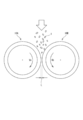
- FIG. 2 is a schematic diagram for explaining a method of using the hulling roll of the present invention.
- the hulling roll is used by attaching two hulling rolls as a set to a conventionally known rubber roll type hulling machine. That is, as shown in FIG. 2, a pair of hulling rolls 10A and 10B are mounted in parallel so as to have a predetermined interval L, and each of hulling rolls 10A and 10B is opposite to each other at different rotational speeds (hulling rolls). Rotate at a rotational speed Va of 10A ⁇ rotational speed Vb of the hulling roll 10B.
- the distance L between the hulling roll 10A and the hulling roll 10B and the rotational speeds (peripheral speeds) Va and Vb of the hulling roll 10A and the hulling roll 10B when using the hulling roll are not particularly limited. May be set as appropriate according to various conditions such as the specifications, the type and the drying rate of dried rice, the processing rate, and the putting rate.
- the isocyanate group content of the urethane prepolymer A was measured by a potentiometric titration method of JIS K 1603-1 (2007) A method.
- an automatic potentiometric titrator AT-710B manufactured by Kyoto Electronics Industry Co., Ltd. was used.
- prepolymer B The polyol component (PEA2000) heated to 110 ° C. and the isocyanate component (NDI) at room temperature were weighed so that the weight ratio between them (polyol component: isocyanate component) was 80.3: 19.7, The mixture was put into a round bottom separable flask, and the temperature was adjusted in an oil bath set at 120 ° C. while refluxing dry air, and the reaction was continued until the liquid temperature reached 125 ° C. by an exothermic reaction. As a result, about 1000 g of urethane prepolymer B (isocyanate group content: 4.5% by weight) was obtained. The reaction time was about 30 minutes.
- prepolymer C About 1000 g of urethane prepolymer in the same manner as the preparation of Prepolymer A, except that the polyol component (PBA2000) and the isocyanate component (pure-MDI) were weighed so that the weight ratio was 73.8: 26.2. C (isocyanate group content: 6.3% by weight) was obtained.
- prepolymer D About 1000 g of urethane prepolymer, similar to the preparation of Prepolymer A, except that the polyol component (PBA3000) and the isocyanate component (pure-MDI) were weighed so that the weight ratio was 75.1: 24.9. D (isocyanate group content 6.3% by weight) was obtained.
- prepolymer E About 1000 g of urethane prepolymer in the same manner as the preparation of prepolymer A, except that the polyol component (PEBA2000) and the isocyanate component (pure-MDI) were weighed so that the weight ratio was 73.8: 26.2. E (isocyanate group content 6.3% by weight) was obtained.
- Preparation of prepolymer F About 1000 g of urethane in the same manner as the preparation of Prepolymer A, except that the polyol component (prototype A) and the isocyanate component (pure-MDI) were weighed so that the weight ratio was 73.8: 26.2. Prepolymer F (isocyanate group content: 6.3% by weight) was obtained.
- Preparation of prepolymer G About 1000 g of urethane in the same manner as the preparation of Prepolymer A, except that the polyol component (prototype B) and the isocyanate component (pure-MDI) were weighed so that the weight ratio was 73.8: 26.2. Prepolymer G (isocyanate group content: 6.3% by weight) was obtained.
- prepolymer H About 1000 g of urethane prepolymer in the same manner as the preparation of prepolymer A, except that the polyol component (PCL2000) and the isocyanate component (pure-MDI) were weighed so that the weight ratio was 73.8: 26.2. H (isocyanate group content: 6.3% by weight) was obtained.
- Preparation of Prepolymer I About 1000 g of urethane prepolymer in the same manner as the preparation of prepolymer A, except that the polyol component (PEA500) and the isocyanate component (pure-MDI) were weighed so that the weight ratio was 54.2: 45.8. I (isocyanate group content 6.3% by weight) was obtained.
- prepolymer J (Preparation of prepolymer J) About 1000 g of urethane prepolymer in the same manner as the preparation of prepolymer A, except that the polyol component (PEA1000) and the isocyanate component (pure-MDI) were weighed so that the weight ratio was 65.1: 34.9. J (isocyanate group content: 6.3% by weight) was obtained.
- prepolymer K About 1000 g of urethane prepolymer in the same manner as the preparation of prepolymer A, except that the polyol component (PEA 1500) and the isocyanate component (pure-MDI) were weighed so that the weight ratio was 69.8: 30.2. K (isocyanate group content: 6.3% by weight) was obtained.
- prepolymer L About 1000 g of urethane prepolymer in the same manner as the preparation of prepolymer A, except that the polyol component (PEA3000) and the isocyanate component (pure-MDI) were weighed so that the weight ratio was 75.1: 24.9. L (isocyanate group content 6.3% by weight) was obtained.
- thermosetting urethane composition (Examples 1 to 22)
- 1,4-BD, BHEB, and TMP in the blending amounts (parts by weight) shown in Table 2 were each heated to 110 ° C., and then rapidly stirred and mixed to prepare a thermosetting urethane composition. .
- the following evaluation was performed about each obtained thermosetting urethane composition. The results are shown in Table 2.
- thermosetting urethane composition was poured into a mold and cured under the following conditions to produce a cured product having a diameter of 16 mm and a thickness of 6 mm.
- the above curing treatment is performed by injecting the thermosetting urethane composition into a mold at a temperature of 110 ° C., curing at a mold temperature of 125 ° C. for 60 minutes, then removing from the mold, and post-curing at 110 ° C. for 12 hours. It was performed under the condition of letting Next, the JIS-A hardness of the produced cured product was measured according to JIS K 6253. However, the measurement temperature was 20 ° C., and the measurement locations were three locations.
- thermosetting urethane composition Reactivity About the thermosetting urethane composition, the time until the viscosity reached 3000 mPa ⁇ s was measured immediately after preparation.
- thermosetting urethane composition was dropped on a hot plate at 130 ° C. with a thickness of about 2 mm, the time until plastic deformation disappeared was measured.
- thermosetting urethane composition (Comparative Examples 1 to 15)
- thermosetting urethane composition it carried out similarly to an Example, (1) JIS-A hardness, (2) DIN abrasion loss, (3) Reactivity, and (4) Workability
- thermosetting urethane composition obtained by heating the urethane prepolymer, 1,4-BD, BHEB, TMP and silicone oil in the blending amounts (parts by weight) shown in Table 4 to 110 ° C., followed by rapid stirring and mixing. was prepared.
- Table 4 A thermosetting urethane composition obtained by heating the urethane prepolymer, 1,4-BD, BHEB, TMP and silicone oil in the blending amounts (parts by weight) shown in Table 4 to 110 ° C., followed by rapid stirring and mixing. was prepared.
- Table 4 A thermosetting urethane composition obtained by heating the urethane prepolymer, 1,4-BD, BHEB, TMP and silicone oil in the blending amounts (parts by weight) shown in Table 4 to 110 ° C., followed by rapid stirring and mixing. was prepared.
- Table 4 A thermosetting urethane composition obtained by heating the urethane prepolymer, 1,4-BD, BHEB, TMP and silicone oil in the blending amounts (part
- the hulling roll was produced by the following method using the prepared thermosetting urethane composition, and the hulling performance was evaluated.
- Preparation of hulling roll a type: integrated large 100 type hulling roll was produced.
- the shin material part having the shape shown in FIG. 1 was cast by aluminum die casting.
- the above-mentioned shin material part was installed in a cylindrical mold so that the distance between the outer peripheral surface of the above-mentioned sinter material part and the inner peripheral surface of the above-mentioned mold was almost equal.
- thermosetting urethane composition into the gap between the outer peripheral surface of the shin material part and the inner peripheral surface of the mold and curing, the outer diameter dimension and the width dimension are adjusted by cutting, A hulling roll in which a rubber layer was laminated on the outer peripheral surface of the shin material part was produced.
- the curing conditions employed here are the same as the curing conditions employed when producing a cured product in the above-described evaluation of JIS-A hardness.
- the amount of wear is determined by pressing a ruler against each end face of the pair of hulling rolls (main roll and sub roll), measuring the thickness of the remaining rubber layer, and the initial rubber layer thickness (25 mm). Calculated as the difference.
- the results are shown in Table 4.
- the amount of wear before the main roll and before the sub-roll refers to the amount of wear measured at the end face located in front when the hulling roll is attached to the hulling machine, and after the main roll and after the sub-roll.
- the amount of wear refers to the amount of wear measured at the end face located on the back side when the hulling roll is attached to the hulling machine.
Landscapes
- Chemical & Material Sciences (AREA)
- Engineering & Computer Science (AREA)
- General Engineering & Computer Science (AREA)
- Health & Medical Sciences (AREA)
- Chemical Kinetics & Catalysis (AREA)
- Medicinal Chemistry (AREA)
- Polymers & Plastics (AREA)
- Organic Chemistry (AREA)
- Mechanical Engineering (AREA)
- Polyurethanes Or Polyureas (AREA)
Abstract
本発明は、耐摩耗性に格別優れた硬化物を得るための熱硬化性ウレタン組成物を提供するものであり、本発明の熱硬化性ウレタン組成物は、ポリオール成分、イソシアネート成分及び架橋剤を含有する熱硬化性ウレタン組成物であって、前記ポリオール成分は、ポリエステルポリオールであり、前記架橋剤は、1,4-BD、BHEB及びTMPであり、前記1,4-BD、前記BHEB及び前記TMPの配合比率(mol%)は、1,4-BD:BHEB:TMP=5~30:55~85:5~30である。
Description
本発明は、熱硬化性ウレタン組成物、この熱硬化性ウレタン組成物の硬化物、及び、この硬化物からなるゴム層を備えた籾摺りロールに関する。
農業用脱穀機には籾摺りロールが取り付けられている。この籾摺りロールは、2個の籾摺りロールを一対とし、籾摺りロール同士が所定の間隔を有するように配置して使用する。このように配置された一対の籾摺りロールは、各籾摺りロールを異なる周速度で回転させつつ、籾摺りロール同士の隙間に籾米(籾殻が付いた米)を投入することにより、籾殻を脱ぷし、籾殻と玄米とに分離することができる。
籾摺りロールは、一般に、円筒状のしん材部と、その周囲に設けられたゴム層とを備える。籾摺りロールのゴム層は、籾殻の脱ぷに伴い徐々に摩耗していくこととなり、ゴム層の厚さが薄くなると籾摺りロールとしての性能を発揮することができなくなる。そのため、ゴム層の厚さが設定値に到達した場合には、籾摺りロールを交換する必要がある。
そこで、長期間に渡って籾摺りロールを交換することなく籾殻を脱ぷするために、耐久性(耐摩耗性)に優れたゴム層を備えた籾摺りロールが求められている。
そこで、長期間に渡って籾摺りロールを交換することなく籾殻を脱ぷするために、耐久性(耐摩耗性)に優れたゴム層を備えた籾摺りロールが求められている。
耐久性に優れた籾摺りロールとして、例えば、特許文献1、2には、ウレタン樹脂組成物を用いて作製されたゴム層を備えた籾摺りロールが提案されている。
ゴム層がウレタン組成物を用いて形成された籾摺りロールは、NBR製やSBR製のゴム層を備えた籾摺りロールに比べると耐久性に優れる傾向にある。
しかしながら、その耐久性については更なる向上が望まれていた。
しかしながら、その耐久性については更なる向上が望まれていた。
一方、特許文献3には、耐摩耗性に優れた成形品を提供するための注型用ポリウレタン系エラストマー組成物として、ポリテトラメチレンエーテルグリコール、短鎖ジオール及び触媒を含有する硬化剤を含む組成物が開示されている。また、この文献にはエラストマー組成物に含まれる上記短鎖ジオールとして、1,4-BD、又は、1,4-BDとBHEB等の他の短鎖ジオールとの混合物を用いることが好ましいことが開示されている。
しかしながら、籾摺りロールのゴム層の耐摩耗性としては、より優れた耐摩耗性が望まれていた。
しかしながら、籾摺りロールのゴム層の耐摩耗性としては、より優れた耐摩耗性が望まれていた。
本発明者らは上記要望に応えるべく検討を行った結果、ポリエステルポリオールをポリオール成分とし、特定の3種類の架橋剤を特定の配合比率で含有する熱硬化性ウレタン組成物を用いることにより、耐摩耗性に格別優れた硬化物を提供することができることを見出し、本発明を完成した。
また、本発明者らは、このような熱硬化性ウレタン組成物の硬化物からなるゴム層を備えた籾摺りロールは、耐久性に極めて優れ、長期間に渡って使用することができることも合わせて見出した。
また、本発明者らは、このような熱硬化性ウレタン組成物の硬化物からなるゴム層を備えた籾摺りロールは、耐久性に極めて優れ、長期間に渡って使用することができることも合わせて見出した。
本発明の熱硬化性ウレタン組成物は、ポリオール成分、イソシアネート成分及び架橋剤を含有する熱硬化性ウレタン組成物であって、上記ポリオール成分は、ポリエステルポリオールであり、上記架橋剤は、1,4-BD(1,4-ブタンジオール)、BHEB(1,4-ビス(β-ヒドロキシエトキシ)ベンゼン)及びTMP(トリメチロールプロパン)であり、上記1,4-BD、上記BHEB及び上記TMPの配合比率(mol%)は、1,4-BD:BHEB:TMP=5~30:55~85:5~30である、ことを特徴とする。
本発明の熱硬化性ウレタン組成物は、ポリエステルポリオールをポリオール成分とし、かつ、架橋剤として1,4-BD、BHEB及びTMPの3種類の架橋剤を併用している。上記熱硬化性ウレタン組成物は、3種類の架橋剤を所定の配合比率で含有しているため、極めて耐摩耗性に優れる硬化物を提供することができる。
上記熱硬化性ウレタン組成物は、上記BHEBの含有量が、上記ポリオール成分、上記イソシアネート成分及び上記架橋剤の合計重量1gあたり、0.32~0.54mmolであり、上記TMPの含有量が、上記ポリオール成分、上記イソシアネート成分及び上記架橋剤の合計重量1gあたり、0.02~0.13mmolである、ことが好ましい。
上記熱硬化性ウレタン組成物において、上記熱硬化性ウレタン組成物中のブチレン基濃度は、上記ポリオール成分、上記イソシアネート成分及び上記架橋剤の合計重量1gあたり、0.06~6.79mmolであることが好ましい。
上記ブチレン基濃度は、上記ポリエステルポリオールがブチレン基を含有するポリエステルポリオールである場合には、上記ポリオール成分、上記イソシアネート成分及び上記架橋剤の合計重量1gあたり、1.52~6.79mmolであることがより好ましい。
また、上記ブチレン基濃度は、上記ポリエステルポリオールが、ブチレン基を含有しないポリエステルポリオールである場合には、上記ポリオール成分、上記イソシアネート成分及び上記架橋剤の合計重量1gあたり、0.06~0.13mmolであることがより好ましい。
また、上記ブチレン基濃度は、上記ポリエステルポリオールが、ブチレン基を含有しないポリエステルポリオールである場合には、上記ポリオール成分、上記イソシアネート成分及び上記架橋剤の合計重量1gあたり、0.06~0.13mmolであることがより好ましい。
本発明の硬化物は、本発明の熱硬化性ウレタン組成物を熱硬化させたものである。
そのため、上記硬化物は極めて耐摩耗性に優れる。
そのため、上記硬化物は極めて耐摩耗性に優れる。
本発明の籾摺りロールは、しん材部と、上記しん材部の外周面に積層されたゴム層とを備えた籾摺りロールであって、上記ゴム層が本発明の硬化物からなることを特徴とする。
本発明の籾摺りロールは、本発明の硬化物からなるゴム層を備えており、上記ゴム層は耐摩耗性に優れる。そのため、上記籾摺りロールは耐久性に格別優れ、長期間に渡って使用することができる。
本発明の籾摺りロールは、本発明の硬化物からなるゴム層を備えており、上記ゴム層は耐摩耗性に優れる。そのため、上記籾摺りロールは耐久性に格別優れ、長期間に渡って使用することができる。
本発明の熱硬化性ウレタン組成物は、熱硬化させることにより、耐摩耗性に格別優れる硬化物となる。
本発明の硬化物は、耐摩耗性に格別優れる。
本発明の籾摺りロールは、耐久性に極めて優れ、長期間に渡って交換することなく使用することができる。
本発明の硬化物は、耐摩耗性に格別優れる。
本発明の籾摺りロールは、耐久性に極めて優れ、長期間に渡って交換することなく使用することができる。
以下、本発明の実施の形態について説明する。
まず、本発明の熱硬化性ウレタン組成物について説明する。
本発明の熱硬化性ウレタン組成物は、ポリオール成分、イソシアネート成分及び架橋剤を含有する熱硬化性ウレタン組成物である。
まず、本発明の熱硬化性ウレタン組成物について説明する。
本発明の熱硬化性ウレタン組成物は、ポリオール成分、イソシアネート成分及び架橋剤を含有する熱硬化性ウレタン組成物である。
上記ポリオール成分は、ポリエステルポリオールである。
ポリオール成分が極性の高いポリエステルポリオールであると、ポリエステルポリオール基により発現する高い分子間力により、耐摩耗性に優れた硬化物を得ることができる。
ポリオール成分が極性の高いポリエステルポリオールであると、ポリエステルポリオール基により発現する高い分子間力により、耐摩耗性に優れた硬化物を得ることができる。
上記ポリエステルポリオールとしては、例えば、ジカルボン酸とグリコールとを常法に従って反応させることにより得たもの等が挙げられる。
上記ジカルボン酸としては、例えば、テレフタル酸、イソフタル酸、2,6-ナフタレンジカルボン酸等の芳香族ジカルボン酸、アジピン酸、アゼライン酸、セバシン酸等の脂肪族ジカルボン酸、オキシ安息香酸等のオキシカルボン酸、それらのエステル形成性誘導体等が挙げられる。
これらのなかではアジピン酸が好ましく、グリコールや架橋剤として1,4-ブタンジオールを用いる場合にはアジピン酸が特に好ましい。アジピン酸のC原子配列は、1,4-ブタンジオールと同じ4連配列であるため、配向結晶性に優れ、結晶化構造を有することにより強固な分子間力を発現する。また、アジピン酸は安価であるため、経済的にも優れる。
上記ジカルボン酸は単独で用いても良いし、2種以上併用してもよい。
上記ジカルボン酸としては、例えば、テレフタル酸、イソフタル酸、2,6-ナフタレンジカルボン酸等の芳香族ジカルボン酸、アジピン酸、アゼライン酸、セバシン酸等の脂肪族ジカルボン酸、オキシ安息香酸等のオキシカルボン酸、それらのエステル形成性誘導体等が挙げられる。
これらのなかではアジピン酸が好ましく、グリコールや架橋剤として1,4-ブタンジオールを用いる場合にはアジピン酸が特に好ましい。アジピン酸のC原子配列は、1,4-ブタンジオールと同じ4連配列であるため、配向結晶性に優れ、結晶化構造を有することにより強固な分子間力を発現する。また、アジピン酸は安価であるため、経済的にも優れる。
上記ジカルボン酸は単独で用いても良いし、2種以上併用してもよい。
上記グリコールとしては、例えば、エチレングリコール、1,4-ブタンジオール、ジエチレングリコール、ネオペンチルグリコール、3-メチル-1,5-ペンタンジオール、1,9-ノナンジオール、トリエチレングリコール等の脂肪族グリコール、1,4-シクロヘキサンジメタノール等の脂環族グリコール、p-キシレンジオール等の芳香族ジオール、ポリエチレングリコール、ポリプロピレングリコール、ポリテトラメチレングリコール等のポリオキシアルキレングリコール等が挙げられる。
上記グリコールとしては、脂肪族グリコールが好ましく、エチレングリコール、1,4-ブタンジオールが更に好ましい。これらは、JIS-A硬さが90°程度の硬化物(籾摺りロールのゴム層に適した硬度の硬化物)を形成するのに適しており、かつ、安価である。
ジカルボン酸及びグリコールの反応物であるポリエステルポリオールは、線状構造であるが、3価以上のエステル形成成分を用いた分枝状ポリエステルであってもよい。
上記グリコールは単独で用いても良いし、2種以上併用しても良い。
上記グリコールとしては、脂肪族グリコールが好ましく、エチレングリコール、1,4-ブタンジオールが更に好ましい。これらは、JIS-A硬さが90°程度の硬化物(籾摺りロールのゴム層に適した硬度の硬化物)を形成するのに適しており、かつ、安価である。
ジカルボン酸及びグリコールの反応物であるポリエステルポリオールは、線状構造であるが、3価以上のエステル形成成分を用いた分枝状ポリエステルであってもよい。
上記グリコールは単独で用いても良いし、2種以上併用しても良い。
上記ポリエステルポリオールとしては、特に、ポリエチレンアジペート系ポリエステルポリオール、ポリブチレンアジペート系ポリエステルポリオール、及び、ポリエチレンブチレンアジペート系ポリエステルポリオールが好ましい。JIS-A硬さが90°程度の硬化物を形成するのに適した分子構造を有しており、かつ、安価である。
上記ポリオールは、数平均分子量が1000~3000であることが好ましい。このようなポリオールを用いることにより、硬化物を籾摺りロールのゴム層に適した硬化物とすることができる。
上記数平均分子量が1000未満では、硬化物にゴム弾性が発現しにくく、剛性が高いものとなることがある。一方、数平均分子量が3000を超えると、硬化物にゴム強度を付与しにくく、柔軟すぎる硬化物となることがある。
上記数平均分子量は、GPC(ゲルパーミエーションクロマトグラフ)測定によるポリスチレン換算の測定値である。
上記数平均分子量が1000未満では、硬化物にゴム弾性が発現しにくく、剛性が高いものとなることがある。一方、数平均分子量が3000を超えると、硬化物にゴム強度を付与しにくく、柔軟すぎる硬化物となることがある。
上記数平均分子量は、GPC(ゲルパーミエーションクロマトグラフ)測定によるポリスチレン換算の測定値である。
上記イソシアネート成分は、ウレタン組成物に使用されるイソシアネートであれば特に限定されず、従来公知のイソシアネートを用いることができる。上記イソシアネートとしては、例えば、フェニレンジイソシアネート(PPDI)、トリレンジイソシアネート(TDI)、ジフェニルメタンジイソシアネートやポリメチレンポリフェニレンポリイソシアネート(両者をともにMDIという)、4,4’-トリジンジイソシアネート(TODI)、4,4’-ジフェニルエーテルジイソシアネート、キシリレンジイソシアネート(XDI)、ナフタレンジイソシアネート(NDI)、テトラメチルキシリレンジイソシアネート(TMXDI)等の芳香族ジイソシアネート;シクロペンタンジイソシアネート、シクロヘキサンジイソシアネート、イソホロンジイソシアネート(IPDI)、ジシクロヘキシルメタンジイソシアネート(水添MDI)、メチル-2,4-シクロヘキサンジイソシアネート、メチル-2,6-シクロヘキサンジイソシアネート、ビス(イソシアネートメチル)シクロヘキサン、ノルボルナンジイソシアネート(NBDI)等の脂環族ジイソシアネート等が挙げられる。
上記イソシアネート成分としては、MDI又はTDIが好ましい。MDI及びTDIは、本発明の要求特性を満足しつつ、安価に入手することができる。
上記イソシアネート成分は、TDIとMDIの併用等、複数のイソシアネートを併用してもよい。
上記イソシアネート成分としては、MDI又はTDIが好ましい。MDI及びTDIは、本発明の要求特性を満足しつつ、安価に入手することができる。
上記イソシアネート成分は、TDIとMDIの併用等、複数のイソシアネートを併用してもよい。
上記TDI(トリレンジイソシアネート)としては従来公知のTDIを用いることができる。上記TDIにおいて、2,4-TDIと2,6-TDIとの配合比(2,4-TDI/2,6-TDI)は特に限定されないが、65/35~80/20(重量比)が好ましい。上記TDIとしては、例えば、T-80(2,4-TDI/2,6-TDI=80/20)、T-100(2,4-TDI/2,6-TDI=100/0)、T-65(2,4-TDI/2,6-TDI=65/35)等を用いることができる。
上記TDIとしては各種市販品を使用することもできる。
上記TDIとしては各種市販品を使用することもできる。
上記MDI(ジフェニルメタンジイソシアネート又はポリメチレンポリフェニレンポリイソシアネート)は特に限定されるものではなく、その分子量分布の広狭を問わず用いることができる。上記MDIとしては、例えば、ピュアMDI(4,4’-MDI)、ポリメリックMDI等を用いることができる。
上記MDIとしては各種市販品を使用することもできる。
上記MDIとしては各種市販品を使用することもできる。
上記熱硬化性ウレタン組成物におけるイソシアネート基含有率は、3.5~10.0重量%が好ましい。
上記イソシアネート基含有率が、3.5重量%未満では硬化物の耐摩耗性が低下してしまうことがある。一方、上記イソシアネート基含有率が10.0重量%を超えると、硬化物が硬度の高すぎるものとなってしまうことがあり、硬度が高すぎると籾摺りロールのゴム層として適さないことがある。
上記イソシアネート基含有率(重量%)とは、熱硬化性ウレタン組成物に使用する架橋剤を除いた完全プレポリマー(全てのイソシアネート成分、全てのポリオール成分の合計量)中に含まれるイソシアネート基の重量割合をいう。
上記イソシアネート基含有率が、3.5重量%未満では硬化物の耐摩耗性が低下してしまうことがある。一方、上記イソシアネート基含有率が10.0重量%を超えると、硬化物が硬度の高すぎるものとなってしまうことがあり、硬度が高すぎると籾摺りロールのゴム層として適さないことがある。
上記イソシアネート基含有率(重量%)とは、熱硬化性ウレタン組成物に使用する架橋剤を除いた完全プレポリマー(全てのイソシアネート成分、全てのポリオール成分の合計量)中に含まれるイソシアネート基の重量割合をいう。
上記架橋剤は、1,4-BD、BHEB及びTMPである。
上記熱硬化性ウレタン組成物は、架橋剤として上記3種類の架橋剤を特定の配合比率で併用することが極めて重要である。上記3種類の架橋剤を併用することにより、特異的に耐摩耗性を向上させることができる。
そもそも当業者による熱硬化性ウレタン組成物に設計において、上記3種類の架橋剤を併用することは全く想定されていない。
その理由はいくつかあるが、例えば、熱硬化性ウレタン組成物の設計において重要視される硬化物の硬度の調整において、1,4-BD及びBHEBは硬化物の硬度を上げる傾向にある硬化剤であり、TMPは硬化物の硬度を下げる傾向にある硬化剤である。そのため、通常、上記3種類の架橋剤を併用しようとする技術思想は存在し無かった。このことが理由の1つである。
また、1,4-BDとBHEBとは、硬化物の硬度を調整する観点においては同じ傾向(硬化物の硬度を上げる)を示す硬化剤であり、そのため、敢えて併用しないのが通常である。このことも理由の1つである。
上記熱硬化性ウレタン組成物は、架橋剤として上記3種類の架橋剤を特定の配合比率で併用することが極めて重要である。上記3種類の架橋剤を併用することにより、特異的に耐摩耗性を向上させることができる。
そもそも当業者による熱硬化性ウレタン組成物に設計において、上記3種類の架橋剤を併用することは全く想定されていない。
その理由はいくつかあるが、例えば、熱硬化性ウレタン組成物の設計において重要視される硬化物の硬度の調整において、1,4-BD及びBHEBは硬化物の硬度を上げる傾向にある硬化剤であり、TMPは硬化物の硬度を下げる傾向にある硬化剤である。そのため、通常、上記3種類の架橋剤を併用しようとする技術思想は存在し無かった。このことが理由の1つである。
また、1,4-BDとBHEBとは、硬化物の硬度を調整する観点においては同じ傾向(硬化物の硬度を上げる)を示す硬化剤であり、そのため、敢えて併用しないのが通常である。このことも理由の1つである。
また、例えば、BHEBは融点が105℃と架橋剤の中では比較的高く、BHEBを含む熱硬化性ウレタン組成物を調製する場合には、配合材料を110℃程度にする必要がある。一方、1,4-BDは架橋剤の中では比較的反応速度の速い架橋剤であり、110℃程度まで加熱すると反応速度が速くなりすぎて金型に注入することが困難になることも理由に1つである。これに対して、上記熱硬化性ウレタン組成物は、1,4-BDの配合比率を架橋剤の合計量100mol中、30molまでとしており、これにより反応速度が速くなりすぎることを回避している。
このような従来の考え方に対して、本発明は、通常併用することのない架橋剤を敢えて併用することにより、特異的に耐摩耗性が向上するとの新たな知見を見出し、完成させた発明である。
このような従来の考え方に対して、本発明は、通常併用することのない架橋剤を敢えて併用することにより、特異的に耐摩耗性が向上するとの新たな知見を見出し、完成させた発明である。
上記熱硬化性ウレタン組成物において、上記1,4-BD、上記BHEB及び上記TMPの配合比率(3種類の架橋剤の合計量(100mol)中に含まれる各架橋剤のmol量)は、1,4-BD:BHEB:TMP=5~30:55~85:5~30である。
3種類の架橋剤の合計量に対する1,4-BDの配合比率が上記範囲を外れると、熱硬化性ウレタン組成物の硬化物の耐摩耗性を優れたものとすることができない。
3種類の架橋剤の合計量に対する1,4-BDの配合比率が上記範囲を外れると、熱硬化性ウレタン組成物の硬化物の耐摩耗性を優れたものとすることができない。
3種類の架橋剤の合計量に対するBHEBの配合比率(mol%)が上記範囲を外れると、熱硬化性ウレタン組成物の硬化物の耐摩耗性を優れたものとすることができない。
また、BHEBの配合比率(mol%)が85を超えると、熱硬化性ウレタン組成物の作業性が低下する。具体的には、硬化物を作製するために、熱硬化性ウレタン組成物を金型内に注入し、硬化させた後、脱型しようとすると、脱型することができないことがある。
また、BHEBの配合比率(mol%)が85を超えると、熱硬化性ウレタン組成物の作業性が低下する。具体的には、硬化物を作製するために、熱硬化性ウレタン組成物を金型内に注入し、硬化させた後、脱型しようとすると、脱型することができないことがある。
また、3種類の架橋剤の合計量に対するTMPの配合比率が上記範囲を外れる場合も、熱硬化性ウレタン組成物の硬化物の耐摩耗性を優れたものとすることができない。
上記熱硬化性ウレタン組成物において、上記BHEBの含有量(BHEB濃度)は、上記ポリオール成分、上記イソシアネート成分及び上記架橋剤の合計重量(以下、ウレタン重量ともいう)1gあたり、0.32~0.54mmolが好ましい。
上記BHEBの含有量が、ウレタン重量1gあたり0.32mmol未満では、硬化物の硬度が低くなる。そのため、籾摺りロールのゴム層を形成するための熱硬化性ウレタン組成物としては適さなくなることがある。
一方、上記BHEBの含有量が、ウレタン重量1gあたり0.54mmolを超えると、硬化物の耐摩耗性が低下し、更には、硬化物を製造する際の作業性が低下することもある。また、BHEBの含有量が多くなると、硬化物の硬度が高くなるため、上記含有量が0.54mmolを超えると、硬化物を籾摺りロールのゴム層として使用することが困難になる場合がある。
上記BHEBの含有量は、ウレタン重量1gあたり0.38~0.54mmolがより好ましい。
上記BHEBの含有量が、ウレタン重量1gあたり0.32mmol未満では、硬化物の硬度が低くなる。そのため、籾摺りロールのゴム層を形成するための熱硬化性ウレタン組成物としては適さなくなることがある。
一方、上記BHEBの含有量が、ウレタン重量1gあたり0.54mmolを超えると、硬化物の耐摩耗性が低下し、更には、硬化物を製造する際の作業性が低下することもある。また、BHEBの含有量が多くなると、硬化物の硬度が高くなるため、上記含有量が0.54mmolを超えると、硬化物を籾摺りロールのゴム層として使用することが困難になる場合がある。
上記BHEBの含有量は、ウレタン重量1gあたり0.38~0.54mmolがより好ましい。
上記熱硬化性ウレタン組成物において、上記TMPの含有量(TMP濃度)は、上記ポリオール成分、上記イソシアネート成分及び上記架橋剤の合計重量(ウレタン重量)1gあたり、0.02~0.13mmolが好ましい。
上記TMPの含有量がウレタン重量1gあたり0.02mmol未満では、熱硬化性ウレタン組成物を硬化させ、金型から脱型するまでに長時間を要し、硬化物を製造する際の作業性が低下することがある。
一方、上記TMPの含有量がウレタン重量1gあたり0.13mmolを超えると、硬化物の硬度を高くするのが困難となる。そのため、例えば、上記熱硬化性ウレタン組成物を用いて籾摺りロールのゴム層を形成する際に、充分な硬度を有するゴム層を形成することが難しい。
上記TMPの含有量は、ウレタン重量1gあたり0.04~0.11mmolがより好ましい。
上記TMPの含有量がウレタン重量1gあたり0.02mmol未満では、熱硬化性ウレタン組成物を硬化させ、金型から脱型するまでに長時間を要し、硬化物を製造する際の作業性が低下することがある。
一方、上記TMPの含有量がウレタン重量1gあたり0.13mmolを超えると、硬化物の硬度を高くするのが困難となる。そのため、例えば、上記熱硬化性ウレタン組成物を用いて籾摺りロールのゴム層を形成する際に、充分な硬度を有するゴム層を形成することが難しい。
上記TMPの含有量は、ウレタン重量1gあたり0.04~0.11mmolがより好ましい。
上記熱硬化性ウレタン組成物は、熱硬化性ウレタン組成物中のブチレン基濃度が、上記ポリオール成分、上記イソシアネート成分及び上記架橋剤の合計重量(ウレタン重量)1gあたり、0.06~6.79mmolであることが好ましい。
上記ブチレン基濃度が0.06mmol以下では、高硬度の硬化物を得るのが困難になることがある。また、熱硬化性ウレタン組成物を硬化させ、金型から脱型するまでに長時間を要し、硬化物を製造する際の作業性が低下することがある。一方、上記ブチレン基濃度が6.79mmolを超えると、硬化物の硬度が低くなりすぎて、籾摺りロールのゴム層として使用するのに適さなくなることがある。ここで、硬化物の硬度が低くなる理由は、架橋点以外のブチレン基濃度が増加する、すなわち架橋点間距離が増大するためと考えられる。
上記ブチレン基濃度が0.06mmol以下では、高硬度の硬化物を得るのが困難になることがある。また、熱硬化性ウレタン組成物を硬化させ、金型から脱型するまでに長時間を要し、硬化物を製造する際の作業性が低下することがある。一方、上記ブチレン基濃度が6.79mmolを超えると、硬化物の硬度が低くなりすぎて、籾摺りロールのゴム層として使用するのに適さなくなることがある。ここで、硬化物の硬度が低くなる理由は、架橋点以外のブチレン基濃度が増加する、すなわち架橋点間距離が増大するためと考えられる。
上記熱硬化性ウレタン組成物において、上記ブチレン基濃度は、上記ポリエステルポリオールが、ブチレン基を含有しないポリエステルポリオールである場合には、上記ウレタン重量1gあたり、0.06~0.13mmolであることがより好ましい。
この場合、上記ブチレン基の濃度は、架橋剤である1,4-BDの上記熱硬化性ウレタン組成物中の配合量に依存することになる。
即ち、上記熱硬化性ウレタン組成物に含まれる3種類の架橋剤に関しては、ウレタン重量1gあたりのブチレン基濃度が0.06~0.13mmolとなるように、1,4-BDを含有することが好ましい。
これに対して、1,4―BDの含有量が、上記ブチレン基濃度が0.06mmol未満となるような量であると、熱硬化性ウレタン組成物を硬化させ、金型から脱型するまでに長時間を要し、硬化物を製造する際の作業性が低下することがある。一方、1,4―BDの含有量が、上記ブチレン基濃度が0.13mmolを超えるような量であると、熱硬化性ウレタン組成物の反応速度が速すぎて、熱硬化性ウレタン組成物を調製した後、金型に投入して硬化物を作製する際の作業性が低下してしまうことがある。また、ブチレン基濃度が高くなる(1、4-BDの含有量が多くなる)に伴い、上記BHEBの含有量及び/又は上記TMPの含有量が減少することとなるが、上記BHEBの含有量が減少すると、硬化物の硬度を高くすることが難しくなり、TMPの含有量が減少すると、硬化物の耐摩耗性が低下する傾向にある。
この場合、上記ブチレン基の濃度は、架橋剤である1,4-BDの上記熱硬化性ウレタン組成物中の配合量に依存することになる。
即ち、上記熱硬化性ウレタン組成物に含まれる3種類の架橋剤に関しては、ウレタン重量1gあたりのブチレン基濃度が0.06~0.13mmolとなるように、1,4-BDを含有することが好ましい。
これに対して、1,4―BDの含有量が、上記ブチレン基濃度が0.06mmol未満となるような量であると、熱硬化性ウレタン組成物を硬化させ、金型から脱型するまでに長時間を要し、硬化物を製造する際の作業性が低下することがある。一方、1,4―BDの含有量が、上記ブチレン基濃度が0.13mmolを超えるような量であると、熱硬化性ウレタン組成物の反応速度が速すぎて、熱硬化性ウレタン組成物を調製した後、金型に投入して硬化物を作製する際の作業性が低下してしまうことがある。また、ブチレン基濃度が高くなる(1、4-BDの含有量が多くなる)に伴い、上記BHEBの含有量及び/又は上記TMPの含有量が減少することとなるが、上記BHEBの含有量が減少すると、硬化物の硬度を高くすることが難しくなり、TMPの含有量が減少すると、硬化物の耐摩耗性が低下する傾向にある。
また、上記熱硬化性ウレタン組成物において、上記ポリエステルポリオールがブチレン基を含有するポリエステルポリオールである場合には、上記ブチレン基濃度は、上記ポリオール成分、上記イソシアネート成分及び上記架橋剤の合計重量1gあたり、1.52~6.79mmolであることがより好ましい。
この場合、上記ブチレン基は、架橋剤の1,4-BDのみならず、ポリエステルポリオールにも由来することとなる。具体的には、上記ポリエステルポリオールの単量体成分である、ブタンジオール等のジオールや、アジピン酸等のジカルボン酸等に由来する。
この場合も、上述した理由で、架橋剤の1,4-BDに由来するブチレン基濃度の好ましい範囲は、上記ウレタン1gあたり、0.06~0.13mmolである。
そのため、上記ポリエステルポリオールに由来するブチレン基濃度の好ましい範囲は、1.46~6.66mmolとなる。
この場合、上記ブチレン基は、架橋剤の1,4-BDのみならず、ポリエステルポリオールにも由来することとなる。具体的には、上記ポリエステルポリオールの単量体成分である、ブタンジオール等のジオールや、アジピン酸等のジカルボン酸等に由来する。
この場合も、上述した理由で、架橋剤の1,4-BDに由来するブチレン基濃度の好ましい範囲は、上記ウレタン1gあたり、0.06~0.13mmolである。
そのため、上記ポリエステルポリオールに由来するブチレン基濃度の好ましい範囲は、1.46~6.66mmolとなる。
上記ブチレン基濃度は、熱硬化性ウレタン組成物に含有されるポリオール成分、イソシアネート成分及び架橋剤の種類及び配合量が明らかである場合には、当業者であれば計算により算出することができる。
一方、原材料が明らかでない、熱硬化性ウレタン組成物の硬化物から上記ブチレン基濃度を算出する場合には、例えば、下記の手法によりブチレン基濃度を測定すればよい。
(1)まず、下記(a)及び(b)の処理により、ポリオール成分、イソシアネート成分及び架橋剤のそれぞれの種類を明確にする。
(a)上記硬化物をFT-IR法で分析する。
(b)上記ポリウレタンを熱分解ガスクロマトグラフマス法(熱分解-GCMS)で分析する。
また、熱硬化性ウレタン組成物の硬化物の硬度と配合的知見から、ポリオール成分、イソシアネート成分及び架橋剤の配合比率を算出する。
(1)まず、下記(a)及び(b)の処理により、ポリオール成分、イソシアネート成分及び架橋剤のそれぞれの種類を明確にする。
(a)上記硬化物をFT-IR法で分析する。
(b)上記ポリウレタンを熱分解ガスクロマトグラフマス法(熱分解-GCMS)で分析する。
また、熱硬化性ウレタン組成物の硬化物の硬度と配合的知見から、ポリオール成分、イソシアネート成分及び架橋剤の配合比率を算出する。
(2)次に、下記の手法により、ポリオール成分の分子量を同定する。
まず、熱硬化性ウレタン組成物の硬化物を細かく裁断した後、ピリジン分解処理を施す。
続いて、得られた分解物を蒸留し、ポリオール成分を分取する。
その後、得られたポリオール成分を液体クロマトグラフィー(LC)法で分析し、ポリスチレン換算にてポリオール成分の分子量を同定する。
(3)その後、上記(1)及び(2)で取得した情報に基づいて、上記ブチレン基濃度を算出する。
まず、熱硬化性ウレタン組成物の硬化物を細かく裁断した後、ピリジン分解処理を施す。
続いて、得られた分解物を蒸留し、ポリオール成分を分取する。
その後、得られたポリオール成分を液体クロマトグラフィー(LC)法で分析し、ポリスチレン換算にてポリオール成分の分子量を同定する。
(3)その後、上記(1)及び(2)で取得した情報に基づいて、上記ブチレン基濃度を算出する。
上記熱硬化性ウレタン組成物は、上述した3種類の架橋剤以外に、本発明の効果を阻害しない範囲で、他の架橋剤を1種又は2種以上含有していてもよい。
上記他の架橋剤としては、例えば、エチレングリコール、プロピレングリコール、ヘキサンジオール、ジエチレングリコール、グリセリン、4,4’-メチレンビス(2-クロロアニリン)、ヒドラジン、エチレンジアミン、ジエチレントリアミン、4,4’-ジアミノジフェニルメタン、4,4’-ジアミノジシクロヘキシルメタン、N,N-ビス(2-ヒドロキシプロピル)アニリン、水等が挙げられる。
上記他の架橋剤としては、例えば、エチレングリコール、プロピレングリコール、ヘキサンジオール、ジエチレングリコール、グリセリン、4,4’-メチレンビス(2-クロロアニリン)、ヒドラジン、エチレンジアミン、ジエチレントリアミン、4,4’-ジアミノジフェニルメタン、4,4’-ジアミノジシクロヘキシルメタン、N,N-ビス(2-ヒドロキシプロピル)アニリン、水等が挙げられる。
上記熱硬化性ウレタン組成物は、シリコーンオイルを含有していてもよい。
シリコーンオイルを配合することにより、上記熱硬化性ウレタン組成物の硬化物の耐摩耗性がより向上する。
また、シリコーンオイルを含有する熱硬化性ウレタン組成物の硬化物からなるゴム層を備えた籾摺りロールは、耐水性を向上させることもできる。これは、ゴム層表面の疎水性が強まるため、ゴム層が吸湿しにくく、ポリウレタンの加水分解による劣化が生じにくくなるからと考えられる。
シリコーンオイルを配合することにより、上記熱硬化性ウレタン組成物の硬化物の耐摩耗性がより向上する。
また、シリコーンオイルを含有する熱硬化性ウレタン組成物の硬化物からなるゴム層を備えた籾摺りロールは、耐水性を向上させることもできる。これは、ゴム層表面の疎水性が強まるため、ゴム層が吸湿しにくく、ポリウレタンの加水分解による劣化が生じにくくなるからと考えられる。
上記シリコーンオイルとしては特に限定されず、例えば、ジメチルシリコーンオイル、メチルフェニルシリコーンオイル、メチルハイドロジェンシリコーンオイル、これらのシリコーンオイルの側鎖及び/又は末端に有機基を導入した変性シリコーンオイル(例えば、シラノール基末端変性シリコーンオイルなど)等が挙げられる。
これらのなかでは、ジメチルシリコーンオイルが好ましい。ジメチルシリコーンオイルは、シリコーンオイルの中では比較的構造が単純であり、立体的に大きな障害が無いため、ウレタン組成物中に分散させた際に、ポリウレタン分子中に分散しやすく、熱硬化性ウレタン組成物の硬化物を均質にするのに適している。
これらのなかでは、ジメチルシリコーンオイルが好ましい。ジメチルシリコーンオイルは、シリコーンオイルの中では比較的構造が単純であり、立体的に大きな障害が無いため、ウレタン組成物中に分散させた際に、ポリウレタン分子中に分散しやすく、熱硬化性ウレタン組成物の硬化物を均質にするのに適している。
上記シリコーンオイルは、25℃での動粘度が10~3000mm2/sであることが好ましい。この場合、上記熱硬化性ウレタン組成物の硬化物の耐摩耗性を更に向上させるとともに、上記硬化物の耐水性を長期間に渡って向上させるのに適している。
上記熱硬化性ウレタン組成物において、上記シリコーンオイルの含有量は、ポリオール成分、イソシアネート成分及び架橋剤の合計量に対して、0.3~10.0重量%であることが好ましい。
上記シリコーンオイルの含有量が0.3重量%未満では、シリコーンオイルを配合することによる効果(耐摩耗性及び耐水性の向上)を享受しにくい。
一方、上記シリコーンオイルの含有量が10重量%を超えると、上記熱硬化性ウレタン組成物に硬化物において、シリコーンオイルのブリードが発生することがある。シリコーンオイルのブリードが発生すると、例えば、上記硬化物を籾摺りロールのゴム層に用いた場合には、籾摺り時に、玄米を汚してしまったり、籾殻が籾摺り機に付着してしまったりすることがある。
上記シリコーンオイルの含有量は、ポリオール成分、イソシアネート成分及び架橋剤の合計量に対して、0.5~5.0重量%が好ましく、0.7~2.5重量%がより好ましい。
上記シリコーンオイルの含有量が0.3重量%未満では、シリコーンオイルを配合することによる効果(耐摩耗性及び耐水性の向上)を享受しにくい。
一方、上記シリコーンオイルの含有量が10重量%を超えると、上記熱硬化性ウレタン組成物に硬化物において、シリコーンオイルのブリードが発生することがある。シリコーンオイルのブリードが発生すると、例えば、上記硬化物を籾摺りロールのゴム層に用いた場合には、籾摺り時に、玄米を汚してしまったり、籾殻が籾摺り機に付着してしまったりすることがある。
上記シリコーンオイルの含有量は、ポリオール成分、イソシアネート成分及び架橋剤の合計量に対して、0.5~5.0重量%が好ましく、0.7~2.5重量%がより好ましい。
上記熱硬化性ウレタン組成物は、更に、鎖延長剤、架橋促進剤や架橋遅延剤等の反応助剤、加水分解防止剤、無機繊維や無機フィラー等の補強材、着色剤、光安定剤、熱安定剤、酸化防止剤、防黴剤、難燃剤、充填剤(増量剤)等の各種添加剤などを必要に応じて含有していてもよい。
上記熱硬化性ウレタン組成物は、熱硬化性させることにより硬化物を得ることができる。
上記硬化物の製造は、例えば、上記熱硬化性ウレタン組成物を金型に注型し、所定の条件で硬化処理を行えばよい。
上記硬化条件は特に限定されず、上記熱硬化性ウレタン組成物の組成に応じて適宜設定すればよい。上記硬化条件は、通常、100~160℃で30~90分間加熱する条件を採用することができる。
また、上記条件で硬化処理を行い、金型から脱型した後、例えば、100~160℃で3~48時間の条件で後硬化を行ってもよい。
上記硬化物の製造は、例えば、上記熱硬化性ウレタン組成物を金型に注型し、所定の条件で硬化処理を行えばよい。
上記硬化条件は特に限定されず、上記熱硬化性ウレタン組成物の組成に応じて適宜設定すればよい。上記硬化条件は、通常、100~160℃で30~90分間加熱する条件を採用することができる。
また、上記条件で硬化処理を行い、金型から脱型した後、例えば、100~160℃で3~48時間の条件で後硬化を行ってもよい。
上記硬化物は、耐摩耗性に優れるため、種々の用途に用いることができる。
具体的には、例えば、籾摺りロールのゴム層、産業用搬送機のソリッドタイヤやガイドロール、ロープウェーやケーブルカーのガイドロール、OA機器用ローラー、通貨処理機のローラー、ワイヤーソーマシンのガイドローラー等に用いることができる。上記硬化物もまた本発明の1つである。
具体的には、例えば、籾摺りロールのゴム層、産業用搬送機のソリッドタイヤやガイドロール、ロープウェーやケーブルカーのガイドロール、OA機器用ローラー、通貨処理機のローラー、ワイヤーソーマシンのガイドローラー等に用いることができる。上記硬化物もまた本発明の1つである。
次に、本発明の籾摺りロールについて、図面を参照しながら説明する。
本発明の籾摺りロールは、しん材部と、上記しん材部の外周面に積層されたゴム層とを備えた籾摺りロールであって、上記ゴム層が本発明の硬化物からなることを特徴とする。
本発明の籾摺りロールは、しん材部と、上記しん材部の外周面に積層されたゴム層とを備えた籾摺りロールであって、上記ゴム層が本発明の硬化物からなることを特徴とする。
図1(a)は本発明の籾摺りロールの一例を模式的に示す斜視図であり、(b)は(a)に示した籾摺りロールの正面図であり、(c)は(a)のA-A線断面図である。
図1(a)~(c)に示す籾摺りロール10は、金属製のしん材部11と、しん材部11の外周面に積層された、本発明の硬化物からなるゴム層12とを備える。
しん材部11は、筒内に籾摺りロール10を籾摺り機に取り付けるための取付用フランジ11aが設けられた円筒状の部材である。
しん材部11に外周面の全体には均一な厚さでゴム層12が形成されている。
図1(a)~(c)に示す籾摺りロール10は、金属製のしん材部11と、しん材部11の外周面に積層された、本発明の硬化物からなるゴム層12とを備える。
しん材部11は、筒内に籾摺りロール10を籾摺り機に取り付けるための取付用フランジ11aが設けられた円筒状の部材である。
しん材部11に外周面の全体には均一な厚さでゴム層12が形成されている。
上記しん材部としては、従来公知の籾摺りロールで使用されているしん材部と同様のものを用いることができる。上記しん材部に材質としては、例えば、アルミニウム、ステンレス、鉄、モリブデン、チタン等が挙げられる。
また、上記しん材部の形状やサイズも特に限定されず、従来品と同様、籾摺りロールを取り付ける籾摺り機の仕様や、JIS規格(JIS B 9214:もみすり用ゴムロール)に合わせて適宜設定すればよい。
また、上記しん材部の形状やサイズも特に限定されず、従来品と同様、籾摺りロールを取り付ける籾摺り機の仕様や、JIS規格(JIS B 9214:もみすり用ゴムロール)に合わせて適宜設定すればよい。
上記ゴム層は、本発明の熱硬化性ウレタン組成物の硬化物からなる。そのため、籾摺りロールを使用した際に、ゴム層が摩耗しにくく耐久性に優れ、長期間に渡って交換することなく使用することができる。
上記ゴム層(上記熱硬化性ウレタン組成物の硬化物)は、20℃におけるJIS-A硬さが85°以上であることが好ましい。上記JIS-A硬さが85°未満では、上記ゴム層が柔らかすぎるため、耐摩耗性が低下することがある。
上記JIS-A硬さは、88°以上がより好ましく、90°以上が更に好ましい。
一方、上記ゴム層の20℃におけるJIS-A硬さは、99°未満が好ましい。99°を超えると、籾摺り時に米が破損し、いわゆる砕米の発生率が増加するおそれがある。
また、上記ゴム層のJIS-A硬さは、籾摺りの対象となる米が比較的柔らかいジャポニカ米等である場合には88~92°程度が好ましく、籾摺りの対象となる米が比較的固いインディカ米等である場合は92~96°程度が好ましい。
上記JIS-A硬さは、JIS K 6253に準拠して測定すればよい(但し、測定温度は20℃)。
上記JIS-A硬さは、88°以上がより好ましく、90°以上が更に好ましい。
一方、上記ゴム層の20℃におけるJIS-A硬さは、99°未満が好ましい。99°を超えると、籾摺り時に米が破損し、いわゆる砕米の発生率が増加するおそれがある。
また、上記ゴム層のJIS-A硬さは、籾摺りの対象となる米が比較的柔らかいジャポニカ米等である場合には88~92°程度が好ましく、籾摺りの対象となる米が比較的固いインディカ米等である場合は92~96°程度が好ましい。
上記JIS-A硬さは、JIS K 6253に準拠して測定すればよい(但し、測定温度は20℃)。
上記ゴム層(上記熱硬化性ウレタン組成物の硬化物)は、tanδのピーク温度(Tg)が、10℃以下である好ましい。使用時のゴム層の温度である30~50℃において適切なゴム弾性を発現するからである。
上記ゴム層(上記熱硬化性ウレタン組成物の硬化物)は、DIN摩耗減量が、40~100mm3であることが好ましい。
上記DIN摩耗減量が40mm3未満では、籾摺り時に砕米の発生率が高くなることがある。一方、上記DIN摩耗減量が100mm3を超えると、耐久性が不充分となる。
上記DIN摩耗減量は、JIS K 6264のDIN摩耗試験に準拠して測定すればよい。
上記DIN摩耗減量は、40~85mm3がより好ましい。
上記DIN摩耗減量が40mm3未満では、籾摺り時に砕米の発生率が高くなることがある。一方、上記DIN摩耗減量が100mm3を超えると、耐久性が不充分となる。
上記DIN摩耗減量は、JIS K 6264のDIN摩耗試験に準拠して測定すればよい。
上記DIN摩耗減量は、40~85mm3がより好ましい。
上記ゴム層の厚さは特に特に限定されず、従来品と同様、籾摺りロールを取り付ける籾摺り機の仕様や、JIS規格(JIS B 9214)に合わせて適宜設定すればよい。
上記ゴム層の厚さ(図1(b)中、Tで示す)とは、未使用時のゴム層の外径と内径との差の1/2の値をいう。
上記ゴム層の厚さ(図1(b)中、Tで示す)とは、未使用時のゴム層の外径と内径との差の1/2の値をいう。
上記籾摺りロールは、上記しん材部と上記ゴム層との密着性をより向上させるべく、両者の間にプライマー層及び/又は接着剤層を形成したり、上記しん材部の外周面にゴム層との密着性を高めるための表面処理を施したりしてもよい。
上記接着剤の形成は、例えば、フェノール系接着剤等を用いて行うことができる。また、上記プライマー層の形成は、例えば、ウレタン系、ポリエステル系、シラン系、ポリアミド系、フェノール系のプライマーや、シランカップリング剤等を用いて行うことができる。
上記表面処理としては、例えば、粗化面の形成等が挙げられ、上記粗化面の形成は、例えば、ブラスト処理、研削処理、エッチング処理、メッキ処理、研磨処理、酸化処理等により行えばよい。
上記接着剤の形成は、例えば、フェノール系接着剤等を用いて行うことができる。また、上記プライマー層の形成は、例えば、ウレタン系、ポリエステル系、シラン系、ポリアミド系、フェノール系のプライマーや、シランカップリング剤等を用いて行うことができる。
上記表面処理としては、例えば、粗化面の形成等が挙げられ、上記粗化面の形成は、例えば、ブラスト処理、研削処理、エッチング処理、メッキ処理、研磨処理、酸化処理等により行えばよい。
上記籾摺りロールは、その断面(使用時の回転軸に垂直な断面)の真円度が0.5mm以下であることが好ましい。上記真円度が0.5mmを超えると、使用時に籾摺りロール同士の間隔のバラツキが大きくなり、脱ぷ率が低下したり、砕米の発生率が増加したりすることがある。
次に、上記籾摺りロールの製造方法について説明する。
上記籾摺りロールは、例えば、下記(1)及び(2)の工程を経ることにより製造することができる。
(1)まず、しん材部を作製する。上記しん材部は、従来公知の方法により作製することができ、例えば、アルミダイキャスト等により作製することができる。
その後、必要に応じて、しん材部の外周面に接着剤層及び/又はプライマー層を形成したり、しん材部に外周面に表面処理を施したりする。
上記籾摺りロールは、例えば、下記(1)及び(2)の工程を経ることにより製造することができる。
(1)まず、しん材部を作製する。上記しん材部は、従来公知の方法により作製することができ、例えば、アルミダイキャスト等により作製することができる。
その後、必要に応じて、しん材部の外周面に接着剤層及び/又はプライマー層を形成したり、しん材部に外周面に表面処理を施したりする。
(2)次に、上記しん材部の周囲にゴム層を形成する。ここでは、しん材部を円筒形の金型内に載置し、その後、しん材部の外周面と金型の内壁面との間隙に、上記熱硬化性ウレタン組成物を注入し、所定の条件で硬化させることによりゴム層を形成する。上記熱硬化性ウレタン組成物の硬化条件は既に説明した通りである。
このような方法により、しん材部の外周面にゴム層を積層することにより、全体に渡って均一な密度を有するゴム層が形成された籾摺りロールを製造することができる。
本発明で用いられる熱硬化性ウレタン組成物は、調製後の硬化の進行が比較的緩やかだからである。
また、上記籾摺りロールの製造方法では、必要に応じて、研削加工によってゴム層の表面を形成してもよい。勿論、金型から脱型したまま、上記研削加工を行わなくてもよい。
本発明で用いられる熱硬化性ウレタン組成物は、調製後の硬化の進行が比較的緩やかだからである。
また、上記籾摺りロールの製造方法では、必要に応じて、研削加工によってゴム層の表面を形成してもよい。勿論、金型から脱型したまま、上記研削加工を行わなくてもよい。
次に、上記籾摺りロールの使用方法について説明する。
図2は、本発明の籾摺りロールの使用方法を説明するための模式図である。
上記籾摺りロールは、2個の籾摺りロールを1組にして、従来公知のゴムロール式の籾摺り機に取り付けて使用する。
即ち、図2に示すように、一対の籾摺りロール10A、10Bを所定の間隔Lを有するように平行に取り付け、籾摺りロール10A、10Bのそれぞれを互いに逆方向に、かつ、異なる回転速度(籾摺りロール10Aの回転速度Va≠籾摺りロール10Bの回転速度Vb)で回転させる。そして、この状態で籾摺りロール10A、10B同士の間に籾米1を投入すると、籾摺りロール10Aと籾摺りロール10Bとの周速差により籾米1から籾殻が脱ぷされることとなる。
図2は、本発明の籾摺りロールの使用方法を説明するための模式図である。
上記籾摺りロールは、2個の籾摺りロールを1組にして、従来公知のゴムロール式の籾摺り機に取り付けて使用する。
即ち、図2に示すように、一対の籾摺りロール10A、10Bを所定の間隔Lを有するように平行に取り付け、籾摺りロール10A、10Bのそれぞれを互いに逆方向に、かつ、異なる回転速度(籾摺りロール10Aの回転速度Va≠籾摺りロール10Bの回転速度Vb)で回転させる。そして、この状態で籾摺りロール10A、10B同士の間に籾米1を投入すると、籾摺りロール10Aと籾摺りロール10Bとの周速差により籾米1から籾殻が脱ぷされることとなる。
上記籾摺りロールの使用時における、籾摺りロール10Aと籾摺りロール10Bとの隙間の距離Lや、籾摺りロール10A及び籾摺りロール10Bのそれぞれの回転速度(周速度)Va、Vbは特に限定されず、籾摺り機の仕様、投入する籾米の種類や乾燥率、処理速度、脱ぷ率等の各種条件に応じて適宜設定すればよい。
以下、実施例によって本発明をさらに具体的に説明するが、本発明は以下の実施例に限定されるものではない。
(原材料)
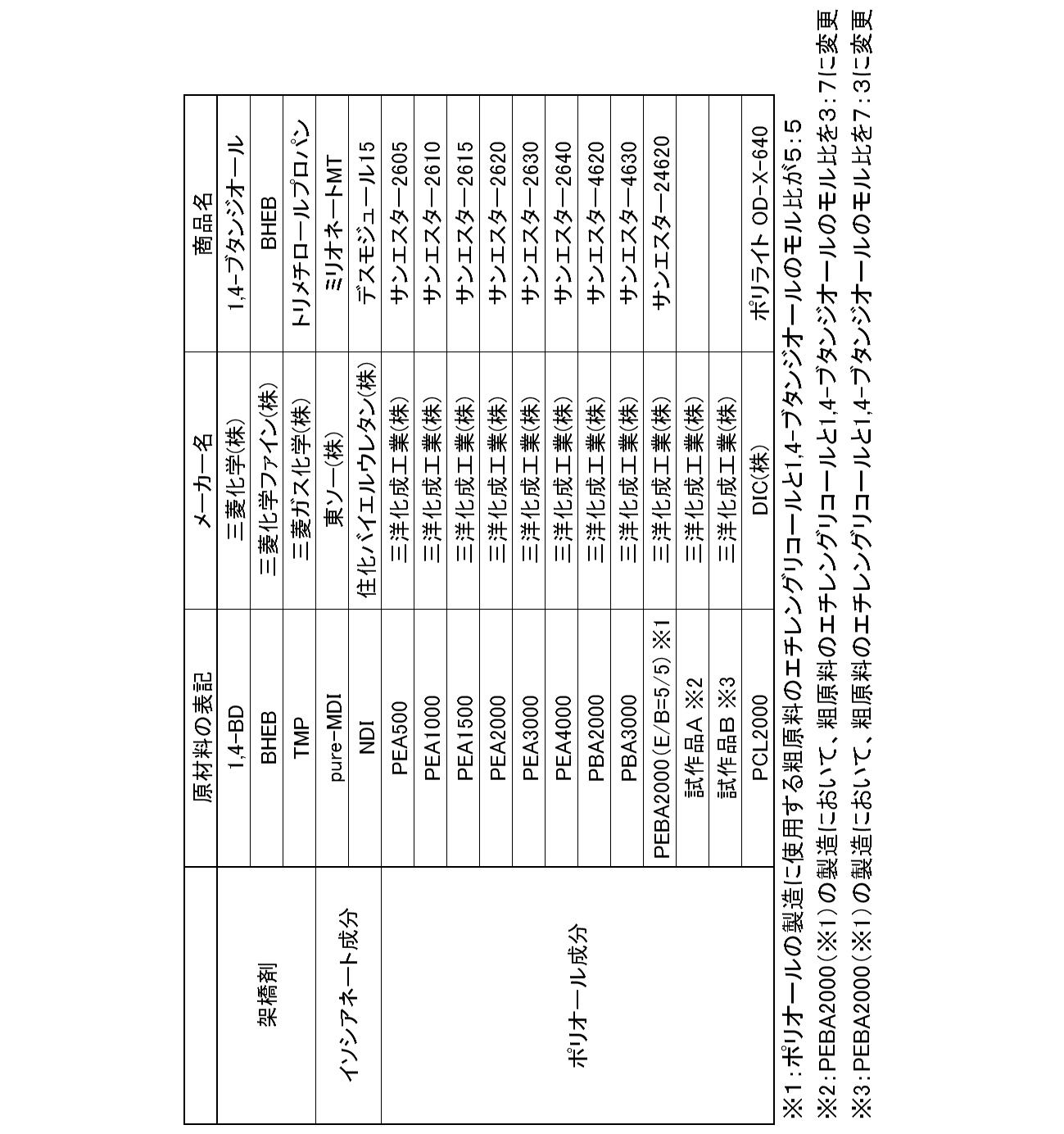
実施例及び比較例は、表1に示した原材料を使用した。
実施例及び比較例は、表1に示した原材料を使用した。
(プレポリマーの調製)
(プレポリマーAの調製)
それぞれ70℃に加熱溶解させたポリオール成分(PEA2000)とイソシアネート成分(pure-MDI)とを、両者の重量比(ポリオール成分:イソシアネート成分)が73.8:26.2となるように計量して、丸底セパラブルフラスコに投入し、乾燥空気を還流しつつオイルバスにて温調し、液温70℃にて6時間撹拌し、反応させた。これにより約1000gのウレタンプレポリマーA(イソシアネート基含有率6.3重量%)を得た。
なお、上記ウレタンプレポリマーAのイソシアネート基含有率は、JIS K 1603-1(2007)A法の電位差滴定法により測定した。ここでは、京都電子工業社製の自動電位差滴定装置AT-710Bを用いた。
(プレポリマーAの調製)
それぞれ70℃に加熱溶解させたポリオール成分(PEA2000)とイソシアネート成分(pure-MDI)とを、両者の重量比(ポリオール成分:イソシアネート成分)が73.8:26.2となるように計量して、丸底セパラブルフラスコに投入し、乾燥空気を還流しつつオイルバスにて温調し、液温70℃にて6時間撹拌し、反応させた。これにより約1000gのウレタンプレポリマーA(イソシアネート基含有率6.3重量%)を得た。
なお、上記ウレタンプレポリマーAのイソシアネート基含有率は、JIS K 1603-1(2007)A法の電位差滴定法により測定した。ここでは、京都電子工業社製の自動電位差滴定装置AT-710Bを用いた。
(プレポリマーBの調製)
110℃に加熱したポリオール成分(PEA2000)と室温のままのイソシアネート成分(NDI)とを、両者の重量比(ポリオール成分:イソシアネート成分)が80.3:19.7となるように計量して、丸底セパラブルフラスコに投入し、乾燥空気を還流しつつ120℃設定のオイルバスにて温調し、発熱反応で液温が125℃に到達するまで反応させた。これにより約1000gのウレタンプレポリマーB(イソシアネート基含有率4.5重量%)を得た。なお、反応時間は約30分間であった。
110℃に加熱したポリオール成分(PEA2000)と室温のままのイソシアネート成分(NDI)とを、両者の重量比(ポリオール成分:イソシアネート成分)が80.3:19.7となるように計量して、丸底セパラブルフラスコに投入し、乾燥空気を還流しつつ120℃設定のオイルバスにて温調し、発熱反応で液温が125℃に到達するまで反応させた。これにより約1000gのウレタンプレポリマーB(イソシアネート基含有率4.5重量%)を得た。なお、反応時間は約30分間であった。
(プレポリマーCの調製)
ポリオール成分(PBA2000)とイソシアネート成分(pure-MDI)とを、重量比が73.8:26.2となるように計量した以外はプレポリマーAの調製と同様にして、約1000gのウレタンプレポリマーC(イソシアネート基含有率6.3重量%)を得た。
ポリオール成分(PBA2000)とイソシアネート成分(pure-MDI)とを、重量比が73.8:26.2となるように計量した以外はプレポリマーAの調製と同様にして、約1000gのウレタンプレポリマーC(イソシアネート基含有率6.3重量%)を得た。
(プレポリマーDの調製)
ポリオール成分(PBA3000)とイソシアネート成分(pure-MDI)とを、重量比が75.1:24.9となるように計量した以外はプレポリマーAの調製と同様にして、約1000gのウレタンプレポリマーD(イソシアネート基含有率6.3重量%)を得た。
ポリオール成分(PBA3000)とイソシアネート成分(pure-MDI)とを、重量比が75.1:24.9となるように計量した以外はプレポリマーAの調製と同様にして、約1000gのウレタンプレポリマーD(イソシアネート基含有率6.3重量%)を得た。
(プレポリマーEの調製)
ポリオール成分(PEBA2000)とイソシアネート成分(pure-MDI)とを、重量比が73.8:26.2となるように計量した以外はプレポリマーAの調製と同様にして、約1000gのウレタンプレポリマーE(イソシアネート基含有率6.3重量%)を得た。
ポリオール成分(PEBA2000)とイソシアネート成分(pure-MDI)とを、重量比が73.8:26.2となるように計量した以外はプレポリマーAの調製と同様にして、約1000gのウレタンプレポリマーE(イソシアネート基含有率6.3重量%)を得た。
(プレポリマーFの調製)
ポリオール成分(試作品A)とイソシアネート成分(pure-MDI)とを、重量比が73.8:26.2となるように計量した以外はプレポリマーAの調製と同様にして、約1000gのウレタンプレポリマーF(イソシアネート基含有率6.3重量%)を得た。
ポリオール成分(試作品A)とイソシアネート成分(pure-MDI)とを、重量比が73.8:26.2となるように計量した以外はプレポリマーAの調製と同様にして、約1000gのウレタンプレポリマーF(イソシアネート基含有率6.3重量%)を得た。
(プレポリマーGの調製)
ポリオール成分(試作品B)とイソシアネート成分(pure-MDI)とを、重量比が73.8:26.2となるように計量した以外はプレポリマーAの調製と同様にして、約1000gのウレタンプレポリマーG(イソシアネート基含有率6.3重量%)を得た。
ポリオール成分(試作品B)とイソシアネート成分(pure-MDI)とを、重量比が73.8:26.2となるように計量した以外はプレポリマーAの調製と同様にして、約1000gのウレタンプレポリマーG(イソシアネート基含有率6.3重量%)を得た。
(プレポリマーHの調製)
ポリオール成分(PCL2000)とイソシアネート成分(pure-MDI)とを、重量比が73.8:26.2となるように計量した以外はプレポリマーAの調製と同様にして、約1000gのウレタンプレポリマーH(イソシアネート基含有率6.3重量%)を得た。
ポリオール成分(PCL2000)とイソシアネート成分(pure-MDI)とを、重量比が73.8:26.2となるように計量した以外はプレポリマーAの調製と同様にして、約1000gのウレタンプレポリマーH(イソシアネート基含有率6.3重量%)を得た。
(プレポリマーIの調製)
ポリオール成分(PEA500)とイソシアネート成分(pure-MDI)とを、重量比が54.2:45.8となるように計量した以外はプレポリマーAの調製と同様にして、約1000gのウレタンプレポリマーI(イソシアネート基含有率6.3重量%)を得た。
ポリオール成分(PEA500)とイソシアネート成分(pure-MDI)とを、重量比が54.2:45.8となるように計量した以外はプレポリマーAの調製と同様にして、約1000gのウレタンプレポリマーI(イソシアネート基含有率6.3重量%)を得た。
(プレポリマーJの調製)
ポリオール成分(PEA1000)とイソシアネート成分(pure-MDI)とを、重量比が65.1:34.9となるように計量した以外はプレポリマーAの調製と同様にして、約1000gのウレタンプレポリマーJ(イソシアネート基含有率6.3重量%)を得た。
ポリオール成分(PEA1000)とイソシアネート成分(pure-MDI)とを、重量比が65.1:34.9となるように計量した以外はプレポリマーAの調製と同様にして、約1000gのウレタンプレポリマーJ(イソシアネート基含有率6.3重量%)を得た。
(プレポリマーKの調製)
ポリオール成分(PEA1500)とイソシアネート成分(pure-MDI)とを、重量比が69.8:30.2となるように計量した以外はプレポリマーAの調製と同様にして、約1000gのウレタンプレポリマーK(イソシアネート基含有率6.3重量%)を得た。
ポリオール成分(PEA1500)とイソシアネート成分(pure-MDI)とを、重量比が69.8:30.2となるように計量した以外はプレポリマーAの調製と同様にして、約1000gのウレタンプレポリマーK(イソシアネート基含有率6.3重量%)を得た。
(プレポリマーLの調製)
ポリオール成分(PEA3000)とイソシアネート成分(pure-MDI)とを、重量比が75.1:24.9となるように計量した以外はプレポリマーAの調製と同様にして、約1000gのウレタンプレポリマーL(イソシアネート基含有率6.3重量%)を得た。
ポリオール成分(PEA3000)とイソシアネート成分(pure-MDI)とを、重量比が75.1:24.9となるように計量した以外はプレポリマーAの調製と同様にして、約1000gのウレタンプレポリマーL(イソシアネート基含有率6.3重量%)を得た。
(プレポリマーMの調製)
ポリオール成分(PEA4000)とイソシアネート成分(pure-MDI)とを、重量比が76.6:23.4となるように計量した以外はプレポリマーAの調製と同様にして、約1000gのウレタンプレポリマーM(イソシアネート基含有率6.3重量%)を得た。
ポリオール成分(PEA4000)とイソシアネート成分(pure-MDI)とを、重量比が76.6:23.4となるように計量した以外はプレポリマーAの調製と同様にして、約1000gのウレタンプレポリマーM(イソシアネート基含有率6.3重量%)を得た。
(実施例1~22)
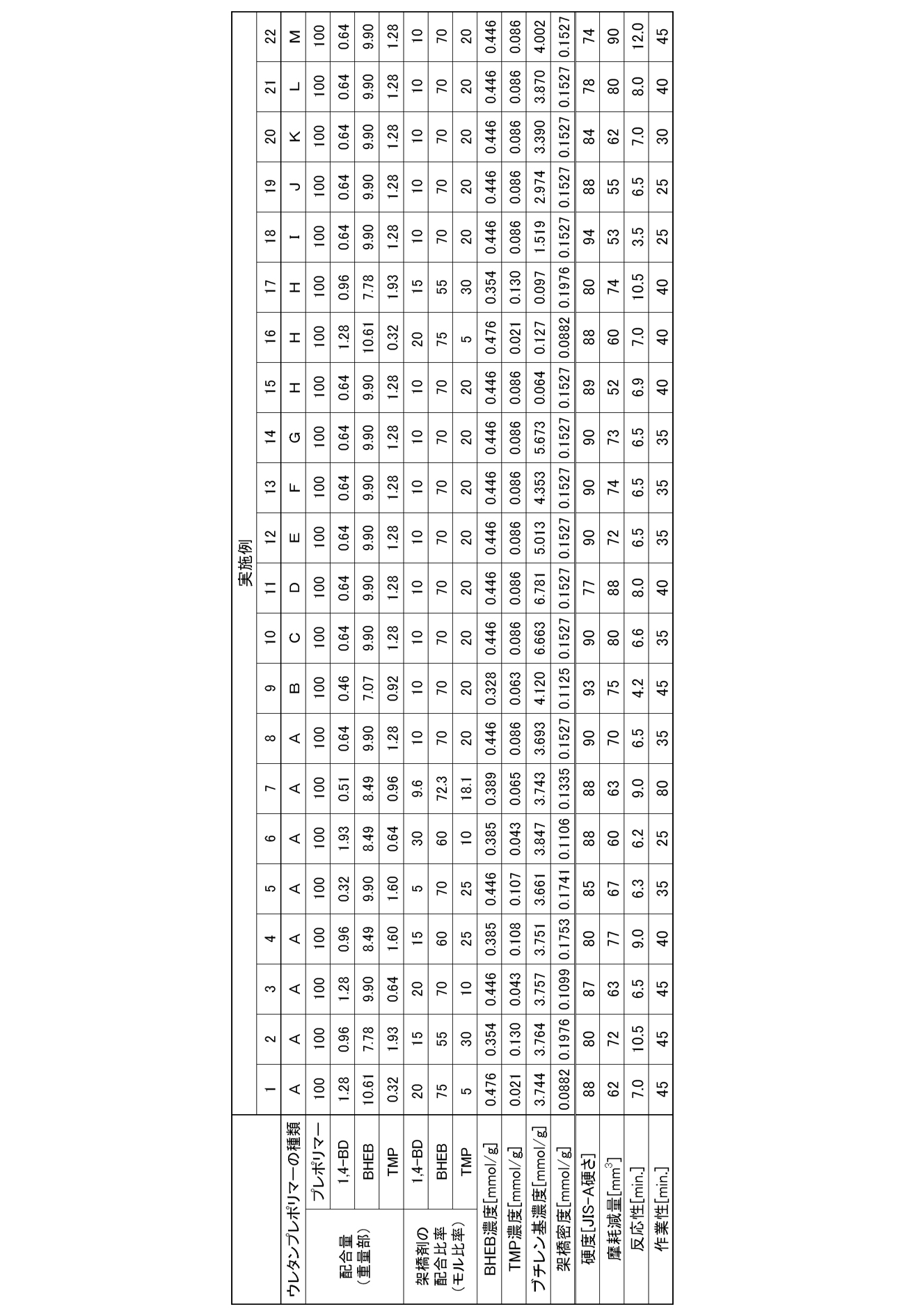
表2に示した配合量(重量部)のウレタンプレポリマー、1,4-BD、BHEB及びTMPをそれぞれ110℃に加温した後、素早く撹拌、混合して熱硬化性ウレタン組成物を調製した。得られた各熱硬化性ウレタン組成物について、下記の評価を行った。結果を表2に示した。
表2に示した配合量(重量部)のウレタンプレポリマー、1,4-BD、BHEB及びTMPをそれぞれ110℃に加温した後、素早く撹拌、混合して熱硬化性ウレタン組成物を調製した。得られた各熱硬化性ウレタン組成物について、下記の評価を行った。結果を表2に示した。
(1)JIS-A硬さ
熱硬化性ウレタン組成物を金型に注入し、下記の条件で硬化処理を行い、直径16mm×厚さ6mmの硬化物を作製した。
上記硬化処理は、熱硬化性ウレタン組成物の温度110℃で金型内に注入し、金型温度125℃で60分間硬化させ、その後、金型から脱型し、110℃で12時間後硬化させる条件で行った。
次に、作製した硬化物のJIS-A硬さをJIS K 6253に準拠して測定した。但し、測定温度は20℃とし、測定箇所は3か所とした。
熱硬化性ウレタン組成物を金型に注入し、下記の条件で硬化処理を行い、直径16mm×厚さ6mmの硬化物を作製した。
上記硬化処理は、熱硬化性ウレタン組成物の温度110℃で金型内に注入し、金型温度125℃で60分間硬化させ、その後、金型から脱型し、110℃で12時間後硬化させる条件で行った。
次に、作製した硬化物のJIS-A硬さをJIS K 6253に準拠して測定した。但し、測定温度は20℃とし、測定箇所は3か所とした。
(2)DIN摩耗減量
上記(1)の評価と同様にして作製した直径16mm×厚さ6mmの硬化物を試験片とし、この試験片を用いてDIN摩耗減量を測定する試験を行った。この試験は、JIS K 6264に準拠した方法において、試験片の回転:無し(A法)、試験片の付加力:10Nで行った。
上記(1)の評価と同様にして作製した直径16mm×厚さ6mmの硬化物を試験片とし、この試験片を用いてDIN摩耗減量を測定する試験を行った。この試験は、JIS K 6264に準拠した方法において、試験片の回転:無し(A法)、試験片の付加力:10Nで行った。
(3)反応性
熱硬化性ウレタン組成物について、調製直後から粘度が3000mPa・sに到達するまでの時間を測定した。
熱硬化性ウレタン組成物について、調製直後から粘度が3000mPa・sに到達するまでの時間を測定した。
(4)作業性
熱硬化性ウレタン組成物を約2mmの厚さで130℃の熱板上に垂らした後、塑性変形が無くなるまでの時間を測定した。
熱硬化性ウレタン組成物を約2mmの厚さで130℃の熱板上に垂らした後、塑性変形が無くなるまでの時間を測定した。
(比較例1~15)
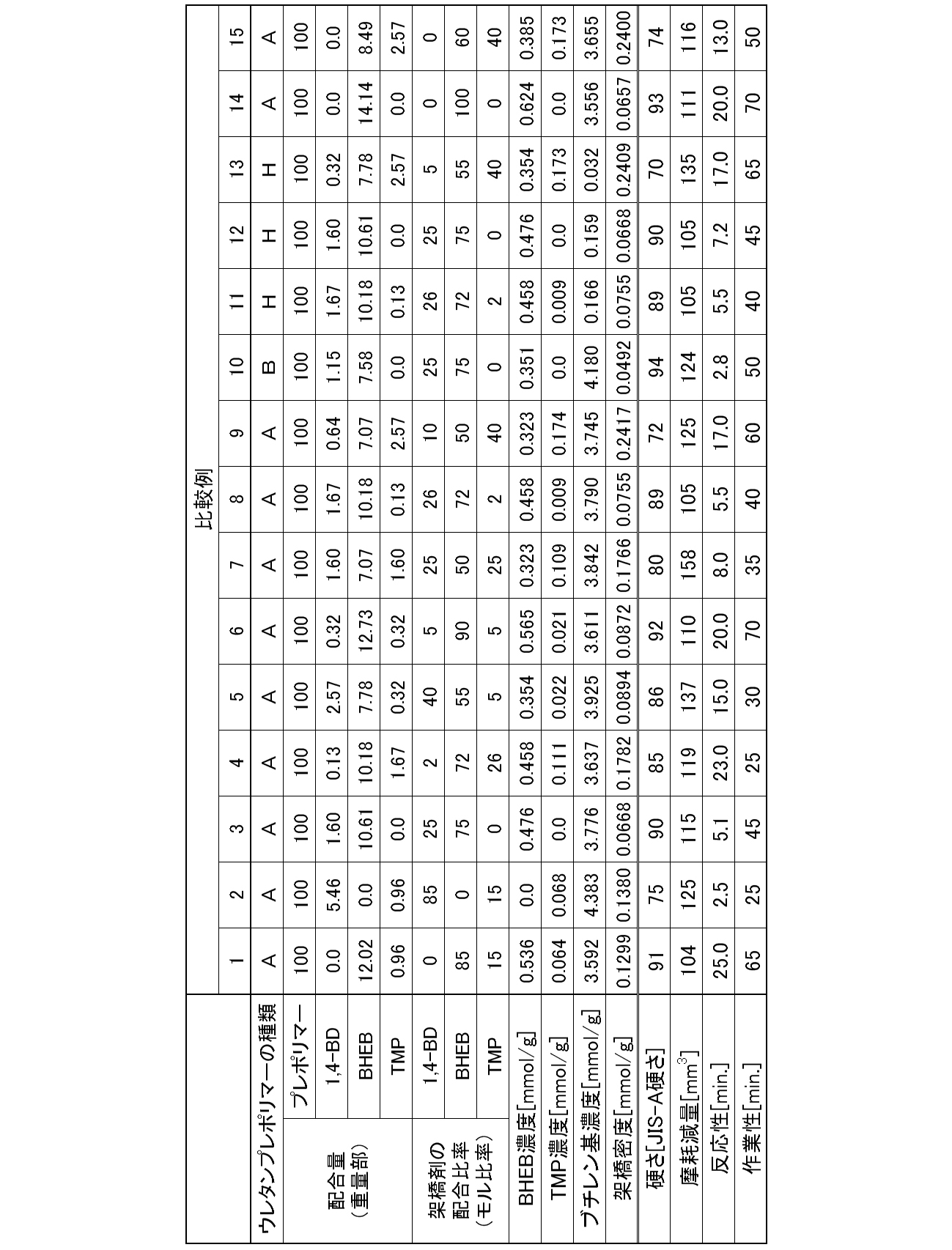
表3に示した配合量(重量部)のウレタンプレポリマー、1,4-BD、BHEB及びTMPをそれぞれ110℃に加温した後、素早く撹拌、混合して熱硬化性ウレタン組成物を調製した。得られた各熱硬化性ウレタン組成物について、実施例と同様にして、(1)JIS-A硬さ、(2)DIN摩耗減量、(3)反応性、及び、(4)作業性、の評価を行った。結果を表3に示した。
表3に示した配合量(重量部)のウレタンプレポリマー、1,4-BD、BHEB及びTMPをそれぞれ110℃に加温した後、素早く撹拌、混合して熱硬化性ウレタン組成物を調製した。得られた各熱硬化性ウレタン組成物について、実施例と同様にして、(1)JIS-A硬さ、(2)DIN摩耗減量、(3)反応性、及び、(4)作業性、の評価を行った。結果を表3に示した。
(実施例23、24及び比較例16)
表4に示した配合量(重量部)のウレタンプレポリマー、1,4-BD、BHEB、TMP及びシリコーンオイルをそれぞれ110℃に加温した後、素早く撹拌、混合して熱硬化性ウレタン組成物を調製した。得られた各熱硬化性ウレタン組成物について、実施例と同様にして、(1)JIS-A硬さ、(2)DIN摩耗減量、(3)反応性、及び、(4)作業性、の評価を行った。結果を表4に示した。
表4に示した配合量(重量部)のウレタンプレポリマー、1,4-BD、BHEB、TMP及びシリコーンオイルをそれぞれ110℃に加温した後、素早く撹拌、混合して熱硬化性ウレタン組成物を調製した。得られた各熱硬化性ウレタン組成物について、実施例と同様にして、(1)JIS-A硬さ、(2)DIN摩耗減量、(3)反応性、及び、(4)作業性、の評価を行った。結果を表4に示した。
更に、調製した熱硬化性ウレタン組成物を用いて下記の方法により籾摺りロールを作製し、その籾摺り性能を評価した。
(籾摺りロールの作製)
ここでは、形式:統合大100型の籾摺りロールを作製した。
まず、アルミダイキャストにより、図1に示した形状のしん材部を鋳造した。
次に、円筒形の金型内に、上記しん材部の外周面と上記金型の内周面との間隔が全周に渡ってほぼ等間隔になるように上記しん材部を設置した。
その後、上記しん材部の外周面と上記金型の内周面との間隙に、熱硬化性ウレタン組成物を注入し、硬化させた後、外径寸法と幅寸法を切削により調整し、上記しん材部の外周面にゴム層が積層された籾摺りロールを作製した。
ここで採用した硬化条件は、上述したJIS-A硬さの評価において、硬化物を作製する際の採用した硬化条件と同様である。
(籾摺りロールの作製)
ここでは、形式:統合大100型の籾摺りロールを作製した。
まず、アルミダイキャストにより、図1に示した形状のしん材部を鋳造した。
次に、円筒形の金型内に、上記しん材部の外周面と上記金型の内周面との間隔が全周に渡ってほぼ等間隔になるように上記しん材部を設置した。
その後、上記しん材部の外周面と上記金型の内周面との間隙に、熱硬化性ウレタン組成物を注入し、硬化させた後、外径寸法と幅寸法を切削により調整し、上記しん材部の外周面にゴム層が積層された籾摺りロールを作製した。
ここで採用した硬化条件は、上述したJIS-A硬さの評価において、硬化物を作製する際の採用した硬化条件と同様である。
(籾摺り性能の評価)
[実施例23の籾摺りロール]
日高カントリーエレベーター(たじま農業協同組合)にて、籾摺り量とゴム層の摩耗量との関係を評価した。
籾摺り機は、株式会社サタケ製、統合100型ロール使用もみすり機(1972年導入)を使用した。
籾米は、銘柄:コシヒカリ、水分率(玄米基準):14.2~14.6%、投入もみ温度5~15℃とした。
処理速度は、約2.8トン/時間とした。
なお、本実施例の脱ぷ率は78%であった。
[実施例23の籾摺りロール]
日高カントリーエレベーター(たじま農業協同組合)にて、籾摺り量とゴム層の摩耗量との関係を評価した。
籾摺り機は、株式会社サタケ製、統合100型ロール使用もみすり機(1972年導入)を使用した。
籾米は、銘柄:コシヒカリ、水分率(玄米基準):14.2~14.6%、投入もみ温度5~15℃とした。
処理速度は、約2.8トン/時間とした。
なお、本実施例の脱ぷ率は78%であった。
本評価では、約175トンの籾米を処理し、そのときの籾摺りロールのゴム層の摩耗量を計測した。このとき摩耗量は、一対の籾摺りロール(主ロール及び副ロール)のそれぞれの端面に定規を押し当て、残存するゴム層の厚さを計測し、初期のゴム層の厚さ(25mm)との差として算出した。結果を表4に示した。
なお、表4において、主ロール前及び副ロール前の摩耗量とは、籾摺りロールを籾摺り機に取り付けた際に手前に位置する端面で計測した摩耗量をいい、主ロール後及び副ロール後の摩耗量とは、籾摺りロールを籾摺り機に取り付けた際に奥側に位置する端面で計測した摩耗量をいう。
なお、表4において、主ロール前及び副ロール前の摩耗量とは、籾摺りロールを籾摺り機に取り付けた際に手前に位置する端面で計測した摩耗量をいい、主ロール後及び副ロール後の摩耗量とは、籾摺りロールを籾摺り機に取り付けた際に奥側に位置する端面で計測した摩耗量をいう。
更に、上記摩耗量の計測結果に基づいて、籾摺りロールを使用寿命まで(ゴム層の厚さが5mmになるまで)使用した際の予想限界籾摺り量(籾摺り可能な籾米の重量の予想値)を算出した。結果を表4に示した。
なお、予想限界籾摺り量は、上述した方法で計測した4か所の摩耗量の平均値(平均摩耗量)を算出し、平均摩耗量(A)、及び、実際に処理した籾米の重量(B)に基づき、下記計算式(1)より算出した。
予想限界籾摺り量=籾米の重量(B)÷〔平均摩耗量(A)/20〕・・・(1)
なお、予想限界籾摺り量は、上述した方法で計測した4か所の摩耗量の平均値(平均摩耗量)を算出し、平均摩耗量(A)、及び、実際に処理した籾米の重量(B)に基づき、下記計算式(1)より算出した。
予想限界籾摺り量=籾米の重量(B)÷〔平均摩耗量(A)/20〕・・・(1)
[実施例24の籾摺りロール]
日高カントリーエレベーターにて、籾摺り量とゴム層の摩耗量との関係を評価した。
籾摺り機は、株式会社サタケ製、統合100型ロール使用もみすり機(1972年導入)を使用した。
籾米は、銘柄:コシヒカリ、水分率(玄米基準):14.2~14.6%、投入もみ温度5~15℃とした。
処理速度は、約2.8トン/時間とした。
なお、本実施例の脱ぷ率は78%であった。
日高カントリーエレベーターにて、籾摺り量とゴム層の摩耗量との関係を評価した。
籾摺り機は、株式会社サタケ製、統合100型ロール使用もみすり機(1972年導入)を使用した。
籾米は、銘柄:コシヒカリ、水分率(玄米基準):14.2~14.6%、投入もみ温度5~15℃とした。
処理速度は、約2.8トン/時間とした。
なお、本実施例の脱ぷ率は78%であった。
本評価では、約145トンの籾米を処理し、そのときの籾摺りロールのゴム層の摩耗量を計測した。更に、上記摩耗量の計測結果に基づいて、予想限界籾摺り量を算出した。
結果を表4に示した。
結果を表4に示した。
[比較例16の籾摺りロール]
出石カントリーエレベーター(たじま農業協同組合)にて、籾摺り量とゴム層の摩耗量との関係を評価した。
籾摺り機は、株式会社サタケ社製、統合100型ロール使用もみすり機(1972年導入)を使用した。
籾米は、銘柄:コシヒカリ、水分率(玄米基準)14.8~15.0%、投入もみ温度5~18℃とした。
処理速度は、約2.5トン/時間とした。
なお、本比較例の脱ぷ率は79%であった。
出石カントリーエレベーター(たじま農業協同組合)にて、籾摺り量とゴム層の摩耗量との関係を評価した。
籾摺り機は、株式会社サタケ社製、統合100型ロール使用もみすり機(1972年導入)を使用した。
籾米は、銘柄:コシヒカリ、水分率(玄米基準)14.8~15.0%、投入もみ温度5~18℃とした。
処理速度は、約2.5トン/時間とした。
なお、本比較例の脱ぷ率は79%であった。
本評価では、約220トンの籾米を処理し、そのときの籾摺りロールのゴム層の摩耗量を計測した。更に、上記摩耗量の計測結果に基づいて、予想限界籾摺り量を算出した。
結果を表4に示した。
結果を表4に示した。

10、10A、10B 籾摺りロール
11 しん材部
11a 取付用フランジ
12 ゴム層
11 しん材部
11a 取付用フランジ
12 ゴム層
Claims (7)
- ポリオール成分、イソシアネート成分及び架橋剤を含有する熱硬化性ウレタン組成物であって、
前記ポリオール成分は、ポリエステルポリオールであり、
前記架橋剤は、1,4-BD、BHEB及びTMPであり、
前記1,4-BD、前記BHEB及び前記TMPの配合比率(mol%)は、1,4-BD:BHEB:TMP=5~30:55~85:5~30である、
ことを特徴とする熱硬化性ウレタン組成物。 - 前記BHEBの含有量は、前記ポリオール成分、前記イソシアネート成分及び前記架橋剤の合計重量1gあたり、0.32~0.54mmolであり、
前記TMPの含有量は、前記ポリオール成分、前記イソシアネート成分及び前記架橋剤の合計重量1gあたり、0.02~0.13mmolである、請求項1に記載の熱硬化性ウレタン組成物。 - 前記熱硬化性ウレタン組成物中のブチレン基濃度は、前記ポリオール成分、前記イソシアネート成分及び前記架橋剤の合計重量1gあたり、0.06~6.79mmolである請求項1又は2に記載の熱硬化性ウレタン組成物。
- 前記ポリエステルポリオールは、ブチレン基を含有するポリエステルポリオールであり、
前記熱硬化性ウレタン組成物中のブチレン基濃度は、前記ポリオール成分、前記イソシアネート成分及び前記架橋剤の合計重量1gあたり、1.52~6.79mmolである請求項3に記載の熱硬化性ウレタン組成物。 - 前記ポリエステルポリオールは、ブチレン基を含有しないポリエステルポリオールであり、
前記熱硬化性ウレタン組成物中のブチレン基濃度は、前記ポリオール成分、前記イソシアネート成分及び前記架橋剤の合計重量1gあたり、0.06~0.13mmolである請求項3に記載の熱硬化性ウレタン組成物。 - 請求項1~5のいずれかに記載の熱硬化性ウレタン組成物を熱硬化させた硬化物。
- しん材部と、前記しん材部の外周面に積層されたゴム層とを備えた籾摺りロールであって、
前記ゴム層は、請求項6に記載の硬化物からなることを特徴とする籾摺りロール。
Applications Claiming Priority (2)
| Application Number | Priority Date | Filing Date | Title |
|---|---|---|---|
| JP2015-072262 | 2015-03-31 | ||
| JP2015072262 | 2015-03-31 |
Publications (1)
| Publication Number | Publication Date |
|---|---|
| WO2016158868A1 true WO2016158868A1 (ja) | 2016-10-06 |
Family
ID=57007223
Family Applications (1)
| Application Number | Title | Priority Date | Filing Date |
|---|---|---|---|
| PCT/JP2016/059950 Ceased WO2016158868A1 (ja) | 2015-03-31 | 2016-03-28 | 熱硬化性ウレタン組成物、硬化物、及び、籾摺りロール |
Country Status (1)
| Country | Link |
|---|---|
| WO (1) | WO2016158868A1 (ja) |
Cited By (2)
| Publication number | Priority date | Publication date | Assignee | Title |
|---|---|---|---|---|
| CN108855306A (zh) * | 2018-07-23 | 2018-11-23 | 深圳威琳懋生物科技有限公司 | 一种大米保胚碾米机 |
| WO2021025090A1 (ja) * | 2019-08-06 | 2021-02-11 | バンドー化学株式会社 | 籾摺りロール及び籾摺り方法 |
Citations (11)
| Publication number | Priority date | Publication date | Assignee | Title |
|---|---|---|---|---|
| JPH01126318A (ja) * | 1987-11-11 | 1989-05-18 | Nippon Polyurethan Kogyo Kk | 熱硬化性ポリウレタンエラストマー用組成物 |
| JPH03164254A (ja) * | 1989-11-24 | 1991-07-16 | Bando Chem Ind Ltd | スクリーン印刷用スキージー |
| JPH05295067A (ja) * | 1992-02-18 | 1993-11-09 | Takeda Chem Ind Ltd | ポリウレタンエラストマー及びその製造法 |
| JPH0726137A (ja) * | 1993-07-07 | 1995-01-27 | Nippon Mektron Ltd | 可塑剤含有ポリウレタンエラストマーの製造法 |
| JPH07113039A (ja) * | 1993-10-18 | 1995-05-02 | Bando Chem Ind Ltd | 電子写真複写機用除電部材 |
| JPH09104733A (ja) * | 1995-10-11 | 1997-04-22 | Nippon Polyurethane Ind Co Ltd | 2液注型用ポリウレタンエラストマー組成物、及びポリウレタンエラストマーの製造方法 |
| JPH09151230A (ja) * | 1995-11-29 | 1997-06-10 | Nippon Polyurethane Ind Co Ltd | 2液注型用ポリウレタンエラストマー組成物、及び該組成物を用いたポリウレタンエラストマーの製造法 |
| CN1160723A (zh) * | 1996-09-18 | 1997-10-01 | 许广宇 | 一种新型聚氨酯弹性工程材料 |
| JPH11334915A (ja) * | 1998-05-29 | 1999-12-07 | Hokushin Ind Inc | 紙葉類分離部材 |
| JP2002275233A (ja) * | 2000-08-11 | 2002-09-25 | Hokushin Ind Inc | 紙葉類分離ゴム部材 |
| JP2011173310A (ja) * | 2010-02-24 | 2011-09-08 | Dic Corp | ポリウレタンエラストマー組成物、及びスクリーン印刷用スキージー |
-
2016
- 2016-03-28 WO PCT/JP2016/059950 patent/WO2016158868A1/ja not_active Ceased
Patent Citations (11)
| Publication number | Priority date | Publication date | Assignee | Title |
|---|---|---|---|---|
| JPH01126318A (ja) * | 1987-11-11 | 1989-05-18 | Nippon Polyurethan Kogyo Kk | 熱硬化性ポリウレタンエラストマー用組成物 |
| JPH03164254A (ja) * | 1989-11-24 | 1991-07-16 | Bando Chem Ind Ltd | スクリーン印刷用スキージー |
| JPH05295067A (ja) * | 1992-02-18 | 1993-11-09 | Takeda Chem Ind Ltd | ポリウレタンエラストマー及びその製造法 |
| JPH0726137A (ja) * | 1993-07-07 | 1995-01-27 | Nippon Mektron Ltd | 可塑剤含有ポリウレタンエラストマーの製造法 |
| JPH07113039A (ja) * | 1993-10-18 | 1995-05-02 | Bando Chem Ind Ltd | 電子写真複写機用除電部材 |
| JPH09104733A (ja) * | 1995-10-11 | 1997-04-22 | Nippon Polyurethane Ind Co Ltd | 2液注型用ポリウレタンエラストマー組成物、及びポリウレタンエラストマーの製造方法 |
| JPH09151230A (ja) * | 1995-11-29 | 1997-06-10 | Nippon Polyurethane Ind Co Ltd | 2液注型用ポリウレタンエラストマー組成物、及び該組成物を用いたポリウレタンエラストマーの製造法 |
| CN1160723A (zh) * | 1996-09-18 | 1997-10-01 | 许广宇 | 一种新型聚氨酯弹性工程材料 |
| JPH11334915A (ja) * | 1998-05-29 | 1999-12-07 | Hokushin Ind Inc | 紙葉類分離部材 |
| JP2002275233A (ja) * | 2000-08-11 | 2002-09-25 | Hokushin Ind Inc | 紙葉類分離ゴム部材 |
| JP2011173310A (ja) * | 2010-02-24 | 2011-09-08 | Dic Corp | ポリウレタンエラストマー組成物、及びスクリーン印刷用スキージー |
Cited By (4)
| Publication number | Priority date | Publication date | Assignee | Title |
|---|---|---|---|---|
| CN108855306A (zh) * | 2018-07-23 | 2018-11-23 | 深圳威琳懋生物科技有限公司 | 一种大米保胚碾米机 |
| WO2021025090A1 (ja) * | 2019-08-06 | 2021-02-11 | バンドー化学株式会社 | 籾摺りロール及び籾摺り方法 |
| CN114173927A (zh) * | 2019-08-06 | 2022-03-11 | 阪东化学株式会社 | 稻谷脱壳辊以及稻谷脱壳方法 |
| CN114173927B (zh) * | 2019-08-06 | 2022-08-23 | 阪东化学株式会社 | 稻谷脱壳辊以及稻谷脱壳方法 |
Similar Documents
| Publication | Publication Date | Title |
|---|---|---|
| JP5405022B2 (ja) | アミンにより硬化されたポリウレタンおよびその製造 | |
| CN101868484A (zh) | 基于2,4′-二苯基甲烷二异氰酸酯预聚物的聚氨酯/聚脲弹性体和其的制备 | |
| JP2013510935A (ja) | イソシアネート末端プレポリマーの促進された硬化 | |
| JP2024041987A (ja) | ガラス繊維強化tpu | |
| JP5707522B1 (ja) | 籾摺りロール | |
| WO2016158868A1 (ja) | 熱硬化性ウレタン組成物、硬化物、及び、籾摺りロール | |
| JP6857478B2 (ja) | 一対の籾摺りロール | |
| JP5848473B1 (ja) | 籾摺りロール | |
| JPH08231669A (ja) | 注型用ポリウレタン系エラストマー組成物及びその成形品 | |
| JP2006037328A (ja) | 製紙機械用ベルト | |
| JP7716583B2 (ja) | ポリウレタン樹脂、弾性成形品、および、ポリウレタン樹脂の製造方法 | |
| CN114173927B (zh) | 稻谷脱壳辊以及稻谷脱壳方法 | |
| JP4671105B2 (ja) | 紙送りロール製造用組成物、紙送りロールおよびその製造方法 | |
| EP4624504A1 (en) | Polyurethane resin | |
| JP2010150339A (ja) | ウレタンエラストマー形成組成物および、熱硬化ウレタンエラストマーの製造方法 | |
| JP5168721B2 (ja) | ウレタンエラストマー形成組成物および、熱硬化ウレタンエラストマーの製造方法 | |
| JP2021041351A (ja) | 籾摺りロール | |
| JP2019011393A (ja) | ウレタン樹脂組成物、及びそれを用いたウレタン樹脂成形物 | |
| JP2024075451A (ja) | ポリウレタン系樹脂 | |
| JP2023054540A (ja) | 熱硬化性ウレタンシートの製造方法 | |
| WO2025253763A1 (ja) | 伝動ベルト | |
| JP2005002169A (ja) | 熱硬化性ポリウレタン組成物及び該組成物を用いて得られるoa機器用ロール又はベルト | |
| JP2007211041A (ja) | ロール部材用注型ウレタンエラストマー形成性組成物 | |
| JP2010037410A (ja) | 導電性ローラ用ポリウレタンエラストマー | |
| JP2002234928A (ja) | ベルト成形用材料及び伝動ベルト |
Legal Events
| Date | Code | Title | Description |
|---|---|---|---|
| 121 | Ep: the epo has been informed by wipo that ep was designated in this application |
Ref document number: 16772749 Country of ref document: EP Kind code of ref document: A1 |
|
| NENP | Non-entry into the national phase |
Ref country code: DE |
|
| 122 | Ep: pct application non-entry in european phase |
Ref document number: 16772749 Country of ref document: EP Kind code of ref document: A1 |
|
| NENP | Non-entry into the national phase |
Ref country code: JP |