WO2016158736A1 - 生分解性白色フィルムおよびその製造方法 - Google Patents
生分解性白色フィルムおよびその製造方法 Download PDFInfo
- Publication number
- WO2016158736A1 WO2016158736A1 PCT/JP2016/059598 JP2016059598W WO2016158736A1 WO 2016158736 A1 WO2016158736 A1 WO 2016158736A1 JP 2016059598 W JP2016059598 W JP 2016059598W WO 2016158736 A1 WO2016158736 A1 WO 2016158736A1
- Authority
- WO
- WIPO (PCT)
- Prior art keywords
- resin
- biodegradable
- mass
- polylactic acid
- filler
- Prior art date
- Legal status (The legal status is an assumption and is not a legal conclusion. Google has not performed a legal analysis and makes no representation as to the accuracy of the status listed.)
- Ceased
Links
Classifications
-
- C—CHEMISTRY; METALLURGY
- C08—ORGANIC MACROMOLECULAR COMPOUNDS; THEIR PREPARATION OR CHEMICAL WORKING-UP; COMPOSITIONS BASED THEREON
- C08J—WORKING-UP; GENERAL PROCESSES OF COMPOUNDING; AFTER-TREATMENT NOT COVERED BY SUBCLASSES C08B, C08C, C08F, C08G or C08H
- C08J5/00—Manufacture of articles or shaped materials containing macromolecular substances
- C08J5/18—Manufacture of films or sheets
-
- C—CHEMISTRY; METALLURGY
- C08—ORGANIC MACROMOLECULAR COMPOUNDS; THEIR PREPARATION OR CHEMICAL WORKING-UP; COMPOSITIONS BASED THEREON
- C08J—WORKING-UP; GENERAL PROCESSES OF COMPOUNDING; AFTER-TREATMENT NOT COVERED BY SUBCLASSES C08B, C08C, C08F, C08G or C08H
- C08J9/00—Working-up of macromolecular substances to porous or cellular articles or materials; After-treatment thereof
-
- C—CHEMISTRY; METALLURGY
- C08—ORGANIC MACROMOLECULAR COMPOUNDS; THEIR PREPARATION OR CHEMICAL WORKING-UP; COMPOSITIONS BASED THEREON
- C08K—Use of inorganic or non-macromolecular organic substances as compounding ingredients
- C08K3/00—Use of inorganic substances as compounding ingredients
- C08K3/18—Oxygen-containing compounds, e.g. metal carbonyls
- C08K3/20—Oxides; Hydroxides
- C08K3/22—Oxides; Hydroxides of metals
-
- C—CHEMISTRY; METALLURGY
- C08—ORGANIC MACROMOLECULAR COMPOUNDS; THEIR PREPARATION OR CHEMICAL WORKING-UP; COMPOSITIONS BASED THEREON
- C08K—Use of inorganic or non-macromolecular organic substances as compounding ingredients
- C08K3/00—Use of inorganic substances as compounding ingredients
- C08K3/18—Oxygen-containing compounds, e.g. metal carbonyls
- C08K3/24—Acids; Salts thereof
- C08K3/26—Carbonates; Bicarbonates
-
- C—CHEMISTRY; METALLURGY
- C08—ORGANIC MACROMOLECULAR COMPOUNDS; THEIR PREPARATION OR CHEMICAL WORKING-UP; COMPOSITIONS BASED THEREON
- C08K—Use of inorganic or non-macromolecular organic substances as compounding ingredients
- C08K3/00—Use of inorganic substances as compounding ingredients
- C08K3/30—Sulfur-, selenium- or tellurium-containing compounds
-
- C—CHEMISTRY; METALLURGY
- C08—ORGANIC MACROMOLECULAR COMPOUNDS; THEIR PREPARATION OR CHEMICAL WORKING-UP; COMPOSITIONS BASED THEREON
- C08L—COMPOSITIONS OF MACROMOLECULAR COMPOUNDS
- C08L101/00—Compositions of unspecified macromolecular compounds
- C08L101/16—Compositions of unspecified macromolecular compounds the macromolecular compounds being biodegradable
-
- C—CHEMISTRY; METALLURGY
- C08—ORGANIC MACROMOLECULAR COMPOUNDS; THEIR PREPARATION OR CHEMICAL WORKING-UP; COMPOSITIONS BASED THEREON
- C08L—COMPOSITIONS OF MACROMOLECULAR COMPOUNDS
- C08L67/00—Compositions of polyesters obtained by reactions forming a carboxylic ester link in the main chain; Compositions of derivatives of such polymers
Definitions
- the present invention relates to a biodegradable white film excellent in moisture permeability, flexibility, concealability, mechanical properties, and processability.
- a polylactic acid resin As a resin that satisfies both requirements and is relatively advantageous in terms of cost, for example, a polylactic acid resin has attracted attention.
- polylactide resin When polylactide resin is used as a substitute for flexible film applications such as polyethylene resin such as polyethylene, it lacks concealability, flexibility, and impact resistance, so these characteristics can be improved and put to practical use.
- Various attempts have been made.
- Patent Document 1 discloses a porous sheet obtained by at least uniaxially stretching a sheet containing a polylactic acid resin, a filler, and a general polyester plasticizer, and a method for producing the same. While adding flexibility by adding a thermoplastic resin other than the base resin, a large amount of particles are added, and the mixture is stretched at a high magnification to make it porous.
- Patent Document 2 discloses a porous film obtained by stretching a sheet containing a polylactic acid resin, a thermoplastic resin other than the polylactic acid resin, and a filler.
- Patent Document 3 when a resin composition containing a biodegradable polyester resin, a filler, and a plasticizer is melt-molded, a first cooling step and a second cooling step are performed, and then A method for producing a stretched porous sheet is disclosed, and a method for obtaining a film imparted with moisture permeability by adding a large amount of particles and making it porous by stretching is disclosed.
- the invention of a film having a high biomass degree that is excellent in concealability, mechanical properties, and processability in addition to sufficient moisture permeability and flexibility has not yet been achieved.
- an object of the present invention is to provide a biodegradable white film excellent in moisture permeability, flexibility, concealability, mechanical properties, and processability.
- the present invention has the following configuration.
- Wb1 + Wb2 is 3 parts by mass or more and 25 parts by mass with respect to 100 parts by mass of the biodegradable resin A.
- biodegradable white film as described in any one of 1) to 3) above, wherein the biodegradable resin A contains a polylactic acid resin.
- the biodegradable resin A includes a polylactic acid resin and a biodegradable resin other than the polylactic acid resin, and the biodegradable resin A is 100% by mass
- the polylactic acid resin Any one of 1) to 4) wherein the content is 10% by mass or more and 95% by mass or less, and the content of the biodegradable resin other than the polylactic acid resin is 5% by mass or more and 90% by mass or less.
- a biodegradable resin other than the polylactic acid resin is a block copolymer having a polyether segment and a polylactic acid segment, a block copolymer having a polyester segment and a polylactic acid segment, and an aliphatic polyester resin.
- a biodegradable white film A biodegradable white film.
- the biodegradable resin A includes a polylactic acid resin and a biodegradable resin other than the polylactic acid resin, and the biodegradable resin A is 100% by mass
- the polylactic acid resin The content of is 10% by mass or more and 95% by mass or less, and the content of biodegradable resin other than the polylactic acid resin is 5% by mass or more and 90% by mass or less.
- Biodegradable white film 11)
- a biodegradable resin other than the polylactic acid resin is a block copolymer having a polyether segment and a polylactic acid segment, a block copolymer having a polyester segment and a polylactic acid segment, and an aliphatic polyester resin.
- the biodegradable white film as described in 10) above which is at least one resin selected from the group consisting of a resin and an aliphatic aromatic polyester resin.
- the biodegradable white film as described in any one of 8) to 11) above which contains 1 to 50 parts by mass of the filler B with respect to 100 parts by mass of the biodegradable resin A.
- a melt-kneading step for obtaining a resin composition by melt-kneading the biodegradable resin A and the filler B, and a melt-extruding step for obtaining an unstretched film by melting the resin composition and discharging it from a die.
- the biodegradation according to any one of 1) to 13) above, further comprising a stretching step for stretching the unstretched film in at least one direction to obtain a stretched film, and a heat treatment step for heating the stretched film in this order.
- a biodegradable white film excellent in moisture permeability, flexibility, concealability, mechanical properties, and processability can be provided.
- biodegradable white film of the present invention and the production method thereof will be described in detail.
- all percentages and parts expressed by mass are the same as percentages and parts expressed by weight.
- the first biodegradable white film according to the first embodiment of the present invention is a biodegradable white film containing a biodegradable resin A and a filler B, and the filler B has a void-forming ability.
- the filler b1 is a filler having a refractive index
- the filler b2 is a filler having a high refractive index
- the content of the filler b1 is Wb1
- the content of the filler b2 is Wb2.
- Wb1 + Wb2 is 3 to 25 parts by mass and Wb1 / Wb2 is 2 to 20 with respect to 100 parts by mass of the biodegradable resin A.
- the first biodegradable white film may be referred to as the first biodegradable white film of the present invention or the first present invention.
- the second biodegradable white film according to the second embodiment of the present invention is a biodegradable white film containing the biodegradable resin A and the filler B, and has the largest Young's modulus (direction a). ) Is Ea, and Young's modulus in the direction (direction b) perpendicular to the same plane as the direction a is Eb, Ea is 2 GPa or less, and Ea / Eb is 1.2 or more and 2 0.5 or less, and the elongation at break in the direction b is 100% or more.
- the second biodegradable white film may be referred to as the second biodegradable white film of the present invention or the second present invention.
- the first biodegradable white film of the present invention and the second biodegradable white film of the present invention are collectively referred to as the biodegradable white film of the present invention.
- the first biodegradable white film of the present invention includes a biodegradable resin A and a filler B, and the filler B is a filler having a void forming ability and a high refractive index filling.
- Wb1 + Wb2 is 3 masses with respect to 100 parts by mass of the biodegradable resin A. It is important that it is not less than 25 parts by mass and Wb1 / Wb2 is not less than 2 and not more than 20.
- the second biodegradable white film of the present invention includes the degradable resin A and the filler B, and has the same Young's modulus (GPa) in the direction (direction a) in which the Young's modulus is the largest as in Ea and direction a.
- Eb is 2 GPa or less
- Ea / Eb is 1.2 or more and 2.5 or less
- the elongation at break in direction b is Eb when the Young's modulus in the direction perpendicular to the surface (direction b) is Eb. It is important that is 100% or more.
- the biodegradable white film of the present invention has a haze of 70% or more measured according to JIS-K7136 (2000).
- a film having a haze of 70% or more is referred to as a white film.
- the upper limit of haze is not particularly limited, but is substantially 99.9% or less.
- the biodegradable white film of the present invention contains the biodegradable resin A.
- the biodegradable resin A is not particularly limited as long as it is a biodegradable resin.
- the “resin having biodegradability” in the present invention means JIS K6950 (2000 version), JIS K6951 (2000 version), JIS K6953-1 (2011 version), JIS K6953-2 (2010 version), JIS. When tested with any of K6955 (2006 edition), it means a resin that produces degradation of 60% or more within one year.
- biodegradable resin A examples include aliphatic polyester resins, aliphatic aromatic polyester resins, polysaccharides, polyvinyl alcohol resins, starch-containing polymers, and block copolymers described later.
- aliphatic polyester resin examples include polylactic acid resin, polyglycolic acid, poly (3-hydroxybutyrate), poly (3-hydroxybutyrate ⁇ 3-hydroxyhexanoate), poly (3-hydroxy Butyrate 3-hydroxyvalerate), polycaprolactone, polybutylene succinate, poly (butylene succinate adipate), and the like.
- aliphatic aromatic polyester resin examples include poly (ethylene succinate / terephthalate), poly (butylene succinate / terephthalate), and poly (butylene adipate / terephthalate).
- polysaccharide examples include cellulose resins such as cellulose acetate and glucosamine resins such as chitosan.
- polymer containing starch examples include thermoplastic starch and starch-based biodegradable resins such as Novamont's biodegradable resin “Matter-Bi” (registered trademark).
- the biodegradable resin A contains a polylactic acid resin from the viewpoint of biomass, cost, processability, etc., and a mixture of a crystalline polylactic acid resin and an amorphous polylactic acid resin It is more preferable to contain.
- examples of commercially available products of polylactic acid-based resins include “Ingeo” (registered trademark) Biopolymer manufactured by Nature Works. By containing the crystalline polylactic acid-based resin, the shape retention, heat resistance, and blocking resistance of the film are improved.
- the polylactic acid resin refers to a polymer having L-lactic acid units and / or D-lactic acid units as main constituent components.
- the main constituent components are L-lactic acid in 100% by mass of the polymer. It means that the mass ratio of the whole lactic acid unit (hereinafter, sometimes referred to as all lactic acid unit or simply lactic acid unit) including the unit and D-lactic acid unit exceeds 50%. From the viewpoint of biomass, the mass ratio of the lactic acid unit is more preferably 70% by mass or more and 100% by mass or less when the entire polymer is 100% by mass.
- polylactic acid-based resins when the total lactic acid unit in the polymer is 100 mol%, the L-lactic acid unit content is more than 50 mol% and not more than 100 mol% is called poly L-lactic acid.
- poly D-lactic acid a D-lactic acid unit content of more than 50 mol% and not more than 100 mol% is referred to as poly D-lactic acid.
- the polylactic acid-based resin includes a block copolymer having a polyether-based segment and a polylactic acid-based segment described in Biodegradable resin (biodegradable resin a) other than the polylactic acid-based resin described later, polyester A block copolymer having a polymer segment and a polylactic acid segment is not included.
- the crystalline polylactic acid-based resin is a polylactic acid-based resin that is allowed to stand at a temperature of 100 ° C. for 24 hours, and then subjected to a differential scanning calorimeter (DSC) at a temperature rising rate of 20 ° C./min at 25 to 250 ° C. When the measurement is performed, it means a polylactic acid resin in which a crystal melting peak derived from the polylactic acid component is observed.
- DSC differential scanning calorimeter
- An amorphous polylactic acid-based resin refers to a polylactic acid-based resin in which a clear melting point is not observed when measured under the same conditions.
- Poly L-lactic acid changes in the crystallinity of the resin itself depending on the content ratio of the D-lactic acid unit. Specifically, when the content ratio of the D-lactic acid unit in the poly L-lactic acid is increased, the crystallinity of the poly L-lactic acid is lowered and approaches an amorphous state. When the content ratio of the lactic acid unit is reduced, the crystallinity of poly L-lactic acid is increased. Similarly, for poly-D-lactic acid, the crystallinity of the resin itself changes depending on the content ratio of the L-lactic acid unit.
- the crystallinity of the poly-D-lactic acid is lowered and approaches an amorphous state, and conversely, the L-lactic acid in the poly-D-lactic acid.
- the crystallinity of poly-D-lactic acid increases.
- the content ratio of the L-lactic acid unit in the poly L-lactic acid of the present invention or the content ratio of the D-lactic acid unit in the poly D-lactic acid of the present invention is from the viewpoint of maintaining the mechanical properties of the biodegradable white film.
- the total lactic acid unit is 100 mol%, it is preferably 80 mol% or more and 100 mol% or less, and more preferably 85 mol% or more and 100 mol% or less.
- the polylactic acid resin may be a copolymer obtained by copolymerizing lactic acid and other monomer units other than lactic acid.
- monomer units ethylene glycol, propylene glycol, butanediol, heptanediol, hexanediol, octanediol, nonanediol, decanediol, 1,4-cyclohexanedimethanol, neopentyl glycol, glycerin, Glycol compounds such as pentaerythritol, bisphenol A, polyethylene glycol, polypropylene glycol and polytetramethylene glycol, oxalic acid, adipic acid, sebacic acid, azelaic acid, dodecanedioic acid, malonic acid, glutaric acid, cyclohexanedicarboxylic acid, terephthalic acid, Isophthalic acid, phthalic acid,
- the amount of copolymerization of the other monomer units is 100 mol% when the entire monomer unit in the polymer of the polylactic acid resin is 100 mol%. It is preferably 0 mol% or more and 30 mol% or less, and more preferably 0 mol% or more and 10 mol% or less.
- the polylactic acid-based resin may be a mixture of poly D-lactic acid when the main component is poly L-lactic acid, or a mixture of poly L-lactic acid when the main component is poly D-lactic acid. This is a preferred embodiment from the viewpoint of improving the heat resistance of the degradable white film.
- the amount of poly-D-lactic acid or poly-L-lactic acid to be mixed is preferably 20% by mass or more and less than 50% by mass, with 30% by mass when the total of the polylactic acid resins in the biodegradable white film is 100% by mass. % To less than 50% by mass is more preferable.
- the main component here means a component (poly L-lactic acid or poly D-lactic acid) exceeding 50% by mass when the total of the polylactic acid-based resins in the biodegradable white film is 100% by mass. means.
- the weight average molecular weight of the polylactic acid resin used in the biodegradable white film of the present invention is 50,000 or more and 240 from the viewpoint of satisfying the practical mechanical properties, water resistance, and degradability of the biodegradable white film. , 000 or less, more preferably 60,000 or more and 200,000 or less, and particularly preferably 70,000 or more and 160,000 or less.
- the mass average molecular weight as used herein refers to a molecular weight obtained by measuring by gel permeation chromatography (GPC) using a chloroform solvent and calculating by a polymethyl methacrylate conversion method.
- the mass ratio of the crystalline polylactic acid-based resin is preferably 5% by mass or more and 60% by mass or less, more preferably 10% by mass or more and 50% by mass or less, and 20% by mass or more and 40% by mass or less. Is more preferable.
- the biodegradable white film of the present invention contains a polylactic acid resin and a biodegradable resin other than the polylactic acid resin (hereinafter referred to as biodegradable resin a) from the viewpoint of improving moisture permeability and degradability. Is more preferable.
- biodegradable resin a examples include aliphatic polyester resins other than polylactic acid resins, aliphatic aromatic polyester resins, polysaccharides, polymers containing starch, polyvinyl alcohol resins, polyacetals, polyethylenes, polypropylenes, polyamides , Poly (meth) acrylate, polyphenylene sulfide, polyether ether ketone, polyester, polyurethane, polyisoprene, polysulfone, polyphenylene oxide, polyimide, polyetherimide, epoxy-modified polyolefin, acid-modified polyolefin, olefin-acrylic copolymer, epoxy-modified Olefin-acrylic copolymer, polyester elastomer, polyamide elastomer, polyolefin elastomer, polyether segment and poly A block copolymer having an acid segment, a block copolymer having a polyester segment and a polylactic acid segment, a polyester plasticizer such
- the biodegradable resin a it is preferable to use a resin having excellent biodegradability from the viewpoint of maintaining the biodegradability of the entire biodegradable white film. Furthermore, from the viewpoint of the bleed-out resistance of the plasticizer, the heat resistance of the stretched film, and the blocking resistance, it should be solid at room temperature (20 ° C. ⁇ 15 ° C.), that is, having a melting point exceeding 35 ° C. preferable. Moreover, from the viewpoint of adjusting the melt processing temperature with the polylactic acid resin, it is preferable to use one having a melting point of 150 ° C. or lower.
- the biodegradable resin a is a block copolymer having a polyether-based segment and a polylactic acid-based segment, a block copolymer having a polyester-based segment and a polylactic acid-based segment, and a polylactic acid-based resin. More preferably, it is at least one resin selected from the group consisting of an aliphatic polyester-based resin and an aliphatic aromatic polyester-based resin.
- the aliphatic polyester resin is particularly preferably polybutylene succinate, and the aliphatic aromatic polyester resin is particularly preferably poly (butylene adipate / terephthalate). Of these, polybutylene succinate is most preferable.
- the at least one resin means that these resins may be used alone or in combination.
- biodegradable resin other than the polylactic acid-based resin
- the crystalline polylactic acid-based resin exhibits a great effect on the bleed-out resistance by forming a eutectic with the polylactic acid-based segment of these block copolymers.
- the inclusion of an amorphous polylactic acid resin as the polylactic acid resin is suitable for improving the moisture permeability, flexibility, and bleed-out resistance of the film.
- a block copolymer having a polyether-based segment and a polylactic acid-based segment, and an amorphous portion in which the block copolymer having a polyester-based segment and a polylactic acid-based segment can be dispersed are provided.
- the biodegradable white film of the present invention includes a polylactic acid-based resin and a biodegradable resin a
- the biodegradable resin A when the biodegradable resin A is 100% by mass, the polylactic acid-based resin is contained.
- the amount is preferably 10% by mass or more and 95% by mass or less
- the content of the biodegradable resin a is preferably 5% by mass or more and 90% by mass or less
- the content of the polylactic acid resin is 20% by mass or more and 70% by mass. More preferably, the content of the biodegradable resin a is 30% by mass or more and 80% by mass or less.
- the content of the biodegradable resin a means the total amount of the plurality of biodegradable resins a when a plurality of components are contained as the biodegradable resin a.
- the biodegradable resin a is an aliphatic polyester resin and / or an aliphatic aromatic polyester resin
- the total amount of the aliphatic polyester resin and the aliphatic aromatic polyester resin is more preferably 10% by mass or more and 60%. It is 20 mass% or less, More preferably, it is 20 mass% or more and 50 mass% or less.
- the biodegradable resin a is a block copolymer, it is 10 to 50 mass%, More preferably, it is 15 to 40 mass%.
- the biodegradable white film of the present invention contains the filler B.
- Filler B refers to a substance added as a base material for improving various properties, or an inert substance added for the purpose of increasing the amount, increasing the volume, reducing the cost of the product, or the like.
- the filler B has a void forming ability (hereinafter referred to as a filler).
- the filler b1), and a high refractive index filler (hereinafter also referred to as the filler b2).
- the filler having void forming ability refers to a filler having a ratio of the total area of voids to a cross-sectional area of the entire film measured by the following procedure of 5% or more.
- the biodegradable resin A used for the production of the film was formed into a sheet by containing a filler at a concentration of 20% by mass, and then the sheet was 4 at a glass transition temperature of the biodegradable resin A + 10 ° C.
- a uniaxially stretched film obtained by stretching the film in a uniaxial direction was cut along a plane parallel to the stretching direction and perpendicular to the film surface, and a cross-sectional photograph magnified 3000 times with a scanning microscope was taken.
- the mass (Y) was measured.
- the glass transition temperature of the biodegradable resin A here refers to the highest glass transition temperature when the biodegradable resin A exhibits a plurality of glass transition temperatures.
- the filler b1 include calcium carbonate, barium sulfate, aluminum oxide, and silicon oxide. The filler b1 can be used alone or in combination of two or more.
- the high refractive index filler means a filler having a refractive index of 2.0 or more.
- the refractive index referred to here is the refractive index described in the Inorganic Chemistry Handbook (Gihodo 1965), and those shown in the range are the refractive index in the present application with the higher value.
- the filler b2 for example, rutile type titanium oxide (refractive index: 2.90), anatase type titanium oxide (refractive index: 2.50), zinc oxide (refractive index: 2.00), Examples include lead titanate (refractive index: 2.70), zinc sulfide (refractive index: 2.37), zirconium oxide (refractive index: 2.40), and the like.
- the filler b2 can be used alone or in combination of two or more.
- the intensity distribution of diffracted / scattered light measured by a laser diffraction particle size distribution analyzer SALD-2300 (manufactured by Shimadzu Corporation). From the pattern, the refractive index value is calculated by the light intensity reproduction method using data analysis software WingSALDII (manufactured by Shimadzu Corporation).
- the film By containing the filler b1, the film can be appropriately made porous so that the moisture permeability of the film can be improved.
- the concealability of the film is improved, and the strength and elongation are increased. Mechanical properties such as degrees can be maintained.
- the filler b1 may be at least one of calcium carbonate and barium sulfate. preferable. Further, from the viewpoint of maintaining mechanical properties such as strength and elongation, imparting whiteness, and reducing cost, the filler b2 is preferably at least one of titanium oxide and zinc oxide.
- the content of the filler b1 is Wb1 and the content of the filler b2 from the viewpoint of improving moisture permeability and concealment and maintaining mechanical properties such as strength and elongation.
- Wb2 it is important that Wb1 + Wb2 is 3 to 25 parts by mass and Wb1 / Wb2 is 2 to 20 with respect to 100 parts by mass of the biodegradable resin A.
- the film concealability can be improved, and by 25 parts by mass or less, the mechanical characteristics of the film can be maintained. More preferably, they are 10 mass parts or more and 20 mass parts or less, Furthermore, they are 15 mass parts or more and 20 mass parts. Further, by setting Wb1 / Wb2 to 2 or more, it is possible to increase the moisture permeability of the film, and by setting Wb1 / Wb2 to 20 or less, it is possible to maintain mechanical characteristics. More preferably, it is 5 or more and 20 or less.
- the second biodegradable white film of the present invention preferably contains 1 part by mass or more and 50 parts by mass or less of the filler B. More preferably, it is 3 parts by weight or more and 25 parts by weight or less, more preferably 10 parts by weight or more and 20 parts by weight or less, and further preferably 15 parts by weight or more and 20 parts by weight or less. It may be used, or may be a blend of two or more of the above. In particular, when the filler is combined as the filler B, a filler that imparts a necessary function to the film can be selected depending on the purpose.
- the film can be appropriately made porous by including the filler b1 to improve moisture permeability, and the whiteness, concealment, and reflection can be improved by including the filler b2. Since the film has higher properties, it becomes possible to achieve both moisture permeability and mechanical properties such as strength and elongation.
- the average particle diameter of the filler B is not particularly limited as long as the effects of the present invention are not impaired, but from the viewpoint of improving the moisture permeability of the film, preferably 0.01 ⁇ m or more and 10 ⁇ m or less, more preferably 0.1 ⁇ m or more and 8 ⁇ m or less, It is more preferably 0.5 ⁇ m or more and 5 ⁇ m or less, and particularly preferably 1 ⁇ m or more and 3 ⁇ m or less.
- the average particle diameter of the filler B 0.01 ⁇ m or more, the filler can be highly filled in the film, and by making the average particle diameter of the filler B 10 ⁇ m or less, the stretchability of the film Becomes better. As a result, the film becomes porous and has excellent moisture permeability.
- the average particle diameter is a 50% cumulative distribution average particle diameter measured by a laser diffraction scattering method.
- the filler B of the present invention has at least one functional group selected from a hydroxyl group, an amino group, an amide group, a carboxyl group, a glycidyl group, an acid anhydride group, a carbodiimide group, and an oxazoline group as necessary. It can be surface treated with a compound. By performing the surface treatment, the affinity with the biodegradable resin is improved, which is effective in suppressing the aggregation of the filler and improving the dispersibility, and can be uniformly dispersed in the resin composition.
- a dispersant in order to improve the dispersibility of the filler B in the resin composition.
- the biodegradable white film of the present invention may contain additives other than those described above as long as the effects of the present invention are not impaired.
- additives for example, known antioxidants, crystal nucleating agents, organic lubricants, UV stabilizers, endblockers, anti-coloring agents, matting agents, antibacterial agents, deodorants, flame retardants, weathering agents, antistatic agents, Oxidizing agents, ion exchangers, tackifiers, antifoaming agents, color pigments, dyes and the like can be used.
- the biodegradable white film of the present invention may be added with a small amount of a thermoplastic elastomer C other than the biodegradable resin A.
- the surface free energy may be set to 70 mN / m or less to adhere closely to other materials. It is preferably performed in order to improve the property.
- the thermoplastic elastomer C other than the biodegradable resin A is a polymer that exhibits a thermoplastic property when heated to a melting point or higher, while exhibiting a rubber elastic property at room temperature. A resin that produces less than 60% degradation within a year.
- polyester elastomers examples include polyester elastomers, polystyrene elastomers, polyolefin elastomers, polyamide elastomers, and acrylic elastomers.
- an acrylic elastomer is preferable because dispersibility is good and adhesion is improved.
- the acrylic elastomer examples include “Clarity” (registered trademark) manufactured by Kuraray Co., Ltd.
- the content of the thermoplastic elastomer C other than the biodegradable resin A is preferably 1 part by mass or more and 30 parts by mass or less, more preferably 2 parts by mass with respect to 100 parts by mass of the biodegradable resin A content. It is 25 parts by mass or less, particularly preferably 5 parts by mass or more and 20 parts by mass or less.
- the biodegradable white film of the present invention does not contain a thermoplastic elastomer with respect to 100 parts by mass of the biodegradable resin A in the layer, or
- the layer contains more than 0 parts by weight and less than 5 parts by weight (layer 1) and 100 parts by weight of the biodegradable resin A in the layer. More than 25 parts by mass, particularly preferably 5 parts by mass or more and 20 parts by mass or less (layer 2) including a layered structure, layer 2 contains more thermoplastic elastomer than layer 1, and at least one side surface layer is a layer
- the aspect which is 2 is more preferable.
- an embodiment in which the layer 2 is on the outermost surfaces on both sides of the film is more preferable.
- the layer 2 contains more thermoplastic elastomer than the layer 1, the content (parts by mass) of the thermoplastic elastomer in the layer 2 when the biodegradable resin A in the layer 2 is 100 parts by mass, When the biodegradable resin A in the layer 1 is 100 parts by mass, it means that the thermoplastic elastomer content (part by mass) in the layer 1 is larger.
- the first biodegradable white film of the present invention has the same Young's modulus (GPa) in the direction (direction a) with the largest Young's modulus as Ea and the direction a from the viewpoint of suppressing deformation in continuous processing at high speed.
- Ea / Eb is preferably 1.2 or more and 2.5 or less, more preferably 1.3 or more and 2.3 or less. Preferably, it is 1.3 or more and 2.0 or less.
- the biodegradable white film of the present invention has Ea / Eb of 1.2 or more and 2.5 or less.
- Ea / Eb is more preferably 1.3 or more and 2.0 or less.
- the direction with the largest Young's modulus is usually the direction with the highest stretch ratio. That is, the direction a is the direction with the highest draw ratio.
- the method of setting Ea / Eb to 1.2 or more and 2.5 or less is not particularly limited as long as the effect of the present invention is not impaired.
- a method of stretching an unstretched film only in one direction, or an unstretched film orthogonal The method of extending
- stretching an unstretched film only to one direction is more preferable from a viewpoint of adjusting Ea / Eb easily with few processes.
- Ea / Eb can be increased by increasing the stretch ratio.
- the second biodegradable white film has an Ea of 2 GPa or less.
- the direction in which the Young's modulus is the largest is the direction in which the Young's modulus of the film is measured by changing the direction every 10 ° in the film plane, and the obtained value is maximized.
- Ea is more preferably 1.5 GPa or less, and still more preferably 1.0 GPa or less.
- the lower limit is not particularly limited, but is substantially 0.5 GPa or more.
- the first biodegradable white film preferably has Ea of 2 GPa or less, more preferably 1.5 GPa or less, and further preferably 1.0 GPa or less. Although there is no restriction
- the method for setting the Young's modulus Ea in the direction a to 2 GPa or less is not particularly limited, but the polylactic acid resin and the biodegradable resin a are used in combination as the biodegradable resin A, and the type and content thereof are described above.
- the ratio in the stretching step is preferably set in a preferable range. A combination of a plurality of these methods is also preferably performed.
- the biodegradable white film of the present invention preferably has a breaking elongation in the direction b of 100% or more, more preferably 150% or more, and still more preferably from the viewpoint of suppressing tearing and breaking in high-speed continuous processing. It is 200% or more, particularly preferably 300% or more.
- the upper limit of the breaking elongation is not particularly limited, but is substantially about 500% due to the characteristics of the composition and the stretched film.
- the method for setting the elongation at break in direction b to 100% or more is not particularly limited as long as the effect of the present invention is not impaired, but, for example, the stretching temperature in the direction orthogonal to the direction having the highest stretching ratio and the same plane, A method for controlling the magnification is mentioned.
- the breaking elongation in the direction b can be increased by lowering the stretching temperature or by decreasing the stretching ratio in the direction a.
- the biodegradable white film of the present invention preferably has a basis weight of 10 g / m 2 or more and 50 g / m 2 or less.
- the basis weight is more preferably 15 g / m 2 or more and 40 g / m 2 or less, and still more preferably 15 g / m 2 or more and 30 g / m 2 or less.
- moisture permeability is 400g / (m 2 ⁇ day) or more.
- the moisture permeability is more preferably 500 g / (m 2 ⁇ day) or more, and still more preferably 600 g / (m 2 ⁇ day) or more.
- the upper limit of moisture permeability is not particularly limited, but is 10,000 g / (m 2 ⁇ day) or less from the characteristics of the resin used and the uniaxially stretched product.
- the method for setting the moisture permeability to 400 g / (m 2 ⁇ day) or more is not particularly limited, but the filler B should have the above-described preferable content, and the biodegradable resin A can be a polylactic acid resin and biodegradable.
- the resin a is contained, the type and content thereof are preferably set as described above, the temperature in the heat treatment step is set in a preferable range in the manufacturing method described later, and the magnification in the stretching step is set in a preferable range.
- the biodegradable white film of the present invention preferably has a film thickness of 5 ⁇ m or more and 50 ⁇ m or less.
- the film thickness is more preferably 7 ⁇ m or more and 45 ⁇ m or less, and further preferably 10 ⁇ m or more and 40 ⁇ m.
- the biodegradable white film of the present invention preferably has a surface free energy of at least one side surface of 70 mN / m or less.
- the surface free energy is more preferably 60 mN / m or less, and still more preferably 50 mN / m or less.
- the surface free energy is preferably as small as possible, and the lower limit is not particularly limited. However, from the viewpoint of improving the adhesion, about 25 mN / m is sufficient.
- the method of setting the surface free energy to 70 mN / m or less is not particularly limited as long as the effects of the present invention are not impaired.
- a method of adding a thermoplastic elastomer C other than the biodegradable resin A as described above can be mentioned. .
- the ratio T1 / T2 of the thickness T1 of layer 1 to the thickness T2 of layer 2 is preferably 1 or more and 20 or less, more preferably 2 or more and 10 Hereinafter, it is particularly preferably 4 or more and 8 or less.
- the total thickness of each layer is T1 and T2, respectively.
- the thickness of layer 2 located on the surface layer is preferably 1 ⁇ m or more and 30 ⁇ m or less. More preferably, they are 2 micrometers or more and 20 micrometers or less, More preferably, they are 5 micrometers or more and 15 micrometers or less.
- the method for producing the biodegradable white film of the present invention will be specifically described using an example in which a polylactic acid resin is used as the biodegradable resin A.
- the present invention is not limited by this. Absent.
- the method for producing a biodegradable white film of the present invention includes a melt-kneading step of obtaining a resin composition by melt-kneading the biodegradable resin A and the filler B, and melting the resin composition from a die.
- a biodegradable white film having in this order a melt extrusion process for discharging to obtain an unstretched film, a stretching process for stretching the unstretched film in at least one direction to obtain a stretched film, and a heat treatment process for heating the stretched film.
- the melting point of the biodegradable resin A is Tm (° C.)
- 1.5 m in the range of Tm-160 (° C.) to Tm-95 (° C.). Stretched by not less than 2 times and not more than 4 times.
- L-lactic acid or D-lactic acid is essential as a raw material for the polylactic acid resin, which is one of the biodegradable resins A, and is an intermediate of a cyclic ester of a hydroxycarboxylic acid other than lactic acid, such as lactide or glycolide. Body, dicarboxylic acids, glycols and the like may be added.
- the polylactic acid resin can be obtained by a method of directly dehydrating and condensing the raw materials or a method of ring-opening polymerization of the cyclic ester intermediate.
- a polylactic acid-based resin can also be obtained by a method of ring-opening polymerization of a cyclic ester intermediate such as lactide using a catalyst such as tin octylate.
- a melt-kneading step of obtaining a resin composition by melt-kneading biodegradable resin A and filler B is performed.
- the mixer used in the melt-kneading process is not particularly limited as long as the effects of the present invention are not impaired, and a commonly used known mixer such as a kneader, roll mill, Banbury mixer, single-screw or twin-screw extruder is used. Can do. Among these, from the viewpoint of productivity, it is preferable to use a single screw or twin screw extruder.
- the temperature in the melt-kneading step depends on the type of the biodegradable resin A.
- a polylactic acid resin 150 ° C. or higher and 240 ° C. from the viewpoint of preventing the deterioration of the polylactic acid resin.
- the following range is preferable, and the range of 180 ° C. or higher and 220 ° C. or lower is more preferable.
- the resin composition containing the biodegradable resin A and the filler B obtained by the melt-kneading step may be once pelletized and then melt-kneaded again.
- the amount of water in the pellet is preferably 500 ppm or less, more preferably 200 ppm or less on a mass basis.
- the method of setting the moisture content in the pellet to 500 ppm or less on the basis of mass include a method of drying the pellet under suitable conditions. Suitable conditions when the biodegradable resin A is a polylactic acid resin are a temperature of 60 ° C. or higher and 100 ° C.
- the biodegradable resin A is a polylactic acid-based resin
- a method of vacuum drying under a high vacuum with a degree of vacuum of 10 Torr or less is preferable from the viewpoint of reducing the amount of lactic acid oligomer in the pellet.
- the method for producing a biodegradable white film of the present invention includes a melt extrusion process in which the resin composition obtained in the melt-kneading process is melted and discharged from a die to obtain an unstretched film.
- the die in the melt extrusion step is not particularly limited as long as the effects of the present invention are not impaired, and an appropriate one may be selected according to the film forming method to be employed.
- the production method of the biodegradable white film of the present invention is preferably an inflation method from the viewpoint of stretchability and production cost. When employing the inflation method, it is preferable to use an annular die for the die.
- the resin composition obtained by the melt-kneading process is melt-extruded by an extruder, led to an annular die, and extruded from the annular die. Then, dry air is supplied from the center of the annular die to form bubbles, and air-cooled and solidified uniformly with an air ring. After being folded flat with a nip roll and taken up at a predetermined speed, both ends or one side as required Open the end of the wire and wind it up.
- the blow ratio of the bubble is preferably 1.3 or more and 3.5 or less from the viewpoints of degradability of the film, widening, and stability of the bubble.
- the bubble blow ratio is preferably 1.3 or more and 3.5 or less from the viewpoints of degradability of the film, widening, and stability of the bubble.
- the bubble blow ratio is preferably 1.3 or more and 3.5 or less from the viewpoints of degradability of the film, widening, and stability of the bubble.
- the bubble blow ratio is 3.5 or less, a film having good decomposability can be obtained.
- the draw ratio of the bubble is preferably 15 or more and 50 or less from the viewpoint of the decomposability and shape retention of the film.
- the method for producing a biodegradable white film of the present invention includes a stretching process in which a stretched film is obtained by stretching an unstretched film obtained by a melt extrusion process in at least one direction.
- stretching in at least one direction means stretching in one direction or a plurality of directions.
- the unstretched film may be stretched only in one direction or in two orthogonal directions, but in a small number of steps, Ea / Eb and direction b Since the elongation at break can be in a desired range, it is preferable to stretch the unstretched film only in one direction.
- the method of setting Ea / Eb which is the ratio of Young's modulus, to 1.2 or more and 2.5 or less is not particularly limited, but a method of stretching in at least one direction is preferably used, and a method of stretching in only one direction is particularly preferred. More preferably (hereinafter, the direction stretched at the highest magnification is referred to as the stretching direction, and the direction orthogonal to the stretching direction in the same plane is referred to as the orthogonal direction).
- the Young's modulus (GPa) in the stretching direction can be increased, and the stretching direction becomes the direction a in which the Young's modulus is the largest.
- Ea / Eb can be set to 1.2 or more.
- Examples of the method of stretching the unstretched film include roll stretching using a difference in peripheral speed of the roll, and tenter stretching in which both ends in the width direction are gripped with a clip and run on a rail along a stretching pattern.
- any method can be used for stretching the film in one direction, but roll stretching is used from the viewpoint of productivity and simplicity of the apparatus configuration.
- the width direction refers to a direction that is parallel to the film transport surface and orthogonal to the direction in which the film travels during film production (sometimes referred to as the longitudinal direction).
- the unstretched film is heated to a temperature at which stretching is performed with a heating roll, and then stretched in the longitudinal direction with a plurality of stretching rolls having different peripheral speed differences.
- An auxiliary heating means such as an infrared heater can be used in combination for raising the temperature.
- the stretching may be performed in one stage using two rolls having different circumferential speed differences, or may be performed in multiple stages using three or more rolls having different circumferential speed differences.
- the melting point of the biodegradable resin A is Tm (° C.), Tm-160 (° C.) or more Stretching within a range of 95 (° C.) or less.
- Tm-100 (° C.) to Tm it is preferable to stretch in the range of ⁇ 75 (° C.) or less.
- the melting point Tm (° C.) of the biodegradable resin A means that the biodegradable resin A is heated in a hot air oven at 100 ° C. for 24 hours, and then heated at a rate of temperature increase of 20 ° C./RDC220.
- the temperature of the peak having the highest temperature is set as the melting point Tm (° C.) of the biodegradable resin A.
- stretching in the range of Tm-160 (° C.) or more and Tm-95 (° C.) or less means that the stretching roll temperature is stretched in the range of Tm-160 (° C.) or more and Tm-95 (° C.) or less.
- a detailed method for measuring the drawing roll temperature will be described later.
- the heated unstretched film is stretched 1.5 times or more and 4 times or less from the viewpoint of setting the breaking elongation in the direction b to an appropriate range. And it is preferable to stretch 1.5 times or more and 2.5 times or less. If the draw ratio is higher than 4, the breaking elongation in the direction b may be reduced more than necessary.
- a draw ratio means the product of the draw ratio of each step.
- the stretching process of the production method of the biodegradable white film of the present invention it is preferable to stretch the unstretched film only in one direction, but if the stretching ratio in one direction is 1.5 times or more and 4 times or less, You may extend
- the stretch ratio in the direction where the stretch ratio is not 1.5 times or more and 4 times or less is a viewpoint that makes the film exhibit anisotropy of Young's modulus and film formation stability. Therefore, it is preferable to be greater than 1.0 times and less than 1.5 times.
- the method for producing a biodegradable white film of the present invention has a heat treatment step for heating the stretched film.
- Dimensional stability can be imparted to the stretched film by heat-treating the stretched film under tension in which the length in the stretched direction is fixed or while relaxing in the stretched direction.
- a preferable heat treatment temperature in this heat treatment step depends on the type of the biodegradable resin A, but is 50 ° C. or higher and 110 ° C. or lower when the biodegradable resin A is a polylactic acid resin.
- the heat treatment conditions in the method for producing a biodegradable white film of the present invention depend on the type of biodegradable resin A, when the biodegradable resin A is a polylactic acid resin, dimensional stability is imparted to the film.
- the heat treatment temperature is preferably 50 ° C. or higher and 110 ° C. or lower
- the heat treatment time is preferably 0.2 seconds or longer and 30 seconds or shorter.
- the relaxation rate is preferably 1% or more and 10% or less, preferably 3% or more and 5% or less, from the viewpoint of imparting dimensional stability to the film. More preferred.
- the biodegradable white film of the present invention is suitable for applications requiring concealability, flexibility, moisture permeability, mechanical properties, and processability, and for applications requiring shape retention and biodegradability. Is also suitable. Specifically, agricultural materials such as various labels, cards, labels, adhesive tapes and multi-films, forestry materials such as fumigation sheets, bed sheets, pillow covers, sanitary materials such as sanitary napkins and paper diapers, and for rainy weather It can be preferably used for clothing materials such as clothing and gloves, garbage bags and compost bags, food bags such as vegetables and fruits, and various packaging materials for industrial products.
- Hydrofluoric acid was added to the sample after concentration, and the mixture was further heated at 200 ° C. to dissolve inorganic substances, heated and dissolved with dilute nitric acid, and allowed to cool.
- the sample after standing to cool was diluted to 20 ml with dilute nitric acid.
- Ca and Ti are quantified by performing ICP emission spectroscopic analysis under the following measurement conditions using a sequential type ICP emission spectroscopic analyzer SPS4000 manufactured by SII / Nanotechnology. The molar ratio of was determined.
- the amount of calcium carbonate (Wb1) and the amount of titanium oxide (Wb2) were determined from the following formulas (a) and (b).
- Formula (a) Calcium carbonate amount (Wb1) Ca amount (molar ratio) ⁇ 100/40
- Wb1 + Wb2 and Wb1 / Wb2 were calculated from Wb1 and Wb2 obtained by the equations (a) and (b).
- the method described here is for the case where the filler b1 is calcium carbonate and the filler b2 is titanium oxide.
- the target and calculation formula to be quantified by ICP emission spectroscopic analysis are different.
- Wb1 + Wb2 shall be 0 mass part and Wb1 / Wb2 cannot be calculated.
- the Young's modulus of the sample thus obtained was measured at room temperature of 23 ° C., relative humidity of 65%, initial tensile chuck distance of 50 mm, and tensile speed of 200 mm / min using “TENSILON” (registered trademark) UCT-100 manufactured by Orientec. , And measured according to the method defined in JIS K-7127 (1999 edition). This measurement was performed 5 times, and the direction in which the average value of Young's modulus was the largest was defined as direction a, and the direction perpendicular to the same plane was defined as direction b.
- a rectangular sample having a length of 150 mm and a width of 10 mm with the determined direction a and direction b as the length direction is cut out from the film surface, and the Young's modulus in each direction and the breaking elongation in direction b are manufactured by Orientec. Measured according to the method defined in JIS K-7127 (1999 edition) using TENSILON (registered trademark) UCT-100 at a room temperature of 23 ° C., a relative humidity of 65%, an initial tensile chuck distance of 50 mm, and a tensile speed of 200 mm / min. did.
- the measurement was carried out 10 times in each direction, and the average value of each of the obtained measurement values was determined based on the Young's modulus in the direction a (Ea GPa), the Young's modulus in the direction b (Eb GPa), and the elongation at break in the direction b. (%). Furthermore, Ea / Eb was calculated from the Young's modulus in the direction a and the direction b measured by the above method. The values of Ea, Eb, and Ea / Eb were calculated as values up to the first decimal place by rounding off the second decimal place. The breaking elongation in the direction b was a value rounded off to one decimal place.
- Moisture permeability of film The moisture permeability (g / (m 2 ⁇ day)) was measured by a constant temperature and humidity apparatus set at 25 ° C. and 90% RH according to the method defined in JIS Z0208 (1976). This measurement was performed three times, and the average value of the obtained values was regarded as the moisture permeability of the film and evaluated according to the following criteria. In addition, as for the water vapor transmission rate of a film, A is the best.
- Tm Melting point of biodegradable resin A
- the biodegradable resin A described later was individually heated in a hot air oven at 100 ° C. for 24 hours, and then, using a differential scanning calorimeter RDC220 manufactured by Seiko Instruments Inc., 5 mg of a sample was set on an aluminum pan, and from 25 ° C.
- the peak temperature of the crystal melting peak when the temperature was raised to 250 ° C. at a rate of temperature rise of 20 ° C./min was defined as the melting point Tm (° C.) of the biodegradable resin A.
- the temperature of the peak having the highest temperature is defined as the melting point Tm (° C.) of the biodegradable resin A.
- the peak temperature of the obtained crystal melting peak was defined as the melting point Tm (° C.) of the film.
- Total light transmittance of film (concealment) The total light transmittance was measured three times by the same method as in (6). The average value of the obtained values was evaluated as the total light transmittance of the film according to the following criteria. In addition, A is the most excellent in the total light transmittance of a film. A: 60% or less B: Greater than 60%, 70% or less C: Greater than 70%
- ⁇ Ld 10.8 mN / m
- ⁇ Lp 22.74 mN / m
- ⁇ Lh 38.46 mN / m
- the measurement liquid is ethylene glycol
- ⁇ Ld 17.5 mN / m
- ⁇ Lp 4.69 mN / m
- ⁇ Lh 25.96 mN / m
- the measurement solution is methylene iodide
- ⁇ Ld 43.7 mN / m
- ⁇ Lp 1.31 mN / m
- ⁇ Lh 2.65 mN. / M.
- ⁇ represents the contact angle of the measurement liquid on the measurement surface.
- Peel strength Two pieces of film having a width of 20 mm ⁇ 15 cm are bonded to each other with a double-sided tape (“Nystack” (registered trademark) 20MMX10M NW-20, manufactured by Nichiban Co., Ltd.), and the peel strength is JIS K 6854-3. It was measured according to the method described in (1999 edition). The measurement was performed three times, and the average value of the obtained measurement values was defined as the peel strength (MPa), and evaluated according to the following criteria. When peel strength is 8 MPa or more: A When peel strength is 5 MPa or more and less than 8 MPa: B When peel strength is less than 5 MPa: C
- said mass mean molecular weight was measured using Japan Waters Co., Ltd. product Waters2690, polystyrene as a standard, column temperature of 40 degreeC, and the chloroform solvent.
- thermoplastic elastomer C other than biodegradable resin A (C-1) Acrylic thermoplastic elastomer, trade name “Clarity” (registered trademark) LA2140
- biodegradable resin A 7.5% by mass of crystalline polylactic acid resin (A-1), 22.5% by mass of amorphous polylactic acid resin (A-2), polybutylene succinate resin (a- 1) 40% by mass, 30% by mass of a block copolymer (a-2) having a polyether segment and a polylactic acid segment, and calcium carbonate (b1) with respect to 100 parts by mass of the biodegradable resin A
- a mixture of the contents (Wb1, Wb2) of titanium oxide (b2) shown in Table 1 or 2 was supplied to a twin screw extruder with a vacuum diameter of 44 mm and a cylinder temperature of 190 ° C., and the vacuum vent part was deaerated. After melt-kneading, homogenizing, and pelletizing, a composition was obtained. The results of evaluating the melting point Tm of this composition are shown in Table 1 or 2.
- the pellets of the composition obtained above were supplied to a twin screw extruder with a vacuum vent with a cylinder temperature of 180 ° C., and the blow ratio was 2.1 from a spiral annular die having a diameter of 50 mm, a lip clearance of 1 mm, and a temperature of 160 ° C. Then, it is extruded upward in a bubble shape, cooled by air with a cooling ring, taken up while being folded with a nip roll above the die, cut at both ends with an edge cutter, cut into two pieces, each wound with a winder, and a final thickness of 40 ⁇ m A film was obtained.
- This unstretched film is led to a roll-type stretching machine, stretched at a temperature shown in Table 1 or 2 in the longitudinal direction at a temperature of 50 ° C., and once cooled on a cooling roll, heat-treated through a roll at a temperature of 50 ° C., A film was obtained.
- the physical properties of the obtained film are shown in Table 1 or 2.
- biodegradable resin A 7.5% by mass of crystalline polylactic acid resin (A-1), 22.5% by mass of amorphous polylactic acid resin (A-2), polybutylene succinate resin (a- 1) 40% by mass, 30% by mass of a block copolymer (a-2) having a polyether segment and a polylactic acid segment, and calcium carbonate (b1) with respect to 100 parts by mass of the biodegradable resin A
- the titanium oxide (b2) was used in the contents (Wb1, Wb2) shown in Table 3 and the thermoplastic elastomer (C) was used in a mixture containing the contents shown in Table 3.
- a film was obtained. Table 3 shows the physical properties of the obtained film.
- composition of layer 1 As composition of layer 1, as biodegradable resin A, crystalline polylactic acid resin (A-1) 7.5 mass%, amorphous polylactic acid resin (A-2) 22.5 mass%, poly Using 40% by mass of a butylene succinate resin (a-1) and 30% by mass of a block copolymer (a-2) having a polyether-based segment and a polylactic acid-based segment, with respect to 100 parts by mass of the biodegradable resin A Then, a mixture having the contents (Wb1, Wb2) shown in Table 4 for calcium carbonate (b1) and titanium oxide (b2) was used.
- composition of layer 2 as biodegradable resin A, 7.5% by mass of crystalline polylactic acid resin (A-1), 22.5% by mass of amorphous polylactic acid resin (A-2), Using 40% by mass of polybutylene succinate resin (a-1) and 30% by mass of block copolymer (a-2) having a polyether segment and a polylactic acid segment, 100 parts by mass of the biodegradable resin A were used.
- the contents of calcium carbonate (b1) and titanium oxide (b2) are the contents (Wb1, Wb2) shown in Table 4
- thermoplastic elastomer (C) is the mixture of contents shown in Table 4 as in Example 1. Pelletized in the same manner.
- the results of evaluating the melting point Tm (° C.) of these compositions are shown in Table 4.
- the pellets of the composition obtained above were supplied to a twin-screw extruder with a vacuum vent with a cylinder temperature of 180 ° C. in an inflation machine having two extruders, and each had a diameter of 50 mm, a lip clearance of 1 mm, and a temperature of 160 ° C.
- a biodegradable white film excellent in flexibility, moisture permeability, mechanical properties, and processability is provided.
- the film of the present invention can be preferably used for applications mainly requiring flexibility, moisture permeability and mechanical properties.
- agricultural materials such as various labels, cards, labels, adhesive tapes, multi-films, forestry materials such as fumigation sheets, bed sheets, pillow covers, sanitary materials such as sanitary napkins and paper diapers, clothing, It can be preferably used for clothing materials such as gloves, garbage bags and compost bags, food bags such as vegetables and fruits, and various packaging materials for industrial products.
Landscapes
- Chemical & Material Sciences (AREA)
- Health & Medical Sciences (AREA)
- Chemical Kinetics & Catalysis (AREA)
- Medicinal Chemistry (AREA)
- Polymers & Plastics (AREA)
- Organic Chemistry (AREA)
- Engineering & Computer Science (AREA)
- Manufacturing & Machinery (AREA)
- Materials Engineering (AREA)
- Compositions Of Macromolecular Compounds (AREA)
- Biological Depolymerization Polymers (AREA)
- Manufacture Of Macromolecular Shaped Articles (AREA)
- Shaping By String And By Release Of Stress In Plastics And The Like (AREA)
Abstract
本発明は、透湿性、柔軟性、隠蔽性、機械特性、及び加工性に優れた生分解性白色フィルムを提供する。本発明の生分解性白色フィルムは、生分解性樹脂A、及び充填剤Bを含み、充填剤Bが、ボイド形成能を有する充填剤である充填剤b1と高屈折率の充填剤である充填剤b2を含有し、充填剤b1の含有量をWb1、充填剤b2の含有量をWb2とした場合に、生分解性樹脂A100質量部に対して、Wb1+Wb2が3質量部以上25質量部以下であり、Wb1/Wb2が2以上20以下である。
Description
本発明は、透湿性、柔軟性、隠蔽性、機械特性、及び加工性に優れた生分解性白色フィルムに関する。
近年、環境意識の高まりのもと、プラスチック製品の廃棄による土壌汚染問題や、焼却による二酸化炭素増大に起因する地球温暖化問題が注目されている。前者への対策として、種々の生分解性樹脂の研究が、そして後者への対策として、焼却しても大気中に新たな二酸化炭素の負荷を与えないバイオマス(植物由来原料)からなる樹脂が盛んに研究、開発されている。
その両者の要求を満足し、かつ、コスト面でも比較的有利な樹脂としては、例えばポリ乳酸系樹脂が注目されている。ポリ乳酸系樹脂を、ポリエチレンなどのポリオレフィン系樹脂に代表される軟質フィルム用途に代替適用しようとすると、隠蔽性や柔軟性、耐衝撃性に欠けるため、これらの特性を改善し、実用化するために各種の試みがなされている。
例えば、特許文献1には、ポリ乳酸系樹脂、充填剤、および一般的なポリエステル系可塑剤を含むシートを、少なくとも一軸延伸して得られる多孔シートやその製造方法が開示されており、ポリ乳酸系樹脂以外の熱可塑性樹脂を添加することにより柔軟性を付与しつつ、粒子を多量に添加し、高倍率に延伸して多孔化を行っている。また、特許文献2には、ポリ乳酸系樹脂、ポリ乳酸系樹脂以外の熱可塑性樹脂、および充填剤を含むシートを延伸して得られる多孔フィルムが開示されている。
特許文献3には、生分解性ポリエステル樹脂と、充填剤と、可塑剤とを含有する樹脂組成物を溶融成形する際に、第1の冷却工程と第2の冷却工程とを経て行い、その後延伸する多孔性シートの製造方法が開示されており、同様に粒子多量添加、延伸による多孔化で透湿性を付与したフィルムを得る方法が公開されている。
しかしながら、前述の特許文献1および2に記載の技術においては、柔軟性や透湿性に優れた多孔フィルムは得られるものの、隠蔽性などの性能は十分ではなかった。具体的には、特許文献1および2に記載の発明においては、十分な柔軟性や高い透湿性のあるフィルムが得られるが、粒子を多量に添加した上で高倍率に縦横二軸延伸を行っているため、製膜時に破れが発生しやすいこと、製膜条件の範囲が狭いという問題がある。また、得られたフィルムも機械特性に乏しいものであり、耐衝撃性、柔軟性、及び隠蔽性が不十分であることが問題となる。その結果、生産性向上の目的で高速で連続加工する際に変形しやすく搬送が困難となったり、特にフィルムの幅方向の機械特性が乏しいため搬送やカットなどの加工をする際に裂けて破断しやすい等の問題がある。
特許文献3に記載の発明においては、柔軟性について検討されているが、実用上好ましい軟質フィルムの代表的な素材であるポリオレフィンと同等レベルの柔軟性を付与することは出来ていない。
すなわち、十分な透湿性、柔軟性に加え、隠蔽性、機械特性、及び加工性にも優れた高バイオマス度であるフィルムの発明は、未だに達成されていなかった。
本発明は、係る従来技術の背景に鑑み、透湿性、柔軟性、隠蔽性、機械特性、及び加工性に優れた生分解性白色フィルムを提供することを、その課題とする。
上記課題を解決するため、本発明は、下記の構成からなる。
1) 生分解性樹脂A、及び充填剤Bを含む生分解性白色フィルムであって、前記充填剤Bが、ボイド形成能を有する充填剤である充填剤b1と高屈折率の充填剤である充填剤b2を含有し、前記充填剤b1の含有量をWb1、前記充填剤b2の含有量をWb2とした場合に、前記生分解性樹脂A100質量部に対して、Wb1+Wb2が3質量部以上25質量部以下であり、Wb1/Wb2が2以上20以下である、生分解性白色フィルム。
2) 前記充填剤b1が、炭酸カルシウム及び硫酸バリウムのうちの少なくとも1つであり、前記充填剤b2が、酸化チタン及び酸化亜鉛のうちの少なくとも1つである、前記1)に記載の生分解性白色フィルム。
3) ヤング率が最も大きい方向(方向a)のヤング率(GPa)をEa、方向aと同一の面内で直交する方向(方向b)のヤング率をEbとしたとき、Ea/Ebが1.2以上2.5以下であり、かつ、方向bの破断伸度が100%以上500%以下である、前記1)又は2)に記載の生分解性白色フィルム。
4) 前記生分解性樹脂Aが、ポリ乳酸系樹脂を含む、前記1)~3)のいずれか一つに記載の生分解性白色フィルム。
5) 前記生分解性樹脂Aが、ポリ乳酸系樹脂、及びポリ乳酸系樹脂以外の生分解性樹脂を含み、前記生分解性樹脂Aを100質量%としたときに、前記ポリ乳酸系樹脂の含有量が10質量%以上95質量%以下であり、前記ポリ乳酸系樹脂以外の生分解性樹脂の含有量が5質量%以上90質量%以下である、前記1)~4)のいずれか一つに記載の生分解性白色フィルム。
6) 前記ポリ乳酸系樹脂以外の生分解性樹脂が、ポリエーテル系セグメントとポリ乳酸系セグメントを有するブロック共重合体、ポリエステル系セグメントとポリ乳酸系セグメントを有するブロック共重合体、脂肪族ポリエステル系樹脂、及び脂肪族芳香族ポリエステル系樹脂からなる群より選ばれる少なくとも1つの樹脂である、前記5)に記載の生分解性白色フィルム。
7) ヤング率が最も大きい方向(方向a)のヤング率Eaが1.5GPa以下であり、かつ少なくとも片側表面の表面自由エネルギーが70mN/m以下である、前記1)~6)のいずれか一つに記載の生分解性白色フィルム。
8) 生分解性樹脂A、及び充填剤Bを含む生分解性白色フィルムであって、ヤング率が最も大きい方向(方向a)のヤング率(GPa)をEa、方向aと同一の面内で直交する方向(方向b)のヤング率をEbとしたとき、Eaが2GPa以下であり、Ea/Ebが1.2以上2.5以下であり、かつ、方向bの破断伸度が100%以上である、生分解性白色フィルム。
9) 前記生分解性樹脂Aが、ポリ乳酸系樹脂を含む、前記8)に記載の生分解性白色フィルム。
10) 前記生分解性樹脂Aが、ポリ乳酸系樹脂、及び、ポリ乳酸系樹脂以外の生分解性樹脂を含み、前記生分解性樹脂Aを100質量%としたときに、前記ポリ乳酸系樹脂の含有量が10質量%以上95質量%以下であり、前記ポリ乳酸系樹脂以外の生分解性樹脂の含有量が5質量%以上90質量%以下である、前記8)又は9)に記載の生分解性白色フィルム。
11) 前記ポリ乳酸系樹脂以外の生分解性樹脂が、ポリエーテル系セグメントとポリ乳酸系セグメントを有するブロック共重合体、ポリエステル系セグメントとポリ乳酸系セグメントを有するブロック共重合体、脂肪族ポリエステル系樹脂、及び脂肪族芳香族ポリエステル系樹脂からなる群より選ばれる少なくとも1つの樹脂である、前記10)に記載の生分解性白色フィルム。
12) 前記生分解性樹脂A100質量部に対して、前記充填剤Bを1質量部以上50質量部以下含む、前記8)~11)のいずれか一つに記載の生分解性白色フィルム。
13) 少なくとも片側表面の表面自由エネルギーが70mN/m以下である、前記8)~12)のいずれか一つに記載の生分解性白色フィルム。
14) 前記生分解性樹脂A、及び前記充填剤Bを溶融混練することで樹脂組成物を得る溶融混錬工程、前記樹脂組成物を溶融させ口金から吐出させて未延伸フィルムを得る溶融押出工程、前記未延伸フィルムを少なくとも一方向に延伸して延伸フィルムを得る延伸工程、及び前記延伸フィルムを加熱する熱処理工程をこの順に有する、前記1)~13)のいずれか一つに記載の生分解性白色フィルムの製造方法であって、前記延伸工程において、前記生分解性樹脂Aの融点をTm(℃)としたとき、Tm-160(℃)以上Tm-95(℃)以下の範囲で、1.5倍以上4倍以下に延伸する、生分解性白色フィルムの製造方法。
1) 生分解性樹脂A、及び充填剤Bを含む生分解性白色フィルムであって、前記充填剤Bが、ボイド形成能を有する充填剤である充填剤b1と高屈折率の充填剤である充填剤b2を含有し、前記充填剤b1の含有量をWb1、前記充填剤b2の含有量をWb2とした場合に、前記生分解性樹脂A100質量部に対して、Wb1+Wb2が3質量部以上25質量部以下であり、Wb1/Wb2が2以上20以下である、生分解性白色フィルム。
2) 前記充填剤b1が、炭酸カルシウム及び硫酸バリウムのうちの少なくとも1つであり、前記充填剤b2が、酸化チタン及び酸化亜鉛のうちの少なくとも1つである、前記1)に記載の生分解性白色フィルム。
3) ヤング率が最も大きい方向(方向a)のヤング率(GPa)をEa、方向aと同一の面内で直交する方向(方向b)のヤング率をEbとしたとき、Ea/Ebが1.2以上2.5以下であり、かつ、方向bの破断伸度が100%以上500%以下である、前記1)又は2)に記載の生分解性白色フィルム。
4) 前記生分解性樹脂Aが、ポリ乳酸系樹脂を含む、前記1)~3)のいずれか一つに記載の生分解性白色フィルム。
5) 前記生分解性樹脂Aが、ポリ乳酸系樹脂、及びポリ乳酸系樹脂以外の生分解性樹脂を含み、前記生分解性樹脂Aを100質量%としたときに、前記ポリ乳酸系樹脂の含有量が10質量%以上95質量%以下であり、前記ポリ乳酸系樹脂以外の生分解性樹脂の含有量が5質量%以上90質量%以下である、前記1)~4)のいずれか一つに記載の生分解性白色フィルム。
6) 前記ポリ乳酸系樹脂以外の生分解性樹脂が、ポリエーテル系セグメントとポリ乳酸系セグメントを有するブロック共重合体、ポリエステル系セグメントとポリ乳酸系セグメントを有するブロック共重合体、脂肪族ポリエステル系樹脂、及び脂肪族芳香族ポリエステル系樹脂からなる群より選ばれる少なくとも1つの樹脂である、前記5)に記載の生分解性白色フィルム。
7) ヤング率が最も大きい方向(方向a)のヤング率Eaが1.5GPa以下であり、かつ少なくとも片側表面の表面自由エネルギーが70mN/m以下である、前記1)~6)のいずれか一つに記載の生分解性白色フィルム。
8) 生分解性樹脂A、及び充填剤Bを含む生分解性白色フィルムであって、ヤング率が最も大きい方向(方向a)のヤング率(GPa)をEa、方向aと同一の面内で直交する方向(方向b)のヤング率をEbとしたとき、Eaが2GPa以下であり、Ea/Ebが1.2以上2.5以下であり、かつ、方向bの破断伸度が100%以上である、生分解性白色フィルム。
9) 前記生分解性樹脂Aが、ポリ乳酸系樹脂を含む、前記8)に記載の生分解性白色フィルム。
10) 前記生分解性樹脂Aが、ポリ乳酸系樹脂、及び、ポリ乳酸系樹脂以外の生分解性樹脂を含み、前記生分解性樹脂Aを100質量%としたときに、前記ポリ乳酸系樹脂の含有量が10質量%以上95質量%以下であり、前記ポリ乳酸系樹脂以外の生分解性樹脂の含有量が5質量%以上90質量%以下である、前記8)又は9)に記載の生分解性白色フィルム。
11) 前記ポリ乳酸系樹脂以外の生分解性樹脂が、ポリエーテル系セグメントとポリ乳酸系セグメントを有するブロック共重合体、ポリエステル系セグメントとポリ乳酸系セグメントを有するブロック共重合体、脂肪族ポリエステル系樹脂、及び脂肪族芳香族ポリエステル系樹脂からなる群より選ばれる少なくとも1つの樹脂である、前記10)に記載の生分解性白色フィルム。
12) 前記生分解性樹脂A100質量部に対して、前記充填剤Bを1質量部以上50質量部以下含む、前記8)~11)のいずれか一つに記載の生分解性白色フィルム。
13) 少なくとも片側表面の表面自由エネルギーが70mN/m以下である、前記8)~12)のいずれか一つに記載の生分解性白色フィルム。
14) 前記生分解性樹脂A、及び前記充填剤Bを溶融混練することで樹脂組成物を得る溶融混錬工程、前記樹脂組成物を溶融させ口金から吐出させて未延伸フィルムを得る溶融押出工程、前記未延伸フィルムを少なくとも一方向に延伸して延伸フィルムを得る延伸工程、及び前記延伸フィルムを加熱する熱処理工程をこの順に有する、前記1)~13)のいずれか一つに記載の生分解性白色フィルムの製造方法であって、前記延伸工程において、前記生分解性樹脂Aの融点をTm(℃)としたとき、Tm-160(℃)以上Tm-95(℃)以下の範囲で、1.5倍以上4倍以下に延伸する、生分解性白色フィルムの製造方法。
本発明により、透湿性、柔軟性、隠蔽性、機械特性、及び加工性に優れた生分解性白色フィルムを提供することができる。
以下、本発明の生分解性白色フィルムおよびその製造方法について詳細に説明する。
尚、本明細書において、質量で表される全ての百分率や部は、重量で表される百分率や部と同様である。
尚、本明細書において、質量で表される全ての百分率や部は、重量で表される百分率や部と同様である。
本発明の第一の実施形態である第一の生分解性白色フィルムは、生分解性樹脂A、及び充填剤Bを含む生分解性白色フィルムであって、前記充填剤Bが、ボイド形成能を有する充填剤である充填剤b1と高屈折率の充填剤である充填剤b2を含有し、前記充填剤b1の含有量をWb1、前記充填剤b2の含有量をWb2とした場合に、前記生分解性樹脂A100質量部に対して、Wb1+Wb2が3質量部以上25質量部以下であり、Wb1/Wb2が2以上20以下であることを特徴とする。以下、第一の生分解性白色フィルムを、本発明の第一の生分解性白色フィルム、又は第一の本発明ということがある。
本発明の第二の実施形態である第二の生分解性白色フィルムは、生分解性樹脂A、及び充填剤Bを含む生分解性白色フィルムであって、ヤング率が最も大きい方向(方向a)のヤング率(GPa)をEa、方向aと同一の面内で直交する方向(方向b)のヤング率をEbとしたとき、Eaが2GPa以下であり、Ea/Ebが1.2以上2.5以下であり、かつ、方向bの破断伸度が100%以上であることを特徴とする。以下、第二の生分解性白色フィルムを、本発明の第二の生分解性白色フィルム、又は第二の本発明ということがある。
また、本発明の第一の生分解性白色フィルムと本発明の第二の生分解性白色フィルムを総称して、本発明の生分解性白色フィルムという。
以下に、本発明を実施するための望ましい形態について説明するが、本発明はこれに限定されるものではない。
本発明の第一の生分解性白色フィルムは、生分解性樹脂A、及び充填剤Bを含み、前記充填剤Bが、ボイド形成能を有する充填剤である充填剤b1と高屈折率の充填剤である充填剤b2を含有し、前記充填剤b1の含有量をWb1、前記充填剤b2の含有量をWb2とした場合に、前記生分解性樹脂A100質量部に対して、Wb1+Wb2が3質量部以上25質量部以下であり、Wb1/Wb2が2以上20以下であることが重要である。
また、本発明の第二の生分解性白色フィルムは、分解性樹脂A、及び充填剤Bを含み、ヤング率が最も大きい方向(方向a)のヤング率(GPa)をEa、方向aと同一の面内で直交する方向(方向b)のヤング率をEbとしたとき、Eaが2GPa以下であり、Ea/Ebが1.2以上2.5以下であり、かつ、方向bの破断伸度が100%以上であることが重要である。
本発明の生分解性白色フィルムは、JIS-K7136(2000)に基づいて測定したヘイズが70%以上であることが重要であり、本発明においてはヘイズが70%以上のフィルムを白色フィルムという。ヘイズを70%以上とすることで、例えば本発明の第一の生分解性白色フィルムを包装材料、衛生材料等に用いた場合に内包物や汚物の透けを防止することができ、良好な外観とすることができる。なお、ヘイズの上限は特に限定されないが、実質的に99.9%以下である。
本発明の生分解性白色フィルムは、生分解性樹脂Aを含むことが重要である。生分解性樹脂Aは、生分解性を有する樹脂であれば特に限定されない。なお、本発明でいう「生分解性を有する樹脂」とは、JIS K6950(2000年版)、JIS K6951(2000年版)、JIS K6953-1(2011年版)、JIS K6953-2(2010年版)、JIS K6955(2006年版)のいずれかで試験した場合に、1年以内に60%以上の分解を生じる樹脂を意味する。
生分解性樹脂Aとしては、例えば、脂肪族ポリエステル系樹脂、脂肪族芳香族ポリエステル系樹脂、多糖類、ポリビニルアルコール系樹脂、デンプンを含むポリマー、後述するブロック共重合体などが使用できる。
脂肪族ポリエステル系樹脂の具体例としては、ポリ乳酸系樹脂、ポリグリコール酸、ポリ(3-ヒドロキシブチレート)、ポリ(3-ヒドロキシブチレート・3-ヒドロキシヘキサノエート)、ポリ(3-ヒドロキシブチレート・3-ヒドロキシバリレート)、ポリカプロラクトン、ポリブチレンサクシネート、及びポリ(ブチレンサクシネート・アジペート)などが挙げられる。
脂肪族芳香族ポリエステル系樹脂の具体例としては、ポリ(エチレンサクシネート・テレフタレート)、ポリ(ブチレンサクシネート・テレフタレート)、及びポリ(ブチレンアジペート・テレフタレート)などが挙げられる。
多糖類の具体例としては、酢酸セルロースなどのセルロース系樹脂およびキトサンなどのグルコサミン系樹脂が挙げられる。
デンプンを含むポリマーの具体例としては、熱可塑性デンプンや、ノバモント社の生分解性樹脂「“Mater-Bi”(登録商標)」などの澱粉系生分解性樹脂などが挙げられる。
これらの中でも、バイオマス性、コスト、および加工性などの観点から、生分解性樹脂Aが、ポリ乳酸系樹脂を含むことが好ましく、結晶性ポリ乳酸系樹脂と非晶性ポリ乳酸系樹脂の混合物を含むことがより好ましい。ポリ乳酸系樹脂の市販品としては、例えば、Nature Works社製の“Ingeo”(登録商標) Biopolymerが挙げられる。結晶性ポリ乳酸系樹脂を含有することにより、フィルムの形状保持性、耐熱性、耐ブロッキング性が向上する。
ポリ乳酸系樹脂とは、L-乳酸ユニットおよび/又はD-乳酸ユニットを主たる構成成分とする重合体を指し、ここで、主たる構成成分とするとは、重合体100質量%中において、L-乳酸ユニットとD-乳酸ユニットを合わせた乳酸ユニット全体(以下、全乳酸ユニット、又は単に乳酸ユニットということがある)の質量割合が50%を超えることを意味する。乳酸ユニットの質量割合は、バイオマス性の観点から、重合体全体を100質量%としたときに70質量%以上100質量%以下であることがより好ましい。なお、ポリ乳酸系樹脂のうち、重合体中の全乳酸ユニットを100mol%としたときに、L-乳酸ユニットの含有割合が50mol%を超え100mol%以下のものをポリL-乳酸といい、重合体中の全乳酸ユニットを100mol%としたときに、D-乳酸ユニットの含有割合が50mol%を超え100mol%以下のものをポリD-乳酸という。
なお、ポリ乳酸系樹脂には、後述のポリ乳酸系樹脂以外の生分解性樹脂(生分解性樹脂a)に記載する、ポリエーテル系セグメントとポリ乳酸系セグメントとを有するブロック共重合体、ポリエステル系セグメントとポリ乳酸系セグメントを有するブロック共重合体は含まれないものとする。
結晶性ポリ乳酸系樹脂とは、ポリ乳酸系樹脂を100℃の温度下に24時間放置した後、昇温速度20℃/分の条件で25℃から250℃で示差走査熱量計(DSC)にて測定を行った場合、ポリ乳酸成分に由来する結晶融解ピークが観測されるポリ乳酸系樹脂のことをいう。非晶性ポリ乳酸系樹脂とは、同様の条件で測定を行った場合に、明確な融点が観察されないポリ乳酸系樹脂のことをいう。
ポリL-乳酸は、D-乳酸ユニットの含有割合によって、樹脂自体の結晶性が変化する。具体的には、ポリL-乳酸中のD-乳酸ユニットの含有割合が大きくなれば、ポリL-乳酸の結晶性は低下して非晶に近づき、逆に、ポリL-乳酸中のD-乳酸ユニットの含有割合が小さくなれば、ポリL-乳酸の結晶性は高くなる。同様に、ポリD-乳酸も、L-乳酸ユニットの含有割合によって、樹脂自体の結晶性が変化する。具体的には、ポリD-乳酸中のL-乳酸ユニットの含有割合が大きくなれば、ポリD-乳酸の結晶性は低下して非晶に近づき、逆にポリD-乳酸中のL-乳酸ユニットの含有割合が小さくなれば、ポリD-乳酸の結晶性は高くなる。
本発明のポリL-乳酸中のL-乳酸ユニットの含有割合、あるいは、本発明のポリD-乳酸中のD-乳酸ユニットの含有割合は、生分解性白色フィルムの機械特性を維持する観点から、全乳酸ユニットを100mol%としたときに80mol%以上100mol%以下であることが好ましく、85mol%以上100mol%以下であることがより好ましい。
ポリ乳酸系樹脂は、乳酸と乳酸以外の他の単量体ユニットを共重合させて得られる共重合体であってもよい。ここで、他の単量体ユニットとしては、エチレングリコール、プロピレングリコール、ブタンジオール、ヘプタンジオール、ヘキサンジオール、オクタンジオール、ノナンジオール、デカンジオール、1,4-シクロヘキサンジメタノール、ネオペンチルグリコール、グリセリン、ペンタエリスリトール、ビスフェノールA、ポリエチレングリコール、ポリプロピレングリコールおよびポリテトラメチレングリコールなどのグリコール化合物、シュウ酸、アジピン酸、セバシン酸、アゼライン酸、ドデカンジオン酸、マロン酸、グルタル酸、シクロヘキサンジカルボン酸、テレフタル酸、イソフタル酸、フタル酸、ナフタレンジカルボン酸、ビス(p-カルボキシフェニル)メタン、アントラセンジカルボン酸、4,4’-ジフェニルエーテルジカルボン酸、5-ナトリウムスルホイソフタル酸、5-テトラブチルホスホニウムイソフタル酸などのジカルボン酸、グリコール酸、ヒドロキシプロピオン酸、ヒドロキシ酪酸、ヒドロキシ吉草酸、ヒドロキシカプロン酸、ヒドロキシ安息香酸などのヒドロキシカルボン酸、カプロラクトン、バレロラクトン、プロピオラクトン、ウンデカラクトン、および1,5-オキセパン-2-オンなどのラクトン類を挙げることができる。なお、本発明の生分解性白色フィルムを生分解性が必要な用途に使用する際には、上記した単量体ユニットの中でも、生分解性を有する成分を選択することが好ましい。
上記の他の単量体ユニットの共重合量は、生分解性白色フィルムの機械特性を維持する観点から、ポリ乳酸系樹脂の重合体中の単量体ユニット全体を100mol%としたときに、0mol%以上30mol%以下であることが好ましく、0mol%以上10mol%以下であることがより好ましい。
また、ポリ乳酸系樹脂は、主成分がポリL-乳酸の場合はポリD-乳酸を、また、主成分がポリD-乳酸の場合はポリL-乳酸を混合したものとすることも、生分解性白色フィルムの耐熱性を向上させる観点から好ましい態様である。混合するポリD-乳酸またはポリL-乳酸の量は、生分解性白色フィルム中のポリ乳酸系樹脂の合計を100質量%としたときに、20質量%以上50質量%未満が好ましく、30質量%以上50質量%未満がより好ましい。このようにポリD-乳酸またはポリL-乳酸を混合するとステレオコンプレックス結晶が形成され、このステレオコンプレックス結晶は、通常のポリ乳酸の結晶(α結晶)よりも融点が高くなるため、生分解性白色フィルムの耐熱性が向上する。なお、ここでいう主成分とは、生分解性白色フィルム中のポリ乳酸系樹脂の合計を100質量%としたときに、50質量%を超える成分(ポリL-乳酸またはポリD-乳酸)を意味する。
本発明の生分解性白色フィルムに用いられるポリ乳酸系樹脂の質量平均分子量は、生分解性白色フィルムの実用的な機械特性、耐水性、および分解性を満足させる観点から、50,000以上240,000以下であることが好ましく、60,000以上200,000以下であることがより好ましく、70,000以上160,000以下であることが特に好ましい。ここでいう質量平均分子量とは、クロロホルム溶媒を用いたゲルパーミエーションクロマトグラフィー(GPC)にて測定を行い、ポリメチルメタクリレート換算法で計算して得られる分子量をいう。
本発明の生分解性白色フィルムにおいて、ポリ乳酸系樹脂の合計を100質量%としたとき(結晶性ポリ乳酸系樹脂と非晶性ポリ乳酸系樹脂の合計を100質量%としたとき)に、結晶性ポリ乳酸系樹脂の質量割合は5質量%以上60質量%以下であることが好ましく、10質量%以上50質量%以下であることがより好ましく、20質量%以上40質量%以下であることがさらに好ましい。
本発明の生分解性白色フィルムは、透湿性と分解性を向上させる観点から、ポリ乳酸系樹脂、及びポリ乳酸系樹脂以外の生分解性樹脂(以下、生分解性樹脂aという)を含むことがより好ましい。
生分解性樹脂aとしては、ポリ乳酸系樹脂以外の脂肪族ポリエステル系樹脂、脂肪族芳香族ポリエステル系樹脂、多糖類、デンプンを含むポリマー、ポリビニルアルコール系樹脂の他、ポリアセタール、ポリエチレン、ポリプロピレン、ポリアミド、ポリ(メタ)アクリレート、ポリフェニレンサルファイド、ポリエーテルエーテルケトン、ポリエステル、ポリウレタン、ポリイソプレン、ポリスルホン、ポリフェニレンオキサイド、ポリイミド、ポリエーテルイミド、エポキシ変性ポリオレフィン、酸変性ポリオレフィン、オレフィン-アクリル共重合ポリマー、エポキシ変性オレフィン-アクリル共重合ポリマー、ポリエステルエラストマー、ポリアミドエラストマー、ポリオレフィンエラストマー、ポリエーテル系セグメントとポリ乳酸系セグメントを有するブロック共重合体、ポリエステル系セグメントとポリ乳酸系セグメントを有するブロック共重合体、ポリプロピレングリコールセバシン酸エステルなどのポリエステル系可塑剤、ポリアルキレンエーテル系可塑剤、エーテルエステル系可塑剤およびアクリレート系可塑剤などを使用することができる。
生分解性樹脂aとしては、生分解性白色フィルム全体の生分解性を維持する観点からは、生分解性に優れるものを用いることが好ましい。さらに、可塑剤の耐ブリードアウト性、延伸フィルムの耐熱性、および耐ブロッキング性の観点からは、常温(20℃±15℃)で固体状、すなわち、融点が35℃を超えるものを用いることが好ましい。また、ポリ乳酸系樹脂との溶融加工温度を合わせるという観点からは、融点が150℃以下であるものを用いることが好ましい。
上記3つの観点から、生分解性樹脂aは、ポリエーテル系セグメントとポリ乳酸系セグメントを有するブロック共重合体、ポリエステル系セグメントとポリ乳酸系セグメントを有するブロック共重合体、ポリ乳酸系樹脂以外の脂肪族ポリエステル系樹脂、及び脂肪族芳香族ポリエステル系樹脂からなる群より選ばれる少なくとも1つの樹脂であることがさらに好ましい。また、脂肪族ポリエステル系樹脂としてはポリブチレンサクシネート、脂肪族芳香族ポリエステル系樹脂としてはポリ(ブチレンアジペート・テレフタレート)が特に好ましい。また、中でもポリブチレンサクシネートが最も好ましい。なお、少なくとも1つの樹脂とは、これらの樹脂を単独で用いても、複数を混合して用いてもよいことを指す。
また、ポリ乳酸系樹脂以外の生分解性樹脂(生分解性樹脂a)として、後述するポリエーテル系セグメントとポリ乳酸系セグメントを有するブロック共重合体、ポリエステル系セグメントとポリ乳酸系セグメントを有するブロック共重合体を用いる場合、結晶性ポリ乳酸系樹脂はこれらブロック共重合体が有するポリ乳酸系セグメントと共晶を形成することで、耐ブリードアウト性に大きな効果を発揮する。一方、ポリ乳酸系樹脂として非晶性ポリ乳酸系樹脂を含有することにより、フィルムの透湿性、柔軟性、耐ブリードアウト性の向上に好適である。ポリエーテル系セグメントとポリ乳酸系セグメントを有するブロック共重合体、ポリエステル系セグメントとポリ乳酸系セグメントを有するブロック共重合体が分散できる非晶部分を提供していることが影響している。
本発明の生分解性白色フィルムがポリ乳酸系樹脂及び生分解性樹脂aを含む場合、バイオマス性の観点から、前記生分解性樹脂Aを100質量%としたときに、ポリ乳酸系樹脂の含有量が10質量%以上95質量%以下であり、前記生分解性樹脂aの含有量が5質量%以上90質量%以下であることが好ましく、ポリ乳酸系樹脂の含有量が20質量%以上70質量%以下であり、前記生分解性樹脂aの含有量が30質量%以上80質量%以下であることがより好ましい。
ここでいう生分解性樹脂aの含有量は、生分解性樹脂aとして複数の成分を含有する場合には、複数の生分解性樹脂aの合計量を意味する。生分解性樹脂aが脂肪族ポリエステル系樹脂及び/又は脂肪族芳香族ポリエステル系樹脂の場合は、脂肪族ポリエステル系樹脂と脂肪族芳香族ポリエステル系樹脂の合計量がより好ましくは10質量%以上60質量%以下、更に好ましくは20質量%以上50質量%以下である。また、生分解性樹脂aがブロック共重合体の場合は、10質量%以上50質量%以下、更に好ましくは15質量%以上40質量%以下である。
本発明の生分解性白色フィルムは、充填剤Bを含むことが重要である。充填剤Bとは、諸性質を改善するために基材として加えられる物質、あるいは増量、増容、製品のコスト低減などを目的として添加する不活性物質をいう。
本発明の第一の生分解性白色フィルムにおいて、透湿性や隠蔽性の向上、及び強度や伸度などの機械特性の維持の観点から、充填剤Bが、ボイド形成能を有する充填剤(以下、充填剤b1ということがある)、および高屈折率の充填剤(以下、充填剤b2ということがある)を含むことが重要である。ここで、ボイド形成能を有する充填剤とは、以下の手順により測定した、フィルム全体の断面積に対する空隙の総面積の割合が5%以上となる充填剤をいう。
先ず、フィルムの製造に用いる生分解性樹脂A中に20質量%の濃度で充填剤を含有させてシート状に成形した後、そのシートを該生分解性樹脂Aのガラス転移温度+10℃で4倍に一軸方向に延伸して得られた一軸延伸フィルムをその延伸方向と平行かつフィルム面と垂直な面で切断し、走査型顕微鏡にて3000倍に拡大した断面写真を撮影した。次いで、得られた断面写真のフィルム部分の質量(X)を測定した後、目視により空隙であると認識できる部分を、カッター等を用いて断面写真より切り出し、その質量(Y)を測定した。最後に、Yの値をXの値で除して、フィルム全体の断面積に対する空隙の総面積の割合を算出した。なお、ここでいう生分解性樹脂Aのガラス転移温度とは、生分解性樹脂Aが複数のガラス転移温度を示す場合は、最も高いガラス転移温度を指す。充填剤b1としては、例えば、炭酸カルシウム、硫酸バリウム、酸化アルミニウム、酸化ケイ素などが挙げられる。充填剤b1は、1種を単独で又は2種以上を組み合わせて用いることができる。
高屈折率の充填剤とは、充填剤の屈折率が2.0以上である充填剤をいう。ここでいう屈折率とは、無機化学ハンドブック(技報堂 1965年)に記載の屈折率であり、範囲で示されているものについては、高い方の値でもって本願における屈折率とする。具体的には、充填剤b2としては、例えば、ルチル型酸化チタン(屈折率:2.90)、アナターゼ型酸化チタン(屈折率:2.50)、酸化亜鉛(屈折率:2.00)、チタン酸鉛(屈折率:2.70)、硫化亜鉛(屈折率:2.37)、酸化ジルコニウム(屈折率:2.40)などが挙げられる。充填剤b2は、1種を単独で又は2種以上を組み合わせて用いることができる。また、上記の無機化学ハンドブックに記載のない充填剤Bの屈折率については、レーザ回折式粒子径分布測定装置SALD-2300(株)島津製作所製)にて測定される回折・散乱光の強度分布パターンから、データ解析ソフトウエアWingSALDII((株)島津製作所製)にて光強度再現法により計算される屈折率の値とする。
なお、ボイド形成能を有し、かつ屈折率が2.0以上のものについては、充填剤b1とする。
充填剤b1を含むことで、フィルムが適度に多孔化するためフィルムの透湿性を向上させることができ、また、充填剤b2を含むことで、フィルムの隠蔽性が向上し、また、強度や伸度などの機械特性を維持することができる。
なお、フィルムの透湿性向上、強度や伸度などの機械特性の維持、白色性付与、低コスト化の観点から、充填剤b1は、炭酸カルシウム及び硫酸バリウムのうちの少なくとも1つであることが好ましい。また、強度、伸度といった機械特性の維持、白色性付与、低コスト化の観点から、充填剤b2は、酸化チタン及び酸化亜鉛のうちの少なくとも1つであることが好ましい。
本発明の第一の生分解性白色フィルムにおいて、透湿性や隠蔽性の向上、及び強度や伸度などの機械特性の維持の観点から、充填剤b1の含有量をWb1、充填剤b2の含有量をWb2とした場合に、生分解性樹脂A100質量部に対して、Wb1+Wb2が3質量部以上25質量部以下であり、Wb1/Wb2が2以上20以下であることが重要である。
Wb1+Wb2を3質量部以上とすることでフィルムの隠蔽性を向上させることが可能となり、25質量部以下とすることでフィルムの機械特性を維持することが可能となる。より好ましくは10質量部以上20質量部以下、更には、15質量部以上20質量部である。また、Wb1/Wb2を2以上とすることでフィルムの透湿度を高めることが可能となり、Wb1/Wb2を20以下とすることで機械特性を維持することが可能となる。より好ましくは5以上20以下である。
本発明の第二の生分解性白色フィルムは、充填剤Bを1質量部以上50質量部以下含むことが好ましい。より好ましくは3質量部以上25質量部以下であり、より好ましくは、10質量部以上20質量部以下、更に好ましくは15質量部以上20質量部以下である充填剤Bは上記のものを単独で用いても構わないし、上記のうちの2種類以上のブレンドであっても構わない。特に、充填剤Bとして上記充填剤を組み合わせる場合、目的に応じて必要な機能をフィルムに付与する充填剤を選択することが出来る。充填剤Bが2種類以上のブレンドである場合、充填剤b1を含むことでフィルムを適度に多孔化させて透湿性を向上でき、また、充填剤b2を含むことで白色性、隠蔽性、反射性のより高いフィルムとなるので、透湿性と、強度や伸度といった機械特性との両立が可能となる。
充填剤Bの平均粒径は、本発明の効果を損なわない限り特に限定されないが、フィルムの透湿性向上の観点から、0.01μm以上10μm以下が好ましく、0.1μm以上8μm以下がより好ましく、0.5μm以上5μm以下がさらに好ましく、1μm以上3μm以下が特に好ましい。充填剤Bの平均粒径を0.01μm以上とすることで、充填剤をフィルム中に高充填することが可能となり、充填剤Bの平均粒径を10μm以下とすることで、フィルムの延伸性が良好となる。その結果、フィルムは多孔化し、透湿性に優れたものとなる。なお、ここでいう平均粒径とは、レーザ回折散乱式の方法で測定される累積分布50%平均粒子径とする。
本発明の充填剤Bは、必要に応じて、水酸基、アミノ基、アミド基、カルボキシル基、グリシジル基、酸無水物基、カルボジイミド基及びオキサゾリン基から選択される少なくとも1種以上の官能基を有する化合物で表面処理することができる。表面処理することにより、生分解性樹脂との親和性が向上し、充填剤の凝集抑制および分散性向上に効果があり、樹脂組成物中に均一に分散させることができるようになる。
また、本発明においては、樹脂組成物中での充填剤Bの分散性を向上させるため、さらに分散剤を添加することが好ましい。
本発明の生分解性白色フィルムには、本発明の効果を損なわない範囲で前述した以外の添加剤を含有してもよい。例えば、公知の酸化防止剤、結晶核剤、有機滑剤、紫外線安定化剤、末端封鎖剤、着色防止剤、艶消し剤、抗菌剤、消臭剤、難燃剤、耐候剤、帯電防止剤、抗酸化剤、イオン交換剤、粘着性付与剤、消泡剤、着色顔料、染料などが使用できる。
また本発明の生分解性白色フィルムには、生分解性樹脂A以外の熱可塑性エラストマーCを少量添加することも、表面自由エネルギーを70mN/m以下として、他素材との貼り合わせの際に密着性を向上させるために好ましく行われる。生分解性樹脂A以外の熱可塑性エラストマーCとは、融点以上に加熱すると熱可塑性の性質を示す一方、常温ではゴム弾性の性質を示すポリマーであり、かつ前述の生分解性試験にて、1年以内に60%未満の分解を生じる樹脂のことである。具体的には、ポリエステル系エラストマー、ポリスチレン系エラストマー、ポリオレフィン系エラストマー、ポリアミド系エラストマー、アクリル系エラストマーなどが挙げられる。特に生分解性樹脂Aとしてポリ乳酸系樹脂を選択した場合は、分散性が良好でかつ、密着性向上に優れるということから、アクリル系エラストマーが好ましい。本発明の生分解性白色フィルムに好ましく用いることができるアクリル系エラストマーとしては、例えば、クラレ(株)製「“クラリティー”(登録商標)」が挙げられる。
生分解性樹脂A以外の熱可塑性エラストマーCの含有量は、生分解性樹脂Aの含有量100質量部に対して1質量部以上30質量部以下であることが好ましく、さらに好ましくは2質量部以上25質量部以下、特に好ましくは5質量部以上20質量部以下である。
さらには、より生分解性を高め、かつ密着性も高めるためには、本発明の生分解性白色フィルムは、層中の生分解性樹脂A100質量部に対して、熱可塑性エラストマーを含まない又は0質量部より多く5質量部未満含む層(層1)と、層中の生分解性樹脂A100質量部に対して、熱可塑性エラストマーを1質量部以上30質量部含む、さらに好ましくは2質量部以上25質量部、特に好ましくは5質量部以上20質量部以下含む層(層2)を含む積層構成を有し、層2が層1よりも熱可塑性エラストマーを多く含み、かつ少なくとも片側表層が層2である態様が、より好ましい。中でも、層2がフィルムの両側最表面にある態様がさらに好ましい。ここで、層2が層1よりも熱可塑性エラストマーを多く含むとは、層2中の生分解性樹脂A100質量部としたときの、層2における熱可塑性エラストマーの含有量(質量部)が、層1中の生分解性樹脂A100質量部としたときの、層1における熱可塑性エラストマーの含有量(質量部)よりも大きいことを意味する。
本発明の第一の生分解性白色フィルムは、高速での連続加工における変形を抑制する観点から、ヤング率が最も大きい方向(方向a)のヤング率(GPa)をEa、方向aと同一の面内で直交する方向(方向b)のヤング率をEbとしたとき、Ea/Ebが1.2以上2.5以下であることが好ましく、1.3以上2.3以下であることがより好ましく、1.3以上2.0以下であることが特に好ましい。
また、第二の生分解性白色フィルムは、本発明の生分解性白色フィルムは、Ea/Ebが1.2以上2.5以下であることが重要である。Ea/Ebは、より好ましくは1.3以上2.0以下である。Ea/Ebを1.2以上2.5以下とすることによって、高速で連続加工における変形を抑制することが可能となり、搬送性を付与することができる。
一般的に、フィルムが延伸されると延伸された方向のヤング率が上昇するため、ヤング率が最も大きい方向は、通常、延伸倍率の最も高い方向となる。すなわち、方向aは、延伸倍率の最も高い方向となる。
Ea/Ebを1.2以上2.5以下とする方法は、本発明の効果を損なわない限り特に限定されないが、例えば、未延伸フィルムを一方向にのみ延伸する方法や、未延伸フィルムを直交する二方向に異なる倍率で延伸する方法が挙げられる。中でも、少ない工程でEa/Ebを容易に調節する観点から、未延伸フィルムを一方向にのみ延伸する方法がより好ましい。未延伸フィルムを一方向に延伸する場合、延伸倍率を大きくすることで、Ea/Ebを大きくすることができる。また、未延伸フィルムを直交する二方向に延伸する場合は、延伸倍率の差を大きくすることで、Ea/Ebを大きくすることができる。
第二の生分解性白色フィルムは、Eaが2GPa以下であるのが重要である。なお、ここでいうヤング率が最も大きい方向(方向a)とは、フィルムのヤング率をフィルム面内に10°毎に方向を変えて測定し、得られる値が最大になる方向のことである。
Eaは、より好ましくは1.5GPa以下、更に好ましくは1.0GPa以下である。なお下限については特に制約はないが、実質的には0.5GPa以上である。Eaのヤング率を2GPa以下とすることで、ポリ乳酸特有のシャリシャリした感覚が抑えられ、各種用途に好適に用いることが可能となる。
Eaは、より好ましくは1.5GPa以下、更に好ましくは1.0GPa以下である。なお下限については特に制約はないが、実質的には0.5GPa以上である。Eaのヤング率を2GPa以下とすることで、ポリ乳酸特有のシャリシャリした感覚が抑えられ、各種用途に好適に用いることが可能となる。
第一の生分解性白色フィルムは、同様の観点から、Eaが2GPa以下であることが好ましく、1.5GPa以下であることがより好ましく、1.0GPa以下であることがさらに好ましい。下限については特に制約はないが、実質的には0.5GPa以上である。
方向aのヤング率Eaを2GPa以下とするための方法としては特に限定されないが、生分解性樹脂Aとしてポリ乳酸系樹脂と生分解性樹脂aとを併用して、その種類および含有量を前述した好ましいものとすること、後述する製造方法の中で、延伸工程における倍率を好ましい範囲とすることが挙げられる。これら方法は複数を組み合わせることも好ましく行われる。
本発明の生分解性白色フィルムは、高速連続加工での裂けや破断を抑制する観点から、方向bの破断伸度が100%以上であることが好ましく、より好ましくは150%以上、更に好ましくは200%以上、特に好ましくは300%以上である。なお、破断伸度の上限はとくに制約は無いが、組成物や、延伸フィルムの特性上、実質上500%程度となる。
方向bの破断伸度を100%以上とする方法は、本発明の効果を損なわない限り特に限定されないが、例えば、延伸倍率の最も高い方向と、それに同一面内で直交する方向の延伸温度、倍率を制御する方法が挙げられる。方向bの破断伸度は、延伸温度を低くすることにより、又は方向aの延伸倍率を小さくすることにより、大きくすることができる。
本発明の生分解性白色フィルムは、目付が10g/m2以上50g/m2以下であることが好ましい。目付は、より好ましくは15g/m2以上40g/m2以下、更に好ましくは15g/m2以上30g/m2以下である。目付を10g/m2以上とすることで製膜安定性に優れたフィルムとすることができ、50g/m2以下とすることで生分解性に優れたフィルムとすることができる。
本発明の生分解性白色フィルムは、透湿度が400g/(m2・day)以上であることが好ましい。透湿度を400g/(m2・day)以上とすることで、透湿性が不足し、フィルムの高湿度側に結露が発生するなどの問題を抑制することができる。透湿度は、より好ましくは500g/(m2・day)以上であり、さらに好ましくは600g/(m2・day)以上である。なお、透湿度の上限は特に限定されないが、用いる樹脂および一軸延伸品の特性から10,000g/(m2・day)以下である。
透湿度を400g/(m2・day)以上とするための方法は特に限定されないが、充填剤Bを前述した好ましい含有量とすること、生分解性樹脂Aとしてポリ乳酸系樹脂と生分解性樹脂aを含有し、その種類および含有量を前述した好ましいものとすること、後述する製造方法の中で、熱処理工程における温度を好ましい範囲とすること、延伸工程における倍率を好ましい範囲とすることが挙げられる。また、より好ましくは、これら方法の複数を組み合わせる方法であり、さらに好ましくは、これら方法の全てを組み合わせる方法である。
本発明の生分解性白色フィルムは、フィルム厚みが5μm以上50μm以下であることが好ましい。フィルム厚みを5μm以上とすることで、フィルムとした際のコシが強くなり、形状保持性に優れるだけでなく、取り扱い性に優れ、また、ロール巻姿や巻出し性が良好となる。フィルム厚みを50μm以下とすることで柔軟性、分解性に優れるものとなる。フィルム厚みは、7μm以上45μm以下がより好ましく、10μm以上40μmがさらに好ましい。
本発明の生分解性白色フィルムは、少なくとも片側表面の表面自由エネルギーが70mN/m以下であることが好ましい。少なくとも片側表面の表面自由エネルギーを70mN/m以下とすることにより、他素材との貼り合わせの際に密着性を向上させることが可能となる。表面自由エネルギーは、より好ましくは60mN/m以下、更に好ましくは50mN/m以下である。また、表面自由エネルギーは小さいほどよく、下限値に特に制限はないが、密着性を向上させる観点からは25mN/m程度あれば十分である。
表面自由エネルギーを70mN/m以下とする方法は、本発明の効果を損なわない限り特に制限されないが、例えば、上述のように生分解性樹脂A以外の熱可塑性エラストマーCを添加する方法が挙げられる。
本発明の生分解性白色フィルムが層1と層2の積層構成の場合、層1の厚みT1と層2の厚みT2の比T1/T2は1以上20以下が好ましく、更に好ましくは2以上10以下、特に好ましくは、4以上8以下である。なおここで、層1,層2それぞれが複数ある場合は、各層の合計厚みをそれぞれT1,T2とする。T1/T2を1以上20以下又は上記の好ましい範囲とすることによって、高いバイオマス度を維持したままフィルムに密着性を付与することが可能となる。
本発明の生分解性白色フィルムが層1と層2の積層構成の場合、表層に位置する層2の厚みは1μm以上30μm以下が好ましい。より好ましくは2μm以上20μm以下、更に好ましくは、5μm以上15μm以下である。表層に位置する層2の厚みを1μm以上30μm以下又は上記の好ましい範囲とすることによって、良好な密着性をフィルムに付与することが可能となる。
次に、本発明の生分解性白色フィルムの製造方法について、生分解性樹脂Aとしてポリ乳酸系樹脂を用いる例を用いて具体的に説明するが、本発明はこれにより何ら制限を受けるものではない。
本発明の生分解性白色フィルムの製造方法は、前記生分解性樹脂A、及び前記充填剤Bを溶融混練することで樹脂組成物を得る溶融混錬工程、前記樹脂組成物を溶融させ口金から吐出させて未延伸フィルムを得る溶融押出工程、前記未延伸フィルムを少なくとも一方向に延伸して延伸フィルムを得る延伸工程、及び前記延伸フィルムを加熱する熱処理工程をこの順に有する、生分解性白色フィルムの製造方法であって、前記延伸工程において、前記生分解性樹脂Aの融点をTm(℃)としたとき、Tm-160(℃)以上Tm-95(℃)以下の範囲で、1.5倍以上4倍以下に延伸する。
生分解性樹脂Aの一つであるポリ乳酸系樹脂の原料としては、L-乳酸またはD-乳酸が必須であり、乳酸以外のヒドロキシカルボン酸、ラクチドやグリコリド等のヒドロキシカルボン酸の環状エステル中間体、ジカルボン酸類、グリコール類等を加えてもよい。
ポリ乳酸系樹脂は、上記原料を直接脱水縮合する方法、または上記環状エステル中間体を開環重合する方法によって得ることができる。また、ラクチド等の環状エステル中間体をオクチル酸錫等の触媒を用い開環重合する方法によってもポリ乳酸系樹脂が得られる。
本発明の生分解性白色フィルムの製造方法は、工程が少なくかつ生産性が高いことから、生分解性樹脂A、及び充填剤Bを溶融混練することで樹脂組成物を得る溶融混錬工程を有する。
溶融混練工程に用いる混合機は、本発明の効果を損なわない限り特に制限はなく、ニーダー、ロールミル、バンバリーミキサー、単軸または二軸押出機等の通常使用されている公知の混合機を用いることができる。中でも、生産性の観点から、単軸または二軸押出機を用いることが好ましい。
溶融混練工程における温度は、生分解性樹脂Aの種類にもよるが、例えば生分解性樹脂としてポリ乳酸系樹脂を用いる場合は、ポリ乳酸系樹脂の劣化を防ぐ観点から、150℃以上240℃以下の範囲が好ましく、180℃以上220℃以下の範囲がより好ましい。
本発明の生分解性白色フィルムの製造方法においては、例えば、溶融混練工程により得られた生分解性樹脂A、充填剤Bを含む樹脂組成物を一旦ペレット化し、再度溶融混練してもよい。このとき、溶融混練中の加水分解を抑制する観点から、ペレット中の水分量を質量基準で500ppm以下とすることが好ましく、200ppm以下とすることがより好ましい。ペレット中の水分量を質量基準で500ppm以下とする方法としては、例えば、ペレットを好適な条件で乾燥する方法等が挙げられる。生分解性樹脂Aがポリ乳酸系樹脂である場合の好適な条件は、温度が60℃以上100℃以下、乾燥時間が6時間以上である。また、生分解性樹脂Aがポリ乳酸系樹脂である場合、ペレット中の乳酸オリゴマー量を低減させる観点から、真空度10Torr以下の高真空下で真空乾燥をする方法も好ましい。
本発明の生分解性白色フィルムの製造方法は、溶融混練工程で得られた樹脂組成物を溶融させ口金から吐出させて未延伸フィルムを得る溶融押出工程を有する。
溶融押出工程における口金は、本発明の効果を損なわない限り特に制限はなく、採用する製膜方法に応じて適切なものを選択すればよい。本発明の生分解性白色フィルムの製造方法は、延伸性や製造コストの観点から、インフレーション法が好ましい。インフレーション法を採用する場合、口金は環状ダイスを用いることが好ましい。
本発明の生分解性白色フィルムの製造方法において、インフレーション法を採用する場合は、溶融混練工程により得られた樹脂組成物を押出機にて溶融押出して環状ダイスに導き、環状ダイスから押し出す。その後、環状ダイスの中央から乾燥エアーを供給してバブルを形成し、さらにエアーリングにより均一に空冷固化させ、ニップロールでフラットに折りたたみながら所定の速度で引き取った後、必要に応じて両端、または片方の端を切り開いて巻き取る。
このとき、バブルのブロー比は、フィルムの分解性、幅取り、及びバブルの安定性の観点から、1.3以上3.5以下が好ましい。バブルのブロー比を1.3以上とすることで、安定したバブルを形成でき、良好な幅でフィルムを得ることができる。一方、バブルのブロー比を3.5以下とすることで、良好な分解性を有するフィルム得ることができる。また、バブルのドロー比は、フィルムの分解性や形状保持性の観点から、15以上50以下が好ましい。
本発明の生分解性白色フィルムの製造方法は、溶融押出工程により得られた未延伸フィルムを少なくとも一方向に延伸して延伸フィルムを得る延伸工程を有する。ここで、少なくとも一方向に延伸するとは、一方向または複数方向に延伸することをいう。
本発明の生分解性白色フィルムの製造方法においては、未延伸フィルムを一方向にのみ延伸しても、直交する二方向に延伸してもよいが、少ない工程で、Ea/Ebや方向bの破断伸度を所望の範囲とすることができるため、未延伸フィルムを一方向にのみ延伸することが好ましい。
そしてヤング率の比であるEa/Ebを1.2以上2.5以下とする方法は特に限定されないが、少なくとも一方向に延伸する方法が好適に用いられ、特に一方向にのみ延伸する方法がより好ましい(以下、最も高倍率に延伸された方向を延伸方向といい、その延伸方向と同一面内で直交する方向を直交方向という)。
前述の口金から吐出させて作製された未延伸フィルムを一方向に延伸することにより、延伸方向のヤング率(GPa)を高めることができ、延伸方向がヤング率の最も大きな方向である方向aとなり、結果としてEa/Ebを1.2以上とすることが出来る。
未延伸フィルムを延伸する方法としては、例えば、ロールの周速差を利用したロール延伸、幅方向の両端部をクリップで把持して延伸パターンに沿ったレール上を走行させるテンター延伸が挙げられる。本発明の生分解性白色フィルムの製造方法においては、フィルムを一方向に延伸するにあたり何れの方法も用いることができるが、生産性および装置構成の簡便さの観点から、ロール延伸を用いることが好ましい。なお、幅方向とは、フィルムの搬送面に平行であり、フィルム製造時にフィルムが進行する方向(長手方向ということがある)と直交する方向を指す。
未延伸フィルムをロール延伸する場合、通常、未延伸フィルムを加熱ロールで延伸を行う温度まで昇温させた後、周速差の異なる複数の延伸ロールで長手方向に延伸する。昇温には、赤外線ヒーターなど補助的な加熱手段を併用することもできる。また、延伸は周速差の異なる2本のロールを用いて1段階で行っても、周速差の異なる3本以上のロールを用いて多段階で行ってもよい。
本発明の生分解白色フィルムの製造方法の延伸工程おいては、製膜安定性の観点から、生分解性樹脂Aの融点をTm(℃)としたとき、Tm-160(℃)以上Tm-95(℃)以下の範囲で延伸する。さらに、透湿性、隠蔽性、及び機械特性を向上させることも考慮すると、Tm-130(℃)以上Tm-80(℃)以下の範囲で延伸することが好ましく、Tm-100(℃)以上Tm-75(℃)以下の範囲で延伸することが特に好ましい。
ここでいう生分解性樹脂Aの融点Tm(℃)とは、生分解性樹脂Aを100℃の熱風オーブン中で24時間加熱した後に、示差走査熱量計RDC220を用い、昇温速度20℃/分で25℃から250℃まで昇温した際の結晶融解ピークのピーク温度をいう。なお、生分解性樹脂Aに複数の成分が含まれるために、結晶融解ピークが複数確認される場合は、最も温度が高いピークの温度を生分解性樹脂Aの融点Tm(℃)とする。
また、Tm-160(℃)以上Tm-95(℃)以下の範囲で延伸するとは、延伸ロール温度をTm-160(℃)以上Tm-95(℃)以下の範囲として延伸することであり、延伸ロール温度の詳細な測定方法については後述する。
本発明の生分解白色フィルムの製造方法の延伸工程おいては、方向bの破断伸度を適切な範囲とする観点から、昇温した未延伸フィルムを、1.5倍以上4倍以下に延伸し、1.5倍以上2.5倍以下に延伸することが好ましい。延伸倍率を4倍より高くすると、方向bの破断伸度が必要以上に低下することがある。なお、多段階で延伸を行った場合、延伸倍率とは各段階の延伸倍率の積を意味する。
本発明の生分解白色フィルムの製造方法の延伸工程おいては、未延伸フィルムを一方向にのみ延伸することが好ましいが、一方向の延伸倍率が1.5倍以上4倍以下であれば、必要に応じて二方向に延伸を行ってもよい。
未延伸フィルムを二方向に延伸する場合、延伸倍率が1.5倍以上4倍以下でない方向の延伸倍率は、フィルムにヤング率の異方性を発現させることと製膜安定性を両立させる観点から、1.0倍より大きく1.5倍未満とするのが好ましい。
本発明の生分解性白色フィルムの製造方法は、延伸フィルムを加熱する熱処理工程を有することが重要である。延伸フィルムを、延伸した方向の長さを固定した緊張下、または、延伸した方向に弛緩しながら熱処理することで、延伸フィルムに寸法安定性を付与することができる。この熱処理工程の好ましい熱処理温度は、生分解性樹脂Aの種類にもよるが、生分解性樹脂Aがポリ乳酸系樹脂である場合においては50℃以上110℃以下である。
本発明の生分解性白色フィルムの製造方法における熱処理条件は、生分解性樹脂Aの種類にもよるが、生分解性樹脂Aがポリ乳酸系樹脂である場合、フィルムに寸法安定性を付与する観点から、熱処理温度を50℃以上110℃以下、熱処理時間を0.2秒以上30秒以下とすることが好ましい。また、延伸した方向に弛緩しながら熱処理する場合、フィルムに寸法安定性を付与する観点から、その弛緩率は1%以上10%以下であることが好ましく、3%以上5%以下であることがより好ましい。
本発明の生分解性白色フィルムは、隠蔽性、柔軟性、透湿性、機械特性、及び加工性を要求される用途に好適であり、さらには形状保持性及び生分解性を要求される用途にも好適である。具体的には、各種ラベル、カード、ラベル、粘着テープ、マルチフィルム等の農業用材料、薫蒸シート等の林業用材料、ベッド用シーツ、枕カバー、衛生ナプキンや紙おむつ等の衛生材料、雨天用衣類、手袋等の衣料材料、ゴミ袋や堆肥袋、あるいは野菜や果物等の食品用袋、工業製品用等の各種包装材料等に好ましく用いることができる。
以下に実施例を示して本発明をさらに具体的に説明するが、本発明はこれにより何ら制限を受けるものではない。
[測定及び評価方法]
実施例中に示す測定や評価は次に示す条件で行った。
実施例中に示す測定や評価は次に示す条件で行った。
(1)フィルムの充填剤含有率(Wb1、Wb2)
フィルム1.0gを25℃のテトラヒドロフラン100mlに溶解した溶液を遠心分離機((株)久保田製作所製、品名:高速冷却遠心機、型番:6000)にて5℃、10000rpmの条件で30分間遠心分離を行い、不溶成分を抽出採取した。50℃に加熱したホットプレート上で不溶成分を乾燥した後、0.1gを秤量し、これに硫酸、硝酸、及び過塩素酸を順次加えることで、不溶成分を加熱分解して有機物を除去し、硫酸白煙が生じるまで濃縮した。濃縮後のサンプルにフッ化水素酸を加えて、さらに200℃加熱して無機物を溶解し、希硝酸で加温溶解して放冷した。放冷後のサンプルを、希硝酸で20mlに希釈した。得られた溶液を希釈した後、SII・ナノテクノロジー製 シーケンシャル型ICP発光分光分析装置SPS4000を用いて、以下の測定条件でICP発光分光分析を行うことで、Ca、Tiを定量し、CaとTiのモル比を求めた。
<測定条件>
測定波長 Ca:393.37nm、Ti:334.941nm
高周波出力 1.3kw
プラズマガス流量 16L/min
補助ガス流量 0.5L/min
キャリアガス流量 1.0L/min
測光高さ 15mm
フィルム1.0gを25℃のテトラヒドロフラン100mlに溶解した溶液を遠心分離機((株)久保田製作所製、品名:高速冷却遠心機、型番:6000)にて5℃、10000rpmの条件で30分間遠心分離を行い、不溶成分を抽出採取した。50℃に加熱したホットプレート上で不溶成分を乾燥した後、0.1gを秤量し、これに硫酸、硝酸、及び過塩素酸を順次加えることで、不溶成分を加熱分解して有機物を除去し、硫酸白煙が生じるまで濃縮した。濃縮後のサンプルにフッ化水素酸を加えて、さらに200℃加熱して無機物を溶解し、希硝酸で加温溶解して放冷した。放冷後のサンプルを、希硝酸で20mlに希釈した。得られた溶液を希釈した後、SII・ナノテクノロジー製 シーケンシャル型ICP発光分光分析装置SPS4000を用いて、以下の測定条件でICP発光分光分析を行うことで、Ca、Tiを定量し、CaとTiのモル比を求めた。
<測定条件>
測定波長 Ca:393.37nm、Ti:334.941nm
高周波出力 1.3kw
プラズマガス流量 16L/min
補助ガス流量 0.5L/min
キャリアガス流量 1.0L/min
測光高さ 15mm
ICP発光分光分析により得られたCaとTiのモル比を用いて、炭酸カルシウム量(Wb1)、酸化チタン量(Wb2)を下記式(a)、(b)から求めた。
式(a) 炭酸カルシウム量(Wb1)=Ca量(モル比)×100/40
式(b) 酸化チタン量(Wb2)=Ti量(モル比)×80/48
(Ca=40g/mol、CaCO3=100g/mol、Ti=48g/mol、TiO2=80g/molとして計算した。)
式(a) 炭酸カルシウム量(Wb1)=Ca量(モル比)×100/40
式(b) 酸化チタン量(Wb2)=Ti量(モル比)×80/48
(Ca=40g/mol、CaCO3=100g/mol、Ti=48g/mol、TiO2=80g/molとして計算した。)
式(a)、(b)により求めたWb1、Wb2から、Wb1+Wb2、Wb1/Wb2を算出した。
なお、ここに記載の方法は充填剤b1が炭酸カルシウム、充填剤b2が酸化チタンである場合のものであり、他の充填剤を用いる場合はICP発光分光分析で定量する対象及び計算式は異なる。また、充填剤が含まれない例(後述の比較例1)については、Wb1+Wb2は0質量部、Wb1/Wb2は算出できないものとした。
なお、ここに記載の方法は充填剤b1が炭酸カルシウム、充填剤b2が酸化チタンである場合のものであり、他の充填剤を用いる場合はICP発光分光分析で定量する対象及び計算式は異なる。また、充填剤が含まれない例(後述の比較例1)については、Wb1+Wb2は0質量部、Wb1/Wb2は算出できないものとした。
(2)フィルムの機械特性(方向aのヤング率Ea、方向bのヤング率Eb、方向bの破断伸度)
先ず、フィルム面より任意に長さ150mm、幅10mmの長方形のサンプルを切り出した。次に、長さ方向と直前に切り出したサンプルの長さ方向とがなす角度が10°となるように、フィルム面より同様の大きさ、形状のサンプルを切り出した。これをサンプル枚数が19枚となるまで、すなわち、最初のサンプルの長さ方向と最後のサンプルの長さ方向とがなす角度が180度となるまで繰り返した。こうして得られたサンプルのヤング率を、オリエンテック社製“TENSILON”(登録商標)UCT-100を用いて、室温23℃、相対湿度65%、初期引張チャック間距離50mm、引張速度200mm/分で、JIS K-7127(1999年版)に規定された方法に従って測定した。この測定を5度行い、ヤング率の平均値がもっとも大きかった方向を方向a、同一の面内で直交する方向を方向bとした。
そして、決定された方向a、方向bを長さ方向とする長さ150mm、幅10mmの長方形のサンプルをフィルム面より切り出し、各方向のヤング率及び方向bの破断伸度を、オリエンテック社製TENSILON(登録商標) UCT-100を用いて、室温23℃、相対湿度65%、初期引張チャック間距離50mm、引張速度200mm/分で、JIS K-7127(1999年版)に規定された方法に従って測定した。測定はそれぞれの方向について10回行い、得られた各測定値の平均値を、それぞれフィルムにおける方向aのヤング率(Ea GPa)、方向bのヤング率(Eb GPa)、方向bの破断伸度(%)とした。さらに、上記の方法で測定した方向a、方向bのヤング率からEa/Ebを算出した。なお、Ea、Eb、及びEa/Ebの値は、小数第2位を四捨五入して小数第1位までの値として算出した。方向bの破断伸度は、1の位を四捨五入した値とした。
先ず、フィルム面より任意に長さ150mm、幅10mmの長方形のサンプルを切り出した。次に、長さ方向と直前に切り出したサンプルの長さ方向とがなす角度が10°となるように、フィルム面より同様の大きさ、形状のサンプルを切り出した。これをサンプル枚数が19枚となるまで、すなわち、最初のサンプルの長さ方向と最後のサンプルの長さ方向とがなす角度が180度となるまで繰り返した。こうして得られたサンプルのヤング率を、オリエンテック社製“TENSILON”(登録商標)UCT-100を用いて、室温23℃、相対湿度65%、初期引張チャック間距離50mm、引張速度200mm/分で、JIS K-7127(1999年版)に規定された方法に従って測定した。この測定を5度行い、ヤング率の平均値がもっとも大きかった方向を方向a、同一の面内で直交する方向を方向bとした。
そして、決定された方向a、方向bを長さ方向とする長さ150mm、幅10mmの長方形のサンプルをフィルム面より切り出し、各方向のヤング率及び方向bの破断伸度を、オリエンテック社製TENSILON(登録商標) UCT-100を用いて、室温23℃、相対湿度65%、初期引張チャック間距離50mm、引張速度200mm/分で、JIS K-7127(1999年版)に規定された方法に従って測定した。測定はそれぞれの方向について10回行い、得られた各測定値の平均値を、それぞれフィルムにおける方向aのヤング率(Ea GPa)、方向bのヤング率(Eb GPa)、方向bの破断伸度(%)とした。さらに、上記の方法で測定した方向a、方向bのヤング率からEa/Ebを算出した。なお、Ea、Eb、及びEa/Ebの値は、小数第2位を四捨五入して小数第1位までの値として算出した。方向bの破断伸度は、1の位を四捨五入した値とした。
(3)フィルムの柔軟性
(2)に記載の方法で求めたヤング率Eaの値を柔軟性の指標として、以下の基準でフィルムの柔軟性の評価を行った。なお、フィルムの柔軟性はAが最も優れている。
A:1.5GPa以下
B:1.5GPaより大きく、2GPa以下
C:2GPaより大きい
(2)に記載の方法で求めたヤング率Eaの値を柔軟性の指標として、以下の基準でフィルムの柔軟性の評価を行った。なお、フィルムの柔軟性はAが最も優れている。
A:1.5GPa以下
B:1.5GPaより大きく、2GPa以下
C:2GPaより大きい
(4)フィルムの透湿度
25℃、90%RHに設定した恒温恒湿装置にて、JIS Z0208(1976)に規定された方法に従って透湿度(g/(m2・day))を測定した。この測定を3回行い、得られた値の平均値をフィルムの透湿度とし、以下の基準で評価した。なお、フィルムの透湿度はAが最も優れている。
A:600g/(m2・day)以上
B:500g/(m2・day)以上、600g/(m2・day)未満
C:400g/(m2・day)以上、500g/(m2・day)未満
D:400g/(m2・day)未満
25℃、90%RHに設定した恒温恒湿装置にて、JIS Z0208(1976)に規定された方法に従って透湿度(g/(m2・day))を測定した。この測定を3回行い、得られた値の平均値をフィルムの透湿度とし、以下の基準で評価した。なお、フィルムの透湿度はAが最も優れている。
A:600g/(m2・day)以上
B:500g/(m2・day)以上、600g/(m2・day)未満
C:400g/(m2・day)以上、500g/(m2・day)未満
D:400g/(m2・day)未満
(5)生分解性樹脂Aの融点(Tm)
後述の生分解性樹脂Aを個別に100℃の熱風オーブン中で24時間加熱させた後に、セイコーインスツル社製示差走査熱量計RDC220を用い、試料5mgをアルミニウム製受皿にセットし、25℃から昇温速度20℃/分で250℃まで昇温した際の結晶融解ピークのピーク温度を、生分解性樹脂Aの融点Tm(℃)とした。なお、生分解性樹脂Aに複数の成分が含まれるために、結晶融解ピークが複数確認される場合は、最も温度が高いピークの温度を生分解性樹脂Aの融点Tm(℃)とした。また、組成物がフィルム等の形態で得られる場合は、フィルムを用いて同様に測定を行い、得られた結晶融解ピークのピーク温度を、フィルムの融点Tm(℃)とした。
後述の生分解性樹脂Aを個別に100℃の熱風オーブン中で24時間加熱させた後に、セイコーインスツル社製示差走査熱量計RDC220を用い、試料5mgをアルミニウム製受皿にセットし、25℃から昇温速度20℃/分で250℃まで昇温した際の結晶融解ピークのピーク温度を、生分解性樹脂Aの融点Tm(℃)とした。なお、生分解性樹脂Aに複数の成分が含まれるために、結晶融解ピークが複数確認される場合は、最も温度が高いピークの温度を生分解性樹脂Aの融点Tm(℃)とした。また、組成物がフィルム等の形態で得られる場合は、フィルムを用いて同様に測定を行い、得られた結晶融解ピークのピーク温度を、フィルムの融点Tm(℃)とした。
(6)フィルムのヘイズ(白色性)
JIS-K7136(2000)に準じて、日本電色工業社製ヘーズメーターNDH2000を用いてヘイズを測定した。得られた値の平均値をフィルムのヘイズとして、以下の基準で評価した。なお、フィルムのヘイズはAが最も優れている。
A:80%以上
B:70%以上、80%未満
C:70%未満
JIS-K7136(2000)に準じて、日本電色工業社製ヘーズメーターNDH2000を用いてヘイズを測定した。得られた値の平均値をフィルムのヘイズとして、以下の基準で評価した。なお、フィルムのヘイズはAが最も優れている。
A:80%以上
B:70%以上、80%未満
C:70%未満
(7)フィルムの全光線透過率(隠蔽性)
(6)と同様の方法で全光線透過率の測定を3回行った。得られた値の平均値をフィルムの全光線透過率として、以下の基準で評価した。なお、フィルムの全光線透過率はAが最も優れている。
A:60%以下
B:60%より大きく、70%以下
C:70%より大きい
(6)と同様の方法で全光線透過率の測定を3回行った。得られた値の平均値をフィルムの全光線透過率として、以下の基準で評価した。なお、フィルムの全光線透過率はAが最も優れている。
A:60%以下
B:60%より大きく、70%以下
C:70%より大きい
(8)フィルムの反射率
分光光度計U-4100((株)日立製作所製)に付属の積分球を用いた基本構成で、装置付属の酸化アルミニウムの副白板を基準として、波長400nm~800nmの条件下におけるフィルムの反射率を測定した。なお、反射率はフィルムの両面についてそれぞれ3回行い、各面における反射率の平均値を求め、高い方の数値を当該フィルムの反射率とした。その値を用い、以下の基準で実用評価を行った。なお、反射率は大きな値程好ましい。
A:40%以上
B:30%以上、40%未満
C:30%未満
分光光度計U-4100((株)日立製作所製)に付属の積分球を用いた基本構成で、装置付属の酸化アルミニウムの副白板を基準として、波長400nm~800nmの条件下におけるフィルムの反射率を測定した。なお、反射率はフィルムの両面についてそれぞれ3回行い、各面における反射率の平均値を求め、高い方の数値を当該フィルムの反射率とした。その値を用い、以下の基準で実用評価を行った。なお、反射率は大きな値程好ましい。
A:40%以上
B:30%以上、40%未満
C:30%未満
(9)延伸ロール温度
横河メータ&インスルメンツ株式会社製DIGITAL THERMOMETER(TX10)で、延伸ロール温度を測定した。測定は、ロールの回転を停止して、ロールの中央部分で行った。
横河メータ&インスルメンツ株式会社製DIGITAL THERMOMETER(TX10)で、延伸ロール温度を測定した。測定は、ロールの回転を停止して、ロールの中央部分で行った。
(10)表面自由エネルギー
以下のI)~VIII)の手順で測定を行った。
I)フィルムの表裏を区別するため、フィルム表面のうち一方をA表面とし、もう一方の表面をB表面と定めた。まずA表面について23℃、65%RH下で、接触角CA-D型(協和界面科学(株)製)を用いて、水を測定液として、フィルム表面における測定液の接触角を測定した。1つの測定面に対し5回測定を行い、その相加平均値を接触角θ(°)とした。
II)次いで、エチレングリコールを測定液とした以外は、I)と同様の条件及び方法で、フィルム表面におけるエチレングリコールの接触角θ(°)を求めた。
III)次いで、ヨウ化メチレンを測定液とした以外は、I)と同様の条件及び方法で、フィルム表面におけるヨウ化メチレンの接触角θ(°)を求めた。
IV)測定液毎に下記式を立てた。
(γSd・γLd)1/2+(γSp・γLp)1/2+(γSh・γLh)1/2=(1+cosθ)/2
ここで、γLdは測定液の分散力、γLpは測定液の極性力、γLhは測定液の水素結合力である。測定液が水の場合は、γLd=10.8mN/m、γLp=22.74mN/m、γLh=38.46mN/mであり、測定液がエチレングリコールの場合は、γLd=17.5mN/m、γLp=4.69mN/m、γLh=25.96mN/mであり、測定液がヨウ化メチレンの場合は、γLd=43.7mN/m、γLp=1.31mN/m、γLh=2.65mN/mである。また、θは測定面上での測定液の接触角を表す。
V)上記の式にγLd、γLp、γLhおよびθを代入することによって得られる3元連立方程式を、γSd、γSp、γShについて解いた。
VI)γSd、γSp、γShの総和を測定面の表面自由エネルギー(mN/m)とした。
VII)フィルムのB表面についても、I)~VI)と同様の手順で測定を行い、表面自由エネルギーを算出した。
VIII)VI)で得られたフィルムA表面の表面自由エネルギーと、VII)で得られたフィルムB表面の表面自由エネルギーのうち、より低い値を当該フィルムの表面自由エネルギーとして採用した。
以下のI)~VIII)の手順で測定を行った。
I)フィルムの表裏を区別するため、フィルム表面のうち一方をA表面とし、もう一方の表面をB表面と定めた。まずA表面について23℃、65%RH下で、接触角CA-D型(協和界面科学(株)製)を用いて、水を測定液として、フィルム表面における測定液の接触角を測定した。1つの測定面に対し5回測定を行い、その相加平均値を接触角θ(°)とした。
II)次いで、エチレングリコールを測定液とした以外は、I)と同様の条件及び方法で、フィルム表面におけるエチレングリコールの接触角θ(°)を求めた。
III)次いで、ヨウ化メチレンを測定液とした以外は、I)と同様の条件及び方法で、フィルム表面におけるヨウ化メチレンの接触角θ(°)を求めた。
IV)測定液毎に下記式を立てた。
(γSd・γLd)1/2+(γSp・γLp)1/2+(γSh・γLh)1/2=(1+cosθ)/2
ここで、γLdは測定液の分散力、γLpは測定液の極性力、γLhは測定液の水素結合力である。測定液が水の場合は、γLd=10.8mN/m、γLp=22.74mN/m、γLh=38.46mN/mであり、測定液がエチレングリコールの場合は、γLd=17.5mN/m、γLp=4.69mN/m、γLh=25.96mN/mであり、測定液がヨウ化メチレンの場合は、γLd=43.7mN/m、γLp=1.31mN/m、γLh=2.65mN/mである。また、θは測定面上での測定液の接触角を表す。
V)上記の式にγLd、γLp、γLhおよびθを代入することによって得られる3元連立方程式を、γSd、γSp、γShについて解いた。
VI)γSd、γSp、γShの総和を測定面の表面自由エネルギー(mN/m)とした。
VII)フィルムのB表面についても、I)~VI)と同様の手順で測定を行い、表面自由エネルギーを算出した。
VIII)VI)で得られたフィルムA表面の表面自由エネルギーと、VII)で得られたフィルムB表面の表面自由エネルギーのうち、より低い値を当該フィルムの表面自由エネルギーとして採用した。
(11)剥離強度
幅20mm×15cmのフィルム片2枚を両面テープ(“ナイスタック”(登録商標)20MMX10M NW-20、ニチバン(株)製)で貼り合わせ、その剥離強度をJIS K 6854-3(1999年版)に記載の方法に則って測定した。測定を3回行い、得られた測定値の平均値を剥離強度(MPa)とし、以下の基準により評価した。
剥離強度が8MPa以上の場合:A
剥離強度が5MPa以上8MPa未満の場合:B
剥離強度が5MPa未満の場合:C
幅20mm×15cmのフィルム片2枚を両面テープ(“ナイスタック”(登録商標)20MMX10M NW-20、ニチバン(株)製)で貼り合わせ、その剥離強度をJIS K 6854-3(1999年版)に記載の方法に則って測定した。測定を3回行い、得られた測定値の平均値を剥離強度(MPa)とし、以下の基準により評価した。
剥離強度が8MPa以上の場合:A
剥離強度が5MPa以上8MPa未満の場合:B
剥離強度が5MPa未満の場合:C
[生分解性樹脂A]
<ポリ乳酸系樹脂>
(A-1)
結晶性ポリ乳酸系樹脂、質量平均分子量=200,000、D体含有量=1.4モル%、融点=166℃、生分解度=99%(40日、JIS K6953-2(2010))
(A-2)
非晶性ポリ乳酸系樹脂、質量平均分子量=200,000、D体含有量=12.0モル%、融点=無し、生分解度=99%(40日、JIS K6953-2(2010))
なお、上記の質量平均分子量は 日本Waters(株)製、Waters2690を用い、ポリスチレンを標準とし、カラム温度40℃、クロロホルム溶媒を用いて測定した。また、上記の融点は、(4)に記載の方法に従って求めた。
<ポリ乳酸系樹脂以外の生分解性樹脂(生分解性樹脂a)>
(a-1)
ポリブチレンサクシネート樹脂(三菱化学社製、商品名“GSPla”(登録商標)AZ91T)、生分解度=85%(40日、JIS K6953-2(2010))
(a-2)
数平均分子量8,000のポリエチレングリコール62質量部とL-ラクチド38質量部とオクチル酸スズ0.05質量部を混合し、撹拌装置付きの反応容器中で、窒素雰囲気下160℃で3時間重合することで、数平均分子量8,000のポリエチレングリコールの両末端に数平均分子量2,500のポリ乳酸セグメントを有するブロック共重合体を得た。生分解度=80%(300日、JIS K6953-2(2010年版))
<ポリ乳酸系樹脂>
(A-1)
結晶性ポリ乳酸系樹脂、質量平均分子量=200,000、D体含有量=1.4モル%、融点=166℃、生分解度=99%(40日、JIS K6953-2(2010))
(A-2)
非晶性ポリ乳酸系樹脂、質量平均分子量=200,000、D体含有量=12.0モル%、融点=無し、生分解度=99%(40日、JIS K6953-2(2010))
なお、上記の質量平均分子量は 日本Waters(株)製、Waters2690を用い、ポリスチレンを標準とし、カラム温度40℃、クロロホルム溶媒を用いて測定した。また、上記の融点は、(4)に記載の方法に従って求めた。
<ポリ乳酸系樹脂以外の生分解性樹脂(生分解性樹脂a)>
(a-1)
ポリブチレンサクシネート樹脂(三菱化学社製、商品名“GSPla”(登録商標)AZ91T)、生分解度=85%(40日、JIS K6953-2(2010))
(a-2)
数平均分子量8,000のポリエチレングリコール62質量部とL-ラクチド38質量部とオクチル酸スズ0.05質量部を混合し、撹拌装置付きの反応容器中で、窒素雰囲気下160℃で3時間重合することで、数平均分子量8,000のポリエチレングリコールの両末端に数平均分子量2,500のポリ乳酸セグメントを有するブロック共重合体を得た。生分解度=80%(300日、JIS K6953-2(2010年版))
[充填剤(B)]
(b1)
炭酸カルシウム(味の素ファインテクノ株式会社製、商品名“トップフロー”H200、平均粒径:1.7μm、表面処理剤:リン酸エステル系化合物)
(b2)
平均粒径200nmのルチル型酸化チタン粒子
(b1)
炭酸カルシウム(味の素ファインテクノ株式会社製、商品名“トップフロー”H200、平均粒径:1.7μm、表面処理剤:リン酸エステル系化合物)
(b2)
平均粒径200nmのルチル型酸化チタン粒子
[生分解性樹脂A以外の熱可塑性エラストマーC]
(c-1)
アクリル系熱可塑性エラストマー、商品名“クラリティ”(登録商標)LA2140
(c-1)
アクリル系熱可塑性エラストマー、商品名“クラリティ”(登録商標)LA2140
(実施例1~18、比較例1~4)
生分解性樹脂Aとして、結晶性ポリ乳酸系樹脂(A-1)7.5質量%、非晶性ポリ乳酸系樹脂(A-2)22.5質量%、ポリブチレンサクシネート樹脂(a-1)40質量%、ポリエーテル系セグメントとポリ乳酸系セグメントとを有するブロック共重合体(a-2)30質量%を用い、前記生分解性樹脂A100質量部に対して、炭酸カルシウム(b1)、酸化チタン(b2)を表1又は2に示す含有量(Wb1、Wb2)の混合物をシリンダー温度190℃のスクリュー径44mmの真空ベント付き2軸押出機に供し、真空ベント部を脱気しながら溶融混練し、均質化した後にペレット化して組成物を得た。この組成物の融点Tmを評価した結果を表1又は2に示す。
生分解性樹脂Aとして、結晶性ポリ乳酸系樹脂(A-1)7.5質量%、非晶性ポリ乳酸系樹脂(A-2)22.5質量%、ポリブチレンサクシネート樹脂(a-1)40質量%、ポリエーテル系セグメントとポリ乳酸系セグメントとを有するブロック共重合体(a-2)30質量%を用い、前記生分解性樹脂A100質量部に対して、炭酸カルシウム(b1)、酸化チタン(b2)を表1又は2に示す含有量(Wb1、Wb2)の混合物をシリンダー温度190℃のスクリュー径44mmの真空ベント付き2軸押出機に供し、真空ベント部を脱気しながら溶融混練し、均質化した後にペレット化して組成物を得た。この組成物の融点Tmを評価した結果を表1又は2に示す。
上記で得られた組成物のペレットを、シリンダー温度180℃の真空ベント付二軸押出機に供給し、直径50mm、リップクリアランス1mm、温度160℃のスパイラル型環状ダイスより、ブロー比2.1にてバブル状に上向きに押出し、冷却リングにより空冷し、ダイス上方のニップロールで折りたたみながら引き取り、両端部をエッジカッターにて切断して2枚に切り開き、それぞれワインダーにて巻き取り、最終厚みが40μmのフィルムを得た。
この未延伸フィルムをロール式延伸機に導き、温度50℃にて長手方向に表1又は2に示す倍率で延伸し、一度冷却ロール上で冷却した後に温度50℃のロール上を通して熱処理を行い、フィルムを得た。得られたフィルムの物性を表1又は2に示した。
この未延伸フィルムをロール式延伸機に導き、温度50℃にて長手方向に表1又は2に示す倍率で延伸し、一度冷却ロール上で冷却した後に温度50℃のロール上を通して熱処理を行い、フィルムを得た。得られたフィルムの物性を表1又は2に示した。
(実施例19~30)
生分解性樹脂Aとして、結晶性ポリ乳酸系樹脂(A-1)7.5質量%、非晶性ポリ乳酸系樹脂(A-2)22.5質量%、ポリブチレンサクシネート樹脂(a-1)40質量%、ポリエーテル系セグメントとポリ乳酸系セグメントとを有するブロック共重合体(a-2)30質量%を用い、前記生分解性樹脂A100質量部に対して、炭酸カルシウム(b1)、酸化チタン(b2)を表3に示す含有量(Wb1、Wb2)とし、さらに熱可塑性エラストマー(C)を表3に示す含有量の混合物を用いた以外は実施例1と同様の方法にてフィルムを得た。得られたフィルムの物性を表3に示した。
生分解性樹脂Aとして、結晶性ポリ乳酸系樹脂(A-1)7.5質量%、非晶性ポリ乳酸系樹脂(A-2)22.5質量%、ポリブチレンサクシネート樹脂(a-1)40質量%、ポリエーテル系セグメントとポリ乳酸系セグメントとを有するブロック共重合体(a-2)30質量%を用い、前記生分解性樹脂A100質量部に対して、炭酸カルシウム(b1)、酸化チタン(b2)を表3に示す含有量(Wb1、Wb2)とし、さらに熱可塑性エラストマー(C)を表3に示す含有量の混合物を用いた以外は実施例1と同様の方法にてフィルムを得た。得られたフィルムの物性を表3に示した。
(実施例31~39)
層1の組成物として、生分解性樹脂Aとして、結晶性ポリ乳酸系樹脂(A-1)7.5質量%、非晶性ポリ乳酸系樹脂(A-2)22.5質量%、ポリブチレンサクシネート樹脂(a-1)40質量%、ポリエーテル系セグメントとポリ乳酸系セグメントとを有するブロック共重合体(a-2)30質量%を用い、前記生分解性樹脂A100質量部に対して、炭酸カルシウム(b1)、酸化チタン(b2)を表4に示す含有量(Wb1、Wb2)とした混合物を用いた。また層2の組成物として、生分解性樹脂Aとして、結晶性ポリ乳酸系樹脂(A-1)7.5質量%、非晶性ポリ乳酸系樹脂(A-2)22.5質量%、ポリブチレンサクシネート樹脂(a-1)40質量%、ポリエーテル系セグメントとポリ乳酸系セグメントとを有するブロック共重合体(a-2)30質量%を用い、前記生分解性樹脂A100質量部に対して、炭酸カルシウム(b1)、酸化チタン(b2)を表4に示す含有量(Wb1、Wb2)とし、さらに熱可塑性エラストマー(C)を表4に示す含有量の混合物をそれぞれ実施例1と同様の方法でペレット化した。これら組成物の融点Tm(℃)を評価した結果を表4に示す。上記で得られた組成物のペレットを、2台の押出機を有するインフレーション機において、シリンダー温度180℃の真空ベント付二軸押出機にそれぞれ供給し、直径50mm、リップクリアランス1mm、温度160℃のスパイラル型環状ダイス内で合流させ、層2/層1/層2となるように合流させ、ブロー比2.1にてバブル状に上向きに押出し、冷却リングにより空冷し、ダイス上方のニップロールで折りたたみながら引き取り、両端部をエッジカッターにて切断して2枚に切り開き、それぞれワインダーにて巻き取り、最終厚みが40μmのフィルムを得た。
この未延伸フィルムを実施例1と同様の方法にて、表4に示す倍率で延伸し、一度冷却ロール上で冷却した後に温度50℃のロール上を通して熱処理を行い、フィルムを得た。得られたフィルムの物性を表4に示した。
層1の組成物として、生分解性樹脂Aとして、結晶性ポリ乳酸系樹脂(A-1)7.5質量%、非晶性ポリ乳酸系樹脂(A-2)22.5質量%、ポリブチレンサクシネート樹脂(a-1)40質量%、ポリエーテル系セグメントとポリ乳酸系セグメントとを有するブロック共重合体(a-2)30質量%を用い、前記生分解性樹脂A100質量部に対して、炭酸カルシウム(b1)、酸化チタン(b2)を表4に示す含有量(Wb1、Wb2)とした混合物を用いた。また層2の組成物として、生分解性樹脂Aとして、結晶性ポリ乳酸系樹脂(A-1)7.5質量%、非晶性ポリ乳酸系樹脂(A-2)22.5質量%、ポリブチレンサクシネート樹脂(a-1)40質量%、ポリエーテル系セグメントとポリ乳酸系セグメントとを有するブロック共重合体(a-2)30質量%を用い、前記生分解性樹脂A100質量部に対して、炭酸カルシウム(b1)、酸化チタン(b2)を表4に示す含有量(Wb1、Wb2)とし、さらに熱可塑性エラストマー(C)を表4に示す含有量の混合物をそれぞれ実施例1と同様の方法でペレット化した。これら組成物の融点Tm(℃)を評価した結果を表4に示す。上記で得られた組成物のペレットを、2台の押出機を有するインフレーション機において、シリンダー温度180℃の真空ベント付二軸押出機にそれぞれ供給し、直径50mm、リップクリアランス1mm、温度160℃のスパイラル型環状ダイス内で合流させ、層2/層1/層2となるように合流させ、ブロー比2.1にてバブル状に上向きに押出し、冷却リングにより空冷し、ダイス上方のニップロールで折りたたみながら引き取り、両端部をエッジカッターにて切断して2枚に切り開き、それぞれワインダーにて巻き取り、最終厚みが40μmのフィルムを得た。
この未延伸フィルムを実施例1と同様の方法にて、表4に示す倍率で延伸し、一度冷却ロール上で冷却した後に温度50℃のロール上を通して熱処理を行い、フィルムを得た。得られたフィルムの物性を表4に示した。

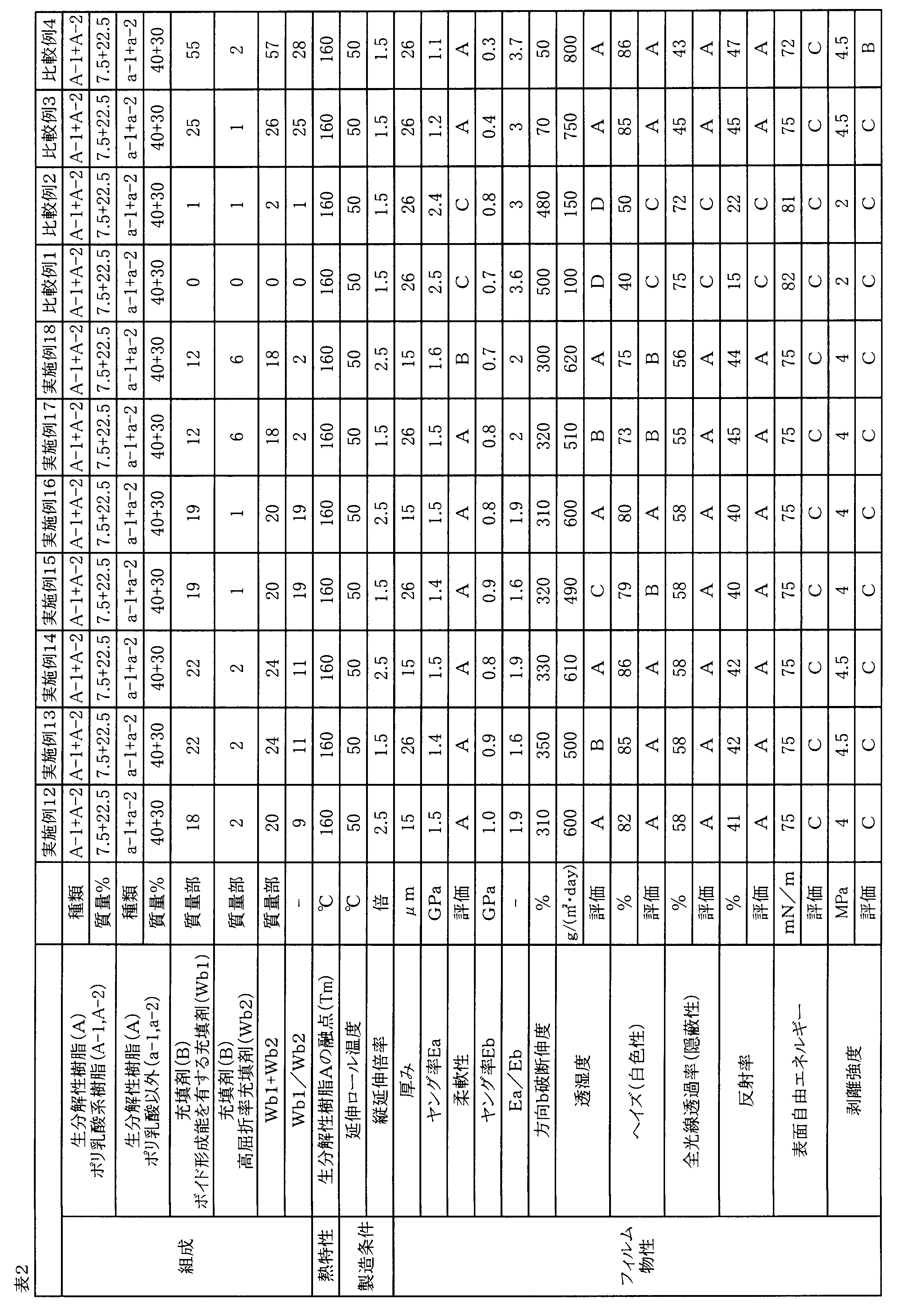
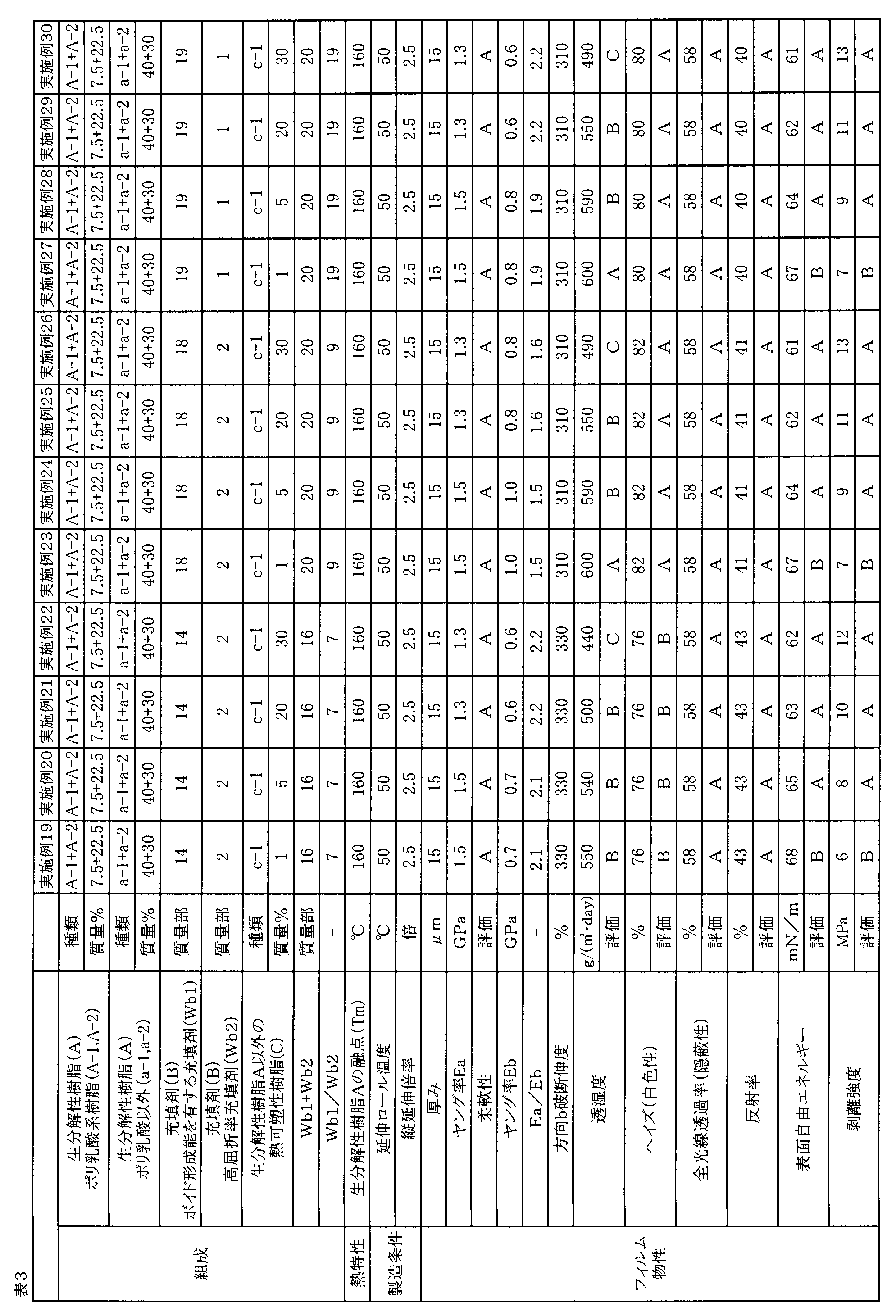
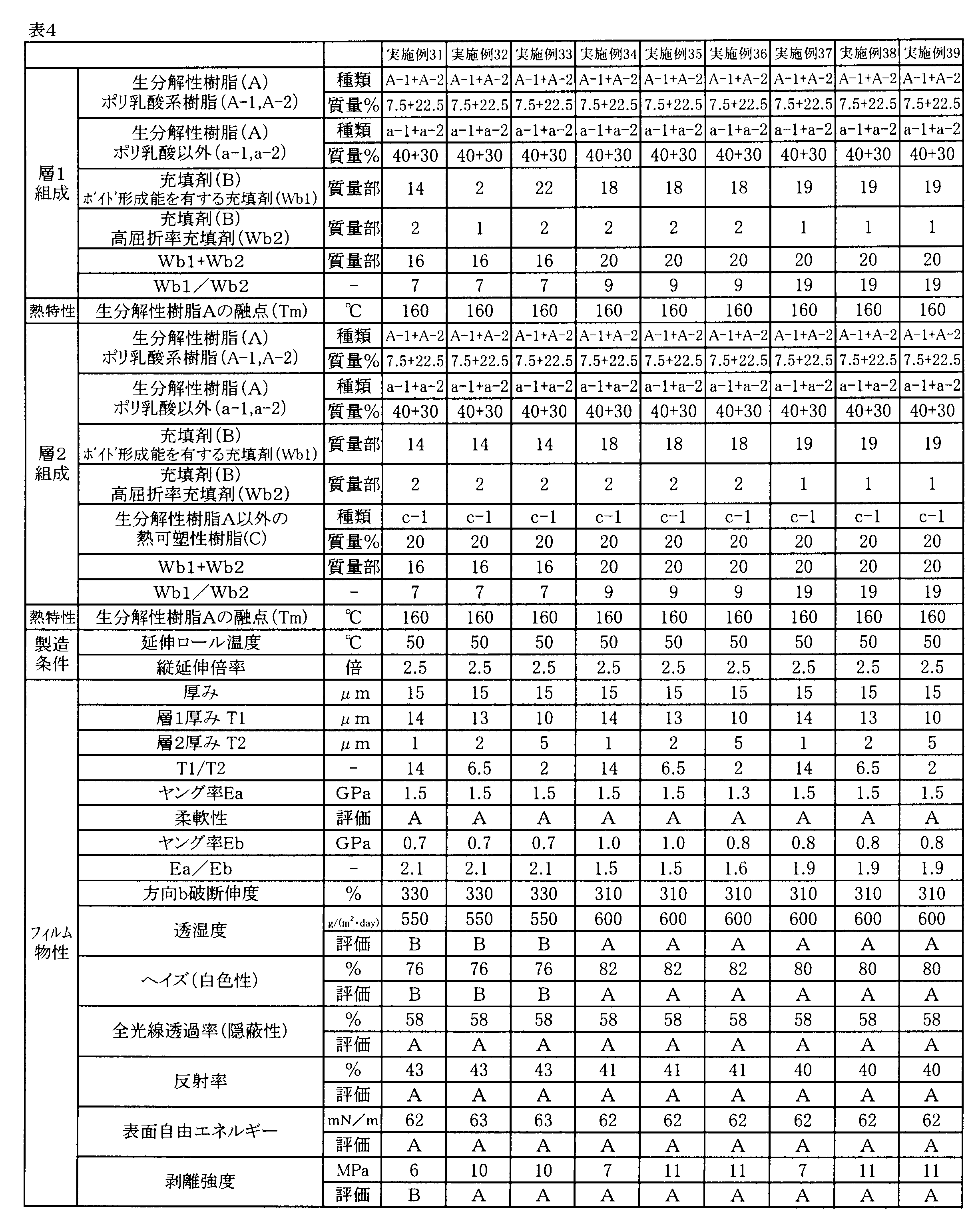
本発明を詳細にまた特定の実施態様を参照して説明したが、本発明の精神と範囲を逸脱することなく様々な変更や修正を加えることができることは当業者にとって明らかである。本出願は、2015年3月27日出願の日本特許出願(特願2015-066001)及び2015年3月27日出願の日本特許出願(特願2015-066002)に基づくものであり、その内容はここに参照として取り込まれる。
本発明によれば、柔軟性、透湿性、機械特性、加工性に優れた生分解性白色フィルムが提供される。本発明のフィルムは、主に柔軟性、透湿性、機械特性を必要とする用途に好ましく用いることができる。具体的には、各種ラベル、カード、ラベル、粘着テープ、マルチフィルム等の農業用材料、薫蒸シート等の林業用材料、ベッド用シーツ、枕カバー、衛生ナプキンや紙おむつ等の衛生材料、衣類、手袋等の衣料材料、ゴミ袋や堆肥袋、あるいは野菜や果物等の食品用袋、工業製品用等の各種包装材料等に好ましく用いることができる。
Claims (14)
- 生分解性樹脂A、及び充填剤Bを含む生分解性白色フィルムであって、
前記充填剤Bが、ボイド形成能を有する充填剤である充填剤b1と高屈折率の充填剤である充填剤b2を含有し、前記充填剤b1の含有量をWb1、前記充填剤b2の含有量をWb2とした場合に、前記生分解性樹脂A100質量部に対して、Wb1+Wb2が3質量部以上25質量部以下であり、Wb1/Wb2が2以上20以下である、生分解性白色フィルム。 - 前記充填剤b1が、炭酸カルシウム及び硫酸バリウムのうちの少なくとも1つであり、前記充填剤b2が、酸化チタン及び酸化亜鉛のうちの少なくとも1つである、請求項1に記載の生分解性白色フィルム。
- ヤング率が最も大きい方向(方向a)のヤング率(GPa)をEa、方向aと同一の面内で直交する方向(方向b)のヤング率をEbとしたとき、Ea/Ebが1.2以上2.5以下であり、かつ、方向bの破断伸度が100%以上500%以下である、請求項1又は2に記載の生分解性白色フィルム。
- 前記生分解性樹脂Aが、ポリ乳酸系樹脂を含む、請求項1~3のいずれか一項に記載の生分解性白色フィルム。
- 前記生分解性樹脂Aが、ポリ乳酸系樹脂、及びポリ乳酸系樹脂以外の生分解性樹脂を含み、
前記生分解性樹脂Aを100質量%としたときに、前記ポリ乳酸系樹脂の含有量が10質量%以上95質量%以下であり、前記ポリ乳酸系樹脂以外の生分解性樹脂の含有量が5質量%以上90質量%以下である、請求項1~4のいずれか一項に記載の生分解性白色フィルム。 - 前記ポリ乳酸系樹脂以外の生分解性樹脂が、ポリエーテル系セグメントとポリ乳酸系セグメントを有するブロック共重合体、ポリエステル系セグメントとポリ乳酸系セグメントを有するブロック共重合体、脂肪族ポリエステル系樹脂、及び脂肪族芳香族ポリエステル系樹脂からなる群より選ばれる少なくとも1つの樹脂である、請求項5に記載の生分解性白色フィルム。
- ヤング率が最も大きい方向(方向a)のヤング率Eaが1.5GPa以下であり、かつ少なくとも片側表面の表面自由エネルギーが70mN/m以下である、請求項1~6のいずれか一項に記載の生分解性白色フィルム。
- 生分解性樹脂A、及び充填剤Bを含む生分解性白色フィルムであって、
ヤング率が最も大きい方向(方向a)のヤング率(GPa)をEa、方向aと同一の面内で直交する方向(方向b)のヤング率をEbとしたとき、Eaが2GPa以下であり、Ea/Ebが1.2以上2.5以下であり、かつ、方向bの破断伸度が100%以上である、生分解性白色フィルム。 - 前記生分解性樹脂Aが、ポリ乳酸系樹脂を含む、請求項8に記載の生分解性白色フィルム。
- 前記生分解性樹脂Aが、ポリ乳酸系樹脂、及び、ポリ乳酸系樹脂以外の生分解性樹脂を含み、
前記生分解性樹脂Aを100質量%としたときに、前記ポリ乳酸系樹脂の含有量が10質量%以上95質量%以下であり、前記ポリ乳酸系樹脂以外の生分解性樹脂の含有量が5質量%以上90質量%以下である、請求項8又は9に記載の生分解性白色フィルム。 - 前記ポリ乳酸系樹脂以外の生分解性樹脂が、ポリエーテル系セグメントとポリ乳酸系セグメントを有するブロック共重合体、ポリエステル系セグメントとポリ乳酸系セグメントを有するブロック共重合体、脂肪族ポリエステル系樹脂、及び脂肪族芳香族ポリエステル系樹脂からなる群より選ばれる少なくとも1つの樹脂である、請求項10に記載の生分解性白色フィルム。
- 前記生分解性樹脂A100質量部に対して、前記充填剤Bを1質量部以上50質量部以下含む、請求項8~11のいずれか一項に記載の生分解性白色フィルム。
- 少なくとも片側表面の表面自由エネルギーが70mN/m以下である、請求項8~12のいずれか一項に記載の生分解性白色フィルム。
- 前記生分解性樹脂A、及び前記充填剤Bを溶融混練することで樹脂組成物を得る溶融混錬工程、
前記樹脂組成物を溶融させ口金から吐出させて未延伸フィルムを得る溶融押出工程、
前記未延伸フィルムを少なくとも一方向に延伸して延伸フィルムを得る延伸工程、
及び前記延伸フィルムを加熱する熱処理工程をこの順に有する、請求項1~13のいずれか一項に記載の生分解性白色フィルムの製造方法であって、
前記延伸工程において、前記生分解性樹脂Aの融点をTm(℃)としたとき、Tm-160(℃)以上Tm-95(℃)以下の範囲で、1.5倍以上4倍以下に延伸する、生分解性白色フィルムの製造方法。
Priority Applications (1)
| Application Number | Priority Date | Filing Date | Title |
|---|---|---|---|
| JP2016518785A JPWO2016158736A1 (ja) | 2015-03-27 | 2016-03-25 | 生分解性白色フィルムおよびその製造方法 |
Applications Claiming Priority (4)
| Application Number | Priority Date | Filing Date | Title |
|---|---|---|---|
| JP2015066002 | 2015-03-27 | ||
| JP2015-066002 | 2015-03-27 | ||
| JP2015-066001 | 2015-03-27 | ||
| JP2015066001 | 2015-03-27 |
Publications (1)
| Publication Number | Publication Date |
|---|---|
| WO2016158736A1 true WO2016158736A1 (ja) | 2016-10-06 |
Family
ID=57004270
Family Applications (1)
| Application Number | Title | Priority Date | Filing Date |
|---|---|---|---|
| PCT/JP2016/059598 Ceased WO2016158736A1 (ja) | 2015-03-27 | 2016-03-25 | 生分解性白色フィルムおよびその製造方法 |
Country Status (2)
| Country | Link |
|---|---|
| JP (1) | JPWO2016158736A1 (ja) |
| WO (1) | WO2016158736A1 (ja) |
Cited By (10)
| Publication number | Priority date | Publication date | Assignee | Title |
|---|---|---|---|---|
| JPWO2020235476A1 (ja) * | 2019-05-22 | 2020-11-26 | ||
| CN112602517A (zh) * | 2020-12-15 | 2021-04-06 | 上海大学 | 一种双层反射透气地膜及其制备方法 |
| CN112795155A (zh) * | 2020-12-30 | 2021-05-14 | 重庆和泰润佳股份有限公司 | 一种生物降解薄膜及其制备方法和卫生巾 |
| CN113861659A (zh) * | 2021-10-09 | 2021-12-31 | 南京五瑞生物降解新材料研究院有限公司 | 一种生物基可降解膜及制备工艺 |
| JP2022553661A (ja) * | 2019-10-22 | 2022-12-26 | ウッドリー オイ | 複合材料 |
| JP2023029089A (ja) * | 2021-08-20 | 2023-03-03 | 三菱ケミカル株式会社 | カード又はパスポート用フィルム、インレットシート、カード及びパスポート |
| JP2023029088A (ja) * | 2021-08-20 | 2023-03-03 | 三菱ケミカル株式会社 | カード又はパスポート用フィルム、インレットシート、カード及びパスポート |
| JP2023107433A (ja) * | 2022-01-24 | 2023-08-03 | 株式会社カネカ | フィルムおよび積層体の製造方法 |
| JP2024006001A (ja) * | 2022-06-30 | 2024-01-17 | 王子ホールディングス株式会社 | 二軸延伸フィルム及び保護フィルム |
| WO2024053219A1 (ja) * | 2022-09-08 | 2024-03-14 | 株式会社日立製作所 | バイオマス由来樹脂を母材とした複合材料、構造部材およびリサイクル方法 |
Citations (4)
| Publication number | Priority date | Publication date | Assignee | Title |
|---|---|---|---|---|
| JPS63162755A (ja) * | 1986-12-25 | 1988-07-06 | Toray Ind Inc | ポリエステル組成物 |
| JPH05295131A (ja) * | 1992-04-22 | 1993-11-09 | Toyobo Co Ltd | 白色ポリエステルフィルム |
| JP2004099659A (ja) * | 2002-09-05 | 2004-04-02 | Toray Ind Inc | 白色脂肪族ポリエステルフィルムおよびその製造方法 |
| JP2013179881A (ja) * | 2012-03-01 | 2013-09-12 | Maruzen Petrochem Co Ltd | マルチフィルム |
-
2016
- 2016-03-25 JP JP2016518785A patent/JPWO2016158736A1/ja active Pending
- 2016-03-25 WO PCT/JP2016/059598 patent/WO2016158736A1/ja not_active Ceased
Patent Citations (4)
| Publication number | Priority date | Publication date | Assignee | Title |
|---|---|---|---|---|
| JPS63162755A (ja) * | 1986-12-25 | 1988-07-06 | Toray Ind Inc | ポリエステル組成物 |
| JPH05295131A (ja) * | 1992-04-22 | 1993-11-09 | Toyobo Co Ltd | 白色ポリエステルフィルム |
| JP2004099659A (ja) * | 2002-09-05 | 2004-04-02 | Toray Ind Inc | 白色脂肪族ポリエステルフィルムおよびその製造方法 |
| JP2013179881A (ja) * | 2012-03-01 | 2013-09-12 | Maruzen Petrochem Co Ltd | マルチフィルム |
Cited By (17)
| Publication number | Priority date | Publication date | Assignee | Title |
|---|---|---|---|---|
| JP7261297B2 (ja) | 2019-05-22 | 2023-04-19 | 株式会社日本触媒 | 酸化ジルコニウムナノ粒子、分散液及び樹脂組成物 |
| US12441623B2 (en) | 2019-05-22 | 2025-10-14 | Nippon Shokubai Co., Ltd. | Zirconium oxide nanoparticles, dispersion liquid and resin composition |
| JPWO2020235476A1 (ja) * | 2019-05-22 | 2020-11-26 | ||
| JP2022553661A (ja) * | 2019-10-22 | 2022-12-26 | ウッドリー オイ | 複合材料 |
| CN112602517A (zh) * | 2020-12-15 | 2021-04-06 | 上海大学 | 一种双层反射透气地膜及其制备方法 |
| CN112795155A (zh) * | 2020-12-30 | 2021-05-14 | 重庆和泰润佳股份有限公司 | 一种生物降解薄膜及其制备方法和卫生巾 |
| JP7739837B2 (ja) | 2021-08-20 | 2025-09-17 | 三菱ケミカル株式会社 | カード又はパスポート用フィルム、インレットシート、カード及びパスポート |
| JP2023029088A (ja) * | 2021-08-20 | 2023-03-03 | 三菱ケミカル株式会社 | カード又はパスポート用フィルム、インレットシート、カード及びパスポート |
| JP2023029089A (ja) * | 2021-08-20 | 2023-03-03 | 三菱ケミカル株式会社 | カード又はパスポート用フィルム、インレットシート、カード及びパスポート |
| JP7739838B2 (ja) | 2021-08-20 | 2025-09-17 | 三菱ケミカル株式会社 | カード又はパスポート用フィルム、インレットシート、カード及びパスポート |
| CN113861659A (zh) * | 2021-10-09 | 2021-12-31 | 南京五瑞生物降解新材料研究院有限公司 | 一种生物基可降解膜及制备工艺 |
| JP2023107433A (ja) * | 2022-01-24 | 2023-08-03 | 株式会社カネカ | フィルムおよび積層体の製造方法 |
| JP7831998B2 (ja) | 2022-01-24 | 2026-03-17 | 株式会社カネカ | フィルムおよび積層体の製造方法 |
| JP2024006001A (ja) * | 2022-06-30 | 2024-01-17 | 王子ホールディングス株式会社 | 二軸延伸フィルム及び保護フィルム |
| WO2024053219A1 (ja) * | 2022-09-08 | 2024-03-14 | 株式会社日立製作所 | バイオマス由来樹脂を母材とした複合材料、構造部材およびリサイクル方法 |
| JP2024038913A (ja) * | 2022-09-08 | 2024-03-21 | 株式会社日立製作所 | バイオマス由来樹脂を母材とした複合材料、構造部材およびリサイクル方法 |
| JP7825533B2 (ja) | 2022-09-08 | 2026-03-06 | 株式会社日立製作所 | バイオマス由来樹脂を母材とした複合材料、構造部材およびリサイクル方法 |
Also Published As
| Publication number | Publication date |
|---|---|
| JPWO2016158736A1 (ja) | 2018-01-18 |
Similar Documents
| Publication | Publication Date | Title |
|---|---|---|
| WO2016158736A1 (ja) | 生分解性白色フィルムおよびその製造方法 | |
| JP5799809B2 (ja) | 多孔性フィルム | |
| CN103384702B (zh) | 聚乳酸系膜 | |
| JP5867084B2 (ja) | ポリ乳酸系フィルム | |
| JP5867406B2 (ja) | 生分解性フィルム | |
| JP5979007B2 (ja) | ポリ乳酸系フィルム | |
| JP2004082512A (ja) | 生分解性フィルムおよび該フィルムからなる生分解性袋体 | |
| JP6287832B2 (ja) | フィルム | |
| JP2013155223A (ja) | ポリ乳酸系フィルム | |
| CN104936779A (zh) | 多层膜 | |
| CN101815748A (zh) | 一种可生物降解的双向拉伸复合薄膜 | |
| JP4452014B2 (ja) | ポリ乳酸系樹脂フィルム、及び、ポリ乳酸系樹脂溶断シール袋 | |
| JP4511099B2 (ja) | 乳酸系樹脂組成物とそのシート状物、及び袋状製品 | |
| JP2015083661A (ja) | 多孔フィルム及びその製造方法 | |
| JP2014173074A (ja) | 生分解性フィルム | |
| JP5957908B2 (ja) | 生分解性フィルム | |
| JP2004269606A (ja) | 乳酸系樹脂組成物 | |
| JP2016056304A (ja) | フィルム | |
| JP2013159747A (ja) | ポリ乳酸系フィルム | |
| JP6492720B2 (ja) | 延伸フィルムの製造方法 | |
| JP6160276B2 (ja) | ポリ乳酸系樹脂シート | |
| JP2016097576A (ja) | 積層フィルム | |
| JP2025060486A (ja) | フィルムおよびその製造方法 | |
| JP2012091396A (ja) | 一軸延伸積層フィルム | |
| JP2007320321A (ja) | 生分解性フィルムおよび該フィルムからなる生分解性袋体 |
Legal Events
| Date | Code | Title | Description |
|---|---|---|---|
| ENP | Entry into the national phase |
Ref document number: 2016518785 Country of ref document: JP Kind code of ref document: A |
|
| 121 | Ep: the epo has been informed by wipo that ep was designated in this application |
Ref document number: 16772617 Country of ref document: EP Kind code of ref document: A1 |
|
| NENP | Non-entry into the national phase |
Ref country code: DE |
|
| 122 | Ep: pct application non-entry in european phase |
Ref document number: 16772617 Country of ref document: EP Kind code of ref document: A1 |