WO2016152590A1 - 豆乳発酵物の製法およびそれにより得られた豆乳発酵物 - Google Patents
豆乳発酵物の製法およびそれにより得られた豆乳発酵物 Download PDFInfo
- Publication number
- WO2016152590A1 WO2016152590A1 PCT/JP2016/057848 JP2016057848W WO2016152590A1 WO 2016152590 A1 WO2016152590 A1 WO 2016152590A1 JP 2016057848 W JP2016057848 W JP 2016057848W WO 2016152590 A1 WO2016152590 A1 WO 2016152590A1
- Authority
- WO
- WIPO (PCT)
- Prior art keywords
- soymilk
- fermented
- lactic acid
- acid bacteria
- producing
- Prior art date
- Legal status (The legal status is an assumption and is not a legal conclusion. Google has not performed a legal analysis and makes no representation as to the accuracy of the status listed.)
- Ceased
Links
Classifications
-
- A—HUMAN NECESSITIES
- A23—FOODS OR FOODSTUFFS; TREATMENT THEREOF, NOT COVERED BY OTHER CLASSES
- A23C—DAIRY PRODUCTS, e.g. MILK, BUTTER OR CHEESE; MILK OR CHEESE SUBSTITUTES; PREPARATION THEREOF
- A23C11/00—Milk substitutes, e.g. coffee whitener compositions
- A23C11/02—Milk substitutes, e.g. coffee whitener compositions containing at least one non-milk component as source of fats or proteins
- A23C11/10—Milk substitutes, e.g. coffee whitener compositions containing at least one non-milk component as source of fats or proteins containing or not lactose but no other milk components as source of fats, carbohydrates or proteins
- A23C11/103—Milk substitutes, e.g. coffee whitener compositions containing at least one non-milk component as source of fats or proteins containing or not lactose but no other milk components as source of fats, carbohydrates or proteins containing only proteins from pulses, oilseeds or nuts, e.g. nut milk
- A23C11/106—Addition of, or treatment with, microorganisms
-
- A—HUMAN NECESSITIES
- A23—FOODS OR FOODSTUFFS; TREATMENT THEREOF, NOT COVERED BY OTHER CLASSES
- A23L—FOODS, FOODSTUFFS OR NON-ALCOHOLIC BEVERAGES, NOT OTHERWISE PROVIDED FOR; PREPARATION OR TREATMENT THEREOF
- A23L11/00—Pulses, i.e. fruits of leguminous plants, for production of food; Products from legumes; Preparation or treatment thereof
- A23L11/60—Drinks from legumes, e.g. lupine drinks
- A23L11/65—Soy drinks
-
- A—HUMAN NECESSITIES
- A23—FOODS OR FOODSTUFFS; TREATMENT THEREOF, NOT COVERED BY OTHER CLASSES
- A23L—FOODS, FOODSTUFFS OR NON-ALCOHOLIC BEVERAGES, NOT OTHERWISE PROVIDED FOR; PREPARATION OR TREATMENT THEREOF
- A23L11/00—Pulses, i.e. fruits of leguminous plants, for production of food; Products from legumes; Preparation or treatment thereof
- A23L11/70—Germinated pulse products, e.g. from soy bean sprouts
Definitions
- the present invention relates to a method for producing a fermented soymilk product obtained by fermenting soymilk, and a fermented soymilk product obtained thereby, and more specifically, a method for producing a fermented soymilk product having high viscosity and stringiness and a unique texture. And a soymilk fermented product obtained thereby.
- soy milk made from soybean is rich in high-quality protein, non-cholesterol, and rich in minerals.
- soy milk can be safely consumed even by people with milk allergies, it is expected to be used not only as a normal food but also as a health food.
- JP-A-10-201416 JP 2000-217510 A Japanese Patent Laid-Open No. 10-229841 JP-A-5-184320 Japanese Patent Laid-Open No. 10-201415 JP 2004-261174 A JP-A-7-147898 JP 2013-215107 A
- Patent Document 6 the present applicant makes cryolith and acetic acid bacteria coexisting in soy milk, thereby fermenting soy milk, and having excellent taste and a unique texture and excellent physiological action. Research has already been carried out to obtain fermented soymilk with sucrose. However, there is still room for improvement in terms of spinnability, viscosity, and shelf life (quality maintenance period) compared to fermented milk.
- Patent Document 7 discloses a technique related to a curd-like fermented product made from soy milk using lactic acid bacteria and sugar, neutral protease, and the like. Since difficulty is mentioned as the effect, it does not expect the improvement effect such as viscosity and spinnability. Moreover, in the said patent document 8, although the description which carries out an enzyme process of soymilk is described also regarding the use of lactic acid bacteria, the lactic acid bacteria are limited to Lactobacillus brevis and are improved in viscosity, spinnability, etc. The effect is not expected. Since Patent Documents 7 and 8 do not describe a lactic acid bacterium that produces a silky exopolysaccharide, it is not intended to improve spinnability or maintain viscosity during storage. Is not considered to be made at all.
- the present invention has been made in view of such circumstances, and promotes fermentation by lactic acid bacteria that produce exopolysaccharides, and satisfactorily produces a fermented soymilk product that has a high viscosity and stringiness and exhibits a unique texture.
- the object is to provide a method for producing a fermented soymilk product and a fermented soymilk product obtained thereby.
- the present invention is a method for producing a soymilk fermented product obtained by fermenting soymilk with lactic acid bacteria, wherein the soymilk is subjected to an enzyme treatment with a neutral protease, and the lactic acid bacteria are used as extraneous fungal bodies.
- the manufacturing method of the fermented soymilk fermented using lactic acid bacteria producing polysaccharides is the first gist.
- the present invention also relates to a fermented soymilk obtained by the method for producing a fermented soymilk according to the first aspect, wherein the viscosity at 10 ° C. is 4000 to 12000 mPa ⁇ s, and the liquid run-out time when using Zahn Cup is 10 A soymilk fermented product that is 2 seconds or longer is defined as a second gist.
- soy milk was treated with neutral protease and fermented by adding lactic acid bacteria that produce silky exopolysaccharide to the treated soy milk.
- soy milk was treated with neutral protease and fermented by adding lactic acid bacteria that produce silky exopolysaccharide to the treated soy milk.
- the viscosity and stringiness of the soymilk fermented product obtained by the conventional production method found in Patent Document 6 and the like can be reduced without adding milk.
- a high improvement effect was recognized, and it was found that the texture such as smoothness was excellent, and the present invention was conceived.
- the above-mentioned “lactic acid bacterium that produces a silky exopolysaccharide” refers to a lactic acid bacterium that produces a silky exopolysaccharide in milk fermentation.
- the production method of the soymilk fermented product of the present invention is carried out by adding a neutral protease to the soymilk and further fermenting it with a lactic acid bacterium that produces a silky exopolysaccharide.
- a neutral protease to the soymilk and further fermenting it with a lactic acid bacterium that produces a silky exopolysaccharide.
- the soymilk fermented product of the present invention exhibiting a specific viscosity and spinnability can be efficiently obtained. Can be manufactured.
- curd formation can be performed better.
- the fermented soymilk obtained by the method for producing a fermented soymilk according to the present invention has a viscosity of 4000 to 12000 mPa ⁇ s at 10 ° C., and a liquid drainage time of 10 seconds or more when using Zahn Cup, which is an indicator of spinnability.
- the soymilk fermented product exhibits high viscosity and spinnability that are not shown, and is excellent in texture such as smoothness.
- the fermented soymilk is excellent in taste because the unpleasant taste and smell such as the blue odor and astringent taste of soymilk are remarkably reduced.
- the fermented soymilk since the said fermented soymilk has much content of exopolysaccharide, it is excellent also in physiological action (intestinal regulation action, immunostimulatory action, etc.). Furthermore, the fermented soymilk has an advantage that quality deterioration due to long-term storage is small.
- the fermented soymilk has excellent quality maintenance characteristics when the water separation rate during storage is 3% (total weight ratio) or less.
- the method for producing a fermented soymilk product of the present invention is carried out by adding a neutral protease to soymilk and further fermenting with a lactic acid bacterium that produces a silky exopolysaccharide.
- the inoculation of the lactic acid bacteria may be performed at the same time as adding the protease to the soy milk. However, it is better to add the protease first, perform the enzyme treatment first, inactivate the enzyme, and then inoculate and ferment the enzyme. From the viewpoint of controlling the physical properties of the card after fermentation.
- the fermentation conditions are 20 to 35 ° C. (preferably 25 ° C.) and 6 to 48 hours (preferably 7 to 10 hours). Moreover, the deactivation of the enzyme reaction is usually performed by heating.
- soy milk used in the method for producing a fermented soy milk of the present invention for example, using whole soybeans, moulted soybeans, flake soybeans, mung beans containing fats and oils as raw materials, soaking them in water, crushing them, In addition, a milky liquid obtained by boiling and filtering is used.
- protease used in the method for producing a fermented soymilk product of the present invention it is necessary to show a protease activity well with respect to neutral soymilk.
- An enzyme having an appropriate pH value in a neutral region for example, pH 5.0 to 8.0
- the neutral protease include proteases derived from microorganisms such as Bacillus subtilis, Streptomyces, and Aspergillus. Of these, proteases derived from the genus Aspergillus are preferred because they can satisfactorily decompose soybean protein.
- the amount of neutral protease added to soy milk may be determined by the physical properties of the curd after fermentation, but it is usually added so as to be contained at a rate of 1 to 100 ppm based on soy milk. If the addition amount of the neutral protease is too small, the effect of improving the spinnability cannot be obtained. Conversely, if the addition amount of the neutral protease is too large, a card is not formed, which is not preferable.
- the “lactic acid bacterium producing a silky exopolysaccharide” used in the above-mentioned production method means, in the present invention, an exopolysaccharide (EPS) in milk fermentation. ) That produces lactic acid bacteria. Whether or not the silky exopolysaccharide is produced is determined based on the fact that milk is fermented with the above lactic acid bacteria at a temperature and culture time suitable for each bacterium, Zahn Cup (RIGO: Model 417 No. 7). It is possible to determine that the liquid running time at 10 ° C. when using is measured and the time required for 20 seconds or longer is producing the filamentous exopolysaccharide.
- EPS exopolysaccharide
- the above-mentioned liquid run-out time means the time from when the liquid starts to flow until it breaks, and the sample supply to Zahn Cup is done by mixing the container containing the milk fermented product with a spoon so that it rises from the bottom to the top. The card is broken, and the container is rotated 60 degrees each time it is mixed, and then mixed again from another angle 6 times, then poured into Zahn Cup, poured into a cup, and dropped from a height of 20 cm.
- Lactococcus lactis subspices cremolith or streptococcus thermophilus having the ability to produce a silkworm exopolysaccharide is preferably used as the lactic acid bacterium producing the silkworm exopolysaccharide.
- Lactococcus lactis subspecies Cremolis or Streptococcus thermophilus the thing which does not produce a silky exopolysaccharide cannot be used by this invention.
- the lactic acid bacteria which produce the silky exopolysaccharide as mentioned above can be obtained, for example, by collecting microorganisms in a specific habitat or selecting by so-called screening.
- Lactococcus lactis subsp. Cremoris FC (FERM® P-20185) as the lactic acid bacterium increases the content of the filamentous exopolysaccharide and more physiological effects ( This is preferable from the viewpoint of obtaining a fermented soymilk having a high intestinal regulating action, immunostimulatory action and the like.
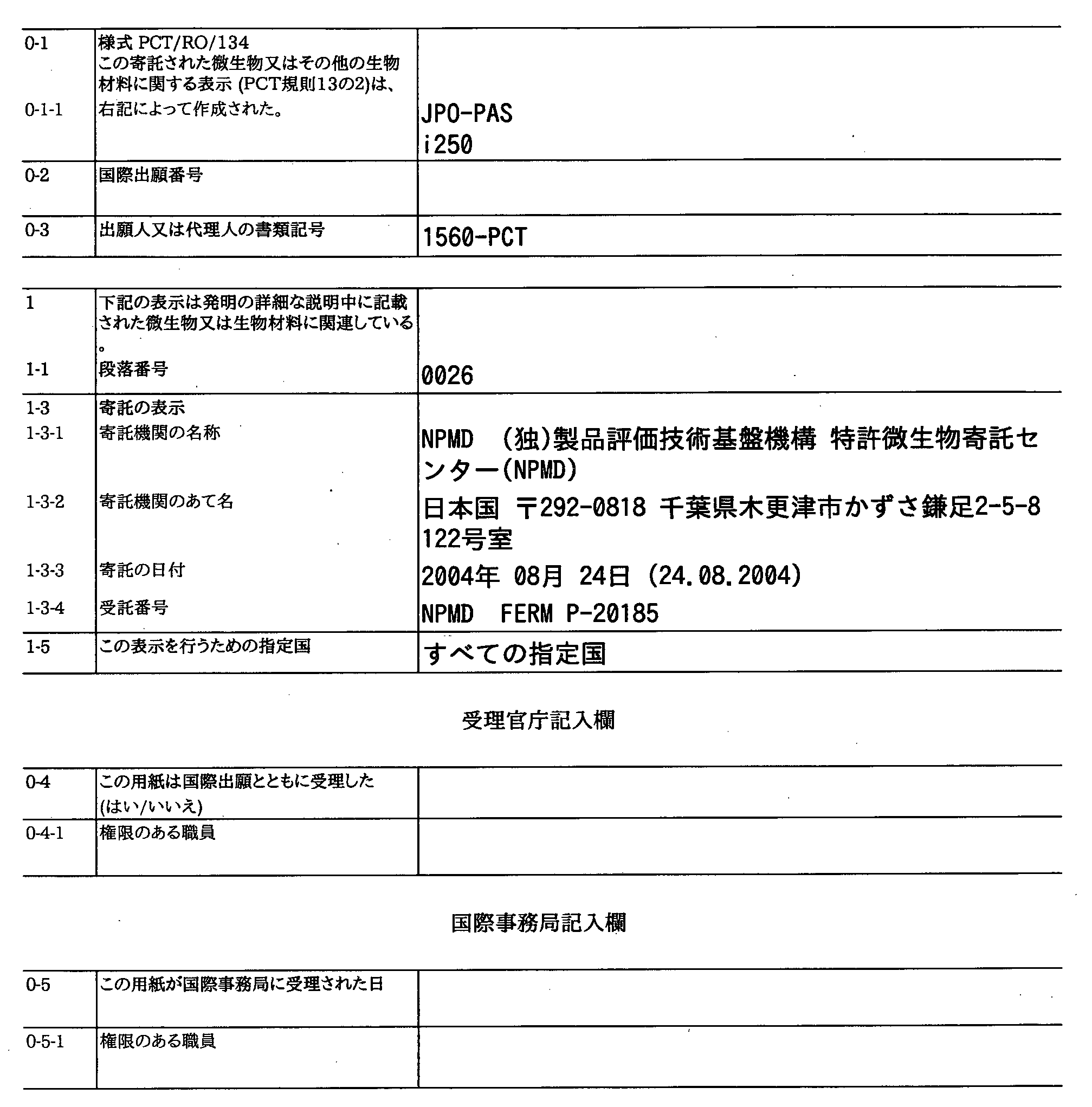
- Lactococcus lactis subspecies Cremolis FC (Lactococcus lactis.subsp.cremoris FC, FERM P-20185) has been deposited by the applicant, and the National Institute of Advanced Industrial Science and Technology, Patent Biology Center (currently independent) It is a strain that has been entrusted to the administrative agency, Japan Institute for Product Evaluation Technology (Patent Microorganism Depositary Center), and has the characteristic of producing an exopolysaccharide (contract date: August 24, 2004). Lactococcus lactis subspecies Cremolis FC has the property of growing at 10 ° C or higher, has an optimum temperature of 25-30 ° C, and has a white to milky white consistency on the medium.
- a colony When a colony is formed and cultured on a BCP medium, for example, at 25 ° C. for 2 days, a round (hemispheric) colony having a diameter of 0.5 to 1.0 mm is formed. In addition, there is no change in colony morphology due to culture conditions or physiological conditions.
- the addition of lactic acid bacteria to the soymilk is preferably activated (starter) when the cells are freeze-dried and powdered, for example.
- the starter can be obtained, for example, by adding lactic acid bacteria powder to soymilk to which 1% of glucose is added and activating at 20 to 30 ° C. (preferably 25 ° C.) for 6 to 48 hours (preferably 7 to 10 hours).
- the starter thus obtained preferably has a viable count of 10 8 cfu / g or more, and the addition amount thereof is preferably 0.01 to 10 with respect to the whole raw material for fermented soymilk. It is in the range of wt%, and more preferably in the range of 0.1 to 4.0 wt%.
- the fermented and preserved soymilk fermented product of the present invention is subjected to anaerobic culture. This is because, when exposed to aerobic conditions, protein aggregation proceeds from the upper surface, and the upper layer portion of the fermented soymilk aggregates and separates over time, resulting in a two-layered problem. Moreover, the symptom that the color of soymilk fermented material becomes dull and becomes gray with time is also seen.
- an oxygen scavenger As a method for realizing the anaerobic culture as described above, use of an oxygen scavenger, culture in an anaerobic chamber, and the like can be considered, but a method of adding an acetic acid bacterium together with the lactic acid bacterium to perform fermentation is preferable. That is, since acetic acid bacteria consume a large amount of oxygen, anaerobic culture can be easily realized. Furthermore, when an acetic acid bacterium is added and fermented together with the lactic acid bacterium, an effect of suppressing the symptom that the fermented soymilk becomes dull and gray with time can be obtained.
- acetic acid bacteria to soy milk is preferably activated (starter) and added.
- the starter is, for example, adding acetic acid bacteria powder to soy milk to which 1% of glucose is added, followed by stirring culture (100 rpm) at 25 to 35 ° C. (preferably 30 ° C.) for 8 to 48 hours (preferably 12 to 24 hours).
- the starter thus obtained preferably has a viable count of 10 8 cfu / g or more, and the amount added is preferably 0.1% by weight relative to the whole raw material for fermented soymilk. More preferably, it is in the range of 0.1 to 4.0% by weight.
- acetic acid bacteria examples include acetic acid bacteria belonging to the genus Acetobacter, Gluconobacter, Gluconacetobacter, etc., and these may be used alone or in combination of two or more. It is done.
- acetic acid bacteria belonging to the genus Acetobacter include Acetobacter orientalis, Acetobacter aceti, Acetobacter orleanensis, and the like.
- saccharides may be added to soymilk, which is the material, and then fermentation with the lactic acid bacteria may be performed.
- the addition of sugar may be before or after the neutral protease treatment of soy milk.
- saccharide examples include lactose, fructose, glucose and the like.
- lactose is preferably used because it has a high effect of suppressing the increase in acidity of the fermented soymilk with time, and further suppressing the upper layer agglomeration due to the change with time and the amount of water separation generated therewith.
- oligosaccharides are used for the purpose of seasoning, since the acidity to be produced is not greatly affected, there is no problem in their use.
- the amount added is preferably in the range of 0.3 to 1.0% by weight, more preferably 0.3 to 0.5% by weight, based on the whole fermented soymilk raw material. It is a range.
- the fermented soymilk obtained by the production method of the present invention as described above exhibits high viscosity and spinnability that are not exhibited by conventional fermented soymilk, and has a unique texture.
- a soymilk fermented product having a viscosity at 10 ° C. of 4000 to 12000 mPa ⁇ s (preferably 5000 to 9000 mPa ⁇ s) and a run-out time of 10 seconds or more when using Zahn Cup is obtained.
- the viscosity is a viscosity measured with a B-type viscometer for a soymilk fermented product having a product temperature of 10 ° C., and the B-type viscometer manufactured by BROOKFIELD is rotated at a rotational speed of 50 rpm by a spindle LV-4. Can be measured.
- the above-mentioned “liquid running out time when using Zahn Cup” is to measure the liquid running time when Zahn Cup (RIGO: Model 417 No. 7) is used, and use it as an index of spinnability.
- the liquid run-out time means the time from when the liquid starts to flow until it breaks, and the sample supply to Zahn Cup is done by mixing the container containing the fermented soymilk with a spoon so that it rises from the bottom to the top. Each time it is mixed, the container is rotated 60 degrees, mixed again from another angle 6 times, then poured into Zahn Cup, poured into a cup, and dropped from a height of 20 cm.
- the fermented soymilk obtained by the production method of the present invention has a high content of spinal exopolysaccharides derived from the fermenting microorganisms, high spinnability, and physiological functions (intestinal regulation, immunostimulatory action). , Stress-derived skin blood flow lowering improving action, skin function improving action, action of increasing the ratio of blood HDL cholesterol, etc.) are high, and therefore, more excellent effects are exhibited in health.
- the fermented soymilk product preferably has a water separation rate of 3% (total weight ratio) or less during storage from the viewpoint of quality maintenance.
- Such fermented soymilk can be easily obtained, for example, by limiting the concentration of lactose added to soymilk.
- sugar, water, pulp, fruit juice, fragrance, acidulant, etc. may be added to the fermented soymilk of the present invention thus obtained as necessary for seasoning and the like.
- the fermented soymilk of the present invention can be applied as a soymilk yogurt, a soymilk yogurt beverage, a soymilk yogurt paste (a cooking material), or the like.
- starters (1) and (2) shown below were prepared.
- Examples 1 and 2 and Comparative Examples 1 and 2 ⁇ Spinning properties and deterioration during viscosity joining> A preparation solution was prepared in soymilk (unregulated soymilk) so that the ratio of lactose was 0.4%.
- 100 ppm of a neutral protease preparation (Coclase P, manufactured by Mitsubishi Chemical Foods) was added to the above prepared solution, and then the enzyme reaction was carried out by holding at 50 ° C. for 30 minutes. The protease was inactivated by heating for a minute. In the comparative example, the enzyme reaction was not performed.
- the soymilk fermented product thus obtained was evaluated for each characteristic according to the following criteria. These results are also shown in Table 1 below.
- sample supply to Zahn Cup is made by mixing a container containing fermented soymilk with a spoon so that it rises from the bottom to the top, breaking the curd, turning the container 60 degrees each time, and again from another angle. The mixing was repeated 6 times, and then poured into a Zahn Cup and poured completely from a height of 20 cm.
- the fermented soymilk of the example does not greatly change the viscosity as compared with the fermented soymilk of the comparative example, but with regard to the stringiness, by performing the enzyme treatment, until the liquid runs out by Zahn Cup.
- the time is greatly increased, and the improvement is remarkable.
- the silky exopolysaccharide is produced.
- both the fermented soymilk of Example 1 and Comparative Example 2 were stored at a temperature of 10 ° C. for 19 days, and then the viscosity was measured according to the above measurement method. And when compared with the viscosity (initial viscosity) of the soymilk fermented product of Example 1 shown in Table 1 and the soymilk fermented product of Comparative Example 1, the rate of decrease in viscosity (%) by standing as described above was calculated. The soymilk fermented product decreased by 8.6%, while the soymilk fermented product of Comparative Example 2 decreased by 30.6%. From this, it can be seen that the fermented soymilk of Example 1 is less susceptible to viscosity degradation than the fermented soymilk of Comparative Example 2.
- Lactose is added to soy milk (unregulated soy milk) at the concentration described in Table 3 below, and after adding 10 ppm of neutral protease preparation (Coclase P, manufactured by Mitsubishi Chemical Foods), hold at 50 ° C. for 30 minutes. Enzymatic reaction was performed and the protease was inactivated by heating at 80 ° C. for 20 minutes. 100 ml of the prepared starter (1) was added to 900 ml of the prepared liquid thus obtained, inoculated, and the above prepared liquid was shaken well, and then cultured in an environment of 25 ° C. for 8 hours for fermentation. And the desired fermented soymilk was obtained.
- the lactic acid acidity (%) of the fermented soymilk was measured according to the acidity measurement method described in the “Ministry Ordinance on Component Standards for Milk and Dairy Products” in the “Testing Method for Component Standards for Milk”. In addition, the said measurement was performed with respect to the fermented soybean milk (initial stage) immediately after manufacture, and the thing after storing it for 29 days at 10 degreeC temperature (after leaving).
- a neutral protease preparation (Panchidase NP-2, Yakult Pharmaceutical Co., Ltd.) is added to the medium so as to be 100 ppm, reacted at 50 ° C. for 30 minutes, and then heated at 80 ° C. for 20 minutes. The enzyme was deactivated and sterilized, and cooled to 30 ° C. After adding 100 ml of each starter using the lactic acid bacteria shown in the following Tables 4 and 5 to 900 ml of the prepared solution thus obtained, inoculating the mixture and shaking the prepared solution well, In a 25 ° C. environment, Thermophilus bacteria are cultured for 8 hours each in a 35 ° C. environment to promote fermentation, to obtain a desired fermented product. Measured in the same manner as the liquid run-out time (seconds) performed in step 1.
- seconds liquid run-out time
- each said starter was prepared using the lactic acid bacteria shown in following Table 4 and Table 5 as the lactic acid bacteria according to the starter (1) of the said preparation.
- “Cremolith FC” is the same as the lactic acid bacterium used in the starter (1) prepared above, “Thermophyllus FJST001” is Streptococcus thermophilus FJST001, “ “Cremolis FJCL001” is Lactococcus lactis subspecies Cremolis FJCL001.
- These three types of lactic acid bacteria are lactic acid bacteria that produce a silky exopolysaccharide.
- “Cremolis C4” shown in the table below is Lactococcus lactis subspecies Cremolis C4, “Cremolis reference strain” is Lactococcus lactis subspecies Cremolis ATCC 19257 (reference strain), and these two types of lactic acid bacteria are It is a lactic acid bacterium that does not produce extracellular polysaccharides.
- “Thermophyllus FJST002” shown in the following table is Streptococcus thermophilus FJST002, and this lactic acid bacterium is a lactic acid bacterium that produces an extracellular polysaccharide having no spinnability. These strains are strains managed by the applicant.
- the lactic acid bacteria used in Comparative Example 5 produce exopolysaccharides in milk fermentation, but the exopolysaccharides do not have spinnability, and even if soy milk is treated with protease, the lactic acid bacteria It can be seen that a soymilk fermented product exhibiting spinnability cannot be obtained.
- the method for producing a soymilk fermented product according to the present invention can effectively produce a fermented soymilk product that is highly improved in viscosity and stringiness as compared with the conventional method.
- the fermented soymilk obtained by the production method has high viscosity and stringiness, and because the unpleasant taste and odor such as blue smell and astringent taste of soymilk are remarkably reduced, Are better.
- the fermented soymilk has a high content of exopolysaccharides and is excellent in physiological functions (intestinal regulating action, immunostimulating action, etc.).
- the fermented soymilk has an advantage that quality deterioration due to long-term storage is small. Utilizing these characteristics, it has applicability as a food or food that has not been used in the past.
Landscapes
- Life Sciences & Earth Sciences (AREA)
- Chemical & Material Sciences (AREA)
- Food Science & Technology (AREA)
- Polymers & Plastics (AREA)
- Engineering & Computer Science (AREA)
- Health & Medical Sciences (AREA)
- Agronomy & Crop Science (AREA)
- Botany (AREA)
- Nutrition Science (AREA)
- Oil, Petroleum & Natural Gas (AREA)
- Microbiology (AREA)
- Beans For Foods Or Fodder (AREA)
- Dairy Products (AREA)
Abstract
豆乳に対し中性プロテアーゼによる酵素処理を行った後、曳糸性菌体外多糖を産生する乳酸菌を用いて発酵させることにより、高粘度かつ曳糸性を有する豆乳発酵物を製造する。したがって、菌体外多糖を産生する乳酸菌による発酵を促し、粘性や曳糸性が高く独特の食感を示す豆乳発酵物を良好に製造することができる、豆乳発酵物の製法およびそれにより得られた豆乳発酵物を提供することができる。
Description
本発明は、豆乳を発酵させてなる豆乳発酵物の製法およびそれにより得られた豆乳発酵物に関するものであり、詳しくは、粘性や曳糸性が高く独特の食感を有する豆乳発酵物の製法およびそれにより得られた豆乳発酵物に関するものである。
近年、消費者の健康志向の高まりから、植物性タンパク質が注目されている。とりわけ、大豆を原料とする豆乳は、良質のタンパク質に富み、ノンコレステロールで、ミネラルも豊富に含んでいる。また、豆乳は、乳アレルギーを有する人々でも安心して飲食できることから、通常の食材としてはもとより、健康食品としての用途も期待されている。
そのようななか、豆乳を乳酸菌により発酵させた豆乳発酵物も各種提案されており、その使用に適した乳酸菌の種類や製造条件においても様々な研究がなされている(例えば、特許文献1~6参照)。また、発酵豆乳において、乳酸菌と中性プロテアーゼや糖との併用、酢酸菌との併用に関しても過去に検討されている(例えば、特許文献7,8参照)。
本出願人は、上記特許文献6において、豆乳中に、クレモリス菌と酢酸菌とを共棲状態にし、これによって豆乳を発酵させて、呈味性に優れ、かつ特有の食感および優れた生理作用を有する豆乳発酵物を得る研究を既に行っている。しかしながら、曳糸性や粘性、さらには保存性(品質維持期間)の観点において、牛乳発酵物と比較して、未だ改善の余地がある。
一方、上記特許文献7においては、豆乳に乳酸菌および糖と、中性プロテアーゼなどを使用して作るカード状の発酵物に関する技術が開示されており、口当たりや苦味、飲料にした際の沈殿の出来難さを、その効果として謳っていることから、粘性や曳糸性等の向上効果を期待するものではない。また、上記特許文献8においては、豆乳を酵素処理する記載があり、乳酸菌の使用に関しても記載されているが、その乳酸菌はラクトバチルス・ブレビスに限定されており、粘性や曳糸性等の向上効果を期待するものではない。特許文献7および8には、曳糸性菌体外多糖を産生する乳酸菌の記載は見られないことから、曳糸性向上や、保存中の粘度維持に関する内容のものではなく、またそれらに関する検討も全くなされていないと考えられる。
本発明は、このような事情に鑑みなされたもので、菌体外多糖を産生する乳酸菌による発酵を促し、粘性や曳糸性が高く独特の食感を示す豆乳発酵物を良好に製造することができる、豆乳発酵物の製法およびそれにより得られた豆乳発酵物の提供をその目的とする。
上記目的を達成するため、本発明は、豆乳を乳酸菌により発酵させてなる豆乳発酵物の製法であって、豆乳に対し中性プロテアーゼによる酵素処理を行い、上記乳酸菌として、曳糸性菌体外多糖を産生する乳酸菌を用いて発酵させる豆乳発酵物の製法を第1の要旨とする。
また、本発明は、上記第1の要旨の豆乳発酵物の製法により得られる豆乳発酵物であって、その10℃における粘度が4000~12000mPa・sであり、Zahn Cup使用における液切れ時間が10秒以上である豆乳発酵物を第2の要旨とする。
すなわち、本発明者らは、前記課題を解決するため鋭意研究を重ねた。その研究の過程において、豆乳に対し中性プロテアーゼによる酵素処理を行い、その処理された豆乳中に、曳糸性菌体外多糖を産生する乳酸菌を加えて発酵させたところ、中性プロテアーゼにより豆乳の大豆タンパクが低分子化されることに起因し、牛乳を配合しなくても、また特許文献6等にみられる従来製法によって得られた豆乳発酵物に比べても、粘性や曳糸性において高い改善効果が認められ、さらになめらかさ等の食感に優れることを見出し、本発明に想到した。本発明において、上記「曳糸性菌体外多糖を産生する乳酸菌」とは、牛乳発酵において曳糸性菌体外多糖を産生する乳酸菌のことを言う。
このように、本発明の豆乳発酵物の製法は、豆乳中に、中性プロテアーゼを加え、さらに曳糸性菌体外多糖を産生する乳酸菌を用いて発酵させることにより行われる。これにより、従来製法に比べ、粘性や曳糸性において高い改善効果が認められる豆乳発酵物を良好に製造することができる。
特に、上記乳酸菌として、曳糸性菌体外多糖産生能を有するラクトコッカス ラクティス サブスピーシーズ クレモリスもしくはストレプトコッカス サーモフィラスを用いると、特定の粘度および曳糸性を示す本発明の豆乳発酵物を、効率的に製造することができる。
また、上記乳酸菌とともに酢酸菌を加えて発酵させると、より保存性に優れた豆乳発酵物を得ることができる。
また、上記豆乳中に糖類を加えた後、上記乳酸菌により発酵させると、カード形成をより良好に行うことができる。
本発明の豆乳発酵物の製法により得られた豆乳発酵物は、その10℃における粘度が4000~12000mPa・s、曳糸性の指標であるZahn Cup使用における液切れ時間が10秒以上といった、従来の豆乳発酵物では示さないような高い粘性および曳糸性を示し、さらになめらかさ等の食感に優れている。しかも、上記豆乳発酵物は、豆乳の青臭みや収斂味等の不快な味や臭いが著しく低減されていることから、呈味性にも優れている。また、上記豆乳発酵物は、菌体外多糖の含有量が多いことから、生理作用(整腸作用、免疫賦活作用等)にも優れている。さらに、上記豆乳発酵物は、長期保存による品質低下が少ないといった利点も有する。
また、上記豆乳発酵物は、その保存中の離水率が3%(総重量比)以下であると、品質維持特性に優れている。
つぎに、本発明を実施するための形態について説明する。
本発明の豆乳発酵物の製法は、豆乳中に、中性プロテアーゼを加え、さらに曳糸性菌体外多糖を産生する乳酸菌を用いて発酵させることにより行われる。なお、上記乳酸菌の植菌は、豆乳中にプロテアーゼを加えると同時に行ってもよいが、先にプロテアーゼを加えて酵素処理を行い、その後酵素を失活させてから植菌して発酵させたほうが、発酵後のカード物性を制御する観点から好ましい。
上記発酵条件は、20~35℃(好ましくは25℃)で、6~48時間(好ましくは7~10時間)で行われる。また、上記酵素反応の失活は、通常、加熱により行われる。
本発明の豆乳発酵物の製法に使用される豆乳としては、例えば、油脂を含有した丸大豆、脱皮大豆、フレーク大豆、緑豆等を原料として用い、それを水に浸した後ひき砕き、水を加えて煮て濾すことにより得られた乳液状の液が用いられる。
また、本発明の豆乳発酵物の製法に使用されるプロテアーゼとしては、中性を示す豆乳に対してプロテアーゼ活性を良好に示す必要があることから、上記のように中性プロテアーゼ(プロテアーゼ活性の至適pH値が中性領域(例えば、pH5.0~8.0)にある酵素)が用いられる。上記中性プロテアーゼとしては、例えば、バチルス・サブティリス(Bacillus subtilis)、ストレプトマイセス(Streptomyces)属、アスペルギス(Aspergillus)属等の微生物由来のプロテアーゼがあげられる。なかでもアスペルギス(Aspergillus)属由来のプロテアーゼが、大豆タンパクの分解を良好に行うことができるため好ましい。
なお、豆乳中への中性プロテアーゼの添加量は、発酵後のカード物性により判断すればよいが、通常、豆乳に対し1~100ppmの割合で含有するよう添加される。中性プロテアーゼの添加量が少なすぎると、曳糸性の改善効果が得られず、逆に、中性プロテアーゼの添加量が多すぎると、カードが形成されず好ましくない。
また、上記製法に用いられる「曳糸性菌体外多糖を産生する乳酸菌」とは、先にも述べたように、本発明においては、牛乳発酵において曳糸性菌体外多糖(Exopolysaccharide:EPS)を産生する乳酸菌のことを言う。曳糸性菌体外多糖を産生しているか否かは、上記乳酸菌により、それぞれの菌に適した温度と培養時間で牛乳を醗酵させたものについて、Zahn Cup(RIGO:型式417 No.7)を使用したときの10℃での液切れ時間を計測し、その時間が20秒以上かかるものが、曳糸性菌体外多糖を産生していると判断することができる。なお、上記液切れ時間は、液が流れ始めて、途切れるまでの時間のことを言い、Zahn Cupへのサンプル供給は、牛乳発酵物の入った容器をスプーンで底から上部に掬い上げるように混ぜてカードを崩し、一回混ぜるたびに容器を60度回し、別の角度からまた混ぜることを6回繰り返した後、Zahn Cupに摺り切り一杯流し込み、20cmの高さから滴下させることにより行われる。
上記の、曳糸性菌体外多糖を産生する乳酸菌としては、曳糸性菌体外多糖産生能を有するラクトコッカス ラクティス サブスピーシーズ クレモリスもしくはストレプトコッカス サーモフィラスが好ましく用いられる。なお、ラクトコッカス ラクティス サブスピーシーズ クレモリスや、ストレプトコッカス サーモフィラスであっても、曳糸性菌体外多糖を産生しないものは、本発明で使用することはできない。そして、上記のように曳糸性菌体外多糖を産生する乳酸菌は、例えば、特定生息域での微生物の採取や、いわゆるスクリーニングによる選別作業等により得ることができる。
特に、上記乳酸菌として、ラクトコッカス ラクティス サブスピーシーズ クレモリス FC(Lactococcus lactis subsp.cremoris FC,FERM P-20185)を用いることが、曳糸性菌体外多糖の含有率をより増加させ、より生理作用(整腸作用、免疫賦活作用等)の高い豆乳発酵物を得る観点から好ましい。
なお、上記のラクトコッカス ラクティス サブスピーシーズ クレモリス FC(Lactococcus lactis subsp.cremoris FC,FERM P-20185)は、本出願人が寄託し、独立行政法人 産業技術総合研究所 特許生物寄託センター(現在の、独立行政法人 製品評価技術基盤機構 特許微生物寄託センター)に受託された菌株であり、曳糸性菌体外多糖を産生する特徴がある(受託日:2004年8月24日)。またラクトコッカス ラクティス サブスピーシーズ クレモリス FCは、摂氏10℃以上で増殖する特性を有し、摂氏25~30℃を至適温度としており、さらに、培地上に、白~乳白状の粘稠性を有するコロニーを形成し、例えば、BCP培地上に、25℃×2日培養すると、直径0.5~1.0mmの円形(半球状)コロニーとなる。また、培養条件や生理的状態によるコロニー形態の変化はない。
また、上記豆乳への乳酸菌の添加は、例えば、その菌体が凍結乾燥され粉末状となったものである場合、活性化させたもの(スターター)とし、それを添加することが好ましい。上記スターターは、例えば、グルコースを1%加えた豆乳に乳酸菌粉末を添加し、20~30℃(好ましくは25℃)で6~48時間(好ましくは7~10時間)活性化させることにより得られる。そして、このようにして得られたスターターは、その生菌数が108cfu/g以上のものが好ましく用いられ、その添加量は、豆乳発酵物原料全体に対し、好ましくは0.01~10重量%の範囲であり、より好ましくは0.1~4.0重量%の範囲である。
ところで、本発明の豆乳発酵物の発酵と保存を嫌気培養で行うことが、豆乳発酵物の保存性の観点から好ましい。なぜなら、好気条件にさらされると、上面よりタンパク質の凝集が進み、経時により豆乳発酵物の上層部が凝集・離水し、二層状を呈するといった問題が生じるからである。また、経時により豆乳発酵物の色がくすんで灰色になるといった症状もみられる。
上記のような嫌気培養を実現する方法として、脱酸素剤の使用や、嫌気チャンバーでの培養なども考えられるが、好ましくは、上記乳酸菌とともに、酢酸菌を加えて発酵させる方法があげられる。すなわち、酢酸菌は酸素の消費量が高いことから、容易に嫌気培養を実現することができるからである。さらに、上記乳酸菌とともに、酢酸菌を加えて発酵させると、経時により豆乳発酵物の色がくすんで灰色になるといった症状も抑えられる効果が得られる。なお、豆乳への酢酸菌の添加は、例えば、その菌体が凍結乾燥され粉末状となったものである場合、活性化させたもの(スターター)とし、それを添加することが好ましい。上記スターターは、例えば、グルコースを1%加えた豆乳に酢酸菌粉末を添加し、25~35℃(好ましくは30℃)で8~48時間(好ましくは12~24時間)撹拌培養(100rpm)させることにより得られる。そして、このようにして得られたスターターは、その生菌数が108cfu/g以上のものが好ましく用いられ、その添加量は、豆乳発酵物原料全体に対し、好ましくは0.1重量%以上であり、より好ましくは0.1~4.0重量%の範囲である。
上記酢酸菌としては、例えば、アセトバクター(Acetobacter)属,グルコノバクター(Gluconobacter)属,グルコンアセトバクター(Gluconacetobacter)属等に属する酢酸菌があげられ、これらは単独であるいは二種以上併せて用いられる。そして、上記アセトバクター属に属する酢酸菌としては、例えば、アセトバクター・オリエンタリス(Acetobacter orientalis)、アセトバクター・アセチ(Acetobacter aceti)、アセトバクター・オルレアネンシス(Acetobacte orleanensis)等があげられる。
また、本発明の豆乳発酵物の製法では、カード形成の観点から、必要に応じ、その材料である豆乳中に糖類を加えた後、上記乳酸菌による発酵を行ってもよい。なお、糖類の添加は、豆乳の中性プロテアーゼ処理前であっても後であってもよい。
上記糖類としては、例えば、ラクトース、フルクトース、グルコース等があげられる。なかでも、ラクトースを使用することが、豆乳発酵物の経時による酸度上昇を抑え、さらに経時変化による上層部凝集およびそれに伴い発生する離水量を抑える効果が高いため、好ましく用いられる。なお、調味目的で、オリゴ糖などを使用しても、生成する酸度には大きく影響しない為、その使用に問題はない。
豆乳中へラクトースを加える場合、その添加量は、豆乳発酵物原料全体に対し、好ましくは0.3~1.0重量%の範囲であり、より好ましくは0.3~0.5重量%の範囲である。
以上のような本発明の製法により得られる豆乳発酵物は、従来の豆乳発酵物では示さないような高い粘性や曳糸性を示すものであり、独特の食感を有する。詳しくは、その10℃における粘度が4000~12000mPa・s(好ましくは5000~9000mPa・s)であり、Zahn Cup使用における液切れ時間が10秒以上を示す豆乳発酵物が得られるようになる。
本発明において、上記粘度は、品温10℃の豆乳発酵物に対し、B型粘度計で測定された粘度であり、BROOKFIELD社製のB型粘度計では、スピンドルLV-4により、回転速度50rpmで測定することができる。また、上記「Zahn Cup使用における液切れ時間」とは、Zahn Cup(RIGO:型式417 No.7)を使用したときの液切れ時間を計測して曳糸性の指標とするものである。なお、液切れ時間は、液が流れ始めて、途切れるまでの時間のことを言い、Zahn Cupへのサンプル供給は、豆乳発酵物の入った容器をスプーンで底から上部に掬い上げるように混ぜてカードを崩し、一回混ぜるたびに容器を60度回し、別の角度からまた混ぜることを6回繰り返した後、Zahn Cupに摺り切り一杯流し込み、20cmの高さから滴下させることにより行われる。
また、本発明の製法により得られる豆乳発酵物は、その発酵微生物由来の曳糸性菌体外多糖の含有割合が高く、曳糸性が高く、さらに、生理作用(整腸作用、免疫賦活作用、ストレス由来の皮膚血流低下改善作用や皮膚機能改善作用、血中HDLコレステロールの割合を増やす働き等)が高く、そのため、健康面においても、より優れた効果を発揮する。
また、上記豆乳発酵物は、品質維持の観点から、保存中の離水率が3%(総重量比)以下であることが好ましい。このような豆乳発酵物は、例えば、豆乳中へ添加するラクトースの濃度を制限することにより、容易に得ることができる。
なお、このようにして得られた本発明の豆乳発酵物には、必要に応じ、調味等のために、糖類、水、果肉、果汁、香料、酸味料等を加えても良い。
本発明の豆乳発酵物は、豆乳ヨーグルト、豆乳ヨーグルト飲料、豆乳ヨーグルトペースト(料理素材)といったものとして適用することができる。
つぎに実施例について比較例と併せて説明する。ただし、本発明は、これら実施例に限定されるものではない。また、以下の記述で「%」とあるのは、特に断りのない限り重量基準である。
まず実施例および比較例に先立ち、下記に示すスターター(1),(2)を調製した。
[スターター(1)]
ラクトコッカス・ラクティス・サブスピーシーズ・クレモリス FC(FERM P-20185)を、グルコース1.0%加えた無調整豆乳100mlに添加し、摂氏25℃環境下で8時間発酵を行い、クレモリス菌を108cfu/g含有するスターター(スターターFC)を調製した。また、アセトバクター・オリエンタリス(NBRC 16606)を、グルコース1.0%を加えた無調整豆乳300mlに添加し、摂氏30℃環境下で24時間培養させて、108cfu/g含有するスターター(スターターFA)を調製した。そして、植菌時はそれぞれ、スターターFC4.0%、スターターFA1.0%を添加し、これをスターター(1)とした。
ラクトコッカス・ラクティス・サブスピーシーズ・クレモリス FC(FERM P-20185)を、グルコース1.0%加えた無調整豆乳100mlに添加し、摂氏25℃環境下で8時間発酵を行い、クレモリス菌を108cfu/g含有するスターター(スターターFC)を調製した。また、アセトバクター・オリエンタリス(NBRC 16606)を、グルコース1.0%を加えた無調整豆乳300mlに添加し、摂氏30℃環境下で24時間培養させて、108cfu/g含有するスターター(スターターFA)を調製した。そして、植菌時はそれぞれ、スターターFC4.0%、スターターFA1.0%を添加し、これをスターター(1)とした。
[スターター(2)]
スターターFAを添加せず、スターター(1)の調製方法に従って得られたスターターFCのみを、スターター(2)として用いた。
スターターFAを添加せず、スターター(1)の調製方法に従って得られたスターターFCのみを、スターター(2)として用いた。
〔実施例1,2、比較例1,2〕
<曳糸性と粘度継時劣化について>
豆乳(無調整豆乳)に、ラクトースの割合が0.4%となるよう調合液を調合した。そして、実施例では、上記調合液に、中性プロテアーゼ製剤(コクラーゼP、三菱化学フーズ社製)を100ppm添加し、その後、50℃で30分間保持して酵素反応を行い、その後80℃で20分間加熱しプロテアーゼを失活させた。比較例では、上記酵素反応は行わなかった。そして、このようにして得た調合液に対し、後記の表1に示す組合せで、上記調製のいずれかのスターターを4重量%植菌し、よく振とうした後、摂氏25℃環境下で8時間発酵を行い目的とする豆乳発酵物を得た。
<曳糸性と粘度継時劣化について>
豆乳(無調整豆乳)に、ラクトースの割合が0.4%となるよう調合液を調合した。そして、実施例では、上記調合液に、中性プロテアーゼ製剤(コクラーゼP、三菱化学フーズ社製)を100ppm添加し、その後、50℃で30分間保持して酵素反応を行い、その後80℃で20分間加熱しプロテアーゼを失活させた。比較例では、上記酵素反応は行わなかった。そして、このようにして得た調合液に対し、後記の表1に示す組合せで、上記調製のいずれかのスターターを4重量%植菌し、よく振とうした後、摂氏25℃環境下で8時間発酵を行い目的とする豆乳発酵物を得た。
このようにして得られた豆乳発酵物を、下記の基準に従い、各特性の評価を行った。そして、これらの結果を後記の表1に併せて示した。
〔粘度〕
B型粘度計(BROOKFIELD社製、スピンドルLV-4使用、回転速度50rpm)を用い、これにガードを装着し、10℃の豆乳発酵物に対し粘度測定を行った。そして測定開始1分後の粘度(mPa・s)を、その測定値とした。
B型粘度計(BROOKFIELD社製、スピンドルLV-4使用、回転速度50rpm)を用い、これにガードを装着し、10℃の豆乳発酵物に対し粘度測定を行った。そして測定開始1分後の粘度(mPa・s)を、その測定値とした。
〔曳糸性〕
Zahn Cup (RIGO:型式417 No.7)に擦切り一杯入れた豆乳発酵物を滴下させ、その際の『液切れ時間』を計測し、曳糸性の指標とした。なお、『液切れ時間』は、液が流れ始めて、途切れるまでの時間を測定し、初めの液切れ時間が1分以上の場合は、その測定時間を『液切れ時間』とし、1分以内に複数回液切れした場合は、1回目に液切れしてから2回目に液切れするまでの時間を『液切れ時間』とした。また、Zahn Cupへのサンプル供給は、豆乳発酵物の入った容器をスプーンで底から上部に掬い上げるように混ぜてカードを崩し、一回混ぜるたびに容器を60度回し、別の角度からまた混ぜることを6回繰り返した後、Zahn Cupに摺り切り一杯流し込み、20cmの高さから滴下させることにより行った。
Zahn Cup (RIGO:型式417 No.7)に擦切り一杯入れた豆乳発酵物を滴下させ、その際の『液切れ時間』を計測し、曳糸性の指標とした。なお、『液切れ時間』は、液が流れ始めて、途切れるまでの時間を測定し、初めの液切れ時間が1分以上の場合は、その測定時間を『液切れ時間』とし、1分以内に複数回液切れした場合は、1回目に液切れしてから2回目に液切れするまでの時間を『液切れ時間』とした。また、Zahn Cupへのサンプル供給は、豆乳発酵物の入った容器をスプーンで底から上部に掬い上げるように混ぜてカードを崩し、一回混ぜるたびに容器を60度回し、別の角度からまた混ぜることを6回繰り返した後、Zahn Cupに摺り切り一杯流し込み、20cmの高さから滴下させることにより行った。

上記表1の結果から、実施例の豆乳発酵物は、比較例の豆乳発酵物に比べ、粘度は大きく変わらないが、曳糸性に関しては、酵素処理を行うことにより、Zahn Cupによる液切れまでの時間が大幅に伸び、その向上も著しいことから、実施例では曳糸性菌体外多糖が産生されていることがわかる。
また、実施例1と比較例2の豆乳発酵物を、ともに10℃温度下で19日間保存した後、上記測定方法に従い、その粘度を測定した。そして、表1に示す実施例1の豆乳発酵物と比較例1の豆乳発酵物の粘度(初期粘度)と対比し、上記放置による粘度の減少割合(%)を計算したところ、実施例1の豆乳発酵物では8.6%減少したのに対し、比較例2の豆乳発酵物では30.6%も減少した。このことから、実施例1の豆乳発酵物は、比較例2の豆乳発酵物よりも粘度劣化が生じにくいことが分かる。
なお、実施例2の豆乳発酵物は、好気条件にさらされると、経時的変化により豆乳発酵物の上部が凝集し、結果、二層状になるといった問題が生じたが、実施例1の豆乳発酵物は、このような問題を生じず、保存性の観点で優れていた。このようになる理由は、実施例2で使用のスターター(2)にはアセトバクター・オリエンタリスが添加されておらず、アセトバクター・オリエンタリスによる嫌気条件が作られなかった(嫌気培養がなされなかった)ことに起因すると考えられる。
〔実施例3~7〕
<酢酸菌添加による二層化、変色抑制効果>
豆乳(無調整豆乳)に、ラクトースの割合が0.4%となるよう調合液を調合した。そして、上記調合液に、中性プロテアーゼ製剤(パンチダーゼNP-2、ヤクルト薬品工業社製)を100ppm添加し、その後、50℃で30分間保持して酵素反応を行い、その後80℃で20分間加熱しプロテアーゼを失活させた。このようにして得た調合液に対し、前記調製のスターター(1)、スターター(2)のいずれかのスターターを、後記の表2に示す組合せで、4.0重量%植菌し、よく振とうした後、摂氏25℃環境下で8時間発酵を行い目的とする豆乳発酵物を得た。なお、スターター(1)を用いたものにおいては、スターターFAの添加量を、後記の表2に示す割合にそれぞれ変更した。
<酢酸菌添加による二層化、変色抑制効果>
豆乳(無調整豆乳)に、ラクトースの割合が0.4%となるよう調合液を調合した。そして、上記調合液に、中性プロテアーゼ製剤(パンチダーゼNP-2、ヤクルト薬品工業社製)を100ppm添加し、その後、50℃で30分間保持して酵素反応を行い、その後80℃で20分間加熱しプロテアーゼを失活させた。このようにして得た調合液に対し、前記調製のスターター(1)、スターター(2)のいずれかのスターターを、後記の表2に示す組合せで、4.0重量%植菌し、よく振とうした後、摂氏25℃環境下で8時間発酵を行い目的とする豆乳発酵物を得た。なお、スターター(1)を用いたものにおいては、スターターFAの添加量を、後記の表2に示す割合にそれぞれ変更した。
〔二層化の度合い〕
継時的に凝集の進む上部の凝集層の厚みを、発酵翌日と22日経過後に測定し、さらに、二層化進行率(倍)を算出した。
継時的に凝集の進む上部の凝集層の厚みを、発酵翌日と22日経過後に測定し、さらに、二層化進行率(倍)を算出した。
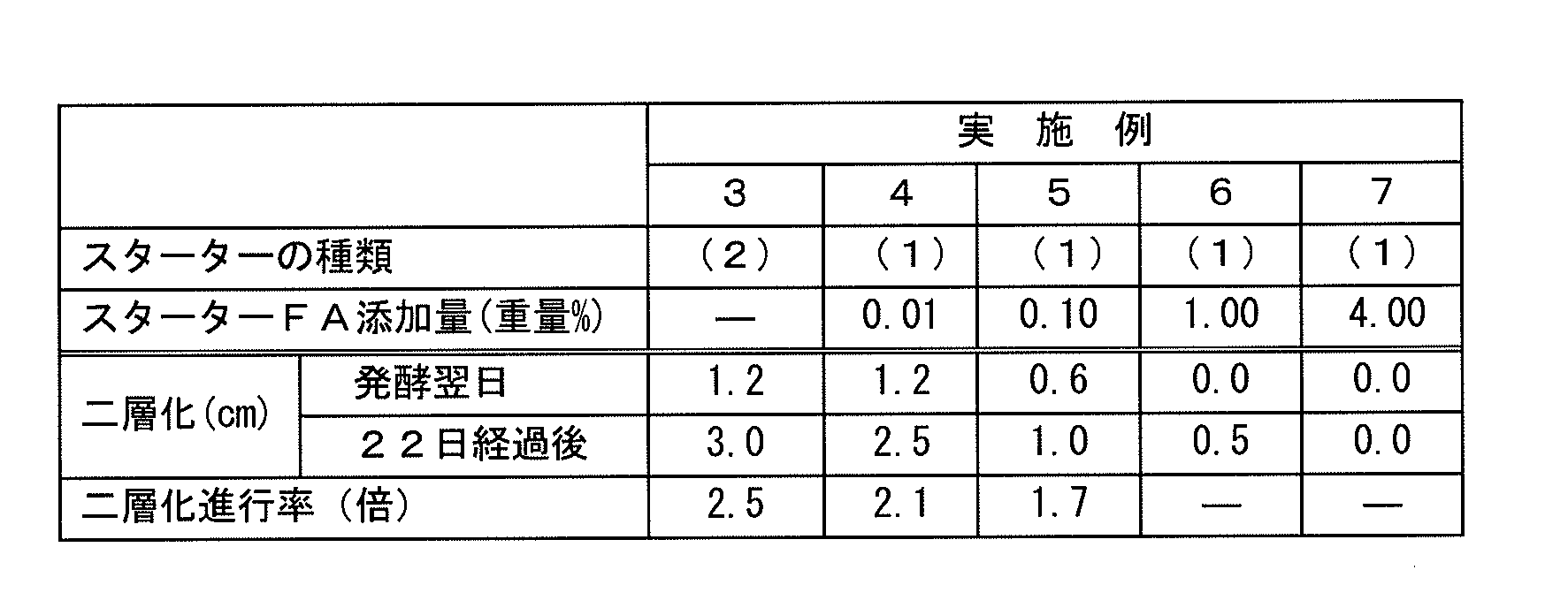
上記表2の結果から、実施例3、4では発酵翌日から上部凝集層が1cmを超えているのに対して、実施例5~7では、酢酸菌の添加量が増えるに従い薄くなり、22日後でも1cmを超えなかった。このことから酢酸菌の添加により上部凝集層の生成を抑制することが出来ると言える。また、その添加濃度は、0.1重量%以上で二層化の抑制に有効であり、4重量%で完全に二層化を抑制することができた。さらに、実施例5~7では、実施例3、4に比べ、経時により豆乳発酵物の色がくすんで灰色になるといった症状も抑えられる効果が得られた。
〔実施例8~11〕
<ラクトース添加量による酸度と離水量>
豆乳(無調整豆乳)に、ラクトースを後記の表3に記入した濃度で添加し、中性プロテアーゼ製剤(コクラーゼP、三菱化学フーズ社製)を10ppm添加した後、50℃で30分間保持して酵素反応を行い、80℃で20分間加熱しプロテアーゼを失活させた。このようにして得られた調合液900mlに対し、前記調製のスターター(1)を100ml加えて植菌し、上記調合液をよく振とうした後、摂氏25℃環境下で8時間培養して発酵を促し、目的とする豆乳発酵物を得た。
<ラクトース添加量による酸度と離水量>
豆乳(無調整豆乳)に、ラクトースを後記の表3に記入した濃度で添加し、中性プロテアーゼ製剤(コクラーゼP、三菱化学フーズ社製)を10ppm添加した後、50℃で30分間保持して酵素反応を行い、80℃で20分間加熱しプロテアーゼを失活させた。このようにして得られた調合液900mlに対し、前記調製のスターター(1)を100ml加えて植菌し、上記調合液をよく振とうした後、摂氏25℃環境下で8時間培養して発酵を促し、目的とする豆乳発酵物を得た。
このようにして得られた豆乳発酵物に関し下記の基準に従い、各特性の評価を行った。そして、これらの結果を後記の表3に併せて示した。
〔酸度〕
「乳及び乳製品の成分規格等に関する省令」の「乳等の成分規格の試験法」に書かれている酸度の測定方法に従い、豆乳発酵物の乳酸酸度(%)を測定した。なお、上記測定は、製造直後の豆乳発酵物(初期)と、それを10℃温度下で29日間保存した後のもの(放置後)に対して行った。
「乳及び乳製品の成分規格等に関する省令」の「乳等の成分規格の試験法」に書かれている酸度の測定方法に従い、豆乳発酵物の乳酸酸度(%)を測定した。なお、上記測定は、製造直後の豆乳発酵物(初期)と、それを10℃温度下で29日間保存した後のもの(放置後)に対して行った。
〔離水量〕
10℃温度下で29日間保存した豆乳発酵物の離水量(%)を、総重量に占める割合として測定した。
10℃温度下で29日間保存した豆乳発酵物の離水量(%)を、総重量に占める割合として測定した。
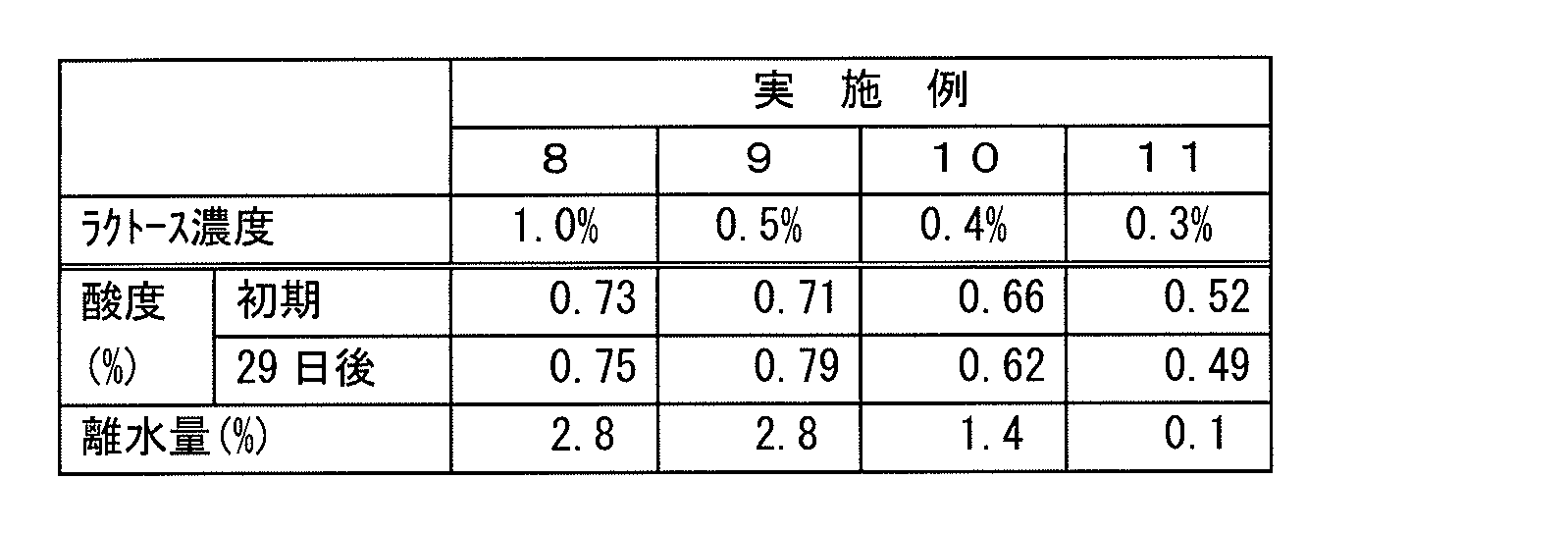
上記表3の結果から、ラクトースの濃度を制限することにより、経時による酸度や離水量の上昇を抑える効果が高いことがわかる。因みに、ラクトース濃度0.3%未満であるとカードを形成せず、また、ラクトース濃度が1.0%を上回ると甘味と酸味が強くなり好ましくない品質となった。
〔実施例12~14、比較例3~5、参考例1~12〕
<菌体外多糖類産生・非産生の乳酸菌での曳糸性比較>
下記の表4および表5に示すように、豆乳培地、牛乳培地のいずれかを用いた。なお、豆乳を培地とするものは、無調整豆乳に、ラクトース0.4%、グラニュー糖6.0%、粉末水飴1.0%を添加したものを、その培地とした。また、牛乳を培地とするものは、上記のような糖類を添加せず、その培地とした。そして、実施例および比較例では、下記の表4および表5に示すように、上記培地に、酵素処理を行った。上記酵素処理は、培地に、中性プロテアーゼ製剤(パンチダーゼNP-2、ヤクルト薬品工業社製)を100ppmになるように添加し、50℃で30分間反応させ、その後、80℃で20分加熱し、酵素失活と殺菌を行い、30℃まで冷却することにより、行った。このようにして得られた調合液900mlに対し、下記の表4および表5に示す乳酸菌を用いた各スターターを100ml加えて植菌し、上記調合液をよく振とうした後、クレモリス菌は摂氏25℃環境下で、サーモフィラス菌は摂氏35℃環境下でそれぞれ8時間培養して発酵を促し、目的とする発酵物を得、その発酵物の「曳糸性」を、前記曳糸性評価試験で行った液切れ時間(秒)と同様にして測定した。
<菌体外多糖類産生・非産生の乳酸菌での曳糸性比較>
下記の表4および表5に示すように、豆乳培地、牛乳培地のいずれかを用いた。なお、豆乳を培地とするものは、無調整豆乳に、ラクトース0.4%、グラニュー糖6.0%、粉末水飴1.0%を添加したものを、その培地とした。また、牛乳を培地とするものは、上記のような糖類を添加せず、その培地とした。そして、実施例および比較例では、下記の表4および表5に示すように、上記培地に、酵素処理を行った。上記酵素処理は、培地に、中性プロテアーゼ製剤(パンチダーゼNP-2、ヤクルト薬品工業社製)を100ppmになるように添加し、50℃で30分間反応させ、その後、80℃で20分加熱し、酵素失活と殺菌を行い、30℃まで冷却することにより、行った。このようにして得られた調合液900mlに対し、下記の表4および表5に示す乳酸菌を用いた各スターターを100ml加えて植菌し、上記調合液をよく振とうした後、クレモリス菌は摂氏25℃環境下で、サーモフィラス菌は摂氏35℃環境下でそれぞれ8時間培養して発酵を促し、目的とする発酵物を得、その発酵物の「曳糸性」を、前記曳糸性評価試験で行った液切れ時間(秒)と同様にして測定した。
なお、上記各スターターは、前記調製のスターター(1)に準じ、その乳酸菌として、下記の表4および表5に示す乳酸菌を用いて調製したものである。そして、下記の表4および表5に示す乳酸菌に関し、「クレモリスFC」は、前記調製のスターター(1)に使用の乳酸菌と同じものであり、「サーモフィラスFJST001」は、ストレプトコッカス サーモフィラスFJST001であり、「クレモリスFJCL001」は、ラクトコッカス ラクティス サブスピーシーズ クレモリスFJCL001である。これら三種の乳酸菌は、曳糸性菌体外多糖類を産生する乳酸菌である。また、下記の表に示す「クレモリスC4」は、ラクトコッカス ラクティス サブスピーシーズ クレモリスC4であり、「クレモリス基準株」は、ラクトコッカス ラクティス サブスピーシーズ クレモリスATCC19257(基準株)であり、これら二種の乳酸菌は、菌体外多糖類を産生しない乳酸菌である。また、下記の表に示す「サーモフィラスFJST002」は、ストレプトコッカス サーモフィラスFJST002であり、この乳酸菌は、曳糸性のない菌体外多糖類を産生する乳酸菌である。これらの菌株は、出願人により管理している菌株である。
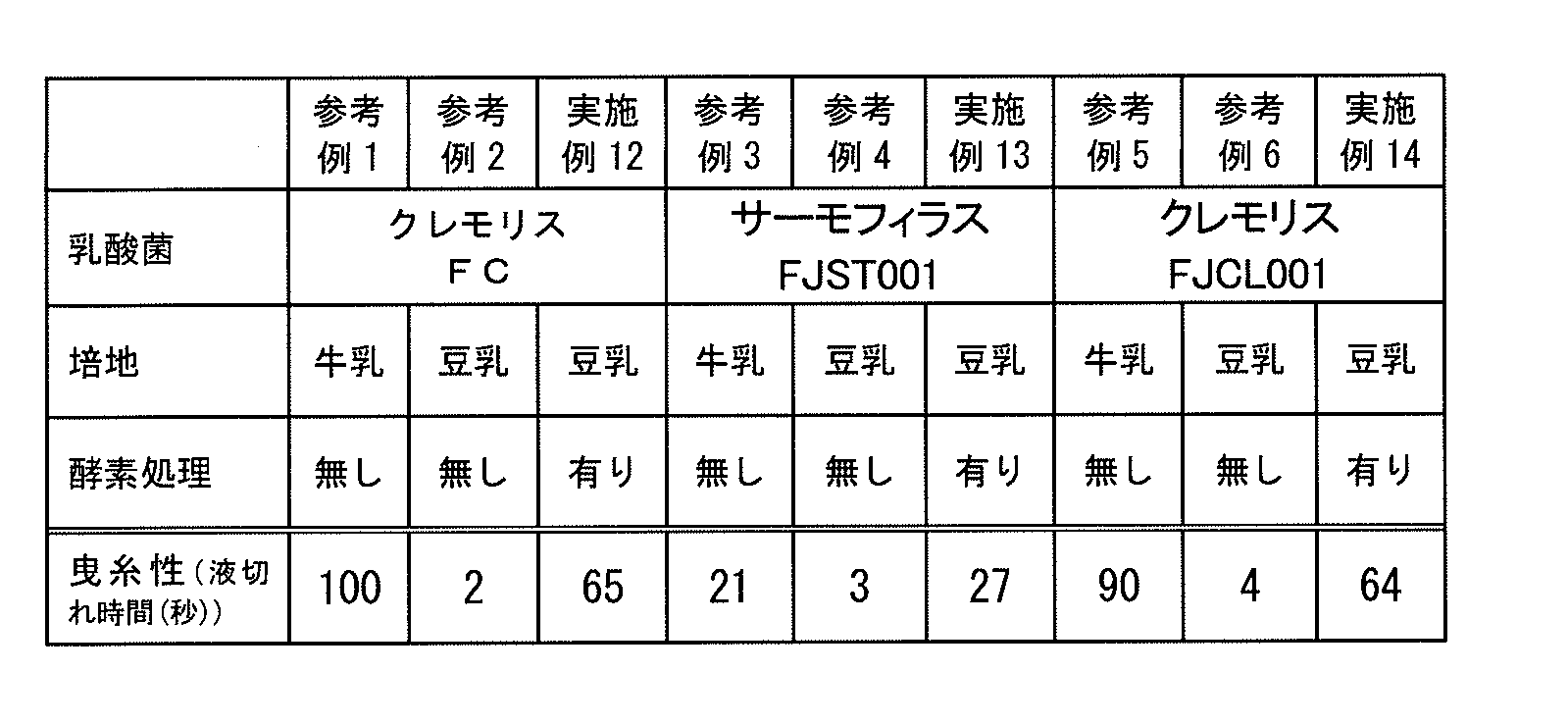
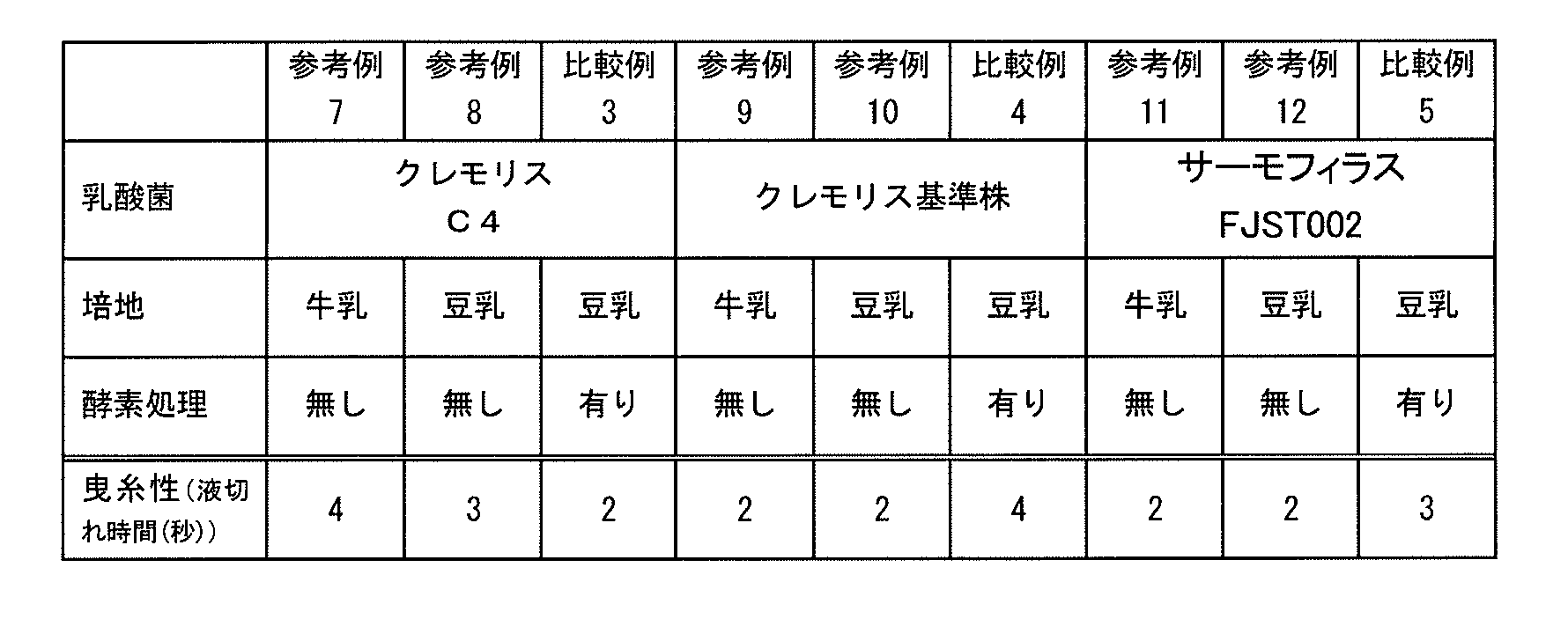
上記表4および表5の結果より、牛乳発酵において曳糸性菌体外多糖を産生する乳酸菌を使用した実施例12~14では、豆乳のプロテアーゼ処理により、高い曳糸性を示す豆乳発酵物が得られていることが、その参考例との液切れ時間の対比からわかる。これに対し、比較例3,4で使用の乳酸菌は、牛乳発酵において菌体外多糖の産生能を有しておらず、豆乳のプロテアーゼ処理を行っても、曳糸性を示す豆乳発酵物が得られないことが、その参考例との液切れ時間の対比からわかる。因みに、比較例5で使用の乳酸菌は、牛乳発酵において菌体外多糖を産生するが、その菌体外多糖は曳糸性を有するものではなく、豆乳のプロテアーゼ処理を行っても、その乳酸発酵により曳糸性を示す豆乳発酵物が得られないことがわかる。
なお、上記実施例においては、本発明における具体的な形態について示したが、上記実施例は単なる例示にすぎず、限定的に解釈されるものではない。当業者に明らかな様々な変形は、本発明の範囲内であることが企図されている。
本発明の豆乳発酵物の製法は、従来製法に比べ、粘性や曳糸性において高い改善効果が認められる豆乳発酵物を効果的に製造することができる。また、その製法により得られた豆乳発酵物は、粘度や曳糸性が高く、しかも、豆乳の青臭みや収斂味等の不快な味や臭いが著しく低減されていることから、呈味性にも優れている。また、上記豆乳発酵物は、菌体外多糖の含有量も多く、生理作用(整腸作用、免疫賦活作用等)にも優れている。さらに、上記豆乳発酵物は、長期保存による品質低下が少ないといった利点も有する。これらの特性を利用し、従来になかった食品や食材としての利用可能性を有している。
[規則26に基づく補充 11.04.2016]
Claims (6)
- 豆乳を乳酸菌により発酵させてなる豆乳発酵物の製法であって、豆乳に対し中性プロテアーゼによる酵素処理を行い、上記乳酸菌として、曳糸性菌体外多糖を産生する乳酸菌を用いて発酵させることを特徴とする豆乳発酵物の製法。
- 上記乳酸菌として、曳糸性菌体外多糖産生能を有するラクトコッカス ラクティス サブスピーシーズ クレモリスもしくはストレプトコッカス サーモフィラスを用いる、請求項1記載の豆乳発酵物の製法。
- 上記乳酸菌とともに酢酸菌を加えて発酵させる、請求項1または2記載の豆乳発酵物の製法。
- 上記豆乳中に糖類を加えた後、上記乳酸菌により発酵させる、請求項1~3のいずれか一項に記載の豆乳発酵物の製法。
- 請求項1~4のいずれか一項に記載の豆乳発酵物の製法により得られる豆乳発酵物であって、その10℃における粘度が4000~12000mPa・sであり、Zahn Cup使用における液切れ時間が10秒以上であることを特徴とする豆乳発酵物。
- 保存中の離水率が3%(総重量比)以下である、請求項5記載の豆乳発酵物。
Applications Claiming Priority (2)
| Application Number | Priority Date | Filing Date | Title |
|---|---|---|---|
| JP2015062251A JP6209177B2 (ja) | 2015-03-25 | 2015-03-25 | 曳糸性豆乳発酵物の製法 |
| JP2015-062251 | 2015-03-25 |
Publications (1)
| Publication Number | Publication Date |
|---|---|
| WO2016152590A1 true WO2016152590A1 (ja) | 2016-09-29 |
Family
ID=56978266
Family Applications (1)
| Application Number | Title | Priority Date | Filing Date |
|---|---|---|---|
| PCT/JP2016/057848 Ceased WO2016152590A1 (ja) | 2015-03-25 | 2016-03-11 | 豆乳発酵物の製法およびそれにより得られた豆乳発酵物 |
Country Status (2)
| Country | Link |
|---|---|
| JP (1) | JP6209177B2 (ja) |
| WO (1) | WO2016152590A1 (ja) |
Cited By (4)
| Publication number | Priority date | Publication date | Assignee | Title |
|---|---|---|---|---|
| JP2019198270A (ja) * | 2018-05-16 | 2019-11-21 | テーブルマーク株式会社 | 菌体外多糖生産性乳酸菌およびその利用 |
| WO2022251580A1 (en) * | 2021-05-28 | 2022-12-01 | Dupont Nutrition Biosciences Aps | Preparation of plant-based fermented products employing combination of microorganism and protease enzyme, preferably metalloprotease |
| WO2023027182A1 (ja) | 2021-08-27 | 2023-03-02 | 天野エンザイム株式会社 | 植物性発酵飲食品用改質剤 |
| CN119234968A (zh) * | 2024-12-04 | 2025-01-03 | 南京农业大学三亚研究院 | 一种酶解协同菌发酵制备的低敏大豆酸奶及其制备方法 |
Families Citing this family (1)
| Publication number | Priority date | Publication date | Assignee | Title |
|---|---|---|---|---|
| JP2023169759A (ja) * | 2022-05-17 | 2023-11-30 | 合同酒精株式会社 | ひよこ豆ミルク発酵乳の製造方法 |
Citations (5)
| Publication number | Priority date | Publication date | Assignee | Title |
|---|---|---|---|---|
| JPS5035364A (ja) * | 1973-07-30 | 1975-04-04 | ||
| JPH07147898A (ja) * | 1990-12-20 | 1995-06-13 | Ogawa Koryo Kk | 発酵豆乳調製物 |
| JP2004261174A (ja) * | 2003-02-13 | 2004-09-24 | Fujicco Co Ltd | 豆乳発酵物およびそれを用いた飲食品 |
| CN101283772B (zh) * | 2008-04-28 | 2012-04-11 | 天津科技大学 | 一种发酵法快速制备低盐腐乳的方法 |
| WO2013150887A1 (ja) * | 2012-04-05 | 2013-10-10 | サッポロホールディングス株式会社 | 豆乳発酵物及びその製造方法 |
-
2015
- 2015-03-25 JP JP2015062251A patent/JP6209177B2/ja active Active
-
2016
- 2016-03-11 WO PCT/JP2016/057848 patent/WO2016152590A1/ja not_active Ceased
Patent Citations (5)
| Publication number | Priority date | Publication date | Assignee | Title |
|---|---|---|---|---|
| JPS5035364A (ja) * | 1973-07-30 | 1975-04-04 | ||
| JPH07147898A (ja) * | 1990-12-20 | 1995-06-13 | Ogawa Koryo Kk | 発酵豆乳調製物 |
| JP2004261174A (ja) * | 2003-02-13 | 2004-09-24 | Fujicco Co Ltd | 豆乳発酵物およびそれを用いた飲食品 |
| CN101283772B (zh) * | 2008-04-28 | 2012-04-11 | 天津科技大学 | 一种发酵法快速制备低盐腐乳的方法 |
| WO2013150887A1 (ja) * | 2012-04-05 | 2013-10-10 | サッポロホールディングス株式会社 | 豆乳発酵物及びその製造方法 |
Non-Patent Citations (3)
| Title |
|---|
| CHIEN HSIANG-LIN ET AL.: "Transformation of isoflavone phytoestrogens during the fermentation of soymilk with lactic acid bacteria and bifidobacteria", FOOD MICROBIOLOGY, vol. 23, 2006, pages 772 - 778, XP024904367 * |
| KANEKO DAISUKE ET AL.: "Reduction of the Off- Flavor Volatile Generated by the Yogurt Starter Culture Including Streptococcus thermophilus and Lactobacillus delbrueckii subsp. bulgaricus in Soymilk", J. AGRIC. FOOD CHEM., vol. 62, 2014, pages 1628 - 1663, XP055219599 * |
| WAGAR, L.E. ET AL.: "Immunomodulatory Properties of Fermented Soy and Dairy Milks Prepared with Lactic Acid Bacteria", JOURNAL OF FOOD SCIENCE, vol. 74, no. 8, 2009, pages M423 - M430, XP055318149 * |
Cited By (6)
| Publication number | Priority date | Publication date | Assignee | Title |
|---|---|---|---|---|
| JP2019198270A (ja) * | 2018-05-16 | 2019-11-21 | テーブルマーク株式会社 | 菌体外多糖生産性乳酸菌およびその利用 |
| JP7146187B2 (ja) | 2018-05-16 | 2022-10-04 | テーブルマーク株式会社 | 菌体外多糖生産性乳酸菌およびその利用 |
| WO2022251580A1 (en) * | 2021-05-28 | 2022-12-01 | Dupont Nutrition Biosciences Aps | Preparation of plant-based fermented products employing combination of microorganism and protease enzyme, preferably metalloprotease |
| CN118076233A (zh) * | 2021-05-28 | 2024-05-24 | 国际N&H丹麦有限公司 | 采用微生物和蛋白酶、优选金属蛋白酶的组合的基于植物的发酵产品的制备 |
| WO2023027182A1 (ja) | 2021-08-27 | 2023-03-02 | 天野エンザイム株式会社 | 植物性発酵飲食品用改質剤 |
| CN119234968A (zh) * | 2024-12-04 | 2025-01-03 | 南京农业大学三亚研究院 | 一种酶解协同菌发酵制备的低敏大豆酸奶及其制备方法 |
Also Published As
| Publication number | Publication date |
|---|---|
| JP2016178911A (ja) | 2016-10-13 |
| JP6209177B2 (ja) | 2017-10-04 |
Similar Documents
| Publication | Publication Date | Title |
|---|---|---|
| EP4101305B1 (en) | Preparation method of a walnut yogurt | |
| CN102150766B (zh) | 黄瓜发酵液与谷氨酰胺转胺酶复合凝固剂加工豆腐的方法 | |
| JP6209177B2 (ja) | 曳糸性豆乳発酵物の製法 | |
| JP6029150B2 (ja) | 澱粉由来ヨーグルト様飲料の製造方法 | |
| CN110200079A (zh) | 鹰嘴豆发酵乳及其制备方法 | |
| JP7738602B2 (ja) | 米糠乳酸菌発酵物の粘性増加方法 | |
| TWI757448B (zh) | 含有乳酸菌粉末與高甜度甜味料之飲料、該飲料之製造方法、改善該飲料之風味之方法、及該飲料用風味改善劑 | |
| JP2011167190A (ja) | 豆乳発酵乳酸菌飲料及びこの製造方法 | |
| CN108514059A (zh) | 发酵型猕猴桃果浆及其制作方法 | |
| JP6777606B2 (ja) | 大豆粉を使用した乳酸菌発酵物の製造方法 | |
| CN118872787A (zh) | 一种益生菌发酵果蔬饮料的制备方法 | |
| CN109892390A (zh) | 一种低糖高乳酸菌活性的褐色发酵型含乳饮料制备方法 | |
| JP3878953B2 (ja) | ヨーグルトの製法およびそれにより得られたヨーグルト | |
| CN108041383B (zh) | 一种具有银耳典型性风味的高营养银耳饮料及其制备方法 | |
| JP2016178911A5 (ja) | 曳糸性豆乳発酵物の製法およびそれにより得られた曳糸性豆乳発酵物 | |
| CN114032192B (zh) | 一种减弱豆腥味的直投式发酵剂及其制备方法与应用 | |
| CN101356939A (zh) | 生产发酵乳的方法 | |
| JPWO2007052806A1 (ja) | Gaba含有発酵物の製造方法 | |
| JP2015192632A (ja) | 豆乳発酵物の製造方法およびそれにより得られた豆乳発酵物ならびにそれに用いられる発酵用組成物 | |
| CN104711208B (zh) | 一种具有高的淀粉分解能力的乳酸菌 | |
| JPWO2006043478A1 (ja) | 乳酸菌発酵豆乳およびその製造法 | |
| JP5060431B2 (ja) | 乳発酵食品の製法およびそれにより得られた乳発酵食品 | |
| JP2017153458A (ja) | 大豆粉を使用した乳酸菌発酵物の製造方法 | |
| JP2007037503A (ja) | 新規微生物、この新規微生物による発酵物、及びこの発酵物が含まれる飲食品 | |
| CN113875811A (zh) | 一种含有罗伊氏乳杆菌的发酵乳及其制备方法 |
Legal Events
| Date | Code | Title | Description |
|---|---|---|---|
| 121 | Ep: the epo has been informed by wipo that ep was designated in this application |
Ref document number: 16768493 Country of ref document: EP Kind code of ref document: A1 |
|
| NENP | Non-entry into the national phase |
Ref country code: DE |
|
| 122 | Ep: pct application non-entry in european phase |
Ref document number: 16768493 Country of ref document: EP Kind code of ref document: A1 |