WO2016151841A1 - タイヤトレッド用ゴム組成物 - Google Patents
タイヤトレッド用ゴム組成物 Download PDFInfo
- Publication number
- WO2016151841A1 WO2016151841A1 PCT/JP2015/059378 JP2015059378W WO2016151841A1 WO 2016151841 A1 WO2016151841 A1 WO 2016151841A1 JP 2015059378 W JP2015059378 W JP 2015059378W WO 2016151841 A1 WO2016151841 A1 WO 2016151841A1
- Authority
- WO
- WIPO (PCT)
- Prior art keywords
- rubber
- rubber composition
- weight
- tire tread
- compound
- Prior art date
- Legal status (The legal status is an assumption and is not a legal conclusion. Google has not performed a legal analysis and makes no representation as to the accuracy of the status listed.)
- Ceased
Links
Images

Classifications
-
- C—CHEMISTRY; METALLURGY
- C08—ORGANIC MACROMOLECULAR COMPOUNDS; THEIR PREPARATION OR CHEMICAL WORKING-UP; COMPOSITIONS BASED THEREON
- C08L—COMPOSITIONS OF MACROMOLECULAR COMPOUNDS
- C08L9/00—Compositions of homopolymers or copolymers of conjugated diene hydrocarbons
-
- B—PERFORMING OPERATIONS; TRANSPORTING
- B60—VEHICLES IN GENERAL
- B60C—VEHICLE TYRES; TYRE INFLATION; TYRE CHANGING; CONNECTING VALVES TO INFLATABLE ELASTIC BODIES IN GENERAL; DEVICES OR ARRANGEMENTS RELATED TO TYRES
- B60C1/00—Tyres characterised by the chemical composition or the physical arrangement or mixture of the composition
-
- B—PERFORMING OPERATIONS; TRANSPORTING
- B60—VEHICLES IN GENERAL
- B60C—VEHICLE TYRES; TYRE INFLATION; TYRE CHANGING; CONNECTING VALVES TO INFLATABLE ELASTIC BODIES IN GENERAL; DEVICES OR ARRANGEMENTS RELATED TO TYRES
- B60C1/00—Tyres characterised by the chemical composition or the physical arrangement or mixture of the composition
- B60C1/0016—Compositions of the tread
-
- B—PERFORMING OPERATIONS; TRANSPORTING
- B60—VEHICLES IN GENERAL
- B60C—VEHICLE TYRES; TYRE INFLATION; TYRE CHANGING; CONNECTING VALVES TO INFLATABLE ELASTIC BODIES IN GENERAL; DEVICES OR ARRANGEMENTS RELATED TO TYRES
- B60C11/00—Tyre tread bands; Tread patterns; Anti-skid inserts
- B60C11/0008—Tyre tread bands; Tread patterns; Anti-skid inserts characterised by the tread rubber
-
- C—CHEMISTRY; METALLURGY
- C08—ORGANIC MACROMOLECULAR COMPOUNDS; THEIR PREPARATION OR CHEMICAL WORKING-UP; COMPOSITIONS BASED THEREON
- C08J—WORKING-UP; GENERAL PROCESSES OF COMPOUNDING; AFTER-TREATMENT NOT COVERED BY SUBCLASSES C08B, C08C, C08F, C08G or C08H
- C08J3/00—Processes of treating or compounding macromolecular substances
- C08J3/20—Compounding polymers with additives, e.g. colouring
- C08J3/22—Compounding polymers with additives, e.g. colouring using masterbatch techniques
-
- C—CHEMISTRY; METALLURGY
- C08—ORGANIC MACROMOLECULAR COMPOUNDS; THEIR PREPARATION OR CHEMICAL WORKING-UP; COMPOSITIONS BASED THEREON
- C08J—WORKING-UP; GENERAL PROCESSES OF COMPOUNDING; AFTER-TREATMENT NOT COVERED BY SUBCLASSES C08B, C08C, C08F, C08G or C08H
- C08J3/00—Processes of treating or compounding macromolecular substances
- C08J3/20—Compounding polymers with additives, e.g. colouring
- C08J3/22—Compounding polymers with additives, e.g. colouring using masterbatch techniques
- C08J3/226—Compounding polymers with additives, e.g. colouring using masterbatch techniques using a polymer as a carrier
-
- C—CHEMISTRY; METALLURGY
- C08—ORGANIC MACROMOLECULAR COMPOUNDS; THEIR PREPARATION OR CHEMICAL WORKING-UP; COMPOSITIONS BASED THEREON
- C08J—WORKING-UP; GENERAL PROCESSES OF COMPOUNDING; AFTER-TREATMENT NOT COVERED BY SUBCLASSES C08B, C08C, C08F, C08G or C08H
- C08J9/00—Working-up of macromolecular substances to porous or cellular articles or materials; After-treatment thereof
- C08J9/0061—Working-up of macromolecular substances to porous or cellular articles or materials; After-treatment thereof characterized by the use of several polymeric components
-
- C—CHEMISTRY; METALLURGY
- C08—ORGANIC MACROMOLECULAR COMPOUNDS; THEIR PREPARATION OR CHEMICAL WORKING-UP; COMPOSITIONS BASED THEREON
- C08J—WORKING-UP; GENERAL PROCESSES OF COMPOUNDING; AFTER-TREATMENT NOT COVERED BY SUBCLASSES C08B, C08C, C08F, C08G or C08H
- C08J9/00—Working-up of macromolecular substances to porous or cellular articles or materials; After-treatment thereof
- C08J9/32—Working-up of macromolecular substances to porous or cellular articles or materials; After-treatment thereof from compositions containing microballoons, e.g. syntactic foams
-
- C—CHEMISTRY; METALLURGY
- C08—ORGANIC MACROMOLECULAR COMPOUNDS; THEIR PREPARATION OR CHEMICAL WORKING-UP; COMPOSITIONS BASED THEREON
- C08K—Use of inorganic or non-macromolecular organic substances as compounding ingredients
- C08K3/00—Use of inorganic substances as compounding ingredients
- C08K3/34—Silicon-containing compounds
- C08K3/36—Silica
-
- C—CHEMISTRY; METALLURGY
- C08—ORGANIC MACROMOLECULAR COMPOUNDS; THEIR PREPARATION OR CHEMICAL WORKING-UP; COMPOSITIONS BASED THEREON
- C08K—Use of inorganic or non-macromolecular organic substances as compounding ingredients
- C08K5/00—Use of organic ingredients
- C08K5/04—Oxygen-containing compounds
- C08K5/14—Peroxides
-
- C—CHEMISTRY; METALLURGY
- C08—ORGANIC MACROMOLECULAR COMPOUNDS; THEIR PREPARATION OR CHEMICAL WORKING-UP; COMPOSITIONS BASED THEREON
- C08K—Use of inorganic or non-macromolecular organic substances as compounding ingredients
- C08K7/00—Use of ingredients characterised by shape
- C08K7/22—Expanded, porous or hollow particles
-
- C—CHEMISTRY; METALLURGY
- C08—ORGANIC MACROMOLECULAR COMPOUNDS; THEIR PREPARATION OR CHEMICAL WORKING-UP; COMPOSITIONS BASED THEREON
- C08K—Use of inorganic or non-macromolecular organic substances as compounding ingredients
- C08K9/00—Use of pretreated ingredients
- C08K9/10—Encapsulated ingredients
-
- C—CHEMISTRY; METALLURGY
- C08—ORGANIC MACROMOLECULAR COMPOUNDS; THEIR PREPARATION OR CHEMICAL WORKING-UP; COMPOSITIONS BASED THEREON
- C08L—COMPOSITIONS OF MACROMOLECULAR COMPOUNDS
- C08L15/00—Compositions of rubber derivatives
-
- C—CHEMISTRY; METALLURGY
- C08—ORGANIC MACROMOLECULAR COMPOUNDS; THEIR PREPARATION OR CHEMICAL WORKING-UP; COMPOSITIONS BASED THEREON
- C08L—COMPOSITIONS OF MACROMOLECULAR COMPOUNDS
- C08L7/00—Compositions of natural rubber
-
- C—CHEMISTRY; METALLURGY
- C08—ORGANIC MACROMOLECULAR COMPOUNDS; THEIR PREPARATION OR CHEMICAL WORKING-UP; COMPOSITIONS BASED THEREON
- C08L—COMPOSITIONS OF MACROMOLECULAR COMPOUNDS
- C08L83/00—Compositions of macromolecular compounds obtained by reactions forming in the main chain of the macromolecule a linkage containing silicon with or without sulfur, nitrogen, oxygen or carbon only; Compositions of derivatives of such polymers
- C08L83/04—Polysiloxanes
-
- C—CHEMISTRY; METALLURGY
- C08—ORGANIC MACROMOLECULAR COMPOUNDS; THEIR PREPARATION OR CHEMICAL WORKING-UP; COMPOSITIONS BASED THEREON
- C08J—WORKING-UP; GENERAL PROCESSES OF COMPOUNDING; AFTER-TREATMENT NOT COVERED BY SUBCLASSES C08B, C08C, C08F, C08G or C08H
- C08J2201/00—Foams characterised by the foaming process
- C08J2201/02—Foams characterised by the foaming process characterised by mechanical pre- or post-treatments
- C08J2201/024—Preparation or use of a blowing agent concentrate, i.e. masterbatch in a foamable composition
-
- C—CHEMISTRY; METALLURGY
- C08—ORGANIC MACROMOLECULAR COMPOUNDS; THEIR PREPARATION OR CHEMICAL WORKING-UP; COMPOSITIONS BASED THEREON
- C08J—WORKING-UP; GENERAL PROCESSES OF COMPOUNDING; AFTER-TREATMENT NOT COVERED BY SUBCLASSES C08B, C08C, C08F, C08G or C08H
- C08J2201/00—Foams characterised by the foaming process
- C08J2201/02—Foams characterised by the foaming process characterised by mechanical pre- or post-treatments
- C08J2201/026—Crosslinking before of after foaming
-
- C—CHEMISTRY; METALLURGY
- C08—ORGANIC MACROMOLECULAR COMPOUNDS; THEIR PREPARATION OR CHEMICAL WORKING-UP; COMPOSITIONS BASED THEREON
- C08J—WORKING-UP; GENERAL PROCESSES OF COMPOUNDING; AFTER-TREATMENT NOT COVERED BY SUBCLASSES C08B, C08C, C08F, C08G or C08H
- C08J2203/00—Foams characterized by the expanding agent
- C08J2203/22—Expandable microspheres, e.g. Expancel®
-
- C—CHEMISTRY; METALLURGY
- C08—ORGANIC MACROMOLECULAR COMPOUNDS; THEIR PREPARATION OR CHEMICAL WORKING-UP; COMPOSITIONS BASED THEREON
- C08J—WORKING-UP; GENERAL PROCESSES OF COMPOUNDING; AFTER-TREATMENT NOT COVERED BY SUBCLASSES C08B, C08C, C08F, C08G or C08H
- C08J2307/00—Characterised by the use of natural rubber
-
- C—CHEMISTRY; METALLURGY
- C08—ORGANIC MACROMOLECULAR COMPOUNDS; THEIR PREPARATION OR CHEMICAL WORKING-UP; COMPOSITIONS BASED THEREON
- C08J—WORKING-UP; GENERAL PROCESSES OF COMPOUNDING; AFTER-TREATMENT NOT COVERED BY SUBCLASSES C08B, C08C, C08F, C08G or C08H
- C08J2309/00—Characterised by the use of homopolymers or copolymers of conjugated diene hydrocarbons
-
- C—CHEMISTRY; METALLURGY
- C08—ORGANIC MACROMOLECULAR COMPOUNDS; THEIR PREPARATION OR CHEMICAL WORKING-UP; COMPOSITIONS BASED THEREON
- C08J—WORKING-UP; GENERAL PROCESSES OF COMPOUNDING; AFTER-TREATMENT NOT COVERED BY SUBCLASSES C08B, C08C, C08F, C08G or C08H
- C08J2383/00—Characterised by the use of macromolecular compounds obtained by reactions forming in the main chain of the macromolecule a linkage containing silicon with or without sulfur, nitrogen, oxygen, or carbon only; Derivatives of such polymers
- C08J2383/04—Polysiloxanes
-
- C—CHEMISTRY; METALLURGY
- C08—ORGANIC MACROMOLECULAR COMPOUNDS; THEIR PREPARATION OR CHEMICAL WORKING-UP; COMPOSITIONS BASED THEREON
- C08J—WORKING-UP; GENERAL PROCESSES OF COMPOUNDING; AFTER-TREATMENT NOT COVERED BY SUBCLASSES C08B, C08C, C08F, C08G or C08H
- C08J2483/00—Characterised by the use of macromolecular compounds obtained by reactions forming in the main chain of the macromolecule a linkage containing silicon with or without sulfur, nitrogen, oxygen, or carbon only; Derivatives of such polymers
- C08J2483/04—Polysiloxanes
Definitions
- the present invention relates to a rubber composition for a tire tread in which the friction performance on ice is improved from the conventional level in a rubber composition containing thermally expandable microcapsules.
- the structure of pneumatic tires for snow and snow is that many bubbles are formed in the tread rubber, and when the tread steps on the ice surface, these bubbles absorb and remove the water film on the ice surface, and the tread becomes the ice surface. It is known that the performance on ice is improved by repeatedly removing the absorbed water by centrifugal force when leaving the vehicle.
- Patent Document 1 proposes blending a thermally expandable microcapsule with a rubber composition for a tire tread as means for forming such bubbles.
- This thermally expandable microcapsule expands by heating in the vulcanization process of the pneumatic tire, and forms a large number of bubbles (hollow particles) covered in the shell of the expanded microcapsule in the tread rubber of the vulcanized tire.
- An object of the present invention is to provide a rubber composition for a tire tread in which the friction performance on ice is improved from a conventional level in a rubber composition containing thermally expandable microcapsules.
- the rubber composition for a tire tread of the present invention that achieves the above object comprises 1 to 20 parts by weight of a millable silicone rubber compound and 0.2 to 20 parts by weight of thermally expandable microcapsules in 100 parts by weight of a diene rubber.
- the millable silicone rubber compound contains silica.
- the method for producing a rubber composition for a tire tread according to the present invention is characterized in that the millable silicone rubber compound and the thermally expandable microcapsule are mixed in advance to prepare a master batch, and the master batch is mixed with the diene rubber.
- the rubber composition for tire treads of the present invention contains both a millable silicone rubber compound and a thermally expandable microcapsule
- the tire contact containing the millable silicone rubber compound is formed on the tread surface when vulcanized.
- Bubbles (shells of hollow particles) in which the thermally expandable microcapsules are expanded are formed on the ground. Since water repellency is imparted to the tire ground contact surface by hydrophobic silicone rubber, when the tread is stepped on the ice water surface, the water film on the ice water surface is easily absorbed by the bubbles. Thereby, the water removal performance of the tread surface can be increased, and the friction performance on ice can be improved to a level higher than the conventional level.
- This tire tread rubber composition has a weight ratio (X / Y) between the blending amount (X) of the millable silicone rubber compound and the blending amount (Y) of the thermally expandable microcapsule, 20/80 to 90. / 10 is recommended. Furthermore, it is preferable to mix a peroxide-based crosslinking agent, and the friction performance on ice can be further increased.
- the rubber hardness of the millable silicone rubber compound is preferably 10 to 50, and is 5 to 40 lower than the rubber hardness of the base rubber obtained by omitting the millable silicone rubber compound and the thermally expandable microcapsule from the rubber composition. It is preferable.
- the master batch in which the millable silicone rubber compound and the thermally expandable microcapsule are mixed is mixed with the diene rubber, the friction performance on ice is further enhanced. can do.
- blend a peroxide type crosslinking agent.
- the pneumatic tire using the rubber composition for a tire tread of the present invention in the tread portion has excellent performance as a studless tire, and can particularly improve the friction performance on ice.
- FIG. 1 is a partial cross-sectional view in the tire meridian direction showing an example of an embodiment of a pneumatic tire using the rubber composition for a tire tread of the present invention.
- FIG. 1 shows an example of an embodiment of a pneumatic tire using a rubber composition for a tire tread.
- the pneumatic tire includes a tread portion 1, a sidewall portion 2, and a bead portion 3.
- the pneumatic tire has two carcass layers 4 in which reinforcing cords extending in the tire radial direction are arranged between the left and right bead portions 3 at predetermined intervals in the tire circumferential direction and embedded in a rubber layer.
- the both ends are folded back from the inner side in the tire axial direction so as to sandwich the bead filler 6 around the bead core 5 embedded in the bead part 3.
- An inner liner layer 7 is disposed inside the carcass layer 4.
- a belt cover layer 9 is disposed on the outer peripheral side of the belt layer 8.
- a tread portion 1 is formed of a tread rubber layer 12 on the outer peripheral side of the belt cover layer 9.
- the tread rubber layer 12 is preferably composed of the rubber composition for a tire tread of the present application.
- a side rubber layer 13 is disposed outside the carcass layer 4 of each sidewall portion 2, and a rim cushion rubber layer 14 is provided outside the folded portion of the carcass layer 4 of each bead portion 3.
- a studless tire is not limited to embodiment of the pneumatic tire illustrated in FIG.
- the diene rubber used may be a diene rubber that usually constitutes the tread portion of a studless tire.
- natural rubber, isoprene rubber, butadiene rubber, various styrene butadiene rubbers, butyl rubber, ethylene-propylene-diene rubber Etc. are exemplified.
- natural rubber, butadiene rubber, and styrene butadiene rubber are preferable, and natural rubber and / or butadiene rubber are more preferable.
- the friction performance on ice can be enhanced when a pneumatic tire is formed.
- the average glass transition temperature of the above-mentioned diene rubber is preferably ⁇ 50 ° C. or less, more preferably ⁇ 60 to ⁇ 100 ° C.
- the glass transition temperature is determined by differential scanning calorimetry (DSC) with a thermogram measured at a rate of temperature increase of 20 ° C./min and set as the temperature at the midpoint of the transition region.
- the glass transition temperature of the diene rubber in a state not containing an oil-extended component (oil) is used.
- the average glass transition temperature is a total (weighted average value of glass transition temperatures) obtained by multiplying the glass transition temperature of each diene rubber by the weight fraction of each diene rubber.
- the total weight fraction of all diene rubbers is 1.
- 0.2 to 20 parts by weight, preferably 1.0 to 18 parts by weight of thermally expandable microcapsules are blended with 100 parts by weight of the diene rubber described above. If the amount of the thermally expandable microcapsule is less than 0.2 parts by weight, the volume of the hollow particles (microcapsule shell) in which the thermally expandable microcapsule expanded during vulcanization is insufficient, and the friction performance on ice is sufficiently improved. Can not do it. Moreover, when the compounding quantity of a thermally expansible microcapsule exceeds 20 weight part, there exists a possibility that the abrasion resistance performance of a tread rubber may deteriorate.
- the thermally expandable microcapsule has a structure in which a thermally expandable substance is encapsulated in a shell material formed of a thermoplastic resin. For this reason, when vulcanizing and molding an unvulcanized tire, if the microcapsules dispersed in the rubber composition are heated, the thermally expandable substance contained in the shell material expands to increase the particle size of the shell material. A large number of hollow particles are formed in the tread rubber. As a result, the water film generated on the surface of the ice is efficiently absorbed and removed, and a micro edge effect is obtained, thereby improving the performance on ice. In addition, since the shell material of the microcapsule is harder than the tread rubber, the wear resistance of the tread portion can be increased.
- the shell material of the thermally expandable microcapsule can be formed of a nitrile polymer.
- the thermally expandable substance included in the shell material of the microcapsule has a property of being vaporized or expanded by heat, and examples thereof include at least one selected from the group consisting of hydrocarbons such as normal alkane and isoalkane.
- hydrocarbons such as normal alkane and isoalkane.
- isoalkanes include isobutane, isopentane, 2-methylpentane, 2-methylhexane, 2,2,4-trimethylpentane, etc.
- normal alkanes include n-butane, n-propane, n-hexane, Examples thereof include n-heptane and n-octane. These hydrocarbons may be used alone or in combination.
- the thermally expandable substance As a preferable form of the thermally expandable substance, a substance obtained by dissolving a hydrocarbon which is gaseous at normal temperature in a hydrocarbon which is liquid at normal temperature is preferable. By using such a mixture of hydrocarbons, a sufficient expansion force can be obtained from the low temperature region to the high temperature region in the vulcanization molding temperature region (150 to 190 ° C.) of the unvulcanized tire.
- the rubber composition for a tire tread of the present invention is blended with a millable silicone rubber compound together with the above-described thermally expandable microcapsules. Thereby, water repellency is imparted to the contact surface of the tire tread, and the water repelled by the tire tread is easily absorbed by the bubbles (shells of the microcapsules), and the friction performance on ice can be increased.
- the millable silicone rubber compound is a compound containing millable silicone rubber and silica.
- the millable silicone rubber is a silicone rubber that has plasticity and is cured by heating with a crosslinking agent other than the liquid silicone rubber.
- the weight average molecular weight of the millable silicone rubber is not particularly limited as long as the silicone rubber has plasticity, but is preferably 400,000 to 900,000, more preferably 450,000 to 850,000. In this specification, the weight average molecular weight of the millable silicone rubber was measured by GPC, and the weight average molecular weight was calculated in terms of standard polystyrene.
- millable silicone rubber By adding other compounding agents such as silica, reinforcing fillers other than silica, dispersants, stabilizers, etc. to millable silicone rubber, it gives appropriate rubber strength and rubber hardness to millable silicone rubber compound. be able to.
- compounding agents such as silica, reinforcing fillers other than silica, dispersants, stabilizers, etc.
- the blending amount of the millable type silicone rubber compound is 1 to 20 parts by weight, preferably 2 to 20 parts by weight, more preferably 2 to 18 parts by weight with respect to 100 parts by weight of the diene rubber.
- the blending amount of the millable silicone rubber compound is less than 1 part by weight, sufficient water repellency cannot be imparted to the tire tread rubber composition.
- the blending amount of the millable silicone rubber compound exceeds 20 parts by weight, the rubber strength of the rubber composition is lowered and the wear resistance is deteriorated.
- the weight ratio (X / Y) of the blending amount (X) of the millable silicone rubber compound to the blending amount (Y) of the thermally expandable microcapsule is 20/80 to 90/10, preferably 30/70 to 85 / 15.
- the weight ratio (X / Y) is smaller than 20/80, the water repellent effect is too small with respect to the number of bubbles (shells of hollow particles), and the effect on the performance on ice becomes small.
- the weight ratio (X / Y) is greater than 90/10, the water repellency is too strong for the bubbles (shells of the hollow particles), and the water film is hardly absorbed by the bubbles.
- the rubber hardness of the millable silicone rubber compound is preferably 10 to 50, more preferably 15 to 45. If the rubber hardness of the millable silicone rubber compound is less than 10, it is too soft and the wear resistance deteriorates. If the rubber hardness of the millable silicone rubber compound exceeds 50, the effect on ice performance is reduced due to the hardness.
- the rubber hardness of the millable type silicone rubber compound is a rubber hardness when a peroxide vulcanizing agent is blended and mixed and heat-cured, and it is 23 according to JIS K6253 according to durometer type A. The value measured at ° C.
- the rubber hardness of the millable silicone rubber compound is preferably lower than the rubber hardness of the base rubber of the rubber composition. That is, the base rubber is a rubber composition in which the millable silicone rubber compound and the thermally expandable microcapsule are omitted from the tire tread rubber composition of the present invention.
- the rubber hardness of the millable silicone rubber compound is preferably lower than the rubber hardness of the base rubber, and more preferably, the rubber hardness of the millable silicone rubber compound is 5 to 40 lower. Thereby, the followability to a road surface improves and it becomes easy to exhibit water repellency more.
- the rubber composition for a tire tread of the present invention is preferably formulated with a peroxide vulcanizing agent.
- a peroxide vulcanizing agent By blending a peroxide vulcanizing agent, the frictional performance on ice can be further increased.
- the amount of the peroxide vulcanizing agent is preferably 0.5 to 5.0% by weight, more preferably 1.0 to 4.5% by weight, based on the weight of the millable silicone rubber. When the amount of the peroxide vulcanizing agent is less than 0.5% by weight, the effect of the peroxide vulcanizing agent cannot be sufficiently obtained.
- group vulcanizing agent exceeds 5.0 weight%, the rubber composition for tire tread will become weak and abrasion resistance will deteriorate.
- the above-described method for producing a rubber composition for a tire tread can be performed in the same manner as when producing a rubber composition containing thermally expandable microcapsules. That is, a kneaded product prepared by mixing and kneading the heat-expandable microcapsules and other compounding agents excluding the vulcanizing compound with a diene rubber was prepared.
- a rubber composition for a tire tread can be prepared by mixing and mixing the capsule and the vulcanizing compound.
- the vulcanizing compound include a vulcanizing agent, a crosslinking agent, a vulcanization accelerator, and the like.
- a masterbatch is preferably prepared by previously mixing a millable silicone rubber compound and a thermally expandable microcapsule, and the masterbatch and diene rubber It is good to mix.
- the vulcanizing compounding agent may be mixed simultaneously with the masterbatch and the diene rubber, or may be further mixed thereafter.
- the weight ratio (X / Y) of the blended amount (X) of the millable silicone rubber compound and the thermally expandable microcapsule (Y) can be as described above.
- a peroxide vulcanizing agent can be added to this master batch.
- strength of silicone rubber rises and it can make friction performance on ice higher.
- the amount of the peroxide vulcanizing agent can be set as described above.
- the mixing conditions of the millable silicone rubber compound and the thermally expandable microcapsules are not particularly limited, and may be any conditions as long as the destruction of the thermally expandable microcapsules is suppressed and the thermal expansion does not occur.
- the temperature, the number of rotations, etc. can be appropriately determined so that the millable silicone rubber compound and the thermally expandable microcapsule are mixed almost uniformly.
- the kneading machine used for mixing the millable silicone rubber compound and the thermally expandable microcapsule is not particularly limited, and examples thereof include a Banbury mixer, a kneader, and a roll.
- the rubber composition for tire treads can contain fillers such as silica and carbon black.
- fillers such as silica and carbon black.
- the blending amount of the filler is preferably 10 to 100 parts by weight, more preferably 20 to 90 parts by weight with respect to 100 parts by weight of the diene rubber.
- the blending amount of the filler is less than 10 parts by weight, the rubber strength cannot be increased and the wear resistance performance cannot be improved.
- the amount of the filler exceeds 100 parts by weight, the rolling resistance of the tire tread rubber composition is deteriorated.
- a silane coupling agent When adding silica to the vulcanized rubber composition of the present invention, a silane coupling agent can be added. By compounding a silane coupling agent, the dispersibility of silica in the diene rubber can be improved and the reinforcement with the rubber can be enhanced.
- the amount of the silane coupling agent is preferably 3 to 15% by weight, more preferably 5 to 10% by weight, based on the amount of silica in the vulcanized rubber composition. If the amount of the silane coupling agent is less than 3% by weight of the amount of silica, the silica dispersion cannot be improved sufficiently. When the compounding amount of the silane coupling agent exceeds 15% by weight of the silica compounding amount, the silane coupling agents are condensed with each other, and a desired effect cannot be obtained.
- the type of the silane coupling agent is not particularly limited as long as it can be used for the rubber composition containing silica.
- bis- (3-triethoxysilylpropyl) tetrasulfide bis (3- Examples thereof include sulfur-containing silane coupling agents such as triethoxysilylpropyl) disulfide, 3-trimethoxysilylpropylbenzothiazole tetrasulfide, ⁇ -mercaptopropyltriethoxysilane, and 3-octanoylthiopropyltriethoxysilane.
- any filler that can be used for pneumatic tires can be used, for example, calcium carbonate, magnesium carbonate, talc, clay, alumina, aluminum hydroxide, titanium oxide. And calcium sulfate.
- tire rubber compositions for tire tread are generally used for tire rubber compositions such as vulcanization or crosslinking agents, vulcanization accelerators, anti-aging agents, plasticizers, processing aids, etc.
- Various additives can be blended.
- Such an additive can be kneaded by a general method to form an unvulcanized rubber composition, which can be used for vulcanization or crosslinking.
- a conventional general amount can be used.
- Such a rubber composition can be produced by mixing each of the above components using a known rubber kneading machine, for example, a Banbury mixer, a kneader, a roll or the like.
- the rubber composition for a tire tread of the present invention is suitable for constituting a tread portion of a studless tire.
- the tread portion configured as described above can improve the performance on ice to a level higher than the conventional level.
- Examples 1-9, Comparative Examples 1-6 A diene rubber, a filler and a compounding agent shown in Table 5 are used as a common compound, and 15 kinds of rubber compositions (Examples 1 to 9 and Comparative Examples 1 to 6) composed of the compounds shown in Tables 1 and 2 are combined with sulfur, Components other than the vulcanization accelerator, thermally expandable microcapsule, and silicone rubber compound are kneaded for 5 minutes in a 1.8 L closed mixer, discharged and cooled, and sulfur, vulcanization accelerator, thermally expandable microcapsule, An unvulcanized rubber composition was prepared by adding a silicone rubber compound and mixing with an open roll. In addition, the compounding quantity of each compounding agent described in Table 1, 2 was shown by the weight part with respect to 100 weight part of diene rubbers described in Table 5.
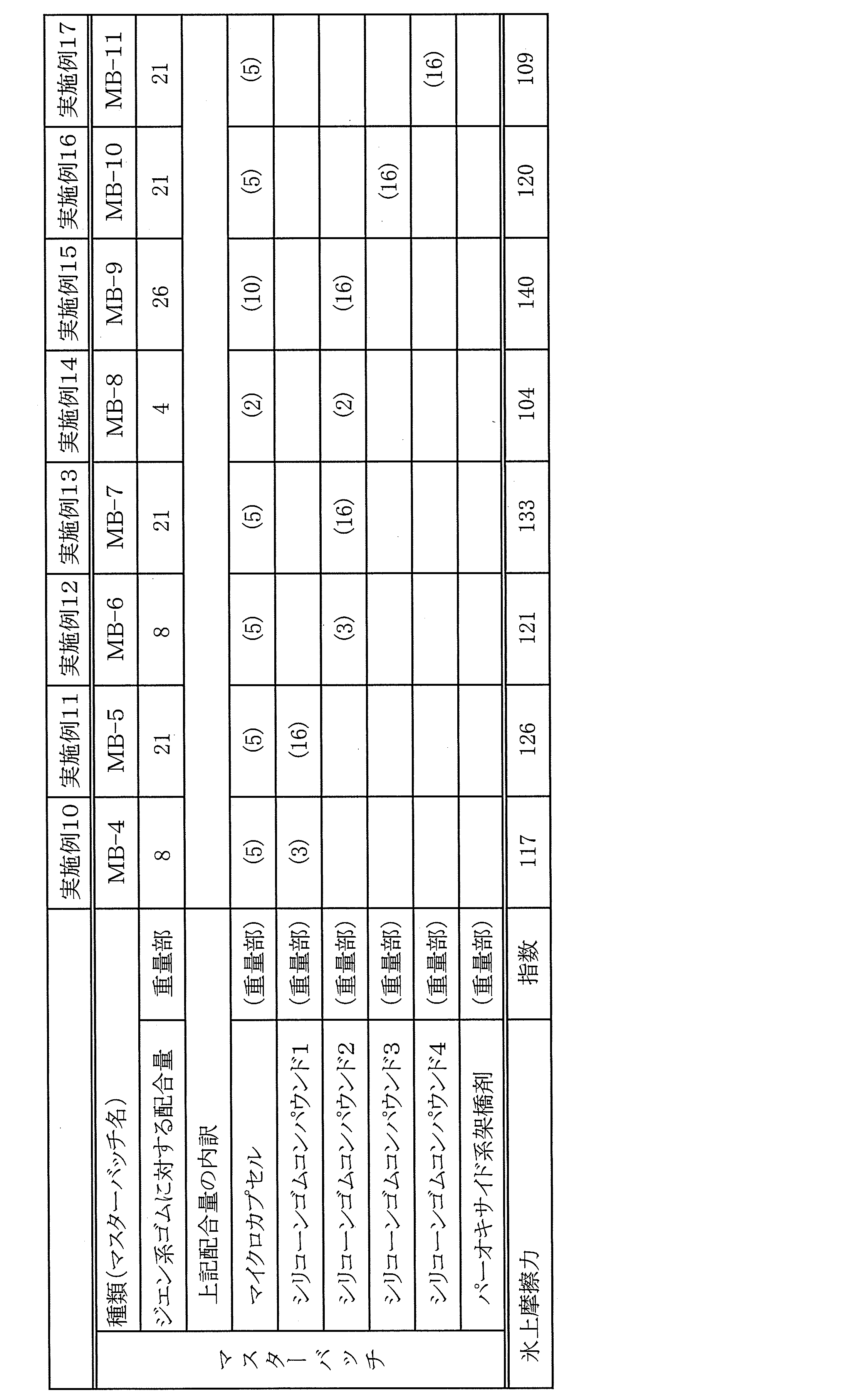
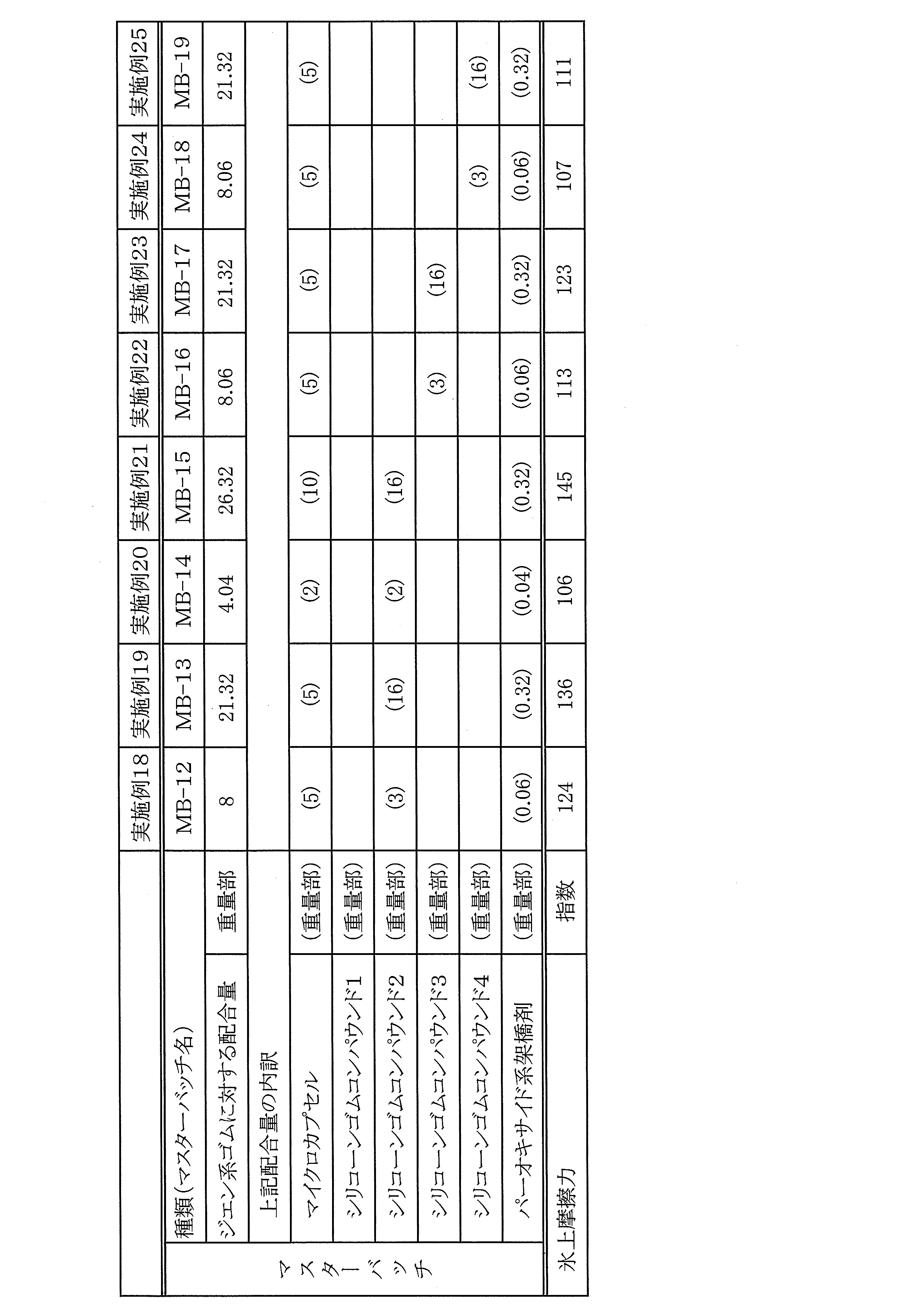
- Examples 10 to 25, Comparative Examples 7 to 9 19 kinds of master batches (MB-1 to 19) shown in Tables 1, 3 and 4 are prepared. Weighing so that the blending ratio shown in the breakdown column of each masterbatch blending is obtained, and mixing it at 100 ° C. or lower for 2.5 minutes using a 1.8 L sealed Banbury mixer, 19 kinds of A masterbatch was prepared.
- the obtained 44 types of rubber compositions were press vulcanized at 170 ° C. for 10 minutes in a predetermined mold to prepare vulcanized rubber test pieces made of a tire tread rubber composition.
- the friction performance on ice of the obtained vulcanized rubber test piece was evaluated by the following method.
- Friction performance on ice The obtained vulcanized rubber test piece was affixed to a flat cylindrical base rubber, and measured using an inside drum type on-ice friction tester at a measurement temperature of -1.5 ° C, a load of 5.5 kg / cm 3 , and a drum. The friction coefficient on ice was measured under the condition of a rotational speed of 25 km / h. The obtained friction coefficient on ice was shown in the column of “Friction performance on ice” in Tables 1 to 4, using the value of Comparative Example 1 as 100. A larger index value means a greater frictional force on ice and better performance on ice.
- the rubber composition of the common composition which consists of diene system rubber shown in Table 5, a filler, and a compounding agent, components except sulfur and a vulcanization accelerator are kneaded for 5 minutes with a 1.8L closed mixer, and it is discharged and cooled.
- An unvulcanized base rubber composition was prepared by adding sulfur and a vulcanization accelerator thereto and mixing with an open roll.
- the obtained rubber composition of the base rubber was press vulcanized at 170 ° C. for 10 minutes in a predetermined mold to prepare a vulcanized rubber test piece.
- the rubber hardness of the vulcanized rubber test piece of this base rubber was 50 when measured at a temperature of 23 ° C. with a durometer type A according to JIS K6253.
- Microcapsule Thermally expandable microcapsule (Microsphere F100) manufactured by Matsumoto Yushi Seiyaku Co., Ltd.
- Silicone rubber compound 1 Compound containing millable silicone rubber and silica, KE-500-U manufactured by Shin-Etsu Chemical Co., Ltd. The difference from rubber hardness is 27.
- Silicone rubber compound 2 Compound containing millable silicone rubber and silica, KE-922-U manufactured by Shin-Etsu Chemical Co., Ltd., rubber hardness when heat-cured with peroxide vulcanizing agent is 25, The difference from rubber hardness is 25.
- Silicone rubber compound 3 Compound containing millable silicone rubber and silica, KE-941-U manufactured by Shin-Etsu Chemical Co., Ltd., a rubber hardness of 43 when heated and cured using a peroxide vulcanizing agent Difference from rubber hardness is 7.
- Silicone rubber compound 4 Compound containing millable type silicone rubber and silica, KE-996-U manufactured by Shin-Etsu Chemical Co., Ltd., rubber hardness 63 when heated and cured using a peroxide vulcanizing agent. Difference from rubber hardness is -13.
- ⁇ Peroxide vulcanizing agent A product containing approximately 25% C-8,2,5-dimethyl-2,5-di (t-butylperoxy) hexane, manufactured by Shin-Etsu Chemical Co., Ltd.
Landscapes
- Chemical & Material Sciences (AREA)
- Health & Medical Sciences (AREA)
- Chemical Kinetics & Catalysis (AREA)
- Medicinal Chemistry (AREA)
- Polymers & Plastics (AREA)
- Organic Chemistry (AREA)
- Engineering & Computer Science (AREA)
- Mechanical Engineering (AREA)
- Materials Engineering (AREA)
- Tires In General (AREA)
- Compositions Of Macromolecular Compounds (AREA)
- Oil, Petroleum & Natural Gas (AREA)
Abstract
Description
表5に示すジエン系ゴム、充填剤及び配合剤を共通配合とし、表1、2に示す配合からなる15種類のゴム組成物(実施例1~9、比較例1~6)を、硫黄、加硫促進剤、熱膨張性マイクロカプセル、シリコーンゴムコンパウンドを除く成分を1.8Lの密閉型ミキサーで5分間混練し放出・冷却し、これに硫黄、加硫促進剤、熱膨張性マイクロカプセル、シリコーンゴムコンパウンドを加えてオープンロールで混合することにより未加硫のゴム組成物を調製した。なお表1、2に記載した各配合剤の配合量は、表5に記載したジエン系ゴム100重量部に対する重量部で示した。
表1,3および4に示す19種類のマスターバッチ(MB-1~19)を調製する。各マスターバッチ配合の内訳の欄に示した配合比になるように秤量し、これを1.8Lの密閉型バンバリーミキサーを用いて、2.5分間100℃以下で混合することにより、19種類のマスターバッチを調製した。
得られた加硫ゴム試験片を偏平円柱状の台ゴムに貼り付け、インサイドドラム型氷上摩擦試験機を用いて、測定温度-1.5℃、荷重5.5kg/cm3、ドラム回転速度25km/hの条件で氷上摩擦係数を測定した。得られた氷上摩擦係数を、比較例1の値を100とする指数にして、表1~4の「氷上摩擦性能」の欄に示した。この指数値が大きいほど氷上摩擦力が大きく氷上性能が優れることを意味する。

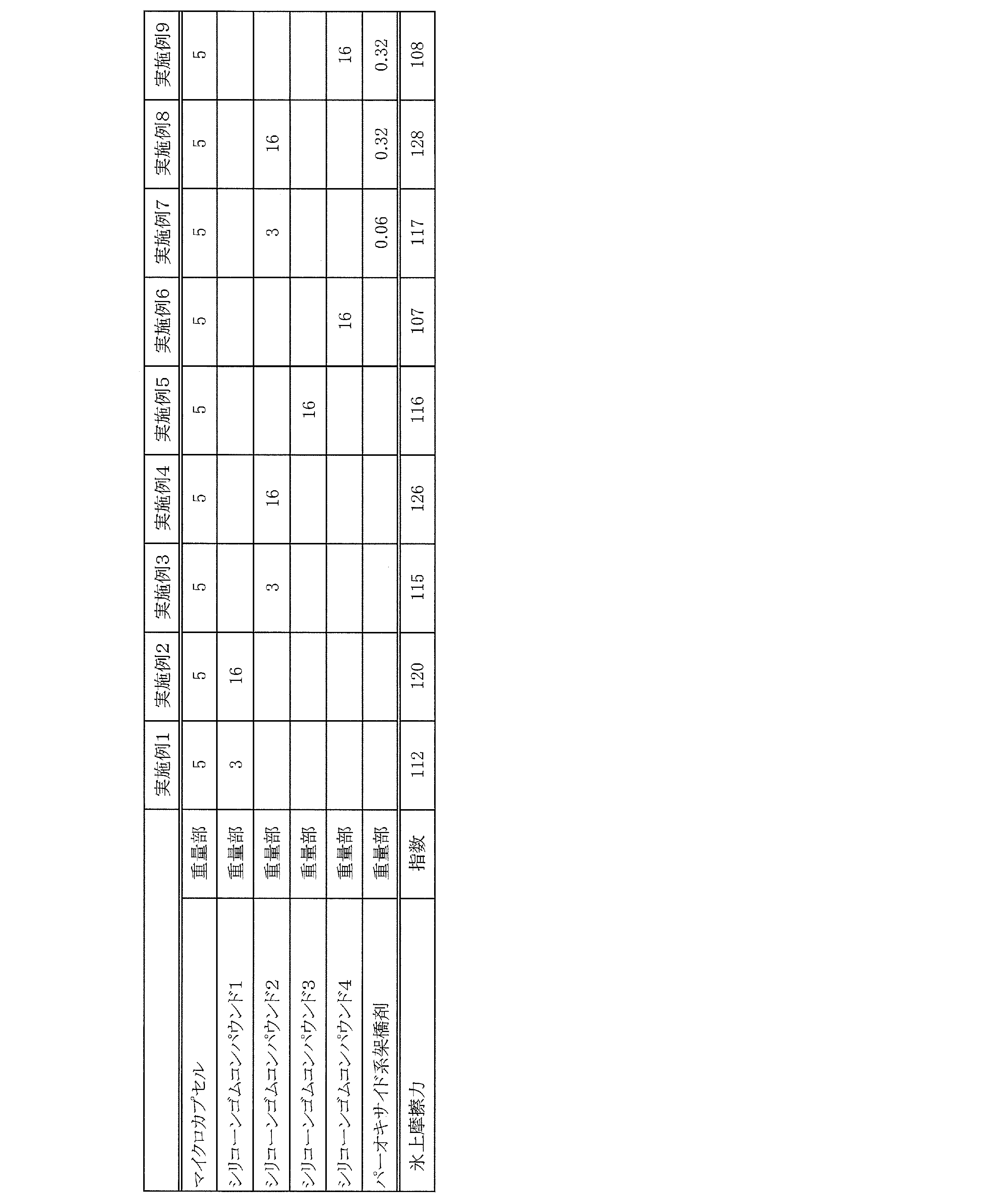
・マイクロカプセル:松本油脂製薬社製熱膨張性マイクロカプセル(マイクロスフェアF100)
・シリコーンゴムコンパウンド1:ミラブル型シリコーンゴムおよびシリカを含むコンパウンド、信越化学社製KE-500-U、パーオキサイド系加硫剤を用いて加熱硬化させたときのゴム硬度が23で、ベースゴムのゴム硬度との差が27。
・シリコーンゴムコンパウンド2:ミラブル型シリコーンゴムおよびシリカを含むコンパウンド、信越化学社製KE-922-U、パーオキサイド系加硫剤を用いて加熱硬化させたときのゴム硬度が25で、ベースゴムのゴム硬度との差が25。
・シリコーンゴムコンパウンド3:ミラブル型シリコーンゴムおよびシリカを含むコンパウンド、信越化学社製KE-941-U、パーオキサイド系加硫剤を用いて加熱硬化させたときのゴム硬度が43で、ベースゴムのゴム硬度との差が7。
・シリコーンゴムコンパウンド4:ミラブル型シリコーンゴムおよびシリカを含むコンパウンド、信越化学社製KE-961-U、パーオキサイド系加硫剤を用いて加熱硬化させたときのゴム硬度が63で、ベースゴムのゴム硬度との差が-13。
・パーオキサイド系加硫剤:信越化学社製C-8、2,5-ジメチル-2,5-ジ(t-ブチルパーオキシ)ヘキサンを約25%含有品
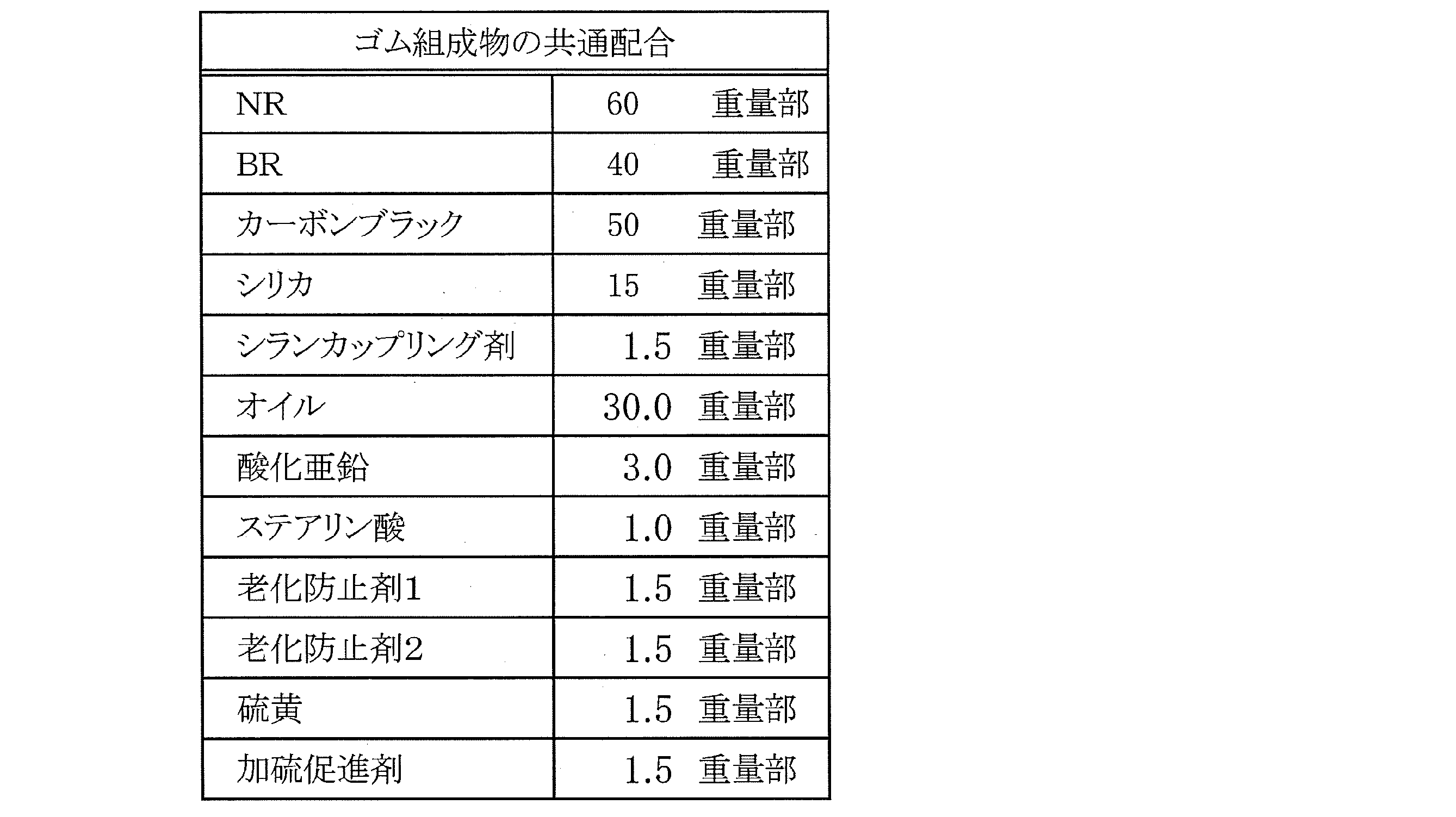
・NR:天然ゴム、RSS#3
・BR:ブタジエンゴム、日本ゼオン社製Nipol BR1220
・カーボンブラック:東海カーボン社製シースト6
・シリカ:日本シリカ工業社製Nipsil AQ
・シランカップリング剤:硫黄含有シランカップリング剤、デグサ社製Si69
・オイル:昭和シェル石油社製エキストラクト4号S
・酸化亜鉛:正同化学工業社製酸化亜鉛3種
・ステアリン酸:日油社製ビーズステアリン酸
・老化防止剤1:フレキシス社製6PPD
・老化防止剤2:大内新興化学工業社製ノクラック224
・硫黄:鶴見化学工業社製金華印油入微粉硫黄
・加硫促進剤:大内新興化学工業社製ノクセラーCZ-G
12 トレッドゴム層
Claims (8)
- ジエン系ゴム100重量部に、ミラブル型シリコーンゴムコンパウンドを1~20重量部、熱膨張性マイクロカプセルを0.2~20重量部配合したゴム組成物であって、前記ミラブル型シリコーンゴムコンパウンドがシリカを含むことを特徴とするタイヤトレッド用ゴム組成物。
- 前記ミラブル型シリコーンゴムコンパウンドの配合量(X)と前記熱膨張性マイクロカプセルの配合量(Y)との重量比(X/Y)が、20/80~90/10であることを特徴とする請求項1に記載のタイヤトレッド用ゴム組成物。
- さらに、パーオキサイド系架橋剤を配合することを特徴とする請求項1または2に記載のタイヤトレッド用ゴム組成物。
- 前記ミラブル型シリコーンゴムコンパウンドのゴム硬度が10~50であることを特徴とする請求項1~3のいずれかに記載のタイヤトレッド用ゴム組成物。
- 前記ミラブル型シリコーンゴムコンパウンドのゴム硬度が、前記ゴム組成物からミラブル型シリコーンゴムコンパウンドおよび熱膨張性マイクロカプセルを省いたベースゴムのゴム硬度よりも5~40低いことを特徴とする請求項1~4のいずれかに記載のタイヤトレッド用ゴム組成物。
- 請求項1~5のいずれかに記載のタイヤトレッド用ゴム組成物の製造方法であって、予め前記ミラブル型シリコーンゴムコンパウンドおよび熱膨張性マイクロカプセルを混合しマスターバッチを調製し、このマスターバッチを前記ジエン系ゴムと混合することを特徴とするタイヤトレッド用ゴム組成物の製造方法。
- 前記マスターバッチに、パーオキサイド系架橋剤を配合することを特徴とする請求項6に記載のタイヤトレッド用ゴム組成物の製造方法。
- 請求項1~5のいずれかに記載のタイヤトレッド用ゴム組成物でトレッド部を形成したスタッドレスタイヤ。
Priority Applications (6)
| Application Number | Priority Date | Filing Date | Title |
|---|---|---|---|
| CN201580077770.9A CN107735440B (zh) | 2015-03-26 | 2015-03-26 | 轮胎胎面用橡胶组合物 |
| US15/561,971 US10501608B2 (en) | 2015-03-26 | 2015-03-26 | Rubber composition for tire tread |
| RU2017135450A RU2676627C1 (ru) | 2015-03-26 | 2015-03-26 | Каучуковая композиция для протектора шины |
| PCT/JP2015/059378 WO2016151841A1 (ja) | 2015-03-26 | 2015-03-26 | タイヤトレッド用ゴム組成物 |
| DE112015006377.3T DE112015006377B4 (de) | 2015-03-26 | 2015-03-26 | Kautschukzusammensetzung für Reifenlauffläche, Verfahren zum Herstellen der Kautschukzusammensetzung, vulkanisiertes Produkt und dessen Verwendung in einem Laufflächenabschnitt |
| KR1020177018625A KR101906240B1 (ko) | 2015-03-26 | 2015-03-26 | 타이어 트레드용 고무 조성물 |
Applications Claiming Priority (1)
| Application Number | Priority Date | Filing Date | Title |
|---|---|---|---|
| PCT/JP2015/059378 WO2016151841A1 (ja) | 2015-03-26 | 2015-03-26 | タイヤトレッド用ゴム組成物 |
Publications (1)
| Publication Number | Publication Date |
|---|---|
| WO2016151841A1 true WO2016151841A1 (ja) | 2016-09-29 |
Family
ID=56977033
Family Applications (1)
| Application Number | Title | Priority Date | Filing Date |
|---|---|---|---|
| PCT/JP2015/059378 Ceased WO2016151841A1 (ja) | 2015-03-26 | 2015-03-26 | タイヤトレッド用ゴム組成物 |
Country Status (6)
| Country | Link |
|---|---|
| US (1) | US10501608B2 (ja) |
| KR (1) | KR101906240B1 (ja) |
| CN (1) | CN107735440B (ja) |
| DE (1) | DE112015006377B4 (ja) |
| RU (1) | RU2676627C1 (ja) |
| WO (1) | WO2016151841A1 (ja) |
Families Citing this family (1)
| Publication number | Priority date | Publication date | Assignee | Title |
|---|---|---|---|---|
| CN111763355B (zh) * | 2019-04-01 | 2023-01-31 | 北京化工大学 | 一种含硅橡胶的耐热氧老化胎侧胶及其制备方法 |
Citations (10)
| Publication number | Priority date | Publication date | Assignee | Title |
|---|---|---|---|---|
| JP2000026656A (ja) * | 1998-07-15 | 2000-01-25 | Sumitomo Rubber Ind Ltd | トレッドゴム組成物およびスタッドレスタイヤ |
| JP2002047378A (ja) * | 2000-08-01 | 2002-02-12 | Sumitomo Rubber Ind Ltd | タイヤ用トレッドゴム組成物 |
| JP2002114869A (ja) * | 2000-10-06 | 2002-04-16 | Toyo Tire & Rubber Co Ltd | タイヤ用ゴム組成物 |
| JP2002356584A (ja) * | 2001-03-28 | 2002-12-13 | Yokohama Rubber Co Ltd:The | タイヤ用ゴム組成物 |
| JP2003105138A (ja) * | 2001-09-28 | 2003-04-09 | Yokohama Rubber Co Ltd:The | 氷上性能が改良されたタイヤトレッド用ゴム組成物の製造方法 |
| JP2004035725A (ja) * | 2002-07-03 | 2004-02-05 | Yokohama Rubber Co Ltd:The | 改良された氷上摩擦力を有するゴム組成物及びそれを用いた空気入りタイヤ |
| JP2004210931A (ja) * | 2002-12-27 | 2004-07-29 | Yokohama Rubber Co Ltd:The | 改良された氷上摩擦力を有するゴム組成物及びそれを用いた空気入りタイヤ |
| WO2012023607A1 (ja) * | 2010-08-20 | 2012-02-23 | 横浜ゴム株式会社 | ゴム組成物および空気入りタイヤ |
| JP2012131920A (ja) * | 2010-12-22 | 2012-07-12 | Yokohama Rubber Co Ltd:The | タイヤ用ゴム組成物およびそれを用いた空気入りタイヤ |
| JP2014185339A (ja) * | 2013-02-25 | 2014-10-02 | Yokohama Rubber Co Ltd:The | スタッドレスタイヤ用ゴム組成物およびスタッドレスタイヤ |
Family Cites Families (9)
| Publication number | Priority date | Publication date | Assignee | Title |
|---|---|---|---|---|
| JP3475740B2 (ja) * | 1997-09-05 | 2003-12-08 | 信越化学工業株式会社 | 熱加硫型シリコーンゴムコンパウンドの製造方法 |
| JP4516182B2 (ja) * | 2000-05-25 | 2010-08-04 | 住友ゴム工業株式会社 | トレッド用ゴム組成物 |
| CA2352927C (en) | 2000-07-14 | 2008-03-18 | Sumitomo Rubber Industries, Ltd. | Rubber composition for tyre tread |
| US20020177650A1 (en) | 2001-03-28 | 2002-11-28 | Makio Mori | Rubber formulations for tire |
| US20040035725A1 (en) * | 2002-08-23 | 2004-02-26 | Joseph Smouha | Secure watchbox |
| JP4046678B2 (ja) | 2003-10-15 | 2008-02-13 | 横浜ゴム株式会社 | タイヤトレッド用ゴム組成物及びそれを用いた空気入りタイヤ |
| CN101273086A (zh) * | 2005-09-22 | 2008-09-24 | 可乐丽股份有限公司 | 橡胶组合物以及交联物 |
| JP5916457B2 (ja) * | 2012-03-23 | 2016-05-11 | 住友理工株式会社 | 絶縁性シリコーンゴム組成物 |
| JP6079830B2 (ja) * | 2015-07-02 | 2017-02-15 | 横浜ゴム株式会社 | タイヤトレッド用ゴム組成物 |
-
2015
- 2015-03-26 DE DE112015006377.3T patent/DE112015006377B4/de not_active Expired - Fee Related
- 2015-03-26 RU RU2017135450A patent/RU2676627C1/ru active
- 2015-03-26 KR KR1020177018625A patent/KR101906240B1/ko not_active Expired - Fee Related
- 2015-03-26 US US15/561,971 patent/US10501608B2/en not_active Expired - Fee Related
- 2015-03-26 WO PCT/JP2015/059378 patent/WO2016151841A1/ja not_active Ceased
- 2015-03-26 CN CN201580077770.9A patent/CN107735440B/zh active Active
Patent Citations (10)
| Publication number | Priority date | Publication date | Assignee | Title |
|---|---|---|---|---|
| JP2000026656A (ja) * | 1998-07-15 | 2000-01-25 | Sumitomo Rubber Ind Ltd | トレッドゴム組成物およびスタッドレスタイヤ |
| JP2002047378A (ja) * | 2000-08-01 | 2002-02-12 | Sumitomo Rubber Ind Ltd | タイヤ用トレッドゴム組成物 |
| JP2002114869A (ja) * | 2000-10-06 | 2002-04-16 | Toyo Tire & Rubber Co Ltd | タイヤ用ゴム組成物 |
| JP2002356584A (ja) * | 2001-03-28 | 2002-12-13 | Yokohama Rubber Co Ltd:The | タイヤ用ゴム組成物 |
| JP2003105138A (ja) * | 2001-09-28 | 2003-04-09 | Yokohama Rubber Co Ltd:The | 氷上性能が改良されたタイヤトレッド用ゴム組成物の製造方法 |
| JP2004035725A (ja) * | 2002-07-03 | 2004-02-05 | Yokohama Rubber Co Ltd:The | 改良された氷上摩擦力を有するゴム組成物及びそれを用いた空気入りタイヤ |
| JP2004210931A (ja) * | 2002-12-27 | 2004-07-29 | Yokohama Rubber Co Ltd:The | 改良された氷上摩擦力を有するゴム組成物及びそれを用いた空気入りタイヤ |
| WO2012023607A1 (ja) * | 2010-08-20 | 2012-02-23 | 横浜ゴム株式会社 | ゴム組成物および空気入りタイヤ |
| JP2012131920A (ja) * | 2010-12-22 | 2012-07-12 | Yokohama Rubber Co Ltd:The | タイヤ用ゴム組成物およびそれを用いた空気入りタイヤ |
| JP2014185339A (ja) * | 2013-02-25 | 2014-10-02 | Yokohama Rubber Co Ltd:The | スタッドレスタイヤ用ゴム組成物およびスタッドレスタイヤ |
Also Published As
| Publication number | Publication date |
|---|---|
| US20180127569A1 (en) | 2018-05-10 |
| RU2676627C1 (ru) | 2019-01-09 |
| DE112015006377T5 (de) | 2017-12-14 |
| DE112015006377B4 (de) | 2021-06-17 |
| CN107735440A (zh) | 2018-02-23 |
| CN107735440B (zh) | 2020-04-17 |
| US10501608B2 (en) | 2019-12-10 |
| KR101906240B1 (ko) | 2018-10-10 |
| KR20170093905A (ko) | 2017-08-16 |
Similar Documents
| Publication | Publication Date | Title |
|---|---|---|
| CN106132731B (zh) | 镶钉轮胎 | |
| JP6079830B2 (ja) | タイヤトレッド用ゴム組成物 | |
| JP2012102288A (ja) | スタッドレスタイヤトレッド用ゴム組成物 | |
| JP2010265413A (ja) | スタッドレスタイヤ用ゴム組成物 | |
| JPWO2018143272A1 (ja) | 空気入りタイヤ | |
| JP5380962B2 (ja) | 空気入りスタッドレスタイヤ | |
| JP7172280B2 (ja) | タイヤ用ゴム組成物 | |
| JP5861730B2 (ja) | タイヤトレッド用ゴム組成物 | |
| JP5569226B2 (ja) | タイヤトレッド用ゴム組成物 | |
| JP6194216B2 (ja) | タイヤ用ゴム組成物 | |
| JP5487809B2 (ja) | タイヤ用ゴム組成物 | |
| KR101906240B1 (ko) | 타이어 트레드용 고무 조성물 | |
| JP6180948B2 (ja) | タイヤ用加硫ゴム組成物 | |
| JP6863060B2 (ja) | タイヤ用ゴム組成物 | |
| JP6442218B2 (ja) | スタッドレスタイヤ用ゴム組成物およびそれを用いたスタッドレスタイヤ | |
| JP7172279B2 (ja) | タイヤ用ゴム組成物 | |
| JP2017222817A (ja) | ゴム組成物 | |
| JP6631149B2 (ja) | 冬用タイヤ用ゴム組成物 | |
| JP6205227B2 (ja) | タイヤ用ゴム組成物 | |
| JP6244154B2 (ja) | タイヤ用ゴム組成物 | |
| JP2008106197A (ja) | スタッドレスタイヤトレッド用ゴム組成物 |
Legal Events
| Date | Code | Title | Description |
|---|---|---|---|
| 121 | Ep: the epo has been informed by wipo that ep was designated in this application |
Ref document number: 15886394 Country of ref document: EP Kind code of ref document: A1 |
|
| ENP | Entry into the national phase |
Ref document number: 20177018625 Country of ref document: KR Kind code of ref document: A |
|
| WWE | Wipo information: entry into national phase |
Ref document number: 15561971 Country of ref document: US Ref document number: 112015006377 Country of ref document: DE |
|
| WWE | Wipo information: entry into national phase |
Ref document number: 2017135450 Country of ref document: RU |
|
| 122 | Ep: pct application non-entry in european phase |
Ref document number: 15886394 Country of ref document: EP Kind code of ref document: A1 |
|
| NENP | Non-entry into the national phase |
Ref country code: JP |