WO2016143877A1 - タンパク質原料中のプリン体低減方法 - Google Patents
タンパク質原料中のプリン体低減方法 Download PDFInfo
- Publication number
- WO2016143877A1 WO2016143877A1 PCT/JP2016/057675 JP2016057675W WO2016143877A1 WO 2016143877 A1 WO2016143877 A1 WO 2016143877A1 JP 2016057675 W JP2016057675 W JP 2016057675W WO 2016143877 A1 WO2016143877 A1 WO 2016143877A1
- Authority
- WO
- WIPO (PCT)
- Prior art keywords
- protein
- aqueous dispersion
- purine
- beer
- raw material
- Prior art date
- Legal status (The legal status is an assumption and is not a legal conclusion. Google has not performed a legal analysis and makes no representation as to the accuracy of the status listed.)
- Ceased
Links
Images


Classifications
-
- A—HUMAN NECESSITIES
- A23—FOODS OR FOODSTUFFS; TREATMENT THEREOF, NOT COVERED BY OTHER CLASSES
- A23L—FOODS, FOODSTUFFS OR NON-ALCOHOLIC BEVERAGES, NOT OTHERWISE PROVIDED FOR; PREPARATION OR TREATMENT THEREOF
- A23L11/00—Pulses, i.e. fruits of leguminous plants, for production of food; Products from legumes; Preparation or treatment thereof
- A23L11/60—Drinks from legumes, e.g. lupine drinks
- A23L11/65—Soy drinks
-
- A—HUMAN NECESSITIES
- A23—FOODS OR FOODSTUFFS; TREATMENT THEREOF, NOT COVERED BY OTHER CLASSES
- A23J—PROTEIN COMPOSITIONS FOR FOODSTUFFS; WORKING-UP PROTEINS FOR FOODSTUFFS; PHOSPHATIDE COMPOSITIONS FOR FOODSTUFFS
- A23J3/00—Working-up of proteins for foodstuffs
-
- A—HUMAN NECESSITIES
- A23—FOODS OR FOODSTUFFS; TREATMENT THEREOF, NOT COVERED BY OTHER CLASSES
- A23J—PROTEIN COMPOSITIONS FOR FOODSTUFFS; WORKING-UP PROTEINS FOR FOODSTUFFS; PHOSPHATIDE COMPOSITIONS FOR FOODSTUFFS
- A23J3/00—Working-up of proteins for foodstuffs
- A23J3/14—Vegetable proteins
-
- A—HUMAN NECESSITIES
- A23—FOODS OR FOODSTUFFS; TREATMENT THEREOF, NOT COVERED BY OTHER CLASSES
- A23J—PROTEIN COMPOSITIONS FOR FOODSTUFFS; WORKING-UP PROTEINS FOR FOODSTUFFS; PHOSPHATIDE COMPOSITIONS FOR FOODSTUFFS
- A23J3/00—Working-up of proteins for foodstuffs
- A23J3/14—Vegetable proteins
- A23J3/16—Vegetable proteins from soybean
-
- A—HUMAN NECESSITIES
- A23—FOODS OR FOODSTUFFS; TREATMENT THEREOF, NOT COVERED BY OTHER CLASSES
- A23J—PROTEIN COMPOSITIONS FOR FOODSTUFFS; WORKING-UP PROTEINS FOR FOODSTUFFS; PHOSPHATIDE COMPOSITIONS FOR FOODSTUFFS
- A23J3/00—Working-up of proteins for foodstuffs
- A23J3/20—Proteins from microorganisms or unicellular algae
-
- A—HUMAN NECESSITIES
- A23—FOODS OR FOODSTUFFS; TREATMENT THEREOF, NOT COVERED BY OTHER CLASSES
- A23J—PROTEIN COMPOSITIONS FOR FOODSTUFFS; WORKING-UP PROTEINS FOR FOODSTUFFS; PHOSPHATIDE COMPOSITIONS FOR FOODSTUFFS
- A23J3/00—Working-up of proteins for foodstuffs
- A23J3/30—Working-up of proteins for foodstuffs by hydrolysis
-
- A—HUMAN NECESSITIES
- A23—FOODS OR FOODSTUFFS; TREATMENT THEREOF, NOT COVERED BY OTHER CLASSES
- A23L—FOODS, FOODSTUFFS OR NON-ALCOHOLIC BEVERAGES, NOT OTHERWISE PROVIDED FOR; PREPARATION OR TREATMENT THEREOF
- A23L5/00—Preparation or treatment of foods or foodstuffs, in general; Food or foodstuffs obtained thereby; Materials therefor
- A23L5/20—Removal of unwanted matter, e.g. deodorisation or detoxification
-
- C—CHEMISTRY; METALLURGY
- C12—BIOCHEMISTRY; BEER; SPIRITS; WINE; VINEGAR; MICROBIOLOGY; ENZYMOLOGY; MUTATION OR GENETIC ENGINEERING
- C12C—BEER; PREPARATION OF BEER BY FERMENTATION; PREPARATION OF MALT FOR MAKING BEER; PREPARATION OF HOPS FOR MAKING BEER
- C12C5/00—Other raw materials for the preparation of beer
- C12C5/02—Additives for beer
Definitions
- the present invention is a technique related to a method for reducing purines derived from protein raw materials.
- beer-flavored beverages such as sparkling liquor and non-alcoholic beer have become health-oriented products with reduced purines such as adenine, guanine, xanthine, and hypoxanthine that cause hyperuricemia and gout. It is sold as one genre.
- purines such as adenine, guanine, xanthine, and hypoxanthine that cause hyperuricemia and gout. It is sold as one genre.
- various protein raw materials such as wheat and beans that are used as raw materials for beer-flavored beverages contain a large amount of the above purines together with proteins.
- Patent Document 1 a method of adsorbing and removing purine bodies in the raw material with an adsorbent such as activated carbon
- Patent Document 2 a wheat raw material is first mixed with high-temperature water and a nucleoside degrading enzyme A method (Patent Document 2) for suppressing elution of purine into wort by inactivation, a method for reducing the amount of soy protein raw material used as much as possible to the limit necessary for fermentation (Patent Document 3), and the like have been proposed. .
- Patent Document 1 has a problem that the flavor is impaired or the manufacturing process is complicated and inefficient.
- Patent Document 2 is a technique that can be applied to natural raw materials that contain insoluble fibers and are active in nucleoside-degrading enzymes, such as wheat raw materials. Since the enzyme is inactivated, the need to apply this technique is low.
- the method of patent document 3 is the technique on a mixing
- An object of the present invention is to provide a new technique for reducing purines derived from protein raw materials.
- the present invention includes the following inventions. (1) Prepare an aqueous dispersion of protein raw material in which the protein is hydrolyzed so that the degree of hydrolysis is 20% to 90% as 15% TCA solubility, and the pH of the aqueous dispersion is 5 or lower And purifying the purine body in the protein raw material, characterized by performing a step of removing the insoluble matter produced, (2) The method according to the above (1), wherein the aqueous dispersion of the protein raw material contains an insoluble matter generated by enzymatic decomposition, (3) The method according to (1) above, wherein the pH of the aqueous dispersion is acidified to 4.5 or less, (4) The method according to (2) above, wherein the pH of the aqueous dispersion is acidified to 4.5 or less, (5) The method according to (1) above, wherein the pH of the aqueous dispersion is acidified to 4 or less, (6) The method according to (2) above, wherein the pH of the aqueous dispersion is acidified to 4 or
- purines derived from protein raw materials used in beer flavored beverages and the like can be efficiently reduced without using an adsorbent or the like.
- Purine is a general term for basic substances having a purine ring as a basic skeleton, and is usually contained in raw materials derived from animals and plants, and is a component contained in a large amount in nucleic acids.
- bases There are mainly four types of bases: adenine, guanine, hypoxanthine, and xanthine.
- Purine content in foods can be measured by a publicly known method for these four bases, measured by HPLC using a method after hydrolysis with perchloric acid (Japan Food Analysis Center: “Measurement of nucleic acids by HPLC”) did.
- a protein raw material is a raw material containing at least a protein regardless of its origin.
- vegetable protein raw materials include natural raw materials such as wheat, beans, cereals, and malt, and soy protein, pea protein, mung bean protein, wheat protein, rice protein, malt extract, etc. It is done.
- yeast extract etc. are mentioned as a protein raw material derived from microorganisms.
- an aqueous dispersion of a protein raw material in which protein is hydrolyzed is prepared.
- the degree of hydrolysis is important to be 20 to 90% when expressed as 15% trichloroacetic acid solubility (hereinafter referred to as “TCA solubility”).
- TCA solubility is preferably 40 to 85%, more preferably 60 to 80%. If the TCA solubility is too low, the protein is not sufficiently hydrolyzed, and the protein hydrolyzate cannot be sufficiently recovered, which is not preferable. Further, if the TCA solubility is too high, the purine body cannot be sufficiently reduced, which is not preferable.
- Protein hydrolysis is usually performed by a protease such as protease. What is necessary is just to set the kind and reaction conditions of the enzyme according to the objective combining a well-known condition.
- the enzyme may be an endogenous enzyme in the raw material or an enzyme added separately, and is not particularly limited.
- the protein raw material contains insoluble matter generated after enzymatic degradation, without separating the insoluble matter. It is preferable to maintain.
- the 15% TCA solubility is obtained after adding an equal amount of 30 wt% trichloroacetic acid (TCA) to a 1 wt% aqueous solution of the protein hydrolyzate sample and centrifuging at 3,000 rpm for 10 minutes.
- TCA trichloroacetic acid
- the amount of crude protein in the supernatant was calculated as a ratio to the total amount of crude protein measured separately.
- the crude protein amount was measured by the Kjeldahl method.
- an aqueous dispersion of a protein raw material in which a protein is hydrolyzed can also be expressed by a weight average molecular weight instead of the TCA solubility as an index of hydrolysis degree. That is, the weight average molecular weight of the protein in the protein raw material after enzymatic degradation is preferably 4,000 to 50,000, more preferably 10,000 to 30,000.
- the weight average molecular weight can be measured by the following method.
- the molecular weight markers include 150,000 ( ⁇ -Globulin, manufactured by Wako Pure Chemical Industries, Ltd.), 67,000 (Albumin, manufactured by SIGMA), 43,000 (Peroxidase, manufactured by Wako Pure Chemical Industries, Ltd.), 18,000 (Myoglobin, Wako Pure Chemical Industries, Ltd.), 12,384 (Cytochrome-C, Wako Pure Chemical Industries, Ltd.), 5,734 (Insulin, SIGMA), 307 (Glutathione, Wako Pure Chemical Industries, Ltd.), 137 (P-aminobenzoic acid, manufactured by Wako Pure Chemical Industries, Ltd.) was used.
- One aspect of a specific process for preparing an aqueous dispersion of a protein raw material in which protein is hydrolyzed is to produce an aqueous dispersion of the protein raw material in the manufacturing process during the production of food and drink such as a beer flavored beverage.
- protease is allowed to act to hydrolyze the protein in the raw material.
- the aqueous dispersion in which protease is allowed to act may be one in which only the protein raw material is dispersed, or one in which the protein raw material and other raw materials are dispersed together.
- Another embodiment of this specific process is a mode in which a commercially available protein raw material in which protein is already hydrolyzed is prepared and dispersed in water at the time of production of food and drink such as beer flavored beverages. is there.
- a soy protein hydrolyzate a soy peptide “Hi-Nut (R) -D1” manufactured by Fuji Oil Co., Ltd. may be purchased and dispersed in water.
- the aqueous dispersion of the protein raw material in which the protein is hydrolyzed is adjusted to an acidity of pH 5 or lower.
- the pH can be adjusted by adding an acid, and an inorganic acid such as hydrochloric acid or phosphoric acid, or an organic acid such as citric acid, lactic acid, or tartaric acid can be used.
- the pH to be adjusted is preferably lower even in the region of 5 or less, preferably 4.5 or less, more preferably 4.3 or less, and even more preferably 4 or less.
- the lower limit of the pH is not particularly limited, but a pH of 2.5 or more is sufficient for exhibiting the purine reduction effect, and a pH of 3 or more is preferable when it is desired to reduce the amount of acid added.
- the above-mentioned aqueous dispersion contains a lot of insoluble matters. Next, the insoluble matters are removed and the solution is recovered.
- the removal method can be by filtration or centrifugation. The inventor has found that purine bodies derived from protein raw materials can be removed together with insoluble substances by this insoluble matter removal step, and purine bodies can be easily reduced.
- Plant protein hydrolyzate is a protein that is concentrated and processed from beans such as soybeans and peas, and grains such as wheat, barley, corn, and rice. is there.
- soybean protein hydrolyzate sold by Fuji Oil Co., it is called a so-called soybean peptide as Series "high Newt (R)".
- a vegetable protein hydrolyzate having a reduced purine content can be produced using the purine content reduction step.
- soybean peptide it is obtained by dispersing separated soybean protein in water, performing the purine body removing step of the present invention, and collecting the solution.
- the degree of purine reduction by the purine reduction process differs depending on the type of protein raw material, the percentage of "purine content reduction after reduction process" relative to "purine content contained in protein raw material” is shown as a percentage.
- the numerical value is defined as “purine body reduction rate”, it can be at least 50% by mass, 60% by mass or 70% by mass.
- the hydrolyzate can be produced directly even in the production process of food and drink such as beer flavored beverages, and the pudding body content is low by sterilizing the solution as it is or by an appropriate heat treatment means.
- the vegetable protein hydrolyzate can be obtained as an “intermediate product”, and in the subsequent step, the intermediate product can be mixed to produce a final food or drink.
- the hydrolyzate can be produced separately from the process for producing food and drink, in which case the solution is pulverized and commercialized as a vegetable protein hydrolyzate having a low purine content. .
- the manufacturer of food / beverage products can obtain this product, can mix this, and can use it for manufacture of food / beverage products with low purine body content.
- Beer-flavored beverages are beverages having a beer-like flavor regardless of the presence or absence of alcohol or the presence or absence of a fermentation process using yeast.
- Happoshu, liqueurs, non-alcohol beer, etc. are included, but are not limited to these names, and are not restricted by the standards of food and drink in each country.
- Non-alcohol beer includes a type that has undergone a fermentation process with yeast and a non-fermented type in which raw materials are prepared.
- a beer-flavored beverage can be produced by using the above-described purine body reducing step, thereby contributing to a reduction in purine bodies in the beer-flavored beverage. Moreover, since there is little influence on the flavor of the protein raw material by this purine body reduction process, the flavor of the beer flavor drink using this is hard to be impaired.
- the purine body reducing step can be arbitrarily performed during the production process of beer flavored beverages.
- the protein raw material is dispersed in water, and after protein hydrolysis, pH adjustment, insoluble matter removal and then mixing with other raw materials (aspect 1), or preparing a pre-hydrolyzed protein raw material, After preparing an aqueous dispersion, adjusting pH and removing insoluble matter and then mixing with other raw materials (Aspect 2), or after blending protein raw materials and other raw materials and dispersing them in water, Aspect of performing hydrolysis, pH adjustment and insoluble matter removal (Aspect 3) and pre-hydrolyzed protein raw material, preparing this and other raw materials and dispersing in water, then adjusting pH and insoluble matter A mode of performing the removal (mode 4) is exemplified.
- the aspect 1 and the aspect 2 are more preferable. More specifically, in the case of a fermented beer-flavored beverage, it is preferable to perform the yeast fermentation step after mixing the protein raw material with the other raw materials after performing the purine body reduction step of the present invention. . This is because, in the filtration step performed for clarification after the fermentation step, the filtration can be efficiently performed when there is no insoluble matter derived from the protein raw material. In this case, the insoluble matter removing means is more preferably centrifugal separation. In addition, in the non-fermenting type non-alcohol beer, it is preferable to mix the protein raw material previously subjected to the purine body removal step of the present invention with other raw materials separately from the filtration step for final clarification.
- raw materials used for the beer flavored beverage commonly used raw materials can be used.
- other raw materials having a low purine content may be appropriately selected.
- the beverage is not limited to beer flavor, and it goes without saying that it can also be used for alcoholic beverages such as wine and sake that may have a problem of purine content and non-alcoholic beverages having the flavor of the alcoholic beverage.
- the purine content in the nine types of samples thus obtained was measured, and the results are shown in Table 1, and the results are shown in FIG.
- Example 1 Isolated soybean protein "Fujipuro (R) F” (manufactured by Fuji Oil Co., purine content: solids in 0.30%) and the 10 parts of well dispersed in 90 parts of water. After sterilization, protease was added to the aqueous dispersion and enzymatically decomposed at 55 ° C. for 10 hours to obtain an aqueous dispersion of protein hydrolyzate having a 15% TCA solubility of 76% and a weight average molecular weight of 15,000. The pH of the aqueous dispersion was adjusted to pH 3.5 with phosphoric acid, centrifuged (2000 ⁇ G, 15 minutes), and the supernatant fraction was collected and dried by lyophilization.
- the purine content of the obtained sample was measured, the purine content of the separated soy protein as a protein raw material was 0.30% in the solid content. On the other hand, the purine content of the sample was 0.07% in the solid content. That is, the purine body reduction rate with respect to the protein raw material of the sample was 77%.
- Example 2 Pea protein "Newt intracellularis (R) S85F” (rocket Japan Co., purine content: solids in 0.70%) in the same manner as in Example 1 was hydrolyzed with protease, 15% TCA soluble impurities is 69%, An aqueous dispersion of protein hydrolyzate having a weight average molecular weight of 18,000 was obtained. The pH of the aqueous dispersion was adjusted to 7.0, 6.0, 5.0, 4.0, and 3.0 with hydrochloric acid or sodium hydroxide, respectively. After pH adjustment, the supernatant fraction was collected by centrifugation (2000 G, 15 minutes) and dried by lyophilization to obtain five samples of each protein hydrolyzate. The purine content in the solid content of the five types of samples thus obtained was measured, and the results are shown in Table 2, and the results are shown in FIG.
- Example 2 As the soy protein hydrolyzate, the sample obtained in Example 1 was used, and a non-fermentation type non-alcohol beer was prepared as follows.
- the formulations listed in Table 4 were mixed (primary mixing), boiled for 15 minutes, then secondarily mixed with the formulations listed in Table 5, and filtered through filter paper for clarification. Thereafter, 70 parts of carbonated water was added to 30 parts of the boiling liquid obtained after the secondary mixing for carbonation.
- the hop extract used was prepared by blending hop pellets in water to 1% by weight, boiling for 1 hour to extract bitter components, and then removing the insoluble fraction by filtration with filter paper. The amount of malt extract used was 3.3% by weight of the final beverage in terms of solid content.
- Example 2 The non-alcohol beer obtained in Example 2 was excellent in flavor thickness and unity as in the Reference Example, and had a good flavor. For this reason, it was thought that there was no influence on the quality of a beer flavor drink by using what passed through the purine body removal process as soybean protein hydrolyzate.
- the purine body reduction technology of the present invention can be applied to the field of manufacturing food and drink such as beer-flavored drinks, health foods, and health drinks, for example, where the inclusion of purine bodies that cause gout is a problem. It can be used not only for foods and drinks but also in various fields such as medicine, medical foods, health foods, and feeds where purines are a problem.
Landscapes
- Life Sciences & Earth Sciences (AREA)
- Chemical & Material Sciences (AREA)
- Engineering & Computer Science (AREA)
- Food Science & Technology (AREA)
- Health & Medical Sciences (AREA)
- Nutrition Science (AREA)
- Polymers & Plastics (AREA)
- Biochemistry (AREA)
- Organic Chemistry (AREA)
- Botany (AREA)
- Agronomy & Crop Science (AREA)
- General Health & Medical Sciences (AREA)
- Genetics & Genomics (AREA)
- Wood Science & Technology (AREA)
- Zoology (AREA)
- Biotechnology (AREA)
- Cell Biology (AREA)
- Microbiology (AREA)
- General Engineering & Computer Science (AREA)
- Bioinformatics & Cheminformatics (AREA)
- Non-Alcoholic Beverages (AREA)
- Distillation Of Fermentation Liquor, Processing Of Alcohols, Vinegar And Beer (AREA)
- General Preparation And Processing Of Foods (AREA)
Abstract
本発明の目的は、タンパク質原料に由来するプリン体を低減する新たな技術を提供することにある。 加水分解度が15%TCA可溶率として20~90%となるように、タンパク質が加水分解されたタンパク質原料の水分散液を調製し、該水分散液のpHを5以下の酸性にして、生ずる不溶 物を除去する工程を行うことを特徴とする、タンパク質原料中のプリン体低減方法。
Description
本発明は、タンパク質原料に由来するプリン体の低減方法に関する技術である。
近年、発泡酒やノンアルコールビールなどのビール風味飲料などにおいては、高尿酸血症や痛風の原因となるアデニン,グアニン,キサンチン,ヒポキサンチンといった「プリン体」を低減した健康志向の製品が、一つのジャンルとして販売されている。
一般に、ビール風味飲料などの原料として利用され麦類、豆類などの各種タンパク質原料は、タンパク質と共に上記のプリン体も多く含んでいる。
プリン体を低減する方法としては、活性炭などの吸着剤で原料中のプリン体を吸着して除去する方法(特許文献1)、麦類原料を高温の水と最初に混合してヌクレオシド分解酵素を失活させてプリン体の麦汁への溶出を抑制する方法(特許文献2)、大豆タンパク質原料の使用量を発酵に必要な限度でなるべく低くする方法(特許文献3)などが提案されている。
一般に、ビール風味飲料などの原料として利用され麦類、豆類などの各種タンパク質原料は、タンパク質と共に上記のプリン体も多く含んでいる。
プリン体を低減する方法としては、活性炭などの吸着剤で原料中のプリン体を吸着して除去する方法(特許文献1)、麦類原料を高温の水と最初に混合してヌクレオシド分解酵素を失活させてプリン体の麦汁への溶出を抑制する方法(特許文献2)、大豆タンパク質原料の使用量を発酵に必要な限度でなるべく低くする方法(特許文献3)などが提案されている。
プリン体を低減したタイプのビール風味飲料などを製造するには、原料に由来するプリン体を製造工程中において如何に低減できるかが課題であり、プリン体の除去技術としては特許文献1~3の方法などが開発されてきた。
しかし、特許文献1の方法では香味が損なわれたり、製造工程が複雑で非効率的となったりする問題がある。
また、特許文献2の方法は、麦類原料のように不溶性繊維を含みヌクレオシド分解酵素が活きている天然原料には適用できる技術であるが、例えば大豆タンパク加水分解物のような加工素材では該酵素は失活しているため、この技術を適用する必要性が低い。
また、特許文献3の方法は、配合上の技術であり、プリン体含有タンパク質原料に含まれるプリン体を除去する根本的な方法ではない。
本発明の目的は、タンパク質原料に由来するプリン体を低減する新たな技術を提供することにある。
しかし、特許文献1の方法では香味が損なわれたり、製造工程が複雑で非効率的となったりする問題がある。
また、特許文献2の方法は、麦類原料のように不溶性繊維を含みヌクレオシド分解酵素が活きている天然原料には適用できる技術であるが、例えば大豆タンパク加水分解物のような加工素材では該酵素は失活しているため、この技術を適用する必要性が低い。
また、特許文献3の方法は、配合上の技術であり、プリン体含有タンパク質原料に含まれるプリン体を除去する根本的な方法ではない。
本発明の目的は、タンパク質原料に由来するプリン体を低減する新たな技術を提供することにある。
本発明は、以下の発明を包含する。
(1)加水分解度が15%TCA可溶率として20~90%となるようにタンパク質が加水分解された、タンパク質原料の水分散液を調製し、該水分散液のpHを5以下の酸性にして、生ずる不溶物を除去する工程を行うことを特徴とする、タンパク質原料中のプリン体低減方法、
(2)該タンパク質原料の水分散液は、酵素分解により生ずる不溶物が含まれる、前記(1)記載の方法、
(3)該水分散液のpHを4.5以下の酸性にする、前記(1)記載の方法、
(4)該水分散液のpHを4.5以下の酸性にする、前記(2)記載の方法、
(5)該水分散液のpHを4以下の酸性にする、前記(1)記載の方法、
(6)該水分散液のpHを4以下の酸性にする、前記(2)記載の方法、
(7)前記(1)~(5)の何れか1項記載の工程を備えることを特徴とする、植物性タンパク加水分解物の製造法、
(8)前記(6)記載の工程を備えることを特徴とする、植物性タンパク加水分解物の製造法、
(9)植物性タンパク加水分解物が、ビール風味飲料の製造工程中において製造される、前記(7)記載の植物性タンパク加水分解物の製造法、
(10)植物性タンパク加水分解物が、ビール風味飲料の製造工程中において製造される、前記(8)記載の植物性タンパク加水分解物の製造法、
(11)前記(1)記載の工程を備えることを特徴とする、ビール風味飲料の製造法、
(12)前記(2)記載の工程を備えることを特徴とする、ビール風味飲料の製造法、
(13)前記(3)~(6)の何れか1項記載の工程を備えることを特徴とする、ビール風味飲料の製造法。
(1)加水分解度が15%TCA可溶率として20~90%となるようにタンパク質が加水分解された、タンパク質原料の水分散液を調製し、該水分散液のpHを5以下の酸性にして、生ずる不溶物を除去する工程を行うことを特徴とする、タンパク質原料中のプリン体低減方法、
(2)該タンパク質原料の水分散液は、酵素分解により生ずる不溶物が含まれる、前記(1)記載の方法、
(3)該水分散液のpHを4.5以下の酸性にする、前記(1)記載の方法、
(4)該水分散液のpHを4.5以下の酸性にする、前記(2)記載の方法、
(5)該水分散液のpHを4以下の酸性にする、前記(1)記載の方法、
(6)該水分散液のpHを4以下の酸性にする、前記(2)記載の方法、
(7)前記(1)~(5)の何れか1項記載の工程を備えることを特徴とする、植物性タンパク加水分解物の製造法、
(8)前記(6)記載の工程を備えることを特徴とする、植物性タンパク加水分解物の製造法、
(9)植物性タンパク加水分解物が、ビール風味飲料の製造工程中において製造される、前記(7)記載の植物性タンパク加水分解物の製造法、
(10)植物性タンパク加水分解物が、ビール風味飲料の製造工程中において製造される、前記(8)記載の植物性タンパク加水分解物の製造法、
(11)前記(1)記載の工程を備えることを特徴とする、ビール風味飲料の製造法、
(12)前記(2)記載の工程を備えることを特徴とする、ビール風味飲料の製造法、
(13)前記(3)~(6)の何れか1項記載の工程を備えることを特徴とする、ビール風味飲料の製造法。
本発明によれば、ビール風味飲料などに用いられるタンパク質原料に由来するプリン体を、吸着剤などを用いなくとも効率的に低減できる。
以下、本発明を具体的に説明する。
(プリン体)
プリン体は、プリン環を基本骨格とする塩基性物質の総称で、動植物由来の原料に通常含まれているものであり、核酸中に多く含まれる成分である。主にアデニン,グアニン,ヒポキサンチン,キサンチンの4種類の塩基がある。食品中のプリン体含有量は、これら4種の塩基を公知の方法により測定でき、過塩素酸による加水分解後にHPLCを用いた方法(日本食品分析センター:「HPLCによる核酸の測定」)により測定した。
プリン体は、プリン環を基本骨格とする塩基性物質の総称で、動植物由来の原料に通常含まれているものであり、核酸中に多く含まれる成分である。主にアデニン,グアニン,ヒポキサンチン,キサンチンの4種類の塩基がある。食品中のプリン体含有量は、これら4種の塩基を公知の方法により測定でき、過塩素酸による加水分解後にHPLCを用いた方法(日本食品分析センター:「HPLCによる核酸の測定」)により測定した。
(タンパク質原料)
タンパク質原料はその起源を問わずタンパク質を少なくとも含む原料である。植物性のタンパク質原料としては、麦類、豆類、穀類、麦芽等の天然原料や、天然原料からタンパク質を濃縮加工した大豆タンパク質、エンドウタンパク質、緑豆タンパク質、小麦タンパク質、米タンパク質、麦芽エキス等が挙げられる。また微生物由来のタンパク質原料としては、酵母エキス等が挙げられる。
タンパク質原料はその起源を問わずタンパク質を少なくとも含む原料である。植物性のタンパク質原料としては、麦類、豆類、穀類、麦芽等の天然原料や、天然原料からタンパク質を濃縮加工した大豆タンパク質、エンドウタンパク質、緑豆タンパク質、小麦タンパク質、米タンパク質、麦芽エキス等が挙げられる。また微生物由来のタンパク質原料としては、酵母エキス等が挙げられる。
(タンパク質の加水分解)
まず、本発明の方法では、タンパク質が加水分解されたタンパク質原料の水分散液を調製する。そして、その加水分解度は、15%トリクロロ酢酸可溶率(以下、「TCA可溶率」と称する。)として表した場合に、20~90%であるのが重要である。さらにTCA可溶率は、40~85%が好ましく、60~80%がより好ましい。該TCA可溶率が低すぎると、タンパク質が十分に加水分解されず、タンパク加水分解物が十分回収できないため好ましくない。また、該TCA可溶率が高すぎると、プリン体が十分低減化できないため好ましくない。
まず、本発明の方法では、タンパク質が加水分解されたタンパク質原料の水分散液を調製する。そして、その加水分解度は、15%トリクロロ酢酸可溶率(以下、「TCA可溶率」と称する。)として表した場合に、20~90%であるのが重要である。さらにTCA可溶率は、40~85%が好ましく、60~80%がより好ましい。該TCA可溶率が低すぎると、タンパク質が十分に加水分解されず、タンパク加水分解物が十分回収できないため好ましくない。また、該TCA可溶率が高すぎると、プリン体が十分低減化できないため好ましくない。
タンパク質の加水分解は通常プロテアーゼ等のタンパク質加水分解酵素により行われる。その酵素の種類や反応条件は公知の条件を組み合わせて目的に合わせて設定すればよい。また酵素は原料中の内在酵素でも別途添加する酵素でもよく、特に限定されない。
酵素分解によってタンパク質原料の加水分解度を上記TCA可溶率の範囲に調整するためには、タンパク質原料中に、酵素分解後に生ずる不溶物が含まれることが好ましく、該不溶物を分離せずに維持することが好ましい。
酵素分解によってタンパク質原料の加水分解度を上記TCA可溶率の範囲に調整するためには、タンパク質原料中に、酵素分解後に生ずる不溶物が含まれることが好ましく、該不溶物を分離せずに維持することが好ましい。
ここで、15%TCA可溶率は、タンパク加水分解物試料の1重量%水溶液に、30重量%のトリクロロ酢酸(TCA)を等量添加し、3,000rpm,10分間遠心分離した後、得られた上澄中の粗タンパク質量を、別途測定した全粗タンパク質量に対する割合として算出した。なお、粗タンパク質量の測定はケルダール法に拠った。
また本発明において、タンパク質が加水分解されたタンパク質原料の水分散液は、加水分解度の指標として上記TCA可溶率の代わりに、重量平均分子量で表すこともできる。すなわち、酵素分解後のタンパク質原料中のタンパク質の重量平均分子量は、4,000~50,000が好ましく、10,000~30,000がより好ましい。
なお、重量平均分子量は、下記の方法により測定することができる。
なお、重量平均分子量は、下記の方法により測定することができる。
○重量平均分子量の測定方法
50mMリン酸緩衝液(1%(W/V)SDS,1.2%(W/V)NaCl,pH7.0)を用いて、0.1%(W/V)になるように希釈し調製したタンパク加水分解物の溶液を、0.2μmフィルターを用いて濾過した。ゲルろ過カラムとして「TSKgel(R) G3000SWXL」及び「TSK gel(R) G2000SWXL」(何れも東ソー(株)製)を連結し、これに濾液を通し、上記リン酸緩衝液を用いてタンパク加水分解物を溶出した。
タンパク加水分解物の検出は220nmの吸光度を測定して行った。これにより、各画分に分離精製されたタンパク加水分解物の重量平均分子量を、GPCソフトウェア(日本分光(株)製)を使用して得られたチャートから算出した。
なお、分子量マーカーには、150,000(γ-Globulin、和光純薬工業(株)製)、67,000(Albumin、SIGMA社製)、43,000(Peroxidase、和光純薬工業(株)製)、18,000(Myoglobin、和光純薬工業(株)製)、12,384(Cytochrome-C、和光純薬工業(株)製)、5,734(Insulin、SIGMA社製)、307(Glutathione、和光純薬工業(株)製)、137(p-アミノ安息香酸、和光純薬工業(株)製)を用いた。
50mMリン酸緩衝液(1%(W/V)SDS,1.2%(W/V)NaCl,pH7.0)を用いて、0.1%(W/V)になるように希釈し調製したタンパク加水分解物の溶液を、0.2μmフィルターを用いて濾過した。ゲルろ過カラムとして「TSKgel(R) G3000SWXL」及び「TSK gel(R) G2000SWXL」(何れも東ソー(株)製)を連結し、これに濾液を通し、上記リン酸緩衝液を用いてタンパク加水分解物を溶出した。
タンパク加水分解物の検出は220nmの吸光度を測定して行った。これにより、各画分に分離精製されたタンパク加水分解物の重量平均分子量を、GPCソフトウェア(日本分光(株)製)を使用して得られたチャートから算出した。
なお、分子量マーカーには、150,000(γ-Globulin、和光純薬工業(株)製)、67,000(Albumin、SIGMA社製)、43,000(Peroxidase、和光純薬工業(株)製)、18,000(Myoglobin、和光純薬工業(株)製)、12,384(Cytochrome-C、和光純薬工業(株)製)、5,734(Insulin、SIGMA社製)、307(Glutathione、和光純薬工業(株)製)、137(p-アミノ安息香酸、和光純薬工業(株)製)を用いた。
タンパク質が加水分解されたタンパク質原料の水分散液を調製する具体的な工程の一つの態様は、ビール風味飲料等の飲食品の製造時において、その製造工程の中でタンパク質原料の水分散液にプロテアーゼを作用させ、該原料中のタンパク質を加水分解する態様である。プロテアーゼを作用させる該水分散液は、タンパク質原料のみが分散されたものでもよいし、タンパク質原料と他の原料とが一緒に分散されたものでもよい。
またこの具体的な工程の他の一つの態様は、ビール風味飲料等の飲食品の製造時において、すでにタンパク質が加水分解されている市販のタンパク質原料を用意し、これを水に分散させる態様である。例えば大豆タンパク加水分解物を使用する場合、不二製油(株)製の大豆ペプチド「ハイニュート(R)‐D1」等を購入し、これを水に分散すればよい。
(pH調整)
次に、本発明の方法では、タンパク質が加水分解されたタンパク質原料の水分散液を、pH5以下の酸性に調整する。pH調整は酸の添加により実施でき、塩酸,リン酸等の無機酸や、クエン酸,乳酸,酒石酸等の有機酸を用いることができる。
調整するpHは5以下の領域でもより低い方が好ましく、pH4.5以下が好ましく、pH4.3以下がより好ましく、pH4以下がさらに好ましい。該pHの下限は特に限定されないが、プリン体の低減効果を奏するためのpHは2.5以上で充分であり、酸の添加量をなるべく低減したい場合はpH3以上が好ましい。
次に、本発明の方法では、タンパク質が加水分解されたタンパク質原料の水分散液を、pH5以下の酸性に調整する。pH調整は酸の添加により実施でき、塩酸,リン酸等の無機酸や、クエン酸,乳酸,酒石酸等の有機酸を用いることができる。
調整するpHは5以下の領域でもより低い方が好ましく、pH4.5以下が好ましく、pH4.3以下がより好ましく、pH4以下がさらに好ましい。該pHの下限は特に限定されないが、プリン体の低減効果を奏するためのpHは2.5以上で充分であり、酸の添加量をなるべく低減したい場合はpH3以上が好ましい。
(不溶化物の除去)
上記の水分散液は、多くの不溶物が含まれており、次にこの不溶物を除去し、溶液を回収する。除去方法は、濾過や遠心分離によることができる。
この不溶物の除去工程によって、タンパク質原料に由来するプリン体を不溶物と一緒に除去することができ、簡便にプリン体を低減できることを発明者は見出したものである。
上記の水分散液は、多くの不溶物が含まれており、次にこの不溶物を除去し、溶液を回収する。除去方法は、濾過や遠心分離によることができる。
この不溶物の除去工程によって、タンパク質原料に由来するプリン体を不溶物と一緒に除去することができ、簡便にプリン体を低減できることを発明者は見出したものである。
(実施態様)
本発明の方法は、プリン体の低減が要求される様々な分野で利用することができる。その代表的な態様の一部を以下に記載するが、かかる態様のみに限定されない。
本発明の方法は、プリン体の低減が要求される様々な分野で利用することができる。その代表的な態様の一部を以下に記載するが、かかる態様のみに限定されない。
○植物性タンパク加水分解物の製造
植物性タンパク加水分解物は、大豆,エンドウ等の豆類や小麦,大麦,トウモロコシ,米等の穀類からタンパク質が濃縮加工され、かつタンパク質が加水分解されたものである。例えば大豆タンパク加水分解物は、いわゆる大豆ペプチドと称されて「ハイニュート(R)」シリーズとして不二製油(株)により市販されている。
植物性タンパク加水分解物は、大豆,エンドウ等の豆類や小麦,大麦,トウモロコシ,米等の穀類からタンパク質が濃縮加工され、かつタンパク質が加水分解されたものである。例えば大豆タンパク加水分解物は、いわゆる大豆ペプチドと称されて「ハイニュート(R)」シリーズとして不二製油(株)により市販されている。
本発明によれば、上記のプリン体低減工程を利用して、プリン体含有量が低減された植物性タンパク加水分解物を製造できる。例えば、大豆ペプチドの場合、分離大豆タンパクを水に分散させ、本発明のプリン体除去工程を行い、溶液を回収することにより得られる。
上記プリン体低減工程によるプリン体の低減度合は、タンパク質原料の種類によって相違するが、「タンパク質原料に含まれるプリン体含量」に対する「低減工程後のプリン体含量の減少量」を百分率で示した数値を「プリン体低減率」と定義した場合、少なくとも50質量%以上にすることができ、60質量%以上、あるいは70質量%以上にすることもできる。
上記プリン体低減工程によるプリン体の低減度合は、タンパク質原料の種類によって相違するが、「タンパク質原料に含まれるプリン体含量」に対する「低減工程後のプリン体含量の減少量」を百分率で示した数値を「プリン体低減率」と定義した場合、少なくとも50質量%以上にすることができ、60質量%以上、あるいは70質量%以上にすることもできる。
該加水分解物は、ビール風味飲料等の飲食品の製造工程の中においても直接製造することができ、前記溶液をそのまま、あるいは適当な加熱処理手段で殺菌することにより、プリン体含有量の低い植物性タンパク加水分解物を「中間製造品」として得ることができ、この後の工程で、該中間製造品を混合して最終の飲食品に製造できる。
また、該加水分解物は、飲食品の製造工程中とは別途に製造することができ、その場合前記溶液は粉末化され、プリン体含有量の低い植物性タンパク加水分解物として製品化される。そして飲食品の製造者はこの製品を入手し、これを混合してプリン体含有量の低い飲食品の製造に用いることができる。
また、該加水分解物は、飲食品の製造工程中とは別途に製造することができ、その場合前記溶液は粉末化され、プリン体含有量の低い植物性タンパク加水分解物として製品化される。そして飲食品の製造者はこの製品を入手し、これを混合してプリン体含有量の低い飲食品の製造に用いることができる。
○ビール風味飲料の製造
ビール風味飲料とは、アルコールの有無や酵母による発酵工程の有無にかかわらず、ビール様の風味を有する飲料である。例えば、発泡酒,リキュール類,ノンアルコールビールなどと称されるものが包含されるが、これらの呼称には限定されず、各国の飲食品の規格に拘束されるものでもない。ノンアルコールビールには酵母による発酵工程を経たタイプと原材料を調合しただけの非発酵タイプとが存在するが、いずれも包含される。
ビール風味飲料とは、アルコールの有無や酵母による発酵工程の有無にかかわらず、ビール様の風味を有する飲料である。例えば、発泡酒,リキュール類,ノンアルコールビールなどと称されるものが包含されるが、これらの呼称には限定されず、各国の飲食品の規格に拘束されるものでもない。ノンアルコールビールには酵母による発酵工程を経たタイプと原材料を調合しただけの非発酵タイプとが存在するが、いずれも包含される。
本発明によれば、上記のプリン体低減工程を利用することにより、ビール風味飲料の製造ができ、これによりビール風味飲料中のプリン体の低減化に寄与できる。また、該プリン体低減工程によるタンパク質原料の風味への影響が少ないため、これを用いたビール風味飲料の風味も損ねにくい。
上記プリン体低減工程は、ビール風味飲料の製造工程中に任意に行うことができる。例えば、タンパク質原料のみを水に分散させ、タンパク質の加水分解、pH調整、不溶物除去を行った後に他の原料と混合する態様(態様1)や、予め加水分解されたタンパク質原料を用意し、水分散液を調製し、pH調整、不溶物除去を行った後に他の原料と混合する態様(態様2)や、タンパク質原料と他の原料とを調合して水に分散させた後に、タンパク質の加水分解、pH調整、不溶物除去を行う態様(態様3)や、予め加水分解されたタンパク質原料を用意し、これと他の原料とを調合して水に分散させた後にpH調整、不溶物除去を行う態様(態様4)などが挙げられる。
上記態様の中でも、態様1や態様2がより好ましい。より具体的には、発酵タイプのビール風味飲料の場合には、タンパク質原料に対して本発明のプリン体低減工程を行った後に、他の原料と混合して酵母による発酵工程を行うのが好ましい。これは発酵工程後に清澄化のために行われる濾過工程において、タンパク質原料由来の不溶物が存在しない方が、濾過を効率的に行えるためである。この場合、不溶物の除去手段は遠心分離がより好ましい。また、非発酵タイプのノンアルコールビールにおいても最終の清澄化のための濾過工程とは別に、本発明のプリン体除去工程を予め行ったタンパク質原料を他の原料と混合するのが好ましい。
該ビール風味飲料に用いられる他の原料は、通常用いられる原料を使用できる。特にプリン体含量が低い飲料の製造を目的とする場合には、他の原料もプリン体含量の低いものを適宜選択すればよい。
以上に挙げた態様はあくまで一部であり、これらが本発明の技術思想を利用する他の態様の実施を除外するものではない。例えば、飲料としてはビール風味に限られるものではなく、ワインや日本酒のようなプリン体含量が問題となりうる酒類や、該酒類の風味を有するノンアルコール飲料にも利用できることは無論である。
以下、実施例等により本発明の実施形態についてさらに具体的に記載する。なお、以下「%」及び「部」は特に断りのない限り「質量%」及び「質量部」を意味するものとする。
(試験例1)
大豆タンパク加水分解物「ハイニュート(R)-D1」(不二製油(株)製,15%TCA可溶率75%,プリン体含量:固形分中0.33%,重量平均分子量:16,000Da)10部を水90部に十分に分散させた。この水分散液のpHが7.0,6.0,5.5,5.0,4.5,4.0,3.5,3.0,2.5となるように、塩酸もしくは水酸化ナトリウムによりそれぞれ調整した。pH調整後、遠心分離(2000×G、15分間)して上清画分を回収し、凍結乾燥により乾燥させて、各タンパク加水分解物のサンプル9種類を得た。
得られた9種類の該サンプル中のプリン体含量を測定し、その結果を表1に、またこれをグラフ化したものを図1に示した。なお、プリン体低減率(C)は、大豆タンパク加水分解物の固形分中のプリン体含量をA%、得られたサンプルの固形分中のプリン体含量をB%としたときに、以下の式で算出した。
(式) C(%)=(A-B)/A×100
大豆タンパク加水分解物「ハイニュート(R)-D1」(不二製油(株)製,15%TCA可溶率75%,プリン体含量:固形分中0.33%,重量平均分子量:16,000Da)10部を水90部に十分に分散させた。この水分散液のpHが7.0,6.0,5.5,5.0,4.5,4.0,3.5,3.0,2.5となるように、塩酸もしくは水酸化ナトリウムによりそれぞれ調整した。pH調整後、遠心分離(2000×G、15分間)して上清画分を回収し、凍結乾燥により乾燥させて、各タンパク加水分解物のサンプル9種類を得た。
得られた9種類の該サンプル中のプリン体含量を測定し、その結果を表1に、またこれをグラフ化したものを図1に示した。なお、プリン体低減率(C)は、大豆タンパク加水分解物の固形分中のプリン体含量をA%、得られたサンプルの固形分中のプリン体含量をB%としたときに、以下の式で算出した。
(式) C(%)=(A-B)/A×100

(実施例1)
分離大豆タンパク質「フジプロ(R)F」(不二製油(株)製,プリン体含量:固形分中0.30%)10部を水90部に十分に分散させた。殺菌後に該水分散液にプロテアーゼを添加して55℃で10時間酵素分解し、15%TCA可溶率が76%、重量平均分子量が15,000のタンパク加水分解物の水分散液を得た。
該水分散液のpHをリン酸でpH3.5に調整し、遠心分離(2000×G,15分間)して上清画分を回収し、凍結乾燥により乾燥させた。
得られたサンプルのプリン体含量を測定したところ、タンパク質原料である分離大豆タンパク質のプリン体含量が固形分中0.30%であった。一方、該サンプルのプリン体含量は固形分中0.07%であった。すなわち、該サンプルのタンパク質原料に対するプリン体低減率は、77%となった。
分離大豆タンパク質「フジプロ(R)F」(不二製油(株)製,プリン体含量:固形分中0.30%)10部を水90部に十分に分散させた。殺菌後に該水分散液にプロテアーゼを添加して55℃で10時間酵素分解し、15%TCA可溶率が76%、重量平均分子量が15,000のタンパク加水分解物の水分散液を得た。
該水分散液のpHをリン酸でpH3.5に調整し、遠心分離(2000×G,15分間)して上清画分を回収し、凍結乾燥により乾燥させた。
得られたサンプルのプリン体含量を測定したところ、タンパク質原料である分離大豆タンパク質のプリン体含量が固形分中0.30%であった。一方、該サンプルのプリン体含量は固形分中0.07%であった。すなわち、該サンプルのタンパク質原料に対するプリン体低減率は、77%となった。
(試験例2)
エンドウタンパク質「ニュートラリス(R)S85F」(ロケットジャパン社製、プリン体含量:固形分中0.70%)を実施例1と同様にしてプロテアーゼで加水分解し、15%TCA可溶率が69%、重量平均分子量が18,000のタンパク加水分解物の水分散液を得た。
該水分散液のpHが7.0,6.0,5.0,4.0,3.0となるように、塩酸もしくは水酸化ナトリウムによりそれぞれ調整した。pH調整後、遠心分離(2000G、15分)して上清画分を回収し、凍結乾燥により乾燥させて、各タンパク加水分解物のサンプル5種類を得た。
得られた5種類の該サンプルの固形分中のプリン体含量を測定し、その結果を表2に、またこれをグラフ化したものを図2に示した。
エンドウタンパク質「ニュートラリス(R)S85F」(ロケットジャパン社製、プリン体含量:固形分中0.70%)を実施例1と同様にしてプロテアーゼで加水分解し、15%TCA可溶率が69%、重量平均分子量が18,000のタンパク加水分解物の水分散液を得た。
該水分散液のpHが7.0,6.0,5.0,4.0,3.0となるように、塩酸もしくは水酸化ナトリウムによりそれぞれ調整した。pH調整後、遠心分離(2000G、15分)して上清画分を回収し、凍結乾燥により乾燥させて、各タンパク加水分解物のサンプル5種類を得た。
得られた5種類の該サンプルの固形分中のプリン体含量を測定し、その結果を表2に、またこれをグラフ化したものを図2に示した。

(試験例3)
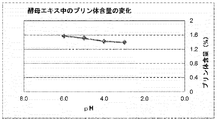
酵母エキスとして「スーパーミースト(R)パウダーA-001」(アサヒフードアンドヘルスケア(株)製、酵素分解タイプ、プリン体含量:固形分中1.6%)を入手した。これらの加水分解度は15%TCA可溶率として97%、重量平均分子量が1,000であった。
この酵母エキス10部を水90部に十分に分散させた。この水分散液のpHが6.0,5.0,4.0,3.0となるように、塩酸もしくは水酸化ナトリウムによりそれぞれ調整した。pH調整後、遠心分離(2000×G、15分間)して上清画分を回収し、凍結乾燥により乾燥させて、各pHに対して4種類のサンプルを得た。
得られた計4種類の該サンプルの固形分中のプリン体含量を測定し、その結果を表3に、またこれをグラフ化したものを図3に示した。
酵母エキスとして「スーパーミースト(R)パウダーA-001」(アサヒフードアンドヘルスケア(株)製、酵素分解タイプ、プリン体含量:固形分中1.6%)を入手した。これらの加水分解度は15%TCA可溶率として97%、重量平均分子量が1,000であった。
この酵母エキス10部を水90部に十分に分散させた。この水分散液のpHが6.0,5.0,4.0,3.0となるように、塩酸もしくは水酸化ナトリウムによりそれぞれ調整した。pH調整後、遠心分離(2000×G、15分間)して上清画分を回収し、凍結乾燥により乾燥させて、各pHに対して4種類のサンプルを得た。
得られた計4種類の該サンプルの固形分中のプリン体含量を測定し、その結果を表3に、またこれをグラフ化したものを図3に示した。

(実施例2)
大豆タンパク加水分解物として、実施例1で得られたサンプルを使用し、非発酵タイプのノンアルコールビールを下記の通り調製した。
表4に掲げる配合物を混合(一次混合とする)し、15分間煮沸を行った後、表5に掲げ
る配合で二次混合し、清澄化のためにろ紙によりろ過を行った。その後、得られた二次混合後の煮沸液30部に、炭酸付与のために炭酸水70部を添加した。
尚、ホップ抽出液は、水にホップペレットを1重量%となる様に配合し、1時間煮沸して苦味成分を抽出後、ろ紙によるろ過により不溶性画分を除去したものを用いた。麦芽エキスの使用量は固形分換算で最終の飲料の3.3重量%であった。
大豆タンパク加水分解物として、実施例1で得られたサンプルを使用し、非発酵タイプのノンアルコールビールを下記の通り調製した。
表4に掲げる配合物を混合(一次混合とする)し、15分間煮沸を行った後、表5に掲げ
る配合で二次混合し、清澄化のためにろ紙によりろ過を行った。その後、得られた二次混合後の煮沸液30部に、炭酸付与のために炭酸水70部を添加した。
尚、ホップ抽出液は、水にホップペレットを1重量%となる様に配合し、1時間煮沸して苦味成分を抽出後、ろ紙によるろ過により不溶性画分を除去したものを用いた。麦芽エキスの使用量は固形分換算で最終の飲料の3.3重量%であった。


(参考例)
参考例として、大豆タンパク加水分解物として、市販の「ハイニュート(R)-AM」(不二製油(株)製,プリン体含量:固形分中0.29%)を用い、実施例2と同様にしてノンアルコールビールを調製した。
参考例として、大豆タンパク加水分解物として、市販の「ハイニュート(R)-AM」(不二製油(株)製,プリン体含量:固形分中0.29%)を用い、実施例2と同様にしてノンアルコールビールを調製した。
実施例2により得られたノンアルコールビールは、参考例と同様に香味の厚み及びまとまりに優れ良好な風味であった。このため、大豆タンパク加水分解物としてプリン体除去工程を経たものを用いることによる、ビール風味飲料の品質への影響はないと考えられた。
(考察)
以上の試験例1~2、実施例1より、適度に加水分解したタンパク質を酸性化で不溶物を除去する工程を行うことによって、タンパク質原料中のプリン体を効率的、効果的に低減することができ、50%以上低減できることが確認された。一方、試験例3では、高度に分解されたタンパク加水分解物は、酸性下で不溶物を除去してもプリン体を効果的に低減しにくいことが確認された。
また、実施例2により、実施例1で製造されたプリン体が低減されたタンパク加水分解物を用いて、ビール風味飲料を製造しても良好な風味を与えることが確認された。
すなわち、本発明はタンパク原料中のプリン体を効率的に低減する有力な手段を提供するものであり、かつこの方法によって製造されたタンパク加水分解物はビール風味飲料などの飲食品に適する品質を持つことが確認された。
以上の試験例1~2、実施例1より、適度に加水分解したタンパク質を酸性化で不溶物を除去する工程を行うことによって、タンパク質原料中のプリン体を効率的、効果的に低減することができ、50%以上低減できることが確認された。一方、試験例3では、高度に分解されたタンパク加水分解物は、酸性下で不溶物を除去してもプリン体を効果的に低減しにくいことが確認された。
また、実施例2により、実施例1で製造されたプリン体が低減されたタンパク加水分解物を用いて、ビール風味飲料を製造しても良好な風味を与えることが確認された。
すなわち、本発明はタンパク原料中のプリン体を効率的に低減する有力な手段を提供するものであり、かつこの方法によって製造されたタンパク加水分解物はビール風味飲料などの飲食品に適する品質を持つことが確認された。
本発明のプリン体低減技術は、例えば痛風などの原因となるプリン体の含有が問題となるビール風味飲料,健康食品,健康飲料等の飲食品の製造分野に適用することができる。飲食品に限らず、プリン体が問題となる、医薬,医療食,健康食品,飼料等の様々な分野にも利用できるであろう。
Claims (13)
- 加水分解度が15%TCA可溶率として20~90%となるようにタンパク質が加水分解された、タンパク質原料の水分散液を調製し、該水分散液のpHを5以下の酸性にして、生ずる不溶物を除去する工程を行うことを特徴とする、タンパク質原料中のプリン体低減方法。
- 該タンパク質原料の水分散液は、酵素分解により生ずる不溶物が含まれる、請求項1記載の方法。
- 該水分散液のpHを4.5以下の酸性にする、請求項1記載の方法。
- 該水分散液のpHを4.5以下の酸性にする、請求項2記載の方法。
- 該水分散液のpHを4以下の酸性にする、請求項1記載の方法。
- 該水分散液のpHを4以下の酸性にする、請求項2記載の方法。
- 請求項1記載の工程を備えることを特徴とする、植物性タンパク加水分解物の製造法。
- 請求項6記載の工程を備えることを特徴とする、植物性タンパク加水分解物の製造法。
- 植物性タンパク加水分解物が、ビール風味飲料の製造工程中において製造される、請求項7記載の植物性タンパク加水分解物の製造法。
- 植物性タンパク加水分解物が、ビール風味飲料の製造工程中において製造される、請求項8記載の植物性タンパク加水分解物の製造法。
- 請求項1記載の工程を備えることを特徴とする、ビール風味飲料の製造法。
- 請求項2記載の工程を備えることを特徴とする、ビール風味飲料の製造法。
- 請求項6記載の工程を備えることを特徴とする、ビール風味飲料の製造法。
Priority Applications (2)
| Application Number | Priority Date | Filing Date | Title |
|---|---|---|---|
| JP2017505411A JP6801644B2 (ja) | 2015-03-10 | 2016-03-10 | タンパク質原料中のプリン体低減方法 |
| CN201680014350.0A CN107404910B (zh) | 2015-03-10 | 2016-03-10 | 蛋白质原料中的嘌呤体降低方法 |
Applications Claiming Priority (2)
| Application Number | Priority Date | Filing Date | Title |
|---|---|---|---|
| JP2015047589 | 2015-03-10 | ||
| JP2015-047589 | 2015-03-10 |
Publications (1)
| Publication Number | Publication Date |
|---|---|
| WO2016143877A1 true WO2016143877A1 (ja) | 2016-09-15 |
Family
ID=56879619
Family Applications (1)
| Application Number | Title | Priority Date | Filing Date |
|---|---|---|---|
| PCT/JP2016/057675 Ceased WO2016143877A1 (ja) | 2015-03-10 | 2016-03-10 | タンパク質原料中のプリン体低減方法 |
Country Status (3)
| Country | Link |
|---|---|
| JP (1) | JP6801644B2 (ja) |
| CN (1) | CN107404910B (ja) |
| WO (1) | WO2016143877A1 (ja) |
Cited By (1)
| Publication number | Priority date | Publication date | Assignee | Title |
|---|---|---|---|---|
| CN113038836A (zh) * | 2018-10-26 | 2021-06-25 | 株式会社明治 | 高蛋白质的乳原料的制造方法 |
Families Citing this family (1)
| Publication number | Priority date | Publication date | Assignee | Title |
|---|---|---|---|---|
| CN108771108A (zh) * | 2018-06-05 | 2018-11-09 | 湖州市食品药品检验研究院 | 一种储藏加工过程中控制和测定青虾嘌呤的方法 |
Citations (5)
| Publication number | Priority date | Publication date | Assignee | Title |
|---|---|---|---|---|
| JPH04190797A (ja) * | 1990-11-27 | 1992-07-09 | Fuji Oil Co Ltd | ペプチド混合物の製造法及びペプチド混合物を含有する飲料 |
| WO2008136326A1 (ja) * | 2007-04-26 | 2008-11-13 | Fuji Oil Company, Limited | 酸性可溶大豆蛋白質の製造法 |
| WO2010092778A1 (ja) * | 2009-02-10 | 2010-08-19 | 不二製油株式会社 | 酸性可溶大豆たん白素材およびその製造方法 |
| JP2014124122A (ja) * | 2012-12-26 | 2014-07-07 | Asahi Breweries Ltd | ビールテイスト飲料の製造方法 |
| JP2014180268A (ja) * | 2013-03-21 | 2014-09-29 | Sapporo Breweries Ltd | ビールテイスト飲料及びその製造方法 |
Family Cites Families (3)
| Publication number | Priority date | Publication date | Assignee | Title |
|---|---|---|---|---|
| WO1996038535A1 (en) * | 1995-05-29 | 1996-12-05 | Nauchno-Issledovatelsky Institut Vychislitelnykh Komplexov | Method of obtaining a biomass of microorganisms with a low nucleic acids content |
| CN100419057C (zh) * | 2005-09-30 | 2008-09-17 | 江南大学 | 一种含低嘌呤类物质的啤酒的制造方法 |
| CN101107973B (zh) * | 2007-08-22 | 2010-12-01 | 上海艺杏食品有限公司 | 一种低嘌呤豆制品的生产工艺 |
-
2016
- 2016-03-10 JP JP2017505411A patent/JP6801644B2/ja active Active
- 2016-03-10 CN CN201680014350.0A patent/CN107404910B/zh active Active
- 2016-03-10 WO PCT/JP2016/057675 patent/WO2016143877A1/ja not_active Ceased
Patent Citations (5)
| Publication number | Priority date | Publication date | Assignee | Title |
|---|---|---|---|---|
| JPH04190797A (ja) * | 1990-11-27 | 1992-07-09 | Fuji Oil Co Ltd | ペプチド混合物の製造法及びペプチド混合物を含有する飲料 |
| WO2008136326A1 (ja) * | 2007-04-26 | 2008-11-13 | Fuji Oil Company, Limited | 酸性可溶大豆蛋白質の製造法 |
| WO2010092778A1 (ja) * | 2009-02-10 | 2010-08-19 | 不二製油株式会社 | 酸性可溶大豆たん白素材およびその製造方法 |
| JP2014124122A (ja) * | 2012-12-26 | 2014-07-07 | Asahi Breweries Ltd | ビールテイスト飲料の製造方法 |
| JP2014180268A (ja) * | 2013-03-21 | 2014-09-29 | Sapporo Breweries Ltd | ビールテイスト飲料及びその製造方法 |
Non-Patent Citations (1)
| Title |
|---|
| KIYOKO KANEKO ET AL.: "Determination of purine bases concentrations in soybean-derived food and in some Japanese food", GOUT AND NUCLEIC ACID METABOLISM, vol. 30, no. 1, 2006, pages 7 - 12 * |
Cited By (1)
| Publication number | Priority date | Publication date | Assignee | Title |
|---|---|---|---|---|
| CN113038836A (zh) * | 2018-10-26 | 2021-06-25 | 株式会社明治 | 高蛋白质的乳原料的制造方法 |
Also Published As
| Publication number | Publication date |
|---|---|
| CN107404910A (zh) | 2017-11-28 |
| CN107404910B (zh) | 2021-01-22 |
| JP6801644B2 (ja) | 2020-12-16 |
| JPWO2016143877A1 (ja) | 2017-12-28 |
Similar Documents
| Publication | Publication Date | Title |
|---|---|---|
| JP5672773B2 (ja) | 非発酵ビール風味炭酸飲料 | |
| WO2021049591A1 (ja) | 植物タンパク質濃縮物の製造方法 | |
| JP6874681B2 (ja) | 多糖類−タンパク質複合体の製造方法 | |
| WO2020171106A1 (ja) | 植物性ミルクの凝集防止 | |
| JP2021072828A (ja) | 発酵飲料の醸造における酵素加水分解された植物性タンパク質の使用 | |
| JP4943672B2 (ja) | 残存窒素量を調整した発酵飲料の製造方法 | |
| JP6801644B2 (ja) | タンパク質原料中のプリン体低減方法 | |
| JP7850075B2 (ja) | 加工ひよこ豆ミルクの製造方法 | |
| WO2018051997A1 (ja) | 低糖質ビールテイスト飲料 | |
| JP4755450B2 (ja) | 酵母エキスを用いた発酵飲料の製造方法 | |
| JP5859103B1 (ja) | ビールテイストの発酵アルコール飲料およびその製造方法 | |
| JP2011142922A (ja) | 残存窒素量を調整した発酵飲料の製造方法 | |
| JP5759610B1 (ja) | ビールテイストの発酵アルコール飲料およびその製造方法 | |
| JP7813711B2 (ja) | 加工ココナッツミルクの製造方法 | |
| WO2024101290A1 (ja) | 植物性飲食品の製造方法 | |
| JP3354528B2 (ja) | クエン酸含有飲料及びその製造方法 | |
| JPS62179355A (ja) | 食品の製造法 | |
| JP7801071B1 (ja) | npII遺伝子不活化株を用いた醤油の製造方法 | |
| KR102099597B1 (ko) | 이취가 감소되고 청량감 및 풍미가 개선된 주류의 제조 방법 | |
| JP2016116502A (ja) | ビールテイストの発酵アルコール飲料およびその製造方法 | |
| JP2007129907A (ja) | グルコシルセラミド含有食酢並びにこれを含む組成物とそれらの製造方法 | |
| WO2025192614A1 (ja) | ストレッチ性植物性チーズの製造方法 | |
| WO2025037648A1 (ja) | 植物性飲食品の起泡性向上方法、及び起泡性植物性飲食品の泡質改善方法 | |
| JP2025104081A (ja) | 低苦味のビールテイスト飲料 | |
| WO2025178073A1 (ja) | タンパク質分解酵素が除去されたことを確認する方法及びその応用 |
Legal Events
| Date | Code | Title | Description |
|---|---|---|---|
| 121 | Ep: the epo has been informed by wipo that ep was designated in this application |
Ref document number: 16761843 Country of ref document: EP Kind code of ref document: A1 |
|
| ENP | Entry into the national phase |
Ref document number: 2017505411 Country of ref document: JP Kind code of ref document: A |
|
| NENP | Non-entry into the national phase |
Ref country code: DE |
|
| 122 | Ep: pct application non-entry in european phase |
Ref document number: 16761843 Country of ref document: EP Kind code of ref document: A1 |