WO2016136539A1 - ガラス、及び化学強化ガラス並びに化学強化ガラスの製造方法 - Google Patents
ガラス、及び化学強化ガラス並びに化学強化ガラスの製造方法 Download PDFInfo
- Publication number
- WO2016136539A1 WO2016136539A1 PCT/JP2016/054501 JP2016054501W WO2016136539A1 WO 2016136539 A1 WO2016136539 A1 WO 2016136539A1 JP 2016054501 W JP2016054501 W JP 2016054501W WO 2016136539 A1 WO2016136539 A1 WO 2016136539A1
- Authority
- WO
- WIPO (PCT)
- Prior art keywords
- glass
- less
- temperature
- mgo
- deformation
- Prior art date
- Legal status (The legal status is an assumption and is not a legal conclusion. Google has not performed a legal analysis and makes no representation as to the accuracy of the status listed.)
- Ceased
Links
Images
Classifications
-
- C—CHEMISTRY; METALLURGY
- C03—GLASS; MINERAL OR SLAG WOOL
- C03B—MANUFACTURE, SHAPING, OR SUPPLEMENTARY PROCESSES
- C03B18/00—Shaping glass in contact with the surface of a liquid
- C03B18/02—Forming sheets
-
- C—CHEMISTRY; METALLURGY
- C03—GLASS; MINERAL OR SLAG WOOL
- C03C—CHEMICAL COMPOSITION OF GLASSES, GLAZES OR VITREOUS ENAMELS; SURFACE TREATMENT OF GLASS; SURFACE TREATMENT OF FIBRES OR FILAMENTS MADE FROM GLASS, MINERALS OR SLAGS; JOINING GLASS TO GLASS OR OTHER MATERIALS
- C03C21/00—Treatment of glass, not in the form of fibres or filaments, by diffusing ions or metals in the surface
-
- C—CHEMISTRY; METALLURGY
- C03—GLASS; MINERAL OR SLAG WOOL
- C03C—CHEMICAL COMPOSITION OF GLASSES, GLAZES OR VITREOUS ENAMELS; SURFACE TREATMENT OF GLASS; SURFACE TREATMENT OF FIBRES OR FILAMENTS MADE FROM GLASS, MINERALS OR SLAGS; JOINING GLASS TO GLASS OR OTHER MATERIALS
- C03C3/00—Glass compositions
- C03C3/04—Glass compositions containing silica
- C03C3/076—Glass compositions containing silica with 40% to 90% silica, by weight
- C03C3/083—Glass compositions containing silica with 40% to 90% silica, by weight containing aluminium oxide or an iron compound
- C03C3/085—Glass compositions containing silica with 40% to 90% silica, by weight containing aluminium oxide or an iron compound containing an oxide of a divalent metal
-
- C—CHEMISTRY; METALLURGY
- C03—GLASS; MINERAL OR SLAG WOOL
- C03C—CHEMICAL COMPOSITION OF GLASSES, GLAZES OR VITREOUS ENAMELS; SURFACE TREATMENT OF GLASS; SURFACE TREATMENT OF FIBRES OR FILAMENTS MADE FROM GLASS, MINERALS OR SLAGS; JOINING GLASS TO GLASS OR OTHER MATERIALS
- C03C3/00—Glass compositions
- C03C3/04—Glass compositions containing silica
- C03C3/076—Glass compositions containing silica with 40% to 90% silica, by weight
- C03C3/083—Glass compositions containing silica with 40% to 90% silica, by weight containing aluminium oxide or an iron compound
- C03C3/085—Glass compositions containing silica with 40% to 90% silica, by weight containing aluminium oxide or an iron compound containing an oxide of a divalent metal
- C03C3/087—Glass compositions containing silica with 40% to 90% silica, by weight containing aluminium oxide or an iron compound containing an oxide of a divalent metal containing calcium oxide, e.g. common sheet or container glass
Definitions
- the present invention relates to a glass that is not easily deformed when subjected to stress during heat treatment at a temperature below the strain point. Moreover, it is related also with the manufacturing method of chemically strengthened glass and chemically strengthened glass.
- the touch panel display has a structure in which a touch sensor glass and a cover glass are stacked on a glass substrate for display.
- a touch sensor glass called OGS (One / glass / solution) and a cover glass are integrated. All of touch sensor glass, cover glass, and OGS glass are required to be thin and have high strength, and chemically strengthened glass subjected to chemical strengthening treatment by ion exchange is used (Patent Document 1).
- Patent Document 1 describes a glass made of a platinum crucible, and does not disclose deformation that occurs when the glass is produced on an actual production line.
- An object of this invention is to provide the glass which can reduce the deformation
- the present inventors evaluated the deformation of the glass below the strain point using a beam bending method (hereinafter also referred to as BB method).
- BB method is a method of measuring the bending of glass by performing three-point bending in an electric furnace.
- the present inventors have found that the deformation of the glass below the strain point evaluated by the BB method depends on the glass composition and the thermal history of the glass, and completed the present invention.
- the present invention is as follows. (1) SiO 2 60-75%, Al 2 O 3 1-7%, MgO 8-16%, CaO 0-3.3%, Na 2 O 12 Containing 18% and 0-4% K 2 O, Glass whose refractive index change is 0.001 or less when heated above the annealing point and slowly cooled at a rate of 1 ° C./min. (2) Glass as described in said (1) whose content of CaO is 1.3% or less. (3) The ratio (MgO / RO) of MgO content and RO (where RO is the sum of MgO, CaO, SrO and BaO) is 0.7 or more (1) or (2 ) Glass.
- a glass capable of reducing deformation in a heat treatment process such as chemical strengthening and film formation in an actual production line.
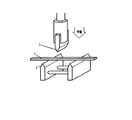
- FIG. 1 is a schematic diagram of a beam bending method for performing a three-point bending test on a glass plate sample in an electric furnace.
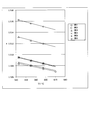
- FIG. 2 is a diagram showing the value of the refractive index with respect to the structural temperature of the glass.
- the glass according to the present embodiment is expressed in terms of mole percentage on the basis of oxide.
- SiO 2 is 60 to 75%
- Al 2 O 3 is 1 to 7%
- MgO is 8 to 16%
- CaO is 0 to 3.3%
- Na When it contains 12 to 18% of 2 O and 0 to 4% of K 2 O and is heated above the annealing point and slowly cooled at a rate of 1 ° C./min, the change in refractive index is 0.001. It is characterized by the following.
- SiO 2 is known as a component that forms a network structure in the glass microstructure, and is a main component constituting the glass.
- the content of SiO 2 is 60% or more, preferably 62% or more, more preferably 63% or more, and further preferably 64% or more. Further, the content of SiO 2 is 75% or less, preferably 72% or less, more preferably 70% or less, and further preferably 69% or less.
- the content of SiO 2 is 60% or more, it is advantageous in terms of stability and weather resistance as glass.
- the content of SiO 2 is 75% or less, it is advantageous in terms of solubility and moldability.
- Al 2 O 3 has an effect of improving ion exchange performance in chemical strengthening, and particularly has a large effect of improving surface compressive stress (CS). It is also known as a component that improves the weather resistance of glass. Moreover, there exists an effect
- the content of Al 2 O 3 is 1% or more, preferably 1.6% or more, more preferably 2.3% or more, and further preferably 3% or more. Further, the content of Al 2 O 3 is 7% or less, more preferably 6.3% or less, still more preferably 5.6% or less, and particularly preferably 5% or less.
- MgO is a component that stabilizes glass and is essential. There is an effect of suppressing deformation due to stress below the strain point of glass.
- the content of MgO is 8% or more, preferably 9% or more, more preferably 10% or more, and further preferably 11% or more. Further, the content of MgO is 16% or less, preferably 15% or less, more preferably 14% or less.
- the content of MgO is 8% or more, the chemical resistance of the glass becomes good. The solubility at high temperature becomes good and devitrification hardly occurs.
- the content of MgO is 16% or less, the difficulty of devitrification is maintained, and a sufficient ion exchange rate is obtained.
- CaO is not essential, but is a component that stabilizes the glass.
- CaO is a component that increases deformation due to stress below the strain point of glass, and is a component that inhibits ion exchange in chemical strengthening. Therefore, the content is preferably reduced or not contained.
- its content is 3.3% or less, preferably 2.3% or less, more preferably 1.3% or less, and even more preferably 0.7% or less.
- the CaO content is 3.3% or less, deformation below the strain point of the glass is remarkably suppressed.
- Na 2 O is an essential component for forming a surface compressive stress layer by ion exchange, and has an effect of increasing the compressive stress layer depth (DOL). Moreover, it is a component which lowers the high temperature viscosity and devitrification temperature of glass, and improves the meltability and moldability of glass.
- the content of Na 2 O is 12% or more, preferably 13% or more, more preferably 14% or more. Further, the content of Na 2 O is 18% or less, preferably 17% or less, more preferably 16% or less. When the content of Na 2 O is 12% or more, a desired surface compressive stress layer can be formed by ion exchange. On the other hand, when the content of Na 2 O is 18% or less, sufficient weather resistance can be obtained.
- K 2 O is not essential, but may be contained because it has the effect of increasing the ion exchange rate and deepening the DOL. On the other hand, if the amount of K 2 O is excessive, sufficient CS cannot be obtained.
- the amount in the case of containing K 2 O is 4% or less, preferably 2.5% or less, more preferably 1% or less. When the content of K 2 O is 4% or less, sufficient CS can be obtained.
- SrO is not essential, but may be contained because it has an effect of improving devitrification properties.
- SrO is a component that increases deformation due to stress below the strain point of glass, and its content is preferably reduced.
- the content in the case of containing SrO is 3% or less, preferably 2% or less, more preferably 1% or less. When the SrO content is 3% or less, deformation below the strain point of the glass is suppressed.
- BaO is not essential, but may be contained because it has an effect of improving devitrification properties.
- BaO is a component that increases deformation due to stress below the strain point of glass, and its content is preferably reduced.
- the content in the case of containing BaO is 3% or less, preferably 2% or less, more preferably 1% or less. When the content of BaO is 3% or less, deformation below the strain point of the glass is suppressed.
- MgO is a component that suppresses deformation due to stress below the strain point of glass
- CaO, SrO, and BaO are components that increase deformation.
- MgO / RO which is a ratio of the content of MgO and the content of RO (where RO is the sum of MgO, CaO, SrO and BaO, that is, MgO + CaO + SrO + BaO) is 0.7 or more, preferably Is 0.8 or more, more preferably 0.9 or more, and still more preferably 0.95 or more.
- MgO / RO is 0.7 or more, the effect of suppressing deformation is increased when the glass is stressed at a temperature below the strain point.
- sulfate, chloride, fluoride, and the like may be appropriately contained as a glass refining agent.
- the glass of the present invention consists essentially of the components described above, but may contain other components as long as the object of the present invention is not impaired. When such components are contained, the total content of these components is preferably 3% or less, more preferably 2% or less, and typically 1% or less.
- the other components will be described as an example.
- B 2 O 3 may be contained in a range of 2% or less in order to improve the melting property at high temperature or the glass strength.
- an alkali component of Na 2 O or K 2 O and B 2 O 3 are contained at the same time, volatilization becomes intense and the furnace material of the glass kiln is significantly eroded, so that B 2 O 3 is not substantially contained. It is preferable. “Substantially not containing” means not containing unless it is contained as an inevitable impurity, and the same applies to the following.
- Fe 2 O 3 is a component that is extremely difficult to make its content zero because it exists in nature and everywhere in the production line. It is known that Fe 2 O 3 in an oxidized state causes yellow coloration, and FeO in a reduced state causes blue coloration, and it is known that the glass is colored green due to a balance between the two. .
- the total iron amount (total Fe) is converted as Fe 2 O 3 , and the content is typically 0.1% or less. When the content of Fe 2 O 3 is 0.1% or less, the glass can be prevented from being colored.
- TiO 2 is abundant in natural raw materials and is known to be a yellow coloring source.
- the content when TiO 2 is contained is preferably 0.5% or less, more preferably 0.2% or less, and still more preferably 0.1% or less. When the content of TiO 2 is 0.5% or less, it is possible to avoid the phenomenon that the glass is yellowish.
- ZnO may be contained up to 2%, for example, in order to improve the melting property of the glass at a high temperature. However, when it is produced by the float process, it is preferably not contained because it is reduced by a float bath and becomes a product defect.
- ZrO 2 is a component that improves CS after chemical strengthening.
- the content in the case of containing ZrO 2 is preferably 2% or less, and more preferably 1% or less. When ZrO 2 is 2% or less, an increase in the devitrification temperature can be avoided.
- Li 2 O is a component that lowers Tg to facilitate stress relaxation, and as a result makes it impossible to obtain a stable surface compressive stress layer. Even when it is contained, its content is preferably 1% or less, more preferably 0.1% or less, and particularly preferably 0.01% or less.
- the glass of the present embodiment can be easily changed from ordinary soda lime glass in both production characteristics and product characteristics.
- the unit of viscosity ⁇ is dPa ⁇ s.
- T2 is preferably 1520 ° C. or lower, more preferably 1500 ° C. or lower.
- the devitrification temperature (TL) is determined to be a risk of devitrification compared to the above-described T4 when glass is produced by the float process.
- the devitrification temperature of glass is not higher than 15 ° C. higher than T4, it can be produced by the float process without occurrence of devitrification, and is preferably T4 or lower. That is, T4-TL is ⁇ 15 ° C. or higher, preferably 0 ° C. or higher.
- the stress applied to the glass is generated by its own weight.
- the specific gravity of the glass is small.
- the specific gravity of the glass of this embodiment is 2.49 or less, preferably 2.48 or less, and more preferably 2.47 or less.
- Glass having a small specific gravity generally tends to have a high temperature viscosity.
- the specific gravity of the glass of the present embodiment is 2.43 or more, preferably 2.44 or more, more preferably 2.45 or more.
- an effective treatment temperature can be determined based on the glass transition point (Tg).
- the chemical strengthening treatment is performed at a temperature lower by 100 to 150 ° C. than Tg.
- the glass of this embodiment preferably has a Tg of 540 to 610 ° C., more preferably 550 to 600 ° C., in order to apply the same chemical strengthening treatment as before.
- Thermal stress occurs when the temperature distribution of the glass becomes non-uniform in a heat treatment process such as chemical strengthening.
- the thermal expansion coefficient of the glass of the present embodiment is 96 ⁇ 10 ⁇ 7 ° C. ⁇ 1 or less, preferably 94 ⁇ 10 ⁇ 7 ° C. ⁇ 1 or less, more preferably 92 ⁇ 10 ⁇ 7 ° C. ⁇ 1 or less.
- Glass having a small coefficient of thermal expansion generally tends to have a high temperature viscosity.
- the glass has a thermal expansion coefficient of 84 ⁇ 10 ⁇ 7 ° C. ⁇ 1 or more, preferably 86 ⁇ 10 ⁇ 7 ° C. ⁇ 1 or more, more preferably 88. ⁇ 10 ⁇ 7 ° C. ⁇ 1 or more.
- the glass of the present embodiment can be formed into a flat plate shape by a known glass forming method such as a float method, a fusion method, a slot down draw method, or a roll-out method. Moreover, after forming into a flat plate, the glass plate which gave the bending process may be sufficient. In addition, in this specification, the glass shape
- the glass of this embodiment has dimensions that can be molded by an existing molding method. That is, if it is formed by the float process, ribbon-like glass having a continuous float forming width can be obtained. Moreover, the glass of this embodiment is finally cut
- a display such as a tablet PC or a smartphone
- a window glass of a building or a house is the size of a display such as a tablet PC or a smartphone, or the size of a window glass of a building or a house.
- the glass of this embodiment is generally cut into a rectangle, but other shapes such as a circle or a polygon may be used without any problem, and a glass subjected to drilling is also included.
- the glass of this embodiment is preferably formed into a glass plate and cooled to room temperature, so that the structural temperature (Tf) of the glass is low.
- the atoms in the glass have a liquid-phase arrangement structure, and the temperature at which this structure is frozen is called the structure temperature.
- the structural temperature of glass is determined by the cooling rate from the annealing point of the glass to around 200 ° C., and the structural temperature is lowered by slowly cooling slowly, and the density of the glass having the same composition is increased.
- the present inventors have found that the deformation due to stress below the strain point of the glass can be suppressed by lowering the structural temperature of the glass.
- the change in the structural temperature of the glass can be estimated by a change in the refractive index of the glass as a simple method.
- the refractive index of the molded glass plate is measured at room temperature, the glass is heated above the annealing point, and then slowly cooled below the strain point at a rate of 1 ° C./min. Measure the rate. From the difference in refractive index measured before and after the re-annealing treatment, it is possible to know how high the structural temperature of the molded glass was with respect to the structural temperature when cooled at 1 ° C./min.
- the glass of the present embodiment preferably has a refractive index change of 0.001 or less, more preferably 0.0009 or less, after being heated above the annealing point and slowly cooling at a rate of 1 ° C./min. More preferably, it is 0.0008 or less. If the change in refractive index is 0.001 or less, the structural temperature of the glass plate is lowered, and deformation due to stress below the strain point of the glass can be suppressed.
- the cooling rate from the annealing point of the glass to around 200 ° C. is preferably 200 ° C./min or less, more preferably 130 ° C./min or less, even more preferably 80 ° C./min or less. It is.
- the glass of this embodiment is preferably produced by a float method having a long slow cooling furnace.
- the cooling rate from the annealing point of glass to around 200 ° C. is preferably 10 ° C./min or more, more preferably 17 ° C./min or more. Preferably it is 30 degrees C / min or more.
- the structural temperature of the glass produced in such a cooling process can be estimated by the change in refractive index as described above.
- the refractive index change is preferably 0.0004 or more, more preferably 0.0005 or more. Yes, more preferably 0.0006 or more. When the refractive index change is 0.0004 or more, good production efficiency is maintained.
- the glass of the present embodiment preferably has a small amount of deformation of the glass below the strain point measured using the beam bending (BB) method.
- the BB method is a method of measuring the bending of glass by performing three-point bending in an electric furnace.
- BB method measurement of the glass of this embodiment will be exemplified.
- the glass is processed into a plate glass having a size of 35 mm ⁇ 5 mm ⁇ 0.55 mm. Processing is performed by machining such as cutting and polishing. When heat is applied to the glass during processing, the structural temperature of the glass changes, so the temperature is maintained at 200 ° C. or lower.
- the plate glass processed into a measurement shape is placed on the upper part of the receiving edge with a span of 30 mm in width so that the center of the sample and the center of the receiving edge span are aligned and adjusted so that the pressing edge hits the center of the sample.
- the glass sample is heated to 350 ° C. at 10 ° C./min, and when it exceeds 200 ° C., a load of 200 gf is applied from above. After holding at 350 ° C.
- the warp shape of the glass is measured before and after this BB treatment.
- the center of the glass sample is set to be convex, the maximum and minimum heights are measured at the center and both ends, and the difference is taken as the amount of warp of the glass.
- the difference between the warpage amounts before and after the BB treatment is defined as the deformation amount by the BB method. Due to the limitations of the measurement method, the measured length of the warp amount is a warp amount of 34 mm excluding 0.5 mm at both ends with respect to the sample 35 mm.
- the glass of the present embodiment has a deformation amount by the BB method of 45 ⁇ m or less, preferably 41 ⁇ m or less, and more preferably 37 ⁇ m or less.
- the amount of deformation by the BB method is 45 ⁇ m or less, deformation when subjected to stress during heat treatment at a temperature below the strain point such as chemical strengthening is reduced.
- the glass of this embodiment can be applied with chemical strengthening treatment. Moreover, the shape of the glass of this embodiment etc. can be suitably changed according to the use etc. which are used, and is not restrict
- the glass of this embodiment is a plate-shaped chemically strengthening glass (chemical strengthening glass plate), the thickness t of the chemical strengthening glass plate is not particularly limited.
- the chemical strengthening treatment can be performed by a conventionally known method. Moreover, it is preferable to perform shape processing according to a use, for example, mechanical processing, such as a cutting
- an alkali metal salt for example, potassium nitrate salt
- alkali metal ions typically K ions
- the metal ions with a small ionic radius typically, Na ions
- metal ions with a large ionic radius typically, Na ions
- the chemical strengthening treatment can be performed, for example, by immersing a glass plate in a potassium nitrate molten salt at 340 to 550 ° C. for 5 minutes to 24 hours.
- optimum conditions may be selected in consideration of the viscosity characteristics of glass, application, plate thickness, tensile stress inside the glass, and the like.
- Examples of the molten salt for performing the ion exchange treatment include alkali nitrates such as potassium nitrate, potassium sulfate, and potassium chloride, alkali sulfates, and alkali chlorides. These molten salts may be used alone or in combination of two or more. Further, a salt containing sodium may be mixed in order to adjust the chemical strengthening characteristics.
- the treatment conditions for the chemical strengthening treatment are not particularly limited, and the optimum conditions may be selected in consideration of the characteristics of the glass and the molten salt.
- the chemically strengthened glass obtained by chemically strengthening the glass of the present invention has a compressive stress layer on the surface by ion exchange treatment.
- the surface compressive stress (CS) of the surface stress layer is preferably 500 MPa or more, more preferably 600 MPa or more, and further preferably 700 MPa or more.
- the compressive stress depth (DOL) is preferably 10 ⁇ m or more, preferably 12 ⁇ m or more, and more preferably 14 ⁇ m or more.
- DOL compressive stress depth
- it is preferably 40 ⁇ m or less, and more preferably 30 ⁇ m or less.
- the CS and DOL of the surface compressive stress layer of the chemically strengthened glass of the present invention can be measured using a surface stress meter (for example, FSM-6000 manufactured by Orihara Seisakusho).
- a surface stress meter for example, FSM-6000 manufactured by Orihara Seisakusho.
- the chemically strengthened glass of the present invention preferably has at least one selected from the group consisting of potassium ions, silver ions, cesium ions and rubidium ions on the surface. As a result, a compressive stress is induced on the surface, and the strength of the glass is increased. Moreover, antibacterial property can be provided by having silver ion on the surface.
- a chemically strengthened glass product can be obtained by chemically strengthening the glass of the present invention.
- the use of the chemically strengthened glass of the present invention is not particularly limited. Since it has high mechanical strength, it is suitable for use in places where impact due to dropping or contact with other substances is expected.
- mobile phones including multifunctional information terminals such as smartphones
- PHS, PDA, tablet terminals notebook personal computers, game machines, portable music / video players, electronic books, electronic terminals
- Cover glass for display parts such as watches, cameras or GPS, and cover glass for touch panel operation monitors of these devices
- cover glass for cookers such as microwave ovens and oven toasters
- top plates such as electromagnetic cookers, meters
- machines or devices such as cover glass for instruments such as gauges and glass plates for reading parts such as copying machines or scanners.
- glass for windows of buildings, houses, vehicles, ships, aircraft, etc. lighting equipment for home use or industrial use, signals, guide lights, cover boards for electric bulletin boards, showcases, bulletproof glasses, etc.
- Examples include a cover glass for protecting a solar cell and a condensing glass material for increasing the power generation efficiency of the solar cell.
- it can be used as a building material such as an aquarium, dishes such as dishes and cups, various cooking utensils such as bottles or chopping boards, cupboards, refrigerator shelves and walls, roofs or partitions.
- a building material such as an aquarium, dishes such as dishes and cups, various cooking utensils such as bottles or chopping boards, cupboards, refrigerator shelves and walls, roofs or partitions.
- the average linear thermal expansion coefficient at 350 ° C. was determined. Numerical values in parentheses in Table 1 indicate calculated values. About the calculated value, a linear regression equation was created from the measured value of CTE and the glass composition, and was calculated. (5) Devitrification temperature (TL) Regarding the devitrification temperature, the glass was crushed into glass particles of about 2 mm in a mortar, the glass particles were placed in a platinum boat, and heat-treated in increments of 5 ° C. for 24 hours in a temperature gradient furnace. The maximum value of the temperature of the glass grains on which the crystals were precipitated was defined as the devitrification temperature. (6) Surface compressive stress (CS) and compressive stress layer depth (DOL) The surface compressive stress and the compressive stress layer depth were measured with a surface stress meter FSM-6000 manufactured by Orihara Seisakusho.
- the obtained molten glass was poured into a mold material, held at a temperature of Tg + 30 ° C. for 1 hour, and then cooled to room temperature at a rate of 1 ° C./min to obtain a glass block.
- This glass block was cut and ground, and finally both surfaces were processed into mirror surfaces to obtain a plate-like glass having a size of 20 mm ⁇ 20 mm and a thickness of 1 mm.
- the specific gravity, CTE, Tg, T2, T4 and TL of this glass were measured. The results are shown in Table 1.
- the obtained glass was immersed in 97.8% by mass KNO 3 , 2.2% by mass NaNO 3 molten salt at 425 ° C. for 2 hours 30 minutes to obtain a chemically strengthened glass.
- CS and DOL were measured for each glass after chemical strengthening treatment. The results are shown in Table 1.
- the glass of Examples 1 to 6 was processed into a size of 20 mm ⁇ 20 mm ⁇ 0.5 mm, placed in an electric furnace at a predetermined temperature (545 to 620 ° C.), left for 1 hour, and then rapidly cooled by taking it out into the atmosphere. .
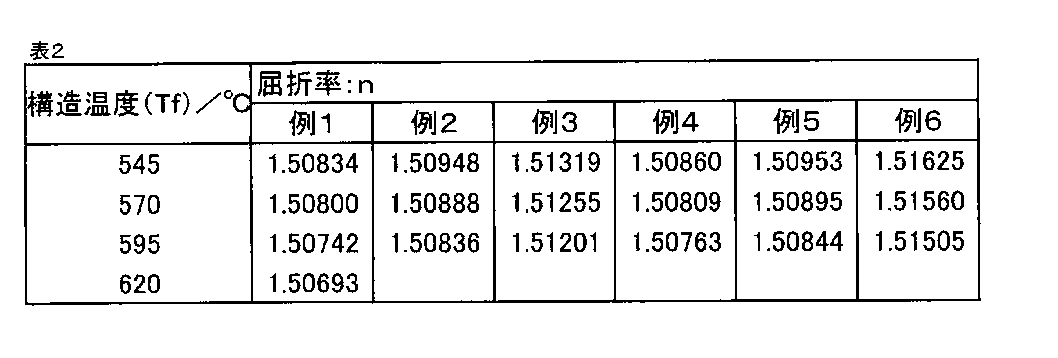
- the refractive index of the quenched glass was measured by a minimum deviation method using a spectrometer. The results are shown in Table 2. Since the temperature left for 1 hour can be considered as the structural temperature of the glass, it can be seen that the refractive index changes due to the difference in the structural temperature.
- FIG. 2 is a graph showing the relationship between the structure temperature (Tf) and the refractive index (n). Both are in a linear relationship, and it can be seen that the structure temperature is obtained by measuring the refractive index. Further, the straight lines in FIG. 2 have almost the same inclination even if the glasses have different compositions. From this, it can be seen that the difference between the refractive index of the molded glass plate and the refractive index after the glass is slowly cooled at a rate of 1 ° C./min is an indicator of the structural temperature of the molded glass.
- the glass blocks of Examples 1 to 12 were processed into plate glass having a size of 40 mm ⁇ 20 mm ⁇ 0.55 mm. This glass was heat-treated in a belt furnace. After passing the maximum temperature of 620 ° C., cooling was performed at 50, 80, and 300 ° C./min. The refractive index of each sample was measured together with the sample cooled at 1 ° C./min before the belt furnace treatment. Further, the structural temperatures of the glasses of Examples 1 to 6 were determined from the above-described structural temperature and refractive index data. Table 3 shows the refractive indices of the glasses of Examples 1 to 12 and the structural temperatures of the glasses of Examples 1 to 6.
- the glass sample heat-treated in the belt furnace was processed into a plate glass having a size of 35 mm ⁇ 5 mm ⁇ 0.55 mm. Processing was performed by machining such as cutting and polishing. Since the structural temperature of the glass changes when heat is applied to the glass during processing, the temperature is maintained at 200 ° C. or lower.
- the glass sample was placed in a beam bending (BB) apparatus, and a glass bending test was performed.
- BB apparatus beam bending
- the glass sample 1 was placed on the receiving edge 2 having a span of 30 mm and adjusted so that the pressing edge 3 hit the center of the sample.
- the glass sample 1 was heated to 350 ° C. at 10 ° C./min, and when it exceeded 200 ° C., a load of 200 gf was applied from above. After holding for 3 hours at 350 ° C., the temperature was lowered to 200 ° C., the load was removed, and the mixture was cooled to room temperature. During this time, the temperature condition was controlled while measuring the displacement amount of the push edge 3, and the deformation amount was continuously measured.
- Glass warpage can be measured by the amount of displacement of the push edge even with a BB device, but in order to increase accuracy, it is measured using a laser displacement meter (non-contact three-dimensional measuring device NH-3MAS manufactured by Mitaka Kogyo Co., Ltd.). did.
- the sample was placed so that the center of the sample was convex, the maximum and minimum heights were measured at the center and both ends, and the difference was taken as the amount of warpage of the glass.
- the amount of warpage of the glass plate before being deformed by the BB device and the amount of warpage after the deformation were measured, and the difference was defined as the amount of deformation by the BB test. Due to the limitations of the measurement method, the measured length of the warp amount is a warp amount of 34 mm excluding 0.5 mm at both ends with respect to the sample 35 mm.
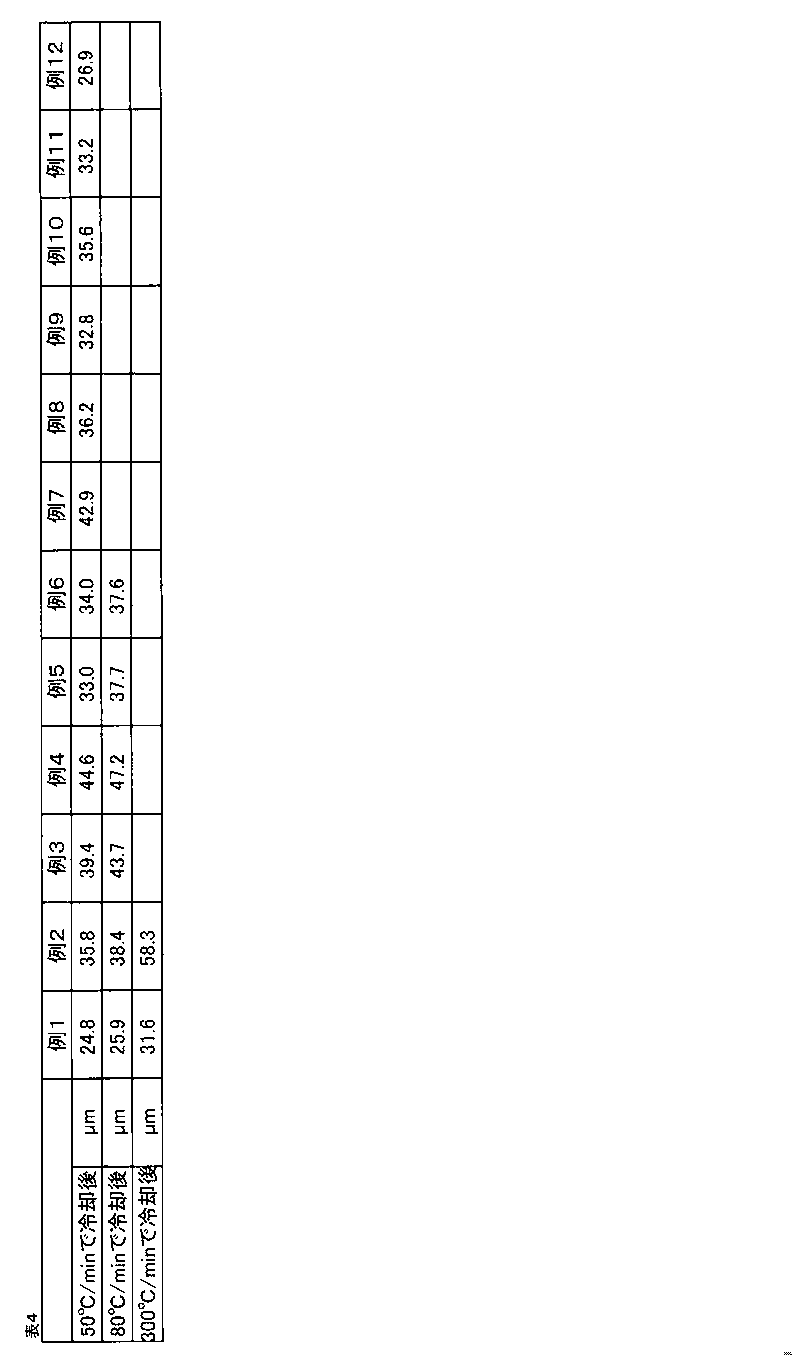
- Table 4 shows the amount of BB deformation of the glasses of Examples 1 to 12.
- MgO and CaO in the glass composition are substituted. It can be seen that the glass with more MgO and less CaO suppresses deformation below the strain point of the glass.
- Example 2 Example 5, glass in Example 6 replacing the Na 2 O and K 2 O in the glass composition. It can be seen that the substitution of Na 2 O and K 2 O does not affect the deformation below the strain point of the glass. Comparing the BB deformation amounts of the glasses of Examples 7 to 9 and Examples 10 to 12, it can be seen that the larger the MgO / RO, the more the deformation is suppressed.
- the glass of the present invention has a specific composition, and in particular, by increasing the MgO content and reducing the CaO content compared to the conventional soda lime silicate glass, the strain point of the glass. It is possible to provide a glass in which deformation due to stress during heat treatment described below is suppressed. Moreover, this deformation
- the glass of the present invention can be used for heat treatment such as chemical strengthening treatment and film formation treatment.
- the chemically strengthened glass of the present invention obtained by chemically strengthening the glass of the present invention can be used for a display device, particularly a cover glass of a touch panel display. Moreover, it can utilize also for the double glazing for building houses, a solar cell substrate, etc.
Landscapes
- Chemical & Material Sciences (AREA)
- Engineering & Computer Science (AREA)
- Materials Engineering (AREA)
- Organic Chemistry (AREA)
- Life Sciences & Earth Sciences (AREA)
- Chemical Kinetics & Catalysis (AREA)
- General Chemical & Material Sciences (AREA)
- Geochemistry & Mineralogy (AREA)
- Glass Compositions (AREA)
- Surface Treatment Of Glass (AREA)
Abstract
本発明は、酸化物基準のモル百分率表示でSiO2を60~75%、Al2O3を1~7%、MgOを8~16%、CaOを0~3.3%、Na2Oを12~18%、及びK2Oを0~4%含有し、徐冷点以上に加熱して1℃/minの速度で徐冷したときに、屈折率の変化が、0.001以下であるガラスを提供する。本発明のガラスは、実際の製造ラインでの化学強化や成膜処理などの熱処理工程における変形を低減できる。
Description
本発明は、歪点以下の温度での熱処理中に応力を受けたときに変形しにくいガラスに関する。また、化学強化ガラス及び化学強化ガラスの製造方法にも関する。
近年、情報機器は、タブレットPC、スマートフォン及び電子書籍リーダー等に見られるようにタッチパネルディスプレイを備えるものが主流となっている。タッチパネルディスプレイは、ディスプレイ用ガラス基板の上にタッチセンサーガラスとカバーガラスを重ねた構造を有している。また、OGS(One・glass・solution)と呼ばれるタッチセンサーガラスとカバーガラスを一体化した構成のものもある。
タッチセンサーガラス、カバーガラス及びOGSのガラスのいずれのガラスも薄く高強度であることが求められており、イオン交換で化学強化処理を施した化学強化ガラスが用いられている(特許文献1)。
タッチセンサーガラス、カバーガラス及びOGSのガラスのいずれのガラスも薄く高強度であることが求められており、イオン交換で化学強化処理を施した化学強化ガラスが用いられている(特許文献1)。
しかしながら、特許文献1の記載のガラスは、白金るつぼで作成されたガラスを記載しており、実際の製造ラインにて生産した場合に生じる変形について開示されていない。
本発明は、実際の製造ラインでの化学強化や成膜処理などの熱処理工程における変形を低減できるガラスを提供することを目的とする。
本発明は、実際の製造ラインでの化学強化や成膜処理などの熱処理工程における変形を低減できるガラスを提供することを目的とする。
本発明者らは、ビーム・ベンディング法(以下、BB法ともいう)を用いて歪点以下でのガラスの変形を評価した。BB法の模式図を図1に示す。BB法とは、電気炉中で3点曲げを行い、ガラスの曲がりを測定する方法である。本発明者らは、BB法で評価した歪点以下でのガラスの変形が、ガラス組成とガラスの熱履歴に依存することを見出し、本発明を完成させた。
すなわち、本発明は以下のとおりである。
(1) 酸化物基準のモル百分率表示でSiO2を60~75%、Al2O3を1~7%、MgOを8~16%、CaOを0~3.3%、Na2Oを12~18%、及びK2Oを0~4%含有し、
徐冷点以上に加熱して1℃/minの速度で徐冷したときに、屈折率の変化が、0.001以下であるガラス。
(2) CaOの含有量が1.3%以下である前記(1)に記載のガラス。
(3) MgOの含有量とRO(ここで、ROは、MgO、CaO、SrO及びBaOの合計である)の含有量の比MgO/ROが0.7以上である前記(1)又は(2)に記載のガラス。
(4) 前記ガラスを35mm×5mm×0.55mmの大きさに加工し、ビーム・ベンディング法で変形量を測定したときに、スパン30mm、温度350℃で200gfの荷重を3時間かけた後のガラスの変形量が45μm以下である前記(1)~(3)のいずれか1つに記載のガラス。
(5) 板形状に成形されたフロートガラスである前記(1)~(4)のいずれか1つに記載のガラス。
(6) 溶融ガラスをフロート法により板形状に成形する工程を含むガラスの製造方法であって、前記ガラスは前記(1)~(4)のいずれか1つに記載のガラスであるガラスの製造方法。
(7) 前記(1)~(5)のいずれか1つに記載のガラスが化学強化された化学強化ガラス。
(8) 表面圧縮応力が500MPa以上である前記(7)に記載の化学強化ガラス。
(9) 圧縮応力深さが10μm以上である前記(7)又は(8)に記載の化学強化ガラス。
(10) 前記(1)~(5)のいずれか1つに記載のガラスをイオン交換処理する化学強化工程を含む化学強化ガラスの製造方法。
(1) 酸化物基準のモル百分率表示でSiO2を60~75%、Al2O3を1~7%、MgOを8~16%、CaOを0~3.3%、Na2Oを12~18%、及びK2Oを0~4%含有し、
徐冷点以上に加熱して1℃/minの速度で徐冷したときに、屈折率の変化が、0.001以下であるガラス。
(2) CaOの含有量が1.3%以下である前記(1)に記載のガラス。
(3) MgOの含有量とRO(ここで、ROは、MgO、CaO、SrO及びBaOの合計である)の含有量の比MgO/ROが0.7以上である前記(1)又は(2)に記載のガラス。
(4) 前記ガラスを35mm×5mm×0.55mmの大きさに加工し、ビーム・ベンディング法で変形量を測定したときに、スパン30mm、温度350℃で200gfの荷重を3時間かけた後のガラスの変形量が45μm以下である前記(1)~(3)のいずれか1つに記載のガラス。
(5) 板形状に成形されたフロートガラスである前記(1)~(4)のいずれか1つに記載のガラス。
(6) 溶融ガラスをフロート法により板形状に成形する工程を含むガラスの製造方法であって、前記ガラスは前記(1)~(4)のいずれか1つに記載のガラスであるガラスの製造方法。
(7) 前記(1)~(5)のいずれか1つに記載のガラスが化学強化された化学強化ガラス。
(8) 表面圧縮応力が500MPa以上である前記(7)に記載の化学強化ガラス。
(9) 圧縮応力深さが10μm以上である前記(7)又は(8)に記載の化学強化ガラス。
(10) 前記(1)~(5)のいずれか1つに記載のガラスをイオン交換処理する化学強化工程を含む化学強化ガラスの製造方法。
本発明によれば、実際の製造ラインでの化学強化や成膜処理などの熱処理工程における変形を低減できるガラスが提供される。
<ガラス>
以下に本発明の一実施形態について説明する。本実施形態のガラスは、酸化物基準のモル百分率表示でSiO2を60~75%、Al2O3を1~7%、MgOを8~16%、CaOを0~3.3%、Na2Oを12~18%、及びK2Oを0~4%含有し、徐冷点以上に加熱して1℃/minの速度で徐冷したときに、屈折率の変化が、0.001以下であることを特徴とする。
以下に本発明の一実施形態について説明する。本実施形態のガラスは、酸化物基準のモル百分率表示でSiO2を60~75%、Al2O3を1~7%、MgOを8~16%、CaOを0~3.3%、Na2Oを12~18%、及びK2Oを0~4%含有し、徐冷点以上に加熱して1℃/minの速度で徐冷したときに、屈折率の変化が、0.001以下であることを特徴とする。
本実施形態のガラスにおいて、ガラス組成を前記範囲に限定した理由を以下に説明する。
SiO2は、ガラス微細構造の中で網目構造を形成する成分として知られており、ガラスを構成する主要成分である。SiO2の含有量は、60%以上であり、好ましくは62%以上、より好ましくは63%以上、さらに好ましくは64%以上である。また、SiO2の含有量は、75%以下であり、好ましくは72%以下、より好ましくは70%以下、さらに好ましくは69%以下である。SiO2の含有量が60%以上であるとガラスとしての安定性及び耐候性の点で優位である。一方、SiO2の含有量が75%以下であると溶解性及び成形性の点で優位である。
Al2O3は化学強化におけるイオン交換性能を向上させる作用があり、特に表面圧縮応力(CS)を向上する作用が大きい。ガラスの耐候性を向上する成分としても知られている。また、フロート成形時にボトム面からの錫の浸入を抑制する作用がある。Al2O3の含有量は、1%以上であり、好ましくは1.6%以上、より好ましくは2.3%以上、さらに好ましくは3%以上である。また、Al2O3の含有量は、7%以下であり、より好ましくは6.3%以下、さらに好ましくは5.6%以下、特に好ましくは5%以下である。
Al2O3の含有量が1%以上であると、イオン交換により、所望のCS値が得られ、また、錫の浸入を抑制する効果が得られる。一方、Al2O3の含有量が7%以下であると、ガラスの粘性が高い場合でも失透温度が大きくは上昇しないため、ソーダライムガラス生産ラインでの溶解、成形の点で優位である。
MgOは、ガラスを安定化させる成分であり、必須である。ガラスの歪点以下での応力による変形を抑制する効果がある。MgOの含有量は、8%以上、好ましくは9%以上、より好ましくは10%以上、さらに好ましくは11%以上である。また、MgOの含有量は、16%以下であり、好ましくは15%以下、より好ましくは14%以下である。MgOの含有量が8%以上であると、ガラスの耐薬品性が良好になる。高温での溶解性が良好になり、失透が起こり難くなる。一方、MgOの含有量が16%以下であると、失透の起こりにくさが維持され、充分なイオン交換速度が得られる。
CaOは必須ではないが、ガラスを安定化させる成分である。CaOはガラスの歪点以下での応力による変形を増長する成分であり、化学強化におけるイオン交換を阻害する成分であるため、含有量を減らす、もしくは含有しないことが好ましい。CaOを含有する場合、その含有量は3.3%以下であり、好ましくは2.3%以下、より好ましくは1.3%以下、さらに好ましくは0.7%以下である。CaOの含有量が3.3%以下であると、ガラスの歪点以下での変形が顕著に抑制される。
Na2Oはイオン交換により表面圧縮応力層を形成させる必須成分であり、圧縮応力層深さ(DOL)を深くする作用がある。またガラスの高温粘性と失透温度を下げ、ガラスの溶解性、成形性を向上させる成分である。Na2Oの含有量は、12%以上であり、好ましくは13%以上、より好ましくは14%以上である。また、Na2Oの含有量は、18%以下であり、好ましくは17%以下、より好ましくは16%以下である。Na2Oの含有量が12%以上であると、イオン交換により所望の表面圧縮応力層を形成することができる。一方、Na2Oの含有量が18%以下であると、充分な耐候性が得られる。
K2Oは必須ではないが、イオン交換速度を増大しDOLを深くする効果があるため含有してもよい。一方、K2Oが多くなりすぎると十分なCSが得られなくなる。K2Oを含有する場合の量は、4%以下であり、好ましくは2.5%以下、より好ましくは1%以下である。K2Oの含有量が4%以下であると、充分なCSが得られる。
SrOは必須ではないが、失透特性を向上する効果があるため、含有してもよい。一方、SrOはガラスの歪点以下での応力による変形を増長する成分であり、その含有量を少なくすることが好ましい。SrOを含有する場合の含有量は3%以下であり、好ましくは2%以下、より好ましくは1%以下である。SrOの含有量が3%以下であるとガラスの歪点以下での変形が抑制される。
BaOは必須ではないが、失透特性を向上する効果があるため、含有してもよい。一方、BaOはガラスの歪点以下での応力による変形を増長する成分であり、その含有量を少なくすることが好ましい。BaOを含有する場合の含有量は3%以下であり、好ましくは2%以下、より好ましくは1%以下である。BaOの含有量が3%以下であるとガラスの歪点以下での変形が抑制される。
アルカリ土類酸化物のうち、MgOがガラスの歪点以下での応力による変形を抑制する成分であるのに対し、CaO、SrO及びBaOは、変形を増長する成分である。MgOの含有量とRO(ここで、ROは、MgO、CaO、SrO及びBaOの合計、すなわち、MgO+CaO+SrO+BaOである)の含有量の比である、MgO/ROは、0.7以上であり、好ましくは0.8以上、より好ましくは0.9以上、さらに好ましくは0.95以上である。MgO/ROが0.7以上であると、歪点以下の温度でガラスに応力がかかったときの変形抑制効果が大きくなる。
この他、ガラスの溶融の清澄剤として、硫酸塩、塩化物、フッ化物などを適宜含有してもよい。本発明のガラスは本質的に以上で説明した成分からなるが、本発明の目的を損なわない範囲でその他の成分を含有してもよい。そのような成分を含有する場合、それら成分の含有量の合計は3%以下であることが好ましく、より好ましくは2%以下、典型的には1%以下である。以下、上記その他成分について例示的に説明する。
B2O3は高温での溶融性またはガラス強度の向上のために、2%以下の範囲で含有してもよい。一般的には、Na2OまたはK2Oのアルカリ成分とB2O3を同時に含有すると揮散が激しくなり、ガラス窯の炉材を著しく浸食するので、B2O3は実質的に含有しないことが好ましい。なお、「実質的に含有しない」とは、不可避的不純物として含有される場合を除き含有しないことを意味するものであり、以下においても同様である。
Fe2O3は、自然界及び生産ラインのあらゆるところに存在するため、その含有量をゼロにすることが極めて困難な成分である。酸化状態にあるFe2O3が黄色の着色原因となり、還元状態にあるFeOが青色の着色原因となることが知られており、両者のバランスでガラスは緑色に着色することが知られている。全鉄量(トータルFe)をFe2O3として換算し、その含有量は典型的には0.1%以下であることが好ましい。Fe2O3の含有量が0.1%以下であると、ガラスが着色することを回避できる。
TiO2は、天然原料中に多く存在し、黄色の着色源となることが知られている。TiO2を含有する場合の含有量は、0.5%以下であることが好ましく、より好ましくは0.2%以下、さらに好ましくは0.1%以下である。TiO2の含有量が0.5%以下であると、ガラスが黄色味を帯びる現象を回避できる。
ZnOはガラスの高温での溶融性を向上するために、たとえば2%まで含有してもよい。しかし、フロート法で製造する場合には、フロートバスで還元され製品欠点となるので含有しないことが好ましい。
ZrO2は化学強化後のCSを向上させる成分である。ZrO2を含有する場合の含有量は2%以下が好ましく、1%以下がより好ましい。ZrO2が2%以下であると、失透温度の上昇を回避できる。
Li2OはTgを低くして応力緩和を起こりやすくし、その結果安定した表面圧縮応力層を得られなくする成分であるので含有しないことが好ましい。含有する場合であってもその含有量は1%以下であることが好ましく、より好ましくは0.1%以下、特に好ましくは0.01%以下である。
本実施形態のガラスは、製造特性及び商品特性の両面で、通常のソーダライムガラスから容易に変更可能である。通常のソーダライムガラスで、ガラス溶解時の高温粘性の基準となるlogη=2の温度(T2)は、一般に1445~1475℃である。ここで粘性ηの単位は、dPa・sである。
溶解時高温粘性の上昇がプラス50℃くらいまでの範囲であれば、普通のソーダライムガラスを溶解していた溶解窯で容易に製造可能である。本発明のガラスの溶解における高温粘性は、T2が1520℃以下であることが好ましく、より好ましくは1500℃以下である。
通常のソーダライムガラスで、フロート法によるガラス成形時の高温粘性の基準となるlogη=4の温度(T4)は、一般に1020~1050℃である。この粘性となる温度での高温粘性の上昇がプラス50℃くらいまでの範囲であれば、普通のソーダライムガラスを成形していたフロート法製造装置で容易に製造可能である。本実施形態のガラスの成形における高温粘性は、logη=4となる温度(T4)が1100℃以下であることが好ましく、より好ましくは1090℃以下である。
失透温度(TL)は、フロート法でガラスを製造する際には、前述のT4と比較して失透発生の危険性が判断される。一般にガラスの失透温度がT4より15℃高い温度以下であればフロート法で失透の発生なしに製造可能であり、好ましくは、T4以下である。すなわち、T4-TLは、-15℃以上であり、好ましくは0℃以上である。
ガラスにかかる応力は、多くの場合にガラスの自重で発生する。自重による応力発生を小さくするためにはガラスの比重が小さいことが好ましい。本実施形態のガラスの比重は、2.49以下であり、好ましくは2.48以下、更に好ましくは2.47以下である。比重が小さいガラスは、一般に高温粘性が高くなる傾向にある。高温粘性を必要以上に上げないために、本実施形態のガラスの比重は、2.43以上であり、好ましくは2.44以上、より好ましくは2.45以上である。
ガラスに化学強化処理を施す場合、その温度は、ガラス転移点(Tg)を基準に有効な処理温度を決定することができる。一般に化学強化処理は、Tgより100~150℃低い温度で実施されている。本実施形態のガラスは、これまでと同じ化学強化処理を適用するため、Tgが540~610℃であることが好ましく、より好ましくは、550~600℃である。
化学強化処理の様な熱処理工程においてガラスの温度分布が不均一になると熱応力が発生する。熱応力を小さく抑えるためには、ガラスの熱膨張係数が小さいことが好ましい。本実施形態のガラスの熱膨張係数は、96×10-7℃-1以下であり、好ましくは94×10-7℃-1以下、より好ましくは92×10-7℃-1以下である。熱膨張係数が小さいガラスは、一般に高温粘性が高くなる傾向にある。高温粘性を必要以上に上げないために、本実施形態のガラスの熱膨張係数は、84×10-7℃-1以上であり、好ましくは86×10-7℃-1以上、より好ましくは88×10-7℃-1以上である。
<ガラスの製造>
本実施形態のガラスは、フロート法、フュージョン法、スロットダウンドロー法、ロールアウト法など、既知のガラス成形方法によって平板形状に成形することができる。また、平板に成形した後、曲げ加工を施したガラス板でもよい。なお、本明細書中においては、フロート法で成形されたガラスをフロートガラスともいう。
本実施形態のガラスは、フロート法、フュージョン法、スロットダウンドロー法、ロールアウト法など、既知のガラス成形方法によって平板形状に成形することができる。また、平板に成形した後、曲げ加工を施したガラス板でもよい。なお、本明細書中においては、フロート法で成形されたガラスをフロートガラスともいう。
本実施形態のガラスは、既存の成形法で成形可能な寸法を有する。すなわち、フロート法で成形すれば、フロート成形幅の連続したリボン状のガラスが得られる。また、本実施形態のガラスは、最終的には使用目的に適した大きさに切断される。
すなわち、タブレットPCまたはスマートフォン等のディスプレイの大きさであったり、ビルまたは住宅の窓ガラスの大きさとなる。本実施形態のガラスは、一般的には矩形に切断されているが、円形または多角形などの他の形状でも問題なく、穴あけ加工を施したガラスも含まれる。
本実施形態のガラスは、ガラス板に成形し、室温に冷却した後にガラスの構造温度(Tf)が低くなっていることが好ましい。ガラス中の原子は液相状態の配列構造をしており、この構造が凍結された温度を構造温度と言う。ガラスの構造温度は、ガラスの徐冷点から200℃付近までの冷却速度で決まり、ゆっくり徐冷することで構造温度が下がり、同じ組成のガラスでも密度が高くなることが知られている。本発明者らは、ガラスの構造温度が低くなることで、ガラスの歪点以下での応力による変形を抑制できることを見出した。
ガラスの構造温度の変化は、簡便な方法として、ガラスの屈折率変化によって見積もることができる。まず、成形したガラス板の屈折率を室温で測定し、そのガラスを徐冷点以上に加熱してから1℃/minの速度で歪点以下に徐冷して、再び室温でガラス板の屈折率を測定する。再徐冷処理前後で測定される屈折率の差によって、成形されたガラスの構造温度が、1℃/minで冷却したときの構造温度に対してどれくらい高い状態であったかを知ることができる。
ガラスの屈折率測定は、最小偏角法、臨界角法、Vブロック法などが知られており、本発明の効果の検証には、いずれの測定法も用いることができる。本実施形態のガラスは、徐冷点以上に加熱して1℃/minの速度で徐冷した後に、屈折率の変化が、0.001以下であることが好ましく、より好ましくは0.0009以下、さらに好ましくは0.0008以下である。屈折率の変化が、0.001以下であるとガラス板の構造温度が低下しており、ガラスの歪点以下での応力による変形を抑制できる。
本実施形態のガラスは、前記ガラス構造温度を低減させることを考慮すると、化学強化等の熱処理前にガラスの冷却をゆっくり行うことが好ましい。ガラスの徐冷点から200℃付近(好ましくは200℃以下)までの冷却速度は、200℃/min以下であることが好ましく、より好ましくは130℃/min以下、さらに好ましくは80℃/min以下である。本実施形態のガラスは、長い徐冷炉を保有するフロート法で製造することが好ましい。
本実施形態のガラスを連続的に工業生産する場合、製造設備のコストと生産効率の面から、徐冷速度をゆっくりすることには一定の制約がある。実用的な工業生産では、ガラスの徐冷点から200℃付近(好ましくは200℃以下)までの冷却速度は、10℃/min以上であることが好ましく、より好ましくは17℃/min以上、さらに好ましくは30℃/min以上である。このような冷却工程で生産されたガラスの構造温度は、上述のように屈折率の変化で見積もることができる。本実施形態のガラスを徐冷点以上に加熱して1℃/minの速度で徐冷した後に、屈折率の変化が、0.0004以上であることが好ましく、より好ましくは0.0005以上であり、さらに好ましくは0.0006以上である。屈折率の変化が0.0004以上であると良好な生産効率が保たれる。
本実施形態のガラスは、ビーム・ベンディング(BB)法を用いて測定される歪点以下でのガラスの変形量が小さくなっていることが好ましい。BB法とは、前述の通り、電気炉中で3点曲げを行い、ガラスの曲がりを測定する方法である。以下に本実施形態のガラスのBB法測定を例示する。
まず、ガラスを35mm×5mm×0.55mmの大きさの板状ガラスに加工する。加工は、切断、研磨などの機械加工で行う。加工中にガラスに熱が加わるとガラスの構造温度が変化してしまうため、温度が200℃以下となるように維持する。測定形状に加工した板ガラスをスパン30mm幅の受けエッジの上部に、試料中央と受けエッジスパンの中央を合わせて設置し、試料中央部に押しエッジが当たるように調整する。ガラス試料を10℃/minで350℃まで昇温し、200℃を超えた時点で上から200gfの荷重を加える。350℃で3時間荷重をかけたまま保持した後、200℃まで降温した後に荷重を除去し、室温まで冷却する。このBB処理前後でガラスの反り形状を測定する。反り形状測定は、ガラス試料中央が凸になるように設置し、中央部と両端部分で高さの最大と最小を測定して、その差をガラスの反り量とする。BB処理前後の反り量の差をBB法による変形量とする。測定方法の制約により、反り量の実測長さは試料35mmに対して両端0.5mmを除く34mmの長さの反り量となる。
本実施形態のガラスは、BB法による変形量が45μm以下であり、好ましくは41μm以下であり、より好ましくは37μm以下である。BB法による変形量が45μm以下であることにより、化学強化等の歪点以下の温度での熱処理中に応力を受けたときの変形が小さくなる。
本実施形態のガラスは、化学強化処理を適用可能である。また、本実施形態のガラスの形状等は、使用される用途等に応じて適宜変更することができ、特に制限されるものではない。本実施形態のガラスが板状の化学強化用ガラス(化学強化用ガラス板)である場合、当該化学強化用ガラス板の板厚tは、特に限定されるものではない。
<化学強化処理>
化学強化処理は、従来公知の方法によって行うことができる。また、化学強化処理の前に、用途に応じた形状加工、例えば、切断、端面加工及び穴あけ加工などの機械的加工を行うことが好ましい。
化学強化処理は、従来公知の方法によって行うことができる。また、化学強化処理の前に、用途に応じた形状加工、例えば、切断、端面加工及び穴あけ加工などの機械的加工を行うことが好ましい。
化学強化処理により、大きなイオン半径のアルカリ金属イオン(典型的には、Kイオン)を含むアルカリ金属塩(例えば、硝酸カリウム塩)の融液に浸漬などによって、ガラス基板を接触させることにより、ガラス基板中の小さなイオン半径の金属イオン(典型的には、Naイオン)が大きなイオン半径の金属イオンと置換される。
化学強化処理は、例えば、340~550℃の硝酸カリウム溶融塩中にガラス板を5分~24時間浸漬することによって行うことができる。イオン交換条件は、ガラスの粘度特性や、用途、板厚、ガラス内部の引っ張り応力等を考慮して最適な条件を選択すればよい。
イオン交換処理を行うための溶融塩としては、例えば、硝酸カリウム塩、硫酸カリウム塩、及び塩化カリウム塩等のアルカリ硝酸塩、アルカリ硫酸塩及びアルカリ塩化物塩などが挙げられる。これらの溶融塩は単独で用いてもよいし、複数種を組み合わせて用いてもよい。また、化学強化特性を調整するために、ナトリウムを含む塩を混ぜてもよい。
本発明において、化学強化処理の処理条件は、特に限定されず、ガラスの特性及び溶融塩等を考慮して最適な条件を選択すればよい。
<化学強化ガラス>
本発明のガラスを化学強化して得られる化学強化ガラス(以下、本発明の化学強化ガラスともいう)は、イオン交換処理によって表面に圧縮応力層を備える。表面応力層の表面圧縮応力(CS)は500MPa以上であることが好ましく、600MPa以上がより好ましく、700MPa以上であることがさらに好ましい。
本発明のガラスを化学強化して得られる化学強化ガラス(以下、本発明の化学強化ガラスともいう)は、イオン交換処理によって表面に圧縮応力層を備える。表面応力層の表面圧縮応力(CS)は500MPa以上であることが好ましく、600MPa以上がより好ましく、700MPa以上であることがさらに好ましい。
また、化学強化ガラスの使用時に表面圧縮応力層の深さを超える傷がつくとガラスの破壊につながるため、表面圧縮応力層は深い方が好ましい。したがって、圧縮応力深さ(DOL)は10μm以上であることが好ましく、12μm以上であることが好ましく、さらに好ましくは14μm以上である。また、化学強化処理後の切断を可能とするためには、40μm以下が好ましく、30μm以下がより好ましい。
なお、本発明の化学強化ガラスの表面圧縮応力層のCS及びDOLは、表面応力計(例えば、折原製作所製FSM-6000)等を用いて測定することができる。
本発明の化学強化ガラスは、カリウムイオン、銀イオン、セシウムイオン及びルビジウムイオンからなる群から選ばれる少なくとも1種を表面に有することが好ましい。このことにより、表面に圧縮応力が誘起されガラスが高強度化される。また、銀イオンを表面に有することで、抗菌性を付与することができる。
本発明のガラスを化学強化することにより、化学強化ガラス製品を得ることができる。本発明の化学強化ガラスの用途は、特段限定されない。高い機械的強度を有することから、落下による衝撃や、他の物質との接触が予想される箇所への使用に好適である。
具体的には、例えば、携帯電話機(スマートフォン等の多機能情報端末を含む。)、PHS、PDA、タブレット型端末、ノート型パーソナルコンピューター、ゲーム機、携帯音楽・動画プレーヤー、電子ブック、電子端末、時計、カメラまたはGPS等のディスプレイ部分用のカバーガラス、及びこれらの機器のタッチパネル操作用モニターのカバーガラス、電子レンジ、オーブントースター等の調理器のカバーガラス、電磁調理器等のトッププレート、メーター、ゲージ等の計器類のカバーガラス並びにコピー機またはスキャナ等の読み取り部分用のガラス板等の機械または機器類の保護用途がある。
また、例えば、ビル、住宅、車両、船舶、航空機等の窓用ガラス、家庭用または産業用の照明機器、信号、誘導灯、電光掲示板のカバーガラス、ショーケース及び防弾ガラス等の用途が挙げられる。太陽電池保護用のカバーガラス及び太陽電池の発電効率を高めるための集光用のガラス材の用途が挙げられる。
また、例えば、水槽、皿やコップ等の食器、びん又はまな板等の各種の調理器具、食器棚、冷蔵庫の棚板及び壁、屋根または仕切り等の建材としての用途が挙げられる。
[評価方法]
(1)比重
比重はアルキメデス法で測定した。表1のカッコ内の数値は、計算値を示す。計算値については、比重の測定値とガラス組成から線形回帰式を作成して、計算により求めた。
(2)ガラス転移点(Tg)
ガラス転移点は熱膨張計(ブルカー・エイエックスエス社製、TD5000SA)により測定した。表1のカッコ内の数値は、計算値を示す。計算値については、Tgの測定値とガラス組成から線形回帰式を作成して、計算により求めた。
(3)高温粘性
粘度が102dPa・sとなる温度(T2)、粘度が104dPa・sとなる温度(T4)は回転式粘度計を用いて測定した。表1のカッコ内の数値は、計算値を示す。計算値については、T2及びT4の測定値とガラス組成から線形回帰式を作成して、計算により求めた。
(4)熱膨張係数(CTE)
CTEはJIS R 1618:2002に基づき、ガラス転移点(Tg)の測定と同時に熱膨張計(ブルカー・エイエックスエス社製、TD5000SA)を用いて5℃/minの昇温速度で測定し50~350℃の平均線熱膨張係数を求めた。表1のカッコ内の数値は、計算値を示す。計算値については、CTEの測定値とガラス組成から線形回帰式を作成して、計算により求めた。
(5)失透温度(TL)
失透温度は、ガラスを乳鉢で2mm程度のガラス粒に粉砕し、このガラス粒を白金ボートに並べて置き、温度傾斜炉中において5℃刻みで24時間熱処理した。結晶が析出しているガラス粒の温度の最高値を失透温度とした。
(6)表面圧縮応力(CS)及び圧縮応力層深さ(DOL)
表面圧縮応力及び圧縮応力層深さは、折原製作所社製表面応力計FSM-6000にて測定した。
(1)比重
比重はアルキメデス法で測定した。表1のカッコ内の数値は、計算値を示す。計算値については、比重の測定値とガラス組成から線形回帰式を作成して、計算により求めた。
(2)ガラス転移点(Tg)
ガラス転移点は熱膨張計(ブルカー・エイエックスエス社製、TD5000SA)により測定した。表1のカッコ内の数値は、計算値を示す。計算値については、Tgの測定値とガラス組成から線形回帰式を作成して、計算により求めた。
(3)高温粘性
粘度が102dPa・sとなる温度(T2)、粘度が104dPa・sとなる温度(T4)は回転式粘度計を用いて測定した。表1のカッコ内の数値は、計算値を示す。計算値については、T2及びT4の測定値とガラス組成から線形回帰式を作成して、計算により求めた。
(4)熱膨張係数(CTE)
CTEはJIS R 1618:2002に基づき、ガラス転移点(Tg)の測定と同時に熱膨張計(ブルカー・エイエックスエス社製、TD5000SA)を用いて5℃/minの昇温速度で測定し50~350℃の平均線熱膨張係数を求めた。表1のカッコ内の数値は、計算値を示す。計算値については、CTEの測定値とガラス組成から線形回帰式を作成して、計算により求めた。
(5)失透温度(TL)
失透温度は、ガラスを乳鉢で2mm程度のガラス粒に粉砕し、このガラス粒を白金ボートに並べて置き、温度傾斜炉中において5℃刻みで24時間熱処理した。結晶が析出しているガラス粒の温度の最高値を失透温度とした。
(6)表面圧縮応力(CS)及び圧縮応力層深さ(DOL)
表面圧縮応力及び圧縮応力層深さは、折原製作所社製表面応力計FSM-6000にて測定した。
[ガラスの作成]
表1の例1~12についてSiO2からK2Oまでの欄にモル百分率表示で示す組成になるように、酸化物、水酸化物、炭酸塩または硝酸塩等一般に使用されているガラス原料を適宜選択し、ガラスとして900gとなるように秤量した。ついで、混合した原料を白金製るつぼに入れ、1600℃の抵抗加熱式電気炉に投入し、4時間溶融し、脱泡、均質化した。
表1の例1~12についてSiO2からK2Oまでの欄にモル百分率表示で示す組成になるように、酸化物、水酸化物、炭酸塩または硝酸塩等一般に使用されているガラス原料を適宜選択し、ガラスとして900gとなるように秤量した。ついで、混合した原料を白金製るつぼに入れ、1600℃の抵抗加熱式電気炉に投入し、4時間溶融し、脱泡、均質化した。
得られた溶融ガラスを型材に流し込み、Tg+30℃の温度で1時間保持した後、1℃/minの速度で室温まで冷却し、ガラスブロックを得た。このガラスブロックを切断、研削し、最後に両面を鏡面に加工して、サイズが20mm×20mm、厚みが1mmである板状ガラスを得た。このガラスの比重、CTE、Tg、T2、T4及びTLを測定した。その結果を表1に示す。
得られたガラスを425℃の97.8質量%KNO3、2.2質量%NaNO3溶融塩中に2時間30分浸漬して化学強化処理することにより化学強化ガラスを得た。化学強化処理後の各ガラスについて、CS及びDOLを測定した。その結果を表1に示す。

例1~6のガラスを20mm×20mm×0.5mmの大きさに加工し、所定温度(545~620℃)の電気炉中に入れ、1時間放置した後、大気中に取りだすことで急冷した。急冷したガラスの屈折率を、分光計を用い最小偏角法により測定した。結果を表2に示す。1時間放置した温度はガラスの構造温度と考えることができるので、構造温度の相違で屈折率が変化していることが分かる。
構造温度(Tf)と屈折率(n)の関係をグラフにして図2に示す。両者は直線関係にあり、屈折率の測定で構造温度が求められることが分かる。また、図2の直線は異なる組成のガラスであっても、ほぼ同じ傾きを持っている。このことから、成形したガラス板の屈折率とそのガラスを1℃/minの速度で徐冷した後の屈折率の差が、成形されたガラスの構造温度の指標となることが分かる。
次に例1~12のガラスブロックを40mm×20mm×0.55mmの大きさの板状ガラスに加工した。このガラスをベルト炉で熱処理した。最高温度620℃を通過させた後、50、80、300℃/minで冷却した。ベルト炉処理前の1℃/minで冷却した試料と合わせて、各試料の屈折率を測定した。また、前述の構造温度と屈折率のデータから、例1~6のガラスの構造温度を求めた。表3に例1~12のガラスの屈折率と例1~6のガラスの構造温度を示す。

次に上述ベルト炉で熱処理したガラス試料を35mm×5mm×0.55mmの大きさの板状ガラスに加工した。加工は、切断、研磨などの機械加工で行った。加工中にガラスに熱が加わるとガラスの構造温度が変化してしまうため、温度が200℃以下となるように維持した。このガラス試料をビーム・ベンディング(BB)装置に設置し、ガラスの曲げ試験を行った。BB装置の模式図を図1に示す。BB装置は、電気炉中に三点曲げ試験機が設置されており、所定温度での荷重に対するガラスの変形を測定することができる。
スパン30mm幅の受けエッジ2の上にガラス試料1を設置し、試料中央部に押しエッジ3が当たるように調整した。ガラス試料1を10℃/minで350℃まで昇温し、200℃を超えた時点で上から200gfの荷重を加えた。350℃で3時間荷重をかけたまま保持した後、200℃まで降温した後に荷重を除去し、室温まで冷却した。この間に押しエッジ3の変位量を測定しながら温度条件をコントロールし、変形量を連続的に測定した。
ガラスの反りは、BB装置でも押しエッジの変位量で測定可能であるが、精度を上げるためにレーザー変位計(三鷹光器株式会社社製 非接触三次元測定装置 NH-3MAS)を用いて測定した。試料中央が凸になるように設置し、中央部と両端部分で高さの最大と最小を測定してその差をガラスの反り量とした。BB装置で変形させる前のガラス板の反り量と変形後の反り量を測定し、その差をBB試験による変形量とした。測定方法の制約により、反り量の実測長さは試料35mmに対して両端0.5mmを除く34mmの長さの反り量となる。
例1~12のガラスのBB変形量を表4に示す。例1~例4のガラスは、ガラス組成中のMgOとCaOを置換している。MgOが多く、CaOが少ないガラスほどガラスの歪点以下での変形が抑制されていることが分かる。例2、例5、例6のガラスは、ガラス組成中のNa2OとK2Oを置換している。Na2OとK2Oの置換は、ガラスの歪点以下での変形に影響しないことが分かる。例7~9および例10~12のガラスのBB変形量を比較すると、MgO/ROが大きくなるほど変形が抑制されていることが分かる。
表4に示されている、ベルト炉での冷却速度50℃/minと80℃/minのガラス試料のBB変形量を比較すると、50℃/minで冷却したときの変形が少なくなっていることが分かる。冷却速度300℃/minで冷却したガラス試料のBB変形量は、80℃/minで冷却したガラス試料よりも更に大きくなっており、ゆっくり冷却することでガラスの変形が抑制されることが分かる。
以上説明したように、本発明のガラスは、特定の組成を有し、特に、従来のソーダライムシリケートガラスよりもMgOの含有量を増やし、CaOの含有量を少なくすることにより、ガラスの歪点以下での熱処理中の応力に対する変形が抑制されたガラスを提供することができる。また、ガラスの熔解成形後に所定の徐冷熱処理を施すことにより、この変形を更に抑制することが可能となる。
本発明を特定の態様を参照して詳細に説明したが、本発明の精神と範囲を離れることなく様々な変更および修正が可能であることは、当業者にとって明らかである。
なお、本出願は、2015年2月24日付けで出願された日本特許出願(特願2015-034582)及び2015年9月17日付けで出願された日本特許出願(特願2015-184377)に基づいており、その全体が引用により援用される。
なお、本出願は、2015年2月24日付けで出願された日本特許出願(特願2015-034582)及び2015年9月17日付けで出願された日本特許出願(特願2015-184377)に基づいており、その全体が引用により援用される。
本発明のガラスは、化学強化処理や成膜処理などの熱処理に利用可能である。本発明のガラスを化学強化処理することにより得られる本発明の化学強化ガラスは、ディスプレイ装置、特にタッチパネルディスプレイのカバーガラスなどに利用できる。また、ビル住宅用の複層ガラスや太陽電池基板などにも利用することができる。
1 ガラス試料
2 受けエッジ
3 押しエッジ
2 受けエッジ
3 押しエッジ
Claims (10)
- 酸化物基準のモル百分率表示でSiO2を60~75%、Al2O3を1~7%、MgOを8~16%、CaOを0~3.3%、Na2Oを12~18%、及びK2Oを0~4%含有し、
徐冷点以上に加熱して1℃/minの速度で徐冷したときに、屈折率の変化が、0.001以下であるガラス。 - CaOの含有量が1.3%以下である請求項1に記載のガラス。
- MgOの含有量とRO(ここで、ROは、MgO、CaO、SrO及びBaOの合計である)の含有量の比MgO/ROが0.7以上である請求項1又は2に記載のガラス。
- 前記ガラスを35mm×5mm×0.55mmの大きさに加工し、ビーム・ベンディング法で変形量を測定したときに、スパン30mm、温度350℃で200gfの荷重を3時間かけた後のガラスの変形量が45μm以下である請求項1~3のいずれか1項に記載のガラス。
- 板形状に成形されたフロートガラスである請求項1~4のいずれか1項に記載のガラス。
- 溶融ガラスをフロート法により板形状に成形する工程を含むガラスの製造方法であって、前記ガラスは請求項1~4のいずれか1項に記載のガラスであるガラスの製造方法。
- 請求項1~5のいずれか1項に記載のガラスが化学強化された化学強化ガラス。
- 表面圧縮応力が500MPa以上である請求項7に記載の化学強化ガラス。
- 圧縮応力深さが10μm以上である請求項7又は8に記載の化学強化ガラス。
- 請求項1~5のいずれか1項に記載のガラスをイオン交換処理する化学強化工程を含む化学強化ガラスの製造方法。
Priority Applications (1)
| Application Number | Priority Date | Filing Date | Title |
|---|---|---|---|
| CN201680011671.5A CN107250072B (zh) | 2015-02-24 | 2016-02-17 | 玻璃和化学强化玻璃以及化学强化玻璃的制造方法 |
Applications Claiming Priority (4)
| Application Number | Priority Date | Filing Date | Title |
|---|---|---|---|
| JP2015-034582 | 2015-02-24 | ||
| JP2015034582 | 2015-02-24 | ||
| JP2015184377 | 2015-09-17 | ||
| JP2015-184377 | 2015-09-17 |
Publications (1)
| Publication Number | Publication Date |
|---|---|
| WO2016136539A1 true WO2016136539A1 (ja) | 2016-09-01 |
Family
ID=56788432
Family Applications (1)
| Application Number | Title | Priority Date | Filing Date |
|---|---|---|---|
| PCT/JP2016/054501 Ceased WO2016136539A1 (ja) | 2015-02-24 | 2016-02-17 | ガラス、及び化学強化ガラス並びに化学強化ガラスの製造方法 |
Country Status (3)
| Country | Link |
|---|---|
| CN (1) | CN107250072B (ja) |
| TW (1) | TW201638038A (ja) |
| WO (1) | WO2016136539A1 (ja) |
Cited By (5)
| Publication number | Priority date | Publication date | Assignee | Title |
|---|---|---|---|---|
| WO2017068857A1 (ja) * | 2015-10-21 | 2017-04-27 | セントラル硝子株式会社 | 化学強化用ガラス板及び化学強化ガラス板の製造方法 |
| WO2018056168A1 (ja) * | 2016-09-21 | 2018-03-29 | 旭硝子株式会社 | 化学強化用ガラスおよび化学強化ガラス |
| WO2018074198A1 (ja) * | 2016-10-21 | 2018-04-26 | 旭硝子株式会社 | 化学強化ガラス板 |
| CN108689598A (zh) * | 2017-04-05 | 2018-10-23 | 肖特玻璃科技(苏州)有限公司 | 化学钢化后具有低膨胀的铝硅酸盐玻璃 |
| US12006255B2 (en) | 2017-02-27 | 2024-06-11 | Schott Glass Technologies (Suzhou) Co. Ltd. | Lithium containing aluminosilicate glass with low expansion after chemical toughening |
Families Citing this family (2)
| Publication number | Priority date | Publication date | Assignee | Title |
|---|---|---|---|---|
| CN115572061B (zh) * | 2022-09-28 | 2024-04-12 | 湖南旗滨电子玻璃股份有限公司 | 素玻璃、化学强化玻璃及其制备方法、盖板玻璃 |
| CN116023025B (zh) * | 2023-01-19 | 2024-06-28 | 清远南玻节能新材料有限公司 | 用于离子交换的铝硼硅酸盐玻璃及其制备方法和应用 |
Citations (6)
| Publication number | Priority date | Publication date | Assignee | Title |
|---|---|---|---|---|
| JP2002507538A (ja) * | 1998-03-20 | 2002-03-12 | ピルキントン パブリック リミテッド カンパニー | 化学的に強化した無ホウ素フロートガラス組成物 |
| WO2011145661A1 (ja) * | 2010-05-19 | 2011-11-24 | 旭硝子株式会社 | 化学強化用ガラスおよびディスプレイ装置用ガラス板 |
| WO2012118163A1 (ja) * | 2011-03-03 | 2012-09-07 | 日本電気硝子株式会社 | 樹脂複合体基板用ガラス |
| JP2012250861A (ja) * | 2011-05-31 | 2012-12-20 | Asahi Glass Co Ltd | 化学強化ガラス板 |
| JP2013193887A (ja) * | 2012-03-15 | 2013-09-30 | Nippon Sheet Glass Co Ltd | ガラス組成物、化学強化用ガラス組成物、強化ガラス物品、ディスプレイ用のカバーガラスおよび強化ガラス物品の製造方法 |
| WO2015088006A1 (ja) * | 2013-12-13 | 2015-06-18 | 旭硝子株式会社 | 化学強化用ガラス及び化学強化処理されたガラス |
Family Cites Families (3)
| Publication number | Priority date | Publication date | Assignee | Title |
|---|---|---|---|---|
| JP5621239B2 (ja) * | 2009-10-20 | 2014-11-12 | 旭硝子株式会社 | ディスプレイ装置用ガラス板、ディスプレイ装置用板ガラスおよびその製造方法 |
| KR101790483B1 (ko) * | 2010-09-27 | 2017-10-25 | 아사히 가라스 가부시키가이샤 | 화학 강화용 유리, 화학 강화 유리 및 디스플레이 장치용 유리판 |
| JP5761473B2 (ja) * | 2013-06-06 | 2015-08-12 | 旭硝子株式会社 | 化学強化用ガラスおよび化学強化ガラス並びに化学強化ガラスの製造方法 |
-
2016
- 2016-02-17 WO PCT/JP2016/054501 patent/WO2016136539A1/ja not_active Ceased
- 2016-02-17 CN CN201680011671.5A patent/CN107250072B/zh active Active
- 2016-02-22 TW TW105105165A patent/TW201638038A/zh unknown
Patent Citations (6)
| Publication number | Priority date | Publication date | Assignee | Title |
|---|---|---|---|---|
| JP2002507538A (ja) * | 1998-03-20 | 2002-03-12 | ピルキントン パブリック リミテッド カンパニー | 化学的に強化した無ホウ素フロートガラス組成物 |
| WO2011145661A1 (ja) * | 2010-05-19 | 2011-11-24 | 旭硝子株式会社 | 化学強化用ガラスおよびディスプレイ装置用ガラス板 |
| WO2012118163A1 (ja) * | 2011-03-03 | 2012-09-07 | 日本電気硝子株式会社 | 樹脂複合体基板用ガラス |
| JP2012250861A (ja) * | 2011-05-31 | 2012-12-20 | Asahi Glass Co Ltd | 化学強化ガラス板 |
| JP2013193887A (ja) * | 2012-03-15 | 2013-09-30 | Nippon Sheet Glass Co Ltd | ガラス組成物、化学強化用ガラス組成物、強化ガラス物品、ディスプレイ用のカバーガラスおよび強化ガラス物品の製造方法 |
| WO2015088006A1 (ja) * | 2013-12-13 | 2015-06-18 | 旭硝子株式会社 | 化学強化用ガラス及び化学強化処理されたガラス |
Cited By (8)
| Publication number | Priority date | Publication date | Assignee | Title |
|---|---|---|---|---|
| WO2017068857A1 (ja) * | 2015-10-21 | 2017-04-27 | セントラル硝子株式会社 | 化学強化用ガラス板及び化学強化ガラス板の製造方法 |
| WO2018056168A1 (ja) * | 2016-09-21 | 2018-03-29 | 旭硝子株式会社 | 化学強化用ガラスおよび化学強化ガラス |
| CN109715573A (zh) * | 2016-09-21 | 2019-05-03 | Agc株式会社 | 化学强化用玻璃及化学强化玻璃 |
| CN109715573B (zh) * | 2016-09-21 | 2022-07-12 | Agc株式会社 | 化学强化用玻璃及化学强化玻璃 |
| WO2018074198A1 (ja) * | 2016-10-21 | 2018-04-26 | 旭硝子株式会社 | 化学強化ガラス板 |
| JPWO2018074198A1 (ja) * | 2016-10-21 | 2019-08-22 | Agc株式会社 | 化学強化ガラス板 |
| US12006255B2 (en) | 2017-02-27 | 2024-06-11 | Schott Glass Technologies (Suzhou) Co. Ltd. | Lithium containing aluminosilicate glass with low expansion after chemical toughening |
| CN108689598A (zh) * | 2017-04-05 | 2018-10-23 | 肖特玻璃科技(苏州)有限公司 | 化学钢化后具有低膨胀的铝硅酸盐玻璃 |
Also Published As
| Publication number | Publication date |
|---|---|
| TW201638038A (zh) | 2016-11-01 |
| CN107250072B (zh) | 2020-02-21 |
| CN107250072A (zh) | 2017-10-13 |
Similar Documents
| Publication | Publication Date | Title |
|---|---|---|
| JP6583271B2 (ja) | 化学強化用ガラスおよび化学強化ガラス | |
| CN106966586B (zh) | 化学强化用玻璃和化学强化玻璃以及化学强化玻璃的制造方法 | |
| JP6137390B2 (ja) | 化学強化用ガラス及び化学強化ガラス並びに化学強化ガラスの製造方法 | |
| CN106977091B (zh) | 化学强化用玻璃和化学强化玻璃以及化学强化玻璃的制造方法 | |
| CN107250072B (zh) | 玻璃和化学强化玻璃以及化学强化玻璃的制造方法 | |
| KR20210113221A (ko) | 화학 강화 유리 및 그 제조 방법 | |
| JP6191786B2 (ja) | 化学強化用ガラス及び化学強化用ガラスの製造方法、並びに化学強化ガラス及びそれを備える画像表示装置 | |
| CN115385571A (zh) | 化学强化玻璃以及化学强化用玻璃 | |
| JP7533456B2 (ja) | ガラス、化学強化ガラスおよびその製造方法 | |
| JP2011088763A (ja) | ディスプレイ装置用ガラス板、ディスプレイ装置用板ガラスおよびその製造方法 | |
| JP6607356B2 (ja) | ガラス、および、それを用いた化学強化ガラス | |
| WO2016104454A1 (ja) | ガラス板 | |
| WO2018147288A1 (ja) | 化学強化ガラス | |
| CN106458705A (zh) | 玻璃 | |
| JP2024054788A (ja) | ガラス及びガラスの製造方法、並びに化学強化ガラス及びそれを備える画像表示装置 |
Legal Events
| Date | Code | Title | Description |
|---|---|---|---|
| 121 | Ep: the epo has been informed by wipo that ep was designated in this application |
Ref document number: 16755286 Country of ref document: EP Kind code of ref document: A1 |
|
| NENP | Non-entry into the national phase |
Ref country code: DE |
|
| NENP | Non-entry into the national phase |
Ref country code: JP |
|
| 122 | Ep: pct application non-entry in european phase |
Ref document number: 16755286 Country of ref document: EP Kind code of ref document: A1 |