WO2016117177A1 - 織編物 - Google Patents
織編物 Download PDFInfo
- Publication number
- WO2016117177A1 WO2016117177A1 PCT/JP2015/078217 JP2015078217W WO2016117177A1 WO 2016117177 A1 WO2016117177 A1 WO 2016117177A1 JP 2015078217 W JP2015078217 W JP 2015078217W WO 2016117177 A1 WO2016117177 A1 WO 2016117177A1
- Authority
- WO
- WIPO (PCT)
- Prior art keywords
- fiber
- woven
- polyamide
- knitted fabric
- polyamide multifilament
- Prior art date
- Legal status (The legal status is an assumption and is not a legal conclusion. Google has not performed a legal analysis and makes no representation as to the accuracy of the status listed.)
- Ceased
Links
Images


Classifications
-
- D—TEXTILES; PAPER
- D03—WEAVING
- D03D—WOVEN FABRICS; METHODS OF WEAVING; LOOMS
- D03D15/00—Woven fabrics characterised by the material, structure or properties of the fibres, filaments, yarns, threads or other warp or weft elements used
- D03D15/40—Woven fabrics characterised by the material, structure or properties of the fibres, filaments, yarns, threads or other warp or weft elements used characterised by the structure of the yarns or threads
- D03D15/49—Woven fabrics characterised by the material, structure or properties of the fibres, filaments, yarns, threads or other warp or weft elements used characterised by the structure of the yarns or threads textured; curled; crimped
-
- D—TEXTILES; PAPER
- D03—WEAVING
- D03D—WOVEN FABRICS; METHODS OF WEAVING; LOOMS
- D03D15/00—Woven fabrics characterised by the material, structure or properties of the fibres, filaments, yarns, threads or other warp or weft elements used
- D03D15/30—Woven fabrics characterised by the material, structure or properties of the fibres, filaments, yarns, threads or other warp or weft elements used characterised by the structure of the fibres or filaments
- D03D15/37—Woven fabrics characterised by the material, structure or properties of the fibres, filaments, yarns, threads or other warp or weft elements used characterised by the structure of the fibres or filaments with specific cross-section or surface shape
-
- D—TEXTILES; PAPER
- D01—NATURAL OR MAN-MADE THREADS OR FIBRES; SPINNING
- D01F—CHEMICAL FEATURES IN THE MANUFACTURE OF ARTIFICIAL FILAMENTS, THREADS, FIBRES, BRISTLES OR RIBBONS; APPARATUS SPECIALLY ADAPTED FOR THE MANUFACTURE OF CARBON FILAMENTS
- D01F6/00—Monocomponent artificial filaments or the like of synthetic polymers; Manufacture thereof
- D01F6/58—Monocomponent artificial filaments or the like of synthetic polymers; Manufacture thereof from homopolycondensation products
- D01F6/60—Monocomponent artificial filaments or the like of synthetic polymers; Manufacture thereof from homopolycondensation products from polyamides
-
- D—TEXTILES; PAPER
- D01—NATURAL OR MAN-MADE THREADS OR FIBRES; SPINNING
- D01F—CHEMICAL FEATURES IN THE MANUFACTURE OF ARTIFICIAL FILAMENTS, THREADS, FIBRES, BRISTLES OR RIBBONS; APPARATUS SPECIALLY ADAPTED FOR THE MANUFACTURE OF CARBON FILAMENTS
- D01F6/00—Monocomponent artificial filaments or the like of synthetic polymers; Manufacture thereof
- D01F6/88—Monocomponent artificial filaments or the like of synthetic polymers; Manufacture thereof from mixtures of polycondensation products as major constituent with other polymers or low-molecular-weight compounds
- D01F6/90—Monocomponent artificial filaments or the like of synthetic polymers; Manufacture thereof from mixtures of polycondensation products as major constituent with other polymers or low-molecular-weight compounds of polyamides
-
- D—TEXTILES; PAPER
- D02—YARNS; MECHANICAL FINISHING OF YARNS OR ROPES; WARPING OR BEAMING
- D02G—CRIMPING OR CURLING FIBRES, FILAMENTS, THREADS, OR YARNS; YARNS OR THREADS
- D02G1/00—Producing crimped or curled fibres, filaments, yarns, or threads, giving them latent characteristics
- D02G1/02—Producing crimped or curled fibres, filaments, yarns, or threads, giving them latent characteristics by twisting, fixing the twist and backtwisting, i.e. by imparting false twist
-
- D—TEXTILES; PAPER
- D02—YARNS; MECHANICAL FINISHING OF YARNS OR ROPES; WARPING OR BEAMING
- D02G—CRIMPING OR CURLING FIBRES, FILAMENTS, THREADS, OR YARNS; YARNS OR THREADS
- D02G3/00—Yarns or threads, e.g. fancy yarns; Processes or apparatus for the production thereof, not otherwise provided for
- D02G3/02—Yarns or threads characterised by the material or by the materials from which they are made
- D02G3/04—Blended or other yarns or threads containing components made from different materials
-
- D—TEXTILES; PAPER
- D03—WEAVING
- D03D—WOVEN FABRICS; METHODS OF WEAVING; LOOMS
- D03D15/00—Woven fabrics characterised by the material, structure or properties of the fibres, filaments, yarns, threads or other warp or weft elements used
- D03D15/20—Woven fabrics characterised by the material, structure or properties of the fibres, filaments, yarns, threads or other warp or weft elements used characterised by the material of the fibres or filaments constituting the yarns or threads
- D03D15/283—Woven fabrics characterised by the material, structure or properties of the fibres, filaments, yarns, threads or other warp or weft elements used characterised by the material of the fibres or filaments constituting the yarns or threads synthetic polymer-based, e.g. polyamide or polyester fibres
-
- D—TEXTILES; PAPER
- D10—INDEXING SCHEME ASSOCIATED WITH SUBLASSES OF SECTION D, RELATING TO TEXTILES
- D10B—INDEXING SCHEME ASSOCIATED WITH SUBLASSES OF SECTION D, RELATING TO TEXTILES
- D10B2331/00—Fibres made from polymers obtained otherwise than by reactions only involving carbon-to-carbon unsaturated bonds, e.g. polycondensation products
- D10B2331/02—Fibres made from polymers obtained otherwise than by reactions only involving carbon-to-carbon unsaturated bonds, e.g. polycondensation products polyamides
-
- D—TEXTILES; PAPER
- D10—INDEXING SCHEME ASSOCIATED WITH SUBLASSES OF SECTION D, RELATING TO TEXTILES
- D10B—INDEXING SCHEME ASSOCIATED WITH SUBLASSES OF SECTION D, RELATING TO TEXTILES
- D10B2331/00—Fibres made from polymers obtained otherwise than by reactions only involving carbon-to-carbon unsaturated bonds, e.g. polycondensation products
- D10B2331/04—Fibres made from polymers obtained otherwise than by reactions only involving carbon-to-carbon unsaturated bonds, e.g. polycondensation products polyesters, e.g. polyethylene terephthalate [PET]
Definitions
- the present invention relates to a woven or knitted fabric suitably used for clothing. More particularly, the present invention provides a knitted or knitted fabric suitable for use as a garment that provides comfort when worn especially as a women's garment, has a low sense of sheerness, has a matte appearance and a smooth texture, and the knitted knitted fabric. It is related with the women's clothing which uses.
- Polyamide filament fiber one of the synthetic fibers, has excellent characteristics such as high strength, abrasion resistance, softness and dyeing clarity, so it can be used in a wide range of innerwear, legwear, sportswear and casual wear. It has been used favorably for clothing applications.
- the combination with cellulose fibers provides a feeling of stickiness and a smooth feel, but it does not combine with polyamide filament fibers and cellulose fibers to suppress the stickiness and express a smooth feel. Is difficult, and the problem is that the sense of see-through becomes higher (see Patent Document 6).
- Japanese Unexamined Patent Publication No. 2014-070297 Japanese Patent No. 3716517 Japanese Patent No. 3982051 Japanese Patent No. 4186629 Japanese Patent No. 5206640 Japanese Unexamined Patent Publication No. 2010-229568
- the object of the present invention is a knitted or knitted fabric using at least a part of polyamide multifilament fibers, which cannot be obtained by the prior art, and provides comfort when worn especially as women's clothing. It is another object of the present invention to provide a woven or knitted fabric that is less transparent and has a matte appearance and a smooth feel, and a women's clothing using the woven and knitted fabric.
- the present invention is to solve the above-mentioned problems, and the woven or knitted fabric of the present invention is composed of 3.0 to 7.0% by mass of polyvinyl pyrrolidone and 1.0 to 5.
- Polyamide multifilament fiber containing 0% by mass and having a cross-sectional shape of a filament fiber A having a round cross-sectional shape and two or more recesses, and having a global degree (LB) of 5 to 50%
- the ratio of the filament fiber A to the filament fiber B is in the range of 30:70 to 70:30 by mass ratio, and the crimp rate of false twisting is 15% or less. It is a woven or knitted fabric using at least a part of polyamide multifilament fiber.
- the polyamide multifilament fiber has a total fineness of 50 to 150 dtex and a single fiber fineness of 2.0 to 4.0 dtex.
- the permeability of the woven or knitted fabric using at least a part of the polyamide multifilament fiber is 90% or more, and the coefficient of friction variation MMD is 0.01 to 0. .05.
- women's clothing such as shirts, jackets, bottoms and underwear can be manufactured using a woven or knitted fabric using at least a part of the polyamide multifilament fiber.
- a woven or knitted fabric that provides comfort when worn especially as a women's garment, has a low sense of sheerness, and is suitably used as a garment having a matte appearance and a smooth feel, and the woven and knitted fabric are used. You can get women's clothing. In addition to the aesthetics of the appearance, it also excels in functionality necessary for wearing such as water absorption, quick drying and hygroscopicity due to capillary action of fine gaps between filaments, especially shirts that touch the skin directly, Suitable for bottom and underwear.
- FIG. 1 is a drawing-substituting photograph showing a cross-sectional shape of a fiber bundle of polyamide multifilament fibers obtained in Example 1 of the present invention.
- FIG. 2 is a drawing-substituting photograph showing a cross-sectional shape of a woven fabric using at least part of the polyamide multifilament fiber obtained by applying false twisting obtained in Example 1 of the present invention.
- FIG. 3 is a schematic cross-sectional view for explaining a method for measuring the global degree.
- the woven or knitted fabric of the present invention is a polyamide multifilament fiber comprising 3.0 to 7.0% by mass of polyvinylpyrrolidone and 1.0 to 5.0% by mass of titanium oxide based on polyamide, and has a cross-section. It consists of a filament fiber A having a round cross-sectional shape and a filament fiber B having a cross-sectional shape having two or more recesses and a degree of globality (LB) of 5 to 50%.
- the filament fiber A and the filament fiber B A woven or knitted fabric comprising a polyamide multifilament fiber having a mass ratio of 30:70 to 70:30 and a crimp rate of 15% or less, which is false twisted, at least partially. .
- the polyamide multifilament fiber according to the present invention is a polyamide multifilament fiber made of a polyamide resin made of a high molecular weight substance in which a so-called hydrocarbon group is connected to the main chain through an amide bond.
- Polyamide resin consisting of at least one selected from the group consisting of polyamide 56, polyamide 66 and polyamide 610 is preferably used.
- the term “mainly” as used herein means that the monomer units constituting the polyamide 6, polyamide 56 and polyamide 66 are 80 mol% or more, and these monomer units are more preferably 90 mol% or more.
- Examples of the other components include units such as polyamide 11, polyamide 12, polyamide 510, polyamide 612, polyamide 6I, polyamide 6T, and polyamide 9T, which are monomers constituting aminocarboxylic acid, dicarboxylic acid, and diamine.
- the degree of polymerization of the polyamide can be appropriately selected from an appropriate range in order to stably obtain the polyamide filament fiber and the processed product thereof and to obtain them stably. It is 2 to 3.5, more preferably 2.4 to 3.3.
- the content of polyvinyl pyrrolidone is required to contain 3.0 to 7.0% by mass of polyvinyl pyrrolidone with respect to the polyamide in order to impart desired high moisture absorption characteristics to the fiber.
- the content of polyvinyl pyrrolidone is too small, less than 3.0% by mass, sufficient hygroscopicity cannot be obtained, and the feeling of stuffiness when worn becomes uncomfortable.
- the content of polyvinyl pyrrolidone exceeds 7.0% by mass, a sticky feeling is exhibited, the feel becomes poor, and the yarn-making property becomes poor, so that it cannot be stably produced.
- the content of vinyl pyrrolidone contained in the polyvinyl pyrrolidone is 0.1% by mass or less with respect to the polyvinyl pyrrolidone. Preferably it is 0.05 mass% or less.
- this vinylpyrrolidone content is in a preferred range, the yellow index in an undyed state can be made 10 or less, and a dull fiber having a color tone suitable for clothing can be obtained.
- Polyvinyl pyrrolidone having a vinyl pyrrolidone content of 0.1 mass or less can be obtained by using isopropyl alcohol as a solvent during polymerization.
- a hydrogen peroxide-based catalyst it is preferable not to use a hydrogen peroxide-based catalyst as a polymerization initiator because the generation of vinylpyrrolidone can be suppressed by not using a hydrogen peroxide-based catalyst as a polymerization initiator.
- the content of titanium oxide contained in the polyamide multifilament fiber is 1.0 to 5.0% by mass.
- the content of titanium oxide is preferably 1.0 to 3.0% by mass, and more preferably 1.0 to 2.0% by mass.
- the content of titanium oxide is less than 1.0% by mass, the thermal conductivity of the thermoplastic fiber cannot be sufficiently increased, a smooth feel cannot be obtained, and the permeability is further reduced.
- the content of titanium oxide exceeds 5.0% by mass, yarn breakage during spinning increases, fiber strength decreases, and quality problems such as increase in fluff occur. In addition, the feeling of roughness is increased and it is far from a smooth touch.
- titanium oxide an inert one generally used as a white pigment is preferable, and titanium oxide having an average particle diameter of 1 ⁇ m or less is preferably used in order to prevent an increase in filtration pressure due to filter clogging during spinning.
- Titanium oxide needs to be substantially uniformly dispersed in the cross-sectional direction and the longitudinal direction of the fiber. By using a single fiber in which titanium oxide is uniformly dispersed, versatility and productivity that cannot be achieved by composite spinning can be realized. Moreover, softness and a refreshing feeling are expressed by appropriately exposing titanium oxide on the fiber surface. The dispersibility of titanium oxide can be confirmed by observing the cross section and side surface of the fiber with an optical microscope.
- the polyamide multifilament fiber used in the present invention is composed of at least two types of filament fibers having different cross-sectional shapes.
- the filament single fiber constituting the polyamide multifilament fiber used in the present invention is a filament fiber A having at least one type of cross-sectional shape of a round cross-section, and the cross-sectional shape of other fibers has two or more recesses. 10 deformed single yarns having two or more recesses in shape are selected, and the degree of recession of all recesses in each single yarn: filament fiber B having a global degree (LB) of 5 to 50%. It is necessary.
- the global degree (LB) is preferably in the range of 10 to 40%, more preferably in the range of 20 to 30%.
- the Roval degree (LB) By setting the Roval degree (LB) to 5 to 50%, a large number of capillaries are formed between the filaments, the water absorption is enhanced by the capillary phenomenon, and the drying is accelerated by rapid diffusion and divergence. If the degree of roval (LB) exceeds 50%, streaks and shading unevenness will occur when the yarn is cut or woven or knitted in the yarn-making process. Conversely, if it is less than 5%, water absorption will occur when the woven or knitted fabric is formed. Inferior in functionality such as performance and quick-drying, it is not possible to obtain comfort when worn.
- the cross-sectional shape of the filament single fiber constituting the polyamide multifilament fiber used in the present invention is the filament fiber A having at least one kind of round cross-sectional shape as described above, and the cross-sectional shape of the other fibers is two or more. It is composed of filament fibers B having a cross-sectional shape of 5% to 50% in the global degree (LB), and the ratio is composed of 30:70 to 70:30 in terms of mass ratio. It is important for improving the moisture absorption rate and water absorption, which are indicators.
- a new smooth touch is realized by fusing the expression of roughness caused by touch with fibers having a cross-sectional shape having two or more concave portions and the smoothness caused by touch with fibers having a round cross-sectional shape.
- the polyamide multifilament fiber is preferably 40:60 to 60:40, and more preferably 50 to 60:40, in mass ratio of the fiber having a round cross section and the other cross section having two or more concave portions. : 50.
- a feeling increases.
- the mass ratio of the fiber having a circular cross-sectional shape and the other cross-sectional shape of the fiber having two or more recesses is more than 70 or less than 30, the mass ratio of the fiber having a circular cross-sectional shape increases, and the slip increases.
- the reflection angle of visible light is regularly reflected, glossiness is increased and a matte appearance is not exhibited.
- round cross-sectional shape refers to a shape that does not have a recess, such as a perfect circle, an ellipse, a lens, and a square / rectangular shape, but a more preferable shape is a perfect circle.
- the perfect circle shape does not need to be strictly a perfect circle.
- a so-called round cross-sectional shape such as a shape represented by a fiber cross-section obtained by spinning from a normal round hole discharge hole is used. Is.
- the “fiber having a cross-sectional shape having two or more recesses” as used herein means a so-called multi-lobal having two or more recesses.
- a more preferable cross-sectional shape is a fiber cross-sectional shape having two or more concave portions, which is a modified cross-sectional shape having the same number of convex portions as three to eight concave portions, and the convex portions projecting radially at equal angular intervals.
- the convex section has the same number of convex portions as the number of three to six concave portions, and each of the convex portions has a deformed cross section projecting radially at equal angular intervals.
- false twisting applied to a polyamide multifilament fiber is a process in which heat is applied to a yarn once twisted on a thermoplastic fiber, and the process of returning the twist is continuously performed.
- the false twisting may be Woolley (1 heater) or buleria (2 heater), but it is important here to prevent the crimping rate from becoming too high.
- the crimp rate of the polyamide multifilament fiber subjected to false twisting needs to be 15% or less.
- the crimp rate is preferably 12% or less, and more preferably 10% or less.
- the deformed cross-sectional shape does not collapse during false twisting, resulting in an appropriate crimp and a smooth texture, but when the crimping rate exceeds 15%, false twisting
- the irregular cross-sectional shape collapses, and a rough feeling is developed. Further, the crimp becomes larger, resulting in a feeling of wiping.
- the lower limit of the crimp rate is preferably 3%, more preferably 5%. If the crimp rate is too small, the fine crimp of the false twisted yarn will be scarce, and there will be no bulge when woven or knitted, and the ratio of regular reflection of visible light will increase, making it easy to express glossiness. Become.
- the total fineness of the polyamide multifilament fiber used in the present invention is preferably 50 to 150 dtex.
- the total fineness is more preferably 50 to 120 dtex.
- the total fineness of the polyamide multifilament fiber is less than 50 dtex, as the thickness of the woven or knitted fabric becomes thinner, the permeation resistance becomes lower and the matte appearance may not be obtained.
- the total fineness of the polyamide multifilament fiber is larger than 150 dtex, the thickness of the fabric when the woven or knitted fabric is increased, the wearing comfort may be deteriorated and the smooth touch may not be achieved.
- the single fiber fineness of the polyamide multifilament fiber used in the present invention is preferably 2.0 to 4.0 dtex.
- the single fiber fineness is more preferably 2.5 to 3.5 dtex.
- the single fiber fineness of the polyamide multifilament fiber is less than 2.0 decitex, the soft feeling increases when the woven or knitted fabric is formed, and the characteristic smooth touch tends to decrease.
- the single fiber fineness of the polyamide multifilament fiber is larger than 4.0 decitex, the harshness at the time of making the woven or knitted fabric tends to be high, and the wearing comfort tends to be poor.
- the permeability of a woven or knitted fabric using at least a part of the polyamide multifilament fiber used in the present invention is 90% or more.
- the permeation resistance is more preferably 95% or more.
- the friction variation coefficient MMD of a woven or knitted fabric using at least a part of the polyamide multifilament fiber used in the present invention is preferably 0.01 to 0.05.
- the coefficient of friction variation MMD can be controlled by design of a woven or knitted fabric such as a structure suitable for a feeling of unevenness, and processing design such as crushing and fabric density.
- the number of filaments contained in one yarn of the polyamide multifilament fiber used in the present invention is preferably 10 to 80.
- the number of filaments is more preferably 15 to 60, still more preferably 20 to 40.
- the feeling of elasticity when woven or knitted becomes high, and the comfort during wearing tends to deteriorate.
- the number of filaments contained in one yarn of the polyamide multifilament fiber is larger than 80, the soft feeling increases when the woven or knitted fabric is formed, and the characteristic smooth touch tends to decrease.
- the configuration of the woven or knitted fabric in the present invention requires that the polyamide multifilament fiber described here is used at least in part.
- the polyamide multifilament fiber used in the present invention is preferably 20% by mass or more, more preferably 50% or more, based on the woven or knitted fabric.
- fibers can be mixed in the woven or knitted fabric of the present invention.
- examples of fibers that can be used in addition to the polyamide multifilament fibers used in the present invention include wool fibers, cellulosic fibers, polyester fibers, animal protein fibers, polyurethane fibers, and acetate fibers.
- polyamide multifilament fiber used in the present invention As a method of using the polyamide multifilament fiber used in the present invention for the woven or knitted fabric, two strands can be twisted and three strands can be twisted, and the polyamide multifilament fibers used in the present invention are covered with polyurethane fibers. By doing so, stretch property can also be expressed.
- the polyamide multifilament fiber there is no particular limitation on how to use the polyamide multifilament fiber as a woven fabric, and it can be used as a warp yarn or a weft yarn.
- the woven structure is not particularly limited such as flat, twill, satin and ox, but it is important that the surface is not excessively uneven.
- the knitted fabric may be either a warp knitting or a circular knitting, and the knitting structure is not particularly limited, such as half, denby, punch, tengu, milling and smooth, but it is important that the surface is not excessively uneven. is there.
- the woven or knitted fabric of the present invention thus obtained can be suitably used as a clothing for women's clothing selected from, for example, shirts, jackets, bottoms, and underwear.
- a clothing for women's clothing selected from, for example, shirts, jackets, bottoms, and underwear.
- it also excels in functionality necessary for wearing such as water absorption, quick drying and hygroscopicity due to capillary action of fine gaps between filaments, especially shirts that touch the skin directly, Suitable for bottom and underwear.
- Weight per unit The basis weight was measured using the method of the weight A method per unit area in the standard state defined in JIS L1096 (2010).
- L value was measured with the CIE 1976 brightness index L * defined in JIS Z8781-4 (2013).
- Permeability Overlay the sample on each of the white and black tiles, measure the color of the fabric surface with a colorimeter, measure the brightness when there is a white tile and a black tile under the fabric, and then Obtained by the formula.
- Permeability (%) (Fabric brightness when using white tiles -Fabric brightness when using black tiles) / (Lightness of white tiles-Brightness of black tiles) x 100 (Lightness of black tile: 9.12, Brightness of white tile: 93.12).
- Friction coefficient of variation MMD Measurement was performed in an environment of 20 ° C. ⁇ 65% RH using Kato Tech KES-FB4. The contact surface of the woven or knitted fabric applied with a tension of 20 gf / cm and 10 piano wires of 0.5 mm ⁇ arranged on a surface of 5 ⁇ 5 mm is pressure-bonded to the woven or knitted fabric with a force of 50 gf. It is the average deviation of the friction coefficient when moving 2 cm horizontally at a constant speed of / sec.
- Example 1 to 4 Polyamide-based nylon 6 polymer containing 1.4% by mass of titanium oxide having an average particle size of 0.3 ⁇ m and 5.0% by mass of polyvinyl pyrrolidone (“RUBITEK K30 Special Grade” manufactured by BASF) has 6 recesses in a ring shape.
- the discharge hole and the discharge hole provided with a discharge hole having a round cross section are defined as one thread, the number of the two types of discharge holes is 50% each, and the combination of the discharge holes is divided into two threads in one cap.
- the molten polymer is discharged at a spinning temperature of 253 degrees from a spinneret whose distance from the center of one discharge hole to the center of the most adjacent discharge hole is 4 mm.
- the discharged molten polymer is provided on the downstream side of the steam ejection zone where the steam of 285 ° C. is ejected at a pressure of 0.25 kPa toward the spinneret surface, and A single cylindrical cooling device having a rejection start position of 30 mm and a vertical length of 300 mm is passed through a cooling zone cooled by a cooling air of 20 ° C. blown radially outwardly, and is cooled individually.
- an annular mold oiling guide is installed at a position 600 mm from the lower surface of the spinneret to supply oil, and spinning is performed at a spinning speed of 4500 m / min.
- a polyamide multifilament fiber having a mass ratio of 50:50, a total fineness of 78 dtex, and a filament count of 24 was obtained.
- FIG. 1 the cross-sectional shape of the fiber bundle of the obtained polyamide multifilament fiber is shown.
- the dye is dyed for 30 minutes at a temperature of 95 ° C. using an acidic dye so as to obtain an off-white color using a liquid dyeing machine, dried at a temperature of 130 ° C. for 60 seconds with a pin tenter, and then a water absorbing agent SR. -1800 (manufactured by Takamatsu Yushi Co., Ltd.) was applied by a pad dry method in which the mangled drawing ratio was adjusted to 1% owf, and a finishing set was performed at a temperature of 180 ° C. for 60 seconds using a pin tenter. A woven fabric was created.
- Table 1 shows the physical properties of the obtained polyamide multifilament fiber, the L value of the fabric, the permeability, the coefficient of friction variation MMD, the matte appearance, and the smooth texture.
- the obtained woven fabric does not collapse the cross-sectional shape of the polyamide multifilament fiber (single fiber) even in the woven form, and satisfies the matte appearance and the smooth touch. It was.
- the results are shown in Table 1.
- Example 5 A knitted fabric was produced in the same manner as in Examples 1 to 4, except that a half tricot knitting raw machine was produced.
- Table 1 shows the physical properties of the obtained polyamide multifilament fiber, the permeability of the knitted fabric, the coefficient of friction variation MMD, and the determination results of the matte appearance and the smooth texture.
- Example 6 A knitted fabric was produced in the same manner as in Examples 1 to 4 except that a bare knitted fabric knitting machine was produced.
- Table 1 shows the physical properties of the obtained polyamide multifilament fiber, the L value of the knitted fabric, the permeability, the coefficient of friction variation MMD, and the matte appearance and the smooth texture.
- Example 7 A knitted fabric was prepared in the same manner as in Examples 1 to 4 except that a bare punch knitting machine was prepared.
- Table 1 shows the physical properties of the obtained polyamide multifilament fiber, the L value of the knitted fabric, the permeability, the coefficient of friction variation MMD, the matte appearance, and the smooth texture.
- Example 8 A knitted fabric was prepared in the same manner as in Examples 1 to 4, except that a smooth knitting machine was prepared.
- Table 1 shows the physical properties of the obtained polyamide multifilament fiber, the L value of the knitted fabric, the permeability, the coefficient of friction variation MMD, and the matte appearance and the smooth texture.
- Agent SR-1800 (manufactured by Takamatsu Yushi Co., Ltd.) was applied by the pad dry method with the mangled drawing ratio adjusted to 1% owf, and a finishing set for 60 seconds at a temperature of 180 ° C. using a pin tenter.
- the fabric was made.
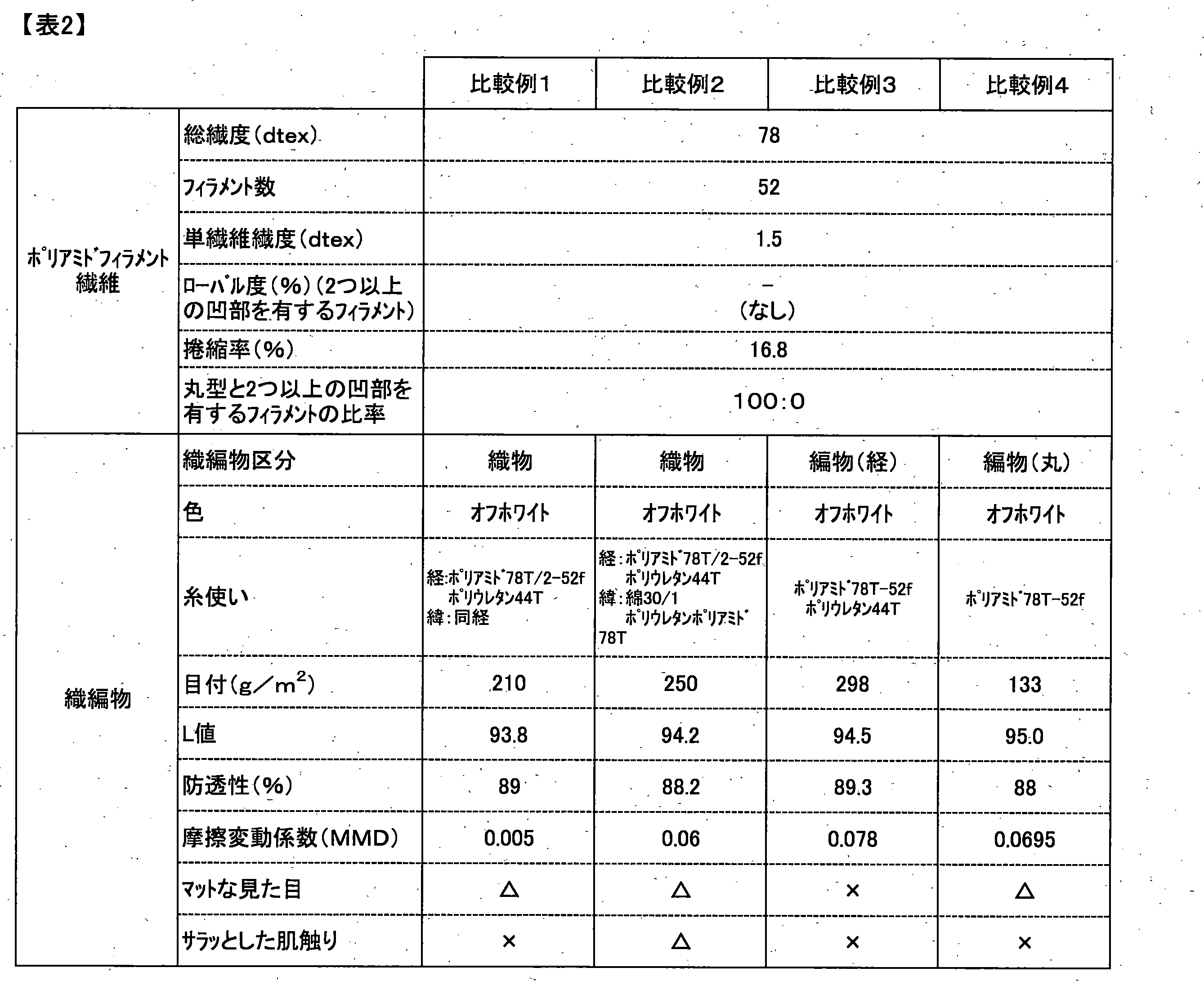
- Table 2 shows the physical properties of the obtained polyamide false twisted yarn, the L value of the woven fabric, the permeability, the coefficient of friction variation MMD, and the determination results of the matte appearance and smooth texture.
- the resulting woven fabric was not glossy because it had a strong gloss, and it did not have a smooth touch.
- Comparative Example 3 A knitted fabric was created under the same processing conditions as in Comparative Examples 1 and 2, except that a polyamide trifilament used in Comparative Examples 1 and 2 was used to create a half tricot knitting raw machine.
- Table 2 shows the physical properties of the obtained polyamide multifilament fiber, the L value of the knitted fabric, the permeation resistance, the coefficient of friction variation MMD, and the matte appearance and the smooth texture.
- the obtained knitted fabric had a strong luster and was rough and was not suitable for clothing.
- Comparative Example 4 A knitted fabric was created under the same processing conditions as in Comparative Examples 1 and 2, except that the polyamide multifilament used in Comparative Examples 1 and 2 was used to create a smooth knitting raw machine.
- Table 2 shows the physical properties of the obtained polyamide multifilament fiber, the L value of the knitted fabric, the permeation resistance, the coefficient of friction variation MMD, and the matte appearance and the smooth texture.
- the obtained knitted fabric was inferior in mat feeling and rough, and was unsuitable for clothing.
- S 1 Convex part S 2 : Convex part S 1 and convex part a adjacent to the concave part a: Length b between two contact points of the tangent line contacting the convex part S 1 and the convex part S 2 adjacent to the concave part the length of the perpendicular dropped to the tangent of the low point of the concave portion formed between the parts S 1 and the convex portion S 2
Landscapes
- Engineering & Computer Science (AREA)
- Textile Engineering (AREA)
- Chemical & Material Sciences (AREA)
- Chemical Kinetics & Catalysis (AREA)
- General Chemical & Material Sciences (AREA)
- Mechanical Engineering (AREA)
- Knitting Of Fabric (AREA)
- Artificial Filaments (AREA)
- Yarns And Mechanical Finishing Of Yarns Or Ropes (AREA)
- Woven Fabrics (AREA)
Abstract
本発明は、特に婦人衣料として着用時の蒸れ感を軽減することによる快適性を提供すると共に、透け感が少なく、マットな見た目とサラッとした肌触りを有するポリアミドマルチフィラメント繊維を少なくとも一部に用いてなる衣料用織編物、およびその衣料用織編物を用いてなる婦人衣服衣料を提供する。本発明の織編物は、ポリアミドに対し、ポリビニルピロリドンを3.0~7.0質量%と酸化チタンを1.0~5.0質量%含有しせしめてなるポリアミドマルチフィラメント繊維であって、断面形状が丸型断面形状のフィラメント繊維Aと2つ以上の凹部を有する断面形状でローバル度(LB)が5~50%のフィラメント繊維Bからなり、前記フィラメント繊維Aと前記フィラメント繊維Bの割合が質量比率30:70~70:30の範囲であり、かつ仮撚加工が施された捲縮率が15%以下のポリアミドマルチフィラメント繊維を少なくとも一部に使用してなる織編物である。
Description
本発明は、衣料用として好適に用いられる織編物に関するものである。更に詳しくは、本発明は、特に婦人衣料として着用時の快適性を提供し、透け感が少なく、マットな見た目とサラッとした肌触りを有する衣料用として好適に用いられる織編物、およびその織編物を用いてなる婦人服衣料に関するものである。
合成繊維の一つであるポリアミドフィラメント繊維は、高強度、耐摩耗性、ソフト性および染色鮮明性などの優れた特徴を持っているため、インナーウェア、レッグウェア、スポーツウェアおよびカジュアルウェアなどの幅広い衣料用途に好まれて用いられてきている。
しかるに、近年の消費者ニーズは、着用しても透け感が少なく、汗をかいても蒸れ感が少ないなどの着用快適性や、衣料ファッションとして光の干渉による輝き、いわゆる外観の光沢感が少ないマットな見た目やサラッとした肌触りなどの差別化を求めてきており、それに対応して単繊維の細繊度化、多フィラメント化および横断面に複数の凹部を設けるなど、いわゆるマルチローバルによる異形化や原糸に特徴のある膨らみをもたせ、風合いの差別化などが求められてきている。
従来、ポリアミドフィラメント繊維に酸化チタンを添加したいわゆるフルダル繊維は以前から用いられており、不透明性やソフトな風合い、清涼感およびドレープ感に加え、接触冷感性を付与しているが、ポリアミドフィラメント繊維の延伸糸では、見た目に光沢感が残り膨らみに劣るものであった(特許文献1参照。)。
さらに、着用快適性を付与するために、ポリアミドフィラメント繊維にポリビニルピロリドンを含有させることにより、吸湿性を向上させた繊維が提示されているが、触れた際に冷たく感じ、春夏向けとしては好適であるが年中を通じて着用することは難しかった(特許文献2~4参照。)。
一方、ポリアミドフィラメントの糸断面形状に凹凸をつけることにより、マイルドな光沢とさせることが知られているが、触ったときの肌触りがザラザラすることが課題であった(特許文献5参照。)。
さらに、セルロース繊維との複合により、べたつき感の緩和やなめらかな肌触りを付与しているが、ポリアミドフィラメント繊維とセルロース繊維と複合せずにべたつき感を抑えることや、サラッとした肌触りを発現することは困難であり、さらに透け感が高くなることが課題であった(特許文献6参照。)。
そこで本発明の目的は、上記のように、従来技術では得ることができなかった、ポリアミドマルチフィラメント繊維を少なくとも一部に用いた織編物であって、特に婦人衣料として着用時の快適性を提供し、透け感が少なく、マットな見た目とサラッとした肌触りを有する衣料用途に好適な織編物、およびその織編物を用いた婦人服衣料を提供することにある。
本発明は、上記の課題を解決せんとするものであって、本発明の織編物は、ポリアミドに対し、ポリビニルピロリドンを3.0~7.0質量%と酸化チタンを1.0~5.0質量%含有しせしめてなるポリアミドマルチフィラメント繊維であって、断面形状が丸型断面形状のフィラメント繊維Aと2つ以上の凹部を有する断面形状でローバル度(LB)が5~50%のフィラメント繊維Bからなり、前記のフィラメント繊維Aと前記のフィラメント繊維Bの割合が質量比率で30:70~70:30の範囲であり、かつ仮撚加工が施された捲縮率が15%以下のポリアミドマルチフィラメント繊維を少なくとも一部に使用してなる織編物である。
本発明の織編物の好ましい態様によれば、前記のポリアミドマルチフィラメント繊維の総繊度は50~150デシテックスであり、単繊維繊度は2.0~4.0デシテックスである。
本発明の織編物の好ましい態様によれば、前記のポリアミドマルチフィラメント繊維を少なくとも一部に使用してなる織編物の防透性は90%以上であり、摩擦変動係数MMDは0.01~0.05である。
本発明においては、前記のポリアミドマルチフィラメント繊維を少なくとも一部に使用した織編物を用いて、シャツ、ジャケット、ボトムおよび肌着などの婦人服用衣料を製造することができる。
本発明によれば、特に婦人衣料として着用時の快適性を提供し、透け感が少なく、マットな見た目とサラッとした肌触りを有する衣料用として好適に用いられる織編物、およびその織編物を用いた婦人服衣料を得ることができる。また、外観の審美性だけでなく、フィラメント間との微細な空隙の毛細管現象による吸水性、速乾性および吸湿性等の着用時に必要な機能性にも優れており、特に肌に直接触れるシャツ、ボトムおよび肌着に適している。
次に、本発明の織編物について、更に詳細に説明する。
本発明の織編物は、ポリアミドに対し、ポリビニルピロリドンを3.0~7.0質量%と酸化チタンを1.0~5.0質量%含有しせしめてなるポリアミドマルチフィラメント繊維であって、断面形状が丸型断面形状のフィラメント繊維Aと2つ以上の凹部を有する断面形状でローバル度(LB)が5~50%のフィラメント繊維Bからなり、前記のフィラメント繊維Aと前記のフィラメント繊維Bの割合が質量比率で30:70~70:30の範囲であり、かつ仮撚加工が施された捲縮率が15%以下のポリアミドマルチフィラメント繊維を少なくとも一部に使用してなる織編物である。
本発明におけるポリアミドマルチフィラメント繊維は、いわゆる炭化水素基が主鎖にアミド結合を介して連結された高分子量体からなるポリアミド樹脂からなるポリアミドマルチフィラメント繊維であって、ポリアミド樹脂としては、主としてポリアミド6、ポリアミド56、ポリアミド66およびポリアミド610からなる群から選ばれた少なくとも1種からなるポリアミド樹脂が好ましく用いられる。ここで言う「主として」とは、ポリアミド6、ポリアミド56およびポリアミド66を構成するモノマー単位が80モル%以上であることを言い、これらのモノマー単位は更に好ましくは90モル%以上である。その他の成分としては、例えば、ポリアミド11、ポリアミド12、ポリアミド510、ポリアミド612、ポリアミド6I、ポリアミド6Tおよびポリアミド9T等を構成するモノマーであるアミノカルボン酸、ジカルボン酸およびジアミン等の単位が挙げられる。
また、ポリアミドの重合度は、ポリアミドフィラメント繊維、その加工品の要求特性およびそれらを安定して得るために、適当な範囲より適宜選択することができるが、好ましくは98%硫酸相対粘度で2.2~3.5であり、更に好ましくは2.4~3.3である。
本発明において、ポリビニルピロリドンの含有量は、所望の高吸湿特性を繊維に付与するために、ポリアミドに対し3.0~7.0質量%となるポリビニルピロリドンを含有することが必要である。ポリビニルピロリドンの含有率が3.0質量%未満と少なすぎると十分な吸湿性が得られず、着用した際の蒸れ感が高まり不快になる。また、ポリビニルピロリドンの含有量が7.0質量%を超える程多くなるとべたつき感が発現し、感触不良となり、しかも、製糸性が不良となって安定して生産することができなくなる。
また、本発明におけるポリアミドマルチフィラメント繊維に含有させるポリビニルピロリドンとしては、ポリビニルピロリドン中に含まれるビニルピロリドン含有率をポリビニルピロリドンに対して0.1質量%以下とすることがとすることが好ましく、さらに好ましくは0.05質量%以下である。このビニルピロリドン含有率が好ましい範囲にある場合には、未染色状態でのイエローインデックスを10以下とすることができ、衣料用として好適な色調のくすみのない繊維が得られる。ビニルピロリドン含有率が0.1質量以下のポリビニルピロリドンは、重合時に溶媒としてイソプロピルアルコールを用いることにより得られる。また、その際に、重合開始剤として過酸化水素系の触媒を用いないことで、ビニルピロリドンの発生を抑制できるため、重合開始剤として過酸化水素系の触媒を用いないことが好ましい。
また、本発明において、ポリアミドマルチフィラメント繊維中に含有される酸化チタンの含有量は、1.0~5.0質量%であることが重要となる。酸化チタンの含有量は、好ましくは1.0~3.0質量%であり、更に好ましくは1.0~2.0質量%である。酸化チタンの含有量が1.0質量%未満の場合は、熱可塑性繊維の熱伝導率を十分に高めることができず、サラッとした触感を得ることができず、さらに防透性が低下する。また、酸化チタンの含有率が5.0質量%を超える場合は、紡糸時の糸切れが増加し、繊維強度低下して毛羽増加等の品質問題等が発生する。さらに、ざらつき感が大きくなり、サラッとしたタッチとはほど遠くなる。
酸化チタンとしては、一般的に白色顔料として用いられている不活性のものが好ましく、紡糸時のフィルター詰まりによる濾圧上昇を防ぐために平均粒径1μm以下の酸化チタンが好ましく用いられる。酸化チタンは、繊維の横断面方向および長手方向に実質的に均一に分散していることが必要である。酸化チタンが均一に分散した単一繊維とすることにより、複合紡糸ではなしえなかった汎用性と生産性の向上が実現できる。また、適度に酸化チタンが繊維表面に露出することにより、ソフト性と清涼感が発現される。酸化チタンの分散性は、繊維の横断面および側面を光学顕微鏡で観察することにより確認することができる。
本発明で用いられるポリアミドマルチフィラメント繊維は、断面形状を異にする少なくとも二種のフィラメント繊維で構成されている。本発明で用いられるポリアミドマルチフィラメント繊維を構成するフィラメント単繊維は、その断面形状が少なくとも1種類が丸断面糸形状のフィラメント繊維Aで、それ以外の繊維の断面形状が2つ以上の凹部を有する形状で、2つ以上の凹部を有する異形単糸10本を選定し、各単糸内にある全ての凹部の凹度:ローバル度(LB)がそれぞれ5~50%からなるフィラメント繊維Bであることが必要である。ローバル度(LB)は、好ましくは10~40%の範囲であり、さらに好ましくは20~30%の範囲である。ローバル度(LB)を5~50%とすることによって、フィラメント同士の間に毛細管が多く形成され、毛細管現象により吸水性が高められると共に、速やかな拡散と発散により乾燥がより速くなる。ローバル度(LB)が50%を超えると、製糸工程での糸切れや織編物にした際にスジや濃淡ムラが発生し、また逆に5%未満の場合には織編物にした際の吸水性や速乾性などの機能性が劣り、着用時の快適性が得られない。
本発明で用いられるポリアミドマルチフィラメント繊維を構成するフィラメント単繊維の断面形状は、前述のとおり断面形状が少なくとも1種類が丸断面形状のフィラメント繊維Aで、それ以外の繊維の断面形状が2つ以上の凹部を有する断面形状でローバル度(LB)が5~50%のフィラメント繊維Bからなり、その割合が質量比率で30:70~70:30で構成されることが、着用時の快適性の指標である吸湿速度や吸水性を向上に重要である。本発明では、2つ以上の凹部を有する断面形状の繊維によるタッチによるザラつき感の発現と、丸型断面形状の繊維によるタッチによる滑らかさを融合させることにより、新しいサラッとした肌触りを実現することができる。
ポリアミドマルチフィラメント繊維は、丸断面形状の繊維と、それ以外の断面形状が2つ以上の凹部を有する断面形状の繊維の質量比率が好ましくは40:60~60:40であり、更に好ましくは50:50である。丸型断面形状の繊維とそれ以外の断面形状が2つ以上の凹部を有する繊維の質量比率が30未満または70超過となると、断面形状が2つ以上の凹部を有する繊維の比率が増え、ざらつき感が大きくなる。丸型断面形状の繊維とそれ以外の断面形状が2つ以上の凹部を有する繊維の質量比率が70超過または30未満となると、丸型断面形状の繊維の質量比率が増え、滑りが大きくなり、可視光の反射角度が正反射することにより光沢感が増し、マットな見た目が発現しない。
ポリアミドマルチフィラメント繊維は、丸断面形状の繊維と、それ以外の断面形状が2つ以上の凹部を有する断面形状の繊維の質量比率が好ましくは40:60~60:40であり、更に好ましくは50:50である。丸型断面形状の繊維とそれ以外の断面形状が2つ以上の凹部を有する繊維の質量比率が30未満または70超過となると、断面形状が2つ以上の凹部を有する繊維の比率が増え、ざらつき感が大きくなる。丸型断面形状の繊維とそれ以外の断面形状が2つ以上の凹部を有する繊維の質量比率が70超過または30未満となると、丸型断面形状の繊維の質量比率が増え、滑りが大きくなり、可視光の反射角度が正反射することにより光沢感が増し、マットな見た目が発現しない。
ここでいう「丸型断面形状」とは、真円、楕円、レンズおよび正方・直方形などの文字通り凹部を有しない形状をいうが、より好ましい形状としては真円型である。ここで、真円型とは厳密に真円である必要はなく、例えば通常の丸孔の吐出孔から紡出して得られるような繊維断面に代表されるような形状等のいわゆる丸断面形状のものである。
また、ここでいう「断面形状が2つ以上の凹部を有する繊維」であるが、2つ以上の凹部を有するいわゆるマルチローバルであることをいう。凹部がない場合や凹部が1つの場合は、マルチフィラメントの単糸間に十分な空隙を得ることができないため、織編物にした際の吸水性などの機能面で劣ることとなる。より好ましい断面形状が2つ以上の凹部を有する繊維断面形状としては、3~8つの凹部と同数の凸部を有し、凸部がそれぞれ等角度間隔の放射線状に突起した異形断面形状であり、織編物にした際に吸水性に併せてマイルドな光沢感を得られる。さらに好ましくは3~6つの凹部と同数の凸部を有し、凸部それぞれ等角度間隔の放射状に突起した異形断面であることが望ましい態様である。
本発明において、ポリアミドマルチフィラメント繊維に施す仮撚加工とは、熱可塑性繊維に一旦撚りを掛けた糸に熱を加え、また撚りを戻す工程を連続で行う加工のことである。仮撚加工を行うことにより、繊維に微細な捲縮を付与することができ嵩高性を付与することができ、光沢感についても抑制することができる。仮撚加工は、ウーリー(1ヒーター)でも良く、ブレリア(2ヒーター)も用いることができるが、捲縮率を高くし過ぎなくすることがここでは重要である。
本発明において、仮撚加工を施されたポリアミドマルチフィラメント繊維の捲縮率は、15%以下であることが必要である。捲縮率は、好ましくは12%以下であり、更に好ましくは10%以下である。捲縮率が15%以下の場合、仮撚加工時に異形断面形状が崩れず適度な捲縮となり、サラッとした風合いを発現するが、捲縮率が15%を超える場合、仮撚加工にて異形断面形状が崩れ、ざらつき感が発現してしまい、さらに捲縮が大きくなることにより、ふかつき感がでる。捲縮率の下限は好ましくは3%であり、より好ましくは5%である。捲縮率を小さくしすぎると、仮撚加工糸の微細な捲縮が乏しくなり、織編物とした際の膨らみがなくなるとともに、可視光が正反射する割合が増加して光沢感が発現しやすくなる。
本発明で用いられるポリアミドマルチフィラメント繊維の総繊度は、50~150デシテックスであることが好ましい。総繊度は、更に好ましくは50~120デシテックスである。ポリアミドマルチフィラメント繊維の総繊度が50デシテックス未満となると、織編物とした際の生地厚みが薄くなりに伴い、防透性が低くなりマットな見た目とならないことがある。また、ポリアミドマルチフィラメント繊維の総繊度が150デシテックスより大きくなると、織編物とした際の生地厚みが増し、着用時の着心地が悪くなるとともにサラッとした肌触りとならないことがある。
また、本発明で用いられるポリアミドマルチフィラメント繊維の単繊維繊度は、2.0~4.0デシテックスであることが好ましい。単繊維繊度は、更に好ましくは2.5~3.5デシテックスである。ポリアミドマルチフィラメント繊維の単繊維繊度が2.0デシテックス未満となると、織編物にした際にソフト感が増し、特徴であるサラッとした感触が低下する傾向がある。また、ポリアミドマルチフィラメント繊維の単繊維繊度が4.0デシテックスより大きくなると、織編物にした際のハリコシ感が高くなり、着用時の着心地が悪くなる傾向がある。
本発明で用いられるポリアミドマルチフィラメント繊維を少なくとも一部に使用してなる織編物の防透性は、90%以上となることが好ましい態様である。防透性は、更に好ましくは95%以上である。ポリアミドマルチフィラメント繊維を少なくとも一部に使用した織編物の防透性が90%未満となると、着用した際に重ね着した衣服が透けて見えやすくなる。
本発明で用いられるポリアミドマルチフィラメント繊維を少なくとも一部に使用してなる織編物の摩擦変動係数MMDは、0.01~0.05であることが好ましい。摩擦変動係数MMDが0.01未満となると、滑らかになりすぎてサラッとした特徴を得られない傾向がある。摩擦変動係数MMDが0.05以上となると、ザラつきすぎてサラッとした特徴を得られない傾向がある。摩擦変動係数MMDは、凹凸感の適した組織等の織編物設計や潰し加工および生地の密度等の加工設計で制御することができる。
本発明で用いられるポリアミドマルチフィラメント繊維の1糸条に含まれるフィラメント数は、10~80であることが好ましい。フィラメント数は、より好ましくは15~60であり、更に好ましくは20~40である。ポリアミドマルチフィラメント繊維の1糸条に含まれるフィラメント数が10未満となると、織編物とした際のハリコシ感が高くなり、着用時の着心地が悪くなる傾向がある。また、ポリアミドマルチフィラメント繊維の1糸条に含まれるフィラメント数が80より大きくなると、織編物にした際にソフト感が増し、特徴であるサラッとした感触が低下する傾向がある。
本発明における織編物の構成は、ここで述べたポリアミドマルチフィラメント繊維が少なくとも一部に用いられることが必要である。本発明において、本発明で用いられるポリアミドマルチフィラメント繊維は、好ましくは織編物に対し20質量%以上であり、更に好ましくは50%以上である。
本発明の織編物には、他種の繊維を混入させることができる。本発明において、本発明で用いられるポリアミドマルチフィラメント繊維以外に混用することができる繊維としては、ウール繊維、セルロース系繊維、ポリエステル繊維、動物蛋白繊維、ポリウレタン繊維およびアセテート繊維などが挙げられる。
本発明で用いられるポリアミドマルチフィラメント繊維の織編物への使い方としては、2本合撚することができ、3本合撚することもでき、ポリウレタン繊維に本発明で用いられるポリアミドマルチフィラメント繊維をカバリングすることによって、ストレッチ性を発現させることもできる。
ポリアミドマルチフィラメント繊維の織物として使い方には特に制限はなく、織物のタテ糸に使用することも、ヨコ糸に使用することもできる。織物組織としては、平、ツイル、サテンおよびオックスなど特に制限はないが、表面に凹凸をつけすぎないことが重要である。ポリアミドマルチフィラメント繊維の編物の使い方にも特に制限はなく、他繊維と交編し合撚することもできる。また、編物としては、経編および丸編のどちらでもよく、編物組織としては、ハーフ、デンビー、ポンチ、天竺、フライスおよびスムースなど特に制限はないが、表面に凹凸をつけすぎないことが重要である。
このようにして得られた本発明の織編物は、例えば、シャツ、ジャケット、ボトムおよび肌着などから選ばれる婦人服用衣料として好適に用いることができる。また、外観の審美性だけでなく、フィラメント間との微細な空隙の毛細管現象による吸水性、速乾性および吸湿性等の着用時に必要な機能性にも優れており、特に肌に直接触れるシャツ、ボトムおよび肌着に適している。
次に、本発明の織編物について、実施例によりさらに具体的に説明する。上述の説明中および実施例に示す各特性値は、次の方法により測定したものである。
(1)ローバル度(LB):
ローバル度について、図3にておいて説明する。凹部を有する単フィラメントの断面形状の一つの凸部S1とその凹部に隣接する凸部S2とに接する接線の2つの接点の間の長さaに対する、それらの2つの凸部S1と凸部S2との間に形成される凹部の低点から前記の接線に降ろした垂線の長さbの百分率(%)をいう。すなわち、ローバル度は次式で示される。
・ローバル度=100×b/a。
ローバル度について、図3にておいて説明する。凹部を有する単フィラメントの断面形状の一つの凸部S1とその凹部に隣接する凸部S2とに接する接線の2つの接点の間の長さaに対する、それらの2つの凸部S1と凸部S2との間に形成される凹部の低点から前記の接線に降ろした垂線の長さbの百分率(%)をいう。すなわち、ローバル度は次式で示される。
・ローバル度=100×b/a。
(2)総繊度:
JIS L1013(2010) 8.3.1 b)B法に規定される正量繊度を測定して、総繊度とした。
JIS L1013(2010) 8.3.1 b)B法に規定される正量繊度を測定して、総繊度とした。
(3)単繊維繊度:
ポリアミドマルチフィラメント繊維を構成する総繊度を、フィラメント数で除して求めた。
ポリアミドマルチフィラメント繊維を構成する総繊度を、フィラメント数で除して求めた。
(4)捲縮率:
カセを熱水で60℃±2℃の温度で20分間処理し、室内で12時間以上自然乾燥させる。その後、水中に荷重を掛け、長さを測定し次式により捲縮率(%)を求めた。
・捲縮率(%)=(A-B)/A×100
A:初荷重+定荷重を掛けてから2分後の長さ
(初荷重:0.001764cN/dtex、荷重:0.0882cN/dtex)
B:水中で定荷重つけ外し、初荷重がかかった状態で2分間後の長さ。
カセを熱水で60℃±2℃の温度で20分間処理し、室内で12時間以上自然乾燥させる。その後、水中に荷重を掛け、長さを測定し次式により捲縮率(%)を求めた。
・捲縮率(%)=(A-B)/A×100
A:初荷重+定荷重を掛けてから2分後の長さ
(初荷重:0.001764cN/dtex、荷重:0.0882cN/dtex)
B:水中で定荷重つけ外し、初荷重がかかった状態で2分間後の長さ。
(5)目付:
JIS L1096(2010)に規定される標準状態における単位面積当たりの重量A法の方法を用いて、目付を測定した。
JIS L1096(2010)に規定される標準状態における単位面積当たりの重量A法の方法を用いて、目付を測定した。
(6)L値:
JIS Z8781-4(2013)に規定されるCIE1976明度指数L*で、L値を測定した。
JIS Z8781-4(2013)に規定されるCIE1976明度指数L*で、L値を測定した。
(7)防透性:
白色と黒色それぞれのタイルの上に試料を重ね合わせ、生地表面の色を測色機で測定し、生地の下に白色タイルがある時と黒色タイルがあるときのそれぞれの明度を測定し、次式によって求めた。
・防透性(%)=(白色タイル使用時の生地明度-黒色タイル使用時の生地明度)/(白色タイルの明度-黒色タイルの明度)×100
(黒色タイルの明度:9.12、白色タイルの明度:93.12)。
白色と黒色それぞれのタイルの上に試料を重ね合わせ、生地表面の色を測色機で測定し、生地の下に白色タイルがある時と黒色タイルがあるときのそれぞれの明度を測定し、次式によって求めた。
・防透性(%)=(白色タイル使用時の生地明度-黒色タイル使用時の生地明度)/(白色タイルの明度-黒色タイルの明度)×100
(黒色タイルの明度:9.12、白色タイルの明度:93.12)。
(8)摩擦変動係数MMD:
カトーテック(株)KES-FB4を用い、20℃×65%RHの環境下で測定した。20gf/cmの張力をかけた織編物に、0.5mmφのピアノ線を10本並べ5×5mmに面上に巻いた接触子を50gfの力で接触面を織編物に圧着させ、0.1cm/秒の一定の速度で水平に2cm移動させたときの摩擦係数の平均偏差である。
カトーテック(株)KES-FB4を用い、20℃×65%RHの環境下で測定した。20gf/cmの張力をかけた織編物に、0.5mmφのピアノ線を10本並べ5×5mmに面上に巻いた接触子を50gfの力で接触面を織編物に圧着させ、0.1cm/秒の一定の速度で水平に2cm移動させたときの摩擦係数の平均偏差である。
(9)マットな見た目
光の干渉による輝き、いわゆる織編物外観の光沢感が少ないものをマットな見た目であるものとし、5人の目視判定者で次の官能判定を行い、○を合格とした。
○:マットな見た目であり良好
△:若干光沢感があり不十分
×:光沢感が高く不良。
光の干渉による輝き、いわゆる織編物外観の光沢感が少ないものをマットな見た目であるものとし、5人の目視判定者で次の官能判定を行い、○を合格とした。
○:マットな見た目であり良好
△:若干光沢感があり不十分
×:光沢感が高く不良。
(10)サラッとした肌触り
サラッとした肌触りか否かは、5人の風合い判定者で次の官能判定を行い、○を合格とした。
○:サラッとした肌触りであり良好
△:若干、ざらつきがあり不十分
×:ざらつきがあり不良。
サラッとした肌触りか否かは、5人の風合い判定者で次の官能判定を行い、○を合格とした。
○:サラッとした肌触りであり良好
△:若干、ざらつきがあり不十分
×:ざらつきがあり不良。
(実施例1~4)
平均粒径0.3μmの酸化チタンを1.4質量%とポリビニルピロリドン(BASF社製“ルビテックK30スペシャルグレード”)を5.0質量%含むポリアミド系ナイロン6ポリマーを、環状に6つの凹部を有する吐出孔と、丸断面の吐出孔を配した吐出孔を1糸条としたとき、その2種類の吐出孔数が50%ずつであり、その組み合わせの吐出孔を1口金内に2糸条分配列し、その1糸条分の吐出孔の配列において、ひとつの吐出孔の中心から最も隣接する吐出孔の中心までの間隔が4mmである紡糸口金から、紡糸温度253度で溶融ポリマーを吐出させ、吐出させたその溶融ポリマーを、紡糸口金面に向けて0.25kPaの圧力で285℃の蒸気が噴出されている蒸気噴出ゾーンと、その蒸気噴出ゾーン下流側に設けられ、かつ冷却開始位置30mmで鉛直方向の長さが300mmの単体の円筒型冷却装置で外吹きに放射状に吹く20℃の冷却風によって冷却する冷却ゾーンを通過させて、冷却個化を行わせ、その円筒型冷却装置下流側において、紡糸口金下面から600mmに位置に環状型給油ガイドを設置して給油を行い、紡速4500m/分で紡糸し、丸型断面のフィラメント繊維と六葉断面のフィラメント繊維の質量比率が50:50であり、総繊度が78デシテックスでフィラメント数が24フィラメントのポリアミドマルチフィラメント繊維を得た。図1に、得られたポリアミドマルチフィラメント繊維の繊維束の断面形状を示す。
平均粒径0.3μmの酸化チタンを1.4質量%とポリビニルピロリドン(BASF社製“ルビテックK30スペシャルグレード”)を5.0質量%含むポリアミド系ナイロン6ポリマーを、環状に6つの凹部を有する吐出孔と、丸断面の吐出孔を配した吐出孔を1糸条としたとき、その2種類の吐出孔数が50%ずつであり、その組み合わせの吐出孔を1口金内に2糸条分配列し、その1糸条分の吐出孔の配列において、ひとつの吐出孔の中心から最も隣接する吐出孔の中心までの間隔が4mmである紡糸口金から、紡糸温度253度で溶融ポリマーを吐出させ、吐出させたその溶融ポリマーを、紡糸口金面に向けて0.25kPaの圧力で285℃の蒸気が噴出されている蒸気噴出ゾーンと、その蒸気噴出ゾーン下流側に設けられ、かつ冷却開始位置30mmで鉛直方向の長さが300mmの単体の円筒型冷却装置で外吹きに放射状に吹く20℃の冷却風によって冷却する冷却ゾーンを通過させて、冷却個化を行わせ、その円筒型冷却装置下流側において、紡糸口金下面から600mmに位置に環状型給油ガイドを設置して給油を行い、紡速4500m/分で紡糸し、丸型断面のフィラメント繊維と六葉断面のフィラメント繊維の質量比率が50:50であり、総繊度が78デシテックスでフィラメント数が24フィラメントのポリアミドマルチフィラメント繊維を得た。図1に、得られたポリアミドマルチフィラメント繊維の繊維束の断面形状を示す。
その後、通常の仮撚加工機を用いて、1ヒーター温度が110℃で、2ヒーター温度が140℃の条件により仮撚加工を施し、捲縮率が12%となる総繊度が66デシテックスでフィラメント数が24フィラメントのポリアミドマルチフィラメント繊維を得た。続いて通常の方法によってこの仮撚加工されたポリアミドマルチフィラメント繊維同士を合撚し、総繊度が44デシテックスのポリウレタン繊維とのカバリング糸を作成した後、表1の実施例1~4に記載のとおりの4種類のツイル組織の織物生機を作成した。このようにして得られた織物生機を、液流染色機を用いて95℃の温度で20分間精練した後、ピンテンターによって190℃の温度で90秒間のプレセットを行った。その後、液流染色機を用いてオフホワイトの色目になるように酸性染料を用いて95℃の温度で30分間染色を行い、ピンテンターで130℃の温度で60秒間乾燥した後、吸水加工剤SR-1800(高松油脂(株)製)を1%owfとなるようにマングルの絞り率を調整したパッドドライ法によりに塗布し、ピンテンターを用いて180℃の温度で60秒間の仕上げセットを行い、織物を作成した。得られたポリアミドマルチフィラメント繊維の物性と、織物のL値、防透性、摩擦変動係数MMD、マットな見た目およびサラッとした肌触りの判定結果を、表1に示す。得られた織物は、図2に示すように織物形態でも、ポリアミドマルチフィラメント繊維のフィラメント(単繊維)としての断面形状が崩れず、および、マットな見た目とサラッとした肌触りを満足するものであった。結果を表1に示す。
(実施例5)
ハーフトリコットの編物生機を作成したこと以外は、実施例1~4と同様にして編物を作成した。得られたポリアミドマルチフィラメント繊維の物性と、編物の防透性、摩擦変動係数MMD、および、マットな見た目およびサラッとした肌触りの判定結果を、表1に示す。
ハーフトリコットの編物生機を作成したこと以外は、実施例1~4と同様にして編物を作成した。得られたポリアミドマルチフィラメント繊維の物性と、編物の防透性、摩擦変動係数MMD、および、マットな見た目およびサラッとした肌触りの判定結果を、表1に示す。
(実施例6)
ベア天竺の編物生機を作成したこと以外は、実施例1~4と同様に編物を作成した。得られたポリアミドマルチフィラメント繊維の物性と、編物のL値、防透性、摩擦変動係数MMD、および、マットな見た目およびサラッとした肌触りの判定結果を、表1に示す。
ベア天竺の編物生機を作成したこと以外は、実施例1~4と同様に編物を作成した。得られたポリアミドマルチフィラメント繊維の物性と、編物のL値、防透性、摩擦変動係数MMD、および、マットな見た目およびサラッとした肌触りの判定結果を、表1に示す。
(実施例7)
ベアポンチの編物生機を作成したこと以外は、実施例1~4と同様に編物を作成した。得られたポリアミドマルチフィラメント繊維の物性と、編物のL値、防透性、摩擦変動係数MMD、マットな見た目およびサラッとした肌触りの判定結果を、表1に示す。
ベアポンチの編物生機を作成したこと以外は、実施例1~4と同様に編物を作成した。得られたポリアミドマルチフィラメント繊維の物性と、編物のL値、防透性、摩擦変動係数MMD、マットな見た目およびサラッとした肌触りの判定結果を、表1に示す。
(実施例8)
スムースの編物生機を作成したこと以外は、実施例1~4と同様に編物を作成した。得られたポリアミドマルチフィラメント繊維の物性と、編物のL値、防透性、摩擦変動係数MMD、および、マットな見た目およびサラッとした肌触りの判定結果を、表1に示す。
スムースの編物生機を作成したこと以外は、実施例1~4と同様に編物を作成した。得られたポリアミドマルチフィラメント繊維の物性と、編物のL値、防透性、摩擦変動係数MMD、および、マットな見た目およびサラッとした肌触りの判定結果を、表1に示す。

(比較例1~2)
丸孔52穴を配した口金を用いたこと以外は、実施例1~4と同様に紡糸し、総繊度が89デシテックスでフィラメント数が52フィラメントとなるポリアミドマルチフィラメント繊維を得た。その後、通常の仮撚加工機を用いて1ヒーター温度165℃の条件で、捲縮率が16.8%となる総繊度が78デシテックスでフィラメント数が52フィラメントのポリアミドマルチフィラメント繊維を得た。通常の方法によって、この仮撚加工されたポリアミドマルチフィラメント繊維同士を合撚し、総繊度が44デシテックスのポリウレタン繊維とのカバリング糸を作成した後、表2の比較例1と2に記載のとおりのツイル組織の織物生機を作成した。この織物生機を、液流染色機を用いて95℃の温度で20分間精練した後、ピンテンターを用いて190℃の温度で90秒間のプレセットを行った。その後、液流染色機を用いてオフホワイトの色目になるように、酸性染料を用いて95℃の温度で30分間の染色を行い、ピンテンターで130℃の温度で90秒乾燥した後、吸水加工剤SR-1800(高松油脂(株)製)を1%owfとなるようにマングルの絞り率を調整したパッドドライ法によりに塗布し、ピンテンターを用いて180℃の温度で60秒間の仕上げセットを行い、織物を作成した。得られたポリアミド仮撚糸の物性と、織物のL値、防透性、摩擦変動係数MMD、および、マットな見た目およびサラッとした肌触りの判定結果を、表2に示す。得られた織物は、光沢感が強いためマットな見た目ではなく、サラッとした肌触りであるものではなかった。
丸孔52穴を配した口金を用いたこと以外は、実施例1~4と同様に紡糸し、総繊度が89デシテックスでフィラメント数が52フィラメントとなるポリアミドマルチフィラメント繊維を得た。その後、通常の仮撚加工機を用いて1ヒーター温度165℃の条件で、捲縮率が16.8%となる総繊度が78デシテックスでフィラメント数が52フィラメントのポリアミドマルチフィラメント繊維を得た。通常の方法によって、この仮撚加工されたポリアミドマルチフィラメント繊維同士を合撚し、総繊度が44デシテックスのポリウレタン繊維とのカバリング糸を作成した後、表2の比較例1と2に記載のとおりのツイル組織の織物生機を作成した。この織物生機を、液流染色機を用いて95℃の温度で20分間精練した後、ピンテンターを用いて190℃の温度で90秒間のプレセットを行った。その後、液流染色機を用いてオフホワイトの色目になるように、酸性染料を用いて95℃の温度で30分間の染色を行い、ピンテンターで130℃の温度で90秒乾燥した後、吸水加工剤SR-1800(高松油脂(株)製)を1%owfとなるようにマングルの絞り率を調整したパッドドライ法によりに塗布し、ピンテンターを用いて180℃の温度で60秒間の仕上げセットを行い、織物を作成した。得られたポリアミド仮撚糸の物性と、織物のL値、防透性、摩擦変動係数MMD、および、マットな見た目およびサラッとした肌触りの判定結果を、表2に示す。得られた織物は、光沢感が強いためマットな見た目ではなく、サラッとした肌触りであるものではなかった。
(比較例3)
比較例1および2で用いたポリアミドマルチフィラメントを用い、ハーフトリコットの編物生機を作成したこと以外は、比較例1および2と同様の加工条件で編物を作成した。得られたポリアミドマルチフィラメント繊維の物性と、編物のL値、防透性、摩擦変動係数MMD、および、マットな見た目およびサラッとした肌触りの判定結果を、表2に示す。得られた編物は光沢感が強く、ざらつきがあるものであり、衣料用としては適さないものであった。
比較例1および2で用いたポリアミドマルチフィラメントを用い、ハーフトリコットの編物生機を作成したこと以外は、比較例1および2と同様の加工条件で編物を作成した。得られたポリアミドマルチフィラメント繊維の物性と、編物のL値、防透性、摩擦変動係数MMD、および、マットな見た目およびサラッとした肌触りの判定結果を、表2に示す。得られた編物は光沢感が強く、ざらつきがあるものであり、衣料用としては適さないものであった。
(比較例4)
比較例1および2で用いたポリアミドマルチフィラメントを用い、スムースの編物生機を作成したこと以外は、比較例1および2と同様の加工条件で編物を作成した。得られたポリアミドマルチフィラメント繊維の物性と、編物のL値、防透性、摩擦変動係数MMD、および、マットな見た目およびサラッとした肌触りの判定結果を、表2に示す。得られた編物はマット感に劣り、ざらつきがあるものであり、衣料用としては適さないものであった。
比較例1および2で用いたポリアミドマルチフィラメントを用い、スムースの編物生機を作成したこと以外は、比較例1および2と同様の加工条件で編物を作成した。得られたポリアミドマルチフィラメント繊維の物性と、編物のL値、防透性、摩擦変動係数MMD、および、マットな見た目およびサラッとした肌触りの判定結果を、表2に示す。得られた編物はマット感に劣り、ざらつきがあるものであり、衣料用としては適さないものであった。
S1:凸部
S2:凸部S1と凹部に隣接する凸部
a:凸部S1と凹部に隣接する凸部S2とに接する接線の2つの接点の間の長さ
b:凸部S1と凸部S2との間に形成される凹部の低点から前記の接線に降ろした垂線の長さ
S2:凸部S1と凹部に隣接する凸部
a:凸部S1と凹部に隣接する凸部S2とに接する接線の2つの接点の間の長さ
b:凸部S1と凸部S2との間に形成される凹部の低点から前記の接線に降ろした垂線の長さ
Claims (5)
- ポリアミドに対し、ポリビニルピロリドンを3.0~7.0質量%と酸化チタンを1.0~5.0質量%含有しせしめてなるポリアミドマルチフィラメント繊維であって、断面形状が丸型断面形状のフィラメント繊維Aと2つ以上の凹部を有する断面形状でローバル度(LB)が5~50%のフィラメント繊維Bからなり、前記フィラメント繊維Aと前記フィラメント繊維Bの割合が質量比率で30:70~70:30の範囲であり、かつ仮撚加工が施された捲縮率が15%以下のポリアミドマルチフィラメント繊維を少なくとも一部に使用してなる織編物。
- ポリアミドマルチフィラメント繊維の総繊度が50~150デシテックスであり、単繊維繊度が2.0~4.0デシテックスである請求項1記載の織編物。
- 防透性が90%以上である請求項1または2記載の織編物。
- 摩擦変動係数MMDが0.01~0.05である請求項1~3のいずれかに記載の織編物。
- 請求項1~4のいずれかに記載の織編物を用いてなる婦人服用衣料。
Priority Applications (1)
| Application Number | Priority Date | Filing Date | Title |
|---|---|---|---|
| JP2015552946A JPWO2016117177A1 (ja) | 2015-01-23 | 2015-10-05 | 織編物 |
Applications Claiming Priority (2)
| Application Number | Priority Date | Filing Date | Title |
|---|---|---|---|
| JP2015011074 | 2015-01-23 | ||
| JP2015-011074 | 2015-01-23 |
Publications (1)
| Publication Number | Publication Date |
|---|---|
| WO2016117177A1 true WO2016117177A1 (ja) | 2016-07-28 |
Family
ID=56416739
Family Applications (1)
| Application Number | Title | Priority Date | Filing Date |
|---|---|---|---|
| PCT/JP2015/078217 Ceased WO2016117177A1 (ja) | 2015-01-23 | 2015-10-05 | 織編物 |
Country Status (2)
| Country | Link |
|---|---|
| JP (1) | JPWO2016117177A1 (ja) |
| WO (1) | WO2016117177A1 (ja) |
Cited By (2)
| Publication number | Priority date | Publication date | Assignee | Title |
|---|---|---|---|---|
| CN114250527A (zh) * | 2020-09-22 | 2022-03-29 | 上海凯赛生物技术股份有限公司 | 一种聚酰胺5x全牵伸丝及其制备方法与应用 |
| US12291801B2 (en) | 2020-08-21 | 2025-05-06 | Suntex Fiber Co., Ltd. | Air textured yarn (ATY) and manufacturing method thereof |
Citations (5)
| Publication number | Priority date | Publication date | Assignee | Title |
|---|---|---|---|---|
| JP2003183904A (ja) * | 2001-12-17 | 2003-07-03 | Toray Ind Inc | インナーウエアー |
| JP2004060129A (ja) * | 2002-07-31 | 2004-02-26 | Toray Ind Inc | 高吸放湿ポリアミド繊維およびその製造方法 |
| JP2004277954A (ja) * | 2003-03-18 | 2004-10-07 | Toray Ind Inc | 複合加工糸およびそれを用いた布帛 |
| WO2013129135A1 (ja) * | 2012-02-27 | 2013-09-06 | 東レ株式会社 | 仮撚用ポリアミド混繊複合糸 |
| JP2015124462A (ja) * | 2013-12-27 | 2015-07-06 | 東レ株式会社 | 異形断面ポリアミドマルチフィラメント、およびその製造方法 |
-
2015
- 2015-10-05 JP JP2015552946A patent/JPWO2016117177A1/ja active Pending
- 2015-10-05 WO PCT/JP2015/078217 patent/WO2016117177A1/ja not_active Ceased
Patent Citations (5)
| Publication number | Priority date | Publication date | Assignee | Title |
|---|---|---|---|---|
| JP2003183904A (ja) * | 2001-12-17 | 2003-07-03 | Toray Ind Inc | インナーウエアー |
| JP2004060129A (ja) * | 2002-07-31 | 2004-02-26 | Toray Ind Inc | 高吸放湿ポリアミド繊維およびその製造方法 |
| JP2004277954A (ja) * | 2003-03-18 | 2004-10-07 | Toray Ind Inc | 複合加工糸およびそれを用いた布帛 |
| WO2013129135A1 (ja) * | 2012-02-27 | 2013-09-06 | 東レ株式会社 | 仮撚用ポリアミド混繊複合糸 |
| JP2015124462A (ja) * | 2013-12-27 | 2015-07-06 | 東レ株式会社 | 異形断面ポリアミドマルチフィラメント、およびその製造方法 |
Cited By (3)
| Publication number | Priority date | Publication date | Assignee | Title |
|---|---|---|---|---|
| US12291801B2 (en) | 2020-08-21 | 2025-05-06 | Suntex Fiber Co., Ltd. | Air textured yarn (ATY) and manufacturing method thereof |
| CN114250527A (zh) * | 2020-09-22 | 2022-03-29 | 上海凯赛生物技术股份有限公司 | 一种聚酰胺5x全牵伸丝及其制备方法与应用 |
| CN114250527B (zh) * | 2020-09-22 | 2024-04-05 | 上海凯赛生物技术股份有限公司 | 一种聚酰胺5x全牵伸丝及其制备方法与应用 |
Also Published As
| Publication number | Publication date |
|---|---|
| JPWO2016117177A1 (ja) | 2017-10-26 |
Similar Documents
| Publication | Publication Date | Title |
|---|---|---|
| KR102277678B1 (ko) | 편심 심초 복합 섬유 및 혼섬사 | |
| US10597803B2 (en) | Cooling polyamide yarn | |
| US20150292125A1 (en) | Polyamide crimped yarn for clothing and woven or knitted fabric for clothing comprising same | |
| CN116457513A (zh) | 机织/针织物、制造方法和纤维制品 | |
| WO2016117177A1 (ja) | 織編物 | |
| JP6128984B2 (ja) | ポリエステル仮撚低融着糸および多層構造織編物 | |
| CN108342818B (zh) | 一种棉感针织面料 | |
| TWI532893B (zh) | 假撚用聚醯胺混纖複合紗 | |
| JP2014025189A5 (ja) | ||
| JP6596881B2 (ja) | 複合仮撚加工糸 | |
| JP2004292982A (ja) | ポリアミド繊維を用いて得られるインナーウェア | |
| JP2019099925A (ja) | ポリエステル混繊糸布帛 | |
| KR101989745B1 (ko) | 대나무사를 이용한 신축성 및 멜란지톤 발현이 우수한 기능성 원단 및 대나무-폴리에스테르 에어텍스쳐 가공사의 제조방법 | |
| JP2005048309A (ja) | ポリアミド繊維、ポリアミド織物およびそれよりなる繊維製品 | |
| JP7615601B2 (ja) | 混繊糸、それを用いた織編物およびその製造方法ならびにブラックフォーマル衣料 | |
| JP7615594B2 (ja) | 混繊糸 | |
| US3737505A (en) | Process for manufacture of high sheen bifilament yarn and elastic textile article | |
| JPH0734342A (ja) | 混繊複合糸およびその製造方法ならびに編織物 | |
| JP2015221953A (ja) | 織編物 | |
| JP2018104839A (ja) | 収縮特性に優れた仮撚用ポリアミドマルチフィラメント | |
| JP2019073807A (ja) | 仮撚加工糸および織編物 | |
| JP4228504B2 (ja) | 混繊糸からなる織編物 | |
| WO2024166780A1 (ja) | 織編物および衣料 | |
| JP2015137443A (ja) | 異色混繊ポリアミド捲縮糸からなる衣料用織編物 | |
| JP4524337B1 (ja) | 特殊な単糸断面を有するポリアミド系マルチフィラメント |
Legal Events
| Date | Code | Title | Description |
|---|---|---|---|
| ENP | Entry into the national phase |
Ref document number: 2015552946 Country of ref document: JP Kind code of ref document: A |
|
| 121 | Ep: the epo has been informed by wipo that ep was designated in this application |
Ref document number: 15878866 Country of ref document: EP Kind code of ref document: A1 |
|
| NENP | Non-entry into the national phase |
Ref country code: DE |
|
| 122 | Ep: pct application non-entry in european phase |
Ref document number: 15878866 Country of ref document: EP Kind code of ref document: A1 |