WO2016103741A1 - 使い捨ての化粧パッド - Google Patents
使い捨ての化粧パッド Download PDFInfo
- Publication number
- WO2016103741A1 WO2016103741A1 PCT/JP2015/056181 JP2015056181W WO2016103741A1 WO 2016103741 A1 WO2016103741 A1 WO 2016103741A1 JP 2015056181 W JP2015056181 W JP 2015056181W WO 2016103741 A1 WO2016103741 A1 WO 2016103741A1
- Authority
- WO
- WIPO (PCT)
- Prior art keywords
- fiber
- fibers
- pad
- layer
- outer layer
- Prior art date
- Legal status (The legal status is an assumption and is not a legal conclusion. Google has not performed a legal analysis and makes no representation as to the accuracy of the status listed.)
- Ceased
Links
Images


Classifications
-
- A—HUMAN NECESSITIES
- A45—HAND OR TRAVELLING ARTICLES
- A45D—HAIRDRESSING OR SHAVING EQUIPMENT; EQUIPMENT FOR COSMETICS OR COSMETIC TREATMENTS, e.g. FOR MANICURING OR PEDICURING
- A45D44/00—Other cosmetic or toiletry articles, e.g. for hairdressers' rooms
-
- A—HUMAN NECESSITIES
- A45—HAND OR TRAVELLING ARTICLES
- A45D—HAIRDRESSING OR SHAVING EQUIPMENT; EQUIPMENT FOR COSMETICS OR COSMETIC TREATMENTS, e.g. FOR MANICURING OR PEDICURING
- A45D34/00—Containers or accessories specially adapted for handling liquid toiletry or cosmetic substances, e.g. perfumes
- A45D34/04—Appliances specially adapted for applying liquid, e.g. using roller or ball
-
- B—PERFORMING OPERATIONS; TRANSPORTING
- B65—CONVEYING; PACKING; STORING; HANDLING THIN OR FILAMENTARY MATERIAL
- B65D—CONTAINERS FOR STORAGE OR TRANSPORT OF ARTICLES OR MATERIALS, e.g. BAGS, BARRELS, BOTTLES, BOXES, CANS, CARTONS, CRATES, DRUMS, JARS, TANKS, HOPPERS, FORWARDING CONTAINERS; ACCESSORIES, CLOSURES, OR FITTINGS THEREFOR; PACKAGING ELEMENTS; PACKAGES
- B65D85/00—Containers, packaging elements or packages, specially adapted for particular articles or materials
- B65D85/70—Containers, packaging elements or packages, specially adapted for particular articles or materials for materials not otherwise provided for
- B65D85/804—Disposable containers or packages with contents which are mixed, infused or dissolved in situ, i.e. without having been previously removed from the package
-
- A—HUMAN NECESSITIES
- A45—HAND OR TRAVELLING ARTICLES
- A45D—HAIRDRESSING OR SHAVING EQUIPMENT; EQUIPMENT FOR COSMETICS OR COSMETIC TREATMENTS, e.g. FOR MANICURING OR PEDICURING
- A45D34/00—Containers or accessories specially adapted for handling liquid toiletry or cosmetic substances, e.g. perfumes
- A45D2034/002—Accessories
-
- A—HUMAN NECESSITIES
- A45—HAND OR TRAVELLING ARTICLES
- A45D—HAIRDRESSING OR SHAVING EQUIPMENT; EQUIPMENT FOR COSMETICS OR COSMETIC TREATMENTS, e.g. FOR MANICURING OR PEDICURING
- A45D40/00—Casings or accessories specially adapted for storing or handling solid or pasty toiletry or cosmetic substances, e.g. shaving soaps or lipsticks
- A45D2040/0006—Accessories
-
- A—HUMAN NECESSITIES
- A45—HAND OR TRAVELLING ARTICLES
- A45D—HAIRDRESSING OR SHAVING EQUIPMENT; EQUIPMENT FOR COSMETICS OR COSMETIC TREATMENTS, e.g. FOR MANICURING OR PEDICURING
- A45D2200/00—Details not otherwise provided for in A45D
- A45D2200/10—Details of applicators
- A45D2200/1009—Applicators comprising a pad, tissue, sponge, or the like
- A45D2200/1018—Applicators comprising a pad, tissue, sponge, or the like comprising a pad, i.e. a cushion-like mass of soft material, with or without gripping means
Definitions
- the present invention relates to a disposable makeup pad used for makeup removal and the like.
- Patent Document 1 discloses a disposable decorative pad having a cushion layer and a covering sheet, and the covering sheet is formed of a fiber nonwoven fabric having a fiber diameter of 0.1 to 3 denier.
- Such a makeup pad can be used for putting lotion and removing creams, and when used for removing creams, it is generally used by applying a cosmetic liquid such as a cleansing agent to the makeup pad. .
- a cosmetic liquid such as a cleansing agent
- the covering sheet is easily broken and the wiping property may be reduced.
- the covering sheet is formed of a non-woven fabric having a relatively large fiber diameter exceeding 1 denier, the user can easily feel irritation when wiping off the makeup.
- an object of the present invention is to provide a cosmetic pad which is an improvement of the conventional technique and has a soft touch and a high wiping property.
- the present invention resides in an improvement of a disposable makeup pad having a cushion layer containing hydrophilic fibers and a covering sheet covering the cushion layer.
- the covering sheet includes an outer layer mainly formed of a first fiber having an average fiber diameter of 10 ⁇ m or less, which forms the skin contact surface, and the outer layer is covered with the first layer.
- SMD average deviation
- MIU average surface friction coefficient
- the covering sheet has an outer layer mainly composed of ultrafine fibers having an average fiber diameter of 10 ⁇ m or less, which forms the skin contact surface. Therefore, a soft touch can be obtained. Furthermore, the covering sheet has an inner layer mainly composed of second fibers having an average fiber diameter larger than that of the outer layer ultrafine fibers, and the skin contact surface has an average surface roughness average deviation (SMD) of 1. Since it is 20 ⁇ m or less and the average surface friction coefficient (MIU) is 0.35 or more, the wiping property is high.
- SMD surface roughness average deviation
- FIG. 2 is a schematic cross-sectional view taken along line II-II in FIG. 1.
- decoration pad shown in FIG. The side view which shows typically the principal part in the manufacturing process of a coating sheet.
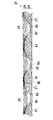
- FIG. 6 is a schematic cross-sectional view taken along line VI-VI in FIG. 5.
- FIG. 7 is a partially enlarged view of a region surrounded by a one-dot chain line VII in FIG. 6.
- A The figure similar to FIG. 2 which shows the modification 1 of a makeup pad.
- FIG. 2 which shows the modification 2 of a makeup pad.
- the following embodiment relates to the disposable makeup pad shown in FIGS. 1 to 8 as an example of the present invention, and includes not only an indispensable structure of the invention but also a selective and preferable structure.
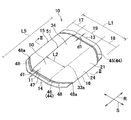
- a makeup pad 10 which is an example of a disposable makeup pad according to the present invention, is positioned on a first direction 11 and a second direction R that are orthogonal to each other, on the first surface 11 and on the opposite side.
- a portion 18 and an intermediate portion 19 located between the first and second end portions 17, 18.
- the width in the second direction R is constant, and in the first and second end portions 17 and 18, the dimension in the second direction R decreases toward the edges 15 and 16, respectively.
- the edges 13 and 14 are inclined.
- the decorative pad 10 includes a cushion layer 20 containing hydrophilic fibers and a covering sheet 21 that covers the cushion layer 20.
- the dimension in the first direction S of the intermediate portion 19 is larger than the dimension in the first direction S of the first and second end portions 17 and 18.
- the cushion layer 20 is a fiber assembly mainly composed of hydrophilic fibers, and hydrophobic fibers may be mixed in the fiber assembly as long as the required water absorption of the cushion layer 20 is not inhibited. Specifically, it contains about 80% by mass or more of hydrophilic fibers.
- hydrophilic fiber for example, rayon fiber, cotton fiber, acrylic fiber or the like can be used.
- synthetic fibers such as polyethylene, polyester, a polypropylene, or these composite fibers etc. can be used, for example.
- the cushion layer 20 is formed of a fiber assembly mainly composed of rayon fibers. When rayon fiber is used as the hydrophilic fiber, it is possible to increase water separation when impregnated with lotion as compared with that using cotton fiber.
- the mass of the cushion layer 20 in one makeup pad 10 is preferably about 0.2 to 0.4 g.
- the cushion layer 20 preferably has a mass per unit area in the intermediate portion 19 smaller than that in the first and second end portions 17 and 18. Further, the mass per unit area at the first and second end portions 17 and 18 of the cushion layer 20 can be substantially the same or different from each other. In this embodiment, the first and second end portions 17 and 17 The mass per unit area of 18 is almost equal. Further, for example, when the makeup pad 10 is used by putting a finger into the pocket 50 described later by making the mass per unit area at the first end 17 of the cushion layer 20 larger than that of the second end 18. Further, the flexibility of the end portion (first end portion 17) on the side where the finger is inserted is improved, and a soft touch can be achieved.
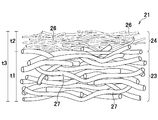
- the covering sheet 21 includes an inner layer (support layer) 23 positioned on the non-skin contact surface side and an outer layer (wiping layer) 24 positioned on the skin contact surface side.
- the outer layer 24 is formed from a melt blown fiber nonwoven fabric mainly composed of hygroscopic first fibers (hygroscopic fibers) 26 having an average fiber diameter of 10 ⁇ m or less.
- first fibers 26 for example, polyamide fibers such as nylon 6 and nylon 66, acrylic fibers, or hydrophobic fibers subjected to hydrophilic treatment can be used.
- the content of the first fiber 26 includes about 80% by mass or more, preferably about 95% by mass or more, and is 100% by mass in this embodiment.
- the inner layer 23 includes second fibers 27 made of, for example, water-absorbing cellulose fibers (highly hygroscopic fibers) such as rayon fibers and pulp fibers, and heat-fusible fibers (hydrophobic fibers).
- the inner layer 23 is formed of a fiber nonwoven fabric containing about 50 to 100% by mass and about 0 to 50% by mass of heat-fusible fibers (hydrophobic fibers).
- the heat-fusible fiber for example, synthetic fibers such as polyethylene, polypropylene, and polyethylene terephthalate, or composite fibers using two or more of these can be used.
- the average fiber diameter of the first fibers 26 is smaller than the average fiber diameter of the second fibers of the inner layer 23.
- the average fiber diameter of the first fibers is preferably 10 ⁇ m or less, more preferably about 5 ⁇ m or less, and the average fiber diameter of the second fibers 27 is about 10 to 20 ⁇ m.
- the first fiber 26 has a lower hygroscopic property than the second fiber 27, and in this specification, the first fiber 26 is also referred to as an ultrafine fiber and / or a low hygroscopic fiber, and the second fiber 27 is also referred to as a high hygroscopic fiber.
- the hygroscopicity of the first fibers 26 of the outer layer 24 lower than that of the second fibers 27 of the inner layer 23, when a cosmetic liquid such as a cleansing agent is applied, rapid absorption of the cosmetic liquid is achieved.
- the cosmetic liquid can be held on the skin contact surface of the makeup pad 10 for a certain time.
- the thickness t1 of the inner layer 23 is about 0.10 to 0.25 mm, and is about 0.16 mm in this embodiment.
- the mass per unit area of the inner layer 23 is about 10 to 35 g / m 2 , and more preferably about 15 to 30 g / m 2 .
- the density of the inner layer 23 is preferably about 0.08 to 0.2 g / cm 3 , and is about 0.12 g / cm 3 in this embodiment.
- the thickness t2 of the outer layer 24 is about 0.05 to 0.15 mm, and in this embodiment is about 0.09 mm.
- Mass per unit area of the outer layer 24 is in a range of about 5 ⁇ 30g / m 2, more preferably about 5 ⁇ 15g / m 2.
- the density of the outer layer 24 is preferably about 0.05 to 0.2 g / cm 3 , and is about 0.11 g / cm 3 in this embodiment.
- the mass per unit area of the outer layer 24 is about 10 g / m 2 or less
- the mass of the inner layer 23 is preferably about 25 g / m 2 or more.
- the thickness t2 of the outer layer 24 is preferably about 20 to 60% of the thickness t1 of the inner layer 23.
- the thickness t3 of the covering sheet 21 is preferably about 0.2 to 0.3 mm, and the mass per unit area of the covering sheet 21 is preferably in the range of about 25 to 40 g / m 2 .
- the specific volume of the covering sheet 21 is about 50 to 200 m 3 / kg, and in this embodiment is about 145 m 3 / kg.
- the thickness dimension t2 of the outer layer 24 is preferably smaller than the thickness dimension t1 of the inner layer.
- the thickness dimension of the covering sheet 21 is measured using a thickness meter (UF-60, manufactured by Daiei Kagaku Seisakusho Co., Ltd.) with a load of 3.0 gf / cm 2 applied to the covering sheet 21.
- the thickness dimensions of the inner layer 23 and the outer layer 24 are measured using a microscope (manufactured by Keyence Corporation, Real Surface View Microscope VE-7800).
- the specific volume (m 3 / kg) of the covering sheet 21 is calculated as the reciprocal of density (g / cm 3 ) ⁇ 10 3 .
- the hole area ratio of the covering sheet 21 is in the range of about 10 to 50%, and more preferably about 35% or less.
- the covering sheet 21 is formed from a fiber nonwoven fabric mainly composed of hygroscopic fibers (first fibers 26) that are ultrafine fibers having an average fiber diameter of 10 ⁇ m or less on the skin contact surface, and has such an aperture ratio.
- the hygroscopic fibers are relatively densely arranged on the skin contact surface, the gap between the fibers is reduced, and the cosmetic liquid retainability is increased.
- the hole area ratio of the covering sheet 21 can be measured by the following method.
- the covering sheet 21 in a state where the cushion layer 20 is removed from the decorative pad 10 is taken out, the covering sheet 21 is fixed to a 26 mm ⁇ 90 mm slide glass, and the cover sheet 21 is set on a film holder, and a scanner (GT-X750 manufactured by Seiko Epson Corporation). ), The image is read using image software (Adobe Photoshop Elements 3.0), and trimmed to 24 mm ⁇ 50 mm. Thereafter, 256 bits are mapped with paint software so that the fibers are black and the aperture is white, and histogram processing is performed using Histgram Analysis software, and binarization processing is performed to obtain the aperture ratio.
- the covering sheet 21 extends in the skin contact surface and the non-skin contact surface located on the opposite side, the length direction Y and the width direction X orthogonal to each other, and the length direction Y. It has the 1st side edge part 31 and the 2nd side edge part 32, and the 1st edge part 33 and the 2nd edge part 34 extended in the width direction X, and the 1st and 2nd side edge part 31,
- the outer shape of the covering sheet 21 is defined by 32 and the first and second end edges 33 and 34.
- each of the length direction Y and the width direction X coincides with each of the first direction S and the second direction R of the makeup pad 10.
- the covering sheet 21 is positioned on the first end edge 33 side, and is positioned between the first folding line 35 extending in the width direction X, and between the first folding line 35 and the second end edge part 34, and in the width direction X.
- a first fold line 36 extending between the first end edge 33 and the first fold line 35, and between the first fold line 35 and the second fold line 36.
- the dimension M2 in the length direction Y of the second section 42 is larger than the dimensions M1 and M3 in the length direction Y of the first and third sections 41, 43.
- the dimensions M1 and M3 of the first and third areas 41 and 43 are larger than one half of the dimension M2 of the second area 42, and the dimension M3 of the third area 43 is equal to or larger than the dimension M1 of the first area 41.
- the first and second side edge portions 31 and 32 are concavely curved toward the inner side in the width direction X in the vicinity of the first folding curve 35 and in the vicinity of the second folding curve 36, respectively.
- the first folding line 35 coincides with one end edge 15 of the makeup pad 10
- the second folding line 36 coincides with the other end edge 16 of the makeup pad 10.
- the cushion layer 20 is disposed on the non-skin contact surface side of the covering sheet 21 in a state where the covering sheet 21 is unfolded.
- the cushion layer 20 includes a first side region 75 and a second side region 76 that are separated from each other in the width direction X, and a central region 77 that is located between the first side region 75 and the second side region 76.
- the first side region 75 is a second fold located on the outer side in the width direction X from the one end 78a of the first folding line 35 (end edge 15) located on the first side edge 31 side (on the first side edge 31 side). This is a region located on the outer side in the width direction X from one end 78b of the curved line 36 (edge 16).
- the second side region 76 is a width direction X outside (second side located on the second side edge 32 side) from the other end 79a of the first folding line 35 (end edge 15) located on the second side edge 32 side. It is a region located on the outer side 79b of the folding line 36 (end edge 16) in the width direction X outside.
- the central region 77 is a region located between the one end 78a and the other end 79a of the first folding line 35 (between the one end 78b and the other end 79b of the second folding line 36) in the width direction X. It is.
- the mass per unit area of the cushion layer 20 in the first side region 75 and the second side region 76 is substantially equal, and the mass per unit area of the cushion layer 20 in the central region 77 is the first and second side regions 75, Greater than that at 76.
- the first and second side regions 75 and 76 and the central region 77 are respectively disposed in the first cushion portion 71 disposed in the first area 41 of the covering sheet 21 and the second area 42 of the covering sheet 21.
- the second cushion part 72 and the third cushion part 73 disposed in the third area 43 of the covering sheet 21 are provided.
- the 1st cushion part 71 is arrange
- the 2nd cushion part 72 is arrange
- the first area 41 of the covering sheet 21 is in a state in which the cushion layer 20 is sandwiched between the second area 42 (that is, a state in which a part of the second cushion part 72 and the first cushion part 71 are sandwiched),
- the second section 42 is bent along the first folding line 35 toward the non-skin contact surface side
- the third section 43 has a state in which the cushion layer 20 is sandwiched between the second section 42 (that is, the first section 42). 2 in a state in which a part of the second cushion portion 72 and the third cushion portion 73 are sandwiched) along the second folding line 36 and bent toward the skin contact surface side of the first section 41 stacked on the second section 42. It has been.
- the mass per unit area of the cushion layer 20 at the first and second end portions 17 and 18 is larger than that of the intermediate portion 19.
- the first and second end portions 17 and 18 and the intermediate portion 19 each have a unit area of the cushion layer 20 in the central region in the second direction R (that is, the region where the central region 77 of the cushion layer 20 is disposed).
- the hit mass per unit area of the cushion layer 20 in both side regions that is, regions where the first and second side regions 75 and 76 of the cushion layer 20 are arranged located outside the second direction R of the central region. Greater than mass.
- the mass per unit area of the cushion layer 20 in both side regions of the first and second end portions 17 and 18 is preferably smaller than that in the central region of the intermediate portion 19.
- the makeup pad 10 loses shape of the makeup pad 10 in use. Can be prevented. Since the mass per unit area of the cushion layer 20 in both side areas in the second direction R is smaller than that in the central area in the second direction R, the decorative pad 10 enhances cushioning properties of the decorative pad 10 in the central area. In the both side areas, the laminated covering sheets 21 can be firmly joined at the side joining portions 44.
- the laminated first and second side edge portions 31 and 32 are respectively fused by embossing / debossing by heat or ultrasonic waves, and thereby, both-side joining in which the folded covering sheet 21 is joined.
- a portion 44 is formed.
- the first and third areas 41 and 43 form the first surface 11 of the makeup pad 10, and the second area 42 forms the second surface 12.
- a pocket 50 is formed in the first surface 11 by a third area 43 stacked on the first and second areas 41 and 42.
- the cushion layer 20 is fused to the covering sheet 21 while being sandwiched between the second section 42 and the first and third sections 41 and 43.
- the both side joints 44 extend from the first fold line 35 to the second fold line 36, and the first joint part 45 located on the first side edge 31 and the second side edge.
- 2nd joint part 46 located in the part 32 is included.
- the first and second joint portions 45 and 46 each have a straight portion 47 extending in the first direction S (length direction Y) and a pair of inclined portions 48 positioned outside the straight portion 47 in the first direction S. And have.
- the straight portion 47 is located at the intermediate portion 19 of the makeup pad 10
- the inclined portion 48 is located at the first and second end portions 17, 18 of the makeup pad 10. Is larger in the length direction Y than the inclined portion 48.
- each of the joint portions 45 and 46 is formed by a large number of substantially circular welding spots, but in other shapes, for example, a substantially rectangular welding spot or a continuous or discontinuous line shape. It may be formed.
- the bonding strength between the laminated covering sheets 21 is higher than that of the straight part 47.
- the joint strength of the inclined portion 48 located at the corner of the decorative pad 10 relatively high, it is possible to prevent the decorative pad 10 from being deformed during use.
- the outer end portion 48 a of the inclined portion 48 positioned at both end edges 15 and 16 of the decorative pad 10 is formed with a higher bonding strength than other portions of the inclined portion 48. Referring to FIGS. 1 and 3, the distance between the side edge 13 of the decorative pad 10 and the first joint 45 and the distance between the side edge 14 and the second joint 46 of the decorative pad 10 (each side edge 13, 14).
- the dimension (d1) in the second direction R of the non-joint portion of the covering sheet 21 located between the joint portions 45 and 46 is preferably in the range of about 0.5 to 5 mm.
- the width dimension (dimension in the second direction R) d2 of the joint portions 45 and 46 is preferably in the range of about 0.5 to 5 mm.
- the pocket 50 is demarcated by both side joint portions 44, a second folding line 36 extending between the both side joint portions 44, and a second end edge portion 34, and the second end edge portion 34 causes the second direction R (width direction X) to be defined.
- An opening edge 51 of the pocket 50 extending along is formed.
- the dimension L2 in the first direction S of the laminated portion in which the first and third areas 41 and 43 are laminated is approximately 20 to 50% of the dimension L1 in the first direction S of the decorative pad 10.
- the dimension L1 of the decorative pad 10 in the first direction S is about 45 to 65 mm
- the dimension L5 in the second direction R is about 65 to 85 mm.
- the opening edge 51 is located at the intermediate portion 19 of the decorative pad 10, and the end edge 33 a on the first end edge portion 33 side of the covering sheet 21 is located at the intermediate portion 19.
- the opening edge 51 may be configured to be positioned at the first end portion 17 of the makeup pad 10.
- a cleansing agent is applied to the first surface 11 or the second surface 12 to be used as a makeup removal pad, or pores are removed from the first surface 11 or the second surface 12.
- a lotion so-called wiping lotion
- the first surface 11 or the second surface 12 of the makeup pad 10 is pressed against the skin and rubbed.
- Necessary flexibility to the extent that no irritation is felt is required.
- it is required to have a relatively high flexibility so as not to feel irritation while removing dirt and old keratin of pores.
- the outer layer 24 forming the first and second surfaces 11 and 12 is a fiber mainly composed of hygroscopic fibers (first fibers 26) that are ultrafine fibers having an average fiber diameter of 10 ⁇ m or less. Since it is formed of a non-woven fabric, the feeling of irritation can be reduced and a soft touch can be obtained as compared with the case where the outer layer is formed of a non-woven fabric having a relatively large fiber diameter. Furthermore, since this ultrafine fiber is a meltblown fiber, the fiber diameter can be made uniform and the peripheral surface of the fiber can be made smoother, compared to those using a split fiber as the ultrafine fiber. This can be further improved. Moreover, since the inner layer 23 is mainly made of cellulosic fibers having an average fiber diameter larger than that of the hygroscopic fibers, it is possible to prevent the strength of the covering sheet 21 from being reduced by using ultrafine fibers.
- the outer layer 24 made of ultrafine fibers may be used, although it is weak and may not be able to wipe off keratin and the like stably.
- the inner layer 23 composed of water-absorbing fibers (second fibers 27) having an average fiber diameter larger than that of the ultrafine fibers is laminated, the covering sheet 21 has a required strain and is stably provided. The keratin etc. can be wiped off.
- the inner layer 23 includes hydrophobic thermoplastic fibers
- the hygroscopicity / water absorption of the inner layer 23 is lowered, so that the action of drawing the cosmetic liquid or the like held in the outer layer 24 is suppressed, and this effect is reduced. It can be improved further.
- the first side edge portion 31 and the second side edge portion 32 laminated at the both side joining portions 44 are fused by heat or ultrasonic embossing / debossing, the inner layer 23 and the outer layer 24 facing each other
- the bonding strength may be lowered.
- the bonding strength at the both-side bonded portion 44 is improved, and the portion can be prevented from peeling off during use.
- the outer layer 24 and the inner layer 23 constituting the covering sheet 21 can be integrated by a mechanical entanglement method, a fluid entanglement method (a hydroentanglement method, an air entanglement method), or a needle punch entanglement method, and preferably integrated by a hydroentanglement method. It has become. As long as the effects of the present invention described later can be obtained, the covering sheet 21 can be formed by joining the layers 23 and 24 with an adhesive (binder), but the layers 23 and 24 are integrated by a hydroentanglement method. By doing so, the covering sheet 21 has excellent flexibility and good skin contact.
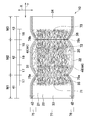
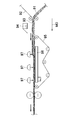
- FIG. 4 is a side view schematically showing main parts in the manufacturing process of the covering sheet 21, and FIG. 5 is a partially enlarged perspective view of the covering sheet 21.
- the main part in the manufacturing process will be described with reference to FIG. 4.
- a first fiber web 91 (lower layer) serving as a material for the inner layer 23 and a second fiber web (upper layer) 92 serving as a material for the outer layer 24 are first laminated.
- the resulting fiber layer 93 is conveyed in the machine direction MD under the action of high-pressure water jet.
- the fiber layer 93 is optionally supplied with a water film from a tank 94 and stabilized in shape, and then guided to an endless belt-shaped mesh screen as an opening support 95, and a suction 96 is drawn from below the mesh.
- a high-pressure water stream is jetted from the orifices of a plurality of nozzles 97 having a predetermined diameter and pitch.
- a plurality of nozzles 97 are arranged in a direction (crossing direction) intersecting the machine direction MD.
- the mesh screen is formed by plain weaving a plurality of stainless steel wires crossing each other (for example, a warp wire and a weft wire orthogonal to each other), and a plurality of wire wires cross each other. It has a knuckle part.
- the smoothness of the skin facing surface side is improved by jetting a high-pressure water stream to the outer layer 24 side, and the skin contact is improved.
- the inner layer 23 side A high-pressure water flow may be injected to the inner layer 23, or a high-pressure water flow may be injected from both the inner layer 23 side and the outer layer 24 side.
- the fibers of the first fiber web 91 and the fibers of the second fiber web 92 are entangled and positioned on the knuckle portion of the fibers constituting the first fiber web 91 on the aperture support 95.
- the fibers to be moved are moved by the action of the jet water, the fibers are rearranged around the knuckle portion, and an opening 80 in which no fibers are present is formed.
- the first fiber web 91 is formed with a plurality of groove portions 82 arranged in the intersecting direction by the high-pressure water flow ejected from the plurality of nozzles 97 arranged in the intersecting direction, and a flange portion 81 positioned between the groove portions 82 is formed. Is done.
- the opening 80 is located in the groove 82.
- the second fiber web 92 to which the high-pressure water stream is directly jetted is relatively thin and is jetted in a state where ultrafine fibers such as nylon are randomly arranged and the fibers can move.
- the plurality of apertures 80 are not formed by being shaped like the one-fiber web 91, and the interlaced fibers are unwound and spread uniformly in a net shape. Therefore, the ultrafine fibers constituting the second fiber web 92 are present so as to block the openings 80 in the first fiber web 91.
- the ultrafine first fibers 26 constituting the outer layer 24 are uniformly spread in a net shape.
- the first fibers 26 can enter the pores and perform a brushing function so as to scrape off cosmetic powder, sebum and the like.
- the first fibers 26 having low hygroscopicity are spread in a net shape on the skin contact surface, a substantially uniform liquid film in which the cosmetic liquid impregnated in the makeup pad 10 spreads uniformly on the skin contact surface is obtained. When it is formed and the adhesion to the skin is improved and it is used as a cosmetic pack, it can exhibit good adhesiveness to the skin.
- the outer layer 24 has a relatively small fiber gap formed by the first fibers 26 being arranged relatively densely in a net shape, when the fiber gap is relatively large or as in the inner layer 23. Compared with the case where a plurality of apertures 80 are formed, the liquid retaining property of the cosmetic liquid or the like is good. Therefore, even when the cosmetic pad 10 is impregnated with a relatively small amount of cosmetic liquid, the cosmetic liquid is not instantaneously absorbed by the cushion layer 20, and the cosmetic powder or Can wipe off dirt on the skin.
- the flange portion 81 and the groove portion 82 preferably extend in the first direction S or the second direction R. In the present embodiment, the flange portion 81 and the groove portion 82 extend in the second direction R, and in the first direction S, The groove portions 82 are alternately arranged.
- the inner layer 23 is formed from the second fibers 27 having an average fiber diameter larger than that of the first fibers 26 and has an uneven shape, and thus has a required sheet strength. Therefore, the entire covering sheet 21 has a proper strain, and the outer layer 24 is prevented from being slid when it comes into sliding contact with the skin, so that a stable wiping operation can be performed. Further, the cosmetic liquid that has moved from the outer layer 24 to the inner layer 23 is diffused along the groove 82 to the entire inner layer 23 and is quickly moved from the plurality of apertures 80 to the cushion layer.
- first fibers 26 forming the outer layer 24 are continuous fibers (continuous) extending in the first direction S or the second direction R so that the end portions of the fibers do not exist on the first and second surfaces 11 and 12. Fiber).
- first fibers 26 are short fibers (staples) in which the end portions of the fibers are present on the first and second surfaces 11 and 12, the end portions may strike the skin and cause irritation when used.
- short fibers are used by forming continuous fibers on the first and second surfaces 11 and 12 so that the end portions do not exist except for the first and second side edges 31 and 32. Compared to the case, the touch can be improved.
- the first fiber 26 is a filament, and the fiber length is relatively large in the state of the fiber layer 93, for example, the dimension in the first direction S and / or the second direction R of the makeup pad 10. Is preferably larger.
- the double-sided joints 44 are formed inside the side edges 13 and 14 of the decorative pad 10 that is the cutting side of the covering sheet 21. In the cosmetic liquid application region defined by the both-side joint portion 44 and both end edges 15 and 16 on the second surface 12, there is no end portion of the hygroscopic fiber which is a continuous fiber, and a good touch can be obtained. .
- the inner layer 23 includes a hydrophobic thermoplastic fiber
- the hygroscopicity / water absorption of the inner layer 23 decreases, so that the effect of drawing the cosmetic liquid etc. held in the outer layer 24 is suppressed, and this effect is further improved. Can be made.
- the first side edge portion 31 and the second side edge portion 32 laminated at the both side joining portions 44 are fused by heat or ultrasonic embossing / debossing, the inner layer 23 and the outer layer 24 facing each other
- the bonding strength may be lowered.
- the bonding strength at the both-side bonded portion 44 is improved, and the portion can be prevented from peeling off during use.
- the average surface friction coefficient (MIU) is 0.35 or more, and the average deviation (SMD) [unit: ⁇ m] of the surface roughness is 1.20 or less. Furthermore, the average surface friction coefficient (MIU) of the skin contact surface is preferably 0.45 or less, and the average deviation (SMD) of the surface roughness is more preferably 1.00 or less. The average deviation (MMD) of the surface friction coefficient is preferably 0.010 or less.
- the edge portion By forming the edge portion on a flat surface with less unevenness, it is possible to wipe off fine dirt that has entered the pores without rubbing the skin strongly, and the wiping property is excellent.
- the covering sheet 21 since the ultrafine fiber layer (outer layer 24) is supported by the inner layer 23, tearing and twisting hardly occur, and the ultrafine fiber (first fiber 26) is easily adhered to the skin. In the state which apply
- the makeup pad 10 disappears liquid droplets generated by dripping 0.02 ml of pure water colored with 0.005 mass% blue No. 1 onto the skin contact surface.
- the time is at least about 0.3 seconds or more, preferably about 7 seconds or less, and more preferably about 5 seconds or less.
- a cosmetic liquid cleaning agent, etc.
- the wiping off property can be improved by setting the vanishing time of the liquid droplets to about 7 seconds or less so that the makeup pad has an appropriate water absorption.
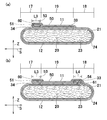
- FIG. 8A is a schematic cross-sectional view similar to FIG. 2 in the first modification of the makeup pad 10
- FIG. 8B is a schematic cross-section similar to FIG. 2 in the second modification of the makeup pad 10.
- FIG. 8A is a schematic cross-sectional view similar to FIG. 2 in the first modification of the makeup pad 10
- FIG. 8B is a schematic cross-section similar to FIG. 2 in the second modification of the makeup pad 10.
- FIG. The makeup pad 10 according to Modifications 1 and 2 has the same basic configuration as that according to the above-described embodiment, and therefore only the differences will be described below.
- the second end edge portion 34 of the covering sheet 21 is bent with the inner layer 23 inside along the third folding line 60 extending in the width direction X (second direction R).
- a first bent end 53 is provided.
- the first bent end portion 53 has a dimension L3 in the length direction Y of about 1 to 5 mm and is located at the first end portion 17.
- the opening edge 51 of the pocket 50 is formed by the third folding line 60.
- the outer layer 24 in the first section 41 and the outer layer 24 in the third section 43 are joined to each other at the both side joint portions 44, so that the moisture absorption forming the outer layer 24 is performed.
- the fiber is nylon 6 or nylon 66 and the cellulosic fiber forming the inner layer 23 is rayon fiber, the bonding strength of the first and third sections 41 and 43 at the first bent end 53 is increased. Can do.
- the first bent end portion 53 may be configured to be located in the intermediate portion 19.
- the second edge 34 of the covering sheet 21 is bent along the third folding line 60 extending in the width direction X (second direction R) with the inner layer 23 inside.
- the first bent end portion 53 and the first end edge portion 33 of the covering sheet 21 were bent along the fourth folding line 61 extending in the width direction X (second direction R) with the outer layer 24 inside.
- a second bent end 54 a second bent end 54.
- the first bent end 53 is located at the first end 17, the second bent end 54 is located at the second end 18, and the length of the first and second bent ends 53, 54 is Dimensions L3 and L4 in the length direction Y are about 1 to 5 mm, respectively.
- the inner layer 23 of the 1st area 41 and the inner layer 23 of the 2nd and 3rd areas 42 and 43 are joined, and the inner layer 23 is joined.
- the bonding strength at the second bent end 54 can be increased.
- the structure located in the intermediate part 19 may be sufficient as the 1st and 2nd bending edge parts 53 and 54, respectively.
- Cover sheet 0.25 mm thickness, mass per unit area 30 g / m 2
- Outer layer thickness 0.09 mm, mass per unit area 10 g / m 2
- Meltblown nonwoven fabric nylon 6: 100% by mass
- Inner layer thickness 0.16 mm, mass per unit area 20 g / m 2
- Spunlace nonwoven fabric rayon: 80% by mass, heat-sealable fiber 20%
- Cover sheet 0.25 mm thickness, mass per unit area 30 g / m 2
- Outer layer thickness 0.09 mm, mass per unit area 10 g / m 2
- Meltblown nonwoven fabric nylon 6: 100% by mass
- Inner layer thickness 0.16 mm, mass per unit area 20 g / m 2
- Spunlace nonwoven fabric rayon: 100% by mass
- Cover sheet (single layer): thickness 0.27 mm, mass per unit area 30 g / M, Meltblown nonwoven fabric (nylon 6: 100% by mass), Average fiber diameter 4 ⁇ m
- Cover sheet (single layer): thickness 0.25 mm, mass per unit area 30 g / M, Spunlace nonwoven fabric (cotton: 100% by mass), Average fiber diameter 10-20 ⁇ m
- Cover sheet (single layer): thickness 0.25 mm, mass per unit area 30 g / M, Spunlace nonwoven fabric (rayon: 100% by mass), Average fiber diameter 15 ⁇ m
- an average surface friction coefficient (MIU), an average deviation of surface friction coefficient (MMD), an average deviation of surface roughness (SMD), a dripping test, a wiping test, and a sensory test are performed.
- MIU average surface friction coefficient
- MMD average deviation of surface friction coefficient
- SMD average deviation of surface roughness
- a dripping test a wiping test
- a sensory test a sensory test.
- Table 1 The results of measurement and sensory evaluation are shown in Table 1.
- this measurement is generally known as a characteristic value representing the touch of the nonwoven fabric, and is a characteristic value in KES manufactured by Kato Tech Co., Ltd. (reference: texture evaluation standardization and analysis (second edition), author) Measured based on Kawabata Tokio (July 10, 1980).
- the measurement method and evaluation criteria of the measurement test shown in Table 1 are as follows. Each measurement is A (excellent), B (good), and C (normal) based on a predetermined standard. D (bad) was evaluated.
- the surface characteristics were measured using KES-FB4 manufactured by Kato Tech Co., Ltd., using a 1.0 ⁇ 1.0 cm range at the center in the first and second directions of the second surface of each sample as a sample.
- the test was performed on a flat metal test bench.
- the surface roughness is measured by applying a load of 10 gf on the surface and pressing a contact terminal having a width of 0.5 cm wound with a piano wire having a diameter of 0.5 mm to the sample, and surface friction.
- the measurement is performed by arranging ten piano wires that are the same as the contact terminals used for the measurement of the surface roughness and pressing the contact surface against the sample with a force of 50 gf using a weight.
- the sample In the measurement of surface friction and surface roughness, the sample is moved 2 cm horizontally at a constant speed of 0.1 cm / sec, and a uniaxial tension of 20 gf / cm is applied to the sample. From the measurement results, an average surface friction coefficient MIU, an average deviation MMD of the surface friction coefficient, and an average deviation SMD [ ⁇ m] of the surface roughness were obtained. Measurement was performed for each of the first direction and the second direction on the second surface of each sample (the surface not having the opening edge 51 of the pocket 50), and the average value was taken as the value of each sample.
- ⁇ Evaluation criteria 1. Value of average surface friction coefficient (MIU) A: 0.35 or more B: 0.30 or more, less than 0.35 C: 0.25 or more, less than 0.30 D: less than 0.25 Mean deviation of surface friction coefficient (MMD) A: 0.010 or less B: Over 0.010, 0.015 or less C: Over 0.015, 0.020 or less D: Over 0.020 Surface roughness average deviation (SMD) value [ ⁇ m] A: 1.20 or less B: Over 1.20, 1.40 or less C: Over 1.40, 1.60 or less D: Over 1.60
- a cosmetic (foundation) wiping test was performed using the cosmetic pad 10 of the present invention and the cosmetic pad of the comparative example.
- a friction wear measuring apparatus TL201Ts manufactured by Trinity Lab Co., Ltd. was used as a test apparatus.
- the test was performed in a state where the cosmetic pad was not applied with a liquid such as a cosmetic liquid.
- 0.02 g of cosmetic product was applied to a rectangular slide glass having a width of 26 mm and a length of 90 mm in a circular shape with a diameter of 13 mm, centering on a position 20 mm from the edge in the length direction, to obtain a test piece.
- the decorative pad 10 is sandwiched between pad test fixtures (depth 20 mm, width 70 mm) with the second surface 12 as an exposed surface, and the test piece is 40 minutes after applying cosmetics.
- the edge of the test piece was applied at a moving speed of 2.5 mm / s while applying a certain load to the dedicated jig (a load of 100 g with respect to the area 5.2 cm 2 of the decorative pad 10 in contact with the test piece).
- the cosmetics were wiped off at a moving distance of 60 mm.
- ⁇ Measurement method of drop time (drop test)> The disappearance time of the droplets was measured in a constant temperature and humidity chamber of 20 degrees and 60% RH by the following measurement method.
- the decorative pad 10 is placed on the test table such that the second surface 12 (the surface not having the opening edge 51 of the pocket 50) is the upper surface, and the first direction S and the second direction R of the second surface 12 are placed.
- 0.02 ml of pure water (distilled water) colored with 0.005% by weight of Blue No. 1 is dropped from the position of a height of 5 mm on the test table. Moving images were taken from when the droplets adhered to the second surface 12 until they disappeared (until the liquid droplets were absorbed and the liquid balls disappeared from the second surface 12), and the time was counted.
- the cosmetic pads of each comparative example were measured in the same manner.
- the composition of the cushion layer of the decorative pad in each example was the same, and 100% rayon fiber was used.
- Softness A soft B: soft soft C: can't say either D: not soft 3.
- the average surface friction coefficient (MIU) is 0.35 or more, and the average deviation (MMD) of the surface friction coefficient is 0.010 or less, and the average deviation (SMD) of the surface roughness was 1.20 or less.
- the decorative pad of Comparative Example 1 had an average surface friction coefficient of 0.35 or more and an average deviation of surface roughness of 1.20 or less, but the average deviation of the surface friction coefficient was more than 0.010.
- the decorative pad of Comparative Example 2 had an average surface friction coefficient of less than 0.30, an average deviation of the surface friction coefficient of more than 0.010, and an average deviation of the surface roughness of more than 1.20.
- the decorative pad of Comparative Example 3 had an average surface friction coefficient of less than 0.30, an average deviation of the surface friction coefficient of more than 0.010, and an average deviation of the surface roughness of more than 1.60. Moreover, in the wiping test, the decorative pad 10 of Examples 1 and 2 and the decorative pad of Comparative Example 1 had a wiping rate of 90% or more, and showed a high wiping rate exceeding 90% without applying the cosmetic liquid. . On the other hand, in the makeup pads of Comparative Examples 2 and 3, the wiping rate was less than 80%. In the drop test, the cosmetic pads of Examples 1 and 2 had a liquid drop disappearance time (average value) of 0.3 seconds or more and 5.0 seconds or less. On the other hand, the cosmetic pad of Comparative Example 1 has a droplet disappearance time in the range of 7.0 to 15.0 seconds, and the cosmetic pads of Comparative Examples 2 and 3 have a droplet disappearance time of less than 0.3 seconds. Met.
- the makeup pads 10 of Examples 1 and 2 have a comparison between the skin contact surfaces because the first fibers 26 are irregularly arced and spread in a mesh shape on the skin contact surfaces.
- a liquid such as a cosmetic liquid
- the cosmetic pad 10 of Examples 1 and 2 includes the first fibers 26 made of ultrafine fibers in the outer layer 24, a plurality of small edge portions are formed on the skin contact surface side, and a relatively high frictional resistance is achieved. Since it has, it is excellent in handling property and can be wiped off so as to scrape out fine dirt that has entered the pores.
- the cosmetic pad 10 of Examples 1 and 2 has the skin contact surface formed of the first fibers 26 made of ultrafine fibers, is relatively smooth, and is relatively frictional resistant. Therefore, also in the sensory evaluation, the evaluation of “softness”, “smoothness”, and “wiping feeling” was “A”, and the characteristics of the makeup pad 10 were actually confirmed as a feeling of use.
- the decorative pads of Comparative Examples 1 to 3 are not as smooth as those of Examples 1 and 2, and in particular, the decorative pads of Comparative Examples 2 and 3 have a relatively uneven surface, Since the frictional resistance is low, a uniform liquid film is formed as in Examples 1 and 2, and a sufficient brushing function cannot be exhibited. There was nothing to become.
- a disposable cosmetic pad having a skin contact surface and including a hydrophilic layer containing a hydrophilic fiber and a cover sheet covering the cushion layer
- the cover sheet forms the skin contact surface, and the average fiber.
- An outer layer mainly composed of hygroscopic first fibers having a diameter of 10 ⁇ m or less
- an inner layer mainly composed of second fibers coated on the outer layer and having a larger average fiber diameter than the first fibers.
- the cosmetic pad has an average deviation (SMD) of the surface roughness of the skin contact surface of 1.20 ⁇ m or less and an average surface friction coefficient (MIU) of 0.35 or more.
- SMD average deviation
- MIU average surface friction coefficient
- the present invention disclosed in the above paragraph 0073 can include at least the following embodiments.
- the average deviation (MMD) of the surface friction coefficient of the skin contact surface is 0.010 or less.
- the decorative pad has a first direction and a second direction orthogonal to the first direction.
- the first fibers are uniformly spread in a mesh shape, and the inner layer has the second direction.
- a plurality of apertures arranged in parallel to each other are formed, and the first fibers straddle at least a part of the apertures.
- the inner layer has a plurality of flanges extending in the second direction and grooves located between the flanges, and the flanges and the grooves are alternately arranged in the first direction, The plurality of openings are located in the groove.
- the density of the outer layer is 0.05 to 0.2 g / cm 3 , and the thickness dimension of the outer layer is 20 to 60% of the thickness dimension of the inner layer.
- the first fiber is nylon.
- the second fiber is a fiber having higher hygroscopicity than the first fiber.
- the second fiber is at least one of cellulosic fibers including rayon and cotton.
- the outer layer and the inner layer are integrated by a hydroentanglement method.
Landscapes
- Engineering & Computer Science (AREA)
- Mechanical Engineering (AREA)
- Cosmetics (AREA)
- Nonwoven Fabrics (AREA)
Abstract
Description
クッション層20は、親水性繊維を主とする繊維集合体であり、この繊維集合体には、クッション層20の所要の吸水性を阻害しない限り、疎水性繊維が混合されていてもよい。具体的には、親水性繊維を約80質量%以上含む。親水性繊維としては、例えば、レーヨン繊維、コットン繊維、アクリル繊維等を用いることができる。疎水性繊維としては、例えば、ポリエチレン、ポリエステル、ポリプロピレン等の合成繊維、又はこれらの複合繊維等を用いることができる。本実施形態においてクッション層20は、レーヨン繊維を主とする繊維集合体によって形成される。親水性繊維としてレーヨン繊維を用いた場合、コットン繊維を用いたものと比して、化粧水を含浸させて使用する際の離水性を高めることができる。
図2及び図7を参照すると、被覆シート21は、非肌当接面側に位置する内層(支持層)23と、肌当接面側に位置する外層(拭き取り層)24とを含む。外層24は、平均繊維径が10μm以下の吸湿性の第1繊維(吸湿性繊維)26を主とするメルトブローン繊維不織布から形成される。第1繊維26としては、例えば、ナイロン6、ナイロン66等のポリアミド繊維、アクリル繊維、又は親水化処理した疎水性繊維等を用いることができる。具体的には、第1繊維26の含有量は、約80質量%以上、好ましくは約95質量%以上含み、本実施形態では100質量%である。
被覆シート21の厚さ寸法は、被覆シート21に3.0gf/cm2荷重を加えた状態で、厚み計((株)大栄科学精器製作所製、UF-60)を用いて測定する。内層23及び外層24の厚さ寸法は、顕微鏡((株)キーエンス製、リアルサーフェイスビュー顕微鏡 VE-7800)を用いて測定する。被覆シート21、内層23及び外層24のそれぞれの密度は、密度(g/cm3)=単位面積当たりの質量(g/m2)/厚さ寸法(mm)×10-3に基づいて算出し、被覆シート21の比容積(m3/kg)は、密度(g/cm3)×103の逆数として算出する。
被覆シート21の開孔率は以下の方法で測定することができる。化粧パッド10からクッション層20を取り除いた状態の被覆シート21を取り出し、26mm×90mmのスライドガラスに被覆シート21を固定し、それをフィルムホルダにセットしてスキャナ(セイコーエプソン株式会社製 GT-X750)で読み取り、画像ソフト(Adobe Photoshop Elements3.0)を用いて画像を読み込み、24mm×50mmにトリミング処理する。その後、繊維が黒色、開孔部が白色となるようにペイントソフトで256ビットマップ化して、Histgram Analysisソフトを用いてヒストグラム処理をし、二値化処理を行って開孔率を求める。
被覆シート21を構成する外層24と内層23とは、機械交絡法、流体交絡法(水流交絡法、エア交絡法)、ニードルパンチ交絡法によって一体化することができ、好ましくは水流交絡法によって一体化されている。後記の本願発明の効果を奏する限りにおいて、両層23,24を接着剤(バインダ)で接合することによって被覆シート21を形成することもできるが、水流交絡法によって両層23,24を一体化することによって、被覆シート21は柔軟性に優れ、肌当たりが良好となる。
図8(a)は、化粧パッド10の変形例1における図2と同様の模式的断面図であり、図8(b)は、化粧パッド10の変形例2における図2と同様の模式的断面図である。変形例1及び2に係る化粧パッド10は、上述した実施形態に係るそれと基本的構成が同一であるので、相違する点についてのみ以下に説明する。
被覆シート:厚さ 0.25mm、単位面積当たりの質量 30g/m2
外層: 厚さ 0.09mm、単位面積当たりの質量 10g/m2、
メルトブローン不織布(ナイロン6:100質量%)、
第1繊維の平均繊維径4μm
内層: 厚さ 0.16mm、単位面積当たりの質量 20g/m2、
スパンレース不織布(レーヨン:80質量%,熱融着性繊維
20%)、
第2繊維(レーヨン)の平均繊維径16μm
被覆シート:厚さ 0.25mm、単位面積当たりの質量 30g/m2
外層: 厚さ 0.09mm、単位面積当たりの質量 10g/m2、
メルトブローン不織布(ナイロン6:100質量%)、
第1繊維の平均繊維径4μm
内層: 厚さ 0.16mm、単位面積当たりの質量 20g/m2、
スパンレース不織布(レーヨン:100質量%)、
第2繊維の平均繊維径15μm
被覆シート(単層):厚さ 0.27mm、単位面積当たりの質量30g
/m、
メルトブローン不織布(ナイロン6:100質量
%)、
平均繊維径4μm
被覆シート(単層):厚さ 0.25mm、単位面積当たりの質量30g
/m、
スパンレース不織布(コットン:100質量%)、
平均繊維径10~20μm
被覆シート(単層):厚さ 0.25mm、単位面積当たりの質量30g
/m、
スパンレース不織布(レーヨン:100質量%)、
平均繊維径15μm

表面特性の測定は、カトーテック(株)製KES-FB4を用いて、各サンプルの第2面の第1及び第2方向における中央部において1.0×1.0cmの範囲を試料とし、平滑な金属平面の試験台に配置して行った。表面粗さの測定は、その表面上に、10gfの荷重を掛け、かつ、0.5mm径のピアノ線で巻かれた幅0.5cmの接触端子を試料に圧着させて行い、また、表面摩擦の測定は、表面粗さの測定に用いた接触端子と同じピアノ線を10本並べ重錘によって50gfの力で接触面を試料に圧着させて行う。表面摩擦及び表面粗さの測定では、試料を0.1cm/secの一定速さで水平に2cm移動させ、試料には20gf/cmの一軸張力が与えられる。測定結果により、平均表面摩擦係数MIU、表面摩擦係数の平均偏差MMD、及び表面粗さの平均偏差SMD[μm]を求めた。各サンプルの第2面(ポケット50の開口縁51を有していない面)において第1方向と第2方向とのそれぞれについて測定を行い、その平均値を各サンプルの値とした。
1.平均表面摩擦係数(MIU)の値
A:0.35以上
B:0.30以上、0.35未満
C:0.25以上、0.30未満
D:0.25未満
2.表面摩擦係数の平均偏差(MMD)
A:0.010以下
B:0.010超、0.015以下
C:0.015超、0.020以下
D:0.020超
3.表面粗さの平均偏差(SMD)の値[μm]
A:1.20以下
B:1.20超、1.40以下
C:1.40超、1.60以下
D:1.60超
本発明の化粧パッド10と比較例の化粧パッドとを用いて、化粧品(ファンデーション)の拭き取り試験を行った。試験装置は、株式会社トリニティーラボ製の摩擦摩耗測定装置 TL201Tsを使用した。なお、化粧パッドは化粧液等の液体を塗布していない状態で試験を行った。まず、幅26mm、長さ90mmの長方形のスライドガラスに、長さ方向の端縁から20mmの位置を中心として、0.02gの化粧品を直径13mmの円形状に塗布して試験片とした。次に、化粧パッド10を第2面12が露出面となるようにして試験装置のパッド専用治具(奥行20mm、幅70mm)に挟み、化粧品の塗付後、40分を経過した試験片に対して、専用治具に一定の荷重(試験片と接触している化粧パッド10の面積5.2cm2に対し、100gの荷重)をかけながら移動速度2.5mm/sで試験片の端縁から移動距離60mmで化粧品を拭き取った。
A:90%以上
B:80%以上、90%未満
C:70%以上、80%未満
D:70%未満
液滴の消失時間は以下の測定方法によって20度、60%RHの恒温恒湿室で測定した。化粧パッド10を第2面12(ポケット50の開口縁51を有していない面)が上面となるようにして試験台に載置し、第2面12の第1方向S及び第2方向Rにおける中央部に0.005質量%の青1号で着色した純水(蒸留水)0.02mlを試験台の載置面から高さ5mmの位置から滴下する。液滴が第2面12に付着してから消失するまで(液玉状の液滴が吸収されて第2面12から液玉が消失するまで)を動画撮影し、その時間をカウントした。各比較例の化粧パッドも同様に測定した。各例の化粧パッドのクッション層の構成は同じものであってレーヨン繊維100%とした。各例におけるサンプル数はそれぞれN=20とし、その平均値を算出した。
A:0.03秒以上、5.0秒以下
B:5.0秒超、7.0秒以下
C:7.0秒超、15.0秒以下
D:それ以外
各化粧パッドの第2面に、2mlの純水(蒸留水)を浸透させて、女性パネラー10名が、各化粧パッドで顔面に塗布された0.2gのファンデーションを拭き取ったときのウエットシートの「やわらかさ」「ぬめり感(密着感)」「拭き取り感」について、4段階で評価した。
1.やわらかさ
A:やわらかい
B:やややわらかい
C:どちらともいえない
D:柔らかくない
2.ぬめり感
A:ぬめり感がある
B:ややぬめり感がある
C:どちらともいえない
D:ぬめり感がない
3.拭き取り感
A:拭き取り感がある
B:やや拭き取り感がある
C:どちらもともいえない
D:拭き取り感がない
表1に示すとおり、実施例1及び2の化粧パッド10の第2面12側において、平均表面摩擦係数(MIU)は、0.35以上であり、表面摩擦係数の平均偏差(MMD)は、0.010以下、表面粗さの平均偏差(SMD)は1.20以下であった。比較例1の化粧パッドは、平均表面摩擦係数が0.35以上、表面粗さの平均偏差が1.20以下であるが、表面摩擦係数の平均偏差は、0.010超であった。比較例2の化粧パッドは、平均表面摩擦係数が、0.30未満、表面摩擦係数の平均偏差が0.010超、表面粗さの平均偏差が1.20超であった。比較例3の化粧パッドは、平均表面摩擦係数が0.30未満であり、表面摩擦係数の平均偏差が0.010超、表面粗さの平均偏差が1.60超であった。また、拭き取り試験において、実施例1及び2の化粧パッド10と比較例1の化粧パッドは、拭き取り率が90%以上であり、化粧液を塗布しない状態で90%を超える高い拭き取り率を示した。一方、比較例2及び3の化粧パッドでは、拭き取り率が80%未満であった。また、滴下試験において、実施例1及び2の化粧パッドは、液滴の消失時間(平均値)が0.3秒以上であり、5.0秒以下であった。一方、比較例1の化粧パッドは、液滴の消失時間が7.0~15.0秒の範囲であり、比較例2及び3の化粧パッドは、液滴の消失時間が0.3秒未満であった。
(1)前記肌当接面の表面摩擦係数の平均偏差(MMD)が0.010以下である。
(2)前記化粧パッドは、第1方向及びそれに直交する第2方向を有し、前記外層において、前記第1繊維は網目状に一様に拡がっており、前記内層には、前記第2方向へ並ぶ複数の開孔が形成され、前記第1繊維が、前記開孔のうちの少なくとも一部を跨いでいる。
(3)前記内層は前記第2方向へ延びる複数の畝部と前記畝部の間に位置する溝部とを有し、前記畝部と前記溝部とは前記第1方向において交互に並んでおり、前記複数の開孔が前記溝部に位置している。
(4)前記外層の密度は0.05~0.2g/cm3であって、前記外層の厚さ寸法が前記内層の厚さ寸法の20~60%の大きさである。
(5)前記第1繊維は、ナイロンである。
(6)前記第2繊維は、前記第1繊維よりも吸湿性の高い繊維である。
(7)前記第2繊維は、レーヨン、コットンを含むセルロース系繊維のうちの少なくとも一つである。
(8)前記外層と前記内層とは、水流交絡法によって一体化される。
17 第1端部
18 第2端部
19 中間部
20 クッション層
21 被覆シート
23 内層
24 外層
26 第1繊維
27 第2繊維
80 開孔
81 畝部
82 溝部
S 第1方向
R 第2方向
Claims (9)
- 肌当接面を有し、親水性繊維を含むクッション層と、前記クッション層を被覆する被覆シートとを含む使い捨ての化粧パッドにおいて、
前記被覆シートは、前記肌当接面を形成する、平均繊維径が10μm以下の吸湿性を有する第1繊維を主として構成された外層と、前記外層に被覆された、前記第1繊維よりも平均繊維径の大きな第2繊維を主として構成された内層とを有し、
前記化粧パッドは、前記肌当接面の表面粗さの平均偏差(SMD)が1.20μm以下であって、平均表面摩擦係数(MIU)が0.35以上であることを特徴とする前記化粧パッド。 - 前記肌当接面の表面摩擦係数の平均偏差(MMD)が0.010以下であることを特徴とする請求項1に記載の化粧パッド。
- 前記化粧パッドは、第1方向及びそれに直交する第2方向を有し、前記外層において、前記第1繊維は網目状に一様に拡がっており、前記内層には、前記第2方向へ並ぶ複数の開孔が形成され、前記第1繊維が、前記開孔のうちの少なくとも一部を跨いでいることを特徴とする請求項1または2に記載の化粧パッド。
- 前記内層は前記第2方向へ延びる複数の畝部と前記畝部の間に位置する溝部とを有し、前記畝部と前記溝部とは前記第1方向において交互に並んでおり、前記複数の開孔が前記溝部に位置している請求項3に記載の化粧パッド。
- 前記外層の密度は0.05~0.2g/cm3であって、前記外層の厚さ寸法が前記内層の厚さ寸法の20~60%の大きさである請求項1~4のいずれかに記載の化粧パッド。
- 前記第1繊維は、ナイロンである請求項1~5のいずれかに記載の化粧パッド。
- 前記第2繊維は、前記第1繊維よりも吸湿性の高い繊維である請求項1~6のいずれかに記載の化粧パッド。
- 前記第2繊維は、レーヨン、コットンを含むセルロース系繊維のうちの少なくとも一つである請求項1~7のいずれかに記載の化粧パッド。
- 前記外層と前記内層とは、水流交絡法によって一体化される請求項1~8のいずれかに記載の化粧パッド。
Priority Applications (5)
| Application Number | Priority Date | Filing Date | Title |
|---|---|---|---|
| CN201580071213.6A CN107105864B (zh) | 2014-12-26 | 2015-03-03 | 一次性化妆棉 |
| BR112017012476-9A BR112017012476A2 (ja) | 2014-12-26 | 2015-03-03 | A disposable makeup pad |
| KR1020177015481A KR102338626B1 (ko) | 2014-12-26 | 2015-03-03 | 일회용 화장 패드 |
| MYPI2017701992A MY183105A (en) | 2014-12-26 | 2015-03-03 | Disposable cosmetic pad |
| PH12017501108A PH12017501108A1 (en) | 2014-12-26 | 2017-06-14 | Disposable cosmetic pad |
Applications Claiming Priority (4)
| Application Number | Priority Date | Filing Date | Title |
|---|---|---|---|
| JP2014266720 | 2014-12-26 | ||
| JP2014-266720 | 2014-12-26 | ||
| JP2015029067A JP5744358B1 (ja) | 2014-12-26 | 2015-02-17 | 使い捨ての化粧パッド |
| JP2015-029067 | 2015-02-17 |
Publications (1)
| Publication Number | Publication Date |
|---|---|
| WO2016103741A1 true WO2016103741A1 (ja) | 2016-06-30 |
Family
ID=53537802
Family Applications (1)
| Application Number | Title | Priority Date | Filing Date |
|---|---|---|---|
| PCT/JP2015/056181 Ceased WO2016103741A1 (ja) | 2014-12-26 | 2015-03-03 | 使い捨ての化粧パッド |
Country Status (8)
| Country | Link |
|---|---|
| JP (1) | JP5744358B1 (ja) |
| KR (1) | KR102338626B1 (ja) |
| CN (1) | CN107105864B (ja) |
| BR (1) | BR112017012476A2 (ja) |
| MY (1) | MY183105A (ja) |
| PH (1) | PH12017501108A1 (ja) |
| TW (1) | TWI665982B (ja) |
| WO (1) | WO2016103741A1 (ja) |
Families Citing this family (4)
| Publication number | Priority date | Publication date | Assignee | Title |
|---|---|---|---|---|
| JP6672004B2 (ja) * | 2016-02-15 | 2020-03-25 | 日本バイリーン株式会社 | 内装用表面材及びその製造方法 |
| JP6917242B2 (ja) * | 2017-08-09 | 2021-08-11 | 花王株式会社 | ワイピングシート及びその製造方法 |
| CN109820736B (zh) * | 2019-03-21 | 2022-04-01 | 广州市玛莉安化妆用品有限公司 | 一种化妆棉及其制备方法 |
| US12329262B2 (en) * | 2021-07-31 | 2025-06-17 | Elc Management Llc | Nonwoven material for cosmetic cushion compact |
Citations (10)
| Publication number | Priority date | Publication date | Assignee | Title |
|---|---|---|---|---|
| JPS5698108U (ja) * | 1979-12-24 | 1981-08-03 | ||
| JPS57189515U (ja) * | 1981-05-29 | 1982-12-01 | ||
| JP2003516215A (ja) * | 1999-12-07 | 2003-05-13 | ジョージア−パシフィック・フランス | 異なる2つの外側面を持つスキンケア用親水性コットンパフ |
| JP2003261419A (ja) * | 2002-03-08 | 2003-09-16 | Kao Corp | シート状化粧料 |
| JP2003289940A (ja) * | 2002-04-01 | 2003-10-14 | Toray Ind Inc | 化粧用具 |
| US6998360B1 (en) * | 1999-06-16 | 2006-02-14 | Georgia-Pacific France | Hydrophilic cotton product comprising a soft surface and a scraping surface |
| JP2006082263A (ja) * | 2004-09-14 | 2006-03-30 | Sekisui Chem Co Ltd | 液状物供給基材 |
| JP2006233364A (ja) * | 2005-02-25 | 2006-09-07 | Kao Corp | 不織布 |
| JP2009292750A (ja) * | 2008-06-04 | 2009-12-17 | Lion Corp | シート状化粧材 |
| JP2010195735A (ja) * | 2009-02-26 | 2010-09-09 | Omikenshi Co Ltd | 化粧・美容用不織布 |
Family Cites Families (7)
| Publication number | Priority date | Publication date | Assignee | Title |
|---|---|---|---|---|
| JP3409988B2 (ja) * | 1997-03-21 | 2003-05-26 | ユニ・チャーム株式会社 | 拭き取りシート |
| JP3067948U (ja) * | 1999-10-05 | 2000-04-21 | 株式会社瑞光 | 使い捨て化粧用パフ |
| JP2001355173A (ja) * | 2000-06-13 | 2001-12-26 | Idemitsu Unitech Co Ltd | 不織布積層体およびその用途 |
| JP4118640B2 (ja) * | 2002-09-17 | 2008-07-16 | ユニ・チャーム株式会社 | 吸収性複合シートおよびこれを用いた吸収性物品 |
| EP1813167A4 (en) * | 2004-08-11 | 2012-11-07 | Daiwa Spinning Co Ltd | TOWEL FOR COVERING THE SKIN AND FOR DRINKING WITH A COSMETIC PREPARATION AND METHOD FOR THE PRODUCTION THEREOF AND FACING THE FACE MASK THEREOF |
| KR101400704B1 (ko) * | 2006-07-05 | 2014-05-29 | 가오 가부시키가이샤 | 흡수성 물품 |
| CN101575767A (zh) * | 2009-03-06 | 2009-11-11 | 稳健实业(深圳)有限公司 | 一种化妆棉及其生产方法 |
-
2015
- 2015-02-17 JP JP2015029067A patent/JP5744358B1/ja active Active
- 2015-03-03 BR BR112017012476-9A patent/BR112017012476A2/ja not_active Application Discontinuation
- 2015-03-03 WO PCT/JP2015/056181 patent/WO2016103741A1/ja not_active Ceased
- 2015-03-03 MY MYPI2017701992A patent/MY183105A/en unknown
- 2015-03-03 CN CN201580071213.6A patent/CN107105864B/zh active Active
- 2015-03-03 KR KR1020177015481A patent/KR102338626B1/ko active Active
- 2015-12-23 TW TW104143385A patent/TWI665982B/zh active
-
2017
- 2017-06-14 PH PH12017501108A patent/PH12017501108A1/en unknown
Patent Citations (10)
| Publication number | Priority date | Publication date | Assignee | Title |
|---|---|---|---|---|
| JPS5698108U (ja) * | 1979-12-24 | 1981-08-03 | ||
| JPS57189515U (ja) * | 1981-05-29 | 1982-12-01 | ||
| US6998360B1 (en) * | 1999-06-16 | 2006-02-14 | Georgia-Pacific France | Hydrophilic cotton product comprising a soft surface and a scraping surface |
| JP2003516215A (ja) * | 1999-12-07 | 2003-05-13 | ジョージア−パシフィック・フランス | 異なる2つの外側面を持つスキンケア用親水性コットンパフ |
| JP2003261419A (ja) * | 2002-03-08 | 2003-09-16 | Kao Corp | シート状化粧料 |
| JP2003289940A (ja) * | 2002-04-01 | 2003-10-14 | Toray Ind Inc | 化粧用具 |
| JP2006082263A (ja) * | 2004-09-14 | 2006-03-30 | Sekisui Chem Co Ltd | 液状物供給基材 |
| JP2006233364A (ja) * | 2005-02-25 | 2006-09-07 | Kao Corp | 不織布 |
| JP2009292750A (ja) * | 2008-06-04 | 2009-12-17 | Lion Corp | シート状化粧材 |
| JP2010195735A (ja) * | 2009-02-26 | 2010-09-09 | Omikenshi Co Ltd | 化粧・美容用不織布 |
Also Published As
| Publication number | Publication date |
|---|---|
| KR20170101909A (ko) | 2017-09-06 |
| TW201633955A (zh) | 2016-10-01 |
| CN107105864A (zh) | 2017-08-29 |
| TWI665982B (zh) | 2019-07-21 |
| MY183105A (en) | 2021-02-14 |
| PH12017501108A1 (en) | 2017-11-27 |
| CN107105864B (zh) | 2020-10-16 |
| JP2016123833A (ja) | 2016-07-11 |
| JP5744358B1 (ja) | 2015-07-08 |
| KR102338626B1 (ko) | 2021-12-14 |
| BR112017012476A2 (ja) | 2018-05-29 |
Similar Documents
| Publication | Publication Date | Title |
|---|---|---|
| TWI683046B (zh) | 擦拭用薄片 | |
| US6013349A (en) | Wiping sheet | |
| JP3559533B2 (ja) | 絡合不織布とこれを用いた清拭シートおよび湿潤性シート | |
| JP5744358B1 (ja) | 使い捨ての化粧パッド | |
| JP5671180B1 (ja) | 使い捨ての化粧パッド | |
| JP2014133715A (ja) | 化粧料含浸用皮膚被覆シートの製造方法 | |
| JP7629681B2 (ja) | 液体含浸皮膚被覆シート用不織布および液体含浸皮膚被覆シート | |
| JP3788582B2 (ja) | 清拭用シート基材 | |
| KR100669127B1 (ko) | 키친 페이퍼 및 그 제조 방법 | |
| JP3621223B2 (ja) | 清掃シート | |
| JP3978423B2 (ja) | 化粧用不織布シート | |
| JP2005034617A (ja) | クッキングペーパーおよびその製造方法 | |
| JP2007211371A (ja) | 積層不織布 | |
| JP2008095223A (ja) | 化粧品向け不織布 | |
| JP5622385B2 (ja) | スキンケア用シート | |
| JP2007244886A (ja) | クッキングペーパー | |
| JP4578388B2 (ja) | 使い捨てブラシ | |
| JP2683600B2 (ja) | 化粧綿 | |
| JP6542458B1 (ja) | 化粧用シート | |
| JPH06341046A (ja) | 不織布複合シートの製造法 | |
| JPH0638895A (ja) | 拭き布の製造方法 |
Legal Events
| Date | Code | Title | Description |
|---|---|---|---|
| 121 | Ep: the epo has been informed by wipo that ep was designated in this application |
Ref document number: 15872311 Country of ref document: EP Kind code of ref document: A1 |
|
| ENP | Entry into the national phase |
Ref document number: 20177015481 Country of ref document: KR Kind code of ref document: A |
|
| WWE | Wipo information: entry into national phase |
Ref document number: 12017501108 Country of ref document: PH |
|
| NENP | Non-entry into the national phase |
Ref country code: DE |
|
| REG | Reference to national code |
Ref country code: BR Ref legal event code: B01A Ref document number: 112017012476 Country of ref document: BR |
|
| 122 | Ep: pct application non-entry in european phase |
Ref document number: 15872311 Country of ref document: EP Kind code of ref document: A1 |
|
| REG | Reference to national code |
Ref country code: BR Ref legal event code: B01E Ref document number: 112017012476 Country of ref document: BR |
|
| ENP | Entry into the national phase |
Ref document number: 112017012476 Country of ref document: BR Kind code of ref document: A2 Effective date: 20170612 |