WO2016072365A1 - ブチロラクトン化合物の製造方法 - Google Patents
ブチロラクトン化合物の製造方法 Download PDFInfo
- Publication number
- WO2016072365A1 WO2016072365A1 PCT/JP2015/080804 JP2015080804W WO2016072365A1 WO 2016072365 A1 WO2016072365 A1 WO 2016072365A1 JP 2015080804 W JP2015080804 W JP 2015080804W WO 2016072365 A1 WO2016072365 A1 WO 2016072365A1
- Authority
- WO
- WIPO (PCT)
- Prior art keywords
- formula
- group
- compound represented
- palladium
- palladium catalyst
- Prior art date
- Legal status (The legal status is an assumption and is not a legal conclusion. Google has not performed a legal analysis and makes no representation as to the accuracy of the status listed.)
- Ceased
Links
- 0 COC(*Oc(cc1)ccc1-c(cc1)cc(F)c1O*C(OC)OC)OC Chemical compound COC(*Oc(cc1)ccc1-c(cc1)cc(F)c1O*C(OC)OC)OC 0.000 description 2
- YKAUVLADLMSRDK-UHFFFAOYSA-N CC(C)C(CC1=C)OC1=O Chemical compound CC(C)C(CC1=C)OC1=O YKAUVLADLMSRDK-UHFFFAOYSA-N 0.000 description 1
- GSAXYCMRBDBMMD-UHFFFAOYSA-N CC(C1CC1)C(CC1=C)OC1=O Chemical compound CC(C1CC1)C(CC1=C)OC1=O GSAXYCMRBDBMMD-UHFFFAOYSA-N 0.000 description 1
Classifications
-
- C—CHEMISTRY; METALLURGY
- C07—ORGANIC CHEMISTRY
- C07D—HETEROCYCLIC COMPOUNDS
- C07D307/00—Heterocyclic compounds containing five-membered rings having one oxygen atom as the only ring hetero atom
- C07D307/02—Heterocyclic compounds containing five-membered rings having one oxygen atom as the only ring hetero atom not condensed with other rings
- C07D307/34—Heterocyclic compounds containing five-membered rings having one oxygen atom as the only ring hetero atom not condensed with other rings having two or three double bonds between ring members or between ring members and non-ring members
- C07D307/38—Heterocyclic compounds containing five-membered rings having one oxygen atom as the only ring hetero atom not condensed with other rings having two or three double bonds between ring members or between ring members and non-ring members with substituted hydrocarbon radicals attached to ring carbon atoms
- C07D307/40—Radicals substituted by oxygen atoms
- C07D307/42—Singly bound oxygen atoms
-
- C—CHEMISTRY; METALLURGY
- C07—ORGANIC CHEMISTRY
- C07B—GENERAL METHODS OF ORGANIC CHEMISTRY; APPARATUS THEREFOR
- C07B61/00—Other general methods
-
- G—PHYSICS
- G03—PHOTOGRAPHY; CINEMATOGRAPHY; ANALOGOUS TECHNIQUES USING WAVES OTHER THAN OPTICAL WAVES; ELECTROGRAPHY; HOLOGRAPHY
- G03F—PHOTOMECHANICAL PRODUCTION OF TEXTURED OR PATTERNED SURFACES, e.g. FOR PRINTING, FOR PROCESSING OF SEMICONDUCTOR DEVICES; MATERIALS THEREFOR; ORIGINALS THEREFOR; APPARATUS SPECIALLY ADAPTED THEREFOR
- G03F7/00—Photomechanical, e.g. photolithographic, production of textured or patterned surfaces, e.g. printing surfaces; Materials therefor, e.g. comprising photoresists; Apparatus specially adapted therefor
- G03F7/004—Photosensitive materials
- G03F7/0045—Photosensitive materials with organic non-macromolecular light-sensitive compounds not otherwise provided for, e.g. dissolution inhibitors
Definitions
- the present invention relates to a method for producing a compound having a butyrolactone ring.
- a voltage is applied to the liquid crystal molecules during the manufacturing process.
- Some of them include a step of irradiating ultraviolet rays.
- a photopolymerizable compound is added to a liquid crystal composition in advance and used together with a vertical alignment film such as polyimide to irradiate ultraviolet rays while applying a voltage to a liquid crystal cell.
- a technique PSA (Polymer sustained Alignment) type liquid crystal display) for increasing the response speed of liquid crystal is known. (See Patent Document 1 and Non-Patent Document 1)
- the direction in which the liquid crystal molecules tilt in response to an electric field is controlled by protrusions provided on the substrate or slits provided on the display electrode, but a photopolymerizable compound is added to the liquid crystal composition, By irradiating ultraviolet rays while applying voltage to the liquid crystal cell, a polymer structure in which the tilted direction of the liquid crystal molecules is stored is formed on the liquid crystal alignment film. It is said that the response speed of the liquid crystal display element is faster than the method of controlling the above.
- Patent Document 2 It has also been reported that the response speed of the liquid crystal display element can be increased by adding a photopolymerizable compound to the liquid crystal alignment film instead of the liquid crystal composition (SC-PVA liquid crystal display) Patent Document 2).
- a photopolymerizable compound As examples of the added photopolymerizable compound, certain types of polymerizable monomers are known (see Patent Documents 2 to 6).
- a method for constructing a lactone ring in a polymerizable monomer a method using a palladium catalyst is known, but these examples leave room for improvement in yield and the like (see Non-Patent Document 3).
- Japanese Unexamined Patent Publication No. 2003-307720 Japanese Unexamined Patent Publication No. 2008-239873 Japanese Unexamined Patent Publication No. 2011-84477 Japanese Unexamined Patent Publication No. 2012-240945 Japanese special table 2013-509457 gazette British Patent Application GB 2297549A
- Photopolymerizable compounds have heretofore been manufactured using expensive compounds as raw materials. Therefore, as a raw material for electronic equipment that requires cost reduction, there has been a problem in its supplyability. Therefore, there is a need for a novel production method that can produce a photopolymerizable compound at low cost.
- An object of the present invention is to solve the problems of the prior art described above. Specifically, an object of the present invention is to provide a novel production method for producing a photopolymerizable compound used for a liquid crystal display element at a low cost and in a high yield.
- the present inventors have further made a palladium catalyst coexist when a hydroxymethacrylate ester is reacted with an acetal or ketal compound in the presence of a tin-containing compound.
- the present inventors have found that a photopolymerizable compound can be produced with high yield.
- the present invention is based on such knowledge and has the following gist.
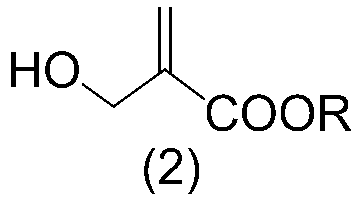
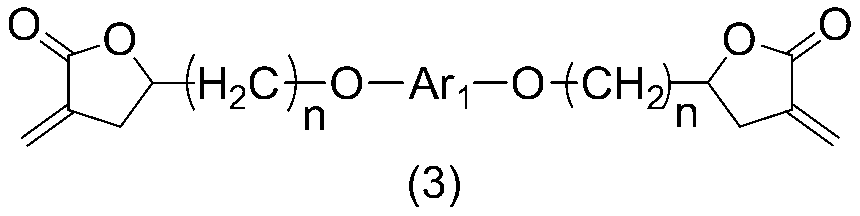
- a compound represented by the following formula (1) and a compound represented by the following formula (2) are reacted under acidic conditions in the presence of metal tin or a tin-containing compound and a palladium catalyst (3 The manufacturing method of the compound represented by this.
- n is an integer of 1 to 10
- PG is a dialkyl acetal group having 1, 2 carbon atoms, 1,3-dioxane group or 1,3-dioxolane group
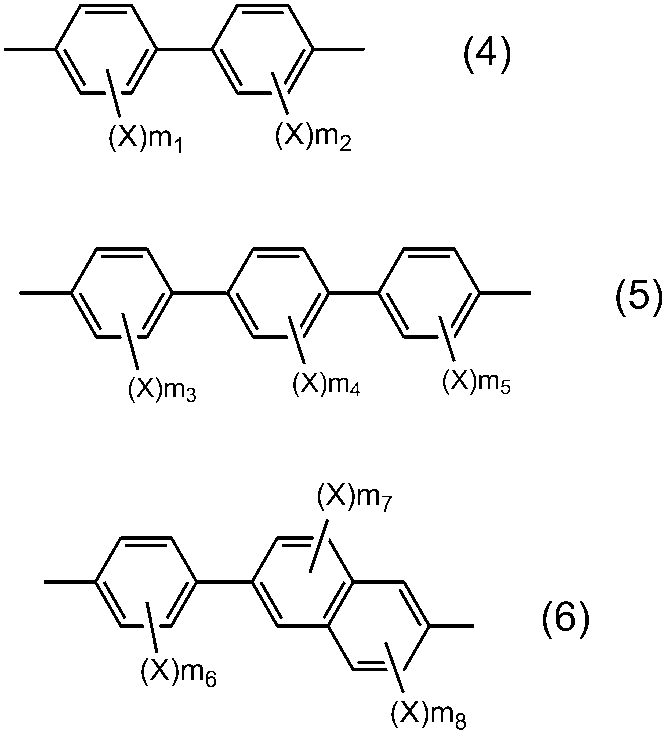
- Ar 1 is represented by the following formula ( 4)
- each X independently represents a halogen atom, an alkoxy group having 1 to 6 carbon atoms, a haloalkyl group having 1 to 6 carbon atoms, or 1 to 6 carbon atoms.
- m 1 to m 6 each independently represents an integer of 0 to 4, and m 7 and m 8 each independently represents 0 to 3 (It is an integer, and when the number of X is 2 or more, Xs may be the same or different.)
- R is an alkyl group having 1 to 6 carbon atoms.
- Ar 1 and n represent the above meanings.
- a compound having an ⁇ -methylene- ⁇ -butyrolactone group represented by the formula (3) which is useful as a polymerizable compound used in a liquid crystal display device, can be produced with high yield and low cost. Can do.
- n is an integer of 1 to 10
- R is an alkyl group having 1 to 6 carbon atoms
- PG is a dialkyl acetal group having 1 to 2 carbon atoms
- Ar 1 is a divalent group represented by the following formula (4), (5) or (6).
- n is preferably 1 to 4, and more preferably 3 to 4. n may be the same or different on the left and right, but is preferably the same on the left and right from the viewpoint of synthesis.
- PG is preferably a dimethylacetal group or a 1,3-dioxolan-2-yl group, which may be the same or different on the left and right, but is preferably the same on the left and right from the viewpoint of synthesis.
- R is preferably an alkyl group having 1 to 5 carbon atoms, and may be linear or branched, but is preferably linear. In particular, a methyl group or an ethyl group is preferable,
- each X independently represents a halogen atom, an alkoxy group having 1 to 6 carbon atoms, a haloalkyl group having 1 to 6 carbon atoms, or 1 to 6 carbon atoms.
- m 1 to m 6 are each independently an integer of 0 to 4
- m 7 and m 8 are each independently an integer of 0 to 3.
- the halogen atom include fluorine, chlorine, bromine and the like.
- X is preferably a methoxy group, a trifluoromethyl group, a trifluoromethoxy group, or the like. Particularly preferred is a methoxy group.
- m 1 to m 6 each independently preferably represents an integer of 0 to 1.
- m 7 and m 8 are each independently preferably an integer of 0 to 1.
- metal tin or tin-containing compounds examples include tin compounds such as tin powder, anhydrous tin chloride, tin chloride dihydrate, and tin chloride pentahydrate. Of these, anhydrous tin chloride or tin chloride dihydrate is preferable.
- the amount of metal tin or tin-containing compound used is preferably 2 to 4 equivalents relative to 1 equivalent of the compound represented by the formula (1). Equivalents are preferred.
- the reaction is carried out under acidic conditions, and the acidic conditions are preferably such that the pH is 1 to 3, and more preferably 1 to 2.
- Acids used to make acidic conditions include aqueous solutions of inorganic acids such as hydrochloric acid, sulfuric acid, phosphoric acid and ammonium chloride, acidic resins such as Amberlyst® 15, and organic acids such as p-toluenesulfonic acid, acetic acid and formic acid it can. Of these, hydrochloric acid, sulfuric acid or acetic acid is preferred.
- the palladium catalyst examples include palladium (0) solid catalyst, supported catalyst or complex catalyst, and a compound that changes into a palladium (0) catalyst in the reaction solution.
- a palladium (0) catalyst for example, Raney palladium, silica-supported palladium catalyst, alumina-supported palladium catalyst, carbon-supported palladium catalyst, barium sulfate-supported palladium catalyst, zeolite-supported palladium catalyst, silica-alumina-supported palladium catalyst, or a solid or supported catalyst; dichlorobis (Triphenylphosphine) palladium, dichlorobis (trimethylphosphine) palladium, dichlorobis (tributylphosphine) palladium, bis (tricyclohexylphosphine) palladium, tetrakis (triethylphosphite) palladium, bis (cycloocta-1,5-diene) palladium, tetrakis (Triphen
- the palladium catalyst can be used alone or in combination of two or more.
- the amount of the palladium catalyst to be used is generally 0.0001 to 20 mol%, preferably 0.001 to 10 mol%, relative to the compound represented by the formula (1).
- a ligand may be added to the palladium catalyst as necessary.
- the ligand include trimethylphosphine, triethylphosphine, tributylphosphine, triphenylphosphine, tris (paratolyl) phosphine, tris (2,6-dimethylphenyl) phosphine, sodium diphenylphosphinobenzene-3-sulfonate, bis (3-Sulphonatephenyl) phosphinobenzene sodium salt, 1,2-bis (diphenylphosphino) ethane, 1,3-bis (diphenylphosphino) propane, 1,4-bis (diphenylphosphino) butane, tris Monodentate or polydentate tertiary phosphines such as (3-sulfonatophenyl) phosphine sodium salt; triethyl phosphite, tributyl phosphite, triphen
- Phosphate esters triphenylmethylphosphonium iodide, triphenylmethylphosphonium bromide, triphenylmethylphosphonium chloride, triphenylallylphosphonium iodide, triphenylallylphosphonium bromide, triphenylallylphosphonium chloride, tetraphenylphosphonium iodide, tetra Phosphonium salts such as phenylphosphonium bromide and tetraphenylphosphonium chloride; Phosphate esters such as triphenyl phosphate, trimethyl phosphate, triethyl phosphate and triallyl phosphate; Nitriles such as benzonitrile and acetonitrile; Ketones such as acetylacetone Dienes such as cyclopentadiene, pentamethylcyclopentadiene, 1,5-cyclooctadiene; pyridine, -Picoline, 3-picoline, 4-
- the amount of the ligand used is usually 0.1 to 10000 mol%, preferably 1 to 5000 mol%, based on the palladium catalyst.
- hydroxy methacrylic acid ester compound which is a compound represented by the formula (2) include hydroxy methacrylic acid methyl ester, hydroxy methacrylic acid ethyl ester, hydroxy methacrylic acid isopropyl ester, hydroxy methacrylic acid tertiary butyl ester, and the like. Is mentioned. Preferred is hydroxymethacrylic acid methyl ester or hydroxymethacrylic acid ethyl ester.
- the amount of the compound represented by the formula (2) is not particularly limited, but 2.0 to 2.5 equivalents may be used with respect to 1 equivalent of the compound (1) represented by the formula (1). Preferably, 2.2 to 2.5 equivalents are more preferable.
- a solvent is preferable, and a stable and inert solvent that does not hinder the reaction is used.
- a solvent for example, water, ethers (Et 2 O, i-Pr 2 O, TBME (methyl tert-butyl ether), CPME (cyclopentyl methyl ether), tetrahydrofuran, dioxane, etc.) can be used.
- ethers Et 2 O, i-Pr 2 O, TBME (methyl tert-butyl ether), CPME (cyclopentyl methyl ether), tetrahydrofuran, dioxane, etc.
- These solvents can be appropriately selected in consideration of the ease of reaction and the like, and can be used singly or in combination of two or more. Tetrahydrofuran or water is preferable.
- the reaction temperature is not particularly limited, but is usually 0 to 100 ° C., preferably 20 to 70 ° C.
- the reaction time is usually 1 to 100 hours, preferably 1 to 12 hours.
- the compound represented by the formula (3) obtained as described above is purified by adding a base to the reaction solution to remove excess acid, washing with water, recrystallizing, and the like after the reaction. Can be highly purified.
- the solvent used for recrystallization is not particularly limited as long as the compound represented by the formula (3) is dissolved during heating and precipitated during cooling.
- hydrocarbons such as hexane, heptane and toluene; halogenated hydrocarbons such as chloroform, 1,2-dichloroethane and chlorobenzene; ethers such as diethyl ether, tetrahydrofuran and 1,4-dioxane; esters such as ethyl acetate Ketones such as acetone and methyl ethyl ketone; alcohols such as methanol, ethanol and 2-propanol; and mixtures thereof.
- Tetrahydrofuran, toluene, methanol, ethanol, 2-propanol, hexane, heptane, or a mixture thereof is preferable.
- the compound (1) is a reaction between an aromatic compound (A) having a phenolic hydroxyl group and a halogen-substituted acetal or ketal compound represented by the formula (B) in the presence of a base. Can be obtained.
- n, PG and Ar 1 represent the above meanings, and J 1 is a halogen atom. J 1 is preferably Cl, Br or I.
- inorganic bases such as sodium hydride, sodium hydroxide, potassium hydroxide, lithium hydroxide, sodium phosphate, potassium phosphate, sodium carbonate, potassium carbonate, lithium carbonate and cesium carbonate can be used.
- it is sodium carbonate or potassium carbonate.
- additives In order to accelerate the reaction rate, further additives can be used.
- potassium iodide, sodium iodide, quaternary ammonium salts, crown ethers and the like can be used.
- a solvent is preferable, and a stable and inert solvent that does not interfere with the reaction is used.
- a solvent for example, water, alcohols, amines, ketones such as acetone or methyl ethyl ketone; aprotic polar organic solvents (DMF, DMSO, DMAc, NMP, etc.); aromatic hydrocarbons (benzene, toluene, xylene, mesitylene, chlorobenzene) , Dichlorobenzene, nitrobenzene, tetralin, etc.); halogenated hydrocarbons (chloroform, dichloromethane, carbon tetrachloride, dichloroethane, etc.); nitriles (acetonitrile, propionitrile, butyronitrile, etc.); These solvents can be appropriately selected in consideration of the ease of reaction and the like, but can be used alone or in combination of two or more.
- the reaction temperature is not particularly limited, but is usually 40 to 200 ° C, preferably 40 to 150 ° C.
- the reaction time is usually 20 to 100 hours, preferably 20 to 60 hours.
- the compound represented by the formula (1) obtained as described above can be highly purified by purifying by washing with water and recrystallization after the reaction.
- the solvent used for recrystallization is not particularly limited as long as the compound represented by the formula (1) is dissolved upon heating and precipitated upon cooling.
- hydrocarbons such as hexane, heptane or toluene; halogenated hydrocarbons such as chloroform, 1,2-dichloroethane and chlorobenzene; ethers such as diethyl ether, tetrahydrofuran and 1,4-dioxane; esters such as ethyl acetate Ketones such as acetone and methyl ethyl ketone; nitriles such as acetonitrile and propionitrile; alcohols such as methanol, ethanol and 2-propanol; and mixtures thereof.
- the compound represented by the formula (A) can be obtained as a commercial product, but as shown below, an aryl halide [2-A] and an organometallic reagent [3-A] can be used in the presence of a base. Below, it can obtain by carrying out the cross coupling reaction (Suzuki-Miyaura reaction) using a metal catalyst.
- X, m 1 and m 2 represent the above meanings
- Hal represents Br, I or OTf (Tf is a paratoluenesulfonyl group)
- M represents B (OH) 2 or 4, 4, 5, Represents 5-tetramethyl-1,3,2-dioxaborolan-2-yl.
- the use ratio (equivalent ratio) of the aryl halide [2-A] and the boronic acid derivative [3-A] used for the cross-coupling reaction is not particularly limited, but is 1 equivalent to 1 equivalent of the aryl halide [2-A].
- the boronic acid derivative [3-A] is preferably used in an amount of 1.0 to 1.5 equivalents. Further, 1.0 to 1.5 equivalents of aryl halide [2-A] may be used per 1 equivalent of boronic acid derivative [3-A].
- metal catalyst used in the above coupling reaction it is preferable to use a metal complex and a ligand. However, if the reaction proceeds without a ligand, the ligand may not be used.
- metal complexes those having various structures can be used, but palladium complexes and nickel complexes are preferably used.
- the metal complex a low-valent palladium complex or nickel complex is preferably used, and a zero-valent complex having tertiary phosphine or tertiary phosphite as a ligand is particularly preferable.
- an appropriate precursor that can be easily converted into a zero-valent complex in the reaction system can also be used.
- a complex containing no tertiary phosphine or tertiary phosphite as a ligand is mixed with a tertiary phosphine or tertiary phosphite, and the tertiary phosphine or tertiary phosphite is converted into a ligand. It is also possible to generate a low valence complex.
- tertiary phosphine or tertiary phosphite examples include triphenylphosphine, tri-o-tolylphosphine, diphenylmethylphosphine, phenyldimethylphosphine, 1,2-bis (diphenylphosphino) ethane, 1,3-bis ( And diphenylphosphino) propane, 1,4-bis (diphenylphosphino) butane, 1,1′-bis (diphenylphosphino) ferrocene, trimethyl phosphite, triethyl phosphite, triphenyl phosphite and the like.
- a complex containing a mixture of two or more of these as a ligand is also preferably used.
- the metal catalyst it is also preferable to use a palladium complex or nickel complex that does not contain tertiary phosphine or tertiary phosphite, a complex containing tertiary phosphine or tertiary phosphite, and the above-described ligand in combination. It is an aspect.
- Examples of palladium complexes and nickel complexes that do not contain the tertiary phosphine or tertiary phosphite used in combination include bis (benzylideneacetone) palladium, tris (benzylideneacetone) dipalladium, bis (acetonitrile) dichloropalladium, and bis (benzo Nitrile) dichloropalladium, palladium acetate, palladium chloride, palladium chloride-acetonitrile complex, palladium-activated carbon, nickel chloride, nickel iodide and the like.
- Examples of the complex containing tertiary phosphine or tertiary phosphite include dimethylbis (triphenylphosphine) palladium, dimethylbis (diphenylmethylphosphine) palladium, (ethylene) bis (triphenylphosphine) palladium, tetrakis (triphenyl). Phosphine) palladium, bis (triphenylphosphine) dichloropalladium, [1,3-bis (diphenylphosphino) propane] nickel (II) dichloride, [1,2-bis (diphenylphosphino) ethane] nickel (II) dichloride Etc. These are not limited to those described above. These palladium complexes and nickel complexes may be used in so-called catalytic amounts. Generally, 20 mol% or less is sufficient relative to the substrate, and usually 10 mol% or less.
- the base examples include inorganic bases such as sodium hydroxide, potassium hydroxide, lithium hydroxide, sodium hydrogen carbonate, potassium hydrogen carbonate, sodium phosphate, potassium phosphate, sodium carbonate, potassium carbonate, lithium carbonate, cesium carbonate; methylamine, dimethyl Amine, trimethylamine, ethylamine, diethylamine, triethylamine, propylamine, dipropylamine, tripropylamine, isopropylamine, diisopropylamine, triisopropylamine, butylamine, dibutylamine, tributylamine, diisopropylethylamine, pyridine, imidazole, quinoline, collidine, etc. And the like; sodium acetate, potassium acetate, lithium acetate; and the like can also be used.
- inorganic bases such as sodium hydroxide, potassium hydroxide, lithium hydroxide, sodium hydrogen carbonate, potassium hydrogen carbonate, sodium phosphate, potassium phosphate, sodium carbon
- a solvent is preferable, and a stable and inert solvent that does not hinder the reaction is used.
- a solvent for example, water, alcohols, amines, aprotic polar organic solvents (DMF, DMSO, DMAc, NMP, etc.), ethers (Et 2 O, i-Pr 2 O, TBME, CPME, tetrahydrofuran, dioxane, etc.), Aliphatic hydrocarbons (pentane, hexane, heptane, petroleum ether, etc.), aromatic hydrocarbons (benzene, toluene, xylene, mesitylene, chlorobenzene, dichlorobenzene, nitrobenzene, tetralin, etc.), halogenated hydrocarbons (chloroform) , Dichloromethane, carbon tetrachloride, dichloroethane, etc.), lower fatty acid esters (methyl acetate, ethyl,
- the reaction temperature is not particularly limited, but is usually ⁇ 90 to 200 ° C., preferably ⁇ 50 to 150 ° C., more preferably 40 to 120 ° C.
- the reaction time is usually 0.05 to 100 hours, preferably 0.5 to 40 hours, more preferably 0.5 to 24 hours.
- the biphenyl compound [4-A] obtained as described above can be highly purified by purifying by slurry washing, recrystallization, silica gel column chromatography, etc. after the reaction.
- the solvent used for the slurry washing is not particularly limited.
- hydrocarbons such as hexane, heptane and toluene; halogenated hydrocarbons such as chloroform, 1,2-dichloroethane and chlorobenzene; diethyl ether, tetrahydrofuran, 1, Ethers such as 4-dioxane; Esters such as ethyl acetate; Ketones such as acetone and methyl ethyl ketone; Nitriles such as acetonitrile and propionitrile; Alcohols such as methanol, ethanol and 2-propanol; Mixtures thereof; etc. Is mentioned.
- the solvent used for recrystallization is not particularly limited as long as the biphenyl compound [4-A] dissolves upon heating and precipitates upon cooling.
- hydrocarbons such as hexane, heptane and toluene; halogenated hydrocarbons such as chloroform, 1,2-dichloroethane and chlorobenzene; ethers such as diethyl ether, tetrahydrofuran and 1,4-dioxane; esters such as ethyl acetate Ketones such as acetone and methyl ethyl ketone; nitriles such as acetonitrile and propionitrile; alcohols such as methanol, ethanol and 2-propanol; and mixtures thereof.
- Preferred is ethyl acetate, tetrahydrofuran, toluene or hexane.
- activated carbon (1 g) (special white birch; manufactured by Nippon Enviro Chemical Co., Ltd.) was added to the obtained reaction mixture, and the mixture was stirred at 50 ° C. for 30 minutes. Thereafter, the activated carbon was removed by filtration, and the filtrate was cooled to 5 ° C. to precipitate crystals. Next, the crystals were filtered and dried to obtain 4,4′-bis (4- (3-methylenetetrahydrofuran-2 (3H) -one-5-yl) butoxy) biphenyl (white solid, yield: 7.7 g, yield: 70%). When confirmed by the MW / ICP-OES method, the contents of Sn and Pd were less than 1 ppm.
- Example 1 the analyzer and analysis conditions of the compound obtained in Example 1 are as follows.
- HPLC analyzer LC-2010 system (manufactured by Shimadzu Corporation)
- Column Inertsil ODS-3 (4.6 mm ⁇ ⁇ 250 mm, manufactured by GL Sciences Inc.)
- Detector UV detection (wavelength 265 nm)
- Eluent acetonitrile / 0.2 wt% ammonium acetate aqueous solution (70/30 (0-5 min) ⁇ 85/15 (10-30 min)) [v / v]
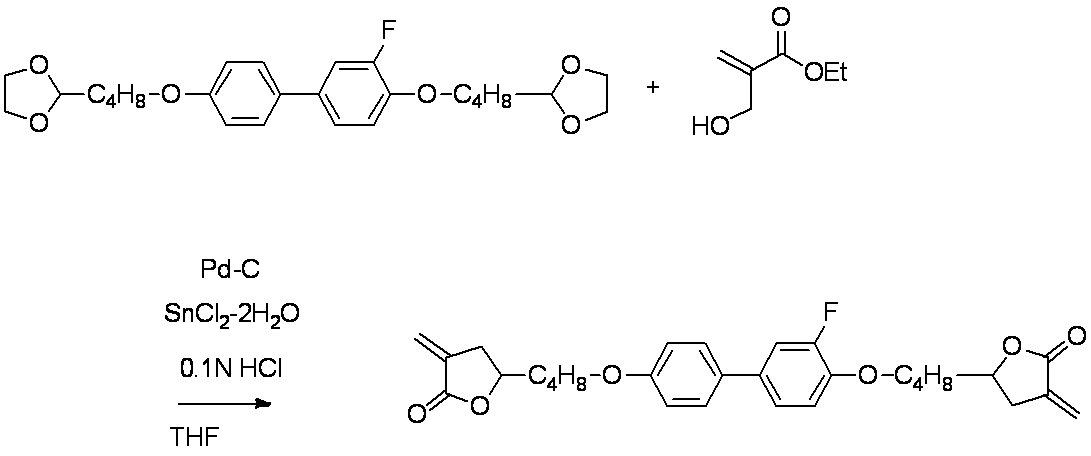
- activated carbon (2 g) (special white birch; manufactured by Nippon Enviro Chemical Co., Ltd.) was added to the obtained reaction mixture, and the mixture was stirred at 50 ° C. for 30 minutes. Thereafter, the activated carbon was removed by filtration and cooled to 5 ° C. to precipitate crystals. Next, the crystals were filtered and dried to obtain 4,4′-bis (3- (3-methylenetetrahydrofuran-2 (3H) -one-5-yl) propanoxy) -3-fluorobiphenyl (white) Solid, yield: 14.1 g, yield: 65%). When confirmed by the MW / ICP-OES method, the contents of Sn and Pd were less than 1 ppm.
- Example 2 The analysis apparatus and analysis conditions for the compound obtained in Example 2 were the same as in Example 1 except that the eluent was changed to cetonitrile / 0.2 wt% ammonium acetate aqueous solution (70/30) [v / v]. is there.
- Example 3 The analysis apparatus and analysis conditions for the compound obtained in Example 3 were as follows.
- the eluent was acetonitrile / 0.2 wt% ammonium acetate aqueous solution (70/30 (0-5 min) ⁇ 85/15 (10-30 min)) [v / Except for the change to v], it is the same as Example 1.
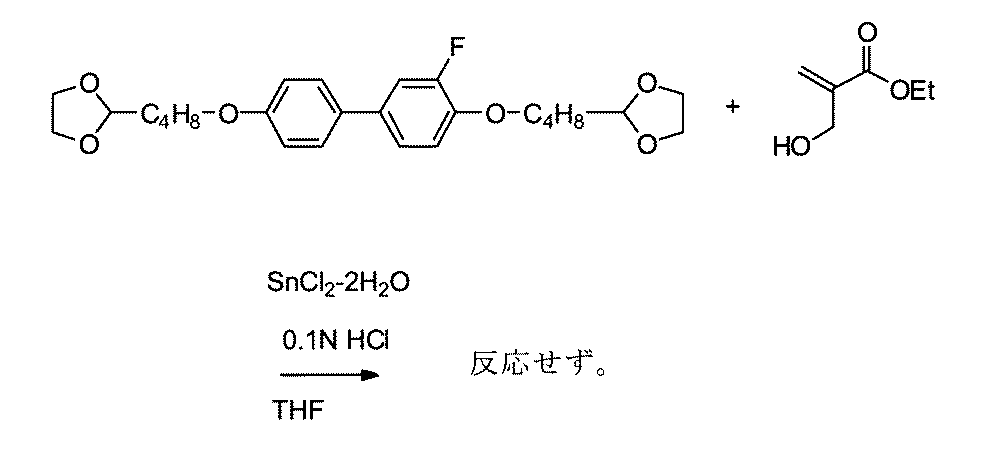
- the ratios of the respective components were the same as in Example 3 except that Pd (II) -Hydrotalcite (Wako Pure Chemical Industries, Ltd.) was used instead of the catalyst 5% Pd-C (50% wet; manufactured by Evonik). The reaction was carried out, but the reaction was unreacted and the target product was not obtained.
- the compound having an ⁇ -methylene- ⁇ -butyrolactone group represented by the formula (3) obtained by the production method of the present invention is used in a wide range of fields such as a photopolymerizable compound used in a liquid crystal display device. .
Landscapes
- Chemical & Material Sciences (AREA)
- Organic Chemistry (AREA)
- Physics & Mathematics (AREA)
- Spectroscopy & Molecular Physics (AREA)
- General Physics & Mathematics (AREA)
- Low-Molecular Organic Synthesis Reactions Using Catalysts (AREA)
- Organic Low-Molecular-Weight Compounds And Preparation Thereof (AREA)
- Catalysts (AREA)
- Furan Compounds (AREA)
Abstract
Description
このような垂直配向方式の液晶表示素子では、あらかじめ液晶組成物中に光重合性化合物を添加し、ポリイミド等の垂直配向膜と共に用いて、液晶セルに電圧を印加しながら紫外線を照射することで、液晶の応答速度を速くする技術(PSA(Polymer sustained Alignment)型液晶ディスプレイ)が知られている。(特許文献1及び非特許文献1参照)
上記の添加光重合性化合物の例としては、ある種の重合性モノマーが知られている(特許文献2~6参照)。また、重合性モノマー中のラクトン環の構築方法として、パラジウム触媒を用いる方法が知られているが、これらの例は収率等に改善の余地を残している(非特許文献3参照)。
具体的には、本発明の目的は、液晶表示素子に用いられる光重合性化合物を、安価に、収率よく製造するための新規な製造方法を提供することにある。
1.下記式(1)で表される化合物と、下記式(2)で表される化合物とを金属錫又は錫含有化合物及びパラジウム触媒の存在下に酸性条件で反応させることを特徴とする式(3)で表される化合物の製造方法。


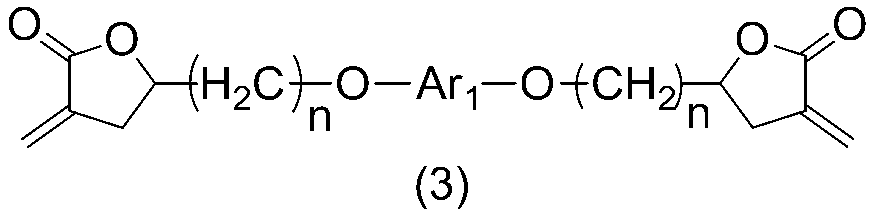
式(1)で表される化合物であるアセタール又はケタール化合物と、式(2)で表される化合物であるヒドロキシメタクリル酸エステルとを、金属錫又は錫含有化合物及びパラジウム触媒の存在下に反応させることにより、式(3)で表される化合物であるα-メチレン-γ-ブチロラクトン化合物)を製造することができる。

PGとしては、ジメチルアセタール基、又は1,3-ジオキソラン-2-イル基が好ましく、左右で同一でも、異なっていてもよいが、合成上の観点から、左右同一が好ましい。
Rは、炭素原子数が1~5のアルキル基が好ましく、直鎖状でも分岐状でもよいが、直鎖状が好ましい。特に、メチル基又はエチル基が好ましく、

ハロゲン原子としては、フッ素、塩素、臭素等が挙げられる。
Xとしては、メトキシ基、トリフルオロメチル基、トリフロオロメトキシ基等が好ましい。特に好ましくはメトキシ基である。
m1~m6は、各々独立に、0~1の整数が好ましい。
m7及びm8は、各々独立に、0~1の整数が好ましい。
パラジウム触媒の使用量は、式(1)で表される化合物に対して、通常、0.0001~20モル%であり、好ましくは0.001~10モル%である。
式(2)で表される化合物の使用量は、特に限定されないが、式(1)で表される化合物(1)の1当量に対して、2.0~2.5当量使用することが好ましく、2.2~2.5当量がより好ましい。
反応時間は、通常、1~100時間、好ましくは1~12時間である。
化合物(1)は、下記に示すように、フェノール性水酸基を有する芳香族化合物(A)と、式(B)で表されるハロゲン置換アセタール又はケタール化合物とを、塩基の存在下で反応させることにより得ることができる。

式(A)で表される化合物は、市販品の入手も可能であるが、下記に示すように、ハロゲン化アリール[2-A]と有機金属試薬[3-A]とを、塩基の存在下に、金属触媒を用いるクロスカップリング反応(鈴木-宮浦反応)させることにより得ることができる。

これらパラジウム錯体及びニッケル錯体の使用量は、いわゆる触媒量で良く、一般的には、基質に対して20モル%以下で十分であり、通常10モル%以下である。
反応時間は、通常、0.05~100時間、好ましくは0.5~40時間、より好ましくは0.5~24時間である。
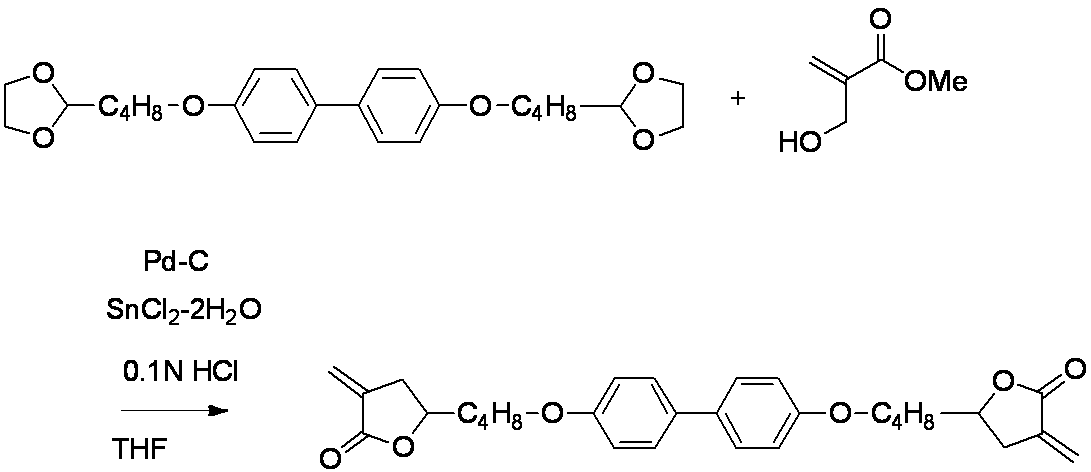
次に、50℃にてろ過を行い、Pd-Cを除去した後、トルエン(60.0g)を反応混合物に加え、50℃にて攪拌後、塩酸層を廃棄した。続いて、得られた有機層を、15.5wt%水酸化カリウム水溶液(75.0g)中へ、50℃で30分かけて滴下した。その後、さらにトルエン(50.0g)を加え、50℃にて10分間撹拌した後、水層を廃棄した。続いて、水(525.0g)を加え、50℃にて撹拌後、水層を廃棄する操作を4回繰り返し、有機層を得た。
HPLC分析
装置:LC-2010システム(島津製作所社製)
カラム:Inertsil ODS-3(4.6mmΦ×250mm、ジーエルサイエンス社製)
検出器:UV検出(波長265nm)
溶離液:アセトニトリル/0.2wt%酢酸アンモニウム水溶液(70/30(0-5min)→85/15(10-30min))[v/v]

実施例2で得られた化合物の分析装置及び分析条件は、溶離液をセトニトリル/0.2wt%酢酸アンモニウム水溶液(70/30)[v/v]に変更した以外は、実施例1と同様である。

Claims (6)
- 下記式(1)で表される化合物と、下記式(2)で表される化合物とを金属錫又は錫含有化合物及びパラジウム触媒の存在下に酸性条件で反応させることを特徴とする式(3)で表される化合物の製造方法。

- パラジウム触媒が、ラネーパラジウム、シリカ担持パラジウム触媒、アルミナ担持パラジウム触媒、炭素担持パラジウム触媒、硫酸バリウム担持パラジウム触媒、ゼオライト担持パラジウム触媒、シリカ・アルミナ担持パラジウム触媒、パラジウム錯体触媒、塩化パラジウム、酢酸パラジウム又は酸化パラジウムである、請求項1に記載の製造方法。
- 反応条件が、pHが1~2の酸性条件である、請求項1又は2に記載の製造方法。
- 式(2)で表される化合物の使用量が、式(1)で表される化合物の1当量に対し、2.0~2.5当量である、請求項1~3のいずれかに記載の製造方法。
- 金属錫又は錫含有化合物の使用量が、式(1)で表される化合物の1当量に対して、2~4当量である、請求項1~4のいずれかに記載の製造方法。
- パラジウム触媒の使用量が、式(1)で表される化合物に対して、0.0001~20モル%である、請求項1~5のいずれかに記載の製造方法。
Priority Applications (3)
| Application Number | Priority Date | Filing Date | Title |
|---|---|---|---|
| KR1020177014715A KR102462576B1 (ko) | 2014-11-04 | 2015-10-30 | 부티로락톤 화합물의 제조 방법 |
| JP2016557747A JP6733550B2 (ja) | 2014-11-04 | 2015-10-30 | ブチロラクトン化合物の製造方法 |
| CN201580058138.XA CN107108541B (zh) | 2014-11-04 | 2015-10-30 | 丁内酯化合物的制造方法 |
Applications Claiming Priority (2)
| Application Number | Priority Date | Filing Date | Title |
|---|---|---|---|
| JP2014224510 | 2014-11-04 | ||
| JP2014-224510 | 2014-11-04 |
Publications (1)
| Publication Number | Publication Date |
|---|---|
| WO2016072365A1 true WO2016072365A1 (ja) | 2016-05-12 |
Family
ID=55909090
Family Applications (1)
| Application Number | Title | Priority Date | Filing Date |
|---|---|---|---|
| PCT/JP2015/080804 Ceased WO2016072365A1 (ja) | 2014-11-04 | 2015-10-30 | ブチロラクトン化合物の製造方法 |
Country Status (5)
| Country | Link |
|---|---|
| JP (1) | JP6733550B2 (ja) |
| KR (1) | KR102462576B1 (ja) |
| CN (1) | CN107108541B (ja) |
| TW (1) | TWI687416B (ja) |
| WO (1) | WO2016072365A1 (ja) |
Citations (2)
| Publication number | Priority date | Publication date | Assignee | Title |
|---|---|---|---|---|
| WO2012002513A1 (ja) * | 2010-06-30 | 2012-01-05 | 日産化学工業株式会社 | 重合性化合物、液晶配向剤、液晶配向膜及び液晶表示素子並びに液晶表示素子の製造方法 |
| JP2012240945A (ja) * | 2011-05-18 | 2012-12-10 | Dic Corp | 重合性ナフタレン化合物 |
Family Cites Families (7)
| Publication number | Priority date | Publication date | Assignee | Title |
|---|---|---|---|---|
| GB2297549B (en) | 1995-02-06 | 1999-06-30 | Merck Patent Gmbh | Direactive mesogenic compound |
| JP4175826B2 (ja) | 2002-04-16 | 2008-11-05 | シャープ株式会社 | 液晶表示装置 |
| JP5168976B2 (ja) | 2007-03-28 | 2013-03-27 | Dic株式会社 | ビフェニル及びテルフェニル化合物、該化合物を含有する重合性液晶組成物 |
| JP5549174B2 (ja) | 2009-10-13 | 2014-07-16 | Dic株式会社 | 重合性ナフタレン化合物 |
| DE102010047409A1 (de) | 2009-10-28 | 2011-05-05 | Merck Patent Gmbh | Polymerisierbare Verbindungen und ihre Verwendung in Flüssigkristallanzeigen |
| CN103080152B (zh) * | 2010-06-30 | 2015-08-26 | 日产化学工业株式会社 | 液晶取向剂、液晶取向膜、液晶显示元件及液晶显示元件的制造方法 |
| WO2013099937A1 (ja) * | 2011-12-28 | 2013-07-04 | 日産化学工業株式会社 | 液晶配向剤、液晶配向膜、液晶表示素子及び液晶表示素子の製造方法 |
-
2015
- 2015-10-30 JP JP2016557747A patent/JP6733550B2/ja active Active
- 2015-10-30 WO PCT/JP2015/080804 patent/WO2016072365A1/ja not_active Ceased
- 2015-10-30 CN CN201580058138.XA patent/CN107108541B/zh active Active
- 2015-10-30 KR KR1020177014715A patent/KR102462576B1/ko active Active
- 2015-11-03 TW TW104136170A patent/TWI687416B/zh active
Patent Citations (2)
| Publication number | Priority date | Publication date | Assignee | Title |
|---|---|---|---|---|
| WO2012002513A1 (ja) * | 2010-06-30 | 2012-01-05 | 日産化学工業株式会社 | 重合性化合物、液晶配向剤、液晶配向膜及び液晶表示素子並びに液晶表示素子の製造方法 |
| JP2012240945A (ja) * | 2011-05-18 | 2012-12-10 | Dic Corp | 重合性ナフタレン化合物 |
Non-Patent Citations (1)
| Title |
|---|
| MASUYAMA, Y. ET AL.: "Palladium-Catalyzed Carbonyl Allylation by 2-(Hydroxymethyl) acrylate Derivatives: Synthesis of alpha-Methylene- y-butyrolactones", TETRAHEDRON LETTERS, vol. 32, no. 2, 1991, pages 225 - 228 * |
Also Published As
| Publication number | Publication date |
|---|---|
| KR20170081200A (ko) | 2017-07-11 |
| CN107108541B (zh) | 2020-06-19 |
| KR102462576B1 (ko) | 2022-11-02 |
| TWI687416B (zh) | 2020-03-11 |
| JPWO2016072365A1 (ja) | 2017-08-17 |
| CN107108541A (zh) | 2017-08-29 |
| JP6733550B2 (ja) | 2020-08-05 |
| TW201623293A (zh) | 2016-07-01 |
Similar Documents
| Publication | Publication Date | Title |
|---|---|---|
| US12065422B2 (en) | Reagents and process for direct C—H functionalization | |
| RU2324678C2 (ru) | Способ получения динитрилов фенилмалоновой кислоты | |
| CN108017479A (zh) | 芳香族化合物的制造方法 | |
| He et al. | Palladium dichloride adduct of N, N-bis-(diphenylphosphanylmethyl)-2-aminopyridine: synthesis, structure and catalytic performance in the decarboxylative cross-coupling of 4-picolinic acid with aryl bromide | |
| Lightfoot et al. | A stereoselective synthesis of 1, 6-diphenyl-1, 3, 5-hexatrienes utilising 4, 4, 6-trimethyl-2-vinyl-1, 3, 2-dioxaborinane as a two-carbon alkenyl building block | |
| JPWO2014185485A1 (ja) | ビフェニル骨格含有エポキシ樹脂の製造方法 | |
| JP6733550B2 (ja) | ブチロラクトン化合物の製造方法 | |
| CN103910758A (zh) | 一种轴手性联芳基氧膦及轴手性联芳基膦的制备方法 | |
| Niu et al. | Enantioselective addition of alkynylzinc to arylaldehydes catalyzed by azetidino amino alcohols bearing an additional stereogenic center | |
| CN102190581A (zh) | 用于制备4'-卤烷基联苯基-2-羧酸的方法 | |
| CN117024354B (zh) | 瑞米布替尼的制备方法 | |
| JP6760075B2 (ja) | ブチロラクトン化合物及び製造方法 | |
| Hong et al. | Highly efficient and well-defined phosphinous acid-ligated Pd (II) precatalysts for Hirao cross-coupling reaction | |
| CN109942361A (zh) | 一种芳基取代的三亚苯类化合物的制备方法及其应用 | |
| JP5013365B2 (ja) | スペーサー導入型ビス(ターピリジン)化合物の合成方法 | |
| JP5362208B2 (ja) | ビニルエーテル基を有するアダマンタン誘導体 | |
| CN110746253A (zh) | 一种β,β-二取代丙酸酯衍生物的合成方法 | |
| JP2011225454A (ja) | アルコールの製造方法 | |
| JP2013189403A (ja) | ジアセチレン誘導体の製造方法 | |
| JP6641328B2 (ja) | 2,3−ビスホスフィノピラジン誘導体の製造方法及びホスフィン遷移金属錯体の製造方法 | |
| JP2000344732A (ja) | ベンゾニトリル化合物の製造法 | |
| CN120794849A (zh) | 光/钴氧化还原催化芳基卤代物与汉斯酯偶联反应的方法 | |
| JP2018203732A (ja) | (置換)エチニル基を有するフルオロアルキルピリジン誘導体及び、その製造方法 | |
| JP2013040278A (ja) | 含フッ素フタロシアニン−サブフタロシアニン縮環ダイマー及びその製造法 | |
| CN105153151A (zh) | 一种嘧啶酮类化合物的合成方法 |
Legal Events
| Date | Code | Title | Description |
|---|---|---|---|
| 121 | Ep: the epo has been informed by wipo that ep was designated in this application |
Ref document number: 15857223 Country of ref document: EP Kind code of ref document: A1 |
|
| ENP | Entry into the national phase |
Ref document number: 2016557747 Country of ref document: JP Kind code of ref document: A |
|
| NENP | Non-entry into the national phase |
Ref country code: DE |
|
| ENP | Entry into the national phase |
Ref document number: 20177014715 Country of ref document: KR Kind code of ref document: A |
|
| 122 | Ep: pct application non-entry in european phase |
Ref document number: 15857223 Country of ref document: EP Kind code of ref document: A1 |