WO2016043225A1 - 重合体微粒子およびその製造方法 - Google Patents
重合体微粒子およびその製造方法 Download PDFInfo
- Publication number
- WO2016043225A1 WO2016043225A1 PCT/JP2015/076317 JP2015076317W WO2016043225A1 WO 2016043225 A1 WO2016043225 A1 WO 2016043225A1 JP 2015076317 W JP2015076317 W JP 2015076317W WO 2016043225 A1 WO2016043225 A1 WO 2016043225A1
- Authority
- WO
- WIPO (PCT)
- Prior art keywords
- polymer
- fine particles
- macromonomer
- polymer fine
- dispersion
- Prior art date
- Legal status (The legal status is an assumption and is not a legal conclusion. Google has not performed a legal analysis and makes no representation as to the accuracy of the status listed.)
- Ceased
Links
Classifications
-
- C—CHEMISTRY; METALLURGY
- C08—ORGANIC MACROMOLECULAR COMPOUNDS; THEIR PREPARATION OR CHEMICAL WORKING-UP; COMPOSITIONS BASED THEREON
- C08J—WORKING-UP; GENERAL PROCESSES OF COMPOUNDING; AFTER-TREATMENT NOT COVERED BY SUBCLASSES C08B, C08C, C08F, C08G or C08H
- C08J9/00—Working-up of macromolecular substances to porous or cellular articles or materials; After-treatment thereof
- C08J9/28—Working-up of macromolecular substances to porous or cellular articles or materials; After-treatment thereof by elimination of a liquid phase from a macromolecular composition or article, e.g. drying of coagulum
- C08J9/286—Working-up of macromolecular substances to porous or cellular articles or materials; After-treatment thereof by elimination of a liquid phase from a macromolecular composition or article, e.g. drying of coagulum the liquid phase being a solvent for the monomers but not for the resulting macromolecular composition, i.e. macroporous or macroreticular polymers
-
- C—CHEMISTRY; METALLURGY
- C08—ORGANIC MACROMOLECULAR COMPOUNDS; THEIR PREPARATION OR CHEMICAL WORKING-UP; COMPOSITIONS BASED THEREON
- C08F—MACROMOLECULAR COMPOUNDS OBTAINED BY REACTIONS ONLY INVOLVING CARBON-TO-CARBON UNSATURATED BONDS
- C08F2/00—Processes of polymerisation
- C08F2/12—Polymerisation in non-solvents
- C08F2/16—Aqueous medium
- C08F2/18—Suspension polymerisation
-
- C—CHEMISTRY; METALLURGY
- C08—ORGANIC MACROMOLECULAR COMPOUNDS; THEIR PREPARATION OR CHEMICAL WORKING-UP; COMPOSITIONS BASED THEREON
- C08F—MACROMOLECULAR COMPOUNDS OBTAINED BY REACTIONS ONLY INVOLVING CARBON-TO-CARBON UNSATURATED BONDS
- C08F290/00—Macromolecular compounds obtained by polymerising monomers on to polymers modified by introduction of aliphatic unsaturated end or side groups
- C08F290/08—Macromolecular compounds obtained by polymerising monomers on to polymers modified by introduction of aliphatic unsaturated end or side groups on to polymers modified by introduction of unsaturated side groups
- C08F290/12—Polymers provided for in subclasses C08C or C08F
-
- C—CHEMISTRY; METALLURGY
- C08—ORGANIC MACROMOLECULAR COMPOUNDS; THEIR PREPARATION OR CHEMICAL WORKING-UP; COMPOSITIONS BASED THEREON
- C08F—MACROMOLECULAR COMPOUNDS OBTAINED BY REACTIONS ONLY INVOLVING CARBON-TO-CARBON UNSATURATED BONDS
- C08F290/00—Macromolecular compounds obtained by polymerising monomers on to polymers modified by introduction of aliphatic unsaturated end or side groups
- C08F290/08—Macromolecular compounds obtained by polymerising monomers on to polymers modified by introduction of aliphatic unsaturated end or side groups on to polymers modified by introduction of unsaturated side groups
- C08F290/12—Polymers provided for in subclasses C08C or C08F
- C08F290/126—Polymers of unsaturated carboxylic acids or derivatives thereof
-
- C—CHEMISTRY; METALLURGY
- C08—ORGANIC MACROMOLECULAR COMPOUNDS; THEIR PREPARATION OR CHEMICAL WORKING-UP; COMPOSITIONS BASED THEREON
- C08F—MACROMOLECULAR COMPOUNDS OBTAINED BY REACTIONS ONLY INVOLVING CARBON-TO-CARBON UNSATURATED BONDS
- C08F8/00—Chemical modification by after-treatment
- C08F8/14—Esterification
-
- C—CHEMISTRY; METALLURGY
- C08—ORGANIC MACROMOLECULAR COMPOUNDS; THEIR PREPARATION OR CHEMICAL WORKING-UP; COMPOSITIONS BASED THEREON
- C08F—MACROMOLECULAR COMPOUNDS OBTAINED BY REACTIONS ONLY INVOLVING CARBON-TO-CARBON UNSATURATED BONDS
- C08F2810/00—Chemical modification of a polymer
- C08F2810/30—Chemical modification of a polymer leading to the formation or introduction of aliphatic or alicyclic unsaturated groups
-
- C—CHEMISTRY; METALLURGY
- C08—ORGANIC MACROMOLECULAR COMPOUNDS; THEIR PREPARATION OR CHEMICAL WORKING-UP; COMPOSITIONS BASED THEREON
- C08J—WORKING-UP; GENERAL PROCESSES OF COMPOUNDING; AFTER-TREATMENT NOT COVERED BY SUBCLASSES C08B, C08C, C08F, C08G or C08H
- C08J2333/00—Characterised by the use of homopolymers or copolymers of compounds having one or more unsaturated aliphatic radicals, each having only one carbon-to-carbon double bond, and only one being terminated by only one carboxyl radical, or of salts, anhydrides, esters, amides, imides, or nitriles thereof; Derivatives of such polymers
- C08J2333/02—Homopolymers or copolymers of acids; Metal or ammonium salts thereof
-
- C—CHEMISTRY; METALLURGY
- C08—ORGANIC MACROMOLECULAR COMPOUNDS; THEIR PREPARATION OR CHEMICAL WORKING-UP; COMPOSITIONS BASED THEREON
- C08J—WORKING-UP; GENERAL PROCESSES OF COMPOUNDING; AFTER-TREATMENT NOT COVERED BY SUBCLASSES C08B, C08C, C08F, C08G or C08H
- C08J2333/00—Characterised by the use of homopolymers or copolymers of compounds having one or more unsaturated aliphatic radicals, each having only one carbon-to-carbon double bond, and only one being terminated by only one carboxyl radical, or of salts, anhydrides, esters, amides, imides, or nitriles thereof; Derivatives of such polymers
- C08J2333/04—Characterised by the use of homopolymers or copolymers of compounds having one or more unsaturated aliphatic radicals, each having only one carbon-to-carbon double bond, and only one being terminated by only one carboxyl radical, or of salts, anhydrides, esters, amides, imides, or nitriles thereof; Derivatives of such polymers esters
- C08J2333/06—Characterised by the use of homopolymers or copolymers of compounds having one or more unsaturated aliphatic radicals, each having only one carbon-to-carbon double bond, and only one being terminated by only one carboxyl radical, or of salts, anhydrides, esters, amides, imides, or nitriles thereof; Derivatives of such polymers esters of esters containing only carbon, hydrogen, and oxygen, the oxygen atom being present only as part of the carboxyl radical
- C08J2333/08—Homopolymers or copolymers of acrylic acid esters
Definitions
- the present invention relates to a method for producing polymer fine particles. More specifically, the present invention relates to a method of producing micron-sized polymer fine particles having a narrow particle size distribution and a uniform particle size by a dispersion polymerization method, using a specific dispersion stabilizer, with good productivity.
- a dispersion polymerization method in which a vinyl monomer is polymerized in a solvent that dissolves the vinyl monomer in the presence of a dispersion stabilizer but does not substantially dissolve the resulting polymer. It is known that micron-sized polymer fine particles having a relatively narrow particle size distribution can be obtained.
- a hydrophilic solvent or a non-hydrophilic solvent is used as a polymerization solvent.
- polymer dispersion stabilizers such as polyvinylpyrrolidone, polyethylene glycol, and polyacrylic acid are used as dispersion stabilizers.
- Patent Document 1 a dispersion polymerization method using a macromonomer having a radical polymerizable functional group at the end of a polyethylene oxide chain as a dispersion stabilizer.
- a dispersion stabilizer it is necessary to use a relatively large amount of a dispersion stabilizer in order to produce polymer fine particles having a target particle size and particle size distribution.
- a large amount of dispersion stabilizer remains in the resulting polymer fine particles, which tends to adversely affect the performance of the polymer fine particles.
- the dispersion stabilization by the dispersion stabilizer is insufficient, and aggregation is likely to occur between the produced polymer fine particles.
- a dispersion stabilizer effective for preventing aggregation during polymerization the present inventors have disclosed a macromonomer having a carboxyl group and having a vinylidene-type unsaturated bond at the polymer terminal (Patent Document 2). ). Furthermore, as a dispersion stabilizer effective for smooth dispersion polymerization, a dispersion stabilizer containing a macromonomer having a carboxyl group and an ethylenically unsaturated group in the middle of the molecular chain (Patent Document 3), and ( A macromonomer having a (meth) acryloyl group and having a carboxyl group in the middle of a molecular chain is disclosed (Patent Document 4).
- Micron-sized polymer fine particles with a narrow particle size distribution and a uniform particle size are used for applications such as light diffusing agents, anti-glare agents (matting agents), anti-blocking agents, and spacers. In any application, it is required to cope with high definition. Along with this, there are many cases where polymer fine particles having a smaller particle diameter are required. When the dispersion stabilizer (macromonomer) described in Patent Document 2 is used, the resulting polymer fine particles tend to be larger than 2 to 3 ⁇ m, and polymer fine particles having a smaller particle diameter can be obtained.
- the dispersion stabilizers described in Patent Documents 3 and 4 exhibit an excellent dispersion stabilizing effect in a dispersion polymerization reaction in a hydrophilic solvent, have a small particle size and a narrow particle size distribution even when used in a small amount. Polymer fine particles can be produced stably.
- the polymerization under higher monomer concentration conditions was examined, and under the conditions where the monomer concentration exceeds 20% by weight, the polymerization tends to become unstable. There was found.
- the present invention has been made in view of such circumstances, and even under conditions where the monomer concentration at the time of polymerization is high, the particle size distribution is narrow and the average particle size is as small as about 2 to 3 ⁇ m or less.
- An object is to provide a method for smoothly producing uniform, high-quality polymer fine particles without causing aggregation or the like between the polymer fine particles.
- the object of the present invention is to smoothly produce high-quality fine polymer particles that are excellent in monodispersibility at low cost, while preventing adverse effects on the polymer particles due to extensive use of dispersion stabilizers. It is to provide a method of manufacturing with good performance.
- Another object of the present invention has excellent characteristics described above, it is to provide a polymer fine particles by dispersion polymerization.
- the objective of this invention is providing the dispersion stabilizer suitable for manufacture of such polymer microparticles, and its utilization.
- the present inventor is a macromonomer having a carboxyl group and an ethylenically unsaturated group in the middle of the molecular chain, and has a specific acid value and the number of ethylenically unsaturated groups.
- a dispersion stabilizer When used as a dispersion stabilizer, even under high monomer concentration conditions, the particle size distribution is narrow and smooth polymer particles of uniform size can be obtained without causing aggregation between the polymer particles. It was found that it can be manufactured. In this case, since only a small amount of the macromonomer is used as a dispersion stabilizer, it is not necessary to remove the excess dispersion stabilizer by washing or the like, and physical properties and handling with higher productivity and lower cost. The inventors have also found that polymer fine particles having excellent properties can be produced, and have completed the present invention based on these findings.
- Polymer fine particles comprising a step of polymerizing a vinyl monomer in the presence of a dispersion stabilizer in a hydrophilic solvent that dissolves the vinyl monomer and the dispersion stabilizer but does not dissolve the produced polymer.
- a method of manufacturing The dispersion stabilizer contains a macromonomer having a carboxyl group and an ethylenically unsaturated group in the middle of the molecular chain, The macromonomer has an average of 1.4 to 2.5 ethylenically unsaturated groups per molecule, The average value of the carboxyl group content in the macromonomer is 0.5 meq / g or more and 2.5 meq / g or less, A method for producing polymer fine particles.
- the macromonomer contains a (meth) acryloyl group.
- the number average molecular weight (Mn) of the macromonomer is 1000 g / mol or more and 10,000 g / mol or less. Or 2.
- the value obtained by dividing the weight average molecular weight (Mw) of the macromonomer by the number average molecular weight (Mn) (Mw / Mn) is 2.3 or less.
- Polymer fine particles obtained by any one of the production methods The volume average particle size is 0.7 ⁇ m or more and 3.0 ⁇ m or less, Volume average particle diameter (dv) / number average particle diameter (dn) is 1.2 or less, The number of by-product small particles per 1000 polymer fine particles having a particle diameter of 0.1 ⁇ m or more is 500 or less. Polymer fine particles characterized by the above.
- polymer fine particles On the surface, hold a macromonomer having a carboxyl group and an ethylenically unsaturated group in the middle of the molecular chain, The macromonomer has an average of 1.4 to 2.5 ethylenically unsaturated groups per molecule, The polymer fine particle whose average value of content of the carboxyl group in the said macromonomer is 0.5 meq / g or more and 2.5 meq / g or less. 7).
- the polymer fine particles have a volume average particle size of 0.7 ⁇ m or more and 3.0 ⁇ m or less, a volume average particle size (dv) / number average particle size (dn) of 1.2 or less, and a particle size of 0.1 ⁇ m. 5.
- the number of by-product small particles per 1000 polymer fine particles is 500 or less.
- the macromonomer includes the ethylenically unsaturated group through a part of the carboxyl group in the middle of the molecular chain. Or 7. Polymer fine particles as described in 1. 9.
- a dispersion stabilizer used in the production of polymer fine particles It contains a macromonomer having a carboxyl group and an ethylenically unsaturated group in the middle of the molecular chain, The macromonomer has an average of 1.4 to 2.5 ethylenically unsaturated groups per molecule, The dispersion stabilizer whose average value of content of the carboxyl group in the said macromonomer is 0.5 meq / g or more and 2.5 meq / g or less. 10.
- a method for dispersing polymer fine particles comprising: Above 9.
- a step of dispersing as fine particles A method comprising:
- the particle size is small even under a high monomer concentration condition in which the monomer concentration exceeds 20% by weight, and In addition, it is possible to efficiently produce polymer fine particles having a small variation in particle diameter. And by using a very small amount of macromonomer, it is possible to maintain excellent dispersion stability of fine polymer particles with a narrow particle size distribution and uniform size without causing aggregation between the polymer particles. However, it can be manufactured smoothly, with good productivity and at low cost.
- (meth) acryl means acryl and / or methacryl
- “(meth) acrylate” means acrylate and / or methacrylate.
- the “(meth) acryloyl group” means an acryloyl group and / or a methacryloyl group.
- the carboxyl group contained in the “macromonomer” means —COOH and / or —COO 2 — .
- the weight average molecular weight (Mw) and number average molecular weight (Mn) of a polymer are the standard polystyrene conversion values obtained using the gel permeation chromatography (GPC) on the conditions in [Example] mentioned later. .
- the present invention is a method for producing polymer fine particles by a method including a first polymerization step using a dispersion polymerization method. More specifically, in the present invention, a macromonomer having a carboxyl group and an ethylenically unsaturated group in the middle of a molecular chain, and having an average of 1.4 to 2.5 ethylenically unsaturated groups per molecule.
- a vinyl monomer Is a method for producing polymer fine particles, comprising a step (first polymerization step) of polymerizing in a hydrophilic solvent that dissolves the vinyl monomer and the dispersion stabilizer but does not dissolve the produced polymer.
- a hydrophilic solvent is used as the polymerization solvent. Therefore, the fine particles made of the polymer produced in this step are dispersed in the polymerization solvent containing the hydrophilic solvent.
- a hydrophilic solvent is used as the polymerization solvent.
- a hydrophilic organic solvent a hydrophilic organic solvent not containing water
- the hydrophilic organic solvent those having a solubility in water at 20 ° C. of 5 g / 100 ml or more are preferably used.
- hydrophilic organic solvent examples include monoalcohols such as methanol, ethanol, isopropyl alcohol, n-butyl alcohol, isobutyl alcohol, tert-butyl alcohol, sec-butyl alcohol, and tetrahydrofurfuryl alcohol; ethylene glycol Polyhydric alcohols such as glycerin and diethylene glycol; ether alcohols such as methyl cellosolve, cellosolve, isopropylpyro cellosolve, butyl cellosolve, ethylene glycol monomethyl ether, ethylene glycol monoethyl ether, diethylene glycol monomethyl ether, diethylene glycol monoethyl ether; acetone, Ketones such as methyl ethyl ketone; esters such as methyl acetate and ethyl acetate; Ethers such as emissions; dimethylformamide, and dimethyl sulfoxide. Only one type of hydrophilic organic solvent may be used, or two or more types
- the hydrophilic solvent is appropriately selected from the hydrophilic organic solvents described above according to the type of vinyl monomer used in the polymerization, the type of polymer to be generated, and the like. use.
- the hydrophilic organic solvent lower alcohols such as methanol, ethanol and isopropyl alcohol are preferable. By using these alcohols, the dispersion stabilizing action of the dispersion stabilizer containing a specific macromonomer can be effectively exhibited, and polymer fine particles having a small particle diameter can be stably produced.
- the hydrophilic solvent is preferably a mixed solvent containing water and alcohol, and among them, a mixture comprising water and at least one selected from lower alcohols such as methanol, ethanol, isopropyl alcohol, and the like. A solvent is more preferable.
- a mixed solvent of water and the above alcohol as the hydrophilic solvent, by adjusting the mixing ratio of water and alcohol according to the type and composition of the vinyl monomer, The particle size, particle size distribution, molecular weight, etc. can be easily controlled. In addition, the risk of ignition, explosion, etc. can be reduced, and the burden on the environment is small.
- a hydrophilic solvent a mixed solvent of water and methanol, of which a water: methanol mass ratio is 10:90 to 50:50, more preferably 20:80 to 40:60 or less, This is more preferable because polymer fine particles having a smaller particle size and a narrow particle size distribution can be produced smoothly.
- the hydrophilic solvent used in the first polymerization step may be partially replaced with a hydrophobic solvent having a solubility in water at 20 ° C. of less than 5 g / 100 ml.
- the ratio of the hydrophobic solvent is preferably 30% by mass or less, more preferably 15% by mass or less, and still more preferably 5% by mass or less with respect to the total amount of the solvent.
- the content ratio of the hydrophobic solvent exceeds 30% by mass, the particle size distribution of the generated particles may be widened or aggregates may be generated in the first polymerization step.
- a specific macromonomer having a carboxyl group and an ethylenically unsaturated group in the middle of the molecular chain (hereinafter referred to as "macromonomer (“ Ma) ) is used.
- the content ratio of the macromonomer (Ma) in this dispersion stabilizer is preferably 20% by mass or more and 100% by mass or less, more preferably 50% by mass or more and 100% by mass or less. When there is too little content of a macromonomer (Ma), the effect of this invention may not fully be acquired.
- the dispersion stabilizer may contain other polymer.
- the dispersion stabilizer can be a polymer composition (a mixture composed of a polymer) composed of a macromonomer (Ma) and another polymer.
- the content of the macromonomer (Ma) is preferably 10% by mass or more and 100% by mass or less, more preferably 30% by mass or more and 100% by mass with respect to the total polymer. % Or less.
- examples of other polymers include polymers having a functional group such as a carboxyl group, a hydroxyl group, an amide group, a pyrrolidone group, and a morpholine group.
- the said dispersion stabilizer may consist of a macromonomer (Ma) or a polymer composition, and the additive which does not inhibit the dispersion polymerization of a vinyl monomer.
- the macromonomer (Ma) is a polymer having a carboxyl group and an ethylenically unsaturated group in the middle of the molecular chain.
- the carboxyl group and ethylenically unsaturated group contained are not the ends of the molecular chain (polymer chain) constituting the macromonomer (Ma) but the molecular chain (polymer). At least in the middle of the chain).
- Examples of the group having an ethylenically unsaturated group contained in the macromonomer (Ma) include a (meth) acryloyl group, an allyl group, an isopropenyl group, and a styryl group.
- the macromonomer (Ma) can have one or more of these groups.
- the macromonomer which has an ethylenically unsaturated group in the middle and the terminal of a molecular chain can also be used as said macromonomer (Ma).
- the group having an ethylenically unsaturated group is preferably a (meth) acryloyl group.
- the macromonomer (Ma) having a carboxyl group and a (meth) acryloyl group is used in the middle of the molecular chain, the reactivity and dispersion stabilization performance of the vinyl monomer can be improved. And, by using a smaller amount of the dispersion stabilizer containing the macromonomer (Ma), the fine particle size distribution is narrow and the fine polymer particles having a uniform size can be stably stabilized without causing aggregation between the polymer particles. Can be manufactured.
- the ethylenically unsaturated group contained in the macromonomer (Ma) may be directly bonded in the middle of the molecular chain of the macromonomer (Ma), or may be predetermined in the middle of the molecular chain of the macromonomer (Ma). You may couple
- the carboxyl group contained in the macromonomer (Ma) is present at least in the middle of the molecular chain, and may be present both in the middle and at the end of the molecular chain. Moreover, this carboxyl group may be directly bonded in the middle of the molecular chain of the macromonomer (Ma), or may be bonded in a suspended state via a predetermined bonding group in the middle of the molecular chain of the macromonomer (Ma). May be. Furthermore, these two coupling types may be mixed.
- the content of the carboxyl group contained in the middle of the molecular chain of the macromonomer (Ma) is preferably 0.5 meq to 2.5 meq per 1 g of the macromonomer (Ma). More preferably, the lower limit is 0.50 meq or more. More preferably, the lower limit is 0.6 meq or more, still preferably 0.7 meq or more, more preferably 0.8 meq or more, and further preferably 1.0 meq or more. More preferably, the upper limit is 2.1 meq or less, and more preferably 2.0 meq or less. Moreover, Preferably it is 1.0 meq or more and 2.0 meq or less.
- the content of the carboxyl group in the macromonomer (Ma) is too small, the dispersion stabilizing performance of the macromonomer (Ma) is liable to be lowered.
- the content of the carboxyl group is too large, a by-product of small particles is generated. In many cases, the particle size distribution of the polymer fine particles becomes wide, and the sizes may become uneven.
- the carboxyl group that the macromonomer (Ma) has in the middle of the molecular chain is preferably neutralized with a base.
- the carboxyl group is dissociated into a carboxyl anion in a hydrophilic solvent by neutralization to cause electrostatic repulsion, thereby further improving the dispersion stabilization performance of the dispersion stabilizer containing the macromonomer (Ma). Aggregation between the polymer fine particles can be suppressed with a smaller amount of the dispersion stabilizer, and the polymer fine particles can be more stably produced.
- the neutralizing agent for the carboxyl group ammonia and / or a low-boiling amine compound is preferably used because it can be easily removed after the production of the polymer fine particles.
- the macromonomer (Ma) is preferably a chain polymer having a chain molecular structure from the viewpoints of high dispersion stabilizing effect, easy production, and easy handling.
- the chain structure may be any of linear, branched, star-shaped, comb-shaped, etc., and of these, linear It is preferable that it is linear or substantially linear from the viewpoints of dispersion stabilization performance of the macromonomer (Ma), ease of production, ease of handling, and the like.
- macromonomer (Ma) a compound having an epoxy group and an ethylenically unsaturated group in part of the carboxyl group of the polymer (A) having a carboxyl group in the middle of the molecular chain (hereinafter referred to as “compound ( ⁇ )”. And a macromonomer obtained by addition reaction (hereinafter referred to as “macromonomer (Ma1)”).
- This macromonomer (Ma1) has a high degree of freedom in structural design and is excellent in dispersion stabilization performance in the first polymerization step.
- the number average molecular weight (Mn) of the macromonomer (Ma) is preferably 1,000 or more and 10,000 or less, more preferably 2,000, from the viewpoints of dispersion stabilization performance, handleability, ease of production, and the like. More than 5,000. Further, the molecular weight distribution of the macromonomer (Ma), that is, the value (Mw / Mn) obtained by dividing the weight average molecular weight (Mw) by the number average molecular weight (Mn) is 2.3 or less from the viewpoint of suppressing by-product formation of small particles It is preferable that it is, and it is more preferable that it is 2.0 or less.
- the method for producing the macromonomer (Ma) is not particularly limited.
- a polymer (A) having a carboxyl group in the middle of a molecular chain as a precursor, and a compound having an epoxy group and an ethylenically unsaturated group ( ⁇ ) may be reacted.
- the carboxyl group may be directly bonded in the middle of the molecular chain of the polymer (A), or via a predetermined bonding group in the middle of the molecular chain of the polymer (A).
- the coupling may be performed in a suspended state, or the above two coupling forms may be mixed.
- the polymer (A) is preferably a polymer having a carboxyl group in the middle of the molecular chain and having a chain molecular structure.
- the manufacturing method of the said polymer (A) is not specifically limited,
- the homopolymerization or copolymerization of the vinyl monomer which has a carboxyl group, and the vinyl monomer which has a carboxyl group, and other vinyl monomers Copolymerization is preferable in that the degree of freedom in designing the molecular weight, composition, etc. of the polymer is large and a higher performance macromonomer (Ma1) can be obtained as a dispersion stabilizer.
- Examples of the vinyl monomer having a carboxyl group used for the production of the polymer (A) include unsaturated carboxylic acids such as acrylic acid, methacrylic acid, crotonic acid, itaconic acid and maleic acid; acrylic acid, methacrylic acid and the like. Dimer or higher oligomer that is a Michael addition reaction product of unsaturated carboxylic acid; ⁇ -carboxypolycaprolactone mono (meth) acrylate, monohydroxyethyl (meth) acrylate phthalate, monohydroxyethyl (meth) acrylate succinate, etc. And carboxyl group-containing (meth) acrylates. These compounds may be used alone or in combination of two or more.
- a vinyl monomer having no carboxyl group can be used as the other vinyl monomer that can be copolymerized with a vinyl monomer having a carboxyl group in order to produce the polymer (A).
- This monomer may be a hydrophilic monomer or a hydrophobic monomer. Of these, hydrophobic vinyl monomers are preferred.
- the polymer (A) is preferably a copolymer of a vinyl monomer having a carboxyl group and a hydrophobic vinyl monomer.
- the copolymerization ratio of the vinyl monomer having a carboxyl group and the hydrophobic vinyl monomer is preferably 95: 5 to 10:90, more preferably 80:20 to 20:80, by mass ratio.
- a copolymer having a carboxyl group is preferred.
- a macromonomer (Ma1) excellent in dispersion stabilization performance can be obtained smoothly.
- acrylic acid and / or methacrylic acid is used as a vinyl monomer having a carboxyl group, and one or more selected from (meth) acrylic acid ester and styrene as other monomers. And a copolymer using the hydrophobic vinyl monomer.
- This copolymer is preferable from the viewpoints of dispersion stabilization performance, physical properties of the resulting polymer fine particles, and the like.
- (Meth) acrylic acid esters such as methyl (meth) acrylate, isobutyl (meth) acrylate, (meth) acrylic aliphatic lower alcohol esters, (meth) acrylic acid cyclohexyl (meth) acrylic Acid alicyclic alcohol esters and the like are preferred.
- an aliphatic lower alcohol ester of (meth) acrylic acid is preferably used from the viewpoint of producing a macromonomer (Ma1) having an excellent dispersion stabilizing effect.
- the carboxyl group equivalent (number of moles of carboxyl groups per 1 g of polymer (A)) contained in the polymer (A) is preferably 1.0 meq / g or more and 4.0 meq / g or less, more preferably 1. It is 5 meq / g or more and 3.0 meq / g or less.
- the number average molecular weight (Mn) of the polymer (A) is preferably 1,000 or more and 10,000 or less, more preferably 2,000 or more and 5,000 or less.
- Mn number average molecular weight
- the molecular weight distribution (Mw / Mn) of the polymer (A) is preferably 2.3 or less, more preferably 2.0 or less.
- a molecular weight modifier may be used.
- the molecular weight modifier include mercapto compounds such as octyl thioglycolate, butyl mercaptan, and dodecyl mercaptan.
- an emulsion polymerization method is preferred.
- the emulsion polymerization method has a high polymerization rate and can narrow the composition distribution in the polymer. Since the polymer (A) is obtained as submicron-sized fine particles, the addition reaction of the compound ( ⁇ ) to the polymer (A) can be completed in a very short time.
- a vinyl monomer having a carboxyl group is used alone, or a vinyl monomer having a carboxyl group and another vinyl monomer are used in water or in water.
- polymerization initiators such as organic peroxides, azo compounds, and persulfuric compounds, which will be described later, are used in the first polymerization step (dispersion polymerization) for producing polymer fine particles. ) Can be used. Moreover, you may use an emulsifier as needed.
- a persulfuric acid compound such as ammonium persulfate or potassium persulfate as an initiator from the viewpoint that emulsion polymerization can be performed stably without using an emulsifier due to the stabilizing effect of the polymerization initiator section.
- the compound ( ⁇ ) is a compound having an epoxy group and an ethylenically unsaturated group.
- the group containing an ethylenically unsaturated group that the compound ( ⁇ ) has include a (meth) acryloyl group, an allyl group, an isopropenyl group, and a styryl group.
- the compound ( ⁇ ) contains a (meth) acryloyl group from the viewpoint of obtaining a macromonomer (Ma1) having a high reactivity and dispersion stabilizing effect.
- the compound ( ⁇ ) include glycidyl (meth) acrylate, 3,4-epoxycyclohexylmethyl (meth) acrylate, 4-hydroxybutyl (meth) acrylate glycidyl ether and the like. These compounds may be used alone or in combination of two or more.
- the compound ( ⁇ ) When the polymer (A) is reacted with a compound ( ⁇ ) having an epoxy group and an ethylenically unsaturated group, the compound ( ⁇ ) is added to a part of the carboxyl group existing in the molecular chain of the polymer (A).
- the epoxy group in the inside is added to obtain a macromonomer (Ma1) in which an ethylenically unsaturated group is introduced in the middle of the molecular chain of the polymer (A). That is, a macromonomer (Ma1) having an ethylenically unsaturated group together with a carboxyl group in the middle of the molecular chain is generated.
- the macromonomer (Ma1) and the unreacted polymer (A) may exist and usually coexist.
- a mixture comprising these polymers can be used as a dispersion stabilizer.
- the addition reaction of the compound ( ⁇ ) to the polymer (A) can be performed using a fine particle dispersion of the polymer (A).
- the compound ( ⁇ ) is added to the dispersion of the polymer (A) while maintaining the dispersion state (suspension state).
- the solvent to be used is water, which is preferable from the viewpoint of cost and environment, and from the point of not bringing in another organic solvent in the dispersion polymerization stage.
- the addition reaction amount of the compound ( ⁇ ) is preferably 1.6 mol or more and 2.2 mol or less (1 mol) with respect to 1 mol of the polymer (A). That is, it is 1.6 equivalents or more and 2.2 equivalents or less), more preferably 1.6 mol or more and 2.0 mols or less (1.6 equivalents or more and 2.0 equivalents or less).
- the number of moles of the polymer (A) can be determined by dividing (dividing) the mass of the actually used polymer (A) by the number average molecular weight (Mn) of the polymer (A).
- the number of moles of the compound ( ⁇ ) added per mole of the polymer (A) is the average introduction rate (f value) of the ethylenically unsaturated group per molecule (per polymer chain) of the macromonomer (Ma1). ).
- the amount of addition reaction of the compound ( ⁇ ) per molecule of the polymer (A) has a distribution, and there is an unreacted polymer (A) in which the compound ( ⁇ ) has not undergone addition reaction. And constitutes a composition.
- Content of ethylenically unsaturated groups per molecule of polymer in the entire polymer containing macromonomer (Ma1) in the obtained polymer composition (mixture comprising polymer) containing macromonomer (Ma1) Is 1.4 or more and 2.5 or less, preferably 1.6 or more and 2.2 or less, more preferably 1.6 or more and 2.0 or less.
- the average content of ethylenically unsaturated groups per molecule of the polymer calculated for the whole polymer contained in the dispersion stabilizer is preferably 1.4 or more and 2.5. .
- the lower limit is 1.5 or more, more preferably 1.8 or more, and still more preferably 1.9 or more.
- the upper limit is more preferably 2.3 or less, still more preferably 2.2 or less, and still more preferably 2.0 or less. Moreover, it is preferably 1.6 or more and 2.2 or less, more preferably 1.6 or more and 2.0 or less.
- the carboxyl group content of the whole polymer containing the macromonomer (Ma1) is obtained from the following formula (1) based on the addition rate of the compound ( ⁇ ) to the polymer (A).
- D (X ⁇ Z) / (100 + Y) (1)
- the average value of the carboxyl group content calculated for the entire polymer contained in the dispersion stabilizer is preferably 0.5 meq / g or more and 2.5 meq / g or less. More preferably, the lower limit is 0.50 meq or more. More preferably, the lower limit is 0.6 meq or more, more preferably 0.7 meq or more, still more preferably 0.8 meq or more, and still more preferably 1.0 meq or more. More preferably, the upper limit is 2.1 meq or less, and more preferably 2.0 meq or less. More preferably, it is 1.0 meq / g or more and 2.0 meq / g or less. If the content of the carboxyl group is in the above range, the effect of the dispersion stabilizer is sufficiently exhibited.
- a tertiary amine compound, a quaternary ammonium salt compound, a phosphine compound, or the like can be used as a catalyst in order to increase the addition reaction rate.
- a tertiary amine compound such as triethylamine is preferably used because it also serves as a neutralizing agent for the carboxyl group of the polymer (A).
- a catalyst when the addition reaction is carried out in an aqueous medium, it is more preferable to use a catalyst because the side reaction in which the compound ( ⁇ ) undergoes an addition reaction with water is reduced.
- the carboxyl group remaining in the macromonomer (Ma1) obtained by addition reaction of the compound ( ⁇ ) with a part of the carboxyl group of the polymer (A) is neutralized with a base as described above.
- the performance as a dispersion stabilizer can be further improved.
- the reaction conditions are not limited, the addition reaction of the compound ( ⁇ ) to the polymer (A) is usually performed by adding the compound ( ⁇ ) to the solution or dispersion of the polymer (A). , By heating to 50 ° C. or higher and 120 ° C. or lower.
- the polymer composition containing the macromonomer (Ma1) obtained by the addition reaction to the compound ( ⁇ ) to the polymer (A) has extremely excellent dispersion stabilization performance. That is, in the presence of the dispersion stabilizer containing the macromonomer (Ma), the vinyl monomer is dispersed and polymerized in a polymerization solvent containing a hydrophilic solvent, so that it is in the middle of the molecular chain of the macromonomer (Ma). An ethylenically unsaturated group can be copolymerized with a vinyl monomer to give extremely high dispersion stability to polymer fine particles produced by polymerization of the vinyl monomer.
- Such high dispersion stability means that the ethylenically unsaturated group is located in the middle of the molecular chain of the macromonomer (Ma), and that the macromonomer (Ma) also has a carboxyl group in the middle of the molecular chain.
- a vinyl monomer for producing polymer fine particles in the first polymerization step will be described.
- the vinyl monomer a vinyl monomer that dissolves in a hydrophilic solvent before polymerization but does not dissolve in a hydrophilic solvent after polymerization can be used.
- the vinyl monomer used for the dispersion polymerization is appropriately selected according to the type and composition of the hydrophilic solvent.
- These monomers may be used alone or in combination of two or more.
- these monomers are preferable from the point which is excellent in the control of the dispersibility and light diffusion when the polymer fine particles obtained are added to various resins.
- (meth) acrylic acid ester preferably used as the vinyl monomer include methyl (meth) acrylate, ethyl (meth) acrylate, n-propyl (meth) acrylate, and (meth) acrylic acid.
- the vinyl monomer having a hydrolyzable silyl group is not particularly limited as long as it is a vinyl monomer having at least one hydrolyzable silyl group.
- vinyl silanes such as vinyltrimethoxysilane, vinyltriethoxysilane, vinylmethyldimethoxysilane, and vinyldimethylmethoxysilane
- silyl such as trimethoxysilylpropyl acrylate, triethoxysilylpropyl acrylate, and methyldimethoxysilylpropyl acrylate Group-containing acrylic acid esters
- silyl group-containing methacrylates such as trimethoxysilylpropyl methacrylate, triethoxysilylpropyl methacrylate, methyldimethoxysilylpropyl methacrylate, dimethylmethoxysilylpropyl methacrylate
- trimethoxysilylpropyl vinyl ether etc.
- Silyl group-containing vinyl ethers and silyl group-containing vinyl esters such as vinyl trimethoxysilylundecanoate. These compounds may be used alone or in combination of two or more.
- a hydrolyzable silyl group a hydrolyzable silyl group-containing acrylic acid ester and a hydrolyzable silyl group-containing methacrylate ester are preferable.
- Methoxysilylpropyl methacrylate) and the like are preferable.
- a monomer contains (meth) acrylic acid ester.
- the amount of the (meth) acrylic acid ester used is preferably 60% by mass or more, more preferably 65% by mass or more, and still more preferably 70% by mass, based on the total mass of the vinyl monomer used for the production of polymer fine particles. % Or more.
- the (meth) acrylic acid ester at that time is preferably an alkyl ester of (meth) acrylic acid having 1 to 12 carbon atoms or a cycloalkyl ester having 3 to 12 carbon atoms.
- an alkyl ester having 1 to 4 carbon atoms of (meth) acrylic acid is preferably used because the performance of the resulting polymer fine particles is excellent.
- polymer fine particles In the production of polymer fine particles, if a polyfunctional vinyl monomer having two or more ethylenically unsaturated groups (vinyl groups) and / or a vinyl monomer having a hydrolyzable silyl group is used, heat resistance and solvent resistance Polymer fine particles having excellent properties can be produced.
- the vinyl monomer contains a polyfunctional vinyl monomer, fine particles made of a crosslinked polymer can be produced in the first polymerization step.
- the first polymerization step may include fine particles made of a crosslinked polymer by siloxane crosslinking.
- Fine particles made of the above polymer are produced. After the first polymerization step, by performing a hydrolysis step as described later, fine particles made of a crosslinked polymer can be obtained. When the obtained fine particles are made of a crosslinked polymer, there is little or no dissolution or morphological change in an organic solvent such as methyl ethyl ketone. Therefore, fine particles comprising a crosslinked polymer can be suitably used in applications where solvent resistance and heat resistance are required.
- the crosslinking reaction also proceeds with the progress of polymerization. Therefore, if the ratio of the polyfunctional vinyl monomer is large, the polymer fine particles are likely to aggregate.
- the use ratio of the polyfunctional vinyl monomer is set to 0.5% with respect to the total amount of vinyl monomers used for producing the polymer fine particles. It is preferable to set it as mass% or more and 10 mass% or less.
- polyfunctional vinyl monomer examples include ethylene glycol di (meth) acrylate, trimethylolpropane tri (meth) acrylate, pentaerythritol tri (meth) acrylate, and pentaerythritol tetra (meth) acrylate.
- examples thereof include polyhydric alcohol esters of (meth) acrylic acid and allyl (meth) acrylate. These compounds may be used alone or in combination of two or more. Among these, allyl (meth) acrylate is preferred because it is easy to suppress aggregation between the polymer fine particles during dispersion polymerization.
- the cross-linking reaction during the polymerization can be suppressed by maintaining the pH of the reaction solution at around neutral during the dispersion polymerization. Then, after the polymerization, an acid catalyst or a basic catalyst is added to cause hydrolysis-condensation-siloxane formation reaction of hydrolyzable silyl groups present in the uncrosslinked polymer fine particles, so that the crosslinked heavy polymer is reacted. Combined fine particles can be obtained.
- the catalyst is preferably a low-boiling basic compound such as ammonia or triethylamine. When these compounds are used, they can be easily removed after the hydrolysis condensation reaction.
- the proportion of the vinyl monomer having a hydrolyzable silyl group is based on the total amount of the vinyl monomer. Preferably they are 0.5 mass% or more and 50 mass% or less, More preferably, they are 1 mass% or more and 30 mass% or less.
- the vinyl monomer having a hydrolyzable silyl group the compounds listed above may be used alone or in combination of two or more.
- the vinyl monomer is subjected to dispersion polymerization in a hydrophilic solvent in the presence of a dispersion stabilizer containing a macromonomer (Ma).
- a dispersion stabilizer containing a macromonomer Ma
- polymerization methods batch polymerization method in which vinyl monomers are charged into a reactor all at once and dispersed and polymerized, split polymerization method in which vinyl monomers are divided and charged into a reactor to be dispersed and polymerized, Examples thereof include a continuous addition polymerization method (semi-batch polymerization method) in which the polymer is continuously added to the reactor and subjected to dispersion polymerization. When it is necessary to control the heat of polymerization, it is preferable to employ a continuous addition polymerization method.
- the amount of the dispersion stabilizer (solid content) containing the macromonomer (Ma) when producing polymer fine particles by dispersion polymerization of the vinyl monomer is based on the total amount of the vinyl monomer used for the dispersion polymerization. Preferably, it is 0.2 mass% or more and 10 mass% or less, More preferably, it is 0.5 mass% or more and 5.0 mass% or less. If the amount of the dispersion stabilizer containing the macromonomer (Ma) is too small, the stability at the time of polymerization is lowered, and the produced polymer tends to aggregate. On the other hand, when the amount of the dispersion stabilizer used is too large, the particle size distribution of the polymer fine particles to be produced becomes wide and the sizes are likely to be uneven.
- the amount of the hydrophilic solvent used in the dispersion polymerization of the vinyl monomer is preferably 1 part by mass to 50 parts by mass, more preferably 2 parts by mass to 10 parts by mass, with respect to the total amount of the vinyl monomer. It is as follows. If the amount of the hydrophilic solvent used is too small, the polymerization stability at the time of dispersion polymerization may be poor, and the particle size distribution tends to be wide. On the other hand, when the amount of the hydrophilic solvent used is too large, the yield of the polymer fine particles is lowered, and the productivity tends to deteriorate.
- a polymerization initiator usually used in radical polymerization can be used and is not particularly limited. Among them, a radical polymerization initiator that is soluble in a hydrophilic solvent is preferably used.
- examples of the radical polymerization initiator that can be used in the present invention include t-butyl peroxypivalate, t-butyl peroxy-2-ethylhexanoate, di-t-butyl peroxide, benzoyl peroxide, and lauroyl peroxide.
- Organic peroxides such as orthochlorobenzoate, orthomethoxybenzoyl peroxide, 3,5,5-trimethylhexanoyl peroxide; azobisisobutyronitrile, azobiscyclohexacarbonitrile, azobis (2,4- Azo compounds such as (dimethylvaleronitrile), 2,2′-azobis (2-amidinopropane) dihydrochloride (V-50), 4,4′-azobis (4-cyanovaleric acid) (V-501); Examples thereof include persulfuric compounds such as potassium persulfate.
- the said polymerization initiator may use only 1 type and may use it in combination of 2 or more type.
- t-butyl peroxypivalate and azobis (2,4-dimethylvaleronitrile) are preferably used from the viewpoint that polymer fine particles having a narrow particle size distribution can be produced with high productivity.
- the amount of the polymerization initiator used is not particularly limited, and can be appropriately determined in consideration of the molecular weight of the polymer fine particles to be produced, the decomposition temperature of the polymerization initiator to be used, and the like. Generally, it is preferable to use a polymerization initiator in an amount of 0.1 to 40 parts by mass with respect to a total of 100 parts by mass of the vinyl monomer. More preferably it is used in an amount. If the amount of the polymerization initiator used is too small, the yield of the polymer fine particles tends to be low. On the other hand, if the amount of the polymerization initiator used is too large, the polymerization rate becomes too high and it is difficult to perform dispersion polymerization stably. Become.
- the polymerization temperature during dispersion polymerization is preferably 40 ° C. or higher and 80 ° C. or lower, more preferably 45 ° C. or higher and 70 ° C. or lower. If the polymerization temperature is too low, the polymerization rate of the vinyl monomer will be low and it will be difficult to produce polymer fine particles with good productivity. On the other hand, if the polymerization temperature is too high, aggregation between the produced polymer fine particles will easily occur. In addition, the particle size distribution of the polymer fine particles becomes wide.
- additives in order to further improve the dispersion stability of the produced polymer fine particles and narrow the particle size distribution, to impart magnetism and conductivity to the polymer fine particles, or to color the polymer fine particles,
- a dispersion stabilizer comprising a macromonomer (Ma).
- additives include, for example, metals such as cobalt, iron and aluminum, and alloys thereof, fine powders made of metal oxides such as iron oxide, copper oxide and nickel oxide; pigments such as carbon black nigrosine dye and aniline blue , Dyes; anionic surfactants such as higher alcohol sulfates, alkylbenzene sulfonates, ⁇ -olefin sulfonates and phosphates; nonionic surfactants such as fatty acid amide derivatives and polyhydric alcohol derivatives; hydroxy High polar polymer compounds such as propyl cellulose, polyacrylic acid, polyvinyl pyrrolidone, polyethylene glycol, and polyvinyl alcohol can be used. These may be used alone or in combination of two or more.
- the polymer fine particles produced by the dispersion polymerization may be used in the form of a dispersion of polymer fine particles while being dispersed in a hydrophilic solvent, or may be used after being separated and recovered from the hydrophilic solvent.
- a method for separating and recovering the polymer fine particles from the hydrophilic solvent for example, a sedimentation separation method, a centrifugal separation method, a decantation method or the like can be employed, and further, washing and drying are performed as necessary.
- the produced polymer is precipitated and aggregated one after another without being dissolved in the hydrophilic solvent at the start of polymerization.
- the graft polymer of the macromonomer (Ma) and the vinyl monomer is simultaneously and efficiently produced a graft polymer having a very high dispersion stabilizing effect, so that more stable particles are formed at the very initial stage of the polymerization. Furthermore, at the stage where the polymerization of the vinyl monomer proceeds, the graft polymer (copolymerization of the macromonomer (Ma) and the vinyl monomer) is performed in accordance with the speed at which the initially formed stable particles grow as the polymerization proceeds. Produced mainly by the surface of the growing particle. Therefore, aggregation between particles and generation of new particles are highly suppressed.
- the polymer fine particles obtained by the first polymerization step may be used as they are without being subjected to a crosslinking treatment or the like, or may be used after being further subjected to a crosslinking treatment or the like, if necessary.
- a treatment such as introduction of a functional group may be performed.
- the polymer fine particles when the polymer fine particles are non-crosslinked polymer fine particles, the polymer fine particles can be used as seed particles for further reaction.
- the seed particles can be polymerized after absorbing a vinyl monomer containing a polyfunctional vinyl monomer (second polymerization step). By this second polymerization step, crosslinked polymer fine particles having improved heat resistance, chemical resistance, strength, solvent resistance and the like can be obtained.
- polyfunctional vinyl monomer a polyfunctional (meth) acrylate compound, a polyfunctional allyl compound, a polyfunctional propenyl compound, divinylbenzene and the like excellent in polymerizability are preferably used. These compounds may be used alone or in combination of two or more.
- Polyfunctional (meth) acrylate compounds include ethylene glycol di (meth) acrylate, propylene glycol di (meth) acrylate, 1,6-hexanediol di (meth) acrylate, polyethylene glycol di (meth) acrylate, polypropylene glycol di ( Di (meth) acrylates of dihydric alcohols such as (meth) acrylate; trimethylolpropane tri (meth) acrylate, trimethylolpropane ethylene oxide modified tri (meth) acrylate, glycerin tri (meth) acrylate, pentaerythritol tri ( Poly (meth) acrylates such as tri (meth) acrylates and tetra (meth) acrylates of trihydric or higher polyhydric alcohols such as (meth) acrylates and pentaerythritol tetra (meth) acrylates Mention may be made of the rate.
- ethylene glycol di (meth) acrylate and trimethylolpropane tri (meth) acrylate can be easily absorbed into the seed particles, and can further increase the crosslink density, and polymerization stability. It is preferably used from the standpoint of superiority.
- the vinyl monomer to be absorbed and polymerized by the seed particles composed of the polymer fine particles obtained by the first polymerization step is a vinyl monomer mixture containing a monofunctional vinyl monomer together with the polyfunctional vinyl monomer described above. It is preferable from the point that absorption of the vinyl monomer to the seed particles and polymerization stability are improved.
- the monofunctional vinyl monomer at that time it is possible to use a vinyl monomer which is the same as or similar to the vinyl monomer used for the production of seed particles (polymer fine particles obtained by dispersion polymerization). This is preferable in that the polymer particles are swelled satisfactorily and thereby the absorption of the vinyl monomer mixture into the seed particles is promoted to obtain crosslinked polymer fine particles which are sufficiently crosslinked.
- the vinyl monomer containing the seed particles and the crosslinkable monomer is used.
- the use ratio of the body (vinyl monomer mixture) is preferably 0.5 parts by mass or more and 10 parts by mass or less of vinyl monomer (vinyl monomer mixture) with respect to 1 part by mass of the seed particles. More preferably, they are 0.7 mass part or more and 5 mass parts or less.
- the ratio of the polyfunctional vinyl monomer is preferably 3% by mass to 95% by mass, particularly preferably 5% by mass to 75% by mass.
- the polymer fine particles obtained by the dispersion polymerization of the present invention described above generally have a volume average particle diameter (dv) of about 10 ⁇ m or less in any case of non-crosslinked polymer fine particles and crosslinked polymer fine particles,
- the value is preferably 0.7 ⁇ m or more and 3.0 ⁇ m or less, and has a very fine particle shape, and the value represented by (dv) / (dn) obtained by dividing the volume average particle diameter by the number average particle diameter is 1. It is 2 or less, has a narrow particle size distribution, and has a uniform size.
- the volume average particle diameter (dv) is preferably 1.0 ⁇ m or more and 2.5 ⁇ m or less, and more preferably 1.0 ⁇ m or more and 2.0 ⁇ m or less. Further, (dv) / (dn) is preferably 1.1 or less, and the polymer fine particles can be produced smoothly by the method of the present invention.
- the volume average particle diameter (dv) and the number average particle diameter (dn) of the polymer fine particles in the present specification can be measured by a light scattering method using a laser diffraction scattering type particle size distribution measuring apparatus. Typically, the measurement can be performed using a laser diffraction / scattering particle size distribution meter (manufactured by Nikkiso, MT-3000) disclosed in the examples or an apparatus having a measurement accuracy equal to or higher than that.
- the polymer fine particles in the present specification preferably have 500 or less by-product small particles per 1000 polymer fine particles having a particle diameter of 0.1 ⁇ m or more.
- the number of by-product particles is less than this number, the molecular weight distribution is narrow, the size is uniform, and the monodispersity is excellent.
- the by-product small particles are particles having an equivalent circle diameter of 0.5 ⁇ m or less.
- the obtained polymer fine particles are photographed with 200 or more particles in one image by a scanning electron microscope such as a field emission scanning electron microscope. Acquire 5 or more SEM images while changing the shooting position with the magnification. For this SEM image, the particle diameter (circle) of all the particles of 0.1 ⁇ m or more whose particle diameter can be measured using image analysis software or the like. Equivalent diameter) is measured, and after measuring 1000 or more particle diameters, the particle diameter per 1000 particles is converted to the number of particles of 0.5 ⁇ m or less.
- the polymer fine particles obtained by the dispersion polymerization method of the present invention have a very small particle size of micron size, and have a uniform size with a narrow particle size distribution, are monodisperse and have no aggregation between particles, Crosslinked polymer fine particles are also excellent in heat resistance, chemical resistance, strength and the like. Therefore, taking advantage of these properties, various applications including liquid crystal display spacers, light diffusing films for liquid crystal displays, light diffusion agents such as diffusion plates, conductive fine particles, column fillers, diagnostic reagents carriers, etc. Can be suitably used.
- the weight average molecular weight (Mw) and number average molecular weight (Mn) of the polymer the addition rate of the compound ( ⁇ ) to the polymer (A), the polymerization stability, the volume of the polymer fine particles
- the measurement method or evaluation method of the average particle size (dv), number average particle size (dn), and amount of by-product small particles is as follows.
- Weight average molecular weight (Mw) and number average molecular weight (Mn) of the polymer The weight average molecular weight (Mw) and number average molecular weight (Mn) of the polymer (A) and the like were calculated in terms of polystyrene by gel permeation chromatography (GPC). Specifically, “HLC-8220GPC” (model name) manufactured by Tosoh Corporation was used as the GPC apparatus, and four “TSK-GEL MULTIPIORE HXL-M” (trade name) were used as the column. The polymer was dissolved in tetrahydrofuran (THF) to prepare a 0.2 wt% concentration solution, and 100 ⁇ L of the solution was injected into the column.
- THF tetrahydrofuran
- the eluent was THF, the column temperature was 40 ° C., and the eluent (THF) Measurement was performed at a flow rate of 1.0 mL / min. The measurement results were analyzed using a calibration curve prepared with standard polystyrene, and the weight average molecular weight (Mw) and number average molecular weight (Mn) in terms of polystyrene were determined.
- Mw weight average molecular weight
- Mn number average molecular weight
- Measurement was performed by diluting and adding methyl cellosolve acetate as an internal standard substance as a sample, using helium as a carrier gas, and increasing the column temperature from 50 ° C. to 200 ° C. at 10 ° C./min. From the peak areas of the internal standard substance (methyl cellosolve acetate), glycidyl methacrylate, and the water adduct of glycidyl methacrylate, the amount of glycidyl methacrylate remaining unreacted and the amount of water adduct of glycidyl methacrylate were quantified.
- the water addition rate of glycidyl methacrylate was determined by dividing the amount of glycidyl methacrylate consumed by water addition by the total amount of glycidyl methacrylate.
- the addition rate of glycidyl methacrylate to the polymer (A) is obtained by subtracting the amount of residual glycidyl methacrylate and the amount of glycidyl methacrylate consumed by water addition from the total amount of glycidyl methacrylate, and dividing by the total amount of glycidyl methacrylate. It was.
- volume average particle diameter (dv) and number average particle diameter (dn) of polymer fine particles A part of the dispersion of polymer fine particles taken out from the reactor was taken out, methanol was added to adjust to 5 wt%, and the mixture was sufficiently shaken to uniformly disperse the sample. Using a laser diffraction / scattering particle size distribution meter (manufactured by Nikkiso, MT-3000), particle size distribution measurement was performed after 10 minutes of ultrasonic irradiation to obtain a volume average particle size (dv) and a number average particle size (dn). Ion exchange water was used as a circulating dispersion medium at the time of measurement.
- MMA methyl methacrylate
- IBMA isobutyl methacrylate
- MAA methacrylic acid
- OGT 2-ethylhexyl thioglycolate
- MMA 29.8 parts by mass, IBMA 29.8 parts by mass, MAA 28.5 parts by mass and OTG 6.9 parts by mass were charged into a glass container equipped with a liquid feeding pipe by a metering pump, and the monomers were mixed by stirring. A liquid (95 parts by mass) was prepared. After confirming that the internal temperature of the reactor was stabilized at 80 ° C., a polymerization initiator aqueous solution in which 0.8 parts by mass of ammonium persulfate (polymerization initiator) was dissolved in 3.0 parts by mass of ion-exchanged water in the reactor. was added.
- the polymer (A-1) had a weight average molecular weight (Mw) of 4,900 and a number average molecular weight (Mn) of 2,800. It was.
- the carboxyl group content of the polymer (A-1) is calculated to be 3.49 meq / g from the monomer composition.
- polymer composition (MM-1) a polymer composition (a mixture of polymers) containing a macromonomer having a methacryloyl group.
- polymer composition (MM-1) this polymer composition is referred to as “polymer composition (MM-1)”.
- Ion exchange water was added to the dispersion of the polymer composition (MM-1) to adjust the solid content to 30% by mass to obtain a dispersion (MM-1).
- a part was sampled from the dispersion (MM-1) containing the macromonomer obtained above, and GC analysis was performed by the above method. As a result of the measurement, no GMA was detected.
- the addition rate of GMA to the polymer (A-1) is 93% and the water addition rate is 7%. Therefore, according to the calculation described later using the number average molecular weight (Mn) of the polymer (A-1) and the GMA addition rate to the polymer (A-1), the polymer composition (MM-1) is 1 It was found to have 1.86 ethylenically unsaturated groups (f value) on average per molecule (per polymer chain).
- the average amount of ethylenically unsaturated groups introduced (f value) and the average content of carboxyl groups in the polymer composition (MM-1) obtained above were determined by the following calculation.
- the average value (D) of the carboxyl group content in the polymer composition was determined according to the above mathematical formula (1).
- x 1000 66.5 (meq) (the amount of glycidyl methacrylate (meq) added to
- the average amount of ethylenically unsaturated groups introduced (f value) and the amount of carboxyl groups in the polymer compositions obtained in the following Production Examples 2 to 17 were also determined in the same manner as described above.
- Production Examples 2 to 15 Manufacture of dispersions (MM-2 to 15)
- Polymers (A-2) to (A-15) having a carboxyl group in the middle of the molecular chain are prepared by using the monomers having the compositions shown in Tables 1 and 2 below in the same manner as in Production Example 1.
- Dispersion was produced. After sampling and drying a small amount of the dispersion, GPC measurement was performed by the method described above.
- the weight average molecular weight (Mw) and number average molecular weight (Mn) of the polymers (A-2) to (A-15) were It was as shown in Table 1 and Table 2.
- the amounts of carboxyl groups in the polymers (A-2) to (A-15) were as shown in Tables 1 and 2 below based on the monomer composition.
- the amounts of TEA and GMA shown in Table 1 and Table 2 below were added, and the same procedure as in Production Example 1 was carried out.
- GMA is added to a part of the carboxyl groups of the compounds (A-2) to (A-15), and a polymer composition containing a macromonomer (polymer composition (MM-2) to (MM-15)) A dispersion of was prepared.
- Ion exchange water was added to the dispersions of the polymer compositions (MM-2 to MM-15) to adjust the solid content to 30% by mass to obtain dispersions (MM-2 to MM-15). Thereafter, a part of the dispersion liquid containing the polymer compositions (MM-2) to (MM-15) obtained above was sampled, and GC analysis was performed by the above method. As a result of the measurement, no GMA was detected in all the dispersions.
- Production Example 16 (Production of Dispersion (MM-16)) Into a glass reactor equipped with a stirrer, reflux condenser, thermometer, nitrogen inlet pipe and liquid feed pipe connecting part, 200 parts by mass of ion-exchanged water was charged while stirring and blowing in nitrogen gas. The temperature was adjusted to 80 ° C. On the other hand, MMA 36.4 parts by mass, IBMA 36.4 parts by mass, MAA 20.0 parts by mass and OTG 7.3 parts by mass were charged into a glass container equipped with a liquid feeding pipe by a metering pump, and the monomer mixture was stirred. A liquid (100 parts by mass) was prepared.
- TEA and GMA in the amounts shown in Table 2 below are added to the dispersion of the polymer (A-16) obtained above, and the carboxyl groups of the polymer (A-16) are prepared in the same manner as in Production Example 1.
- a polymer composition containing a macromonomer (polymer composition (MM-16) dispersion was produced by adding GMA to a part of the polymer. Ion exchange was performed on the polymer composition (MM-16) dispersion. Water was added to adjust the solid content to 30% by mass to obtain a dispersion (MM-16). Thereafter, a part of the dispersion liquid containing the polymer composition (MM-16) obtained above was sampled, and GC analysis was performed by the above method.
- Production Example 17 (Production of Dispersion (MM-17)) 200 parts by mass of ion-exchanged water was charged into a glass reactor equipped with a stirrer, a reflux condenser, a thermometer, a nitrogen introduction pipe, and a liquid feed pipe connecting part. Further, 1.57 parts by mass of MMA, 1.57 parts by mass of IBMA and 1.5 parts by mass of MAA methacrylic acid were charged (4.64 parts by mass), and the internal temperature of the reactor was adjusted to 80 ° C. while stirring and blowing in nitrogen gas. did.
- MMA 29.8 parts by mass, IBMA 29.8 parts by mass, MAA 28.5 parts by mass and OTG 7.26 parts by mass were charged into a glass container equipped with a liquid feeding pipe by a metering pump, and the monomers were mixed by stirring.
- a liquid (95.36 parts by mass) was prepared.
- a polymerization initiator aqueous solution in which 0.8 parts by mass of ammonium persulfate (polymerization initiator) was dissolved in 3.0 parts by mass of ion-exchanged water in the reactor. was added.
- the carboxyl group content of the polymer (A-17) was as shown in Table 2 below based on the monomer composition.
- TEA and GMA in the amounts shown in Table 2 below are added to the dispersion of the polymer (A-17) obtained above, and the carboxyl groups of the polymer (A-17) are prepared in the same manner as in Production Example 1.
- a polymer composition containing a macromonomer (polymer composition (MM-17) dispersion was produced by adding GMA to a part of the polymer. Ion exchange was performed on the polymer composition (MM-17) dispersion. Water was added to adjust the solid content to 30% by mass to obtain a dispersion (MM-17).
- Example 1 Production of polymer fine particles (PA-1)
- PA-1 polymer fine particles
- a glass reactor equipped with a stirrer, a reflux condenser, a thermometer, a nitrogen introduction pipe and a liquid feed pipe connection section was added to 98.6 parts by mass of ion-exchanged water, 255.6 parts by mass of methanol, and 0.12 of 25% aqueous ammonia.
- the reactor internal temperature was adjusted to 55 ° C. while stirring and blowing nitrogen gas.
- the reaction solution was cooled to complete the polymerization.
- the polymerization reaction liquid was passed through a 200-mesh polynet, and a dispersion of polymer fine particles (PA-1) was recovered. No polymer adhered to the inside of the reactor or the stirring blade after the polymerization reaction solution was extracted, and no filtration residue was observed on the 200th-polynet.
- a part of the recovered dispersion was diluted to 5% with methanol and irradiated with ultrasonic waves for 10 minutes, and then the particle size was measured using a laser diffraction scattering type particle size distribution meter. The obtained particle size distribution was unimodal, and the volume average particle size (dv) and the number average particle size (dn) were 1.07 ⁇ m and 1.03 ⁇ m, respectively.
- Comparative Examples 1 to 5 (Production of polymer fine particles (PB-1 to PB-5)) Polymer fine particles (hereinafter referred to as “polymer fine particles (hereinafter referred to as“ polymer fine particles ”) were used in the same manner as in Example 1 except that the types and amounts of the dispersion liquid and the amounts of water and methanol used as the solvent were as shown in Table 5. PB-1) to (PB-5) ”) were produced. And when evaluation of polymerization stability was performed in the same manner as in Example 1, it was as shown in Table 5.
- Comparative Examples 2 and 5 after adding the polymerization initiator, a large amount of agglomerates were generated within 1 hour, and stirring became difficult, so the polymerization was stopped. For this reason, polymer fine particles PB-2 and PB-5 could not be obtained.
- MMA Methyl methacrylate
- IBMA Isobutyl methacrylate
- MAA Methacrylic acid
- OTG 2-ethylhexyl thioglycolate
- TEA Triethylamine
- GMA Glycidyl methacrylate MeOH: Methanol
- Examples 1 to 13 are polymer compositions (MM-2) to (MM) containing a macromonomer having a carboxyl group and an ethylenically unsaturated group in the range defined in the present invention in the middle of a molecular chain as a dispersion stabilizer. -6), (MM-9), (MM-10), and (MM-12) to (MM-17), using vinyl monomers (methyl methacrylate and isobutyl methacrylate) in a hydrophilic solvent. This is an example in which dispersion polymerization was performed.
- polymer fine particles having a very small particle diameter in the range of 1.07 to 1.15 ⁇ m in volume average particle size (dv) are aggregated between the polymer fine particles with a narrow particle size distribution. Is obtained smoothly with good polymerization stability.
- Comparative Example 1 is an example using a polymer composition (MM-1) having a carboxyl group as high as 2.58 meq / g as a dispersion stabilizer.
- Comparative Example 3 is an example in which a polymer composition (MM-8) having an average amount of ethylenically unsaturated groups introduced as high as 2.70 was used as a dispersion stabilizer.
- a result that a very large number of small particles were produced was obtained.
- dv / dn of Comparative Example 1 and Comparative Example 3 are 1.04 and 1.06, which are not high numerical values. This is because in the case of measuring the particle diameter by the laser diffraction method, the light scattering of small particles is weak and the contribution is ignored.
- Comparative Example 4 is an example using a polymer composition (MM-11) having a small amount of ethylenically unsaturated group introduction of 1.11. Under the conditions where the monomer concentration exceeds 20%, sufficient polymerization stability could not be imparted, and a result that a large amount of aggregates was generated was obtained.
- polyvinylpyrrolidone PVP, K-30, manufactured by Wako Pure Chemical Industries
- PVP polyvinylpyrrolidone
- the present invention is a method for producing polymer fine particles by a dispersion polymerization method using a macromonomer (Ma) having a specific amount of a carboxyl group and an ethylenically unsaturated group in the middle of a molecular chain as a dispersion stabilizer.
- Mo macromonomer
- non-crosslinked polymer fine particles or crosslinked polymer having a very small particle size of micron size, a narrow particle size distribution and a uniform particle size, monodispersed and without aggregation between particles Fine particles can be produced smoothly and with good productivity.
- the crosslinked polymer fine particles are excellent in heat resistance, solvent resistance, chemical resistance, strength and the like.
- the polymer fine particles obtained by the method of the present invention make use of the above-described excellent characteristics, and light diffusion agents such as liquid crystal display spacers, liquid crystal display light diffusion films, and diffusion plates, and liquid crystal display AGs. It can be effectively used for various applications including AG agents such as films, anti-blocking agents for various films, conductive fine particles, column fillers, diagnostic agents and the like.
Landscapes
- Chemical & Material Sciences (AREA)
- Health & Medical Sciences (AREA)
- Chemical Kinetics & Catalysis (AREA)
- Medicinal Chemistry (AREA)
- Polymers & Plastics (AREA)
- Organic Chemistry (AREA)
- General Chemical & Material Sciences (AREA)
- Engineering & Computer Science (AREA)
- Materials Engineering (AREA)
- Macromonomer-Based Addition Polymer (AREA)
- Polymerisation Methods In General (AREA)
Abstract
本開示は、分散安定剤の存在下に、ビニル単量体を、該ビニル単量体及び該分散安定剤を溶解するが、生成する重合体を溶解しない親水性溶媒中で重合する工程を備える、重合体微粒子を製造する方法に関する。本開示は、こうした重合体微粒子の製造方法において、上記分散安定剤が、分子鎖の途中にカルボキシル基及びエチレン性不飽和基を有するマクロモノマーを含有するものであり、上記マクロモノマーが、平均して1分子当り1.4~2.5個のエチレン性不飽和基を有し、上記マクロモノマー中のカルボキシル基の含有量の平均値が、0.5~2.5meq/gとなるようにする。
Description
関連出願の相互参照
本出願は、2014年9月18日に出願された日本国特許出願である特願2014-189857の関連出願であり、この日本出願に基づく優先権を主張するものであり、この日本出願に記載された全ての内容を参照により本明細書に組み込まれたものとする。
本発明は、重合体微粒子の製造方法等に関する。より詳細には、分散重合法によって、粒度分布が狭くて粒径の均一なミクロンサイズの重合体微粒子を、特定の分散安定剤を使用して、円滑に生産性よく製造する方法等に関する。
本出願は、2014年9月18日に出願された日本国特許出願である特願2014-189857の関連出願であり、この日本出願に基づく優先権を主張するものであり、この日本出願に記載された全ての内容を参照により本明細書に組み込まれたものとする。
本発明は、重合体微粒子の製造方法等に関する。より詳細には、分散重合法によって、粒度分布が狭くて粒径の均一なミクロンサイズの重合体微粒子を、特定の分散安定剤を使用して、円滑に生産性よく製造する方法等に関する。
ビニル単量体を、分散安定剤の存在下に、ビニル単量体を溶解するが、生成する重合体を実質的に溶解しない溶媒中で重合して重合体を製造する分散重合法によれば、比較的狭い粒度分布を有する、ミクロンサイズの重合体微粒子が得られることが知られている。
分散重合法では、重合溶媒として、親水性溶媒又は非親水性溶媒が用いられる。親水性溶媒中で分散重合を行う際には、従来、分散安定剤として、ポリビニルピロリドン、ポリエチレングリコール及びポリアクリル酸等の高分子分散安定剤が用いられている。また、ポリエチレンオキシド鎖の末端にラジカル重合性官能基を有するマクロモノマーを分散安定剤として用いて分散重合する方法が知られている(特許文献1)。
しかしながら、上記分散重合技術では、目的とする粒子径及び粒度分布を有する重合体微粒子を製造するのに、比較的多量の分散安定剤を使用する必要がある。また、それに伴って得られる重合体微粒子には、分散安定剤が多く残留し、重合体微粒子の性能に悪影響を及ぼし易い。しかも、分散安定剤による分散安定化が不十分で、生成した重合体微粒子間に凝集が生じ易い。更に、上記した従来の分散重合技術では、重合により生成した重合体微粒子間での凝集を防止するために、ビニル単量体の濃度を低くして重合を行う必要があるため、生産性が低い。
分散重合法では、重合溶媒として、親水性溶媒又は非親水性溶媒が用いられる。親水性溶媒中で分散重合を行う際には、従来、分散安定剤として、ポリビニルピロリドン、ポリエチレングリコール及びポリアクリル酸等の高分子分散安定剤が用いられている。また、ポリエチレンオキシド鎖の末端にラジカル重合性官能基を有するマクロモノマーを分散安定剤として用いて分散重合する方法が知られている(特許文献1)。
しかしながら、上記分散重合技術では、目的とする粒子径及び粒度分布を有する重合体微粒子を製造するのに、比較的多量の分散安定剤を使用する必要がある。また、それに伴って得られる重合体微粒子には、分散安定剤が多く残留し、重合体微粒子の性能に悪影響を及ぼし易い。しかも、分散安定剤による分散安定化が不十分で、生成した重合体微粒子間に凝集が生じ易い。更に、上記した従来の分散重合技術では、重合により生成した重合体微粒子間での凝集を防止するために、ビニル単量体の濃度を低くして重合を行う必要があるため、生産性が低い。
重合時の凝集防止に効果的な分散安定剤として、本発明者らは、カルボキシル基を有し、かつ、ポリマー末端にビニリデン型の不飽和結合を有するマクロモノマーを開示している(特許文献2)。さらに、円滑な分散重合に有効な分散安定剤として、分子鎖の途中にカルボキシル基及びエチレン性不飽和基を有するマクロモノマーを含む分散安定剤(特許文献3)、並びに、分子鎖の末端に(メタ)アクリロイル基を有し、かつ分子鎖の途中にカルボキシル基を有するマクロモノマーを開示している(特許文献4)。
粒度分布が狭くて均一な粒径を有する、ミクロンサイズの重合体微粒子は、光拡散剤、アンチグレア剤(艶消し剤)、アンチブロッキング剤、スペーサ等の用途に使用されており、近年、上記したいずれの用途においても高精細化への対応が求められている。それに伴って、粒子径のより小さい重合体微粒子が必要となるケースが多くなっている。特許文献2に記載された分散安定剤(マクロモノマー)を用いた場合には、得られる重合体微粒子の粒子径が2~3μmよりも大きくなり易く、粒子径のより小さな重合体微粒子を得るためには、分散安定剤(マクロモノマー)の使用量を多くする必要があり、得られる重合体微粒子の性能の低下防止、コスト上昇の抑制等の点から改善の余地があることが判明した。
また、特許文献3及び4に記載された分散安定剤は、親水性溶媒中での分散重合反応において優れた分散安定化効果を発揮し、少量の使用でも粒子径が小さく、かつ粒度分布が狭い重合体微粒子を安定に製造することができる。
しかしながら、生産性のさらなる向上等の目的から、より高いモノマー濃度条件下の重合について検討したところ、モノマー濃度が20重量%を超えるような条件下では、重合が不安定化する傾向が見られることが判明した。
しかしながら、生産性のさらなる向上等の目的から、より高いモノマー濃度条件下の重合について検討したところ、モノマー濃度が20重量%を超えるような条件下では、重合が不安定化する傾向が見られることが判明した。
本発明は、このような事情に鑑みてなされたものであり、重合時のモノマー濃度が高い条件下においても、粒度分布が狭く、2~3μm以下程度の小さな平均粒子径を有する、粒子径の揃った、高品質の重合体微粒子を、重合体微粒子間の凝集等を生ずることなく、円滑に製造する方法を提供することである。
更に、本発明の目的は、分散安定剤の多用による重合体微粒子への悪影響を防止しながら、低コストで、円滑に、単分散性に優れる、高品質な微細な重合体微粒子を円滑に生産性よく製造する方法を提供することである。
また、本発明の目的は、上記した優れた特性を有する、分散重合による重合体微粒子等を提供することである。
さらに、本発明の目的は、こうした重合体微粒子の製造に好適な分散安定剤及びその利用を提供するものである。
更に、本発明の目的は、分散安定剤の多用による重合体微粒子への悪影響を防止しながら、低コストで、円滑に、単分散性に優れる、高品質な微細な重合体微粒子を円滑に生産性よく製造する方法を提供することである。
また、本発明の目的は、上記した優れた特性を有する、分散重合による重合体微粒子等を提供することである。
さらに、本発明の目的は、こうした重合体微粒子の製造に好適な分散安定剤及びその利用を提供するものである。
本発明者は、上記課題を解決するために鋭意検討した結果、分子鎖の途中にカルボキシル基とエチレン性不飽和基を有するマクロモノマーであって、特定の酸価及びエチレン性不飽和基数を有するものを分散安定剤として使用した場合に、モノマー濃度の高い条件下であっても、粒度分布が狭くて、均一なサイズの重合体微粒子を、重合体微粒子間の凝集等を生ずることなく、円滑に製造できることを見出した。また、この場合、分散安定剤として当該マクロモノマーをごく少量使用するだけでよいため、洗浄等により過剰な分散安定剤を除去する必要がなく、より高い生産性、より低いコストで、物性及び取り扱い性に優れた重合体微粒子を製造できることも見出し、これらの知見に基づいて本発明を完成した。
すなわち、本発明は、以下に示される。
1.分散安定剤の存在下に、ビニル単量体を、該ビニル単量体及び該分散安定剤を溶解するが、生成する重合体を溶解しない親水性溶媒中で重合する工程を備える、重合体微粒子を製造する方法であって、
上記分散安定剤が、分子鎖の途中にカルボキシル基及びエチレン性不飽和基を有するマクロモノマーを含有するものであり、
上記マクロモノマーが、平均して1分子当り1.4個以上2.5個以下のエチレン性不飽和基を有し、
上記マクロモノマー中のカルボキシル基の含有量の平均値が、0.5meq/g以上2.5meq/g以下である、
ことを特徴とする重合体微粒子の製造方法。
2.上記マクロモノマーが、(メタ)アクリロイル基を含む上記1.に記載の重合体微粒子の製造方法。
3.上記マクロモノマーの数平均分子量(Mn)が、1000g/mol以上10000g/mol以下である上記1.又は2.に記載の重合体微粒子の製造方法。
4.上記マクロモノマーの重量平均分子量(Mw)を数平均分子量(Mn)で除した値(Mw/Mn)が2.3以下である上記1.~3.のいずれかに記載の重合体微粒子の製造方法。
5.上記1.~4.のいずれかの製造方法で得られた重合体微粒子であって、
体積平均粒子径が0.7μm以上3.0μm以下であり、
体積平均粒子径(dv)/数平均粒子径(dn)が1.2以下であり、
粒子径0.1μm以上の重合体微粒子1000個当りの副生小粒子の数が500個以下である、
ことを特徴とする重合体微粒子。
1.分散安定剤の存在下に、ビニル単量体を、該ビニル単量体及び該分散安定剤を溶解するが、生成する重合体を溶解しない親水性溶媒中で重合する工程を備える、重合体微粒子を製造する方法であって、
上記分散安定剤が、分子鎖の途中にカルボキシル基及びエチレン性不飽和基を有するマクロモノマーを含有するものであり、
上記マクロモノマーが、平均して1分子当り1.4個以上2.5個以下のエチレン性不飽和基を有し、
上記マクロモノマー中のカルボキシル基の含有量の平均値が、0.5meq/g以上2.5meq/g以下である、
ことを特徴とする重合体微粒子の製造方法。
2.上記マクロモノマーが、(メタ)アクリロイル基を含む上記1.に記載の重合体微粒子の製造方法。
3.上記マクロモノマーの数平均分子量(Mn)が、1000g/mol以上10000g/mol以下である上記1.又は2.に記載の重合体微粒子の製造方法。
4.上記マクロモノマーの重量平均分子量(Mw)を数平均分子量(Mn)で除した値(Mw/Mn)が2.3以下である上記1.~3.のいずれかに記載の重合体微粒子の製造方法。
5.上記1.~4.のいずれかの製造方法で得られた重合体微粒子であって、
体積平均粒子径が0.7μm以上3.0μm以下であり、
体積平均粒子径(dv)/数平均粒子径(dn)が1.2以下であり、
粒子径0.1μm以上の重合体微粒子1000個当りの副生小粒子の数が500個以下である、
ことを特徴とする重合体微粒子。
また、本発明は、以下に示される。
6重合体微粒子であって、
表面に、分子鎖の途中にカルボキシル基及びエチレン性不飽和基を有するマクロモノマーを保持し、
前記マクロモノマーが、平均して1分子当り1.4個以上2.5個以下のエチレン性不飽和基を有し、
前記マクロモノマー中のカルボキシル基の含有量の平均値が、0.5meq/g以上2.5meq/g以下である、重合体微粒子。
7.前記重合体微粒子は、体積平均粒子径が0.7μm以上3.0μm以下であり、体積平均粒子径(dv)/数平均粒子径(dn)が1.2以下であり、粒子径0.1μm以上の重合体微粒子1000個当りの副生小粒子の数が500個以下である、上記6.に記載の重合体微粒子。
8.前記マクロモノマーは、前記分子鎖の途中の前記カルボキシル基の一部を介して前記エチレン性不飽和基を備える、上記6.又は7.に記載の重合体微粒子。
9.重合体微粒子の製造に用いる分散安定剤であって、
分子鎖の途中にカルボキシル基及びエチレン性不飽和基を有するマクロモノマーを含有するものであり、
前記マクロモノマーが、平均して1分子当り1.4個以上2.5個以下のエチレン性不飽和基を有し、
前記マクロモノマー中のカルボキシル基の含有量の平均値が、0.5meq/g以上2.5meq/g以下である、分散安定剤。
10.重合体微粒子の分散方法であって、
上記9.に記載の分散安定剤の存在下で、ビニル単量体を、該ビニル単量体及び該分散安定剤を溶解するが生成する重合体を溶解しない親水性溶媒中で重合することにより、重合体を微粒子として分散する工程、
を備える、方法。
6重合体微粒子であって、
表面に、分子鎖の途中にカルボキシル基及びエチレン性不飽和基を有するマクロモノマーを保持し、
前記マクロモノマーが、平均して1分子当り1.4個以上2.5個以下のエチレン性不飽和基を有し、
前記マクロモノマー中のカルボキシル基の含有量の平均値が、0.5meq/g以上2.5meq/g以下である、重合体微粒子。
7.前記重合体微粒子は、体積平均粒子径が0.7μm以上3.0μm以下であり、体積平均粒子径(dv)/数平均粒子径(dn)が1.2以下であり、粒子径0.1μm以上の重合体微粒子1000個当りの副生小粒子の数が500個以下である、上記6.に記載の重合体微粒子。
8.前記マクロモノマーは、前記分子鎖の途中の前記カルボキシル基の一部を介して前記エチレン性不飽和基を備える、上記6.又は7.に記載の重合体微粒子。
9.重合体微粒子の製造に用いる分散安定剤であって、
分子鎖の途中にカルボキシル基及びエチレン性不飽和基を有するマクロモノマーを含有するものであり、
前記マクロモノマーが、平均して1分子当り1.4個以上2.5個以下のエチレン性不飽和基を有し、
前記マクロモノマー中のカルボキシル基の含有量の平均値が、0.5meq/g以上2.5meq/g以下である、分散安定剤。
10.重合体微粒子の分散方法であって、
上記9.に記載の分散安定剤の存在下で、ビニル単量体を、該ビニル単量体及び該分散安定剤を溶解するが生成する重合体を溶解しない親水性溶媒中で重合することにより、重合体を微粒子として分散する工程、
を備える、方法。
本発明の方法によれば、反応系における、特定のマクロモノマーの極めて優れた分散安定化性能により、モノマー濃度が20重量%を超えるような高モノマー濃度条件下においても、粒子径が小さく、且つ、粒子径のばらつきが小さい重合体微粒子を効率よく製造することができる。そして、マクロモノマーのごく少量の使用で、粒度分布が狭くて、均一なサイズを有する、極めて微細な重合体微粒子を、重合体微粒子間の凝集等を生ずることなく、良好な分散安定性を維持しながら、円滑に、生産性よく、低コストで製造することができる。
以下、本開示の代表的かつ非限定的な具体例について、適宜図面を参照して詳細に説明する。この詳細な説明は、本発明の好ましい例を実施するための詳細を当業者に示すことを単純に意図しており、本開示の範囲を限定することを意図したものではない。また、以下に開示される追加的な特徴ならびに発明は、さらに改善された重合体微粒子およびその製造方法等を提供するために、他の特徴や発明とは別に、又は共に用いることができる。
また、以下の詳細な説明で開示される特徴や工程の組み合わせは、最も広い意味において本開示を実施する際に必須のものではなく、特に本開示の代表的な具体例を説明するためにのみ記載されるものである。さらに、上記及び下記の代表的な具体例の様々な特徴、ならびに、独立及び従属クレームに記載されるものの様々な特徴は、本開示の追加的かつ有用な実施形態を提供するにあたって、ここに記載される具体例のとおりに、あるいは列挙された順番のとおりに組合せなければならないものではない。
本明細書及び/又はクレームに記載された全ての特徴は、実施例及び/又はクレームに記載された特徴の構成とは別に、出願当初の開示ならびにクレームされた特定事項に対する限定として、個別に、かつ互いに独立して開示されることを意図するものである。さらに、全ての数値範囲及びグループ又は集団に関する記載は、出願当初の開示ならびにクレームされた特定事項に対する限定として、それらの中間の構成を開示する意図を持ってなされている。
以下、本発明を詳しく説明する。尚、本明細書において、「(メタ)アクリル」とは、アクリル及び/又はメタクリルを意味し、「(メタ)アクリレート」とは、アクリレート及び/又はメタクリレートを意味する。また、「(メタ)アクリロイル基」とは、アクリロイル基及び/又はメタクリロイル基を意味する。
「マクロモノマー」に含まれるカルボキシル基は、-COOH及び/又は-COO-を意味する。
また、重合体の重量平均分子量(Mw)及び数平均分子量(Mn)は、後述する〔実施例〕における条件下、ゲルパーミエーションクロマトグラフィー(GPC)を用いて得られた標準ポリスチレン換算値である。
「マクロモノマー」に含まれるカルボキシル基は、-COOH及び/又は-COO-を意味する。
また、重合体の重量平均分子量(Mw)及び数平均分子量(Mn)は、後述する〔実施例〕における条件下、ゲルパーミエーションクロマトグラフィー(GPC)を用いて得られた標準ポリスチレン換算値である。
本発明は、分散重合法を利用した、第1重合工程を備える方法によって、重合体微粒子を製造する方法である。より詳細には、本発明では、分子鎖の途中にカルボキシル基及びエチレン性不飽和基を有するマクロモノマーであって、平均して1分子当り1.4個以上2.5個以下のエチレン性不飽和基を有し、且つ、カルボキシル基の含有量の平均値が、0.5meq/g以上2.5meq/g以下であるマクロモノマーを含有する分散剤安定剤の存在下に、ビニル単量体を、このビニル単量体及びこの分散安定剤を溶解するが、生成する重合体を溶解しない親水性溶媒中で重合する工程(第1重合工程)を備える、重合体微粒子の製造方法である。本発明においては、第1重合工程の後、必要に応じて、加水分解工程、分離工程、精製工程、他の重合工程等を行ってもよい。
本発明に係る第1重合工程では、重合溶媒として、親水性溶媒を用いるので、この工程により生成した重合体からなる微粒子は、親水性溶媒を含む重合溶媒中に分散している。
本発明に係る第1重合工程では、重合溶媒として、親水性溶媒を用いるので、この工程により生成した重合体からなる微粒子は、親水性溶媒を含む重合溶媒中に分散している。
本発明では、重合溶媒として、親水性溶媒を用いる。上記親水性溶媒は、後述するビニル単量体及び分散安定剤を溶解するが、生成する重合体を溶解しない化合物であれば、特に限定されない。この親水性溶媒としては、親水性の有機溶媒(水を含有しない親水性有機溶媒)、又は、親水性の有機溶媒と水との混合溶媒が用いられる。その際に、親水性の有機溶媒としては、20℃での水への溶解度が5g/100ml以上であるものが好ましく用いられる。
上記した親水性の有機溶媒の具体例としては、メタノール、エタノール、イソプロピルアルコール、n-ブチルアルコール、イソブチルアルコール、tert-ブチルアルコール、sec-ブチルアルコール、テトラヒドロフルフリルアルコール等のモノアルコール類;エチレングリコール、グリセリン、ジエチレングリコール等の多価アルコール類;メチルセロソルブ、セロソルブ、イソプロピロピルセロソルブ、ブチルセロソルブ、エチレングリコールモノメチルエーテル、エチレングリコールモノエチルエーテル、ジエチレングリコールモノメチルエーテル、ジエチレングリコールモノエチルエーテル等のエーテルアルコール類;アセトン、メチルエチルケトン等のケトン類;酢酸メチル、酢酸エチル等のエステル類;テトラヒドロフラン等のエーテル類;ジメチルホルムアミド、ジメチルスルホキシド等を挙げることができる。親水性の有機溶媒は、1種のみを用いてよいし、2種以上を組み合わせて用いてもよい。
上記した親水性の有機溶媒の具体例としては、メタノール、エタノール、イソプロピルアルコール、n-ブチルアルコール、イソブチルアルコール、tert-ブチルアルコール、sec-ブチルアルコール、テトラヒドロフルフリルアルコール等のモノアルコール類;エチレングリコール、グリセリン、ジエチレングリコール等の多価アルコール類;メチルセロソルブ、セロソルブ、イソプロピロピルセロソルブ、ブチルセロソルブ、エチレングリコールモノメチルエーテル、エチレングリコールモノエチルエーテル、ジエチレングリコールモノメチルエーテル、ジエチレングリコールモノエチルエーテル等のエーテルアルコール類;アセトン、メチルエチルケトン等のケトン類;酢酸メチル、酢酸エチル等のエステル類;テトラヒドロフラン等のエーテル類;ジメチルホルムアミド、ジメチルスルホキシド等を挙げることができる。親水性の有機溶媒は、1種のみを用いてよいし、2種以上を組み合わせて用いてもよい。
上記第1重合工程において、親水性溶媒は、重合に使用するビニル単量体の種類、生成する重合体の種類等に応じて、上記した親水性の有機溶媒の中から、適切に選択して使用する。
そのうちでも、親水性の有機溶媒としては、メタノール、エタノール、イソプロピルアルコール等の低級アルコールが好ましい。これらのアルコールを用いることにより、特定のマクロモノマーを含む分散安定剤の分散安定化作用を有効に発揮させて、粒子径の小さな重合体微粒子を安定に製造することができる。
そのうちでも、親水性の有機溶媒としては、メタノール、エタノール、イソプロピルアルコール等の低級アルコールが好ましい。これらのアルコールを用いることにより、特定のマクロモノマーを含む分散安定剤の分散安定化作用を有効に発揮させて、粒子径の小さな重合体微粒子を安定に製造することができる。
本発明に係る第1重合工程では、親水性溶媒中で、特定のマクロモノマーを含む分散安定剤の存在下に、ビニル単量体の分散重合を行うことにより、疎水性溶媒中で重合した場合に比べて、重合安定性を良好に維持しながら、生成する重合体微粒子の粒子径、粒度分布、分子量等を容易に且つ円滑に制御することができる。
本発明では、親水性溶媒は、好ましくは、水とアルコールとを含む混合溶媒であり、そのうちでも、水と、メタノール、エタノール、イソプロピルアルコール等の低級アルコールから選ばれた少なくとも1種とからなる混合溶媒がより好ましい。親水性溶媒として、水と上記したアルコールとの混合溶媒を用いる場合、ビニル単量体の種類、組成等に応じて、水とアルコールとの混合比率を調整することで、生成する重合体微粒子の粒子径、粒度分布、分子量等を容易にコントロールすることができる。また、引火、爆発等の危険性を低減することができ、環境への負荷も小さい。
特に、親水性溶媒として、水とメタノールとの混合溶媒、そのうち、水:メタノールの質量比が10:90~50:50、更には20:80~40:60以下である混合溶媒を用いると、粒子径がより小さくて且つ粒度分布の狭い重合体微粒子を円滑に製造することができるので、一層好ましい。
本発明では、親水性溶媒は、好ましくは、水とアルコールとを含む混合溶媒であり、そのうちでも、水と、メタノール、エタノール、イソプロピルアルコール等の低級アルコールから選ばれた少なくとも1種とからなる混合溶媒がより好ましい。親水性溶媒として、水と上記したアルコールとの混合溶媒を用いる場合、ビニル単量体の種類、組成等に応じて、水とアルコールとの混合比率を調整することで、生成する重合体微粒子の粒子径、粒度分布、分子量等を容易にコントロールすることができる。また、引火、爆発等の危険性を低減することができ、環境への負荷も小さい。
特に、親水性溶媒として、水とメタノールとの混合溶媒、そのうち、水:メタノールの質量比が10:90~50:50、更には20:80~40:60以下である混合溶媒を用いると、粒子径がより小さくて且つ粒度分布の狭い重合体微粒子を円滑に製造することができるので、一層好ましい。
尚、第1重合工程において用いる親水性溶媒は、その一部を、20℃での水への溶解度が5g/100ml未満の疎水性溶媒に置き換えて使用してもよい。この場合、疎水性溶媒の割合は、溶媒の全量に対して、好ましくは30質量%以下、より好ましくは15質量%以下、更に好ましくは5質量%以下である。疎水性溶媒の含有割合が30質量%を超える場合、生成粒子の粒度分布が広くなったり、第1重合工程において、凝集物が生成する場合がある。
本発明に係る第1重合工程では、ビニル単量体の分散重合時の分散安定剤として、分子鎖の途中にカルボキシル基及びエチレン性不飽和基を有する特定のマクロモノマー(以下、「マクロモノマー(Ma)」ともいう)を含む分散安定剤を使用する。この分散安定剤におけるマクロモノマー(Ma)の含有割合は、好ましくは20質量%以上100質量%以下、より好ましくは50質量%以上100質量%以下である。マクロモノマー(Ma)の含有量が少なすぎると、本発明の効果が十分に得られない場合がある。
また、上記分散安定剤は、他の重合体を含んでもよい。即ち、上記分散安定剤は、マクロモノマー(Ma)及び他の重合体からなる重合体組成物(重合体からなる混合物)とすることができる。上記分散安定剤が他の重合体を含む場合、マクロモノマー(Ma)の含有割合は、全重合体に対して、好ましくは10質量%以上100質量%以下、より好ましくは30質量%以上100質量%以下である。
他の重合体としては、カルボキシル基、ヒドロキシル基、アミド基、ピロリドン基、モルホリン基等の官能基を有する重合体等が挙げられる。
尚、上記分散安定剤は、マクロモノマー(Ma)又は重合体組成物と、ビニル単量体の分散重合を阻害しない添加剤と、からなるものであってもよい。
また、上記分散安定剤は、他の重合体を含んでもよい。即ち、上記分散安定剤は、マクロモノマー(Ma)及び他の重合体からなる重合体組成物(重合体からなる混合物)とすることができる。上記分散安定剤が他の重合体を含む場合、マクロモノマー(Ma)の含有割合は、全重合体に対して、好ましくは10質量%以上100質量%以下、より好ましくは30質量%以上100質量%以下である。
他の重合体としては、カルボキシル基、ヒドロキシル基、アミド基、ピロリドン基、モルホリン基等の官能基を有する重合体等が挙げられる。
尚、上記分散安定剤は、マクロモノマー(Ma)又は重合体組成物と、ビニル単量体の分散重合を阻害しない添加剤と、からなるものであってもよい。
上記マクロモノマー(Ma)は、分子鎖の途中にカルボキシル基及びエチレン性不飽和基を有する重合体である。尚、このマクロモノマー(Ma)において、含まれるカルボキシル基及びエチレン性不飽和基は、マクロモノマー(Ma)を構成している分子鎖(重合体鎖)の末端ではなくて、分子鎖(重合体鎖)の途中の位置に少なくとも結合(存在)している。
マクロモノマー(Ma)に含まれる、エチレン性不飽和基を有する基としては、(メタ)アクリロイル基、アリル基、イソプロペニル基、スチリル基等を挙げることができる。尚、マクロモノマー(Ma)は、これらの基の1種又は2種以上を有することができる。また、エチレン性不飽和基を、分子鎖の途中及び末端の両方に存在するマクロモノマーを、上記マクロモノマー(Ma)として用いることもできる。
エチレン性不飽和基を有する基としては、(メタ)アクリロイル基が好ましい。分子鎖の途中にカルボキシル基及び(メタ)アクリロイル基を有するマクロモノマー(Ma)を用いると、ビニル単量体の反応性及び分散安定化性能を向上させることができる。そして、マクロモノマー(Ma)を含む分散安定剤のより少量の使用で、粒度分布が狭くて、均一なサイズの、微細な重合体微粒子を、重合体微粒子間の凝集等を生ずることなく安定に製造することができる。
エチレン性不飽和基を有する基としては、(メタ)アクリロイル基が好ましい。分子鎖の途中にカルボキシル基及び(メタ)アクリロイル基を有するマクロモノマー(Ma)を用いると、ビニル単量体の反応性及び分散安定化性能を向上させることができる。そして、マクロモノマー(Ma)を含む分散安定剤のより少量の使用で、粒度分布が狭くて、均一なサイズの、微細な重合体微粒子を、重合体微粒子間の凝集等を生ずることなく安定に製造することができる。
また、上記マクロモノマー(Ma)に含まれるエチレン性不飽和基は、マクロモノマー(Ma)の分子鎖の途中に直接結合していてもよいし、マクロモノマー(Ma)の分子鎖の途中に所定の結合基を介して懸垂状態で結合してもよい。更には、これら2つの結合形式が混在していてもよい。
一方、上記マクロモノマー(Ma)に含まれるカルボキシル基は、少なくとも、分子鎖の途中に存在し、分子鎖の途中及び末端の両方に存在してもよい。また、このカルボキシル基は、マクロモノマー(Ma)の分子鎖の途中に直接結合していてもよいし、マクロモノマー(Ma)の分子鎖の途中に所定の結合基を介して懸垂状態で結合してもよい。更には、これら2つの結合形式が混在していてもよい。
マクロモノマー(Ma)の分子鎖の途中に含まれるカルボキシル基の含有量は、マクロモノマー(Ma)1g当たりにつき0.5meq以上2.5meq以下であることが好ましい。より好ましくは、下限が同0.50meq以上である。さらに好ましくは下限が、同0.6meq以上であり、なお好ましく同0.7meq以上であり、一層好ましくは同0.8meq以上であり、さらにまた好ましくは同1.0meq以上である。また、より好ましくは、上限が同2.1meq以下であり、さらに好ましくは同2.0meq以下である。また、好ましくは1.0meq以上2.0meq以下である。
マクロモノマー(Ma)におけるカルボキシル基の含有量が少なすぎると、マクロモノマー(Ma)の分散安定化性能が低下し易くなり、一方、カルボキシル基の含有量が多すぎると、小粒子の副生が多く見られ、重合体微粒子の粒度分布が広くなり、サイズが不揃いになる場合がある。
マクロモノマー(Ma)におけるカルボキシル基の含有量が少なすぎると、マクロモノマー(Ma)の分散安定化性能が低下し易くなり、一方、カルボキシル基の含有量が多すぎると、小粒子の副生が多く見られ、重合体微粒子の粒度分布が広くなり、サイズが不揃いになる場合がある。
マクロモノマー(Ma)が分子鎖の途中に有するカルボキシル基は、塩基によって中和されていることが好ましい。カルボキシル基は、中和によって親水性溶媒中でカルボキシルアニオンに解離して、静電反発作用を生じ、それによって、マクロモノマー(Ma)を含む分散安定剤の分散安定化性能が一層向上して、より少量の分散安定剤で重合体微粒子間の凝集を抑制することが可能となり、より安定に重合体微粒子を製造することが可能となる。
カルボキシル基の中和剤としては、重合体微粒子製造後の除去が容易であること等から、アンモニア及び/又は低沸点アミン化合物が好ましく用いられる。
カルボキシル基の中和剤としては、重合体微粒子製造後の除去が容易であること等から、アンモニア及び/又は低沸点アミン化合物が好ましく用いられる。
マクロモノマー(Ma)は、鎖状の分子構造を有する鎖状重合体であることが、分散安定化効果が高いこと、製造が容易であること、取り扱い易いこと等の観点から好ましい。マクロモノマー(Ma)が鎖状重合体である場合、その鎖状構造としては、直鎖状、分岐鎖状、星形、櫛形等のいずれであってもよく、そのうちでも、直鎖状であるか又はほぼ直鎖状であることが、マクロモノマー(Ma)の分散安定化性能、製造の容易性、取り扱い易さ等の点から好ましい。
上記マクロモノマー(Ma)としては、分子鎖の途中にカルボキシル基を有する重合体(A)のカルボキシル基の一部に、エポキシ基及びエチレン性不飽和基を有する化合物(以下、「化合物(α)」という)を付加反応させて得られたマクロモノマー(以下、「マクロモノマー(Ma1)」という)が好ましい。このマクロモノマー(Ma1)は、構造設計の自由度が高く、第1重合工程における分散安定化性能に優れる。
マクロモノマー(Ma)の数平均分子量(Mn)は、分散安定化性能、取り扱い性、製造の容易性等の点から、好ましくは1,000以上10,000以下であり、より好ましくは2,000以上5,000以下である。
また、マクロモノマー(Ma)の分子量分布、すなわち、重量平均分子量(Mw)を数平均分子量(Mn)で除した値(Mw/Mn)は、小粒子の副生を抑える観点から2.3以下であることが好ましく、2.0以下であることがより好ましい。
また、マクロモノマー(Ma)の分子量分布、すなわち、重量平均分子量(Mw)を数平均分子量(Mn)で除した値(Mw/Mn)は、小粒子の副生を抑える観点から2.3以下であることが好ましく、2.0以下であることがより好ましい。
マクロモノマー(Ma)の製造方法は、特に限定されない。例えば、マクロモノマー(Ma)がマクロモノマー(Ma1)である場合、前駆体としての、分子鎖の途中にカルボキシル基を有する重合体(A)と、エポキシ基及びエチレン性不飽和基を有する化合物(α)とを反応させればよい。
上記重合体(A)において、カルボキシル基は、重合体(A)の分子鎖の途中に直接結合していてもよいし、重合体(A)の分子鎖の途中に所定の結合基を介して懸垂状態で結合してもよいし、上記2つの結合形態が混在していてもよい。
また、上記重合体(A)は、分子鎖の途中にカルボキシル基を有する、鎖状の分子構造をなす重合体であることが好ましい。
上記重合体(A)において、カルボキシル基は、重合体(A)の分子鎖の途中に直接結合していてもよいし、重合体(A)の分子鎖の途中に所定の結合基を介して懸垂状態で結合してもよいし、上記2つの結合形態が混在していてもよい。
また、上記重合体(A)は、分子鎖の途中にカルボキシル基を有する、鎖状の分子構造をなす重合体であることが好ましい。
上記重合体(A)の製造方法は、特に限定されないが、カルボキシル基を有するビニル単量体の単独重合又は共重合、及び、カルボキシル基を有するビニル単量体とその他のビニル単量体との共重合が、重合体の分子量、組成等の設計の自由度が大きく、分散安定剤としてより高性能のマクロモノマー(Ma1)を得ることができる点から、好ましい。
重合体(A)の製造に用いるカルボキシル基を有するビニル単量体としては、例えば、アクリル酸、メタクリル酸、クロトン酸、イタコン酸、マレイン酸等の不飽和カルボン酸;アクリル酸、メタクリル酸等の不飽和カルボン酸のマイケル付加反応生成物である2量体以上のオリゴマー;ω-カルボキシポリカプロラクトンモノ(メタ)アクリレート、フタル酸モノヒドロキシエチル(メタ)アクリレート、コハク酸モノヒドロキシエチル(メタ)アクリレート等のカルボキシル基含有(メタ)アクリレート等を挙げることができる。これらの化合物は、単独で用いてよいし、2つ以上を組み合わせて用いてもよい。
重合体(A)を製造するためにカルボキシル基を有するビニル単量体と共重合させ得る他のビニル単量体としては、カルボキシル基を持たないビニル単量体が使用できる。この単量体は、親水性単量体であってよいし、疎水性単量体であってもよい。そのうち、疎水性のビニル単量体が好ましい。疎水性のビニル単量体に由来する構造単位を有する重合体(A)中のカルボキシル基の一部に、上記化合物(α)を付加反応させると、得られるマクロモノマー(Ma1)による分散安定化性能をより優れたものとすることができる。
カルボキシル基を有するビニル単量体と共重合させ得る疎水性のビニル単量体の具体例としては、(メタ)アクリル酸メチル、(メタ)アクリル酸エチル、(メタ)アクリル酸n-プロピル、(メタ)アクリル酸イソプロピル、(メタ)アクリル酸n-ブチル、(メタ)アクリル酸イソブチル、(メタ)アクリル酸tert-ブチル、(メタ)アクリル酸n-ヘキシル、(メタ)アクリル酸n-オクチル、(メタ)アクリル酸2-エチルへキシル、(メタ)アクリル酸ステアリル、(メタ)アクリル酸ラウリル、(メタ)アクリル酸デシル、(メタ)アクリル酸シクロヘキシル、(メタ)アクリル酸イソボルニル、(メタ)アクリル酸ベンジル、(メタ)アクリル酸パーフロロアルキル等の(メタ)アクリル酸エステル類;アクリロニトリル、α-メチルアクリロニトリル等の不飽和ニトリル単量体;スチレン、α-メチルスチレン等のスチレン系単量体;酢酸ビニル等のカルボン酸のビニルエステル;塩化ビニル、塩化ビニリデン等の不飽和ハロゲン化合物;エチレン、プロピレン、イソブチレン等のオレフィン類等を挙げることができる。これらの化合物は、単
独で用いてよいし、2つ以上を組み合わせて用いてもよい。
カルボキシル基を有するビニル単量体と共重合させ得る疎水性のビニル単量体の具体例としては、(メタ)アクリル酸メチル、(メタ)アクリル酸エチル、(メタ)アクリル酸n-プロピル、(メタ)アクリル酸イソプロピル、(メタ)アクリル酸n-ブチル、(メタ)アクリル酸イソブチル、(メタ)アクリル酸tert-ブチル、(メタ)アクリル酸n-ヘキシル、(メタ)アクリル酸n-オクチル、(メタ)アクリル酸2-エチルへキシル、(メタ)アクリル酸ステアリル、(メタ)アクリル酸ラウリル、(メタ)アクリル酸デシル、(メタ)アクリル酸シクロヘキシル、(メタ)アクリル酸イソボルニル、(メタ)アクリル酸ベンジル、(メタ)アクリル酸パーフロロアルキル等の(メタ)アクリル酸エステル類;アクリロニトリル、α-メチルアクリロニトリル等の不飽和ニトリル単量体;スチレン、α-メチルスチレン等のスチレン系単量体;酢酸ビニル等のカルボン酸のビニルエステル;塩化ビニル、塩化ビニリデン等の不飽和ハロゲン化合物;エチレン、プロピレン、イソブチレン等のオレフィン類等を挙げることができる。これらの化合物は、単
独で用いてよいし、2つ以上を組み合わせて用いてもよい。
上記重合体(A)としては、カルボキシル基を有するビニル単量体及び疎水性のビニル単量体の共重合体が好ましい。特に、カルボキシル基を有するビニル単量体及び疎水性ビニル単量体の共重合割合が、質量比で、好ましくは95:5~10:90、更に好ましくは80:20~20:80である、カルボキシル基を有する共重合体が、好ましい。この共重合体を用いると、分散安定化性能に優れるマクロモノマー(Ma1)が円滑に得られる。具体的な共重合体としては、カルボキシル基を有するビニル単量体として、アクリル酸及び/又はメタクリル酸を用い、他の単量体として、(メタ)アクリル酸エステル及びスチレンから選ばれる1種以上の疎水性ビニル単量体を用いた共重合体が挙げられる。この共重合体は、分散安定化性能、得られる重合体微粒子の物性等の点から好ましい。
(メタ)アクリル酸エステルとしては、(メタ)アクリル酸メチル、(メタ)アクリル酸イソブチル等の、(メタ)アクリル酸の脂肪族低級アルコールエステル、(メタ)アクリル酸シクロヘキシル等の、(メタ)アクリル酸の脂環族アルコールエステル、等が好ましい。特に(メタ)アクリル酸の脂肪族低級アルコールエステルが分散安定化効果に優れるマクロモノマー(Ma1)を生成する点から好ましく用いられる。
(メタ)アクリル酸エステルとしては、(メタ)アクリル酸メチル、(メタ)アクリル酸イソブチル等の、(メタ)アクリル酸の脂肪族低級アルコールエステル、(メタ)アクリル酸シクロヘキシル等の、(メタ)アクリル酸の脂環族アルコールエステル、等が好ましい。特に(メタ)アクリル酸の脂肪族低級アルコールエステルが分散安定化効果に優れるマクロモノマー(Ma1)を生成する点から好ましく用いられる。
重合体(A)に含まれるカルボキシル基当量(重合体(A)1g当たりのカルボキシル基のモル数)は、好ましくは1.0meq/g以上4.0meq/g以下であり、より好ましくは1.5meq/g以上3.0meq/g以下である。
また、重合体(A)の数平均分子量(Mn)は、好ましくは1,000以上10,000以下、より好ましくは2,000以上5,000以下である。上記数平均分子量(Mn)を有する重合体(A)を用いることにより、分散安定化性能、取り扱い性、得られる重合体微粒子の物性等に優れるマクロモノマー(Ma1)を形成することができる。
重合体(A)の分子量分布(Mw/Mn)は、好ましくは2.3以下であり、より好ましくは2.0以下である。上記(Mw/Mn)を有する重合体(A)を用いることにより、重合体微粒子を製造する際に小粒子の副生を抑制することが可能なマクロモノマー(Ma1)を形成することができる。
重合体(A)の製造に当たっては、分子量調整剤を用いてもよく、分子量調整剤としては、例えば、チオグリコール酸オクチル、ブチルメルカプタン、ドデシルメルカプタン等のメルカプト化合物を挙げることができる。
重合体(A)の分子量分布(Mw/Mn)は、好ましくは2.3以下であり、より好ましくは2.0以下である。上記(Mw/Mn)を有する重合体(A)を用いることにより、重合体微粒子を製造する際に小粒子の副生を抑制することが可能なマクロモノマー(Ma1)を形成することができる。
重合体(A)の製造に当たっては、分子量調整剤を用いてもよく、分子量調整剤としては、例えば、チオグリコール酸オクチル、ブチルメルカプタン、ドデシルメルカプタン等のメルカプト化合物を挙げることができる。
重合体(A)を得るための重合法としては、乳化重合法が好ましい。乳化重合法は、重合速度が大きく、重合体における組成分布を狭くすることができる。そして、重合体(A)がサブミクロンサイズの微粒子として得られるため、重合体(A)への化合物(α)の付加反応を極めて短時間で完結することができる。
重合体(A)を得るための乳化重合は、カルボキシル基を有するビニル単量体を単独で用いるか、またはカルボキシル基を有するビニル単量体と他のビニル単量体を用いて、水中又は水性媒体中で従来汎用の乳化重合と同様の方法、重合条件等を採用して実施することができる。他のビニル単量体として、上記疎水性ビニル単量体を使用することが乳化重合を安定に実施できる点から好ましい。乳化重合に当たっては、重合体微粒子を製造するための第1重合工程(分散重合)で用いるのと同様の後記する有機過酸化物、アゾ系化合物、過硫酸系化合物等の重合開始剤(重合触媒)を用いることができる。また、必要に応じて、乳化剤を用いてもよい。重合開始剤切片による安定化効果により乳化剤を用いることなく、安定に乳化重合を行うことができる点から、過硫酸アンモニウム、過硫酸カリウム等の過硫酸系化合物を開始剤とすることがより好ましい。
重合体(A)を得るための乳化重合は、カルボキシル基を有するビニル単量体を単独で用いるか、またはカルボキシル基を有するビニル単量体と他のビニル単量体を用いて、水中又は水性媒体中で従来汎用の乳化重合と同様の方法、重合条件等を採用して実施することができる。他のビニル単量体として、上記疎水性ビニル単量体を使用することが乳化重合を安定に実施できる点から好ましい。乳化重合に当たっては、重合体微粒子を製造するための第1重合工程(分散重合)で用いるのと同様の後記する有機過酸化物、アゾ系化合物、過硫酸系化合物等の重合開始剤(重合触媒)を用いることができる。また、必要に応じて、乳化剤を用いてもよい。重合開始剤切片による安定化効果により乳化剤を用いることなく、安定に乳化重合を行うことができる点から、過硫酸アンモニウム、過硫酸カリウム等の過硫酸系化合物を開始剤とすることがより好ましい。
また、化合物(α)は、エポキシ基及びエチレン性不飽和基を有する化合物である。
化合物(α)が有するエチレン性不飽和基を含む基としては、(メタ)アクリロイル基、アリル基、イソプロペニル基、スチリル基等を挙げることができる。そのうちでも、反応性及び分散安定化効果の高いマクロモノマー(Ma1)が得られる点から、化合物(α)が(メタ)アクリロイル基を含むことが好ましい。
化合物(α)の好ましい具体例としては、グリシジル(メタ)アクリレート、3,4-エポキシシクロヘキシルメチル(メタ)アクリレート、4-ヒドロキシブチル(メタ)アクリレートグリシジルエーテル等を挙げることができる。これらの化合物は、単独で用いてよいし、2つ以上を組み合わせて用いてもよい。
化合物(α)が有するエチレン性不飽和基を含む基としては、(メタ)アクリロイル基、アリル基、イソプロペニル基、スチリル基等を挙げることができる。そのうちでも、反応性及び分散安定化効果の高いマクロモノマー(Ma1)が得られる点から、化合物(α)が(メタ)アクリロイル基を含むことが好ましい。
化合物(α)の好ましい具体例としては、グリシジル(メタ)アクリレート、3,4-エポキシシクロヘキシルメチル(メタ)アクリレート、4-ヒドロキシブチル(メタ)アクリレートグリシジルエーテル等を挙げることができる。これらの化合物は、単独で用いてよいし、2つ以上を組み合わせて用いてもよい。
重合体(A)に、エポキシ基及びエチレン性不飽和基を有する化合物(α)を反応させると、重合体(A)の分子鎖の途中に存在するカルボキシル基の一部に、化合物(α)中のエポキシ基が付加されて、重合体(A)の分子鎖の途中にエチレン性不飽和基が導入されたマクロモノマー(Ma1)が得られる。即ち、分子鎖の途中にカルボキシル基と共にエチレン性不飽和基を有するマクロモノマー(Ma1)が生成される。尚、反応系には、マクロモノマー(Ma1)と、未反応の重合体(A)とが存在する場合があり、通常、共存する。本発明においては、これらの重合体からなる混合物を分散安定剤として用いることができる。
上記重合体(A)を乳化重合により製造した場合、重合体(A)への化合物(α)の付加反応は、重合体(A)の微粒子分散液を用いて行うことができる。重合体(A)を製造した後、その分散状態(サスペンジョン状態)を維持したままで、重合体(A)の分散液に化合物(α)を添加して行うことが、好ましい。これにより、重合体(A)の粒子内で付加反応が進行するため、極めて反応速度が速く、しかも化合物(α)と水との副反応が抑制される。また、使用する溶媒が水であり、コスト、環境の面、更に分散重合段階で他の有機溶媒を持ち込むことがない点でも好ましい。
重合体(A)への化合物(α)の付加反応に際して、化合物(α)の付加反応量は、重合体(A)1モルに対して、好ましくは1.6モル以上2.2モル以下(即ち、1.6当量以上2.2当量以下)、より好ましくは1.6モル以上2.0モル以下(1.6当量以上2.0当量以下)である。尚、重合体(A)のモル数は、実際に使用した重合体(A)の質量を、重合体(A)の数平均分子量(Mn)で除す(割る)ことにより求めることができる。
即ち、重合体(A)1モルに対する化合物(α)の付加モル数は、マクロモノマー(Ma1)の、1分子当たり(ポリマー鎖1本当たり)のエチレン性不飽和基の平均導入率(f値)を意味する。尚、実際には、重合体(A)1分子当たりの化合物(α)の付加反応量は、分布を有し、化合物(α)が付加反応していない未反応の重合体(A)も存在し、組成物を構成することになる。
即ち、重合体(A)1モルに対する化合物(α)の付加モル数は、マクロモノマー(Ma1)の、1分子当たり(ポリマー鎖1本当たり)のエチレン性不飽和基の平均導入率(f値)を意味する。尚、実際には、重合体(A)1分子当たりの化合物(α)の付加反応量は、分布を有し、化合物(α)が付加反応していない未反応の重合体(A)も存在し、組成物を構成することになる。
得られたマクロモノマー(Ma1)を含有する重合体組成物(重合体からなる混合物)において、マクロモノマー(Ma1)を含む重合体全体における、重合体1分子当たりのエチレン性不飽和基の含有量の平均は1.4個以上2.5個以下であり、好ましくは1.6個以上2.2個以下、より好ましくは1.6個以上2.0個以下である。
尚、上記分散安定剤を、この重合体組成物又はマクロモノマー(Ma)を用いて調製する場合、上記のように、更に他の重合体を配合してもよい。この場合、分散安定剤に含まれる重合体全体に対して算出された、重合体1分子当たりのエチレン性不飽和基の含有量の平均は1.4個以上2.5個であることが好ましい。より好ましくは下限が同1.5個以上であり、さらに好ましくは同1.8以上であり、なお好ましくは同1.9以上である。また、より好ましくは上限が、同2.3個以下であり、さらに好ましくは同2.2個以下であり、なお好ましくは同2.0個以下である。また、好ましくは1.6個以上2.2個以下、より好ましくは1.6個以上2.0個以下である。エチレン性不飽和基の含有量が上記範囲にあれば、分散安定剤の効果が十分に発揮される。
エチレン性不飽和基の含有量が少なすぎると、分散安定化性能が低くなり、得られる重合体微粒子の物性の低下等が生じ易くなる。
一方、エチレン性不飽和基の含有量が多すぎると、ビニル単量体を分散重合して得られる重合体微粒子の粒度分布が広くなり、サイズが不揃いになり易い。
尚、上記分散安定剤を、この重合体組成物又はマクロモノマー(Ma)を用いて調製する場合、上記のように、更に他の重合体を配合してもよい。この場合、分散安定剤に含まれる重合体全体に対して算出された、重合体1分子当たりのエチレン性不飽和基の含有量の平均は1.4個以上2.5個であることが好ましい。より好ましくは下限が同1.5個以上であり、さらに好ましくは同1.8以上であり、なお好ましくは同1.9以上である。また、より好ましくは上限が、同2.3個以下であり、さらに好ましくは同2.2個以下であり、なお好ましくは同2.0個以下である。また、好ましくは1.6個以上2.2個以下、より好ましくは1.6個以上2.0個以下である。エチレン性不飽和基の含有量が上記範囲にあれば、分散安定剤の効果が十分に発揮される。
エチレン性不飽和基の含有量が少なすぎると、分散安定化性能が低くなり、得られる重合体微粒子の物性の低下等が生じ易くなる。
一方、エチレン性不飽和基の含有量が多すぎると、ビニル単量体を分散重合して得られる重合体微粒子の粒度分布が広くなり、サイズが不揃いになり易い。
また、重合体(A)に化合物(α)を反応させて得られた、マクロモノマー(Ma1)を含有する重合体組成物においては、マクロモノマー(Ma1)を含む重合体全体のカルボキシル基の含有量の平均値D(単位:meq/g)は、重合体(A)への化合物(α)の付加率に基づいて、以下の数式(1)から求められる。
D=(X-Z)/(100+Y) (1)
式中、
X=重合体(A)のカルボキシル基量(meq/g)×100
=重合体(A)100質量部当たりのカルボキシル基量(meq)
Y={重合体(A)100質量部当たりの化合物(α)の仕込み量}×{重合体(A)への化合物(α)の反応率}
Z={Y/化合物(α)の分子量}×1000
=重合体(A)100質量部に付加した化合物(α)の量(meq)
である。
D=(X-Z)/(100+Y) (1)
式中、
X=重合体(A)のカルボキシル基量(meq/g)×100
=重合体(A)100質量部当たりのカルボキシル基量(meq)
Y={重合体(A)100質量部当たりの化合物(α)の仕込み量}×{重合体(A)への化合物(α)の反応率}
Z={Y/化合物(α)の分子量}×1000
=重合体(A)100質量部に付加した化合物(α)の量(meq)
である。
尚、分散安定剤を、上記マクロモノマー(Ma1)を含有する重合体組成物を用いて調製する場合、上記のように、更に他の重合体を配合してもよい。この場合、分散安定剤に含まれる重合体全体に対して算出された、カルボキシル基の含有量の平均値は、好ましくは0.5meq/g以上2.5meq/g以下あることが好ましい。より好ましくは、下限が同0.50meq以上である。また、より好ましくは、下限が同0.6meq以上であり、さらに好ましく同0.7meq以上であり、なお好ましくは同0.8meq以上であり、一層好ましくは同1.0meq以上である。また、より好ましくは、上限が同2.1meq以下であり、さらに好ましくは同2.0meq以下である。また、より好ましくは1.0meq/g以上2.0meq/g以下である。カルボキシル基の含有量が上記範囲にあれば、分散安定剤の効果が十分に発揮される。
重合体(A)への化合物(α)の付加反応に当たっては、付加反応速度を大きくするために、触媒として、3級アミン化合物、4級アンモニウム塩化合物、ホスフィン化合物等を使用することができる。特に、トリエチルアミン等の3級アミン化合物は、重合体(A)が有するカルボキシル基の中和剤としての役割も果たすため、好ましく用いられる。特に、水媒体中で付加反応を実施する場合には、化合物(α)が水と付加反応する副反応が低減されることから、触媒を用いることがより好ましい。
重合体(A)が有するカルボキシル基の一部に、化合物(α)を付加反応させて得られるマクロモノマー(Ma1)中に残存するカルボキシル基は、上記したように塩基によって中和することによって、分散安定剤としての性能を一層向上させることができる。
反応条件は、限定されるものではないが、重合体(A)への化合物(α)の付加反応は、重合体(A)の溶液又は分散液に、化合物(α)を添加して、通常、50℃以上120℃以下に加熱することによって行われる。
重合体(A)が有するカルボキシル基の一部に、化合物(α)を付加反応させて得られるマクロモノマー(Ma1)中に残存するカルボキシル基は、上記したように塩基によって中和することによって、分散安定剤としての性能を一層向上させることができる。
反応条件は、限定されるものではないが、重合体(A)への化合物(α)の付加反応は、重合体(A)の溶液又は分散液に、化合物(α)を添加して、通常、50℃以上120℃以下に加熱することによって行われる。
重合体(A)への化合物(α)への付加反応により得られる、マクロモノマー(Ma1)を含む重合体組成物は、極めて優れた分散安定化性能を有する。即ち、上記マクロモノマー(Ma)を含む分散安定剤の存在下に、親水性溶媒を含む重合溶媒中でビニル単量体を分散重合することによって、マクロモノマー(Ma)の分子鎖の途中に有するエチレン性不飽和基が、ビニル単量体と共重合して、ビニル単量体の重合により生成した重合体微粒子に極めて高い分散安定性を付与することができる。かかる高い分散安定性は、エチレン性不飽和基がマクロモノマー(Ma)の分子鎖の途中に位置すること、更にマクロモノマー(Ma)がその分子鎖の途中にカルボキシル基をも有していることによって達成されるものである。
次に、第1重合工程において、重合体微粒子を製造するためのビニル単量体について、説明する。
上記ビニル単量体としては、重合前は親水性溶媒に溶解するが、重合後は親水性溶媒に溶解しないビニル単量体が使用可能である。
分散重合に使用するビニル単量体は、親水性溶媒の種類や組成等によって、適宜、選択されるが、例えば、(メタ)アクリル酸エステル;スチレン、α-メチルスチレン等のスチレン系単量体;加水分解性シリル基を有するビニル単量体等が挙げられる。これらの単量体は、1種のみを用いてよいし、2種以上を組み合わせて用いてもよい。また、これらの単量体は、得られる重合体微粒子が各種樹脂に添加した際の分散性、光拡散の制御に優れる点から、好ましい。
上記ビニル単量体としては、重合前は親水性溶媒に溶解するが、重合後は親水性溶媒に溶解しないビニル単量体が使用可能である。
分散重合に使用するビニル単量体は、親水性溶媒の種類や組成等によって、適宜、選択されるが、例えば、(メタ)アクリル酸エステル;スチレン、α-メチルスチレン等のスチレン系単量体;加水分解性シリル基を有するビニル単量体等が挙げられる。これらの単量体は、1種のみを用いてよいし、2種以上を組み合わせて用いてもよい。また、これらの単量体は、得られる重合体微粒子が各種樹脂に添加した際の分散性、光拡散の制御に優れる点から、好ましい。
ビニル単量体として好ましく用いられる上記した(メタ)アクリル酸エステルの具体例としては、(メタ)アクリル酸メチル、(メタ)アクリル酸エチル、(メタ)アクリル酸n-プロピル、(メタ)アクリル酸イソプロピル、(メタ)アクリル酸n-ブチル、(メタ)アクリル酸イソブチル、(メタ)アクリル酸t-ブチル、(メタ)アクリル酸ペンチル、(メタ)アクリル酸n-ヘキシル、(メタ)アクリル酸n-オクチル、(メタ)アクリル酸2-エチルヘキシル、(メタ)アクリル酸ラウリル、(メタ)アクリル酸ステアリル等の(メタ)アクリル酸のアルキルエステル;(メタ)アクリル酸シクロヘキシル、(メタ)アクリル酸イソボルニル等の(メタ)アクリル酸の脂環基含有エステル;(メタ)アクリル酸グリシジル、(メタ)アクリル酸テトラヒドロフルフリル等の(メタ)アクリル酸の複素環基含有エステル;(メタ)アクリル酸2-ヒドロキシエチル、(メタ)アクリル酸ヒドロキシプロピル等の(メタ)アクリル酸のヒドロキシアルキルエステル;(メタ)アクリル酸2-メトキシエチル等の(メタ)アクリル酸のアルコキシアルキルエステル;ジ(メタ)アクリル酸エチレングリコール、トリ(メタ)アクリル酸トリメチロールプロパン、トリ(メタ)アクリル酸ペンタエリスリトール、テトラ(メタ)アクリル酸ペンタエリスリトール等の(メタ)アクリル酸の多価アルコールエステル;(メタ)アクリル酸アリル等を挙げることができる。これらの化合物は、単独で用いてよいし、2つ以上を組み合わせて用いてもよい。
また、上記した加水分解性シリル基を有するビニル単量体としては、加水分解性シリル基を少なくとも1個有するビニル単量体であれば、特に限定されない。例えば、ビニルトリメトキシシラン、ビニルトリエトキシシラン、ビニルメチルジメトキシシラン、ビニルジメチルメトキシシランン等のビニルシラン類;アクリル酸トリメトキシシリルプロピル、アクリル酸トリエトキシシリルプロピル、アクリル酸メチルジメトキシシリルプロピル等のシリル基含有アクリル酸エステル類;メタクリル酸トリメトキシシリルプロピル、メタクリル酸トリエトキシシリルプロピル、メタクリル酸メチルジメトキシシリルプロピル、メタクリル酸ジメチルメトキシシリルプロピル等のシリル基含有メタクリル酸エステル類;トリメトキシシリルプロピルビニルエーテル等のシリル基含有ビニルエーテル類;トリメトキシシリルウンデカン酸ビニル等のシリル基含有ビニルエステル類等を挙げることができる。これらの化合物は、単独で用いてよいし、2つ以上を組み合わせて用いてもよい。
そのうちでも、加水分解性シリル基を有するビニル単量体としては、加水分解性シリル基含有アクリル酸エステル、及び、加水分解性シリル基含有メタクリル酸エステルが好ましく、特にメタクリル酸トリエトキシシリルプロピル(トリメトキシシリルプロピルメタクリレート)等が好ましい。
そのうちでも、加水分解性シリル基を有するビニル単量体としては、加水分解性シリル基含有アクリル酸エステル、及び、加水分解性シリル基含有メタクリル酸エステルが好ましく、特にメタクリル酸トリエトキシシリルプロピル(トリメトキシシリルプロピルメタクリレート)等が好ましい。
生成する重合体微粒子間の凝集を防止しながら、分散重合を円滑に行って、粒度分布の狭い、均一なサイズの、物性、取り扱い性等に優れる重合体微粒子を得るためには、上記ビニル単量体は、(メタ)アクリル酸エステルを含むことが好ましい。この(メタ)アクリル酸エステルの使用量は、重合体微粒子の製造に用いるビニル単量体の全質量に基づいて、好ましくは60質量%以上、より好ましくは65質量%以上、更に好ましくは70質量%以上である。その際の(メタ)アクリル酸エステルとしては、(メタ)アクリル酸の炭素数1以上12以下のアルキルエステル又は炭素数3以上12以下のシクロアルキルエステルが好ましい。特に、(メタ)アクリル酸の炭素数1以上4以下のアルキルエステルが、得られる重合体微粒子の性能が優れる点から好ましく用いられる。
重合体微粒子の製造に当たって、エチレン性不飽和基(ビニル基)を2個以上有する多官能ビニル単量体及び/又は加水分解性シリル基を有するビニル単量体を使用すると、耐熱性や耐溶剤性に優れる重合体微粒子を製造することができる。
上記ビニル単量体が多官能ビニル単量体を含む場合、第1重合工程において、架橋した重合体からなる微粒子を製造することができる。
また、上記ビニル単量体が加水分解性シリル基を有するビニル系単量体を含む場合、第1重合工程において、シロキサン架橋による架橋重合体からなる微粒子を含むことがあるが、通常、未架橋の重合体(加水分解性シリル基を有する重合体)からなる微粒子が製造される。この第1重合工程の後、後述するような加水分解工程を行うことにより、架橋された重合体からなる微粒子を得ることができる。
得られた微粒子が、架橋された重合体からなるものであると、メチルエチルケトン等の有機溶剤に対して、溶解若しくは形態変化が少ない、又は、ない。従って、架橋された重合体からなる微粒子は、耐溶剤性や耐熱性が要求される用途において、好適に使用することができる。
上記ビニル単量体が多官能ビニル単量体を含む場合、第1重合工程において、架橋した重合体からなる微粒子を製造することができる。
また、上記ビニル単量体が加水分解性シリル基を有するビニル系単量体を含む場合、第1重合工程において、シロキサン架橋による架橋重合体からなる微粒子を含むことがあるが、通常、未架橋の重合体(加水分解性シリル基を有する重合体)からなる微粒子が製造される。この第1重合工程の後、後述するような加水分解工程を行うことにより、架橋された重合体からなる微粒子を得ることができる。
得られた微粒子が、架橋された重合体からなるものであると、メチルエチルケトン等の有機溶剤に対して、溶解若しくは形態変化が少ない、又は、ない。従って、架橋された重合体からなる微粒子は、耐溶剤性や耐熱性が要求される用途において、好適に使用することができる。
第1重合工程において、エチレン性不飽和基を2個以上有する多官能ビニル単量体を使用すると、重合の進行とともに架橋反応も進行する。そのため、多官能ビニル単量体の割合が多いと、重合体微粒子が凝集しやすくなる。多官能ビニル単量体を用いて架橋した重合体微粒子を製造する場合は、多官能ビニル単量体の使用割合を、重合体微粒子の製造に用いるビニル単量体の全量に対して0.5質量%以上10質量%以下とすることが好ましい。
多官能ビニル単量体としては、例えば、ジ(メタ)アクリル酸エチレングリコール、トリ(メタ)アクリル酸トリメチロールプロパン、トリ(メタ)アクリル酸ペンタエリスリトール、テトラ(メタ)アクリル酸ペンタエリスリトール等の(メタ)アクリル酸の多価アルコールエステル、(メタ)アクリル酸アリル等を挙げることができる。これらの化合物は、単独で用いてよいし、2つ以上を組み合わせて用いてもよい。
そのうちでも、分散重合時における重合体微粒子間の凝集の抑制が容易である点から、(メタ)アクリル酸アリルが好ましい。
多官能ビニル単量体としては、例えば、ジ(メタ)アクリル酸エチレングリコール、トリ(メタ)アクリル酸トリメチロールプロパン、トリ(メタ)アクリル酸ペンタエリスリトール、テトラ(メタ)アクリル酸ペンタエリスリトール等の(メタ)アクリル酸の多価アルコールエステル、(メタ)アクリル酸アリル等を挙げることができる。これらの化合物は、単独で用いてよいし、2つ以上を組み合わせて用いてもよい。
そのうちでも、分散重合時における重合体微粒子間の凝集の抑制が容易である点から、(メタ)アクリル酸アリルが好ましい。
第1重合工程において、加水分解性のシリル基を有するビニル単量体を用いる場合は、分散重合時に反応液のpHを中性付近に保つことで重合時の架橋反応を抑制することができる。そして、重合後に、酸触媒又は塩基性触媒を添加して、未架橋の重合体微粒子中に存在する加水分解性シリル基の加水分解-縮合-シロキサンの形成反応を行わせることで、架橋した重合体微粒子を得ることができる。触媒としては、アンモニア、トリエチルアミン等の低沸点塩基性化合物が好ましい。これらの化合物を用いると、加水分解縮合反応後に除去が容易である。
加水分解性シリル基を有するビニル単量体を用いて架橋した重合体微粒子を製造する場合、加水分解性シリル基を有するビニル単量体の使用割合は、ビニル単量体の全量に対して、好ましくは0.5質量%以上50質量%以下、より好ましくは1質量%以上30質量%以下である。
加水分解性シリル基を有するビニル単量体としては、上記で挙げた化合物を、単独で用いてよいし、2つ以上を組み合わせて用いてもよい。
加水分解性シリル基を有するビニル単量体を用いて架橋した重合体微粒子を製造する場合、加水分解性シリル基を有するビニル単量体の使用割合は、ビニル単量体の全量に対して、好ましくは0.5質量%以上50質量%以下、より好ましくは1質量%以上30質量%以下である。
加水分解性シリル基を有するビニル単量体としては、上記で挙げた化合物を、単独で用いてよいし、2つ以上を組み合わせて用いてもよい。
第1重合工程においては、マクロモノマー(Ma)を含む分散安定剤の存在下に、ビニル単量体を親水性溶媒中で分散重合する。
重合方法としては、ビニル単量体を一括して反応器に仕込んで分散重合する回分重合法、ビニル単量体を分割して反応器に仕込んで分散重合する分割重合法、ビニル単量体を反応器に連続的に添加して分散重合する連続添加重合法(半回分重合法)等が挙げられる。重合熱の制御が必要な場合には、連続添加重合法を採用することが好ましい。
重合方法としては、ビニル単量体を一括して反応器に仕込んで分散重合する回分重合法、ビニル単量体を分割して反応器に仕込んで分散重合する分割重合法、ビニル単量体を反応器に連続的に添加して分散重合する連続添加重合法(半回分重合法)等が挙げられる。重合熱の制御が必要な場合には、連続添加重合法を採用することが好ましい。
ビニル単量体を分散重合して重合体微粒子を製造する際の、マクロモノマー(Ma)を含む分散安定剤(固形分)の使用量は、分散重合に用いるビニル単量体の全量に対して、好ましくは0.2質量%以上10質量%以下、より好ましくは0.5質量%以上5.0質量%以下である。マクロモノマー(Ma)を含む分散安定剤の使用量が少なすぎると、重合時の安定性が低下して生成した重合体の凝集等が生じ易くなる。一方、分散安定剤の使用量が多すぎると、生成する重合体微粒子の粒度分布が広くなって、サイズが不揃いになり易い。
ビニル単量体の分散重合時における親水性溶媒の使用量は、ビニル単量体の全量に対して、好ましくは1質量部倍以上50質量倍以下、より好ましくは2質量部倍以上10質量倍以下である。親水性溶媒の使用量が少なすぎると、分散重合時の重合安定性が不良となる場合があり、粒度分布が広くなり易い。一方、親水性溶媒の使用量が多すぎると、重合体微粒子の収率が低下し、生産性が悪くなり易い。
ビニル単量体を分散重合する際の重合開始剤としては、ラジカル重合において、通常、用いられている重合開始剤を使用することができ、特に制限されない。そのうちでも親水性溶媒に溶解するラジカル重合開始剤が好ましく用いられる。本発明で用い得るラジカル重合開始剤としては、例えば、t-ブチルパーオキシピバレート、t-ブチルパーオキシ-2-エチルヘキサノエート、ジ-t-ブチルパーオキサイド、過酸化ベンゾイル、過酸化ラウロイル、オルソクロロ過酸化ベンゾイル、オルソメトキシ過酸化ベンゾイル、3,5,5-トリメチルヘキサノイルパーオキサイド等の有機過酸化物;アゾビスイソブチロニトリル、アゾビスシクロヘキサカルボニトリル、アゾビス(2,4-ジメチルバレロニトリル)、2,2’-アゾビス(2-アミジノプロパン)ジヒドロクロリド(V-50)、4,4’-アゾビス(4-シアノバレリックアシッド)(V-501)等のアゾ系化合物;過硫酸カリウム等の過硫酸系化合物等を挙げることができる。上記重合開始剤は、1種のみを用いてよいし、2種以上を組み合わせて用いてもよい。
これらのうち、重合開始剤としては、t-ブチルパーオキシピバレート、アゾビス(2,4-ジメチルバレロニトリル)が、粒度分布狭い重合体微粒子を生産性よく製造できる点から好ましく用いられる。
これらのうち、重合開始剤としては、t-ブチルパーオキシピバレート、アゾビス(2,4-ジメチルバレロニトリル)が、粒度分布狭い重合体微粒子を生産性よく製造できる点から好ましく用いられる。
重合開始剤の使用量は、特に限定されず、製造する重合体微粒子の分子量、使用する重合開始剤の分解温度等を考慮して適宜決めることができる。一般的には、ビニル単量体の合計100質量部に対して、重合開始剤を0.1質量部以上40質量部以下の量で使用することが好ましく、1質量部以上10質量部以下の量で使用することがより好ましい。重合開始剤の使用量が少なすぎると、重合体微粒子の収率が低くなり易く、一方、重合開始剤の使用量が多すぎると、重合速度が大きくなりすぎて、分散重合を安定に行いにくくなる。
第1重合工程において、分散重合時の重合温度は、好ましくは40℃以上80℃以下、より好ましくは45℃以上70℃以下である。重合温度が低すぎると、ビニル単量体の重合速度が低くなって重合体微粒子を生産性よく製造できにくくなり、一方重合温度が高すぎると、生成した重合体微粒子間の凝集等が生じ易く、また重合体微粒子の粒度分布が広くなる。
本発明では、生成する重合体微粒子の分散安定性をより向上させ、粒度分布をより狭くするため、重合体微粒子に磁性、導電性を付与するため、もしくは重合体微粒子を着色するために、他の添加剤をマクロモノマー(Ma)よりなる分散安定剤と併用してもよい。他の添加剤としては、例えば、コバルト、鉄、アルミニウム等の金属やこれらの合金、酸化鉄、酸化銅、酸化ニッケル等の金属酸化物からなる微粉体;カーボンブラックニグロシン染料、アニリンブルー等の顔料、染料類;高級アルコール硫酸エステル塩、アルキルベンゼンスルホン酸塩、α-オレフィンスルホン酸塩、リン酸エステル等の陰イオン界面活性剤;脂肪酸アミド誘導体、多価アルコール誘導体等の非イオン界面活性剤;ヒドロキシプロピルセルロース、ポリアクリル酸、ポリビニルピロリドン、ポリエチレングリコール、ポリビニルアルコール等の高極性高分子化合物等を挙げることができる。これらは、単独で又は2種以上を用いることができる。
分散重合により生成した重合体微粒子は、親水性溶媒中に分散させたままで重合体微粒子の分散液の状態で使用してもよいし、親水性溶媒から分離回収して使用してもよい。
重合体微粒子を親水性溶媒から分離回収する方法としては、例えば、沈降分離法、遠心分離法、デカンテーション法等を採用することができ、更に必要に応じて洗浄、乾燥を行う。
本発明における第1重合工程においては、重合の開始とともに、生成した重合体が親水性溶媒に溶解せずに、次々に析出凝集する。その際にマクロモノマー(Ma)とビニル単量体の共重合により極めて分散安定化効果の高いグラフトポリマーも同時に効率よく生成するため、重合の極初期段階でより多くの安定粒子が形成される。更にビニル単量体の重合が進行する段階においては、初期に形成された安定粒子が重合の進行とともに成長する速度に合わせて、上記グラフトポリマー(マクロモノマー(Ma)とビニル単量体の共重合により生成)が主に成長粒子表面で生成する。そのため、粒子間の凝集、及び新粒子の発生が高度に抑制される。そして、モノマー濃度の高い条件下であっても、極めて単分散性に優れる、粒度分布の狭い重合体微粒子を再現性よく、安定に且つ簡便に製造することができる。また、本発明では、マクロモノマー(Ma)の効果により、従来の分散安定剤を使用した場合に比べ、より小さな(より多くの)初期安定化粒子を形成することが可能である。そして、その成長を安定に進行させることができるため、より小さく且つ単分散性に優れた重合体微粒子を製造することが可能となる。
重合体微粒子を親水性溶媒から分離回収する方法としては、例えば、沈降分離法、遠心分離法、デカンテーション法等を採用することができ、更に必要に応じて洗浄、乾燥を行う。
本発明における第1重合工程においては、重合の開始とともに、生成した重合体が親水性溶媒に溶解せずに、次々に析出凝集する。その際にマクロモノマー(Ma)とビニル単量体の共重合により極めて分散安定化効果の高いグラフトポリマーも同時に効率よく生成するため、重合の極初期段階でより多くの安定粒子が形成される。更にビニル単量体の重合が進行する段階においては、初期に形成された安定粒子が重合の進行とともに成長する速度に合わせて、上記グラフトポリマー(マクロモノマー(Ma)とビニル単量体の共重合により生成)が主に成長粒子表面で生成する。そのため、粒子間の凝集、及び新粒子の発生が高度に抑制される。そして、モノマー濃度の高い条件下であっても、極めて単分散性に優れる、粒度分布の狭い重合体微粒子を再現性よく、安定に且つ簡便に製造することができる。また、本発明では、マクロモノマー(Ma)の効果により、従来の分散安定剤を使用した場合に比べ、より小さな(より多くの)初期安定化粒子を形成することが可能である。そして、その成長を安定に進行させることができるため、より小さく且つ単分散性に優れた重合体微粒子を製造することが可能となる。
第1重合工程により得られた重合体微粒子は、架橋処理等を行わずにそのままで使用しもよいし、必要に応じて更に架橋処理等を施してから使用してもよいし、或いは新たな官能基を導入する等の処理を施してもよい。
特に、上記重合体微粒子が、架橋されていない重合体微粒子である場合に、この重合体微粒子をシード粒子として用い、更に反応に供することができる。例えば、当該シード粒子に、多官能ビニル単量体を含むビニル単量体を吸収させた後、重合させることができる(第2重合工程)。この第2重合工程によって、耐熱性、耐薬品性、強度、耐溶剤性等の向上した架橋した重合体微粒子を得ることができる。
特に、上記重合体微粒子が、架橋されていない重合体微粒子である場合に、この重合体微粒子をシード粒子として用い、更に反応に供することができる。例えば、当該シード粒子に、多官能ビニル単量体を含むビニル単量体を吸収させた後、重合させることができる(第2重合工程)。この第2重合工程によって、耐熱性、耐薬品性、強度、耐溶剤性等の向上した架橋した重合体微粒子を得ることができる。
上記多官能ビニル単量体としては、重合性に優れる多官能(メタ)アクリレート化合物、多官能アリル化合物、多官能プロペニル化合物、ジビニルベンゼン等が好ましく用いられる。これらの化合物は、1種のみを用いてよいし、2種以上を組み合わせて用いてもよい。
多官能(メタ)アクリレート化合物としては、エチレングリコールジ(メタ)アクリレート、プロピレングリコールジ(メタ)アクリレート、1,6-ヘキサンジオールジ(メタ)アクリレート、ポリエチレングリコールジ(メタ)アクリレート、ポリプロピレングリコールジ(メタ)アクリレート等の2価アルコールのジ(メタ)アクリレート類;トリメチロールプロパントリ(メタ)アクリレート、トリメチロールプロパンエチレンオキサイド変性体のトリ(メタ)アクリレート、グリセリントリ(メタ)アクリレート、ペンタエリスリトールトリ(メタ)アクリレート、ペンタエリスリトールテトラ(メタ)アクリレート等の3価以上の多価アルコールのトリ(メタ)アクリレート、テトラ(メタ)アクリレート等のポリ(メタ)アクリレートを挙げることができる。これらの化合物は、単独で用いてよいし、2つ以上を組み合わせて用いてもよい。これらのうち、エチレングリコールジ(メタ)アクリレート及びトリメチロールプロパントリ(メタ)アクリレートが、シード粒子への吸収が容易であること、更に架橋密度を高くすることが可能であること、及び重合安定性に優れる等の点から好ましく用いられる。
多官能(メタ)アクリレート化合物としては、エチレングリコールジ(メタ)アクリレート、プロピレングリコールジ(メタ)アクリレート、1,6-ヘキサンジオールジ(メタ)アクリレート、ポリエチレングリコールジ(メタ)アクリレート、ポリプロピレングリコールジ(メタ)アクリレート等の2価アルコールのジ(メタ)アクリレート類;トリメチロールプロパントリ(メタ)アクリレート、トリメチロールプロパンエチレンオキサイド変性体のトリ(メタ)アクリレート、グリセリントリ(メタ)アクリレート、ペンタエリスリトールトリ(メタ)アクリレート、ペンタエリスリトールテトラ(メタ)アクリレート等の3価以上の多価アルコールのトリ(メタ)アクリレート、テトラ(メタ)アクリレート等のポリ(メタ)アクリレートを挙げることができる。これらの化合物は、単独で用いてよいし、2つ以上を組み合わせて用いてもよい。これらのうち、エチレングリコールジ(メタ)アクリレート及びトリメチロールプロパントリ(メタ)アクリレートが、シード粒子への吸収が容易であること、更に架橋密度を高くすることが可能であること、及び重合安定性に優れる等の点から好ましく用いられる。
第1重合工程により得られた重合体微粒子からなるシード粒子に吸収させて重合させるビニル単量体は、上記した多官能ビニル単量体と共に単官能ビニル単量体を含有するビニル単量体混合物であることが、シード粒子へのビニル単量体の吸収及び重合安定性が良好になる点から好ましい。その際の単官能ビニル単量体としては、シード粒子(分散重合により得られる重合体微粒子)の製造に用いたビニル単量体と同じか又は近似したビニル単量体を用いることが、シード粒子の膨潤が良好に行われ、それによってシード粒子へのビニル単量体混合物の吸収を促進させて、架橋が十分になされた架橋した重合体微粒子が得られる点から好ましい。
第2重合工程において、第1重合工程により得られた重合体微粒子をシード粒子として用いることにより、架橋した重合体微粒子を製造する場合、シード粒子、及び、架橋性単量体を含むビニル単量体(ビニル単量体混合物)の使用割合は、シード粒子1質量部に対して、ビニル単量体(ビニル単量体混合物)が0.5質量部以上10質量部以下であることが好ましく、0.7質量部以上5質量部以下であることがより好ましい。その際に、ビニル単量体混合物の全質量に基づいて、多官能ビニル単量体の割合を3質量%以上95質量%以下、特に5質量%以上75質量%以下にすることが好ましい。
上記した本発明の分散重合で得られる重合体微粒子は、架橋していない重合体微粒子及び架橋した重合体微粒子のいずれの場合にも、一般に、その体積平均粒子径(dv)が10μm以下程度、好ましくは0.7μm以上3.0μm以下であって、極めて微小な粒子状をなし、しかも体積平均粒子径を数平均粒子径で除した(dv)/(dn)で表される値が1.2以下であって粒度分布が狭く、均一なサイズを有している。
本発明で得られる重合体微粒子では、その体積平均粒子径(dv)が1.0μm以上2.5μm以下であることが好ましく、1.0μm以上2.0μm以下であることがより好ましい。また、(dv)/(dn)が1.1以下であることが好ましく、本発明の方法により当該重合体微粒子を円滑に製造することができる。
ここで、本明細書における重合体微粒子の体積平均粒子径(dv)及び数平均粒子径(dn)は、レーザー回折散乱式粒度分布測定装置を用いて光散乱法により測定することができる。典型的には、実施例に開示されるレーザー回折散乱式粒度分布計(日機装製、MT-3000)又はそれと同等以上の測定精度の装置を用いて、測定することができる。
本発明で得られる重合体微粒子では、その体積平均粒子径(dv)が1.0μm以上2.5μm以下であることが好ましく、1.0μm以上2.0μm以下であることがより好ましい。また、(dv)/(dn)が1.1以下であることが好ましく、本発明の方法により当該重合体微粒子を円滑に製造することができる。
ここで、本明細書における重合体微粒子の体積平均粒子径(dv)及び数平均粒子径(dn)は、レーザー回折散乱式粒度分布測定装置を用いて光散乱法により測定することができる。典型的には、実施例に開示されるレーザー回折散乱式粒度分布計(日機装製、MT-3000)又はそれと同等以上の測定精度の装置を用いて、測定することができる。
また、本明細書における重合体微粒子は、粒子径0.1μm以上の重合体微粒子1000個当りの副生小粒子の数が500個以下であることが好ましい。副生粒子数がかかる個数以下であることは、分子量分布が狭くて均一なサイズを有し優れた単分散性を有していることになる。ここで、副生小粒子とは、円相当直径が0.5μm以下の粒子をいう。
副生小粒子数について、上記個数を特定するには、得られた重合体微粒子につき、電界放射走査型電子顕微鏡などの走査型電子顕微鏡により、1つの画像に200個以上の粒子が撮影される倍率で撮影位置を変えながら5枚以上のSEM画像を取得し、このSEM画像について、画像解析ソフト等を用いて粒子径の測長が可能な0.1μm以上のすべての粒子について粒子径(円相当直径)を測定し、1000個以上の粒子径を測長した上で、粒子1000個当たりに存在する粒子径が0.5μm以下の粒子数として換算する。
本発明の分散重合法により得られる重合体微粒子は、ミクロンサイズの極めて微小な粒子径を有し、しかも粒度分布が狭くて均一なサイズを有し、単分散性で粒子間の凝集がなく、また架橋した重合体微粒子では耐熱性、耐薬品性、強度等にも優れている。従って、それらの特性を活かして、液晶表示用スペーサ、液晶表示用光拡散フィルム、拡散板等の光拡散剤、導電性微粒子、カラム用充填剤、診断薬用の担体等をはじめとして、種々の用途に好適に使用することができる。
以上の説明に基づけば、上記した各種実施形態は、重合体微粒子、重合体微粒子の製造に用いる分散安定剤及び重合体微粒子の分散方法という形態で実施できることが明らかである。
以下、実施例に基づいて本発明を具体的に説明する。尚、本発明は、これらの実施例により限定されるものではない。尚、以下において「部」及び「%」は、特に断らない限り質量部及び質量%を意味する。
1.物性の評価方法
以下の例において、重合体の重量平均分子量(Mw)及び数平均分子量(Mn)、重合体(A)への化合物(α)の付加率、重合安定性、重合体微粒子の体積平均粒子径(dv)、数平均粒子径(dn)及び副生小粒子量の測定方法又は評価方法は、以下のとおりである。
以下の例において、重合体の重量平均分子量(Mw)及び数平均分子量(Mn)、重合体(A)への化合物(α)の付加率、重合安定性、重合体微粒子の体積平均粒子径(dv)、数平均粒子径(dn)及び副生小粒子量の測定方法又は評価方法は、以下のとおりである。
1-1.重合体の重量平均分子量(Mw)及び数平均分子量(Mn)
ゲルパーミエーションクロマトグラフィー(GPC)により、ポリスチレン換算で重合体(A)等の重量平均分子量(Mw)と数平均分子量(Mn)を求めた。
具体的には、GPC装置として、東ソー社製「HLC-8220GPC」(型式名)を使用し、カラムとして、「TSK-GEL MULTIPORE HXL-M」(商品名)を4本使用して測定した。重合体をテトラヒドロフラン(THF)に溶解して濃度0.2重量%の溶液を調製した後、当該溶液100μLを、カラムに注入し、溶離液にTHF、カラム温度40℃、溶離液(THF)の流速1.0mL/分にて測定を行った。測定結果を、標準ポリスチレンにて作成した検量線を用いて解析し、ポリスチレン換算での重量平均分子量(Mw)及び数平均分子量(Mn)を求めた。
重合体(A)を測定する場合、その分散液より揮発分を除去して重合体(A)を単離した後、重合体(A)をテトラヒドロフランに溶解させ、得られた溶液(濃度5mg/ml)を用いた。
マクロモノマー(MM)を含む重合体組成物(重合体からなる混合物)を測定する場合、以下の方法で測定した。分散液を適量の塩酸を用いて酸性とした後、揮発分を除去した。次いで、不揮発分を回収して、水で洗浄した。その後、水を除去して、マクロモノマー(MM)を含む全重合体をテトラヒドロフランに溶解させ、得られた溶液(濃度5mg/ml)を用いた。
ゲルパーミエーションクロマトグラフィー(GPC)により、ポリスチレン換算で重合体(A)等の重量平均分子量(Mw)と数平均分子量(Mn)を求めた。
具体的には、GPC装置として、東ソー社製「HLC-8220GPC」(型式名)を使用し、カラムとして、「TSK-GEL MULTIPORE HXL-M」(商品名)を4本使用して測定した。重合体をテトラヒドロフラン(THF)に溶解して濃度0.2重量%の溶液を調製した後、当該溶液100μLを、カラムに注入し、溶離液にTHF、カラム温度40℃、溶離液(THF)の流速1.0mL/分にて測定を行った。測定結果を、標準ポリスチレンにて作成した検量線を用いて解析し、ポリスチレン換算での重量平均分子量(Mw)及び数平均分子量(Mn)を求めた。
重合体(A)を測定する場合、その分散液より揮発分を除去して重合体(A)を単離した後、重合体(A)をテトラヒドロフランに溶解させ、得られた溶液(濃度5mg/ml)を用いた。
マクロモノマー(MM)を含む重合体組成物(重合体からなる混合物)を測定する場合、以下の方法で測定した。分散液を適量の塩酸を用いて酸性とした後、揮発分を除去した。次いで、不揮発分を回収して、水で洗浄した。その後、水を除去して、マクロモノマー(MM)を含む全重合体をテトラヒドロフランに溶解させ、得られた溶液(濃度5mg/ml)を用いた。
1-2.重合体(A)への化合物(α)の付加率
ガスクロマトグラフィー(GC)により、化合物(α)の残存量、副反応物生成量を測定して、重合体(A)への化合物(α)の付加率を求めた。尚、以下の製造例1~12では、化合物(α)としてグリシジルメタクリレートを使用した。
具体的には、GC装置として島津製作所社製「GC-2014」を使用し、FID検出器、及びカラムとしてVarian社製CP-Wax 52CB(60m)を使用して、反応液を蒸留水にて希釈し、内部標準物質としてメチルセロソルブアセテートを添加したものをサンプルとして、キャリアーガスとしてヘリウムを用い、カラム温度を50℃から200℃まで10℃/分で昇温させて測定を行った。内部標準物質(メチルセロソルブアセテート)、グリシジルメタクリレート、及びグリシジルメタクリレートの水付加物のピーク面積より、未反応で残存しているグリシジルメタクリレート量及びグリシジルメタクリレートの水付加物量を定量した。グリシジルメタクリレートの水付加率は水付加により消費されたグリシジルメタクリレート量を全グリシジルメタクリレート量で除算して求めた。また重合体(A)へのグリシジルメタクリレートの付加率は、グリシジルメタクリレートの全使用量から残存グリシジルメタクリレート量及び水付加により消費されたグリシジルメタクリレート量を差し引き、グリシジルメタクリレートの全使用量で除算して求めた。
ガスクロマトグラフィー(GC)により、化合物(α)の残存量、副反応物生成量を測定して、重合体(A)への化合物(α)の付加率を求めた。尚、以下の製造例1~12では、化合物(α)としてグリシジルメタクリレートを使用した。
具体的には、GC装置として島津製作所社製「GC-2014」を使用し、FID検出器、及びカラムとしてVarian社製CP-Wax 52CB(60m)を使用して、反応液を蒸留水にて希釈し、内部標準物質としてメチルセロソルブアセテートを添加したものをサンプルとして、キャリアーガスとしてヘリウムを用い、カラム温度を50℃から200℃まで10℃/分で昇温させて測定を行った。内部標準物質(メチルセロソルブアセテート)、グリシジルメタクリレート、及びグリシジルメタクリレートの水付加物のピーク面積より、未反応で残存しているグリシジルメタクリレート量及びグリシジルメタクリレートの水付加物量を定量した。グリシジルメタクリレートの水付加率は水付加により消費されたグリシジルメタクリレート量を全グリシジルメタクリレート量で除算して求めた。また重合体(A)へのグリシジルメタクリレートの付加率は、グリシジルメタクリレートの全使用量から残存グリシジルメタクリレート量及び水付加により消費されたグリシジルメタクリレート量を差し引き、グリシジルメタクリレートの全使用量で除算して求めた。
1-3.重合安定性の評価
重合により得られた重合体微粒子の分散液を反応器から取り出した後、反応器の内部及び攪拌翼への重合体の付着量を目視により観察し、下記の評価基準に従って重合安定性の評価を行った。また、反応器から取り出した重合体微粒子の分散液を、200目ポリネット(目開き:114μm)で濾過し、ポリネット上に残留している凝集物について、乾燥後の重量を測定し、仕込み全量に対する凝集物量を測定した。
重合により得られた重合体微粒子の分散液を反応器から取り出した後、反応器の内部及び攪拌翼への重合体の付着量を目視により観察し、下記の評価基準に従って重合安定性の評価を行った。また、反応器から取り出した重合体微粒子の分散液を、200目ポリネット(目開き:114μm)で濾過し、ポリネット上に残留している凝集物について、乾燥後の重量を測定し、仕込み全量に対する凝集物量を測定した。
[重合安定性の評価基準]
○:反応器の内部、撹拌翼共に凝集は見られない
△:反応器の内部又は撹拌翼に直径1cm未満の凝集物が存在する
×:反応器の内部又は撹拌翼に直径1cm以上の凝集物が存在する
○:反応器の内部、撹拌翼共に凝集は見られない
△:反応器の内部又は撹拌翼に直径1cm未満の凝集物が存在する
×:反応器の内部又は撹拌翼に直径1cm以上の凝集物が存在する
1-4.重合体微粒子の体積平均粒子径(dv)及び数平均粒子径(dn)
反応器から取り出した重合体微粒子の分散液を一部取り出し、メタノールを加えて5wt%となるよう調整し、十分に振り混ぜて、サンプルを均一分散させた。レーザー回折散乱式粒度分布計(日機装製、MT-3000)を用いて、超音波10分照射後に粒度分布測定を行い、体積平均粒子径(dv)、数平均粒子径(dn)を得た。測定時の循環分散媒にはイオン交換水を使用した。
反応器から取り出した重合体微粒子の分散液を一部取り出し、メタノールを加えて5wt%となるよう調整し、十分に振り混ぜて、サンプルを均一分散させた。レーザー回折散乱式粒度分布計(日機装製、MT-3000)を用いて、超音波10分照射後に粒度分布測定を行い、体積平均粒子径(dv)、数平均粒子径(dn)を得た。測定時の循環分散媒にはイオン交換水を使用した。
1-5.副生小粒子量
得られた重合体微粒子の分散液から揮発分(重合溶媒、残存モノマー等)を除去して回収した重合体微粒子を、電界放射走査型電子顕微鏡(FE-SEM、日本電子(株)製JSM-6330F)にて観察した。1枚の写真に200個以上の粒子が撮影される倍率で撮影位置を変えながら5枚以上のSEM写真を撮影した。このSEM画像について、粒子径の測長が可能な0.1μm以上のすべての粒子について粒子径(円相当直径)を測定し、1000個以上の粒子径を測長した。測定した粒子の内、0.5μm以下の粒子数が1000個当たりに何個存在するかについて画像解析ソフトWinROOF(三谷商事製)を用いて測定した。
得られた重合体微粒子の分散液から揮発分(重合溶媒、残存モノマー等)を除去して回収した重合体微粒子を、電界放射走査型電子顕微鏡(FE-SEM、日本電子(株)製JSM-6330F)にて観察した。1枚の写真に200個以上の粒子が撮影される倍率で撮影位置を変えながら5枚以上のSEM写真を撮影した。このSEM画像について、粒子径の測長が可能な0.1μm以上のすべての粒子について粒子径(円相当直径)を測定し、1000個以上の粒子径を測長した。測定した粒子の内、0.5μm以下の粒子数が1000個当たりに何個存在するかについて画像解析ソフトWinROOF(三谷商事製)を用いて測定した。
2.分散安定剤を含む液の製造
製造例1(分散液(MM-1)の製造)
攪拌機、還流冷却器、温度計、窒素導入管及び送液配管連結部を備えたガラス製反応器に、イオン交換水200質量部を仕込んだ。さらにメタクリル酸メチル(以下、「MMA」ともいう)1.57質量部、メタクリル酸イソブチル(以下、「IBMA」ともいう)1.57質量部、メタクリル酸(以下、「MAA」ともいう)1.5質量部及びチオグリコール酸2-エチルヘキシル(以下、「OTG」ともいう)0.36質量部を仕込み(5質量部)、攪拌及び窒素ガスの吹き込みを行いながら、反応器の内温を80℃に調整した。
一方、定量ポンプによる送液配管を取り付けたガラス製容器に、MMA29.8質量部、IBMA29.8質量部、MAA28.5質量部及びOTG6.9質量部を仕込み、攪拌して単量体の混合液(95質量部)を調製した。
上記反応器の内温が80℃で安定したことを確認した後、反応器に、過硫酸アンモニウム(重合開始剤)0.8質量部をイオン交換水3.0質量部に溶解した重合開始剤水溶液を添加した。次いで、その5分後に、定量ポンプを使用して、上記単量体の混合液の反応器への供給を開始し、単量体の混合液95質量部を一定速度で240分かけて反応器に供給した。供給完了後より30分間かけて反応器の内温を90℃に昇温し、その後4.5時間内温を維持して、分子鎖の途中にカルボキシル基を有する重合体(A)(以下、重合体(A-1)という。)の分散液を得た。分散液の少量をサンプリングして乾燥した後、GPC測定したところ、重合体(A-1)の重量平均分子量(Mw)は4,900であり、数平均分子量(Mn)は2,800であった。また、重合体(A-1)のカルボキシル基量は、単量体組成より3.49meq/gと計算される。
製造例1(分散液(MM-1)の製造)
攪拌機、還流冷却器、温度計、窒素導入管及び送液配管連結部を備えたガラス製反応器に、イオン交換水200質量部を仕込んだ。さらにメタクリル酸メチル(以下、「MMA」ともいう)1.57質量部、メタクリル酸イソブチル(以下、「IBMA」ともいう)1.57質量部、メタクリル酸(以下、「MAA」ともいう)1.5質量部及びチオグリコール酸2-エチルヘキシル(以下、「OTG」ともいう)0.36質量部を仕込み(5質量部)、攪拌及び窒素ガスの吹き込みを行いながら、反応器の内温を80℃に調整した。
一方、定量ポンプによる送液配管を取り付けたガラス製容器に、MMA29.8質量部、IBMA29.8質量部、MAA28.5質量部及びOTG6.9質量部を仕込み、攪拌して単量体の混合液(95質量部)を調製した。
上記反応器の内温が80℃で安定したことを確認した後、反応器に、過硫酸アンモニウム(重合開始剤)0.8質量部をイオン交換水3.0質量部に溶解した重合開始剤水溶液を添加した。次いで、その5分後に、定量ポンプを使用して、上記単量体の混合液の反応器への供給を開始し、単量体の混合液95質量部を一定速度で240分かけて反応器に供給した。供給完了後より30分間かけて反応器の内温を90℃に昇温し、その後4.5時間内温を維持して、分子鎖の途中にカルボキシル基を有する重合体(A)(以下、重合体(A-1)という。)の分散液を得た。分散液の少量をサンプリングして乾燥した後、GPC測定したところ、重合体(A-1)の重量平均分子量(Mw)は4,900であり、数平均分子量(Mn)は2,800であった。また、重合体(A-1)のカルボキシル基量は、単量体組成より3.49meq/gと計算される。
次に、上記反応器内の重合体(A-1)の分散液の温度を30分間かけて80℃に降温した後、窒素ガスの吹き込みを空気の吹き込みに変更し、直ちにメトキシハイドロキノン0.03質量部を添加した。メトキシハイドロキノンを添加した5分後に、トリエチルアミン(以下、「TEA」ともいう)14.1質量部を一定速度で30分間に渡り反応器に供給した。そして、その15分後にグリシジルメタクリレート(以下、「GMA」ともいう)10.15質量部を一定速度で30分間に渡り反応器に供給し、内温80℃で3時間加熱して、重合体(A-1)のカルボキシル基の一部にGMAを付加させて、メタクリロイル基を有するマクロモノマーを含む重合体組成物(重合体からなる混合物)の分散液を製造した。以下、この重合体組成物を、「重合体組成物(MM-1)」という。重合体組成物(MM-1)の分散液にイオン交換水を添加して固形分を30質量%に調整し、分散液(MM-1)を得た。
その後、上記で得られたマクロモノマーを含む分散液(MM-1)から一部をサンプリングして、上記の方法によりGC分析を行った。測定の結果、GMAは検出されなかった。また、GMAの7%に相当するGMA水付加物が検出された。この結果より、重合体(A-1)へのGMAの付加率は93%、水付加率は7%と計算される。従って、重合体(A-1)の数平均分子量(Mn)及び重合体(A-1)へのGMA付加率を用いた、後述の計算により、重合体組成物(MM-1)は、1分子当たり(ポリマー鎖1本当たり)、平均して1.86個のエチレン性不飽和基(f値)を有することが分かった。
その後、上記で得られたマクロモノマーを含む分散液(MM-1)から一部をサンプリングして、上記の方法によりGC分析を行った。測定の結果、GMAは検出されなかった。また、GMAの7%に相当するGMA水付加物が検出された。この結果より、重合体(A-1)へのGMAの付加率は93%、水付加率は7%と計算される。従って、重合体(A-1)の数平均分子量(Mn)及び重合体(A-1)へのGMA付加率を用いた、後述の計算により、重合体組成物(MM-1)は、1分子当たり(ポリマー鎖1本当たり)、平均して1.86個のエチレン性不飽和基(f値)を有することが分かった。
上記で得られた重合体組成物(MM-1)におけるエチレン性不飽和基の平均導入量(f値)及びカルボキシル基の含有量の平均値は、以下の計算により求めた。
[重合体組成物におけるエチレン性不飽和基の平均導入量(f値)の計算]
重合体(A-1)100部のモル数は、重合体(A-1)のMn(2800)を利用して、100/2800である。
重合体(A-1)100部に対し、グリシジルメタクリレートの10.15部×0.93が付加している。
グリシジルメタクリレートの分子量(142)より、グリシジルメタクリレートの付加モル数は、(10.15部×0.93)/142である。従って、
f値={付加したグリシジルメタクリレートのモル数}/{重合体(A-1)のモル数}
=(10.15×0.93/142)/(100/2800)
=1.86
が得られる。
重合体(A-1)100部のモル数は、重合体(A-1)のMn(2800)を利用して、100/2800である。
重合体(A-1)100部に対し、グリシジルメタクリレートの10.15部×0.93が付加している。
グリシジルメタクリレートの分子量(142)より、グリシジルメタクリレートの付加モル数は、(10.15部×0.93)/142である。従って、
f値={付加したグリシジルメタクリレートのモル数}/{重合体(A-1)のモル数}
=(10.15×0.93/142)/(100/2800)
=1.86
が得られる。
[重合体組成物におけるカルボキシル基の含有量の平均値(meq/g)の計算]
重合体組成物におけるカルボキシル基の含有量の平均値(D)は、上記した数式(1)に従って求めた。
具体的には、
X=重合体(A-1)100質量部当たりのカルボキシル基量
=349(meq)
Y={重合体(A-1)100質量部に対するグリシジルメタクリレートの仕込み量}×{重合体(A-1)へのグリシジルメタクリレートの付加率}
=10.15×0.93
=9.44質量部(重合体(A-1)100質量部に付加したグリシジルメタクリレート量(質量部)である)
Z={Y/グリシジルメタクリレートの分子量}×1000
=(9.44/142)×1000
=66.5(meq)(重合体(A-1)100質量部に付加したグリシジルメタクリレート量(meq)である)
から、D=2.58meq/gを得た。
重合体組成物におけるカルボキシル基の含有量の平均値(D)は、上記した数式(1)に従って求めた。
具体的には、
X=重合体(A-1)100質量部当たりのカルボキシル基量
=349(meq)
Y={重合体(A-1)100質量部に対するグリシジルメタクリレートの仕込み量}×{重合体(A-1)へのグリシジルメタクリレートの付加率}
=10.15×0.93
=9.44質量部(重合体(A-1)100質量部に付加したグリシジルメタクリレート量(質量部)である)
Z={Y/グリシジルメタクリレートの分子量}×1000
=(9.44/142)×1000
=66.5(meq)(重合体(A-1)100質量部に付加したグリシジルメタクリレート量(meq)である)
から、D=2.58meq/gを得た。
尚、以下の製造例2~17で得られた重合体組成物におけるエチレン性不飽和基の平均導入量(f値)及びカルボキシル基量も、上記と同様にして求めた。
製造例2~15(分散液(MM-2~15)の製造)
下記の表1及び表2に示す組成の単量体を用いて、製造例1と同様の操作を行って、分子鎖の途中にカルボキシル基を有する重合体(A-2)~(A-15)の分散液を製造した。分散液の少量をサンプリングして乾燥した後、上記した方法でGPC測定したところ、重合体(A-2)~(A-15)の重量平均分子量(Mw)及び数平均分子量(Mn)は、表1及び表2に示すとおりであった。また、重合体(A-2)~(A-15)のカルボキシル基量は、単量体組成より、下記の表1及び表2に示すとおりであった。
上記で得られた重合体(A-2)~(A-15)の分散液に、下記の表1及び表2に示す量のTEA及びGMAを添加し、製造例1と同様にして、重合体(A-2)~(A-15)のカルボキシル基の一部にGMAを付加させて、マクロモノマーを含む重合体組成物(重合体組成物(MM-2)~(MM-15))の分散液を製造した。重合体組成物(MM-2~MM-15)の分散液にイオン交換水を添加して固形分を30質量%に調整し、分散液(MM-2~MM-15)を得た。
その後、上記で得られた重合体組成物(MM-2)~(MM-15)を含む分散液から一部をサンプリングして、上記の方法によりGC分析を行った。測定の結果、全ての分散液において、GMAは検出されなかった。また、GMA水付加物の量を測定して、製造例1と同様にして、重合体組成物(MM-2)~(MM-15)の1分子当たり(ポリマー鎖1本当たり)のエチレン性不飽和基の平均個数[エチレン性不飽和基の平均導入量(f値)]を求めたところ、表1及び表2に示すとおりであった。
下記の表1及び表2に示す組成の単量体を用いて、製造例1と同様の操作を行って、分子鎖の途中にカルボキシル基を有する重合体(A-2)~(A-15)の分散液を製造した。分散液の少量をサンプリングして乾燥した後、上記した方法でGPC測定したところ、重合体(A-2)~(A-15)の重量平均分子量(Mw)及び数平均分子量(Mn)は、表1及び表2に示すとおりであった。また、重合体(A-2)~(A-15)のカルボキシル基量は、単量体組成より、下記の表1及び表2に示すとおりであった。
上記で得られた重合体(A-2)~(A-15)の分散液に、下記の表1及び表2に示す量のTEA及びGMAを添加し、製造例1と同様にして、重合体(A-2)~(A-15)のカルボキシル基の一部にGMAを付加させて、マクロモノマーを含む重合体組成物(重合体組成物(MM-2)~(MM-15))の分散液を製造した。重合体組成物(MM-2~MM-15)の分散液にイオン交換水を添加して固形分を30質量%に調整し、分散液(MM-2~MM-15)を得た。
その後、上記で得られた重合体組成物(MM-2)~(MM-15)を含む分散液から一部をサンプリングして、上記の方法によりGC分析を行った。測定の結果、全ての分散液において、GMAは検出されなかった。また、GMA水付加物の量を測定して、製造例1と同様にして、重合体組成物(MM-2)~(MM-15)の1分子当たり(ポリマー鎖1本当たり)のエチレン性不飽和基の平均個数[エチレン性不飽和基の平均導入量(f値)]を求めたところ、表1及び表2に示すとおりであった。
製造例16(分散液(MM-16)の製造)
攪拌機、還流冷却器、温度計、窒素導入管及び送液配管連結部を備えたガラス製反応器に、イオン交換水200質量部を仕込み、攪拌及び窒素ガスの吹き込みを行いながら、反応器の内温を80℃に調整した。
一方、定量ポンプによる送液配管を取り付けたガラス製容器に、MMA36.4質量部、IBMA36.4質量部、MAA20.0質量部及びOTG7.3質量部を仕込み、攪拌して単量体の混合液(100質量部)を調製した。
上記反応器の内温が80℃で安定したことを確認した後、反応器に、過硫酸アンモニウム(重合開始剤)0.8質量部をイオン交換水3.0質量部に溶解した重合開始剤水溶液を添加した。次いで、その5分後に、定量ポンプを使用して、上記単量体の混合液の反応器への供給を開始し、単量体の混合液100質量部を一定速度で240分かけて反応器に供給した。供給完了後より30分間かけて反応器の内温を90℃に昇温し、その後4.5時間内温を維持して、分子鎖の途中にカルボキシル基を有する重合体(A-16)の分散液を得た。分散液の少量をサンプリングして乾燥した後、上記した方法でGPC測定したところ、重合体(A-16)の重量平均分子量(Mw)及び数平均分子量(Mn)は、表2に示すとおりであった。また、重合体(A-16)のカルボキシル基量は、単量体組成より、下記の表2に示すとおりであった。
上記で得られた重合体(A-16)の分散液に、下記の表2に示す量のTEA及びGMAを添加し、製造例1と同様にして、重合体(A-16)のカルボキシル基の一部にGMAを付加させて、マクロモノマーを含む重合体組成物(重合体組成物(MM-16)の分散液を製造した。重合体組成物(MM-16)の分散液にイオン交換水を添加して固形分を30質量%に調整し、分散液(MM-16)を得た。
その後、上記で得られた重合体組成物(MM-16)を含む分散液から一部をサンプリングして、上記の方法によりGC分析を行った。測定の結果、全ての分散液において、GMAは検出されなかった。また、GMA水付加物の量を測定して、製造例1と同様にして、重合体組成物(MM-16)の1分子当たり(ポリマー鎖1本当たり)のエチレン性不飽和基の平均個数[エチレン性不飽和基の平均導入量(f値)]を求めたところ、表2に示すとおりであった。
攪拌機、還流冷却器、温度計、窒素導入管及び送液配管連結部を備えたガラス製反応器に、イオン交換水200質量部を仕込み、攪拌及び窒素ガスの吹き込みを行いながら、反応器の内温を80℃に調整した。
一方、定量ポンプによる送液配管を取り付けたガラス製容器に、MMA36.4質量部、IBMA36.4質量部、MAA20.0質量部及びOTG7.3質量部を仕込み、攪拌して単量体の混合液(100質量部)を調製した。
上記反応器の内温が80℃で安定したことを確認した後、反応器に、過硫酸アンモニウム(重合開始剤)0.8質量部をイオン交換水3.0質量部に溶解した重合開始剤水溶液を添加した。次いで、その5分後に、定量ポンプを使用して、上記単量体の混合液の反応器への供給を開始し、単量体の混合液100質量部を一定速度で240分かけて反応器に供給した。供給完了後より30分間かけて反応器の内温を90℃に昇温し、その後4.5時間内温を維持して、分子鎖の途中にカルボキシル基を有する重合体(A-16)の分散液を得た。分散液の少量をサンプリングして乾燥した後、上記した方法でGPC測定したところ、重合体(A-16)の重量平均分子量(Mw)及び数平均分子量(Mn)は、表2に示すとおりであった。また、重合体(A-16)のカルボキシル基量は、単量体組成より、下記の表2に示すとおりであった。
上記で得られた重合体(A-16)の分散液に、下記の表2に示す量のTEA及びGMAを添加し、製造例1と同様にして、重合体(A-16)のカルボキシル基の一部にGMAを付加させて、マクロモノマーを含む重合体組成物(重合体組成物(MM-16)の分散液を製造した。重合体組成物(MM-16)の分散液にイオン交換水を添加して固形分を30質量%に調整し、分散液(MM-16)を得た。
その後、上記で得られた重合体組成物(MM-16)を含む分散液から一部をサンプリングして、上記の方法によりGC分析を行った。測定の結果、全ての分散液において、GMAは検出されなかった。また、GMA水付加物の量を測定して、製造例1と同様にして、重合体組成物(MM-16)の1分子当たり(ポリマー鎖1本当たり)のエチレン性不飽和基の平均個数[エチレン性不飽和基の平均導入量(f値)]を求めたところ、表2に示すとおりであった。
製造例17(分散液(MM-17)の製造)
攪拌機、還流冷却器、温度計、窒素導入管及び送液配管連結部を備えたガラス製反応器に、イオン交換水200質量部を仕込んだ。さらにMMA1.57質量部、IBMA1.57質量部及びメタクリル酸MAA1.5質量部を仕込み(4.64質量部)、攪拌及び窒素ガスの吹き込みを行いながら、反応器の内温を80℃に調整した。
一方、定量ポンプによる送液配管を取り付けたガラス製容器に、MMA29.8質量部、IBMA29.8質量部、MAA28.5質量部及びOTG7.26質量部を仕込み、攪拌して単量体の混合液(95.36質量部)を調製した。
上記反応器の内温が80℃で安定したことを確認した後、反応器に、過硫酸アンモニウム(重合開始剤)0.8質量部をイオン交換水3.0質量部に溶解した重合開始剤水溶液を添加した。次いで、その5分後に、定量ポンプを使用して、上記単量体の混合液の反応器への供給を開始し、単量体の混合液95.36質量部を一定速度で240分かけて反応器に供給した。供給完了後より30分間かけて反応器の内温を90℃に昇温し、その後4.5時間内温を維持して、分子鎖の途中にカルボキシル基を有する重合体(A-17)の分散液を得た。分散液の少量をサンプリングして乾燥した後、上記した方法でGPC測定したところ、重合体(A-17)の重量平均分子量(Mw)及び数平均分子量(Mn)は、表2に示すとおりであった。また、重合体(A-17)のカルボキシル基量は、単量体組成より、下記の表2に示すとおりであった。
上記で得られた重合体(A-17)の分散液に、下記の表2に示す量のTEA及びGMAを添加し、製造例1と同様にして、重合体(A-17)のカルボキシル基の一部にGMAを付加させて、マクロモノマーを含む重合体組成物(重合体組成物(MM-17)の分散液を製造した。重合体組成物(MM-17)の分散液にイオン交換水を添加して固形分を30質量%に調整し、分散液(MM-17)を得た。
その後、上記で得られた重合体組成物(MM-17)を含む分散液から一部をサンプリングして、上記の方法によりGC分析を行った。測定の結果、全ての分散液において、GMAは検出されなかった。また、GMA水付加物の量を測定して、製造例1と同様にして、重合体組成物(MM-17)の1分子当たり(ポリマー鎖1本当たり)のエチレン性不飽和基の平均個数[エチレン性不飽和基の平均導入量(f値)]を求めたところ、表2に示すとおりであった。
攪拌機、還流冷却器、温度計、窒素導入管及び送液配管連結部を備えたガラス製反応器に、イオン交換水200質量部を仕込んだ。さらにMMA1.57質量部、IBMA1.57質量部及びメタクリル酸MAA1.5質量部を仕込み(4.64質量部)、攪拌及び窒素ガスの吹き込みを行いながら、反応器の内温を80℃に調整した。
一方、定量ポンプによる送液配管を取り付けたガラス製容器に、MMA29.8質量部、IBMA29.8質量部、MAA28.5質量部及びOTG7.26質量部を仕込み、攪拌して単量体の混合液(95.36質量部)を調製した。
上記反応器の内温が80℃で安定したことを確認した後、反応器に、過硫酸アンモニウム(重合開始剤)0.8質量部をイオン交換水3.0質量部に溶解した重合開始剤水溶液を添加した。次いで、その5分後に、定量ポンプを使用して、上記単量体の混合液の反応器への供給を開始し、単量体の混合液95.36質量部を一定速度で240分かけて反応器に供給した。供給完了後より30分間かけて反応器の内温を90℃に昇温し、その後4.5時間内温を維持して、分子鎖の途中にカルボキシル基を有する重合体(A-17)の分散液を得た。分散液の少量をサンプリングして乾燥した後、上記した方法でGPC測定したところ、重合体(A-17)の重量平均分子量(Mw)及び数平均分子量(Mn)は、表2に示すとおりであった。また、重合体(A-17)のカルボキシル基量は、単量体組成より、下記の表2に示すとおりであった。
上記で得られた重合体(A-17)の分散液に、下記の表2に示す量のTEA及びGMAを添加し、製造例1と同様にして、重合体(A-17)のカルボキシル基の一部にGMAを付加させて、マクロモノマーを含む重合体組成物(重合体組成物(MM-17)の分散液を製造した。重合体組成物(MM-17)の分散液にイオン交換水を添加して固形分を30質量%に調整し、分散液(MM-17)を得た。
その後、上記で得られた重合体組成物(MM-17)を含む分散液から一部をサンプリングして、上記の方法によりGC分析を行った。測定の結果、全ての分散液において、GMAは検出されなかった。また、GMA水付加物の量を測定して、製造例1と同様にして、重合体組成物(MM-17)の1分子当たり(ポリマー鎖1本当たり)のエチレン性不飽和基の平均個数[エチレン性不飽和基の平均導入量(f値)]を求めたところ、表2に示すとおりであった。


3.重合体微粒子の製造(1)
実施例1(重合体微粒子(PA-1)の製造)
攪拌機、還流冷却器、温度計、窒素導入管及び送液配管連結部を備えたガラス製反応器に、イオン交換水98.6質量部、メタノール255.6質量部、25%アンモニア水0.12質量部、製造例2で製造した重合体組成物(分散安定剤)を含む分散液(MM-2)8.33質量部(固形分2.5質量部相当)、MMA50質量部及びIBMA50質量部を仕込み、攪拌及び窒素ガスの吹き込みを行いながら、反応器の内温を55℃に調整した。
上記反応器の内温が55℃で安定したことを確認した後、当該反応器に、重合開始剤として、t-ブチルパーオキシピバレートの70%溶液(商品名「パーブチルPV」、日本油脂株式会社製)2.4質量部を添加して重合を開始した。重合開始剤の添加直後に反応液に濁りが生じ、徐々に白化して乳白色となり、重合体微粒子(以下、「重合体微粒子(PA-1)」という)が生成していることが確認された。
実施例1(重合体微粒子(PA-1)の製造)
攪拌機、還流冷却器、温度計、窒素導入管及び送液配管連結部を備えたガラス製反応器に、イオン交換水98.6質量部、メタノール255.6質量部、25%アンモニア水0.12質量部、製造例2で製造した重合体組成物(分散安定剤)を含む分散液(MM-2)8.33質量部(固形分2.5質量部相当)、MMA50質量部及びIBMA50質量部を仕込み、攪拌及び窒素ガスの吹き込みを行いながら、反応器の内温を55℃に調整した。
上記反応器の内温が55℃で安定したことを確認した後、当該反応器に、重合開始剤として、t-ブチルパーオキシピバレートの70%溶液(商品名「パーブチルPV」、日本油脂株式会社製)2.4質量部を添加して重合を開始した。重合開始剤の添加直後に反応液に濁りが生じ、徐々に白化して乳白色となり、重合体微粒子(以下、「重合体微粒子(PA-1)」という)が生成していることが確認された。
上記重合開始剤の添加後、240分経過した時点で反応液を冷却して重合を完了させた。重合反応液を、200目ポリネットを通過させて、重合体微粒子(PA-1)の分散液を回収した。重合反応液を抜き出した後の反応器の内部や攪拌翼に重合体の付着はなく、更に、200目ポリネット上にろ過残渣は認められなかった。
回収した分散液の一部をメタノールで5%に希釈し、超音波を10分照射した後、レーザー回折散乱式粒度分布計を用いて粒径を測定した。得られた粒度分布は単峰性で、体積平均粒子径(dv)と数平均粒子径(dn)は、それぞれ1.07μmと1.03μmであった。
回収した分散液の一部をメタノールで5%に希釈し、超音波を10分照射した後、レーザー回折散乱式粒度分布計を用いて粒径を測定した。得られた粒度分布は単峰性で、体積平均粒子径(dv)と数平均粒子径(dn)は、それぞれ1.07μmと1.03μmであった。
実施例2~13(重合体微粒子(PA-2)~(PA-13)の製造)
分散液の種類並びに溶媒としての水及びメタノールの使用量を、表3及び表4に示すようにした以外は、実施例1と同様に行って、重合体微粒子(以下、「重合体微粒子(PA-2)~(PA-13)」という)の分散液を製造した。そして、実施例1と同様にして、重合安定性の評価を行ったところ、表3及び表4に示すとおりであった。
尚、上記した実施例1及びこの実施例2~13のすべてにおいて、媒体(メタノール、水及び25%アンモニア水)とモノマーとの比は、媒体/モノマー=360/100となるように調整した(モノマー濃度約22%)。また、水の使用量は、得られる重合体微粒子の体積平均径が1.0~1.2μm程度の範囲で同等となるように調整した。
分散液の種類並びに溶媒としての水及びメタノールの使用量を、表3及び表4に示すようにした以外は、実施例1と同様に行って、重合体微粒子(以下、「重合体微粒子(PA-2)~(PA-13)」という)の分散液を製造した。そして、実施例1と同様にして、重合安定性の評価を行ったところ、表3及び表4に示すとおりであった。
尚、上記した実施例1及びこの実施例2~13のすべてにおいて、媒体(メタノール、水及び25%アンモニア水)とモノマーとの比は、媒体/モノマー=360/100となるように調整した(モノマー濃度約22%)。また、水の使用量は、得られる重合体微粒子の体積平均径が1.0~1.2μm程度の範囲で同等となるように調整した。
比較例1~5(重合体微粒子(PB-1~PB-5)の製造)
分散液の種類及び量、並びに、溶媒としての水及びメタノールの使用量を、表5に示すようにした以外は、実施例1と同様に行って、重合体微粒子(以下、「重合体微粒子(PB-1)~(PB-5)」という)の分散液を製造した。そして、実施例1と同様にして、重合安定性の評価を行ったところ、表5に示すとおりであった。
ここで、比較例2及び5では、重合開始剤を添加した後、1時間以内に多量の凝集物が発生し、攪拌が困難となったため、重合を中止した。このため、重合体微粒子PB-2及びPB-5を得ることはできなかった。
分散液の種類及び量、並びに、溶媒としての水及びメタノールの使用量を、表5に示すようにした以外は、実施例1と同様に行って、重合体微粒子(以下、「重合体微粒子(PB-1)~(PB-5)」という)の分散液を製造した。そして、実施例1と同様にして、重合安定性の評価を行ったところ、表5に示すとおりであった。
ここで、比較例2及び5では、重合開始剤を添加した後、1時間以内に多量の凝集物が発生し、攪拌が困難となったため、重合を中止した。このため、重合体微粒子PB-2及びPB-5を得ることはできなかった。

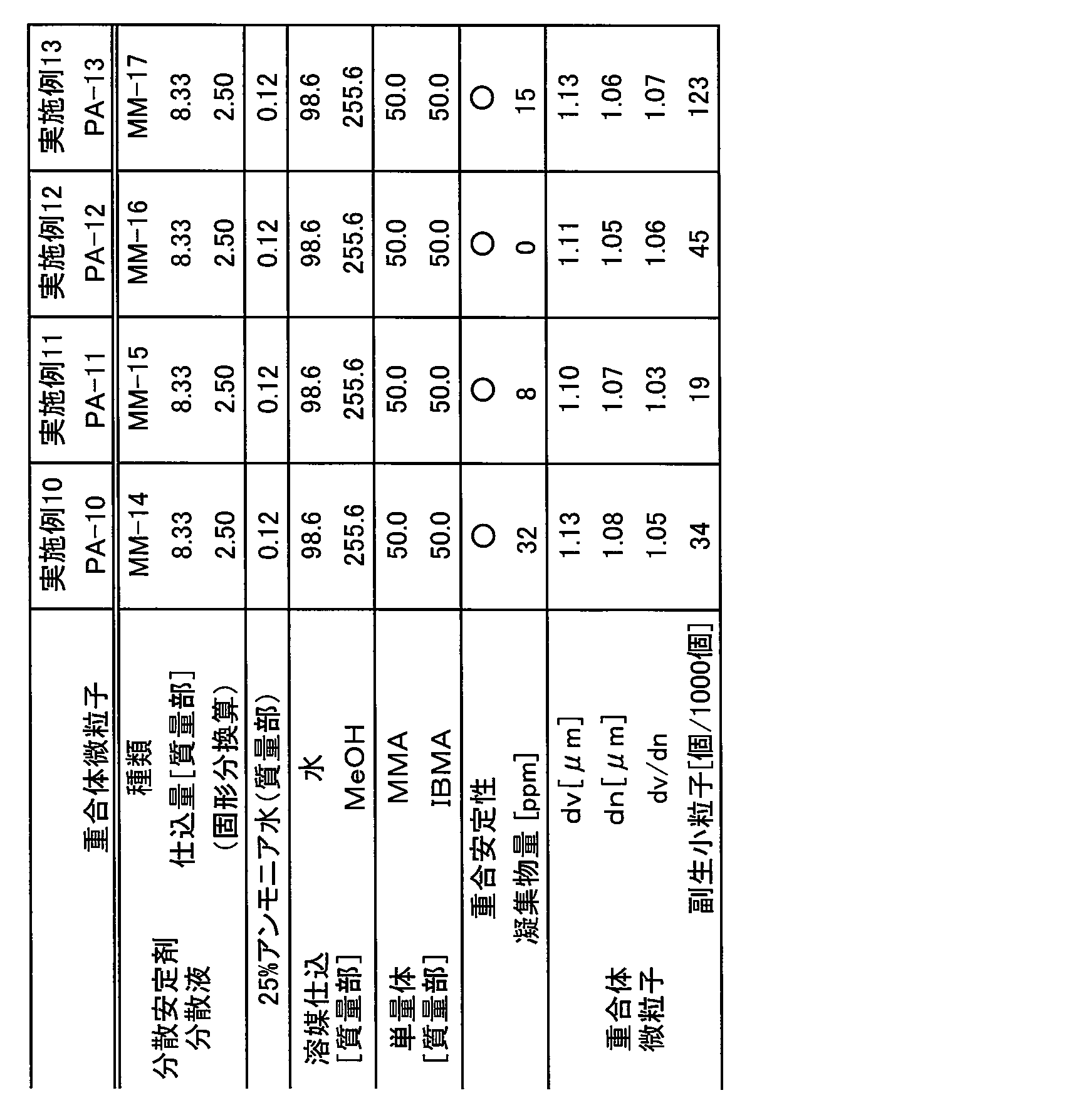

表1~表5において用いた化合物の詳細を以下に示す。
MMA:メタクリル酸メチル
IBMA:メタクリル酸イソブチル
MAA:メタクリル酸
OTG:チオグリコール酸2-エチルヘキシル
TEA:トリエチルアミン
GMA:メタクリル酸グリシジル
MeOH:メタノール
MMA:メタクリル酸メチル
IBMA:メタクリル酸イソブチル
MAA:メタクリル酸
OTG:チオグリコール酸2-エチルヘキシル
TEA:トリエチルアミン
GMA:メタクリル酸グリシジル
MeOH:メタノール
実施例1~13は、分散安定剤として、分子鎖の途中に本発明で規定する範囲のカルボキシル基とエチレン性不飽和基を有するマクロモノマーを含む重合体組成物(MM-2)~(MM-6)、(MM-9)、(MM-10)及び(MM-12)~(MM-17)を用いて、親水性溶媒中でビニル単量体(メタクリル酸メチル及びメタクリル酸イソブチル)の分散重合を行った例である。極めて少量の分散安定剤の使用で、体積平均粒子径(dv)が1.07~1.15μmの範囲の粒子径の極めて小さい重合体微粒子を、狭い粒度分布で、重合体微粒子間の凝集等を生ずることなく、良好な重合安定性で円滑に得られている。
それに対して、比較例1は、分散安定剤として、カルボキシル基が2.58meq/gと多い重合体組成物(MM-1)を用いた例である。また、比較例3は、分散安定剤として、エチレン性不飽和基平均導入量が2.70と多い重合体組成物(MM-8)を用いた例である。これらの例では、いずれも非常に多くの小粒子の副生が見られる結果が得られた。ここで、比較例1及び比較例3のdv/dnは1.04及び1.06であり、高い数値とはなっていない。これは、レーザー回折法による粒子径測定の場合、小粒子の光散乱が弱く、その寄与が無視されてしまうことによるものである。
比較例4は、エチレン性不飽和基導入量が1.11と少ない重合体組成物(MM-11)を用いた例である。モノマー濃度が20%を超えるような条件下では十分な重合安定性を付与することができず、多量の凝集物が発生する結果が得られた。
また、比較例5では、親水性溶媒中での分散重合用分散剤として一般的に使用されるポリビニルピロリドン(PVP、和光純薬製K-30)を使用したものである。マクロモノマー型分散剤と同じ固形分換算で2.5部使用した場合、重合安定性が十分ではなく、分散安定剤としての性能に大きく劣っていた。
また、比較例5では、親水性溶媒中での分散重合用分散剤として一般的に使用されるポリビニルピロリドン(PVP、和光純薬製K-30)を使用したものである。マクロモノマー型分散剤と同じ固形分換算で2.5部使用した場合、重合安定性が十分ではなく、分散安定剤としての性能に大きく劣っていた。
本発明は、分子鎖の途中に特定量のカルボキシル基とエチレン性不飽和基を有するマクロモノマー(Ma)を分散安定剤として用いた分散重合法により重合体微粒子を製造する方法である。これにより、ミクロンサイズの極めて微小な粒子径を有し、しかも粒度分布が狭くて均一な粒径を有し、単分散性で粒子間の凝集のない非架橋の重合体微粒子又は架橋した重合体微粒子を、円滑に生産性よく製造することができる。そして、本発明の方法で得られる重合体微粒子のうち、架橋した重合体微粒子は耐熱性、耐溶剤性、耐薬品性、強度等にも優れている。そのため、本発明の方法で得られる重合体微粒子は、上記した優れた特性を活かして、液晶表示用スペーサ、液晶表示用の光拡散フィルム、及び拡散板等の光拡散剤、液晶表示用のAGフィルム等のAG剤、各種フィルム用のアンチブロッキング剤、導電性微粒子、カラム用充填剤、診断薬用の担体等をはじめとして、種々の用途に有効に使用することができる。
Claims (10)
- 重合体微粒子の製造方法であって、
分散安定剤の存在下に、ビニル単量体を、該ビニル単量体及び該分散安定剤を溶解するが、生成する重合体を溶解しない親水性溶媒中で重合して前記重合体微粒子を製造する工程を備え、
前記分散安定剤が、分子鎖の途中にカルボキシル基及びエチレン性不飽和基を有するマクロモノマーを含有するものであり、
前記マクロモノマーが、平均して1分子当り1.4個以上2.5個以下のエチレン性不飽和基を有し、
前記マクロモノマー中のカルボキシル基の含有量の平均値が、0.5meq/g以上2.5meq/g以下である、
方法。 - 前記マクロモノマーが、(メタ)アクリロイル基を含む請求項1に記載の重合体微粒子の製造方法。
- 前記マクロモノマーの数平均分子量(Mn)が、1000g/mol以上10000g/mol以下である請求項1又は2に記載の重合体微粒子の製造方法。
- 前記マクロモノマーの重量平均分子量(Mw)を数平均分子量(Mn)で除した値(Mw/Mn)が2.3以下である請求項1~3のいずれかに記載の重合体微粒子の製造方法。
- 請求項1~4のいずれか1項に記載の製造方法で得られた重合体微粒子であって、
体積平均粒子径が0.7μm以上3.0μm以下であり、
体積平均粒子径(dv)/数平均粒子径(dn)が1.2以下であり、
粒子径0.1μm以上の重合体微粒子1000個当りの副生小粒子の数が500個以下である、
ことを特徴とする重合体微粒子。 - 重合体微粒子であって、
表面に、分子鎖の途中にカルボキシル基及びエチレン性不飽和基を有するマクロモノマーを保持し、
前記マクロモノマーが、平均して1分子当り1.4個以上2.5個以下のエチレン性不飽和基を有し、
前記マクロモノマー中のカルボキシル基の含有量の平均値が、0.5meq/g以上2.5meq/g以下である、重合体微粒子。 - 前記重合体微粒子は、体積平均粒子径が0.7μm以上3.0μm以下であり、体積平均粒子径(dv)/数平均粒子径(dn)が1.2以下であり、粒子径0.1μm以上の重合体微粒子1000個当りの副生小粒子の数が500個以下である、請求項6に記載の重合体微粒子。
- 前記マクロモノマーは、前記分子鎖の途中の前記カルボキシル基の一部を介して前記エチレン性不飽和基を備える、請求項6又は7に記載の重合体微粒子。
- 重合体微粒子の製造に用いる分散安定剤であって、
分子鎖の途中にカルボキシル基及びエチレン性不飽和基を有するマクロモノマーを含有するものであり、
前記マクロモノマーが、平均して1分子当り1.4個以上2.5個以下のエチレン性不飽和基を有し、
前記マクロモノマー中のカルボキシル基の含有量の平均値が、0.5meq/g以上2.5meq/g以下である、分散安定剤。 - 重合体微粒子の分散方法であって、
請求項9に記載の分散安定剤の存在下で、ビニル単量体を、該ビニル単量体及び該分散安定剤を溶解するが生成する重合体を溶解しない親水性溶媒中で重合することにより、前記重合体を微粒子として分散する工程、
を備える、方法。
Priority Applications (1)
| Application Number | Priority Date | Filing Date | Title |
|---|---|---|---|
| US15/511,978 US20170298205A1 (en) | 2014-09-18 | 2015-09-16 | Polymer microparticles and method for producing same |
Applications Claiming Priority (2)
| Application Number | Priority Date | Filing Date | Title |
|---|---|---|---|
| JP2014-189857 | 2014-09-18 | ||
| JP2014189857A JP2016060824A (ja) | 2014-09-18 | 2014-09-18 | 重合体微粒子およびその製造方法 |
Publications (1)
| Publication Number | Publication Date |
|---|---|
| WO2016043225A1 true WO2016043225A1 (ja) | 2016-03-24 |
Family
ID=55533261
Family Applications (1)
| Application Number | Title | Priority Date | Filing Date |
|---|---|---|---|
| PCT/JP2015/076317 Ceased WO2016043225A1 (ja) | 2014-09-18 | 2015-09-16 | 重合体微粒子およびその製造方法 |
Country Status (4)
| Country | Link |
|---|---|
| US (1) | US20170298205A1 (ja) |
| JP (1) | JP2016060824A (ja) |
| TW (1) | TW201627327A (ja) |
| WO (1) | WO2016043225A1 (ja) |
Cited By (1)
| Publication number | Priority date | Publication date | Assignee | Title |
|---|---|---|---|---|
| US20200335791A1 (en) * | 2017-10-24 | 2020-10-22 | Toagosei Co. Ltd. | Binder for secondary battery electrode, and use thereof |
Citations (6)
| Publication number | Priority date | Publication date | Assignee | Title |
|---|---|---|---|---|
| JPS62250001A (ja) * | 1986-04-22 | 1987-10-30 | Kansai Paint Co Ltd | 高屈折率重合体微粒子の分散液の製造方法 |
| JPH06122725A (ja) * | 1992-10-12 | 1994-05-06 | Mitsubishi Kasei Corp | ポリマー微粒子およびその製造方法 |
| JP2005334767A (ja) * | 2004-05-26 | 2005-12-08 | Kri Inc | 分散安定剤及び重合体微粒子 |
| WO2010047287A1 (ja) * | 2008-10-22 | 2010-04-29 | 東亞合成株式会社 | 重合体微粒子の製造方法 |
| WO2010047305A1 (ja) * | 2008-10-22 | 2010-04-29 | 東亞合成株式会社 | 重合体微粒子の製造方法 |
| JP2011168632A (ja) * | 2010-02-16 | 2011-09-01 | Toagosei Co Ltd | 架橋重合体微粒子およびその製造方法 |
-
2014
- 2014-09-18 JP JP2014189857A patent/JP2016060824A/ja active Pending
-
2015
- 2015-09-16 US US15/511,978 patent/US20170298205A1/en not_active Abandoned
- 2015-09-16 WO PCT/JP2015/076317 patent/WO2016043225A1/ja not_active Ceased
- 2015-09-17 TW TW104130822A patent/TW201627327A/zh unknown
Patent Citations (6)
| Publication number | Priority date | Publication date | Assignee | Title |
|---|---|---|---|---|
| JPS62250001A (ja) * | 1986-04-22 | 1987-10-30 | Kansai Paint Co Ltd | 高屈折率重合体微粒子の分散液の製造方法 |
| JPH06122725A (ja) * | 1992-10-12 | 1994-05-06 | Mitsubishi Kasei Corp | ポリマー微粒子およびその製造方法 |
| JP2005334767A (ja) * | 2004-05-26 | 2005-12-08 | Kri Inc | 分散安定剤及び重合体微粒子 |
| WO2010047287A1 (ja) * | 2008-10-22 | 2010-04-29 | 東亞合成株式会社 | 重合体微粒子の製造方法 |
| WO2010047305A1 (ja) * | 2008-10-22 | 2010-04-29 | 東亞合成株式会社 | 重合体微粒子の製造方法 |
| JP2011168632A (ja) * | 2010-02-16 | 2011-09-01 | Toagosei Co Ltd | 架橋重合体微粒子およびその製造方法 |
Cited By (1)
| Publication number | Priority date | Publication date | Assignee | Title |
|---|---|---|---|---|
| US20200335791A1 (en) * | 2017-10-24 | 2020-10-22 | Toagosei Co. Ltd. | Binder for secondary battery electrode, and use thereof |
Also Published As
| Publication number | Publication date |
|---|---|
| US20170298205A1 (en) | 2017-10-19 |
| JP2016060824A (ja) | 2016-04-25 |
| TW201627327A (zh) | 2016-08-01 |
Similar Documents
| Publication | Publication Date | Title |
|---|---|---|
| JP5630266B2 (ja) | 重合体微粒子の製造方法 | |
| JP5793577B2 (ja) | 水系分散液用ポリビニルアセタール微粒子 | |
| JP5578080B2 (ja) | 重合体微粒子の製造方法 | |
| JP5703567B2 (ja) | 架橋重合体微粒子の製造方法 | |
| JP6465275B2 (ja) | 重合体微粒子およびその製造方法 | |
| KR102620212B1 (ko) | 고 내열성 유무기 하이브리드 가교 입자의 제조방법 | |
| JP2016060824A (ja) | 重合体微粒子およびその製造方法 | |
| JP3991840B2 (ja) | 重合体微粒子の製造方法 | |
| JP7704033B2 (ja) | 重合体微粒子の製造方法及び分散安定剤 | |
| JPH0543608A (ja) | 水性架橋ポリマー粒子およびその製法 | |
| JP6137493B2 (ja) | 架橋微粒子、架橋微粒子を含む水溶液の製造方法、架橋微粒子の製造方法及び架橋微粒子組成物 | |
| JP5552726B2 (ja) | 重合体微粒子の製造方法 | |
| JP7619276B2 (ja) | ポリアクリル酸系微粒子 | |
| JP2015114272A (ja) | 重合性モノマー及びその用途 | |
| JP2018115265A (ja) | 樹脂微粒子含有組成物 | |
| JP7276315B2 (ja) | 重合体微粒子の製造方法 | |
| JPH02269717A (ja) | 含弗素グラフト共重合体 | |
| JP6394785B2 (ja) | 水溶性重合体の製造方法 | |
| JPH0762044A (ja) | 単分散重合体粒子の製造方法 | |
| JP2005089492A (ja) | ポリビニルアルコール系粒子 | |
| JP2022134730A (ja) | 水酸基含有重合体及び水酸基含有重合体の製造方法 | |
| JP5534232B2 (ja) | 重合体粒子の水分散体およびその製造方法 | |
| JPH06116307A (ja) | 重合体微粒子の製造方法 | |
| JPWO2018123844A1 (ja) | 重合体微粒子の製造方法 | |
| JP2002284807A (ja) | 架橋ポリマー粒子の製造方法 |
Legal Events
| Date | Code | Title | Description |
|---|---|---|---|
| 121 | Ep: the epo has been informed by wipo that ep was designated in this application |
Ref document number: 15842008 Country of ref document: EP Kind code of ref document: A1 |
|
| WWE | Wipo information: entry into national phase |
Ref document number: 15511978 Country of ref document: US |
|
| NENP | Non-entry into the national phase |
Ref country code: DE |
|
| 122 | Ep: pct application non-entry in european phase |
Ref document number: 15842008 Country of ref document: EP Kind code of ref document: A1 |
|
| NENP | Non-entry into the national phase |
Ref country code: JP |