WO2016017631A1 - γ-グルタミルシステイン及びグルタチオンの製造方法 - Google Patents
γ-グルタミルシステイン及びグルタチオンの製造方法 Download PDFInfo
- Publication number
- WO2016017631A1 WO2016017631A1 PCT/JP2015/071358 JP2015071358W WO2016017631A1 WO 2016017631 A1 WO2016017631 A1 WO 2016017631A1 JP 2015071358 W JP2015071358 W JP 2015071358W WO 2016017631 A1 WO2016017631 A1 WO 2016017631A1
- Authority
- WO
- WIPO (PCT)
- Prior art keywords
- reaction
- glutamylcysteine
- gsh
- glutathione
- amino acid
- Prior art date
- Legal status (The legal status is an assumption and is not a legal conclusion. Google has not performed a legal analysis and makes no representation as to the accuracy of the status listed.)
- Ceased
Links
Classifications
-
- C—CHEMISTRY; METALLURGY
- C12—BIOCHEMISTRY; BEER; SPIRITS; WINE; VINEGAR; MICROBIOLOGY; ENZYMOLOGY; MUTATION OR GENETIC ENGINEERING
- C12P—FERMENTATION OR ENZYME-USING PROCESSES TO SYNTHESISE A DESIRED CHEMICAL COMPOUND OR COMPOSITION OR TO SEPARATE OPTICAL ISOMERS FROM A RACEMIC MIXTURE
- C12P21/00—Preparation of peptides or proteins
- C12P21/02—Preparation of peptides or proteins having a known sequence of two or more amino acids, e.g. glutathione
-
- C—CHEMISTRY; METALLURGY
- C12—BIOCHEMISTRY; BEER; SPIRITS; WINE; VINEGAR; MICROBIOLOGY; ENZYMOLOGY; MUTATION OR GENETIC ENGINEERING
- C12N—MICROORGANISMS OR ENZYMES; COMPOSITIONS THEREOF; PROPAGATING, PRESERVING, OR MAINTAINING MICROORGANISMS; MUTATION OR GENETIC ENGINEERING; CULTURE MEDIA
- C12N9/00—Enzymes; Proenzymes; Compositions thereof; Processes for preparing, activating, inhibiting, separating or purifying enzymes
- C12N9/10—Transferases (2.)
- C12N9/12—Transferases (2.) transferring phosphorus containing groups, e.g. kinases (2.7)
- C12N9/1229—Phosphotransferases with a phosphate group as acceptor (2.7.4)
-
- C—CHEMISTRY; METALLURGY
- C12—BIOCHEMISTRY; BEER; SPIRITS; WINE; VINEGAR; MICROBIOLOGY; ENZYMOLOGY; MUTATION OR GENETIC ENGINEERING
- C12N—MICROORGANISMS OR ENZYMES; COMPOSITIONS THEREOF; PROPAGATING, PRESERVING, OR MAINTAINING MICROORGANISMS; MUTATION OR GENETIC ENGINEERING; CULTURE MEDIA
- C12N9/00—Enzymes; Proenzymes; Compositions thereof; Processes for preparing, activating, inhibiting, separating or purifying enzymes
- C12N9/93—Ligases (6)
-
- C—CHEMISTRY; METALLURGY
- C12—BIOCHEMISTRY; BEER; SPIRITS; WINE; VINEGAR; MICROBIOLOGY; ENZYMOLOGY; MUTATION OR GENETIC ENGINEERING
- C12P—FERMENTATION OR ENZYME-USING PROCESSES TO SYNTHESISE A DESIRED CHEMICAL COMPOUND OR COMPOSITION OR TO SEPARATE OPTICAL ISOMERS FROM A RACEMIC MIXTURE
- C12P19/00—Preparation of compounds containing saccharide radicals
- C12P19/26—Preparation of nitrogen-containing carbohydrates
- C12P19/28—N-glycosides
- C12P19/30—Nucleotides
- C12P19/32—Nucleotides having a condensed ring system containing a six-membered ring having two N-atoms in the same ring, e.g. purine nucleotides, nicotineamide-adenine dinucleotide
-
- C—CHEMISTRY; METALLURGY
- C12—BIOCHEMISTRY; BEER; SPIRITS; WINE; VINEGAR; MICROBIOLOGY; ENZYMOLOGY; MUTATION OR GENETIC ENGINEERING
- C12Y—ENZYMES
- C12Y207/00—Transferases transferring phosphorus-containing groups (2.7)
- C12Y207/04—Phosphotransferases with a phosphate group as acceptor (2.7.4)
-
- C—CHEMISTRY; METALLURGY
- C12—BIOCHEMISTRY; BEER; SPIRITS; WINE; VINEGAR; MICROBIOLOGY; ENZYMOLOGY; MUTATION OR GENETIC ENGINEERING
- C12Y—ENZYMES
- C12Y603/00—Ligases forming carbon-nitrogen bonds (6.3)
- C12Y603/02—Acid—amino-acid ligases (peptide synthases)(6.3.2)
- C12Y603/02002—Glutamate-cysteine ligase (6.3.2.2)
-
- C—CHEMISTRY; METALLURGY
- C12—BIOCHEMISTRY; BEER; SPIRITS; WINE; VINEGAR; MICROBIOLOGY; ENZYMOLOGY; MUTATION OR GENETIC ENGINEERING
- C12Y—ENZYMES
- C12Y603/00—Ligases forming carbon-nitrogen bonds (6.3)
- C12Y603/02—Acid—amino-acid ligases (peptide synthases)(6.3.2)
- C12Y603/02003—Glutathione synthase (6.3.2.3)
-
- C—CHEMISTRY; METALLURGY
- C12—BIOCHEMISTRY; BEER; SPIRITS; WINE; VINEGAR; MICROBIOLOGY; ENZYMOLOGY; MUTATION OR GENETIC ENGINEERING
- C12N—MICROORGANISMS OR ENZYMES; COMPOSITIONS THEREOF; PROPAGATING, PRESERVING, OR MAINTAINING MICROORGANISMS; MUTATION OR GENETIC ENGINEERING; CULTURE MEDIA
- C12N9/00—Enzymes; Proenzymes; Compositions thereof; Processes for preparing, activating, inhibiting, separating or purifying enzymes
Definitions
- the present invention relates to a method for producing ⁇ -glutamylcysteine.
- the present invention also relates to a method for producing glutathione.
- Glutathione is a peptide consisting of three amino acids, L-cysteine, L-glutamic acid, and glycine. It exists not only in the human body but also in many other living organisms such as other animals, plants, and microorganisms. It is an important compound for living organisms such as amino acid metabolism.
- Glutathione is a reduced form of glutathione (N- (N- ⁇ -L-glutamyl-L-cysteinyl) glycine, hereinafter referred to as “GSH”), which is a form of SH in which the thiol group of the L-cysteine residue is reduced in vivo.
- GSH glutathione
- GSSG oxidized glutathione
- Non-patent Document 1 As a method for producing glutathione, fermentation using Saccharomyces cerevisiae or Candida utilis (Non-patent Document 1), and ⁇ - in the presence of L-glutamic acid, L-cysteine, glycine, a surfactant or an organic solvent are used. Enzymatic methods using Escherichia coli or Saccharomyces cerevisiae cells produced by recombinant production of glutamylcysteine synthetase or glutathione synthetase as an enzyme source (patent documents 1 and 2) (non-patent documents 1 and 2) are common. It is.
- the present inventors when performing the step of synthesizing glutathione from ⁇ -glutamylcysteine and glycine using an enzyme in an air atmosphere, not only reduced glutathione but also oxidized glutathione as a by-product. It has been found that there is a problem that a considerable amount of is produced and the yield of glutathione is lowered.
- glutathione or “GSH” exclusively means “reduced glutathione”, and oxidized glutathione is expressed as “oxidized glutathione” or “GSSG”.
- ⁇ -glutamylcysteine exclusively means “reduced ⁇ -glutamylcysteine”, and a compound in which two molecules of ⁇ -glutamylcysteine are oxidized and bonded by an —SS— bond is referred to as “oxidized ⁇ - ⁇ ”. -"Glutamylcysteine".
- ATP adenosine triphosphate
- the step A is performed by coupling with an ATP regeneration reaction for regenerating adenosine diphosphate (ADP, also referred to as adenosine 5′-diphosphate) to adenosine triphosphate (ATP).
- ADP adenosine diphosphate
- ATP adenosine triphosphate
- ATP consumed in step A can be regenerated and the amount of ATP added can be reduced.
- the ⁇ -glutamylcysteine synthetase used in the method (3) is preferable because it has a particularly high activity of producing ⁇ -glutamylcysteine from L-cysteine and L-glutamic acid.
- the bifunctional glutathione synthetase used in the method (4) is preferable because of its particularly high activity of generating ⁇ -glutamylcysteine from L-cysteine and L-glutamic acid.
- the production of oxidized glutathione as a by-product is suppressed, and glutathione can be produced with high efficiency.
- step B is performed by coupling with an ATP regeneration reaction for regenerating adenosine diphosphate (ADP) to adenosine triphosphate (ATP).
- ADP adenosine diphosphate
- ATP adenosine triphosphate
- ATP consumed in step B can be regenerated and the amount of ATP added can be reduced.
- the glutathione synthetase used in the method (7) is preferable because it has particularly high activity to produce glutathione from ⁇ -glutamylcysteine and glycine.
- the bifunctional glutathione synthetase used in the method (8) is preferable because of its particularly high activity for producing glutathione from ⁇ -glutamylcysteine and glycine.
- L-cysteine and L-glutamic acid are produced by using at least one enzyme selected from the group consisting of ⁇ -glutamylcysteine synthetase and bifunctional glutathione synthetase in an atmosphere having an oxygen concentration lower than that of air. Further comprising a step A of reacting by action in the presence of adenosine triphosphate (ATP) to produce ⁇ -glutamylcysteine; ⁇ -glutamylcysteine used in Step B is produced by Step A. (5) The method according to any one of (8).
- ATP adenosine triphosphate
- glutathione can be efficiently produced from L-cysteine and L-glutamic acid with a small amount of by-product oxidized ⁇ -glutamylcysteine and oxidized glutathione.
- step A is performed by coupling with an ATP regeneration reaction for regenerating adenosine diphosphate (ADP) into adenosine triphosphate (ATP).
- ADP adenosine diphosphate
- ATP adenosine triphosphate
- ATP consumed in step A can be regenerated and the amount of ATP added can be reduced.
- the ⁇ -glutamylcysteine synthetase used in the method (11) is preferable because it has a particularly high activity of producing ⁇ -glutamylcysteine from L-cysteine and L-glutamic acid.
- the bifunctional glutathione synthetase used in the method (12) is preferable because of its particularly high activity of producing ⁇ -glutamylcysteine from L-cysteine and L-glutamic acid.
- the step A ′ is more preferably the step A described in (1).
- a method for producing glutathione comprising the step B ′ of producing glutathione by reacting ⁇ -glutamylcysteine and glycine in an atmosphere having an oxygen concentration lower than that of air.
- the step B ′ is more preferably the step B described in (5).
- the method further comprises a step A ′ of producing ⁇ -glutamylcysteine by reacting L-cysteine and L-glutamic acid in an atmosphere having an oxygen concentration lower than that of the atmosphere.
- the step A ′ is more preferably the step A described in (1).
- L-cysteine “L-glutamic acid”, “glycine” “ ⁇ -glutamylcysteine”, “glutathione”, “L-cystine”, “oxidized ⁇ -glutamylcysteine”, “oxidized form”
- the air refers to the air on the ground, that is, air.
- the present invention provides a method for producing ⁇ -glutamylcysteine in which by-production of oxidized ⁇ -glutamylcysteine is suppressed.
- the present invention also provides a method for producing glutathione in which by-production of oxidized glutathione is suppressed.
- ⁇ -glutamylcysteine synthetase is “GSH I”
- glutathione synthetase is “GSH II”
- bifunctional glutathione synthetase is “GSH F”
- adenylate kinase is “ADK”
- polyphosphate-dependent AMP transferase may be abbreviated as “PAP”.
- ⁇ GSH I> The ⁇ -glutamylcysteine synthetase (GSH I) used in the present invention recognizes L-cysteine (L-Cys) as a substrate in the presence of ATP and binds to L-glutamic acid (L-Glu) to form ⁇ -An enzyme having an activity to catalyze a reaction for producing Glu-Cys, and its origin, structure, etc. are not particularly limited as long as it has the activity. In the present invention, this activity is referred to as ⁇ -glutamylcysteine synthetase activity. 1 U of the activity means the activity of producing 1 ⁇ mol of ⁇ -glutamylcysteine per minute at 30 ° C., and was measured under the following measurement conditions.
- the reaction was performed by adding the enzyme solution to 50 mM Tris hydrochloride buffer (pH 8.0) containing 10 mM ATP, 15 mM L-glutamic acid, 15 mM L-cysteine, 10 mM magnesium sulfate, and keeping the temperature at 30 ° C. The reaction is stopped by adding. Quantitative determination of ⁇ -glutamylcysteine in the reaction solution using high performance liquid chromatography.
- the conditions for the high performance liquid chromatography are as follows. Under these conditions, glutathione (GSH), ⁇ -glutamylcysteine ( ⁇ -GC), oxidized ⁇ -GC, and oxidized glutathione (GSSG) are eluted in this order.
- GSH glutathione
- ⁇ -GC ⁇ -glutamylcysteine
- GSSG oxidized glutathione
- GSH I it is preferable to use ⁇ -glutamylcysteine synthetase activity (specific activity) of 0.5 U or more per 1 mg of protein.
- GSH I is not particularly limited, and those derived from microorganisms, animals, plants and the like can be used. GSH I derived from microorganisms is preferable, and GSH I derived from intestinal bacteria such as Escherichia coli, bacteria such as coryneform bacteria, eukaryotic microorganisms such as yeast, and the like is particularly preferable.
- GSH I is not limited to GSH I consisting of the amino acid sequence shown in SEQ ID NO: 9, and other polypeptides having GSH I activity, such as active mutants and other types of orthologs, can also be used.
- the other polypeptide having GSH I activity is preferably 10% or more, preferably 40% or more, more preferably when GSH I consisting of the amino acid sequence shown in SEQ ID NO: 9 is used under the above activity measurement conditions.
- polypeptides having GSH I activity such as the above-mentioned active mutants and other orthologs, for example, one to a plurality of amino acids are added, deleted or substituted in the amino acid sequence shown in SEQ ID NO: 9.
- a polypeptide comprising an amino acid sequence (particularly preferably, at least one or both of the N-terminal and C-terminal of the amino acid sequence shown in SEQ ID NO: 9 are substituted, deleted and / or added, preferably Polypeptide having a deleted and / or added amino acid sequence) or 80% or more, preferably 85% or more, more preferably 90% or more, 95% or more, 97% or more with respect to the amino acid sequence shown in SEQ ID NO: 9.
- a polypeptide comprising an amino acid sequence having 98% or more or 99% or more amino acid identity Furthermore, a polypeptide consisting of the amino acid sequence shown in SEQ ID NO: 9, the aforementioned polypeptide consisting of an amino acid sequence in which one or more amino acids are added, deleted or substituted in the amino acid sequence shown in SEQ ID NO: 9, and SEQ ID NO: A fragment having GSH I activity of at least one polypeptide selected from the group consisting of the above-mentioned polypeptides consisting of the amino acid sequence having the above-mentioned amino acid sequence with respect to the amino acid sequence shown in FIG.
- a polypeptide having an amino acid number of preferably 250 or more, more preferably 300 or more, more preferably 400 or more, more preferably 500 or more can be used.
- plural means, for example, 2 to 20, 2 to 15, 2 to 10, 2 to 7, 2 to 5, 2 to 4, or 2 to 3.
- Amino acid identity refers to the protein shown in SEQ ID NO: 9 when two amino acid sequences are aligned (aligned) and a gap is introduced as necessary so that the degree of amino acid coincidence between the two is maximized. The ratio (%) of the same amino acid residue to the total number of amino acid residues. Amino acid identity can be calculated using a BLAST or FASTA protein search system (Karlin, S.
- amino acid substitution is preferably conservative amino acid substitution.
- Constant amino acid substitution refers to substitution between amino acids having similar properties such as charge, side chain, polarity, aromaticity and the like.
- Amino acids with similar properties include, for example, basic amino acids (arginine, lysine, histidine), acidic amino acids (aspartic acid, glutamic acid), uncharged polar amino acids (glycine, asparagine, glutamine, serine, threonine, cysteine, tyrosine), nonpolar
- functional amino acids leucine, isoleucine, alanine, valine, proline, phenylalanine, tryptophan, methionine
- branched chain amino acids leucine, valine, isoleucine
- aromatic amino acids phenylalanine, tyrosine, tryptophan, histidine
- Each polypeptide may be appropriately chemically modified.
- the base sequence of the gene (DNA or RNA) encoding GSH I that can be used for the preparation of GSH I is not limited to the base sequence shown in SEQ ID NO: 1, but encodes the target GSH I amino acid sequence.
- the base sequence can be an appropriate one depending on the type of host organism.
- Glutathione synthase (GSH II) used in the present invention recognizes ⁇ -Glu-Cys as a substrate in the presence of ATP and generates ⁇ -Glu-Cys-Gly by binding to glycine (Gly). As long as it has the activity, its origin, structure, etc. are not particularly limited. In the present invention, this activity is referred to as glutathione synthetase activity. 1 U of the activity means an activity of producing 1 ⁇ mol of glutathione per minute at 30 ° C., and is measured under the following measurement conditions.
- the reaction was performed by adding the enzyme solution to 50 mM Tris hydrochloride buffer (pH 8.0) containing 10 mM ATP, 15 mM ⁇ -glutamylcysteine, 15 mM glycine, and 10 mM magnesium sulfate, and maintaining the temperature at 30 ° C. The reaction is stopped by adding. Glutathione in the reaction solution is quantified using high performance liquid chromatography.
- GSH II having a glutathione synthetase activity (specific activity) of 0.5 U or more per 1 mg of protein.
- GSH II is not particularly limited, and those derived from microorganisms, animals, plants and the like can be used. GSH II derived from microorganisms is preferable, and GSH II derived from intestinal bacteria such as Escherichia coli, bacteria such as coryneform bacteria, eukaryotic microorganisms such as yeast, and the like are particularly preferable.
- GSH II is not limited to GSH II consisting of the amino acid sequence shown in SEQ ID NO: 10, but other polypeptides having GSH II activity, such as active mutants and other types of orthologs, can also be used.
- the other polypeptide having GSH II activity is preferably 10% or more, preferably 40% or more, more preferably when GSH II consisting of the amino acid sequence shown in SEQ ID NO: 10 is used under the above activity measurement conditions.
- polypeptides having GSH II activity such as the above-mentioned active mutants and other orthologs.
- a polypeptide comprising an amino acid sequence (particularly preferably, a total of 1 to a plurality of amino acids are substituted, deleted and / or added at one or both of the N-terminal and C-terminal of the amino acid sequence shown in SEQ ID NO: 10, preferably A polypeptide having a deleted and / or added amino acid sequence) or 80% or more, preferably 85% or more, more preferably 90% or more, 95% or more, 97% or more with respect to the amino acid sequence shown in SEQ ID NO: 10.
- a polypeptide comprising an amino acid sequence having 98% or more or 99% or more amino acid identity Furthermore, a polypeptide consisting of the amino acid sequence shown in SEQ ID NO: 10, the polypeptide consisting of an amino acid sequence in which one to a plurality of amino acids are added, deleted, or substituted in the amino acid sequence shown in SEQ ID NO: 10, and SEQ ID NO: A fragment having GSH II activity of at least one polypeptide selected from the group consisting of the above-mentioned polypeptides consisting of the amino acid sequence having the above-mentioned amino acid sequence with respect to the amino acid sequence shown in FIG.
- amino acid identity refers to the protein shown in SEQ ID NO: 10 when two amino acid sequences are aligned (aligned), and gaps are introduced as necessary to maximize the degree of amino acid identity between the two. The ratio (%) of the same amino acid residue to the total number of amino acid residues.
- the amino acid substitution is preferably conservative amino acid substitution.
- a preferred range of “plurality”, a method for calculating amino acid identity, and conservative amino acid substitution are as described for GSH I.
- Each polypeptide may be appropriately chemically modified.
- the base sequence of the gene (DNA or RNA) encoding GSH II that can be used for the preparation of GSH II is not limited to the base sequence shown in SEQ ID NO: 4, but encodes the target GSH II amino acid sequence.
- the base sequence can be an appropriate one depending on the type of host organism.
- the bifunctional glutathione synthetase (GSH F) used in the present invention recognizes L-Cys as a substrate in the presence of ATP, and catalyzes a reaction for producing ⁇ -Glu-Cys by binding to L-Glu. It is an enzyme that has both an activity and an activity of recognizing ⁇ -Glu-Cys as a substrate in the presence of ATP and catalyzing a reaction to produce ⁇ -Glu-Cys-Gly by binding to Gly.
- the origin, structure, etc. are not particularly limited. In the present invention, this activity is referred to as bifunctional glutathione synthetase activity.
- 1 U of the activity means an activity of producing 1 ⁇ mol of ⁇ -Glu-Cys-Gly (glutathione) per minute at 30 ° C., and was measured under the following measurement conditions.
- the reaction is carried out by adding the enzyme solution to 50 mM Tris hydrochloride buffer (pH 8.0) containing 10 mM ATP, 15 mM L-glutamic acid, 15 mM L-cysteine, 15 mM glycine, and 10 mM magnesium sulfate, and maintaining the temperature at 30 ° C.
- the reaction is stopped by adding 6N hydrochloric acid. Glutathione in the reaction solution is quantified using high performance liquid chromatography.
- GSH F having a bifunctional glutathione synthetase activity (specific activity) of 0.5 U or more per 1 mg of protein.
- GSH F The origin of GSH F is not particularly limited, and those derived from microorganisms, animals, plants and the like can be used.
- GSH F derived from microorganisms is preferred. Particularly preferred are bacteria-derived GSH F, specifically, Streptococcus agalactiae, Streptococcus mutans, Streptococcus suis, Streptococcus suis, Streptococcus suis, Streptococcus suisto Streptococcus genus; Lactobacillus plantarum and other Lactobacillus genus bacteria; Desulfotalea cyclophila and other desulphotales (Desulfotalia) bacterium; Clostridium perfringens and other Clostridium bacteria; Listeria innocua, Listeria monocteris (Listeria monolithes, etc.) Enterococcus faecium, Enterococcus faecium, and other Enterococcus
- the base sequence of GSH F derived from Streptococcus agalactie and the amino acid sequence encoded by the base sequence are shown in SEQ ID NO: 11 and SEQ ID NO: 12, respectively.
- the base sequence consisting of the 4th base to the 2253th base of SEQ ID NO: 7 is a base sequence encoding GSH F derived from Streptococcus agalactiae consisting of the amino acid sequence shown in SEQ ID NO: 12, and is frequently used in codon usage in E. coli. It is an example of the adapted base sequence.
- GSH F is not limited to GSH F consisting of the amino acid sequence shown in SEQ ID NO: 12, and other polypeptides having GSH F activity such as active mutants and other species orthologs can also be used.
- the other polypeptide having GSH F activity is preferably 10% or more, preferably 40% or more, more preferably, when GSH F comprising the amino acid sequence shown in SEQ ID NO: 12 is used under the above activity measurement conditions.
- polypeptides having GSH F activity such as the above-mentioned active mutants and other orthologs, for example, one to a plurality of amino acids are added, deleted or substituted in the amino acid sequence shown in SEQ ID NO: 12.
- a polypeptide comprising an amino acid sequence (particularly preferably, at least one or both of the N-terminal and C-terminal of the amino acid sequence shown in SEQ ID NO: 12 is substituted, deleted and / or added, preferably Polypeptide having a deleted and / or added amino acid sequence) or 80% or more, preferably 85% or more, more preferably 90% or more, 95% or more, 97% or more with respect to the amino acid sequence shown in SEQ ID NO: 12.
- a polypeptide comprising an amino acid sequence having 98% or more or 99% or more amino acid identity Furthermore, a polypeptide consisting of the amino acid sequence shown in SEQ ID NO: 12, the polypeptide consisting of an amino acid sequence in which one or more amino acids are added, deleted or substituted in the amino acid sequence shown in SEQ ID NO: 12, and SEQ ID NO: A fragment having GSH F activity of at least one polypeptide selected from the group consisting of the above-mentioned polypeptides consisting of the amino acid sequence having the above-mentioned amino acid identity to the amino acid sequence shown in FIG.
- a polypeptide having a number of amino acids of preferably 400 or more, more preferably 500 or more, more preferably 600 or more, more preferably 700 or more, more preferably 730 or more is used. it can.
- “Amino acid identity” refers to the protein shown in SEQ ID NO: 12 when two amino acid sequences are aligned (aligned) and a gap is introduced as necessary so that the amino acid identity between the two is the highest. The ratio (%) of the same amino acid residue to the total number of amino acid residues.
- the amino acid substitution is preferably conservative amino acid substitution.
- a preferred range of “plurality”, a method for calculating amino acid identity, and conservative amino acid substitution are as described for GSH I.
- Each polypeptide may be appropriately chemically modified.
- the base sequence of the gene (DNA or RNA) encoding GSH F that can be used for the preparation of GSH F is not limited to the base sequence shown in SEQ ID NO: 11, but encodes the target amino acid sequence of GSH F.
- the base sequence can be an appropriate one depending on the type of host organism.
- Adenylate kinase (ADK) used in the present invention is an enzyme that has an activity of catalyzing a reaction for generating ATP and AMP one molecule at a time from two molecules of ADP, and as long as it has the activity, its origin, structure, etc. It is not limited. In the present invention, this activity is referred to as ADK activity.
- 1 U of the activity means an activity of producing 1 ⁇ mol of AMP per minute at 30 ° C., and is measured under the following measurement conditions.
- the reaction is carried out by adding the enzyme solution to 50 mM Tris hydrochloride buffer (pH 8.0) containing 10 mM ADP and 70 mM magnesium sulfate and keeping the solution at 30 ° C., and the reaction is stopped by adding 6N hydrochloric acid.
- AMP in the reaction solution was quantified using high performance liquid chromatography.
- adenosine triphosphate ATP
- ADP adenosine diphosphate
- AMP adenosine monophosphate
- ADK having an ADK activity (specific activity) of 20 U or more per 1 mg of protein.
- ADK origin of ADK is not particularly limited, and those derived from microorganisms, animals, plants and the like can be used.
- a microorganism-derived ADK is preferred.
- Bacteria-derived ADK is particularly preferable, and specifically, Escherichia coli-derived ADK is preferable.
- base sequence of ADK derived from Escherichia coli and the amino acid sequence encoded by the base sequence are shown in SEQ ID NO: 13 and SEQ ID NO: 14, respectively.
- the ADK is not limited to the ADK consisting of the amino acid sequence shown in SEQ ID NO: 14, and other polypeptides having ADK activity such as active mutants and other types of orthologs can also be used.
- the other polypeptide having ADK activity is preferably 10% or more, preferably 40% or more, more preferably 60%, when ADK comprising the amino acid sequence shown in SEQ ID NO: 14 is used under the above activity measurement conditions. As described above, it is a polypeptide exhibiting an activity of 80% or more, more preferably 90% or more.
- polypeptides having ADK activity such as the above-mentioned active mutants and other species orthologs
- one to a plurality of amino acids are added, deleted or substituted in the amino acid sequence shown in SEQ ID NO: 14.
- a polypeptide comprising an amino acid sequence (particularly preferably, a total of one or more amino acids are substituted, deleted and / or added, preferably missing at one or both of the N-terminal and C-terminal of the amino acid sequence shown in SEQ ID NO: 14.
- a polypeptide consisting of an amino acid sequence having 98% or more or 99% or more amino acid identity is applicable. Furthermore, a polypeptide consisting of the amino acid sequence shown in SEQ ID NO: 14, the above polypeptide consisting of an amino acid sequence in which one or more amino acids are added, deleted or substituted in the amino acid sequence shown in SEQ ID NO: 14, and SEQ ID NO: A fragment having ADK activity of at least one polypeptide selected from the group consisting of the above-mentioned polypeptides comprising the amino acid sequence having the above-mentioned amino acid identity to the amino acid sequence shown in FIG. As the fragment, a polypeptide having an amino acid number of preferably 100 or more, more preferably 150 or more, more preferably 200 or more can be used.
- amino acid identity refers to the protein shown in SEQ ID NO: 14 when two amino acid sequences are aligned (aligned), and a gap is introduced as necessary so that the amino acid identity between the two is the highest. The ratio (%) of the same amino acid residue to the total number of amino acid residues.
- the amino acid substitution is preferably conservative amino acid substitution.
- a preferred range of “plurality”, a method for calculating amino acid identity, and conservative amino acid substitution are as described for GSH I.
- Each polypeptide may be appropriately chemically modified.
- the base sequence of a gene (DNA or RNA) encoding ADK that can be used for the preparation of ADK is not limited to the base sequence shown in SEQ ID NO: 13, but a host organism encoding the target amino acid sequence of ADK It can be an appropriate base sequence depending on the kind of the DNA.
- the polyphosphate-dependent AMP transferase (PAP) used in the present invention is an enzyme that has the activity of catalyzing the reaction of phosphorylating AMP to produce ADP using polyphosphate as a phosphate donor.
- the origin, structure, etc. are not particularly limited. In the present invention, this activity is referred to as PAP activity.
- 1 U of the activity means an activity of producing 1 ⁇ mol of ADP per minute at 30 ° C., and is measured under the following measurement conditions.
- PAP having a PAP activity (specific activity) of 20 U or more per 1 mg of protein.
- the origin of PAP is not particularly limited, and those derived from microorganisms, animals, plants and the like can be used. Microbial PAP is preferred. In particular, PAP derived from bacteria is preferable, and specifically, PAP derived from Acinetobacter johnsonii is preferable.
- base sequence of PAP derived from Acinetobacter johnsonii and the amino acid sequence encoded by the base sequence are shown in SEQ ID NO: 15 and SEQ ID NO: 16, respectively.
- the base sequence consisting of the 4th to 1428th bases of SEQ ID NO: 8 is a base sequence encoding Acinetobacter johnsonii-derived PAP consisting of the amino acid sequence shown in SEQ ID NO: 16, and is suitable for codon usage in E. coli. It is an example of the made base sequence.
- the PAP is not limited to the PAP consisting of the amino acid sequence shown in SEQ ID NO: 16, and other polypeptides having PAP activity such as active mutants and other species orthologs can also be used.
- the other polypeptide having PAP activity is preferably 10% or more, preferably 40% or more, more preferably 60% when the PAP consisting of the amino acid sequence shown in SEQ ID NO: 16 is used under the above activity measurement conditions. As described above, it is a polypeptide exhibiting an activity of 80% or more, more preferably 90% or more.
- polypeptides having PAP activity such as the above-mentioned active mutants and other species orthologs
- one to a plurality of amino acids are added, deleted or substituted in the amino acid sequence shown in SEQ ID NO: 16.
- a polypeptide comprising an amino acid sequence (particularly preferably, a total of 1 to a plurality of amino acids are substituted, deleted and / or added, preferably deleted at one or both of the N-terminal and C-terminal of the amino acid sequence shown in SEQ ID NO: 16.
- a polypeptide consisting of an amino acid sequence having 98% or more or 99% or more amino acid identity is applicable. Furthermore, a polypeptide consisting of the amino acid sequence shown in SEQ ID NO: 16, the polypeptide consisting of an amino acid sequence in which one or more amino acids are added, deleted or substituted in the amino acid sequence shown in SEQ ID NO: 16, and SEQ ID NO: A fragment having PAP activity of at least one polypeptide selected from the group consisting of the above-mentioned polypeptides consisting of the amino acid sequence having the above-mentioned amino acid sequence with respect to the amino acid sequence shown in FIG.
- amino acid identity refers to the protein shown in SEQ ID NO: 16 when two amino acid sequences are aligned (aligned) and a gap is introduced as necessary so that the degree of amino acid coincidence between the two is maximized. The ratio (%) of the same amino acid residue to the total number of amino acid residues.
- the amino acid substitution is preferably conservative amino acid substitution.
- a preferred range of “plurality”, a method for calculating amino acid identity, and conservative amino acid substitution are as described for GSH I.
- Each polypeptide may be appropriately chemically modified.
- the base sequence of a gene (DNA or RNA) encoding PAP that can be used for the preparation of PAP is not limited to the base sequence shown in SEQ ID NO: 15, but a host organism that encodes the amino acid sequence of the target PAP. It can be an appropriate base sequence depending on the kind of the DNA.
- each of the enzymes used in the present invention is not particularly limited.
- Each of the above enzymes can be prepared from an organism having the activity of the enzyme, for example, a wild strain or a mutant strain of a microorganism.
- the organism having the target enzyme activity may be either an organism originally having the enzyme activity or an organism having an enhanced enzyme activity.
- Examples of organisms with enhanced enzyme activity include recombinant biological cells in which the expression of genes encoding each of the enzymes is enhanced by genetic engineering techniques.
- organism with enhanced enzyme activity refers to an organism with inherently increased activity of the enzyme in an organism with inherently higher activity of the enzyme and an organism with essentially no activity of the enzyme. It includes both organisms to which the activity of the enzyme is imparted.
- a recombinant biological cell obtained by using a genetic engineering technique typically has a recombinant vector obtained by inserting a gene (DNA or RNA) encoding an enzyme of interest into an appropriate vector.
- host biological cells include bacteria, yeasts, filamentous fungi, plant cells, animal cells, and the like. From the viewpoint of introduction and expression efficiency, bacteria are preferable, and Escherichia coli is particularly preferable.
- the method for producing ⁇ -glutamylcysteine according to the present invention comprises the steps of combining L-cysteine and L-glutamic acid with ⁇ -glutamylcysteine synthetase (GSH I) and bifunctional glutathione synthetase in an atmosphere having a lower oxygen concentration than the atmosphere. Characterized in that it comprises a step A in which at least one enzyme selected from the group consisting of (GSH F) is reacted in the presence of adenosine triphosphate (ATP) to produce ⁇ -glutamylcysteine. To do.
- GSH F ⁇ -glutamylcysteine synthetase
- ATP adenosine triphosphate
- Step A is a step of producing ⁇ -glutamylcysteine by reacting L-cysteine and L-glutamic acid in the presence of the enzyme and ATP.
- the enzyme acts to catalyze the reaction, adenosine is produced.
- Triphosphate (ATP) is consumed.
- the method for producing ⁇ -glutamylcysteine according to the present invention also includes a step A ′ for producing ⁇ -glutamylcysteine by reacting L-cysteine and L-glutamic acid in an atmosphere having an oxygen concentration lower than that of the atmosphere. It is characterized by.
- Step A ′ may be performed by an enzymatic reaction or may be performed by a chemical reaction without using an enzyme, but is preferably a step performed by an enzymatic reaction, and particularly preferably the step A.
- the enzymatic reaction is more advantageous than the chemical synthesis reaction because protection by a functional group of the substrate compound is unnecessary and the specificity of the reaction is high.
- Step A ′ by a chemical reaction without using an enzyme is not particularly limited.
- L-cysteine having a carboxyl group protected with an appropriate protecting group, and an ⁇ -carboxyl group and an amino group with an appropriate protecting group.
- one or more protecting groups are deprotected as necessary after the dehydration condensation reaction.
- protecting group for the carboxyl group a known protecting group for carboxyl group such as benzyl group can be used, and as the protecting group for amino group, t-butoxycarbonyl (Boc) group, 9-fluorenylmethoxycarbonyl (Fmoc) group, etc. Any known protecting group for amino group can be used.
- GSH I and / or GSH F may be a living cell having GSH I and / or GSH F activity, or may be dead but not damaged. It may be used, or may be used in a form in which GSH I and / or GSH F are present outside the cell, specifically in the form of a crushed cell of the organism, or separated from the cell and used as necessary. Accordingly, it may be used in the form of a protein that is appropriately purified.
- the degree of purification of the protein having GSH I and / or GSH F activity is not particularly limited, and may be crude purification.
- the enzyme used in step A is preferably a live cell having GSH I and / or GSH F activity, more preferably a live cell having GSH I and / or GSH F activity and a dead cell that is not damaged. Is not used.
- the enzyme used in the step A is GSH I and / or GSH F existing outside the cell, specifically, GSH I and / or GSH F in the form of the crushed material of the cell, or separated from the cell. It is preferable to use GSH I and / or GSH F in the form of different proteins.
- adenosine monophosphate (AMP) is easily decomposed in the reaction system (see Example 4).
- AMP is one of the intermediates of the ATP regeneration reaction described later, it is difficult to efficiently advance the ATP regeneration reaction when AMP is decomposed.
- GSH I and / or GSH F is used in Step A in a form that exists extracellularly, it is preferable that AMP is hardly decomposed and the ATP regeneration reaction can be advanced efficiently.
- the reaction of step A is performed without using living cells, there is no reduction action by living cells, and therefore, oxidation is likely to proceed in an oxygen-rich atmosphere, and oxidized ⁇ -glutamylcysteine is likely to be generated.
- the oxidation of ⁇ -glutamylcysteine is suppressed and the reduced ⁇ -glutamylcysteine can be obtained in a high yield by performing the reaction in Step A in an atmosphere having a lower oxygen concentration than the atmosphere.
- the present invention uses GSH I and / or GSH F in a form that exists outside the cell, specifically, in the form of a disrupted cell having the activity or in the form of a protein separated from the cell.
- disruption of a cell refers to a treatment that damages the surface structure of a cell to such an extent that an enzyme formed in the cell can be accessed from the outside of the cell, and the cell does not necessarily have to be fragmented.
- the “disrupted product” of cells refers to a processed product of disrupted cells.
- Cell disruption can be performed by performing one or more disruptions in an appropriate order. Examples of the cell disruption treatment include physical treatment, chemical treatment, and enzymatic treatment. Examples of the physical treatment include use of a high-pressure homogenizer, an ultrasonic homogenizer, a French press, a ball mill, or a combination thereof.
- Examples of the chemical treatment include treatment using an acid such as hydrochloric acid and sulfuric acid (preferably a strong acid), treatment using a base such as sodium hydroxide and potassium hydroxide (preferably a strong base), and combinations thereof.
- Examples of the enzymatic treatment include a method using lysozyme, zymolyase, glucanase, protease, cellulase and the like, and combinations thereof.
- step A L-cysteine, L-glutamic acid, adenosine triphosphate (ATP), and in step A ′, L-cysteine and L-glutamic acid are salt forms, free forms, solvates such as hydrates, etc. These can be added to the reaction system in various forms.
- L-cysteine used as a raw material in step A and / or step A ′ is preferably substantially free of L-cystine, and specifically, relative to the total molar amount of L-cystine and L-cysteine.
- L-cysteine is 70 mol% or more, more preferably 80 mol% or more, more preferably 90 mol% or more, still more preferably 95 mol% or more, still more preferably 98 mol% or more, and most preferably 100 mol% L-cysteine. Cysteine is used.
- the requirement that the ratio of L-cysteine to the total molar amount of L-cysteine and L-cystine is within the above range is preferably satisfied at least at the start of the reaction in step A and / or step A ′. It is more preferable that the period from the start of the reaction in step A and / or step A ′ to after the reaction is satisfied.
- step A and / or step A ′ the reaction is carried out in an “atmosphere having a lower oxygen concentration than the atmosphere”.
- the atmosphere an atmosphere having an oxygen concentration of 10% by volume or less is preferable, and an atmosphere of 5% by volume or less is more preferable.
- the lower limit is not particularly limited, and the oxygen concentration may be 0% by volume.
- an atmosphere of an inert gas can be exemplified.
- the inert gas is not particularly limited as long as it does not contain oxygen, but an inert gas atmosphere such as nitrogen, a rare gas (such as argon), or carbon dioxide gas is preferable.
- the fact that oxygen is not contained in the inert gas includes that oxygen is not substantially contained.
- the reaction in the atmosphere having the oxygen concentration can be realized.
- “Reacting in a reaction vessel in which the gas phase is replaced with the inert gas” also includes performing the reaction under a flow of the inert gas as necessary.
- the atmospheric pressure is not particularly limited, but can usually be around normal pressure, typically 0.08 to 0.12 MPa.
- the yield of ⁇ -glutamylcysteine relative to the substrate L-cysteine in step A and / or step A ′ is typically 80 mol% or more, preferably 85 mol% or more, more preferably 90 mol% or more, particularly preferably. It is 95 mol% or more.
- the reaction system after the reaction in step A and / or step A ′ (for example, reaction mixture) is substantially free of oxidized ⁇ -glutamylcysteine.
- ⁇ -glutamylcysteine is 80 mol% or more, more preferably 90 mol% or more, and still more preferably 95% with respect to the total molar amount of ⁇ -glutamylcysteine and oxidized ⁇ -glutamylcysteine. More than mol%, more preferably 97 mol% or more, most preferably 100 mol% is contained.
- the reaction of step A and / or step A ′ can be performed in a reaction mixture containing a solvent such as water adjusted to an appropriate pH.
- the conditions at this time are not particularly limited, but the substrate concentration (total concentration of L-cysteine and L-glutamic acid) is preferably about 0.1 to 99% by weight, more preferably 1 to 20% by weight. it can.
- the amount ratio of L-cysteine and L-glutamic acid in the substrate at the start of the reaction can be about 1 mole of L-glutamic acid per mole of L-cysteine, for example, 1 mole of L-cysteine.
- L-glutamic acid can be used in an amount of 0.5 to 2 mol, preferably 0.7 to 1.3 mol.
- the reaction temperature can be preferably 10 to 60 ° C, more preferably 20 to 50 ° C.
- the pH of the reaction can be preferably 4 to 11, more preferably 6 to 9.
- the reaction time is preferably 1 to 120 hours, more preferably
- the concentration of each enzyme in the reaction mixture can be appropriately adjusted.
- the lower limit of the protein concentration of each enzyme is 1 ⁇ g / ml or more, and no upper limit is provided.
- the concentration is adjusted within the range of 100 mg / ml or less. be able to.
- the GSH I activity in the Step A reaction mixture is not particularly limited, but the lower limit is preferably 0.05 U / ml or more, and the upper limit is not particularly provided, but usually 5000 U / ml or less. be able to.
- the GSH F activity in the Step A reaction mixture is not particularly limited, but the lower limit is preferably 0.05 U / ml or more, and the upper limit is not particularly provided, but usually 5000 U / ml or less. be able to.
- the concentration of ATP in the reaction mixture can be appropriately adjusted according to the concentration of L-cysteine as a substrate and the presence or absence of an ATP regeneration system.
- ATP is consumed in equimolar amounts relative to L-cysteine.
- the upper limit of the ATP concentration in the reaction mixture in Step A is not particularly limited, but it is preferably 2 times or less, more preferably 1.2 times or less in terms of molar concentration ratio to the L-cysteine concentration.
- the lower limit of the ATP concentration in the reaction mixture in Step A is not particularly limited, but is preferably 0.0001 times or more, more preferably 0.001 times or more in terms of molar concentration ratio with respect to the L-cysteine concentration. 01 times or more is more preferable.
- the method for producing glutathione (GSH) comprises ⁇ -glutamylcysteine and glycine in an atmosphere having a lower oxygen concentration than the atmosphere, glutathione synthetase (GSH II) and bifunctional glutathione synthetase (GSH F). It comprises a step B of producing glutathione by reacting with an action of at least one enzyme selected from the group consisting of adenosine triphosphate (ATP) in the presence of adenosine triphosphate (ATP).
- ATP adenosine triphosphate
- Step B is a step of reacting ⁇ -glutamylcysteine and glycine in the presence of the enzyme and adenosine triphosphate (ATP) to produce glutathione.
- ATP adenosine triphosphate
- the method for producing glutathione according to the present invention is also characterized in that it comprises a step B ′ of producing glutathione by reacting ⁇ -glutamylcysteine and glycine in an atmosphere having an oxygen concentration lower than that of the atmosphere.
- Step B ′ may be performed by an enzymatic reaction or may be performed by a chemical reaction without using an enzyme, but is preferably a step performed by an enzymatic reaction, and particularly preferably the step B.
- the enzymatic reaction is more advantageous than the chemical synthesis reaction because protection by a functional group of the substrate compound is unnecessary and the specificity of the reaction is high.
- Step B ′ by a chemical reaction without using an enzyme is not particularly limited.
- ⁇ -glutamylcysteine in which an ⁇ -carboxyl group and an amino group in an L-glutamic acid residue are protected with an appropriate protecting group
- a step of reacting with a glycine in which a carboxyl group is protected with an appropriate protecting group and dehydrating and condensing an amino group of one molecule of glycine to a carboxyl group in one molecule of ⁇ -glutamylcysteine to form a peptide bond is mentioned. It is done.
- one or more protecting groups are deprotected as necessary after the dehydration condensation reaction.
- protecting group for the carboxyl group a known protecting group for carboxyl group such as benzyl group can be used, and as the protecting group for amino group, t-butoxycarbonyl (Boc) group, 9-fluorenylmethoxycarbonyl (Fmoc) group, etc. Any known protecting group for amino group can be used.
- GSH II and / or GSH F may be a living cell having GSH II and / or GSH F activity, or may be dead but not damaged. May be used, or may be used in a form in which GSH II and / or GSH F is present outside the cell, specifically in the form of a crushed cell of the organism, or separated from the cell and required Accordingly, it may be used in the form of a protein that is appropriately purified.
- the degree of purification of the protein having GSH II and / or GSH F activity is not particularly limited, and may be crude purification.
- the “broken product” of the cell is as described above.
- a living cell having GSH II and / or GSH F activity is not used, and more preferably, a living cell having GSH II and / or GSH F activity and a dead cell that is not damaged. Is not used.
- the enzyme used in the step B is GSH II and / or GSH F existing outside the cell, specifically, GSH II and / or GSH F in the form of crushed cells, or separated from the cell. It is preferable to use GSH II and / or GSH F in the form of different proteins.
- the present invention by performing the reaction in Step B in an atmosphere having an oxygen concentration lower than that in the air, it is possible to suppress the oxidation of glutathione and obtain reduced glutathione in a high yield. That is, the present invention uses GSH II and / or GSH F in a form that exists outside the cell, specifically, in the form of a crushed product of the cell having the activity, or in the form of a protein separated from the cell. By performing the step B, it is possible to achieve both AMP decomposition inhibition and glutathione oxidation inhibition.
- Step B ⁇ -glutamylcysteine, glycine, adenosine triphosphate (ATP), and in Step B ′, ⁇ -glutamylcysteine and glycine are in the form of a salt, a free form, a solvate such as a hydrate, etc. These can be added to the reaction system in various forms.
- the ⁇ -glutamylcysteine used as a raw material in Step B and / or Step B ′ is preferably substantially free of oxidized ⁇ -glutamylcysteine, specifically, ⁇ -glutamylcysteine and oxidized ⁇ -glutamylcysteine.
- ⁇ -glutamylcysteine is 70 mol% or more, more preferably 80 mol% or more, more preferably 90 mol% or more, still more preferably 95 mol% or more, still more preferably 98 mol% or more. Most preferably 100 mol% ⁇ -glutamylcysteine is used.
- step B and / or step B ′ the reaction is performed in an “atmosphere having an oxygen concentration lower than that of the atmosphere”.
- the atmosphere an atmosphere having an oxygen concentration of 10% by volume or less is preferable, and an atmosphere of 5% by volume or less is more preferable.
- the lower limit is not particularly limited, and the oxygen concentration may be 0% by volume.
- an atmosphere of an inert gas can be exemplified.
- the inert gas is not particularly limited as long as it does not contain oxygen, but an inert gas atmosphere such as nitrogen, a rare gas (such as argon), or carbon dioxide gas is preferable.
- the fact that oxygen is not contained in the inert gas includes that oxygen is not substantially contained.
- the reaction in the atmosphere having the oxygen concentration can be realized.
- “Reacting in a reaction vessel in which the gas phase is replaced with the inert gas” also includes performing the reaction under a flow of the inert gas as necessary.
- the atmospheric pressure is not particularly limited, but can usually be around normal pressure, typically 0.08 to 0.12 MPa.
- the yield of glutathione relative to the substrate ⁇ -glutamylcysteine in step B and / or step B ′ is typically 80 mol% or more, preferably 85 mol% or more, more preferably 90 mol% or more, particularly preferably 95 mol. % Or more.
- the reaction system after the reaction in Step B and / or Step B ′ (for example, reaction mixture) is substantially free of oxidized glutathione, and specifically, after the reaction in Step B and / or Step B ′.
- glutathione is 80 mol% or more, more preferably 90 mol% or more, still more preferably 95 mol% or more, still more preferably 97 mol% or more, based on the total molar amount of glutathione and oxidized glutathione. Most preferably, it is contained at 100 mol%.
- the reaction in step B and / or step B ′ can be performed in a reaction mixture containing a solvent such as water adjusted to an appropriate pH.
- the conditions at this time are not particularly limited, but the substrate concentration (total concentration of ⁇ -glutamylcysteine and glycine) is preferably about 0.1 to 99% by weight, more preferably 1 to 20% by weight. .
- the amount ratio of ⁇ -glutamylcysteine and glycine in the substrate at the start of the reaction can be about 1 mole of glycine with respect to 1 mole of ⁇ -glutamylcysteine, for example, glycine with respect to 1 mole of ⁇ -glutamylcysteine.
- the reaction temperature can be preferably 10 to 60 ° C, more preferably 20 to 50 ° C.
- the pH of the reaction can be preferably 4 to 11, more preferably 6 to 9.
- the reaction time is preferably 1 to 120 hours, more preferably 1 to 72 hours.
- the ⁇ -glutamylcysteine used as a raw material in Step B and / or Step B ′ can be obtained by Step A and / or Step A ′.
- glutathione can be produced from L-cysteine, which is the starting material of step A and / or step A ′, while suppressing by-production of oxidized ⁇ -glutamylcysteine and oxidized glutathione, -The yield of glutathione relative to cysteine can typically be 75 mol% or more, preferably 80 mol% or more, more preferably 85 mol% or more, particularly preferably 90 mol% or more.
- step B when ⁇ -glutamylcysteine obtained in step A is used as a raw material, the reaction in step A and the reaction in step B can be performed sequentially.
- ⁇ -glutamylcysteine may be separated from the reaction mixture after completion of step A and used in step B, or step A may be deficient in at least one of the elements of GSH II and / or GSH F and glycine.
- the step B may be carried out under the condition that the step B does not proceed, and then the step B may be carried out by adding the missing element to the reaction mixture without separating ⁇ -glutamylcysteine from the reaction mixture after completion of the step A. .
- the reaction in step A and the reaction in step B do not have to be performed sequentially, and may be performed simultaneously. That is, a raw material mixture containing L-cysteine, L-glutamic acid, and glycine may be reacted in the presence of the enzyme used in step A, the enzyme used in step B, and ATP.
- This embodiment is also one of the embodiments of the present invention in which oxidized ⁇ -glutamylcysteine used as a raw material in Step B is produced by Step A.
- GSH I is subject to feedback inhibition by glutathione, and when GSH I is used as an enzyme in step A, the reaction in step A and the reaction in step B are preferably performed sequentially.
- steps A and B can be performed simultaneously by the action of GSH F alone.
- ⁇ -glutamylcysteine used as a raw material in step B ′ can be obtained by the above step A ′.
- ⁇ -glutamylcysteine may be separated from the reaction mixture after completion of step A ′ and used in step B ′, or glycine may be added to the reaction mixture after completion of step A ′ without separation of ⁇ -glutamylcysteine.
- the reaction in the step A ′ and the reaction in the step B ′ do not need to be performed sequentially and may be performed simultaneously. That is, a raw material mixture containing L-cysteine, L-glutamic acid, and glycine may be reacted.
- This embodiment is also one of the embodiments of the present invention in which ⁇ -glutamylcysteine used as a raw material in Step B ′ is produced by Step A ′.
- the concentration of each enzyme in the reaction mixture can be appropriately adjusted.
- the lower limit of the protein concentration of each enzyme is 1 ⁇ g / ml or more, and no upper limit is provided.
- the concentration is adjusted within the range of 100 mg / ml or less. be able to.
- the GSH II activity in the reaction mixture of Step B is not particularly limited, but the lower limit is preferably 0.05 U / ml or more, and no upper limit is provided, but usually 5000 U / ml or less. can do.
- the GSH F activity in the Step B reaction mixture is not particularly limited, but the lower limit is preferably 0.05 U / ml or more, and the upper limit is not particularly provided, but usually 5000 U / ml or less. be able to.
- the concentration of ATP in the reaction mixture can be appropriately adjusted according to the concentration of ⁇ -glutamylcysteine as a substrate and the presence or absence of an ATP regeneration system.
- Step B ATP is consumed in an equimolar amount with respect to ⁇ -glutamylcysteine.
- the upper limit of the ATP concentration in the reaction mixture in Step B is not particularly limited, but it is preferably 2 times or less, more preferably 1.2 times or less in terms of molar concentration ratio with respect to the ⁇ -glutamylcysteine concentration.
- the lower limit of the ATP concentration in the reaction mixture in Step B is not particularly limited, but is preferably 0.0001 times or more, more preferably 0.001 times or more in terms of molar concentration ratio with respect to the ⁇ -glutamylcysteine concentration. More preferably, 0.01 times or more.
- Processes A and B are processes that consume ATP and generate ADP. Since ATP is a relatively expensive raw material, it is preferable to perform step A and / or B in combination with an ATP regeneration reaction for regenerating ATP from ADP generated in the step.
- Examples of the ATP regeneration reaction include a reaction in which ADP is regenerated to ATP using a phosphate group supply source and a phosphotransferase.
- condensed phosphate (polyphosphate) is used as a phosphate group supply source, and ATP regeneration using a combination of polyphosphate-dependent AMP transferase (PAP) and adenylate kinase (ADK) as a phosphotransferase.
- PAP polyphosphate-dependent AMP transferase
- ADK adenylate kinase
- AMP adenosine monophosphate
- PAP polyphosphate-dependent AMP transferase
- ADK adenylate kinase
- PolyP n a condensed phosphate having n phosphorus atoms (herein, “polyphosphorus”).
- PolyP n-1 represents a condensed phosphoric acid (polyphosphoric acid) having n-1 phosphorus atoms
- reaction raw material represents the reaction raw material in step A or B
- product Indicates the product in step A or B.
- step A and / or B by performing step A and / or B in the presence of condensed phosphoric acid (polyphosphoric acid), PAP, and ADK, ADP generated by consumption of ATP is converted into ATP and AMP by the action of ADK, AMP generated by the action of ADK is converted to ADP by the action of PAP.
- This ATP regeneration reaction can be coupled to the reaction of step A and / or B.
- ADK and PAP living cells having the activity of each enzyme may be used as they are, or may be used in the form of cells that have been killed but not damaged, and ADK and / or It may be used in a form in which PAP is present outside the cell, specifically, in the form of a disrupted cell of the organism, or in the form of a protein that has been separated from the cell and appropriately purified as necessary. Also good.
- the degree of purification of the protein having ADK and / or PAP activity is not particularly limited, and may be crude purification.
- the “broken product” of the cell is as described above.
- a living cell having ADK and / or PAP activity is not used, and more preferably, a living cell having ADK and / or PAP activity and an uninjured dead cell are not used.
- the enzyme used in the step B is ADK and / or PAP present outside the cell, specifically, ADK and / or PAP in the form of a crushed cell, or a protein separated from the cell. It is preferable to use ADK and / or PAP.
- ADK and / or PAP is used for the ATP regeneration reaction in the form of a living cell having the activity, AMP is easily decomposed and it is difficult to efficiently proceed with the ATP regeneration reaction (see Example 4).
- Step A and / or Step B without using living cells, there is no reducing action by living cells, and therefore oxidation tends to proceed in an oxygen-rich atmosphere and oxidized ⁇ -glutamylcysteine and / or Although there is a problem that oxidized glutathione is easily generated, in the present invention, oxidation of ⁇ -glutamylcysteine and / or glutathione is performed by performing the reaction of step A and / or step B in an atmosphere having an oxygen concentration lower than that of the atmosphere.
- step A and / or step B it is possible to achieve both suppression of AMP degradation and suppression of ⁇ -glutamylcysteine and / or glutathione oxidation.
- the concentration of each enzyme used in the ATP regeneration reaction in the reaction mixture can be adjusted as appropriate.
- the lower limit of protein concentration of each enzyme is 1 ⁇ g / ml or more, and no upper limit is provided, but preferably 100 mg / ml or less. It can adjust suitably within the range.
- the ADK activity in the reaction mixture is not particularly limited, but the lower limit is preferably 2 U / ml or more, and the upper limit is not particularly provided, but usually 200,000 U / ml or less.
- the PAP activity in the reaction mixture is not particularly limited, but the lower limit is preferably 0.5 U / ml or more, and the upper limit is not particularly provided, but it can usually be 50000 U / ml or less.
- the amount of condensed phosphoric acid (polyphosphoric acid) added may be appropriately adjusted according to the amount of the reaction substrate.
- the condensed phosphoric acid (polyphosphoric acid) can be added in various forms such as a salt form such as sodium salt and potassium salt, a free form, and a solvate such as hydrate.
- the degree of polymerization of condensed phosphoric acid (polyphosphoric acid) (the number of phosphorus atoms per molecule) is not particularly limited.
- the sodium metaphosphate used in the Examples and Comparative Examples was a mixture of condensed sodium phosphate salts having various polymerization degrees.
- ⁇ -glutamylcysteine synthetase (GSH I) derived from E. coli K12 strain
- the restriction enzyme SacI cleavage site and SD sequence were linked to the base sequence of the N-terminal part of the GSH I gene (SEQ ID NO: 1) derived from E. coli K12 strain.
- a primer (Primer-2: SEQ ID NO: 3) having a sequence obtained by binding a restriction enzyme KpnI cleavage site to the base sequence of the C-terminal part.
- a DNA fragment containing the full length of the GSH I gene was obtained by amplifying the DNA between these sequences by PCR using this DNA primer.
- the template used for PCR amplification at this time is the genomic DNA of Escherichia coli K12 strain.
- the base sequence of the obtained DNA fragment was analyzed, and it was confirmed that the full length (SEQ ID NO: 1) of the GSH I gene was included.
- the obtained DNA fragment was inserted between the SacI recognition site and the KpnI recognition site downstream of the lac promoter of plasmid pUC18 (manufactured by Takara Bio Inc., GenBank Accession No. L09136) to construct a recombinant vector pUCGSHI.
- E. coli was used.
- E. coli HB101 competent cells (Takara Bio Inc.) were transformed.
- coli HB101 (pUCGSHI) was obtained.
- the obtained transformant was inoculated into 50 ml of 2 ⁇ YT medium (tripton 1.6%, yeast extract 1.0%, NaCl 0.5%, pH 7.0) containing 200 ⁇ g / ml ampicillin at 37 ° C. Cultured with shaking for 24 hours.
- the enzyme activity was measured, the GSH I activity was 5 U / ml, and the ADK activity derived from Escherichia coli used as the host cell was 90 U / ml.
- the cells were collected by centrifugation, suspended in 2.5 ml of 100 mM phosphate buffer (pH 7.0), and sonicated to obtain an enzyme solution.
- GSH II glutathione synthetase
- DNA primer having a sequence in which a restriction enzyme NdeI cleavage site is bound to the base sequence of the N-terminal part of the GSH II gene (SEQ ID NO: 4) derived from Escherichia coli K12 strain (Primer-3: SEQ ID NO: 5) and a DNA primer (Primer-4: SEQ ID NO: 6) having a sequence obtained by binding a restriction enzyme EcoRI cleavage site to the base sequence of the C-terminal part were prepared.
- DNA between this sequence was amplified by PCR to obtain a DNA fragment containing the full length of the GSH II gene.
- the template used for PCR amplification at this time is the genomic DNA of Escherichia coli K12 strain.
- the base sequence of the obtained DNA fragment was analyzed, and it was confirmed that the full length of GSH II gene (SEQ ID NO: 4) was included.
- the obtained DNA fragment was transformed into plasmid pUCN18 (by PCR, pUC18 (manufactured by Takara Bio Inc., GenBank Accession No. L09136) at 185th T was changed to A, and the NdeI site was destroyed.
- the recombinant vector pNGSHII was constructed by inserting it between the NdeI recognition site and the EcoRI recognition site downstream of the lac promoter of the plasmid in which the NdeI site was newly introduced by modification to TG.
- E. coli HB101 competent cells Takara Bio Inc.
- E. coli HB101 pNGSHII
- the obtained transformant was inoculated into 50 ml of 2 ⁇ YT medium (tripton 1.6%, yeast extract 1.0%, NaCl 0.5%, pH 7.0) containing 200 ⁇ g / ml ampicillin at 37 ° C. Cultured with shaking for 24 hours.
- the GSH II activity was 5 U / ml
- the ADK activity derived from Escherichia coli used as the host cell was 90 U / ml.
- the cells were collected by centrifugation, suspended in 2.5 ml of 100 mM phosphate buffer (pH 7.0), and sonicated to obtain an enzyme solution.
- L09136 at 185th T was changed to A, and the NdeI site was destroyed.
- the plasmid was newly introduced with an NdeI site by modification to TG) and inserted between the NdeI recognition site downstream of the lac promoter and the EcoRI recognition site to construct a recombinant vector pNGSHHF.
- E. coli HB101 competent cells (Takara Bio Inc.) were transformed.
- coli HB101 (pNGSHHF) was obtained.
- the obtained transformant was inoculated into 50 ml of 2 ⁇ YT medium (tripton 1.6%, yeast extract 1.0%, NaCl 0.5%, pH 7.0) containing 200 ⁇ g / ml ampicillin at 37 ° C. Cultured with shaking for 24 hours.
- the enzyme activity was measured, the GSH F activity was 3 U / ml, and the ADK activity derived from Escherichia coli used as the host cell was 90 U / ml.
- the cells were collected by centrifugation, suspended in 2.5 ml of 100 mM phosphate buffer (pH 7.0), and sonicated to obtain an enzyme solution.
- the recombinant vector pNPAP was constructed by inserting it between the NdeI recognition site downstream of the lac promoter and the EcoRI recognition site of the plasmid (which has been newly introduced with the NdeI site by modification to TG). Using this recombinant vector pNPAP, E. coli HB101 competent cells (Takara Bio Inc.) were transformed. E. coli HB101 (pNPAP) was obtained.
- the obtained transformant was inoculated into 50 ml of 2 ⁇ YT medium (tripton 1.6%, yeast extract 1.0%, NaCl 0.5%, pH 7.0) containing 200 ⁇ g / ml ampicillin at 37 ° C. Cultured with shaking for 24 hours.
- the enzyme activity was measured, the PAP activity was 40 U / ml, and the ADK activity derived from Escherichia coli used as the host cell was 90 U / ml.
- the cells were collected by centrifugation, suspended in 2.5 ml of 100 mM phosphate buffer (pH 7.0), and sonicated to obtain an enzyme solution.
- the reaction product was quantitatively analyzed by high performance liquid chromatography, and the yield was determined by the following formula. Yield: amount of each compound produced (mol) / initial L-cysteine (mol) ⁇ 100
- the conditions of the high performance liquid chromatography are as follows. Under these elution conditions, glutathione (GSH), ⁇ -glutamylcysteine ( ⁇ -GC), oxidized ⁇ -GC, and oxidized glutathione (GSSG) are eluted in this order.
- Example 1 ATP equivalent addition system, reaction under nitrogen atmosphere> The reaction of Example 1 shown below was performed under a nitrogen atmosphere. (Production of ⁇ -glutamylcysteine)
- Nitrogen is flowed from the nitrogen line port at 10 ml / min to expel air in the gas phase in the reaction vessel, so that the oxygen concentration in the gas phase reaches 0% by volume.
- the reaction was carried out in a maintained state. The temperature during the reaction was 30 ° C.
- the reaction proceeded continuously, and ⁇ -glutamylcysteine and oxidized glutamylcysteine were produced. After 6 hours of reaction, L-cysteine disappeared.
- the yields of ⁇ -glutamylcysteine and oxidized glutamylcysteine after 6 hours of reaction were 97 mol% and 1 mol%, respectively, with respect to the initial L-cysteine.
- the reaction proceeded continuously, and after 4 hours of reaction, ⁇ -glutamylcysteine and oxidized glutamylcysteine disappeared, and glutathione and oxidized glutathione were produced.
- the yield after 4 hours of reaction was 94 mol% glutathione and 2 mol% oxidized glutathione with respect to the initial L-cysteine.
- Example 2 ATP regeneration system, reaction under nitrogen atmosphere> The reaction of Example 2 shown below was performed under a nitrogen atmosphere. (Production of ⁇ -glutamylcysteine)
- the reaction vessel is provided with a nitrogen line port and an exhaust port, and nitrogen is flowed from the nitrogen line port at a rate of 10 ml / min.
- the reaction was carried out in a maintained state.
- the temperature during the reaction was 30 ° C.
- the reaction proceeded continuously, and ⁇ -glutamylcysteine and oxidized glutamylcysteine were produced.
- L-cysteine disappeared.
- the yields of ⁇ -glutamylcysteine and oxidized glutamylcysteine after 6 hours of reaction were 95 mol% and 1 mol%, respectively, with respect to the initial L-cysteine.
- the reaction solution after 6 hours of the above reaction was mixed with 0.19 g (2.53 mmol) of glycine, and the pH was adjusted to 7.5 with 0.2 g of a 15 wt% aqueous sodium hydroxide solution.
- 1 g of glutathione synthetase (GSH II) enzyme solution prepared in Experiment 2 and 1 g of PAP enzyme solution prepared in Experiment 4 were added thereto, and the reaction was started.
- the reaction was performed in a nitrogen atmosphere in the same manner as in the ⁇ -glutamylcysteine production step.
- the temperature during the reaction was 30 ° C.
- the reaction proceeded continuously, and glutathione and oxidized glutathione were produced.
- the GSH I enzyme solution prepared in Experiment 1, the GSH II enzyme solution prepared in Experiment 2, and the PAP enzyme solution prepared in Experiment 4 are derived from Escherichia coli used as host cells, respectively. Since ADK activity is included, it was not necessary to prepare an ADK enzyme solution separately in the above two steps.
- the temperature during the reaction was 30 ° C.
- the reaction proceeded continuously, and ⁇ -glutamylcysteine and oxidized glutamylcysteine were produced. After 6 hours of reaction, L-cysteine disappeared.
- the yields of ⁇ -glutamylcysteine and oxidized glutamylcysteine after 6 hours of reaction were 78 mol% and 10 mol%, respectively, relative to the initial L-cysteine.
- the reaction proceeded continuously, and after 4 hours of reaction, ⁇ -glutamylcysteine and oxidized glutamylcysteine disappeared, and glutathione and oxidized glutathione were produced.
- the yield after 4 hours of reaction was 58 mol% glutathione and 20 mol% oxidized glutathione with respect to the initial L-cysteine.
- the reaction solution after 6 hours of the above reaction was mixed with 0.19 g (2.53 mmol) of glycine, and the pH was adjusted to 7.5 with 0.2 g of a 15 wt% aqueous sodium hydroxide solution.
- 1 g of glutathione synthetase (GSH II) enzyme solution prepared in Experiment 2 and 1 g of PAP enzyme solution prepared in Experiment 4 were added thereto, and the reaction was started. Nitrogen replacement was not performed, and the reaction was performed in a state where the reaction solution was in contact with the air in the reaction vessel. The temperature during the reaction was 30 ° C. The reaction proceeded continuously, and glutathione and oxidized glutathione were produced.
- the GSH I enzyme solution prepared in Experiment 1, the GSH II enzyme solution prepared in Experiment 2, and the PAP enzyme solution prepared in Experiment 4 are derived from Escherichia coli used as host cells, respectively. Since ADK activity is included, it was not necessary to prepare an ADK enzyme solution separately in the above two steps.
- the reaction vessel is provided with a nitrogen line port and an exhaust port, and nitrogen is flowed from the nitrogen line port at a rate of 10 ml / min.
- the reaction was carried out in a maintained state. The temperature during the reaction was 30 ° C.
- the conversion rates were 7.3 mol% and 0.6 mol% for the initial L-cysteine, respectively. Thereafter, the reaction proceeded, but almost stopped after 7 hours. The conversion rates were 10.8 mol% and 1.2 mol% for the initial L-cysteine, respectively. All of ATP, ADP, and AMP disappeared, and adenine, adenosine, and hypoxanthine, which are degradation products of AMP, were confirmed.
- liquid containing unbroken cells of recombinant Escherichia coli expressing GSH F is the last “collecting cells by centrifugation and collecting 2.5 ml of 100 mM phosphate buffer ( Instead of the operation of “suspending in pH 7.0) and sonication to obtain an enzyme solution”, “then, the cells are collected by centrifugation and added to 2.5 ml of 100 mM phosphate buffer (pH 7.0). It was prepared by the same materials and procedures as those in Experiment 3 except that the suspension was used to make a solution containing undisrupted cells of recombinant Escherichia coli expressing GSH F.
- the above-mentioned “solution containing unbroken cells of recombinant E. coli expressing PAP” is the last “in the experiment 4“ collecting the cells by centrifugation and collecting 2.5 ml of 100 mM phosphate buffer (pH 7). 0.0), instead of the operation of “suspending and sonicating into an enzyme solution”, the cells were collected by centrifugation and suspended in 2.5 ml of 100 mM phosphate buffer (pH 7.0). It was prepared according to the same materials and procedures as those in Experiment 4 except that the operation was carried out to make the solution turbid and a solution containing unbroken cells of recombinant Escherichia coli expressing PAP.
- the solution prepared by the above method containing unbroken cells of recombinant Escherichia coli expressing GSH F and the solution containing unbroken cells of recombinant Escherichia coli expressing PAP are used as host cells, respectively. Since the ADK activity derived from Escherichia coli was included, it was not necessary to prepare an ADK enzyme solution separately in the above step.
- Sequence number 2 Primer Sequence number 3: Primer sequence number 5: Primer sequence number 6: Primer
Landscapes
- Chemical & Material Sciences (AREA)
- Organic Chemistry (AREA)
- Life Sciences & Earth Sciences (AREA)
- Health & Medical Sciences (AREA)
- Engineering & Computer Science (AREA)
- Wood Science & Technology (AREA)
- Zoology (AREA)
- Genetics & Genomics (AREA)
- Bioinformatics & Cheminformatics (AREA)
- Biochemistry (AREA)
- General Engineering & Computer Science (AREA)
- General Health & Medical Sciences (AREA)
- Microbiology (AREA)
- Molecular Biology (AREA)
- Biotechnology (AREA)
- Medicinal Chemistry (AREA)
- Biomedical Technology (AREA)
- General Chemical & Material Sciences (AREA)
- Chemical Kinetics & Catalysis (AREA)
- Proteomics, Peptides & Aminoacids (AREA)
- Preparation Of Compounds By Using Micro-Organisms (AREA)
- Enzymes And Modification Thereof (AREA)
Abstract
Description
(1)L-システインとL-グルタミン酸とを、大気よりも酸素濃度が低い雰囲気下で、γ-グルタミルシステイン合成酵素及び2機能性グルタチオン合成酵素からなる群から選択される少なくとも1種の酵素のアデノシン三リン酸(ATP,アデノシン5’-三リン酸ともいう)の存在下での作用により反応させて、γ-グルタミルシステインを生成する工程Aを含むことを特徴とする、γ-グルタミルシステインの製造方法。
前記工程Bに用いられるγ-グルタミルシステインが、前記工程Aにより生成されたものである、
(5)~(8)のいずれかに記載の方法。
前記工程B’に用いられるγ-グルタミルシステインが、前記工程A’により生成されたものである、(14)に記載の方法。
本明細書では、γ-グルタミルシステイン合成酵素を「GSH I」、グルタチオン合成酵素を「GSH II」、2機能性グルタチオン合成酵素を「GSH F」、アデニル酸キナーゼを「ADK」、ポリリン酸依存的AMPトランスフェラーゼを「PAP」とそれぞれ略記する場合がある。
本発明に用いられるγ-グルタミルシステイン合成酵素(GSH I)は、ATPの存在下でL-システイン(L-Cys)を基質として認識し、L-グルタミン酸(L-Glu)と結合させることでγ-Glu-Cysを生成する反応を触媒する活性を有する酵素であり、当該活性を有する限りその起源、構造等は特に限定されない。本発明において、当該活性を、γ-グルタミルシステイン合成酵素活性という。当該活性の1Uは、30℃で1分間に1μmolのγ-グルタミルシステインを生成する活性を意味し、以下の測定条件で測定したものである。
10mM ATP、15mM L-グルタミン酸、15mM L-システイン、10mM 硫酸マグネシウムを含有する50mM トリス塩酸塩緩衝液(pH8.0)に酵素液を添加して30℃で保温することで反応を行い、6N 塩酸を添加することで反応を停止させる。高速液体クロマトグラフィーを用いて反応液中のγ-グルタミルシステインを定量する。
カラム:ODS-HG-3(4.6mmφ×150mm、野村化学社製);
溶離液:リン酸2水素カリウム12.2g及びヘプタンスルホン酸ナトリウム3.6gを蒸留水1.8Lで溶解した後、該溶液をリン酸でpH2.8に調整し、メタノール186mlを追加して溶解した液;
流速:1.0ml/分;
カラム温度:40℃;
測定波長:210nm
本発明に用いられるグルタチオン合成酵素(GSH II)は、ATPの存在下でγ-Glu-Cysを基質として認識し、グリシン(Gly)と結合させることでγ-Glu-Cys-Glyを生成する反応を触媒する活性を有する酵素であり、当該活性を有する限りその起源、構造等は特に限定されない。本発明において、当該活性をグルタチオン合成酵素活性という。当該活性の1Uは、30℃で1分間に1μmolのグルタチオンを生成する活性を意味し、以下の測定条件で測定したものである。
10mM ATP、15mM γ-グルタミルシステイン、15mM グリシン、10mM 硫酸マグネシウムを含有する50mM トリス塩酸塩緩衝液(pH8.0)に酵素液を添加して30℃で保温することで反応を行い、6N 塩酸を添加することで反応を停止させる。高速液体クロマトグラフィーを用いて反応液中のグルタチオンを定量する。
本発明に用いられる2機能性グルタチオン合成酵素(GSH F)は、ATP存在下でL-Cysを基質として認識し、L-Gluと結合させることでγ-Glu-Cysを生成する反応を触媒する活性及びATP存在下でγ-Glu-Cysを基質として認識し、Glyと結合させることでγ-Glu-Cys-Glyを生成する反応を触媒する活性を併せ持つ酵素であり、当該活性を有する限りその起源、構造等は特に限定されない。本発明において、当該活性を、2機能性グルタチオン合成酵素活性という。当該活性の1Uは、30℃で1分間に1μmolのγ-Glu-Cys-Gly(グルタチオン)を生成する活性を意味し、以下の測定条件で測定したものである。
10mM ATP、15mM L-グルタミン酸、15mM L-システイン、15mM グリシン、10mM 硫酸マグネシウムを含有する50mM トリス塩酸塩緩衝液(pH8.0)に酵素液を添加して30℃で保温することで反応を行い、6N 塩酸を添加することで反応を停止させる。高速液体クロマトグラフィーを用いて反応液中のグルタチオンを定量する。
本発明に用いられるアデニル酸キナーゼ(ADK)は、2分子のADPからATP、AMPを1分子ずつ生成する反応を触媒する活性を有する酵素であり、当該活性を有する限りその起源、構造等は特に限定されない。本発明において、当該活性をADK活性という。当該活性の1Uは、30℃で1分間に1μmolのAMPを生成する活性を意味し、以下の測定条件で測定したものである。
10mM ADP、70mM 硫酸マグネシウムを含有する50mM トリス塩酸塩緩衝液(pH8.0)に酵素液を添加して30℃で保温することで反応を行い、6N 塩酸を添加することで反応を停止させる。高速液体クロマトグラフィーを用いて反応液中のAMPを定量した。
カラム:ODS-HG-3 (4.6mmφ×150mm、野村化学社製);
溶離液:リン酸2水素カリウム 12.2g及びヘプタンスルホン酸ナトリウム3.6gを蒸留水1.8Lで溶解した後、該溶液をリン酸でpH2.8に調整し、メタノール186mlを追加して溶解した液;
流速:1.0ml/分;
カラム温度:40℃;
測定波長:210nm
本発明に用いられるポリリン酸依存的AMPトランスフェラーゼ(PAP)は、ポリリン酸をリン酸ドナーとしてAMPをリン酸化してADPを生成する反応を触媒する活性を有する酵素であり、当該活性を有する限りその起源、構造等は特に限定されない。本発明において、当該活性をPAP活性という。当該活性の1Uは、30℃で1分間に1μmolのADPを生成する活性を意味し、以下の測定条件で測定したものである。
5mM メタリン酸ナトリウム、10mM AMP、70mM 硫酸マグネシウムを含有する50mM トリス塩酸塩緩衝液(pH8.0)に酵素液を添加して30℃で保温することで反応を行い、6N 塩酸を添加することで反応を停止させる。高速液体クロマトグラフィーを用いて反応液中のADPを定量した。
本発明で用いる上記の各酵素を取得する方法は特に限定されない。上記各酵素は該酵素の活性を有する生物、例えば微生物の野生株又は変異株から調製することができる。目的とする酵素の活性を有する生物としては、本来的に該酵素の活性を有する生物と、該酵素の活性が増強された生物とのどちらでもよい。酵素の活性が増強された生物としては、遺伝子工学の手法により上記各酵素をコードする遺伝子の発現が増強された組換え生物細胞が挙げられる。なお「酵素の活性が増強された生物」とは、本来的に該酵素の活性を有する生物において該酵素の活性が増大された生物と、本来的には該酵素の活性を有さない生物において該酵素の活性が付与された生物との両方を包含する。
本発明によるγ-グルタミルシステインの製造方法は、L-システインとL-グルタミン酸とを、大気よりも酸素濃度が低い雰囲気下で、γ-グルタミルシステイン合成酵素(GSH I)及び2機能性グルタチオン合成酵素(GSH F)からなる群から選択される少なくとも1種の酵素のアデノシン三リン酸(ATP)の存在下での作用により反応させて、γ-グルタミルシステインを生成する工程Aを含むことを特徴とする。工程Aは、前記酵素とATPとの存在下でL-システインとL-グルタミン酸とを反応させてγ-グルタミルシステインを生成する工程であり、前記酵素が作用し上記反応を触媒する際にはアデノシン三リン酸(ATP)が消費される。
本発明によるグルタチオン(GSH)の製造方法は、γ-グルタミルシステインとグリシンとを、大気よりも酸素濃度が低い雰囲気下で、グルタチオン合成酵素(GSH II)及び2機能性グルタチオン合成酵素(GSH F)からなる群から選択される少なくとも1種の酵素のアデノシン三リン酸(ATP)の存在下での作用により反応させて、グルタチオンを生成する工程Bを含むことを特徴とする。工程Bは、前記酵素とアデノシン三リン酸(ATP)との存在下でγ-グルタミルシステインとグリシンとを反応させてグルタチオンを生成する工程であり、前記酵素が作用し上記反応を触媒する際にはATPが消費される。
工程A及びBはいずれもATPを消費しADPを生成する工程である。ATPは比較的高価な原料であるため、工程A及び/又はBを、該工程で生じたADPからATPを再生するATP再生反応と共役させて行うことが好ましい。

大腸菌K12株由来γ-グルタミルシステイン合成酵素(GSH I)の調製
大腸菌K12株に由来するGSH I遺伝子(配列番号1)のN末端部分の塩基配列に制限酵素SacIの切断部位及びSD配列を結合させた配列をもつDNAプライマー(Primer-1:配列番号2)と、C末端部分の塩基配列に制限酵素KpnI切断部位を結合させた配列をもつDNAプライマー(Primer-2:配列番号3)を調製した。このDNAプライマーを用いて、この配列の間のDNAをPCRにより増幅することでGSH I遺伝子の全長を含むDNA断片を取得した。このときPCR増幅に用いた鋳型は大腸菌K12株のゲノムDNAである。得られたDNA断片の塩基配列を解析し、GSH I遺伝子の全長(配列番号1)が含まれていることを確認した。得られたDNA断片をプラスミドpUC18(タカラバイオ社製、GenBank Accession No.L09136)のlacプロモーターの下流のSacI認識部位とKpnI認識部位の間に挿入し、組換えベクターpUCGSHIを構築した。この組換えベクターpUCGSHIを用いて、E.coli HB101コンピテントセル(タカラバイオ社製)を形質転換し、E.coli HB101(pUCGSHI)を得た。得られた形質転換体を、200μg/mlのアンピシリンを含む2×YT培地(トリプトン1.6%、イーストエキス1.0%、NaCl0.5%、pH7.0)50mlに接種し、37℃で24時間振とう培養した。酵素活性を測定すると、GSH I活性は5U/ml、宿主細胞として用いたエシェリヒア・コリ(Escherichia coli)に由来するADK活性は90U/mlであった。続いて、遠心分離により菌体を集め、2.5mlの100mMリン酸緩衝液(pH7.0)に懸濁、超音波破砕し酵素液とした。
大腸菌K12株由来グルタチオン合成酵素(GSH II)の調製
大腸菌K12株に由来するGSH II遺伝子(配列番号4)のN末端部分の塩基配列に制限酵素NdeIの切断部位を結合させた配列をもつDNAプライマー(Primer-3:配列番号5)と、C末端部分の塩基配列に制限酵素EcoRI切断部位を結合させた配列をもつDNAプライマー(Primer-4:配列番号6)を調製した。このDNAプライマーを用いて、この配列の間のDNAをPCRにより増幅することでGSH II遺伝子の全長を含むDNA断片を取得した。このときPCR増幅に用いた鋳型は大腸菌K12株のゲノムDNAである。得られたDNA断片の塩基配列を解析し、GSH II遺伝子の全長(配列番号4)が含まれていることを確認した。得られたDNA断片をプラスミドpUCN18(PCR法によりpUC18(タカラバイオ社製、GenBank Accession No.L09136)の185番目のTをAに改変してNdeIサイトを破壊し、更に471-472番目のGCをTGに改変することにより新たにNdeIサイトを導入したプラスミド)のlacプロモーターの下流のNdeI認識部位とEcoRI認識部位の間に挿入し、組換えベクターpNGSHIIを構築した。この組換えベクターpNGSHIIを用いて、E.coli HB101コンピテントセル(タカラバイオ社製)を形質転換し、E.coli HB101(pNGSHII)を得た。得られた形質転換体を、200μg/mlのアンピシリンを含む2×YT培地(トリプトン1.6%、イーストエキス1.0%、NaCl0.5%、pH7.0)50mlに接種し、37℃で24時間振とう培養した。酵素活性を測定すると、GSH II活性は5U/ml、宿主細胞として用いたエシェリヒア・コリ(Escherichia coli)に由来するADK活性は90U/mlであった。続いて、遠心分離により菌体を集め、2.5mlの100mMリン酸緩衝液(pH7.0)に懸濁、超音波破砕し酵素液とした。
ストレプトコッカス・アガラクチエ由来2機能性グルタチオン合成酵素(GSH F)の調製
大腸菌での発現用にコドンを最適化し、N末端部分の塩基配列に制限酵素NdeIの切断部位、C末端部分の塩基配列に制限酵素EcoRI切断部位を結合させたストレプトコッカス・アガラクチエ由来のGSH F遺伝子断片(配列番号7)を遺伝子合成法にて取得(ユーロジェンテック社製)した。得られた遺伝子断片をプラスミドpUCN18(PCR法によりpUC18(タカラバイオ社製、GenBank Accession No.L09136)の185番目のTをAに改変してNdeIサイトを破壊し、更に471-472番目のGCをTGに改変することにより新たにNdeIサイトを導入したプラスミド)のlacプロモーターの下流のNdeI認識部位とEcoRI認識部位の間に挿入し、組換えベクターpNGSHFを構築した。この組換えベクターpNGSHFを用いて、E.coli HB101コンピテントセル(タカラバイオ社製)を形質転換し、E.coli HB101(pNGSHF)を得た。得られた形質転換体を、200μg/mlのアンピシリンを含む2×YT培地(トリプトン1.6%、イーストエキス1.0%、NaCl0.5%、pH7.0)50mlに接種し、37℃で24時間振とう培養した。酵素活性を測定すると、GSH F活性は3U/ml、宿主細胞として用いたエシェリヒア・コリ(Escherichia coli)に由来するADK活性は90U/mlであった。続いて、遠心分離により菌体を集め、2.5mlの100mMリン酸緩衝液(pH7.0)に懸濁、超音波破砕し酵素液とした。
アシネトバクター・ジョンソニ由来AMPホスホトランスフェラーゼ(PAP)の調製
大腸菌での発現用にコドンを最適化し、N末端部分の塩基配列に制限酵素NdeIの切断部位、C末端部分の塩基配列に制限酵素EcoRI切断部位を結合させたアシネトバクター・ジョンソニ由来のPAP遺伝子断片(配列番号8)を遺伝子合成法にて取得(ユーロジェンテック社製)した。得られた遺伝子断片をプラスミドpUCN18(PCR法によりpUC18(タカラバイオ社製、GenBank Accession No.L09136)の185番目のTをAに改変してNdeIサイトを破壊し、更に471-472番目のGCをTGに改変することにより新たにNdeIサイトを導入したプラスミド)のlacプロモーターの下流のNdeI認識部位とEcoRI認識部位の間に挿入し、組換えベクターpNPAPを構築した。この組換えベクターpNPAPを用いて、E.coli HB101コンピテントセル(タカラバイオ社製)を形質転換し、E.coli HB101(pNPAP)を得た。得られた形質転換体を、200μg/mlのアンピシリンを含む2×YT培地(トリプトン1.6%、イーストエキス1.0%、NaCl0.5%、pH7.0)50mlに接種し、37℃で24時間振とう培養した。酵素活性を測定すると、PAP活性は40U/ml、宿主細胞として用いたエシェリヒア・コリ(Escherichia coli)に由来するADK活性は90U/mlであった。続いて、遠心分離により菌体を集め、2.5mlの100mMリン酸緩衝液(pH7.0)に懸濁、超音波破砕し酵素液とした。
本明細書の実験における各化合物の収率の算出方法は以下の通り。
収率:各化合物の生成量(mol)/初発のL-システイン(mol)×100
上記高速液体クロマトグラフィーの条件は以下の通りである。この溶出条件では、グルタチオン(GSH)、γ-グルタミルシステイン(γ-GC)、酸化型γ-GC、酸化型グルタチオン(GSSG)の順で溶出する。
カラム:ODS-HG-3(4.6mmφ×150mm、野村化学社製);
溶離液:リン酸2水素カリウム12.2g及びヘプタンスルホン酸ナトリウム3.6gを蒸留水1.8Lで溶解し、該溶液をリン酸でpH2.8に調整し、メタノール186mlを追加して溶解した液;
流速:1.0ml/分;
カラム温度:40℃;
測定波長:210nm。
以下に示す実施例1の反応は窒素雰囲気下で実施した。
(γ-グルタミルシステインの生成)
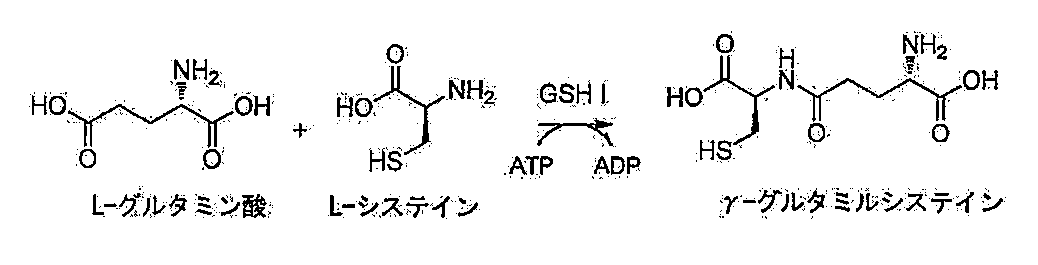

以下に示す実施例2の反応は窒素雰囲気下で実施した。
(γ-グルタミルシステインの生成)


以下に示す実施例の反応は窒素雰囲気下で実施した。
(グルタチオンの生成)

以下に示す比較例1の反応は空気雰囲気下で実施した。
(γ-グルタミルシステインの生成)


以下に示す比較例2の反応は空気雰囲気下で実施した。
(γ-グルタミルシステインの生成)


以下に示す比較例の反応は空気雰囲気下で実施した。
(グルタチオンの生成)

以下に示す反応は窒素雰囲気下で実施した。
(グルタチオンの生成)

配列番号3:プライマー
配列番号5:プライマー
配列番号6:プライマー
Claims (15)
- L-システインとL-グルタミン酸とを、大気よりも酸素濃度が低い雰囲気下で反応させて、γ-グルタミルシステインを生成する工程A’を含むことを特徴とする、γ-グルタミルシステインの製造方法。
- 前記工程A’が、L-システインとL-グルタミン酸とを、大気よりも酸素濃度が低い雰囲気下で、γ-グルタミルシステイン合成酵素及び2機能性グルタチオン合成酵素からなる群から選択される少なくとも1種の酵素のアデノシン三リン酸(ATP)の存在下での作用により反応させて、γ-グルタミルシステインを生成する工程Aである、請求項1に記載の方法。
- 前記工程Aが、アデノシン二リン酸(ADP)をアデノシン三リン酸(ATP)へと再生するATP再生反応と共役させて行われる、請求項2に記載の方法。
- 前記γ-グルタミルシステイン合成酵素がエシェリヒア・コリ(Escherichia coli)由来である、請求項2又は3に記載の方法。
- 前記2機能性グルタチオン合成酵素がストレプトコッカス・アガラクチエ(Streptococcus agalactiae)由来である、請求項2又は3に記載の方法。
- γ-グルタミルシステインとグリシンとを、大気よりも酸素濃度が低い雰囲気下で反応させて、グルタチオンを生成する工程B’を含むことを特徴とする、グルタチオンの製造方法。
- 前記工程B’が、γ-グルタミルシステインとグリシンとを、大気よりも酸素濃度が低い雰囲気下で、グルタチオン合成酵素及び2機能性グルタチオン合成酵素からなる群から選択される少なくとも1種の酵素のアデノシン三リン酸(ATP)の存在下での作用により反応させて、グルタチオンを生成する工程Bである、請求項6に記載の方法。
- 前記工程Bが、アデノシン二リン酸(ADP)をアデノシン三リン酸(ATP)へと再生するATP再生反応と共役させて行われる、請求項7に記載の方法。
- 前記グルタチオン合成酵素がエシェリヒア・コリ(Escherichia coli)由来である、請求項7又は8に記載の方法。
- 前記2機能性グルタチオン合成酵素がストレプトコッカス・アガラクチエ(Streptococcus agalactiae)由来である、請求項7又は8に記載の方法。
- L-システインとL-グルタミン酸とを、大気よりも酸素濃度が低い雰囲気下で反応させて、γ-グルタミルシステインを生成する工程A’を更に含み、
前記工程B’に用いられるγ-グルタミルシステインが、前記工程A’により生成されたものである、
請求項6~10のいずれか1項に記載の方法。 - 前記工程A’が、L-システインとL-グルタミン酸とを、大気よりも酸素濃度が低い雰囲気下で、γ-グルタミルシステイン合成酵素及び2機能性グルタチオン合成酵素からなる群から選択される少なくとも1種の酵素のアデノシン三リン酸(ATP)の存在下での作用により反応させて、γ-グルタミルシステインを生成する工程Aである、
請求項11に記載の方法。 - 前記工程Aが、アデノシン二リン酸(ADP)をアデノシン三リン酸(ATP)へと再生するATP再生反応と共役させて行われる、請求項12に記載の方法。
- 前記γ-グルタミルシステイン合成酵素がエシェリヒア・コリ(Escherichia coli)由来である、請求項12又は13に記載の方法。
- 前記2機能性グルタチオン合成酵素がストレプトコッカス・アガラクチエ(Streptococcus agalactiae)由来である、請求項12又は13に記載の方法。
Priority Applications (3)
| Application Number | Priority Date | Filing Date | Title |
|---|---|---|---|
| JP2016538361A JPWO2016017631A1 (ja) | 2014-07-29 | 2015-07-28 | γ−グルタミルシステイン及びグルタチオンの製造方法 |
| CN201580040909.2A CN106536744A (zh) | 2014-07-29 | 2015-07-28 | γ‑谷氨酰半胱氨酸及谷胱甘肽的制造方法 |
| US15/325,891 US20170211117A1 (en) | 2014-07-29 | 2015-07-28 | Method for producing gamma-glutamylcysteine and glutathione |
Applications Claiming Priority (2)
| Application Number | Priority Date | Filing Date | Title |
|---|---|---|---|
| JP2014-154026 | 2014-07-29 | ||
| JP2014154026 | 2014-07-29 |
Publications (1)
| Publication Number | Publication Date |
|---|---|
| WO2016017631A1 true WO2016017631A1 (ja) | 2016-02-04 |
Family
ID=55217531
Family Applications (1)
| Application Number | Title | Priority Date | Filing Date |
|---|---|---|---|
| PCT/JP2015/071358 Ceased WO2016017631A1 (ja) | 2014-07-29 | 2015-07-28 | γ-グルタミルシステイン及びグルタチオンの製造方法 |
Country Status (4)
| Country | Link |
|---|---|
| US (1) | US20170211117A1 (ja) |
| JP (1) | JPWO2016017631A1 (ja) |
| CN (1) | CN106536744A (ja) |
| WO (1) | WO2016017631A1 (ja) |
Cited By (4)
| Publication number | Priority date | Publication date | Assignee | Title |
|---|---|---|---|---|
| CN106526004A (zh) * | 2016-10-14 | 2017-03-22 | 安琪酵母股份有限公司 | 一种富含谷胱甘肽酵母抽提物中氧化型谷胱甘肽杂质的检测方法 |
| WO2018203482A1 (ja) | 2017-05-01 | 2018-11-08 | 株式会社カネカ | Atpを利用した物質の製造方法 |
| EP3536782A4 (en) * | 2016-11-01 | 2019-10-02 | Kaneka Corporation | ENZYME MODIFIED AND CORRESPONDING USE |
| JP2020000072A (ja) * | 2018-06-27 | 2020-01-09 | 国立大学法人大阪大学 | グルタチオンの製造方法 |
Families Citing this family (6)
| Publication number | Priority date | Publication date | Assignee | Title |
|---|---|---|---|---|
| CN109134594B (zh) * | 2017-06-15 | 2022-06-17 | 安徽古特生物科技有限公司 | 一种酶法制备谷胱甘肽的方法 |
| CN108456664A (zh) * | 2018-03-29 | 2018-08-28 | 上海理工大学 | 一种乳杆菌来源的双功能谷胱甘肽合成酶表达盒及其构建和应用 |
| WO2021002195A1 (ja) * | 2019-07-02 | 2021-01-07 | 天野エンザイム株式会社 | グルタチオンからシステインを生成する方法 |
| CN112779173B (zh) * | 2021-01-06 | 2023-03-14 | 江南大学 | 一种高产谷胱甘肽毕赤酵母菌株g3-sf及其应用 |
| CN113265382B (zh) * | 2021-06-24 | 2023-11-10 | 洛阳华荣生物技术有限公司 | 多聚磷酸激酶突变体 |
| US20250162987A1 (en) * | 2022-04-04 | 2025-05-22 | Children's National Medical Center | Preparation of gamma-glutamylcysteine, a precursor of glutathione |
Citations (3)
| Publication number | Priority date | Publication date | Assignee | Title |
|---|---|---|---|---|
| JPS5577888A (en) * | 1978-12-07 | 1980-06-12 | Takashi Ito | Immobilized gamma-glutamyl-cysteine-synthetase |
| JPS60196197A (ja) * | 1984-03-19 | 1985-10-04 | Kazutomo Imahori | ペプチド又はペプチド誘導体の合成法 |
| JP2012085637A (ja) * | 2010-09-22 | 2012-05-10 | Ajinomoto Co Inc | γ‐Glu‐X‐Yの製造方法 |
Family Cites Families (6)
| Publication number | Priority date | Publication date | Assignee | Title |
|---|---|---|---|---|
| JPS6174595A (ja) * | 1984-09-21 | 1986-04-16 | Kyowa Hakko Kogyo Co Ltd | 物質の製造方法 |
| DE3484389D1 (de) * | 1983-11-15 | 1991-05-08 | Kyowa Hakko Kogyo Kk | Verfahren zur herstellung einer verbindung aus deren vorlaeufer unter verwendung einer enzymatisch aktiven bakterie. |
| JP2005029605A (ja) * | 2003-07-08 | 2005-02-03 | Japan Polyolefins Co Ltd | 難燃樹脂材料およびそれを用いた電線・ケーブル |
| US20080194701A1 (en) * | 2004-12-09 | 2008-08-14 | Owen W Griffith | Bifunctional Enzyme with Y-Glutamylcysteine Synthetase and Glutathione Synthetase Activity and Uses Thereof |
| US8236533B2 (en) * | 2005-03-31 | 2012-08-07 | Newsouth Innovations Pty Limited | Process for the production of γ-glutamylcysteine |
| CN101715490B (zh) * | 2007-04-06 | 2014-02-05 | 协和发酵生化株式会社 | 谷胱甘肽及γ-谷氨酰半胱氨酸的制造方法 |
-
2015
- 2015-07-28 US US15/325,891 patent/US20170211117A1/en not_active Abandoned
- 2015-07-28 CN CN201580040909.2A patent/CN106536744A/zh active Pending
- 2015-07-28 JP JP2016538361A patent/JPWO2016017631A1/ja not_active Ceased
- 2015-07-28 WO PCT/JP2015/071358 patent/WO2016017631A1/ja not_active Ceased
Patent Citations (3)
| Publication number | Priority date | Publication date | Assignee | Title |
|---|---|---|---|---|
| JPS5577888A (en) * | 1978-12-07 | 1980-06-12 | Takashi Ito | Immobilized gamma-glutamyl-cysteine-synthetase |
| JPS60196197A (ja) * | 1984-03-19 | 1985-10-04 | Kazutomo Imahori | ペプチド又はペプチド誘導体の合成法 |
| JP2012085637A (ja) * | 2010-09-22 | 2012-05-10 | Ajinomoto Co Inc | γ‐Glu‐X‐Yの製造方法 |
Non-Patent Citations (1)
| Title |
|---|
| JANOWIAK, B. E. ET AL.: "Glutathione Synthesis in Streptococcus agalactiae ONE PROTEIN ACCOUNTS FOR y- GLUTAMYLCYSTEINE SYNTHETASE AND GLUTATHIONE SYNTHETASE ACTIVITIES", THE JOURNAL OF BIOLOGICAL CHEMISTRY, vol. 280, no. 12, 2005, pages 11829 - 11839, XP055249654, ISSN: 1083-351X, DOI: doi:10.1074/jbc.M414326200 * |
Cited By (7)
| Publication number | Priority date | Publication date | Assignee | Title |
|---|---|---|---|---|
| CN106526004A (zh) * | 2016-10-14 | 2017-03-22 | 安琪酵母股份有限公司 | 一种富含谷胱甘肽酵母抽提物中氧化型谷胱甘肽杂质的检测方法 |
| EP3536782A4 (en) * | 2016-11-01 | 2019-10-02 | Kaneka Corporation | ENZYME MODIFIED AND CORRESPONDING USE |
| WO2018203482A1 (ja) | 2017-05-01 | 2018-11-08 | 株式会社カネカ | Atpを利用した物質の製造方法 |
| JPWO2018203482A1 (ja) * | 2017-05-01 | 2020-03-12 | 株式会社カネカ | Atpを利用した物質の製造方法 |
| JP7098608B2 (ja) | 2017-05-01 | 2022-07-11 | 株式会社カネカ | Atpを利用した物質の製造方法 |
| JP2020000072A (ja) * | 2018-06-27 | 2020-01-09 | 国立大学法人大阪大学 | グルタチオンの製造方法 |
| JP7181712B2 (ja) | 2018-06-27 | 2022-12-01 | 国立大学法人大阪大学 | グルタチオンの製造方法 |
Also Published As
| Publication number | Publication date |
|---|---|
| US20170211117A1 (en) | 2017-07-27 |
| JPWO2016017631A1 (ja) | 2017-04-27 |
| CN106536744A (zh) | 2017-03-22 |
Similar Documents
| Publication | Publication Date | Title |
|---|---|---|
| JPWO2016017631A1 (ja) | γ−グルタミルシステイン及びグルタチオンの製造方法 | |
| JPWO2016002884A1 (ja) | 酸化型γ−グルタミルシステイン及び酸化型グルタチオンの製造方法 | |
| EP1177311B1 (en) | In vitro macromolecule biosynthesis methods using exogenous amino acids and a novel atp regeneration system | |
| EP3564368A1 (en) | Mutant nitrile hydratase, nucleic acid coding said mutant nitrile hydratase, expression vector and transformant including said nucleic acid, production method for said mutant nitrile hydratase, and production method for amide compound | |
| EP3885435A1 (en) | D-amino acid oxidative enzyme mutant and application thereof | |
| JP6146304B2 (ja) | 変異型γ−グルタミルトランスフェラーゼ、及び、γ−グルタミルバリルグリシン又はその塩の製造法 | |
| CN111808829B (zh) | 一种γ-谷氨酰甲胺合成酶突变体及其应用 | |
| EP4700130A1 (en) | Preparation method for alpha-amino acid ester acyl transferase and use thereof in dipeptide synthesis | |
| JP6690529B2 (ja) | γ−グルタミルバリン合成酵素、及び、γ−グルタミルバリルグリシンの製造法 | |
| Arai et al. | A novel L-amino acid ligase is encoded by a gene in the phaseolotoxin biosynthetic gene cluster from Pseudomonas syringae pv. phaseolicola 1448A | |
| JP5516664B2 (ja) | N−アセチル−(R,S)−β−アミノ酸アシラーゼ遺伝子 | |
| WO2009139392A1 (ja) | β-アラニルアミノ酸またはその誘導体の製造方法 | |
| CN118064389A (zh) | 一种双功能谷胱甘肽合成酶及利用其生产谷胱甘肽的方法 | |
| KR101671688B1 (ko) | 효소를 이용하여 pH를 조절하는 무세포 단백질 합성 방법 | |
| JP6394061B2 (ja) | アルカリ性条件下で反応を触媒できるリジン脱炭酸酵素を用いる1,5−ペンタンジアミンの製造方法 | |
| US20240344038A1 (en) | L-arginine-glycine amidinotransferase and use thereof in the production of guanidinoacetic acid | |
| JP5099881B2 (ja) | 高効率無細胞蛋白質合成系 | |
| CN107109446A (zh) | 顺式‑5‑羟基‑l‑哌可酸的制造方法 | |
| CN106893748B (zh) | 一种l-茶氨酸的合成方法 | |
| US8372607B2 (en) | Method for producing serine derivative and protein used for the same | |
| JP5119783B2 (ja) | N−アセチル−(R,S)−β−アミノ酸アシラーゼ遺伝子 | |
| JP6286036B2 (ja) | 人工補因子の合成のためのs−アデノシルメチオニン(sam)シンターゼ変異体 | |
| JPWO2002040682A1 (ja) | コエンザイムq10の製造法 | |
| CN112055751B (zh) | 修饰型酯酶和其用途 | |
| JP2014057545A (ja) | リガーゼ及びそれを用いたペプチドの製造方法 |
Legal Events
| Date | Code | Title | Description |
|---|---|---|---|
| 121 | Ep: the epo has been informed by wipo that ep was designated in this application |
Ref document number: 15827720 Country of ref document: EP Kind code of ref document: A1 |
|
| ENP | Entry into the national phase |
Ref document number: 2016538361 Country of ref document: JP Kind code of ref document: A |
|
| WWE | Wipo information: entry into national phase |
Ref document number: 15325891 Country of ref document: US |
|
| NENP | Non-entry into the national phase |
Ref country code: DE |
|
| 122 | Ep: pct application non-entry in european phase |
Ref document number: 15827720 Country of ref document: EP Kind code of ref document: A1 |