WO2016009979A1 - 金属酸化物粒子分散液、金属酸化物粒子含有組成物、塗膜、および表示装置 - Google Patents
金属酸化物粒子分散液、金属酸化物粒子含有組成物、塗膜、および表示装置 Download PDFInfo
- Publication number
- WO2016009979A1 WO2016009979A1 PCT/JP2015/069987 JP2015069987W WO2016009979A1 WO 2016009979 A1 WO2016009979 A1 WO 2016009979A1 JP 2015069987 W JP2015069987 W JP 2015069987W WO 2016009979 A1 WO2016009979 A1 WO 2016009979A1
- Authority
- WO
- WIPO (PCT)
- Prior art keywords
- metal oxide
- oxide particle
- mass
- particle dispersion
- oxide particles
- Prior art date
- Legal status (The legal status is an assumption and is not a legal conclusion. Google has not performed a legal analysis and makes no representation as to the accuracy of the status listed.)
- Ceased
Links
Classifications
-
- C—CHEMISTRY; METALLURGY
- C09—DYES; PAINTS; POLISHES; NATURAL RESINS; ADHESIVES; COMPOSITIONS NOT OTHERWISE PROVIDED FOR; APPLICATIONS OF MATERIALS NOT OTHERWISE PROVIDED FOR
- C09D—COATING COMPOSITIONS, e.g. PAINTS, VARNISHES OR LACQUERS; FILLING PASTES; CHEMICAL PAINT OR INK REMOVERS; INKS; CORRECTING FLUIDS; WOODSTAINS; PASTES OR SOLIDS FOR COLOURING OR PRINTING; USE OF MATERIALS THEREFOR
- C09D17/00—Pigment pastes, e.g. for mixing in paints
- C09D17/004—Pigment pastes, e.g. for mixing in paints containing an inorganic pigment
- C09D17/007—Metal oxide
-
- C—CHEMISTRY; METALLURGY
- C01—INORGANIC CHEMISTRY
- C01G—COMPOUNDS CONTAINING METALS NOT COVERED BY SUBCLASSES C01D OR C01F
- C01G25/00—Compounds of zirconium
- C01G25/02—Oxides
-
- C—CHEMISTRY; METALLURGY
- C09—DYES; PAINTS; POLISHES; NATURAL RESINS; ADHESIVES; COMPOSITIONS NOT OTHERWISE PROVIDED FOR; APPLICATIONS OF MATERIALS NOT OTHERWISE PROVIDED FOR
- C09D—COATING COMPOSITIONS, e.g. PAINTS, VARNISHES OR LACQUERS; FILLING PASTES; CHEMICAL PAINT OR INK REMOVERS; INKS; CORRECTING FLUIDS; WOODSTAINS; PASTES OR SOLIDS FOR COLOURING OR PRINTING; USE OF MATERIALS THEREFOR
- C09D17/00—Pigment pastes, e.g. for mixing in paints
-
- C—CHEMISTRY; METALLURGY
- C09—DYES; PAINTS; POLISHES; NATURAL RESINS; ADHESIVES; COMPOSITIONS NOT OTHERWISE PROVIDED FOR; APPLICATIONS OF MATERIALS NOT OTHERWISE PROVIDED FOR
- C09D—COATING COMPOSITIONS, e.g. PAINTS, VARNISHES OR LACQUERS; FILLING PASTES; CHEMICAL PAINT OR INK REMOVERS; INKS; CORRECTING FLUIDS; WOODSTAINS; PASTES OR SOLIDS FOR COLOURING OR PRINTING; USE OF MATERIALS THEREFOR
- C09D17/00—Pigment pastes, e.g. for mixing in paints
- C09D17/002—Pigment pastes, e.g. for mixing in paints in organic medium
-
- C—CHEMISTRY; METALLURGY
- C09—DYES; PAINTS; POLISHES; NATURAL RESINS; ADHESIVES; COMPOSITIONS NOT OTHERWISE PROVIDED FOR; APPLICATIONS OF MATERIALS NOT OTHERWISE PROVIDED FOR
- C09D—COATING COMPOSITIONS, e.g. PAINTS, VARNISHES OR LACQUERS; FILLING PASTES; CHEMICAL PAINT OR INK REMOVERS; INKS; CORRECTING FLUIDS; WOODSTAINS; PASTES OR SOLIDS FOR COLOURING OR PRINTING; USE OF MATERIALS THEREFOR
- C09D201/00—Coating compositions based on unspecified macromolecular compounds
-
- C—CHEMISTRY; METALLURGY
- C09—DYES; PAINTS; POLISHES; NATURAL RESINS; ADHESIVES; COMPOSITIONS NOT OTHERWISE PROVIDED FOR; APPLICATIONS OF MATERIALS NOT OTHERWISE PROVIDED FOR
- C09D—COATING COMPOSITIONS, e.g. PAINTS, VARNISHES OR LACQUERS; FILLING PASTES; CHEMICAL PAINT OR INK REMOVERS; INKS; CORRECTING FLUIDS; WOODSTAINS; PASTES OR SOLIDS FOR COLOURING OR PRINTING; USE OF MATERIALS THEREFOR
- C09D7/00—Features of coating compositions, not provided for in group C09D5/00; Processes for incorporating ingredients in coating compositions
- C09D7/40—Additives
Definitions
- the present invention relates to a metal oxide particle dispersion, a metal oxide particle-containing composition, a coating film, and a display device.
- Metal oxide particles are used for the purpose of adjusting the refractive index, imparting functionality such as conductivity, antistatic properties, ultraviolet shielding properties, heat ray shielding properties, electromagnetic wave shielding properties, and improving mechanical strength. It is used by being dispersed in a substrate or the like.
- a functional film of a plastic substrate used in a display device such as a liquid crystal display (LCD), a plasma display (PDP), or an electroluminescence display (EL) requires transparency, refractive index, mechanical properties, and the like. . Therefore, a functional film is formed by applying a composition obtained by mixing a resin substrate with inorganic oxide particles such as zirconia having a high refractive index and a resin on a plastic substrate (see, for example, Patent Document 1). ).
- metal oxide particles antimony-doped tin oxide (ATO) or tin-doped indium oxide (ITO) particles provide a heat ray shielding coating solution and a heat ray shielding film excellent in visible light transmittance and heat ray shielding properties.
- ATO antimony-doped tin oxide
- ITO tin-doped indium oxide
- metal oxide particles zinc oxide particles are used to obtain a highly transparent gas barrier laminate (see, for example, Patent Document 3).
- the metal oxide particles are used in a state of a metal oxide particle dispersion liquid previously dispersed in a solvent and mixed in a paint or a resin monomer.
- the step of drying the coating film, the step of removing the solvent, and the like the target paint, coating film, base material, etc. are required to exhibit excellent dispersibility.
- the refractive index of the metal oxide particles is 1.9 or more, the optical characteristics (transparency, etc.) of the paint, coating film, base material, etc.
- the product particle dispersion is required to have high dispersibility and stability.
- a method for dispersing metal oxide particles in a solvent a method is known in which the surface of metal oxide particles is treated with an organosilicon compound having a group that generates a silanol group by hydrolysis of a silane coupling agent or the like. (For example, see Patent Documents 4 to 6).
- the metal oxide particles are made of epoxy resin (10.9), acrylic resin (9.5), polystyrene (8.5 to 10.3), urethane resin (10 to 11), phenol resin (11.5), cellulose.
- a medium polarity resin such as resin (10-12), polyester resin (10-11), epoxy resin (10-11), etc. Is designed so that the SP value of the dispersion medium in the dispersion is adjusted to the same level as the SP value of the resin so that the surface-treated metal oxide particles have a good affinity for both the dispersion medium and the resin. There was a need to do.
- the present invention has been made in view of the above circumstances, and provides a metal oxide particle dispersion, a metal oxide particle-containing composition, a coating film, and a display device that have high transparency and excellent stability over time. For the purpose.
- the present inventors have a silanol group when an amine having 2 or more carbon atoms is used as a reaction catalyst in a medium-polar organic solvent, Alternatively, the surface treatment reaction of metal oxide particles by an organosilicon compound having a group that generates a silanol group by hydrolysis proceeds with a small amount of water (water content), so transparency is high and stability over time is improved.
- the inventors have found that an excellent metal oxide particle dispersion can be obtained, and have completed the present invention.
- the present invention provides a metal oxide particle dispersion liquid in which metal oxide particles surface-treated with a silicon compound represented by the following general formula (1) are dispersed in a solvent.
- the metal oxide particle dispersion further contains an amine having 2 or more carbon atoms, The average primary particle diameter of the metal oxide particles is 3 nm or more and 20 nm or less, the refractive index is 1.9 or more,
- the solvent contains 70% by mass or more of an organic solvent,
- the solubility parameter of the organic solvent is 8.0 or more and 12 or less, the solubility in water is 1.5 g / 100 ml or more,
- a metal oxide particle dispersion is provided, wherein the water content is 3% by mass or less of the content of the metal oxide particles.
- the present invention provides a metal oxide particle-containing composition comprising the metal oxide particle dispersion of the present invention and a binder component.
- the present invention provides a coating film characterized by being formed using the metal oxide particle-containing composition of the present invention.
- the present invention provides a display device comprising the coating film of the present invention.
- the metal oxide particle dispersion of the present invention has high transparency, excellent dispersion stability of the metal oxide particles, and excellent stability of the dispersion for long-term storage.
- the metal oxide particle-containing composition of the present invention contains the metal oxide particle dispersion of the present invention that is highly transparent and excellent in dispersion stability of the metal oxide particles. For this reason, it is excellent in the dispersion stability of a metal oxide particle, and is excellent in the stability of long-term storage of a composition.
- the coating film of the present invention is formed using the metal oxide particle-containing composition of the present invention. For this reason, the coating film excellent in transparency can be obtained.
- the display device of the present invention includes the coating film of the present invention that is excellent in transparency. For this reason, it is excellent in visibility.
- the metal oxide particle dispersion of the present embodiment is surface-treated with a silicon compound represented by the following general formula (1), the average primary particle diameter is 3 nm or more and 20 nm or less, and the refractive index is 1.9 or more.
- This is a product particle dispersion, which contains an amine having 2 or more carbon atoms, and the water content is 3% by mass or less of the content of the metal oxide particles.
- Metal oxide particles The metal oxide particles in the present embodiment are not particularly limited as long as the refractive index is a metal oxide particle having a refractive index of 1.9 or more.
- the refractive index is a metal oxide particle having a refractive index of 1.9 or more.
- Metal oxide particles containing one or more metal elements selected from the group of niobium, tungsten, europium and hafnium are preferably used.
- Examples of the metal oxide particles composed of one kind of metal element include: Zirconium (IV) oxide (ZrO 2 : refractive index 2.05 to 2.4), Zinc (II) oxide (ZnO: refractive index 2.01 to 2.1), Iron (III) oxide (Fe 2 O 3 : refractive index 3.01), Copper (I) oxide (Cu 2 O: refractive index 2.71), Titanium (IV) oxide (TiO 2 : refractive index 2.3 to 2.7), Tin oxide (IV) (SnO 2 : refractive index 2.00), Cerium (IV) oxide (CeO 2 : refractive index 2.1), Tantalum oxide (V) (Ta 2 O 5 : refractive index 2.2), Niobium oxide (V) (Nb 2 O 5 : refractive index 2.4), Tungsten oxide (VI) (WO 3 : refractive index 2.2), Europium (III) oxide (Eu 2 O 3 : refractive index 1.98), Hafnium (IV) oxide
- metal oxide particles composed of two kinds of metal elements include: Potassium titanate (K 2 Ti 6 O 13 : refractive index 2.68), Barium titanate (BaTiO 3 : refractive index 2.3 to 2.5), Strontium titanate (SrTiO 3 : refractive index 2.37), Potassium niobate (KNbO 3 : refractive index 2.17), Lithium niobate (LiNbO 3 : refractive index 2.35), Calcium tungstate (CaWO 4 : refractive index 1.91), Antimony-added tin oxide (ATO; Sb solid solution SnO 2 : refractive index 1.95 to 2.05), indium added tin oxide (ITO; In solid solution SnO 2 : refractive index 1.95 to 2.05), etc. are suitable Used for.
- K 2 Ti 6 O 13 refractive index 2.68
- Barium titanate BaTiO 3 : refractive index 2.3 to 2.5
- zirconium oxide (IV), zinc oxide (II), titanium oxide (IV), antimony-added tin oxide, and indium-added tin oxide are more preferably used from the viewpoint of raw material costs and manufacturing costs.
- Zirconium (IV) oxide is more preferably used because it is less likely to be colored by absorption / scattering around 400 nm.
- the average primary particle diameter of the metal oxide particles is 3 nm or more and 20 nm or less, preferably 8 nm or more and 20 nm or less, more preferably 10 nm or more and 15 nm or less. If the average primary particle diameter of the metal oxide particles is less than 3 nm, the crystallinity of the metal oxide particles is low, and the target refractive index may not be obtained. In addition, when the metal oxide particles are dispersed in a solvent, the metal oxide particles are likely to aggregate, and thus a highly transparent dispersion may not be obtained.
- the specific surface area of the metal oxide particles becomes large, the amount of silicon compound necessary for obtaining a dispersion increases, and there is a possibility that a sufficient refractive index as the surface-treated metal oxide particles cannot be obtained.
- the average primary particle diameter exceeds 20 nm, the dispersed particle diameter when the metal oxide particles are dispersed in the solvent is increased, and a highly transparent dispersion liquid may not be obtained.
- the “average primary particle size” means the particle size of each individual particle.
- the major axis of each metal oxide particle for example, each of 100 or more metal oxide particles.
- SEM scanning electron microscope
- TEM transmission electron microscope
- a method of measuring the major axis, preferably the major axis of each of the 500 metal oxide particles, and calculating the arithmetic average value thereof can be mentioned.
- the specific surface area of the metal oxide particles is preferably 70m 2 / g or more and is 95 m 2 / g or less.
- the larger the specific surface area of the metal oxide particles the greater the amount of silicon compound and the amount of water necessary for the surface treatment.
- the silicon compound in this embodiment is represented by the general formula (1). That is, the silicon compound in the present embodiment is an organosilicon compound having a silanol group or a group that generates a silanol group by hydrolysis.
- R in the general formula (1) is preferably a hydrogen atom or an alkyl group having 1 to 22 carbon atoms.
- the alkyl group may be linear, branched or cyclic. When the alkyl group is cyclic, it may be monocyclic or polycyclic.
- the alkyl group preferably has 1 to 22 carbon atoms. However, in order to obtain a compound having higher affinity for the solvent described later, the alkyl group must have 1 to 6 carbon atoms. More preferred.
- the linear or branched alkyl group preferably has 1 to 22 carbon atoms.
- alkyl group include a methyl group, an ethyl group, an n-propyl group, an isopropyl group, n -Butyl group, isobutyl group, sec-butyl group, tert-butyl group, n-pentyl group, isopentyl group, neopentyl group, tert-pentyl group, 1-methylbutyl group, n-hexyl group, 2-methylpentyl group, 3 -Methylpentyl group, 2,2-dimethylbutyl group, 2,3-dimethylbutyl group, n-heptyl group, 2-methylhexyl group, 3-methylhexyl group, 2,2-dimethylpentyl group, 2,3- Dimethylpentyl group, 2,4-dimethylpentyl group, 3,3-dimethylpentyl group
- the cyclic alkyl group preferably has 1 to 22 carbon atoms, and preferably 3 to 10 carbon atoms.
- Examples of such a cyclic alkyl group include a cyclopropyl group, a cyclobutyl group, a cyclopentyl group, a cyclohexyl group, a cycloheptyl group, a cyclooctyl group, a cyclononyl group, a cyclodecyl group, a norbornyl group, an isobornyl group, a 1-adamantyl group, And 2-adamantyl group.
- examples of the alkyl group include those in which one or more hydrogen atoms of these cyclic alkyl groups are substituted with a linear, branched or cyclic alkyl group.
- the cyclic alkyl group further preferably has 3 or more and 6 or less carbon atoms from the viewpoint of affinity for the solvent described later.
- one or two or more hydrogen atoms in the alkyl group may be optionally substituted with a halogen atom.
- halogen atom substituted for the hydrogen atom include a fluorine atom, a chlorine atom, a bromine atom, and an iodine atom.
- R ′ in the general formula (1) is an organic group. What is necessary is just to select suitably in consideration of affinity with the solvent mentioned later. Examples include acryloyl group, methacryloyl group, vinyl group, propyl group, butadienyl group, styryl group, ethynyl group, cinnamoyl group, maleate group, acrylamide group, amino group, allyl group, epoxy group, glycidoxy group and the like.
- the organic group is preferably a functional group having a polymerizable unsaturated group.
- the polymerizable unsaturated group is not particularly limited, and examples thereof include acryloyl group, methacryloyl group, vinyl group, propenyl group, butadienyl group, styryl group, ethynyl group, cinnamoyl group, maleate group, and acrylamide group. These polymerizable unsaturated groups are structural units that undergo addition polymerization with active radical species.
- Examples of the silicon compound represented by the general formula (1) include compounds in which an alkoxy group such as a methoxy group, an ethoxy group, and an isopropoxy group, an aryloxy group, an acetoxy group, an amino group, or a halogen atom is bonded to a silicon atom. Is mentioned. Among these, a compound in which an alkoxy group is bonded to a silicon atom, that is, an organoalkoxysilane is particularly preferable.
- silicon compound represented by the general formula (1) examples include vinyltrimethoxysilane, vinyltriethoxysilane, 2- (3,4-epoxycyclohexyl) ethyltrimethoxysilane, and 3-glycidoxypropyl.
- the silicon compound represented by the general formula (1) has a polymerizable unsaturated group such as acryloyl group, methacryloyl group, vinyl group, propenyl group, butadienyl group, styryl group, ethynyl group, cinnamoyl group, maleate group, and acrylamide group. It is preferable that the functional group which has is included. In this case, since it can be combined with a resin or the like, when the metal oxide particle dispersion of this embodiment is blended in a paint or the like and a coating film is produced, the metal oxide particles are unlikely to aggregate.
- the surface treatment of the metal oxide particles with the silicon compound may be performed as long as the silicon compound and the metal oxide particles interact with each other and are bonded to each other. They may be bound by a covalent bond, or may be bound by a non-covalent bond such as physical adsorption. Moreover, after pre-hydrolyzing metal oxide particles and allowing some or all of the hydrolysis to proceed, the metal oxide particles may be surface-treated with a silicon compound.
- Organic solvent contains 70% by mass or more and 80% by mass of an organic solvent having a solubility parameter (SP value) of 8.0 or more and 12 or less and a solubility in water of 1.5 g / 100 ml or more. It is preferable to contain above, and it is more preferable to contain 90 mass% or more.
- SP value solubility parameter
- the content of the organic solvent is less than 70% by mass, when forming a coating film using the metal oxide particle dispersion of this embodiment, or when removing the solvent from the metal oxide particle dispersion of this embodiment.
- the metal oxide particles may aggregate or gel.
- water necessary for hydrolysis of the silicon compound cannot be dissolved.
- the volatilization rate is increased when a coating film is formed using the paint or when the solvent is removed from the paint. There is a risk of segregation of product particles.
- the metal oxide particle dispersion of the present embodiment is converted into an epoxy resin (SP value: 10.9), an acrylic resin (SP value: 9.5), polystyrene (SP). Value: 8.5 to 10.3), urethane resin (SP value: 10 to 11), phenol resin (SP value: 11.5), cellulose resin (SP value: 10 to 12), polyester resin (SP value: 10 to 11) and epoxy resins (SP value: 10 to 11), and can be suitably blended with resins having a medium polarity (SP value: 8.5 to 12).
- the solubility parameter of the organic solvent when the solubility parameter of the organic solvent is not in the above range, the difference in polarity between the metal oxide particle dispersion of the present embodiment and the above resin may increase, and it may be difficult to obtain a transparent paint. is there. Further, when forming a coating film using a paint containing the metal oxide particle dispersion of this embodiment, or when removing the solvent from the paint, the metal oxide particles may agglomerate or gel. is there.
- Examples of the organic solvent in the present embodiment include methyl isobutyl ketone (SP value: 8.4), butyl acetate (SP value: 8.5), ethyl acrylate (SP value: 8.6), diacetone alcohol ( SP value: 9.2), methyl ethyl ketone (SP value: 9.3), cyclohexanone (SP value: 9.9), 1-methoxy-2-propanol (SP value: 9.5), dodecanol (SP value: 9) 8-10.3), cyclopentanone (SP value: 10.4), 2,3-butanediol (SP value: 11.1), 1-propanol (SP value: 11.9), and the like. .
- the solubility parameter ((cal / cm) 1/2 ) is, for example, J. It can be calculated by the method described in VII 675 to 713 of “Polymer Handbook fourth edition” by Brandrup et al. (Especially formulas B3 and B8). In addition, the values in Table 1 (VII 711), Table 7 (VII 688-694), and Table 8 (VII 694-697) in the above document can be used.
- the boiling point of the organic solvent is preferably 80 ° C. or higher. If the boiling point of the organic solvent is 80 ° C. or higher, the metal oxide particle dispersion of this embodiment is blended into the paint, and then the solvent is removed from the paint when forming a coating film using the paint. In this case, an appropriate volatilization rate is obtained and segregation of the metal oxide particles can be suppressed.
- Examples of the organic solvent having a solubility parameter of 8.0 or more and 12 or less and a solubility in water of 1.5 g / 100 ml or more include methyl isobutyl ketone (MIBK), cyclohexanone, diacetone alcohol, 1-methoxy- Examples include 2-propanol (PGM), isopropanol, methyl ethyl ketone (MEK), and ethyl acetate.
- a solvent having a solubility parameter of 8.0 or more and 12 or less and a solubility in water of 1.5 g / 100 ml or more may be used alone, or a mixed solvent in which two or more kinds are mixed. May be.
- the solvent in the present embodiment removes the solvent from the coating speed and the drying speed when forming a coating film using a paint containing the metal oxide particle dispersion liquid of the present embodiment in addition to the organic solvent described above.
- a high boiling point solvent, a dispersing agent or the like may be included.
- This high boiling point solvent is also preferably a solvent having a solubility parameter of 8.0 or more and 12 or less and a solubility in water of 1.5 g / 100 ml or more.
- the organic solvent contained in the metal oxide particle dispersion is preferably a solvent having a solubility parameter of 8.0 or more and 12 or less and a solubility in water of 1.5 g / 100 ml or more.
- the solubility parameter is 8.0 or more and 12 or less
- the organic solvent other than the organic solvent whose solubility in water is 1.5 g / 100 ml or more
- the organic solvent may be contained.
- the amine having 2 or more carbon atoms in the present embodiment plays a role as a catalyst in the surface treatment of the metal oxide particles by the silicon compound.
- the amine having 2 or more carbon atoms in the present embodiment also serves as a dispersant for the metal oxide particles, and suppresses the progress of the surface treatment reaction in a state where the metal oxide particles are aggregated.
- amines with 2 or more carbon atoms have their substituents interacting with the metal oxide particles, so the hydrolysis reaction proceeds on the surface of the metal oxide particles and the progress of condensation between silicon compounds is suppressed. And it plays the role of facilitating the surface treatment reaction of the metal oxide particles by the silicon compound. Therefore, the amine in this embodiment preferably has 6 or more carbon atoms, and more preferably has 10 or more carbon atoms.
- Examples of the amine having 2 or more carbon atoms in the present embodiment include alkanolamines such as monoethanolamine, diethanolamine, triethanolamine, monoisopropanolamine, diisopropanolamine, and triisopropanolamine; monoethylamine, diethylamine, Aliphatic polyamines such as triethylamine, ethylenediamine, isopropylamine, diethylenetriamine, 2-ethylhexylamine, triethylenetetramine, and tetraethylenepentamine; aniline, o-toluidine, methylene orthochloramine, 4,4'-diphenylmethanediamine, 2, Aromatic polyamines such as 4'-tolylenediamine, 2,6'-tolylenediamine, and 4-aminobenzoic acid; polyaminoamides, polyamides And the like; key role polyaminoamide, polyoxyethylene alkyl amines, polyester polyamines, and polymers having an amino
- polymers having amino groups such as polyaminoamide and polyalkylolaminoamide that also have a function as a dispersibility / dispersion aid of the metal oxide particles are preferable. .
- the product of the amine value of an amine having 2 or more carbon atoms and the content of the amine having 2 or more carbon atoms that is, (amine value of an amine having 2 or more carbon atoms) ⁇ (metal of this embodiment)
- the content (mass%) of the amine having 2 or more carbon atoms with respect to the whole oxide particle dispersion is preferably 10 or more and 45 or less, and more preferably 25 or more and 42 or less. If the product of the amine value of an amine having 2 or more carbon atoms and the content of an amine having 2 or more carbon atoms is less than 10, the amount of amine as a reaction catalyst is small, so the hydrolysis reaction of the silicon compound May not progress sufficiently.
- the content of water in the metal oxide particle dispersion of this embodiment is 3% by mass or less of the content of metal oxide particles. That is, when the content of the metal oxide particles in the metal oxide particle dispersion is 100% by mass, the content of water in the metal oxide particle dispersion is 3% by mass of the content of the metal oxide particles. It is as follows. If the water content exceeds 3% by mass of the metal oxide particle content, the temporal stability in the metal oxide particle dispersion may be impaired.
- the metal oxide particle dispersion of this embodiment is blended with a paint containing a resin with a medium polarity (SP value: 8.5 to 12), and a coating film is formed using the paint.
- the solubility parameter of water is as high as 23.4
- the polarity in the coating becomes higher as the solvent evaporates from the coating film.
- metal oxide particles may aggregate or segregate.
- the stability over time of the metal oxide particle dispersion of the present embodiment means that the metal oxide particles are less likely to aggregate over time, and the metal oxide particles are stably dispersed in the solvent over a long period of time. It is the performance to do.
- the metal oxide particle dispersion liquid of this embodiment contains an amount of water necessary for the hydrolysis of the silicon compound
- the water content is preferably as small as possible.
- the content of water in the metal oxide particle dispersion is preferably 1.2% by mass or less based on the entire metal oxide particle dispersion.
- the temporal stability of the metal oxide particle dispersion can be further improved.
- the content of water necessary for the hydrolysis of the silicon compound is an amount by which hydrolysis necessary for the surface treatment of the metal oxide particles with the silicon compound proceeds, and all the hydrolysis proceeds (hydrolysis).
- the water content may be less than that required for a rate of 100%).
- attached water of metal oxide particles and bound water can be used for the surface treatment reaction.
- the content of the metal oxide particles in the metal oxide particle dispersion of the present embodiment is preferably 10% by mass or more and 60% by mass or less with respect to the entire metal oxide particle dispersion of the present embodiment. 20 mass% or more and 50 mass% or less is more preferable, and 30 mass% or more and 50 mass% or less is further more preferable. If the content of the metal oxide particles in the metal oxide particle dispersion is 10% by mass or more, the amount of the solvent in the paint is an appropriate amount when the metal oxide particle dispersion is used in a paint or the like. Therefore, the cost of the solvent can be suppressed. Moreover, the cost at the time of removing a solvent from the coating film formed using the coating material can also be suppressed.
- the content of the metal oxide particles is 60% by mass or less, an appropriate interaction between the metal oxide particles can be obtained.
- inconveniences such as increase in the viscosity of the metal oxide particle dispersion or gelation of the metal oxide particle dispersion are unlikely to occur, and the excellent temporal stability of the metal oxide particle dispersion can be maintained.
- ⁇ ⁇ 1 (generally ⁇ ⁇ 0.4) in the following formula (2)
- the light scattering by the metal oxide particles is Rayleigh scattering.
- the dispersed particle diameter of the metal oxide particles in the metal oxide particle dispersion is larger than the wavelength of light, light scattering by the metal oxide particles is Mie scattering.
- ⁇ ⁇ ⁇ D / ⁇ (2)
- ⁇ is a particle size parameter
- D is a dispersed particle size of metal oxide particles
- ⁇ is a wavelength of light.
- the dispersed particle diameter of the metal oxide particles exceeds about 50 nm, Mie scattering with higher scattering intensity is performed instead of Rayleigh scattering. Since the scattering intensity depends not only on the dispersed particle diameter of the metal oxide particles but also on the refractive index of the metal oxide particles, in particular, the metal oxide particle dispersion including metal oxide particles having a refractive index of 1.9 or more. In order to increase the transparency of the liquid, it is important to maintain the dispersed particle size of the metal oxide particles at about 50 nm or less.
- the particle size (D90) when the cumulative volume percentage of the particle size distribution of the metal oxide particle dispersion of this embodiment is 90% is preferably 60 nm or less, and preferably 50 nm or less. More preferred. If the particle size (D90) when the cumulative volume percentage of the particle size distribution of the metal oxide particle dispersion is 90% is 60 nm or less, the transparency of the metal oxide particle dispersion can be further increased.
- the particle size distribution (D90) when the cumulative volume percentage of the particle size distribution is 90% is used in the metal oxide particle dispersion of this embodiment.
- the value divided by the particle size (D50) when the cumulative volume percentage is 50% is preferably 3 or less, and more preferably 2 or less.
- the metal oxide containing metal oxide particles having an average primary particle diameter of 10 nm or more and 20 nm or more.
- D90 / D50 is 3 or less.
- the lower limit of D90 / D50 is 1 or more.
- the metal oxide particle dispersion of the present embodiment has a liquid haze value of preferably 35% or less, more preferably 27% or less, and preferably 22% or less when measured on the basis of air. Further preferred. If the liquid haze value of the metal oxide particle dispersion is 35% or less, the coating film formed using the paint by mixing the metal oxide particle dispersion in the paint has an appropriate light scattering, The coating is suitable for specifications in optical applications. Moreover, when it is used as a protective layer or the like, there is no risk of impairing the design of the underlayer.
- the metal oxide particle dispersion of this embodiment preferably has a liquid haze value of 35% or less when the content of metal oxide particles is 30% by mass and the optical path length is 2 mm. % Or less is more preferable, and 22% or less is more preferable.
- the metal oxide particle content is 30% by mass and the optical path length is 2 mm
- the liquid haze value of the metal oxide particle dispersion is 35% or less, the metal oxide particle dispersion is applied to the paint.
- the coating film formed by blending and using the coating material has moderate scattering of light, and the coating film is suitable for specifications in optical applications. Further, when used as a protective layer or the like, there is no risk of impairing the design of the underlayer.
- the liquid haze value is preferably 25% or less when the content of the metal oxide particles is 10% by mass and the optical path length is 2 mm. % Or less is more preferable, and 15% or less is still more preferable.
- the metal oxide particle content is 10% by mass and the optical path length is 2 mm
- the liquid haze value of the metal oxide particle dispersion is 25% or less, the metal oxide particle dispersion is added to the paint.
- the coating film formed using the coating material has moderate light scattering, and the coating film is suitable for the specifications for optical applications. Further, when used as a protective layer or the like, there is no risk of impairing the design of the underlayer.
- the “haze value” is a ratio (%) of diffuse transmitted light to total light transmitted light.
- the “liquid haze value” is a haze value of the metal oxide particle dispersion measured with a haze meter (trade name: HAZE METER TC-H3DP, manufactured by Tokyo Denshoku Co., Ltd.) using a 2 mm cuvette.
- the metal oxide particle dispersion of the present embodiment may contain other components such as a dispersant, a photosensitizer, and a resin.
- a bead mill, a ball mill, a homogenizer, a disper, a stirrer and the like using the above media are preferably used.
- amine or water may be added to the suspension, or may be added during the surface treatment reaction of the metal oxide particles.
- amine or water can be added stepwise or continuously in order to adjust the reaction rate of the surface treatment reaction of the metal oxide particles.
- a bead mill, a ball mill, a homogenizer, a disper, a stirrer, or the like using media such as zirconia beads is preferably used.
- amine or water can be added stepwise or continuously in order to adjust the reaction rate of the surface treatment reaction of the metal oxide particles.
- an amine having 2 or more carbon atoms is used as a reaction catalyst in a medium polarity organic solvent without using a binder.
- the metal oxide particles can be surface-treated with the silicon compound by an interaction such as a covalent bond between the silicon compound represented by (II) and the metal oxide particles.
- a metal oxide particle dispersion having high transparency, excellent dispersion stability of the metal oxide particles, and excellent long-term storage stability of the dispersion can be obtained.
- the metal oxide particle-containing composition of the present embodiment comprises the metal oxide particle dispersion liquid of the present embodiment and a binder component.
- Binder component Although a binder component is not specifically limited, for example, a resin monomer, a resin oligomer, a resin polymer, an organosilicon compound, its polymer, etc. can be used conveniently.
- the binder component in applications such as a display device is not particularly limited as long as it is a monomer, oligomer, or polymer of a curable resin used for a general hard coat film.
- a polymer may be used and a monomer or oligomer of a thermosetting resin may be used.
- the monomer of the photocurable resin include radical polymerization monomers such as monofunctional acrylate, bifunctional acrylate, trifunctional acrylate, and 4-6 functional acrylate, alicyclic epoxy resin, glycidyl ether epoxy resin, urethane vinyl ether, And cationic polymerization monomers such as polyester vinyl ether.
- photocurable resin oligomers and polymers examples include, for example, epoxy acrylate, urethane acrylate, polyester acrylate, copolymer acrylate, polybutadiene acrylate, silicon acrylate, amino resin acrylate, and other radical polymerization oligomers, polymers, and alicyclic epoxies.
- examples thereof include cationic polymerization oligomers and polymers such as resins, glycidyl ether epoxy resins, urethane vinyl ethers, and polyester vinyl ethers.
- radically polymerizable monomers, oligomers, and polymers that can be easily blended with a plurality of components and can suppress a curing failure by using a photoinitiator and a light stabilizer are preferably used.
- a radical polymerization polyfunctional monomer such as dipentaristol hexaacrylate is preferably used.
- radical polymerization oligomers and polymers such as urethane acrylate are preferably used.
- the monomers, oligomers and polymers of these photopolymerizable resins can be used alone, or two or more kinds can be mixed and used in accordance with the required function.
- Examples of the functional group other than the acryloyl group and methacryloyl group of the polyfunctional monomer include a vinyl group, an allyl group, an allyl ether group, a styryl group, and a hydroxyl group.
- polyfunctional acrylate examples include, for example, (meth) trimethylolpropane triacrylate, (meth) ditrimethylolpropane tetraacrylate, (meth) pentaerythritol triacrylate, (meth) pentaerythritol tetraacrylate, (meth) dipenta
- polyol polyacrylates such as erythritol hexaacrylate, epoxy (meth) acrylates, polyester (meth) acrylates, urethane acrylates, and polysiloxane acrylates. These polyfunctional acrylates may be used alone or in combination of two or more.
- the functional group has one or two functional groups as long as the effects of the invention are not inhibited, and monomers, oligomers, dispersants not included in the above-mentioned monomers, Polymerization initiator, antistatic agent, refractive index regulator, antioxidant, ultraviolet absorber, light stabilizer, leveling agent, antifoaming agent, inorganic filler, coupling agent, preservative, plasticizer, flow regulator
- various general additives such as a thickener, a pH adjuster, and a polymerization initiator may be appropriately contained.
- dispersant examples include anionic surfactants such as sulfate esters, carboxylic acids, and polycarboxylic acids, cationic surfactants such as quaternary salts of higher aliphatic amines, higher fatty acid polyethylene glycol esters, and the like.
- anionic surfactants such as sulfate esters, carboxylic acids, and polycarboxylic acids
- cationic surfactants such as quaternary salts of higher aliphatic amines, higher fatty acid polyethylene glycol esters, and the like.
- Nonionic surfactants silicon surfactants, fluorine surfactants, polymer surfactants having an amide ester bond, and the like.
- the polymerization initiator is appropriately selected according to the type of monomer used.
- a photopolymerization initiator is used.
- the kind and amount of the photopolymerization initiator are appropriately selected according to the monomer of the photocurable resin to be used.
- the photopolymerization initiator for example, benzophenone, diketone, acetophenone, benzoin, thioxanthone, quinone, benzyldimethyl ketal, alkylphenone, acylphosphine oxide, phenylphosphine oxide, and the like are known. The photoinitiator of this is mentioned.
- the viscosity is 0.2 mPa ⁇ s or more and 500 mPa ⁇ s in order to facilitate coating. or less, more preferably 0.5 mPa ⁇ s or more and 200 mPa ⁇ s or less. If the viscosity of the metal oxide particle-containing composition is 0.2 mPa ⁇ s or more, it is preferable because the film thickness when formed into a coating film does not become too thin and the film thickness can be easily controlled.
- the viscosity of the metal oxide particle-containing composition is 500 mPa ⁇ s or less, the viscosity is not too high, and the metal oxide particle-containing composition at the time of coating becomes easy to handle, which is preferable.
- the viscosity of the metal oxide particle-containing composition is preferably adjusted to the above range by appropriately adding an organic solvent to the metal oxide particle-containing composition.
- the organic solvent is not particularly limited as long as it is compatible with the metal oxide particle-containing composition.
- aliphatic hydrocarbons such as hexane, heptane and cyclohexane, aromatic hydrocarbons such as toluene and xylene, alcohols such as methanol, ethanol and propanol, halogenated carbonization such as methylene chloride and ethylene chloride Hydrogens, acetone, methyl ethyl ketone, methyl isobutyl ketone, ketones such as 2-pentanone and isophorone, esters such as ethyl acetate and butyl acetate, cellosolves such as ethyl cellosolve, propylene glycol monomethyl ether, and propylene glycol monoethyl Examples include ethers such as ether
- the metal oxide particle-containing composition of the present embodiment contains the metal oxide particle dispersion of the present invention that is highly transparent and excellent in dispersion stability of the metal oxide particles. For this reason, it is excellent in the dispersion stability of a metal oxide particle, and is excellent also in the stability of long-term storage of a composition.
- Method for producing metal oxide particle-containing composition As a manufacturing method of the metal oxide particle containing composition of this embodiment, the method of mixing each material mentioned above as a component of a metal oxide particle containing composition mechanically is mentioned.
- the mixing device include a stirrer, a self-revolving mixer, a homogenizer, and an ultrasonic homogenizer.
- the coating film of this embodiment is formed using the metal oxide particle containing composition of this embodiment.
- the film thickness of this coating film is appropriately adjusted depending on the application, but is usually preferably 0.01 ⁇ m or more and 20 ⁇ m or less, more preferably 0.5 ⁇ m or more and 10 ⁇ m or less, and more preferably 0.5 ⁇ m or more. And it is more preferable that it is 2 micrometers or less.
- the manufacturing method of the coating film of this embodiment has the process of forming a coating film by apply
- the coating method for forming a coating film include a bar coating method, a flow coating method, a dip coating method, a spin coating method, a roll coating method, a spray coating method, a meniscus coating method, a gravure coating method, a suction coating method, A normal wet coating method such as a brush coating method is used.
- a method of appropriately selecting according to the kind of the binder component and performing thermal curing or photocuring is used.
- the energy ray used for photocuring is not particularly limited as long as the coating is cured.
- energy rays such as ultraviolet rays, far infrared rays, near ultraviolet rays, infrared rays, X-rays, ⁇ rays, electron beams, proton rays, and neutron rays are used.
- ultraviolet rays such as ultraviolet rays, far infrared rays, near ultraviolet rays, infrared rays, X-rays, ⁇ rays, electron beams, proton rays, and neutron rays are used.
- ultraviolet rays it is preferable to use ultraviolet rays because the curing speed is fast and the device is easily available and handled.
- ultraviolet rays are emitted at an energy of 100 to 3,000 mJ / cm 2 using a high-pressure mercury lamp, metal halide lamp, xenon lamp, chemical lamp, etc. that generates ultraviolet rays in a wavelength band of 200 nm to 500 nm.
- a high-pressure mercury lamp, metal halide lamp, xenon lamp, chemical lamp, etc. that generates ultraviolet rays in a wavelength band of 200 nm to 500 nm.
- the method of irradiating etc. is mentioned.
- the coating film of this embodiment is formed using the metal oxide particle-containing composition.
- the metal oxide particles contained in the metal oxide particle-containing composition have a sharp particle size distribution, in other words, the size of the metal oxide particles is almost uniform. For this reason, the metal oxide particles are easily uniformly filled in the coating film without any gaps.
- the resulting coating film is excellent in film formability, and the performance at all locations in the film surface is uniform. Therefore, for example, since the refractive index in the film surface becomes almost uniform, the occurrence of uneven color in the coating film is suppressed. When applied to a display device or the like, visibility can be improved.
- the metal oxide particles having a sharp particle size distribution are used in the coating film of this embodiment, the metal oxide particles are uniformly filled in the film, and there are few voids in the film. Therefore, for example, when it is desired to improve the refractive index using metal oxide particles having a refractive index of 1.9 or more, it is possible to reduce the amount of metal oxide particles necessary to improve the refractive index than before. it can. Accordingly, even in a thin film of 10 nm to 200 nm, the entire coating film is uniformly filled with metal oxide particles, and the voids in the film can be reduced uniformly, thereby improving the refractive index of the coating film. be able to.
- the coating film of this embodiment since the performance in all the places in a film surface becomes uniform, generation
- the silicon compound has a polymerizable unsaturated group-containing functional group
- the metal oxide particles are bonded to the resin at the time of curing, so that they aggregate in the film at the time of curing or the particle distribution differs between the surface and the inside of the film. It is suitable because it is suppressed.
- the coating film of this embodiment may be a thin film for adjusting the refractive index.
- the thick film which can adjust a refractive index and also has hard-coat property may be sufficient.
- the coating film of this embodiment can be used for various uses.
- the coating film of the present embodiment since it is formed using the metal oxide particle-containing composition of the present embodiment, a coating film excellent in transparency and film formability can be obtained.
- the plastic substrate with a coating film of this embodiment has a base body (plastic base material) formed using a resin material and a coating film of this embodiment provided on at least one surface of the base body.
- the plastic substrate with a coating film is formed by coating the metal oxide particle-containing composition of the present embodiment on a substrate body using a known coating method, and curing the coating film. Is obtained.
- the substrate body is not particularly limited as long as it is a plastic substrate.
- plastic substrate those formed from plastics such as polyethylene terephthalate, triacetyl cellulose, acrylic, acryl-styryl copolymer, acrylonitrile-butadiene-styrene copolymer, polystyrene, polyethylene, polypropylene, polycarbonate, vinyl chloride and the like are used.
- plastic substrate having optical transparency as the substrate body.
- the substrate body may be in the form of a sheet or film, but is preferably in the form of a film.
- the plastic substrate with a coating film of the present embodiment has a haze value of preferably 1.4% or less, more preferably 1.0% or less, when measured on the basis of air.
- the “haze value” is a ratio (%) of diffuse transmitted light to total light transmitted light, and a haze meter NDH-2000 (manufactured by Nippon Denshoku Co., Ltd.) is used on the basis of air. It means a value measured based on the standard JIS-K-7136.
- the plastic substrate with a coating film of this embodiment may be provided with a hard coat film between the plastic substrate and the coating film. You may laminate
- the coating film of the present embodiment since the coating film of the present embodiment is formed, a plastic substrate with a coating film having excellent transparency and film forming property can be obtained.
- the display device of this embodiment includes one or both of the coating film of this embodiment and the plastic substrate with a coating film of this embodiment.
- the display device is not particularly limited, but in this embodiment, a liquid crystal display device for a touch panel will be described.
- the refractive index of a transparent base material and an ITO electrode is provided by providing the coating film of this embodiment which selected the metal oxide particle with a refractive index of 1.9 or more as a layer between a transparent base material and an ITO electrode. The difference can be relaxed and the bone appearance phenomenon can be suppressed.
- the method of providing either one or both of the coating film of this embodiment and the plastic substrate with a coating film of this embodiment on the touch panel is not particularly limited.
- the display device of this embodiment includes either one or both of the coating film of this embodiment and the plastic substrate with a coating film of this embodiment, which are excellent in transparency and film forming property. Since there is almost no variation in the optical characteristics within the surface of the coating film, the display device is excellent in visibility.
- Example 1 "Metal oxide particle dispersion" Zirconium oxide (IV) (average primary particle size 12 nm, manufactured by Sumitomo Osaka Cement Co., Ltd.) 30% by mass, 3-methacryloxypropyltrimethoxysilane 4.5% by mass, alkyldimethylamine (amine value 140) 0.1% After mixing mass%, water 0.6 mass%, and methyl isobutyl ketone (MIBK) 64.7 mass%, a bead mill was used for dispersion treatment to obtain a metal oxide particle dispersion of Example 1. It was.
- MIBK methyl isobutyl ketone
- the temporal stability of the obtained metal oxide particle dispersion was evaluated by particle size distribution after being stored in a refrigerator at 5 ° C. for 90 days and in a thermostat at 25 ° C. for 60 days.
- the case where the change in D50 was 5 nm or less and the change in D90 was 10 nm or less was rated as ⁇ , and the case where the change in D50 exceeded 5 nm, or the change in D10 exceeded 10 nm was rated as x.
- Tables 1 and 2 The results are shown in Tables 1 and 2.
- Example 2 Zirconium oxide (IV) (average primary particle size 12 nm, manufactured by Sumitomo Osaka Cement Co., Ltd.) 30% by mass, 3-methacryloxypropyltrimethoxysilane 4.5% by mass, alkyldimethylamine (amine value 140) 0.2 After mixing mass%, water 0.6 mass% and methyl ethyl ketone (MEK) 64.7 mass%, a bead mill was used for dispersion treatment to obtain a metal oxide particle dispersion of Example 2. The moisture content, particle size distribution, and temporal stability of the obtained metal oxide particle dispersion were measured in the same manner as in Example 1. The results are shown in Tables 1 and 2.
- Example 3 Zirconium oxide (IV) (average primary particle size 12 nm, manufactured by Sumitomo Osaka Cement Co., Ltd.) 30% by mass, 3-methacryloxypropyltrimethoxysilane 4.5% by mass, alkyldimethylamine (amine value 140) 0.3% After mixing mass%, water 0.6 mass%, and methyl ethyl ketone (MEK) 64.6 mass%, the dispersion process was performed using the bead mill, and the metal oxide particle dispersion liquid of Example 3 was obtained. The moisture content, particle size distribution, and temporal stability of the obtained metal oxide particle dispersion were measured in the same manner as in Example 1. The results are shown in Tables 1 and 2.
- Example 4 Zirconium oxide (IV) (average primary particle size 12 nm, manufactured by Sumitomo Osaka Cement Co., Ltd.) 30% by mass, 3-methacryloxypropyltrimethoxysilane 4.5% by mass, alkyldimethylamine (amine value 140) 0.2
- the metal oxide particles of Example 4 were mixed with a mass%, 0.6 mass% water, and 64.7 mass% 1-methoxy-2-propanol (PGM), and then dispersed using a bead mill. A dispersion was obtained. The moisture content, particle size distribution, and temporal stability of the obtained metal oxide particle dispersion were measured in the same manner as in Example 1. The results are shown in Tables 1 and 2.
- Example 5 Zirconium oxide (IV) (average primary particle size 12 nm, manufactured by Sumitomo Osaka Cement Co., Ltd.) 30% by mass, 3-methacryloxypropyltrimethoxysilane 4.5% by mass, alkyldimethylamine (amine value 140) 0.1% After mixing mass%, water 0.6 mass%, and methyl ethyl ketone (MEK) 64.8 mass%, a dispersion treatment was performed using a bead mill to obtain a metal oxide particle dispersion of Example 5. The moisture content, particle size distribution, and temporal stability of the obtained metal oxide particle dispersion were measured in the same manner as in Example 1. The results are shown in Tables 1 and 2.
- Example 6 Zirconium oxide (IV) (average primary particle size 12 nm, manufactured by Sumitomo Osaka Cement Co., Ltd.) 30% by mass, 3-methacryloxypropyltrimethoxysilane 3.0% by mass, alkyldimethylamine (amine value 140) 0.2 After mixing 6% by mass of 0.6% by mass of water, 0.6% by mass of water and 66.2% by mass of methyl isobutyl ketone (MIBK), dispersion treatment was performed using a bead mill to obtain a metal oxide particle dispersion of Example 6. It was. The moisture content, particle size distribution, and temporal stability of the obtained metal oxide particle dispersion were measured in the same manner as in Example 1. The results are shown in Tables 1 and 2.
- Example 7 Zirconium oxide (IV) (average primary particle size 12 nm, manufactured by Sumitomo Osaka Cement Co., Ltd.) 30% by mass, 3-methacryloxypropyltrimethoxysilane 4.5% by mass, polyester acid amide amine salt (amine value 40) 0
- dispersion treatment was performed using a bead mill to obtain a metal oxide particle dispersion of Example 7. It was. The moisture content, particle size distribution, and temporal stability of the obtained metal oxide particle dispersion were measured in the same manner as in Example 1. The results are shown in Tables 1 and 2.
- Example 8 Zirconium oxide (IV) (average primary particle size 12 nm, manufactured by Sumitomo Osaka Cement Co., Ltd.) is 30% by mass, 3-acryloxypropyltrimethoxysilane is 6.0% by mass, and alkyldimethylamine (amine value 140) is 0.3%.
- the metal oxide particles of Example 8 were mixed with 6 wt% of water, 0.6 wt% of water and 63.1 wt% of 1-methoxy-2-propanol (PGM), and then dispersed using a bead mill. A dispersion was obtained. The moisture content, particle size distribution, liquid haze value, and temporal stability of the obtained metal oxide particle dispersion were measured in the same manner as in Example 1. The results are shown in Tables 1 and 2.
- Example 9 10% by mass of zirconium (IV) oxide (average primary particle size 12 nm, manufactured by Sumitomo Osaka Cement), 1.5% by mass of 3-acryloxypropyltrimethoxysilane, 0.1% of alkyldimethylamine (amine value 140) After mixing 8% by mass of 0.2% by mass of water, 0.2% by mass of water, and 88.2% by mass of methyl isobutyl ketone (MIBK), dispersion treatment was performed using a bead mill to obtain a metal oxide particle dispersion of Example 9. It was. The moisture content, particle size distribution, and temporal stability of the obtained metal oxide particle dispersion were measured in the same manner as in Example 1. The results are shown in Tables 1 and 2.
- Example 10 Zirconium oxide (IV) (average primary particle size 12 nm, manufactured by Sumitomo Osaka Cement Co., Ltd.) 40% by mass, 3-acryloxypropyltrimethoxysilane 6.0% by mass, alkyldimethylamine (amine value 140) 0.3% After mixing 5% by mass, 0.8% by mass of water and 52.9% by mass of methyl isobutyl ketone (MIBK), a dispersion treatment was performed using a bead mill to obtain a metal oxide particle dispersion of Example 10. It was. The moisture content, particle size distribution, liquid haze value, and temporal stability of the obtained metal oxide particle dispersion were measured in the same manner as in Example 1. The results are shown in Table 3 and Table 4.
- Example 11 Zirconium oxide (IV) (average primary particle size 12 nm, manufactured by Sumitomo Osaka Cement Co., Ltd.) 40% by mass, 3-acryloxypropyltrimethoxysilane 6.0% by mass, alkyldimethylamine (amine value 140) 0.3% After mixing 52% by mass of 0.92% by mass of water, 0.92% by mass of water and 52.78% by mass of methyl isobutyl ketone (MIBK), dispersion treatment was performed using a bead mill to obtain a metal oxide particle dispersion of Example 11. It was. The moisture content, particle size distribution, and temporal stability of the obtained metal oxide particle dispersion were measured in the same manner as in Example 1. The results are shown in Table 3 and Table 4.
- Example 12 Zirconium oxide (IV) (average primary particle size 12 nm, manufactured by Sumitomo Osaka Cement Co., Ltd.) 40% by mass, 3-acryloxypropyltrimethoxysilane 6.0% by mass, alkyldimethylamine (amine value 140) 0.3% After mixing 50% by mass, 0.95% by mass of water, and 52.75% by mass of methyl isobutyl ketone (MIBK), dispersion treatment was performed using a bead mill to obtain a metal oxide particle dispersion of Example 12. It was. The moisture content, particle size distribution, and temporal stability of the obtained metal oxide particle dispersion were measured in the same manner as in Example 1. The results are shown in Table 3 and Table 4.
- Example 13 Zirconium oxide (IV) (average primary particle size 12 nm, manufactured by Sumitomo Osaka Cement Co., Ltd.) 40% by mass, 3-acryloxypropyltrimethoxysilane 6.0% by mass, alkyldimethylamine (amine value 140) 0.3% After mixing 5% by mass, 1.8% by mass of water and 51.9% by mass of methyl isobutyl ketone (MIBK), a dispersion treatment was performed using a bead mill to obtain a metal oxide particle dispersion of Example 13. It was. The moisture content, particle size distribution, and temporal stability of the obtained metal oxide particle dispersion were measured in the same manner as in Example 1. The results are shown in Table 3 and Table 4.
- Example 14 Zirconium (IV) oxide (average primary particle size 12 nm, manufactured by Sumitomo Osaka Cement Co., Ltd.) 30% by mass, 3-acryloxypropyltrimethoxysilane 4.5% by mass, alkyldimethylamine (amine value 140) 0.23 After mixing 64% by mass of 0.6% by mass of water, 0.6% by mass of water and methyl isobutyl ketone (MIBK), dispersion treatment was performed using a bead mill to obtain a metal oxide particle dispersion of Example 14. It was. The moisture content, particle size distribution, liquid haze value, and temporal stability of the obtained metal oxide particle dispersion were measured in the same manner as in Example 1. The results are shown in Table 3 and Table 4.
- Example 15 Zirconium (IV) oxide (average primary particle size 12 nm, manufactured by Sumitomo Osaka Cement Co., Ltd.) 30% by mass, 3-acryloxypropyltrimethoxysilane 4.5% by mass, alkyldimethylamine (amine value 140) 0.23 After mixing with water, 0.6% by weight of water, 45.07% by weight of methyl isobutyl ketone (MIBK) and 19.6% by weight of toluene (solubility in water 0.035), and then using a bead mill. The metal oxide particle dispersion liquid of Example 15 was obtained by processing. The moisture content, particle size distribution, liquid haze value, and temporal stability of the obtained metal oxide particle dispersion were measured in the same manner as in Example 1. The results are shown in Table 3 and Table 4.
- Example 16 Zirconium (IV) oxide (average primary particle size 12 nm, manufactured by Sumitomo Osaka Cement Co., Ltd.) 30% by mass, 3-acryloxypropyltrimethoxysilane 4.5% by mass, alkyldimethylamine (amine value 140) 0.23 1% by mass, 0.6% by mass of water, 58.17% by mass of methyl isobutyl ketone (MIBK), and 6.5% by mass of toluene (solubility in water 0.035) are dispersed using a bead mill.
- the metal oxide particle dispersion liquid of Example 16 was obtained by processing.
- the moisture content, particle size distribution, liquid haze value, and temporal stability of the obtained metal oxide particle dispersion were measured in the same manner as in Example 1. The results are shown in Table 3 and Table 4.
- Example 17 Zirconium (IV) oxide (average primary particle size 12 nm, manufactured by Sumitomo Osaka Cement Co., Ltd.) 30% by mass, 3-acryloxypropyltrimethoxysilane 4.5% by mass, alkyldimethylamine (amine value 140) 0.23 After mixing 1% by mass of mass%, 0.6% by mass of water, 45.07% by mass of methyl isobutyl ketone (MIBK) and 19.6% by mass of methanol (SP value: 14.8, boiling point 65 ° C.), a bead mill is used. Then, a dispersion treatment was performed to obtain a metal oxide particle dispersion of Example 17. The moisture content, particle size distribution, liquid haze value, and temporal stability of the obtained metal oxide particle dispersion were measured in the same manner as in Example 1. The results are shown in Table 3 and Table 4.
- Example 18 Zirconium (IV) oxide (average primary particle size 12 nm, manufactured by Sumitomo Osaka Cement Co., Ltd.) 30% by mass, 3-acryloxypropyltrimethoxysilane 4.5% by mass, alkyldimethylamine (amine value 140) 0.23 After mixing mass%, water 0.6 mass%, methyl isobutyl ketone (MIBK) 58.17 mass% and methanol (SP value: 14.8, boiling point 65 ° C.) 6.5 mass%, a bead mill was used. Then, a dispersion treatment was performed to obtain a metal oxide particle dispersion of Example 18. The moisture content, particle size distribution, liquid haze value, and temporal stability of the obtained metal oxide particle dispersion were measured in the same manner as in Example 1. The results are shown in Table 3 and Table 4.
- Zirconium oxide (IV) (average primary particle size 12 nm, manufactured by Sumitomo Osaka Cement Co., Ltd.) 30% by mass, 3-methacryloxypropyltrimethoxysilane 4.5% by mass, 1% acetic acid 3.0% by mass, water 0.6% by mass and 11.9% by mass of 1-methoxy-2-propanol (PGM) were mixed and then dispersed using a bead mill. However, the particles settled and the metal oxide particle dispersion was mayben't get.
- PGM 1-methoxy-2-propanol
- Example 19 Metal oxide particle-containing composition 62% by mass of the zirconia dispersion of Example 10, urethane acrylate (weight average molecular weight (MW) 20,000 to 40,000) 10.6% by mass, polymerization initiator 0.6% by mass, and polymerization accelerator 0.1% by mass, 6% by mass of isopropyl alcohol, and 20.7% by mass of methyl isobutyl ketone were mixed to obtain a metal oxide particle-containing composition of Example 19.
- This composition had components other than the solvent, that is, a solid content of 40% by mass, and the content of zirconia in the solid content of 100% by mass was 62% by mass.
- the particle size distribution of the obtained composition was measured in the same manner as in Example 1. As a result, D50 was 11 nm, D90 was 16 nm, and D90 / D50 was 1.5.
- the obtained metal oxide particle-containing composition was applied to a 50 ⁇ m thick polyethylene terephthalate film by a bar coating method so that the dry film thickness was 1 ⁇ m, and dried by heating at 90 ° C. for 1 minute. Formed. Next, using a high-pressure mercury lamp (120 W / cm), the coating film was exposed to ultraviolet light with an energy of 250 mJ / cm 2 , and the coating film was cured to obtain a plastic substrate with a coating film of Example 19. .
- Total light transmittance, haze value The total light transmittance and haze value of the plastic substrate with a coating film were measured based on Japanese Industrial Standard JIS-K-7136 using a haze meter NDH-2000 (manufactured by Nippon Denshoku Co., Ltd.) on the basis of air.
- a test piece of 100 mm ⁇ 100 mm was produced from the produced plastic substrate with a coating film, and the test piece was used. As a result, the total light transmittance was 89.3%, and the haze value was 0.73%.
- Example 20 The zirconia dispersion of Example 10 was 71.3% by mass, dipentaerythritol hexaacrylate was 16.3% by mass, the polymerization initiator was 0.6% by mass, the polymerization accelerator was 0.1% by mass, and isopropyl alcohol was 5%.
- the metal oxide particle-containing composition of Example 20 was obtained by mixing mass% and 6.7 mass% of methyl isobutyl ketone. This composition had components other than the solvent, that is, a solid content of 50% by mass, and the content of zirconia in the solid content of 100% by mass was 57% by mass.
- the particle size distribution of the obtained composition was measured in the same manner as in Example 1. As a result, D50 was 11 nm, D90 was 16 nm, and D90 / D50 was 1.5.
- Example 19 the scratch resistance of the plastic substrate with a coating film of Example 20 was evaluated. As a result, when the number of scratches was counted visually, it was 10 or less.
- Example 1 The day on which the metal oxide particle-containing composition of Example 19 was produced was defined as 0 storage days. The particle size distribution of the composition was measured in the same manner as in Example 1. Moreover, the total light transmittance and haze value of the plastic substrate with a coating film produced in the same manner as in Example 19 were measured using this composition. Further, in the same manner as in Example 19, the scratch resistance of this coated plastic substrate was evaluated. As a result, when the number of scratches was counted visually, it was 10 or less. The results are shown in Table 7.
- Example 2 After the metal oxide particle-containing composition of Example 19 was stored in a thermostatic bath at 5 ° C. for 30 days, the particle size distribution was measured in the same manner as in Example 1. Moreover, the total light transmittance and haze value of the plastic substrate with a coating film produced in the same manner as in Example 19 were measured using this composition. Further, in the same manner as in Example 19, the scratch resistance of this coated plastic substrate was evaluated. As a result, when the number of scratches was counted visually, it was 10 or less. The results are shown in Table 7.
- Example 3 After storing the metal oxide particle-containing composition of Example 19 in a thermostatic bath at 5 ° C. for 60 days, the particle size distribution was measured in the same manner as in Example 1. Moreover, the total light transmittance and haze value of the plastic substrate with a coating film produced in the same manner as in Example 19 were measured using this composition. Further, in the same manner as in Example 19, the scratch resistance of this coated plastic substrate was evaluated. As a result, when the number of scratches was counted visually, it was 10 or less. The results are shown in Table 7.
- Example 4 After the metal oxide particle-containing composition of Example 19 was stored in a thermostatic bath at 5 ° C. for 90 days, the particle size distribution was measured in the same manner as in Example 1. Moreover, the total light transmittance and haze value of the plastic substrate with a coating film produced in the same manner as in Example 19 were measured using this composition. Further, in the same manner as in Example 19, the scratch resistance of this coated plastic substrate was evaluated. As a result, when the number of scratches was counted visually, it was 10 or less. The results are shown in Table 7.
- Example 5 After storing the metal oxide particle-containing composition of Example 19 in a thermostatic bath at 25 ° C. for 30 days, the particle size distribution was measured in the same manner as in Example 1. Moreover, the total light transmittance and haze value of the plastic substrate with a coating film produced in the same manner as in Example 19 were measured using this composition. Further, in the same manner as in Example 19, the scratch resistance of this coated plastic substrate was evaluated. As a result, when the number of scratches was counted visually, it was 10 or less. The results are shown in Table 7.
- Example 6 After storing the metal oxide particle-containing composition of Example 19 in a thermostatic bath at 25 ° C. for 60 days, the particle size distribution was measured in the same manner as in Example 1. Moreover, the total light transmittance and haze value of the plastic substrate with a coating film produced in the same manner as in Example 19 were measured using this composition. Further, in the same manner as in Example 19, the scratch resistance of this coated plastic substrate was evaluated. As a result, when the number of scratches was counted visually, it was 10 or less. The results are shown in Table 7.
- Example 7 After the metal oxide particle-containing composition of Example 19 was stored in a thermostatic bath at 25 ° C. for 90 days, the particle size distribution was measured in the same manner as in Example 1. Moreover, the total light transmittance and haze value of the plastic substrate with a coating film produced in the same manner as in Example 19 were measured using this composition. Further, in the same manner as in Example 19, the scratch resistance of this coated plastic substrate was evaluated. As a result, when the number of scratches was counted visually, it was 10 or less. The results are shown in Table 7.
- Example 8 After the metal oxide particle-containing composition of Example 19 was stored in a constant temperature bath at 35 ° C. for 30 days, the particle size distribution was measured in the same manner as in Example 1. Moreover, the total light transmittance and haze value of the plastic substrate with a coating film produced in the same manner as in Example 19 were measured using this composition. Further, in the same manner as in Example 19, the scratch resistance of this coated plastic substrate was evaluated. As a result, when the number of scratches was counted visually, it was 10 or less. The results are shown in Table 7.
- Example 9 After storing the metal oxide particle-containing composition of Example 19 in a thermostatic bath at 35 ° C. for 60 days, the particle size distribution was measured in the same manner as in Example 1. Moreover, the total light transmittance and haze value of the plastic substrate with a coating film produced in the same manner as in Example 19 were measured using this composition. Further, in the same manner as in Example 19, the scratch resistance of this coated plastic substrate was evaluated. As a result, when the number of scratches was counted visually, it was 10 or less. The results are shown in Table 7.
- Example 10 After the metal oxide particle-containing composition of Example 19 was stored in a thermostatic bath at 35 ° C. for 90 days, the particle size distribution was measured in the same manner as in Example 1. Moreover, the total light transmittance and haze value of the plastic substrate with a coating film produced in the same manner as in Example 19 were measured using this composition. Further, in the same manner as in Example 19, the scratch resistance of this coated plastic substrate was evaluated. As a result, when the number of scratches was counted visually, it was 10 or less. The results are shown in Table 7.
- the metal oxide particle dispersion of the present invention can be applied to all industrial uses in which the metal oxide particle dispersion is conventionally used. For example, for optical film use, house exterior use, heat ray shielding use, etc. Can be applied.
Landscapes
- Chemical & Material Sciences (AREA)
- Organic Chemistry (AREA)
- Life Sciences & Earth Sciences (AREA)
- Engineering & Computer Science (AREA)
- Materials Engineering (AREA)
- Wood Science & Technology (AREA)
- Inorganic Chemistry (AREA)
- Paints Or Removers (AREA)
- Pigments, Carbon Blacks, Or Wood Stains (AREA)
- Inorganic Compounds Of Heavy Metals (AREA)
Abstract
透明性が高く、経時安定性に優れる金属酸化物粒子分散液、金属酸化物粒子含有組成物、塗膜、および表示装置を提供する。下記一般式(1)で表わされるケイ素化合物で表面処理された金属酸化物粒子が、溶媒に分散されてなる金属酸化物粒子分散液であって、上記金属酸化物粒子分散液が、さらに炭素原子数が2以上のアミンを含み、上記金属酸化物粒子の平均一次粒子径が3nm以上かつ20nm以下であり、屈折率が1.9以上であり、上記溶媒が、有機溶媒を70質量%以上含有し、上記有機溶媒の溶解度パラメーターが8.0以上かつ12以下であり、水への溶解度が1.5g/100ml以上であって水の含有量が、前記金属酸化物粒子の含有量の3質量%以下であることを特徴とする金属酸化物粒子分散液を提供する。 R'nSi(OR)m・・・(1) (但し、Rは水素原子またはアルキル基、R'は有機基、nおよびmは整数であり、n+m=4、0<n<4)
Description
本発明は、金属酸化物粒子分散液、金属酸化物粒子含有組成物、塗膜、および表示装置に関する。
金属酸化物粒子は、屈折率の調整、導電性、帯電防止性、紫外線遮蔽性、熱線遮蔽性、電磁波遮蔽性等の機能性の付与、機械的強度の向上等を目的として、塗料、膜、基材中等に分散して用いられる。
例えば、液晶ディスプレイ(LCD)、プラズマディスプレイ(PDP)、エレクトロルミネッセンスディスプレイ(EL)等の表示装置で用いられるプラスチック基材の機能性膜には、透明性、屈折率、機械的特性等が求められる。そこで、プラスチック基材に、屈折率が高いジルコニア等の無機酸化物粒子と樹脂とを混合した組成物を塗布して、機能性膜を設けること等が行われている(例えば、特許文献1参照)。
例えば、液晶ディスプレイ(LCD)、プラズマディスプレイ(PDP)、エレクトロルミネッセンスディスプレイ(EL)等の表示装置で用いられるプラスチック基材の機能性膜には、透明性、屈折率、機械的特性等が求められる。そこで、プラスチック基材に、屈折率が高いジルコニア等の無機酸化物粒子と樹脂とを混合した組成物を塗布して、機能性膜を設けること等が行われている(例えば、特許文献1参照)。
また、発光ダイオード(LED)を覆う封止樹脂に、屈折率が高いジルコニウムを加えて、封止樹脂の屈折率を制御ことによって、発光した光をより効率的に取り出すことが可能となり、LEDの輝度が向上することが知られている。
また、金属酸化物粒子の中でも、アンチモンドープ酸化錫(ATO)または錫ドープ酸化インジウム(ITO)の粒子は、可視光透過率や熱線遮蔽性に優れた、熱線遮蔽コーティング液および熱線遮蔽フィルムを得るために用いられる(例えば、特許文献2参照)。
また、金属酸化物粒子の中でも、酸化亜鉛粒子は、透明性の高いガスバリア積層体を得るために用いられる(例えば、特許文献3参照)。
また、金属酸化物粒子の中でも、アンチモンドープ酸化錫(ATO)または錫ドープ酸化インジウム(ITO)の粒子は、可視光透過率や熱線遮蔽性に優れた、熱線遮蔽コーティング液および熱線遮蔽フィルムを得るために用いられる(例えば、特許文献2参照)。
また、金属酸化物粒子の中でも、酸化亜鉛粒子は、透明性の高いガスバリア積層体を得るために用いられる(例えば、特許文献3参照)。
上記の用途において、マトリックス中で金属酸化物粒子が凝集していると、機能性膜において、透明性や平滑性等の機能が低下する。そのため、金属酸化物粒子は、予め溶媒に分散した金属酸化物粒子分散液の状態で、塗料や樹脂モノマー中等に混合して用いられる。
また、金属酸化物粒子分散液と樹脂とを混合する工程、塗膜の乾燥工程、溶剤を除去する工程等において、金属酸化物粒子が凝集することを防ぐために、金属酸化物粒子は、溶媒、目的とする塗料、塗膜、基材等にも優れた分散性を示すことが求められる。特に、金属酸化物粒子の屈折率が1.9以上である場合、可視光の散乱によって配合後の塗料、塗膜、基材等の光学特性(透明性等)が変化しやすいため、金属酸化物粒子分散液には、高い分散性、安定性が求められる。
溶媒中に金属酸化物粒子を分散する方法としては、シランカップリング剤等の加水分解により、金属酸化物粒子の表面を、シラノール基を生成する基を有する有機ケイ素化合物で表面処理する方法が知られている(例えば、特許文献4~6参照)。
また、金属酸化物粒子分散液と樹脂とを混合する工程、塗膜の乾燥工程、溶剤を除去する工程等において、金属酸化物粒子が凝集することを防ぐために、金属酸化物粒子は、溶媒、目的とする塗料、塗膜、基材等にも優れた分散性を示すことが求められる。特に、金属酸化物粒子の屈折率が1.9以上である場合、可視光の散乱によって配合後の塗料、塗膜、基材等の光学特性(透明性等)が変化しやすいため、金属酸化物粒子分散液には、高い分散性、安定性が求められる。
溶媒中に金属酸化物粒子を分散する方法としては、シランカップリング剤等の加水分解により、金属酸化物粒子の表面を、シラノール基を生成する基を有する有機ケイ素化合物で表面処理する方法が知られている(例えば、特許文献4~6参照)。
金属酸化物粒子を、エポキシ樹脂(10.9)、アクリル樹脂(9.5)、ポリスチレン(8.5~10.3)、ウレタン樹脂(10~11)、フェノール樹脂(11.5)、セルロース樹脂(10~12)、ポリエステル樹脂(10~11)、エポキシ樹脂(10~11)等のように極性が中程度の樹脂(溶解度パラメーター(SP値)が8.5~12)に分散させるには、分散液中の分散媒のSP値を、上記樹脂のSP値と同程度に合せて、これにより表面処理した金属酸化物粒子が、分散媒と樹脂との双方に良く親和するように設計する必要があった。
しかしながら、有機ケイ素化合物による表面処理では、加水分解・縮重合反応を生じさせるために水が不可欠である。水のSP値は23.4と高いため、有機溶媒の水の含有量によって、表面処理した金属酸化物粒子の分散性が向上せずに、金属酸化物粒子分散液の透明性が低くなったり、時間の経過と共に凝集しやすくなったりするといった課題があった。特に、屈折率が1.9以上の金属酸化物粒子は、光の散乱が大きく、透明性の高い金属酸化物粒子分散液を得ることが困難であった。
本発明は、上記事情に鑑みてなされたものであって、透明性が高く、経時安定性に優れる金属酸化物粒子分散液、金属酸化物粒子含有組成物、塗膜、および表示装置を提供することを目的とする。
本発明者等は、上記課題を解決するために鋭意検討を重ねた結果、中程度の極性の有機溶媒中で炭素原子数が2以上のアミンを反応触媒として用いると、シラノール基を有するか、または加水分解によってシラノール基を生成する基を有する有機ケイ素化合物による、金属酸化物粒子の表面処理反応が、少ない水分量(水の含有量)で進行するため、透明性が高く、経時安定性に優れる金属酸化物粒子分散液が得られることを見出し、本発明を完成するに至った。
すなわち、本発明は上記課題を解決するために、下記一般式(1)で表わされるケイ素化合物で表面処理された金属酸化物粒子が、溶媒に分散されてなる金属酸化物粒子分散液であって、
上記金属酸化物粒子分散液が、さらに炭素原子数が2以上のアミンを含み、
上記金属酸化物粒子の平均一次粒子径が3nm以上かつ20nm以下であり、屈折率が1.9以上であり、
上記溶媒が、有機溶媒を70質量%以上含有し、
上記有機溶媒の溶解度パラメーターが8.0以上かつ12以下であり、水への溶解度が1.5g/100ml以上であって、
水の含有量が、前記金属酸化物粒子の含有量の3質量%以下であることを特徴とする金属酸化物粒子分散液を提供する。
R’nSi(OR)m・・・(1)
(但し、Rは水素原子またはアルキル基、R’は有機基、nおよびmは整数であり、n+m=4、0<n<4)
上記金属酸化物粒子分散液が、さらに炭素原子数が2以上のアミンを含み、
上記金属酸化物粒子の平均一次粒子径が3nm以上かつ20nm以下であり、屈折率が1.9以上であり、
上記溶媒が、有機溶媒を70質量%以上含有し、
上記有機溶媒の溶解度パラメーターが8.0以上かつ12以下であり、水への溶解度が1.5g/100ml以上であって、
水の含有量が、前記金属酸化物粒子の含有量の3質量%以下であることを特徴とする金属酸化物粒子分散液を提供する。
R’nSi(OR)m・・・(1)
(但し、Rは水素原子またはアルキル基、R’は有機基、nおよびmは整数であり、n+m=4、0<n<4)
本発明は、本発明の金属酸化物粒子分散液と、バインダー成分とを含有してなることを特徴とする金属酸化物粒子含有組成物を提供する。
本発明は、本発明の金属酸化物粒子含有組成物を用いて形成されたことを特徴とする塗膜を提供する。
本発明は、本発明の塗膜を備えたことを特徴とする表示装置を提供する。
本発明の金属酸化物粒子分散液は、透明性が高く、金属酸化物粒子の分散安定性に優れ、分散液の長期保管の安定性に優れる。
本発明の金属酸化物粒子含有組成物は、透明性が高く、金属酸化物粒子の分散安定性に優れる、本発明の金属酸化物粒子分散液を含有する。このため、金属酸化物粒子の分散安定性に優れ、組成物の長期保管の安定性に優れる。
本発明の塗膜は、本発明の金属酸化物粒子含有組成物を用いて形成されている。このため、透明性に優れた塗膜を得ることができる。
本発明の表示装置は、透明性に優れる、本発明の塗膜を備えている。このため、視認性に優れる。
本発明の金属酸化物粒子分散液、金属酸化物粒子含有組成物、塗膜、および表示装置を実施するための形態について説明する。
なお、本実施の形態は、発明の趣旨をより良く理解させるために具体的に説明するものであり、特に指定のない限り、本発明を限定するものではない。
なお、本実施の形態は、発明の趣旨をより良く理解させるために具体的に説明するものであり、特に指定のない限り、本発明を限定するものではない。
[金属酸化物粒子分散液]
本実施形態の金属酸化物粒子分散液は、下記一般式(1)で表わされるケイ素化合物で表面処理された、平均一次粒子径が3nm以上かつ20nm以下であり、屈折率が1.9以上である金属酸化物粒子が、溶解度パラメーターが8.0以上かつ12以下であり、水への溶解度が1.5g/100ml以上である有機溶媒を70質量%以上含有する溶媒に分散されてなる金属酸化物粒子分散液であって、炭素原子数が2以上のアミンを含み、水の含有量が、金属酸化物粒子の含有量の3質量%以下である。
R’nSi(OR)m・・・(1)
(但し、Rは水素原子またはアルキル基、R’は有機基、nおよびmは整数であり、n+m=4、0<n<4)
本実施形態の金属酸化物粒子分散液は、下記一般式(1)で表わされるケイ素化合物で表面処理された、平均一次粒子径が3nm以上かつ20nm以下であり、屈折率が1.9以上である金属酸化物粒子が、溶解度パラメーターが8.0以上かつ12以下であり、水への溶解度が1.5g/100ml以上である有機溶媒を70質量%以上含有する溶媒に分散されてなる金属酸化物粒子分散液であって、炭素原子数が2以上のアミンを含み、水の含有量が、金属酸化物粒子の含有量の3質量%以下である。
R’nSi(OR)m・・・(1)
(但し、Rは水素原子またはアルキル基、R’は有機基、nおよびmは整数であり、n+m=4、0<n<4)
「金属酸化物粒子」
本実施形態における金属酸化物粒子は、屈折率が1.9以上である金属酸化物粒子であれば、特に限定されないが、例えば、ジルコニウム、亜鉛、鉄、銅、チタン、スズ、セリウム、タンタル、ニオブ、タングステン、ユーロピウムおよびハフニウムの群から選択される1種または2種以上の金属元素を含む金属酸化物粒子が好適に用いられる。
本実施形態における金属酸化物粒子は、屈折率が1.9以上である金属酸化物粒子であれば、特に限定されないが、例えば、ジルコニウム、亜鉛、鉄、銅、チタン、スズ、セリウム、タンタル、ニオブ、タングステン、ユーロピウムおよびハフニウムの群から選択される1種または2種以上の金属元素を含む金属酸化物粒子が好適に用いられる。
1種の金属元素からなる金属酸化物粒子としては、例えば、
酸化ジルコニウム(IV)(ZrO2:屈折率2.05~2.4)、
酸化亜鉛(II)(ZnO:屈折率2.01~2.1)、
酸化鉄(III)(Fe2O3:屈折率3.01)、
酸化銅(I)(Cu2O:屈折率2.71)、
酸化チタン(IV)(TiO2:屈折率2.3~2.7)、
酸化錫(IV)(SnO2:屈折率2.00)、
酸化セリウム(IV)(CeO2:屈折率2.1)、
酸化タンタル(V)(Ta2O5:屈折率2.2)、
酸化ニオブ(V)(Nb2O5:屈折率2.4)、
酸化タングステン(VI)(WO3:屈折率2.2)、
酸化ユーロピウム(III)(Eu2O3:屈折率1.98)、
酸化ハフニウム(IV)(HfO2:屈折率2.0)等が好適に用いられる。
酸化ジルコニウム(IV)(ZrO2:屈折率2.05~2.4)、
酸化亜鉛(II)(ZnO:屈折率2.01~2.1)、
酸化鉄(III)(Fe2O3:屈折率3.01)、
酸化銅(I)(Cu2O:屈折率2.71)、
酸化チタン(IV)(TiO2:屈折率2.3~2.7)、
酸化錫(IV)(SnO2:屈折率2.00)、
酸化セリウム(IV)(CeO2:屈折率2.1)、
酸化タンタル(V)(Ta2O5:屈折率2.2)、
酸化ニオブ(V)(Nb2O5:屈折率2.4)、
酸化タングステン(VI)(WO3:屈折率2.2)、
酸化ユーロピウム(III)(Eu2O3:屈折率1.98)、
酸化ハフニウム(IV)(HfO2:屈折率2.0)等が好適に用いられる。
2種の金属元素からなる金属酸化物粒子としては、例えば、
チタン酸カリウム(K2Ti6O13:屈折率2.68)、
チタン酸バリウム(BaTiO3:屈折率2.3~2.5)、
チタン酸ストロンチウム(SrTiO3:屈折率2.37)、
ニオブ酸カリウム(KNbO3:屈折率2.17)、
ニオブ酸リチウム(LiNbO3:屈折率2.35)、
タングステン酸カルシウム(CaWO4:屈折率1.91)、
アンチモン添加酸化スズ(ATO;Sb固溶SnO2:屈折率1.95~2.05)、インジウム添加酸化スズ(ITO;In固溶SnO2:屈折率1.95~2.05)等が好適に用いられる。
チタン酸カリウム(K2Ti6O13:屈折率2.68)、
チタン酸バリウム(BaTiO3:屈折率2.3~2.5)、
チタン酸ストロンチウム(SrTiO3:屈折率2.37)、
ニオブ酸カリウム(KNbO3:屈折率2.17)、
ニオブ酸リチウム(LiNbO3:屈折率2.35)、
タングステン酸カルシウム(CaWO4:屈折率1.91)、
アンチモン添加酸化スズ(ATO;Sb固溶SnO2:屈折率1.95~2.05)、インジウム添加酸化スズ(ITO;In固溶SnO2:屈折率1.95~2.05)等が好適に用いられる。
これらの金属酸化物粒子の中でも、原材料費や製造コストの点から、酸化ジルコニウム(IV)、酸化亜鉛(II)、酸化チタン(IV)、アンチモン添加酸化錫、インジウム添加酸化スズがより好適に用いられ、400nm付近の吸収・散乱により着色するおそれが少ないため、酸化ジルコニウム(IV)がさらに好適に用いられる。
金属酸化物粒子の平均一次粒子径は、3nm以上かつ20nm以下であり、8nm以上かつ20nm以下であることが好ましく、10nm以上かつ15nm以下であることがより好ましい。
金属酸化物粒子の平均一次粒子径が3nm未満では、金属酸化物粒子の結晶性が低く、目的とする屈折率が得られないおそれがある。また、溶媒に金属酸化物粒子を分散したときに、金属酸化物粒子が凝集し易くなるため、透明性の高い分散液が得られないおそれがある。さらに、金属酸化物粒子の比表面積が大きくなるので、分散液を得るために必要なケイ素化合物量が多くなり、表面処理された金属酸化物粒子として十分な屈折率が得られないおそれがある。一方、平均一次粒子径が20nmを超えると、溶媒に金属酸化物粒子を分散したときの分散粒径が大きくなり、透明性の高い分散液が得られないおそれがある。
金属酸化物粒子の平均一次粒子径が3nm未満では、金属酸化物粒子の結晶性が低く、目的とする屈折率が得られないおそれがある。また、溶媒に金属酸化物粒子を分散したときに、金属酸化物粒子が凝集し易くなるため、透明性の高い分散液が得られないおそれがある。さらに、金属酸化物粒子の比表面積が大きくなるので、分散液を得るために必要なケイ素化合物量が多くなり、表面処理された金属酸化物粒子として十分な屈折率が得られないおそれがある。一方、平均一次粒子径が20nmを超えると、溶媒に金属酸化物粒子を分散したときの分散粒径が大きくなり、透明性の高い分散液が得られないおそれがある。
本実施形態において、「平均一次粒子径」とは、個々の粒子そのものの粒子径を意味する。平均一次粒子径の測定方法としては、走査型電子顕微鏡(SEM)や透過型電子顕微鏡(TEM)等を用いて、金属酸化物粒子それぞれの長径、例えば、100個以上の金属酸化物粒子それぞれの長径、好ましくは500個の金属酸化物粒子それぞれの長径を測定し、その算術平均値を算出する方法が挙げられる。
金属酸化物粒子の比表面積は、70m2/g以上かつ95m2/g以下であることが好ましい。
金属酸化物粒子の比表面積が大きい程、表面処理に必要なケイ素化合物量と水分量が多くなる。また、金属酸化物粒子の比表面積が小さい程、金属酸化物粒子の粒子径が大きいか、または、金属酸化物粒子がネッキング等の強凝集しているため、透明性の高い分散液を得ることが困難となる。このため、上記範囲が好ましい。
金属酸化物粒子の比表面積が大きい程、表面処理に必要なケイ素化合物量と水分量が多くなる。また、金属酸化物粒子の比表面積が小さい程、金属酸化物粒子の粒子径が大きいか、または、金属酸化物粒子がネッキング等の強凝集しているため、透明性の高い分散液を得ることが困難となる。このため、上記範囲が好ましい。
「ケイ素化合物」
本実施形態におけるケイ素化合物は、上記一般式(1)で表わされる。すなわち、本実施形態におけるケイ素化合物は、シラノール基を有するか、または加水分解によってシラノール基を生成する基を有する有機ケイ素化合物である。
上記一般式(1)におけるRは、水素原子または炭素原子数1~22のアルキル基であることが好ましい。アルキル基は、直鎖状、分岐鎖状および環状のいずれでもよい。アルキル基が環状である場合、単環状および多環状のいずれでもよい。そして、アルキル基は、炭素原子数が1~22であることが好ましいが、後述する溶媒への親和性がより高い化合物とするためには、炭素原子数が1以上かつ6以下であることがより好ましい。
本実施形態におけるケイ素化合物は、上記一般式(1)で表わされる。すなわち、本実施形態におけるケイ素化合物は、シラノール基を有するか、または加水分解によってシラノール基を生成する基を有する有機ケイ素化合物である。
上記一般式(1)におけるRは、水素原子または炭素原子数1~22のアルキル基であることが好ましい。アルキル基は、直鎖状、分岐鎖状および環状のいずれでもよい。アルキル基が環状である場合、単環状および多環状のいずれでもよい。そして、アルキル基は、炭素原子数が1~22であることが好ましいが、後述する溶媒への親和性がより高い化合物とするためには、炭素原子数が1以上かつ6以下であることがより好ましい。
直鎖状または分岐鎖状のアルキル基は、炭素原子数が1~22であることが好ましく、このようなアルキル基としては、例えば、メチル基、エチル基、n-プロピル基、イソプロピル基、n-ブチル基、イソブチル基、sec-ブチル基、tert-ブチル基、n-ペンチル基、イソペンチル基、ネオペンチル基、tert-ペンチル基、1-メチルブチル基、n-ヘキシル基、2-メチルペンチル基、3-メチルペンチル基、2,2-ジメチルブチル基、2,3-ジメチルブチル基、n-ヘプチル基、2-メチルヘキシル基、3-メチルヘキシル基、2,2-ジメチルペンチル基、2,3-ジメチルペンチル基、2,4-ジメチルペンチル基、3,3-ジメチルペンチル基、3-エチルペンチル基、2,2,3-トリメチルブチル基、n-オクチル基、イソオクチル基、ノニル基、デシル基、ウンデシル基、ドデシル基、トリデシル基、テトラデシル基、ペンタデシル基、ヘキサデシル基、ヘプタデシル基、オクタデシル基、ノナデシル基、イコシル基、ヘンイコシル基、ドコシル基等が挙げられる。
直鎖状または分岐鎖状のアルキル基は、後述する溶媒への親和性の観点からは、炭素原子数が1以上かつ6以下であることがより好ましい。
直鎖状または分岐鎖状のアルキル基は、後述する溶媒への親和性の観点からは、炭素原子数が1以上かつ6以下であることがより好ましい。
環状のアルキル基は、炭素原子数が1~22であることが好ましく、炭素原子数が3~10であることが好ましい。このような環状のアルキル基としては、例えば、シクロプロピル基、シクロブチル基、シクロペンチル基、シクロヘキシル基、シクロヘプチル基、シクロオクチル基、シクロノニル基、シクロデシル基、ノルボルニル基、イソボルニル基、1-アダマンチル基、2-アダマンチル基等が挙げられる。さらに、アルキル基としては、これら環状のアルキル基の1個以上の水素原子が、直鎖状、分岐鎖状または環状のアルキル基で置換されたもの等が挙げられる。
環状のアルキル基は、後述する溶媒への親和性の観点からは、炭素原子数が3以上かつ6以下であることがさらに好ましい。
環状のアルキル基は、後述する溶媒への親和性の観点からは、炭素原子数が3以上かつ6以下であることがさらに好ましい。
また、アルキル基中の1つまたは2つ以上の水素原子は、任意にハロゲン原子に置換されていてもよい。水素原子と置換されるハロゲン原子としては、フッ素原子、塩素原子、臭素原子、ヨウ素原子が挙げられる。
上記一般式(1)におけるR’は、有機基である。後述する溶媒との親和性を考慮して適宜選択すればよい。例えば、アクリロイル基、メタクリロイル基、ビニル基、プロピル基、ブタジエニル基、スチリル基、エチニル基、シンナモイル基、マレエート基、アクリルアミド基、アミノ基、アリル基、エポキシ基、グリシドキシ基等が挙げられる。
有機基は、重合性不飽和基を有する官能基であることが好ましい。重合性不飽和基としては、特に限定されないが、例えば、アクリロイル基、メタクリロイル基、ビニル基、プロペニル基、ブタジエニル基、スチリル基、エチニル基、シンナモイル基、マレエート基、アクリルアミド基等が挙げられる。これらの重合性不飽和基は、活性ラジカル種により付加重合をする構成単位である。
有機基は、重合性不飽和基を有する官能基であることが好ましい。重合性不飽和基としては、特に限定されないが、例えば、アクリロイル基、メタクリロイル基、ビニル基、プロペニル基、ブタジエニル基、スチリル基、エチニル基、シンナモイル基、マレエート基、アクリルアミド基等が挙げられる。これらの重合性不飽和基は、活性ラジカル種により付加重合をする構成単位である。
上記一般式(1)におけるnおよびmは整数であり、n+m=4、および、0<n<4を満たす。nは2または3であることが好ましい。
上記一般式(1)で表わされるケイ素化合物としては、例えば、ケイ素原子にメトキシ基、エトキシ基、イソプロポキシ基等のアルコキシ基、アリールオキシ基、アセトキシ基、アミノ基またはハロゲン原子等が結合した化合物が挙げられる。これらの中でも、ケイ素原子にアルコキシ基が結合した化合物、すなわち、オルガノアルコキシシランが特に好ましい。
上記一般式(1)で表わされるケイ素化合物としては、具体的には、ビニルトリメトキシシラン、ビニルトリエトキシシラン、2-(3,4-エポキシシクロヘキシル)エチルトリメトキシシラン、3-グリシドキシプロピルトリメトキシシラン、3-グリシドキシプロピルトリエトキシシラン、p-スチリルトリメトキシシラン、p-スチリルトリエトキシシラン、3-メタクリロキシプロピルメチルジメトキシシラン、3-メタクリロキシプロピルトリメトキシシラン、3-メタクリロキシプロピルメチルジエトキシシラン、3-メタクリロキシプロピルトリエトキシシラン、3-アクリロキシプロピルトリメトキシシラン、3-アクリロキシプロピルトリエトキシシラン、アリルトリメトキシシラン、アリルトリエトキシシラン、ビニルエチルジメトキシシラン、ビニルエチルジエトキシシラン、N-2-(アミノエチル)-3-アミノプロピルメチルジメトキシシラン、N-2-(アミノエチル)-3-アミノプロピルトリメトキシシラン、3-アミノプロピルトリメトキシシラン、3-アミノプロピルトリエトキシシラン、トリス-(トリメトキシシリルプロピル)イソシアヌレート、3-ウレイドプロピルトリアルコキシシラン、3-メルカプトプロピルメチルジメトキシシラン、3-メルカプトプロピルトリメトキシシラン、ビス(トリエトキシシリルプロピル)テトラスルフィド、3-イソシアネートプロピルトリエトキシシラン等が挙げられる。
上記一般式(1)で表わされるケイ素化合物としては、具体的には、ビニルトリメトキシシラン、ビニルトリエトキシシラン、2-(3,4-エポキシシクロヘキシル)エチルトリメトキシシラン、3-グリシドキシプロピルトリメトキシシラン、3-グリシドキシプロピルトリエトキシシラン、p-スチリルトリメトキシシラン、p-スチリルトリエトキシシラン、3-メタクリロキシプロピルメチルジメトキシシラン、3-メタクリロキシプロピルトリメトキシシラン、3-メタクリロキシプロピルメチルジエトキシシラン、3-メタクリロキシプロピルトリエトキシシラン、3-アクリロキシプロピルトリメトキシシラン、3-アクリロキシプロピルトリエトキシシラン、アリルトリメトキシシラン、アリルトリエトキシシラン、ビニルエチルジメトキシシラン、ビニルエチルジエトキシシラン、N-2-(アミノエチル)-3-アミノプロピルメチルジメトキシシラン、N-2-(アミノエチル)-3-アミノプロピルトリメトキシシラン、3-アミノプロピルトリメトキシシラン、3-アミノプロピルトリエトキシシラン、トリス-(トリメトキシシリルプロピル)イソシアヌレート、3-ウレイドプロピルトリアルコキシシラン、3-メルカプトプロピルメチルジメトキシシラン、3-メルカプトプロピルトリメトキシシラン、ビス(トリエトキシシリルプロピル)テトラスルフィド、3-イソシアネートプロピルトリエトキシシラン等が挙げられる。
上記一般式(1)で表わされるケイ素化合物は、アクリロイル基、メタクリロイル基、ビニル基、プロペニル基、ブタジエニル基、スチリル基、エチニル基、シンナモイル基、マレエート基、アクリルアミド基等の重合性不飽和基を有する官能基を含むことが好ましい。この場合、樹脂等と結合できるため、本実施形態の金属酸化物粒子分散液を塗料等に配合し、塗膜の作製等を行う際、金属酸化物粒子が凝集し難い。
ケイ素化合物による金属酸化物粒子の表面処理とは、ケイ素化合物と金属酸化物粒子とが何らかの相互作用をして、互いに結合していればよい。共有結合により結合していてもよいし、物理吸着等の非共有結合により結合していてもよい。また、金属酸化物粒子についてプレ加水分解を行い、一部または全部の加水分解を進行させた後、ケイ素化合物によって、金属酸化物粒子を表面処理してもよい。
「有機溶媒」
本実施形態における溶媒は、溶解度パラメーター(SP値)が8.0以上かつ12以下であり、水への溶解度が1.5g/100ml以上である有機溶媒を70質量%以上含有し、80質量%以上含有することが好ましく、90質量%以上含有することがより好ましい。
有機溶媒の含有量が70質量%未満では、本実施形態の金属酸化物粒子分散液を用いて塗膜を形成する際や、本実施形態の金属酸化物粒子分散液から溶媒を除去する際に金属酸化物粒子が凝集したり、ゲル化したりするおそれがある。また、ケイ素化合物の加水分解に必要な水分を溶解できなくなるおそれがある。さらに、本実施形態の金属酸化物粒子分散液を塗料に配合した後、その塗料を用いて塗膜を形成する際や、その塗料から溶媒を除去する際に揮発速度が高くなるため、金属酸化物粒子が偏析するおそれがある。
本実施形態における溶媒は、溶解度パラメーター(SP値)が8.0以上かつ12以下であり、水への溶解度が1.5g/100ml以上である有機溶媒を70質量%以上含有し、80質量%以上含有することが好ましく、90質量%以上含有することがより好ましい。
有機溶媒の含有量が70質量%未満では、本実施形態の金属酸化物粒子分散液を用いて塗膜を形成する際や、本実施形態の金属酸化物粒子分散液から溶媒を除去する際に金属酸化物粒子が凝集したり、ゲル化したりするおそれがある。また、ケイ素化合物の加水分解に必要な水分を溶解できなくなるおそれがある。さらに、本実施形態の金属酸化物粒子分散液を塗料に配合した後、その塗料を用いて塗膜を形成する際や、その塗料から溶媒を除去する際に揮発速度が高くなるため、金属酸化物粒子が偏析するおそれがある。
有機溶媒の溶解度パラメーターを上記範囲に限定すれば、本実施形態の金属酸化物粒子分散液を、エポキシ樹脂(SP値:10.9)、アクリル樹脂(SP値:9.5)、ポリスチレン(SP値:8.5~10.3)、ウレタン樹脂(SP値:10~11)、フェノール樹脂(SP値:11.5)、セルロース樹脂(SP値:10~12)、ポリエステル樹脂(SP値:10~11)、エポキシ樹脂(SP値:10~11)のように極性が中程度の樹脂(SP値:8.5~12)に好適に配合できる。
また、有機溶媒の溶解度パラメーターが、上記の範囲でない場合、本実施形態の金属酸化物粒子分散液と、上記の樹脂との極性の差が大きくなり、透明な塗料を得ることが難しくなるおそれがある。また、本実施形態の金属酸化物粒子分散液を含む塗料を用いて塗膜を形成する際や、その塗料から溶媒を除去する際に金属酸化物粒子が凝集したり、ゲル化したりするおそれがある。
また、有機溶媒の溶解度パラメーターが、上記の範囲でない場合、本実施形態の金属酸化物粒子分散液と、上記の樹脂との極性の差が大きくなり、透明な塗料を得ることが難しくなるおそれがある。また、本実施形態の金属酸化物粒子分散液を含む塗料を用いて塗膜を形成する際や、その塗料から溶媒を除去する際に金属酸化物粒子が凝集したり、ゲル化したりするおそれがある。
本実施形態における有機溶媒としては、例えば、メチルイソブチルケトン(SP値:8.4)、酢酸ブチル(SP値:8.5)、アクリル酸エチル(SP値:8.6)、ジアセトンアルコール(SP値:9.2)、メチルエチルケトン(SP値:9.3)、シクロヘキサノン(SP値:9.9)、1-メトキシ-2-プロパノール(SP値:9.5)、ドデカノール(SP値:9.8-10.3)、シクロペンタノン(SP値:10.4)、2,3-ブタンジオール(SP値:11.1)、1-プロパノール(SP値:11.9)等が挙げられる。
本実施形態において、溶解度パラメーター((cal/cm)1/2)は、例えば、J.Brandrup等による「Polymer Handbook fourth edition」のVII 675から713に記載されている方法(特に、B3式、B8式)で算出することができる。また、前記文献の表1(VII 711)、表7(VII 688-694)、表8(VII 694-697)の値を用いることができる。
有機溶媒の沸点は、80℃以上であることが好ましい。
有機溶媒の沸点が、80℃以上であれば、本実施形態の金属酸化物粒子分散液を塗料に配合した後、その塗料を用いて塗膜を形成する際や、その塗料から溶媒を除去する際に適度な揮発速度が得られ金属酸化物粒子の偏析を抑制できる。
有機溶媒の沸点が、80℃以上であれば、本実施形態の金属酸化物粒子分散液を塗料に配合した後、その塗料を用いて塗膜を形成する際や、その塗料から溶媒を除去する際に適度な揮発速度が得られ金属酸化物粒子の偏析を抑制できる。
また、有機溶媒への水の溶解度が上記範囲でない場合、ケイ素化合物の加水分解に必要な量の水分を有機溶媒に溶解できなくなるおそれがある。
溶解度パラメーターが8.0以上かつ12以下であり、水への溶解度が1.5g/100ml以上である有機溶媒としては、例えば、メチルイソブチルケトン(MIBK)、シクロヘキサノン、ジアセトンアルコール、1-メトキシ-2-プロパノール(PGM)、イソプロパノール、メチルエチルケトン(MEK)、酢酸エチル等が挙げられる。
有機溶媒は、溶解度パラメーターが8.0以上かつ12以下であり、水への溶解度が1.5g/100ml以上である溶媒を単独で用いてもよいし、2種以上を混合した混合溶媒であってもよい。
有機溶媒は、溶解度パラメーターが8.0以上かつ12以下であり、水への溶解度が1.5g/100ml以上である溶媒を単独で用いてもよいし、2種以上を混合した混合溶媒であってもよい。
本実施形態における溶媒は、上記の有機溶媒の他に、本実施形態の金属酸化物粒子分散液を配合した塗料を用いて塗膜を形成する際の乾燥速度や、塗膜から溶媒を除去する際の揮発速度等を調整するために、高沸点溶剤や分散剤等を含んでいてもよい。なお、この高沸点溶剤も、溶解度パラメーターが8.0以上かつ12以下であり、水への溶解度が1.5g/100ml以上である溶媒であることが好ましい。つまり、金属酸化物粒子分散液に含有される有機溶媒は、全て溶解度パラメーターが8.0以上かつ12以下であり、水への溶解度が1.5g/100ml以上である溶媒であることが好ましい。しかし、本実施形態の金属酸化物粒子分散液の特性を損なわない範囲においては、溶解度パラメーターが8.0以上かつ12以下であり、水への溶解度が1.5g/100ml以上である有機溶媒以外の有機溶媒を含んでいてもよい。
「アミン」
本実施形態における炭素原子数が2以上のアミンは、上記のケイ素化合物による金属酸化物粒子の表面処理における触媒としての役割を果たす。また、本実施形態における炭素原子数が2以上のアミンは、金属酸化物粒子の分散剤としての役割をも果たし、金属酸化物粒子が凝集した状態で表面処理反応が進行することを抑制する。
また、炭素原子数が2以上のアミンは、その置換基が金属酸化物粒子と相互作用するため、金属酸化物粒子の表面で加水分解反応が進行して、ケイ素化合物同士の縮合の進行を抑制し、ケイ素化合物による金属酸化物粒子の表面処理反応を進行し易くする役割を果たす。そのため、本実施形態におけるアミンは、炭素原子数が6以上のものが好ましく、炭素原子数が10以上のものがより好ましい。
本実施形態における炭素原子数が2以上のアミンは、上記のケイ素化合物による金属酸化物粒子の表面処理における触媒としての役割を果たす。また、本実施形態における炭素原子数が2以上のアミンは、金属酸化物粒子の分散剤としての役割をも果たし、金属酸化物粒子が凝集した状態で表面処理反応が進行することを抑制する。
また、炭素原子数が2以上のアミンは、その置換基が金属酸化物粒子と相互作用するため、金属酸化物粒子の表面で加水分解反応が進行して、ケイ素化合物同士の縮合の進行を抑制し、ケイ素化合物による金属酸化物粒子の表面処理反応を進行し易くする役割を果たす。そのため、本実施形態におけるアミンは、炭素原子数が6以上のものが好ましく、炭素原子数が10以上のものがより好ましい。
本実施形態における炭素原子数が2以上のアミンとしては、例えば、モノエタノールアミン、ジエタノールアミン、トリエタノールアミン、モノイソプロパノールアミン、ジイソプロパノールアミン、およびトリイソプロパノールアミン等のアルカノールアミン類;モノエチルアミン、ジエチルアミン、トリエチルアミン、エチレンジアミン、イソプロピルアミン、ジエチレントリアミン、2-エチルヘキシルアミン、トリエチレンテトラミン、およびテトラエチレンペンタミン等の脂肪族ポリアミン;アニリン、o-トルイジン、メチレンオルソクロルアミン、4,4’-ジフェニルメタンジアミン、2,4’-トリレンジアミン、2,6’-トリレンジアミン、および4-アミノ安息香酸等の芳香族ポリアミン;ポリアミノアマイド、ポリアルキロールアミノアマイド、ポリオキシエチレンアルキルアミン、ポリエステルポリアミン、およびアミノ変性シリコーン等のアミノ基を有する高分子;等が挙げられる。
これらの中でも、本実施形態の金属酸化物粒子分散液において、金属酸化物粒子の分散性・分散助剤としての機能も有するポリアミノアマイド、ポリアルキロールアミノアマイド等のアミノ基を有する高分子が好ましい。
これらの中でも、本実施形態の金属酸化物粒子分散液において、金属酸化物粒子の分散性・分散助剤としての機能も有するポリアミノアマイド、ポリアルキロールアミノアマイド等のアミノ基を有する高分子が好ましい。
炭素原子数が2以上のアミンのアミン価と、炭素原子数が2以上のアミンの含有量との積、すなわち、(炭素原子数が2以上のアミンのアミン価)×(本実施形態の金属酸化物粒子分散液全体に対する炭素原子数が2以上のアミンの含有量(質量%))が、10以上かつ45以下であることが好ましく、25以上かつ42以下であることがより好ましい。
炭素原子数が2以上のアミンのアミン価と、炭素原子数が2以上のアミンの含有量との積が、10未満では、反応触媒としてのアミンの量が少ないため、ケイ素化合物の加水分解反応が十分に進行しないおそれがある。一方、前記の積が45を超えると、本実施形態の金属酸化物粒子分散液を塗料に配合し、その塗料を用いて塗膜を形成する際に、アミンの量が多すぎて、塗料に含まれる樹脂の物性を劣化させるおそれがある。
炭素原子数が2以上のアミンのアミン価と、炭素原子数が2以上のアミンの含有量との積が、10未満では、反応触媒としてのアミンの量が少ないため、ケイ素化合物の加水分解反応が十分に進行しないおそれがある。一方、前記の積が45を超えると、本実施形態の金属酸化物粒子分散液を塗料に配合し、その塗料を用いて塗膜を形成する際に、アミンの量が多すぎて、塗料に含まれる樹脂の物性を劣化させるおそれがある。
本実施形態の金属酸化物粒子分散液における水の含有量は、金属酸化物粒子の含有量の3質量%以下である。すなわち、金属酸化物粒子分散液中の金属酸化物粒子の含有量を100質量%とした場合、金属酸化物粒子分散液中の水の含有量は、金属酸化物粒子の含有量の3質量%以下である。
水の含有量が、金属酸化物粒子の含有量の3質量%を超えると、金属酸化物粒子分散液中の経時安定性を損なうおそれがある。また、本実施形態の金属酸化物粒子分散液を、極性が中程度の樹脂(SP値:8.5~12)の樹脂を含む塗料に配合して、その塗料を用いて塗膜を形成する際、水の溶解度パラメーターは23.4と高いため、その塗膜から溶媒が揮発するに伴って、塗料中の極性が高くなる。これにより、金属酸化物粒子が凝集したり、偏析したりするおそれがある。
なお、本実施形態の金属酸化物粒子分散液の経時安定性とは、時間が経過しても、金属酸化物粒子が凝集し難く、長期にわたって、溶媒中に安定して金属酸化物粒子が分散する性能のことである。
水の含有量が、金属酸化物粒子の含有量の3質量%を超えると、金属酸化物粒子分散液中の経時安定性を損なうおそれがある。また、本実施形態の金属酸化物粒子分散液を、極性が中程度の樹脂(SP値:8.5~12)の樹脂を含む塗料に配合して、その塗料を用いて塗膜を形成する際、水の溶解度パラメーターは23.4と高いため、その塗膜から溶媒が揮発するに伴って、塗料中の極性が高くなる。これにより、金属酸化物粒子が凝集したり、偏析したりするおそれがある。
なお、本実施形態の金属酸化物粒子分散液の経時安定性とは、時間が経過しても、金属酸化物粒子が凝集し難く、長期にわたって、溶媒中に安定して金属酸化物粒子が分散する性能のことである。
本実施形態の金属酸化物粒子分散液は、ケイ素化合物の加水分解に必要な量の水を含んでいれば、水の含有量はできる限り少ないことが好ましい。金属酸化物粒子分散液中の水の含有量は、具体的には、金属酸化物粒子分散液全体に対して、1.2質量%以下であることが好ましい。
金属酸化物粒子分散液中の水の含有量が、1.2質量%以下であれば、金属酸化物粒子分散液の経時安定性をより改善できる。ここで、ケイ素化合物の加水分解に必要な水の含有量とは、ケイ素化合物による金属酸化物粒子の表面処理に必要な加水分解が進行する量であり、全ての加水分解が進行する(加水分解率100%)のに必要な水の含有量よりも少なくてもよい。また、表面処理反応には、金属酸化物粒子の付着水、束縛水を用いることもできる。
金属酸化物粒子分散液中の水の含有量が、1.2質量%以下であれば、金属酸化物粒子分散液の経時安定性をより改善できる。ここで、ケイ素化合物の加水分解に必要な水の含有量とは、ケイ素化合物による金属酸化物粒子の表面処理に必要な加水分解が進行する量であり、全ての加水分解が進行する(加水分解率100%)のに必要な水の含有量よりも少なくてもよい。また、表面処理反応には、金属酸化物粒子の付着水、束縛水を用いることもできる。
本実施形態の金属酸化物粒子分散液中の金属酸化物粒子の含有量は、本実施形態の金属酸化物粒子分散液全体に対して、10質量%以上かつ60質量%以下であることが好ましく、20質量%以上かつ50質量%以下であることがより好ましく、30質量%以上かつ50質量%以下であることがさらに好ましい。
金属酸化物粒子分散液中の金属酸化物粒子の含有量が、10質量%以上であれば、塗料等に金属酸化物粒子分散液を配合して用いる際、塗料中の溶媒量が適量であるため、溶媒のコストを抑えることができる。また、その塗料を用いて形成した塗膜から溶媒を除去する際のコストも抑えることができる。一方、金属酸化物粒子の含有量が60質量%以下であれば、適度な金属酸化物粒子間の相互作用を得ることができる。その結果、金属酸化物粒子分散液の粘度が上昇したり、金属酸化物粒子分散液がゲル化したりする等の不都合が生じ難く、金属酸化物粒子分散液の優れた経時安定性を維持できる。
金属酸化物粒子分散液中の金属酸化物粒子の含有量が、10質量%以上であれば、塗料等に金属酸化物粒子分散液を配合して用いる際、塗料中の溶媒量が適量であるため、溶媒のコストを抑えることができる。また、その塗料を用いて形成した塗膜から溶媒を除去する際のコストも抑えることができる。一方、金属酸化物粒子の含有量が60質量%以下であれば、適度な金属酸化物粒子間の相互作用を得ることができる。その結果、金属酸化物粒子分散液の粘度が上昇したり、金属酸化物粒子分散液がゲル化したりする等の不都合が生じ難く、金属酸化物粒子分散液の優れた経時安定性を維持できる。
金属酸化物粒子分散液における金属酸化物粒子の分散粒径が光の波長よりも十分に小さい場合、すなわち、下記の式(2)においてα<<1(一般に、α<0.4)の場合、金属酸化物粒子による光の散乱はレイリー散乱となる。一方、金属酸化物粒子分散液における金属酸化物粒子の分散粒径が光の波長よりも大きい場合、金属酸化物粒子による光の散乱はミー散乱となる。
α=π・D/λ・・・(2)
但し、上記の式(2)において、αは粒径パラメーター、Dは金属酸化物粒子の分散粒径、λは光の波長である。
よって、可視光領域(波長400nm~800nm)では、金属酸化物粒子の分散粒径が約50nmを超えると、レイリー散乱ではなく、より散乱強度の高いミー散乱となる。
散乱強度は、金属酸化物粒子の分散粒径だけでなく、金属酸化物粒子の屈折率にも依存するため、特に、屈折率が1.9以上の金属酸化物粒子を含む金属酸化物粒子分散液の透明性を高くするためには、金属酸化物粒子の分散粒径を略50nm以下に保持することが重要となる。
α=π・D/λ・・・(2)
但し、上記の式(2)において、αは粒径パラメーター、Dは金属酸化物粒子の分散粒径、λは光の波長である。
よって、可視光領域(波長400nm~800nm)では、金属酸化物粒子の分散粒径が約50nmを超えると、レイリー散乱ではなく、より散乱強度の高いミー散乱となる。
散乱強度は、金属酸化物粒子の分散粒径だけでなく、金属酸化物粒子の屈折率にも依存するため、特に、屈折率が1.9以上の金属酸化物粒子を含む金属酸化物粒子分散液の透明性を高くするためには、金属酸化物粒子の分散粒径を略50nm以下に保持することが重要となる。
そのため、透明性が高い、本実施形態の金属酸化物粒子分散液の粒度分布の累積体積百分率が90%のときの粒径(D90)が60nm以下であることが好ましく、50nm以下であることがより好ましい。
金属酸化物粒子分散液の粒度分布の累積体積百分率が90%のときの粒径(D90)が60nm以下であれば、金属酸化物粒子分散液の透明性をより高くすることができる。
金属酸化物粒子分散液の粒度分布の累積体積百分率が90%のときの粒径(D90)が60nm以下であれば、金属酸化物粒子分散液の透明性をより高くすることができる。
また、金属酸化物粒子分散液の粒度分布が幅広いと、粗大粒子も多くなるため、金属酸化物粒子分散液の透明性が低くなり易い。また、粗大粒子ほど沈降し易いため、金属酸化物粒子分散液の経時安定性を向上させるには、粒度分布がシャープな分散液を得る必要がある。そのため、より高い透明性、さらに優れた経時安定性の両面から、本実施形態の金属酸化物粒子分散液では、粒度分布の累積体積百分率が90%のときの粒径(D90)を、粒度分布の累積体積百分率が50%のときの粒径(D50)で除した値が、3以下であることが好ましく、2以下であることがより好ましい。特に、金属酸化物粒子分散液の作製に必要なケイ素化合物の含有量と、金属酸化物粒子の結晶性との観点から、平均一次粒子径10nm以上かつ20nm以上の金属酸化物粒子を含む金属酸化物粒子分散液を作製する場合、D90/D50が3以下であることは重要となる。なお、D90/D50の下限は1以上である。
本実施形態の金属酸化物粒子分散液は、空気を基準として測定した場合、液ヘーズ値が35%以下であることが好ましく、27%以下であることがより好ましく、22%以下であることがさらに好ましい。
金属酸化物粒子分散液の液ヘーズ値が、35%以下であれば、塗料に金属酸化物粒子分散液を配合し、その塗料を用いて形成した塗膜は、光の散乱が適度であり、その塗膜は、光学用途での仕様に適する。また、保護層等として用いられた場合、下地層の意匠性を損なうおそれもない。
金属酸化物粒子分散液の液ヘーズ値が、35%以下であれば、塗料に金属酸化物粒子分散液を配合し、その塗料を用いて形成した塗膜は、光の散乱が適度であり、その塗膜は、光学用途での仕様に適する。また、保護層等として用いられた場合、下地層の意匠性を損なうおそれもない。
また、本実施形態の金属酸化物粒子分散液は、金属酸化物粒子の含有率を30質量%とし、かつ光路長を2mmとしたときの液ヘーズ値が35%以下であることが好ましく、27%以下であることがより好ましく、22%以下であることがさらに好ましい。
金属酸化物粒子の含有率を30質量%とし、かつ光路長を2mmとしたとき、金属酸化物粒子分散液の液ヘーズ値が、35%以下であれば、塗料に金属酸化物粒子分散液を配合し、その塗料を用いて形成した塗膜は、光の散乱が適度であり、その塗膜は、光学用途での仕様に適する。また、保護層等として用いられた場合、下地層の意匠性を損なうおそれがない。
また、本実施形態の金属酸化物粒子分散液は、金属酸化物粒子の含有率を10質量%とし、かつ光路長を2mmとしたときの液ヘーズ値が25%以下であることが好ましく、20%以下であることがより好ましく、15%以下であることがさらに好ましい。
金属酸化物粒子の含有率を10質量%とし、かつ光路長を2mmとしたとき、金属酸化物粒子分散液の液ヘーズ値が25%以下であれば、塗料に金属酸化物粒子分散液を配合し、その塗料を用いて形成した塗膜は、光の散乱が適度であり、その塗膜は、光学用途での仕様に適する。また、保護層等として用いられた場合、下地層の意匠性を損なうおそれがない。
金属酸化物粒子の含有率を30質量%とし、かつ光路長を2mmとしたとき、金属酸化物粒子分散液の液ヘーズ値が、35%以下であれば、塗料に金属酸化物粒子分散液を配合し、その塗料を用いて形成した塗膜は、光の散乱が適度であり、その塗膜は、光学用途での仕様に適する。また、保護層等として用いられた場合、下地層の意匠性を損なうおそれがない。
また、本実施形態の金属酸化物粒子分散液は、金属酸化物粒子の含有率を10質量%とし、かつ光路長を2mmとしたときの液ヘーズ値が25%以下であることが好ましく、20%以下であることがより好ましく、15%以下であることがさらに好ましい。
金属酸化物粒子の含有率を10質量%とし、かつ光路長を2mmとしたとき、金属酸化物粒子分散液の液ヘーズ値が25%以下であれば、塗料に金属酸化物粒子分散液を配合し、その塗料を用いて形成した塗膜は、光の散乱が適度であり、その塗膜は、光学用途での仕様に適する。また、保護層等として用いられた場合、下地層の意匠性を損なうおそれがない。
ここで、「ヘーズ値」とは、全光線透過光に対する拡散透過光の割合(%)のことである。「液ヘーズ値」とは、2mmキュベットを用いて、ヘーズメーター(商品名:HAZE METER TC-H3DP、東京電色社製)で測定した、金属酸化物粒子分散液のヘーズ値である。
また、本実施形態の金属酸化物粒子分散液は、分散剤、光増感剤、樹脂等の他の成分を含有していてもよい。
[金属酸化物粒子分散液の製造方法]
本実施形態の金属酸化物粒子分散液の製造方法としては、特に限定されないが、例えば、上記の特許文献4に記載されているような公知の分散液の製造方法が用いられる。また、本実施形態の金属酸化物粒子分散液の製造方法としては、例えば、金属酸化物粒子の懸濁液を調製した後、その懸濁液にケイ素化合物を添加して、金属酸化物粒子の表面処理反応を行う方法、上記の金属酸化物粒子分散液の各成分を配合した後、機械的に混合する方法等も好適に用いられる。
本実施形態の金属酸化物粒子分散液の製造方法としては、特に限定されないが、例えば、上記の特許文献4に記載されているような公知の分散液の製造方法が用いられる。また、本実施形態の金属酸化物粒子分散液の製造方法としては、例えば、金属酸化物粒子の懸濁液を調製した後、その懸濁液にケイ素化合物を添加して、金属酸化物粒子の表面処理反応を行う方法、上記の金属酸化物粒子分散液の各成分を配合した後、機械的に混合する方法等も好適に用いられる。
金属酸化物粒子の懸濁液を調製した後その懸濁液にケイ素化合物を添加して、金属酸化物粒子の表面処理反応を行う場合、金属酸化物粒子分散液の製造には、ジルコニアビーズ等のメディアを用いたビーズミル、ボールミル、ホモジナイザー、ディスパー、撹拌機等が好適に用いられる。また、アミンや水は、懸濁液に添加してもよく、金属酸化物粒子の表面処理反応の際に添加してもよい。また、アミンや水は、金属酸化物粒子の表面処理反応の反応速度を調整するために、段階的にまたは連続的に添加することもできる。
上記の金属酸化物粒子分散液の各成分を配合した後、機械的に混合する場合、ジルコニアビーズ等のメディアを用いたビーズミル、ボールミル、ホモジナイザー、ディスパー、撹拌機等が好適に用いられる。また、アミンや水は、金属酸化物粒子の表面処理反応の反応速度を調整するために、段階的にまたは連続的に添加することもできる。
上記の金属酸化物粒子分散液の各成分を配合した後、機械的に混合する場合、ジルコニアビーズ等のメディアを用いたビーズミル、ボールミル、ホモジナイザー、ディスパー、撹拌機等が好適に用いられる。また、アミンや水は、金属酸化物粒子の表面処理反応の反応速度を調整するために、段階的にまたは連続的に添加することもできる。
本実施形態の金属酸化物粒子分散液によれば、中程度の極性の有機溶媒中で炭素原子数が2以上のアミンを反応触媒に用いることにより、バインダーを用いることなく、上記一般式(1)で表わされるケイ素化合物と金属酸化物粒子との共有結合等の相互作用により、ケイ素化合物により、金属酸化物粒子を表面処理することができる。これにより、透明性が高く、金属酸化物粒子の分散安定性に優れ、分散液の長期保管の安定性に優れる金属酸化物粒子分散液が得られる。
[金属酸化物粒子含有組成物]
本実施形態の金属酸化物粒子含有組成物は、本実施形態の金属酸化物粒子分散液と、バインダー成分とを含有してなる。
本実施形態の金属酸化物粒子含有組成物は、本実施形態の金属酸化物粒子分散液と、バインダー成分とを含有してなる。
「バインダー成分」
バインダー成分は、特に限定されないが、例えば、樹脂モノマー、樹脂オリゴマー、樹脂ポリマー、有機ケイ素化合物またはその重合体等を好適に用いることができる。
バインダー成分は、特に限定されないが、例えば、樹脂モノマー、樹脂オリゴマー、樹脂ポリマー、有機ケイ素化合物またはその重合体等を好適に用いることができる。
表示装置等の用途でのバインダー成分としては、一般的なハードコート膜に使用される硬化性樹脂のモノマー、オリゴマーや、ポリマーであれば、特に限定されず、光硬化性樹脂のモノマー、オリゴマーやポリマーを用いてもよく、熱硬化性樹脂のモノマーやオリゴマーを用いてもよい。
光硬化性樹脂のモノマーとしては、例えば、1官能アクリレート、2官能アクリレート、3官能アクリレート、4-6官能アクリレート等のラジカル重合系モノマーや、脂環式エポキシ樹脂、グリシジルエーテルエポキシ樹脂、ウレタンビニルエーテル、ポリエステルビニルエーテル等のカチオン重合系モノマーが挙げられる。
光硬化性樹脂のオリゴマー、ポリマーとしては、例えば、エポキシアクリレート、ウレタンアクリレート、ポリエステルアクリレート、共重合系アクリレート、ポリブタジエンアクリレート、シリコンアクリレート、アミノ樹脂アクリレート等のラジカル重合系オリゴマー、ポリマーや、脂環式エポキシ樹脂、グリシジルエーテルエポキシ樹脂、ウレタンビニルエーテル、ポリエステルビニルエーテル等のカチオン重合系オリゴマー、ポリマーが挙げられる。
これらの中でも、複数成分を配合しやすく、光開始剤と光安定化剤等を用いることで硬化障害を抑制できるラジカル重合性のモノマー、オリゴマー、ポリマーが好適に用いられる。
耐擦傷性、耐摩耗性が必要とされる用途には、ジペンタリストルヘキサアクリレート等のラジカル重合系多官能モノマーが好適に用いられる。
光硬化性樹脂のモノマーとしては、例えば、1官能アクリレート、2官能アクリレート、3官能アクリレート、4-6官能アクリレート等のラジカル重合系モノマーや、脂環式エポキシ樹脂、グリシジルエーテルエポキシ樹脂、ウレタンビニルエーテル、ポリエステルビニルエーテル等のカチオン重合系モノマーが挙げられる。
光硬化性樹脂のオリゴマー、ポリマーとしては、例えば、エポキシアクリレート、ウレタンアクリレート、ポリエステルアクリレート、共重合系アクリレート、ポリブタジエンアクリレート、シリコンアクリレート、アミノ樹脂アクリレート等のラジカル重合系オリゴマー、ポリマーや、脂環式エポキシ樹脂、グリシジルエーテルエポキシ樹脂、ウレタンビニルエーテル、ポリエステルビニルエーテル等のカチオン重合系オリゴマー、ポリマーが挙げられる。
これらの中でも、複数成分を配合しやすく、光開始剤と光安定化剤等を用いることで硬化障害を抑制できるラジカル重合性のモノマー、オリゴマー、ポリマーが好適に用いられる。
耐擦傷性、耐摩耗性が必要とされる用途には、ジペンタリストルヘキサアクリレート等のラジカル重合系多官能モノマーが好適に用いられる。
密着性、柔軟性、低収縮性が必要とされる用途には、ウレタンアクリレート等のラジカル重合系オリゴマー、ポリマーが好適に用いられる。
これらの光重合性樹脂のモノマー、オリゴマー、ポリマーは単独で用いることもでき、必要とされる機能に併せて2種以上を混合して用いることもできる。
多官能モノマーのアクリロイル基、メタクリロイル基以外の官能基としては、例えば、ビニル基、アリル基、アリルエーテル基、スチリル基、水酸基等が挙げられる。
これらの光重合性樹脂のモノマー、オリゴマー、ポリマーは単独で用いることもでき、必要とされる機能に併せて2種以上を混合して用いることもできる。
多官能モノマーのアクリロイル基、メタクリロイル基以外の官能基としては、例えば、ビニル基、アリル基、アリルエーテル基、スチリル基、水酸基等が挙げられる。
多官能アクリレートの具体例としては、例えば、(メタ)トリメチロールプロパントリアクリレート、(メタ)ジトリメチロールプロパンテトラアクリレート、(メタ)ペンタエリスリトールトリアクリレート、(メタ)ペンタエリスリトールテトラアクリレート、(メタ)ジペンタエリスリトールヘキサアクリレート等のポリオールポリアクリレート、エポキシ(メタ)アクリレート、ポリエステル(メタ)アクリレート、ウレタンアクリレート、ポリシロキサンアクリレート等が挙げられる。これらの多官能アクリレートは、1種単独で用いてもよく、2種以上を混合して用いてもよい。
本実施形態の金属酸化物粒子含有組成物中には、発明の効果を阻害しない範囲で、官能基が1個または2個であり、上述のモノマーには含まれないモノマーやオリゴマー、分散剤、重合開始剤、帯電防止剤、屈折率調節剤、酸化防止剤、紫外線吸収剤、光安定化剤、レベリング剤、消泡剤、無機充填剤、カップリング剤、防腐剤、可塑剤、流動調整剤、増粘剤、pH調整剤、重合開始剤等の一般的な各種添加剤が適宜含有されていてもよい。
分散剤としては、例えば、硫酸エステル系、カルボン酸系、ポリカルボン酸系等のアニオン型界面活性剤、高級脂肪族アミンの4級塩等のカチオン型界面活性剤、高級脂肪酸ポリエチレングリコールエステル系等のノニオン型界面活性剤、シリコン系界面活性剤、フッ素系界面活性剤、アマイドエステル結合を有する高分子系界面活性剤等が挙げられる。
重合開始剤は、用いるモノマーの種類に応じて、適宜選択される。光硬化性樹脂のモノマーを用いる場合には、光重合開始剤が用いられる。光重合開始剤の種類や量は、使用する光硬化性樹脂のモノマーに応じて適宜選択される。光重合開始剤としては、例えば、ベンゾフェノン系、ジケトン系、アセトフェノン系、ベンゾイン系、チオキサントン系、キノン系、ベンジルジメチルケタール系、アルキルフェノン系、アシルフォスフィンオキサイド系、フェニルフォスフィンオキサイド系等の公知の光重合開始剤が挙げられる。
本実施形態の金属酸化物粒子含有組成物は、基材に塗布して塗膜を形成するものであることから、塗工を容易にするために、粘度が0.2mPa・s以上かつ500mPa・s以下であることが好ましく、0.5mPa・s以上かつ200mPa・s以下であることがより好ましい。
金属酸化物粒子含有組成物の粘度が0.2mPa・s以上であれば、塗膜にした時の膜厚が薄くなりすぎず、膜厚の制御が容易であるため好ましい。一方、金属酸化物粒子含有組成物の粘度が500mPa・s以下であれば、粘度が高すぎず塗工時における金属酸化物粒子含有組成物の取扱いが容易となるため好ましい。
金属酸化物粒子含有組成物の粘度が0.2mPa・s以上であれば、塗膜にした時の膜厚が薄くなりすぎず、膜厚の制御が容易であるため好ましい。一方、金属酸化物粒子含有組成物の粘度が500mPa・s以下であれば、粘度が高すぎず塗工時における金属酸化物粒子含有組成物の取扱いが容易となるため好ましい。
金属酸化物粒子含有組成物の粘度は、金属酸化物粒子含有組成物に適宜、有機溶媒を添加して、上記の範囲に調整することが好ましい。
有機溶媒としては、上記の金属酸化物粒子含有組成物と相溶性がよいものであれば特に限定されない。例えば、ヘキサン、ヘプタン、およびシクロヘキサン等の脂肪族炭化水素類、トルエン、およびキシレン等の芳香族炭化水素類、メタノール、エタノール、およびプロパノール等のアルコール類、塩化メチレン、および塩化エチレン等のハロゲン化炭化水素類、アセトン、メチルエチルケトン、メチルイソブチルケトン、2-ペンタノン、およびイソホロン等のケトン類、酢酸エチル、および酢酸ブチル等のエステル類、エチルセロソルブ等のセロソルブ類、プロピレングリコールモノメチルエーテル、およびプロピレングリコールモノエチルエーテル等のエーテル類、アミド系溶媒、エーテルエステル系溶媒が挙げられる。これらの溶媒は、1種単独で用いてもよく、2種以上を混合して用いてもよい。
有機溶媒としては、上記の金属酸化物粒子含有組成物と相溶性がよいものであれば特に限定されない。例えば、ヘキサン、ヘプタン、およびシクロヘキサン等の脂肪族炭化水素類、トルエン、およびキシレン等の芳香族炭化水素類、メタノール、エタノール、およびプロパノール等のアルコール類、塩化メチレン、および塩化エチレン等のハロゲン化炭化水素類、アセトン、メチルエチルケトン、メチルイソブチルケトン、2-ペンタノン、およびイソホロン等のケトン類、酢酸エチル、および酢酸ブチル等のエステル類、エチルセロソルブ等のセロソルブ類、プロピレングリコールモノメチルエーテル、およびプロピレングリコールモノエチルエーテル等のエーテル類、アミド系溶媒、エーテルエステル系溶媒が挙げられる。これらの溶媒は、1種単独で用いてもよく、2種以上を混合して用いてもよい。
本実施形態の金属酸化物粒子含有組成物は、透明性が高く、金属酸化物粒子の分散安定性に優れる、本発明の金属酸化物粒子分散液を含有する。このため、金属酸化物粒子の分散安定性に優れ、組成物の長期保管の安定性にも優れる。
[金属酸化物粒子含有組成物の製造方法]
本実施形態の金属酸化物粒子含有組成物の製造方法としては、金属酸化物粒子含有組成物の構成要素として上述した各材料を、機械的に混合する方法が挙げられる。
混合装置としては、例えば、撹拌機、自公転式ミキサー、ホモジナイザー、超音波ホモジナイザー等が挙げられる。
本実施形態の金属酸化物粒子含有組成物の製造方法としては、金属酸化物粒子含有組成物の構成要素として上述した各材料を、機械的に混合する方法が挙げられる。
混合装置としては、例えば、撹拌機、自公転式ミキサー、ホモジナイザー、超音波ホモジナイザー等が挙げられる。
[塗膜]
本実施形態の塗膜は、本実施形態の金属酸化物粒子含有組成物を用いて形成されてなる。
この塗膜の膜厚は、用途に応じて適宜調整されるが、通常0.01μm以上かつ20μm以下であることが好ましく、0.5μm以上かつ10μm以下であることがより好ましく、0.5μm以上かつ2μm以下であることがさらに好ましい。
本実施形態の塗膜は、本実施形態の金属酸化物粒子含有組成物を用いて形成されてなる。
この塗膜の膜厚は、用途に応じて適宜調整されるが、通常0.01μm以上かつ20μm以下であることが好ましく、0.5μm以上かつ10μm以下であることがより好ましく、0.5μm以上かつ2μm以下であることがさらに好ましい。
本実施形態の塗膜の製造方法は、上記の金属酸化物粒子含有組成物を被塗布物上に塗工することで塗膜を形成する工程と、この塗膜を硬化させる工程とを有する。
塗膜を形成する塗工方法としては、例えば、バーコート法、フローコート法、ディップコート法、スピンコート法、ロールコート法、スプレーコート法、メニスカスコート法、グラビアコート法、吸上げ塗工法、はけ塗り法等、通常のウェットコート法が用いられる。
塗膜を形成する塗工方法としては、例えば、バーコート法、フローコート法、ディップコート法、スピンコート法、ロールコート法、スプレーコート法、メニスカスコート法、グラビアコート法、吸上げ塗工法、はけ塗り法等、通常のウェットコート法が用いられる。
塗膜を硬化させる硬化方法としては、バインダー成分の種類に応じて適宜選択され、熱硬化させるか光硬化させる方法が用いられる。
光硬化に用いるエネルギー線としては、塗膜が硬化すれば、特に限定されない。例えば、紫外線、遠赤外線、近紫外線、赤外線、X線、γ線、電子線、プロトン線、中性子線等のエネルギー線が用いられる。これらのエネルギー線の中でも、硬化速度が速く、装置の入手および取り扱いが容易である点から、紫外線を用いることが好ましい。
光硬化に用いるエネルギー線としては、塗膜が硬化すれば、特に限定されない。例えば、紫外線、遠赤外線、近紫外線、赤外線、X線、γ線、電子線、プロトン線、中性子線等のエネルギー線が用いられる。これらのエネルギー線の中でも、硬化速度が速く、装置の入手および取り扱いが容易である点から、紫外線を用いることが好ましい。
紫外線照射による硬化の場合、200nm~500nmの波長帯域の紫外線を発生する高圧水銀ランプ、メタルハライドランプ、キセノンランプ、ケミカルランプ等を用いて、100~3,000mJ/cm2のエネルギーにて、紫外線を照射する方法等が挙げられる。
本実施形態の塗膜は、上記金属酸化物粒子含有組成物を用いて形成される。上述したように、上記金属酸化物粒子含有組成物が含有する金属酸化物粒子は、シャープな粒度分布を有する、換言すれば、金属酸化物粒子の大きさがほぼ均一である。このため、塗膜中に金属酸化物粒子が隙間なく均一に充填されやすい。その結果、得られる塗膜は成膜性に優れ、膜面内のすべての箇所での性能が均一となる。従って、例えば、膜面内における屈折率がほぼ均一になるため、塗膜の色ムラの発生が抑制される。表示装置などに適用された場合には、視認性を向上させることができる。
上述したように、本実施形態の塗膜では、シャープな粒度分布を有する金属酸化物粒子が用いられているため、膜内に均一に金属酸化物粒子が充填され、膜内の空隙が少ない。そのため、例えば、屈折率が1.9以上の金属酸化物粒子を用いて屈折率を向上させたい場合に、従来よりも屈折率を向上させるのに必要な金属酸化物粒子の量を減らすことができる。従って、10nm~200nmのような薄膜であっても、塗膜全体に均質に金属酸化物粒子が充填されて、均質に膜内の空隙を減らすことができるため、塗膜の屈折率を向上させることができる。
また、本実施形態の塗膜では、膜面内の全ての箇所での性能が均一となるため、膜厚が1μm以上の厚膜にしても、光学ムラの発生を抑制することができる。特にケイ素化合物が重合性不飽和基含有官能基を有する場合、金属酸化物粒子が硬化時に樹脂と結合するため、硬化時に膜中で凝集したり、膜の表面と内部で粒子分布が異なることが抑制されるので好適である。1μm以上の厚膜の場合は特にケイ素化合物が重合性不飽和基含有官能基を有することが好ましい。
すなわち、本実施形態の塗膜は、屈折率を調整するための薄膜であってもよい。また、屈折率を調整でき、かつ、ハードコート性も有する厚膜であってもよい。本実施形態の塗膜は、種々の用途に用いることができる。
また、本実施形態の塗膜では、膜面内の全ての箇所での性能が均一となるため、膜厚が1μm以上の厚膜にしても、光学ムラの発生を抑制することができる。特にケイ素化合物が重合性不飽和基含有官能基を有する場合、金属酸化物粒子が硬化時に樹脂と結合するため、硬化時に膜中で凝集したり、膜の表面と内部で粒子分布が異なることが抑制されるので好適である。1μm以上の厚膜の場合は特にケイ素化合物が重合性不飽和基含有官能基を有することが好ましい。
すなわち、本実施形態の塗膜は、屈折率を調整するための薄膜であってもよい。また、屈折率を調整でき、かつ、ハードコート性も有する厚膜であってもよい。本実施形態の塗膜は、種々の用途に用いることができる。
本実施形態の塗膜によれば、本実施形態の金属酸化物粒子含有組成物を用いて形成されているため、透明性と成膜性に優れた塗膜を得ることができる。
[塗膜付きプラスチック基材]
本実施形態の塗膜付きプラスチック基材は、樹脂材料を用いて形成された基体本体(プラスチック基材)と、基体本体の少なくとも一面に設けられた本実施形態の塗膜とを有する。
本実施形態の塗膜付きプラスチック基材は、樹脂材料を用いて形成された基体本体(プラスチック基材)と、基体本体の少なくとも一面に設けられた本実施形態の塗膜とを有する。
塗膜付きプラスチック基材は、本実施形態の金属酸化物粒子含有組成物を、公知の塗工法を用いて基体本体上に塗工することで塗膜を形成し、その塗膜を硬化させることにより得られる。
基材本体は、プラスチック基材であれば特に限定されない。例えば、ポリエチレンテレフタレート、トリアセチルセルロース、アクリル、アクリル-スチリル共重合体、アクリロニトリル-ブタジエン-スチレン共重合体、ポリスチレン、ポリエチレン、ポリプロピレン、ポリカーボネート、塩化ビニル等のプラスチックから形成されたものが用いられる。
表示装置用途で用いる場合には、基材本体としては、光透過性を有するプラスチック基材を用いることが好ましい。
表示装置用途で用いる場合には、基材本体としては、光透過性を有するプラスチック基材を用いることが好ましい。
基材本体は、シート状であってもよく、フィルム状であってもよいが、フィルム状であることが好ましい。
本実施形態の塗膜付きプラスチック基材は、空気を基準として測定した場合に、ヘーズ値が1.4%以下であることが好ましく、1.0%以下であることがより好ましい。
ここで、「ヘーズ値」とは、全光線透過光に対する拡散透過光の割合(%)のことであり、空気を基準として、ヘイズメーターNDH-2000(日本電色社製)を用い、日本工業規格JIS-K-7136に基づいて測定した値を意味する。
本実施形態の塗膜付きプラスチック基材は、プラスチック基材と塗膜との間にハードコート膜を設けてもよい。塗膜とは屈折率等の性能が異なる膜を積層させてもよい。
本発明の塗膜付きプラスチック基材によれば、本実施形態の塗膜が形成されているため、透明性と成膜性とに優れた塗膜付きプラスチック基材を得ることができる。
[表示装置]
本実施形態の表示装置は、本実施形態の塗膜および本実施形態の塗膜付きプラスチック基材のいずれか一方または両方を備える。
表示装置は、特に限定されないが、本実施形態ではタッチパネル用の液晶表示装置について説明する。
本実施形態の表示装置は、本実施形態の塗膜および本実施形態の塗膜付きプラスチック基材のいずれか一方または両方を備える。
表示装置は、特に限定されないが、本実施形態ではタッチパネル用の液晶表示装置について説明する。
[タッチパネル]
タッチパネルはITO電極と透明基材(ポリエチレンテレフタレート等のプラスチック基材)との屈折率差が大きい場合には、ITO電極部分が見え易くなる、いわゆる骨見え現象が起こる。
そのため、屈折率が1.9以上の金属酸化物粒子を選択した本実施形態の塗膜を、透明基材とITO電極との間の層として設けることにより、透明基材とITO電極の屈折率差を緩和して、骨見え現象を抑制することができる。
本実施形態の塗膜および本実施形態の塗膜付きプラスチック基材のいずれか一方または両方をタッチパネルに設ける方法は、特に限定されない。公知の方法により実装すればよい。例えば、本実施形態の塗膜付きプラスチック基材の塗膜面に、ITO電極をパターニングし、配向膜、液晶層を積層した構造等が挙げられる。
タッチパネルはITO電極と透明基材(ポリエチレンテレフタレート等のプラスチック基材)との屈折率差が大きい場合には、ITO電極部分が見え易くなる、いわゆる骨見え現象が起こる。
そのため、屈折率が1.9以上の金属酸化物粒子を選択した本実施形態の塗膜を、透明基材とITO電極との間の層として設けることにより、透明基材とITO電極の屈折率差を緩和して、骨見え現象を抑制することができる。
本実施形態の塗膜および本実施形態の塗膜付きプラスチック基材のいずれか一方または両方をタッチパネルに設ける方法は、特に限定されない。公知の方法により実装すればよい。例えば、本実施形態の塗膜付きプラスチック基材の塗膜面に、ITO電極をパターニングし、配向膜、液晶層を積層した構造等が挙げられる。
本実施形態の表示装置は、透明性と成膜性とに優れる、本実施形態の塗膜および本実施形態の塗膜付きプラスチック基材のいずれか一方または両方を備えている。塗膜面内における光学特性のばらつきがほとんどないため、視認性に優れた表示装置となる。
以下、実施例および比較例により本発明を具体的に説明するが、本発明はこれらの実施例により限定されるものではない。
[実施例1]
「金属酸化物粒子分散液」
酸化ジルコニウム(IV)(平均一次粒子径12nm、住友大阪セメント社製)を30質量%、3-メタクリロキシプロピルトリメトキシシランを4.5質量%、アルキルジメチルアミン(アミン価140)を0.1質量%、水を0.6質量%、メチルイソブチルケトン(MIBK)を64.7質量%混合した後、ビーズミルを用いて、分散処理を行って、実施例1の金属酸化物粒子分散液を得た。
「金属酸化物粒子分散液」
酸化ジルコニウム(IV)(平均一次粒子径12nm、住友大阪セメント社製)を30質量%、3-メタクリロキシプロピルトリメトキシシランを4.5質量%、アルキルジメチルアミン(アミン価140)を0.1質量%、水を0.6質量%、メチルイソブチルケトン(MIBK)を64.7質量%混合した後、ビーズミルを用いて、分散処理を行って、実施例1の金属酸化物粒子分散液を得た。
「金属酸化物粒子分散液の評価」
得られた金属酸化物粒子分散液の水分率を、カールフィッシャー水分計(型番:AQL-22320、平沼産業社製)で測定した結果、水の含有量は0.6質量%であった。
また、得られた金属酸化物粒子分散液の粒度分布を、粒度分布計(商品名:マイクロトラックUPA150、日機装社製)で測定した。結果を表1に示す。
また、得られた金属酸化物粒子分散液の液ヘーズ値を、2mmキュベットを用いて、ヘーズメーター(商品名:HAZE METER TC-H3DP、東京電色社製)で測定した。
また、得られた金属酸化物粒子分散液の経時安定性は、5℃の冷蔵庫で90日間、25℃の恒温漕に60日間それぞれ保管した後、粒度分布により評価した。D50の変化が5nm以下であり、かつD90の変化が10nm以下であるものを○とし、D50の変化が5nmを超えるもの、またはD10の変化が10nmを超えるものを×とした。
結果を表1および表2に示す。
得られた金属酸化物粒子分散液の水分率を、カールフィッシャー水分計(型番:AQL-22320、平沼産業社製)で測定した結果、水の含有量は0.6質量%であった。
また、得られた金属酸化物粒子分散液の粒度分布を、粒度分布計(商品名:マイクロトラックUPA150、日機装社製)で測定した。結果を表1に示す。
また、得られた金属酸化物粒子分散液の液ヘーズ値を、2mmキュベットを用いて、ヘーズメーター(商品名:HAZE METER TC-H3DP、東京電色社製)で測定した。
また、得られた金属酸化物粒子分散液の経時安定性は、5℃の冷蔵庫で90日間、25℃の恒温漕に60日間それぞれ保管した後、粒度分布により評価した。D50の変化が5nm以下であり、かつD90の変化が10nm以下であるものを○とし、D50の変化が5nmを超えるもの、またはD10の変化が10nmを超えるものを×とした。
結果を表1および表2に示す。
[実施例2]
酸化ジルコニウム(IV)(平均一次粒子径12nm、住友大阪セメント社製)を30質量%、3-メタクリロキシプロピルトリメトキシシランを4.5質量%、アルキルジメチルアミン(アミン価140)を0.2質量%、水を0.6質量%、メチルエチルケトン(MEK)を64.7質量%混合した後、ビーズミルを用いて、分散処理を行って、実施例2の金属酸化物粒子分散液を得た。
得られた金属酸化物粒子分散液の水分率、粒度分布および経時安定性を、実施例1と同様に測定した。結果を表1および表2に示す。
酸化ジルコニウム(IV)(平均一次粒子径12nm、住友大阪セメント社製)を30質量%、3-メタクリロキシプロピルトリメトキシシランを4.5質量%、アルキルジメチルアミン(アミン価140)を0.2質量%、水を0.6質量%、メチルエチルケトン(MEK)を64.7質量%混合した後、ビーズミルを用いて、分散処理を行って、実施例2の金属酸化物粒子分散液を得た。
得られた金属酸化物粒子分散液の水分率、粒度分布および経時安定性を、実施例1と同様に測定した。結果を表1および表2に示す。
[実施例3]
酸化ジルコニウム(IV)(平均一次粒子径12nm、住友大阪セメント社製)を30質量%、3-メタクリロキシプロピルトリメトキシシランを4.5質量%、アルキルジメチルアミン(アミン価140)を0.3質量%、水を0.6質量%、メチルエチルケトン(MEK)を64.6質量%混合した後、ビーズミルを用いて、分散処理を行って、実施例3の金属酸化物粒子分散液を得た。
得られた金属酸化物粒子分散液の水分率、粒度分布および経時安定性を、実施例1と同様に測定した。結果を表1および表2に示す。
酸化ジルコニウム(IV)(平均一次粒子径12nm、住友大阪セメント社製)を30質量%、3-メタクリロキシプロピルトリメトキシシランを4.5質量%、アルキルジメチルアミン(アミン価140)を0.3質量%、水を0.6質量%、メチルエチルケトン(MEK)を64.6質量%混合した後、ビーズミルを用いて、分散処理を行って、実施例3の金属酸化物粒子分散液を得た。
得られた金属酸化物粒子分散液の水分率、粒度分布および経時安定性を、実施例1と同様に測定した。結果を表1および表2に示す。
[実施例4]
酸化ジルコニウム(IV)(平均一次粒子径12nm、住友大阪セメント社製)を30質量%、3-メタクリロキシプロピルトリメトキシシランを4.5質量%、アルキルジメチルアミン(アミン価140)を0.2質量%、水を0.6質量%、1-メトキシ-2-プロパノール(PGM)を64.7質量%混合した後、ビーズミルを用いて、分散処理を行って、実施例4の金属酸化物粒子分散液を得た。
得られた金属酸化物粒子分散液の水分率、粒度分布および経時安定性を、実施例1と同様に測定した。結果を表1および表2に示す。
酸化ジルコニウム(IV)(平均一次粒子径12nm、住友大阪セメント社製)を30質量%、3-メタクリロキシプロピルトリメトキシシランを4.5質量%、アルキルジメチルアミン(アミン価140)を0.2質量%、水を0.6質量%、1-メトキシ-2-プロパノール(PGM)を64.7質量%混合した後、ビーズミルを用いて、分散処理を行って、実施例4の金属酸化物粒子分散液を得た。
得られた金属酸化物粒子分散液の水分率、粒度分布および経時安定性を、実施例1と同様に測定した。結果を表1および表2に示す。
[実施例5]
酸化ジルコニウム(IV)(平均一次粒子径12nm、住友大阪セメント社製)を30質量%、3-メタクリロキシプロピルトリメトキシシランを4.5質量%、アルキルジメチルアミン(アミン価140)を0.1質量%、水を0.6質量%、メチルエチルケトン(MEK)を64.8質量%混合した後、ビーズミルを用いて、分散処理を行って、実施例5の金属酸化物粒子分散液を得た。
得られた金属酸化物粒子分散液の水分率、粒度分布および経時安定性を、実施例1と同様に測定した。結果を表1および表2に示す。
酸化ジルコニウム(IV)(平均一次粒子径12nm、住友大阪セメント社製)を30質量%、3-メタクリロキシプロピルトリメトキシシランを4.5質量%、アルキルジメチルアミン(アミン価140)を0.1質量%、水を0.6質量%、メチルエチルケトン(MEK)を64.8質量%混合した後、ビーズミルを用いて、分散処理を行って、実施例5の金属酸化物粒子分散液を得た。
得られた金属酸化物粒子分散液の水分率、粒度分布および経時安定性を、実施例1と同様に測定した。結果を表1および表2に示す。
[実施例6]
酸化ジルコニウム(IV)(平均一次粒子径12nm、住友大阪セメント社製)を30質量%、3-メタクリロキシプロピルトリメトキシシランを3.0質量%、アルキルジメチルアミン(アミン価140)を0.2質量%、水を0.6質量%、メチルイソブチルケトン(MIBK)を66.2質量%混合した後、ビーズミルを用いて、分散処理を行って、実施例6の金属酸化物粒子分散液を得た。
得られた金属酸化物粒子分散液の水分率、粒度分布および経時安定性を、実施例1と同様に測定した。結果を表1および表2に示す。
酸化ジルコニウム(IV)(平均一次粒子径12nm、住友大阪セメント社製)を30質量%、3-メタクリロキシプロピルトリメトキシシランを3.0質量%、アルキルジメチルアミン(アミン価140)を0.2質量%、水を0.6質量%、メチルイソブチルケトン(MIBK)を66.2質量%混合した後、ビーズミルを用いて、分散処理を行って、実施例6の金属酸化物粒子分散液を得た。
得られた金属酸化物粒子分散液の水分率、粒度分布および経時安定性を、実施例1と同様に測定した。結果を表1および表2に示す。
[実施例7]
酸化ジルコニウム(IV)(平均一次粒子径12nm、住友大阪セメント社製)を30質量%、3-メタクリロキシプロピルトリメトキシシランを4.5質量%、ポリエステル酸アマイドアミン塩(アミン価40)を0.4質量%、水を0.6質量%、メチルエチルケトン(MEK)を64.5質量%混合した後、ビーズミルを用いて、分散処理を行って、実施例7の金属酸化物粒子分散液を得た。
得られた金属酸化物粒子分散液の水分率、粒度分布および経時安定性を、実施例1と同様に測定した。結果を表1および表2に示す。
酸化ジルコニウム(IV)(平均一次粒子径12nm、住友大阪セメント社製)を30質量%、3-メタクリロキシプロピルトリメトキシシランを4.5質量%、ポリエステル酸アマイドアミン塩(アミン価40)を0.4質量%、水を0.6質量%、メチルエチルケトン(MEK)を64.5質量%混合した後、ビーズミルを用いて、分散処理を行って、実施例7の金属酸化物粒子分散液を得た。
得られた金属酸化物粒子分散液の水分率、粒度分布および経時安定性を、実施例1と同様に測定した。結果を表1および表2に示す。
[実施例8]
酸化ジルコニウム(IV)(平均一次粒子径12nm、住友大阪セメント社製)を30質量%、3-アクリロキシプロピルトリメトキシシランを6.0質量%、アルキルジメチルアミン(アミン価140)を0.3質量%、水を0.6質量%、1-メトキシ-2-プロパノール(PGM)を63.1質量%混合した後、ビーズミルを用いて、分散処理を行って、実施例8の金属酸化物粒子分散液を得た。
得られた金属酸化物粒子分散液の水分率、粒度分布、液ヘーズ値および経時安定性を、実施例1と同様に測定した。結果を表1および表2に示す。
酸化ジルコニウム(IV)(平均一次粒子径12nm、住友大阪セメント社製)を30質量%、3-アクリロキシプロピルトリメトキシシランを6.0質量%、アルキルジメチルアミン(アミン価140)を0.3質量%、水を0.6質量%、1-メトキシ-2-プロパノール(PGM)を63.1質量%混合した後、ビーズミルを用いて、分散処理を行って、実施例8の金属酸化物粒子分散液を得た。
得られた金属酸化物粒子分散液の水分率、粒度分布、液ヘーズ値および経時安定性を、実施例1と同様に測定した。結果を表1および表2に示す。
[実施例9]
酸化ジルコニウム(IV)(平均一次粒子径12nm、住友大阪セメント社製)を10質量%、3-アクリロキシプロピルトリメトキシシランを1.5質量%、アルキルジメチルアミン(アミン価140)を0.1質量%、水を0.2質量%、メチルイソブチルケトン(MIBK)を88.2質量%混合した後、ビーズミルを用いて、分散処理を行って、実施例9の金属酸化物粒子分散液を得た。
得られた金属酸化物粒子分散液の水分率、粒度分布および経時安定性を、実施例1と同様に測定した。結果を表1および表2に示す。
酸化ジルコニウム(IV)(平均一次粒子径12nm、住友大阪セメント社製)を10質量%、3-アクリロキシプロピルトリメトキシシランを1.5質量%、アルキルジメチルアミン(アミン価140)を0.1質量%、水を0.2質量%、メチルイソブチルケトン(MIBK)を88.2質量%混合した後、ビーズミルを用いて、分散処理を行って、実施例9の金属酸化物粒子分散液を得た。
得られた金属酸化物粒子分散液の水分率、粒度分布および経時安定性を、実施例1と同様に測定した。結果を表1および表2に示す。
[実施例10]
酸化ジルコニウム(IV)(平均一次粒子径12nm、住友大阪セメント社製)を40質量%、3-アクリロキシプロピルトリメトキシシランを6.0質量%、アルキルジメチルアミン(アミン価140)を0.3質量%、水を0.8質量%、メチルイソブチルケトン(MIBK)を52.9質量%混合した後、ビーズミルを用いて、分散処理を行って、実施例10の金属酸化物粒子分散液を得た。
得られた金属酸化物粒子分散液の水分率、粒度分布、液ヘーズ値および経時安定性を、実施例1と同様に測定した。結果を表3および表4に示す。
酸化ジルコニウム(IV)(平均一次粒子径12nm、住友大阪セメント社製)を40質量%、3-アクリロキシプロピルトリメトキシシランを6.0質量%、アルキルジメチルアミン(アミン価140)を0.3質量%、水を0.8質量%、メチルイソブチルケトン(MIBK)を52.9質量%混合した後、ビーズミルを用いて、分散処理を行って、実施例10の金属酸化物粒子分散液を得た。
得られた金属酸化物粒子分散液の水分率、粒度分布、液ヘーズ値および経時安定性を、実施例1と同様に測定した。結果を表3および表4に示す。
[実施例11]
酸化ジルコニウム(IV)(平均一次粒子径12nm、住友大阪セメント社製)を40質量%、3-アクリロキシプロピルトリメトキシシランを6.0質量%、アルキルジメチルアミン(アミン価140)を0.3質量%、水を0.92質量%、メチルイソブチルケトン(MIBK)を52.78質量%混合した後、ビーズミルを用いて、分散処理を行って、実施例11の金属酸化物粒子分散液を得た。
得られた金属酸化物粒子分散液の水分率、粒度分布および経時安定性を、実施例1と同様に測定した。結果を表3および表4に示す。
酸化ジルコニウム(IV)(平均一次粒子径12nm、住友大阪セメント社製)を40質量%、3-アクリロキシプロピルトリメトキシシランを6.0質量%、アルキルジメチルアミン(アミン価140)を0.3質量%、水を0.92質量%、メチルイソブチルケトン(MIBK)を52.78質量%混合した後、ビーズミルを用いて、分散処理を行って、実施例11の金属酸化物粒子分散液を得た。
得られた金属酸化物粒子分散液の水分率、粒度分布および経時安定性を、実施例1と同様に測定した。結果を表3および表4に示す。
[実施例12]
酸化ジルコニウム(IV)(平均一次粒子径12nm、住友大阪セメント社製)を40質量%、3-アクリロキシプロピルトリメトキシシランを6.0質量%、アルキルジメチルアミン(アミン価140)を0.3質量%、水を0.95質量%、メチルイソブチルケトン(MIBK)を52.75質量%混合した後、ビーズミルを用いて、分散処理を行って、実施例12の金属酸化物粒子分散液を得た。
得られた金属酸化物粒子分散液の水分率、粒度分布および経時安定性を、実施例1と同様に測定した。結果を表3および表4に示す。
酸化ジルコニウム(IV)(平均一次粒子径12nm、住友大阪セメント社製)を40質量%、3-アクリロキシプロピルトリメトキシシランを6.0質量%、アルキルジメチルアミン(アミン価140)を0.3質量%、水を0.95質量%、メチルイソブチルケトン(MIBK)を52.75質量%混合した後、ビーズミルを用いて、分散処理を行って、実施例12の金属酸化物粒子分散液を得た。
得られた金属酸化物粒子分散液の水分率、粒度分布および経時安定性を、実施例1と同様に測定した。結果を表3および表4に示す。
[実施例13]
酸化ジルコニウム(IV)(平均一次粒子径12nm、住友大阪セメント社製)を40質量%、3-アクリロキシプロピルトリメトキシシランを6.0質量%、アルキルジメチルアミン(アミン価140)を0.3質量%、水を1.8質量%、メチルイソブチルケトン(MIBK)を51.9質量%混合した後、ビーズミルを用いて、分散処理を行って、実施例13の金属酸化物粒子分散液を得た。
得られた金属酸化物粒子分散液の水分率、粒度分布および経時安定性を、実施例1と同様に測定した。結果を表3および表4に示す。
酸化ジルコニウム(IV)(平均一次粒子径12nm、住友大阪セメント社製)を40質量%、3-アクリロキシプロピルトリメトキシシランを6.0質量%、アルキルジメチルアミン(アミン価140)を0.3質量%、水を1.8質量%、メチルイソブチルケトン(MIBK)を51.9質量%混合した後、ビーズミルを用いて、分散処理を行って、実施例13の金属酸化物粒子分散液を得た。
得られた金属酸化物粒子分散液の水分率、粒度分布および経時安定性を、実施例1と同様に測定した。結果を表3および表4に示す。
[実施例14]
酸化ジルコニウム(IV)(平均一次粒子径12nm、住友大阪セメント社製)を30質量%、3-アクリロキシプロピルトリメトキシシランを4.5質量%、アルキルジメチルアミン(アミン価140)を0.23質量%、水を0.6質量%、メチルイソブチルケトン(MIBK)を64.67質量%混合した後、ビーズミルを用いて、分散処理を行って、実施例14の金属酸化物粒子分散液を得た。
得られた金属酸化物粒子分散液の水分率、粒度分布、液ヘーズ値および経時安定性を、実施例1と同様に測定した。結果を表3および表4に示す。
酸化ジルコニウム(IV)(平均一次粒子径12nm、住友大阪セメント社製)を30質量%、3-アクリロキシプロピルトリメトキシシランを4.5質量%、アルキルジメチルアミン(アミン価140)を0.23質量%、水を0.6質量%、メチルイソブチルケトン(MIBK)を64.67質量%混合した後、ビーズミルを用いて、分散処理を行って、実施例14の金属酸化物粒子分散液を得た。
得られた金属酸化物粒子分散液の水分率、粒度分布、液ヘーズ値および経時安定性を、実施例1と同様に測定した。結果を表3および表4に示す。
[実施例15]
酸化ジルコニウム(IV)(平均一次粒子径12nm、住友大阪セメント社製)を30質量%、3-アクリロキシプロピルトリメトキシシランを4.5質量%、アルキルジメチルアミン(アミン価140)を0.23質量%、水を0.6質量%、メチルイソブチルケトン(MIBK)を45.07質量%、トルエン(水への溶解度0.035)を19.6質量%混合した後、ビーズミルを用いて、分散処理を行って、実施例15の金属酸化物粒子分散液を得た。
得られた金属酸化物粒子分散液の水分率、粒度分布、液ヘーズ値および経時安定性を、実施例1と同様に測定した。結果を表3および表4に示す。
酸化ジルコニウム(IV)(平均一次粒子径12nm、住友大阪セメント社製)を30質量%、3-アクリロキシプロピルトリメトキシシランを4.5質量%、アルキルジメチルアミン(アミン価140)を0.23質量%、水を0.6質量%、メチルイソブチルケトン(MIBK)を45.07質量%、トルエン(水への溶解度0.035)を19.6質量%混合した後、ビーズミルを用いて、分散処理を行って、実施例15の金属酸化物粒子分散液を得た。
得られた金属酸化物粒子分散液の水分率、粒度分布、液ヘーズ値および経時安定性を、実施例1と同様に測定した。結果を表3および表4に示す。
[実施例16]
酸化ジルコニウム(IV)(平均一次粒子径12nm、住友大阪セメント社製)を30質量%、3-アクリロキシプロピルトリメトキシシランを4.5質量%、アルキルジメチルアミン(アミン価140)を0.23質量%、水を0.6質量%、メチルイソブチルケトン(MIBK)を58.17質量%、トルエン(水への溶解度0.035)を6.5質量%混合した後、ビーズミルを用いて、分散処理を行って、実施例16の金属酸化物粒子分散液を得た。
得られた金属酸化物粒子分散液の水分率、粒度分布、液ヘーズ値および経時安定性を、実施例1と同様に測定した。結果を表3および表4に示す。
酸化ジルコニウム(IV)(平均一次粒子径12nm、住友大阪セメント社製)を30質量%、3-アクリロキシプロピルトリメトキシシランを4.5質量%、アルキルジメチルアミン(アミン価140)を0.23質量%、水を0.6質量%、メチルイソブチルケトン(MIBK)を58.17質量%、トルエン(水への溶解度0.035)を6.5質量%混合した後、ビーズミルを用いて、分散処理を行って、実施例16の金属酸化物粒子分散液を得た。
得られた金属酸化物粒子分散液の水分率、粒度分布、液ヘーズ値および経時安定性を、実施例1と同様に測定した。結果を表3および表4に示す。
[実施例17]
酸化ジルコニウム(IV)(平均一次粒子径12nm、住友大阪セメント社製)を30質量%、3-アクリロキシプロピルトリメトキシシランを4.5質量%、アルキルジメチルアミン(アミン価140)を0.23質量%、水を0.6質量%、メチルイソブチルケトン(MIBK)を45.07質量%、メタノール(SP値:14.8、沸点65℃)を19.6質量%混合した後、ビーズミルを用いて、分散処理を行って、実施例17の金属酸化物粒子分散液を得た。
得られた金属酸化物粒子分散液の水分率、粒度分布、液ヘーズ値および経時安定性を、実施例1と同様に測定した。結果を表3および表4に示す。
酸化ジルコニウム(IV)(平均一次粒子径12nm、住友大阪セメント社製)を30質量%、3-アクリロキシプロピルトリメトキシシランを4.5質量%、アルキルジメチルアミン(アミン価140)を0.23質量%、水を0.6質量%、メチルイソブチルケトン(MIBK)を45.07質量%、メタノール(SP値:14.8、沸点65℃)を19.6質量%混合した後、ビーズミルを用いて、分散処理を行って、実施例17の金属酸化物粒子分散液を得た。
得られた金属酸化物粒子分散液の水分率、粒度分布、液ヘーズ値および経時安定性を、実施例1と同様に測定した。結果を表3および表4に示す。
[実施例18]
酸化ジルコニウム(IV)(平均一次粒子径12nm、住友大阪セメント社製)を30質量%、3-アクリロキシプロピルトリメトキシシランを4.5質量%、アルキルジメチルアミン(アミン価140)を0.23質量%、水を0.6質量%、メチルイソブチルケトン(MIBK)を58.17質量%、メタノール(SP値:14.8、沸点65℃)を6.5質量%混合した後、ビーズミルを用いて、分散処理を行って、実施例18の金属酸化物粒子分散液を得た。
得られた金属酸化物粒子分散液の水分率、粒度分布、液ヘーズ値および経時安定性を、実施例1と同様に測定した。結果を表3および表4に示す。
酸化ジルコニウム(IV)(平均一次粒子径12nm、住友大阪セメント社製)を30質量%、3-アクリロキシプロピルトリメトキシシランを4.5質量%、アルキルジメチルアミン(アミン価140)を0.23質量%、水を0.6質量%、メチルイソブチルケトン(MIBK)を58.17質量%、メタノール(SP値:14.8、沸点65℃)を6.5質量%混合した後、ビーズミルを用いて、分散処理を行って、実施例18の金属酸化物粒子分散液を得た。
得られた金属酸化物粒子分散液の水分率、粒度分布、液ヘーズ値および経時安定性を、実施例1と同様に測定した。結果を表3および表4に示す。
[比較例1]
酸化ジルコニウム(IV)(平均一次粒子径12nm、住友大阪セメント社製)を40質量%、3-アクリロキシプロピルトリメトキシシランを6.0質量%、アルキルジメチルアミン(アミン価140)を0.3質量%、水を2.3質量%、メチルイソブチルケトン(MIBK)を51.4質量%混合した後、ビーズミルを用いて、分散処理を行って、比較例1の金属酸化物粒子分散液を得た。
得られた金属酸化物粒子分散液の水分率、粒度分布および経時安定性を、実施例1と同様に測定した。結果を表5および表6に示す。
酸化ジルコニウム(IV)(平均一次粒子径12nm、住友大阪セメント社製)を40質量%、3-アクリロキシプロピルトリメトキシシランを6.0質量%、アルキルジメチルアミン(アミン価140)を0.3質量%、水を2.3質量%、メチルイソブチルケトン(MIBK)を51.4質量%混合した後、ビーズミルを用いて、分散処理を行って、比較例1の金属酸化物粒子分散液を得た。
得られた金属酸化物粒子分散液の水分率、粒度分布および経時安定性を、実施例1と同様に測定した。結果を表5および表6に示す。
[比較例2]
酸化ジルコニウム(IV)(平均一次粒子径12nm、住友大阪セメント社製)を40質量%、3-アクリロキシプロピルトリメトキシシランを6.0質量%、アルキルジメチルアミン(アミン価140)を0.3質量%、水を2.3質量%、メチルイソブチルケトン(MIBK)を50.9質量%混合した後、ビーズミルを用いて、分散処理を行って、比較例2の金属酸化物粒子分散液を得た。
得られた金属酸化物粒子分散液の水分率、粒度分布および経時安定性を、実施例1と同様に測定した。結果を表5および表6に示す。
酸化ジルコニウム(IV)(平均一次粒子径12nm、住友大阪セメント社製)を40質量%、3-アクリロキシプロピルトリメトキシシランを6.0質量%、アルキルジメチルアミン(アミン価140)を0.3質量%、水を2.3質量%、メチルイソブチルケトン(MIBK)を50.9質量%混合した後、ビーズミルを用いて、分散処理を行って、比較例2の金属酸化物粒子分散液を得た。
得られた金属酸化物粒子分散液の水分率、粒度分布および経時安定性を、実施例1と同様に測定した。結果を表5および表6に示す。
[比較例3]
酸化ジルコニウム(IV)(平均一次粒子径12nm、住友大阪セメント社製)を30質量%、3-メタクリロキシプロピルトリメトキシシランを4.5質量%、水を0.6質量%、メチルエチルケトン(MEK)を64.9質量%混合した後、ビーズミルを用いて、分散処理を行って、比較例3の金属酸化物粒子分散液を得た。
得られた金属酸化物粒子分散液の水分率、粒度分布、液ヘーズ値および経時安定性を、実施例1と同様に測定した。結果を表5および表6に示す。
酸化ジルコニウム(IV)(平均一次粒子径12nm、住友大阪セメント社製)を30質量%、3-メタクリロキシプロピルトリメトキシシランを4.5質量%、水を0.6質量%、メチルエチルケトン(MEK)を64.9質量%混合した後、ビーズミルを用いて、分散処理を行って、比較例3の金属酸化物粒子分散液を得た。
得られた金属酸化物粒子分散液の水分率、粒度分布、液ヘーズ値および経時安定性を、実施例1と同様に測定した。結果を表5および表6に示す。
[比較例4]
酸化ジルコニウム(IV)(平均一次粒子径12nm、住友大阪セメント社製)を30質量%、3-メタクリロキシプロピルトリメトキシシランを4.5質量%、1%酢酸を3.0質量%、水を0.6質量%、1-メトキシ-2-プロパノール(PGM)を61.9質量%混合した後、ビーズミルを用いて、分散処理を行ったが、粒子が沈降し、金属酸化物粒子分散液を得ることができなかった。
酸化ジルコニウム(IV)(平均一次粒子径12nm、住友大阪セメント社製)を30質量%、3-メタクリロキシプロピルトリメトキシシランを4.5質量%、1%酢酸を3.0質量%、水を0.6質量%、1-メトキシ-2-プロパノール(PGM)を61.9質量%混合した後、ビーズミルを用いて、分散処理を行ったが、粒子が沈降し、金属酸化物粒子分散液を得ることができなかった。
[比較例5]
酸化ジルコニウム(IV)(平均一次粒子径12nm、住友大阪セメント社製)を30質量%、3-メタクリロキシプロピルトリメトキシシランを4.5質量%、アルキルジメチルアミン(アミン価140)を0.05質量%、水を0.6質量%、メチルエチルケトン(MEK)を64.85質量%混合した後、ビーズミルを用いて、分散処理を行ったが、粒子が沈降し、金属酸化物粒子分散液を得ることができなかった。
酸化ジルコニウム(IV)(平均一次粒子径12nm、住友大阪セメント社製)を30質量%、3-メタクリロキシプロピルトリメトキシシランを4.5質量%、アルキルジメチルアミン(アミン価140)を0.05質量%、水を0.6質量%、メチルエチルケトン(MEK)を64.85質量%混合した後、ビーズミルを用いて、分散処理を行ったが、粒子が沈降し、金属酸化物粒子分散液を得ることができなかった。
[比較例6]
酸化ジルコニウム(IV)(平均一次粒子径12nm、住友大阪セメント社製)を30質量%、3-アクリロキシプロピルトリメトキシシランを4.5質量%、アルキルジメチルアミン(アミン価140)を0.23質量%、水を0.6質量%、メチルイソブチルケトン(MIBK)を32.6質量%、トルエン(水への溶解度0.035)を32.07質量%混合した後、ビーズミルを用いて、分散処理を行ったが、粒子が沈降し、金属酸化物粒子分散液を得ることができなかった。
酸化ジルコニウム(IV)(平均一次粒子径12nm、住友大阪セメント社製)を30質量%、3-アクリロキシプロピルトリメトキシシランを4.5質量%、アルキルジメチルアミン(アミン価140)を0.23質量%、水を0.6質量%、メチルイソブチルケトン(MIBK)を32.6質量%、トルエン(水への溶解度0.035)を32.07質量%混合した後、ビーズミルを用いて、分散処理を行ったが、粒子が沈降し、金属酸化物粒子分散液を得ることができなかった。
[実施例19]
「金属酸化物粒子含有組成物」
実施例10のジルコニア分散液を62質量%、ウレタンアクリレート(重量平均分子量(MW)20,000~40,000)を10.6質量%、重合開始剤を0.6質量%、重合促進剤を0.1質量%、イソプロピルアルコールを6質量%、メチルイソブチルケトンを20.7質量%混合して、実施例19の金属酸化物粒子含有組成物を得た。この組成物は、溶剤以外の成分、すなわち、固形分が40質量%であり、固形分100質量%中のジルコニアの含有量は62質量%であった。
得られた組成物の粒度分布を、実施例1と同様に測定した結果、D50は11nm、D90は16nm、D90/D50は1.5であった。
「金属酸化物粒子含有組成物」
実施例10のジルコニア分散液を62質量%、ウレタンアクリレート(重量平均分子量(MW)20,000~40,000)を10.6質量%、重合開始剤を0.6質量%、重合促進剤を0.1質量%、イソプロピルアルコールを6質量%、メチルイソブチルケトンを20.7質量%混合して、実施例19の金属酸化物粒子含有組成物を得た。この組成物は、溶剤以外の成分、すなわち、固形分が40質量%であり、固形分100質量%中のジルコニアの含有量は62質量%であった。
得られた組成物の粒度分布を、実施例1と同様に測定した結果、D50は11nm、D90は16nm、D90/D50は1.5であった。
「塗膜」
得られた金属酸化物粒子含有組成物を50μm厚のポリエチレンテレフタレートフィルムに、乾燥膜厚が1μmとなるようにバーコーティング法で塗布し、90℃ にて1分間加熱して乾燥させ、塗膜を形成した。
次いで、高圧水銀灯(120W/cm)を用い、塗膜に紫外線を250mJ/cm2のエネルギーとなるように露光し、塗膜を硬化させて、実施例19の塗膜付きプラスチック基材を得た。
得られた金属酸化物粒子含有組成物を50μm厚のポリエチレンテレフタレートフィルムに、乾燥膜厚が1μmとなるようにバーコーティング法で塗布し、90℃ にて1分間加熱して乾燥させ、塗膜を形成した。
次いで、高圧水銀灯(120W/cm)を用い、塗膜に紫外線を250mJ/cm2のエネルギーとなるように露光し、塗膜を硬化させて、実施例19の塗膜付きプラスチック基材を得た。
「塗膜付きプラスチック基材の評価」
「全光線透過率、ヘーズ値」
塗膜付きプラスチック基材の全光線透過率とヘーズ値を、空気を基準として、ヘーズメーターNDH-2000(日本電色社製)を用い、日本工業規格JIS-K-7136に基づいて測定した。全光線透過率とヘーズ値の測定には、作製した塗膜付きプラスチック基材から100mm×100mmの試験片を作製し、その試験片を用いた。
その結果、全光線透過率は89.3%であり、ヘーズ値は0.73%であった。
「全光線透過率、ヘーズ値」
塗膜付きプラスチック基材の全光線透過率とヘーズ値を、空気を基準として、ヘーズメーターNDH-2000(日本電色社製)を用い、日本工業規格JIS-K-7136に基づいて測定した。全光線透過率とヘーズ値の測定には、作製した塗膜付きプラスチック基材から100mm×100mmの試験片を作製し、その試験片を用いた。
その結果、全光線透過率は89.3%であり、ヘーズ値は0.73%であった。
「耐擦傷性」
塗膜付きプラスチック基材の耐擦傷性を評価した。
塗膜付きプラスチック基材の塗膜面に対して、#0000のスチールウールを装着したラビングテスター(太平理化工業社製)を用いて、250g/cm2の荷重を掛け、10往復させた。次いで、目視で傷の本数を数えたところ、10本以下であった。
塗膜付きプラスチック基材の耐擦傷性を評価した。
塗膜付きプラスチック基材の塗膜面に対して、#0000のスチールウールを装着したラビングテスター(太平理化工業社製)を用いて、250g/cm2の荷重を掛け、10往復させた。次いで、目視で傷の本数を数えたところ、10本以下であった。
[実施例20]
実施例10のジルコニア分散液を71.3質量%、ジペンタエリスリトールヘキサアクリレートを16.3質量%、重合開始剤を0.6質量%、重合促進剤を0.1質量%、イソプロピルアルコールを5質量%、メチルイソブチルケトンを6.7質量%混合して、実施例20の金属酸化物粒子含有組成物を得た。この組成物は溶剤以外の成分、すなわち、固形分が50質量%であり、固形分100質量%中のジルコニアの含有量は57質量%であった。
得られた組成物の粒度分布を、実施例1と同様に測定した結果、D50は11nm、D90は16nm、D90/D50は1.5であった。
実施例10のジルコニア分散液を71.3質量%、ジペンタエリスリトールヘキサアクリレートを16.3質量%、重合開始剤を0.6質量%、重合促進剤を0.1質量%、イソプロピルアルコールを5質量%、メチルイソブチルケトンを6.7質量%混合して、実施例20の金属酸化物粒子含有組成物を得た。この組成物は溶剤以外の成分、すなわち、固形分が50質量%であり、固形分100質量%中のジルコニアの含有量は57質量%であった。
得られた組成物の粒度分布を、実施例1と同様に測定した結果、D50は11nm、D90は16nm、D90/D50は1.5であった。
「金属酸化物粒子含有組成物の保管安定性の評価」
得られた組成物の保管安定性は、5℃の冷蔵庫で90日間、25℃の恒温漕に60日間それぞれ保管した後、粒度分布により評価した。
組成物の粒度分布を、実施例1と同様に測定した結果、D50は16nm、D90は25nm、D90/D50は1.6であった。
また、実施例20の金属酸化物粒子含有組成物を用い、実施例19と同様にして、実施例20の塗膜付きプラスチック基材を得た。この塗膜付きプラスチック基材について、実施例1と同様にして、全光線透過率とヘーズ値を測定した。その結果、全光線透過率は89.5%であり、ヘーズ値は0.85%であった。
また、実施例19と同様にして、実施例20の塗膜付きプラスチック基材の耐擦傷性を評価した。その結果、目視で傷の本数を数えたところ、10本以下であった。
得られた組成物の保管安定性は、5℃の冷蔵庫で90日間、25℃の恒温漕に60日間それぞれ保管した後、粒度分布により評価した。
組成物の粒度分布を、実施例1と同様に測定した結果、D50は16nm、D90は25nm、D90/D50は1.6であった。
また、実施例20の金属酸化物粒子含有組成物を用い、実施例19と同様にして、実施例20の塗膜付きプラスチック基材を得た。この塗膜付きプラスチック基材について、実施例1と同様にして、全光線透過率とヘーズ値を測定した。その結果、全光線透過率は89.5%であり、ヘーズ値は0.85%であった。
また、実施例19と同様にして、実施例20の塗膜付きプラスチック基材の耐擦傷性を評価した。その結果、目視で傷の本数を数えたところ、10本以下であった。
[実験例1]
実施例19の金属酸化物粒子含有組成物を作製した日を、保管日数0日とした。
組成物の粒度分布を、実施例1と同様にして測定した。
また、この組成物を用いて、実施例19と同様に作製した塗膜付きプラスチック基材の全光線透過率およびヘーズ値を測定した。
また、実施例19と同様にして、この塗膜付きプラスチック基材の耐擦傷性を評価した。その結果、目視で傷の本数を数えたところ、10本以下であった。
結果を表7に示す。
実施例19の金属酸化物粒子含有組成物を作製した日を、保管日数0日とした。
組成物の粒度分布を、実施例1と同様にして測定した。
また、この組成物を用いて、実施例19と同様に作製した塗膜付きプラスチック基材の全光線透過率およびヘーズ値を測定した。
また、実施例19と同様にして、この塗膜付きプラスチック基材の耐擦傷性を評価した。その結果、目視で傷の本数を数えたところ、10本以下であった。
結果を表7に示す。
[実験例2]
実施例19の金属酸化物粒子含有組成物を5℃の恒温槽で30日保管した後、実施例1と同様にして、粒度分布を測定した。
また、この組成物を用いて、実施例19と同様に作製した塗膜付きプラスチック基材の全光線透過率およびヘーズ値を測定した。
また、実施例19と同様にして、この塗膜付きプラスチック基材の耐擦傷性を評価した。その結果、目視で傷の本数を数えたところ、10本以下であった。
結果を表7に示す。
実施例19の金属酸化物粒子含有組成物を5℃の恒温槽で30日保管した後、実施例1と同様にして、粒度分布を測定した。
また、この組成物を用いて、実施例19と同様に作製した塗膜付きプラスチック基材の全光線透過率およびヘーズ値を測定した。
また、実施例19と同様にして、この塗膜付きプラスチック基材の耐擦傷性を評価した。その結果、目視で傷の本数を数えたところ、10本以下であった。
結果を表7に示す。
[実験例3]
実施例19の金属酸化物粒子含有組成物を5℃の恒温槽で60日保管した後、実施例1と同様にして、粒度分布を測定した。
また、この組成物を用いて、実施例19と同様に作製した塗膜付きプラスチック基材の全光線透過率およびヘーズ値を測定した。
また、実施例19と同様にして、この塗膜付きプラスチック基材の耐擦傷性を評価した。その結果、目視で傷の本数を数えたところ、10本以下であった。
結果を表7に示す。
実施例19の金属酸化物粒子含有組成物を5℃の恒温槽で60日保管した後、実施例1と同様にして、粒度分布を測定した。
また、この組成物を用いて、実施例19と同様に作製した塗膜付きプラスチック基材の全光線透過率およびヘーズ値を測定した。
また、実施例19と同様にして、この塗膜付きプラスチック基材の耐擦傷性を評価した。その結果、目視で傷の本数を数えたところ、10本以下であった。
結果を表7に示す。
[実験例4]
実施例19の金属酸化物粒子含有組成物を5℃の恒温槽で90日保管した後、実施例1と同様にして、粒度分布を測定した。
また、この組成物を用いて、実施例19と同様に作製した塗膜付きプラスチック基材の全光線透過率およびヘーズ値を測定した。
また、実施例19と同様にして、この塗膜付きプラスチック基材の耐擦傷性を評価した。その結果、目視で傷の本数を数えたところ、10本以下であった。
結果を表7に示す。
実施例19の金属酸化物粒子含有組成物を5℃の恒温槽で90日保管した後、実施例1と同様にして、粒度分布を測定した。
また、この組成物を用いて、実施例19と同様に作製した塗膜付きプラスチック基材の全光線透過率およびヘーズ値を測定した。
また、実施例19と同様にして、この塗膜付きプラスチック基材の耐擦傷性を評価した。その結果、目視で傷の本数を数えたところ、10本以下であった。
結果を表7に示す。
[実験例5]
実施例19の金属酸化物粒子含有組成物を25℃の恒温槽で30日保管した後、実施例1と同様にして、粒度分布を測定した。
また、この組成物を用いて、実施例19と同様に作製した塗膜付きプラスチック基材の全光線透過率およびヘーズ値を測定した。
また、実施例19と同様にして、この塗膜付きプラスチック基材の耐擦傷性を評価した。その結果、目視で傷の本数を数えたところ、10本以下であった。
結果を表7に示す。
実施例19の金属酸化物粒子含有組成物を25℃の恒温槽で30日保管した後、実施例1と同様にして、粒度分布を測定した。
また、この組成物を用いて、実施例19と同様に作製した塗膜付きプラスチック基材の全光線透過率およびヘーズ値を測定した。
また、実施例19と同様にして、この塗膜付きプラスチック基材の耐擦傷性を評価した。その結果、目視で傷の本数を数えたところ、10本以下であった。
結果を表7に示す。
[実験例6]
実施例19の金属酸化物粒子含有組成物を25℃の恒温槽で60日保管した後、実施例1と同様にして、粒度分布を測定した。
また、この組成物を用いて、実施例19と同様に作製した塗膜付きプラスチック基材の全光線透過率およびヘーズ値を測定した。
また、実施例19と同様にして、この塗膜付きプラスチック基材の耐擦傷性を評価した。その結果、目視で傷の本数を数えたところ、10本以下であった。
結果を表7に示す。
実施例19の金属酸化物粒子含有組成物を25℃の恒温槽で60日保管した後、実施例1と同様にして、粒度分布を測定した。
また、この組成物を用いて、実施例19と同様に作製した塗膜付きプラスチック基材の全光線透過率およびヘーズ値を測定した。
また、実施例19と同様にして、この塗膜付きプラスチック基材の耐擦傷性を評価した。その結果、目視で傷の本数を数えたところ、10本以下であった。
結果を表7に示す。
[実験例7]
実施例19の金属酸化物粒子含有組成物を25℃の恒温槽で90日保管した後、実施例1と同様にして、粒度分布を測定した。
また、この組成物を用いて、実施例19と同様に作製した塗膜付きプラスチック基材の全光線透過率およびヘーズ値を測定した。
また、実施例19と同様にして、この塗膜付きプラスチック基材の耐擦傷性を評価した。その結果、目視で傷の本数を数えたところ、10本以下であった。
結果を表7に示す。
実施例19の金属酸化物粒子含有組成物を25℃の恒温槽で90日保管した後、実施例1と同様にして、粒度分布を測定した。
また、この組成物を用いて、実施例19と同様に作製した塗膜付きプラスチック基材の全光線透過率およびヘーズ値を測定した。
また、実施例19と同様にして、この塗膜付きプラスチック基材の耐擦傷性を評価した。その結果、目視で傷の本数を数えたところ、10本以下であった。
結果を表7に示す。
[実験例8]
実施例19の金属酸化物粒子含有組成物を35℃の恒温槽で30日保管した後、実施例1と同様にして、粒度分布を測定した。
また、この組成物を用いて、実施例19と同様に作製した塗膜付きプラスチック基材の全光線透過率およびヘーズ値を測定した。
また、実施例19と同様にして、この塗膜付きプラスチック基材の耐擦傷性を評価した。その結果、目視で傷の本数を数えたところ、10本以下であった。
結果を表7に示す。
実施例19の金属酸化物粒子含有組成物を35℃の恒温槽で30日保管した後、実施例1と同様にして、粒度分布を測定した。
また、この組成物を用いて、実施例19と同様に作製した塗膜付きプラスチック基材の全光線透過率およびヘーズ値を測定した。
また、実施例19と同様にして、この塗膜付きプラスチック基材の耐擦傷性を評価した。その結果、目視で傷の本数を数えたところ、10本以下であった。
結果を表7に示す。
[実験例9]
実施例19の金属酸化物粒子含有組成物を35℃の恒温槽で60日保管した後、実施例1と同様にして、粒度分布を測定した。
また、この組成物を用いて、実施例19と同様に作製した塗膜付きプラスチック基材の全光線透過率およびヘーズ値を測定した。
また、実施例19と同様にして、この塗膜付きプラスチック基材の耐擦傷性を評価した。その結果、目視で傷の本数を数えたところ、10本以下であった。
結果を表7に示す。
実施例19の金属酸化物粒子含有組成物を35℃の恒温槽で60日保管した後、実施例1と同様にして、粒度分布を測定した。
また、この組成物を用いて、実施例19と同様に作製した塗膜付きプラスチック基材の全光線透過率およびヘーズ値を測定した。
また、実施例19と同様にして、この塗膜付きプラスチック基材の耐擦傷性を評価した。その結果、目視で傷の本数を数えたところ、10本以下であった。
結果を表7に示す。
[実験例10]
実施例19の金属酸化物粒子含有組成物を35℃の恒温槽で90日保管した後、実施例1と同様にして、粒度分布を測定した。
また、この組成物を用いて、実施例19と同様に作製した塗膜付きプラスチック基材の全光線透過率およびヘーズ値を測定した。
また、実施例19と同様にして、この塗膜付きプラスチック基材の耐擦傷性を評価した。その結果、目視で傷の本数を数えたところ、10本以下であった。
結果を表7に示す。
実施例19の金属酸化物粒子含有組成物を35℃の恒温槽で90日保管した後、実施例1と同様にして、粒度分布を測定した。
また、この組成物を用いて、実施例19と同様に作製した塗膜付きプラスチック基材の全光線透過率およびヘーズ値を測定した。
また、実施例19と同様にして、この塗膜付きプラスチック基材の耐擦傷性を評価した。その結果、目視で傷の本数を数えたところ、10本以下であった。
結果を表7に示す。

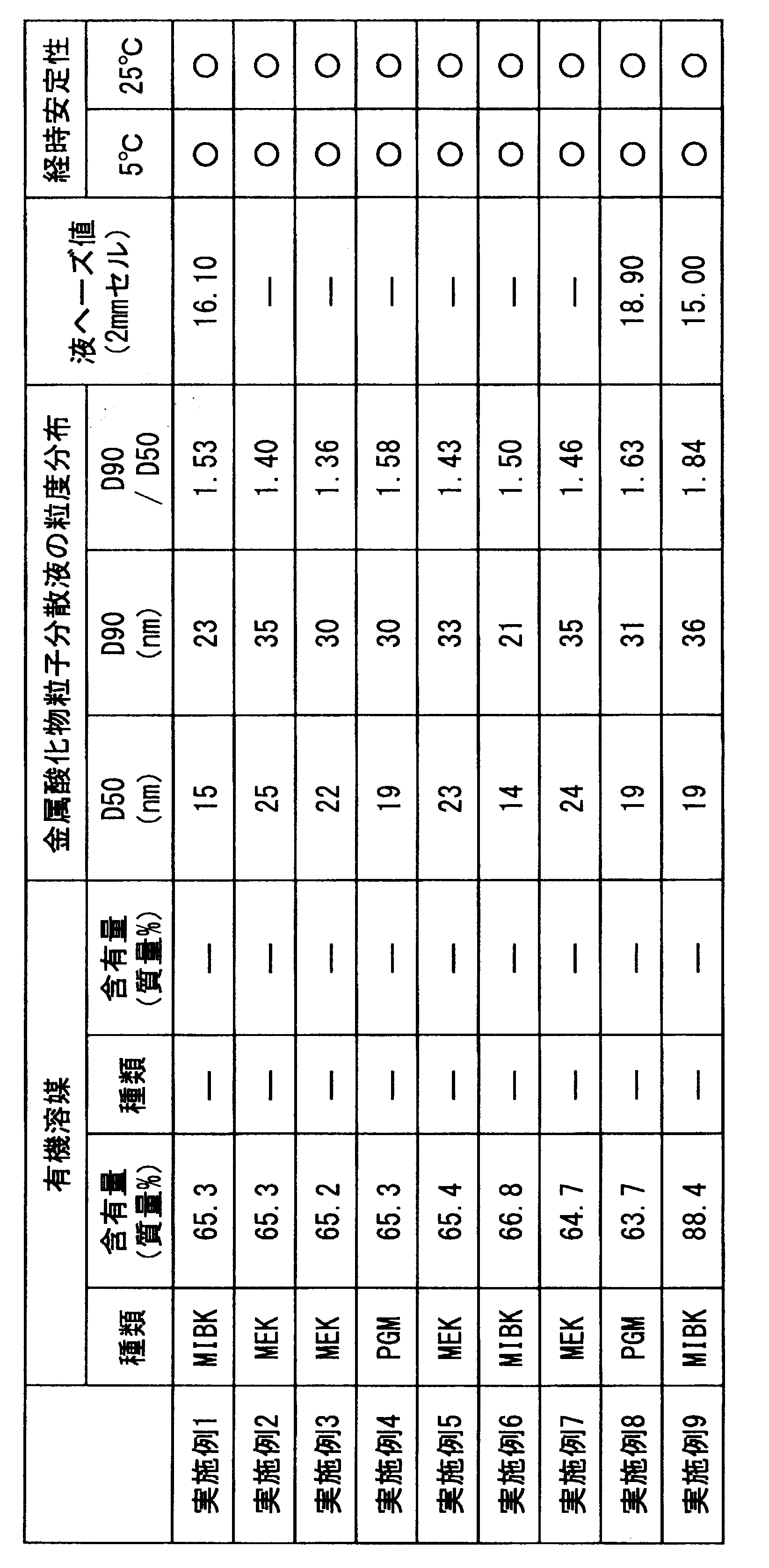
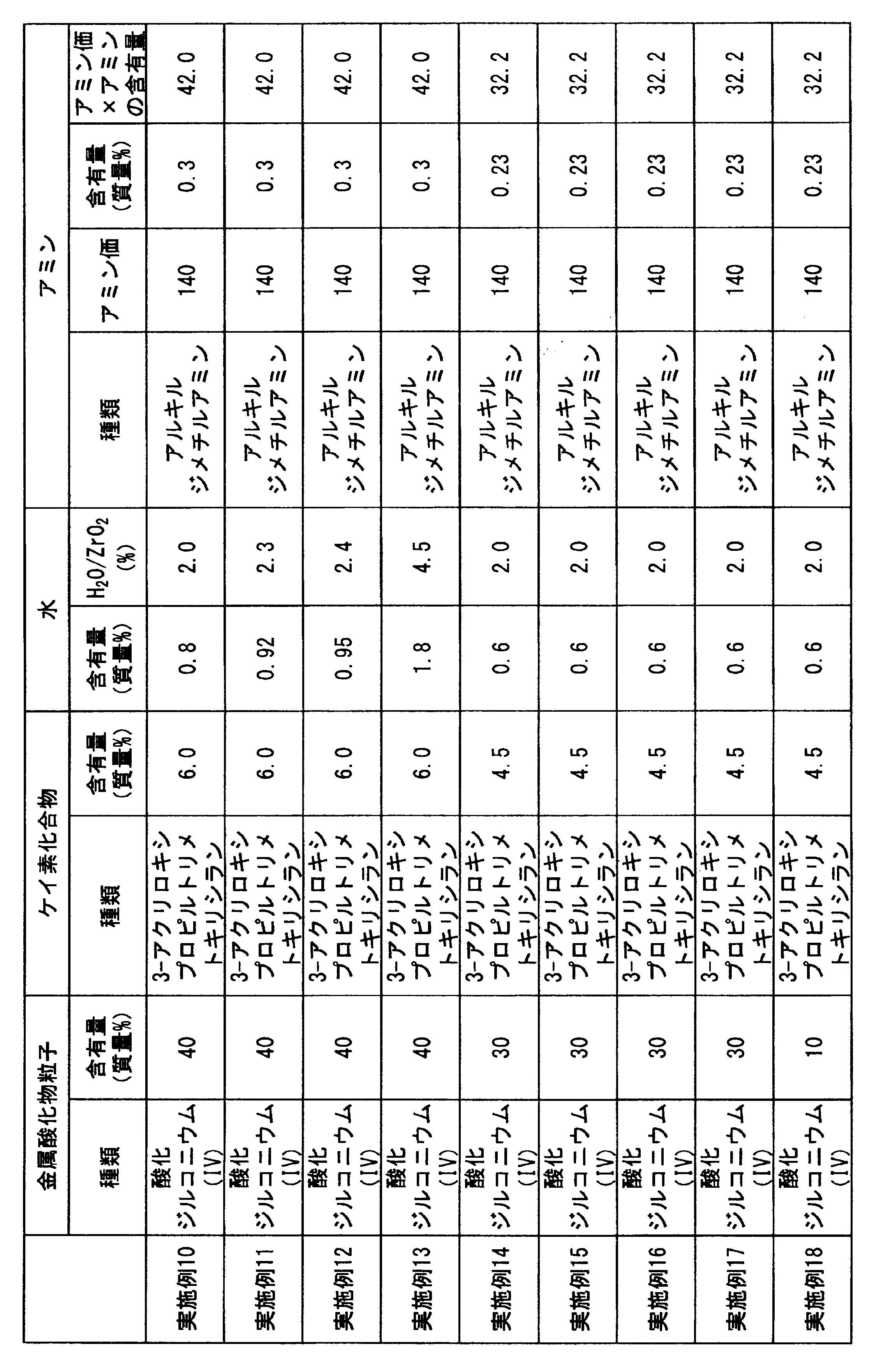
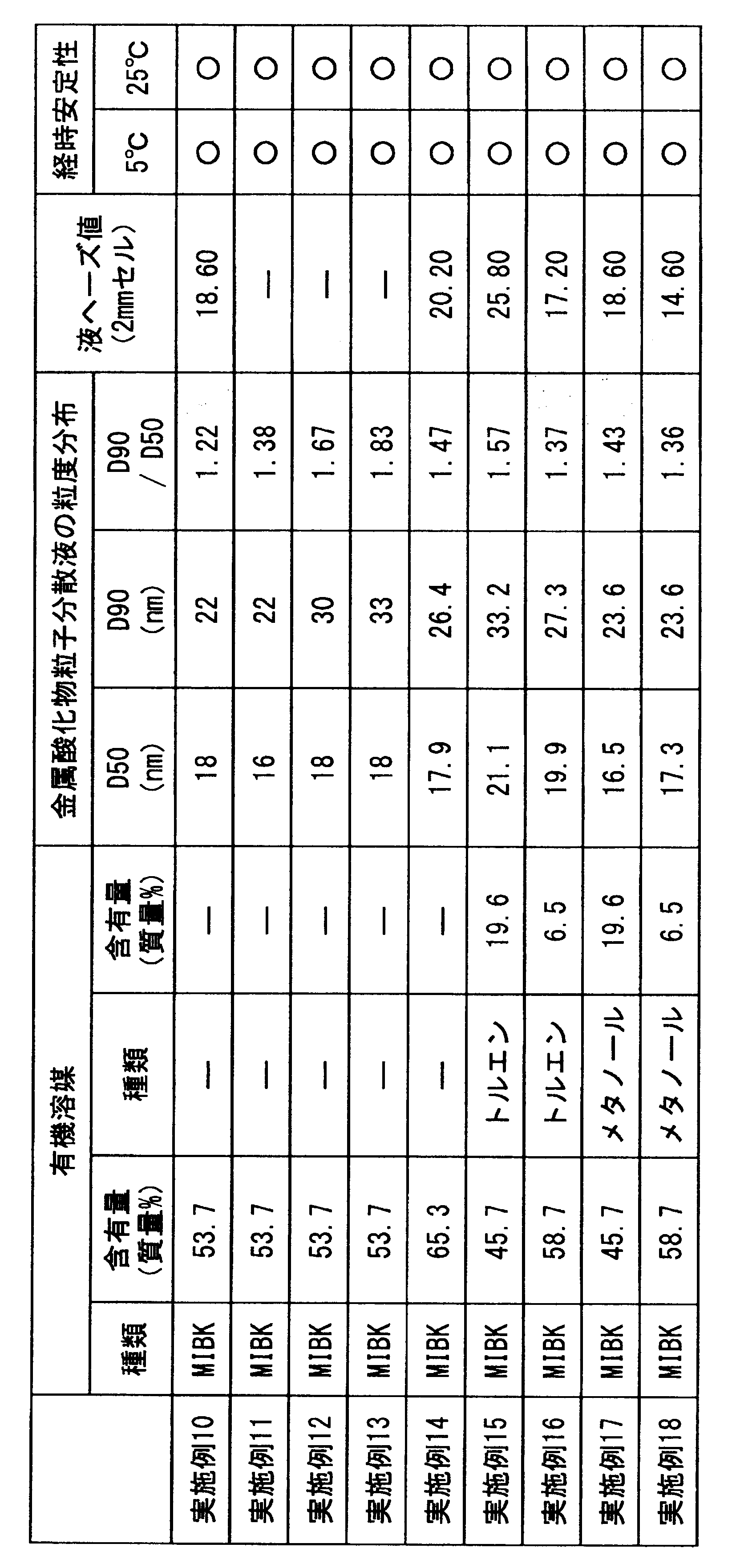
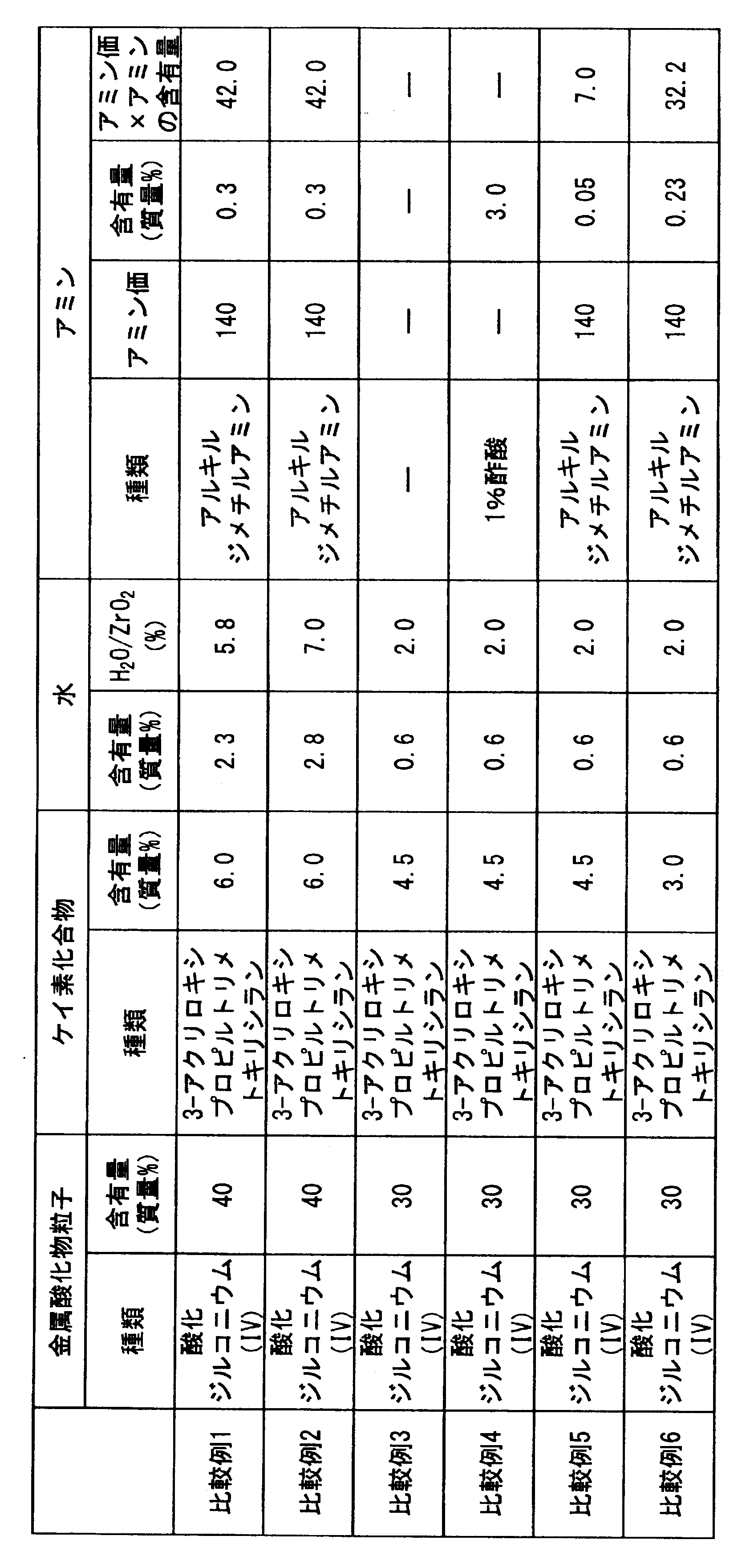

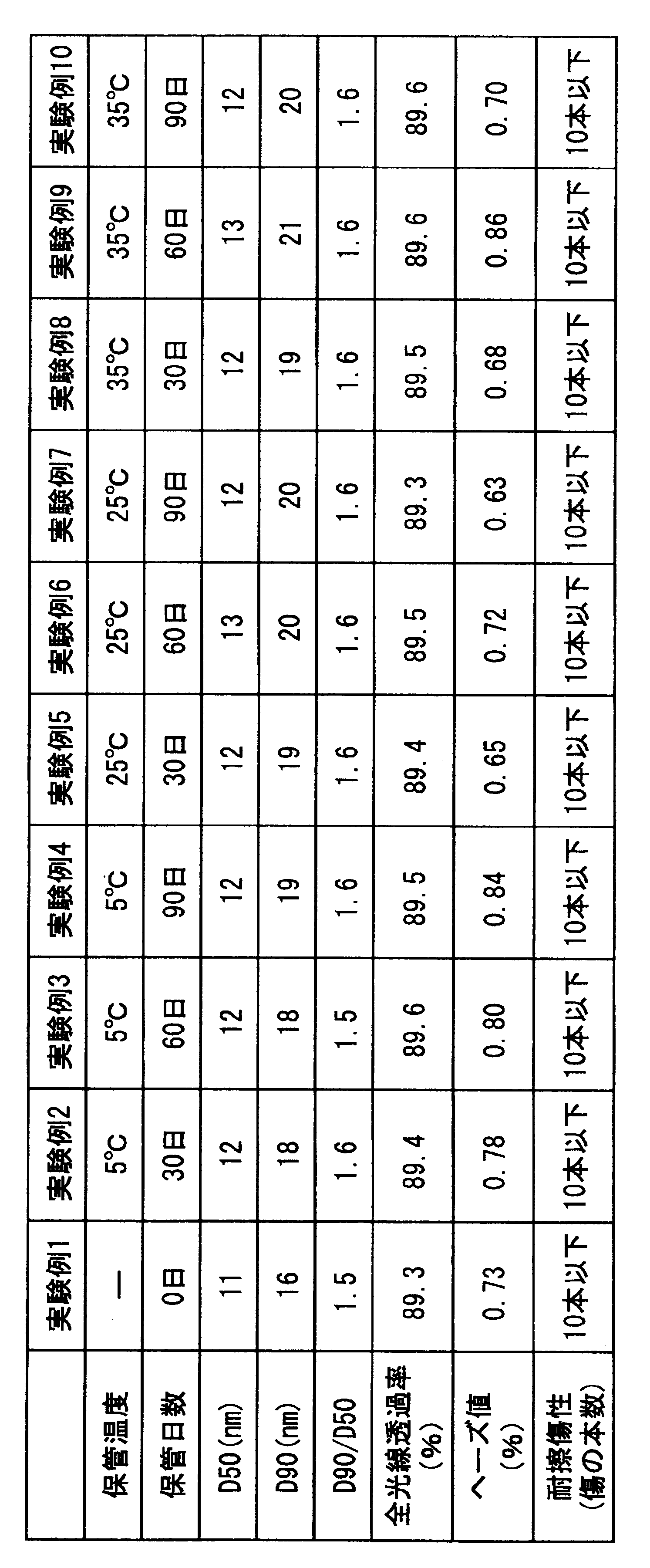
表1~6の結果から、実施例1~18と、比較例1~6とを比較すると、実施例1~18の金属酸化物粒子分散液は、金属酸化物粒子の分散安定性に優れ、分散液の長期保管の安定性に優れていることが確認できた。
表7の結果から、実施例19の金属酸化物粒子含有組成物は保管安定性に優れることが確認できた。また、実施例19の金属酸化物粒子含有組成物を用いて作製した塗膜付きプラスチック基材は、透明性に優れるとともに、耐擦傷性に優れることが分かった。
表7の結果から、実施例19の金属酸化物粒子含有組成物は保管安定性に優れることが確認できた。また、実施例19の金属酸化物粒子含有組成物を用いて作製した塗膜付きプラスチック基材は、透明性に優れるとともに、耐擦傷性に優れることが分かった。
本発明の金属酸化物粒子分散液は、従来、金属酸化物粒子分散液が使用されている全ての工業用途に適用することができ、例えば、光学フィルム用途、住宅外装用途、熱線遮蔽用途等に適用することができる。
Claims (7)
- 下記一般式(1)で表わされるケイ素化合物で表面処理された金属酸化物粒子が、溶媒に分散されてなる金属酸化物粒子分散液であって、
上記金属酸化物粒子分散液が、さらに炭素原子数が2以上のアミンを含み、
上記金属酸化物粒子の平均一次粒子径が3nm以上かつ20nm以下であり、屈折率が1.9以上であり、
上記溶媒が、有機溶媒を70質量%以上含有し、
上記有機溶媒の溶解度パラメーターが8.0以上かつ12以下であり、水への溶解度が1.5g/100ml以上であって、
水の含有量が、前記金属酸化物粒子の含有量の3質量%以下であることを特徴とする金属酸化物粒子分散液。
R’nSi(OR)m・・・(1)
(但し、Rは水素原子またはアルキル基、R’は有機基、nおよびmは整数であり、n+m=4、0<n<4) - 粒度分布の累積体積百分率が90%のときの粒径(D90)が60nm以下であることを特徴とする請求項1に記載の金属酸化物粒子分散液。
- 前記金属酸化物粒子の含有率を30質量%とし、かつ光路長を2mmとしたときの液ヘーズ値が35%以下であることを特徴とする請求項1または2に記載の金属酸化物粒子分散液。
- 前記アミンのアミン価と、前記アミンの含有量との積が、10以上かつ45以下であることを特徴とする請求項1または2に記載の金属酸化物粒子分散液。
- 請求項1または2に記載の金属酸化物粒子分散液と、バインダー成分とを含有してなることを特徴とする金属酸化物粒子含有組成物。
- 請求項5に記載の金属酸化物粒子含有組成物を用いて形成されたことを特徴とする塗膜。
- 請求項6に記載の塗膜を備えたことを特徴とする表示装置。
Priority Applications (2)
| Application Number | Priority Date | Filing Date | Title |
|---|---|---|---|
| CN201580038123.7A CN106661362A (zh) | 2014-07-14 | 2015-07-13 | 金属氧化物粒子分散液、含金属氧化物粒子组合物、涂膜及显示装置 |
| KR1020177001440A KR20170030532A (ko) | 2014-07-14 | 2015-07-13 | 금속 산화물 입자 분산액, 금속 산화물 입자 함유 조성물, 도막, 및 표시 장치 |
Applications Claiming Priority (2)
| Application Number | Priority Date | Filing Date | Title |
|---|---|---|---|
| JP2014144468A JP6354409B2 (ja) | 2014-07-14 | 2014-07-14 | 金属酸化物粒子分散液、金属酸化物粒子含有組成物、塗膜、表示装置 |
| JP2014-144468 | 2014-07-14 |
Publications (1)
| Publication Number | Publication Date |
|---|---|
| WO2016009979A1 true WO2016009979A1 (ja) | 2016-01-21 |
Family
ID=55078472
Family Applications (1)
| Application Number | Title | Priority Date | Filing Date |
|---|---|---|---|
| PCT/JP2015/069987 Ceased WO2016009979A1 (ja) | 2014-07-14 | 2015-07-13 | 金属酸化物粒子分散液、金属酸化物粒子含有組成物、塗膜、および表示装置 |
Country Status (5)
| Country | Link |
|---|---|
| JP (1) | JP6354409B2 (ja) |
| KR (1) | KR20170030532A (ja) |
| CN (1) | CN106661362A (ja) |
| TW (1) | TW201607609A (ja) |
| WO (1) | WO2016009979A1 (ja) |
Cited By (1)
| Publication number | Priority date | Publication date | Assignee | Title |
|---|---|---|---|---|
| JP2016020431A (ja) * | 2014-07-14 | 2016-02-04 | 住友大阪セメント株式会社 | 金属酸化物粒子分散液、金属酸化物粒子含有組成物、塗膜、表示装置 |
Families Citing this family (15)
| Publication number | Priority date | Publication date | Assignee | Title |
|---|---|---|---|---|
| JP6455473B2 (ja) * | 2016-03-18 | 2019-01-23 | 住友大阪セメント株式会社 | 無機粒子分散液、無機粒子含有組成物、塗膜、塗膜付きプラスチック基材、および表示装置 |
| JP6284068B1 (ja) * | 2017-05-16 | 2018-02-28 | 東洋インキScホールディングス株式会社 | 活性エネルギー線硬化性組成物およびそれを用いたインデックスマッチング層および積層体 |
| JP6656606B2 (ja) * | 2017-08-04 | 2020-03-04 | 住友大阪セメント株式会社 | 分散液、組成物、封止部材、発光装置、照明器具、表示装置および発光装置の製造方法 |
| US11692080B2 (en) | 2017-08-04 | 2023-07-04 | Sumitomo Osaka Cement Co., Ltd. | Dispersion liquid, composition, sealing member, light-emitting device, illumination tool, display device, and method for producing light-emitting device |
| JP2020002306A (ja) * | 2018-06-29 | 2020-01-09 | 住友大阪セメント株式会社 | 分散液、組成物、封止部材、発光装置、照明器具および表示装置 |
| JP7215198B2 (ja) * | 2019-02-06 | 2023-01-31 | 住友大阪セメント株式会社 | 分散液、組成物、封止部材、発光装置、照明器具および表示装置ならびに分散液の製造方法 |
| US20220195202A1 (en) * | 2019-03-29 | 2022-06-23 | Sumitomo Osaka Cement Co., Ltd. | Surface modification method for inorganic particles, method for producing dispersion liquid, and dispersion liquid |
| CN114630813B (zh) * | 2019-10-29 | 2023-11-21 | 京瓷株式会社 | 陶瓷结构体、吸嘴、刀具、镊子、磨损检测器、粉体除电装置、粉体制造装置、顶销、搬运手及纤维引导件 |
| JP7587923B2 (ja) * | 2020-01-31 | 2024-11-21 | 日東電工株式会社 | 粘着シート |
| EP4186866A4 (en) * | 2020-07-22 | 2024-03-13 | Mitsui Mining & Smelting Co., Ltd. | TANTALATE DISPERSION AND TANTALATE COMPOUND |
| KR102533092B1 (ko) * | 2020-12-04 | 2023-05-17 | 주식회사 케이씨텍 | 디스플레이용 무기입자 분산액 조성물 및 이의 제조방법 |
| JPWO2022138010A1 (ja) * | 2020-12-24 | 2022-06-30 | ||
| CN114405304B (zh) * | 2022-02-17 | 2023-08-08 | 河北科技大学 | 一种用于在有机溶剂中分散氧化镍的组合物及分散方法 |
| CN118546552B (zh) * | 2024-06-14 | 2025-09-16 | 山东国瓷功能材料股份有限公司 | 一种氧化锆分散液及其制备方法与应用 |
| CN118725624B (zh) * | 2024-07-10 | 2026-04-14 | 山东国瓷功能材料股份有限公司 | 一种氧化锆分散液及其制备方法与应用 |
Citations (4)
| Publication number | Priority date | Publication date | Assignee | Title |
|---|---|---|---|---|
| JP2007197278A (ja) * | 2006-01-27 | 2007-08-09 | Mitsui Chemicals Inc | 無機酸化物超微粒子およびその製造法 |
| JP2011136850A (ja) * | 2009-12-25 | 2011-07-14 | Jgc Catalysts & Chemicals Ltd | 高屈折率金属酸化物微粒子を含む有機溶媒分散ゾルの調製方法並びにその有機溶媒分散ゾル、および該有機溶媒分散ゾルを用いて得られる塗料組成物 |
| WO2012165620A1 (ja) * | 2011-06-03 | 2012-12-06 | 日産化学工業株式会社 | 二酸化珪素-酸化第二スズ複合酸化物被覆酸化チタン含有金属酸化物粒子 |
| JP2014038293A (ja) * | 2012-08-20 | 2014-02-27 | Nissan Chem Ind Ltd | 酸化チタン系微粒子の分散液、該粒子を含むコーティング組成物及び透明膜付基材 |
Family Cites Families (10)
| Publication number | Priority date | Publication date | Assignee | Title |
|---|---|---|---|---|
| JPS5851829B2 (ja) | 1978-07-20 | 1983-11-18 | 日本電信電話株式会社 | フイルム状活字体 |
| JPH08281860A (ja) | 1995-04-11 | 1996-10-29 | Sumitomo Osaka Cement Co Ltd | 熱線遮蔽フィルム |
| JP4609068B2 (ja) | 2004-12-27 | 2011-01-12 | Jsr株式会社 | 硬化性組成物、その硬化物及び積層体 |
| JP2006264271A (ja) | 2005-03-25 | 2006-10-05 | Kureha Corp | ガスバリア性積層体およびその製造方法 |
| JP2007277505A (ja) | 2006-03-16 | 2007-10-25 | Jsr Corp | 酸化物微粒子分散体およびその製造方法 |
| JPWO2008035669A1 (ja) | 2006-09-19 | 2010-01-28 | Jsr株式会社 | 酸化物微粒子含有有機無機ハイブリッドポリマー組成物およびその製造方法 |
| JP5176380B2 (ja) * | 2007-05-07 | 2013-04-03 | 住友大阪セメント株式会社 | 表面修飾ジルコニア粒子と表面修飾ジルコニア粒子分散液及び複合体並びに表面修飾ジルコニア粒子の製造方法 |
| JP2010209186A (ja) * | 2009-03-09 | 2010-09-24 | Sumitomo Osaka Cement Co Ltd | 光学材料と無機微粒子分散液及び光学材料の製造方法並びに発光素子 |
| CN103764567A (zh) * | 2011-08-31 | 2014-04-30 | 住友大阪水泥股份有限公司 | 无机氧化物透明分散液、透明复合体形成用树脂组合物及透明复合体以及光学构件 |
| JP6354409B2 (ja) * | 2014-07-14 | 2018-07-11 | 住友大阪セメント株式会社 | 金属酸化物粒子分散液、金属酸化物粒子含有組成物、塗膜、表示装置 |
-
2014
- 2014-07-14 JP JP2014144468A patent/JP6354409B2/ja active Active
-
2015
- 2015-07-13 CN CN201580038123.7A patent/CN106661362A/zh active Pending
- 2015-07-13 WO PCT/JP2015/069987 patent/WO2016009979A1/ja not_active Ceased
- 2015-07-13 KR KR1020177001440A patent/KR20170030532A/ko not_active Withdrawn
- 2015-07-14 TW TW104122698A patent/TW201607609A/zh unknown
Patent Citations (4)
| Publication number | Priority date | Publication date | Assignee | Title |
|---|---|---|---|---|
| JP2007197278A (ja) * | 2006-01-27 | 2007-08-09 | Mitsui Chemicals Inc | 無機酸化物超微粒子およびその製造法 |
| JP2011136850A (ja) * | 2009-12-25 | 2011-07-14 | Jgc Catalysts & Chemicals Ltd | 高屈折率金属酸化物微粒子を含む有機溶媒分散ゾルの調製方法並びにその有機溶媒分散ゾル、および該有機溶媒分散ゾルを用いて得られる塗料組成物 |
| WO2012165620A1 (ja) * | 2011-06-03 | 2012-12-06 | 日産化学工業株式会社 | 二酸化珪素-酸化第二スズ複合酸化物被覆酸化チタン含有金属酸化物粒子 |
| JP2014038293A (ja) * | 2012-08-20 | 2014-02-27 | Nissan Chem Ind Ltd | 酸化チタン系微粒子の分散液、該粒子を含むコーティング組成物及び透明膜付基材 |
Cited By (1)
| Publication number | Priority date | Publication date | Assignee | Title |
|---|---|---|---|---|
| JP2016020431A (ja) * | 2014-07-14 | 2016-02-04 | 住友大阪セメント株式会社 | 金属酸化物粒子分散液、金属酸化物粒子含有組成物、塗膜、表示装置 |
Also Published As
| Publication number | Publication date |
|---|---|
| JP2016020431A (ja) | 2016-02-04 |
| KR20170030532A (ko) | 2017-03-17 |
| JP6354409B2 (ja) | 2018-07-11 |
| CN106661362A (zh) | 2017-05-10 |
| TW201607609A (zh) | 2016-03-01 |
Similar Documents
| Publication | Publication Date | Title |
|---|---|---|
| JP6354409B2 (ja) | 金属酸化物粒子分散液、金属酸化物粒子含有組成物、塗膜、表示装置 | |
| JP5846322B2 (ja) | 無機粒子分散液、無機粒子含有組成物、塗膜、塗膜付きプラスチック基材、表示装置 | |
| JPWO2005121265A1 (ja) | シロキサン系塗料、光学物品およびシロキサン系塗料の製造方法 | |
| JP2014145089A (ja) | 耐摩耗性および耐汚染性に優れたコーティング組成物およびコーティングフィルム | |
| JP2010540404A (ja) | 有機溶媒中のナノ粒子分散液 | |
| JPWO2019240154A1 (ja) | 無機酸化物微粒子分散液 | |
| JP5209855B2 (ja) | 透明被膜形成用塗料および透明被膜付基材 | |
| WO2007142272A1 (ja) | 透明導電膜形成用組成物、透明導電膜及びディスプレイ | |
| JP2017019938A (ja) | 無機粒子含有組成物、塗膜、塗膜付きプラスチック基材、および表示装置 | |
| JP6547749B2 (ja) | 酸化ジルコニウム、酸化ジルコニウム分散液、酸化ジルコニウム含有組成物、塗膜、および表示装置 | |
| JP2017097051A (ja) | 光学用硬化性樹脂組成物 | |
| JP6489049B2 (ja) | 無機粒子含有組成物、塗膜、塗膜付きプラスチック基材、および表示装置 | |
| WO2016031931A1 (ja) | 樹脂組成物、塗膜、塗膜付きプラスチックフィルム、及び表示装置 | |
| JP6477646B2 (ja) | 分散液およびその製造方法、塗料、塗膜 | |
| JP2018053098A (ja) | 無機粒子含有組成物、塗膜、塗膜付きプラスチック基材、および表示装置 | |
| WO2016104079A1 (ja) | ベース基材シート及び透明導電性積層体 | |
| JP6241574B2 (ja) | 透明樹脂組成物、及び熱線遮蔽フィルム | |
| JP6455473B2 (ja) | 無機粒子分散液、無機粒子含有組成物、塗膜、塗膜付きプラスチック基材、および表示装置 | |
| JP2015067681A (ja) | ハードコート膜、プラスチック基材、ハードコート膜形成用組成物、タッチパネル | |
| JP2017066169A (ja) | ハードコートフィルム | |
| JP2015067682A (ja) | ハードコート膜、プラスチック基材、ハードコート膜形成用組成物、タッチパネル | |
| JP2012058506A (ja) | 光学材料と酸化スズ微粒子分散液及び酸化スズ微粒子分散塗料並びに光学材料の製造方法、高屈折率膜、帯電防止膜 | |
| JP2016169343A (ja) | 無機粒子含有組成物、塗膜、塗膜付きプラスチック基材、表示装置 | |
| JP2016194000A (ja) | 無機粒子含有組成物、塗膜、塗膜付きプラスチック基材、表示装置 | |
| JP2016190940A (ja) | 金属酸化物粒子含有組成物、塗膜、塗膜付きプラスチックフィルム、表示装置 |
Legal Events
| Date | Code | Title | Description |
|---|---|---|---|
| 121 | Ep: the epo has been informed by wipo that ep was designated in this application |
Ref document number: 15822214 Country of ref document: EP Kind code of ref document: A1 |
|
| NENP | Non-entry into the national phase |
Ref country code: DE |
|
| ENP | Entry into the national phase |
Ref document number: 20177001440 Country of ref document: KR Kind code of ref document: A |
|
| 122 | Ep: pct application non-entry in european phase |
Ref document number: 15822214 Country of ref document: EP Kind code of ref document: A1 |