WO2015178463A1 - 炭酸ジフェニルの製造方法、該製造方法により得られる炭酸ジフェニル、該炭酸ジフェニルから製造されるポリカーボネート、炭酸ジフェニル製造用触媒、該触媒の製造方法、触媒の回収・再利用方法 - Google Patents
炭酸ジフェニルの製造方法、該製造方法により得られる炭酸ジフェニル、該炭酸ジフェニルから製造されるポリカーボネート、炭酸ジフェニル製造用触媒、該触媒の製造方法、触媒の回収・再利用方法 Download PDFInfo
- Publication number
- WO2015178463A1 WO2015178463A1 PCT/JP2015/064645 JP2015064645W WO2015178463A1 WO 2015178463 A1 WO2015178463 A1 WO 2015178463A1 JP 2015064645 W JP2015064645 W JP 2015064645W WO 2015178463 A1 WO2015178463 A1 WO 2015178463A1
- Authority
- WO
- WIPO (PCT)
- Prior art keywords
- catalyst
- diphenyl carbonate
- reaction
- adduct
- chloride
- Prior art date
- Legal status (The legal status is an assumption and is not a legal conclusion. Google has not performed a legal analysis and makes no representation as to the accuracy of the status listed.)
- Ceased
Links
Classifications
-
- C—CHEMISTRY; METALLURGY
- C07—ORGANIC CHEMISTRY
- C07C—ACYCLIC OR CARBOCYCLIC COMPOUNDS
- C07C68/00—Preparation of esters of carbonic or haloformic acids
-
- C—CHEMISTRY; METALLURGY
- C07—ORGANIC CHEMISTRY
- C07C—ACYCLIC OR CARBOCYCLIC COMPOUNDS
- C07C68/00—Preparation of esters of carbonic or haloformic acids
- C07C68/08—Purification; Separation; Stabilisation
-
- C—CHEMISTRY; METALLURGY
- C07—ORGANIC CHEMISTRY
- C07C—ACYCLIC OR CARBOCYCLIC COMPOUNDS
- C07C69/00—Esters of carboxylic acids; Esters of carbonic or haloformic acids
- C07C69/96—Esters of carbonic or haloformic acids
-
- C—CHEMISTRY; METALLURGY
- C07—ORGANIC CHEMISTRY
- C07F—ACYCLIC, CARBOCYCLIC OR HETEROCYCLIC COMPOUNDS CONTAINING ELEMENTS OTHER THAN CARBON, HYDROGEN, HALOGEN, OXYGEN, NITROGEN, SULFUR, SELENIUM OR TELLURIUM
- C07F9/00—Compounds containing elements of Groups 5 or 15 of the Periodic Table
- C07F9/02—Phosphorus compounds
- C07F9/28—Phosphorus compounds with one or more P—C bonds
- C07F9/54—Quaternary phosphonium compounds
-
- C—CHEMISTRY; METALLURGY
- C08—ORGANIC MACROMOLECULAR COMPOUNDS; THEIR PREPARATION OR CHEMICAL WORKING-UP; COMPOSITIONS BASED THEREON
- C08G—MACROMOLECULAR COMPOUNDS OBTAINED OTHERWISE THAN BY REACTIONS ONLY INVOLVING UNSATURATED CARBON-TO-CARBON BONDS
- C08G64/00—Macromolecular compounds obtained by reactions forming a carbonic ester link in the main chain of the macromolecule
- C08G64/20—General preparatory processes
- C08G64/30—General preparatory processes using carbonates
-
- C—CHEMISTRY; METALLURGY
- C07—ORGANIC CHEMISTRY
- C07B—GENERAL METHODS OF ORGANIC CHEMISTRY; APPARATUS THEREFOR
- C07B61/00—Other general methods
-
- Y—GENERAL TAGGING OF NEW TECHNOLOGICAL DEVELOPMENTS; GENERAL TAGGING OF CROSS-SECTIONAL TECHNOLOGIES SPANNING OVER SEVERAL SECTIONS OF THE IPC; TECHNICAL SUBJECTS COVERED BY FORMER USPC CROSS-REFERENCE ART COLLECTIONS [XRACs] AND DIGESTS
- Y02—TECHNOLOGIES OR APPLICATIONS FOR MITIGATION OR ADAPTATION AGAINST CLIMATE CHANGE
- Y02P—CLIMATE CHANGE MITIGATION TECHNOLOGIES IN THE PRODUCTION OR PROCESSING OF GOODS
- Y02P20/00—Technologies relating to chemical industry
- Y02P20/50—Improvements relating to the production of bulk chemicals
- Y02P20/582—Recycling of unreacted starting or intermediate materials
-
- Y—GENERAL TAGGING OF NEW TECHNOLOGICAL DEVELOPMENTS; GENERAL TAGGING OF CROSS-SECTIONAL TECHNOLOGIES SPANNING OVER SEVERAL SECTIONS OF THE IPC; TECHNICAL SUBJECTS COVERED BY FORMER USPC CROSS-REFERENCE ART COLLECTIONS [XRACs] AND DIGESTS
- Y02—TECHNOLOGIES OR APPLICATIONS FOR MITIGATION OR ADAPTATION AGAINST CLIMATE CHANGE
- Y02P—CLIMATE CHANGE MITIGATION TECHNOLOGIES IN THE PRODUCTION OR PROCESSING OF GOODS
- Y02P20/00—Technologies relating to chemical industry
- Y02P20/50—Improvements relating to the production of bulk chemicals
- Y02P20/584—Recycling of catalysts
Definitions
- the present invention relates to a method for producing diphenyl carbonate such as diphenyl carbonate and a carbonic acid diester obtained by the production method.
- a method for producing a carbonic acid diester by decarbonylating a oxalic acid diester such as diphenyl oxalate in the presence of a catalyst an easy-to-handle catalyst is used to stabilize a highly pure diphenyl carbonate stably. It is an invention about providing a method which can be manufactured continuously.
- the present invention is an invention relating to a high-purity polycarbonate which is obtained by using a carbonic acid diester produced by this method as a raw material and which is less colored. Furthermore, this invention is invention about the catalyst suitable for this carbonic acid diester manufacture, and its manufacturing method. The present invention also provides a method for recovering a high-purity catalyst efficiently from a reaction solution by a simple method, reusing it and stably producing a high-purity carbonic acid diester, and a solvent used for recovering the catalyst. Is also an invention about reuse.
- Carbonic acid diester is known as a raw material compound in various chemical reactions.
- diphenyl carbonate can produce a polycarbonate by a polycondensation reaction with a divalent hydroxyaromatic compound.
- Carbonic acid diester can be obtained by decarbonylation reaction of oxalic acid diester in the presence of a decarbonylation catalyst such as an organic phosphorus compound (see Patent Document 1).
- a decarbonylation catalyst such as an organic phosphorus compound
- the reaction pressure it is disclosed that “the pressure is increased when the reaction temperature exceeds the boiling point of diaryl oxalate, but is usually normal pressure or reduced pressure”.
- a pressure vessel is required for the pressure reaction, and a vacuum pump is required for the pressure reduction reaction, and the pressure must be controlled, so that the reaction is generally performed at normal pressure.
- a method for producing a carbonic acid diester using an oxalic acid diester having a low content of an aromatic hydroxy compound or an alkylaryl oxalate as a raw material is also disclosed (see Patent Document 2).
- diphenyl carbonate obtained by decarbonylation reaction of diphenyl oxalate contains light impurities such as furan compounds, it is distilled or pyrolyzed (heat treated at a temperature of 150 to 300 ° C. for about 0.05 to 10 hours.
- there has been proposed a method of removing by thermal decomposition, condensation and / or thermal denaturation see Patent Document 3).
- diaryl carbonate obtained by decarbonylation reaction of diaryl oxalate is a non-evaporated component containing a decarbonylation catalyst, a high boiling point substance, etc. by evaporating the decarbonylation reaction solution with an evaporator.
- a product fraction obtained by separating the distillate and the evaporating component mainly containing the target diaryl carbonate and the starting material diaryl oxalate, and further purifying the evaporating component by distillation operation Mixing with furan compounds such as benzofuran-2,3-dione produced by fleece rearrangement of diaryl oxalate will cause the polycarbonate product produced using the diaryl carbonate to be colored.
- Patent Document 4 also has problems such as requiring a large number of distillation steps for purification and very complicated operations, and further improvements in the purification of diphenyl carbonate. It was sought after.
- the substance is easily scattered due to its small particle size and has high hygroscopicity. It was found that when decarbonylation of acid diphenyl was carried out, phenol was easily produced as a by-product due to hydrolysis of diphenyl carbonate.
- the above-described catalyst recovery method is performed using an asymmetric tetraarylphosphonium halide and / or an asymmetric tetraarylphosphonium halide and a hydrogen halide.
- the present invention provides a method for solving at least one of these problems, and an object thereof is to provide at least one of the following methods.
- the first problem of the present invention is that a method for producing a carbonic acid diester by subjecting an oxalic acid diester to a decarbonylation reaction in the presence of a catalyst, and by using an easy-to-handle catalyst, the carbonic acid diester can be easily and efficiently stabilized.
- a method that can be manufactured will be provided.
- the second object of the present invention is to provide a method capable of stably producing a high-purity carbonic acid diester that does not easily cause coloration in a polycarbonate produced from the raw material without causing troubles such as clogging due to catalyst precipitation. I will do it.
- the third problem of the present invention is that when an asymmetric tetraarylphosphonium halide and / or an adduct of an asymmetric tetraarylphosphonium halide and a hydrogen halide is used as a catalyst in the production of a carbonic acid diester by decarbonylation of an oxalic acid diester.
- the present invention provides a method for efficiently recovering a high-purity catalyst from a reaction solution by a simple method, reusing it, and stably and continuously producing a high-purity carbonic acid diester.
- the fourth problem of the present invention is that when tetraarylphosphonium halide and / or an adduct of tetraarylphosphonium halide and hydrogen halide is used as a catalyst for the production of carbonic acid diester by decarbonylation of oxalic acid diester, Provide a method for efficiently and stably producing a high-purity carbonic acid diester by reusing and reusing a high-purity catalyst efficiently and reusing the solvent used for catalyst recovery. I will do it.
- the fifth object of the present invention is to produce a carbonic acid diester by decarbonylation reaction of an oxalic acid diester in the presence of a catalyst.
- a simple method efficiently and stably produces a high-purity carbonic acid diester. We will provide a possible method.
- a sixth problem of the present invention is that a carbonic acid diester is efficiently and industrially produced by a more simplified reaction apparatus and process for a method for producing a carbonic acid diester by decarbonylating a oxalic acid diester in the presence of a catalyst.
- a method for continuous production shall be provided.
- the present inventors have intensively studied to solve the above problems.
- a method for producing diphenyl carbonate by decarbonylating diphenyl oxalate in the presence of a catalyst the catalyst is used as an adduct of an asymmetric tetraarylphosphonium halide and hydrogen halide.
- it can be solved by supplying.
- the adduct of this asymmetric tetraarylphosphonium halide and hydrogen halide can be easily obtained by crystallizing the asymmetric tetraarylphosphonium halide in contact with the hydrogen halide and polar organic solvent. .
- the catalyst in the method for producing a carbonic acid diester by decarbonylating the oxalic acid diester in the presence of a catalyst, the catalyst is precipitated by using a catalyst soluble in the carbonic acid diester. And after conversion at a conversion rate of 96% or more, the amount of residual oxalic acid diester is reduced by evaporating 50% by weight or more of the carbonic acid diester contained in the reaction solution, and the by-product of furan compounds during evaporation of the carbonic acid diester is produced. It became possible to suppress and found out that this could be solved.
- the present inventors diligently studied a method for recovering an adduct body of asymmetric tetraarylphosphonium halide and / or asymmetric tetraarylphosphonium halide and hydrogen halide.
- a high purity catalyst is efficiently recovered as a precipitate by bringing a polar organic solvent and hydrogen chloride into contact with the remaining liquid obtained from the reaction solution containing a component containing carbonic acid diester, and then bringing water into contact therewith. It was found that can be solved.
- the present inventors diligently studied a method for recovering a tetraarylphosphonium halide and / or an adduct of a tetraarylphosphonium halide and a hydrogen halide.
- a high purity catalyst can be efficiently recovered by contacting a polar organic solvent with hydrogen chloride gas and / or hydrochloric acid in the residual liquid obtained from the reaction liquid containing a component containing carbonic acid diester, It has been found that this can be solved by reusing the residual liquid after catalyst recovery as the polar organic solvent.
- the present inventors have found that this can be solved by supplying the catalyst dissolved in the carbonic acid diester when reusing the catalyst after the reaction. Further, the present inventors have found that a high-purity carbonic acid diester can be efficiently produced by using an oxalic acid diester containing a specific amount of a specific impurity as a raw material. And it discovered that highly pure diphenyl carbonate could be manufactured efficiently and stably by performing decarbonylation reaction of an oxalic acid diester under specific pressure conditions. Further, the present inventors have found that the thermal decomposition of a furan compound is promoted by contacting with a basic compound, and the furan compound contained in the produced carbonic acid diester is brought into contact with the basic compound. It has been found that a high-purity carbonic acid diester can be produced efficiently by removing the above.
- the present inventors stir the reaction solution by performing a decarbonylation reaction while supplying a small amount of a gas inert to the decarbonylation reaction from the bottom of the decarbonylation reactor.
- the present inventors have found that carbonic acid diesters can be produced efficiently by removing impurities such as phenol by-produced during the decarbonylation reaction.
- the present invention is as follows. 1. A process for producing diphenyl carbonate by decarbonylation of diphenyl oxalate in the presence of a catalyst, wherein the catalyst is supplied as an adduct of an asymmetric tetraarylphosphonium halide and a hydrogen halide. Production method. 2. 2. The method for producing diphenyl carbonate according to item 1, wherein the average particle size of the adduct body is 50 ⁇ m or more and 1 mm or less. 3. 3. 3.
- the inert gas in the decarbonylation reaction is carried out the decarbonylation reaction while supplying from the lower part of the decarbonylation reactor below superficial linear velocity 0.00001M ⁇ s -1 or 0.01 m ⁇ s -1, item 1
- the catalyst is soluble in diphenyl carbonate, and after the decarbonylation reaction is carried out at a conversion rate of 96% or more, the reaction remaining after removing 50% by weight or more of diphenyl carbonate contained in the reaction solution 8.
- Diphenyl oxalate contains 0.076 weight% or more and 10 weight% or less of carboxylic acid phenylester represented by following General formula (5).
- n 1 or 2.
- 1st process The process of manufacturing diphenyl carbonate by the manufacturing method of diphenyl carbonate of any one of the preceding clauses 1 thru
- Second step Separating diphenyl carbonate produced in the first step from the adduct body and / or a catalyst solution containing an adduct body decomposition product generated by decomposing the adduct body
- Third step A step of supplying at least a part of the catalyst solution to the reactor of the first step.
- a method for recovering a catalyst used in the production of diphenyl carbonate by decarbonylation of diphenyl oxalate wherein the catalyst is an asymmetric tetraarylphosphonium halide and / or an adduct of an asymmetric tetraarylphosphonium halide and a hydrogen halide,
- the catalyst is recovered as a precipitate obtained by bringing a polar organic solvent and a hydrogen halide gas into contact with the residual liquid obtained from the reaction liquid after the decarbonylation reaction and containing a component containing diphenyl carbonate, and then contacting with water.
- a method for recovering a catalyst used in the production of diphenyl carbonate by decarbonylation of diphenyl oxalate wherein the catalyst is a tetraarylphosphonium halide and / or an adduct of a tetraarylphosphonium halide and a hydrogen halide, After contacting the residual liquid obtained from the reaction liquid after the carbonyl reaction with diphenyl carbonate component with a polar organic solvent and hydrogen halide, the catalyst contained in the residual liquid is recovered (catalyst recovery step) and the polar A method for recovering a catalyst, comprising recovering an organic solvent and reusing it in the catalyst recovery step. 15. 15.
- a process for producing diphenyl carbonate by decarbonylation of diphenyl oxalate wherein the catalyst recovered by the recovery method according to item 13 or 14 is used as a catalyst.
- a method for producing an adduct of a tetraarylphosphonium halide and a hydrogen halide wherein the asymmetric tetraarylphosphonium halide and the hydrogen halide are dissolved in a polar organic solvent, and then crystallized to form an asymmetric tetraarylphosphonium halide and a hydrogen halide.
- a method for producing an adduct of an asymmetric tetraarylphosphonium halide and a hydrogen halide comprising obtaining an adduct of a hydrogen halide. 17.
- a catalyst for producing diphenyl carbonate by decarbonylation of diphenyl oxalate wherein the catalyst is an adduct of an asymmetric tetraarylphosphonium halide having no benzyl proton and a hydrogen halide. Catalyst for diphenyl production. 18. 16.
- the first effect of the present invention is that a method for producing diphenyl carbonate by subjecting diphenyl oxalate to a decarbonylation reaction in the presence of a catalyst, using an easy-to-handle catalyst, easily and efficiently stabilizing high-purity diphenyl carbonate. It can be manufactured continuously.
- a catalyst suitable for the decarbonylation reaction can be easily obtained by dissolving an asymmetric tetraarylphosphonium halide and a hydrogen halide in a polar organic solvent and then crystallization. Further, by using this high purity diphenyl carbonate as a raw material, a high purity polycarbonate can be obtained.
- the second effect of the present invention is that a method for producing a carbonic acid diester by decarbonylation of an oxalic acid diester is simple and efficient, and stably produces a high-purity carbonic acid diester without causing troubles such as clogging due to catalyst precipitation. Is what you can do. Moreover, by using this carbonic acid diester as a raw material, it is possible to obtain a high-purity polycarbonate that hardly causes coloring.
- the third effect of the present invention is that when an asymmetric tetraarylphosphonium halide and / or an adduct of an asymmetric tetraarylphosphonium halide and a hydrogen halide is used as a catalyst in the production of a carbonic acid diester by decarbonylation of an oxalic acid diester.
- the high-purity catalyst can be efficiently recovered from the reaction solution by a simple method and reused, and a high-purity carbonic acid diester can be stably and continuously produced. Further, by using this high-purity carbonic acid diester as a raw material, a high-purity polycarbonate can be obtained.
- the fourth effect of the present invention is that when a tetraarylphosphonium halide and / or an adduct of tetraarylphosphonium halide and hydrogen halide is used as a catalyst in the production of a carbonic acid diester by decarbonylation of an oxalic acid diester, Efficient and stable production of high-purity carbonic acid diesters by efficiently recovering and reusing high-purity catalysts from liquids and reusing solvents used for catalyst recovery It is possible to do. Further, by using this high-purity carbonic acid diester as a raw material, a high-purity polycarbonate can be obtained.
- the fifth effect of the present invention is that a method for producing a carbonic acid diester by decarbonylation reaction of an oxalic acid diester in the presence of a catalyst is a simple and efficient method for stably and stably producing a high-purity carbonic acid diester. It is possible to provide a method that can. Further, by using this high-purity carbonic acid diester as a raw material, a high-purity polycarbonate can be obtained.
- the sixth effect of the present invention is that the method for producing a carbonic acid diester by decarbonylation reaction of oxalic acid diester in the presence of a catalyst enables diphenyl carbonate to be efficiently and industrially produced by a more simplified reaction apparatus and process. It is possible to provide a method for continuous production.
- the oxalic acid diester is decarbonylated in the presence of a catalyst (hereinafter sometimes referred to as “decarbonylation reaction according to the present invention” or simply “decarbonylation reaction”). Carbonic acid diester is produced.
- a catalyst hereinafter sometimes referred to as “decarbonylation reaction according to the present invention” or simply “decarbonylation reaction”. Carbonic acid diester is produced.
- the decarbonylation reaction according to the present invention is performed according to the following reaction formula (1).
- two Rs are each independently a hydrocarbon group which may have a substituent.
- the oxalic acid diester in the reaction formula (1) (hereinafter sometimes referred to as “oxalic acid diester according to the present invention” or simply “oxalic acid diester”) is a raw material in the method for producing the carbonic acid diester of the present invention.
- the carbonic acid diester according to the present invention obtained from the oxalic acid diester according to the present invention as a raw material is thermally stable and suitable as a polycarbonate raw material.
- the oxalic acid diester according to the present invention is usually an oxalic acid diester having the same type of hydrocarbon group (R) as the target carbonic acid diester.
- the hydrocarbon group in the oxalic acid diester according to the present invention may be aliphatic or aromatic. That is, the hydrocarbon groups possessed by the oxalic acid diester may be both alkyl groups, one alkyl group and one aromatic ring group, or both aromatic ring groups.
- both of them are preferably aromatic ring groups because the leaving group can be easily recovered.
- hydrocarbon group of the oxalic acid diester according to the present invention is an alkyl group, it may be linear, branched or cyclic.
- the aromatic ring group may be an aromatic hydrocarbon ring group or an aromatic heterocyclic group.
- the carbonic acid diester of the present invention is easily detached when used as a raw material for producing a polycarbonate, an aromatic hydrocarbon ring group is preferred.
- a single ring is preferable because the leaving group can be easily recovered and the leaving group is stable.
- aromatic hydrocarbon ring group examples include a 5- or 6-membered monocyclic ring or a 2-5 condensed ring having one free valence.
- free valence refers to those that can form bonds with other free valences as described in Organic Chemistry / Biochemical Nomenclature (above) (Revised 2nd edition, Nankodo, 1992). Say.
- aromatic hydrocarbon ring group examples include a benzene ring, naphthalene ring, anthracene ring, phenanthrene ring, perylene ring, tetracene ring, pyrene ring, benzpyrene ring, chrysene ring, triphenylene having one free valence. Ring, acenaphthene ring, fluoranthene ring, fluorene ring and the like.
- a benzene ring (phenyl group) having one free valence is particularly preferable since the leaving group is stable when the carbonic acid diester of the present invention is used as a raw material for producing polycarbonate or the like.
- the oxalic acid diester according to the present invention is preferably a compound in which both R in the carbonic acid diester produced in the above reaction formula (1) is an aromatic ring group, and both R are aromatic hydrocarbon ring groups. Some compounds are more preferred, and diphenyl oxalate in which both R are phenyl groups is particularly preferred.
- the oxalic acid diester according to the present invention is preferably diphenyl oxalate (hereinafter sometimes referred to as “diphenyl oxalate according to the present invention” or simply “diphenyl oxalate”), and the carbonic acid diester of the present invention.
- the carbonic acid diester produced by this production method is preferably diphenyl carbonate (hereinafter sometimes referred to as “diphenyl carbonate according to the present invention” or simply “diphenyl carbonate”).
- the decarbonylation reaction of the oxalic acid diester is preferably performed according to the following reaction formula (2).
- two Ph's are each independently a phenyl group optionally having a substituent.
- the aromatic heterocyclic group may be a 5- or 6-membered monocyclic ring having 2 free valences or 2 To 4 condensed rings.
- aromatic heterocyclic group examples include a furan ring, a benzofuran ring, a thiophene ring, a benzothiophene ring, a pyrrole ring, a pyrazole ring, an imidazole ring, an oxadiazole ring, and an indole ring having one free valence.
- the substituent which the hydrocarbon group of the oxalic acid diester according to the present invention has is not particularly limited as long as the excellent effect of the present invention is not significantly prevented.
- the obtained diphenyl carbonate is used for the production of polycarbonate, it is preferable that the by-product produced in the production of the polycarbonate has a low boiling point and is easily removed by distillation.
- an alkyl group having 1 to 12 carbon atoms such as a methyl group or an ethyl group
- an alkoxy group having 1 to 12 carbon atoms such as a methoxy group or an ethoxy group
- a nitro group such as a halogen such as a fluorine atom or a chlorine atom Atoms and aromatic ring groups are preferred.
- the alkyl group as a substituent refers to the case where an alkyl group is bonded as a substituent to an aromatic ring group, and the aromatic ring group as a substituent is, for example, an aromatic heterocyclic group to an aromatic heterocyclic group.
- bonds as a substituent etc. is said.
- the aromatic ring group having a substituent has various isomers depending on the position of the substituent, and any of them may be used.
- 2-, 3- having an alkyl group having 1 to 12 carbon atoms such as 2-, 3- or 4-methylphenyl group, 2-, 3- or 4-ethylphenyl group Or 4-alkylphenyl group; 2-, 3- or 4- having an alkoxy group having 1 to 12 carbon atoms such as 2-, 3- or 4-methoxyphenyl group, 2-, 3- or 4-ethoxyphenyl group 2-, 3- or 4-nitrophenyl having a halogen atom such as 2-, 3- or 4-nitrophenyl; 2-, 3- or 4-fluorophenyl, 2-, 3- or 4-chlorophenyl Examples thereof include 4-halophenyl group, and any of these may be used.
- the number of carbon atoms of the hydrocarbon group of the oxalic acid diester according to the present invention is preferably large in terms of the stability of the leaving group when the carbonic acid diester of the present invention is used as a raw material for producing polycarbonate, It is preferable that the number of leaving groups is small in view of easy recovery.
- substituent when it has a substituent, it is preferably 1 or more including the substituent, more preferably 2 or more, and on the other hand, it is preferably 12 or less, and is 10 or less. More preferably.
- an unsubstituted phenyl group is most preferred particularly when the obtained diphenyl carbonate is used for polycarbonate production.
- Diaryl oxalate (oxalate diester having two aromatic ring groups as a hydrocarbon group) is produced by transesterification of dialkyl oxalate and aromatic hydroxy compound as shown in the following reaction formula (3). Can be used.
- dialkyl oxalate used as a raw material as produced by the following reaction formula (4), those produced by an oxidative carbonylation reaction using carbon monoxide, oxygen and an aliphatic alcohol as raw materials can be used.
- R represents an alkyl group
- Ar represents an aromatic ring group
- R represents an alkyl group.
- the diphenyl oxalate when diphenyl oxalate is used as a raw material, the diphenyl oxalate contains 0.076 wt% or more and 10 wt% or less of a carboxylic acid phenyl ester represented by the following general formula (5). It is preferable to contain the amount of.
- the amount of carboxylic acid phenyl ester contained in diphenyl oxalate is preferably more than 1% by weight.
- the amount of carboxylic acid phenyl ester contained in diphenyl oxalate refers to the total amount of carboxylic acid phenyl ester relative to the total amount of diphenyl oxalate and total carboxylic acid phenyl ester.
- n 1 or 2.
- the carboxylic acid phenyl ester represented by the general formula (5) since the phenol is easily reduced, the phenyl (p-phenoxy) represented by the general formula (6) produced from diphenyl oxalate by Fries rearrangement and condensation polymerization is used.
- Phenyl (p- (or o-) phenyloxycarbonylphenyl) oxalate and diphenyl carbonate such as carbonylphenyl) oxalate (PCPO) or phenyl (o-phenoxycarbonylphenyl) oxalate (OCPO) represented by general formula (7)
- Phenyl, such as preparative (OCPC) (p- (or o-) phenyloxycarbonyl phenyl) carbonate is preferred.
- Carboxylic acid phenyl ester is produced as a by-product when diphenyl oxalate is produced by transesterification of dialkyl oxalate with phenol. Therefore, diphenyl oxalate containing 0.076 wt% or more and 10 wt% or less of carboxylic acid phenyl ester is obtained by converting the diphenyl oxalate obtained by the transesterification reaction between dialkyl oxalate and phenol into carboxylic acid phenyl ester. It can be obtained by distillation purification so as to be in the above range.
- the carboxylic acid phenyl ester usually has a boiling point higher than that of diphenyl oxalate. Therefore, it can be obtained mainly by removing only the low boiling point from diphenyl oxalate from diphenyl oxalate obtained by the transesterification reaction between dialkyl oxalate and phenol.
- the carboxylic acid contained in diphenyl oxalate may be less than the above lower limit.
- the catalyst used in the method for producing a carbonic acid diester of the present invention (hereinafter sometimes referred to as “decarbonylation catalyst according to the present invention”, “decarbonylation catalyst” or “catalyst”) has a trivalent valence of phosphorus atoms of Examples include pentavalent organic phosphorus compounds.
- the organophosphorus compound in which the valence of the phosphorus atom is trivalent or pentavalent is preferably an organophosphorus compound having at least one carbon-phosphorus (CP) bond, and three or more carbon-phosphorus ( More preferred are organophosphorus compounds having a CP) bond.
- organic phosphorus compounds examples include phosphonium salt organic phosphorus compounds (hereinafter also referred to as phosphonium salts), phosphine organic phosphorus compounds, phosphine dihalide organic phosphorus compounds, and phosphine oxide organic phosphorus compounds. .
- phosphonium salt organic phosphorus compounds hereinafter also referred to as phosphonium salts
- phosphine organic phosphorus compounds phosphine dihalide organic phosphorus compounds
- phosphine oxide organic phosphorus compounds examples include phosphonium salt organic phosphorus compounds (hereinafter also referred to as phosphonium salts), phosphine organic phosphorus compounds, phosphine dihalide organic phosphorus compounds, and phosphine oxide organic phosphorus compounds.
- a phosphonium salt-based organophosphorus compound is preferable as the decarbonylation catalyst according to the present invention.
- the phosphonium salt-based organic phosphorus compound is preferably a phosphonium salt represented by the following general formula (A).
- R 1 , R 2 , R 3 and R 4 each independently represent an optionally substituted aromatic ring group, aralkyl group or alkyl group, and X forms a counter ion of the phosphonium salt. Represents a possible atom or atomic group.
- aromatic ring group of the general formula (A) examples include aromatic hydrocarbon groups having 6 to 14 carbon atoms such as phenyl group, biphenyl group and naphthyl group, sulfur atoms such as thienyl group, furyl group and pyridyl group, oxygen atom Alternatively, an aromatic heterocyclic group having 4 to 16 carbon atoms containing a nitrogen atom can be used.
- aralkyl group examples include an aralkyl group having 7 to 15 carbon atoms which may have an unsaturated bond such as a benzyl group, a phenethyl group, a cinnamyl group, and a naphthylmethyl group.
- alkyl group examples include methyl, ethyl, propyl, butyl, pentyl, hexyl, heptyl, octyl, cyclopropyl, cyclopentyl, cyclohexyl, cycloheptyl, cyclohexylmethyl, and vinyl.
- a cyclic structure such as a propenyl group, a butenyl group, a 1,3-butadienyl group, or an alkyl group having 1 to 16 carbon atoms which may have an unsaturated bond.
- R 1 to R 4 in the general formula (A) include various isomers and may have one or more substituents.
- substituents examples include an alkoxy group (preferably 1 to 12 carbon atoms), a thioalkoxy group (preferably 1 to 12 carbon atoms), an aralkyloxy group (preferably 7 to 13 carbon atoms), an aryloxy group ( Preferably 6 to 16 carbon atoms, thioaryloxy group (preferably 6 to 16 carbon atoms), acyl group (preferably 1 to 12 carbon atoms), alkoxycarbonyl group (preferably 2 to 16 carbon atoms), carboxyl group An amino group, an alkyl-substituted amino group (preferably having 2 to 16 carbon atoms), a nitro group, a cyano group, a hydroxy group, a halogen atom (fluorine, chlorine, bromine, etc.) and the like. Further, these substituents may further have a substituent, and examples of the substituent include a halogen atom.
- R 1 to R 4 in the general formula (A) are phenyl groups having a substituent
- various isomers exist. Examples of these isomers include 2- (or 3-, 4-) methylphenyl group, 2- (or 3-, 4-) ethylphenyl group, 2,3- (or 3,4-) dimethylphenyl Group, a 2,4,6-trimethylphenyl group, a 4-trifluoromethylphenyl group, a 3,5-bistrifluoromethylphenyl group or the like, or an alkyl group having 1 to 12 carbon atoms or a halogenated alkyl group is bonded to the phenyl group.
- R 1 to R 4 in the general formula (A) are aromatic ring groups
- these may be an alkyl group which may have a ring structure (including a heterocyclic ring) or an unsaturated bond in addition to the substituent. (Preferably having 1 to 12 carbon atoms) may be present on the ring as one or more substituents.
- R 1 to R 4 are aromatic heterocyclic groups
- these may be substituted with an aromatic hydrocarbon ring group (preferably having 6 to 16 carbon atoms) as a substituent on the heterocyclic ring. You may have two or more.
- R 1 to R 4 in the general formula (A) may be the same as or different from each other. Further, the two groups may be bonded to each other or crosslinked. However, from the viewpoint of solubility, any one of R 1 to R 4 is preferably a group different from any of the other three groups.
- different groups refer to groups different in any one, including those having different substituents, different types, and different substitution positions. In the present invention, the fact that at least any one of R 1 to R 4 is different from at least one of the other three groups is referred to as “asymmetric”.
- the counter ion X ⁇ in the general formula (A) includes halogen ions such as chlorine ion, bromine ion and iodine ion, hydrogen dichloride ion, hydrogen dibromide ion, hydrogen diiodide ion and hydrogen dibromide chloride. Examples thereof include hydrogen halide ions such as ions.
- X is preferably a halogen ion, and more preferably a chlorine ion, since it easily acts as a highly active catalyst in the decarbonylation reaction according to the present invention.
- preferable phosphonium salt-based organic phosphorus compounds include the following compounds. That is, examples of the organic phosphonium chloride in which R 1 to R 4 in the general formula (A) are all unsubstituted aromatic hydrocarbon groups include tetraphenylphosphonium chloride, p-biphenyltriphenylphosphonium chloride, 1-naphthyltrichloride. Examples thereof include phenylphosphonium chloride and 2-naphthyltriphenylphosphonium chloride.
- Examples of the organic phosphonium chloride in which R 1 to R 4 in the general formula (A) are an unsubstituted aromatic hydrocarbon group or an aromatic hydrocarbon group having a substituent include o-methylphenyltriphenylphosphonium chloride, m- Methylphenyltriphenylphosphonium chloride, p-methylphenyltriphenylphosphonium chloride, p-isopropylphenyltriphenylphosphonium chloride, 4-t-butylphenyltriphenylphosphonium chloride, m-trifluoromethylphenyltriphenylphosphonium chloride, 2,4 Compounds having an aromatic hydrocarbon group having an alkyl group such as 1,6-trimethylphenyltriphenylphosphonium chloride; halogen atoms such as p-chlorophenyltriphenylphosphonium chloride; A compound having an aromatic hydrocarbon group such as m-methoxyphenyltriphenylphosphonium chlor
- Examples of the organic phosphonium chloride in which R 1 to R 4 in the general formula (A) are aralkyl groups include benzyltriphenylphosphonium chloride and phenethyltriphenylphosphonium chloride.
- Examples of the organic phosphonium chloride in which R 1 to R 4 in the general formula (A) are all alkyl groups include tetraethylphosphonium chloride, tetrabutylphosphonium chloride, hexadecyltributylphosphonium chloride, and the like.
- Examples of the organic phosphonium chloride in which R 1 to R 4 in the general formula (A) are an aromatic hydrocarbon group or an alkyl group include methyltriphenylphosphonium chloride, ethyltriphenylphosphonium bromide, propyltriphenylphosphonium chloride, butyltriphenyl. Ring structures such as phosphonium chloride, hexyltriphenylphosphonium chloride, heptyltriphenylphosphonium chloride, tetradecyltriphenylphosphonium chloride, dimethyldiphenylphosphonium chloride, allyltriphenylphosphonium chloride, and the like; cyclopropyltriphenylphosphonium chloride, etc.
- Examples of the organic phosphonium chloride in which R 1 to R 4 in the general formula (A) are an aromatic hydrocarbon group or an alkyl group having a substituent include (1,3-dioxolan-2-yl) methyltriphenylphosphonium.
- alkyl group having a heterocyclic group such as chloride, 2- (1,3-dioxolan-2-yl) ethyltriphenylphosphonium chloride, 2- (1,3-dioxan-2-yl) ethyltriphenylphosphonium chloride, etc.
- Compound Compound having an alkyl group having a halogen atom such as bromomethyltriphenylphosphonium chloride; Compound having an alkyl group having a carboxyl group such as 4-carboxybutyltriphenylphosphonium chloride, 2-carboxyallyltriphenylphosphonium chloride; 4 -D Compounds having an alkyl group having an alkoxycarbonyl group, such as xyloxybutyltriphenylphosphonium chloride; compounds having an alkyl group having an alkyl-substituted amino group, such as 2-dimethylaminomethyltriphenylphosphonium chloride, and phenacyltriphenylphosphonium chloride And compounds having an alkyl group having an acyl group.
- a halogen atom such as bromomethyltriphenylphosphonium chloride
- Compound having an alkyl group having a carboxyl group such as 4-carboxybutyltriphenylphosphonium
- Examples of the organic phosphonium chloride in which R 1 to R 4 in the general formula (A) are an aromatic hydrocarbon group or an aralkyl group include benzyltriphenylphosphonium chloride, 4-ethoxybenzyltriphenylphosphonium chloride, cinnamyltriphenylphosphonium chloride. Etc.
- R 1 to R 4 in the general formula (A) are all aromatic ring groups, and R 1 to R More preferably, all 4 are aromatic hydrocarbon groups.
- Asymmetric tetraarylphosphonium halide is particularly preferred, and 4-t-butylphenyltriphenylphosphonium chloride is most preferred.
- tetraarylphosphonium halide The phosphonium salt organic phosphorus compound in which R 1 to R 4 in the general formula (A) are all aromatic ring groups is referred to as “tetraarylphosphonium halide according to the present invention” or simply “tetraarylphosphonium halide”. There is a case.
- tetraarylphosphonium halides according to the present invention particularly preferred tetraarylphosphonium halides in which R 1 to R 4 are asymmetric are referred to as “asymmetric tetraarylphosphonium halides according to the present invention” or simply “asymmetric tetraarylphosphonium halides”. May be said.
- the tetraarylphosphonium halide according to the present invention which is preferable as a decarbonylation catalyst according to the present invention, is a compound represented by the following general formula (10).
- Ar 1 , Ar 2 , Ar 3 and Ar 4 each independently represent an aromatic ring group which may have a substituent, and X represents a halogen atom.
- Examples of the aromatic ring group represented by Ar 1 to Ar 4 include aromatic hydrocarbon groups having 6 to 14 carbon atoms such as phenyl group, biphenyl group, and naphthyl group, sulfur atoms such as thienyl group, furyl group, pyridyl group, oxygen atom, Examples thereof include an aromatic heterocyclic group having 4 to 16 carbon atoms containing a nitrogen atom. Of these, an aromatic hydrocarbon group is preferable because a catalyst can be produced at low cost, and a phenyl group is more preferable.
- Ar 1 to Ar 4 include various isomers, and each aromatic ring group may have one or more substituents.
- substituents include an alkyl group (preferably 1 to 12 carbon atoms), an alkoxy group (preferably 1 to 12 carbon atoms), a thioalkoxy group (preferably 1 to 12 carbon atoms), an aralkyloxy group (preferably Is an aryloxy group (preferably 6 to 16 carbon atoms), a thioaryloxy group (preferably 6 to 16 carbon atoms), an acyl group (preferably 1 to 12 carbon atoms), an alkoxycarbonyl group (Preferably having 2 to 16 carbon atoms), carboxyl group, amino group, alkyl-substituted amino group (preferably having 2 to 16 carbon atoms), nitro group, cyano group, hydroxy group, halogen atom (fluorine, chlorine, bromine, etc.), etc. Is mentioned. Further, these substituents may further have a substituent, and examples of the substituent include an aromatic
- an alkyl group is preferable because it is thermally stable, an alkyl group having 1 to 12 carbon atoms is more preferable, and a branched alkyl group having 3 to 8 carbon atoms is more preferable.
- the substituent does not have a benzyl proton because the catalyst becomes thermally stable and hardly decomposes when used as the catalyst for decarbonylation reaction of the present invention. That is, the substituent is particularly preferably an alkyl group having 3 to 8 carbon atoms having no benzyl proton, and most preferably a t-butyl group.
- Ar 1 to Ar 4 are aromatic ring groups having a substituent
- various isomers exist, and Ar 1 to Ar 4 may be any of them.
- These isomers include, for example, when Ar 1 to Ar 4 are a phenyl group having a substituent, 2- (or 3-, 4-) methylphenyl group, 2- (or 3-, 4-) ethyl 1 carbon number such as phenyl group, 2,3- (or 3,4-) dimethylphenyl group, 2,4,6-trimethylphenyl group, 4-trifluoromethylphenyl group, 3,5-bistrifluoromethylphenyl group
- Ar 1 to Ar 4 may be bonded to each other or bridged between two groups.
- the asymmetric tetraarylphosphonium halide according to the present invention is a compound represented by the above general formula (10), wherein Ar 1 , Ar 2 , Ar 3 and Ar 4 are asymmetric.
- the tetraarylphosphonium halide according to the present invention is asymmetric, at least any one group of Ar 1 to Ar 4 is a group different from at least one of the other three groups, so that the solubility is excellent.
- the remaining three groups of Ar 1 to Ar 4 may be the same or different from each other.
- Ar 1 to Ar 4 are preferably aromatic ring groups because they are likely to be thermally stable, and any one of Ar 1 to Ar 4 has a substituent. It is more preferable that the remaining three groups in the aromatic ring group have an unsubstituted aromatic ring group, and at least any one of Ar 1 to Ar 4 is an aryl group having a substituent and the remaining group is an unsubstituted aryl group.
- a group is particularly preferred, and any one of Ar 1 to Ar 4 is most preferably a phenyl group having a substituent and the remaining three groups being an unsubstituted phenyl group.
- the halogen atom X in the general formula (10) is a halogen atom such as a chlorine atom, a bromine atom, or an iodine atom.
- a chlorine atom is preferable because it easily acts as a highly active catalyst in the decarbonylation reaction according to the present invention.
- the tetraarylphosphonium halide according to the present invention is preferably tetraphenylphosphonium chloride (which may have a substituent).
- the tetraarylphosphonium halide according to the present invention preferably has no benzyl proton. That is, an asymmetric tetraarylphosphonium chloride having no benzyl proton is particularly preferred.
- tetraarylphosphonium halide include the following compounds. That is, Ar 1 to Ar 4 are all unsubstituted aromatic hydrocarbon groups such as tetraphenylphosphonium chloride, p-biphenyltriphenylphosphonium chloride, 1-naphthyltriphenylphosphonium chloride, 2-naphthyltriphenylphosphonium chloride, etc. Is mentioned.
- Examples of the organic phosphonium chloride in which Ar 1 to Ar 4 are an unsubstituted aromatic hydrocarbon group or an aromatic hydrocarbon group having a substituent include 4-t-butylphenyltriphenylphosphonium chloride, m-trifluoromethylphenyltri Compounds having an aromatic hydrocarbon group having an alkyl group and having no benzyl proton such as phenylphosphonium chloride; Compounds having an aromatic hydrocarbon group having a halogen atom such as p-chlorophenyltriphenylphosphonium chloride; m-methoxyphenyl Compounds having an aromatic hydrocarbon group having an alkoxy group such as triphenylphosphonium chloride, p-methoxyphenyltriphenylphosphonium chloride, p-ethoxyphenyltriphenylphosphonium chloride; p-aminophenyl Compounds having an aromatic hydrocarbon group having an amino group, such as triphenylphosphonium chloride
- the tetraarylphosphonium halide according to the present invention is preferably tetraphenylphosphonium chloride which may have a substituent.
- asymmetric tetraarylphosphonium chloride (a compound other than tetraphenylphosphonium chloride among the above compounds) is preferable, and 4-t-butylphenyltriphenylphosphonium chloride is particularly preferable.
- the catalyst used in the method for producing a carbonic acid diester of the present invention is an adduct body of the above-mentioned asymmetric tetraarylphosphonium halide and hydrogen halide (hereinafter referred to as “asymmetric adduct body according to the present invention” or simply “asymmetric adduct body”). Is particularly preferred.
- the hydrogen halide may be referred to as “hydrogen halide according to the present invention”, and the adduct body may be referred to as “adduct body according to the present invention” or simply “adduct body”.
- Examples of the hydrogen halide according to the present invention include hydrogen fluoride, hydrogen chloride, hydrogen bromide, and hydrogen iodide.
- the halogen of the hydrogen halide according to the present invention is used as a catalyst for decarbonylation reaction or the like, if the number of halogens increases, the types of by-products increase and the reaction system tends to become complicated. The same halogen as that of the tetraarylphosphonium halide is preferred.
- the hydrogen halide according to the present invention is preferably hydrogen chloride
- the adduct according to the present invention is preferably an adduct of tetraphenylphosphonium chloride and hydrogen chloride, and an adduct of asymmetric tetraphenylphosphonium chloride and hydrogen chloride. Is more preferable, and an adduct of 4-t-butylphenyltriphenylphosphonium chloride and hydrogen chloride is particularly preferable.
- the adduct body is usually used as a term meaning an adduct crystal.
- the adduct body according to the present invention usually includes a solid in which hydrogen halide is added to tetraarylphosphonium halide, a melted or dissolved substance thereof, and the like.
- 0.01 to 1.0 mol of hydrogen halide is usually added to 1 mol of tetraarylphosphonium halide. That is, the adduct according to the present invention usually has 1 to 100% of hydrogen halide added to the asymmetric tetraarylphosphonium halide 100 in a molar ratio.
- the type of decarbonylation catalyst can be analyzed by known methods such as elemental analysis, mass spectrometry, nuclear magnetic resonance spectroscopy, and liquid chromatography. Specifically, for example, in the case of 4-t-butylphenyltriphenylphosphonium chloride, 4-t-butylphenyltriphenylphosphonium chloride is analyzed by elemental analysis, mass spectrometry, and nuclear magnetic resonance spectrum. I can confirm that.
- the adduct of 4-t-butylphenyltriphenylphosphonium chloride and hydrogen chloride first, it was confirmed that 4-t-butylphenyltriphenylphosphonium chloride was contained as described above, and then By measuring the concentration of chlorine contained in the adduct body, the adduct body with hydrogen chloride and the adduct ratio thereof can be calculated.
- the decarbonylation catalyst according to the present invention is preferably soluble in a carbonic acid diester.
- the reason for this is that, in the method for producing a carbonic acid diester of the present invention, by using a catalyst soluble in the carbonic acid diester, the decarbonylation reaction is stably carried out at a high conversion rate without causing catalyst precipitation, and the residual oxalic acid diester This is because the amount can be reduced and the production of furan-based compounds by-produced when the carbonic acid diester is evaporated can be suppressed.
- the catalyst can be supplied in a state dissolved in a carbonic acid diester, and the Fries rearrangement product of the oxalic acid diester is obtained by reusing a catalyst solution containing a small amount of the unreacted oxalic acid diester after the reaction and containing a high concentration of the carbonic acid diester.
- By-products such as phenol are hardly generated, and a high-purity carbonic acid diester can be obtained.
- being soluble in a carbonic acid diester means that the catalyst usually dissolves 10 g or more, preferably 50 g or more, in 100 g of the carbonic acid diester at 150 ° C. The higher the solubility, the better, but the upper limit is usually 1000 g.
- the catalyst soluble in the carbonic acid diester can be easily selected by measuring the solubility of the above-mentioned decarbonylation catalyst in the carbonic acid diester.
- tetraarylphosphonium salts having one or more alkyl groups are preferred because of their high solubility in carbonic acid diesters.
- the number of alkyl groups contained in the tetraarylphosphonium salt having one or more alkyl groups is preferably 1 or more and 3 or less.
- the tetraarylphosphonium salt having two or more alkyl groups has an aromatic group having one or more alkyl groups as a substituent even if it has one aromatic ring group having two or more alkyl groups as substituents. Although it may have two ring groups, the latter is preferable because of easy synthesis.
- the asymmetric tetraarylphosphonium halide according to the present invention preferably has low solubility in a polar organic solvent and water because a high-purity catalyst can be efficiently efficiently recovered by the catalyst recovery method of the present invention described later.
- the asymmetric adduct according to the present invention preferably has a high solubility in a polar organic solvent and a low solubility in water, because a high-purity catalyst can be efficiently recovered efficiently by the catalyst recovery method of the present invention.
- the amount of asymmetric adducts according to the present invention dissolved in 100 g of the polar organic solvent according to the present invention described later at 40 ° C. is more than 0.5 g more than the asymmetric tetraarylphosphonium halide according to the present invention. Is more preferable, more preferably 1.0 g or more, and particularly preferably 1.5 g or more.
- the asymmetric tetraarylphosphonium halide according to the present invention preferably does not dissolve 2.0 g or more and further does not dissolve 1.5 g or more with respect to 100 g of the polar organic solvent according to the present invention described later at 40 ° C. preferable.
- the asymmetric adduct according to the present invention is preferably dissolved at 2.5 g or more, more preferably at least 3.0 g, at 40 ° C. with respect to 100 g of the polar organic solvent according to the present invention described later.
- the asymmetric tetraarylphosphonium halide according to the present invention and the asymmetric adduct according to the present invention preferably do not dissolve 2.5 g or more, and do not dissolve 2.0 g or more with respect to 100 g of pure water at 40 ° C. Further preferred.
- the asymmetric adduct according to the present invention is dissolved in the reaction solution for the decarbonylation reaction in the method for producing diphenyl carbonate of the present invention, hydrogen halide is liberated, and the asymmetric tetraarylphosphonium halide functions as a catalyst. It is estimated that Therefore, in the catalyst recovery method of the present invention described later, the asymmetric tetraarylphosphonium chloride and its adduct with hydrogen chloride can be recovered in the same manner.
- the amount of the decarbonylation catalyst used in the method for producing a carbonic acid diester of the present invention is preferably large from the viewpoint of production efficiency in that the reaction rate tends to be high, but the catalyst is difficult to precipitate during the production cost and the carbonic acid diester purification process. It is preferable that there is little in terms.
- it is preferably 1.0% by weight or more, more preferably 2.0% by weight or more, particularly preferably 3.0% by weight or more, It is preferably 15.0% by weight or less, more preferably 10.0% by weight or less, and further preferably 8.0% by weight or less.
- the decarbonylation catalyst is preferably used in an amount of 0.001 mol or more, more preferably 0.01 mol or more, and more preferably 1 mol or less, based on 1 mol of oxalic acid diester. More preferably, 5 mol or less is used.
- the amount of the decarbonylation catalyst with respect to 100 mol of the total molar amount of oxalic acid diester and carbonic acid diester in the reactor is preferably 0.001 mol or more, more preferably 0.1 mol or more, It is preferably 50 mol or less, and more preferably 20 mol or less.
- a catalyst may be used individually by 1 type, or multiple types may be used by arbitrary ratios and combinations, and said preferable usage-amount in the case of using multiple types represents the total amount.
- disassembled is said.
- the relative amount of the total amount of diphenyl oxalate and tetraarylphosphonium halide supplied to the reactor is the total amount of diphenyl oxalate and tetraarylphosphonium halide in the reactor. Since it is easy to be in the above preferred range, the total amount of tetraarylphosphonium halide is preferably 0.1 mol or more, more preferably 1 mol or more, relative to 100 mol of diphenyl oxalate, The amount is preferably 50 mol or less, and more preferably 20 mol or less.
- Halogen compounds In the method for producing a carbonic acid diester of the present invention, since a decarbonylation reaction is easily maintained with high selectivity, a halogen compound (hereinafter sometimes referred to as “halogen compound according to the present invention”) is used together with a decarbonylation catalyst. Is preferred.
- phosphine or phosphine oxide is used as the organic phosphorus compound, or when a phosphonium salt other than halide and hydrogen dihalide is used, or a low concentration of phosphonium halide or phosphonium hydrogen dihalide is used. In some cases, a halogen compound is preferably present.
- halogen compound according to the present invention examples include the following inorganic halogen compounds and / or organic halogen compounds.
- these halogen compounds a chlorine compound or a bromine compound is preferable, and a chlorine compound is particularly preferable among them.
- the halogen compound has a molar ratio relative to the decarbonylation catalyst (halogen compound / decarbonylation catalyst) of usually 0.0001 or more, preferably 0.001 or more, more preferably 0.01 or more, particularly preferably 0.1 or more. On the other hand, it is usually used so that it is 300 or less, preferably 100 or less, more preferably 3.00 or less, particularly preferably 1.00 or less.
- a halogen compound may be used individually by 1 type, or multiple types may be used by arbitrary ratios and combinations, and said preferable usage-amount in the case of using multiple types represents the total amount.
- inorganic halogen compounds include aluminum halides such as aluminum chloride and aluminum bromide; platinum group metal halides such as platinum chloride, chloroplatinic acid, ruthenium chloride, and palladium chloride; phosphorus trichloride, phosphorus pentachloride, Phosphorus halides such as phosphorus oxychloride, phosphorus tribromide, phosphorus pentabromide and phosphorus oxybromide; hydrogen halides such as hydrogen chloride and hydrogen bromide; thionyl chloride, sulfuryl chloride, sulfur dichloride, dichloride dichloride Sulfur halides such as sulfur; Halogen alone such as chlorine and bromine.
- platinum group metal halides such as platinum chloride, chloroplatinic acid, ruthenium chloride, and palladium chloride
- phosphorus trichloride phosphorus pentachloride
- Phosphorus halides such as phosphorus oxychloride, phosphorus tribro
- organic halogen compound examples include a compound composed of a carbon atom, a halogen atom such as a chlorine atom or a bromine atom, and at least one atom selected from a hydrogen atom, an oxygen atom, a nitrogen atom, a sulfur atom and a silicon atom. Is mentioned.
- Examples of such an organic halogen compound include a structure in which a halogen atom is bonded to saturated carbon (C—Hal), a structure in which a halogen atom is bonded to carbonyl carbon (—CO—Hal), and a halogen to a silicon atom.
- An organic halogen compound having a structure in which atoms are bonded (—C—Si—Hal) or a structure in which a halogen atom is bonded to a sulfur atom (CSO 2 —Hal) is preferably used.
- Hal represents halogen atoms, such as a chlorine atom and a bromine atom.
- Hal represents a halogen atom such as a chlorine atom or a bromine atom
- n 1 represents an integer of 1 to 4
- n 2 represents an integer of 1 to 3.
- organic halogen compound examples include the following compounds.
- Examples of the organic halogen compound having a structure in which a halogen atom is bonded to saturated carbon as represented by the general formula (a) include chloroform, carbon tetrachloride, 1,2-dichloroethane, butyl chloride, and dodecyl chloride.
- halogen-substituted aliphatics such as ⁇ -chloropropionitrile and ⁇ -chlorobutyronitrile
- Examples include nitriles and halogen-substituted aliphatic carboxylic acids such as chloroacetic acid, bromoacetic acid, and chloropropionic acid.
- Examples of the organic halogen compound having a structure in which a halogen atom is bonded to the carbonyl carbon as represented by the general formula (b) include acetyl chloride, oxalyl chloride, propionyl chloride, stearoyl chloride, benzoyl chloride, and 2-naphthalenecarboxylic acid.
- Examples thereof include acid halides such as acid chloride and 2-thionephencarboxylic acid chloride, arylhaloglyoxylates such as phenyl chloroglyoxylate, and arylhalogenates such as phenyl chloroformate.
- Examples of the organic halogen compound having at least one structure in which a halogen atom is bonded to a silicon atom as represented by the general formula (c) include halogenated silanes such as diphenyldichlorosilane and triphenylchlorosilane. .
- Examples of the organic halogen compound having a structure in which a halogen atom is bonded to a sulfur atom as represented by the general formula (d) include sulfonyl halides such as p-toluenesulfonic acid chloride and 2-naphthalenesulfonic acid chloride. Is mentioned.
- organic halogen compounds include hydrogen halide adducts of onium salts containing nitrogen atoms or phosphorus atoms. Specific examples include ammonium salt hydrogen halide adducts and phosphonium salt hydrogen halide adducts.
- hydrogen chloride and organic halogen compounds are preferable in terms of easy availability, and organic halogen compounds having a structure in which a halogen atom is bonded to the saturated carbon represented by the general formula (a) are more preferable.
- Alkyl is particularly preferred and chloroform is most preferred.
- the halogen of the halogen compound according to the present invention is the halogen of the hydrogen halide according to the present invention. And it is preferable that it is the same halogen as the halogen of the adduct body according to the present invention.
- the adduct body according to the present invention is an adduct body of tetraarylphosphonium chloride and hydrogen chloride
- the halogen compound according to the present invention is hydrogen chloride.
- the adduct body according to the present invention is an adduct body of asymmetric tetraarylphosphonium chloride and hydrogen chloride
- the halogen compound according to the present invention is most preferably hydrogen chloride.
- the decarbonylation reaction (hereinafter sometimes referred to as “carbonyl reaction according to the present invention” or simply “decarbonylation reaction”) in the method for producing a carbonic acid diester of the present invention is preferably carried out by a liquid phase reaction. Further, when a catalyst soluble in carbonic acid diester is used, the catalyst is preferably supplied in a state dissolved in carbonic acid diester, more preferably supplied to the reactor in a state dissolved in carbonic acid diester. It is particularly preferable to reuse the catalyst contained in the reaction solution while being dissolved in the carbonic acid diester.
- the reaction temperature of the decarbonylation reaction is preferably high in terms of the reaction rate, but is preferably low in terms of the purity of the carbonic acid diester. Therefore, in the case of normal pressure, the reaction temperature is usually 100 ° C. or higher, particularly 160 ° C. or higher, and particularly preferably 180 ° C. or higher. On the other hand, it is usually 450 ° C. or lower, preferably 400 ° C. or lower, more preferably 350 ° C. or lower, more preferably lower than the boiling point of the oxalic acid diester, specifically 340 ° C. or lower, preferably 320 ° C. or lower. Particularly preferred is 300 ° C. or less.
- the pressure during the reaction can be determined from process requirements. However, it is preferable to carry out the reaction under specific pressure conditions because impurities by-products hardly occur and high-purity carbonic acid diester is easily obtained. That is, it is preferable to carry out the decarbonylation reaction under conditions higher than normal pressure (absolute pressure 0.109 MPa).
- the absolute pressure is preferably 0.105 MPa or more and 10 MPa or less. Further, it is more preferably 0.110 MPa or more, further preferably 0.130 MPa or more, particularly preferably 0.150 MPa or more, and on the other hand, preferably 8 MPa or less, preferably 5 MPa or less. It is particularly preferred that In the case where the decarbonylation reaction is carried out under reduced pressure, a vacuum pump is usually used to maintain the reduced pressure state, so that the absolute pressure is usually 0.990 MPa or less.
- the pressure during the reaction is preferably controlled by adjusting the emission amount of carbon monoxide by-produced in the decarbonylation reaction. That is, it is preferable that at least a part of carbon monoxide by-produced in the decarbonylation reaction is discharged from the reactor, and the control of the absolute pressure during the decarbonylation reaction is adjusted by the amount of carbon monoxide discharged.
- the discharge pressure of carbon monoxide is controlled by a pressure control valve or the like so as to be about 0.9 to 1.1 times the pressure during the decarbonylation reaction.
- the discharged carbon monoxide is naturally gas-liquid separated from the reaction solution.
- the discharged carbon monoxide as a raw material when producing an oxalic acid diester from nitrite and carbon monoxide.
- the discharged carbon monoxide as a raw material when producing an oxalic acid diester from nitrite and carbon monoxide.
- the oxalic acid diester produced using as a raw material is used as the raw material for producing the carbonic acid diester.
- a gas inert to the decarbonylation reaction (hereinafter sometimes referred to as “inert gas according to the present invention” or simply “gas according to the present invention”) is emptied from the bottom of the reactor. it is preferably performed while supplying a linear velocity 0.00001M ⁇ s -1 or 0.01 m ⁇ s -1 or less.
- an inert gas such as argon, nitrogen, carbon monoxide, or the like can be used.
- carbon monoxide it is preferable to use carbon monoxide by-produced in the decarbonylation reaction according to the present invention.
- carbon monoxide generated in the former reactor may be supplied to the latter reactor together with the reaction solution.
- carbon monoxide obtained by gas-liquid separation of the reaction solution contains impurities such as phenol, carbon dioxide, hydrogen halide, etc.
- impurities such as phenol, carbon dioxide, hydrogen halide, etc.
- the decarbonylation reaction according to the present invention is an endothermic reaction, it is preferably carried out with stirring so that the inside of the reactor is heated quickly and uniformly. Therefore, in the decarbonylation reaction according to the present invention, by supplying an inert gas from the lower part of the reactor, the contact time between the gas and the reaction solution becomes longer, and the stirring is performed efficiently and at the time of the decarbonylation reaction. By-product phenol can be vaporized and removed.
- the lower part of the reactor usually refers to a part below the central part in the height direction of the reaction liquid in the reactor. And it is preferable to supply the gas from the reactor lower part from the position near the center part of the reactor lower part.
- reaction raw material it is preferable to supply the reaction raw material from a position close to the center of the lower part of the reactor. This is because the raw material oxalic acid diester locally increased in the vicinity of the reaction raw material supply port can be efficiently stirred by by-product carbon monoxide. Moreover, it is preferable to attach a check valve or the like to the gas supply port to the lower part of the reactor so that the liquid does not easily leak.
- the amount of gas to be supplied is preferably large in that the reaction liquid is stirred and the phenol in the reaction liquid is easily vaporized.
- hydrogen halide may be volatilized from the tetraarylphosphonium halide represented by the general formula (10), and the decarbonylation reaction is performed under reduced pressure. It has been found that the amount of volatilization increases and the conversion of diphenyl oxalate in the decarbonylation reaction decreases when the amount of halogen is small.
- the amount of gas to be supplied is small in that it is difficult to vaporize it. Therefore, superficial linear velocity in the case of supplying a gas, it is preferable to supply at 0.00001M ⁇ s -1 or 0.01 m ⁇ s -1 or less.
- the feed rate further preferably 0.0001 m ⁇ s -1 or more, and particularly preferably 0.005 m ⁇ s -1 or less.
- gas circulation rate (3 to 30 times the volume of produced carbon monoxide and 280 NL / hr in Example 1) in Japanese Patent Application Laid-Open No. 11-246487 is calculated as follows. Since it is a 1-liter scale and is estimated to have an inner diameter of around 100 mm, it is estimated to be about 0.018 m ⁇ s ⁇ 1 .
- the oxalic acid diester that is a reaction raw material is usually as shown in FIGS. 1 to 3 of Japanese Patent Laid-Open No. 10-158222. Supplied from the top of the reactor.
- the decarbonylation reaction it is more efficient to supply an inert gas together with the reaction raw material from the lower part of the reactor. Further, the supplied gas and the produced carbonic acid diester are preferably extracted from the upper part of the reactor.
- the gas bubble diameter is preferably small from the viewpoint of efficient stirring and vaporization of phenol, specifically 50 mm or less, more preferably 10 mm or less.
- the bubble diameter can be controlled using a gas sparger or a mixer.
- the hole diameter is preferably 10 mm or less, and more preferably 5 mm or less.
- the decarbonylation reaction may be a batch reaction or a continuous reaction.
- a continuous reaction is preferable, and since it is easy to achieve a high conversion rate, it is more preferable to carry out a continuous multistage reaction, and at least one of the reactions is as described above. It is particularly preferable to carry out the process while supplying an inert gas.
- the general method of the continuous reaction the methods described in Japanese Patent Application Laid-Open No. 10-109962, Japanese Patent Application Laid-Open No. 10-109963, Japanese Patent Application Laid-Open No. 2006-89416, etc. may be used. it can.
- the decarbonylation reaction does not require the use of a solvent when the reaction is carried out at a temperature equal to or higher than the melting point of the substance used for the reaction, but an aprotic polar solvent such as sulfolane, N-methylpyrrolidone, dimethylimidazolidone, or a hydrocarbon solvent.
- aprotic polar solvent such as sulfolane, N-methylpyrrolidone, dimethylimidazolidone, or a hydrocarbon solvent.
- Aromatic hydrocarbon solvents and the like can also be used as appropriate.
- the material of the reactor is not particularly limited as long as the carbonic acid diester can be generated by the decarbonylation reaction according to the present invention. Since aromatic monohydroxy compounds such as phenol may be generated by side reaction, acid-resistant metal containers and glass-lined containers are preferred. Any type of reactor can be used as long as the carbonic acid diester can be produced by the decarbonylation reaction according to the present invention. As such a reactor, for example, a single tank or multi-tank type fully mixed reactor (stirring tank), a tower reactor, or the like can be used.
- the conversion rate of the oxalic acid diester is high in terms of excellent reaction efficiency because impurities are hardly generated due to side reaction of the oxalic acid diester.
- the conversion rate of the oxalic acid diester is preferably 96% by weight or more, more preferably 97% by weight or more, still more preferably 98% by weight or more, and particularly preferably 99% by weight or more.
- the upper limit of the conversion rate of the oxalic acid diester may be appropriately selected in accordance with the solubility of the catalyst or the like in the carbonic acid diester so long as the clogging due to precipitation of the catalyst or the like does not occur, but 100% by weight is most preferable.
- the conversion rate of the oxalic acid diester can be calculated as follows. First, the conversion rate of the oxalic acid diester is x [%], the amount of the reaction solution after the reaction is y [g], and the total charge of the oxalic acid diester, the carbonic acid diester and the catalyst is sum [g].
- the amount [g] of carbon monoxide generated by the decarbonylation reaction is “amount of oxalic acid diester charged [mol]” ⁇ “x [%] / 100” ⁇ “molecular weight of carbon monoxide”.
- the amount y [g] of the reaction solution after the reaction is “sum [g]“ ⁇ ”the amount of carbon monoxide produced [g]”.
- y [g] (“sum [g]”) ⁇ (“amount of oxalic acid diester [mol]” ⁇ “x [%] / 100” ⁇ “molecular weight of carbon monoxide”).
- the sum of both formulas is as follows.
- the carbonic acid diester of the present invention is preferably a compound in which both R in the carbonic acid diester produced in the above reaction formula (1) is an aromatic ring group, and further a compound in which both R are aromatic hydrocarbon ring groups. Particularly preferred is diphenyl carbonate in which both R are phenyl groups.
- the carbonic acid diester contained in the reaction solution after the reaction is removed by evaporation (hereinafter sometimes referred to as “evaporation according to the present invention” or simply “evaporation”). Is preferred.
- evaporation according to the present invention or simply “evaporation”.
- the carbonic acid diester is evaporated, if a high-boiling point substance is contained in the decarbonylation catalyst and the reaction solution after the reaction, these also remain in the reaction solution. Therefore, the carbonic acid diester can be separated from the decarbonylation catalyst and the high-boiling substance by evaporating and removing the carbonic acid diester from the reaction solution after the reaction.
- the concentration rate (evaporation rate) of the carbonic acid diester is preferably high in terms of increasing the carbonic acid diester recovery rate and obtaining a high concentration catalyst solution.
- a catalyst soluble in carbonic acid diester is used as the catalyst according to the present invention, it is difficult to deposit even if a large amount of carbonic acid diester is evaporated. Therefore, it is preferable to take out 50% by weight or more of the carbonic acid diester contained in the reaction solution by evaporation.
- Distillation separation of diphenyl carbonate may be performed in a reactor in which decarbonylation reaction has been performed, or the reaction solution may be transferred to an evaporator.
- the evaporation apparatus evaporation method is not particularly limited as long as the above object can be achieved.
- the evaporation apparatus for example, it is preferable to use a falling film evaporator, a thin film evaporator or the like because it is easy to separate in a short time. Moreover, when evaporating in the reactor, it is preferable to evaporate while gradually reducing pressure while stirring so that bumping hardly occurs.
- the time required for the separation is also affected by the heat transfer efficiency and the shape of the separation container, but it is preferably performed in a short time from the point that impurities are not easily produced, preferably 20 hours or less, more preferably 15 hours or less, 10 hours or less is particularly preferable.
- Evaporation is preferably performed at a low temperature and a low pressure from the viewpoint that impurities are not easily produced as a by-product.
- the pressure is preferably evaporated under reduced pressure.
- the pressure is preferably 0.1 kPaA or more, more preferably 0.2 kPaA or more, on the other hand, 50 kPaA or less, more preferably 20 kPaA or less.
- the temperature below the reaction temperature in the decarbonylation reaction is preferably 100 ° C. or higher, particularly 160 ° C. or higher, particularly 180 ° C. or higher, and usually 450 ° C. or lower, particularly 400 ° C. or lower, especially 350 ° C. or lower.
- the reaction solution after the decarbonylation reaction contains a carbonic acid diester, a decarbonylation catalyst, and an unreacted oxalic acid diester.
- a decarbonylation catalyst for reacting carbonic acid diester with carbonic acid diester with carbonic acid diester and decarbonylation catalyst.
- By-products include, for example, aromatic monohydroxy compounds such as phenol, phenyl 4-chlorobenzoic acid, carboxylic acid phenyl ester formed by Fries rearrangement of diphenyl oxalate, and decarbonylation reaction of the following reaction formula (11).
- aromatic monohydroxy compounds such as phenol, phenyl 4-chlorobenzoic acid, carboxylic acid phenyl ester formed by Fries rearrangement of diphenyl oxalate, and decarbonylation reaction of the following reaction formula (11).
- furan-based compounds such as benzofuran-2,3-dione.
- aromatic monohydroxy compounds such as phenol, phenyl 4-chlorobenzoic acid and the like can be mentioned.
- the halogen compound or its by-products may be contained.
- by-product carboxylic acid phenyl ester include phenyl (p-phenyloxycarbonylphenyl) carbonate (PCPC) represented by the above formula (8).
- the carbonic acid diester obtained by the carbonyl reaction is appropriately purified in order to obtain a purity and form suitable for the intended use.
- carbon monoxide by-produced in the decarbonylation reaction is naturally gas-liquid separated from the reaction solution and discharged.
- Carbon monoxide can also be reused as a raw material in the production of oxalic acid diester from nitrite and carbon monoxide. (For example, see the method described in Japanese Patent Laid-Open No. 10-152457, etc.).
- carbon monoxide contains impurities such as phenol, carbon dioxide, and hydrogen halide
- it is preferably used as a raw material for oxalic acid diester after passing through a purification apparatus such as an absorption tower or a scrubber.
- the adduct body according to the present invention when used as a catalyst, it is considered that the amount of phenol contained in the reaction solution is small. The reason is that, as will be described later, the adduct body has low hygroscopicity, so that it is difficult for by-production of phenol by hydrolysis.
- the amount of phenol contained in the reaction solution is considered to be small.
- carboxylic acid phenyl ester reacts with phenol to become diphenyl carbonate or oxalate diphenyl.
- Phenol reacts with tetraarylphosphonium chloride, which is a catalyst, to form tetraarylphosphonium phenolate, which is a fleece rearrangement catalyst, and is thus an inhibitor of the decarbonylation reaction according to the present invention.
- a high-purity carbonic acid diester with a low phenol content is obtained by a simple method even when the reaction is carried out using diphenyl oxalate containing a carboxylic acid phenyl ester. be able to.
- the reason is considered to be that the fleece rearrangement of the oxalic acid diester by the catalyst decomposed during the decarbonylation reaction is less likely to occur when the decarbonylation reaction is performed under a pressurized condition.
- a tetraarylphosphonium halide represented by the general formula (10) is used as a catalyst, the tetraarylphosphonium halide represented by the general formula (10) is converted into a tetraarylphosphonium phenolate and a halogen compound.
- PCPC phenyl (p-phenyloxycarbonylphenyl) carbonate
- the halogen compound produced as a by-product with the tetraarylphosphonium phenolate is distilled from the reaction solution together with the carbon monoxide produced as a by-product in the decarbonylation reaction, thereby promoting the decomposition reaction of the catalyst. It is done.
- the catalyst is a tetraarylphosphonium halide represented by the general formula (10), it is difficult to inhibit the decarbonylation reaction due to the formation of tetraarylphosphonium phenolate by the reaction with by-product phenol.
- a carbonic acid diester can be obtained efficiently by a simple method.
- a furan compound may be generated by heating during evaporation.
- diphenyl oxalates may produce benzofuran-2,3-diones and phenols by the Fries rearrangement of the following reaction formula (12).
- benzofuran-2,3-dione is an orange-colored compound and may cause coloring of the carbonic acid diester
- the amount of benzofuran-2,3-dione in the carbonic acid diester is preferably small.
- the method for producing a carbonic acid diester of the present invention when a decarbonylation reaction is carried out at a conversion rate of 96% or more using a catalyst soluble in the carbonic acid diester, the residual oxalic acid diester is small and it is caused by heating during evaporation. By-products of furan compounds can be suppressed.
- the amount of the furan compound contained in the evaporated carbonic acid diester is affected by the conversion rate of the oxalic acid diester in the decarbonylation reaction, but is usually 1 ppm or less, preferably 0.1 ppm or less. Is possible.
- R is the same as R in the reaction formula (1).
- the carbonic acid diester when the carbonic acid diester is evaporated, is usually 70% by weight or more, preferably 80% by weight or more, more preferably in the evaporated fraction. It is 90% by weight or more, more preferably 97% by weight or more, and particularly preferably 98% by weight or more.
- the upper limit is usually 100% by weight.
- this fraction contains an oxalic acid diester, it is usually 0.001% by weight or more, preferably 0.01% by weight or more, more preferably 0.1% by weight or more, and on the other hand, usually 3% by weight.
- it is preferably 2% by weight or less, more preferably 1% by weight or less, and further preferably 0.5% by weight or less.
- 0% by weight is most preferable.
- the content is usually 1 part by weight or less, preferably 0.5 parts by weight or less, more preferably 0. 1 part by weight or less.
- the content is usually 0.0001% by weight or less, preferably 0.00001% by weight or less, and more preferably 0.000001% by weight or less.
- the phenyl (p-phenyloxycarbonylphenyl) carbonate (PCPC) contained in this fraction is usually 0.35% by weight or less, preferably 0.30% by weight or less, more preferably 0.10% by weight or less, Preferably it is 0.08 weight% or less, Most preferably, it is 0.05 weight% or less.
- aromatic monohydroxy compounds such as phenol may be included, but the content in that case is usually 1% by weight or less, preferably 0.5% by weight or less, and more preferably 0%. .3% by weight or less.
- the content of a furan compound such as benzofuran-2,3-dione contained in this fraction is usually 10 wt ppb or more, preferably 100 wt ppb or more, more preferably 1000 wt ppb or more. In general, it is 2% by weight or less, preferably 1% by weight or less, more preferably 0.5% by weight or less.
- the evaporated carbonic acid diester may be used as it is for the production of polycarbonate or the like, but may be further purified according to the required purity.
- evaporation of the carbonic acid diester is carried out by distillation, and components having a higher boiling point than the carbonic acid diester are extracted from the column bottom side, carbonic acid diester is extracted from the middle stage, and components having a lower boiling point than the carbonic acid diester are extracted from the column top side.
- a pure carbonic acid diester may be obtained.
- Further purification can be performed by distillation or adsorption. Specifically, it is preferable to carry out distillation purification using an evaporator such as a plate column or packed column having 5 to 50 theoretical plates.
- an evaporator such as a plate column or packed column having 5 to 50 theoretical plates.
- a decarbonylation reaction when a decarbonylation reaction is performed at a conversion rate of 96% or more using a catalyst soluble in the carbonic acid diester, by-product formation of a furan compound is suppressed.
- the operation of removing the furan compound from the carbonic acid diester may not be provided depending on the required purity. That is, it becomes possible to obtain a carbonic acid diester having high purity, which is simple and efficient, as compared with the conventional method in which a post-process for removing the furan compound is essential.
- Components having a higher boiling point than carbonic acid diester include raw materials for decarbonylation reaction such as oxalic acid diester and methylphenylphenyl oxalate, and high-boiling substances mixed in the raw material, decarbonylation reaction and evaporation of the reaction liquid. Examples include by-product phenyl p-chlorobenzoate, phenyl salicylate, polymers thereof, and organic halides (such as phenyl parachlorobenzoate) produced during the decarbonylation reaction.
- a simple method of decomposing a furan compound contained in the carbonic acid diester by contacting the carbonic acid diester obtained by the decarbonylation reaction of the oxalic acid diester with a basic compound Therefore, it is preferable to produce a high-purity carbonic acid diester with a low content of a furan compound efficiently, stably and continuously.
- Examples of basic compounds used for the removal of furan compounds include alkali metal hydroxides such as lithium hydroxide, sodium hydroxide, potassium hydroxide, and cesium hydroxide; lithium hydrogen carbonate, carbonic acid Alkali metal hydrogen carbonates such as sodium hydrogen, potassium hydrogen carbonate and cesium hydrogen carbonate; Alkali metal carbonates such as lithium carbonate, sodium carbonate and potassium carbonate; Alkali metal such as lithium acetate, sodium acetate, potassium acetate and cesium acetate Acetic acid salt; alkali metal salt of stearic acid such as lithium stearate, sodium stearate, potassium stearate, cesium stearate; hydrogenation such as lithium borohydride, sodium borohydride, potassium borohydride, cesium borohydride Boron Alkali metal salts; benzoates of alkali metals such as lithium benzoate, sodium benzoate, potassium benzoate, cesium benzoate; lithium dihydrogen phosphate, sodium dihydrogen phosphate, potassium
- Alkaline earth metal compounds include calcium hydroxide, barium hydroxide, magnesium hydroxide, strontium hydroxide and other alkaline earth metal hydroxides; calcium hydrogen carbonate, barium hydrogen carbonate, magnesium hydrogen carbonate, strontium hydrogen carbonate, etc.
- organic boron compounds include tetramethylboron, tetraethylboron, tetrapropylboron, tetrabutylboron, trimethylethylboron, trimethylbenzylboron, trimethylphenylboron, triethylmethylboron, triethylbenzylboron, triethylphenylboron, tributylbenzylboron, tributyl.
- hydroxides such as phenyl boron, tetraphenyl boron, benzyl triphenyl boron, methyl triphenyl boron, and butyl triphenyl boron.
- organic boron compound examples include triethylphosphine, tri-n-propylphosphine, triisopropylphosphine, tri-n-butylphosphine, triphenylphosphine, tributylphosphine, and quaternary phosphonium salt.
- Organic ammonium salts include tetramethylammonium hydroxide, tetraethylammonium hydroxide, tetrapropylammonium hydroxide, tetrabutylammonium hydroxide, trimethylethylammonium hydroxide, trimethylbenzylammonium hydroxide, trimethylphenylammonium hydroxide, triethylmethylammonium Hydroxide, triethylbenzylammonium hydroxide, triethylphenylammonium hydroxide, tributylbenzylammonium hydroxide, tributylphenylammonium hydroxide, tetraphenylammonium hydroxide, benzyltriphenylammonium hydroxide, methyltriphenylammonium hydroxide, butyrate Triphenyl ammonium hydroxide and the like.
- Examples of the pyridine compound include 4-aminopyridine, 2-aminopyridine, N, N-dimethyl-4-aminopyridine, 4-diethylaminopyridine, 2-hydroxypyridine, 2-methoxypyridine, 4-methoxypyridine and the like.
- Examples of the imidazole compound include 2-dimethylaminoimidazole, 2-methoxyimidazole, imidazole, 2-mercaptoimidazole, 2-methylimidazole and the like. Moreover, aminoquinoline etc. are mentioned.
- alkali metal compounds and alkaline earth metal compounds are preferred because of their low volatility, and alkali metal compounds are more preferred.
- the basic compound may be supplied in any manner in the method for producing a carbonic acid diester of the present invention as long as it can be brought into contact with impurities such as a furan compound contained in the carbonic acid diester. It is convenient and preferable to supply the basic compound to a tank for storing a carbonic acid diester obtained by decarbonylation reaction of an oxalic acid diester or a purification tower thereof.
- the tank for storing the carbonic acid diester examples include a tank for storing a component obtained by removing the catalyst liquid from the reaction liquid obtained by the decarbonylation reaction of the oxalic acid diester.
- the carbonic acid diester purification column examples include a distillation column for distillation as described in Japanese Patent Application Laid-Open No. 2002-322130.
- the basic compound may be supplied in the state of only the basic compound or in the state of being dissolved in a solvent.
- the solvent with high solubility with respect to diphenyl carbonate like phenol is preferable.
- the amount of the basic compound supplied to the carbonic acid diester is preferably large from the viewpoint that decomposition of the furan compound is likely to occur, but is preferably small from the viewpoint that decomposition of the carbonic acid diester is difficult to occur. Therefore, it is usually 0.0000001 parts by weight or more, preferably 0.000001 parts by weight or more, more preferably 0.00001 parts by weight or more, and usually 1 part by weight or less with respect to 100 parts by weight of carbonic acid diester. The amount is preferably 0.1 parts by weight or less, more preferably 0.01 parts by weight or less.
- the decomposition of the furan compound is more likely to occur at a higher temperature, but it is preferably performed at a low temperature from the viewpoint that the decomposition of the carbonic acid diester hardly occurs. Therefore, it is usually performed at 100 ° C. or higher, preferably 130 ° C. or higher, more preferably 150 ° C. or higher. On the other hand, the temperature is usually 300 ° C. or lower, preferably 280 ° C. or lower, more preferably 250 ° C. or lower.
- the removal of the furan compound is usually performed on the component containing the carbonic acid diester obtained by removing the catalyst solution from the carbonic acid diester obtained by the decarbonylation reaction of the oxalic acid diester.
- At least a part of the catalyst is taken out from the remaining liquid, supplied to the decarbonylation reaction, and reused. That is, by using at least a part of the catalyst contained in the residual liquid as a catalyst, it is preferable to supply the catalyst to the reactor in a state dissolved in the carbonic acid diester.
- Recycling the catalyst is to supply the reactor with a liquid from which the compound having a higher boiling point than the carbonic acid diester is removed from the reaction liquid after the carbonic acid diester is evaporated, from the viewpoint of preventing the accumulation of high-boiling compounds in the reaction system. Is preferred.
- Components removed by this step include high-boiling substances such as oxalic acid diesters such as diphenyl oxalate (boiling point 334 ° C. at 1 atm) and phenyl 4-hydroxybenzoate (boiling point higher than diphenyl oxalate at 1 atm). It is done.
- the removal of the high boiling point compound can be performed by a known method such as distillation, extraction, or crystallization.
- Phenyl (p-phenyloxycarbonylphenyl) carbonate has a boiling point of 340 ° C. at 1 atm, and is therefore included in the high boiling point compound.
- the total amount of by-products of the decarbonylation reaction other than the carbonic acid diester and the carbonic acid diester contained in the residual liquid is 85 to 100 with respect to the total amount of components other than the catalyst. It is preferable that it is weight%.
- the recovered catalyst When reusing the catalyst, only the recovered catalyst may be used, or an unused catalyst may be mixed with the recovered catalyst. Further, a solution obtained by adding carbonic acid diester to the remaining liquid may be supplied to the reactor. In addition, the catalyst may not be reused due to the removal of the high-boiling point compound and a part of the decomposition product generated by the decomposition of the catalyst and the catalyst. Therefore, it is preferable to adjust the catalyst amount so that the amount of the decarbonylation catalyst is within the above-mentioned preferable range.
- the catalyst amount is adjusted by supplying a catalyst having a molar amount equivalent to the total molar amount of the catalyst removed together with the high boiling point compound and the catalyst decomposition product together with the liquid excluding the high boiling point compound to the reactor for the decarbonylation reaction. It is preferable to carry out by.
- the decomposition product generated by the decomposition of the catalyst refers to the decomposition product of the adduct body.
- the molar amount of the same degree is preferably 0.7 mol or more with respect to 1 mol of the total amount of the catalyst and catalyst decomposition products such as tetraarylphosphonium halide removed together with the high boiling point compound, More preferably, it is more preferably 0.9 mol or more. On the other hand, it is preferably 2 mol or less, more preferably 1.4 mol or less, and 1.1 mol. It is particularly preferred that
- the halogen compound When supplying the decarbonylation catalyst in the remaining liquid to the decarbonylation reaction, it is preferable to supply the halogen compound to the decarbonylation reaction together with the remaining liquid.
- the amount of the halogen compound to be supplied is 0.01 to 100 mol% (equal mol) of the halogen compound present in the reactor with respect to the total amount of the decarbonylation catalyst (particularly the phosphonium salt catalyst) present in the reactor. It is preferable to become.
- a high boiling point substance such as carboxylic acid phenyl ester by-produced in the decarbonylation reaction may be included in the catalyst solution. Further, when diphenyl oxalate containing carboxylic acid phenyl ester is used, it may be in a state of being contained in the catalyst solution.
- the amount of carboxylic acid phenyl ester contained in the catalyst solution is taken into account, and the carboxylic acid phenyl ester contained in diphenyl oxalate is taken into account. It is preferable to adjust the amount so that the target amount is included.
- [Preferred production method of carbonic acid diester] As the method for producing the carbonic acid diester of the present invention, a method comprising the following first to third steps in this order is particularly preferable.
- 1st process The process of manufacturing a carbonic acid diester by the decarbonylation reaction which concerns on said this invention
- Second step A step of separating the carbonic acid diester produced in the first step from the catalyst and / or a catalyst solution containing a decomposition product generated by decomposing the catalyst
- Third step A step of supplying at least a part of the catalyst liquid separated in the second step to the reactor in the first step.
- the first step is preferably a step of obtaining a fraction containing an inert gas from the reactor and supplying at least a part thereof to the reactor.
- the fraction containing the inert gas can be easily obtained by, for example, extracting the gas from the upper part of the reactor.
- the concentration of diphenyl oxalate in the reaction solution is low in that phenol entrainment vaporization by an inert gas is likely to occur. Therefore, specifically, the concentration of diphenyl oxalate in the reaction solution is preferably 30% by weight or less, more preferably 10% by weight or less, and particularly preferably 5% by weight or less.
- the concentration of phenol in the reaction solution is preferably low because inhibition of decarbonylation reaction is unlikely to occur.
- the molar ratio to the catalyst is preferably 2 or less. More preferably, it is more preferably 0.5 or less.
- the inert gas when at least a part of the fraction containing the inert gas is supplied to the reactor, the inert gas can be reused and the carbon monoxide generated by the decarbonylation reaction can be effectively used. it can.
- the fraction containing an inert gas may be supplied to the reactor as it is, but it is preferable to supply a part thereof to the reactor.
- the carbonic acid diester produced in the first step is separated from the catalyst liquid containing the catalyst and / or catalyst decomposition product. Separation in the second step can be performed by a known method such as distillation, extraction, or crystallization. Since the tetraarylphosphonium halide according to the present invention and the adduct according to the present invention usually have a high boiling point, when these compounds are used as a catalyst, the separation in the second step is simple by separating the carbonic diester by distillation. preferable.
- a catalyst solution containing a catalyst and / or a decomposition product generated by decomposing the catalyst by evaporating and removing the carbonic acid diester contained in the reaction solution after the decarbonylation reaction It is preferable to obtain
- reaction liquid after the decarbonylation reaction contains a high boiling point substance such as an oxalic acid diester or a fleece rearrangement compound of carbonic acid diester, these are also decomposed products generated by the decomposition of the catalyst and / or the catalyst. It will be in the state contained in the catalyst liquid which contains.
- the carbonic acid diester separated in the second step is preferably contacted with a basic compound.
- diphenyl carbonate may be further distilled or adsorbed before and / or after contacting with the basic compound.
- the third step at least a part of the catalyst liquid obtained in the second step is supplied to the reactor in the first step.
- the decarbonylation catalyst can be reused.
- the distillation separation of the carbonic diester in the second step and the reuse of the catalyst in the third step are preferably carried out by the method and conditions described above.
- Catalyst recovery method When using a tetraarylphosphonium halide (which may have a substituent) and / or an adduct of a tetraarylphosphonium halide (which may have a substituent) and a hydrogen halide as the decarbonylation catalyst, A high-purity catalyst can be easily and efficiently recovered from the reaction solution by the following method (hereinafter sometimes referred to as “the catalyst recovery method of the present invention”). Further, by reusing this recovered catalyst, a high-purity carbonic acid diester can be stably and continuously produced.
- the catalyst used for the decarbonylation reaction is a residual liquid obtained by obtaining a component containing a carbonic diester from the reaction liquid after the decarbonylation reaction (hereinafter sometimes referred to as “catalyst liquid”). Recover from.
- the catalyst recovery method of the present invention includes a step of bringing the residual liquid into contact with a polar organic solvent and a hydrogen halide.
- the catalyst recovery method of the present invention is estimated to recover the decarbonylation catalyst contained in the catalyst solution as follows.
- the catalyst solution contains the tetraarylphosphonium halide. Also, in the case where an adduct of tetraarylphosphonium halide and hydrogen halide is used as a catalyst for the decarbonylation reaction, the catalyst solution contains tetraarylphosphonium halide in which hydrogen halide is liberated from the adduct. It is thought that there is.
- the symmetric tetraarylphosphonium halide becomes an adduct with the hydrogen halide by contact with the hydrogen halide.
- the adduct body of this symmetrical tetraarylphosphonium halide and hydrogen halide usually has low solubility in a polar organic solvent.
- the carbonic acid diester and impurities remaining in the catalyst solution are usually dissolved in the polar organic solvent, but the symmetric tetraarylphosphonium halide according to the present invention is precipitated. And a decarbonylation catalyst is recoverable by acquiring this deposit.
- the asymmetric tetraarylphosphonium halide becomes an adduct with the hydrogen halide by contact with the hydrogen halide.
- the asymmetric tetraarylphosphonium halide usually has low solubility in a polar organic solvent.
- the adduct with the hydrogen halide usually has high solubility in polar organic solvents, but low solubility in water. Therefore, when the catalyst solution is brought into contact with a polar organic solvent, the carbonic acid diester and impurities remaining in the catalyst solution are normally dissolved in the polar organic solvent, but the asymmetric tetraarylphosphonium halide according to the present invention is a polar organic solvent. Since the solubility with respect to is low, it precipitates and this catalyst liquid becomes a slurry form.
- the asymmetric tetraarylphosphonium halide contained in the catalyst solution comes into contact with hydrogen halide, it becomes an adduct with hydrogen halide and dissolves because of its increased solubility in polar organic solvents. And since the adduct body of asymmetric tetraarylphosphonium halide has low solubility with respect to water, it precipitates by contact with water, and usually this catalyst liquid becomes a slurry again.
- the decarbonylation catalyst can be recovered by obtaining this precipitate. That is, when the decarbonylation catalyst is an adduct of an asymmetric tetraarylphosphonium halide and / or an asymmetric tetraarylphosphonium halide and a hydrogen halide, the catalyst contained in the residual liquid contacts a polar organic solvent and a hydrogen halide. Then, it can be recovered as a precipitate by contacting with water.
- the catalyst recovery method of the present invention is used when an asymmetric tetraarylphosphonium halide and / or an adduct of an asymmetric tetraarylphosphonium halide and a hydrogen halide is used as a catalyst in the production of diphenyl carbonate by decarbonylation of diphenyl oxalate.
- a highly pure catalyst can be efficiently recovered from the reaction solution by a simple method.
- the residual organic solvent and hydrogen halide may be contacted simultaneously with the remaining liquid, or one of them may be contacted first and then the other may be contacted.
- the polar organic solvent and hydrogen halide may be brought into contact with the residual liquid after contacting the residual liquid with the polar organic solvent and then with the hydrogen halide.
- the polar organic solvent and hydrogen halide may be brought into contact with the remaining liquid after the polar organic solvent and hydrogen halide are brought into contact with each other, and then the remaining liquid may be brought into contact therewith.
- the method for producing a carbonic acid diester of the present invention is preferably carried out by reusing the recovered precipitate as a catalyst for the decarbonylation reaction, and continuously using the recovered precipitate as a catalyst for the decarbonylation reaction. It is more preferable to react.
- the polar organic solvent used in the catalyst recovery method of the present invention is highly compatible with a small amount of carbonic diester, by-product high-boiling substances and water contained in the catalyst solution, and an adduct of tetraarylphosphonium halide and hydrogen halide is used. Solvents that are easy to dissolve and that easily precipitate tetraarylphosphonium halide are preferred.
- the polar organic solvent include ketones, ethers, halogenated carbons, and esters.
- ketones examples include dimethyl ketone, diethyl ketone, methyl ethyl ketone, methyl n-propyl ketone, methyl isopropyl ketone, methyl n-butyl ketone, methyl isobutyl ketone, methyl n-pentyl ketone, methyl isopentyl ketone, and ethyl n-propyl ketone.
- lower alkyl ketones having 1 to 15 carbon atoms such as ethyl isopropyl ketone, ethyl n-butyl ketone and ethyl isobutyl ketone, and cyclic ketones having 3 to 10 carbon atoms such as cyclohexanone and cyclopentanone.
- ethers include dimethyl ether, diethyl ether, methyl ethyl ether, methyl n-propyl ether, methyl isopropyl ether, methyl n-butyl ether, methyl isobutyl ether, methyl n-pentyl ether, methyl isopentyl ether, ethyl n-propyl.
- C2-C10 lower alkyl ethers such as ether, ethyl isopropyl ether, ethyl n-butyl ether, ethyl isobutyl ether, dimethoxyethane, diethoxyethane; cyclic ethers such as tetrahydrofuran and diaryl ethers such as diphenyl ether It is done.
- halogenated hydrocarbons include monochloromethane, dichloromethane, trichloromethane, 1-chloroethane, 1,2-dichloroethane, 1,1-dichloroethane, 1,1,2-trichloroethane, 1-chloropropane, 2-chloropropane, Examples thereof include halogenated hydrocarbons having 1 to 6 carbon atoms such as 1,2-dichloropropane, 1,1-dichloropropane and 2,2-dichloropropane.
- esters examples include alkyl aliphatic carboxylic acid esters, alkyl carbonic acid diesters, alkyl oxalic acid diesters, and ethylene glycol fatty acid esters.
- alkyl aliphatic carboxylic acid esters examples include lower alkyl formates such as methyl formate, ethyl formate, n-propyl formate, isopropyl formate, n-butyl formate, and isobutyl formate; methyl acetate, ethyl acetate, n-propyl acetate, isopropyl acetate Lower alkyl acetates such as n-butyl acetate and isobutyl acetate and lower alkyl propionates such as methyl propionate, ethyl propionate, n-propyl propionate, isopropyl propionate, n-butyl propionate and isobutyl propionate, etc.
- lower alkyl formates such as methyl formate, ethyl formate, n-propyl formate, isopropyl formate, n-butyl formate, and isobutyl format
- alkyl carbonate diester examples include lower alkyl carbonate diesters such as dimethyl carbonate, diethyl carbonate, butyl carbonate, and methyl ethyl carbonate.
- alkyl oxalic acid diesters examples include lower alkyl oxalic acid diesters such as dimethyl oxalate and diethyl oxalate.
- Ethylene glycol acetate includes ethyl acetate, propyl acetate, butyl acetate and the like.
- Examples of the fatty acid ester of ethylene glycol include ethylene glycol acetate.
- polar organic solvents having 3 to 15 carbon atoms in the polar organic solvent are preferred, and polar organic solvents having 3 to 10 are more preferred.
- a polar organic solvent having an asymmetric structure such as methyl isopropyl ketone and methyl isobutyl ketone is preferable.
- ketones are preferable and alkyl ketones are more preferable.
- alkyl ketones are particularly preferable, alkyl ketones having a total carbon number of 3 to 10 are more preferable, and alkyl ketones having an asymmetric structure such as methyl isopropyl ketone and methyl isobutyl ketone are most preferable.
- the amount (weight) of the polar organic solvent to be brought into contact with the catalyst solution is preferably large in that precipitation of carbonic acid diesters and by-product high-boiling substances and solidification of the remaining liquid are difficult to occur. And it is preferable that the energy required for the separation and recovery of the polar organic solvent is small.
- it is preferably 0.5 times or more with respect to the catalyst solution, more preferably 1 time or more, and on the other hand, it is preferably 10 times or less, and preferably 5 times or less. It is more preferable that it is 3 times or less.
- the solubility of the hydrogen chloride adduct of tetraarylphosphonium halide is reduced, and phenol produced as a by-product by reaction with diphenyl carbonate contained in the catalyst solution is converted to tetraarylphosphonium halide. Since it reacts easily with tetraarylphosphonium phenoxide, it is usually 2.0% by weight or less, preferably 1.0% by weight or less, more preferably 0.5% by weight or less, based on the weight of the polar organic solvent. Especially preferably, it is 0.2 weight% or less.
- the hydrogen halide to be brought into contact with the catalyst solution is preferably the same hydrogen halide as the adduct hydrogen halide.
- the decarbonylation catalyst is a tetraarylphosphonium halide, it is preferably a hydride of the same halogen atom as the halogen atom contained in the tetraarylphosphonium halide.
- the decarbonylation catalyst according to the present invention includes tetraarylphosphonium chloride (which may have a substituent) and an adduct of tetraarylphosphonium chloride (which may have a substituent) and hydrogen chloride. Since it is preferable, the hydrogen halide used in the method of recovering this is preferably hydrogen chloride.
- the hydrogen halide to be brought into contact with the catalyst liquid is a gas because the adduct body is still deposited by contact with the polar organic solvent.
- it may be a liquid or an aqueous solution of hydrogen halide. That is, the hydrogen halide used here is preferably hydrogen chloride gas, liquid hydrogen chloride, or hydrochloric acid, and more preferably hydrogen chloride gas or hydrochloric acid because it is easy to handle.
- the catalyst contained in the catalyst solution is an asymmetric tetraarylphosphonium halide
- the use of an aqueous solution of hydrogen halide makes it difficult for the adduct to dissolve in the polar organic solvent.
- a gas or liquid preferably a gas. That is, the hydrogen halide used here is preferably hydrogen chloride gas or liquid hydrogen chloride, and more preferably hydrogen chloride gas because it is easy to handle.
- the hydrogen halide is used to convert the tetraarylphosphonium halide contained in the catalyst solution into a hydrogen halide adduct of tetraarylphosphonium halide. Therefore, the amount of hydrogen halide brought into contact with the catalyst solution is preferably 1 mol or more, more preferably 1.1 mol or more, relative to 1 mol of tetraarylphosphonium halide contained in the catalyst solution, On the other hand, it is preferably 5 mol or less, and more preferably 2 mol or less.
- the catalyst solution When the catalyst solution is brought into contact with the polar organic solvent and then brought into contact with the hydrogen halide gas, since the catalyst solution is difficult to solidify, it is brought into contact with the hydrogen halide gas at the melting point of the carbonic acid diester or more and below the boiling point of the polar organic solvent. It is preferable.
- the temperature of the hydrogen halide gas to be contacted and the temperature of the polar organic solvent containing hydrogen halide when contacting with the polar organic solvent containing hydrogen chloride are preferably low. Specifically, it is preferably 50 ° C. or lower, more preferably 40 ° C. or lower, and particularly preferably 30 ° C. or lower. This is because when a carbonic acid diester or a by-product high-boiling substance comes into contact with hydrogen chloride, it may be hydrolyzed by water or the like contained in a polar organic solvent to produce phenol.
- a high-purity carbonic acid diester can be stably and continuously produced by reusing the above-mentioned recovered catalyst for a decarbonylation reaction.
- the purity of the carbonic acid diester obtained by the continuous reaction using the recovered catalyst is usually 99.0% by weight or more, preferably 99.3% by weight or more, and more preferably 99.5% by weight or more.
- impurities ionic chlorine or the like may be included.
- the content is usually 1 ppm by weight or less, preferably 0.1 ppm by weight or less, more preferably 0.01 ppm by weight. It is as follows.
- the decarbonylation catalyst is an adduct of an asymmetric tetraarylphosphonium halide or an asymmetric tetraarylphosphonium halide and a hydrogen halide
- contact is made to precipitate the adduct of the asymmetric tetraarylphosphonium halide and the hydrogen halide.
- the amount of water is preferably large in that the hydrogen halide adduct of an asymmetric tetraarylphosphonium halide is precipitated and the recovery rate tends to be high.
- carbonic acid diesters and by-product high-boiling substances are difficult to precipitate. In terms of easy recovery of a high-purity catalyst, a small amount is preferable.
- the amount of water (weight ratio) with respect to the amount of the polar organic solvent is preferably 0.001 times or more, more preferably 0.01 times or more, and more preferably 0.02 times or more. On the other hand, it is preferably 0.5 times or less, more preferably 0.2 times or less, and particularly preferably 0.1 times or less.
- the temperature of the water to be contacted is preferably 50 ° C. or lower, more preferably 40 ° C. or lower, and particularly preferably 30 ° C. or lower.
- the contact with water is preferably performed slowly over time in that the recovered catalyst tends to be highly pure. That is, it is preferable to divide water or make small amounts contact rather than contacting the whole amount of water at once.
- the third step in the above-described method for producing a carbonic acid diester of the present invention includes the following 3A step and It is preferable to have 3B process in this order, and it is still more preferable to perform the manufacturing method of the carbonic acid diester of this invention as a continuous reaction.
- Step 3A a step of bringing a polar organic solvent and hydrogen halide into contact with at least a part of the catalyst solution separated in the second step, and then bringing a precipitate into contact with water;
- Step 3B A step of supplying at least a part of the precipitate obtained in the third step to the first step as a catalyst for the decarbonylation reaction.
- step 3A a polar organic solvent and hydrogen halide are brought into contact with at least a part of the catalyst liquid separated in step 2, and then a precipitate is obtained by bringing water into contact therewith.
- Step 3A it is presumed that the precipitate is obtained by bringing the catalyst solution into contact with a polar organic solvent and hydrogen halide, and then bringing water into contact with the catalyst solution, due to the occurrence of the above phenomenon. Is done.
- step 3B at least part of the precipitate obtained in step 3A is supplied to the first step as a catalyst for decarbonylation reaction.
- the slurry obtained in step 3A can be reused as a catalyst by drying the solid obtained by solid-liquid separation and supplying it to the reactor for decarbonylation reaction.
- the slurry obtained in the step 3A is preferably supplied to the first step after removing components having a higher boiling point than the carbonic acid diester.
- Examples of the components removed here include by-product high-boiling substances such as phenyl p-hydroxybenzoate and phenyl (o-phenoxycarbonylphenyl) carbonate (PCPC).
- Solid-liquid separation can be performed by pressure filtration or the like.
- the polar organic solvent and water can be removed by drying the obtained solid at about 80 to 220 ° C. and 0.1 to 50 kPa for about 1 to 10 hours.
- the first step, the second step, the third step A, and the third step B are sequentially performed in this order, whereby an asymmetric tetraarylphosphonium halide or a hydrogen halide thereof is used as a decarbonylation catalyst.
- an asymmetric tetraarylphosphonium halide or a hydrogen halide thereof is used as a decarbonylation catalyst.
- the catalyst recovery process is performed from the total amount of the catalyst liquid obtained in the second process in the above-mentioned 3A process, a part of the catalyst is also removed along with the process such as the removal of by-product high-boiling substances. May end up. Therefore, when performing the continuous reaction, as described above, the asymmetric tetraarylphosphonium halide and / or the asymmetric tetraarylphosphonium are used together with the recovered catalyst so that the total amount of the asymmetric tetraarylphosphonium halide is in the above-described preferable range in the reactor. It is preferable to adjust the amount of catalyst by supplying an adduct of halide and hydrogen halide.
- the catalyst recovery method of the present invention preferably includes a step of recovering the polar organic solvent used for catalyst recovery and reusing it in the catalyst recovery step. That is, when the decarbonylation catalyst is a tetraarylphosphonium halide and / or an adduct of a tetraarylphosphonium halide and a hydrogen halide, the catalyst contained in the residual liquid obtained from the reaction liquid containing a component containing a carbonic acid diester is converted into a polar organic compound. While recovering using a solvent, the polar organic solvent used for catalyst recovery can also be recovered and reused for catalyst recovery.
- the third step in the method for producing a carbonic acid diester of the present invention includes a step of bringing a polar organic solvent and a hydrogen halide into contact with at least a part of the catalyst liquid obtained in the second step, When precipitating the catalyst contained in the catalyst solution, it is preferable to collect and reuse the polar organic solvent used for catalyst recovery.
- the catalyst is precipitated due to the above phenomenon. Also, the type and amount (weight) of the polar organic solvent to be contacted with the catalyst solution, the amount of hydrogen chloride, the temperature of the hydrogen chloride to be contacted or the temperature of the polar organic solvent containing hydrogen chloride, and the amount and temperature in the case of contacting water Is as described above for the catalyst recovery method.
- the decarbonylation catalyst is a tetraarylphosphonium halide and / or an adduct, and the polar organic solvent used for the recovery of the catalyst is reused
- the hydrogen chloride to be contacted with the residual liquid may be supplied as hydrochloric acid. Good.
- the following steps (A) and (B) are preferably performed in this order to recover the polar organic solvent used for catalyst recovery and reused in the catalyst recovery step.
- Step The polar organic solvent used for the catalyst recovery is evaporated and distilled into a liquid-liquid separator containing water, and the polar organic solvent phase of the liquid-liquid separator is moved to the residual liquid side. Removing at least part of the hydrogen chloride contained in the residual liquid by returning, (B) Process: The process of distilling the liquid obtained at the (A) process.
- the residual liquid obtained by collecting the catalyst as a precipitate as described above is evaporated and distilled into a liquid-liquid separator.
- a polar organic solvent phase upper phase
- a water phase lower phase
- Hydrogen chloride is more easily dissolved in the water phase than in the polar organic solvent phase. Therefore, the hydrogen chloride contained in the polar organic solvent can be removed by returning the phase of the polar organic solvent to the residual liquid side.
- the distillation apparatus (evaporation method) used in the step (A) is not particularly limited as long as the above object can be achieved.
- the evaporator for example, a falling film evaporator, a thin film evaporator and the like are preferable because they can be easily separated in a short time.
- the time required to remove hydrogen chloride contained in the polar organic solvent is also affected by heat transfer efficiency and the shape of the separation vessel, but it is preferable to carry out in a short time from the point that impurities by-product hardly occurs, It is preferably 20 hours or shorter, more preferably 15 hours or shorter, and particularly preferably 10 hours or shorter.
- Evaporation is preferably performed at a low temperature and low pressure from the viewpoint that impurities are not easily produced as a by-product.
- the pressure is preferably evaporated at normal pressure or reduced pressure, and the temperature is preferably a temperature at which hydrogen chloride is distilled off.
- the pressure is preferably 1 kPaA or more, and more preferably 2 kPaA or more. On the other hand, 100 kPaA or less is preferable, and 80 kPaA or less is more preferable.
- the temperature is usually 50 ° C. or higher, preferably 60 ° C. or higher, particularly preferably 70 ° C. or higher. On the other hand, it is usually 200 ° C. or lower, preferably 190 ° C. or lower, particularly preferably 180 ° C. or lower.
- the amount and temperature of water put into the liquid-liquid separator are not particularly limited as long as the distilled polar organic solvent and hydrogen chloride are subjected to liquid-liquid separation.
- the amount of water present in the liquid-liquid separator is preferably 1% by weight or more, more preferably 2% by weight or more of the residual liquid obtained by collecting the catalyst as a precipitate, but on the other hand, 50% by weight. It is preferable that the amount be 30% by weight or less.
- the temperature of the liquid-liquid separator is preferably 60 ° C. or lower because it is easy to perform liquid-liquid separation, and more preferably 50 ° C. or lower. On the other hand, since the aqueous phase is difficult to solidify, The temperature is preferably 0 ° C or higher, more preferably 5 ° C or higher.
- the polar organic solvent is usually 70% by weight or more, preferably 80% by weight or more, more preferably 90% in the phase of the polar organic solvent returned to the residual liquid side. Containing more than% by weight. The upper limit is usually 100% by weight. Further, hydrogen chloride contained in the phase of the polar organic solvent returned to the residual liquid side is usually 1% by weight or less, preferably 0.5% by weight or less, and more preferably 0.3% by weight or less.
- step (B) the liquid obtained in step (A) is distilled. Distillation can remove water from the polar organic solvent.
- the distillation apparatus (evaporation method) used in the step (A) can be carried out in the same manner as in the step (A).
- the distillation conditions are not particularly limited as long as the polar organic solvent and water can be separated.
- the distillation temperature is preferably high in terms of easy separation of the polar organic solvent and water, but in terms of difficulty in mixing high-boiling compounds such as phenol by-produced by the decarbonylation reaction into the polar organic solvent. It is preferable that the temperature is low.
- the catalyst recovery method of the present invention efficiently recovers and reuses a high-purity catalyst by a simple method, and efficiently recovers the polar organic solvent used for catalyst recovery. New polar organic solvents can be reused. By reusing the catalyst recovered by the catalyst recovery method of the present invention, it is possible to efficiently produce high-purity diphenyl carbonate stably.
- Polycarbonate which is one of the uses of the carbonic acid diester produced in the present invention, is obtained by converting a carbonic acid diester produced by the above-described method, particularly a diaryl carbonate, and an aromatic or aliphatic dihydroxy compound typified by bisphenol A into an alkali metal. It can be produced by transesterification in the presence of a compound and / or an alkaline earth metal compound.
- the transesterification reaction can be performed by appropriately selecting a known method.
- the dihydroxy compound to be transesterified with the carbonic acid diester may be an aromatic dihydroxy compound or an aliphatic dihydroxy compound, but an aromatic dihydroxy compound is preferred.
- An example using diphenyl carbonate and bisphenol A as raw materials will be described below.
- diphenyl carbonate is preferably used in excess relative to bisphenol A.
- the amount of diphenyl carbonate used with respect to bisphenol A is preferably large in that the produced polycarbonate has few terminal hydroxyl groups and is excellent in the thermal stability of the polymer, and the transesterification reaction rate is high, and the polycarbonate having a desired molecular weight. It is preferable that the amount is small in that it is easy to manufacture. Specifically, for example, it is preferably used in an amount of usually 1.001 mol or more, preferably 1.02 mol or more, usually 1.3 mol or less, preferably 1.2 mol or less with respect to 1 mol of bisphenol A.
- bisphenol A and diphenyl carbonate can be supplied in solid form, but it is preferable that one or both of them be melted and supplied in a liquid state.
- a catalyst is usually used.
- an alkali metal compound and / or an alkaline earth metal compound as the transesterification catalyst. These may be used alone, or two or more may be used in any combination and ratio. Practically, an alkali metal compound is desirable.
- the catalyst is usually 0.05 ⁇ mol or more, preferably 0.08 ⁇ mol or more, more preferably 0.10 ⁇ mol or more, and usually 5 ⁇ mol or less, preferably 4 ⁇ mol, relative to 1 mol of bisphenol A or diphenyl carbonate. It is used in a range of not more than mol, more preferably not more than 2 ⁇ mol.
- the amount of the catalyst used is within the above range, it is easy to obtain the polymerization activity necessary for producing a polycarbonate having a desired molecular weight, and the polymer color is excellent, and excessive polymer branching does not progress. It is easy to obtain polycarbonate with excellent fluidity.
- a cesium compound is preferable.
- Preferred cesium compounds are cesium carbonate, cesium bicarbonate, and cesium hydroxide.
- both raw materials supplied to the raw material mixing tank are uniformly stirred and then supplied to a polymerization tank to which a catalyst is added to produce a polymer.
- the carbonic acid diester obtained by the production method of the present invention has a very high purity
- the carbonic acid diester obtained by the production method of the present invention and an aliphatic dihydroxy compound or an aromatic dihydroxy compound are converted into a transesterification catalyst.
- a high-purity polycarbonate can be obtained by polycondensation in the presence.
- the carbonic acid diester production method of the present invention can provide a high-purity carbonic acid diester with less by-product phenol, it can be used to obtain a high-quality polycarbonate. Further, in the method for producing a carbonic acid diester of the present invention, when a decarbonylation reaction is performed at a conversion rate of 96% or more using a catalyst soluble in the carbonic acid diester, by-product formation of a furan compound can be suppressed, so that coloring is small A high-quality polycarbonate can be obtained.
- Tetraarylphosphonium halides are prepared by reacting a triarylphosphine with an aryl halide in the presence of a metal halide compound catalyst and a water-soluble high-boiling solvent, as described in, for example, Japanese Patent Application Laid-Open No. 9-328492. Can be obtained.
- JP-A-2013-82695 discloses an asymmetric tetraarylphosphonium halide by dividing or continuously adding a triarylphosphine to a liquid containing an aryl halide, a metal halide compound catalyst, and a water-soluble high-boiling solvent. Can be produced with high yield and high selectivity.
- Japanese Patent Application Laid-Open No. 2013-82695 describes that the asymmetric tetraarylphosphonium bromide thus obtained is converted to chloride.
- the present inventor has examined in detail the decarbonylation reaction using the asymmetric tetraarylphosphonium halide thus obtained as a catalyst.
- the asymmetric tetraphenylphosphonium halide obtained as described above was used as a catalyst as an adduct with hydrogen halide (asymmetric adduct according to the present invention) as a catalyst, the amount of byproduct phenol was reduced. It turns out that it can be reduced.
- the adduct body has low hygroscopicity, and it is considered that phenol by-product is hardly generated by hydrolysis. That is, since the asymmetric tetraarylphosphonium halide has a low symmetry structure, the crystallinity is low and the powder is likely to be scattered as a fine powder. Further, when an asymmetric tetraarylphosphonium halide having a high hygroscopic property is used as a catalyst, it is considered that phenol is generated by hydrolysis of a carbonic acid diester or an oxalic acid diester due to moisture supplied to the reaction system together with the catalyst.
- the adduct body according to the present invention since the adduct body according to the present invention has a relatively large particle size, it is considered that the hygroscopic property is low and phenol by-product is hardly generated by hydrolysis of carbonic acid diester or oxalic acid diester.
- the asymmetric adduct body according to the present invention has a large particle diameter and low hygroscopicity, so that it is difficult to scatter and is easily solid. For this reason, when this is used as a catalyst for decarbonylation reaction, the catalyst can be put into the reactor in a short time before being absorbed, and phenol by-product is reduced, with high conversion from oxalic acid diester, Diphenyl carbonate with high selectivity and high purity can be easily obtained.
- the particle diameter of the asymmetric adduct according to the present invention is preferably 50 ⁇ m or more, more preferably 60 ⁇ m or more, further preferably 80 ⁇ m or more, and particularly preferably 100 ⁇ m or more. preferable.
- the upper limit of the particle size of the asymmetric adduct body according to the present invention is usually 1 mm.
- the particle size of the asymmetric adduct according to the present invention can be obtained as a median diameter (D50) measured using a microtrack particle size distribution measuring apparatus “MT3300EXII” manufactured by Nikkiso Co., Ltd. using methyl isobutyl ketone as a dispersion medium. .
- the hygroscopicity of the asymmetric adduct body according to the present invention is compared with the time required for moisture absorption from a predetermined moisture content to a predetermined moisture content in an air atmosphere at a temperature of 15 to 20 ° C. and a humidity of 40 to 45%. Can be evaluated.
- the water content can be measured by measuring tetraarylphosphonium halide using a moisture meter (“MKS-500” manufactured by Kyoto Electronics Industry Co., Ltd.).
- the solubility of the asymmetric adduct according to the present invention is usually soluble in carbonic acid diester. Since the asymmetric adduct according to the present invention is soluble in the carbonic acid diester, in the method for producing the carbonic acid diester of the present invention, the decarbonylation reaction is stably performed at a high conversion rate without causing catalyst precipitation, and It becomes possible to reduce the amount of the acid diester, and to suppress the production of a furan compound produced as a by-product when the carbonic acid diester is evaporated.
- the asymmetric adduct according to the present invention is soluble in carbonic acid diester, even if diphenyl oxalate is reacted with carbonic acid diester at a high conversion rate, the carbonic acid diester is concentrated to a high concentration, and the catalyst remains in the residual liquid. Therefore, the catalyst contained in the residual liquid can be easily reused.
- the asymmetric adduct according to the present invention is soluble in the carbonic acid diester, the catalyst can be supplied in a state dissolved in the carbonic acid diester, and the amount of unreacted oxalic acid diester after the reaction is small and the carbonic acid diester is increased.
- the catalyst solution contained at a concentration By reusing the catalyst solution contained at a concentration, by-products such as phenol are hardly caused by the fleece rearrangement product of the oxalic acid diester, and a highly pure carbonic acid diester can be obtained.
- the asymmetric adduct according to the present invention can be analyzed by known methods such as elemental analysis, mass spectrometry, nuclear magnetic resonance spectroscopy, and liquid chromatography.
- elemental analysis mass spectrometry
- nuclear magnetic resonance spectroscopy nuclear magnetic resonance spectroscopy
- liquid chromatography Specifically, for example, in the case of 4-t-butylphenyltriphenylphosphonium chloride, 4-t-butylphenyltriphenylphosphonium chloride is analyzed by elemental analysis, mass spectrometry, and nuclear magnetic resonance spectrum. I can confirm that.
- composition analysis by liquid chromatography can be performed according to the following procedures and conditions.
- Apparatus LC-2010A manufactured by Shimadzu Corporation, Imtakt Cadenza 3 mm CD-C18 250 mm ⁇ 4.6 mm ID. Low pressure gradient method. Analysis temperature 30 ° C.
- ODS3VID manufactured by Shimadzu Corporation was used.
- Liquid A: Liquid B 65: 35 (volume ratio, the same applies hereinafter).
- the chlorine concentration is determined by dissolving the liquid to be measured in toluene that has been washed and extracted with ultrapure water until the chlorine concentration is less than 1 ppb, and then adding ultrapure water and stirring thoroughly.
- the aqueous phase thus obtained can be measured by ion chromatography under the following procedure and conditions.
- Apparatus ION CROMATOGRAPH, IonPac AS12A manufactured by DIONEX.
- a solution obtained by adding sodium hydrogen carbonate to 0.3 mmol ⁇ dm ⁇ 3 so that sodium carbonate was 2.7 mmol ⁇ dm ⁇ 3 in ultrapure water was used.
- the adduct according to the present invention can be obtained by crystallizing an asymmetric tetraarylphosphonium halide produced by a known method as described above together with a hydrogen halide. Specifically, it can be obtained by dissolving an asymmetric tetraarylphosphonium halide and a hydrogen halide in a polar organic solvent, followed by crystallization and taking out. (Hereinafter, the method for obtaining this adduct body may be referred to as “the method for producing an adduct body according to the present invention”). And it is preferable to use the adduct body obtained by the manufacturing method of the adduct body which concerns on this invention for the adduct body which concerns on this invention.
- an asymmetric tetraarylphosphonium halide can be dissolved by using an organic solvent, and a hydrogen halide can be dissolved by using a polar solvent.
- the adduct body production method according to the present invention can be obtained by crystallizing an adduct body using the difference in solubility between the asymmetric tetraarylphosphonium halide and the hydrogen halide adduct body of the asymmetric tetraarylphosphonium halide.
- a solid that is difficult to scatter and easy to handle can be obtained because of its large particle size and low hygroscopicity.
- Polar organic solvent used in the method for producing an adduct body according to the present invention Is preferably an organic solvent that has sufficient solubility in asymmetric tetraarylphosphonium halides and hydrogen halides and is insoluble in adducts.
- the hydrogen halide used in the method for producing an adduct body according to the present invention is usually used as an aqueous solution of hydrogen halide. That is, having sufficient solubility in an aqueous hydrogen halide solution is said to have polarity.
- “Having sufficient solubility in hydrogen halide” means that 1 g or more of hydrogen halide is dissolved in 100 g of an organic solvent at 25 ° C.
- the polar organic solvent used in the method for producing an adduct body according to the present invention is preferably an organic solvent that is uniform with an aqueous hydrogen halide solution and at a high temperature.
- the high temperature is usually 50 ° C. or higher, preferably 60 ° C. or higher, more preferably 70 ° C. or higher.
- Crystallization may be performed by cooling the adduct body or contacting it with a poor solvent, but a method of precipitation by cooling is simple and preferable.
- Preferred examples of the polar organic solvent used in the production of the adduct body include alcohols, ketones, ethers, halogenated hydrocarbons, esters and the like.
- alcohols examples include alkyl alcohols having 1 to 5 carbon atoms such as methanol, ethanol, n-propanol, i-propanol, n-butanol, i-butanol, t-butanol, n-pentanol, and i-pentanol. And the like.
- ketones examples include dimethyl ketone, diethyl ketone, methyl ethyl ketone, methyl n-propyl ketone, methyl isopropyl ketone, methyl n-butyl ketone, methyl isobutyl ketone, methyl n-pentyl ketone, methyl isopentyl ketone, and ethyl n-propyl ketone.
- lower alkyl ketones having 1 to 10 carbon atoms such as ethyl isopropyl ketone, ethyl n-butyl ketone and ethyl isobutyl ketone, and cyclic ketones having 3 to 10 carbon atoms such as cyclohexanone and cyclopentanone.
- ethers include dimethyl ether, diethyl ether, methyl ethyl ether, methyl n-propyl ether, methyl isopropyl ether, methyl n-butyl ether, methyl isobutyl ether, methyl n-pentyl ether, methyl isopentyl ether, ethyl n-propyl.
- C2-C10 lower alkyl ethers such as ether, ethyl isopropyl ether, ethyl n-butyl ether, ethyl isobutyl ether, dimethoxyethane, diethoxyethane; cyclic ethers such as tetrahydrofuran and diaryl ethers such as diphenyl ether be able to.
- halogenated hydrocarbons include monochloromethane, dichloromethane, trichloromethane, 1-chloroethane, 1,2-dichloroethane, 1,1-dichloroethane, 1,1,2-trichloroethane, 1-chloropropane, 2-chloropropane, Examples thereof include halogenated hydrocarbons having 1 to 6 carbon atoms such as 1,2-dichloropropane, 1,1-dichloropropane, and 2,2-dichloropropane.
- esters examples include lower aliphatic carboxylic acid esters such as alkyl formate, alkyl acetate, and alkyl propionate; alkyl carbonate diesters such as dimethyl carbonate, diethyl carbonate, methyl ethyl carbonate, and dibutyl carbonate; Examples thereof include oxalic acid diesters such as dimethyl oxalate and diethyl oxalate; and acetates such as ethyl acetate, propyl acetate, butyl acetate, ethylene glycol acetate and ethylene glycol fatty acid ester.
- alkyl carbonate diesters such as dimethyl carbonate, diethyl carbonate, methyl ethyl carbonate, and dibutyl carbonate
- oxalic acid diesters such as dimethyl oxalate and diethyl oxalate
- acetates such as ethyl acetate, propyl acetate, but
- an alkyl ketone having an asymmetric structure such as methyl isopropyl ketone and methyl isobutyl ketone and having 3 to 15 total carbon atoms in the alkyl group is used.
- Alkyl ketones in which the total number of carbon atoms in the alkyl group is 3 to 10 are more preferable.
- the hydrogen halide to be an adduct body with the asymmetric tetraarylphosphonium halide is usually used as an aqueous solution of hydrogen halide. That is, the adduct body according to the present invention is obtained by crystallizing and taking out a liquid-state asymmetric tetraarylphosphonium halide in contact with an aqueous solution of hydrogen halide.
- hydrochloric acid aqueous hydrogen chloride
- hydrobromic acid aqueous hydrogen bromide
- hydrochloric acid is particularly preferred as the aqueous solution of hydrogen halide.
- an asymmetric tetraarylphosphonium halide is contacted with a polar organic solvent and hydrohalic acid.
- the amount of the polar organic solvent is preferably large in that the asymmetric tetraarylphosphonium halide is easily dissolved when the temperature is raised, but is small in that the adduct is likely to precipitate when the temperature is lowered. preferable.
- the amount of the polar organic solvent is preferably 0.15 times or more, more preferably 0.2 times or more by weight ratio with respect to the asymmetric tetraarylphosphonium halide, and more preferably 2 times or less. It is preferable to use 1 times or less.
- the amount of hydrogen halide contained in hydrohalic acid is preferably large in terms of the tendency of the adduct body formation rate to be high, but the amount of water contained in hydrohalic acid is small, and asymmetry occurs when the temperature is lowered. It is preferable that the number of tetraarylphosphonium halides is small in that they are likely to precipitate.
- the amount of hydrogen halide contained in the hydrohalic acid is preferably 0.5 times or more by weight ratio with respect to the asymmetric tetraarylphosphonium halide, and on the other hand, preferably 2.0 times or less. More preferably, 1.5 times or less is used.
- the relative amount of water with respect to the polar organic solvent is preferably 2 times or more because the asymmetric tetraarylphosphonium halide is easily dissolved when the temperature is raised, and the adduct is easily precipitated when the temperature is lowered. On the other hand, it is preferably 20 times or less, and more preferably 15 times or less.
- the liquid is heated to dissolve the asymmetric tetraphosphonium halide. It is preferable to stir the liquid until it is dissolved.
- the preferred temperature of the liquid temperature after the temperature rise is slightly different depending on the liquid composition, but a high temperature is preferable in that the asymmetric tetraphosphonium halide is easily dissolved in a short time, but a low temperature is preferable in that boiling does not easily occur.
- a polar organic solvent that easily azeotropes with water such as methyl isobutyl ketone
- the temperature at which the adduct body is precipitated is preferably a high temperature in that the solution itself is unlikely to solidify, but a low temperature is preferable in terms of the yield of the adduct body. Therefore, it is usually preferably 5 ° C. or higher, more preferably 10 ° C. or higher, particularly preferably 20 ° C. or higher. On the other hand, 70 ° C. or lower is preferable, and 60 ° C. or lower is more preferable.
- the temperature-decreasing rate from when the temperature is raised until the adduct body is precipitated is high in terms of being able to be deposited in a short time with small equipment, but it precipitates large crystals that have low hygroscopicity and are difficult to scatter. It is preferable that it is slow in that it is easy to do. Therefore, the temperature lowering rate is preferably 0.1 to 2 ° C. per minute.
- the adduct of organic phosphonium chloride and hydrogen chloride can also be obtained by the method described in Japanese Patent Application Laid-Open No. 9-328491.
- this document is a document describing a method for producing an organic phosphonium chloride from an organic phosphonium bromide.
- the organic phosphonium hydrogen dichloride is a catalyst for various reactions (phase transfer catalyst, polymerization catalyst, halide). It is merely described as an intermediate for obtaining an organic phosphonium chloride useful as a halogen exchange reaction catalyst.
- the method described in this document is a method in which hydrochloric acid in which organic phosphonium bromide is dissolved is cooled, and hydrogen chloride is removed by heating after precipitation of organic phosphonium hydrogen dichloride, thereby producing tetraphenylphosphonium.
- Hydrogen dichloride adduct of symmetric tetraarylphosphonium and hydrogen chloride, Example 1
- benzyltriphenylphosphonium hydrogen dichloride and benzyltriphenylphosphonium chloride (a mixture containing an adduct of asymmetric organic phosphonium and hydrogen chloride) Example 9) is synthesized.
- the asymmetric tetraarylphosphonium halide according to the present invention preferably has a low hydrophilicity such as 4-t-butylphenyltriphenylphosphonium chloride and does not dissolve in hydrochloric acid, so that an adduct is obtained by this method. It is not possible.
- adduct body based on this invention cannot be obtained by the method described in this literature.
- Diphenyl oxalate used was a purified first grade reagent manufactured by Tokyo Chemical Industry Co., Ltd. by simple distillation. The purity of diphenyl oxalate obtained by this distillation is 99% by weight or more, 50 ppm by weight of water, 200 ppm by weight of phenol, 10 ppm by weight of methyl phenyl oxalate, phenyl (o-phenoxycarbonylphenyl) oxalate (OCPO) It was below the lower limit of detection (1 ppm by weight).
- 4-t-butylphenyltriphenylphosphonium chloride was synthesized by the method described in Japanese Patent Application Laid-Open No. 11-217393. This 66.67 g of 4-t-butylphenyltriphenylphosphonium chloride was dissolved in 100 g of diphenyl carbonate at 150 ° C.
- the water concentration in methyl isobutyl ketone was analyzed by a moisture meter (“MKS-500” manufactured by Kyoto Electronics Industry Co., Ltd.) and found to be 500 ppm by weight.
- Tetraphenylphosphonium chloride was a product of Tokyo Chemical Industry Co., Ltd. Diphenyl carbonate and phenol used products of Mitsubishi Chemical Corporation. Moreover, the product of Alfa Aesar was used for sodium phenoxide. Isatin used a product of Tokyo Chemical Industry Co., Ltd. The hydrogen chloride gas used was a product of Sumitomo Seika Co., Ltd.
- composition analysis was performed by high performance liquid chromatography under the following procedure and conditions.
- Apparatus LC-2010A manufactured by Shimadzu Corporation, Imtakt Cadenza 3 mm CD-C18 250 mm ⁇ 4.6 mm ID. Low pressure gradient method. Analysis temperature 30 ° C.
- ODS3VID manufactured by Shimadzu Corporation was used.
- Liquid A: Liquid B 65: 35 (volume ratio, the same applies hereinafter).
- Methyl isobutyl ketone was quantified by gas chromatography under the following procedure and conditions.
- GC-2014 manufactured by Shimadzu Corporation was used.
- column “DB-17” (inner diameter 0.53 mm, column length 60 m, film thickness 1 ⁇ m) manufactured by Agilent Technologies was used.
- the carrier gas was helium, the flow rate was 7.34 cm 3 / min, and the linear velocity was 50.7 cm / sec.
- the inlet temperature was 220 ° C and the detector temperature was 260 ° C.
- the temperature rising pattern of the column was first held at 75 ° C. for 3 minutes, then heated to 10 ° C./minute to 220 ° C., held at 220 ° C. for 10 minutes, and then heated to 40 ° C./minute to 250 ° C. And held for 10 minutes for analysis.
- the adduct ratio of adducts of 4-t-butylphenyltriphenylphosphonium chloride and hydrogen chloride and of adducts of tetraphenylphosphonium chloride and hydrogen chloride was determined by potentiometric titration using silver nitrate (“AT- 610 ”) and calculated from the chlorine concentration.
- the water content was measured using a moisture meter (“MKS-500” manufactured by Kyoto Denshi Kogyo Co., Ltd.) with tetraarylphosphonium halide placed on a petri dish.
- MKS-500 manufactured by Kyoto Denshi Kogyo Co., Ltd.
- the test for easiness of drying was carried out by placing a sample in a 100 ml eggplant-shaped flask, attaching it to a rotary evaporator equipped with an oil bath, heating the oil bath to 100 ° C., and under a pressure of 10 Torr, This was carried out by comparing the time required for drying from a predetermined moisture content to a predetermined moisture content.
- the hygroscopicity test was performed by comparing the time required to absorb moisture from a predetermined moisture content to a predetermined moisture content in an air atmosphere at a temperature of 15 to 20 ° C. and a humidity of 40 to 45%.
- the particle diameter was the median diameter (D50) measured using a microtrack particle size distribution measuring device “MT3300EXII” manufactured by Nikkiso Co., Ltd. using methyl isobutyl ketone as a dispersion medium.
- the quantification of bromine ions was measured using an ion chromatography measuring device “ION CHROMATOGRAPH” manufactured by DIONEX.
- ION CHROMATOGRAPH a separation column “IonPac AS12A” manufactured by DIONEX was used.
- the eluent was prepared in ultrapure water so that sodium carbonate was 2.7 mmol ⁇ dm ⁇ 3 and sodium bicarbonate was 0.3 rimole ⁇ dm ⁇ 3 .
- Chlorine concentration is measured by dissolving the liquid to be measured in toluene that has been washed and extracted with ultrapure water until the chlorine concentration is less than 1 ppb, and then adding ultrapure water and stirring thoroughly.
- the aqueous phase thus obtained was subjected to the following procedure and conditions by ion chromatography.
- eluent a solution obtained by adding sodium hydrogen carbonate to 0.3 mmol ⁇ dm ⁇ 3 so that sodium carbonate was 2.7 mmol ⁇ dm ⁇ 3 in ultrapure water was used.
- the separable flask was cooled to room temperature, the slurry was filtered through a glass filter, and the obtained solid was transferred to an eggplant type flask.
- the eggplant-shaped flask was attached to a rotary evaporator equipped with an oil bath, and the oil bath was heated to 100 ° C. and dried at a pressure of 10 Torr for 2 hours to obtain 42 g of a solid.
- a potentiometric titrator “AT-610” manufactured by Kyoto Electronics Industry Co., Ltd. it was 17% by weight.
- this amount of chlorine is regarded as the total amount of chlorine contained in tetraphenylphosphonium chloride contained in the solid and the amount of hydrogen chloride adducted to this, the amount of hydrogen contained in hydrogen chloride is ignored.
- the obtained solid was an adduct of tetraphenylphosphonium chloride and hydrogen chloride having an adduct ratio of 92%.
- Example 1 A full-jacketed 500 ml separable flask equipped with a thermometer and a stirrer was charged with 70 g (0.162 mol) of 4-tert-butylphenyltriphenylphosphonium chloride, 18 g of methyl isobutyl ketone and 263 g of 28 wt% hydrochloric acid, and a nitrogen atmosphere Under heating to 90 ° C. to make a homogeneous solution. Thereafter, the separable flask was cooled to room temperature to obtain a slurry.
- the slurry was filtered through a glass filter, and the resulting solid was transferred to an eggplant type flask.
- the eggplant-shaped flask was attached to a rotary evaporator equipped with an oil bath, and the oil bath was heated to 100 ° C. and dried at a pressure of 10 Torr for 2 hours to obtain 75 g of a solid.
- This solid was confirmed to be an adduct of 4-t-butylphenyltriphenylphosphonium chloride and hydrogen chloride having an adduct ratio of 91% (0.147 mol ⁇ 0.162 mol ⁇ 100).
- Tetraphenylphosphonium chloride, its adduct obtained in Synthesis Example 1, 4-t-butylphenyltriphenylphosphonium chloride and its adduct obtained in Example 1 were analyzed for properties, bulk density, particle size, and drying. Expresses ease (drying time required to reduce moisture content from 2% to 0.5% by weight) and hygroscopicity (time required to increase moisture content from 0.2% to 0.5% by weight). 1
- 4-t-butylphenyltriphenylphosphonium chloride is made to be an adduct of 4-t-butylphenyltriphenylphosphonium chloride and hydrogen chloride, so that it is easy to handle and easy to dry. It was revealed that the hygroscopicity can be lowered.
- the eggplant-shaped flask was attached to a rotary evaporator equipped with an oil bath, and the oil bath was heated to 100 ° C. and dried at a pressure of 10 Torr for 2 hours to obtain 45 g of fine powder.
- the chlorine concentration of the fine powder was analyzed by a potentiometric titrator “AT-610” manufactured by Kyoto Electronics Industry Co., Ltd. As a result, it was 8.0% by weight.
- decarbonylation reaction of diphenyl oxalate was carried out using the fine powder as a catalyst.
- the decarbonylation reaction of Example 1 was carried out in the same manner as in Example 1 except that this fine powder was used as a catalyst. 30 minutes after the supply of the adduct body was completed, a part of the liquid in the three-necked flask was withdrawn, and composition analysis was performed by high performance liquid chromatography.
- Example 2 Except that 50 g (0.105 mol) of 4-t-butylphenyltriphenylphosphonium bromide, 13 g of methyl isobutyl ketone and 188 g of 28% by weight hydrochloric acid were placed in a full-jacketed 500 ml separable flask equipped with a thermometer and a stirrer. A slurry was obtained in the same manner as in Example 1. This slurry was filtered through a glass filter to obtain a solid.
- the obtained solid was transferred to a separable flask together with 13 g of methyl isobutyl ketone and 188 g of 28% by weight hydrochloric acid, and heated to 90 ° C. under a nitrogen atmosphere to obtain a homogeneous solution, and then the slurry was cooled to room temperature. The slurry was filtered through a glass filter to obtain a solid.
- the solid was heated together with methyl isobutyl ketone and hydrochloric acid to obtain a homogeneous solution, and the operation of obtaining a solid by filtering the slurry obtained by cooling was repeated three more times (4-t-butylphenyltriphenylphosphonium bromide was added). Converted to 4-t-butylphenyltriphenylphosphonium chloride).
- the obtained solid was transferred to an eggplant-shaped flask, the eggplant-shaped flask was attached to a rotary evaporator equipped with an oil bath, the oil bath was heated to 120 ° C., and dried at a pressure of 10 Torr for 2 hours to obtain 35 g of a solid. .
- Example 3 A slurry was obtained in the same manner as in Example 1 except that 18 g of 1-butanol was used instead of 18 g of methyl isobutyl ketone and 263 g of 35 wt% hydrochloric acid was used instead of 263 g of 28 wt% hydrochloric acid.
- the solid obtained by filtering this slurry through a glass filter was transferred to an eggplant type flask.
- the eggplant-shaped flask was attached to a rotary evaporator equipped with an oil bath, and the oil bath was heated to 130 ° C. and dried at a pressure of 10 Torr for 2 hours to obtain 72 g of a solid.
- Example 4 5 g (0.011 mol) of the adduct obtained in Example 3 was placed in an eggplant-shaped flask, attached to a rotary evaporator equipped with an oil bath, the oil bath was heated to 180 ° C., and dried at a pressure of 10 Torr for 2 hours. .
- Example 5 An adduct body of 4-t-butylphenyltriphenylphosphonium chloride and hydrogen chloride obtained in Example 1 was added to a full-jacketed 500 ml separable flask equipped with a thermometer, a stirrer, a distillation tube and a receiver ( 11 g (0.024 mol) of adduct ratio 91% and 96 g (0.0448 mol) of diphenyl carbonate were added, and the inside of the separable flask was heated to 150 ° C. to dissolve the adduct body.
- the inside of the separable flask was heated to 185 ° C., dried at 3 kPa under a pressure of 2 kPa, thereby distilling 20 g of water and diphenyl carbonate in total to dry the inside of the separable flask.
- 160 g (0.661 mol) of diphenyl oxalate was added and heated to 150 ° C. to dissolve the diphenyl oxalate.
- the reaction was carried out while maintaining the temperature at 225 ° C. for 80 minutes while removing carbon monoxide generated by the reaction from the reaction system with nitrogen under normal pressure. A part of the liquid reacted for 80 minutes was extracted and subjected to composition analysis by high performance liquid chromatography. As a result, phenol was 0.2% by weight, diphenyl oxalate was 8.5% by weight, and diphenyl carbonate was 84.4% by weight. . Here, the conversion rate of diphenyl oxalate was 88%. *
- Example 5 In Example 5, 10 g (0.024 mol) of 4-t-butylphenyltriphenylphosphonium chloride was used instead of 11 g of the adduct of 4-t-butylphenyltriphenylphosphonium chloride and hydrogen chloride obtained in Example 1. The experiment was performed in the same manner as in Example 5 except that.
- composition analysis results of the liquid in the separable flask when the temperature reached 225 ° C. were 0.4% by weight of phenol, 54.8% by weight of diphenyl oxalate, and 40.1% by weight of diphenyl carbonate. .
- composition analysis results of the liquid reacted for 80 minutes by high performance liquid chromatography were 0.4% by weight of phenol, 22.2% by weight of diphenyl oxalate, and 72.4% by weight of diphenyl carbonate.
- the conversion rate of diphenyl oxalate was 68%.
- Example 5 and Comparative Example 2 are summarized in Table 3. From Table 3, since 4-t-butylphenyltriphenylphosphonium chloride has high hygroscopicity, the amount of phenol by-product due to hydrolysis of diphenyl oxalate and diphenyl carbonate increases, and as a result, the conversion rate of diphenyl oxalate increases. It was confirmed that the reaction activity was low.
- Example 6 After putting 300 g (1.238 mol) of diphenyl oxalate into a full-jacketed 500 ml separable flask equipped with a thermometer, a stirrer, a distillation tube and a receiver, the mixture was dissolved by heating to 150 ° C. After adding 15 g (0.032 mol) of an adduct (adduct ratio 91%) of 4-t-butylphenyltriphenylphosphonium chloride and hydrogen chloride obtained in Example 1 to the separable flask and dissolving them. The temperature was raised to 230 ° C.
- the reaction was carried out for 6 hours while maintaining at 230 ° C. while removing carbon monoxide generated by the reaction from the reaction system with nitrogen under normal pressure. A part of the liquid reacted for 6 hours was extracted and subjected to composition analysis by high performance liquid chromatography. As a result, 92.7% by weight of diphenyl carbonate, 0.2% by weight of phenol, 484.6% by weight of diphenyl oxalate, 4- The amount was 5.0% by weight of t-butylphenyltriphenylphosphonium chloride. Here, the conversion of diphenyl oxalate was 99.9%.
- the charged amount of the adduct of 4-t-butylphenyltriphenylphosphonium chloride and hydrogen chloride was also 0.032 mol
- the adduct of 4-t-butylphenyltriphenylphosphonium chloride and hydrogen chloride was used.
- the decomposition rate of the body was 0%.
- Example 7 In the state which maintained the residual liquid in the separable flask obtained in Example 6 at 150 degreeC, 40g inside was extracted.
- the molecular weight of 4-t-butylphenyltriphenylphosphonium chloride is 431, and the molecular weight of the adduct of 4-t-butylphenyltriphenylphosphonium chloride and hydrogen chloride is 467.
- 4-t-butylphenyltriphenylphosphonium chloride, 15 g ⁇ (431 ⁇ 467) ⁇ (40 ⁇ 47) 11.8 g, dissolved in diphenyl carbonate.
- the reaction was carried out for 6 hours while maintaining at 230 ° C. while removing carbon monoxide generated by the reaction from the reaction system with nitrogen under normal pressure. A part of the liquid reacted for 6 hours was extracted and subjected to composition analysis by high performance liquid chromatography. As a result, it was 92.7% by weight of diphenyl carbonate, 0.3% by weight of phenol, and 548.1% by weight of diphenyl oxalate. . Here, the conversion rate of diphenyl oxalate was 99.9%.
- the concentration of benzofuran-2,3-dione in the crude diphenyl carbonate was measured by high performance liquid chromatography and found to be 10 ppm by weight.
- Example 6 the amount of diphenyl oxalate charged was reduced from 300 g to 95 g (0.392 mol) and obtained in Synthesis Example 1 instead of 15 g of adduct of 4-t-butylphenyltriphenylphosphonium chloride and hydrogen chloride.
- Diphenyl carbonate was produced in the same manner as in Example 6 except that 5 g of the adduct body of tetraphenylphosphonium chloride and hydrogen chloride was used and the reaction time at 230 ° C. was shortened from 6 hours to 1.3 hours.
- the composition of the liquid reacted for 1.3 hours was 59.8% by weight of diphenyl carbonate, 30.7% by weight of diphenyl oxalate, and 0.2% by weight of phenol.
- the conversion rate of diphenyl oxalate was 70.2%.
- Example 6 the amount of diphenyl oxalate charged was reduced from 300 g to 95 g (0.392 mol), and 5 g of tetraphenylphosphonium chloride was used instead of 15 g of adduct of 4-t-butylphenyltriphenylphosphonium chloride and hydrogen chloride. Then, after dissolving tetraphenylphosphonium chloride, 300 cm 3 of hydrogen chloride was added, and diphenyl carbonate was produced in the same manner as in Example 6 except that the reaction time at 230 ° C. was shortened from 6 hours to 1.3 hours.
- the composition of the liquid reacted for 1.3 hours was 57.8% by weight of diphenyl carbonate, 28.4% by weight of diphenyl oxalate, and 0.2% by weight of phenol.
- the conversion rate of diphenyl oxalate was 72.5%.
- Table 4 summarizes the results of Example 6, Comparative Example 3, and Comparative Example 4. From Table 4, 4-t-butylphenyltriphenylphosphonium chloride has less benzofuran-2,3-dione and high purity carbonic acid compared to tetraphenylphosphonium chloride and adducts of tetraphenylphosphonium chloride and hydrogen chloride. It was confirmed that diphenyl can be obtained.
- 4-t-butylphenyltriphenylphosphonium chloride has higher solubility in diphenyl carbonate than tetraphenylphosphonium chloride and adducts of tetraphenylphosphonium chloride and hydrogen chloride, so diphenyl oxalate is converted to diphenyl carbonate. After reacting at a high conversion rate, even if diphenyl carbonate was concentrated to a high concentration, the catalyst was not precipitated in the residual liquid, so it was proved that the catalyst contained in the residual liquid was easy to reuse.
- Example 8 A full-jacketed 500 ml separable flask equipped with a thermometer and a stirrer was charged with 20 g (0.05 mol) of 4-tert-butylphenyltriphenylphosphonium chloride, 5 g of 1-butanol and 75 g of 28 wt% hydrochloric acid, and a nitrogen atmosphere. Under heating to 90 ° C. to make a homogeneous solution. Thereafter, the separable flask was cooled to 10 ° C. to obtain a slurry.
- the solid obtained by filtering this slurry through a glass filter was transferred to an eggplant type flask.
- the eggplant-shaped flask was attached to a rotary evaporator equipped with an oil bath, and the oil bath was heated to 100 ° C. and dried at a pressure of 10 Torr for 2 hours to obtain 15 g of a solid.
- Example 9 In Example 6, instead of the adduct of 4-t-butylphenyltriphenylphosphonium chloride and hydrogen chloride, 15 g of the adduct of 4-methylphenyltriphenylphosphonium chloride and hydrogen chloride obtained in Example 8 ( 0.035 mol) (adduct rate 89%) was used, and diphenyl carbonate was produced in the same manner as in Example 6 except that the reaction time at 230 ° C. was shortened from 6 hours to 3 hours.
- the liquid composition was 66.2% by weight of diphenyl oxalate, 26.6% by weight of diphenyl carbonate, 5.1% by weight of 4-methylphenyltriphenylphosphonium chloride, and 1.5% by weight of phenol. It was.
- the composition of the liquid reacted for 3 hours was 49.5% by weight of diphenyl carbonate, 39.5% by weight of diphenyl oxalate, 3.6% by weight of 4-methylphenyltriphenylphosphonium chloride, and 2.3% by weight of phenol. there were.
- the conversion rate of diphenyl oxalate was 61%.
- Example 10 In a test tube equipped with a stirrer and a thermometer, 100.0 g of the crude diphenyl carbonate obtained in Example 6 (containing 11 wt ppm of benzofuran-2,3-dione) was added, and the oil bath was used to It heated so that the internal temperature of a test tube might be 100 degreeC.
- test tube Internal temperature of the test tube is heated further so as to be 230 ° C., it was added 1 mol ⁇ dm aqueous sodium hydroxide solution 1 cm 3 of 3 (1 mmol of sodium hydroxide), was maintained as it 120 min 230 ° C.
- concentration of the benzofuran-2,3-dione was measured by high performance liquid chromatography. As a result, it was 100 weight ppb.
- This potassium acetate aqueous solution was placed in a dropping funnel and added dropwise to the previously prepared acetone solution of diphenyl oxalate over 4 hours with stirring. After completion of dropping, the mixture was further stirred for 2 hours to obtain a slurry. The solid content obtained by filtering the slurry under reduced pressure was washed with acetone to obtain a white solid content. This white solid was dried under reduced pressure to obtain 20.1 g (0.10 mol) of phenyl potassium oxalate.
- the potassium phenyl oxalate was placed in a 100 cm 3 eggplant type flask and kept at 20 ° C. using a water bath. 17.5 g (0.15 mol) of thionyl chloride was placed in a dropping funnel and added dropwise to phenyl potassium oxalate in an eggplant type flask over 30 minutes.
- the eggplant-shaped flask was equipped with a reflux tube, heated to 90 ° C., and reacted for 1 hour. After completion of the reaction, the reflux tube of the eggplant type flask was replaced with a distillation tube, and unreacted thionyl chloride was distilled off. After distilling off thionyl chloride, 15.5 g (0.08 mol) of phenyl chlorooxalate was obtained by reducing the pressure.
- This phenyl chlorooxalate was put into a 500 cm 3 eggplant type flask together with 100 cm 3 of tetrahydrofuran. To this, 6.6 g (0.08 mol) of pyridine was dropped over 10 minutes to obtain a slurry.
- the hydrolyzed two-phase separated liquid was transferred to a separatory funnel to separate water.
- the obtained organic phase was neutralized by adding 100 cm 3 of a saturated aqueous sodium hydrogen carbonate solution and mixing well to obtain a two-phase separated solution, and then the aqueous phase was separated.
- the resulting organic phase was further dehydrated by adding 100 cm 3 of a saturated aqueous sodium chloride solution, and then the aqueous phase was separated.
- the obtained organic phase was transferred to a 500 cm 3 Erlenmeyer flask, and 30 g of magnesium sulfate was added for further dehydration.
- the organic phase was filtered to remove magnesium sulfate, and then the organic phase was transferred to a 500 cm 3 eggplant type flask, and tetrahydrofuran was distilled off using an evaporator under reduced pressure. Hexane was gradually added to the liquid obtained by distilling tetrahydrofuran, and when crystals were precipitated, the addition of hexane was stopped and the mixture was allowed to cool.
- Example 11 In a fully jacketed 500 cm 3 separable flask equipped with a thermometer, stirrer, distillation tube and receiver, 89 g (0.367 mol) of diphenyl oxalate, 4-t-butylphenyl produced in Example 25 described later After adding 10 g (0.021 mol) of an adduct of triphenylphosphonium chloride and hydrogen chloride and 1 g (0.003 mol) of phenyl (o-phenoxycarbonylphenyl) oxalate (OCPO), the temperature inside the separable flask was raised. did.
- the carbon monoxide generated by the reaction was removed from the reaction system, and the decarbonylation reaction was performed while maintaining the temperature at 230 ° C. for 60 minutes. A part of the liquid reacted for 60 minutes was extracted and subjected to composition analysis by high performance liquid chromatography. As a result, it was 1.33% by weight of phenol, 20.36% by weight of diphenyl oxalate, and 64.92% by weight of diphenyl carbonate. .
- Example 12 In Example 11, except that diphenyl oxalate was changed from 89 g to 85 g (0.351 mol) and phenyl (o-phenoxycarbonylphenyl) oxalate (OCPO) was changed from 1 g to 5 g (0.014 mol).
- the decarbonylation reaction was carried out in the same manner as in Example 11, and the solution after the reaction for 60 minutes was analyzed. As a result, it was 1.19% by weight of phenol, 12.89% by weight of diphenyl oxalate, and 68.47% by weight of diphenyl carbonate.
- Example 13 In Example 11, the amount of diphenyl oxalate was increased from 89 g to 90 g (0.372 mol), and phenyl (o-phenoxycarbonylphenyl) oxalate (OCPO) was not used. A carbonyl reaction was performed, and the liquid after the reaction for 60 minutes was analyzed. As a result, they were 1.40% by weight of phenol, 21.98% by weight of diphenyl oxalate, and 64.40% by weight of diphenyl carbonate.
- OCPO o-phenoxycarbonylphenyl
- Example 14 To a glass test tube for a sealed tube having a thickness of 5 mm, 0.03 g (0.06 mmol) of an adduct of 4-t-butylphenyltriphenylphosphonium chloride and hydrogen chloride produced in Example 25 described later and diphenyl oxalate 0 .57 g (2.35 mmol) was added. The inside of the glass test tube for sealed tubes was set to 10 kPa using a vacuum pump, and the sealed tube volume was sealed to 30 cm 3 . The sealed tube was allowed to react for 1 hour while immersed in an oil bath at 230 ° C.
- the reaction solution after the reaction was taken out from the sealed tube and subjected to composition analysis by high performance liquid chromatography. As a result, it was 0.66% by weight of phenol, 34.13% by weight of diphenyl oxalate, 58.81% by weight of diphenyl carbonate, and 0.27% by weight of phenyl (p-phenyloxycarbonylphenyl) carbonate (PCPC). The conversion rate of diphenyl oxalate was 67%.
- the pressure in the sealed tube is increased by the amount of carbon monoxide generated, and the absolute pressure in the sealed tube after the reaction is generated from the equation of state of the ideal gas.
- Example 15 To a glass test tube for a sealed tube having a thickness of 5 mm, 0.10 g (0.21 mmol) of an adduct of 4-t-butylphenyltriphenylphosphonium chloride and hydrogen chloride produced in Example 25 described later and diphenyl oxalate 1 .90 g (7.84 mmol) was added and reacted in the same manner as in Example 14 for 1 hour.
- the reaction solution after the reaction was taken out from the sealed tube and subjected to composition analysis by high performance liquid chromatography. As a result, it was 0.65% by weight of phenol, 34.85% by weight of diphenyl oxalate, 57.88% by weight of diphenyl carbonate, and 0.27% by weight of phenyl (p-phenyloxycarbonylphenyl) carbonate (PCPC).
- the conversion rate of diphenyl oxalate was 66%.
- the pressure in the sealed tube is increased by the amount of carbon monoxide generated, and the absolute pressure in the sealed tube after the reaction is generated from the equation of state of the ideal gas.
- Example 16 In the same manner as in Example 14, an adduct body of 4-t-butylphenyltriphenylphosphonium chloride and hydrogen chloride and diphenyl oxalate were placed in a sealed glass test tube having a thickness of 5 mm, and the inside of the sealed glass test tube was 10 kPa. After that, the pressure was returned to normal pressure (absolute pressure 0.10 MPa) and reacted for 1 hour in a state where it was immersed in an oil bath at 230 ° C. as it was.
- the reaction solution after the reaction was taken out from the sealed tube and subjected to composition analysis by high performance liquid chromatography. As a result, it was 0.63% by weight of phenol, 34.61% by weight of diphenyl oxalate, 58.33% by weight of diphenyl carbonate, and 0.41% by weight of phenyl (p-phenyloxycarbonylphenyl) carbonate (PCPC).
- Example 17 In a full-jacketed 500 cm 3 separable flask equipped with a thermometer, a stirrer, a distilling tube, a receiver and a glass tube having a diameter of 2 mm, diphenyl oxalate 185.8 g, diphenyl carbonate 74.0 g and Example 25 described later After adding 13.9 g of the adduct body of 4-t-butylphenyltriphenylphosphonium chloride and hydrogen chloride produced, stirring with a stirring blade was started. The temperature in the separable flask was raised to 150 ° C. to dissolve the adduct of 4-t-butylphenyltriphenylphosphonium chloride and hydrogen chloride.
- the reaction was continued in a state maintained at 230 ° C. while removing a gas such as nitrogen gas blown from the lower part of the separable flask from the upper part of the reactor.
- a part of the liquid reacted for 1 hour was extracted and subjected to composition analysis by high performance liquid chromatography.
- diphenyl carbonate containing 0.33% by weight of phenol and 13.57% by weight of diphenyl oxalate was obtained.
- the molar ratio of chlorine atom / 4-t-butylphenyltriphenylphosphonium chloride in the liquid reacted for 1 hour was 1.051.
- the reaction was further continued in this state, and after 3 hours from the start of the reaction, a part of the reaction solution was extracted again and subjected to composition analysis by high performance liquid chromatography.
- the diphenyl oxalate concentration was 0.77% by weight.
- the phenol concentration was reduced to 0.30% by weight.
- the molar ratio of chlorine atom / 4-tert-butylphenyltriphenylphosphonium chloride in the liquid reacted for 3 hours was reduced to 1.034.
- the conversion rate of diphenyl oxalate during 1 to 3 hours after the start of the reaction was 94.4%.
- the reaction was further continued in this state, and after 5 hours from the start of the reaction, a part of the reaction solution was extracted and subjected to composition analysis by high performance liquid chromatography.
- the diphenyl oxalate concentration was 1.53% by weight, The phenol concentration was further reduced to 0.29% by weight.
- the molar ratio of chlorine atom / 4-t-butylphenyltriphenylphosphonium chloride in the liquid reacted for 3 hours was reduced to 1.028.
- the conversion rate of diphenyl oxalate during 3 to 5 hours after the start of the reaction was 98.0%, which was improved from 1 to 3 hours after the start of the reaction.
- the conversion rate of diphenyl oxalate during 1 to 5 hours after the start of the reaction was 99.89%.
- Example 18 In Example 17, the nitrogen gas blowing rate was increased to 0.3 cm 3 / min (the nitrogen gas superficial linear velocity for the separable flask was 0.00170 m ⁇ s ⁇ 1 , and the bubble diameter of the nitrogen gas was about 7 mm). Except for the above, diphenyl carbonate was produced in the same manner as in Example 17, and the composition of the liquid after the reaction was analyzed.
- the amount of phenol contained in the diphenyl carbonate after the reaction is reduced to 0.30% by weight after 1 hour reaction, 0.25% by weight after 3 hours reaction, and 0.22% by weight phenol after 5 hours reaction. It was.
- the molar ratio of chlorine atom / 4-t-butylphenyltriphenylphosphonium chloride in the liquid after the reaction was 1.031 after the reaction for 1 hour, 1.019 after the reaction for 3 hours, and after the reaction for 5 hours. It was 1.009, and gradually decreased.
- the amount of diphenyl oxalate contained in the diphenyl carbonate after the reaction was 16.54% by weight after the reaction for 1 hour, 1.05% by weight after the reaction for 3 hours, and 0.001% by weight after the reaction for 5 hours. .
- the conversion rate of diphenyl oxalate was 93.7% between 1 and 3 hours after the start of the reaction, and 98.0% between 3 and 5 hours after the start of the reaction.
- the conversion rate of diphenyl oxalate during 1 to 5 hours after the start of the reaction was 99.99%.
- Example 19 In Example 17, except that nitrogen gas was not blown, diphenyl carbonate was produced in the same manner as in Example 17, and the composition of the liquid after the reaction was analyzed. The amount of phenol contained in the diphenyl carbonate after the reaction decreased so much as 0.39% by weight after the reaction for 1 hour, 0.36% by weight after the reaction for 3 hours, and 0.37% by weight after the reaction for 5 hours. It wasn't.
- the molar ratio of chlorine atom / 4-t-butylphenyltriphenylphosphonium chloride in the liquid after the reaction was 1.250 after the reaction for 5 hours and gradually decreased.
- the amount of diphenyl oxalate contained in the diphenyl carbonate after the reaction was 17.04% by weight after the reaction for 1 hour, 0.71% by weight after the reaction for 3 hours, and 0.042% by weight after the reaction for 5 hours. .
- the conversion rate of diphenyl oxalate was 95.9% between 1 and 3 hours after the start of the reaction and 94.1% between 3 and 5 hours after the start of the reaction, which was lower than that after 1 to 3 hours after the start of the reaction.
- the conversion rate of diphenyl oxalate during 1 to 5 hours after the start of the reaction was 99.76%, which was higher in Examples 17 and 18.
- Table 7 summarizes the linear velocity of the nitrogen gas, the phenol concentration, the reaction conversion rate, and the molar ratio of chlorine atom / 4-t-butylphenyltriphenylphosphonium chloride in Examples 17 to 19.
- Table 7 confirmed that by supplying a specific amount of nitrogen from the lower part of the reactor, the amount of phenol in the reaction solution was reduced, and diphenyl carbonate could be produced more efficiently and stably. Further, it was proved that the chlorine contained in the catalyst easily volatilizes as the supply amount of nitrogen gas increases.
- the moisture concentration in the solid was analyzed by a moisture meter (“MKS-500” manufactured by Kyoto Electronics Industry Co., Ltd.) and found to be 6.5% by weight.
- the composition of the solid was analyzed by high performance liquid chromatography. As a result, 73.0% by weight of 4-t-butylphenyltriphenylphosphonium chloride, 10.9% by weight of methyl isobutyl ketone, and 9.6% by weight of other components were obtained. (Excluding 6.5% by weight of water).
- Example 20 In a 200 cm 3 eggplant-shaped flask equipped with a stir bar, 102 g (421 mmol) of diphenyl oxalate, an adduct (molecular weight 467) of 4-t-butylphenyltriphenylphosphonium chloride and hydrogen chloride produced in Example 25 described later. ) 20 g was put and immersed in an oil bath at 230 ° C. and reacted for 2 hours (the conversion rate of diphenyl oxalate was 99.99%).
- the moisture concentration in the solid was analyzed by a moisture meter (“MKS-500” manufactured by Kyoto Electronics Industry Co., Ltd.) and found to be 7.2% by weight.
- the composition of this solid was analyzed by high performance liquid chromatography. As a result, 73.0% by weight of 4-t-butylphenyltriphenylphosphonium chloride, 10.1% by weight of methyl isobutyl ketone, and 9.7% by weight of other components were obtained. % (Excluding 7.2% by weight of water).
- Reference Example 2 In Reference Example 1, instead of methyl isobutyl ketone (including 500 ppm by weight of water), Reference Example 1 was used except that methyl isobutyl ketone having a water content of 3500 ppm by weight was added to the methyl isobutyl ketone. 1. A kettle obtained by dicarbonylating diphenyl oxalate in the presence of 4-t-butylphenyltriphenylphosphonium chloride and hydrogen chloride gas and distilling a mixture of diphenyl carbonate and phenol in the same manner as in 1. From the residue, 26 g of a solid containing 4-t-butylphenyltriphenylphosphonium chloride was obtained. However, when the filterability of the solid under reduced pressure filtration was compared with the filterability of the solid of Reference Example 1, the filterability of the solid of Reference Example 1 was better.
- the moisture concentration in the solid was analyzed by a moisture meter (“MKS-500” manufactured by Kyoto Electronics Industry Co., Ltd.) and found to be 7.2% by weight.
- the composition of this solid was analyzed by high performance liquid chromatography. As a result, 69.0% by weight of 4-t-butylphenyltriphenylphosphonium chloride, 13.0% by weight of methyl isobutyl ketone, and 10.8% by weight of other components % (Excluding 7.2% by weight of water).
- composition of this solid was analyzed by high performance liquid chromatography. As a result, 26.0% by weight of 4-t-butylphenyltriphenylphosphonium chloride, 65.1% by weight of methyl isobutyl ketone, 6.9% by weight of diphenyl carbonate, and other components 2 0.0% by weight.
- the water concentration in the solid was analyzed by a moisture meter (“MKS-500” manufactured by Kyoto Electronics Industry Co., Ltd.) and found to be 10.2% by weight.
- the composition of the solid was analyzed by high performance liquid chromatography. As a result, 71.0% by weight of 4-t-butylphenyltriphenylphosphonium chloride, 17.6% by weight of methyl isobutyl ketone, and 1.2% by weight of other components % (Excluding 10.2% by weight of water).
- Example 21 In a 500 cm 3 eggplant-shaped flask equipped with a stirrer, 250 g (1032 mmol) of diphenyl oxalate, an adduct (molecular weight 467) of 4-t-butylphenyltriphenylphosphonium chloride and hydrogen chloride produced in Example 25 described later. ) 66 g was put and immersed in an oil bath at 230 ° C. and reacted for 2 hours (the conversion rate of diphenyl oxalate was 99.99%).
- the moisture concentration in the solid was analyzed by a moisture meter (“MKS-500” manufactured by Kyoto Electronics Industry Co., Ltd.) and found to be 6.7% by weight. Further, the hydrogen chloride concentration in the solid was analyzed by a potentiometric titrator using silver nitrate (“AT-610” manufactured by Kyoto Electronics Industry Co., Ltd.) and found to be 7.2% by weight.
- composition of this solid was analyzed by high performance liquid chromatography.
- 75.0% by weight of 4-t-butylphenyltriphenylphosphonium chloride, 8.9% by weight of methyl isobutyl ketone, 0.2% by weight of diphenyl carbonate, and others The component was 2.0% by weight (excluding 6.7% by weight of water and 7.2% by weight of hydrogen chloride).
- Methyl isobutyl ketone 53 g was added to a part (23 g) of methyl isobutyl ketone having a hydrogen chloride concentration of 6.6% by weight to prepare 76 g of methyl isobutyl ketone having a hydrogen chloride concentration of 2.0% by weight.
- the water concentration in the solid was analyzed by a moisture meter (“MKS-500” manufactured by Kyoto Electronics Industry Co., Ltd.) and found to be 18.9% by weight. Further, the hydrogen chloride concentration in the solid was analyzed by a potentiometric titrator using silver nitrate (“AT-610” manufactured by Kyoto Electronics Industry Co., Ltd.) and found to be 6.7% by weight.
- composition of this solid was analyzed by high performance liquid chromatography. As a result, 60.1% by weight of 4-t-butylphenyltriphenylphosphonium chloride, 9.7% by weight of methyl isobutyl ketone, 3.5% by weight of diphenyl carbonate, and other The component was 1.1 wt% (excluding 18.9 wt% water and 6.7 wt% hydrogen chloride).
- Table 8 summarizes the properties and recovery rates of the catalysts recovered in Examples 20-22, Comparative Examples 5-6, and Reference Examples 1-2.
- the results in Table 8 confirmed that the catalyst used in the production of diphenyl carbonate by the decarbonylation reaction of diphenyl oxalate can be easily and efficiently recovered with high purity by the catalyst recovery method of the present invention.
- Example 23 15 g of the solid obtained in Example 22 was placed in a 100 cm 3 eggplant-shaped flask and placed on a rotary evaporator equipped with an oil bath. The oil bath was heated to 100 ° C. and dried at a pressure of 10 Torr for 1 hour. When the moisture concentration in the dried solid was analyzed with a moisture meter (“MKS-500” manufactured by Kyoto Electronics Industry Co., Ltd.), it was 0.3% by weight from the moisture meter (“MKS-500” manufactured by Kyoto Electronics Industry Co., Ltd.). there were.
- MKS-500 manufactured by Kyoto Electronics Industry Co., Ltd.
- Example 24 In Example 23, 5 g (11 mmol) of the adduct of 4-t-butylphenyltriphenylphosphonium chloride and hydrogen chloride prepared in Example 25 was used instead of 5 g of the dried solid obtained in Example 22. ) was used for 1 hour in the same manner as in Example 23. The composition after the reaction was analyzed by high performance liquid chromatography.
- Table 9 summarizes the liquid compositions after reaction in Example 23 and Reference Example 3. Table 9 confirms that high-purity diphenyl carbonate can be stably produced by using the catalyst used in the production of diphenyl carbonate by the decarbonylation reaction of diphenyl oxalate recovered by the catalyst recovery method of the present invention. It was.
- Example 25 An adduct of 4-t-butylphenyltriphenylphosphonium chloride and hydrogen chloride was synthesized by the following method.
- 4-t-butylphenyltriphenylphosphonium bromide was synthesized by the method described in Japanese Patent Application Laid-Open No. 2013-82695. This bromide was converted to 4-t-butylphenyltriphenylphosphonium chloride (chloride) by the method described in Japanese Patent Application Laid-Open No. 11-217393.
- the separable flask was charged with this 4-t-butylphenyltriphenylphosphonium chloride, butanol and hydrochloric acid, and heated to 90 ° C. in a nitrogen atmosphere to obtain a uniform solution. Thereafter, the separable flask was cooled to room temperature to obtain a slurry. The solid obtained by filtering this slurry through a glass filter was transferred to an eggplant type flask.
- the eggplant-shaped flask was attached to a rotary evaporator equipped with an oil bath, and the oil bath was heated to 100 ° C. and dried at a pressure of 10 Torr for 2 hours to obtain a solid.
- Example 26 In a 2000 cm 3 eggplant-shaped flask equipped with a stir bar, 271 g (1.1 mol) of diphenyl oxalate, an adduct of 4-t-butylphenyltriphenylphosphonium chloride synthesized in Example 25 and hydrogen chloride (molecular weight 467) ) 160 g was placed and immersed in an oil bath at 240 ° C. The temperature of the oil bath was raised to 240 ° C. and reacted for 2 hours (diphenyl oxalate conversion was 99.99%).
- the concentration of methyl isobutyl ketone contained in the obtained filtrate was quantified by gas chromatography. As a result, it was 74.0% by weight.
- the concentration of water contained in the filtrate was measured with a moisture meter and found to be 3.5% by weight.
- the concentration of hydrogen chloride contained in the filtrate was quantified with a potentiometric titrator, and found to be 0.3% by weight.
- a batch distillation column consisting of a full-jacketed separable flask, a 32 mm column equipped with a thermometer and a stirrer, Shibata Kagaku Co., Ltd.'s “Alder Show” (tray column) and a liquid-liquid separation tank is placed inside the separable flask.
- the filtrate was evaporated
- the evaporated liquid was supplied to the lower part of the liquid-liquid separation tank through the plate tower, and overflowed from the upper part of the liquid-liquid separation tank to return to the plate tower.
- a line connecting the tray tower and the liquid-liquid separation tank was installed so that it could be switched to the initial distillation tank or the mainstream tank instead of the liquid-liquid separation tank.
- the evaporated liquid distilled into the liquid-liquid separation tank was separated into two phases into a lower phase mainly composed of water and an upper phase mainly composed of methyl isobutyl ketone.
- the lower phase stayed in the liquid-liquid separation tank, but the upper phase overflowed and returned to the tray column.
- the interface between the lower phase and the upper phase gradually rises and the top temperature of the plate tower rises, but the ratio of methyl isobutyl ketone and water that evaporates eventually becomes 15
- the saturation solubility of water in isobutyl ketone at 0 ° C. was reached, the temperature rise of the top temperature of the plate column became dull at around 57.7 ° C. and the rise of the interface between the lower phase and the upper phase also stopped.
- the line connecting the column tower and the liquid-liquid separation tank is switched from the liquid-liquid separation tank to the first distillation tank, and as the concentration of water contained in the evaporating component decreases, the top temperature of the plate tower increases to 58.2 ° C. Distillation was continued until the temperature rise in the vicinity was slow, and 57 g of the first fraction was obtained.
- concentration of methyl isobutyl ketone contained in the first fraction it was 98.0% by weight.
- the line connecting the tray tower and the first distillation tank is switched to the main distillation tank, the bottom temperature of the separable flask is raised, and the distillation is continued until it reaches 67.3 ° C. Obtained.
- the concentration of methyl isobutyl ketone contained in the main distillate was analyzed by gas chromatography and found to be 99.9% by weight.
- Example 27 In Example 26, in addition to 300 g of filtrate in a separable flask, 57 g of the first fraction obtained in Example 26 was further added, and the evaporating liquid was retained in Example 26 in the liquid-liquid separation tank. Distillation was performed in the same manner as in Example 26 until the bottom temperature of the flask was raised and the distillation was continued until the temperature reached 67.3 ° C. to obtain a main distillation.
- Example 26 300 g of the above filtrate and 57 g of the first fraction obtained in Example 26 were charged in a separable flask. Moreover, the liquid-liquid separation tank kept the evaporation liquid collected in Example 26, and the liquid-liquid separation tank was 15 degreeC. Distillation was performed by reducing the pressure in the plate column from normal pressure to 133 kPa and raising the bottom temperature of the separable flask from room temperature to 60.4 ° C.
- the evaporated liquid distilled into the liquid-liquid separation tank was separated into two phases into a lower phase mainly composed of water and an upper phase mainly composed of methyl isobutyl ketone.
- the lower phase stayed in the liquid-liquid separation tank, but the upper phase overflowed and returned to the tray column.
- the temperature rise of the top temperature of the plate tower becomes dull at around 57.7 ° C.
- the rise of the upper phase interface also stopped.
- the line connecting the plate tower and the liquid-liquid separation tank is switched from the liquid-liquid separation tank to the first distillation tank, and the top temperature of the plate tower is around 58.2 ° C as the concentration of water contained in the evaporation component decreases.
- the total distillation was carried out until the temperature rise slowed to obtain 60 g of the first fraction.
- concentration of methyl isobutyl ketone contained in the first fraction it was 98.0% by weight.
- the line connecting the column tower and the first distillation tank is switched to the main distillation tank, the bottom temperature of the separable flask is raised, and the distillation is continued until it reaches 67.3 ° C. Obtained.
- the concentration of methyl isobutyl ketone contained in the main distillate was analyzed by gas chromatography and found to be 99.9% by weight.
- the water contained in the main fraction was 0.1% by weight by the moisture meter, and the hydrogen chloride contained in the main fraction was below the detection limit by the potentiometric titrator.
- Example 28 In Example 26, a batch distillation column was installed in the same manner as in Example 26, except that the line from the plate column was connected to the first distillation tank. The separable flask was charged with 300 g of the filtrate described above. Distillation was performed by setting the reflux ratio to 2, reducing the pressure in the plate column from normal pressure to 133 kPa, and raising the bottom temperature of the separable flask from room temperature to 60.4 ° C.
- the first distillate and the main distillate were mixed by the first distillate 131 pair and the main distillate 79 in a weight ratio to obtain a total distillate.
- the water contained in the total distillate was 5.0% by weight with a moisture meter, and the hydrogen chloride contained in the total distillate was 0.1% by weight with a potentiometric titrator.
- Table 10 summarizes the composition of main fractions in Examples 26 to 28, the recovery rate of methyl isobutyl ketone (MIBK) in the main distillate, and the recovery rate of methyl isobutyl ketone (MIBK) in all distillates. From the results of Table 10, it was confirmed that the polar organic solvent used for recovering the catalyst used for the production of diphenyl carbonate by the decarbonylation reaction of diphenyl oxalate can be easily and efficiently recovered by the catalyst recovery method of the present invention. .
- Example 29 Catalyst recovery was carried out using the main fraction obtained in Example 27. Specifically, in an eggplant-shaped flask equipped with a stir bar, 27 g (0.11 mol) of diphenyl oxalate, an adduct of 4-t-butylphenyltriphenylphosphonium chloride and hydrogen chloride produced in Example 25 ( 16 g of molecular weight 467) was added and immersed in an oil bath at 240 ° C. The temperature of the oil bath was raised to 240 ° C. and reacted for 2 hours (diphenyl oxalate conversion was 99.99%).
- This slurry was cooled to room temperature (about 20 ° C.), and hydrogen chloride gas (molecular weight 36) 0.001 m 3 (0.1 mol of hydrogen chloride relative to 1 mol of 4-t-butylphenyltriphenylphosphonium chloride contained in the reaction solution). 04 mol) was bubbled and absorbed, and a visually uniform liquid was obtained. When 4 g of water was added to this solution over 30 minutes, a white slurry was formed again. The slurry obtained by filtering this slurry under reduced pressure was overwashed with 10 g of methyl isobutyl ketone, and then filtered under reduced pressure to obtain 18 g of a solid.
- hydrogen chloride gas molecular weight 36
- Example 30 In Example 29, catalyst recovery was performed in the same manner as in Example 29 except that 80 g of the total distillate obtained in Example 28 was used instead of 80 g of the main distillate obtained in Example 27. However, the white slurry to which all the distillate had been added was cooled to room temperature (about 20 ° C.) and absorbed by lubbling 1 liter of hydrogen chloride gas, but it did not become a uniform liquid visually.
- Example 3 Water was added to methyl isobutyl ketone manufactured by Wako Pure Chemical Industries, Ltd. to prepare a water concentration of 0.3% by weight. In Example 29, catalyst recovery was performed in the same manner as in Example 29 except that methyl isobutyl ketone having a water concentration of 0.3% by weight was used instead of the main fraction obtained in Example 27.
- Table 11 summarizes the water concentration in methyl isobutyl ketone (MIBK) used for catalyst recovery and the recovery rate of 4-t-butylphenyltriphenylphosphonium chloride in Examples 29 and 30 and Reference Example 3.
- MIBK methyl isobutyl ketone
- the polar organic solvent used for catalyst recovery preferably has a low water concentration, and particularly preferably has a water concentration of 0.3% by weight or less.
- Example 31 Using the recovered catalyst obtained in Example 29, decarbonylation reaction was performed. First, 10 g of the solid obtained in Example 29 was placed in a 100 cm 3 eggplant-shaped flask, attached to a rotary evaporator equipped with an oil bath, and dried for 1 hour under a full vacuum with an oil bath temperature of 140 ° C. and a diaphragm pump.
- the liquid composition after the reaction was analyzed by high performance liquid chromatography. As a result, 66.0% by weight of diphenyl carbonate, 28.6% by weight of diphenyl oxalate, 5.0% by weight of 4-t-butylphenyltriphenylphosphonium chloride, phenol 0 4% by weight was included.
- Example 32 In Example 31, instead of the dried solid obtained in Example 29, 5 g of the adduct body of 4-t-butylphenyltriphenylphosphonium chloride and hydrogen chloride produced in Example 25 was used. The decarbonylation reaction was carried out in the same manner as in Example 31.
- the liquid composition after the reaction was analyzed by high performance liquid chromatography. As a result, 65.4% by weight of diphenyl carbonate, 29.2% by weight of diphenyl oxalate, 5.0% by weight of 4-t-butylphenyltriphenylphosphonium chloride, phenol 0 .4% by weight.
- the recovered catalyst can be reused and the solvent used for catalyst recovery can be reused to efficiently and stably produce high-purity diphenyl carbonate. It was supported.
- the beaker was placed on a water bath and heated to 60 ° C. After maintaining at 60 ° C. for 1 hour, the temperature was lowered and 0.1 g of activated carbon was added, followed by filtration. The obtained filtrate was transferred to a separatory funnel and extracted with 30 cm 3 of ethyl acetate.
- the obtained organic phase was transferred to a 500 cm 3 eggplant-shaped flask, and ethyl acetate was distilled off under reduced pressure using a rotary evaporator. To the resulting residue, with toluene 30 cm 3 heptane 20 cm 3, it was dissolved. Thereto, 1.5 g of diphosphorus pentoxide was added, and a Dimroth condenser was provided and refluxed for 30 minutes.
- Table 12 summarizes the results of Reference Example 4 and Comparative Examples 7 and 8.
- the decomposition rate of Reference Example 4 in which a liquid containing a high concentration of benzofuran-2,3-dione was heated for a short time was a comparative example in which a liquid containing a low concentration of benzofuran-2,3-dione was heated for a long time. Since the decomposition rate was higher than 7, it was confirmed that the presence of the basic substance promotes the decomposition of benzofuran-2,3-dione by heating.
- the concentration of the benzofuran-2,3-dione was measured by high performance liquid chromatography and found to be 90 ppm by weight.
- the decomposition rate was 55.9%.
- the concentration of the benzofuran-2,3-dione was measured by high performance liquid chromatography and found to be 76 ppm by weight.
- the decomposition rate was 70.0%.
- the concentration of the benzofuran-2,3-dione was measured by high performance liquid chromatography and found to be 101 ppm by weight.
- the decomposition rate was 27.9%.
- Table 13 confirmed that the decomposition of benzofuran-2,3-dione by heating was accelerated by the presence of the basic substance.
- Reference Example 7 using a low-concentration sodium hydroxide-phenol solution had a higher decomposition rate than Reference Example 5 using a high-concentration sodium hydroxide aqueous solution, Such a solvent having high solubility in diphenyl carbonate was considered preferable.
- the reaction solution after the reaction for 6 hours was gradually reduced in pressure to 10 Torr, and maintained at a state where the bottom temperature of the separable flask was lowered to 180 ° C., thereby obtaining 217 g of crude diphenyl carbonate as a fraction. At this time, the liquid at the bottom of the separable flask was visually uniform.
- the composition of the reaction solution and crude diphenyl carbonate after the previous 6 hours reaction was analyzed by high performance liquid chromatography.
- the reaction solution after the reaction for 6 hours was 94% by weight of diphenyl carbonate and 400 ppm by weight of diphenyl oxalate (the conversion rate of diphenyl oxalate was 99.97%).
- the crude diphenyl carbonate contained 7000 ppm by weight of phenol and 100 ppm by weight of diphenyl oxalate. In both solutions, benzofuran-2,3-dione was below the detection limit.
- diphenyl carbonate was 94% by weight and diphenyl oxalate was 400 ppm by weight.
- Example 33 In a 2-liter eggplant-shaped flask, 200 g (0.46 mol) of 4-t-butylphenyltriphenylphosphonium chloride, 100 g of 1-butanol and 700 g of 28% by weight hydrochloric acid were added and heated to 90 ° C. under a nitrogen atmosphere to be uniform. Into solution. Thereafter, the eggplant-shaped flask was cooled to room temperature to obtain a slurry. This slurry was filtered through a glass filter to obtain 190 g of a solid.
- this solid was found to be 4-t-butylphenyltriphenylphosphonium chloride with an adduct ratio of 95% (0.053 mol ⁇ 0.056 mol ⁇ 100). It was confirmed that it is an adduct body of hydrogen chloride.
- the obtained solid was a white granule having a bulk density of 0.48 g ⁇ cm 3 and a particle size of 180 ⁇ m.
- decarbonylation of diphenyl oxalate was carried out. Specifically, in the decarbonylation reaction of Example 1, the decarbonylation reaction was performed in the same manner as in Example 1 except that the above-mentioned adduct having an adduct ratio of 95% was used as the catalyst. 30 minutes after the supply of the adduct body was completed, a part of the liquid in the three-necked flask was withdrawn, and composition analysis was performed by high performance liquid chromatography.
- Example 34 30 g (0.46 mol) of the adduct body obtained in Example 33 was transferred to a 500 ml eggplant type flask, and this eggplant type flask was attached to a rotary evaporator equipped with an oil bath. The oil bath was heated to 130 ° C. and dried at a pressure of 10 Torr for 2 hours to obtain 25 g of a solid.
- Example 35 30 g (0.06 mol) of the adduct body obtained in Example 33 was transferred to a 500 ml eggplant-shaped flask, and this eggplant-shaped flask was attached to a rotary evaporator equipped with an oil bath. The oil bath was heated to 150 ° C. and dried at a pressure of 10 Torr for 2 hours to obtain 25 g of a solid.
- Example 36 30 g (0.06 mol) of the adduct body obtained in Example 33 was transferred to a 500 ml eggplant-shaped flask, and this eggplant-shaped flask was attached to a rotary evaporator equipped with an oil bath. The oil bath was heated to 200 ° C. and dried at a pressure of 10 Torr for 2 hours to obtain 25 g of a solid.
- a decarbonylation reaction of diphenyl oxalate was carried out using this adduct having an adduct ratio of 7% as a catalyst.
- the decarbonylation reaction was performed in the same manner as in Example 1 except that the above adduct having an adduct rate of 7% was used as the catalyst.
- 30 minutes after the supply of the adduct body was completed a part of the liquid in the three-necked flask was withdrawn, and composition analysis was performed by high performance liquid chromatography.
- Example 37 After putting 30 g (0.070 mol) of 4-t-butylphenyltriphenylphosphonium chloride into a 500 ml heart-shaped flask, hydrogen chloride gas was passed through the flask for 1 hour, and the flask was filled with hydrogen chloride gas. Replaced. The flask was immersed in a Dewar bottle containing liquid nitrogen with hydrogen chloride gas flowing. The hydrogen chloride gas in the flask was liquefied, and the components in the flask became 100 ml of a cloudy slurry.
- decarbonylation reaction of diphenyl oxalate was carried out using this adduct having an adduct ratio of 87% as a catalyst.
- the decarbonylation reaction was performed in the same manner as in Example 1 except that the above-mentioned adduct having an adduct ratio of 87% was used as the catalyst.
- a catalyst having a large particle size exhibits excellent reaction results. It was also confirmed that the asymmetric adduct produced by the method for producing an adduct produced according to the present invention has a large particle size and exhibits excellent reaction results.
- Japanese Patent Application No. 2014-107284 Japanese patent application filed on July 14, 2014
- Japanese Patent Application No. 2014-144298 Japanese patent application filed on May 14, 2014
- Japanese Patent Application No. 2014-144297 Japanese patent application filed on October 28, 2014
- Japanese Patent Application No. 2014-219463 Japanese application filed on October 28, 2014 It is based on a patent application (Japanese Patent Application No. 2014-219464), which is incorporated by reference in its entirety.
Landscapes
- Chemical & Material Sciences (AREA)
- Organic Chemistry (AREA)
- Health & Medical Sciences (AREA)
- Biochemistry (AREA)
- General Health & Medical Sciences (AREA)
- Molecular Biology (AREA)
- Life Sciences & Earth Sciences (AREA)
- Chemical Kinetics & Catalysis (AREA)
- Medicinal Chemistry (AREA)
- Polymers & Plastics (AREA)
- Organic Low-Molecular-Weight Compounds And Preparation Thereof (AREA)
- Low-Molecular Organic Synthesis Reactions Using Catalysts (AREA)
- Polyesters Or Polycarbonates (AREA)
Abstract
本発明は、シュウ酸ジフェニルを触媒存在下で脱カルボニル反応させることによる炭酸ジフェニルの製造方法について、取り扱い易い触媒を用いて、簡便で効率良く、高純度な炭酸ジフェニルを触媒析出による閉塞などのトラブルを生じることなく、安定して連続的に製造することを目的とする。また、反応液から、簡便な方法により効率良く、高純度な触媒を回収、再利用することを目的とする。本発明は、シュウ酸ジフェニルを触媒存在下で脱カルボニル反応させることによる炭酸ジフェニルの製造方法であって、前記触媒を非対称テトラアリールホスホニウムハライドとハロゲン化水素とのアダクト体として供給することを特徴とする炭酸ジフェニルの製造方法に関する。
Description
本発明は、炭酸ジフェニルなどの炭酸ジフェニルの製造方法及び該製造方法により得られる炭酸ジエステルに関する発明である。詳しくは、シュウ酸ジフェニルなどのシュウ酸ジエステルを触媒存在下で脱カルボニル反応させることによる炭酸ジエステルの製造方法について、取り扱い易い触媒を用いて、簡便で効率良く、高純度な炭酸ジフェニルを安定して連続的に製造できる方法を提供することについての発明である。
また、本発明は、この方法により製造した炭酸ジエステルを原料として得られる、着色が少なく、高純度なポリカーボネートに関する発明である。更に、本発明は、該炭酸ジエステル製造に好適な触媒とその製造方法についての発明である。また、本発明は、反応液から簡便な方法により効率良く高純度な触媒を回収し、これを再利用すると共に高純度な炭酸ジエステルを安定的に連続製造する方法、及び触媒回収に用いた溶媒も再利用することについての発明である。
炭酸ジエステルは、種々の化学反応における原料化合物として知られており、特に、炭酸ジフェニルは二価ヒドロキシ芳香族化合物との重縮合反応によりポリカーボネートを製造できることが知られている。
炭酸ジエステルは、シュウ酸ジエステルを有機リン化合物などの脱カルボニル触媒の存在下で脱カルボニル反応させることにより得ることができる(特許文献1参照)。ここで、反応圧力については、「反応温度がジアリールオキサレートの沸点を越える場合は加圧とされるが、通常は常圧又は減圧」ことが開示されているが、実施例は常圧で反応させているように、加圧反応には耐圧容器が、減圧反応には真空ポンプが各々必要な上に圧力を制御しなければならないことから、反応は常圧で行うのが一般的である。
芳香族ヒドロキシ化合物やシュウ酸アルキルアリールなどの含有量が少ないシュウ酸ジエステルを原料として用いた、炭酸ジエステルの製造方法も開示されている(特許文献2参照)。また、シュウ酸ジフェニルの脱カルボニル化反応で得られる炭酸ジフェニルは、フラン系化合物などの軽質不純物を含むため、蒸留または熱分解する(150~300℃の温度で約0.05~10時間熱処理することに熱分解、縮合及び/又は熱変性させる)ことにより除去する方法が提案されている(特許文献3参照)。
また、シュウ酸ジエステルをテトラフェニルホスホニウムクロライドなどの触媒の存在下で脱カルボニル反応させることによって得られる炭酸ジエステルについても、これを高純度化させる方法などが提案されている(特許文献4参照)。
また、シュウ酸ジアリールの脱カルボニル反応により得られる炭酸ジアリールは、脱カルボニル反応液を蒸発装置で蒸発操作することによって、その脱カルボニル反応液を脱カルボニル触媒や高沸点物質などを含有する未蒸発成分と目的物の炭酸ジアリール及び原料のシュウ酸ジアリールを主として含有する蒸発成分とに分離し、更に該蒸発成分を蒸留操作などで精製することによって得られる製品留分を用いた場合であっても、シュウ酸ジアリールのフリース転位反応などにより生成するベンゾフラン-2,3-ジオンなどのフラン系化合物の混入により、その炭酸ジアリールを用いて製造したポリカーボネート製品が着色してしまうため、脱カルボニル反応液を蒸発操作することによって炭酸ジアリールを含む蒸発成分を分離・回収し、次いでその蒸発成分を蒸留操作することによって低沸点物質及び高沸点物質を順次除去して得た炭酸ジアリールの粗留分からフラン系不純物を除去する必要のあることが報告されている(特許文献5参照)。
ジフェニルオキサレートからジフェニルカーボネートをテトラフェニルホスホニウムクロライドの存在下で生成する場合の転化率については、触媒の析出を抑えるために転化率95%以下で脱カルボニル反応させる必要があるとされている(特許文献6参照)。
脱カルボニル反応に用いたホスホニウム塩触媒の回収については、「反応混合物に、有機極性溶媒を添加して希釈すると共に、ハロゲン化水素を添加することにより、該反応混合物中に残存しているホスホニウム塩もしくはホスホニウム塩成分をハロゲン化水素付加体として析出させて分離すること」により回収する方法が提案されている(特許文献7参照)。
しかしながら、上記特許文献4に記載の方法についても、精製に多数の蒸留工程が必要であり、操作が非常に煩雑であるなどの問題があり、炭酸ジフェニルの高純度化などについて、更なる改良が求められていた。また、本発明者らが、非対称テトラフェニルホスホニウムクロライドの取り扱い性について検討を行った結果、該物質は、粒径が小さいために飛散しやすく、吸湿性が高いため、これを触媒として用いてシュウ酸ジフェニルの脱カルボニル反応を行うと、炭酸ジフェニルの加水分解によりフェノールが副生しやすいことが判明した。
上記の触媒回収方法についても、必ずしも効率良く高純度な触媒を回収できるとは言えず、本発明者らが上記特許文献7に記載された方法について詳細に検討した結果、触媒液に含まれるシュウ酸ジフェニルが保存中に分解して副生物が生じてしまうことがわかった。また、回収に用いた有機極性溶媒には、ハロゲン化水素と水が含有されているが、これを回収し、再利用することについて、何ら検討されていなかった。
そこで、本発明者らが種々のホスホニウム塩触媒の回収方法について検討を行った結果、特に、上記の触媒回収方法を、非対称テトラアリールホスホニウムハライド及び/又は非対称テトラアリールホスホニウムハライドとハロゲン化水素とのアダクト体の回収に適用した場合、効率良く高純度な触媒を回収することができないことが判明した。
また、シュウ酸ジエステルの脱カルボニル反応は吸熱反応であることから、工業的に連続製造するためには、反応器に大型の撹拌翼が必要になると考えられ、反応装置やプロセスの簡略化が求められる。
本発明は、これらの問題点の少なくとも何れか1つを解決する方法を提供し、以下の少なくとも何れか1つの方法等を提供することを課題とする。
すなわち、本発明の第1の課題は、シュウ酸ジエステルを触媒存在下で脱カルボニル反応させることによる炭酸ジエステルの製造方法について、取り扱い易い触媒を用いることにより、簡便で効率良く安定して炭酸ジエステルを製造できる方法を提供することとする。
本発明の第2の課題は、これを原料として製造したポリカーボネートに着色が起こり難いほど高純度な炭酸ジエステルを、触媒析出による閉塞などのトラブルを生じることなく、安定して製造できる方法を提供することとする。
本発明の第3の課題は、非対称テトラアリールホスホニウムハライド及び/又は非対称テトラアリールホスホニウムハライドとハロゲン化水素とのアダクト体をシュウ酸ジエステルの脱カルボニル反応による炭酸ジエステルの製造に触媒として用いた場合において、反応液から簡便な方法により効率良く高純度な触媒を回収し、これを再利用すると共に、高純度な炭酸ジエステルを安定的に連続製造する方法を提供することとする。
本発明の第4の課題は、テトラアリールホスホニウムハライド及び/又はテトラアリールホスホニウムハライドとハロゲン化水素とのアダクト体をシュウ酸ジエステルの脱カルボニル反応による炭酸ジエステルの製造に触媒として用いた場合において、簡便な方法により、効率良く、高純度な触媒を回収し再利用すると共に、触媒回収に用いた溶媒も再利用することにより、効率良く、高純度な炭酸ジエステルを安定的に製造する方法を提供することとする。
本発明の第5の課題は、シュウ酸ジエステルを触媒存在下で脱カルボニル反応させることによる炭酸ジエステルの製造方法について、簡便な方法で効率良く、高純度な炭酸ジエステルを安定して連続的に製造できる方法を提供することとする。
本発明の第6の課題は、シュウ酸ジエステルを触媒存在下で脱カルボニル反応させることによる炭酸ジエステルの製造方法について、より簡略化された反応装置やプロセスにより、炭酸ジエステルを効率良く、工業的に連続製造する方法を提供することとする。
本発明者らは、上記課題を解決すべく鋭意検討を行った。この結果、上記第1の課題に対して、シュウ酸ジフェニルを触媒存在下で脱カルボニル反応させることによる炭酸ジフェニルの製造方法について、前記触媒を非対称テトラアリールホスホニウムハライドとハロゲン化水素とのアダクト体として供給することにより、解決できることを見出した。また、この非対称テトラアリールホスホニウムハライドとハロゲン化水素とのアダクト体は、ハロゲン化水素及び極性有機溶媒と接触している非対称テトラアリールホスホニウムハライドを晶析することにより簡便に得ることができることを見出した。
また、上記第2の課題に対して、シュウ酸ジエステルを触媒存在下で脱カルボニル反応させることによる炭酸ジエステルの製造方法において、炭酸ジエステルに可溶な触媒を用いることにより、触媒の析出を起こすことなく転化率96%以上で行った後、反応液に含まれる炭酸ジエステルの50重量%以上を蒸発させることにより、残存シュウ酸ジエステル量を低減し、炭酸ジエステル蒸発時のフラン系化合物の副生を抑制することが可能となり、これを解決できることを見出した。
上記第3の課題に対しては、本発明者らは、非対称テトラアリールホスホニウムハライド及び/又は非対称テトラアリールホスホニウムハライドとハロゲン化水素とのアダクト体の回収方法について鋭意検討を行った。この結果、反応液から炭酸ジエステルを含む成分を取得した残液に極性有機溶媒と塩化水素を接触させた後、水を接触させることにより、高純度な触媒を析出物として効率良く回収し、これを解決できることを見出した。
上記第4の課題に対しては、本発明者らは、テトラアリールホスホニウムハライド及び/又はテトラアリールホスホニウムハライドとハロゲン化水素とのアダクト体の回収方法について鋭意検討を行った。この結果、反応液から炭酸ジエステルを含む成分を取得した残液に極性有機溶媒と塩化水素ガス及び/又は塩酸を接触させることにより、高純度な触媒を効率良く回収することができ、更に、前記触媒回収後の残液を前記極性有機溶媒として再利用することにより、これを解決できることを見出した。
上記第5の課題に対しては、本発明者らは、反応後の触媒を再利用する際に触媒を炭酸ジエステルに溶解させた状態で供給することにより、これを解決できることを見出した。また、本発明者らは、特定の不純物が特定量含まれるシュウ酸ジエステルを原料として用いることにより、効率良く、高純度な炭酸ジエステルを製造することができることを見出した。そして、シュウ酸ジエステルの脱カルボニル反応を特定の加圧条件下で行なうことにより、高純度な炭酸ジフェニルを効率良く、安定的に製造することができることを見出した。また、本発明者らは、塩基性化合物と接触させることにより、フラン系化合物の熱分解が促進されることを見出し、生成された炭酸ジエステルに含まれるフラン系化合物を塩基性化合物と接触させることにより除去することにより、効率良く、高純度な炭酸ジエステルを製造することができることを見出した。
上記第6の課題に対しては、本発明者らは、脱カルボニル反応器の下部より、脱カルボニル反応に不活性な気体を少量供給しながら脱カルボニル反応を行うことにより、反応液が撹拌されると共に、脱カルボニル反応時に副生されるフェノールなどの不純物が除去されることにより、炭酸ジエステルを効率良く製造することができることを見出した。
すなわち、本発明は以下の通りである。
1.シュウ酸ジフェニルを触媒存在下で脱カルボニル反応させることによる炭酸ジフェニルの製造方法であって、前記触媒を非対称テトラアリールホスホニウムハライドとハロゲン化水素とのアダクト体として供給することを特徴とする炭酸ジフェニルの製造方法。
2.前記アダクト体の平均粒径が50μm以上、1mm以下である、前項1に記載の炭酸ジフェニルの製造方法。
3.前記アダクト体は、非対称テトラアリールホスホニウムハライドとハロゲン化水素を極性有機溶媒に溶解させた後に晶析することにより得られるものである、前項1又は2に記載の炭酸ジフェニルの製造方法。
4.前記非対称テトラアリールホスホニウムハライドがベンジルプロトンを有さない、前項1乃至3の何れか1項に記載の炭酸ジフェニルの製造方法。
5.前記アダクト体が、4-t-ブチルフェニルトリフェニルホスホニウムクロライドと塩化水素とのアダクト体である、前項1乃至4の何れか1項に記載の炭酸ジフェニルの製造方法。
6.前記脱カルボニル反応時の絶対圧力が0.105MPa以上、10MPa以下である、前項1乃至5の何れか1項に記載の炭酸ジフェニルの製造方法。
7.前記脱カルボニル反応に不活性な気体を、脱カルボニル反応器の下部から空塔線速0.00001m・s-1以上0.01m・s-1以下で供給しながら脱カルボニル反応を行う、前項1乃至6の何れか1項に記載の炭酸ジフェニルの製造方法。
8.前記触媒が炭酸ジフェニルに可溶であり、前記脱カルボニル反応を転化率96%以上で行った後、反応液に含まれる炭酸ジフェニルの50重量%以上を蒸発させることにより取り出した後に、残存した反応液を前記脱カルボニル反応に供給することを特徴とする前項1乃至7の何れか1項に記載の炭酸ジフェニルの製造方法。
9.前記触媒を前記炭酸ジフェニルに溶解させた状態で供給することを特徴とする、前項1乃至8の何れか1項に記載の炭酸ジフェニルの製造方法。
10.前記シュウ酸ジフェニルが下記一般式(5)で表わされるカルボン酸フェニルエステルを0.076重量%以上、10重量%以下の量含むことを特徴とする前項1乃至8の何れか1項に記載の炭酸ジフェニルの製造方法。
1.シュウ酸ジフェニルを触媒存在下で脱カルボニル反応させることによる炭酸ジフェニルの製造方法であって、前記触媒を非対称テトラアリールホスホニウムハライドとハロゲン化水素とのアダクト体として供給することを特徴とする炭酸ジフェニルの製造方法。
2.前記アダクト体の平均粒径が50μm以上、1mm以下である、前項1に記載の炭酸ジフェニルの製造方法。
3.前記アダクト体は、非対称テトラアリールホスホニウムハライドとハロゲン化水素を極性有機溶媒に溶解させた後に晶析することにより得られるものである、前項1又は2に記載の炭酸ジフェニルの製造方法。
4.前記非対称テトラアリールホスホニウムハライドがベンジルプロトンを有さない、前項1乃至3の何れか1項に記載の炭酸ジフェニルの製造方法。
5.前記アダクト体が、4-t-ブチルフェニルトリフェニルホスホニウムクロライドと塩化水素とのアダクト体である、前項1乃至4の何れか1項に記載の炭酸ジフェニルの製造方法。
6.前記脱カルボニル反応時の絶対圧力が0.105MPa以上、10MPa以下である、前項1乃至5の何れか1項に記載の炭酸ジフェニルの製造方法。
7.前記脱カルボニル反応に不活性な気体を、脱カルボニル反応器の下部から空塔線速0.00001m・s-1以上0.01m・s-1以下で供給しながら脱カルボニル反応を行う、前項1乃至6の何れか1項に記載の炭酸ジフェニルの製造方法。
8.前記触媒が炭酸ジフェニルに可溶であり、前記脱カルボニル反応を転化率96%以上で行った後、反応液に含まれる炭酸ジフェニルの50重量%以上を蒸発させることにより取り出した後に、残存した反応液を前記脱カルボニル反応に供給することを特徴とする前項1乃至7の何れか1項に記載の炭酸ジフェニルの製造方法。
9.前記触媒を前記炭酸ジフェニルに溶解させた状態で供給することを特徴とする、前項1乃至8の何れか1項に記載の炭酸ジフェニルの製造方法。
10.前記シュウ酸ジフェニルが下記一般式(5)で表わされるカルボン酸フェニルエステルを0.076重量%以上、10重量%以下の量含むことを特徴とする前項1乃至8の何れか1項に記載の炭酸ジフェニルの製造方法。
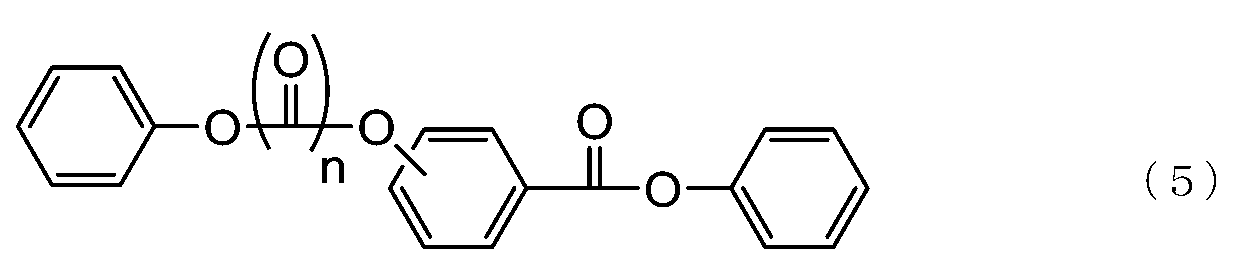
(式中、nは1又は2である。)
11.前記脱カルボニル化反応により得た炭酸ジフェニルを塩基性化合物と接触させることを特徴とする前項1乃至10の何れか1項に記載の炭酸ジフェニルの製造方法。
12.下記第1~3工程をこの順に含むことを特徴とする、炭酸ジフェニルの製造方法。
第1工程:前項1乃至11の何れか1項に記載の炭酸ジフェニルの製造方法により炭酸ジフェニルを製造する工程、
第2工程:第1工程で製造された炭酸ジフェニルと、前記アダクト体及び/又は前記アダクト体が分解されて生じたアダクト体分解物を含む触媒液とを分離する工程、
第3工程:前記触媒液の少なくとも一部を第1工程の反応器に供給する工程
13.シュウ酸ジフェニルの脱カルボニル反応による炭酸ジフェニルの製造に用いた触媒の回収方法であって、前記触媒が非対称テトラアリールホスホニウムハライド及び/又は非対称テトラアリールホスホニウムハライドとハロゲン化水素とのアダクト体であり、前記脱カルボニル反応後の反応液から炭酸ジフェニルを含む成分を取得した残液に極性有機溶媒及びハロゲン化水素ガスを接触させた後、水を接触させることにより得られる析出物として触媒を回収することを特徴とする、触媒の回収方法。
14.シュウ酸ジフェニルの脱カルボニル反応による炭酸ジフェニルの製造に用いた触媒の回収方法であって、前記触媒がテトラアリールホスホニウムハライド及び/又はテトラアリールホスホニウムハライドとハロゲン化水素とのアダクト体であり、前記脱カルボニル反応後の反応液から炭酸ジフェニルを含む成分を取得した残液を極性有機溶媒とハロゲン化水素に接触させた後、前記残液に含まれる触媒を回収する(触媒回収工程)と共に、前記極性有機溶媒を回収し、前記触媒回収工程に再利用することを特徴とする、触媒の回収方法。
15.シュウ酸ジフェニルの脱カルボニル反応による炭酸ジフェニルの製造方法であって、触媒として、前項13又は14に記載の回収方法により回収された触媒を用いることを特徴とする炭酸ジフェニルの製造方法。
16.テトラアリールホスホニウムハライドとハロゲン化水素とのアダクト体の製造方法であって、非対称テトラアリールホスホニウムハライドとハロゲン化水素を極性有機溶媒に溶解させた後、晶析することにより、非対称テトラアリールホスホニウムハライドとハロゲン化水素とのアダクト体を得ることを特徴とする、非対称テトラアリールホスホニウムハライドとハロゲン化水素とのアダクト体の製造方法。
17.シュウ酸ジフェニルの脱カルボニル反応による炭酸ジフェニル製造用触媒であって、前記触媒がベンジルプロトンを有していない非対称テトラアリールホスホニウムハライドと、ハロゲン化水素とのアダクト体であることを特徴とする、炭酸ジフェニル製造用触媒。
18.炭酸ジフェニルと、ジヒドロキシ化合物とをエステル交換触媒の存在下で重縮合させることによるポリカーボネートの製造方法であって、前記炭酸ジフェニルを前項1乃至12及び15の何れか1項に記載の炭酸ジフェニルの製造方法により製造した後に、前記ジヒドロキシ化合物と重縮合させることを特徴とするポリカーボネートの製造方法。
19.前項1乃至12及び15の何れかに1項に記載の炭酸ジフェニルの製造方法により得られる炭酸ジフェニル。
20.芳香族ジヒドロキシ化合物と前項19に記載の炭酸ジフェニルとをエステル交換触媒の存在下で重縮合させることにより得られるポリカーボネート。
11.前記脱カルボニル化反応により得た炭酸ジフェニルを塩基性化合物と接触させることを特徴とする前項1乃至10の何れか1項に記載の炭酸ジフェニルの製造方法。
12.下記第1~3工程をこの順に含むことを特徴とする、炭酸ジフェニルの製造方法。
第1工程:前項1乃至11の何れか1項に記載の炭酸ジフェニルの製造方法により炭酸ジフェニルを製造する工程、
第2工程:第1工程で製造された炭酸ジフェニルと、前記アダクト体及び/又は前記アダクト体が分解されて生じたアダクト体分解物を含む触媒液とを分離する工程、
第3工程:前記触媒液の少なくとも一部を第1工程の反応器に供給する工程
13.シュウ酸ジフェニルの脱カルボニル反応による炭酸ジフェニルの製造に用いた触媒の回収方法であって、前記触媒が非対称テトラアリールホスホニウムハライド及び/又は非対称テトラアリールホスホニウムハライドとハロゲン化水素とのアダクト体であり、前記脱カルボニル反応後の反応液から炭酸ジフェニルを含む成分を取得した残液に極性有機溶媒及びハロゲン化水素ガスを接触させた後、水を接触させることにより得られる析出物として触媒を回収することを特徴とする、触媒の回収方法。
14.シュウ酸ジフェニルの脱カルボニル反応による炭酸ジフェニルの製造に用いた触媒の回収方法であって、前記触媒がテトラアリールホスホニウムハライド及び/又はテトラアリールホスホニウムハライドとハロゲン化水素とのアダクト体であり、前記脱カルボニル反応後の反応液から炭酸ジフェニルを含む成分を取得した残液を極性有機溶媒とハロゲン化水素に接触させた後、前記残液に含まれる触媒を回収する(触媒回収工程)と共に、前記極性有機溶媒を回収し、前記触媒回収工程に再利用することを特徴とする、触媒の回収方法。
15.シュウ酸ジフェニルの脱カルボニル反応による炭酸ジフェニルの製造方法であって、触媒として、前項13又は14に記載の回収方法により回収された触媒を用いることを特徴とする炭酸ジフェニルの製造方法。
16.テトラアリールホスホニウムハライドとハロゲン化水素とのアダクト体の製造方法であって、非対称テトラアリールホスホニウムハライドとハロゲン化水素を極性有機溶媒に溶解させた後、晶析することにより、非対称テトラアリールホスホニウムハライドとハロゲン化水素とのアダクト体を得ることを特徴とする、非対称テトラアリールホスホニウムハライドとハロゲン化水素とのアダクト体の製造方法。
17.シュウ酸ジフェニルの脱カルボニル反応による炭酸ジフェニル製造用触媒であって、前記触媒がベンジルプロトンを有していない非対称テトラアリールホスホニウムハライドと、ハロゲン化水素とのアダクト体であることを特徴とする、炭酸ジフェニル製造用触媒。
18.炭酸ジフェニルと、ジヒドロキシ化合物とをエステル交換触媒の存在下で重縮合させることによるポリカーボネートの製造方法であって、前記炭酸ジフェニルを前項1乃至12及び15の何れか1項に記載の炭酸ジフェニルの製造方法により製造した後に、前記ジヒドロキシ化合物と重縮合させることを特徴とするポリカーボネートの製造方法。
19.前項1乃至12及び15の何れかに1項に記載の炭酸ジフェニルの製造方法により得られる炭酸ジフェニル。
20.芳香族ジヒドロキシ化合物と前項19に記載の炭酸ジフェニルとをエステル交換触媒の存在下で重縮合させることにより得られるポリカーボネート。
本発明の第1の効果は、シュウ酸ジフェニルを触媒存在下で脱カルボニル反応させることによる炭酸ジフェニルの製造方法について、取り扱い易い触媒を用いて、簡便で効率良く、高純度な炭酸ジフェニルを安定して連続的に製造することができることである。ここで、この脱カルボニル反応に好適な触媒を、非対称テトラアリールホスホニウムハライドとハロゲン化水素を極性有機溶媒に溶解させた後、晶析することにより簡便に得ることができる。また、この高純度な炭酸ジフェニルを原料として用いることにより、高純度なポリカーボネートを得ることができる。
本発明の第2の効果は、シュウ酸ジエステルの脱カルボニル反応による炭酸ジエステルの製造方法について、簡便で効率良く、触媒析出による閉塞などのトラブルを生じることなく安定的に高純度の炭酸ジエステルを製造することができることである。また、この炭酸ジエステルを原料として用いることにより、着色が起こり難い高純度なポリカーボネートを得ることができる。
本発明の第3の効果は、非対称テトラアリールホスホニウムハライド及び/又は非対称テトラアリールホスホニウムハライドとハロゲン化水素とのアダクト体をシュウ酸ジエステルの脱カルボニル反応による炭酸ジエステルの製造に触媒として用いた場合において、反応液から簡便な方法により効率良く高純度な触媒を回収し、これを再利用すると共に、高純度な炭酸ジエステルを安定的に連続製造することができることである。また、この高純度な炭酸ジエステルを原料として用いることにより、高純度なポリカーボネートを得ることができる。
本発明の第4の効果は、テトラアリールホスホニウムハライド及び/又はテトラアリールホスホニウムハライドとハロゲン化水素とのアダクト体をシュウ酸ジエステルの脱カルボニル反応による炭酸ジエステルの製造に触媒として用いた場合において、反応液から簡便な方法により、効率良く、高純度な触媒を回収し再利用すると共に、触媒回収に用いた溶媒も再利用することにより、効率良く、高純度な炭酸ジエステルを安定的に製造することができることである。また、この高純度な炭酸ジエステルを原料として用いることにより、高純度なポリカーボネートを得ることができる。
本発明の第5の効果は、シュウ酸ジエステルを触媒存在下で脱カルボニル反応させることによる炭酸ジエステルの製造方法について、簡便な方法で効率良く、高純度な炭酸ジエステルを安定して連続的に製造できる方法を提供することができることである。また、この高純度な炭酸ジエステルを原料として用いることにより、高純度なポリカーボネートを得ることができる。
本発明の第6の効果は、シュウ酸ジエステルを触媒存在下で脱カルボニル反応させることによる炭酸ジエステルの製造方法について、より簡略化された反応装置やプロセスにより、炭酸ジフェニルを効率良く、工業的に連続製造する方法を提供することができることである。
以下、本発明の炭酸ジエステルの製造方法の実施の形態について、詳細に説明する。
本発明の炭酸ジエステルの製造方法では、シュウ酸ジエステルを触媒存在下で脱カルボニル反応(以下、「本発明に係る脱カルボニル反応」又は単に「脱カルボニル反応」と言う場合がある。)させることにより炭酸ジエステルを製造する。
本発明に係る脱カルボニル反応は、以下に示す反応式(1)に従って行われる。
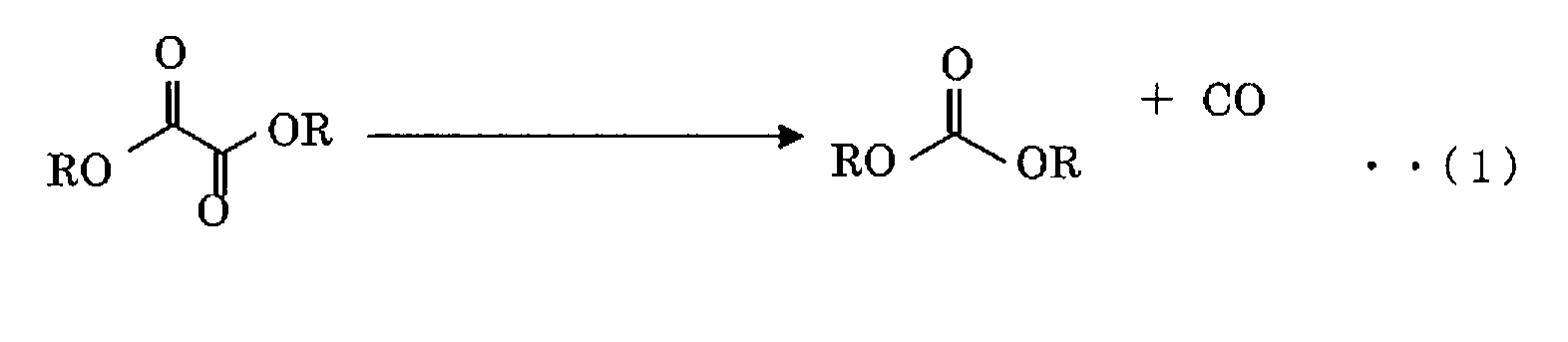
式中、2つのRは、各々独立に置換基を有していてもよい炭化水素基である。
[シュウ酸ジエステル]
反応式(1)におけるシュウ酸ジエステル(以下、「本発明に係るシュウ酸ジエステル」又は単に「シュウ酸ジエステル」と言う場合がある)は、本発明の炭酸ジエステルの製造方法における原料である。また、本発明に係るシュウ酸ジエステルを原料として得られる、本発明に係る炭酸ジエステルは、熱的に安定でポリカーボネートの原料として好適である。
反応式(1)におけるシュウ酸ジエステル(以下、「本発明に係るシュウ酸ジエステル」又は単に「シュウ酸ジエステル」と言う場合がある)は、本発明の炭酸ジエステルの製造方法における原料である。また、本発明に係るシュウ酸ジエステルを原料として得られる、本発明に係る炭酸ジエステルは、熱的に安定でポリカーボネートの原料として好適である。
本発明に係るシュウ酸ジエステルは、通常、目的とする炭酸ジエステルと同じ種類の炭化水素基(R)を有するシュウ酸ジエステルを用いる。本発明に係るシュウ酸ジエステルにおける炭化水素基は、脂肪族でも芳香族でもよい。すなわち、シュウ酸ジエステルが有する炭化水素基は、2つともアルキル基であっても、アルキル基と芳香環基が1つずつでも、2つとも芳香環基であってもよい。但し、本発明の炭酸ジエステルをポリカーボネートなどの原料として用いる際に脱離し易く、脱離基の回収が容易であることから2つとも芳香環基であることが好ましい。
本発明に係るシュウ酸ジエステルが有する炭化水素基がアルキル基である場合、直鎖、分岐および環式のいずれであってもよい。
本発明に係るシュウ酸ジエステルが有する炭化水素基が芳香環基である場合、該芳香環基は、芳香族炭化水素環基でもよいし、芳香族複素環基でもよい。但し、本発明の炭酸ジエステルを、ポリカーボネートを製造する原料として用いる際に脱離しやすいことから、芳香族炭化水素環基が好ましい。また、脱離基の回収が容易で、脱離基が安定であることから単環が好ましい。
該芳香族炭化水素環基としては、1個の遊離原子価を有する、5または6員環の単環または2~5縮合環などが挙げられる。なお、本発明において、遊離原子価とは、有機化学・生化学命名法(上)(改定第2版、南江堂、1992年発行)に記載のとおり、他の遊離原子価と結合を形成できるものを言う。
該芳香族炭化水素環基の具体例としては、1個の遊離原子価を有する、ベンゼン環、ナフタレン環、アントラセン環、フェナントレン環、ペリレン環、テトラセン環、ピレン環、ベンズピレン環、クリセン環、トリフェニレン環、アセナフテン環、フルオランテン環、フルオレン環などが挙げられる。
これらの内、本発明の炭酸ジエステルをポリカーボネートなどを製造する原料として用いる際に脱離基が安定であることから1個の遊離原子価を有するベンゼン環(フェニル基)が特に好ましい。
そこで、本発明に係るシュウ酸ジエステルは、上記反応式(1)で生成される炭酸ジエステルにおけるRが2つとも芳香環基である化合物が好ましく、Rが2つとも芳香族炭化水素環基である化合物が更に好ましく、Rが2つともフェニル基であるシュウ酸ジフェニルが特に好ましい。
すなわち、本発明に係るシュウ酸ジエステルは、シュウ酸ジフェニル(以下、「本発明に係るシュウ酸ジフェニル」又は単に「シュウ酸ジフェニル」と言う場合がある)であることが好ましく、本発明の炭酸ジエステルの製造方法により製造される炭酸ジエステルは、炭酸ジフェニル(以下、「本発明に係る炭酸ジフェニル」又は単に「炭酸ジフェニル」と言う場合がある)であることが好ましい。
また、シュウ酸ジエステルの脱カルボニル反応は、以下に示す反応式(2)に従って行われることが好ましい。

式中、2つのPhは、各々独立に置換基を有していてもよいフェニル基である。
本発明に係るシュウ酸ジエステルが有する炭化水素基が芳香族複素環基である場合、該芳香族複素環基としては、1個の遊離原子価を有する、5または6員環の単環または2~4縮合環などが挙げられる。
該芳香族複素環基の具体例としては、1個の遊離原子価を有する、フラン環、ベンゾフラン環、チオフェン環、ベンゾチオフェン環、ピロール環、ピラゾール環、イミダゾール環、オキサジアゾール環、インドール環、カルバゾール環、ピロロイミダゾール環、ピロロピラゾール環、ピロロピロール環、チエノピロール環、チエノチオフェン環、フロピロール環、フロフラン環、チエノフラン環、ベンゾイソオキサゾール環、ベンゾイソチアゾール環、ベンゾイミダゾール環、ピリジン環、ピラジン環、ピリダジン環、ピリミジン環、トリアジン環、キノリン環、イソキノリン環、シノリン環、キノキサリン環、フェナントリジン環、ベンゾイミダゾール環、ペリミジン環、キナゾリン環、キナゾリノン環、アズレン環などが挙げられる。
本発明に係るシュウ酸ジエステルが有する炭化水素基が有する置換基としては、本発明の優れた効果を大幅に妨げなければ特に限定されない。但し、得られた炭酸ジフェニルをポリカーボネート製造に用いる場合は、ポリカーボネート製造に生じる副生物の沸点が低く、蒸留除去しやすいことが好ましい。
そこで、具体的には、メチル基、エチル基等の炭素数1~12のアルキル基;メトキシ基、エトキシ基等の炭素数1~12のアルコキシ基;ニトロ基;フッ素原子、塩素原子等のハロゲン原子及び芳香環基などが好ましい。
なお、置換基としてのアルキル基は、芳香環基にアルキル基が置換基として結合した場合を言い、置換基としての芳香環基は、例えば、芳香族炭化水素環基に芳香族複素環基が置換基として結合した場合などを言う。
置換基を有する芳香環基は、置換基の位置により各種の異性体が存在するが、いずれであってもよい。例えば、置換フェニル基の異性体として、2-,3-または4-メチルフェニル基、2-,3-または4-エチルフェニル基等の炭素数1~12のアルキル基を有する2-,3-または4-アルキルフェニル基;2-,3-または4-メトキシフェニル基、2-,3-または4-エトキシフェニル基等の炭素数1~12のアルコキシ基を有する2-,3-または4-アルコキシフェニル基;2-,3-または4-ニトロフェニル基;2-,3-または4-フルオロフェニル基、2-,3-または4-クロロフェニル基等のハロゲン原子を有する2-,3-または4-ハロフェニル基などが挙げられるが、これらのいずれであってもよい。
本発明に係るシュウ酸ジエステルが有する炭化水素基が有する炭素数は、本発明の炭酸ジエステルを、ポリカーボネートなどを製造する原料として用いる際の脱離基の安定性の点では多いことが好ましいが、脱離基の回収が容易である点では少ないことが好ましい。
具体的には、置換基を有する場合は、置換基も含め、1以上であることが好ましく、2以上であることが更に好ましく、また一方で、12以下であることが好ましく、10以下であることが更に好ましい。
これらのうち、特に得られた炭酸ジフェニルをポリカーボネート製造に用いる場合などは、無置換のフェニル基が最も好ましい。
シュウ酸ジアリール(炭化水素基として芳香環基を2つ有するシュウ酸ジエステル)は、下記反応式(3)で示すようにシュウ酸ジアルキルと芳香族ヒドロキシ化合物とのエステル交換反応で製造したものなどを用いることができる。
ここで、原料となるシュウ酸ジアルキルは、下記反応式(4)で示すように、一酸化炭素、酸素及び脂肪族アルコールを原料とする酸化カルボニル化反応で製造したものなどを用いることができる。
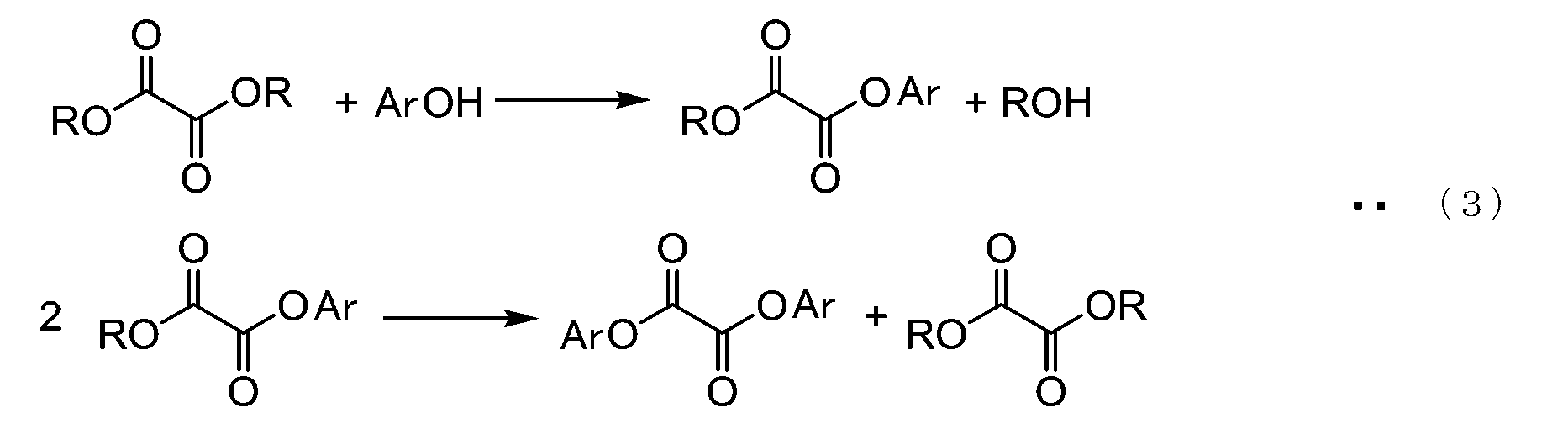
式中、Rはアルキル基を示し、Arは芳香環基を示す。

式中、Rはアルキル基を示す。
本発明の炭酸ジエステルの製造方法において、シュウ酸ジフェニルを原料として用いる場合、該シュウ酸ジフェニルは、下記一般式(5)で表わされるカルボン酸フェニルエステルを0.076重量%以上、10重量%以下の量含むことが好ましい。また、シュウ酸ジフェニルに含まれるカルボン酸フェニルエステルの量は、1重量%超であることが好ましい。
なお、シュウ酸ジフェニルに含まれるカルボン酸フェニルエステルの量は、シュウ酸ジフェニルの総量とカルボン酸フェニルエステルの総量の合計量に対するカルボン酸フェニルエステルの総量を言う。
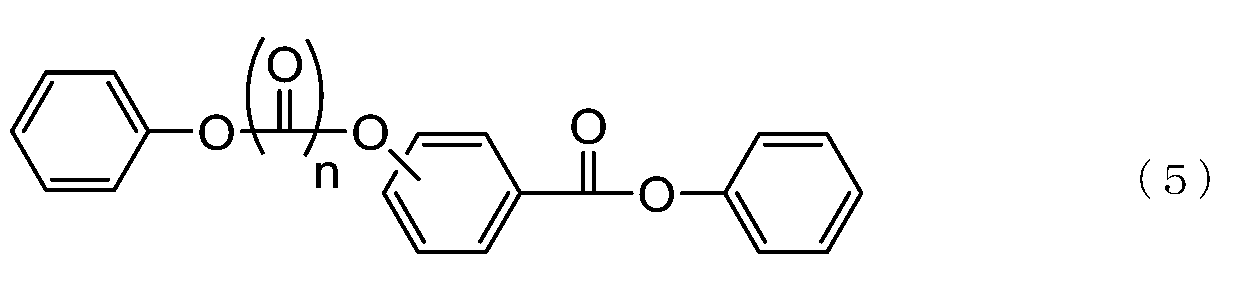
式中、nは1又は2である。
上記一般式(5)で表わされるカルボン酸フェニルエステルとしては、フェノールを減少させやすいことから、シュウ酸ジフェニルからフリース転位および縮重合などによって生成した一般式(6)で示されるフェニル(p-フェノキシカルボニルフェニル)オキサレート(PCPO)又は一般式(7)で示されるフェニル(o-フェノキシカルボニルフェニル)オキサレート(OCPO)などのフェニル(p-(又はo-)フェニルオキシカルボニルフェニル)オキサレートおよび炭酸ジフェニルからフリース転位および縮重合などによって生成した一般式(8)で示されるフェニル(p-フェノキシカルボニルフェニル)カーボネート(PCPC)又は一般式(9)で示されるフェニル(o-フェノキシカルボニルフェニル)カーボネート(OCPC)などのフェニル(p-(又はo-)フェニルオキシカルボニルフェニル)カーボネートが好ましい。
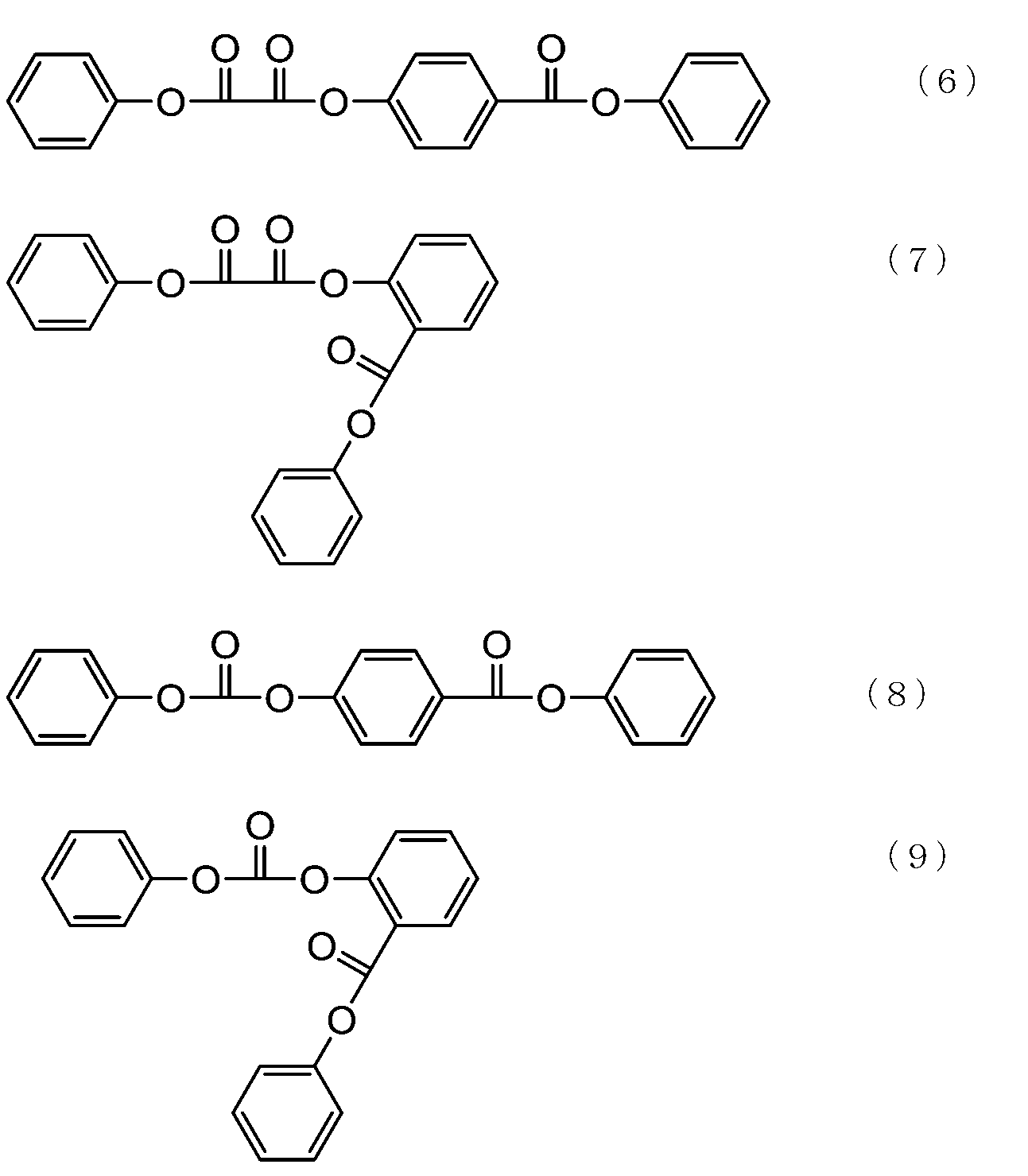
カルボン酸フェニルエステルは、シュウ酸ジフェニルをシュウ酸ジアルキルとフェノールとのエステル交換反応により製造するときに副生する。そこで、カルボン酸フェニルエステルを0.076重量%以上、10重量%以下の量含むシュウ酸ジフェニルは、シュウ酸ジアルキルとフェノールとのエステル交換反応により得られたシュウ酸ジフェニルを、カルボン酸フェニルエステルが上記範囲になるよう蒸留精製することにより得ることができる。
ここで、上記カルボン酸フェニルエステルは、通常、シュウ酸ジフェニルよりも沸点が高い。そこで、シュウ酸ジアルキルとフェノールとのエステル交換反応により得られたシュウ酸ジフェニルから、主にシュウ酸ジフェニルより低沸点のみを除くことにより得ることができる。
なお、シュウ酸ジアルキルとフェノールとのエステル交換反応により得られたシュウ酸ジフェニルを精製するときに、不用意にシュウ酸ジフェニルより高沸点の成分も除いてしまうと、シュウ酸ジフェニルに含まれるカルボン酸フェニルエステルの量は、上記下限より少なくなってしまうことがある。
[脱カルボニル触媒]
本発明の炭酸ジエステルの製造方法において用いる触媒(以下、「本発明に係る脱カルボニル触媒」、「脱カルボニル触媒」又は「触媒」と言う場合がある)は、リン原子の原子価が3価又は5価の有機リン化合物などが挙げられる。リン原子の原子価が3価又は5価である有機リン化合物は、少なくとも1個の炭素-リン(C-P)結合を有する有機リン化合物であることが好ましく、3個以上の炭素-リン(C-P)結合を有する有機リン化合物が更に好ましい。
本発明の炭酸ジエステルの製造方法において用いる触媒(以下、「本発明に係る脱カルボニル触媒」、「脱カルボニル触媒」又は「触媒」と言う場合がある)は、リン原子の原子価が3価又は5価の有機リン化合物などが挙げられる。リン原子の原子価が3価又は5価である有機リン化合物は、少なくとも1個の炭素-リン(C-P)結合を有する有機リン化合物であることが好ましく、3個以上の炭素-リン(C-P)結合を有する有機リン化合物が更に好ましい。
このような有機リン化合物としては、例えば、ホスホニウム塩系有機リン化合物(以下、ホスホニウム塩ともいう)、ホスフィン系有機リン化合物、ホスフィンジハライド系有機リン化合物及びホスフィンオキサイド系有機リン化合物などが挙げられる。これらのうち、本発明に係る脱カルボニル触媒としては、ホスホニウム塩系有機リン化合物が好ましい。
ホスホニウム塩系有機リン化合物は、以下の一般式(A)で表されるホスホニウム塩が好ましい。

式中、R1、R2、R3及びR4は、各々独立に置換基を有していてもよい芳香環基、アラルキル基又はアルキル基を表し、Xは、ホスホニウム塩の対イオンを形成しうる原子又は原子団を表す。
前記一般式(A)の芳香環基としては、フェニル基、ビフェニル基、ナフチル基等の炭素数6~14の芳香族炭化水素基及びチエニル基、フリル基、ピリジル基等のイオウ原子、酸素原子又は窒素原子を含有する炭素数4~16の芳香族複素環基などが挙げられる。
前記アラルキル基としては、ベンジル基、フェネチル基、シンナミル基、ナフチルメチル基等の不飽和結合を有していてもよい炭素数7~15のアラルキル基などが挙げられる。
前記アルキル基としては、メチル基、エチル基、プロピル基、ブチル基、ペンチル基、ヘキシル基、ヘプチル基、オクチル基、シクロプロピル基、シクロペンチル基、シクロヘキシル基、シクロヘプチル基、シクロヘキシルメチル基、ビニル基、プロペニル基、ブテニル基、1,3-ブタジエニル基等の環構造あるいは不飽和結合を有していてもよい炭素数1~16のアルキル基などが挙げられる。
前記一般式(A)のR1~R4は、各種異性体を含み、置換基を1つ以上有していてもよい。
前記置換基としては、例えば、アルコキシ基(好ましくは炭素数1~12)、チオアルコキシ基(好ましくは炭素数1~12)、アラルキルオキシ基(好ましくは炭素数7~13)、アリールオキシ基(好ましくは炭素数6~16)、チオアリールオキシ基(好ましくは炭素数6~16)、アシル基(好ましくは炭素数1~12)、アルコキシカルボニル基(好ましくは炭素数2~16)、カルボキシル基、アミノ基、アルキル置換アミノ基(好ましくは炭素数2~16)、ニトロ基、シアノ基、ヒドロキシ基、ハロゲン原子(フッ素、塩素、臭素等)等が挙げられる。また、これらの置換基は、更に置換基を有していてもよく、その置換基としてはハロゲン原子などが挙げられる。
なお、前記一般式(A)のR1~R4が置換基を有するフェニル基である場合には、各種異性体が存在する。これらの異性体としては、例えば、2-(又は3-、4-)メチルフェニル基、2-(又は3-、4-)エチルフェニル基、2,3-(又は3,4-)ジメチルフェニル基、2,4,6-トリメチルフェニル基、4-トリフルオロメチルフェニル基、3,5-ビストリフルオロメチルフェニル基等の炭素数1~12のアルキル基又はハロゲン化アルキル基がフェニル基に結合しているアルキルフェニル基;3-メトキシフェニル基、2,4,6-トリメトキシフェニル基等の炭素数1~12のアルコキシ基がフェニル基に結合しているアルコキシフェニル基;3-(又は4-)クロロフェニル基、3-フルオロフェニル基等のハロゲン原子がフェニル基に結合しているハロフェニル基などが挙げられる。
前記一般式(A)のR1~R4が芳香環基である場合、これらは、前記置換基以外に、環構造(複素環を含む)あるいは不飽和結合を有していてもよいアルキル基(好ましくは炭素数1~12)をその環上に置換基として1つ以上有していてもよい。また、R1~R4が芳香族複素環基の場合、これらは、前記置換基以外に、芳香族炭化水素環基(好ましくは炭素数6~16)をその複素環上に置換基として1つ以上有していてもよい。
前記一般式(A)のR1~R4は互いに同一であっても異なっていてもよい。また、2つの基の間で互いに結合又は架橋していてもよい。但し、溶解性の点から、R1~R4の何れか1つの基は、他の3つの基の何れかと異なる基であることが好ましい。ここで、異なる基とは、置換基の有無、種類、置換位置が異なるものも含めて、何れかが異なる基同士のことを言う。なお、本発明においては、このようにR1~R4の少なくとも何れか1つの基が、他の3つの基の少なくとも何れかの基と異なることを「非対称」であると言う。
前記一般式(A)の対イオンX-としては、塩素イオン、臭素イオン、ヨウ素イオンなどのハロゲンイオンや、ハイドロジエンジクロライドイオン、ハイドロジエンジブロマイドイオン、ハイドロジエンジヨーダイドイオン、ハイドロジエンブロマイドクロライドイオンなどのハイドロジエンハライドイオンなどが挙げられる。これらのうち、本発明に係る脱カルボニル反応において、高活性な触媒として作用しやすいことから、Xはハロゲンイオンが好ましく、塩素イオンが更に好ましい。
好ましいホスホニウム塩系有機リン化合物としては、具体的には、例えば、次のような化合物が挙げられる。即ち、前記一般式(A)のR1~R4が何れも無置換の芳香族炭化水素基である有機ホスホニウムクロライドとしては、テトラフェニルホスホニウムクロライド、p-ビフェニルトリフェニルホスホニウムクロライド、1-ナフチルトリフェニルホスホニウムクロライド、2-ナフチルトリフェニルホスホニウムクロライドなどが挙げられる。
前記一般式(A)のR1~R4が無置換の芳香族炭化水素基又は置換基を有する芳香族炭化水素基である有機ホスホニウムクロライドとしては、o-メチルフェニルトリフェニルホスホニウムクロライド、m-メチルフェニルトリフェニルホスホニウムクロライド、p-メチルフェニルトリフェニルホスホニウムクロライド、p-イソプロピルフェニルトリフェニルホスホニウムクロライド、4-t-ブチルフェニルトリフェニルホスホニウムクロライド、m-トリフルオロメチルフェニルトリフェニルホスホニウムクロライド、2,4,6-トリメチルフェニルトリフェニルホスホニウムクロライド等のアルキル基を有する芳香族炭化水素基を有する化合物;p-クロロフェニルトリフェニルホスホニウムクロライド等のハロゲン原子を有する芳香族炭化水素基を有する化合物;m-メトキシフェニルトリフェニルホスホニウムクロライド、p-メトキシフェニルトリフェニルホスホニウムクロライド、p-エトキシフェニルトリフェニルホスホニウムクロライド等のアルコキシ基を有する芳香族炭化水素基を有する化合物;p-アミノフェニルトリフェニルホスホニウムクロライド等のアミノ基を有する芳香族炭化水素基を有する化合物;m-シアノフェニルトリフェニルホスホニウムクロライド、p-シアノフェニルトリフェニルホスホニウムクロライド等のシアノ基を有する芳香族炭化水素基を有する化合物及びp-ニトロフェニル-トリ-p-トリルホスホニウムクロライド等のニトロ基を有する芳香族炭化水素基を有する化合物などが挙げられる。
前記一般式(A)のR1~R4が何れもアラルキル基である有機ホスホニウムクロライドとしては、ベンジルトリフェニルホスホニウムクロライド及びフェネチルトリフェニルホスホニウムクロライド等が挙げられる。前記一般式(A)のR1~R4が何れもアルキル基である有機ホスホニウムクロライドとしては、テトラエチルホスホニウムクロライド、テトラブチルホスホニウムクロライド、ヘキサデシルトリブチルホスホニウムクロライドなどが挙げられる。
前記一般式(A)のR1~R4が芳香族炭化水素基又はアルキル基である有機ホスホニウムクロライドとしては、メチルトリフェニルホスホニウムクロライド、エチルトリフェニルホスホニウムブロマイド、プロピルトリフェニルホスホニウムクロライド、ブチルトリフェニルホスホニウムクロライド、ヘキシルトリフェニルホスホニウムクロライド、ヘプチルトリフェニルホスホニウムクロライド、テトラデシルトリフェニルホスホニウムクロライド、ジメチルジフェニルホスホニウムクロライド、アリルトリフェニルホスホニウムクロライド等のアルキルトリフェニルホスホニウムクロライド;シクロプロピルトリフェニルホスホニウムクロライド等の環構造を有するアルキル基を有するアルキルトリアリールホスホニウムクロライド;1,3-ブタジエニルトリフェニルホスホニウムクロライド等の不飽和結合を有するアルキル基を有する化合物などが挙げられる。また、前記一般式(A)のR1~R4が芳香族炭化水素基又は置換基を有するアルキル基である有機ホスホニウムクロライドとしては、(1,3-ジオキソラン-2-イル)メチルトリフェニルホスホニウムクロライド、2-(1,3-ジオキソラン-2-イル)エチルトリフェニルホスホニウムクロライド、2-(1,3-ジオキサン-2-イル)エチルトリフェニルホスホニウムクロライド等の複素環基を有するアルキル基を有する化合物;ブロモメチルトリフェニルホスホニウムクロライド等のハロゲン原子を有するアルキル基を有する化合物;4-カルボキシブチルトリフェニルホスホニウムクロライド、2-カルボキシアリルトリフェニルホスホニウムクロライド等のカルボキシル基を有するアルキル基を有する化合物;4-エトキシカルボニルブチルトリフェニルホスホニウムクロライド等のアルコキシカルボニル基を有するアルキル基を有する化合物;2-ジメチルアミノメチルトリフェニルホスホニウムクロライド等のアルキル置換アミノ基を有するアルキル基を有する化合物及びフェナシルトリフェニルホスホニウムクロライド等のアシル基を有するアルキル基を有する化合物などが挙げられる。
前記一般式(A)のR1~R4が芳香族炭化水素基又はアラルキル基である有機ホスホニウムクロライドとしては、ベンジルトリフェニルホスホニウムクロライド、4-エトキシベンジルトリフェニルホスホニウムクロライド、シンナミルトリフェニルホスホニウムクロライドなどが挙げられる。
本発明に係る脱カルボニル触媒としては、これらのホスホニウム塩系有機リン化合物うち、特に、前記一般式(A)のR1~R4が何れも芳香環基であることが好ましく、R1~R4が何れも芳香族炭化水素基であることが更に好ましい。そして、非対称テトラアリールホスホニウムハライドが特に好ましく、4-t-ブチルフェニルトリフェニルホスホニウムクロライドが最も好ましい。
なお、この前記一般式(A)のR1~R4が何れも芳香環基であるホスホニウム塩系有機リン化合物を「本発明に係るテトラアリールホスホニウムハライド」又は単に「テトラアリールホスホニウムハライド」と言う場合がある。
また、この本発明に係るテトラアリールホスホニウムハライドのうち、特に好ましい、R1~R4が非対称であるテトラアリールホスホニウムハライドを「本発明に係る非対称テトラアリールホスホニウムハライド」又は単に「非対称テトラアリールホスホニウムハライド」と言う場合がある。
本発明に係る脱カルボニル触媒として好ましい、本発明に係るテトラアリールホスホニウムハライドは、以下の一般式(10)で表される化合物である。
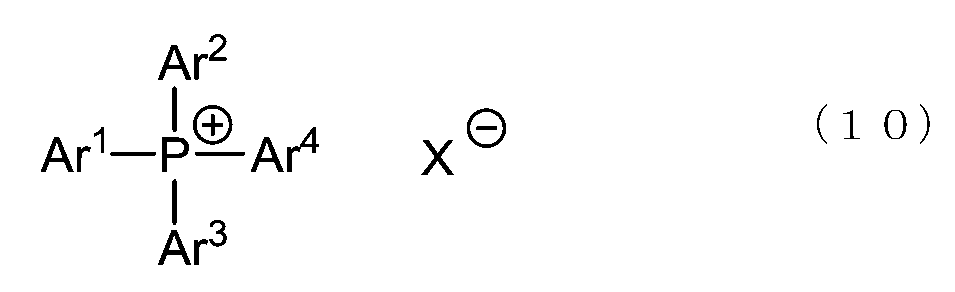
式中、Ar1、Ar2、Ar3及びAr4は、各々独立に置換基を有していてもよい芳香環基、を表し、Xは、ハロゲン原子を表す。
Ar1~Ar4の芳香環基としては、フェニル基、ビフェニル基、ナフチル基等の炭素数6~14の芳香族炭化水素基及びチエニル基、フリル基、ピリジル基等のイオウ原子、酸素原子又は窒素原子を含有する炭素数4~16の芳香族複素環基などが挙げられる。これらのうち安価に触媒を製造できることから芳香族炭化水素基が好ましく、フェニル基が更に好ましい。
Ar1~Ar4は、各種異性体を含み、各芳香環基は置換基を1つ以上有していてもよい。該置換基としては、例えば、アルキル基(好ましくは炭素数1~12)、アルコキシ基(好ましくは炭素数1~12)、チオアルコキシ基(好ましくは炭素数1~12)、アラルキルオキシ基(好ましくは炭素数7~13)、アリールオキシ基(好ましくは炭素数6~16)、チオアリールオキシ基(好ましくは炭素数6~16)、アシル基(好ましくは炭素数1~12)、アルコキシカルボニル基(好ましくは炭素数2~16)、カルボキシル基、アミノ基、アルキル置換アミノ基(好ましくは炭素数2~16)、ニトロ基、シアノ基、ヒドロキシ基、ハロゲン原子(フッ素、塩素、臭素等)等が挙げられる。また、これらの置換基は、更に置換基を有していてもよく、その置換基としては、芳香環基やハロゲン原子などが挙げられる。
これらのうち、熱的に安定であることからアルキル基が好ましく、炭素数1~12のアルキル基がより好ましく、炭素数3~8の分岐したアルキル基が更に好ましい。また、該置換基は、触媒が熱的に安定となり、本発明の脱カルボニル反応用触媒として用いた場合に分解し難いことから、ベンジルプロトンを有さないことが好ましい。すなわち、該置換基は、炭素数3~8のベンジルプロトンを有さないアルキル基が特に好ましく、t-ブチル基が最も好ましい。
なお、Ar1~Ar4が置換基を有する芳香環基である場合には、各種異性体が存在するが、Ar1~Ar4はその何れであってもよい。これらの異性体としては、例えば、Ar1~Ar4が置換基を有するフェニル基である場合、2-(又は3-、4-)メチルフェニル基、2-(又は3-、4-)エチルフェニル基、2,3-(又は3,4-)ジメチルフェニル基、2,4,6-トリメチルフェニル基、4-トリフルオロメチルフェニル基、3,5-ビストリフルオロメチルフェニル基等の炭素数1~12のアルキル基又はハロゲン化アルキル基がフェニル基に結合しているアルキルフェニル基;3-メトキシフェニル基、2,4,6-トリメトキシフェニル基等の炭素数1~12のアルコキシ基がフェニル基に結合しているアルコキシフェニル基;2-(又は3-、4-)ニトロフェニル基;3-(又は4-)クロロフェニル基、3-フルオロフェニル基等のハロゲン原子がフェニル基に結合しているハロフェニル基などが挙げられる。
Ar1~Ar4は、2つの基の間で互いに結合又は架橋していてもよい。
本発明に係るテトラアリールホスホニウムハライドにおいては、Ar1~Ar4の少なくとも何れか1つの基は、他の3つの基の少なくとも何れかと異なる基であることが好ましい。すなわち、本発明に係る非対称テトラアリールホスホニウムハライドは、上記の一般式(10)で表される化合物であって、Ar1、Ar2、Ar3及びAr4が非対称である化合物である。
本発明に係るテトラアリールホスホニウムハライドが非対称である場合、Ar1~Ar4の少なくとも何れか1つの基が他の3つの基の少なくとも何れかと異なる基であることにより、溶解性に優れる。
本発明に係るテトラアリールホスホニウムハライドが非対称である場合、Ar1~Ar4の残りの3つの基は互いに同一であっても異なっていてもよい。本発明に係る非対称テトラアリールホスホニウムハライドとしては、熱的に安定となりやすいことからAr1~Ar4が何れも芳香環基であることが好ましく、Ar1~Ar4の何れか1つが置換基を有する芳香環基で残りの3つの基が無置換の芳香環基であることが更に好ましく、Ar1~Ar4の少なくとも何れか1つが置換基を有するアリール基で残りの基が無置換のアリール基であることが特に好ましく、Ar1~Ar4の何れか1つが置換基を有するフェニル基で残りの3つの基が無置換のフェニル基であることが最も好ましい。
一般式(10)のハロゲン原子Xは、塩素原子、臭素原子、ヨウ素原子などのハロゲン原子である。これらのうち、本発明に係る脱カルボニル反応において、高活性な触媒として作用しやすいことから塩素原子が好ましい。即ち、本発明に係るテトラアリールホスホニウムハライドは、(置換基を有していてもよい)テトラフェニルホスホニウムクロライドが好ましい。また、本発明に係るテトラアリールホスホニウムハライドは、ベンジルプロトンを有さないことが好ましい。すなわち、ベンジルプロトンを有さない非対称テトラアリールホスホニウムクロライドが特に好ましい。
本発明に係るテトラアリールホスホニウムハライドの好ましい具体的としては、次のような化合物が挙げられる。即ち、Ar1~Ar4が何れも無置換の芳香族炭化水素基としては、テトラフェニルホスホニウムクロライド、p-ビフェニルトリフェニルホスホニウムクロライド、1-ナフチルトリフェニルホスホニウムクロライド、2-ナフチルトリフェニルホスホニウムクロライドなどが挙げられる。
Ar1~Ar4が無置換の芳香族炭化水素基又は置換基を有する芳香族炭化水素基である有機ホスホニウムクロライドとしては、4-t-ブチルフェニルトリフェニルホスホニウムクロライド、m-トリフルオロメチルフェニルトリフェニルホスホニウムクロライド等のベンジルプロトンを有さずアルキル基を有する芳香族炭化水素基を有する化合物;p-クロロフェニルトリフェニルホスホニウムクロライド等のハロゲン原子を有する芳香族炭化水素基を有する化合物;m-メトキシフェニルトリフェニルホスホニウムクロライド、p-メトキシフェニルトリフェニルホスホニウムクロライド、p-エトキシフェニルトリフェニルホスホニウムクロライド等のアルコキシ基を有する芳香族炭化水素基を有する化合物;p-アミノフェニルトリフェニルホスホニウムクロライド等のアミノ基を有する芳香族炭化水素基を有する化合物;m-シアノフェニルトリフェニルホスホニウムクロライド、p-シアノフェニルトリフェニルホスホニウムクロライド等のシアノ基を有する芳香族炭化水素基を有する化合物及びp-ニトロフェニル-トリ-p-トリルホスホニウムクロライド等のニトロ基を有する芳香族炭化水素基を有する化合物などが挙げられる。
これらのうち、本発明に係るテトラアリールホスホニウムハライドは、置換基を有していてもよいテトラフェニルホスホニウムクロライドが好ましい。また、非対称テトラアリールホスホニウムクロライド(上記化合物のうち、テトラフェニルホスホニウムクロライド以外の化合物)が好ましく、4-t-ブチルフェニルトリフェニルホスホニウムクロライドが特に好ましい。
また、本発明の炭酸ジエステルの製造方法において用いる触媒は、上述した非対称テトラアリールホスホニウムハライドと、ハロゲン化水素とのアダクト体(以下、「本発明に係る非対称アダクト体」又は単に「非対称アダクト体」と言う場合がある)が特に好ましい。なお、該ハロゲン化水素を「本発明に係るハロゲン化水素」と、該アダクト体を「本発明に係るアダクト体」又は単に「アダクト体」と各々言う場合がある。
本発明に係るハロゲン化水素としては、フッ化水素、塩化水素、臭化水素、ヨウ化水素が挙げられる。本発明に係るハロゲン化水素のハロゲンは、脱カルボニル反応用触媒に用いた場合などにハロゲンの種類が増えると副生物の種類が増えて反応系が煩雑になりやすいことから、上記の本発明に係るテトラアリールホスホニウムハライドのハロゲンと同じハロゲンが好ましい。
すなわち、本発明に係るハロゲン化水素は、塩化水素が好ましく、本発明に係るアダクト体は、テトラフェニルホスホニウムクロライドと塩化水素とのアダクト体が好ましく、非対称テトラフェニルホスホニウムクロライドと塩化水素とのアダクト体が更に好ましく、4-t-ブチルフェニルトリフェニルホスホニウムクロライドと塩化水素とのアダクト体が特に好ましい。
なお、アダクト体とは、通常、付加物結晶を意味する用語として使用されている。本発明に係るアダクト体は、通常、テトラアリールホスホニウムハライドにハロゲン化水素が付加している固体やこれが融解したものや溶解されたものなども本発明に係るアダクト体に含まれる。本発明に係るアダクト体は、通常、テトラアリールホスホニウムハライド1モルに対し、ハロゲン化水素が0.01~1.0モル付加している。すなわち、本発明に係るアダクト体は、通常、モル比で、非対称テトラアリールホスホニウムハライド100に対し、ハロゲン化水素が1~100%付加している。
なお、本発明に係る脱カルボニル触媒として最も好ましい、本発明に係る非対称アダクト体の製法、粒径及び吸湿性などについては、後述する。
脱カルボニル触媒の種類は、元素分析法、質量分析法、核磁気共鳴スペクトル法及び液体クロマトグラフィーなどの公知の方法により分析できる。具体的には、例えば、4-t-ブチルフェニルトリフェニルホスホニウムクロライドの場合、元素分析法、質量分析法及び核磁気共鳴スペクトルにより分析することによって、4-t-ブチルフェニルトリフェニルホスホニウムクロライドであることが確認できる。
また、この4-t-ブチルフェニルトリフェニルホスホニウムクロライドであることが確認された物質の液体クロマトグラムを測定しておくことによって、液体クロマトグラフィーにより、より簡便に確認することができる。4-t-ブチルフェニルトリフェニルホスホニウムクロライドと塩化水素とのアダクト体については、先ず、上記のようにして、4-t-ブチルフェニルトリフェニルホスホニウムクロライドが含まれていることを確認し、次いで、アダクト体に含まれる塩素濃度を測定することにより、塩化水素とのアダクト体であること及びそのアダクト率を算出することができる。
本発明に係る脱カルボニル触媒は、炭酸ジエステルに可溶であることが好ましい。その理由は、本発明の炭酸ジエステルの製造方法において、炭酸ジエステルに可溶な触媒を用いることにより、触媒の析出を起こすことなく安定的に高転化率で脱カルボニル反応を行い、残存シュウ酸ジエステル量を減らすことが可能となり、炭酸ジエステルを蒸発させる時に副生するフラン系化合物の生成を抑制することが可能となるからである。
また、触媒を炭酸ジエステルに溶解させた状態で供給することができ、反応後の未反応シュウ酸ジエステルが少なく炭酸ジエステルを高濃度で含む触媒液の再利用により、シュウ酸ジエステルのフリース転位生成物によるフェノールなどの副生が起こり難く、高純度な炭酸ジエステルを得ることができる。
本発明において、炭酸ジエステルに可溶であるとは、150℃において炭酸ジエステル100gに対し、触媒が通常10g以上溶解することを言い、好ましくは50g以上溶解することを言う。なお、溶解度は高いほど好ましいが、通常同上限は1000gである。炭酸ジエステルに可溶な触媒は、上述した脱カルボニル触媒について、その炭酸ジエステルに対する溶解度を測定することにより簡単に選ぶことができる。
また、通常、アルキル基を1つ以上有するテトラアリールホスホニウム塩は炭酸ジエステルに対する溶解度が高いため好ましい。アルキル基を1つ以上有するテトラアリールホスホニウム塩が有するアルキル基の数は、1以上3以下が好ましい。ここで、アルキル基を2つ以上有するテトラアリールホスホニウム塩は、2つ以上のアルキル基を置換基として有する芳香環基を1つ有しても、1つ以上のアルキル基を置換基として有する芳香環基を2つ有してもよいが、合成が容易であることから後者が好ましい。
また、本発明に係る非対称テトラアリールホスホニウムハライドは、後述する本発明の触媒の回収方法により高純度な触媒を効率良く回収しやすいことから、極性有機溶媒及び水に対する溶解度が低いことが好ましい。
一方、本発明に係る非対称アダクト体は、本発明の触媒の回収方法により高純度な触媒を効率良く回収しやすいことから、極性有機溶媒に対する溶解度が高く、水に対する溶解度が低いことが好ましい。
そこで、具体的には、40℃における後述する本発明に係る極性有機溶媒100gに対する溶解量が、本発明に係る非対称アダクト体は、本発明に係る非対称テトラアリールホスホニウムハライドより0.5g以上多いことが好ましく、1.0g以上多いことが更に好ましく、1.5g以上多いことが特に好ましい。
すなわち、本発明に係る非対称テトラアリールホスホニウムハライドは、40℃において、後述する本発明に係る極性有機溶媒100gに対して、2.0g以上溶解しないことが好ましく、1.5g以上溶解しないことが更に好ましい。
一方、本発明に係る非対称アダクト体は、40℃において、後述する本発明に係る極性有機溶媒100gに対し、2.5g以上溶解することが好ましく、3.0g以上溶解することが更に好ましい。
また、本発明に係る非対称テトラアリールホスホニウムハライド及び本発明に係る非対称アダクト体は、40℃において、純水100gに対して、2.5g以上溶解しないことが好ましく、2.0g以上溶解しないことが更に好ましい。
これらの溶解性と触媒回収との関係については、後述する炭酸ジエステルの好ましい製造方法における第3工程において詳述する。
なお、本発明に係る非対称アダクト体は、本発明の炭酸ジフェニルの製造方法において脱カルボニル反応の反応液に溶解すると共に、ハロゲン化水素が遊離して、非対称テトラアリールホスホニウムハライドが触媒として機能していると推定される。従って、後述する本発明の触媒の回収方法においては、非対称テトラアリールホスホニウムクロライドも、その塩化水素とのアダクト体も、同様に回収することができる。
本発明の炭酸ジエステルの製造方法において用いる脱カルボニル触媒の量は、生産効率の点では反応速度が速くなりやすい点では多いことが好ましいが、製造コスト及び炭酸ジエステルの精製過程で触媒が析出し難い点では少ないことが好ましい。
そこで、具体的には、1.0重量%以上であることが好ましく、2.0重量%以上であることが更に好ましく、3.0重量%以上であることが特に好ましく、また、一方で、15.0重量%以下であることが好ましく、10.0重量%以下であることが更に好ましく、8.0重量%以下であることが更に好ましい。
また、脱カルボニル触媒は、シュウ酸ジエステル1モルに対し、0.001モル以上用いることが好ましく、0.01モル以上用いることが更に好ましく、また、一方、1モル以下用いることが好ましく、0.5モル以下用いることが更に好ましい。
反応器内におけるシュウ酸ジエステルと炭酸ジエステルの合計モル量100モルに対する脱カルボニル触媒の量は、0.001モル以上であることが好ましく、0.1モル以上であることが更に好ましく、また、一方で、50モル以下であることが好ましく、20モル以下であることが更に好ましい。
なお、触媒は、1種類を単独で用いても、複数種を任意の比率及び組み合わせで用いてもよく、複数種用いる場合における上記の好ましい使用量は、その合計量を表す。また、アダクト体を用いる場合は、アダクト体及び該アダクト体が分解されて生じたテトラアリールホスホニウムハライドの合計量を言う。
また、本発明の炭酸ジエステルの製造方法において、反応器に供給されるシュウ酸ジフェニルとテトラアリールホスホニウムハライドの合計量の相対量は、反応器中におけるシュウ酸ジフェニルとテトラアリールホスホニウムハライドの合計量が上記の好ましい範囲となりやすいことから、シュウ酸ジフェニル100モルに対し、テトラアリールホスホニウムハライドの合計量を0.1モル以上とすることが好ましく、1モル以上とすることが更に好ましく、また、一方、50モル以下とすることが好ましく、20モル以下とすることが更に好ましい。
[ハロゲン化合物]
本発明の炭酸ジエステルの製造方法においては、脱カルボニル反応を高選択率で維持しやすいことから、脱カルボニル触媒と共にハロゲン化合物(以下「本発明に係るハロゲン化合物」と言う場合がある)を用いることが好ましい。
本発明の炭酸ジエステルの製造方法においては、脱カルボニル反応を高選択率で維持しやすいことから、脱カルボニル触媒と共にハロゲン化合物(以下「本発明に係るハロゲン化合物」と言う場合がある)を用いることが好ましい。
特に、有機リン化合物として、ホスフィン又はホスフィンオキサイドが使用される場合や、ハライド及びハイドロジェンジハライド以外のホスホニウム塩が使用される場合や、低濃度のホスホニウムハライド又はホスホニウムハイドロジェンジハライドが使用される場合には、ハロゲン化合物を存在させることが好ましい。
本発明に係るハロゲン化合物としては、下記の無機ハロゲン化合物及び/又は有機ハロゲン化合物などが挙げられる。これらのハロゲン化合物の中では、塩素化合物又は臭素化合物が好ましく、中でも塩素化合物が特に好ましい。
ハロゲン化合物は、脱カルボニル触媒に対してモル比(ハロゲン化合物/脱カルボニル触媒)が通常0.0001以上、好ましくは0.001以上、更に好ましくは0.01以上、特に好ましくは0.1以上であり、また、一方で、通常300以下、好ましくは100以下、更に好ましくは3.00以下、特に好ましくは1.00以下であるように用いられるのがよい。なお、ハロゲン化合物は、1種類を単独で用いても、複数種を任意の比率及び組み合わせで用いても良く、複数種用いる場合における上記の好ましい使用量は、その合計量を表す。
無機ハロゲン化合物としては、例えば、塩化アルミニウム、臭化アルミニウム等のアルミニウムのハロゲン化物;塩化白金、塩化白金酸、塩化ルテニウム、塩化パラジウム等の白金族金属のハロゲン化物;三塩化リン、五塩化リン、オキシ塩化リン、三臭化リン、五臭化リン、オキシ臭化リン等のリンのハロゲン化物;塩化水素、臭化水素等のハロゲン化水素;塩化チオニル、塩化スルフリル、二塩化イオウ、二塩化二イオウ等のイオウのハロゲン化物;塩素、臭素等のハロゲン単体などが挙げられる。
有機ハロゲン化合物としては、炭素原子と、塩素原子、臭素原子等のハロゲン原子と、水素原子、酸素原子、窒素原子、イオウ原子及びケイ素原子から選ばれる少なくとも1種の原子とから構成される化合物などが挙げられる。
このような有機ハロゲン化合物としては、例えば、飽和炭素にハロゲン原子が結合している構造(C-Hal)、カルボニル炭素にハロゲン原子が結合している構造(-CO-Hal)、ケイ素原子にハロゲン原子が結合している構造(-C-Si-Hal)、又はイオウ原子にハロゲン原子が結合している構造(CSO2-Hal)を有する有機ハロゲン化合物が好ましく用いられる。但し、Halは塩素原子、臭素原子等のハロゲン原子を表す。これらの構造は、例えば、一般式(a)、(b)、(c)、(d)としてそれぞれ表される。
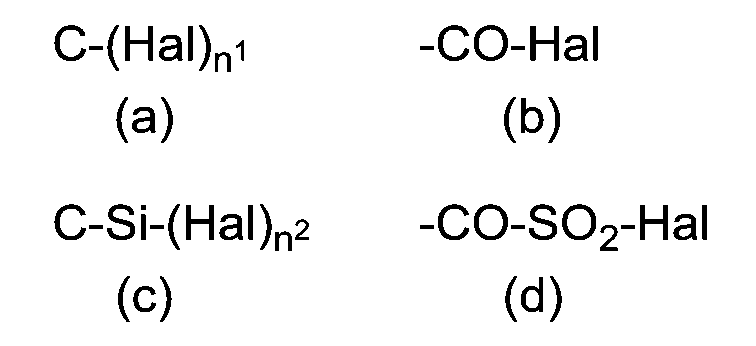
式中、Halは塩素原子、臭素原子等のハロゲン原子を表し、n1は1~4の整数、n2は1~3の整数を表す。
有機ハロゲン化合物としては、例えば、以下のような化合物が具体的に挙げられる。
一般式(a)で表されるような、飽和炭素にハロゲン原子が結合している構造を有する有機ハロゲン化合物としては、クロロホルム、四塩化炭素、1,2-ジクロロエタン、塩化ブチル、塩化ドデシル等のハロゲン化アルキルや、塩化ベンジル、ベンゾトリクロリド、塩化トリフェニルメチル、α-ブロモ-o-キシレン等のハロゲン化アラルキルや、β-クロロプロピオニトリル、γ-クロロブチロニトリル等のハロゲン置換脂肪族ニトリルや、クロロ酢酸、ブロモ酢酸、クロロプロピオン酸等のハロゲン置換脂肪族カルボン酸などが挙げられる。
一般式(b)で表されるような、カルボニル炭素にハロゲン原子が結合している構造を有する有機ハロゲン化合物としては、塩化アセチル、塩化オキサリル、塩化プロピオニル、塩化ステアロイル、塩化ベンゾイル、2-ナフタレンカルボン酸クロライド、2-チオンフェンカルボン酸クロライド等の酸ハロゲン化物や、クロログリオキシル酸フェニル等のハロゲノグリオキシル酸アリールや、クロロギ酸フェニル等のハロゲノギ酸アリールなどが挙げられる。
一般式(c)で表されるような、ケイ素原子にハロゲン原子が結合している構造を少なくとも1個有する有機ハロゲン化合物としては、ジフェニルジクロロシラン、トリフェニルクロロシラン等のハロゲン化シランなどが挙げられる。
一般式(d)で表されるような、イオウ原子にハロゲン原子が結合している構造を有する有機ハロゲン化合物としては、p-トルエンスルホン酸クロライド、2-ナフタレンスルホン酸クロライド等のハロゲン化スルホニルなどが挙げられる。
有機ハロゲン化合物としては、これらの他に、窒素原子又はリン原子を含有するオニウム塩のハロゲン化水素付加物などが挙げられる。具体的には、アンモニウム塩ハロゲン化水素付加物、ホスホニウム塩ハロゲン化水素付加物などが挙げられる。
これらのうち、入手し易い点では、塩化水素及び有機ハロゲン化合物が好ましく、一般式(a)で表される飽和炭素にハロゲン原子が結合している構造を有する有機ハロゲン化合物が更に好ましく、ハロゲン化アルキルが特に好ましく、クロロホルムが最も好ましい。
また、ハロゲン化合物由来の副生成物を抑制できる点では、無機ハロゲン化合物が好ましく、ハロゲン化水素が更に好ましく、塩化水素が特に好ましい。また、反応系内に存在するハロゲンの種類が増えると副生物の種類が増えて反応系が煩雑になりやすいことから、本発明に係るハロゲン化合物のハロゲンは、本発明に係るハロゲン化水素のハロゲン及び本発明に係るアダクト体のハロゲンと同じハロゲンであることが好ましい。
すなわち、本発明に係るアダクト体がテトラアリールホスホニウムクロライドと塩化水素とのアダクト体であり、本発明に係るハロゲン化合物が塩化水素であることが特に好ましい。そして、本発明に係るアダクト体が非対称テトラアリールホスホニウムクロライドと塩化水素とのアダクト体であり、本発明に係るハロゲン化合物が塩化水素であることが最も好ましい。
[脱カルボニル反応]
本発明の炭酸ジエステルの製造方法における脱カルボニル反応(以下、「本発明に係るカルボニル反応」又は単に「脱カルボニル反応」と言う場合がある)は、液相反応で行うことが好ましい。また、炭酸ジエステルに可溶な触媒を用いる場合、触媒は、炭酸ジエステルに溶解させた状態で供給することが好ましく、炭酸ジエステルに溶解させた状態で反応器に供給することが更に好ましく、反応後の反応液に含まれる触媒を炭酸ジエステルに溶解された状態のまま再利用することが特に好ましい。
本発明の炭酸ジエステルの製造方法における脱カルボニル反応(以下、「本発明に係るカルボニル反応」又は単に「脱カルボニル反応」と言う場合がある)は、液相反応で行うことが好ましい。また、炭酸ジエステルに可溶な触媒を用いる場合、触媒は、炭酸ジエステルに溶解させた状態で供給することが好ましく、炭酸ジエステルに溶解させた状態で反応器に供給することが更に好ましく、反応後の反応液に含まれる触媒を炭酸ジエステルに溶解された状態のまま再利用することが特に好ましい。
脱カルボニル反応の反応温度は、反応速度の点では高温であることが好ましいが、炭酸ジエステルの純度の点では低温であることが好ましい。そこで、常圧の場合、反応温度は、通常100℃以上、特に160℃以上、とりわけ180℃以上が好ましい。また、一方で、通常450℃以下、好ましくは400℃以下、より好ましくは350℃以下、更に好ましくはシュウ酸ジエステルの沸点以下が良く、具体的には、340℃以下が好ましく、320℃以下が特に好ましく、300℃以下が最も好ましい。
反応時の圧力は、プロセス上の要件から決めればよい。但し、不純物の副生が起こり難く、高純度な炭酸ジエステルを得やすいことから、特定の加圧条件下で行なうことが好ましい。すなわち、脱カルボニル反応を常圧(絶対圧力0.109MPa)より高圧条件で反応させることが好ましい。
具体的には、絶対圧力が0.105MPa以上、10MPa以下とすることが好ましい。また、0.110MPa以上であることがより好ましく、0.130MPa以上であることが更に好ましく、0.150MPa以上であることが特に好ましく、また、一方で、8MPa以下であることが好ましく、5MPa以下であることが特に好ましい。なお、脱カルボニル反応を減圧で行う場合は、通常、減圧状態を維持するために真空ポンプを用いるため、絶対圧力は通常0.990MPa以下となる。
反応時の圧力の制御は、脱カルボニル反応で副生された一酸化炭素の排出量の調整により行うことが好ましい。すなわち、脱カルボニル反応で副生された一酸化炭素の少なくとも一部を反応器から排出させ、この一酸化炭素の排出量により、脱カルボニル反応時の絶対圧力の制御を調整することが好ましい。
具体的には、例えば、圧力制御弁などにより、一酸化炭素の排出圧力を上記脱カルボニル反応時の圧力に対し、0.9倍~1.1倍程度となるように制御する。なお、排出される一酸化炭素は、反応液から自然に気液分離されることが好ましい。
また、排出された一酸化炭素は、亜硝酸エステルと一酸化炭素からシュウ酸ジエステルを製造する場合の原料として利用することが好ましい。(例えば、日本国特開平10-152457号公報などに記載の方法を参照)。
すなわち、脱カルボニル反応で副生された一酸化炭素の少なくとも一部を、亜硝酸エステルと一酸化炭素からシュウ酸ジエステルを製造する際の原料として用いることが好ましく、この副生された一酸化炭素を原料として製造されたシュウ酸ジエステルを、炭酸ジエステルの製造原料とすることが更に好ましい。
脱カルボニル反応は、脱カルボニル反応に不活性な気体(以下、「本発明に係る不活性な気体」又は単に「本発明に係る気体」と言う場合がある)を、反応器の下部から空塔線速0.00001m・s-1以上0.01m・s-1以下で供給しながら行うことが好ましい。
不活性な気体は、アルゴンなどの不活性気体、窒素、一酸化炭素などを用いることができる。一酸化炭素を用いる場合、本発明に係る脱カルボニル反応で副生される一酸化炭素を用いることが好ましい。また、脱カルボニル反応を多槽式の連続反応器を用いて行う場合には、前段の反応器で発生した一酸化炭素を反応液と共に後段の反応器に供給してもよい。
ここで、反応液を気液分離することにより得られる一酸化炭素に、フェノール、二酸化炭素、ハロゲン化水素などの不純物が含まれる場合は、吸収塔やスクラバーなどを用いて精製してから用いることが好ましい。また、不活性な気体は、ブロワ―等を用いて循環使用することが更に効率的であり好ましい。
本発明に係る脱カルボニル反応は、吸熱反応であることから反応器内が速く且つ均一に加熱されるよう撹拌しながら行うことが好ましい。そこで、本発明に係る脱カルボニル反応において、不活性な気体を反応器の下部から供給することにより、気体と反応液との接触時間が長くなり、効率的に撹拌を行うと共に、脱カルボニル反応時に副生したフェノールを気化させて除くことができる。
すなわち、不活性な気体を反応器の下部より供給して撹拌することにより、撹拌翼を無くし、又はより小さい撹拌翼で反応器内を撹拌することが可能になる。また、副生フェノールの除去により、脱カルボニル反応の反応速度及び転化率を向上させることができると考えられる。
なお、反応器下部は、通常、反応器内の反応液の高さ方向における中心部より下方を言う。そして、反応器下部からの気体の供給は、反応器下部の中心部に近い位置から供給することが好ましい。
反応原料の供給もまた、反応器下部の中心部に近い位置から供給することが好ましい。反応原料の供給口付近で局所的に高くなっている原料シュウ酸ジエステルを副生一酸化炭素により効率的に撹拌できるからである。また、反応器下部への気体の供給口には、液が漏れ難いよう逆止弁などを付けることが好ましい。供給される気体の量は、反応液が撹拌されると共に、反応液中のフェノールが同伴気化され易い点では、多いことが好ましい。
また、本発明者らは、本発明に係る脱カルボニル反応において、一般式(10)で表されるテトラアリールホスホニウムハライドからハロゲン化水素が揮発してしまう場合があること、脱カルボニル反応を減圧下で行うとこの揮発量が増えること、及び、ハロゲンの量が少ないと脱カルボニル反応におけるシュウ酸ジフェニルの転化率が減少することを見出した。
そこで、塩化水素などの揮発性が高いハロゲン化合物を用いる場合は、これが同伴気化され難い点では、供給される気体の量は少ないことが好ましい。そこで、気体を供給する場合における空塔線速は、0.00001m・s-1以上0.01m・s-1以下で供給することが好ましい。供給量は、0.0001m・s-1以上であることが更に好ましく、0.005m・s-1以下であることが特に好ましい。
なお、日本国特開平11-246487号におけるガス循環量(生成する一酸化炭素の3~30容量倍及び実施例1における280NL/hr)は、空塔線速に換算すると、装置の内容積が1リットルスケールであり、内径100mm前後と推定されることから、0.018m・s-1程度と推定される。
なお、シュウ酸ジエステルを触媒存在下で脱カルボニル反応させることにより炭酸ジエステルを製造する場合、通常、反応原料であるシュウ酸ジエステルは、日本国特開平10-158222号の図1~3のように反応器の上部から供給される。
しかしながら、本発明に係る脱カルボニル反応では、不活性な気体を反応原料と共に反応器下部から供給するとより効率的である。また、供給された気体や製造された炭酸ジエステルは、反応器上部から抜き出すことが好ましい。
気体の気泡径は、効率良く撹拌やフェノールの気化を行いやすい点では、小さいことが好ましく、具体的には、50mm以下であることが好ましく、10mm以下であることが更に好ましい。気泡径の制御は、ガススパージャーやミキサーなどを用いて行うことできる。この場合の孔径は、10mm以下が好ましく、5mm以下が更に好ましい。
脱カルボニル反応は、バッチ反応でも連続反応でもよいが、工業的には、連続反応が好ましく、高転化率としやすいことから連続多段反応で行うことが更に好ましく、その少なくとも1つの反応を上記のように不活性な気体を供給しながら行うことが特に好ましい。連続反応の一般的な方法については、日本国特開平10-109962号公報、日本国特開平10-109963号公報及び日本国特開2006-89416号公報等などに記載の方法などを用いることができる。
脱カルボニル反応は、反応に用いる物質の融点以上の温度で反応を行う場合は、溶媒を用いる必要はないが、スルホラン、N-メチルピロリドン、ジメチルイミダゾリドン等の非プロトン性極性溶媒、炭化水素溶媒、芳香族炭化水素溶媒等を適宜使用することもできる。
反応器の材質は、本発明の係る脱カルボニル反応により炭酸ジエステルを生成させることができれば特に制限はない。副反応でフェノールなどの芳香族モノヒドロキシ化合物が生成する場合があるので、耐酸性材質の金属製容器やグラスライニング製容器が好ましい。反応器の形式は、本発明に係る脱カルボニル反応により炭酸ジエステルを生成させることができれば、どのような形式の反応器でも使用することが可能である。このような反応器としては、例えば1槽または多槽式の完全混合型反応器(攪拌槽)、塔型反応器などを用いることができる。
本発明に係る脱カルボニル反応においては、シュウ酸ジエステルの転化率は、シュウ酸ジエステルの副反応による不純物の生成が起こり難く、反応効率に優れる点では高いことが好ましい。具体的には、シュウ酸ジエステルの転化率は、96重量%以上とすることが好ましく、97重量%以上がより好ましく、98重量%以上が更に好ましく、99重量%以上が特に好ましい。なお、シュウ酸ジエステルの転化率の上限は、触媒等の炭酸ジエステルに対する溶解度に応じて、触媒等の析出による閉塞が起こらない範囲で適宜選択すれば良いが100重量%が最も好ましい。
なお、ここで、シュウ酸ジエステルの転化率は、以下のようにして算出することができる。
先ず、シュウ酸ジエステルの転化率をx[%]、反応後の反応液の量をy[g]、シュウ酸ジエステルと炭酸ジエステルと触媒の合計仕込み量をsum[g]とする。
ここで、脱カルボニル反応で生成する一酸化炭素の量[g]は、“シュウ酸ジエステルの仕込み量[モル]”דx[%]/100”ד一酸化炭素の分子量”となる。
また、反応後の反応液の量y[g]は、”sum[g]“-”一酸化炭素の生成量[g]”となる。
そこで、y[g]=(”sum[g]“)-(“シュウ酸ジエステルの仕込み量[モル]”דx[%]/100”ד一酸化炭素の分子量”)となる。
また、反応後のシュウ酸ジエステルの量[g]は、“y[g]”ד反応後のシュウ酸ジエステルの濃度[重量%]/100”=”シュウ酸ジエステルの仕込み量[g]“×(100-x[%]) /100となる。
両計算式を合わせると以下の通りとなる。(”sum[g]“-“シュウ酸ジエステルの仕込み量[モル]”דx[%]/100”ד一酸化炭素の分子量”)ד反応後のシュウ酸ジエステルの濃度[重量%]/100”=”シュウ酸ジエステルの仕込み量[g]“×(100-x[%]) /100
両辺に100をかけると以下の通りとなる。
(”sum[g]“-“シュウ酸ジエステルの仕込み量[モル]”דx[%]/100”ד一酸化炭素の分子量”)ד反応後のシュウ酸ジエステルの濃度[重量%]”=”シュウ酸ジエステルの仕込み量[g]“×(100-x[%])
この式を展開すると以下の通りとなる。
”sum[g]“ד反応後のシュウ酸ジエステルの濃度[重量%]”-“シュウ酸ジエステルの仕込み量[モル]”דx[%]/100”ד一酸化炭素の分子量”ד反応後のシュウ酸ジエステルの濃度[重量%]”=”シュウ酸ジエステルの仕込み量[g]“×100-”シュウ酸ジエステルの仕込み量[g]“×”x[%]“)
ここで、x[%]について解くと以下の通りとなる。
”sum[g]“ד反応後のシュウ酸ジエステルの濃度[重量%]”-”シュウ酸ジエステルの仕込み量[g]“×100=”シュウ酸ジエステルの仕込み量[モル]”דx[%]/100”ד一酸化炭素の分子量”ד反応後のシュウ酸ジエステルの濃度[重量%]”-”シュウ酸ジエステルの仕込み量[g]“×”x[%]“
x[%]=(”sum[g]“ד反応後のシュウ酸ジエステルの濃度[重量%]”-”シュウ酸ジエステルの仕込み量[g]“×100)÷(”シュウ酸ジエステルの仕込み量[モル]”דx[%]/100”ד一酸化炭素の分子量”ד反応後のシュウ酸ジエステルの濃度[重量%]”-”シュウ酸ジエステルの仕込み量[g])
先ず、シュウ酸ジエステルの転化率をx[%]、反応後の反応液の量をy[g]、シュウ酸ジエステルと炭酸ジエステルと触媒の合計仕込み量をsum[g]とする。
ここで、脱カルボニル反応で生成する一酸化炭素の量[g]は、“シュウ酸ジエステルの仕込み量[モル]”דx[%]/100”ד一酸化炭素の分子量”となる。
また、反応後の反応液の量y[g]は、”sum[g]“-”一酸化炭素の生成量[g]”となる。
そこで、y[g]=(”sum[g]“)-(“シュウ酸ジエステルの仕込み量[モル]”דx[%]/100”ד一酸化炭素の分子量”)となる。
また、反応後のシュウ酸ジエステルの量[g]は、“y[g]”ד反応後のシュウ酸ジエステルの濃度[重量%]/100”=”シュウ酸ジエステルの仕込み量[g]“×(100-x[%]) /100となる。
両計算式を合わせると以下の通りとなる。(”sum[g]“-“シュウ酸ジエステルの仕込み量[モル]”דx[%]/100”ד一酸化炭素の分子量”)ד反応後のシュウ酸ジエステルの濃度[重量%]/100”=”シュウ酸ジエステルの仕込み量[g]“×(100-x[%]) /100
両辺に100をかけると以下の通りとなる。
(”sum[g]“-“シュウ酸ジエステルの仕込み量[モル]”דx[%]/100”ד一酸化炭素の分子量”)ד反応後のシュウ酸ジエステルの濃度[重量%]”=”シュウ酸ジエステルの仕込み量[g]“×(100-x[%])
この式を展開すると以下の通りとなる。
”sum[g]“ד反応後のシュウ酸ジエステルの濃度[重量%]”-“シュウ酸ジエステルの仕込み量[モル]”דx[%]/100”ד一酸化炭素の分子量”ד反応後のシュウ酸ジエステルの濃度[重量%]”=”シュウ酸ジエステルの仕込み量[g]“×100-”シュウ酸ジエステルの仕込み量[g]“×”x[%]“)
ここで、x[%]について解くと以下の通りとなる。
”sum[g]“ד反応後のシュウ酸ジエステルの濃度[重量%]”-”シュウ酸ジエステルの仕込み量[g]“×100=”シュウ酸ジエステルの仕込み量[モル]”דx[%]/100”ד一酸化炭素の分子量”ד反応後のシュウ酸ジエステルの濃度[重量%]”-”シュウ酸ジエステルの仕込み量[g]“×”x[%]“
x[%]=(”sum[g]“ד反応後のシュウ酸ジエステルの濃度[重量%]”-”シュウ酸ジエステルの仕込み量[g]“×100)÷(”シュウ酸ジエステルの仕込み量[モル]”דx[%]/100”ד一酸化炭素の分子量”ד反応後のシュウ酸ジエステルの濃度[重量%]”-”シュウ酸ジエステルの仕込み量[g])
[炭酸ジエステルの取り出し]
上記脱カルボニル反応により、原料シュウ酸ジエステルに対応する炭酸ジエステルを生成させることができる。本発明の炭酸ジエステルは、上記反応式(1)で生成される炭酸ジエステルにおけるRが2つとも芳香環基である化合物が好ましく、Rが2つとも芳香族炭化水素環基である化合物が更に好ましく、Rが2つともフェニル基である炭酸ジフェニルが特に好ましい。
上記脱カルボニル反応により、原料シュウ酸ジエステルに対応する炭酸ジエステルを生成させることができる。本発明の炭酸ジエステルは、上記反応式(1)で生成される炭酸ジエステルにおけるRが2つとも芳香環基である化合物が好ましく、Rが2つとも芳香族炭化水素環基である化合物が更に好ましく、Rが2つともフェニル基である炭酸ジフェニルが特に好ましい。
本発明の炭酸ジエステルの製造方法においては、反応後の反応液に含まれる炭酸ジエステルを蒸発(以下、「本発明に係る蒸発」又は単に「蒸発」と言う場合がある。)させることにより取り出すことが好ましい。炭酸ジエステルを蒸発させると、脱カルボニル触媒、及び反応後の反応液に高沸点物質が含まれている場合はこれも合わせて反応液に残留する。そこで、反応後の反応液から炭酸ジエステルを蒸発させて取り出すことにより、炭酸ジエステルと、脱カルボニル触媒及び高沸点物質を分離させることができる。
炭酸ジエステルの濃縮率(蒸発率)は、炭酸ジエステルの回収率を上げ、高濃度の触媒液を得る点では高いことが好ましい。ここで、本発明に係る触媒として、炭酸ジエステルに可溶な触媒を用いた場合、多量の炭酸ジエステルを蒸発させても析出し難い。そこで、反応液に含まれる炭酸ジエステルの50重量%以上を蒸発させることにより取り出すことが好ましい。
炭酸ジフェニルの蒸留分離は、脱カルボニル反応を行った反応器内で行ってもよいし、反応液を蒸発装置に移して行ってもよい。蒸発装置(蒸発方法)については、上記の目的を達成することができれば特に限定されることはない。
蒸発装置としては、例えば、流下膜式蒸発器、薄膜式蒸発器などを用いて行うことが短時間に分離しやすいことから好ましい。また、反応器内で蒸発させる場合は、突沸が起こり難いように攪拌しながら、徐々に減圧しながら蒸発させることが好ましい。
分離に要する時間は、伝熱効率や分離容器の形状にも影響されるが、不純物の副生が起こり難い点から短時間で行うことが好ましく、20時間以下が好ましく、15時間以下が更に好ましく、10時間以下が特に好ましい。
蒸発は、不純物の副生が起こり難い点から低温で低圧力で行うことが好ましい。圧力は、減圧下で蒸発させることが好ましく、具体的には、圧力は、0.1kPaA以上が好ましく、0.2kPaA以上が更に好ましく、一方、50kPaA以下が好ましく、20kPaA以下が更に好ましい。
そして、温度は、脱カルボニル反応における反応温度以下で行うことが好ましい。具体的には、通常100℃以上、特に160℃以上、とりわけ180℃以上、また通常450℃以下、特に400℃以下、とりわけ350℃以下が好ましい。
[炭酸ジエステルの精製]
脱カルボニル反応後の反応液には、炭酸ジエステル、脱カルボニル触媒、及び未反応シュウ酸ジエステルが含まれている。また、この他に、シュウ酸ジエステル、炭酸ジエステル、脱カルボニル触媒等の転位、分解、反応等により生じた副生物なども含まれている可能性がある。
脱カルボニル反応後の反応液には、炭酸ジエステル、脱カルボニル触媒、及び未反応シュウ酸ジエステルが含まれている。また、この他に、シュウ酸ジエステル、炭酸ジエステル、脱カルボニル触媒等の転位、分解、反応等により生じた副生物なども含まれている可能性がある。
副生物としては、例えば、フェノールなどの芳香族モノヒドロキシ化合物、フェニル4-クロロ安息香酸、シュウ酸ジフェニルのフリース転位によって生成するカルボン酸フェニルエステルや以下の反応式(11)の脱カルボニル化反応により生成するベンゾフラン-2,3-ジオンなどのフラン系化合物などが挙げられる。
また、フェノールなどの芳香族モノヒドロキシ化合物、フェニル4-クロロ安息香酸なども挙げられる。前述のハロゲン化合物を用いた場合は、該ハロゲン化合物又はその副生物が含まれている可能性もある。副生カルボン酸フェニルエステルとしては、上記式(8)で表されるフェニル(p-フェニルオキシカルボニルフェニル)カーボネート(PCPC)などが挙げられる。

そこで、上記カルボニル反応により得られた炭酸ジエステルは、用途に応じた純度や形態とするために適宜精製される。
なお、脱カルボニル反応で副生する一酸化炭素は、反応液から自然に気液分離され、排出させることが好ましい。また、一酸化炭素は、亜硝酸エステルと一酸化炭素からシュウ酸ジエステルを製造する場合の原料として再利用することも可能である。(例えば、日本国特開平10-152457号公報などに記載の方法を参照)。
ここで、一酸化炭素にフェノール、二酸化炭素、ハロゲン化水素などの不純物が含まれる場合は、吸収塔やスクラバーなどの精製装置を通した後に、シュウ酸ジエステルの原料などに利用することが好ましい。
本発明に係る脱カルボニル反応において、本発明に係るアダクト体を触媒として用いている場合、反応液に含まれるフェノール量が少ないと考えられる。その理由は、後述するとおり、アダクト体は吸湿性が低いため、加水分解によるフェノールの副生が起こりにくいことが考えられる。
また、フェノールは、本発明に係る脱カルボニル反応の阻害要因となるため、本発明の炭酸ジエステルの製造方法において、本発明に係るアダクト体を触媒として用いている場合、簡便な方法で効率良く、高純度な炭酸ジエステルを得ることができる。
また、カルボン酸フェニルエステルを含むシュウ酸ジエステルを用いて脱カルボニル反応を行う場合も、反応液に含まれるフェノール量は少ないと考えられる。その理由は、カルボン酸フェニルエステルがフェノールと反応して炭酸ジフェニル又はシュウ酸ジフェニルとなるためと考えられる。フェノールは、触媒であるテトラアリールホスホニウムクロライドと反応して、フリース転位触媒であるテトラアリールホスホニウムフェノラートを形成することから、本発明に係る脱カルボニル反応の阻害要因となる。
そこで、本発明の炭酸ジエステルの製造方法において、カルボン酸フェニルエステルを含むシュウ酸ジフェニルを用いて反応させる場合についても、簡便な方法で効率良く、フェノールの含有量が少ない高純度な炭酸ジエステルを得ることができる。
更に、本発明に係る脱カルボニル反応を加圧条件で行う場合については、カルボン酸フェニルエステルの副生が起こり難く、カルボン酸フェニルエステルの含有量が少ない高純度な炭酸ジエステルを得られると考えられる。
その理由としては、脱カルボニル反応を加圧条件で行うことにより、脱カルボニル反応時に分解した触媒によるシュウ酸ジエステルのフリース転位が起こり難くなるためと考えられる。具体的には、例えば、一般式(10)で表されるテトラアリールホスホニウムハライドを触媒として用いた場合、一般式(10)で表されるテトラアリールホスホニウムハライドが、テトラアリールホスホニウムフェノラートとハロゲン化合物に分解され、このテトラアリールホスホニウムフェノラートがシュウ酸ジエステルとフリース転位反応することにより、フェニル(p-フェニルオキシカルボニルフェニル)カーボネート(PCPC)の生成が起こると考えられる。
そして、このテトラアリールホスホニウムフェノラートと共に副生されたハロゲン化合物が、脱カルボニル反応で副生された一酸化炭素と共に反応液から留出されることにより、この触媒の分解反応が促進されると考えられる。
しかしながら、脱カルボニル反応を加圧条件で行うと、一般式(10)で表されるテトラアリールホスホニウムハライドの分解により生じるハロゲン化合物が反応液から留出され難くなりため、フェニル(p-フェニルオキシカルボニルフェニル)カーボネート(PCPC)の生成が抑制されると考えられる。すなわち、本発明の炭酸ジエステルの製造方法において、脱カルボニル反応を加圧条件で行うという簡便な方法により、効率良く安定的に高純度な炭酸ジエステルを得ることができる。
脱カルボニル反応器の下部から脱カルボニル反応に不活性な気体を供給しながら脱カルボニル反応を行う場合についても、不活性な気体と共にフェノールなどが同伴気化されているため、反応液に含まれるフェノールの量は少ないと考えられる。
特に、触媒が一般式(10)であるテトラアリールホスホニウムハライドである場合、副生フェノールとの反応によるテトラアリールホスホニウムフェノラートの生成などによる脱カルボニル反応の阻害が起こり難いため、本発明の炭酸ジエステルの製造方法においては、簡便な方法で効率良く、炭酸ジエステルを得ることができる。
反応液に多量のシュウ酸ジエステルが残っていると、蒸発させる時の加熱によりフラン系化合物が生成する可能性がある。例えば、シュウ酸ジフェニル類は、以下の反応式(12)のフリース転位により、ベンゾフラン-2,3-ジオン類とフェノール類が生成する可能性がある。
特に、ベンゾフラン-2,3-ジオンは、橙色を呈した化合物で、炭酸ジエステルの着色原因となることがあることから、炭酸ジエステル中のベンゾフラン-2,3-ジオンの量は少ないことが好ましい。
しかしながら、本発明の炭酸ジエステルの製造方法において、炭酸ジエステルに可溶な触媒を用いて、転化率96%以上で脱カルボニル反応を行う場合は、残存シュウ酸ジエステルが少なく、蒸発させる時の加熱によるフラン系化合物の副生を抑制することが可能となる。
具体的には、蒸発させた炭酸ジエステルに含まれるフラン系化合物の量は、脱カルボニル反応におけるシュウ酸ジエステルの転化率の影響も受けるが、通常1ppm以下、好ましくは0.1ppm以下とすることが可能である。
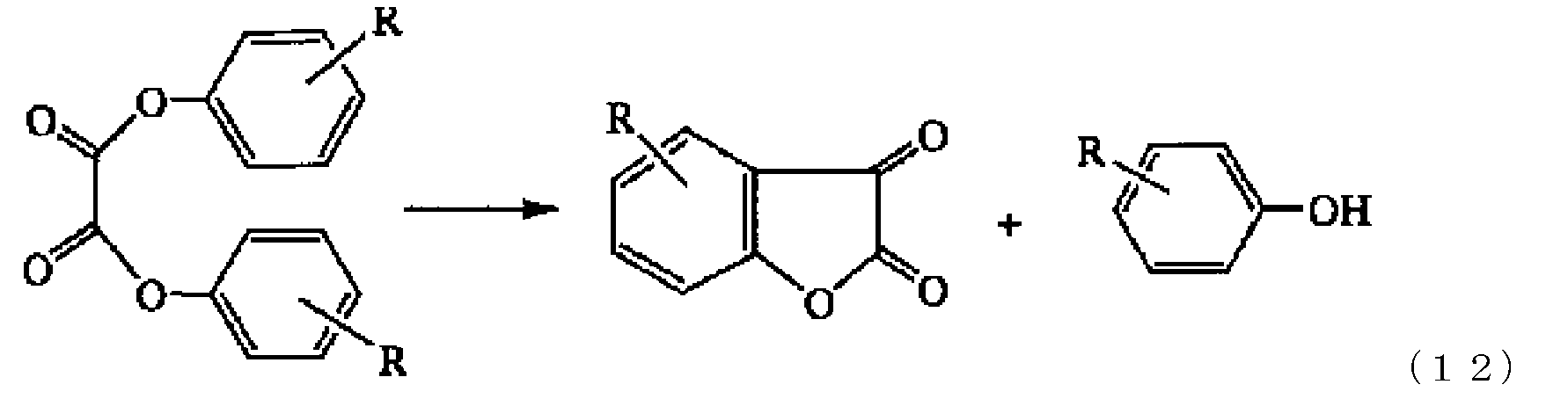
式中、Rは、反応式(1)中のRと同じである。
また、上記の好ましい本発明の炭酸ジエステルの製造方法において、炭酸ジエステルを蒸発させた場合、蒸発させた留分には、炭酸ジエステルが通常70重量%以上、好ましくは80重量%以上、より好ましくは90重量%以上、更に好ましくは97重量%以上、特に好ましくは98重量%以上含まれている。また、同上限は、通常100重量%である。
この留分にシュウ酸ジエステルを含む場合は、通常0.001重量%以上、好ましくは0.01重量%以上、更に好ましくは0.1重量%以上であり、また、一方で、通常3重量%以下、好ましくは2重量%以下、更に好ましくは1重量%以下、更に好ましくは0.5重量%以下である。但し、0重量%が最も好ましい。
また、これら以外の成分が含まれる場合の含有量は、炭酸ジエステルとシュウ酸ジエステルの合計量100重量部に対し、通常1重量部以下、好ましくは0.5重量部以下、更に好ましくは0.1重量部以下である。イオン性の塩素などが含まれる場合の含有量は、通常0.0001重量%以下、好ましくは0.00001重量%以下、更に好ましくは0.000001重量%以下である。
この留分に含まれるフェニル(p-フェニルオキシカルボニルフェニル)カーボネート(PCPC)については、通常0.35重量%以下、好ましくは0.30重量%以下、より好ましくは0.10重量%以下、更に好ましくは0.08重量%以下、特に好ましくは0.05重量%以下である。
これら以外の成分としては、フェノールなどの芳香族モノヒドロキシ化合物などが含まれる場合があるが、その場合の含有量は、通常1重量%以下、好ましくは0.5重量%以下、更に好ましくは0.3重量%以下である。
また、この留分に含まれるベンゾフラン-2,3-ジオンなどのフラン系化合物の含有量は通常10重量ppb以上、好ましくは100重量ppb以上、更に好ましくは1000重量ppb以上であり、また、一方で、通常2重量%以下、好ましくは1重量%以下、更に好ましくは0.5重量%以下である。
蒸発させた炭酸ジエステルは、そのままポリカーボネート製造等の用途に用いてもよいが、必要な純度などに応じて、更に精製を行ってもよい。また、上記炭酸ジエステルの蒸発を蒸留により行い、炭酸ジエステルより高沸点である成分を塔底側から、炭酸ジエステルを中段から、炭酸ジエステルより低沸点である成分を塔頂側から各々抜き出すことにより高純度な炭酸ジエステルを得てもよい。
更に精製する場合は、蒸留や吸着などにより行うことができる。具体的には、5~50段の理論段を有する棚段塔あるいは充填塔などの蒸発装置を用いて蒸留精製することが好ましい。
本発明の炭酸ジエステルの製造方法において、炭酸ジエステルに可溶な触媒を用いて、転化率96%以上で脱カルボニル反応を行う場合は、フラン系化合物の副生が抑制されているため、蒸発させた炭酸ジエステルからフラン系化合物を除去する操作は、求められる純度によっては設けなくても構わない。すなわち、フラン系化合物を除去する後工程が必須であった従来法に比べ、簡便で効率良く、高純度な炭酸ジエステルを得ることが可能となる。
炭酸ジエステルより高沸点である成分としては、シュウ酸ジエステル、シュウ酸メチルフェニルフェニルなどの脱カルボニル反応の原料及びその原料中に混入してくる高沸点物質、脱カルボニル反応やその反応液の蒸発において副生するp-クロロ安息香酸フェニル、サルチル酸フェニル、その重合物、脱カルボニル反応の際に生成した有機ハロゲン化物(パラクロロ安息香酸フェニル等)などが挙げられる。
本発明の炭酸エステルの製造方法においては、シュウ酸ジエステルの脱カルボニル化反応により得られる炭酸ジエステルを塩基性化合物と接触させることにより、該炭酸ジエステルに含まれるフラン系化合物を分解するという簡便な方法により、フラン系化合物の含有量が少ない高純度な炭酸ジエステルを効率良く、安定的且つ連続的に製造することが好ましい。
[塩基性化合物]
フラン系化合物の除去に用いる塩基性化合物としては、例えば、アルカリ金属化合物としては、水酸化リチウム、水酸化ナトリウム、水酸化カリウム、水酸化セシウムなどのアルカリ金属の水酸化物;炭酸水素リチウム、炭酸水素ナトリウム、炭酸水素カリウム、炭酸水素セシウムなどの炭酸水素アルカリ金属塩;炭酸リチウム、炭酸ナトリウム、炭酸カリウムなどのアルカリ金属の炭酸塩;酢酸リチウム、酢酸ナトリウム、酢酸カリウム、酢酸セシウムなどのアルカリ金属の酢酸塩;ステアリン酸リチウム、ステアリン酸ナトリウム、ステアリン酸カリウム、ステアリン酸セシウムなどのステアリン酸のアルカリ金属塩;水素化ホウ素リチウム、水素化ホウ素ナトリウム、水素化ホウ素カリウム、水素化ホウ素セシウムなどの水素化ホウ素のアルカリ金属塩;安息香酸リチウム、安息香酸ナトリウム、安息香酸カリウム、安息香酸セシウムなどのアルカリ金属の安息香酸塩;リン酸二水素リチウム、リン酸二水素ナトリウム、リン酸二水素カリウム、リン酸二水素セシウムなどのアルカリ金属のリン酸二水素塩;フェニルリン酸二リチウム、フェニルリン酸二ナトリウム、フェニルリン酸二カリウム、フェニルリン酸二セシウムなどのアルカリ金属のフェニルリン塩;リチウム、ナトリウム、カリウム、セシウムのアルコラート;リチウム、ナトリウム、カリウム、セシウムのフェノキシド;ビスフェノールAの二リチウム塩、二ナトリウム塩、二カリウム塩、二セシウム塩などが挙げられる。
フラン系化合物の除去に用いる塩基性化合物としては、例えば、アルカリ金属化合物としては、水酸化リチウム、水酸化ナトリウム、水酸化カリウム、水酸化セシウムなどのアルカリ金属の水酸化物;炭酸水素リチウム、炭酸水素ナトリウム、炭酸水素カリウム、炭酸水素セシウムなどの炭酸水素アルカリ金属塩;炭酸リチウム、炭酸ナトリウム、炭酸カリウムなどのアルカリ金属の炭酸塩;酢酸リチウム、酢酸ナトリウム、酢酸カリウム、酢酸セシウムなどのアルカリ金属の酢酸塩;ステアリン酸リチウム、ステアリン酸ナトリウム、ステアリン酸カリウム、ステアリン酸セシウムなどのステアリン酸のアルカリ金属塩;水素化ホウ素リチウム、水素化ホウ素ナトリウム、水素化ホウ素カリウム、水素化ホウ素セシウムなどの水素化ホウ素のアルカリ金属塩;安息香酸リチウム、安息香酸ナトリウム、安息香酸カリウム、安息香酸セシウムなどのアルカリ金属の安息香酸塩;リン酸二水素リチウム、リン酸二水素ナトリウム、リン酸二水素カリウム、リン酸二水素セシウムなどのアルカリ金属のリン酸二水素塩;フェニルリン酸二リチウム、フェニルリン酸二ナトリウム、フェニルリン酸二カリウム、フェニルリン酸二セシウムなどのアルカリ金属のフェニルリン塩;リチウム、ナトリウム、カリウム、セシウムのアルコラート;リチウム、ナトリウム、カリウム、セシウムのフェノキシド;ビスフェノールAの二リチウム塩、二ナトリウム塩、二カリウム塩、二セシウム塩などが挙げられる。
アルカリ土類金属化合物としては、水酸化カルシウム、水酸化バリウム、水酸化マグネシウム、水酸化ストロンチウムなどのアルカリ土類金属の水酸化物;炭酸水素カルシウム、炭酸水素バリウム、炭酸水素マグネシウム、炭酸水素ストロンチウムなどの炭酸水素アルカリ土類金属塩;炭酸カルシウム、炭酸バリウム、炭酸マグネシウム、炭酸ストロンチウムなどのアルカリ金属の炭酸塩;酢酸カルシウム、酢酸バリウム、酢酸マグネシウム、酢酸ストロンチウムなどのアルカリ土類金属の酢酸塩;ステアリン酸カルシウム、ステアリン酸バリウム、ステアリン酸マグネシウム、ステアリン酸ストロンチウムなどのステアリン酸のアルカリ土類金属塩などが挙げられる。
有機ホウ素化合物としては、テトラメチルホウ素、テトラエチルホウ素、テトラプロピルホウ素、テトラブチルホウ素、トリメチルエチルホウ素、トリメチルベンジルホウ素、トリメチルフェニルホウ素、トリエチルメチルホウ素、トリエチルベンジルホウ素、トリエチルフェニルホウ素、トリブチルベンジルホウ素、トリブチルフェニルホウ素、テトラフェニルホウ素、ベンジルトリフェニルホウ素、メチルトリフェニルホウ素、ブチルトリフェニルホウ素などの水酸化物などが挙げられる。
有機ホウ素化合物としては、トリエチルホスフィン、トリ-n-プロピルホスフィン、トリイソプロピルホスフィン、トリ-n-ブチルホスフィン、トリフェニルホスフィン、トリブチルホスフィン、あるいは四級ホスホニウム塩などが挙げられる。
有機アンモニウム塩としては、テトラメチルアンモニウムヒドロキシド、テトラエチルアンモニウムヒドロキシド、テトラプロピルアンモニウムヒドロキシド、テトラブチルアンモニウムヒドロキシド、トリメチルエチルアンモニウムヒドロキシド、トリメチルベンジルアンモニウムヒドロキシド、トリメチルフェニルアンモニウムヒドロキシド、トリエチルメチルアンモニウムヒドロキシド、トリエチルベンジルアンモニウムヒドロキシド、トリエチルフェニルアンモニウムヒドロキシド、トリブチルベンジルアンモニウムヒドロキシド、トリブチルフェニルアンモニウムヒドロキシド、テトラフェニルアンモニウムヒドロキシド、ベンジルトリフェニルアンモニウムヒドロキシド、メチルトリフェニルアンモニウムヒドロキシド、ブチルトリフェニルアンモニウムヒドロキシドなどが挙げられる。
ピリジン化合物としては、4-アミノピリジン、2-アミノピリジン、N,N-ジメチル-4-アミノピリジン、4-ジエチルアミノピリジン、2-ヒドロキシピリジン、2-メトキシピリジン、4-メトキシピリジンなどが挙げられる。イミダゾール化合物としては、2-ジメチルアミノイミダゾール、2-メトキシイミダゾール、イミダゾール、2-メルカプトイミダゾール、2-メチルイミダゾールなどが挙げられる。また、アミノキノリンなども挙げられる。
これらのうち、揮発性が低いことから、アルカリ金属化合物及びアルカリ土類金属化合物が好ましく、アルカリ金属化合物が更に好ましい。
塩基性化合物は、炭酸ジエステルに含まれるフラン系化合物などの不純物と接触させることができれば、本発明の炭酸ジエステルの製造方法においてどのように供給してもよい。塩基性化合物は、シュウ酸ジエステルの脱カルボニル化反応により得られる炭酸ジエステルを貯蔵するタンクやその精製塔などに供給することが簡便で好ましい。
炭酸ジエステルを貯蔵するタンクとしては、具体的には、シュウ酸ジエステルの脱カルボニル化反応により得られる反応液から触媒液を除去した成分を貯槽するタンクが挙げられる。また、炭酸ジエステルの精製塔としては、日本国特開2002-322130号公開公報に記載されたように、蒸留する蒸留塔などが挙げられる。
塩基性化合物は、塩基性化合物のみの状態で供給しても、溶媒などに溶解させた状態で供給してもよい。塩基性化合物を溶媒に溶解させた状態で供給する場合、フェノールのような炭酸ジフェニルに対する溶解度の高い溶媒が好ましい。
炭酸ジエステルに供給する塩基性化合物の量は、フラン系化合物の分解が起こり易い点では多いことが好ましいが、炭酸ジエステルの分解が起こり難い点では少ないことが好ましい。そこで、炭酸ジエステル100重量部に対して、通常0.0000001重量部以上、好ましくは0.000001重量部以上、更に好ましくは0.00001重量部以上であり、また、一方で、通常1重量部以下、好ましくは0.1重量部以下、更に好ましくは0.01重量部以下である。
フラン系化合物の分解は、高温であるほど起こり易いが、炭酸ジエステルの分解が起こり難い点では低温で行うことが好ましい。そこで、通常100℃以上、好ましくは130℃以上、更に好ましくは150℃上で行う。また、一方で、通常300℃以下、好ましくは280℃以下、更に好ましくは250℃以下で行う。
フラン系化合物の除去は、通常、シュウ酸ジエステルの脱カルボニル化反応により得られる炭酸ジエステルから触媒液を除去した炭酸ジエステルを含む成分に対して行う。
[脱カルボニル触媒の回収]
本発明の炭酸ジエステルの製造方法において、炭酸ジエステルに可溶な触媒を用いて、脱カルボニル反応を行う場合、たとえ高転化率で反応を行っても、炭酸ジエステルを蒸発させた後の反応液に残存する触媒は、通常、反応液に残存する炭酸ジエステルに溶解している。
本発明の炭酸ジエステルの製造方法において、炭酸ジエステルに可溶な触媒を用いて、脱カルボニル反応を行う場合、たとえ高転化率で反応を行っても、炭酸ジエステルを蒸発させた後の反応液に残存する触媒は、通常、反応液に残存する炭酸ジエステルに溶解している。
そこで、この触媒の少なくとも一部を残存液から取り出して、脱カルボニル反応に供給して再利用することが好ましい。即ち、該残存液に含まれる触媒の少なくとも一部を触媒として用いることにより、触媒を炭酸ジエステルに溶解させた状態で反応器に供給することが好ましい。
触媒の再利用は、反応系内における高沸点化合物の蓄積を防ぐ観点より、炭酸ジエステルを蒸発させた後の反応液から炭酸ジエステルより高沸点である化合物を除去した液を反応器に供給することが好ましい。
この工程により除かれる成分としては、シュウ酸ジフェニル(1気圧における沸点334℃)などのシュウ酸ジエステルや4-ヒドロキシ安息香酸フェニル(1気圧においてシュウ酸ジフェニルより高沸点)などの高沸点物質が挙げられる。高沸点化合物の除去は、蒸留、抽出、晶析など公知の方法でできる。
具体的には、例えば、日本国特開2002-45704号公報に記載の方法などで分離することができる。なお、フェニル(p-フェニルオキシカルボニルフェニル)カーボネート(PCPC)は、1気圧における沸点が340℃であるため、高沸点化合物に含まれる。
そして、触媒を含む残存液を再利用する場合、該残存液に含まれる炭酸ジエステルと炭酸ジエステル以外の脱カルボニル反応の副生物の合計量は、触媒以外の成分の合計量に対し、85~100重量%であることが好ましい。
触媒を再利用する場合、回収した触媒のみを用いても、回収した触媒に未使用触媒などを混ぜて用いてもよい。また、該残存液に更に炭酸ジエステルを足した溶液を反応器に供給してもよい。また、この高沸点化合物の除去に伴い触媒や触媒が分解されて生じた分解物の一部も除去されてしまうことなどにより、触媒の全量が再利用されないことが起こり得る。そこで、脱カルボニル触媒の量が上述の好ましい範囲となるよう触媒量を調整することが好ましい。
触媒量の調整は、高沸点化合物と共に除去された触媒及び触媒分解物の合計モル量と同程度のモル量の触媒を、高沸点化合物を除いた液と共に脱カルボニル反応の反応器に供給することにより行うことが好ましい。ここで、触媒として本発明に係るアダクト体を用いる場合、この触媒が分解されて生じた分解物は、アダクト体の分解物のことを指す。
そして、高沸点化合物を除いた液と共に、アダクト体分解物であるテトラアリールホスホニウムハライドの合計モル量と同程度のモル量のアダクト体を脱カルボニル反応の反応器に供給することが好ましい。同程度のモル量は、高沸点化合物と共に除去された、触媒及びテトラアリールホスホニウムハライドなどの触媒分解物の合計量1モルに対して、0.7モル以上であることが好ましく、0.8モル以上であることが更に好ましく、0.9モル以上であることが特に好ましく、また、一方で、2モル以下であることが好ましく、1.4モル以下であることが更に好ましく、1.1モル以下であることが特に好ましい。
残存液中の脱カルボニル触媒を脱カルボニル反応に供給する場合、上記ハロゲン化合物を残存液と共に脱カルボニル反応に供給することが好ましい。供給するハロゲン化合物の量は、反応器中に存在する脱カルボニル触媒(特にホスホニウム塩触媒)の全量に対して、反応器中に存在するハロゲン化合物が0.01~100モル%(等モル)となることが好ましい。
触媒を再利用する場合、脱カルボニル反応において副生したカルボン酸フェニルエステルなどの高沸点物質も触媒液に含まれた状態となる場合がある。また、カルボン酸フェニルエステルを含むシュウ酸ジフェニルを用いる場合も、これが触媒液に含まれた状態となる場合がある。
そこで、脱カルボニル反応において、カルボン酸フェニルエステルを特定量含むシュウ酸ジフェニルを用いる場合は、この触媒液中に含まれるカルボン酸フェニルエステルの量を勘案し、シュウ酸ジフェニルに含まれるカルボン酸フェニルエステルの量が目標とする量含むように調整することが好ましい。
[好ましい炭酸ジエステルの製法]
本発明の炭酸ジエステルの製造方法としては、特に以下の第1~3工程をこの順に含む方法が好ましい。
第1工程:上記の本発明に係る脱カルボニル反応により炭酸ジエステルを製造する工程、
第2工程:第1工程で製造された炭酸ジエステルと、触媒及び/又は触媒が分解されて生じた分解物を含む触媒液とを分離する工程、
第3工程:第2工程で分離された触媒液の少なくとも一部を第1工程の反応器に供給する工程。
本発明の炭酸ジエステルの製造方法としては、特に以下の第1~3工程をこの順に含む方法が好ましい。
第1工程:上記の本発明に係る脱カルボニル反応により炭酸ジエステルを製造する工程、
第2工程:第1工程で製造された炭酸ジエステルと、触媒及び/又は触媒が分解されて生じた分解物を含む触媒液とを分離する工程、
第3工程:第2工程で分離された触媒液の少なくとも一部を第1工程の反応器に供給する工程。
第1工程は、反応器から不活性な気体を含む留分を取得し、その少なくとも一部を反応器に供給する工程することが好ましい。この不活性な気体を含む留分の取得は、例えば、反応器上部から気体を抜き出すことなどにより簡便に行うことができる。
ここで、反応液中におけるシュウ酸ジフェニルの濃度は、不活性なガスによるフェノールの同伴気化が起こり易い点では低いことが好ましい。そこで、具体的には、反応液中のシュウ酸ジフェニルの濃度は30重量%以下であることが好ましく、10重量%以下であることが更に好ましく、5重量%以下であることが特に好ましい。
また、反応液中のフェノールの濃度は、脱カルボニル反応の阻害が起こり難いことから低いことが好ましく、具体的には、触媒に対するモル比(フェノール/触媒)が2以下であることが好ましく、1以下であることが更に好ましく、0.5以下であることが特に好ましい。
第1工程において、不活性な気体を含む留分の少なくとも一部を反応器に供給させると、不活性な気体を再利用すると共に、脱カルボニル反応で生成した一酸化炭素を有効利用することができる。ここで、不活性な気体を含む留分は、そのまま反応器に供給してもよいが、その一部を反応器に供給することが好ましい。不活性な気体を含む留分の一部を反応器に供給する場合は、不活性な気体を含む留分に含まれるフェノールなどの不活性な気体以外の成分を蒸留などにより除去してから供給することが好ましい。
第2工程においては、第1工程で製造された炭酸ジエステルと、触媒及び/又は触媒分解物を含む触媒液とを分離する。第2工程における分離は、蒸留、抽出、晶析などの公知の方法で行うことができる。本発明に係るテトラアリールホスホニウムハライドや本発明に係るアダクト体は通常高沸点であるので、これらの化合物を触媒として用いる場合、第2工程における分離は、炭酸ジエステルを蒸留により分離する方法が簡便で好ましい。
すなわち、本発明の炭酸ジエステルの製造方法においては、脱カルボニル反応後の反応液に含まれる炭酸ジエステルを蒸発させて取り出すことにより、触媒及び/又は触媒が分解されて生じた分解物を含む触媒液を得ることが好ましい。
なお、脱カルボニル反応後の反応液にシュウ酸ジエステルや炭酸ジエステルのフリース転位化合物などの高沸点物質が含まれている場合は、これらも、触媒及び/又は触媒が分解されて生じた分解物を含む触媒液に含まれた状態となる。
また、第2工程で分離された炭酸ジエステルは、上述のとおり、塩基性化合物と接触させることが好ましい。なお、必要な純度などに応じて、塩基性化合物と接触させる前および/または後に、炭酸ジフェニルに更に蒸留や吸着などを行ってもよい。
第3工程では、第2工程で得られた触媒液の少なくとも一部を第1工程の反応器に供給する。このようにして、脱カルボニル触媒を再利用することができる。第2工程の炭酸ジエステルの蒸留分離及び第3工程の触媒の再利用は、上述した方法および条件で行うことが好ましい。
本発明の炭酸ジエステルの製造方法においては、上記のようにして、脱カルボニル反応に用いた触媒を回収し再利用しても、副生物が生成し難く、簡便な方法で効率良く、高純度な炭酸ジフェニルを得ることができる。
[触媒の回収方法]
脱カルボニル触媒として、(置換基を有していてもよい)テトラアリールホスホニウムハライド及び/又は(置換基を有していてもよい)テトラアリールホスホニウムハライドとハロゲン化水素とのアダクト体を用いる場合、以下の方法(以下、「本発明の触媒の回収方法」と言う場合がある)により、反応液から簡便に効率良く高純度な触媒を回収することができる。また、この回収触媒を再利用することにより、高純度な炭酸ジエステルを安定的に連続製造することができる。
脱カルボニル触媒として、(置換基を有していてもよい)テトラアリールホスホニウムハライド及び/又は(置換基を有していてもよい)テトラアリールホスホニウムハライドとハロゲン化水素とのアダクト体を用いる場合、以下の方法(以下、「本発明の触媒の回収方法」と言う場合がある)により、反応液から簡便に効率良く高純度な触媒を回収することができる。また、この回収触媒を再利用することにより、高純度な炭酸ジエステルを安定的に連続製造することができる。
本発明の触媒の回収方法は、上記脱カルボニル反応に用いた触媒を、脱カルボニル反応後の反応液から炭酸ジエステルを含む成分を取得した残液(以下、「触媒液」と言う場合がある)から回収する。具体的には、本発明の触媒の回収方法は、該残液に極性有機溶媒及びハロゲン化水素を接触させる工程を有する。
本発明の触媒の回収方法は、以下のようにして、触媒液に含まれる脱カルボニル触媒を回収していると推定される。
脱カルボニル反応にテトラアリールホスホニウムハライドを触媒として用いた場合、触媒液には、該テトラアリールホスホニウムハライドが含まれている。また、脱カルボニル反応にテトラアリールホスホニウムハライドとハロゲン化水素とのアダクト体を触媒として用いた場合についても、触媒液には、該アダクト体からハロゲン化水素が遊離したテトラアリールホスホニウムハライドが含まれていると考えられる。
そして、触媒液に対称テトラアリールホスホニウムハライドが含まれている場合、この対称テトラアリールホスホニウムハライドは、ハロゲン化水素との接触により、該対称テトラアリールホスホニウムハライドはハロゲン化水素とのアダクト体になる。この対称テトラアリールホスホニウムハライドとハロゲン化水素とのアダクト体は、通常、極性有機溶媒に対する溶解度が低い。
そこで、該触媒液を極性有機溶媒と接触させると、通常、触媒液中に残っている炭酸ジエステルや不純物などは極性有機溶媒に溶解するが、本発明に係る対称テトラアリールホスホニウムハライドは析出する。そして、この析出物を取得することにより、脱カルボニル触媒を回収することができる。
一方、触媒液に非対称テトラアリールホスホニウムハライドが含まれている場合、この対称テトラアリールホスホニウムハライドは、ハロゲン化水素との接触により、該非対称テトラアリールホスホニウムハライドはハロゲン化水素とのアダクト体になる。ここで、非対称テトラアリールホスホニウムハライドは、通常、極性有機溶媒に対する溶解度が低い。
また、そのハロゲン化水素とのアダクト体は、通常、極性有機溶媒に対する溶解度が高いが、水に対する溶解度が低い。そこで、該触媒液を極性有機溶媒と接触させると、通常、触媒液中に残っている炭酸ジエステルや不純物などは極性有機溶媒に溶解するが、本発明に係る非対称テトラアリールホスホニウムハライドは極性有機溶媒に対する溶解度が低いため析出し、該触媒液はスラリー状になる。
また、該触媒液に含まれている非対称テトラアリールホスホニウムハライドはハロゲン化水素と接触すると、ハロゲン化水素とのアダクト体となり、極性有機溶媒に対する溶解度が高くなるため溶解する。そして、非対称テトラアリールホスホニウムハライドのアダクト体は水に対する溶解度が低いため、水との接触により析出し、通常、該触媒液は再びスラリー状になる。
そこで、この析出物を取得することにより、脱カルボニル触媒を回収することができる。すなわち、脱カルボニル触媒が非対称テトラアリールホスホニウムハライド及び/又は非対称テトラアリールホスホニウムハライドとハロゲン化水素とのアダクト体である場合、該残液に含まれる触媒は、極性有機溶媒及びハロゲン化水素を接触させた後、水を接触させることにより析出物として回収することができる。
本発明の触媒の回収方法は、非対称テトラアリールホスホニウムハライド及び/又は非対称テトラアリールホスホニウムハライドとハロゲン化水素とのアダクト体をシュウ酸ジフェニルの脱カルボニル反応による炭酸ジフェニルの製造に触媒として用いた場合において、このようにして、反応液から簡便な方法により効率良く高純度な触媒を回収することができる。
本発明の触媒の回収方法において、該残液への極性有機溶媒とハロゲン化水素との接触は、同時に行っても、どちらか一方を先に接触させた後に他方を接触させてもよい。すなわち、残液への極性有機溶媒及びハロゲン化水素の接触は、残液を極性有機溶媒と接触させた後にハロゲン化水素と接触させてもよい。また、残液への極性有機溶媒及びハロゲン化水素の接触は、極性有機溶媒とハロゲン化水素を接触させた後、これに残液を接触させてもよい。
但し、高純度な触媒を効率良く回収しやすい点では、ハロゲン化水素を吸収させた極性有機溶媒を用いることなどにより同時に接触させる又は極性有機溶媒と接触させた後にハロゲン化水素と接触させることが好ましく、極性有機溶媒と接触させた後にハロゲン化水素と接触させることが更に好ましい。
なぜなら、該残液に先にハロゲン化水素が接触すると、該残液に含まれる炭酸ジエステルの分解によりフェノールが生成し、テトラアリールホスホニウムハライドがテトラアリールホスホニウムフェノラートになる反応が起こる可能性があるため、極性有機溶媒と同時又は極性有機溶媒が先に接触していることにより、この反応を起こり難くすることができると考えられるからである。
そして、本発明の炭酸ジエステルの製造方法は、この回収された析出物を脱カルボニル反応の触媒として再利用して行うことが好ましく、この回収された析出物を脱カルボニル反応の触媒として用いて連続反応させることが更に好ましい。
本発明の触媒の回収方法に用いる極性有機溶媒は、触媒液に含まれる少量の炭酸ジエステルや副生高沸点物質及び水に対する相溶性が高く、テトラアリールホスホニウムハライドとハロゲン化水素とのアダクト体を溶解させやすく、テトラアリールホスホニウムハライドを析出させやすい溶媒が好ましい。極性有機溶媒の好ましい例としては、ケトン類、エーテル類、ハロゲン化炭素類、そしてエステル類などが挙げられる。
ケトン類としては、例えば、ジメチルケトン、ジエチルケトン、メチルエチルケトン、メチルn-プロピルケトン、メチルイソプロピルケトン、メチルn-ブチルケトン、メチルイソブチルケトン、メチルn-ペンチルケトン、メチルイソペンチルケトン、エチルn-プロピルケトン、エチルイソプロピルケトン、エチルn-ブチルケトン、エチルイソブチルケトン等の炭素数1~15の低級アルキルケトン類およびシクロヘキサノン、シクロペンタノン等の炭素数3~10の環状ケトン類などが挙げられる。
エーテル類としては、例えば、ジメチルエーテル、ジエチルエーテル、メチルエチルエーテル、メチルn-プロピルエーテル、メチルイソプロピルエーテル、メチルn-ブチルエーテル、メチルイソブチルエーテル、メチルn-ペンチルエーテル、メチルイソペンチルエーテル、エチルn-プロピルエーテル、エチルイソプロピルエーテル、エチルn-ブチルエーテル、エチルイソブチルエーテル、ジメトキシエタン、ジエトキシエタン等の炭素数2~10の低級アルキルエーテル類;テトラヒドロフラン等の環状エーテル類及びジフェニルエーテル等のジアリールエーテル類などが挙げられる。
ハロゲン化炭化水素類としては、例えば、モノクロロメタン、ジクロロメタン、トリクロロメタン、1-クロロエタン、1,2-ジクロロエタン、1,1-ジクロロエタン、1,1,2-トリクロロエタン、1-クロロプロパン、2-クロロプロパン、1,2-ジクロロプロパン、1,1-ジクロロプロパン、2,2-ジクロロプロパン等の炭素数1~6のハロゲン化炭化水素類などが挙げられる。
エステル類としては、例えば、アルキル脂肪族カルボン酸エステル、アルキル炭酸ジエステル、アルキルシュウ酸ジエステル及びエチレングリコールの脂肪酸エステルなどが挙げられる。
アルキル脂肪族カルボン酸エステルとしては、ギ酸メチル、ギ酸エチル、ギ酸n-プロピル、ギ酸イソプロピル、ギ酸n-ブチル、ギ酸イソブチルなどの低級アルキルギ酸エステル;酢酸メチル、酢酸エチル、酢酸n-プロピル、酢酸イソプロピル、酢酸n-ブチル、酢酸イソブチルなどの低級アルキル酢酸エステル及びプロピオン酸メチル、プロピオン酸エチル、プロピオン酸n-プロピル、プロピオン酸イソプロピル、プロピオン酸n-ブチル、プロピオン酸イソブチルなどの低級アルキルプロピオン酸エステルなどの低級アルキル脂肪族カルボン酸エステルなどが挙げられる。アルキル炭酸ジエステルとしては、炭酸ジメチル、炭酸ジエチル、炭酸ブチル、炭酸メチルエチルなどの低級アルキル炭酸ジエステルなどが挙げられる。
アルキルシュウ酸ジエステルとしては、シュウ酸ジメチル、シュウ酸ジエチルなどの低級アルキルシュウ酸ジエステルなどが挙げられる。エチレングリコール酢酸エステルとしては、酢酸エチル、酢酸プロピル、酢酸ブチルなどが挙げられる。
エチレングリコールの脂肪酸エステルとしては、エチレングリコール酢酸エステルなどが挙げられる。
これらの内、極性有機溶媒が有する炭素数が3~15である極性有機溶媒が好ましく、3~10である極性有機溶媒が更に好ましい。また、メチルイソプロピルケトン及びメチルイソブチルケトンのように構造が非対称である極性有機溶媒が好ましい。そして、ケトン類が好ましく、アルキルケトン類が更に好ましい。
そこで、特に、アルキルケトン類が好ましく、合計炭素数が3~10であるアルキルケトン類がより好ましく、メチルイソプロピルケトン及びメチルイソブチルケトンのように構造が非対称であるアルキルケトン類が最も好ましい。
触媒液と接触させる極性有機溶媒の量(重量)は、炭酸ジエステルや副生高沸点物質の析出や残液の固化が起こり難い点では多いことが好ましいが、また、一方で、触媒の回収率及び極性有機溶媒の分離回収に要するエネルギーが少ない点では少ないことが好ましい。
そこで、具体的には、触媒液に対して0.5倍以上であることが好ましく、1倍以上であることが更に好ましく、また、一方で、10倍以下であることが好ましく、5倍以下であることが更に好ましく、3倍以下であることが特に好ましい。
極性有機溶媒中の水の量は、多いとテトラアリールホスホニウムハライドの塩化水素アダクト体の溶解度が小さくなる上に、触媒液に含まれる炭酸ジフェニルと反応して副生したフェノールが、テトラアリールホスホニウムハライドと反応して、テトラアリールホスホニウムフェノキシドとなりやすいことから、極性有機溶媒の重量に対して、通常2.0重量%以下、好ましくは1.0重量%以下、更に好ましくは0.5重量%以下、特に好ましくは0.2重量%以下である。
触媒液と接触させるハロゲン化水素は、脱カルボニル触媒がアダクト体である場合は、アダクトしているハロゲン化水素と同じハロゲン化水素であることが好ましい。また、脱カルボニル触媒がテトラアリールホスホニウムハライドである場合は、該テトラアリールホスホニウムハライドに含まれるハロゲン原子と同じハロゲン原子の水素化物であることが好ましい。
そして、本発明に係る脱カルボニル触媒は、(置換基を有していてもよい)テトラアリールホスホニウムクロライド及び(置換基を有していてもよい)テトラアリールホスホニウムクロライドと塩化水素とのアダクト体が好ましいことから、これを回収する方法において用いるハロゲン化水素は、塩化水素が好ましい。
触媒液と接触させるハロゲン化水素は、触媒液に含まれる触媒が対称テトラアリールホスホニウムハライドである場合は、極性有機溶媒との接触によりアダクト体が析出することに変わりがないことから、気体であっても、液体であっても、ハロゲン化水素の水溶液であってもよい。すなわち、ここで用いるハロゲン化水素は、塩化水素ガス、液体塩化水素又は塩酸が好ましく、取り扱い易いことから塩化水素ガス又は塩酸が更に好ましい。
一方、触媒液に含まれる触媒が非対称テトラアリールホスホニウムハライドである場合は、ハロゲン化水素の水溶液を用いるとアダクト体が極性有機溶媒に溶解し難くなることから、触媒液と接触させるハロゲン化水素は、通常、気体又は液体であり、好ましくは気体である。すなわち、ここで用いるハロゲン化水素は、塩化水素ガス又は液体塩化水素が好ましく、取り扱い易いことから塩化水素ガスが更に好ましい。
ハロゲン化水素は、触媒液に含まれるテトラアリールホスホニウムハライドをテトラアリールホスホニウムハライドのハロゲン化水素アダクト体とするために用いる。そこで、触媒液と接触させるハロゲン化水素の量は、触媒液に含まれるテトラアリールホスホニウムハライド1モルに対して、1モル以上であることが好ましく、1.1モル以上であることが更に好ましく、また、一方で、5モル以下であることが好ましく、2モル以下であることが更に好ましい。
触媒液を極性有機溶媒と接触させた後にハロゲン化水素ガスと接触させる場合は、触媒液が固化し難いことから、炭酸ジエステルの融点以上、極性有機溶媒の沸点以下でハロゲン化水素ガスと接触させることが好ましい。
また、触媒の回収効率が高くなりやすい点では、接触させるハロゲン化水素ガスの温度及び塩化水素を含む極性有機溶媒と接触させる場合におけるハロゲン化水素を含む極性有機溶媒の温度は、低いことが好ましく、具体的には、50℃以下であることが好ましく、40℃以下であることが更に好ましく、30℃以下であることが特に好ましい。なぜなら、炭酸ジエステルや副生高沸点物質は塩化水素と接触すると、極性有機溶媒に含まれている水などにより加水分解され、フェノールを生成してしまう可能性があるからである。
本発明の炭酸ジエステルの製造方法においては、上述の回収触媒を再利用して脱カルボニル反応させることにより、高純度な炭酸ジエステルを安定的に連続製造することができる。回収触媒を用いた連続反応により得られる炭酸ジエステルの純度は、通常99.0重量%以上、好ましくは99.3重量%以上、更に好ましくは99.5重量%以上である。不純物が含まれる場合は、イオン性の塩素などが含まれる場合があるが、その場合の含有量は、通常1重量ppm以下、好ましくは0.1重量ppm以下、更に好ましくは0.01重量ppm以下である。
また、脱カルボニル触媒が非対称テトラアリールホスホニウムハライド又は非対称テトラアリールホスホニウムハライドとハロゲン化水素とのアダクト体である場合、該非対称テトラアリールホスホニウムハライドとハロゲン化水素とのアダクト体を析出させるために接触させる水の量は、非対称テトラアリールホスホニウムハライドのハロゲン化水素アダクト体が析出し、回収率が高くなりやすい点では多いことが好ましく、また、一方で、炭酸ジエステルや副生高沸点物質が析出し難く、高純度な触媒を回収しやすい点では少ないことが好ましい。
そこで、具体的には、極性有機溶媒の量に対する水の量(重量比)は、0.001倍以上であることが好ましく、0.01倍以上であることが更に好ましく、0.02倍以上であることが特に好ましく、また、一方で、0.5倍以下であることが好ましく、0.2倍以下であることが更に好ましく、0.1倍以下であることが特に好ましい。
接触させる水の温度は、50℃以下であることが好ましく、40℃以下であることが更に好ましく、30℃以下であることが特に好ましい。水との接触は、回収される触媒が高純度になりやすい点では、ゆっくりと時間をかけて行うことが好ましい。すなわち水の全量を一度に接触させるより、水を分けて或いは少量ずつを接触させることが好ましい。
すなわち、脱カルボニル触媒が非対称テトラアリールホスホニウムハライド又は非対称テトラアリールホスホニウムハライドとハロゲン化水素とのアダクト体である場合、上述の本発明の炭酸ジエステルの製造方法における第3工程は、下記第3A工程及び第3B工程をこの順に有することが好ましく、本発明の炭酸ジエステルの製造方法を連続反応として行うことが更に好ましい。
第3A工程:第2工程で分離した触媒液の少なくとも一部に極性有機溶媒及びハロゲン化水素を接触させた後、水を接触させることにより析出物を得る工程、
第3B工程:第3工程で得られた析出物の少なくとも一部を第1工程に脱カルボニル反応の触媒として供給する工程。
第3B工程:第3工程で得られた析出物の少なくとも一部を第1工程に脱カルボニル反応の触媒として供給する工程。
第3A工程では、第2工程で分離した触媒液の少なくとも一部に極性有機溶媒及びハロゲン化水素を接触させた後、水を接触させることにより析出物を得る。第3A工程において、該触媒液に極性有機溶媒とハロゲン化水素を接触させた後、水を接触させることにより析出物を得られるのは、上記のような現象が起きていることによるものと推定される。
第3B工程では、上記第3A工程で得られた析出物の少なくとも一部を上記第1工程に脱カルボニル反応の触媒として供給する。第3A工程で得られるスラリーは、これを固液分離することにより得られる固体を乾燥させて脱カルボニル反応の反応器に供給することにより触媒として再利用することができる。但し、高沸点物質の蓄積を防ぐ観点より、第3A工程で得られるスラリーは、炭酸ジエステルより高沸点である成分を除去した後に第1工程に供給することが好ましい。
ここで除去される成分としては、例えば、p-ヒドロキシ安息香酸フェニルやフェニル(o-フェノキシカルボニルフェニル)カーボネート(PCPC)などの副生高沸点物質が挙げられる。固液分離は、加圧濾過などにより行うことができる。また、乾燥は、得られた固体を約80~220℃で、0.1~50kPaで、約1~10時間乾燥させることにより、極性有機溶媒と水を除くことができる。
本発明の触媒の回収方法は、上記第1工程、第2工程、第3A工程及び第3B工程をこの順に連続して行うことにより、脱カルボニル触媒として、非対称テトラアリールホスホニウムハライド又はそのハロゲン化水素アダクト体を用いた場合において、高純度な炭酸ジフェニルを効率良く、安定的に連続製造することができる。
但し、上記第3A工程において、第2工程で得られた触媒液の全量から触媒回収処理を行ったとしても、副生高沸点物質の除去などの処理に伴い、触媒の一部も除去されてしまうことがある。そこで、連続反応を行う場合、上述したとおり、反応器内に非対称テトラアリールホスホニウムハライドの合計量が上述の好ましい範囲となるように、回収触媒と共に、非対称テトラアリールホスホニウムハライド及び/又は非対称テトラアリールホスホニウムハライドとハロゲン化水素とのアダクト体を供給することにより触媒量を調整することが好ましい。
[極性有機溶媒の回収]
本発明の触媒の回収方法は、触媒回収に用いた極性有機溶媒を回収し、触媒回収工程に再利用する工程を有することが好ましい。すなわち、脱カルボニル触媒がテトラアリールホスホニウムハライド及び/又はテトラアリールホスホニウムハライドとハロゲン化水素とのアダクト体である場合、反応液から炭酸ジエステルを含む成分を取得した残液に含まれる触媒を、極性有機溶媒を用いて回収すると共に、この触媒回収に用いた極性有機溶媒も回収し、触媒回収に再利用することができる。
本発明の触媒の回収方法は、触媒回収に用いた極性有機溶媒を回収し、触媒回収工程に再利用する工程を有することが好ましい。すなわち、脱カルボニル触媒がテトラアリールホスホニウムハライド及び/又はテトラアリールホスホニウムハライドとハロゲン化水素とのアダクト体である場合、反応液から炭酸ジエステルを含む成分を取得した残液に含まれる触媒を、極性有機溶媒を用いて回収すると共に、この触媒回収に用いた極性有機溶媒も回収し、触媒回収に再利用することができる。
具体的には、上述の本発明の炭酸ジエステルの製造方法における第3工程が、第2工程で得られる触媒液の少なくとも一部に極性有機溶媒とハロゲン化水素を接触させる工程を有し、該触媒液に含まれる触媒を析出させる場合、この触媒回収に用いた極性有機溶媒を回収し、再利用することが好ましい。
第3工程では、触媒は、上記のような現象により析出すると推定される。また、触媒液と接触させる極性有機溶媒の種類と量(重量)、塩化水素の量、接触させる塩化水素の温度又は塩化水素を含む極性有機溶媒の温度、水を接触させる場合の量と温度についても、触媒の回収方法について上述したとおりである。
但し、脱カルボニル触媒がテトラアリールホスホニウムハライド及び/又はアダクト体であり、該触媒の回収に用いた極性有機溶媒を再利用する場合は、残液と接触させる塩化水素は、塩酸として供給してもよい。
本発明の触媒の回収方法は、以下の(A)工程及び(B)工程をこの順に行うことにより、触媒回収に用いた極性有機溶媒を回収し、触媒回収工程に再利用することが好ましい。
(A)工程:前記触媒回収に用いた極性有機溶媒を蒸発させ、水が入れられている液液分離器に留出させ、前記液液分離器の極性有機溶媒の相を前記残液側に戻すことにより、前記残液に含まれる塩化水素の少なくとも一部を除去する工程、
(B)工程:(A)工程で得られた液を蒸留する工程。
(B)工程:(A)工程で得られた液を蒸留する工程。
(A)工程では、上記のようにして析出物として触媒を回収した残液を蒸発させ、液液分離器に留出させる。ここで、液液分離器に水が入れられているため、液液分離器内で、極性有機溶媒の相(上相)と水の相(下相)に分かれるが、極性有機溶媒に含まれている塩化水素は、極性有機溶媒の相より水の相側に溶解しやすい。そこで、極性有機溶媒の相を残液側に戻すことにより、極性有機溶媒に含まれていた塩化水素を除去することができる。
(A)工程で用いる蒸留装置(蒸発方法)は、上記の目的を達成することができれば特に限定されることはない。蒸発装置としては、例えば、流下膜式蒸発器、薄膜式蒸発器などが短時間で分離しやすいことから好ましい。また、反応器内で蒸発させる場合は、突沸が起こり難いように攪拌しながら、徐々に減圧しながら蒸発させることが好ましい。
極性有機溶媒に含まれていた塩化水素を除去するのに要する時間は、伝熱効率や分離容器の形状にも影響されるが、不純物の副生が起こり難い点から短時間で行うことが好ましく、20時間以下が好ましく、15時間以下が更に好ましく、10時間以下が特に好ましい。
蒸発は、不純物の副生が起こり難い点から低温において低圧力で行うことが好ましく、圧力は、常圧下または減圧下で蒸発させることが好ましく、温度は塩化水素が留出する温度が好ましい。
具体的には、圧力は、1kPaA以上が好ましく、2kPaA以上が更に好ましい。また、一方で、100kPaA以下が好ましく、80kPaA以下が更に好ましい。そして、温度は、通常50℃以上、好ましくは60℃以上、特に好ましくは70℃以上であり、また、一方で、通常200℃以下、好ましくは190℃以下、特に好ましくは180℃以下である。
液液分離器に入れる水の量と温度は、留出した極性有機溶媒と塩化水素が液液分離されれば特に限定されない。液液分離器に存在する水の量は、触媒を析出物として回収した残液の1重量%以上とすることが好ましく、2重量%以上とすることが更に好ましいが、一方で、50重量%以下とすることが好ましく、30重量%以下とすることが更に好ましい。
液液分離器の温度は、液液分離し易いことから、60℃以下とすることが好ましく、50℃以下とすることが更に好ましいが、また、一方で、水相が固化し難いことから、0℃以上とすることが好ましく、5℃以上とすることが更に好ましい。
このような好ましい条件で(A)工程を行った場合、残液側に戻される極性有機溶媒の相には、極性有機溶媒が通常70重量%以上、好ましくは80重量%以上、更に好ましくは90重量%以上含まれている。なお、同上限は、通常100重量%である。また、残液側に戻される極性有機溶媒の相に含まれる塩化水素は、通常1重量%以下、好ましくは0.5重量%以下、更に好ましくは0.3重量%以下である。
(B)工程では、(A)工程で得られた液を蒸留する。蒸留により、極性有機溶媒から水を除くことができる。(A)工程で用いる蒸留装置(蒸発方法)は(A)工程と同様に実施できる。また、蒸留条件は、極性有機溶媒と水が分離できれば特に限定されない。但し、蒸留温度については、極性有機溶媒と水を分離し易い点では、高温であることが好ましいが、極性有機溶媒に脱カルボニル反応で副生したフェノールなどの高沸点化合物が混入し難い点では、低温であることが好ましい。
本発明の触媒の回収方法は、このようにして、簡便な方法により、効率良く、高純度な触媒を回収し再利用すると共に、触媒回収に用いた極性有機溶媒を効率良く回収し、高純度な極性有機溶媒を再利用することができる。そして、本発明の触媒の回収方法により回収された触媒を再利用することによって、効率良く、高純度な炭酸ジフェニルを安定的に製造することができる。
[ポリカーボネートの製造方法]
本発明で製造される炭酸ジエステルの用途のひとつであるポリカーボネートは、上述の方法により製造された炭酸ジエステル、特に炭酸ジアリールと、ビスフェノールAに代表される芳香族もしくは脂肪族ジヒドロキシ化合物とを、アルカリ金属化合物および/またはアルカリ土類金属化合物の存在下でエステル交換反応させることで製造できる。
本発明で製造される炭酸ジエステルの用途のひとつであるポリカーボネートは、上述の方法により製造された炭酸ジエステル、特に炭酸ジアリールと、ビスフェノールAに代表される芳香族もしくは脂肪族ジヒドロキシ化合物とを、アルカリ金属化合物および/またはアルカリ土類金属化合物の存在下でエステル交換反応させることで製造できる。
上記エステル交換反応は、公知の方法を適宜選択して行うことができる。ここで、炭酸ジエステルとエステル交換させるジヒドロキシ化合物は、芳香族ジヒドロキシ化合物でも脂肪族ジヒドロキシ化合物でもよいが、芳香族ジヒドロキシ化合物が好ましい。以下に炭酸ジフェニルとビスフェノールAを原料とした一例を説明する。
上記のポリカーボネートの製造方法において、炭酸ジフェニルは、ビスフェノールAに対して過剰量用いることが好ましい。ビスフェノールAに対して用いる炭酸ジフェニルの量は、製造されたポリカーボネートに末端水酸基が少なく、ポリマーの熱安定性に優れる点では多いことが好ましく、また、エステル交換反応速度が速く、所望の分子量のポリカーボネートを製造し易い点では少ないことが好ましい。具体的には、例えば、ビスフェノールA1モルに対して、通常1.001モル以上、好ましくは1.02モル以上、通常1.3モル以下、好ましくは1.2モル以下用いることが好ましい。
原料の供給方法としては、ビスフェノールAおよび炭酸ジフェニルを固体で供給することもできるが、一方または両方を、溶融させて液体状態で供給することが好ましい。
炭酸ジフェニルとビスフェノールAとのエステル交換反応でポリカーボネートを製造する際には、通常、触媒が使用される。上記のポリカーボネートの製造方法においては、このエステル交換触媒として、アルカリ金属化合物および/またはアルカリ土類金属化合物を使用するのが好ましい。これらは、1種類で使用してもよく、2種類以上を任意の組み合わせ及び比率で使用してもよい。実用的には、アルカリ金属化合物が望ましい。
触媒は、ビスフェノールAまたは炭酸ジフェニル1モルに対して、通常0.05μモル以上、好ましくは0.08μモル以上、さらに好ましくは0.10μモル以上、また一方で、通常5μモル以下、好ましくは4μモル以下、さらに好ましくは2μモル以下の範囲で用いられる。
触媒の使用量が上記範囲内であることにより、所望の分子量のポリカーボネートを製造するのに必要な重合活性を得やすく、且つ、ポリマー色相に優れ、また過度のポリマーの分岐化が進まず、成型時の流動性に優れるポリカーボネートを得やすい。
アルカリ金属化合物としては、セシウム化合物が好ましい。好ましいセシウム化合物は、炭酸セシウム、炭酸水素セシウム、水酸化セシウムである。
上記方法によりポリカーボネートを製造するには、上記の両原料を、原料混合槽に連続的に供給し、得られた混合物とエステル交換触媒を重合槽に連続的に供給することが好ましい。
エステル交換法によるポリカーボネートの製造においては、通常、原料混合槽に供給された両原料は、均一に攪拌された後、触媒が添加される重合槽に供給され、ポリマーが生産される。
[ポリカーボネート]
上述のように本発明の製造方法により得られる炭酸ジエステルは非常に高純度であることから、本発明の製造方法により得られる炭酸ジエステルと脂肪族ジヒドロキシ化合物または芳香族ジヒドロキシ化合物とをエステル交換触媒の存在下で重縮合させることにより高純度なポリカーボネートを得ることができる。
上述のように本発明の製造方法により得られる炭酸ジエステルは非常に高純度であることから、本発明の製造方法により得られる炭酸ジエステルと脂肪族ジヒドロキシ化合物または芳香族ジヒドロキシ化合物とをエステル交換触媒の存在下で重縮合させることにより高純度なポリカーボネートを得ることができる。
特に、本発明の炭酸ジエステルの製造方法により、副生フェノールが少ない高純度な炭酸ジエステルを得ることができることから、これを用いて高品質なポリカーボネートを得ることができる。また、本発明の炭酸ジエステルの製造方法において、炭酸ジエステルに可溶な触媒を用いて、転化率96%以上で脱カルボニル反応を行う場合、フラン系化合物の副生を抑制できることから、着色が少なく高品質なポリカーボネートを得ることができる。
本発明の炭酸ジエステルの製造方法において、脱カルボニル反応時の絶対圧力を0.105MPa以上、10MPa以下として反応させた場合についても、芳香族モノヒドロキシ化合物の副生が少ない高純度な炭酸ジフェニルを得ることができることから、これを用いて高品質なポリカーボネートを得ることができる。また、生成された炭酸ジエステルを塩基性化合物と接触させる場合についても、フラン系化合物が少ない高純度な炭酸ジフェニルを得ることができることから、これを用いて高品質なポリカーボネートを得ることができる。
[非対称テトラアリールホスホニウムハライドとハロゲン化水素とのアダクト体]
テトラアリールホスホニウムハライドは、例えば、日本国特開平9-328492号に記載されているように、トリアリールホスフィンとハロゲン化アリールを、金属ハロゲン化合物触媒及び水溶性高沸点溶媒の存在下で反応させることにより得ることができる。
テトラアリールホスホニウムハライドは、例えば、日本国特開平9-328492号に記載されているように、トリアリールホスフィンとハロゲン化アリールを、金属ハロゲン化合物触媒及び水溶性高沸点溶媒の存在下で反応させることにより得ることができる。
そして、日本国特開2013-82695号には、ハロゲン化アリール、金属ハロゲン化合物触媒及び水溶性高沸点溶媒を含む液に、トリアリールホスフィンを分割又は連続的に添加することより非対称テトラアリールホスホニウムハライドを高収率、高選択率で製造できることが記載されている。また、日本国特開2013-82695号には、このようにして得た非対称テトラアリールホスホニウムブロマイドをクロライドに変換することが記載されている。
本発明者は、このようにして得られた非対称テトラアリールホスホニウムハライドを触媒として用いた脱カルボニル反応について詳細に検討を行った。この結果、上記のようにして得られた非対称テトラフェニルホスホニウムハライドをハロゲン化水素とのアダクト体(本発明に係る非対称アダクト体)として触媒に用いて脱カルボニル反応を行うと、副生フェノール量を少なくできることが判明した。
その理由としては、後述するとおり、アダクト体は吸湿性が低いため、加水分解によるフェノールの副生が起こり難いことが考えられる。すなわち、非対称テトラアリールホスホニウムハライドは対称性の低い構造であるため、結晶性が低く、微粉となり飛散しやすい。また、吸湿性が高い非対称テトラアリールホスホニウムハライドを触媒として用いると、触媒と共に反応系に供給されてしまう水分により、炭酸ジエステルやシュウ酸ジエステルの加水分解でフェノールが生成してしまったと考えられる。これに対し、本発明に係るアダクト体は、比較的大粒径であるため、吸湿性が低く、炭酸ジエステルやシュウ酸ジエステルの加水分解によるフェノールの副生が起こり難いと考えられる。
本発明に係る非対称アダクト体は、粒径が大きく、吸湿性が低いことにより、飛散し難く、取り扱いやすい固体となりやすい。このため、これを脱カルボニル反応の触媒として用いると、触媒を短時間で、吸湿される前に反応器に入れることができ、フェノールの副生が少なくなり、シュウ酸ジエステルから高転化率で、高選択率に高純度な炭酸ジフェニルを容易に得ることができる。
本発明に係る非対称アダクト体の粒径は、具体的には、50μm以上であるものが好ましく、60μm以上であるものが更に好ましく、80μm以上であるものが更に好ましく、100μm以上であるものが特に好ましい。また、本発明に係る非対称アダクト体の粒径の上限は、通常1mmである。
なお、本発明に係る非対称アダクト体の粒径は、メチルイソブチルケトンを分散媒として、日機装株式会社製マイクロトラック粒度分布測定装置「MT3300EXII」を用いて測定したメジアン径(D50)として得ることができる。
また、本発明に係る非対称アダクト体の吸湿性は、気温15~20℃、湿度40~45%の大気下で、所定の含水率から所定の含水率に吸湿されるまでに要する時間を比較することにより評価することができる。
具体的には、例えば、20gのアダクト体について、含水率を0.2重量から0.5重量%に上げるのに必要な時間で評価することができる。ここで、含水率の測定は、テトラアリールホスホニウムハライドを水分計(京都電子工業社製「MKS-500」)を用いて測定することができる。
本発明に係る非対称アダクト体の溶解性は、通常、炭酸ジエステルに可溶である。本発明に係る非対称アダクト体は、炭酸ジエステルに可溶であるため、本発明の炭酸ジエステルの製造方法において、触媒の析出を起こすことなく安定的に高転化率で脱カルボニル反応を行い、残存シュウ酸ジエステルの量を減らすことが可能となり、炭酸ジエステルを蒸発させる時に副生するフラン系化合物の生成を抑制することが可能となる。
また、本発明に係る非対称アダクト体は、炭酸ジエステルに可溶であるため、シュウ酸ジフェニルを炭酸ジエステルに高転化率で反応させた後、炭酸ジエステルを高濃度に濃縮させても残液に触媒が析出することないため、残液に含まれる触媒を再利用しやすい。
更に、本発明に係る非対称アダクト体は、炭酸ジエステルに可溶であるため、触媒を炭酸ジエステルに溶解させた状態で供給することができ、反応後の未反応シュウ酸ジエステルが少なく炭酸ジエステルを高濃度で含む触媒液の再利用により、シュウ酸ジエステルのフリース転位生成物によるフェノールなどの副生が起こり難く、高純度な炭酸ジエステルを得ることができる。
本発明に係る非対称アダクト体は、元素分析法、質量分析法、核磁気共鳴スペクトル法及び液体クロマトグラフィーなどの公知の方法により分析できる。具体的には、例えば、4-t-ブチルフェニルトリフェニルホスホニウムクロライドの場合、元素分析法、質量分析法及び核磁気共鳴スペクトルにより分析することによって、4-t-ブチルフェニルトリフェニルホスホニウムクロライドであることが確認できる。
また、この4-t-ブチルフェニルトリフェニルホスホニウムクロライドであることが確認された物質の液体クロマトグラムを測定しておくことによって、液体クロマトグラフィーにより、より簡便に確認することができる。
4-t-ブチルフェニルトリフェニルホスホニウムクロライドと塩化水素とのアダクト体については、先ず、上記のようにして、4-t-ブチルフェニルトリフェニルホスホニウムクロライドが含まれていることを確認し、次いで、アダクト体に含まれる塩素濃度を測定することにより、塩化水素とのアダクト体であること及びそのアダクト率を算出することができる。
液体クロマトグラフィーによる組成分析は、以下の手順と条件で行うことができる。
装置:島津製作所社製LC-2010A、Imtakt Cadenza 3mm CD-C18 250mm×4.6mmID。低圧グラジェント法。分析温度30℃。カラムは島津製作所製「ODS3VID」を用いた。溶離液組成:A液 アセトニトリル:水=7.2:1.0重量%/重量%、B液0.5重量%リン酸二水素ナトリウム水溶液。分析時間0分~12分。A液:B液=65:35(体積比、以下同様。)。分析時間12~35分は溶離液組成をA液:B液=92:8へ徐々に変化させ、分析時間35~40分はA液:B液=92:8に維持、流速1ミリリットル/分)。
装置:島津製作所社製LC-2010A、Imtakt Cadenza 3mm CD-C18 250mm×4.6mmID。低圧グラジェント法。分析温度30℃。カラムは島津製作所製「ODS3VID」を用いた。溶離液組成:A液 アセトニトリル:水=7.2:1.0重量%/重量%、B液0.5重量%リン酸二水素ナトリウム水溶液。分析時間0分~12分。A液:B液=65:35(体積比、以下同様。)。分析時間12~35分は溶離液組成をA液:B液=92:8へ徐々に変化させ、分析時間35~40分はA液:B液=92:8に維持、流速1ミリリットル/分)。
また、塩素濃度は、超純水で塩素濃度が1重量ppb未満になるまで洗浄及び抽出したトルエンに、測定対象の液を溶解させて均一溶液とした後、超純水を加えて十分に撹拌して得られた水相について、イオンクロマトグラフィーにより、以下の手順と条件で測定することができる。
装置:DIONEX社製ION CROMATOGRAPH、IonPac AS12A。溶離液は、超純水に炭酸ナトリウムを2.7ミリモル・dm-3となるように、炭酸水素ナトリウムを0.3ミリモル・dm-3に添加した液を使用した。
[本発明に係るアダクト体の製造方法]
本発明に係るアダクト体は、上記のような公知の方法で製造された非対称テトラアリールホスホニウムハライドをハロゲン化水素とともに晶析することにより得ることができる。具体的には、非対称テトラアリールホスホニウムハライドとハロゲン化水素を極性有機溶媒に溶解させた後、晶析させて取り出すことにより得ることができる。(以下、このアダクト体を得る方法を「本発明に係るアダクト体の製造方法」と言う場合がある)。そして、本発明に係るアダクト体は、本発明に係るアダクト体の製造方法により得られたアダクト体を用いることが好ましい。
本発明に係るアダクト体は、上記のような公知の方法で製造された非対称テトラアリールホスホニウムハライドをハロゲン化水素とともに晶析することにより得ることができる。具体的には、非対称テトラアリールホスホニウムハライドとハロゲン化水素を極性有機溶媒に溶解させた後、晶析させて取り出すことにより得ることができる。(以下、このアダクト体を得る方法を「本発明に係るアダクト体の製造方法」と言う場合がある)。そして、本発明に係るアダクト体は、本発明に係るアダクト体の製造方法により得られたアダクト体を用いることが好ましい。
本発明に係るアダクト体の製造方法では、有機溶媒を用いることにより、非対称テトラアリールホスホニウムハライドを溶解させることができ、また、極性溶媒を用いることによりハロゲン化水素を溶解させることができる。
そして、本発明に係るアダクト体の製造方法では、非対称テトラアリールホスホニウムハライドと非対称テトラアリールホスホニウムハライドのハロゲン化水素アダクト体との溶解度差を利用してアダクト体を晶析させて得ることができる。そして、このようにして、粒径が大きく、吸湿性が低いことにより、飛散し難く、取り扱いやすい固体を得ることができる。
本発明に係るアダクト体の製造方法で用いる極性有機溶媒(以下、この極性有機溶媒を「本発明のアダクト体の製造方法に係る極性有機溶媒」又は「アダクト体の製造に用いる極性有機溶媒」と言う場合がある)は、非対称テトラアリールホスホニウムハライド及びハロゲン化水素に対して十分な溶解度を有すると共に、アダクト体に対しては不溶性を示す有機溶媒が好ましい。
ここで、本発明に係るアダクト体の製造方法において用いるハロゲン化水素は、通常ハロゲン化水素の水溶液として使用する。すなわち、ハロゲン化水素水溶液に対して十分な溶解度を有することを、極性を有すると言う。
ハロゲン化水素に対して十分な溶解度を有するとは、通常25℃で有機溶媒100gにハロゲン化水素が1g以上溶解することを言う。本発明に係るアダクト体の製造方法で用いる極性有機溶媒は、ハロゲン化水素水溶液と高温で均一な状態となる有機溶媒が好ましい。高温とは、通常50℃以上、好ましくは60℃以上、更に好ましくは70℃以上である。
晶析は、アダクト体を冷却することによって行っても、貧溶媒と接触させることにより行ってもよいが、冷却により析出がさせる方法が簡便で好ましい。
アダクト体の製造に用いる極性有機溶媒の好ましい例としては、アルコール類、ケトン類、エーテル類、ハロゲン化炭化水素類、エステル類などを挙げることができる。
アルコール類としては、例えば、メタノール、エタノール、n-プロパノール、i-プロパノール、n-ブタノール、i-ブタノール、t-ブタノール、n-ペンタノール、i‐ペンタノールなどの炭素数1~5のアルキルアルコール類などを挙げることができる。
ケトン類としては、例えば、ジメチルケトン、ジエチルケトン、メチルエチルケトン、メチルn-プロピルケトン、メチルイソプロピルケトン、メチルn-ブチルケトン、メチルイソブチルケトン、メチルn-ペンチルケトン、メチルイソペンチルケトン、エチルn-プロピルケトン、エチルイソプロピルケトン、エチルn-ブチルケトン、エチルイソブチルケトン等の炭素数1~10の低級アルキルケトン類およびシクロヘキサノン、シクロペンタノン等の炭素数3~10の環状ケトン類などを挙げることができる。
エーテル類としては、例えば、ジメチルエーテル、ジエチルエーテル、メチルエチルエーテル、メチルn-プロピルエーテル、メチルイソプロピルエーテル、メチルn-ブチルエーテル、メチルイソブチルエーテル、メチルn-ペンチルエーテル、メチルイソペンチルエーテル、エチルn-プロピルエーテル、エチルイソプロピルエーテル、エチルn-ブチルエーテル、エチルイソブチルエーテル、ジメトキシエタン、ジエトキシエタン等の炭素数2~10の低級アルキルエーテル類;テトラヒドロフラン等の環状エーテル類及びジフェニルエーテル等のジアリールエーテル類等を挙げることができる。
ハロゲン化炭化水素類としては、例えば、モノクロロメタン、ジクロロメタン、トリクロロメタン、1-クロロエタン、1,2-ジクロロエタン、1,1-ジクロロエタン、1,1,2-トリクロロエタン、1-クロロプロパン、2-クロロプロパン、1,2-ジクロロプロパン、1,1-ジクロロプロパン、2,2-ジクロロプロパン等の炭素数1~6のハロゲン化炭化水素類等を挙げることができる。
エステル類としては、例えば、アルキルギ酸エステル、アルキル酢酸エステル、アルキルプロピオン酸エステル等の低級脂肪族カルボン酸エステル;ジメチル炭酸エステル、ジエチル炭酸エステル、メチルエチル炭酸エステル、ジブチル炭酸エステル等のアルキル炭酸ジエステル;ジメチルシュウ酸エステル、ジエチルシュウ酸エステル等のシュウ酸ジエステル;酢酸エチル、酢酸プロピル、酢酸ブチル、エチレングリコール酢酸エステル及びエチレングリコールの脂肪酸エステル等の酢酸エステル等を挙げることができる。
これらのうち、本発明のアダクト体の製造方法に係る極性有機溶媒としては、メチルイソプロピルケトン及びメチルイソブチルケトンのように構造が非対称であり、アルキル基の合計炭素数が3~15であるアルキルケトン類が好ましく、アルキル基の合計炭素数が3~10であるアルキルケトン類が更に好ましい。
また、本発明に係るアダクト体の製造方法においては、非対称テトラアリールホスホニウムハライドとのアダクト体となるハロゲン化水素は、通常ハロゲン化水素の水溶液として使用する。すなわち、本発明に係るアダクト体は、ハロゲン化水素の水溶液と接触している液体状態の非対称テトラアリールホスホニウムハライドを晶析させて取り出すことにより得られる。
具体的には、例えば、塩化水素とのアダクト体を得る場合は塩酸(塩化水素水溶液)を、臭化水素とのアダクト体を得る場合は臭化水素酸(臭化水素水溶液)を、ヨウ化水素とのアダクトを得る場合はヨウ化水素酸(ヨウ化水素水溶液)を各々用いることにより得ることができる。ハロゲン化水素の水溶液としては、これらのうち、塩酸が特に好ましい。
次に本発明に係るアダクト体の製造方法を実施する手順について好ましい一例を挙げて説明する。
先ず、非対称テトラアリールホスホニウムハライドと極性有機溶媒及びハロゲン化水素酸とを接触させる。
ここで、極性有機溶媒の量は、昇温させたときに非対称テトラアリールホスホニムハライドが溶解しやすい点では多いことが好ましいが、降温させたときにアダクト体が析出しやすい点では少ないことが好ましい。
そこで、極性有機溶媒の量は、非対称テトラアリールホスホニウムハライドに対し、重量比で0.15倍以上用いることが好ましく、0.2倍以上用いることが更に好ましく、また、一方で、2倍以下用いることが好ましく、1倍以下用いることが更に好ましい。
また、ハロゲン化水素酸に含まれるハロゲン化水素の量は、アダクト体の生成率が高くなりやすい点では多いことが好ましいが、ハロゲン化水素酸に含まれる水が少なく、降温させたときに非対称テトラアリールホスホニウムハライドが析出しやすい点では少ないことが好ましい。
そこで、ハロゲン化水素酸に含まれるハロゲン化水素の量は、非対称テトラアリールホスホニウムハライドに対し、重量比で0.5倍以上用いることが好ましく、また、一方で2.0倍以下用いることが好ましく、1.5倍以下用いることが更に好ましい。
極性有機溶媒に対する水の相対量は、昇温させたときに非対称テトラアリールホスホニムハライドが溶解しやすく、降温させたときにアダクト体が析出しやすいことから、2倍以上であることが好ましいが、また、一方で、20倍以下であることが好ましく、15倍以下であることが更に好ましい。
次に、この液を昇温することにより非対称テトラホスホニウムハライドを溶解させる。溶解させるまでの間は、液を撹拌することが好ましい。昇温後の液温は、液組成により好ましい温度が若干異なるが、非対称テトラホスホニウムハライドを短時間で溶解させやすい点では高温が好ましいが、沸騰が起こり難い点では低温が好ましい。特に、メチルイソブチルケトンのように水と共沸しやすい極性有機溶媒を用いる場合は、低めに設定することが好ましい。そこで、50℃以上が好ましく、60℃以上が更に好ましく、また、一方、95℃以下が好ましく、90℃以下が更に好ましい。
そして、非対称テトラアリールホスホニウムハライドが溶解した溶液を冷却することにより、非対称テトラアリールホスホニウムハライドとハロゲン化水素とのアダクト体を析出させることができる。
アダクト体を析出させるときの温度は、溶液自体の固化が起こり難い点では高温が好ましいが、アダクト体の収率の点では低温が好ましい。そこで、通常5℃以上が好ましく、10℃以上が更に好ましく、20℃以上が特に好ましく、また、一方で、70℃以下が好ましく、60℃以下が更に好ましい。
昇温させた状態からアダクト体が析出してくるまでの降温速度は、小さい設備で短時間に析出させられる点では速いことが好ましいが、吸湿性が低く、飛散し難い取り扱い易い大きな結晶を析出させ易い点では遅いことが好ましい。そこで、降温速度は、毎分0.1~2℃が好ましい。
有機ホスホニウムクロライドと塩化水素とのアダクト体については、日本国特開平9-328491号に記載されている方法によっても得ることができる。しかしながら、この文献は、有機ホスホニウムブロマイドから有機ホスホニウムクロライドを製造する方法に関して記載された文献であり、この文献において、有機ホスホニウムハイドロジェンジクロライドは、各種反応の触媒(相間移動触媒、重合触媒、ハロゲン化物のハロゲン交換反応触媒など)として有用な有機ホスホニウムクロライドを得るための単なる中間体として記載されているに過ぎない。
また、この文献に記載されている方法は、有機ホスホニウムブロマイドを溶解させた塩酸を冷却して、有機ホスホニウムハイドロジェンジクロライドを析出させた後に加熱することにより塩化水素を除去することにより、テトラフェニルホスホニウムハイドロジェンジクロライド(対称テトラアリールホスホニウムと塩化水素とのアダクト体。実施例1)やベンジルトリフェニルホスホニウムハイドロジェンジクロライドとベンジルトリフェニルホスホニウムクロライドの混合物(非対称有機ホスホニウムと塩化水素とのアダクト体を含む混合物。実施例9)などを合成している。
ここで、本発明に係る非対称テトラアリールホスホニウムハライドは、4-t-ブチルフェニルトリフェニルホスホニウムクロライドなどのように親水性の低いものが好ましく、塩酸には溶解しないため、この方法でアダクト体を得ることはできない。なお、この文献に記載されている方法により、本発明に係るアダクト体を得ることができないことは、後述する比較例1に示した通りである。
以下、実施例および比較例によって、本発明をさらに具体的に説明するが、本発明はその要旨を超えない限り、以下の実施例により限定されるものではない。
[原料及び試薬]
シュウ酸ジフェニルは、東京化成工業社製1級試薬を単蒸留により精製したものを使用した。この蒸留して得られたシュウ酸ジフェニルの純度は99重量%以上であり、水50重量ppm、フェノール200重量ppm、シュウ酸メチルフェニル10重量ppm、フェニル(o-フェノキシカルボニルフェニル)オキサレート(OCPO)検出下限(1重量ppm)以下であった。
シュウ酸ジフェニルは、東京化成工業社製1級試薬を単蒸留により精製したものを使用した。この蒸留して得られたシュウ酸ジフェニルの純度は99重量%以上であり、水50重量ppm、フェノール200重量ppm、シュウ酸メチルフェニル10重量ppm、フェニル(o-フェノキシカルボニルフェニル)オキサレート(OCPO)検出下限(1重量ppm)以下であった。
4-t-ブチルフェニルトリフェニルホスホニウムブロマイドは、日本国特開2013-82695号公報に記載の方法により合成した。
4-t-ブチルフェニルトリフェニルホスホニウムクロライドは、日本国特開平11-217393号公報に記載の方法により合成した。この4-t-ブチルフェニルトリフェニルホスホニウムクロライド66.67gは、150℃において、炭酸ジフェニル100gに溶解した。
メチルイソブチルケトン、1-ブタノール、塩酸、クロロ炭酸フェニル、テトラヒドロフラン、ピリジン、トルエン、p-ヒドロキシ安息香酸フェニル、炭酸水素ナトリウム、無水硫酸マグネシウム、塩化ナトリウム、水酸化ナトリウム、亜硝酸ナトリウム、硫酸、活性炭、酢酸エチル、ヘプタン及び五酸化二リンは、和光純薬工業株式会社の製品を使用した。
なお、メチルイソブチルケトン中の水濃度を水分計(京都電子工業社製「MKS-500」)より分析したところ、500重量ppmであった。
テトラフェニルホスホニウムクロライドは、東京化成工業社の製品を使用した。炭酸ジフェニル及びフェノールは、三菱化学株式会社の製品を使用した。また、ナトリウムフェノキシドは、Alfa Aesar社の製品を使用した。イサチンは、東京化成工業株式会社の製品を使用した。塩化水素ガスは、住友精化株式会社の製品を使用した。
4-メチルフェニルトリフェニルホスホニウムクロライドは、日本国特開平8-333307号公報に記載の方法により合成した。
[分析]
組成分析は、高速液体クロマトグラフィーにより、以下の手順と条件で行った。
装置:島津製作所社製LC-2010A、Imtakt Cadenza 3mm CD-C18 250mm×4.6mmID。低圧グラジェント法。分析温度30℃。カラムは島津製作所製「ODS3VID」を用いた。溶離液組成:A液 アセトニトリル:水=7.2:1.0重量%/重量%、B液0.5重量%リン酸二水素ナトリウム水溶液。分析時間0分~12分。A液:B液=65:35(体積比、以下同様。)。分析時間12~35分は溶離液組成をA液:B液=92:8へ徐々に変化させ、分析時間35~40分はA液:B液=92:8に維持、流速1ミリリットル/分)にて分析した。
組成分析は、高速液体クロマトグラフィーにより、以下の手順と条件で行った。
装置:島津製作所社製LC-2010A、Imtakt Cadenza 3mm CD-C18 250mm×4.6mmID。低圧グラジェント法。分析温度30℃。カラムは島津製作所製「ODS3VID」を用いた。溶離液組成:A液 アセトニトリル:水=7.2:1.0重量%/重量%、B液0.5重量%リン酸二水素ナトリウム水溶液。分析時間0分~12分。A液:B液=65:35(体積比、以下同様。)。分析時間12~35分は溶離液組成をA液:B液=92:8へ徐々に変化させ、分析時間35~40分はA液:B液=92:8に維持、流速1ミリリットル/分)にて分析した。
ベンゾフラン-2,3-ジオンの定量は、高速液体クロマトグラフィーにより、以下の手順と条件で行った。
装置:島津製作所社製LC-2010A、Scherzo SM-C 18、3μm、250mm×4.6mmID。低圧グラジェント法。分析温度40℃。溶離液組成:A液 酢酸:アセトニトリル:水=0.1体積%:10体積%:90体積%、B液 0.2重量%酢酸アンモニウム水溶液:アセトニトリル=90体積%:10体積%。分析時間0~20分はA液:B液=60:40で固定(体積比、以下同様。)。分析時間20~25分は溶離液組成をA液:B液=85:5へ徐々に変化させ、分析時間25~35分はA液:B液=60:40に維持、流速0.85ミリリットル/分)にて分析した。
装置:島津製作所社製LC-2010A、Scherzo SM-C 18、3μm、250mm×4.6mmID。低圧グラジェント法。分析温度40℃。溶離液組成:A液 酢酸:アセトニトリル:水=0.1体積%:10体積%:90体積%、B液 0.2重量%酢酸アンモニウム水溶液:アセトニトリル=90体積%:10体積%。分析時間0~20分はA液:B液=60:40で固定(体積比、以下同様。)。分析時間20~25分は溶離液組成をA液:B液=85:5へ徐々に変化させ、分析時間25~35分はA液:B液=60:40に維持、流速0.85ミリリットル/分)にて分析した。
メチルイソブチルケトンの定量は、ガスクロマトグラフィーにより、以下の手順と条件で行った。装置は、島津製作所社製「GC-2014」を使用した。カラムは、アジレントテクノロジー社製「DB―17」(内径0.53mm、カラム長60m、膜厚1μm)を使用した。キャリアーガスはヘリウムとし、その流量を毎分7.34cm3、線速を毎秒50.7cmとした。注入口温度を220℃、検出器温度を260℃とした。カラムの昇温パターンは、先ず75℃で3分間保持させた後に毎分10℃で220℃まで昇温させ、220℃で10分間保持させ、次に、毎分40℃で250℃まで昇温させ、10分間保持させて分析した。
4-t-ブチルフェニルトリフェニルホスホニウムクロライドと塩化水素とのアダクト体およびテトラフェニルホスホニウムクロライドと塩化水素とのアダクト体のアダクト率は、硝酸銀を用いた電位差滴定装置(京都電子工業社製「AT-610」)を用いて測定した塩素濃度から算出した。
含水率の測定は、テトラアリールホスホニウムハライドをシャーレ上に載せた状態で水分計(京都電子工業社製「MKS-500」)を用いて測定した。乾燥し易さの試験は、試料を100ミリリットルのナス型フラスコに入れ、これを、オイルバスを備えたロータリーエバポレータに取り付け、オイルバスを100℃に加熱することにより加熱し、圧力10Torr下で、所定の含水率から所定の含水率に乾燥されるまでに要する時間を比較することより行った。また、吸湿性の試験は、気温15~20℃、湿度40~45%の大気下で、所定の含水率から所定の含水率に吸湿されるまでに要する時間を比較することより行った。
粒径は、メチルイソブチルケトンを分散媒として、日機装株式会社製マイクロトラック粒度分布測定装置「MT3300EXII」を用いて測定したメジアン径(D50)とした。
臭素イオンの定量は、DIONEX社製イオンクロマトグラフィー測定装置「ION CHROMATOGRAPH」を用いて測定した。カラムは、DIONEX社製分離カラム「IonPac AS12A」を用いた。溶離液は、超純水に炭酸ナトリウムを2.7ミリモル・dm―3及び炭酸水素ナトリウムを0.3リモル・dm―3となるように調製した。
塩素濃度の測定は、超純水で塩素濃度が1重量ppb未満になるまで洗浄及び抽出したトルエンに、測定対象の液を溶解させて均一溶液とした後、超純水を加えて十分に撹拌して得られた水相について、イオンクロマトグラフィーにより、以下の手順と条件で行った。
装置:DIONEX社製ION CROMATOGRAPH、IonPac AS12A。溶離液は、超純水に炭酸ナトリウムを2.7ミリモル・dm-3となるように、炭酸水素ナトリウムを0.3ミリモル・dm-3に添加した液を使用した。
装置:DIONEX社製ION CROMATOGRAPH、IonPac AS12A。溶離液は、超純水に炭酸ナトリウムを2.7ミリモル・dm-3となるように、炭酸水素ナトリウムを0.3ミリモル・dm-3に添加した液を使用した。
[合成例1]
温度計と攪拌機を備えたフルジャケット式500ミリリットルのセパラブルフラスコにテトラフェニルホスホニウムクロライド50g(0.13モル)、28重量%塩酸400gを入れ、窒素雰囲気下で90℃に加熱した。
温度計と攪拌機を備えたフルジャケット式500ミリリットルのセパラブルフラスコにテトラフェニルホスホニウムクロライド50g(0.13モル)、28重量%塩酸400gを入れ、窒素雰囲気下で90℃に加熱した。
その後、セパラブルフラスコを室温に冷却し、このスラリーをガラスフィルターにより濾過し、得られた固体をナス型フラスコに移した。ナス型フラスコを、オイルバスを備えたロータリーエバポレータに付け、オイルバスを100℃に加熱し、圧力10Torrで2時間乾燥させることにより42gの固体を得た。この固体の塩素濃度を京都電子工業社製の電位差滴定装置「AT-610」で分析した結果、17重量%であった。
そこで、この固体に含まれる塩素量は、42g×0.17=7g(0.192モル)となる。ここで、この塩素量を固体に含まれるテトラフェニルホスホニウムクロライドに含まれる塩素の量とこれにアダクトしている塩化水素の量の合計量と見做すと(塩化水素に含まれる水素分を無視すると)、該固体に含まれるテトラフェニルホスホニウムの量は42g×(1-0.192)=34g(0.100モル)に、該固体に含まれる塩素の量は0.192モル-0.100モル=0.092モルとなる。
したがって、得られた固体が、アダクト率92%のテトラフェニルホスホニウムクロライドと塩化水素とのアダクト体になっていることが確認された。
[実施例1]
温度計と攪拌機を備えたフルジャケット式500ミリリットルのセパラブルフラスコに4-t-ブチルフェニルトリフェニルホスホニウムクロライド70g(0.162モル)、メチルイソブチルケトン18g及び28重量%塩酸263gを入れ、窒素雰囲気下で90℃に加熱して均一溶液にした。その後、セパラブルフラスコを室温に冷却することによりスラリーを得た。
温度計と攪拌機を備えたフルジャケット式500ミリリットルのセパラブルフラスコに4-t-ブチルフェニルトリフェニルホスホニウムクロライド70g(0.162モル)、メチルイソブチルケトン18g及び28重量%塩酸263gを入れ、窒素雰囲気下で90℃に加熱して均一溶液にした。その後、セパラブルフラスコを室温に冷却することによりスラリーを得た。
このスラリーをガラスフィルターにより濾過し、得られた固体をナス型フラスコに移した。このナス型フラスコを、オイルバスを備えたロータリーエバポレータに取り付け、オイルバスを100℃に加熱し、圧力10Torrで2時間乾燥させることにより75gの固体を得た。この固体の塩素濃度を京都電子工業社製の電位差滴定装置「AT-610」で分析した結果、14.6重量%であった。
そこで、この固体に含まれる塩素量は、75g×0.146=11g(0.309モル)となる。ここで、この塩素量をアダクト体に含まれる塩化水素の量と見做すと(塩化水素に含まれる水素分を無視すると)、この固体に含まれる4-t-ブチルフェニルトリフェニルホスホニウムの量は75g×(1-0.146)=64g(0.162モル)に、アダクト体の塩化水素に含まれる塩素量は0.309モル-0.162モル=0.147モルとなることから、この固体が、アダクト率91%(0.147モル÷0.162モル×100)の4-t-ブチルフェニルトリフェニルホスホニウムクロライドと塩化水素とのアダクト体であることが確認された。また、アダクト体の収率は、0.162モル÷0.162×100=100%と算出された。
温度計及び撹拌子を備えた三口フラスコに、シュウ酸ジフェニル300g(1.238モル)を入れ、この三口フラスコを230℃のオイルバスに浸漬させることにより加熱し、シュウ酸ジフェニルを融解させた。この三口フラスコに、上記のようにして得られた4-t-ブチルフェニルトリフェニルホスホニウムクロライドと塩化水素とのアダクト体(アダクト率91%)20g(0.043モル)を、足の口径が4mmの漏斗を用いて供給した。アダクト体の供給が終了してから30分後に、三口フラスコ内の液の一部を抜き出し、高速液体クロマトグラフィーにより組成分析を行った。
この結果、フェノール0.5重量%、シュウ酸ジフェニル29.5重量%、炭酸ジフェニル54.7重量%であった。ここで、シュウ酸ジフェニルの転化率は、71%であった。
テトラフェニルホスホニウムクロライド、合成例1で得られたそのアダクト体、4-t-ブチルフェニルトリフェニルホスホニウムクロライド及び実施例1で得られたそのアダクト体について、その性状、嵩密度、粒径、乾燥しやすさ(含水率を2重量から0.5重量%に下げるのに必要な乾燥時間)及び吸湿性(含水率を0.2重量から0.5重量%に上げるのに必要な時間)を表1に纏めた。
表1から明らかなように、4-t-ブチルフェニルトリフェニルホスホニウムクロライドを、4-t-ブチルフェニルトリフェニルホスホニウムクロライドと塩化水素とのアダクト体にすることにより、ハンドリングし易くなり、乾燥しやすく、吸湿性を低くできることが明らかになった。

[比較例1]
温度計と攪拌機を備えたフルジャケット式500ミリリットルのセパラブルフラスコに4-t-ブチルフェニルトリフェニルホスホニウムクロライド50g(0.116モル)、28重量%塩酸200gを入れ、窒素雰囲気下で90℃に加熱したが均一状態にはならず、スラリー状態となった。その後、セパラブルフラスコを室温に冷却し、このスラリーをガラスフィルターにより濾過し、得られた固体をナス型フラスコに移した。
温度計と攪拌機を備えたフルジャケット式500ミリリットルのセパラブルフラスコに4-t-ブチルフェニルトリフェニルホスホニウムクロライド50g(0.116モル)、28重量%塩酸200gを入れ、窒素雰囲気下で90℃に加熱したが均一状態にはならず、スラリー状態となった。その後、セパラブルフラスコを室温に冷却し、このスラリーをガラスフィルターにより濾過し、得られた固体をナス型フラスコに移した。
ナス型フラスコを、オイルバスを備えたロータリーエバポレータに付け、オイルバスを100℃に加熱し、圧力10Torrで2時間乾燥させることにより45gの微粉を得た。この微粉の塩素濃度を京都電子工業社製の電位差滴定装置「AT-610」で分析した結果、8.0重量%であった。
4-t-ブチルフェニルトリフェニルホスホニウムクロライドの塩素濃度の理論値8.2重量%よりも低いことから、得られた微粉が塩化水素とのアダクト体になっていないことが確認された。また、この微粉は、白色顆粒で、その嵩密度が0.23g・cm3、粒径が31μmであった。
次に、微粉を触媒として用いて、シュウ酸ジフェニルの脱カルボニル反応を実施した。具体的には、実施例1の脱カルボニル反応において、触媒として、この微粉を触媒として用いた以外は実施例1と同様にして、脱カルボニル反応を行った。アダクト体の供給が終了してから30分後に、三口フラスコ内の液の一部を抜き出し、高速液体クロマトグラフィーにより組成分析を行った。
この結果、フェノール1.50重量%、シュウ酸ジフェニル63.2重量%、炭酸ジフェニル24.2重量%であった。ここで、シュウ酸ジフェニルの転化率は、36%であった。
[実施例2]
温度計と攪拌機を備えたフルジャケット式500ミリリットルのセパラブルフラスコに4-t-ブチルフェニルトリフェニルホスホニウムブロマイド50g(0.105モル)、メチルイソブチルケトン13g及び28重量%塩酸188gを入れた以外は、実施例1と同様にしてスラリーを得た。このスラリーをガラスフィルターにより濾過して固体を得た。
温度計と攪拌機を備えたフルジャケット式500ミリリットルのセパラブルフラスコに4-t-ブチルフェニルトリフェニルホスホニウムブロマイド50g(0.105モル)、メチルイソブチルケトン13g及び28重量%塩酸188gを入れた以外は、実施例1と同様にしてスラリーを得た。このスラリーをガラスフィルターにより濾過して固体を得た。
得られた固体をメチルイソブチルケトン13gおよび28重量%塩酸188gと共にセパラブルフラスコに移し、窒素雰囲気下で90℃に加熱することにより均一溶液とした後、セパラブルフラスコを室温に冷却することによりスラリーとし、このスラリーをガラスフィルターにより濾過することにより固体を得た。
この固体をメチルイソブチルケトンと塩酸と共に加熱して均一溶液とした後、冷却して得られるスラリーを濾過して固体を得る操作を更に3回繰り返した(4-t-ブチルフェニルトリフェニルホスホニウムブロマイドを4-t-ブチルフェニルトリフェニルホスホニウムクロライドに変換した)。
得られた固体をナス型フラスコに移し、ナス型フラスコを、オイルバスを備えたロータリーエバポレータに取り付け、オイルバスを120℃に加熱し、圧力10Torrで2時間乾燥させることにより35gの固体を得た。
この固体の塩素濃度を京都電子工業社製の電位差滴定装置「AT-610」で分析した結果、13.3重量%であった。そこで、この固体に含まれる塩素量は、35g×0.133=4.66g(0.132モル)となる。
ここで、この塩素量をアダクト体に含まれる塩化水素の量と見做すと(塩化水素に含まれる水素分を無視すると)、この固体に含まれる4-t-ブチルフェニルトリフェニルホスホニウムの量は35g×(1-0.133)=30g(0.077モル)に、アダクト体の塩化水素に含まれる塩素量は0.132モル-0.077モル=0.055モルとなることから、この固体が、アダクト率71%(0.055モル÷0.077モル×100)の4-t-ブチルフェニルトリフェニルホスホニウムクロライドと塩化水素とのアダクト体であることが確認された。また、アダクト体の収率は、0.077モル÷0.105モル×100=73%と算出された。
この固体に含まれる臭化物イオンを、DIONEX社製イオンクロマトグラフィー測定装置「ION CHROMATOGRAPH」を用いて測定した結果、0.5モル%以下であった。
[実施例3]
実施例1において、メチルイソブチルケトン18gの代わりに1-ブタノール18gを、28重量%塩酸263gの代わりに35重量%塩酸263gを用いた以外は、実施例1と同様にしてスラリーを得た。このスラリーをガラスフィルターにより濾過して得られた固体をナス型フラスコに移した。ナス型フラスコをオイルバスを備えたロータリーエバポレータに取り付け、オイルバスを130℃に加熱し、圧力10Torrで2時間乾燥させることにより72gの固体を得た。
実施例1において、メチルイソブチルケトン18gの代わりに1-ブタノール18gを、28重量%塩酸263gの代わりに35重量%塩酸263gを用いた以外は、実施例1と同様にしてスラリーを得た。このスラリーをガラスフィルターにより濾過して得られた固体をナス型フラスコに移した。ナス型フラスコをオイルバスを備えたロータリーエバポレータに取り付け、オイルバスを130℃に加熱し、圧力10Torrで2時間乾燥させることにより72gの固体を得た。
この固体の塩素濃度を京都電子工業社製の電位差滴定装置「AT-610」で分析した結果、11.0重量%であった。そこで、この固体に含まれる塩素量は、72g×0.110=7.9g(0.223モル)となる。
ここで、この塩素量をアダクト体に含まれる塩化水素の量と見做すと(塩化水素に含まれる水素分を無視すると)、この固体に含まれる4-t-ブチルフェニルトリフェニルホスホニウムの量は72g×(1-0.110)=64g(0.162モル)に、アダクト体の塩化水素に含まれる塩素量は0.223モル-0.162モル=0.061モルとなることから、この固体が、アダクト率38%(0.061モル÷0.162モル×100)の4-t-ブチルフェニルトリフェニルホスホニウムクロライドと塩化水素とのアダクト体であることが確認された。また、4-t-ブチルフェニルトリフェニルホスホニウムのアダクト体の収率は、0.162モル÷0.162モル×100=100%と算出された。
[実施例4]
実施例3で得られたアダクト体5g(0.011モル)をナス型フラスコに入れ、オイルバスを備えたロータリーエバポレータに付け、オイルバスを180℃に加熱し、圧力10Torrで2時間乾燥させた。
実施例3で得られたアダクト体5g(0.011モル)をナス型フラスコに入れ、オイルバスを備えたロータリーエバポレータに付け、オイルバスを180℃に加熱し、圧力10Torrで2時間乾燥させた。
これを京都電子工業社製の電位差滴定装置「AT-610」で分析した結果、アダクト体のアダクト率は2%に低下していた。実施例1~3及び上記アダクト体について、アダクト率と吸湿性(含水率を0.2重量から0.5重量%に上げるのに必要な時間)を測定した結果を表2に纏めた。
表2から明らかなように、4-t-ブチルフェニルトリフェニルホスホニウムクロライドと塩化水素とのアダクト体の吸湿性は、アダクト率が高いほど低くなることが明らかになった。

[実施例5]
温度計、攪拌機、留出管及び受器を備えたフルジャケット式500ミリリットルのセパラブルフラスコに、実施例1で得られた4-t-ブチルフェニルトリフェニルホスホニウムクロライドと塩化水素とのアダクト体(アダクト率91%)11g(0.024モル)及び炭酸ジフェニル96g(0.0448モル)を入れ、セパラブルフラスコ内を150℃に加熱することによりアダクト体を溶解させた。
温度計、攪拌機、留出管及び受器を備えたフルジャケット式500ミリリットルのセパラブルフラスコに、実施例1で得られた4-t-ブチルフェニルトリフェニルホスホニウムクロライドと塩化水素とのアダクト体(アダクト率91%)11g(0.024モル)及び炭酸ジフェニル96g(0.0448モル)を入れ、セパラブルフラスコ内を150℃に加熱することによりアダクト体を溶解させた。
セパラブルフラスコ内を185℃に加熱し、圧力を2kPaとし3時間乾燥させることにより、水と炭酸ジフェニルを合計20g留出させ、セパラブルフラスコ内を乾燥させた。このセパラブルフラスコにシュウ酸ジフェニル160g(0.661モル)を加え、150℃に加熱することによりシュウ酸ジフェニルを溶解させた。
さらに、このセパラブルフラスコに塩化水素ガス0.012モルを吹き込み、225℃に昇温した。なお、225℃に到達した時にセパラブルフラスコ内の液の一部を抜き出し、高速液体クロマトグラフィーにより組成分析を行ったところ、フェノール0.2重量%、シュウ酸ジフェニル55.1重量%、炭酸ジフェニル40.0重量%であった。
セパラブルフラスコ内が225℃に達した後、反応で発生した一酸化炭素を常圧下で窒素にて反応系外へ除去しながら、80分間、225℃に保った状態で反応させた。80分間反応させた液の一部を抜き出し、高速液体クロマトグラフィーにより組成分析を行ったところ、フェノール0.2重量%、シュウ酸ジフェニル8.5重量%、炭酸ジフェニル84.4重量%であった。ここで、シュウ酸ジフェニルの転化率は、88%であった。
[比較例2]
実施例5において、実施例1で得られた4-t-ブチルフェニルトリフェニルホスホニウムクロライドと塩化水素とのアダクト体11gの代わりに、4-t-ブチルフェニルトリフェニルホスホニウムクロライド10g(0.024モル)を用いた以外は、実施例5と同様に実験を行った。
実施例5において、実施例1で得られた4-t-ブチルフェニルトリフェニルホスホニウムクロライドと塩化水素とのアダクト体11gの代わりに、4-t-ブチルフェニルトリフェニルホスホニウムクロライド10g(0.024モル)を用いた以外は、実施例5と同様に実験を行った。
225℃に到達した時のセパラブルフラスコ内の液の高速液体クロマトグラフィーによる組成分析結果は、フェノール0.4重量%、シュウ酸ジフェニル54.8重量%、炭酸ジフェニル40.1重量%であった。
また、80分間反応させた液の高速液体クロマトグラフィーにより組成分析結果は、フェノール0.4重量%、シュウ酸ジフェニル22.2重量%、炭酸ジフェニル72.4重量%であった。ここで、シュウ酸ジフェニルの転化率は、68%であった。
実施例5及び比較例2の結果を表3に纏めた。表3より、4-t-ブチルフェニルトリフェニルホスホニウムクロライドは吸湿性が高いため、シュウ酸ジフェニルや炭酸ジフェニルの加水分解によるフェノールの副生量が多くなり、その結果、シュウ酸ジフェニルの転化率が低く、反応活性が低下したことが裏付けられた。

[実施例6]
温度計、攪拌機、留出管及び受器を備えたフルジャケット式500ミリリットルのセパラブルフラスコにシュウ酸ジフェニル300g(1.238モル)を入れた後、150℃に加熱することにより溶解させた。該セパラブルフラスコに、実施例1で得られた4-t-ブチルフェニルトリフェニルホスホニウムクロライドと塩化水素とのアダクト体(アダクト率91%)15g(0.032モル)を加えて溶解させた後、230℃に昇温した。
温度計、攪拌機、留出管及び受器を備えたフルジャケット式500ミリリットルのセパラブルフラスコにシュウ酸ジフェニル300g(1.238モル)を入れた後、150℃に加熱することにより溶解させた。該セパラブルフラスコに、実施例1で得られた4-t-ブチルフェニルトリフェニルホスホニウムクロライドと塩化水素とのアダクト体(アダクト率91%)15g(0.032モル)を加えて溶解させた後、230℃に昇温した。
なお、230℃に到達した時にセパラブルフラスコ内の液の一部を抜き出し、高速液体クロマトグラフィーにより組成分析を行ったところ、フェノール0.2重量%、シュウ酸ジフェニル75.5重量%、炭酸ジフェニル18.0重量%であった。
セパラブルフラスコ内が230℃に達した後、反応で発生した一酸化炭素を常圧下で窒素にて反応系外へ除去しながら、6時間、230℃に保った状態で反応させた。6時間反応させた液の一部を抜き出し、高速液体クロマトグラフィーにより組成分析を行ったところ、炭酸ジフェニル92.7重量%、フェノール0.2重量%、シュウ酸ジフェニル484.6重量ppm、4-t-ブチルフェニルトリフェニルホスホニウムクロライド5.0重量%であった。ここで、シュウ酸ジフェニルの転化率は99.9%であった。
また、反応後の反応液(組成分析用の試料を抜き出す前)が279gであり、4-t-ブチルフェニルトリフェニルホスホニウムクロライドの分子量が431である。そこで、反応後の反応液に含まれる4-t-ブチルフェニルトリフェニルホスホニウムクロライドは、279g×0.05÷431=0.032モルと算出される。
ここで、4-t-ブチルフェニルトリフェニルホスホニウムクロライドと塩化水素とのアダクト体の仕込み量も0.032モルであったことから、4-t-ブチルフェニルトリフェニルホスホニウムクロライドと塩化水素とのアダクト体の分解率は0%であった。
その後、徐々に圧力を下げて10Torrとして、粗炭酸ジフェニル230gを留出させた。また、粗炭酸ジフェニルを留出させた後のセパラブルフラスコ内の残液47gは、200℃で、目視で溶解していた。
そこで、濃縮率(蒸発率)は、230g/(230g+47g)=83%であった。また、高速液体クロマトグラフィーにより、粗炭酸ジフェニル中のベンゾフラン-2,3-ジオンの濃度を測定したところ11重量ppmであった。
[実施例7]
実施例6で得られたセパラブルフラスコ内の残液を150℃に維持した状態で、内40gを抜出した。ここで、4-t-ブチルフェニルトリフェニルホスホニウムクロライドの分子量が431、4-t-ブチルフェニルトリフェニルホスホニウムクロライドと塩化水素とのアダクト体の分子量が467であることから、この残液40gには、4-t-ブチルフェニルトリフェニルホスホニウムクロライドが15g×(431÷467)×(40÷47)=11.8g、炭酸ジフェニルに溶解した状態で含まれている。
実施例6で得られたセパラブルフラスコ内の残液を150℃に維持した状態で、内40gを抜出した。ここで、4-t-ブチルフェニルトリフェニルホスホニウムクロライドの分子量が431、4-t-ブチルフェニルトリフェニルホスホニウムクロライドと塩化水素とのアダクト体の分子量が467であることから、この残液40gには、4-t-ブチルフェニルトリフェニルホスホニウムクロライドが15g×(431÷467)×(40÷47)=11.8g、炭酸ジフェニルに溶解した状態で含まれている。
これに、実施例1で得られた4-t-ブチルフェニルトリフェニルホスホニウムクロライドと塩化水素とのアダクト体(アダクト率91%)0.3g(0.640ミリモル)とシュウ酸ジフェニル267g(1.102モル)を加え、均一溶液とした。これに、更に塩化水素400cm3(0.0179モル)を吹き込み、230℃まで昇温した。
なお、230℃に到達した時にセパラブルフラスコ内の液の一部を抜き出し、高速液体クロマトグラフィーにより組成分析を行ったところ、シュウ酸ジフェニル59.6重量%、炭酸ジフェニル33.67重量%、フェノール0.2重量%であった。
セパラブルフラスコ内が230℃に達した後、反応で発生した一酸化炭素を常圧下で窒素にて反応系外へ除去しながら、6時間、230℃に保った状態で反応させた。6時間反応させた液の一部を抜き出し、高速液体クロマトグラフィーにより組成分析を行ったところ、炭酸ジフェニル92.7重量%、フェノール0.3重量%、シュウ酸ジフェニル548.1重量ppmであった。ここで、シュウ酸ジフェニルの転化率は、99.9%であった。
その後、徐々に圧力を下げて10Torrとして、粗炭酸ジフェニル200gを留出させた。粗炭酸ジフェニルを留出させた後のセパラブルフラスコ内の残液36gは、200℃で、目視で溶解していた。
そこで、濃縮率(蒸発率)は、200g/(230g+36g)×100=84.7%であった。また、高速液体クロマトグラフィーにより、粗炭酸ジフェニル中のベンゾフラン-2,3-ジオンの濃度を測定したところ10重量ppmであった。
[比較例3]
実施例6において、シュウ酸ジフェニルの仕込み量を300gから95g(0.392モル)に減らし、4-t-ブチルフェニルトリフェニルホスホニウムクロライドと塩化水素とのアダクト体15gの代わりに合成例1で得られたテトラフェニルホスホニウムクロライドと塩化水素とのアダクト体5gを用い、230℃における反応時間を6時間から1.3時間に短くした以外は、実施例6と同様に炭酸ジフェニルを製造した。
実施例6において、シュウ酸ジフェニルの仕込み量を300gから95g(0.392モル)に減らし、4-t-ブチルフェニルトリフェニルホスホニウムクロライドと塩化水素とのアダクト体15gの代わりに合成例1で得られたテトラフェニルホスホニウムクロライドと塩化水素とのアダクト体5gを用い、230℃における反応時間を6時間から1.3時間に短くした以外は、実施例6と同様に炭酸ジフェニルを製造した。
1.3時間反応させた液の組成は、炭酸ジフェニル59.8重量%、シュウ酸ジフェニル30.7重量%、フェノール0.2重量%であった。ここで、シュウ酸ジフェニルの転化率は、70.2%であった。
また、粗炭酸ジフェニルは38gを留出させた。粗炭酸ジフェニル留出後のセパラブルフラスコ内の残液45gは、200℃で、目視でスラリー状であった。そこで、濃縮率(蒸発率)は、38g/(38g+45g)×100=46%であった。また、高速液体クロマトグラフィーにより、粗炭酸ジフェニル中のベンゾフラン-2,3-ジオンの濃度を測定したところ150重量ppmであった。
[比較例4]
実施例6において、シュウ酸ジフェニルの仕込み量を300gから95g(0.392モル)に減らし、4-t-ブチルフェニルトリフェニルホスホニウムクロライドと塩化水素とのアダクト体15gの代わりにテトラフェニルホスホニウムクロライド5gを用い、テトラフェニルホスホニウムクロライドを溶解させた後に塩化水素300cm3を加え、230℃における反応時間を6時間から1.3時間に短くした以外は、実施例6と同様に炭酸ジフェニルを製造した。
実施例6において、シュウ酸ジフェニルの仕込み量を300gから95g(0.392モル)に減らし、4-t-ブチルフェニルトリフェニルホスホニウムクロライドと塩化水素とのアダクト体15gの代わりにテトラフェニルホスホニウムクロライド5gを用い、テトラフェニルホスホニウムクロライドを溶解させた後に塩化水素300cm3を加え、230℃における反応時間を6時間から1.3時間に短くした以外は、実施例6と同様に炭酸ジフェニルを製造した。
1.3時間反応させた液の組成は、炭酸ジフェニル57.8重量%、シュウ酸ジフェニル28.4重量%、フェノール0.2重量%であった。ここで、シュウ酸ジフェニルの転化率は、72.5%であった。
また、粗炭酸ジフェニルは66gを留出させた。粗炭酸ジフェニル留出後のセパラブルフラスコ内の残液22gは、200℃で、目視でスラリー状であった。そこで、濃縮率(蒸発率)は、66g/(66g+22g)×100=75%であった。また、高速液体クロマトグラフィーにより、粗炭酸ジフェニル中のベンゾフラン-2,3-ジオンの濃度を測定したところ120重量ppmであった。
実施例6、比較例3及び比較例4の結果を表4に纏める。表4より、4-t-ブチルフェニルトリフェニルホスホニウムクロライドは、テトラフェニルホスホニウムクロライド及びテトラフェニルホスホニウムクロライドと塩化水素とのアダクト体に比べて、ベンゾフラン-2,3-ジオンが少なく、高純度な炭酸ジフェニルを得られることが裏付けられた。
また、4-t-ブチルフェニルトリフェニルホスホニウムクロライドは、テトラフェニルホスホニウムクロライド及びテトラフェニルホスホニウムクロライドと塩化水素とのアダクト体に比べて、炭酸ジフェニルに対する溶解度が高いために、シュウ酸ジフェニルを炭酸ジフェニルに高転化率で反応させた後、炭酸ジフェニルを高濃度に濃縮させても残液に触媒が析出することないため、残液に含まれる触媒を再利用しやすいことが裏付けられた。
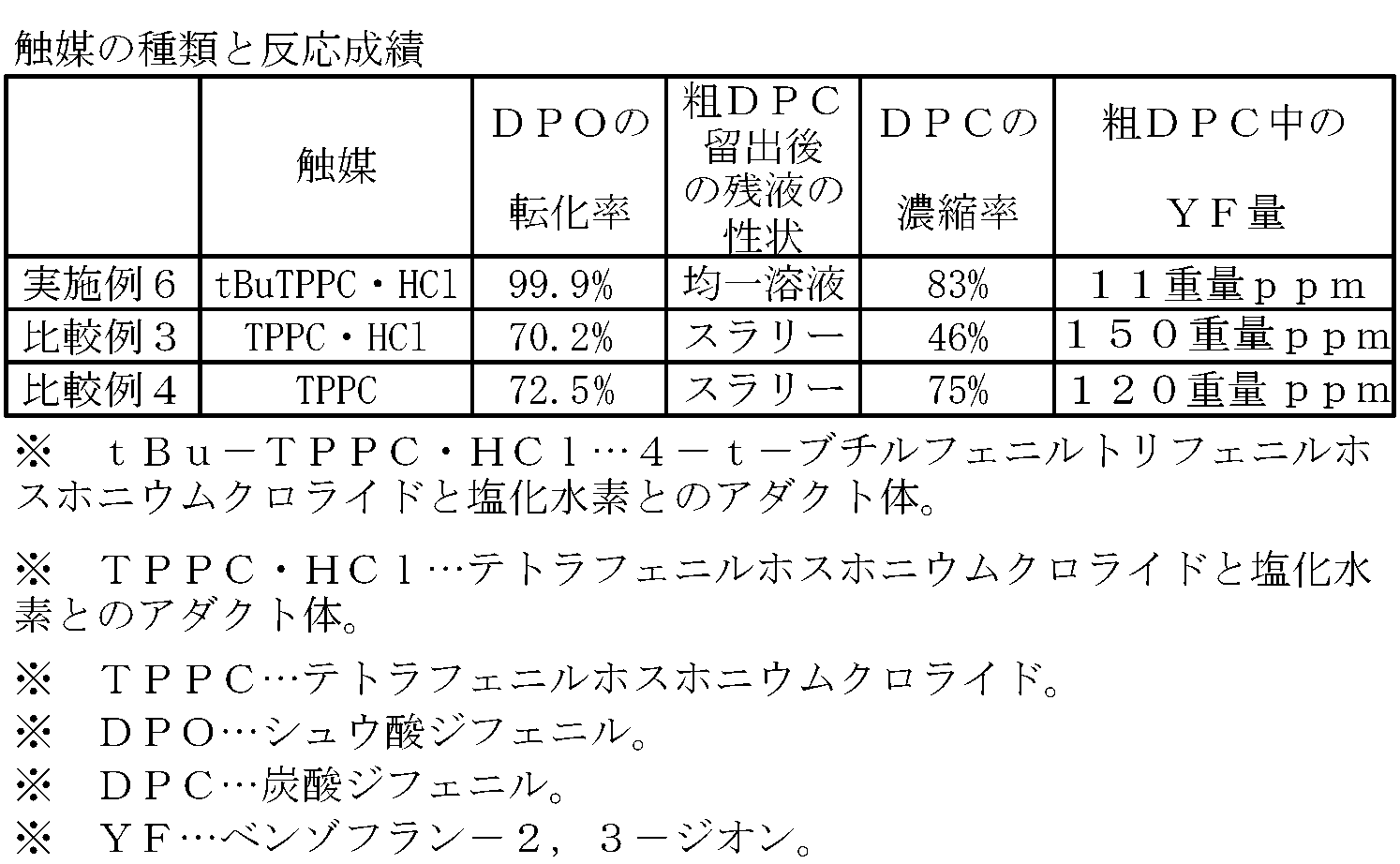
[実施例8]
温度計と攪拌機を備えたフルジャケット式500ミリリットルのセパラブルフラスコに4-t-ブチルフェニルトリフェニルホスホニウムクロライド20g(0.05モル)、1-ブタノール5g及び28重量%塩酸75gを入れ、窒素雰囲気下で90℃に加熱して均一溶液にした。その後、セパラブルフラスコを10℃に冷却することによりスラリーを得た。
温度計と攪拌機を備えたフルジャケット式500ミリリットルのセパラブルフラスコに4-t-ブチルフェニルトリフェニルホスホニウムクロライド20g(0.05モル)、1-ブタノール5g及び28重量%塩酸75gを入れ、窒素雰囲気下で90℃に加熱して均一溶液にした。その後、セパラブルフラスコを10℃に冷却することによりスラリーを得た。
このスラリーをガラスフィルターにより濾過して得られた固体をナス型フラスコに移した。このナス型フラスコを、オイルバスを備えたロータリーエバポレータに取り付け、オイルバスを100℃に加熱し、圧力10Torrで2時間乾燥させることにより15gの固体を得た。
この固体の塩素濃度を京都電子工業社製の電位差滴定装置「AT-610」で分析した結果、15.8重量%であった。そこで、この固体に含まれる塩素量は、15g×0.158=2.4g(0.068モル)となる。
ここで、この塩素量をアダクト体に含まれる塩化水素の量と見做すと(塩化水素に含まれる水素分を無視すると)、4-メチルフェニルトリフェニルホスホニウムの分子量が353であることから、この固体に含まれる4-メチルフェニルトリフェニルホスホニウムの量は15g×(1-0.158)=12.6g(0.036モル)に、アダクト体の塩化水素に含まれる塩素量は0.068モル-0.036モル=0.032モルになる。
そこで、この固体が、アダクト率89%(0.032モル÷0.036モル×100)の4-メチルフェニルトリフェニルホスホニウムクロライドと塩化水素とのアダクト体であることが確認された。また、アダクト体の収率は、0.036モル÷0.05×100=72%と算出された。
[実施例9]
実施例6において、4-t-ブチルフェニルトリフェニルホスホニウムクロライドと塩化水素とのアダクト体の代わりに、実施例8で得られた4-メチルフェニルトリフェニルホスホニウムクロライドと塩化水素とのアダクト体15g(0.035モル)(アダクト率89%)を用いて、230℃における反応時間を6時間から3時間に短くした以外は、実施例6と同様にして炭酸ジフェニルを製造した。
実施例6において、4-t-ブチルフェニルトリフェニルホスホニウムクロライドと塩化水素とのアダクト体の代わりに、実施例8で得られた4-メチルフェニルトリフェニルホスホニウムクロライドと塩化水素とのアダクト体15g(0.035モル)(アダクト率89%)を用いて、230℃における反応時間を6時間から3時間に短くした以外は、実施例6と同様にして炭酸ジフェニルを製造した。
230℃に到達した時の液組成は、シュウ酸ジフェニル66.2重量%、炭酸ジフェニル26.6重量%、4-メチルフェニルトリフェニルホスホニウムクロライド5.1重量%、フェノール1.5重量%であった。
また、3時間反応させた液の組成は、炭酸ジフェニル49.5重量%、シュウ酸ジフェニル39.5重量%、4-メチルフェニルトリフェニルホスホニウムクロライド3.6重量%、フェノール2.3重量%であった。ここで、シュウ酸ジフェニルの転化率は、61%であった。
ここで、反応後の反応液(組成分析用の試料を抜き出す前)が265gであり、4-メチルフェニルトリフェニルホスホニウムクロライドの分子量が389である。そこで、反応後の反応液に含まれる4-メチルフェニルトリフェニルホスホニウムクロライドは、265g×0.036÷389=0.025モルと算出される。
ここで、4-メチルフェニルトリフェニルホスホニウムクロライドと塩化水素とのアダクト体の仕込み量が0.035モルであったことから、4-メチルフェニルトリフェニルホスホニウムクロライドと塩化水素とのアダクト体の分解率は(0.035モル-0.025モル)÷0.035モル×100=29%であった。
そこで、実施例6と実施例9の比較から、ベンジルプロトンを有さない非対称テトラアリールホスホニウムハライドである4-t-ブチルフェニルトリフェニルホスホニウムクロライドと塩化水素とのアダクト体は、脱カルボニル反応における安定性が高く、特に好ましいことが裏付けられた。
[実施例10]
撹拌子と温度計を備えた試験管に、実施例6で得られた粗炭酸ジフェニル(ベンゾフラン-2,3-ジオンを11重量ppm含む)100.0gを入れた後に、オイルバスを用いて該試験管の内温が100℃になるように加熱した。
撹拌子と温度計を備えた試験管に、実施例6で得られた粗炭酸ジフェニル(ベンゾフラン-2,3-ジオンを11重量ppm含む)100.0gを入れた後に、オイルバスを用いて該試験管の内温が100℃になるように加熱した。
該試験管の内温が230℃になるよう更に加熱し、1モル・dm-3の水酸化ナトリウム水溶液1cm3(水酸化ナトリウムとして1ミリモル)を添加し、そのまま120分間230℃に維持した後、高速液体クロマトグラフィーにより、そのベンゾフラン-2,3-ジオンの濃度を測定した。この結果、100重量ppbであった。
そこで、ベンゾフラン-2,3-ジオンの分解率は、(11ppm-100ppb)÷11ppm×100=99.1%であった。
[合成例2]
以下に示す方法により、フェニル(o-フェノキシカルボニルフェニル)オキサレート(OCPO)を合成した。
クロロシュウ酸フェニル(PCO)を、米国特許第5892091号明細書に記載された方法と同様の方法により合成した。
以下に示す方法により、フェニル(o-フェノキシカルボニルフェニル)オキサレート(OCPO)を合成した。
クロロシュウ酸フェニル(PCO)を、米国特許第5892091号明細書に記載された方法と同様の方法により合成した。
すなわち、マグネチックスターラーを備えた1リットルの三角フラスコにシュウ酸ジフェニル27.3g(0.11モル)とアセトン600cm3を入れた。50cm3のビーカーに水25cm3を入れ、これに酢酸6.8g(0.11モル)と炭酸カリウム7.8g(0.06モル)をゆっくり加えて混合することにより、酢酸カリウム水溶液を得た。
この酢酸カリウム水溶液を滴下ロートに入れ、先に調製したシュウ酸ジフェニルのアセトン溶液に撹拌しながら4時間かけて滴下した。滴下終了後、さらに2時間撹拌し、スラリーを得た。このスラリーを減圧濾過することにより得られた固形分を、アセトンで懸洗し、白色の固形分を得た。この白色の固形分を減圧乾燥させることにより、カリウムシュウ酸フェニル20.1g(0.10モル)を得た。
このカリウムシュウ酸フェニルを100cm3のナス型フラスコに入れ、ウォーターバスを用いて20℃で保温した。塩化チオニル17.5g(0.15モル)を滴下ロートに入れ、ナス型フラスコ内のカリウムシュウ酸フェニルに30分間かけて滴下した。
滴下終了後、ナス型フラスコに還流管を備え、90℃まで昇温して1時間反応させた。反応終了後、ナス型フラスコの還流管を留出管に付け替え、未反応の塩化チオニルを留出させた。塩化チオニルを留去後、減圧することにより、クロロシュウ酸フェニル15.5g(0.08モル)を得た。
このクロロシュウ酸フェニルをテトラヒドロフラン100cm3と共に500cm3のナス型フラスコに入れた。これに、ピリジン6.6g(0.08モル)を10分間かけて滴下することにより、スラリーを得た。
サリチル酸フェニル18.0g(0.08モル)とテトラヒドロフラン100cm3を200cm3のビーカーに入れ、先のスラリーに加えた後、2時間反応させた。反応完了後、トルエン100cm3を加え、さらに水100cm3を加えて加水分解させた。
この加水分解された2相分離液を分液ロートに移し、水を分離した。得られた有機相に、飽和炭酸水素ナトリウム水溶液100cm3を加えて十分混合することにより中和して2相分離液を得た後、水相を分離した。
得られた有機相に、更に飽和塩化ナトリウム水溶液100cm3を加えることにより脱水させた後に水相を分離した。得られた有機相を500cm3の三角フラスコに移し、硫酸マグネシウム30gを加えて、さらに脱水させた。
この有機相を濾過することにより硫酸マグネシウムを濾別した後、有機相を500cm3のナス型フラスコに移し、減圧下でエバポレータを用いて、テトラヒドロフランを留出させた。このテトラヒドロフランを留出させた液にヘキサンを徐々に添加し、結晶が析出してきたところでヘキサンの添加を停止して放冷した。
得られたスラリーを減圧濾過して、白色の固形分を得た。この白色の固形分を減圧乾燥させることにより、フェニル(o-フェノキシカルボニルフェニル)オキサレート(OCPO)10.2g(0.03モル)を得た。
[実施例11]
温度計、攪拌機、留出管及び受器を備えたフルジャケット式500cm3のセパラブルフラスコに、シュウ酸ジフェニル89g(0.367モル)、後述する実施例25で製造した4-t-ブチルフェニルトリフェニルホスホニウムクロライドと塩化水素とのアダクト体10g(0.021モル)及びフェニル(o-フェノキシカルボニルフェニル)オキサレート(OCPO)1g(0.003モル)を入れた後、セパラブルフラスコ内を昇温した。
温度計、攪拌機、留出管及び受器を備えたフルジャケット式500cm3のセパラブルフラスコに、シュウ酸ジフェニル89g(0.367モル)、後述する実施例25で製造した4-t-ブチルフェニルトリフェニルホスホニウムクロライドと塩化水素とのアダクト体10g(0.021モル)及びフェニル(o-フェノキシカルボニルフェニル)オキサレート(OCPO)1g(0.003モル)を入れた後、セパラブルフラスコ内を昇温した。
セパラブルフラスコ内が230℃に達した後、反応で発生した一酸化炭素を反応系外へ除去しながら、60分間、230℃に保った状態で脱カルボニル反応させた。60分間反応させた液の一部を抜き出し、高速液体クロマトグラフィーにより組成分析を行ったところ、フェノール1.33重量%、シュウ酸ジフェニル20.36重量%、炭酸ジフェニル64.92重量%であった。
[実施例12]
実施例11において、シュウ酸ジフェニルを89gから85g(0.351モル)に、フェニル(o-フェノキシカルボニルフェニル)オキサレート(OCPO)を1gから5g(0.014モル)に変えた以外は、実施例11と同様にして、脱カルボニル反応を行い、その60分間反応後の液を分析した。この結果、フェノール1.19重量%、シュウ酸ジフェニル12.89重量%、炭酸ジフェニル68.47重量%であった。
実施例11において、シュウ酸ジフェニルを89gから85g(0.351モル)に、フェニル(o-フェノキシカルボニルフェニル)オキサレート(OCPO)を1gから5g(0.014モル)に変えた以外は、実施例11と同様にして、脱カルボニル反応を行い、その60分間反応後の液を分析した。この結果、フェノール1.19重量%、シュウ酸ジフェニル12.89重量%、炭酸ジフェニル68.47重量%であった。
[実施例13]
実施例11において、シュウ酸ジフェニルを89gから90g(0.372モル)に増やし、フェニル(o-フェノキシカルボニルフェニル)オキサレート(OCPO)を用いなかったこと以外は、実施例1と同様にして、脱カルボニル反応を行い、その60分間反応後の液を分析した。この結果、フェノール1.40重量%、シュウ酸ジフェニル21.98重量%、炭酸ジフェニル64.40重量%であった。
実施例11において、シュウ酸ジフェニルを89gから90g(0.372モル)に増やし、フェニル(o-フェノキシカルボニルフェニル)オキサレート(OCPO)を用いなかったこと以外は、実施例1と同様にして、脱カルボニル反応を行い、その60分間反応後の液を分析した。この結果、フェノール1.40重量%、シュウ酸ジフェニル21.98重量%、炭酸ジフェニル64.40重量%であった。
実施例11~13の結果を表5に纏める。
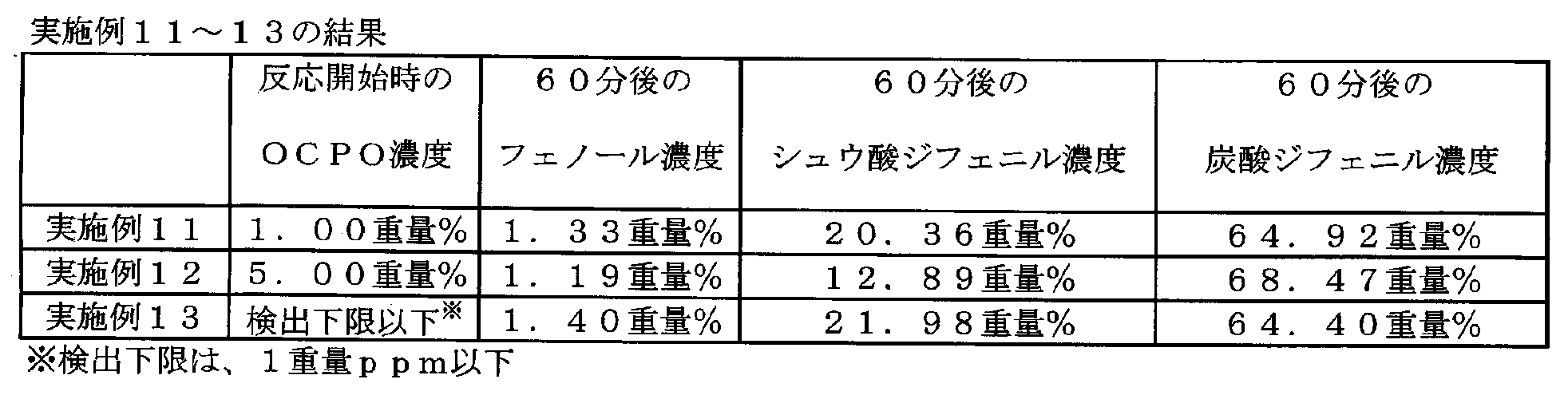
表5より、フェニル(o-フェノキシカルボニルフェニル)オキサレート(OCPO)を特定量含むシュウ酸ジフェニルを用いることにより、フェノールの量が減少し、高純度な炭酸ジフェニルを効率良く、安定的に製造できることが裏付けられた。
[実施例14]
肉厚5mmの封管用ガラス試験管に、後述する実施例25で製造した4-t-ブチルフェニルトリフェニルホスホニウムクロライドと塩化水素とのアダクト体0.03g(0.06ミリモル)とシュウ酸ジフェニル0.57g(2.35ミリモル)を入れた。真空ポンプを用いて、封管用ガラス試験管内を10kPaとし、封管体積が30cm3となるように封じた。この封管を230℃のオイルバスに浸漬させた状態で1時間反応させた。
肉厚5mmの封管用ガラス試験管に、後述する実施例25で製造した4-t-ブチルフェニルトリフェニルホスホニウムクロライドと塩化水素とのアダクト体0.03g(0.06ミリモル)とシュウ酸ジフェニル0.57g(2.35ミリモル)を入れた。真空ポンプを用いて、封管用ガラス試験管内を10kPaとし、封管体積が30cm3となるように封じた。この封管を230℃のオイルバスに浸漬させた状態で1時間反応させた。
反応後の反応液を封管より取り出し、高速液体クロマトグラフィーにより組成分析を行った。この結果、フェノール0.66重量%、シュウ酸ジフェニル34.13重量%、炭酸ジフェニル58.81重量%、フェニル(p-フェニルオキシカルボニルフェニル)カーボネート(PCPC)0.27重量%であった。また、シュウ酸ジフェニルの転化率は67%であった。
ここで、脱カルボニル反応では、一酸化炭素が発生している分、封管内の圧力が上昇しており、反応後の封管内の絶対圧力は、理想気体の状態方程式より、一酸化炭素の発生量×気体定数×温度÷封管体積=(0.00235モル×0.67)×8.314Pa・m3・K-1×モル-1×(230+273)K÷(0.000030m3)=0.2MPaであった。
[実施例15]
肉厚5mmの封管用ガラス試験管に、後述する実施例25で製造した4-t-ブチルフェニルトリフェニルホスホニウムクロライドと塩化水素とのアダクト体0.10g(0.21ミリモル)とシュウ酸ジフェニル1.90g(7.84ミリモル)を入れ、実施例14と同様にして1時間反応させた。
肉厚5mmの封管用ガラス試験管に、後述する実施例25で製造した4-t-ブチルフェニルトリフェニルホスホニウムクロライドと塩化水素とのアダクト体0.10g(0.21ミリモル)とシュウ酸ジフェニル1.90g(7.84ミリモル)を入れ、実施例14と同様にして1時間反応させた。
反応後の反応液を封管より取り出し、高速液体クロマトグラフィーにより組成分析を行った。この結果、フェノール0.65重量%、シュウ酸ジフェニル34.85重量%、炭酸ジフェニル57.88重量%、フェニル(p-フェニルオキシカルボニルフェニル)カーボネート(PCPC)0.27重量%であった。また、シュウ酸ジフェニルの転化率は66%であった。
ここで、脱カルボニル反応では、一酸化炭素が発生している分、封管内の圧力が上昇しており、反応後の封管内の絶対圧力は、理想気体の状態方程式より、一酸化炭素の発生量×気体定数×温度÷封管体積=(0.00784モル×0.66)×8.314Pa・m3・K-1×モル-1×(230+273)K÷(0.000030m3)=0.7MPaであった。
[実施例16]
肉厚5mmの封管用ガラス試験管に、実施例14と同様に、4-t-ブチルフェニルトリフェニルホスホニウムクロライドと塩化水素とのアダクト体とシュウ酸ジフェニルを入れ、封管用ガラス試験管内を10kPaとした後、常圧(絶対圧力0.10MPa)に戻し、そのまま230℃のオイルバスに浸漬させた状態で1時間反応させた。
肉厚5mmの封管用ガラス試験管に、実施例14と同様に、4-t-ブチルフェニルトリフェニルホスホニウムクロライドと塩化水素とのアダクト体とシュウ酸ジフェニルを入れ、封管用ガラス試験管内を10kPaとした後、常圧(絶対圧力0.10MPa)に戻し、そのまま230℃のオイルバスに浸漬させた状態で1時間反応させた。
反応後の反応液を封管より取り出し、高速液体クロマトグラフィーにより組成分析を行った。この結果、フェノール0.63重量%、シュウ酸ジフェニル34.61重量%、炭酸ジフェニル58.33重量%、フェニル(p-フェニルオキシカルボニルフェニル)カーボネート(PCPC)0.41重量%であった。
実施例14~16の結果を表6に纏める。
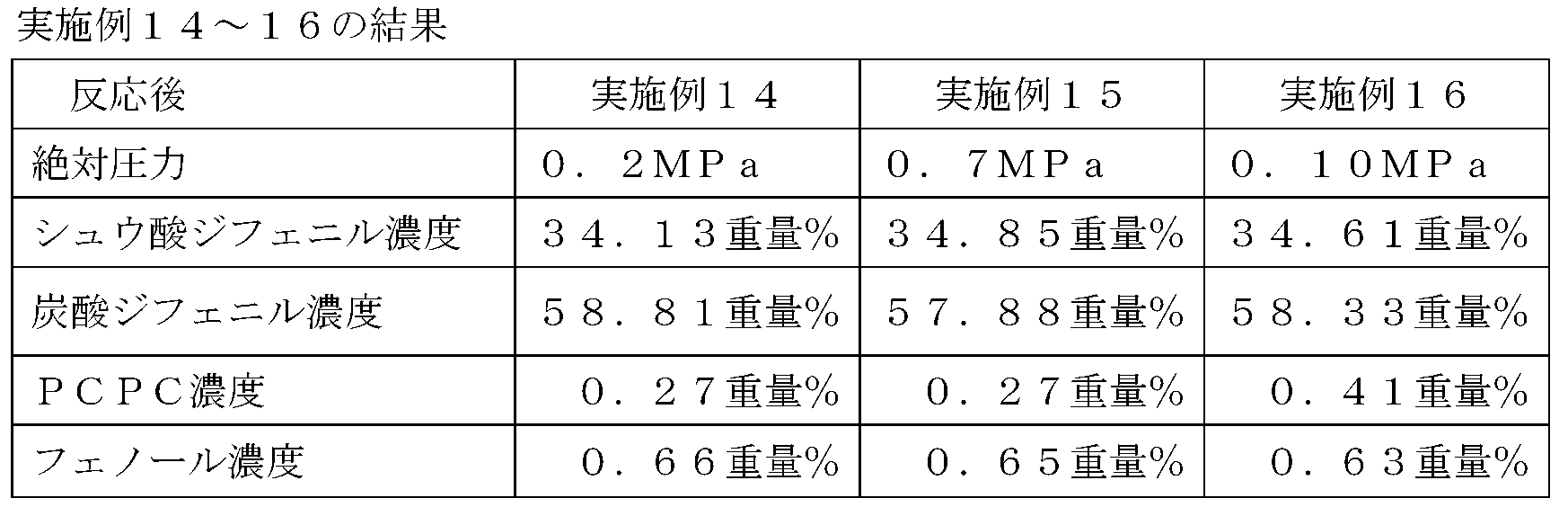
表6より、脱カルボニル反応を特定の加圧条件で行うことにより、フェニル(p-フェノキシカルボニルフェニル)カーボネートの副生がより少ない、より高純度な炭酸ジフェニルをより効率良く、より安定的に製造できることが裏付けられた。
[実施例17]
温度計、攪拌機、留出管、受器および直径2mmのガラス管を備えたフルジャケット式500cm3のセパラブルフラスコに、シュウ酸ジフェニル185.8g、炭酸ジフェニル74.0g及び後述する実施例25で製造した4-t-ブチルフェニルトリフェニルホスホニウムクロライドと塩化水素とのアダクト体13.9gを入れた後、撹拌翼による撹拌を開始した。セパラブルフラスコ内を150℃に昇温することにより、4-t-ブチルフェニルトリフェニルホスホニウムクロライドと塩化水素とのアダクト体を溶解させた。
温度計、攪拌機、留出管、受器および直径2mmのガラス管を備えたフルジャケット式500cm3のセパラブルフラスコに、シュウ酸ジフェニル185.8g、炭酸ジフェニル74.0g及び後述する実施例25で製造した4-t-ブチルフェニルトリフェニルホスホニウムクロライドと塩化水素とのアダクト体13.9gを入れた後、撹拌翼による撹拌を開始した。セパラブルフラスコ内を150℃に昇温することにより、4-t-ブチルフェニルトリフェニルホスホニウムクロライドと塩化水素とのアダクト体を溶解させた。
この液の一部を抜き出し、塩素原子/4-t-ブチルフェニルトリフェニルホスホニウムクロライドのモル比を算出したところ、1.225(0.03660モル/0.02988モル)であった。なお、塩素原子の量は、硝酸銀を用いて電位差滴定装置(京都電子工業社製の電位差滴定装置「AT-610」)により測定した。また、4-t-ブチルフェニルトリフェニルホスホニウムクロライドの量は、高速液体クロマトグラフィーにより測定した。
ガラス管の先端の位置がセパラブルフラスコの下部(液上面から下に60mm、フラスコ底の上から20mm)でフラスコ底面の中央側になるように調整し、更に昇温し、セパラブルフラスコ内が230℃に達したら、このガラス管より窒素ガスを毎分0.08cm3で吹き込み、バブリングを開始した。ここで、セパラブルフラスコに対する窒素ガスの空塔線速は0.00046m・s-1で、窒素ガスの気泡径は、約7mmであった。
セパラブルフラスコの下部から吹き込んだ窒素ガスなどの気体を反応器上部から除去しながら230℃に保った状態で反応を続けた。1時間反応させた液の一部を抜き出し、高速液体クロマトグラフィーにより組成分析を行ったところ、フェノールを0.33重量%、シュウ酸ジフェニルを13.57重量%含有する炭酸ジフェニルが得られた。なお、この1時間反応させた液における塩素原子/4-t-ブチルフェニルトリフェニルホスホニウムクロライドのモル比は、1.051であった。
この状態のまま更に反応を継続させ、反応開始から3時間後に、再度、反応液の一部を抜き出し、高速液体クロマトグラフィーにより組成分析を行ったところ、シュウ酸ジフェニル濃度は0.77重量%であり、フェノール濃度は0.30重量%に減少していた。なお、この3時間反応させた液の塩素原子/4-t-ブチルフェニルトリフェニルホスホニウムクロライドのモル比は1.034に減少していた。また、反応開始1~3時間後の間のシュウ酸ジフェニルの転化率は、94.4%であった。
この状態のまま更に反応を継続させ、反応開始から5時間後に、反応液の一部を抜き出し、高速液体クロマトグラフィーにより組成分析を行ったところ、シュウ酸ジフェニル濃度は1.53重量%であり、フェノール濃度は更に0.29重量%に減少していた。なお、この3時間反応させた液の塩素原子/4-t-ブチルフェニルトリフェニルホスホニウムクロライドのモル比は1.028に減少していた。
また、反応開始3~5時間後の間のシュウ酸ジフェニルの転化率は98.0%であり、反応開始1~3時間後より向上していた。なお、反応開始1~5時間後の間のシュウ酸ジフェニルの転化率は99.89%であった。
[実施例18]
実施例17において、窒素ガスの吹き込み量を毎分0.3cm3(セパラブルフラスコに対する窒素ガスの空塔線速は0.00170m・s-1で、窒素ガスの気泡径は約7mm)に増やした以外は、実施例17と同様に炭酸ジフェニルの製造を行い、その反応後の液の組成分析を行った。
実施例17において、窒素ガスの吹き込み量を毎分0.3cm3(セパラブルフラスコに対する窒素ガスの空塔線速は0.00170m・s-1で、窒素ガスの気泡径は約7mm)に増やした以外は、実施例17と同様に炭酸ジフェニルの製造を行い、その反応後の液の組成分析を行った。
反応後の炭酸ジフェニルに含まれるフェノールの量は、1時間反応後が0.30重量%、3時間反応後が0.25重量%、5時間反応後がフェノール0.22重量%と減少していた。なお、反応後の液の塩素原子/4-t-ブチルフェニルトリフェニルホスホニウムクロライドのモル比は、1時間反応後が1.031で、3時間反応後が1.019で、5時間反応後が1.009であり、徐々に減少していた。
反応後の炭酸ジフェニルに含まれるシュウ酸ジフェニルの量は、1時間反応後が16.54重量%、3時間反応後が1.05重量%、5時間反応後が0.001重量%であった。シュウ酸ジフェニルの転化率は、反応開始1~3時間後の間が93.7%で、反応開始3~5時間後の間が98.0%であり、反応開始1~3時間後より向上していた。なお、反応開始1~5時間後の間のシュウ酸ジフェニルの転化率は99.99%であった。
[実施例19]
実施例17において、窒素ガスを吹き込まなかった以外は、実施例17と同様に炭酸ジフェニルの製造を行い、その反応後の液の組成分析を行った。
反応後の炭酸ジフェニルに含まれるフェノールの量は、1時間反応後が0.39重量%、3時間反応後が0.36重量%、5時間反応後がフェノール0.37重量%とあまり減少していなかった。
実施例17において、窒素ガスを吹き込まなかった以外は、実施例17と同様に炭酸ジフェニルの製造を行い、その反応後の液の組成分析を行った。
反応後の炭酸ジフェニルに含まれるフェノールの量は、1時間反応後が0.39重量%、3時間反応後が0.36重量%、5時間反応後がフェノール0.37重量%とあまり減少していなかった。
また、反応後の液の塩素原子/4-t-ブチルフェニルトリフェニルホスホニウムクロライドのモル比は、5時間反応後が1.250であり、徐々に減少していた。反応後の炭酸ジフェニルに含まれるシュウ酸ジフェニルの量は、1時間反応後が17.04重量%、3時間反応後が0.71重量%、5時間反応後が0.042重量%であった。
シュウ酸ジフェニルの転化率は、反応開始1~3時間後の間が95.9%で、反応開始3~5時間後の間が94.1%であり、反応開始1~3時間後より低下していた。なお、反応開始1~5時間後の間のシュウ酸ジフェニルの転化率は99.76%であり、実施例17及び18の方が高かった。
実施例17~19における窒素ガスの空塔線速、フェノール濃度、反応転化率及び及び塩素原子/4-t-ブチルフェニルトリフェニルホスホニウムクロライドのモル比を表7に纏める。

表7より、窒素を反応器下部から特定量供給することにより、反応液中のフェノール量が減少し、炭酸ジフェニルをより効率良く、より安定的に製造できることが裏付けられた。また、窒素ガスの供給量が多いほど触媒に含まれる塩素が揮発し易いことが裏付けられた。
[参考例1]
撹拌子を備えた200cm3のナス型フラスコに、シュウ酸ジフェニル100g(413ミリモル)、4-t-ブチルフェニルトリフェニルホスホニウムクロライド(分子量431)20gを入れ、150℃のオイルバスに浸漬させた。これに塩化水素ガス(分子量36)を560ミリリットル(23ミリモル)バブリングさせた後、オイルバスの温度を230℃まで昇温し、2時間反応させた。
撹拌子を備えた200cm3のナス型フラスコに、シュウ酸ジフェニル100g(413ミリモル)、4-t-ブチルフェニルトリフェニルホスホニウムクロライド(分子量431)20gを入れ、150℃のオイルバスに浸漬させた。これに塩化水素ガス(分子量36)を560ミリリットル(23ミリモル)バブリングさせた後、オイルバスの温度を230℃まで昇温し、2時間反応させた。
反応後、このナス型フラスコに留出管を取り付け、ダイヤフラムポンプでフル真空下で炭酸ジフェニルとフェノールの混合物56gを留出させた。得られた釜残を、100℃まで冷却した後、メチルイソブチルケトン100gを加えたところ、白色のスラリー状になった。
このスラリーを室温(約30℃)まで冷却し、塩化水素ガス1450ミリリットル(60ミリモル)をバブリングさせて吸収させたところ(4-t-ブチルフェニルトリフェニルホスホニウムクロライド1モルに対して、塩化水素1.3モル=0.060÷(20÷431)供給した)、目視上で均一な液が得られた。
この液に、水5gを30分間かけて添加したところ、再び白色のスラリー状になった。このスラリーを減圧濾過した後に、メチルイソブチルケトン20gで懸洗することにより26gの固体を得た。なお、この固体の減圧濾過における濾過性は良好であった。
この固体中の水分濃度を、水分計(京都電子工業社製「MKS-500」)より分析したところ、6.5重量%であった。また、この固体の組成を高速液体クロマトグラフィーにより分析したところ、4-t-ブチルフェニルトリフェニルホスホニウムクロライド73.0重量%、メチルイソブチルケトン10.9重量%、及びその他の成分9.6重量%(水6.5重量%を除く)であった。また、4-t-ブチルフェニルトリフェニルホスホニウムクロライドの回収率は、(26g×0.730)÷(20g)×100=95%であった。
[実施例20]
撹拌子を備えた200cm3のナス型フラスコに、シュウ酸ジフェニル102g(421ミリモル)、後述する実施例25で製造した4-t-ブチルフェニルトリフェニルホスホニウムクロライドと塩化水素とのアダクト体(分子量467)20gを入れ、230℃のオイルバスに浸漬させ、2時間反応させた(シュウ酸ジフェニルの転化率は99.99%)。
撹拌子を備えた200cm3のナス型フラスコに、シュウ酸ジフェニル102g(421ミリモル)、後述する実施例25で製造した4-t-ブチルフェニルトリフェニルホスホニウムクロライドと塩化水素とのアダクト体(分子量467)20gを入れ、230℃のオイルバスに浸漬させ、2時間反応させた(シュウ酸ジフェニルの転化率は99.99%)。
反応後、このナス型フラスコに留出管を取り付け、ダイヤフラムポンプでフル真空下で炭酸ジフェニルとフェノールの混合物56gを留出させた(留出前の液量が110gであったことから、炭酸ジフェニルの濃縮率(蒸発率)は56g/110g=51%)。得られた釜残を、100℃まで冷却した後、メチルイソブチルケトン100gを加えたところ、白色のスラリー状になった。
このスラリーを室温(約30℃)まで冷却し、塩化水素ガス1330ミリリットル(56ミリモル)をバブリングさせて吸収させたところ(4-t-ブチルフェニルトリフェニルホスホニウムクロライドと塩化水素とのアダクト体1モルに対して、塩化水素1.3モル=0.056÷(20÷467)供給した)、目視上で均一な液が得られた。
この液に、水5gを30分間かけて添加したところ、再び白色のスラリー状になった。このスラリーを減圧濾過した後に、メチルイソブチルケトン21gで懸洗することにより25gの固体を得た。なお、この固体の減圧濾過における濾過性は良好であった。
この固体中の水分濃度を、水分計(京都電子工業社製「MKS-500」)より分析したところ、7.2重量%であった。また、この固体の組成を高速液体クロマトグラフィーにより分析したところ、4-t-ブチルフェニルトリフェニルホスホニウムクロライド73.0重量%、メチルイソブチルケトン10.1重量%、及びその他の成分が9.7重量%(水7.2重量%を除く)であった。
また、4-t-ブチルフェニルトリフェニルホスホニウムクロライドの分子量が431、4-t-ブチルフェニルトリフェニルホスホニウムクロライドと塩化水素とのアダクト体の分子量が467であることから、4-t-ブチルフェニルトリフェニルホスホニウムクロライドの回収率は、(25g×0.730÷431)÷(20÷467)×100=99%であった。
[参考例2]
参考例1において、メチルイソブチルケトン(500重量ppmの水を含む)の代わりに、該メチルイソブチルケトンに水を添加して含水量を3500重量ppmにしたメチルイソブチルケトンを用いた以外は、参考例1と同様に、4-t-ブチルフェニルトリフェニルホスホニウムクロライドと塩化水素ガスの存在下でシュウ酸ジフェニルの脱カルボニル反応を行った後、炭酸ジフェニルとフェノールの混合物を留出させて得られた釜残から4-t-ブチルフェニルトリフェニルホスホニウムクロライドを含む26gの固体を得た。但し、この固体の減圧濾過における濾過性を参考例1の固体の濾過性と比較すると、参考例1の固体の濾過性の方が良好であった。
参考例1において、メチルイソブチルケトン(500重量ppmの水を含む)の代わりに、該メチルイソブチルケトンに水を添加して含水量を3500重量ppmにしたメチルイソブチルケトンを用いた以外は、参考例1と同様に、4-t-ブチルフェニルトリフェニルホスホニウムクロライドと塩化水素ガスの存在下でシュウ酸ジフェニルの脱カルボニル反応を行った後、炭酸ジフェニルとフェノールの混合物を留出させて得られた釜残から4-t-ブチルフェニルトリフェニルホスホニウムクロライドを含む26gの固体を得た。但し、この固体の減圧濾過における濾過性を参考例1の固体の濾過性と比較すると、参考例1の固体の濾過性の方が良好であった。
この固体中の水分濃度を、水分計(京都電子工業社製「MKS-500」)より分析したところ、7.2重量%であった。また、この固体の組成を高速液体クロマトグラフィーにより分析したところ、4-t-ブチルフェニルトリフェニルホスホニウムクロライド69.0重量%、メチルイソブチルケトン13.0重量%、及びその他の成分が10.8重量%(水7.2重量%を除く)であった。また、4-t-ブチルフェニルトリフェニルホスホニウムクロライドの回収率は、(26g×0.690)÷(20g)×100=90%であった。
[比較例5]
撹拌子を備えた200cm3のナス型フラスコに、シュウ酸ジフェニル102g(421ミリモル)、後述する実施例25で製造した4-t-ブチルフェニルトリフェニルホスホニウムクロライド22g(51ミリモル)を入れ、150℃のオイルバスに浸漬させた。これに塩化水素ガスを574ミリリットル(26ミリモル)バブリングさせた後、オイルバスの温度を230℃まで昇温し、2時間反応させた。
撹拌子を備えた200cm3のナス型フラスコに、シュウ酸ジフェニル102g(421ミリモル)、後述する実施例25で製造した4-t-ブチルフェニルトリフェニルホスホニウムクロライド22g(51ミリモル)を入れ、150℃のオイルバスに浸漬させた。これに塩化水素ガスを574ミリリットル(26ミリモル)バブリングさせた後、オイルバスの温度を230℃まで昇温し、2時間反応させた。
反応後、このナス型フラスコに留出管を取り付け、ダイヤフラムポンプでフル真空下で炭酸ジフェニルとフェノールの混合物57gを留出させた。得られた釜残を、100℃まで冷却した後、メチルイソブチルケトン110gを加えたところ、白色のスラリー状になった。
このスラリーを室温(約30℃)まで冷却したところ流動性がなくなり、濾過することができない状態になった。そこで、80℃まで昇温し、流動性を上げて濾過することにより、45gの固体を得た。なお、この固体の減圧濾過には時間がかかった。
この固体の組成を高速液体クロマトグラフィーにより分析したところ、4-t-ブチルフェニルトリフェニルホスホニウムクロライド26.0重量%、メチルイソブチルケトン65.1重量%、炭酸ジフェニル6.9重量、及びその他成分2.0重量%であった。また、4-t-ブチルフェニルトリフェニルホスホニウムクロライドの回収率は、(45g×0.260)÷(22g)×100=53%であった。
[比較例6]
参考例1と同様に、4-t-ブチルフェニルトリフェニルホスホニウムクロライドと塩化水素ガスの存在下でシュウ酸ジフェニルの脱カルボニル反応を行った後、炭酸ジフェニルとフェノールの混合物を留出させて得られた釜残を冷却し、メチルイソブチルケトンを加えることにより白色スラリーを得た。
参考例1と同様に、4-t-ブチルフェニルトリフェニルホスホニウムクロライドと塩化水素ガスの存在下でシュウ酸ジフェニルの脱カルボニル反応を行った後、炭酸ジフェニルとフェノールの混合物を留出させて得られた釜残を冷却し、メチルイソブチルケトンを加えることにより白色スラリーを得た。
このスラリーを室温(約30℃)まで冷却し、28重量%塩酸2580mgを添加し、撹拌したところ、析出物が凝集した。この凝集した析出物をスパチュラを用いて崩し、減圧濾過させた後に、メチルイソブチルケトン20gで懸洗することにより21gの固体を得た。なお、この固体の減圧濾過には時間がかかった。
この固体中の水分濃度を水分計(京都電子工業社製「MKS-500」)より分析したところ、10.2重量%であった。また、この固体の組成を高速液体クロマトグラフィーにより分析したところ、4-t-ブチルフェニルトリフェニルホスホニウムクロライド71.0重量%、メチルイソブチルケトン17.6重量%、及びその他の成分が1.2重量%(水10.2重量%を除く)であった。また、4-t-ブチルフェニルトリフェニルホスホニウムクロライドの回収率は、(21g×0.710)÷(20g)×100=75%であった。
[実施例21]
撹拌子を備えた500cm3のナス型フラスコに、シュウ酸ジフェニル250g(1032ミリモル)、後述する実施例25で製造した4-t-ブチルフェニルトリフェニルホスホニウムクロライドと塩化水素とのアダクト体(分子量467)66gを入れ、230℃のオイルバスに浸漬させ、2時間反応させた(シュウ酸ジフェニルの転化率は99.99%)。
撹拌子を備えた500cm3のナス型フラスコに、シュウ酸ジフェニル250g(1032ミリモル)、後述する実施例25で製造した4-t-ブチルフェニルトリフェニルホスホニウムクロライドと塩化水素とのアダクト体(分子量467)66gを入れ、230℃のオイルバスに浸漬させ、2時間反応させた(シュウ酸ジフェニルの転化率は99.99%)。
反応後、このナス型フラスコに留出管を取り付け、ダイヤフラムポンプでフル真空下で炭酸ジフェニルとフェノールの混合物を117g留出させた(留出前の液量が287gであったことから、炭酸ジフェニルの濃縮率(蒸発率)は117g/287g=40.8%)。得られた釜残を100℃まで冷却することにより触媒液170gを得た。この液の組成を高速液体クロマトグラフィーにより確認したところ、4-t-ブチルフェニルトリフェニルホスホニウムクロライドが36.8重量%含まれていた。
この液の一部(78g)を別の500cm3のナス型フラスコに移し、メチルイソブチルケトン166gを添加したところ、白色のスラリー状になった。このスラリーを室温(約30℃)まで冷却し、塩化水素ガス2000cm3(83ミリモル)をバブリングさせて吸収させたところ(4-t-ブチルフェニルトリフェニルホスホニウムクロライドと塩化水素とのアダクト体1モルに対して、塩化水素1.3モル=0.083÷{(66÷467)×(78÷170)}供給した)、目視上で均一な液が得られた。
この液に、水3gを30分間かけて添加したところ、再び白色のスラリー状になった。このスラリーを減圧濾過した後に、メチルイソブチルケトン46gで懸洗することにより36gの固体を得た。なお、この固体の減圧濾過における濾過性は良好であった。
この固体中の水分濃度を水分計(京都電子工業社製「MKS-500」)より分析したところ、6.7重量%であった。また、硝酸銀を用いた電位差滴定装置(京都電子工業社製「AT-610」)により、この固体中の塩化水素濃度を分析したところ7.2重量%であった。
更に、この固体の組成を高速液体クロマトグラフィーにより分析したところ、4-t-ブチルフェニルトリフェニルホスホニウムクロライド75.0重量%、メチルイソブチルケトン8.9重量%、炭酸ジフェニル0.2重量%及びその他の成分2.0重量%(水6.7重量%及び塩化水素7.2重量%を除く)であった。4-t-ブチルフェニルトリフェニルホスホニウムクロライドの回収率は、(36g×0.750)÷(78g×0.368)=94%であった。
[調製例1]
500cm3のセパラブルフラスコにメチルイソブチルケトン220gを入れた。そこに、塩化水素ガスを毎分300cm3でバブリングさせながら30分間供給した。バブリング後のメチルイソブチルケトン中の塩化水素濃度を、硝酸銀を用いた電位差滴定装置(京都電子工業社製「AT-610」)により分析したところ、6.6重量%であった。
500cm3のセパラブルフラスコにメチルイソブチルケトン220gを入れた。そこに、塩化水素ガスを毎分300cm3でバブリングさせながら30分間供給した。バブリング後のメチルイソブチルケトン中の塩化水素濃度を、硝酸銀を用いた電位差滴定装置(京都電子工業社製「AT-610」)により分析したところ、6.6重量%であった。
この塩化水素濃度が6.6重量%のメチルイソブチルケトンの一部(23g)に、メチルイソブチルケトン53gを加え、塩化水素濃度が2.0重量%のメチルイソブチルケトン76gを調製した。
[実施例22]
実施例21で得られた触媒液の一部(90g)を、フルジャケット式の100cm3の滴下ロートに移し、160℃に加熱した。別の500cm3のナス型フラスコに、調製例1で調製した塩化水素を2.0重量%含むメチルイソブチルケトン180gを入れた後(4-t-ブチルフェニルトリフェニルホスホニウムクロライドと塩化水素とのアダクト体1モルに対して、塩化水素1.3モル=(180×0.020÷36)÷{(66÷467)×(90÷170)}供給した)、該ナス型フラスコを30℃のウォーターバスに浸漬させた。該ナス型フラスコの内温が30℃を維持するように、滴下ロートから触媒液90gを1時間かけて加え、目視上で均一な液を得た。
実施例21で得られた触媒液の一部(90g)を、フルジャケット式の100cm3の滴下ロートに移し、160℃に加熱した。別の500cm3のナス型フラスコに、調製例1で調製した塩化水素を2.0重量%含むメチルイソブチルケトン180gを入れた後(4-t-ブチルフェニルトリフェニルホスホニウムクロライドと塩化水素とのアダクト体1モルに対して、塩化水素1.3モル=(180×0.020÷36)÷{(66÷467)×(90÷170)}供給した)、該ナス型フラスコを30℃のウォーターバスに浸漬させた。該ナス型フラスコの内温が30℃を維持するように、滴下ロートから触媒液90gを1時間かけて加え、目視上で均一な液を得た。
この液に、水4gを20分間かけて滴下したところ、白色のスラリー状になった。このスラリーを減圧濾過した後に、メチルイソブチルケトン20gで懸洗することにより、22gの固体を得た。なお、この固体の減圧濾過における濾過性は良好であった。
この固体中の水分濃度を水分計(京都電子工業社製「MKS-500」)より分析したところ、18.9重量%であった。また、硝酸銀を用いた電位差滴定装置(京都電子工業社製「AT-610」)により、この固体中の塩化水素濃度を分析したところ6.7重量%であった。
この固体の組成を高速液体クロマトグラフィーにより分析したところ、4-t-ブチルフェニルトリフェニルホスホニウムクロライド60.1重量%、メチルイソブチルケトン9.7重量%、炭酸ジフェニル3.5重量%、及びその他の成分が1.1重量%(水18.9重量%及び塩化水素6.7重量%を除く)であった。4-t-ブチルフェニルトリフェニルホスホニウムクロライドの回収率は、(22g×0.601)÷(38g×0.368)=95%であった。
実施例20~22、比較例5~6及び参考例1~2において回収された触媒の性状と回収率について表8に纏める。表8の結果より、本発明の触媒の回収方法により、シュウ酸ジフェニルの脱カルボニル反応による炭酸ジフェニルの製造に用いた触媒を簡便に効率良く高純度で回収できることが裏付けられた。
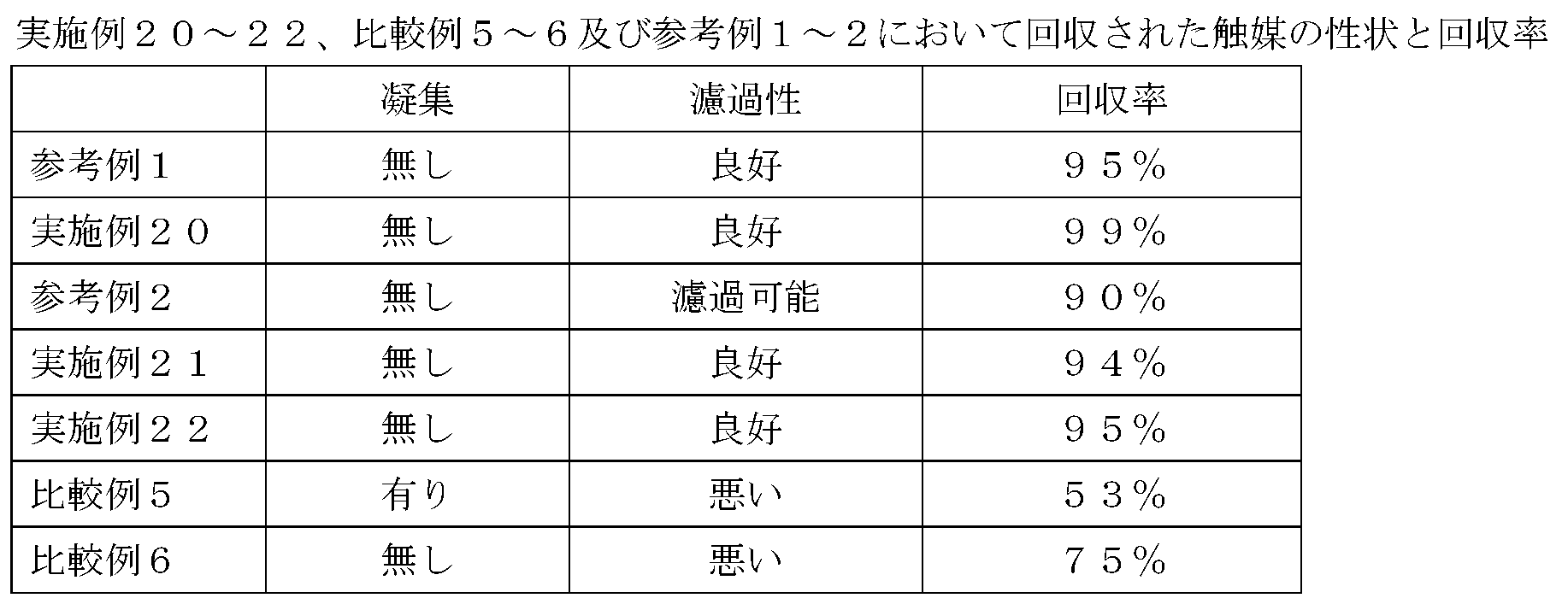
[実施例23]
実施例22で得られた固体の内の15gを100cm3のナス型フラスコに入れ、オイルバスを備えたロータリーエバポレータに設置した。オイルバスを100℃に加熱し、圧力10Torrで1時間乾燥させた。乾燥させた固体中の水分濃度を水分計(京都電子工業社製「MKS-500」)より分析したところ、水分計(京都電子工業社製「MKS-500」)より、0.3重量%であった。
実施例22で得られた固体の内の15gを100cm3のナス型フラスコに入れ、オイルバスを備えたロータリーエバポレータに設置した。オイルバスを100℃に加熱し、圧力10Torrで1時間乾燥させた。乾燥させた固体中の水分濃度を水分計(京都電子工業社製「MKS-500」)より分析したところ、水分計(京都電子工業社製「MKS-500」)より、0.3重量%であった。
この乾燥させた固体の内の5gとシュウ酸ジフェニル100g(413ミリモル)を、500cm3のナス型フラスコに入れ、230℃のオイルバスに浸漬させた。浸漬させてから1時間後の組成を高速液体クロマトグラフィーにより分析したところ、炭酸ジフェニル65.0重量%、シュウ酸ジフェニル29.6重量%、4-t-ブチルフェニルトリフェニルホスホニウムクロライド5.0重量%、フェノール0.4重量%が含まれていた。
[実施例24]
実施例23において、実施例22で得られた固体を乾燥させたもの5gの代わりに、実施例25で製造した4-t-ブチルフェニルトリフェニルホスホニウムクロライドと塩化水素とのアダクト体5g(11ミリモル)を用いて、実施例23と同様に脱カルボニル反応を1時間行った。反応後の組成を高速液体クロマトグラフィーにより分析した。
実施例23において、実施例22で得られた固体を乾燥させたもの5gの代わりに、実施例25で製造した4-t-ブチルフェニルトリフェニルホスホニウムクロライドと塩化水素とのアダクト体5g(11ミリモル)を用いて、実施例23と同様に脱カルボニル反応を1時間行った。反応後の組成を高速液体クロマトグラフィーにより分析した。
この結果、炭酸ジフェニル60.5重量%、シュウ酸ジフェニル34.0重量%、4-t-ブチルフェニルトリフェニルホスホニウムクロライド5.0重量%、フェノール0.5重量%であった。
実施例23と参考例3における反応後の液組成を表9に纏める。表9より、本発明の触媒の回収方法により回収した、シュウ酸ジフェニルの脱カルボニル反応による炭酸ジフェニルの製造に用いた触媒を用いることにより、高純度な炭酸ジフェニルを安定的に製造できることが裏付けられた。

[実施例25]
以下の方法により、4-t-ブチルフェニルトリフェニルホスホニウムクロライドと塩化水素とのアダクト体を合成した。
以下の方法により、4-t-ブチルフェニルトリフェニルホスホニウムクロライドと塩化水素とのアダクト体を合成した。
先ず、日本国特開2013-82695号公報に記載された方法により、4-t-ブチルフェニルトリフェニルホスホニウムブロマイドを合成した。このブロマイド体を日本国特開平11-217393号公報に記載された方法により、4-t-ブチルフェニルトリフェニルホスホニウムクロライド(クロライド体)に変換した。
セパラブルフラスコにこの4-t-ブチルフェニルトリフェニルホスホニウムクロライド、ブタノール及び塩酸を入れ、窒素雰囲気下で90℃に加熱して均一溶液にした。その後、セパラブルフラスコを室温に冷却することによりスラリーを得た。このスラリーをガラスフィルターにより濾過して得られた固体をナス型フラスコに移した。ナス型フラスコを、オイルバスを備えたロータリーエバポレータに付け、オイルバスを100℃に加熱し、圧力10Torrで2時間乾燥させることにより固体を得た。
この固体を京都電子工業社製の電位差滴定装置「AT-610」で分析した結果、14.2重量%であったことから、4-t-ブチルフェニルトリフェニルホスホニウムクロライドと塩化水素とのアダクト体であることが確認された。また、水分計(京都電子工業社製「MKS-500」)を用いて測定した含水率は0.4重量%であった。
[実施例26]
撹拌子を備えた2000cm3のナス型フラスコに、シュウ酸ジフェニル271g(1.1モル)、実施例25で合成した4-t-ブチルフェニルトリフェニルホスホニウムクロライドと塩化水素とのアダクト体(分子量467)160gを入れ、240℃のオイルバスに浸漬させた。オイルバスの温度を240℃まで昇温し、2時間反応させた(シュウ酸ジフェニルの転化率は99.99%)。
撹拌子を備えた2000cm3のナス型フラスコに、シュウ酸ジフェニル271g(1.1モル)、実施例25で合成した4-t-ブチルフェニルトリフェニルホスホニウムクロライドと塩化水素とのアダクト体(分子量467)160gを入れ、240℃のオイルバスに浸漬させた。オイルバスの温度を240℃まで昇温し、2時間反応させた(シュウ酸ジフェニルの転化率は99.99%)。
反応後、このナス型フラスコに留出管を取り付け、ダイヤフラムポンプでフル真空下で炭酸ジフェニルとフェノールの混合物20gを留出させた(留出前の液量が400gであったことから、炭酸ジフェニルの濃縮率(蒸発率)は20g/400g=5%)。得られた釜残を100℃まで冷却した後、メチルイソブチルケトン800gを加えたところ、白色のスラリー状になった。
このスラリーを室温(約20℃)まで冷却し、塩化水素ガス(分子量36)0.01m3(反応液に含まれる4-t-ブチルフェニルトリフェニルホスホニウムクロライド1モルに対して塩化水素1.2モル)、をバブリングさせて吸収させたところ、目視上で均一な液が得られた。この液に、水40gを30分間かけて添加したところ、再び白色のスラリー状になった。このスラリーを減圧濾過して得られた固体に、メチルイソブチルケトン100gで懸洗した後、減圧濾過することにより、濾液1100gと固体167gが得られた。
ここで、得られた濾液に含まれるメチルイソブチルケトンの濃度をガスクロマトグラフィーにより定量した結果、74.0重量%であった。また、この濾液に含まれる水の濃度を水分計により測定した結果、3.5重量%であった。この濾液に含まれる塩化水素の濃度を電位差滴定装置により定量した結果、0.3重量%であった。
また、得られた固体の減圧濾過における濾過性は良好であった。また、この固体の組成を高速液体クロマトグラフィーにより分析したところ、4-t-ブチルフェニルトリフェニルホスホニウムクロライド(分子量431)の濃度は、73重量%であった。そこで、固体として回収された4-t-ブチルフェニルトリフェニルホスホニウムクロライドの回収率は、(167g×0.73÷431)÷(160g÷467)×100=83%と算出された。
フルジャケット式セパラブルフラスコ、温度計と攪拌機を備えた塔径32mmの柴田科学株式会社製「オールダーショウ」(棚段塔)および液液分離槽からなる回分式蒸留塔を、セパラブルフラスコ内の濾液を蒸発させた時に蒸発液が棚段塔を通って液液分離槽の下部に供給されると共に、液液分離槽の上部よりオーバーフローして棚段塔に戻るように設置した。また、棚段塔と液液分離槽を繋ぐラインを液液分離槽の代わりに初留タンク又は主流タンクに切り替えられるように設置した。
セパラブルフラスコに上述の濾液のうち300gを仕込んだ。また、液液分離槽に水20cm3とメチルイソブチルケトン80cm3(64g)を仕込み、液液分離槽を15℃とした。棚段塔内圧力を常圧から133kPaまで減圧し、セパラブルフラスコのボトム温度を常温から60.4℃まで昇温することにより蒸留を行った。
液液分離槽に留出された蒸発液は、水を主成分とする下相とメチルイソブチルケトンを主成分とする上相に二相分離された。ここで、下相は液液分離槽内に滞留したが、上相はオーバーフローして棚段塔に返送させた。メチルイソブチルケトンと共に水が蒸発されるのに伴い、下相と上相の界面が徐々に上昇し、棚段塔の塔頂温度が上昇したが、やがて蒸発するメチルイソブチルケトンと水の比率が15℃におけるイソブチルケトンに対する水の飽和溶解度に達するのに伴い、棚段塔の塔頂温度の温度上昇が57.7℃付近で鈍くなってくると共に下相と上相の界面の上昇も止まった。
棚段塔と液液分離槽を繋ぐラインを液液分離槽から初留タンク行きに切り替え、蒸発成分に含まれる水濃度が低くなるのに伴い、棚段塔の塔頂温度が58.2℃付近で温度上昇が鈍くなってくるまで全留出させて初留57gを得た。ここで、初留に含まれるメチルイソブチルケトンの濃度をガスクロマトグラフィーにより分析した結果、98.0重量%であった。
還流比を2として、棚段塔と初留タンクを繋ぐラインを主留タンクに切り替え、セパラブルフラスコのボトム温度を昇温させ、67.3℃となるまで留出させ続けて主留153gを得た。主留に含まれるメチルイソブチルケトンの濃度をガスクロマトグラフィーにより分析した結果、99.9重量%であった
また、主留に含まれる水は、水分計により0.1重量%であり、主留に含まれる塩化水素は、電位差滴定装置により検出限界以下であった。そこで、主留におけるメチルイソブチルケトンの回収率は、(153g×0.999)÷(300g×0.740+64g)×100=53%と算出された。なお、これに初留におけるメチルイソブチルケトンの回収分を足し合わせた全留出分におけるメチルイソブチルケトンの回収率は、(57g×0.980+153g×0.999)÷(300g×0.740+64g)×100=92%と算出された。
[実施例27]
実施例26において、セパラブルフラスコに濾液300gに加え、更に実施例26で得られた初留57gを入れ、液液分離槽に実施例26で蒸発液を溜めたままにした以外は、セパラブルフラスコのボトム温度を昇温させ、67.3℃となるまで留出させ続けて主留を得る操作まで実施例26と同様に蒸留を行った。
実施例26において、セパラブルフラスコに濾液300gに加え、更に実施例26で得られた初留57gを入れ、液液分離槽に実施例26で蒸発液を溜めたままにした以外は、セパラブルフラスコのボトム温度を昇温させ、67.3℃となるまで留出させ続けて主留を得る操作まで実施例26と同様に蒸留を行った。
具体的には、セパラブルフラスコに上述の濾液300gと実施例26で得られた初留57gを仕込んだ。また、液液分離槽は、実施例26で溜めた蒸発液が入ったままとし、液液分離槽を15℃とした。棚段塔内圧力を常圧から133kPaまで減圧し、セパラブルフラスコのボトム温度を常温から60.4℃まで昇温することにより蒸留を行った。
液液分離槽に留出された蒸発液は、水を主成分とする下相とメチルイソブチルケトンを主成分とする上相に二相分離された。ここで、下相は液液分離槽内に滞留したが、上相はオーバーフローして棚段塔に返送させた。下相と上相の界面が徐々に上昇し、棚段塔の塔頂温度が上昇した後、棚段塔の塔頂温度の温度上昇が57.7℃付近で鈍くなってくると共に下相と上相の界面の上昇も止まった。
棚段塔と液液分離槽を繋ぐラインを液液分離槽から初留タンク行きに切り替え、蒸発成分に含まれる水濃度が低くなるのに伴い棚段塔の塔頂温度が58.2℃付近で温度上昇が鈍くなってくるまで全留出させて初留60gを得た。ここで、初留に含まれるメチルイソブチルケトンの濃度をガスクロマトグラフィーにより分析した結果、98.0重量%であった。
還流比を2として、棚段塔と初留タンクを繋ぐラインを主留タンクに切り替え、セパラブルフラスコのボトム温度を昇温させ、67.3℃となるまで留出させ続けて主留202gを得た。主留に含まれるメチルイソブチルケトンの濃度をガスクロマトグラフィーにより分析した結果、99.9重量%であった。また、主留に含まれる水は、水分計により0.1重量%であり、主留に含まれる塩化水素は、電位差滴定装置により検出限界以下であった。
そこで、主留におけるメチルイソブチルケトンの回収率は、(202g×0.999)÷(300g×0.740+57g×0.980)×100=73%と算出された。なお、これに初留におけるメチルイソブチルケトンの回収分を足し合わせた全留出分におけるメチルイソブチルケトンの回収率は、(60g×0.980+202g×0.999)÷(300g×0.740+57g×0.980)×100=94%と算出された。
[実施例28]
実施例26において、棚段塔からのラインを初留タンクに繋いでおいて以外は、実施例26と同様にして回分式蒸留塔を設置した。
セパラブルフラスコに上述の濾液300gを仕込んだ。還流比を2として、棚段塔内圧力を常圧から133kPaまで減圧し、セパラブルフラスコのボトム温度を常温から60.4℃まで昇温することにより蒸留を行った。
実施例26において、棚段塔からのラインを初留タンクに繋いでおいて以外は、実施例26と同様にして回分式蒸留塔を設置した。
セパラブルフラスコに上述の濾液300gを仕込んだ。還流比を2として、棚段塔内圧力を常圧から133kPaまで減圧し、セパラブルフラスコのボトム温度を常温から60.4℃まで昇温することにより蒸留を行った。
メチルイソブチルケトンと共に水が蒸発されるのに伴い棚段塔の塔頂温度が上昇し、蒸発成分に含まれる水濃度が低くなるのに伴い温度上昇が58.2℃付近で鈍くなってくるまで全留出させて初留131gを得た。ここで、初留に含まれるメチルイソブチルケトンの濃度をガスクロマトグラフィーにより分析した結果、92.0重量%であった。
還流比を2のまま、棚段塔と初留タンクを繋ぐラインを主留タンクに切り替え、セパラブルフラスコのボトム温度を昇温させ、67.3℃となるまで留出させ続けて主留79gを得た。主留に含まれるメチルイソブチルケトンの濃度をガスクロマトグラフィーにより分析した結果、99.9重量%であった。
また、主留に含まれる水は、水分計により0.1重量%であり、主留に含まれる塩化水素は、電位差滴定装置により検出限界以下であった。そこで、主留におけるメチルイソブチルケトンの回収率は、(79g×0.999)÷(300g×0.740)×100=36%と算出された。
初留と主留を、重量比で、初留131対、主留79で混合し、全留出液とした。全留出液に含まれる水は、水分計により5.0重量%であり、全留出液に含まれる塩化水素は、電位差滴定装置により0.1重量%であった。
実施例26~28における主留の組成、主留におけるメチルイソブチルケトン(MIBK)の回収率及び全留出分におけるメチルイソブチルケトン(MIBK)の回収率を表10に纏める。表10の結果より、本発明の触媒の回収方法により、シュウ酸ジフェニルの脱カルボニル反応による炭酸ジフェニルの製造に用いた触媒の回収に用いた極性有機溶媒を簡便に効率良く回収できることが裏付けられた。
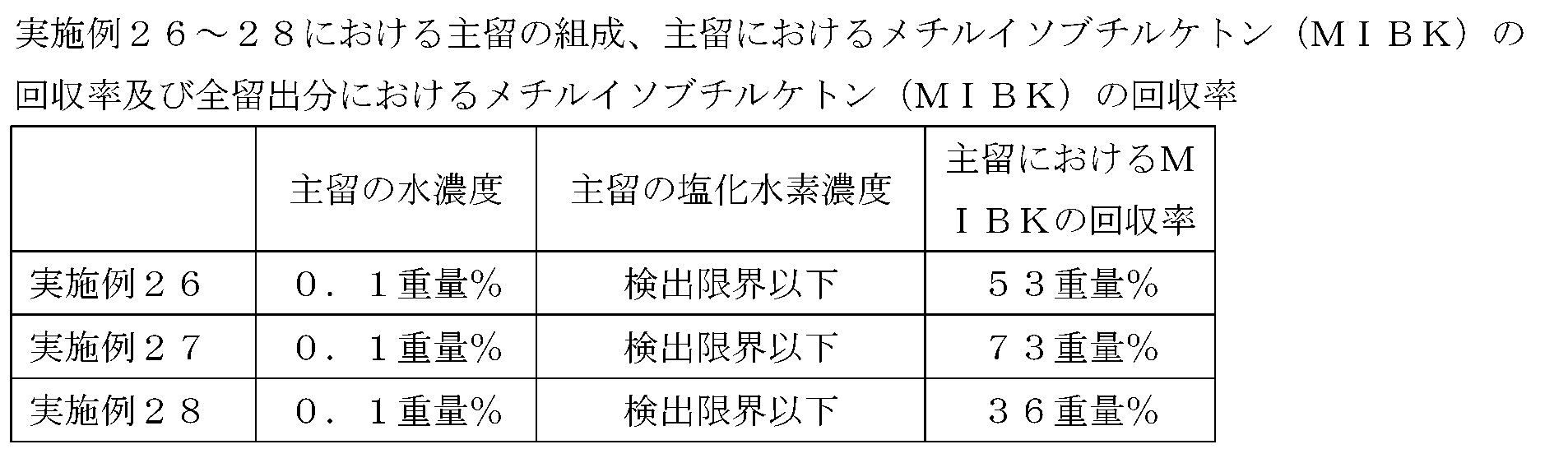
[実施例29]
実施例27で得られた主留を用いて触媒回収を行った。
具体的には、撹拌子を備えたナス型フラスコに、シュウ酸ジフェニル27g(0.11モル)、実施例25で製造した4-t-ブチルフェニルトリフェニルホスホニウムクロライドと塩化水素とのアダクト体(分子量467)16gを入れ、240℃のオイルバスに浸漬させた。オイルバスの温度を240℃まで昇温し、2時間反応させた(シュウ酸ジフェニルの転化率は99.99%)。
実施例27で得られた主留を用いて触媒回収を行った。
具体的には、撹拌子を備えたナス型フラスコに、シュウ酸ジフェニル27g(0.11モル)、実施例25で製造した4-t-ブチルフェニルトリフェニルホスホニウムクロライドと塩化水素とのアダクト体(分子量467)16gを入れ、240℃のオイルバスに浸漬させた。オイルバスの温度を240℃まで昇温し、2時間反応させた(シュウ酸ジフェニルの転化率は99.99%)。
反応後、このナス型フラスコに留出管を取り付け、ダイヤフラムポンプでフル真空下で炭酸ジフェニルとフェノールの混合物2gを留出させた(留出前の液量が40gであったことから、炭酸ジフェニルの濃縮率(蒸発率)は2g/40g=5%)。得られた釜残を100℃まで冷却した後、実施例26で得られた主留80gを加えたところ、白色のスラリー状になった。
このスラリーを室温(約20℃)まで冷却し、塩化水素ガス(分子量36)0.001m3(反応液に含まれる4-t-ブチルフェニルトリフェニルホスホニウムクロライド1モルに対して、塩化水素0.04モル)をバブリングさせて吸収させたところ、目視上で均一な液が得られた。この液に、水4gを30分間かけて添加したところ、再び白色のスラリー状になった。このスラリーを減圧濾過して得られた固体に、メチルイソブチルケトン10gで懸洗した後、減圧濾過することにより、18gの固体が得られた。
得られた固体の減圧濾過における濾過性は良好であった。また、この固体の組成を高速液体クロマトグラフィーにより分析したところ、4-t-ブチルフェニルトリフェニルホスホニウムクロライドの濃度は、76重量%であった。
そこで、固体として回収された4-t-ブチルフェニルトリフェニルホスホニウムクロライド(分子量431)の回収率は、(18g×0.76÷431)÷(16g÷467)×100=93%と算出された。なお、高速液体クロマトグラフィーで分析したがフェノールは検出限界以下であった。
[実施例30]
実施例29において、実施例27で得られた主留80gの代わりに、実施例28で得られた全留出液80gを用いた以外は、実施例29と同様に触媒回収を行った。しかしながら、全留出液を加えた白色スラリーを室温(約20℃)まで冷却し、塩化水素ガス1リットルをバブリングさせて吸収させたが、目視上で均一な液にならなかった。
実施例29において、実施例27で得られた主留80gの代わりに、実施例28で得られた全留出液80gを用いた以外は、実施例29と同様に触媒回収を行った。しかしながら、全留出液を加えた白色スラリーを室温(約20℃)まで冷却し、塩化水素ガス1リットルをバブリングさせて吸収させたが、目視上で均一な液にならなかった。
[参考例3]
和光純薬株式会社製のメチルイソブチルケトンに水を加え、水濃度が0.3重量%となるように調製した。実施例29において、実施例27で得られた主留分の代わりに、この水分濃度0.3重量%のメチルイソブチルケトンを用いた以外は、実施例29と同様に触媒回収を行った。
和光純薬株式会社製のメチルイソブチルケトンに水を加え、水濃度が0.3重量%となるように調製した。実施例29において、実施例27で得られた主留分の代わりに、この水分濃度0.3重量%のメチルイソブチルケトンを用いた以外は、実施例29と同様に触媒回収を行った。
しかしながら、全留出液を加えた白色スラリーを室温(約20℃)まで冷却し、塩化水素ガス1リットルをバブリングさせて吸収させたが、目視上で固体の溶け残りが見られる白色スラリーにしかならなかった。この液に、水4gを30分間かけて添加した後、減圧濾過して得られた固体に、メチルイソブチルケトン10gで懸洗した後、減圧濾過することにより、18gの固体が得られた。
得られた固体の組成を高速液体クロマトグラフィーにより分析したところ、4-t-ブチルフェニルトリフェニルホスホニウムクロライドの濃度は、77重量%であった。そこで、4-t-ブチルフェニルトリフェニルホスホニウムクロライドの回収率は、(18g×0.77÷431)÷(16g÷467)×100=94%と算出された。但し、この固体を高速液体クロマトグラフィーで分析したところ、フェノールが3重量%検出された。
実施例29、30及び参考例3における、触媒回収に用いたメチルイソブチルケトン(MIBK)中の水濃度及び4-t-ブチルフェニルトリフェニルホスホニウムクロライドの回収率について、表11に纏める。
表11より、触媒回収に用いる極性有機溶媒は、水濃度が低いことが好ましく、特に水濃度が0.3重量%以下であることが好ましいことが裏付けられた。

[実施例31]
実施例29で得られた回収触媒を用いて、脱カルボニル反応を行った。
先ず、実施例29で得られた固体10gを100cm3ナス型フラスコに入れ、オイルバスを備えたロータリーエバポレータに取付、オイルバス温度140℃、ダイヤフラムポンプでフル真空下で1時間乾燥させた。
実施例29で得られた回収触媒を用いて、脱カルボニル反応を行った。
先ず、実施例29で得られた固体10gを100cm3ナス型フラスコに入れ、オイルバスを備えたロータリーエバポレータに取付、オイルバス温度140℃、ダイヤフラムポンプでフル真空下で1時間乾燥させた。
撹拌子を備えた500cm3ナス型フラスコに、この乾燥させた固体5gとシュウ酸ジフェニル95g(0.4モル)とを入れ、230℃のオイルバスに浸漬させ、1時間反応させた。
反応後の液組成を高速液体クロマトグラフィーにより分析したところ、炭酸ジフェニル66.0重量%、シュウ酸ジフェニル28.6重量%、4-t-ブチルフェニルトリフェニルホスホニウムクロライド5.0重量%、フェノール0.4重量%が含まれていた。
[実施例32]
実施例31において、実施例29で得られた固体を乾燥させたものの代わりに、実施例25で製造した4-t-ブチルフェニルトリフェニルホスホニウムクロライドと塩化水素とのアダクト体5gを用いて、実施例31と同様に脱カルボニル反応を行った。
実施例31において、実施例29で得られた固体を乾燥させたものの代わりに、実施例25で製造した4-t-ブチルフェニルトリフェニルホスホニウムクロライドと塩化水素とのアダクト体5gを用いて、実施例31と同様に脱カルボニル反応を行った。
反応後の液組成を高速液体クロマトグラフィーにより分析したところ、炭酸ジフェニル65.4重量%、シュウ酸ジフェニル29.2重量%、4-t-ブチルフェニルトリフェニルホスホニウムクロライド5.0重量%、フェノール0.4重量%であった。
実施例31と32における反応後の液組成を比較することにより、触媒回収に用いた極性有機溶媒を再利用して触媒回収を行っても高純度な炭酸ジフェニルを効率良く、安定的に製造できることが裏付けられた。
以上のように、本発明の触媒の回収方法により、回収触媒を再利用すると共に、触媒回収に用いた溶媒も再利用することにより、効率良く、高純度な炭酸ジフェニルを安定的に製造できることが裏付けられた。
[合成例3]
Bull.Chem.Soc.Jpn.82(2009)475に記載された方法により、ベンゾフラン-2,3-ジオンを合成した。
磁気撹拌子を備えた500cm3のビーカーに、イサチン1.5gと1モル・dm-3の水酸化ナトリウム水溶液150cm3を入れて溶解させ、氷浴で冷やしながら亜硝酸ナトリウム0.7gを加えた。そこへ、2.5モル・dm-3の硫酸15cm3をゆっくり加えて10分間撹拌した。
Bull.Chem.Soc.Jpn.82(2009)475に記載された方法により、ベンゾフラン-2,3-ジオンを合成した。
磁気撹拌子を備えた500cm3のビーカーに、イサチン1.5gと1モル・dm-3の水酸化ナトリウム水溶液150cm3を入れて溶解させ、氷浴で冷やしながら亜硝酸ナトリウム0.7gを加えた。そこへ、2.5モル・dm-3の硫酸15cm3をゆっくり加えて10分間撹拌した。
その後、ビーカーをウォーターバスの上に載せ、60℃まで昇温した。そのまま1時間60℃に保持した後、降温して活性炭0.1g加えてから濾過を行った。得られた濾液を分液ロートに移し、酢酸エチル30cm3を用いて抽出した。
得られた有機相を500cm3のナス型フラスコに移し、ロータリーエバポレータを用いて減圧下で酢酸エチルを留去した。得られた残渣に、トルエン30cm3とヘプタン20cm3を加えて、溶解させた。そこに、五酸化二リン1.5gを加え、ジムロート冷却管を備え付け、30分間還流させた。
得られたスラリー液を濾過して得られた濾液にヘプタンを加えて晶析させ、ベンゾフラン-2,3-ジオン 0.6gを得た。
[参考例4]
東京化成株式会社製のシュウ酸ジフェニルを単蒸留により精製した後にトルエンを用いて再結晶させた。ここで得られたシュウ酸ジフェニルに含まれるベンゾフラン-2,3-ジオンの量を高速液体クロマトグラフィーにより測定したが、検出限界である10重量ppb以下であった。
東京化成株式会社製のシュウ酸ジフェニルを単蒸留により精製した後にトルエンを用いて再結晶させた。ここで得られたシュウ酸ジフェニルに含まれるベンゾフラン-2,3-ジオンの量を高速液体クロマトグラフィーにより測定したが、検出限界である10重量ppb以下であった。
撹拌子と温度計を備えた500cm3の三口フラスコに、炭酸ジフェニル200.0gとシュウ酸ジフェニル0.2gを入れた後に210℃に加熱した。この三口フラスコに、合成例3で合成したベンゾフラン-2,3-ジオンを微量添加して、高速液体クロマトグラフィーにより、そのベンゾフラン-2,3-ジオンの濃度を測定したところ、8000重量ppbであった。
この三口フラスコに、更にナトリウムフェノキシドを0.2g添加して、30分間210℃を維持した後、高速液体クロマトグラフィーにより、そのベンゾフラン-2,3-ジオンの濃度を測定したところ、100重量ppbであった。
[比較例7]
東京化成株式会社製のシュウ酸ジフェニルを単蒸留により精製した後にトルエンを用いて再結晶させた。ここで得られたシュウ酸ジフェニルに含まれるベンゾフラン-2,3-ジオンの量を高速液体クロマトグラフィーにより測定したが、検出限界である10重量ppb以下であった。
東京化成株式会社製のシュウ酸ジフェニルを単蒸留により精製した後にトルエンを用いて再結晶させた。ここで得られたシュウ酸ジフェニルに含まれるベンゾフラン-2,3-ジオンの量を高速液体クロマトグラフィーにより測定したが、検出限界である10重量ppb以下であった。
撹拌子と温度計を備えた500cm3の三口フラスコに、炭酸ジフェニル200.1gとシュウ酸ジフェニル0.2gを入れた後に210℃に加熱した。この三口フラスコに、合成例3で合成したベンゾフラン-2,3-ジオンを微量添加して、高速液体クロマトグラフィーにより、そのベンゾフラン-2,3-ジオンの濃度を測定したところ、578重量ppbであった。
この三口フラスコを120分間210℃に維持した後、高速液体クロマトグラフィーにより、そのベンゾフラン-2,3-ジオンの濃度を測定したところ、174重量ppbであった。
[比較例8]
東京化成株式会社製のシュウ酸ジフェニルを単蒸留により精製した後にトルエンを用いて再結晶させた。ここで得られたシュウ酸ジフェニルに含まれるベンゾフラン-2,3-ジオンの量を高速液体クロマトグラフィーにより測定したが、検出限界である10重量ppb以下であった。
東京化成株式会社製のシュウ酸ジフェニルを単蒸留により精製した後にトルエンを用いて再結晶させた。ここで得られたシュウ酸ジフェニルに含まれるベンゾフラン-2,3-ジオンの量を高速液体クロマトグラフィーにより測定したが、検出限界である10重量ppb以下であった。
撹拌子と温度計を備えた500cm3の三口フラスコに、炭酸ジフェニル201.2gとシュウ酸ジフェニル0.2gを入れた後に210℃に加熱した。この三口フラスコに、テドラバッグに保存された塩化水素ガス40cm3を、ガスタイトシリンジを用いて添加して、高速液体クロマトグラフィーにより、その塩素濃度を測定したところ、227重量ppmであった。
この三口フラスコに、更に合成例3で合成したベンゾフラン-2,3-ジオンを微量添加して、高速液体クロマトグラフィーにより、そのベンゾフラン-2,3-ジオンの濃度を測定したところ、458重量ppbであった。この三口フラスコを120分間210℃を維持した後、高速液体クロマトグラフィーにより、そのベンゾフラン-2,3-ジオンの濃度を測定したところ、547重量ppbであった。
参考例4及び比較例7、8の結果を表12に纏める。
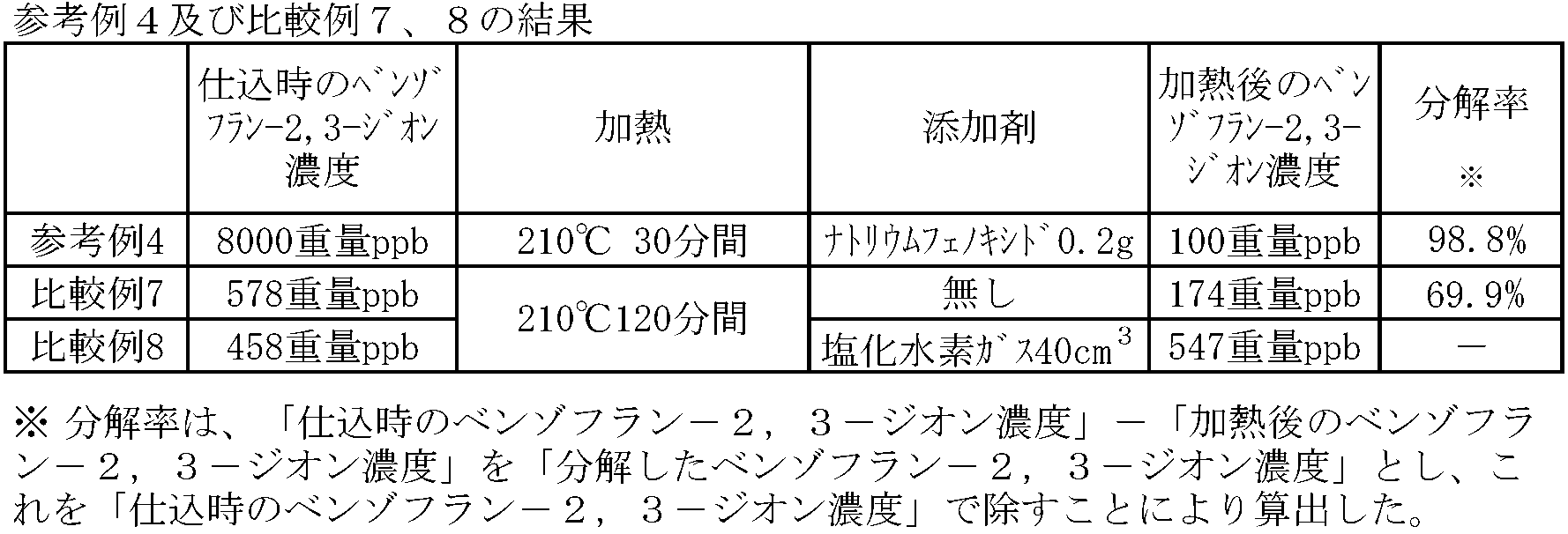
表12において、高濃度のベンゾフラン-2,3-ジオンを含む液を短時間加熱した参考例4の分解率が、低濃度のベンゾフラン-2,3-ジオンを含む液を長時間加熱した比較例7の分解率より高かったことから、塩基性物質の存在により、ベンゾフラン-2,3-ジオンの加熱による分解が促進されることが裏付けられた。
また、比較例7と8との比較より、塩基性物質の代わりに酸性物質を存在させると、ベンゾフラン-2,3-ジオンの量がむしろ増えてしまうことも判明した。
[参考例5]
撹拌子と温度計を備えた試験管に、炭酸ジフェニル20.0gを入れた後に、オイルバスを用いて内温が200℃になるように加熱した。この試験管に、合成例3で合成したベンゾフラン-2,3-ジオン4.1mgと9.2重量%の水酸化ナトリウム水溶液53.7mg(水酸化ナトリウムとして0.1ミリモル)を添加した。
撹拌子と温度計を備えた試験管に、炭酸ジフェニル20.0gを入れた後に、オイルバスを用いて内温が200℃になるように加熱した。この試験管に、合成例3で合成したベンゾフラン-2,3-ジオン4.1mgと9.2重量%の水酸化ナトリウム水溶液53.7mg(水酸化ナトリウムとして0.1ミリモル)を添加した。
この試験管を30分間200℃に維持した後、高速液体クロマトグラフィーにより、そのベンゾフラン-2,3-ジオンの濃度を測定したところ90重量ppmであった。分解率は55.9%であった。
[参考例6]
撹拌子と温度計を備えた試験管に、炭酸ジフェニル20.0gを入れた後に、オイルバスを用いて内温が200℃になるように加熱した。この試験管に、合成例3で合成したベンゾフラン-2,3-ジオン5.1mgとナトリウムフェノキシド14.3mg(0.1ミリモル)を添加した。
撹拌子と温度計を備えた試験管に、炭酸ジフェニル20.0gを入れた後に、オイルバスを用いて内温が200℃になるように加熱した。この試験管に、合成例3で合成したベンゾフラン-2,3-ジオン5.1mgとナトリウムフェノキシド14.3mg(0.1ミリモル)を添加した。
この試験管を30分間200℃に維持した後、高速液体クロマトグラフィーにより、そのベンゾフラン-2,3-ジオンの濃度を測定したところ76重量ppmであった。分解率は70.0%であった。
[参考例7]
水酸化ナトリウムとフェノールを50℃に加温して、0.9重量%の水酸化ナトリウム-フェノール溶液を調製した。
撹拌子と温度計を備えた試験管に、炭酸ジフェニル20.0gを入れた後に、オイルバスを用いて内温が200℃になるように加熱した。
水酸化ナトリウムとフェノールを50℃に加温して、0.9重量%の水酸化ナトリウム-フェノール溶液を調製した。
撹拌子と温度計を備えた試験管に、炭酸ジフェニル20.0gを入れた後に、オイルバスを用いて内温が200℃になるように加熱した。
この試験管に、合成例3で合成したベンゾフラン-2,3-ジオン5.5mgと0.9重量%の水酸化ナトリウム-フェノール溶液0.6g(水酸化ナトリウムとして0.1ミリモル)を添加した。この試験管を30分間200℃に維持した後、高速液体クロマトグラフィーにより、そのベンゾフラン-2,3-ジオンの濃度を測定したところ86重量ppmであった。分解率は68.7%であった。
[比較例9]
撹拌子と温度計を備えた試験管に、炭酸ジフェニル20.0gを入れた後に、オイルバスを用いて内温が200℃になるように加熱した。この試験管に、合成例3で合成したベンゾフラン-2,3-ジオン2.8mgを添加した。
撹拌子と温度計を備えた試験管に、炭酸ジフェニル20.0gを入れた後に、オイルバスを用いて内温が200℃になるように加熱した。この試験管に、合成例3で合成したベンゾフラン-2,3-ジオン2.8mgを添加した。
この試験管を30分間200℃に維持した後、高速液体クロマトグラフィーにより、そのベンゾフラン-2,3-ジオンの濃度を測定したところ101重量ppmであった。分解率は27.9%であった。
参考例5~7及び比較例9の結果を表13に纏める。

表13より、塩基性物質の存在により、ベンゾフラン-2,3-ジオンの加熱による分解が促進されることが裏付けられた。また、高濃度な水酸化ナトリウム水溶液を用いた参考例5より、低濃度な水酸化ナトリウム-フェノール溶液を用いた参考例7の方が分解率が高かったことから、溶媒を用いる場合、フェノールのような炭酸ジフェニルに対する溶解度の高い溶媒が好ましいと考えられた。
上記の実施例において、粗炭酸ジフェニルに含まれるフラン系化合物が塩基性化合物との接触により減少していたことから、本発明の炭酸ジフェニルの製造方法により、高純度な炭酸ジフェニルを効率良く、安定的に、簡便な方法で連続的に製造できることが裏付けられた。
[参考例8]
温度計、攪拌機、留出管及び受器を備えたフルジャケット式500ミリリットルのセパラブルフラスコに、シュウ酸ジフェニル250g(1モル)、4-t-ブチルフェニルトリフェニルホスホニウムクロライド13g(30ミリモル)を入れ、セパラブルフラスコ内を150℃に加熱することにより均一溶液(目視)とした。
温度計、攪拌機、留出管及び受器を備えたフルジャケット式500ミリリットルのセパラブルフラスコに、シュウ酸ジフェニル250g(1モル)、4-t-ブチルフェニルトリフェニルホスホニウムクロライド13g(30ミリモル)を入れ、セパラブルフラスコ内を150℃に加熱することにより均一溶液(目視)とした。
次に、このセパラブルフラスコに塩化水素ガス12ミリモルを吹き込み昇温した。セパラブルフラスコ内が230℃に達したら、セパラブルフラスコ内で発生した一酸化炭素を窒素ガスにより常圧下で押し出しながら230℃に保った状態で6時間反応させた。
この6時間反応後の反応液を徐々に減圧させて10Torrとし、セパラブルフラスコのボトム温度を180℃に下げた状態で維持することにより、粗炭酸ジフェニル217gを留分として得た。なお、この時、セパラブルフラスコのボトムの液は、目視で均一状態であった。
先の6時間反応後の反応液及び粗炭酸ジフェニルの組成を、高速液体クロマトグラフィーにより分析した。この結果、6時間反応後の反応液は、炭酸ジフェニルが94重量%、シュウ酸ジフェニルが400重量ppmであった(シュウ酸ジフェニルの転化率は99.97%であった)。
また、粗炭酸ジフェニルには、フェノールが7000重量ppm、シュウ酸ジフェニルが100重量ppm含まれていた。どちらの液も、ベンゾフラン-2,3-ジオンは検出限界以下であった。
[参考例9]
窒素導入管を備えたフルジャケット式の200ミリリットルの滴下ロートに、4-t-ブチルフェニルトリフェニルホスホニウムクロライド13g(30ミリモル)及び三菱化学製炭酸ジフェニル10g(47ミリモル)を入れ、窒素を供給しながら150℃で均一溶液とした。
窒素導入管を備えたフルジャケット式の200ミリリットルの滴下ロートに、4-t-ブチルフェニルトリフェニルホスホニウムクロライド13g(30ミリモル)及び三菱化学製炭酸ジフェニル10g(47ミリモル)を入れ、窒素を供給しながら150℃で均一溶液とした。
該滴下ロート、温度計、攪拌機及び備えたフルジャケット式500ミリリットルのセパラブルフラスコに、シュウ酸ジフェニル150g(619ミリモル)を入れ、セパラブルフラスコ内を150℃に加熱した。
次に、該セパラブルフラスコ内に、該滴下ロートから4-t-ブチルフェニルトリフェニルホスホニウムクロライドの炭酸ジフェニル溶液を供給した後、塩化水素ガス12ミリモルを吹き込み、230℃に昇温した。反応により発生した一酸化炭素を常圧下で窒素にて反応系外へ除去しながら、5時間、230℃に保った状態で反応を行った。
反応後の液の一部を抜き出し、高速液体クロマトグラフィーにより組成分析を行ったところ、炭酸ジフェニルが94重量%、シュウ酸ジフェニルが400重量ppmであった。
[実施例33]
2リットルのナス型フラスコに、4-t-ブチルフェニルトリフェニルホスホニウムクロライド200g(0.46モル)、1-ブタノール100g及び28重量%塩酸700gを入れ、窒素雰囲気下で90℃に加熱して均一溶液にした。その後、ナス型フラスコを室温に冷却することによりスラリーを得た。このスラリーをガラスフィルターにより濾過し、190gの固体を得た。
2リットルのナス型フラスコに、4-t-ブチルフェニルトリフェニルホスホニウムクロライド200g(0.46モル)、1-ブタノール100g及び28重量%塩酸700gを入れ、窒素雰囲気下で90℃に加熱して均一溶液にした。その後、ナス型フラスコを室温に冷却することによりスラリーを得た。このスラリーをガラスフィルターにより濾過し、190gの固体を得た。
得られた結晶の内の30gを、500cm3のナス型フラスコに移した。このナス型フラスコを、オイルバスを備えたロータリーエバポレータに取り付け、オイルバスを70℃に加熱し、圧力10Torrで2時間乾燥させることにより、25gの固体を得た。
この固体の塩素濃度を京都電子工業社製の電位差滴定装置「AT-610」で分析した結果、15.2重量%であった。そこで、この固体に含まれる塩素量は、25g×0.152=3.8g(0.107モル)となる。
ここで、この塩素量をアダクト体に含まれる4-t-ブチルフェニルトリフェニルホスホニウムクロライドの塩素量と塩化水素量の合計と見做すと(塩化水素に含まれる水素分を無視すると)、この固体に含まれる4-t-ブチルフェニルトリフェニルホスホニウムの量は25g×(1-0.152)=21.2g(0.054モル)に、アダクト体の塩化水素に含まれる塩素量は0.107モル-0.054モル=0.053モルとなることから、この固体が、アダクト率が95%(0.053モル÷0.056モル×100)の4-t-ブチルフェニルトリフェニルホスホニウムクロライドと塩化水素とのアダクト体であることが確認された。
また、得られた固体は、白色顆粒で、その嵩密度が0.48g・cm3、粒径が180μmであった。
次に、このアダクト率95%のアダクト体を触媒として用いて、シュウ酸ジフェニルの脱カルボニル反応を行った。具体的には、実施例1の脱カルボニル反応において、触媒として、上記のアダクト率95%のアダクト体を触媒として用いた以外は実施例1と同様にして、脱カルボニル反応を行った。アダクト体の供給が終了してから30分後に、三口フラスコ内の液の一部を抜き出し、高速液体クロマトグラフィーにより組成分析を行った。
この結果、フェノール0.5重量%、シュウ酸ジフェニル30.1重量%、炭酸ジフェニル56.2重量%であった。ここで、シュウ酸ジフェニルの転化率は、70%であった。
[実施例34]
実施例33で得られたアダクト体の内の30g(0.46モル)を、500ミリリットルのナス型フラスコに移し、このナス型フラスコをオイルバスを備えたロータリーエバポレータに取り付けた。オイルバスを130℃に加熱し、圧力10Torrで2時間乾燥させることにより、25gの固体を得た。
実施例33で得られたアダクト体の内の30g(0.46モル)を、500ミリリットルのナス型フラスコに移し、このナス型フラスコをオイルバスを備えたロータリーエバポレータに取り付けた。オイルバスを130℃に加熱し、圧力10Torrで2時間乾燥させることにより、25gの固体を得た。
この固体の塩素濃度を京都電子工業社製の電位差滴定装置「AT-610」で分析した結果、12.7重量%であった。そこで、この固体に含まれる塩素量は、25g×0.127=3.2g(0.090モル)となる。
ここで、この塩素量をアダクト体に含まれる塩素水素の量と見做すと(塩化水素に含まれる水素分を無視すると)、この固体に含まれる4-t-ブチルフェニルトリフェニルホスホニウムの量は25g×(1-0.127)=21.8g(0.055モル)に、アダクト体の塩化水素に含まれる塩素量は0.090モル-0.055モル=0.035モルになることから、この固体が、アダクト率64%(0.035モル÷0.055モル×100)の4-t-ブチルフェニルトリフェニルホスホニウムと塩化水素とのアダクト体であることが確認された。また、得られた固体は、白色顆粒で、その嵩密度が0.45g・cm3、粒径が142μmであった。
次に、このアダクト率64%のアダクト体を触媒として用いて、シュウ酸ジフェニルの脱カルボニル反応を実施した。具体的には、実施例1の脱カルボニル反応において、触媒として、上記のアダクト率64%のアダクト体を触媒として用いた以外は実施例1と同様にして、脱カルボニル反応を行った。アダクト体の供給が終了してから30分後に、三口フラスコ内の液の一部を抜き出し、高速液体クロマトグラフィーにより組成分析を行った。
この結果、フェノール0.6重量%、シュウ酸ジフェニル31.2重量%、炭酸ジフェニル55.6重量%であった。ここで、シュウ酸ジフェニルの転化率は、69%であった。
[実施例35]
実施例33で得られたアダクト体の内の30g(0.06モル)を、500ミリリットルのナス型フラスコに移し、このナス型フラスコをオイルバスを備えたロータリーエバポレータに取り付けた。オイルバスを150℃に加熱し、圧力10Torrで2時間乾燥させることにより、25gの固体を得た。
実施例33で得られたアダクト体の内の30g(0.06モル)を、500ミリリットルのナス型フラスコに移し、このナス型フラスコをオイルバスを備えたロータリーエバポレータに取り付けた。オイルバスを150℃に加熱し、圧力10Torrで2時間乾燥させることにより、25gの固体を得た。
この固体の塩素濃度を京都電子工業社製の電位差滴定装置「AT-610」で分析した結果、10.2重量%であった。そこで、この固体に含まれる塩素量は、25g×0.102=2.6g(0.073モル)となる。
ここで、この塩素量をアダクト体に含まれる塩素水素の量と見做すと(塩化水素に含まれる水素分を無視すると)、この固体に含まれる4-t-ブチルフェニルトリフェニルホスホニウムの量は25g×(1-0.102)=22.5g(0.057モル)に、アダクト体の塩化水素に含まれる塩素量は0.073モル-0.057モル=0.016モルとなることから、この固体が、アダクト率28%(0.016モル÷0.057モル×100)の4-t-ブチルフェニルトリフェニルホスホニウムと塩化水素とのアダクト体であることが確認された。また、得られた固体は、白色顆粒で、その嵩密度が0.45g・cm3、粒径が134μmであった。
次に、このアダクト率28%のアダクト体を触媒として用いて、シュウ酸ジフェニルの脱カルボニル反応を実施した。具体的には、実施例1の脱カルボニル反応において、触媒として、上記のアダクト率28%のアダクト体を触媒として用いた以外は実施例1と同様にして、脱カルボニル反応を行った。
アダクト体の供給が終了してから30分後に、三口フラスコ内の液の一部を抜き出し、高速液体クロマトグラフィーにより組成分析を行った。この結果、フェノール0.6重量%、シュウ酸ジフェニル30.2重量%、炭酸ジフェニル55.2重量%であった。ここで、シュウ酸ジフェニルの転化率は、70%であった。
[実施例36]
実施例33で得られたアダクト体の内の30g(0.06モル)を、500ミリリットルのナス型フラスコに移し、このナス型フラスコをオイルバスを備えたロータリーエバポレータに取り付けた。オイルバスを200℃に加熱し、圧力10Torrで2時間乾燥させることにより、25gの固体を得た。
実施例33で得られたアダクト体の内の30g(0.06モル)を、500ミリリットルのナス型フラスコに移し、このナス型フラスコをオイルバスを備えたロータリーエバポレータに取り付けた。オイルバスを200℃に加熱し、圧力10Torrで2時間乾燥させることにより、25gの固体を得た。
この固体の塩素濃度を京都電子工業社製の電位差滴定装置「AT-610」で分析した結果、8.6重量%であった。そこで、この固体に含まれる塩素量は、25g×0.086=2.2g(0.062モル)となる。ここで、この塩素量をアダクト体に含まれる塩素水素の量と見做すと(塩化水素に含まれる水素分を無視すると)、この固体に含まれる4-t-ブチルフェニルトリフェニルホスホニウムの量は25g×(1-0.086)=22.9g(0.058モル)に、アダクト体の塩化水素に含まれる塩素量は0.062モル-0.058モル=0.004モルとなることから、この固体が、アダクト率7%(0.004モル÷0.058モル×100)の4-t-ブチルフェニルトリフェニルホスホニウムと塩化水素とのアダクト体であることが確認された。また、得られた固体は、白色顆粒で、その嵩密度が0.41g・cm3、粒径が110μmであった。
次に、このアダクト率7%のアダクト体を触媒として用いて、シュウ酸ジフェニルの脱カルボニル反応を実施した。具体的には、実施例1の脱カルボニル反応において、触媒として、上記のアダクト率7%のアダクト体を触媒として用いた以外は実施例1と同様にして、脱カルボニル反応を行った。アダクト体の供給が終了してから30分後に、三口フラスコ内の液の一部を抜き出し、高速液体クロマトグラフィーにより組成分析を行った。
この結果、フェノール0.5重量%、シュウ酸ジフェニル29.6重量%、炭酸ジフェニル58.3重量%であった。ここで、シュウ酸ジフェニルの転化率は、71%であった。
[実施例37]
500ミリリットルのハート型フラスコに、4-t-ブチルフェニルトリフェニルホスホニウムクロライド30g(0.070モル)を入れた後、該フラスコに塩化水素ガスを1時間流通させて、フラスコ内を塩化水素ガスで置換した。塩化水素ガスを流通させたまま、該フラスコを液体窒素の入ったデュワー瓶に浸漬させた。フラスコ内の塩化水素ガスが液化され、フラスコ内の成分は、100ミリリットルの白濁したスラリー状になった。
500ミリリットルのハート型フラスコに、4-t-ブチルフェニルトリフェニルホスホニウムクロライド30g(0.070モル)を入れた後、該フラスコに塩化水素ガスを1時間流通させて、フラスコ内を塩化水素ガスで置換した。塩化水素ガスを流通させたまま、該フラスコを液体窒素の入ったデュワー瓶に浸漬させた。フラスコ内の塩化水素ガスが液化され、フラスコ内の成分は、100ミリリットルの白濁したスラリー状になった。
このまま、白濁したスラリーが100ミリリットル存在する状態を2時間維持させた後、塩化水素ガスの流通を止め、窒素ガスを流通させながら、ゆっくりと室温まで昇温し、フラスコ内の塩化水素を追い出したところ、25gの固体が得られた。
この固体の塩素濃度を京都電子工業社製の電位差滴定装置「AT-610」で分析した結果、14.5重量%であった。そこで、この固体に含まれる塩素量は、25g×0.145=3.6g(0.101モル)となる。ここで、この塩素量をアダクト体に含まれる塩素水素の量と見做すと(塩化水素に含まれる水素分を無視すると)、この固体に含まれる4-t-ブチルフェニルトリフェニルホスホニウムの量は25g×(1-0.145)=21.4g(0.054モル)に、アダクト体の塩化水素に含まれる塩素量は0.101モル-0.054モル=0.047モルとなることから、この固体が、アダクト率87%(0.047モル÷0.054モル×100)の4-t-ブチルフェニルトリフェニルホスホニウムと塩化水素とのアダクト体であることが確認された。また、得られた固体は、白色紛体で、その嵩密度が0.41g・cm3、粒径が45μmであった。
次に、このアダクト率87%のアダクト体を触媒として用いて、シュウ酸ジフェニルの脱カルボニル反応を実施した。具体的には、実施例1の脱カルボニル反応において、触媒として、上記のアダクト率87%のアダクト体を触媒として用いた以外は実施例1と同様にして、脱カルボニル反応を行った。
アダクト体の供給が終了してから30分後に、三口フラスコ内の液の一部を抜き出し、高速液体クロマトグラフィーにより組成分析を行った。この結果、フェノール1.3重量%、シュウ酸ジフェニル51.2重量%、炭酸ジフェニル20.7重量%であった。ここで、シュウ酸ジフェニルの転化率は、48%であった。
実施例33~37及び比較例1の結果を表14に纏める。
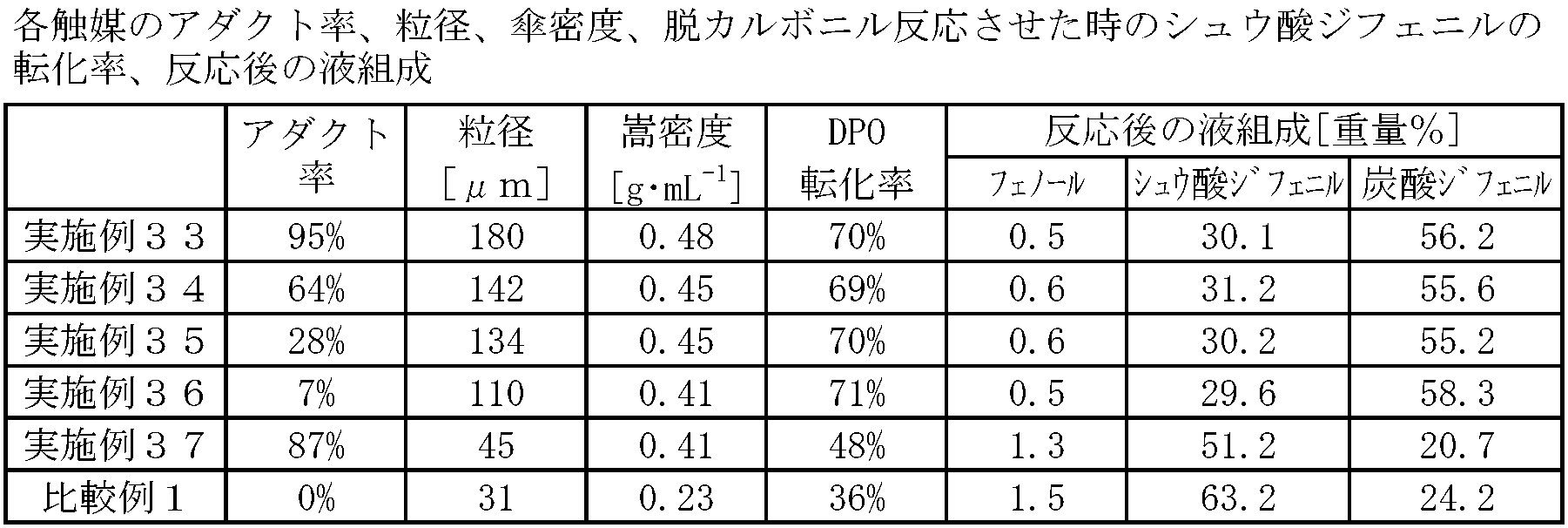
表14から明らかなように、非対称テトラアリールホスホニウムハライドを塩化水素とのアダクト体にすることにより、粒径が大きく、嵩密度が高く、ハンドリングし易くなること、および、これを触媒として用いて脱カルボニル反応を行うと、シュウ酸ジフェニルの転化率が高く、フェノールの副生量が少なく、未反応シュウ酸ジフェニルの量が少なく、炭酸ジフェニルの生成量が多くなることが裏付けられた。
特に、粒径が大きい触媒が、優れた反応成績を示すことも裏付けられた。また、本発明に係るアダクト体の製造方法で製造した非対称アダクト体が、粒径が大きく、優れた反応成績を示すことも裏付けられた。
本発明を特定の態様を用いて詳細に説明したが、本発明の意図と範囲を離れることなく様々な変更および変形が可能であることは、当業者にとって明らかである。なお本出願は、2014年5月23日付で出願された日本特許出願(特願2014-107284)、2014年7月14日付で出願された日本特許出願(特願2014-144298)、2014年7月14日付で出願された日本特許出願(特願2014-144297)、2014年10月28日付で出願された日本特許出願(特願2014-219463)、2014年10月28日付で出願された日本特許出願(特願2014-219464)に基づいており、その全体が引用により援用される。
Claims (20)
- シュウ酸ジフェニルを触媒存在下で脱カルボニル反応させることによる炭酸ジフェニルの製造方法であって、前記触媒を非対称テトラアリールホスホニウムハライドとハロゲン化水素とのアダクト体として供給することを特徴とする炭酸ジフェニルの製造方法。
- 前記アダクト体の平均粒径が50μm以上、1mm以下である、請求項1に記載の炭酸ジフェニルの製造方法。
- 前記アダクト体は、非対称テトラアリールホスホニウムハライドとハロゲン化水素を極性有機溶媒に溶解させた後に晶析することにより得られるものである、請求項1又は2に記載の炭酸ジフェニルの製造方法。
- 前記非対称テトラアリールホスホニウムハライドがベンジルプロトンを有さない、請求項1乃至3の何れか1項に記載の炭酸ジフェニルの製造方法。
- 前記アダクト体が、4-t-ブチルフェニルトリフェニルホスホニウムクロライドと塩化水素とのアダクト体である、請求項1乃至4の何れか1項に記載の炭酸ジフェニルの製造方法。
- 前記脱カルボニル反応時の絶対圧力が0.105MPa以上、10MPa以下である、請求項1乃至5の何れか1項に記載の炭酸ジフェニルの製造方法。
- 前記脱カルボニル反応に不活性な気体を、脱カルボニル反応器の下部から空塔線速0.00001m・s-1以上0.01m・s-1以下で供給しながら脱カルボニル反応を行う、請求項1乃至6の何れか1項に記載の炭酸ジフェニルの製造方法。
- 前記触媒が炭酸ジフェニルに可溶であり、前記脱カルボニル反応を転化率96%以上で行った後、反応液に含まれる炭酸ジフェニルの50重量%以上を蒸発させることにより取り出した後に、残存した反応液を前記脱カルボニル反応に供給することを特徴とする請求項1乃至7の何れか1項に記載の炭酸ジフェニルの製造方法。
- 前記触媒を前記炭酸ジフェニルに溶解させた状態で供給することを特徴とする、請求項1乃至8の何れか1項に記載の炭酸ジフェニルの製造方法。
- 前記シュウ酸ジフェニルが下記一般式(5)で表わされるカルボン酸フェニルエステルを0.076重量%以上、10重量%以下の量含むことを特徴とする請求項1乃至8の何れか1項に記載の炭酸ジフェニルの製造方法。

- 前記脱カルボニル化反応により得た炭酸ジフェニルを塩基性化合物と接触させることを特徴とする請求項1乃至10の何れか1項に記載の炭酸ジフェニルの製造方法。
- 下記第1~3工程をこの順に含むことを特徴とする、炭酸ジフェニルの製造方法。
第1工程:請求項1乃至11の何れか1項に記載の炭酸ジフェニルの製造方法により炭酸ジフェニルを製造する工程、
第2工程:第1工程で製造された炭酸ジフェニルと、前記アダクト体及び/又は前記アダクト体が分解されて生じたアダクト体分解物を含む触媒液とを分離する工程、
第3工程:前記触媒液の少なくとも一部を第1工程の反応器に供給する工程 - シュウ酸ジフェニルの脱カルボニル反応による炭酸ジフェニルの製造に用いた触媒の回収方法であって、前記触媒が非対称テトラアリールホスホニウムハライド及び/又は非対称テトラアリールホスホニウムハライドとハロゲン化水素とのアダクト体であり、前記脱カルボニル反応後の反応液から炭酸ジフェニルを含む成分を取得した残液に極性有機溶媒及びハロゲン化水素ガスを接触させた後、水を接触させることにより得られる析出物として触媒を回収することを特徴とする、触媒の回収方法。
- シュウ酸ジフェニルの脱カルボニル反応による炭酸ジフェニルの製造に用いた触媒の回収方法であって、前記触媒がテトラアリールホスホニウムハライド及び/又はテトラアリールホスホニウムハライドとハロゲン化水素とのアダクト体であり、前記脱カルボニル反応後の反応液から炭酸ジフェニルを含む成分を取得した残液を極性有機溶媒とハロゲン化水素に接触させた後、前記残液に含まれる触媒を回収する(触媒回収工程)と共に、前記極性有機溶媒を回収し、前記触媒回収工程に再利用することを特徴とする、触媒の回収方法。
- シュウ酸ジフェニルの脱カルボニル反応による炭酸ジフェニルの製造方法であって、触媒として、請求項13又は14に記載の回収方法により回収された触媒を用いることを特徴とする炭酸ジフェニルの製造方法。
- テトラアリールホスホニウムハライドとハロゲン化水素とのアダクト体の製造方法であって、非対称テトラアリールホスホニウムハライドとハロゲン化水素を極性有機溶媒に溶解させた後、晶析することにより、非対称テトラアリールホスホニウムハライドとハロゲン化水素とのアダクト体を得ることを特徴とする、非対称テトラアリールホスホニウムハライドとハロゲン化水素とのアダクト体の製造方法。
- シュウ酸ジフェニルの脱カルボニル反応による炭酸ジフェニル製造用触媒であって、前記触媒がベンジルプロトンを有していない非対称テトラアリールホスホニウムハライドと、ハロゲン化水素とのアダクト体であることを特徴とする、炭酸ジフェニル製造用触媒。
- 炭酸ジフェニルと、ジヒドロキシ化合物とをエステル交換触媒の存在下で重縮合させることによるポリカーボネートの製造方法であって、前記炭酸ジフェニルを請求項1乃至12及び15の何れか1項に記載の炭酸ジフェニルの製造方法により製造した後に、前記ジヒドロキシ化合物と重縮合させることを特徴とするポリカーボネートの製造方法。
- 請求項1乃至12及び15の何れかに1項に記載の炭酸ジフェニルの製造方法により得られる炭酸ジフェニル。
- 芳香族ジヒドロキシ化合物と請求項19に記載の炭酸ジフェニルとをエステル交換触媒の存在下で重縮合させることにより得られるポリカーボネート。
Priority Applications (2)
| Application Number | Priority Date | Filing Date | Title |
|---|---|---|---|
| KR1020167032584A KR102206139B1 (ko) | 2014-05-23 | 2015-05-21 | 탄산디페닐의 제조 방법, 그 제조 방법에 의해 얻어지는 탄산디페닐, 그 탄산디페닐로부터 제조되는 폴리카보네이트, 탄산디페닐 제조용 촉매, 그 촉매의 제조 방법, 촉매의 회수·재이용 방법 |
| CN201580026720.8A CN106458834B (zh) | 2014-05-23 | 2015-05-21 | 碳酸二苯酯及其制造方法、催化剂及其制造·回收·再利用方法、聚碳酸酯 |
Applications Claiming Priority (10)
| Application Number | Priority Date | Filing Date | Title |
|---|---|---|---|
| JP2014-107284 | 2014-05-23 | ||
| JP2014107284 | 2014-05-23 | ||
| JP2014-144298 | 2014-07-14 | ||
| JP2014144298A JP6245097B2 (ja) | 2014-07-14 | 2014-07-14 | 炭酸ジフェニルの製造方法およびポリカーボネートの製造方法 |
| JP2014-144297 | 2014-07-14 | ||
| JP2014144297A JP6287655B2 (ja) | 2014-07-14 | 2014-07-14 | 炭酸ジフェニルの製造方法およびポリカーボネートの製造方法 |
| JP2014219463A JP6344195B2 (ja) | 2014-10-28 | 2014-10-28 | 炭酸ジフェニルの製造方法及び該製造方法により得られる炭酸ジフェニル、並びに該炭酸ジフェニルから製造されるポリカーボネート |
| JP2014219464A JP6344196B2 (ja) | 2014-10-28 | 2014-10-28 | 炭酸ジエステルの製造方法及び該製造方法により得られる炭酸ジエステル並びに該炭酸ジエステルから製造されるポリカーボネート |
| JP2014-219463 | 2014-10-28 | ||
| JP2014-219464 | 2014-10-28 |
Publications (1)
| Publication Number | Publication Date |
|---|---|
| WO2015178463A1 true WO2015178463A1 (ja) | 2015-11-26 |
Family
ID=54554123
Family Applications (1)
| Application Number | Title | Priority Date | Filing Date |
|---|---|---|---|
| PCT/JP2015/064645 Ceased WO2015178463A1 (ja) | 2014-05-23 | 2015-05-21 | 炭酸ジフェニルの製造方法、該製造方法により得られる炭酸ジフェニル、該炭酸ジフェニルから製造されるポリカーボネート、炭酸ジフェニル製造用触媒、該触媒の製造方法、触媒の回収・再利用方法 |
Country Status (3)
| Country | Link |
|---|---|
| KR (1) | KR102206139B1 (ja) |
| CN (1) | CN106458834B (ja) |
| WO (1) | WO2015178463A1 (ja) |
Families Citing this family (1)
| Publication number | Priority date | Publication date | Assignee | Title |
|---|---|---|---|---|
| CN119431761B (zh) * | 2025-01-08 | 2025-04-04 | 浙江大学 | 一种聚碳酸酯副产物回收工艺 |
Citations (6)
| Publication number | Priority date | Publication date | Assignee | Title |
|---|---|---|---|---|
| JPH08333307A (ja) * | 1995-04-04 | 1996-12-17 | Ube Ind Ltd | ジアリールカーボネートの製造法 |
| JPH09328491A (ja) * | 1996-06-07 | 1997-12-22 | Ube Ind Ltd | ホスホニウムクロライドの製法 |
| JP2002045704A (ja) * | 2000-08-04 | 2002-02-12 | Ube Ind Ltd | 触媒回収方法 |
| JP2002053657A (ja) * | 2000-08-04 | 2002-02-19 | Ube Ind Ltd | ポリカーボネートの製法 |
| JP2003226751A (ja) * | 2002-02-05 | 2003-08-12 | Ube Ind Ltd | 高純度炭酸ジフェニル組成物とポリカーボネートの製法 |
| JP2013082695A (ja) * | 2011-09-30 | 2013-05-09 | Mitsubishi Chemicals Corp | 非対称テトラアリールホスホニウムハライドの製造方法及び炭酸ジエステルの製造方法 |
Family Cites Families (9)
| Publication number | Priority date | Publication date | Assignee | Title |
|---|---|---|---|---|
| TW322471B (ja) * | 1995-04-04 | 1997-12-11 | Ube Industries | |
| TW407147B (en) * | 1996-08-30 | 2000-10-01 | Ube Industries | Catalyst for decarbonylation reaction |
| MY133750A (en) * | 1996-10-04 | 2007-11-30 | Ube Industries | Process for preparing diaryl carbonate |
| MY115698A (en) * | 1996-10-04 | 2003-08-30 | Ube Industries | Preparation of diaryl carbonate |
| JPH11152252A (ja) | 1997-09-19 | 1999-06-08 | Ube Ind Ltd | 炭酸ジアリールの製造方法 |
| SG77658A1 (en) * | 1997-11-21 | 2001-01-16 | Ube Indusries Ltd | Preparation of organic phosphonium chloride |
| JP3852513B2 (ja) | 1998-03-06 | 2006-11-29 | 宇部興産株式会社 | ジフェニルカーボネートの製造法 |
| CN1243715C (zh) * | 2000-08-04 | 2006-03-01 | 宇部兴产株式会社 | 碳酸二芳基酯产物和聚碳酸酯的制备 |
| JP4277431B2 (ja) | 2000-08-04 | 2009-06-10 | 宇部興産株式会社 | 炭酸ジアリールの精製法及び製法 |
-
2015
- 2015-05-21 CN CN201580026720.8A patent/CN106458834B/zh not_active Expired - Fee Related
- 2015-05-21 KR KR1020167032584A patent/KR102206139B1/ko not_active Expired - Fee Related
- 2015-05-21 WO PCT/JP2015/064645 patent/WO2015178463A1/ja not_active Ceased
Patent Citations (6)
| Publication number | Priority date | Publication date | Assignee | Title |
|---|---|---|---|---|
| JPH08333307A (ja) * | 1995-04-04 | 1996-12-17 | Ube Ind Ltd | ジアリールカーボネートの製造法 |
| JPH09328491A (ja) * | 1996-06-07 | 1997-12-22 | Ube Ind Ltd | ホスホニウムクロライドの製法 |
| JP2002045704A (ja) * | 2000-08-04 | 2002-02-12 | Ube Ind Ltd | 触媒回収方法 |
| JP2002053657A (ja) * | 2000-08-04 | 2002-02-19 | Ube Ind Ltd | ポリカーボネートの製法 |
| JP2003226751A (ja) * | 2002-02-05 | 2003-08-12 | Ube Ind Ltd | 高純度炭酸ジフェニル組成物とポリカーボネートの製法 |
| JP2013082695A (ja) * | 2011-09-30 | 2013-05-09 | Mitsubishi Chemicals Corp | 非対称テトラアリールホスホニウムハライドの製造方法及び炭酸ジエステルの製造方法 |
Also Published As
| Publication number | Publication date |
|---|---|
| KR102206139B1 (ko) | 2021-01-21 |
| CN106458834A (zh) | 2017-02-22 |
| KR20170012247A (ko) | 2017-02-02 |
| CN106458834B (zh) | 2019-10-25 |
Similar Documents
| Publication | Publication Date | Title |
|---|---|---|
| JP5140673B2 (ja) | イソプレゴールの製造におけるフェノールリガンドの回収 | |
| TW438765B (en) | Process for producing a diaryl carbonate | |
| KR101846585B1 (ko) | 옥살산디아릴의 제조 방법 | |
| JP2002525346A (ja) | 化学反応からの望ましくない水の単離および除去の方法 | |
| EP3878845B1 (en) | Perfluoro(2-methylene-4-methyl-1,3-dioxolane) production method | |
| KR101976886B1 (ko) | 디아릴 카르보네이트의 제조 방법 | |
| KR102206139B1 (ko) | 탄산디페닐의 제조 방법, 그 제조 방법에 의해 얻어지는 탄산디페닐, 그 탄산디페닐로부터 제조되는 폴리카보네이트, 탄산디페닐 제조용 촉매, 그 촉매의 제조 방법, 촉매의 회수·재이용 방법 | |
| TWI689486B (zh) | 氟化烷之製造方法、脒鹼之分離、回收方法、及回收的脒鹼之使用方法 | |
| JP6451496B2 (ja) | 炭酸ジフェニルの製造方法、該製造方法により得られる炭酸ジフェニル、該炭酸ジフェニルから製造されるポリカーボネート、炭酸ジフェニル製造用触媒、該触媒の製造方法 | |
| JPS5811930B2 (ja) | イソプロペニルフエノ−ルの製法 | |
| JP6135020B2 (ja) | ペルフルオロアルケニルオキシ基含有ビニル化合物の製造方法 | |
| CN107641067B (zh) | 一种邻二酮的α位溴化方法 | |
| JP6287655B2 (ja) | 炭酸ジフェニルの製造方法およびポリカーボネートの製造方法 | |
| JP6625613B2 (ja) | ジアリールカーボネート類の製造方法 | |
| KR101980394B1 (ko) | 디아릴 카르보네이트의 제조 방법 | |
| JP6372378B2 (ja) | 触媒の回収方法、該回収触媒を用いる炭酸ジフェニルの製造方法および該炭酸ジフェニルを用いるポリカーボネートの製造方法 | |
| JP6344196B2 (ja) | 炭酸ジエステルの製造方法及び該製造方法により得られる炭酸ジエステル並びに該炭酸ジエステルから製造されるポリカーボネート | |
| JP6398756B2 (ja) | 炭酸ジフェニルの製造方法およびポリカーボネートの製造方法 | |
| JP6406094B2 (ja) | 触媒の回収方法、該回収触媒を用いる炭酸ジフェニルの製造方法および該炭酸ジフェニルを用いるポリカーボネートの製造方法 | |
| JP6344195B2 (ja) | 炭酸ジフェニルの製造方法及び該製造方法により得られる炭酸ジフェニル、並びに該炭酸ジフェニルから製造されるポリカーボネート | |
| JP2016185930A (ja) | 炭酸ジフェニルの製造方法およびポリカーボネートの製造方法 | |
| JP6245097B2 (ja) | 炭酸ジフェニルの製造方法およびポリカーボネートの製造方法 | |
| JP6269361B2 (ja) | シュウ酸ジフェニルの製造方法、炭酸ジフェニルの製造方法およびポリカーボネートの製造方法 | |
| JPH10152457A (ja) | 炭酸ジアリールエステルの製造法 |
Legal Events
| Date | Code | Title | Description |
|---|---|---|---|
| 121 | Ep: the epo has been informed by wipo that ep was designated in this application |
Ref document number: 15796667 Country of ref document: EP Kind code of ref document: A1 |
|
| ENP | Entry into the national phase |
Ref document number: 20167032584 Country of ref document: KR Kind code of ref document: A |
|
| NENP | Non-entry into the national phase |
Ref country code: DE |
|
| 122 | Ep: pct application non-entry in european phase |
Ref document number: 15796667 Country of ref document: EP Kind code of ref document: A1 |