WO2015152151A1 - 研磨用組成物及び研磨方法 - Google Patents
研磨用組成物及び研磨方法 Download PDFInfo
- Publication number
- WO2015152151A1 WO2015152151A1 PCT/JP2015/059924 JP2015059924W WO2015152151A1 WO 2015152151 A1 WO2015152151 A1 WO 2015152151A1 JP 2015059924 W JP2015059924 W JP 2015059924W WO 2015152151 A1 WO2015152151 A1 WO 2015152151A1
- Authority
- WO
- WIPO (PCT)
- Prior art keywords
- polishing
- silica
- surface area
- specific surface
- polishing composition
- Prior art date
- Legal status (The legal status is an assumption and is not a legal conclusion. Google has not performed a legal analysis and makes no representation as to the accuracy of the status listed.)
- Ceased
Links
Images
Classifications
-
- H—ELECTRICITY
- H10—SEMICONDUCTOR DEVICES; ELECTRIC SOLID-STATE DEVICES NOT OTHERWISE PROVIDED FOR
- H10P—GENERIC PROCESSES OR APPARATUS FOR THE MANUFACTURE OR TREATMENT OF DEVICES COVERED BY CLASS H10
- H10P52/00—Grinding, lapping or polishing of wafers, substrates or parts of devices
- H10P52/40—Chemomechanical polishing [CMP]
- H10P52/403—Chemomechanical polishing [CMP] of conductive or resistive materials
-
- C—CHEMISTRY; METALLURGY
- C09—DYES; PAINTS; POLISHES; NATURAL RESINS; ADHESIVES; COMPOSITIONS NOT OTHERWISE PROVIDED FOR; APPLICATIONS OF MATERIALS NOT OTHERWISE PROVIDED FOR
- C09G—POLISHING COMPOSITIONS; SKI WAXES
- C09G1/00—Polishing compositions
- C09G1/02—Polishing compositions containing abrasives or grinding agents
-
- B—PERFORMING OPERATIONS; TRANSPORTING
- B24—GRINDING; POLISHING
- B24B—MACHINES, DEVICES, OR PROCESSES FOR GRINDING OR POLISHING; DRESSING OR CONDITIONING OF ABRADING SURFACES; FEEDING OF GRINDING, POLISHING, OR LAPPING AGENTS
- B24B37/00—Lapping machines or devices; Accessories
- B24B37/04—Lapping machines or devices; Accessories designed for working plane surfaces
- B24B37/042—Lapping machines or devices; Accessories designed for working plane surfaces operating processes therefor
- B24B37/044—Lapping machines or devices; Accessories designed for working plane surfaces operating processes therefor characterised by the composition of the lapping agent
-
- C—CHEMISTRY; METALLURGY
- C09—DYES; PAINTS; POLISHES; NATURAL RESINS; ADHESIVES; COMPOSITIONS NOT OTHERWISE PROVIDED FOR; APPLICATIONS OF MATERIALS NOT OTHERWISE PROVIDED FOR
- C09K—MATERIALS FOR MISCELLANEOUS APPLICATIONS, NOT PROVIDED FOR ELSEWHERE
- C09K3/00—Materials not provided for elsewhere
- C09K3/14—Anti-slip materials; Abrasives
-
- H—ELECTRICITY
- H10—SEMICONDUCTOR DEVICES; ELECTRIC SOLID-STATE DEVICES NOT OTHERWISE PROVIDED FOR
- H10P—GENERIC PROCESSES OR APPARATUS FOR THE MANUFACTURE OR TREATMENT OF DEVICES COVERED BY CLASS H10
- H10P52/00—Grinding, lapping or polishing of wafers, substrates or parts of devices
-
- H—ELECTRICITY
- H10—SEMICONDUCTOR DEVICES; ELECTRIC SOLID-STATE DEVICES NOT OTHERWISE PROVIDED FOR
- H10P—GENERIC PROCESSES OR APPARATUS FOR THE MANUFACTURE OR TREATMENT OF DEVICES COVERED BY CLASS H10
- H10P90/00—Preparation of wafers not covered by a single main group of this subclass, e.g. wafer reinforcement
- H10P90/12—Preparing bulk and homogeneous wafers
- H10P90/129—Preparing bulk and homogeneous wafers by polishing
-
- H—ELECTRICITY
- H10—SEMICONDUCTOR DEVICES; ELECTRIC SOLID-STATE DEVICES NOT OTHERWISE PROVIDED FOR
- H10P—GENERIC PROCESSES OR APPARATUS FOR THE MANUFACTURE OR TREATMENT OF DEVICES COVERED BY CLASS H10
- H10P95/00—Generic processes or apparatus for manufacture or treatments not covered by the other groups of this subclass
- H10P95/06—Planarisation of inorganic insulating materials
- H10P95/062—Planarisation of inorganic insulating materials involving a dielectric removal step
Definitions
- the present invention relates to a polishing composition and a polishing method using the same.
- hard and brittle materials such as sapphire, silicon carbide, and silicon nitride are used for substrates for LEDs and substrates for power devices.
- a hard and brittle material substrate since the hardness is relatively high, in order to improve the polishing rate, mechanical polishing is performed using abrasive grains having a large particle diameter.
- a polishing composition with increased strength may be used.
- abrasive grains with a large particle diameter have a smaller surface area (specific surface area) with respect to the abrasive mass than abrasive grains with a small particle diameter, and therefore the ratio of the abrasive grain surface deteriorated by polishing tends to increase.
- the polishing rate decreases when the polishing composition is used repeatedly for a long period of time, for example.
- Patent Document 1 describes a polishing composition containing silica having different particle diameters.
- Such a polishing composition has a high polishing rate for hard and brittle materials and contains silica having a small particle diameter, thereby increasing the specific surface area of the abrasive grains and reducing the surface of the abrasive grains deteriorated by polishing of the entire abrasive grains. Since the effect of suppressing the increase in the ratio is obtained, the polishing rate can be maintained to some extent even when the polishing composition is repeatedly used.
- the polishing composition described in Patent Document 1 has a problem that it is insufficient to maintain a high polishing rate for a long period of time.
- the polishing composition according to the present invention contains water and silica, and the silica has a BET specific surface area of 30 m 2 / g or more and an NMR specific surface area of 10 m 2 / g or more.
- the polishing composition according to the present invention may have a pH of 8.0 or more and pH 11.5 or less.
- the polishing method according to the present invention polishes an object to be polished using the polishing composition.
- the polishing composition may be recovered after being used once or more and used again to polish the object to be polished.
- the polishing method according to the present invention polishes a substrate containing a hard and brittle material.
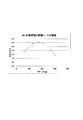
- the graph which shows the relationship between a BET specific surface area and polishing rate (rate).
- the polishing composition and polishing method according to the present invention will be described below.
- the polishing composition of the present embodiment contains water and silica, and the silica has a BET specific surface area of 30 m 2 / g or more and an NMR specific surface area of 10 m 2 / g or more.
- the polishing composition of the present embodiment contains silica as abrasive grains.
- the silica is not particularly limited as long as it is used as abrasive grains in the polishing composition, and examples thereof include colloidal silica and fumed silica. These may be used alone or in combination of two or more. Can be used. Of these, colloidal silica is preferable. When colloidal silica is used as abrasive grains, it is preferable because defects such as scratches on the object to be polished can be suppressed.
- the silica has a BET specific surface area of 30 m 2 / g or more, preferably 35 m 2 / g or more and 150 m 2 / g or less, more preferably 35 m 2 / g or more and 140 m 2 / g or less, and an NMR specific surface area of 10 m. 2 / g or more, preferably 13 m 2 / g or more and 150 m 2 / g or less of silica.
- silica having the above range specific surface area can be appropriately selected and employed.
- the BET specific surface area is a specific surface area measured by the BET method determined based on the adsorption amount of N 2 gas, and can be specifically measured by a method described in Examples described later.
- the BET specific surface area is a value measured for dry silica.
- the NMR specific surface area is a specific surface area obtained by measuring the relaxation time of a liquid in which particles are dispersed by pulse NMR, and can be specifically measured by the method described in Examples described later.
- the NMR specific surface area is a value measured for silica in the dispersion.
- the BET specific surface area By setting the BET specific surface area within the above range, the area of the portion where the silica particles can come into contact with the object to be polished can be increased. Generally, when the BET specific surface area increases, the polishing rate tends to increase. is there. On the other hand, since the BET specific surface area is a value obtained by measuring the specific surface area of the silica in the dry state, the change in the polishing rate depending on the surface state of the silica particles in the polishing composition is not represented by the BET specific surface area.
- the surface hydrophilicity of silica changes in an alkaline liquid, but the amount of liquid components in the polishing composition adhering to the silica surface changes due to the change in hydrophilicity, and the polishing performance such as the polishing rate is improved. Change.
- the change in polishing performance due to the change in the silica surface has no correlation with the BET specific surface area. Therefore, the value of the BET specific surface area of silica alone is not sufficient as a parameter indicating the polishing rate.
- the NMR specific surface area is a specific surface area obtained based on the NMR relaxation time between the liquid in contact with or adsorbing to the particles in the dispersion and the liquid not in contact with or adsorbing to the particles. Can be measured by the method described in the Examples.
- the specific surface area measured by the NMR method is a value obtained by measuring silica in a liquid. When the hydrophilicity of the silica surface increases, the NMR specific surface area also increases. The hydrophilicity of the silica surface affects the maintenance of the polishing rate during long-term use.
- the silica surface is activated to increase the reactivity to the object to be polished, and the deterioration of the particle surface due to polishing is suppressed.
- silica whose BET specific surface area is out of the above range there is no correlation between the high NMR specific surface area and the maintenance of the polishing rate during long-term use.
- a high polishing rate can be obtained by using an NMR specific surface area in a specific range, and long The polishing rate can be maintained even when used for a period.
- concentration of the silica in the polishing composition of this embodiment is not specifically limited, For example, it is 5.0 to 50 mass%, Preferably it is 10 to 45 mass%.
- the polishing rate for the polishing object can be further improved.
- the polishing composition of the present embodiment has a pH of 8.0 to 11.5, preferably a pH of 8.5 to 11.0.
- a pH range of the polishing composition is within the above range, it is preferable because the polishing rate for the polishing object can be improved and the dispersibility of silica can also be improved.
- Silica is known to change the number of silanol groups on the surface in an alkaline liquid, and the number of silanol groups on the silica surface affects the polishing rate. Accordingly, when the pH range of the polishing composition is within the above range, an appropriate amount of silanol is likely to be present on the silica surface, which is preferable.
- the method for adjusting the pH of the polishing composition of the present embodiment to the above range is not particularly limited, and examples thereof include inorganic substances such as hydrochloric acid, sulfuric acid, nitric acid, phosphoric acid, phosphorous acid, boric acid, and carbonic acid.
- Carboxylic acids such as acids, acetic acid, succinic acid, tartaric acid, organic acids such as organic phosphonic acids and organic sulfonic acids, alkali metal hydroxides such as NaOH and KOH, alkaline earth metal hydroxides, inorganic bases such as ammonia, amines And organic basic compounds such as quaternary ammonium hydroxide such as tetramethylammonium hydroxide (TMAH) and salts thereof.
- TMAH tetramethylammonium hydroxide
- the polishing composition of this embodiment may further contain other components.
- the other components include surfactants and chelating agents.
- the polishing composition of the present embodiment may be prepared as a high-concentration liquid having a concentration higher than the desired concentration at the time of use, and may be diluted at the time of use.
- a high concentration liquid When prepared as such a high concentration liquid, it is convenient for storage and transportation of the polishing composition.
- concentration In the case of adjusting as a high-concentration solution, for example, it is possible to adjust the concentration so that it can be diluted to 1 to 10 times (stock solution), preferably 1 to 5 times that when used.
- the polishing object of the polishing composition of the present embodiment is not particularly limited, but sapphire, silicon nitride, silicon carbide, silicon oxide, glass, gallium nitride, gallium arsenide, arsenic Examples thereof include a substrate (hard and brittle material substrate) containing a hard and brittle material such as indium and indium phosphide. Such hard and brittle materials are harder and more brittle than silicon wafers and the like, and thus it is difficult to improve the polishing rate. However, the polishing composition of the present embodiment polishes these hard and brittle material substrates at a relatively high polishing rate. can do.
- a sapphire substrate is particularly preferable. Since the sapphire substrate undergoes a solid-phase reaction with silica, the sapphire substrate is susceptible to polishing performance depending on the specific surface area of silica and the state of the silica particle surface. Therefore, polishing performance can be improved by the polishing composition of the present embodiment.
- the polishing composition of the present embodiment has a relatively high polishing rate for a polishing object having a relatively high hardness such as the hard and brittle material substrate, even a polishing object that has conventionally taken a long time is polished in a short time. Can be polished. Therefore, the production efficiency can be improved and the production cost can be reduced.
- the polishing method of the present embodiment is a method for polishing an object to be polished using the polishing composition as described above.
- polishing using the polishing composition of the present embodiment can use an apparatus and polishing conditions used for polishing a normal substrate or the like.
- polishing apparatus for example, a single-side polishing apparatus or a double-side polishing apparatus can be used.
- the polishing pad is not particularly limited, and for example, any type such as a polyurethane type, a nonwoven fabric type, and a suede type may be used.
- the polishing conditions can be appropriately set according to the object to be polished.
- the polishing load is, for example, 50 g or more and 1000 g or less, preferably 100 g or more and 800 g or less per 1 cm 2 of the area of the polishing object.
- the polishing linear velocity is, for example, 10 m / min or more and 300 m / min or less, preferably 30 m / min or more and 200 m / min or less.
- the polishing load and the polishing linear velocity are in the above ranges, the friction against the object to be polished can be adjusted to an appropriate range.
- the polishing composition of this embodiment can sufficiently improve the polishing rate even when polishing is performed with the polishing load and polishing linear velocity in the above ranges. Therefore, when the polishing composition of the present embodiment is used to polish at the polishing load and the polishing linear velocity, damage to the object to be polished can be suppressed while the polishing rate is relatively high.
- the polishing composition as described above may be collected after being used once or more and used again to polish the object to be polished.
- the polishing composition of this embodiment can polish an object to be polished at a relatively high polishing rate, and can maintain the polishing rate for a long time. Therefore, for example, the polishing rate can be maintained even when it is used for polishing the polishing object once or more and then collected and used again for polishing the polishing object.
- the polishing composition that has been used for polishing more than once in this way is reused, for example, the used polishing composition is recovered, once stored in a tank or the like, and further supplied to a polishing apparatus or the like. Is mentioned.
- the polishing composition is recovered by a recovery device such as a drain and stored in a tank, etc., and after passing through a filtration step as necessary, A circulating method is also used in which the contained polishing composition is supplied again to the polishing apparatus with a pump or the like.
- silica When reusing the polishing composition of the present embodiment, silica may be replenished. When silica is replenished, silica having a BET specific surface area and NMR specific surface area within the above ranges may be replenished, or other silica may be replenished.
- components of the polishing composition other than silica may be supplemented.
- the polishing composition of the present embodiment is a polishing composition containing water and silica, and the silica has a BET specific surface area of 30 m 2 / g or more and an NMR specific surface area of 10 m.
- the polishing rate for a polishing object having a relatively high hardness such as a hard and brittle material substrate is relatively high, and the polishing rate can be maintained for a long time.
- the polishing method according to the present embodiment is a method for polishing a polishing object using the above-described polishing composition, and therefore, for a polishing object having a relatively high hardness such as a hard and brittle material substrate.
- the polishing rate is relatively high and the polishing rate can be maintained for a long time.
- polishing composition and the polishing method according to the present embodiment are as described above, the embodiment disclosed this time should be considered as illustrative in all points and not restrictive. .
- the scope of the present invention is defined by the terms of the claims, rather than the description above, and is intended to include any modifications within the scope and meaning equivalent to the terms of the claims.
- the present inventors have improved the polishing rate of the polishing composition by using silica having a specific specific surface area as abrasive grains, and The inventors have found that the polishing rate can be maintained for a long time, and have completed the present invention.
- a polishing composition comprising water and silica, wherein the silica has a BET specific surface area of 30 m 2 / g or more and an NMR specific surface area of 10 m 2 / g or more,
- the polishing rate for the object to be polished can be improved, and the polishing rate can be maintained even when used for a long time.
- the polishing rate for the object to be polished can be further improved, and the polishing rate can be maintained even when used for a long time.
- the polishing method according to the present invention polishes an object to be polished using the polishing composition. Moreover, the grinding
- polishing composition recovered after being used once or more is used again for polishing, it can be polished at a relatively high polishing rate while maintaining the polishing rate.
- the present invention it is possible to provide a polishing composition capable of maintaining a polishing rate relatively high and maintaining it for a long period of time.
- a polishing method capable of polishing at a relatively high polishing rate and maintaining the polishing rate for a long period of time.
- BET specific surface area Six types of colloidal silica were prepared, and each BET specific surface area and NMR specific surface area were measured. (BET specific surface area) The BET specific surface area was measured by the following method. Each slurry was dried in an oven at 185 ° C. for 30 minutes, and 0.3 g of a sample obtained by pulverizing the remaining silica in a mortar and treating it into a powder was used to measure a BET specific surface area measuring device (trade name: SA-3100, Beckman). Table 1 shows the results of measuring the specific surface area using a coulter.
- NMR specific surface area The NMR specific surface area was measured by the following method. A slurry in which each silica was dispersed in water so as to have a concentration shown in Table 1 was prepared as a sample. Table 1 shows the results of measuring the specific surface area under the following measurement conditions using a pulse NMR particle interface characteristic evaluation apparatus (Acorn area, sold by Nippon Lucas). ⁇ Measurement conditions> Bulk relaxation time: 2699ms Specific surface relaxation: 0.00026 Volume ratio of liquid to liquid: calculated from the silica concentration, silica particle density (fixed at 2.2 g / cm 3 ) and blank solution density (fixed at 1.0 g / cm 3 ) of each slurry
- Polishing composition Each polishing composition of an Example and a comparative example was produced using the silica of Table 1. Silica, water, and NaOH for pH adjustment were mixed, and the silica concentration and pH were adjusted to be the values shown in Tables 1 and 2.
- polishing rate was measured using each polishing composition.
- the polishing conditions for one batch were as follows, and three batches were polished under the same conditions.
- Polishing machine SpeedGPAM 36GPAW Load: 350 g / cm 2 Plate rotation speed: 40 rpm
- Polishing head 4 axes Polishing object: Sapphire wafer, 4 inch C-plane Number of wafers: 24 (6 / plate x 4)
- Polishing time 150 min / batch Slurry flow rate: 3.6 L / min Recycled slurry volume: 18kg
- the polishing rate was measured by the following method. Using GT2-A12K manufactured by KEYENCE, measure the wafer thickness change amount before and after polishing at 5 points on the sapphire wafer (center 1 point, 4 points on the outer periphery), and calculate the average value of the 5 points of change for polishing time The amount of polishing per unit time was calculated by dividing by.
- Table 2 shows the rate of change (%) in the polishing rate of the third batch with respect to the polishing rate of the first batch of each polishing composition. Further, the polishing compositions of Examples 2 and 3 were used to polish up to 5 batches in the same manner as described above, and Table 3 shows the rate of change (%) in the fifth batch with respect to the polishing rate of the first batch.
- each example using silica having a BET specific surface area of 30 m 2 / g or more and an NMR specific surface area of 10 m 2 / g or more has a relatively high polishing rate
- 3 The rate of change of the polishing rate of the batch with respect to the polishing rate of the first batch was also small.
- Comparative Example 1 using silica with a small NMR specific surface area the polishing rate in the first batch was relatively high, but the rate of change in the polishing rate in the third batch was large, that is, the polishing rate could not be maintained.
- Comparative Example 2 using silica having a small BET specific surface area the polishing rate was lower than that of the Examples from the first batch.
- the polishing composition of Example 3 having a large NMR specific surface area has a change in polishing rate compared to the polishing composition of Example 2 even when the BET specific surface area is equivalent.
- the rate was small, that is, the polishing rate could be maintained for a longer period.
Landscapes
- Chemical & Material Sciences (AREA)
- Organic Chemistry (AREA)
- Engineering & Computer Science (AREA)
- Materials Engineering (AREA)
- Mechanical Engineering (AREA)
- Mechanical Treatment Of Semiconductor (AREA)
- Finish Polishing, Edge Sharpening, And Grinding By Specific Grinding Devices (AREA)
Abstract
Description
かかる硬脆材料を用いた基板(以下、硬脆材料基板ともいう)を研磨する場合、硬度が比較的高いため、研磨速度を向上させるためには粒子径の大きい砥粒を用いて機械的研磨力を高めた研磨用組成物を用いることがある。しかし、粒子径が大きい砥粒は、粒子径の小さい砥粒に比べると、砥粒質量に対する表面積(比表面積)が小さくなるため、研磨により劣化した砥粒表面の割合が大きくなりやすい傾向にあり、例えば、研磨用組成物を繰り返し使用する等長期間使用すると研磨速度が低下するという問題がある。
しかし、かかる特許文献1に記載の研磨用組成物でも長期間高い研磨速度を維持することは不十分であるという問題がある。
また、本発明は、比較的高い研磨速度で研磨することができ且つ長期間研磨速度を維持できる研磨方法を提供することを課題とする。
本実施形態の研磨用組成物は、水とシリカとを含み、前記シリカのBET比表面積が30m2/g以上であって且つNMR比表面積が10m2/g以上である。
本実施形態の研磨用組成物はシリカを砥粒として含む。
シリカは研磨用組成物において砥粒として用いられるものであれば、特に限定されることはなく、例えば、コロイダルシリカ、ヒュームドシリカ等が挙げられ、これらを単独で、又は2種以上を混合して用いることができる。
中でも、コロイダルシリカが好ましい。コロイダルシリカを砥粒として用いた場合には、研磨対象物に対するスクラッチ等の欠陥発生を抑制できるため好ましい。
本実施形態の研磨用組成物には、前記範囲比表面積を有するシリカを適宜選択して採用することができる。
一方、BET比表面積は、乾燥状態のシリカの比表面積を測定した値であるため、研磨用組成物中でのシリカ粒子の表面の状態による研磨速度の変化についてはBET比表面積では表されない。例えば、アルカリ性の液中においてシリカは表面の親水性が変化するが、かかる親水性の変化によってシリカ表面に研磨用組成物中の液体成分が付着する量が変化し、研磨速度等の研磨性能が変化する。しかし、かかるシリカ表面の変化による研磨性能の変化はBET比表面積とは相関がない。
よって、シリカのBET比表面積の値だけでは、研磨速度を示すパラメータとしては不十分である。
NMR法によって測定される比表面積は液体中のシリカを測定した値であり、シリカの表面の親水性が高くなるとNMR比表面積も高くなる。シリカ表面の親水性は長期間使用時の研磨速度維持に変化を及ぼす。すなわち、シリカ表面の親水性が向上するとシリカ表面が活性化されて研磨対象物への反応性が増大し、研磨による粒子表面の劣化が抑制される。
一方、BET比表面積が前記範囲からはずれるシリカについては、NMR比表面積の高さと長期間使用時の研磨速度維持との相関関係が得られない。
シリカ濃度が前記範囲である場合には、研磨対象物に対する研磨速度をより向上させることができ。
本実施形態の研磨用組成物は、pH8.0以上11.5以下、好ましくはpH8.5以上pH11.0以下である。
研磨用組成物のpHの範囲が前記範囲である場合には、研磨対象物に対する研磨速度を向上させることができ、且つ、シリカの分散性も向上させることができるため好ましい。
また、シリカはアルカリ性の液体中では、表面のシラノール基数が変化することが知られており、シリカ表面のシラノール基数は研磨速度に影響を及ぼす。よって、研磨用組成物のpHの範囲が前記範囲である場合には、シリカ表面に適切な量のシラノールが存在しやすくなり好ましい。
前記他の成分としては、界面活性剤、キレート剤等が挙げられる。
かかる高濃度液として調整した場合には、研磨用組成物の貯蔵、輸送に便利である。
尚、高濃度液として調整する場合には、例えば、使用時の1倍(原液)超~10倍、好ましくは1倍超~5倍に希釈できる程度の濃度に調整することが挙げられる。
本実施形態の研磨用組成物の研磨対象物は特に限定されるものではないが、サファイア、窒化珪素、炭化珪素、酸化ケイ素、ガラス、窒化ガリウム、ヒ化ガリウム、ヒ化インジウム、リン化インジウム等の硬脆材料を含む基板(硬脆材料基板)等が挙げられる。かかる硬脆材料は、シリコンウェーハ等と比べて硬度が高く且つもろいため、研磨速度を向上させにくいが、本実施形態の研磨用組成物はこれらの硬脆材料基板を比較的高い研磨速度で研磨することができる。
本実施形態の研磨用組成物の研磨対象物としては、特に、サファイア基板が好適な研磨対象物として挙げられる。サファイア基板は、シリカと固相反応を起こすため、シリカの比表面積及びシリカの粒子表面の状態によって研磨性能に影響を受けやすい。そのため、本実施形態の研磨用組成物によって研磨性能を向上させうる。
従って、製造効率の向上及び製造コストの低減も図れる。
本実施形態の研磨方法は、上述のような研磨用組成物を用いて研磨対象物を研磨する方法である。
上述のような本実施形態の研磨用組成物を用いて、研磨対象物を研磨する方法は、特に限定されるものではないが、例えば、以下のような方法が挙げられる。
本実施形態の研磨用組成物を用いた研磨は、通常の基板等の研磨に用いられる装置及び研磨条件を用いることができる。研磨装置としては、例えば、片面研磨装置や両面研磨装置を用いることができる。
研磨パッドとしては、特に限定されるものではなく、例えば、ポリウレタンタイプ、不織布タイプ、スウェードタイプ等のいずれのタイプのものを使用してもよい。
研磨加重は、例えば、研磨対象物の面積1cm2当たり50g以上1000g以下、好ましくは100g以上800g以下であることが挙げられる。
研磨線速度は、例えば、10m/分以上300m/分以下、好ましくは30m/分以上200m/分以下であることが挙げられる。
本実施形態の研磨用組成物は、研磨加重及び研磨線速度を前記範囲にして研磨した場合でも、研磨速度を十分に向上させることができる。従って、本実施形態の研磨用組成物を用いて前記研磨加重及び研磨線速で研磨した場合には、研磨速度を比較的高くしつつ、研磨対象物に対するダメージを抑制することができる。
本実施形態の研磨用組成物は、上述のように比較的高い研磨速度で研磨対象物を研磨することができ、且つ、長時間研磨速度を維持することができる。従って、例えば、一度以上研磨対象物の研磨に使用された後に、回収され、再び研磨対象物の研磨に使用された場合でも、研磨速度を維維持することができる。
このように一度以上研磨に使用した研磨用組成物を再使用する場合には、例えば、使用後の研磨用組成物を回収し、一度タンク等に収容し、さらに、研磨装置等に供給することが挙げられる。
あるいは、研磨装置に研磨用組成物を一定量ずつ供給しながら研磨すると同時に、ドレイン等の回収装置で研磨用組成物を回収しタンク等に収容し、必要に応じてろ過工程などを経た後、該収容された研磨用組成物をポンプ等で再度研磨装置に供給するような循環使用する方法も挙げられる。
また、本発明によれば、比較的高い研磨速度で研磨することができ、且つ、長期間研磨速度を維持できる研磨方法を提供することができる。
6種類のコロイダルシリカを準備し、それぞれのBET比表面積及びNMR比表面積を測定した。
(BET比表面積)
BET比表面積は以下の方法で測定した。
各スラリーを185℃のオーブンで30分乾燥させた後、残ったシリカを乳鉢で粉砕し粉状に処理したサンプルを0.3g用いて、BET比表面積測定装置(商品名:SA-3100、Beckman coulter社製)を用いて比表面積を測定した結果を表1に示した。
NMR比表面積は以下の方法で測定した。
各シリカを表1に記載の濃度になるように水に分散させたスラリーをサンプルとして作製した。測定装置は、パルスNMR粒子界面特性評価装置(Acorn area、日本ルフト社販売)を用いて以下の測定条件で比表面積を測定した結果を表1に示した。
<測定条件>
Bulk relaxation time:2699ms
Specific surface relaxivity:0.00026
Volume ratio of particle to liquid:各スラリーのシリカ濃度、シリカ粒子密度(2.2g/cm3で固定)及びブランク溶液密度(1.0g/cm3で固定)より算出

表1に記載のシリカを用いて実施例、比較例の各研磨用組成物を作製した。
シリカ、水、及びpH調整用のNaOHを混合して、シリカ濃度及びpHは表1及び表2に記載の各値になるように調整した。
各研磨用組成物を用いて研磨速度を測定した。
1バッチの研磨条件は以下のとおりで、同様の条件で研磨を3バッチ行った。
<研磨条件>
研磨機:SpeedFAM製36GPAW
荷重:350g/cm2
定盤回転数:40rpm
研磨ヘッド:4軸
研磨対象物:サファイアウェーハ、4inch C-plane
ウェーハ枚数:24枚(6枚/plate×4)
研磨時間:150min/batch
スラリー流量:3.6L/min
リサイクルスラリー量:18kg
KEYENCE社製 GT2-A12Kを用いて、サファイアウェーハ上の5点(中央1点、外周部4点)の研磨前後でのウェーハ厚み変化量を測定し、5点の変化量の平均値を研磨時間で割る事により単位時間当たりの研磨量の算出を行った。
各研磨用組成物の1バッチ目の研磨速度に対する3バッチ目の研磨速度変化率(%)を表2に示す。
また、実施例2及び3の研磨用組成物を用いて上記と同様に5バッチまで研磨を行い、1バッチ目の研磨速度に対する5バッチ目の研磨速度変化率(%)を表3に示す。
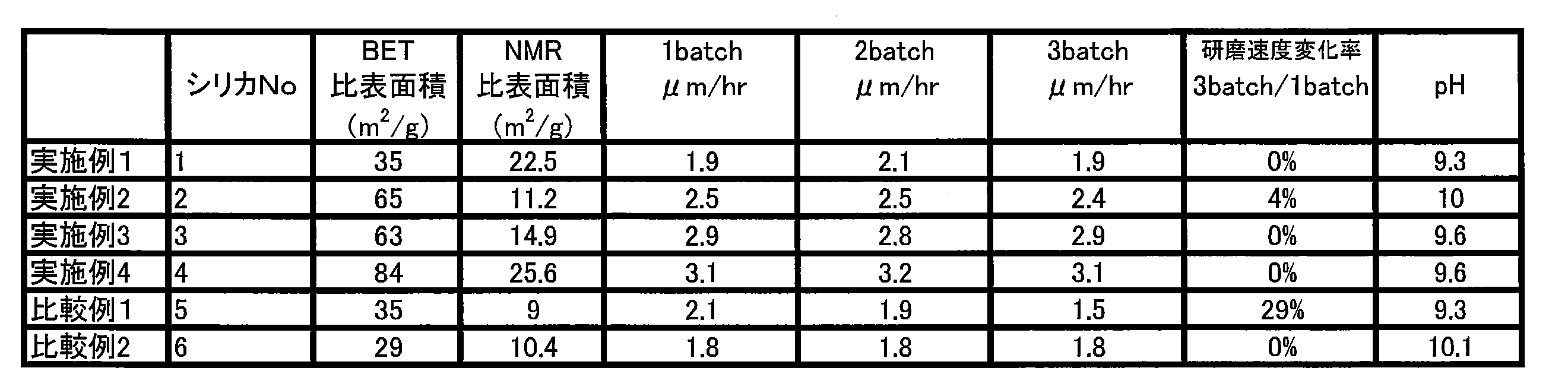

一方、NMR比表面積が小さいシリカを用いた比較例1では1バッチ目の研磨速度は比較的高いものの、3バッチ目の研磨速度の変化率が大きく、すなわち、研磨速度が維持できていなかった。
BET比表面積の小さいシリカを用いた比較例2では1バッチ目から研磨速度が実施例に比べて低くかった。
上記結果から、横軸にBET比表面積、縦軸に研磨速度(1バッチ目)との関係を示す曲線を図1のグラフに示した。
図1のグラフから、研磨速度が2.0μm以上になるBET比表面積は35m2/g以上140m2/g以下の範囲であることがわかった。
Claims (5)
- 水とシリカとを含み、
前記シリカのBET比表面積が30m2/g以上であって且つNMR比表面積が10m2/g以上である研磨用組成物。 - pH8.0以上pH11.5以下である請求項1に記載の研磨用組成物。
- 請求項1又は2に記載の研磨用組成物を用いて研磨対象物を研磨する研磨方法。
- 前記研磨用組成物を一度以上使用した後に回収し、再び使用して研磨対象物を研磨する請求項3に記載の研磨方法。
- 前記研磨対象物が硬脆材料を含む基板である請求項3又は4に記載の研磨方法。
Priority Applications (6)
| Application Number | Priority Date | Filing Date | Title |
|---|---|---|---|
| MYPI2016703570A MY182267A (en) | 2014-03-31 | 2015-03-30 | Polishing composition and polishing method |
| CN201580018008.3A CN106133107B (zh) | 2014-03-31 | 2015-03-30 | 研磨用组合物及研磨方法 |
| SG11201608128UA SG11201608128UA (en) | 2014-03-31 | 2015-03-30 | Polishing composition and polishing method |
| DE112015001565.5T DE112015001565T5 (de) | 2014-03-31 | 2015-03-30 | Polierzusammensetzung und Polierverfahren |
| KR1020167028680A KR102375827B1 (ko) | 2014-03-31 | 2015-03-30 | 연마용 조성물 및 연마 방법 |
| US15/129,838 US11791164B2 (en) | 2014-03-31 | 2015-03-30 | Polishing composition and polishing method |
Applications Claiming Priority (2)
| Application Number | Priority Date | Filing Date | Title |
|---|---|---|---|
| JP2014-073790 | 2014-03-31 | ||
| JP2014073790A JP6506913B2 (ja) | 2014-03-31 | 2014-03-31 | 研磨用組成物及び研磨方法 |
Publications (1)
| Publication Number | Publication Date |
|---|---|
| WO2015152151A1 true WO2015152151A1 (ja) | 2015-10-08 |
Family
ID=54240474
Family Applications (1)
| Application Number | Title | Priority Date | Filing Date |
|---|---|---|---|
| PCT/JP2015/059924 Ceased WO2015152151A1 (ja) | 2014-03-31 | 2015-03-30 | 研磨用組成物及び研磨方法 |
Country Status (9)
| Country | Link |
|---|---|
| US (1) | US11791164B2 (ja) |
| JP (1) | JP6506913B2 (ja) |
| KR (1) | KR102375827B1 (ja) |
| CN (1) | CN106133107B (ja) |
| DE (1) | DE112015001565T5 (ja) |
| MY (1) | MY182267A (ja) |
| SG (2) | SG10201808278TA (ja) |
| TW (1) | TWI672366B (ja) |
| WO (1) | WO2015152151A1 (ja) |
Cited By (5)
| Publication number | Priority date | Publication date | Assignee | Title |
|---|---|---|---|---|
| JP2018104690A (ja) * | 2016-12-26 | 2018-07-05 | ニッタ・ハース株式会社 | 研磨用組成物 |
| KR102107089B1 (ko) | 2018-11-01 | 2020-05-06 | 닛산 가가쿠 가부시키가이샤 | 수친화성이 높은 연마입자를 이용한 연마용 조성물 |
| KR20220024083A (ko) | 2019-06-27 | 2022-03-03 | 닛산 가가쿠 가부시키가이샤 | 염기성 물질을 함유하는 수친화성이 높은 연마입자를 이용한 연마용 조성물 |
| KR20250111242A (ko) | 2023-09-27 | 2025-07-22 | 닛산 가가쿠 가부시키가이샤 | 보존안정성이 우수한 연마용 조성물 및 그의 제조방법 |
| US12630742B2 (en) | 2019-06-27 | 2026-05-19 | Nissan Chemical Corporation | Polishing composition using polishing particles containing basic substance and having high water affinity |
Families Citing this family (6)
| Publication number | Priority date | Publication date | Assignee | Title |
|---|---|---|---|---|
| KR101854499B1 (ko) * | 2015-04-24 | 2018-05-04 | 삼성에스디아이 주식회사 | 구리 배선 연마용 cmp 슬러리 조성물 및 이를 이용한 연마방법 |
| KR102463863B1 (ko) * | 2015-07-20 | 2022-11-04 | 삼성전자주식회사 | 연마용 조성물 및 이를 이용한 반도체 장치의 제조 방법 |
| JP6589622B2 (ja) * | 2015-12-22 | 2019-10-16 | 日立化成株式会社 | 研磨液、研磨方法、半導体基板及び電子機器 |
| JP7061966B2 (ja) * | 2016-12-22 | 2022-05-02 | ニッタ・デュポン株式会社 | 研磨用組成物 |
| EP3978190A1 (en) * | 2020-09-29 | 2022-04-06 | SKC Solmics Co., Ltd. | Polishing pad and method of fabricating semiconductor device using the same |
| JP7534508B1 (ja) * | 2023-09-28 | 2024-08-14 | 株式会社フジミインコーポレーテッド | 研磨用組成物 |
Citations (5)
| Publication number | Priority date | Publication date | Assignee | Title |
|---|---|---|---|---|
| JPH09296161A (ja) * | 1996-04-30 | 1997-11-18 | Fujimi Inkooporeetetsudo:Kk | 研磨用砥粒及び研磨用組成物 |
| WO2013069623A1 (ja) * | 2011-11-08 | 2013-05-16 | 株式会社 フジミインコーポレーテッド | 研磨用組成物 |
| WO2013176122A1 (ja) * | 2012-05-25 | 2013-11-28 | 日産化学工業株式会社 | ウェーハ用研磨液組成物 |
| WO2014030570A1 (ja) * | 2012-08-23 | 2014-02-27 | 株式会社 フジミインコーポレーテッド | 研磨用組成物、研磨用組成物の製造方法、及び研磨用組成物原液の製造方法 |
| WO2014084091A1 (ja) * | 2012-11-30 | 2014-06-05 | ニッタ・ハース株式会社 | 研磨組成物 |
Family Cites Families (20)
| Publication number | Priority date | Publication date | Assignee | Title |
|---|---|---|---|---|
| US6551367B2 (en) | 1998-09-22 | 2003-04-22 | Cheil Industries Inc. | Process for preparing metal oxide slurry suitable for semiconductor chemical mechanical polishing |
| JP4105838B2 (ja) * | 1999-03-31 | 2008-06-25 | 株式会社トクヤマ | 研磨剤及び研磨方法 |
| KR100574259B1 (ko) | 1999-03-31 | 2006-04-27 | 가부시끼가이샤 도꾸야마 | 연마제 및 연마 방법 |
| JP4021133B2 (ja) | 1999-07-22 | 2007-12-12 | 花王株式会社 | 研磨液組成物 |
| IL151794A0 (en) * | 2000-03-31 | 2003-04-10 | Bayer Ag | Polishing agent and method for producing planar layers |
| US20040092103A1 (en) | 2000-07-19 | 2004-05-13 | Shigeo Fujii | Polishing fluid composition |
| DE102005007753A1 (de) * | 2005-02-18 | 2006-08-31 | Wacker Chemie Ag | Partikel mit geringer spezifischer Oberfläche und hoher Verdickungswirkung |
| US20060196849A1 (en) | 2005-03-04 | 2006-09-07 | Kevin Moeggenborg | Composition and method for polishing a sapphire surface |
| US8048394B2 (en) * | 2006-10-31 | 2011-11-01 | Kao Corporation | Mesoporous silica particles |
| JP2008235481A (ja) * | 2007-03-19 | 2008-10-02 | Nippon Chem Ind Co Ltd | 半導体ウエハ研磨用組成物、その製造方法、及び研磨加工方法 |
| JP2010028077A (ja) | 2008-02-18 | 2010-02-04 | Jsr Corp | 化学機械研磨用水系分散体およびその製造方法、ならびに化学機械研磨方法 |
| US8415519B2 (en) * | 2008-12-17 | 2013-04-09 | Exxonmobil Chemical Patents Inc. | Methods for determining efficacy of metal oxide co-catalysts for oxygenates-to-olefins reactions |
| JP5430924B2 (ja) * | 2008-12-25 | 2014-03-05 | 日本化学工業株式会社 | 半導体ウエハ研磨用組成物 |
| BRPI1007658A2 (pt) | 2009-05-13 | 2017-01-10 | Koninkl Philips Electronics Nv | sistema de travesseiro ativo para manipular as condições de repouso de uma pessoa e método para manipular condições de repouso de uma pessoa |
| CN102585705B (zh) * | 2011-12-21 | 2014-02-05 | 上海新安纳电子科技有限公司 | 一种用于蓝宝石衬底的化学机械抛光液及其应用 |
| WO2014032012A1 (en) | 2012-08-24 | 2014-02-27 | Ecolab Usa Inc. | Methods of polishing sapphire surfaces |
| JP6436517B2 (ja) * | 2013-02-20 | 2018-12-12 | 株式会社フジミインコーポレーテッド | 研磨用組成物 |
| US9633831B2 (en) * | 2013-08-26 | 2017-04-25 | Rohm And Haas Electronic Materials Cmp Holdings, Inc. | Chemical mechanical polishing composition for polishing a sapphire surface and methods of using same |
| WO2015065185A1 (en) * | 2013-10-29 | 2015-05-07 | Caprigemini B.V. | Silica particles and method of preparation thereof |
| EP3110878A1 (en) * | 2014-02-27 | 2017-01-04 | E. I. du Pont de Nemours and Company | Micropulp-elastomer masterbatches and compounds based thereon |
-
2014
- 2014-03-31 JP JP2014073790A patent/JP6506913B2/ja active Active
-
2015
- 2015-03-30 KR KR1020167028680A patent/KR102375827B1/ko active Active
- 2015-03-30 US US15/129,838 patent/US11791164B2/en active Active
- 2015-03-30 SG SG10201808278TA patent/SG10201808278TA/en unknown
- 2015-03-30 SG SG11201608128UA patent/SG11201608128UA/en unknown
- 2015-03-30 WO PCT/JP2015/059924 patent/WO2015152151A1/ja not_active Ceased
- 2015-03-30 DE DE112015001565.5T patent/DE112015001565T5/de active Pending
- 2015-03-30 CN CN201580018008.3A patent/CN106133107B/zh active Active
- 2015-03-30 MY MYPI2016703570A patent/MY182267A/en unknown
- 2015-03-31 TW TW104110530A patent/TWI672366B/zh active
Patent Citations (5)
| Publication number | Priority date | Publication date | Assignee | Title |
|---|---|---|---|---|
| JPH09296161A (ja) * | 1996-04-30 | 1997-11-18 | Fujimi Inkooporeetetsudo:Kk | 研磨用砥粒及び研磨用組成物 |
| WO2013069623A1 (ja) * | 2011-11-08 | 2013-05-16 | 株式会社 フジミインコーポレーテッド | 研磨用組成物 |
| WO2013176122A1 (ja) * | 2012-05-25 | 2013-11-28 | 日産化学工業株式会社 | ウェーハ用研磨液組成物 |
| WO2014030570A1 (ja) * | 2012-08-23 | 2014-02-27 | 株式会社 フジミインコーポレーテッド | 研磨用組成物、研磨用組成物の製造方法、及び研磨用組成物原液の製造方法 |
| WO2014084091A1 (ja) * | 2012-11-30 | 2014-06-05 | ニッタ・ハース株式会社 | 研磨組成物 |
Cited By (7)
| Publication number | Priority date | Publication date | Assignee | Title |
|---|---|---|---|---|
| JP2018104690A (ja) * | 2016-12-26 | 2018-07-05 | ニッタ・ハース株式会社 | 研磨用組成物 |
| KR102107089B1 (ko) | 2018-11-01 | 2020-05-06 | 닛산 가가쿠 가부시키가이샤 | 수친화성이 높은 연마입자를 이용한 연마용 조성물 |
| WO2020091000A1 (ja) | 2018-11-01 | 2020-05-07 | 日産化学株式会社 | 水親和性の高い研磨粒子を用いた研磨用組成物 |
| US12227674B2 (en) | 2018-11-01 | 2025-02-18 | Nissan Chemical Corporation | Polishing composition comprising polishing particles having high water affinity |
| KR20220024083A (ko) | 2019-06-27 | 2022-03-03 | 닛산 가가쿠 가부시키가이샤 | 염기성 물질을 함유하는 수친화성이 높은 연마입자를 이용한 연마용 조성물 |
| US12630742B2 (en) | 2019-06-27 | 2026-05-19 | Nissan Chemical Corporation | Polishing composition using polishing particles containing basic substance and having high water affinity |
| KR20250111242A (ko) | 2023-09-27 | 2025-07-22 | 닛산 가가쿠 가부시키가이샤 | 보존안정성이 우수한 연마용 조성물 및 그의 제조방법 |
Also Published As
| Publication number | Publication date |
|---|---|
| US11791164B2 (en) | 2023-10-17 |
| SG10201808278TA (en) | 2018-10-30 |
| CN106133107B (zh) | 2020-11-03 |
| SG11201608128UA (en) | 2016-11-29 |
| KR20160140737A (ko) | 2016-12-07 |
| TW201546254A (zh) | 2015-12-16 |
| TWI672366B (zh) | 2019-09-21 |
| CN106133107A (zh) | 2016-11-16 |
| JP6506913B2 (ja) | 2019-04-24 |
| US20170178926A1 (en) | 2017-06-22 |
| DE112015001565T5 (de) | 2017-02-16 |
| KR102375827B1 (ko) | 2022-03-16 |
| JP2015196704A (ja) | 2015-11-09 |
| MY182267A (en) | 2021-01-18 |
Similar Documents
| Publication | Publication Date | Title |
|---|---|---|
| JP6506913B2 (ja) | 研磨用組成物及び研磨方法 | |
| TWI718998B (zh) | 研磨用組成物 | |
| KR101281879B1 (ko) | 수용성 산화제를 이용한 탄화규소 연마 방법 | |
| TWI619805B (zh) | 用於硬脆材料之研磨用組成物、硬脆材料基板之研磨方法及製造方法 | |
| JP6375623B2 (ja) | 研磨剤、研磨剤セット及び基体の研磨方法 | |
| US20140057533A1 (en) | Methods of polishing sapphire surfaces | |
| KR102350734B1 (ko) | 사파이어 표면 연마용 화학적 기계적 연마 조성물 및 그의 사용방법 | |
| KR20140109392A (ko) | 연마제용 첨가제 및 연마 방법 | |
| JP2017539077A (ja) | コバルトディッシング制御剤 | |
| JP6010020B2 (ja) | バルクシリコンの研磨組成物及び研磨方法 | |
| JP4759298B2 (ja) | 単結晶表面用の研磨剤及び研磨方法 | |
| CN110099977A (zh) | 研磨用组合物及硅晶圆的研磨方法 | |
| US20120214307A1 (en) | Chemical-mechanical polishing liquid, and semiconductor substrate manufacturing method and polishing method using said polishing liquid | |
| JPWO2019043890A1 (ja) | 半導体ウェーハの製造方法 | |
| JP2014216368A (ja) | 研磨剤および研磨方法 | |
| EP3284101A1 (en) | Diamond-based slurries with improved sapphire removal rate and surface roughness | |
| JP2014216369A (ja) | 研磨剤および研磨方法 | |
| JP4396963B2 (ja) | 研磨用組成物、その調製方法及びそれを用いたウェーハの研磨方法 | |
| CN104479559A (zh) | 一种适用于晶片边缘抛光的组合物及其制备方法 | |
| JP7163387B2 (ja) | 減少した表面スクラッチを示すメモリハードディスクを研磨するための組成物および方法 | |
| US20160060487A1 (en) | Composition and method for polishing a sapphire surface |
Legal Events
| Date | Code | Title | Description |
|---|---|---|---|
| 121 | Ep: the epo has been informed by wipo that ep was designated in this application |
Ref document number: 15773337 Country of ref document: EP Kind code of ref document: A1 |
|
| WWE | Wipo information: entry into national phase |
Ref document number: 15129838 Country of ref document: US |
|
| WWE | Wipo information: entry into national phase |
Ref document number: 112015001565 Country of ref document: DE |
|
| ENP | Entry into the national phase |
Ref document number: 20167028680 Country of ref document: KR Kind code of ref document: A |
|
| 122 | Ep: pct application non-entry in european phase |
Ref document number: 15773337 Country of ref document: EP Kind code of ref document: A1 |