WO2015147313A1 - テトラゾリノン化合物及びその用途 - Google Patents
テトラゾリノン化合物及びその用途 Download PDFInfo
- Publication number
- WO2015147313A1 WO2015147313A1 PCT/JP2015/059818 JP2015059818W WO2015147313A1 WO 2015147313 A1 WO2015147313 A1 WO 2015147313A1 JP 2015059818 W JP2015059818 W JP 2015059818W WO 2015147313 A1 WO2015147313 A1 WO 2015147313A1
- Authority
- WO
- WIPO (PCT)
- Prior art keywords
- oet
- ome
- compound
- tetrazolinone compound
- halogen atoms
- Prior art date
- Legal status (The legal status is an assumption and is not a legal conclusion. Google has not performed a legal analysis and makes no representation as to the accuracy of the status listed.)
- Ceased
Links
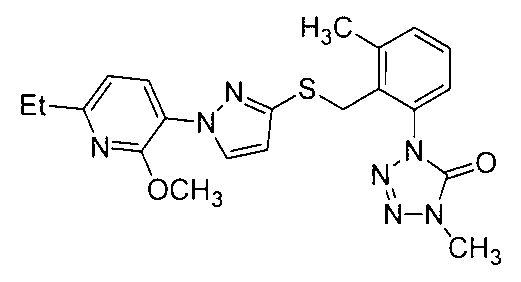
- 0 CN(C1=O)N=NN1c1c(CSc(cc2)n[n]2-c2c(*)nc(*)c(*)c2*)c(*)ccc1 Chemical compound CN(C1=O)N=NN1c1c(CSc(cc2)n[n]2-c2c(*)nc(*)c(*)c2*)c(*)ccc1 0.000 description 2
Classifications
-
- A—HUMAN NECESSITIES
- A01—AGRICULTURE; FORESTRY; ANIMAL HUSBANDRY; HUNTING; TRAPPING; FISHING
- A01N—PRESERVATION OF BODIES OF HUMANS OR ANIMALS OR PLANTS OR PARTS THEREOF; BIOCIDES, e.g. AS DISINFECTANTS, AS PESTICIDES OR AS HERBICIDES; PEST REPELLANTS OR ATTRACTANTS; PLANT GROWTH REGULATORS
- A01N43/00—Biocides, pest repellants or attractants, or plant growth regulators containing heterocyclic compounds
- A01N43/713—Biocides, pest repellants or attractants, or plant growth regulators containing heterocyclic compounds having rings with four or more nitrogen atoms as the only ring hetero atoms
-
- A—HUMAN NECESSITIES
- A61—MEDICAL OR VETERINARY SCIENCE; HYGIENE
- A61P—SPECIFIC THERAPEUTIC ACTIVITY OF CHEMICAL COMPOUNDS OR MEDICINAL PREPARATIONS
- A61P33/00—Antiparasitic agents
-
- A—HUMAN NECESSITIES
- A61—MEDICAL OR VETERINARY SCIENCE; HYGIENE
- A61P—SPECIFIC THERAPEUTIC ACTIVITY OF CHEMICAL COMPOUNDS OR MEDICINAL PREPARATIONS
- A61P33/00—Antiparasitic agents
- A61P33/10—Anthelmintics
-
- A—HUMAN NECESSITIES
- A61—MEDICAL OR VETERINARY SCIENCE; HYGIENE
- A61P—SPECIFIC THERAPEUTIC ACTIVITY OF CHEMICAL COMPOUNDS OR MEDICINAL PREPARATIONS
- A61P33/00—Antiparasitic agents
- A61P33/14—Ectoparasiticides, e.g. scabicides
-
- C—CHEMISTRY; METALLURGY
- C07—ORGANIC CHEMISTRY
- C07D—HETEROCYCLIC COMPOUNDS
- C07D401/00—Heterocyclic compounds containing two or more hetero rings, having nitrogen atoms as the only ring hetero atoms, at least one ring being a six-membered ring with only one nitrogen atom
- C07D401/14—Heterocyclic compounds containing two or more hetero rings, having nitrogen atoms as the only ring hetero atoms, at least one ring being a six-membered ring with only one nitrogen atom containing three or more hetero rings
-
- C—CHEMISTRY; METALLURGY
- C07—ORGANIC CHEMISTRY
- C07D—HETEROCYCLIC COMPOUNDS
- C07D403/00—Heterocyclic compounds containing two or more hetero rings, having nitrogen atoms as the only ring hetero atoms, not provided for by group C07D401/00
- C07D403/02—Heterocyclic compounds containing two or more hetero rings, having nitrogen atoms as the only ring hetero atoms, not provided for by group C07D401/00 containing two hetero rings
- C07D403/12—Heterocyclic compounds containing two or more hetero rings, having nitrogen atoms as the only ring hetero atoms, not provided for by group C07D401/00 containing two hetero rings linked by a chain containing hetero atoms as chain links
Definitions
- the present invention relates to a tetrazolinone compound and its use.
- An object of the present invention is to provide a compound having an excellent control effect against pests.
- the present inventors have found that the tetrazolinone compound represented by the following formula (1) has an excellent control effect against pests.
- the present invention has been reached. That is, the present invention is as follows [1] to [4].
- R 1 , R 2 , R 3 , R 4 and R 6 are each independently a halogen atom, a hydrogen atom, a cyano group, a C1-C4 alkyl group optionally having one or more halogen atoms, or one or more Represents a C1-C4 alkoxy group optionally having a halogen atom, R 5 is a halogen atom, a C1-C4 alkyl group optionally having one or more halogen atoms, a C3-C4 cycloalkyl group optionally having one or more halogen atoms, or one or more halogen atoms.
- a tetrazolinone compound represented by: [2] tetrazolinone compound according to X is CR 6 [1]. [3] The tetrazolinone compound according to [1], wherein X is a nitrogen atom. [4] The tetrazolinone compound according to [3], wherein R 3 and R 4 are hydrogen atoms. [5] A pest control agent comprising the tetrazolinone compound according to any one of [1] to [4]. [6] A method for controlling pests, which comprises applying an effective amount of the tetrazolinone compound according to any one of [1] to [4] to a plant or soil. [7] Use of the tetrazolinone compound according to any one of [1] to [4] for controlling pests.
- pests can be controlled.
- a halogen atom represents a fluorine atom, a chlorine atom, a bromine atom and an iodine atom.
- Examples of the C1-C4 alkyl group optionally having one or more halogen atoms include a methyl group, an ethyl group, a propyl group, an isopropyl group, a butyl group, an isobutyl group, a sec-butyl group, a tert-butyl group, and a fluoro group.
- Methyl group chloromethyl group, dichloromethyl group, difluoromethyl group, trifluoromethyl group, trichloromethyl group, 2-fluoroethyl group, 2,2,2-trifluoroethyl group, and 1-trifluoromethyl-2, A 2,2-trifluoroethyl group may be mentioned.
- Examples of the C3-C4 cycloalkyl group optionally having one or more halogen atoms include a cyclopropyl group, a cyclobutyl group, a 2,2-dichlorocyclopropyl group, and a 2,2-difluorocyclopropyl group.
- Examples of the C1-C4 alkoxy group optionally having one or more halogen atoms include a methoxy group, an ethoxy group, a propyloxy group, an isopropyloxy group, a butyloxy group, a trifluoromethoxy group, a difluoromethoxy group, and a 2-fluoro group. Examples thereof include ethoxy group, 2,2,2-trifluoroethoxy group, 3-chloropropyloxy group and 3-chlorobutyloxy group.
- a tetrazolinone compound in which R 5 is a halogen atom in formula (1) A tetrazolinone compound in which R 5 is a C1-C4 alkyl group optionally having one or more halogen atoms in formula (1).
- a tetrazolinone compound in which R 4 is a hydrogen atom in formula (1) A tetrazolinone compound in which R 4 is a halogen atom in formula (1).
- R 2 is a C1-C4 alkyl group which may have one or more halogen atoms or a hydrogen atom.
- R 5 is a halogen atom.
- a tetrazolinone compound in which R 5 is a methyl group.
- R 5 is a C1-C4 alkyl group optionally having one or more halogen atoms
- R 1 and R 2 are each independently a hydrogen atom, a halogen atom, a cyano group, or 1
- a tetrazolinone compound which is a C1-C4 alkoxy group optionally having the above halogen atom, and wherein R 3 and R 4 are each independently a hydrogen atom or a halogen atom.
- R 5 is a C1-C4 alkyl group optionally having one or more halogen atoms
- R 1 , R 2 , R 3 , R 4 and R 6 are each independently hydrogen.
- R 5 is a C1-C4 alkyl group optionally having one or more halogen atoms
- R 1 , R 2 , R 3 , R 4 and R 6 are each independently hydrogen.
- a tetrazolinone compound which is a C1-C4 alkoxy group optionally having an atom, a halogen atom, or one or more halogen atoms.
- R 5 is a C1-C4 alkyl group which may have one or more halogen atoms, and R 1 and R 4 each independently have a hydrogen atom or one or more halogen atoms.
- R 3 and R 6 are a hydrogen atom
- R 2 is a halogen atom
- R 5 is a C1-C4 alkyl group optionally having one or more halogen atoms
- R 1 , R 3 , R 4 and R 6 are hydrogen atoms
- R 2 is A tetrazolinone compound which is a halogen atom.
- R 2 A tetrazolinone compound in which R 2 is a C1-C4 alkyl group optionally having one or more halogen atoms or a hydrogen atom.
- R 5 A tetrazolinone compound in which R 5 is a halogen atom.
- a tetrazolinone compound in which R 5 is a methyl group.
- a tetrazolinone compound in which R 5 is an ethyl group.
- a tetrazolinone compound in which R 5 is a methoxy group.
- a tetrazolinone compound in which R 5 is a cyclopropyl group.
- R 5 is a C1-C4 alkyl group optionally having one or more halogen atoms
- R 1 and R 2 are each independently a halogen atom, a cyano group, or one or more halogen atoms.
- a tetrazolinone compound which is a C1-C4 alkoxy group optionally having atoms, and R 3 and R 4 each independently represent a halogen atom.
- R 2 is a C1-C4 alkyl group optionally having one or more halogen atoms or a hydrogen atom.
- R 5 is a halogen atom.
- a tetrazolinone compound in which R 5 is a methyl group.
- a tetrazolinone compound in which R 5 is an ethyl group.
- a tetrazolinone compound in which R 5 is a methoxy group.
- a tetrazolinone compound in which R 5 is a cyclopropyl group.
- R 5 is a C1-C4 alkyl group optionally having one or more halogen atoms
- R 1 and R 2 are each independently a halogen atom, a cyano group, or one or more halogen atoms.
- the compound of the present invention represented by formula (1) is represented by the compound represented by formula (A1) (hereinafter referred to as compound (A1)) and the compound represented by formula (A2) (hereinafter referred to as compound (A2)).
- A1 The compound represented by formula (A1)
- A2 the compound represented by formula (A2)
- Z 11 represents a chlorine atom, a bromine atom, an iodine atom, a methanesulfonyloxy group, a trifluoromethanesulfonyloxy group.
- the reaction is usually performed in a solvent.
- the solvent used in the reaction include hydrocarbons such as n-hexane, cyclohexane, toluene and xylene, ethers such as tetrahydrofuran, 1,4-dioxane, ethylene glycol dimethyl ether, methyl tert-butyl ether and diisopropyl ether, Halogenated hydrocarbons such as chloroform, 1,2-dichloroethane, chlorobenzene, acid amides such as N, N-dimethylformamide, 1,3-dimethyl-2-imidazolidinone, N-methylpyrrolidone, ethyl acetate, acetic acid Examples thereof include esters such as methyl, sulfoxides such as dimethyl sulfoxide, ketones such as acetone, methyl ethyl
- Examples of the base used for the reaction include organic bases such as triethylamine, pyridine, N-methylmorpholine, 4-dimethylaminopyridine, diisopropylethylamine and diazabicycloundecene, and alkali metal carbonates such as lithium carbonate, sodium carbonate and potassium carbonate.
- organic bases such as triethylamine, pyridine, N-methylmorpholine, 4-dimethylaminopyridine, diisopropylethylamine and diazabicycloundecene
- alkali metal carbonates such as lithium carbonate, sodium carbonate and potassium carbonate.
- alkali metal hydrogen carbonate such as sodium hydrogen carbonate
- alkali metal hydroxide such as lithium hydroxide, sodium hydroxide, potassium hydroxide, cesium hydroxide
- alkali such as sodium fluoride, potassium fluoride, cesium fluoride
- metal halides alkali metal hydrides such as lithium hydride, sodium hydride and potassium hydride
- alkali metal alkoxides such as sodium tert-butoxide and potassium tert-butoxide.
- the compound (A1) used in the reaction is produced according to the reference production method A of WO2013 / 162072A.
- the compound (A2) is usually used in a proportion of 1 to 10 mol, and the base is usually used in a proportion of 0.5 to 5 mol.
- the reaction temperature of the reaction is usually in the range of ⁇ 20 to 150 ° C.
- the reaction time is usually in the range of 0.1 to 24 hours.
- sodium iodide, tetrabutylammonium iodide or the like may be added as necessary, and these compounds are usually in a ratio of 0.001 to 1.2 mol with respect to 1 mol of the compound (A1).
- the compound of the present invention represented by the formula (1) can be isolated by performing post-treatment operations such as extraction of the reaction mixture with an organic solvent, and drying and concentration of the organic layer.
- the isolated compound of the present invention can be further purified by chromatography, recrystallization and the like.
- the compound (A2) can be produced by reacting the compound (AA2) with a sulfiding agent.
- a sulfiding agent e.g., a sulfiding agent
- the reaction is usually performed in a solvent.
- the solvent used in the reaction include hydrocarbons such as toluene and xylene, ethers such as tetrahydrofuran, 1,4-dioxane, ethylene glycol dimethyl ether and anisole, N, N-dimethylformamide, 1 , 3-dimethyl-2-imidazolidinone, acid amides such as N-methylpyrrolidone, nitriles such as acetonitrile, mixtures thereof and water and mixtures thereof.
- the sulfiding agent used in the reaction examples include diphosphorus pentasulfide, Lawesson's reagent (2,4-bis (4-methoxyphenyl) -1,3,2,4-dithiadiphosphatan-2,4-disulfide) and the like. Is mentioned.
- a sulfiding agent is usually used at a ratio of 0.5 to 10 moles per mole of the compound (AA2).
- the reaction temperature is usually in the range of 20 to 250 ° C.
- the reaction time is usually in the range of 0.1 to 50 hours.
- the compound (A2) can be isolated by performing post-treatment operations such as extraction of the reaction mixture with an organic solvent, and drying and concentration of the organic layer.
- the isolated compound (A2) can be further purified by chromatography, recrystallization, and the like.
- the form of the compound of the present invention may be the compound of the present invention alone.
- the compound of the present invention is mixed with a solid carrier, a liquid carrier, a surfactant, etc., and if necessary, a fixing agent or a dispersing agent.
- Additives for preparations such as stabilizers, wettable powder, granular wettable powder, flowable powder, granules, dry flowable powder, emulsion, aqueous liquid, oil, smoke, aerosol, micro It is used in the form of capsules.
- These preparations contain the compound of the present invention in a weight ratio of usually 0.1 to 99%, preferably 0.2 to 90%.
- Examples of the solid support include clays (for example, kaolin, diatomaceous earth, synthetic hydrous silicon oxide, fusamic clay, bentonite, acidic clay), talc, and other inorganic minerals (for example, sericite, quartz powder, sulfur powder, activated carbon). , Calcium carbonate, hydrated silica) and the like.
- Examples of the liquid carrier include water, alcohols (eg, methanol, ethanol), ketones (eg, acetone).
- Methyl ethyl ketone aromatic hydrocarbons (for example, benzene, toluene, xylene, ethylbenzene, methylnaphthalene), aliphatic hydrocarbons (for example, n-hexane, cyclohexanone, kerosene), esters (for example, ethyl acetate, acetic acid) Butyl), nitriles (eg acetonitrile, isobutyronitrile), ethers (eg , Dioxane, diisopropyl d - ether), acid amides (e.g., DMF, dimethylacetamide), halogenated hydrocarbons (e.g., dichloroethane, trichlorethylene, carbon tetrachloride) and the like.
- aromatic hydrocarbons for example, benzene, toluene, xylene, ethylbenzene, methyl
- surfactant examples include alkyl sulfates, alkyl sulfonates, alkyl aryl sulfonates, alkyl aryl ethers and their polyoxyethylene compounds, polyoxyethylene glycol ethers, polyhydric alcohol esters, sugar alcohols. Derivatives.
- Other formulation adjuvants include, for example, fixing agents and dispersants, specifically casein, gelatin, polysaccharides (eg starch, arabic gum, cellulose derivatives, alginic acid), lignin derivatives, bentonite, saccharides, synthetic water solutions.
- Polymers for example, polyvinyl alcohol, polyvinyl pyrrolidone, polyacrylic acids), PAP (isopropyl acid phosphate), BHT (2,6-di-tert-butyl-4-methylphenol), BHA (2-tert-butyl) And mixtures of -4-methoxyphenol and 3-tert-butyl-4-methoxyphenol), vegetable oils, mineral oils, fatty acids or esters thereof.
- the method of applying the control agent of the present invention is not particularly limited as long as the control agent of the present invention can be applied substantially, but for example, treatment to plant bodies such as foliage spraying, plant such as soil treatment, etc. And the like, and the treatment of seeds such as seed disinfection.
- the compound of the present invention may be used by mixing with various oils such as mineral oil and vegetable oil, or surfactants.
- Oils that can be used specifically mixed, surfactants include Nimbus (registered trademark), Assist (registered trademark), Aureo (registered trademark), Iharol (registered trademark), Silwet L-77 (registered trademark), BreakThru (registered trademark), Sundance II (registered trademark), Induce (registered trademark), Penetrator (registered trademark), AgriDex (registered trademark), Lutensol A8 (registered trademark), NP-7 (registered trademark), Triton (registered trademark) , Nufilm (registered trademark), Emulator NP7 (registered trademark), Emulad (registered trademark), TRITON X 45 (registered trademark), AGRAL 90 (registered trademark), AGROTIN (registered trademark), ARPON (registered trademark), EnSpray N ( Registered trademark) , BANOLE (registered trademark) and the like.
- Nimbus registered trademark
- Assist registered trademark
- Aureo registered trademark
- the compound of the present invention can be used simultaneously with or without mixing with other fungicides, insecticides, acaricides, nematicides, and plant growth regulators.
- the application amount of the present control agent varies depending on weather conditions, formulation form, application time, application method, application location, target disease, target crop, etc., but the amount of the present compound in the present control agent is 1000 m 2.
- the amount is usually 1 to 500 g, preferably 2 to 200 g.
- Emulsions, wettable powders, suspensions and the like are usually diluted with water and applied.
- the concentration of the compound of the present invention after dilution is usually 0.0005 to 2% by weight, preferably 0.005 to It is 1% by weight, and powders, granules and the like are usually applied as they are without dilution.
- the amount of the compound of the present invention in the control agent of the present invention is usually applied in the range of 0.001 to 100 g, preferably 0.01 to 50 g per 1 kg of seed.
- the organisms and parasites that parasitize the vertebrate are systemically administered.
- the dosage can vary widely depending on the administration method, etc. Is desirably administered so that the active ingredient (the compound of the present invention) per kg of animal weight is 0.1 mg to 2000 mg, preferably 0.5 mg to 1000 mg.
- the compound of the present invention or the present control agent can be used as a plant disease control agent in agricultural land such as fields, paddy fields, lawns, orchards.
- the compound of the present invention can control diseases of the cultivated land in cultivated lands where the following plants are cultivated.
- Agricultural crops corn, rice, wheat, barley, rye, oats, sorghum, cotton, soybeans, peanuts, buckwheat, sugar beet, rapeseed, sunflower, sugarcane, tobacco, etc., vegetables; solanaceous vegetables (eggplants, tomatoes, peppers) , Peppers, potatoes, etc.), cucurbitaceae vegetables (cucumber, pumpkin, zucchini, watermelon, melon, etc.), cruciferous vegetables (radish, turnip, horseradish, cold rabi, Chinese cabbage, cabbage, mustard, broccoli, cauliflower, etc.
- Asteraceae vegetables (burdock, garlic, artichoke, lettuce, etc.), Liliaceae vegetables (leek, onion, garlic, asparagus), Aceraceae vegetables (carrot, parsley, celery, American burdock, etc.), Red crustacean vegetables (spinach) , Chard, etc.), Lamiaceae vegetables (Perilla, mint, basil) ), Strawberry, sweet potato, yam, taro, etc., flowers, foliage plants, Fruit trees; pears (apples, pears, Japanese pears, quince, quince, etc.), nuclear fruits (peaches, plums, nectarines, ume, sweet cherry, apricots, prune, etc.), citrus fruits (Satsuma mandarin, orange, lemon, lime) , Grapefruit, etc.), nuts (chestnut, walnut, hazel, almond, pistachio, cashew-nut, macadamia nut, etc.), berries (blueberry, cranberry, blackberry, raspberry, etc.),
- Trees other than fruit trees tea, mulberry, flowering trees, street trees (ash, birch, dogwood, eucalyptus, ginkgo, lilac, maple, oak, poplar, redwood, fu, sycamore, zelkova, black bean, peach tree, tsuga, rat, Pine, spruce, yew).
- the plant includes a genetically modified plant.
- Rice blast Magnaporthe grisea
- sesame leaf blight Cochliobolus miyabeanus
- blight Rhizoctonia solani
- idiotic seedling (Gibberella fujikuroi), yellow rot Graminis)
- Fusarium Graminearum F. avenaceum, F. culmorum, Microdochium nivare, Rust (Puccinia striformis), P.
- Leaf disease Pierophora graminea
- Ramularia disease Rosmut (Ustylago nuda)
- Rhizoctonia sorghum Rhizoctonia sorghum
- psoriasis disease Setosphaeria turica
- sesame leaf blight Cochli) oboleus heterotrophus, anthracnose (Colletotrichum graminicola)
- gray leaf spot disease Cercospora zeae-maydis
- brown spot disease Kabatiella zeae
- Phaeosfarea leaf spot disease Phhaeosphadia
- Cotton anthracnose (Colletotrichum gossypiii), mildew (Ramuraria areola), black spot (Alternaria macrospora, A. gossypiii); Spotted disease (Alternaria brassicae), root rot (Phoma lingam); citrus black spot (Diaporthe citri), scab (Elsinoe fawcetil), fruit rot (Penicillium digititaum, M .; P.).
- Tomato ring disease (Alternaria solani), leaf mold disease (Cladosporium fulvum), leaf mold disease (Pseudocercospora fuligena), plague (Phytophhora phrasophylpus disease) Black spot disease (Alternaria japonica), white spot disease (Cercosporella brassicae), root-knot disease (Plasmodiophora brassicae), downy mildew (Peronospora parasitica); chii), black rot (Elsinoe glycines), black spot illness (Diaporthe phaseolum var.
- Brown spot of sugar beet (Cercospora beticola), leaf rot (Thanatephorus cucumeris), root rot (Thanatephorus cucuroides), black root (Aphanomyces cochlioides); Brown spot disease (Septoria chrysanthemi-indici), white rust disease (Puccinia horiana); onion white spot leaf blight (Botrytis cinerea, B. bissoidia, B.
- squatis rot Rot disease
- Botrytis squamosa Various crops of gray mold disease (Botrytis cinerea), mycorrhizal disease (Sclerotinia sclerotiorum); Japanese radish black spot disease (Alternaria brassicicola); Shiba dwarf spot disease (Sclerotinia homeocarpa patch disease); (Rhizoctonia solani); and banana sigatoka disease (Mycosphaerella fijiensis, Mycosphaerella musicola).
- Hemiptera small brown planthopper (Laodelphax striatellus), brown planthopper (Nilaparvata lugens), Sejirounka (Sogatella furcifera) planthoppers such as, green rice leafhopper (Nephotettix cincticeps), Taiwan green rice leafhopper (Nephotettix virescens) leafhoppers such as, cotton aphid (Aphis gossypii) , Peaches aphids (Myzus persicae), radish aphids (Brevicoryne brassicae), tulip beetle aphids (Macrosiphum euphorbiae), potato beetle aphids (Aulacorthum solani) Aphids such as wheat beetle (Rhopalosiphum padi), citrus black aphid (Toxoptera citriticidus), Nesara antenis worms (Rip
- Lepidoptera rice stem borer (Chilo suppressalis), Sankameiga (Tryporyza incertulas), leaf roller (Cnaphalocrocis medinalis), Watanomeiga (Notarcha derogata), Indian meal moth (Plodia interpunctella), the European corn borer (Ostrinia furnacalis), high Madara Roh moth (Hellula undalis), Japanese medusa such as Shibata toga (Pediasia teterrellus), Spodoptera litura, Spodoptera exigua, Ayuyotoga (Pseudaletia sepata), Atoga assicae), Agrotis ipsilon, Tamanaginawaba (Prusia nigrisigna), Trichopulsia, Heliotis, Helicoberpa, etc.
- Thysanoptera western flower thrips (Frankliniella occidentalis), Minami thrips (Thrips palmi), yellow tea thrips (Scirtothrips dorsalis), green onion thrips (Thrips tabaci), Hirazuhanaazamiuma (Frankliniella intonsa), thrips, such as tobacco thrips (Frankliniellafusca) etc.
- Diptera Housefly (Musca domestica), Culex (Culex pipiens pallens), gadfly (Tabanus trigonus), onion maggot (Hylemya antiqua), seedcorn maggot (Hylemya platura), Anopheles sinensis (Anopheles sinensis), rice leafminer (Agromyza oryzae), rice Hydrelia griseola, Bluefly flies (Chloropsoryzae), Green flies (Dacus cucurbitae), Ceratitis capitata, Lime folii y (fmati folii y)
- Coleoptera beetle, Epilachna vigintioctopunctata (Epilachna vigintioctopunctata), cucurbit leaf beetle (Aulacophora femoralis), Kisujinomihamushi (Phyllotreta striolata), Inedorooimushi (Oulema oryzae), rice weevil (Echinocnemus squameus), rice water weevil (Lissorhoptrus oryzophilus), boll weevil (Anthonomus grandis), Azuki beetle (Callosobruchus chinensis), Shibahorusu weevil (Sphenophorus venatus), Japanese beetle (Popilia japonica), Douganebububu (Anomala cupre) ), Corn rootworm mate (Diabrotica spp.), Colorado potato beetle (Leptinotarsa decemlineat
- Direct insect pests Tocusama grasshopper (Locusta migratoria), Kera (Gryllotalpa africana), Oxya yezoensis, Oyana japonica, etc.
- Hymenopteran pests Athalia rosae, Achillyrmex spp., Fire ant (Solenopsis spp.) And the like.
- Nematodes Rice moth nematode (Aphelenchoides besseyy), Strawberry nematode (Heterodera glycines) .
- Cockroach pests German cockroaches (Blatella germanica), Black cockroaches (Periplaneta furiginosa), American cockroaches (Periplaneta americana), Japanese cockroaches (Peripraneta brunet)
- Acarina Tetranychus urticae, Pandychus citri, Odonidus spp., Acarops pelekassi, Mite, Phyphagotaris Mite, such as Typhophagus putrescentiae, Mite, Dermatophagoides falinae, Dermatophagoidessprenyss, Mite sensis), claw mites such as Cheyletus moorei, and spiders.
- the preparation containing the compound of the present invention is used in the field of livestock disease treatment and livestock industry, and in vertebrates such as humans, cows, sheep, goats, pigs, poultry, dogs, cats and fishes and / or the like. Or it can be used to maintain public health by exterminating organisms and parasites parasitizing outside.
- the pests include ticks (Ixodes spp.), Such as Ixodes scapularis; bovine ticks (Boophilus spp.), Such as Boophilus microplus; Rickicphalus spp., For example, Rhipicephus sanguineus; For example, Ornithodoros moubata; Dermannyssus gallinae; Ornithonyssus sipviarum; (Demodex spp.); Tsutsugamushi (Eurombicula spp.); Aedes spp.
- Fleas (Ctenocephalides spp.), For example, cat fleas (Ctenocephalides felis.), Xenoppsylla spp. ; Monomorium phalaonis; and nematodes (eg ciliate nematodes (eg, N. Examples include Nematodirus battus, Ostertagircumcumcinta, Cooperia spp., Hymenolepis nana] and the like.
- nematodes eg ciliate nematodes (eg, N. Examples include Nematodirus battus, Ostertagircumcumcinta, Cooperia spp., Hymenolepis nana] and the like.
- the control agent of the present invention containing one or more selected from the group consisting of the above-mentioned known fungicides, insecticides, acaricides, nematicides and plant growth regulators is a plant to be protected from pests. You may apply directly and may apply to the soil and seed which plant the said plant body. When one or more selected from the group consisting of the above-mentioned known fungicides, insecticides, acaricides, nematicides and plant growth regulators are used in combination with the control agent of the present invention, they are simultaneously applied to the plant body. May also be applied separately. When applying separately, the application day may differ and a different dosage form may be used.
- control agent of the present invention to the seed of a plant is one or more selected from the group consisting of the above-mentioned known fungicides, insecticides, acaricides, nematicides and plant growth regulators. It can be combined with application to the soil in which the plant is planted. Moreover, application to one or more kinds of plant seeds selected from the group consisting of the above-mentioned known fungicides, insecticides, acaricides, nematicides and plant growth regulators is possible. It can also be combined with application to the plant or the soil in which the plant is planted. The application to the plant or the soil for planting the plant may be before planting, at the same time as planting or after planting.
- the application method is preferably applied to the cultivation of corn, wheat and rice.
- Application of the control agent of the present invention to a plant body, or a soil in which a plant body is cultivated or to be cultivated is a known herbicide. It can combine with the application to the said 1 or more types of said soil chosen from these.
- the pest control agent and the herbicide of the present invention may be applied simultaneously or separately. When applying separately, you may apply on the same day or another day.
- Herbicides that can be combined with the present control agent include glyphosate, glyphosate salt, glyphosate, glyphosate salt, 2,4-D, 2,4-D salt, dicamba, dicamba salt and flumioxazin. It is done.
- Production Example 1 At 150 ° C., a mixture of 3 g of 1- (4-chlorophenyl) -1H-pyrazol-3-ol (prepared according to WO 2013/162072), 10.3 g of diphosphorus pentasulfide and 100 ml of xylene was stirred for 24 hours. . The reaction mixture was concentrated under reduced pressure. The resulting residue was diluted with ethyl acetate and filtered through silica gel.
- HA1001-001 to HA1012-333 can be obtained according to the above method.
- the compounds HA1001-001 to HA1012-333 (hereinafter referred to as the present compound A) are the following aromatic compounds [wherein Q represents any one of substituent numbers 1 to 333 shown below. ].
- Q represents any one of substituent numbers 1 to 333 shown below.
- 3-Py represents pyridin-3-yl, Ph represents phenyl, F represents fluoro, Cl represents chloro, Br represents bromo, CN represents cyano.
- Me represents methyl
- Et represents ethyl
- Pr propyl
- i-Pr represents isopropyl
- CF3 represents trifluoromethyl
- OMe represents methoxy
- OEt represents ethoxy
- Oi-Pr represents isopropoxy
- di represents di, and tri represents tri.
- HA1006-006 represents a group represented by the following formula in the formula (HA1006), in which Q is a substituent number 006.
- Formulation Example 1 A preparation is obtained by thoroughly pulverizing and mixing 50 parts of any one of the compounds A of the present invention, 3 parts of calcium lignin sulfonate, 2 parts of magnesium lauryl sulfate, and 45 parts of synthetic hydrous silicon oxide.
- Formulation Example 2 After mixing 20 parts of any one of the compounds A of the present invention and 1.5 parts of sorbitan trioleate with 28.5 parts of an aqueous solution containing 2 parts of polyvinyl alcohol and finely pulverizing them by a wet pulverization method. Into this, 40 parts of an aqueous solution containing 0.05 part of xanthan gum and 0.1 part of aluminum magnesium silicate is added, and further 10 parts of propylene glycol is added and stirred to obtain a preparation.
- Formulation Example 3 A preparation is obtained by thoroughly pulverizing and mixing 2 parts of any one of the compounds A of the present invention, 88 parts of kaolin clay and 10 parts of talc.
- Formulation Example 4 A preparation is obtained by thoroughly mixing 5 parts of any one of the compounds A of the present invention, 14 parts of polyoxyethylene styrylphenyl ether, 6 parts of calcium dodecylbenzenesulfonate and 75 parts of xylene.
- Formulation Example 5 2 parts of any one of the compounds A of the present invention, 1 part of synthetic hydrous silicon oxide, 2 parts of calcium lignin sulfonate, 30 parts of bentonite and 65 parts of kaolin clay, and then kneaded well with water, The product is obtained by granulating and drying.
- Formulation Example 6 10 parts of any one of the compounds A of the present invention, 35 parts of a mixture of polyoxyethylene alkyl ether sulfate ammonium salt and white carbon (weight ratio 1: 1), and 55 parts of water are mixed and finely divided by a wet pulverization method. The preparation is obtained by grinding.
- Test Example 1 A plastic pot was filled with soil, and barley (variety: Mikamo Golden) was sown therein and allowed to grow in a greenhouse for 7 days.
- a dilute water solution prepared so as to contain the present compound 1 at a predetermined concentration (500 ppm) was sprayed on the foliage so as to sufficiently adhere to the leaf surface of the barley.
- the plants were air-dried, and two days later, an aqueous suspension of barley net spore fungus (Pyrenophora teres) spores was spray-inoculated. After inoculation, the plants were placed under high humidity in a greenhouse at 23 ° C. during the day and 20 ° C. during the night, and then cultivated in the greenhouse for 7 days.
- the lesion area in the plant treated with the compound of the present invention was 30% or less of the lesion area in the untreated plant.
- Test Example 2 A plastic pot was stuffed with soil, seeded with green beans (variety: Nagatake rape bean) and grown in a greenhouse for 8 days. A dilute water adjusted to contain the present compound 1 at a predetermined concentration (500 ppm) was sprayed on the foliage so as to adhere sufficiently to the kidney leaf surface. After spraying, the plants were air-dried, and a mycelia-containing PDA medium of sclerotia sclerotiorum was placed on the kidney leaf surface. After the inoculation, all kidney beans were placed under high humidity only at night, and the lesion area was examined 4 days after the inoculation. As a result, the lesion area in the plant treated with the compound of the present invention was 30% or less of the lesion area in the untreated plant.
- Test Example 3 A plastic pot was filled with soil, and wheat (variety: Apogee) was sown therein and grown in a greenhouse for 10 days. A dilute water adjusted to contain a predetermined concentration (500 ppm) of Compound 1 of the present invention was sprayed on the foliage so as to adhere sufficiently to the leaf surface of the wheat. After spraying, the plants were air-dried, and after 4 days, sprayed with an aqueous suspension of wheat leaf blight fungus (Septoria tritici) spores. After inoculation, the plants were placed under high humidity at 18 ° C. for 3 days, then placed under illumination for 14 to 18 days, and then the lesion area was examined. As a result, the lesion area in the plant treated with the compound of the present invention was 30% or less of the lesion area in the untreated plant.
- Test Example 4 A plastic pot was filled with soil, and cucumber (variety: Sagamihanjiro) was sown there and allowed to grow in a greenhouse for 12 days. The water dilution adjusted to contain the present compound 1 at a predetermined concentration (500 ppm) was sprayed on the foliage so as to adhere sufficiently to the cucumber leaf surface. After spraying, the plants were air-dried, and inoculated with spores of cucumber powdery mildew (QoI resistant strain in which the 143rd amino acid residue of cytochrome b was mutated from glycine to alanine among genes encoding cytochrome b). The plants were cultivated in a greenhouse at 24 ° C. during the day and 20 ° C. during the night for 8 days, and then the lesion area was examined. As a result, the lesion area in the plant treated with the compound of the present invention was 30% or less of the lesion area in the untreated plant.
- Test Example 5 A plastic pot was filled with soil, and wheat (cultivar: Shirogane) was sown therein and allowed to grow for 9 days in a greenhouse. A dilute water adjusted to contain the compound 1 of the present invention so as to contain a predetermined concentration (200 ppm) was sprayed on the foliage so as to adhere well to the leaf surface of the wheat. After spraying, the plants were air-dried and cultivated at 20 ° C. under illumination for 5 days, and then sprinkled with spores of wheat rust fungus (Puccinia recondita). After inoculation, the plants were placed at 23 ° C. under dark and humid conditions for 1 day, then cultivated at 20 ° C. under illumination for 8 days, and the lesion area was examined. As a result, the lesion area in the plant treated with the compound of the present invention was 30% or less of the lesion area in the untreated plant.
- Test Example 6 A plastic pot was filled with soil, and barley (variety: Mikamo Golden) was sown there and allowed to grow in a greenhouse for 7 days. The water dilution adjusted to contain the present compound 1 at a predetermined concentration (200 ppm) was sprayed on the foliage so that it sufficiently adhered to the leaf surface of the barley. After spraying, the plants were air-dried, and two days later, a water suspension of Rhynchosporium secalis spores was spray-inoculated. After inoculation, the plants were placed under high humidity in a greenhouse at 23 ° C. during the day and 20 ° C. during the night, and then cultivated in the greenhouse for 7 days. As a result, the lesion area in the plant treated with the compound of the present invention was 30% or less of the lesion area in the untreated plant.
- Test Example 7 A plastic pot was filled with soil, cucumber (variety: Sagamihanjiro) was sown therein, and allowed to grow in a greenhouse for 19 days. The water dilution adjusted to contain the present compound 1 at a predetermined concentration (50 ppm) was sprayed on the foliage so as to adhere sufficiently to the cucumber leaf surface. After spraying, the plants were air-dried, and one day later, sprayed and inoculated with an aqueous suspension of cucumber anthracnose fungus (Colletotrichum lagenarium) spores. After inoculation, it was first placed at 23 ° C. under high humidity for 1 day, and then cultivated in a greenhouse at 24 ° C. during the day and 20 ° C. during the night, and then the lesion area was examined. As a result, the lesion area in the plant treated with the compound of the present invention was 30% or less of the lesion area in the untreated plant.
- a predetermined concentration 50 ppm
- Test Example 8 A plastic pot was filled with soil, cucumber (variety: Sagamihanjiro) was sown there, and allowed to grow in a greenhouse for 19 days.
- the dilute water prepared so as to contain the present compound 1 at a predetermined concentration (200 ppm) was sprayed on the foliage so as to adhere sufficiently to the cucumber leaf surface.
- the plants were air-dried, and one day later, they were spray-inoculated with an aqueous suspension of Pseudoperonospora cubensis zoospores. After inoculation, it was first placed at 23 ° C. under high humidity for 1 day, and then cultivated in a greenhouse at 24 ° C. during the day and 20 ° C. during the night, and then the lesion area was examined. As a result, the lesion area in the plant treated with the compound of the present invention was 30% or less of the lesion area in the untreated plant.
- the compound of the present invention has a control effect against pests and is useful as an active ingredient of a pest control agent.
Landscapes
- Chemical & Material Sciences (AREA)
- Organic Chemistry (AREA)
- Health & Medical Sciences (AREA)
- Life Sciences & Earth Sciences (AREA)
- Veterinary Medicine (AREA)
- General Health & Medical Sciences (AREA)
- Medicinal Chemistry (AREA)
- Nuclear Medicine, Radiotherapy & Molecular Imaging (AREA)
- General Chemical & Material Sciences (AREA)
- Pharmacology & Pharmacy (AREA)
- Chemical Kinetics & Catalysis (AREA)
- Animal Behavior & Ethology (AREA)
- Tropical Medicine & Parasitology (AREA)
- Public Health (AREA)
- Pest Control & Pesticides (AREA)
- Agronomy & Crop Science (AREA)
- Plant Pathology (AREA)
- Engineering & Computer Science (AREA)
- Dentistry (AREA)
- Wood Science & Technology (AREA)
- Zoology (AREA)
- Environmental Sciences (AREA)
- Agricultural Chemicals And Associated Chemicals (AREA)
- Plural Heterocyclic Compounds (AREA)
- Pharmaceuticals Containing Other Organic And Inorganic Compounds (AREA)
Abstract
Description
一方、テトラゾリノン環を有する有害生物防除剤として、下記式(A)
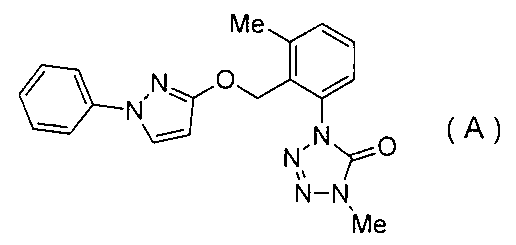
すなわち、本発明は以下の〔1〕~〔4〕のとおりである。
〔1〕 式(1)
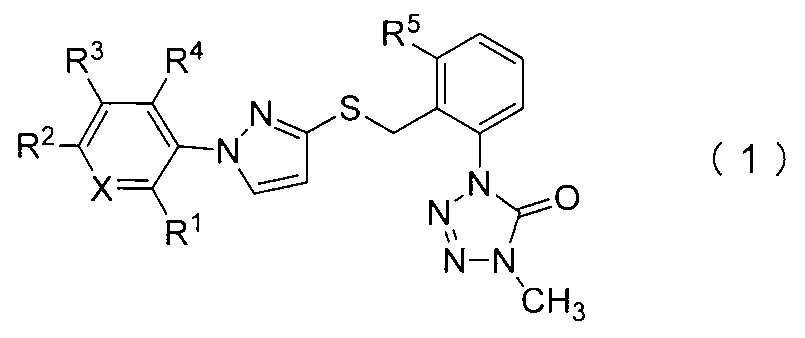
R1、R2、R3、R4およびR6は、各々独立してハロゲン原子、水素原子、シアノ基、1以上のハロゲン原子を有していてもよいC1−C4アルキル基、又は1以上のハロゲン原子を有していてもよいC1−C4アルコキシ基を表し、
R5は、ハロゲン原子、1以上のハロゲン原子を有していてもよいC1−C4アルキル基、1以上のハロゲン原子を有していてもよいC3−C4シクロアルキル基、又は1以上のハロゲン原子を有していてもよいC1−C4アルコキシ基を表す。〕
で示されるテトラゾリノン化合物。
〔2〕 XがCR6である〔1〕に記載のテトラゾリノン化合物。
〔3〕 Xが窒素原子である〔1〕に記載のテトラゾリノン化合物。
〔4〕 R3及びR4が水素原子である〔3〕に記載のテトラゾリノン化合物。
〔5〕 〔1〕~〔4〕のいずれかに記載のテトラゾリノン化合物を含有する有害生物防除剤。
〔6〕 〔1〕~〔4〕のいずれかに記載のテトラゾリノン化合物の有効量を植物または土壌に施用する有害生物の防除方法。
〔7〕 有害生物を防除するための〔1〕~〔4〕のいずれかに記載のテトラゾリノン化合物の使用。
本明細書における置換基の記載について、下記に記す。
ハロゲン原子とは、フッ素原子、塩素原子、臭素原子およびヨウ素原子を表す。
1以上のハロゲン原子を有していてもよいC1−C4アルキル基としては、例えばメチル基、エチル基、プロピル基、イソプロピル基、ブチル基、イソブチル基、sec−ブチル基、tert−ブチル基、フルオロメチル基、クロロメチル基、ジクロロメチル基、ジフルオロメチル基、トリフルオロメチル基、トリクロロメチル基、2−フルオロエチル基、2,2,2−トリフルオロエチル基、および1−トリフルオロメチル−2,2,2−トリフルオロエチル基があげられる。
1以上のハロゲン原子を有していてもよいC3−C4シクロアルキル基としては、例えばシクロプロピル基、シクロブチル基、2,2−ジクロロシクロプロピル基および2,2−ジフルオロシクロプロピル基があげられる。
1以上のハロゲン原子を有していてもよいC1−C4アルコキシ基としては、例えばメトキシ基、エトキシ基、プロピルオキシ基、イソプロピルオキシ基、ブチルオキシ基、トリフルオロメトキシ基、ジフルオロメトキシ基、2−フルオロエトキシ基、2,2,2−トリフルオロエトキシ基、3−クロロプロピルオキシ基および3−クロロブチルオキシ基があげられる。
式(1)において、R5がハロゲン原子であるテトラゾリノン化合物。
式(1)において、R5が1以上のハロゲン原子を有していてもよいC1−C4アルキル基であるテトラゾリノン化合物。
式(1)において、R5が1以上のハロゲン原子を有していてもよいC3−C4シクロアルキル基であるテトラゾリノン化合物。
式(1)において、R5が1以上のハロゲン原子を有していてもよいC1−C4アルコキシ基であるテトラゾリノン化合物。
式(1)において、R1が水素原子であるテトラゾリノン化合物。
式(1)において、R1がハロゲン原子であるテトラゾリノン化合物。
式(1)において、R1が1以上のハロゲン原子を有していてもよいC1−C4アルキル基であるテトラゾリノン化合物。
式(1)において、R1が1以上のハロゲン原子を有していてもよいC1−C4アルコキシ基であるテトラゾリノン化合物。
式(1)において、R2が水素原子であるテトラゾリノン化合物。
式(1)において、R2がハロゲン原子であるテトラゾリノン化合物。
式(1)において、R2が1以上のハロゲン原子を有していてもよいC1−C4アルキル基であるテトラゾリノン化合物。
式(1)において、R2が1以上のハロゲン原子を有していてもよいC1−C4アルコキシ基であるテトラゾリノン化合物。
式(1)において、R3が水素原子であるテトラゾリノン化合物。
式(1)において、R3がハロゲン原子であるテトラゾリノン化合物。
式(1)において、R3が1以上のハロゲン原子を有していてもよいC1−C4アルキル基であるテトラゾリノン化合物。
式(1)において、R4が水素原子であるテトラゾリノン化合物。
式(1)において、R4がハロゲン原子であるテトラゾリノン化合物。
式(1)において、R4が1以上のハロゲン原子を有していてもよいC1−C4アルキル基であるテトラゾリノン化合物。
式(1a)
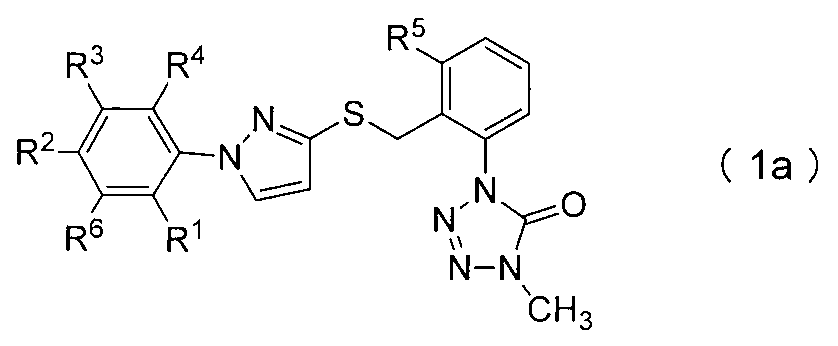
で示されるテトラゾリノン化合物。
[態様1]において、R1が1以上のハロゲン原子を有していてもよいC1−C4アルキル基または水素原子であるテトラゾリノン化合物。
[態様1]において、R1が1以上のハロゲン原子を有していてもよいC1−C4アルキル基、ハロゲン原子または1以上のハロゲン原子を有していてもよいC1−C4アルコキシ基であるテトラゾリノン化合物。
[態様1]において、R1が水素原子またはハロゲン原子であるテトラゾリノン化合物。
[態様1]において、R2が1以上のハロゲン原子を有していてもよいC1−C4アルキル基または水素原子であるテトラゾリノン化合物。
[態様1]において、R2が1以上のハロゲン原子を有していてもよいC1−C4アルキル基、ハロゲン原子または1以上のハロゲン原子を有していてもよいC1−C4アルコキシ基であるテトラゾリノン化合物。
[態様1]において、R5がハロゲン原子であるテトラゾリノン化合物。
[態様1]において、R5がメチル基であるテトラゾリノン化合物。
[態様1]において、R5がエチル基であるテトラゾリノン化合物。
[態様1]において、R5がメトキシ基であるテトラゾリノン化合物。
[態様1]において、R5がシクロプロピル基であるテトラゾリノン化合物。
[態様1]において、R5が1以上のハロゲン原子を有していてもよいC1−C4アルキル基であり、R1およびR2が、各々独立して水素原子、ハロゲン原子、シアノ基又は1以上のハロゲン原子を有していてもよいC1−C4アルコキシ基であり、R3およびR4が、各々独立して水素原子またはハロゲン原子であるテトラゾリノン化合物。
[態様1]において、R5が1以上のハロゲン原子を有していてもよいC1−C4アルキル基であり、R1、R2、R3、R4およびR6が、各々独立して水素原子、ハロゲン原子、または1以上のハロゲン原子を有していてもよいC1−C4アルコキシ基であるテトラゾリノン化合物。
[態様1]において、R5が1以上のハロゲン原子を有していてもよいC1−C4アルキル基であり、R1、R2、R3、R4およびR6が、各々独立して水素原子、ハロゲン原子、1以上のハロゲン原子を有していてもよいC1−C4アルコキシ基であるテトラゾリノン化合物。
[態様1]において、R5が1以上のハロゲン原子を有していてもよいC1−C4アルキル基であり、R1およびR4が、各々独立して水素原子または1以上のハロゲン原子を有していてもよいC1−C4アルコキシ基であり、R3およびR6が、水素原子であり、R2がハロゲン原子であるテトラゾリノン化合物。
[態様1]において、R5が1以上のハロゲン原子を有していてもよいC1−C4アルキル基であり、R1、R3、R4およびR6が、水素原子であり、R2がハロゲン原子であるテトラゾリノン化合物。
式(1b)

で示されるテトラゾリノン化合物。
[態様2]において、R1が1以上のハロゲン原子を有していてもよいC1−C4アルキル基または水素原子であるテトラゾリノン化合物。
[態様2]において、R1が1以上のハロゲン原子を有していてもよいC1−C4アルキル基またはハロゲン原子または1以上のハロゲン原子を有していてもよいC1−C4アルコキシ基であるテトラゾリノン化合物。
[態様2]において、R1が水素原子またはハロゲン原子であるテトラゾリノン化合物。
[態様2]において、R2が1以上のハロゲン原子を有していてもよいC1−C4アルキル基または水素原子であるテトラゾリノン化合物。
[態様2]において、R2が1以上のハロゲン原子を有していてもよいC1−C4アルキル基またはハロゲン原子または1以上のハロゲン原子を有していてもよいC1−C4アルコキシ基であるテトラゾリノン化合物。
[態様2]において、R5がハロゲン原子であるテトラゾリノン化合物。
[態様2]において、R5がメチル基であるテトラゾリノン化合物。
[態様2]において、R5がエチル基であるテトラゾリノン化合物。
[態様2]において、R5がメトキシ基であるテトラゾリノン化合物。
[態様2]において、R5がシクロプロピル基であるテトラゾリノン化合物。
[態様2]において、R5が1以上のハロゲン原子を有していてもよいC1−C4アルキル基であり、R1およびR2が、各々独立してハロゲン原子、シアノ基又は1以上のハロゲン原子を有していてもよいC1−C4アルコキシ基であり、R3およびR4が、各々独立してハロゲン原子であるテトラゾリノン化合物。
式(1c)

で示されるテトラゾリノン化合物。
[態様3]において、R1が1以上のハロゲン原子を有していてもよいC1−C4アルキル基または水素原子であるテトラゾリノン化合物。
[態様3]において、R1が1以上のハロゲン原子を有していてもよいC1−C4アルキル基またはハロゲン原子または1以上のハロゲン原子を有していてもよいC1−C4アルコキシ基であるテトラゾリノン化合物。
[態様3]において、R1が水素原子またはハロゲン原子であるテトラゾリノン化合物。
[態様3]において、R2が1以上のハロゲン原子を有していてもよいC1−C4アルキル基または水素原子であるテトラゾリノン化合物。
[態様3]において、R2が1以上のハロゲン原子を有していてもよいC1−C4アルキル基またはハロゲン原子または1以上のハロゲン原子を有していてもよいC1−C4アルコキシ基であるテトラゾリノン化合物。
[態様3]において、R5がハロゲン原子であるテトラゾリノン化合物。
[態様3]において、R5がメチル基であるテトラゾリノン化合物。
[態様3]において、R5がエチル基であるテトラゾリノン化合物。
[態様3]において、R5がメトキシ基であるテトラゾリノン化合物。
[態様3]において、R5がシクロプロピル基であるテトラゾリノン化合物。
[態様3]において、R5が1以上のハロゲン原子を有していてもよいC1−C4アルキル基であり、R1およびR2が、各々独立してハロゲン原子、シアノ基又は1以上のハロゲン原子を有していてもよいC1−C4アルコキシ基であるテトラゾリノン化合物。
(製造法A)
式(1)で示される本発明化合物は、式(A1)で示される化合物(以下、化合物(A1)と記す。)と式(A2)で示される化合物(以下、化合物(A2)と記す。)とを塩基の存在下で反応させることにより製造することができる。
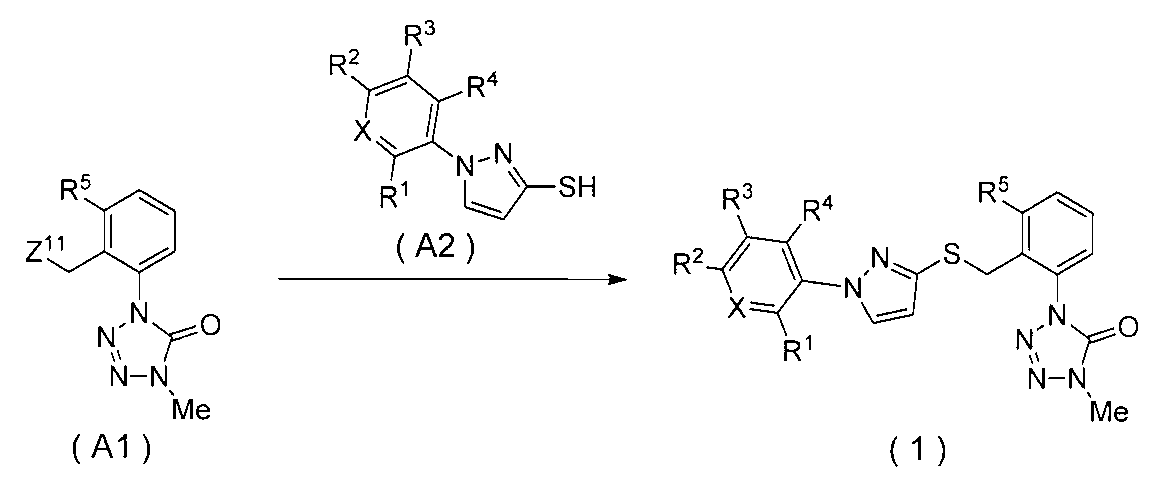
該反応は、通常溶媒中で行われる。
該反応に用いられる溶媒としては、例えば、n−ヘキサン、シクロヘキサン、トルエン、キシレン等の炭化水素類、テトラヒドロフラン、1,4−ジオキサン、エチレングリコールジメチルエーテル、メチルtert−ブチルエーテル、ジイソプロピルエーテル等のエーテル類、クロロホルム、1,2−ジクロロエタン、クロロベンゼン等のハロゲン化炭化水素類、N,N−ジメチルホルムアミド、1,3−ジメチル−2−イミダゾリジノン、N−メチルピロリドン等の酸アミド類、酢酸エチル、酢酸メチル等のエステル類、ジメチルスルホキシド等のスルホキシド類、アセトン、メチルエチルケトン、メチルイソブチルケトン等のケトン類、アセトニトリル等のニトリル類、水、これらの混合物および水とこれらの混合物が挙げられる。
該反応に用いられる塩基としては、トリエチルアミン、ピリジン、N−メチルモルホリン、4−ジメチルアミノピリジン、ジイソプロピルエチルアミン、ジアザビシクロウンデセン等の有機塩基、炭酸リチウム、炭酸ナトリウム、炭酸カリウム等のアルカリ金属炭酸塩、炭酸水素ナトリウム等のアルカリ金属炭酸水素塩、水酸化リチウム、水酸化ナトリウム、水酸化カリウム、水酸化セシウム等のアルカリ金属水酸化物、フッ化ナトリウム、フッ化カリウム、フッ化セシウム等のアルカリ金属ハロゲン化物、水素化リチウム、水素化ナトリウム、水素化カリウム等のアルカリ金属水素化物、ナトリウムtert−ブトキシド、カリウムtert−ブトキシド等のアルカリ金属アルコキシドが挙げられる。
該反応に用いられる化合物(A1)は、WO2013/162072Aの参考製造法A等に準じて製造される。
該反応には化合物(A1)1モルに対して、化合物(A2)が通常1~10モルの割合、塩基が通常0.5~5モルの割合で用いられる。
該反応の反応温度は通常−20~150℃の範囲である。該反応の反応時間は通常0.1~24時間の範囲である。
該反応は、必要に応じてヨウ化ナトリウム、ヨウ化テトラブチルアンモニウムなどを加えてもよく、これらの化合物は通常、化合物(A1)1モルに対して、0.001~1.2モルの割合で用いられる。
反応終了後は、反応混合物を有機溶媒で抽出し、有機層を乾燥、濃縮する等の後処理操作を行うことにより、式(1)で示される本発明化合物を単離することができる。単離された本発明化合物は、クロマトグラフィー、再結晶等によりさらに精製することもできる。
また、化合物は(A2)は、化合物(AA2)と硫化剤とを反応させることにより製造することができる。

該反応は、通常溶媒中で行われる。
該反応に用いられる溶媒としては、例えば、トルエン、キシレン等の炭化水素類、テトラヒドロフラン、1,4−ジオキサン、エチレングリコ−ルジメチルエ−テル、アニソール、等のエーテル類、N,N−ジメチルホルムアミド、1,3−ジメチル−2−イミダゾリジノン、N−メチルピロリドン等の酸アミド類、アセトニトリル等のニトリル類、これらの混合物及び水とこれらの混合物が挙げられる。
該反応に用いられる硫化剤としては、五硫化二リン、ローソン試薬(2,4−ビス(4−メトキシフェニル)−1,3,2,4−ジチアジホスフェタンー2,4−ジスルフィド)等が挙げられる。
該反応には化合物(AA2)1モルに対して、硫化剤が通常0.5~10モルの割合で用いられる。
該反応の反応温度は通常20~250℃の範囲である。該反応の反応時間は通常0.1~50時間の範囲である。
反応終了後は、反応混合物を有機溶媒で抽出し、有機層を乾燥、濃縮する等の後処理操作を行うことにより、化合物(A2)を単離することができる。単離された化合物(A2)は、クロマトグラフィー、再結晶等によりさらに精製することもできる。
固体担体としては、例えば、粘土類(例えば、カオリン、珪藻土、合成含水酸化珪素、フバサミクレ−、ベントナイト、酸性白土)、タルク類、その他の無機鉱物(例えば、セリサイト、石英粉末、硫黄粉末、活性炭、炭酸カルシウム、水和シリカ)等の微粉末あるいは粒状物が挙げられ、液体担体としては、例えば、水、アルコ−ル類(例えば、メタノ−ル、エタノ−ル)、ケトン類(例えば、アセトン、メチルエチルケトン)、芳香族炭化水素類(例えば、ベンゼン、トルエン、キシレン、エチルベンゼン、メチルナフタレン)、脂肪族炭化水素類(例えば、n−ヘキサン、シクロヘキサノン、灯油)、エステル類(例えば、酢酸エチル、酢酸ブチル)、ニトリル類(例えば、アセトニトリル、イソブチロニトリル)、エ−テル類(例えば、ジオキサン、ジイソプロピルエ−テル)、酸アミド類(例えば、DMF、ジメチルアセトアミド)、ハロゲン化炭化水素類(例えば、ジクロロエタン、トリクロロエチレン、四塩化炭素)が挙げられる。
界面活性剤としては、例えばアルキル硫酸エステル類、アルキルスルホン酸塩、アルキルアリ−ルスルホン酸塩、アルキルアリールエーテル類及びそのポリオキシエチレン化物、ポリオキシエチレングリコールエーテル類、多価アルコールエステル類、糖アルコール誘導体が挙げられる。
その他の製剤用補助剤としては、例えば固着剤や分散剤、具体的にはカゼイン、ゼラチン、多糖類(例えば、デンプン、アラビヤガム、セルロ−ス誘導体、アルギン酸)、リグニン誘導体、ベントナイト、糖類、合成水溶性高分子(例えば、ポリビニルアルコール、ポリビニルピロリドン、ポリアクリル酸類)、PAP(酸性りん酸イソプロピル)、BHT(2,6−ジ−tert−ブチル−4−メチルフェノール)、BHA(2−tert−ブチル−4−メトキシフェノールと3−tert−ブチル−4−メトキシフェノールとの混合物)、植物油、鉱物油、脂肪酸又はそのエステル等が挙げられる。
また、本発明化合物は、鉱物油、植物油などの各種オイル、または界面活性剤等と混合して用いてもよい。具体的に混合して用いることができるオイル、界面活性剤としてはNimbus(登録商標)、Assist(登録商標)、Aureo(登録商標)、Iharol(登録商標)、Silwet L−77(登録商標)、BreakThru(登録商標)、SundanceII(登録商標)、Induce(登録商標)、Penetrator(登録商標)、AgriDex(登録商標)、Lutensol A8(登録商標)、NP−7(登録商標)、Triton(登録商標)、Nufilm(登録商標)、Emulgator NP7(登録商標)、Emulad(登録商標)、TRITON X 45(登録商標)、AGRAL 90(登録商標)、AGROTIN(登録商標)、ARPON(登録商標)、EnSpray N(登録商標)、BANOLE(登録商標)などが挙げられる。
本発明防除剤の施用量は、気象条件、製剤形態、施用時期、施用方法、施用場所、対象病害、対象作物等によっても異なるが、本発明防除剤中の本発明化合物の量が、1000m2あたり、通常1~500g、好ましくは2~200gである。乳剤、水和剤、懸濁剤等は通常水で希釈して施用されるが、その場合の希釈後の本発明化合物の濃度は、通常0.0005~2重量%、好ましくは0.005~1重量%であり、粉剤、粒剤等は通常希釈することなくそのまま施用される。種子への処理においては、種子1Kgに対して本発明防除剤中の本発明化合物の量が、通常0.001~100g、好ましくは0.01~50gの範囲で施用される。
また別の態様として、例えば、本発明化合物または本発明防除剤を上記した脊椎動物の内部(体内)あるいは外部(体表面)に投与することにより該脊椎動物に寄生する生物や寄生虫を全身的あるいは非全身的に駆除することができる。かかる内部投与の方法としては、経口投与、肛門投与、移植、注射による皮下・筋肉内・静脈投与が挙げられる。また、外部投与としては、経皮投与があげられる。また、家畜動物に摂食させて、その動物の排泄物に発生する衛生害虫を駆除することができる。
本発明化合物または本発明防除剤を、有害生物の寄生する家畜やペット等の動物に対して処理する場合、その投与量は、投与方法等に応じて広範囲に変えることができるが、一般的には、動物体重1kg当たりの有効成分(本発明化合物)が0.1mg~2000mg、好ましくは0.5mg~1000mgとなるように投与することが望ましい。
本発明化合物または本発明防除剤は、畑、水田、芝生、果樹園等の農耕地における植物病害の防除剤として使用することができる。本発明化合物は、以下に挙げられる植物等を栽培する農耕地等において、当該農耕地の病害を防除することができる。
果樹;仁果類(リンゴ、セイヨウナシ、ニホンナシ、カリン、マルメロ等)、核果類(モモ、スモモ、ネクタリン、ウメ、オウトウ、アンズ、プル−ン等)、カンキツ類(ウンシュウミカン、オレンジ、レモン、ライム、グレープフルーツ等)、堅果類(クリ、クルミ、ハシバミ、ア−モンド、ピスタチオ、カシュ−ナッツ、マカダミアナッツ等)、液果類(ブルーベリー、クランベリー、ブラックベリー、ラズベリー等)、ブドウ、カキ、オリーブ、ビワ、バナナ、コーヒー、ナツメヤシ、ココヤシ等、
果樹以外の樹;チャ、クワ、花木、街路樹(トネリコ、カバノキ、ハナミズキ、ユ−カリ、イチョウ、ライラック、カエデ、カシ、ポプラ、ハナズオウ、フウ、プラタナス、ケヤキ、クロベ、モミノキ、ツガ、ネズ、マツ、トウヒ、イチイ)等。
上記植物には遺伝子組換え植物も含まれる。
イネのいもち病(Magnaporthe grisea)、ごま葉枯病(Cochliobolus miyabeanus)、紋枯病(Rhizoctonia solani)、馬鹿苗病(Gibberella fujikuroi)、黄化萎縮病(Sclerophthora macrospora);コムギのうどんこ病(Erysiphe graminis)、赤かび病(Fusarium graminearum、F. avenaceum、F. culmorum、Microdochium nivale)、さび病(Puccinia striiformis、P. graminis、P. recondita)、紅色雪腐病(Micronectriella nivale)、雪腐小粒菌核病(Typhula sp.)、裸黒穂病(Ustilago tritici)、なまぐさ黒穂病(Tilletia caries,T.controversa)、眼紋病(Pseudocercosporella herpotrichoides)、葉枯病(Septoria tritici)、ふ枯病(Stagonospora nodorum)、黄斑病(Pyrenophora tritici−repentis)、リゾクトニア属菌による苗立枯れ病(Rhizoctonia solani)、立枯病(Gaeumannomyces graminis);オオムギのうどんこ病(Erysiphe graminis)、赤かび病(Fusarium graminearum、F. avenaceum、F. culmorum、Microdochium nivale)、さび病(Puccinia striiformis、P.graminis、P.hordei)、裸黒穂病(Ustilago nuda)、雲形病(Rhynchosporium secalis)、網斑病(Pyrenophora teres)、斑点病(Cochliobolus sativus)、斑葉病(Pyrenophora graminea)、ラムラリア病(Ramularia collo−cygni)、リゾクトニア属菌による苗立枯れ病(Rhizoctonia solani);トウモロコシのさび病(Puccinia sorghi)、南方さび病(Puccinia polysora)、すす紋病(Setosphaeria turcica)、ごま葉枯病(Cochliobolus heterostrophus)、炭そ病(Colletotrichum graminicola)、グレーリーフスポット病(Cercospora zeae−maydis)、褐斑病(Kabatiella zeae)、ファエオスファエリアリーフスポット病(Phaeosphaeria maydis);
アザミウマ目害虫:ミカンキイロアザミウマ(Frankliniella occidentalis)、ミナミキイロアザミウマ(Thrips palmi)、チャノキイロアザミウマ(Scirtothrips dorsalis)、ネギアザミウマ(Thrips tabaci)、ヒラズハナアザミウマ(Frankliniella intonsa)、タバコアザミウマ(Frankliniellafusca)などのアザミウマ類等。
双翅目害虫:イエバエ(Musca domestica)、アカイエカ(Culex pipiens pallens)、ウシアブ(Tabanus trigonus)、タマネギバエ(Hylemya antiqua)、タネバエ(Hylemya platura)、シナハマダラカ(Anopheles sinensis)、イネハモグリバエ(Agromyza oryzae)、イネヒメハモグリバエ(Hydrellia griseola)、イネキモグリバエ(Chloropsoryzae)、ウリミバエ(Dacus cucurbitae)、チチュウカイミバエ(Ceratitis capitata)、マメハモグリバエ(Liriomyza trifolii)等。
直翅目害虫:トノサマバッタ(Locusta migratoria)、ケラ(Gryllotalpa africana)、コバネイナゴ(Oxya yezoensis)、ハネナガイナゴ(Oxya japonica)等。
膜翅目害虫:カブラハバチ(Athalia rosae)、ハキリアリ(Acromyrmex spp.)、ファイヤーアント(Solenopsis spp.)等。
線虫類:イネシンガレセンチュウ(Aphelenchoides besseyi)、イチゴメセンチュウ(Nothotylenchus acris)、ダイズシストセンチュウ(Heterodera glycines)サツマイモネコブセンチュウ(Meloidogyne incognita)、キタネグサレセンチュウ(Pratylenchus penetrans)、ニセネコブセンチュウ(Nacobbus aberrans)等。
ゴキブリ目害虫:チャバネゴキブリ(Blattella germanica)、クロゴキブリ(Periplaneta fuliginosa)、ワモンゴキブリ(Periplaneta americana)、トビイロゴキブリ(Periplaneta brunnea)、トウヨウゴキブリ(Blatta orientalis)等。
ダニ目害虫:ナミハダニ(Tetranychus urticae)、ミカンハダニ(Panonychus citri)、オリゴニカス属等のハダニ類、ミカンサビダニ(Aculops pelekassi)等のフシダニ類、チャノホコリダニ(Polyphagotarsonemus latus)等のホコリダニ類、ヒメハダニ類、ケナガハダニ類、ケナガコナダニ(Tyrophagus putrescentiae)等のコナダニ類、コナヒョウヒダニ(Dermatophagoides farinae)、ヤケヒョウヒダニ(Dermatophagoidesptrenyssnus)等のヒョウヒダニ類、ホソツメダニ(Cheyletuseruditus)、クワガタツメダニ(Cheyletus malaccensis)、ミナミツメダニ(Cheyletus moorei)等のツメダニ類、ワクモ類等。
上記した公知の殺菌剤、殺虫剤、殺ダニ剤、殺線虫剤及び植物成長調節剤からなる群から選ばれる1種以上を、本発明防除剤と併用する場合は植物体に同時に施用しても、別々に施用してもよい。別々に施用する場合は、施用する日が異なっていてもよく、異なる剤型を使用してもよい。
本発明防除剤の植物の種子への施用は、上記した公知の殺菌剤、殺虫剤、殺ダニ剤、殺線虫剤及び植物成長調節剤からなる群から選ばれる1種以上の、該植物または該植物を定植する土壌への施用と組み合わせることができる。また、上記した公知の殺菌剤、殺虫剤、殺ダニ剤、殺線虫剤及び植物成長調節剤からなる群から選ばれる1種以上の植物の種子への施用は、本発明防除剤の、該植物または該植物を定植する土壌への施用と組み合わせることもできる。該植物または該植物を定植する土壌への施用は、定植前でもよく、定植と同時でも、定植後であってもよい。
当該施用方法はトウモロコシ、コムギ、イネの栽培へ好ましく適用される。
本発明防除剤の、植物体、もしくは、植物体を栽培しているか、栽培する予定の土壌(例えば、水田、作物畑、果樹園または非農耕地の土壌)への施用は、公知の除草剤から選ばれる1種以上の当該土壌への施用と組み合わせることができる。本発明の有害生物防除剤と除草剤とは、同時に施用しても、別々に施用してもよい。別々に施用する場合は、同じ日でも、別の日に施用してもよい。
本発明防除剤と組み合わせることのできる除草剤としては、グリホサート、グリホサートの塩、グリホシネート、グリホサートの塩、2,4−D、2,4−Dの塩、ジカンバ、ジカンバの塩及びフルミオキサジンが挙げられる。
まず、製造例を示す。
製造例1
150℃で、1−(4−クロロフェニル)−1H−ピラゾール−3−オール(国際公開第2013/162072号に従って製造)3g、五硫化二リン10.3g、およびキシレン100mlの混合物を24時間攪拌した。反応混合物を減圧下濃縮した。得られた残渣を酢酸エチルで希釈し、シリカゲルで濾過をした。得られた濾液を減圧下濃縮し、1−(4−クロロフェニル)−1H−ピラゾール−3−チオールを含む粗生成物を1.17g得た。
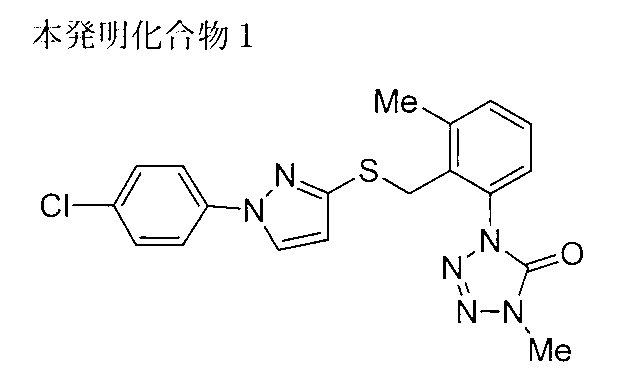
80℃で、1−(2−ブロモメチル−3−メチルフェニル)−4−メチル−1,4−ジヒドロテトラゾール−5−オン(WO2013/162072Aに従って製造)1.10g、1−(4−クロロフェニル)−1H−ピラゾール−3−チオールを含む粗生成物1.17g、炭酸カリウム2.09g、およびアセトニトリル10mlの混合物を12時間攪拌した。反応混合物を減圧下濃縮した。得られた残渣をシリカゲルカラムクロマトグラフィーに付し、1−(2−{[1−(4−クロロフェニル)−1H−ピラゾール−3−イル]チオメチル}−3−メチルフェニル)−4−メチル−1,4−ジヒドロテトラゾール−5−オン(以下、本発明化合物1と記す。)を0.50g得た。
上記化合物HA1001−001~HA1012−333(以下、本発明化合物Aと記す)は、下記で示される芳香族化合物〔式中、Qは、以下に示す置換基番号1~333のいずれかを表す。〕である。
下記の[置換基番号;Q]において、3−Pyはピリジン−3−イルを表し、Phはフェニルを表し、Fはフルオロを表し、Clはクロロを表し、Brはブロモを表し、CNはシアノを表し、Meはメチルを表し、Etはエチルを表し、Prはプロピルを表し、i−Prはイソプロピルを表し、CF3はトリフルオロメチルを表し、OMeはメトキシを表し、OEtはエトキシを表し、OPrはプロポキシを表し、Oi−Prはイソプロポキシを表し、diはジを表し、triはトリを表す。

製剤例1
本発明化合物Aのいずれか1化合物を50部、リグニンスルホン酸カルシウム3部、ラウリル硫酸マグネシウム2部及び合成含水酸化珪素45部をよく粉砕混合することにより、製剤を得る。
本発明化合物Aのいずれか1化合物を20部とソルビタントリオレエ−ト1.5部とを、ポリビニルアルコ−ル2部を含む水溶液28.5部と混合し、湿式粉砕法で微粉砕した後、この中に、キサンタンガム0.05部及びアルミニウムマグネシウムシリケ−ト0.1部を含む水溶液40部を加え、さらにプロピレングリコ−ル10部を加えて攪拌混合し、製剤を得る。
本発明化合物Aのいずれか1化合物を2部、カオリンクレ−88部及びタルク10部をよく粉砕混合することにより、製剤を得る。
本発明化合物Aのいずれか1化合物を5部、ポリオキシエチレンスチリルフェニルエ−テル14部、ドデシルベンゼンスルホン酸カルシウム6部及びキシレン75部をよく混合することにより、製剤を得る。
本発明化合物Aのいずれか1化合物を2部、合成含水酸化珪素1部、リグニンスルホン酸カルシウム2部、ベントナイト30部及びカオリンクレ−65部をよく粉砕混合した後、水を加えてよく練り合せ、造粒乾燥することにより、製剤を得る。
本発明化合物Aのいずれか1化合物を10部、ポリオキシエチレンアルキルエーテルサルフェートアンモニウム塩とホワイトカーボンとの混合物(重量比1:1)35部、及び水55部を混合し、湿式粉砕法で微粉砕することにより、製剤を得る。
試験例1 プラスチックポットに土壌を詰め、そこにオオムギ(品種;ミカモゴールデン)を播種し、温室で7日間生育させた。本発明化合物1を所定濃度(500ppm)含有するように調整した水希釈液を、上記オオムギの葉面に充分付着するように茎葉散布した。散布後植物を風乾し、2日後にオオムギ網斑病菌(Pyrenophora teres)胞子の水懸濁液を噴霧接種した。接種後植物を昼間23℃、夜間20℃の温室内で多湿下に3日間置き、次に温室内で7日間栽培した後、病斑面積を調査した。その結果、本発明化合物を処理した植物における病斑面積は、無処理の植物における病斑面積の30%以下であった。
Claims (7)
- 式(1)
〔式中、XはCR6または窒素原子を表し、
R1、R2、R3、R4およびR6は、各々独立してハロゲン原子、水素原子、シアノ基、1以上のハロゲン原子を有していてもよいC1−C4アルキル基、又は1以上のハロゲン原子を有していてもよいC1−C4アルコキシ基を表し、
R5は、ハロゲン原子、1以上のハロゲン原子を有していてもよいC1−C4アルキル基、1以上のハロゲン原子を有していてもよいC3−C4シクロアルキル基、又は1以上のハロゲン原子を有していてもよいC1−C4アルコキシ基を表す。〕
で示されるテトラゾリノン化合物。 - XがCR6である請求の範囲1に記載のテトラゾリノン化合物。
- Xが窒素原子である請求の範囲1に記載のテトラゾリノン化合物。
- R3及びR4が水素原子である請求の範囲3に記載のテトラゾリノン化合物。
- 請求の範囲1~4のいずれかに記載のテトラゾリノン化合物を含有する有害生物防除剤。
- 請求の範囲1~4のいずれかに記載のテトラゾリノン化合物の有効量を植物または土壌に施用する有害生物の防除方法。
- 有害生物を防除するための請求の範囲1~4のいずれかに記載のテトラゾリノン化合物の使用。
Priority Applications (5)
| Application Number | Priority Date | Filing Date | Title |
|---|---|---|---|
| BR112016021778-0A BR112016021778B1 (pt) | 2014-03-28 | 2015-03-23 | composto de tetrazolinona, seu uso no controle de patógenos de plantas, agente e método para o controle de pragas |
| CN201580016358.6A CN106164069A (zh) | 2014-03-28 | 2015-03-23 | 四唑啉酮化合物及其应用 |
| EP15770001.4A EP3124485B1 (en) | 2014-03-28 | 2015-03-23 | Tetrazolinone compounds for controlling pests |
| JP2016510576A JP6624053B2 (ja) | 2014-03-28 | 2015-03-23 | テトラゾリノン化合物及びその用途 |
| US15/128,703 US10070646B2 (en) | 2014-03-28 | 2015-03-23 | Tetrazolinone compound and application thereof |
Applications Claiming Priority (2)
| Application Number | Priority Date | Filing Date | Title |
|---|---|---|---|
| JP2014067943 | 2014-03-28 | ||
| JP2014-067943 | 2014-03-28 |
Publications (1)
| Publication Number | Publication Date |
|---|---|
| WO2015147313A1 true WO2015147313A1 (ja) | 2015-10-01 |
Family
ID=54195816
Family Applications (1)
| Application Number | Title | Priority Date | Filing Date |
|---|---|---|---|
| PCT/JP2015/059818 Ceased WO2015147313A1 (ja) | 2014-03-28 | 2015-03-23 | テトラゾリノン化合物及びその用途 |
Country Status (6)
| Country | Link |
|---|---|
| US (1) | US10070646B2 (ja) |
| EP (1) | EP3124485B1 (ja) |
| JP (1) | JP6624053B2 (ja) |
| CN (1) | CN106164069A (ja) |
| BR (1) | BR112016021778B1 (ja) |
| WO (1) | WO2015147313A1 (ja) |
Cited By (2)
| Publication number | Priority date | Publication date | Assignee | Title |
|---|---|---|---|---|
| JP2019508466A (ja) * | 2016-03-16 | 2019-03-28 | ビーエーエスエフ ソシエタス・ヨーロピアBasf Se | 穀類につく耐性植物病原菌類を駆除するためのテトラゾリノンの使用 |
| WO2021215480A1 (ja) | 2020-04-22 | 2021-10-28 | 住友化学株式会社 | フェニル化合物及び植物病害防除方法 |
Families Citing this family (1)
| Publication number | Priority date | Publication date | Assignee | Title |
|---|---|---|---|---|
| CN106580967A (zh) * | 2017-02-17 | 2017-04-26 | 刘琨 | 一种治疗膝关节骨性关节炎的药物组合物 |
Citations (2)
| Publication number | Priority date | Publication date | Assignee | Title |
|---|---|---|---|---|
| WO2013162077A1 (en) * | 2012-04-27 | 2013-10-31 | Sumitomo Chemical Company, Limited | Tetrazolinone compounds and its use |
| WO2013162072A1 (en) * | 2012-04-27 | 2013-10-31 | Sumitomo Chemical Company, Limited | Tetrazolinone compounds and its use as pesticides |
Family Cites Families (44)
| Publication number | Priority date | Publication date | Assignee | Title |
|---|---|---|---|---|
| JP3694051B2 (ja) | 1994-07-12 | 2005-09-14 | バイエルクロップサイエンス株式会社 | 1−ピリジルテトラゾリノン誘導体および除草剤 |
| JPH0899975A (ja) | 1994-08-05 | 1996-04-16 | Nippon Bayeragrochem Kk | 5員複素環置換テトラゾリノン誘導体および除草剤 |
| WO1996036229A1 (en) * | 1995-05-17 | 1996-11-21 | E.I. Du Pont De Nemours And Company | Fungicidal cyclic amides |
| US5578112A (en) | 1995-06-01 | 1996-11-26 | 999520 Ontario Limited | Modular and low power ionizer |
| JPH0987281A (ja) | 1995-07-18 | 1997-03-31 | Nissan Chem Ind Ltd | 新規テトラゾリノン類及び除草剤 |
| US5861359A (en) | 1995-07-25 | 1999-01-19 | Fmc Corporation | Herbicidal phenylmethoxphenyl heterocycles |
| JPH09100277A (ja) | 1995-07-28 | 1997-04-15 | Nissan Chem Ind Ltd | 新規テトラゾリノン誘導体および除草剤 |
| JPH09100272A (ja) | 1995-08-02 | 1997-04-15 | Nippon Bayeragrochem Kk | 除草性チオカルバモイルテトラゾリノン類 |
| JPH09110863A (ja) | 1995-08-10 | 1997-04-28 | Nissan Chem Ind Ltd | 新規テトラゾリノン類 |
| JPH09208565A (ja) * | 1996-02-07 | 1997-08-12 | Sumitomo Chem Co Ltd | テトラゾリノン誘導体、その用途およびその製造中間体 |
| WO1998025912A1 (en) | 1996-12-13 | 1998-06-18 | E.I. Du Pont De Nemours And Company | Herbicidal heterocyclic amides |
| JP2001512460A (ja) | 1997-02-18 | 2001-08-21 | イー・アイ・デユポン・ドウ・ヌムール・アンド・カンパニー | 除草性テトラゾリノン類 |
| WO1998051683A1 (en) | 1997-05-15 | 1998-11-19 | E.I. Du Pont De Nemours And Company | Herbicidal tetrazolinones |
| DE19731153A1 (de) * | 1997-07-21 | 1999-01-28 | Basf Ag | 2-(Pyrazolyl- und Triazolyl-3'-oxymethylen)-phenyl-isoxazolone und -triazolone, Verfahren zu ihrer Herstellung und ihre Verwendung |
| EP0902028A1 (en) | 1997-09-11 | 1999-03-17 | E.I. Du Pont De Nemours And Company | Tetrazoline herbicides |
| AU3254099A (en) | 1998-03-09 | 1999-09-27 | Basf Aktiengesellschaft | Hetaryl-substituted benzyl phenyl ethers, method for the production thereof, andtheir use for combating harmful fungi and animal pests |
| AU3011099A (en) | 1998-03-26 | 1999-10-18 | E.I. Du Pont De Nemours And Company | Herbicidal tetrazolinones |
| US6294503B1 (en) | 1998-12-03 | 2001-09-25 | Ishihara Sangyo Kaisha, Ltd. | Fused heterocycle compounds, process for their preparation, and herbicidal compositions containing them |
| PT2793579T (pt) | 2011-12-21 | 2016-07-18 | Basf Se | Uso de compostos do tipo estrobilurina para o combate de fungos fitopatogénicos resistentes a inibidores qo |
| JP6142753B2 (ja) | 2012-09-28 | 2017-06-07 | 住友化学株式会社 | テトラゾリノン化合物及びその用途 |
| JP6142752B2 (ja) | 2012-09-28 | 2017-06-07 | 住友化学株式会社 | テトラゾリノン化合物及びその用途 |
| CN102875540A (zh) | 2012-10-30 | 2013-01-16 | 南开大学 | 2-苯并恶嗪酮基-5-环己氨基羰基四唑酮的除草活性 |
| BR112015012209B1 (pt) | 2012-11-29 | 2019-07-09 | Sumitomo Chemical Co., Ltd. | Composto de tetrazolinona, seu uso, agente e método para o controle de pragas |
| WO2014104268A1 (ja) | 2012-12-27 | 2014-07-03 | 住友化学株式会社 | テトラゾリノン化合物及びその用途 |
| US9560850B2 (en) | 2012-12-27 | 2017-02-07 | Sumitomo Chemical Company, Limited | Tetrazolinone compound and use thereof |
| WO2014104382A1 (ja) | 2012-12-27 | 2014-07-03 | 住友化学株式会社 | テトラゾリノン化合物及びその用途 |
| US9867372B2 (en) | 2013-04-26 | 2018-01-16 | Sumitomo Chemical Company, Limited | Tetrazolinone compound and use of same |
| US9675072B2 (en) | 2013-05-29 | 2017-06-13 | Sumitomo Chemical Company, Limited | Tetrazolinone compound and application of same |
| US9888688B2 (en) | 2013-07-12 | 2018-02-13 | Sumitomo Chemical Company, Limited | Tetrazolinone compounds and applications thereof |
| JP6428618B2 (ja) | 2013-07-31 | 2018-11-28 | 住友化学株式会社 | テトラゾリノン化合物及びその用途 |
| EP3029035B1 (en) | 2013-07-31 | 2018-05-30 | Sumitomo Chemical Company, Limited | Tetrazolinone compound, and use thereof |
| ES2725630T3 (es) | 2013-07-31 | 2019-09-25 | Sumitomo Chemical Co | Compuesto de tetrazolinona y uso del mismo |
| CN105593217B (zh) | 2013-08-29 | 2018-05-25 | 住友化学株式会社 | 四唑啉酮化合物及其用途 |
| WO2015041360A1 (ja) | 2013-09-20 | 2015-03-26 | 住友化学株式会社 | テトラゾリノン化合物及びその用途 |
| WO2015046480A1 (ja) | 2013-09-25 | 2015-04-02 | 住友化学株式会社 | テトラゾリノン化合物及びその用途 |
| WO2015050039A1 (ja) | 2013-10-02 | 2015-04-09 | 住友化学株式会社 | 植物病害防除組成物およびその用途 |
| WO2015050040A1 (ja) | 2013-10-02 | 2015-04-09 | 住友化学株式会社 | 植物病害防除組成物およびその用途 |
| BR112016008406B1 (pt) | 2013-10-17 | 2021-02-23 | Sumitomo Chemical Company, Limited | composto de tetrazolinona e aplicação do mesmo |
| WO2015058806A1 (en) | 2013-10-24 | 2015-04-30 | Telefonaktiebolaget L M Ericsson (Publ) | Electing a leader node in a mobile ad-hoc communications network |
| JP6432516B2 (ja) | 2013-10-25 | 2018-12-05 | 住友化学株式会社 | テトラゾリノン化合物及びその用途 |
| EP3064492B1 (en) | 2013-10-28 | 2018-12-26 | Sumitomo Chemical Company, Limited | Tetrazolinone compound and application for same |
| US9573904B2 (en) | 2013-12-12 | 2017-02-21 | Sumitomo Chemical Company, Limited | Aromatic compound and use thereof |
| EP3130584B1 (en) | 2014-03-28 | 2023-04-26 | Sumitomo Chemical Company, Limited | Aromatic compound and uses thereof |
| US9788547B2 (en) | 2014-03-28 | 2017-10-17 | Sumitomo Chemical Company, Limited | Aromatic compound and uses thereof |
-
2015
- 2015-03-23 EP EP15770001.4A patent/EP3124485B1/en active Active
- 2015-03-23 CN CN201580016358.6A patent/CN106164069A/zh active Pending
- 2015-03-23 JP JP2016510576A patent/JP6624053B2/ja active Active
- 2015-03-23 US US15/128,703 patent/US10070646B2/en active Active
- 2015-03-23 WO PCT/JP2015/059818 patent/WO2015147313A1/ja not_active Ceased
- 2015-03-23 BR BR112016021778-0A patent/BR112016021778B1/pt active IP Right Grant
Patent Citations (2)
| Publication number | Priority date | Publication date | Assignee | Title |
|---|---|---|---|---|
| WO2013162077A1 (en) * | 2012-04-27 | 2013-10-31 | Sumitomo Chemical Company, Limited | Tetrazolinone compounds and its use |
| WO2013162072A1 (en) * | 2012-04-27 | 2013-10-31 | Sumitomo Chemical Company, Limited | Tetrazolinone compounds and its use as pesticides |
Cited By (2)
| Publication number | Priority date | Publication date | Assignee | Title |
|---|---|---|---|---|
| JP2019508466A (ja) * | 2016-03-16 | 2019-03-28 | ビーエーエスエフ ソシエタス・ヨーロピアBasf Se | 穀類につく耐性植物病原菌類を駆除するためのテトラゾリノンの使用 |
| WO2021215480A1 (ja) | 2020-04-22 | 2021-10-28 | 住友化学株式会社 | フェニル化合物及び植物病害防除方法 |
Also Published As
| Publication number | Publication date |
|---|---|
| US10070646B2 (en) | 2018-09-11 |
| JPWO2015147313A1 (ja) | 2017-04-13 |
| EP3124485A1 (en) | 2017-02-01 |
| EP3124485A4 (en) | 2017-08-09 |
| CN106164069A (zh) | 2016-11-23 |
| EP3124485B1 (en) | 2018-11-28 |
| JP6624053B2 (ja) | 2019-12-25 |
| US20170118983A1 (en) | 2017-05-04 |
| BR112016021778B1 (pt) | 2020-12-08 |
Similar Documents
| Publication | Publication Date | Title |
|---|---|---|
| JP6447627B2 (ja) | 芳香族化合物及びその用途 | |
| CN105263921B (zh) | 四唑啉酮化合物及其应用 | |
| JP6465105B2 (ja) | 芳香族化合物及びその用途 | |
| WO2015041360A1 (ja) | テトラゾリノン化合物及びその用途 | |
| JP5712504B2 (ja) | 有害生物防除組成物およびその用途 | |
| BR112016008406B1 (pt) | composto de tetrazolinona e aplicação do mesmo | |
| JP6624053B2 (ja) | テトラゾリノン化合物及びその用途 | |
| JP6551397B2 (ja) | テトラゾリノン化合物及びその用途 | |
| CN106132952B (zh) | 四唑啉酮化合物及其应用 | |
| TW201837025A (zh) | 新穎二噻𠷬化合物或其鹽或其n-氧化物及其用途 | |
| JP2009143870A (ja) | アミド化合物及びその有害生物防除用途 |
Legal Events
| Date | Code | Title | Description |
|---|---|---|---|
| 121 | Ep: the epo has been informed by wipo that ep was designated in this application |
Ref document number: 15770001 Country of ref document: EP Kind code of ref document: A1 |
|
| ENP | Entry into the national phase |
Ref document number: 2016510576 Country of ref document: JP Kind code of ref document: A |
|
| WWE | Wipo information: entry into national phase |
Ref document number: 15128703 Country of ref document: US |
|
| NENP | Non-entry into the national phase |
Ref country code: DE |
|
| REEP | Request for entry into the european phase |
Ref document number: 2015770001 Country of ref document: EP |
|
| WWE | Wipo information: entry into national phase |
Ref document number: 2015770001 Country of ref document: EP |
|
| REG | Reference to national code |
Ref country code: BR Ref legal event code: B01A Ref document number: 112016021778 Country of ref document: BR |
|
| ENP | Entry into the national phase |
Ref document number: 112016021778 Country of ref document: BR Kind code of ref document: A2 Effective date: 20160922 |