WO2015147279A1 - 全固体二次電池、これに用いる固体電解質組成物および電池用電極シート、ならびに電池用電極シートおよび全固体二次電池の製造方法 - Google Patents
全固体二次電池、これに用いる固体電解質組成物および電池用電極シート、ならびに電池用電極シートおよび全固体二次電池の製造方法 Download PDFInfo
- Publication number
- WO2015147279A1 WO2015147279A1 PCT/JP2015/059677 JP2015059677W WO2015147279A1 WO 2015147279 A1 WO2015147279 A1 WO 2015147279A1 JP 2015059677 W JP2015059677 W JP 2015059677W WO 2015147279 A1 WO2015147279 A1 WO 2015147279A1
- Authority
- WO
- WIPO (PCT)
- Prior art keywords
- solid electrolyte
- group
- secondary battery
- solid
- active material
- Prior art date
- Legal status (The legal status is an assumption and is not a legal conclusion. Google has not performed a legal analysis and makes no representation as to the accuracy of the status listed.)
- Ceased
Links
Images


Classifications
-
- C—CHEMISTRY; METALLURGY
- C08—ORGANIC MACROMOLECULAR COMPOUNDS; THEIR PREPARATION OR CHEMICAL WORKING-UP; COMPOSITIONS BASED THEREON
- C08B—POLYSACCHARIDES; DERIVATIVES THEREOF
- C08B3/00—Preparation of cellulose esters of organic acids
- C08B3/08—Preparation of cellulose esters of organic acids of monobasic organic acids with three or more carbon atoms, e.g. propionate or butyrate
-
- H—ELECTRICITY
- H01—ELECTRIC ELEMENTS
- H01M—PROCESSES OR MEANS, e.g. BATTERIES, FOR THE DIRECT CONVERSION OF CHEMICAL ENERGY INTO ELECTRICAL ENERGY
- H01M10/00—Secondary cells; Manufacture thereof
- H01M10/05—Accumulators with non-aqueous electrolyte
- H01M10/056—Accumulators with non-aqueous electrolyte characterised by the materials used as electrolytes, e.g. mixed inorganic/organic electrolytes
-
- C—CHEMISTRY; METALLURGY
- C08—ORGANIC MACROMOLECULAR COMPOUNDS; THEIR PREPARATION OR CHEMICAL WORKING-UP; COMPOSITIONS BASED THEREON
- C08B—POLYSACCHARIDES; DERIVATIVES THEREOF
- C08B11/00—Preparation of cellulose ethers
- C08B11/02—Alkyl or cycloalkyl ethers
-
- C—CHEMISTRY; METALLURGY
- C08—ORGANIC MACROMOLECULAR COMPOUNDS; THEIR PREPARATION OR CHEMICAL WORKING-UP; COMPOSITIONS BASED THEREON
- C08B—POLYSACCHARIDES; DERIVATIVES THEREOF
- C08B11/00—Preparation of cellulose ethers
- C08B11/16—Aryl or aralkyl ethers
-
- C—CHEMISTRY; METALLURGY
- C08—ORGANIC MACROMOLECULAR COMPOUNDS; THEIR PREPARATION OR CHEMICAL WORKING-UP; COMPOSITIONS BASED THEREON
- C08B—POLYSACCHARIDES; DERIVATIVES THEREOF
- C08B11/00—Preparation of cellulose ethers
- C08B11/193—Mixed ethers, i.e. ethers with two or more different etherifying groups
-
- C—CHEMISTRY; METALLURGY
- C08—ORGANIC MACROMOLECULAR COMPOUNDS; THEIR PREPARATION OR CHEMICAL WORKING-UP; COMPOSITIONS BASED THEREON
- C08B—POLYSACCHARIDES; DERIVATIVES THEREOF
- C08B13/00—Preparation of cellulose ether-esters
-
- C—CHEMISTRY; METALLURGY
- C08—ORGANIC MACROMOLECULAR COMPOUNDS; THEIR PREPARATION OR CHEMICAL WORKING-UP; COMPOSITIONS BASED THEREON
- C08B—POLYSACCHARIDES; DERIVATIVES THEREOF
- C08B15/00—Preparation of other cellulose derivatives or modified cellulose, e.g. complexes
- C08B15/05—Derivatives containing elements other than carbon, hydrogen, oxygen, halogens or sulfur
- C08B15/06—Derivatives containing elements other than carbon, hydrogen, oxygen, halogens or sulfur containing nitrogen, e.g. carbamates
-
- C—CHEMISTRY; METALLURGY
- C08—ORGANIC MACROMOLECULAR COMPOUNDS; THEIR PREPARATION OR CHEMICAL WORKING-UP; COMPOSITIONS BASED THEREON
- C08B—POLYSACCHARIDES; DERIVATIVES THEREOF
- C08B3/00—Preparation of cellulose esters of organic acids
- C08B3/08—Preparation of cellulose esters of organic acids of monobasic organic acids with three or more carbon atoms, e.g. propionate or butyrate
- C08B3/10—Preparation of cellulose esters of organic acids of monobasic organic acids with three or more carbon atoms, e.g. propionate or butyrate with five or more carbon-atoms, e.g. valerate
-
- C—CHEMISTRY; METALLURGY
- C08—ORGANIC MACROMOLECULAR COMPOUNDS; THEIR PREPARATION OR CHEMICAL WORKING-UP; COMPOSITIONS BASED THEREON
- C08L—COMPOSITIONS OF MACROMOLECULAR COMPOUNDS
- C08L1/00—Compositions of cellulose, modified cellulose or cellulose derivatives
- C08L1/02—Cellulose; Modified cellulose
-
- C—CHEMISTRY; METALLURGY
- C08—ORGANIC MACROMOLECULAR COMPOUNDS; THEIR PREPARATION OR CHEMICAL WORKING-UP; COMPOSITIONS BASED THEREON
- C08L—COMPOSITIONS OF MACROMOLECULAR COMPOUNDS
- C08L1/00—Compositions of cellulose, modified cellulose or cellulose derivatives
- C08L1/08—Cellulose derivatives
- C08L1/10—Esters of organic acids, i.e. acylates
-
- C—CHEMISTRY; METALLURGY
- C08—ORGANIC MACROMOLECULAR COMPOUNDS; THEIR PREPARATION OR CHEMICAL WORKING-UP; COMPOSITIONS BASED THEREON
- C08L—COMPOSITIONS OF MACROMOLECULAR COMPOUNDS
- C08L1/00—Compositions of cellulose, modified cellulose or cellulose derivatives
- C08L1/08—Cellulose derivatives
- C08L1/26—Cellulose ethers
-
- C—CHEMISTRY; METALLURGY
- C08—ORGANIC MACROMOLECULAR COMPOUNDS; THEIR PREPARATION OR CHEMICAL WORKING-UP; COMPOSITIONS BASED THEREON
- C08L—COMPOSITIONS OF MACROMOLECULAR COMPOUNDS
- C08L1/00—Compositions of cellulose, modified cellulose or cellulose derivatives
- C08L1/08—Cellulose derivatives
- C08L1/32—Cellulose ether-esters
-
- C—CHEMISTRY; METALLURGY
- C09—DYES; PAINTS; POLISHES; NATURAL RESINS; ADHESIVES; COMPOSITIONS NOT OTHERWISE PROVIDED FOR; APPLICATIONS OF MATERIALS NOT OTHERWISE PROVIDED FOR
- C09J—ADHESIVES; NON-MECHANICAL ASPECTS OF ADHESIVE PROCESSES IN GENERAL; ADHESIVE PROCESSES NOT PROVIDED FOR ELSEWHERE; USE OF MATERIALS AS ADHESIVES
- C09J101/00—Adhesives based on cellulose, modified cellulose, or cellulose derivatives
- C09J101/02—Cellulose; Modified cellulose
-
- H—ELECTRICITY
- H01—ELECTRIC ELEMENTS
- H01M—PROCESSES OR MEANS, e.g. BATTERIES, FOR THE DIRECT CONVERSION OF CHEMICAL ENERGY INTO ELECTRICAL ENERGY
- H01M10/00—Secondary cells; Manufacture thereof
- H01M10/05—Accumulators with non-aqueous electrolyte
- H01M10/052—Li-accumulators
- H01M10/0525—Rocking-chair batteries, i.e. batteries with lithium insertion or intercalation in both electrodes; Lithium-ion batteries
-
- H—ELECTRICITY
- H01—ELECTRIC ELEMENTS
- H01M—PROCESSES OR MEANS, e.g. BATTERIES, FOR THE DIRECT CONVERSION OF CHEMICAL ENERGY INTO ELECTRICAL ENERGY
- H01M10/00—Secondary cells; Manufacture thereof
- H01M10/05—Accumulators with non-aqueous electrolyte
- H01M10/056—Accumulators with non-aqueous electrolyte characterised by the materials used as electrolytes, e.g. mixed inorganic/organic electrolytes
- H01M10/0561—Accumulators with non-aqueous electrolyte characterised by the materials used as electrolytes, e.g. mixed inorganic/organic electrolytes the electrolyte being constituted of inorganic materials only
- H01M10/0562—Solid materials
-
- H—ELECTRICITY
- H01—ELECTRIC ELEMENTS
- H01M—PROCESSES OR MEANS, e.g. BATTERIES, FOR THE DIRECT CONVERSION OF CHEMICAL ENERGY INTO ELECTRICAL ENERGY
- H01M10/00—Secondary cells; Manufacture thereof
- H01M10/05—Accumulators with non-aqueous electrolyte
- H01M10/058—Construction or manufacture
-
- H—ELECTRICITY
- H01—ELECTRIC ELEMENTS
- H01M—PROCESSES OR MEANS, e.g. BATTERIES, FOR THE DIRECT CONVERSION OF CHEMICAL ENERGY INTO ELECTRICAL ENERGY
- H01M4/00—Electrodes
- H01M4/02—Electrodes composed of, or comprising, active material
- H01M4/04—Processes of manufacture in general
- H01M4/0402—Methods of deposition of the material
- H01M4/0404—Methods of deposition of the material by coating on electrode collectors
-
- H—ELECTRICITY
- H01—ELECTRIC ELEMENTS
- H01M—PROCESSES OR MEANS, e.g. BATTERIES, FOR THE DIRECT CONVERSION OF CHEMICAL ENERGY INTO ELECTRICAL ENERGY
- H01M4/00—Electrodes
- H01M4/02—Electrodes composed of, or comprising, active material
- H01M4/13—Electrodes for accumulators with non-aqueous electrolyte, e.g. for lithium-accumulators; Processes of manufacture thereof
- H01M4/131—Electrodes based on mixed oxides or hydroxides, or on mixtures of oxides or hydroxides, e.g. LiCoOx
-
- H—ELECTRICITY
- H01—ELECTRIC ELEMENTS
- H01M—PROCESSES OR MEANS, e.g. BATTERIES, FOR THE DIRECT CONVERSION OF CHEMICAL ENERGY INTO ELECTRICAL ENERGY
- H01M4/00—Electrodes
- H01M4/02—Electrodes composed of, or comprising, active material
- H01M4/13—Electrodes for accumulators with non-aqueous electrolyte, e.g. for lithium-accumulators; Processes of manufacture thereof
- H01M4/133—Electrodes based on carbonaceous material, e.g. graphite-intercalation compounds or CFx
-
- H—ELECTRICITY
- H01—ELECTRIC ELEMENTS
- H01M—PROCESSES OR MEANS, e.g. BATTERIES, FOR THE DIRECT CONVERSION OF CHEMICAL ENERGY INTO ELECTRICAL ENERGY
- H01M4/00—Electrodes
- H01M4/02—Electrodes composed of, or comprising, active material
- H01M4/13—Electrodes for accumulators with non-aqueous electrolyte, e.g. for lithium-accumulators; Processes of manufacture thereof
- H01M4/134—Electrodes based on metals, Si or alloys
-
- H—ELECTRICITY
- H01—ELECTRIC ELEMENTS
- H01M—PROCESSES OR MEANS, e.g. BATTERIES, FOR THE DIRECT CONVERSION OF CHEMICAL ENERGY INTO ELECTRICAL ENERGY
- H01M4/00—Electrodes
- H01M4/02—Electrodes composed of, or comprising, active material
- H01M4/13—Electrodes for accumulators with non-aqueous electrolyte, e.g. for lithium-accumulators; Processes of manufacture thereof
- H01M4/139—Processes of manufacture
- H01M4/1391—Processes of manufacture of electrodes based on mixed oxides or hydroxides, or on mixtures of oxides or hydroxides, e.g. LiCoOx
-
- H—ELECTRICITY
- H01—ELECTRIC ELEMENTS
- H01M—PROCESSES OR MEANS, e.g. BATTERIES, FOR THE DIRECT CONVERSION OF CHEMICAL ENERGY INTO ELECTRICAL ENERGY
- H01M4/00—Electrodes
- H01M4/02—Electrodes composed of, or comprising, active material
- H01M4/13—Electrodes for accumulators with non-aqueous electrolyte, e.g. for lithium-accumulators; Processes of manufacture thereof
- H01M4/139—Processes of manufacture
- H01M4/1393—Processes of manufacture of electrodes based on carbonaceous material, e.g. graphite-intercalation compounds or CFx
-
- H—ELECTRICITY
- H01—ELECTRIC ELEMENTS
- H01M—PROCESSES OR MEANS, e.g. BATTERIES, FOR THE DIRECT CONVERSION OF CHEMICAL ENERGY INTO ELECTRICAL ENERGY
- H01M4/00—Electrodes
- H01M4/02—Electrodes composed of, or comprising, active material
- H01M4/13—Electrodes for accumulators with non-aqueous electrolyte, e.g. for lithium-accumulators; Processes of manufacture thereof
- H01M4/139—Processes of manufacture
- H01M4/1395—Processes of manufacture of electrodes based on metals, Si or alloys
-
- H—ELECTRICITY
- H01—ELECTRIC ELEMENTS
- H01M—PROCESSES OR MEANS, e.g. BATTERIES, FOR THE DIRECT CONVERSION OF CHEMICAL ENERGY INTO ELECTRICAL ENERGY
- H01M4/00—Electrodes
- H01M4/02—Electrodes composed of, or comprising, active material
- H01M4/62—Selection of inactive substances as ingredients for active masses, e.g. binders, fillers
- H01M4/621—Binders
- H01M4/622—Binders being polymers
-
- H—ELECTRICITY
- H01—ELECTRIC ELEMENTS
- H01M—PROCESSES OR MEANS, e.g. BATTERIES, FOR THE DIRECT CONVERSION OF CHEMICAL ENERGY INTO ELECTRICAL ENERGY
- H01M4/00—Electrodes
- H01M4/02—Electrodes composed of, or comprising, active material
- H01M4/64—Carriers or collectors
- H01M4/66—Selection of materials
- H01M4/661—Metal or alloys, e.g. alloy coatings
-
- H—ELECTRICITY
- H01—ELECTRIC ELEMENTS
- H01M—PROCESSES OR MEANS, e.g. BATTERIES, FOR THE DIRECT CONVERSION OF CHEMICAL ENERGY INTO ELECTRICAL ENERGY
- H01M10/00—Secondary cells; Manufacture thereof
- H01M10/04—Construction or manufacture in general
- H01M10/0422—Cells or battery with cylindrical casing
- H01M10/0427—Button cells
-
- H—ELECTRICITY
- H01—ELECTRIC ELEMENTS
- H01M—PROCESSES OR MEANS, e.g. BATTERIES, FOR THE DIRECT CONVERSION OF CHEMICAL ENERGY INTO ELECTRICAL ENERGY
- H01M2300/00—Electrolytes
- H01M2300/0017—Non-aqueous electrolytes
- H01M2300/0065—Solid electrolytes
- H01M2300/0068—Solid electrolytes inorganic
-
- H—ELECTRICITY
- H01—ELECTRIC ELEMENTS
- H01M—PROCESSES OR MEANS, e.g. BATTERIES, FOR THE DIRECT CONVERSION OF CHEMICAL ENERGY INTO ELECTRICAL ENERGY
- H01M2300/00—Electrolytes
- H01M2300/0017—Non-aqueous electrolytes
- H01M2300/0065—Solid electrolytes
- H01M2300/0068—Solid electrolytes inorganic
- H01M2300/0071—Oxides
-
- H—ELECTRICITY
- H01—ELECTRIC ELEMENTS
- H01M—PROCESSES OR MEANS, e.g. BATTERIES, FOR THE DIRECT CONVERSION OF CHEMICAL ENERGY INTO ELECTRICAL ENERGY
- H01M2300/00—Electrolytes
- H01M2300/0088—Composites
- H01M2300/0091—Composites in the form of mixtures
-
- Y—GENERAL TAGGING OF NEW TECHNOLOGICAL DEVELOPMENTS; GENERAL TAGGING OF CROSS-SECTIONAL TECHNOLOGIES SPANNING OVER SEVERAL SECTIONS OF THE IPC; TECHNICAL SUBJECTS COVERED BY FORMER USPC CROSS-REFERENCE ART COLLECTIONS [XRACs] AND DIGESTS
- Y02—TECHNOLOGIES OR APPLICATIONS FOR MITIGATION OR ADAPTATION AGAINST CLIMATE CHANGE
- Y02E—REDUCTION OF GREENHOUSE GAS [GHG] EMISSIONS, RELATED TO ENERGY GENERATION, TRANSMISSION OR DISTRIBUTION
- Y02E60/00—Enabling technologies; Technologies with a potential or indirect contribution to GHG emissions mitigation
- Y02E60/10—Energy storage using batteries
-
- Y—GENERAL TAGGING OF NEW TECHNOLOGICAL DEVELOPMENTS; GENERAL TAGGING OF CROSS-SECTIONAL TECHNOLOGIES SPANNING OVER SEVERAL SECTIONS OF THE IPC; TECHNICAL SUBJECTS COVERED BY FORMER USPC CROSS-REFERENCE ART COLLECTIONS [XRACs] AND DIGESTS
- Y02—TECHNOLOGIES OR APPLICATIONS FOR MITIGATION OR ADAPTATION AGAINST CLIMATE CHANGE
- Y02P—CLIMATE CHANGE MITIGATION TECHNOLOGIES IN THE PRODUCTION OR PROCESSING OF GOODS
- Y02P70/00—Climate change mitigation technologies in the production process for final industrial or consumer products
- Y02P70/50—Manufacturing or production processes characterised by the final manufactured product
-
- Y—GENERAL TAGGING OF NEW TECHNOLOGICAL DEVELOPMENTS; GENERAL TAGGING OF CROSS-SECTIONAL TECHNOLOGIES SPANNING OVER SEVERAL SECTIONS OF THE IPC; TECHNICAL SUBJECTS COVERED BY FORMER USPC CROSS-REFERENCE ART COLLECTIONS [XRACs] AND DIGESTS
- Y02—TECHNOLOGIES OR APPLICATIONS FOR MITIGATION OR ADAPTATION AGAINST CLIMATE CHANGE
- Y02T—CLIMATE CHANGE MITIGATION TECHNOLOGIES RELATED TO TRANSPORTATION
- Y02T10/00—Road transport of goods or passengers
- Y02T10/60—Other road transportation technologies with climate change mitigation effect
- Y02T10/70—Energy storage systems for electromobility, e.g. batteries
Definitions
- the present invention relates to an all-solid secondary battery, a solid electrolyte composition used therefor, and an electrode sheet for a battery, and an electrode sheet for a battery and a method for producing an all-solid secondary battery.
- the inorganic solid electrolyte exhibits higher ionic conductivity than the polymer electrolyte.
- a further advantage of the all-solid-state secondary battery is that it is suitable for increasing the energy density by stacking electrodes. Specifically, a battery having a structure in which an electrode and an electrolyte are directly arranged in series can be obtained. At this time, since the metal package for sealing the battery cell, the copper wire and the bus bar for connecting the battery cell can be omitted, the energy density of the battery is greatly increased. In addition, good compatibility with the positive electrode material capable of increasing the potential is also mentioned as an advantage.
- Non-patent Document 1 Developed as a next-generation lithium ion secondary battery due to the above-described advantages, it has been vigorously developed (Non-patent Document 1).
- an inorganic all-solid secondary battery has a disadvantage because the electrolyte is a hard solid. For example, the interface resistance between solid particles is increased.
- Patent Document 1 uses a surfactant having a polyoxyethylene chain.
- Patent Document 2 discloses the use of a hydrogenated butadiene copolymer.
- Patent Document 3 discloses a lithium ion secondary battery in which a gap between an active material and an oxide-based inorganic solid electrolyte is impregnated with sulfolane.
- the present invention provides an all-solid-state secondary battery that achieves high ionic conductivity regardless of the pressurization of the active material layer and the inorganic solid electrolyte layer, and further realizes good binding properties of the material. It aims at providing the manufacturing method of a secondary battery, the solid electrolyte composition used for this, an electrode sheet for batteries, and an all-solid-state secondary battery.
- An all-solid secondary battery comprising a positive electrode active material layer, a negative electrode active material layer, and an inorganic solid electrolyte layer, wherein at least one of the positive electrode active material layer, the negative electrode active material layer, and the inorganic solid electrolyte layer
- the all-solid-state secondary battery containing the inorganic solid electrolyte which has the conductivity of the ion of the metal which belongs to periodic table 1st group or 2nd group, and a cellulose polymer.
- L 2 , L 3 and L 6 each independently represent a single bond or a divalent linking group.
- X 2 , X 3 , and X 6 each independently represent a hydrogen atom, a hydrocarbon group having 1 to 30 carbon atoms, or a hydrocarbon group containing a hetero atom having 1 to 30 carbon atoms.
- L 2 , L 3 , and L 6 each independently represent a single bond, a carbonyl group, a carbonyloxy group, or an amide group.
- L 2 , L 3 and L 6 each independently represent a single bond or a divalent linking group.
- X 2 , X 3 , and X 6 each independently represent a hydrogen atom, a hydrocarbon group having 1 to 30 carbon atoms, or a hydrocarbon group containing a hetero atom having 1 to 30 carbon atoms.
- At least one of X 2 , X 3 and X 6 is a hydrocarbon group having 3 or more carbon atoms or a hydrocarbon group containing 1 to 30 carbon atoms in [11] or [12]
- each substitution may be the same as or different from each other. Further, when a plurality of substituents and the like are close to each other, they may be bonded to each other or condensed to form a ring.
- the all-solid-state secondary battery of the present invention achieves high ionic conductivity regardless of the pressure applied between the active material layer and the inorganic solid electrolyte layer, and further has excellent material binding properties. According to the solid electrolyte composition, the battery electrode sheet, and the production method of the present invention, an all-solid secondary battery that exhibits the above-described excellent performance can be suitably produced.
- FIG. 1 is a cross-sectional view schematically showing an all solid lithium ion secondary battery according to a preferred embodiment of the present invention.
- FIG. 2 is a cross-sectional view schematically showing a test apparatus used in the examples.
- the all-solid-state secondary battery of the present invention includes a positive electrode active material layer, a negative electrode active material layer, and an inorganic solid electrolyte layer, and any one of the layers contains an ion conductive inorganic solid electrolyte and a cellulose polymer.
- FIG. 1 is a cross-sectional view schematically showing an all solid state secondary battery (lithium ion secondary battery) according to a preferred embodiment of the present invention.
- the all-solid-state secondary battery 10 of the present embodiment includes a negative electrode current collector 1, a negative electrode active material layer 2, an inorganic solid electrolyte layer 3, a positive electrode active material layer 4, and a positive electrode current collector 5 in that order as viewed from the negative electrode side. Have in.
- Each layer is in contact with each other and has a laminated structure.
- the solid electrolyte composition of the present invention is preferably used as a constituent material of the negative electrode active material layer, the positive electrode active material layer or the inorganic solid electrolyte layer, and among them, the inorganic solid electrolyte layer, the positive electrode active material layer, and the negative electrode active material layer. It is preferable to use as all constituent materials.
- the positive electrode active material layer and the negative electrode active material layer may be collectively referred to as an “active material layer”.
- the inorganic solid electrolyte layer may be referred to as “solid electrolyte layer” or “electrolyte layer”.
- the thicknesses of the positive electrode active material layer 4 and the negative electrode active material layer 2 can be determined according to the target battery capacity. In consideration of general element dimensions, it is preferably 1 ⁇ m or more, and more preferably 3 ⁇ m or more. As an upper limit, it is preferable that it is 1000 micrometers or less, and it is more preferable that it is 400 micrometers or less.
- the inorganic solid electrolyte layer 3 is desirably as thin as possible while preventing a short circuit between the positive and negative electrodes. Furthermore, it is preferable that the effect of the present invention is remarkably exhibited. Specifically, it is preferably 1 ⁇ m or more, and more preferably 3 ⁇ m.
- a laminate including a current collector, an active material layer, and a solid electrolyte layer is referred to as an “all-solid secondary battery”.
- the secondary battery electrode sheet may be housed in a casing (case) to be an all-solid secondary battery (for example, a coin battery, a laminate battery, or the like).
- the solid electrolyte composition of the present invention refers to a composition containing an inorganic solid electrolyte, and is a material that forms at least one of an inorganic solid electrolyte layer, a positive electrode active material layer, and a negative electrode active material layer of an all-solid secondary battery. Used as The solid electrolyte composition is not limited to a solid, and may be liquid or pasty.
- An inorganic solid electrolyte is an inorganic solid electrolyte.
- solid electrolyte means a solid electrolyte capable of moving ions therein.
- the inorganic solid electrolyte may be referred to as an ion conductive inorganic solid electrolyte in consideration of the distinction from the electrolyte salt (supporting electrolyte) described later.
- the ionic conductivity of the inorganic solid electrolyte is not particularly limited, but is preferably 1 ⁇ 10 ⁇ 6 S / cm or more, more preferably 1 ⁇ 10 ⁇ 5 S / cm or more in lithium ions. More preferably, it is 10 ⁇ 4 S / cm or more, and particularly preferably 1 ⁇ 10 ⁇ 3 S / cm or more. There is no particular upper limit, but 1 S / cm or less is practical. Unless otherwise specified, the ion conductivity measurement method is based on the non-pressurized conditions measured in Examples described later.
- inorganic solid electrolytes do not contain organic compounds such as polymer compounds and complex salts as electrolytes
- organic solid electrolytes polymer electrolytes typified by PEO (polyethylene oxide), organic electrolyte salts typified by LiTFSI, etc.
- the inorganic solid electrolyte is a non-dissociable solid in a steady state, it does not dissociate or release into cations and anions even in the liquid.
- inorganic electrolyte salts LiPF 6 , LiBF 4 , LiFSI, LiCl, etc.
- the inorganic solid electrolyte has conductivity of metal ions (preferably lithium ions) belonging to Group 1 or Group 2 of the periodic table, but does not have electronic conductivity.
- the electrolyte layer or the active material layer contains a metal ion (preferably lithium ion) conductive inorganic solid electrolyte belonging to Group 1 or Group 2 of the Periodic Table.
- a metal ion preferably lithium ion
- the inorganic solid electrolyte a solid electrolyte material applied to this type of product can be appropriately selected and used.
- Typical examples of the inorganic solid electrolyte include (i) sulfide-based inorganic solid electrolyte (sometimes referred to as sulfide solid electrolyte) and (ii) oxide-based inorganic solid electrolyte (sometimes referred to as oxide solid electrolyte). As mentioned.
- a sulfide solid electrolyte contains sulfur (S), has ionic conductivity of a metal belonging to Group 1 or Group 2 of the periodic table, and has electronic insulation. Those having properties are preferred.
- a lithium ion conductive inorganic solid electrolyte satisfying the composition represented by the following formula (A) can be mentioned.
- L a1 M b1 P c1 S d1 A e1 (A) (In the formula, L represents an element selected from Li, Na, and K, and Li is preferable.
- M represents an element selected from B, Zn, Sn, Si, Cu, Ga, Sb, Al, and Ge.
- E1 represents the composition ratio of each element, and a1: b1: c1: d1: e1 satisfies 1 to 12: 0 to 1: 1: 2 to 12: 0 to 5. a1 is more preferably 1 to 9 1.5 to 4 is more preferable, b1 is preferably 0 to 0.5, d1 is further preferably 3 to 7, more preferably 3.25 to 4.5, and e1 is further preferably 0 to 3. 0 to 1 are more preferable.)
- the composition ratio of each element can be controlled by adjusting the blending amount of the raw material compound when producing the sulfide-based solid electrolyte as described below.
- the sulfide-based solid electrolyte may be amorphous (glass) or crystallized (glass ceramics), or only part of it may be crystallized.
- the ratio of Li 2 S to P 2 S 5 in the Li—PS system glass and the Li—PS system glass ceramic is a molar ratio of Li 2 S: P 2 S 5 , preferably 65:35 to 85:15, more preferably 68:32 to 75:25.
- the lithium ion conductivity can be increased.
- the lithium ion conductivity can be preferably 1 ⁇ 10 ⁇ 4 S / cm or more, more preferably 1 ⁇ 10 ⁇ 3 S / cm or more. Although there is no upper limit, it is practical that it is 1 ⁇ 10 ⁇ 1 or less.
- the compound include those using a raw material composition containing, for example, Li 2 S and a sulfide of an element belonging to Group 13 to Group 15.
- Li 2 S—P 2 S 5 Li 2 S—LiI—P 2 S 5 , Li 2 S—LiI—Li 2 O—P 2 S 5 , Li 2 S—LiBr—P 2 S 5 Li 2 S—Li 2 O—P 2 S 5 , Li 2 S—Li 3 PO 4 —P 2 S 5 , Li 2 S—P 2 S 5 —P 2 O 5 , Li 2 SP—P 2 S 5 —SiS 2 , Li 2 S—P 2 S 5 —SnS, Li 2 S—P 2 S 5 —Al 2 S 3 , Li 2 S—GeS 2 , Li 2 S—GeS 2 —ZnS, Li 2 S—Ga 2 S 3 , Li 2 S—GeS 2 —Ga 2 S 3 , Li 2 S—GeS 2 —GeS 2
- a crystalline and / or amorphous raw material composition comprising Li 2 S—GeS 2 —P 2 S 5 or Li 10 GeP 2 S 12 is preferred because it has high lithium ion conductivity.
- Examples of a method for synthesizing a sulfide solid electrolyte material using such a raw material composition include an amorphization method.
- Examples of the amorphization method include a mechanical milling method and a melt quenching method, and among them, the mechanical milling method is preferable. This is because processing at room temperature is possible, and the manufacturing process can be simplified.
- the sulfide solid electrolyte is more preferably one represented by the following formula (B).
- Li l P m Sn formula (B) In the formula, l to n represent the composition ratio of each element, and l: m: n satisfies 2 to 4: 1: 3 to 10.
- Oxide-based inorganic solid electrolyte contains oxygen (O), has ion conductivity of a metal belonging to Group 1 or Group 2 of the periodic table, and is an electron What has insulation is preferable.
- ⁇ 4 was filled, zb satisfies 1 ⁇ zb ⁇ 4, mb satisfies 0 ⁇ mb ⁇ 2, nb satisfies 5 ⁇ nb ⁇ 20.) Li xc B yc M cc zc O nc (M cc is C , S, Al, Si, Ga, Ge, In, and Sn, xc satisfies 0 ⁇ xc ⁇ 5, yc satisfies 0 ⁇ yc ⁇ 1, and zc satisfies 0 ⁇ zc ⁇ 1.
- Li, P and O Phosphorus compounds containing Li, P and O are also desirable.
- lithium phosphate Li 3 PO 4
- LiPON obtained by replacing a part of oxygen of lithium phosphate with nitrogen
- LiPOD 1 LiPOD 1
- LiA 1 ON A 1 is at least one selected from Si, B, Ge, Al, C, Ga, etc.
- the ionic conductivity of the lithium ion conductive oxide-based inorganic solid electrolyte is preferably 1 ⁇ 10 ⁇ 6 S / cm or more, more preferably 1 ⁇ 10 ⁇ 5 S / cm or more.
- X 10 ⁇ 5 S / cm or more is particularly preferable.
- an oxide-based inorganic solid electrolyte Since the oxide-based inorganic solid electrolyte generally has a higher hardness, the interface resistance is likely to increase in the all-solid secondary battery. By applying the present invention, the effect becomes more prominent.
- an oxide-based inorganic solid electrolyte and oxygen-containing groups (ether group, carbonyl group, hydroxyl group, etc.) of the following cellulose polymer act to form a more suitable adsorption state.
- an oxide-based inorganic solid electrolyte may be used individually by 1 type, or may be used in combination of 2 or more type.
- the average particle size of the inorganic solid electrolyte is not particularly limited, but is preferably 0.01 ⁇ m or more, and more preferably 0.1 ⁇ m or more. As an upper limit, it is preferable that it is 100 micrometers or less, and it is more preferable that it is 50 micrometers or less.
- the concentration of the inorganic solid electrolyte in the solid electrolyte composition is preferably 50% by mass or more and 100% by mass in 100% by mass of the solid component when considering both the battery performance and the reduction / maintenance effect of the interface resistance. % Or more is more preferable, and 90% by mass or more is particularly preferable. As an upper limit, it is preferable that it is 99.9 mass% or less from the same viewpoint, It is more preferable that it is 99.5 mass% or less, It is especially preferable that it is 99 mass% or less. However, when used together with a positive electrode active material or a negative electrode active material to be described later, the sum is preferably in the above concentration range.
- Cellulose polymer In the present invention, it is preferable to use a cellulose polymer as a binder for the inorganic solid electrolyte.
- This cellulose polymer preferably has a repeating unit represented by the following formula (1).
- L 2 , L 3 and L 6 each independently represent a single bond or a divalent linking group.
- a divalent linking group a carbonyl group (—CO—), a carbonyloxy group (—COO—), an amide group (—CONR N —), or a combination thereof is preferable.
- L 2 , L 3 and L 6 are preferably a single bond, a carbonyl group or an amide group.
- RN represents a hydroxyl group, an alkyl group having 1 to 6 carbon atoms, an aryl group having 6 to 14 carbon atoms, or an aralkyl group having 7 to 15 carbon atoms.
- At least one of L 2 , L 3 and L 6 is preferably a divalent linking group.
- the linking group is represented by a glucose ring on the left side and a substituent X on the right side.
- X substituent on the right side.
- the relationship of —O—COO—X of the glucose ring is preferable.
- X 2 , X 3 , and X 6 each independently represent a hydrogen atom, a hydrocarbon group having 1 to 30 carbon atoms, or a hydrocarbon group having a hetero atom having 1 to 30 carbon atoms.
- X 2 , X 3 , and X 6 are hydrocarbon groups, it is preferably a group having a relatively large number of carbon atoms. In one embodiment thereof, the carbon number is preferably 3 to 30, and more preferably 3 to 20.
- X 2 , X 3 , and X 6 are hydrocarbon groups, they are alkyl groups (preferably having 1 to 30 carbon atoms, more preferably 3 to 20 carbon atoms), alkenyl groups (preferably having 2 to 30 carbon atoms, More preferably 3 to 20 carbon atoms, an alkynyl group (preferably 2 to 30 carbon atoms, more preferably 3 to 20 carbon atoms), an aryl group (preferably 6 to 30 carbon atoms, more preferably 6 to 22 carbon atoms). ), An aralkyl group (preferably having 7 to 30 carbon atoms, more preferably 7 to 23 carbon atoms) is preferable.
- X 2 , X 3 , and X 6 may have an optional substituent T described later as long as a desired effect is exhibited.
- X 2 , X 3 , and X 6 are each a hydrocarbon group having a hetero atom, a hydrocarbon group in which a hydrogen atom of the hydrocarbon group is partially or completely substituted with a halogen atom (preferably having a carbon number of 1 to 30, more preferably 3 to 20 carbon atoms), a hydrocarbon group having an ether group or a thioether group in which an oxygen atom or a sulfur atom connects carbon atoms (preferably 1 to 30 carbon atoms, more preferably 3 to 20 carbon atoms). ) Is preferred.
- a fluoroalkyl group or an alkyleneoxy group in which a hydrogen atom is substituted with a fluorine atom.
- the degree of halogen substitution is preferably 5% or more, more preferably 10% or more, and particularly preferably 15% or more, assuming that all the substitutable positions are substituted as 100%.
- the upper limit is not particularly limited as long as it is 100% or less.
- the number of intervening oxygen or sulfur is preferably 1-20, and more preferably 1-15.
- X 2 , X 3 , and X 6 may have an optional substituent T described later as long as a desired effect is exhibited.
- the above X 2 , X 3 , and X 6 are preferably unsubstituted, but if they have a substituent, it is preferable that they have few polar groups from the viewpoint of not improving water absorption.
- the total substitution degree of hydroxyl groups in the cellulose polymer is preferably 0.3 or more, more preferably 1 or more, further preferably 1.5 or more, and particularly preferably 2 or more.
- the upper limit is 3 or less.
- the total substitution degree of hydroxyl groups is an average value of hydroxyl groups substituted per ⁇ -glucose ring unit in the cellulose polymer. Therefore, when the hydroxyl groups at the 2-position, 3-position, and 6-position of the ⁇ -glucose ring or all the hydrogen atoms thereof are substituted, the total degree of substitution of the hydroxyl groups is 3. Conversely, it is 0 if no substitution is made. Unless otherwise specified, the total substitution degree of the hydroxyl group is based on the conditions measured in Examples described later.
- repeating unit constituting the cellulose polymer are exemplified below, but the present invention is not construed as being limited thereto.
- surface has shown as a combination of the coupling group and substituent of Formula (1).
- linking group L A, L B, L C and represent the subscripts A, B, and C are intended for convenience attached sequentially, 2-position of the ⁇ - glucose ring, 3-position, the 6-hydroxyl group This represents that the hydroxyl group at the 3-position on the ⁇ -glucose ring is randomly substituted regardless of the position of.
- the linking group L A represents that the substituent X A is substituted.
- the subscripts B and C When the hydroxyl group remains without being substituted, -LX is represented as a single bond and a hydrogen atom, and the degree of substitution is represented as DS A in this specification.
- the cellulose polymer can be synthesized or procured by a conventional method.
- the weight average molecular weight of the cellulose polymer is preferably 10,000 or more, more preferably 50,000 or more, and particularly preferably 100,000 or more. As an upper limit, it is preferable that it is 2,000,000 or less, and it is more preferable that it is 1,000,000 or less.
- the weight average molecular weight of a cellulose polymer is measured by the method similar to the measuring method of the weight average molecular weight of the polymer shown by the term of the below-mentioned Example.
- the blending amount of the cellulose polymer is preferably 0.1 parts by mass or more and 0.3 parts by mass or more with respect to 100 parts by mass of the inorganic solid electrolyte (including this when an active material is used). Is more preferable, and it is particularly preferably 1 part by mass or more.
- the upper limit is preferably 20 parts by mass or less, more preferably 10 parts by mass or less, and particularly preferably 5 parts by mass or less.
- the cellulose polymer in the solid content is preferably 0.1% by mass or more, more preferably 0.3% by mass or more, and more preferably 1% by mass or more. Particularly preferred.
- the upper limit is preferably 20% by mass or less, more preferably 10% by mass or less, and particularly preferably 5% by mass or less.
- the cellulose polymer may be used alone or in combination of a plurality of types. Moreover, you may use in combination with another polymer.
- alkyl group preferably an alkyl group having 1 to 20 carbon atoms, such as methyl, ethyl, isopropyl, t-butyl, pentyl, heptyl, 1-ethylpentyl, benzyl, 2-ethoxyethyl, 1-carboxymethyl, etc.
- alkenyl A group preferably an alkenyl group having 2 to 20 carbon atoms such as vinyl, allyl, oleyl and the like
- an alkynyl group preferably an alkynyl group having 2 to 20 carbon atoms such as ethynyl, butadiynyl, phenylethynyl and the like
- a cycloalkyl group preferably a cycloalkyl group having 3 to 20 carbon atoms, such as cyclopropyl, cyclopentyl, cyclohexyl, 4-methylcyclohexyl, etc.
- each of the groups listed as the substituent T may be further substituted with the substituent T described above.
- a compound or a substituent / linking group includes an alkyl group / alkylene group, an alkenyl group / alkenylene group, an alkynyl group / alkynylene group, etc., these may be cyclic or linear, and may be linear or branched These may be substituted as described above or may be unsubstituted.
- an alkyl group, an alkylene group, an alkenyl group, alkenylene group, an alkynyl group, an alkynylene group group containing a hetero atom may be interposed, or a ring structure may be formed with this.
- a hetero atom e.g., O, S, CO, NR N (R N is the same meaning as above R N Etc.
- an aryl group, a heterocyclic group, etc. may be monocyclic or condensed and may be similarly substituted or unsubstituted.
- the solid electrolyte composition according to the present invention may contain an electrolyte salt (supporting electrolyte).
- the electrolyte salt is preferably a lithium salt.
- a lithium salt usually used in this type of product is preferable, and there is no particular limitation, but for example, the following are preferable.
- Inorganic lithium salts inorganic fluoride salts such as LiPF 6 , LiBF 4 , LiAsF 6 , LiSbF 6 ; perhalogenates such as LiClO 4 , LiBrO 4 , LiIO 4 ; inorganic chloride salts such as LiAlCl 4 etc.
- (L-3) Oxalatoborate salt lithium bis (oxalato) borate, lithium difluorooxalatoborate and the like.
- Rf 1 and Rf 2 each represent a perfluoroalkyl group.
- the content of the lithium salt is preferably 0.1 parts by mass or more and more preferably 0.5 parts by mass or more with respect to 100 parts by mass of the inorganic solid electrolyte.
- As an upper limit it is preferable that it is 10 mass parts or less, and it is more preferable that it is 5 mass parts or less.
- an electrolyte may be used individually by 1 type, or may combine 2 or more types arbitrarily.
- a dispersion medium in which the above components are dispersed may be used.
- a dispersion medium When producing an all-solid secondary battery, it is preferable to add a dispersion medium to the solid electrolyte composition to make a paste from the viewpoint of uniformly coating the solid electrolyte composition to form a film.
- the dispersion medium When forming the solid electrolyte layer of the all-solid secondary battery, the dispersion medium is removed by drying.
- the dispersion medium include water-soluble or water-insoluble organic solvents. Specific examples include the following.
- Alcohol compound solvent Methyl alcohol, ethyl alcohol, 1-propyl alcohol, 2-propyl alcohol, 2-butanol, ethylene glycol, propylene glycol, glycerin, 1,6-hexanediol, cyclohexanediol, sorbitol, xylitol, 2-methyl- 2,4-pentanediol, 1,3-butanediol, 1,4-butanediol, etc.
- Ether compound solvents (including hydroxyl group-containing ether compounds) Dimethyl ether, diethyl ether, diisopropyl ether, dibutyl ether, t-butyl methyl ether, cyclohexyl methyl ether, anisole, tetrahydrofuran, alkylene glycol alkyl ether (ethylene glycol monomethyl ether, ethylene glycol monobutyl ether, diethylene glycol, dipropylene glycol, propylene glycol monomethyl ether , Diethylene glycol monomethyl ether, triethylene glycol, polyethylene glycol, propylene glycol monomethyl ether, dipropylene glycol monomethyl ether, tripropylene glycol monomethyl ether, diethylene glycol monobutyl ether, diethylene glycol monobutyl ether, etc.) Amide compound solvents N, N-dimethylformamide, 1-methyl-2-pyrrolidone, 2-pyrrolidinone, 1,3-dimethyl-2-imidazolid
- the dispersion medium preferably has a boiling point of 50 ° C. or higher, more preferably 80 ° C. or higher at normal pressure (1 atm).
- the upper limit is preferably 220 ° C. or lower, and more preferably 180 ° C. or lower.
- the said dispersion medium may be used individually by 1 type, or may be used in combination of 2 or more type.
- the quantity of the dispersion medium in a solid electrolyte composition can be made into arbitrary quantity with the balance of the viscosity of a solid electrolyte composition, and a dry load. Generally, it is preferably 20 to 99% by mass in the solid electrolyte composition.
- the solid electrolyte composition may contain a positive electrode active material to form a positive electrode active material layer. Thereby, it can be set as the composition for positive electrode materials. It is preferable to use a transition metal oxide for the positive electrode active material, and it is preferable to have a transition element M a (one or more elements selected from Co, Ni, Fe, Mn, Cu, and V). Further, mixed element M b (elements of the first (Ia) group of the metal periodic table other than lithium, elements of the second (IIa) group, Al, Ga, In, Ge, Sn, Pb, Sb, Bi, Si , P, B, etc.) may be mixed.
- a transition element M a one or more elements selected from Co, Ni, Fe, Mn, Cu, and V.
- mixed element M b (elements of the first (Ia) group of the metal periodic table other than lithium, elements of the second (IIa) group, Al, Ga, In, Ge, Sn, Pb, Sb, Bi, Si
- transition metal oxide examples include specific transition metal oxides including those represented by any of the following formulas (MA) to (MC), or other transition metal oxides such as V 2 O 5 and MnO 2. Is mentioned.
- the positive electrode active material a particulate positive electrode active material may be used. Specifically, a transition metal oxide capable of reversibly inserting and releasing lithium ions can be used, but the specific transition metal oxide is preferably used.
- the transition metal oxides, oxides containing the above transition element M a is preferably exemplified.
- a mixed element M b (preferably Al) or the like may be mixed.
- the mixing amount is preferably 0 to 30 mol% with respect to the amount of the transition metal. That the molar ratio of li / M a was synthesized were mixed so that 0.3 to 2.2, more preferably.
- M 1 is as defined above Ma.
- a represents 0 to 1.2 (preferably 0.2 to 1.2), and preferably 0.6 to 1.1.
- b represents 1 to 3 and is preferably 2.
- a part of M 1 may be substituted with the mixed element M b .
- the transition metal oxide represented by the above formula (MA) typically has a layered rock salt structure.
- the transition metal oxide is more preferably one represented by the following formulas.
- g has the same meaning as a.
- j represents 0.1 to 0.9.
- i represents 0 to 1; However, 1-ji is 0 or more.
- k has the same meaning as b above.
- Specific examples of the transition metal compound include LiCoO 2 (lithium cobaltate [LCO]), LiNi 2 O 2 (lithium nickelate) LiNi 0.85 Co 0.01 Al 0.05 O 2 (nickel cobalt aluminum acid Lithium [NCA]), LiNi 0.33 Co 0.33 Mn 0.33 O 2 (lithium nickel manganese cobaltate [NMC]), LiNi 0.5 Mn 0.5 O 2 (lithium manganese nickelate).
- the transition metal oxide represented by the formula (MA) partially overlaps, but when represented by changing the notation, those represented by the following are also preferable examples.
- (I) Li g Ni x Mn y Co z O 2 (x> 0.2, y> 0.2, z ⁇ 0, x + y + z 1) Representative: Li g Ni 1/3 Mn 1/3 Co 1/3 O 2 Li g Ni 1/2 Mn 1/2 O 2
- (Ii) Li g Ni x Co y Al z O 2 (x> 0.7, y>0.1,0.1> z ⁇ 0.05, x + y + z 1) Representative: Li g Ni 0.8 Co 0.15 Al 0.05 O 2
- M 2 is as defined above Ma.
- c represents 0 to 2 (preferably 0.2 to 2), and preferably 0.6 to 1.5.
- d represents 3 to 5 and is preferably 4.
- the transition metal oxide represented by the formula (MB) is more preferably one represented by the following formulas.
- (MB-1) Li m Mn 2 O n
- (MB-2) Li m Mn p Al 2-p O n
- (MB-3) Li m Mn p Ni 2-p O n
- m is synonymous with c.
- n is synonymous with d.
- p represents 0-2.
- Specific examples of the transition metal compound are LiMn 2 O 4 and LiMn 1.5 Ni 0.5 O 4 .
- Preferred examples of the transition metal oxide represented by the formula (MB) include those represented by the following.
- an electrode containing Ni is more preferable from the viewpoint of high capacity and high output.
- Transition metal oxide represented by formula (MC) As the lithium-containing transition metal oxide, it is also preferable to use a lithium-containing transition metal phosphor oxide, and among them, one represented by the following formula (MC) is also preferable. Li e M 3 (PO 4 ) f ... (MC)
- e represents 0 to 2 (preferably 0.2 to 2), and is preferably 0.5 to 1.5.
- f represents 1 to 5, and preferably 0.5 to 2.
- the M 3 represents one or more elements selected from V, Ti, Cr, Mn, Fe, Co, Ni, and Cu.
- the M 3 are, in addition to the mixing element M b above, Ti, Cr, Zn, Zr, may be substituted by other metals such as Nb.
- Specific examples include, for example, olivine-type iron phosphates such as LiFePO 4 and Li 3 Fe 2 (PO 4 ) 3 , iron pyrophosphates such as LiFeP 2 O 7 , cobalt phosphates such as LiCoPO 4 , and Li 3.
- Monoclinic Nasicon type vanadium phosphate salts such as V 2 (PO 4 ) 3 (lithium vanadium phosphate) can be mentioned.
- the a, c, g, m, and e values representing the composition of Li are values that change due to charge and discharge, and are typically evaluated as values in a stable state when Li is contained.
- the composition of Li is shown as a specific value, but this also varies depending on the operation of the battery.
- the average particle size of the positive electrode active material is not particularly limited, but is preferably 0.1 ⁇ m to 50 ⁇ m.
- an ordinary pulverizer or classifier may be used.
- the positive electrode active material obtained by the firing method may be used after being washed with water, an acidic aqueous solution, an alkaline aqueous solution, or an organic solvent.
- the concentration of the positive electrode active material is not particularly limited, but is preferably 20 to 90% by mass, and more preferably 40 to 80% by mass in 100% by mass of the solid component in the solid electrolyte composition.
- the positive electrode active materials may be used alone or in combination of two or more.
- the material is not particularly limited, and is a carbonaceous material, a metal oxide such as tin oxide or silicon oxide, a metal composite oxide, a lithium alloy such as lithium alone or a lithium aluminum alloy, and an alloy with lithium such as Sn or Si. Examples thereof include metals that can be formed. Of these, carbonaceous materials or lithium composite oxides are preferably used from the viewpoint of reliability. In addition, the metal composite oxide is preferably capable of inserting and extracting lithium.
- the material is not particularly limited, but preferably contains titanium and / or lithium as a constituent component from the viewpoint of high current density charge / discharge characteristics.
- the carbonaceous material used as the negative electrode active material is a material substantially made of carbon.
- Examples thereof include carbonaceous materials obtained by baking various synthetic resins such as artificial pitches such as petroleum pitch, natural graphite, and vapor-grown graphite, and PAN-based resins and furfuryl alcohol resins.
- various carbon fibers such as PAN-based carbon fiber, cellulose-based carbon fiber, pitch-based carbon fiber, vapor-grown carbon fiber, dehydrated PVA-based carbon fiber, lignin carbon fiber, glassy carbon fiber, activated carbon fiber, mesophase micro
- Examples thereof include spheres, graphite whiskers, and flat graphite.
- carbonaceous materials can be divided into non-graphitizable carbon materials and graphite-based carbon materials depending on the degree of graphitization.
- the carbonaceous material preferably has a face spacing, density, and crystallite size described in JP-A-62-222066, JP-A-2-6856, and 3-45473.
- the carbonaceous material does not have to be a single material, and a mixture of natural graphite and artificial graphite described in JP-A-5-90844, graphite having a coating layer described in JP-A-6-4516, or the like is used. You can also.
- an amorphous oxide is particularly preferable, and chalcogenite, which is a reaction product of a metal element and an element of Group 16 of the periodic table, is also preferably used. It is done.
- amorphous as used herein means an X-ray diffraction method using CuK ⁇ rays, which has a broad scattering band having a peak in the region of 20 ° to 40 ° in terms of 2 ⁇ , and is a crystalline diffraction line. You may have.
- the strongest intensity of crystalline diffraction lines seen from 2 ° to 40 ° to 70 ° is 100 times the diffraction line intensity at the peak of the broad scattering band seen from 2 ° to 20 °. It is preferable that it is 5 times or less, and it is particularly preferable not to have a crystalline diffraction line.
- amorphous metal oxides and chalcogenides are more preferable, and elements in groups 13 (IIIB) to 15 (VB) of the periodic table are preferable.
- oxides and chalcogenides composed of one kind of Al, Ga, Si, Sn, Ge, Pb, Sb, Bi or a combination of two or more kinds thereof.
- preferable amorphous oxides and chalcogenides include, for example, Ga 2 O 3 , SiO, GeO, SnO, SnO 2 , PbO, PbO 2 , Pb 2 O 3 , Pb 2 O 4 , Pb 3 O 4 , Sb 2 O 3 , Sb 2 O 4 , Sb 2 O 5 , Bi 2 O 3 , Bi 2 O 4 , SnSiO 3 , GeS, SnS, SnS 2 , PbS, PbS 2 , Sb 2 S 3 , Sb 2 S 5 , such as SnSiS 3 may preferably be mentioned. Moreover, these may be a complex oxide with lithium oxide, for example, Li 2 SnO 2 .
- the average particle size of the negative electrode active material is preferably 0.1 ⁇ m to 60 ⁇ m.
- a pulverizer or a classifier is used.
- a mortar, a ball mill, a sand mill, a vibrating ball mill, a satellite ball mill, a planetary ball mill, a swirling air flow type jet mill or a sieve is preferably used.
- wet pulverization in the presence of water or an organic solvent such as methanol can be performed as necessary.
- classification is preferably performed.
- the classification method is not particularly limited, and a sieve, an air classifier, or the like can be used as necessary. Classification can be used both dry and wet.
- the chemical formula of the compound obtained by the above firing method can be calculated from an inductively coupled plasma (ICP) emission spectroscopic analysis method as a measurement method, and from a mass difference between powders before and after firing as a simple method.
- ICP inductively coupled plasma
- Examples of the negative electrode active material that can be used in combination with the amorphous oxide negative electrode active material centering on Sn, Si, and Ge include carbon materials that can occlude and release lithium ions or lithium metal, lithium, lithium alloys, lithium A metal that can be alloyed with is preferable.
- the negative electrode active material preferably contains a titanium atom. More specifically, since Li 4 Ti 5 O 12 has a small volume fluctuation at the time of occlusion and release of lithium ions, it has excellent rapid charge / discharge characteristics, suppresses electrode deterioration, and improves the life of lithium ion secondary batteries. This is preferable.
- a negative electrode active material containing Si element In the all solid state secondary battery of the present invention, it is also preferable to apply a negative electrode active material containing Si element.
- a Si negative electrode can occlude more Li ions than current carbon negative electrodes (graphite, acetylene black, etc.). That is, since the amount of Li ion storage per weight increases, the battery capacity can be increased. As a result, there is an advantage that the battery driving time can be extended, and use in a battery for vehicles is expected in the future.
- the volume change associated with insertion and extraction of Li ions is large. In one example, the volume expansion of the carbon negative electrode is about 1.2 to 1.5 times, and the volume of Si negative electrode is about three times. There is also an example.
- the durability of the electrode layer is insufficient, and for example, contact shortage is likely to occur, and cycle life (battery life) is shortened.
- the solid electrolyte composition according to the present invention even in an electrode layer in which such expansion / contraction increases, the high durability (strength) can be exhibited, and the excellent advantages can be exhibited more effectively. is there.
- the concentration of the negative electrode active material is not particularly limited, but is preferably 10 to 80% by mass, more preferably 20 to 70% by mass in 100% by mass of the solid component in the solid electrolyte composition.
- said embodiment considered and demonstrated the example which makes a specific solid electrolyte composition contain a positive electrode active material or a negative electrode active material
- this invention is not limited and interpreted by this.
- An inorganic solid electrolyte layer may be formed using the solid electrolyte composition according to a preferred embodiment of the present invention in combination with such a commonly used positive electrode material or negative electrode material.
- carbon fibers such as graphite, carbon black, acetylene black, ketjen black, carbon nanotubes, metal powders, metal fibers, polyphenylene derivatives, and the like can be included.
- the said negative electrode active material may be used individually by 1 type, or may be used in combination of 2 or more type.
- the positive / negative current collector an electron conductor that does not cause a chemical change is preferably used.
- the current collector of the positive electrode in addition to aluminum, stainless steel, nickel, titanium, etc., the surface of aluminum or stainless steel is preferably treated with carbon, nickel, titanium, or silver. Among them, aluminum and aluminum alloys are preferable. More preferred.
- the negative electrode current collector aluminum, copper, stainless steel, nickel, and titanium are preferable, and aluminum, copper, and a copper alloy are more preferable.
- a film sheet is usually used, but a net, a punched one, a lath body, a porous body, a foamed body, a molded body of a fiber group, and the like can also be used.
- the thickness of the current collector is not particularly limited, but is preferably 1 ⁇ m to 500 ⁇ m.
- the current collector surface is roughened by surface treatment.
- the all-solid-state secondary battery may be manufactured by a conventional method. Specifically, there is a method in which the solid electrolyte composition is applied onto a metal foil serving as a current collector to form a battery electrode sheet having a coating film formed thereon. For example, a composition serving as a positive electrode material is applied onto a metal foil that is a positive electrode current collector and then dried to form a positive electrode layer. Next, the solid electrolyte composition is applied onto the positive electrode sheet for a battery and then dried to form a solid electrolyte layer. Furthermore, after applying the composition used as a negative electrode material on it, it dries and forms a negative electrode layer.
- a structure of an all-solid-state secondary battery in which a solid electrolyte layer is sandwiched between a positive electrode layer and a negative electrode layer can be obtained by stacking a current collector (metal foil) on the negative electrode side thereon.
- coating method of said each composition should just follow a conventional method.
- a drying treatment may be performed after each application of the composition forming the positive electrode active material layer, the composition forming the inorganic solid electrolyte layer (solid electrolyte composition), and the composition forming the negative electrode active material layer.
- a drying process may be performed.
- drying temperature is not specifically limited, 30 degreeC or more is preferable and 60 degreeC or more is more preferable.
- the upper limit is preferably 300 ° C. or lower, and more preferably 250 ° C. or lower.
- the all solid state secondary battery according to the present invention can be applied to various uses.
- the application mode is not particularly limited, for example, when installed in an electronic device, a notebook computer, a pen input personal computer, a mobile personal computer, an electronic book player, a cellular phone, a cordless phone, a pager, a handy terminal, a portable fax machine, a portable copy.
- Examples include portable printers, headphone stereos, video movies, LCD TVs, handy cleaners, portable CDs, minidiscs, electric shavers, transceivers, electronic notebooks, calculators, memory cards, portable tape recorders, radios, backup power supplies, and memory cards.
- Other consumer products include automobiles, electric vehicles, motors, lighting equipment, toys, game equipment, road conditioners, watches, strobes, cameras, medical equipment (such as pacemakers, hearing aids, and shoulder grinders). Furthermore, it can be used for various military use and space use. Moreover, it can also combine with a solar cell.
- a solid electrolyte composition (positive electrode or negative electrode composition) containing an active material capable of inserting and releasing metal ions belonging to Group 1 or Group 2 of the Periodic Table.
- the battery electrode sheet which formed the said solid electrolyte composition on metal foil.
- An all-solid secondary battery comprising a positive electrode active material layer, a negative electrode active material layer, and an inorganic solid electrolyte layer, wherein at least one of the positive electrode active material layer, the negative electrode active material layer, and the inorganic solid electrolyte layer is All-solid-state secondary battery made into the layer comprised with the solid electrolyte composition.
- the manufacturing method of the electrode sheet for batteries which arrange
- the manufacturing method of the all-solid-state secondary battery which manufactures an all-solid-state secondary battery via the manufacturing method of the said battery electrode sheet.
- An all-solid secondary battery refers to a secondary battery in which the positive electrode, the negative electrode, and the electrolyte are all solid. In other words, it is distinguished from an electrolyte type secondary battery using a carbonate-based solvent as an electrolyte.
- this invention presupposes an inorganic all-solid-state secondary battery.
- the all-solid-state secondary battery is classified into an organic (polymer) all-solid-state secondary battery that uses a polymer compound such as polyethylene oxide as an electrolyte, and an inorganic all-solid-state secondary battery that uses the above LLT, LLZ, or the like. .
- the application of the polymer compound to the inorganic all-solid secondary battery is not hindered, and the polymer compound can be applied as a binder for the positive electrode active material, the negative electrode active material, and the inorganic solid electrolyte particles.
- the inorganic solid electrolyte is distinguished from an electrolyte (polymer electrolyte) using the above-described polymer compound as an ion conductive medium, and the inorganic compound serves as an ion conductive medium. Specific examples include the above LLT and LLZ.
- the inorganic solid electrolyte itself does not release cations (Li ions) but exhibits an ion transport function.
- a material that is added to the electrolytic solution or the solid electrolyte layer and serves as a source of ions that release cations is sometimes called an electrolyte, but it is distinguished from the electrolyte as the ion transport material.
- electrolyte salt or “supporting electrolyte”.
- the electrolyte salt include LiTFSI (lithium bistrifluoromethanesulfonimide).
- composition means a mixture in which two or more components are uniformly mixed. However, as long as the uniformity is substantially maintained, aggregation or uneven distribution may partially occur within a range in which a desired effect is achieved.
- Synthesis Example 2 Synthesis of methylbutylcellulose (P-2) In a 5000 mL three-necked flask equipped with a reflux condenser, a mechanical stirrer, a thermometer, and a dropping funnel, methylcellulose (manufactured by Wako Pure Chemical Industries, Ltd .: methyl substitution degree 1.8) 80.0 g and dimethylacetamide 2000 mL were added and stirred at room temperature, then 100 g of powdered sodium hydroxide was added and stirred at 60 ° C. for 1 hour. While cooling the reaction solution on a water bath, 80 mL of butyl iodide was slowly added dropwise, and the mixture was further stirred at 50 ° C. for 3 hours.
- methylcellulose manufactured by Wako Pure Chemical Industries, Ltd .: methyl substitution degree 1.8
- the temperature was returned to room temperature, and the reaction solution was poured into 12 L of methanol with vigorous stirring to precipitate a white solid.
- the white solid was separated by suction filtration, and then washed three times with a large amount of isopropanol.
- the obtained white solid was dried under reduced pressure at 100 ° C. for 6 hours to obtain 84.0 g of the intended P-2.
- the weight average molecular weight was 399,000.
- Synthesis Example 3 Synthesis of methyl octyl cellulose (P-3) 86.0 g of the target P-3 was obtained in the same manner as in Synthesis Example 2 except that butyl iodide was changed to octyl iodide. The weight average molecular weight was 425,000.
- Synthesis Example 4 Synthesis of methyl stearyl cellulose (P-4) 90.0 g of the target P-4 was obtained in the same manner as in Synthesis Example 2 except that butyl iodide was changed to stearyl iodide. The weight average molecular weight was 463,000.
- Synthesis Example 5 Synthesis of methylphenylcellulose (P-5) 84.0 g of the target P-5 was obtained in the same manner as in Synthesis Example 2 except that butyl iodide was changed to iodobenzene. The weight average molecular weight was 444,000.
- Synthesis Example 6 Synthesis of Cellulose Octylate (P-6) In a 5000 mL three-necked flask equipped with a reflux condenser, a mechanical stirrer, a thermometer, and a dropping funnel, 80.0 g of cellulose (manufactured by Nippon Paper Industries Co., Ltd .: KC Flock W400) After adding 1800 mL of dimethylacetamide and stirring at 120 ° C. for 2 hours, 150.0 g of lithium chloride was added, and stirring was further continued for 1 hour.
- cellulose manufactured by Nippon Paper Industries Co., Ltd .: KC Flock W400
- Synthesis Example 7 Synthesis of methylcellulose butanoate (P-7) In a 5000 mL three-necked flask equipped with a reflux condenser, a mechanical stirrer, a thermometer, and a dropping funnel, methylcellulose (manufactured by Wako Pure Chemical Industries, Ltd .: methyl substitution degree 1. 8) After adding 80.0 g, 1000 mL of methylene chloride and 1000 mL of pyridine, stirring at room temperature, 1000 mL of butyric anhydride was slowly added dropwise, and 0.2 g of dimethylaminopyridine (DMAP) was further added, followed by heating at reflux for 3 hours. did.
- DMAP dimethylaminopyridine
- the temperature was returned to room temperature, and quenched by adding 200 mL of methanol on an ice bath.
- the reaction solution was poured into methanol / water (10 L / 10 L) with vigorous stirring to precipitate a white solid.
- the white solid was filtered off by suction filtration and then washed with a large amount of water three times.
- the obtained white solid was dried under reduced pressure at 100 ° C. for 6 hours to obtain 78.0 g of the intended P-7.
- the weight average molecular weight was 582,000.
- Synthesis Example 8 Synthesis of methylcellulose octanoate (P-8) In a 5000 mL three-necked flask equipped with a reflux condenser, a mechanical stirrer, a thermometer, and a dropping funnel, methylcellulose (manufactured by Wako Pure Chemical Industries, Ltd .: methyl substitution degree 1. 8) 80.0 g and 1500 mL of pyridine were added and stirred at room temperature, and then 160 mL of n-octanoyl chloride was slowly added dropwise thereto under ice cooling, followed by stirring at 60 ° C. for 6 hours. After the reaction, the temperature was returned to room temperature, and quenched by adding 200 mL of methanol on an ice bath.
- the reaction solution was poured into 12 L of water with vigorous stirring to precipitate a white solid.
- the white solid was separated by suction filtration, and then washed with a large amount of methanol three times.
- the obtained white solid was dried under reduced pressure at 100 ° C. for 6 hours to obtain 93.0 g of the intended P-8.
- the weight average molecular weight was 603,000.
- Synthesis Example 10 Synthesis of methylcellulose benzoate (P-10) 82.0 g of the target P-10 was obtained in the same manner as in Synthesis Example 8 except that n-octanoyl chloride was changed to benzoic acid chloride. The weight average molecular weight was 522,000.
- Synthesis Example 11 Synthesis of Cellulose Ethyl Carbonate (P-11) 110.0 g of the target P-11 was obtained in the same manner as in Synthesis Example 6 except that n-octanoyl chloride was changed to ethyl chloroformate. The weight average molecular weight was 168,000.
- Synthesis Example 12 Synthesis of methylcellulose-2-ethylhexyl carbonate (P-12) In the same manner as in Synthesis Example 8 except that n-octanoyl chloride was changed to 2-ethylhexyl chloroformate, the target P-12 was changed to 92 0.0 g was obtained. The weight average molecular weight was 233,000.
- Synthesis Example 13 Synthesis of methylcellulose propyl carbamate (P-13) The same procedure as in Synthesis Example 8 was repeated except that 160 mL of n-octanoyl chloride was changed to 108.8 g of propyl isocyanate, and the target P-13 was 72. 0 g was obtained. The weight average molecular weight was 144,000.
- Synthesis Examples 14 and 15 Synthesis of Methyl / Ethylcellulose (P-14, P-15) In the same manner as in Synthesis Example 1 except that butyl iodide was changed to methyl iodide or ethyl iodide, the target P- 14, P-15 was obtained. The weight average molecular weight is shown in the table.
- P-16 trade name Serogen 3H (carboxyethyl cellulose) manufactured by Daiichi Kogyo Seiyaku Co., Ltd. was used, and as the P-17, hydroxypropyl cellulose manufactured by Wako Pure Chemical Industries, Ltd. was used.
- ⁇ About substitution degree> In the three hydroxyl groups on the ⁇ -glucose ring in cellulose, the substitution degree of the substituent B is DS B , and the substitution degree of the substituent C is DS C.
- the substitution degree is expressed as DS A as the substituent A substituted with a hydrogen atom, and therefore the total of the substitution degrees (DS A + DS B + DS C ) is 3.
- the total substitution degree of the hydroxyl groups of the cellulose polymer is DS B + DS C.
- substituent A, substituent B, and substituent C do not correspond to L 2 X 2 , L 3 X 3 , and L 6 X 6 in formula (1).
- substituent A, the substituent B, and the substituent C are any of L 2 X 2 , L 3 X 3 , and L 6 X 6 in the formula (1), but any of them may mean It is.
- the substituent A, the substituent B, and the substituent C are each a substituent composed of a combination of a divalent linking group L A , L B , L C and a substituent X A , X B , X C. .
- P-1 is described in detail in the column of substituents A and B, and “-” is described in the column of substituent C.
- the molecular weight of the polymer means the weight average molecular weight unless otherwise specified, and the weight average molecular weight in terms of standard polystyrene is measured by gel permeation chromatography (GPC).
- GPC gel permeation chromatography
- the value measured under the following conditions is basically used. However, an appropriate eluent may be selected and used depending on the polymer type. (conditions) Column: TOSOH TSKgel Super AWM-H is connected Carrier: 10 mM LiBr / N-methylpyrrolidone
- Example of production of solid electrolyte sheet The solid electrolyte composition obtained above was applied onto an aluminum foil having a thickness of 20 ⁇ m with an applicator having an arbitrary clearance, and heated at 80 ° C. for 1 hour and further at 110 ° C. for 1 hour to dry the coating solvent. Then, 20-micrometer-thick copper foil was match
- composition for positive electrode of secondary battery In a planetary mixer (TK Hibismix, manufactured by PRIMIX), 100 parts of the positive electrode active material shown in Table 4 below, 5 parts of acetylene black, solid electrolyte composition 75 obtained above And 270 parts of N-methylpyrrolidone were added and stirred at 40 rpm for 1 hour.
- TK Hibismix manufactured by PRIMIX
- the secondary battery positive electrode composition obtained above was applied onto an aluminum foil having a thickness of 20 ⁇ m with an applicator having an arbitrary clearance, and heated at 80 ° C. for 1 hour and further at 110 ° C. for 1 hour. Then, the coating solvent was dried. Then, it heated and pressurized so that it might become arbitrary density using the heat press machine, and the positive electrode sheet for secondary batteries was obtained.
- the solid electrolyte composition obtained above was applied with an applicator having an arbitrary clearance, and 80 ° C. for 1 hour and further 110 ° C. Heated for hours. Thereafter, the composition for a secondary battery negative electrode obtained above was further applied and heated at 80 ° C. for 1 hour and further at 110 ° C. for 1 hour.
- a copper foil having a thickness of 20 ⁇ m was combined on the negative electrode layer, and heated and pressurized to an arbitrary density using a heat press machine to obtain a secondary battery electrode sheet.
- the secondary battery electrode sheet has the configuration of FIG.
- the film thickness of the positive electrode layer and the negative electrode layer was 80 ⁇ m, and the film thickness of the electrolyte layer was 30 ⁇ m.
- Other secondary battery electrode sheets were produced in the same manner.
- Bindability using a sheet before applying the negative electrode current collector copper foil (a state where the solid electrolyte composition or the negative electrode composition is applied and dried) in the solid electrolyte sheet or secondary battery electrode sheet manufacturing process was evaluated.
- An adhesive tape (cellophane tape ("CT24", manufactured by Nichiban Co., Ltd.)) was applied to the solid electrolyte composition or the negative electrode composition after drying, and the peeled area was visually confirmed when peeled off at a constant speed. .
- the area ratio of the part that was not peeled was evaluated as follows. A: 90% or more B: 70% or more and less than 90% C: 50% or more and less than 70% D: Less than 50%
- the solid electrolyte sheet or secondary battery electrode sheet obtained above was cut into a disk shape having a diameter of 14.5 mm and placed in a stainless steel 2032 type coin case incorporating a spacer and a washer to produce a coin battery. From the outside of the coin battery, it was sandwiched between jigs capable of applying pressure between the electrodes, and used for various electrochemical measurements. The pressure between the electrodes was 500 kgf / cm 2 . It calculated
- 11 is an upper support plate
- 12 is a lower support plate
- 13 is a coin battery
- 14 is a coin case
- 15 is an electrode sheet (solid electrolyte sheet or secondary battery electrode sheet), and S is a screw.
- Table 3 shows the measurement results of the electrode binding properties of the solid electrolyte sheet and the ionic conductivity in the pressurized and non-pressurized states.
- the measurement in the pressurized state is a case where the measurement is performed with the coin battery sandwiched between the jigs, and the measurement in the non-pressurized state indicates that the coin battery is measured as it is.
- Table 4 shows the measurement results of the electrode binding property of the secondary battery electrode sheet and the ionic conductivity in the pressurized and non-pressurized states.
- the measurement in the pressurized state is a case where the measurement is performed with the coin battery sandwiched between the jigs, and the measurement in the non-pressurized state indicates that the coin battery is measured as it is.
- the cell structure represented the structure by describing the solid electrolyte composition which formed each layer, and a positive electrode active material or a negative electrode active material.
- the solid electrolyte sheet using the solid electrolyte composition of the present invention and the laminated battery are excellent in electrode binding properties and excellent in ion conductivity in a non-pressurized state. . From this, during the handling of the electrode sheet in production, the solid electrolyte layer and the electrode active material layer do not peel off, and the electrochemical contact at the solid interface can be maintained. Is expected to be good. On the other hand, in the comparative example of T-1 not containing the solid electrolyte composition of the present invention and T-2 using polyethylene oxide, the electrode flexibility is inferior and the ionic conductivity in the non-pressurized state is also greatly inferior.
- a solid electrolyte composition S-15 using ethyl cellulose (P-15) synthesized above was prepared. This was applied onto a metal foil and formed into an electrode sheet. This electrode sheet was fired at 600 ° C. for 1 hour. Thereafter, a test body of an all-solid secondary battery was produced in the same manner as described above.
- the binding property was a result of “D”
- the ionic conductivity was 0.15 mS / cm when pressurized, and could not be measured when not pressurized. As a result, it was not possible to measure due to the occurrence of cracks.
- even if it uses the solid electrolyte composition which used the cellulose for the medium what became the state which does not function as a binder by baking processing does not correspond to the structure of this invention.
Landscapes
- Chemical & Material Sciences (AREA)
- Chemical Kinetics & Catalysis (AREA)
- Engineering & Computer Science (AREA)
- Materials Engineering (AREA)
- General Chemical & Material Sciences (AREA)
- Electrochemistry (AREA)
- Organic Chemistry (AREA)
- Health & Medical Sciences (AREA)
- Polymers & Plastics (AREA)
- Medicinal Chemistry (AREA)
- Manufacturing & Machinery (AREA)
- Life Sciences & Earth Sciences (AREA)
- Biochemistry (AREA)
- Inorganic Chemistry (AREA)
- Physics & Mathematics (AREA)
- Condensed Matter Physics & Semiconductors (AREA)
- General Physics & Mathematics (AREA)
- Secondary Cells (AREA)
- Battery Electrode And Active Subsutance (AREA)
- Cell Electrode Carriers And Collectors (AREA)
Abstract
正極活物質層と負極活物質層と無機固体電解質層とを具備する全固体二次電池であって、上記正極活物質層、負極活物質層、および無機固体電解質層の少なくともいずれかが、周期律表第一族または第二族に属する金属のイオンの伝導性を有する無機固体電解質とセルロースポリマーとを含有する全固体二次電池。
Description
本発明は、全固体二次電池、これに用いる固体電解質組成物および電池用電極シート、ならびに電池用電極シートおよび全固体二次電池の製造方法に関する。
現在、汎用されているリチウムイオン電池には、電解液が用いられているものが多い。この電解液を固体電解質に置き換え、構成材料を全て固体にする試みが進められている。なかでも、無機の固体電解質を利用する技術の利点として挙げられるのが信頼性である。リチウムイオン二次電池に用いられる電解液には、その媒体として、カーボネート系溶媒など、可燃性の材料が適用されている。様々な対策が採られているものの、過充電時などに備えたさらなる対応が望まれる。その解決手段として、電解質を不燃性のものとしうる無機化合物からなる全固体二次電池が位置づけられる。また、高分子電解質に比し、無機固体電解質は高いイオン伝導性を示すのも利点である。
全固体二次電池のさらなる利点としては、電極のスタックによる高エネルギー密度化に適していることが挙げられる。具体的には、電極と電解質を直接並べて直列化した構造を持つ電池にすることができる。このとき、電池セルを封止する金属パッケージ、電池セルをつなぐ銅線やバスバーを省略することができるので、電池のエネルギー密度が大幅に高められる。また、高電位化が可能な正極材料との相性の良さなども利点として挙げられる。
全固体二次電池のさらなる利点としては、電極のスタックによる高エネルギー密度化に適していることが挙げられる。具体的には、電極と電解質を直接並べて直列化した構造を持つ電池にすることができる。このとき、電池セルを封止する金属パッケージ、電池セルをつなぐ銅線やバスバーを省略することができるので、電池のエネルギー密度が大幅に高められる。また、高電位化が可能な正極材料との相性の良さなども利点として挙げられる。
上記のような各利点から、次世代のリチウムイオン二次電池として、その開発は精力的に進められている(非特許文献1)。一方で、無機系の全固体二次電池においては、その電解質が硬質の固体であるために不利な点もある。例えば、固体粒子間の界面抵抗が大きくなることが挙げられる。これを改善するために、特定の高分子化合物をバインダーとして用いた例がある。具体的に特許文献1は、ポリオキシエチレン鎖を有する界面活性剤を利用する。特許文献2は水素化ブタジエン共重合体の利用を開示する。特許文献3は、活物質と酸化物系の無機固体電解質の間隙にスルホランを含浸させたリチウムイオン二次電池を開示する。
NEDO技術開発機構,燃料電池・水素技術開発部,蓄電技術開発室「NEDO二次電池技術開発ロードマップ2013」(2013年8月)
上記特許文献1~3の技術により、全固体二次電池における界面抵抗の増大や耐熱性はそれなりに改善されるかもしれない。しかしながら、上記文献に開示された高分子化合物からなるバインダーでは昨今の高い要求レベルを満足することができず、さらなる改善が望まれる。
そこで本発明は、全固体二次電池において、活物質層と無機固体電解質層との加圧によらずに高いイオン伝導度を実現し、さらに材料の良好な結着性を実現した全固体二次電池、これに用いる固体電解質組成物および電池用電極シート、ならびに全固体二次電池の製造方法の提供を目的とする。
そこで本発明は、全固体二次電池において、活物質層と無機固体電解質層との加圧によらずに高いイオン伝導度を実現し、さらに材料の良好な結着性を実現した全固体二次電池、これに用いる固体電解質組成物および電池用電極シート、ならびに全固体二次電池の製造方法の提供を目的とする。
上記の課題は、以下の手段により解決された。
〔1〕正極活物質層と負極活物質層と無機固体電解質層とを具備する全固体二次電池であって、上記正極活物質層、負極活物質層、および無機固体電解質層の少なくともいずれかが、周期律表第一族または第二族に属する金属のイオンの伝導性を有する無機固体電解質とセルロースポリマーとを含有する全固体二次電池。
〔2〕上記セルロースポリマーが下記式(1)で表される繰り返し単位を有する〔1〕に記載の全固体二次電池。
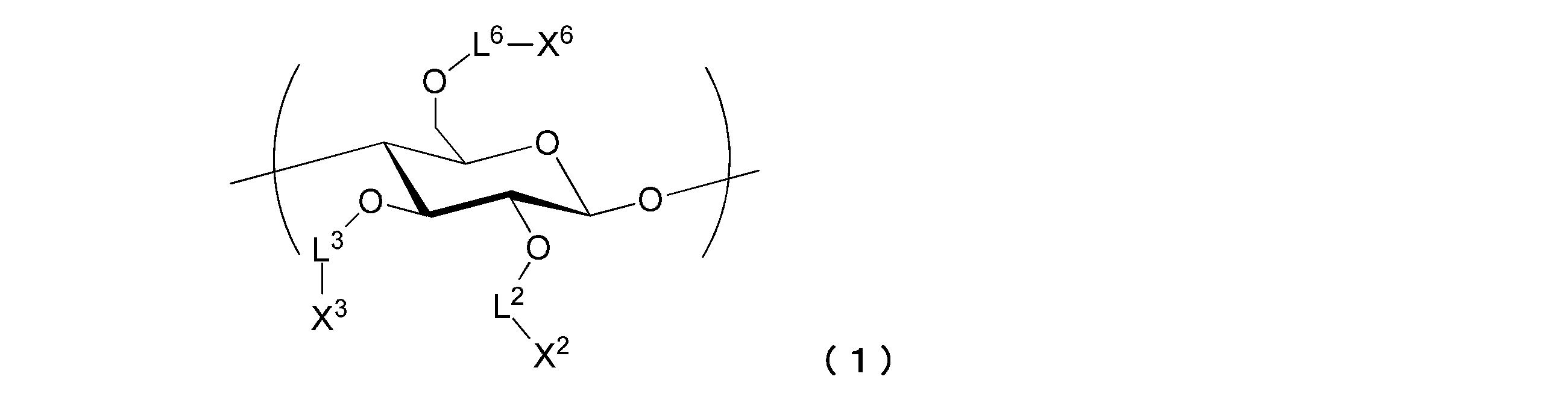
L2、L3、およびL6はそれぞれ独立に単結合または二価の連結基を表す。
X2、X3、およびX6はそれぞれ独立に水素原子、炭素数1~30の炭化水素基、または炭素数1~30のヘテロ原子を含む炭化水素基を表す。
〔3〕L2、L3、およびL6のうち少なくとも一つは二価の連結基である〔2〕に記載の全固体二次電池。
〔4〕上記L2、L3、およびL6はそれぞれ独立に単結合、カルボニル基、カルボニルオキシ基またはアミド基を表す〔2〕または〔3〕に記載の全固体二次電池。
〔5〕上記セルロースポリマーの水酸基の全置換度が0.3以上である〔1〕~〔4〕のいずれか1つに記載の全固体二次電池。
〔6〕上記無機固体電解質100質量部に対して、上記セルロースポリマーを0.1質量部以上10質量部以下で含有する〔1〕~〔5〕のいずれか1つに記載の全固体二次電池。
〔7〕上記無機固体電解質層が上記無機固体電解質と上記セルロースポリマーとを含有する層である〔1〕~〔6〕のいずれか1つに記載の全固体二次電池。
〔8〕上記負極活物質層または正極活物質層が上記無機固体電解質と上記セルロースポリマーとを含有する層である〔1〕~〔7〕のいずれか1つに記載の全固体二次電池。
〔9〕上記無機固体電解質が酸化物系の無機固体電解質である〔1〕~〔8〕のいずれか1つに記載の全固体二次電池。
〔10〕上記無機固体電解質が下記式の化合物から選ばれる〔9〕に記載の全固体二次電池。
・LixaLayaTiO3
xa=0.3~0.7、ya=0.3~0.7
・Li7La3Zr2O12
・Li3.5Zn0.25GeO4
・LiTi2P3O12、
・Li1+xh+yh(Al,Ga)xh(Ti,Ge)2-xhSiyhP3-yhO12
0≦xh≦1、0≦yh≦1
・Li3PO4
・LiPON
・LiPOD1
D1は、Ti、V、Cr、Mn、Fe、Co、Ni、Cu、
Zr、Nb、Mo、Ru、Ag、Ta、W、Pt、及びAu
から選ばれた少なくとも1種
・LiA1ON
A1は、Si、B、Ge、Al、C、Ga等から選ばれた
少なくとも1種
〔11〕周期律表第一族または第二族に属する金属のイオンの伝導性を有する無機固体電解質と下記式(1)で表されるセルロースポリマーで構成されたバインダーとを含有する固体電解質組成物。
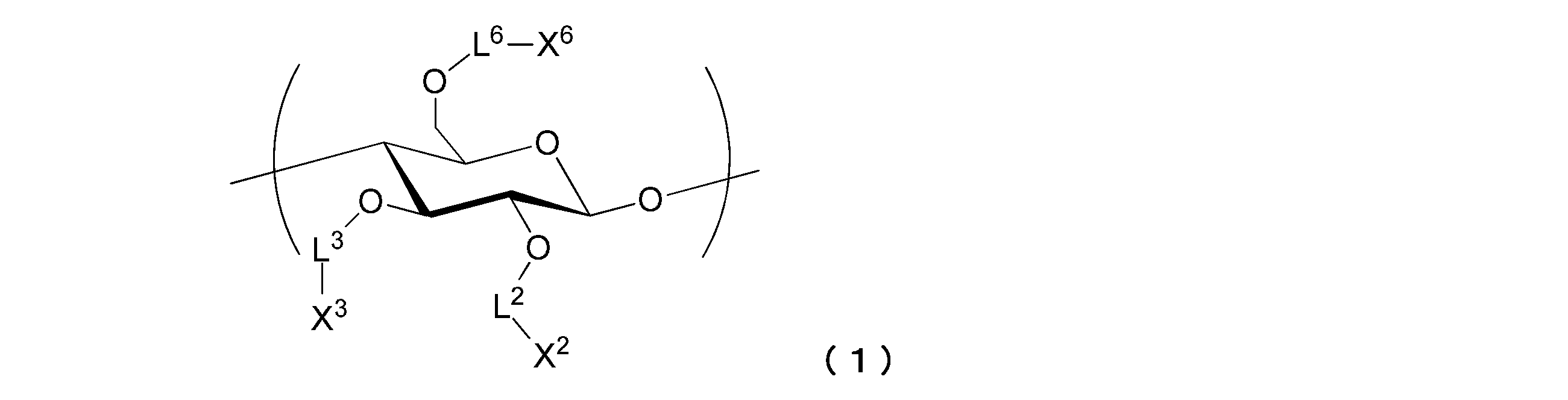
L2、L3、およびL6はそれぞれ独立に単結合または二価の連結基を表す。
X2、X3、およびX6はそれぞれ独立に水素原子、炭素数1~30の炭化水素基、または炭素数1~30のヘテロ原子を含む炭化水素基を表す。
〔12〕L2、L3、およびL6のうち少なくとも一つは二価の連結基である〔11〕に記載の固体電解質組成物。
〔13〕X2、X3、およびX6のうち少なくとも一つは炭素数3以上の炭化水素基または炭素数1~30のヘテロ原子を含む炭化水素基である〔11〕または〔12〕に記載の固体電解質組成物。
〔14〕上記L2、L3、およびL6はそれぞれ独立に単結合、カルボニル基、カルボニルオキシ基またはアミド基を表す〔11〕~〔13〕のいずれか1つに記載の固体電解質組成物。
〔15〕さらに分散媒体を含む〔11〕~〔14〕のいずれか1つに記載の固体電解質組成物。
〔16〕〔11〕~〔15〕のいずれか1つに記載の固体電解質組成物を金属箔上に製膜した電池用電極シート。
〔17〕〔11〕~〔15〕のいずれか1つに記載の固体電解質組成物を金属箔上に配置し、これを製膜する電池用電極シートの製造方法。
〔18〕〔17〕に記載の製造方法を介して、全固体二次電池を製造する全固体二次電池の製造方法。
〔1〕正極活物質層と負極活物質層と無機固体電解質層とを具備する全固体二次電池であって、上記正極活物質層、負極活物質層、および無機固体電解質層の少なくともいずれかが、周期律表第一族または第二族に属する金属のイオンの伝導性を有する無機固体電解質とセルロースポリマーとを含有する全固体二次電池。
〔2〕上記セルロースポリマーが下記式(1)で表される繰り返し単位を有する〔1〕に記載の全固体二次電池。
X2、X3、およびX6はそれぞれ独立に水素原子、炭素数1~30の炭化水素基、または炭素数1~30のヘテロ原子を含む炭化水素基を表す。
〔3〕L2、L3、およびL6のうち少なくとも一つは二価の連結基である〔2〕に記載の全固体二次電池。
〔4〕上記L2、L3、およびL6はそれぞれ独立に単結合、カルボニル基、カルボニルオキシ基またはアミド基を表す〔2〕または〔3〕に記載の全固体二次電池。
〔5〕上記セルロースポリマーの水酸基の全置換度が0.3以上である〔1〕~〔4〕のいずれか1つに記載の全固体二次電池。
〔6〕上記無機固体電解質100質量部に対して、上記セルロースポリマーを0.1質量部以上10質量部以下で含有する〔1〕~〔5〕のいずれか1つに記載の全固体二次電池。
〔7〕上記無機固体電解質層が上記無機固体電解質と上記セルロースポリマーとを含有する層である〔1〕~〔6〕のいずれか1つに記載の全固体二次電池。
〔8〕上記負極活物質層または正極活物質層が上記無機固体電解質と上記セルロースポリマーとを含有する層である〔1〕~〔7〕のいずれか1つに記載の全固体二次電池。
〔9〕上記無機固体電解質が酸化物系の無機固体電解質である〔1〕~〔8〕のいずれか1つに記載の全固体二次電池。
〔10〕上記無機固体電解質が下記式の化合物から選ばれる〔9〕に記載の全固体二次電池。
・LixaLayaTiO3
xa=0.3~0.7、ya=0.3~0.7
・Li7La3Zr2O12
・Li3.5Zn0.25GeO4
・LiTi2P3O12、
・Li1+xh+yh(Al,Ga)xh(Ti,Ge)2-xhSiyhP3-yhO12
0≦xh≦1、0≦yh≦1
・Li3PO4
・LiPON
・LiPOD1
D1は、Ti、V、Cr、Mn、Fe、Co、Ni、Cu、
Zr、Nb、Mo、Ru、Ag、Ta、W、Pt、及びAu
から選ばれた少なくとも1種
・LiA1ON
A1は、Si、B、Ge、Al、C、Ga等から選ばれた
少なくとも1種
〔11〕周期律表第一族または第二族に属する金属のイオンの伝導性を有する無機固体電解質と下記式(1)で表されるセルロースポリマーで構成されたバインダーとを含有する固体電解質組成物。
X2、X3、およびX6はそれぞれ独立に水素原子、炭素数1~30の炭化水素基、または炭素数1~30のヘテロ原子を含む炭化水素基を表す。
〔12〕L2、L3、およびL6のうち少なくとも一つは二価の連結基である〔11〕に記載の固体電解質組成物。
〔13〕X2、X3、およびX6のうち少なくとも一つは炭素数3以上の炭化水素基または炭素数1~30のヘテロ原子を含む炭化水素基である〔11〕または〔12〕に記載の固体電解質組成物。
〔14〕上記L2、L3、およびL6はそれぞれ独立に単結合、カルボニル基、カルボニルオキシ基またはアミド基を表す〔11〕~〔13〕のいずれか1つに記載の固体電解質組成物。
〔15〕さらに分散媒体を含む〔11〕~〔14〕のいずれか1つに記載の固体電解質組成物。
〔16〕〔11〕~〔15〕のいずれか1つに記載の固体電解質組成物を金属箔上に製膜した電池用電極シート。
〔17〕〔11〕~〔15〕のいずれか1つに記載の固体電解質組成物を金属箔上に配置し、これを製膜する電池用電極シートの製造方法。
〔18〕〔17〕に記載の製造方法を介して、全固体二次電池を製造する全固体二次電池の製造方法。
本明細書において、特定の符号で表示された置換基や連結基が複数あるとき、あるいは複数の置換基等(置換基数の規定も同様)を同時もしくは択一的に規定するときには、それぞれの置換基等は互いに同一でも異なっていてもよい。また、複数の置換基等が近接するときにはそれらが互いに結合したり縮合したりして環を形成していてもよい。
本発明の全固体二次電池は、活物質層と無機固体電解質層との加圧によらずに高いイオン伝導度を実現し、さらに材料の結着性に優れる。
本発明の固体電解質組成物、電池用電極シート、および製造方法によれば、上記の優れた性能を発揮する全固体二次電池を好適に製造することができる。
本発明の上記及び他の特徴及び利点は、適宜添付の図面を参照して、下記の記載からより明らかになるであろう。
本発明の固体電解質組成物、電池用電極シート、および製造方法によれば、上記の優れた性能を発揮する全固体二次電池を好適に製造することができる。
本発明の上記及び他の特徴及び利点は、適宜添付の図面を参照して、下記の記載からより明らかになるであろう。
本発明の全固体二次電池は、正極活物質層と負極活物質層と無機固体電解質層とを具備し、そのいずれかの層が、イオン伝導性無機固体電解質とセルロースポリマーとを含有する。以下、図面を参照してその好ましい実施形態について説明する。
図1は、本発明の好ましい実施形態に係る全固体二次電池(リチウムイオン二次電池)を模式化して示す断面図である。本実施形態の全固体二次電池10は、負極側からみて、負極集電体1、負極活物質層2、無機固体電解質層3、正極活物質層4、正極集電体5を、その順で有する。各層はそれぞれ接触しており、積層した構造をとっている。このような構造を採用することで、充電時には、負極側に電子(e-)が供給され、そこにリチウムイオン(Li+)が蓄積される。一方、放電時には、負極に蓄積されたリチウムイオン(Li+)が正極側に戻され、作動部位6に電子が供給される。図示した例では、作動部位6に電球を採用しており、放電によりこれが点灯するようにされている。本発明の固体電解質組成物は、上記負極活物質層、正極活物質層または無機固体電解質層の構成材料として用いることが好ましく、中でも、無機固体電解質層、正極活物質層および負極活物質層のすべての構成材料として、用いることが好ましい。なお、正極活物質層、負極活物質層を総称して「活物質層」と呼ぶことがある。また、無機固体電解質層を「固体電解質層」または「電解質層」と呼ぶことがある。
正極活物質層4、負極活物質層2の厚さは、目的とする電池容量に応じて定めることができる。一般的な素子の寸法を考慮すると、1μm以上であることが好ましく、3μm以上であることがより好ましい。上限としては、1000μm以下であることが好ましく、400μm以下であることがより好ましい。
一方、無機固体電解質層3は正負極の短絡を防止しつつ、できる限り薄いことが望ましい。さらに、本発明の効果が顕著に発現することが好ましく、具体的には、1μm以上であることが好ましく、3μmであることがより好ましい。上限としては、1000μm以下であることが好ましく、400μm以下であることがより好ましい。
図1では、上記のとおり、集電体、活物質層、および固体電解質層からなる積層体を「全固体二次電池」と称しているが、製品化する際には、この積層体を二次電池用電極シートとして、筐体(ケース)に収納して全固体二次電池(例えばコイン電池、ラミネート電池など)としてもよい。
一方、無機固体電解質層3は正負極の短絡を防止しつつ、できる限り薄いことが望ましい。さらに、本発明の効果が顕著に発現することが好ましく、具体的には、1μm以上であることが好ましく、3μmであることがより好ましい。上限としては、1000μm以下であることが好ましく、400μm以下であることがより好ましい。
図1では、上記のとおり、集電体、活物質層、および固体電解質層からなる積層体を「全固体二次電池」と称しているが、製品化する際には、この積層体を二次電池用電極シートとして、筐体(ケース)に収納して全固体二次電池(例えばコイン電池、ラミネート電池など)としてもよい。
<固体電解質組成物>
本発明の固体電解質組成物とは、無機固体電解質を含む組成物のことを言い、全固体二次電池の無機固体電解質層、正極活物質層および負極活物質層の少なくともいずれかを形成する材料として用いられる。固体電解質組成物は固体に限らず、液状やペースト状であってもよい。
(無機固体電解質)
無機固体電解質とは、無機の固体電解質のことである。本明細書において、固体電解質というときには、その内部においてイオンを移動させることができる固体状の電解質のことを意味する。この観点から、後記電解質塩(支持電解質)との区別を考慮し、無機固体電解質を、イオン伝導性無機固体電解質と呼ぶことがある。無機固体電解質のイオン伝導度は特に限定されないが、リチウムイオンにおいて、1×10⁻⁶S/cm以上であることが好ましく、1×10-5S/cm以上であることがより好ましく、1×10-4S/cm以上であることがさらに好ましく、1×10-3S/cm以上であることが特に好ましい。上限は特にないが、1S/cm以下が実際的である。イオン伝導度の測定方法は、特に断らない限り、後記実施例で測定した非加圧条件によるものとする。
本発明の固体電解質組成物とは、無機固体電解質を含む組成物のことを言い、全固体二次電池の無機固体電解質層、正極活物質層および負極活物質層の少なくともいずれかを形成する材料として用いられる。固体電解質組成物は固体に限らず、液状やペースト状であってもよい。
(無機固体電解質)
無機固体電解質とは、無機の固体電解質のことである。本明細書において、固体電解質というときには、その内部においてイオンを移動させることができる固体状の電解質のことを意味する。この観点から、後記電解質塩(支持電解質)との区別を考慮し、無機固体電解質を、イオン伝導性無機固体電解質と呼ぶことがある。無機固体電解質のイオン伝導度は特に限定されないが、リチウムイオンにおいて、1×10⁻⁶S/cm以上であることが好ましく、1×10-5S/cm以上であることがより好ましく、1×10-4S/cm以上であることがさらに好ましく、1×10-3S/cm以上であることが特に好ましい。上限は特にないが、1S/cm以下が実際的である。イオン伝導度の測定方法は、特に断らない限り、後記実施例で測定した非加圧条件によるものとする。
無機固体電解質は、高分子化合物や錯塩などの有機物を電解質としては含まないことから、有機固体電解質(PEO(ポリエチレンオキシド)などに代表される高分子電解質、LiTFSIなどに代表される有機電解質塩)とは明確に区別される。また、無機固体電解質は定常状態で非解離性の固体であるため、液中でも、カチオンおよびアニオンに解離または遊離しない。この点で、電解液やポリマー中でカチオンおよびアニオンが解離または遊離する無機電解質塩(LiPF6、LiBF4,LiFSI,LiClなど)とも明確に区別される。無機固体電解質は周期律表第一族または第二族に属する金属のイオン(好ましくはリチウムイオン)の伝導性を有する一方で、電子伝導性は有さないものが一般的である。
本発明においては、電解質層ないし活物質層に周期律表第一族または第二族に属する金属のイオン(好ましくはリチウムイオン)伝導性の無機固体電解質を含有させる。上記無機固体電解質は、この種の製品に適用される固体電解質材料を適宜選定して用いることができる。無機固体電解質は(i)硫化物系無機固体電解質(硫化物固体電解質と称することもある。)と(ii)酸化物系無機固体電解質(酸化物固体電解質と称することもある。)が代表例として挙げられる。
(i)硫化物系無機固体電解質
硫化物固体電解質は、硫黄(S)を含有し、かつ、周期律表第1族または第2族に属する金属のイオン伝導性を有し、かつ、電子絶縁性を有するものが好ましい。例えば下記式(A)で示される組成を満たすリチウムイオン伝導性無機固体電解質が挙げられる。
La1Mb1Pc1Sd1Ae1 (A)
(式中、LはLi、NaおよびKから選択される元素を示し、Liが好ましい。Mは、B、Zn、Sn、Si、Cu、Ga、Sb、Al及びGeから選択される元素を示す。なかでも、B、Sn、Si、Al、Geが好ましく、Sn、Al、Geがより好ましい。Aは、I、Br、Cl、Fを示し、I、Brが好ましく、Iが特に好ましい。a1~e1は各元素の組成比を示し、a1:b1:c1:d1:e1は1~12:0~1:1:2~12:0~5を満たす。a1はさらに、1~9が好ましく、1.5~4がより好ましい。b1は0~0.5が好ましい。d1はさらに、3~7が好ましく、3.25~4.5がより好ましい。e1はさらに、0~3が好ましく、0~1がより好ましい。)
硫化物固体電解質は、硫黄(S)を含有し、かつ、周期律表第1族または第2族に属する金属のイオン伝導性を有し、かつ、電子絶縁性を有するものが好ましい。例えば下記式(A)で示される組成を満たすリチウムイオン伝導性無機固体電解質が挙げられる。
La1Mb1Pc1Sd1Ae1 (A)
(式中、LはLi、NaおよびKから選択される元素を示し、Liが好ましい。Mは、B、Zn、Sn、Si、Cu、Ga、Sb、Al及びGeから選択される元素を示す。なかでも、B、Sn、Si、Al、Geが好ましく、Sn、Al、Geがより好ましい。Aは、I、Br、Cl、Fを示し、I、Brが好ましく、Iが特に好ましい。a1~e1は各元素の組成比を示し、a1:b1:c1:d1:e1は1~12:0~1:1:2~12:0~5を満たす。a1はさらに、1~9が好ましく、1.5~4がより好ましい。b1は0~0.5が好ましい。d1はさらに、3~7が好ましく、3.25~4.5がより好ましい。e1はさらに、0~3が好ましく、0~1がより好ましい。)
式(A)において、L、M、P、S及びAの組成比は、好ましくはb1、e1が0であり、より好ましくはb1=0、e1=0で且つa1、c1及びd1の比(a1:c1:d1)がa1:c1:d1=1~9:1:3~7であり、さらに好ましくはb1=0、e1=0で且つa1:c1:d1=1.5~4:1:3.25~4.5である。各元素の組成比は、下記するように、硫化物系固体電解質を製造する際の原料化合物の配合量を調整することにより制御できる。
硫化物系固体電解質は、非結晶(ガラス)であっても結晶化(ガラスセラミックス化)していてもよく、一部のみが結晶化していてもよい。
Li-P-S系ガラスおよびLi-P-S系ガラスセラミックスにおける、Li2SとP2S5との比率は、Li2S:P2S5のモル比で、好ましくは65:35~85:15、より好ましくは68:32~75:25である。Li2SとP2S5との比率をこの範囲にすることにより、リチウムイオン伝導度を高いものとすることができる。具体的には、リチウムイオン伝導度を好ましくは1×10⁻⁴S/cm以上、より好ましくは1×10-3S/cm以上とすることができる。上限は特にないが、1×10-1以下であることが実際的である。
具体的な化合物例としては、例えばLi2Sと、第13族~第15族の元素の硫化物とを含有する原料組成物を用いてなるものを挙げることができる。具体的には、Li2S-P2S5、Li2S-LiI-P2S5、Li2S-LiI-Li2O-P2S5、Li2S-LiBr-P2S5、Li2S-Li2O-P2S5、Li2S-Li3PO4-P2S5、Li2S-P2S5-P2O5、Li2S-P2S5-SiS2、Li2S-P2S5-SnS、Li2S-P2S5-Al2S3、Li2S-GeS2、Li2S-GeS2-ZnS、Li2S-Ga2S3、Li2S-GeS2-Ga2S3、Li2S-GeS2-P2S5、Li2S-GeS2-Sb2S5、Li2S-GeS2-Al2S3、Li2S-SiS2、Li2S-Al2S3、Li2S-SiS2-Al2S3、Li2S-SiS2-P2S5、Li2S-SiS2-P2S5-LiI、Li2S-SiS2-LiI、Li2S-SiS2-Li4SiO4、Li2S-SiS2-Li3PO4、Li10GeP2S12などが挙げられる。その中でも、Li2S-P2S5、Li2S-GeS2-Ga2S3、Li2S-LiI-P2S5、Li2S-LiI-Li2O-P2S5、Li2S-SiS2-P2S5、Li2S-SiS2-Li4SiO4、Li2S-SiS2-Li3PO4、Li2S-Li3PO4-P2S5、Li2S-GeS2-P2S5、Li10GeP2S12からなる結晶質およびまたは非晶質の原料組成物が高いリチウムイオン伝導性を有するので好ましい。このような原料組成物を用いて硫化物固体電解質材料を合成する方法としては、例えば非晶質化法を挙げることができる。非晶質化法としては、例えば、メカニカルミリング法および溶融急冷法を挙げることができ、中でもメカニカルミリング法が好ましい。常温での処理が可能になり、製造工程の簡略化を図ることができるからである。
硫化物固体電解質は、下記式(B)で表されるものがより好ましい。
LilPmSn 式(B)
式中、l~nは各元素の組成比を示し、l:m:nは2~4:1:3~10を満たす。
LilPmSn 式(B)
式中、l~nは各元素の組成比を示し、l:m:nは2~4:1:3~10を満たす。
(ii)酸化物系無機固体電解質
酸化物系固体電解質は、酸素(O)を含有し、かつ、周期律表第1族または第2族に属する金属のイオン伝導性を有し、かつ、電子絶縁性を有するものが好ましい。
酸化物系固体電解質は、酸素(O)を含有し、かつ、周期律表第1族または第2族に属する金属のイオン伝導性を有し、かつ、電子絶縁性を有するものが好ましい。
具体的な化合物例としては、例えばLixaLayaTiO3〔xa=0.3~0.7、ya=0.3~0.7〕(LLT)、LixbLaybZrzbMbb
mbOnb(MbbはAl,Mg,Ca,Sr,V,Nb,Ta,Ti,Ge,In,Snの少なくとも1種以上の元素でありxbは5≦xb≦10を満たし、ybは1≦yb≦4を満たし、zbは1≦zb≦4を満たし、mbは0≦mb≦2を満たし、nbは5≦nb≦20を満たす。)LixcBycMcc
zcOnc(MccはC,S,Al,Si,Ga,Ge,In,Snの少なくとも1種以上の元素でありxcは0≦xc≦5を満たし、ycは0≦yc≦1を満たし、zcは0≦zc≦1を満たし、ncは0≦nc≦6を満たす。)、Lixd(Al,Ga)yd(Ti,Ge)zdSiadPmdOnd(ただし、1≦xd≦3、0≦yd≦1、0≦zd≦2、0≦ad≦1、1≦md≦7、3≦nd≦13)、Li(3-2xe)Mee
xeDeeO(xeは0以上0.1以下の数を表し、Meeは2価の金属原子を表す。Deeはハロゲン原子または2種以上のハロゲン原子の組み合わせを表す。)、LixfSiyfOzf(1≦xf≦5、0<yf≦3、1≦zf≦10)、LixgSygOzg(1≦xg≦3、0<yg≦2、1≦zg≦10)、Li3BO3-Li2SO4、Li2O-B2O3-P2O5、Li2O-SiO2、Li6BaLa2Ta2O12、Li3PO(4-3/2w)Nw(wはw<1)、LISICON(Lithium super ionic conductor)型結晶構造を有するLi3.5Zn0.25GeO4、ペロブスカイト型結晶構造を有するLa0.55Li0.35TiO3、NASICON(Natrium super ionic conductor)型結晶構造を有するLiTi2P3O12、Li1+xh+yh(Al,Ga)xh(Ti,Ge)2-xhSiyhP3-yhO12(ただし、0≦xh≦1、0≦yh≦1)、ガーネット型結晶構造を有するLi7La3Zr2O12等が挙げられる。またLi、P及びOを含むリン化合物も望ましい。例えばリン酸リチウム(Li3PO4)、リン酸リチウムの酸素の一部を窒素で置換したLiPON、LiPOD1(D1は、Ti、V、Cr、Mn、Fe、Co、Ni、Cu、Zr、Nb、Mo、Ru、Ag、Ta、W、Pt、Au等から選ばれた少なくとも1種)等が挙げられる。また、LiA1ON(A1は、Si、B、Ge、Al、C、Ga等から選ばれた少なくとも1種)等も好ましく用いることができる。
その中でも、LixaLayaTiO3〔xa=0.3~0.7、ya=0.3~0.7〕(LLT)、LixbLaybZrzbMbb mbOnb(MbbはAl,Mg,Ca,Sr,V,Nb,Ta,Ti,Ge,In,Snの少なくとも1種以上の元素でありxbは5≦xb≦10を満たし、ybは1≦yb≦4を満たし、zbは1≦zb≦4を満たし、mbは0≦mb≦2を満たし、nbは5≦nb≦20を満たす。)、Li7La3Zr2O12(LLZ)、Li3BO3、Li3BO3-Li2SO4、Lixd(Al,Ga)yd(Ti,Ge)zdSiadPmdOnd(ただし、1≦xd≦3、0≦yd≦1、0≦zd≦2、0≦ad≦1、1≦md≦7、3≦nd≦13)が好ましい。これらは単独で用いてもよく、2種以上を組み合わせて用いてもよい。
その中でも、LixaLayaTiO3〔xa=0.3~0.7、ya=0.3~0.7〕(LLT)、LixbLaybZrzbMbb mbOnb(MbbはAl,Mg,Ca,Sr,V,Nb,Ta,Ti,Ge,In,Snの少なくとも1種以上の元素でありxbは5≦xb≦10を満たし、ybは1≦yb≦4を満たし、zbは1≦zb≦4を満たし、mbは0≦mb≦2を満たし、nbは5≦nb≦20を満たす。)、Li7La3Zr2O12(LLZ)、Li3BO3、Li3BO3-Li2SO4、Lixd(Al,Ga)yd(Ti,Ge)zdSiadPmdOnd(ただし、1≦xd≦3、0≦yd≦1、0≦zd≦2、0≦ad≦1、1≦md≦7、3≦nd≦13)が好ましい。これらは単独で用いてもよく、2種以上を組み合わせて用いてもよい。
リチウムイオン伝導性の酸化物系無機固体電解質としてのイオン伝導度は、1×10⁻⁶S/cm以上であることが好ましく、1×10-5S/cm以上であることがより好ましく、5×10-5S/cm以上であることが特に好ましい。
本発明においては、なかでも酸化物系の無機固体電解質を用いることが好ましい。酸化物系の無機固体電解質は総じてより硬度が高いため、全固体二次電池において界面抵抗の上昇を生じやすく、本発明を適用することにより、その対応として効果がより顕著になる。特に、酸化物系の無機固体電解質と、下記セルロースポリマーのもつ酸素含有基(エーテル基、カルボニル基、ヒドロキシル基等)とが作用し、より好適な吸着状態を形成することが想定される。この観点からも、酸化物系の無機固体電解質を用いることが特に好ましい。
上記無機固体電解質は、1種を単独で用いても、2種以上を組み合わせて用いてもよい。
上記無機固体電解質は、1種を単独で用いても、2種以上を組み合わせて用いてもよい。
無機固体電解質の平均粒子サイズは特に限定されないが、0.01μm以上であることが好ましく、0.1μm以上であることがより好ましい。上限としては、100μm以下であることが好ましく、50μm以下であることがより好ましい。
無機固体電解質の固体電解質組成物中での濃度は、電池性能と界面抵抗の低減・維持効果の両立を考慮したとき、固形成分100質量%において、50質量%以上であることが好ましく、70質量%以上であることがより好ましく、90質量%以上であることが特に好ましい。上限としては、同様の観点から、99.9質量%以下であることが好ましく、99.5質量%以下であることがより好ましく、99質量%以下であることが特に好ましい。ただし、後記正極活物質または負極活物質とともに用いるときには、その総和が上記の濃度範囲であることが好ましい。
(セルロースポリマー)
本発明においてはセルロースポリマーを上記無機固体電解質のバインダーとして用いることが好ましい。このセルロースポリマーは、下記式(1)で表される繰り返し単位を有することが好ましい。
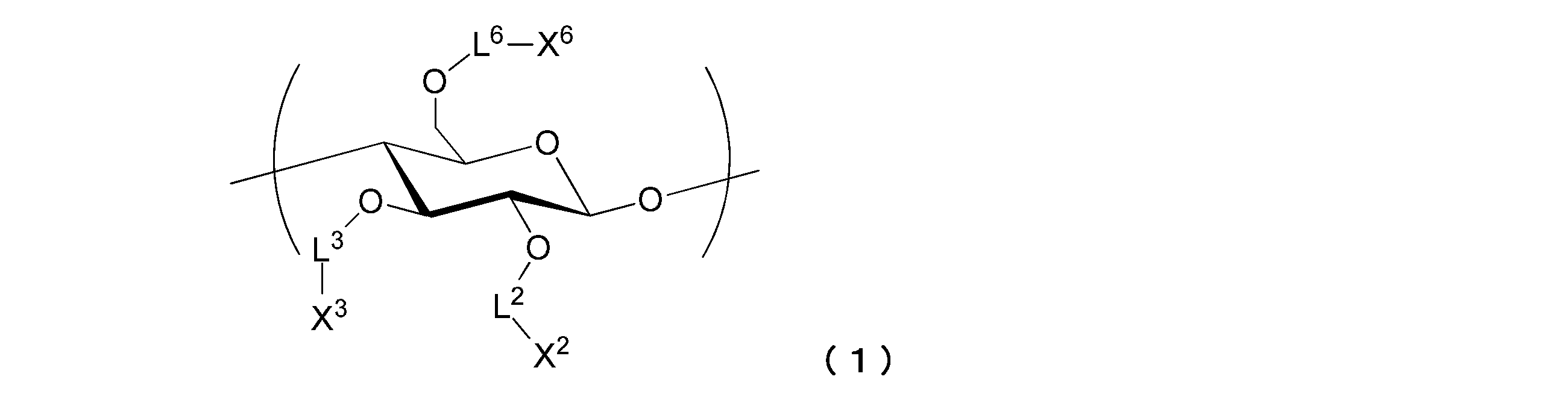
本発明においてはセルロースポリマーを上記無機固体電解質のバインダーとして用いることが好ましい。このセルロースポリマーは、下記式(1)で表される繰り返し単位を有することが好ましい。
L2、L3、およびL6はそれぞれ独立に単結合または二価の連結基を表す。二価の連結基としては、カルボニル基(-CO-)、カルボニルオキシ基(-COO-)またはアミド基(-CONRN-)、またはこれらの組合せが好ましい。なかでも、L2、L3、およびL6は、単結合またはカルボニル基、アミド基であることが好ましい。ここでRNは、ヒドロキシル基、炭素数1~6のアルキル基、炭素数6~14のアリール基、炭素数7~15のアラルキル基を表す。
本発明に係る一実施形態においては、L2、L3、およびL6のうち少なくとも一つは二価の連結基であることが好ましい。なお、連結基の表記は、左側にグルコース環、右側に置換基Xとなることが好ましい。例えば-COO-と表記したときには、グルコース環の-O-COO-Xの関係が好ましい。
本発明に係る一実施形態においては、L2、L3、およびL6のうち少なくとも一つは二価の連結基であることが好ましい。なお、連結基の表記は、左側にグルコース環、右側に置換基Xとなることが好ましい。例えば-COO-と表記したときには、グルコース環の-O-COO-Xの関係が好ましい。
X2、X3、およびX6はそれぞれ独立に水素原子、炭素数1~30の炭化水素基、または炭素数1~30のヘテロ原子を有する炭化水素基を表す。X2、X3、およびX6が炭化水素基であるとき、比較的炭素数の多い基であることが好ましい。その一実施形態においては、炭素数3~30が好ましく、3~20がより好ましい。これにより、セルロース骨格の剛直な主鎖構造に由来する高い力学特性を損なうことなく、溶媒への溶解性を付与し、かつ熱的な柔軟性を付与し、結着性を向上することが期待できる。
X2、X3、およびX6は、炭化水素基であるとき、アルキル基(好ましくは炭素数1~30、より好ましくは炭素数3~20)、アルケニル基(好ましくは炭素数2~30、より好ましくは炭素数3~20)、アルキニル基(好ましくは炭素数2~30、より好ましくは炭素数3~20)、アリール基(好ましくは炭素数6~30、より好ましくは炭素数6~22)、アラルキル基(好ましくは炭素数7~30、より好ましくは炭素数7~23)が好ましい。
X2、X3、およびX6は所望の効果を奏する範囲で後記任意の置換基Tを有していてもよい。
X2、X3、およびX6は、ヘテロ原子を有する炭化水素基であるとき、炭化水素基の水素原子がハロゲン原子に一部または全て置換されている炭化水素基(好ましくは炭素数1~30、より好ましくは炭素数3~20)、酸素原子または硫黄原子が炭素原子同士をつなぐエーテル基やチオエーテル基を有する炭化水素基(好ましくは炭素数1~30、より好ましくは炭素数3~20)が好ましい。特に好ましくは、水素原子をフッ素原子で置換したフルオロアルキル基、アルキレンオキシ基である。ハロゲン置換度は、置換可能位置をすべて置換した場合を100%として、5%以上が好ましく、10%以上がより好ましく、15%以上が特に好ましい。上限は、100%以下であれば、特に限定されない。介在する酸素ないし硫黄の数は、1~20個が好ましく、1~15個がより好ましい。
X2、X3、およびX6は所望の効果を奏する範囲で後記任意の置換基Tを有していてもよい。
上記のX2、X3、およびX6は無置換であることが好ましいが、置換基を有する場合には、吸水性を向上させないという観点から、極性基をあまり有さないことが好ましい。
X2、X3、およびX6は、炭化水素基であるとき、アルキル基(好ましくは炭素数1~30、より好ましくは炭素数3~20)、アルケニル基(好ましくは炭素数2~30、より好ましくは炭素数3~20)、アルキニル基(好ましくは炭素数2~30、より好ましくは炭素数3~20)、アリール基(好ましくは炭素数6~30、より好ましくは炭素数6~22)、アラルキル基(好ましくは炭素数7~30、より好ましくは炭素数7~23)が好ましい。
X2、X3、およびX6は所望の効果を奏する範囲で後記任意の置換基Tを有していてもよい。
X2、X3、およびX6は、ヘテロ原子を有する炭化水素基であるとき、炭化水素基の水素原子がハロゲン原子に一部または全て置換されている炭化水素基(好ましくは炭素数1~30、より好ましくは炭素数3~20)、酸素原子または硫黄原子が炭素原子同士をつなぐエーテル基やチオエーテル基を有する炭化水素基(好ましくは炭素数1~30、より好ましくは炭素数3~20)が好ましい。特に好ましくは、水素原子をフッ素原子で置換したフルオロアルキル基、アルキレンオキシ基である。ハロゲン置換度は、置換可能位置をすべて置換した場合を100%として、5%以上が好ましく、10%以上がより好ましく、15%以上が特に好ましい。上限は、100%以下であれば、特に限定されない。介在する酸素ないし硫黄の数は、1~20個が好ましく、1~15個がより好ましい。
X2、X3、およびX6は所望の効果を奏する範囲で後記任意の置換基Tを有していてもよい。
上記のX2、X3、およびX6は無置換であることが好ましいが、置換基を有する場合には、吸水性を向上させないという観点から、極性基をあまり有さないことが好ましい。
上記セルロースポリマーの水酸基の全置換度は、0.3以上であることが好ましく、1以上であることがより好ましく、1.5以上であることがさらに好ましく、2以上であることが特に好ましい。上限としては、3以下である。
ここで水酸基の全置換度は、セルロースポリマーにおいて、β-グルコース環単位当たりの置換された水酸基の平均値である。したがって、β-グルコース環の2位、3位、6位の水酸基ないしその水素原子がすべて置換された場合には、水酸基の全置換度は3となる。逆に、全く置換されていない場合には、0となる。
上記水酸基の全置換度は、特に断らない限り、後記実施例で測定した条件によるものとする。
ここで水酸基の全置換度は、セルロースポリマーにおいて、β-グルコース環単位当たりの置換された水酸基の平均値である。したがって、β-グルコース環の2位、3位、6位の水酸基ないしその水素原子がすべて置換された場合には、水酸基の全置換度は3となる。逆に、全く置換されていない場合には、0となる。
上記水酸基の全置換度は、特に断らない限り、後記実施例で測定した条件によるものとする。
上記セルロースポリマーを構成する繰り返し単位の具体例を下記に例示するが、本発明がこれに限定して解釈されるものではない。なお、下記の表は式(1)の連結基、置換基の組み合せとして示している。

ここで、連結基LA、LB、LCと表した添え字のA、B、およびCは便宜上順番に付けたのものであって、β-グルコース環の2位、3位、6位の水酸基の位置とは関係なく、β-グルコース環上の3位の水酸基をランダムに置換していることを表す。一方で、連結基LAには置換基XAが置換されていることを表す。添え字BおよびCの場合も同様である。なお、ヒドロキシル基が置換されずに残っている場合には、-L-Xが単結合及び水素原子と表記され、本明細書中ではその置換度をDSAと表す。
上記セルロースポリマーは常法により合成ないし調達することができる。
セルロースポリマーの重量平均分子量は10,000以上であることが好ましく、50,000以上であることがより好ましく、100,000以上であることが特に好ましい。上限としては、2,000,000以下であることが好ましく、1,000,000以下であることがより好ましい。なお、セルロースポリマーの重量平均分子量は、後述の実施例の項で示したポリマーの重量平均分子量の測定方法と同様の方法により測定する。
セルロースポリマーの配合量は、上記無機固体電解質(活物質を用いる場合はこれを含む)100質量部に対して、0.1質量部以上であることが好ましく、0.3質量部以上であることがより好ましく、1質量部以上であることが特に好ましい。上限としては、20質量部以下であることが好ましく、10質量部以下であることがより好ましく、5質量部以下であることが特に好ましい。
固体電解質組成物に対しては、その固形分中、セルロースポリマーが0.1質量%以上であることが好ましく、0.3質量%以上であることがより好ましく、1質量%以上であることが特に好ましい。上限としては、20質量%以下であることが好ましく、10質量%以下であることがより好ましく、5質量%以下であることが特に好ましい。セルロースポリマーを上記の範囲で用いることにより、一層効果的に無機固体電解質の固着性と界面抵抗の抑制性とを両立して実現することができる。
固体電解質組成物に対しては、その固形分中、セルロースポリマーが0.1質量%以上であることが好ましく、0.3質量%以上であることがより好ましく、1質量%以上であることが特に好ましい。上限としては、20質量%以下であることが好ましく、10質量%以下であることがより好ましく、5質量%以下であることが特に好ましい。セルロースポリマーを上記の範囲で用いることにより、一層効果的に無機固体電解質の固着性と界面抵抗の抑制性とを両立して実現することができる。
セルロースポリマーは一種を単独で用いても、複数の種類のものを組み合わせて用いてもよい。また、他のポリマーと組み合わせて用いてもよい。
なお、本明細書において化合物の表示(例えば、化合物、ポリマーなどと末尾に付して呼ぶとき)については、その化合物そのもののほか、その塩、そのイオンを含む意味に用いる。また、所望の効果を奏する範囲で、置換基を導入するなど一部を変化させた誘導体を含む意味である。
本明細書において置換・無置換を明記していない置換基(連結基についても同様)については、その基に任意の置換基を有していてもよい意味である。これは置換・無置換を明記していない化合物についても同義である。好ましい置換基としては、下記置換基Tが挙げられる。
置換基Tとしては、下記のものが挙げられる。
アルキル基(好ましくは炭素原子数1~20のアルキル基、例えばメチル、エチル、イソプロピル、t-ブチル、ペンチル、ヘプチル、1-エチルペンチル、ベンジル、2-エトキシエチル、1-カルボキシメチル等)、アルケニル基(好ましくは炭素原子数2~20のアルケニル基、例えば、ビニル、アリル、オレイル等)、アルキニル基(好ましくは炭素原子数2~20のアルキニル基、例えば、エチニル、ブタジイニル、フェニルエチニル等)、シクロアルキル基(好ましくは炭素原子数3~20のシクロアルキル基、例えば、シクロプロピル、シクロペンチル、シクロヘキシル、4-メチルシクロヘキシル等)、アリール基(好ましくは炭素原子数6~26のアリール基、例えば、フェニル、1-ナフチル、4-メトキシフェニル、2-クロロフェニル、3-メチルフェニル等)、ヘテロ環基(好ましくは炭素原子数2~20のヘテロ環基、好ましくは、少なくとも1つの酸素原子、硫黄原子、窒素原子を有する5または6員環のヘテロ環基が好ましく、例えば、2-ピリジル、4-ピリジル、2-イミダゾリル、2-ベンゾイミダゾリル、2-チアゾリル、2-オキサゾリル等)、アルコキシ基(好ましくは炭素原子数1~20のアルコキシ基、例えば、メトキシ、エトキシ、イソプロピルオキシ、ベンジルオキシ等)、アリールオキシ基(好ましくは炭素原子数6~26のアリールオキシ基、例えば、フェノキシ、1-ナフチルオキシ、3-メチルフェノキシ、4-メトキシフェノキシ等)、アルコキシカルボニル基(好ましくは炭素原子数2~20のアルコキシカルボニル基、例えば、エトキシカルボニル、2-エチルヘキシルオキシカルボニル等)、アミノ基(好ましくは炭素原子数0~20のアミノ基、アルキルアミノ基、アリールアミノ基を含み、例えば、アミノ、N,N-ジメチルアミノ、N,N-ジエチルアミノ、N-エチルアミノ、アニリノ等)、スルファモイル基(好ましくは炭素原子数0~20のスルファモイル基、例えば、N,N-ジメチルスルファモイル、N-フェニルスルファモイル等)、アシル基(好ましくは炭素原子数1~20のアシル基、例えば、アセチル、プロピオニル、ブチリル、ベンゾイル等)、アシルオキシ基(好ましくは炭素原子数1~20のアシルオキシ基、例えば、アセチルオキシ、ベンゾイルオキシ等)、カルバモイル基(好ましくは炭素原子数1~20のカルバモイル基、例えば、N,N-ジメチルカルバモイル、N-フェニルカルバモイル等)、アシルアミノ基(好ましくは炭素原子数1~20のアシルアミノ基、例えば、アセチルアミノ、ベンゾイルアミノ等)、スルホンアミド基(好ましくは炭素原子数0~20のスルファモイル基、例えば、メタンスルホンアミド、ベンゼンスルホンアミド、N-メチルメタンスルホンアミド、N-エチルベンゼンスルホンアミド等)、アルキルチオ基(好ましくは炭素原子数1~20のアルキルチオ基、例えば、メチルチオ、エチルチオ、イソプロピルチオ、ベンジルチオ等)、アリールチオ基(好ましくは炭素原子数6~26のアリールチオ基、例えば、フェニルチオ、1-ナフチルチオ、3-メチルフェニルチオ、4-メトキシフェニルチオ等)、アルキルもしくはアリールスルホニル基(好ましくは炭素原子数1~20のアルキルもしくはアリールスルホニル基、例えば、メチルスルホニル、エチルスルホニル、ベンゼンスルホニル等)、ヒドロキシル基、シアノ基、ハロゲン原子(例えばフッ素原子、塩素原子、臭素原子、ヨウ素原子等)であり、より好ましくはアルキル基、アルケニル基、アリール基、ヘテロ環基、アルコキシ基、アリールオキシ基、アルコキシカルボニル基、アミノ基、アシルアミノ基、ホスホン酸基、スルホン酸基、リン酸基、カルボキシル基、ヒドロキシル基またはハロゲン原子である。
また、これらの置換基Tで挙げた各基は、上記の置換基Tがさらに置換していてもよい。
化合物ないし置換基・連結基等がアルキル基・アルキレン基、アルケニル基・アルケニレン基、アルキニル基・アルキニレン基等を含むとき、これらは環状でも鎖状でもよく、また直鎖でも分岐していてもよく、上記のように置換されていても無置換でもよい。このとき、アルキル基・アルキレン基、アルケニル基・アルケニレン基、アルキニル基・アルキニレン基はヘテロ原子を含む基(例えば、O、S、CO、NRN(RNは、上述のRNと同義である。)等)を介在していたり、これを伴って環構造を形成していたりしてもよい。またアリール基、ヘテロ環基等を含むとき、それらは単環でも縮環でもよく、同様に置換されていても無置換でもよい。
本明細書において置換・無置換を明記していない置換基(連結基についても同様)については、その基に任意の置換基を有していてもよい意味である。これは置換・無置換を明記していない化合物についても同義である。好ましい置換基としては、下記置換基Tが挙げられる。
置換基Tとしては、下記のものが挙げられる。
アルキル基(好ましくは炭素原子数1~20のアルキル基、例えばメチル、エチル、イソプロピル、t-ブチル、ペンチル、ヘプチル、1-エチルペンチル、ベンジル、2-エトキシエチル、1-カルボキシメチル等)、アルケニル基(好ましくは炭素原子数2~20のアルケニル基、例えば、ビニル、アリル、オレイル等)、アルキニル基(好ましくは炭素原子数2~20のアルキニル基、例えば、エチニル、ブタジイニル、フェニルエチニル等)、シクロアルキル基(好ましくは炭素原子数3~20のシクロアルキル基、例えば、シクロプロピル、シクロペンチル、シクロヘキシル、4-メチルシクロヘキシル等)、アリール基(好ましくは炭素原子数6~26のアリール基、例えば、フェニル、1-ナフチル、4-メトキシフェニル、2-クロロフェニル、3-メチルフェニル等)、ヘテロ環基(好ましくは炭素原子数2~20のヘテロ環基、好ましくは、少なくとも1つの酸素原子、硫黄原子、窒素原子を有する5または6員環のヘテロ環基が好ましく、例えば、2-ピリジル、4-ピリジル、2-イミダゾリル、2-ベンゾイミダゾリル、2-チアゾリル、2-オキサゾリル等)、アルコキシ基(好ましくは炭素原子数1~20のアルコキシ基、例えば、メトキシ、エトキシ、イソプロピルオキシ、ベンジルオキシ等)、アリールオキシ基(好ましくは炭素原子数6~26のアリールオキシ基、例えば、フェノキシ、1-ナフチルオキシ、3-メチルフェノキシ、4-メトキシフェノキシ等)、アルコキシカルボニル基(好ましくは炭素原子数2~20のアルコキシカルボニル基、例えば、エトキシカルボニル、2-エチルヘキシルオキシカルボニル等)、アミノ基(好ましくは炭素原子数0~20のアミノ基、アルキルアミノ基、アリールアミノ基を含み、例えば、アミノ、N,N-ジメチルアミノ、N,N-ジエチルアミノ、N-エチルアミノ、アニリノ等)、スルファモイル基(好ましくは炭素原子数0~20のスルファモイル基、例えば、N,N-ジメチルスルファモイル、N-フェニルスルファモイル等)、アシル基(好ましくは炭素原子数1~20のアシル基、例えば、アセチル、プロピオニル、ブチリル、ベンゾイル等)、アシルオキシ基(好ましくは炭素原子数1~20のアシルオキシ基、例えば、アセチルオキシ、ベンゾイルオキシ等)、カルバモイル基(好ましくは炭素原子数1~20のカルバモイル基、例えば、N,N-ジメチルカルバモイル、N-フェニルカルバモイル等)、アシルアミノ基(好ましくは炭素原子数1~20のアシルアミノ基、例えば、アセチルアミノ、ベンゾイルアミノ等)、スルホンアミド基(好ましくは炭素原子数0~20のスルファモイル基、例えば、メタンスルホンアミド、ベンゼンスルホンアミド、N-メチルメタンスルホンアミド、N-エチルベンゼンスルホンアミド等)、アルキルチオ基(好ましくは炭素原子数1~20のアルキルチオ基、例えば、メチルチオ、エチルチオ、イソプロピルチオ、ベンジルチオ等)、アリールチオ基(好ましくは炭素原子数6~26のアリールチオ基、例えば、フェニルチオ、1-ナフチルチオ、3-メチルフェニルチオ、4-メトキシフェニルチオ等)、アルキルもしくはアリールスルホニル基(好ましくは炭素原子数1~20のアルキルもしくはアリールスルホニル基、例えば、メチルスルホニル、エチルスルホニル、ベンゼンスルホニル等)、ヒドロキシル基、シアノ基、ハロゲン原子(例えばフッ素原子、塩素原子、臭素原子、ヨウ素原子等)であり、より好ましくはアルキル基、アルケニル基、アリール基、ヘテロ環基、アルコキシ基、アリールオキシ基、アルコキシカルボニル基、アミノ基、アシルアミノ基、ホスホン酸基、スルホン酸基、リン酸基、カルボキシル基、ヒドロキシル基またはハロゲン原子である。
また、これらの置換基Tで挙げた各基は、上記の置換基Tがさらに置換していてもよい。
化合物ないし置換基・連結基等がアルキル基・アルキレン基、アルケニル基・アルケニレン基、アルキニル基・アルキニレン基等を含むとき、これらは環状でも鎖状でもよく、また直鎖でも分岐していてもよく、上記のように置換されていても無置換でもよい。このとき、アルキル基・アルキレン基、アルケニル基・アルケニレン基、アルキニル基・アルキニレン基はヘテロ原子を含む基(例えば、O、S、CO、NRN(RNは、上述のRNと同義である。)等)を介在していたり、これを伴って環構造を形成していたりしてもよい。またアリール基、ヘテロ環基等を含むとき、それらは単環でも縮環でもよく、同様に置換されていても無置換でもよい。
(電解質塩[支持電解質])
本発明に係る固体電解質組成物には電解質塩(支持電解質)を含有さてもよい。電解質塩としてはリチウム塩が好ましい。リチウム塩としては、通常この種の製品に用いられるリチウム塩が好ましく、特に制限はないが、例えば、以下に述べるものが好ましい。
本発明に係る固体電解質組成物には電解質塩(支持電解質)を含有さてもよい。電解質塩としてはリチウム塩が好ましい。リチウム塩としては、通常この種の製品に用いられるリチウム塩が好ましく、特に制限はないが、例えば、以下に述べるものが好ましい。
(L-1)無機リチウム塩:LiPF6、LiBF4、LiAsF6、LiSbF6等の無機フッ化物塩;LiClO4、LiBrO4、LiIO4等の過ハロゲン酸塩;LiAlCl4等の無機塩化物塩等。
(L-2)含フッ素有機リチウム塩:LiCF3SO3等のパーフルオロアルカンスルホン酸塩;LiN(CF3SO2)2、LiN(CF3CF2SO2)2、LiN(FSO2)2、LiN(CF3SO2)(C4F9SO2)等のパーフルオロアルカンスルホニルイミド塩;LiC(CF3SO2)3等のパーフルオロアルカンスルホニルメチド塩;Li[PF5(CF2CF2CF3)]、Li[PF4(CF2CF2CF3)2]、Li[PF3(CF2CF2CF3)3]、Li[PF5(CF2CF2CF2CF3)]、Li[PF4(CF2CF2CF2CF3)2]、Li[PF3(CF2CF2CF2CF3)3]等のフルオロアルキルフッ化リン酸塩等。
(L-3)オキサラトボレート塩:リチウムビス(オキサラト)ボレート、リチウムジフルオロオキサラトボレート等。
これらのなかで、LiPF6、LiBF4、LiAsF6、LiSbF6、LiClO4、Li(Rf1SO3)、LiN(Rf1SO2)2、LiN(FSO2)2、及びLiN(Rf1SO2)(Rf2SO2)が好ましく、LiPF6、LiBF4、LiN(Rf1SO2)2、LiN(FSO2)2、及びLiN(Rf1SO2)(Rf2SO2)などのリチウムイミド塩がさらに好ましい。ここで、Rf1、Rf2はそれぞれパーフルオロアルキル基を示す。
これらのなかで、LiPF6、LiBF4、LiAsF6、LiSbF6、LiClO4、Li(Rf1SO3)、LiN(Rf1SO2)2、LiN(FSO2)2、及びLiN(Rf1SO2)(Rf2SO2)が好ましく、LiPF6、LiBF4、LiN(Rf1SO2)2、LiN(FSO2)2、及びLiN(Rf1SO2)(Rf2SO2)などのリチウムイミド塩がさらに好ましい。ここで、Rf1、Rf2はそれぞれパーフルオロアルキル基を示す。
リチウム塩の含有量は、無機固体電解質100質量部に対して0.1質量部以上であることが好ましく、0.5質量部以上であることがより好ましい。上限としては、10質量部以下であることが好ましく、5質量部以下であることがより好ましい。
なお、電解質は、1種を単独で使用しても、2種以上を任意に組み合わせてもよい。
なお、電解質は、1種を単独で使用しても、2種以上を任意に組み合わせてもよい。
(分散媒体)
本発明に係る固体電解質組成物においては、上記の各成分を分散させる分散媒体を用いてもよい。全固体二次電池を作製する際、固体電解質組成物を均一に塗布して製膜する観点から、固体電解質組成物に分散媒体を加えてペースト状にすることが好ましい。全固体二次電池の固体電解質層を形成する際には、分散媒体は乾燥によって除去される。
分散媒体としては、例えば、水溶性または非水溶性の有機溶媒が挙げられる。具体例としては、下記のものが挙げられる。
・アルコール化合物溶媒
メチルアルコール、エチルアルコール、1-プロピルアルコール、2-プロピルアルコール、2-ブタノール、エチレングリコール、プロピレングリコール、グリセリン、1,6-ヘキサンジオール、シクロヘキサンジオール、ソルビトール、キシリトール、2-メチル-2,4-ペンタンジオール、1,3-ブタンジオール、1,4-ブタンジオールなど
・エーテル化合物溶媒(水酸基含有エーテル化合物を含む)
ジメチルエーテル、ジエチルエーテル、ジイソプロピルエーテル、ジブチルエーテル、t-ブチルメチルエーテル、シクロヘキシルメチルエーテル、アニソール、テトラヒドロフラン、アルキレングリコールアルキルエーテル(エチレングリコールモノメチルエーテル、エチレングリコールモノブチルエーテル、ジエチレングリコール、ジプロピレングリコール、プロピレングリコールモノメチルエーテル、ジエチレングリコールモノメチルエーテル、トリエチレングリコール、ポリエチレングリコール、プロピレングリコールモノメチルエーテル、ジプロピレングリコールモノメチルエーテル、トリプロピレングリコールモノメチルエーテル、ジエチレングリコールモノブチルエーテル、ジエチレングリコールモノブチルエーテル等)など
・アミド化合物溶媒
N,N-ジメチルホルムアミド、1-メチル-2-ピロリドン、2-ピロリジノン、1,3-ジメチル-2-イミダゾリジノン、2-ピロリジノン、ε-カプロラクタム、ホルムアミド、N-メチルホルムアミド、アセトアミド、N-メチルアセトアミド、N,N-ジメチルアセトアミド、N-メチルプロパンアミド、ヘキサメチルホスホリックトリアミドなど
・ケトン化合物溶媒
アセトン、メチルエチルケトン、メチルイソブチルケトン、シクロヘキサノンなど
・芳香族化合物溶媒
ベンゼン、トルエンなど
・脂肪族化合物溶媒
ヘキサン、ヘプタン、シクロヘキサン、メチルシクロヘキサン、オクタン、ペンタン、シクロペンタンなど
・ニトリル化合物溶媒
アセトニトリル
本発明に係る固体電解質組成物においては、上記の各成分を分散させる分散媒体を用いてもよい。全固体二次電池を作製する際、固体電解質組成物を均一に塗布して製膜する観点から、固体電解質組成物に分散媒体を加えてペースト状にすることが好ましい。全固体二次電池の固体電解質層を形成する際には、分散媒体は乾燥によって除去される。
分散媒体としては、例えば、水溶性または非水溶性の有機溶媒が挙げられる。具体例としては、下記のものが挙げられる。
・アルコール化合物溶媒
メチルアルコール、エチルアルコール、1-プロピルアルコール、2-プロピルアルコール、2-ブタノール、エチレングリコール、プロピレングリコール、グリセリン、1,6-ヘキサンジオール、シクロヘキサンジオール、ソルビトール、キシリトール、2-メチル-2,4-ペンタンジオール、1,3-ブタンジオール、1,4-ブタンジオールなど
・エーテル化合物溶媒(水酸基含有エーテル化合物を含む)
ジメチルエーテル、ジエチルエーテル、ジイソプロピルエーテル、ジブチルエーテル、t-ブチルメチルエーテル、シクロヘキシルメチルエーテル、アニソール、テトラヒドロフラン、アルキレングリコールアルキルエーテル(エチレングリコールモノメチルエーテル、エチレングリコールモノブチルエーテル、ジエチレングリコール、ジプロピレングリコール、プロピレングリコールモノメチルエーテル、ジエチレングリコールモノメチルエーテル、トリエチレングリコール、ポリエチレングリコール、プロピレングリコールモノメチルエーテル、ジプロピレングリコールモノメチルエーテル、トリプロピレングリコールモノメチルエーテル、ジエチレングリコールモノブチルエーテル、ジエチレングリコールモノブチルエーテル等)など
・アミド化合物溶媒
N,N-ジメチルホルムアミド、1-メチル-2-ピロリドン、2-ピロリジノン、1,3-ジメチル-2-イミダゾリジノン、2-ピロリジノン、ε-カプロラクタム、ホルムアミド、N-メチルホルムアミド、アセトアミド、N-メチルアセトアミド、N,N-ジメチルアセトアミド、N-メチルプロパンアミド、ヘキサメチルホスホリックトリアミドなど
・ケトン化合物溶媒
アセトン、メチルエチルケトン、メチルイソブチルケトン、シクロヘキサノンなど
・芳香族化合物溶媒
ベンゼン、トルエンなど
・脂肪族化合物溶媒
ヘキサン、ヘプタン、シクロヘキサン、メチルシクロヘキサン、オクタン、ペンタン、シクロペンタンなど
・ニトリル化合物溶媒
アセトニトリル
本発明においては、なかでも、エーテル化合物溶媒、ケトン化合物溶媒、芳香族化合物溶媒、脂肪族化合物溶媒を用いることが好ましい。分散媒体は常圧(1気圧)での沸点が50℃以上であることが好ましく、80℃以上であることがより好ましい。上限は220℃以下であることが好ましく、180℃以下であることがさらに好ましい。上記分散媒体は、1種を単独で用いても、2種以上を組み合わせて用いてもよい。
本発明において、固体電解質組成物における分散媒体の量は、固体電解質組成物の粘度と乾燥負荷とのバランスで任意の量とすることが出来る。一般的に、固体電解質組成物中、20~99質量%であることが好ましい。
本発明において、固体電解質組成物における分散媒体の量は、固体電解質組成物の粘度と乾燥負荷とのバランスで任意の量とすることが出来る。一般的に、固体電解質組成物中、20~99質量%であることが好ましい。
(正極活物質)
固体電解質組成物には正極活物質を含有させて、正極活物質層を形成する組成物としてもよい。それにより、正極材料用の組成物とすることができる。正極活物質には遷移金属酸化物を用いることが好ましく、中でも、遷移元素Ma(Co、Ni、Fe、Mn、Cu、Vから選択される1種以上の元素)を有することが好ましい。また、混合元素Mb(リチウム以外の金属周期律表の第1(Ia)族の元素、第2(IIa)族の元素、Al、Ga、In、Ge、Sn、Pb、Sb、Bi、Si、P、Bなど)を混合してもよい。この、遷移金属酸化物として例えば、下記式(MA)~(MC)のいずれかで表されるものを含む特定遷移金属酸化物、あるいはその他の遷移金属酸化物としてV2O5、MnO2等が挙げられる。正極活物質には、粒子状の正極活物質を用いてもよい。具体的に、可逆的にリチウムイオンを挿入・放出できる遷移金属酸化物を用いることができるが、上記特定遷移金属酸化物を用いるのが好ましい。
固体電解質組成物には正極活物質を含有させて、正極活物質層を形成する組成物としてもよい。それにより、正極材料用の組成物とすることができる。正極活物質には遷移金属酸化物を用いることが好ましく、中でも、遷移元素Ma(Co、Ni、Fe、Mn、Cu、Vから選択される1種以上の元素)を有することが好ましい。また、混合元素Mb(リチウム以外の金属周期律表の第1(Ia)族の元素、第2(IIa)族の元素、Al、Ga、In、Ge、Sn、Pb、Sb、Bi、Si、P、Bなど)を混合してもよい。この、遷移金属酸化物として例えば、下記式(MA)~(MC)のいずれかで表されるものを含む特定遷移金属酸化物、あるいはその他の遷移金属酸化物としてV2O5、MnO2等が挙げられる。正極活物質には、粒子状の正極活物質を用いてもよい。具体的に、可逆的にリチウムイオンを挿入・放出できる遷移金属酸化物を用いることができるが、上記特定遷移金属酸化物を用いるのが好ましい。
遷移金属酸化物としては、上記遷移元素Maを含む酸化物等が好適に挙げられる。このとき混合元素Mb(好ましくはAl)などを混合してもよい。混合量としては、遷移金属の量に対して0~30mol%が好ましい。Li/Maのモル比が0.3~2.2になるように混合して合成されたものが、より好ましい。
〔式(MA)で表される遷移金属酸化物(層状岩塩型構造)〕
リチウム含有遷移金属酸化物としては中でも下式で表されるものが好ましい。
LiaM1Ob ・・・ (MA)
リチウム含有遷移金属酸化物としては中でも下式で表されるものが好ましい。
LiaM1Ob ・・・ (MA)
式中、M1は上記Maと同義である。aは0~1.2(0.2~1.2が好ましい)を表し、0.6~1.1であることが好ましい。bは1~3を表し、2であることが好ましい。M1の一部は上記混合元素Mbで置換されていてもよい。上記式(MA)で表される遷移金属酸化物は典型的には層状岩塩型構造を有する。
本遷移金属酸化物は下記の各式で表されるものであることがより好ましい。
(MA-1) LigCoOk
(MA-2) LigNiOk
(MA-3) LigMnOk
(MA-4) LigCojNi1-jOk
(MA-5) LigNijMn1-jOk
(MA-6) LigCojNiiAl1-j-iOk
(MA-7) LigCojNiiMn1-j-iOk
(MA-1) LigCoOk
(MA-2) LigNiOk
(MA-3) LigMnOk
(MA-4) LigCojNi1-jOk
(MA-5) LigNijMn1-jOk
(MA-6) LigCojNiiAl1-j-iOk
(MA-7) LigCojNiiMn1-j-iOk
ここでgは上記aと同義である。jは0.1~0.9を表す。iは0~1を表す。ただし、1-j-iは0以上になる。kは上記bと同義である。上記遷移金属化合物の具体例を示すと、LiCoO2(コバルト酸リチウム[LCO])、LiNi2O2(ニッケル酸リチウム)LiNi0.85Co0.01Al0.05O2(ニッケルコバルトアルミニウム酸リチウム[NCA])、LiNi0.33Co0.33Mn0.33O2(ニッケルマンガンコバルト酸リチウム[NMC])、LiNi0.5Mn0.5O2(マンガンニッケル酸リチウム)である。
式(MA)で表される遷移金属酸化物は、一部重複するが、表記を変えて示すと、下記で表されるものも好ましい例として挙げられる。
(i)LigNixMnyCozO2(x>0.2,y>0.2,z≧0,x+y+z=1)
代表的なもの:
LigNi1/3Mn1/3Co1/3O2
LigNi1/2Mn1/2O2
(ii)LigNixCoyAlzO2(x>0.7,y>0.1,0.1>z≧0.05,x+y+z=1)
代表的なもの:
LigNi0.8Co0.15Al0.05O2
(i)LigNixMnyCozO2(x>0.2,y>0.2,z≧0,x+y+z=1)
代表的なもの:
LigNi1/3Mn1/3Co1/3O2
LigNi1/2Mn1/2O2
(ii)LigNixCoyAlzO2(x>0.7,y>0.1,0.1>z≧0.05,x+y+z=1)
代表的なもの:
LigNi0.8Co0.15Al0.05O2
〔式(MB)で表される遷移金属酸化物(スピネル型構造)〕
リチウム含有遷移金属酸化物としては中でも下記式(MB)で表されるものも好ましい。
LicM2 2Od ・・・ (MB)
リチウム含有遷移金属酸化物としては中でも下記式(MB)で表されるものも好ましい。
LicM2 2Od ・・・ (MB)
式中、M2は上記Maと同義である。cは0~2(0.2~2が好ましい)を表し、0.6~1.5であることが好ましい。dは3~5を表し、4であることが好ましい。
式(MB)で表される遷移金属酸化物は下記の各式で表されるものであることがより好ましい。
(MB-1) LimMn2On
(MB-2) LimMnpAl2-pOn
(MB-3) LimMnpNi2-pOn
(MB-1) LimMn2On
(MB-2) LimMnpAl2-pOn
(MB-3) LimMnpNi2-pOn
mはcと同義である。nはdと同義である。pは0~2を表す。上記遷移金属化合物の具体例を示すと、LiMn2O4、LiMn1.5Ni0.5O4である。
式(MB)で表される遷移金属酸化物はさらに下記で表されるものも好ましい例として挙げられる。
(a) LiCoMnO4
(b) Li2FeMn3O8
(c) Li2CuMn3O8
(d) Li2CrMn3O8
(e) Li2NiMn3O8
高容量、高出力の観点で上記のうちNiを含む電極が更に好ましい。
(a) LiCoMnO4
(b) Li2FeMn3O8
(c) Li2CuMn3O8
(d) Li2CrMn3O8
(e) Li2NiMn3O8
高容量、高出力の観点で上記のうちNiを含む電極が更に好ましい。
〔式(MC)で表される遷移金属酸化物〕
リチウム含有遷移金属酸化物としてはリチウム含有遷移金属リン酸化物を用いることも好ましく、中でも下記式(MC)で表されるものも好ましい。
LieM3(PO4)f ・・・ (MC)
リチウム含有遷移金属酸化物としてはリチウム含有遷移金属リン酸化物を用いることも好ましく、中でも下記式(MC)で表されるものも好ましい。
LieM3(PO4)f ・・・ (MC)
式中、eは0~2(0.2~2が好ましい)を表し、0.5~1.5であることが好ましい。fは1~5を表し、0.5~2であることが好ましい。
上記M3はV、Ti、Cr、Mn、Fe、Co、Ni、Cuから選択される一種以上の元素を表す。上記M3は、上記の混合元素Mbのほか、Ti、Cr、Zn、Zr、Nb等の他の金属で置換していてもよい。具体例としては、例えば、LiFePO4、Li3Fe2(PO4)3等のオリビン型リン酸鉄塩、LiFeP2O7等のピロリン酸鉄類、LiCoPO4等のリン酸コバルト類、Li3V2(PO4)3(リン酸バナジウムリチウム)等の単斜晶ナシコン型リン酸バナジウム塩が挙げられる。
なお、Liの組成を表す上記a,c,g,m,e値は、充放電により変化する値であり、典型的には、Liを含有したときの安定な状態の値で評価される。上記式(a)~(e)では特定値としてLiの組成を示しているが、これも同様に電池の動作により変化するものである。
なお、Liの組成を表す上記a,c,g,m,e値は、充放電により変化する値であり、典型的には、Liを含有したときの安定な状態の値で評価される。上記式(a)~(e)では特定値としてLiの組成を示しているが、これも同様に電池の動作により変化するものである。
正極活物質の平均粒子サイズは特に限定されないが、0.1μm~50μmが好ましい。正極活物質を所定の粒子サイズにするには、通常の粉砕機や分級機を用いればよい。焼成法によって得られた正極活物質は、水、酸性水溶液、アルカリ性水溶液、有機溶剤にて洗浄した後使用してもよい。
正極活物質の濃度は特に限定されないが、固体電解質組成物中、固形成分100質量%において、20~90質量%であることが好ましく、40~80質量%であることがより好ましい。
上記正極活物質は、1種を単独で用いても、2種以上を組み合わせて用いてもよい。
上記正極活物質は、1種を単独で用いても、2種以上を組み合わせて用いてもよい。
(負極活物質)
固体電解質組成物には負極活物質を含有させて、負極活物質層の形成用組成物としてもよい。それにより、負極材料用の組成物とすることができる。負極活物質としては、可逆的にリチウムイオンを挿入・放出できるものが好ましい。その材料は、特に制限はなく、炭素質材料、酸化錫や酸化ケイ素等の金属酸化物、金属複合酸化物、リチウム単体やリチウムアルミニウム合金等のリチウム合金、及び、SnやSi等のリチウムと合金形成可能な金属等が挙げられる。なかでも炭素質材料又はリチウム複合酸化物が信頼性の点から好ましく用いられる。また、金属複合酸化物としては、リチウムを吸蔵、放出可能であることが好ましい。その材料は、特には制限されないが、構成成分としてチタン及び/又はリチウムを含有していることが、高電流密度充放電特性の観点で好ましい。
固体電解質組成物には負極活物質を含有させて、負極活物質層の形成用組成物としてもよい。それにより、負極材料用の組成物とすることができる。負極活物質としては、可逆的にリチウムイオンを挿入・放出できるものが好ましい。その材料は、特に制限はなく、炭素質材料、酸化錫や酸化ケイ素等の金属酸化物、金属複合酸化物、リチウム単体やリチウムアルミニウム合金等のリチウム合金、及び、SnやSi等のリチウムと合金形成可能な金属等が挙げられる。なかでも炭素質材料又はリチウム複合酸化物が信頼性の点から好ましく用いられる。また、金属複合酸化物としては、リチウムを吸蔵、放出可能であることが好ましい。その材料は、特には制限されないが、構成成分としてチタン及び/又はリチウムを含有していることが、高電流密度充放電特性の観点で好ましい。
負極活物質として用いられる炭素質材料とは、実質的に炭素からなる材料である。例えば、石油ピッチ、天然黒鉛、気相成長黒鉛等の人造黒鉛、及びPAN系の樹脂やフルフリルアルコール樹脂等の各種の合成樹脂を焼成した炭素質材料を挙げることができる。さらに、PAN系炭素繊維、セルロース系炭素繊維、ピッチ系炭素繊維、気相成長炭素繊維、脱水PVA系炭素繊維、リグニン炭素繊維、ガラス状炭素繊維、活性炭素繊維等の各種炭素繊維類、メソフェーズ微小球体、グラファイトウィスカー、平板状の黒鉛等を挙げることもできる。
これらの炭素質材料は、黒鉛化の程度により難黒鉛化炭素材料と黒鉛系炭素材料に分けることもできる。また炭素質材料は、特開昭62-22066号公報、特開平2-6856号公報、同3-45473号公報に記載される面間隔や密度、結晶子の大きさを有することが好ましい。炭素質材料は、単一の材料である必要はなく、特開平5-90844号公報記載の天然黒鉛と人造黒鉛の混合物、特開平6-4516号公報記載の被覆層を有する黒鉛等を用いることもできる。
負極活物質として適用される金属酸化物及び金属複合酸化物としては、特に非晶質酸化物が好ましく、さらに金属元素と周期律表第16族の元素との反応生成物であるカルコゲナイトも好ましく用いられる。ここでいう非晶質とは、CuKα線を用いたX線回折法で、2θ値で20°~40°の領域に頂点を有するブロードな散乱帯を有するものを意味し、結晶性の回折線を有してもよい。2θ値で40°以上70°以下に見られる結晶性の回折線の内最も強い強度が、2θ値で20°以上40°以下に見られるブロードな散乱帯の頂点の回折線強度の100倍以下であるのが好ましく、5倍以下であるのがより好ましく、結晶性の回折線を有さないことが特に好ましい。
上記非晶質酸化物及びカルコゲナイドからなる化合物群のなかでも、半金属元素の非晶質酸化物、及びカルコゲナイドがより好ましく、周期律表第13(IIIB)族~15(VB)族の元素、Al、Ga、Si、Sn、Ge、Pb、Sb、Biの一種単独あるいはそれらの2種以上の組み合わせからなる酸化物、及びカルコゲナイドが特に好ましい。好ましい非晶質酸化物及びカルコゲナイドの具体例としては、例えば、Ga2O3、SiO、GeO、SnO、SnO2、PbO、PbO2、Pb2O3、Pb2O4、Pb3O4、Sb2O3、Sb2O4、Sb2O5、Bi2O3、Bi2O4、SnSiO3、GeS、SnS、SnS2、PbS、PbS2、Sb2S3、Sb2S5、SnSiS3などが好ましく挙げられる。また、これらは、酸化リチウムとの複合酸化物、例えば、Li2SnO2であってもよい。
負極活物質の平均粒子サイズは、0.1μm~60μmが好ましい。所定の粒子サイズにするには、粉砕機や分級機が用いられる。例えば、乳鉢、ボールミル、サンドミル、振動ボールミル、衛星ボールミル、遊星ボールミル、旋回気流型ジェットミルや篩などが好適に用いられる。粉砕時には水、あるいはメタノール等の有機溶媒を共存させた湿式粉砕も必要に応じて行うことができる。所望の粒径とするためには分級を行うことが好ましい。分級方法としては特に限定はなく、篩、風力分級機などを必要に応じて用いることができる。分級は乾式、湿式ともに用いることができる。
上記焼成法により得られた化合物の化学式は、測定方法として誘導結合プラズマ(ICP)発光分光分析法、簡便法として、焼成前後の粉体の質量差から算出できる。
Sn、Si、Geを中心とする非晶質酸化物負極活物質に併せて用いることができる負極活物質としては、リチウムイオン又はリチウム金属を吸蔵・放出できる炭素材料や、リチウム、リチウム合金、リチウムと合金可能な金属が好適に挙げられる。
負極活物質はチタン原子を含有することが好ましい。より具体的にはLi4Ti5O12がリチウムイオンの吸蔵放出時の体積変動が小さいことから急速充放電特性に優れ、電極の劣化が抑制されリチウムイオン二次電池の寿命向上が可能となる点で好ましい。
本発明の全固体二次電池においては、Si元素を含有する負極活物質を適用することも好ましい。一般的にSi負極は、現行の炭素負極(黒鉛、アセチレンブラックなど)に比べて、より多くのLiイオンを吸蔵できる。すなわち、重量あたりのLiイオン吸蔵量が増加するため、電池容量を大きくすることができる。その結果、バッテリー駆動時間を長くすることができるという利点があり、車用のバッテリー等への使用が今後期待されている。一方で、Liイオンの吸蔵、放出に伴う体積変化が大きいことが知られており、一例では、炭素負極で体積膨張が1.2~1.5倍程度のところ、Si負極では約3倍になる例もある。この膨張収縮を繰り返すこと(充放電を繰り返すこと)によって、電極層の耐久性が不足し、例えば接触不足を起こしやすくなったり、サイクル寿命(電池寿命)が短くなったりすることも挙げられる。
本発明に係る固体電解質組成物によれば、このような膨張・収縮が大きくなる電極層においてもその高い耐久性(強度)を発揮し、より効果的にその優れた利点を発揮しうるものである。
本発明に係る固体電解質組成物によれば、このような膨張・収縮が大きくなる電極層においてもその高い耐久性(強度)を発揮し、より効果的にその優れた利点を発揮しうるものである。
負極活物質の濃度は特に限定されないが、固体電解質組成物中、固形成分100質量%において、10~80質量%であることが好ましく、20~70質量%であることがより好ましい。
なお、上記の実施形態では、特定の固体電解質組成物に正極活物質ないし負極活物質を含有させる例を考慮して説明したが、本発明はこれにより限定して解釈されるものではない。例えば、上記セルロースポリマーを含まない組成物として正極活物質ないし負極活物質を含むペーストを調製してもよい。このとき、上記の無機固体電解質を含有させることが好ましい。このような、常用される正極材料ないし負極材料と組み合わせて、上記本発明の好ましい実施形態に係る固体電解質組成物を用い無機固体電解質層を形成してもよい。また、正極および負極の活物質層には、適宜必要に応じて導電助剤を含有させてもよい。一般的な電子伝導性材料として、黒鉛、カーボンブラック、アセチレンブラック、ケッチェンブラック、カーボンナノチューブなどの炭素繊維や金属粉、金属繊維、ポリフェニレン誘導体などを含ませることができる。
上記負極活物質は、1種を単独で用いても、2種以上を組み合わせて用いてもよい。
上記負極活物質は、1種を単独で用いても、2種以上を組み合わせて用いてもよい。
<集電体(金属箔)>
正・負極の集電体としては、化学変化を起こさない電子伝導体が用いられることが好ましい。正極の集電体としては、アルミニウム、ステンレス鋼、ニッケル、チタンなどの他にアルミニウムやステンレス鋼の表面にカーボン、ニッケル、チタンあるいは銀を処理させたものが好ましく、その中でも、アルミニウム、アルミニウム合金がより好ましい。負極の集電体としては、アルミニウム、銅、ステンレス鋼、ニッケル、チタンが好ましく、アルミニウム、銅、銅合金がより好ましい。
正・負極の集電体としては、化学変化を起こさない電子伝導体が用いられることが好ましい。正極の集電体としては、アルミニウム、ステンレス鋼、ニッケル、チタンなどの他にアルミニウムやステンレス鋼の表面にカーボン、ニッケル、チタンあるいは銀を処理させたものが好ましく、その中でも、アルミニウム、アルミニウム合金がより好ましい。負極の集電体としては、アルミニウム、銅、ステンレス鋼、ニッケル、チタンが好ましく、アルミニウム、銅、銅合金がより好ましい。
上記集電体の形状としては、通常フィルムシート状のものが使用されるが、ネット、パンチされたもの、ラス体、多孔質体、発泡体、繊維群の成形体なども用いることができる。上記集電体の厚みとしては、特に限定されないが、1μm~500μmが好ましい。また、集電体表面は、表面処理により凹凸を付けることも好ましい。
<全固体二次電池の作製>
全固体二次電池の作製は常法によればよい。具体的には、上記固体電解質組成物を集電体となる金属箔上に塗布し、塗膜を形成した電池用電極シートとする方法が挙げられる。例えば、正極集電体である金属箔上に正極材料となる組成物を塗布後、乾燥し、正極層を形成する。次いでその電池用正極シート上に、固体電解質組成物を塗布後、乾燥し、固体電解質層を形成する。さらに、その上に、負極材料となる組成物を塗布後、乾燥し、負極層を形成する。その上に、負極側の集電体(金属箔)を重ねることで、正極層と負極層の間に、固体電解質層が挟まれた全固体二次電池の構造を得ることができる。なお、上記の各組成物の塗布方法は常法によればよい。このとき、正極活物質層をなす組成物、無機固体電解質層をなす組成物(固体電解質組成物)、及び負極活物質層をなす組成物のそれぞれの塗布の後に、乾燥処理を施しても良いし、重層塗布した後に乾燥処理をしても良い。乾燥温度は特に限定されないが、30℃以上が好ましく、60℃以上がより好ましい。上限は、300℃以下が好ましく、250℃以下がより好ましい。このような温度範囲で加熱することで、分散媒体を除去し、固体状態とさせることができる。これにより、全固体二次電池において、良好な結着性と非加圧でのイオン伝導性を得ることができる。
全固体二次電池の作製は常法によればよい。具体的には、上記固体電解質組成物を集電体となる金属箔上に塗布し、塗膜を形成した電池用電極シートとする方法が挙げられる。例えば、正極集電体である金属箔上に正極材料となる組成物を塗布後、乾燥し、正極層を形成する。次いでその電池用正極シート上に、固体電解質組成物を塗布後、乾燥し、固体電解質層を形成する。さらに、その上に、負極材料となる組成物を塗布後、乾燥し、負極層を形成する。その上に、負極側の集電体(金属箔)を重ねることで、正極層と負極層の間に、固体電解質層が挟まれた全固体二次電池の構造を得ることができる。なお、上記の各組成物の塗布方法は常法によればよい。このとき、正極活物質層をなす組成物、無機固体電解質層をなす組成物(固体電解質組成物)、及び負極活物質層をなす組成物のそれぞれの塗布の後に、乾燥処理を施しても良いし、重層塗布した後に乾燥処理をしても良い。乾燥温度は特に限定されないが、30℃以上が好ましく、60℃以上がより好ましい。上限は、300℃以下が好ましく、250℃以下がより好ましい。このような温度範囲で加熱することで、分散媒体を除去し、固体状態とさせることができる。これにより、全固体二次電池において、良好な結着性と非加圧でのイオン伝導性を得ることができる。
<全固体二次電池の用途>
本発明に係る全固体二次電池は種々の用途に適用することができる。適用態様は特に限定されないが、例えば、電子機器に搭載する場合、ノートパソコン、ペン入力パソコン、モバイルパソコン、電子ブックプレーヤー、携帯電話、コードレスフォン子機、ページャー、ハンディーターミナル、携帯ファックス、携帯コピー、携帯プリンター、ヘッドフォンステレオ、ビデオムービー、液晶テレビ、ハンディークリーナー、ポータブルCD、ミニディスク、電気シェーバー、トランシーバー、電子手帳、電卓、メモリーカード、携帯テープレコーダー、ラジオ、バックアップ電源、メモリーカードなどが挙げられる。その他民生用として、自動車、電動車両、モーター、照明器具、玩具、ゲーム機器、ロードコンディショナー、時計、ストロボ、カメラ、医療機器(ペースメーカー、補聴器、肩もみ機など)などが挙げられる。更に、各種軍需用、宇宙用として用いることができる。また、太陽電池と組み合わせることもできる。
本発明に係る全固体二次電池は種々の用途に適用することができる。適用態様は特に限定されないが、例えば、電子機器に搭載する場合、ノートパソコン、ペン入力パソコン、モバイルパソコン、電子ブックプレーヤー、携帯電話、コードレスフォン子機、ページャー、ハンディーターミナル、携帯ファックス、携帯コピー、携帯プリンター、ヘッドフォンステレオ、ビデオムービー、液晶テレビ、ハンディークリーナー、ポータブルCD、ミニディスク、電気シェーバー、トランシーバー、電子手帳、電卓、メモリーカード、携帯テープレコーダー、ラジオ、バックアップ電源、メモリーカードなどが挙げられる。その他民生用として、自動車、電動車両、モーター、照明器具、玩具、ゲーム機器、ロードコンディショナー、時計、ストロボ、カメラ、医療機器(ペースメーカー、補聴器、肩もみ機など)などが挙げられる。更に、各種軍需用、宇宙用として用いることができる。また、太陽電池と組み合わせることもできる。
なかでも、高容量且つ高レート放電特性が要求されるアプリケーションに適用されることが好ましい。例えば、今後大容量化が予想される蓄電設備等においては高い信頼性が必須となりさらに電池性能の両立が要求される。また、電気自動車などは高容量の二次電池を搭載し、家庭で日々充電が行われる用途が想定され、過充電時に対して一層の信頼性が求められる。本発明によれば、このような使用形態に好適に対応してその優れた効果を発揮することができる。
本発明の好ましい実施形態によれば、以下のような各応用形態が導かれる。
・周期律表第一族または第二族に属する金属のイオンの挿入放出が可能な活物質を含んでいる固体電解質組成物(正極または負極の電極用組成物)。
・上記固体電解質組成物を金属箔上に製膜した電池用電極シート。
・正極活物質層と負極活物質層と無機固体電解質層とを具備する全固体二次電池であって、上記正極活物質層、負極活物質層、および無機固体電解質層の少なくともいずれかを上記固体電解質組成物で構成した層とした全固体二次電池。
・上記固体電解質組成物を金属箔上に配置し、これを製膜する電池用電極シートの製造方法。
・上記電池用電極シートの製造方法を介して、全固体二次電池を製造する全固体二次電池の製造方法。
・周期律表第一族または第二族に属する金属のイオンの挿入放出が可能な活物質を含んでいる固体電解質組成物(正極または負極の電極用組成物)。
・上記固体電解質組成物を金属箔上に製膜した電池用電極シート。
・正極活物質層と負極活物質層と無機固体電解質層とを具備する全固体二次電池であって、上記正極活物質層、負極活物質層、および無機固体電解質層の少なくともいずれかを上記固体電解質組成物で構成した層とした全固体二次電池。
・上記固体電解質組成物を金属箔上に配置し、これを製膜する電池用電極シートの製造方法。
・上記電池用電極シートの製造方法を介して、全固体二次電池を製造する全固体二次電池の製造方法。
全固体二次電池とは、正極、負極、電解質がともに固体で構成された二次電池を言う。換言すれば、電解質としてカーボネート系の溶媒を用いるような電解液型の二次電池とは区別される。このなかで、本発明は無機全固体二次電池を前提とする。全固体二次電池には、電解質としてポリエチレンオキサイド等の高分子化合物を用いる有機(高分子)全固体二次電池と、上記のLLTやLLZ等を用いる無機全固体二次電池とに区分される。なお、無機全固体二次電池に高分子化合物を適用することは妨げられず、正極活物質、負極活物質、無機固体電解質粒子のバインダーとして高分子化合物を適用することができる。
無機固体電解質とは、上述した高分子化合物をイオン伝導媒体とする電解質(高分子電解質)とは区別されるものであり、無機化合物がイオン伝導媒体となるものである。具体例としては、上記のLLTやLLZが挙げられる。無機固体電解質は、それ自体が陽イオン(Liイオン)を放出するものではなく、イオンの輸送機能を示すものである。これに対して、電解液ないし固体電解質層に添加して陽イオン(Liイオン)を放出するイオンの供給源となる材料を電解質と呼ぶことがあるが、上記のイオン輸送材料としての電解質と区別するときにはこれを「電解質塩」または「支持電解質」と呼ぶ。電解質塩としては例えばLiTFSI(リチウムビストリフルオロメタンスルホンイミド)が挙げられる。
本発明において「組成物」というときには、2種以上の成分が均一に混合された混合物を意味する。ただし、実質的に均一性が維持されていればよく、所望の効果を奏する範囲で、一部において凝集や偏在が生じていてもよい。
無機固体電解質とは、上述した高分子化合物をイオン伝導媒体とする電解質(高分子電解質)とは区別されるものであり、無機化合物がイオン伝導媒体となるものである。具体例としては、上記のLLTやLLZが挙げられる。無機固体電解質は、それ自体が陽イオン(Liイオン)を放出するものではなく、イオンの輸送機能を示すものである。これに対して、電解液ないし固体電解質層に添加して陽イオン(Liイオン)を放出するイオンの供給源となる材料を電解質と呼ぶことがあるが、上記のイオン輸送材料としての電解質と区別するときにはこれを「電解質塩」または「支持電解質」と呼ぶ。電解質塩としては例えばLiTFSI(リチウムビストリフルオロメタンスルホンイミド)が挙げられる。
本発明において「組成物」というときには、2種以上の成分が均一に混合された混合物を意味する。ただし、実質的に均一性が維持されていればよく、所望の効果を奏する範囲で、一部において凝集や偏在が生じていてもよい。
以下に本発明について実施例に基づきさらに詳細に説明するが、本発明がこれにより限定して解釈されるものではない。なお、配合量や濃度の表示において部、%としたときには、特に断らない限り、質量基準によるものとする。
<セルロースポリマー(B)の合成例>
合成例1:ブチルセルロース(P-1)の合成
還流冷却器、メカニカルスターラー、温度計、滴下ロートを付した5000mL三口フラスコに、セルロース(日本製紙株式会社製:KCフロックW400)80.0g、ジメチルアセトアミド1800mLを添加し、120℃で2時間攪拌した後、リチウムクロライド150.0gを添加し、さらに1時間攪拌を続けた。反応液を室温まで戻した後、粉末水酸化ナトリウム100gを添加し、60℃で1時間攪拌した。反応液を水浴上で冷却しながら、ヨウ化ブチル80mLをゆっくりと滴下し、さらに50℃で3時間攪拌した。反応後、室温に戻し、反応溶液をメタノール12Lへ激しく攪拌しながら投入し、白色固体を析出させた。白色固体を吸引ろ過によりろ別した後、大量のイソプロパノールで3回洗浄をおこなった。得られた白色固体を100℃で6時間減圧乾燥をおこない、目的とするP-1を92.0g得た。重量平均分子量150,000であった。
<セルロースポリマー(B)の合成例>
合成例1:ブチルセルロース(P-1)の合成
還流冷却器、メカニカルスターラー、温度計、滴下ロートを付した5000mL三口フラスコに、セルロース(日本製紙株式会社製:KCフロックW400)80.0g、ジメチルアセトアミド1800mLを添加し、120℃で2時間攪拌した後、リチウムクロライド150.0gを添加し、さらに1時間攪拌を続けた。反応液を室温まで戻した後、粉末水酸化ナトリウム100gを添加し、60℃で1時間攪拌した。反応液を水浴上で冷却しながら、ヨウ化ブチル80mLをゆっくりと滴下し、さらに50℃で3時間攪拌した。反応後、室温に戻し、反応溶液をメタノール12Lへ激しく攪拌しながら投入し、白色固体を析出させた。白色固体を吸引ろ過によりろ別した後、大量のイソプロパノールで3回洗浄をおこなった。得られた白色固体を100℃で6時間減圧乾燥をおこない、目的とするP-1を92.0g得た。重量平均分子量150,000であった。
合成例2:メチルブチルセルロース(P-2)の合成
還流冷却器、メカニカルスターラー、温度計、滴下ロートを付した5000mL三口フラスコに、メチルセルロース(和光純薬工業株式会社製:メチル置換度1.8)80.0g、ジメチルアセトアミド2000mLを添加し、室温で攪拌した後、粉末水酸化ナトリウム100gを添加し、60℃で1時間攪拌した。反応液を水浴上で冷却しながら、ヨウ化ブチル80mLをゆっくりと滴下し、さらに50℃で3時間攪拌した。反応後、室温に戻し、反応溶液をメタノール12Lへ激しく攪拌しながら投入し、白色固体を析出させた。白色固体を吸引ろ過によりろ別した後、大量のイソプロパノールで3回洗浄をおこなった。得られた白色固体を100℃で6時間減圧乾燥をおこない、目的とするP-2を84.0g得た。重量平均分子量399,000であった。
還流冷却器、メカニカルスターラー、温度計、滴下ロートを付した5000mL三口フラスコに、メチルセルロース(和光純薬工業株式会社製:メチル置換度1.8)80.0g、ジメチルアセトアミド2000mLを添加し、室温で攪拌した後、粉末水酸化ナトリウム100gを添加し、60℃で1時間攪拌した。反応液を水浴上で冷却しながら、ヨウ化ブチル80mLをゆっくりと滴下し、さらに50℃で3時間攪拌した。反応後、室温に戻し、反応溶液をメタノール12Lへ激しく攪拌しながら投入し、白色固体を析出させた。白色固体を吸引ろ過によりろ別した後、大量のイソプロパノールで3回洗浄をおこなった。得られた白色固体を100℃で6時間減圧乾燥をおこない、目的とするP-2を84.0g得た。重量平均分子量399,000であった。
合成例3:メチルオクチルセルロース(P-3)の合成
合成例2において、ヨウ化ブチルをヨウ化オクチルに変更した以外は同様にして、目的とするP-3を86.0g得た。重量平均分子量425,000であった。
合成例2において、ヨウ化ブチルをヨウ化オクチルに変更した以外は同様にして、目的とするP-3を86.0g得た。重量平均分子量425,000であった。
合成例4:メチルステアリルセルロース(P-4)の合成
合成例2において、ヨウ化ブチルをヨウ化ステアリルに変更した以外は同様にして、目的とするP-4を90.0g得た。重量平均分子量463,000であった。
合成例2において、ヨウ化ブチルをヨウ化ステアリルに変更した以外は同様にして、目的とするP-4を90.0g得た。重量平均分子量463,000であった。
合成例5:メチルフェニルセルロース(P-5)の合成
合成例2において、ヨウ化ブチルをヨードベンゼンに変更した以外は同様にして、目的とするP-5を84.0g得た。重量平均分子量444,000であった。
合成例2において、ヨウ化ブチルをヨードベンゼンに変更した以外は同様にして、目的とするP-5を84.0g得た。重量平均分子量444,000であった。
合成例6:セルロースオクチレート(P-6)の合成
還流冷却器、メカニカルスターラー、温度計、滴下ロートを付した5000mL三口フラスコに、セルロース(日本製紙株式会社製:KCフロックW400)80.0g、ジメチルアセトアミド1800mLを添加し、120℃で2時間攪拌した後、リチウムクロライド150.0gを添加し、さらに1時間攪拌を続けた。反応液を室温まで戻した後、ピリジン370mLを添加し、反応液を水浴上で冷却しながら、n-オクタノイルクロリド320mLをゆっくりと滴下し、さらに室温で5時間攪拌した。反応後、室温に戻し、反応溶液をメタノール10Lへ激しく攪拌しながら投入し、白色固体を析出させた。白色固体を吸引ろ過によりろ別した後、大量のイソプロパノールで3回洗浄をおこなった。得られた白色固体を100℃で6時間減圧乾燥をおこない、目的とするP-6を120.0g得た。重量平均分子量182,000であった。
還流冷却器、メカニカルスターラー、温度計、滴下ロートを付した5000mL三口フラスコに、セルロース(日本製紙株式会社製:KCフロックW400)80.0g、ジメチルアセトアミド1800mLを添加し、120℃で2時間攪拌した後、リチウムクロライド150.0gを添加し、さらに1時間攪拌を続けた。反応液を室温まで戻した後、ピリジン370mLを添加し、反応液を水浴上で冷却しながら、n-オクタノイルクロリド320mLをゆっくりと滴下し、さらに室温で5時間攪拌した。反応後、室温に戻し、反応溶液をメタノール10Lへ激しく攪拌しながら投入し、白色固体を析出させた。白色固体を吸引ろ過によりろ別した後、大量のイソプロパノールで3回洗浄をおこなった。得られた白色固体を100℃で6時間減圧乾燥をおこない、目的とするP-6を120.0g得た。重量平均分子量182,000であった。
合成例7:メチルセルロースブタノエート(P-7)の合成
還流冷却器、メカニカルスターラー、温度計、滴下ロートを付した5000mL三口フラスコに、メチルセルロース(和光純薬工業株式会社製:メチル置換度1.8)80.0g、メチレンクロリド1000mL、ピリジン1000mLを添加し、室温で攪拌した後、無水酪酸1000mLをゆっくりと滴下し、さらにジメチルアミノピリジン(DMAP)0.2gを加えた後、3時間加熱還流した。反応後、室温に戻し、氷浴上で、メタノール200mLを加えて、クエンチした。反応溶液をメタノール/水(10L/10L)へ激しく攪拌しながら投入し、白色固体を析出させた。白色固体を吸引ろ過によりろ別した後、大量の水で3回洗浄をおこなった。得られた白色固体を100℃で6時間減圧乾燥をおこない、目的とするP-7を78.0g得た。重量平均分子量582,000であった。
還流冷却器、メカニカルスターラー、温度計、滴下ロートを付した5000mL三口フラスコに、メチルセルロース(和光純薬工業株式会社製:メチル置換度1.8)80.0g、メチレンクロリド1000mL、ピリジン1000mLを添加し、室温で攪拌した後、無水酪酸1000mLをゆっくりと滴下し、さらにジメチルアミノピリジン(DMAP)0.2gを加えた後、3時間加熱還流した。反応後、室温に戻し、氷浴上で、メタノール200mLを加えて、クエンチした。反応溶液をメタノール/水(10L/10L)へ激しく攪拌しながら投入し、白色固体を析出させた。白色固体を吸引ろ過によりろ別した後、大量の水で3回洗浄をおこなった。得られた白色固体を100℃で6時間減圧乾燥をおこない、目的とするP-7を78.0g得た。重量平均分子量582,000であった。
合成例8:メチルセルロースオクタノエート(P-8)の合成
還流冷却器、メカニカルスターラー、温度計、滴下ロートを付した5000mL三口フラスコに、メチルセルロース(和光純薬工業株式会社製:メチル置換度1.8)80.0g、ピリジン1500mLを添加し、室温で攪拌した後、ここに氷冷下、n-オクタノイルクロリド160mLをゆっくりと滴下し、60℃で6時間攪拌した。反応後、室温に戻し、氷浴上で、メタノール200mLを加えて、クエンチした。反応溶液を水12Lへ激しく攪拌しながら投入し、白色固体を析出させた。白色固体を吸引ろ過によりろ別した後、大量のメタノールで3回洗浄をおこなった。得られた白色固体を100℃で6時間減圧乾燥をおこない、目的とするP-8を93.0g得た。重量平均分子量603,000であった。
還流冷却器、メカニカルスターラー、温度計、滴下ロートを付した5000mL三口フラスコに、メチルセルロース(和光純薬工業株式会社製:メチル置換度1.8)80.0g、ピリジン1500mLを添加し、室温で攪拌した後、ここに氷冷下、n-オクタノイルクロリド160mLをゆっくりと滴下し、60℃で6時間攪拌した。反応後、室温に戻し、氷浴上で、メタノール200mLを加えて、クエンチした。反応溶液を水12Lへ激しく攪拌しながら投入し、白色固体を析出させた。白色固体を吸引ろ過によりろ別した後、大量のメタノールで3回洗浄をおこなった。得られた白色固体を100℃で6時間減圧乾燥をおこない、目的とするP-8を93.0g得た。重量平均分子量603,000であった。
合成例9:メチルセルロース-2-エチルヘキサノエート(P-9)の合成
合成例8において、n-オクタノイルクロリドを2-エチルヘキサノイルクロリドに変更した以外は同様にして、目的とするP-9を91.0g得た。重量平均分子量651,000であった。
合成例8において、n-オクタノイルクロリドを2-エチルヘキサノイルクロリドに変更した以外は同様にして、目的とするP-9を91.0g得た。重量平均分子量651,000であった。
合成例10:メチルセルロースベンゾエート(P-10)の合成
合成例8において、n-オクタノイルクロリドを安息香酸クロリドに変更した以外は同様にして、目的とするP-10を82.0g得た。重量平均分子量522,000であった。
合成例8において、n-オクタノイルクロリドを安息香酸クロリドに変更した以外は同様にして、目的とするP-10を82.0g得た。重量平均分子量522,000であった。
合成例11:セルロースエチルカーボネート(P-11)の合成
合成例6において、n-オクタノイルクロリドをクロロギ酸エチルに変更した以外は同様にして、目的とするP-11を110.0g得た。重量平均分子量168,000であった。
合成例6において、n-オクタノイルクロリドをクロロギ酸エチルに変更した以外は同様にして、目的とするP-11を110.0g得た。重量平均分子量168,000であった。
合成例12:メチルセルロース-2-エチルヘキシルカーボネート(P-12)の合成
合成例8において、n-オクタノイルクロリドをクロロギ酸2-エチルヘキシルに変更した以外は同様にして、目的とするP-12を92.0g得た。重量平均分子量233,000であった。
合成例8において、n-オクタノイルクロリドをクロロギ酸2-エチルヘキシルに変更した以外は同様にして、目的とするP-12を92.0g得た。重量平均分子量233,000であった。
合成例13:メチルセルロースプロピルカルバメート(P-13)の合成
合成例8において、n-オクタノイルクロリド160mLをイソシアン酸プロピル108.8gに変更した以外は同様にして、目的とするP-13を72.0g得た。重量平均分子量144,000であった。
合成例8において、n-オクタノイルクロリド160mLをイソシアン酸プロピル108.8gに変更した以外は同様にして、目的とするP-13を72.0g得た。重量平均分子量144,000であった。
合成例14、15:メチル/エチルセルロース(P-14、P-15)の合成
合成例1において、ヨウ化ブチルをヨウ化メチルまたはヨウ化エチルに変更した以外は同様にして、目的とするP-14、P-15を得た。重量平均分子量は表中に記載した。
合成例1において、ヨウ化ブチルをヨウ化メチルまたはヨウ化エチルに変更した以外は同様にして、目的とするP-14、P-15を得た。重量平均分子量は表中に記載した。
P-16としては、第一工業製薬株式会社製 商品名セロゲン3H(カルボキシエチルセルロース)、P-17としては和光純薬工業株式会社製 ヒドロキシプロピルセルロースを用いた。
<置換度について>
セルロースにおけるβ-グルコース環上の3つの水酸基において、置換基Bの置換度をDSB、置換基Cの置換度をDSCとする。また、置換されていないヒドロキシル基については、便宜上、水素原子が置換した置換基Aとしてその置換度をDSAと表すので、各置換度の総和(DSA+DSB+DSC)は3である。またセルロースポリマーの水酸基の全置換度はDSB+DSCである。ここで補足すると、置換基A,置換基B,置換基Cは、式(1)のL2X2、L3X3、L6X6に対応するものではない。そのいずれかという意味で、3つの置換基を区別している。換言すると、置換基A,置換基B,置換基Cは、式(1)のL2X2、L3X3、L6X6のいずれかではあるが、そのいずれであってもよい意味である。また置換基A,置換基B,置換基Cは、それぞれ二価の連結基LA、LB、LCと置換基XA、XB、XCの組み合わせからなる置換基であることを示す。
下記表1において、例えばP-1は、置換基Aおよび置換基Bの欄に詳細が記載され、置換基Cの欄に「-」が記載されている。これは、セルロースにおけるβ-グルコース環上の水酸基の一部がブチル基で置換され、「水酸基の全置換度」が2.2であることを表す。
置換基の種類、および置換度はCellulose Communication 6,73-79(1999)及びChrality 12(9),670-674に記載の方法を利用して、1H-NMRあるいは13C-NMRにより、観測及び決定した。
セルロースにおけるβ-グルコース環上の3つの水酸基において、置換基Bの置換度をDSB、置換基Cの置換度をDSCとする。また、置換されていないヒドロキシル基については、便宜上、水素原子が置換した置換基Aとしてその置換度をDSAと表すので、各置換度の総和(DSA+DSB+DSC)は3である。またセルロースポリマーの水酸基の全置換度はDSB+DSCである。ここで補足すると、置換基A,置換基B,置換基Cは、式(1)のL2X2、L3X3、L6X6に対応するものではない。そのいずれかという意味で、3つの置換基を区別している。換言すると、置換基A,置換基B,置換基Cは、式(1)のL2X2、L3X3、L6X6のいずれかではあるが、そのいずれであってもよい意味である。また置換基A,置換基B,置換基Cは、それぞれ二価の連結基LA、LB、LCと置換基XA、XB、XCの組み合わせからなる置換基であることを示す。
下記表1において、例えばP-1は、置換基Aおよび置換基Bの欄に詳細が記載され、置換基Cの欄に「-」が記載されている。これは、セルロースにおけるβ-グルコース環上の水酸基の一部がブチル基で置換され、「水酸基の全置換度」が2.2であることを表す。
置換基の種類、および置換度はCellulose Communication 6,73-79(1999)及びChrality 12(9),670-674に記載の方法を利用して、1H-NMRあるいは13C-NMRにより、観測及び決定した。
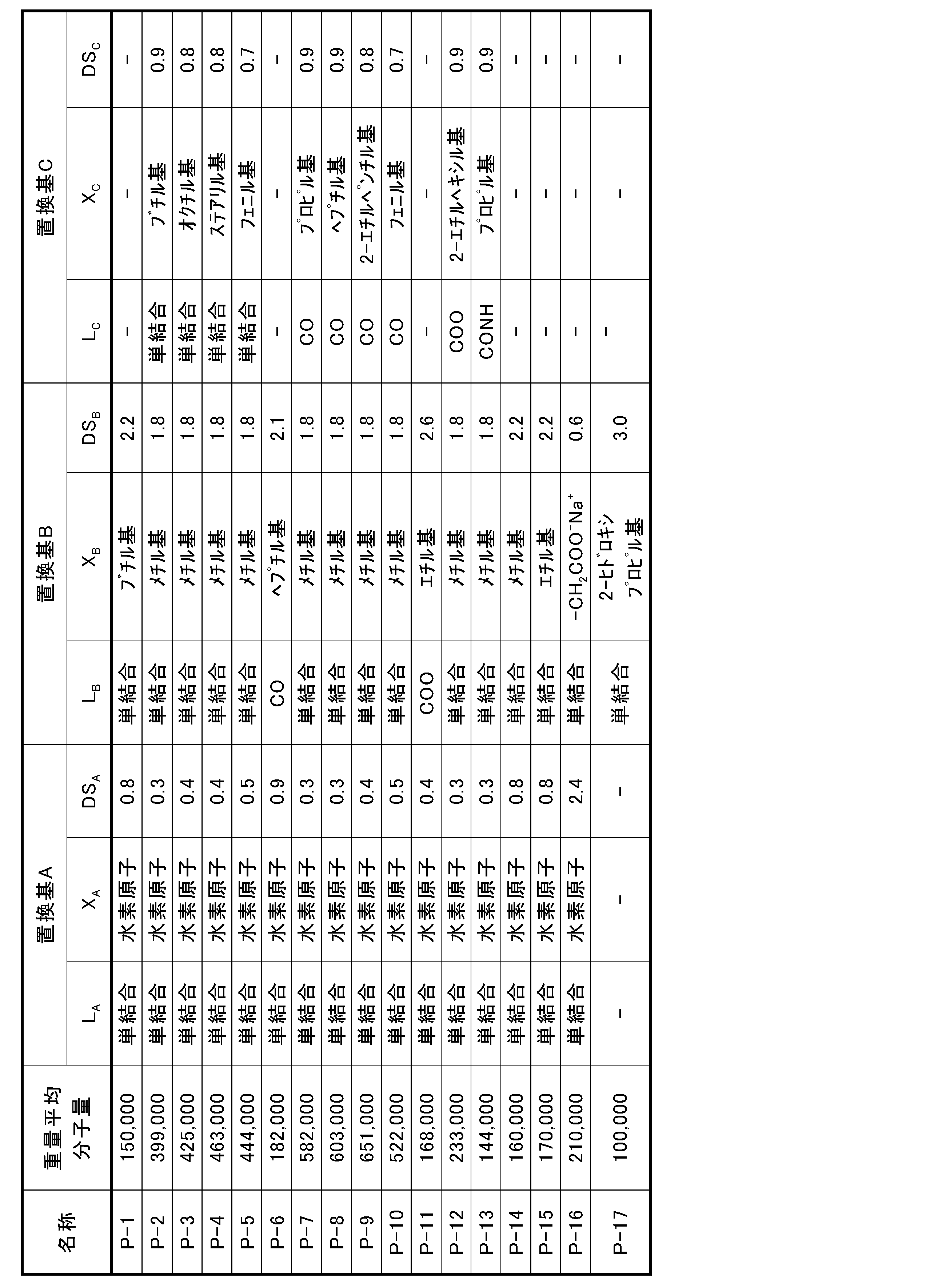
分子量の定義(1)
本発明においてポリマーの分子量については、特に断らない限り、重量平均分子量をいい、ゲルパーミエーションクロマトグラフィー(GPC)によって標準ポリスチレン換算の重量平均分子量を計測する。測定法としては、基本として下記条件により測定した値とする。ただし、ポリマー種によっては適宜適切な溶離液を選定して用いればよい。
(条件)
カラム:TOSOH TSKgel Super AWM-Hをつなげる
キャリア:10mMLiBr/N-メチルピロリドン
本発明においてポリマーの分子量については、特に断らない限り、重量平均分子量をいい、ゲルパーミエーションクロマトグラフィー(GPC)によって標準ポリスチレン換算の重量平均分子量を計測する。測定法としては、基本として下記条件により測定した値とする。ただし、ポリマー種によっては適宜適切な溶離液を選定して用いればよい。
(条件)
カラム:TOSOH TSKgel Super AWM-Hをつなげる
キャリア:10mMLiBr/N-メチルピロリドン
(固体電解質組成物の調製例)
ジルコニア製45mL容器(フリッチュ社製)に、直径5mmのジルコニアビーズを180個投入し、無機固体電解質LLT(豊島製作所製)9.7g、ポリマーP-1 0.3g(固形分換算)を加え、分散媒体として、N-メチルピロリドン15.0gを投入した後に、フリッチュ社製遊星ボールミルP-7に容器をセットし、回転数300rpmで2時間混合を続け、固体電解質組成物S-1を得た。他の例示固体電解質組成物も同様の方法で調製した(表2)。
ジルコニア製45mL容器(フリッチュ社製)に、直径5mmのジルコニアビーズを180個投入し、無機固体電解質LLT(豊島製作所製)9.7g、ポリマーP-1 0.3g(固形分換算)を加え、分散媒体として、N-メチルピロリドン15.0gを投入した後に、フリッチュ社製遊星ボールミルP-7に容器をセットし、回転数300rpmで2時間混合を続け、固体電解質組成物S-1を得た。他の例示固体電解質組成物も同様の方法で調製した(表2)。
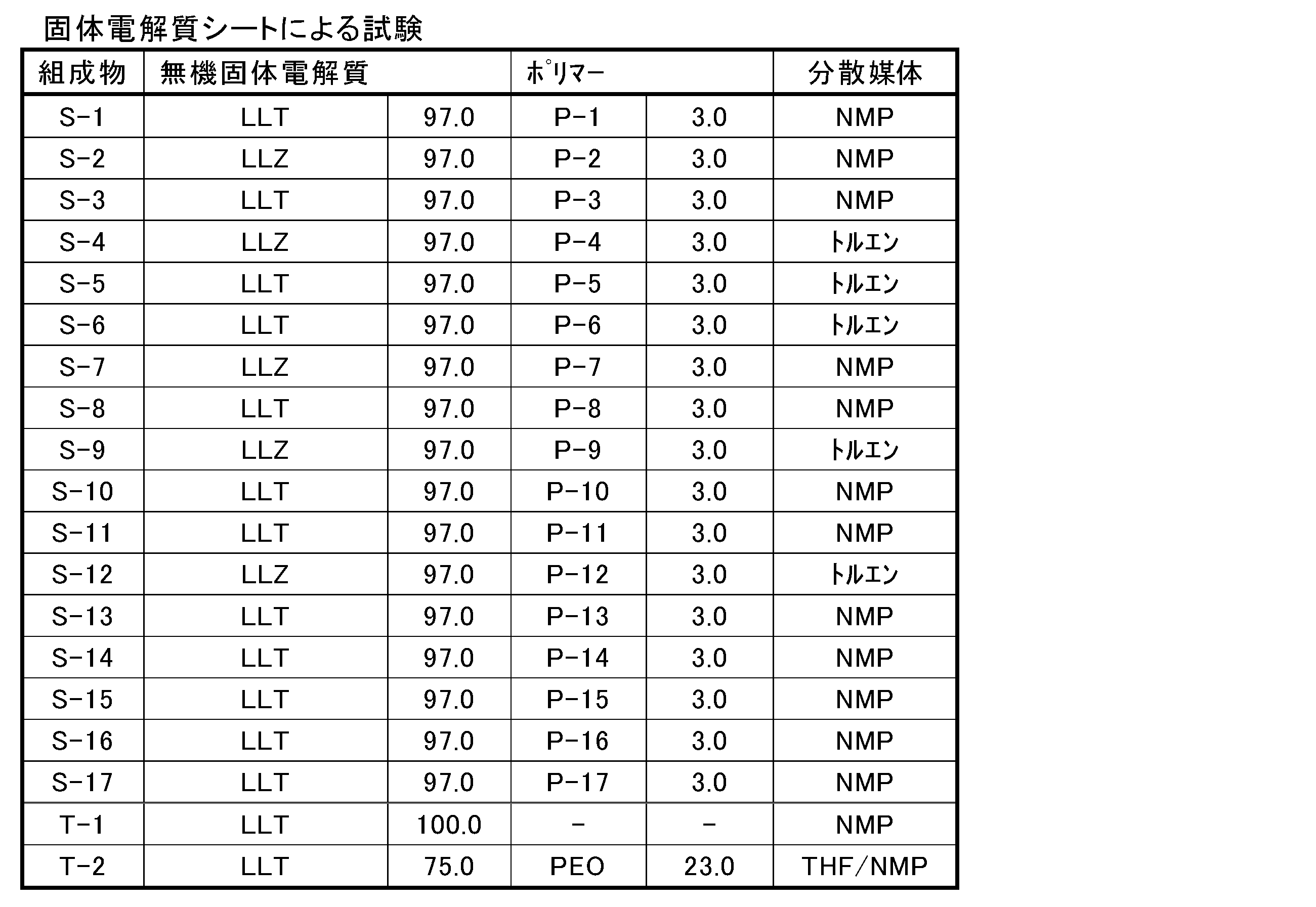
<表の注釈>
表中数字は質量比(%)
LLZ :Li7La3Zr2O12
LLT :Li0.33La0.55TiO3
PEO :ポリエチレンオキシド(重量平均分子量 3,000)
THF :テトラヒドロフラン
NMP :N-メチルピロリドン
表中数字は質量比(%)
LLZ :Li7La3Zr2O12
LLT :Li0.33La0.55TiO3
PEO :ポリエチレンオキシド(重量平均分子量 3,000)
THF :テトラヒドロフラン
NMP :N-メチルピロリドン
(固体電解質シートの作製例)
上記で得られた固体電解質組成物を厚み20μmのアルミ箔上に、任意のクリアランスを有するアプリケーターにより塗布し、80℃1時間とさらに110℃1時間加熱し、塗布溶媒を乾燥させた。その後、厚み20μmの銅箔を合わせ、ヒートプレス機を用いて、任意の密度になるように加熱および加圧し、固体電解質シートを得た。電解質層の膜厚は30μmであった。他の固体電解質シートも同様の方法で調製した。
上記で得られた固体電解質組成物を厚み20μmのアルミ箔上に、任意のクリアランスを有するアプリケーターにより塗布し、80℃1時間とさらに110℃1時間加熱し、塗布溶媒を乾燥させた。その後、厚み20μmの銅箔を合わせ、ヒートプレス機を用いて、任意の密度になるように加熱および加圧し、固体電解質シートを得た。電解質層の膜厚は30μmであった。他の固体電解質シートも同様の方法で調製した。
二次電池正極用組成物の調製
プラネタリーミキサー(TKハイビスミックス、PRIMIX社製)に、下表4に示した正極活物質100部、アセチレンブラック5部、上記で得られた固体電解質組成物75部、N-メチルピロリドン270部を加え、40rpmで一時間撹拌をおこなった。
プラネタリーミキサー(TKハイビスミックス、PRIMIX社製)に、下表4に示した正極活物質100部、アセチレンブラック5部、上記で得られた固体電解質組成物75部、N-メチルピロリドン270部を加え、40rpmで一時間撹拌をおこなった。
二次電池負極用組成物の調製
プラネタリーミキサー(TKハイビスミックス、PRIMIX社製)に、下表4に示した負極活物質100部、アセチレンブラック5部、上記で得られた固体電解質組成物75部、N-メチルピロリドン270部を加え、40rpmで一時間撹拌をおこなった。
プラネタリーミキサー(TKハイビスミックス、PRIMIX社製)に、下表4に示した負極活物質100部、アセチレンブラック5部、上記で得られた固体電解質組成物75部、N-メチルピロリドン270部を加え、40rpmで一時間撹拌をおこなった。
二次電池用正極シートの作製
上記で得られた二次電池正極用組成物を厚み20μmのアルミ箔上に、任意のクリアランスを有するアプリケーターにより塗布し、80℃1時間とさらに110℃1時間加熱し、塗布溶媒を乾燥させた。その後、ヒートプレス機を用いて、任意の密度になるように加熱および加圧し、二次電池用正極シートを得た。
上記で得られた二次電池正極用組成物を厚み20μmのアルミ箔上に、任意のクリアランスを有するアプリケーターにより塗布し、80℃1時間とさらに110℃1時間加熱し、塗布溶媒を乾燥させた。その後、ヒートプレス機を用いて、任意の密度になるように加熱および加圧し、二次電池用正極シートを得た。
二次電池電極シートの作製
上記で得られた二次電池用正極上に、上記で得られた固体電解質組成物を、任意のクリアランスを有するアプリケーターにより塗布し、80℃1時間とさらに110℃1時間加熱した。その後、上記で得られた二次電池負極用組成物をさらに塗布し、80℃1時間とさらに110℃1時間加熱した。負極層上に厚み20μmの銅箔を合わせ、ヒートプレス機を用いて、任意の密度になるように加熱および加圧し、二次電池電極シートを得た。二次電池電極シートは図1の構成を有する。正極層及び負極層の膜厚は80μm、電解質層の膜厚は30μmであった。他の二次電池電極シートも同様に作製した。
上記で得られた二次電池用正極上に、上記で得られた固体電解質組成物を、任意のクリアランスを有するアプリケーターにより塗布し、80℃1時間とさらに110℃1時間加熱した。その後、上記で得られた二次電池負極用組成物をさらに塗布し、80℃1時間とさらに110℃1時間加熱した。負極層上に厚み20μmの銅箔を合わせ、ヒートプレス機を用いて、任意の密度になるように加熱および加圧し、二次電池電極シートを得た。二次電池電極シートは図1の構成を有する。正極層及び負極層の膜厚は80μm、電解質層の膜厚は30μmであった。他の二次電池電極シートも同様に作製した。
<電極結着性の評価>
固体電解質シートまたは二次電池用電極シート作製工程において、負極集電体銅箔を付与する前のシート(固体電解質組成物または負極用組成物を塗布・乾燥させた状態)を用いて結着性の評価を行った。乾燥後の固体電解質組成物または負極用組成物に粘着テープ(セロハンテープ(「CT24」,ニチバン(株)製))を貼り、一定速度で引き剥がした際に、剥離した面積を目視で確認した。剥離しなかった部分の面積の比率を下記のように評価した。
A:90%以上
B:70%以上90%未満
C:50%以上70%未満
D:50%未満
固体電解質シートまたは二次電池用電極シート作製工程において、負極集電体銅箔を付与する前のシート(固体電解質組成物または負極用組成物を塗布・乾燥させた状態)を用いて結着性の評価を行った。乾燥後の固体電解質組成物または負極用組成物に粘着テープ(セロハンテープ(「CT24」,ニチバン(株)製))を貼り、一定速度で引き剥がした際に、剥離した面積を目視で確認した。剥離しなかった部分の面積の比率を下記のように評価した。
A:90%以上
B:70%以上90%未満
C:50%以上70%未満
D:50%未満
<イオン伝導度の測定>
上記で得られた固体電解質シートまたは二次電池電極シートを直径14.5mmの円板状に切り出し、スペーサーとワッシャーを組み込んだステンレス製の2032型コインケースに入れてコイン電池を作製した。コイン電池の外部より、電極間に圧力をかけることができるジグに挟み、各種電気化学的測定に用いた。電極間の圧力は500kgf/cm2とした。
上記で得られたコイン電池を用いて、30℃の恒温槽中、交流インピーダンス法により求めた。このとき、電池の加圧には図2に示した試験体を用いた。11が上部支持板、12が下部支持板、13がコイン電池、14がコインケース、15が電極シート(固体電解質シートまたは二次電池電極シート)、Sがネジである。
上記で得られた固体電解質シートまたは二次電池電極シートを直径14.5mmの円板状に切り出し、スペーサーとワッシャーを組み込んだステンレス製の2032型コインケースに入れてコイン電池を作製した。コイン電池の外部より、電極間に圧力をかけることができるジグに挟み、各種電気化学的測定に用いた。電極間の圧力は500kgf/cm2とした。
上記で得られたコイン電池を用いて、30℃の恒温槽中、交流インピーダンス法により求めた。このとき、電池の加圧には図2に示した試験体を用いた。11が上部支持板、12が下部支持板、13がコイン電池、14がコインケース、15が電極シート(固体電解質シートまたは二次電池電極シート)、Sがネジである。
固体電解質シートの電極結着性、加圧および非加圧状態でのイオン伝導度の測定結果を表3に示す。このとき加圧状態での測定とは、コイン電池を上記ジグで挟んだ状態で測定した場合であり、非加圧状態での測定は、コイン電池をそのまま測定したことを表す。

試験No.:cで始まるものが比較例
表4には、二次電池電極シートの電極結着性、加圧および非加圧状態でのイオン伝導度の測定結果を示す。このとき加圧状態での測定とは、コイン電池を上記ジグで挟んだ状態で測定した場合であり、非加圧状態での測定は、コイン電池をそのまま測定したことを表す。また表4において、セル構成は各層を形成した固体電解質組成物と正極活物質または負極活物質を記載することで構成を表した。

<表の注釈>
LMO;LiMn2O4 マンガン酸リチウム
LTO;Li4Ti5O12 チタン酸リチウム
(商品名「エナマイトLT-106」、石原産業株式会社製)
LCO;LiCoO2 コバルト酸リチウム
LMO;LiMn2O4 マンガン酸リチウム
LTO;Li4Ti5O12 チタン酸リチウム
(商品名「エナマイトLT-106」、石原産業株式会社製)
LCO;LiCoO2 コバルト酸リチウム
表3、4に示す結果から明らかなように、本発明の固体電解質組成物を用いた固体電解質シートおよび積層した電池は電極結着性に優れ、かつ非加圧状態でのイオン伝導性に優れる。このことから、製造上電極シートの取扱い時に、固体電解質層および電極活物質層の剥離が生じず、固体界面の電気化学的接触を維持できるため、電極間を加圧する機構が不要であり、サイクル性が良好であることが予想される。一方、本発明の固体電解質組成物を含まないT-1や、ポリエチレンオキサイドを用いたT-2の比較例では電極柔軟性が劣り、非加圧状態でのイオン伝導性も大きく劣る。
上記で合成したエチルセルロース(P-15)を用いた固体電解質組成物S-15を準備した。これを金属箔上に塗布して製膜して電極シートとした。この電極シートを600℃で1時間焼成した。その後は上記と同様にして全固体二次電池の試験体を作製した。この試験体を用いて上記と同様の評価を行ったところ、結着性は「D」の結果であり、イオン伝導度は加圧時は0.15mS/cm、非加圧時は測定不能の結果となった(クラック等の発生により測定できなかった)。なお、セルロースをメディアに用いた固体電解質組成物を用いても、焼成処理によりこれがバインダーとして機能しない状態となったものは、本発明の構成に該当しない。
本発明をその実施態様とともに説明したが、我々は特に指定しない限り我々の発明を説明のどの細部においても限定しようとするものではなく、添付の請求の範囲に示した発明の精神と範囲に反することなく幅広く解釈されるべきであると考える。
本願は、2014年3月28日に日本国で特許出願された特願2014-070092に基づく優先権を主張するものであり、これはここに参照してその内容を本明細書の記載の一部として取り込む。
1 負極集電体
2 負極活物質層
3 無機固体電解質層
4 正極活物質層
5 正極集電体
6 作動部位
10 全固体二次電池
11 上部支持板
12 下部支持板
13 コイン電池(全固体二次電池)
14 コインケース
15 電極シート
S ネジ
2 負極活物質層
3 無機固体電解質層
4 正極活物質層
5 正極集電体
6 作動部位
10 全固体二次電池
11 上部支持板
12 下部支持板
13 コイン電池(全固体二次電池)
14 コインケース
15 電極シート
S ネジ
Claims (18)
- 正極活物質層と負極活物質層と無機固体電解質層とを具備する全固体二次電池であって、上記正極活物質層、負極活物質層、および無機固体電解質層の少なくともいずれかが、周期律表第一族または第二族に属する金属のイオンの伝導性を有する無機固体電解質とセルロースポリマーとを含有する全固体二次電池。
- 上記セルロースポリマーが下記式(1)で表される繰り返し単位を有する請求項1に記載の全固体二次電池。

X2、X3、およびX6はそれぞれ独立に水素原子、炭素数1~30の炭化水素基、または炭素数1~30のヘテロ原子を含む炭化水素基を表す。 - L2、L3、およびL6のうち少なくとも一つは二価の連結基である請求項2に記載の全固体二次電池。
- 上記L2、L3、およびL6はそれぞれ独立に単結合、カルボニル基、カルボニルオキシ基またはアミド基を表す請求項2または3に記載の全固体二次電池。
- 上記セルロースポリマーの水酸基の全置換度が0.3以上である請求項1~4のいずれか1項に記載の全固体二次電池。
- 上記無機固体電解質100質量部に対して、上記セルロースポリマーを0.1質量部以上10質量部以下で含有する請求項1~5のいずれか1項に記載の全固体二次電池。
- 上記無機固体電解質層が上記無機固体電解質と上記セルロースポリマーとを含有する層である請求項1~6のいずれか1項に記載の全固体二次電池。
- 上記負極活物質層または正極活物質層が上記無機固体電解質と上記セルロースポリマーとを含有する層である請求項1~6のいずれか1項に記載の全固体二次電池。
- 上記無機固体電解質が酸化物系の無機固体電解質である請求項1~8のいずれか1項に記載の全固体二次電池。
- 上記無機固体電解質が下記式の化合物から選ばれる請求項9に記載の全固体二次電池。
・LixaLayaTiO3
xa=0.3~0.7、ya=0.3~0.7
・Li7La3Zr2O12
・Li3.5Zn0.25GeO4
・LiTi2P3O12、
・Li1+xh+yh(Al,Ga)xh(Ti,Ge)2-xhSiyhP3-yhO12
0≦xh≦1、0≦yh≦1
・Li3PO4
・LiPON
・LiPOD1
D1は、Ti、V、Cr、Mn、Fe、Co、Ni、Cu、
Zr、Nb、Mo、Ru、Ag、Ta、W、Pt、及びAu
から選ばれた少なくとも1種
・LiA1ON
A1は、Si、B、Ge、Al、C、Ga等から選ばれた
少なくとも1種 - 周期律表第一族または第二族に属する金属のイオンの伝導性を有する無機固体電解質と下記式(1)で表されるセルロースポリマーで構成されたバインダーとを含有する固体電解質組成物。
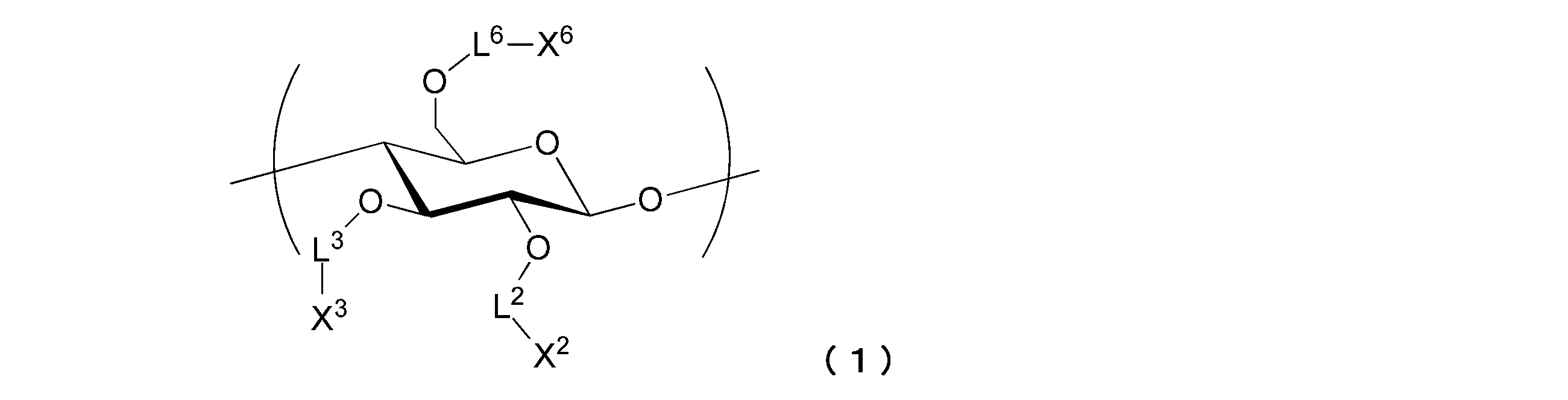
X2、X3、およびX6はそれぞれ独立に水素原子、炭素数1~30の炭化水素基、または炭素数1~30のヘテロ原子を含む炭化水素基を表す。 - L2、L3、およびL6のうち少なくとも一つは二価の連結基である請求項11に記載の固体電解質組成物。
- X2、X3、およびX6のうち少なくとも一つは炭素数3以上の炭化水素基または炭素数1~30のヘテロ原子を含む炭化水素基である請求項11または12に記載の固体電解質組成物。
- 上記L2、L3、およびL6はそれぞれ独立に単結合、カルボニル基、カルボニルオキシ基またはアミド基を表す請求項11~13のいずれか1項に記載の固体電解質組成物。
- さらに分散媒体を含む請求項11~14のいずれか1項に記載の固体電解質組成物。
- 請求項11~15のいずれか1項に記載の固体電解質組成物を金属箔上に製膜した電池用電極シート。
- 請求項11~15のいずれか1項に記載の固体電解質組成物を金属箔上に配置し、これを製膜する電池用電極シートの製造方法。
- 請求項17に記載の製造方法を介して、全固体二次電池を製造する全固体二次電池の製造方法。
Priority Applications (1)
| Application Number | Priority Date | Filing Date | Title |
|---|---|---|---|
| US15/272,644 US10297859B2 (en) | 2014-03-28 | 2016-09-22 | All-solid-state secondary battery, solid electrolyte composition and electrode sheet for batteries used in the same, and manufacturing method of electrode sheet for batteries and all-solid-state secondary battery |
Applications Claiming Priority (2)
| Application Number | Priority Date | Filing Date | Title |
|---|---|---|---|
| JP2014-070092 | 2014-03-28 | ||
| JP2014070092A JP6140631B2 (ja) | 2014-03-28 | 2014-03-28 | 全固体二次電池、これに用いる固体電解質組成物および電池用電極シート、ならびに全固体二次電池の製造方法 |
Related Child Applications (1)
| Application Number | Title | Priority Date | Filing Date |
|---|---|---|---|
| US15/272,644 Continuation US10297859B2 (en) | 2014-03-28 | 2016-09-22 | All-solid-state secondary battery, solid electrolyte composition and electrode sheet for batteries used in the same, and manufacturing method of electrode sheet for batteries and all-solid-state secondary battery |
Publications (1)
| Publication Number | Publication Date |
|---|---|
| WO2015147279A1 true WO2015147279A1 (ja) | 2015-10-01 |
Family
ID=54195783
Family Applications (1)
| Application Number | Title | Priority Date | Filing Date |
|---|---|---|---|
| PCT/JP2015/059677 Ceased WO2015147279A1 (ja) | 2014-03-28 | 2015-03-27 | 全固体二次電池、これに用いる固体電解質組成物および電池用電極シート、ならびに電池用電極シートおよび全固体二次電池の製造方法 |
Country Status (3)
| Country | Link |
|---|---|
| US (1) | US10297859B2 (ja) |
| JP (1) | JP6140631B2 (ja) |
| WO (1) | WO2015147279A1 (ja) |
Cited By (4)
| Publication number | Priority date | Publication date | Assignee | Title |
|---|---|---|---|---|
| JP2017022019A (ja) * | 2015-07-13 | 2017-01-26 | トヨタ自動車株式会社 | 電極シートの製造方法 |
| CN109155414A (zh) * | 2016-06-09 | 2019-01-04 | 日本瑞翁株式会社 | 固体电解质电池用粘结剂组合物、及固体电解质电池用浆料组合物 |
| WO2024024628A1 (ja) * | 2022-07-26 | 2024-02-01 | 株式会社日本触媒 | 電池構成材料及び電極の製造方法 |
| WO2024024624A1 (ja) * | 2022-07-26 | 2024-02-01 | 株式会社日本触媒 | 組成物及びスラリー、これを用いた電池構成材料、電極及び全固体電池 |
Families Citing this family (11)
| Publication number | Priority date | Publication date | Assignee | Title |
|---|---|---|---|---|
| US20190305293A1 (en) | 2016-12-26 | 2019-10-03 | Showa Denko K. K. | All-solid-state lithium ion battery |
| JP6760140B2 (ja) * | 2017-03-06 | 2020-09-23 | トヨタ自動車株式会社 | リチウムイオン二次電池用正極材料の製造方法およびリチウムイオン二次電池用正極材料 |
| JP6962249B2 (ja) * | 2018-03-22 | 2021-11-05 | トヨタ自動車株式会社 | 硫化物固体電池 |
| JP7129816B2 (ja) * | 2018-05-01 | 2022-09-02 | 花王株式会社 | 蓄電デバイス用バインダー組成物 |
| JP2019198816A (ja) * | 2018-05-15 | 2019-11-21 | 株式会社ダイセル | 半透膜 |
| JP2020007474A (ja) * | 2018-07-10 | 2020-01-16 | 株式会社ダイセル | 芳香族脂肪族混合セルロースエステル、非水電解質二次電池正極用添加剤、非水電解質二次電池用正極、及び非水電解質二次電池用正極の製造方法 |
| JP7437010B2 (ja) * | 2019-11-27 | 2024-02-22 | 御国色素株式会社 | リチウムイオン二次電池正極用の導電材分散液及び電極ペースト |
| JP7466888B2 (ja) * | 2019-11-27 | 2024-04-15 | 御国色素株式会社 | セルロース誘導体及びセルロース誘導体溶解液 |
| US11637317B2 (en) * | 2020-06-08 | 2023-04-25 | Cmc Materials, Inc. | Solid polymer electrolyte compositions and methods of preparing same |
| DE102021105782A1 (de) | 2021-03-10 | 2022-09-15 | Bayerische Motoren Werke Aktiengesellschaft | Elektrischer Energiespeicher für ein Kraftfahrzeug sowie Verfahren zum Betreiben eines solchen elektrischen Energiespeichers |
| CN113394381B (zh) * | 2021-06-10 | 2023-02-10 | 肇庆市华师大光电产业研究院 | 一种用于锂硫电池正极的层状双氢氧化物复合材料制备方法 |
Citations (6)
| Publication number | Priority date | Publication date | Assignee | Title |
|---|---|---|---|---|
| JP2001126757A (ja) * | 1999-10-25 | 2001-05-11 | Kyocera Corp | リチウム電池 |
| JP2011150817A (ja) * | 2010-01-19 | 2011-08-04 | Ohara Inc | 全固体電池 |
| WO2013065738A2 (ja) * | 2011-10-31 | 2013-05-10 | 日本ゼオン株式会社 | 全固体二次電池 |
| JP2013532361A (ja) * | 2010-06-17 | 2013-08-15 | ローベルト ボッシュ ゲゼルシャフト ミット ベシュレンクテル ハフツング | リチウムイオン電池 |
| WO2014020654A1 (ja) * | 2012-07-30 | 2014-02-06 | 株式会社 日立製作所 | 全固体イオン二次電池 |
| JP2014029791A (ja) * | 2012-07-31 | 2014-02-13 | Tdk Corp | リチウムイオン二次電池 |
Family Cites Families (7)
| Publication number | Priority date | Publication date | Assignee | Title |
|---|---|---|---|---|
| JP2002025559A (ja) * | 2000-07-03 | 2002-01-25 | Sony Corp | 電 池 |
| JP2002042862A (ja) | 2000-07-26 | 2002-02-08 | Kyocera Corp | リチウム電池 |
| JP2008078119A (ja) * | 2006-08-25 | 2008-04-03 | Ngk Insulators Ltd | 全固体蓄電素子 |
| JP5625351B2 (ja) | 2009-12-25 | 2014-11-19 | トヨタ自動車株式会社 | 電極層、固体電解質層および全固体二次電池 |
| JP5652344B2 (ja) | 2011-06-27 | 2015-01-14 | 日本ゼオン株式会社 | 全固体二次電池 |
| US9123970B2 (en) * | 2012-07-03 | 2015-09-01 | Electronics And Telecommunications Research Institute | Lithium battery binder composition, method for preparing the same and lithium battery including the same |
| US20160240831A1 (en) * | 2015-02-12 | 2016-08-18 | Apple Inc. | Dendrite-resistant battery |
-
2014
- 2014-03-28 JP JP2014070092A patent/JP6140631B2/ja active Active
-
2015
- 2015-03-27 WO PCT/JP2015/059677 patent/WO2015147279A1/ja not_active Ceased
-
2016
- 2016-09-22 US US15/272,644 patent/US10297859B2/en active Active
Patent Citations (6)
| Publication number | Priority date | Publication date | Assignee | Title |
|---|---|---|---|---|
| JP2001126757A (ja) * | 1999-10-25 | 2001-05-11 | Kyocera Corp | リチウム電池 |
| JP2011150817A (ja) * | 2010-01-19 | 2011-08-04 | Ohara Inc | 全固体電池 |
| JP2013532361A (ja) * | 2010-06-17 | 2013-08-15 | ローベルト ボッシュ ゲゼルシャフト ミット ベシュレンクテル ハフツング | リチウムイオン電池 |
| WO2013065738A2 (ja) * | 2011-10-31 | 2013-05-10 | 日本ゼオン株式会社 | 全固体二次電池 |
| WO2014020654A1 (ja) * | 2012-07-30 | 2014-02-06 | 株式会社 日立製作所 | 全固体イオン二次電池 |
| JP2014029791A (ja) * | 2012-07-31 | 2014-02-13 | Tdk Corp | リチウムイオン二次電池 |
Cited By (7)
| Publication number | Priority date | Publication date | Assignee | Title |
|---|---|---|---|---|
| JP2017022019A (ja) * | 2015-07-13 | 2017-01-26 | トヨタ自動車株式会社 | 電極シートの製造方法 |
| CN109155414A (zh) * | 2016-06-09 | 2019-01-04 | 日本瑞翁株式会社 | 固体电解质电池用粘结剂组合物、及固体电解质电池用浆料组合物 |
| US20190214673A1 (en) * | 2016-06-09 | 2019-07-11 | Zeon Corporation | Binder composition for solid electrolyte battery and slurry composition for solid electrolyte battery |
| US10985401B2 (en) * | 2016-06-09 | 2021-04-20 | Zeon Corporation | Binder composition for solid electrolyte battery and slurry composition for solid electrolyte battery |
| CN109155414B (zh) * | 2016-06-09 | 2021-08-13 | 日本瑞翁株式会社 | 固体电解质电池用粘结剂组合物、及固体电解质电池用浆料组合物 |
| WO2024024628A1 (ja) * | 2022-07-26 | 2024-02-01 | 株式会社日本触媒 | 電池構成材料及び電極の製造方法 |
| WO2024024624A1 (ja) * | 2022-07-26 | 2024-02-01 | 株式会社日本触媒 | 組成物及びスラリー、これを用いた電池構成材料、電極及び全固体電池 |
Also Published As
| Publication number | Publication date |
|---|---|
| US20170237115A1 (en) | 2017-08-17 |
| JP6140631B2 (ja) | 2017-05-31 |
| US10297859B2 (en) | 2019-05-21 |
| JP2015191864A (ja) | 2015-11-02 |
Similar Documents
| Publication | Publication Date | Title |
|---|---|---|
| JP6140631B2 (ja) | 全固体二次電池、これに用いる固体電解質組成物および電池用電極シート、ならびに全固体二次電池の製造方法 | |
| JP6253155B2 (ja) | 固体電解質組成物、これを用いた電池用電極シートおよび全固体二次電池 | |
| JP6295332B2 (ja) | 全固体二次電池、固体電解質組成物、これを用いた電池用電極シート、電池用電極シートの製造方法および全固体二次電池の製造方法 | |
| KR102126144B1 (ko) | 고체 전해질 조성물, 전고체 이차 전지용 전극 시트 및 전고체 이차 전지와, 전고체 이차 전지용 전극 시트 및 전고체 이차 전지의 제조 방법 | |
| JP6295333B2 (ja) | 全固体二次電池、固体電解質組成物、これを用いた電池用電極シート、電池用電極シートの製造方法および全固体二次電池の製造方法 | |
| JP6071938B2 (ja) | 全固体二次電池、これに用いる固体電解質組成物および電池用電極シート、ならびに電池用電極シートおよび全固体二次電池の製造方法 | |
| JP6332882B2 (ja) | 全固体二次電池、固体電解質組成物、これを用いた電池用電極シート、電池用電極シートの製造方法および全固体二次電池の製造方法 | |
| JP7008080B2 (ja) | 固体電解質組成物、固体電解質含有シート及び全固体二次電池並びに固体電解質含有シート及び全固体二次電池の製造方法 | |
| WO2015125800A1 (ja) | 固体電解質組成物およびその製造方法、これを用いた電池用電極シートおよび全固体二次電池 | |
| WO2016194759A1 (ja) | 正極用材料、全固体二次電池用電極シートおよび全固体二次電池ならびに全固体二次電池用電極シートおよび全固体二次電池の製造方法 | |
| JP6623083B2 (ja) | 固体電解質組成物、これを用いた全固体二次電池用シートおよび全固体二次電池ならびにこれらの製造方法 | |
| JP6957742B2 (ja) | 固体電解質組成物、全固体二次電池用シート及び全固体二次電池、並びに、全固体二次電池用シート若しくは全固体二次電池の製造方法 | |
| KR102169538B1 (ko) | 고체 전해질 조성물, 고체 전해질 함유 시트 및 전고체 이차 전지와, 고체 전해질 함유 시트 및 전고체 이차 전지의 제조 방법 | |
| CN114144907A (zh) | 电极用组合物的制造法、全固态二次电池用电极片的制造法及全固态二次电池的制造法 | |
| JPWO2020059550A1 (ja) | 全固体二次電池用積層部材の製造方法及び全固体二次電池の製造方法 | |
| JP7779847B2 (ja) | 無機固体電解質含有組成物、全固体二次電池用シート及び全固体二次電池、並びに、全固体二次電池用シート及び全固体二次電池の製造方法 | |
| JP6982682B2 (ja) | 固体電解質組成物、全固体二次電池用シート、及び全固体二次電池、並びに、全固体二次電池用シート若しくは全固体二次電池の製造方法 | |
| JP6673785B2 (ja) | 固体電解質組成物、固体電解質含有シートおよび全固体二次電池ならびに固体電解質含有シートおよび全固体二次電池の製造方法 | |
| JP6709134B2 (ja) | ポリマー、固体電解質、固体電解質組成物、無機固体電解質組成物、固体電解質含有シート、二次電池、全固体二次電池、固体電解質含有シートの製造方法、無機固体電解質含有シートの製造方法、二次電池の製造方法および全固体二次電池の製造方法 |
Legal Events
| Date | Code | Title | Description |
|---|---|---|---|
| 121 | Ep: the epo has been informed by wipo that ep was designated in this application |
Ref document number: 15769355 Country of ref document: EP Kind code of ref document: A1 |
|
| NENP | Non-entry into the national phase | ||
| 122 | Ep: pct application non-entry in european phase |
Ref document number: 15769355 Country of ref document: EP Kind code of ref document: A1 |