WO2015147201A1 - 抗菌層付き基材、抗菌シート、放射線撮影装置、タッチパネル - Google Patents
抗菌層付き基材、抗菌シート、放射線撮影装置、タッチパネル Download PDFInfo
- Publication number
- WO2015147201A1 WO2015147201A1 PCT/JP2015/059454 JP2015059454W WO2015147201A1 WO 2015147201 A1 WO2015147201 A1 WO 2015147201A1 JP 2015059454 W JP2015059454 W JP 2015059454W WO 2015147201 A1 WO2015147201 A1 WO 2015147201A1
- Authority
- WO
- WIPO (PCT)
- Prior art keywords
- antibacterial
- silver
- antibacterial layer
- layer
- antibacterial agent
- Prior art date
- Legal status (The legal status is an assumption and is not a legal conclusion. Google has not performed a legal analysis and makes no representation as to the accuracy of the status listed.)
- Ceased
Links
Images
Classifications
-
- A—HUMAN NECESSITIES
- A01—AGRICULTURE; FORESTRY; ANIMAL HUSBANDRY; HUNTING; TRAPPING; FISHING
- A01N—PRESERVATION OF BODIES OF HUMANS OR ANIMALS OR PLANTS OR PARTS THEREOF; BIOCIDES, e.g. AS DISINFECTANTS, AS PESTICIDES OR AS HERBICIDES; PEST REPELLANTS OR ATTRACTANTS; PLANT GROWTH REGULATORS
- A01N25/00—Biocides, pest repellants or attractants, or plant growth regulators, characterised by their forms, or by their non-active ingredients or by their methods of application, e.g. seed treatment or sequential application; Substances for reducing the noxious effect of the active ingredients to organisms other than pests
- A01N25/34—Shaped forms, e.g. sheets, not provided for in any other sub-group of this main group
-
- A—HUMAN NECESSITIES
- A01—AGRICULTURE; FORESTRY; ANIMAL HUSBANDRY; HUNTING; TRAPPING; FISHING
- A01N—PRESERVATION OF BODIES OF HUMANS OR ANIMALS OR PLANTS OR PARTS THEREOF; BIOCIDES, e.g. AS DISINFECTANTS, AS PESTICIDES OR AS HERBICIDES; PEST REPELLANTS OR ATTRACTANTS; PLANT GROWTH REGULATORS
- A01N59/00—Biocides, pest repellants or attractants, or plant growth regulators containing elements or inorganic compounds
- A01N59/16—Heavy metals; Compounds thereof
-
- B—PERFORMING OPERATIONS; TRANSPORTING
- B32—LAYERED PRODUCTS
- B32B—LAYERED PRODUCTS, i.e. PRODUCTS BUILT-UP OF STRATA OF FLAT OR NON-FLAT, e.g. CELLULAR OR HONEYCOMB, FORM
- B32B27/00—Layered products comprising a layer of synthetic resin
- B32B27/18—Layered products comprising a layer of synthetic resin characterised by the use of special additives
-
- G—PHYSICS
- G06—COMPUTING OR CALCULATING; COUNTING
- G06F—ELECTRIC DIGITAL DATA PROCESSING
- G06F3/00—Input arrangements for transferring data to be processed into a form capable of being handled by the computer; Output arrangements for transferring data from processing unit to output unit, e.g. interface arrangements
- G06F3/01—Input arrangements or combined input and output arrangements for interaction between user and computer
- G06F3/03—Arrangements for converting the position or the displacement of a member into a coded form
- G06F3/041—Digitisers, e.g. for touch screens or touch pads, characterised by the transducing means
-
- B—PERFORMING OPERATIONS; TRANSPORTING
- B32—LAYERED PRODUCTS
- B32B—LAYERED PRODUCTS, i.e. PRODUCTS BUILT-UP OF STRATA OF FLAT OR NON-FLAT, e.g. CELLULAR OR HONEYCOMB, FORM
- B32B2250/00—Layers arrangement
- B32B2250/02—2 layers
-
- B—PERFORMING OPERATIONS; TRANSPORTING
- B32—LAYERED PRODUCTS
- B32B—LAYERED PRODUCTS, i.e. PRODUCTS BUILT-UP OF STRATA OF FLAT OR NON-FLAT, e.g. CELLULAR OR HONEYCOMB, FORM
- B32B2264/00—Composition or properties of particles which form a particulate layer or are present as additives
- B32B2264/10—Inorganic particles
- B32B2264/104—Oxysalt, e.g. carbonate, sulfate, phosphate or nitrate particles
-
- B—PERFORMING OPERATIONS; TRANSPORTING
- B32—LAYERED PRODUCTS
- B32B—LAYERED PRODUCTS, i.e. PRODUCTS BUILT-UP OF STRATA OF FLAT OR NON-FLAT, e.g. CELLULAR OR HONEYCOMB, FORM
- B32B2264/00—Composition or properties of particles which form a particulate layer or are present as additives
- B32B2264/10—Inorganic particles
- B32B2264/105—Metal
-
- B—PERFORMING OPERATIONS; TRANSPORTING
- B32—LAYERED PRODUCTS
- B32B—LAYERED PRODUCTS, i.e. PRODUCTS BUILT-UP OF STRATA OF FLAT OR NON-FLAT, e.g. CELLULAR OR HONEYCOMB, FORM
- B32B2307/00—Properties of the layers or laminate
- B32B2307/70—Other properties
- B32B2307/714—Inert, i.e. inert to chemical degradation, corrosion
- B32B2307/7145—Rot proof, resistant to bacteria, mildew, mould, fungi
-
- B—PERFORMING OPERATIONS; TRANSPORTING
- B32—LAYERED PRODUCTS
- B32B—LAYERED PRODUCTS, i.e. PRODUCTS BUILT-UP OF STRATA OF FLAT OR NON-FLAT, e.g. CELLULAR OR HONEYCOMB, FORM
- B32B2307/00—Properties of the layers or laminate
- B32B2307/70—Other properties
- B32B2307/728—Hydrophilic
-
- B—PERFORMING OPERATIONS; TRANSPORTING
- B32—LAYERED PRODUCTS
- B32B—LAYERED PRODUCTS, i.e. PRODUCTS BUILT-UP OF STRATA OF FLAT OR NON-FLAT, e.g. CELLULAR OR HONEYCOMB, FORM
- B32B2457/00—Electrical equipment
-
- G—PHYSICS
- G06—COMPUTING OR CALCULATING; COUNTING
- G06F—ELECTRIC DIGITAL DATA PROCESSING
- G06F2203/00—Indexing scheme relating to G06F3/00 - G06F3/048
- G06F2203/041—Indexing scheme relating to G06F3/041 - G06F3/045
- G06F2203/04103—Manufacturing, i.e. details related to manufacturing processes specially suited for touch sensitive devices
Definitions
- the present invention relates to a substrate with an antibacterial layer, an antibacterial sheet, a radiation imaging apparatus, and a touch panel.
- Patent Document 1 discloses a sustained-release antibacterial material comprising a silver antibacterial agent having a silver complex supported on a silica gel carrier, silica gel, and an organic binder.
- An object of this invention is to provide the base material with an antibacterial layer provided with the antibacterial layer which shows an antibacterial action in a short time, and can maintain antibacterial property for a long time in view of the said situation.
- Another object of the present invention is to provide an antibacterial sheet, and a radiographic apparatus and a touch panel including the antibacterial layer-coated substrate.
- a substrate with an antibacterial layer comprising a substrate and an antibacterial layer disposed on at least a part of the surface of the substrate,
- the antibacterial layer has a first antibacterial agent containing silver and a second antibacterial agent containing silver different from the first antibacterial agent,
- P silver content per unit area contained in the antibacterial layer
- Q silver ion amount per unit area measured from the extraction test described later
- the substrate with an antibacterial layer according to (1) which satisfies the relationship of formula (3).
- Formula (3) 15.0 ⁇ Q ⁇ 25.0 The first antibacterial agent includes silver and any one carrier selected from the group consisting of zinc calcium phosphate and calcium phosphate, The base material with an antibacterial layer according to (1) or (2), wherein the second antibacterial agent contains a carrier made of silver and zeolite.
- a radiation imaging apparatus having the substrate with an antibacterial layer according to any one of (1) to (5) on the surface.
- a touch panel having the substrate with an antibacterial layer according to any one of (1) to (5) on the surface.
- An antibacterial sheet containing an antibacterial agent The antibacterial agent includes a first antibacterial agent containing silver and a second antibacterial agent containing silver different from the first antibacterial agent, When the silver content per unit area contained in the antibacterial sheet is P, and the silver ion amount per unit area measured from the extraction test described later is Q, the relationship of the following formulas (1) and (2) An antibacterial sheet that fills.
- the antibacterial sheet according to (8) which satisfies the relationship of formula (3).
- the first antibacterial agent includes silver and any one carrier selected from the group consisting of zinc calcium phosphate and calcium phosphate, The antibacterial sheet according to (8) or (9), wherein the second antibacterial agent includes a carrier made of silver and zeolite.
- the hydrophilic group includes a polyoxyalkylene group.
- the base material with an antimicrobial layer provided with the antimicrobial layer which can maintain antimicrobial property for a long time
- a radiography apparatus and a touch panel provided with an antibacterial sheet and the said base material with an antibacterial layer can also be provided.
- a numerical range represented by using “to” means a range including numerical values described before and after “to” as a lower limit value and an upper limit value.
- the first antibacterial agent includes silver and any one carrier selected from the group consisting of zinc calcium phosphate and calcium phosphate.
- carrier which consists of silver and a zeolite is mentioned.
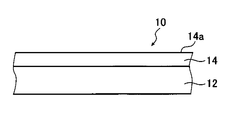
- FIG. 1 is a cross-sectional view of one embodiment of the substrate with an antibacterial layer of the present invention.
- the substrate 10 with an antibacterial layer includes a substrate 12 and an antibacterial layer 14 disposed on the substrate 12.
- the antibacterial layer 14 may be disposed on at least a part of the surface of the substrate 12.
- each member will be described in detail.
- a base material plays the role which supports an antimicrobial layer, and the kind in particular is not restrict
- the shape of the substrate is not particularly limited, and examples thereof include a plate shape, a film shape, a sheet shape, a tube shape, a fiber shape, and a particle shape. Further, the substrate surface on which the antibacterial layer described later is disposed may be a flat surface, a concave surface, or a convex surface.
- the material which comprises a base material in particular is not restrict
- the antibacterial layer is a layer that is disposed on at least a part of the surface of the substrate and has an antibacterial action.
- the antibacterial layer includes a first antibacterial agent containing silver (hereinafter also simply referred to as “first antibacterial agent”) and a second antibacterial agent containing silver (hereinafter simply referred to as “second antibacterial agent”). At least). That is, the antibacterial layer includes at least an antibacterial agent containing two types of silver (hereinafter, also simply referred to as “silver-based antibacterial agent”). As a 1st antibacterial agent and a 2nd antibacterial agent, silver (silver atom) should just be contained, and the kind in particular is not restrict
- the form of silver is not particularly limited, and includes, for example, metallic silver, silver ions, silver salts (including silver complexes) and the like. In addition, in this specification, a silver complex is contained in the range of silver salt.
- silver salts include silver acetate, silver acetylacetonate, silver azide, silver acetylide, silver arsenate, silver benzoate, silver hydrogen fluoride, silver bromate, silver bromide, silver carbonate, silver chloride, Silver chlorate, silver chromate, silver citrate, silver cyanate, silver cyanide, (cis, cis-1,5-cyclooctadiene) -1,1,1,5,5,5-hexafluoroacetylacetonic acid Silver, silver diethyldithiocarbamate, silver fluoride (I), silver fluoride (II), 7,7-dimethyl-1,1,1,2,2,3,3-heptafluoro-4,6-octanedione Silver oxide, silver hexafluoroantimonate, silver hexafluoroarsenate, silver hexafluorophosphate, silver iodate, silver iodide, silver isothiocyanate, potassium
- the silver complex examples include a histidine silver complex, a methionine silver complex, a cysteine silver complex, a silver aspartate complex, a silver pyrrolidone carboxylate complex, a silver oxotetrahydrofuran carboxylate complex, and an imidazole silver complex.
- the first antibacterial agent and the second antibacterial agent include organic antibacterial agents such as the above-mentioned silver salts and inorganic antibacterial agents containing a carrier to be described later, but the type is not particularly limited.
- the first antibacterial agent and the second antibacterial agent are those that exhibit antibacterial action in a short time and / or can maintain the antibacterial property for a long time (hereinafter, also simply referred to as “the point where the effect of the present invention is more excellent”).
- the agent is a silver-carrying carrier containing a carrier and silver supported on the carrier.
- the type of carrier is not particularly limited, and zinc calcium phosphate, calcium phosphate, zirconium phosphate, aluminum phosphate, calcium silicate, activated carbon, activated alumina, silica gel, zeolite, hydroxyapatite, titanium phosphate, potassium titanate, hydrous hydroxide Bismuth, hydrous zirconium oxide, hydrotalcite and the like can be mentioned.
- the zeolite include natural zeolite such as chabasite, mordenite, erionite, and clinoptilolite, and synthetic zeolite such as A-type zeolite, X-type zeolite, and Y-type zeolite.
- the average particle size of the silver-supported carrier is not particularly limited, but is preferably 0.1 to 10 ⁇ m, more preferably 0.1 to 2 ⁇ m, from the viewpoint that the effect of the present invention is more excellent.
- the average particle diameter is a value obtained by measuring the diameters of at least 10 arbitrary silver-carrying carriers with a microscope and arithmetically averaging them.
- silver may be included in any form of silver ion, metallic silver, and silver salt.
- a preferred embodiment of the second antibacterial agent is preferably a silver-supported carrier using a porous material (for example, zeolite, zirconium phosphate, aluminum phosphate, calcium silicate) as a carrier.
- a porous material for example, zeolite, zirconium phosphate, aluminum phosphate, calcium silicate
- the first antibacterial agent is selected from the group consisting of silver, zinc calcium phosphate and calcium phosphate, in that the effect of the present invention is more excellent.
- the second antibacterial agent includes a carrier made of silver and zeolite.
- the first antibacterial agent is a silver-carrying catalyst containing any one carrier selected from the group consisting of zinc calcium phosphate and calcium phosphate and silver supported on the carrier
- the second antibacterial agent is A silver-supported catalyst comprising a support made of zeolite and silver supported on the support.
- the silver content in the first antibacterial agent and the second antibacterial agent is not particularly limited.
- the silver content is 0.1 to 30 with respect to the total mass of the silver-supported carrier. % By mass is preferable, and 0.3 to 10% by mass is more preferable.
- the total content of the first antibacterial agent and the second antibacterial agent in the antibacterial layer is not particularly limited, but the silver content with respect to the total mass of the antibacterial layer is 0.0001 to 1 in that the effect of the present invention is more excellent. It is preferable to contain the first antibacterial agent and the second antibacterial agent in the antibacterial layer so as to be mass% (preferably 0.001 to 0.1 mass%).
- the amount of silver in the antibacterial layer is intended to be the total amount of silver in the first antibacterial agent and silver in the second antibacterial agent.
- the content of the first antibacterial agent (or the second antibacterial agent) in the antibacterial layer is not particularly limited, but the total mass of the antibacterial layer is more excellent in the mechanical strength of the antibacterial layer and the effects of the present invention. Is preferably 0.001 to 10% by mass, more preferably 0.01 to 5% by mass, still more preferably 0.01 to 3% by mass, and particularly preferably 0.01 to 1% by mass.
- the antibacterial layer may contain components other than the first antibacterial agent and the second antibacterial agent described above.
- the antibacterial layer may contain a polymer having a hydrophilic group (hereinafter, also simply referred to as “hydrophilic polymer”).
- hydrophilic polymer By including a hydrophilic polymer in the antibacterial layer, the antibacterial layer is more hydrophilic, and contaminants attached to the antibacterial layer can be more easily removed by washing with water or the like.
- the type of the hydrophilic group is not particularly limited, and examples thereof include polyoxyalkylene groups (for example, polyoxyethylene groups, polyoxypropylene groups, polyoxyalkylene groups in which oxyethylene groups and oxypropylene groups are blocked or randomly bonded), amino Group, carboxyl group, alkali metal salt of carboxyl group, hydroxy group, alkoxy group, amide group, carbamoyl group, sulfonamide group, sulfamoyl group, sulfonic acid group, alkali metal salt of sulfonic acid group and the like.
- a polyoxyalkylene group is preferable in that the effect of the present invention is more excellent.
- the structure of the main chain of the hydrophilic polymer is not particularly limited, and examples thereof include polyurethane, poly (meth) acrylate, polystyrene, polyester, polyamide, polyimide, and polyurea.
- Poly (meth) acrylate is a concept including both polyacrylate and polymethacrylate.
- hydrophilic polymer is a polymer obtained by polymerizing the monomer having the hydrophilic group (hereinafter, also simply referred to as “hydrophilic monomer”).
- a hydrophilic monomer intends the compound which has the said hydrophilic group and polymeric group.
- the definition of the hydrophilic group is as described above.
- the number of hydrophilic groups in the hydrophilic monomer is not particularly limited, but is preferably 2 or more, more preferably 2 to 6 and even more preferably 2 to 3 in terms of the hydrophilicity of the antibacterial layer.
- the kind of the polymerizable group is not particularly limited, and examples thereof include a radical polymerizable group, a cationic polymerizable group, and an anion polymerizable group.
- examples of the radical polymerizable group include (meth) acryloyl group, acrylamide group, vinyl group, styryl group, allyl group and the like.
- examples of the cationic polymerizable group include a vinyl ether group, an oxiranyl group, and an oxetanyl group. Of these, a (meth) acryloyl group is preferable.
- the (meth) acryloyl group is a concept including both an acryloyl group and a methacryloyl group.
- the number of polymerizable groups in the hydrophilic monomer is not particularly limited, but is preferably 2 or more, more preferably 2 to 6, more preferably 2 to 3 in terms of the excellent mechanical strength of the obtained antibacterial layer. preferable.
- hydrophilic monomer is a compound represented by the following formula (1).
- R 1 represents a substituent (monovalent substituent).
- the type of the substituent is not particularly limited, and examples thereof include known substituents. Examples thereof include a hydrocarbon group (for example, an alkyl group or an aryl group) that may have a hetero atom, and the above hydrophilic group.
- R 2 represents a polymerizable group. The definition of the polymerizable group is as described above.
- L 1 represents a single bond or a divalent linking group.
- the type of the divalent linking group is not particularly limited, and for example, —O—, —CO—, —NH—, —CO—NH—, —COO—, —O—COO—, alkylene group, arylene group, hetero Aryl groups and combinations thereof are mentioned.
- L 2 represents a polyoxyalkylene group.
- the polyoxyalkylene group intends a group represented by the following formula (2).
- R 3 represents an alkylene group (for example, an ethylene group or a propylene group).
- m represents an integer of 2 or more, preferably 2 to 10, and more preferably 2 to 6. Note that * represents a binding position.
- n represents an integer of 1 to 4.
- the above hydrophilic monomer and another monomer may be used in combination. That is, you may use the hydrophilic polymer obtained by copolymerizing a hydrophilic monomer and another monomer (monomer other than a hydrophilic monomer).
- the kind of other monomer is not particularly limited, and any known monomer having a polymerizable group can be used as appropriate.
- the definition of the polymerizable group is as described above. Among these, a polyfunctional monomer having two or more polymerizable groups is preferable in that the mechanical strength of the antibacterial layer is more excellent.
- the polyfunctional monomer acts as a so-called crosslinking agent.
- the number of polymerizable groups contained in the polyfunctional monomer is not particularly limited, and is preferably 2 to 10 and more preferably 2 to 6 from the viewpoint of better mechanical strength of the antibacterial layer and handleability. preferable.
- the polyfunctional monomer include trimethylolpropane triacrylate, tetramethylolmethane tetraacrylate, dipentaerythritol hexaacrylate, and pentaerythritol tetraacrylate.
- the mixing ratio (mass of hydrophilic monomer / mass of other monomer) between the hydrophilic monomer and other monomer (especially polyfunctional monomer) is not particularly limited, but from the point that it is easy to control the hydrophilicity of the antibacterial layer, 0.01 to 10 is preferable, and 0.1 to 10 is more preferable.
- the content of the hydrophilic polymer in the antibacterial layer is not particularly limited, but is preferably 50% by mass or more with respect to the total mass of the antibacterial layer in terms of more excellent removability by cleaning contaminants on the antibacterial layer. 70 mass% or more is more preferable, and 90 mass% or more is further more preferable.
- the production method of the antibacterial layer is not particularly limited, and a known method can be adopted.
- a method of forming an antibacterial layer by applying a composition containing the first antibacterial agent and the second antibacterial agent described above on a substrate, or an antibacterial sheet containing a separately prepared first antibacterial agent and second antibacterial agent For example, a method of attaching to a predetermined position on the base material may be used.
- the hydrophilic monomer and the composition (curable composition) containing the first antibacterial agent and the second antibacterial agent described above are based on the point that the thickness of the antibacterial layer and the surface unevenness can be adjusted more easily.
- a method (coating method) in which an antibacterial layer is formed by coating at a predetermined position on the material to form a coating film and curing the coating film is preferable.
- the composition contains the first antibacterial agent and the second antibacterial agent, but may contain other components (the above-mentioned other monomers, lubricant, solvent (water or organic solvent)).
- the composition may contain a polymerization initiator. By including the polymerization initiator, the polymerization in the coating proceeds more efficiently, and an antibacterial layer having excellent mechanical strength is formed.
- the type of the polymerization initiator is not particularly limited, and an optimal type is selected depending on the method of the curing treatment. For example, a thermal polymerization initiator and a photopolymerization initiator are selected.
- aromatic ketones such as benzophenone and phenylphosphine oxide, ⁇ -hydroxyalkylphenone compounds (BASF IRGACURE184, 127, 2959, DAROCUR1173, etc.), phenylphosphine oxide compounds (MAPO: BASF LUCILIN TPO) , BAPO: BASF IRGACURE 819).
- the content of the polymerization initiator contained in the composition is not particularly limited, but is preferably 0.1 to 15 parts by mass with respect to 100 parts by mass of the total mass of the hydrophilic monomer and other monomers, and 1 to 6 parts by mass. Is more preferable.
- the method for applying the composition is not particularly limited, and a known application method is employed. Moreover, the method of a hardening process is not restrict
- the average thickness of the antibacterial layer is not particularly limited, but is preferably 0.5 to 20 ⁇ m and more preferably 1 to 10 ⁇ m from the viewpoint of mechanical properties and antibacterial properties.
- a measuring method of the average thickness of the antibacterial layer a sample piece of the antibacterial layer is embedded in a resin, a cross section is cut out with a microtome, and the cut out cross section is observed and measured with a scanning electron microscope. The thickness at any 10 positions of the antibacterial layer is measured, and they are arithmetically averaged.
- the water contact angle on the surface of the antibacterial layer is not particularly limited, but is preferably 40 ° or less, more preferably 30 ° or less, in terms of better removal of contaminants on the antibacterial layer by washing or the like and better antibacterial properties. 25 ° or less is more preferable. Although a minimum in particular is not restrict
- a water contact angle is measured based on the sessile drop method of JISR3257: 1999. For the measurement, LSE-ME1 (software 2win mini) manufactured by Nick Co., Ltd. is used. More specifically, 2 ⁇ l of a droplet is dropped on the surface of the antibacterial layer kept horizontal at room temperature of 20 ° C. using pure water, and the contact angle at 20 seconds after the dropping is measured.
- the base material with the antibacterial layer comprising the base material and the antibacterial layer described above has a silver content per unit area contained in the antibacterial layer, P (ng / cm 2 ), and a unit area measured by the following extraction test.
- P silver content per unit area contained in the antibacterial layer
- Q ng / cm 2
- Formula (1) 6.0 ⁇ P / Q
- the silver content P (ng / cm 2 ) per unit area contained in the antibacterial layer is a value obtained by dividing the silver amount (ng) contained in the antibacterial layer by the area (cm 2 ) of the main surface of the antibacterial layer. is there.
- the area of the main surface of the antibacterial layer intends the area of the main surface 14a on the opposite side of the antibacterial layer 14 from the substrate 12 side.
- the larger the value of the silver content P, the greater the amount of silver contained in the antibacterial layer, and the size of the silver content P is not particularly limited as long as the relationship of the above formula (1) is satisfied.
- the silver content P is measured by measuring the amount of silver in the antibacterial layer by atomic absorption analysis (cotrAA700, manufactured by Jena) using the antibacterial layer adjusted to a predetermined size (area). Divide by the above area to determine the silver content P.
- the silver contained in the antibacterial layer is eluted, the above-mentioned atomic absorption analysis is performed using the obtained solution, the amount of silver is obtained from a calibration curve prepared in advance, and the area of the antibacterial layer To obtain a silver content P.
- a wet ashing treatment generally known as a pretreatment in inorganic analysis is used.
- the measurement of the amount of silver ions in the extract is carried out using atomic absorption analysis (cotrAA700, manufactured by Jena), and the amount of silver ions is determined from a calibration curve prepared in advance.
- atomic absorption analysis cotrAA700, manufactured by Jena
- nitric acid about 1 mL
- a silver ion amount obtained (in the above example 1, 4 cm 2) area of contact between the extract of the antimicrobial layer was divided by the silver ions per unit area Q a (ng / cm 2) calculate.
- the contact area of the antibacterial layer with the extract is intended to mean the area in contact with the extract on the surface of the antibacterial layer when the antibacterial layer and the extract are brought into contact.
- the area of the main surface 14a opposite to the substrate 12 side is intended.
- the obtained silver ion amount Q represents the degree of elution (extraction) of silver ions from the antibacterial layer and satisfies the relationship of the following formula (2).
- Formula (2) intends that Q is 15.0 ng / cm 2 or more.
- Formula (2) 15.0 ⁇ Q Especially, it is preferable to satisfy
- Q is preferably 17.0 ⁇ 24.0ng / cm 2, more preferably 19.0 ⁇ 21.0ng / cm 2.
- the silver ion amount Q is less than 15.0 ng / cm 2 , the antibacterial property is inferior in a short time.
- the silver content P and the silver ion amount Q described above satisfy the relationship of the following formula (1).
- Formula (1) intends that P / Q is 6.0 or more.
- P / Q is a value obtained by dividing P by Q.
- Formula (1) 6.0 ⁇ P / Q Especially, 7.0 or more are preferable and P / Q is more preferable 10.0 or more at the point which the effect of this invention is more excellent.
- an upper limit in particular is not restrict
- P / Q is less than 6, predetermined antibacterial properties cannot be exhibited for a long time.
- the said base material with an antibacterial layer can be applied to various uses, and can be arrange
- the device in which the substrate with the antibacterial layer is arranged on the surface can provide antibacterial properties in a short time and antibacterial properties for a long time.
- Examples of the device to which the substrate with the antibacterial layer is applied include a radiation imaging device and a touch panel.
- a part (front plate) of various apparatuses that support the antibacterial layer may correspond to the base material.
- the antibacterial layer mentioned above can also be used as an antibacterial sheet itself.
- the configuration of the antibacterial sheet is the same as that of the antibacterial layer described above, and the extraction test is also performed using an antibacterial sheet instead of the antibacterial layer. That is, the above-mentioned predetermined extract and the antibacterial sheet are brought into contact, the amount of silver ions extracted into the extract is measured, and the obtained value is divided by the contact area with the extract of the antibacterial sheet.
- the amount of silver ions per unit area may be within the predetermined range described above.
- Second antibacterial agent antibacterial agent containing silver supported on zinc calcium phosphate
- the first antibacterial agent (silver-supported carrier) was obtained by adding silver nitrate thereto, washing, filtering, drying and crushing.
- the obtained first antibacterial agent had an average particle size of 1 ⁇ m and a silver ion content of 3% by mass.
- Second antibacterial agent was obtained by contacting the zeolite with an aqueous silver nitrate solution to replace the ion-exchangeable ions and silver ions in the zeolite.
- the average particle diameter of the obtained second antibacterial agent was 1.51 ⁇ m, and the silver ion content was equivalent to 0.5% by mass.
- Examples and Comparative Examples> The first antibacterial agent and the second antibacterial agent are added and mixed according to the ratio (parts by mass) shown in Table 1 with respect to 100 parts by mass of the total solid content of the curable composition prepared above, thereby forming an antibacterial layer A curable composition was prepared.
- the obtained antibacterial layer-forming curable composition is applied to a polycarbonate sheet (Asahi Glass Carbograss CFR110C), dried at 60 ° C. for 30 minutes, and then cured by UV irradiation to form an antibacterial layer. Then, an evaluation sample (base material with an antibacterial layer) was produced.
- the antibacterial evaluation was performed in accordance with the evaluation method described in JIS Z 2801: 2010 by changing the contact time to the bacterial solution from 24 hours to 1 hour.
- the number of bacteria (cells / cm 2 ) after each test was measured and evaluated according to the following criteria. E. coli was used as the bacterial species.
- a polycarbonate sheet (Asahi Glass Carbograss CFR110C) without an antibacterial layer was evaluated at the same time, and the number of bacteria (cells / cm 2 ) after 1 hour contact was 6.2. it was confirmed that the ⁇ 10 2 (pieces / cm 2) or more. Practically, “A” or “B” is preferable.
- B” The number of bacteria is 1 / cm 2 or more and less than 10 / cm 2
- C The number of bacteria is 10 / cm 2 or more
- the durability test was carried out by rubbing 36,000 times with a compress while applying a load of 500 g on the antibacterial layer surface of the evaluation sample (base material with antibacterial layer) prepared by the above procedure, and then antibacterial by the method described above (antibacterial property).
- the evaluation experiment was conducted, and the evaluation was performed according to the following criteria.
- E. coli was used as the bacterial species.
- As the poultice a polyester cloth (product name Anticon) dipped in pure water was used. Practically, “A” or “B” is preferable. “A”: The number of bacteria is less than 1 / cm 2 “B”: The number of bacteria is 1 / cm 2 or more and less than 10 / cm 2 “C”: The number of bacteria is 10 / cm 2 or more
- “Silver content (wt%)” in Table 1 intends the ratio (mass%) of silver contained in the antimicrobial layer to the total mass of the antimicrobial layer.
- Base material with antibacterial layer 10 Base material with antibacterial layer 12 Base material 14 Antibacterial layer
Landscapes
- Life Sciences & Earth Sciences (AREA)
- Engineering & Computer Science (AREA)
- Health & Medical Sciences (AREA)
- General Health & Medical Sciences (AREA)
- Wood Science & Technology (AREA)
- Plant Pathology (AREA)
- Pest Control & Pesticides (AREA)
- Theoretical Computer Science (AREA)
- Dentistry (AREA)
- Agronomy & Crop Science (AREA)
- General Engineering & Computer Science (AREA)
- Zoology (AREA)
- Environmental Sciences (AREA)
- Toxicology (AREA)
- Chemical & Material Sciences (AREA)
- Human Computer Interaction (AREA)
- Physics & Mathematics (AREA)
- General Physics & Mathematics (AREA)
- Inorganic Chemistry (AREA)
- Laminated Bodies (AREA)
- Agricultural Chemicals And Associated Chemicals (AREA)
- Manufacture Of Macromolecular Shaped Articles (AREA)
Abstract
本発明は、短時間で抗菌作用を示すと共に、抗菌性を長時間維持できる抗菌層を備える抗菌層付き基材、抗菌シート、放射線撮影装置、タッチパネルを提供する。本発明の抗菌層付き基材は、基材と、基材表面の少なくとも一部に配置された抗菌層とを有する、抗菌層付き基材であって、抗菌層が、銀を含む第1抗菌剤と、第1抗菌剤とは異なる、銀を含む第2抗菌剤とを有し、抗菌層に含まれる単位面積当たりの銀含有量をP、抽出試験より測定される単位面積当たりの銀イオン量をQとした場合、以下の式(1)および式(2)の関係を満たす。 式(1) 6.0≦P/Q 式(2) 15.0≦Q
Description
本発明は、抗菌層付き基材、抗菌シート、放射線撮影装置、およびタッチパネルに関する。
各種製品・部材の表面には、目的に応じ加工が施され、各種機能が付与されることが多い。その中でも、近年、基材表面に抗菌層を設ける技術が注目を集めている。
例えば、医療現場で使われる医療装置は、複数の患者と連続的に接触するものが多い。また、タッチパネルの表面は不特定多数の操作者が直接指で触れるため、その表面に細菌等が繁殖していると病気に感染する恐れがある。そこで、医療装置などの各種装置の表面に抗菌層を設けることにより、細菌の増殖や、病気の感染のリスクを低減することが可能となる。
このような技術としては、例えば、特許文献1においては、シリカゲル担体に銀錯体を担持させた銀系抗菌剤、シリカゲルおよび有機結合剤からなる徐放性抗菌材料が開示されている。
例えば、医療現場で使われる医療装置は、複数の患者と連続的に接触するものが多い。また、タッチパネルの表面は不特定多数の操作者が直接指で触れるため、その表面に細菌等が繁殖していると病気に感染する恐れがある。そこで、医療装置などの各種装置の表面に抗菌層を設けることにより、細菌の増殖や、病気の感染のリスクを低減することが可能となる。
このような技術としては、例えば、特許文献1においては、シリカゲル担体に銀錯体を担持させた銀系抗菌剤、シリカゲルおよび有機結合剤からなる徐放性抗菌材料が開示されている。
一方、近年、各種装置(例えば、医療装置、タッチパネル)の使用頻度をより高めるために、より短時間で抗菌作用を示すことが求められている。
また、抗菌作用をより長時間維持できることも求められている。
つまり、短時間で抗菌作用を示すと共に、抗菌性を長時間維持できる抗菌層が求められている。
本発明者らは、特許文献1に記載の抗菌層付き基材について検討を行ったところ、上記要件を十分に満たすものではなく、さらなる改良が必要であった。
また、抗菌作用をより長時間維持できることも求められている。
つまり、短時間で抗菌作用を示すと共に、抗菌性を長時間維持できる抗菌層が求められている。
本発明者らは、特許文献1に記載の抗菌層付き基材について検討を行ったところ、上記要件を十分に満たすものではなく、さらなる改良が必要であった。
本発明は、上記実情を鑑みて、短時間で抗菌作用を示すと共に、抗菌性を長時間維持できる抗菌層を備える抗菌層付き基材を提供することを目的とする。
また、本発明は、抗菌シート、並びに、上記抗菌層付き基材を備える放射線撮影装置およびタッチパネルを提供することも目的とする。
また、本発明は、抗菌シート、並びに、上記抗菌層付き基材を備える放射線撮影装置およびタッチパネルを提供することも目的とする。
本発明者らは、上記課題について鋭意検討した結果、以下の構成により上記課題が解決できることを見出した。
(1) 基材と、基材表面の少なくとも一部に配置された抗菌層とを有する、抗菌層付き基材であって、
抗菌層が、銀を含む第1抗菌剤と、上記第1抗菌剤とは異なる、銀を含む第2抗菌剤とを有し、
抗菌層に含まれる単位面積当たりの銀含有量をP、後述する抽出試験より測定される単位面積当たりの銀イオン量をQとした場合、以下の式(1)および式(2)の関係を満たす、抗菌層付き基材。
式(1) 6.0≦P/Q
式(2) 15.0≦Q
ここで、Pの単位はng/cm2であり、Qの単位はng/cm2である。
(2) 式(3)の関係を満たす、(1)に記載の抗菌層付き基材。
式(3) 15.0≦Q≦25.0
(3) 第1抗菌剤が、銀、並びに、リン酸亜鉛カルシウムおよびリン酸カルシウムからなる群から選択されるいずれか一つの担体を含み、
第2抗菌剤が、銀、並びに、ゼオライトからなる担体を含む、(1)または(2)に記載の抗菌層付き基材。
(4) 抗菌層が親水性基を有するポリマーを含む、(1)~(3)のいずれかに記載の抗菌層付き基材。
(5) 親水性基がポリオキシアルキレン基を含む、(4)に記載の抗菌層付き基材。
(6) (1)~(5)のいずれかに記載の抗菌層付き基材を表面に有する、放射線撮影装置。
(7) (1)~(5)のいずれかに記載の抗菌層付き基材を表面に有する、タッチパネル。
(8) 抗菌剤を含む抗菌シートであって、
抗菌剤が、銀を含む第1抗菌剤と、第1抗菌剤とは異なる、銀を含む第2抗菌剤とを含み、
抗菌シートに含まれる単位面積当たりの銀含有量をP、後述する抽出試験より測定される単位面積当たりの銀イオン量をQとした場合、以下の式(1)および式(2)の関係を満たす、抗菌シート。
式(1) 6.0≦P/Q
式(2) 15.0≦Q
ここで、Pの単位はng/cm2であり、Qの単位はng/cm2である。
(9) 式(3)の関係を満たす、(8)に記載の抗菌シート。
式(3) 15.0≦Q≦25.0
(10) 第1抗菌剤が、銀、並びに、リン酸亜鉛カルシウムおよびリン酸カルシウムからなる群から選択されるいずれか一つ担体を含み、
第2抗菌剤が、銀、および、ゼオライトからなる担体を含む、(8)または(9)に記載の抗菌シート。
(11) さらに、親水性基を有するポリマーを含む、(8)~(10)のいずれかに記載の抗菌シート。
(12) 親水性基がポリオキシアルキレン基を含む、(11)に記載の抗菌シート。
抗菌層が、銀を含む第1抗菌剤と、上記第1抗菌剤とは異なる、銀を含む第2抗菌剤とを有し、
抗菌層に含まれる単位面積当たりの銀含有量をP、後述する抽出試験より測定される単位面積当たりの銀イオン量をQとした場合、以下の式(1)および式(2)の関係を満たす、抗菌層付き基材。
式(1) 6.0≦P/Q
式(2) 15.0≦Q
ここで、Pの単位はng/cm2であり、Qの単位はng/cm2である。
(2) 式(3)の関係を満たす、(1)に記載の抗菌層付き基材。
式(3) 15.0≦Q≦25.0
(3) 第1抗菌剤が、銀、並びに、リン酸亜鉛カルシウムおよびリン酸カルシウムからなる群から選択されるいずれか一つの担体を含み、
第2抗菌剤が、銀、並びに、ゼオライトからなる担体を含む、(1)または(2)に記載の抗菌層付き基材。
(4) 抗菌層が親水性基を有するポリマーを含む、(1)~(3)のいずれかに記載の抗菌層付き基材。
(5) 親水性基がポリオキシアルキレン基を含む、(4)に記載の抗菌層付き基材。
(6) (1)~(5)のいずれかに記載の抗菌層付き基材を表面に有する、放射線撮影装置。
(7) (1)~(5)のいずれかに記載の抗菌層付き基材を表面に有する、タッチパネル。
(8) 抗菌剤を含む抗菌シートであって、
抗菌剤が、銀を含む第1抗菌剤と、第1抗菌剤とは異なる、銀を含む第2抗菌剤とを含み、
抗菌シートに含まれる単位面積当たりの銀含有量をP、後述する抽出試験より測定される単位面積当たりの銀イオン量をQとした場合、以下の式(1)および式(2)の関係を満たす、抗菌シート。
式(1) 6.0≦P/Q
式(2) 15.0≦Q
ここで、Pの単位はng/cm2であり、Qの単位はng/cm2である。
(9) 式(3)の関係を満たす、(8)に記載の抗菌シート。
式(3) 15.0≦Q≦25.0
(10) 第1抗菌剤が、銀、並びに、リン酸亜鉛カルシウムおよびリン酸カルシウムからなる群から選択されるいずれか一つ担体を含み、
第2抗菌剤が、銀、および、ゼオライトからなる担体を含む、(8)または(9)に記載の抗菌シート。
(11) さらに、親水性基を有するポリマーを含む、(8)~(10)のいずれかに記載の抗菌シート。
(12) 親水性基がポリオキシアルキレン基を含む、(11)に記載の抗菌シート。
本発明によれば、短時間で抗菌作用を示すと共に、抗菌性を長時間維持できる抗菌層を備える抗菌層付き基材を提供することができる。
また、本発明によれば、抗菌シート、並びに、上記抗菌層付き基材を備える放射線撮影装置およびタッチパネルを提供することもできる。
また、本発明によれば、抗菌シート、並びに、上記抗菌層付き基材を備える放射線撮影装置およびタッチパネルを提供することもできる。
以下に、本発明の抗菌層付き基材、抗菌シート、放射線撮影装置およびタッチパネルについて説明する。
なお、本明細書において「~」を用いて表される数値範囲は、「~」の前後に記載される数値を下限値および上限値として含む範囲を意味する。
なお、本明細書において「~」を用いて表される数値範囲は、「~」の前後に記載される数値を下限値および上限値として含む範囲を意味する。
本発明の特徴点の一つとしては、銀を含む抗菌剤を2種使用すると共に、抗菌層からの銀量の溶出量を制御している点が挙げられる。特に、抗菌層に含まれる単位面積当たりの銀含有量Pと、後述する抽出試験より測定される単位面積当たりの銀イオン量Qとを所定の範囲に調整することにより、所望の効果が得られることを見出している。
なお、本発明のより優れた態様としては、後述するように、第1抗菌剤が、銀、並びに、リン酸亜鉛カルシウムおよびリン酸カルシウムからなる群から選択されるいずれか一つの担体を含み、第2抗菌剤が、銀、並びに、ゼオライトからなる担体を含む態様が挙げられる。この場合、第1抗菌剤から溶出した銀イオンの一部が、一旦第2抗菌剤の中の多孔性の担体に再び保持され、第1抗菌剤からの銀イオンの溶出が終わった後に第2抗菌剤の多孔性の担体に保持された銀イオンの溶出が進行するために、結果として銀イオンがより長時間にわたって溶出し続けることを見出している。
以下では、まず、本発明の抗菌層付き基材について詳述する。
なお、本発明のより優れた態様としては、後述するように、第1抗菌剤が、銀、並びに、リン酸亜鉛カルシウムおよびリン酸カルシウムからなる群から選択されるいずれか一つの担体を含み、第2抗菌剤が、銀、並びに、ゼオライトからなる担体を含む態様が挙げられる。この場合、第1抗菌剤から溶出した銀イオンの一部が、一旦第2抗菌剤の中の多孔性の担体に再び保持され、第1抗菌剤からの銀イオンの溶出が終わった後に第2抗菌剤の多孔性の担体に保持された銀イオンの溶出が進行するために、結果として銀イオンがより長時間にわたって溶出し続けることを見出している。
以下では、まず、本発明の抗菌層付き基材について詳述する。
図1は、本発明の抗菌層付き基材の一実施態様の断面図である。図1に示すように、抗菌層付き基材10は、基材12と、基材12上に配置された抗菌層14とを有する。なお、抗菌層14は、基材12の表面の少なくとも一部に配置されていればよい。
以下、各部材について詳述する。
以下、各部材について詳述する。
<基材>
基材は、抗菌層を支持する役割を果たし、その種類は特に制限されない。また、基材は、後述するように各種装置の一部(例えば、前面板)を構成するものであってもよい。
基材の形状は特に制限されないが、板状、フィルム状、シート状、チューブ状、繊維状、粒子状などが挙げられる。また、後述する抗菌層が配置される基材表面は、平坦面でも、凹面でも、凸面でもよい。
基材を構成する材料は特に制限されず、例えば、金属、ガラス、セラミックス、プラスチック(樹脂)などが挙げられる。なかでも、取り扱い性の点から、プラスチックが好ましい。言い換えれば、樹脂基材が好ましい。
基材は、抗菌層を支持する役割を果たし、その種類は特に制限されない。また、基材は、後述するように各種装置の一部(例えば、前面板)を構成するものであってもよい。
基材の形状は特に制限されないが、板状、フィルム状、シート状、チューブ状、繊維状、粒子状などが挙げられる。また、後述する抗菌層が配置される基材表面は、平坦面でも、凹面でも、凸面でもよい。
基材を構成する材料は特に制限されず、例えば、金属、ガラス、セラミックス、プラスチック(樹脂)などが挙げられる。なかでも、取り扱い性の点から、プラスチックが好ましい。言い換えれば、樹脂基材が好ましい。
<抗菌層>
抗菌層は、基材の表面の少なくとも一部に配置され、抗菌作用を有する層である。
抗菌層は、銀を含む第1抗菌剤(以後、単に「第1抗菌剤」とも称する)と、第1抗菌剤とは異なる、銀を含む第2抗菌剤(以後、単に「第2抗菌剤」とも称する)とを少なくとも含む。つまり、抗菌層に、2種の銀を含む抗菌剤(以後、単に「銀系抗菌剤」とも称する)が少なくとも含まれる。
第1抗菌剤および第2抗菌剤としては、銀(銀原子)が含まれていればよく、その種類は特に制限されない。また、銀の形態も特に制限されず、例えば、金属銀、銀イオン、銀塩(銀錯体を含む)など形態で含まれる。なお、本明細書では、銀錯体は銀塩の範囲に含まれる。
抗菌層は、基材の表面の少なくとも一部に配置され、抗菌作用を有する層である。
抗菌層は、銀を含む第1抗菌剤(以後、単に「第1抗菌剤」とも称する)と、第1抗菌剤とは異なる、銀を含む第2抗菌剤(以後、単に「第2抗菌剤」とも称する)とを少なくとも含む。つまり、抗菌層に、2種の銀を含む抗菌剤(以後、単に「銀系抗菌剤」とも称する)が少なくとも含まれる。
第1抗菌剤および第2抗菌剤としては、銀(銀原子)が含まれていればよく、その種類は特に制限されない。また、銀の形態も特に制限されず、例えば、金属銀、銀イオン、銀塩(銀錯体を含む)など形態で含まれる。なお、本明細書では、銀錯体は銀塩の範囲に含まれる。
なお、銀塩としては、例えば、酢酸銀、アセチルアセトン酸銀、アジ化銀、銀アセチリド、ヒ酸銀、安息香酸銀、フッ化水素銀、臭素酸銀、臭化銀、炭酸銀、塩化銀、塩素酸銀、クロム酸銀、クエン酸銀、シアン酸銀、シアン化銀、(cis,cis-1,5-シクロオクタジエン)-1,1,1,5,5,5-ヘキサフルオロアセチルアセトン酸銀、ジエチルジチオカルバミン酸銀、フッ化銀(I)、フッ化銀(II)、7,7-ジメチル-1,1,1,2,2,3,3-ヘプタフルオロ-4,6-オクタンジオン酸銀、ヘキサフルオロアンチモン酸銀、ヘキサフルオロヒ酸銀、ヘキサフルオロリン酸銀、ヨウ素酸銀、ヨウ化銀、イソチオシアン酸銀、シアン化銀カリウム、乳酸銀、モリブデン酸銀、硝酸銀、亜硝酸銀、酸化銀(I)、酸化銀(II)、シュウ酸銀、過塩素酸銀、ペルフルオロ酪酸銀、ペルフルオロプロピオン酸銀、過マンガン酸銀、過レニウム酸銀、リン酸銀、ピクリン酸銀一水和物、プロピオン酸銀、セレン酸銀、セレン化銀、亜セレン酸銀、スルファジアジン銀、硫酸銀、硫化銀、亜硫酸銀、テルル化銀、テトラフルオロ硼酸銀、テトラヨードムキュリウム酸銀、テトラタングステン酸銀、チオシアン酸銀、p-トルエンスルホン酸銀、トリフルオロメタンスルホン酸銀、トリフルオロ酢酸銀およびバナジン酸銀などが挙げられる。
また、銀錯体の一例としては、ヒスチジン銀錯体、メチオニン銀錯体、システイン銀錯体、アスパラギン酸銀錯体、ピロリドンカルボン酸銀錯体、オキソテトラヒドロフランカルボン酸銀錯体またはイミダゾール銀錯体などが挙げられる。
また、銀錯体の一例としては、ヒスチジン銀錯体、メチオニン銀錯体、システイン銀錯体、アスパラギン酸銀錯体、ピロリドンカルボン酸銀錯体、オキソテトラヒドロフランカルボン酸銀錯体またはイミダゾール銀錯体などが挙げられる。
第1抗菌剤および第2抗菌剤としては、例えば、上記銀塩などの有機系の抗菌剤と、後述する担体を含む無機系の抗菌剤が挙げられるが、その種類は特に制限されない。
なかでも、短時間で抗菌作用を示す、および/または、抗菌性を長時間維持できる点(以後、単に「本発明の効果がより優れる点」とも称する)で、第1抗菌剤および第2抗菌剤が、担体と、担体上に担持された銀とを含む銀担持担体であることが好ましい。
担体の種類は特に制限されず、リン酸亜鉛カルシウム、リン酸カルシウム、リン酸ジルコニウム、リン酸アルミニウム、ケイ酸カルシウム、活性炭、活性アルミナ、シリカゲル、ゼオライト、ヒドロキシアパタイト、リン酸チタン、チタン酸カリウム、含水酸化ビスマス、含水酸化ジルコニウム、ハイドロタルサイトなどが挙げられる。なお、ゼオライトとしては、例えば、チャバサイト、モルデナイト、エリオナイト、クリノプチロライト等の天然ゼオライト、A型ゼオライト、X型ゼオライト、Y型ゼオライト等の合成ゼオライトが挙げられる。
上記銀担持担体の平均粒径は特に制限されないが、本発明の効果がより優れる点で、0.1~10μmが好ましく、0.1~2μmがより好ましい。なお、上記平均粒径は、顕微鏡により少なくとも10個の任意の銀担持担体の直径を測定し、それらを算術平均した値である。
なお、上述したように、銀は、銀イオン、金属銀、および、銀塩のいずれの形態で含まれていてもよい。
なかでも、短時間で抗菌作用を示す、および/または、抗菌性を長時間維持できる点(以後、単に「本発明の効果がより優れる点」とも称する)で、第1抗菌剤および第2抗菌剤が、担体と、担体上に担持された銀とを含む銀担持担体であることが好ましい。
担体の種類は特に制限されず、リン酸亜鉛カルシウム、リン酸カルシウム、リン酸ジルコニウム、リン酸アルミニウム、ケイ酸カルシウム、活性炭、活性アルミナ、シリカゲル、ゼオライト、ヒドロキシアパタイト、リン酸チタン、チタン酸カリウム、含水酸化ビスマス、含水酸化ジルコニウム、ハイドロタルサイトなどが挙げられる。なお、ゼオライトとしては、例えば、チャバサイト、モルデナイト、エリオナイト、クリノプチロライト等の天然ゼオライト、A型ゼオライト、X型ゼオライト、Y型ゼオライト等の合成ゼオライトが挙げられる。
上記銀担持担体の平均粒径は特に制限されないが、本発明の効果がより優れる点で、0.1~10μmが好ましく、0.1~2μmがより好ましい。なお、上記平均粒径は、顕微鏡により少なくとも10個の任意の銀担持担体の直径を測定し、それらを算術平均した値である。
なお、上述したように、銀は、銀イオン、金属銀、および、銀塩のいずれの形態で含まれていてもよい。
第2抗菌剤の好適態様としては、担体として多孔質体(例えば、ゼオライト、リン酸ジルコニウム、リン酸アルミニウム、ケイ酸カルシウム)を用いた銀担持担体であることが好ましい。
また、第1抗菌剤および第2抗菌剤の最好適態様としては、本発明の効果がより優れる点で、第1抗菌剤が、銀、並びに、リン酸亜鉛カルシウムおよびリン酸カルシウムからなる群から選択されるいずれか一つの担体を含み、第2抗菌剤が、銀、並びに、ゼオライトからなる担体を含むことが好ましい。言い換えれば、第1抗菌剤が、リン酸亜鉛カルシウムおよびリン酸カルシウムからなる群から選択されるいずれか一つの担体と、この担体に担持された銀とを含む銀担持触媒であり、第2抗菌剤がゼオライトからなる担体と、この担体に担持された銀とを含む銀担持触媒である。
また、第1抗菌剤および第2抗菌剤の最好適態様としては、本発明の効果がより優れる点で、第1抗菌剤が、銀、並びに、リン酸亜鉛カルシウムおよびリン酸カルシウムからなる群から選択されるいずれか一つの担体を含み、第2抗菌剤が、銀、並びに、ゼオライトからなる担体を含むことが好ましい。言い換えれば、第1抗菌剤が、リン酸亜鉛カルシウムおよびリン酸カルシウムからなる群から選択されるいずれか一つの担体と、この担体に担持された銀とを含む銀担持触媒であり、第2抗菌剤がゼオライトからなる担体と、この担体に担持された銀とを含む銀担持触媒である。
第1抗菌剤および第2抗菌剤中における銀の含有量は特に制限されないが、例えば、上記銀担持担体の場合、銀の含有量は、銀担持担体全質量に対して、0.1~30質量%が好ましく、0.3~10質量%がより好ましい。
抗菌層中における上記第1抗菌剤および上記第2抗菌剤の総含有量は特に制限されないが、本発明の効果がより優れる点で、抗菌層全質量に対する銀の含有量が0.0001~1質量%(好ましくは、0.001~0.1質量%)となるように第1抗菌剤および第2抗菌剤を抗菌層に含有させることが好ましい。
なお、抗菌層中における銀量は、第1抗菌剤中の銀および第2抗菌剤中の銀の合計量を意図する。
また、抗菌層中における第1抗菌剤(または第2抗菌剤)の含有量は特に制限されないが、抗菌層の機械的強度がより優れ、本発明の効果がより優れる点で、抗菌層全質量に対して、0.001~10質量%が好ましく、0.01~5質量%がより好ましく、0.01~3質量%がさらに好ましく0.01~1質量%が特に好ましい。
なお、抗菌層中における銀量は、第1抗菌剤中の銀および第2抗菌剤中の銀の合計量を意図する。
また、抗菌層中における第1抗菌剤(または第2抗菌剤)の含有量は特に制限されないが、抗菌層の機械的強度がより優れ、本発明の効果がより優れる点で、抗菌層全質量に対して、0.001~10質量%が好ましく、0.01~5質量%がより好ましく、0.01~3質量%がさらに好ましく0.01~1質量%が特に好ましい。
抗菌層には、上述した、第1抗菌剤および第2抗菌剤以外の成分が含まれていてもよい。
例えば、抗菌層には、親水性基を有するポリマー(以後、単に「親水性ポリマー」とも称する)が含まれていてもよい。抗菌層に親水性ポリマーが含まれることにより、抗菌層がより親水性を示し、水などを用いた洗浄により抗菌層上に付着した汚染物質をより容易に除去することが可能となる。
親水性基の種類は特に制限されず、例えば、ポリオキシアルキレン基(例えば、ポリオキシエチレン基、ポリオキシプロピレン基、オキシエチレン基とオキシプロピレン基がブロックまたはランダム結合したポリオキシアルキレン基)、アミノ基、カルボキシル基、カルボキシル基のアルカリ金属塩、ヒドロキシ基、アルコキシ基、アミド基、カルバモイル基、スルホンアミド基、スルファモイル基、スルホン酸基、スルホン酸基のアルカリ金属塩などが挙げられる。なかでも、本発明の効果がより優れる点で、ポリオキシアルキレン基が好ましい。
親水性ポリマーの主鎖の構造は特に制限されず、例えば、ポリウレタン、ポリ(メタ)アクリレート、ポリスチレン、ポリエステル、ポリアミド、ポリイミド、ポリウレアなどが挙げられる。
なお、ポリ(メタ)アクリレートとは、ポリアクリレートおよびポリメタクリレートの両方を含む概念である。
例えば、抗菌層には、親水性基を有するポリマー(以後、単に「親水性ポリマー」とも称する)が含まれていてもよい。抗菌層に親水性ポリマーが含まれることにより、抗菌層がより親水性を示し、水などを用いた洗浄により抗菌層上に付着した汚染物質をより容易に除去することが可能となる。
親水性基の種類は特に制限されず、例えば、ポリオキシアルキレン基(例えば、ポリオキシエチレン基、ポリオキシプロピレン基、オキシエチレン基とオキシプロピレン基がブロックまたはランダム結合したポリオキシアルキレン基)、アミノ基、カルボキシル基、カルボキシル基のアルカリ金属塩、ヒドロキシ基、アルコキシ基、アミド基、カルバモイル基、スルホンアミド基、スルファモイル基、スルホン酸基、スルホン酸基のアルカリ金属塩などが挙げられる。なかでも、本発明の効果がより優れる点で、ポリオキシアルキレン基が好ましい。
親水性ポリマーの主鎖の構造は特に制限されず、例えば、ポリウレタン、ポリ(メタ)アクリレート、ポリスチレン、ポリエステル、ポリアミド、ポリイミド、ポリウレアなどが挙げられる。
なお、ポリ(メタ)アクリレートとは、ポリアクリレートおよびポリメタクリレートの両方を含む概念である。
親水性ポリマーの好適態様の一つとしては、上記親水性基を有するモノマー(以後、単に「親水性モノマー」とも称する)を重合させて得られるポリマーが挙げられる。
親水性モノマーとは、上記親水性基と重合性基とを有する化合物を意図する。親水性基の定義は上述の通りである。
親水性モノマー中における親水性基の数は特に制限されないが、抗菌層がより親水性を示す点より、2個以上が好ましく、2~6個がより好ましく、2~3個がさらに好ましい。
親水性モノマーとは、上記親水性基と重合性基とを有する化合物を意図する。親水性基の定義は上述の通りである。
親水性モノマー中における親水性基の数は特に制限されないが、抗菌層がより親水性を示す点より、2個以上が好ましく、2~6個がより好ましく、2~3個がさらに好ましい。
重合性基の種類は特に制限されず、例えば、ラジカル重合性基、カチオン重合性基、アニオン重合性基などが挙げられる。ラジカル重合性基としては、(メタ)アクリロイル基、アクリルアミド基、ビニル基、スチリル基、アリル基などが挙げられる。カチオン重合性基としては、ビニルエーテル基、オキシラニル基、オキセタニル基などが挙げられる。なかでも、(メタ)アクリロイル基が好ましい。
なお、(メタ)アクリロイル基とは、アクリロイル基およびメタアクリロイル基の両方を含む概念である。
親水性モノマー中における重合性基の数は特に制限されないが、得られる抗菌層の機械的強度がより優れる点で、2個以上が好ましく、2~6個がより好ましく、2~3個がさらに好ましい。
なお、(メタ)アクリロイル基とは、アクリロイル基およびメタアクリロイル基の両方を含む概念である。
親水性モノマー中における重合性基の数は特に制限されないが、得られる抗菌層の機械的強度がより優れる点で、2個以上が好ましく、2~6個がより好ましく、2~3個がさらに好ましい。
親水性モノマーの好適態様の一つとしては、以下の式(1)で表される化合物が挙げられる。

式(1)中、R1は、置換基(1価の置換基)を表す。置換基の種類は特に制限されず、公知の置換基が挙げられ、例えば、ヘテロ原子を有していてもよい炭化水素基(例えば、アルキル基、アリール基)、上記親水性基などが挙げられる。
R2は、重合性基を表す。重合性基の定義は上述の通りである。
L1は、単結合または2価の連結基を表す。2価の連結基の種類は特に制限されず、例えば、-O-、-CO-、-NH-、-CO-NH-、-COO-、-O-COO-、アルキレン基、アリーレン基、ヘテロアリール基、および、それらの組み合わせが挙げられる。
L2は、ポリオキシアルキレン基を表す。ポリオキシアルキレン基とは、以下の式(2)で表される基を意図する。
式(2) *-(OR3)m-*
式(2)中、R3は、アルキレン基(例えば、エチレン基、プロピレン基)を表す。mは、2以上の整数を表し、2~10が好ましく、2~6がより好ましい。なお、*は、結合位置を表す。
nは、1~4の整数を表す。
R2は、重合性基を表す。重合性基の定義は上述の通りである。
L1は、単結合または2価の連結基を表す。2価の連結基の種類は特に制限されず、例えば、-O-、-CO-、-NH-、-CO-NH-、-COO-、-O-COO-、アルキレン基、アリーレン基、ヘテロアリール基、および、それらの組み合わせが挙げられる。
L2は、ポリオキシアルキレン基を表す。ポリオキシアルキレン基とは、以下の式(2)で表される基を意図する。
式(2) *-(OR3)m-*
式(2)中、R3は、アルキレン基(例えば、エチレン基、プロピレン基)を表す。mは、2以上の整数を表し、2~10が好ましく、2~6がより好ましい。なお、*は、結合位置を表す。
nは、1~4の整数を表す。
親水性ポリマーを得る際には、上記親水性モノマーと他のモノマー(親水性基を含まないモノマー)とを併用してもよい。つまり、親水性モノマーと、他のモノマー(親水性モノマー以外のモノマー)とを共重合させて得られる親水性ポリマーを使用してもよい。
他のモノマーの種類は特に制限されず、重合性基を有する公知のモノマーであれば適宜使用できる。重合性基の定義は、上述の通りである。
なかでも、抗菌層の機械的強度がより優れる点で、重合性基を2以上有する多官能モノマーが好ましい。多官能モノマーは、いわゆる架橋剤として作用する。
多官能モノマー中に含まれる重合性基の数は特に制限されず、抗菌層の機械的強度がより優れる点、および、取り扱い性の点から、2~10個が好ましく、2~6個がより好ましい。
多官能モノマーとしては、例えば、トリメチロールプロパントリアクリレート、テトラメチロールメタンテトラアクリレート、ジペンタエリスリトールヘキサアクリレート、ペンタエリスリトールテトラアクリレートが挙げられる。
他のモノマーの種類は特に制限されず、重合性基を有する公知のモノマーであれば適宜使用できる。重合性基の定義は、上述の通りである。
なかでも、抗菌層の機械的強度がより優れる点で、重合性基を2以上有する多官能モノマーが好ましい。多官能モノマーは、いわゆる架橋剤として作用する。
多官能モノマー中に含まれる重合性基の数は特に制限されず、抗菌層の機械的強度がより優れる点、および、取り扱い性の点から、2~10個が好ましく、2~6個がより好ましい。
多官能モノマーとしては、例えば、トリメチロールプロパントリアクリレート、テトラメチロールメタンテトラアクリレート、ジペンタエリスリトールヘキサアクリレート、ペンタエリスリトールテトラアクリレートが挙げられる。
親水性モノマーと他のモノマー(特に、多官能モノマー)との混合比(親水性モノマーの質量/他のモノマーの質量)は特に制限されないが、抗菌層の親水性の制御がしやすい点から、0.01~10が好ましく、0.1~10がより好ましい。
なお、抗菌層中における上記親水性ポリマーの含有量は特に制限されないが、抗菌層上の汚染物質の洗浄による除去性がより優れる点で、抗菌層全質量に対して、50質量%以上が好ましく、70質量%以上がより好ましく、90質量%以上がさらに好ましい。
(抗菌層の製造方法)
抗菌層の製造方法は特に制限されず、公知の方法が採用できる。例えば、上述した第1抗菌剤および第2抗菌剤を含む組成物を基材上に塗布して抗菌層を形成する方法や、別途作製した第1抗菌剤および第2抗菌剤を含む抗菌シートを基材上の所定の位置に貼り付ける方法などが挙げられる。
なかでも、抗菌層の厚みや表面凹凸の調整がより容易である点から、上述した、親水性モノマー、並びに、第1抗菌剤および第2抗菌剤を含む組成物(硬化性組成物)を基材上の所定の位置に塗布して塗膜を形成し、塗膜に硬化処理を施すことにより抗菌層を形成する方法(塗布法)が好ましい。
抗菌層の製造方法は特に制限されず、公知の方法が採用できる。例えば、上述した第1抗菌剤および第2抗菌剤を含む組成物を基材上に塗布して抗菌層を形成する方法や、別途作製した第1抗菌剤および第2抗菌剤を含む抗菌シートを基材上の所定の位置に貼り付ける方法などが挙げられる。
なかでも、抗菌層の厚みや表面凹凸の調整がより容易である点から、上述した、親水性モノマー、並びに、第1抗菌剤および第2抗菌剤を含む組成物(硬化性組成物)を基材上の所定の位置に塗布して塗膜を形成し、塗膜に硬化処理を施すことにより抗菌層を形成する方法(塗布法)が好ましい。
組成物には、第1抗菌剤および第2抗菌剤が含まれるが、他の成分(上記他のモノマー、滑剤、溶媒(水または有機溶媒))が含まれていてもよい。
なお、組成物には、重合開始剤が含まれていてもよい。重合開始剤が含まれることにより、塗膜中での重合がより効率よく進行し、機械的強度に優れる抗菌層が形成される。重合開始剤の種類は特に制限されず、硬化処理の方法により最適な種類が選択されるが、例えば、熱重合開始剤、光重合開始剤が選択される。より具体的には、ベンゾフェノン、フェニルフォスフィンオキシドなどの芳香族ケトン類、α-ヒドロキシアルキルフェノン系化合物(BASF IRGACURE184、127、2959、DAROCUR1173など)、フェニルフォスフィンオキシド系化合物(MAPO:BASF LUCIRIN TPO、BAPO:BASF IRGACURE 819)などが挙げられる。
組成物中に含まれる重合開始剤の含有量は特に制限されないが、親水性モノマーおよび他のモノマーの合計質量100質量部に対して、0.1~15質量部が好ましく、1~6質量部がより好ましい。
なお、組成物には、重合開始剤が含まれていてもよい。重合開始剤が含まれることにより、塗膜中での重合がより効率よく進行し、機械的強度に優れる抗菌層が形成される。重合開始剤の種類は特に制限されず、硬化処理の方法により最適な種類が選択されるが、例えば、熱重合開始剤、光重合開始剤が選択される。より具体的には、ベンゾフェノン、フェニルフォスフィンオキシドなどの芳香族ケトン類、α-ヒドロキシアルキルフェノン系化合物(BASF IRGACURE184、127、2959、DAROCUR1173など)、フェニルフォスフィンオキシド系化合物(MAPO:BASF LUCIRIN TPO、BAPO:BASF IRGACURE 819)などが挙げられる。
組成物中に含まれる重合開始剤の含有量は特に制限されないが、親水性モノマーおよび他のモノマーの合計質量100質量部に対して、0.1~15質量部が好ましく、1~6質量部がより好ましい。
組成物を塗布する方法は特に制限されず、公知の塗布方法が採用される。
また、硬化処理の方法は特に制限されず、加熱処理または光照射処理が挙げられる。
また、硬化処理の方法は特に制限されず、加熱処理または光照射処理が挙げられる。
(抗菌層の特性)
抗菌層の平均厚みは特に制限されないが、機械的特性および抗菌性の点からは、0.5~20μmが好ましく、1~10μmがより好ましい。
なお、抗菌層の平均厚みの測定方法としては、抗菌層のサンプル片を樹脂に包埋して、ミクロトームで断面を削り出し、削り出した断面を走査電子顕微鏡で観察し測定する。抗菌層の任意の10点の位置における厚みを測定し、それらを算術平均する。
抗菌層の平均厚みは特に制限されないが、機械的特性および抗菌性の点からは、0.5~20μmが好ましく、1~10μmがより好ましい。
なお、抗菌層の平均厚みの測定方法としては、抗菌層のサンプル片を樹脂に包埋して、ミクロトームで断面を削り出し、削り出した断面を走査電子顕微鏡で観察し測定する。抗菌層の任意の10点の位置における厚みを測定し、それらを算術平均する。
抗菌層の表面の水接触角は特に制限されないが、洗浄などによる抗菌層上の汚染物質の除去性がより優れ、抗菌性がより優れる点で、40°以下が好ましく、30°以下がより好ましく、25°以下がさらに好ましい。下限は特に制限されないが、使用される材料特性の点から、5°以上の場合が多い。
なお、本明細書において、水接触角は、JIS R 3257:1999の静滴法に基づいて測定を行う。測定には、株式会社ニック製LSE-ME1(ソフトウェア2win mini)を用いる。より具体的には、純水を用いて室温20℃で、水平を保った抗菌層表面上に液滴2μlを滴下し、滴下後20秒時点での接触角を測定する。
なお、本明細書において、水接触角は、JIS R 3257:1999の静滴法に基づいて測定を行う。測定には、株式会社ニック製LSE-ME1(ソフトウェア2win mini)を用いる。より具体的には、純水を用いて室温20℃で、水平を保った抗菌層表面上に液滴2μlを滴下し、滴下後20秒時点での接触角を測定する。
<抗菌層付き基材>
上記で述べた基材と抗菌層とを備える抗菌層付き基材は、抗菌層に含まれる単位面積当たりの銀含有量をP(ng/cm2)、以下の抽出試験より測定される単位面積当たりの銀イオン量をQ(ng/cm2)とした場合、以下の式(1)および式(2)の関係を満たす。
式(1) 6.0≦P/Q
式(2) 15.0≦Q
以下では、まず、上記PおよびQの測定方法について詳述する。
上記で述べた基材と抗菌層とを備える抗菌層付き基材は、抗菌層に含まれる単位面積当たりの銀含有量をP(ng/cm2)、以下の抽出試験より測定される単位面積当たりの銀イオン量をQ(ng/cm2)とした場合、以下の式(1)および式(2)の関係を満たす。
式(1) 6.0≦P/Q
式(2) 15.0≦Q
以下では、まず、上記PおよびQの測定方法について詳述する。
抗菌層に含まれる単位面積当たりの銀含有量P(ng/cm2)とは、抗菌層中に含まれる銀量(ng)を抗菌層の主面の面積(cm2)で除した値である。なお、抗菌層の主面の面積とは、図1においては、抗菌層14の基材12側とは反対側の主面14aの面積を意図する。
銀含有量Pの値が大きいほど抗菌層中に含まれる銀量が多いことを意図し、銀含有量Pの大きさは、上記式(1)の関係を満たしていれば特に制限されないが、本発明の効果がより優れる点で、90ng/cm2以上が好ましく、120ng/cm2以上がより好ましい。上限は特に制限されないが、膜の変色や脆化を防止する観点から、10000ng/cm2以下が好ましく、1000ng/cm2以下がより好ましい。
銀含有量Pの測定方法は、所定の大きさ(面積)に調整した抗菌層を用いて、原子吸光分析(イエナ製 cotrAA700)により抗菌層中の銀量を測定し、得られた銀量を上記面積で除して、銀含有量Pを求める。より具体的には、抗菌層に含まれる銀を全て溶出させ、得られた溶液を用いて上記原子吸光分析して、あらかじめ作成しておいた検量線から銀量を求めて、抗菌層の面積で除して、銀含有量Pを求める。抗菌層に含まれる銀を全て溶出させる方法としては、無機分析における前処理として一般的に知られる湿式灰化処理を用いる。
銀含有量Pの値が大きいほど抗菌層中に含まれる銀量が多いことを意図し、銀含有量Pの大きさは、上記式(1)の関係を満たしていれば特に制限されないが、本発明の効果がより優れる点で、90ng/cm2以上が好ましく、120ng/cm2以上がより好ましい。上限は特に制限されないが、膜の変色や脆化を防止する観点から、10000ng/cm2以下が好ましく、1000ng/cm2以下がより好ましい。
銀含有量Pの測定方法は、所定の大きさ(面積)に調整した抗菌層を用いて、原子吸光分析(イエナ製 cotrAA700)により抗菌層中の銀量を測定し、得られた銀量を上記面積で除して、銀含有量Pを求める。より具体的には、抗菌層に含まれる銀を全て溶出させ、得られた溶液を用いて上記原子吸光分析して、あらかじめ作成しておいた検量線から銀量を求めて、抗菌層の面積で除して、銀含有量Pを求める。抗菌層に含まれる銀を全て溶出させる方法としては、無機分析における前処理として一般的に知られる湿式灰化処理を用いる。
以下、抽出試験の方法について詳述する。
抽出試験では、JIS Z 2801:2010に規定された1/500普通ブイヨン培地を抽出液として用いる。この抽出液の温度を35±1℃に制御して、抗菌層付き基材中の抗菌層(例1:抗菌層の面積:4cm2(2cm×2cm))と抽出液(液量:9mL)とを1時間接触させる。なお、抗菌層と抽出液とを接触させる方法としては、抽出液中に抗菌層付き基材を浸漬する方法が実施される。
次に、1時間終了後、抽出液から抗菌層付き基材を回収して、抽出液に抽出された銀イオン量(ng)を測定する。抽出液中の銀イオン量の測定は、原子吸光分析(装置名イエナ製 cotrAA700)を用いて実施し、あらかじめ作成した検量線より銀イオン量を求める。
なお、銀イオン量を測定する際には、必要に応じて、測定の安定性を高めるため、抽出液に硝酸(約1mL)を加えることが好ましい。
抽出試験では、JIS Z 2801:2010に規定された1/500普通ブイヨン培地を抽出液として用いる。この抽出液の温度を35±1℃に制御して、抗菌層付き基材中の抗菌層(例1:抗菌層の面積:4cm2(2cm×2cm))と抽出液(液量:9mL)とを1時間接触させる。なお、抗菌層と抽出液とを接触させる方法としては、抽出液中に抗菌層付き基材を浸漬する方法が実施される。
次に、1時間終了後、抽出液から抗菌層付き基材を回収して、抽出液に抽出された銀イオン量(ng)を測定する。抽出液中の銀イオン量の測定は、原子吸光分析(装置名イエナ製 cotrAA700)を用いて実施し、あらかじめ作成した検量線より銀イオン量を求める。
なお、銀イオン量を測定する際には、必要に応じて、測定の安定性を高めるため、抽出液に硝酸(約1mL)を加えることが好ましい。
次に、得られた銀イオン量を、抗菌層の抽出液との接触面積(上記例1の場合、4cm2)で除して、単位面積当たりの銀イオン量Q(ng/cm2)を算出する。抗菌層の抽出液との接触面積とは、抗菌層と抽出液とを接触させた際に抗菌層表面の抽出液と接触していた面積を意図し、例えば、図1においては抗菌層14の基材12側とは反対側の主面14aの面積を意図する。
この得られた銀イオン量Qは、抗菌層からの銀イオンの溶出(抽出)の程度を表しており、以下の式(2)の関係を満たす。式(2)は、Qが15.0ng/cm2以上であることを意図する。
式(2) 15.0≦Q
なかでも、本発明の効果がより優れる点で、式(3)の関係を満たすことが好ましい。
式(3) 15.0≦Q≦25.0
さらに、本発明の効果がより優れる点で、Qは17.0~24.0ng/cm2が好ましく、19.0~21.0ng/cm2がより好ましい。
銀イオン量Qが15.0ng/cm2未満の場合、短時間での抗菌性に劣る。
この得られた銀イオン量Qは、抗菌層からの銀イオンの溶出(抽出)の程度を表しており、以下の式(2)の関係を満たす。式(2)は、Qが15.0ng/cm2以上であることを意図する。
式(2) 15.0≦Q
なかでも、本発明の効果がより優れる点で、式(3)の関係を満たすことが好ましい。
式(3) 15.0≦Q≦25.0
さらに、本発明の効果がより優れる点で、Qは17.0~24.0ng/cm2が好ましく、19.0~21.0ng/cm2がより好ましい。
銀イオン量Qが15.0ng/cm2未満の場合、短時間での抗菌性に劣る。
上述した銀含有量Pと銀イオン量Qとは、以下の式(1)の関係を満たす。式(1)は、P/Qが6.0以上であることを意図する。なお、P/Qは、PをQで除した値である。
式(1) 6.0≦P/Q
なかでも、本発明の効果がより優れる点で、P/Qは7.0以上が好ましく、10.0以上がより好ましい。上限は特に制限されないが、抗菌性の持続効果が飽和する点から、20.0以下が好ましく、15.0以下がより好ましい。
P/Qが6未満の場合、長時間にわたって所定の抗菌性を示すことができない。
式(1) 6.0≦P/Q
なかでも、本発明の効果がより優れる点で、P/Qは7.0以上が好ましく、10.0以上がより好ましい。上限は特に制限されないが、抗菌性の持続効果が飽和する点から、20.0以下が好ましく、15.0以下がより好ましい。
P/Qが6未満の場合、長時間にわたって所定の抗菌性を示すことができない。
上記抗菌層付き基材は、種々の用途に適用することができ、種々の装置(装置の表面)に配置することができる。つまり、各装置の前面板として用いることができる。この抗菌層付き基材が表面に配置された装置は、短時間での抗菌性、および、長時間にわたった抗菌性が得られる。
抗菌層付き基材が適用される装置としては、例えば、放射線撮影装置、タッチパネルなどが挙げられる。なお、これらの装置に適用される場合、抗菌層を支持する各種装置の一部(前面板)が基材に該当していてもよい。
抗菌層付き基材が適用される装置としては、例えば、放射線撮影装置、タッチパネルなどが挙げられる。なお、これらの装置に適用される場合、抗菌層を支持する各種装置の一部(前面板)が基材に該当していてもよい。
なお、上述した抗菌層は、それ自体を抗菌シートとして使用することもできる。抗菌シートの構成は上述した抗菌層と同じであり、上記抽出試験も抗菌層の代わりに抗菌シートを用いて実施される。つまり、上述した所定の抽出液と抗菌シートとを接触させ、抽出液に抽出された銀イオン量を測定し、得られた値を抗菌シートの抽出液との接触面積で除して、得られた単位面積当たりの銀イオン量が、上述した所定の範囲であればよい。
以下、実施例により、本発明についてさらに詳細に説明するが、本発明はこれらに限定されるものではない。
(硬化性組成物の調製)
以下に示す各成分を混合して、硬化性組成物を調製した。
親水性モノマー:Miramer M4004(東洋ケミカルズ社製) 76質量部
架橋剤:A-DPH(新中村化学工業株式会社製) 21質量部
重合開始剤:IRGACURE(BASF社製) 3質量部
溶剤成分(その1):メチルアルコール 15質量部
溶剤成分(その2):プロピレングリコールモノメチルエーテル 35質量部
以下に示す各成分を混合して、硬化性組成物を調製した。
親水性モノマー:Miramer M4004(東洋ケミカルズ社製) 76質量部
架橋剤:A-DPH(新中村化学工業株式会社製) 21質量部
重合開始剤:IRGACURE(BASF社製) 3質量部
溶剤成分(その1):メチルアルコール 15質量部
溶剤成分(その2):プロピレングリコールモノメチルエーテル 35質量部
(抗菌剤の調製)
(第1抗菌剤:リン酸亜鉛カルシウムに担持された銀を含む抗菌剤)
水酸化カルシウム、酸化亜鉛およびリン酸を反応させ、リン酸塩を得た。これに硝酸銀を添加し、洗浄、ろ過、乾燥、破砕することで、第1抗菌剤(銀担持担体)を得た。得られた第1抗菌剤の平均粒径は1μmであり、銀イオン含有量は3質量%相当であった。
(第2抗菌剤:ゼオライトに担持された銀を含む抗菌剤)
硝酸銀水溶液にゼオライトを接触させて、ゼオライト中のイオン交換可能なイオンと銀イオンとを置換させることで、第2抗菌剤を得た。得られた第2抗菌剤の平均粒径は1.51μmであり、銀イオン含有量は0.5質量%相当であった。
(第1抗菌剤:リン酸亜鉛カルシウムに担持された銀を含む抗菌剤)
水酸化カルシウム、酸化亜鉛およびリン酸を反応させ、リン酸塩を得た。これに硝酸銀を添加し、洗浄、ろ過、乾燥、破砕することで、第1抗菌剤(銀担持担体)を得た。得られた第1抗菌剤の平均粒径は1μmであり、銀イオン含有量は3質量%相当であった。
(第2抗菌剤:ゼオライトに担持された銀を含む抗菌剤)
硝酸銀水溶液にゼオライトを接触させて、ゼオライト中のイオン交換可能なイオンと銀イオンとを置換させることで、第2抗菌剤を得た。得られた第2抗菌剤の平均粒径は1.51μmであり、銀イオン含有量は0.5質量%相当であった。
<実施例および比較例>
上記で調製された硬化性組成物の全固形分100質量部に対して、表1に示す割合(質量部)に従って、第1抗菌剤および第2抗菌剤を添加して混合し、抗菌層形成用の硬化性組成物を調製した。
得られた抗菌層形成用の硬化性組成物を、ポリカーボネートシート(旭硝子製カーボグラスCFR110C)に塗布し、60℃で30分乾燥させたあと、UV照射によりモノマーを硬化させることで、抗菌層を形成し、評価サンプル(抗菌層付き基材)を作製した。
上記で調製された硬化性組成物の全固形分100質量部に対して、表1に示す割合(質量部)に従って、第1抗菌剤および第2抗菌剤を添加して混合し、抗菌層形成用の硬化性組成物を調製した。
得られた抗菌層形成用の硬化性組成物を、ポリカーボネートシート(旭硝子製カーボグラスCFR110C)に塗布し、60℃で30分乾燥させたあと、UV照射によりモノマーを硬化させることで、抗菌層を形成し、評価サンプル(抗菌層付き基材)を作製した。
<評価>
得られた実施例および比較例の評価サンプルを用いて、以下の評価を行った。結果は表1にまとめて示す。
(銀含有量Pの測定)
上記実施例および比較例で作製した評価サンプルを、抗菌層の大きさ(面積)が25cm2となるように切り出した。その後、得られたサンプルに湿式灰化処理を行い、あらかじめ作成した検量線を用いながら原子吸光分析(イエナ製 cotrAA700)で銀含有量(ng)を求め、得られた値を抗菌層の面積で除して、銀含有量P(ng/cm2)を求めた。
得られた実施例および比較例の評価サンプルを用いて、以下の評価を行った。結果は表1にまとめて示す。
(銀含有量Pの測定)
上記実施例および比較例で作製した評価サンプルを、抗菌層の大きさ(面積)が25cm2となるように切り出した。その後、得られたサンプルに湿式灰化処理を行い、あらかじめ作成した検量線を用いながら原子吸光分析(イエナ製 cotrAA700)で銀含有量(ng)を求め、得られた値を抗菌層の面積で除して、銀含有量P(ng/cm2)を求めた。
(銀イオン量Qの測定)
上記実施例および比較例で作製した評価サンプルを、抗菌層の大きさ(面積)が4cm2となるように切り出した。切り出した評価サンプルを菌液(JIS Z 2801:2010に規定された1/500普通ブイヨン培地)9mlに35℃下で1時間浸漬した。この菌液に硝酸を1ml添加し、あらかじめ作成した検量線を用いながら原子吸光分析(イエナ製 cotrAA700)で銀イオン量を求め、得られた値を抗菌層の面積で除して、銀イオン量Q(ng/cm2)を求めた。
上記実施例および比較例で作製した評価サンプルを、抗菌層の大きさ(面積)が4cm2となるように切り出した。切り出した評価サンプルを菌液(JIS Z 2801:2010に規定された1/500普通ブイヨン培地)9mlに35℃下で1時間浸漬した。この菌液に硝酸を1ml添加し、あらかじめ作成した検量線を用いながら原子吸光分析(イエナ製 cotrAA700)で銀イオン量を求め、得られた値を抗菌層の面積で除して、銀イオン量Q(ng/cm2)を求めた。
(抗菌性(初期抗菌性))
抗菌性評価は、JIS Z 2801:2010に記載の評価方法に準拠し、菌液への接触時間24時間を1時間に変更して試験を実施した。それぞれの試験後の菌数(個/cm2)を測定し、以下の基準に従って評価を行った。菌種は大腸菌を用いた。試験が成立していることを確認するため、抗菌層を設けていないポリカーボネートシート(旭硝子製カーボグラスCFR110C)を同時に評価し、1時間接触後の菌数(個/cm2)が、6.2×102(個/cm2)以上であることを確認した。実用上、「A」または「B」が好ましい。
「A」:菌数が1個/cm2未満
「B」:菌数が1個/cm2以上10個/cm2未満
「C」:菌数が10個/cm2以上
抗菌性評価は、JIS Z 2801:2010に記載の評価方法に準拠し、菌液への接触時間24時間を1時間に変更して試験を実施した。それぞれの試験後の菌数(個/cm2)を測定し、以下の基準に従って評価を行った。菌種は大腸菌を用いた。試験が成立していることを確認するため、抗菌層を設けていないポリカーボネートシート(旭硝子製カーボグラスCFR110C)を同時に評価し、1時間接触後の菌数(個/cm2)が、6.2×102(個/cm2)以上であることを確認した。実用上、「A」または「B」が好ましい。
「A」:菌数が1個/cm2未満
「B」:菌数が1個/cm2以上10個/cm2未満
「C」:菌数が10個/cm2以上
(耐久性試験後の抗菌性評価)
上記手順で作製した評価サンプルが長時間にわたって抗菌性が得られることを評価するために、以下の耐久性試験を実施した。通常、部材表面に配置された抗菌層は、汚れが付着すると、水拭きされる場合が多く、このときの銀が水に溶出してしまい、抗菌性が低下する主要因となる。従って、以下の摩耗試験後においても優れた抗菌性を示せば、抗菌層が使用された際にも長期間にわたって抗菌性を維持できることがわかる。
耐久性試験は、上記手順で作製した評価サンプル(抗菌層付き基材)の抗菌層表面に荷重500gをかけながら湿布で36000回摩擦したあと、上記(抗菌性)で述べた方法にて抗菌性の評価実験を実施し、以下の基準に従って評価を行った。菌種は大腸菌を用いた。湿布は、純水を浸したポリエステル布(製品名 アンティコン)を用いた。実用上、「A」または「B」が好ましい。
「A」:菌数が1個/cm2未満
「B」:菌数が1個/cm2以上10個/cm2未満
「C」:菌数が10個/cm2以上
上記手順で作製した評価サンプルが長時間にわたって抗菌性が得られることを評価するために、以下の耐久性試験を実施した。通常、部材表面に配置された抗菌層は、汚れが付着すると、水拭きされる場合が多く、このときの銀が水に溶出してしまい、抗菌性が低下する主要因となる。従って、以下の摩耗試験後においても優れた抗菌性を示せば、抗菌層が使用された際にも長期間にわたって抗菌性を維持できることがわかる。
耐久性試験は、上記手順で作製した評価サンプル(抗菌層付き基材)の抗菌層表面に荷重500gをかけながら湿布で36000回摩擦したあと、上記(抗菌性)で述べた方法にて抗菌性の評価実験を実施し、以下の基準に従って評価を行った。菌種は大腸菌を用いた。湿布は、純水を浸したポリエステル布(製品名 アンティコン)を用いた。実用上、「A」または「B」が好ましい。
「A」:菌数が1個/cm2未満
「B」:菌数が1個/cm2以上10個/cm2未満
「C」:菌数が10個/cm2以上
表1中の「銀含有率(wt%)」は、抗菌層中に含まれる銀の抗菌層全質量に対する割合(質量%)を意図する。
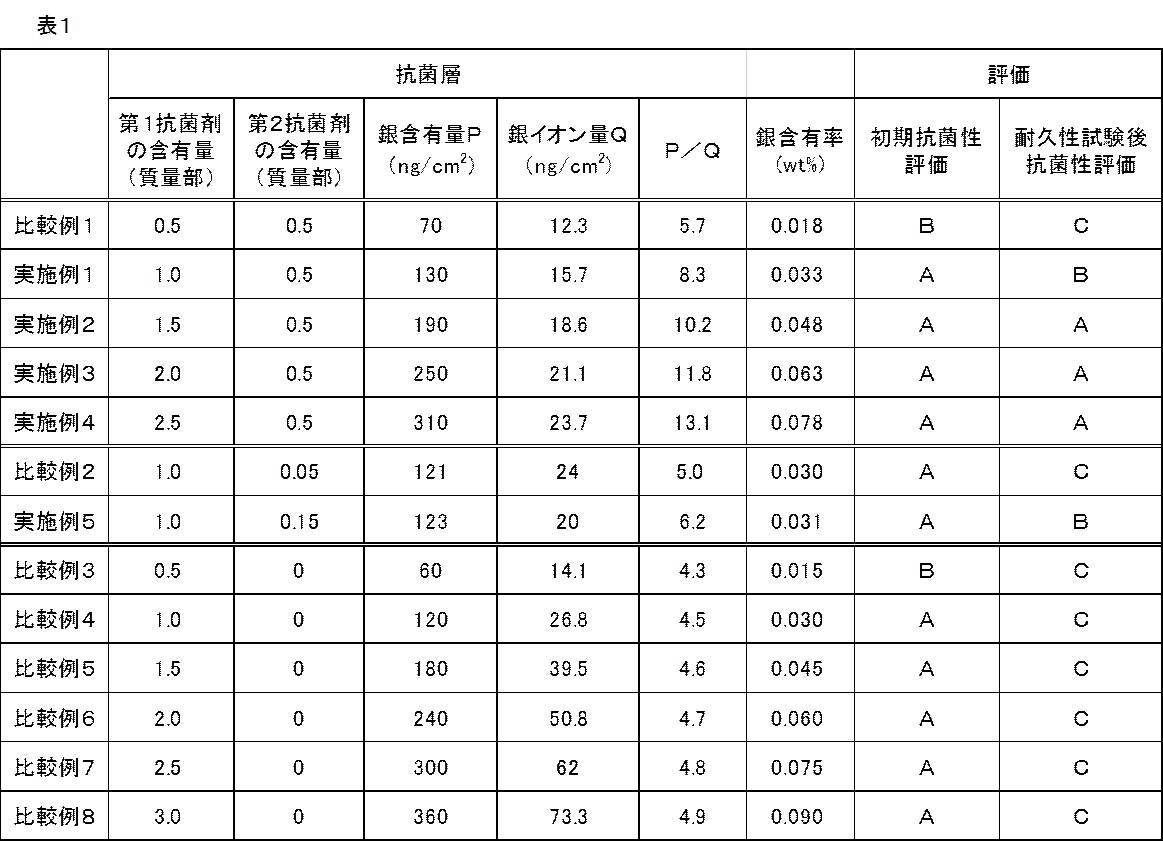
表1に示すように、本発明の抗菌層付き基材は、短時間での抗菌性に優れると共に、長時間にわたった抗菌性にも優れることが確認された。特に、実施例2~4に示すようにP/Qが10以上の場合、より優れた効果が得られることが確認された。
一方、所定の要件を満たさない比較例1~8では、所望の効果が得られなかった。
一方、所定の要件を満たさない比較例1~8では、所望の効果が得られなかった。
10 抗菌層付き基材
12 基材
14 抗菌層
12 基材
14 抗菌層
Claims (12)
- 基材と、前記基材表面の少なくとも一部に配置された抗菌層とを有する、抗菌層付き基材であって、
前記抗菌層が、銀を含む第1抗菌剤と、前記第1抗菌剤とは異なる、銀を含む第2抗菌剤とを有し、
前記抗菌層に含まれる単位面積当たりの銀含有量をP、以下の抽出試験より測定される単位面積当たりの銀イオン量をQとした場合、以下の式(1)および式(2)の関係を満たす、抗菌層付き基材。
式(1) 6.0≦P/Q
式(2) 15.0≦Q
ここで、Pの単位はng/cm2であり、Qの単位はng/cm2である。
また、前記抽出試験は、JIS Z 2801:2010に規定された1/500普通ブイヨン培地を抽出液として用い、前記抽出液の温度を35±1℃に制御して、前記抗菌層付き基材中の前記抗菌層と前記抽出液とを1時間接触させ、前記抽出液に抽出された銀イオン量を測定し、得られた値を前記抗菌層の前記抽出液との接触面積で除して、単位面積当たりの銀イオン量であるQを得る試験である。 - 式(3)の関係を満たす、請求項1に記載の抗菌層付き基材。
式(3) 15.0≦Q≦25.0 - 前記第1抗菌剤が、銀、並びに、リン酸亜鉛カルシウムおよびリン酸カルシウムからなる群から選択されるいずれか一つの担体を含み、
前記第2抗菌剤が、銀、並びに、ゼオライトからなる担体を含む、請求項1または2に記載の抗菌層付き基材。 - 前記抗菌層が親水性基を有するポリマーを含む、請求項1~3のいずれか1項に記載の抗菌層付き基材。
- 前記親水性基がポリオキシアルキレン基を含む、請求項4に記載の抗菌層付き基材。
- 請求項1~5のいずれか1項に記載の抗菌層付き基材を表面に有する、放射線撮影装置。
- 請求項1~5のいずれか1項に記載の抗菌層付き基材を表面に有する、タッチパネル。
- 抗菌剤を含む抗菌シートであって、
前記抗菌剤が、銀を含む第1抗菌剤と、前記第1抗菌剤とは異なる、銀を含む第2抗菌剤とを含み、
前記抗菌シートに含まれる単位面積当たりの銀含有量をP、以下の抽出試験より測定される単位面積当たりの銀イオン量をQとした場合、以下の式(1)および式(2)の関係を満たす、抗菌シート。
式(1) 6.0≦P/Q
式(2) 15.0≦Q
ここで、Pの単位はng/cm2であり、Qの単位はng/cm2である。
また、前記抽出試験は、JIS Z 2801:2000に規定された1/500普通ブイヨン培地を抽出液として用い、前記抽出液の温度を35±1℃に制御して、前記抗菌シートと前記抽出液とを1時間接触させ、前記抽出液に抽出された銀イオン量を測定し、得られた値を前記抗菌層の前記抽出液との接触面積で除して、単位面積当たりの銀イオン量を得る試験である。 - 式(3)の関係を満たす、請求項8に記載の抗菌シート。
式(3) 15.0≦Q≦25.0 - 前記第1抗菌剤が、銀、並びに、リン酸亜鉛カルシウムおよびリン酸カルシウムからなる群から選択されるいずれか一つ担体を含み、
前記第2抗菌剤が、銀、および、ゼオライトからなる担体を含む、請求項8または9に記載の抗菌シート。 - さらに、親水性基を有するポリマーを含む、請求項8~10のいずれか1項に記載の抗菌シート。
- 前記親水性基がポリオキシアルキレン基を含む、請求項11に記載の抗菌シート。
Priority Applications (1)
| Application Number | Priority Date | Filing Date | Title |
|---|---|---|---|
| CN201580002693.0A CN105745074B (zh) | 2014-03-28 | 2015-03-26 | 带抗菌层的基材、抗菌片、放射线摄影装置、触控面板 |
Applications Claiming Priority (2)
| Application Number | Priority Date | Filing Date | Title |
|---|---|---|---|
| JP2014069275A JP6092144B2 (ja) | 2014-03-28 | 2014-03-28 | 抗菌層付き基材、抗菌シート、放射線撮影装置、タッチパネル |
| JP2014-069275 | 2014-03-28 |
Publications (1)
| Publication Number | Publication Date |
|---|---|
| WO2015147201A1 true WO2015147201A1 (ja) | 2015-10-01 |
Family
ID=54195705
Family Applications (1)
| Application Number | Title | Priority Date | Filing Date |
|---|---|---|---|
| PCT/JP2015/059454 Ceased WO2015147201A1 (ja) | 2014-03-28 | 2015-03-26 | 抗菌層付き基材、抗菌シート、放射線撮影装置、タッチパネル |
Country Status (4)
| Country | Link |
|---|---|
| JP (1) | JP6092144B2 (ja) |
| CN (1) | CN105745074B (ja) |
| TW (1) | TW201538319A (ja) |
| WO (1) | WO2015147201A1 (ja) |
Cited By (2)
| Publication number | Priority date | Publication date | Assignee | Title |
|---|---|---|---|---|
| WO2019188353A1 (ja) * | 2018-03-29 | 2019-10-03 | 富士フイルム株式会社 | 抗菌性組成物、抗菌膜、抗菌膜付き基材 |
| CN120361313A (zh) * | 2025-04-25 | 2025-07-25 | 北京大学第三医院(北京大学第三临床医学院) | 一种抗菌型导管及其制备方法 |
Families Citing this family (2)
| Publication number | Priority date | Publication date | Assignee | Title |
|---|---|---|---|---|
| JP6590687B2 (ja) * | 2015-12-24 | 2019-10-16 | 平岡織染株式会社 | テント構造物膜材用樹脂組成物 |
| JP2023027804A (ja) * | 2021-08-18 | 2023-03-03 | 株式会社ダイセル | 抗ウイルス性成形体およびその用途 |
Citations (4)
| Publication number | Priority date | Publication date | Assignee | Title |
|---|---|---|---|---|
| JPH07304619A (ja) * | 1994-05-11 | 1995-11-21 | Aica Kogyo Co Ltd | 抗菌性ポリエステル化粧板の製造方法 |
| JP2002179514A (ja) * | 2000-12-11 | 2002-06-26 | Nisshin Steel Co Ltd | 抗菌剤,抗菌剤の製造方法及び抗菌性樹脂組成物 |
| WO2012111673A1 (ja) * | 2011-02-15 | 2012-08-23 | 東洋製罐株式会社 | 抗菌性樹脂組成物 |
| WO2014025040A1 (ja) * | 2012-08-09 | 2014-02-13 | 王子ホールディングス株式会社 | 抗菌性透明フィルム、および抗菌性粘着シート |
Family Cites Families (3)
| Publication number | Priority date | Publication date | Assignee | Title |
|---|---|---|---|---|
| CN1090454C (zh) * | 1994-10-05 | 2002-09-11 | 东陶机器株式会社 | 抗菌性固态物及其制造方法以及其利用方法 |
| JPH11314963A (ja) * | 1999-03-11 | 1999-11-16 | Toto Ltd | 抗菌性を有する多機能材 |
| DE102007054132A1 (de) * | 2007-11-14 | 2009-05-20 | Mitsubishi Polyester Film Gmbh | Antimikrobiell ausgerüstete, biaxial orientierte Polyesterfolie |
-
2014
- 2014-03-28 JP JP2014069275A patent/JP6092144B2/ja active Active
-
2015
- 2015-03-26 CN CN201580002693.0A patent/CN105745074B/zh not_active Expired - Fee Related
- 2015-03-26 WO PCT/JP2015/059454 patent/WO2015147201A1/ja not_active Ceased
- 2015-03-27 TW TW104109900A patent/TW201538319A/zh unknown
Patent Citations (4)
| Publication number | Priority date | Publication date | Assignee | Title |
|---|---|---|---|---|
| JPH07304619A (ja) * | 1994-05-11 | 1995-11-21 | Aica Kogyo Co Ltd | 抗菌性ポリエステル化粧板の製造方法 |
| JP2002179514A (ja) * | 2000-12-11 | 2002-06-26 | Nisshin Steel Co Ltd | 抗菌剤,抗菌剤の製造方法及び抗菌性樹脂組成物 |
| WO2012111673A1 (ja) * | 2011-02-15 | 2012-08-23 | 東洋製罐株式会社 | 抗菌性樹脂組成物 |
| WO2014025040A1 (ja) * | 2012-08-09 | 2014-02-13 | 王子ホールディングス株式会社 | 抗菌性透明フィルム、および抗菌性粘着シート |
Cited By (4)
| Publication number | Priority date | Publication date | Assignee | Title |
|---|---|---|---|---|
| WO2019188353A1 (ja) * | 2018-03-29 | 2019-10-03 | 富士フイルム株式会社 | 抗菌性組成物、抗菌膜、抗菌膜付き基材 |
| JPWO2019188353A1 (ja) * | 2018-03-29 | 2020-10-22 | 富士フイルム株式会社 | 抗菌性組成物、抗菌膜、抗菌膜付き基材 |
| US11877577B2 (en) | 2018-03-29 | 2024-01-23 | Fujifilm Corporation | Antibacterial composition, antibacterial film, and antibacterial film-attached substrate |
| CN120361313A (zh) * | 2025-04-25 | 2025-07-25 | 北京大学第三医院(北京大学第三临床医学院) | 一种抗菌型导管及其制备方法 |
Also Published As
| Publication number | Publication date |
|---|---|
| JP6092144B2 (ja) | 2017-03-08 |
| CN105745074A (zh) | 2016-07-06 |
| CN105745074B (zh) | 2017-09-19 |
| TW201538319A (zh) | 2015-10-16 |
| JP2015189152A (ja) | 2015-11-02 |
Similar Documents
| Publication | Publication Date | Title |
|---|---|---|
| JP6092145B2 (ja) | 抗菌層付き基材、抗菌シート、放射線撮影装置、タッチパネル | |
| EP3275650B1 (en) | Base material having antibacterial layer, and display film | |
| JP6781256B2 (ja) | 抗菌組成物、抗菌膜、抗菌膜付き基材、抗菌膜の製造方法、及び、抗菌膜付き基材の製造方法 | |
| WO2016047568A1 (ja) | 抗菌シート、抗菌コート、積層体、抗菌液 | |
| JP6092144B2 (ja) | 抗菌層付き基材、抗菌シート、放射線撮影装置、タッチパネル | |
| JP2022008926A (ja) | 抗菌層付き支持体及び積層体 | |
| JP7755993B2 (ja) | コーティング組成物ならびにそれを用いた防曇性部材、防汚性部材、積層体および抗菌製品 | |
| WO2019172041A1 (ja) | 抗菌膜、抗菌組成物、抗菌膜付き基材、抗菌性を付与する方法 | |
| WO2012132716A1 (ja) | 撥水性光触媒組成物及び撥水性光触媒塗膜 | |
| JPWO2015178166A1 (ja) | 機器、保護シート及び抗菌膜 | |
| JP2016032628A (ja) | 保育器用フード、これを備える保育器、保育器用親水加工シート、及び保育器用親水加工抗菌膜 | |
| WO2015198890A1 (ja) | 抗菌層付き基材、抗菌シート、放射線撮影装置、タッチパネル、積層体 | |
| RU2416435C1 (ru) | Способ антисептической обработки поверхности изделия из полимерного материала | |
| JP2013203935A (ja) | ハードコートフィルム | |
| JP5803498B2 (ja) | 抗菌剤およびそれを用いた基材の表面処理方法 | |
| EP3131540B1 (en) | Methods of processing chlorhexidine-containing polymerizable compositions and antimicrobial articles formed thereby | |
| JP2022077137A (ja) | 抗ウイルス複合膜形成用キット、抗ウイルス複合膜、および抗ウイルス複合膜付き基材 | |
| KR20250036725A (ko) | 항균막 코팅 기재 및 그 제조 방법 | |
| KR20210067738A (ko) | 항균 및 항알러지성 고분자 코팅 조성물, 및 항균 및 항알러지성 고분자 필름 |
Legal Events
| Date | Code | Title | Description |
|---|---|---|---|
| 121 | Ep: the epo has been informed by wipo that ep was designated in this application |
Ref document number: 15767870 Country of ref document: EP Kind code of ref document: A1 |
|
| NENP | Non-entry into the national phase | ||
| 122 | Ep: pct application non-entry in european phase |
Ref document number: 15767870 Country of ref document: EP Kind code of ref document: A1 |