WO2015147125A1 - シーリング用ポリウレタン樹脂組成物 - Google Patents
シーリング用ポリウレタン樹脂組成物 Download PDFInfo
- Publication number
- WO2015147125A1 WO2015147125A1 PCT/JP2015/059289 JP2015059289W WO2015147125A1 WO 2015147125 A1 WO2015147125 A1 WO 2015147125A1 JP 2015059289 W JP2015059289 W JP 2015059289W WO 2015147125 A1 WO2015147125 A1 WO 2015147125A1
- Authority
- WO
- WIPO (PCT)
- Prior art keywords
- sealing
- resin composition
- polyurethane resin
- layer
- polyurethane
- Prior art date
- Legal status (The legal status is an assumption and is not a legal conclusion. Google has not performed a legal analysis and makes no representation as to the accuracy of the status listed.)
- Ceased
Links
Images


Classifications
-
- C—CHEMISTRY; METALLURGY
- C09—DYES; PAINTS; POLISHES; NATURAL RESINS; ADHESIVES; COMPOSITIONS NOT OTHERWISE PROVIDED FOR; APPLICATIONS OF MATERIALS NOT OTHERWISE PROVIDED FOR
- C09K—MATERIALS FOR MISCELLANEOUS APPLICATIONS, NOT PROVIDED FOR ELSEWHERE
- C09K3/00—Materials not provided for elsewhere
- C09K3/10—Materials in mouldable or extrudable form for sealing or packing joints or covers
- C09K3/1006—Materials in mouldable or extrudable form for sealing or packing joints or covers characterised by the chemical nature of one of its constituents
- C09K3/1021—Polyurethanes or derivatives thereof
-
- C—CHEMISTRY; METALLURGY
- C08—ORGANIC MACROMOLECULAR COMPOUNDS; THEIR PREPARATION OR CHEMICAL WORKING-UP; COMPOSITIONS BASED THEREON
- C08G—MACROMOLECULAR COMPOUNDS OBTAINED OTHERWISE THAN BY REACTIONS ONLY INVOLVING UNSATURATED CARBON-TO-CARBON BONDS
- C08G18/00—Polymeric products of isocyanates or isothiocyanates
- C08G18/06—Polymeric products of isocyanates or isothiocyanates with compounds having active hydrogen
- C08G18/28—Polymeric products of isocyanates or isothiocyanates with compounds having active hydrogen characterised by the compounds used containing active hydrogen
- C08G18/30—Low-molecular-weight compounds
- C08G18/36—Hydroxylated esters of higher fatty acids
-
- C—CHEMISTRY; METALLURGY
- C08—ORGANIC MACROMOLECULAR COMPOUNDS; THEIR PREPARATION OR CHEMICAL WORKING-UP; COMPOSITIONS BASED THEREON
- C08G—MACROMOLECULAR COMPOUNDS OBTAINED OTHERWISE THAN BY REACTIONS ONLY INVOLVING UNSATURATED CARBON-TO-CARBON BONDS
- C08G18/00—Polymeric products of isocyanates or isothiocyanates
- C08G18/06—Polymeric products of isocyanates or isothiocyanates with compounds having active hydrogen
- C08G18/70—Polymeric products of isocyanates or isothiocyanates with compounds having active hydrogen characterised by the isocyanates or isothiocyanates used
- C08G18/72—Polyisocyanates or polyisothiocyanates
- C08G18/74—Polyisocyanates or polyisothiocyanates cyclic
- C08G18/76—Polyisocyanates or polyisothiocyanates cyclic aromatic
- C08G18/7657—Polyisocyanates or polyisothiocyanates cyclic aromatic containing two or more aromatic rings
- C08G18/7664—Polyisocyanates or polyisothiocyanates cyclic aromatic containing two or more aromatic rings containing alkylene polyphenyl groups
-
- C—CHEMISTRY; METALLURGY
- C08—ORGANIC MACROMOLECULAR COMPOUNDS; THEIR PREPARATION OR CHEMICAL WORKING-UP; COMPOSITIONS BASED THEREON
- C08G—MACROMOLECULAR COMPOUNDS OBTAINED OTHERWISE THAN BY REACTIONS ONLY INVOLVING UNSATURATED CARBON-TO-CARBON BONDS
- C08G2190/00—Compositions for sealing or packing joints
Definitions
- the present invention relates to a polyurethane resin composition for sealing. Specifically, the present invention relates to a sealing polyurethane resin composition that prevents water leakage from gaps or cracks in concrete structures and the like.
- a urethane-based water-stopping material is used (see Patent Document 1).
- bituminous sealing materials are likely to deteriorate over time due to rainwater soaked in joints. Therefore, sealing with bituminous sealing materials is not sufficient for a long-term water-stopping effect.
- the bituminous sealant that has deteriorated over time as described above is very brittle and may fall off the joints, causing it to fall to passers-by, damaging automobiles while driving, and causing traffic accidents. There are also concerns.
- the urethane-based water-stopping material disclosed in Patent Document 1 has poor flexibility and is foamed, so that it is easy to crack due to vibrations such as earthquakes, and has a sufficient water-stopping effect. There is a problem that it is difficult to obtain.
- the present invention has been made in view of such circumstances, and an object thereof is to provide a sealing polyurethane resin composition that effectively prevents water leakage from gaps and cracks in concrete structures and the like.
- a polyurethane resin composition for sealing which contains the following components (A) to (E) and does not contain polyoxypropylene glycol.
- the organic polyisocyanate (E) is a polymethylene polyphenyl polyisocyanate containing 30 to 80% by mass of a dinuclear compound, and the dinuclear compound is composed of 2,2′-diphenylmethane diisocyanate and 2
- the present inventors used a special polyurethane resin compounding liquid that contains the components (A) to (E) and does not contain polyoxypropylene glycol.
- a polyurethane layer consisting of a cured resin layer (non-foamed urethane layer) and a foamed layer (foamed urethane layer) is formed, and this laminated structure has a better water-stopping effect than conventional foamed urethane-based waterstop materials.
- the present invention was reached.
- the reason why the polyurethane layer is divided into a cured resin layer and a foamed layer is that a plasticizer is blended in the material, a castor oil-based polyol is used as a polyol component, and polyoxypropylene glycol is not included. Therefore, it is considered that the difference in isocyanate concentration occurs between the lower part and the upper part due to the influence of specific gravity. That is, the urethane reaction proceeds from the lower part with a high isocyanate concentration to form a cured resin layer, while the upper part has a low isocyanate concentration, carbon dioxide generated by the reaction, and bubbles entrained by agitation and a resin density.
- the polyurethane resin composition for sealing according to the present invention is a special one containing the components (A) to (E) and not containing polyoxypropylene glycol, and includes a cured resin layer and a foamed layer. Since the polyurethane layer is formed, a good water stop effect can be obtained. Moreover, since the said polyurethane layer has a foaming layer, it is lightweight compared with the bituminous sealant, and does not fall in a lump.
- the sealing polyurethane resin composition of the present invention contains the following components (A) to (E) and does not contain polyoxypropylene glycol.
- the polyoxypropylene glycol is, for example, a reaction with a low molecular polyol having 2 to 8 functional groups such as ethylene glycol, propylene glycol, glycerin, trimethylolpropane, pentaerythritol, sorbitol, sucrose, or water. 1 shows a propylene oxide ring-opening polymer such as a linear or branched polyether which has been subjected to ring-opening polymerization.
- A Castor oil-based polyol.
- B Plasticizer.
- D Foam stabilizer.
- E Organic polyisocyanate.
- castor oil-based polyol (A) for example, castor oil, castor oil fatty acid and low molecular polyol (ethylene glycol, propylene glycol, glycerin, trimethylolpropane, pentaerythritol, sorbitol, sucrose, etc. having 2 or more functional groups) 8 low molecular polyols) and linear or branched polyesters obtained by reaction with water (for example, diglyceride of castor oil fatty acid, monoglyceride, mono, di, or triester of castor oil fatty acid and trimethylol alkane).
- water for example, diglyceride of castor oil fatty acid, monoglyceride, mono, di, or triester of castor oil fatty acid and trimethylol alkane
- the main component of “castor oil” is ricinoleic acid
- “castor oil fatty acid” includes hydrogenated castor oil.
- examples of the trimethylol alkane include trimethylol methane, trimethylol ethane, trimethylol propane, trimethylol butane, trimethylol pentane, trimethylol hexane, trimethylol heptane, trimethylol octane, trimethylol nonane, and trimethylol decane. Can give. These can be used alone or in combination of two or more.
- the ratio of the castor oil-based polyol (A) to the total mass of the polyol in the polyurethane resin composition is usually 50 to 100% by mass, preferably 60 to 100% by mass. That is, the main component of the polyurethane resin composition is a castor oil-based polyol, but a polybutadiene other than polyoxypropylene glycol, or a polyolefin system in which a hydroxyl group is introduced at the end of a copolymer of butadiene and styrene or acrylonitrile. If it is a hydrophobic polyol, you may add polyols other than a castor oil-type polyol in the said ratio as needed.
- plasticizer (B) examples include dimethyl phthalate, diethyl phthalate, dibutyl phthalate, dihexyl phthalate, di-2-ethylhexyl phthalate, di-n-octyl phthalate, diisononyl phthalate, and diisodecyl phthalate.
- the blending amount of the plasticizer (B) is in the range of 5 to 30 parts with respect to 100 parts by weight of polyol (hereinafter abbreviated as “parts”) from the viewpoint of the formation of both the foamed layer and the cured resin layer. It is preferably in the range of 10 to 25 parts.
- Examples of the amine catalyst (C) include triethylamine, triethylenediamine, tetramethylhexanediamine, tetramethylethylenediamine, methylhydroxyethylpiperazine, N-methylmorpholine, N-methylimidazole, 1-methylimidazole, 1-ethylimidazole, 1-propylimidazole, 1-cyanoimidazole, 1-cyanomethylimidazole, 1,2-dimethylimidazole, 1,4-dimethylimidazole, 1-ethyl-2-ethylimidazole, 1-methyl-4-ethylimidazole, 1- Ethyl-2-methylimidazole, 1-ethyl-4-methylimidazole, dimethylaminopropylimidazole, hexamethyltripropylenetetramine, pyridine, ⁇ -picoline, N, N, N ′, N′-te Tramethylhexamethylenediamine, N, N,
- triethylenediamine (TEDA) as the amine catalyst (C) from the viewpoint of the formation of both the cured resin layer and the foamed layer in the polyurethane layer.
- the compounding amount of the amine catalyst (C) is preferably in the range of 0.5 to 5.0 parts, particularly preferably in the range of 0.7 to 3.0 parts with respect to 100 parts of the polyol. That is, if there are too many amine catalysts, curing proceeds before the foamed cells grow, so the upper fluidity disappears and the cured resin layer and the foamed layer are not separated. Conversely, if there are too few amine catalysts, the reaction This is because the time is prolonged, which hinders the construction.
- foam stabilizer (D) examples include silicone surfactants containing no active hydrogen groups, such as siloxane-polyalkylene oxide copolymers.
- silicone surfactants containing no active hydrogen groups such as siloxane-polyalkylene oxide copolymers.
- NIAX SILICONE Y-16136 made by Momentive Performance Materials Japan
- TEGOSTAB B-8407 made by Evonik Degussa Japan
- TEGOSTAB B-8451 made by Evonik Degussa Japan
- X20-6105 manufactured by Shin-Etsu Chemical Co., Ltd.
- NIAX SILICONE Y-16136 is preferable because the cell size in the foamed layer is not random, distortion due to shrinkage is improved, and adhesion to mortar is further improved.
- the blending amount of the foam stabilizer (D) is preferably in the range of 0.2 to 2.0 parts with respect to 100 parts of the polyol from the viewpoint of effectively obtaining the above-described effects by the foam stabilizer. Particularly preferred is a range of 0.5 to 1.5 parts.
- organic polyisocyanate (E) examples include aromatic, alicyclic, and aliphatic polyisocyanates, and urethane-modified products, allophanate-modified products, uretdione-modified products, isocyanurate-modified products, and carbodiimide-modified products. And modified polyisocyanates such as uretonimine modified, urea modified and biuret modified.
- aromatic polyisocyanate examples include tolylene diisocyanate (hereinafter abbreviated as “TDI” in some cases), diphenylmethane diisocyanate (hereinafter abbreviated as “MDI” in some cases), naphthalene diisocyanate, and triphenylmethane triisocyanate.
- TDI tolylene diisocyanate
- MDI diphenylmethane diisocyanate
- naphthalene diisocyanate examples include triphenylmethane triisocyanate.
- XDI Xylylene diisocyanate
- TMXDI tetramethylxylylene diisocyanate
- PDI polymethylene polyphenyl polyisocyanate
- aromatic polyisocyanates each include single products and mixtures of various isomers.
- examples of the alicyclic polyisocyanate include cyclohexylmethane diisocyanate, cyclohexane diisocyanate, isophorone diisocyanate, hydrogenated MDI, hydrogenated TDI, hydrogenated XDI, and hydrogenated TMXDI.
- examples of the aliphatic polyisocyanate include hexamethylene diisocyanate and lysine diisocyanate.
- aromatic polyisocyanates are preferable, and P-MDI is more preferable from the viewpoint of low viscosity and influence on the environment.
- these organic polyisocyanate (E) can be used individually or in combination of 2 or more types.
- Examples of the P-MDI include polymeric MDI represented by the following general formula (1).
- the dinuclear contains 5 to 60 in total of 2,2′-diphenylmethane diisocyanate and 2,4′-diphenylmethane diisocyanate.
- Those containing mass% are preferably used. That is, when the dinuclear content is less than 30% by mass, the viscosity of the liquid may be increased and the filling property may be hindered.
- the dinuclear content is more than 80% by mass, a crystal may be generated at a low temperature. is there.
- the blending ratio of the organic polyisocyanate (E) to the polyol is such that the NCO index [equivalent ratio of NCO group in isocyanate to hydroxyl group in polyol (NCO group / OH group) ⁇ 100] is 95 to 130. It is preferable to mix
- the polyurethane resin composition for sealing of the present invention includes an antioxidant, an ultraviolet absorber, a heat resistance improver, an antifoaming agent, a leveling agent, and a coloring agent as necessary.
- an antioxidant an ultraviolet absorber, a heat resistance improver, an antifoaming agent, a leveling agent, and a coloring agent.
- Agents, inorganic and organic fillers, lubricants, antistatic agents, reinforcing materials and the like may be appropriately blended.
- the polyurethane resin composition for sealing of this invention can be prepared by mixing said each component.
- the mixing means include manual mixing and stirring, and mixing treatment using various mixers such as a vacuum homomixer, a disper, a propeller mixer, a kneader, and a high-pressure homogenizer.
- the sealing polyurethane resin composition of the present invention comprises a main agent containing the components (A) to (D) and a curing agent containing the component (E), and these are injected into the construction object. It is preferable to mix and use immediately before (immediately before sealing construction) from the viewpoint of pot life and the like.
- the viscosity at the time of mixing the main agent and the curing agent is preferably in the range of 100 to 1,500 mPa ⁇ s at 25 ° C., particularly preferably 200 to 1,000 mPa ⁇ s At 25 ° C.
- the said viscosity can be adjusted with the usage-amount of the plasticizer which is a solvent of a main ingredient.
- the liquid temperature at the time of pouring (sealing construction) of the polyurethane resin composition for sealing of the present invention is preferably 10 to 40 ° C. That is, if the liquid temperature is too high, it becomes difficult to handle at the time of filling, and conversely if the liquid temperature is too low, the flow time becomes long, and it is easily affected by water, resulting in high foaming property, This is because the viscosity becomes high and the filling property may be hindered.
- the polyurethane resin composition for sealing of the present invention is useful as a water-stopping material and sealing material for structures such as civil engineering and architecture, particularly as a water-stopping material and sealing material for concrete structures. Moreover, it is also possible to apply to the use of the general water stop material and sealing material in the field
- the sealing material formed from the polyurethane resin composition for sealing according to the present invention has a polyurethane layer composed of a cured resin layer and a foamed layer. That is, the polyurethane layer formed by sealing the polyurethane resin composition for sealing of the present invention has a difference in the isocyanate concentration between the lower part and the upper part due to the influence of the specific gravity of the isocyanate, and the urethanization reaction proceeds from the lower part where the isocyanate concentration is high.
- the lower part is a cured resin layer.
- the upper part has a low isocyanate concentration and the carbon dioxide generated by the reaction and bubbles entrained by stirring decrease, so the resin density decreases and the reaction heat cannot be stored compared to the lower part, so the urethanization reaction is delayed and the reaction is in progress
- a laminated structure of a cured resin layer and a foamed layer is formed by forming a foamed layer under the influence of water leakage from the joint.
- the thickness of the entire polyurethane layer should be at least 3 cm, preferably in the range of 3 to 60 cm, more preferably in the range of 3 to 25 cm, still more preferably It is in the range of 5 to 20 cm.
- the thickness of the cured resin layer (non-foamed urethane layer) in the polyurethane layer needs to be at least 2.5 cm, preferably in the range of 2.5 to 59 cm, more preferably 2 The range is from 5 to 22 cm, and more preferably from 4 to 18 cm.
- the thickness of the foamed layer (foamed urethane layer) in the polyurethane layer is preferably in the range of 0.2 to 5.0 cm, more preferably in the range of 0.5 to 3.0 cm.
- a sample X shown in FIG. 1 was produced. That is, a columnar concrete block 1 having a diameter of 75 mm and a height of 50 mm is prepared by providing a through hole 1 a having a diameter of 40 mm at the center of the plane, the concrete block 1 is placed on a flat plate, and the polyurethane prepared above is prepared. The resin composition liquid was poured into the through-hole 1a and foamed and cured in an atmosphere at 20 ° C. to form the polyurethane layer 2 (see FIG. 1).
- a water permeability test (constant water level method) was performed on the sample X obtained in this manner in accordance with JIS A 1218 (soil permeability test method).
- the height (water level difference) between the test specimen and water in the water permeability test was 100 cm.
- the water level difference was set by adjusting the water pressure, and the change in water level (water permeability) was measured when the test was conducted for 12 hours. And based on the measured result, the hydraulic conductivity was calculated.
- the polyurethane layer in the sample X was taken out after the water permeability test, and the cured resin layer and the foamed layer were measured with a caliper from the cross section.
- the density of the cured resin layer and the foamed layer was measured on the sample using an automatic hydrometer DSG-1 manufactured by Toyo Seiki Co., Ltd. Furthermore, about the sample in which the cured resin layer was formed, the hardness (Asker A type) of the cured resin layer was measured. Moreover, the adhesive strength to mortar was measured according to the following criteria. These results are also shown in Table 2 below.
- the comparative example has a water permeability coefficient of 10 ⁇ 6 m / s level. This is the level of fine to coarse-grained clay in the soil, and there remains a problem with regard to waterstop.
- the example was higher than the comparative example, and mortar destruction was observed in the adhesion state, whereas the comparative example was 100% resin destruction.
- the polyurethane resin composition for sealing of the present invention is useful as a water-stopping material and sealing material for structures such as civil engineering and architecture, particularly as a water-stopping material and sealing material for concrete structures. In addition, it can be applied to general water-stopping materials and sealing materials in other fields.
Landscapes
- Chemical & Material Sciences (AREA)
- Organic Chemistry (AREA)
- Health & Medical Sciences (AREA)
- Chemical Kinetics & Catalysis (AREA)
- Medicinal Chemistry (AREA)
- Polymers & Plastics (AREA)
- Engineering & Computer Science (AREA)
- Materials Engineering (AREA)
- Polyurethanes Or Polyureas (AREA)
- Sealing Material Composition (AREA)
Abstract
下記の(A)~(E)成分を含有するとともにポリオキシプロピレングリコールを含まないシーリング用ポリウレタン樹脂組成物とする。したがって、コンクリート構造物等の隙間やひび割れからの漏水を効果的に防止することができる。 (A)ヒマシ油系ポリオール。 (B)可塑剤。 (C)アミン触媒。 (D)整泡剤。 (E)有機ポリイソシアネート。
Description
本発明は、シーリング用ポリウレタン樹脂組成物に関するものである。詳しくは、コンクリート構造物等の隙間やひび割れからの漏水を防止する、シーリング用ポリウレタン樹脂組成物に関するものである。
トンネル天井に敷きつめられたボックスカルバート等のカルバート(コンクリート材)同士の隙間となる溝(目地)は、通常、瀝青質シーリング材により塞がれる。これは、車の振動や地盤変化、さらには寒暖差によるカルバートの膨張・収縮により、上記溝幅が変化しても、瀝青質シーリング材が高い追従性を示すからである(非特許文献1参照)。
一方、一般的なシーリング材としては、例えば、発泡ウレタン系の止水材が用いられている(特許文献1参照)。
七王工業株式会社ホームページ内、"土地用伸縮目地材"、[online]、[平成25年9月24日検索]、インターネット(URL http://www.nanao-net.co.jp/nanaodoboku.html)
しかしながら、瀝青質シーリング材は、目地に染み込んだ雨水により経年劣化を生じやすく、そのため、瀝青質シーリング材によるシーリングでは、長期にわたる止水効果が充分でないといった現状がある。しかも、上記のように経年劣化した瀝青質シーリング材は、非常に脆く目地から脱落することがあり、通行人への落下や走行中の自動車の破損、さらには、交通事故を引き起こす要因となることも懸念されている。
また、特許文献1に開示されているような発泡ウレタン系の止水材は、柔軟性に乏しく、しかも発泡していることから、地震等の振動により亀裂が入りやすく、充分な止水効果を得ることが難しいといった問題がある。
本発明は、このような事情に鑑みなされたもので、コンクリート構造物等の隙間やひび割れからの漏水を効果的に防止するシーリング用ポリウレタン樹脂組成物の提供をその目的とする。
すなわち本発明は下記の[1]~[8]の通りである。
[1]下記の(A)~(E)成分を含有するとともにポリオキシプロピレングリコールを含まないことを特徴とするシーリング用ポリウレタン樹脂組成物。
(A)ヒマシ油系ポリオール。
(B)可塑剤。
(C)アミン触媒。
(D)整泡剤。
(E)有機ポリイソシアネート。
[2]上記可塑剤(B)が、芳香族炭化水素系可塑剤であることを特徴とする上記[1]記載のシーリング用ポリウレタン樹脂組成物。
[3]上記有機ポリイソシアネート(E)が、二核体を30~80質量%含有するポリメチレンポリフェニルポリイソシアネートであって、かつ、上記二核体が、2,2’-ジフェニルメタンジイソシアネートと2,4’-ジフェニルメタンジイソシアネートを合計で5~60質量%含有するものであることを特徴とする上記[1]又は[2]記載のシーリング用ポリウレタン樹脂組成物。
[4]上記整泡剤(D)が、活性水素基を含有しないシリコーン系界面活性剤であることを特徴とする上記[1]~[3]のいずれかに記載のシーリング用ポリウレタン樹脂組成物。
[5]上記アミン触媒(C)が、トリエチレンジアミンであることを特徴とする上記[1]~[4]のいずれかに記載のシーリング用ポリウレタン樹脂組成物。
[6]上記(A)~(D)成分を含有する主剤と、(E)成分を含有する硬化剤との、二液反応型組成物であることを特徴とする上記[1]~[5]のいずれかに記載のシーリング用ポリウレタン樹脂組成物。
[7]上記[1]~[6]のいずれかに記載のシーリング用ポリウレタン樹脂組成物から形成された、硬化樹脂層と発泡層からなるポリウレタン層を有することを特徴とするシーリング材。
[8]ポリウレタン層全体の厚みが少なくとも3cmであり、且つ硬化樹脂層の厚みが少なくとも2.5cmであることを特徴とする上記[7]記載のシーリング材。
[1]下記の(A)~(E)成分を含有するとともにポリオキシプロピレングリコールを含まないことを特徴とするシーリング用ポリウレタン樹脂組成物。
(A)ヒマシ油系ポリオール。
(B)可塑剤。
(C)アミン触媒。
(D)整泡剤。
(E)有機ポリイソシアネート。
[2]上記可塑剤(B)が、芳香族炭化水素系可塑剤であることを特徴とする上記[1]記載のシーリング用ポリウレタン樹脂組成物。
[3]上記有機ポリイソシアネート(E)が、二核体を30~80質量%含有するポリメチレンポリフェニルポリイソシアネートであって、かつ、上記二核体が、2,2’-ジフェニルメタンジイソシアネートと2,4’-ジフェニルメタンジイソシアネートを合計で5~60質量%含有するものであることを特徴とする上記[1]又は[2]記載のシーリング用ポリウレタン樹脂組成物。
[4]上記整泡剤(D)が、活性水素基を含有しないシリコーン系界面活性剤であることを特徴とする上記[1]~[3]のいずれかに記載のシーリング用ポリウレタン樹脂組成物。
[5]上記アミン触媒(C)が、トリエチレンジアミンであることを特徴とする上記[1]~[4]のいずれかに記載のシーリング用ポリウレタン樹脂組成物。
[6]上記(A)~(D)成分を含有する主剤と、(E)成分を含有する硬化剤との、二液反応型組成物であることを特徴とする上記[1]~[5]のいずれかに記載のシーリング用ポリウレタン樹脂組成物。
[7]上記[1]~[6]のいずれかに記載のシーリング用ポリウレタン樹脂組成物から形成された、硬化樹脂層と発泡層からなるポリウレタン層を有することを特徴とするシーリング材。
[8]ポリウレタン層全体の厚みが少なくとも3cmであり、且つ硬化樹脂層の厚みが少なくとも2.5cmであることを特徴とする上記[7]記載のシーリング材。
すなわち、本発明者らは、前記課題を解決するため鋭意研究を重ねた結果、上記(A)~(E)成分を含有するとともにポリオキシプロピレングリコールを含まない特殊なポリウレタン樹脂配合液を用いたところ、硬化樹脂層(無発泡ウレタン層)と発泡層(発泡ウレタン層)とからなるポリウレタン層が形成され、この積層構造によって、従来の発泡ウレタン系の止水材に比べ良好な止水効果が得られることを突き止め、本発明に到達した。
上記のように、ポリウレタン層が、硬化樹脂層と発泡層とに分かれる理由は、その材料中に、可塑剤を配合し、ポリオール成分にヒマシ油系ポリオールを用い、かつポリオキシプロピレングリコールを含まないため、比重の影響で下部と上部でイソシアネート濃度に差が生じるためと考えられる。すなわち、イソシアネート濃度が高い下部からウレタン化反応が進行することで、硬化樹脂層を形成し、一方上部は、イソシアネート濃度が低いことと反応により発生した二酸化炭素と撹拌により巻き込んだ泡が溜まり樹脂密度が低下するため、反応熱が蓄熱できずウレタン化反応が遅延し流動時間が長くなる。その結果、イソシアネートが溜まる下部では、気泡の無い硬化樹脂層が形成され、上部では発泡層が形成されるようになる。なお、ポリウレタン樹脂配合液にポリオキシプロピレングリコールを含んでいると、上記のように硬化樹脂層と発泡層とに分かれないことが、本発明者らによる研究実験により明らかとなっている。
以上のように、本発明のシーリング用ポリウレタン樹脂組成物は、前記(A)~(E)成分を含有するとともにポリオキシプロピレングリコールを含まない特殊なものであり、硬化樹脂層と発泡層とからなるポリウレタン層を形成することから、良好な止水効果を得ることができる。また、上記ポリウレタン層は、発泡層を有するため、瀝青質シーリング材と比べ軽量であり、塊で落下するようなことはない。
つぎに、本発明の実施の形態を詳しく説明する。
本発明のシーリング用ポリウレタン樹脂組成物は、先に述べたように、下記の(A)~(E)成分を含有するとともにポリオキシプロピレングリコールを含まない。また、本発明において、ポリオキシプロピレングリコールとは、例えば、エチレングリコール、プロピレングリコール、グリセリン、トリメチロールプロパン、ペンタエリスリトール、ソルビトール、シュークロース等の官能基数2~8の低分子ポリオールや水との反応により開環重合された、線状または分岐状ポリエーテル等のプロピレンオキサイド開環重合体を示す。
(A)ヒマシ油系ポリオール。
(B)可塑剤。
(C)アミン触媒。
(D)整泡剤。
(E)有機ポリイソシアネート。
(A)ヒマシ油系ポリオール。
(B)可塑剤。
(C)アミン触媒。
(D)整泡剤。
(E)有機ポリイソシアネート。
上記ヒマシ油系ポリオール(A)としては、例えば、ヒマシ油や、ヒマシ油脂肪酸と低分子ポリオール(エチレングリコール、プロピレングリコール、グリセリン、トリメチロールプロパン、ペンタエリスリトール、ソルビトール、シュークロース等の官能基数2~8の低分子ポリオール)や水との反応により得られる線状または分岐状ポリエステル(例えば、ヒマシ油脂肪酸のジグリセライド、モノグリセライド、ヒマシ油脂肪酸とトリメチロールアルカンとのモノ、ジ、またはトリエステル等)があげられる。なお、「ヒマシ油」の主成分はリシノール酸であり、「ヒマシ油脂肪酸」には、水素添加ヒマシ油が含まれる。また、上記トリメチロールアルカンとしては、例えば、トリメチロールメタン、トリメチロールエタン、トリメチロールプロパン、トリメチロールブタン、トリメチロールペンタン、トリメチロールヘキサン、トリメチロールヘプタン、トリメチロールオクタン、トリメチロールノナン及びトリメチロールデカンをあげることができる。これらは、単独でまたは2種以上を組み合わせて使用することができる。上記ポリウレタン樹脂組成物中のポリオールの全質量に対するヒマシ油系ポリオール(A)の割合は、通常、50~100質量%、好ましくは60~100質量%である。すなわち、上記ポリウレタン樹脂組成物の主成分はヒマシ油系ポリオールであるが、ポリオキシプロピレングリコール以外のポリブタジエン、又はブタジエンとスチレンもしくはアクリロニトリルとの共重合体の末端に水酸基を導入したポリオレフィン系のような疎水性ポリオールであれば、必要に応じ、上記割合で、ヒマシ油系ポリオール以外のポリオールを加えてもよい。
上記可塑剤(B)としては、例えば、フタル酸ジメチル、フタル酸ジエチル、フタル酸ジブチル、フタル酸ジヘキシル、フタル酸ジ-2-エチルヘキシル、フタル酸ジ-n-オクチル、フタル酸ジイソノニル、フタル酸ジイソデシル、フタル酸ブチルベンジル、アジピン酸ジエチル、アジピン酸ジブチル、アジピン酸ジイソブチル、アジピン酸ジヘキシル、アジピン酸ジ-2-エチルヘキシル、アジピン酸ジ-n-オクチル、アジピン酸ジイソノニル、アジピン酸ジイソデシル、アジピン酸ビス(ブチルジグリコール)、セバシン酸ジエチル、セバシン酸ジブチル、セバシン酸ジヘキシル、セバシン酸ジ-2-エチルヘキシル、マレイン酸ジメチル、マレイン酸ジエチル、マレイン酸ジブチル、マレイン酸ジイソブチル、マレイン酸ジヘキシル、マレイン酸ジ-2-エチルヘキシル、マレイン酸ジ-n-オクチル、マレイン酸ジイソノニル、マレイン酸ジイソデシルなどのエステル化合物、リン酸トリブチル、リン酸トリ-2-エチルヘキシル、リン酸トリフェニル、リン酸トリクレジルなどのリン酸エステル化合物、ジイソプロピルナフタレン、1-フェニル-1-キシリルエタン、1-フェニル-1-エチルフェニルエタンなどの芳香族炭化水素系化合物等があげられる。これらは単独でもしくは二種以上併せて用いることができる。なかでも、ブリードの問題を解消する観点と耐アルカリ性から、1-フェニル-1-キシリルエタンを含む混合物が好ましい。
上記可塑剤(B)の配合量は、発泡層と硬化樹脂層との双方の形成性の観点から、ポリオール100重量部(以下「部」と略す)に対して、5~30部の範囲とすることが好ましく、特に好ましくは10~25部の範囲である。
上記アミン触媒(C)としては、例えば、トリエチルアミン、トリエチレンジアミン、テトラメチルヘキサンジアミン、テトラメチルエチレンジアミン、メチルヒドロキシエチルピペラジン、N-メチルモルホリン、N-メチルイミダゾール、1-メチルイミダゾール、1-エチルイミダゾール、1-プロピルイミダゾール、1-シアノイミダゾール、1-シアノメチルイミダゾール、1,2-ジメチルイミダゾール、1,4-ジメチルイミダゾール、1-エチル-2-エチルイミダゾール、1-メチル-4-エチルイミダゾール、1-エチル-2-メチルイミダゾール、1-エチル-4-メチルイミダゾール、ジメチルアミノプロピルイミダゾール、ヘキサメチルトリプロピレンテトラミン、ピリジン、α-ピコリン、N,N,N’,N’-テトラメチルヘキサメチレンジアミン、N,N,N’,N’-テトラメチルプロピレンジアミン、N,N,N’,N’,N’’-ペンタメチルジエチレントリアミン、トリメチルアミノエチルピペラジン、N,N,N’,N’-テトラメチルエチレンジアミン、ビス-(ジメチルアミノエチル)エーテル、N,N’,N’’-トリス(3-ジメチルアミノプロピル)ヘキサヒドロ-S-トリアジン、2-メチルトリエチレンジアミン、N,N-ジメチルアミノエチルモルホリン、N,N,N-トリス(3-ジメチルアミノプロピル)アミン、N-メチル-N,N-ビス(3-ジメチルアミノプロピル)アミン等があげられる。これらは単独でもしくは二種以上併せて用いることができる。なかでも、上記アミン触媒(C)として、トリエチレンジアミン(TEDA)を用いることが、ポリウレタン層における硬化樹脂層と発泡層双方の形成性の観点から好ましい。
上記アミン触媒(C)の配合量は、ポリオール100部に対して、0.5~5.0部の範囲とすることが好ましく、特に好ましくは0.7~3.0部の範囲である。すなわち、アミン触媒が多すぎると、発泡セルが成長する前に硬化が進むため、上部の流動性が無くなり、硬化樹脂層と発泡層とに分離しなくなり、逆にアミン触媒が少なすぎると、反応時間が長くなるため、施工に支障がでるからである。
上記整泡剤(D)としては、活性水素基を含有しないシリコーン系界面活性剤、例えばシロキサン-ポリアルキレンオキシド共重合体があげられる。具体的には、NIAX SILICONE Y-16136(モメンティブ・パフォーマンス・マテリアルズ・ジャパン社製)、TEGOSTAB B-8407(エボニック・デグサ・ジャパン社製)、TEGOSTAB B-8451(エボニック・デグサ・ジャパン社製)、X20-6105(信越化学社製)等を用いることができる。なかでも、NIAX SILICONE Y-16136が、その発泡層におけるセルサイズがランダムにならず、収縮による歪みを改善し、さらにモルタルとの接着性が改良されるため、好ましい。
上記整泡剤(D)の配合量は、整泡剤による上記作用効果を効果的に得る観点から、ポリオール100部に対して、0.2~2.0部の範囲とすることが好ましく、特に好ましくは0.5~1.5部の範囲である。
上記有機ポリイソシアネート(E)としては、例えば、芳香族系、脂環族系、脂肪族系のポリイソシアネート、及びそれらのウレタン変性体、アロファネート変性体、ウレトジオン変性体、イソシアヌレート変性体、カルボジイミド変性体、ウレトンイミン変性体、ウレア変性体、ビウレット変性体等の変性ポリイソシアネートがあげられる。
上記芳香族系ポリイソシアネートとしては、トリレンジイソシアネート(以下、場合により「TDI」と略称する。)、ジフェニルメタンジイソシアネート(以下、場合により「MDI」と略称する。)、ナフタレンジイソシアネート、トリフェニルメタントリイソシアネート、キシリレンジイソシアネート(以下、場合により「XDI」と略称する。)、テトラメチルキシリレンジイソシアネート(以下、場合により「TMXDI」と略称する。)、ポリメチレンポリフェニルポリイソシアネート(以下、場合により「P-MDI」と略称する。)等があげられる。なお、これらの芳香族系ポリイソシアネートは、それぞれ各種異性体の単品及び混合物を含むものである。また、前記脂環族系ポリイソシアネートとしては、シクロヘキシルメタンジイソシアネート、シクロヘキサンジイソシアネート、イソホロンジイソシアネート、水素添加MDI、水素添加TDI、水素添加XDI、水素添加TMXDI等があげられる。さらに、脂肪族系ポリイソシアネートとしては、ヘキサメチレンジイソシアネート、リジンジイソシアネート等があげられる。これらの有機ポリイソシアネート(E)の中でも、粘性の低さ及び環境への影響の観点から、芳香族系ポリイソシアネートが好ましく、P-MDIがより好ましい。また、これらの有機ポリイソシアネート(E)は、単独でもしくは二種以上併せて用いることができる。
上記P-MDIとしては、例えば、下記の一般式(1)に示されるポリメリックMDIがあげられる。

また、本発明では、P-MDIとして、二核体を30~80質量%含有し、その二核体が、2,2’-ジフェニルメタンジイソシアネートと2,4’-ジフェニルメタンジイソシアネートを合計で5~60質量%含有するものが好ましく用いられる。すなわち、二核体含有量が30質量%を下回ると、液の粘度が高くなり充填性に支障がでる可能性があり、80質量%を上回ると、低温時に結晶物が生じてしまう可能性がある。そして、2,2’-ジフェニルメタンジイソシアネートと2,4’-ジフェニルメタンジイソシアネートの合計量が5質量%を下回る場合、または60質量%を上回る場合においても、低温時に結晶物が生じてしまうからである。
そして、上記有機ポリイソシアネート(E)の、ポリオールに対する配合割合は、そのNCOインデックス[イソシアネート中のNCO基と、ポリオール中の水酸基との当量比(NCO基/OH基)×100]が95~130の範囲となるよう配合することが、その反応性や乾燥性、反応樹脂物性等の観点から好ましい。なお、NCOインデックスが上記範囲より小さいと、樹脂物性の耐水性が低下する傾向があり、逆にNCOインデックスが上記範囲より大きいと、反応性や乾燥性が低下したり、樹脂組成物の伸び率が低下したりする傾向にあるからである。
本発明のシーリング用ポリウレタン樹脂組成物には、上記(A)~(E)成分の他、必要に応じて、酸化防止剤、紫外線吸収剤、耐熱性向上剤、消泡剤、レベリング剤、着色剤、無機及び有機充填材、滑剤、帯電防止剤、補強材等を適宜に配合しても差し支えない。
そして、本発明のシーリング用ポリウレタン樹脂組成物は、上記各成分を混合することにより調製することができる。上記混合の手段としては、例えば、手動で混合撹拌を行う他、真空ホモミキサー、ディスパー、プロペラミキサー、ニーダー、高圧ホモジナイザー等の各種混合器を用いて混合処理することがあげられる。
なお、本発明のシーリング用ポリウレタン樹脂組成物は、(A)~(D)成分を含有する主剤と、(E)成分を含有する硬化剤とからなるものとし、これらを、施工対象に注入する直前(シーリング施工の直前)に混合して用いることが、ポットライフ等の観点から好ましい。
また、上記主剤と硬化剤の混合時の粘度は、取扱性等の点から、B型回転粘度計で100~1,500mPa・s at25℃の範囲が好ましく、特に好ましくは200~1,000mPa・s at25℃の範囲である。なお、上記粘度は、主剤の溶媒である可塑剤の使用量等により調整することができる。
そして、本発明のシーリング用ポリウレタン樹脂組成物の注入時(シーリング施工時)の液温は、10~40℃であることが好ましい。すなわち、液温が高すぎると、充填時の取り扱いがしづらくなり、逆に液温が低すぎると、流動時間が長くなり、水の影響を受け易くなり発泡性が高くなることや、液の粘度が高くなり、充填性に支障が出る可能性があるからである。
本発明のシーリング用ポリウレタン樹脂組成物は、土木や建築等の構造物の止水材やシーリング材、特に、コンクリートの構造物の止水材やシーリング材として有用である。また、それ以外の分野における一般的な止水材やシーリング材の用途に適用することも可能である。
本発明のシーリング用ポリウレタン樹脂組成物から形成されたシーリング材は、硬化樹脂層と発泡層からなるポリウレタン層を有する。すなわち、本発明のシーリング用ポリウレタン樹脂組成物のシーリングにより形成されるポリウレタン層は、イソシアネートの比重の影響により、下部と上部でイソシアネート濃度に差が生じ、イソシアネート濃度が高い下部からウレタン化反応が進行し下部は硬化樹脂層となる。一方上部は、イソシアネート濃度が低く且つ反応により発生した二酸化炭素と撹拌により巻き込んだ泡が溜まることで樹脂密度が低下し、反応熱が下部に比べ蓄熱できないためウレタン化反応が遅延し、反応進行中に目地からの漏水の影響を受け発泡層となることで硬化樹脂層と発泡層の積層構造を形成する。そして、シーリングが良好になされる観点から、ポリウレタン層全体の厚みは少なくとも3cmは必要であり、3~60cmの範囲であることが好ましく、より好ましくは3~25cmの範囲であり、更に好ましくは、5~20cmの範囲である。また、止水性の観点から、上記ポリウレタン層における硬化樹脂層(無発泡ウレタン層)の厚みは少なくとも2.5cmは必要であり、2.5~59cmの範囲であることが好ましく、より好ましくは2.5~22cmの範囲であり、更に好ましくは4~18cmの範囲である。そして、上記ポリウレタン層における発泡層(発泡ウレタン層)の厚みは0.2~5.0cmの範囲であることが好ましく、より好ましくは0.5~3.0cmの範囲である。
つぎに、実施例について比較例と併せて説明する。ただし、本発明は、その要旨を超えない限り、これら実施例に限定されるものではない。
まず、実施例および比較例に先立ち、下記に示す各材料を準備した。
〔ポリオール(i)〕
ヒマシ油(伊藤製油社製、平均官能基数=2.7、水酸基価=158mgKOH/g)
ヒマシ油(伊藤製油社製、平均官能基数=2.7、水酸基価=158mgKOH/g)
〔ポリオール(ii)〕
ポリプロピレングリコール(サンニックス PP-400、三洋化成工業社製)
ポリプロピレングリコール(サンニックス PP-400、三洋化成工業社製)
〔ポリオール(iii)〕
ヒマシ油変性ポリオール(伊藤製油社製、平均官能基数=3、水酸基価=344mgKOH/g)
ヒマシ油変性ポリオール(伊藤製油社製、平均官能基数=3、水酸基価=344mgKOH/g)
〔可塑剤(i)〕
芳香族炭化水素系可塑剤(ハイゾールSAS-296、JX日鉱日石エネルギー社製)
〔可塑剤(ii)〕
芳香族炭化水素系可塑剤(ルタゾルブDI、Rutgers kureha Solvents GmbH社製)
芳香族炭化水素系可塑剤(ハイゾールSAS-296、JX日鉱日石エネルギー社製)
〔可塑剤(ii)〕
芳香族炭化水素系可塑剤(ルタゾルブDI、Rutgers kureha Solvents GmbH社製)
〔アミン触媒〕
TEDA(TEDA-L33、東ソー社製)
TEDA(TEDA-L33、東ソー社製)
〔硬化剤〕
ポリメチレンポリフェニルポリイソシアネート(DRN-3869、東ソー社製、2,2’-ジフェニルメタンジイソシアネートと2,4’-ジフェニルメタンジイソシアネート合計量36質量%、二核体含有量77質量%)
ポリメチレンポリフェニルポリイソシアネート(DRN-3869、東ソー社製、2,2’-ジフェニルメタンジイソシアネートと2,4’-ジフェニルメタンジイソシアネート合計量36質量%、二核体含有量77質量%)
〔整泡剤〕
シリコーン系界面活性剤(NIAX SILICONE Y-16136、モメンティブ・パフォーマンス・マテリアルズ・ジャパン社製)
シリコーン系界面活性剤(NIAX SILICONE Y-16136、モメンティブ・パフォーマンス・マテリアルズ・ジャパン社製)
〔実施例1~5、比較例1,2〕
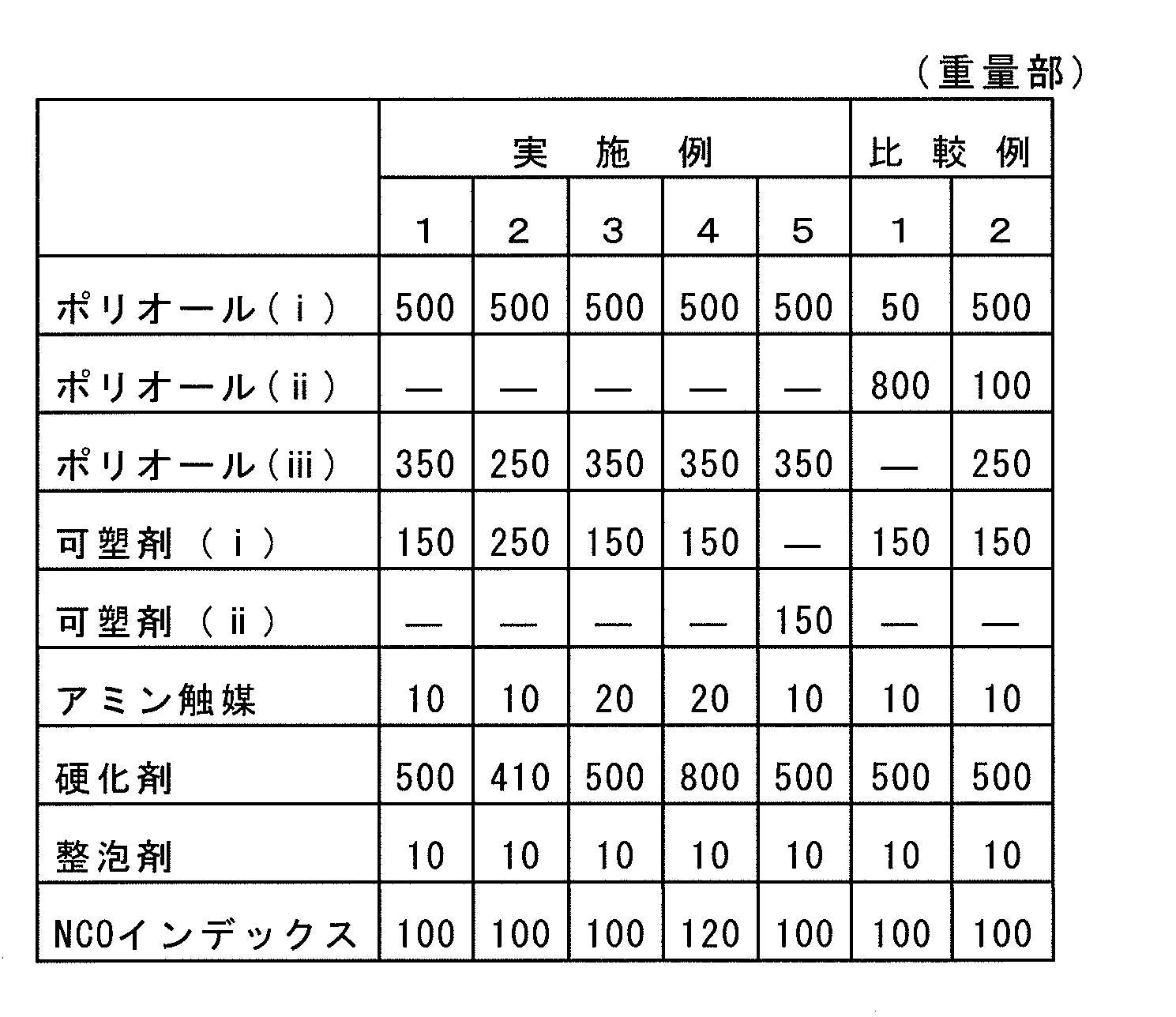
前記準備した各材料(硬化剤を除く)を下記の表1に示す割合で混合(汎用撹拌機スリーワンモーターを用いて混合処理)した主剤と、硬化剤とを、同表に示す割合で混合してポリウレタン樹脂組成物液(混合粘度:200~1,000mPa・s)を得た。
前記準備した各材料(硬化剤を除く)を下記の表1に示す割合で混合(汎用撹拌機スリーワンモーターを用いて混合処理)した主剤と、硬化剤とを、同表に示す割合で混合してポリウレタン樹脂組成物液(混合粘度:200~1,000mPa・s)を得た。
つぎに、図1に示すサンプルXを作製した。すなわち、直径75mm、高さ50mmの円柱状コンクリート塊1の平面中央部に直径40mmの貫通孔1aを設けたものを準備し、そのコンクリート塊1を平板上に載置して、上記調製のポリウレタン樹脂組成物液を貫通孔1aに注ぎ、20℃雰囲気下で発泡・硬化させてポリウレタン層2を形成した(図1参照)。
ついで、このようにして得られたサンプルXに対し、JIS A 1218(土の透水試験方法)に準拠して透水試験(定水位法)を実施した。透水試験における試験体と水の間の高さ(水位差)は100cmとした。本測定においては、水圧を調整することで上記水位差を設定し、12時間試験を実施した際の水位の変化(透水量)を測定した。そして、測定した結果をもとに、透水係数を算出した。また、透水試験後、サンプルXにおけるポリウレタン層を取り出し、その断面から硬化樹脂層と発泡層をノギスにて計測した。また、硬化樹脂層と発泡層の密度を、そのサンプルに対し、東洋精機社製の自動比重計DSG-1を用いて測定した。さらに、硬化樹脂層を形成したサンプルについては、硬化樹脂層の硬度(アスカーA型)を測定した。また、下記の基準に従って、対モルタル接着強度を測定した。そして、これらの結果を、下記の表2に併せて示す。
〔対モルタル接着強度〕
図2に示すように、2枚のコンクリート板11(50mm×50mm×厚み20mm)の間に、前記調製のポリウレタン樹脂組成物液を流し込んで、20℃雰囲気下で発泡・硬化させて、厚み約20mmポリウレタン層12が形成されたサンプルYを作製した。そして、図示の矢印方向に1mm/minでコンクリート板11を引っ張り、コンクリート板に対するポリウレタン層の接着強度(MPa)を測定した。
図2に示すように、2枚のコンクリート板11(50mm×50mm×厚み20mm)の間に、前記調製のポリウレタン樹脂組成物液を流し込んで、20℃雰囲気下で発泡・硬化させて、厚み約20mmポリウレタン層12が形成されたサンプルYを作製した。そして、図示の矢印方向に1mm/minでコンクリート板11を引っ張り、コンクリート板に対するポリウレタン層の接着強度(MPa)を測定した。
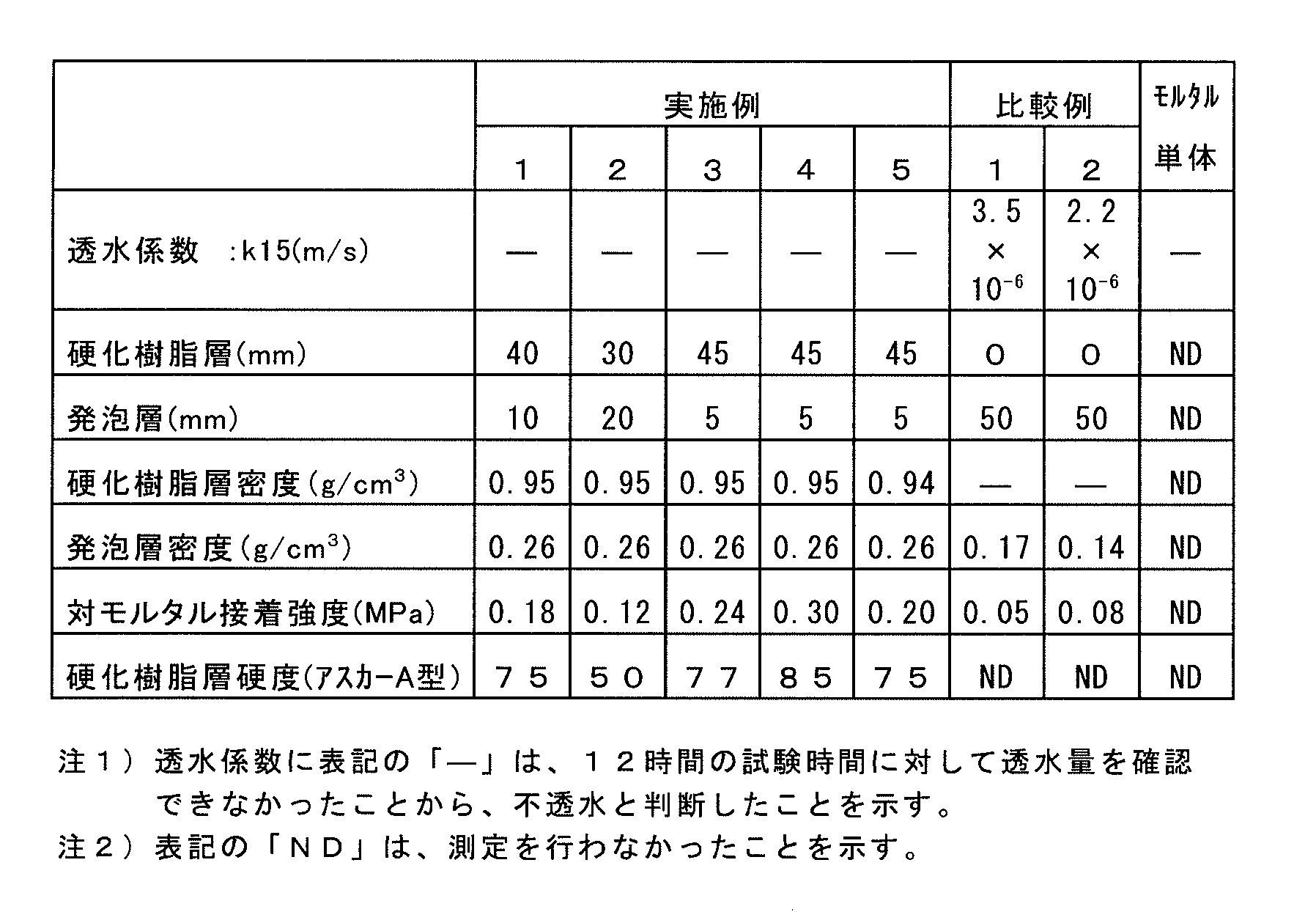
上記結果から、実施例においては、不透水レベルの透水係数を示すことから、モルタル単体と同程度の不透水性を示すものであり、止水に関しては充分な能力を保持していることが言える。それに対し、比較例においては10-6m/sレベルの透水係数を有している。これは、土質では細~粗粒粘土のレベルであり、止水性に対しては問題が残る。また、対モルタル接着強度においても、実施例のほうが、比較例に比べ高く、接着状況に関してもモルタル破壊が観察されたのに対し、比較例では100%樹脂破壊であった。
なお、上記実施例においては、本発明における具体的な形態について示したが、上記実施例は単なる例示にすぎず、限定的に解釈されるものではない。当業者に明らかな様々な変形は、本発明の範囲内であることが企図されている。
本発明のシーリング用ポリウレタン樹脂組成物は、土木や建築等の構造物の止水材やシーリング材、特に、コンクリートの構造物の止水材やシーリング材として有用である。また、それ以外の分野における一般的な止水材やシーリング材用途に適用することも可能である。
Claims (8)
- 下記の(A)~(E)成分を含有するとともにポリオキシプロピレングリコールを含まないことを特徴とするシーリング用ポリウレタン樹脂組成物。
(A)ヒマシ油系ポリオール。
(B)可塑剤。
(C)アミン触媒。
(D)整泡剤。
(E)有機ポリイソシアネート。 - 上記可塑剤(B)が、芳香族炭化水素系可塑剤であることを特徴とする請求項1記載のシーリング用ポリウレタン樹脂組成物。
- 上記有機ポリイソシアネート(E)が、二核体を30~80質量%含有するポリメチレンポリフェニルポリイソシアネートであって、かつ、上記二核体が、2,2’-ジフェニルメタンジイソシアネートと2,4’-ジフェニルメタンジイソシアネートを合計で5~60質量%含有するものであることを特徴とする請求項1又は2記載のシーリング用ポリウレタン樹脂組成物。
- 上記整泡剤(D)が、活性水素基を含有しないシリコーン系界面活性剤であることを特徴とする請求項1~3のいずれか一項に記載のシーリング用ポリウレタン樹脂組成物。
- 上記アミン触媒(C)が、トリエチレンジアミンであることを特徴とする請求項1~4のいずれか一項に記載のシーリング用ポリウレタン樹脂組成物。
- 上記(A)~(D)成分を含有する主剤と、(E)成分を含有する硬化剤との、二液反応型組成物であることを特徴とする請求項1~5のいずれか一項に記載のシーリング用ポリウレタン樹脂組成物。
- 請求項1~6のいずれか一項に記載のシーリング用ポリウレタン樹脂組成物から形成された、硬化樹脂層と発泡層からなるポリウレタン層を有することを特徴とするシーリング材。
- ポリウレタン層全体の厚みが少なくとも3cmであり、且つ硬化樹脂層の厚みが少なくとも2.5cmであることを特徴とする請求項7記載のシーリング材。
Priority Applications (2)
| Application Number | Priority Date | Filing Date | Title |
|---|---|---|---|
| JP2016510465A JP6518652B2 (ja) | 2014-03-27 | 2015-03-26 | シーリング材 |
| CN201580007847.5A CN105980432A (zh) | 2014-03-27 | 2015-03-26 | 密封用聚氨酯树脂组合物 |
Applications Claiming Priority (2)
| Application Number | Priority Date | Filing Date | Title |
|---|---|---|---|
| JP2014065818 | 2014-03-27 | ||
| JP2014-065818 | 2014-03-27 |
Publications (1)
| Publication Number | Publication Date |
|---|---|
| WO2015147125A1 true WO2015147125A1 (ja) | 2015-10-01 |
Family
ID=54195632
Family Applications (1)
| Application Number | Title | Priority Date | Filing Date |
|---|---|---|---|
| PCT/JP2015/059289 Ceased WO2015147125A1 (ja) | 2014-03-27 | 2015-03-26 | シーリング用ポリウレタン樹脂組成物 |
Country Status (3)
| Country | Link |
|---|---|
| JP (1) | JP6518652B2 (ja) |
| CN (1) | CN105980432A (ja) |
| WO (1) | WO2015147125A1 (ja) |
Citations (8)
| Publication number | Priority date | Publication date | Assignee | Title |
|---|---|---|---|---|
| JPS57102978A (en) * | 1980-07-29 | 1982-06-26 | Nhk Spring Co Ltd | Preparation of polyurethane foam sealing material |
| JPH0368677A (ja) * | 1989-05-22 | 1991-03-25 | Nhk Spring Co Ltd | ポリウレタンフォームシーリング材の製造方法 |
| JP2002030277A (ja) * | 2000-07-17 | 2002-01-31 | Asahi Glass Co Ltd | ポリウレタン系塗膜防水材組成物 |
| JP2002037829A (ja) * | 2000-07-27 | 2002-02-06 | Toyo Quality One Corp | 自己粘着性発泡体 |
| JP2004308407A (ja) * | 2003-03-27 | 2004-11-04 | Sk Kaken Co Ltd | 塗膜防水材 |
| JP2010024311A (ja) * | 2008-07-17 | 2010-02-04 | Nippon Polyurethane Ind Co Ltd | ウレタンエラストマー充填材 |
| JP2011245453A (ja) * | 2010-05-28 | 2011-12-08 | Ohbayashi Corp | 遮水シート用止水剤、及び、遮水シートの補修工法 |
| JP2014001381A (ja) * | 2012-05-24 | 2014-01-09 | Toho Chem Ind Co Ltd | 一液型止水剤 |
Family Cites Families (9)
| Publication number | Priority date | Publication date | Assignee | Title |
|---|---|---|---|---|
| JPH07117064A (ja) * | 1993-10-22 | 1995-05-09 | Yokohama Rubber Co Ltd:The | シーリング材用発泡体の形成方法 |
| CA2152846C (en) * | 1994-11-30 | 2002-08-13 | Naoshi Fujita | Waterproof plastic foam |
| JP2001172350A (ja) * | 1999-12-17 | 2001-06-26 | Kao Corp | ポリウレタンの製造法 |
| JP2003040967A (ja) * | 2001-07-31 | 2003-02-13 | Mitsui Takeda Chemicals Inc | 二液硬化型ウレタン組成物およびその製造方法 |
| JP2004143314A (ja) * | 2002-10-25 | 2004-05-20 | Asahi Glass Co Ltd | ポリエステルポリエーテルポリオールおよびそれを用いたウレタンプレポリマー |
| JP5193725B2 (ja) * | 2008-07-31 | 2013-05-08 | 日本発條株式会社 | 防水シーリング材 |
| CN101684171B (zh) * | 2008-09-27 | 2012-11-14 | 上海联合气雾制品灌装有限公司 | 用可再生原料制备单组分聚氨酯泡沫 |
| JP2010215829A (ja) * | 2009-03-18 | 2010-09-30 | Sanyo Chem Ind Ltd | 硬化性ポリウレタン組成物 |
| JP5492714B2 (ja) * | 2010-09-09 | 2014-05-14 | 株式会社ブリヂストン | ポリウレタンフォーム |
-
2015
- 2015-03-26 CN CN201580007847.5A patent/CN105980432A/zh active Pending
- 2015-03-26 JP JP2016510465A patent/JP6518652B2/ja active Active
- 2015-03-26 WO PCT/JP2015/059289 patent/WO2015147125A1/ja not_active Ceased
Patent Citations (8)
| Publication number | Priority date | Publication date | Assignee | Title |
|---|---|---|---|---|
| JPS57102978A (en) * | 1980-07-29 | 1982-06-26 | Nhk Spring Co Ltd | Preparation of polyurethane foam sealing material |
| JPH0368677A (ja) * | 1989-05-22 | 1991-03-25 | Nhk Spring Co Ltd | ポリウレタンフォームシーリング材の製造方法 |
| JP2002030277A (ja) * | 2000-07-17 | 2002-01-31 | Asahi Glass Co Ltd | ポリウレタン系塗膜防水材組成物 |
| JP2002037829A (ja) * | 2000-07-27 | 2002-02-06 | Toyo Quality One Corp | 自己粘着性発泡体 |
| JP2004308407A (ja) * | 2003-03-27 | 2004-11-04 | Sk Kaken Co Ltd | 塗膜防水材 |
| JP2010024311A (ja) * | 2008-07-17 | 2010-02-04 | Nippon Polyurethane Ind Co Ltd | ウレタンエラストマー充填材 |
| JP2011245453A (ja) * | 2010-05-28 | 2011-12-08 | Ohbayashi Corp | 遮水シート用止水剤、及び、遮水シートの補修工法 |
| JP2014001381A (ja) * | 2012-05-24 | 2014-01-09 | Toho Chem Ind Co Ltd | 一液型止水剤 |
Also Published As
| Publication number | Publication date |
|---|---|
| JP6518652B2 (ja) | 2019-05-22 |
| CN105980432A (zh) | 2016-09-28 |
| JPWO2015147125A1 (ja) | 2017-04-13 |
Similar Documents
| Publication | Publication Date | Title |
|---|---|---|
| US9527949B2 (en) | Polyurethane grout compositions | |
| CN101636464B (zh) | 防水材料用湿气固化型尿烷组合物及聚氨酯防水材料 | |
| US20100158614A1 (en) | Polyurethane foams for trench breaker and other applications | |
| WO2010023885A1 (ja) | 軟質ポリウレタンフォームの製造方法 | |
| US11814468B2 (en) | Emulsifiers for polyurethane based foam | |
| CN102924686B (zh) | 一种用于散粒体固结的软质聚氨酯泡沫材料 | |
| JP6688628B2 (ja) | 建設基礎用薬液 | |
| JP2017535639A (ja) | B2評価された窓割り開口部用の一成分スプレーポリウレタンフォーム配合物 | |
| TWI429669B (zh) | A polyurethane resin-forming composition, and a water-proof material for a steel plate | |
| TWI777976B (zh) | 版式軌道之修補材料、硬化體、版式軌道之修補方法、版式軌道及樹脂組成物 | |
| JP6518652B2 (ja) | シーリング材 | |
| WO2011122180A1 (ja) | ポリウレタン樹脂形成性組成物及び鋼矢板用水膨張性止水材 | |
| KR100982430B1 (ko) | 경질 폴리우레탄폼용 포리올 조성물 및 경질폴리우레탄폼의 제조 방법 | |
| TW201206973A (en) | Organic polyisocyanate composition, water-sealing material forming composition, and water swelling water-sealing material | |
| JP2014062214A (ja) | 硬質ポリウレタンフォームの製造方法 | |
| CN100379782C (zh) | 硬质聚氨酯泡沫体用多元醇组合物及硬质聚氨酯泡沫体的制造方法 | |
| JP2009280658A (ja) | 低密度軟質ポリウレタン発泡体成形用組成物 | |
| JP6288071B2 (ja) | 湿気硬化型有機ポリイソシアネート組成物及び水膨張性止水材 | |
| KR101733081B1 (ko) | 폴리우레탄용 대전방지제 및 이를 이용하여 제조되는 대전방지 기능이 부여된 폴리우레탄 폼 성형체 | |
| JP2017145336A (ja) | 建設基礎用薬液 | |
| JP2026059667A (ja) | 既設中空柱の補強工法 |
Legal Events
| Date | Code | Title | Description |
|---|---|---|---|
| 121 | Ep: the epo has been informed by wipo that ep was designated in this application |
Ref document number: 15768587 Country of ref document: EP Kind code of ref document: A1 |
|
| ENP | Entry into the national phase |
Ref document number: 2016510465 Country of ref document: JP Kind code of ref document: A |
|
| NENP | Non-entry into the national phase |
Ref country code: DE |
|
| 122 | Ep: pct application non-entry in european phase |
Ref document number: 15768587 Country of ref document: EP Kind code of ref document: A1 |