WO2015137437A1 - 粘着シート及び電子機器 - Google Patents
粘着シート及び電子機器 Download PDFInfo
- Publication number
- WO2015137437A1 WO2015137437A1 PCT/JP2015/057281 JP2015057281W WO2015137437A1 WO 2015137437 A1 WO2015137437 A1 WO 2015137437A1 JP 2015057281 W JP2015057281 W JP 2015057281W WO 2015137437 A1 WO2015137437 A1 WO 2015137437A1
- Authority
- WO
- WIPO (PCT)
- Prior art keywords
- pressure
- sensitive adhesive
- adhesive sheet
- mass
- base material
- Prior art date
- Legal status (The legal status is an assumption and is not a legal conclusion. Google has not performed a legal analysis and makes no representation as to the accuracy of the status listed.)
- Ceased
Links
Images

Classifications
-
- C—CHEMISTRY; METALLURGY
- C09—DYES; PAINTS; POLISHES; NATURAL RESINS; ADHESIVES; COMPOSITIONS NOT OTHERWISE PROVIDED FOR; APPLICATIONS OF MATERIALS NOT OTHERWISE PROVIDED FOR
- C09J—ADHESIVES; NON-MECHANICAL ASPECTS OF ADHESIVE PROCESSES IN GENERAL; ADHESIVE PROCESSES NOT PROVIDED FOR ELSEWHERE; USE OF MATERIALS AS ADHESIVES
- C09J133/00—Adhesives based on homopolymers or copolymers of compounds having one or more unsaturated aliphatic radicals, each having only one carbon-to-carbon double bond, and at least one being terminated by only one carboxyl radical, or of salts, anhydrides, esters, amides, imides, or nitriles thereof; Adhesives based on derivatives of such polymers
- C09J133/04—Homopolymers or copolymers of esters
- C09J133/06—Homopolymers or copolymers of esters of esters containing only carbon, hydrogen and oxygen, the oxygen atom being present only as part of the carboxyl radical
- C09J133/08—Homopolymers or copolymers of acrylic acid esters
-
- C—CHEMISTRY; METALLURGY
- C08—ORGANIC MACROMOLECULAR COMPOUNDS; THEIR PREPARATION OR CHEMICAL WORKING-UP; COMPOSITIONS BASED THEREON
- C08J—WORKING-UP; GENERAL PROCESSES OF COMPOUNDING; AFTER-TREATMENT NOT COVERED BY SUBCLASSES C08B, C08C, C08F, C08G or C08H
- C08J9/00—Working-up of macromolecular substances to porous or cellular articles or materials; After-treatment thereof
- C08J9/36—After-treatment
- C08J9/365—Coating
-
- C—CHEMISTRY; METALLURGY
- C08—ORGANIC MACROMOLECULAR COMPOUNDS; THEIR PREPARATION OR CHEMICAL WORKING-UP; COMPOSITIONS BASED THEREON
- C08K—Use of inorganic or non-macromolecular organic substances as compounding ingredients
- C08K5/00—Use of organic ingredients
- C08K5/0008—Organic ingredients according to more than one of the "one dot" groups of C08K5/01 - C08K5/59
- C08K5/0025—Crosslinking or vulcanising agents; including accelerators
-
- C—CHEMISTRY; METALLURGY
- C08—ORGANIC MACROMOLECULAR COMPOUNDS; THEIR PREPARATION OR CHEMICAL WORKING-UP; COMPOSITIONS BASED THEREON
- C08K—Use of inorganic or non-macromolecular organic substances as compounding ingredients
- C08K5/00—Use of organic ingredients
- C08K5/01—Hydrocarbons
-
- C—CHEMISTRY; METALLURGY
- C08—ORGANIC MACROMOLECULAR COMPOUNDS; THEIR PREPARATION OR CHEMICAL WORKING-UP; COMPOSITIONS BASED THEREON
- C08K—Use of inorganic or non-macromolecular organic substances as compounding ingredients
- C08K5/00—Use of organic ingredients
- C08K5/04—Oxygen-containing compounds
- C08K5/13—Phenols; Phenolates
-
- C—CHEMISTRY; METALLURGY
- C08—ORGANIC MACROMOLECULAR COMPOUNDS; THEIR PREPARATION OR CHEMICAL WORKING-UP; COMPOSITIONS BASED THEREON
- C08K—Use of inorganic or non-macromolecular organic substances as compounding ingredients
- C08K5/00—Use of organic ingredients
- C08K5/04—Oxygen-containing compounds
- C08K5/13—Phenols; Phenolates
- C08K5/134—Phenols containing ester groups
-
- C—CHEMISTRY; METALLURGY
- C09—DYES; PAINTS; POLISHES; NATURAL RESINS; ADHESIVES; COMPOSITIONS NOT OTHERWISE PROVIDED FOR; APPLICATIONS OF MATERIALS NOT OTHERWISE PROVIDED FOR
- C09J—ADHESIVES; NON-MECHANICAL ASPECTS OF ADHESIVE PROCESSES IN GENERAL; ADHESIVE PROCESSES NOT PROVIDED FOR ELSEWHERE; USE OF MATERIALS AS ADHESIVES
- C09J133/00—Adhesives based on homopolymers or copolymers of compounds having one or more unsaturated aliphatic radicals, each having only one carbon-to-carbon double bond, and at least one being terminated by only one carboxyl radical, or of salts, anhydrides, esters, amides, imides, or nitriles thereof; Adhesives based on derivatives of such polymers
-
- C—CHEMISTRY; METALLURGY
- C09—DYES; PAINTS; POLISHES; NATURAL RESINS; ADHESIVES; COMPOSITIONS NOT OTHERWISE PROVIDED FOR; APPLICATIONS OF MATERIALS NOT OTHERWISE PROVIDED FOR
- C09J—ADHESIVES; NON-MECHANICAL ASPECTS OF ADHESIVE PROCESSES IN GENERAL; ADHESIVE PROCESSES NOT PROVIDED FOR ELSEWHERE; USE OF MATERIALS AS ADHESIVES
- C09J133/00—Adhesives based on homopolymers or copolymers of compounds having one or more unsaturated aliphatic radicals, each having only one carbon-to-carbon double bond, and at least one being terminated by only one carboxyl radical, or of salts, anhydrides, esters, amides, imides, or nitriles thereof; Adhesives based on derivatives of such polymers
- C09J133/04—Homopolymers or copolymers of esters
- C09J133/06—Homopolymers or copolymers of esters of esters containing only carbon, hydrogen and oxygen, the oxygen atom being present only as part of the carboxyl radical
- C09J133/062—Copolymers with monomers not covered by C09J133/06
- C09J133/064—Copolymers with monomers not covered by C09J133/06 containing anhydride, COOH or COOM groups, with M being metal or onium-cation
-
- C—CHEMISTRY; METALLURGY
- C09—DYES; PAINTS; POLISHES; NATURAL RESINS; ADHESIVES; COMPOSITIONS NOT OTHERWISE PROVIDED FOR; APPLICATIONS OF MATERIALS NOT OTHERWISE PROVIDED FOR
- C09J—ADHESIVES; NON-MECHANICAL ASPECTS OF ADHESIVE PROCESSES IN GENERAL; ADHESIVE PROCESSES NOT PROVIDED FOR ELSEWHERE; USE OF MATERIALS AS ADHESIVES
- C09J133/00—Adhesives based on homopolymers or copolymers of compounds having one or more unsaturated aliphatic radicals, each having only one carbon-to-carbon double bond, and at least one being terminated by only one carboxyl radical, or of salts, anhydrides, esters, amides, imides, or nitriles thereof; Adhesives based on derivatives of such polymers
- C09J133/04—Homopolymers or copolymers of esters
- C09J133/06—Homopolymers or copolymers of esters of esters containing only carbon, hydrogen and oxygen, the oxygen atom being present only as part of the carboxyl radical
- C09J133/062—Copolymers with monomers not covered by C09J133/06
- C09J133/066—Copolymers with monomers not covered by C09J133/06 containing -OH groups
-
- C—CHEMISTRY; METALLURGY
- C09—DYES; PAINTS; POLISHES; NATURAL RESINS; ADHESIVES; COMPOSITIONS NOT OTHERWISE PROVIDED FOR; APPLICATIONS OF MATERIALS NOT OTHERWISE PROVIDED FOR
- C09J—ADHESIVES; NON-MECHANICAL ASPECTS OF ADHESIVE PROCESSES IN GENERAL; ADHESIVE PROCESSES NOT PROVIDED FOR ELSEWHERE; USE OF MATERIALS AS ADHESIVES
- C09J7/00—Adhesives in the form of films or foils
- C09J7/20—Adhesives in the form of films or foils characterised by their carriers
-
- C—CHEMISTRY; METALLURGY
- C09—DYES; PAINTS; POLISHES; NATURAL RESINS; ADHESIVES; COMPOSITIONS NOT OTHERWISE PROVIDED FOR; APPLICATIONS OF MATERIALS NOT OTHERWISE PROVIDED FOR
- C09J—ADHESIVES; NON-MECHANICAL ASPECTS OF ADHESIVE PROCESSES IN GENERAL; ADHESIVE PROCESSES NOT PROVIDED FOR ELSEWHERE; USE OF MATERIALS AS ADHESIVES
- C09J7/00—Adhesives in the form of films or foils
- C09J7/20—Adhesives in the form of films or foils characterised by their carriers
- C09J7/22—Plastics; Metallised plastics
- C09J7/26—Porous or cellular plastics
-
- C—CHEMISTRY; METALLURGY
- C09—DYES; PAINTS; POLISHES; NATURAL RESINS; ADHESIVES; COMPOSITIONS NOT OTHERWISE PROVIDED FOR; APPLICATIONS OF MATERIALS NOT OTHERWISE PROVIDED FOR
- C09J—ADHESIVES; NON-MECHANICAL ASPECTS OF ADHESIVE PROCESSES IN GENERAL; ADHESIVE PROCESSES NOT PROVIDED FOR ELSEWHERE; USE OF MATERIALS AS ADHESIVES
- C09J7/00—Adhesives in the form of films or foils
- C09J7/30—Adhesives in the form of films or foils characterised by the adhesive composition
- C09J7/38—Pressure-sensitive adhesives [PSA]
- C09J7/381—Pressure-sensitive adhesives [PSA] based on macromolecular compounds obtained by reactions involving only carbon-to-carbon unsaturated bonds
- C09J7/385—Acrylic polymers
-
- C—CHEMISTRY; METALLURGY
- C08—ORGANIC MACROMOLECULAR COMPOUNDS; THEIR PREPARATION OR CHEMICAL WORKING-UP; COMPOSITIONS BASED THEREON
- C08G—MACROMOLECULAR COMPOUNDS OBTAINED OTHERWISE THAN BY REACTIONS ONLY INVOLVING UNSATURATED CARBON-TO-CARBON BONDS
- C08G2261/00—Macromolecular compounds obtained by reactions forming a carbon-to-carbon link in the main chain of the macromolecule
- C08G2261/30—Monomer units or repeat units incorporating structural elements in the main chain
- C08G2261/33—Monomer units or repeat units incorporating structural elements in the main chain incorporating non-aromatic structural elements in the main chain
- C08G2261/332—Monomer units or repeat units incorporating structural elements in the main chain incorporating non-aromatic structural elements in the main chain containing only carbon atoms
-
- C—CHEMISTRY; METALLURGY
- C08—ORGANIC MACROMOLECULAR COMPOUNDS; THEIR PREPARATION OR CHEMICAL WORKING-UP; COMPOSITIONS BASED THEREON
- C08J—WORKING-UP; GENERAL PROCESSES OF COMPOUNDING; AFTER-TREATMENT NOT COVERED BY SUBCLASSES C08B, C08C, C08F, C08G or C08H
- C08J2207/00—Foams characterised by their intended use
- C08J2207/02—Adhesive
-
- C—CHEMISTRY; METALLURGY
- C08—ORGANIC MACROMOLECULAR COMPOUNDS; THEIR PREPARATION OR CHEMICAL WORKING-UP; COMPOSITIONS BASED THEREON
- C08J—WORKING-UP; GENERAL PROCESSES OF COMPOUNDING; AFTER-TREATMENT NOT COVERED BY SUBCLASSES C08B, C08C, C08F, C08G or C08H
- C08J2323/00—Characterised by the use of homopolymers or copolymers of unsaturated aliphatic hydrocarbons having only one carbon-to-carbon double bond; Derivatives of such polymers
- C08J2323/02—Characterised by the use of homopolymers or copolymers of unsaturated aliphatic hydrocarbons having only one carbon-to-carbon double bond; Derivatives of such polymers not modified by chemical after treatment
-
- C—CHEMISTRY; METALLURGY
- C08—ORGANIC MACROMOLECULAR COMPOUNDS; THEIR PREPARATION OR CHEMICAL WORKING-UP; COMPOSITIONS BASED THEREON
- C08J—WORKING-UP; GENERAL PROCESSES OF COMPOUNDING; AFTER-TREATMENT NOT COVERED BY SUBCLASSES C08B, C08C, C08F, C08G or C08H
- C08J2433/00—Characterised by the use of homopolymers or copolymers of compounds having one or more unsaturated aliphatic radicals, each having only one carbon-to-carbon double bond, and only one being terminated by only one carboxyl radical, or of salts, anhydrides, esters, amides, imides, or nitriles thereof; Derivatives of such polymers
- C08J2433/04—Characterised by the use of homopolymers or copolymers of compounds having one or more unsaturated aliphatic radicals, each having only one carbon-to-carbon double bond, and only one being terminated by only one carboxyl radical, or of salts, anhydrides, esters, amides, imides, or nitriles thereof; Derivatives of such polymers esters
- C08J2433/06—Characterised by the use of homopolymers or copolymers of compounds having one or more unsaturated aliphatic radicals, each having only one carbon-to-carbon double bond, and only one being terminated by only one carboxyl radical, or of salts, anhydrides, esters, amides, imides, or nitriles thereof; Derivatives of such polymers esters of esters containing only carbon, hydrogen, and oxygen, the oxygen atom being present only as part of the carboxyl radical
-
- C—CHEMISTRY; METALLURGY
- C08—ORGANIC MACROMOLECULAR COMPOUNDS; THEIR PREPARATION OR CHEMICAL WORKING-UP; COMPOSITIONS BASED THEREON
- C08L—COMPOSITIONS OF MACROMOLECULAR COMPOUNDS
- C08L93/00—Compositions of natural resins; Compositions of derivatives thereof
-
- C—CHEMISTRY; METALLURGY
- C08—ORGANIC MACROMOLECULAR COMPOUNDS; THEIR PREPARATION OR CHEMICAL WORKING-UP; COMPOSITIONS BASED THEREON
- C08L—COMPOSITIONS OF MACROMOLECULAR COMPOUNDS
- C08L93/00—Compositions of natural resins; Compositions of derivatives thereof
- C08L93/04—Rosin
-
- C—CHEMISTRY; METALLURGY
- C09—DYES; PAINTS; POLISHES; NATURAL RESINS; ADHESIVES; COMPOSITIONS NOT OTHERWISE PROVIDED FOR; APPLICATIONS OF MATERIALS NOT OTHERWISE PROVIDED FOR
- C09J—ADHESIVES; NON-MECHANICAL ASPECTS OF ADHESIVE PROCESSES IN GENERAL; ADHESIVE PROCESSES NOT PROVIDED FOR ELSEWHERE; USE OF MATERIALS AS ADHESIVES
- C09J165/00—Adhesives based on macromolecular compounds obtained by reactions forming a carbon-to-carbon link in the main chain; Adhesives based on derivatives of such polymers
-
- C—CHEMISTRY; METALLURGY
- C09—DYES; PAINTS; POLISHES; NATURAL RESINS; ADHESIVES; COMPOSITIONS NOT OTHERWISE PROVIDED FOR; APPLICATIONS OF MATERIALS NOT OTHERWISE PROVIDED FOR
- C09J—ADHESIVES; NON-MECHANICAL ASPECTS OF ADHESIVE PROCESSES IN GENERAL; ADHESIVE PROCESSES NOT PROVIDED FOR ELSEWHERE; USE OF MATERIALS AS ADHESIVES
- C09J2203/00—Applications of adhesives in processes or use of adhesives in the form of films or foils
-
- C—CHEMISTRY; METALLURGY
- C09—DYES; PAINTS; POLISHES; NATURAL RESINS; ADHESIVES; COMPOSITIONS NOT OTHERWISE PROVIDED FOR; APPLICATIONS OF MATERIALS NOT OTHERWISE PROVIDED FOR
- C09J—ADHESIVES; NON-MECHANICAL ASPECTS OF ADHESIVE PROCESSES IN GENERAL; ADHESIVE PROCESSES NOT PROVIDED FOR ELSEWHERE; USE OF MATERIALS AS ADHESIVES
- C09J2203/00—Applications of adhesives in processes or use of adhesives in the form of films or foils
- C09J2203/326—Applications of adhesives in processes or use of adhesives in the form of films or foils for bonding electronic components such as wafers, chips or semiconductors
-
- C—CHEMISTRY; METALLURGY
- C09—DYES; PAINTS; POLISHES; NATURAL RESINS; ADHESIVES; COMPOSITIONS NOT OTHERWISE PROVIDED FOR; APPLICATIONS OF MATERIALS NOT OTHERWISE PROVIDED FOR
- C09J—ADHESIVES; NON-MECHANICAL ASPECTS OF ADHESIVE PROCESSES IN GENERAL; ADHESIVE PROCESSES NOT PROVIDED FOR ELSEWHERE; USE OF MATERIALS AS ADHESIVES
- C09J2301/00—Additional features of adhesives in the form of films or foils
- C09J2301/30—Additional features of adhesives in the form of films or foils characterized by the chemical, physicochemical or physical properties of the adhesive or the carrier
- C09J2301/312—Additional features of adhesives in the form of films or foils characterized by the chemical, physicochemical or physical properties of the adhesive or the carrier parameters being the characterizing feature
-
- C—CHEMISTRY; METALLURGY
- C09—DYES; PAINTS; POLISHES; NATURAL RESINS; ADHESIVES; COMPOSITIONS NOT OTHERWISE PROVIDED FOR; APPLICATIONS OF MATERIALS NOT OTHERWISE PROVIDED FOR
- C09J—ADHESIVES; NON-MECHANICAL ASPECTS OF ADHESIVE PROCESSES IN GENERAL; ADHESIVE PROCESSES NOT PROVIDED FOR ELSEWHERE; USE OF MATERIALS AS ADHESIVES
- C09J2400/00—Presence of inorganic and organic materials
- C09J2400/20—Presence of organic materials
- C09J2400/24—Presence of a foam
- C09J2400/243—Presence of a foam in the substrate
-
- C—CHEMISTRY; METALLURGY
- C09—DYES; PAINTS; POLISHES; NATURAL RESINS; ADHESIVES; COMPOSITIONS NOT OTHERWISE PROVIDED FOR; APPLICATIONS OF MATERIALS NOT OTHERWISE PROVIDED FOR
- C09J—ADHESIVES; NON-MECHANICAL ASPECTS OF ADHESIVE PROCESSES IN GENERAL; ADHESIVE PROCESSES NOT PROVIDED FOR ELSEWHERE; USE OF MATERIALS AS ADHESIVES
- C09J2433/00—Presence of (meth)acrylic polymer
Definitions
- the present invention relates to an adhesive sheet that can be used in various fields including the manufacture of electronic devices such as portable electronic devices and the fixing of interior and exterior members of automobiles and buildings.
- Adhesive sheets are used in the production scenes of various products including electronic devices and automobiles.
- the adhesive sheet is used for fixing two or more casings constituting the electronic device, fixing a rechargeable battery, a circuit board, and the like.
- Examples of the pressure-sensitive adhesive sheet that can be used in the above-described scene include a polymer obtained by copolymerizing at least an alkyl acrylate ester, a hydroxyl group-containing monomer, vinyl acetate, and a carboxyl group-containing monomer, and the carboxyl group-containing occupying the polymer.
- a pressure-sensitive adhesive composition characterized in that the ratio of the monomer is 0.01 to 1.0 part by mass, contains a crosslinking agent, and has a ball tack of 12 to 30 is known.
- a pressure-sensitive adhesive composition characterized in that the ratio of the monomer is 0.01 to 1.0 part by mass, contains a crosslinking agent, and has a ball tack of 12 to 30 is known.
- the pressure-sensitive adhesive sheet is required to have both excellent peel adhesive strength and excellent push strength.
- the push strength is, for example, two or more when a force obtained by bonding two or more adherends using an adhesive sheet in a direction perpendicular to the planar direction of the adhesive sheet is applied. This refers to the adhesive strength when the adherend is disassembled (peeled).
- the adhesive sheet has both excellent peel adhesive strength and push strength, while the adhesive sheet has a small adhesive area and the adhesive sheet becomes narrower as the portable electronic device becomes larger and thinner. Was in an undiscovered situation.
- the portable electronic device when the portable electronic device is dropped or the like, there is a case where it is required to have a level of impact resistance that does not cause peeling of the adhesive sheet or separation of adherends due to the impact.
- the adhesive sheet in addition to the excellent peel adhesive strength and push strength, the adhesive sheet has a small adhesive area and the adhesive sheet is becoming narrower as the portable electronic device becomes larger and thinner.
- a pressure-sensitive adhesive sheet having high impact resistance has been demanded, it has not yet been found.
- the adhesive sheet is required to have various characteristics depending on the application scene, because the adhesive sheet has various application scenes.
- the adhesive sheet has various application scenes.
- the above-mentioned characteristics for example, even when a certain stress due to strain or the like is applied over a long period of time to the parts joined using the pressure-sensitive adhesive sheet, it causes floating or peeling that is a practical problem.
- the excellent static load holding force means that when the adherend is bonded using an adhesive sheet, when a certain load is applied in a direction perpendicular to the bonding surface, It means that it is difficult to cause general lifting and peeling.
- the first problem to be solved by the present invention is to provide a pressure-sensitive adhesive sheet having an excellent peel adhesive force, an excellent push strength, and an excellent static load holding force.
- the second problem to be solved by the present invention is to provide a pressure-sensitive adhesive sheet having excellent peel adhesive strength, excellent push strength, excellent static load holding force and excellent impact resistance. .
- the present inventors not only improve the peel adhesive strength by using a pressure-sensitive adhesive sheet having a pressure-sensitive adhesive layer having a tensile strength obtained from a stress-strain curve (so-called SS curve) of a predetermined value or more.
- the present inventors have found that push strength and static load holding power can be significantly improved.
- the inventors of the present invention provide a foam base material having a specific average cell diameter and an average cell diameter ratio selected from foam base materials known as base materials, and the predetermined tensile strength.
- the present inventors have found that, when combined with a pressure-sensitive adhesive layer provided with, excellent impact resistance can be imparted without impairing excellent peel adhesion, excellent push strength, and excellent static load retention.
- the present invention has a pressure-sensitive adhesive layer having a pressure-sensitive adhesive layer (A) having a tensile strength based on a stress-strain curve at a strain amount of 100% of 6 N / cm 2 or more on one side or both sides of a substrate. It relates to the sheet.
- A pressure-sensitive adhesive layer having a tensile strength based on a stress-strain curve at a strain amount of 100% of 6 N / cm 2 or more on one side or both sides of a substrate. It relates to the sheet.
- the average cell diameter in the flow direction and the width direction of the foam base material is 160 ⁇ m or less in the pressure-sensitive adhesive sheet, and [average cell diameter in the flow direction / average cell diameter in the thickness direction] ], And the ratio of [average bubble diameter in the width direction / average bubble diameter in the thickness direction] is 6 or less, and the pressure-sensitive adhesive obtained using a foam base material having an interlayer strength of 10 N / cm or more It relates to the sheet.
- the pressure-sensitive adhesive sheet of the present invention can achieve both excellent peel adhesive strength, excellent push strength, and excellent static load retention force, for example, manufacture of electronic devices such as portable electronic devices, fixing of automobile parts, It can be used in various situations such as fixing.
- the pressure-sensitive adhesive sheet is used for fixing two or more cases constituting an electronic device such as a portable electronic device that requires a static load holding force, fixing a case and a lens member, and fixing a case and a rechargeable battery. Etc. can be used suitably.
- the pressure-sensitive adhesive sheet of the present invention obtained using the specific foam base material has excellent peel adhesion, excellent push strength, excellent static load retention and excellent impact resistance.
- it can be suitably used in the production scenes of portable electronic devices where there is a possibility of impact such as dropping.
- Example 2 shows a stress-strain curve of the pressure-sensitive adhesive layer constituting the pressure-sensitive adhesive tape obtained in Example 12.
- Pressure-sensitive adhesive sheet of the present invention on one side or both sides of the substrate, stress at the strain amount 100% - and having tensile strength based on strain curve 6N / cm 2 or more at which the pressure-sensitive adhesive layer (A) Is.
- the pressure-sensitive adhesive layer (A) constituting the pressure-sensitive adhesive sheet of the present invention one having a tensile strength of 6 N / cm 2 or more based on a stress-strain curve at a strain amount of 100% is used.
- the tensile strength was obtained by laminating a test piece made of an adhesive layer having a thickness of about 400 ⁇ m, a marked line interval of 2 cm, and a width of 1 cm obtained by laminating a 50 ⁇ m thick adhesive layer at a temperature of 23 ° C. and humidity.
- the amount of strain is 100% in a stress-strain curve (so-called SS curve) measured by performing a tensile test at a tensile speed of 300 mm / min using a tensile tester in a measurement environment of 50%.
- the pressure-sensitive adhesive sheet having a pressure-sensitive adhesive layer having a tensile strength of less than 6 N / cm 2 cannot achieve both excellent peel adhesive strength and excellent push strength, or has a practically sufficient static strength.
- the load holding force may not be expressed.
- the upper limit of the tensile strength is not particularly limited, is preferably 30 N / cm 2 or less, more preferably 25 N / cm 2 or less, it is 20 N / cm 2 or less, and the peel adhesive strength It is further preferable for expressing the performance of the pressure-sensitive adhesive sheet including the push strength and the static load holding force in a well-balanced manner.
- the pressure-sensitive adhesive layer (A) is preferably one having a thickness of 1 ⁇ m to 150 ⁇ m, more preferably one having a thickness of 5 ⁇ m to 100 ⁇ m, and more preferably 10 ⁇ m to 80 ⁇ m. It is more preferable to use what has.
- the pressure-sensitive adhesive layer (A) can be formed using various pressure-sensitive adhesives.
- said adhesive layer (A) it is an adhesive layer formed using the adhesive containing an acrylic polymer (a1), tackifying resin (a2), and a crosslinking agent (a3), for example. It is preferable for forming a pressure-sensitive adhesive layer having a specific tensile strength.
- the pressure-sensitive adhesive layer (A) preferably has a tensile strength based on a stress-strain curve at a strain amount of 500% of 12 N / cm 2 or higher, and has a tensile strength of 13 N / cm 2 or higher. It is more preferable to, more preferably the use of 15N / cm 2 or more of, more preferably the use of 17N / cm 2 or more of, it is particularly preferred to use 19N / cm 2 or more of .
- the upper limit of the tensile strength is preferably at 70N / cm 2 or less, it is more preferable to use those 65N / cm 2 or less.
- a pressure-sensitive adhesive sheet including peel adhesive force, push strength, static load holding force, impact resistance, etc. It is more preferable for expressing the performance in a well-balanced manner.
- the tensile strength of the pressure-sensitive adhesive layer (A) is set to a specific range, and as a result, a further excellent peel adhesive strength and excellent
- the acid value is preferably an acid value derived exclusively from a carboxyl group.
- the said acid value points out mg of potassium hydroxide required in order to neutralize the acid group which exists in the said acrylic polymer (a1) solution.
- the acrylic polymer (a1) has an aliphatic cyclic structure for forming a pressure-sensitive adhesive layer having even better peel adhesion, excellent push strength, and excellent static load retention. It is preferable to use what has.
- Examples of the aliphatic cyclic structure include a cyclobutyl group, a cyclopentyl group, a cyclohexyl group, a cycloheptyl group, a cyclooctyl group, a propylcyclohexyl group, a tricyclo [5,2,1,0,2,6] decyl group, and a bicyclo [ 4,3,0] -nonyl group, tricyclo [5,3,1,1] dodecyl group, propyltricyclo [5,3,1,1] dodecyl group, norbornene group, isobornyl group, dicyclopentanyl group, Examples include adamantyl group, among which cyclohexyl group, norbornene group, isobornyl group, and adamantyl group are more excellent peel adhesive force, more excellent push strength and more excellent static load holding force. It is preferable when obtaining the adhesive sheet which has this.
- said acrylic polymer (a1) what has a weight average molecular weight of 800,000 or more is equipped with the much more excellent peel adhesive force, the outstanding push strength, and the outstanding static load holding power. It is preferable to obtain a pressure-sensitive adhesive sheet, more preferably one having a weight average molecular weight in the range of 800,000 to 3,000,000, more preferably one having a weight average molecular weight in the range of 1,000,000 to 2,200,000.
- the tensile strength of the pressure-sensitive adhesive layer (A) is set to a specific range, and as a result, it is more preferable for obtaining a pressure-sensitive adhesive sheet that has both excellent peel adhesive strength, excellent push strength, and static load retention.
- the said weight average molecular weight is a weight average molecular weight in standard polystyrene conversion measured with a gel permeation chromatograph (GPC).
- the measurement of the molecular weight by the GPC method is a value obtained by measuring with a GPC apparatus (HLC-8329GPC) manufactured by Tosoh Corporation and converted to polystyrene.
- the acrylic polymer (a1) those having a glass transition temperature of ⁇ 15 ° C. or less are preferably used, and those having a glass transition temperature of ⁇ 45 ° C. to ⁇ 20 ° C. are more preferably used. It is more preferable for obtaining a pressure-sensitive adhesive sheet having an excellent peel adhesive strength, a further excellent push strength, and an excellent static load holding force.
- the glass transition temperature refers to a calculated value calculated by the FOX equation.
- the acrylic polymer (a1) is preferably contained in an amount of 5% by mass to 80% by mass with respect to the total amount of the adhesive that can be used for forming the adhesive layer (A). It is more preferable to maintain good coating workability.
- acrylic polymer (a1) it is preferable to use a polymer obtained by polymerizing a monomer (vinyl monomer) component having a vinyl group.
- the vinyl monomer component includes a vinyl monomer having a nitrogen atom such as N-vinyl-2-pyrrolidone, vinyl acetate, styrene, etc. in forming an adhesive layer having a predetermined tensile strength.
- the content of vinyl monomers other than (meth) acrylic monomers is 5% by mass or less, preferably 3% by mass or less, more preferably 1% by mass or less, based on the total amount of the vinyl monomer components.
- a vinyl monomer mixture can be used.
- the vinyl monomer component may be an alkyl having a homopolymer glass transition temperature of 100 ° C. or higher with respect to the total amount of the vinyl monomer component in forming an adhesive layer having a predetermined tensile strength.
- the total content of (meth) acrylate is preferably 1% by mass or less, more preferably 0.5% by mass or less, and 0.1% by mass or less. It is particularly preferred to use it.
- Specific examples of the alkyl (meth) acrylate having a glass transition temperature of 100 ° C. or higher include methyl methacrylate.
- vinyl monomer for example, a vinyl monomer having a hydroxyl group, a vinyl monomer having an acid group, an alkyl (meth) acrylate, or the like can be used.
- Examples of the vinyl monomer having a hydroxyl group that can be used for producing the acrylic polymer (a1) include 2-hydroxyethyl (meth) acrylate, 2-hydroxypropyl (meth) acrylate, and 3-hydroxypropyl (meth).
- the vinyl monomer having a hydroxyl group 4-hydroxybutyl (meth) acrylate is preferably used, and 4-hydroxybutyl acrylate is preferably used as 2-hydroxyethyl (meth) acrylate or the like.
- 4-hydroxybutyl acrylate is preferably used as 2-hydroxyethyl (meth) acrylate or the like.
- it is easier to form a pressure-sensitive adhesive layer with a predetermined tensile strength, and as a result, even better peel adhesion, better push strength, and better static load retention It is more preferable when obtaining the adhesive sheet provided with.
- the vinyl monomer having a hydroxyl group is preferably used in the range of 0.01% by mass to 0.2% by mass with respect to the total amount of the monomer components, and is 0.01% by mass or more and 0.1% by mass. % Is more preferable, and the use within the range of 0.02 to 0.08% by mass sets the tensile strength of the pressure-sensitive adhesive layer (A) to a specific range, and further It is more preferable for obtaining a pressure-sensitive adhesive sheet having an excellent peel adhesive force, a further excellent push strength, and a still more excellent static load holding force.
- Examples of the vinyl monomer having an acid group that can be used for producing the acrylic polymer (a1) include acrylic acid, methacrylic acid, carboxyethyl (meth) acrylate, carboxypentyl (meth) acrylate, and (anhydrous).
- carboxyl groups such as itaconic acid, (anhydrous) maleic acid, fumaric acid, crotonic acid, (meth)
- a (meth) acrylic monomer having a carboxyl group it is preferable to use acrylic acid or methacrylic acid to further improve the peel adhesive strength and the further excellent push strength. It is more preferable to obtain a pressure-sensitive adhesive sheet having a high static load holding force.
- the vinyl monomer having an acid group is not particularly limited as long as the acid value of the acrylic polymer (a1) is within a predetermined preferable range, but is 1% by mass with respect to the total amount of the monomer components. It is preferably used in the range of ⁇ 30% by mass, more preferably in the range of 1% by mass to 15% by mass, and even more excellent peel adhesion in the range of 1% by mass to 7% by mass. It is further preferable for obtaining a pressure-sensitive adhesive sheet having high strength, further excellent push strength, and still more excellent static load holding force.
- a vinyl monomer having an aliphatic cyclic structure is used as the vinyl monomer component in introducing the aliphatic cyclic structure into the acrylic polymer (a1). It is preferable to use a monomer.
- cyclohexyl (meth) acrylate or the like is preferably used, and cyclohexyl acrylate is more preferably used.
- the vinyl monomer having an aliphatic cyclic structure has a predetermined tensile strength when used in a range of 0.5% by mass to 30% by mass with respect to the total amount of the vinyl monomer component. It is preferable to obtain a pressure-sensitive adhesive sheet that is easy to form a pressure-sensitive adhesive layer and has an even better peel adhesive strength, an even better push strength, and an even better static load retention force. It is more preferable to use in the range of%.
- vinyl monomer component that can be used for the production of the acrylic polymer (a1), in addition to those described above, other monomers can be used as necessary.
- Examples of the other vinyl monomers include methyl (meth) acrylate, ethyl (meth) acrylate, n-butyl (meth) acrylate, s-butyl (meth) acrylate, t-butyl (meth) acrylate, and isobutyl (meth) ) Acrylate, hexyl (meth) acrylate, 2-ethylhexyl (meth) acrylate, n-octyl (meth) acrylate, isooctyl (meth) acrylate, n-nonyl (meth) acrylate, isononyl (meth) acrylate, n-decyl (meth) ) Acrylate, isodecyl (meth) acrylate, n-undecyl (meth) acrylate, n-dodecyl (meth) acrylate, n-tridecyl (meth)
- alkyl (meth) acrylates having an alkyl group having 4 to 12 carbon atoms, and n-butyl acrylate and 2-ethylhexyl acrylate are used. It is preferable to obtain a pressure-sensitive adhesive sheet having a further excellent peel adhesive force, a further excellent push strength, and a still more excellent static load holding force.
- alkyl (meth) acrylates that can be used as the other vinyl monomers
- alkyl (meth) acrylates having an alkyl group with 4 to 12 carbon atoms are used for the production of the acrylic polymer (a1). It is preferably used in the range of 50% by mass to 98% by mass, more preferably in the range of 60% by mass to 98% by mass, and 70% by mass to 96% by mass with respect to the total amount of the monomer components to be prepared. It is preferable to use in this range in order to obtain a pressure-sensitive adhesive sheet having a further excellent peel adhesive force, a further excellent push strength, and a still more excellent static load holding force.
- the n-butyl acrylate is preferably used in the range of 50% by mass to 98% by mass, more preferably in the range of 60% by mass to 98% by mass, based on the total amount of the monomer components.
- Use in the range of 70% by mass to 96% by mass makes it easy to form a pressure-sensitive adhesive layer having a predetermined tensile strength, and as a result, more excellent peel adhesion and better push strength. It is preferable for obtaining a pressure-sensitive adhesive sheet having a more excellent static load holding force.
- an acrylic monomer having an amide group, a (meth) acrylic monomer having an amino group, and an imide group are included. You may use the (meth) acryl monomer which has nitrogen atoms, such as a (meth) acryl monomer, in the range which does not impair the effect of this invention.
- Examples of the (meth) acrylic monomer having an amide group include acrylamide, methacrylamide, diethylacrylamide, N-vinylpyrrolidone, N, N-dimethylacrylamide, N, N-dimethylmethacrylamide, N, N-diethylacrylamide.
- N, N-diethylmethacrylamide, N, N′-methylenebisacrylamide, N, N-dimethylaminopropylacrylamide, N, N-dimethylaminopropylmethacrylamide, diacetoneacrylamide, acryloylmorpholine, etc. can be used. .
- Examples of the (meth) acrylic monomer having an amino group include aminoethyl (meth) acrylate, N, N-dimethylaminoethyl (meth) acrylate, N, N-dimethylaminopropyl (meth) acrylate, and the like. be able to.
- (meth) acrylic monomer having an imide group for example, cyclohexylmaleimide, isopropylmaleimide, N-cyclohexylmaleimide, itaconimide and the like can be used.
- cyano group-containing monomers such as acrylonitrile and methacrylonitrile
- glycidyl groups such as glycidyl (meth) acrylate, methyl glycidyl (meth) acrylate, and allyl glycidyl ether Containing acrylic monomers, vinyl acetate, vinyl propionate, vinyl laurate, styrene, chlorostyrene, chloromethylstyrene, ⁇ -methylstyrene, other substituted styrenes, methyl vinyl ether, ethyl vinyl ether, isobutyl vinyl ether, etc. You may use in the range which does not impair an effect.
- the acrylic polymer (a1) can be produced, for example, by supplying the monomer components and radically polymerizing them in the presence of an organic solvent. Specifically, the acrylic polymer (a1) is obtained by radical polymerization by mixing and stirring the monomer component, the polymerization initiator, and the organic solvent, preferably at a temperature of 40 ° C. to 90 ° C. Can be manufactured by.
- the monomer component may be supplied in a lump or may be supplied separately.
- polymerization initiator examples include peroxides such as hydrogen peroxide, potassium persulfate, sodium persulfate, ammonium persulfate, benzoyl peroxide, cumene hydroxy peroxide, and 2,2′-azobis (2-methylbutyro Nitrile), 2,2′-azobis- (2-aminodipropane) dihydrochloride, 2,2′-azobis- (N, N′-dimethyleneisobutylamidine) dihydrochloride, 2,2′-azobis ⁇
- An azo compound such as 2-methyl-N- [1,1-bis (hydroxymethyl) -2-hydroxyethyl] propionamide ⁇ can be used.
- the amount of the polymerization initiator used is preferably in the range of 0.01% by mass to 5% by mass with respect to the total amount of the monomer components.
- a tackifier resin ( It is preferable to use those containing a2).
- tackifying resin (a2) examples include a rosin-based tackifying resin, a polymerized rosin-based tackifying resin, a polymerized rosin ester-based tackifying resin, a rosin phenol-based tackifying resin, a stabilized rosin ester-based tackifying resin, Use of rosin ester-based tackifier resin, hydrogenated rosin ester-based tackifier resin, terpene-based tackifier resin, terpene phenol-based tackifier resin, petroleum resin-based tackifier resin, (meth) acrylate-based tackifier resin, etc. Can do.
- the tackifier resin (a2) is selected from the group consisting of a polymerized rosin ester tackifier resin, a disproportionated rosin ester tackifier resin, a petroleum tackifier resin, and a terpene phenol tackifier resin.
- the use of a combination of more than one species is excellent in compatibility with the acrylic polymer (a1), more excellent peel adhesion, better push strength, and more excellent static load retention. It is preferable when obtaining a sheet
- the softening point of the tackifying resin (a2) is preferably 100 ° C. or higher, and it is more preferable to use a resin having a temperature in the range of 120 ° C. to 170 ° C. It is more preferable for obtaining a pressure-sensitive adhesive sheet having a sufficient static load holding force.
- the tackifier resin (a2) is preferably used in the range of 5 to 60 parts by mass with respect to 100 parts by mass of the acrylic polymer (a1), and used in the range of 10 to 50 parts by mass. It is more preferable to obtain a pressure-sensitive adhesive sheet having a further excellent peel adhesive strength, a further excellent push strength, and a still more excellent static load holding force.
- the pressure-sensitive adhesive it is preferable to use a pressure-sensitive adhesive containing a cross-linking agent (a3) in order to form a pressure-sensitive adhesive layer having a further excellent cohesive force.
- crosslinking agent (a3) for example, an isocyanate crosslinking agent, an epoxy crosslinking agent, a metal chelate crosslinking agent, an aziridine crosslinking agent, or the like can be used.
- said crosslinking agent it is easy to mix and use the said acrylic polymer (a1) or its solution manufactured previously, and it is possible to use the crosslinking agent which can advance a crosslinking reaction rapidly.
- isocyanate-based crosslinking agent examples include tolylene diisocyanate, naphthylene-1,5-diisocyanate, hexamethylene diisocyanate, diphenylmethane diisocyanate, xylylene diisocyanate, tolylene diisocyanate and their trimethylolpropane adducts, triphenylmethane isocyanate, and the like. Can be used.
- it is preferable to use tolylene diisocyanate these trimethylol propane adducts, triphenylmethane isocyanate, etc.
- the insoluble content after the pressure-sensitive adhesive layer (A) was immersed in toluene for 24 hours was measured.
- the value of the gel fraction to do is mentioned.
- the gel fraction is preferably in the range of 20% by mass to 70% by mass, more preferably in the range of 30% by mass to 60% by mass, and in the range of 35% by mass to 55% by mass.
- the said gel fraction points out the value measured by the method shown below.
- the pressure-sensitive adhesive is applied to one side of an arbitrary release liner so that the thickness after drying is 50 ⁇ m, dried at 100 ° C. for 3 minutes, and aged at 40 ° C. for 2 days to form a pressure-sensitive adhesive layer To do.
- a sample cut into a 50 mm square is used as a sample.
- the sample is immersed in a toluene solution at 23 ° C. for 24 hours.
- the toluene-insoluble part of the sample after the immersion is separated by filtration through a 300 mesh wire net, and the mass (G2) of the residue after drying at 110 ° C. for 1 hour is measured, and the gel fraction is determined according to the following formula: .
- those containing other components can be used as necessary in addition to those described above.
- the other components include plasticizers, softeners, antioxidants, flame retardants, glass and plastic fibers, balloons and beads, fillers such as metals, metal oxides, and metal nitrides, pigments and dyes, and the like. Additives such as colorants, leveling agents, thickeners, water repellents and antifoaming agents can be used.
- the pressure-sensitive adhesive in addition to the acrylic polymer (a1), it is preferable to use a material containing a solvent as necessary in order to impart good coating workability.
- a solvent aqueous media, such as an organic solvent and water, etc. are mentioned, for example.
- organic solvent examples include toluene, ethyl acetate, butyl acetate, methyl ethyl ketone, hexane, acetone, cyclohexanone, 3-pentanone, acetonitrile, propionitrile, isobutyronitrile, valeronitrile, dimethyl sulfoxide, dimethylformamide, and the like. be able to.
- Examples of the pressure-sensitive adhesive sheet of the present invention include a pressure-sensitive adhesive sheet provided with the pressure-sensitive adhesive layer (A) on one side or both sides of a nonwoven fabric base material, a foam base material, a resin film base material and the like.
- the pressure-sensitive adhesive sheet of the present invention can be produced, for example, by applying the pressure-sensitive adhesive to one or both sides of the substrate using a knife coater, roll coater, die coater or the like and drying.
- the pressure-sensitive adhesive sheet previously forms the pressure-sensitive adhesive layer (A) by applying the pressure-sensitive adhesive on the surface of the release liner in advance using a knife coater, a roll coater, a die coater or the like, and then, It can be manufactured by a transfer method in which the pressure-sensitive adhesive layer (A) is bonded to one side or both sides of the substrate.
- the base material constituting the pressure-sensitive adhesive sheet for example, a resin film base material, a foam base material, a nonwoven fabric base material, cloth, paper, or the like can be used. Among them, it is preferable to use a foam base material as the base material in order to obtain a pressure-sensitive adhesive sheet having good impact resistance and the like.
- the foam base material for example, when the pressure-sensitive adhesive sheet is required to have excellent impact resistance that can be used for fixing components constituting a portable electronic device, the flow direction and the width direction thereof.
- the average bubble diameter is 160 ⁇ m or less, and the ratio of [average bubble diameter in flow direction / average bubble diameter in thickness direction] and ratio of [average bubble diameter in width direction / average bubble diameter in thickness direction] are 6
- a foam base material having an interlayer strength of 10 N / cm or more the outstanding waterproof performance can also be provided by using the said specific foam base material.
- the average cell diameter in the flow direction and the width direction of the foam substrate is preferably 1.2 ⁇ m to 700 ⁇ m, more preferably 10 ⁇ m to 500 ⁇ m, further preferably 30 ⁇ m to 300 ⁇ m, and more preferably 50 ⁇ m to 200 ⁇ m. Even when the width of the pressure-sensitive adhesive sheet is narrow, the number of closed cells present per unit width can be increased, and as a result, excellent waterproof properties can be imparted, which is particularly preferable.
- the foam base material has its flow direction and It is preferable to use those having an average bubble diameter of 160 ⁇ m or less in the width direction, more preferably 10 ⁇ m to 160 ⁇ m, more preferably 30 ⁇ m to 150 ⁇ m, and more preferably 50 ⁇ m to 150 ⁇ m. It is particularly preferred to use it.
- the average cell diameter in the thickness direction of the foam base material is preferably in the range of 1 ⁇ m to 150 ⁇ m, more preferably in the range of 5 ⁇ m to 100 ⁇ m, depending on the thickness of the foam base material. More preferably, it is 60 ⁇ m.
- the ratio of the average cell diameter in the flow direction of the foam substrate to the average cell diameter in the thickness direction of the foam substrate of the foam substrate (average cell diameter in the flow direction / average cell diameter in the thickness direction),
- the ratio of the average cell diameter in the width direction of the foam substrate to the average cell diameter in the thickness direction of the foam substrate (average cell diameter in the width direction / average cell diameter in the thickness direction) is both 0. 3 to 15 is preferable, 1 to 15 is more preferable, 1.2 to 15 is more preferable, 1.2 to 10 is further preferable, and 2 to 8 is preferable. Particularly preferred is 2-4.
- the pressure-sensitive adhesive sheet having excellent followability easily extrudes air that tends to remain between the adherend and the pressure-sensitive adhesive sheet (adhesion surface) when bonding the adherends to each other. For example, even when the pressure-sensitive adhesive sheet is used for bonding between rigid bodies, it is difficult to cause a gap for water to enter the bonding surface, thereby providing excellent waterproofness. be able to.
- the foam base material has its [flow direction]
- the ratio of the average bubble diameter / average bubble diameter in the thickness direction] and the ratio of [average bubble diameter in the width direction / average bubble diameter in the thickness direction] are preferably 6 or less, More preferably, it is 0.3 to 5.5, more preferably 1.2 to 5.5, and still more preferably 1.2 to 4.
- a foam base material having a ratio in the above range in addition to excellent peel adhesion, push strength, static load retention, and excellent impact resistance, it has excellent flexibility in the thickness direction. It is also possible to improve the followability to the surface irregularities of the wearing body, waterproofness, and the like.
- the ratio of the average bubble diameter in the width direction to the average bubble diameter in the flow direction of the foam base material is 0.25 to Is preferably in the range of 4, more preferably in the range of 0.33 to 3, further preferably in the range of 0.6 to 1.5, and in the range of 0.7 to 1.3. It is particularly preferable because the foam base material is less likely to vary in flexibility and tensile strength in the flow direction and width direction.
- the average cell diameter in the width direction, the flow direction, and the thickness direction of the foam base material is a value measured in the following manner.
- a foam base material is cut into a square having a width direction of 1 cm and a flow direction of 1 cm.
- the cut surface of the cut foam base material is enlarged 200 times using a digital microscope (trade name “KH-7700”, manufactured by HiROX), and then the width direction and the flow direction of the foam base material The cut surface of was photographed.
- the bubble diameters of all the bubbles existing in an arbitrary range of thickness ⁇ width direction distance (2 mm) were measured, and the average value was calculated. Moreover, what averaged ten average values calculated by performing the said measurement with respect to arbitrary 10 places of the said cut surface was made into the average bubble diameter of the width direction.
- the bubble diameters of all the bubbles existing in an arbitrary range of thickness ⁇ flow direction distance (2 mm) among the cut surfaces in the flow direction of the foam base material were measured, and the average value was calculated. Moreover, what averaged ten average values calculated by performing the said measurement with respect to arbitrary 10 places of the said cut surface was made into the average bubble diameter of a flow direction.
- the foam substrate has a foam strength of 4 N / cm or more, preferably 6 N / cm to 150 N / cm, more preferably 10 N / cm to 100 N / cm, more preferably 20 N / cm to 60 N / cm.
- a body substrate can be used.
- the foam substrate has an interlayer strength of It is preferable to use a material of 10 N / cm or more, more preferably a material of 20 N / cm or more, more preferably a material of 20 N / cm to 150 N / cm, and more preferably 25 N / cm to 100 N / cm. It is more preferable to use a material having a thickness of cm, and it is particularly preferable to use a material having a thickness of 25 N / cm to 60 N / cm.
- the pressure-sensitive adhesive sheet obtained using the foam base material having the interlayer strength in the preferred range includes a step of peeling the pressure-sensitive adhesive sheet from a finished product or work-in-process product of an electronic device such as a portable electronic device, or the pressure-sensitive adhesive sheet.
- a step of peeling the pressure-sensitive adhesive sheet from a finished product or work-in-process product of an electronic device such as a portable electronic device, or the pressure-sensitive adhesive sheet In the step of separating the case and the parts bonded by the above, even when an interlaminar crack of the foam base material occurs, by pulling the remaining part of the foam base material remaining on the surface of the part or the like, The pressure-sensitive adhesive sheet can be removed from the parts and the like relatively easily.
- the interlayer strength refers to a value measured by the following method.
- a pressure-sensitive adhesive layer having a thickness of 50 ⁇ m (which does not peel off from the adherend and the foam substrate during the following high-speed peel test) was bonded to both surfaces of the foam base material for evaluating the interlayer strength one by one. Thereafter, aging is carried out at 40 ° C. for 48 hours to prepare a double-sided pressure-sensitive adhesive sheet for measuring interlayer strength.
- a double-sided pressure-sensitive adhesive sheet having a width of 1 cm and a length of 15 cm (in the flow direction and width direction of the foam base material) lined with a polyester film having a thickness of 25 ⁇ m on one side is thickened at 23 ° C. and 50% RH.
- a polyester film having a thickness of 50 ⁇ m, a width of 3 cm, and a length of 20 cm is pressure-applied with one reciprocation of a 2 kg roller and allowed to stand at 60 ° C. for 48 hours. After standing at 23 ° C. for 24 hours, the side bonded to the 50 ⁇ m-thick polyester film at 23 ° C. and 50% RH is fixed to an attachment jig of a high-speed peel tester, and a 25 ⁇ m-thick polyester film is pulled to 15 m The maximum strength is measured when the foam is torn in the direction of 90 degrees per minute.
- the foam substrate for example, it is preferable to use a material having a 25% compressive strength of 20 kPa or more, more preferably 30 kPa or more, and 80 kPa or more. More preferably, 80 kPa to 1000 kPa is used, more preferably 120 kPa to 700 kPa is used, and 200 kPa to 600 kPa is used. Even a surface having a surface (rough surface) is particularly preferable for obtaining a pressure-sensitive adhesive sheet capable of exhibiting excellent peel adhesive force, push strength, static load holding force, and excellent impact resistance.
- the tensile elastic modulus in the flow direction and the width direction of the foam base material is not particularly limited, but is preferably 200 N / cm 2 or more, more preferably 300 to 1800 N / cm 2 .
- the tensile modulus of the inner tensile low elasticity direction of flow direction and the width direction is 500 N / cm 2 or more, preferably 600N / cm 2 ⁇ 1800N / cm 2, 600N / cm 2 more preferably ⁇ it is 1400 N / cm 2, further preferably 600N / cm 2 ⁇ 1200N / cm 2.
- the high direction of the tensile elastic modulus more that is preferably 700N / cm 2 ⁇ 1800N / cm 2, is 800N / cm 2 ⁇ 1600N / cm 2 preferable.
- the tensile elongation at the time of cutting by the tensile test of the foam base material is not particularly limited, but the tensile elongation in the flow direction is preferably 200% to 1500%, and preferably 400% to 1000%. More preferably, it is more preferably 450% to 950%, and particularly preferably 620% to 800%.
- a foam base material having a tensile elastic modulus and a tensile elongation in the above-mentioned range a decrease in workability of the pressure-sensitive adhesive sheet due to the flexibility of the foam base material, a decrease in sticking workability, and the like are suppressed. be able to.
- when peeling off the said adhesive sheet from a to-be-adhered body it is hard to generate
- the tensile elastic modulus in the flow direction and the width direction of the foam base material described above refers to a value measured according to JISK6767. Specifically, a sample composed of a foam base material having a marked line length of 2 cm and a width of 1 cm was measured using a Tensilon tensile tester under a measurement condition of a tensile speed of 300 mm / min in an environment of 23 ° C. and 50% RH. Maximum measured intensity.
- the foam base material it is preferable to use one having a closed cell structure in order to effectively prevent water from entering from the cut surface of the foam base material and to provide good waterproof properties.
- the shape of the bubbles forming the closed cell structure is moderate following by using closed cells with a longer average bubble size in the flow direction, width direction, or both than the average bubble size in the thickness direction of the foam. It is preferable because it has a good cushioning property.
- the foam base material it is easy to adjust the interlayer strength, compressive strength, average cell diameter, etc. within the above ranges, and to obtain a pressure-sensitive adhesive sheet excellent in impact resistance and adhesion to an adherend.
- the apparent density is a value measured according to JISK6767. Specifically, a foam base material cut into a 4 cm ⁇ 5 cm rectangle was prepared for about 15 cm 3 minutes, and the mass was measured to calculate the apparent density.
- the interlayer strength, compressive strength, tensile elastic modulus and the like of the foam base material can be appropriately adjusted depending on the material of the base material used and the foam structure.
- the foam base material examples include polyolefin foams, polyurethane foams, acrylic rubbers and other elastomers obtained by using, for example, polyethylene, polypropylene, ethylene-propylene copolymer, ethylene-vinyl acetate copolymer, and the like.
- a rubber-based foam obtained using the above can be used.
- the foam base material is excellent in conformity to unevenness of the surface of the adherend, buffer absorption, etc., and it is easy to produce a thin foam base material having a closed cell structure. It is preferable to use the body.
- the polyolefin-based foam it is preferable to use a foam obtained by using a polyethylene-based resin in order to obtain a foam base material having a relatively uniform thickness and suitable flexibility.
- the polyethylene resin is preferably used in an amount of 40% by mass or more, more preferably 50% by mass or more, and more preferably 60% by mass or more based on the total amount of the polyolefin resin used for the production of the foam. Is more preferable, and 100% by mass is particularly preferable.
- the polyethylene resin it is possible to use a polyethylene resin obtained by using a metallocene compound containing a tetravalent transition metal as a polymerization catalyst. When the foam is stretched, a polyolefin having a relatively uniform thickness is used. This is preferable because it is easy to obtain a resin foam.
- polyolefin resin those containing other polyolefin resin other than the polyethylene resin obtained by using the metallocene compound containing the tetravalent transition metal can be used.
- Examples of the other polyolefin resins include polyethylene resins and polypropylene resins other than those described above.
- polyethylene resin examples include linear low density polyethylene, low density polyethylene, medium density polyethylene, high density polyethylene, an ethylene- ⁇ -olefin copolymer containing 50% by mass or more of ethylene, and 50% by mass of ethylene.
- the ethylene-vinyl acetate copolymers contained above can be used alone or in combination of two or more.
- ⁇ -olefin constituting the ethylene- ⁇ -olefin copolymer include propylene, 1-butene, 1-pentene, 4-methyl-1-pentene, 1-hexene, 1-heptene and 1-octene. Is mentioned.
- the polypropylene resin is not particularly limited, and examples thereof include polypropylene and a propylene- ⁇ -olefin copolymer containing 50% by mass or more of propylene. The above may be used in combination.
- Examples of the ⁇ -olefin constituting the propylene- ⁇ -olefin copolymer include ethylene, 1-butene, 1-pentene, 4-methyl-1-pentene, 1-hexene, 1-heptene and 1-octene. Can be mentioned.
- polyolefin-based foam those having a crosslinked structure can be used.
- a thermally differentiated foaming agent is used in the production of the polyolefin-based foam, it is preferable to use a crosslinked structure in order to obtain a foam having an appropriate foam structure. .
- the polyolefin-based foam is, for example, a polyolefin-based resin containing 40% by mass or more of a polyethylene-based resin obtained by using the metallocene compound containing the tetravalent transition metal, a thermal decomposable foaming agent, a foaming aid, and a coloring agent.
- a foamable polyolefin-based resin composition containing an agent to an extruder, melt-kneading, and extruding the sheet from the extruder into a sheet, the foamable polyolefin-based resin sheet, Manufactured by a method having a step of crosslinking a foamed crosslinked polyolefin resin sheet, a step of melting or softening the obtained foamed sheet, and stretching in one or both of the flow direction and the width direction. can do.
- the stretching step may be performed as necessary, and may be performed a plurality of times.
- the step of crosslinking the expandable polyolefin resin sheet is obtained, for example, by using a method of irradiating the expandable polyolefin resin sheet with ionizing radiation, or an expandable polyolefin resin composition containing an organic peroxide. It can carry out by the method of heating the expandable polyolefin resin sheet.
- ionizing radiation examples include electron beams, ⁇ rays, ⁇ rays, and ⁇ rays.
- the dose of ionizing radiation is such that the gel fraction of the polyolefin resin foam substrate is preferably 5% by mass to 70% by mass, more preferably 20% by mass to 60% by mass, and even more preferably 25% by mass to 55% by mass. Although it is adjusted as appropriate, it is preferably in the range of 5 to 200 kGy.
- the irradiation with ionizing radiation forms a uniform cross-linked structure, and as a result, in order to form a relatively uniform foamed structure, it is preferable to irradiate from both sides of the foamable polyolefin resin sheet. Are preferably the same.
- examples of usable organic peroxides include 1,1-bis (t-butylperoxy) 3,3,5-trimethylcyclohexane, 1,1-bis (t-butylperoxy) cyclohexane, 2,2-bis (t-butylperoxy) octane, n-butyl-4,4-bis (t-butylperoxy) valerate, di-t- Butyl peroxide, t-butyl cumyl peroxide, dicumyl peroxide, ⁇ , ⁇ '-bis (t-butylperoxy-m-isopropyl) benzene, 2,5-dimethyl-2,5-di (t-butyl Peroxy) hexane, 2,5-dimethyl-2,5-di (t-butylperoxy) hexyne-3, benzoyl peroxide, cumylperoxyneodecanate
- the organic peroxide is preferably used in the range of 0.01 to 5 parts by weight, and in the range of 0.1 to 3 parts by weight, with respect to 100 parts by weight of the polyolefin resin. More preferred.
- the step of foaming the foamable crosslinked polyolefin resin sheet is not particularly limited.
- a method of heating the resin sheet with hot air a method of heating with infrared rays, a method using a salt bath, a method using an oil bath, etc. Can be carried out alone or in combination.
- the thermal decomposable foaming agent that can be used for foaming the foamable cross-linked polyolefin resin sheet can be appropriately determined according to the foaming ratio of the foam base material, but from 1 part by mass to 100 parts by mass of the polyolefin resin. It is preferably used in the range of 40 parts by mass, and more preferably in the range of 1 to 30 parts by mass.
- the stretching step may be performed after foaming the foamable polyolefin resin sheet, or may be performed in parallel with the step of foaming the foamable polyolefin resin sheet.
- the stretching step is a step of stretching the foamed sheet obtained in the step in any direction as necessary.
- stretching with respect to the width direction and flow direction of a foam sheet you may extend
- a method of stretching the foam base material in the flow direction for example, a long foam sheet after foaming is used rather than a speed (supply speed) at which a long foamable polyolefin resin sheet is supplied to the foaming process.
- a method of stretching the foam base material in the flow direction by increasing the winding speed (winding speed) while cooling, foaming rather than the speed (supply speed) of supplying the obtained foam base material to the stretching process Examples include a method of stretching the foam base material in the flow direction by increasing the speed of winding the body base material (winding speed).
- the foamable polyolefin resin sheet expands in the flow direction by its own foaming. Therefore, when the foam base material is stretched in the flow direction, the foamable polyolefin resin sheet is foamed. In consideration of the amount of expansion in the flow direction, it is preferable to adjust the supply speed and the winding speed of the foam base so that the foam base is stretched in the flow direction more than the expansion.
- both ends of the foam base material in the width direction are gripped by a pair of gripping members, and the pair of gripping members are gradually moved away from each other.
- a method of stretching the foam base material in the width direction is preferable.
- the foamable polyolefin resin sheet expands in the width direction by its own foaming, when the foam base material is stretched in the width direction, expansion in the width direction due to foaming of the foamable polyolefin resin sheet. In consideration of the amount, it is necessary to adjust so that the foam base material is stretched in the width direction more than the expansion amount.
- the draw ratio in the flow direction of the polyolefin-based foam obtained through the above steps is preferably in the range of 1.1 to 2.0 times, and in the range of 1.2 to 1.5 times. More preferably. Further, the draw ratio in the width direction of the polyolefin-based foam base material is preferably in the range of 1.2 times to 4.5 times, and more preferably in the range of 1.5 times to 3.5 times. .
- the foam substrate may be colored for the purpose of imparting design properties, light shielding properties, concealing properties, light reflectivity, light resistance and the like to the pressure-sensitive adhesive sheet of the present invention.
- the light-shielding property, the concealing property, and the light resistance are imparted to the pressure-sensitive adhesive sheet, it is preferable to use a foam base material colored in black.
- black colorants include carbon black, graphite, copper oxide, manganese dioxide, aniline black, perylene black, titanium black, cyanine black, activated carbon, ferrite, magnetite, chromium oxide, iron oxide, molybdenum disulfide, chromium complex, A complex oxide black pigment, an anthraquinone organic black pigment or the like can be used.
- the black colorant it is preferable to use carbon black having cost, availability, insulating properties, and heat resistance that can withstand the temperature in the process of extruding the foamable polyolefin resin composition and the foaming process.
- the design and light reflectivity are imparted to the pressure-sensitive adhesive sheet of the present invention, it is preferable to use a white colored one as the foam base material.
- Examples of the white colorant include titanium oxide, zinc oxide, aluminum oxide, silicon oxide, magnesium oxide, zirconium oxide, calcium oxide, tin oxide, barium oxide, cesium oxide, yttrium oxide, magnesium carbonate, calcium carbonate, and barium carbonate.
- the white colorant it is preferable to use aluminum oxide or zinc oxide having heat resistance that can withstand the temperature in the process of extruding the foaming process and the process of extruding the cost, availability, insulation and foamable polyolefin resin composition.
- a plasticizer such as an antioxidant, a foaming aid such as zinc oxide, a cell nucleus adjusting material, a heat stabilizer, and a flame retardant such as aluminum hydroxide and magnesium hydroxide, if necessary.
- an antistatic agent a glass or plastic hollow balloon / bead, a metal powder, a filler such as a metal compound, an additive such as a conductive filler or a heat conductive filler can be used.
- the additive When the additive is used, it is preferably used in the range of 0.1% by mass to 10% by mass with respect to the polyolefin resin in order to obtain a pressure-sensitive adhesive sheet having appropriate followability and cushioning properties. It is preferable to use in the range of mass% to 7 mass%.
- the thermally decomposable foaming agent or the foaming aid for example, a polyolefin-based resin can be used to prevent color unevenness and extremely uneven foam structure of the foam base material finally obtained. It is preferable to use a masterbatch of a resin having high compatibility with the above colorant.
- the foam base material is a surface such as corona treatment, flame treatment, plasma treatment, hot air treatment, ozone treatment, ultraviolet treatment, application of an easy adhesion treatment agent, etc. Processing may be performed.
- the wetting index by the wetting reagent is 36 mN / m or more, preferably 40 mN / m, more preferably 48 mN / m, good adhesion to the adhesive can be obtained.
- the foam base material having improved adhesion may be bonded to the pressure-sensitive adhesive layer in a continuous process. Further, the foam base material with improved adhesion may be temporarily wound up and stored, and then bonded to the pressure-sensitive adhesive layer in a separate process at a later date.
- the foam base material having improved adhesion when winding up the foam base material having improved adhesion, it is preferable to wind it through a film made of paper, polyethylene, polypropylene, polyester, or the like in order to prevent blocking of the foam base material.
- the film is preferably a polypropylene film or a polyester film having a thickness of 25 ⁇ m or less.
- a resin film substrate can be used as the substrate constituting the pressure-sensitive adhesive sheet of the present invention.
- the resin film substrate for example, a plastic film such as a polyester film, a polyethylene film, a polypropylene film, or a polyvinyl chloride film can be used.
- a plastic film such as a polyester film, a polyethylene film, a polypropylene film, or a polyvinyl chloride film
- the resin film substrate one that has been subjected to corona treatment, anchor coating treatment or the like can be used for improving the anchoring property of the pressure-sensitive adhesive layer.
- the substrate preferably has a thickness of 1500 ⁇ m or less, and more preferably has a thickness of 1 ⁇ m to 1500 ⁇ m.
- the resin film substrate When a resin film substrate is used as the substrate, the resin film substrate preferably has a thickness of 1 ⁇ m to 150 ⁇ m, and preferably has a thickness of 1 ⁇ m to 100 ⁇ m. This is preferable because it is easy to achieve both good processability of the sheet and excellent followability to the adherend.
- the said foam base material when using the said foam base material as said base material, it is preferable to use a thing with a thickness of 1500 micrometers or less as said foam base material, and it is more preferable to use a thing with a thickness of 1200 micrometers or less. It is preferable to use one having a thickness of 500 ⁇ m or less in order to provide excellent tape workability and excellent followability to the adherend.
- the lower limit of the thickness is preferably 50 ⁇ m.
- the pressure-sensitive adhesive sheet may have other layers as necessary in addition to the base material and the pressure-sensitive adhesive layer.
- Examples of the other layers include a laminate layer such as a polyester film, a light shielding layer, a light reflection layer, a metal layer, and the like in order to provide, for example, dimensional stability of the pressure-sensitive adhesive sheet and good tensile strength and reworkability. Can be mentioned.
- the pressure-sensitive adhesive sheet of the present invention has even more excellent peel adhesion, push strength, and static load retention.
- the pressure-sensitive adhesive sheet of the present invention can have excellent impact resistance without lowering excellent peel adhesive force, push strength and static load holding force by using the specific foam substrate. it can. Therefore, the pressure-sensitive adhesive sheet of the present invention has a width of the narrowest portion of the pressure-sensitive adhesive sheet of 5 mm or less, preferably 0.1 mm to 3 mm, more preferably 0.5 mm to 2.5 mm, for example, due to restrictions on the application site or shape. It can be used for fixing a restricted member.
- the narrow members are often used as members in industrial applications such as portable electronic devices such as mobile phones, automobiles, building materials, OA, and home appliance industries.
- the member include two or more casings and lens members constituting an electronic terminal.
- Articles such as electronic devices in which two or more cases and lens members are fixed using the pressure-sensitive adhesive sheet of the present invention do not easily fall off due to an impact such as dropping, and have excellent waterproof properties.
- Preparation Example 1 Method for Producing Acrylic Polymer (A-1) In a reaction vessel equipped with a stirrer, reflux condenser, nitrogen inlet tube and thermometer, 80.94 parts by mass of n-butyl acrylate, 2-ethylhexyl acrylate 5 Part by mass, 10 parts by mass of cyclohexyl acrylate, 4 parts by mass of acrylic acid, 0.06 parts by mass of 4-hydroxybutyl acrylate, and 200 parts by mass of ethyl acetate were added, and the temperature was raised to 72 ° C. while blowing nitrogen under stirring. .
- the mixture was diluted with 98 parts by mass of ethyl acetate and filtered through a 200 mesh wire netting to obtain an acrylic polymer (A-1) solution (nonvolatile content: 40% by mass) having a weight average molecular weight of 1,600,000.
- the said weight average molecular weight is a weight average molecular weight in standard polystyrene conversion measured by a gel permeation chromatograph (GPC), and was measured with the following method.
- the molecular weight measurement by the GPC method is a standard polystyrene conversion value measured using a GPC apparatus (HLC-8329GPC) manufactured by Tosoh Corporation.
- Preparation Example 2 Production method of acrylic polymer (A-2) The amount of 4-hydroxybutyl acrylate used was changed from 0.06 parts by mass to 0.02 parts by mass, and the amount of n-butyl acrylate used The acrylic polymer (A-2) solution (non-volatile content: 40% by mass) having a weight average molecular weight of 1,640,000 was obtained in the same manner as in Preparation Example 1, except that the amount of the polymer was changed from 80.94 parts by mass to 80.98 parts by mass. Obtained.
- Preparation Example 3 Method for producing acrylic polymer (A-3) The amount of 4-hydroxybutyl acrylate used was changed from 0.06 parts by weight to 0.1 parts by weight, and the amount of n-butyl acrylate used The acrylic polymer (A-3) solution (non-volatile content: 40% by mass) having a weight average molecular weight of 16.2 million was prepared in the same manner as in Preparation Example 1 except that 80.94 parts by mass was changed from 80.94 parts by mass to 80.9 parts by mass. Obtained.
- Preparation Example 4 Production method of acrylic polymer (A-4) Preparation Example, except that the cyclohexyl acrylate is not used and the amount of 2-ethylhexyl acrylate used is changed from 5 parts by mass to 15 parts by mass In the same manner as in Example 1, an acrylic polymer (A-4) solution (non-volatile content: 40% by mass) having a weight average molecular weight of 1.32 million was obtained.
- Preparation Example 5 Production method of acrylic polymer (A-5) The amount of cyclohexyl acrylate used was changed from 10 parts by weight to 20 parts by weight, and the amount of n-butyl acrylate used was changed from 80.94 parts by weight. An acrylic polymer (A-5) solution (nonvolatile content: 40% by mass) having a weight average molecular weight of 1,840,000 was obtained in the same manner as in Preparation Example 1, except that the amount was changed to 70.94 parts by mass.
- Preparation Example 6 Production method of acrylic polymer (A-6) The amount of cyclohexyl acrylate used was changed from 10 parts by weight to 25 parts by weight, and the amount of n-butyl acrylate used was changed from 80.94 parts by weight.
- the acrylic polymer (A-6) solution (non-volatile content: 40 mass) having a weight average molecular weight of 16.3 million was prepared in the same manner as in Preparation Example 1, except that the amount was changed to 70.94 mass parts and 2-ethylhexyl acrylate was not used. %).
- Preparation Example 7 Production method of acrylic polymer (A-7) The amount of acrylic acid used was changed from 4 parts by weight to 2 parts by weight, and the amount of n-butyl acrylate used was 80.94 parts by weight.
- Acrylic polymer (A-7) solution (non-volatile content: 40 mass) having a weight average molecular weight of 1,640,000 in the same manner as in Preparation Example 1 except that the amount was changed to 97.94 parts by mass and 2-ethylhexyl acrylate was not used. %).
- Preparation Example 8 Production method of acrylic polymer (A-8) The amount of acrylic acid used was changed from 4 parts by weight to 6 parts by weight, and the amount of n-butyl acrylate used was changed from 80.94 parts by weight. An acrylic polymer (A-8) solution having a weight average molecular weight of 1,640,000 (nonvolatile content: 40 mass) in the same manner as in Preparation Example 1 except that the amount was changed to 93.94 parts by mass and 2-ethylhexyl acrylate was not used. %).
- Preparation Example 10 Production method of acrylic polymer (A-10) The amount of 2,2′-azobis (2-methylbutyronitrile) solution used is from 2 parts by mass (solid content: 0.1% by mass) to 10 masses. An acrylic polymer (A-10) solution (nonvolatile content 40% by mass) having a weight average molecular weight of 810,000 was obtained in the same manner as in Preparation Example 1, except that the content was changed to parts (solid content 0.5% by mass). .
- Example 1 In a container, with respect to 100 parts by mass of the acrylic polymer (A-1), 10 parts by mass of polymerized rosin ester-based tackifier resin D-125 (Arakawa Chemical Co., Ltd.) and disproportionated rosin ester-based tackifier resin After 15 parts by mass of A-100 (Arakawa Chemical Industries, Ltd.) were mixed and stirred, ethyl acetate was added to obtain an adhesive solution having a solid content of 31% by mass.
- Vernock D-40 manufactured by DIC Corporation, trimethylolpropane adduct of tolylene diisocyanate, isocyanate group content 7% by mass, non-volatile content 40% by mass with respect to 100 parts by mass of the adhesive solution. 1.4 parts by mass were added, and the mixture was stirred and mixed to be uniform, and then filtered through a 100 mesh wire net to obtain an adhesive (p-1).
- the pressure-sensitive adhesive is coated on the surface of the release liner using a bar coater so that the thickness of the pressure-sensitive adhesive layer after drying is 65 ⁇ m, and dried at 80 ° C. for 3 minutes. A layer was made.
- the pressure-sensitive adhesive layer is applied to both surfaces of a 170- ⁇ m-thick polyolefin-based foam substrate (apparent density 0.45 g / cm 3 , the wetness index adjusted to 54 mN / m by corona treatment on the surface).
- the pressure-sensitive adhesive sheet (P-1) was prepared by pasting and curing for 48 hours in an environment of 40 ° C. Note that the tensile strength of the pressure-sensitive adhesive layer of the pressure-sensitive adhesive sheet (P-1) measured by the method described later was 10.8 N / cm 2 .
- Example 2 instead of the acrylic polymer (A-1) solution, the acrylic polymer (A-2) solution is used, and the compounding amount of Bernock D-40 is changed from 1.4 parts by mass to 1.6 parts by mass. Except for the above, an adhesive (p-2) and an adhesive sheet (P-2) were obtained in the same manner as in Example 1.
- Example 3 instead of the acrylic polymer (A-1) solution, the acrylic polymer (A-3) solution is used, and the amount of Bernock D-40 is changed from 1.4 parts by mass to 1.2 parts by mass. Except for the above, an adhesive (p-3) and an adhesive sheet (P-3) were obtained in the same manner as in Example 1.
- Example 4 The pressure-sensitive adhesive (p-4) and pressure-sensitive adhesive sheet (P-4) were prepared in the same manner as in Example 1 except that the acrylic polymer (A-4) solution was used instead of the acrylic polymer (A-1) solution. P-4) was obtained.
- Example 5 The pressure-sensitive adhesive (p-5) and pressure-sensitive adhesive sheet (P-5) and pressure-sensitive adhesive sheet (P-5) were prepared in the same manner as in Example 1 except that the acrylic polymer (A-5) solution was used instead of the acrylic polymer (A-1) solution. P-5) was obtained.
- Example 6 The pressure-sensitive adhesive (p-6) and pressure-sensitive adhesive sheet (P-6) and pressure-sensitive adhesive sheet (P-6) were prepared in the same manner as in Example 1 except that the acrylic polymer (A-6) solution was used instead of the acrylic polymer (A-1) solution. P-6) was obtained.
- Example 7 A pressure-sensitive adhesive (p-7) and a pressure-sensitive adhesive sheet (p-7) and pressure-sensitive adhesive sheet (P-7) were prepared in the same manner as in Example 1 except that the acrylic polymer (A-7) solution was used instead of the acrylic polymer (A-1) solution. P-7) (P-7) was obtained.
- Example 8 A pressure-sensitive adhesive (p-8) and a pressure-sensitive adhesive sheet (p-8) and pressure-sensitive adhesive sheet (P-8) were prepared in the same manner as in Example 1 except that the acrylic polymer (A-8) solution was used instead of the acrylic polymer (A-1) solution. P-8) was obtained.
- Example 9 The pressure-sensitive adhesive (p-9) and pressure-sensitive adhesive sheet (p-9) and pressure-sensitive adhesive sheet (P-9) were prepared in the same manner as in Example 1 except that the acrylic polymer (A-9) solution was used instead of the acrylic polymer (A-1) solution. P-9) was obtained.
- Example 10 instead of the acrylic polymer (A-1) solution, the acrylic polymer (A-10) solution is used, and the compounding amount of Bernock D-40 is changed from 1.4 parts by mass to 2.0 parts by mass. Except for this, a pressure-sensitive adhesive (p-10) and a pressure-sensitive adhesive sheet (P-10) were obtained in the same manner as in Example 1.
- Example 11 Instead of the polyolefin foam substrate having a thickness of 170 ⁇ m, a polyolefin foam substrate having a thickness of 200 ⁇ m (apparent density 0.2 g / cm 3 ) was used, and the thickness of the pressure-sensitive adhesive layer after drying was used.
- a pressure-sensitive adhesive (p-11) and a pressure-sensitive adhesive sheet (P-11) were obtained in the same manner as in Example 1, except that the thickness was changed from 65 ⁇ m to 50 ⁇ m.
- Example 12 As the tackifier resin, 10 parts by mass of the polymerized rosin ester tackifier resin D-125 (Arakawa Chemical Industries, Ltd.) and disproportionated rosin ester tackifier resin A-125 (Arakawa Chemical Industries, Ltd.) 5
- the adhesive (p-12) and the adhesive sheet (P-12) were prepared in the same manner as in Example 1 except that 15 parts by mass and 15 parts by mass of petroleum-based tackifying resin FTR6125 (Mitsui Chemicals, Inc.) were used. Obtained.
- Example 13 A pressure-sensitive adhesive (p-13) and a pressure-sensitive adhesive sheet (P-) were prepared in the same manner as in Example 1 except that a polyethylene terephthalate film having a thickness of 25 ⁇ m was used instead of the polyolefin-based foam substrate having a thickness of 170 ⁇ m. 13) was obtained.
- the pressure-sensitive adhesive composition is coated on one side of an arbitrary release liner so that the thickness after drying is 50 ⁇ m, dried at 80 ° C. for 3 minutes, and aged at 40 ° C. for 2 days. The sample was cut into a 50 mm square and used as a sample.
- the sample is immersed in a toluene solution at 23 ° C. for 24 hours.
- the toluene-insoluble matter of the sample after the immersion is separated by filtering through a 300 mesh wire mesh, and the mass (G2) of the residue after drying at 110 ° C. for 1 hour is measured, and the gel fraction is obtained according to the following formula. It was.
- the acrylic plate was pushed at 10 mm / min with a tensile tester equipped with a stainless steel probe having a diameter of 8 mm through the hole of the ABS plate, and the strength at which the acrylic plate was peeled was measured.
- an acrylic plate with an adhesive sheet is attached to a rectangular stainless steel plate having a diameter of 8 mm in the center and a thickness of 2 mm and an outer shape of 65 mm ⁇ 30 mm, and then the hole is closed, and then 50 N / cm 2 The test piece was pressed for 10 seconds.
- test piece In an atmosphere of a temperature of 40 ° C. and a relative humidity of 50%, the test piece was leveled with the acrylic plate side down, and then both ends on the short side of the stainless steel plate were fixed. Next, a weight of 400 g was attached to the center of the acrylic plate, and the acrylic plate was left in a state of being loaded downward.
- the pressure-sensitive adhesive sheet was cut under an environment of a temperature of 23 ° C. and a relative humidity of 50% RH to prepare two pressure-sensitive adhesive sheets having an outer diameter of 2 mm ⁇ 20 mm.
- a rectangular acrylic plate Mitsubishi Rayon Co., Ltd. Acrylite MR200 “trademark”, hue: transparent
- the rectangular adhesive Two sheets were stuck in parallel at a position where the interval in the width direction was 45 mm.
- Test pieces 2 were prepared by allowing them to stand in an environment of a temperature of 23 ° C. and a relative humidity of 50% RH for 24 hours.
- the test piece 2 was affixed to a stainless steel drop measurement jig (total weight 300 g) with a metal weight using a double-sided adhesive sheet having a width of 25 mm and a length of 50 mm.
- the patch obtained above was dropped 5 times from a height of 10 cm onto a concrete surface with the test piece 2 facing downward in an environment of a temperature of 23 ° C. and a relative humidity of 50% RH.
- the presence or absence of peeling or substrate destruction was evaluated. When there is no peeling or the like, the drop height is increased by 10 cm from the previous time, and the presence or absence of peeling of the pressure-sensitive adhesive sheet of the test piece or substrate destruction after dropping five times is confirmed.
- Example 14 In a container, with respect to 100 parts by mass of the acrylic polymer (A-1), 15 parts by mass of a polymerized rosin ester-based tackifier resin D-125 (Arakawa Chemical Industries, Ltd.) and a disproportionated rosin ester-based tackifier resin After 10 parts by mass of A-125 (Arakawa Chemical Industries, Ltd.) were mixed and stirred, ethyl acetate was added to obtain an adhesive solution having a solid content of 31% by mass.
- a polymerized rosin ester-based tackifier resin D-125 Arakawa Chemical Industries, Ltd.
- a disproportionated rosin ester-based tackifier resin After 10 parts by mass of A-125 (Arakawa Chemical Industries, Ltd.) were mixed and stirred, ethyl acetate was added to obtain an adhesive solution having a solid content of 31% by mass.
- Vernock D-40 manufactured by DIC Corporation, trimethylolpropane adduct of tolylene diisocyanate, isocyanate group content 7% by mass, non-volatile content 40% by mass with respect to 100 parts by mass of the adhesive solution. 1.4 parts by mass were added, and the mixture was stirred and mixed to be uniform, followed by filtration through a 100 mesh wire net to obtain an adhesive (p-14).
- the pressure-sensitive adhesive is coated on the surface of the release liner using a bar coater so that the thickness of the pressure-sensitive adhesive layer after drying is 65 ⁇ m, and dried at 80 ° C. for 3 minutes. A layer was made.
- the pressure-sensitive adhesive layer was made of a polyolefin-based foam substrate having a thickness of 170 ⁇ m (apparent density of 0.45 g / cm 3 , with the surface wetting index adjusted to 54 mN / m by corona treatment on both sides).
- the pressure-sensitive adhesive sheet (P-1) was prepared by being attached to both surfaces and curing for 48 hours in an environment of 40 ° C.
- the tensile strength measured by the method described later of the pressure-sensitive adhesive layer of the pressure-sensitive adhesive sheet (P-14) was 11.3 N / cm 2 .
- Example 15 instead of the acrylic polymer (A-1) solution, the acrylic polymer (A-2) solution is used, and the amount of Bernock D-40 is changed from 1.4 parts by mass to 1.2 parts by mass. Except for this, an adhesive (p-15) and an adhesive sheet (P-15) were obtained in the same manner as in Example 14.
- Example 16 instead of the acrylic polymer (A-1) solution, the acrylic polymer (A-3) solution is used, and the amount of Bernock D-40 is changed from 1.4 parts by mass to 1.2 parts by mass. Except for this, an adhesive (p-16) and an adhesive sheet (P-16) were obtained in the same manner as in Example 14.
- Example 17 A pressure-sensitive adhesive (p-17) and pressure-sensitive adhesive sheet (p-17) and pressure-sensitive adhesive sheet (p-17) were prepared in the same manner as in Example 14 except that the acrylic polymer (A-4) solution was used instead of the acrylic polymer (A-1) solution. P-17) was obtained.
- Example 18 A pressure-sensitive adhesive (p-18) and a pressure-sensitive adhesive sheet (p-18) and pressure-sensitive adhesive sheet (p-18) were prepared in the same manner as in Example 14, except that the acrylic polymer (A-7) solution was used instead of the acrylic polymer (A-1) solution. P-18) was obtained.
- Example 19 A pressure-sensitive adhesive (p-19) and a pressure-sensitive adhesive sheet (p-19) were prepared in the same manner as in Example 14 except that the acrylic polymer (A-8) solution was used instead of the acrylic polymer (A-1) solution. P-19) was obtained.
- Example 20 A pressure-sensitive adhesive (p-20) and a pressure-sensitive adhesive sheet (p-20) and pressure-sensitive adhesive sheet (P-20) were prepared in the same manner as in Example 14 except that the acrylic polymer (A-9) solution was used instead of the acrylic polymer (A-1) solution. P-20) was obtained.
- Example 21 A pressure-sensitive adhesive (p-21) and a pressure-sensitive adhesive sheet (p-21) and pressure-sensitive adhesive sheet (P-21) were prepared in the same manner as in Example 14 except that the acrylic polymer (A-10) solution was used instead of the acrylic polymer (A-1) solution. P-21) was obtained.
- Example 22 As the tackifier resin, 10 parts by mass of the polymerized rosin ester tackifier resin D-125 (Arakawa Chemical Industries, Ltd.) and disproportionated rosin ester tackifier resin A-125 (Arakawa Chemical Industries, Ltd.) 5 Adhesive (p-22) and adhesive sheet (P-22) in the same manner as in Example 14 except that 15 parts by mass of petroleum-based tackifying resin FTR6125 (Mitsui Chemicals) are used. Got.
- Example 23 The thickness of the place of the polyolefin foam substrate of the thickness of 170 [mu] m, using a polyolefin foam substrate thickness of 140 .mu.m (bulk density 0.40 g / cm 3), and, after drying the adhesive layer A pressure-sensitive adhesive (p-23) and a pressure-sensitive adhesive sheet (P-23) were obtained in the same manner as in Example 14, except that the thickness was changed from 65 ⁇ m to 80 ⁇ m.
- Example 24 The pressure-sensitive adhesive (p-14) obtained above was applied to the surface of the release liner using a bar coater so that the thickness of the pressure-sensitive adhesive layer after drying was 65 ⁇ m.
- the pressure-sensitive adhesive layer was prepared by drying at 3 ° C. for 3 minutes.
- the pressure-sensitive adhesive sheet (P-24) of the pressure-sensitive adhesive layer having, a tensile strength, measured by a method described later was 11.3N / cm 2.
- Example 25 A pressure-sensitive adhesive sheet (P-25) was obtained in the same manner as in Example 24 except that the pressure-sensitive adhesive (p-15) was used instead of the pressure-sensitive adhesive (p-14).
- Example 26 A pressure-sensitive adhesive sheet (P-26) was obtained in the same manner as in Example 24 except that the pressure-sensitive adhesive (p-16) was used instead of the pressure-sensitive adhesive (p-14).
- Example 27 A pressure-sensitive adhesive sheet (P-27) was obtained in the same manner as in Example 24 except that the pressure-sensitive adhesive (p-17) was used instead of the pressure-sensitive adhesive (p-14).
- Example 28 A pressure-sensitive adhesive sheet (P-28) was obtained in the same manner as in Example 24 except that the pressure-sensitive adhesive (p-18) was used instead of the pressure-sensitive adhesive (p-14).
- Example 29 A pressure-sensitive adhesive sheet (P-29) was obtained in the same manner as in Example 24 except that the pressure-sensitive adhesive (p-19) was used instead of the pressure-sensitive adhesive (p-14).
- Example 30 A pressure-sensitive adhesive sheet (P-30) was obtained in the same manner as in Example 24 except that the pressure-sensitive adhesive (p-20) was used instead of the pressure-sensitive adhesive (p-14).
- Example 31 A pressure-sensitive adhesive sheet (P-31) was obtained in the same manner as in Example 24 except that the pressure-sensitive adhesive (p-21) was used instead of the pressure-sensitive adhesive (p-14).
- Example 32 A pressure-sensitive adhesive sheet (P-32) was obtained in the same manner as in Example 24 except that the pressure-sensitive adhesive (p-22) was used instead of the pressure-sensitive adhesive (p-14).
- a pressure-sensitive adhesive sheet (Q-5) was obtained in the same manner as in Example 24 except that the pressure-sensitive adhesive (q-3) was used in place of the pressure-sensitive adhesive (p-14).
- a pressure-sensitive adhesive sheet (Q-6) was obtained in the same manner as in Example 24 except that the pressure-sensitive adhesive (q-4) was used instead of the pressure-sensitive adhesive (p-14).
Landscapes
- Chemical & Material Sciences (AREA)
- Organic Chemistry (AREA)
- Chemical Kinetics & Catalysis (AREA)
- Health & Medical Sciences (AREA)
- Medicinal Chemistry (AREA)
- Polymers & Plastics (AREA)
- Engineering & Computer Science (AREA)
- Materials Engineering (AREA)
- Adhesive Tapes (AREA)
- Adhesives Or Adhesive Processes (AREA)
Abstract
Description
また、本発明が解決しようとする第二の課題は、優れたピール接着力と優れたプッシュ強度と優れた静荷重保持力と優れた耐衝撃性とを備えた粘着シートを提供することである。
サンプル注入量:100μl
溶離液:THF
流速:1.0ml/分
測定温度:40℃
本カラム:TSKgel GMHHR-H(20)2本
ガードカラム:TSKgel HXL-H
検出器:示差屈折計
スタンダードポリスチレン分子量:1万~2000万(東ソー株式会社製)
次に、前記切断した発泡体基材の切断面をデジタルマイクロスコープ(商品名「KH-7700」、HiROX社製)を用いて200倍に拡大したのち、発泡体基材の幅方向及び流れ方向の切断面を撮影した。
次に、片側の粘着面を厚さ25μmのポリエステルフィルムで裏打ちした幅1cm、長さ15cm(発泡体基材の流れ方向と幅方向)の両面粘着シートを、23℃及び50%RH下で厚さ50μm、幅3cm、長さ20cmのポリエステルフィルムに2kgローラー1往復で加圧貼付し60℃で48時間静置する。23℃で24時間静置後、23℃50%RH下で厚さ50μmmのポリエステルフィルムと貼り合わせた側を高速剥離試験機の取り付け治具に固定し、厚さ25μmのポリエステルフィルムを引張速度15m/分で90度方向に引っ張り発泡体を引き裂いた際の最大強度を測定する。
前記範囲の引張弾性率及び引張伸度を備えた発泡体基材を使用することによって、発泡体基材の柔軟性に起因した粘着シートの加工性の低下や貼付作業性の低下等を抑制することができる。また、前記粘着シートを被着体から剥がす際に、前記発泡体基材の層間破壊や千切れが発生しにくい。
になるように適宜調整されるが、5~200kGyの範囲であることが好ましい。また、電離性放射線の照射は、均一な架橋構造を形成し、その結果、比較的均一な発泡構造を形成するうえで、発泡性ポリオレフィン系樹脂シートの両面から照射することが好ましく、その照射量を同じにすることが好ましい。
白色の着色剤としては、コスト、入手性、絶縁性、発泡性ポリオレフィン系樹脂組成物を押し出す工程や発泡工程における温度に耐える耐熱性を備えた酸化アルミニウムや酸化亜鉛を使用することが好ましい。
攪拌機、還流冷却管、窒素導入管、温度計を備えた反応容器に、n-ブチルアクリレート80.94質量部、2-エチルヘキシルアクリレート5質量部、シクロヘキシルアクリレート10質量部、アクリル酸4質量部、4-ヒドロキシブチルアクリレート0.06質量部、及び、酢酸エチル200質量部を仕込み、攪拌下、窒素を吹き込みながら72℃まで昇温させた。
GPC法による分子量の測定は、東ソー株式会社製GPC装置(HLC-8329GPC)を用いて測定される、スタンダードポリスチレン換算値である。
サンプル注入量:100μl
溶離液:THF(テトラヒドロフラン)
流速:1.0ml/分
測定温度:40℃
本カラム:TSKgel GMHHR-H(20)2本
ガードカラム:TSKgel HXL-H
検出器:示差屈折計
スタンダードポリスチレン分子量:1万~2000万(東ソー株式会社製)
前記4-ヒドロキシブチルアクリレートの使用量を0.06質量部から0.02質量部に変更し、かつ、n-ブチルアクリレートの使用量を80.94質量部から80.98質量部に変更すること以外は、調製例1と同様の方法で重量平均分子量164万のアクリル重合体(A-2)溶液(不揮発分40質量%)を得た。
前記4-ヒドロキシブチルアクリレートの使用量を0.06質量部から0.1質量部に変更し、かつ、n-ブチルアクリレートの使用量を80.94質量部から80.9質量部に変更すること以外は、調製例1と同様の方法で重量平均分子量162万のアクリル重合体(A-3)溶液(不揮発分40質量%)を得た。
前記シクロヘキシルアクリレートを使用しないこと、及び、2-エチルヘキシルアクリレートの使用量を5質量部から15質量部に変更すること以外は、調製例1と同様の方法で重量平均分子量132万のアクリル重合体(A-4)溶液(不揮発分40質量%)を得た。
前記シクロヘキシルアクリレートの使用量を10質量部から20質量部に変更し、かつ、n-ブチルアクリレートの使用量を80.94質量部から70.94質量部に変更すること以外は、調製例1と同様の方法で重量平均分子量184万のアクリル重合体(A-5)溶液(不揮発分40質量%)を得た。
前記シクロヘキシルアクリレートの使用量を10質量部から25質量部に変更し、かつ、n-ブチルアクリレートの使用量を80.94質量部から70.94質量部に変更し、かつ、2-エチルヘキシルアクリレートを使用しないこと以外は、調製例1と同様の方法で重量平均分子量163万のアクリル重合体(A-6)溶液(不揮発分40質量%)を得た。
前記アクリル酸の使用量を4質量部から2質量部に変更し、かつ、n-ブチルアクリレートの使用量を80.94質量部から97.94質量部に変更し、かつ、2-エチルヘキシルアクリレートを使用しないこと以外は、調製例1と同様の方法で重量平均分子量164万のアクリル重合体(A-7)溶液(不揮発分40質量%)を得た。
前記アクリル酸の使用量を4質量部から6質量部に変更し、かつ、n-ブチルアクリレートの使用量を80.94質量部から93.94質量部に変更し、かつ、2-エチルヘキシルアクリレートを使用しないこと以外は、調製例1と同様の方法で重量平均分子量164万のアクリル重合体(A-8)溶液(不揮発分40質量%)を得た。
2,2’-アゾビス(2-メチルブチロニトリル)溶液の使用量を2質量部(固形分0.1質量%)から1質量部(固形分0.05質量%)に変更すること以外は、調製例1と同様の方法で重量平均分子量178万のアクリル重合体(A-8)溶液(不揮発分40質量%)を得た。
2,2’-アゾビス(2-メチルブチロニトリル)溶液の使用量を2質量部(固形分0.1質量%)から10質量部(固形分0.5質量%)に変更すること以外は、調製例1と同様の方法で重量平均分子量81万のアクリル重合体(A-10)溶液(不揮発分40質量%)を得た。
攪拌機、還流冷却管、窒素導入管、温度計を備えた反応容器に、n-ブチルアクリレート95.9質量部、アクリル酸4質量部、2-ヒドロキシエチルアクリレート0.1、及び、酢酸エチル200質量部を仕込み、攪拌下、窒素を吹き込みながら72℃まで昇温させた。
攪拌機、還流冷却管、窒素導入管、温度計を備えた反応容器に、n-ブチルアクリレート63.9質量部、2-エチルヘキシルアクリレート32質量部、アクリル酸4質量部、4-ヒドロキシブチルアクリレート0.1質量部、及び、酢酸エチル200質量部を仕込み、攪拌下、窒素を吹き込みながら72℃まで昇温させた。
容器に、前記アクリル重合体(A-1)100質量部に対して、重合ロジンエステル系粘着付与樹脂D-125(荒川化学工業株式会社製)10質量部と不均化ロジンエステル系粘着付与樹脂A-100(荒川化学工業株式会社製)15質量部とを混合攪拌したのち、酢酸エチルを加えることによって固形分31質量%の粘着剤溶液を得た。
前記アクリル重合体(A-1)溶液の代わりに、前記アクリル重合体(A-2)溶液を使用し、バーノックD-40の配合量を1.4質量部から1.6質量部に変更すること以外は、実施例1と同様の方法で粘着剤(p-2)及び粘着シート(P-2)を得た。
前記アクリル重合体(A-1)溶液の代わりに、前記アクリル重合体(A-3)溶液を使用し、バーノックD-40の配合量を1.4質量部から1.2質量部に変更すること以外は、実施例1と同様の方法で粘着剤(p-3)及び粘着シート(P-3)を得た。
前記アクリル重合体(A-1)溶液の代わりに、前記アクリル重合体(A-4)溶液を使用すること以外は、実施例1と同様の方法で粘着剤(p-4)及び粘着シート(P-4)を得た。
前記アクリル重合体(A-1)溶液の代わりに、前記アクリル重合体(A-5)溶液を使用すること以外は、実施例1と同様の方法で粘着剤(p-5)及び粘着シート(P-5)を得た。
前記アクリル重合体(A-1)溶液の代わりに、前記アクリル重合体(A-6)溶液を使用すること以外は、実施例1と同様の方法で粘着剤(p-6)及び粘着シート(P-6)を得た。
前記アクリル重合体(A-1)溶液の代わりに、前記アクリル重合体(A-7)溶液を使用すること以外は、実施例1と同様の方法で粘着剤(p-7)及び粘着シート(P-7)(P-7)を得た。
前記アクリル重合体(A-1)溶液の代わりに、前記アクリル重合体(A-8)溶液を使用すること以外は、実施例1と同様の方法で粘着剤(p-8)及び粘着シート(P-8)を得た。
前記アクリル重合体(A-1)溶液の代わりに、前記アクリル重合体(A-9)溶液を使用すること以外は、実施例1と同様の方法で粘着剤(p-9)及び粘着シート(P-9)を得た。
前記アクリル重合体(A-1)溶液の代わりに、前記アクリル重合体(A-10)溶液を使用し、バーノックD-40の配合量を1.4質量部から2.0質量部に変更すること以外は、実施例1と同様の方法で粘着剤(p-10)及び粘着シート(P-10)を得た。
前記厚さ170μmのポリオレフィン系発泡体基材の代わりに、厚さ200μmのポリオレフィン系発泡体基材(見かけ密度0.2g/cm3)を使用し、かつ、乾燥後の粘着剤層の厚さを65μmから50μmに変更すること以外は、実施例1と同様の方法で粘着剤(p-11)及び粘着シート(P-11)を得た。
前記粘着付与樹脂として、前記重合ロジンエステル系粘着付与樹脂D-125(荒川化学工業株式会社製)10質量部と不均化ロジンエステル系粘着付与樹脂A-125(荒川化学工業株式会社製)5質量部と石油系粘着付与樹脂FTR6125(三井化学株式会社製)を15質量部使用すること以外は、実施例1と同様の方法で粘着剤(p-12)及び粘着シート(P-12)を得た。
前記厚さ170μmのポリオレフィン系発泡体基材の代わりに、厚さ25μmのポリエチレンテレフタレートフィルムを使用すること以外は、実施例1と同様の方法で粘着剤(p-13)及び粘着シート(P-13)を得た。
アクリル重合体(A-1)溶液の代わりに、アクリル重合体(B-1)溶液を使用し、バーノックD-40の使用量を1.4質量部から1.2質量部に変更すること以外は、実施例1と同様の方法で粘着剤(q-1)及び粘着シート(Q-1)を得た。
アクリル重合体(A-1)溶液の代わりに、アクリル重合体(B-2)溶液を使用し、バーノックD-40の使用量を1.4質量部から1.6質量部に変更すること以外は、実施例1と同様の方法で粘着剤(q-2)及び粘着シート(Q-2)を得た。
任意の剥離ライナーの片面に、乾燥後の厚さが50μmになるように、前記粘着剤を塗工し、80℃で3分間乾燥し、40℃で48時間エージングすることによって粘着剤層を形成した。次に、この粘着剤層を厚さ約400μmになるまで積層することによって、標線間隔2cm、幅1cmの試験片を作成した。
任意の剥離ライナーの片面に、乾燥後の厚さが50μmになるように、前記粘着剤組成物を塗工し、80℃で3分間乾燥し、40℃で2日エージングすることによって粘着剤層を形成し、50mm角に切り取ったものを試料とした。
温度23℃及び相対湿度50%RHの環境下、実施例及び比較例で作製した粘着シートの片側の粘着剤層表面に、厚さ25μmのポリエチレンテレフタレートフィルムで裏打ちをした後、長さ120mm、幅20mmに裁断した。
次に、もう一方の側の粘着剤層表面をステンレス板に貼付し、2kgのローラーを用い前記粘着シートの上面を1往復させ、さらに、それらを温度23℃及び相対湿度50%RHの環境下に1時間静置させることによって、前記粘着シートとステンレス板とが圧着した試験片1を作製した。
温度23℃及び相対湿度50%RHの環境下、厚さ2mmで、50mm角のアクリル板(三菱レイヨン(株)アクリライトMR200「商標名」、色相:透明)に、幅5mm、長さ40mmに裁断した粘着シート2枚を40mm間隔で平行に貼付した。
温度23℃、相対湿度50%の雰囲気下、外形14mm×14mmで粘着シート幅が2mmの額縁状の粘着シートの一方の粘着剤層を、厚さ2mm、外形15mm×15mmのアクリル板(三菱レイヨン(株)アクリライトMR200「商標」、色相:透明)に貼付した。
温度23℃及び相対湿度50%RHの環境下、前記粘着シートを裁断して、外形2mm×20mmの粘着シート2枚を作成した。次に、厚さ2mm、幅25mm、長さ50mmの長方形のアクリル板(三菱レイヨン(株)アクリライトMR200「商標」、色相:透明)の片面の短辺側端部付近に、前記長方形の粘着シート2枚を、その幅方向の間隔が45mmとなる位置に、平行に貼付した。

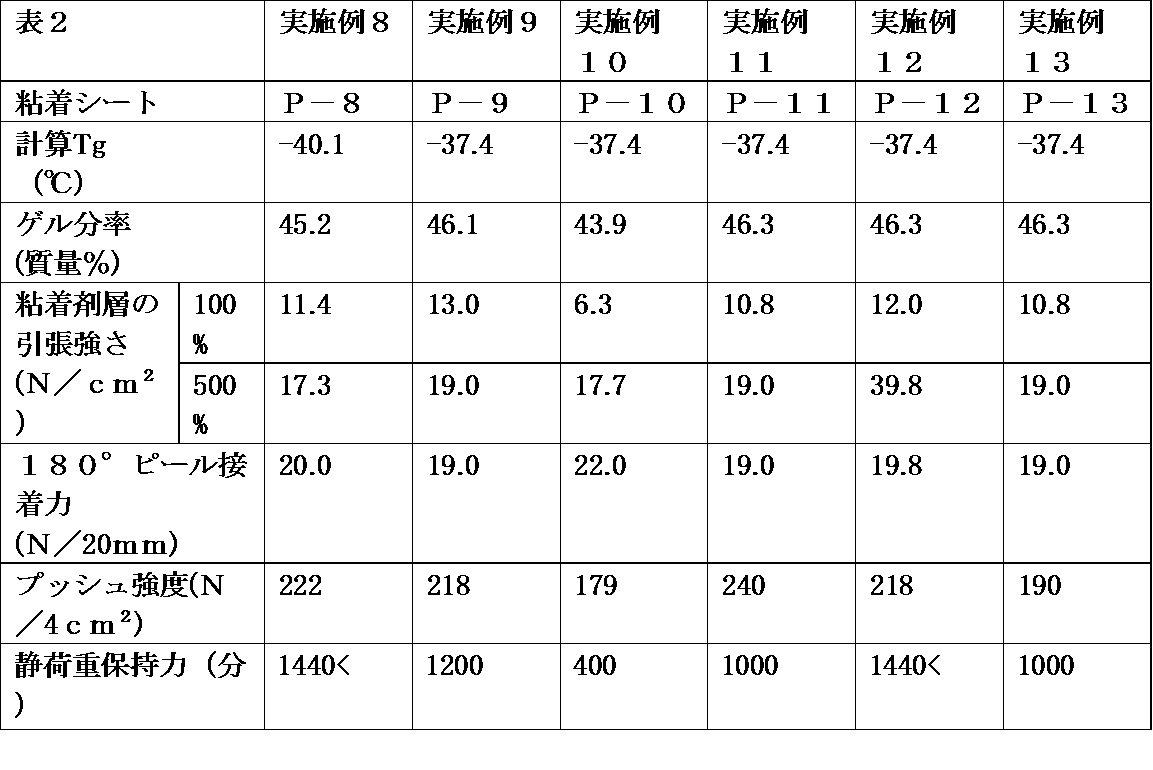
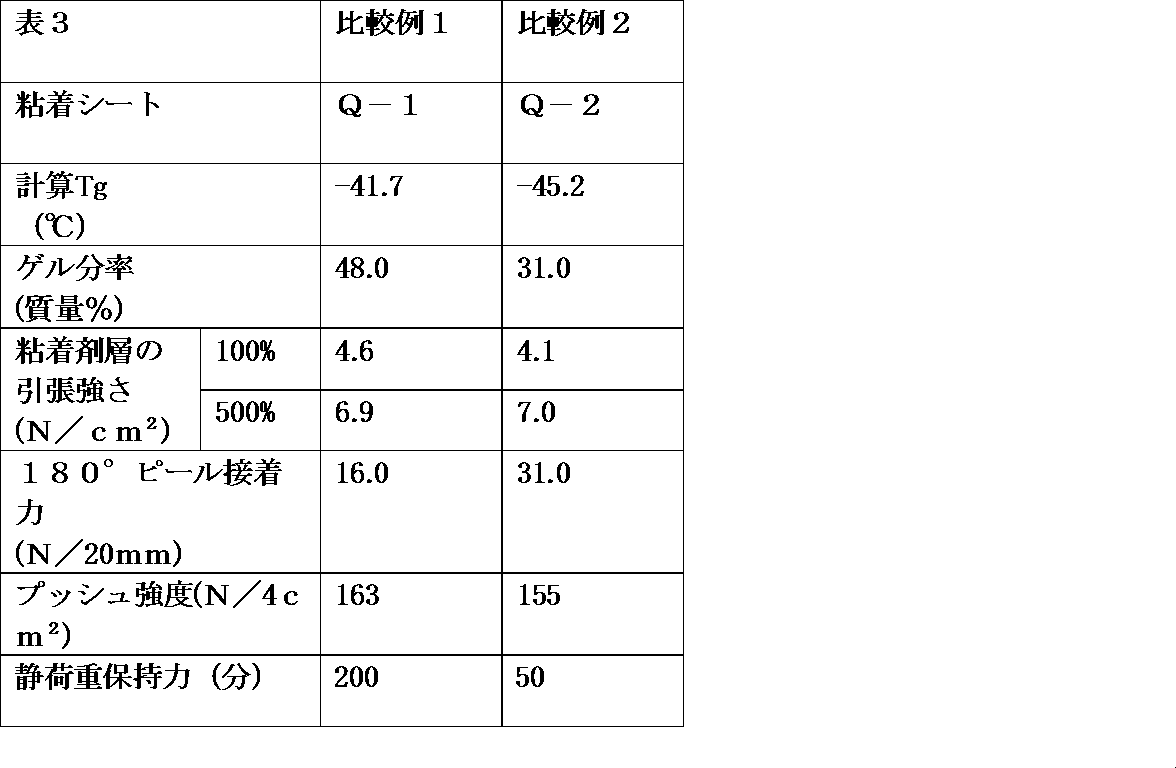
容器に、前記アクリル重合体(A-1)100質量部に対して、重合ロジンエステル系粘着付与樹脂D-125(荒川化学工業株式会社製)15質量部と不均化ロジンエステル系粘着付与樹脂A-125(荒川化学工業株式会社製)10質量部とを混合攪拌したのち、酢酸エチルを加えることによって固形分31質量%粘着剤溶液を得た。
前記アクリル重合体(A-1)溶液の代わりに、前記アクリル重合体(A-2)溶液を使用し、バーノックD-40の配合量を1.4質量部から1.2質量部に変更すること以外は、実施例14と同様の方法で粘着剤(p-15)及び粘着シート(P-15)を得た。
前記アクリル重合体(A-1)溶液の代わりに、前記アクリル重合体(A-3)溶液を使用し、バーノックD-40の配合量を1.4質量部から1.2質量部に変更すること以外は、実施例14と同様の方法で粘着剤(p-16)及び粘着シート(P-16)を得た。
前記アクリル重合体(A-1)溶液の代わりに、前記アクリル重合体(A-4)溶液を使用すること以外は、実施例14と同様の方法で粘着剤(p-17)及び粘着シート(P-17)を得た。
前記アクリル重合体(A-1)溶液の代わりに、前記アクリル重合体(A-7)溶液を使用すること以外は、実施例14と同様の方法で粘着剤(p-18)及び粘着シート(P-18)を得た。
前記アクリル重合体(A-1)溶液の代わりに、前記アクリル重合体(A-8)溶液を使用すること以外は、実施例14と同様の方法で粘着剤(p-19)及び粘着シート(P-19)を得た。
前記アクリル重合体(A-1)溶液の代わりに、前記アクリル重合体(A-9)溶液を使用すること以外は、実施例14と同様の方法で粘着剤(p-20)及び粘着シート(P-20)を得た。
前記アクリル重合体(A-1)溶液の代わりに、前記アクリル重合体(A-10)溶液を使用すること以外は、実施例14と同様の方法で粘着剤(p-21)及び粘着シート(P-21)を得た。
前記粘着付与樹脂として、前記重合ロジンエステル系粘着付与樹脂D-125(荒川化学工業株式会社製)10質量部と不均化ロジンエステル系粘着付与樹脂A-125(荒川化学工業株式会社製)5質量部と石油系粘着付与樹脂FTR6125(三井化学株式会社製)15質量部とを使用すること以外は、実施例14と同様の方法で粘着剤(p-22)及び粘着シート(P-22)を得た。
前記厚さ170μmのポリオレフィン系発泡体基材の代わりに、厚さ140μmのポリオレフィン系発泡体基材(見かけ密度0.40g/cm3)を使用し、かつ、乾燥後の粘着剤層の厚さを65μmから80μmに変更すること以外は、実施例14と同様の方法で粘着剤(p-23)及び粘着シート(P-23)を得た。
アクリル重合体(A-1)溶液の代わりに、アクリル重合体(B-1)溶液を使用し、バーノックD-40の使用量を1.4質量部から1.2質量部に変更すること以外は、実施例14と同様の方法で粘着剤(q-3)及び粘着シート(Q-3)を得た。
アクリル重合体(A-1)溶液の代わりに、アクリル重合体(B-2)溶液を使用し、バーノックD-40の使用量を1.4質量部から1.6質量部に変更すること以外は、実施例14と同様の方法で粘着剤(q-4)及び粘着シート(Q-4)を得た。
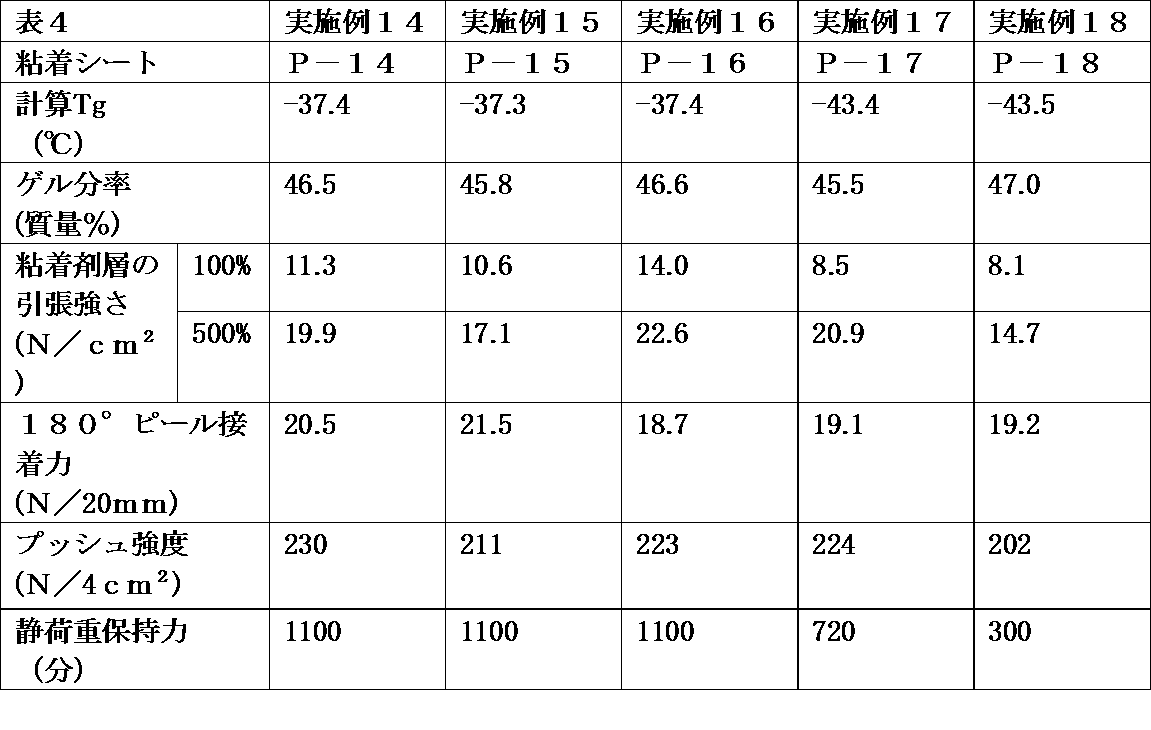
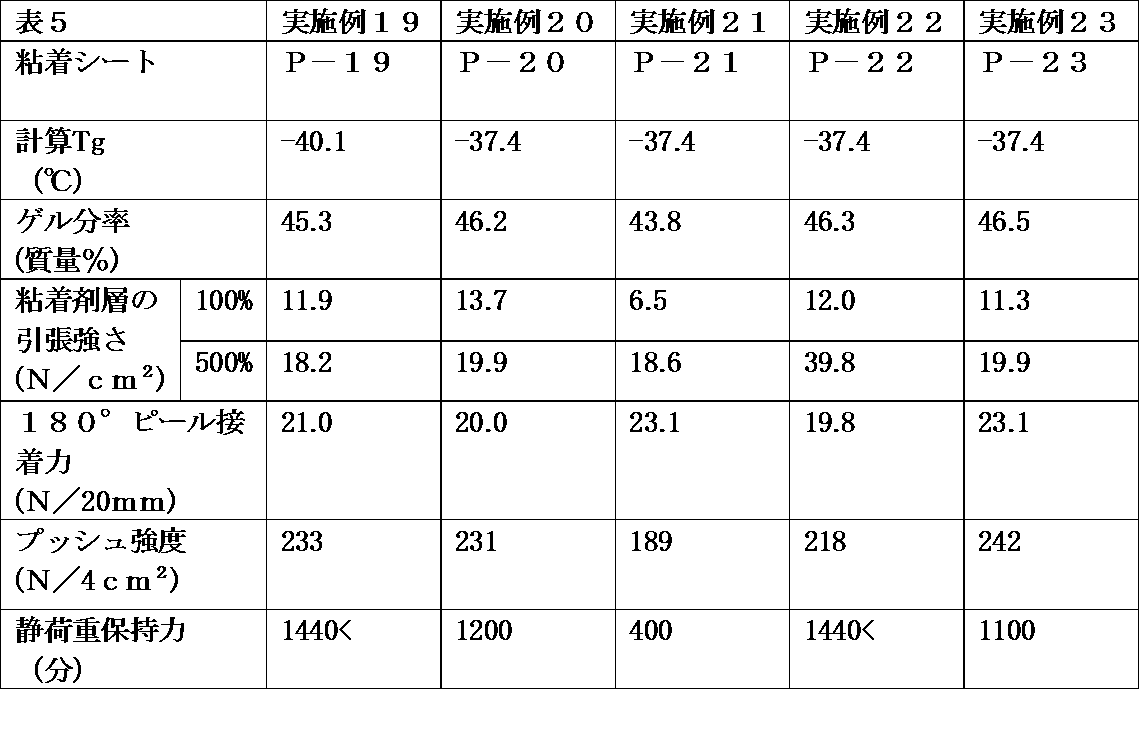
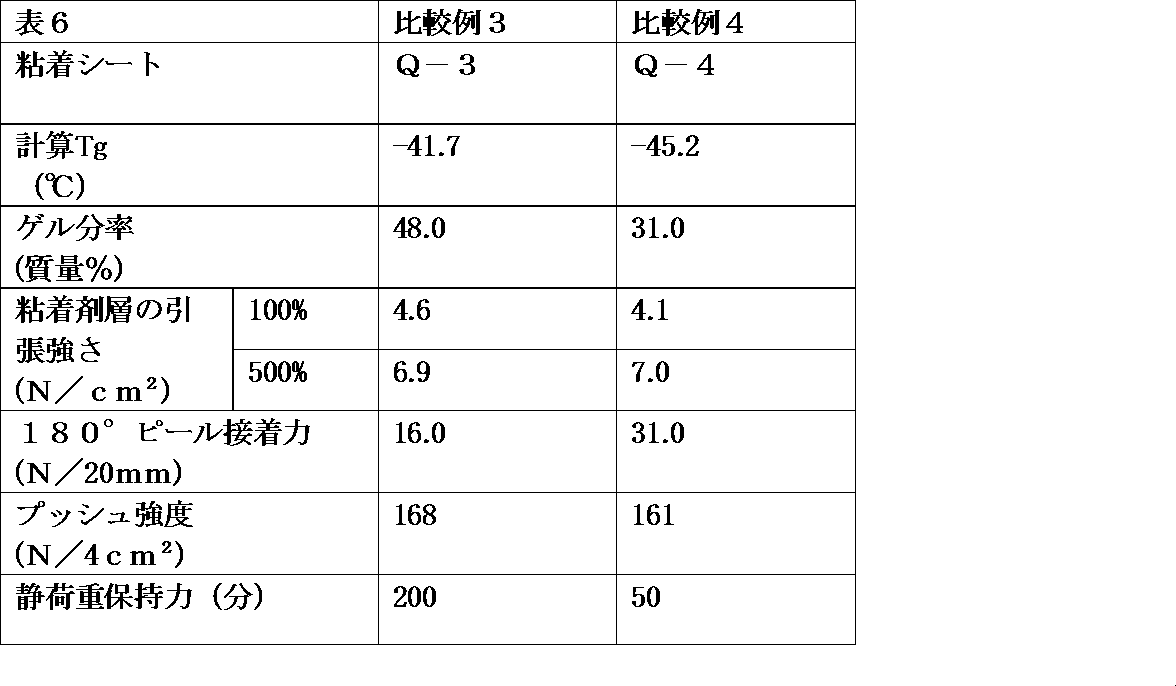
前記で得た粘着剤(p-14)を、離型ライナーの表面に、乾燥後の粘着剤層の厚さが65μmとなるように、バーコーターを用いて前記粘着剤を塗工し、80℃で3分間乾燥させることによって粘着剤層を作製した。
前記粘着剤(p-14)の代わりに、前記粘着剤(p-15)を使用したこと以外は、実施例24と同様の方法で粘着シート(P-25)を得た。
前記粘着剤(p-14)の代わりに、前記粘着剤(p-16)を使用したこと以外は、実施例24と同様の方法で粘着シート(P-26)を得た。
前記粘着剤(p-14)の代わりに、前記粘着剤(p-17)を使用したこと以外は、実施例24と同様の方法で粘着シート(P-27)を得た。
前記粘着剤(p-14)の代わりに、前記粘着剤(p-18)を使用したこと以外は、実施例24と同様の方法で粘着シート(P-28)を得た。
前記粘着剤(p-14)の代わりに、前記粘着剤(p-19)を使用したこと以外は、実施例24と同様の方法で粘着シート(P-29)を得た。
前記粘着剤(p-14)の代わりに、前記粘着剤(p-20)を使用したこと以外は、実施例24と同様の方法で粘着シート(P-30)を得た。
前記粘着剤(p-14)の代わりに、前記粘着剤(p-21)を使用したこと以外は、実施例24と同様の方法で粘着シート(P-31)を得た。
前記粘着剤(p-14)の代わりに、前記粘着剤(p-22)を使用したこと以外は、実施例24と同様の方法で粘着シート(P-32)を得た。
実施例24で使用した厚さ170μmのポリオレフィン系発泡体基材の代わりに、厚さ200μmのポリオレフィン系発泡体基材(流れ方向の平均気泡径117μm、幅方向の平均気泡径159μm、厚さ方向の平均気泡径43μm[流れ方向の平均気泡径/厚さ方向の平均気泡径]=2.7、[幅方向の平均気泡径/厚さ方向の平均気泡径]の比=3.7、層間強度24.5N/cm、見かけ密度0.40g/cm3、25%圧縮強度360kPa、表面をコロナ処理でぬれ指数54mN/mに調整したもの)を使用し、かつ、乾燥後の粘着剤層の厚さを65μmから50μmに変更すること以外は、実施例24と同様の方法で粘着シート(P-33)を得た。
実施例24で使用した厚さ170μmのポリオレフィン系発泡体基材の代わりに、厚さ150μmのポリオレフィン系発泡体基材(流れ方向の平均気泡径150μm、幅方向の平均気泡径121μm、厚さ方向の平均気泡径32μm[流れ方向の平均気泡径/厚さ方向の平均気泡径]=4.7、[幅方向の平均気泡径/厚さ方向の平均気泡径]の比=3.8、層間強度26.9N/cm、見かけ密度0.51g/cm3、25%圧縮強度521kPa、表面をコロナ処理でぬれ指数54mN/mに調整したもの)を使用し、かつ、乾燥後の粘着剤層の厚さを65μmから75μmに変更すること以外は、実施例24と同様の方法で粘着シート(P-34)を得た。
前記粘着剤(p-14)の代わりに、前記粘着剤(q-3)を使用したこと以外は、実施例24と同様の方法で粘着シート(Q-5)を得た。
前記粘着剤(p-14)の代わりに、前記粘着剤(q-4)を使用したこと以外は、実施例24と同様の方法で粘着シート(Q-6)を得た。
実施例24で使用した厚さ170μmのポリオレフィン系発泡体基材の代わりに、厚さ200μmのポリオレフィン系発泡体基材(流れ方向の平均気泡径173μm、幅方向の平均気泡径210μm、厚さ方向の平均気泡径42μm[流れ方向の平均気泡径/厚さ方向の平均気泡径]=4.1、[幅方向の平均気泡径/厚さ方向の平均気泡径]の比=5.0、層間強度12.9N/cm、見かけ密度0.20g/cm3、25%圧縮強度52kPa、表面をコロナ処理でぬれ指数54mN/mに調整したもの)を使用し、かつ、乾燥後の粘着剤層の厚さを65μmから50μmに変更すること以外は、実施例1と同様の方法で粘着シート(P-35)を得た。
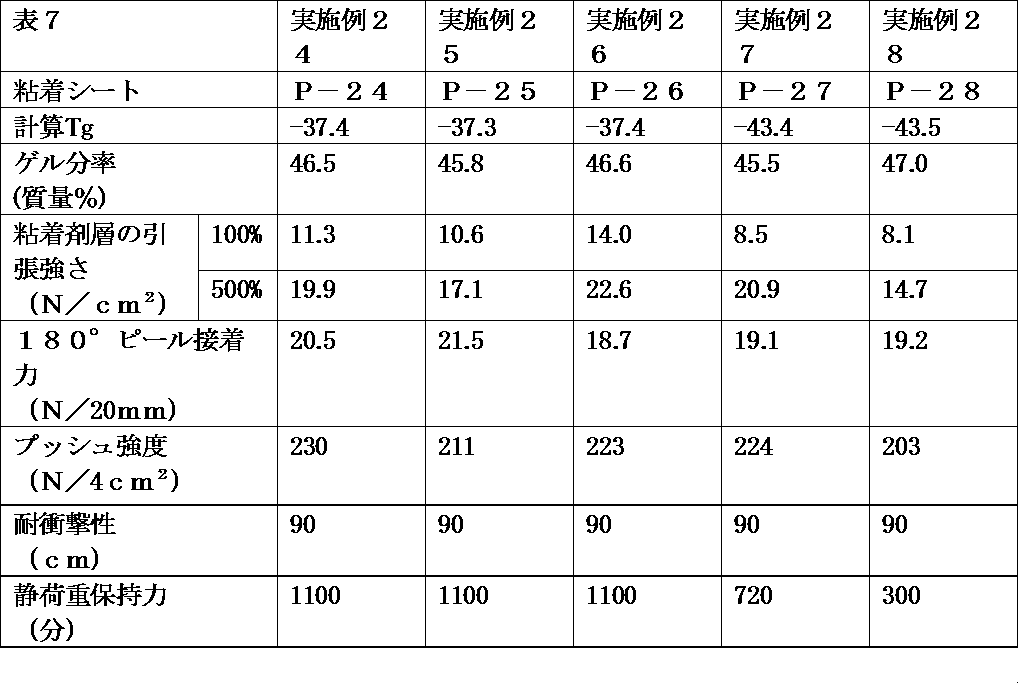
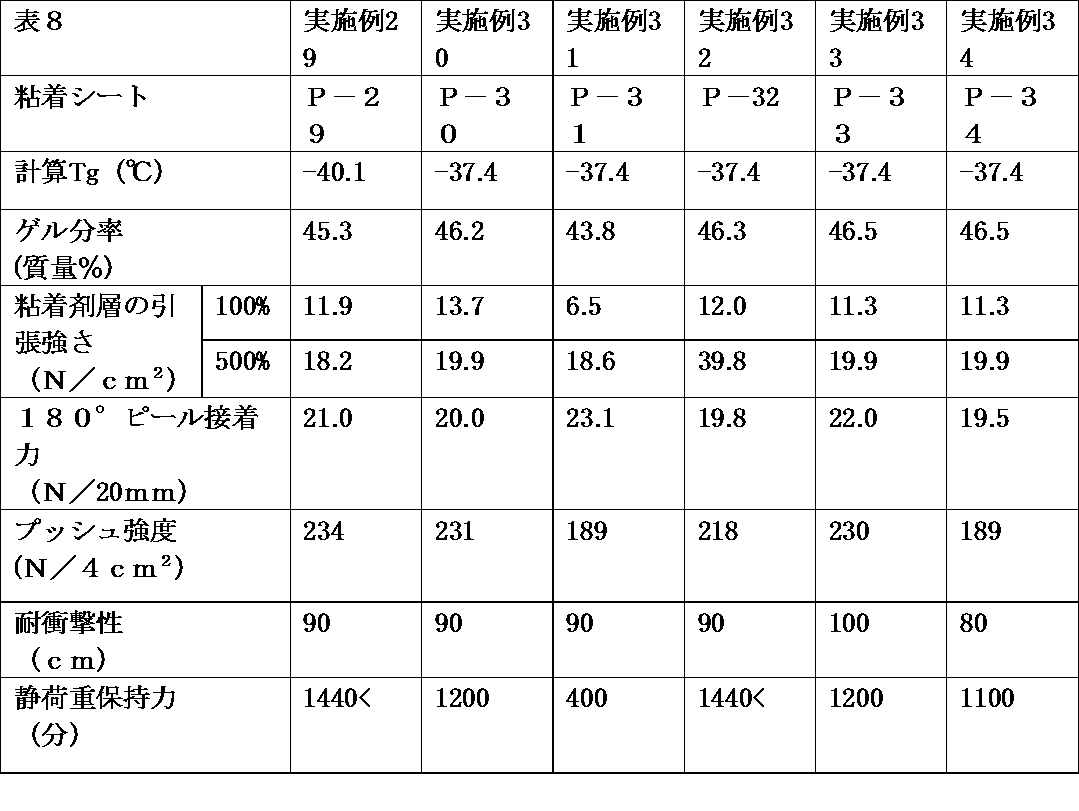

Claims (11)
- 基材の片面または両面に、歪み量100%における応力-歪み曲線に基づく引張強さが6N/cm2以上である粘着剤層(A)を有することを特徴とする粘着シート。
- 前記粘着剤層(A)が1μm~100μmの範囲の厚さを有するものである請求項1に記載の粘着シート。
- 前記粘着剤層(A)が、重量平均分子量80万以上のアクリル重合体(a1)を含有する粘着剤を用いて形成されたものである請求項1または2に記載の粘着シート。
- 前記アクリル重合体(a1)が、ビニル単量体成分を重合させて得られるものであって、前記ビニル単量体成分の全量に対する、(メタ)アクリル単量体以外のビニル単量体の含有量が合計5質量%以下、及び、ホモポリマーのガラス転移温度が100℃以上のアルキル(メタ)アクリレートの含有割合が合計1質量%以下である請求項1~3のいずれか1項に記載の粘着シート。
- 前記基材が発泡体基材である請求項1~4のいずれか1項に記載の粘着シート。
- 前記発泡体基材の流れ方向及び幅方向の平均気泡径が160μm以下であり、[流れ方向の平均気泡径/厚さ方向の平均気泡径]の比、及び、[幅方向の平均気泡径/厚さ方向の平均気泡径]の比が6以下であり、層間強度が10N/cm以上である請求項5に記載の粘着シート。
- 前記発泡体基材の25%圧縮強度が80kPa以上である請求項5または6に記載の粘着シート。
- 前記発泡体基材が、1500μm以下の厚さを有するものである請求項5~7のいずれか1項に記載の粘着シート。
- 電子機器を構成する部品の固定に使用する請求項1~8のいずれか1項に記載の粘着シート。
- 携帯電子機器を構成する2以上のきょう体の固定、または、前記きょう体とレンズ部材との固定に使用する請求項9に記載の粘着シート。
- 電子機器を構成する2以上の部品が、請求項9に記載の粘着シートによって接着された構成を有することを特徴とする電子機器。
Priority Applications (3)
| Application Number | Priority Date | Filing Date | Title |
|---|---|---|---|
| US15/124,471 US10793755B2 (en) | 2014-03-13 | 2015-03-12 | Adhesive sheet and electronic device |
| KR1020167024470A KR101961532B1 (ko) | 2014-03-13 | 2015-03-12 | 점착 시트 및 전자 기기 |
| CN201580004751.3A CN105916952B (zh) | 2014-03-13 | 2015-03-12 | 粘合片及电子设备 |
Applications Claiming Priority (6)
| Application Number | Priority Date | Filing Date | Title |
|---|---|---|---|
| JP2014050182 | 2014-03-13 | ||
| JP2014050181 | 2014-03-13 | ||
| JP2014-050182 | 2014-03-13 | ||
| JP2014-050181 | 2014-03-13 | ||
| JP2014-050180 | 2014-03-13 | ||
| JP2014050180 | 2014-03-13 |
Publications (1)
| Publication Number | Publication Date |
|---|---|
| WO2015137437A1 true WO2015137437A1 (ja) | 2015-09-17 |
Family
ID=54071876
Family Applications (1)
| Application Number | Title | Priority Date | Filing Date |
|---|---|---|---|
| PCT/JP2015/057281 Ceased WO2015137437A1 (ja) | 2014-03-13 | 2015-03-12 | 粘着シート及び電子機器 |
Country Status (5)
| Country | Link |
|---|---|
| US (1) | US10793755B2 (ja) |
| KR (1) | KR101961532B1 (ja) |
| CN (1) | CN105916952B (ja) |
| TW (1) | TWI640596B (ja) |
| WO (1) | WO2015137437A1 (ja) |
Cited By (2)
| Publication number | Priority date | Publication date | Assignee | Title |
|---|---|---|---|---|
| US20190276710A1 (en) * | 2016-10-26 | 2019-09-12 | Riken Technos Corporation | Adhesive film |
| WO2025243466A1 (ja) * | 2024-05-23 | 2025-11-27 | 株式会社寺岡製作所 | 粘着剤組成物及び粘着シート |
Families Citing this family (10)
| Publication number | Priority date | Publication date | Assignee | Title |
|---|---|---|---|---|
| KR20160088131A (ko) * | 2015-01-15 | 2016-07-25 | 삼성전자주식회사 | 플렉서블 표시 장치용 반사방지 필름 및 이를 포함하는 플렉서블 표시 장치 |
| CN107709492A (zh) * | 2016-01-26 | 2018-02-16 | 积水化学工业株式会社 | 双面粘合带 |
| JP6920610B2 (ja) | 2017-04-27 | 2021-08-18 | キョーラク株式会社 | 発泡ダクト |
| JPWO2019043810A1 (ja) * | 2017-08-30 | 2020-09-24 | 株式会社寺岡製作所 | 粘着テープ |
| WO2019159080A1 (en) * | 2018-02-19 | 2019-08-22 | 3M Innovative Properties Company | Impact resistant adhesive |
| WO2020004056A1 (ja) * | 2018-06-28 | 2020-01-02 | Dic株式会社 | 粘着テープ及び物品 |
| JP2023009805A (ja) * | 2021-07-08 | 2023-01-20 | Dic株式会社 | 粘着テープ及び電子機器 |
| JP7846444B2 (ja) * | 2021-07-08 | 2026-04-15 | Dic株式会社 | 粘着テープ及び電子機器 |
| US20240327629A1 (en) * | 2023-03-31 | 2024-10-03 | Toray Plastics (America), Inc. | Crosslinked polyethylene foam |
| DE102023110590A1 (de) * | 2023-04-25 | 2024-10-31 | Tesa Se | Reaktives Haftklebeelement |
Citations (3)
| Publication number | Priority date | Publication date | Assignee | Title |
|---|---|---|---|---|
| JP2007091918A (ja) * | 2005-09-29 | 2007-04-12 | Dainippon Ink & Chem Inc | アクリル系粘着剤組成物及び該組成物の製造方法 |
| JP2010254956A (ja) * | 2009-03-30 | 2010-11-11 | Dic Corp | 粘着剤、それを用いて得られる粘着シート及び粘着シートの製造方法 |
| JP2010260880A (ja) * | 2009-04-09 | 2010-11-18 | Dic Corp | 両面粘着テープ |
Family Cites Families (24)
| Publication number | Priority date | Publication date | Assignee | Title |
|---|---|---|---|---|
| US4751108A (en) * | 1985-03-15 | 1988-06-14 | Minnesota Mining And Manufacturing Company | Method of making a pressure-sensitive adhesive tape having a substantially tack-free surface |
| JPH05247149A (ja) * | 1991-12-28 | 1993-09-24 | Nippon Steel Chem Co Ltd | ゴム変性芳香族ビニル系共重合体樹脂及びその製造方法 |
| WO1995006462A1 (en) * | 1993-08-30 | 1995-03-09 | Warner-Lambert Company | Tablet coating based on a melt-spun mixture of a saccharide and apolymer |
| JP3563863B2 (ja) * | 1996-02-09 | 2004-09-08 | 大日本印刷株式会社 | カバーテープ |
| US6379791B1 (en) * | 2000-02-08 | 2002-04-30 | 3M Innovative Properties Company | Compatibilized pressure-sensitive adhesives |
| US20040137222A1 (en) * | 2001-03-30 | 2004-07-15 | Welke Siegfried K. | Transparent pressure-sensitive adhesive layer |
| JP2004196867A (ja) | 2002-12-16 | 2004-07-15 | Toyo Ink Mfg Co Ltd | 粘着剤組成物、およびそれを用いた粘着テープ |
| JP4587019B2 (ja) | 2003-12-24 | 2010-11-24 | Dic株式会社 | 両面粘着シート |
| JP5085145B2 (ja) * | 2006-03-15 | 2012-11-28 | 日東電工株式会社 | 両面粘着テープ又はシート、および液晶表示装置 |
| JP2008285554A (ja) | 2007-05-16 | 2008-11-27 | Emulsion Technology Co Ltd | 水系エマルジョン型の粘着剤組成物、及び粘着テープまたは粘着シート |
| JP5787463B2 (ja) | 2007-08-24 | 2015-09-30 | 日東電工株式会社 | ハードディスクドライブ部品固定用両面粘着シートおよびハードディスクドライブ |
| JP2010065095A (ja) | 2008-09-09 | 2010-03-25 | Sekisui Chem Co Ltd | 粘着剤、両面粘着シート及び表示装置 |
| JP5294931B2 (ja) * | 2009-03-11 | 2013-09-18 | 日東電工株式会社 | アクリル系粘着シート |
| KR101181335B1 (ko) | 2009-04-09 | 2012-09-11 | 디아이씨 가부시끼가이샤 | 양면 점착 테이프 |
| US20110130508A1 (en) * | 2009-07-29 | 2011-06-02 | Alan David Pendley | Topside optical adhesive for micro-optical film embedded into paper during the papermaking process |
| JP5518436B2 (ja) * | 2009-11-09 | 2014-06-11 | 日東電工株式会社 | 光学用粘着シート |
| JP5845591B2 (ja) | 2010-02-17 | 2016-01-20 | Dic株式会社 | 剛体貼り合わせ用両面粘着テープ |
| JP2011168658A (ja) | 2010-02-17 | 2011-09-01 | Daio Paper Corp | 粘着剤組成物、および粘着シート |
| EP2546053B1 (en) | 2011-07-15 | 2013-12-11 | Nitto Denko Corporation | Double-sided pressure-sensitive adhesive sheet |
| JP5891663B2 (ja) | 2011-09-07 | 2016-03-23 | Dic株式会社 | 着色粘着テープ |
| US10557061B2 (en) | 2011-12-26 | 2020-02-11 | Dic Corporation | Adhesive tape |
| JP5860297B2 (ja) * | 2012-02-06 | 2016-02-16 | 日東電工株式会社 | アクリル系粘着テープ |
| JP5370796B1 (ja) * | 2012-03-22 | 2013-12-18 | Dic株式会社 | 粘着テープ |
| KR101653986B1 (ko) * | 2012-04-13 | 2016-09-05 | 디아이씨 가부시끼가이샤 | 점착 테이프 |
-
2015
- 2015-03-12 WO PCT/JP2015/057281 patent/WO2015137437A1/ja not_active Ceased
- 2015-03-12 CN CN201580004751.3A patent/CN105916952B/zh active Active
- 2015-03-12 US US15/124,471 patent/US10793755B2/en active Active
- 2015-03-12 TW TW104107839A patent/TWI640596B/zh active
- 2015-03-12 KR KR1020167024470A patent/KR101961532B1/ko active Active
Patent Citations (3)
| Publication number | Priority date | Publication date | Assignee | Title |
|---|---|---|---|---|
| JP2007091918A (ja) * | 2005-09-29 | 2007-04-12 | Dainippon Ink & Chem Inc | アクリル系粘着剤組成物及び該組成物の製造方法 |
| JP2010254956A (ja) * | 2009-03-30 | 2010-11-11 | Dic Corp | 粘着剤、それを用いて得られる粘着シート及び粘着シートの製造方法 |
| JP2010260880A (ja) * | 2009-04-09 | 2010-11-18 | Dic Corp | 両面粘着テープ |
Cited By (3)
| Publication number | Priority date | Publication date | Assignee | Title |
|---|---|---|---|---|
| US20190276710A1 (en) * | 2016-10-26 | 2019-09-12 | Riken Technos Corporation | Adhesive film |
| US12043775B2 (en) * | 2016-10-26 | 2024-07-23 | Riken Technos Corporation | Adhesive film |
| WO2025243466A1 (ja) * | 2024-05-23 | 2025-11-27 | 株式会社寺岡製作所 | 粘着剤組成物及び粘着シート |
Also Published As
| Publication number | Publication date |
|---|---|
| KR20160119165A (ko) | 2016-10-12 |
| US10793755B2 (en) | 2020-10-06 |
| US20170015872A1 (en) | 2017-01-19 |
| KR101961532B1 (ko) | 2019-03-22 |
| CN105916952B (zh) | 2019-11-12 |
| TW201544570A (zh) | 2015-12-01 |
| TWI640596B (zh) | 2018-11-11 |
| CN105916952A (zh) | 2016-08-31 |
Similar Documents
| Publication | Publication Date | Title |
|---|---|---|
| US10793755B2 (en) | Adhesive sheet and electronic device | |
| JP6314341B2 (ja) | 両面粘着テープ及び物品 | |
| JP6326589B2 (ja) | 両面粘着テープ及び物品 | |
| CN113831854B (zh) | 粘着带以及物品及电子设备 | |
| JP6690163B2 (ja) | 粘着シート及びその製造方法ならびに電子機器 | |
| JP5963027B2 (ja) | 粘着シート | |
| JP6554834B2 (ja) | 粘着シート及び電子機器 | |
| JP2015098554A (ja) | 防水テープ | |
| JP6572566B2 (ja) | 粘着シート及び電子機器 | |
| CN104650757A (zh) | 双面粘合片 | |
| JP7047974B2 (ja) | 両面粘着テープ及び電子機器 | |
| JP6476734B2 (ja) | 粘着テープ、粘着テープを用いて得られる物品及び物品の解体方法 | |
| US20250084283A1 (en) | Adhesive tape, article obtained using adhesive tape, and method for dismantling articles | |
| JP6245381B2 (ja) | 粘着シート及び電子機器 | |
| JP6687160B2 (ja) | 粘着シート及び電子機器 | |
| JP6737422B2 (ja) | 粘着テープ及び物品 |
Legal Events
| Date | Code | Title | Description |
|---|---|---|---|
| 121 | Ep: the epo has been informed by wipo that ep was designated in this application |
Ref document number: 15761869 Country of ref document: EP Kind code of ref document: A1 |
|
| ENP | Entry into the national phase |
Ref document number: 20167024470 Country of ref document: KR Kind code of ref document: A |
|
| WWE | Wipo information: entry into national phase |
Ref document number: 15124471 Country of ref document: US |
|
| NENP | Non-entry into the national phase |
Ref country code: DE |
|
| 122 | Ep: pct application non-entry in european phase |
Ref document number: 15761869 Country of ref document: EP Kind code of ref document: A1 |