WO2015098592A1 - 全熱交換素子の製造方法および全熱交換素子 - Google Patents
全熱交換素子の製造方法および全熱交換素子 Download PDFInfo
- Publication number
- WO2015098592A1 WO2015098592A1 PCT/JP2014/083121 JP2014083121W WO2015098592A1 WO 2015098592 A1 WO2015098592 A1 WO 2015098592A1 JP 2014083121 W JP2014083121 W JP 2014083121W WO 2015098592 A1 WO2015098592 A1 WO 2015098592A1
- Authority
- WO
- WIPO (PCT)
- Prior art keywords
- total heat
- heat exchange
- sheet
- exchange element
- liner sheet
- Prior art date
- Legal status (The legal status is an assumption and is not a legal conclusion. Google has not performed a legal analysis and makes no representation as to the accuracy of the status listed.)
- Ceased
Links
Classifications
-
- F—MECHANICAL ENGINEERING; LIGHTING; HEATING; WEAPONS; BLASTING
- F28—HEAT EXCHANGE IN GENERAL
- F28D—HEAT-EXCHANGE APPARATUS, NOT PROVIDED FOR IN ANOTHER SUBCLASS, IN WHICH THE HEAT-EXCHANGE MEDIA DO NOT COME INTO DIRECT CONTACT
- F28D21/00—Heat-exchange apparatus not covered by any of the groups F28D1/00 - F28D20/00
- F28D21/0015—Heat and mass exchangers, e.g. with permeable walls
-
- B—PERFORMING OPERATIONS; TRANSPORTING
- B01—PHYSICAL OR CHEMICAL PROCESSES OR APPARATUS IN GENERAL
- B01D—SEPARATION
- B01D53/00—Separation of gases or vapours; Recovering vapours of volatile solvents from gases; Chemical or biological purification of waste gases, e.g. engine exhaust gases, smoke, fumes, flue gases, aerosols
- B01D53/26—Drying gases or vapours
-
- B—PERFORMING OPERATIONS; TRANSPORTING
- B01—PHYSICAL OR CHEMICAL PROCESSES OR APPARATUS IN GENERAL
- B01D—SEPARATION
- B01D53/00—Separation of gases or vapours; Recovering vapours of volatile solvents from gases; Chemical or biological purification of waste gases, e.g. engine exhaust gases, smoke, fumes, flue gases, aerosols
- B01D53/26—Drying gases or vapours
- B01D53/261—Drying gases or vapours by adsorption
-
- B—PERFORMING OPERATIONS; TRANSPORTING
- B01—PHYSICAL OR CHEMICAL PROCESSES OR APPARATUS IN GENERAL
- B01D—SEPARATION
- B01D53/00—Separation of gases or vapours; Recovering vapours of volatile solvents from gases; Chemical or biological purification of waste gases, e.g. engine exhaust gases, smoke, fumes, flue gases, aerosols
- B01D53/26—Drying gases or vapours
- B01D53/28—Selection of materials for use as drying agents
-
- B—PERFORMING OPERATIONS; TRANSPORTING
- B01—PHYSICAL OR CHEMICAL PROCESSES OR APPARATUS IN GENERAL
- B01J—CHEMICAL OR PHYSICAL PROCESSES, e.g. CATALYSIS OR COLLOID CHEMISTRY; THEIR RELEVANT APPARATUS
- B01J20/00—Solid sorbent compositions or filter aid compositions; Sorbents for chromatography; Processes for preparing, regenerating or reactivating thereof
- B01J20/02—Solid sorbent compositions or filter aid compositions; Sorbents for chromatography; Processes for preparing, regenerating or reactivating thereof comprising inorganic material
- B01J20/04—Solid sorbent compositions or filter aid compositions; Sorbents for chromatography; Processes for preparing, regenerating or reactivating thereof comprising inorganic material comprising compounds of alkali metals, alkaline earth metals or magnesium
- B01J20/046—Solid sorbent compositions or filter aid compositions; Sorbents for chromatography; Processes for preparing, regenerating or reactivating thereof comprising inorganic material comprising compounds of alkali metals, alkaline earth metals or magnesium containing halogens, e.g. halides
-
- B—PERFORMING OPERATIONS; TRANSPORTING
- B01—PHYSICAL OR CHEMICAL PROCESSES OR APPARATUS IN GENERAL
- B01J—CHEMICAL OR PHYSICAL PROCESSES, e.g. CATALYSIS OR COLLOID CHEMISTRY; THEIR RELEVANT APPARATUS
- B01J20/00—Solid sorbent compositions or filter aid compositions; Sorbents for chromatography; Processes for preparing, regenerating or reactivating thereof
- B01J20/28—Solid sorbent compositions or filter aid compositions; Sorbents for chromatography; Processes for preparing, regenerating or reactivating thereof characterised by their form or physical properties
- B01J20/28014—Solid sorbent compositions or filter aid compositions; Sorbents for chromatography; Processes for preparing, regenerating or reactivating thereof characterised by their form or physical properties characterised by their form
- B01J20/28033—Membrane, sheet, cloth, pad, lamellar or mat
- B01J20/28035—Membrane, sheet, cloth, pad, lamellar or mat with more than one layer, e.g. laminates, separated sheets
-
- B—PERFORMING OPERATIONS; TRANSPORTING
- B01—PHYSICAL OR CHEMICAL PROCESSES OR APPARATUS IN GENERAL
- B01J—CHEMICAL OR PHYSICAL PROCESSES, e.g. CATALYSIS OR COLLOID CHEMISTRY; THEIR RELEVANT APPARATUS
- B01J20/00—Solid sorbent compositions or filter aid compositions; Sorbents for chromatography; Processes for preparing, regenerating or reactivating thereof
- B01J20/30—Processes for preparing, regenerating, or reactivating
- B01J20/32—Impregnating or coating ; Solid sorbent compositions obtained from processes involving impregnating or coating
- B01J20/3291—Characterised by the shape of the carrier, the coating or the obtained coated product
- B01J20/3297—Coatings in the shape of a sheet
-
- B—PERFORMING OPERATIONS; TRANSPORTING
- B32—LAYERED PRODUCTS
- B32B—LAYERED PRODUCTS, i.e. PRODUCTS BUILT-UP OF STRATA OF FLAT OR NON-FLAT, e.g. CELLULAR OR HONEYCOMB, FORM
- B32B29/00—Layered products comprising a layer of paper or cardboard
- B32B29/002—Layered products comprising a layer of paper or cardboard as the main or only constituent of a layer, which is next to another layer of the same or of a different material
- B32B29/005—Layered products comprising a layer of paper or cardboard as the main or only constituent of a layer, which is next to another layer of the same or of a different material next to another layer of paper or cardboard layer
-
- B—PERFORMING OPERATIONS; TRANSPORTING
- B32—LAYERED PRODUCTS
- B32B—LAYERED PRODUCTS, i.e. PRODUCTS BUILT-UP OF STRATA OF FLAT OR NON-FLAT, e.g. CELLULAR OR HONEYCOMB, FORM
- B32B29/00—Layered products comprising a layer of paper or cardboard
- B32B29/08—Corrugated paper or cardboard
-
- B—PERFORMING OPERATIONS; TRANSPORTING
- B32—LAYERED PRODUCTS
- B32B—LAYERED PRODUCTS, i.e. PRODUCTS BUILT-UP OF STRATA OF FLAT OR NON-FLAT, e.g. CELLULAR OR HONEYCOMB, FORM
- B32B3/00—Layered products comprising a layer with external or internal discontinuities or unevennesses, or a layer of non-planar shape; Layered products comprising a layer having particular features of form
- B32B3/26—Layered products comprising a layer with external or internal discontinuities or unevennesses, or a layer of non-planar shape; Layered products comprising a layer having particular features of form characterised by a particular shape of the outline of the cross-section of a continuous layer; characterised by a layer with cavities or internal voids ; characterised by an apertured layer
- B32B3/28—Layered products comprising a layer with external or internal discontinuities or unevennesses, or a layer of non-planar shape; Layered products comprising a layer having particular features of form characterised by a particular shape of the outline of the cross-section of a continuous layer; characterised by a layer with cavities or internal voids ; characterised by an apertured layer characterised by a layer comprising a deformed thin sheet, i.e. the layer having its entire thickness deformed out of the plane, e.g. corrugated, crumpled
-
- B—PERFORMING OPERATIONS; TRANSPORTING
- B32—LAYERED PRODUCTS
- B32B—LAYERED PRODUCTS, i.e. PRODUCTS BUILT-UP OF STRATA OF FLAT OR NON-FLAT, e.g. CELLULAR OR HONEYCOMB, FORM
- B32B37/00—Methods or apparatus for laminating, e.g. by curing or by ultrasonic bonding
- B32B37/0076—Methods or apparatus for laminating, e.g. by curing or by ultrasonic bonding characterised in that the layers are not bonded on the totality of their surfaces
-
- B—PERFORMING OPERATIONS; TRANSPORTING
- B32—LAYERED PRODUCTS
- B32B—LAYERED PRODUCTS, i.e. PRODUCTS BUILT-UP OF STRATA OF FLAT OR NON-FLAT, e.g. CELLULAR OR HONEYCOMB, FORM
- B32B37/00—Methods or apparatus for laminating, e.g. by curing or by ultrasonic bonding
- B32B37/14—Methods or apparatus for laminating, e.g. by curing or by ultrasonic bonding characterised by the properties of the layers
- B32B37/144—Methods or apparatus for laminating, e.g. by curing or by ultrasonic bonding characterised by the properties of the layers using layers with different mechanical or chemical conditions or properties, e.g. layers with different thermal shrinkage, layers under tension during bonding
-
- C—CHEMISTRY; METALLURGY
- C09—DYES; PAINTS; POLISHES; NATURAL RESINS; ADHESIVES; COMPOSITIONS NOT OTHERWISE PROVIDED FOR; APPLICATIONS OF MATERIALS NOT OTHERWISE PROVIDED FOR
- C09K—MATERIALS FOR MISCELLANEOUS APPLICATIONS, NOT PROVIDED FOR ELSEWHERE
- C09K5/00—Heat-transfer, heat-exchange or heat-storage materials, e.g. refrigerants; Materials for the production of heat or cold by chemical reactions other than by combustion
- C09K5/08—Materials not undergoing a change of physical state when used
- C09K5/14—Solid materials, e.g. powdery or granular
-
- D—TEXTILES; PAPER
- D21—PAPER-MAKING; PRODUCTION OF CELLULOSE
- D21H—PULP COMPOSITIONS; PREPARATION THEREOF NOT COVERED BY SUBCLASSES D21C OR D21D; IMPREGNATING OR COATING OF PAPER; TREATMENT OF FINISHED PAPER NOT COVERED BY CLASS B31 OR SUBCLASS D21G; PAPER NOT OTHERWISE PROVIDED FOR
- D21H11/00—Pulp or paper, comprising cellulose or lignocellulose fibres of natural origin only
- D21H11/16—Pulp or paper, comprising cellulose or lignocellulose fibres of natural origin only modified by a particular after-treatment
- D21H11/18—Highly hydrated, swollen or fibrillatable fibres
-
- D—TEXTILES; PAPER
- D21—PAPER-MAKING; PRODUCTION OF CELLULOSE
- D21H—PULP COMPOSITIONS; PREPARATION THEREOF NOT COVERED BY SUBCLASSES D21C OR D21D; IMPREGNATING OR COATING OF PAPER; TREATMENT OF FINISHED PAPER NOT COVERED BY CLASS B31 OR SUBCLASS D21G; PAPER NOT OTHERWISE PROVIDED FOR
- D21H27/00—Special paper not otherwise provided for, e.g. made by multi-step processes
- D21H27/30—Multi-ply
- D21H27/40—Multi-ply at least one of the sheets being non-planar, e.g. crêped
-
- F—MECHANICAL ENGINEERING; LIGHTING; HEATING; WEAPONS; BLASTING
- F28—HEAT EXCHANGE IN GENERAL
- F28F—DETAILS OF HEAT-EXCHANGE AND HEAT-TRANSFER APPARATUS, OF GENERAL APPLICATION
- F28F3/00—Plate-like or laminated elements; Assemblies of plate-like or laminated elements
- F28F3/02—Elements or assemblies thereof with means for increasing heat-transfer area, e.g. with fins, with recesses, with corrugations
- F28F3/025—Elements or assemblies thereof with means for increasing heat-transfer area, e.g. with fins, with recesses, with corrugations the means being corrugated, plate-like elements
- F28F3/027—Elements or assemblies thereof with means for increasing heat-transfer area, e.g. with fins, with recesses, with corrugations the means being corrugated, plate-like elements with openings, e.g. louvered corrugated fins; Assemblies of corrugated strips
-
- B—PERFORMING OPERATIONS; TRANSPORTING
- B01—PHYSICAL OR CHEMICAL PROCESSES OR APPARATUS IN GENERAL
- B01D—SEPARATION
- B01D2253/00—Adsorbents used in seperation treatment of gases and vapours
- B01D2253/10—Inorganic adsorbents
- B01D2253/112—Metals or metal compounds not provided for in B01D2253/104 or B01D2253/106
-
- B—PERFORMING OPERATIONS; TRANSPORTING
- B32—LAYERED PRODUCTS
- B32B—LAYERED PRODUCTS, i.e. PRODUCTS BUILT-UP OF STRATA OF FLAT OR NON-FLAT, e.g. CELLULAR OR HONEYCOMB, FORM
- B32B2250/00—Layers arrangement
- B32B2250/42—Alternating layers, e.g. ABAB(C), AABBAABB(C)
-
- B—PERFORMING OPERATIONS; TRANSPORTING
- B32—LAYERED PRODUCTS
- B32B—LAYERED PRODUCTS, i.e. PRODUCTS BUILT-UP OF STRATA OF FLAT OR NON-FLAT, e.g. CELLULAR OR HONEYCOMB, FORM
- B32B2262/00—Composition or structural features of fibres which form a fibrous or filamentary layer or are present as additives
- B32B2262/02—Synthetic macromolecular fibres
-
- B—PERFORMING OPERATIONS; TRANSPORTING
- B32—LAYERED PRODUCTS
- B32B—LAYERED PRODUCTS, i.e. PRODUCTS BUILT-UP OF STRATA OF FLAT OR NON-FLAT, e.g. CELLULAR OR HONEYCOMB, FORM
- B32B2317/00—Animal or vegetable based
- B32B2317/12—Paper, e.g. cardboard
- B32B2317/127—Corrugated cardboard
-
- B—PERFORMING OPERATIONS; TRANSPORTING
- B32—LAYERED PRODUCTS
- B32B—LAYERED PRODUCTS, i.e. PRODUCTS BUILT-UP OF STRATA OF FLAT OR NON-FLAT, e.g. CELLULAR OR HONEYCOMB, FORM
- B32B2419/00—Buildings or parts thereof
-
- B—PERFORMING OPERATIONS; TRANSPORTING
- B32—LAYERED PRODUCTS
- B32B—LAYERED PRODUCTS, i.e. PRODUCTS BUILT-UP OF STRATA OF FLAT OR NON-FLAT, e.g. CELLULAR OR HONEYCOMB, FORM
- B32B2457/00—Electrical equipment
-
- B—PERFORMING OPERATIONS; TRANSPORTING
- B32—LAYERED PRODUCTS
- B32B—LAYERED PRODUCTS, i.e. PRODUCTS BUILT-UP OF STRATA OF FLAT OR NON-FLAT, e.g. CELLULAR OR HONEYCOMB, FORM
- B32B2605/00—Vehicles
-
- F—MECHANICAL ENGINEERING; LIGHTING; HEATING; WEAPONS; BLASTING
- F28—HEAT EXCHANGE IN GENERAL
- F28D—HEAT-EXCHANGE APPARATUS, NOT PROVIDED FOR IN ANOTHER SUBCLASS, IN WHICH THE HEAT-EXCHANGE MEDIA DO NOT COME INTO DIRECT CONTACT
- F28D21/00—Heat-exchange apparatus not covered by any of the groups F28D1/00 - F28D20/00
- F28D2021/0019—Other heat exchangers for particular applications; Heat exchange systems not otherwise provided for
- F28D2021/0038—Other heat exchangers for particular applications; Heat exchange systems not otherwise provided for for drying or dehumidifying gases or vapours
-
- F—MECHANICAL ENGINEERING; LIGHTING; HEATING; WEAPONS; BLASTING
- F28—HEAT EXCHANGE IN GENERAL
- F28F—DETAILS OF HEAT-EXCHANGE AND HEAT-TRANSFER APPARATUS, OF GENERAL APPLICATION
- F28F2245/00—Coatings; Surface treatments
Definitions
- the present invention relates to a total heat exchange element used for a total heat exchanger mainly used in the air conditioning field.
- the total heat exchanger has been attracting attention as an energy-saving member for residential and building ventilation equipment.
- the total heat exchanger is mainly composed of a total heat exchange element that performs total heat exchange and a blower for exchanging air indoors and outdoors.
- This total heat exchanging element has a function of suppressing fluctuations in the indoor temperature and humidity environment during ventilation by shifting the temperature and humidity of the air exhausted from the room to the outside to the air supplied from the outside to the room.
- a total heat exchange element is formed by laminating a plurality of corrugated boards composed of a member for exchanging temperature and humidity (liner sheet) and a member for forming a flow path for intake and exhaust (corrugated sheet). Liner sheets are required to have heat transfer properties, moisture permeability, and air shielding properties in order to increase the temperature exchange efficiency, humidity exchange efficiency, and effective ventilation rate of the heat exchange element, and studies are being made to improve its performance. .
- Patent Document 1 a total heat exchange element using a liner sheet containing a water-soluble hygroscopic agent such as lithium chloride is disclosed.
- a total heat exchange element in which a hygroscopic agent is contained in a liner sheet and a water-insoluble adhesive is used as an adhesive between the liner sheet and the corrugated sheet (Patent Document 2).
- a gas-permeable moisture permeable film is provided on each surface of the liner sheet and the corrugated sheet, and the liner sheet and the corrugated sheet have latent heat.
- a total heat exchange element containing a moisture-permeable agent that can pass through is disclosed (Patent Document 3).
- the heat exchange element containing a liner sheet containing a water-soluble moisture absorbent disclosed in Patent Document 1 has a problem that the humidity exchange efficiency decreases with time. This is considered that the hygroscopic agent moves from the liner sheet to another member, and Patent Document 2 and Patent Document 3 disclosed a total heat exchange element that tried to solve it.
- Patent Document 2 and Patent Document 3 disclosed a total heat exchange element that tried to solve it.
- Patent Document 2 there is a problem that the amount of movement of humidity passing through the liner sheet from the beginning is small.
- Patent Document 3 even when the hygroscopic agent is contained in each of the liner sheet and the corrugated sheet, there was a tendency that the amount of humidity transfer decreased with time. .
- an object of the present invention is to provide a total heat exchange element that maintains the humidity exchange efficiency over time.
- the present invention provides the following method for producing a total heat exchange element.
- a process for producing a single-sided cardboard by bonding a liner sheet and a corrugated sheet A step of laminating a plurality of the single-sided cardboards obtained in the step so that the directions of the single-sided cardboards intersect one by one, and a method for producing a total heat exchange element containing a hygroscopic agent,
- R1 is 1 to 20 g / m 2 .
- the method for producing any one of the total heat exchange elements, wherein the hygroscopic agent is lithium chloride.
- a total heat exchange element that has high heat exchange efficiency and maintains humidity exchange efficiency over time.
- a method for producing a total heat exchange element containing the hygroscopic agent of the present invention A process for producing a single-sided cardboard by bonding a liner sheet and a corrugated sheet; Laminating the plurality of single-sided cardboards obtained in the step so that the directions of the single-sided cardboards intersect one by one, and a method for producing a total heat exchange element,
- R1 is 1 to 20 g / m 2 and R1 / R2 is 0.5. ⁇ 2.0.
- a single-sided cardboard is first manufactured. Usually, the following steps are performed.
- the corrugated sheet is shaped into a corrugated shape by a gear-shaped roll that meshes with each other and rotates.
- An adhesive is applied to the step top of the obtained corrugated sheet, the liner sheet is pressed against the step top of the corrugated sheet, and bonded to obtain a single-sided cardboard sheet.
- the obtained plurality of single-sided cardboards are laminated so that the direction of the single-sided cardboards intersects one by one.
- Adhesive is applied to the top of the obtained single-sided cardboard sheet, and a plurality of single-sided cardboards are laminated so that the direction of the steps of the single-sided cardboard intersects one by one. And it shape
- the direction of the step means the direction of the flow path formed between the liner sheet and the corrugated sheet that are bonded to each other on the single-sided cardboard.
- the total heat exchange element of the present invention has a structure in which a single-sided cardboard having a liner sheet and a corrugated sheet is laminated with a plurality of single-sided cardboards so that the longitudinal direction of the flow path intersects one by one.
- supply air flows through a flow path in one direction among flow paths that intersect with each other, and exhaust gas flows through a flow path in the other direction.
- heat exchange between the supply air and the exhaust gas is mainly performed through the liner sheet. Therefore, if the moisture permeability of the liner sheet is large, the total heat exchange element is also excellent in humidity exchange efficiency.
- the moisture permeability (hereinafter referred to as “moisture permeability 1”) of the liner sheet in an environment of 20 ° C. and a humidity of 65% RH is 60 g / m 2 / hr or more. It is preferably 70 g / m 2 / hr or more, more preferably 80 g / m 2 / hr or more, and particularly preferably 90 g / m 2 / hr or more.
- the moisture permeability 1 of the liner sheet is preferably 200 g / m 2 / hr or less, and 180 g / m 2 / hr. Or less, more preferably 150 g / m 2 / hr or less.
- the moisture permeability 1 of the liner sheet can be within the above range by appropriately combining conditions such as the basis weight and density of the liner sheet, the content of the hygroscopic agent contained in the liner sheet or the type of the hygroscopic agent. .
- the hygroscopic agent used in the present invention is preferably an alkali metal salt such as lithium chloride or an alkaline earth metal salt such as calcium chloride or magnesium chloride.
- an alkali metal salt such as lithium chloride or an alkaline earth metal salt such as calcium chloride or magnesium chloride.
- lithium chloride and calcium chloride with high water absorption are more preferable.
- lithium chloride which can increase the humidity exchange efficiency with a smaller content, is most preferable.
- urethane resin, polyoxyethylene, polyethylene glycol, polyoxyalkylene alkyl ether, sodium polyacrylsulfonate, and the like may be included.
- functional agents such as antibacterial agents, antibacterial agents, and flame retardants may also be included.
- the hygroscopic agent contained in the liner sheet and the hygroscopic agent contained in the corrugated sheet are not particularly defined, but are preferably the same hygroscopic agent.
- the same hygroscopic agent for the liner sheet and the corrugated sheet it is possible to suppress the transmission resistance at the time of moisture transmission at the part of the total heat exchange element where the total heat exchange is performed via the liner sheet and the corrugated sheet. A total heat exchange element that is superior in humidity exchange efficiency can be obtained.
- the content of the hygroscopic agent referred to in the present invention is the mass of the hygroscopic agent per 1 m 2 of the sheet. Moreover, in content measurement, it was set as the mass measured after leaving to stand for 12 hours or more in the constant temperature and humidity chamber of temperature 23 degreeC and 50% of relative humidity.
- the content (R1) of the hygroscopic agent contained in the liner sheet before laminating the cardboard is 1 to 20 g / m 2 .
- R1 The content (R1) of the hygroscopic agent contained in the liner sheet before laminating the cardboard is 1 to 20 g / m 2 .
- the moisture permeability of the liner sheet can be improved, and by using the liner sheet, a total heat exchange element excellent in humidity exchange efficiency can be obtained.
- the lower limit of R1 is preferably 2 g / m 2 or more, and more preferably 3 g / m 2 or more.
- the upper limit of R1 is preferably 15 g / m 2 or less, and more preferably 10 g / m 2 or less.
- the content is preferably within the above range, and when calcium chloride is used, the content is It is preferable that it is the said range.
- potassium chloride and calcium chloride are used in combination, the sum of the contents is preferably within the above range.
- the liner sheet used in the present invention preferably has a laminated structure including at least one porous layer.
- the gas shielding layer need not have a property of completely shielding gas. If the gas shielding property in the gas shielding layer is defined, the value defined by the carbon dioxide shielding rate shown in the column of Examples is preferably 35% or more. More preferably, it is 60% or more, More preferably, it is 70% or more.
- the gas shielding layer is preferably mainly composed of a fibrous material. Here, if it is defined that the fibrous substance is a “main component”, when the gas shielding layer containing the fibrous substance is 100 mass%, the fibrous substance contained in the gas shielding layer is 50%. It means exceeding mass%.
- fibrous material examples include N pulp (conifer pulp), L pulp (hardwood pulp), bagasse, wheat straw, reed, papyrus, bamboo, mokumen, kenaf, roselle, asa, flax, ramie, jude, hemp, saizale asa,
- fibers include Manila Asa, palm, and banana.
- polyethylene terephthalate PET
- polytrimethylene terephthalate PET
- polybutylene terephthalate PBT
- polylactic acid PLA
- polyethylene naphthalate PEN
- liquid crystal polyester nylon 6 (N6)
- nylon 66 N66
- nylon 11 N11
- nylon 12 N12
- PE polyethylene
- PP polypropylene
- fibers made of a thermoplastic resin such as polystyrene (PS)
- regenerated fibers viscose rayon, copper ammonia rayon
- these fibers may be used alone, but two or more kinds of fibers selected from these may be contained.
- hydrophilic fibrous material that has been highly fibrillated as the main component of the gas shielding layer, because it is easy to form a dense structure that effectively shields the leakage of carbon dioxide from the fiber gap.
- a hydrophilic fibrous substance which advanced fibrillation highly N pulp (coniferous pulp), L pulp (hardwood pulp), an aramid fiber, an acrylic fiber, etc. are mentioned, for example.
- these fibers may be used independently, 2 or more types of fibers chosen from these may be contained. More preferably, a cellulose pulp obtained by highly fibrillating N pulp (conifer pulp) and L pulp (hardwood pulp) is used.
- N pulp coniferous pulp obtained from plants, such as wood, L pulp (hardwood pulp), etc.
- These fibrillated hydrophilic fibers can be fibrillated using a beater such as a beater, a disc refiner, a deluxe refiner, a Jordan, a grinder, a bead mill, or a high-pressure homogenizer.
- the fibrous material used in the gas shielding layer preferably has a beating degree of less than 150 ml as an upper limit in the Canadian standard freeness test. More preferably, it is 100 ml or less, More preferably, it is 30 ml or less.
- the lower limit is preferably 10 ml or more.
- the liner sheet of the present invention includes a porous layer. If the porous layer is defined, when observing the cross section, it is preferable that 10 ⁇ m squares or smaller pores are formed in a 100 ⁇ m square region, preferably 3 ⁇ m squares or areas thereof. It is more preferable that 10 or more smaller holes are available, and more preferably 50 or more.
- the porous layer is preferably composed mainly of a fibrous material. If it is defined that the fibrous substance is a main component, the fibrous substance contained in the porous layer exceeds 50 mass% when the porous layer containing the fibrous substance is defined as 100 mass%. Say.
- fibrous substance examples include N pulp (conifer pulp), L pulp (hardwood pulp), bagasse, wheat straw, reed, papyrus, bamboo, mokumen, kenaf, roselle, asa, flax, ramie, jude, hemp, saizale asa, Manila Asa, palm, banana, thermoplastic resin fiber (polyethylene terephthalate (PET), polytrimethylene terephthalate (PTT), polybutylene terephthalate (PBT), polylactic acid (PLA), polyethylene naphthalate (PEN), liquid crystal polyester, nylon 6 (N6), nylon 66 (N66), nylon 11 (N11), nylon 12 (N12), polyethylene (PE), polypropylene (PP), fiber made of thermoplastic resin such as polystyrene (PS)), recycled fiber ( Viscose rayon, copper Ammonia rayon), and the like.
- PET polyethylene terephthalate
- PTT polytrimethylene terephthalate
- PBT polybutylene ter
- These fibers may be used alone, or two or more kinds of fibers selected from these may be used.
- cellulose pulp such as N pulp (coniferous pulp) and L pulp (hardwood pulp) is preferable because it is easy to handle and has excellent papermaking properties.
- These fibers can be appropriately fibrillated by using a beater such as a beater, a disc refiner, a deluxe refiner, a Jordan, a grinder, a bead mill, or a high-pressure homogenizer.
- the beating degree of the fibrous material that can be used for the porous layer is preferably 150 ml or more as a lower limit in the Canadian standard freeness test.
- the upper limit is preferably 700 ml or less.
- the fibrous material preferably used for the porous layer contains nanofibers of thermoplastic polymer.
- nanofiber means a fiber having a fiber diameter of nanometer (nm) level, specifically, a fiber having a fiber diameter of 1 nm or more and less than 1000 nm.
- nm nanometer
- the irregular cross section whose fiber cross section is not circular it was based on the fiber diameter when converted into a circle of the same area.
- the fiber diameter of the nanofiber that can be used as a preferred embodiment is preferably 700 nm or less, more preferably 500 nm or less, and still more preferably 300 nm or less.
- the lower limit is preferably 1 nm or more from the balance with productivity. More preferably, it is 100 nm or more.
- Nanofiber is made of thermoplastic polymer.
- the thermoplastic polymer include polyester, polyamide, polyolefin and the like as main components.
- the polyester include polyethylene terephthalate (PET), polytrimethylene terephthalate (PTT), polybutylene terephthalate (PBT), polylactic acid (PLA), polyethylene naphthalate (PEN), and liquid crystal polyester.
- the polyamide include nylon 6 (N6), nylon 66 (N66), nylon 11 (N11), nylon 12 (N12), and the like.
- the polyolefin include polyethylene (PE), polypropylene (PP), and polystyrene (PS).
- polyamide is preferable from the viewpoint of affinity with cellulose pulp, and nylon 6 is particularly preferable.
- components other than polyamide may be copolymerized or mixed.
- Nanofibers can be produced, for example, by the method described in JP-A-2005-299069 (paragraphs [0045] to [0057], paragraphs [0114] to [0117], etc.). Specifically, it is as follows.
- a method for producing “polymer alloy fiber”, which is a raw material for producing nanofibers will be described.
- the following method can be employed. That is, a polymer alloy chip is produced by alloying two or more types of polymers having different solubility in solvents and chemical solutions. This is put into a hopper of a spinning device, is made into an alloy melt in the melting part, is spun by discharge from a nozzle hole arranged in a spinning pack in a heat insulation spin block, and then cooled and solidified by chimney to form a yarn. The yarn is passed through the bundling oiling guide, the first take-up roller, and the second take-up roller and taken up by a winder to obtain a fiber.
- a polymer alloy fiber which has a sea island structure is obtained. Further, this is treated with a solvent or a chemical solution to remove sea components, and nanofibers used in the present invention are obtained.
- a polymer alloy fiber a polymer that is hardly soluble in a solvent or chemical solution that later becomes a nanofiber is used as an island component, and an easily soluble polymer is used as a sea component, and by controlling the size of this island component, In addition, it is possible to design the number average fiber diameter and variation of single fibers of nanofibers.
- the diameter of the nanofiber is almost determined by the size of the island component in the polymer alloy fiber that is the nanofiber precursor, the distribution of the island size is designed according to the desired fiber diameter distribution of the nanofiber. Is done. For this reason, kneading of the polymer to be alloyed is very important. In the present invention, it is preferable to knead highly by a kneading extruder or a stationary kneader.
- a capillary structure is formed in which the nanofiber is closely packed in the gap between the fibrous material that is not a nanofiber, and the capillary phenomenon
- a layer having high moisture permeability can be formed.
- the porous layer having a higher surface area due to the nanofibers can easily absorb more humidity.
- nanofibers are made of a thermoplastic polymer material, the strength is not greatly reduced by wetting like cellulose, and the stable dimensional stability of all heat exchange elements can be maintained over a long period of time. It becomes possible.
- the content of nanofibers in the porous layer is preferably 5% by weight or more as the lower limit with respect to the weight of the multilayer layer. More preferably, it is 30 mass% or more, More preferably, it is 50 mass%.
- the upper limit is preferably in the range of 90% by mass. More preferably, it is 80 mass%.
- the basis weight of the gas shielding layer in the liner sheet of the present invention is preferably 15 g / m 2 or more as a lower limit, and more preferably 20 g / m 2 or more.
- the upper limit is preferably 50 g / m 2 or less, and more preferably 40 g / m 2 or less.
- a basic weight of a porous layer it is preferable that it is 5 g / m ⁇ 2 > or more as a minimum, More preferably, it is 10 g / m ⁇ 2 > or more.
- the upper limit is preferably 40 g / m 2 or less, more preferably 30 g / m 2 or less.
- the basis weight of the liner sheet can be obtained by adding the basis weight of the gas shielding layer and the basis weight of the porous layer.
- the production method of the liner sheet is not particularly specified, but the gas shielding layer and the porous layer may be prepared separately, and may be laminated and bonded by an adhesive or heat.
- the resin component of the agent is not preferable because it becomes a factor that hinders the transmission of heat and humidity.
- it is a method of forming by multilayer papermaking in papermaking. In that case, a desired laminated structure can be obtained by preparing a paper-making part in a timely manner according to the number of laminated layers and making them together.
- the paper machine a round net paper machine, a short net paper machine, a long net paper machine, etc. having an arbitrary number of paper making units, or a combination paper machine thereof can be used.
- the following method is exemplified to contain the hygroscopic agent in the liner sheet.
- i) A dipping method in which a liner sheet substrate is immersed in a working fluid containing a hygroscopic agent and then squeezed between a pair of rotating rolls.
- ii) A coating method in which a working fluid containing a hygroscopic agent is applied to the surface of the liner sheet substrate.
- iii) A spray method in which a processing liquid containing a hygroscopic agent is sprayed onto the surface of the liner sheet base material to adhere to the base material.
- a liner sheet and a corrugated sheet are bonded to produce a single-sided cardboard, and then a processing liquid containing a hygroscopic agent is brought into contact with the surface of the liner sheet.
- a processing liquid containing a hygroscopic agent is brought into contact with the surface of the liner sheet.
- the contacting method include methods such as dipping, spraying and coating.
- the corrugated sheet can contain a hygroscopic agent at the same time.
- the dipping method is preferable because the moisture absorbent can penetrate into the liner sheet and the moving speed can be promoted as a moving medium for moisture absorbed by the liner sheet.
- the liner sheet of the present invention can be processed with functional agents such as flame retardants, antibacterial agents, antibacterial agents, and antifungal agents as necessary.
- corrugated cardboard, corrugated sheet Next, another material constituting corrugated cardboard, corrugated sheet, will be described.
- the total heat exchange between the air supply and exhaust is performed via the corrugated sheet and liner sheet, so the moisture permeability of the corrugated sheet is the same as that of the liner sheet.
- the moisture permeability 1 of the corrugated sheet is preferably 50 g / m 2 / hr or more, more preferably 60 g / m 2 / hr or more, and 70 g / m More preferably, it is at least m 2 / hr. Further, from the viewpoint of improving the strength of the corrugated sheet and the adhesive strength between the liner sheet and the corrugated sheet, the moisture permeability 1 of the corrugated sheet is preferably 200 g / m 2 / hr or less, and is 180 g / m 2 / hr or less.
- the moisture permeability 1 of the corrugated sheet can be adjusted by the basis weight and density of the corrugated sheet, the content of the hygroscopic agent contained in the corrugated sheet, or the type of the hygroscopic agent.
- the content (R2) of the hygroscopic agent contained in the corrugated sheet is 1 to 20 g per 1 m 2 of corrugated sheet (that is, 1 to 20 g / m 2 ).
- R2 By setting R2 to 1 g / m 2 or more, the moisture permeability of the corrugated sheet can be improved.
- the corrugated sheet By using the corrugated sheet, a total heat exchange element having excellent humidity exchange efficiency can be obtained.
- the lower limit of R2 is preferably 2 g / m 2 or more, and more preferably 3 g / m 2 or more.
- the upper limit of R2 is preferably 15 g / m 2 or less, and more preferably 10 g / m 2 or less.
- fibrous material used for the corrugated sheet examples include the following. N pulp (conifer pulp), L pulp (hardwood pulp), bagasse, wheat straw, reed, papyrus, bamboo, pulp, cotton, kenaf, roselle, asa, flax, ramie, jute, hemp, sisal, Manila asa, palm, banana, etc. Fiber.
- Polyethylene terephthalate PET
- polytrimethylene terephthalate PET
- polybutylene terephthalate PBT
- polylactic acid PLA
- polyethylene naphthalate PEN
- liquid crystal polyester nylon 6 (N6), nylon 66 (N66), nylon 11 (N11), nylon 12 (N12), polyethylene (PE), polypropylene (PP), and fibers made of a thermoplastic resin such as polystyrene (PS).
- Recycled fiber viscose rayon, copper ammonia rayon), carbon fiber, metal fiber, and glass fiber. These fibers may be used alone, but two or more kinds of fibers selected from these fibers may be contained. Further, fibers that can be fibrillated are preferable, and among them, it is more preferable to use pulp (N pulp, L pulp) that is excellent in affinity with water and inexpensive.
- a fiber sheet such as a woven fabric, a knitted fabric or a non-woven fabric can be used, and among them, a wet non-woven fabric sheet obtained by a paper making method from the uniformity and porosity of the sheet is preferable.
- the thickness of the corrugated sheet is preferably 20 ⁇ m or more as a lower limit, and more preferably 30 ⁇ m or more.
- the upper limit is preferably 130 ⁇ m or less, and more preferably 100 ⁇ m or less.
- the lower limit of the basis weight of the corrugated sheet is preferably 20 g / m 2 or more, more preferably 30 g / m 2 or more, and particularly preferably 40 g / m 2 or more.
- the upper limit is preferably 150 g / m 2 or less, more preferably 100 g / m 2 or less, and particularly preferably 80 g / m 2 or less.
- the basis weight of the corrugated sheet to 150 g / m 2 or less, the moisture permeability of the corrugated sheet can be improved and a total heat exchange element excellent in humidity exchange efficiency can be obtained, and the volume of the total heat exchange element can be increased. It can be kept small.
- a corrugated base material is prepared by a wet papermaking method or the like, and the corrugated sheet base material contains a hygroscopic agent and corrugated.
- a method of incorporating a hygroscopic agent into the corrugated sheet base material a dipping method in which the corrugated sheet base material is immersed in a processing liquid containing the hygroscopic agent and squeezed between a pair of rotating rolls, or a hygroscopic agent is applied to the surface of the base material. Examples thereof include a coating method in which the processing fluid contained is applied, and a spraying method in which the processing fluid is sprayed onto the base material and adhered.
- the dipping method is preferable because the moisture absorbent can penetrate into the inside of the sheet and the moving speed can be promoted as a moving medium for moisture absorbed by the sheet.
- functional agents such as a flame retardant, an antibacterial agent, an antibacterial agent, and an antifungal agent, can also be processed into the corrugated sheet of this invention as needed.
- the following methods are exemplified as means for incorporating a hygroscopic agent into the corrugated sheet.
- a spray method in which a processing liquid containing a hygroscopic agent is sprayed onto the surface of the liner sheet base material to adhere to the base material.
- a liner sheet and a corrugated sheet are bonded to produce a single-sided cardboard, and then a processing liquid containing a hygroscopic agent is brought into contact with the surface of the corrugated sheet.
- a processing liquid containing a hygroscopic agent is brought into contact with the surface of the corrugated sheet.
- the contacting method include methods such as dipping, spraying and coating.
- a hygroscopic agent can be simultaneously contained in the liner sheet.
- the hygroscopic content of the liner sheet before laminating the single-sided cardboard, and the ratio (R1 / R2) between R1 and R2 of the hygroscopic content of the corrugated sheet before laminating the single-sided cardboard is 0. .5 to 2.0.
- the lower limit of R1 / R2 is preferably 0.6 or more, more preferably 0.7 or more, and more than 1.0.
- the amount of hygroscopic agent transferred from the liner sheet to the corrugated sheet can be suppressed, and the amount of the hygroscopic agent contained in the liner sheet is reduced in the liner sheet. It can suppress falling below the range of the desired amount of the hygroscopic agent contained.
- the upper limit of R1 / R2 is preferably 1.8 or less, and more preferably 1.5 or less.
- the following method is exemplified to set the value of R1 / R2 within a specific range.
- a liner sheet and a corrugated sheet each contain a desired amount of a hygroscopic agent, and thereafter a single-sided cardboard is manufactured, and then a total heat exchange element is manufactured.
- iii A method of producing a single-sided cardboard from a liner sheet and a corrugated sheet, both of which do not contain a hygroscopic agent, and then making the single-sided cardboard contain a hygroscopic agent, and thereafter producing a total heat exchange element.
- the content of the hygroscopic agent can be different in each of the liner sheet and the corrugated sheet. For example, this is a method in which more processing liquid containing a hygroscopic agent is brought into contact with the surface of the single-sided cardboard on which the corrugated sheet is not adhered.
- the adhesive used for bonding the liner sheet and the corrugated sheet at the time of producing the total heat exchange element of the present invention is not particularly specified.
- a preferable adhesive is one that does not inhibit the movement of moisture that moves between the liner sheet and the corrugated sheet.
- examples of the adhesive include starch adhesives, ethylene vinyl acetate emulsion adhesives, vinyl acetate emulsion adhesives, and polyvinyl alcohol adhesives.
- the total heat exchange element of the present invention preferably has a humidity exchange efficiency of 50% or more under the cooling conditions described in the measurement method section of the following examples. It is possible to obtain a total heat exchange element that exhibits high humidity exchange efficiency even in summer when the humidity exchange efficiency under the cooling condition of the total heat exchange element is 50% or more, where the exchange of humidity at a higher level is required. it can. From the above viewpoint, the lower limit of the humidity exchange efficiency under the cooling condition of the total heat exchange element is more preferably 70% or more, and further preferably 80% or more.
- the humidity exchange efficiency under the cooling condition of the total heat exchange element is the type or content of the hygroscopic agent contained in the liner sheet and the corrugated sheet, the beating degree of the fibrous material contained in the liner sheet, the liner sheet or the corrugated sheet It can be improved by appropriately combining conditions such as the basis weight of the sheet, the thickness of the corrugated sheet, the nanofibers contained in the liner sheet, or the nanofiber content contained in the liner sheet.
- the total heat exchange element of the present invention can be used as various industrial members such as air conditioning members, building materials, vehicle members, ship members, and electric / electronic members.
- test piece was placed in a cup containing calcium chloride for moisture measurement (manufactured by Wako Pure Chemical Industries, Ltd.), the initial weight (T0) was measured, and the constant temperature and constant temperature set at a temperature of 20 ° C. and a humidity of 65% RH. It processed for 1, 2, 3, 4, 5 hours in the wet tank, and measured the weight (T1, T2, T3, T4, and T5) in that case.
- the moisture permeability was calculated by the following formula, and the average value of 5 sheets was taken as the value.
- Air permeability of liner sheet and corrugated sheet was measured by the method of JIS P8117 (1998) air permeability (Gurley tester method). Five liner sheet or corrugated sheet specimens having a length of 150 mm and a width of 150 mm were collected. The test piece was treated for 1 hour in a constant temperature and humidity chamber set at a temperature of 23 ° C. and a humidity of 50% RH. A test piece was placed in a Gurley type densometer (model G-B3C, Toyo Seiki Seisakusho Co., Ltd.) in an environment with a humidity of 50% RH at a temperature of 23 ° C., and the time required for 100 ml of air to pass was measured. The average value was taken as the value (seconds / 100 ml).
- Thickness of liner sheet or corrugated sheet Three test specimens having a length of 200 mm and a width of 200 mm were collected from different parts of the sample, and left for 24 hours at a temperature of 20 ° C. and a humidity of 65% RH, and then each specimen was tested. The thickness ( ⁇ m) at 5 points was randomly measured from 1 to 1 ⁇ m using a measuring instrument (model ID-112, Mitutoyo Corporation), and the average value was taken as the value.
- Basis weight Basis weight is obtained by collecting three test pieces with a length of 200 mm and a width of 250 mm from different parts of the sample, leaving them to stand for 24 hours at a temperature of 20 ° C. and a humidity of 65% RH, and weighing each weight (g). The average value was expressed as the weight per 1 m 2 (g / m 2 ), and the average value of the three sheets was taken as the value.
- the basis weight of the liner sheet was calculated by adding the basis weights of the gas shielding layer and the porous layer of the liner sheet.
- the basis weights of the gas shielding layer and the porous layer in the liner sheet were measured in the same manner as described above after the layers were collected with a wet paper at the papermaking portion and then dried.
- Number average fiber diameter of nanofibers The number average fiber diameter of nanofibers is determined as follows. That is, a photograph of a collection of nanofibers taken with a scanning electron microscope (S-3500N type manufactured by Hitachi, Ltd.) at a magnification of 30,000 times is taken in a 5 mm square sample using image processing software (WINROOF). Randomly extracted 30 single fiber diameters are measured in nm to the first decimal place and rounded to the first decimal place. Sampling is performed a total of 10 times to obtain 30 single fiber diameter data, and after adding the total 300 single fiber diameter data, dividing the total number to obtain a simple average value is the number average fiber diameter. It was.
- Temperature exchange efficiency and humidity exchange efficiency of the heat exchange element An air supply multiblade fan is attached to the downstream side of the air supply passage of the heat exchange element, and the exhaust multiblade is attached to the downstream side of the exhaust passage of the heat exchange element.
- a heat exchanger was obtained by attaching a blower. Next, according to the method defined in JIS B8628 (2003), air (outside air) introduced into the heat exchanger from outside, air (circulation air) introduced into the heat exchanger from inside, and air from the heat exchanger into the room The temperature and humidity of the supplied air (supply air) were measured to obtain the temperature exchange efficiency and humidity exchange efficiency.
- the temperature and humidity were measured by using a temperature / humidity data logger (“Andori” (registered trademark) TR-71Ui manufactured by T & D).
- the measurement position of temperature and humidity was measured at a position 30 cm away from the heat exchange element.
- the measurement air is air-conditioning conditions: outside air temperature of 35 ° C. and humidity of 64% RH, air volume of 150 m 3 / hr, ambient air temperature of 27 ° C. and humidity of 52% RH, air volume of 150 m 3 / hr, and humidity exchange efficiency is obtained. It was.
- As heating conditions the outside air temperature was 5 ° C. and the humidity was 58% RH, the air volume was 150 m 3 / hr, the ambient temperature was 20 ° C. and the humidity was 51% RH, and the air volume was 150 m 3 / hr, and the temperature exchange efficiency was determined.
- Effective ventilation rate (%) (supply side carbon dioxide concentration ⁇ outside air side carbon dioxide concentration) / (circulation side carbon dioxide concentration ⁇ outside air side carbon dioxide concentration) ⁇ 100.
- Example 1 (Production of corrugated sheet) Thickness 82 .mu.m, to bleached kraft paper having a basis weight of 60 g / m 2, a machining fluid content of lithium chloride was adjusted to 6.0 g / m 2 as a moisture absorbent processed by dipping, a moisture absorbent Contained.
- the air permeability of the obtained corrugated sheet was 72 g / m 2 / hr. The characteristics are shown in Table 1.
- Fiber A for liner sheet The softwood pulp was dispersed in water and beaten with a refiner to a beating degree of 90 ml, to obtain a fiber A for liner sheet. This fiber becomes a gas shielding layer fiber.
- Liner sheet fiber B Further, the softwood pulp was dispersed in water and beaten with a refiner to a beating degree of 400 ml, to obtain a fiber B for a liner sheet. This fiber becomes a fiber for a porous layer.
- Example 2 (Production of corrugated sheet) Obtained in the same manner as in Example 1.
- the polymer alloy chip was put into a melt spinning apparatus for staples equipped with a uniaxial extruder, melted at 235 ° C., and led to a spin block. Then, the polymer alloy melt was filtered through a metal nonwoven fabric having a limit filtration diameter of 15 ⁇ m, and discharged from a die having a spinning temperature of 235 ° C., a discharge hole having a pore diameter of 0.3 mm, and a die surface temperature of 215 ° C. The discharged linear molten polymer was cooled and solidified with cooling air, oil was applied, and the polymer was taken up at a spinning speed of 1350 m / min.
- a polymer alloy fiber having a single fiber fineness of 3.0 dtex and a total fineness of 500,000 dtex was drawn and heat-treated at a drawing temperature of 90 ° C., a draw ratio of 3.04 times, and a heat setting temperature of 130 ° C. Got tow.
- the obtained polymer alloy fiber had a strength of 3.4 cN / dtex and an elongation of 45%.
- the polymer alloy fiber tow was immersed in a 5% aqueous sodium hydroxide solution maintained at 95 ° C. for 1 hour to hydrolyze and remove the poly-L lactic acid component in the polymer alloy fiber.
- the recovered material that contained water and became clay-like was dried in a hot air dryer at 80 ° C. for 24 hours to obtain nanofibers.
- the resulting nanofibers had a fiber diameter of 110 to 180 nm and a number average fiber diameter of 150 nm.
- Liner sheet fiber C 60% by weight of nylon 6 nanofibers having a number average fiber diameter of 150 nm obtained above and 40% by weight of fiber B for liner sheet obtained in Example 1 were stirred in water to prepare a mixed fiber, and a liner sheet Fiber C was obtained.
- This fiber can be a fiber for a porous layer.
- a liner sheet was produced in the same manner as in Example 1 using the fiber A for liner sheet of Example 1 and the fiber B for liner sheet obtained above. The obtained characteristics are shown in Table 1.
- Example 3 (Production of corrugated sheet) It was obtained in the same manner as in Example 1 except that the content of lithium chloride as a hygroscopic agent was adjusted to 5.1 g / m 2 .
- Example 4 (Production of corrugated sheet) It was obtained in the same manner as in Example 2 except that the content of lithium chloride as a hygroscopic agent was adjusted to 4.2 g / m 2 .
- Example 5 (Production of liner sheet) Using a round net paper machine having two paper making parts, liner sheet fibers A and liner fibers C were prepared in the paper making parts, respectively, and the basis weight of the layer of fibers A was 45 g / m 2 . A layer having a basis weight of 12 g / m 2 and a total basis weight of 57 g / m 2 was obtained.
- Example 6 (Production of corrugated sheet) Obtained in the same manner as in Example 4.
- the basis weight of the fiber A layer was 45 g / m 2
- the basis weight of the fiber C layer was 12 g / m 2
- the lithium chloride content as a moisture absorbent was adjusted to 8.0 g / m 2.
- a liner sheet was obtained in the same manner as in Example 2. The properties of the obtained liner sheet are shown in Table 1.
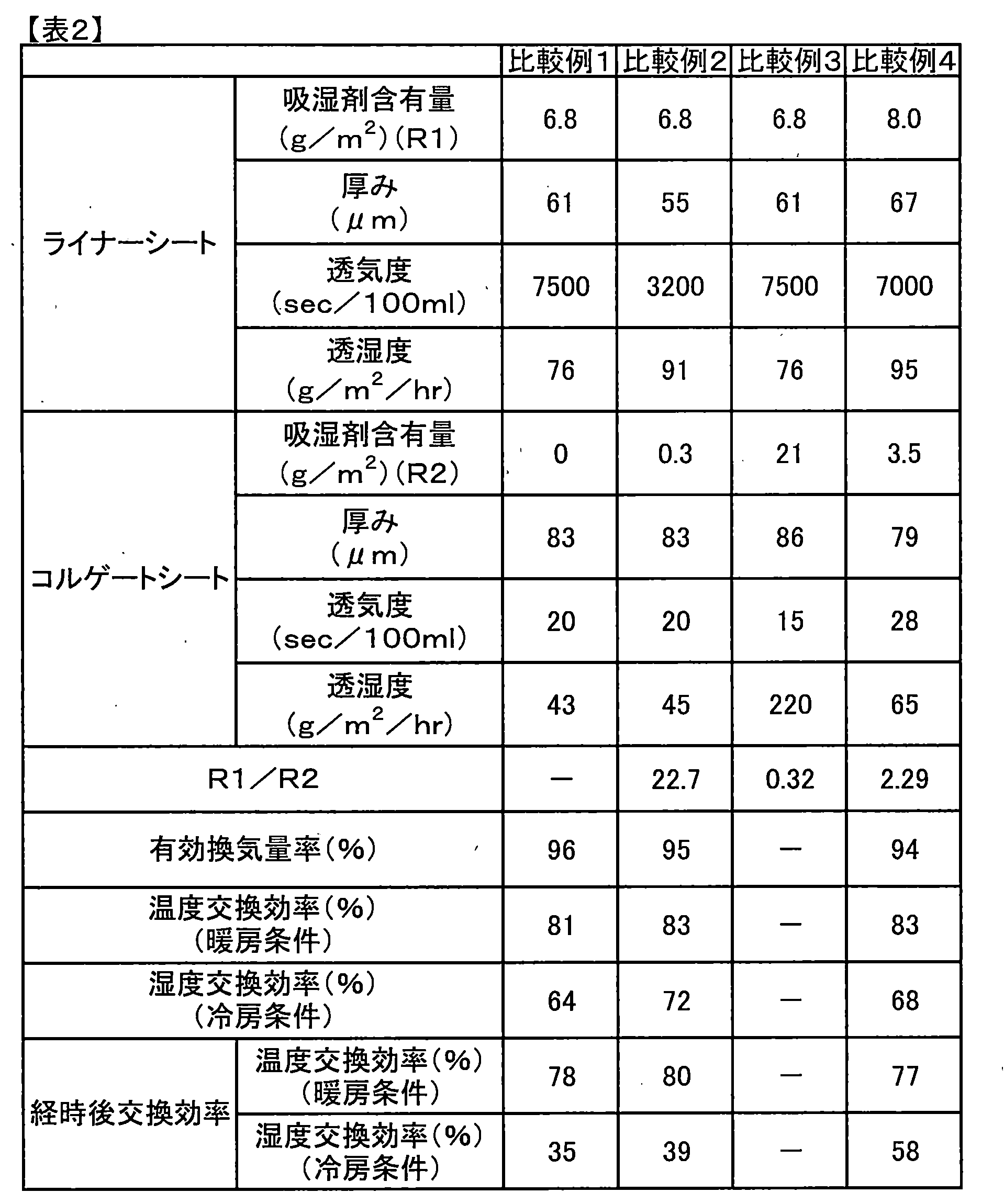
- the total heat exchange elements of Examples 1 to 6 were excellent in humidity exchange efficiency under cooling conditions, and were excellent in humidity exchange efficiency under cooling conditions after aging.
- the humidity exchange efficiency in the cooling conditions of the total heat exchange elements of Comparative Examples 1, 2, and 4 was inferior to that of Examples 1 to 6, but had performance that was not bad, After the passage of time in this cooling condition, the humidity exchange efficiency was greatly reduced.
- Comparative Example 3 in the production of the total heat exchange element, there was a lot of moisture absorption, the single-sided cardboard sheet was warped and swelled, adhesion failure occurred, and the total heat exchange element could not be obtained.
Landscapes
- Chemical & Material Sciences (AREA)
- Engineering & Computer Science (AREA)
- Chemical Kinetics & Catalysis (AREA)
- Analytical Chemistry (AREA)
- Organic Chemistry (AREA)
- Thermal Sciences (AREA)
- Physics & Mathematics (AREA)
- Mechanical Engineering (AREA)
- Oil, Petroleum & Natural Gas (AREA)
- General Chemical & Material Sciences (AREA)
- General Engineering & Computer Science (AREA)
- Inorganic Chemistry (AREA)
- Combustion & Propulsion (AREA)
- Materials Engineering (AREA)
- Paper (AREA)
- Heat-Exchange Devices With Radiators And Conduit Assemblies (AREA)
- Laminated Bodies (AREA)
Abstract
Description
さらに、ライナーシートに吸湿剤を含有させ、ライナーシートとコルゲートシート間の接着剤に非水溶性の接着剤使用した全熱交換素子が開示されている(特許文献2)。
(1)ライナーシートとコルゲートシートとを接着し片面段ボールを製造する工程と、
前記工程で得られた前記片面段ボール複数を、片面段ボールの段目の方向が一段ずつ交差するように積層する工程とを有する、吸湿剤を含有する全熱交換素子の製造方法であって、
片面段ボールを積層する前におけるライナーシートの吸湿剤の含有量をR1、片面段ボールを積層する前におけるコルゲートシートの吸湿剤の含有量をR2とした場合、R1が1~20g/m2であり、R1/R2が0.5~2.0である全熱交換素子の製造方法。
また本発明の全熱交換素子の製造方法の好ましい態様として以下の方法が挙げられる。
(2)含有量R1がR2よりも大きいものである前記全熱交換素子の製造方法。
(3)R1/R2が1.3~2.0である前記いずれかの全熱交換素子の製造方法。
(4)吸湿剤が少なくともアルカリ金属塩およびアルカリ土類金属塩のいずれかを含有する前記いずれかの全熱交換素子の製造方法。
(5)吸湿剤が塩化リチウムである前記いずれかの全熱交換素子の製造方法。
(6)吸湿剤が塩化カリウムである前記いずれかの全熱交換素子の製造方法。
(7)前記コルゲートシートの厚みが20~100μmである前記いずれかの全熱交素子。
(8)前記ライナーシートは、気体遮蔽層と多孔質層とを少なくとも1層ずつ含み、かつ、前記多孔質層が熱可塑性樹脂のナノファイバーを含む前記いずれかの全熱交換素子の製造方法。
そして上記いずれかの方法で製造された全熱交換素子として以下のものが挙げられる。
(9)前記いずれかに記載の製造方法で製造されたものであって、前記全熱交換素子のJIS B8628 (2003)に規定される方法により冷房条件で測定する湿度交換効率が50%以上である全熱交素子。
ライナーシートとコルゲートシートとを接着し片面段ボールを製造する工程と、
前記工程で得られた複数の前記片面段ボールを、片面段ボールの段目の方向が一段ずつ交差するように積層する工程とを有する全熱交換素子の製造方法であって、
片面段ボールを積層する前におけるライナーシートの吸湿剤の含有量をR1、コルゲートシートの吸湿剤の含有量をR2とした場合、R1が1~20g/m2であり、R1/R2が0.5~2.0であるものである。本発明の製造方法では、まず片面段ボールを製造する。通常は以下の工程が行われる。コルゲートシートを互いに噛み合って回転する歯車状ロールで波型に賦形させる。得られたコルゲートシートの段頂部に接着剤を塗布し、ライナーシートをコルゲートシートの段頂部に押し付け、接着させ片面段ボールシートを得る。
i) ライナーシート用基材を、吸湿剤を含んだ加工液に浸漬し、その後一対の回転するロール間で絞るディッピング法。
ii) ライナーシート用基材の表面に吸湿剤を含んだ加工液を塗布するコーティング法。
iii) ライナーシート用基材の表面に吸湿剤を含んだ加工液を基材に噴霧させて付着させるスプレー法。
iv) ライナーシートとコルゲートシートとを接着し片面段ボールを製造した後、ライナーシートの表面に吸湿剤を含んだ加工液を接触させる方法法。接触させる方法としては、浸漬、スプレー、塗布などの方法が例示される。この方法においては、同時にコルゲートシートにも吸湿剤を含有させることができる。
i) コルゲートシート用基材を、吸湿剤を含んだ加工液に浸漬し、その後一対の回転するロール間で絞るディッピング法。
ii) コルゲート用基材の表面に吸湿剤を含んだ加工液を塗布するコーティング法。
iii) ライナーシート用基材の表面に吸湿剤を含んだ加工液を基材に噴霧させて付着させるスプレー法。
iv) ライナーシートとコルゲートシートとを接着し片面段ボールを製造した後、コルゲートシートの表面に吸湿剤を含んだ加工液を接触させる方法。接触させる方法としては、浸漬、スプレー、塗布などの方法が例示される。この方法においては、同時にライナーシートにも吸湿剤を含有させることができる。
i)ライナーシートおよびコルゲートシートそれぞれに所望量の吸湿剤を含有させ、その後、片面段ボールを製造し、その後全熱交換素子を製造する方法。
ii)ライナーシートおよびコルゲートシートの少なくとも1種に吸湿剤を含有させ、その後、片面段ボールを製造し、その後片面段ボールに吸湿剤を含有させ、その後全熱交換素子を製造する方法。
iii) いずれも吸湿剤を含有していないライナーシートおよびコルゲートシートから片面段ボールを製造し、その後片面段ボールに吸湿剤を含有させ、その後全熱交換素子を製造する方法。
上記iiの製造方法およびiiiの製造方法において、片面段ボールに吸湿剤を含有させるにあたり、ライナーシートおよびコルゲートシートそれぞれへ吸湿剤の含有量を異なるものとすることができる。例えば、片面段ボールでコルゲートシートが接着していない面に対して、吸湿剤を含有する加工液をより多く接触させる方法である。またコルゲートシートが接着している方の面に対して、吸湿剤を含有する加工液をより多く接触させる方法もある。加工液を多く接触させる方法としては、一方だけの面の処理、処理時間を両方の面で異ならせる方法や、スプレー量を両方の面で異ならせる方法がある。
[測定方法]
(1)カナダ標準ろ水度試験における叩解度
カナダ標準ろ水度試験における叩解度は、JIS P8117(1995)カナダ標準ろ水度試験方法に準拠して測定した。
幅0.36m、長さ0.60m、高さ0.36m(0.078m3)のボックスの開口部(20cm×20cm)に試験片(25cm×25cm)を貼り、ボックス内の濃度が8,000ppmとなるように二酸化炭素を注入し、1時間後のボックス内の二酸化炭素濃度(ppm)を測定し、次式により二酸化炭素遮蔽率(%)を計算した。
二酸化炭素遮蔽率(%)={(1時間後のボックス内の二酸化炭素濃度-外気二酸化炭素濃度炭素濃度)/(ボックス内の初期二酸化炭素濃度-外気二酸化炭素濃度)}×100 。
透湿度は、JIS Z0208(1976)透湿度(カップ法)の方法により測定した。使用したカップは、直径φ60mmで深さ25mmである。ライナーシートまたはコルゲートシートの試験片は、直径φ70mmの円形を5枚採取した。試験片は、80℃の温度に設定した乾燥機を用いて1時間、乾燥させ、その後、温度20℃で湿度65%RHに設定した恒温恒湿槽内で1時間、前処理をした。その後、その試験片を、水分測定用塩化カルシウム(和光純薬工業製)の入ったカップに設置し、初期重量(T0)を測定し、20℃の温度で湿度65%RHに設定した恒温恒湿槽内で1、2、3、4、5時間処理し、その際の重量(T1、T2、T3、T4およびT5)を測定した。下記式により透湿度を求め、5枚の平均値を値とした。
・透湿度(g/m2/hr)={[(T-T0)/T0)+((T-T1)/T1)+((T-T2)/T2)+((T-T3)/T3)+((T-T4)/T4)+((T-T5)/T5)]/5}×100 。
透気度は、JIS P8117(1998)透気度(ガーレ試験機法)の方法により測定した。ライナーシートまたはコルゲートシートの試験片は、長さ150mm、幅150mmを5枚採取した。試験片は23℃の温度で湿度50%RHに設定した恒温恒湿槽内で1時間処理した。23℃の温度で湿度50%RHの環境下で、ガーレ式デンソメータ(型式G-B3C、(株)東洋精機製作所)に試験片を設置し、空気100mlが通過する時間を測定し、5枚の平均値を値(秒/100ml)とした。
厚みは、試料の異なる箇所から長さ200mm、幅200mmの試験片を3枚採取し、温度20℃、湿度65%RHで24hr放置後、それぞれの試験片から無作為に5点の厚さ(μm)を測定器(型式ID-112、(株)ミツトヨ)を用いて1μmまで測定し、平均値を値とした。
坪量は、試料の異なる箇所から長さ200mm、幅250mmの試験片を3枚採取し、温度20℃、湿度65%RHで24hr放置後、それぞれの重量(g)を量り、その平均値を1m2当たりの重量(g/m2)で表し、3枚の平均値を値とした。
ナノファイバーの数平均繊維径は、次のようにして求める。すなわち、走査型電子顕微鏡(日立製作所社製S-3500N型)で倍率30,000倍で撮影したナノファイバーの集合体の写真を、画像処理ソフト(WINROOF)を用いて、5mm角のサンプル内で無作為抽出した30本の単繊維直径をnm単位で小数の1桁目まで測定して少数の1桁目を四捨五入する。サンプリングは、合計10回行って各30本の単繊維直径のデータを取り、合計300本の単繊維直径のデータを積算後、全数で除して単純平均値を求めたものを数平均繊維径とした。
熱交換素子の給気用流路の下流側に給気多翼送風機を取り付け、熱交換素子の排気用流路の下流側に排気多翼送風機を取り付けて熱交換器を得た。次に、JIS B8628(2003)に規定される方法により、室外から熱交換器に導入する空気(外気)と、室内から熱交換器に導入する空気(環気)と、熱交換器から室内に供給する空気(給気)の温度と湿度を測定し温度交換効率と湿度交換効率を求めた。温度と湿度の測定は、温度・湿度データロガー(ティアンドデイ製“おんどとり”(登録商標)TR-71Ui)を使用した。温度と湿度の測定位置は、熱交換素子から30cm離れた位置で測定した。測定空気は、冷房条件として、外気が温度35℃、湿度64%RHで風量150m3/hrとし、環気が温度27℃、湿度52%RHで風量150m3/hrとし、湿度交換効率を求めた。また、暖房条件として、外気が温度5℃、湿度58%RHで風量150m3/hrとし、環気が温度20℃、湿度51%RHで風量150m3/hrとし、温度交換効率を求めた。
JIS B8628(2003)に規定される方法により、室内から熱交換器に導入する空気(環気)に8,000ppmの濃度の二酸化炭素を導入し、室外から熱交換器に導入する空気(外気)と、熱交換器から室内に供給する空気(給気)の二酸化炭素濃度を測定し、下記式により有効換気量率を求めた。二酸化炭素濃度は、(株式会社テストー製“CO2計測器testo535”)を使用した。測定位置は、熱交換素子から30cm離れた位置で測定した。測定空気は、外気が温度20℃、湿度50%RHで風量150m3/hrとし、環気が温度20℃、湿度50%RHで風量150m3/hrとした。
有効換気量率(%)=(給気側二酸化炭素濃度-外気側二酸化炭素濃度)/(環気側二酸化炭素濃度-外気側二酸化炭素濃度)×100 。
熱交換素子を温度40℃、湿度90%RHに調整した恒温高湿槽に168時間、その後、温度マイナス30℃に調整した恒温槽に168時間処理を1サイクルとし、10サイクル経過後に上述(8)の測定を実施し、温度交換効率と湿度交換効率を求めた。
(コルゲートシートの作製)
厚さ82μm、坪量60g/m2の晒クラフト紙に対し、吸湿剤として塩化リチウムの含有量が6.0g/m2になるように調整した加工液をディッピング法により処理し、吸湿剤を含有させた。
得られたコルゲートシートの透気度は72g/m2/hrであった。特性を表1に示す。
針葉樹パルプを水に分散させ、リファイナーにより叩解度を90mlになるように叩解させ、ライナーシート用繊維Aを得た。この繊維は気体遮蔽層用繊維となる。
また、針葉樹パルプを水に分散させ、リファイナーにより叩解度を400mlになるように叩解させ、ライナーシート用繊維Bを得た。この繊維は多孔質層用繊維となる。
上記により得られた2ヶ所の抄き上げ部を有し、それらを積層しうる丸網抄紙機を用い、それぞれ抄き上げ部に準備し、ライナーシート用繊維Aによる層の坪量30g/m2、ライナーシート用繊維Bによる層の坪量10g/m2からなる坪量40g/m2のシートを得た。
得られたライナーシートの特性を表1に示す。
上記のコルゲートシートおよびライナーシートを接着し、段高さ2mm、段ピッチ5mmの片面段ボールシートを得た。その後、すみやかに得られた片面段ボールシート複数を、段目方向が一段ずつ交差するように積層し、縦350mm、横350mm、高さ200mmの全熱交換素子を作製した。その際のコルゲートシートの面積はライナーシートの面積の1.4倍であった。
得られた全熱交換素子の特性を表1に示す。
(コルゲートシートの作製)
実施例1と同様にして得た。
融点220℃のナイロン6、40重量%と、融点170℃のポリL乳酸(光学純度99.5%以上)、60重量%を、2軸型の押出混練機を用いて220℃で溶融混練してポリマーアロイチップを得た。
上記で得られた数平均繊維径150nmのナイロン6ナノファイバー60重量%と、実施例1で得られたライナーシート用繊維B、40重量%を、水中で攪拌し混合繊維を作製し、ライナーシート用繊維Cを得た。この繊維は多孔質層用繊維となり得る。
実施例1のライナーシート用繊維Aと上記にて得られたライナーシート用繊維Bを用いて、実施例1と同様にしてライナーシートを作製した。
得られた特性を表1に示す。
上記のコルゲートシートおよびライナーシートを用い、その他は実施例1と同様にして全熱交換素子を作製した。得られた全熱交換素子の特性を表1に示す。
(コルゲートシートの作製)
吸湿剤である塩化リチウムの含有量を5.1g/m2になるように調整した以外は、実施例1と同様にして得た。
実施例2と同様にして得た。得られたライナーシートの特性を表1に示す。
実施例2と同様にして得た。得られた全熱交換素子の特性を表1に示す。
(コルゲートシートの作製)
吸湿剤である塩化リチウムの含有量を4.2g/m2になるように調整した以外は、実施例2と同様にして得た。
実施例2と同様にして得た。得られたライナーシートの特性を表1に示す。
上記コルゲートシートおよびライナーシートを使用した以外は、実施例2と同様にして得た。得られた全熱交換素子の特性については表1に示す。
(ライナーシートの作製)
2ヶ所の抄き上げ部を有する丸網抄紙機を用い、ライナーシート用繊維Aおよびライナー用繊維Cをそれぞれ抄き上げ部に準備し、繊維Aによる層の坪量が45g/m2、繊維Cによる層が坪量を12g/m2からなる、坪量の合計が57g/m2のシートを得た。
得られたライナーシートの特性を表1に示す。
実施例2と同様にして得た。得られた熱交換素子の特性を表1に示す。
(コルゲートシートの作製)
実施例4と同様にして得た。
繊維Aの層の坪量を45g/m2、繊維C層の坪量を12g/m2とし、さらに吸湿剤として塩化リチウムの含有量を8.0g/m2になるように調整した以外は実施例2と同様にしてライナーシートを得た。
得られたライナーシートの特性は表1に示す。
上記ライナーシートを使用した以外は、実施例2と同様にして得た。得られた熱交換素子の特性を表1に示す。
コルゲートシートの作製において、吸湿剤である塩化リチウムの添加を行わなかったこと以外は、実施例1と同様にしてコルゲートシート、ライナーシートおよび全熱交換素子を得た。それぞれの特性を表2に示す。
コルゲートシートの作製において、コルゲートシートでの吸湿剤である塩化リチウムの含有量を0.3g/m2に調整したこと以外は、実施例2と同様にしてコルゲートシート、ライナーシートおよび全熱交換素子を得た。それぞれの特性を表2に示す。
コルゲートシートの作製において、コルゲートシートでの吸湿剤である塩化リチウムの含有量を21.0g/m2になるように調整した以外は実施例1と同様にしてコルゲートシート、ライナーシートを得た。全熱交換素子については、片面段ボールのコルゲートシートとライナーシートとの層間で剥離が起こり、全熱交換素子を得ることができなかった。
それぞれの特性を表2に示す。
コルゲートシートの作製において、コルゲートシートの吸湿剤として塩化リチウムの含有量を3.5g/m2になるように調整した以外は、実施例6と同様にしてコルゲートシート、ライナーシートおよび全熱交換素子を得た。それぞれの特性を表2に示す。

Claims (9)
- ライナーシートとコルゲートシートとを接着し片面段ボールを製造する工程と、
前記工程で得られた前記片面段ボール複数を、片面段ボールの段目の方向が一段ずつ交差するように積層する工程とを有する、吸湿剤を含有する全熱交換素子の製造方法であって、
片面段ボールを積層する前におけるライナーシートの吸湿剤の含有量をR1、片面段ボールを積層する前におけるコルゲートシートの吸湿剤の含有量をR2とした場合、R1が1~20g/m2であり、R1/R2が0.5~2.0である全熱交換素子の製造方法。 - R1がR2よりも大きいものである請求項1記載の全熱交換素子の製造方法。
- R1/R2が1.3~2.0である請求項1または2に記載の全熱交換素子の製造方法。
- 吸湿剤が少なくともアルカリ金属塩およびアルカリ土類金属塩のいずれかを含有する請求項1~3のいずれかに記載の全熱交換素子の製造方法。
- 吸湿剤が塩化リチウムである請求項1~4いずれかに記載の全熱交換素子の製造方法。
- 吸湿剤が塩化カリウムである請求項1~4いずれかに記載の全熱交換素子の製造方法。
- 前記コルゲートシートの厚みが20~100μmである請求項1~6いずれかに記載の全熱交素子。
- 前記ライナーシートは、気体遮蔽層と多孔質層とを少なくとも1層ずつ含み、かつ、前記多孔質層が熱可塑性樹脂のナノファイバーを含む請求項1~7のいずれかに記載の全熱交換素子の製造方法。
- 請求項1~8のいずれかに記載の製造方法で製造されたものであって、前記全熱交換素子のJIS B8628 (2003)に規定される方法により冷房条件で測定する湿度交換効率が50%以上である全熱交素子。
Priority Applications (3)
| Application Number | Priority Date | Filing Date | Title |
|---|---|---|---|
| US15/106,458 US20170030657A1 (en) | 2013-12-26 | 2014-12-15 | Method of manufacturing total heat exchange element, and total heat exchanger element |
| JP2015554752A JP6436096B2 (ja) | 2013-12-26 | 2014-12-15 | 全熱交換素子の製造方法 |
| CN201480070529.9A CN105874295A (zh) | 2013-12-26 | 2014-12-15 | 全热交换元件的制造方法和全热交换元件 |
Applications Claiming Priority (2)
| Application Number | Priority Date | Filing Date | Title |
|---|---|---|---|
| JP2013269047 | 2013-12-26 | ||
| JP2013-269047 | 2013-12-26 |
Publications (1)
| Publication Number | Publication Date |
|---|---|
| WO2015098592A1 true WO2015098592A1 (ja) | 2015-07-02 |
Family
ID=53478456
Family Applications (1)
| Application Number | Title | Priority Date | Filing Date |
|---|---|---|---|
| PCT/JP2014/083121 Ceased WO2015098592A1 (ja) | 2013-12-26 | 2014-12-15 | 全熱交換素子の製造方法および全熱交換素子 |
Country Status (4)
| Country | Link |
|---|---|
| US (1) | US20170030657A1 (ja) |
| JP (1) | JP6436096B2 (ja) |
| CN (1) | CN105874295A (ja) |
| WO (1) | WO2015098592A1 (ja) |
Cited By (3)
| Publication number | Priority date | Publication date | Assignee | Title |
|---|---|---|---|---|
| JP2020016343A (ja) * | 2018-07-23 | 2020-01-30 | ダイキン工業株式会社 | 全熱交換素子およびその製造方法 |
| WO2020189433A1 (ja) | 2019-03-15 | 2020-09-24 | 三菱製紙株式会社 | 全熱交換素子 |
| WO2023223455A1 (ja) * | 2022-05-18 | 2023-11-23 | 三菱電機株式会社 | 全熱交換素子、全熱交換器、および全熱交換素子の製造方法 |
Families Citing this family (5)
| Publication number | Priority date | Publication date | Assignee | Title |
|---|---|---|---|---|
| CN106801360A (zh) * | 2016-12-30 | 2017-06-06 | 淄博欧木特种纸业有限公司 | 全热新风纸及其制备方法 |
| JP6930611B2 (ja) * | 2018-01-31 | 2021-09-01 | 王子ホールディングス株式会社 | 全熱交換器エレメント用原紙 |
| JP6571894B1 (ja) * | 2018-03-28 | 2019-09-04 | 三菱製紙株式会社 | 全熱交換素子用紙及び全熱交換素子 |
| CN108531144B (zh) * | 2018-06-15 | 2023-09-22 | 宁波杉越新材料有限公司 | 一种嵌套型多层层状褶皱结构导热制品及其制备方法 |
| CN111749049B (zh) * | 2020-06-24 | 2022-08-30 | 中国制浆造纸研究院有限公司 | 一种无水加湿器件及其制备方法和应用 |
Citations (8)
| Publication number | Priority date | Publication date | Assignee | Title |
|---|---|---|---|---|
| JPH09280765A (ja) * | 1996-04-08 | 1997-10-31 | Ebara Corp | 熱交換エレメント |
| JP2000055575A (ja) * | 1998-08-03 | 2000-02-25 | Daikin Ind Ltd | 熱交換エレメント |
| JP2001027489A (ja) * | 1999-05-10 | 2001-01-30 | Mitsubishi Electric Corp | 熱交換器及び熱交換器の製造方法 |
| JP2007315649A (ja) * | 2006-05-24 | 2007-12-06 | Mitsubishi Electric Corp | 全熱交換器 |
| WO2008041327A1 (fr) * | 2006-10-03 | 2008-04-10 | Mitsubishi Electric Corporation | Élément d'échange thermique total et appareil d'échange thermique total |
| JP2009250585A (ja) * | 2008-04-10 | 2009-10-29 | Mitsubishi Electric Corp | 全熱交換素子及び全熱交換器 |
| JP2011012893A (ja) * | 2009-07-02 | 2011-01-20 | Panasonic Corp | 全熱交換素子用素材およびその素材を用いた熱交換形換気装置 |
| JP2013167408A (ja) * | 2012-02-16 | 2013-08-29 | Toray Ind Inc | 全熱交換素子 |
Family Cites Families (8)
| Publication number | Priority date | Publication date | Assignee | Title |
|---|---|---|---|---|
| US4402717A (en) * | 1980-05-22 | 1983-09-06 | Daikin Kogyo Co., Ltd. | Apparatus for removing moisture and odors |
| US7664933B2 (en) * | 2005-01-17 | 2010-02-16 | Denso Corporation | Microcomputer and encoding system for instruction code and CPU |
| JP5503285B2 (ja) * | 2007-06-29 | 2014-05-28 | 三菱電機株式会社 | 全熱交換素子およびその製造方法 |
| CN101419033B (zh) * | 2007-10-25 | 2012-02-22 | 台州市普瑞泰环境设备科技有限公司 | 长寿命高效节能型热交换芯体 |
| WO2011033624A1 (ja) * | 2009-09-16 | 2011-03-24 | 三菱電機株式会社 | 全熱交換素子 |
| WO2012040034A2 (en) * | 2010-09-20 | 2012-03-29 | Carmen Luz Molina | Detachable bra strap assembly and method of use |
| US20130299121A1 (en) * | 2010-12-15 | 2013-11-14 | Young-Soo Ahn | Polymer composite materials for building air conditioning or dehumidification and preparation method thereof |
| CN103890528B (zh) * | 2011-10-26 | 2017-05-24 | 三菱电机株式会社 | 全热交换元件及其制造方法 |
-
2014
- 2014-12-15 CN CN201480070529.9A patent/CN105874295A/zh active Pending
- 2014-12-15 JP JP2015554752A patent/JP6436096B2/ja not_active Expired - Fee Related
- 2014-12-15 US US15/106,458 patent/US20170030657A1/en not_active Abandoned
- 2014-12-15 WO PCT/JP2014/083121 patent/WO2015098592A1/ja not_active Ceased
Patent Citations (8)
| Publication number | Priority date | Publication date | Assignee | Title |
|---|---|---|---|---|
| JPH09280765A (ja) * | 1996-04-08 | 1997-10-31 | Ebara Corp | 熱交換エレメント |
| JP2000055575A (ja) * | 1998-08-03 | 2000-02-25 | Daikin Ind Ltd | 熱交換エレメント |
| JP2001027489A (ja) * | 1999-05-10 | 2001-01-30 | Mitsubishi Electric Corp | 熱交換器及び熱交換器の製造方法 |
| JP2007315649A (ja) * | 2006-05-24 | 2007-12-06 | Mitsubishi Electric Corp | 全熱交換器 |
| WO2008041327A1 (fr) * | 2006-10-03 | 2008-04-10 | Mitsubishi Electric Corporation | Élément d'échange thermique total et appareil d'échange thermique total |
| JP2009250585A (ja) * | 2008-04-10 | 2009-10-29 | Mitsubishi Electric Corp | 全熱交換素子及び全熱交換器 |
| JP2011012893A (ja) * | 2009-07-02 | 2011-01-20 | Panasonic Corp | 全熱交換素子用素材およびその素材を用いた熱交換形換気装置 |
| JP2013167408A (ja) * | 2012-02-16 | 2013-08-29 | Toray Ind Inc | 全熱交換素子 |
Cited By (4)
| Publication number | Priority date | Publication date | Assignee | Title |
|---|---|---|---|---|
| JP2020016343A (ja) * | 2018-07-23 | 2020-01-30 | ダイキン工業株式会社 | 全熱交換素子およびその製造方法 |
| JP7089178B2 (ja) | 2018-07-23 | 2022-06-22 | ダイキン工業株式会社 | 全熱交換素子およびその製造方法 |
| WO2020189433A1 (ja) | 2019-03-15 | 2020-09-24 | 三菱製紙株式会社 | 全熱交換素子 |
| WO2023223455A1 (ja) * | 2022-05-18 | 2023-11-23 | 三菱電機株式会社 | 全熱交換素子、全熱交換器、および全熱交換素子の製造方法 |
Also Published As
| Publication number | Publication date |
|---|---|
| CN105874295A (zh) | 2016-08-17 |
| JPWO2015098592A1 (ja) | 2017-03-23 |
| JP6436096B2 (ja) | 2018-12-12 |
| US20170030657A1 (en) | 2017-02-02 |
Similar Documents
| Publication | Publication Date | Title |
|---|---|---|
| JP6436096B2 (ja) | 全熱交換素子の製造方法 | |
| CA2879447C (en) | Multilayered structure comprising fine fiber cellulose layer | |
| JP6582986B2 (ja) | 熱交換用原紙およびそれを用いた全熱交換素子 | |
| JP7569491B2 (ja) | ラテックスフリーかつホルムアルデヒドフリーの不織布 | |
| JP5678443B2 (ja) | 全熱交換用原紙およびそれを用いた全熱交換素子 | |
| JP2021021173A (ja) | 熱交換素子用シート及びその製造方法 | |
| WO2015050105A1 (ja) | 熱交換素子及び熱交換器 | |
| JP2021521001A (ja) | 高い破裂強さの湿式不織濾過媒体及びこれを生成するための方法 | |
| JP2009240935A (ja) | 除湿用シート状物及び除湿用フィルター材 | |
| JP2009276034A (ja) | 気化フィルター用繊維構造体 | |
| JP2013167408A (ja) | 全熱交換素子 | |
| JP2014163623A (ja) | 全熱交換素子 | |
| JP2005262827A (ja) | 吸放湿性材料 | |
| WO2022239430A1 (ja) | エアフィルタ用濾材及びその製造方法 | |
| JP2023136265A (ja) | 液体フィルタ用濾材 | |
| JP2014043999A (ja) | 全熱交換素子 | |
| JP2025031040A (ja) | 不織布およびエアフィルター濾材 | |
| CN117241869A (zh) | 空气过滤器用过滤材料及其制造方法 | |
| TW202539780A (zh) | 空氣過濾濾材 | |
| WO2023037440A1 (ja) | エアフィルタ用濾材 | |
| JP2023132659A (ja) | 液体フィルタ用濾材 | |
| JP2015068575A (ja) | 蒸散素子 | |
| JP2024033026A (ja) | フィルタ用基材 | |
| JP2017044409A (ja) | 多孔性ライナーシート |
Legal Events
| Date | Code | Title | Description |
|---|---|---|---|
| 121 | Ep: the epo has been informed by wipo that ep was designated in this application |
Ref document number: 14874922 Country of ref document: EP Kind code of ref document: A1 |
|
| ENP | Entry into the national phase |
Ref document number: 2015554752 Country of ref document: JP Kind code of ref document: A |
|
| WWE | Wipo information: entry into national phase |
Ref document number: 15106458 Country of ref document: US |
|
| NENP | Non-entry into the national phase |
Ref country code: DE |
|
| 122 | Ep: pct application non-entry in european phase |
Ref document number: 14874922 Country of ref document: EP Kind code of ref document: A1 |