WO2015049941A1 - ポリアリーレンスルフィド樹脂組成物及びその成形品、並びに電気自動車部品 - Google Patents
ポリアリーレンスルフィド樹脂組成物及びその成形品、並びに電気自動車部品 Download PDFInfo
- Publication number
- WO2015049941A1 WO2015049941A1 PCT/JP2014/072641 JP2014072641W WO2015049941A1 WO 2015049941 A1 WO2015049941 A1 WO 2015049941A1 JP 2014072641 W JP2014072641 W JP 2014072641W WO 2015049941 A1 WO2015049941 A1 WO 2015049941A1
- Authority
- WO
- WIPO (PCT)
- Prior art keywords
- polyarylene sulfide
- sulfide resin
- resin composition
- electric vehicle
- group
- Prior art date
- Legal status (The legal status is an assumption and is not a legal conclusion. Google has not performed a legal analysis and makes no representation as to the accuracy of the status listed.)
- Ceased
Links
Classifications
-
- C—CHEMISTRY; METALLURGY
- C08—ORGANIC MACROMOLECULAR COMPOUNDS; THEIR PREPARATION OR CHEMICAL WORKING-UP; COMPOSITIONS BASED THEREON
- C08G—MACROMOLECULAR COMPOUNDS OBTAINED OTHERWISE THAN BY REACTIONS ONLY INVOLVING UNSATURATED CARBON-TO-CARBON BONDS
- C08G75/00—Macromolecular compounds obtained by reactions forming a linkage containing sulfur with or without nitrogen, oxygen, or carbon in the main chain of the macromolecule
- C08G75/02—Polythioethers
-
- C—CHEMISTRY; METALLURGY
- C08—ORGANIC MACROMOLECULAR COMPOUNDS; THEIR PREPARATION OR CHEMICAL WORKING-UP; COMPOSITIONS BASED THEREON
- C08L—COMPOSITIONS OF MACROMOLECULAR COMPOUNDS
- C08L81/00—Compositions of macromolecular compounds obtained by reactions forming in the main chain of the macromolecule a linkage containing sulfur with or without nitrogen, oxygen or carbon only; Compositions of polysulfones; Compositions of derivatives of such polymers
- C08L81/02—Polythioethers; Polythioether-ethers
-
- C—CHEMISTRY; METALLURGY
- C08—ORGANIC MACROMOLECULAR COMPOUNDS; THEIR PREPARATION OR CHEMICAL WORKING-UP; COMPOSITIONS BASED THEREON
- C08G—MACROMOLECULAR COMPOUNDS OBTAINED OTHERWISE THAN BY REACTIONS ONLY INVOLVING UNSATURATED CARBON-TO-CARBON BONDS
- C08G75/00—Macromolecular compounds obtained by reactions forming a linkage containing sulfur with or without nitrogen, oxygen, or carbon in the main chain of the macromolecule
- C08G75/02—Polythioethers
- C08G75/0204—Polyarylenethioethers
-
- C—CHEMISTRY; METALLURGY
- C08—ORGANIC MACROMOLECULAR COMPOUNDS; THEIR PREPARATION OR CHEMICAL WORKING-UP; COMPOSITIONS BASED THEREON
- C08G—MACROMOLECULAR COMPOUNDS OBTAINED OTHERWISE THAN BY REACTIONS ONLY INVOLVING UNSATURATED CARBON-TO-CARBON BONDS
- C08G75/00—Macromolecular compounds obtained by reactions forming a linkage containing sulfur with or without nitrogen, oxygen, or carbon in the main chain of the macromolecule
- C08G75/02—Polythioethers
- C08G75/0204—Polyarylenethioethers
- C08G75/025—Preparatory processes
- C08G75/0263—Preparatory processes using elemental sulfur
-
- C—CHEMISTRY; METALLURGY
- C08—ORGANIC MACROMOLECULAR COMPOUNDS; THEIR PREPARATION OR CHEMICAL WORKING-UP; COMPOSITIONS BASED THEREON
- C08K—Use of inorganic or non-macromolecular organic substances as compounding ingredients
- C08K3/00—Use of inorganic substances as compounding ingredients
- C08K3/01—Use of inorganic substances as compounding ingredients characterized by their specific function
- C08K3/013—Fillers, pigments or reinforcing additives
-
- C—CHEMISTRY; METALLURGY
- C08—ORGANIC MACROMOLECULAR COMPOUNDS; THEIR PREPARATION OR CHEMICAL WORKING-UP; COMPOSITIONS BASED THEREON
- C08L—COMPOSITIONS OF MACROMOLECULAR COMPOUNDS
- C08L101/00—Compositions of unspecified macromolecular compounds
-
- C—CHEMISTRY; METALLURGY
- C08—ORGANIC MACROMOLECULAR COMPOUNDS; THEIR PREPARATION OR CHEMICAL WORKING-UP; COMPOSITIONS BASED THEREON
- C08L—COMPOSITIONS OF MACROMOLECULAR COMPOUNDS
- C08L2203/00—Applications
- C08L2203/20—Applications use in electrical or conductive gadgets
Definitions
- the present invention relates to a polyarylene sulfide resin composition, a molded product thereof, and an electric vehicle part.
- an electric vehicle attracting attention has many parts that operate at a high voltage, and resin molded products are used for such electric vehicle parts.
- the resin molded product include an automobile ignition coil case in which a resin molded product is used as a coil case and the ignition coil is sealed with an epoxy resin composition in the coil case, or an ignition plug and an ignition coil.
- Examples thereof include a coil case in an integrated distributorless ignition system (hereinafter sometimes abbreviated as “DLI system”).
- the coil case as described above is desirably excellent in adhesiveness with an epoxy resin or a metal.
- a resin composition containing a polyarylene sulfide resin (hereinafter sometimes abbreviated as “PAS resin”) represented by a polyphenylene sulfide resin (hereinafter sometimes abbreviated as “PPS resin”). It has been proposed to be molded and used for the automobile parts as described above (see, for example, Patent Document 1).
- PAS resin polyarylene sulfide resin
- PPS resin polyphenylene sulfide resin
- a composition containing a conventional polyarylene sulfide resin has a relatively large amount of gas generated by heating such as during molding. For this reason, when a low molecular weight compound containing a sulfur atom, which is a gas component, and a metal material such as copper come into contact with each other, a high voltage is repeatedly applied to cause the two to react, and a tree (dendritic fracture trace) There is also a high possibility that the tracking resistance will be lowered due to this.
- an electric vehicle using a motor for driving force requires driving energy equivalent to that of a gasoline engine when starting, so a lithium ion secondary battery is provided, the battery voltage is 100 to 400V, and a booster circuit is installed, which is 650V. Driven by high voltage.
- An object of the present invention is to provide a polyarylene sulfide resin composition, a molded article for an electric vehicle using the resin composition, and an electric vehicle part including the molded article.
- the present invention is at least one selected from the group consisting of a polyarylene sulfide resin, an inorganic filler, a thermoplastic resin other than the polyarylene sulfide resin, an elastomer, and a crosslinkable resin having two or more crosslinkable functional groups.
- the present invention relates to a polyarylene sulfide resin composition for electric vehicle parts, which can be obtained by a method including reacting in a molten mixture containing a group compound, elemental sulfur and a polymerization inhibitor.
- the amount of gas generated by heating can be suppressed.
- a molded article of a polyarylene sulfide resin composition excellent in properties such as tracking resistance, mechanical strength, epoxy adhesion, metal adhesion, cavity balance, hot water resistance and the like can be obtained.
- the cavity balance is related to the uniformity of the filling degree of each cavity when a plurality of molded products are molded simultaneously by injection molding using a mold having a plurality of cavities. If the cavity balance of the molding material is not sufficient, there is a tendency that molding defects such that some of the cavities are not sufficiently filled tend to occur.
- the polyarylene sulfide resin used in the present embodiment is obtained by reacting a diiodo aromatic compound, elemental sulfur, and a polymerization inhibitor in a molten mixture containing the diiodo aromatic compound, elemental sulfur and the polymerization inhibitor. It can be obtained by the method of including. According to such a method, a polyarylene sulfide resin can be obtained as a polymer having a relatively high molecular weight as compared with conventional methods such as the Philips method.
- the diiodo aromatic compound has an aromatic ring and two iodine atoms directly bonded to the aromatic ring.
- diiodo aromatic compounds include, but are not limited to, diiodobenzene, diiodotoluene, diiodoxylene, diiodonaphthalene, diiodobiphenyl, diiodobenzophenone, diiododiphenyl ether, and diiododiphenyl sulfone.
- the substitution positions of the two iodine atoms are not particularly limited, but it is preferable that the two substitution positions are located as far as possible in the molecule. Preferred substitution positions are the para position and the 4,4'-position.
- Aromatic rings of diiodo aromatic compounds include phenyl groups, halogen atoms other than iodine atoms, hydroxy groups, nitro groups, amino groups, alkoxy groups having 1 to 6 carbon atoms, carboxyl groups, carboxylates, aryl sulfones and aryl ketones. It may be substituted with at least one substituent selected from However, from the viewpoint of crystallinity and heat resistance of the polyarylene sulfide resin, the ratio of the substituted diiodo aromatic compound to the unsubstituted diiodo aromatic compound is preferably in the range of 0.0001 to 5% by mass. More preferably, it is in the range of 0.001 to 1% by mass.
- the elemental sulfur means a substance (S 8 , S 6 , S 4 , S 2, etc.) composed only of sulfur atoms, and its form is not limited. More specifically, the present invention may be used elemental sulfur which is commercially available as Tsuboneho medicament may be obtained generically, may be used a mixture containing S 8 and S 6 and the like.
- the purity of elemental sulfur is not particularly limited.
- the elemental sulfur may be in the form of particles or powder as long as it is solid at room temperature (23 ° C.).
- the particle size of elemental sulfur is not particularly limited, but is preferably in the range of 0.001 to 10 mm, more preferably in the range of 0.01 to 5 mm, and still more preferably in the range of 0.01 to 3 mm.
- the polymerization inhibitor can be used without particular limitation as long as it is a compound that inhibits or stops the polymerization reaction in the polymerization reaction of the polyarylene sulfide resin.
- the polymerization inhibitor preferably contains a compound capable of introducing at least one group selected from the group consisting of a hydroxy group, an amino group, a carboxyl group and a salt of a carboxyl group at the end of the main chain of the polyarylene sulfide resin. That is, the polymerization inhibitor is preferably a compound having one or more groups selected from the group consisting of a hydroxy group, an amino group, a carboxyl group, and a carboxyl group salt.
- the polymerization inhibitor may have the functional group, or the functional group may be generated by a polymerization termination reaction or the like.
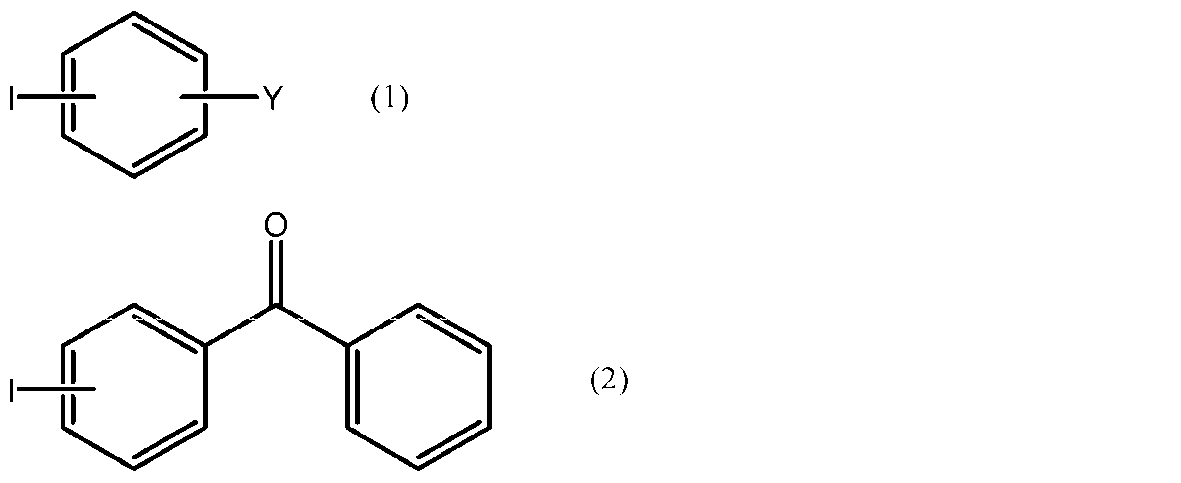
- polymerization inhibitor having a hydroxy group or an amino group for example, a compound represented by the following formula (1) or (2) can be used as the polymerization inhibitor.
- a monovalent group represented by the following formula (1-1) is introduced as a terminal group of the main chain.
- Y in the formula (1-1) is a hydroxy group, an amino group or the like derived from a polymerization inhibitor.
- a monovalent group represented by the following formula (2-1) is introduced as a terminal group of the main chain.
- a hydroxy group derived from the compound represented by the general formula (1) can be introduced into the polyarylene sulfide resin by, for example, bonding to a carbon atom of a carbonyl group in the formula (2) and a sulfur radical.
- the disulfide bond that is derived from the raw material (single sulfur) in the main chain of the polyarylene sulfide resin is radically cleaved at the melting temperature.
- the generated sulfur radical and the compound represented by the general formula (1) or the compound represented by the general formula (2) are considered to be introduced into the polyarylene sulfide resin.
- the existence of these structural units having a specific structure is characteristic of the polyarylene sulfide resin obtained by melt polymerization using the compound represented by the general formula (1) or (2).
- Examples of the compound represented by the general formula (1) include 2-iodophenol and 2-aminoaniline. Examples of the compound represented by the general formula (2) include 2-iodobenzophenone.
- polymerization inhibitor having a carboxyl group for example, one or more compounds selected from the compounds represented by the following general formula (3), (4) or (5) may be used.
- R 1 and R 2 each independently represent a hydrogen atom or a monovalent group represented by the following general formula (a), (b) or (c), and R 1 or At least one of R 2 is a monovalent group represented by the general formula (a), (b) or (c).
- Z represents an iodine atom or a mercapto group
- R 3 represents a monovalent group represented by the following General Formula (a), (b), or (c).
- R 4 is formula (a), represents a monovalent group represented by (b) or (c).
- X in the general formulas (a) to (c) is a hydrogen atom or an alkali metal atom, and is preferably a hydrogen atom from the viewpoint of good reactivity.
- the alkali metal atom include sodium, lithium, potassium, rubidium, and cesium, and sodium is preferable.
- R 10 represents an alkyl group having 1 to 6 carbon atoms.
- R 11 represents a hydrogen atom or an alkyl group having 1 to 3 carbon atoms
- R 12 represents an alkyl group having 1 to 5 carbon atoms.
- a monovalent group represented by the following formula (6) or (7) is introduced as a terminal group of the main chain.
- the presence of the terminal structural unit of these specific structures is characteristic of the polyarylene sulfide resin obtained by melt polymerization using the compound represented by the general formula (3), (4) or (5).
- R 5 represents a monovalent group represented by the general formula (a), (b) or (c)).
- R 6 represents a monovalent group represented by the general formula (a), (b) or (c)).
- a compound having no functional group such as a carboxyl group may be used.
- examples of such compounds include diphenyl disulfide, monoiodobenzene, thiophenol, 2,2′-dibenzothiazolyl disulfide, 2-mercaptobenzothiazole, N-cyclohexyl-2-benzothiazolylsulfenamide, 2 At least one compound selected from-(morpholinothio) benzothiazole and N, N'-dicyclohexyl-1,3-benzothiazole-2-sulfenamide can be used.
- the polyarylene sulfide resin according to this embodiment is obtained by performing melt polymerization in a melt mixture obtained by heating a mixture containing a diiodo aromatic compound, elemental sulfur, a polymerization inhibitor, and a catalyst as necessary. Generate.
- the ratio of the diiodo aromatic compound in the molten mixture is preferably in the range of 0.5 to 2 moles, more preferably in the range of 0.8 to 1.2 moles per mole of elemental sulfur.
- the ratio of the polymerization inhibitor in the mixture is preferably in the range of 0.0001 to 0.1 mol, more preferably in the range of 0.0005 to 0.05 mol, with respect to 1 mol of solid sulfur. .
- the timing of adding the polymerization inhibitor is not particularly limited, but the temperature of the mixture is preferably 200 ° C. to 320 ° C. by heating the mixture containing the diiodo aromatic compound, elemental sulfur and the catalyst to be added as necessary.
- the polymerization inhibitor can be added when the temperature is within the range, more preferably within the range of 250 to 320 ° C.
- the polymerization rate can be adjusted by adding a nitro compound as a catalyst to the molten mixture.
- a nitro compound as a catalyst
- various nitrobenzene derivatives can be usually used.
- the nitrobenzene derivative include 1,3-diiodo-4-nitrobenzene, 1-iodo-4-nitrobenzene, 2,6-diiodo-4-nitrophenol and 2,6-diiodo-4-nitroamine.
- the amount of the catalyst is usually an amount added as a catalyst, and is preferably in the range of 0.01 to 20 parts by mass with respect to 100 parts by mass of elemental sulfur, for example.
- the conditions for melt polymerization are appropriately adjusted so that the polymerization reaction proceeds appropriately.
- the temperature of the melt polymerization is preferably 175 ° C. or higher, the melting point of the polyarylene sulfide resin to be formed + 100 ° C. or lower, more preferably 180 to 350 ° C.
- the melt polymerization is carried out with an absolute pressure of preferably 1 [cPa] to 100 [kPa], more preferably 13 [cPa] to 60 [kPa].
- the conditions for melt polymerization need not be constant.
- the temperature is preferably in the range of 175 to 270 ° C., more preferably in the range of 180 to 250 ° C., and the absolute pressure is in the range of 6.7 to 100 [kPa], and then continuously or Polymerization is carried out while raising and lowering the temperature stepwise, and in the latter stage of polymerization, the temperature is preferably 270 ° C. or higher, the melting point of the polyarylene sulfide resin to be produced + 100 ° C. or lower, more preferably 300 to 350 ° C.,
- the polymerization can be carried out at an absolute pressure in the range of 1 [cPa] to 6 [kPa].
- the melting point of the resin means a value measured in accordance with JIS K 7121 using a differential scanning calorimeter (Perkin Elmer DSC device Pyris Diamond).
- the melt polymerization is preferably performed in a non-oxidizing atmosphere from the viewpoint of obtaining a high degree of polymerization while preventing oxidative crosslinking reaction.
- the oxygen concentration in the gas phase is preferably in the range of less than 5% by volume, more preferably in the range of less than 2% by volume, and more preferably the gas phase is substantially free of oxygen.
- the non-oxidizing atmosphere is preferably an inert gas atmosphere such as nitrogen, helium and argon.
- the melt polymerization can be performed using, for example, a melt kneader equipped with a heating device, a decompression device, and a stirring device.
- a melt kneader equipped with a heating device, a decompression device, and a stirring device.
- the melt kneader include a Banbury mixer, a kneader, a continuous kneader, a single screw extruder, and a twin screw extruder.
- the molten mixture for melt polymerization does not substantially contain a solvent. More specifically, the amount of the solvent contained in the molten mixture is preferably 10 masses with respect to a total of 100 mass parts of the diiodo aromatic compound, elemental sulfur, the polymerization inhibitor, and, if necessary, the catalyst. Part or less, more preferably 5 parts by weight or less, and even more preferably 1 part by weight or less.
- the amount of the solvent may be 0 part by mass or more, 0.01 part by mass or more, or 0.1 part by mass or more.
- the melt mixture (reaction product) after the melt polymerization is cooled to obtain a solid state mixture
- the mixture is heated under reduced pressure or atmospheric pressure in a non-oxidizing atmosphere to further advance the polymerization reaction. Also good. As a result, not only can the molecular weight be increased, but also the generated iodine molecules are sublimated and removed, so the iodine atom concentration in the polyarylene sulfide resin can be kept low.
- the solid state mixture can be obtained by cooling to a temperature of preferably 100 to 260 ° C, more preferably 130 to 250 ° C, and even more preferably 150 to 230 ° C. Heating after cooling to the solid state can be performed under the same temperature and pressure conditions as in melt polymerization.
- the reaction product containing the polyarylene sulfide resin obtained by the melt polymerization step can be directly produced in a melt-kneader to produce a resin composition. It is preferable to prepare a dissolved product by adding a solvent in which the reaction product is dissolved, and to take out the reaction product from the reaction apparatus in the dissolved state because not only the productivity is improved but also the reactivity is improved.
- the addition of the solvent in which the reaction product is dissolved is preferably performed after the melt polymerization, but it may be performed in the later stage of the reaction of the melt polymerization, or as described above, the molten mixture (reaction product) is cooled to form a solid state.
- the polymerization reaction may be further advanced by heating the mixture under pressure, reduced pressure, or atmospheric pressure in a non-oxidizing atmosphere.
- the step of preparing the lysate may be performed in a non-oxidizing atmosphere.
- the temperature for dissolution by heating may be in the range of the melting point of the solvent in which the reaction product dissolves, preferably in the range of 200 to 350 ° C., more preferably in the range of 210 to 250 ° C. It is preferable to carry out with.
- the mixing ratio of the solvent used for preparing the dissolved product in which the reaction product dissolves is preferably in the range of 90 to 1000 parts by mass with respect to 100 parts by mass of the reaction product containing polyarylene sulfide resin.
- the range is preferably 200 to 400 parts by mass.
- a solvent used as a polymerization reaction solvent in solution polymerization such as a Philips method
- preferable solvents include N-methyl-2-pyrrolidone (hereinafter abbreviated as NMP), N-cyclohexyl-2-pyrrolidone, 2-pyrrolidone, 1,3-dimethyl-2-imidazolidinone, and ⁇ -caprolactam.
- Aliphatic cyclic amide compounds such as N-methyl- ⁇ -caprolactam, amide compounds such as hexamethylphosphoric triamide (HMPA), tetramethylurea (TMU), dimethylformamide (DMF), and dimethylacetamide (DMA), polyethylene
- amide compounds such as hexamethylphosphoric triamide (HMPA), tetramethylurea (TMU), dimethylformamide (DMF), and dimethylacetamide (DMA)
- polyethylene examples include etherified polyethylene glycol compounds such as glycol dialkyl ether (having a degree of polymerization of 2000 or less and an alkyl group having 1 to 20 carbon atoms), and sulfoxide compounds such as tetramethylene sulfoxide and dimethyl sulfoxide (DMSO). It is done.
- Examples of other usable solvents include benzophenone, diphenyl ether, diphenyl sulfide, 4,4′-dibromobiphenyl, 1-phenylnaphthalene, 2,5-diphenyl-1,3,4-oxadiazole, 2,5- Diphenyloxazole, triphenylmethanol, N, N-diphenylformamide, benzyl, anthracene, 4-benzoylbiphenyl, dibenzoylmethane, 2-biphenylcarboxylic acid, dibenzothiophene, pentachlorophenol, 1-benzyl-2-pyrrolidione, 9- Fluorenone, 2-benzoylnaphthalene, 1-bromonaphthalene, 1,3-diphenoxybenzene, fluorene, 1-phenyl-2-pyrrolidinone, 1-methoxynaphthalene, 1-ethoxynaphthalene, 1,3-diphenylacetate 1,4-d
- the melted product taken out from the reaction apparatus is preferably post-treated and then melt-kneaded with the other components to prepare a resin composition because the reactivity becomes better.
- the method for post-treatment of the lysate is not particularly limited, and examples thereof include the following methods. (1) The solvent is used as it is or after adding an acid or a base, and then the solvent is distilled off under reduced pressure or normal pressure. (Or an organic solvent having an equivalent solubility with respect to a low-molecular polymer), a method of washing once or twice or more with a solvent selected from acetone, methyl ethyl ketone and alcohols, and further neutralizing, washing with water, filtering and drying.
- Solvents such as water, acetone, methyl ethyl ketone, alcohol, ether, halogenated hydrocarbon, aromatic hydrocarbon and aliphatic hydrocarbon (soluble in the solvent of the solution and at least polyarylene)
- a solvent which is a poor solvent for sulfide resin) is added as a precipitating agent to precipitate a solid product containing polyarylene sulfide resin and inorganic salt, and the solid product is filtered, washed and dried.
- the polyarylene sulfide resin may be dried in a vacuum or in an inert gas atmosphere such as air or nitrogen. May be. It is also possible to oxidatively crosslink the polyarylene sulfide resin by performing heat treatment in an oxidizing atmosphere having an oxygen concentration in the range of 5 to 30% by volume or under reduced pressure conditions.
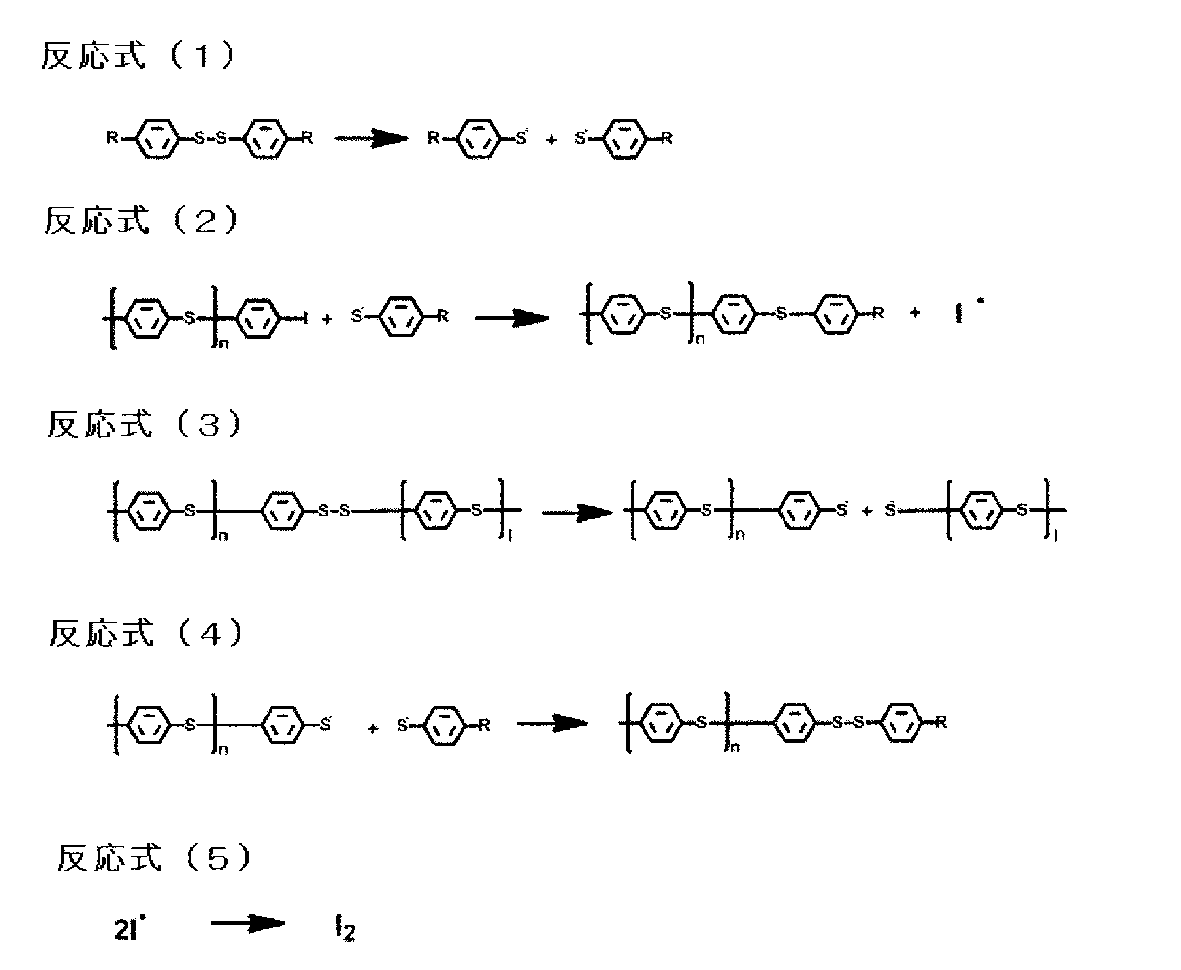
- Reaction formulas (1) to (5) are, for example, polyphenylene when diphenyl disulfide having a substituent R containing a group represented by general formula (a), (b) or (c) is used as a polymerization inhibitor. It is an example of reaction which sulfide produces
- Reaction formula (1) is a reaction in which the —SS— bond in the polymerization inhibitor undergoes radical cleavage at the melting temperature.
- the sulfur radical generated in the reaction formula (1) attacks the adjacent carbon atom of the terminal iodine atom of the growing main chain, and the iodine atom is detached, so that the polymerization is stopped, In this reaction, a substituent R is introduced at the end of the main chain.
- Reaction formula (3) is a reaction in which a disulfide bond existing in the main chain of the polyarylene sulfide resin derived from the raw material (single sulfur) is radically cleaved at the melting temperature.
- the reaction formula (4) the polymerization is stopped by recombination of the sulfur radical generated in the reaction formula (3) and the sulfur radical generated in the reaction formula (1), and the substituent R is at the end of the main chain.
- the detached iodine atom is in a free state (iodine radical), or iodine molecules are generated by recombination of iodine radicals as in reaction formula (5).
- the reaction product containing polyarylene sulfide resin obtained by melt polymerization contains iodine atoms derived from the raw material. Therefore, the polyarylene sulfide resin is usually used for the preparation of a spinning resin composition in the form of a mixture containing iodine atoms.
- the concentration of iodine atoms in the mixture is, for example, in the range of 0.01 to 10,000 ppm, preferably in the range of 10 to 5000 ppm with respect to the polyarylene sulfide resin. It is also possible to keep the iodine atom concentration low by utilizing the sublimability of iodine molecules.
- the range it is possible to set the range to 900 ppm or less, preferably 100 ppm or less, and further 10 ppm or less. It is. Although it is possible to remove iodine atoms below the detection limit, it is not practical in view of productivity.
- the detection limit is, for example, about 0.01 ppm.
- the polyarylene sulfide resin of the present embodiment obtained by melt polymerization or the reaction product containing the same includes an iodine atom. It can be clearly distinguished from polyarylene sulfides obtained by legal methods.
- the polyarylene sulfide resin obtained by melt polymerization is mainly composed of an arylene sulfide unit composed of an aromatic ring derived from a diiodo aromatic compound and a sulfur atom directly bonded thereto. It includes a main chain and a predetermined substituent R bonded to the end of the main chain.
- the predetermined substituent R is bonded to the aromatic ring at the end of the main chain directly or via a partial structure derived from a polymerization inhibitor.
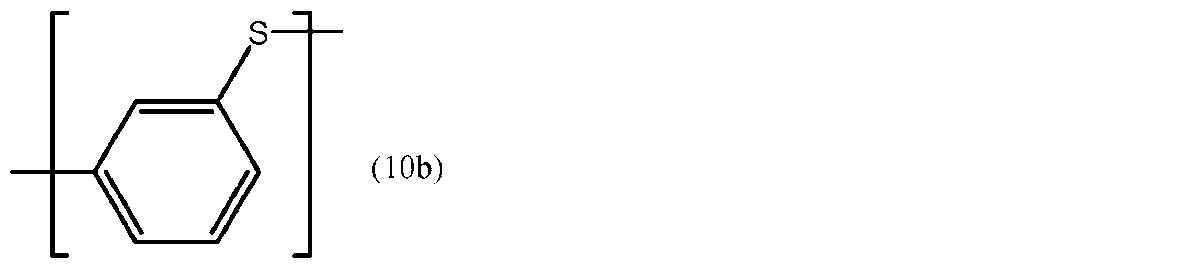
- the polyphenylene sulfide resin as the polyarylene sulfide resin according to one embodiment is, for example, the following general formula (10):
- the repeating unit represented by the formula (10) has the following formula (10a) bonded at the para position:
- a repeating unit bonded at the para position represented by the formula (10a) is preferable in terms of heat resistance and crystallinity of the resin.
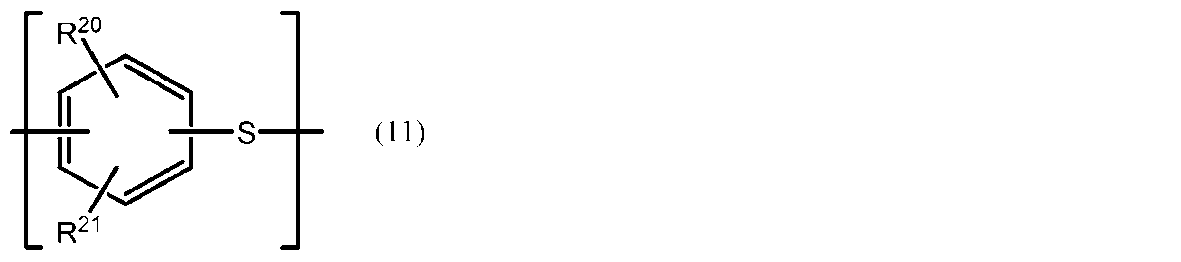
- the polyphenylene sulfide resin according to one embodiment has the following general formula (11):
- R 20 and R 21 each independently represents a hydrogen atom, an alkyl group having 1 to 4 carbon atoms, a nitro group, an amino group, a phenyl group, a methoxy group, or an ethoxy group.
- bonded with the aromatic ring represented by these may be included.
- the polyphenylene sulfide resin does not substantially contain the repeating unit of the general formula (11) from the viewpoints of crystallinity and heat resistance. More specifically, the ratio of the repeating unit represented by formula (11) is preferably based on the total of the repeating unit represented by formula (10) and the repeating unit represented by formula (11). It is 2 mass% or less, More preferably, it is 0.2 mass% or less.
- the polyarylene sulfide resin of the present embodiment is mainly composed of the above arylene sulfide units, but usually derived from the elemental sulfur of the raw material, the following formula (20):
- a structural unit related to a disulfide bond represented by the formula is also included in the main chain.
- the proportion of the structural unit represented by the formula (20) is preferably 2 with respect to the total of the arylene sulfide unit and the structural site represented by the formula (20).
- the range is 9% by mass or less, and more preferably 1.2% by mass or less.
- the polyarylene sulfide resin contains the structural unit represented by the formula (20) in that the adhesion between the polyarylene sulfide resin composition and the metal is improved.
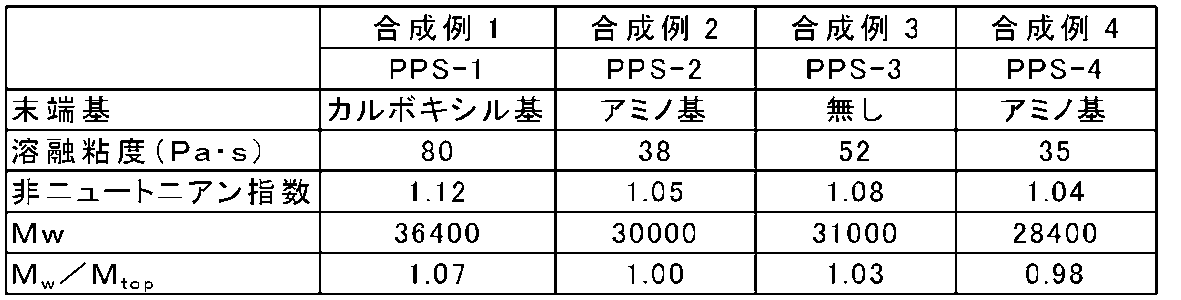
- Mw / Mtop of the polyarylene sulfide resin according to the present embodiment is preferably in the range of 0.80 to 1.70, more preferably in the range of 0.90 to 1.30.
- Mw represents the weight average molecular weight measured by gel permeation chromatography
- Mtop represents the average molecular weight (peak molecular weight) at the point where the detection intensity of the chromatogram obtained by the measurement is maximized.
- Mw / Mtop indicates the distribution of the molecular weight to be measured.
- the weight average molecular weight of the polyarylene sulfide resin according to this embodiment is not particularly limited as long as the effects of the present invention are not impaired, but the lower limit thereof is 28,000 or more from the viewpoint of excellent mechanical strength. Is more preferable, and the range of 30,000 or more is more preferable.
- the upper limit is preferably in the range of 100,000 or less, more preferably in the range of 60,000 or less, and further in the range of 55,000 or less from the viewpoint that a better cavity balance can be imparted. Most preferably, it is in the range.
- a polyarylene sulfide resin in the range of 28,000 to 60,000, more preferably in the range of 30,000 to 55,000.
- a polyarylene sulfide resin having a weight average molecular weight in the range of more than 60,000 and 100,000 or less may be used together with the polyarylene sulfide resin.
- the non-Newtonian index of the polyarylene sulfide resin is preferably in the range of 0.95 to 1.75, more preferably in the range of 1.0 to 1.70.
- the non-Newtonian index means an index satisfying the following relational expression between the shear rate and the shear stress under the condition of a temperature of 300 ° C.
- the non-Newtonian index can be an index related to the molecular weight to be measured or the molecular structure such as linear, branched, or crosslinked.
- the polyarylene sulfide resin having the above-mentioned specific ranges of Mw / Mtop and non-Newtonian index includes, for example, a diiodo aromatic compound, elemental sulfur, a polymerization inhibitor, a diiodo aromatic compound, elemental sulfur, and a polymerization inhibitor.
- a method of reacting (solution polymerization) in a molten mixture containing a polyarylene sulfide resin it can be obtained by increasing the molecular weight of the polyarylene sulfide resin to some extent.
- the melting point of the polyarylene sulfide resin according to the present embodiment is preferably in the range of 250 to 300 ° C, more preferably in the range of 265 to 300 ° C.
- the melt viscosity (V6) at 300 ° C. of the polyarylene sulfide resin is preferably in the range of 1 to 2000 [Pa ⁇ s], more preferably in the range of 5 to 1700 [Pa ⁇ s].
- an orifice having a temperature of 300 ° C., a load of 1.96 MPa, and a ratio of the orifice length to the orifice diameter (orifice length / orifice diameter) is 10/1. The melt viscosity after holding for 6 minutes.
- the polyarylene sulfide resin composition according to the present embodiment can contain one or more inorganic fillers.
- the inorganic filler include powdery fillers such as carbon black, calcium carbonate, silica and titanium oxide, plate-like fillers such as talc and mica, granular fillers such as glass beads, silica beads and glass balloons, and glass fibers. And fibrous fillers such as carbon fiber and wollastonite fiber, and glass flakes.
- the polyarylene sulfide resin composition contains at least one inorganic filler selected from the group consisting of glass fiber, carbon fiber, carbon black, and calcium carbonate.
- the content of the inorganic filler is preferably in the range of 1 to 300 parts by weight, more preferably in the range of 5 to 200 parts by weight, and still more preferably 15 to 150 parts by weight with respect to 100 parts by weight of the polyarylene sulfide resin. It is the range of mass parts. When the content of the inorganic filler is in these ranges, a more excellent effect can be obtained in terms of maintaining the mechanical strength of the molded product.
- the polyarylene sulfide resin composition according to this embodiment may contain a resin other than the polyarylene sulfide resin selected from thermoplastic resins, elastomers, and crosslinkable resins. These resins can be blended in the resin composition together with the inorganic filler.
- thermoplastic resin blended in the polyarylene sulfide resin composition examples include polyester, polyamide, polyimide, polyetherimide, polycarbonate, polyphenylene ether, polysulfone, polyethersulfone, polyetheretherketone, polyetherketone, and polyethylene. , Polypropylene, polytetrafluoroethylene, polydifluoroethylene, polystyrene, ABS resin, silicone resin, and liquid crystal polymer (liquid crystal polyester, etc.).
- Polyamide is a polymer having an amide bond (—NHCO—).
- the polyamide resin include (i) a polymer obtained from polycondensation of diamine and dicarboxylic acid, (ii) a polymer obtained from polycondensation of aminocarboxylic acid, and (iii) a polymer obtained from ring-opening polymerization of lactam. Is mentioned. Polyamides can be used alone or in combination of two or more.
- diamines for obtaining polyamides include aliphatic diamines, aromatic diamines, and alicyclic diamines.
- aliphatic diamine a diamine having 3 to 18 carbon atoms having a straight chain or a side chain is preferable.
- suitable aliphatic diamines include 1,3-trimethylene diamine, 1,4-tetramethylene diamine, 1,5-pentamethylene diamine, 1,6-hexamethylene diamine, 1,7-heptamethylene diamine.
- 1,8-octamethylenediamine 2-methyl-1,8-octanediamine, 1,9-nonamethylenediamine, 1,10-decamethylenediamine, 1,11-undecanmethylenediamine, 1,12-dodecamethylene Diamine, 1,13-tridecamethylenediamine, 1,14-tetradecamethylenediamine, 1,15-pentadecamethylenediamine, 1,16-hexadecamethylenediamine, 1,17-heptadecamethylenediamine, 1,18 -Octadecamethylenediamine, 2,2,4-trimethylhexamethylenediamine And 2,4,4-trimethyl hexamethylene diamine. These can be used alone or in combination of two or more.
- aromatic diamine a diamine having 6 to 27 carbon atoms having a phenylene group is preferable.
- suitable aromatic diamines include o-phenylenediamine, m-phenylenediamine, p-phenylenediamine, m-xylylenediamine, p-xylylenediamine, 3,4-diaminodiphenyl ether, 4,4'- Diaminodiphenyl ether, 4,4'-diaminodiphenylmethane, 3,3'-diaminodiphenylsulfone, 4,4'-diaminodiphenylsulfone, 4,4'-diaminodiphenyl sulfide, 4,4'-di (m-aminophenoxy) Diphenylsulfone, 4,4′-di (p-aminophenoxy) diphenylsulfone, benzidine, 3,3′-diaminobenzophen
- alicyclic diamine a diamine having 4 to 15 carbon atoms having a cyclohexylene group is preferable.
- suitable alicyclic diamines include 4,4'-diamino-dicyclohexylenemethane, 4,4'-diamino-dicyclohexylenepropane, 4,4'-diamino-3,3'-dimethyl- Examples include dicyclohexylene methane, 1,4-diaminocyclohexane, and piperazine. These can be used alone or in combination of two or more.
- dicarboxylic acid for obtaining the polyamide examples include aliphatic dicarboxylic acid, aromatic dicarboxylic acid, and alicyclic dicarboxylic acid.
- aliphatic dicarboxylic acid a saturated or unsaturated dicarboxylic acid having 2 to 18 carbon atoms is preferable.
- suitable aliphatic dicarboxylic acids include succinic acid, malonic acid, succinic acid, glutaric acid, adipic acid, pimelic acid, suberic acid, azelaic acid, sebacic acid, undecanedioic acid, dodecanedioic acid, placillic acid, tetradecane Examples include diacids, pentadecanedioic acid, octadecanedioic acid, maleic acid, and fumaric acid. These can be used alone or in combination of two or more.
- aromatic dicarboxylic acid a dicarboxylic acid having 8 to 15 carbon atoms having a phenylene group is preferable.
- suitable aromatic dicarboxylic acids include isophthalic acid, terephthalic acid, methyl terephthalic acid, biphenyl-2,2′-dicarboxylic acid, biphenyl-4,4′-dicarboxylic acid, diphenylmethane-4,4′-dicarboxylic acid And acid, diphenyl ether-4,4′-dicarboxylic acid, diphenylsulfone-4,4′-dicarboxylic acid, 2,6-naphthalenedicarboxylic acid, 2,7-naphthalenedicarboxylic acid, and 1,4-naphthalenedicarboxylic acid. . These can be used alone or in combination of two or more.
- polycarboxylic acids such as trimellitic acid, trimesic acid, and pyromellitic acid can be used within a
- the aminocarboxylic acid is preferably an aminocarboxylic acid having 4 to 18 carbon atoms.
- suitable aminocarboxylic acids include 4-aminobutyric acid, 6-aminohexanoic acid, 7-aminoheptanoic acid, 8-aminooctanoic acid, 9-aminononanoic acid, 10-aminodecanoic acid, 11-aminoundecanoic acid, 12 -Aminododecanoic acid, 14-aminotetradecanoic acid, 16-aminohexadecanoic acid, and 18-aminooctadecanoic acid. These can be used alone or in combination of two or more.
- lactam for obtaining the polyamide examples include ⁇ -caprolactam, ⁇ -laurolactam, ⁇ -enantolactam, and ⁇ -capryllactam. These can be used alone or in combination of two or more.
- Preferred polyamide raw material combinations include ⁇ -caprolactam (nylon 6), 1,6-hexamethylenediamine / adipic acid (nylon 6,6), 1,4-tetramethylenediamine / adipic acid (nylon 4,6) 1,6-hexamethylenediamine / terephthalic acid, 1,6-hexamethylenediamine / terephthalic acid / ⁇ -caprolactam, 1,6-hexamethylenediamine / terephthalic acid / adipic acid, 1,9-nonamethylenediamine / terephthalic acid Acids, 1,9-nonamethylenediamine / terephthalic acid / ⁇ -caprolactam, 1,9-nonamethylenediamine / 1,6-hexamethylenediamine / terephthalic acid / adipic acid, and m-xylylenediamine / adipic acid It is done.
- 1,4-tetramethylenediamine / adipic acid nylon 4,6
- 1,6-hexamethylenediamine / terephthalic acid / ⁇ -caprolactam 1,6-hexamethylenediamine / terephthalic acid / adipic acid
- 1,9-nonamethylenediamine / terephthalic acid 1,9-nonamethylenediamine / terephthalic acid / ⁇ -caprolactam
- 1,9-nonamethylenediamine / 1,6-hexamethylenediamine / terephthalic acid / adipic acid More preferred are amide resins.
- the content of the thermoplastic resin is preferably in the range of 1 to 300 parts by weight, more preferably in the range of 3 to 100 parts by weight, still more preferably in the range of 5 to 45 parts per 100 parts by weight of the polyarylene sulfide resin. It is the range of mass parts. When the content of the thermoplastic resin other than the polyarylene sulfide resin is within these ranges, the effect of further improving the heat resistance, chemical resistance and mechanical properties can be obtained.
- thermoplastic elastomer is often used as the elastomer blended in the polyarylene sulfide resin composition.
- thermoplastic elastomer examples include polyolefin elastomers, fluorine elastomers, and silicone elastomers. In the present specification, the thermoplastic elastomer is classified not as the thermoplastic resin but as an elastomer.
- the elastomer (particularly thermoplastic elastomer) preferably has a functional group capable of reacting with at least one group selected from the group consisting of a hydroxy group, an amino group, a carboxyl group and a salt of a carboxyl group.
- a functional group capable of reacting with at least one group selected from the group consisting of a hydroxy group, an amino group, a carboxyl group and a salt of a carboxyl group.
- Such functional groups include epoxy groups, amino groups, hydroxyl groups, carboxyl groups, mercapto groups, isocyanate groups, oxazoline groups, and the formula: R (CO) O (CO)-or R (CO) O- R represents an alkyl group having 1 to 8 carbon atoms).
- thermoplastic elastomer having such a functional group can be obtained, for example, by copolymerization of an ⁇ -olefin and a vinyl polymerizable compound having the functional group.
- ⁇ -olefin examples include ⁇ -olefins having 2 to 8 carbon atoms such as ethylene, propylene and butene-1.
- vinyl polymerizable compound having a functional group examples include ⁇ , ⁇ -unsaturated carboxylic acids such as (meth) acrylic acid and (meth) acrylic acid esters and alkyl esters thereof, maleic acid, fumaric acid, itaconic acid, and the like.
- An ethylene-propylene copolymer and an ethylene-butene copolymer having at least one functional group selected from the group consisting of the groups represented are preferable from the viewpoint of improving toughness and impact resistance.
- the content of the elastomer varies depending on the type and application, and thus cannot be defined unconditionally. For example, it is preferably in the range of 1 to 300 parts by weight, more preferably 3 parts per 100 parts by weight of the polyarylene sulfide resin. It is in the range of ⁇ 100 parts by mass, more preferably in the range of 5 to 45 parts by mass. When the content of the elastomer is within these ranges, a more excellent effect can be obtained in terms of ensuring the heat resistance and toughness of the molded product.
- the crosslinkable resin blended in the polyarylene sulfide resin composition has two or more crosslinkable functional groups.
- the crosslinkable functional group include an epoxy group, a phenolic hydroxyl group, an amino group, an amide group, a carboxyl group, an acid anhydride group, and an isocyanate group.
- the crosslinkable resin include an epoxy resin, a phenol resin, and a urethane resin.
- an aromatic epoxy resin is preferable.
- the aromatic epoxy resin may have a halogen group or a hydroxyl group.
- suitable aromatic epoxy resins include bisphenol A type epoxy resins, bisphenol F type epoxy resins, bisphenol S type epoxy resins, biphenyl type epoxy resins, tetramethylbiphenyl type epoxy resins, phenol novolac type epoxy resins, cresol novolacs.
- Type epoxy resin bisphenol A novolak type epoxy resin, triphenylmethane type epoxy resin, tetraphenylethane type epoxy resin, dicyclopentadiene-phenol addition reaction type epoxy resin, phenol aralkyl type epoxy resin, naphthol novolak type epoxy resin, naphthol aralkyl Type epoxy resin, naphthol-phenol co-condensed novolac type epoxy resin, naphthol-cresol co-condensed novolac type epoxy resin, aromatic hydrocarbon Le formaldehyde resin-modified phenol resin type epoxy resins, and biphenyl novolac-type epoxy resin.
- aromatic epoxy resins can be used alone or in combination of two or more.
- a novolak type epoxy resin is preferable and a cresol novolak type epoxy resin is more preferable because it is excellent in compatibility with other resin components.
- the content of the crosslinkable resin is preferably in the range of 1 to 300 parts by mass, more preferably in the range of 3 to 100 parts by mass, and still more preferably 5 to 30 parts per 100 parts by mass of the polyarylene sulfide resin. It is the range of mass parts. When the content of the crosslinkable resin is in these ranges, the effect of improving the rigidity and heat resistance of the molded product can be obtained particularly remarkably.
- the polyarylene sulfide resin composition can contain a silane compound having a functional group capable of reacting with at least one group selected from the group consisting of a hydroxy group, an amino group, a carboxyl group and a salt of a carboxyl group.
- a silane compound having a functional group capable of reacting with at least one group selected from the group consisting of a hydroxy group, an amino group, a carboxyl group and a salt of a carboxyl group.
- silane compounds include ⁇ -glycidoxypropyltrimethoxysilane, ⁇ -glycidoxypropyltriethoxysilane, ⁇ - (3,4-epoxycyclohexyl) ethyltrimethoxysilane, and ⁇ -glycidoxypropylmethyl.
- silane coupling agents such as diethoxysilane and ⁇ -glycidoxypropylmethyldimethoxysilane.
- the content of the silane compound is, for example, preferably in the range of 0.01 to 10 parts by mass, more preferably in the range of 0.1 to 5 parts by mass with respect to 100 parts by mass of the polyarylene sulfide resin. .
- the content of the silane compound is within these ranges, an effect of improving the compatibility between the polyarylene sulfide resin and the other components can be obtained.
- the polyarylene sulfide resin composition according to the present embodiment may contain other additives such as a mold release agent, a colorant, a heat stabilizer, an ultraviolet stabilizer, a foaming agent, a rust inhibitor, a flame retardant, and a lubricant. Good.
- the content of the additive is preferably in the range of 1 to 10 parts by mass with respect to 100 parts by mass of the polyarylene sulfide resin, for example.
- the polyarylene sulfide resin composition can be obtained, for example, in the form of a pellet-like compound by a method of melt-kneading the polyarylene sulfide resin obtained by the above method and the other components.
- the melt kneading temperature is preferably in the range of 250 to 350 ° C., for example, and more preferably in the range of 290 to 330 ° C. Melting and kneading can be performed using a twin screw extruder or the like.
- the polyarylene sulfide resin composition according to the present embodiment can be used alone or in combination with materials such as the above-mentioned other components, by various melt processing methods such as injection molding, extrusion molding, compression molding and blow molding, It can be processed into a molded product having excellent molding processability and dimensional stability. Since the polyarylene sulfide resin composition according to the present embodiment generates a small amount of gas when heated, it enables easy production of a high-quality molded product.
- the amount of gas generated by heating can be reduced. For this reason, the contact between a low molecular weight compound containing a sulfur atom, which is a gas component, and a metal material such as copper can be reduced. As a result, even when a high voltage is repeatedly applied, the reaction between the two can be suppressed. It is possible to improve the tracking resistance by suppressing the occurrence and development of (dendritic fracture traces).
- the polyarylene sulfide resin composition of the present invention includes a lithium ion secondary battery, and is particularly suitable for the field of electric vehicles such as hybrid vehicles (HV) and electric vehicles (EV) that require high safety.
- electric vehicle parts obtained by molding the polyarylene sulfide resin composition of the present invention include, for example, power modules, converters, capacitors, insulators, motor terminal blocks, batteries, electric compressors, battery current sensors, junction blocks, etc. A case to store is mentioned.
- the molded article is particularly preferably used as a case for an ignition coil of a DLI system.
- Metal adhesion strength A 4 ⁇ 10 ⁇ 49 mm metal piece (SUS304) set in a mold was injected and molded with a polyarylene sulfide resin composition of the same size, and a tensile test was performed under the conditions of 20 mm between chucks and 1 mm / min tensile speed. The metal adhesion strength was measured.
- the PPS compound was injection molded under the lowest molding conditions as long as the cavity (C1) closest to the primary sprue was completely filled.
- the molding conditions were a 75-ton molding machine, a cylinder temperature of 320 ° C, a mold temperature of 140 ° C, and no holding pressure.
- the degree of filling of the cavity (C10) farthest from the primary sprue in the same runner as the cavity (C1) after molding was compared.
- the degree of filling (% by mass) was determined from the mass ratio of the molded product of the cavity (C10) to the molded product of the cavity (C1). It can be said that the higher the degree of filling of the cavity (C10), the better the cavity balance.
- the cavity balance of each composition was determined according to the following criteria. AA: 100 to 90% by mass range A: 89 to 80% by mass range B: 79 to 70% by mass range C: 69 to 60% by mass range D: 59% by mass or less range
- Synthesis of polyphenylene sulfide resin (PPS resin) (Synthesis Example 1: Synthesis of PPS-1) 30-0.0 g of p-diiodobenzene (Tokyo Kasei Co., Ltd., p-diiodobenzene purity of 98.0% or more), solid sulfur (sulfur (powder) manufactured by Kanto Chemical Co., Inc.) 27.00 g, 4,4′- Dithiobisbenzoic acid (4,4′-dithiobisbenzoic acid, Technical Grade, manufactured by Wako Pure Chemical Industries, Ltd.) (2.0 g) was heated to 180 ° C. and dissolved and mixed under nitrogen.
- PPS resin Polyphenylene sulfide resin
- the obtained molten mixture was melt polymerized for 8 hours by changing the temperature and pressure stepwise so that the absolute pressure was 133 Pa at 320 ° C.
- 200 g of NMP was added, and the mixture was heated and stirred at 220 ° C., and the resulting dissolved product was filtered.
- 320 g of NMP was added to the lysate after filtration, and cake washing filtration was performed.
- 1 L of ion-exchanged water was added to the obtained cake containing NMP, and the mixture was stirred in an autoclave at 200 ° C. for 10 minutes.
- the cake was filtered, and 1 L of ion-exchanged water at 70 ° C. was added to the cake after filtration to wash the cake. 1 L of ion-exchanged water was added to the obtained water-containing cake and stirred for 10 minutes. Next, the cake was filtered, and 1 L of ion-exchanged water at 70 ° C. was added to the cake after filtration to wash the cake. After repeating this operation once more, the cake was dried at 120 ° C. for 4 hours to obtain 91 g of PPS resin (PPS-1).
- PPS-1 PPS resin
- Table 1 shows the properties of PPS-1 to PPS-4 obtained in Synthesis Examples 1 to 4.
- PPS compound Polyphenylene sulfide resin composition
- ELA Copolymer of ethylene / glycidyl methacrylic acid (3% by mass) / methyl acrylate (27% by mass) (manufactured by Sumitomo Chemical Co., Ltd., “Bond First 7L”)
- Epoxy silane ⁇ -glycidoxypropyltrimethoxysilane (inorganic filler)
- GF Glass fiber chopped strand (fiber diameter 10 ⁇ m, length 3 mm)
- PPS-1, PPS-2 and PPS-3 have mechanical properties (bending strength, bending elongation at break), metal adhesion strength, epoxy adhesion strength, cavity balance. It was superior to PPS-4 in hot water resistance, gas generation amount, and tracking resistance.
Landscapes
- Chemical & Material Sciences (AREA)
- Health & Medical Sciences (AREA)
- Chemical Kinetics & Catalysis (AREA)
- Medicinal Chemistry (AREA)
- Polymers & Plastics (AREA)
- Organic Chemistry (AREA)
- Compositions Of Macromolecular Compounds (AREA)
- Polymers With Sulfur, Phosphorus Or Metals In The Main Chain (AREA)
Abstract
Description









(1)当該溶解物を、そのまま、又は酸若しくは塩基を加えた後、減圧下又は常圧化で溶媒を留去し、次いで溶媒留去後の固形物を水、当該溶解物に用いた溶媒(又は低分子ポリマーに対して同等の溶解度を有する有機溶媒)、アセトン、メチルエチルケトン及びアルコール類などから選ばれる溶媒で1回又は2回以上洗浄し、更に中和、水洗、濾過及び乾燥する方法。
(2)当該溶解物に水、アセトン、メチルエチルケトン、アルコール、エーテル、ハロゲン化炭化水素、芳香族炭化水素及び脂肪族炭化水素などの溶媒(当該溶解物の溶媒に可溶であり、且つ少なくともポリアリーレンスルフィド樹脂に対しては貧溶媒である溶媒)を沈降剤として添加して、ポリアリーレンスルフィド樹脂及び無機塩等を含む固体状生成物を沈降させ、固体状生成物を濾別、洗浄及び乾燥する方法。
(3)当該溶解物に、当該溶解物に用いた溶媒(又は低分子ポリマーに対して同等の溶解度を有する有機溶媒)を加えて撹拌した後、濾過して低分子量重合体を除いた後、水、アセトン、メチルエチルケトン及びアルコールなどから選ばれる溶媒で1回又は2回以上洗浄し、その後中和、水洗、濾過及び乾燥をする方法。


で表される、芳香族環に結合した側鎖としての置換基を有する繰り返し単位を含み得る。ただし、結晶化度及び耐熱性の低下の観点から、ポリフェニレンスルフィド樹脂は、一般式(11)の繰り返し単位を実質的に含まないことが好ましい。より具体的には、式(11)で表される繰り返し単位の割合は、式(10)で表される繰り返し単位と式(11)で表される繰り返し単位との合計に対して、好ましくは2質量%以下、より好ましくは0.2質量%以下である。

D=α×Sn
(上記式中、Dはせん断速度を表し、Sはせん断応力を表し、αは定数を表し、nは非ニュートニアン指数を表す。)
[曲げ特性]
・準拠試験方法…ASTM D-790
・試験片…3.2mm(厚)×12.7mm(幅)×127mm(長)
・試験結果…試験数n=10の平均値
試験片を95℃の熱水に浸漬し、曲げ強さの経時変化を調べた。
・試験片…3.2mm(厚)×12.7mm(幅)×127mm(長)
・曲げ強さの試験方法…ASTM D-790
・評価項目…1000時間、3000時間後の曲げ強さの初期強さに対する保持率
・試験結果…試験数n=5の平均値
金型にセットした4×10×49mmの金属片(SUS304)に、同寸法分のポリアリーレンスルフィド樹脂組成物を射出、成形したものについて、チャック間20mm、引張速度1mm/minの条件で引張試験を実施し、金属密着強さを測定した。
3mm(厚)×25mm(幅)×75mm(長さ)の試験片を成形し、試験片上に接着面積25mm×10mmとなるようにエポキシ樹脂(主剤:エピクロン850(DIC製)/シリカ(充填率50質量%)、硬化剤:無水ヘキサヒドロフタル酸、主剤/硬化剤=100/30(質量比))を厚さ40~50μmで塗布した。これらをクリップで固定後、85℃で3時間、次いで150℃で3時間加熱し、さらに徐冷させることによってエポキシ樹脂を硬化させた。その後、5mm/分の引張速度にて引張せん断強度を測定し、実荷重を記録した。
40個分のキャビティーを有するワッシャー金型を用いて、一次スプルーに最も近い位置のキャビティー(C1)が完全に充填される限りで最低の成形条件でPPSコンパウンドを射出成形した。成形条件は75トン成形機、シリンダー温度320℃、金型温度140℃、保圧無しとした。
AA:100~90質量%の範囲
A:89~80質量%の範囲
B:79~70質量%の範囲
C:69~60質量%の範囲
D:59%質量以下の範囲
ガスクロマトグラフ質量分析装置を用いて、ポリアリーレンスルフィド樹脂又は樹脂組成物の所定量のサンプルを325℃で15分間加熱し、そのときのガス発生量を質量%として定量した。
2mm(厚み)×50mm(幅)×100mm(長)の試験片を成形し、ASTM D3638に準拠した方法で、樹脂流動方向に沿って測定し、破壊電圧と滴下数をプロットし、50滴の電圧を読み取った。
(合成例1:PPS-1の合成)
p-ジヨードベンゼン(東京化成株式会社、p-ジヨードベンゼン純度98.0%以上)300.0g、固体硫黄(関東化学株式会社製、硫黄(粉末))27.00g、4,4’-ジチオビス安息香酸(和光純薬工業株式会社製、4,4’-ジチオビス安息香酸、Technical Grade)2.0gを180℃に加熱してそれらを窒素下で溶解、混合した。次に220℃に昇温し、絶対圧26.6kPaまで減圧した。得られた溶融混合物を、320℃で絶対圧133Paとなるように、段階的に温度と圧力変化させて、8時間溶融重合した。反応終了後、NMP200gを加えて、220℃で加熱撹拌し、得られた溶解物をろ過した。ろ過後の溶解物にNMP320gを加え、ケーキ洗浄ろ過を行った。得られたNMPを含むケーキにイオン交換水1Lを加え、オートクレーブ中で200℃10分間攪拌した。次いでケーキをろ過し、ろ過後のケーキに70℃のイオン交換水1Lを加えケーキ洗浄を行った。得られた含水ケーキにイオン交換水1Lを加えて10分間攪拌した。次いでケーキをろ過し、ろ過後のケーキに70℃のイオン交換水1Lを加えケーキ洗浄を行った。この操作をもう一度繰り返した後、ケーキを120℃で4時間乾燥し、PPS樹脂(PPS-1)91gを得た。
「4,4’-ジチオビス安息香酸」の替りに「2-ヨードアニリン(東京化成株式会社製)」を用いたこと以外は合成例1と同様にして、PPS樹脂(PPS-2)91gを得た。
「4,4’-ジチオビス安息香酸」の替りに「ジフェニルジスルフィド(住友精化株式会社、DPDS)」を用いたこと以外は合成例1と同様にしてPPS樹脂(PPS-3)91gを得た。
2LのオートクレーブにN-メチルピロリドン600gと硫化ナトリウム5水塩336.3g(2.0mol)とを仕込み、窒素雰囲気下、200℃まで昇温することにより水-NMP混合物を留去した。次いでこの系に、p-ジクロルベンゼン292.53g(1.99mol)と2,5-ジクロルアニリン1.62g(0.01mol)とをNMP230gに溶かした溶液を添加し、220℃で5時間、さらに240℃で2時間、窒素雰囲気下で反応させた。反応容器から冷却後内容物を取り出し、一部をサンプリングし、未反応2,5-ジクロロアニリンをガスクロマトグラフで定量した。また残りのスラリは熱水で数回洗浄し、ポリマーケーキを濾別した。このケーキを80℃減圧乾燥し、粉末のアミノ基含有ポリフェニレンスルフィド(PPS-4)を得た。
[原料]
PPS樹脂組成物を調製するため、以下の材料を準備した。
(熱可塑性エラストマー)
ELA:エチレン/グリシジルメタクリル酸(3質量%)/アクリル酸メチル(27質量%)の共重合体(住友化学工業社製、「ボンドファースト7L」)
(シランカップリング剤)
エポキシシラン:γ-グリシドキシプロピルトリメトキシシラン
(無機質充填剤)
GF:ガラス繊維チョップドストランド(繊維径10μm、長さ3mm)
表2に示す配合組成で各原料をタンブラーによって均一に混合した後、2軸混練押出機(TEM-35B、東芝機械)を用いて300℃で溶融混練して、ペレット状のコンパウンドを得た。得られたコンパウンドをシリンダー温度300℃、金型温度140℃の条件で射出成形し、曲げ特性、金属密着強さ、キャビティーバランス及び耐熱水性試験に用いる試験片を作製し、各種評価を行った。また、PPS樹脂単体及びコンパウンドについて、ガス発生量を測定した。評価結果を表2に示す。

Claims (6)
- ポリアリーレンスルフィド樹脂と、
無機質充填剤、前記ポリアリーレンスルフィド樹脂以外の熱可塑性樹脂、エラストマー、及び2以上の架橋性官能基を有する架橋性樹脂からなる群より選ばれる、少なくとも1種の他の成分と、
を含有する、電気自動車部品用ポリアリーレンスルフィド樹脂組成物であって、
前記ポリアリーレンスルフィド樹脂が、ジヨード芳香族化合物と、単体硫黄と、重合禁止剤とを、前記ジヨード芳香族化合物、前記単体硫黄及び前記重合禁止剤を含む溶融混合物中で反応させることを含む方法により得ることのできるものである、電気自動車部品用ポリアリーレンスルフィド樹脂組成物。 - 前記ポリアリーレンスルフィド樹脂が、前記重合禁止剤に由来するヒドロキシ基、アミノ基、カルボキシル基及びカルボキシル基の塩からなる群より選ばれる少なくとも一種の基を有する、請求項1に記載の電気自動車部品用ポリアリーレンスルフィド樹脂組成物。
- 前記ポリアリーレンスルフィド樹脂が、0.80~1.70のMw/Mtopを有し、
前記Mw及びMtopはそれぞれゲル浸透クロマトグラフィーにより測定される重量平均分子量及びピーク分子量である、請求項1又は2に記載の電気自動車部品用ポリアリーレンスルフィド樹脂組成物。 - 前記ポリアリーレンスルフィド樹脂が、300℃における0.95~1.75の非ニュートニアン指数、及び、0.80~1.70のMw/Mtopを有し、
前記Mw及びMtopはそれぞれゲル浸透クロマトグラフィーにより測定される重量平均分子量及びピーク分子量である、請求項1~3のいずれか一項に記載の電気自動車部品用ポリアリーレンスルフィド樹脂組成物。 - 請求項1~4のいずれか一項に記載のポリアリーレンスルフィド樹脂組成物を成形して得られる、電気自動車部品用成形品。
- 請求項5に記載の成形品を備える、電気自動車部品。
Priority Applications (5)
| Application Number | Priority Date | Filing Date | Title |
|---|---|---|---|
| KR1020167007982A KR20160065836A (ko) | 2013-10-01 | 2014-08-28 | 폴리아릴렌설피드 수지 조성물 및 그 성형품, 그리고 전기 자동차 부품 |
| JP2015540428A JP6444879B2 (ja) | 2013-10-01 | 2014-08-28 | ポリアリーレンスルフィド樹脂組成物及びその成形品、並びに電気自動車部品 |
| CN201480054696.4A CN105593302B (zh) | 2013-10-01 | 2014-08-28 | 聚芳硫醚树脂组合物及其成形品、以及电动汽车部件 |
| KR1020247002121A KR102668078B1 (ko) | 2013-10-01 | 2014-08-28 | 폴리아릴렌설피드 수지 조성물 및 그 성형품, 그리고 전기 자동차 부품 |
| KR1020227004201A KR20220025152A (ko) | 2013-10-01 | 2014-08-28 | 폴리아릴렌설피드 수지 조성물 및 그 성형품, 그리고 전기 자동차 부품 |
Applications Claiming Priority (2)
| Application Number | Priority Date | Filing Date | Title |
|---|---|---|---|
| JP2013206459 | 2013-10-01 | ||
| JP2013-206459 | 2013-10-01 |
Publications (1)
| Publication Number | Publication Date |
|---|---|
| WO2015049941A1 true WO2015049941A1 (ja) | 2015-04-09 |
Family
ID=52778536
Family Applications (1)
| Application Number | Title | Priority Date | Filing Date |
|---|---|---|---|
| PCT/JP2014/072641 Ceased WO2015049941A1 (ja) | 2013-10-01 | 2014-08-28 | ポリアリーレンスルフィド樹脂組成物及びその成形品、並びに電気自動車部品 |
Country Status (4)
| Country | Link |
|---|---|
| JP (1) | JP6444879B2 (ja) |
| KR (3) | KR20220025152A (ja) |
| CN (2) | CN105593302B (ja) |
| WO (1) | WO2015049941A1 (ja) |
Cited By (5)
| Publication number | Priority date | Publication date | Assignee | Title |
|---|---|---|---|---|
| JP2017149816A (ja) * | 2016-02-23 | 2017-08-31 | 帝人株式会社 | 樹脂組成物 |
| JP2017155221A (ja) * | 2016-02-26 | 2017-09-07 | 東レ株式会社 | ポリフェニレンスルフィド樹脂組成物および成形品 |
| CN108473766A (zh) * | 2015-11-23 | 2018-08-31 | Sk化学株式会社 | 聚亚芳基硫醚树脂组合物和模制物品 |
| JP2018534408A (ja) * | 2015-11-23 | 2018-11-22 | エスケー ケミカルズ カンパニー リミテッド | ポリアリーレンスルフィド樹脂およびその製造方法 |
| JP2021098864A (ja) * | 2015-05-14 | 2021-07-01 | エスケー ケミカルズ カンパニー リミテッド | 金属と良好に接着するポリアリーレンスルフィド組成物 |
Families Citing this family (3)
| Publication number | Priority date | Publication date | Assignee | Title |
|---|---|---|---|---|
| CN109705346A (zh) * | 2018-12-29 | 2019-05-03 | 重庆晟淦新材料科技有限公司 | 不含氯化锂和添加剂的聚苯硫醚及其制备方法与应用 |
| JP7188617B2 (ja) * | 2019-11-19 | 2022-12-13 | Dic株式会社 | 二軸延伸積層フィルム、積層体およびそれらの製造方法 |
| KR20210100814A (ko) * | 2020-02-07 | 2021-08-18 | 에스케이케미칼 주식회사 | 폴리아릴렌 설파이드 수지의 중합금지제 |
Citations (2)
| Publication number | Priority date | Publication date | Assignee | Title |
|---|---|---|---|---|
| JP2013522385A (ja) * | 2010-03-09 | 2013-06-13 | エスケー ケミカルズ カンパニー リミテッド | 再利用可能なポリアリーレンスルフィドおよびその製造方法 |
| JP2013528680A (ja) * | 2010-05-12 | 2013-07-11 | エスケー ケミカルズ カンパニー リミテッド | 加工性に優れたポリアリーレンスルフィド及びその製造方法 |
Family Cites Families (9)
| Publication number | Priority date | Publication date | Assignee | Title |
|---|---|---|---|---|
| JPH06172489A (ja) * | 1992-12-08 | 1994-06-21 | Mitsubishi Petrochem Co Ltd | 熱可塑性樹脂組成物 |
| JP4269198B2 (ja) | 1998-07-30 | 2009-05-27 | Dic株式会社 | ポリアリーレンサルファイド樹脂組成物 |
| JP5029881B2 (ja) * | 2007-03-29 | 2012-09-19 | Dic株式会社 | ポリアリーレンスルフィド樹脂組成物 |
| KR101549205B1 (ko) * | 2008-12-23 | 2015-09-02 | 에스케이케미칼 주식회사 | 폴리아릴렌 설파이드의 제조 방법 |
| KR101554010B1 (ko) * | 2008-12-31 | 2015-09-18 | 에스케이케미칼 주식회사 | 유리 요오드 저감 폴리아릴렌 설파이드의 제조 방법 |
| KR101780404B1 (ko) * | 2010-02-01 | 2017-09-21 | 에스케이케미칼 주식회사 | 요오드 저감 폴리아릴렌 설파이드의 제조 방법 |
| KR101944898B1 (ko) * | 2012-06-11 | 2019-02-01 | 에스케이케미칼 주식회사 | 폴리아릴렌 설파이드 수지 조성물 및 이의 제조 방법 |
| ES2885765T3 (es) * | 2012-08-07 | 2021-12-15 | Sk Chemicals Co Ltd | Resina de poli(sulfuro de arileno) y procedimiento para preparar la misma |
| JP2015030779A (ja) * | 2013-08-01 | 2015-02-16 | 帝人株式会社 | 樹脂組成物 |
-
2014
- 2014-08-28 JP JP2015540428A patent/JP6444879B2/ja active Active
- 2014-08-28 KR KR1020227004201A patent/KR20220025152A/ko not_active Ceased
- 2014-08-28 CN CN201480054696.4A patent/CN105593302B/zh active Active
- 2014-08-28 CN CN201811014585.7A patent/CN109096761B/zh active Active
- 2014-08-28 WO PCT/JP2014/072641 patent/WO2015049941A1/ja not_active Ceased
- 2014-08-28 KR KR1020247002121A patent/KR102668078B1/ko active Active
- 2014-08-28 KR KR1020167007982A patent/KR20160065836A/ko not_active Ceased
Patent Citations (2)
| Publication number | Priority date | Publication date | Assignee | Title |
|---|---|---|---|---|
| JP2013522385A (ja) * | 2010-03-09 | 2013-06-13 | エスケー ケミカルズ カンパニー リミテッド | 再利用可能なポリアリーレンスルフィドおよびその製造方法 |
| JP2013528680A (ja) * | 2010-05-12 | 2013-07-11 | エスケー ケミカルズ カンパニー リミテッド | 加工性に優れたポリアリーレンスルフィド及びその製造方法 |
Cited By (8)
| Publication number | Priority date | Publication date | Assignee | Title |
|---|---|---|---|---|
| JP2021098864A (ja) * | 2015-05-14 | 2021-07-01 | エスケー ケミカルズ カンパニー リミテッド | 金属と良好に接着するポリアリーレンスルフィド組成物 |
| CN108473766A (zh) * | 2015-11-23 | 2018-08-31 | Sk化学株式会社 | 聚亚芳基硫醚树脂组合物和模制物品 |
| JP2018534408A (ja) * | 2015-11-23 | 2018-11-22 | エスケー ケミカルズ カンパニー リミテッド | ポリアリーレンスルフィド樹脂およびその製造方法 |
| JP2018536068A (ja) * | 2015-11-23 | 2018-12-06 | エスケー ケミカルズ カンパニー リミテッド | ポリアリーレンスルフィド系樹脂組成物および成形品 |
| JP7100222B2 (ja) | 2015-11-23 | 2022-07-13 | エスケー ケミカルズ カンパニー リミテッド | ポリアリーレンスルフィド系樹脂組成物および成形品 |
| US11390714B2 (en) | 2015-11-23 | 2022-07-19 | Hdc Polyall Co., Ltd. | Polyarylene sulfide resin and preparation method thereof |
| JP2017149816A (ja) * | 2016-02-23 | 2017-08-31 | 帝人株式会社 | 樹脂組成物 |
| JP2017155221A (ja) * | 2016-02-26 | 2017-09-07 | 東レ株式会社 | ポリフェニレンスルフィド樹脂組成物および成形品 |
Also Published As
| Publication number | Publication date |
|---|---|
| KR20220025152A (ko) | 2022-03-03 |
| JPWO2015049941A1 (ja) | 2017-03-09 |
| KR20160065836A (ko) | 2016-06-09 |
| CN109096761B (zh) | 2021-05-11 |
| CN105593302B (zh) | 2018-07-24 |
| KR20240013856A (ko) | 2024-01-30 |
| CN109096761A (zh) | 2018-12-28 |
| KR102668078B1 (ko) | 2024-05-23 |
| CN105593302A (zh) | 2016-05-18 |
| JP6444879B2 (ja) | 2018-12-26 |
Similar Documents
| Publication | Publication Date | Title |
|---|---|---|
| JP6444879B2 (ja) | ポリアリーレンスルフィド樹脂組成物及びその成形品、並びに電気自動車部品 | |
| JP7375787B2 (ja) | ポリアリーレンスルフィド樹脂組成物及びその成形品、並びに表面実装電子部品 | |
| JP6655392B2 (ja) | ポリアリーレンスルフィド樹脂組成物及びその成形品 | |
| JP6348487B2 (ja) | ポリアリーレンスルフィド樹脂組成物およびその製造方法 | |
| JP6315289B2 (ja) | ポリアリーレンスルフィド繊維及びその製造方法 | |
| JP6634681B2 (ja) | ポリアリーレンスルフィド樹脂組成物及びその成形品、並びに電気自動車部品 | |
| JP6107959B2 (ja) | ポリアリーレンスルフィドフィルム及びその製造方法 | |
| JP6634682B2 (ja) | ポリアリーレンスルフィド樹脂組成物及びその成形品、並びに電気自動車部品 | |
| JPWO2015020143A1 (ja) | ポリアリーレンスルフィド樹脂組成物及びその成形品 | |
| JP6816408B2 (ja) | ポリアリーレンスルフィド樹脂組成物及びその成形品 | |
| JP6809048B2 (ja) | ポリアリーレンスルフィド樹脂組成物、その成形品およびそれらの製造方法 | |
| JP2016108356A (ja) | ポリアリーレンスルフィドフィルム及びその製造方法 |
Legal Events
| Date | Code | Title | Description |
|---|---|---|---|
| 121 | Ep: the epo has been informed by wipo that ep was designated in this application |
Ref document number: 14851295 Country of ref document: EP Kind code of ref document: A1 |
|
| ENP | Entry into the national phase |
Ref document number: 2015540428 Country of ref document: JP Kind code of ref document: A |
|
| ENP | Entry into the national phase |
Ref document number: 20167007982 Country of ref document: KR Kind code of ref document: A |
|
| NENP | Non-entry into the national phase |
Ref country code: DE |
|
| 122 | Ep: pct application non-entry in european phase |
Ref document number: 14851295 Country of ref document: EP Kind code of ref document: A1 |