WO2015046015A1 - 研磨用組成物、研磨方法、及び基板の製造方法 - Google Patents
研磨用組成物、研磨方法、及び基板の製造方法 Download PDFInfo
- Publication number
- WO2015046015A1 WO2015046015A1 PCT/JP2014/074705 JP2014074705W WO2015046015A1 WO 2015046015 A1 WO2015046015 A1 WO 2015046015A1 JP 2014074705 W JP2014074705 W JP 2014074705W WO 2015046015 A1 WO2015046015 A1 WO 2015046015A1
- Authority
- WO
- WIPO (PCT)
- Prior art keywords
- polishing
- acid
- polishing composition
- polysilicon
- polished
- Prior art date
- Legal status (The legal status is an assumption and is not a legal conclusion. Google has not performed a legal analysis and makes no representation as to the accuracy of the status listed.)
- Ceased
Links
Classifications
-
- B—PERFORMING OPERATIONS; TRANSPORTING
- B24—GRINDING; POLISHING
- B24B—MACHINES, DEVICES, OR PROCESSES FOR GRINDING OR POLISHING; DRESSING OR CONDITIONING OF ABRADING SURFACES; FEEDING OF GRINDING, POLISHING, OR LAPPING AGENTS
- B24B37/00—Lapping machines or devices; Accessories
- B24B37/04—Lapping machines or devices; Accessories designed for working plane surfaces
- B24B37/042—Lapping machines or devices; Accessories designed for working plane surfaces operating processes therefor
- B24B37/044—Lapping machines or devices; Accessories designed for working plane surfaces operating processes therefor characterised by the composition of the lapping agent
-
- C—CHEMISTRY; METALLURGY
- C09—DYES; PAINTS; POLISHES; NATURAL RESINS; ADHESIVES; COMPOSITIONS NOT OTHERWISE PROVIDED FOR; APPLICATIONS OF MATERIALS NOT OTHERWISE PROVIDED FOR
- C09G—POLISHING COMPOSITIONS; SKI WAXES
- C09G1/00—Polishing compositions
- C09G1/02—Polishing compositions containing abrasives or grinding agents
-
- C—CHEMISTRY; METALLURGY
- C09—DYES; PAINTS; POLISHES; NATURAL RESINS; ADHESIVES; COMPOSITIONS NOT OTHERWISE PROVIDED FOR; APPLICATIONS OF MATERIALS NOT OTHERWISE PROVIDED FOR
- C09K—MATERIALS FOR MISCELLANEOUS APPLICATIONS, NOT PROVIDED FOR ELSEWHERE
- C09K3/00—Materials not provided for elsewhere
- C09K3/14—Anti-slip materials; Abrasives
- C09K3/1454—Abrasive powders, suspensions and pastes for polishing
- C09K3/1463—Aqueous liquid suspensions
-
- H—ELECTRICITY
- H10—SEMICONDUCTOR DEVICES; ELECTRIC SOLID-STATE DEVICES NOT OTHERWISE PROVIDED FOR
- H10P—GENERIC PROCESSES OR APPARATUS FOR THE MANUFACTURE OR TREATMENT OF DEVICES COVERED BY CLASS H10
- H10P52/00—Grinding, lapping or polishing of wafers, substrates or parts of devices
- H10P52/40—Chemomechanical polishing [CMP]
- H10P52/403—Chemomechanical polishing [CMP] of conductive or resistive materials
Definitions
- the present invention relates to a polishing composition, a polishing method, and a method for manufacturing a substrate used for polishing a polishing object having a layer containing polysilicon.
- CMP chemical-mechanical polishing
- the polishing composition for polysilicon is required to have a step elimination efficiency defined below close to 1, that is, the upper side of the step portion (upper surface of the convex portion) can be selectively polished as much as possible.
- the level difference elimination efficiency is the difference ( ⁇ ) between the level difference before polishing and the level difference ( ⁇ ) (that is, level difference due to polishing) when the surface of the polishing target is polished to a predetermined thickness. Is a value obtained by dividing the elimination amount ( ⁇ )) by the predetermined thickness ( ⁇ ).
- step difference is formed of the adjacent convex part and recessed part, it can be said that it is the distance from the lowest part of a recessed part to the uppermost part of a convex part.
- the predetermined thickness is equal to a difference between the height position of the uppermost portion of the convex portion before polishing and the height position of the uppermost portion of the convex portion after polishing.
- Patent Document 1 discloses a polishing composition used for polishing a polysilicon film.
- the polishing composition of Patent Document 1 contains colloidal silica as abrasive grains, tetramethylammonium hydroxide (TMAH) as an alkali, hydroxyethyl cellulose, water and the like as a water-soluble polymer.
- TMAH tetramethylammonium hydroxide
- An object of the present invention is to provide a polishing composition more suitable for use in polishing an object to be polished having a layer containing polysilicon, a polishing method using the polishing composition, and It is to provide a method for manufacturing a substrate.
- an application for polishing an object to be polished having a layer containing polysilicon includes abrasive grains and an oxidizing agent, and has a pH of 6 or more.
- a characteristic polishing composition is provided.
- the abrasive is preferably colloidal silica.
- the average primary particle diameter of the abrasive grains is preferably 5 nm to 400 nm.
- the oxidizing agent is preferably a peroxide.
- the polishing composition preferably further contains at least one compound selected from saccharides, water-soluble polymers, and surfactants having a molecular weight of 100 or more.
- the polishing object may have a step on the surface. Further, the polishing composition has a level difference elimination efficiency of 0.4 or more when the surface of the polishing object having the level difference is polished under the polishing conditions of a polishing pressure of 15.2 kPa and a platen rotation speed of 93 rpm. Is preferred.
- a polishing method characterized by polishing a polishing object having a layer containing polysilicon using the polishing composition.
- a method for manufacturing a substrate including a polishing step of polishing a substrate having a layer containing polysilicon by the polishing method.
- polishing composition suitable for use in polishing a polishing object having a layer containing polysilicon.
- the polishing composition of the present embodiment is produced by mixing abrasive grains and an oxidizing agent with water alone or in combination with other components in water.
- the pH of the polishing composition thus obtained is adjusted to a desired value of 6 or more using a pH adjuster as necessary.
- the other component is preferably at least one compound selected from sugars, water-soluble polymers, and surfactants having a molecular weight of 100 or more.
- This polishing composition is used for polishing a polishing object having a layer containing polysilicon.
- the abrasive grains include silicon oxide, aluminum oxide, cerium oxide, zirconium oxide, titanium oxide, manganese oxide, silicon carbide, and silicon nitride. Of these, silicon oxide is preferable, and colloidal silica or fumed silica is more preferable. When these abrasive grains are used, a smoother polished surface can be obtained.
- An abrasive grain may be used individually by 1 type, and may be used in combination of 2 or more type.
- colloidal silica any of colloidal silica that is not surface-modified and surface-modified colloidal silica may be used.
- the surface-modified colloidal silica include colloidal silica in which an organic acid such as sulfonic acid or carboxylic acid is fixed on the surface, and colloidal silica in which the surface is substituted with a metal oxide such as aluminum oxide.
- the organic acid is fixed to the colloidal silica by chemically bonding a functional group of the organic acid to the surface of the colloidal silica. Fixation of sulfonic acid to colloidal silica can be performed, for example, by the method described in “Sulfonic acid-functionalized silica through quantitative oxidation of thiol groups”, Chem.
- a silane coupling agent having a thiol group such as 3-mercaptopropyltrimethoxysilane is coupled to colloidal silica, and then the thiol group is oxidized with hydrogen peroxide to fix the sulfonic acid on the surface.
- the colloidal silica thus obtained can be obtained. Fixation of carboxylic acid to colloidal silica is described in, for example, “Novel Silane Coupling Agents Containing a Photolabile 2-Nitrobenzyl Ester for Introduction of a Carboxy Group on the Surface of Silica Gel”, It can be performed by the method described.
- colloidal silica having a carboxylic acid immobilized on the surface can be obtained by coupling a silane coupling agent containing a photoreactive 2-nitrobenzyl ester to colloidal silica and then irradiating with light. Further, the replacement of the colloidal silica surface with aluminum oxide is performed by adding an aluminum compound to the colloidal silica and causing the reaction, for example, as described in JP-A-6-199515. Specifically, colloidal silica having a surface substituted with aluminum oxide can be obtained by adding alkali aluminate to colloidal silica and heating.
- the average primary particle diameter of the abrasive grains contained in the polishing composition is preferably 5 nm or more, more preferably 10 nm or more. As the average primary particle diameter of the abrasive grains increases, the polishing rate of the object to be polished by the polishing composition increases. Further, when a polishing object having a step on the surface is polished, the step is more efficiently eliminated.
- the average primary particle diameter of the abrasive grains contained in the polishing composition is preferably 400 nm or less, more preferably 300 nm or less, and even more preferably 200 nm or less. As the average primary particle size of the abrasive grains decreases, it is easy to obtain a polished surface with low defects and low roughness.
- the average primary particle diameter of an abrasive grain can be calculated from the measured value of the specific surface area of an abrasive grain by a nitrogen adsorption method (BET method).
- the average secondary particle diameter of the abrasive grains is preferably 10 nm or more, more preferably 15 nm or more, and further preferably 20 nm or more.
- the average secondary particle diameter of the abrasive grains is preferably 450 nm or less, more preferably 350 nm or less, and further preferably 220 nm or less.
- the polishing rate of the object to be polished by the polishing composition is further improved, and the object to be polished when polishing with the polishing composition It is possible to further suppress the occurrence of surface defects on the surface.
- the secondary particles referred to here are particles formed by association of abrasive grains in the polishing composition, and the average secondary particle diameter of the abrasive grains is measured by, for example, a dynamic light scattering method. Can do.
- the content of abrasive grains in the polishing composition is preferably 0.1% by mass or more, more preferably 1% by mass or more. As the content of abrasive grains increases, the polishing rate of the object to be polished by the polishing composition is further improved.
- the content of abrasive grains in the polishing composition is preferably 50% by mass or less, more preferably 40% by mass or less.
- the manufacturing cost of the polishing composition decreases, and it is easy to obtain a surface with few defects by polishing using the polishing composition.
- the amount of abrasive grains remaining on the surface after polishing is reduced, and as a result, the cleaning and removing properties of the remaining abrasive grains are improved. Further, when a polishing object having a step on the surface is polished, the step is more efficiently eliminated.
- the oxidizing agent contained in the polishing composition functions to chemically polish the surface of polysilicon that is an object to be polished in a pH range of 6 or more. In particular, this contributes to elimination of the level difference when a polishing object having a level difference is polished.
- Specific examples of the oxidizing agent include peroxide, periodic acid, periodate, permanganate, vanadate, hypochlorite, iron oxide, ozone and the like.
- Specific examples of the peroxide include hydrogen peroxide, peracetic acid, percarbonate, urea peroxide, perchloric acid, perchlorate, and persulfates such as sodium persulfate, potassium persulfate, and ammonium persulfate. Is mentioned.
- persulfate and hydrogen peroxide are preferable from the viewpoint of polishing rate, and hydrogen peroxide is particularly preferable from the viewpoint of stability in an aqueous solution and environmental load.
- An oxidizing agent may be used individually by 1 type, and may be used in combination of 2 or more type.
- content of the oxidizing agent in polishing composition is 0.01 mass% or more, More preferably, it is 0.03 mass% or more. As the content of the oxidizing agent increases, surface defects after polishing by the polishing composition are suppressed. Further, when a polishing object having a step is polished, the step is more efficiently eliminated.
- the content of the oxidizing agent in the polishing composition is preferably 15% by mass or less, more preferably 10% by mass or less. As the content of the oxidizing agent decreases, the manufacturing cost of the polishing composition is reduced, and in addition, the load of the used polishing composition, that is, the waste liquid treatment, can be reduced. Further, when a polishing object having a step is polished, the step is more efficiently eliminated.
- the polishing composition has a pH of 6 or more.
- the pH of the polishing composition is preferably 7 or more, more preferably 8 or more.
- the upper limit of the pH of the polishing composition is not particularly limited, but is preferably less than 12.
- the pH adjuster used for adjusting the pH of the polishing composition is selected from known acids, bases, or salts thereof.
- Specific examples of acids that can be used as pH adjusters include inorganic acids such as hydrochloric acid, sulfuric acid, nitric acid, hydrofluoric acid, boric acid, carbonic acid, hypophosphorous acid, phosphorous acid, and phosphoric acid, formic acid, acetic acid, propionic acid Butyric acid, valeric acid, 2-methylbutyric acid, n-hexanoic acid, 3,3-dimethylbutyric acid, 2-ethylbutyric acid, 4-methylpentanoic acid, n-heptanoic acid, 2-methylhexanoic acid, n-octanoic acid, 2-ethylhexanoic acid, benzoic acid, glycolic acid, salicylic acid, glyceric acid, oxalic acid, malonic acid, succinic acid, glutaric acid, adipic acid
- bases that can be used as pH adjusters include alkali metal hydroxides or salts thereof, alkaline earth metal hydroxides or salts thereof, quaternary ammonium hydroxide or salts thereof, ammonia, amines, and the like.
- alkali metal include potassium and sodium.
- Specific examples of the salt include carbonate, hydrogen carbonate, sulfate, acetate, and the like.
- Specific examples of the quaternary ammonium hydroxide include tetramethylammonium hydroxide, tetraethylammonium hydroxide, and tetrabutylammonium hydroxide.
- amines include methylamine, dimethylamine, trimethylamine, ethylamine, diethylamine, triethylamine, ethylenediamine, monoethanolamine, N- ( ⁇ -aminoethyl) ethanolamine, hexamethylenediamine, diethylenetriamine, triethylenetetramine, anhydrous piperazine Piperazine hexahydrate, 1- (2-aminoethyl) piperazine, N-methylpiperazine, guanidine and the like.
- a base may be used individually by 1 type and may be used in combination of 2 or more type.
- ammonia, ammonium salts, alkali metal hydroxides, alkali metal salts, and quaternary ammonium hydroxide compounds are preferred as the base. More preferred are ammonia, potassium compound, sodium hydroxide, quaternary ammonium hydroxide compound, ammonium bicarbonate, ammonium carbonate, sodium bicarbonate, and sodium carbonate. More preferably, it is a potassium compound.
- the potassium compound include potassium hydroxide or salt, and specific examples include potassium hydroxide, potassium carbonate, potassium hydrogen carbonate, potassium sulfate, potassium acetate, potassium chloride and the like.
- a salt such as an ammonium salt or an alkali metal salt of the acid can be used in place of the acid or in combination with the acid.
- the polishing composition may contain at least one compound selected from saccharides, water-soluble polymers, and surfactants having a molecular weight of 100 or more. By containing such a compound, the step elimination efficiency by the polishing composition can be further improved.
- this compound is also referred to as a step elimination aid.
- the step elimination assistant also has a function of improving the cleaning and removing properties of foreign matters such as dirt adhered to the polished surface by imparting hydrophilicity to the polished polysilicon surface.
- the saccharide refers to a carbohydrate other than the water-soluble polymer described later, and specifically refers to monosaccharides, disaccharides, oligosaccharides, and derivatives thereof.
- monosaccharides include tetroses such as erythrose, pentoses such as ribose, xylose, and arabinose, hexoses such as glucose, galactose, mannose, and fructose, and heptoses such as cedoheptulose.
- disaccharide examples include trehalose, maltose (maltose), lactose (lactose), sucrose (sucrose), cellobiose, lactulose, isomaltulose and the like.
- oligosaccharides include trisaccharides such as raffinose, gentianose, melezitose, fucosyl lactose, sialyl lactose, maltotriose, cellotriose, glucosyl trehalose, and four such as stachyose, lacto-N-tetraose, and maltotetraose. Examples include saccharides.
- Oligosaccharides obtained mainly by enzymatic reaction can also be used.
- oligosaccharides include xylooligosaccharide, fructooligosaccharide, galactooligosaccharide, maltooligosaccharide, isomaltoligosaccharide, inulooligosaccharide, lactosucrose, and dairy oligosaccharide.
- examples thereof include sugar and agarooligosaccharide.
- Specific examples of saccharide derivatives include reduced sugars, oxidized saccharides, sugars with a functional group such as cationized sugars, glycosides, complexes of sugars with amino acids, and the like.
- Specific examples of the monosaccharide derivative include glucosamine obtained by adding an amino group to glucose. Saccharides may be used singly or in combination of two or more.
- water-soluble polymers include polycarboxylic acids, polycarboxylic acid amides, polycarboxylic acid esters, polyphosphonic acids such as polyphosphonic acid, polystyrene sulfonic acid, polysaccharides, cellulose derivatives, ethylene oxide polymers, vinyl polymers, cations
- Water-soluble polymers such as water-soluble polymers, copolymers thereof, salts and derivatives thereof, and the like.
- polycarboxylic acid examples include polyaspartic acid, polyglutamic acid, polylysine, polymalic acid, polymethacrylic acid, polymethacrylic acid ammonium salt, polymethacrylic acid sodium salt Salt, polymaleic acid, polyitaconic acid, polyfumaric acid, poly (p-styrenecarboxylic acid), polyacrylic acid, polyacrylamide, aminopolyacrylamide, methyl polyacrylate, ethyl polyacrylate, ammonium polyacrylate, polyacrylic acid Examples include sodium salt, polyamic acid, polyamic acid ammonium salt, polyamic acid sodium salt, polyglyoxylic acid and the like.
- polysaccharide examples include glycogen, alginic acid, pectin, pectic acid, starch, amylose, amylopectin, agar, curdlan, pullulan, guar gum, konjac mannan, carrageenan, tamarind gum, xanthan gum and the like.
- cellulose derivative examples include carboxymethyl cellulose and hydroxyethyl cellulose.
- vinyl polymer examples include polyvinyl alcohol, polyvinyl pyridine, polyvinyl pyrrolidone, polyacrolein and the like.
- cationic polymer examples include cationized cellulose derivatives, cationic starch, cationized guar gum derivatives, diallyl quaternary ammonium salts / acrylamide copolymers, quaternized polyvinylpyrrolidone derivatives, and dicyandiamide-diethylenetriamine condensates.
- a water-soluble polymer may be used individually by 1 type, and may be used in combination of 2 or more type.
- the surfactant include an anionic surfactant, a cationic surfactant, an amphoteric surfactant, and a nonionic surfactant.
- Anionic surfactants are classified into, for example, sulfuric acid surfactants, sulfonic acid surfactants, phosphoric acid surfactants, phosphonic acid surfactants, and carboxylic acid surfactants.
- anionic surfactant examples include alkyl sulfate, polyoxyethylene alkyl sulfate, polyoxyethylene alkyl sulfate, alkyl sulfate, alkyl ether sulfate, higher alcohol sulfate, alkyl phosphate ester, alkylbenzene sulfonic acid, ⁇ -olefin sulfonic acid, alkyl sulfonic acid, styrene sulfonic acid, alkyl naphthalene sulfonic acid, alkyl diphenyl ether disulfonic acid, polyoxyethylene alkyl ether acetic acid, polyoxyethylene alkyl ether phosphoric acid, polyoxyethylene alkyl phosphoric acid ester, polyoxyethylene Sulfosuccinic acid, alkylsulfosuccinic acid, or salts thereof, taurine surfactants, sarcosinate surfactants, isethionate surfactants, is
- Cationic surfactants include, for example, polyoxyethylene alkylamine surfactants, alkylalkanolamide surfactants, alkylamine salt surfactants, amine oxide surfactants, quaternary ammonium salt surfactants And tertiary amine type surfactants.
- Specific examples of the cationic surfactant include coconut amine acetate, stearylamine acetate, lauryl dimethylamine oxide, dimethylaminopropylamide stearate, alkyltrimethylammonium salt, alkyldimethylammonium salt, alkylbenzyldimethylammonium salt and the like. It is done.
- amphoteric surfactants are classified into alkylbetaine surfactants, alkylamine oxide surfactants, and the like.
- Specific examples of amphoteric surfactants include cocobetaine, lauramidopropyl betaine, cocamidopropyl betaine, sodium lauroamphoacetate, sodium cocoamphoacetate, palm oil fatty acid amidopropyl betaine, lauryl betaine (lauryldimethylaminoacetic acid betaine) and the like. It is done.
- nonionic surfactant examples include polyoxyethylene alkyl ether, polyoxyalkylene alkyl ether, sucrose fatty acid ester, sorbitan fatty acid ester, glycerin fatty acid ester, polyoxyethylene fatty acid ester, polyoxyethylene alkylamine, alkyl alkanol. Amides and the like are included.
- the molecular weight of the step elimination assistant is preferably 100 or more, more preferably 200 or more, and still more preferably 300 or more. When the molecular weight of the step elimination assistant is 100 or more, the step elimination efficiency by the polishing composition is improved.
- the upper limit of the molecular weight of the step elimination aid is not particularly limited, but is preferably 500,000 or less, more preferably 400,000 or less, and even more preferably 300,000 or less. When the molecular weight of the step eliminating aid is 500,000 or less, the dispersibility of the step eliminating aid in an aqueous solution is improved.
- the molecular weight here is a mass average molecular weight when the step elimination assistant is a polymer having a repeating structure of a monomer.
- the measurement of the mass average molecular weight can be performed by a known method, for example, GPC-MALS method.
- the mass average molecular weight of the water-soluble polymer having a relatively low molecular weight may be measured by an NMR method.
- the content of the step elimination assistant in the polishing composition is preferably 0.0001% by mass (1 ppm) or more, more preferably 0.001% by mass (10 ppm) or more. As the content of the step-relief aid increases, the step-relief efficiency of the polishing composition is further improved.
- the content of the step elimination assistant in the polishing composition is preferably 5% by mass or less, more preferably 0.5% by mass or less. As the content of the level difference elimination aid decreases, the polishing rate by the polishing composition is further improved.
- the polishing composition used in the present embodiment may further contain other additives as necessary within a range not impairing the effects of the present invention.
- other additives include pH stabilizers (buffering agents), dispersion media or solvents, antiseptics, fungicides, rust inhibitors, chelating agents, dispersants that improve the dispersibility of abrasive grains, Examples thereof include a dispersion aid that facilitates redispersion of the aggregate.
- the pH stabilizer is, for example, a salt of a combination of a weak acid and a strong base, or a salt of a combination of a weak acid and a weak base.
- Specific examples of the pH stabilizer include potassium carbonate.
- the dispersion medium or solvent is used to disperse or dissolve each component in the polishing composition.
- the dispersion medium or solvent is preferably water. It is more preferable to use water containing as little impurities as possible so as not to inhibit the action of other components. Specific examples of such water include pure water obtained by removing impurity ions using an ion exchange resin and then removing foreign substances through a filter, or ultrapure water or distilled water.
- antiseptics and fungicides include isothiazoline preservatives such as 2-methyl-4-isothiazolin-3-one and 5-chloro-2-methyl-4-isothiazolin-3-one, and paraoxybenzoic acid esters And phenoxyethanol.
- a preservative and an antifungal agent may be used individually by 1 type, and may be used in combination of 2 or more type.
- the polishing method and the substrate manufacturing method of this embodiment will be described.
- the surface of the substrate having a layer containing polysilicon is polished using the polishing composition described above.
- the polysilicon can be polished well.
- the step can be efficiently eliminated.
- the difference ( ⁇ ) between the level difference before polishing and the level difference at a certain position on the surface of the object to be polished is determined as the predetermined value.
- the step elimination efficiency which is a value obtained by dividing by the thickness ( ⁇ ), is more efficient as the upper portion (upper surface of the convex portion) of the step region is selectively polished as it is closer to 1. Indicates that the step is eliminated.
- the level difference elimination efficiency is preferably 0.4 or more, more preferably 0.5 or more, under polishing conditions of a polishing pressure of 15.2 kPa and a surface plate rotation speed of 93 rpm.
- the reason why the step on the polysilicon film is efficiently eliminated by using the polishing composition of the present embodiment is unknown, but the following is presumed.
- dissolution of polysilicon occurs in a weakly acidic to alkaline pH range, not only the upper part (upper surface of the convex part) of the step area but also the lower part (bottom part of the concave part) of the region is removed.
- the step elimination efficiency is lowered.
- the polysilicon film is less susceptible to dissolution even in a weakly acidic to alkaline pH range by being oxidized by the oxidizing agent in the polishing composition. This is considered to be the reason why the step elimination efficiency is improved by using the polishing composition of the present embodiment.
- step elimination assistant which is at least one compound selected from saccharides, water-soluble polymers and surfactants having a molecular weight of 100 or more
- the step elimination assistant is added to the oxidized portion of the polysilicon.
- a protective film is formed by adsorption through hydrogen bonding or hydrophobic interaction. As a result, it is possible to further prevent the lower portion of the stepped region (the bottom of the recess) from being dissolved and removed. Therefore, the use of the step elimination assistant further improves the step elimination efficiency of the polishing composition.
- Polysilicon can be satisfactorily polished by using the polishing composition of the above embodiment. Specifically, when a layer containing polysilicon is polished using the polishing composition of the above embodiment, a high polysilicon removal rate can be obtained, and at the same time, a step on the surface of the layer containing polysilicon is formed. It can be solved efficiently. Therefore, the polishing composition of the above embodiment can be suitably used in an application for polishing a layer containing polysilicon, particularly an application for polishing and removing a step on the surface of the layer containing polysilicon.
- the polishing composition of the said embodiment may be prepared by diluting the undiluted
- the polishing object polished using the polishing composition of the above embodiment only needs to have a layer containing polysilicon, and may further have a layer made of other than polysilicon.
- the polishing composition of the above embodiment may be prepared by separately supplying an oxidizing agent and other components of the polishing composition to the polishing apparatus and mixing them in the polishing apparatus.
- the oxidizing agent and the other components of the polishing composition may be mixed in a polishing composition supply tank attached to the polishing apparatus.
- the surface of the object to be polished using the polishing composition of the above embodiment may be flat or have a step.
- the size of the step is not particularly limited, and may be a step having the same size as that generated by a general semiconductor device pattern formation technique.
- the polishing composition can be used, for example, for polishing an object to be polished having a level difference of 100 mm or more, more specifically 1000 mm or more on the surface.
- a polishing composition was prepared by adding a pH adjuster and water to abrasive grains and further adding an oxidizing agent.
- a polishing composition was prepared by adding a pH adjuster and water to the abrasive grains, and further adding an oxidizing agent and a step-relieving aid or other additives.
- polishing compositions were prepared by adding a pH adjuster and water to the abrasive grains. The details of the components in the polishing composition of each example and the results of measuring the pH of the polishing composition of each example are shown in Table 1.
- A is colloidal silica having an average primary particle diameter of 30 nm and an average secondary particle diameter of 62 nm
- B is colloidal silica having an average primary particle diameter of 10 nm and an average secondary particle diameter of 25 nm
- C represents colloidal silica having an average primary particle diameter of 90 nm and an average secondary particle diameter of 180 nm.
- the molecular weight in Table 1 indicates a mass average molecular weight when the step elimination aid or other additive is a polymer having a monomer repeating structure.
- the “Polysilicon film polishing rate” column in Table 1 shows the polysilicon removal rate when the surface of a polysilicon film blanket wafer having a diameter of 200 mm was polished using the polishing composition of each example under the conditions shown in Table 2. Show.
- the value of the polysilicon removal rate is determined by the difference in thickness of each substrate before and after polishing measured using a light interference type film thickness measuring device “Lambda Ace VM-2030” manufactured by Dainippon Screen Mfg. Co., Ltd. 60 seconds).
- the surface of a polysilicon film patterned wafer having a diameter of 200 mm and an initial step of 2000 mm is polished by a thickness of 1000 mm under the conditions shown in Table 2 using the polishing composition of each example.
- the step resolution efficiency is shown.
- the value of the step elimination efficiency was obtained by dividing the step elimination amount ( ⁇ ), which is the difference between the initial step and the step remaining after polishing, by the polished thickness ( ⁇ ) (here, 1000 ().
- the level difference was measured using an atomic force microscope (AFM).
Landscapes
- Chemical & Material Sciences (AREA)
- Organic Chemistry (AREA)
- Engineering & Computer Science (AREA)
- Materials Engineering (AREA)
- Mechanical Engineering (AREA)
- Mechanical Treatment Of Semiconductor (AREA)
- Finish Polishing, Edge Sharpening, And Grinding By Specific Grinding Devices (AREA)
Abstract
本発明の研磨用組成物は、ポリシリコンを含む層を有する研磨対象物を研磨する用途で用いられ、砥粒及び酸化剤を含み、pHが6以上である。好ましくは、前記砥粒としてコロイダルシリカが用いられる。また、本発明の研磨方法は、前記研磨用組成物を用いて、ポリシリコンを含む層を有する研磨対象物を研磨することを特徴とする。また、本発明の基板の製造方法は、前記研磨方法によってポリシリコンを含む層を有する基板を研磨する研磨工程を含むことを特徴とする。
Description
本発明は、ポリシリコンを含む層を有する研磨対象物を研磨する用途で用いられる研磨用組成物、研磨方法、及び基板の製造方法に関する。
近年の微細化及び高密度化した半導体装置の製造において、非常に微細なパターン形成技術が使用されている。配線の多層化等の要因により、半導体装置の表面構造はより複雑になり、表面膜の初期段差もより大きくなっている。基板上に形成された特定の膜の初期段差を除去するための広域平坦化技術として化学機械的研磨(Chemical mechanical polishing:CMP)工程が利用されている。ポリシリコン膜を有する研磨対象物のCMPでは、ポリシリコン用の研磨用組成物が使用されている。
X(Å)の初期段差を有するポリシリコン膜をV(Å/分)の研磨速度で研磨した場合、段差の領域の上側部分(凸部の上面)のみが選択的に研磨されれば、X/V(分)の研磨時間で段差は除去される。しかしながら、実際には、CMP工程における化学的エッチング、研磨パッドのたわみ等が原因で、段差の領域の下側部分(凹部の底部)も、同領域の上側部分(凸部の上面)よりも低速度ではあるが、研磨される。
前記ポリシリコン用の研磨用組成物には、以下に定義される段差解消効率が1に近いこと、すなわち、段差部分の上側(凸部の上面)をできるだけ選択的に研磨できることが求められている。段差解消効率は、研磨対象物の表面を所定の厚さだけ研磨したときに、研磨対象物表面上のある箇所における段差の研磨前と研磨後の間の差(Å)(すなわち、研磨による段差の解消量(Å))を、前記所定の厚さ(Å)で除して得られる値である。なお、段差は、隣接した凸部及び凹部によって形成される場合、凹部の最低部から凸部の最上部までの距離ともいえる。この場合、前記所定の厚さは、研磨前の凸部の最上部の高さ位置と研磨後の凸部の最上部の高さ位置との間の差に等しい。
特許文献1には、ポリシリコン膜を研磨するために用いられる研磨用組成物が開示されている。特許文献1の研磨用組成物は、砥粒としてコロイダルシリカ、アルカリとして水酸化テトラメチルアンモニウム(TMAH)、水溶性高分子としてヒドロキシエチルセルロース、水等を含有している。
ところが、特許文献1の研磨用組成物は、ポリシリコンの研磨特性、特に段差解消効率に関する要求性能を未だ十分に満たしていないという問題があった。
本発明の目的は、ポリシリコンを含む層を有する研磨対象物を研磨する用途での使用に、より適した研磨用組成物を提供すること、また、その研磨用組成物を用いた研磨方法及び基板の製造方法を提供することにある。
本発明の目的は、ポリシリコンを含む層を有する研磨対象物を研磨する用途での使用に、より適した研磨用組成物を提供すること、また、その研磨用組成物を用いた研磨方法及び基板の製造方法を提供することにある。
上記の目的を達成するために、本発明の一態様では、ポリシリコンを含む層を有する研磨対象物を研磨する用途で用いられ、砥粒及び酸化剤を含み、pHが6以上であることを特徴とする研磨用組成物が提供される。
前記砥粒はコロイダルシリカであることが好ましい。前記砥粒の平均一次粒子径は5nm~400nmであることが好ましい。前記酸化剤は過酸化物であることが好ましい。前記研磨用組成物は、分子量が100以上である、糖類、水溶性高分子、及び界面活性剤から選ばれる少なくとも1種の化合物をさらに含有することが好ましい。前記研磨対象物は表面に段差を有してもよい。また、前記研磨用組成物は、研磨圧力15.2kPa、定盤回転数93rpmの研磨条件で、前記段差を有する研磨対象物の表面を研磨した際の段差解消効率が0.4以上であることが好ましい。
また、本発明の別の一様態では、前記研磨用組成物を用いて、ポリシリコンを含む層を有する研磨対象物を研磨することを特徴とする研磨方法が提供される。また、本発明のさらに別の一様態では、前記研磨方法によってポリシリコンを含む層を有する基板を研磨する研磨工程を含む基板の製造方法が提供される。
本発明によれば、ポリシリコンを含む層を有する研磨対象物を研磨する用途に適した研磨用組成物を提供することができる。
以下、本発明の一実施形態を説明する。
本実施形態の研磨用組成物は、砥粒及び酸化剤を、それら単独で又は他の成分と組み合わせて、水に混合して製造される。こうして得られる研磨用組成物のpHは、必要に応じて、pH調整剤を用いて6以上の所望の値に調整される。前記他の成分は、分子量が100以上である、糖類、水溶性高分子、及び界面活性剤から選ばれる少なくとも1種の化合物であることが好ましい。この研磨用組成物は、ポリシリコンを含む層を有する研磨対象物を研磨する用途で用いられる。
本実施形態の研磨用組成物は、砥粒及び酸化剤を、それら単独で又は他の成分と組み合わせて、水に混合して製造される。こうして得られる研磨用組成物のpHは、必要に応じて、pH調整剤を用いて6以上の所望の値に調整される。前記他の成分は、分子量が100以上である、糖類、水溶性高分子、及び界面活性剤から選ばれる少なくとも1種の化合物であることが好ましい。この研磨用組成物は、ポリシリコンを含む層を有する研磨対象物を研磨する用途で用いられる。
砥粒の具体例としては、酸化ケイ素、酸化アルミニウム、酸化セリウム、酸化ジルコニウム、酸化チタン、酸化マンガン、炭化ケイ素、窒化ケイ素等が挙げられる。なかでも酸化ケイ素が好ましく、より好ましくは、コロイダルシリカ又はフュームドシリカである。これらの砥粒を用いた場合、より平滑な研磨面を得ることができる。砥粒は、一種を単独で用いてもよいし、二種以上を組み合わせて用いてもよい。
コロイダルシリカを使用する場合、表面修飾されていないコロイダルシリカ、及び表面修飾されたコロイダルシリカのいずれでもよい。表面修飾コロイダルシリカとしては、例えば、表面にスルホン酸やカルボン酸等の有機酸が固定されたコロイダルシリカや、表面が酸化アルミニウム等の金属酸化物で置換されたコロイダルシリカが挙げられる。コロイダルシリカへの有機酸の固定は、コロイダルシリカの表面に有機酸の官能基を化学的に結合させることにより行われる。コロイダルシリカへのスルホン酸の固定は、例えば、“Sulfonic acid-functionalized silica through quantitative oxidation of thiol groups”, Chem. Commun. 246-247 (2003)に記載の方法で行うことができる。具体的には、3-メルカプトプロピルトリメトキシシラン等のチオール基を有するシランカップリング剤をコロイダルシリカにカップリングさせた後、過酸化水素でチオール基を酸化することにより、スルホン酸が表面に固定されたコロイダルシリカを得ることができる。コロイダルシリカへのカルボン酸の固定は、例えば、“Novel Silane Coupling Agents Containing a Photolabile 2-Nitrobenzyl Ester for Introduction of a Carboxy Group on the Surface of Silica Gel”, Chemistry Letters, 3, 228-229 (2000)に記載の方法で行うことができる。具体的には、光反応性2-ニトロベンジルエステルを含むシランカップリング剤をコロイダルシリカにカップリングさせた後に光照射することにより、カルボン酸が表面に固定されたコロイダルシリカを得ることができる。また、酸化アルミニウムによるコロイダルシリカ表面の置換は、例えば特開平6-199515号公報に記載されているように、コロイダルシリカにアルミニウム化合物を添加して反応させることにより行われる。具体的には、コロイダルシリカにアルミン酸アルカリを添加して加熱することにより、表面が酸化アルミニウムで置換されたコロイダルシリカを得ることができる。
研磨用組成物中に含まれる砥粒の平均一次粒子径は、5nm以上であることが好ましく、より好ましくは10nm以上である。砥粒の平均一次粒子径が大きくなるにつれて、研磨用組成物による研磨対象物の研磨速度が向上する。また、表面に段差のある研磨対象物を研磨した場合、段差がより効率よく解消される。
研磨用組成物中に含まれる砥粒の平均一次粒子径は、400nm以下であることが好ましく、より好ましくは300nm以下であり、更に好ましくは200nm以下である。砥粒の平均一次粒子径が小さくなるにつれて、低欠陥で粗度の小さい研磨後表面を得ることが容易である。
なお、砥粒の平均一次粒子径は、窒素吸着法(BET法)による砥粒の比表面積の測定値から算出することができる。
砥粒の平均二次粒子径は、10nm以上であることが好ましく、15nm以上であることがより好ましく、20nm以上であることがさらに好ましい。また、砥粒の平均二次粒子径は、450nm以下であることが好ましく、350nm以下であることがより好ましく、220nm以下であることがさらに好ましい。砥粒の平均二次粒子径の値がこのような範囲内であれば、研磨用組成物による研磨対象物の研磨速度はより向上し、研磨用組成物を用いて研磨した際の研磨対象物の表面における表面欠陥の発生をより抑制することができる。尚、ここでいう二次粒子とは、砥粒が研磨用組成物中で会合して形成される粒子をいい、砥粒の平均二次粒子径は、例えば動的光散乱法により測定することができる。
砥粒の平均二次粒子径は、10nm以上であることが好ましく、15nm以上であることがより好ましく、20nm以上であることがさらに好ましい。また、砥粒の平均二次粒子径は、450nm以下であることが好ましく、350nm以下であることがより好ましく、220nm以下であることがさらに好ましい。砥粒の平均二次粒子径の値がこのような範囲内であれば、研磨用組成物による研磨対象物の研磨速度はより向上し、研磨用組成物を用いて研磨した際の研磨対象物の表面における表面欠陥の発生をより抑制することができる。尚、ここでいう二次粒子とは、砥粒が研磨用組成物中で会合して形成される粒子をいい、砥粒の平均二次粒子径は、例えば動的光散乱法により測定することができる。
研磨用組成物中の砥粒の含有量は、0.1質量%以上であることが好ましく、より好ましくは1質量%以上である。砥粒の含有量が多くなるにつれて、研磨用組成物による研磨対象物の研磨速度がより向上する。
研磨用組成物中の砥粒の含有量は、50質量%以下であることが好ましく、より好ましくは40質量%以下である。砥粒の含有量が少なくなるにつれて、研磨用組成物の製造コストが低減するのに加えて、研磨用組成物を用いた研磨により欠陥の少ない表面を得ることが容易である。また、砥粒の含有量が少なくなるにつれて、研磨後表面に残存する砥粒の量が低減され、その結果、残存砥粒の洗浄除去性が向上する。また、表面に段差のある研磨対象物を研磨した場合、段差がより効率よく解消される。
研磨用組成物中に含まれる酸化剤は、6以上のpH範囲において、研磨対象物であるポリシリコンの表面を化学的に研磨する働きをする。特に、段差を有する研磨対象物を研磨したときの段差の解消に寄与する。酸化剤の具体例としては、過酸化物、過ヨウ素酸、過ヨウ素酸塩、過マンガン酸塩、バナジン酸塩、次亜塩素酸塩、酸化鉄、オゾン等が挙げられる。過酸化物の具体例としては、過酸化水素、過酢酸、過炭酸塩、過酸化尿素、過塩素酸、過塩素酸塩、並びに過硫酸ナトリウム、過硫酸カリウム及び過硫酸アンモニウム等の過硫酸塩等が挙げられる。中でも過硫酸塩及び過酸化水素が研磨速度の観点から好ましく、水溶液中での安定性及び環境負荷の観点から過酸化水素が特に好ましい。酸化剤は、一種を単独で用いてもよいし、二種以上を組み合わせて用いてもよい。
研磨用組成物中の酸化剤の含有量は、0.01質量%以上であることが好ましく、より好ましくは0.03質量%以上である。酸化剤の含有量が多くなるにつれて、研磨用組成物による研磨後の表面の欠陥が抑制される。また、段差を有する研磨対象物を研磨した場合、段差がより効率よく解消される。
研磨用組成物中の酸化剤の含有量は、15質量%以下であることが好ましく、より好ましくは10質量%以下である。酸化剤の含有量が少なくなるにつれて、研磨用組成物の製造コストが低減するのに加えて、使用済みの研磨用組成物の処理、すなわち廃液処理の負荷を軽減することができる。また、段差を有する研磨対象物を研磨した場合、段差がより効率よく解消される。
研磨用組成物は6以上のpHを有する。研磨用組成物のpHは、好ましくは7以上であり、より好ましくは8以上である。研磨用組成物のpHの上限は特に限定されないが、好ましくは12未満である。研磨用組成物のpHをこのような弱酸性からアルカリ性の範囲とすることによって、研磨用組成物によるポリシリコンの研磨特性、具体的には、ポリシリコンの研磨速度が向上する。また、段差を有する研磨対象物を研磨した場合、段差がより効率よく解消される。
研磨用組成物のpHの調整に使用されるpH調整剤は、公知の酸、塩基、又はそれらの塩から選択される。
pH調整剤として使用できる酸の具体例としては、塩酸、硫酸、硝酸、フッ酸、ホウ酸、炭酸、次亜リン酸、亜リン酸及びリン酸等の無機酸や、ギ酸、酢酸、プロピオン酸、酪酸、吉草酸、2-メチル酪酸、n-ヘキサン酸、3,3-ジメチル酪酸、2-エチル酪酸、4-メチルペンタン酸、n-ヘプタン酸、2-メチルヘキサン酸、n-オクタン酸、2-エチルヘキサン酸、安息香酸、グリコール酸、サリチル酸、グリセリン酸、シュウ酸、マロン酸、コハク酸、グルタル酸、アジピン酸、ピメリン酸、マレイン酸、フタル酸、リンゴ酸、酒石酸、クエン酸、乳酸、ジグリコール酸、2-フランカルボン酸、2,5-フランジカルボン酸、3-フランカルボン酸、2-テトラヒドロフランカルボン酸、メトキシ酢酸、メトキシフェニル酢酸、フェノキシ酢酸等の有機酸が挙げられる。酸は、一種を単独で用いてもよいし、二種以上を組み合わせて用いてもよい。
pH調整剤として使用できる酸の具体例としては、塩酸、硫酸、硝酸、フッ酸、ホウ酸、炭酸、次亜リン酸、亜リン酸及びリン酸等の無機酸や、ギ酸、酢酸、プロピオン酸、酪酸、吉草酸、2-メチル酪酸、n-ヘキサン酸、3,3-ジメチル酪酸、2-エチル酪酸、4-メチルペンタン酸、n-ヘプタン酸、2-メチルヘキサン酸、n-オクタン酸、2-エチルヘキサン酸、安息香酸、グリコール酸、サリチル酸、グリセリン酸、シュウ酸、マロン酸、コハク酸、グルタル酸、アジピン酸、ピメリン酸、マレイン酸、フタル酸、リンゴ酸、酒石酸、クエン酸、乳酸、ジグリコール酸、2-フランカルボン酸、2,5-フランジカルボン酸、3-フランカルボン酸、2-テトラヒドロフランカルボン酸、メトキシ酢酸、メトキシフェニル酢酸、フェノキシ酢酸等の有機酸が挙げられる。酸は、一種を単独で用いてもよいし、二種以上を組み合わせて用いてもよい。
pH調整剤として使用できる塩基の具体例としては、アルカリ金属の水酸化物又はその塩、アルカリ土類金属の水酸化物又はその塩、水酸化第四級アンモニウム又はその塩、アンモニア、アミン等が挙げられる。アルカリ金属の具体例としては、カリウム、ナトリウム等が挙げられる。塩の具体例としては、炭酸塩、炭酸水素塩、硫酸塩、酢酸塩等が挙げられる。水酸化第四級アンモニウムの具体例としては、水酸化テトラメチルアンモニウム、水酸化テトラエチルアンモニウム、水酸化テトラブチルアンモニウム等が挙げられる。アミンの具体例としては、メチルアミン、ジメチルアミン、トリメチルアミン、エチルアミン、ジエチルアミン、トリエチルアミン、エチレンジアミン、モノエタノールアミン、N-(β-アミノエチル)エタノールアミン、ヘキサメチレンジアミン、ジエチレントリアミン、トリエチレンテトラミン、無水ピペラジン、ピペラジン六水和物、1-(2-アミノエチル)ピペラジン、N-メチルピペラジン、グアニジン等が挙げられる。塩基は、一種を単独で用いてもよいし、二種以上を組み合わせて用いてもよい。
中でも、アンモニア、アンモニウム塩、アルカリ金属水酸化物、アルカリ金属塩、及び水酸化第四級アンモニウム化合物が塩基として好ましい。より好ましくは、アンモニア、カリウム化合物、水酸化ナトリウム、水酸化第四級アンモニウム化合物、炭酸水素アンモニウム、炭酸アンモニウム、炭酸水素ナトリウム、及び炭酸ナトリウムである。さらに好ましくは、カリウム化合物である。カリウム化合物の例としては、カリウムの水酸化物又は塩が挙げられ、具体的には、水酸化カリウム、炭酸カリウム、炭酸水素カリウム、硫酸カリウム、酢酸カリウム、塩化カリウム等が挙げられる。
上記酸のアンモニウム塩やアルカリ金属塩等の塩を、上記の酸に代えて、又は上記酸と組み合わせて用いることもできる。
先に述べたとおり、研磨用組成物は、分子量が100以上である、糖類、水溶性高分子、及び界面活性剤から選ばれる少なくとも1種の化合物を含有してもよい。かかる化合物を含有することにより、研磨用組成物による段差解消効率をより向上させることができる。以下、この化合物を便宜上、段差解消助剤ともいう。段差解消助剤は、研磨後のポリシリコン表面に親水性を付与することにより、研磨後表面に付着した汚れなどの異物の洗浄除去性を向上させる働きも有する。
先に述べたとおり、研磨用組成物は、分子量が100以上である、糖類、水溶性高分子、及び界面活性剤から選ばれる少なくとも1種の化合物を含有してもよい。かかる化合物を含有することにより、研磨用組成物による段差解消効率をより向上させることができる。以下、この化合物を便宜上、段差解消助剤ともいう。段差解消助剤は、研磨後のポリシリコン表面に親水性を付与することにより、研磨後表面に付着した汚れなどの異物の洗浄除去性を向上させる働きも有する。
ここでいう糖類とは、後述する水溶性高分子以外の炭水化物をいい、具体的には単糖、二糖類、オリゴ糖、及びそれらの誘導体をいう。単糖の具体例としては、エリスロース等のテトロース類、リボース、キシロース、アラビノース等のペントース類、グルコース、ガラクトース、マンノース、フルクトース等のヘキソース類、セドヘプツロース等のヘプトース類等が挙げられる。二糖類の具体例としては、トレハロース、マルトース(麦芽糖)、ラクトース(乳糖)、スクロース(ショ糖)、セロビオース、ラクツロース、イソマルツロース等が挙げられる。オリゴ糖の具体例としては、ラフィノース、ゲンチアノース、メレジトース、フコシルラクトース、シアリルラクトース、マルトトリオース、セロトリオース、グルコシルトレハロース等の三糖類、並びに、スタキオース、ラクト-N-テトラオース、及びマルトテトラオース等の四糖類等が挙げられる。主として酵素反応により得られるオリゴ糖も使用可能であり、そのようなオリゴ糖の具体例としては、キシロオリゴ糖、フラクトオリゴ糖、ガラクトオリゴ糖、マルトオリゴ糖、イソマルトオリゴ糖、イヌロオリゴ糖、ラクトスクロース、乳果オリゴ糖、アガロオリゴ糖等が挙げられる。糖類の誘導体の具体例としては、糖の還元体、糖の酸化体、例えばカチオン化糖のように官能基が付加された糖、配糖体、糖とアミノ酸等との複合体等が挙げられる。単糖の誘導体の具体例としては、グルコースにアミノ基を付加したグルコサミン等が挙げられる。糖類は、一種を単独で用いてもよいし、二種以上を組み合わせて用いてもよい。
水溶性高分子の具体例としては、ポリカルボン酸、ポリカルボン酸アミド、ポリカルボン酸エステル、ポリホスホン酸、ポリスチレンスルホン酸等のポリスルホン酸、多糖類、セルロース誘導体、エチレンオキサイド重合体、ビニルポリマー、カチオン性ポリマー等の水溶性重合体、及びそれらの共重合体、その塩、誘導体等が挙げられる。ポリカルボン酸、ポリカルボン酸アミド、ポリカルボン酸エステル又はポリカルボン酸塩の具体例としては、ポリアスパラギン酸、ポリグルタミン酸、ポリリシン、ポリリンゴ酸、ポリメタクリル酸、ポリメタクリル酸アンモニウム塩、ポリメタクリル酸ナトリウム塩、ポリマレイン酸、ポリイタコン酸、ポリフマル酸、ポリ(p-スチレンカルボン酸)、ポリアクリル酸、ポリアクリルアミド、アミノポリアクリルアミド、ポリアクリル酸メチル、ポリアクリル酸エチル、ポリアクリル酸アンモニウム塩、ポリアクリル酸ナトリウム塩、ポリアミド酸、ポリアミド酸アンモニウム塩、ポリアミド酸ナトリウム塩、ポリグリオキシル酸等が挙げられる。多糖類の具体例としては、グリコーゲン、アルギン酸、ペクチン、ペクチン酸、デンプン、アミロース、アミロペクチン、寒天、カードラン、プルラン、グアーガム、コンニャクマンナン、カラギーナン、タマリンドガム、キサンタンガム等が挙げられる。セルロース誘導体の具体例として、カルボキシメチルセルロ-ス、ヒドロキシエチルセルロース等が挙げられる。ビニルポリマーの具体例としては、ポリビニルアルコール、ポリビニルピリジン、ポリビニルピロリドン、ポリアクロレイン等が挙げられる。カチオン性ポリマーの具体例としては、カチオン化セルロース誘導体、カチオン性澱粉、カチオン化グアーガム誘導体、ジアリル4級アンモニウム塩/アクリルアミド共重合物、4級化ポリビニルピロリドン誘導体、ジシアンジアミド-ジエチレントリアミン縮合物が挙げられる。水溶性高分子は、一種を単独で用いてもよいし、二種以上を組み合わせて用いてもよい。
界面活性剤の具体例としては、アニオン性界面活性剤、カチオン性界面活性剤、両性界面活性剤、及びノニオン性界面活性剤が挙げられる。
アニオン性界面活性剤は、例えば、硫酸系界面活性剤、スルホン酸系界面活性剤、リン酸系界面活性剤、ホスホン酸系界面活性剤、及びカルボン酸系界面活性剤に分類される。アニオン性界面活性剤の具体例としては、アルキル硫酸エステル、ポリオキシエチレンアルキル硫酸エステル、ポリオキシエチレンアルキル硫酸、アルキル硫酸、アルキルエーテル硫酸エステル、高級アルコール硫酸エステル、アルキルリン酸エステル、アルキルベンゼンスルホン酸、α-オレフィンスルホン酸、アルキルスルホン酸、スチレンスルホン酸、アルキルナフタレンスルホン酸、アルキルジフェニルエーテルジスルホン酸、ポリオキシエチレンアルキルエーテル酢酸、ポリオキシエチレンアルキルエーテルリン酸、ポリオキシエチレンアルキルリン酸エステル、ポリオキシエチレンスルホコハク酸、アルキルスルホコハク酸、又はそれらの塩、タウリン系界面活性剤、ザルコシネート系界面活性剤、イセチオネート系界面活性剤、N-アシル酸性アミノ酸系界面活性剤、高級脂肪酸塩、アシル化ポリペプチド等が挙げられる。アルキルスルホン酸又はその塩の具体例としては、ドデシルスルホン酸及びドデシルスルホン酸塩等が挙げられる。
アニオン性界面活性剤は、例えば、硫酸系界面活性剤、スルホン酸系界面活性剤、リン酸系界面活性剤、ホスホン酸系界面活性剤、及びカルボン酸系界面活性剤に分類される。アニオン性界面活性剤の具体例としては、アルキル硫酸エステル、ポリオキシエチレンアルキル硫酸エステル、ポリオキシエチレンアルキル硫酸、アルキル硫酸、アルキルエーテル硫酸エステル、高級アルコール硫酸エステル、アルキルリン酸エステル、アルキルベンゼンスルホン酸、α-オレフィンスルホン酸、アルキルスルホン酸、スチレンスルホン酸、アルキルナフタレンスルホン酸、アルキルジフェニルエーテルジスルホン酸、ポリオキシエチレンアルキルエーテル酢酸、ポリオキシエチレンアルキルエーテルリン酸、ポリオキシエチレンアルキルリン酸エステル、ポリオキシエチレンスルホコハク酸、アルキルスルホコハク酸、又はそれらの塩、タウリン系界面活性剤、ザルコシネート系界面活性剤、イセチオネート系界面活性剤、N-アシル酸性アミノ酸系界面活性剤、高級脂肪酸塩、アシル化ポリペプチド等が挙げられる。アルキルスルホン酸又はその塩の具体例としては、ドデシルスルホン酸及びドデシルスルホン酸塩等が挙げられる。
カチオン性界面活性剤は、例えば、ポリオキシエチレンアルキルアミン型界面活性剤、アルキルアルカノールアミド型界面活性剤、アルキルアミン塩型界面活性剤、アミンオキサイド型界面活性剤、第四級アンモニウム塩型界面活性剤、及び三級アミドアミン型界面活性剤に分類される。カチオン性界面活性剤の具体例としては、ココナットアミンアセテート、ステアリルアミンアセテート、ラウリルジメチルアミンオキサイド、ステアリン酸ジメチルアミノプロピルアミド、アルキルトリメチルアンモニウム塩、アルキルジメチルアンモニウム塩、アルキルベンジルジメチルアンモニウム塩等が挙げられる。
両性界面活性剤には、アルキルベタイン系界面活性剤、アルキルアミンオキシド系界面活性剤等に分類される。両性界面活性剤の具体例としては、ココベタイン、ラウラミドプロピルベタイン、コカミドプロピルベタイン、ラウロアンホ酢酸ナトリウム、ココアンホ酢酸ナトリウム、ヤシ油脂肪酸アミドプロピルベタイン、ラウリルベタイン(ラウリルジメチルアミノ酢酸ベタイン)等が挙げられる。
ノニオン性界面活性剤の具体例には、ポリオキシエチレンアルキルエーテル、ポリオキシアルキレンアルキルエーテル、ショ糖脂肪酸エステル、ソルビタン脂肪酸エステル、グリセリン脂肪酸エステル、ポリオキシエチレン脂肪酸エステル、ポリオキシエチレンアルキルアミン、アルキルアルカノールアミド等が含まれる。
界面活性剤は、一種を単独で用いてもよいし、二種以上を組み合わせて用いてもよい。
段差解消助剤の分子量は、好ましくは100以上、より好ましくは200以上、さらに好ましくは300以上である。段差解消助剤の分子量が100以上の場合、研磨用組成物による段差解消効率が向上する。段差解消助剤の分子量の上限は特に限定されないが、好ましくは500,000以下であり、より好ましくは400,000以下であり、さらに好ましくは300,000以下である。段差解消助剤の分子量が500,000以下であると、水溶液中での段差解消助剤の分散性が向上する。尚、ここでいう分子量は、段差解消助剤が、単量体の繰り返し構造を有するポリマーの場合、質量平均分子量である。質量平均分子量の測定は、公知の方法、例えばGPC-MALS法で行うことができる。比較的低分子量の水溶性ポリマーの質量平均分子量は、NMR法により測定してもよい。
段差解消助剤の分子量は、好ましくは100以上、より好ましくは200以上、さらに好ましくは300以上である。段差解消助剤の分子量が100以上の場合、研磨用組成物による段差解消効率が向上する。段差解消助剤の分子量の上限は特に限定されないが、好ましくは500,000以下であり、より好ましくは400,000以下であり、さらに好ましくは300,000以下である。段差解消助剤の分子量が500,000以下であると、水溶液中での段差解消助剤の分散性が向上する。尚、ここでいう分子量は、段差解消助剤が、単量体の繰り返し構造を有するポリマーの場合、質量平均分子量である。質量平均分子量の測定は、公知の方法、例えばGPC-MALS法で行うことができる。比較的低分子量の水溶性ポリマーの質量平均分子量は、NMR法により測定してもよい。
研磨用組成物中の段差解消助剤の含有量は、0.0001質量%(1ppm)以上であることが好ましく、より好ましくは0.001質量%(10ppm)以上である。段差解消助剤の含有量が多くなるにつれて、研磨用組成物による段差解消効率がより向上する。
研磨用組成物中の段差解消助剤の含有量は、5質量%以下であることが好ましく、より好ましくは0.5質量%以下である。段差解消助剤の含有量が少なくなるにつれて、研磨用組成物による研磨速度がより向上する。
本実施形態で用いられる研磨用組成物は、本発明の効果を阻害しない範囲内において、必要に応じて、その他の添加剤をさらに含有してもよい。その他の添加剤の例としては、pH安定剤(緩衝剤)、分散媒又は溶媒、防腐剤、防カビ剤、防錆剤、キレート剤、砥粒の分散性を向上させる分散剤、砥粒の凝集体の再分散を容易にする分散助剤等が挙げられる。
pH安定剤は、例えば、弱酸と強塩基の組み合わせの塩、又は弱酸と弱塩基の組み合わせの塩である。pH安定剤の具体例としては、炭酸カリウム等が挙げられる。
分散媒又は溶媒は、研磨用組成物中の各成分を分散又は溶解するために使用される。分散媒又は溶媒は水であることが好ましい。他の成分の作用を阻害しないように、不純物をできる限り含有しない水を使用することがより好ましい。そのような水の具体例としては、イオン交換樹脂を使って不純物イオンを除去した後、フィルタを通して異物を除去した純水、あるいは超純水又は蒸留水が挙げられる。
分散媒又は溶媒は、研磨用組成物中の各成分を分散又は溶解するために使用される。分散媒又は溶媒は水であることが好ましい。他の成分の作用を阻害しないように、不純物をできる限り含有しない水を使用することがより好ましい。そのような水の具体例としては、イオン交換樹脂を使って不純物イオンを除去した後、フィルタを通して異物を除去した純水、あるいは超純水又は蒸留水が挙げられる。
防腐剤及び防カビ剤の具体例としては、2-メチル-4-イソチアゾリン-3-オンや5-クロロ-2-メチル-4-イソチアゾリン-3-オン等のイソチアゾリン系防腐剤、パラオキシ安息香酸エステル類、フェノキシエタノール等が挙げられる。防腐剤及び防カビ剤は、一種を単独で用いてもよいし、二種以上を組み合わせて用いてもよい。
次に、本実施形態の研磨方法及び基板の製造方法について説明する。
本実施形態の研磨方法及び基板の製造方法では、上述した研磨用組成物を使用して、ポリシリコンを含む層を有する基板の表面が研磨される。この場合、ポリシリコンを良好に研磨することができる。特に、配線の多層化等に起因する段差を表面に有している基板を研磨したときに、段差を効率よく解消することができる。先に述べたとおり、研磨対象物の表面を所定の厚さだけ研磨したときに、研磨対象物表面上のある箇所における段差の研磨前と研磨後の間の差(Å)を、前記所定の厚さ(Å)で除して得られる値である段差解消効率は、それが1に近いほど、段差の領域の上側部分(凸部の上面)が選択的に研磨されることにより効率的に段差が解消されることを示す。段差解消効率は、研磨圧力15.2kPa、定盤回転数93rpmの研磨条件下において0.4以上が好ましく、0.5以上がより好ましい。
本実施形態の研磨方法及び基板の製造方法では、上述した研磨用組成物を使用して、ポリシリコンを含む層を有する基板の表面が研磨される。この場合、ポリシリコンを良好に研磨することができる。特に、配線の多層化等に起因する段差を表面に有している基板を研磨したときに、段差を効率よく解消することができる。先に述べたとおり、研磨対象物の表面を所定の厚さだけ研磨したときに、研磨対象物表面上のある箇所における段差の研磨前と研磨後の間の差(Å)を、前記所定の厚さ(Å)で除して得られる値である段差解消効率は、それが1に近いほど、段差の領域の上側部分(凸部の上面)が選択的に研磨されることにより効率的に段差が解消されることを示す。段差解消効率は、研磨圧力15.2kPa、定盤回転数93rpmの研磨条件下において0.4以上が好ましく、0.5以上がより好ましい。
本実施形態の研磨用組成物を用いることにより、ポリシリコン膜上の段差が効率よく解消される理由は不明であるが、以下のことが推測される。一般的に、弱酸性からアルカリ性のpH範囲においてはポリシリコンの溶解が起こるため、段差の領域の上側部分(凸部の上面)だけでなく同領域の下側部分(凹部の底部)も除去が進むことにより、結果として段差解消効率は低くなってしまう。しかしながら、ポリシリコン膜は、研磨用組成物中の酸化剤によって酸化されることにより、弱酸性からアルカリ性のpH範囲であっても溶解を受けにくくなる。これが、本実施形態の研磨用組成物を用いることにより段差解消効率が向上する理由と考えられる。
更に、分子量100以上である、糖類、水溶性高分子、及び界面活性剤から選ばれる少なくとも1種の化合物である段差解消助剤を添加した場合、段差解消助剤がポリシリコンの酸化した部分に水素結合や疎水性相互作用で吸着することにより、保護膜が形成される。その結果、段差の領域の下側部分(凹部の底部)が溶解を受けて除去されるのをより一層防ぐことができる。したがって、段差解消助剤を使用することで、研磨用組成物による段差解消効率はさらに向上する。
尚、上記した段差解消のメカニズムは推測によるものであり、本発明は上記メカニズムに何ら限定されるものではない。
上記実施形態によれば、以下のような効果を得ることができる。
上記実施形態によれば、以下のような効果を得ることができる。
(1)上記実施形態の研磨用組成物を用いることにより、ポリシリコンを良好に研磨することができる。具体的には、上記実施形態の研磨用組成物を用いてポリシリコンを含む層を研磨した場合、高いポリシリコン除去速度を得ることができると同時に、ポリシリコンを含む層の表面にある段差を効率よく解消することができる。よって、上記実施形態の研磨用組成物は、ポリシリコンを含む層を研磨する用途、特に、そのポリシリコンを含む層の表面にある段差を研磨除去する用途において好適に使用することができる。
(2)上記実施形態の研磨用組成物が段差解消助剤を含有する場合には、段差解消効率をさらに向上させることができる。
なお、上記実施形態は以下のように変更してもよい。
なお、上記実施形態は以下のように変更してもよい。
・上記実施形態の研磨用組成物は、研磨用組成物の原液を水で希釈することによって調製されてもよい。
・上記実施形態の研磨用組成物を用いて研磨される研磨対象物は、ポリシリコンを含む層を有してさえいればよく、ポリシリコン以外からなる層をさらに有するものであってもよい。
・上記実施形態の研磨用組成物を用いて研磨される研磨対象物は、ポリシリコンを含む層を有してさえいればよく、ポリシリコン以外からなる層をさらに有するものであってもよい。
・上記実施形態の研磨用組成物は、酸化剤とそれ以外の研磨用組成物の成分を別々に研磨装置に供給して研磨装置内で混合させることにより調製されてもよい。酸化剤とそれ以外の研磨用組成物の成分は、研磨装置に付属の研磨用組成物供給タンク内において混合してもよい。
・上記実施形態の研磨用組成物を用いて研磨される研磨対象物の表面は、平坦でも段差を有してもよい。段差の大きさは特に限定されず、一般的な半導体装置のパターン形成技術によって生じるのと同程度の大きさの段差であればよい。研磨用組成物は、例えば100Å以上、さらに言えば1000Å以上の段差を表面に有する研磨対象物の研磨に使用することができる。
次に、実施例及び比較例を挙げて本発明をさらに具体的に説明する。
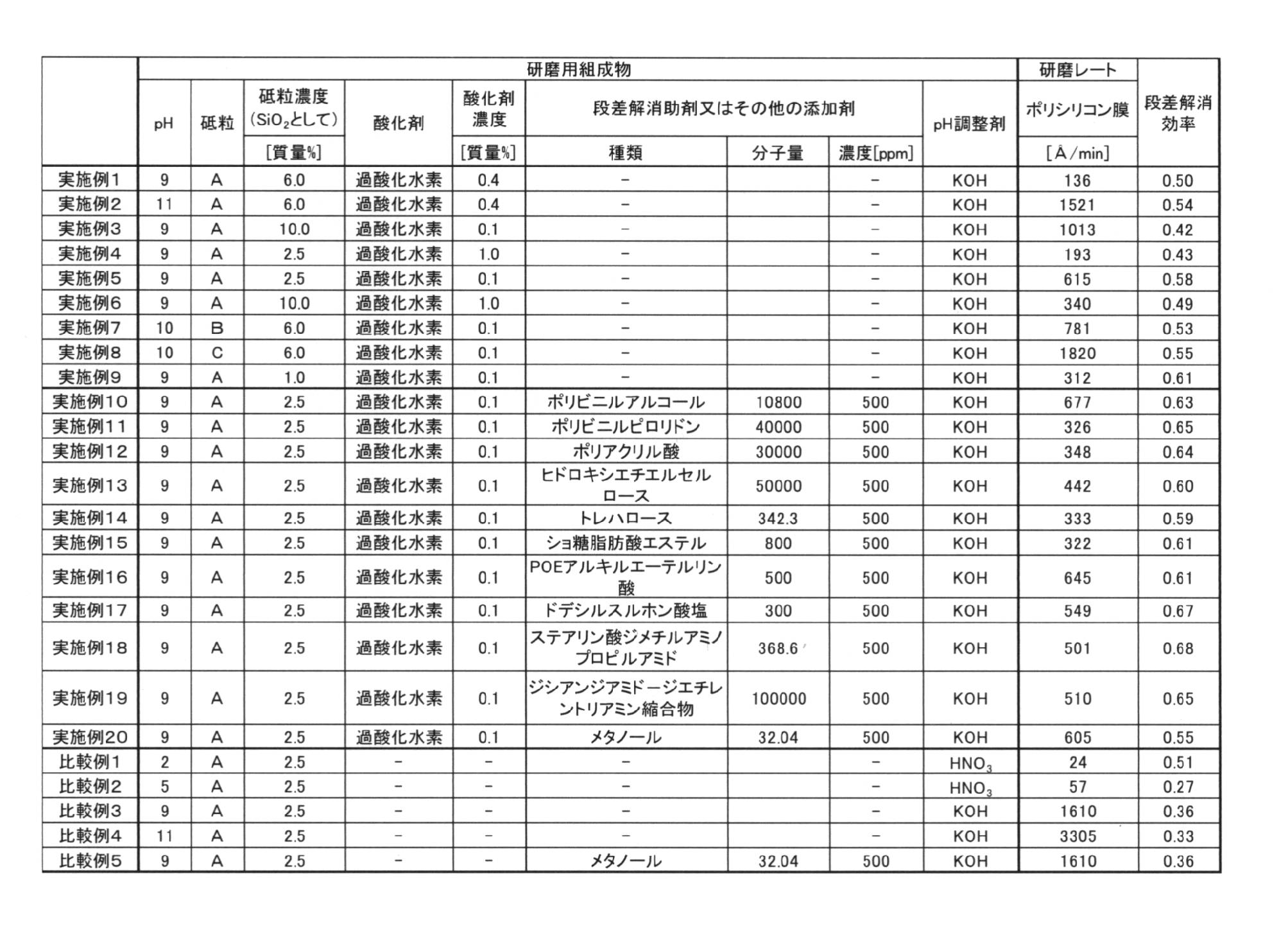
実施例1~9では、砥粒にpH調整剤及び水を添加し、さらに酸化剤を添加して研磨用組成物を調製した。実施例10~20においては、砥粒にpH調整剤及び水を添加し、さらに酸化剤及び段差解消助剤又はその他の添加剤を添加して研磨用組成物を調製した。比較例1~5では、砥粒にpH調整剤及び水を添加して研磨用組成物を調製した。各例の研磨用組成物中の成分の詳細、及び各例の研磨用組成物のpHを測定した結果を表1に示す。
実施例1~9では、砥粒にpH調整剤及び水を添加し、さらに酸化剤を添加して研磨用組成物を調製した。実施例10~20においては、砥粒にpH調整剤及び水を添加し、さらに酸化剤及び段差解消助剤又はその他の添加剤を添加して研磨用組成物を調製した。比較例1~5では、砥粒にpH調整剤及び水を添加して研磨用組成物を調製した。各例の研磨用組成物中の成分の詳細、及び各例の研磨用組成物のpHを測定した結果を表1に示す。
表1中、Aは、平均一次粒子径が30nmでかつ平均二次粒子径が62nmであるコロイダルシリカ、Bは、平均一次粒子径が10nmでかつ平均二次粒子径が25nmであるコロイダルシリカ、Cは、平均一次粒子径が90nmでかつ平均二次粒子径が180nmであるコロイダルシリカを示す。
表1中の分子量は、段差解消助剤又はその他の添加剤が、単量体の繰り返し構造を有するポリマーの場合、質量平均分子量を示す。
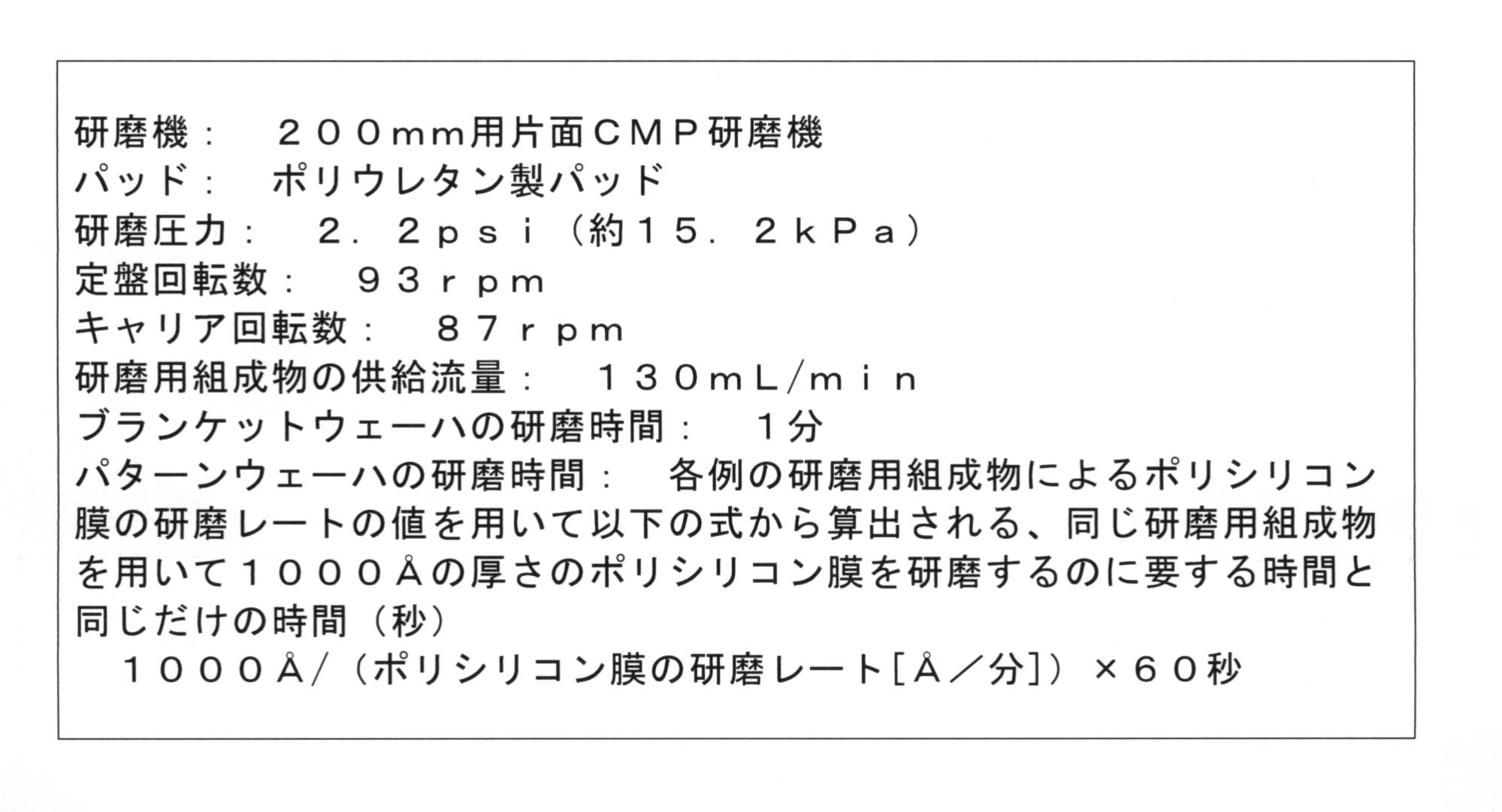
表1の“ポリシリコン膜の研磨レート”欄は、各例の研磨用組成物を用いて直径200mmのポリシリコン膜ブランケットウエハの表面を表2に示す条件で研磨したときのポリシリコン除去速度を示す。ポリシリコン除去速度の値は、大日本スクリーン製造株式会社の光干渉式膜厚測定装置“ラムダエースVM-2030”を使用して測定される研磨前後の各基板の厚さの差を研磨時間(60秒)で除することにより求めた。
表1の“ポリシリコン膜の研磨レート”欄は、各例の研磨用組成物を用いて直径200mmのポリシリコン膜ブランケットウエハの表面を表2に示す条件で研磨したときのポリシリコン除去速度を示す。ポリシリコン除去速度の値は、大日本スクリーン製造株式会社の光干渉式膜厚測定装置“ラムダエースVM-2030”を使用して測定される研磨前後の各基板の厚さの差を研磨時間(60秒)で除することにより求めた。
表1の“段差解消効率”欄は、直径200mmでかつ初期段差2000Åのポリシリコン膜パターンウエハの表面を、各例の研磨用組成物を用いて表2に示す条件で1000Åの厚さだけ研磨したときの段差解消効率を示す。段差解消効率の値は、初期段差と研磨後に残った段差との間の差である段差解消量(Å)を、研磨した厚さ(Å)(ここでは1000Å)で除することにより求めた。尚、段差は原子間力顕微鏡(AFM)を用いて測定した。
Claims (10)
- ポリシリコンを含む層を有する研磨対象物を研磨する用途で用いられ、砥粒及び酸化剤を含み、pHが6以上であることを特徴とする研磨用組成物。
- 前記砥粒がコロイダルシリカであることを特徴とする請求項1に記載の研磨用組成物。
- 前記砥粒の平均一次粒子径が5nm~400nmであることを特徴とする請求項1又は請求項2に記載の研磨用組成物。
- 前記酸化剤が過酸化物であることを特徴とする請求項1~3のいずれか1項に記載の研磨用組成物。
- さらに、分子量が100以上である、糖類、水溶性高分子、及び界面活性剤から選ばれる少なくとも1種の化合物を含有することを特徴とする請求項1~4のいずれか1項に記載の研磨用組成物。
- さらに、pH調整剤としてアルカリ金属の水酸化物を含有することを特徴とする請求項1~5のいずれか一項に記載の研磨用組成物。
- 前記研磨対象物は、表面に段差を有することを特徴とする請求項1~6のいずれか一項に記載の研磨用組成物。
- 研磨圧力15.2kPa、定盤回転数93rpmの研磨条件で、前記段差を有する研磨対象物の表面を研磨した際の段差解消効率が0.4以上であることを特徴とする請求項7に記載の研磨用組成物。
- 請求項1~8のいずれか1項に記載の研磨用組成物を用いて、ポリシリコンを含む層を有する研磨対象物を研磨することを特徴とする研磨方法。
- 請求項9に記載の研磨方法によってポリシリコンを含む層を有する基板を研磨する研磨工程を含むことを特徴とする基板の製造方法。
Applications Claiming Priority (4)
| Application Number | Priority Date | Filing Date | Title |
|---|---|---|---|
| JP2013-202461 | 2013-09-27 | ||
| JP2013202461 | 2013-09-27 | ||
| JP2014-052608 | 2014-03-14 | ||
| JP2014052608A JP2015086355A (ja) | 2013-09-27 | 2014-03-14 | 研磨用組成物、研磨方法、及び基板の製造方法 |
Publications (1)
| Publication Number | Publication Date |
|---|---|
| WO2015046015A1 true WO2015046015A1 (ja) | 2015-04-02 |
Family
ID=52743154
Family Applications (1)
| Application Number | Title | Priority Date | Filing Date |
|---|---|---|---|
| PCT/JP2014/074705 Ceased WO2015046015A1 (ja) | 2013-09-27 | 2014-09-18 | 研磨用組成物、研磨方法、及び基板の製造方法 |
Country Status (3)
| Country | Link |
|---|---|
| JP (1) | JP2015086355A (ja) |
| TW (1) | TWI647300B (ja) |
| WO (1) | WO2015046015A1 (ja) |
Cited By (1)
| Publication number | Priority date | Publication date | Assignee | Title |
|---|---|---|---|---|
| JP2018059054A (ja) * | 2016-09-29 | 2018-04-12 | 花王株式会社 | 研磨液組成物 |
Families Citing this family (3)
| Publication number | Priority date | Publication date | Assignee | Title |
|---|---|---|---|---|
| WO2018061365A1 (ja) * | 2016-09-28 | 2018-04-05 | 株式会社フジミインコーポレーテッド | 表面処理組成物 |
| US11492512B2 (en) | 2019-09-26 | 2022-11-08 | Fujimi Incorporated | Polishing composition and polishing method |
| JP7356932B2 (ja) | 2019-09-26 | 2023-10-05 | 株式会社フジミインコーポレーテッド | 研磨用組成物及び研磨方法 |
Citations (6)
| Publication number | Priority date | Publication date | Assignee | Title |
|---|---|---|---|---|
| WO2009037903A1 (ja) * | 2007-09-21 | 2009-03-26 | Hitachi Chemical Co., Ltd. | シリコン膜研磨用cmpスラリー及び研磨方法 |
| WO2010047314A1 (ja) * | 2008-10-20 | 2010-04-29 | ニッタ・ハース株式会社 | 窒化ケイ素研磨用組成物およびこれを用いた選択比の制御方法 |
| WO2012026329A1 (ja) * | 2010-08-23 | 2012-03-01 | 株式会社 フジミインコーポレーテッド | 研磨用組成物及びそれを用いた研磨方法 |
| JP2013074036A (ja) * | 2011-09-27 | 2013-04-22 | Toshiba Corp | Cmp用スラリーおよび半導体装置の製造方法 |
| WO2013077368A1 (ja) * | 2011-11-25 | 2013-05-30 | 株式会社 フジミインコーポレーテッド | 研磨用組成物 |
| JP2013138053A (ja) * | 2011-12-28 | 2013-07-11 | Fujimi Inc | 研磨用組成物 |
Family Cites Families (10)
| Publication number | Priority date | Publication date | Assignee | Title |
|---|---|---|---|---|
| JP4052607B2 (ja) * | 1998-04-20 | 2008-02-27 | 株式会社東芝 | 研磨剤及び半導体基板のポリッシング方法 |
| JP2001077060A (ja) * | 1999-09-08 | 2001-03-23 | Toshiba Corp | 半導体装置の製造方法 |
| JP2002110596A (ja) * | 2000-10-02 | 2002-04-12 | Mitsubishi Electric Corp | 半導体加工用研磨剤およびこれに用いる分散剤、並びに上記半導体加工用研磨剤を用いた半導体装置の製造方法 |
| JP2007103515A (ja) * | 2005-09-30 | 2007-04-19 | Fujimi Inc | 研磨方法 |
| JP2008182181A (ja) * | 2006-12-27 | 2008-08-07 | Hitachi Chem Co Ltd | 研磨用組成物 |
| JP5441358B2 (ja) * | 2008-05-28 | 2014-03-12 | 富士フイルム株式会社 | 研磨液及び研磨方法 |
| JP5441362B2 (ja) * | 2008-05-30 | 2014-03-12 | 富士フイルム株式会社 | 研磨液及び研磨方法 |
| KR101094662B1 (ko) * | 2008-07-24 | 2011-12-20 | 솔브레인 주식회사 | 폴리실리콘 연마정지제를 함유하는 화학 기계적 연마조성물 |
| JP5554121B2 (ja) * | 2010-03-31 | 2014-07-23 | 富士フイルム株式会社 | 研磨液及び研磨方法 |
| JP2014099581A (ja) * | 2012-04-27 | 2014-05-29 | Hitachi Chemical Co Ltd | スラリー、研磨液セット、研磨液、基体の研磨方法及び基体 |
-
2014
- 2014-03-14 JP JP2014052608A patent/JP2015086355A/ja active Pending
- 2014-09-18 WO PCT/JP2014/074705 patent/WO2015046015A1/ja not_active Ceased
- 2014-09-23 TW TW103132790A patent/TWI647300B/zh active
Patent Citations (6)
| Publication number | Priority date | Publication date | Assignee | Title |
|---|---|---|---|---|
| WO2009037903A1 (ja) * | 2007-09-21 | 2009-03-26 | Hitachi Chemical Co., Ltd. | シリコン膜研磨用cmpスラリー及び研磨方法 |
| WO2010047314A1 (ja) * | 2008-10-20 | 2010-04-29 | ニッタ・ハース株式会社 | 窒化ケイ素研磨用組成物およびこれを用いた選択比の制御方法 |
| WO2012026329A1 (ja) * | 2010-08-23 | 2012-03-01 | 株式会社 フジミインコーポレーテッド | 研磨用組成物及びそれを用いた研磨方法 |
| JP2013074036A (ja) * | 2011-09-27 | 2013-04-22 | Toshiba Corp | Cmp用スラリーおよび半導体装置の製造方法 |
| WO2013077368A1 (ja) * | 2011-11-25 | 2013-05-30 | 株式会社 フジミインコーポレーテッド | 研磨用組成物 |
| JP2013138053A (ja) * | 2011-12-28 | 2013-07-11 | Fujimi Inc | 研磨用組成物 |
Cited By (1)
| Publication number | Priority date | Publication date | Assignee | Title |
|---|---|---|---|---|
| JP2018059054A (ja) * | 2016-09-29 | 2018-04-12 | 花王株式会社 | 研磨液組成物 |
Also Published As
| Publication number | Publication date |
|---|---|
| JP2015086355A (ja) | 2015-05-07 |
| TWI647300B (zh) | 2019-01-11 |
| TW201522596A (zh) | 2015-06-16 |
Similar Documents
| Publication | Publication Date | Title |
|---|---|---|
| JP6762390B2 (ja) | 研磨用組成物、研磨方法および基板の製造方法 | |
| TWI719144B (zh) | 研磨用組成物及使用其之研磨方法 | |
| JP6697362B2 (ja) | 表面処理組成物、ならびにこれを用いた表面処理方法および半導体基板の製造方法 | |
| KR20120024881A (ko) | 연마제, 농축 1액식 연마제, 2액식 연마제 및 기판의 연마 방법 | |
| JP6957265B2 (ja) | 研磨液組成物 | |
| JP6350861B2 (ja) | コロイダルシリカ及びそれを含有する半導体ウエハ研磨用組成物 | |
| KR102288638B1 (ko) | 벌크 루테늄 화학 기계적 연마 조성물 | |
| KR102617007B1 (ko) | 기판의 연마 방법 및 연마용 조성물 세트 | |
| WO2015052988A1 (ja) | 研磨剤、研磨剤セット及び基体の研磨方法 | |
| KR20170063563A (ko) | 연마용 조성물 및 그것을 사용한 연마 방법 | |
| WO2015046015A1 (ja) | 研磨用組成物、研磨方法、及び基板の製造方法 | |
| WO2017061229A1 (ja) | 研磨用組成物およびこれを用いた研磨方法、ならびにこれらを用いた研磨済研磨対象物の製造方法 | |
| JP2024505893A (ja) | ホウ素ドープポリシリコンを研磨するための組成物及び方法 | |
| TWI652336B (zh) | Sapphire plate slurry composition | |
| TW202421735A (zh) | 具有含硫陰離子界面活性劑之鎢之化學機械拋光(cmp)組合物 | |
| JP6936316B2 (ja) | タングステンのための化学機械研磨法 | |
| KR20230141516A (ko) | 연마용 조성물, 연마 방법 및 반도체 기판의 제조 방법 | |
| TW202330820A (zh) | 包含改質聚乙烯醇組成物之研磨用組成物之製造方法及包含改質聚乙烯醇組成物之研磨用組成物 | |
| TWI743213B (zh) | 研磨液組合物 | |
| TWI874442B (zh) | 研磨用組成物 | |
| TW202534137A (zh) | 研磨用組合物 | |
| KR20230141966A (ko) | 표면 처리 조성물 | |
| WO2015096627A1 (zh) | 一种化学机械抛光液及使用方法 | |
| JP2023093850A (ja) | 化学機械研磨用組成物および研磨方法 | |
| WO2006125371A1 (fr) | Suspension de polissage |
Legal Events
| Date | Code | Title | Description |
|---|---|---|---|
| 121 | Ep: the epo has been informed by wipo that ep was designated in this application |
Ref document number: 14848586 Country of ref document: EP Kind code of ref document: A1 |
|
| NENP | Non-entry into the national phase |
Ref country code: DE |
|
| 122 | Ep: pct application non-entry in european phase |
Ref document number: 14848586 Country of ref document: EP Kind code of ref document: A1 |