WO2015037261A1 - ゴムウエットマスターバッチの製造方法 - Google Patents
ゴムウエットマスターバッチの製造方法 Download PDFInfo
- Publication number
- WO2015037261A1 WO2015037261A1 PCT/JP2014/056944 JP2014056944W WO2015037261A1 WO 2015037261 A1 WO2015037261 A1 WO 2015037261A1 JP 2014056944 W JP2014056944 W JP 2014056944W WO 2015037261 A1 WO2015037261 A1 WO 2015037261A1
- Authority
- WO
- WIPO (PCT)
- Prior art keywords
- rubber
- filler
- carbon black
- rubber latex
- solution
- Prior art date
- Legal status (The legal status is an assumption and is not a legal conclusion. Google has not performed a legal analysis and makes no representation as to the accuracy of the status listed.)
- Ceased
Links
Classifications
-
- C—CHEMISTRY; METALLURGY
- C08—ORGANIC MACROMOLECULAR COMPOUNDS; THEIR PREPARATION OR CHEMICAL WORKING-UP; COMPOSITIONS BASED THEREON
- C08J—WORKING-UP; GENERAL PROCESSES OF COMPOUNDING; AFTER-TREATMENT NOT COVERED BY SUBCLASSES C08B, C08C, C08F, C08G or C08H
- C08J3/00—Processes of treating or compounding macromolecular substances
- C08J3/20—Compounding polymers with additives, e.g. colouring
- C08J3/22—Compounding polymers with additives, e.g. colouring using masterbatch techniques
-
- B—PERFORMING OPERATIONS; TRANSPORTING
- B60—VEHICLES IN GENERAL
- B60C—VEHICLE TYRES; TYRE INFLATION; TYRE CHANGING; CONNECTING VALVES TO INFLATABLE ELASTIC BODIES IN GENERAL; DEVICES OR ARRANGEMENTS RELATED TO TYRES
- B60C1/00—Tyres characterised by the chemical composition or the physical arrangement or mixture of the composition
-
- C—CHEMISTRY; METALLURGY
- C08—ORGANIC MACROMOLECULAR COMPOUNDS; THEIR PREPARATION OR CHEMICAL WORKING-UP; COMPOSITIONS BASED THEREON
- C08J—WORKING-UP; GENERAL PROCESSES OF COMPOUNDING; AFTER-TREATMENT NOT COVERED BY SUBCLASSES C08B, C08C, C08F, C08G or C08H
- C08J3/00—Processes of treating or compounding macromolecular substances
- C08J3/20—Compounding polymers with additives, e.g. colouring
- C08J3/205—Compounding polymers with additives, e.g. colouring in the presence of a continuous liquid phase
- C08J3/21—Compounding polymers with additives, e.g. colouring in the presence of a continuous liquid phase the polymer being premixed with a liquid phase
- C08J3/215—Compounding polymers with additives, e.g. colouring in the presence of a continuous liquid phase the polymer being premixed with a liquid phase at least one additive being also premixed with a liquid phase
-
- C—CHEMISTRY; METALLURGY
- C08—ORGANIC MACROMOLECULAR COMPOUNDS; THEIR PREPARATION OR CHEMICAL WORKING-UP; COMPOSITIONS BASED THEREON
- C08L—COMPOSITIONS OF MACROMOLECULAR COMPOUNDS
- C08L21/00—Compositions of unspecified rubbers
-
- C—CHEMISTRY; METALLURGY
- C08—ORGANIC MACROMOLECULAR COMPOUNDS; THEIR PREPARATION OR CHEMICAL WORKING-UP; COMPOSITIONS BASED THEREON
- C08L—COMPOSITIONS OF MACROMOLECULAR COMPOUNDS
- C08L7/00—Compositions of natural rubber
-
- C—CHEMISTRY; METALLURGY
- C08—ORGANIC MACROMOLECULAR COMPOUNDS; THEIR PREPARATION OR CHEMICAL WORKING-UP; COMPOSITIONS BASED THEREON
- C08J—WORKING-UP; GENERAL PROCESSES OF COMPOUNDING; AFTER-TREATMENT NOT COVERED BY SUBCLASSES C08B, C08C, C08F, C08G or C08H
- C08J2307/00—Characterised by the use of natural rubber
- C08J2307/02—Latex
-
- C—CHEMISTRY; METALLURGY
- C08—ORGANIC MACROMOLECULAR COMPOUNDS; THEIR PREPARATION OR CHEMICAL WORKING-UP; COMPOSITIONS BASED THEREON
- C08J—WORKING-UP; GENERAL PROCESSES OF COMPOUNDING; AFTER-TREATMENT NOT COVERED BY SUBCLASSES C08B, C08C, C08F, C08G or C08H
- C08J2321/00—Characterised by the use of unspecified rubbers
- C08J2321/02—Latex
-
- C—CHEMISTRY; METALLURGY
- C08—ORGANIC MACROMOLECULAR COMPOUNDS; THEIR PREPARATION OR CHEMICAL WORKING-UP; COMPOSITIONS BASED THEREON
- C08K—Use of inorganic or non-macromolecular organic substances as compounding ingredients
- C08K2201/00—Specific properties of additives
- C08K2201/002—Physical properties
- C08K2201/006—Additives being defined by their surface area
Definitions
- the present invention was obtained by using a rubber wet masterbatch obtained by using at least a filler, a dispersion solvent, and a rubber latex solution as a raw material and a production method thereof, a rubber composition containing the rubber wet masterbatch, and a rubber composition.
- a rubber wet masterbatch obtained by using at least a filler, a dispersion solvent, and a rubber latex solution as a raw material and a production method thereof, a rubber composition containing the rubber wet masterbatch, and a rubber composition.
- a rubber wet masterbatch obtained by using at least a filler, a dispersion solvent, and a rubber latex solution as a raw material and a production method thereof, a rubber composition containing the rubber wet masterbatch, and a rubber composition.
- a rubber wet masterbatch When using a rubber wet masterbatch, compared to using a rubber dry masterbatch obtained by mixing the filler and rubber in a solid phase, the dispersibility of the filler is excellent, and rubber properties such as workability and reinforcement A rubber composition having excellent resistance is obtained.
- a rubber composition as a raw material, for example, a rubber product such as a pneumatic tire with reduced rolling resistance and excellent fatigue resistance can be manufactured.
- premixed filler 1 in a filler-containing rubber composition, is obtained by premixing 100 parts by mass of a diene rubber, 80% by mass or more of hard grade carbon black, and 20% by mass or less of other fillers.
- the average particle size of the primary aggregate of the carbon black is set to 0 of the average particle size of the primary aggregate of hard grade carbon black. The technology of making it 7 times or less is described.
- Patent Document 1 aims to improve both mechanical properties and viscoelastic properties of vulcanized rubber by using two types of carbon black having different average particle sizes.
- the manufacturing process is not necessarily devised to improve the dispersibility of each carbon black.
- the present invention has been made in view of the above circumstances, and its object is to provide a rubber wet masterbatch that is a raw material for vulcanized rubber having a well-balanced improvement in both low heat generation performance and fatigue resistance performance, a method for producing the same, and a rubber composition.
- the object is to provide a pneumatic tire.
- the present invention is a method for producing a rubber wet masterbatch obtained using at least a filler, a dispersion solvent, and a rubber latex solution as raw materials, and the filler is dispersed in the dispersion solvent to obtain a filler-containing slurry solution.
- Step (I) for producing Step (II) for producing a filler-containing rubber latex solution by mixing the filler-containing slurry solution and the rubber latex solution, and coagulating and drying the filler-containing rubber latex solution
- the dispersion solvent in the step (I) includes two kinds of fillers composed of carbon black B exhibiting N 2 SA- (B) which is lower than 25 m 2 / g
- the dispersion processing time (minutes) of the carbon blacks A and B is ⁇ (A) and ⁇ (B), respectively.
- carbon black A having at least a nitrogen adsorption specific surface area (N 2 SA- (A)) of 130 m 2 / g or less as a filler
- N 2 SA- (A) Two types of fillers composed of carbon black B exhibiting N 2 SA- (B) which is 25 m 2 / g or more lower than the above are used.
- Carbon black A mainly contributes to the improvement of the low heat generation performance of the vulcanized rubber
- carbon black B mainly contributes to the improvement of the fatigue resistance performance of the vulcanized rubber.
- the dispersion treatment time (minutes) of the carbon blacks A and B in the dispersion solvent is determined by dispersing ⁇ (A), ⁇ (B) and carbon blacks A and B, respectively.
- ⁇ (A), ⁇ (B) and carbon blacks A and B are the rotor rotation speeds (rpm) of the dispersion processor used during the dispersion process, respectively.
- rpm rotor rotation speeds
- the carbon black A and the carbon black B are separately dispersed so as to satisfy the relationship (1), and these are premixed after the treatment.
- the carbon black A-containing slurry solution and the carbon black B-containing slurry solution are premixed, and then the rubber latex solution is mixed in the step (II) to produce a filler-containing rubber latex solution.
- the heat generation performance of the vulcanized rubber is further improved.
- the filler to which rubber latex particles are adhered is added by adding at least a part of the rubber latex solution.
- a slurry solution containing the filler to which the rubber latex particles are adhered is produced by adding at least a part of the rubber latex solution (step) (I)-(a)).
- step) (I)-(a) a slurry solution containing the filler to which the rubber latex particles are adhered.
- the filler is uniformly dispersed and the re-aggregation of the dispersing material over time is also suppressed. Therefore, in a vulcanized rubber obtained using a rubber composition containing the raw material as a raw material, low heat generation performance and Fatigue resistance is significantly improved.
- the dispersibility of the filler in the slurry solution is excellent and the reaggregation of the filler is prevented as compared with the case where the slurry solution is produced simply by dispersing the filler in the dispersion solvent. Therefore, an effect that the storage stability of the slurry solution is excellent is also achieved.
- the present invention also relates to a rubber wet masterbatch produced by any one of the production methods described above and a rubber composition containing the rubber wet masterbatch.
- the rubber wet masterbatch has a structure that both carbon black A, which mainly contributes to the improvement of the low heat generation performance of the vulcanized rubber, and carbon black B, which mainly contributes to the improvement of the fatigue resistance performance of the vulcanized rubber, are destroyed. Not well dispersed. For this reason, the vulcanized rubber and the pneumatic tire of the rubber composition containing the rubber wet masterbatch are improved in a good balance between low heat generation performance and fatigue resistance.
- the present invention relates to a method for producing a rubber wet masterbatch obtained using at least a filler, a dispersion solvent, and a rubber latex solution as raw materials.
- the filler means an inorganic filler usually used in the rubber industry, such as carbon black, silica, clay, talc, calcium carbonate, magnesium carbonate, aluminum hydroxide.
- the nitrogen adsorption specific surface area (N 2 SA- (A)) and the carbon black A is not more than 130m 2 / g, N 2 SA- (A) 2 types of carbon black composed of carbon black B exhibiting N 2 SA- (B) lower by 25 m 2 / g or more.
- Carbon black A can be used without particular limitation as long as the nitrogen adsorption specific surface area (N 2 SA) is 130 m 2 / g or less.
- N220 N 2 SA; 119 m 2 / g) defined in ASTM D1765 N234 (N 2 SA; 126 m 2 / g), N330 (N 2 SA; 79 m 2 / g), N339 (N 2 SA; 93 m 2 / g), N550 (N 2 SA; 42 m 2 / g), N774 (N 2 SA; 27 m 2 / g).
- the carbon black B only needs to exhibit N 2 SA- (B) that is 25 m 2 / g or more higher than N 2 SA- (A) of the carbon black A. Carbon black can be arbitrarily selected.
- the amount of carbon black A is preferably 7 to 68 parts by weight, more preferably 12 to 48 parts by weight, based on 100 parts by weight of the rubber component.
- the amount of carbon black B is preferably 8 to 78 parts by mass, more preferably 12 to 58 parts by mass with respect to 100 parts by mass of the rubber component. .
- Carbon black A and carbon black B may be a granulated product or a non-granulated product which are granulated in the normal rubber industry in consideration of handling properties.
- the dispersion solvent it is particularly preferable to use water, but for example, water containing an organic solvent may be used.
- the rubber latex solution a natural rubber latex solution or a synthetic rubber latex solution can be used.
- the natural rubber latex solution is a natural product produced by the metabolic action of plants, and a natural rubber / water-based solution in which the dispersion solvent is water is particularly preferable.
- the natural rubber latex solution can be used without distinction such as concentrated latex and fresh latex called field latex.
- Examples of the synthetic rubber latex solution include those produced by emulsion polymerization of styrene-butadiene rubber, butadiene rubber, nitrile rubber, and chloroprene rubber.
- the filler is dispersed in the dispersion solvent to produce a filler-containing slurry solution (I), and the filler-containing slurry solution and the rubber latex solution are mixed to contain the filler.
- the dispersion treatment time (minutes) of the carbon blacks A and B in the dispersion solvent is dispersed in ⁇ (A) and ⁇ (B) and carbon blacks A and B, respectively.
- the rotor rotational speed (rpm) of the dispersion processor used during the dispersion treatment is ⁇ (A) and ⁇ (B)
- rpm rotor rotational speed
- 1.1 ⁇ (B) ⁇ ⁇ (B) ⁇ ⁇ (A) ⁇ ⁇ (A) ⁇ 1.5 ⁇ (B) ⁇ ⁇ (B) is satisfied in the dispersion solvent as long as the relationship is satisfied.
- the dispersion treatment time (minutes) of the carbon blacks A and B and the rotor rotation speed (rpm) of the dispersion treatment machine used during the dispersion treatment can be appropriately selected.
- Step (I) carbon black A and carbon black B are added to the slurry solution obtained by first performing the dispersion treatment of carbon black A in a dispersion solvent. You may adjust so that (1) may be satisfy
- step (I) carbon black A and carbon black B, and a dispersion solvent are mixed in the presence of a rubber latex solution.
- Carbon black using a dispersing machine such as a high shear mixer, a high shear mixer, or a homomixer is used.
- the method of dispersing is mentioned.
- the rotor rotation speed (rpm) of the disperser needs to be selected so as to satisfy (1).
- the "high shear mixer” is a mixer having a rotor and a stator, and the rotor rotates with a precise clearance between a rotor capable of high-speed rotation and a fixed stator.
- the clearance between the rotor and the stator is 0.8 mm or less and the circumferential speed of the rotor is 5 m / s or more.
- a commercial item can be used for such a high shear mixer, for example, “High Shear Mixer” manufactured by SILVERSON.
- the step (I) when the step (I) disperses the filler in the dispersion solvent, by adding at least a part of the rubber latex solution, the packing to which rubber latex particles are adhered is added.
- the step (I- (a)) and the step (II- (a)) will be described.
- Step (I- (a)) In the step (I- (a)), at least part of the rubber latex solution is added to disperse the dispersion material containing the carbon black (1) and the conductive filler (2) in the dispersion solvent. A slurry solution containing a filler having latex particles attached thereto is produced.
- the rubber latex solution may be mixed with a dispersion solvent in advance and then added with a filler to be dispersed.
- the filler may be added to the dispersion solvent, and then the filler may be dispersed in the dispersion solvent while adding the rubber latex solution at a predetermined addition rate, or the filler may be added to the dispersion solvent.
- the filler may be dispersed in a dispersion solvent while adding a certain amount of the rubber latex solution in several times.
- a slurry solution containing the filler having the rubber latex particles attached thereto can be produced.
- the amount of rubber latex solution added in step (I- (a)) is relative to the total amount of rubber latex solution used (total amount added in step (I- (a)) and step (II- (a))). 0.075 to 12% by mass is exemplified.
- the solid content (rubber) amount of the rubber latex solution to be added is preferably 0.25 to 15% by mass ratio with respect to the filler, and 0.5 to 6%. Preferably there is. Further, the solid content (rubber) concentration in the rubber latex solution to be added is preferably 0.2 to 5% by mass, and more preferably 0.25 to 1.5% by mass. In these cases, it is possible to produce a rubber wet masterbatch in which the degree of dispersion of the filler is increased while reliably attaching the rubber latex particles to the filler.
- a surfactant is used to improve the dispersibility of the filler. May be added.
- known surfactants in the rubber industry can be used, and examples thereof include nonionic surfactants, anionic surfactants, cationic surfactants, and amphoteric surfactants. It is done. Further, alcohol such as ethanol may be used instead of or in addition to the surfactant.
- a surfactant when a surfactant is used, there is a concern that the rubber properties of the final vulcanized rubber will deteriorate.
- the amount of the surfactant added is 100 parts by mass of the solid content (rubber) of the rubber latex solution. On the other hand, it is preferably 2 parts by mass or less, more preferably 1 part by mass or less, and substantially no surfactant is preferably used.
- the filler to which rubber latex particles are attached preferably has a 90% volume particle size ( ⁇ m) (“D90”) of 31 ⁇ m or more, and 35 ⁇ m. More preferably.
- D90 90% volume particle size
- the dispersibility of the filler in the slurry solution is excellent, and re-aggregation of the filler can be prevented, so that the storage stability of the slurry solution is excellent and the heat generation and durability of the final vulcanized rubber are excellent. Excellent in properties and rubber strength.
- step (II- (a)) the slurry solution and the remaining rubber latex solution are mixed to produce a filler-containing rubber latex solution to which rubber latex particles are adhered.
- the method of mixing the slurry solution and the remaining rubber latex solution in a liquid phase is not particularly limited. And a method of mixing using a general disperser such as a high-pressure homogenizer, an ultrasonic homogenizer, or a colloid mill. If necessary, the entire mixing system such as a disperser may be heated during mixing.
- the remaining rubber latex solution preferably has a higher solid content (rubber) concentration than the rubber latex solution added in the step (I- (a)) in consideration of the drying time and labor in the step (III).
- the solid (rubber) concentration is preferably 10 to 60% by mass, and more preferably 20 to 30% by mass.
- step (III) the filler-containing rubber latex solution is coagulated.
- the coagulation method include a method in which a coagulant is obtained by adding a coagulant to a carbon black-containing rubber latex solution to which rubber latex particles are adhered.
- acids such as formic acid and sulfuric acid usually used for coagulating rubber latex solutions
- salts such as sodium chloride
- step (III) the solidified product obtained in the solidification stage is separated from the solution (solid-liquid separation) and dried to produce a rubber wet masterbatch.
- the flocculant obtained may be collected and dried after containing a flocculant in the rubber latex solution containing filler.
- known rubber flocculant flocculants can be used without limitation, and specific examples thereof include cationic flocculants.
- Solid-liquid separation can be carried out by methods known to those skilled in the art, such as centrifugation and filtration.
- various drying devices such as an oven, a vacuum dryer, and an air dryer can be used.
- step (III) the obtained rubber wet masterbatch and various compounding ingredients are dry-mixed.
- usable compounding agents include sulfur vulcanizing agents, vulcanization accelerators, silica, silane coupling agents, zinc oxide, methylene acceptors and methylene donors, stearic acid, vulcanization accelerators, vulcanization
- the additives generally used in the rubber industry include retarders, organic peroxides, antioxidants, softeners such as wax and oil, and processing aids.
- Sulfur as the sulfur vulcanizing agent may be normal sulfur for rubber, and for example, powdered sulfur, precipitated sulfur, insoluble sulfur, highly dispersible sulfur and the like can be used.
- the sulfur content in the rubber composition according to the present invention is preferably 0.3 to 6 parts by mass with respect to 100 parts by mass of the rubber component. If the sulfur content is less than 0.3 parts by mass, the crosslinking density of the vulcanized rubber will be insufficient and the rubber strength will be reduced. If it exceeds 6.5 parts by mass, both heat resistance and durability will be improved. Getting worse.
- the sulfur content should be 1.5 to 5.5 parts by mass with respect to 100 parts by mass of the rubber component. Is more preferably 2.0 to 4.5 parts by mass.
- vulcanization accelerator As the vulcanization accelerator, sulfenamide vulcanization accelerator, thiuram vulcanization accelerator, thiazole vulcanization accelerator, thiourea vulcanization accelerator, guanidine vulcanization, which are usually used for rubber vulcanization. Vulcanization accelerators such as accelerators and dithiocarbamate vulcanization accelerators may be used alone or in admixture as appropriate.
- the content of the vulcanization accelerator is more preferably 1.0 to 5.0 parts by mass, and further preferably 1.5 to 4.0 parts by mass with respect to 100 parts by mass of the rubber component.
- an aromatic amine-based anti-aging agent an aromatic amine-based anti-aging agent, an amine-ketone-based anti-aging agent, a monophenol-based anti-aging agent, a bisphenol-based anti-aging agent, a polyphenol-based anti-aging agent, dithiocarbamic acid, which are usually used for rubber
- Anti-aging agents such as a salt-based anti-aging agent and a thiourea-based anti-aging agent may be used alone or in an appropriate mixture.
- the content of the anti-aging agent is more preferably 0.5 to 6.0 parts by mass, and still more preferably 1.0 to 4.5 parts by mass with respect to 100 parts by mass of the rubber component.
- a methylene acceptor and a methylene donor may be blended in order to improve adhesion to the tire belt.
- the hydroxyl group of the methylene acceptor and the methylene group of the methylene donor undergo a curing reaction, thereby improving the adhesion to other members. it can.
- a phenolic compound or a phenolic resin obtained by condensing a phenolic compound with formaldehyde is used.
- phenolic compounds include phenol, resorcin or alkyl derivatives thereof.
- Alkyl derivatives include methyl group derivatives such as cresol and xylenol, and derivatives with long chain alkyl groups such as nonylphenol and octylphenol.
- the phenol compound may contain an acyl group such as an acetyl group as a substituent.
- phenolic resins obtained by condensing phenolic compounds with formaldehyde include resorcin-formaldehyde resins, phenolic resins (phenol-formaldehyde resins), cresol resins (cresol-formaldehyde resins), and formaldehyde composed of a plurality of phenolic compounds. Resin etc. are included. These are uncured resins that have liquid or heat fluidity.
- the methylene acceptor is preferably resorcin or a resorcin derivative, and in particular, resorcin or resorcin -Alkylphenol-formalin resins are preferred.
- hexamethylenetetramine or melamine resin is used as the methylene donor.
- a melamine resin for example, methylol melamine, a partially etherified product of methylol melamine, a condensate of melamine, formaldehyde, and methanol is used, and among them, hexamethoxymethyl melamine is particularly preferable.
- the rubber wet masterbatch obtained in step (III) is excellent in dispersibility of carbon black A and carbon black B. Therefore, a pneumatic tire manufactured using this rubber composition, specifically a pneumatic tire using the rubber composition according to the present invention for tread rubber, side rubber, ply or belt coating rubber, or bead filler rubber Comprises a rubber part that is compatible with low heat generation performance and fatigue resistance.
- B 2,2,4-trimethyl-1,2-dihydroquinoline polymer “RD” (manufactured by Ouchi Shinsei Chemical Co., Ltd.), melting point 80-100 ° C. i) Sulfur, (manufactured by Tsurumi Chemical Co., Ltd.) j) Vulcanization accelerator (A) N-cyclohexyl-2-benzothiazolesulfenamide; “Sunseller CM” (manufactured by Sanshin Chemical Industry Co., Ltd.) (B) 1,3-diphenylguanidine; “Noxeller D” (manufactured by Ouchi Shinsei Chemical Co., Ltd.)
- the carbon black A-containing slurry solution produced in the step (I- (a)), the carbon black B-containing slurry solution, and the remaining natural rubber latex solution (so that the solid content (rubber) concentration is 25% by mass).
- a household mixer manufactured by SANYO conditions of the mixer: 11300 rpm, 30 minutes
- a natural rubber latex solution containing carbon black A / B with natural rubber latex particles adhered thereto was produced (step (II- (a))).
- step (III) To the natural rubber latex solution containing carbon black A / B to which the natural rubber latex particles produced in the step (II- (a)) are adhered, a 10% by weight aqueous solution of formic acid as a coagulant is added until pH 4 is reached, and the mixture is heated to 90 ° C. In a heated state, the carbon black A / B-containing natural rubber latex solution to which the natural rubber latex particles were adhered was coagulated (step (III)).
- step (III) Using SUS punching metal 2.0 ⁇ , 3.5P, the solidified product is separated from the solution by filtration and dried with a squeezer type single screw extruder (V-02) manufactured by Suehiro EPM. This produced a natural rubber wet masterbatch (step (III)).
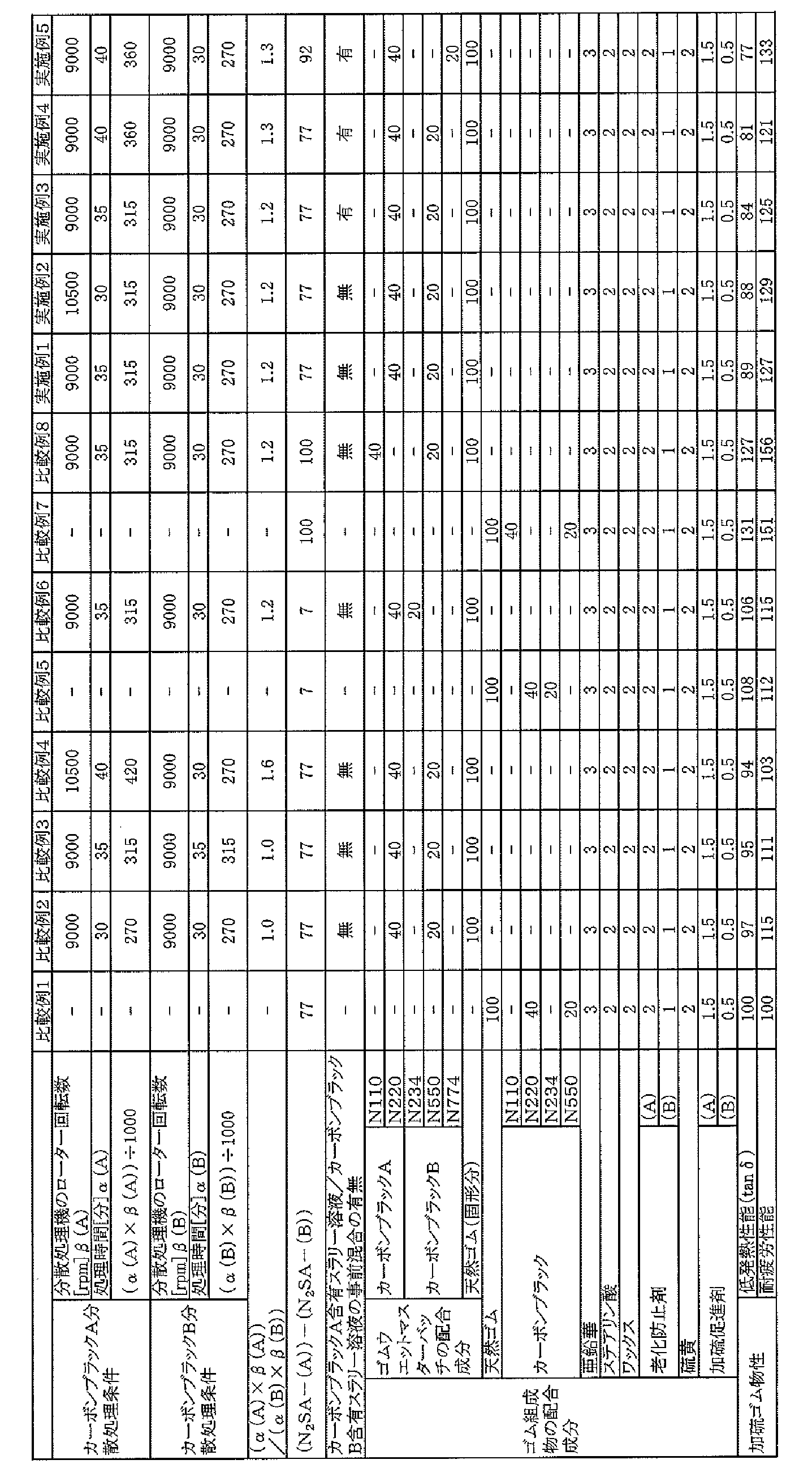
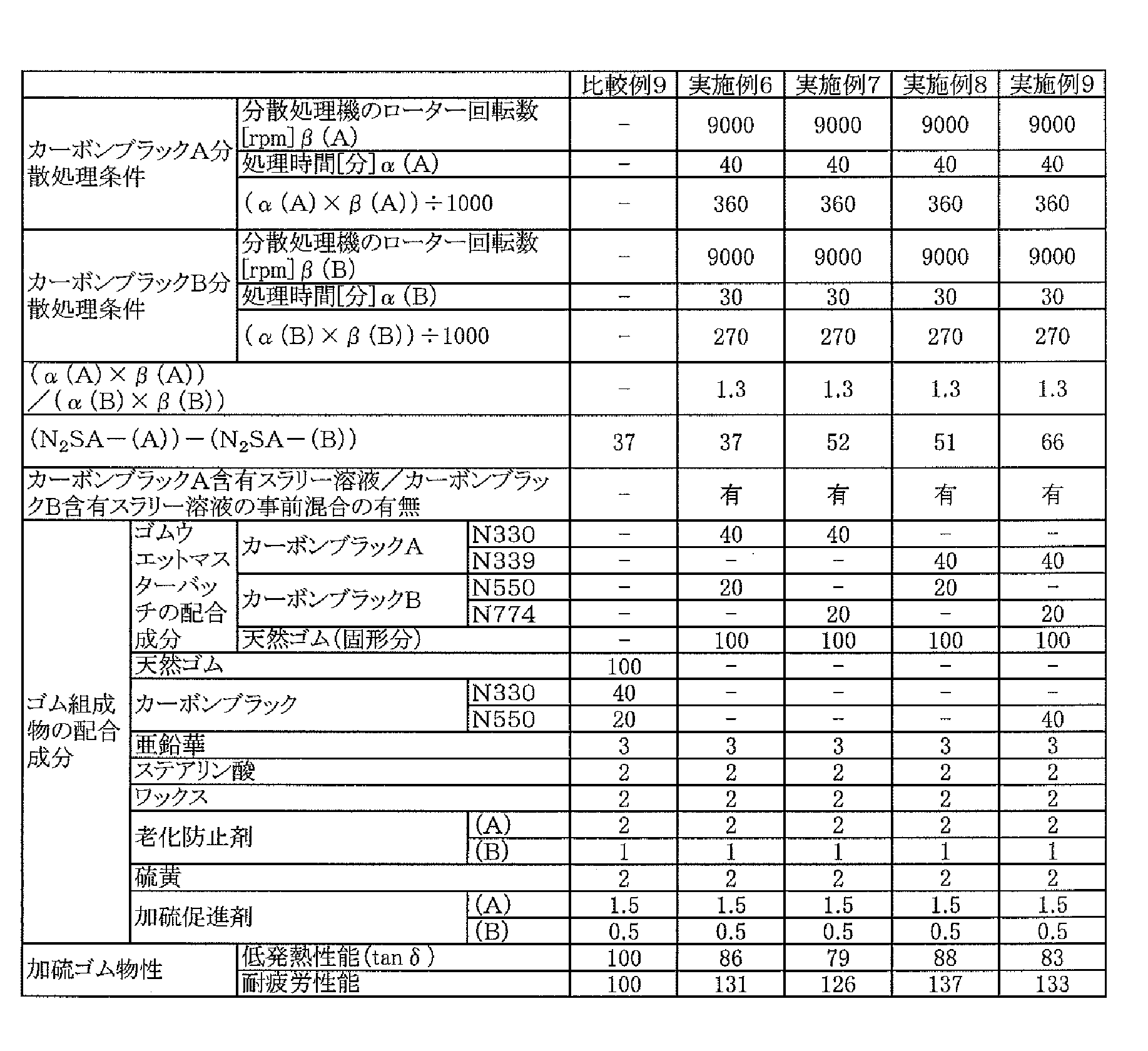
- Examples 3 to 9 Types of carbon blacks A and B, and dispersion processing time (minutes) of carbon blacks A and B ⁇ (A), ⁇ (B), rotor speed (rpm) ⁇ (A) of the dispersion processing machine used during the dispersion processing , ⁇ (B) are changed to those described in Tables 1 and 2, and the carbon black A-containing slurry solution and the carbon black B-containing slurry solution are preliminarily used using a household mixer manufactured by SANYO.
- Example 1 except that the mixture was mixed (conditions of the mixer: 11300 rpm, premixing time: 5 minutes), and then the rubber latex solution was mixed in the step (II) to produce a carbon black A / B-containing rubber latex solution.
- a rubber wet masterbatch was produced under the same conditions as those described above.
- the vulcanized rubber of the rubber composition containing the rubber wet masterbatch obtained by the production method according to Example 1-9 is excellent in low heat generation performance and fatigue resistance performance.
- Comparative Example 2 although carbon black A and carbon black B were dispersed under the same conditions, the dispersibility of carbon black A was insufficient, and the low heat generation performance and fatigue resistance performance were not improved.
- Comparative Example 3 carbon black A and carbon black B were dispersed under the same conditions. However, when the dispersion treatment time was set longer than in Comparative Example 2, the structure destruction of carbon black B progressed, so that vulcanization occurred. The fatigue resistance of rubber deteriorated.
- Comparative Example 4 since the carbon black A dispersion treatment conditions were too strong, the structure destruction of the carbon black A progressed, so that the fatigue resistance performance of the vulcanized rubber deteriorated.
- Comparative Example 6 since the difference in N 2 SA between carbon black A and carbon black B was less than 25, both the low heat generation performance and fatigue resistance of the vulcanized rubber were not improved.
- Comparative Example 8 since the N 2 SA of the carbon black A exceeded 130 m 2 / g, the low heat generation performance of the vulcanized rubber was greatly deteriorated.
Landscapes
- Chemical & Material Sciences (AREA)
- Health & Medical Sciences (AREA)
- Chemical Kinetics & Catalysis (AREA)
- Medicinal Chemistry (AREA)
- Polymers & Plastics (AREA)
- Organic Chemistry (AREA)
- Engineering & Computer Science (AREA)
- Mechanical Engineering (AREA)
- Compositions Of Macromolecular Compounds (AREA)
- Processes Of Treating Macromolecular Substances (AREA)
- Tires In General (AREA)
Abstract
Description
(i)カーボンブラックの窒素吸着比表面積(N2SA)と分散性との関係について検討した結果、N2SAが高いカーボンブラックは分散性が悪く、分散性を高めるために多くのエネルギーを要すること。
(ii)N2SAに差がある2種類のカーボンブラックを同一条件で分散処理を行うと、N2SAが高いカーボンブラックの分散不良、あるいはN2SAが低いカーボンブラックのストラクチャー破壊のいずれかが発生し、カーボンブラックの補強効果が低減すること。
本発明は、上記(i)および(ii)の知見に基づき完成されたものであり、下記構成を備える。
1.1α(B)×β(B)≦α(A)×β(A)≦1.5α(B)×β(B) (1)
である点が特徴である。
工程(I-(a))では、カーボンブラック(1)および導電性フィラー(2)を含む分散材を分散溶媒中に分散させる際に、ゴムラテックス溶液の少なくとも一部を添加することにより、ゴムラテックス粒子が付着した充填材を含有するスラリー溶液を製造する。ゴムラテックス溶液は、あらかじめ分散溶媒と混合した後、充填材を添加し、分散させても良い。また、分散溶媒中に充填材を添加し、次いで所定の添加速度で、ゴムラテックス溶液を添加しつつ、分散溶媒中で充填材を分散させても良く、あるいは分散溶媒中に充填材を添加し、次いで何回かに分けて一定量のゴムラテックス溶液を添加しつつ、分散溶媒中で充填材を分散させても良い。ゴムラテックス溶液が存在する状態で、分散溶媒中に充填材を分散させることにより、ゴムラテックス粒子が付着した充填材を含有するスラリー溶液を製造することができる。工程(I-(a))におけるゴムラテックス溶液の添加量としては、使用するゴムラテックス溶液の全量(工程(I-(a))および工程(II-(a))で添加する全量)に対して、0.075~12質量%が例示される。
工程(II-(a))では、スラリー溶液と、残りのゴムラテックス溶液とを混合して、ゴムラテックス粒子が付着した充填材含有ゴムラテックス溶液を製造する。スラリー溶液と、残りのゴムラテックス溶液とを液相で混合する方法は特に限定されるものではなく、スラリー溶液および残りのゴムラテックス溶液とを高せん断ミキサー、ハイシアーミキサー、ホモミキサー、ボールミル、ビーズミル、高圧ホモジナイザー、超音波ホモジナイザー、コロイドミルなどの一般的な分散機を使用して混合する方法が挙げられる。必要に応じて、混合の際に分散機などの混合系全体を加温してもよい。
工程(III)では、充填材含有ゴムラテックス溶液を凝固させる。凝固方法としては、ゴムラテックス粒子が付着したカーボンブラック含有ゴムラテックス溶液中に凝固剤を添加して凝固物を得る方法が挙げられる。
a)充填材
カーボンブラック「N110」;「シースト9」(東海カーボン社製)(N2SA 142m2/g)
カーボンブラック「N220」;「シースト6」(東海カーボン社製)(N2SA 119m2/g)
カーボンブラック「N234」;「シースト7HM」(東海カーボン社製)(N2SA 126m2/g)
カーボンブラック「N330」;「シースト3」(東海カーボン社製)(N2SA 79m2/g)
カーボンブラック「N339」:「シーストKH」(東海カーボン社製)(N2SA 93m2/g)
カーボンブラック「N550」;「シーストSO」(東海カーボン社製)(N2SA 42m2/g)
カーボンブラック「N774」;「シーストS」(東海カーボン社製)(N2SA 27m2/g)
b)分散溶媒 水
c)ゴムラテックス溶液
天然ゴムラテックス溶液(NR濃縮ラテックス);(レヂテックス社製)(DRC(Dry Rubber Content)=60%のものをゴム濃度が25質量%となるように調整、質量平均分子量Mw=23.6万)
天然ゴムラテックス溶液(NRフィールドラテックス);(Golden Hope社製)(DRC=31.2%のものをゴム濃度が25質量%となるように調整、質量平均分子量Mw=23.2万)
d)凝固剤 ギ酸(一級85%、10%溶液を希釈して、pH1.2に調整したもの);「ナカライテスク社製」
e)亜鉛華 亜鉛華3号;(三井金属社製)
f)ステアリン酸;(日油社製)
g)ワックス;(日本精蝋社製)
h)老化防止剤
(A)N-フェニル-N’-(1,3-ジメチルブチル)-p-フェニレンジアミン 「6PPD」、(モンサント社製)、融点44℃
(B)2,2,4-トリメチル-1,2-ジヒドロキノリン重合体「RD」、(大内新興化学工業社製)、融点80~100℃
i)硫黄、(鶴見化学工業社製)
j)加硫促進剤
(A)N-シクロヘキシル-2-ベンゾチアゾールスルフェンアミド;「サンセラーCM」、(三新化学工業社製)
(B)1,3-ジフェニルグアニジン;「ノクセラーD」、(大内新興化学工業社製)
0.5質量%に調整した希薄ラテックス水溶液にカーボンブラックAとして、「N220」40質量部を添加し、PRIMIX社製ロボミックスを使用して、カーボンブラックを分散させることにより(該ロボミックスの条件(β(A))=9000rpm、分散処理時間(分)α(A)=35分)、天然ゴムラテックス粒子が付着したカーボンブラックA含有スラリー溶液を製造した(工程(I-(a)))。別途、0.5質量%に調整した希薄ラテックス水溶液にカーボンブラックBとして、「N550」20質量部を添加し、PRIMIX社製ロボミックスを使用して、フィラーを分散させることにより(該ロボミックスの条件(β(B))=9000rpm、分散処理時間(分)α(B)=30分)、天然ゴムラテックス粒子が付着したカーボンブラックB含有スラリー溶液を製造した(工程(I-(a)))。
カーボンブラックA,Bの種類、およびカーボンブラックA,Bの分散処理時間(分)α(A),α(B)、分散処理時に使用する分散処理機のローター回転数(rpm)β(A),β(B)を表1,2に記載のものに記載のものに変更したこと以外は、実施例1と同じ条件でゴムウエットマスターバッチを製造した。
カーボンブラックA,Bの種類、およびカーボンブラックA,Bの分散処理時間(分)α(A),α(B)、分散処理時に使用する分散処理機のローター回転数(rpm)β(A),β(B)を表1,2に記載のものに記載のものに変更し、かつカーボンブラックA含有スラリー溶液とカーボンブラックB含有スラリー溶液とを、SANYO社製家庭用ミキサーを使用して事前混合し(該ミキサーの条件11300rpm、事前混合時間5分)、その後工程(II)においてゴムラテックス溶液とを混合して、カーボンブラックA/B含有ゴムラテックス溶液を製造したこと以外は、実施例1と同じ条件でゴムウエットマスターバッチを製造した。
ゴムウエットマスターバッチを製造して、これを原料としてゴム組成物を製造するのに代えて、表1,2に記載の各種配合剤を乾式混合によりゴム組成物を製造した。結果を表1,2に示す。
評価は、各ゴム組成物を所定の金型を使用して、150℃で30分間加熱、加硫して得られたゴムについて行った。
JIS K6265に準じて、製造した加硫ゴムの低発熱性能を、損失正接tanδにより評価した。UBM社製レオスペクトロメーターE4000を使用し、50Hz、80℃、動的歪2%の条件で測定した。評価は実施例1-5,比較例2-8は比較例1を100として指数評価し、実施例6-9は比較例9を100として指数評価した。数値が低いほど低発熱性能に優れることを意味する。結果を表1,2に示す。
JIS K6260に準じて、製造した加硫ゴムの耐疲労性能を評価した。評価は実施例1-5,比較例2-8は比較例1を100として指数評価し、実施例6-9は比較例9を100として指数評価した。数値が高いほど耐疲労性能に優れることを意味する。結果を表1,2に示す。
Claims (6)
- 少なくとも充填材、分散溶媒、およびゴムラテックス溶液を原料として得られるゴムウエットマスターバッチの製造方法であって、
前記充填材を前記分散溶媒中に分散させて充填材含有スラリー溶液を製造する工程(I)、前記充填材含有スラリー溶液と前記ゴムラテックス溶液とを混合して、充填材含有ゴムラテックス溶液を製造する工程(II)、および前記充填材含有ゴムラテックス溶液を凝固・乾燥させる工程(III)を有し、
前記充填材が、窒素吸着比表面積(N2SA-(A))が130m2/g以下であるカーボンブラックAと、前記N2SA-(A)よりも25m2/g以上低いN2SA-(B)を示すカーボンブラックBとからなる2種類の充填材を含み、
前記工程(I)における、前記分散溶媒中での前記カーボンブラックA,Bの分散処理時間(分)をそれぞれα(A),α(B)、前記カーボンブラックA,Bを分散させるに際し、分散処理時に使用する分散処理機のローター回転数(rpm)をそれぞれβ(A),β(B)としたとき、
1.1α(B)×β(B)≦α(A)×β(A)≦1.5α(B)×β(B) (1)
であることを特徴とするゴムウエットマスターバッチの製造方法。 - 工程(I)において、(1)の関係を満たすように、前記カーボンブラックAおよび前記カーボンブラックBの分散処理を別々に行い、処理後にこれらを事前混合する請求項1に記載のゴムウエットマスターバッチの製造方法。
- 前記工程(I)が、前記充填材を前記分散溶媒中に分散させる際に、前記ゴムラテックス溶液の少なくとも一部を添加することにより、ゴムラテックス粒子が付着した前記充填材を含有するスラリー溶液を製造する工程(I-(a))であり、
前記工程(II)が、ゴムラテックス粒子が付着した前記充填材を含有するスラリー溶液と、残りの前記ゴムラテックス溶液とを混合して、ゴムラテックス粒子が付着した前記充填材含有ゴムラテックス溶液を製造する工程(II-(a))である請求項1または2に記載のゴムウエットマスターバッチの製造方法。 - 請求項1~3のいずれかに記載の製造方法により製造されたゴムウエットマスターバッチ。
- 請求項4に記載のゴムウエットマスターバッチを含有するゴム組成物。
- 請求項5に記載のゴム組成物を用いて得られた空気入りタイヤ。
Priority Applications (3)
| Application Number | Priority Date | Filing Date | Title |
|---|---|---|---|
| DE112014004146.7T DE112014004146B4 (de) | 2013-09-10 | 2014-03-14 | Verfahren zur Herstellung eines nassen Kautschuk-Masterbatches, danach hergestellter nasser Kautschuk-Masterbatch, Kautschukzusammensetzung sowie Luftreifen |
| US14/912,255 US9896552B2 (en) | 2013-09-10 | 2014-03-14 | Method for producing rubber wet master batch |
| CN201480047404.4A CN105492506B (zh) | 2013-09-10 | 2014-03-14 | 橡胶湿法母炼胶的制造方法 |
Applications Claiming Priority (2)
| Application Number | Priority Date | Filing Date | Title |
|---|---|---|---|
| JP2013187396A JP6153257B2 (ja) | 2013-09-10 | 2013-09-10 | ゴムウエットマスターバッチの製造方法 |
| JP2013-187396 | 2013-09-10 |
Publications (1)
| Publication Number | Publication Date |
|---|---|
| WO2015037261A1 true WO2015037261A1 (ja) | 2015-03-19 |
Family
ID=52665388
Family Applications (1)
| Application Number | Title | Priority Date | Filing Date |
|---|---|---|---|
| PCT/JP2014/056944 Ceased WO2015037261A1 (ja) | 2013-09-10 | 2014-03-14 | ゴムウエットマスターバッチの製造方法 |
Country Status (6)
| Country | Link |
|---|---|
| US (1) | US9896552B2 (ja) |
| JP (1) | JP6153257B2 (ja) |
| CN (1) | CN105492506B (ja) |
| DE (1) | DE112014004146B4 (ja) |
| MY (1) | MY178259A (ja) |
| WO (1) | WO2015037261A1 (ja) |
Families Citing this family (8)
| Publication number | Priority date | Publication date | Assignee | Title |
|---|---|---|---|---|
| JP6195504B2 (ja) * | 2013-11-11 | 2017-09-13 | 東洋ゴム工業株式会社 | ゴム組成物 |
| JP6370631B2 (ja) * | 2014-08-04 | 2018-08-08 | 東洋ゴム工業株式会社 | ゴム組成物及び空気入りタイヤ |
| JP6800742B2 (ja) | 2016-12-27 | 2020-12-16 | Toyo Tire株式会社 | マスターバッチの製造方法およびタイヤの製造方法 |
| EP3632975B1 (en) * | 2017-06-01 | 2021-07-21 | The Yokohama Rubber Co., Ltd. | Rubber composition and pneumatic tire |
| JP7154008B2 (ja) * | 2017-12-26 | 2022-10-17 | Toyo Tire株式会社 | ゴム組成物および空気入りタイヤ |
| JP7022582B2 (ja) * | 2017-12-26 | 2022-02-18 | Toyo Tire株式会社 | ゴムウエットマスターバッチの製造方法、およびゴム組成物の製造方法 |
| US20200392310A1 (en) * | 2017-12-26 | 2020-12-17 | Toyo Tire Corporation | Rubber composition, pneumatic tire, method for producing rubber wet masterbatch, and method for producing rubber composition |
| JP7557696B2 (ja) | 2020-07-29 | 2024-09-30 | 住友ゴム工業株式会社 | 防舷材用ゴム組成物とそれを用いた防舷材 |
Citations (7)
| Publication number | Priority date | Publication date | Assignee | Title |
|---|---|---|---|---|
| JPS5927932A (ja) * | 1982-08-06 | 1984-02-14 | Bridgestone Corp | タイヤトレツド用ゴム組成物の製造法 |
| JPS5949247A (ja) * | 1982-09-14 | 1984-03-21 | Mitsubishi Chem Ind Ltd | タイヤトレッド用ゴム組成物の製造法 |
| JPH1095856A (ja) * | 1996-06-21 | 1998-04-14 | Goodyear Tire & Rubber Co:The | 2種の異なるカーボンブラックを含むシリカ充填ゴム組成物及び該組成物を使用して製造したタイヤ |
| JP2002256109A (ja) * | 2000-12-25 | 2002-09-11 | Yokohama Rubber Co Ltd:The | 充填剤含有ゴム組成物及びその製造方法 |
| JP2003026816A (ja) * | 2001-06-28 | 2003-01-29 | Pku Pulverkautschuk Union Gmbh | 自由流動性の微粒子状ゴム粉末の製造及び自由流動性ゴム/充填剤−バッチ |
| JP2009096981A (ja) * | 2007-09-28 | 2009-05-07 | Tokai Rubber Ind Ltd | 防振ゴム組成物の製法およびそれによって得られた防振ゴム組成物ならびに防振ゴム |
| JP2012197375A (ja) * | 2011-03-22 | 2012-10-18 | Toyo Tire & Rubber Co Ltd | 未加硫ゴム組成物およびその製造方法、ならびに空気入りタイヤ |
Family Cites Families (15)
| Publication number | Priority date | Publication date | Assignee | Title |
|---|---|---|---|---|
| EP1277797B1 (en) * | 1996-06-20 | 2005-04-13 | The Yokohama Rubber Co., Ltd. | Process for production of rubber composition |
| CN101213263B (zh) | 2005-05-16 | 2012-05-16 | 卡伯特公司 | 炭黑的共混物和包含该共混物的产品 |
| US7640957B2 (en) | 2005-09-23 | 2010-01-05 | The Goodyear Tire & Rubber Company | Tire with rubber tread highly loaded with a combination of filler reinforcement and oil |
| JP5129928B2 (ja) | 2006-01-30 | 2013-01-30 | 株式会社ブリヂストン | ゴムマスターバッチ及びその製造方法 |
| WO2011145586A1 (ja) | 2010-05-19 | 2011-11-24 | 株式会社ブリヂストン | ウエットマスターバッチの製造方法、ゴム組成物及びタイヤ |
| JP2012111888A (ja) | 2010-11-26 | 2012-06-14 | Sumitomo Rubber Ind Ltd | タイヤコードトッピング用ゴム組成物及び空気入りタイヤ |
| JP4738551B1 (ja) * | 2011-01-14 | 2011-08-03 | 東洋ゴム工業株式会社 | ゴムウエットマスターバッチおよびその製造方法、ゴム組成物ならびに空気入りタイヤ |
| JP2012158666A (ja) | 2011-01-31 | 2012-08-23 | Toyo Tire & Rubber Co Ltd | ゴム組成物およびその製造方法、ならびに空気入りタイヤ |
| JP4727766B1 (ja) * | 2011-03-07 | 2011-07-20 | 東洋ゴム工業株式会社 | 未加硫ゴム組成物およびその製造方法、ならびに空気入りタイヤ |
| JP5850778B2 (ja) | 2012-03-23 | 2016-02-03 | 東洋ゴム工業株式会社 | ゴム組成物およびその製造方法 |
| JP5445638B2 (ja) * | 2012-08-02 | 2014-03-19 | 横浜ゴム株式会社 | タイヤリムクッションまたはガムフィニッシング用ゴム組成物およびそれを用いた空気入りタイヤ |
| JP5946387B2 (ja) * | 2012-10-11 | 2016-07-06 | 東洋ゴム工業株式会社 | ゴムウエットマスターバッチ |
| JP5947192B2 (ja) * | 2012-11-08 | 2016-07-06 | 東洋ゴム工業株式会社 | ゴムウエットマスターバッチの製造方法およびゴムウエットマスターバッチ、ならびにゴムウエットマスターバッチを含有するゴム組成物 |
| JP6195504B2 (ja) * | 2013-11-11 | 2017-09-13 | 東洋ゴム工業株式会社 | ゴム組成物 |
| JP6370631B2 (ja) * | 2014-08-04 | 2018-08-08 | 東洋ゴム工業株式会社 | ゴム組成物及び空気入りタイヤ |
-
2013
- 2013-09-10 JP JP2013187396A patent/JP6153257B2/ja active Active
-
2014
- 2014-03-14 WO PCT/JP2014/056944 patent/WO2015037261A1/ja not_active Ceased
- 2014-03-14 US US14/912,255 patent/US9896552B2/en active Active
- 2014-03-14 MY MYPI2016700788A patent/MY178259A/en unknown
- 2014-03-14 DE DE112014004146.7T patent/DE112014004146B4/de not_active Expired - Fee Related
- 2014-03-14 CN CN201480047404.4A patent/CN105492506B/zh not_active Expired - Fee Related
Patent Citations (7)
| Publication number | Priority date | Publication date | Assignee | Title |
|---|---|---|---|---|
| JPS5927932A (ja) * | 1982-08-06 | 1984-02-14 | Bridgestone Corp | タイヤトレツド用ゴム組成物の製造法 |
| JPS5949247A (ja) * | 1982-09-14 | 1984-03-21 | Mitsubishi Chem Ind Ltd | タイヤトレッド用ゴム組成物の製造法 |
| JPH1095856A (ja) * | 1996-06-21 | 1998-04-14 | Goodyear Tire & Rubber Co:The | 2種の異なるカーボンブラックを含むシリカ充填ゴム組成物及び該組成物を使用して製造したタイヤ |
| JP2002256109A (ja) * | 2000-12-25 | 2002-09-11 | Yokohama Rubber Co Ltd:The | 充填剤含有ゴム組成物及びその製造方法 |
| JP2003026816A (ja) * | 2001-06-28 | 2003-01-29 | Pku Pulverkautschuk Union Gmbh | 自由流動性の微粒子状ゴム粉末の製造及び自由流動性ゴム/充填剤−バッチ |
| JP2009096981A (ja) * | 2007-09-28 | 2009-05-07 | Tokai Rubber Ind Ltd | 防振ゴム組成物の製法およびそれによって得られた防振ゴム組成物ならびに防振ゴム |
| JP2012197375A (ja) * | 2011-03-22 | 2012-10-18 | Toyo Tire & Rubber Co Ltd | 未加硫ゴム組成物およびその製造方法、ならびに空気入りタイヤ |
Also Published As
| Publication number | Publication date |
|---|---|
| US9896552B2 (en) | 2018-02-20 |
| MY178259A (en) | 2020-10-07 |
| CN105492506A (zh) | 2016-04-13 |
| JP2015054870A (ja) | 2015-03-23 |
| US20160208058A1 (en) | 2016-07-21 |
| DE112014004146B4 (de) | 2017-09-07 |
| CN105492506B (zh) | 2018-01-05 |
| JP6153257B2 (ja) | 2017-06-28 |
| DE112014004146T5 (de) | 2016-06-09 |
Similar Documents
| Publication | Publication Date | Title |
|---|---|---|
| JP6153257B2 (ja) | ゴムウエットマスターバッチの製造方法 | |
| JP6215005B2 (ja) | ゴム組成物の製造方法 | |
| JP4738551B1 (ja) | ゴムウエットマスターバッチおよびその製造方法、ゴム組成物ならびに空気入りタイヤ | |
| JP5946387B2 (ja) | ゴムウエットマスターバッチ | |
| JP5618878B2 (ja) | 未加硫ゴム組成物およびその製造方法、ならびに空気入りタイヤ | |
| JP6195504B2 (ja) | ゴム組成物 | |
| JP6116448B2 (ja) | ゴムウエットマスターバッチおよびその製造方法、ゴム組成物ならびに空気入りタイヤ | |
| JP7125883B2 (ja) | ゴムウエットマスターバッチの製造方法 | |
| WO2018123121A1 (ja) | ゴムウエットマスターバッチの製造方法 | |
| CN107955192B (zh) | 轮胎材料的制造方法 | |
| CN106459428B (zh) | 橡胶湿法母炼胶的制造方法 | |
| JP2013181051A (ja) | タイヤベーストレッド用ゴム組成物およびその製造方法、ならびに空気入りタイヤ | |
| JP6706050B2 (ja) | ゴムウエットマスターバッチおよびゴム組成物の製造方法 | |
| JP6120729B2 (ja) | ゴムウエットマスターバッチの製造方法 | |
| JP7023698B2 (ja) | 空気入りタイヤ用ゴム部材の製造方法および空気入りタイヤの製造方法 | |
| CN109923154B (zh) | 橡胶组合物及其制备方法 | |
| JP6959124B2 (ja) | ゴムウエットマスターバッチの製造方法 | |
| CN107955193B (zh) | 橡胶湿法母炼胶的制造方法 | |
| JP6328532B2 (ja) | ゴムウエットマスターバッチの製造方法 | |
| JP2019104859A (ja) | ゴムウエットマスターバッチの製造方法 | |
| JP2015030825A (ja) | ゴムウエットマスターバッチの製造方法 | |
| JP2020023645A (ja) | ゴム組成物の製造方法 | |
| WO2019116752A1 (ja) | ゴムウエットマスターバッチの製造方法、空気入りタイヤ用ゴム部材の製造方法および空気入りタイヤの製造方法 | |
| JP2019112524A (ja) | ゴムウエットマスターバッチ塊の脱水方法およびゴムウエットマスターバッチの製造方法 |
Legal Events
| Date | Code | Title | Description |
|---|---|---|---|
| WWE | Wipo information: entry into national phase |
Ref document number: 201480047404.4 Country of ref document: CN |
|
| 121 | Ep: the epo has been informed by wipo that ep was designated in this application |
Ref document number: 14844393 Country of ref document: EP Kind code of ref document: A1 |
|
| WWE | Wipo information: entry into national phase |
Ref document number: 14912255 Country of ref document: US |
|
| WWE | Wipo information: entry into national phase |
Ref document number: 112014004146 Country of ref document: DE Ref document number: 1120140041467 Country of ref document: DE |
|
| 122 | Ep: pct application non-entry in european phase |
Ref document number: 14844393 Country of ref document: EP Kind code of ref document: A1 |