WO2015030243A1 - ルテニウムおよびイリジウム回収用組成物、並びにルテニウムおよびイリジウムの回収方法 - Google Patents
ルテニウムおよびイリジウム回収用組成物、並びにルテニウムおよびイリジウムの回収方法 Download PDFInfo
- Publication number
- WO2015030243A1 WO2015030243A1 PCT/JP2014/072952 JP2014072952W WO2015030243A1 WO 2015030243 A1 WO2015030243 A1 WO 2015030243A1 JP 2014072952 W JP2014072952 W JP 2014072952W WO 2015030243 A1 WO2015030243 A1 WO 2015030243A1
- Authority
- WO
- WIPO (PCT)
- Prior art keywords
- iridium
- ruthenium
- iron
- mass
- content
- Prior art date
- Legal status (The legal status is an assumption and is not a legal conclusion. Google has not performed a legal analysis and makes no representation as to the accuracy of the status listed.)
- Ceased
Links
Images


Classifications
-
- C—CHEMISTRY; METALLURGY
- C22—METALLURGY; FERROUS OR NON-FERROUS ALLOYS; TREATMENT OF ALLOYS OR NON-FERROUS METALS
- C22B—PRODUCTION AND REFINING OF METALS; PRETREATMENT OF RAW MATERIALS
- C22B11/00—Obtaining noble metals
- C22B11/02—Obtaining noble metals by dry processes
- C22B11/021—Recovery of noble metals from waste materials
- C22B11/026—Recovery of noble metals from waste materials from spent catalysts
-
- C—CHEMISTRY; METALLURGY
- C22—METALLURGY; FERROUS OR NON-FERROUS ALLOYS; TREATMENT OF ALLOYS OR NON-FERROUS METALS
- C22B—PRODUCTION AND REFINING OF METALS; PRETREATMENT OF RAW MATERIALS
- C22B11/00—Obtaining noble metals
- C22B11/02—Obtaining noble metals by dry processes
- C22B11/021—Recovery of noble metals from waste materials
-
- C—CHEMISTRY; METALLURGY
- C22—METALLURGY; FERROUS OR NON-FERROUS ALLOYS; TREATMENT OF ALLOYS OR NON-FERROUS METALS
- C22B—PRODUCTION AND REFINING OF METALS; PRETREATMENT OF RAW MATERIALS
- C22B11/00—Obtaining noble metals
- C22B11/02—Obtaining noble metals by dry processes
- C22B11/021—Recovery of noble metals from waste materials
- C22B11/025—Recovery of noble metals from waste materials from manufactured products, e.g. from printed circuit boards, from photographic films, paper, or baths
-
- Y—GENERAL TAGGING OF NEW TECHNOLOGICAL DEVELOPMENTS; GENERAL TAGGING OF CROSS-SECTIONAL TECHNOLOGIES SPANNING OVER SEVERAL SECTIONS OF THE IPC; TECHNICAL SUBJECTS COVERED BY FORMER USPC CROSS-REFERENCE ART COLLECTIONS [XRACs] AND DIGESTS
- Y02—TECHNOLOGIES OR APPLICATIONS FOR MITIGATION OR ADAPTATION AGAINST CLIMATE CHANGE
- Y02P—CLIMATE CHANGE MITIGATION TECHNOLOGIES IN THE PRODUCTION OR PROCESSING OF GOODS
- Y02P10/00—Technologies related to metal processing
- Y02P10/20—Recycling
Definitions
- the present invention relates to a composition for recovering ruthenium and iridium, and a method for recovering ruthenium and iridium.
- Iridium and ruthenium belong to platinum group metals (hereinafter abbreviated as PGM), have high melting point, high corrosion resistance, and are useful as catalysts, and thus are industrially valuable metals. Since both iridium and ruthenium have a very high melting point of 2300 ° C. or higher, a metal solvent such as copper having a high solubility of iridium and ruthenium is used for the recovery.
- PGM platinum group metals
- the recovery rate of iridium and ruthenium can be increased by recovering iridium and ruthenium from a melt obtained by uniformly melting iridium and ruthenium in a metal solvent. Therefore, in order to know the performance as a metal solvent, the phase diagram of iridium and ruthenium and the metal solvent is important.
- Non-Patent Document 1 discloses an Fe—Ir binary system and an Fe—Ru binary system phase diagram as iridium, ruthenium and iron phase diagrams.
- Non-Patent Document 2 describes a ternary phase diagram of Cu—Ir—Ru, but the solubility of iridium and ruthenium in molten copper is low, and the amount of iridium and ruthenium that can be recovered at one time is low. Further improvement is desired.
- an object of the present invention is to provide a composition and a recovery method for economically recovering iridium and ruthenium with high purity.
- the present inventors use Fe as a metal solvent, determine a Fe—Ir—Ru ternary phase diagram, and from this Fe—Ir—Ru ternary phase diagram, a composition range in which iridium and ruthenium can be uniformly melted into molten iron The present invention was completed.
- the present invention is as follows. 1.
- y ⁇ ⁇ 1.64x + 47.73 (Formula 1) [Wherein y is the ruthenium content (mass%) with respect to the total amount of ruthenium, iridium and iron, x is the iridium content (mass%) with respect to the total amount of ruthenium, iridium and iron, and x> 0 and y> 0 It is. ] 2.
- a method for recovering ruthenium and iridium from a substance containing ruthenium and iridium comprising the following steps (1) to (3): (1) Step of preparing a recovery composition containing ruthenium, iridium and iron, and a content of the ruthenium and iridium satisfying the following formula 1 (2) The recovery composition prepared in the step (1) To obtain a melt obtained by melting ruthenium and iridium into iron (3) A step of separating ruthenium and / or iridium from the melt obtained in the step (2) y ⁇ ⁇ 1.64x + 47.
- FIG. 1 is a graph showing the relationship between the concentrations of iridium and ruthenium in the liquid phase (iron).
- 2A and 2B are EPMA structure observation photographs of the samples of Examples 1 and 3, respectively.
- FIG. 2C is a EPMA structure observation photograph of the sample of Comparative Example 3.
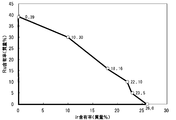
- FIG. 3 is a diagram showing the relationship between the concentrations of iridium and ruthenium in the liquid phase (iron) in the uniform melt range.
- FIG. 1 is a graph showing the relationship between the concentrations of iridium and ruthenium in the liquid phase (iron).
- this relationship can be expressed by the following formula 1.
- y is the ruthenium content (mass%) with respect to the total amount of ruthenium, iridium and iron
- x is the iridium content (mass%) with respect to the total amount of ruthenium, iridium and iron
- the range (Liquid) that satisfies Formula 1 indicates the uniform melt range. It can be seen that the ruthenium concentration in the liquid phase monotonously decreases as the iridium concentration in the liquid phase increases, and the linear function (Equation 1) can be derived by regression analysis.
- a uniform melt of iridium and ruthenium can be prepared by adjusting the amount of iridium and ruthenium in the molten iron so as to satisfy the above formula 1, and the recovery method described below can be applied to make iridium and ruthenium highly economical. Can be recovered automatically.
- the method includes the following steps (1) to (3).
- Step of preparing a recovery composition containing ruthenium, iridium and iron, and a content of the ruthenium and iridium satisfying the following formula 1 (2)
- the recovery composition prepared in the step (1) To obtain a melt obtained by melting ruthenium and iridium into iron (3)
- a step of separating ruthenium and / or iridium from the melt obtained in the step (2) y ⁇ ⁇ 1.64x + 47.
- Iridium and ruthenium belong to PGM, have a high melting point and high corrosion resistance, are useful as catalysts, and have high industrial value. Therefore, there is a strong demand for reuse in the industry.
- the material containing iridium and ruthenium to be recovered is not particularly limited.
- the metal is contained in an electronic material, polishing / cutting waste generated during manufacture of a target used for sputtering, a used target after sputtering, and a target device. And a catalyst used for exhaust gas purification, chemical synthesis, and the like.
- the material containing iridium and ruthenium is pulverized, and recovered from these materials by adjusting the amount of ruthenium, iridium and iron within the range represented by the formula 1.
- a composition can be prepared.
- the recovery composition prepared in the step (1) of the present invention is heated in the subsequent step (2) to melt ruthenium and iridium into iron.
- the heating temperature at this time is preferably 1550 ° C. or higher, more preferably 1550 to 1700 ° C., and particularly preferably 1550 to 1650 ° C. for the reason of uniformly melting iridium and ruthenium in the molten iron.
- ruthenium and / or iridium are separated in the subsequent step (3).
- Separation methods include, for example, a method in which a molten solid in a melt is dissolved in aqua regia, etc., and an iron solution and ruthenium and iridium are separated, and a molten solid in a melt is wet-dissolved in an acidic liquid such as hydrochloric acid / chlorine.
- the recovery method include wet extraction such as a method in which each of iron, ruthenium and iridium is collected and separated as a solid or liquid by solvent extraction, solid-liquid separation by reduction, electrolysis or separation by an adsorbent from the solution.
- Examples 1 to 11, Comparative Examples 1 to 4 and Reference Examples 1 to 4 Ruthenium powder, iridium powder and iron powder were weighed and blended so as to have the composition shown in Table 1. The total amount of the sample was 5 g.
- the blended sample was placed in an Al 2 O 3 crucible and held at various temperatures shown in Table 1 for 24 hours in an electric furnace, and then a melt in which ruthenium and iridium were melted into iron was obtained.
- the melt was taken out from the electric furnace, and in the atmosphere, argon gas was blown directly onto the melt at 2 to 3 (L / min), cooled to about 600 ° C. or less, and then allowed to cool to room temperature in the atmosphere. The structure was observed after cooling. The tissue observation was performed using EPMA (Electron Probe Micro Analyzer).
- FIG. 1 is a graph showing plots and Formula 1 for each data of the above Examples, Comparative Examples, and Reference Examples.
- the obtained discriminant is an equation indicating that the evaluation of the tissue observation is “good” when Y ⁇ 0 and the evaluation of the tissue observation becomes “x” when Y ⁇ 0. That is, in Y ⁇ 0 for obtaining the effect of the present invention, a functional expression of the iridium content and the ruthenium content is expressed by the following expression 3. 0 ⁇ ⁇ 0.1173X 1 + ( ⁇ 0.0715) X 2 +3.4128 (Formula 3)
- the contents of iridium and ruthenium are set to Ir 0 mass% and Ru 39 mass%.
- Point 1 Ir 10 mass% and Ru 30 mass% point 2, Ir 18 mass% and Ru 16 mass% point 3, Ir 22 mass% and Ru 10 mass% point 4, Ir 23 mass% and Ru 5 mass% point 5, Ir 26 mass It can also be said that this is achieved by setting the area surrounded by the point 6 and the origin of% and Ru 0 mass% (except for the point where Ir and / or Ru is 0 mass%).
- Example 12 The uniformly melted solid of ruthenium, iridium and iron obtained in Example 1 was dissolved in 10 times the volume of aqua regia to obtain a liquid containing iron, ruthenium and iridium. The liquefaction rate of the uniformly molten solid was 95%. Liquefied ruthenium and iridium were separated and recovered as ruthenium and iridium by conventional methods such as solvent extraction, solid-liquid separation by reduction, separation by electrolysis and adsorbent, and the like.
- Comparative Example 5 A test was conducted in the same manner as in Example 12 except that the heterogeneous molten solid of ruthenium, iridium and iron obtained in Comparative Example 3 was used. The liquefaction rate of iridium and ruthenium in the heterogeneous molten solid was 70%. It was.
- Example 13 To the composition described in Example 1, 10% by mass of aluminum oxide (hereinafter referred to as “alumina”) powder is added to the total mass of the composition, and when the melt is taken out from the electric furnace, the upper alumina solid and the lower layer The test was performed in the same manner as in Example 1 except that the melt was separated and the melt was taken out. As a result, it was confirmed by observation of the structure with EPMA that a homogeneous molten solid of ruthenium, iridium and iron was obtained.
- alumina aluminum oxide
- Example 14 When 5 mass% each of alumina powder and silicon dioxide (hereinafter referred to as “silica”) powder is added to the composition described in Example 1 with respect to the total mass of the composition, and the melt is taken out from the electric furnace, The test was performed in the same manner as in Example 1 except that the alumina and silica solids were separated from the lower layer melt and the melt was taken out. As a result, it was confirmed by observation of the structure with EPMA that a homogeneous molten solid of ruthenium, iridium and iron was obtained.
- silicon dioxide silicon dioxide
Landscapes
- Chemical & Material Sciences (AREA)
- Engineering & Computer Science (AREA)
- Manufacturing & Machinery (AREA)
- Materials Engineering (AREA)
- Mechanical Engineering (AREA)
- Metallurgy (AREA)
- Organic Chemistry (AREA)
- Chemical Kinetics & Catalysis (AREA)
- Manufacture And Refinement Of Metals (AREA)
Abstract
本発明は、ルテニウム、イリジウムおよび鉄を含み、且つ前記ルテニウムおよびイリジウムの含有率が下記式1を満たす回収用組成物、及び、それを用いた、ルテニウムおよびイリジウムを含有する物質から該ルテニウムおよびイリジウムを回収する方法に関する。 y≦-1.64x+47.73 (式1)[ただし、yはルテニウム、イリジウムおよび鉄の総量に対するルテニウム含有率(質量%)であり、xはルテニウム、イリジウムおよび鉄の総量に対するイリジウム含有率(質量%)であり、x>0かつy>0である。]
Description
本発明は、ルテニウムおよびイリジウム回収用組成物、並びにルテニウムおよびイリジウムの回収方法、に関する。
イリジウムおよびルテニウムは、白金族金属(Platinum Group Metals:以後PGMと略称する)に属し、高融点、高耐食性に優れ、触媒としても有用であるため、工業的な価値が高い金属である。イリジウムおよびルテニウムは共に融点が2300℃以上と非常に高いため、その回収にあたってはイリジウムおよびルテニウムの溶解度が大きい、銅などの金属溶媒が使用される。
イリジウムおよびルテニウムの回収においては、イリジウムおよびルテニウムを金属溶媒に均一に熔融した熔融物からイリジウムおよびルテニウムを回収することによりイリジウムおよびルテニウムの回収率を高めることが可能となる。そのため、金属溶媒としての性能を知るうえでイリジウムおよびルテニウムと金属溶媒との状態図が重要となる。
イリジウム、ルテニウムおよび鉄の状態図として、非特許文献1には、Fe-Ir二元系およびFe-Ru二元系状態図が開示されている。
しかしながら、非特許文献1に記載のFe-Ir二元系状態図およびFe-Ru二元系状態図では液相線が点線で描かれており、溶鉄に対するイリジウムの溶解度とルテニウムの溶解度の正確な値は明らかになっていない。また、これまでにFe-Ir-Ru三元系状態図に関する報告例は存在していない。
また、非特許文献2には、Cu-Ir-Ruの三元系状態図が記載されているが、溶銅中のイリジウムおよびルテニウムの溶解度は低く、一度に回収できるイリジウムおよびルテニウムの処理量をより向上させることが望まれている。
T.B.Massalski,Binary Alloy Phase Diagrams,ASM International,(1990)
田川遼、関本英弘、昆利子、山口勉功、「1300℃および1500℃におけるCu-Ir-Ru三元系状態図」、第164回日本鉄鋼協会秋季講演大会(2012)
したがって、本発明は、イリジウムおよびルテニウムを高純度で経済的に回収する組成物および回収方法を提供することを目的とする。
本発明者らは金属溶媒としてFeを用い、Fe-Ir-Ru三元系状態図を決定し、該Fe-Ir-Ru三元系状態図からイリジウムおよびルテニウムを溶鉄に均一に熔融できる組成範囲を見出し、本発明を完成させた。
すなわち、本発明は以下の通りである。
1.ルテニウム、イリジウムおよび鉄を含み、且つ前記ルテニウムおよびイリジウムの含有率が、下記式1を満たす回収用組成物。
y≦-1.64x+47.73 (式1)
[ただし、yはルテニウム、イリジウムおよび鉄の総量に対するルテニウム含有率(質量%)であり、xはルテニウム、イリジウムおよび鉄の総量に対するイリジウム含有率(質量%)であり、x>0かつy>0である。]
2.以下の工程(1)~(3)を含む、ルテニウムおよびイリジウムを含有する物質から該ルテニウムおよびイリジウムを回収する方法。
(1)ルテニウム、イリジウムおよび鉄を含み、且つ前記ルテニウムおよびイリジウムの含有率が、下記式1を満たす回収用組成物を調製する工程
(2)前記工程(1)で調製した前記回収用組成物を加熱して、ルテニウムおよびイリジウムを鉄中へ熔融させた熔融物を得る工程
(3)前記工程(2)で得た熔融物からルテニウムおよび/またはイリジウムを分離する工程
y≦-1.64x+47.73 (式1)
[ただし、yはルテニウム、イリジウムおよび鉄の総量に対するルテニウム含有率(質量%)であり、xはルテニウム、イリジウムおよび鉄の総量に対するイリジウム含有率(質量%)であり、x>0かつy>0である。]
3.前記工程(2)において、前記回収用組成物を1550℃以上で加熱する前記2に記載のルテニウムおよびイリジウムを回収する方法。
4.前記工程(3)において、湿式回収法により熔融物からルテニウムおよび/またはイリジウムを分離する前記2または3に記載のルテニウムおよびイリジウムを回収する方法。
1.ルテニウム、イリジウムおよび鉄を含み、且つ前記ルテニウムおよびイリジウムの含有率が、下記式1を満たす回収用組成物。
y≦-1.64x+47.73 (式1)
[ただし、yはルテニウム、イリジウムおよび鉄の総量に対するルテニウム含有率(質量%)であり、xはルテニウム、イリジウムおよび鉄の総量に対するイリジウム含有率(質量%)であり、x>0かつy>0である。]
2.以下の工程(1)~(3)を含む、ルテニウムおよびイリジウムを含有する物質から該ルテニウムおよびイリジウムを回収する方法。
(1)ルテニウム、イリジウムおよび鉄を含み、且つ前記ルテニウムおよびイリジウムの含有率が、下記式1を満たす回収用組成物を調製する工程
(2)前記工程(1)で調製した前記回収用組成物を加熱して、ルテニウムおよびイリジウムを鉄中へ熔融させた熔融物を得る工程
(3)前記工程(2)で得た熔融物からルテニウムおよび/またはイリジウムを分離する工程
y≦-1.64x+47.73 (式1)
[ただし、yはルテニウム、イリジウムおよび鉄の総量に対するルテニウム含有率(質量%)であり、xはルテニウム、イリジウムおよび鉄の総量に対するイリジウム含有率(質量%)であり、x>0かつy>0である。]
3.前記工程(2)において、前記回収用組成物を1550℃以上で加熱する前記2に記載のルテニウムおよびイリジウムを回収する方法。
4.前記工程(3)において、湿式回収法により熔融物からルテニウムおよび/またはイリジウムを分離する前記2または3に記載のルテニウムおよびイリジウムを回収する方法。
以下、本発明を、図面を参照しながらさらに詳細に説明する。
図1は、液相(鉄)中のイリジウムとルテニウムの濃度の関係を求めたグラフである。
下記の実施例で詳述するように、当該関係は、下記式1により表すことができる。
y≦-1.64x+47.73 (式1)
[ただし、yはルテニウム、イリジウムおよび鉄の総量に対するルテニウム含有率(質量%)であり、xはルテニウム、イリジウムおよび鉄の総量に対するイリジウム含有率(質量%)であり、x>0かつy>0である。]
y≦-1.64x+47.73 (式1)
[ただし、yはルテニウム、イリジウムおよび鉄の総量に対するルテニウム含有率(質量%)であり、xはルテニウム、イリジウムおよび鉄の総量に対するイリジウム含有率(質量%)であり、x>0かつy>0である。]
式1を満たす範囲(Liquid)は、均一融体範囲を示している。液相中のルテニウム濃度は液相中のイリジウム濃度の増加に伴い単調に減少していることが分かり、回帰分析により前記の一次関数(式1)を導き出すことができる。
前記式1を満たすように溶鉄中のイリジウムおよびルテニウム量を調整することにより、イリジウムおよびルテニウムの均一融体を調製でき、以下で説明する回収方法を適用して、イリジウムおよびルテニウムを高純度で経済的に回収することが可能となる。
次に、本発明におけるルテニウムおよびイリジウムを回収する方法について説明する。
該方法は、以下の工程(1)~(3)を含む。
(1)ルテニウム、イリジウムおよび鉄を含み、且つ前記ルテニウムおよびイリジウムの含有率が、下記式1を満たす回収用組成物を調製する工程
(2)前記工程(1)で調製した前記回収用組成物を加熱して、ルテニウムおよびイリジウムを鉄中へ熔融させた熔融物を得る工程
(3)前記工程(2)で得た熔融物からルテニウムおよび/またはイリジウムを分離する工程
y≦-1.64x+47.73 (式1)
[ただし、yはルテニウム、イリジウムおよび鉄の総量に対するルテニウム含有率(質量%)であり、xはルテニウム、イリジウムおよび鉄の総量に対するイリジウム含有率(質量%)であり、x>0かつy>0である。]
該方法は、以下の工程(1)~(3)を含む。
(1)ルテニウム、イリジウムおよび鉄を含み、且つ前記ルテニウムおよびイリジウムの含有率が、下記式1を満たす回収用組成物を調製する工程
(2)前記工程(1)で調製した前記回収用組成物を加熱して、ルテニウムおよびイリジウムを鉄中へ熔融させた熔融物を得る工程
(3)前記工程(2)で得た熔融物からルテニウムおよび/またはイリジウムを分離する工程
y≦-1.64x+47.73 (式1)
[ただし、yはルテニウム、イリジウムおよび鉄の総量に対するルテニウム含有率(質量%)であり、xはルテニウム、イリジウムおよび鉄の総量に対するイリジウム含有率(質量%)であり、x>0かつy>0である。]
イリジウムおよびルテニウムは、PGMに属し、高融点、高耐食性に優れ、触媒としても有用であり、工業的な価値が高い。したがって、当業界ではその再利用が強く求められている。
回収すべきイリジウムおよびルテニウムを含む材料としては、とくに制限されないが、例えば、エレクトロニクス材料、スパッタに用いられるターゲットの製造時に発生する研磨・切削屑やスパッタ後の使用済みターゲットおよびターゲット装置内に該金属が付着した冶具、排ガス浄化や化学合成等に用いられる触媒等が挙げられる。
本発明の前記工程(1)では、イリジウムおよびルテニウムを含む材料の粉砕等を行い、かつ、前記式1で表される範囲にルテニウム、イリジウムおよび鉄の量を調整することにより、これら材料から回収用組成物を調製することができる。
本発明の前記工程(1)で調製された回収用組成物は、続く工程(2)において加熱され、ルテニウムおよびイリジウムを鉄中へ熔融させる。このときの加熱温度は、溶鉄中へのイリジウムおよびルテニウムと均一に溶融させるという理由から、1550℃以上が好ましく、1550~1700℃がさらに好ましく、1550~1650℃がとくに好ましい。
本発明の前記工程(2)で得られた熔融物は、続く工程(3)においてルテニウムおよび/またはイリジウムが分離される。分離方法としては、例えば、熔融物の冷却固体を王水等で溶解させ、鉄溶解液とルテニウムおよびイリジウムを分離する方法、および塩酸/塩素などの酸性液に溶融物の冷却固体を湿式溶解させ、その溶解液から溶媒抽出、還元による固液分離、電解または吸着剤による分離等により鉄、ルテニウムおよびイリジウムの夫々を固体若しくは液体として捕集分離する方法等の湿式処理による回収方法が挙げられる。
以下、本発明を実施例および比較例によりさらに説明するが、本発明は下記例に制限されるものではない。
実施例1~11、比較例1~4および参考例1~4
ルテニウム粉、イリジウム粉および鉄粉を表1に記載の組成となるように秤量し配合した。試料の全量は5gとした。配合した試料をAl2O3ルツボに入れ、電気炉内で表1に記載の各種温度で24時間保持後、ルテニウムおよびイリジウムを鉄中へ熔融させた熔融物を得た。
ルテニウム粉、イリジウム粉および鉄粉を表1に記載の組成となるように秤量し配合した。試料の全量は5gとした。配合した試料をAl2O3ルツボに入れ、電気炉内で表1に記載の各種温度で24時間保持後、ルテニウムおよびイリジウムを鉄中へ熔融させた熔融物を得た。
次に電気炉から熔融物を取り出し、大気中において、アルゴンガスを2~3(L/min)で熔融物に直接吹きかけ、600℃以下程度まで冷却し、その後大気中で室温まで放冷した。この冷却後の組織観察を行った。該組織観察は、EPMA(Electron Probe Micro Analyzer)を用いて行なった。
組織観察の評価は、ルテニウム、イリジウムおよび鉄が回収に適した均一に熔融している状態が確認できるものを○、ルテニウムおよびイリジウムの固体が一部析出し、回収に適さない不均一に熔融しているものを×とした。結果を表1に示す。また、実施例1および3の試料のEPMAによる組織観察写真を図2(a)および図2(b)に、比較例3の試料のEPMAによる組織観察写真を図2(c)に示す。
表1および図1の結果から、本発明で規定する式1を満たす回収用組成物を用いた各実施例は、ルテニウム、イリジウムおよび鉄が回収に適した均一に熔融している状態が確認できたのに対し、式1を満たさない各比較例では、ルテニウムおよびイリジウムの固体が一部析出し、回収に適さない不均一に熔融していることが確認された。

図1は、前記各実施例、比較例および参考例の各データをプロットおよび式1を示したグラフである。
イリジウムの含有率をX1、ルテニウムの含有率をX2、組織観察結果をY、組織観察結果の○評価をY=1、×評価をY=-1とし重回帰分析を行うと下記の判別式(式2)が得られる。
Y=-0.1173X1+(-0.0715)X2+3.4128(式2)
Y=-0.1173X1+(-0.0715)X2+3.4128(式2)
得られた判別式は、Y≧0であるとき組織観察の評価が○、Y<0であるとき組織観察評価が×になることを示す式である。すなわち、本発明の効果を得るためのY≧0においては、イリジウム含有率とルテニウム含有率との関数式は下記の式3となる。
0≦-0.1173X1+(-0.0715)X2+3.4128(式3)
0≦-0.1173X1+(-0.0715)X2+3.4128(式3)
よって、イリジウム含有率(x)とルテニウム含有率(y)との関数式は、式3中のX1=x、X2=yであるから下記の式1となる。
y≦-1.64x+47.73 (式1)
[ただし、yはルテニウム、イリジウムおよび鉄の総量に対するルテニウム含有率(質量%)であり、xはルテニウム、イリジウムおよび鉄の総量に対するイリジウム含有率(質量%)であり、x>0かつy>0である。]
y≦-1.64x+47.73 (式1)
[ただし、yはルテニウム、イリジウムおよび鉄の総量に対するルテニウム含有率(質量%)であり、xはルテニウム、イリジウムおよび鉄の総量に対するイリジウム含有率(質量%)であり、x>0かつy>0である。]
これとは別に、図1の結果から、溶鉄中にイリジウムおよびルテニウムの均一融体を得るためには、図3に示したように、イリジウムおよびルテニウムの含有率を、Ir0質量%およびRu39質量%の点1、Ir10質量%およびRu30質量%の点2、Ir18質量%およびRu16質量%の点3、Ir22質量%およびRu10質量%の点4、Ir23質量%およびRu5質量%の点5、Ir26質量%およびRu0質量%の点6および原点によって囲まれる領域(ただし、Irおよび/またはRuが0質量%である点を除く)に設定することにより達成されるとも言える。
実施例12
実施例1で得られたルテニウム、イリジウムおよび鉄の均一熔融固体をその体積の10倍量の王水により溶解させ、鉄とルテニウムおよびイリジウム含有液体とした。均一溶融固体の液化率は95%であった。液化されたルテニウムおよびイリジウムは、溶媒抽出、還元による固液分離、電解や吸着剤による分離等の常法によりルテニウム、イリジウムにそれぞれ分離し回収された。
実施例1で得られたルテニウム、イリジウムおよび鉄の均一熔融固体をその体積の10倍量の王水により溶解させ、鉄とルテニウムおよびイリジウム含有液体とした。均一溶融固体の液化率は95%であった。液化されたルテニウムおよびイリジウムは、溶媒抽出、還元による固液分離、電解や吸着剤による分離等の常法によりルテニウム、イリジウムにそれぞれ分離し回収された。
比較例5
比較例3で得られたルテニウム、イリジウムおよび鉄の不均一溶融固体を用いたこと以外は実施例12と同様に試験したところ、不均一熔融固体中のイリジウム、ルテニウムの液化率は70%であった。
比較例3で得られたルテニウム、イリジウムおよび鉄の不均一溶融固体を用いたこと以外は実施例12と同様に試験したところ、不均一熔融固体中のイリジウム、ルテニウムの液化率は70%であった。
実施例13
実施例1に記載の組成物に、その組成物総質量に対し酸化アルミニウム(以下、「アルミナ」という)粉を10質量%加え、電気炉から熔融物を取り出す際に上層のアルミナ固体と下層の溶融物とを分離し溶融物を取り出したこと以外は実施例1と同様に試験を行った。その結果、EPMAによる組織観察でルテニウム、イリジウムおよび鉄の均一熔融固体が得られたことを確認した。
実施例1に記載の組成物に、その組成物総質量に対し酸化アルミニウム(以下、「アルミナ」という)粉を10質量%加え、電気炉から熔融物を取り出す際に上層のアルミナ固体と下層の溶融物とを分離し溶融物を取り出したこと以外は実施例1と同様に試験を行った。その結果、EPMAによる組織観察でルテニウム、イリジウムおよび鉄の均一熔融固体が得られたことを確認した。
実施例14
実施例1に記載の組成物に、その組成物総質量に対しアルミナ粉および二酸化ケイ素(以下、「シリカ」という)粉を各々5質量%ずつ加え、電気炉から熔融物を取り出す際に上層のアルミナおよびシリカ固体と下層の溶融物とを分離し溶融物を取り出したこと以外は実施例1と同様に試験を行った。その結果、EPMAによる組織観察でルテニウム、イリジウムおよび鉄の均一熔融固体が得られたことを確認した。
実施例1に記載の組成物に、その組成物総質量に対しアルミナ粉および二酸化ケイ素(以下、「シリカ」という)粉を各々5質量%ずつ加え、電気炉から熔融物を取り出す際に上層のアルミナおよびシリカ固体と下層の溶融物とを分離し溶融物を取り出したこと以外は実施例1と同様に試験を行った。その結果、EPMAによる組織観察でルテニウム、イリジウムおよび鉄の均一熔融固体が得られたことを確認した。
本発明を特定の態様を参照して詳細に説明したが、本発明の精神と範囲を離れることなく様々な変更および修正が可能であることは、当業者にとって明らかである。
なお、本出願は、2013年9月2日付けで出願された日本特許出願(特願2013-181327)に基づいており、その全体が引用により援用される。
なお、本出願は、2013年9月2日付けで出願された日本特許出願(特願2013-181327)に基づいており、その全体が引用により援用される。
Claims (4)
- ルテニウム、イリジウムおよび鉄を含み、且つ前記ルテニウムおよびイリジウムの含有率が、下記式1を満たす回収用組成物。
y≦-1.64x+47.73 (式1)
[ただし、yはルテニウム、イリジウムおよび鉄の総量に対するルテニウム含有率(質量%)であり、xはルテニウム、イリジウムおよび鉄の総量に対するイリジウム含有率(質量%)であり、x>0かつy>0である。] - 以下の工程(1)~(3)を含む、ルテニウムおよびイリジウムを含有する物質から該ルテニウムおよびイリジウムを回収する方法。
(1)ルテニウム、イリジウムおよび鉄を含み、且つ前記ルテニウムおよびイリジウムの含有率が、下記式1を満たす回収用組成物を調製する工程
(2)前記工程(1)で調製した前記回収用組成物を加熱して、ルテニウムおよびイリジウムを鉄中へ熔融させた熔融物を得る工程
(3)前記工程(2)で得た熔融物からルテニウムおよび/またはイリジウムを分離する工程
y≦-1.64x+47.73 (式1)
[ただし、yはルテニウム、イリジウムおよび鉄の総量に対するルテニウム含有率(質量%)であり、xはルテニウム、イリジウムおよび鉄の総量に対するイリジウム含有率(質量%)であり、x>0かつy>0である。] - 前記工程(2)において、前記回収用組成物を1550℃以上で加熱する請求項2に記載のルテニウムおよびイリジウムを回収する方法。
- 前記工程(3)において、湿式回収法により熔融物からルテニウムおよび/またはイリジウムを分離する請求項2または3に記載のルテニウムおよびイリジウムを回収する方法。
Applications Claiming Priority (2)
| Application Number | Priority Date | Filing Date | Title |
|---|---|---|---|
| JP2013181327 | 2013-09-02 | ||
| JP2013-181327 | 2013-09-02 |
Publications (1)
| Publication Number | Publication Date |
|---|---|
| WO2015030243A1 true WO2015030243A1 (ja) | 2015-03-05 |
Family
ID=52586787
Family Applications (1)
| Application Number | Title | Priority Date | Filing Date |
|---|---|---|---|
| PCT/JP2014/072952 Ceased WO2015030243A1 (ja) | 2013-09-02 | 2014-09-01 | ルテニウムおよびイリジウム回収用組成物、並びにルテニウムおよびイリジウムの回収方法 |
Country Status (3)
| Country | Link |
|---|---|
| JP (1) | JP6541947B2 (ja) |
| TW (1) | TWI651273B (ja) |
| WO (1) | WO2015030243A1 (ja) |
Families Citing this family (1)
| Publication number | Priority date | Publication date | Assignee | Title |
|---|---|---|---|---|
| JP7498138B2 (ja) * | 2021-03-31 | 2024-06-11 | Jx金属株式会社 | イリジウムの回収方法 |
Citations (2)
| Publication number | Priority date | Publication date | Assignee | Title |
|---|---|---|---|---|
| JP2001064734A (ja) * | 1999-08-27 | 2001-03-13 | Nikko Materials Co Ltd | イリジウムの回収方法 |
| JP2004099975A (ja) * | 2002-09-10 | 2004-04-02 | Tanaka Kikinzoku Kogyo Kk | ルテニウム及び/又はイリジウムの回収方法 |
Family Cites Families (4)
| Publication number | Priority date | Publication date | Assignee | Title |
|---|---|---|---|---|
| JP3663795B2 (ja) * | 1997-01-13 | 2005-06-22 | 住友金属鉱山株式会社 | 難溶性白金族元素の可溶性化方法 |
| JP5277652B2 (ja) * | 2008-02-08 | 2013-08-28 | 新日鐵住金株式会社 | 銅鉄スクラップからの金属回収法 |
| JP2014507564A (ja) * | 2011-02-03 | 2014-03-27 | ウェスタン プラチナム リミテッド | 白金族金属精鉱の精錬方法 |
| CN102796864A (zh) * | 2012-08-27 | 2012-11-28 | 昆明贵金属研究所 | 一种难溶贵金属铑活化溶解的方法 |
-
2014
- 2014-09-01 WO PCT/JP2014/072952 patent/WO2015030243A1/ja not_active Ceased
- 2014-09-01 JP JP2014177375A patent/JP6541947B2/ja active Active
- 2014-09-02 TW TW103130311A patent/TWI651273B/zh active
Patent Citations (2)
| Publication number | Priority date | Publication date | Assignee | Title |
|---|---|---|---|---|
| JP2001064734A (ja) * | 1999-08-27 | 2001-03-13 | Nikko Materials Co Ltd | イリジウムの回収方法 |
| JP2004099975A (ja) * | 2002-09-10 | 2004-04-02 | Tanaka Kikinzoku Kogyo Kk | ルテニウム及び/又はイリジウムの回収方法 |
Non-Patent Citations (1)
| Title |
|---|
| RYO TAGAWA ET AL.: "Fe-Ir-Ru-kei Sangenkei Jotaizu ni Motozuita Iridium to Ruthenium no Yoyu Shori", SHIGEN . SOZAI 2013 (SAPPORO) KOEN SHIRYO, IPPAN SHADAN HOJIN SHIRYO . SOZAI GAKKAI, 3 September 2013 (2013-09-03), pages 353, 354 * |
Also Published As
| Publication number | Publication date |
|---|---|
| TWI651273B (zh) | 2019-02-21 |
| JP2015063754A (ja) | 2015-04-09 |
| JP6541947B2 (ja) | 2019-07-10 |
| TW201522234A (zh) | 2015-06-16 |
Similar Documents
| Publication | Publication Date | Title |
|---|---|---|
| CN103328662B (zh) | Pgm的回收方法 | |
| CA3036075A1 (en) | Process for the production of a pgm-enriched alloy | |
| JP6541947B2 (ja) | ルテニウムおよびイリジウム回収用組成物、並びにルテニウムおよびイリジウムの回収方法 | |
| JP7595305B2 (ja) | Pgmの回収方法 | |
| JP6337029B2 (ja) | Ruを含むCu合金の均質化方法 | |
| JP6786280B2 (ja) | ルテニウム含有物に対する処理方法およびルテニウムの回収方法 | |
| WO2012108522A1 (ja) | Pgmを含有する被処理部材からのpgmの回収方法 | |
| JP2007039793A (ja) | 高強度および優れた曲げ加工性を備えた銅合金および銅合金板の製造方法 | |
| CN117185330B (zh) | 一种控温沉降氯化物熔盐净化制备方法 | |
| CN117363920A (zh) | 一种再生铝合金去除过渡族金属的制备方法 | |
| JP6653141B2 (ja) | Ruを含むCu合金の均質化方法 | |
| JP2019151863A (ja) | 銅製錬ダストからスズを回収する方法とスズ回収物。 | |
| JP2019151862A (ja) | 銅製錬ダストからスズを回収する方法とスズ回収物。 | |
| JP5315103B2 (ja) | ルテニウムの濃縮方法及び回収方法 | |
| CN101708846A (zh) | 一种碳化钛纳米线的制备方法 | |
| JP2015516512A (ja) | 乾式法を利用した酸化物分散強化型白金−金合金粉末の製造方法 | |
| CN104232952A (zh) | 一种银氧化锡废料电解阳极泥的回收再利用工艺 | |
| JP3292060B2 (ja) | 金属スカンジウムの脱酸素方法 | |
| JP5907186B2 (ja) | スカンジウム濃縮物回収方法 | |
| JP5995275B2 (ja) | 粗銅に含まれる貴金属の回収方法 | |
| JP4574562B2 (ja) | 母合金中の酸素の分析方法および母合金を用いた合金の製造方法 | |
| JP2005097653A (ja) | 高強度および優れた曲げ加工性を備えた銅合金 | |
| CN112626356A (zh) | 一种从镍铁合金中分离镍、铁的方法 | |
| Toguri | Magnesiothermic production of titanium silicide in a plasma furnace C. Lelievre, H. Baas, CA Pickles Department of Metallurgical Engineering, Queen's University, Kingston, Ontario, Canada, K7L 3N6 | |
| JPH07207370A (ja) | AlまたはAl合金の製造方法 |
Legal Events
| Date | Code | Title | Description |
|---|---|---|---|
| 121 | Ep: the epo has been informed by wipo that ep was designated in this application |
Ref document number: 14840482 Country of ref document: EP Kind code of ref document: A1 |
|
| NENP | Non-entry into the national phase |
Ref country code: DE |
|
| 122 | Ep: pct application non-entry in european phase |
Ref document number: 14840482 Country of ref document: EP Kind code of ref document: A1 |