WO2015016392A1 - 筋萎縮性側索硬化症の新規病因遺伝子 - Google Patents
筋萎縮性側索硬化症の新規病因遺伝子 Download PDFInfo
- Publication number
- WO2015016392A1 WO2015016392A1 PCT/JP2014/070960 JP2014070960W WO2015016392A1 WO 2015016392 A1 WO2015016392 A1 WO 2015016392A1 JP 2014070960 W JP2014070960 W JP 2014070960W WO 2015016392 A1 WO2015016392 A1 WO 2015016392A1
- Authority
- WO
- WIPO (PCT)
- Prior art keywords
- erbb4
- mutation
- als
- present
- base
- Prior art date
- Legal status (The legal status is an assumption and is not a legal conclusion. Google has not performed a legal analysis and makes no representation as to the accuracy of the status listed.)
- Ceased
Links
Images




Classifications
-
- C—CHEMISTRY; METALLURGY
- C12—BIOCHEMISTRY; BEER; SPIRITS; WINE; VINEGAR; MICROBIOLOGY; ENZYMOLOGY; MUTATION OR GENETIC ENGINEERING
- C12Q—MEASURING OR TESTING PROCESSES INVOLVING ENZYMES, NUCLEIC ACIDS OR MICROORGANISMS; COMPOSITIONS OR TEST PAPERS THEREFOR; PROCESSES OF PREPARING SUCH COMPOSITIONS; CONDITION-RESPONSIVE CONTROL IN MICROBIOLOGICAL OR ENZYMOLOGICAL PROCESSES
- C12Q1/00—Measuring or testing processes involving enzymes, nucleic acids or microorganisms; Compositions therefor; Processes of preparing such compositions
- C12Q1/68—Measuring or testing processes involving enzymes, nucleic acids or microorganisms; Compositions therefor; Processes of preparing such compositions involving nucleic acids
- C12Q1/6876—Nucleic acid products used in the analysis of nucleic acids, e.g. primers or probes
- C12Q1/6883—Nucleic acid products used in the analysis of nucleic acids, e.g. primers or probes for diseases caused by alterations of genetic material
-
- A—HUMAN NECESSITIES
- A61—MEDICAL OR VETERINARY SCIENCE; HYGIENE
- A61P—SPECIFIC THERAPEUTIC ACTIVITY OF CHEMICAL COMPOUNDS OR MEDICINAL PREPARATIONS
- A61P25/00—Drugs for disorders of the nervous system
- A61P25/28—Drugs for disorders of the nervous system for treating neurodegenerative disorders of the central nervous system, e.g. nootropic agents, cognition enhancers, drugs for treating Alzheimer's disease or other forms of dementia
-
- A—HUMAN NECESSITIES
- A61—MEDICAL OR VETERINARY SCIENCE; HYGIENE
- A61P—SPECIFIC THERAPEUTIC ACTIVITY OF CHEMICAL COMPOUNDS OR MEDICINAL PREPARATIONS
- A61P43/00—Drugs for specific purposes, not provided for in groups A61P1/00-A61P41/00
-
- C—CHEMISTRY; METALLURGY
- C12—BIOCHEMISTRY; BEER; SPIRITS; WINE; VINEGAR; MICROBIOLOGY; ENZYMOLOGY; MUTATION OR GENETIC ENGINEERING
- C12Q—MEASURING OR TESTING PROCESSES INVOLVING ENZYMES, NUCLEIC ACIDS OR MICROORGANISMS; COMPOSITIONS OR TEST PAPERS THEREFOR; PROCESSES OF PREPARING SUCH COMPOSITIONS; CONDITION-RESPONSIVE CONTROL IN MICROBIOLOGICAL OR ENZYMOLOGICAL PROCESSES
- C12Q2600/00—Oligonucleotides characterized by their use
- C12Q2600/156—Polymorphic or mutational markers
-
- G—PHYSICS
- G01—MEASURING; TESTING
- G01N—INVESTIGATING OR ANALYSING MATERIALS BY DETERMINING THEIR CHEMICAL OR PHYSICAL PROPERTIES
- G01N2800/00—Detection or diagnosis of diseases
- G01N2800/28—Neurological disorders
Definitions
- the present invention relates to a method for detecting amyotrophic lateral sclerosis (ALS) using a mutation of the ERBB4 gene as an index.
- ALS amyotrophic lateral sclerosis
- ALS Amyotrophic lateral sclerosis
- FALS familial ALS
- SALS sporadic ALS
- a mutation in the causative gene of familial ALS identified in sporadic ALS patients is considered a reduced penetrance mutation or a novel mutation. Further discovery of the familial ALS causative gene is essential to elucidate the molecular background of both familial and sporadic ALS.
- identification of a causal gene of familial disease is achieved through identification of a disease locus on a chromosome by linkage analysis of a large family, and subsequent positional cloning of the causative gene.
- many familial ALS families are often difficult to analyze in large families due to poor prognosis and late onset age. This fact means that it is difficult to narrow down candidate regions on chromosomes using linkage analysis, and requires great efforts to identify the causative gene for familial ALS.
- Recent developments in massively parallel sequencing technologies have opened up the possibility of identifying disease genes by whole genome sequencing (WGS) or exome analysis.
- An object of the present invention is to provide a method for detecting amyotrophic lateral sclerosis using a mutation in the ERBB4 gene as an index.
- the present inventor has found that the 2780th base (927th amino acid) or 3823 of the nucleotide sequences of the ERBB4 gene obtained from ALS families and ALS patients.
- the present inventors have found that the mutation of the 1st base (the 1275th amino acid) is associated with ALS, and completed the present invention.
- the present invention is as follows. [1] Among the nucleotide sequences of the ERBB4 gene collected from the subject, the gene mutation of the 2780th base from G to A or the gene mutation of the 3823th base from C to T is analyzed, Alternatively, when there are both gene mutations, the ALS detection method determines that the subject has amyotrophic lateral sclerosis (ALS) or is at risk of having ALS. [2] The method according to [1], wherein the ALS is familial ALS or sporadic ALS.
- ALS amyotrophic lateral sclerosis
- the ERBB4 gene which contains either or both of a gene mutation from G to A at the 2780th base and a gene mutation from C to T at the 3823th base in the base sequence of the ERBB4 gene.
- An oligonucleotide consisting of a base sequence containing the 2780th or 3823th base in the base sequence of the ERBB4 gene or a sequence complementary thereto.
- a kit for detecting amyotrophic lateral sclerosis comprising the oligonucleotide according to [4] or [5].
- a screening method for a compound that promotes autophosphorylation of ErbB4 protein or a salt thereof which comprises contacting ErbB4 protein with neuregulin-1 in the presence or absence of a candidate substance.
- a therapeutic agent for amyotrophic lateral sclerosis comprising the compound obtained in [7] or a salt thereof.
- the present invention provides an ALS detection method and a detection kit.
- the presence of a novel gene mutation characteristic of ALS becomes clear, and an ALS patient or a patient at risk for ALS can be detected or diagnosed easily and reliably. Therefore, the method of the present invention is useful for detection of ALS, understanding of pathological conditions, diagnosis, and development of molecular target therapy.
- FIG. 5 shows additional families with ERBB4 mutations in additional ALS patient mutation analysis. An electropherogram of the mutation data is shown next to each member. It is a figure which shows the amino acid preservation
- R927Q is present within the tyrosine kinase domain, which mediates an important function of ErbB4.
- Mutation p. R1275W is present in the C-terminal domain in the vicinity of multiple phosphorylation sites, which mediates downstream signaling pathways.
- FIG. 6 shows functional analysis of wild type and mutant ErbB4 upon neuregulin-1 stimulation.
- COS transfected with plasmid encoding empty vector control, or wild type (wt) or mutant HA-tagged ErbB4 (p.R114Q, p.A158E, p.H374Q, p.R927Q, or p.R1275W) -7 cells were stimulated with or without NRG-1, and ErbB4 autophosphorylation activity was determined by phospho-ErbB4 (Tyr1284) (Cell Signaling, Danvers, MA, USA) and HA-tag (Abcam), respectively. , Cambridge, UK) and analyzed by Western blot analysis. Loading was controlled by Western blotting using anti-actin antibodies (Santa Cruz Biotechnology, Santa Cruz, CA, USA). ErbB4 mutant p. R114Q, p. A158E, and p. H374Q was analyzed as an additional control and these were considered benign polymorphisms.
- the present invention analyzes the gene mutation of the 2780th or 3823th base in the nucleotide sequence of a gene (hereinafter also referred to as ERBB4 gene or ERBB4) encoding an ErbB4 protein collected from a subject, and the analysis result
- the present invention relates to a method for detecting amyotrophic lateral sclerosis (ALS), characterized by associating a subject with onset of ALS.
- ALS amyotrophic lateral sclerosis
- Detection means that the subject's ERBB4 mutation is associated with ALS, and if the subject has an ERBB4 mutation, the subject is an ALS patient, suffers from ALS, or is at risk of developing ALS. Means estimation, determination, determination or diagnosis. Detection also includes pre-determining the onset or likelihood of onset of ALS by a non-healthcare worker, assisting in the determination, or assisting diagnosis.
- ALS Amyotrophic lateral sclerosis
- the present inventors have identified a Japanese family with late-onset autosomal dominant ALS, excluding known causative gene mutations. Mutation in ERBB4 by whole genome sequencing and parametric linkage analysis assuming an autosomal dominant form of inheritance with incomplete penetrance performed on the same family c. 2780G> A (p.R927Q) was found.
- C. 2780G> A means that the 2780th base is mutated from G to A in the coding DNA sequence of ERBB4. This mutation causes the amino acid at 927 to be mutated from R (arginine) to Q (glutamine) in the amino acid sequence of the corresponding ErbB4 protein. This c.
- the 2780G> A (p.R927Q) mutation was a novel mutation and was found to have the same mutation in a Caucasian familial ALS patient.
- the present inventors have conducted mutations in Japanese sporadic ALS patients by extensive mutation analysis c. 3823C> T (p.R1275W) was found. This c. The 3823C> T (p.R1275W) mutation is a novel mutation.
- C. 3823C> T means that the 3823rd base is mutated from C to T in the ERBB4 coding DNA sequence. This mutation causes the amino acid at position 1275 to be mutated from R (arginine) to W (tryptophan) in the amino acid sequence of the corresponding ErbB4 protein.
- the present invention uses the 2780th base substitution (c.2780G> A (R927Q in the amino acid sequence)) or the 3823rd base substitution (c.3823C> T (R1275W in the amino acid sequence)) of ERBB4 as an index.
- the present invention relates to a method for evaluating the onset of ALS in a subject.
- the mutation of the present invention is a mutation that occurs in a highly conserved amino acid among species and is expected to be harmful. Specifically, these mutations are located within the tyrosine kinase domain (p.R927Q) or C-terminal domain (p.R1275W) of the ErbB4 protein, both of which are essential functions of the ErbB4 protein as receptor tyrosine kinases. Mediate.
- the present inventors have revealed by functional analysis that the mutation of the present invention leads to a reduction in ErbB4 autophosphorylation upon neuregulin-1 (NRG-1) stimulation.
- the clinical symptoms of patients with mutations are characterized by the involvement of both upper and lower motor neurons without overt cognitive impairment, and relatively slow progression.
- the present invention shows that disruption of the neuregulin-ErbB4 pathway is involved in the pathogenesis of ALS, and a breakthrough ALS treatment strategy, such as using NRG or these agonists to upregulate ErbB4 function May open the way to.
- the present invention relates to a compound that promotes autophosphorylation of ErbB4 protein, comprising stimulating ErbB4 protein, for example, a cell expressing ErbB4 protein, with neuregulin-1 in the presence or absence of a candidate substance Or it is related with the screening method of the salt. It is expected that the compound obtained by the screening method of the present invention or a salt thereof can be used as a therapeutic agent for ALS.
- ERBB4 In the present invention, the genes and proteins used for detection are ERBB4 and ErbB4 proteins.
- ERBB4 is a gene encoding ErbB4 protein which is a transmembrane tyrosine kinase receptor.
- human ERBB4 is shown in SEQ ID NO: 1
- human ErbB4 protein consists of the amino acid sequence shown in SEQ ID NO: 2.
- the sequence information of human ERBB4 and ErbB4 proteins can be obtained by, for example, accession numbers NM_005235.2 and NP_005226.
- the ERBB4 mutation to be analyzed in the present invention is a mutation from G to A at the 2780th base of the ERBB4 base sequence (the 2780th base of the base sequence shown in SEQ ID NO: 1).
- c. 2780G> A ".
- c. 2780G> A is a substitution of R (arginine) to Q (glutamine) at position 927 (amino acid residue at position 927 of the amino acid sequence shown in SEQ ID NO: 2) in the amino acid sequence of ErbB4 protein (p.R927Q) Occur.
- the ERBB4 mutation to be analyzed is a mutation from C to T at the 3823th base of the base sequence of ERBB4 (the 3823th base of the base sequence shown in SEQ ID NO: 1).
- c. 3823C> T is a substitution of R (arginine) to W (tryptophan) at position 1275 (the amino acid residue at position 1275 of the amino acid sequence shown in SEQ ID NO: 2) in the ErbB4 protein amino acid sequence (p.R1275W). Occur.
- Having an ERBB4 (gene) mutation” or “having an ERBB4 (gene) mutation” means that “c. 2780G> A” and “c. 3823C> T” in an ERBB4 gene collected from a subject by genetic analysis. It is included that either or both are confirmed.
- ERBB4 gene having “c. 2780G> A” and ERBB4 gene having “c. 3823C> T” are included in the present invention.
- An ErbB4 protein having “p.R927Q” and an ErbB4 protein having “p.R1275W” are also included in the present invention.
- An example of the base sequence of the ERBB4 gene having “c.2780G> A” is SEQ ID NO: 59
- an example of the base sequence of the ERBB4 gene having “c.3823C> T” is SEQ ID NO: 61
- ErbB4 having “p.R927Q” An example of the amino acid sequence of the protein is shown in SEQ ID NO: 60
- an example of the amino acid sequence of the ErbB4 protein having “p.R1275W” is shown in SEQ ID NO: 62.
- Table 1 shows c.
- the base sequence of the coding region containing the 3823C> T mutation is displayed.
- the base sequence represented by SEQ ID NO: 1 c.
- the 2780G> A mutated base sequence and the base sequence represented by SEQ ID NO: 1, c.
- Base sequences mutated by 3823C> T are also included in the scope of the present invention.
- the 2780th and 3823rd bases are underlined, “g / a” indicates a mutation from “G” to “A”, and “c / t” is “C” to “T”. Indicates a mutation.
- ERBB4 represented by a base sequence other than SEQ ID NO: 1 is also c. 2780 and c.
- ERBB4 containing a mutation at the site corresponding to 3823 is within the scope of the present invention.
- ERBB4 represented by a base sequence other than SEQ ID NO: 1 is a base sequence that is not identical to SEQ ID NO: 1 due to, for example, deletion, substitution, addition, insertion, or species difference of a gene other than the mutation of the present invention.
- the ALS to be detected is familial ALS (FALS) or sporadic ALS (SALS).
- the above mutation of ERBB4 can be used as a marker for evaluating ALS of a subject. That is, by analyzing this mutation, it is possible to evaluate whether or not it is ALS.
- the 3823C> T mutation is a causative factor of ALS.
- the mutation can be associated with ALS. That is, when the analyzed 2780th base of ERBB4 is mutated from G to A, it can be determined that the subject has developed ALS or is at risk of developing ALS. c. When it has a 2780G> A mutation, for example, ALS develops with a probability of about 75% or more. Similarly, when the analyzed 3823rd base of ERBB4 is mutated from C to T, it can be determined that the subject has developed ALS or is at risk of developing ALS.
- Genomic samples from subjects for detecting the above mutations can be obtained from biological samples such as blood, saliva, skin, lymph nodes, bone marrow, etc. It is not limited to. Methods for extracting and purifying genomic DNA are well known. For example, QIAmp DNA mini kit, QIAmg DNA FFPE Tissue kit (QIAGEN), Wizard (registered trademark) Genomic DNA Purification Kit (Promega), NucleoSpin (registered trademark) series from samples such as blood and saliva collected from humans. It can be extracted using a kit such as Takara Bio. In the case of the present invention, since the mutation is present in the coding region (open reading frame) of the ErbB4 protein, mRNA and total RNA can be obtained instead of genomic DNA and used in the ALS detection method of the present invention.
- a person skilled in the art can appropriately detect the gene mutation of the present invention in a subject-derived gene based on known methods and common technical knowledge.
- a method for detecting a gene mutation in the test sample will be described.
- a known allele-specific amplification method ASA, PASA, ASP, ARMS, etc.
- ASA allele-specific amplification method
- ASP ASP
- ARMS ARMS
- a DNA polymerase with high fidelity for example, KOD-Plus-neo polymerase (TOYOBO), but is not limited thereto.
- the primer to be used is designed and synthesized so that the gene mutation is included at an arbitrary position of the primer so that the target mutation portion in the test sample is amplified. After completion of the amplification reaction, the amplification product is detected and the presence or absence of mutation is determined.
- the TaqMan PCR method is a method that uses a fluorescently labeled allele-specific oligo and a PCR reaction using Taq DNA polymerase.
- An allele-specific oligo (referred to as TaqMan probe) used in the TaqMan PCR method can be designed based on the gene mutation information.
- the mutant gene when amplifying using an allele-specific primer, can be quantified by incorporating a fluorescently labeled base into the amplification product using the SyberGreen PCR method.
- mutations can also be detected by direct sequencing.
- a commercially available HiSeq system, MiSeq system (Illumina), ABI series (Life Technologies), PGM system (Life Technologies) or the like is used as a sequencer used for base sequence determination.
- the DNA microarray has a nucleotide probe fixed on a support, and includes a DNA chip, a microchip, a bead array, and the like.
- a polynucleotide of a test sample is isolated, amplified by PCR, and labeled with a fluorescent reporter group.
- labeled DNA / mRNA and total RNA are incubated with the array.
- the array is then inserted into a scanner and the hybridization pattern is detected. Hybridization data is collected as luminescence from fluorescent reporter groups attached to the probe array (ie, incorporated into the target sequence).
- a probe that perfectly matches the target sequence produces a stronger signal than one that has a portion that does not match the target sequence. Since the sequence and position of each probe on the array is known, the sequence of the target polynucleotide reacted with the probe array can be determined by complementation. In the microarray, the principle of the ASO (allele specific oligo) hybridization method using a synthetic probe corresponding to a mutated gene can also be used.
- ASO allele specific oligo
- the invader method is a method of detecting a gene polymorphism by hybridizing an allele-specific oligo and a template. This method can be used to detect mutations in the present invention. Kits for performing the invader method are commercially available, and gene mutations can be easily detected by this method.
- PCR-RFLP method This is a method of detecting a mutation by treating an amplified PCR product with a restriction enzyme and confirming the presence or absence of cleavage. The PCR-RFLP method can be used for mutation detection in the present invention.
- the mutation of the present invention can be detected at the DNA level as described above. Since the gene mutation of the present invention mutates the encoded amino acid, the mutation of the present invention can also be detected at the protein level.
- a protein is collected from a biological sample such as blood, saliva, skin, etc. obtained from a subject based on a conventional method and purified as appropriate.
- the mutation of the present invention may be detected by using an amino acid mutation site of the present invention or an antibody specific for the mutated amino acid. Alternatively, mutations can be detected using known protein analysis techniques.
- the present invention provides an oligonucleotide comprising an ERBB4 sequence or a sequence complementary thereto.
- the oligonucleotide of the present invention has a c. 2780G> A mutation and / or c.
- the oligonucleotide of the present invention is preferably an oligonucleotide consisting of a base sequence containing the 2780th or 3823th base in the base sequence of the ERBB4 gene or a sequence complementary thereto. Therefore, the oligonucleotide of the present invention can be used for detecting the gene mutation.
- a mutation can be determined or detected using whether or not the probe is hybridized to the test DNA and the presence or absence thereof.
- the probe can be used, for example, as a TaqMan® probe.
- the present invention provides an oligonucleotide that specifically hybridizes to a DNA fragment containing the gene mutation site. That is, the present invention provides an oligonucleotide comprising a sequence containing the above-mentioned gene mutation site or a sequence complementary thereto.
- the oligonucleotide of the present invention has a gene mutation site, i.e., c. 2780 or c. It contains the normal (wild type) sequence of ERBB4 including 3823.
- the presence or absence of the gene mutation in the test sample can be detected by comparing the intensity of the signal or spot with the control.
- the probe is preferably designed so as to include, for example, the 3823th base in the base sequence shown in SEQ ID NO: 1 and include a base upstream and a downstream base from the 3823th base. .
- the probe designed and synthesized in this manner hybridizes to the sequence (normal sequence) where the 3823th base is C, but the 3823th base is mutated to the T sequence (the 3823th base). Hybridization is performed under conditions that do not hybridize (or weakly hybridize). Since such a probe hybridizes with DNA having a sequence that has not undergone mutation, when the band or signal is present (or the signal is strong), the 3823rd base has a mutation from C to T. It can be judged (detected) that there is no.
- a probe containing a mutated gene sequence can be designed. That is, the present invention provides an oligonucleotide containing the gene mutation that specifically hybridizes to a DNA fragment containing the gene mutation.
- the oligonucleotide of the present invention comprises an ERBB4 nucleotide sequence containing the above gene mutation (the 2780th base is A or the 3823th base is T) or a complementary sequence thereto. including.
- the probe containing the normal sequence differs from the probe of this embodiment in that the 3823rd base is C or T.
- This probe hybridizes to the sequence where the 3823th base is T (sequence in which the 3823th base is mutated), but the 3823rd base hybridizes to the C sequence (wild type sequence). Hybridize under conditions that do not soy. Since such a probe hybridizes with DNA having a mutated sequence, it can be judged (detected) that the 3823rd base has a C to T mutation when there is a band or a signal. it can.
- a probe can be designed in the same manner as the 3823th mutation, and the mutation can be detected using the probe.
- Hybridize means to form a DNA pair in the normal PCR or hybridization process. Therefore, hybridization conditions can be set by using a commercially available PCR reagent or hybridization reagent.
- the present invention provides an oligonucleotide prepared such that the mutated site is contained in an amplified fragment when an ERBB4 gene or a sequence complementary thereto is amplified.
- an oligonucleotide as a primer for detecting a mutation, for example, among the base sequence shown in SEQ ID NO: 1, it contains the 2780th or 3823th base, and the 2780th or 3823th base. It can be designed to include a base upstream and a base downstream of the base.
- the oligonucleotide of the present invention comprises the nucleotide sequence of ERBB4 containing the above gene mutation (the 2780th base is A, or the 3823th base is T) or a sequence complementary thereto. Includes oligonucleotides.
- the PCR method it is preferable to prepare a primer so that the 3 'end portion of the amplified fragment has a sequence complementary to the base sequence of the mutation site.
- a primer designed in this way a mismatch between the sample and the primer occurs depending on whether or not the sample as a template has a mutation, and the success or failure of the polymerase extension reaction is determined. Therefore, by performing PCR amplification using such a primer and analyzing the amplified product by agarose gel electrophoresis or the like, the mutation of the template as a sample can be confirmed.
- the length of the amplified fragment is not particularly limited, and is, for example, several tens to several hundred bases.
- the length of the base sequence of the oligonucleotide of the present invention is preferably designed to be at least 10 mer, more preferably 10 to 200 mer, still more preferably 15 to 150 mer, and most preferably 20 to 30 mer.
- the oligonucleotides of the present invention are shown, for example, in Table 4, c. ERBB4_Ex23F1 and ERBB4_Ex23R1 for detecting 2780G> A, and c. Mention may be made of ERBB4_Ex28F1 and ERBB4_Ex28R1 for detecting 3823C> T.
- the oligonucleotide of the present invention can be used as an ALS detection probe or an ALS detection PCR primer.
- the detection of ALS is performed in the above c. 2780G> A mutation or c. 3823C> T mutation is used as an index.
- the method for obtaining a genomic DNA sample from the subject is as described above.
- the oligonucleotide of the present invention includes a complementary strand (complementary sequence) of the above sequence.
- the mutation site can be designed to exist at the 5 ′ end or 3 ′ end of the base sequence, but is not limited thereto, and may be designed to exist inside the 5 ′ or 3 ′ end. .
- oligonucleotides of the present invention designed as described above can be chemically synthesized by known means / methods based on the nucleotide sequence described in SEQ ID NO: 1. Is synthesized using a commercially available chemical synthesizer.
- the oligonucleotide of the present invention can be automated by adding an appropriate fluorescent label (for example, FAM, VIC, etc.) in advance. Oligonucleotides to which fluorescent labels have been added are also included within the scope of the present invention.
- Kit provides a kit for detecting ALS.
- the kit of the present invention contains one or more components necessary for carrying out the present invention.
- the kit of the present invention includes a nucleotide of the present invention, an enzyme buffer, dNTP, a control reagent (eg, tissue sample, target oligonucleotide for positive and negative control, etc.), a labeling and / or detection reagent, a solid reagent. Examples include phase supports and instructions.
- the kit of the present invention may be a partial kit containing only a part of necessary components, and in that case, the user can prepare other components.
- the kit of the present invention can also be provided as a microarray in which the oligonucleotide is immobilized on a support.
- the microarray is obtained by fixing the oligonucleotide of the present invention on a support, and includes a DNA chip, a microchip, a bead array, and the like.
- the kit of the present invention preferably contains an oligonucleotide that specifically hybridizes to a DNA fragment containing a mutation of ERBB4.
- kits of the present invention When determining a genetic mutation using the kit of the present invention, for example, from the blood, saliva, body cavity fluid (such as pleural effusion, ascites fluid, and cerebrospinal fluid), bone marrow fluid, tumor specimen, and a fixed specimen prepared from them at the time of diagnosis of the disease
- the DNA containing the ERBB4 is isolated, and the isolated DNA is reacted with the oligonucleotide in the kit to determine the genotype.
- ErbB4 protein is a member of the epidermal growth factor (EGF) subfamily of receptor tyrosine kinases (RTK) that form homodimers or heterodimers with ErbB2 or ErbB3, and neuregulin ( NRG) is activated when bound to the extracellular ligand binding domain of ErbB4.
- EGF epidermal growth factor
- RTK receptor tyrosine kinases
- NRG neuregulin
- the present invention provides a method for screening a compound or a salt thereof that promotes autophosphorylation of ErbB4 protein, which comprises contacting ErbB4 protein with neuregulin-1 in the presence or absence of a candidate substance. To do.
- the compound obtained by the screening method of the present invention or a salt thereof can activate the neuregulin-ErbB4 pathway and increase the ErbB function. Therefore, it is expected that the compound obtained by the screening method of the present invention or a salt thereof can be used as a therapeutic agent for ALS.
- the screening method of the present invention comprises the following steps. (I) contacting ErbB4 protein and neuregulin-1 in the presence of a candidate substance or in the absence of a candidate substance, (Ii) a step of detecting the degree of autophosphorylation of ErbB4 protein, and (iii) a step of selecting a substance that promotes autophosphorylation of ErbB4 protein using the obtained detection result as an index.
- Candidate substances used in the contacting step (i) include, for example, low-molecular or high-molecular compounds, natural or artificially synthesized various peptides, proteins (including enzymes and antibodies), nucleic acids (polynucleotide ( DNA, RNA), oligonucleotides (siRNA, etc.), peptide nucleic acids (PNA), etc.) can be used, but are not limited thereto.
- the “salt” is not limited, but includes, for example, hydrohalides (eg, hydrochloride, hydrobromide, hydroiodide, etc.), inorganic acid salts, organic acid salts, amino acids Salt (eg, aspartate, glutamate, etc.), quaternary amine salt, alkali metal salt (eg, sodium salt, potassium salt, etc.), alkaline earth metal salt (eg, magnesium salt, calcium salt, etc.) Etc.
- hydrohalides eg, hydrochloride, hydrobromide, hydroiodide, etc.
- inorganic acid salts eg, organic acid salts, amino acids Salt (eg, aspartate, glutamate, etc.), quaternary amine salt, alkali metal salt (eg, sodium salt, potassium salt, etc.), alkaline earth metal salt (eg, magnesium salt, calcium salt, etc.) Etc.
- hydrohalides eg, hydrochloride, hydrobromide, hydroiodide,
- Neuregulin-1 used in the contacting step can be produced based on known sequence information and known methods. Alternatively, commercially available neuregulin-1 may be used.
- the ErbB4 protein used in the contacting step can be produced based on known sequence information (for example, SEQ ID NOs: 1 and 2) and a known method.
- the ErbB4 protein may be used in a state expressed or solubilized in a cell, or a purified protein may be used.
- the ErbB4 protein used in the screening method may be a mutant ErbB4 protein containing the mutation of the present invention, or a normal (wild-type) ErbB4 protein containing no mutation.
- Contact means that ErbB4 protein and neuregulin-1 are allowed to react, exist in the same reaction system, or exist in the same culture system.
- the ErbB4 protein and neuregulin-1 are preferably contacted in an appropriate buffer containing a candidate substance (eg, HEPES buffer, Tris buffer, PBS, etc.).
- the candidate substance and ErbB4 protein may be mixed in an appropriate buffer, and then neuregulin-1 may be added.
- the temperature at the time of contact is not limited as long as the activity of the ErbB4 protein is not lowered or inactivated, and is preferably 0 to 40 ° C., more preferably 20 to 38 ° C., for example.
- the contact time is not limited, but is preferably 1 to 30 minutes, and more preferably 5 to 20 minutes.
- the concentration of the candidate substance, ErbB4 protein and neuregulin-1 in the contacting step can be appropriately set by those skilled in the art.
- the step of detecting the degree of autophosphorylation of ErbB protein in (ii) is not limited, but Western blotting or radio using an anti-phosphorylated ErbB4 antibody (for example, Tyr1284 (Cell Signaling, Danvers, MA, USA)). A method using an isotope can be used.
- a substance that promotes autophosphorylation of ErbB protein is selected, but the degree of phosphorylation detected in the detection process is stronger than in the absence of a candidate substance Can be evaluated and selected as a candidate substance that promotes autophosphorylation of ErbB4 protein. It can be evaluated that the greater the degree of phosphorylation, the higher the activity of promoting the autophosphorylation of ErbB protein.
- the screening method of the present invention can be used to easily and extensively screen substances having the activity to promote autophosphorylation of ErbB4 protein, it is possible to strongly promote the development of therapeutic agents for ALS. It is extremely useful.
- the present invention provides a pharmaceutical composition for treating ALS comprising a compound obtained by the screening method of the present invention or a salt thereof.
- the pharmaceutical composition of the present invention is preferably provided in the form of a pharmaceutical composition comprising the compound obtained by the screening method of the present invention or a salt thereof as an active ingredient and further comprising a pharmaceutically acceptable carrier.
- the pharmaceutical composition of the present invention is expected to be used as an ALS therapeutic agent.
- “Pharmaceutically acceptable carrier” is a carrier that is commonly used in formulations, such as excipients, diluents, extenders, disintegrants, stabilizers, preservatives, buffers, emulsifiers, fragrances, colorings. Agents, sweeteners, thickeners, corrigents, solubilizers or other additives.
- pharmaceutical compositions in the form of injections, solutions, capsules, suspensions, emulsions or syrups can be prepared. These pharmaceutical compositions can be administered orally or parenterally. Other forms for parenteral administration include injections that contain one or more active substances and are prescribed by conventional methods. In the case of an injection, it can be produced by dissolving or suspending it in a pharmaceutically acceptable carrier such as physiological saline or commercially available distilled water for injection.
- the dosage of the pharmaceutical composition of the present invention depends on the patient's age, sex, weight and symptoms, therapeutic effect, administration method, treatment time, or the type of compound or salt thereof which is an active ingredient contained in the pharmaceutical composition.
- the compound which is an active ingredient or a salt thereof can be usually administered in the range of 10 ⁇ g to 1000 mg per one adult (body weight 60 kg), but is not limited to this range.
- WGS was performed on three individuals (I-2, II-3, and II-4, FIG. 1a) in the indicator family.
- a paired-end DNA library was generated and subjected to massive parallel sequencing using GAII Illumina Genome Analyzer according to the manufacturer's instructions.
- the resulting short read sequence was aligned against a reference genome (NCBI37 / hg19 assembly) using a Burrows-Wheeler Aligner. Downstream analysis from which potential PCR replicas were removed was processed using SAMtools.
- the aligned leads were examined using an Integrative Genomics Viewer.
- the numbers of new non-synonymous variants with amino acid substitutions identified in I-2, II-3, and II-4 were 411, 404, and 382, respectively (Table 2). This did not include any novel non-synonymous variants in known causal genes for FALS. Of these, 57 mutants were identified in both probands and affected siblings but were not identified in the mother and were subjected to further analysis.
- the genotypes of individuals indicated by dots were identified using a human SNP array 6.0 (Affymetrix, Santa Clara, CA, USA) across the entire genome. Assuming an autosomal dominant form of inheritance with a disease allele frequency of 0.000001, linkage analysis and halotype reconstruction were performed using pipeline software SNP-HiTLLink and Allegro version 2.
- OR2D3 is an olfactory receptor gene and the mutated amino acid in OR2D3 is not conserved, and this mutation was predicted as benign by PolyPhen-2 analysis.
- FTCD and TJP2 are the causative genes for autosomal recessive glutamate formiminotransferase deficiency (OMIM229100) and familial hyperbiliary anemia (OMIM607748), respectively, and heterozygous carriers are described as exhibiting ALS It has not been.
- mutants in ERBB4 c. 2780G> A (p.R927Q) was found to be the most likely pathogenic mutation.
- PCR 3.1 (Applied Biosystems, USA). confirmed.
- the conditions for PCR are as follows: 95 ° C. for 2 minutes, followed by 35 cycles of 95 ° C. for 30 seconds, 60 ° C. for 30 seconds, 68 ° C. for 1 minute, and finally an extension step of 68 ° C. for 7 minutes.
- ERBB4_Ex23F1 and ERBB4_Ex23R1 are c.
- 2780G> A is a primer for detecting ERBB4_Ex28F1 and ERBB4_Ex28R1 c. It is a primer for detecting 3823C> T.
- the two mutations of the present invention are highly conserved among the species (FIG. 2b).
- the mutation of the present invention is expected to be a harmful mutation by PolyPhen-2 analysis.
- Amino acid residue R927 is present in the tyrosine kinase domain of the ErbB4 protein that is essential for receptor tyrosine kinase activity.
- R1275 is also located in the C-terminal domain near multiple phosphorylation sites that mediate downstream signaling pathways (FIG. 2c).
- Example 3 This example was performed to determine how the two mutations of the present invention identified in ALS patients affect ErbB4 function.
- ErbB4 autophosphorylation in cells expressing ErbB4 of wild type or mutant was measured in the presence of NRG-1.
- Plasmids were transiently transfected into COS-7 cells using FuGENE6 transfection reagent (Roche, Basel, Switzerland) according to the manufacturer's instructions. Transfected cells were serum deprived overnight and stimulated with 0 or 50 ng / ml NRG-1 (R & D, Minneapolis, MN, USA) for 10 minutes at 37 ° C. After stimulation, the cells were lysed and a sample equivalent to 50 ⁇ g total protein was separated through an 8% SDS-PAGE gel.
- ErbB4 phosphorylation and total ErbB4 expression were detected by Western blotting using antibodies against phospho-ErbB4 (Tyr1284) (Cell Signaling, Danvers, MA, USA) and HA-tag (Abcam, Cambridge, UK), respectively.
- the two mutations of the present invention are causative mutations of ALS.
- a method for detecting an ERBB4 gene mutation for ALS diagnosis could be established. This method is expected to provide early detection, diagnosis and treatment of ALS.
- the present invention revealed that the reduction of ErbB4 autophosphorylation upon NRG-1 stimulation is involved in the pathogenesis of ALS.
- ErbB4 is specifically expressed in the cell bodies of large motor neurons in the rat spinal cord.
- the lack of ErbB4 is embryonic lethal in mice, indicating disruption of motor neuron axon guidance and pathway search during embryogenesis.
- Heterozygous null mice show weight loss and motor development delay, and brain-specific conditional knockout mice demonstrate reduced hindlimb locomotor activity and grip strength.
- NRG-1 cysteine-rich domain (CRD) isoform deficient mice (CRD-NRG-1 ⁇ / ⁇ ) die perinatally due to respiratory failure, lack detectable limb movement, and spinal motor neurons A loss of about 60%.
- the present invention provides a novel aspect of ALS pathogenesis and is expected to open the way to develop breakthrough therapeutic strategies such as using NRG or agonists thereof to upregulate ErbB4 function.
- Sequence number 1 The base sequence of human ERBB4 gene (Accession number NM_005235.2).
- SEQ ID NO: 2 Amino acid sequence of human ErbB4 protein (accession number NP_005226).
- SEQ ID NOs: 3 to 58 Primers.
- SEQ ID NO: 59 base sequence of human ERBB4 gene having “c. 2780G> A”.
- SEQ ID NO: 60 amino acid sequence of human ErbB4 protein having “p.R927Q”.
- SEQ ID NO: 62 amino acid sequence of human ErbB4 protein having “p.R1275W”.
Landscapes
- Health & Medical Sciences (AREA)
- Chemical & Material Sciences (AREA)
- Life Sciences & Earth Sciences (AREA)
- Organic Chemistry (AREA)
- Engineering & Computer Science (AREA)
- Bioinformatics & Cheminformatics (AREA)
- Proteomics, Peptides & Aminoacids (AREA)
- General Health & Medical Sciences (AREA)
- Pharmacology & Pharmacy (AREA)
- Genetics & Genomics (AREA)
- Medicinal Chemistry (AREA)
- Animal Behavior & Ethology (AREA)
- General Chemical & Material Sciences (AREA)
- Public Health (AREA)
- Veterinary Medicine (AREA)
- Wood Science & Technology (AREA)
- Neurosurgery (AREA)
- Analytical Chemistry (AREA)
- Chemical Kinetics & Catalysis (AREA)
- Neurology (AREA)
- Biomedical Technology (AREA)
- Nuclear Medicine, Radiotherapy & Molecular Imaging (AREA)
- Zoology (AREA)
- Biotechnology (AREA)
- Molecular Biology (AREA)
- Microbiology (AREA)
- Immunology (AREA)
- Biochemistry (AREA)
- General Engineering & Computer Science (AREA)
- Biophysics (AREA)
- Hospice & Palliative Care (AREA)
- Physics & Mathematics (AREA)
- Pathology (AREA)
- Psychiatry (AREA)
- Measuring Or Testing Involving Enzymes Or Micro-Organisms (AREA)
- Medicines That Contain Protein Lipid Enzymes And Other Medicines (AREA)
Abstract
本発明は、ALSの検出方法の提供を目的とする。本発明は、被験者から採取されたERBB4遺伝子の塩基配列のうち、第2780番目または第3823番目の塩基の遺伝子変異を解析し、当該解析結果と筋萎縮性側索硬化症(ALS)とを関連づけることを特徴とする、ALSの検出方法に関する。
Description
本発明は、ERBB4遺伝子の変異を指標とした筋萎縮性側索硬化症(ALS)の検出方法に関する。
筋萎縮性側索硬化症(ALS)は、運動ニューロンの変性を特徴とする壊滅的な神経学的障害であり、四肢筋、延髄性筋および呼吸筋の進行性の筋力低下や衰えを伴う。ALS症例のうち、5~10%の症例が家族性ALS(FALS)であり、残りの症例は孤発性ALS(SALS)である。これまでに、20を超える遺伝子がALSと関連していることが示されており(非特許文献1)、これらは白人集団における家族性ALSの75%および孤発性ALSの14%の主要因であることが明らかにされている(非特許文献2)。孤発性ALS患者において同定された家族性ALSの原因遺伝子の突然変異は、浸透度が低減した突然変異または新規突然変異と考えられている。家族性ALSの原因遺伝子をさらに発見することが、家族性ALSおよび孤発性ALSの両方の分子的背景を解明するのに欠かせない。
一般に、家族性疾患の原因遺伝子の同定は、大家系の連鎖解析による染色体上の疾患遺伝子座の同定、およびその後の原因遺伝子のポジショナルクローニングを通じて達成されている。しかし、多くの家族性ALS家系は、予後不良および発症年齢が遅いなどの理由で、大家系で解析をする事が困難な場合が多い。この事実は、連鎖解析を用いて染色体上の候補領域を十分に絞ることを困難にし、家族性ALSの原因遺伝子を同定するのに甚大な努力を必要とすることを意味する。近年の大量並列シーケンシング技術の開発によって、全ゲノム配列決定(WGS)またはエクソーム解析による疾患遺伝子の同定への可能性が広がった。
しかしながら、これまでにALSの全ての原因遺伝子が明らかとなったわけではなく、原因遺伝子の明らかでないALS患者は依然として存在するため、そのような患者の早期診断、早期治療の開始には困難が伴う。したがって、ALSの診断および治療の観点から、さらなる原因遺伝子の解明の必要性が存在する。
Al−Chalabi,A.,Jones,A.,Troakes,C.,King,A.,Al−Sarraj,S.,and van den Berg,L.H.(2012).The genetics and neuropathology of amyotrophic lateral sclerosis.Acta Neuropathol 124,339−352.
Andersen,P.M.and Al−Chalabi,A.(2011).Clinical genetics of amyotrophic lateral sclerosis: what do we really know? Nat Rev Neurol 7,603−615.
本発明は、ERBB4遺伝子の変異を指標とした筋萎縮性側索硬化症の検出方法を提供することを目的とする。
本発明者は、上記課題を解決するため鋭意研究を行った結果、ALS家系およびALS患者から得られたERBB4遺伝子の塩基配列のうち、第2780番目の塩基(第927番目のアミノ酸)または第3823番目の塩基(第1275番目のアミノ酸)の変異がALSと関連することを見出し、本発明を完成するに至った。
すなわち、本発明は以下のとおりである。
[1] 被験者から採取されたERBB4遺伝子の塩基配列のうち、第2780番目の塩基のGからAへの遺伝子変異または第3823番目の塩基のCからTへの遺伝子変異を解析し、前記いずれかまたは両方の遺伝子変異があるとき、当該被験者が筋萎縮性側索硬化症(ALS)に罹患している、またはALSに罹患するリスクがあると判定する、ALSの検出方法。
[2] ALSが、家族性ALSまたは孤発性ALSである、[1]に記載の方法。
[3] ERBB4遺伝子の塩基配列において、第2780番目の塩基のGからAへの遺伝子変異および第3823番目の塩基のCからTへの遺伝子変異のいずれかまたは両方を含む、ERBB4遺伝子。
[4] ERBB4遺伝子の塩基配列のうち、第2780番目または第3823番目の塩基を含む塩基配列またはこれに相補的な配列からなるオリゴヌクレオチド。
[5] 第2780番目の塩基がAであるか、または第3823番目の塩基がTである、[4]に記載のオリゴヌクレオチド。
[6] [4]または[5]に記載のオリゴヌクレオチドを含む、筋萎縮性側索硬化症の検出用キット。
[7] 候補物質の存在下または非存在下において、ErbB4タンパク質とニューレグリン−1とを接触させることを含む、ErbB4タンパク質の自己リン酸化を促進させる化合物またはその塩のスクリーニング方法。
[8] [7]で得られる化合物またはその塩を含む、筋萎縮性側索硬化症の治療剤。
[1] 被験者から採取されたERBB4遺伝子の塩基配列のうち、第2780番目の塩基のGからAへの遺伝子変異または第3823番目の塩基のCからTへの遺伝子変異を解析し、前記いずれかまたは両方の遺伝子変異があるとき、当該被験者が筋萎縮性側索硬化症(ALS)に罹患している、またはALSに罹患するリスクがあると判定する、ALSの検出方法。
[2] ALSが、家族性ALSまたは孤発性ALSである、[1]に記載の方法。
[3] ERBB4遺伝子の塩基配列において、第2780番目の塩基のGからAへの遺伝子変異および第3823番目の塩基のCからTへの遺伝子変異のいずれかまたは両方を含む、ERBB4遺伝子。
[4] ERBB4遺伝子の塩基配列のうち、第2780番目または第3823番目の塩基を含む塩基配列またはこれに相補的な配列からなるオリゴヌクレオチド。
[5] 第2780番目の塩基がAであるか、または第3823番目の塩基がTである、[4]に記載のオリゴヌクレオチド。
[6] [4]または[5]に記載のオリゴヌクレオチドを含む、筋萎縮性側索硬化症の検出用キット。
[7] 候補物質の存在下または非存在下において、ErbB4タンパク質とニューレグリン−1とを接触させることを含む、ErbB4タンパク質の自己リン酸化を促進させる化合物またはその塩のスクリーニング方法。
[8] [7]で得られる化合物またはその塩を含む、筋萎縮性側索硬化症の治療剤。
本発明により、ALSの検出方法および検出キットが提供される。本発明の方法を用いることにより、ALSに特徴的な新規遺伝子変異の存在が明らかとなり、ALS患者またはALSのリスクのある患者を簡便かつ確実に検出又は診断することができる。したがって、本発明の方法は、ALSの検出、病態理解、診断及び分子標的療法の開発に有用である。
以下に本発明の実施の形態について説明する。以下の実施の形態は、本発明を説明するための例示であり、本発明をこの実施の形態にのみ限定する趣旨ではない。本発明は、その要旨を逸脱しない限り、さまざまな形態で実施をすることができる。
なお、本明細書において引用した文献は、参照として本明細書に組み込むものとする。
1.概要
以下、本発明を詳細に説明する。本発明は、被験者から採取された、ErbB4タンパク質をコードする遺伝子(以下、ERBB4遺伝子またはERBB4ともいう)の塩基配列において、第2780番目または第3823番目の塩基の遺伝子変異を解析し、当該解析結果と被験者のALS発症とを関連づけることを特徴とする、筋萎縮性側索硬化症(ALS)の検出方法に関する。
なお、本明細書において引用した文献は、参照として本明細書に組み込むものとする。
1.概要
以下、本発明を詳細に説明する。本発明は、被験者から採取された、ErbB4タンパク質をコードする遺伝子(以下、ERBB4遺伝子またはERBB4ともいう)の塩基配列において、第2780番目または第3823番目の塩基の遺伝子変異を解析し、当該解析結果と被験者のALS発症とを関連づけることを特徴とする、筋萎縮性側索硬化症(ALS)の検出方法に関する。
「検出」とは、被験者のERBB4の変異とALSとを関連づけて、ERBB4変異を有する場合は、当該被験者はALSの患者である、ALSに罹患している、又はALS発症のリスクがあるものと、推定、決定、判定又は診断することを意味する。また、検出には、ALSの発症または発症の可能性を、医療従事者以外が予備的に決定する、決定を補助する、あるいは診断を支援することも含まれる。
「筋萎縮性側索硬化症(ALS)」は、運動ニューロンの変性を特徴とする壊滅的な神経学的障害であり、一般的に発病から3~5年以内に死に至るといわれている。家族性ALS(FALS)は、ALS症例の5~10%を占め、これらの原因遺伝子の同定は、ALSの分子病態を解明するのに欠かせない。
本発明者らは、公知の原因遺伝子の突然変異を除外した、遅発性常染色体優性ALSを有する日本人家系を同定した。同家系に対して行った、不完全浸透度を伴った遺伝の常染色体優性形式を仮定した全ゲノム配列決定およびパラメトリック連鎖解析により、ERBB4における突然変異c.2780G>A(p.R927Q)を見出した。
「c.2780G>A」は、ERBB4のコードDNA配列において、第2780番目の塩基がGからAに変異していることを意味する。この変異は、対応するErbB4タンパク質のアミノ酸配列において、第927番目のアミノ酸がR(アルギニン)からQ(グルタミン)に変異させる。このc.2780G>A(p.R927Q)突然変異は、新規の突然変異であり、ある白人家族性ALS患者においても同突然変異を有することを見出した。
さらに、本発明者らは、大規模な突然変異解析により、日本人の孤発性ALS患者における突然変異c.3823C>T(p.R1275W)を見出した。このc.3823C>T(p.R1275W)突然変異は、新規の突然変異である。
「c.3823C>T」は、ERBB4のコードDNA配列において、第3823番目の塩基がCからTに変異していることを意味する。この変異は、対応するErbB4タンパク質のアミノ酸配列において、第1275番目のアミノ酸がR(アルギニン)からW(トリプトファン)に変異させる。
したがって、本発明は、ERBB4の第2780番目の塩基置換(c.2780G>A(アミノ酸配列ではR927Q))、または第3823番目の塩基置換(c.3823C>T(アミノ酸配列ではR1275W))を指標として、対象のALS発症を評価する方法に関する。
本発明の突然変異は、種の中で高度に保存されたアミノ酸に生じた変異であって、有害であることが予想される。具体的にはこれらの突然変異は、ErbB4タンパク質のチロシンキナーゼドメイン(p.R927Q)またはC末端ドメイン(p.R1275W)内に位置し、いずれのドメインも受容体チロシンキナーゼとしてのErbB4タンパク質の必須機能を媒介する。
本発明者らは、機能分析により、本発明の突然変異は、ニューレグリン−1(NRG−1)刺激における、ErbB4自己リン酸化の低減をもたらすことを明らかにした。
突然変異を有する患者の臨床症状は、明白な認知機能障害を伴わない上位運動ニューロンおよび下位運動ニューロンの両方の関与、ならびに比較的遅い進行により特徴付けられる。本発明によって、ニューレグリン−ErbB4経路の破壊がALSの病因に関与していることが示され、NRGまたはこれらのアゴニストを使用してErbB4機能を上方制御することなどの画期的なALS治療戦略への道を開く可能性がある。
したがって、本発明は、ErbB4タンパク質、例えばErbB4タンパク質を発現させた細胞を、候補物質の存在下または非存在下においてニューレグリン−1で刺激することを含む、ErbB4タンパク質の自己リン酸化を促進させる化合物またはその塩のスクリーニング方法に関する。本発明のスクリーニング方法で得られる化合物またはその塩は、ALSの治療薬として使用し得ることが期待される。
2.ERBB4
本発明において、検出のために使用される遺伝子およびタンパク質は、ERBB4およびErbB4タンパク質である。ERBB4は、細胞膜貫通型のチロシンキナーゼ受容体であるErbB4タンパク質をコードする遺伝子である。例えば、ヒトERBB4は配列番号1に示されるものであり、ヒトErbB4タンパク質は配列番号2に示されるアミノ酸配列からなる。ヒトERBB4およびErbB4タンパク質の配列情報は、例えばアクセッション番号NM_005235.2、NP_005226により得ることができる。
本発明において、検出のために使用される遺伝子およびタンパク質は、ERBB4およびErbB4タンパク質である。ERBB4は、細胞膜貫通型のチロシンキナーゼ受容体であるErbB4タンパク質をコードする遺伝子である。例えば、ヒトERBB4は配列番号1に示されるものであり、ヒトErbB4タンパク質は配列番号2に示されるアミノ酸配列からなる。ヒトERBB4およびErbB4タンパク質の配列情報は、例えばアクセッション番号NM_005235.2、NP_005226により得ることができる。
3.遺伝子変異マーカー
本発明において解析の対象となるERBB4変異は、ERBB4塩基配列の第2780番目の塩基(配列番号1に示す塩基配列の第2780番目の塩基)のGからAへの変異であり、「c.2780G>A」という。c.2780G>Aは、ErbB4タンパク質のアミノ酸配列の第927位(配列番号2に示すアミノ酸配列の第927番目のアミノ酸残基)でR(アルギニン)からQ(グルタミン)への置換(p.R927Q)が起こる。また、本発明の別の態様において解析の対象となるERBB4変異は、ERBB4の塩基配列の第3823番目の塩基(配列番号1に示す塩基配列の第3823番目の塩基)のCからTへの変異であり、「c.3823C>T」という。c.3823C>Tは、ErbB4タンパク質のアミノ酸配列の第1275位(配列番号2に示すアミノ酸配列の第1275番目のアミノ酸残基)でR(アルギニン)からW(トリプトファン)への置換(p.R1275W)が起こる。
本発明において解析の対象となるERBB4変異は、ERBB4塩基配列の第2780番目の塩基(配列番号1に示す塩基配列の第2780番目の塩基)のGからAへの変異であり、「c.2780G>A」という。c.2780G>Aは、ErbB4タンパク質のアミノ酸配列の第927位(配列番号2に示すアミノ酸配列の第927番目のアミノ酸残基)でR(アルギニン)からQ(グルタミン)への置換(p.R927Q)が起こる。また、本発明の別の態様において解析の対象となるERBB4変異は、ERBB4の塩基配列の第3823番目の塩基(配列番号1に示す塩基配列の第3823番目の塩基)のCからTへの変異であり、「c.3823C>T」という。c.3823C>Tは、ErbB4タンパク質のアミノ酸配列の第1275位(配列番号2に示すアミノ酸配列の第1275番目のアミノ酸残基)でR(アルギニン)からW(トリプトファン)への置換(p.R1275W)が起こる。
「ERBB4(遺伝子)変異を有する」または「ERBB4(遺伝子)変異がある」には、遺伝子解析により、被験者から採取されたERBB4遺伝子において「c.2780G>A」および「c.3823C>T」のいずれかまたは両方が確認されることが含まれる。
「c.2780G>A」を有するERBB4遺伝子および「c.3823C>T」を有するERBB4遺伝子は、本発明に含まれる。また、「p.R927Q」を有するErbB4タンパク質および「p.R1275W」を有するErbB4タンパク質も、本発明に含まれる。「c.2780G>A」を有するERBB4遺伝子の塩基配列の例を配列番号59、「c.3823C>T」を有するERBB4遺伝子の塩基配列の例を配列番号61、「p.R927Q」を有するErbB4タンパク質のアミノ酸配列の例を配列番号60、「p.R1275W」を有するErbB4タンパク質のアミノ酸配列の例を配列番号62に示す。
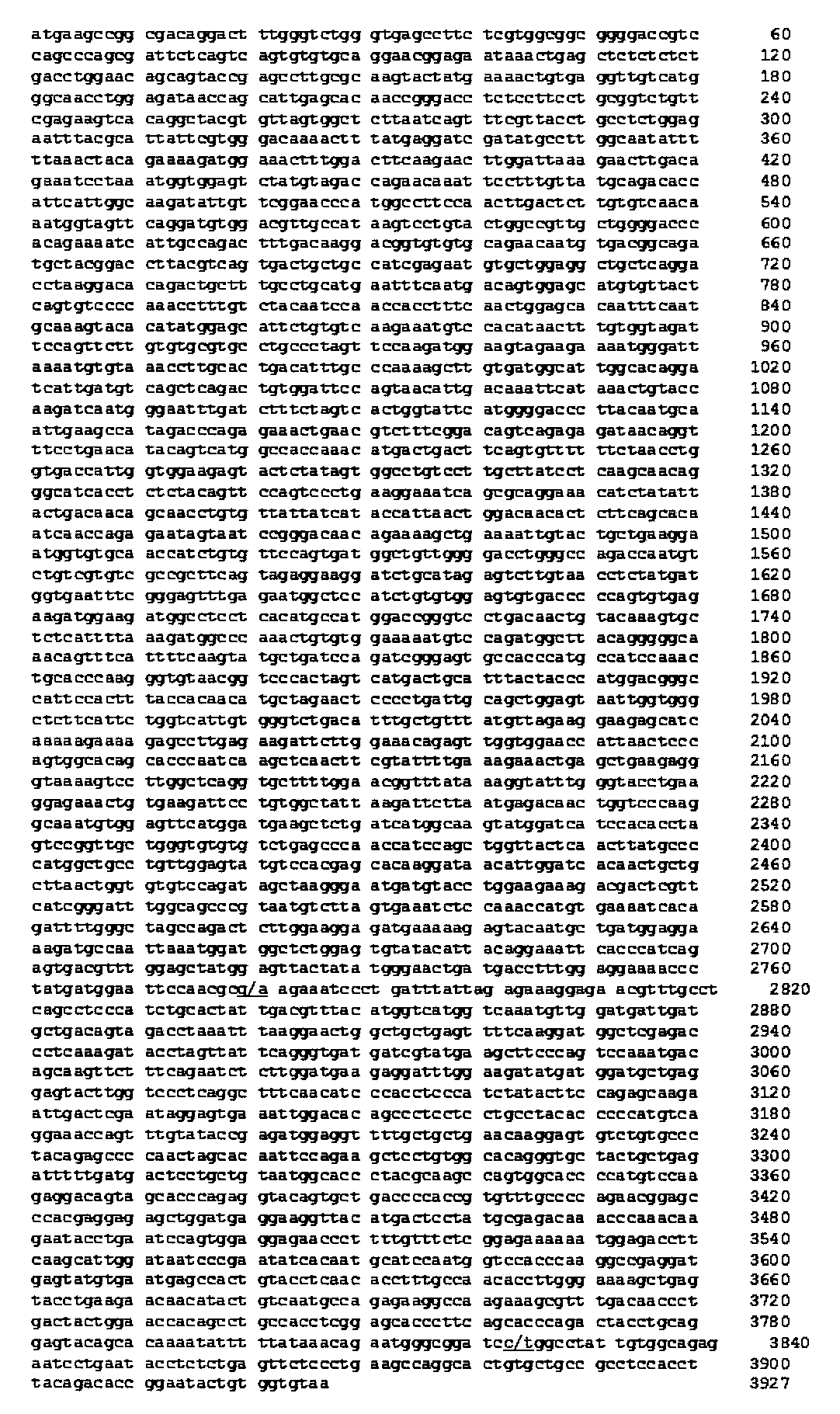
表1には、配列番号1で示されるERBB4の塩基配列におけるc.2780G>Aおよびc.3823C>T変異を含むコーディング領域の塩基配列を表示する。配列番号1で示される塩基配列においてc.2780G>A変異した塩基配列、および配列番号1で示される塩基配列においてc.3823C>T変異した塩基配列も、本発明の範囲に含まれる。表1において、第2780番目および第3823番目の塩基は下線で表示し、「g/a」は「G」から「A」への変異を示し、「c/t」は「C」から「T」への変異を示す。本明細書では、本発明を配列番号1を例に挙げて説明するが、配列番号1以外の塩基配列で示されるERBB4についても、c.2780およびc.3823に対応する箇所の突然変異を含むERBB4は本発明の範囲である。配列番号1以外の塩基配列で示されるERBB4は、例えば、本発明の突然変異以外の箇所の遺伝子の欠失、置換、付加、挿入、あるいは種差などによって配列番号1とは同一ではない塩基配列を有するERBB4遺伝子などが挙げられる。

本発明において、検出の対象となるALSは、家族性ALS(FALS)または孤発性ALS(SALS)である。
ERBB4の上記変異は、被験者のALSを評価するためのマーカーとして利用することができる。すなわち、この変異を解析することによって、ALSであるか否かを評価することができる。
本発明において見出されたc.2780G>A変異およびc.3823C>T変異は、ALSの原因因子である。本発明においては、当該変異とALSとを関連づけることができる。すなわち、解析したERBB4の第2780番目の塩基がGからAに変異しているときは、被験者はALSを発症している、あるいはALS発症のリスクがあると判定することができる。c.2780G>A変異を有する場合は、例えば約75%以上の確率でALSを発症する。同様に、解析したERBB4の第3823番目の塩基がCからTに変異しているときは、被験者はALSを発症している、あるいはALS発症のリスクがあると判定することができる。
4.変異検出法
上記変異を検出するための被験者からのゲノムサンプルは、血液、唾液、皮膚、リンパ節、骨髄等の生体試料から取得することができるが、ゲノムサンプルを採取できるものであれば、これに限定されるものではない。ゲノムDNAの抽出及び精製法は周知である。例えば、ヒトから採取した血液、唾液等の検体から、QIAmp DNA mini kit、QIAmg DNA FFPE Tissue kit(QIAGEN)、Wizard(登録商標)Genomic DNA Purification Kit(Promega)、NucleoSpin(登録商標)シリーズのキット(タカラバイオ)、などのキットを用いて抽出することができる。本発明の場合、変異がErbB4タンパク質のコード領域(オープンリーディングフレーム)に存在するため、ゲノムDNAの代わりにmRNAやtotal RNAを取得し、本発明のALS検出方法に使用することもできる。
上記変異を検出するための被験者からのゲノムサンプルは、血液、唾液、皮膚、リンパ節、骨髄等の生体試料から取得することができるが、ゲノムサンプルを採取できるものであれば、これに限定されるものではない。ゲノムDNAの抽出及び精製法は周知である。例えば、ヒトから採取した血液、唾液等の検体から、QIAmp DNA mini kit、QIAmg DNA FFPE Tissue kit(QIAGEN)、Wizard(登録商標)Genomic DNA Purification Kit(Promega)、NucleoSpin(登録商標)シリーズのキット(タカラバイオ)、などのキットを用いて抽出することができる。本発明の場合、変異がErbB4タンパク質のコード領域(オープンリーディングフレーム)に存在するため、ゲノムDNAの代わりにmRNAやtotal RNAを取得し、本発明のALS検出方法に使用することもできる。
当業者であれば、被験者由来の遺伝子における本発明の遺伝子変異を、公知の方法および技術常識に基づいて適宜検出することができる。以下、上記の被験サンプルの遺伝子変異を検出する方法の一例を示す。
(1)PCR法を用いた検出
突然変異を検出する方法としては、公知の対立遺伝子特異的増幅方法(ASA、PASA、ASP、ARMSなど)を適用することができる。これらの方法は、基本的には、プライマーの3’末端にミスマッチが存在すると、ポリメラーゼによる伸長反応が阻害される。
(1)PCR法を用いた検出
突然変異を検出する方法としては、公知の対立遺伝子特異的増幅方法(ASA、PASA、ASP、ARMSなど)を適用することができる。これらの方法は、基本的には、プライマーの3’末端にミスマッチが存在すると、ポリメラーゼによる伸長反応が阻害される。
PCRにより被験サンプルを増幅するには、Fidelityの高いDNAポリメラーゼ、例えば、KOD−Plus−neoポリメラーゼ(TOYOBO社)を用いることが好ましいが、これに限定されるものではない。用いるプライマーは、被験サンプル中の対象変異部分が増幅されるように、プライマーの任意の位置に遺伝子変異が含まれるように設計し合成する。増幅反応終了後は、増幅産物の検出を行い、変異の有無を判定する。
例えばTaqMan PCR法は、蛍光標識したアレル特異的オリゴとTaqDNAポリメラーゼによるPCR反応とを利用した方法である。TaqMan PCR法で用いるアレル特異的オリゴ(TaqManプローブという)は、前記遺伝子変異情報に基づいて設計することができる。あるいは、アレル特異的プライマーを用いて増幅する際に、SyberGreen PCR法を用いて増幅産物に蛍光標識した塩基を取り込むことで、変異遺伝子の定量を行うことができる。
(2)塩基配列決定法による検出
本発明においては、ダイレクトシークエンシングにより変異を検出することもできる。塩基配列決定に用いるシークエンサーには、市販のHiSeqシステム、MiSeqシステム(イルミナ)、ABIシリーズ(ライフテクノロジーズ)、PGMシステム(ライフテクノロジーズ)等を用いる。
本発明においては、ダイレクトシークエンシングにより変異を検出することもできる。塩基配列決定に用いるシークエンサーには、市販のHiSeqシステム、MiSeqシステム(イルミナ)、ABIシリーズ(ライフテクノロジーズ)、PGMシステム(ライフテクノロジーズ)等を用いる。
(3)DNAマイクロアレイによる検出
DNAマイクロアレイは、支持体上にヌクレオチドプローブが固定されたものであり、DNAチップ、マイクロチップ、ビーズアレイなどを含む。まず、被験サンプルのポリヌクレオチドを単離し、PCRにより増幅し、蛍光レポーター基により標識する。続いて、標識化DNA/mRNA、total RNAをアレイと共にインキュベートする。次にこのアレイをスキャナーに差し込み、ハイブリダイゼーションパターンを検出する。ハイブリダイゼーションのデータは、プローブアレイに結合した(すなわち標的配列に取り込まれた)蛍光レポーター基からの発光として採集する。標的配列と完全に一致したプローブは、標的配列と一致していない部分を有するものよりも強いシグナルを生じる。アレイ上の各プローブの配列及び位置は分かっているため、相補性によって、プローブアレイと反応させた標的ポリヌクレオチドの配列を決定することができる。マイクロアレイにおいては、変異遺伝子に対応した合成プローブを用いるASO(アレル特異的オリゴ)ハイブリダイゼーション法の原理を使用することもできる。
DNAマイクロアレイは、支持体上にヌクレオチドプローブが固定されたものであり、DNAチップ、マイクロチップ、ビーズアレイなどを含む。まず、被験サンプルのポリヌクレオチドを単離し、PCRにより増幅し、蛍光レポーター基により標識する。続いて、標識化DNA/mRNA、total RNAをアレイと共にインキュベートする。次にこのアレイをスキャナーに差し込み、ハイブリダイゼーションパターンを検出する。ハイブリダイゼーションのデータは、プローブアレイに結合した(すなわち標的配列に取り込まれた)蛍光レポーター基からの発光として採集する。標的配列と完全に一致したプローブは、標的配列と一致していない部分を有するものよりも強いシグナルを生じる。アレイ上の各プローブの配列及び位置は分かっているため、相補性によって、プローブアレイと反応させた標的ポリヌクレオチドの配列を決定することができる。マイクロアレイにおいては、変異遺伝子に対応した合成プローブを用いるASO(アレル特異的オリゴ)ハイブリダイゼーション法の原理を使用することもできる。
(4)インベーダー法による遺伝子変異の検出
インベーダー法は、アレル特異的オリゴと鋳型とをハイブリダイゼーションすることにより遺伝子多型を検出する方法である。この方法を本発明における変異の検出に使用することができる。インベーダー法を行うためのキットは市販されており、この方法により容易に遺伝子変異を検出することが可能である。
(5)PCR−RFLP法
増幅したPCR産物を制限酵素で処理し、切断の有無を確認することにより、変異を検出する方法である。PCR−RFLP法を本発明における変異の検出に使用することができる。
インベーダー法は、アレル特異的オリゴと鋳型とをハイブリダイゼーションすることにより遺伝子多型を検出する方法である。この方法を本発明における変異の検出に使用することができる。インベーダー法を行うためのキットは市販されており、この方法により容易に遺伝子変異を検出することが可能である。
(5)PCR−RFLP法
増幅したPCR産物を制限酵素で処理し、切断の有無を確認することにより、変異を検出する方法である。PCR−RFLP法を本発明における変異の検出に使用することができる。
(6)本発明の変異は、上記のとおりDNAレベルで検出することが可能である。本発明の遺伝子変異は、コードされるアミノ酸を変異させるため、本発明の変異はタンパク質レベルで検出することもできる。被験者から取得した血液、唾液、皮膚などの生体試料から常法に基づきタンパク質を採取し、適宜精製する。本発明のアミノ酸変異箇所または変異アミノ酸に特異的な抗体を用いて、本発明の変異を検出してもよい。あるいは、公知のタンパク質分析技術を用いて、変異を検出することができる。
5.オリゴヌクレオチド
本発明は、ERBB4配列またはこれに相補的な配列からなるオリゴヌクレオチドを提供する。本発明のオリゴヌクレオチドは、上記に例示される変異検出方法において、ERBB4配列におけるc.2780G>A変異および/またはc.3823C>T変異を検出できるように設計および製造されたオリゴヌクレオチドである。本発明のオリゴヌクレオチドは、好ましくは、ERBB4遺伝子の塩基配列のうち、第2780番目または第3823番目の塩基を含む塩基配列またはこれに相補的な配列からなるオリゴヌクレオチドである。したがって、本発明のオリゴヌクレオチドは、上記遺伝子変異を検出するために使用することができる。
本発明は、ERBB4配列またはこれに相補的な配列からなるオリゴヌクレオチドを提供する。本発明のオリゴヌクレオチドは、上記に例示される変異検出方法において、ERBB4配列におけるc.2780G>A変異および/またはc.3823C>T変異を検出できるように設計および製造されたオリゴヌクレオチドである。本発明のオリゴヌクレオチドは、好ましくは、ERBB4遺伝子の塩基配列のうち、第2780番目または第3823番目の塩基を含む塩基配列またはこれに相補的な配列からなるオリゴヌクレオチドである。したがって、本発明のオリゴヌクレオチドは、上記遺伝子変異を検出するために使用することができる。
例えば、作製されたオリゴヌクレオチドをプローブとして用いると、当該プローブが被験DNAにハイブリダイズしたかどうか、その有無を利用して変異を決定又は検出することができる。プローブは、例えばTaqMan(登録商標)プローブとして使用することができる。
本発明の一態様において、本発明は上記遺伝子変異部位を含むDNA断片に特異的にハイブリダイズするオリゴヌクレオチドを提供する。すなわち、本発明は上記遺伝子変異の部位を含む配列またはこれに相補的な配列からなるオリゴヌクレオチドを提供する。本発明のオリゴヌクレオチドは、遺伝子変異の部位、すなわち、c.2780またはc.3823を含むERBB4の正常(野生型)配列を含む。本発明のオリゴヌクレオチドを用いてERBB4配列の遺伝子変異を検出する際に、シグナルやスポットの強さを対照と比較することにより、被験サンプルにおける遺伝子変異の有無を検出することができる。
プローブは、配列番号1に示す塩基配列のうち、例えば、第3823番目の塩基を含み、かつ、第3823番目の塩基よりも上流側の塩基及び下流側の塩基を含むように設計することが好ましい。このようにして設計及び合成したプローブを、第3823番目の塩基がCの配列(正常配列)にはハイブリダイズするが、第3823番目の塩基がTの配列(第3823番目の塩基に変異を生じている配列)にはハイブリダイズしない(もしくはハイブリダイズ形成の弱い)条件でハイブリダイゼーションを行う。このようなプローブは変異を生じていない配列を有するDNAとハイブリダイズするため、バンドまたはシグナルの有る(もしくはシグナルの強い)場合に、第3823番目の塩基がCからTへの変異を有していないことを判断(検出)することができる。
また、本発明の別のプローブの態様として、変異遺伝子配列を含むプローブを設計することもできる。すなわち、本発明は上記遺伝子変異を含むDNA断片に特異的にハイブリダイズする、当該遺伝子変異を含むオリゴヌクレオチドを提供する。本発明のオリゴヌクレオチドは、上記遺伝子変異を含む(第2780番目の塩基がAであるか、または第3823番目の塩基がTである)ERBB4の塩基配列またはこれに相補的な配列からなるオリゴヌクレオチドを含む。
正常配列を含む上記プローブと本態様のプローブとは、第3823番目の塩基がCであるかTであるかの点で異なる。本プローブを第3823番目の塩基がTの配列(第3823番目の塩基に変異を生じている配列)にはハイブリダイズするが、第3823番目の塩基がCの配列(野生型配列)にはハイブリダイズしない条件でハイブリダイゼーションを行う。このようなプローブは変異を生じている配列を有するDNAとハイブリダイズするため、バンドまたはシグナルの有る場合に第3823番目の塩基がCからTへの変異を有することを判断(検出)することができる。
第2780番目の変異についても、第3823番目の変異と同様にプローブを設計し、またプローブを用いて変異を検出することができる。
「ハイブリダイズする」とは、通常のPCRやハイブリダイゼーションの過程においてDNA対を形成することを意味する。従って、ハイブリダイズする条件は、市販のPCR試薬やハイブリダイゼーション用試薬を用いることで設定することが可能である。
また、本発明の別の態様において、本発明は、ERBB4遺伝子またはこれに相補的な配列を増幅したときに増幅断片中に前記変異部位が含まれるように作製されたオリゴヌクレオチドを提供する。変異を検出するためのプライマーとしてオリゴヌクレオチドを設計するときも、例えば、配列番号1に示す塩基配列のうち、第2780番目または第3823番目の塩基を含み、かつ、第2780番目または第3823番目の塩基よりも上流側の塩基及び下流側の塩基を含むように設計することができる。例えば、本発明のオリゴヌクレオチドは、上記遺伝子変異を含む(第2780番目の塩基がAであるか、または第3823番目の塩基がTである)ERBB4の塩基配列またはこれに相補的な配列からなるオリゴヌクレオチドを含む。
PCR法の場合、増幅断片の3’末端部分が変異部位の塩基配列に相補的な配列を有するようにプライマーを作製することが好ましい。このように設計されたプライマーを用いると、鋳型となるサンプルが変異を有するか否かに応じて、サンプルとプライマーとのミスマッチが生じ、ポリメラーゼ伸長反応の成否が決まる。したがって、このようなプライマーを用いてPCR増幅を行い、増幅産物をアガロースゲル電気泳動などによって分析することで、サンプルである鋳型の変異を確認することができる。増幅断片の長さは特に限定されるわけではないが、例えば、数10塩基~数100塩基である。
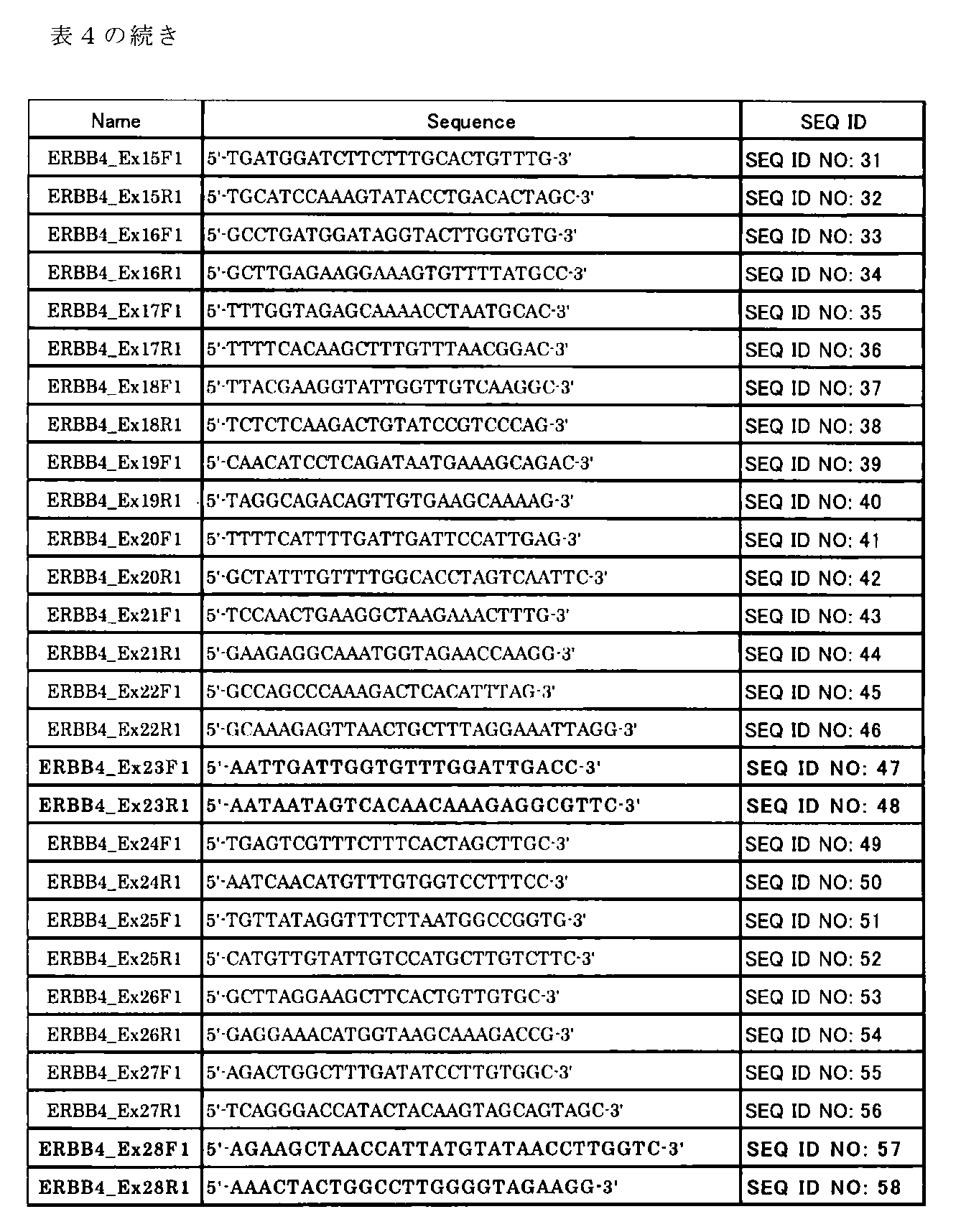
本発明のオリゴヌクレオチドの塩基配列の長さは、少なくとも10merとなるように設計することが好ましく、より好ましくは10~200mer、さらに好ましくは15~150mer、最も好ましくは20~30merである。本発明のオリゴヌクレオチドは、例えば表4に示されており、c.2780G>Aを検出するためのERBB4_Ex23F1およびERBB4_Ex23R1、並びにc.3823C>Tを検出するためのERBB4_Ex28F1およびERBB4_Ex28R1を挙げることができる。
本発明のオリゴヌクレオチドは、ALS検出用プローブ又はALS検出用PCRプライマーとして使用することができる。ALSの検出は、前記c.2780G>A変異またはc.3823C>T変異を指標として行われる。被験対象者からのゲノムDNAサンプルの取得法は前記のとおりである。
本発明のオリゴヌクレオチドは、上記配列の相補鎖(相補配列)も含まれる。変異部位が塩基配列の5’端又は3’端に存在するように設計することもできるが、これに限定されず、5’又は3’端よりも内側に存在するように設計してもよい。
以上のように設計された本発明のオリゴヌクレオチド(例えばオリゴヌクレオチドプライマー及びオリゴヌクレオチドプローブ)は、配列番号1記載の塩基配列に基づいて、公知の手段・方法により化学合成することができるが、一般には、市販の化学合成装置を使用して合成される。なお、本発明のオリゴヌクレオチドには、予め適当な蛍光標識(例えばFAM、VIC等)を付加して作業の自動化を図ることも可能である。蛍光標識が付加されたオリゴヌクレオチドも、本発明の範囲に含まれる。
6.キット
本発明は、ALSを検出するためのキットを提供する。本発明のキットは、本発明を実施するために必要な1種以上の成分を含む。例えば、本発明のキットには、本発明のヌクレオチド、酵素緩衝液、dNTP、コントロール用試薬(例えば、組織サンプル、ポジティブ及びネガティブコントロール用標的オリゴヌクレオチドなど)、標識用及び/又は検出用試薬、固相支持体、説明書などが挙げられる。また本発明のキットは、必要な成分のうちの一部のみを含む部分的キットであってもよく、その場合には、ユーザーが他の成分を用意することができる。
本発明は、ALSを検出するためのキットを提供する。本発明のキットは、本発明を実施するために必要な1種以上の成分を含む。例えば、本発明のキットには、本発明のヌクレオチド、酵素緩衝液、dNTP、コントロール用試薬(例えば、組織サンプル、ポジティブ及びネガティブコントロール用標的オリゴヌクレオチドなど)、標識用及び/又は検出用試薬、固相支持体、説明書などが挙げられる。また本発明のキットは、必要な成分のうちの一部のみを含む部分的キットであってもよく、その場合には、ユーザーが他の成分を用意することができる。
本発明のキットは、上記オリゴヌクレオチドを支持体に固定したマイクロアレイとして提供することもできる。マイクロアレイは、支持体上に本発明のオリゴヌクレオチドが固定されたものであり、DNAチップ、マイクロチップ、ビーズアレイなどを含む。
本発明のキットは、ERBB4の変異を含むDNA断片に特異的にハイブリダイズするオリゴヌクレオチドを含むことが好ましい。
本発明のキットにより遺伝子変異を判定する場合、例えば、疾患の診断時に血液、唾液、体腔液(胸水、腹水、髄液など)、骨髄液、腫瘍検体、およびそれらから作製された固定標本などから上記ERBB4を含むDNAを単離し、この単離したDNAをキット中のオリゴヌクレオチドと反応させて遺伝子型を判定する。
判定した遺伝子型及び遺伝子変異からALSであるか否か、又はALSのリスクを判定する。
7.スクリーニング方法およびALS治療剤
ErbB4タンパク質は、ErbB2またはErbB3とホモ二量体またはヘテロ二量体を形成する受容体チロシンキナーゼ(RTK)の上皮成長因子(EGF)サブファミリーのメンバーであり、ニューレグリン(NRG)がErbB4の細胞外リガンド結合ドメインに結合すると活性化される。ErbB4の活性化は、NRGが結合した後のチロシンキナーゼ活性の増大によって媒介され、C末端の自己リン酸化をもたらす。
ErbB4タンパク質は、ErbB2またはErbB3とホモ二量体またはヘテロ二量体を形成する受容体チロシンキナーゼ(RTK)の上皮成長因子(EGF)サブファミリーのメンバーであり、ニューレグリン(NRG)がErbB4の細胞外リガンド結合ドメインに結合すると活性化される。ErbB4の活性化は、NRGが結合した後のチロシンキナーゼ活性の増大によって媒介され、C末端の自己リン酸化をもたらす。
本発明者らの機能分析により、p.R927Qまたはp.R1275W変異を有する変異ErbB4タンパク質を発現する細胞は、野生型ErbB4タンパク質を発現する細胞よりも、ニューレグリン−1を介するErbBタンパク質の活性化機能が低いことが明らかとなった。具体的には、本発明の突然変異は、ニューレグリン−1(NRG−1)刺激における、ErbB4タンパク質自己リン酸化の低減に至ることが見出された。すなわち、ニューレグリン−ErbB4経路の破壊がALSの病因に関与していることが示された。
したがって、本発明は、候補物質の存在下または非存在下において、ErbB4タンパク質とニューレグリン−1とを接触させることを含む、ErbB4タンパク質の自己リン酸化を促進させる化合物またはその塩のスクリーニング方法を提供する。本発明のスクリーニング方法で得られる化合物またはその塩は、ニューレグリン−ErbB4経路を賦活化し、ErbB機能を上昇制御し得る。よって、本発明のスクリーニング方法で得られる化合物またはその塩は、ALSの治療剤として使用し得ることが期待される。
本発明のスクリーニング方法は、具体的には以下の工程を含むことを特徴とするものである。
(i)候補物質の存在下または候補物質の非存在下で、ErbB4タンパク質とニューレグリン−1とを接触させる工程、
(ii)ErbB4タンパク質の自己リン酸化の程度を検出する工程、および
(iii)得られた検出結果を指標としてErbB4タンパク質の自己リン酸化を促進させる物質を選択する工程。
(i)候補物質の存在下または候補物質の非存在下で、ErbB4タンパク質とニューレグリン−1とを接触させる工程、
(ii)ErbB4タンパク質の自己リン酸化の程度を検出する工程、および
(iii)得られた検出結果を指標としてErbB4タンパク質の自己リン酸化を促進させる物質を選択する工程。
上記(i)の接触工程において使用される候補物質としては、例えば、低分子もしくは高分子化合物、天然もしくは人為的に合成された各種ペプチド、タンパク質(酵素や抗体を含む)、核酸(ポリヌクレオチド(DNA、RNA)、オリゴヌクレオチド(siRNA等)、ペプチド核酸(PNA)など)等を用いることができるが、これらに限定されるわけではない。
本発明において「塩」は、限定はされないが、例えば、ハロゲン化水素酸塩(例えば、塩酸塩、臭化水素酸塩、及びヨウ化水素酸塩など)、無機酸塩、有機酸塩、アミノ酸塩(例えば、アスパラギン酸塩、及びグルタミン酸塩など)、四級アミン塩、アルカリ金属塩(例えば、ナトリウム塩、及びカリウム塩など)、アルカリ土類金属塩(例えば、マグネシウム塩、及びカルシウム塩など)などが挙げられる。
接触工程において使用されるニューレグリン−1は、公知の配列情報および公知の方法に基づき製造することができる。あるいは市販のニューレグリン−1を使用してもよい。
接触工程において使用されるErbB4タンパク質は、公知の配列情報(例えば配列番号1および2)および公知の方法に基づき製造することができる。ErbB4タンパク質は、細胞に発現させた状態または可溶化した状態で使用してもよく、精製したタンパク質を使用してもよい。スクリーニング方法において使用されるErbB4タンパク質は、本発明の変異を含む変異型ErbB4タンパク質でもよいし、変異を含まない正常型(野生型)ErbB4タンパク質でもよい。
「接触」とは、ErbB4タンパク質およびニューレグリン−1を反応可能な状態におくこと、同一の反応系に存在させること、または同一の培養系に存在させることなどを意味する。接触工程においてErbB4タンパク質とニューレグリン−1とを接触させる際は、候補物質を含む適当なバッファー(例えばHEPESバッファー、Trisバッファー、PBS等)中で行うことが好ましい。あるいは、適当なバッファー中で候補物質とErbB4タンパク質とを混合させておき、その後ニューレグリン−1を添加するようにしてもよい。接触時の温度は、ErbB4タンパク質の活性が低下又は失活しない温度であればよく、限定はされないが、例えば、0~40℃であることが好ましく、より好ましくは20~38℃である。また、接触の時間は、限定はされないが、例えば、1~30分であることが好ましく、より好ましくは5~20分である。接触工程における候補物質、ErbB4タンパク質およびニューレグリン−1の濃度は、当業者であれば適宜設定することができる。
(ii)のErbBタンパク質の自己リン酸化の程度を検出する工程については、限定されないが、抗リン酸化ErbB4抗体(例えばTyr1284(Cell Signaling、Danvers、MA、USA))を用いたウエスタンブロッティング法やラジオアイソトープを用いた方法を利用することができる。
(iii)の選択工程においては、ErbBタンパク質の自己リン酸化を促進する物質を選択するが、検出工程において検出されるリン酸化の程度が、候補物質の非存在下の場合と比較して強い場合は、使用された候補物質がErbB4タンパク質の自己リン酸化を促進する物質であるとして評価及び選択することができる。当該リン酸化の程度がより大きいほど、ErbBタンパク質の自己リン酸化を促進する活性がより高い物質であると評価することができる。
本発明のスクリーニング方法は、ErbB4タンパク質の自己リン酸化を促進する活性を有する物質を簡易に且つ大規模にスクリーニングするために用いることができるため、ALSの治療薬開発を強力に推し進めることができる点で、極めて有用性の高いものである。
本発明は、上記本発明のスクリーニング方法により得られた化合物またはその塩を含む、ALS治療用の医薬組成物を提供する。本発明の医薬組成物は、本発明のスクリーニング方法により得られた化合物またはその塩を活性成分として含み、さらに薬学的に許容され得る担体を含む医薬組成物の形態で提供することが好ましい。本発明の医薬組成物は、ALS治療剤として使用することが期待される。
「薬学的に許容され得る担体」は、製剤において通常使用される担体であり、例えば賦形剤、希釈剤、増量剤、崩壊剤、安定剤、保存剤、緩衝剤、乳化剤、芳香剤、着色剤、甘味剤、粘稠剤、矯味剤、溶解補助剤あるいはその他の添加剤等挙げられる。そのような担体の一つ以上を用いることにより、注射剤、液剤、カプセル剤、懸濁剤、乳剤あるいはシロップ剤等の形態の医薬組成物を調製することができる。これらの医薬組成物は、経口あるいは非経口的に投与することができる。非経口投与のためのその他の形態としては、1つ以上の活性物質を含み、常法により処方される注射剤などが含まれる。注射剤の場合には、生理食塩水又は市販の注射用蒸留水等の薬学的に許容される担体中に溶解または懸濁することにより製造することができる。
本発明の医薬組成物の投与量は、患者の年齢、性別、体重及び症状、治療効果、投与方法、処理時間、あるいは医薬組成物に含有される活性成分である化合物またはその塩の種類などにより異なるが、例えば、活性成分である化合物またはその塩を、通常成人一人(体重60kg)当たり、一回につき10μgから1000mgの範囲で投与することができるが、この範囲に限定されるものではない。
以下、実施例により本発明をさらに具体的に説明する。但し、本発明はこれら実施例に限定されるものではない。
[実施例1]c.2780G>A(p.R927Q)の同定
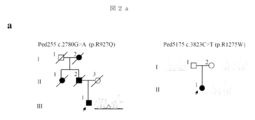
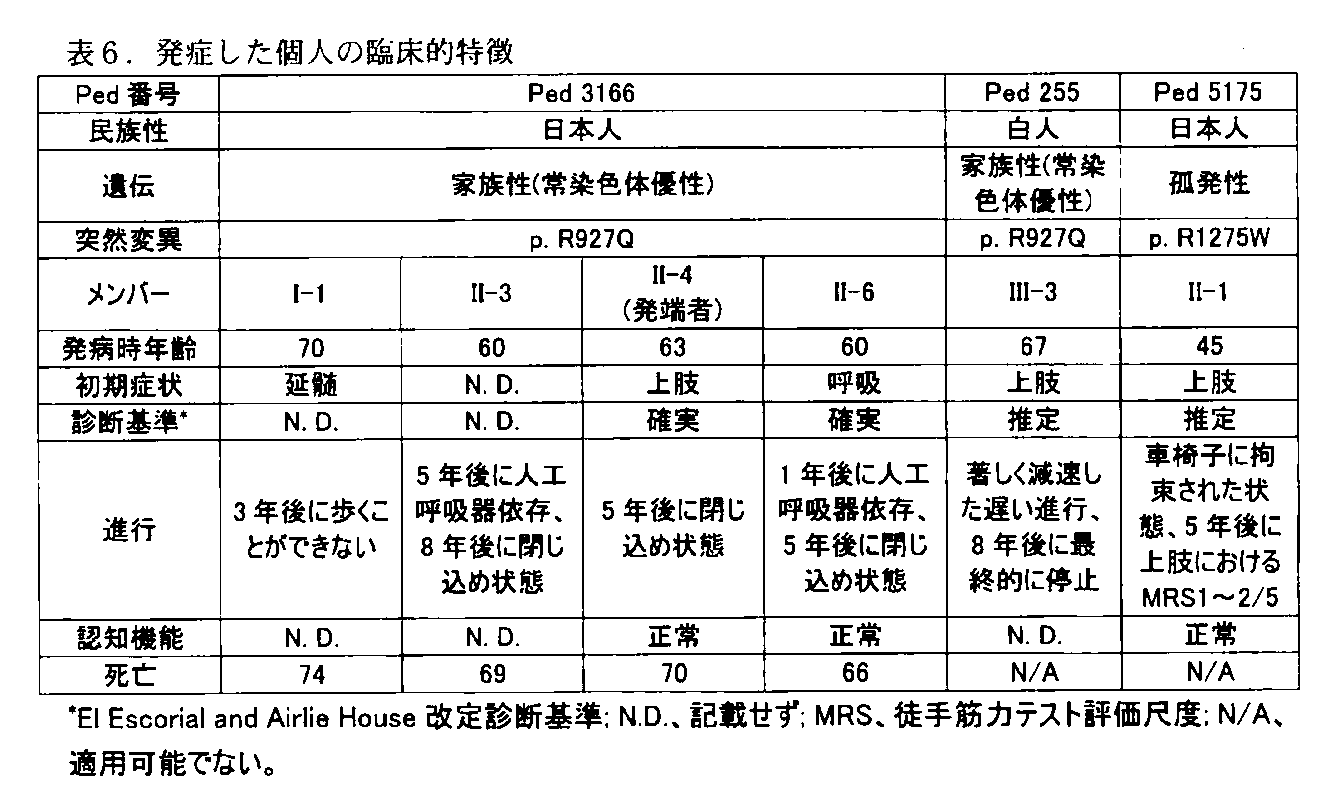
本実施例において、遅発性ALSを起こしている3人の発症した兄弟姉妹を有する日本人家族を同定した(図1a、表6)。
本実施例において、遅発性ALSを起こしている3人の発症した兄弟姉妹を有する日本人家族を同定した(図1a、表6)。
家族歴は、おそらく常染色体優性の遺伝であることを示した。ダイレクトヌクレオチド配列解析を使用する発端者(II−4)の突然変異解析、マイクロアレイベース再配列決定、またはリピートプライムドPCR(repeat−primed PCR)解析により、原因遺伝子としてSOD1、ALS2、DCTN1、CHMP2B、ANG、TARDBP、FUS、およびC90RF72が除外された。FALSの新規原因遺伝子を同定するために、この家系に対して連鎖解析と組み合わせてWGSを実施した。
指標の家系における3人の個人(I−2、II−3、およびII−4、図1a)にWGSを実施した。ペアエンドDNAライブラリーを生成し、製造者の指示書に従ってGAII Illumina Genome Analyzerを使用して大量並列シーケンシングにかけた。得られたショートリード配列を、Burrows−Wheeler Alignerを使用して参照ゲノム(NCBI37/hg19アセンブリー)に対して整列させた。潜在的なPCR複製物が除去された下流分析を、SAMtoolsを使用して処理した。整列されたリードを、Integrative Genomics Viewerを使用して調べた。SAMtoolsのパイルアップコマンド(pileup command)を使用してゲノム配列変異を同定し、Refseq、dbSNP135、1000ゲノム、個人ゲノムデータベース、NHLBI GO Exome Sequencing Project(NHLBI−ESP)データベース、および日本人集団における41の全ゲノムおよび1408のエクソームを含有する社内変異体データベースを使用してアノテートした。
I−2、II−3、およびII−4において同定された新規でアミノ酸置換を伴う非同義変異体の数は、それぞれ411、404、および382であった(表2)。この中には、FALSについての公知の原因遺伝子における新規非同義変異体は、まったく含まれなかった。これらの中で、57の変異体が発端者および発症した兄弟姉妹の両方において同定されたが、母において同定されず、これらをさらなる解析にかけた。

ドットで示した個人(図1a)の遺伝子型を、ゲノム全域にわたるヒトSNPアレイ6.0(Affymetrix、Santa Clara,CA,USA)を使用して同定した。0.000001の疾患対立遺伝子頻度を伴った遺伝の常染色体優性形式を仮定して、パイプラインソフトウェアSNP−HiTLinkおよびAllegroバージョン2を用いて連鎖解析およびハロタイプ再構築を行った。
その結果、完全浸透度を仮定したパラメトリック多点連鎖解析により、1.8の最大LODスコアを伴って染色体1、6、および13上に23.6Mbに及ぶ3つの遺伝子座が明らかになった(図1b、浸透度=1.0)。しかし、上記の新規非同義変異体は、候補領域においていずれも同定されなかった。
そのため、浸透度の低減の可能性を考慮したところ、浸透度が0.8に低減される場合、7つの追加の遺伝子座が、0.7超のLODスコアを伴って連鎖を支持することが示された(図1b、浸透度=0.8)。そして、3つのヘテロ接合性新規非同義変異体がこれらの領域内で同定され、これらの中で、v−erb−a赤芽球性白血病ウイルス発癌遺伝子同族体4(avian)(ERBB4[NM_001042599.1])における変異体c.2780G>A(p.R927Q)のみが、477個の対照において存在しなかった(表3)。
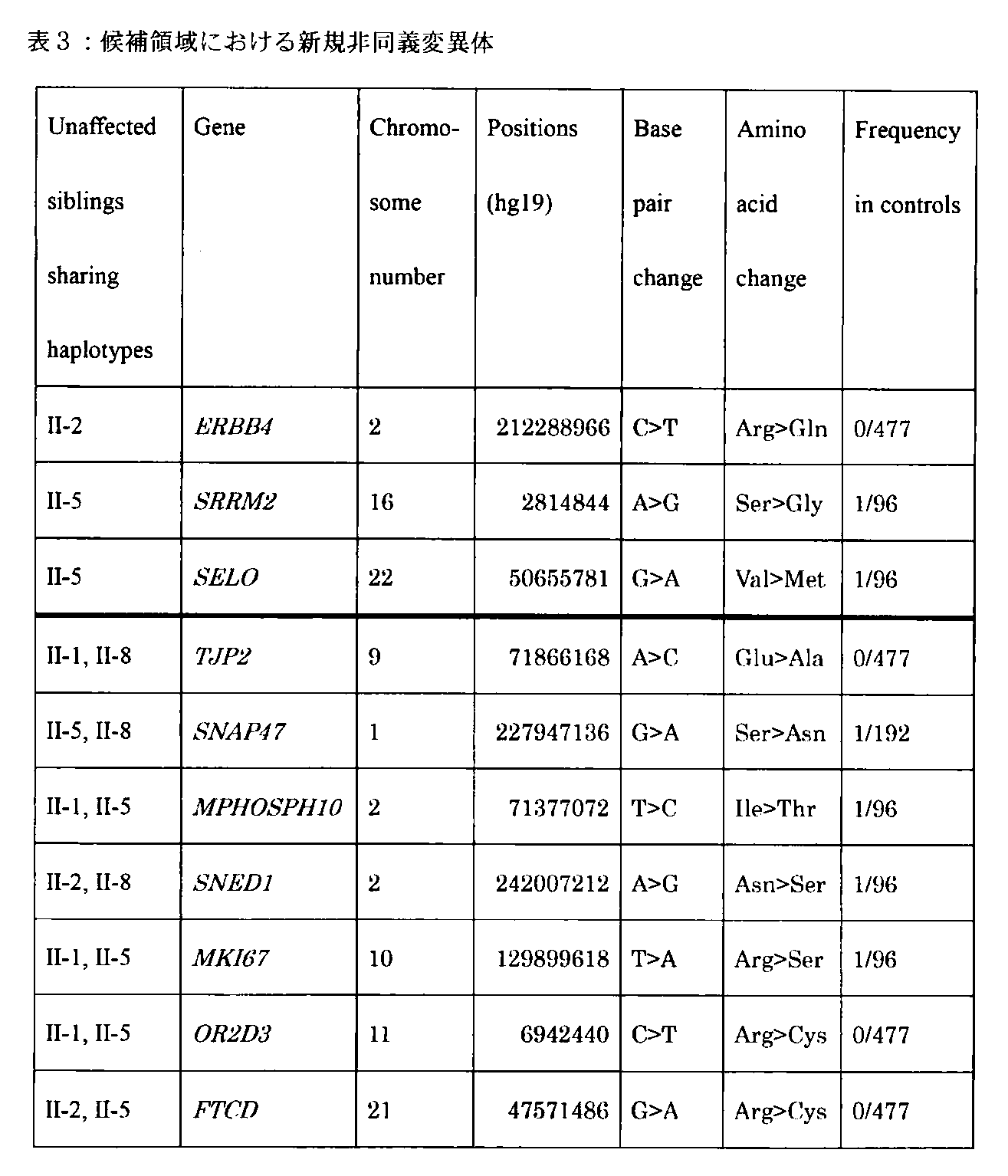
また、浸透度をさらに低減させた場合、0を超えるLODを伴って、19の追加の遺伝子座が同定された。これらの領域内で、7つのヘテロ接合性新規非同義変異体が同定されこれらの中で、OR2D3(NM_001004684.1)、FTCD(NM_206965.1)、およびTJP2(NM_001170414.2)における3つの変異体は、477個の対照において存在しなかった(表3)。OR2D3は、嗅覚受容体遺伝子であり、OR2D3中の突然変異アミノ酸は、保存されておらず、この突然変異は、PolyPhen−2解析によって良性として予測された。FTCDおよびTJP2はそれぞれ、常染色体劣性グルタミン酸ホルムイミノトランスフェラーゼ欠損症(OMIM229100)および家族性高胆汁性貧血(hypercholanemia)(OMIM607748)の原因遺伝子であり、ヘテロ接合保因者は、ALSを呈するように記述されていない。
以上の結果を総合すると、ERBB4中の変異体c.2780G>A(p.R927Q)が、最も可能性の高い病原性の突然変異であることが明らかとなった。
[実施例2]c.2780G>A(p.R927Q)の解析およびc.3823C>T(p.R1275W)の同定
(1)c.2780G>A(p.R927Q)の解析
364人のFALS患者および818人の孤発性ALS(SALS)患者におけるERBB4の突然変異解析を、ABI3100シーケンシング装置およびBigDye Terminatorバージョン3.1(Applied Biosystems、Foster City,CA,USA)を使用して、ダイレクトヌクレオチド配列解析法により行った。オリゴヌクレオチドプライマーは、ExonPrimerウェブサイト(http://ihg.gsf.de/ihg/ExonPrimer.html)を使用して設計した(表4)。変異体の配列は、Takara LATaq(Takara Bio,Otsu,Shiga,Japan)を用いるゲノムPCR解析およびABI 3100 sequencer and BigDye Terminator ver3.1(Applied Biosystems,Foster City,CA,USA)を用いるサンガーシーケンシングにより確認した。PCRの条件は、以下のとおりである:95℃2分、続いて95℃30秒、60℃30秒、68℃1分からなるサイクルを35サイクル、最後に68℃7分の伸長ステップ。
364人のFALS患者および818人の孤発性ALS(SALS)患者におけるERBB4の突然変異解析を、ABI3100シーケンシング装置およびBigDye Terminatorバージョン3.1(Applied Biosystems、Foster City,CA,USA)を使用して、ダイレクトヌクレオチド配列解析法により行った。オリゴヌクレオチドプライマーは、ExonPrimerウェブサイト(http://ihg.gsf.de/ihg/ExonPrimer.html)を使用して設計した(表4)。変異体の配列は、Takara LATaq(Takara Bio,Otsu,Shiga,Japan)を用いるゲノムPCR解析およびABI 3100 sequencer and BigDye Terminator ver3.1(Applied Biosystems,Foster City,CA,USA)を用いるサンガーシーケンシングにより確認した。PCRの条件は、以下のとおりである:95℃2分、続いて95℃30秒、60℃30秒、68℃1分からなるサイクルを35サイクル、最後に68℃7分の伸長ステップ。

解析の結果、同じ突然変異c.2780G>A(p.R927Q)が、1人のカナダ人FALS患者において同定された(図2a)。残念ながら、他の家族メンバーからのDNAは、分離を確認するためには入手することができなかった。
(2)c.3823C>T(p.R1275W)の同定
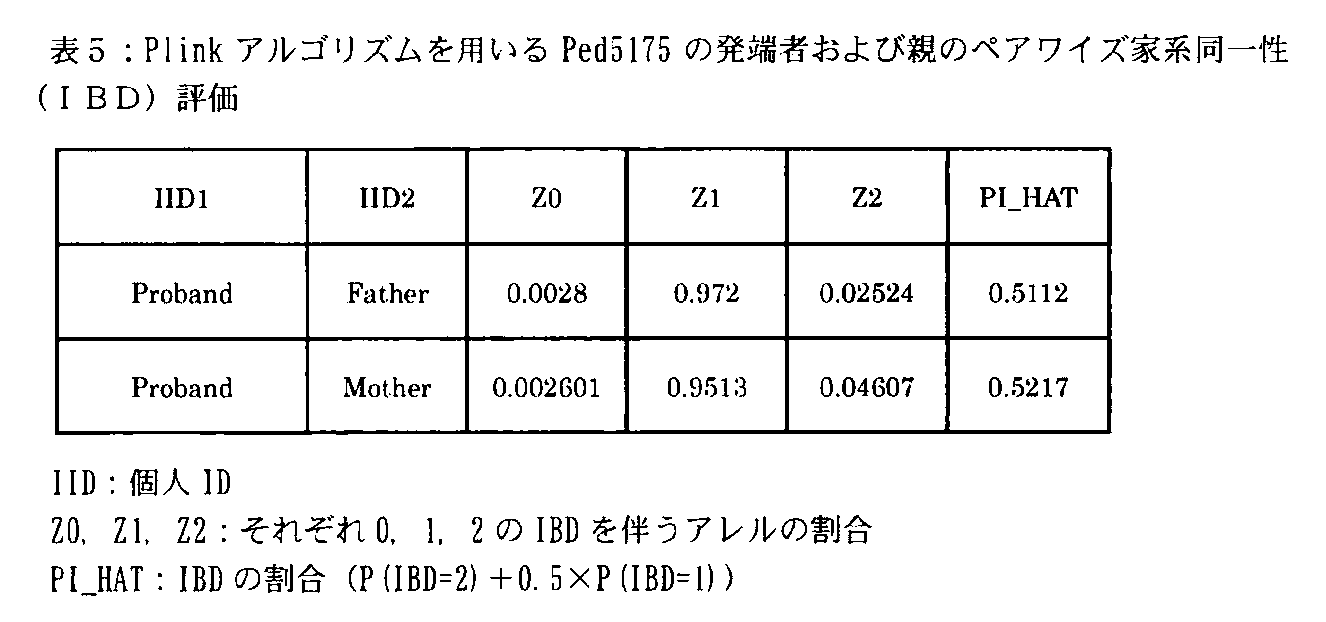
興味深いことに、c.3823C>T(p.R1275W)の新規突然変異を、日本人SALS患者において確認した。当該患者は、生物学的親−子孫関係がPlinkアルゴリズムを使用して確認された(表5)。
興味深いことに、c.3823C>T(p.R1275W)の新規突然変異を、日本人SALS患者において確認した。当該患者は、生物学的親−子孫関係がPlinkアルゴリズムを使用して確認された(表5)。
(3)本発明のこれらの突然変異は、477人の日本人対照において存在せず、41の全ゲノムおよび1408のエクソームを含有する社内データベース、1000ゲノムデータベース、または6503のエクソームを含有するNHLBI−ESPデータベース中に登録されていなかった。さらに、c.2780G>A(p.R927Q)は、190人の白人対照において存在しなかった。
異なる民族的背景の2つの独立した家族におけるp.R927Qの同定により、ALSの原因突然変異としてp.R927Qが強く支持された。また、新規突然変異率が、1世代当たり1ヌクレオチド当たり1.20×10⁻⁸であり、および非同義単一ヌクレオチド変異体(SNV)が1未満/世代であると推定されたことを考慮すると、新規突然変異の結果は、p.R1275Wがおそらくこの患者におけるALSの原因突然変異であるという考えをさらに支持する。
本発明の2つの突然変異、すなわちR927およびR1275において置換されたアルギニン残基は、種の中で高度に保存されている(図2b)。この点、本発明の突然変異は、PolyPhen−2解析によって、有害な変異であることが予想される。アミノ酸残基R927は、受容体チロシンキナーゼ活性に必須なErbB4タンパク質のチロシンキナーゼドメイン内に存在する。また、R1275は、下流のシグナル伝達経路を媒介する複数のリン酸化部位の近傍のC末端ドメイン内に位置している(図2c)。
(4)ERBB4突然変異を有するこれらのALS患者の臨床症状を表6に要約する。患者の共通の臨床的特徴には、El Escorial and Airlie House改定診断基準によって確実な、または推定されるALSとして診断された上位運動ニューロンおよび下位運動ニューロンの両方の関与、相対的に遅い進行、ならびに明らかな認知障害がまったくないことが含まれた。p.R927Q突然変異を有する患者は、浸透度がわずかに低減された、相対的に遅い発症(発病時の年齢は、60~70の範囲である)を特徴とした。対照的に、p.R1275W突然変異を有する患者は、早期の発病(年齢45歳)を特徴とした。
[実施例3]
ALS患者において同定された本発明の2つの突然変異が、ErbB4機能にどのように影響するかを判定するために、本実施例を行った。本実施例では、NRG−1の存在下で、野生型または突然変異体(p.R927Qまたはp.R1275W)のErbB4を発現する細胞内のErbB4の自己リン酸化を測定した。
ALS患者において同定された本発明の2つの突然変異が、ErbB4機能にどのように影響するかを判定するために、本実施例を行った。本実施例では、NRG−1の存在下で、野生型または突然変異体(p.R927Qまたはp.R1275W)のErbB4を発現する細胞内のErbB4の自己リン酸化を測定した。
Phusion Site−Directed Mutagenesis Kit(Thermo Fisher Scientific,Waltham,MA,USA)に記載されたプロトコールに従って、部位特異的突然変異によって、HAタグ付きErbB4 JM−a CYT−2をコードするpBABE−puroERBB4JM−aCYT−2HAプラスミド中にErbB4突然変異を導入した。突然変異誘発後、すべてのコンストラクトを配列決定によって確証した。製造者の指示書に従って、FuGENE6トランスフェクション試薬(Roche、Basel、Swizerland)を使用して、COS−7細胞内にプラスミドを一過性にトランスフェクトした。トランスフェクション細胞を、一晩血清を欠乏させ、0または50ng/mlのNRG−1(R&D、Minneapolis、MN、USA)を用いて、37℃で10分間刺激した。刺激した後、細胞を溶解させ、50μgの全タンパク質に等価な試料を、8%のSDS−PAGEゲルを通じて分離した。ErbB4リン酸化および全ErbB4発現を、それぞれ、ホスホ−ErbB4(Tyr1284)(Cell Signaling、Danvers、MA、USA)およびHA−タグ(Abcam、Cambridge、UK)に対する抗体を用いて、ウエスタンブロッティングによって検出した。
その結果、2つの突然変異体p.R927Qおよびp.R1275Wは、ErbB4の自己リン酸化の明確な低減を示した(図3)。
本実施例による遺伝学的データおよび機能的データに基づいて、本発明の2つの突然変異がALSの原因突然変異であると結論することができる。そして、本発明により、ALS診断のためにERBB4遺伝子変異を検出する方法を確立することができた。この方法によりALSの早期発見、診断および治療をもたらすものであると期待される。
本発明により、NRG−1刺激におけるErbB4自己リン酸化の低減が、ALSの病因に関与していることが明らかになった。ErbB4は、ラット脊髄の大型運動ニューロンの細胞体内で特異的に発現される。ErbB4の欠如は、マウスにおいて胚致死性であり、これは、胚形成の間の運動ニューロン軸索誘導および経路探索の撹乱を示す。ヘテロ接合性ヌルマウスは、体重減少および運動発達遅延を示し、脳特異的条件付きノックアウトマウスは、後肢の自発運動活性および握力の低減を実証する。NRG−1のシステインリッチドメイン(CRD)アイソフォーム欠損マウス(CRD−NRG−1−/−)は、呼吸不全のために周産期に死亡し、検出可能な肢の運動を欠き、脊髄運動ニューロンの約60%の喪失を示す。同様に、運動ニューロンおよび知覚ニューロン特異的条件付きNRG−1ノックアウトマウスは、出生時に死亡し、運動ニューロン軸索の顕著な退縮を示した。さらに、CRD−NRG−1発現レベルの減少が、疾患発症時のFALS患者およびSALS患者ならびにSOD1突然変異体マウスにおける脊髄運動ニューロン中に検出され、NRG−ErbB経路の破壊が、一般に、ALSの根底をなす運動ニューロン変性に関与している可能性を高めている。
本発明は、ALS病因の新規側面をもたらすものであり、NRGまたはこれらのアゴニストを使用して、ErbB4機能を上方制御することなどの画期的な治療戦略を開発する道を開くことが期待される。
配列番号1:ヒトERBB4遺伝子の塩基配列(アクセッション番号NM_005235.2)。
配列番号2:ヒトErbB4タンパク質のアミノ酸配列(アクセッション番号NP_005226)。
配列番号3~58:プライマー。
配列番号59:「c.2780G>A」を有するヒトERBB4遺伝子の塩基配列。
配列番号60:「p.R927Q」を有するヒトErbB4タンパク質のアミノ酸配列。
配列番号61:「c.3823C>T」を有するヒトERBB4遺伝子の塩基配列。
配列番号62:「p.R1275W」を有するヒトErbB4タンパク質のアミノ酸配列。
配列番号2:ヒトErbB4タンパク質のアミノ酸配列(アクセッション番号NP_005226)。
配列番号3~58:プライマー。
配列番号59:「c.2780G>A」を有するヒトERBB4遺伝子の塩基配列。
配列番号60:「p.R927Q」を有するヒトErbB4タンパク質のアミノ酸配列。
配列番号61:「c.3823C>T」を有するヒトERBB4遺伝子の塩基配列。
配列番号62:「p.R1275W」を有するヒトErbB4タンパク質のアミノ酸配列。
Claims (8)
- 被験者から採取されたERBB4遺伝子の塩基配列のうち、第2780番目の塩基のGからAへの遺伝子変異または第3823番目の塩基のCからTへの遺伝子変異を解析し、前記いずれかまたは両方の遺伝子変異があるとき、当該被験者が筋萎縮性側索硬化症(ALS)に罹患している、またはALSに罹患するリスクがあると判定する、ALSの検出方法。
- ALSが、家族性ALSまたは孤発性ALSである、請求項1に記載の方法。
- ERBB4遺伝子の塩基配列において、第2780番目の塩基のGからAへの遺伝子変異および第3823番目の塩基のCからTへの遺伝子変異のいずれかまたは両方を含む、ERBB4遺伝子。
- ERBB4遺伝子の塩基配列のうち、第2780番目または第3823番目の塩基を含む塩基配列またはこれに相補的な配列からなるオリゴヌクレオチド。
- 第2780番目の塩基がAであるか、または第3823番目の塩基がTである、請求項4に記載のオリゴヌクレオチド。
- 請求項4または5に記載のオリゴヌクレオチドを含む、筋萎縮性側索硬化症の検出用キット。
- 候補物質の存在下または非存在下において、ErbB4タンパク質とニューレグリン−1とを接触させることを含む、ErbB4タンパク質の自己リン酸化を促進させる化合物またはその塩のスクリーニング方法。
- 請求項7で得られる化合物またはその塩を含む、筋萎縮性側索硬化症の治療剤。
Applications Claiming Priority (2)
| Application Number | Priority Date | Filing Date | Title |
|---|---|---|---|
| JP2013-161147 | 2013-08-02 | ||
| JP2013161147A JP6342627B2 (ja) | 2013-08-02 | 2013-08-02 | 筋萎縮性側索硬化症の新規病因遺伝子 |
Publications (1)
| Publication Number | Publication Date |
|---|---|
| WO2015016392A1 true WO2015016392A1 (ja) | 2015-02-05 |
Family
ID=52431910
Family Applications (1)
| Application Number | Title | Priority Date | Filing Date |
|---|---|---|---|
| PCT/JP2014/070960 Ceased WO2015016392A1 (ja) | 2013-08-02 | 2014-08-01 | 筋萎縮性側索硬化症の新規病因遺伝子 |
Country Status (2)
| Country | Link |
|---|---|
| JP (1) | JP6342627B2 (ja) |
| WO (1) | WO2015016392A1 (ja) |
Cited By (2)
| Publication number | Priority date | Publication date | Assignee | Title |
|---|---|---|---|---|
| WO2016147942A1 (ja) * | 2015-03-13 | 2016-09-22 | 国立大学法人名古屋大学 | 急速進行型孤発性alsの検査方法、検査キット、及び医薬のスクリーニング方法 |
| CN110452910A (zh) * | 2019-08-27 | 2019-11-15 | 深圳市宝安区妇幼保健院 | 一种fus突变基因、检测引物和试剂盒 |
Citations (6)
| Publication number | Priority date | Publication date | Assignee | Title |
|---|---|---|---|---|
| JP2011503134A (ja) * | 2007-11-16 | 2011-01-27 | プロテオシス アクチエンゲゼルシャフト | 活性のある溶解性の翻訳後修飾されたニューレグリン−アイソフォーム |
| JP2011055729A (ja) * | 2009-09-07 | 2011-03-24 | Institute Of Physical & Chemical Research | Znf512b遺伝子の一塩基多型に基づく筋萎縮性側索硬化症の検査方法 |
| JP2011067193A (ja) * | 2009-08-25 | 2011-04-07 | Hiroshima Univ | 筋萎縮性側索硬化症の診断マーカー、診断方法、及び、治療薬、並びに、筋萎縮性側索硬化症を発症するモデル動物、及び、モデル細胞 |
| JP2011512849A (ja) * | 2008-03-06 | 2011-04-28 | リージェンツ オブ ザ ユニバーシティー オブ ミシガン | Fig4遺伝子変異を利用する方法 |
| JP2011528903A (ja) * | 2008-07-22 | 2011-12-01 | ザ ジェネラル ホスピタル コーポレイション | 筋萎縮性側索硬化症および関連する運動ニューロン疾患の診断、処置および予防のための、fus/tlsベースの化合物および方法 |
| JP2012085639A (ja) * | 2010-10-15 | 2012-05-10 | Dna Chip Research Inc | 孤発性筋萎縮性側索硬化症の検査方法 |
Family Cites Families (3)
| Publication number | Priority date | Publication date | Assignee | Title |
|---|---|---|---|---|
| JP4828752B2 (ja) * | 1999-08-04 | 2011-11-30 | 株式会社医学生物学研究所 | サイクリン/cdk複合体のリン酸化酵素活性測定方法 |
| EP1794313B1 (en) * | 2004-06-21 | 2013-05-15 | Proteome Sciences Plc | Screening methods using c-abl, fyn and syk in combination with tau protein |
| JP2008079610A (ja) * | 2006-09-01 | 2008-04-10 | Kyushu Univ | プロテインキナーゼのリン酸化酵素活性ならびに脱リン酸化酵素活性の測定方法 |
-
2013
- 2013-08-02 JP JP2013161147A patent/JP6342627B2/ja not_active Expired - Fee Related
-
2014
- 2014-08-01 WO PCT/JP2014/070960 patent/WO2015016392A1/ja not_active Ceased
Patent Citations (6)
| Publication number | Priority date | Publication date | Assignee | Title |
|---|---|---|---|---|
| JP2011503134A (ja) * | 2007-11-16 | 2011-01-27 | プロテオシス アクチエンゲゼルシャフト | 活性のある溶解性の翻訳後修飾されたニューレグリン−アイソフォーム |
| JP2011512849A (ja) * | 2008-03-06 | 2011-04-28 | リージェンツ オブ ザ ユニバーシティー オブ ミシガン | Fig4遺伝子変異を利用する方法 |
| JP2011528903A (ja) * | 2008-07-22 | 2011-12-01 | ザ ジェネラル ホスピタル コーポレイション | 筋萎縮性側索硬化症および関連する運動ニューロン疾患の診断、処置および予防のための、fus/tlsベースの化合物および方法 |
| JP2011067193A (ja) * | 2009-08-25 | 2011-04-07 | Hiroshima Univ | 筋萎縮性側索硬化症の診断マーカー、診断方法、及び、治療薬、並びに、筋萎縮性側索硬化症を発症するモデル動物、及び、モデル細胞 |
| JP2011055729A (ja) * | 2009-09-07 | 2011-03-24 | Institute Of Physical & Chemical Research | Znf512b遺伝子の一塩基多型に基づく筋萎縮性側索硬化症の検査方法 |
| JP2012085639A (ja) * | 2010-10-15 | 2012-05-10 | Dna Chip Research Inc | 孤発性筋萎縮性側索硬化症の検査方法 |
Non-Patent Citations (5)
Cited By (2)
| Publication number | Priority date | Publication date | Assignee | Title |
|---|---|---|---|---|
| WO2016147942A1 (ja) * | 2015-03-13 | 2016-09-22 | 国立大学法人名古屋大学 | 急速進行型孤発性alsの検査方法、検査キット、及び医薬のスクリーニング方法 |
| CN110452910A (zh) * | 2019-08-27 | 2019-11-15 | 深圳市宝安区妇幼保健院 | 一种fus突变基因、检测引物和试剂盒 |
Also Published As
| Publication number | Publication date |
|---|---|
| JP2015029460A (ja) | 2015-02-16 |
| JP6342627B2 (ja) | 2018-06-13 |
Similar Documents
| Publication | Publication Date | Title |
|---|---|---|
| BR112016022582B1 (pt) | Marcadores mitocondriais de doenças neurodegenerativas | |
| CN103865997A (zh) | 高血压易感基因组的鉴定 | |
| WO2014063433A1 (zh) | Hla-b*1301等位基因的用途 | |
| KR101761801B1 (ko) | 코 표현형 판단용 조성물 | |
| JP6342627B2 (ja) | 筋萎縮性側索硬化症の新規病因遺伝子 | |
| CA3174572A1 (en) | Compositions and methods for assessing the efficacy of inhibitors of neurotransmitter transporters | |
| JP6053681B2 (ja) | イヌの緑内障を診断する方法及びキット | |
| US20020045171A1 (en) | Method of profiling genes as risk factors for attention deficit hyperactivity disorder | |
| BRPI0806599A2 (pt) | Marcador e plataforma de diagnóstico para elaboração de fármaco em infarto do miocárdio e falência cardíaca | |
| US9752195B2 (en) | TTC8 as prognostic gene for progressive retinal atrophy in dogs | |
| WO2016180725A1 (en) | Diagnosis of dementia with lewy bodies | |
| US8124337B2 (en) | Hereditary cataract status in canines based on HSF4 gene marker | |
| US20060166219A1 (en) | NTRK1 genetic markers associated with progression of Alzheimer's disease | |
| CN115927354B (zh) | 一种sh3tc2基因致病突变体及其在制备腓骨肌萎缩症4c型诊断试剂盒中的应用 | |
| CN105765077B (zh) | 测定抗甲状腺药物诱导的粒细胞缺乏症风险的检测方法以及测定用试剂盒 | |
| AU2002244949B2 (en) | Genomic DNAS participating in rheumatoid arthritis, method of diagnosing the same, method of judging onset riks thereof and diagnostic kit for detecting the same | |
| JP4317376B2 (ja) | 糖尿病性腎症遺伝子の検出方法 | |
| JP2006509521A (ja) | 5−ヒドロキシトリプタミントランスポーター遺伝子多型 | |
| JP2006296270A (ja) | Prkaa2遺伝子多型による2型糖尿病発症素因の検出方法 | |
| KR20220113305A (ko) | 단일염기다형성을 이용한 안지오텐신 전환효소억제제 이상반응 진단용 조성물 및 이를 이용한 방법 | |
| Sheerin | The Use of Next Generation Sequencing Technologies to Dissect the Aetiologies of Parkinson’s disease and Dystonia | |
| JP4325787B2 (ja) | グルクロン酸抱合酵素1a9による薬物解毒代謝の異常の遺伝子診断に用いることができる変異型ポリヌクレオチドおよび核酸分子 | |
| WO2013035861A1 (ja) | 加齢黄斑変性の易罹患性判定方法、プライマー対、プローブ、加齢黄斑変性診断キット、加齢黄斑変性の治療薬及び加齢黄斑変性の治療薬のスクリーニング方法 | |
| JP2010119383A (ja) | 滲出型加齢黄斑変性のリスクの予測方法 | |
| WO2009036513A1 (en) | Diagnostic and therapeutic protocols |
Legal Events
| Date | Code | Title | Description |
|---|---|---|---|
| 121 | Ep: the epo has been informed by wipo that ep was designated in this application |
Ref document number: 14831385 Country of ref document: EP Kind code of ref document: A1 |
|
| NENP | Non-entry into the national phase |
Ref country code: DE |
|
| 122 | Ep: pct application non-entry in european phase |
Ref document number: 14831385 Country of ref document: EP Kind code of ref document: A1 |