WO2015016313A1 - 光学物品用光硬化性プライマー組成物、該組成物の硬化体を含むフォトクロミック積層体及び該積層体の製造方法 - Google Patents
光学物品用光硬化性プライマー組成物、該組成物の硬化体を含むフォトクロミック積層体及び該積層体の製造方法 Download PDFInfo
- Publication number
- WO2015016313A1 WO2015016313A1 PCT/JP2014/070217 JP2014070217W WO2015016313A1 WO 2015016313 A1 WO2015016313 A1 WO 2015016313A1 JP 2014070217 W JP2014070217 W JP 2014070217W WO 2015016313 A1 WO2015016313 A1 WO 2015016313A1
- Authority
- WO
- WIPO (PCT)
- Prior art keywords
- photochromic
- meth
- acrylate
- primer
- composition
- Prior art date
- Legal status (The legal status is an assumption and is not a legal conclusion. Google has not performed a legal analysis and makes no representation as to the accuracy of the status listed.)
- Ceased
Links
Images

Classifications
-
- C—CHEMISTRY; METALLURGY
- C09—DYES; PAINTS; POLISHES; NATURAL RESINS; ADHESIVES; COMPOSITIONS NOT OTHERWISE PROVIDED FOR; APPLICATIONS OF MATERIALS NOT OTHERWISE PROVIDED FOR
- C09D—COATING COMPOSITIONS, e.g. PAINTS, VARNISHES OR LACQUERS; FILLING PASTES; CHEMICAL PAINT OR INK REMOVERS; INKS; CORRECTING FLUIDS; WOODSTAINS; PASTES OR SOLIDS FOR COLOURING OR PRINTING; USE OF MATERIALS THEREFOR
- C09D5/00—Coating compositions, e.g. paints, varnishes or lacquers, characterised by their physical nature or the effects produced; Filling pastes
- C09D5/002—Priming paints
-
- C—CHEMISTRY; METALLURGY
- C09—DYES; PAINTS; POLISHES; NATURAL RESINS; ADHESIVES; COMPOSITIONS NOT OTHERWISE PROVIDED FOR; APPLICATIONS OF MATERIALS NOT OTHERWISE PROVIDED FOR
- C09D—COATING COMPOSITIONS, e.g. PAINTS, VARNISHES OR LACQUERS; FILLING PASTES; CHEMICAL PAINT OR INK REMOVERS; INKS; CORRECTING FLUIDS; WOODSTAINS; PASTES OR SOLIDS FOR COLOURING OR PRINTING; USE OF MATERIALS THEREFOR
- C09D4/00—Coating compositions, e.g. paints, varnishes or lacquers, based on organic non-macromolecular compounds having at least one polymerisable carbon-to-carbon unsaturated bond ; Coating compositions, based on monomers of macromolecular compounds of groups C09D183/00 - C09D183/16
-
- C—CHEMISTRY; METALLURGY
- C09—DYES; PAINTS; POLISHES; NATURAL RESINS; ADHESIVES; COMPOSITIONS NOT OTHERWISE PROVIDED FOR; APPLICATIONS OF MATERIALS NOT OTHERWISE PROVIDED FOR
- C09J—ADHESIVES; NON-MECHANICAL ASPECTS OF ADHESIVE PROCESSES IN GENERAL; ADHESIVE PROCESSES NOT PROVIDED FOR ELSEWHERE; USE OF MATERIALS AS ADHESIVES
- C09J175/00—Adhesives based on polyureas or polyurethanes; Adhesives based on derivatives of such polymers
- C09J175/04—Polyurethanes
-
- C—CHEMISTRY; METALLURGY
- C08—ORGANIC MACROMOLECULAR COMPOUNDS; THEIR PREPARATION OR CHEMICAL WORKING-UP; COMPOSITIONS BASED THEREON
- C08F—MACROMOLECULAR COMPOUNDS OBTAINED BY REACTIONS ONLY INVOLVING CARBON-TO-CARBON UNSATURATED BONDS
- C08F222/00—Copolymers of compounds having one or more unsaturated aliphatic radicals, each having only one carbon-to-carbon double bond, and at least one being terminated by a carboxyl radical and containing at least one other carboxyl radical in the molecule; Salts, anhydrides, esters, amides, imides, or nitriles thereof
- C08F222/10—Esters
- C08F222/1006—Esters of polyhydric alcohols or polyhydric phenols
- C08F222/106—Esters of polycondensation macromers
- C08F222/1065—Esters of polycondensation macromers of alcohol terminated (poly)urethanes, e.g. urethane(meth)acrylates
-
- C—CHEMISTRY; METALLURGY
- C08—ORGANIC MACROMOLECULAR COMPOUNDS; THEIR PREPARATION OR CHEMICAL WORKING-UP; COMPOSITIONS BASED THEREON
- C08G—MACROMOLECULAR COMPOUNDS OBTAINED OTHERWISE THAN BY REACTIONS ONLY INVOLVING UNSATURATED CARBON-TO-CARBON BONDS
- C08G2101/00—Manufacture of cellular products
Definitions
- the present invention relates to a novel photocurable primer composition for optical articles and a photochromic laminate including a cured product of the primer composition.
- a photo-curable primer composition for optical articles for forming a primer coat layer that exhibits excellent adhesion, and thus forming a laminate having high surface hardness, less scratches, and excellent photochromic properties.
- a photochromic laminate including a cured product of the photocurable primer composition for optical articles.
- Photochromic glasses are lenses that quickly color and function as sunglasses when exposed to light containing ultraviolet rays such as sunlight, and fade and become transparent when indoors where ultraviolet light is not irradiated. Function. In recent years, the demand for photochromic glasses has increased.
- a method for producing a plastic lens having photochromic properties a method of impregnating a surface of a lens having no photochromic properties with a photochromic compound (hereinafter referred to as “impregnation method”) is known. Further, a resin layer having photochromic properties is applied by applying a coating agent (hereinafter sometimes referred to as “photochromic curable composition”) made of a curable composition having photochromic properties to the surface of the plastic lens. There is also known a method (hereinafter referred to as “coating method”) for providing (hereinafter also referred to as “photochromic coating layer”).
- a method of directly obtaining a photochromic lens by dissolving a photochromic compound in a monomer and polymerizing it (hereinafter referred to as “kneading method”) is also known.
- the coating method is an excellent method in that photochromic performance can be imparted regardless of the material of the plastic lens.
- photochromic laminate In order to use a photochromic lens manufactured by a coating method (hereinafter sometimes referred to as “photochromic laminate”) for a long time, it is necessary to firmly adhere the photochromic coating layer to the surface of various plastic lens substrates. is there. It is also important that the photochromic coat layer has a sufficient surface hardness in order to prevent scratching of the photochromic coat layer. Furthermore, even in an article in which a hard coat layer or an antireflection film is laminated on the photochromic coat layer, it is necessary to prevent scratches on the surface, and for that purpose, the article has a sufficient surface hardness in the state of the photochromic laminate. This is very important.
- Patent Document 1 a method for improving adhesion to a plastic lens substrate by adding a radically polymerizable monomer or amine compound having a silanol group or a group that generates a silanol group by hydrolysis to a photochromic coating composition is known.
- Patent Document 2 a method of using a moisture curable polyurethane resin and / or a polyurethane resin composed of a cured product of a precursor thereof as a primer coat layer and laminating a photochromic coat layer thereon.
- Patent Document 3 a method for improving adhesion to a plastic lens substrate by adding a radically polymerizable monomer or amine compound having a silanol group or a group that generates a silanol group by hydrolysis to a photochromic coating composition.
- Patent Document 1 is a method of improving adhesion to a plastic lens substrate by adding a composition having a bonding group to the surface of a plastic lens to the photochromic coating composition.
- the photochromic coating layer obtained by this method has initial adhesion, it has been found that if it is used repeatedly under high temperature and high humidity conditions, depending on the type of substrate, the adhesion may decrease and peeling may occur. It was.
- Patent Document 2 using a moisture curable polyurethane resin withstood repeated use under high temperature and high humidity conditions, and the surface hardness of the photochromic coating layer was sufficient.
- the surface of the substrate may be affected by the primer composition. Therefore, before applying the primer composition, the substrate surface should be coated with a crosslinked film such as a hard coat layer in advance. It was necessary to keep.
- the primer coat layer is not easily wetted by the photochromic coat composition, so when the photochromic coat composition is applied by a method such as a spin coat method, the uncoated photochromic coat composition is left uncoated. It was found that poor appearance may occur.
- Patent Document 3 the method of Patent Document 3 in which an emulsion containing a urethane resin is used as a primer has good wettability between the primer coat layer and the photochromic coat layer, adhesion between the photochromic coat layer and the plastic lens, and photochromic characteristics.
- the surface hardness of the photochromic coat layer was insufficient and the photochromic coat layer was easily scratched.
- an object of the present invention is to provide a photocurable primer composition for optical articles that can be used even under high temperature and high humidity conditions, is excellent in photochromic properties, and is used to obtain a photochromic laminate that does not easily scratch the photochromic coating layer. To provide things.
- the inventors of the present invention made extensive studies to solve the above problems. First, it has been found that when the surface hardness of the photochromic coat layer is increased in order to prevent scratching of the photochromic laminate, appearance defects (cracks) occur in the photochromic coat layer. Further examination of the photochromic coating layer in detail revealed that the photochromic properties deteriorated when both the suppression of the appearance defect and the improvement of the surface hardness are achieved.
- the inventors of the present invention do not affect the surface hardness of the primer coat layer serving as the foundation of the photochromic coating layer on the surface hardness of the photochromic coating layer in the photochromic laminate and the scratch prevention of the photochromic laminate. Therefore, a primer composition for forming a primer coat layer was examined. As a result, by using a cured product of a specific urethane (meth) acrylate excellent in water dispersibility as a primer coat layer, while maintaining good adhesion between the photochromic coat layer and the plastic lens, and photochromic characteristics, The present inventors have found that the photochromic coat layer can be prevented from being scratched and have completed the present invention.
- a photocurable primer composition for an optical article comprising an aqueous dispersion containing urethane (meth) acrylate and a photopolymerization initiator, and the elongation of a single cured product of the urethane (meth) acrylate.
- a photocurable primer composition for optical articles characterized in that the rate (25 ° C.) is 0.1 to 10%.
- the tensile strength (25 ° C.) of the urethane (meth) acrylate single cured body is 10 to 50 MPa, (2) The Vickers hardness when cured is 8-30, Is preferred.
- a lens substrate, a primer coat layer, and a photochromic coat layer are laminated in this order, and the primer coat layer is a cured photocurable primer composition for optical articles.
- the photochromic laminated body characterized by being a body is provided.
- the Vickers hardness of the photochromic coat layer on the primer coat layer is preferably greater than 8 and 12 or less.
- the step of applying the photocurable primer composition for an optical article on a lens substrate to form a first precursor provided with a primer precursor layer before curing A step of applying a photochromic curable composition containing a photopolymerization initiator on the primer precursor layer, providing a photochromic precursor layer before curing to form a second precursor, and light on the second precursor Is provided, and the method includes the step of curing the primer precursor layer and the photochromic precursor layer.
- the present invention it is possible to obtain a photochromic laminate having a surface hardness that is resistant to scratching while maintaining high photochromic properties and maintaining adhesion under high temperature and high humidity.
- appearance defects such as cracks do not occur in the photochromic coating layer.
- the dispersion medium in the photocurable primer composition for optical articles of the present invention is aqueous, the surface of the lens base material is not affected by the primer composition, and is used directly on various lens base materials. It is possible.
- the curing step can be completed in one step. Since the adhesion between the primer coat layer and the photochromic coat layer is particularly high, it is particularly suitable from the viewpoint of workability.
- FIG. 1 is a conceptual diagram showing a beveled plastic lens.
- the photocurable primer composition for optical articles of the present invention (hereinafter sometimes referred to as the primer composition of the present invention) comprises an aqueous dispersion containing urethane (meth) acrylate and a photopolymerization initiator.
- the primer composition of the present invention When the primer composition of the present invention is applied on a lens substrate and cured, a primer coat layer having a high surface hardness can be obtained.
- the photochromic laminated body which has this primer coat layer has surface hardness higher than before, and is hard to be damaged.
- each component which comprises the primer composition of this invention is demonstrated.
- the urethane (meth) acrylate used in the present invention has a (meth) acryl group at the end of the polyurethane skeleton, and further has an anionic group. Due to having an anionic group, the urethane (meth) acrylate used in the present invention exhibits good water dispersibility. Thus, by using urethane (meth) acrylate excellent in water dispersibility, an aqueous dispersion medium can be used in the primer composition of the present invention. As a result, the adverse effect of the primer composition on the surface of the lens substrate can be effectively avoided, and the primer composition can be used directly on various lens substrates.
- the number of (meth) acrylic groups is preferably 2 or more, more preferably 4 to 30 in one molecule of urethane (meth) acrylate, from the viewpoint of forming a cured product by polymerization.
- Examples of the anionic group possessed by urethane (meth) acrylate include carboxyl group; sulfonyl group; phosphate group; betaine structure-containing group such as sulfobetaine; and the like. From the viewpoint, a carboxyl group is preferable.
- the number of anionic groups is preferably 1 or more per molecule of urethane (meth) acrylate in consideration of water dispersibility.
- the average molecular weight of urethane (meth) acrylate is preferably 1,000 to 30,000.
- urethane (meth) acrylate it is an important feature to use urethane (meth) acrylate having an elongation (25 ° C.) of 0.1 to 10% when a single cured product is formed. .
- elongation 25 ° C.
- the primer coat layer obtained by the primer composition of the present invention is an adjacent layer (lens base material, photochromic).
- urethane (meth) acrylate having a single cured body elongation (25 ° C.) of 0.5 to 5.0% is less likely to cause appearance defects such as cracks in the resulting photochromic laminate, and has a particularly high surface hardness. Therefore, it is preferable.
- the tensile strength (25 ° C.) of the urethane (meth) acrylate single cured product is 10 to 50 MPa from the viewpoint that the resulting photochromic laminate is less prone to appearance defects such as cracks and high surface hardness. In particular, 15 to 30 MPa is preferable.
- the urethane (meth) acrylate single cured product is an urethane (meth) acrylate aqueous dispersion to which a predetermined photopolymerization initiator is added, separated into containers so that the film thickness after drying is about 500 ⁇ m, and then It means a polyurethane (meth) acrylate film obtained by drying and irradiating the aqueous dispersion under predetermined conditions.
- the aqueous dispersion for obtaining the single cured product may contain components other than polyurethane (meth) acrylate and water as long as the solid content concentration is 10 to 70% by mass. And 0.3 parts by mass per 100 parts by mass of urethane (meth) acrylate. The details of the conditions for obtaining the single cured product are as described in the examples described later.
- the method for measuring the elongation percentage and tensile strength of the single cured product is as follows.
- the obtained urethane (meth) acrylate single cured body (polyurethane (meth) acrylate film) was cut into a size of 15 mm in width and 200 mm in length, and then marked at intervals of 50 mm in the center, and a measurement sample.
- Create The sample is attached to a tensile tester, and the tensile strength and the elongation rate are measured in an environment of 25 ° C. with the interval between the grips of the tester set to 100 mm until the sample breaks at a speed of 200 mm / min.
- the stress when the sample breaks is defined as the tensile strength.
- Elongation rate (%) ⁇ (L ⁇ L 0 ) / L 0 ⁇ ⁇ 100
- L represents the distance between the gauge points at the time of breakage
- L 0 represents the distance between the gauge points before the test. Details of the measurement conditions are as described in Examples described later.
- the urethane (meth) acrylate used in the present invention can be quickly photopolymerized and cured. For example, when performing photopolymerization and curing under predetermined conditions to obtain a single cured product, 95 mol% or more (polymerization rate of 95% or more) of the (meth) acryl group is polymerized.
- urethane (meth) acrylate that can be easily polymerized and the elongation percentage of the single cured product can satisfy the above value, in the present invention, a good photochromic coating layer and a plastic lens
- a photochromic laminate that can prevent the photochromic coating layer from being scratched while maintaining adhesion and photochromic characteristics can be obtained.
- Known urethane (meth) acrylate can be used. Specifically, a known urethane (meth) acrylate obtained by reacting a polyisocyanate compound, a polyol compound, and a hydroxyl group-containing (meth) acrylate compound by a known method such as a one-shot method or a prepolymer method can be used. . From the viewpoint of ease of polymerization, a known urethane (meth) acrylate obtained by further reacting an anionic group-active hydrogen group-containing compound with a polyisocyanate compound, a polyol compound and a hydroxyl group-containing (meth) acrylate compound is used. Is preferred.
- the polyisocyanate compound suitably used as a raw material for urethane (meth) acrylate is a compound having two or more isocyanate groups in one molecule.
- Specific examples of the polyisocyanate compound include the following compounds. Aliphatic diisocyanate compounds, such as Tetramethylene-1,4-diisocyanate, Hexamethylene-1,6-diisocyanate, Octamethylene-1,8-diisocyanate, 2,2,4-trimethylhexane-1,6-diisocyanate; Alicyclic diisocyanate compounds, such as Cyclobutane-1,3-diisocyanate, Cyclohexane-1,3-diisocyanate, Cyclohexane-1,4-diisocyanate, 2,4-methylcyclohexyl diisocyanate, 2,6-methylcyclohexyl diisocyanate, Isophorone diisocyanate, Norbornene diisocyanate,
- Multimers of the above polyisocyanate compounds for example, dimers, trimers, etc.
- Modified biuret produced by the reaction of a polymer with a polyisocyanate compound and water
- Allophanate modified products and polyol modified products produced by the reaction of polyisocyanate compound multimers with alcohols or low molecular weight polyols described below
- An oxadiazinetrione-modified product produced by the reaction of a polyisocyanate compound multimer and carbon dioxide, and a multimer of these modified products; Etc.
- Polyisocyanate compounds can be used alone or in combination of two or more.
- polyisocyanate compounds it is preferable to use an aliphatic diisocyanate compound and / or an alicyclic diisocyanate compound from the viewpoint of weather resistance.
- a polyol compound suitably used as a raw material is a compound containing two or more hydroxy groups in one molecule.
- Specific examples of the polyol compound include the following compounds. Alkylene glycols such as ethylene glycol, 1,2-propylene glycol, 1,3-butanediol, 1,4-butanediol, 1,6-hexanediol, Neopentyl glycol, Dipropylene glycol, Diethylene glycol; Polyalkylene glycols such as Polypropylene glycol, Polyethylene glycol, Polytetramethylene glycol; Poly (alkylene adipates), for example Poly (diethylene adipate), Poly (tetramethylene adipate), Poly (hexamethylene adipate), Poly (neopentylene adipate); Polycaprolactone polyols, for example, Poly- ⁇ -caprolactone, Polycaprolactone diol, Polycaprolactone tolyl; Polybutadiene glyco
- polyalkylene glycols, polyols containing 3 or more hydroxy groups, polyalkylene adipates, polyalkylene carbonates, polycaprolactone polyols or polyester polyols have a higher heating temperature when cured. This is preferable because it can be lowered, and thermal deformation and discoloration of the substrate can be more reliably prevented.
- the anionic group active hydrogen group-containing compound that can be used as a raw material contains one or more anionic groups in one molecule and two or more active hydrogen groups.
- the anionic group include a carboxyl group; a sulfonyl group; a phosphate group; a betaine structure-containing group such as sulfobetaine;
- the active hydrogen group is a group that can react with an isocyanate group, and examples thereof include a hydroxyl group and an amino group.
- Specific examples of the anionic group-active hydrogen group-containing compound include the following compounds.
- Dihydroxylcarboxylic acids such as 2,2-dimethylolacetic acid, 2,2-dimethylol lactic acid, 2,2-dimethylolpropionic acid, 2,2-dimethylolbutanoic acid, 2,2-dimethylolbutyric acid, 2,2-dimethylolvaleric acid; Diaminocarboxylic acids, for example lysine, Cystine, Arginine;
- the anionic group active hydrogen group-containing compound can be used alone or in combination of two or more.
- the hydroxyl group-containing (meth) acrylate compound as a raw material is a (meth) acrylate compound having one or more hydroxyl groups in the molecule.
- a hydroxyl group-containing (meth) acrylate compound specifically, 2-hydroxyethyl (meth) acrylate, 2-hydroxypropyl (meth) acrylate, 3-hydroxypropyl (meth) acrylate, 3-hydroxybutyl (meth) acrylate, 4-hydroxybutyl (meth) acrylate, 2,2-dihydroxymethylbutyl (meth) acrylate, Hydroxyhexyl (meth) acrylate, 2-hydroxy-3-chloropropyl (meth) acrylate, 2-hydroxy-3-phenoxypropyl (meth) acrylate, 1,4-butylene glycol mono (meth) acrylate, Glycerin mono (meth) acrylate, Propylene glycol mono (meth) acrylate, Polycaprolactone glycol mono (meth) acryl
- the total equivalent of isocyanate groups of the polyisocyanate compound is a hydroxyl group in the polyol compound, a hydroxyl group in the hydroxyl group-containing (meth) acrylate compound, and an anionic group active hydrogen used as necessary. It is preferably determined to be 0.95 to 2.0 equivalents relative to the total equivalent of active hydrogen groups (hydroxyl group, amino group, etc.) in the group-containing compound, and in particular 1.0 to 1.5 equivalents. It is preferable to determine such that
- the total equivalent of the isocyanate group of the polyisocyanate compound is 1 with respect to the total equivalent of the hydroxyl group in the polyol compound, the active hydrogen group in the anionic group active hydrogen group-containing compound, and the hydroxyl group in the hydroxyl group-containing (meth) acrylate compound.
- chain extension can be performed using a chain extender after water dispersion.
- the chain extender a known chain extender can be used as the chain extender.
- chain extenders include: water; ethylene glycol; Short chain diols such as 1,4-butanediol; Hydrazine; Ethylenediamine; Diethyltriamine; Triethylenetetramine; Tetraethylenepentamine; Pentaethylenehexamine; Propylenediamine; Hexamethylenediamine; Cyclohexylenediamine; Piperazine; 2-methylpiperazine; Phenylenediamine; Tolylenediamine; Xylenediamine; ⁇ , ⁇ '-methylenebis (2-chloroaniline); 3,3′-dichloro- ⁇ , ⁇ ′-biphenylamine; m-xylenediamine; Isophoronediamine; Polyamines such as N-methyl-3,3′-diaminopropylamine; Is mentioned.
- the chain extender can be used alone or in combination of two or more.
- the urethane (meth) acrylate aqueous dispersion is obtained by dispersing the urethane (meth) acrylate in water, and water such as an emulsion, dispersion, colloidal dispersion of the urethane (meth) acrylate. It is a dispersion.
- a neutralizing agent may be added to the urethane (meth) acrylate aqueous dispersion.
- the neutralizing agent include the following. Trialkylamines such as trimethylamine, triethylamine; N, N-dialkylalkanolamines such as N, N-dimethylethanolamine; Trialkanolamines such as triethanolamine; Sodium hydroxide; Potassium hydroxide; Lithium hydroxide; ammonia; Trimethylammonium hydroxide; The neutralizing agent can be used alone or in combination of two or more.
- the average particle diameter of urethane (meth) acrylate in the aqueous dispersion of urethane (meth) acrylate is the viewpoint of preventing the viscosity of the aqueous dispersion from becoming high, the viewpoint of maintaining the smoothness of the resulting coating film, and water.
- the thickness is preferably 30 to 250 nm, and particularly preferably 50 to 200 nm.
- the average particle diameter of urethane (meth) acrylate in the aqueous dispersion can be confirmed, for example, by a laser diffraction scattering method.
- the amount of the solid content is not particularly limited, but is preferably 10 to 70% by weight in order to improve the coating property of the aqueous dispersion, More preferably, it is 50% by weight.
- the aqueous dispersion of urethane (meth) acrylate may further contain an emulsifier for the purpose of improving the wettability of the primer composition with respect to the lens substrate.
- the emulsifier include nonionic emulsifiers, anionic emulsifiers, cationic emulsifiers, and amphoteric emulsifiers.
- the emulsifier can be used in any amount as necessary, but it is preferably added in an amount of 0.01 to 10% by weight based on the urethane (meth) acrylate.
- Ucecoat manufactured by Daicel Ornex Co., Ltd. is suitable.
- the primer composition of the present invention contains a photopolymerization initiator.
- a primer coat layer having a high surface hardness can be obtained.
- the photochromic laminated body which has this primer coat layer has a surface hardness higher than before, and can obtain the photochromic laminated body which is hard to be damaged.
- photopolymerization initiators can be used. Specific examples of the photopolymerization initiator include the following. Benzophenone; Acetophenone compounds such as 2,2-dimethoxy-1,2-diphenylethane-1-one, 1-hydroxycyclohexyl phenyl ketone, 2-hydroxy-2-methyl-1-phenylpropan-1-one, 1- [4- (2-hydroxyethoxy) -phenyl] -2-hydroxy-2-methyl-1-propan-1-one, 2-methyl-1- [4- (methylthio) phenyl] -2-morpholinopropan-1-one, 2-benzyl-2dimethylamino-1- (4-morpholinophenyl) -butanone-1,1- (4-isopropylphenyl) -2-hydroxy-2-methylpropan-1-one; ⁇ -dicarbonyl compounds such as 1,2-diphenylethanedione, Methylphenylglycoxylate; Acylphosphine oxide compounds such as
- a liquid or water-soluble photopolymerization initiator from the viewpoint of easy mixing with an aqueous dispersion of urethane (meth) acrylate.
- a liquid or water-soluble photopolymerization initiator specifically, 2-hydroxy-2-methyl-1-phenylpropan-1-one (BA SF DAROCUR1173); Mixture of 1-hydroxycyclohexyl phenyl ketone and benzophenone (IRGACURE500 manufactured by BASF); Mixture of oxy-phenyl-acetic acid 2- [2-oxo-2-phenyl-acetoxy-ethoxy] -ethyl ester and oxy-phenyl-acetic acid 2- [2-hydroxy-ethoxy] -ethyl ester (IRGACURE754 made by BASF); An aqueous dispersion of bis (2,4,6-trimethylbenzoyl) -phenylphosphine oxide (IRGACURE
- the photopolymerization initiator may be used alone or in combination of two or more.
- a known polymerization accelerator such as a tertiary amine can be used in combination.
- the blending ratio of the photopolymerization initiator in the primer composition of the present invention is sufficient to ensure sufficient surface hardness of the primer coat layer and adhesion between the primer coat layer and the lens base material.
- the amount is preferably 0.01 to 5.0 parts by weight, more preferably 0.05 to 2.0 parts by weight with respect to 100 parts by weight of urethane (meth) acrylate. Most preferably, it is 1 to 0.5 parts by mass.
- a known polyurethane resin is preferably mixed from the viewpoint of improving adhesion.
- Such a polyurethane resin preferably has good water dispersibility. This is because the primer composition of the present invention using an aqueous dispersion medium can be uniformly dispersed.
- the polyurethane resin having water dispersibility is preferably obtained by reacting at least a polyol compound and a polyisocyanate compound as a raw material, and obtained by reacting at least a polyol compound, a polyisocyanate compound and an anionic group active hydrogen group-containing compound. More preferably.
- a polyurethane resin obtained by reacting a hydroxyl group-containing acrylate compound and / or an alkoxysilyl group-containing polyamine compound is provided. Particularly preferred.
- the polyol compound the anionic group active hydrogen group-containing compound, the polyisocyanate compound, and the hydroxyl group-containing (meth) acrylate compound, which are raw materials for the polyurethane resin
- the same materials as those for the aforementioned urethane (meth) acrylate can be used.
- the alkoxysilyl group-containing polyamine compound include an alkoxysilyl compound having a primary amino group and a secondary amino group.
- the polyurethane resin comprises an active hydrogen group-containing component (that is, a polyol compound, a hydroxyl group-containing (meth) acrylate compound, an anionic group active hydrogen group-containing compound, an alkoxysilyl group-containing polyamine compound) and a polyisocyanate component (that is, a polyisocyanate compound).
- an active hydrogen group-containing component that is, a polyol compound, a hydroxyl group-containing (meth) acrylate compound, an anionic group active hydrogen group-containing compound, an alkoxysilyl group-containing polyamine compound
- a polyisocyanate component that is, a polyisocyanate compound
- the polyurethane resin suitably used in the present invention is a high-elongation polyurethane resin that stretches well after irradiation with light. Specifically, the elongation (25 ° C.) when a single cured product is 100 to 1000%, particularly 200 It is a polyurethane resin included in the range of ⁇ 800%. By using such a polyurethane resin, the adhesion of the primer coat layer finally obtained is further improved.
- a single cured product of polyurethane resin is produced in the same manner as a single cured product of urethane (meth) acrylate.
- the tensile strength and elongation of the single cured product of polyurethane resin are also measured in the same manner as the tensile strength and elongation of the single cured product of urethane (meth) acrylate.
- the polyurethane resins those having a Vickers hardness of 1 to less than 8, particularly 2 to 6 are preferable from the viewpoint of improving the appearance and adhesion of the resulting photochromic laminate.
- the Vickers hardness of the single cured product of the polyurethane resin can be measured in the same manner as the Vickers hardness of the cured film of the primer composition described later.
- the polyurethane resin may have a (meth) acrylate group, but the proportion of the (meth) acrylate group in the polyurethane resin varies depending on whether the polyurethane resin is irradiated with light or not.
- the ratio is preferably such that (elongation rate, tensile strength, Vickers hardness) does not change. That is, the various characteristics of the single cured body of polyurethane resin show the above-mentioned range, and the various characteristics of the dried body prepared in the same manner as the single cured body except for not irradiating light also show the above-mentioned range. It is preferable to adjust the proportion of the (meth) acrylate group.
- the blending ratio of the polyurethane resin prevents a decrease in surface hardness after the photochromic layer is laminated due to a decrease in the surface hardness of the resulting primer coat layer, and improves adhesion.
- the amount is preferably 5 to 200 parts by weight, more preferably 10 to 150 parts by weight, and more preferably 30 to 100 parts by weight with respect to 100 parts by weight of urethane (meth) acrylate. Is most preferred.
- the polyurethane resin can be blended as it is, or an aqueous dispersion in which the polyurethane resin is dispersed in water can be blended.
- the solid content in the aqueous dispersion is preferably 10 to 70% by weight from the viewpoint of improving the coating properties of the aqueous dispersion, and 20 to More preferably, it is 50% by weight.
- the Vickers hardness of the cured film of the primer composition is preferably 8 to 30, and more preferably 8.5 to 30. 13 to 25 is particularly preferable.
- a primer film is applied on a lens substrate under predetermined conditions, then dried and photocured, and then a cured film obtained by heating is used.
- the Vickers hardness of the obtained cured film can be measured using a micro Vickers hardness meter PMT-X7A (manufactured by Matsuzawa Co., Ltd.).
- a square pyramid diamond indenter is used as the indenter, and the evaluation is performed under the conditions of a load of 10 gf and an indenter holding time of 20 seconds.
- the measurement result is shown as an average value of a total of three times after performing a total of four measurements and excluding the first value with a large measurement error. Details of the measurement of the Vickers hardness when the primer composition is cured will be described in the examples described later.
- the primer composition of the present invention is produced by adding the above polyurethane resin or the like, if necessary, in addition to the aqueous dispersion containing the urethane (meth) acrylate and the photopolymerization initiator.
- the method for producing the primer composition of the present invention is not particularly limited, but it is preferably stirred and mixed in a dark place at a temperature range of 5 to 40 ° C., preferably 10 to 30 ° C.
- the order of addition of the raw materials used is not particularly limited.
- the primer composition of the present invention produced as described above is used to improve the appearance of the primer coat layer obtained, and to stabilize the adhesion between the lens substrate and the primer coat layer and between the primer coat layer and the photochromic coat layer. From the viewpoint, it is preferable to use after filtering for the purpose of removing foreign matters before applying to the lens substrate.
- the photochromic curable composition is one in which the primer composition of the present invention is applied onto a lens substrate and further applied thereon.
- the photochromic curable composition comprises a photochromic compound, a (meth) acryl monomer, and a polymerization initiator.
- a photochromic curable composition the photochromic curable composition which can be used by the conventional coating method can be used without limitation.
- Patent Document 1 WO 04/050775, WO05 / 014717, WO2011-12595, WO2013 / 008825, JP2013-072000A, Japanese Patent Application No. 2013-155220, It is preferable to use a photochromic curable composition described in Japanese Patent Application No. 2013-155590.
- (meth) acrylic monomer used in the photochromic curable composition a known (meth) acrylic monomer can be used without particular limitation. Specifically, the following can be mentioned. Trimethylolpropane trimethacrylate; Trimethylolpropane triacrylate; Tetramethylol methane trimethacrylate; Tetramethylol methane triacrylate; Tetramethylol methane tetramethacrylate; Tetramethylol methane tetraacrylate; Trimethylolpropane triethylene glycol trimethacrylate; Trimethylolpropane triethylene glycol triacrylate; Ditrimethylolpropane tetramethacrylate; Ditrimethylolpropane tetraacrylate; Dipentaerythritol hexaacrylate; Bisphenol A dimethacrylate; 2,2-bis (4-methacryloyloxyethoxyphenyl) propane; 2,2-bis (4-methacryloyloxypolyethylene glycol
- action can be employ
- photochromic compounds such as fulgide compounds, chromene compounds and spirooxazine compounds are well known. In the present invention, these photochromic compounds can be used without any limitation. These may be used alone or in combination of two or more. Examples of fulgide compounds, chromene compounds and spirooxazine compounds include, for example, JP-A-2-28154, JP-A-62-288830, WO94 / 22850, Examples thereof include compounds described in WO96 / 14596.
- compounds newly found by the present inventors as compounds having excellent photochromic properties such as JP-A-2001-114775, JP 2001-031670, JP 2001-011067, JP 2001-011066, JP 2000-347346, JP 2000-344762, JP 2000-344761, JP 2000-327676 A, JP 2000-327675 A, JP 2000-256347, JP 2000-229976, JP 2000-229975, JP 2000-229974, JP 2000-229993 A, JP 2000-229972, JP 2000-219687, JP 2000-219686 A, JP 2000-219865 A, JP-A-11-322739, JP-A-11-286484, JP-A-11-279171, JP-A-10-298176, JP 09-218301, JP 09-124645 A, JP 08-295690, JP 08-176139 A, JP 08-157467, US Pat.
- 1 is a chromene compound having an indeno [2,1-f] naphtho [1,2-b] pyran skeleton from the viewpoint of photochromic properties such as color density, initial coloring, durability, and fading speed. It is more preferable to use more than one type.
- chromene compounds those having a molecular weight of 540 or more are preferable because they are particularly excellent in color density and fading speed.
- the amount of the photochromic compound used is not particularly limited, but is preferably 0.1 to 20 parts by mass, more preferably 1 to 10 parts by mass with respect to 100 parts by mass of the (meth) acrylic monomer.
- the amount of the polymerization initiator used is not particularly limited, but is preferably 0.001 to 10 parts by mass, more preferably 0.01 to 5 parts by mass with respect to 100 parts by mass of the (meth) acrylic monomer. is there.
- the viscosity (25 ° C.) of the photochromic curable composition is 50 to 1 because it is easy to obtain a photochromic coating layer having a uniform thickness. It is preferable to adjust to a range of 1,000,000 cP, particularly 100 to 500 cP.
- the photochromic curable composition includes, for example, a surfactant, an ultraviolet absorber, an infrared absorber, an ultraviolet stabilizer, an antioxidant, an anti-coloring agent, an antistatic agent, a fluorescent dye, a dye, Various stabilizers such as pigments and fragrances and additives can be mixed as required.
- the surfactants are not limited to known surfactants such as silicone surfactants having a silicone chain (polyalkylsiloxane unit) as a hydrophobic group and fluorine surfactants having a fluorocarbon chain. Can be used without By adding a surfactant, it is possible to improve the wettability with respect to the primer and to prevent appearance defects without adversely affecting the photochromic properties and adhesion of the resulting photochromic coating layer.
- silicone surfactants and fluorosurfactants examples include: Toray Dow Corning L-7001, L-7002, L-7 604, FZ-2123; MegaFuck F-470, MegaFack F-1405, MegaFuck F-479 manufactured by Dainippon Ink & Chemicals, Inc .; Florad FC-430 manufactured by Sumitomo 3M; Etc. Two or more surfactants may be mixed and used.
- the amount of the surfactant used is not particularly limited, but is preferably 0.001 to 1 part by mass with respect to 100 parts by mass of the (meth) acrylic monomer.
- an ultraviolet stabilizer in the photochromic curable composition.
- a UV stabilizer Hindered amine light stabilizers, Hindered phenol oxidation prevention, A sulfur-based antioxidant or the like can be suitably used.
- the amount of the ultraviolet stabilizer used is not particularly limited, but the amount of each ultraviolet stabilizer is preferably 0.1 to 10 parts by mass with respect to 100 parts by mass of the (meth) acrylic monomer. Two or more kinds of ultraviolet stabilizers may be mixed and used.
- the lens base material used in the present invention is not particularly limited as long as it is a light-transmitting base material, and includes known lens base materials such as glass lenses, plastic lenses, house and automobile window glass, plastics A lens is particularly suitable.
- Plastic lenses include thermoplastic resin lenses such as (meth) acrylic resins and polycarbonate resins; crosslinkable resins such as polyfunctional (meth) acrylic resins, allyl resins, thiourethane resins, urethane resins, and thioepoxy resins
- thermoplastic resin lenses such as (meth) acrylic resins and polycarbonate resins
- crosslinkable resins such as polyfunctional (meth) acrylic resins, allyl resins, thiourethane resins, urethane resins, and thioepoxy resins
- a known lens used as a plastic lens can be used.
- the primer composition of the present invention has excellent adhesion to such plastic lenses.
- the primer composition of the present invention is laminated on a plastic lens and a photochromic curable composition is further laminated thereon, not only excellent adhesion but also surface hardness is excellent.
- the primer composition of the present invention hardly dissolves the thermoplastic resin as compared with the solvent-based primer, it can be suitably used for a plastic lens made of a thermoplastic resin such as a polycarbonate resin.
- a lens substrate having a silicone or acrylic hard coat layer formed thereon may be used.
- a lens substrate that has been subjected to etching treatment such as alkali treatment, acid treatment, polishing treatment, plasma etching, and corona discharge treatment can also be used.
- the shape of the plastic lens substrate used in the present invention is not particularly limited, and may be a known shape.
- the plastic lens substrate has various shapes depending on the visual acuity of the user, the shape of the glass mold at the time of molding the plastic lens substrate, or productivity.
- a myopic lens is a minus lens having a thin center and a thickness at the edge
- a far vision lens is a plus lens having a thick center and a thin edge.
- the shape of the plastic lens substrate depends on a mold or the like when the plastic lens substrate is molded, and the vicinity of the outer edge of the upper surface of the plastic lens substrate may be inclined toward the lower surface toward the outer periphery. (Hereinafter, this shape of the edge portion may be referred to as “bevel shape”).
- the primer composition of the present invention can be applied to any of the plastic lens substrates described above. According to the study by the present inventors, in the case of a primer composition layer and a photochromic coating layer formed on a negative lens, a positive lens, and a lens having a beveled shape, particularly in the conventional primer composition, cracks occur. It tends to occur. On the other hand, the crack which arises in a photochromic laminated body can be suppressed by using the primer composition of this invention. Among them, although depending on the type of base material, cracks are likely to occur. For example, a plus lens of +5.00 or more and a minus lens of ⁇ 3.00 or less using an allyl resin composed of allyl diglycol carbonate are used. Even if the photochromic laminate is formed by using the above, it is possible to suppress appearance defects such as cracks (hereinafter, the positive lens and the negative lens may be collectively referred to as “intensity plastic lens”).
- the thickness of this strength plastic lens is 5 to 30 mm at the center and 1 to 5 mm at the edge in the case of a plus lens, and 1 to 15 mm at the center and 5 in the edge in the case of a minus lens. ⁇ 25 mm. Further, even when a photochromic laminate is formed using a plastic lens having an oblique shape, appearance defects such as cracks can be suppressed.
- An example of a plastic lens having an oblique shape is an oblique plastic lens 1 as shown in FIG. 1.
- the oblique shape portion 2 has a width of 0.1 to 2.0 mm and an angle 3 with respect to the edge surface of 30. ⁇ 60 °.
- the thickness is not particularly limited, but is 1 to 30 mm.
- a photochromic laminate can be obtained by applying the above-described primer composition and photochromic curable composition of the present invention on a lens substrate and irradiating with light (hereinafter referred to as the photochromic laminate of the present invention). There is.)
- the application method of the primer composition and the photochromic curable composition of the present invention is not particularly limited, and a known coating method can be applied without any limitation. Specifically, a method of applying the composition by a method such as spin coating, spray coating, dip coating, dip-spin coating is exemplified. Among these coating methods, it is preferable to employ spin coating because the film thickness can be easily controlled and a coating film having a good appearance can be obtained.
- UV When applying a primer composition and a photochromic curable composition by a coating method, for example, after applying the primer composition on a lens substrate by a spin coating method and placing it in an inert gas such as nitrogen, UV is applied.
- the photochromic laminate of the present invention can be obtained by irradiating, subsequently applying a photochromic curable composition and placing it in an inert gas such as nitrogen, followed by UV irradiation.
- a primer composition is applied onto a lens substrate by a spin coating method or the like to form a first precursor provided with a primer precursor layer before curing, and then on the primer precursor layer
- a photochromic curable composition is applied to a photochromic precursor layer before curing to form a second precursor, and then the second precursor is placed in an inert gas such as nitrogen before UV irradiation.
- a method of curing the primer precursor layer and the photochromic precursor layer is preferable. This is because the procedure can be simplified by completing the curing step in one step.
- the coating composition of the present invention even if UV irradiation performed after applying the primer composition and before applying the photochromic curable composition is omitted, the adhesiveness, hardness, and appearance equivalent to those when not omitted are the same.
- the photochromic laminated body which has can be obtained.
- the primer composition is applied on a lens substrate, dried at 10 to 40 ° C. for 5 to 30 minutes, and then applied to the obtained primer coat layer.
- a method of applying a photochromic curable composition, placing it in an inert gas such as nitrogen, and simultaneously photocuring the primer coat layer and the photochromic coat layer by UV irradiation is preferable.
- the viscosity (25 ° C.) of the primer composition is in the range of 5 to 200 cP, particularly 10 to 100 cP, because it is easy to obtain a primer coat layer having a uniform thickness. It is preferable to adjust.
- the viscosity can be adjusted by changing the type and amount of the dispersion medium.
- a urethane resin etc. for the primer composition of this invention, it is also possible to adjust a viscosity with these mixing ratios.
- the thickness of the primer precursor layer is preferably 0.1 to 20 ⁇ m in the dried state from the viewpoint of good optical properties and adhesion between the lens substrate and the primer coat layer and between the primer coat layer and the photochromic coat layer. More preferably, the thickness is adjusted to 1 to 10 ⁇ m, particularly preferably 1 to 7.5 ⁇ m.
- the thickness of the photochromic coat layer is preferably from 10 to 100 ⁇ m, particularly preferably from 20 to 50 ⁇ m, from the viewpoint of good optical properties, photochromic properties, and adhesion between the primer coat layer and the photochromic coat layer.
- UV intensity among the polymerization conditions affects the properties of the resulting photochromic laminate.
- This illuminance condition is not limited because it is affected by the type and amount of the photopolymerization initiator and the type of the (meth) acrylic monomer, but generally UV light of 50 to 500 mW / cm 2 at a wavelength of 405 nm. Is preferably selected so that light is irradiated for 0.5 to 5 minutes.
- Heat treatment is preferably performed at a temperature range of 120 ° C. for about 0.5 to 6 hours. This is because a photochromic laminate having good adhesion at all interfaces can be obtained.
- the photochromic laminate produced by using the primer composition and the photochromic curable composition of the present invention, in which the lens base material, the primer coat layer, and the photochromic coat layer are in this order, has excellent surface hardness and poor appearance such as cracks. It is a photochromic plastic lens that does not occur, has good adhesion, and has excellent photochromic properties.
- the Vickers hardness of the photochromic coat layer on the primer coat layer is preferably greater than 8 and 12 or less from the viewpoint of preventing scratches.
- the photochromic laminate of the present invention can be subjected to the following treatment depending on its application. That is, dyeing using a dye such as a disperse dye; a silane coupling agent, a hard coating agent mainly composed of a sol such as silicon, zirconium, antimony, aluminum, tin, and tungsten; and SiO 2 , TiO 2 , ZrO 2, etc. It is also possible to carry out processing and secondary treatment such as antireflection treatment by deposition of metal oxide thin film or coating of organic polymer thin film; antistatic treatment;
- Material A Water dispersion of urethane (meth) acrylate A1; Carboxyl group-containing water dispersion urethane acrylate dispersion Ucecoat 7655 manufactured by Daicel Ornex Average particle size: 150 nm Solid content concentration: 35% Tensile strength: 25 MPa Elongation rate: 1.5% A2; carboxyl group-containing water-dispersed urethane acrylate dispersion Ucecoat 7849 manufactured by Daicel Ornex Co., Ltd.
- Average particle size 150 nm Solid content concentration: 35%
- Material B Photopolymerization initiator B1; Phenylbis (2,4,6-trimethylbenzoyl) -phosphine oxide Irgacure 819 manufactured by BASF B2; 2-hydroxy-2-methyl-1-phenylpropan-1-one DAROCUR1173 manufactured by BASF B3: Mixture of 1-hydroxycyclohexyl phenyl ketone and benzophenone IRGACURE500 manufactured by BASF B4; 2,4,6-trimethylbenzoyldiphenylphosphine oxide and 2-hydroxy-2-methyl-1-phenylpropane-1- ON Mix BASF DAROCUR4265
- Material C Water dispersion of polyurethane resin C1; Water dispersible urethane resin dispersion Superflex 420 manufactured by Daiichi Kogyo Seiyaku Co., Ltd. Solid content concentration: 32% Tensile strength: 30 MPa Elongation rate: 280% C2: Water dispersible urethane resin dispersion NJ-321A manufactured by Tokuyama Corporation Solid content concentration: 35% Tensile strength: 50 MPa Elongation rate: 400%
- the tensile strength and elongation of the urethane (meth) acrylate and polyurethane resin are both the tensile strength and elongation of the single cured product.
- the tensile strength and elongation of the single cured product were measured by the following methods. First, 2-hydroxy-2-methyl-1-phenylpropan-1-one (photopolymerization initiator) is added to an aqueous dispersion containing urethane (meth) acrylate or urethane resin (solid concentration is as described above).
- the material B2) was added in an amount of 0.3 parts by mass with respect to 100 parts by mass of urethane (meth) acrylate or urethane resin.
- This mixture was separated into containers such as a petri dish so that the film thickness after drying was 500 ⁇ m, dried at room temperature in the dark (20-25 ° C.) for 24 hours, then in the dark at 80 ° C. for 6 hours, and further in the dark at 120 ° C. And dried for 20 minutes.
- this film was cut into a size of 15 mm in width and 200 mm in length, and then a mark was written in the center at an interval of 50 mm to prepare a measurement sample.
- the sample was attached to a tensile tester, and the elongation rate was measured by pulling the sample at a speed of 200 mm / min until the sample broke at an interval of 100 mm in a 25 ° C. environment.
- the stress when the sample broke was regarded as the tensile strength, and the elongation was obtained from the following formula.
- Elongation rate (%) ⁇ (L ⁇ L 0 ) / L 0 ⁇ ⁇ 100 Where L represents the distance between the gauge points at the time of breakage, L 0 represents the distance between the gauge points before the test.
- primer composition (P1) Preparation of primer composition (P1)
- Aqueous dispersion of urethane acrylate (Material A1) 100 parts by mass and 0.1 part by mass of 2-hydroxy-2-methyl-1-phenylpropan-1-one (material B2) were mixed thoroughly and filtered through a filter paper made of cellulose acetate (medium; 0.8 ⁇ m).
- a primer composition (P1) was obtained.
- the Vickers (Hv) hardness of the primer coat layer obtained from this primer composition (P1) was 20.1.
- the Vickers hardness of the primer coat layer was measured by the following method.
- the sample used for Vickers hardness measurement was produced by the following method regardless of the presence or absence of a photopolymerization initiator.
- An allyl plastic lens having a center thickness of 2 mm and a refractive index of 1.50 was prepared as an optical substrate. This allylic plastic lens was previously subjected to alkali etching at 50 ° C. for 5 minutes using a 10% aqueous sodium hydroxide solution, and then thoroughly washed with distilled water.
- the surface of the plastic lens was coated with the primer composition at a rotation speed of 70 rpm for 15 seconds and then at 700 rpm for 5 to 20 seconds. Then, after drying at room temperature (20-25 ° C.) for 10 minutes, F3000SQ (Fusion) equipped with a D-valve adjusted so that the output at 405 nm on the optical substrate surface is 200 mW / cm 2 in a nitrogen gas atmosphere. UV coating was used for 90 seconds to cure the coating film. Thereafter, the sample was further heated at 100 ° C. for 1 hour to obtain a sample for measuring Vickers hardness. The thickness of the obtained primer layer was 6.5 to 7.5 ⁇ m.
- the Vickers hardness was measured using a micro Vickers hardness meter PMT-X7A (manufactured by Matsuzawa Co., Ltd.). A square pyramid diamond indenter was used as the indenter, and evaluation was performed under the conditions of a load of 10 gf and an indenter holding time of 20 seconds. The measurement results were shown as an average value of a total of 3 times after performing a total of 4 measurements and excluding the first value with a large measurement error.
- Primer compositions (P2) to (P18) were prepared in the same manner as the primer composition (P1) except that the materials shown in Table 1 were used.
- the urethane resin when mixing a urethane (meth) acrylate aqueous dispersion and a photoinitiator, the urethane resin was also mixed together.
- the composition is shown in Table 1.
- the primer compositions (P1) to (P2) and (P4) to (P15) correspond to the compositions of the examples.
- the primer compositions (P3) and (P16) to (P18) correspond to the compositions of the comparative examples.
- ⁇ Photochromic curable composition> (Material D: (Meth) acrylic monomer) D1; trimethylolpropane trimethacrylate (TMPT) D2: Ditrimethylolpropane tetramethacrylate (D-TMP) D3; 2,2-bis [4- (methacryloxy polyethoxy) phenyl] Propane (average chain length of ethylene glycol chain: 10, average molecular weight: 804) (BPE500) D4; polyethylene glycol dimethacrylate (average chain length of ethylene glycol chain: 14, average molecular weight: 736) (14G) D5: Glycidyl methacrylate (GMA) D6; ⁇ -methacryloxypropyltrimethoxysilane (MA1) D7: Silsesquioxane monomer (MA2) D8: Polycarbonate polyol diacrylate monomer (MA3)
- TMPT material D1 20 parts by mass
- D-TMP material D2 30 parts by mass
- BPE500 material D3 30 parts by mass
- 14G Material D4 17 parts by mass
- MA1 material D6 3 parts by mass
- PC2 0.4 part by mass
- 1.2 parts by mass of material PC3, HALS material E1 3 parts by mass
- HP material E2 3 parts by mass
- Phenylbis (2,4,6-trimethylbenzoyl) -phosphine oxide material B1) 0.3 part by mass
- L7001 leveling agent
- the lens base material is an allyl plastic lens (PL1) having a center thickness of 2 mm and a refractive index of 1.50, or an allyl plastic lens having a power of +8.00, a center thickness of 15 mm, an edge thickness of 1.5 mm, and a refractive index of 1.50.
- PL1 and PL2 performed alkali etching for 5 minutes at 50 degreeC beforehand using 10% sodium hydroxide aqueous solution, and were fully wash
- the primer composition (P1) of the present invention is spin-coated on the surface of the plastic lens and dried at room temperature (20 to 25 ° C.) for 10 minutes. A lens substrate having a precursor layer was obtained. The obtained primer precursor layer had a thickness of 6.5 to 7.5 ⁇ m.
- the photochromic curable composition (F1) was spin-coated on the primer precursor layer.
- the lens base material whose surface was coated with the photochromic curable composition coating film was equipped with a D-valve adjusted so that the output at 405 nm of the lens base material surface was 200 mW / cm 2 in a nitrogen gas atmosphere.
- F3000SQ manufactured by Fusion UV Systems
- light was irradiated for 90 seconds to cure the coating film.
- the photochromic laminated body was obtained by performing the heat processing for 1 hour with a 100 degreeC thermostat further.
- the film thickness of the obtained photochromic coat layer was 40 ⁇ 1 ⁇ m.
- the obtained photochromic laminate was evaluated as shown in the following 1) to 5). As a result, the photochromic laminate exhibited the following characteristics. 1) Vickers hardness 12.0 2-1) Maximum absorption wavelength 588nm 2-2) Color density 1.0 2-3) Fading speed 58 seconds 3) Initial adhesion 100 4) Adhesion after boiling 2 hours 5) Appearance evaluation (when the lens is PL1) 1 5) Appearance evaluation (when the lens is PL2) 1
- Example evaluation method 1) Vickers hardness Vickers hardness was measured using a micro Vickers hardness meter PMT-X7A (manufactured by Matsuzawa Co., Ltd.). A square pyramid diamond indenter was used as the indenter, and the evaluation was performed under the conditions of a load of 10 gf and an indenter holding time of 30 seconds. The measurement results were shown as an average value of a total of 3 times after performing a total of 4 measurements and excluding the first value with a large measurement error.
- Photochromic properties (maximum absorption wavelength, color density, fading density)
- the obtained photochromic laminate (photochromic layer thickness 40 ⁇ 1 ⁇ m) was used as a sample, and a xenon lamp L-2480 (300 W) SHL-100 (manufactured by Hamamatsu Photonics) was passed through an aeromass filter (manufactured by Corning).
- Each photochromic characteristic was evaluated by the following method.
- ⁇ max The maximum absorption wavelength after color development was determined using a spectrophotometer (instant multichannel photo detector MCPD1000, manufactured by Otsuka Electronics Co., Ltd.). The maximum absorption wavelength is an index related to the color tone at the time of color development.
- Color density ⁇ (120) ⁇ (0) ⁇ The difference between the absorbance ⁇ (120) ⁇ after light irradiation for 120 seconds and the absorbance ⁇ (0) ⁇ before light irradiation at the maximum absorption wavelength was determined as the color density. The higher this value, the better the photochromic properties.
- Fading speed [t1 / 2 (sec.)]: After light irradiation for 120 seconds, when the light irradiation is stopped, the time required for the absorbance at the maximum wavelength of the sample to drop to half of ⁇ (120) ⁇ (0) ⁇ is measured and faded. It was speed. The shorter this time, the better the photochromic properties.
- Adhesiveness after boiling The photochromic laminate as a test piece was immersed in boiling distilled water every hour. Thereafter, the photochromic laminate was taken out, water droplets were wiped off, and left at room temperature for 1 hour. About the obtained photochromic laminated body, 3) Adhesiveness was measured like the initial stage adhesiveness test. A photochromic laminate in which 95 or more of 100 squares remain is considered to maintain adhesiveness, and such a photochromic laminate is in contact with the photochromic laminate until the adhesiveness is not maintained (that is, the remaining mass is 94 squares). Boiled (until below). The boiling time was up to 5 hours in total.
- the photochromic laminate was prepared in the same manner as in Experimental Example 1, except that after the primer composition (P8) was applied to the surface of the lens substrate, photocuring was performed before the photochromic curable composition (F1) was applied. Obtained. That is, using a spin coater (1H-DX2, manufactured by MIKASA), the surface of the above plastic lens is spin-coated with the primer composition (P8) of the present invention and dried at room temperature (20 to 25 ° C.) for 10 minutes. It was. Next, in a nitrogen gas atmosphere, light irradiation was performed for 90 seconds using an F3000SQ (manufactured by Fusion UV Systems) equipped with a D bulb adjusted so that the output at 405 nm on the surface of the lens substrate was 200 mW / cm 2. The coating film was cured to obtain a lens substrate having a primer coat layer. The resulting primer coat layer had a thickness of 6.5 to 7.5 ⁇ m.
- the photochromic curable composition (F1) was spin-coated on the surface of the lens substrate having the primer coat layer.
- the lens base material whose surface was coated with the photochromic curable composition coating film was equipped with a D-valve adjusted so that the output at 405 nm of the lens base material surface was 200 mW / cm 2 in a nitrogen gas atmosphere.
- F3000SQ manufactured by Fusion UV Systems
- light was irradiated for 90 seconds to cure the coating film.
- the photochromic laminated body was obtained by performing the heat processing for 1 hour with a 100 degreeC thermostat further.
- the film thickness of the obtained photochromic coat layer was 40 ⁇ 1 ⁇ m.
- the obtained photochromic laminate was evaluated in the same manner as in Experimental Example 1. The results are shown in Table 3.
- the photochromic laminate obtained using the primer composition of the present invention is not only excellent in photochromic properties but also excellent in surface hardness, adhesion, and appearance.
- the photochromic laminate obtained using the primer composition of the present invention is not only excellent in photochromic properties but also excellent in surface hardness, adhesion, and appearance.
- at least one of the physical properties of adhesion, appearance, and surface hardness was insufficient, and none of the physical properties was satisfied at the same time.
Landscapes
- Chemical & Material Sciences (AREA)
- Organic Chemistry (AREA)
- Life Sciences & Earth Sciences (AREA)
- Engineering & Computer Science (AREA)
- Materials Engineering (AREA)
- Wood Science & Technology (AREA)
- Laminated Bodies (AREA)
- Paints Or Removers (AREA)
- Optical Filters (AREA)
Abstract
本発明によれば、ウレタン(メタ)アクリレート及び光重合開始剤を含む水分散液からなる光学物品用光硬化性プライマー組成物であって、前記ウレタン(メタ)アクリレートの単独硬化体の25℃における伸び率が0.1~10%である光学物品用光硬化性プライマー組成物が提供される。本発明のプライマー組成物によれば、表面硬度が硬く、キズ付きにくい積層構造を形成し、優れた密着性、さらにはフォトクロミック特性を有するフォトクロミック積層体を得ることが出来る。
Description
本発明は、新規な光学物品用光硬化性プライマー組成物、及び該プライマー組成物の硬化体を含むフォトクロミック積層体に関する。詳しくは、優れた密着性を発現するプライマーコート層を形成し、ひいては、表面硬度が硬く、キズ付きにくく、優れたフォトクロミック特性を有する積層体を形成するための、光学物品用光硬化性プライマー組成物、及び該光学物品用光硬化性プライマー組成物の硬化体を含むフォトクロミック積層体に関する。
フォトクロミック眼鏡は、太陽光のような紫外線を含む光が照射される屋外ではレンズが速やかに着色してサングラスとして機能し、紫外線を含む光が照射しない屋内では退色して透明となり、通常の眼鏡として機能する。近年、フォトクロミック眼鏡の需要は増大している。
フォトクロミック性を有するプラスチックレンズの製造方法としては、フォトクロミック性を有しないレンズの表面にフォトクロミック化合物を含浸させる方法(以下「含浸法」と呼ぶ。)が知られている。また、プラスチックレンズの表面にフォトクロミック性を有する硬化性組成物からなるコーティング剤(以下「フォトクロミック硬化性組成物」と呼ぶことがある。)を塗布した後にこれを硬化させてフォトクロミック性を有する樹脂層(以下「フォトクロミックコート層」と呼ぶことがある。)を設ける方法(以下「コーティング法」と呼ぶ。)も知られている。更にまた、モノマーにフォトクロミック化合物を溶解させそれを重合させることにより直接フォトクロミックレンズを得る方法(以下「練り混み法」と呼ぶ。)も知られている。これらの製造方法の中でもコーティング法は、プラスチックレンズの材質によらずフォトクロミック性能を付与できる点で優れた方法である。
コーティング法で製造されたフォトクロミックレンズ(以下「フォトクロミック積層体」と呼ぶことがある。)を長時間使用するためには、フォトクロミックコート層を、種々のプラスチックレンズ基材表面に強固に接着させる必要がある。また、フォトクロミックコート層のキズつきを防止するために、フォトクロミックコート層が十分な表面硬度を有することも重要である。さらにまた、フォトクロミックコート層上にハードコート層や反射防止膜を積層した物品においても、その表面のキズつきを防止する必要があり、そのためにはフォトクロミック積層体の状態において、十分な表面硬度を有することが重要である。
フォトクロミックコート層のプラスチックレンズへの密着性向上のために、これまでに様々な改良がなされている。例えば、フォトクロミックコート組成物に、シラノール基または加水分解によりシラノール基を生成する基を有するラジカル重合性単量体、アミン化合物などを添加し、プラスチックレンズ基材への密着性を向上させる方法が知られている(特許文献1)。また、湿気硬化性ポリウレタン樹脂、及び/又はその前駆体の硬化体からなるポリウレタン樹脂をプライマーコート層に用い、その上にフォトクロミックコート層を積層する方法も知られている(特許文献2)。更には、ウレタン樹脂を含むエマルジョンからなるプライマー組成物を塗布してプライマーコート層を形成し、その上にフォトクロミックコート層を積層する方法も知られている(特許文献3)。
しかしながら、これら従来の方法においては、以下の点で改善の余地があった。即ち、特許文献1の方法は、フォトクロミックコート組成物にプラスチックレンズ表面との結合基を有する組成物を添加することでプラスチックレンズ基材への密着性を向上させる方法であるが、かかる特許文献1の方法で得られたフォトクロミックコート層は、初期密着性はあるものの、高温高湿条件下で繰り返して使用すると、基材の種類によっては密着性が低下して剥離が生じる場合があることが分かった。
また、湿気硬化性ポリウレタン樹脂を用いる特許文献2の方法は、高温高湿条件下での繰り返し使用に耐え、フォトクロミックコート層の表面硬度も十分であった。しかしながら、プラスチックレンズ基材の種類によってはプライマー組成物によって基材表面が侵されてしまうため、プライマー組成物を塗布する前に基材表面をハードコート層のような架橋膜で、事前に被覆しておく必要があった。また、プライマーコート層を形成した後も、プライマーコート層がフォトクロミックコート組成物によって濡れにくいために、スピンコート法などの方法でフォトクロミックコート組成物を塗布した場合には、フォトクロミックコート組成物の塗り残しが生じ、外観不良が生じる場合があることが分かった。
一方、ウレタン樹脂を含むエマルジョンをプライマーに用いる特許文献3の方法は、プライマーコート層とフォトクロミックコート層との塗れ性、フォトクロミックコート層とプラスチックレンズとの密着性、及びフォトクロミック特性が良好であった。しかしながら、フォトクロミックコート層の表面硬度が不足し、フォトクロミックコート層がキズつきやすいことが明らかとなった。
上記のとおり、従来、高いフォトクロミック特性、および、高温高湿下でのフォトクロミックコート層とプラスチックレンズとの高い密着性を維持しながら、更にフォトクロミックコート層がキズつきにくい十分な表面硬度を有したフォトクロミック積層体は存在せず、これらの特性をすべて有するフォトクロミック積層体の開発が望まれていた。
従って、本発明の目的は、高温高湿下でも使用が可能で、フォトクロミック特性にも優れ、かつフォトクロミックコート層がキズつきにくいフォトクロミック積層体を得るために用いられる、光学物品用光硬化性プライマー組成物を提供することにある。
従って、本発明の目的は、高温高湿下でも使用が可能で、フォトクロミック特性にも優れ、かつフォトクロミックコート層がキズつきにくいフォトクロミック積層体を得るために用いられる、光学物品用光硬化性プライマー組成物を提供することにある。
本発明者らは、上記課題を解決するために鋭意検討を重ねた。まず、フォトクロミック積層体のキズつきを防止するために、フォトクロミックコート層の表面硬度を硬くすると、フォトクロミックコート層に外観不良(クラック)が生じることが判明した。さらに詳細にフォトクロミックコート層の検討を重ねたところ、外観不良の抑制と表面硬度の向上とを両立させると、フォトクロミック特性が低下することが判明した。
本発明者らは、フォトクロミックコート層の下地となるプライマーコート層の表面硬度が、フォトクロミック積層体中のフォトクロミックコート層の表面硬度、及びフォトクロミック積層体のキズつき防止に影響を及ぼしているのではないかと考え、プライマーコート層を形成するプライマー組成物について検討を行った。その結果、プライマーコート層として水分散性に優れた特定のウレタン(メタ)アクリレートの硬化体を使用することにより、フォトクロミックコート層とプラスチックレンズとの良好な密着性、及びフォトクロミック特性を維持しながら、フォトクロミックコート層のキズつきを防止できることを見出し、本発明を完成するに至った。
即ち、本発明によれば、ウレタン(メタ)アクリレート及び光重合開始剤を含む水分散液からなる光学物品用光硬化性プライマー組成物であって、前記ウレタン(メタ)アクリレートの単独硬化体の伸び率(25℃)が0.1~10%であることを特徴とする光学物品用光硬化性プライマー組成物が提供される。
本発明の光学物品用光硬化性プライマー組成物においては、
(1)前記ウレタン(メタ)アクリレートの単独硬化体の引張り強度(25℃)が10~50MPaであること、
(2)硬化させたときのビッカース硬度が8~30となること、
が好ましい。
(1)前記ウレタン(メタ)アクリレートの単独硬化体の引張り強度(25℃)が10~50MPaであること、
(2)硬化させたときのビッカース硬度が8~30となること、
が好ましい。
また、本発明によれば、レンズ基材、プライマーコート層及びフォトクロミックコート層がこの順に積層されたフォトクロミック積層体であって、前記プライマーコート層が、前記光学物品用光硬化性プライマー組成物の硬化体であることを特徴とするフォトクロミック積層体が提供される。
本発明のフォトクロミック積層体においては、
(3)前記プライマーコート層上にある前記フォトクロミックコート層のビッカース硬度が8より大きく12以下であることが好ましい。
(3)前記プライマーコート層上にある前記フォトクロミックコート層のビッカース硬度が8より大きく12以下であることが好ましい。
さらにまた、本発明によれば、前記光学物品用光硬化性プライマー組成物をレンズ基材上に塗布して、硬化前のプライマー前駆体層が設けられた第一前駆体を形成する工程、前記プライマー前駆体層上に、光重合開始剤を含むフォトクロミック硬化性組成物を塗布して、硬化前のフォトクロミック前駆体層を設けて第二前駆体を形成する工程、及び前記第二前駆体に光を照射して、前記プライマー前駆体層および前記フォトクロミック前駆体層を硬化させる工程を含むことを特徴とするフォトクロミック積層体の製造方法が提供される。
本発明によれば、高いフォトクロミック特性を維持しながら、高温高湿下での密着性も維持し、更にキズつきにくい表面硬度を有するフォトクロミック積層体を得ることができる。得られたフォトクロミック積層体においては、フォトクロミックコート層にクラックなどの外観不良が発生しない。また、本発明の光学物品用光硬化性プライマー組成物における分散媒は水系であるため、該プライマー組成物によってレンズ基材表面が侵されることがなく、種々のレンズ基材に対して直接使用することが可能である。
本発明の光学物品用光硬化性プライマー組成物とフォトクロミック硬化性組成物とをレンズ基材に塗布し、硬化させる際には、硬化工程を1工程で完了させることが可能であり、更に、得られたプライマーコート層とフォトクロミックコート層との密着性が特に高いので、作業性の点から特に好適である。
<光学物品用光硬化性プライマー組成物>
本発明の光学物品用光硬化性プライマー組成物(以下、本発明のプライマー組成物と呼ぶことがある。)は、ウレタン(メタ)アクリレート及び光重合開始剤を含む水分散液からなる。
本発明のプライマー組成物をレンズ基材上に塗布して硬化させると、表面硬度の高いプライマーコート層を得ることができる。また、該プライマーコート層を有するフォトクロミック積層体は、従来よりも高い表面硬度を有し、キズつきにくい。
以下、本発明のプライマー組成物を構成する各成分について説明する。
本発明の光学物品用光硬化性プライマー組成物(以下、本発明のプライマー組成物と呼ぶことがある。)は、ウレタン(メタ)アクリレート及び光重合開始剤を含む水分散液からなる。
本発明のプライマー組成物をレンズ基材上に塗布して硬化させると、表面硬度の高いプライマーコート層を得ることができる。また、該プライマーコート層を有するフォトクロミック積層体は、従来よりも高い表面硬度を有し、キズつきにくい。
以下、本発明のプライマー組成物を構成する各成分について説明する。
(ウレタン(メタ)アクリレート)
本発明で用いられるウレタン(メタ)アクリレートは、ポリウレタン骨格の末端に(メタ)アクリル基を有し、さらにアニオン性基を有する。アニオン性基を有することに起因して、本発明で用いられるウレタン(メタ)アクリレートは、良好な水分散性を示す。このように水分散性に優れたウレタン(メタ)アクリレートを用いることで、本発明のプライマー組成物においては、水系の分散媒を使用することができる。その結果、プライマー組成物によるレンズ基材表面への悪影響を有効に回避することができ、種々のレンズ基材に対して直接使用することができる。
本発明で用いられるウレタン(メタ)アクリレートは、ポリウレタン骨格の末端に(メタ)アクリル基を有し、さらにアニオン性基を有する。アニオン性基を有することに起因して、本発明で用いられるウレタン(メタ)アクリレートは、良好な水分散性を示す。このように水分散性に優れたウレタン(メタ)アクリレートを用いることで、本発明のプライマー組成物においては、水系の分散媒を使用することができる。その結果、プライマー組成物によるレンズ基材表面への悪影響を有効に回避することができ、種々のレンズ基材に対して直接使用することができる。
(メタ)アクリル基の個数は、重合による硬化体形成の観点から、ウレタン(メタ)アクリレート1分子中に2個以上であることが好ましく、4~30個であることがより好ましい。
ウレタン(メタ)アクリレートが有するアニオン性基としては、カルボキシル基;スルホニル基;リン酸基;スルホベタインなどのべタイン構造含有基;等が挙げられるが、分散安定性及び原料の入手し易さの観点から、カルボキシル基が好ましい。
アニオン性基の個数は、水分散性を考慮すると、ウレタン(メタ)アクリレート1分子中に1個以上であることが好ましい。また、ウレタン(メタ)アクリレートの平均分子量は、1,000~30,000であることが好ましい。
本発明においては、ウレタン(メタ)アクリレートとして、単独硬化体としたときの伸び率(25℃)が0.1~10%となるようなウレタン(メタ)アクリレートを用いることが重要な特徴である。かかるウレタン(メタ)アクリレートを硬化させることによって、3次元に高度に架橋された硬化体を得ることができ、その結果、表面硬度の高いプライマーコート層が得られると推測される。また、プライマー組成物がレンズ基材に悪影響を与えないこと、更に前記伸び率の特性を有することから、本発明のプライマー組成物により得られたプライマーコート層は隣接する層(レンズ基材、フォトクロミックコート層)と強固に密着し、高温高湿の過酷な環境下でもその密着性を維持することができる。特に単独硬化体の伸び率(25℃)が0.5~5.0%であるウレタン(メタ)アクリレートは、得られるフォトクロミック積層体にクラック等の外観不良が生じにくく、また表面硬度が特に高いので、好ましい。
ウレタン(メタ)アクリレートの単独硬化体の引張り強度(25℃)としては、得られるフォトクロミック積層体にクラック等の外観不良が生じにくいという観点、高い表面硬度を得られるという観点から、10~50MPaが好ましく、特に15~30MPaが好ましい。
ウレタン(メタ)アクリレートの単独硬化体とは、所定の光重合開始剤が添加されたウレタン(メタ)アクリレートの水分散液を、乾燥後の膜厚が約500μmとなるように容器に取り分け、その後、かかる水分散液を所定の条件で乾燥・光照射して得られる、ポリウレタン(メタ)アクリレート製フィルムを意味する。単独硬化体を得るための水分散液には、固形分濃度が10~70質量%である限り、ポリウレタン(メタ)アクリレートおよび水以外の成分が配合されていてもよいが、光重合開始剤は、ウレタン(メタ)アクリレート100質量部あたり0.3質量部の量で配合されている。単独硬化体を得るための条件の詳細については、後述の実施例に記載されている通りである。
かかる単独硬化体の伸び率および引張り強度の測定方法は、具体的には、以下の通りである。得られたウレタン(メタ)アクリレートの単独硬化体(ポリウレタン(メタ)アクリレート製フィルム)を幅15mm、長さ200mmの大きさに切断した後、中央部に50mm間隔で標点を記し、測定用サンプルを作成する。サンプルを引張り試験機に取り付け、25℃の環境下で、試験機のつかみの間隔を100mmとし、200mm/分の速さでサンプルが破断するまで引張り強度および伸び率を測定する。サンプルが破断した際の応力を引張り強度とする。伸び率は、下記式により求める。
伸び率(%)={(L-L0)/L0}×100
式中、
Lは、破断時の標点間距離を表し、
L0は、試験前の標点間距離を表す。
測定条件の詳細については、後述の実施例に記載されている通りである。
伸び率(%)={(L-L0)/L0}×100
式中、
Lは、破断時の標点間距離を表し、
L0は、試験前の標点間距離を表す。
測定条件の詳細については、後述の実施例に記載されている通りである。
本発明で用いるウレタン(メタ)アクリレートは、速やかに光重合硬化することができ、例えば、単独硬化体を得るために所定の条件で光重合硬化を行う際、仕込んだウレタン(メタ)アクリレート中の(メタ)アクリル基の95モル%以上(重合率が95%以上)が重合する。このように容易に重合することができ、且つ、単独硬化体の伸び率が上記値を満足し得るウレタン(メタ)アクリレートを用いることにより、本発明では、良好なフォトクロミックコート層とプラスチックレンズとの密着性、及びフォトクロミック特性を維持しながら、フォトクロミックコート層のキズつきを防止できるフォトクロミック積層体を得ることが出来る。
ウレタン(メタ)アクリレートとしては、公知のものを用いることができる。具体的には、ポリイソシアネート化合物、ポリオール化合物及び水酸基含有(メタ)アクリレート化合物をワンショット法やプレポリマー法などの公知の方法によって反応させて得られる公知のウレタン(メタ)アクリレートを用いることができる。重合のしやすさの観点から、ポリイソシアネート化合物、ポリオール化合物及び水酸基含有(メタ)アクリレート化合物とともに、更にアニオン性基活性水素基含有化合物を反応させて得られる公知のウレタン(メタ)アクリレートを用いることが好ましい。
ウレタン(メタ)アクリレートの原料として好適に使用されるポリイソシアネート化合物は、1分子中にイソシアネート基を2個以上有する化合物である。かかるポリイソシアネート化合物としては、具体的には、下記の化合物を例示することができる。
脂肪族ジイソシアネート化合物、例えば、
テトラメチレン-1,4-ジイソシアネート、
ヘキサメチレン-1,6-ジイソシアネート、
オクタメチレン-1,8-ジイソシアネート、
2,2,4-トリメチルヘキサン-1,6-ジイソシアネート;
脂環式ジイソシアネート化合物、例えば、
シクロブタン-1,3-ジイソシアネート、
シクロヘキサン-1,3-ジイソシアネート、
シクロヘキサン-1,4-ジイソシアネート、
2,4-メチルシクロヘキシルジイソシアネート、
2,6-メチルシクロヘキシルジイソシアネート、
イソホロンジイソシアネート、
ノルボルネンジイソシアネート、
4,4’-メチレンビス(シクロヘキシルイソシアネート)の異性体
混合物、
ヘキサヒドロトルエン-2,4-ジイソシアネート、
ヘキサヒドロトルエン-2,6-ジイソシアネート、
ヘキサヒドロフェニレン-1,3-ジイソシアネート、
ヘキサヒドロフェニレン-1,4-ジイソシアネート、
1,9-ジイソシアナト-5-メチルノナン、
1,1-ビス(イソシアナトメチル)シクロヘキサン、
2-イソシアナト-4-[(4-イソシアナトシクロヘキシル)メチ
ル]-1-メチルシクロヘキサン、
2-(3-イソシアナトプロピル)シクロヘキシルイソシアネート;
芳香族ジイソシアネート化合物、例えば、
フェニルシクロヘキシルメタンジイソシアネート、
4,4’-メチレンビス(フェニルイソシアネート)の異性体混合物
、
トルエン-2,3-ジイソシアネート、
トルエン-2,4-ジイソシアネート、
トルエン-2,6-ジイソシアネート、
フェニレン-1,3-ジイソシアネート、
フェニレン-1,4-ジイソシアネート、
1,3-ビス(イソシアナトメチル)ベンゼン、
キシリレンジイソシアネート、
テトラメチルキシリレンジイソシアネート、
ナフタレンジイソシアネート、
ジフェニルエーテルジイソシアネート、
1,3-ジイソシアナトメチルベンゼン、
4,4’-ジイソシアナト-3,3’-ジメトキシ(1,1’-ビフ
ェニル)、
4,4’-ジイソシアナト-3,3’-ジメチルビフェニル、
1,2-ジイソシアナトベンゼン、
1,4-ビス(イソシアナトメチル)-2,3,5,6-テトラクロ
ロベンゼン、
2-ドデシル-1,3-ジイソシアナトベンゼン、
1-イソシアナト-4-[(2-イソシアナトシクロヘキシル)メチ
ル]2-メチルベンゼン、
1-イソシアナト-3-[(4-イソシアナトフェニル)メチル)-
2-メチルベンゼン、
4-[(2-イソシアナトフェニル)オキシ]フェニルイソシアネー
ト、
ジフェニルメタンジイソシアネート;
脂肪族ジイソシアネート化合物、例えば、
テトラメチレン-1,4-ジイソシアネート、
ヘキサメチレン-1,6-ジイソシアネート、
オクタメチレン-1,8-ジイソシアネート、
2,2,4-トリメチルヘキサン-1,6-ジイソシアネート;
脂環式ジイソシアネート化合物、例えば、
シクロブタン-1,3-ジイソシアネート、
シクロヘキサン-1,3-ジイソシアネート、
シクロヘキサン-1,4-ジイソシアネート、
2,4-メチルシクロヘキシルジイソシアネート、
2,6-メチルシクロヘキシルジイソシアネート、
イソホロンジイソシアネート、
ノルボルネンジイソシアネート、
4,4’-メチレンビス(シクロヘキシルイソシアネート)の異性体
混合物、
ヘキサヒドロトルエン-2,4-ジイソシアネート、
ヘキサヒドロトルエン-2,6-ジイソシアネート、
ヘキサヒドロフェニレン-1,3-ジイソシアネート、
ヘキサヒドロフェニレン-1,4-ジイソシアネート、
1,9-ジイソシアナト-5-メチルノナン、
1,1-ビス(イソシアナトメチル)シクロヘキサン、
2-イソシアナト-4-[(4-イソシアナトシクロヘキシル)メチ
ル]-1-メチルシクロヘキサン、
2-(3-イソシアナトプロピル)シクロヘキシルイソシアネート;
芳香族ジイソシアネート化合物、例えば、
フェニルシクロヘキシルメタンジイソシアネート、
4,4’-メチレンビス(フェニルイソシアネート)の異性体混合物
、
トルエン-2,3-ジイソシアネート、
トルエン-2,4-ジイソシアネート、
トルエン-2,6-ジイソシアネート、
フェニレン-1,3-ジイソシアネート、
フェニレン-1,4-ジイソシアネート、
1,3-ビス(イソシアナトメチル)ベンゼン、
キシリレンジイソシアネート、
テトラメチルキシリレンジイソシアネート、
ナフタレンジイソシアネート、
ジフェニルエーテルジイソシアネート、
1,3-ジイソシアナトメチルベンゼン、
4,4’-ジイソシアナト-3,3’-ジメトキシ(1,1’-ビフ
ェニル)、
4,4’-ジイソシアナト-3,3’-ジメチルビフェニル、
1,2-ジイソシアナトベンゼン、
1,4-ビス(イソシアナトメチル)-2,3,5,6-テトラクロ
ロベンゼン、
2-ドデシル-1,3-ジイソシアナトベンゼン、
1-イソシアナト-4-[(2-イソシアナトシクロヘキシル)メチ
ル]2-メチルベンゼン、
1-イソシアナト-3-[(4-イソシアナトフェニル)メチル)-
2-メチルベンゼン、
4-[(2-イソシアナトフェニル)オキシ]フェニルイソシアネー
ト、
ジフェニルメタンジイソシアネート;
さらに、
上記ポリイソシアネート化合物の多量体(例えば、二量体、三量体など
);
ポリイソシアネート化合物の多量体と水との反応により生成するビウレ
ット変性体;
ポリイソシアネート化合物の多量体とアルコール又は後述する低分子量
ポリオールとの反応により生成するアロファネート変性体やポリオール変
性体;
ポリイソシアネート化合物の多量体と炭酸ガスとの反応により生成する
オキサジアジントリオン変性体、及びこれら変性体の多量体;
などを原料として用いてもよい。ポリイソシアネート化合物は単独で用いることも、或いは2種以上を組み合わせて用いることも可能である。
上記ポリイソシアネート化合物の多量体(例えば、二量体、三量体など
);
ポリイソシアネート化合物の多量体と水との反応により生成するビウレ
ット変性体;
ポリイソシアネート化合物の多量体とアルコール又は後述する低分子量
ポリオールとの反応により生成するアロファネート変性体やポリオール変
性体;
ポリイソシアネート化合物の多量体と炭酸ガスとの反応により生成する
オキサジアジントリオン変性体、及びこれら変性体の多量体;
などを原料として用いてもよい。ポリイソシアネート化合物は単独で用いることも、或いは2種以上を組み合わせて用いることも可能である。
上記ポリイソシアネート化合物の中でも、耐候性の観点から脂肪族ジイソシアネート化合物及び/又は脂環式ジイソシアネート化合物を使用することが好ましい。
原料として好適に使用されるポリオール化合物は、1分子中に2個以上のヒドロキシ基を含有する化合物である。かかるポリオール化合物として具体的には、下記の化合物を例示することができる。
アルキレングリコール類、例えば、
エチレングリコール、
1,2-プロピレングリコール、
1,3-ブタンジオール、
1,4-ブタンジオール、
1,6-ヘキサンジオール、
ネオペンチルグリコール、
ジプロピレングリコール、
ジエチレングリコール;
ポリアルキレングリコール類、例えば、
ポリプロピレングリコール、
ポリエチレングリコール、
ポリテトラメチレングリコール;
ポリ(アルキレンアジペート)類、例えば、
ポリ(ジエチレンアジペート)、
ポリ(テトラメチレンアジペート)、
ポリ(ヘキサメチレンアジペート)、
ポリ(ネオペンチレンアジペート);
ポリカプロラクトンポリオール類、例えば、
ポリ-ε-カプロラクトン、
ポリカプロラクトンジオール、
ポリカプロラクトントリール;
ポリブタジエングリコール類、例えば、
ポリ(1,4-ブタンジエン)グリコール、
ポリ(1,2-ブタンジエン)グリコール;
ポリ(アルキレンカーボネート)類、例えば、
ポリ(ヘキサメチレンカーボネート);
ポリエステルポリオール類;
1分子中に3個以上のヒドロキシ基を含有するポリオール類、例えば、
トリメチロールエタン、
トリメチロールプロパン、
1,2,4-ブタントリオール、
1,2,6-ヘキサントリオール、
ペンタエリスリトール;
シリコーンポリオール;
ポリオール化合物は単独で用いることも、2種以上を組み合わせて用いることも可能である。
アルキレングリコール類、例えば、
エチレングリコール、
1,2-プロピレングリコール、
1,3-ブタンジオール、
1,4-ブタンジオール、
1,6-ヘキサンジオール、
ネオペンチルグリコール、
ジプロピレングリコール、
ジエチレングリコール;
ポリアルキレングリコール類、例えば、
ポリプロピレングリコール、
ポリエチレングリコール、
ポリテトラメチレングリコール;
ポリ(アルキレンアジペート)類、例えば、
ポリ(ジエチレンアジペート)、
ポリ(テトラメチレンアジペート)、
ポリ(ヘキサメチレンアジペート)、
ポリ(ネオペンチレンアジペート);
ポリカプロラクトンポリオール類、例えば、
ポリ-ε-カプロラクトン、
ポリカプロラクトンジオール、
ポリカプロラクトントリール;
ポリブタジエングリコール類、例えば、
ポリ(1,4-ブタンジエン)グリコール、
ポリ(1,2-ブタンジエン)グリコール;
ポリ(アルキレンカーボネート)類、例えば、
ポリ(ヘキサメチレンカーボネート);
ポリエステルポリオール類;
1分子中に3個以上のヒドロキシ基を含有するポリオール類、例えば、
トリメチロールエタン、
トリメチロールプロパン、
1,2,4-ブタントリオール、
1,2,6-ヘキサントリオール、
ペンタエリスリトール;
シリコーンポリオール;
ポリオール化合物は単独で用いることも、2種以上を組み合わせて用いることも可能である。
上記ポリオール化合物の中でもポリアルキレングリコール類、3個以上のヒドロキシ基を含有するポリオール類、ポリアルキレンアジペート類、ポリアルキレンカーボネート類、ポリカプロラクトンポリオール類またはポリエステルポリオール類は、硬化させる際の加熱温度をより低くすることができ、基材の熱変形や変色をより確実に防止することができる点から好ましい。
原料として使用されうるアニオン性基活性水素基含有化合物は、1分子中にアニオン性基を1つ以上含有し、且つ、活性水素基を2つ以上有する。アニオン性基としては、カルボキシル基;スルホニル基;リン酸基;スルホベタインなどのべタイン構造含有基;を挙げることができる。活性水素基とは、イソシアネート基と反応し得る基のことであり、例えば、水酸基、アミノ基などである。かかるアニオン性基活性水素基含有化合物として、具体的には、以下の化合物を挙げることができる。
ジヒドロキシルカルボン酸、例えば
2,2-ジメチロール酢酸、
2,2-ジメチロール乳酸、
2,2-ジメチロールプロピオン酸、
2,2-ジメチロールブタン酸、
2,2-ジメチロール酪酸、
2,2-ジメチロール吉草酸;
ジアミノカルボン酸、例えば、
リジン、
シスチン、
アルギニン;
アニオン性基活性水素基含有化合物は単独で用いることも、2種以上を組み合わせて用いることも可能である。
ジヒドロキシルカルボン酸、例えば
2,2-ジメチロール酢酸、
2,2-ジメチロール乳酸、
2,2-ジメチロールプロピオン酸、
2,2-ジメチロールブタン酸、
2,2-ジメチロール酪酸、
2,2-ジメチロール吉草酸;
ジアミノカルボン酸、例えば、
リジン、
シスチン、
アルギニン;
アニオン性基活性水素基含有化合物は単独で用いることも、2種以上を組み合わせて用いることも可能である。
原料である水酸基含有(メタ)アクリレート化合物とは、分子内に1個以上の水酸基を有する(メタ)アクリレート化合物である。かかる水酸基含有(メタ)アクリレート化合物として、具体的には、
2-ヒドロキシエチル(メタ)アクリレート、
2-ヒドロキシプロピル(メタ)アクリレート、
3-ヒドロキシプロピル(メタ)アクリレート、
3-ヒドロキシブチル(メタ)アクリレート、
4-ヒドロキシブチル(メタ)アクリレート、
2,2-ジヒドロキシメチルブチル(メタ)アクリレート、
ヒドロキシヘキシル(メタ)アクリレート、
2-ヒドロキシ-3-クロロプロピル(メタ)アクリレート、
2-ヒドロキシ-3-フェノキシプロピル(メタ)アクリレート、
1,4-ブチレングリコールモノ(メタ)アクリレート、
グリセリンモノ(メタ)アクリレート、
プロピレングリコールモノ(メタ)アクリレート、
ポリカプロラクトングリコールモノ(メタ)アクリレート、
トリメチロールプロパンジ(メタ)アクリレート、
ペンタエリスリトールトリ(メタ)アクリレート、
ジトリメチロールプロパントリ(メタ)アクリレート、
ジペンタエリスリトールペンタ(メタ)アクリレート、
ポリヒドロキシアルキルマレエート、
ポリヒドロキシアルキルフマレート
を挙げることができる。水酸基含有(メタ)アクリレート化合物は単独で用いることも、2種以上を組み合わせて用いることも可能である。
2-ヒドロキシエチル(メタ)アクリレート、
2-ヒドロキシプロピル(メタ)アクリレート、
3-ヒドロキシプロピル(メタ)アクリレート、
3-ヒドロキシブチル(メタ)アクリレート、
4-ヒドロキシブチル(メタ)アクリレート、
2,2-ジヒドロキシメチルブチル(メタ)アクリレート、
ヒドロキシヘキシル(メタ)アクリレート、
2-ヒドロキシ-3-クロロプロピル(メタ)アクリレート、
2-ヒドロキシ-3-フェノキシプロピル(メタ)アクリレート、
1,4-ブチレングリコールモノ(メタ)アクリレート、
グリセリンモノ(メタ)アクリレート、
プロピレングリコールモノ(メタ)アクリレート、
ポリカプロラクトングリコールモノ(メタ)アクリレート、
トリメチロールプロパンジ(メタ)アクリレート、
ペンタエリスリトールトリ(メタ)アクリレート、
ジトリメチロールプロパントリ(メタ)アクリレート、
ジペンタエリスリトールペンタ(メタ)アクリレート、
ポリヒドロキシアルキルマレエート、
ポリヒドロキシアルキルフマレート
を挙げることができる。水酸基含有(メタ)アクリレート化合物は単独で用いることも、2種以上を組み合わせて用いることも可能である。
本発明で用いられるウレタン(メタ)アクリレートを製造する際の、上記各成分の配合量は、目的のウレタン(メタ)アクリレートの構造に応じて適宜決定すればよいが、ウレタン(メタ)アクリレートが容易に得られやすいという観点から、ポリイソシアネート化合物のイソシアネート基の合計当量が、ポリオール化合物中の水酸基、水酸基含有(メタ)アクリレート化合物中の水酸基、および、必要に応じて使用されるアニオン性基活性水素基含有化合物中の活性水素基(水酸基、アミノ基など)の合計当量に対して、0.95~2.0当量となるように決定することが好ましく、特に1.0~1.5当量となるように決定することが好ましい。
尚、ポリオール化合物中の水酸基、アニオン性基活性水素基含有化合物中の活性水素基、水酸基含有(メタ)アクリレート化合物中の水酸基の合計当量に対して、ポリイソシアネート化合物のイソシアネート基の合計当量が1.0を超える場合には、水分散後に鎖延長剤を用いて鎖延長することができる。当該鎖延長剤としては、公知の鎖延長剤を用いることが可能である。かかる鎖延長剤として具体的には、
水;
エチレングリコール;
短鎖ジオール、例えば1,4-ブタンジオール;
ヒドラジン;
エチレンジアミン;
ジエチルトリアミン;
トリエチレンテトラミン;
テトラエチレンペンタミン;
ペンタエチレンヘキサミン;
プロピレンジアミン;
ヘキサメチレンジアミン;
シクロヘキシレンジアミン;
ピペラジン;
2-メチルピペラジン;
フェニレンジアミン;
トリレンジアミン;
キシレンジアミン;
α,α’-メチレンビス(2-クロロアニリン);
3,3’-ジクロル-α,α’-ビフェニルアミン;
m-キシレンジアミン;
イソホロンジアミン;
ポリアミン類、例えばN-メチル-3,3’-ジアミノプロピルアミ
ン;
が挙げられる。鎖延長剤は単独で用いることも、2種以上を組み合わせて用いることも可能である。
水;
エチレングリコール;
短鎖ジオール、例えば1,4-ブタンジオール;
ヒドラジン;
エチレンジアミン;
ジエチルトリアミン;
トリエチレンテトラミン;
テトラエチレンペンタミン;
ペンタエチレンヘキサミン;
プロピレンジアミン;
ヘキサメチレンジアミン;
シクロヘキシレンジアミン;
ピペラジン;
2-メチルピペラジン;
フェニレンジアミン;
トリレンジアミン;
キシレンジアミン;
α,α’-メチレンビス(2-クロロアニリン);
3,3’-ジクロル-α,α’-ビフェニルアミン;
m-キシレンジアミン;
イソホロンジアミン;
ポリアミン類、例えばN-メチル-3,3’-ジアミノプロピルアミ
ン;
が挙げられる。鎖延長剤は単独で用いることも、2種以上を組み合わせて用いることも可能である。
(ウレタン(メタ)アクリレートの水分散液)
本発明において、ウレタン(メタ)アクリレートの水分散液とは、上記ウレタン(メタ)アクリレートを水に分散させたものであり、該ウレタン(メタ)アクリレートのエマルジョン、ディスパージョン、コロイダル分散液等の水分散液である。
本発明において、ウレタン(メタ)アクリレートの水分散液とは、上記ウレタン(メタ)アクリレートを水に分散させたものであり、該ウレタン(メタ)アクリレートのエマルジョン、ディスパージョン、コロイダル分散液等の水分散液である。
上記ウレタン(メタ)アクリレートの水分散液には、必要に応じて中和剤が加えられていてもよい。中和剤としては、以下を挙げることができる。
トリアルキルアミン類、例えば、トリメチルアミン、トリエチルアミン
;
N,N-ジアルキルアルカノールアミン、例えば、N,N-ジメチルエ
タノールアミン;
トリアルカノールアミン類、例えば、トリエタノールアミン;
水酸化ナトリウム;
水酸化カリウム;
水酸化リチウム;
アンモニア;
トリメチルアンモニウムヒドロキシド;
中和剤は単独で用いることも、2種以上を組み合わせて用いることも可能である。
トリアルキルアミン類、例えば、トリメチルアミン、トリエチルアミン
;
N,N-ジアルキルアルカノールアミン、例えば、N,N-ジメチルエ
タノールアミン;
トリアルカノールアミン類、例えば、トリエタノールアミン;
水酸化ナトリウム;
水酸化カリウム;
水酸化リチウム;
アンモニア;
トリメチルアンモニウムヒドロキシド;
中和剤は単独で用いることも、2種以上を組み合わせて用いることも可能である。
また、ウレタン(メタ)アクリレートの水分散液中のウレタン(メタ)アクリレートの平均粒径は、水分散液の粘度が高くなることを防ぐ観点、得られる塗膜の平滑性を保つ観点、および水分散液の安定性並びに貯蔵安定性を良好に保つ観点から、30~250nmであることが好ましく、特に50~200nmであることが好ましい。水分散液中のウレタン(メタ)アクリレートの平均粒径は、例えば、レーザ回折散乱法によって確認することができる。
ウレタン(メタ)アクリレートの水分散液において、その固形分の量は、特に限定されないが、水分散液の塗工性を良好にするためには10~70重量%であることが好ましく、20~50重量%であることがより好ましい。
ウレタン(メタ)アクリレートの水分散液においては、固形分の濃度が上記範囲にあることを条件として、ウレタン(メタ)アクリレートおよび水以外の成分が配合されていてもよい。例えば、ウレタン(メタ)アクリレートの水分散液には、レンズ基材に対するプライマー組成物の濡れ性を向上させる目的で、さらに乳化剤を含有させることも可能である。乳化剤としては、ノニオン性乳化剤、アニオン性乳化剤、カチオン性乳化剤、両性乳化剤などが挙げられる。乳化剤は、必要に応じて任意の量を使用することができるが、前記ウレタン(メタ)アクリレートに対して、0.01~10重量%の量で添加することが好ましい。
本発明で使用されるウレタン(メタ)アクリレートの水分散液としては、ダイセル・オルネクス社製のUcecoatなどが好適である。
(光重合開始剤)
本発明のプライマー組成物には、光重合開始剤が含有される。本発明のプライマー組成物をレンズ基材上に塗布して硬化させることにより、表面硬度の高いプライマーコート層を得ることが可能である。また、該プライマーコート層を有するフォトクロミック積層体は、従来よりも高い表面硬度を有し、キズつきにくいフォトクロミック積層体を得ることが可能である。
本発明のプライマー組成物には、光重合開始剤が含有される。本発明のプライマー組成物をレンズ基材上に塗布して硬化させることにより、表面硬度の高いプライマーコート層を得ることが可能である。また、該プライマーコート層を有するフォトクロミック積層体は、従来よりも高い表面硬度を有し、キズつきにくいフォトクロミック積層体を得ることが可能である。
光重合開始剤としては、公知のものを採用することが可能である。かかる光重合開始剤として、具体的には、以下を挙げることができる。
ベンゾフェノン;
アセトフェノン系化合物、例えば
2,2-ジメトキシ-1,2-ジフェニルエタン-1-オン、
1-ヒドロキシシクロヘキシルフェニルケトン、
2-ヒドロキシ-2-メチル-1-フェニルプロパン-1-オン、
1-[4-(2-ヒドロキシエトキシ)-フェニル]-2-ヒドロキ
シ-2-メチル-1-プロパン-1-オン、
2-メチル-1-[4-(メチルチオ)フェニル]-2-モルフォリ
ノプロパン-1-オン、
2-ベンジル-2ジメチルアミノ-1-(4-モルフォリノフェニル
)-ブタノン-1、1-(4-イソプロピルフェニル)-2-ヒドロキ
シ-2-メチルプロパン-1-オン;
α-ジカルボニル系化合物、例えば
1,2-ジフェニルエタンジオン、
メチルフェニルグリコキシレート;
アシルフォスフィンオキシド系化合物、例えば
2,6-ジメチルベンゾイルジフェニルフォスフィンオキサイド、
ビス(2,4,6-トリメチルベンゾイル)-フェニルフォスフィン
オキサイド、
ビス(2,6-ジメトキシベンゾイル)-2,4,4-トリメチル-
ペンチルフォスフィンオキサイド、
2,4,6-トリメチルベンゾイルジフェニルフォスフィンオキサイ
ド、
2,4,6-トリメチルベンゾイルジフェニルフォスフィン酸メチル
エステル、
2,6-ジクロルベンゾイルジフェニルフォスフィンオキサイド、
2,6-ジメトキシベンゾイルジフェニルフォスフィンオキサイド;
1,2-オクタンジオン-1-[4-(フェニルチオ)-2-(O-ベ
ンゾイルオキシム)];
オキシ-フェニル-アセチックアシッド2-[2-オキソ-2-フェニ
ル-アセトキシ-エトキシ]-エチルエステル;
オキシ-フェニル-アセチックアシッド2-[2-ヒドロキシ-エトキ
シ]-エチルエステル;
ベンゾフェノン;
アセトフェノン系化合物、例えば
2,2-ジメトキシ-1,2-ジフェニルエタン-1-オン、
1-ヒドロキシシクロヘキシルフェニルケトン、
2-ヒドロキシ-2-メチル-1-フェニルプロパン-1-オン、
1-[4-(2-ヒドロキシエトキシ)-フェニル]-2-ヒドロキ
シ-2-メチル-1-プロパン-1-オン、
2-メチル-1-[4-(メチルチオ)フェニル]-2-モルフォリ
ノプロパン-1-オン、
2-ベンジル-2ジメチルアミノ-1-(4-モルフォリノフェニル
)-ブタノン-1、1-(4-イソプロピルフェニル)-2-ヒドロキ
シ-2-メチルプロパン-1-オン;
α-ジカルボニル系化合物、例えば
1,2-ジフェニルエタンジオン、
メチルフェニルグリコキシレート;
アシルフォスフィンオキシド系化合物、例えば
2,6-ジメチルベンゾイルジフェニルフォスフィンオキサイド、
ビス(2,4,6-トリメチルベンゾイル)-フェニルフォスフィン
オキサイド、
ビス(2,6-ジメトキシベンゾイル)-2,4,4-トリメチル-
ペンチルフォスフィンオキサイド、
2,4,6-トリメチルベンゾイルジフェニルフォスフィンオキサイ
ド、
2,4,6-トリメチルベンゾイルジフェニルフォスフィン酸メチル
エステル、
2,6-ジクロルベンゾイルジフェニルフォスフィンオキサイド、
2,6-ジメトキシベンゾイルジフェニルフォスフィンオキサイド;
1,2-オクタンジオン-1-[4-(フェニルチオ)-2-(O-ベ
ンゾイルオキシム)];
オキシ-フェニル-アセチックアシッド2-[2-オキソ-2-フェニ
ル-アセトキシ-エトキシ]-エチルエステル;
オキシ-フェニル-アセチックアシッド2-[2-ヒドロキシ-エトキ
シ]-エチルエステル;
上記光重合開始剤の中でも、ウレタン(メタ)アクリレートの水分散液と混合しやすいという観点から、液状または水溶性の光重合開始剤を使用することが好ましい。液状または水溶性の光重合開始剤として、具体的には、
2-ヒドロキシ-2-メチル-1-フェニルプロパン-1-オン(BA
SF社製DAROCUR1173);
1-ヒドロキシシクロヘキシルフェニルケトンとベンゾフェノンの混合
物(BASF社製IRGACURE500);
オキシ-フェニル-アセチックアシッド2-[2-オキソ-2-フェニ
ル-アセトキシ-エトキシ]-エチルエステルとオキシ-フェニル-アセ
チックアシッド2-[2-ヒドロキシ-エトキシ]-エチルエステルの混
合物(BASF社製IRGACURE754);
ビス(2,4,6-トリメチルベンゾイル)-フェニルフォスフィンオ
キサイドの水分散体(BASF社製IRGACURE819DW);
2,4,6-トリメチルベンゾイルジフェニルフォスフィンオキサイド
と2-ヒドロキシ-2-メチル-1-フェニルプロパン-1-オンの混合
物(BASF社製DAROCUR4265);
などが挙げられる。
2-ヒドロキシ-2-メチル-1-フェニルプロパン-1-オン(BA
SF社製DAROCUR1173);
1-ヒドロキシシクロヘキシルフェニルケトンとベンゾフェノンの混合
物(BASF社製IRGACURE500);
オキシ-フェニル-アセチックアシッド2-[2-オキソ-2-フェニ
ル-アセトキシ-エトキシ]-エチルエステルとオキシ-フェニル-アセ
チックアシッド2-[2-ヒドロキシ-エトキシ]-エチルエステルの混
合物(BASF社製IRGACURE754);
ビス(2,4,6-トリメチルベンゾイル)-フェニルフォスフィンオ
キサイドの水分散体(BASF社製IRGACURE819DW);
2,4,6-トリメチルベンゾイルジフェニルフォスフィンオキサイド
と2-ヒドロキシ-2-メチル-1-フェニルプロパン-1-オンの混合
物(BASF社製DAROCUR4265);
などが挙げられる。
光重合開始剤は1種または2種以上を混合して用いてもよい。また、3級アミン等の公知の重合促進剤を併用することも可能である。
本発明のプライマー組成物における光重合開始剤の配合割合は、プライマーコート層の十分な表面硬度とプライマーコート層とレンズ基材との密着性を確保するため、また、プライマーコート層にクラック等の外観不良を防止するため、ウレタン(メタ)アクリレート100質量部に対して0.01~5.0質量部であることが好ましく、0.05~2.0質量部であることがより好ましく、0.1~0.5質量部であることが最も好ましい。
(その他の添加剤)
本発明のプライマー組成物には、密着性向上の観点から、公知のポリウレタン樹脂を混合することが好ましい。
本発明のプライマー組成物には、密着性向上の観点から、公知のポリウレタン樹脂を混合することが好ましい。
かかるポリウレタン樹脂は、良好な水分散性を有していることが好ましい。水系の分散媒を用いている本発明のプライマー組成物中において、均一に分散できるようにするためである。
水分散性を有するポリウレタン樹脂は、原料として、少なくともポリオール化合物及びポリイソシアネート化合物を反応させて得られることが好ましく、少なくともポリオール化合物、ポリイソシアネート化合物およびアニオン性基活性水素基含有化合物を反応させて得られることがより好ましい。
その中でも、上記原料に加えて、更に、日本国特許5016266号公報または特許文献3に記載されているように、水酸基含有アクリレート化合物および/またはアルコキシシリル基含有ポリアミン化合物を反応させてなるポリウレタン樹脂が特に好適である。
ポリウレタン樹脂の原料であるポリオール化合物、アニオン性基活性水素基含有化合物、ポリイソシアネート化合物及び水酸基含有(メタ)アクリレート化合物としては、前述のウレタン(メタ)アクリレートの原料と同じものを使用することができる。アルコキシシリル基含有ポリアミン化合物としては、第1級アミノ基および第2級アミノ基を有するアルコキシシリル化合物が挙げられ、具体的には、
N-β(アミノエチル)-γ-アミノプロピルメチルジメトキシシラン
、
N-β(アミノエチル)-γ-アミノプロピルトリメトキシシラン、
γ-(2-アミノエチル)アミノプロピルトリエトキシシラン、
γ-(2-アミノエチル)アミノプロピルジメトキシシラン、
γ-(2-アミノエチル)アミノプロピルジエトキシシラン、
γ-アミノプロピルトリメトキシシラン、
γ-アミノプロピルトリエトキシシラン、
γ-アミノプロピルジメトキシシラン、
γ-アミノプロピルジエトキシシラン、
N,N’-ビス〔α-(トリメトキシシリル)プロピル〕エチレンジア
ミン
などが挙げられる。
N-β(アミノエチル)-γ-アミノプロピルメチルジメトキシシラン
、
N-β(アミノエチル)-γ-アミノプロピルトリメトキシシラン、
γ-(2-アミノエチル)アミノプロピルトリエトキシシラン、
γ-(2-アミノエチル)アミノプロピルジメトキシシラン、
γ-(2-アミノエチル)アミノプロピルジエトキシシラン、
γ-アミノプロピルトリメトキシシラン、
γ-アミノプロピルトリエトキシシラン、
γ-アミノプロピルジメトキシシラン、
γ-アミノプロピルジエトキシシラン、
N,N’-ビス〔α-(トリメトキシシリル)プロピル〕エチレンジア
ミン
などが挙げられる。
ポリウレタン樹脂は、活性水素基含有成分(即ち、ポリオール化合物、水酸基含有(メタ)アクリレート化合物、アニオン性基活性水素基含有化合物、アルコキシシリル基含有ポリアミン化合物)とポリイソシアネート成分(即ち、ポリイソシアネート化合物)とを、ウレタン(メタ)アクリレートと同様にして、ワンショット法やプレポリマー法などで反応させることにより合成することができる。合成方法としては、プレポリマー法がより好ましい。また、鎖伸長剤を使用することもできる。
本発明で好適に用いられるポリウレタン樹脂は、光照射後によく伸びる高伸度ポリウレタン樹脂であり、具体的には、単独硬化体としたときの伸び率(25℃)が100~1000%、特に200~800%の範囲に含まれるようなポリウレタン樹脂である。かかるポリウレタン樹脂を用いることにより、最終的に得られるプライマーコート層の密着性がより向上する。
上記高伸度ポリウレタン樹脂の中でも、本発明のフォトクロミック積層体の外観及び密着性の観点から、単独硬化体の引張り強度(25℃)が20~70MPa、特に30~60MPaとなるようなポリウレタン樹脂を用いることが好適である。
ポリウレタン樹脂の単独硬化体は、ウレタン(メタ)アクリレートの単独硬化体と同様にして製造される。ポリウレタン樹脂の単独硬化体の引張り強度および伸び率も、ウレタン(メタ)アクリレートの単独硬化体の引張り強度および伸び率と同様にして測定される。
また、ポリウレタン樹脂の中でも、得られるフォトクロミック積層体の外観向上の観点および密着性の観点から、ポリウレタン樹脂の単独硬化体のビッカース硬度が1以上8未満、特に2~6であるものが好ましい。ポリウレタン樹脂の単独硬化体のビッカース硬度は、後述のプライマー組成物の硬化膜のビッカース硬度と同様にして測定できる。
尚、ポリウレタン樹脂は(メタ)アクリレート基を有していてもよいが、ポリウレタン樹脂中の(メタ)アクリレート基の割合は、ポリウレタン樹脂を光照射させた場合とさせない場合とで、上述の各種特性(伸び率、引張り強度、ビッカース硬度)が変化しないような割合とすることが好ましい。即ち、ポリウレタン樹脂の単独硬化体の各種特性が上述の範囲を示すとともに、光照射しない点以外は単独硬化体と同様にして作成された乾燥体の各種特性も上述の範囲を示すように、(メタ)アクリレート基の割合を調整することが好ましい。
本発明のプライマー組成物にポリウレタン樹脂を使用する場合、ポリウレタン樹脂の配合割合は、得られるプライマーコート層の表面硬度の低下によるフォトクロミック層積層後の表面硬度の低下を防止し、また、密着性向上効果を十分に得るため、ウレタン(メタ)アクリレート100質量部に対して、5~200質量部とすることが好ましく、10~150質量部とすることがより好ましく、30~100質量部とすることが最も好ましい。
また、ポリウレタン樹脂は、そのまま配合することも可能であるし、該ポリウレタン樹脂が水に分散された水分散液を配合することも可能である。ポリウレタン樹脂を水分散液の状態で用いる場合、かかる水分散液における固形分の量は、水分散液の塗工性を良好にする観点から、10~70重量%であることが好ましく、20~50重量%であることがより好ましい。
本発明のプライマー組成物は、得られるフォトクロミック積層体の表面硬度の観点から、プライマー組成物の硬化膜のビッカース硬度が8~30であることが好ましく、8.5~30であることがより好ましく、13~25であることが特に好ましい。
ビッカース硬度の測定には、レンズ基材上にプライマー組成物を所定の条件で塗布し、次いで乾燥および光硬化させた後、加熱して得られる硬化膜を使用する。得られた硬化膜のビッカース硬度は、マイクロビッカース硬度計PMT-X7A(株式会社マツザワ製)を用いて測定することができる。圧子には、四角錐型ダイヤモンド圧子を用い、荷重10gf、圧子の保持時間20秒の条件にて評価を行う。測定結果は、計4回の測定を実施した後、測定誤差の大きい1回目の値を除いた計3回の平均値で示す。プライマー組成物を硬化したときのビッカース硬度の測定について、詳細は後述の実施例で説明する。
<本発明のプライマー組成物の製造方法>
本発明のプライマー組成物は、前述のウレタン(メタ)アクリレートおよび光重合開始剤を含む水分散液の他に、必要に応じて上記ポリウレタン樹脂等を添加して製造される。
本発明のプライマー組成物は、前述のウレタン(メタ)アクリレートおよび光重合開始剤を含む水分散液の他に、必要に応じて上記ポリウレタン樹脂等を添加して製造される。
本発明のプライマー組成物の製造方法は特に限定されないが、5~40℃、好ましくは10~30℃の温度範囲で、暗所にて撹拌混合されることが好ましい。使用される原料の添加順は、特に限定されない。
上述のようにして製造される本発明のプライマー組成物は、得られるプライマーコート層の外観向上の観点、またレンズ基材とプライマーコート層間、プライマーコート層とフォトクロミックコート層間の密着性の安定化の観点から、レンズ基材に塗布する前に異物を除去する目的で濾過してから使用することが好ましい。
<フォトクロミック硬化性組成物>
フォトクロミック硬化性組成物は、本発明のプライマー組成物をレンズ基材上に塗布した後、さらにその上に塗布されるものである。フォトクロミック硬化性組成物は、フォトクロミック化合物、(メタ)アクリルモノマー及び重合開始剤を含んでなる。フォトクロミック硬化性組成物としては、従来のコーティング法で使用可能なフォトクロミック硬化性組成物が特に限定なく使用できる。しかしながら、フォトクロミック特性、光学特性、フォトクロミック層の耐溶剤性、表面硬度および密着性の観点から、
WO03/011967号(特許文献1)、
WO04/050775号、
WO05/014717号、
WO2011/125956号、
WO2013/008825号、
特開2013-072000号公報、
特願2013-155220号公報、
特願2013-155590号公報
等に記載されているフォトクロミック硬化性組成物を使用するのが好適である。
フォトクロミック硬化性組成物は、本発明のプライマー組成物をレンズ基材上に塗布した後、さらにその上に塗布されるものである。フォトクロミック硬化性組成物は、フォトクロミック化合物、(メタ)アクリルモノマー及び重合開始剤を含んでなる。フォトクロミック硬化性組成物としては、従来のコーティング法で使用可能なフォトクロミック硬化性組成物が特に限定なく使用できる。しかしながら、フォトクロミック特性、光学特性、フォトクロミック層の耐溶剤性、表面硬度および密着性の観点から、
WO03/011967号(特許文献1)、
WO04/050775号、
WO05/014717号、
WO2011/125956号、
WO2013/008825号、
特開2013-072000号公報、
特願2013-155220号公報、
特願2013-155590号公報
等に記載されているフォトクロミック硬化性組成物を使用するのが好適である。
フォトクロミック硬化性組成物で使用される(メタ)アクリルモノマーとしては、公知の(メタ)アクリルモノマーを特に制限なく使用することが出来る。具体的には、以下を挙げることができる。
トリメチロールプロパントリメタクリレート;
トリメチロールプロパントリアクリレート;
テトラメチロールメタントリメタクリレート;
テトラメチロールメタントリアクリレート;
テトラメチロールメタンテトラメタクリレート;
テトラメチロールメタンテトラアクリレート;
トリメチロールプロパントリエチレングリコールトリメタクリレート;
トリメチロールプロパントリエチレングリコールトリアクリレート;
ジトリメチロールプロパンテトラメタクリレート;
ジトリメチロールプロパンテトラアクリレート;
ジペンタエリスリトールヘキサアクリレート;
ビスフェノールAジメタクリレート;
2,2-ビス(4-メタクリロイルオキシエトキシフェニル)プロパン
;
2,2-ビス(4-メタクリロイルオキシポリエチレングリコールフェ
ニル)プロパン(平均分子量628);
2,2-ビス(4-メタクリロイルオキシポリエチレングリコールフェ
ニル)プロパン(平均分子量804);
2,2-ビス(4-アクリロイルオキシポリエチレングリコールフェニ
ル)プロパン(平均分子量776);
メトキシポリエチレングリコールメタクリレート(平均分子量468)
;
ジエチレングリコールジメタクリレート;
トリエチレングリコールジメタクリレート;
テトラエチレングリコールジメタクリレート;
ペンタエチレングリコールジメタクリレート;
ペンタプロピレングリコールジメタクリレート;
ジエチレングリコールジアクリレート;
トリエチレングリコールジアクリレート;
テトラエチレングリコールジアクリレート;
ペンタエチレングリコールジアクリレート;
トリプロピレングリコールジアクリレート;
テトラプロピレングリコールジアクリレート;
ペンタプロピレングリコールジアクリレート;
ポリエチレングリコールジメタクリレート(平均分子量330);
ポリエチレングリコールジメタクリレート(平均分子量536);
ポリテトラメチレングリコールジメタクリレート(平均分子量736)
;
トリプロピレングリコールジメタクリレート;
テトラプロピレングリコールジメタクリレート;
ポリプロピレングリコールジメタクリレート(平均分子量536);
ポリエチレングリコールジアクリレート(平均分子量258);
ポリエチレングリコールジアクリレート(平均分子量308);
ポリエチレングリコールジアクリレート(平均分子量508);
ポリエチレングリコールジアクリレート(平均分子量708);
ポリカーボネートポリオールジアクリレートモノマー;
ポリカーボネートジオールと(メタ)アクリル酸との反応生成物である
ポリカーボネートジ(メタ)アクリレート;
多官能性ウレタン(メタ)アクリレート、例えば
ウレタンオリゴマーテトラアクリレート;
ウレタンオリゴマーヘキサメタクリレート;
ウレタンオリゴマーヘキサアクリレート;
多官能ポリエステル(メタ)アクリレート、例えば
ポリエステルオリゴマーヘキサアクリレート;
(メタ)アクリル基を有し、かつケージ状、ハシゴ状、ランダムといっ
た種々の構造を有するシルセスキオキサンモノマー;
2-イソシアナトエチルメタクリレート;
γ-メタクリロキシプロピルトリメトキシシラン;
γ-メタクリロキシプロピルメチルジメトキシシラン;
グリシジルメタクリレート;
トリメチロールプロパントリメタクリレート;
トリメチロールプロパントリアクリレート;
テトラメチロールメタントリメタクリレート;
テトラメチロールメタントリアクリレート;
テトラメチロールメタンテトラメタクリレート;
テトラメチロールメタンテトラアクリレート;
トリメチロールプロパントリエチレングリコールトリメタクリレート;
トリメチロールプロパントリエチレングリコールトリアクリレート;
ジトリメチロールプロパンテトラメタクリレート;
ジトリメチロールプロパンテトラアクリレート;
ジペンタエリスリトールヘキサアクリレート;
ビスフェノールAジメタクリレート;
2,2-ビス(4-メタクリロイルオキシエトキシフェニル)プロパン
;
2,2-ビス(4-メタクリロイルオキシポリエチレングリコールフェ
ニル)プロパン(平均分子量628);
2,2-ビス(4-メタクリロイルオキシポリエチレングリコールフェ
ニル)プロパン(平均分子量804);
2,2-ビス(4-アクリロイルオキシポリエチレングリコールフェニ
ル)プロパン(平均分子量776);
メトキシポリエチレングリコールメタクリレート(平均分子量468)
;
ジエチレングリコールジメタクリレート;
トリエチレングリコールジメタクリレート;
テトラエチレングリコールジメタクリレート;
ペンタエチレングリコールジメタクリレート;
ペンタプロピレングリコールジメタクリレート;
ジエチレングリコールジアクリレート;
トリエチレングリコールジアクリレート;
テトラエチレングリコールジアクリレート;
ペンタエチレングリコールジアクリレート;
トリプロピレングリコールジアクリレート;
テトラプロピレングリコールジアクリレート;
ペンタプロピレングリコールジアクリレート;
ポリエチレングリコールジメタクリレート(平均分子量330);
ポリエチレングリコールジメタクリレート(平均分子量536);
ポリテトラメチレングリコールジメタクリレート(平均分子量736)
;
トリプロピレングリコールジメタクリレート;
テトラプロピレングリコールジメタクリレート;
ポリプロピレングリコールジメタクリレート(平均分子量536);
ポリエチレングリコールジアクリレート(平均分子量258);
ポリエチレングリコールジアクリレート(平均分子量308);
ポリエチレングリコールジアクリレート(平均分子量508);
ポリエチレングリコールジアクリレート(平均分子量708);
ポリカーボネートポリオールジアクリレートモノマー;
ポリカーボネートジオールと(メタ)アクリル酸との反応生成物である
ポリカーボネートジ(メタ)アクリレート;
多官能性ウレタン(メタ)アクリレート、例えば
ウレタンオリゴマーテトラアクリレート;
ウレタンオリゴマーヘキサメタクリレート;
ウレタンオリゴマーヘキサアクリレート;
多官能ポリエステル(メタ)アクリレート、例えば
ポリエステルオリゴマーヘキサアクリレート;
(メタ)アクリル基を有し、かつケージ状、ハシゴ状、ランダムといっ
た種々の構造を有するシルセスキオキサンモノマー;
2-イソシアナトエチルメタクリレート;
γ-メタクリロキシプロピルトリメトキシシラン;
γ-メタクリロキシプロピルメチルジメトキシシラン;
グリシジルメタクリレート;
これらの中でも、クラック等の外観不良を生じず、高い表面硬度を有するフォトクロミックコート層を得るためには、特願2013-155590号公報または特願2013-155220号公報などに記載されているフォトクロミック硬化性組成物を採用することが好適である。
即ち、
1)ポリカーボネートジ(メタ)アクリレート、
2)多官能(メタ)アクリレート、例えば
トリメチロールプロパントリメタクリレート、
ジトリメチロールプロパンテトラメタクリレート、及び
3)ビスフェノールA骨格を有するジ(メタ)アクリレート、例えば
2,2-ビス[4-(メタクリロキシ・ポリエトキシ)フェニル
]プロパン(エチレングリコール鎖の平均鎖長:10、平均分子量
:804)、
を含んでなるフォトクロミック硬化性組成物、または、
4)多官能(メタ)アクリレート、例えば
トリメチロールプロパントリメタクリレート、
ジトリメチロールプロパンテトラメタクリレート、
5)ビスフェノールA骨格を有するジ(メタ)アクリレート、例えば
2,2-ビス[4-(メタクリロキシ・ポリエトキシ)フェニル
]プロパン(エチレングリコール鎖の平均鎖長:10、平均分子量
:804)、及び
6)分子量600~2000のポリアルキレングリコールジ(メタ)ア
クリレート及び分子量600~2000のウレタンジ(メタ)アク
リレートからなる群より選ばれる少なくとも1種の長鎖(メタ)ア
クリルモノマー
を含んでなるフォトクロミック硬化性組成物であることが好適である。
さらには、1)~3)の(メタ)アクリレートモノマーの合計を100質量%とした場合に、1)が10~30質量%、2)が35~50質量%、3)が10~65質量%であるフォトクロミック硬化性組成物、または、4)~6)の(メタ)アクリレートモノマーの合計を100質量%とした場合に、4)が35~70質量%、5)が10~40質量%、6)が10~40質量%であるフォトクロミック硬化性組成物であることがより好適である。
1)ポリカーボネートジ(メタ)アクリレート、
2)多官能(メタ)アクリレート、例えば
トリメチロールプロパントリメタクリレート、
ジトリメチロールプロパンテトラメタクリレート、及び
3)ビスフェノールA骨格を有するジ(メタ)アクリレート、例えば
2,2-ビス[4-(メタクリロキシ・ポリエトキシ)フェニル
]プロパン(エチレングリコール鎖の平均鎖長:10、平均分子量
:804)、
を含んでなるフォトクロミック硬化性組成物、または、
4)多官能(メタ)アクリレート、例えば
トリメチロールプロパントリメタクリレート、
ジトリメチロールプロパンテトラメタクリレート、
5)ビスフェノールA骨格を有するジ(メタ)アクリレート、例えば
2,2-ビス[4-(メタクリロキシ・ポリエトキシ)フェニル
]プロパン(エチレングリコール鎖の平均鎖長:10、平均分子量
:804)、及び
6)分子量600~2000のポリアルキレングリコールジ(メタ)ア
クリレート及び分子量600~2000のウレタンジ(メタ)アク
リレートからなる群より選ばれる少なくとも1種の長鎖(メタ)ア
クリルモノマー
を含んでなるフォトクロミック硬化性組成物であることが好適である。
さらには、1)~3)の(メタ)アクリレートモノマーの合計を100質量%とした場合に、1)が10~30質量%、2)が35~50質量%、3)が10~65質量%であるフォトクロミック硬化性組成物、または、4)~6)の(メタ)アクリレートモノマーの合計を100質量%とした場合に、4)が35~70質量%、5)が10~40質量%、6)が10~40質量%であるフォトクロミック硬化性組成物であることがより好適である。
また、フォトクロミック硬化性組成物には、フォトクロミック化合物として、フォトクロミック作用を示す化合物を採用することができる。フォトクロミック作用を示す化合物としては、例えば、フルギド化合物、クロメン化合物及びスピロオキサジン化合物等のフォトクロミック化合物がよく知られている。本発明においては、これらのフォトクロミック化合物を何ら制限なく使用することができる。これらは、単独使用でもよく、2種類以上を併用しても構わない。フルギド化合物、クロメン化合物及びスピロオキサジン化合物としては、例えば
特開平2-28154号公報、
特開昭62-288830号公報、
WO94/22850号、
WO96/14596号
等に記載されている化合物が挙げられる。
特開平2-28154号公報、
特開昭62-288830号公報、
WO94/22850号、
WO96/14596号
等に記載されている化合物が挙げられる。
また、優れたフォトクロミック性を有する化合物として本発明者等が新たに見出した化合物、例えば
特開2001-114775号、
特開2001-031670号、
特開2001-011067号、
特開2001-011066号、
特開2000-347346号、
特開2000-344762号、
特開2000-344761号、
特開2000-327676号、
特開2000-327675号、
特開2000-256347号、
特開2000-229976号、
特開2000-229975号、
特開2000-229974号、
特開2000-229973号、
特開2000-229972号、
特開2000-219687号、
特開2000-219686号、
特開2000-219685号、
特開平11-322739号、
特開平11-286484号、
特開平11-279171号、
特開平10-298176号、
特開平09-218301号、
特開平09-124645号、
特開平08-295690号、
特開平08-176139号、
特開平08-157467号、
米国特許5645767号公報、
米国特許5658501号公報、
米国特許5961892号公報、
米国特許6296785号公報、
日本国特許第4424981号公報、
日本国特許第4424962号公報、
WO2009/136668号、
WO2008/023828号、
日本国特許第4369754号公報、
日本国特許第4301621号公報、
日本国特許第4256985号公報、
WO2007/086532号、
特開平2009-120536号、
特開2009-67754号、
特開2009-67680号、
特開2009-57300号、
日本国特許4195615号公報、
日本国特許4158881号公報、
日本国特許4157245号公報、
日本国特許4157239号公報、
日本国特許4157227号公報、
日本国特許4118458号公報、
特開2008-74832号、
日本国特許3982770号公報、
日本国特許3801386号公報、
WO2005/028465号、
WO2003/042203号、
特開2005-289812号、
特開2005-289870号、
特開2005-112772号、
日本国特許3522189号公報、
WO2002/090342号、
日本国特許第3471073号公報、
特開2003-277381号、
WO2001/060811号、
WO2000/071544号、
WO2005/028465号、
WO2011/16582号、
WO2011/034202号、
WO2012/121414号、
WO2013/042800号
等に開示されている化合物を好適に用いることができる。
特開2001-114775号、
特開2001-031670号、
特開2001-011067号、
特開2001-011066号、
特開2000-347346号、
特開2000-344762号、
特開2000-344761号、
特開2000-327676号、
特開2000-327675号、
特開2000-256347号、
特開2000-229976号、
特開2000-229975号、
特開2000-229974号、
特開2000-229973号、
特開2000-229972号、
特開2000-219687号、
特開2000-219686号、
特開2000-219685号、
特開平11-322739号、
特開平11-286484号、
特開平11-279171号、
特開平10-298176号、
特開平09-218301号、
特開平09-124645号、
特開平08-295690号、
特開平08-176139号、
特開平08-157467号、
米国特許5645767号公報、
米国特許5658501号公報、
米国特許5961892号公報、
米国特許6296785号公報、
日本国特許第4424981号公報、
日本国特許第4424962号公報、
WO2009/136668号、
WO2008/023828号、
日本国特許第4369754号公報、
日本国特許第4301621号公報、
日本国特許第4256985号公報、
WO2007/086532号、
特開平2009-120536号、
特開2009-67754号、
特開2009-67680号、
特開2009-57300号、
日本国特許4195615号公報、
日本国特許4158881号公報、
日本国特許4157245号公報、
日本国特許4157239号公報、
日本国特許4157227号公報、
日本国特許4118458号公報、
特開2008-74832号、
日本国特許3982770号公報、
日本国特許3801386号公報、
WO2005/028465号、
WO2003/042203号、
特開2005-289812号、
特開2005-289870号、
特開2005-112772号、
日本国特許3522189号公報、
WO2002/090342号、
日本国特許第3471073号公報、
特開2003-277381号、
WO2001/060811号、
WO2000/071544号、
WO2005/028465号、
WO2011/16582号、
WO2011/034202号、
WO2012/121414号、
WO2013/042800号
等に開示されている化合物を好適に用いることができる。
これらのフォトクロミック化合物の中でも、発色濃度、初期着色、耐久性、退色速度などのフォトクロミック特性の観点から、インデノ〔2,1-f〕ナフト〔1,2-b〕ピラン骨格を有するクロメン化合物を1種類以上用いることがより好ましい。これらのクロメン化合物中でもその分子量が540以上の化合物は、発色濃度及び退色速度に特に優れるため好適である。
フォトクロミック化合物の使用量は、特に制限されないが、(メタ)アクリルモノマー100質量部に対して、0.1~20質量部であることが好ましく、1~10質量部であることがより好ましい。
また、重合開始剤の使用量は、特に制限されないが、(メタ)アクリルモノマー100質量部に対して、好ましくは0.001~10質量部、より好ましくは0.01~5質量部の範囲である。
後述するスピンコーティング法により、フォトクロミック硬化性組成物を塗布する際には、均一な厚さのフォトクロミックコート層を得易いという理由から、フォトクロミック硬化性組成物の粘度(25℃)は、50~1,000cP、特に100~500cPの範囲に調整することが好ましい。
フォトクロミック硬化性組成物には、前述の成分以外にも、例えば、界面活性剤、紫外線吸収剤、赤外線吸収剤、紫外線安定剤、酸化防止剤、着色防止剤、帯電防止剤、蛍光染料、染料、顔料、香料等の各種安定剤、添加剤を必要に応じて混合することができる。
界面活性剤としては、シリコーン鎖(ポリアルキルシロキサンユニット)を疎水基とするシリコーン系の界面活性剤、またフッ化炭素鎖を有するフッ素系の界面活性剤などの、公知の界面活性剤が何ら制限なく使用できる。界面活性剤を添加することにより、得られるフォトクロミックコート層のフォトクロミック特性や密着性に悪影響を与えることなくプライマーに対する濡れ性を向上させると共に外観不良発生を防止することが可能となる。
本発明で好適に使用できるシリコーン系界面活性剤及びフッ素系界面活性剤としては、例えば、
東レ・ダウコーニング株式会社製L-7001、L-7002、L-7
604、FZ-2123;
大日本インキ化学工業株式会社製メガファックF-470、メガファッ
クF-1405、メガファックF-479;
住友スリーエム社製フローラッドFC-430;
等が挙げられる。界面活性剤は、2種以上を混合して使用しても良い。
東レ・ダウコーニング株式会社製L-7001、L-7002、L-7
604、FZ-2123;
大日本インキ化学工業株式会社製メガファックF-470、メガファッ
クF-1405、メガファックF-479;
住友スリーエム社製フローラッドFC-430;
等が挙げられる。界面活性剤は、2種以上を混合して使用しても良い。
界面活性剤の使用量は、特に制限されないが、上記(メタ)アクリルモノマー100質量部に対して、0.001~1質量部であることが好ましい。
フォトクロミック硬化性組成物には、フォトクロミック化合物の耐久性をさらに向上させる観点から、紫外線安定剤を混合して使用するとことが好適である。紫外線安定剤としては、
ヒンダードアミン光安定剤、
ヒンダードフェノール酸化防止、
イオウ系酸化防止剤
等を好適に使用することができる。好適な例としては、
ビス(1,2,2,6,6-ペンタメチル-4-ピペリジル)セバケー
ト、旭電化工業(株)製アデカスタブLA-52、LA-57、LA-6
2、LA-63、LA-67、LA-77、LA-82、LA-87、
2,6-ジ-t-ブチル-4-メチル-フェノール、
2,6-エチレンビス(オキシエチレン)ビス[3-(5-t-ブチル
-4-ヒドロキシ-m-トリル)プロピオネート]、チバ・スペシャリテ
ィー・ケミカルズ社製IRGANOX1010、1035、1075、1
098、1135、1141、1222、1330、1425、1520
、259、3114、3790、5057、565
等を挙げることができる。紫外線安定剤の使用量は特に制限されないが、前述の(メタ)アクリルモノマー100質量部に対して、各紫外線安定剤の配合量が0.1~10質量部であることが好ましい。紫外線安定剤は、2種類以上を混合して用いてもよい。
ヒンダードアミン光安定剤、
ヒンダードフェノール酸化防止、
イオウ系酸化防止剤
等を好適に使用することができる。好適な例としては、
ビス(1,2,2,6,6-ペンタメチル-4-ピペリジル)セバケー
ト、旭電化工業(株)製アデカスタブLA-52、LA-57、LA-6
2、LA-63、LA-67、LA-77、LA-82、LA-87、
2,6-ジ-t-ブチル-4-メチル-フェノール、
2,6-エチレンビス(オキシエチレン)ビス[3-(5-t-ブチル
-4-ヒドロキシ-m-トリル)プロピオネート]、チバ・スペシャリテ
ィー・ケミカルズ社製IRGANOX1010、1035、1075、1
098、1135、1141、1222、1330、1425、1520
、259、3114、3790、5057、565
等を挙げることができる。紫外線安定剤の使用量は特に制限されないが、前述の(メタ)アクリルモノマー100質量部に対して、各紫外線安定剤の配合量が0.1~10質量部であることが好ましい。紫外線安定剤は、2種類以上を混合して用いてもよい。
<レンズ基材>
本発明で使用するレンズ基材としては、光透過性を有する基材であれば特に限定されず、ガラスレンズ、プラスチックレンズ、家屋や自動車の窓ガラス等公知のレンズ基材が挙げられるが、プラスチックレンズが特に好適である。
本発明で使用するレンズ基材としては、光透過性を有する基材であれば特に限定されず、ガラスレンズ、プラスチックレンズ、家屋や自動車の窓ガラス等公知のレンズ基材が挙げられるが、プラスチックレンズが特に好適である。
プラスチックレンズとしては、(メタ)アクリル樹脂、ポリカーボネート系樹脂等の熱可塑性樹脂レンズ;多官能(メタ)アクリル樹脂、アリル系樹脂、チオウレタン系樹脂、ウレタン系樹脂、チオエポキシ系樹脂等の架橋性樹脂レンズ;等、プラスチックレンズとして使用されている公知のものが使用できる。
本発明のプライマー組成物は、かかるプラスチックレンズに対して優れた密着性を有する。また、本発明のプライマー組成物をプラスチックレンズ上に積層後、さらにその上層にフォトクロミック硬化性組成物を積層した場合には、優れた密着性だけではなく、表面硬度にも優れる。
本発明のプライマー組成物は、溶剤系のプライマーに比べ熱可塑性樹脂を溶解し難いため、ポリカーボネート樹脂等の熱可塑性樹脂からなるプラスチックレンズに対しても好適に使用できる。レンズ基材としては表面上にシリコーン系、アクリル系のハードコート層を形成したものを用いてもよい。アルカリ処理、酸処理、研磨処理、プラズマエッチング、コロナ放電処理などのエッチング処理を施したレンズ基材を使用することもできる。
本発明で使用するプラスチックレンズ基材の形状は、特に制限されず、公知の形状とすることができる。プラスチックレンズ基材は、使用する人の視力、プラスチックレンズ基材成型時のガラスモールド形状または生産性等に応じて、様々な形状を有する。例えば、近視用レンズは、中心が薄くコバに厚みを有するマイナスレンズであり、遠視用レンズは、中心が厚くコバが薄いプラスレンズである。更に、プラスチックレンズ基材の形状は、プラスチックレンズ基材を成型する際のモールド等に依存し、プラスチックレンズ基材の上面外縁近傍が外周へ向かって下面方向へ傾斜している形状を有する場合もある(以下、コバ部のこの形状を「斜角形状」と呼ぶことがある。)。
本発明のプライマー組成物は、上記いずれのプラスチックレンズ基材へも適用可能である。本発明者等の検討によれば、従来のプライマー組成物では特に、マイナスレンズ、プラスレンズ、コバ部が斜角形状のレンズに対して、プライマーコート層およびフォトクロミックコート層を形成した場合、クラックが発生し易い傾向にあった。これに対し、本発明のプライマー組成物を用いることにより、フォトクロミック積層体に生じるクラックを抑制することが可能である。その中でも、基材の種類によっても異なるが、クラックが生じやすい、例えば、アリルジグリコールカーボネートからなるアリル系樹脂を用いた、+5.00以上のプラスレンズ、及び-3.00以下のマイナスレンズを用いてフォトクロミック積層体を形成しても、クラックなどの外観不良を抑制することが出来る(以下、このプラスレンズ及びマイナスレンズをまとめて「強度数プラスチックレンズ」と呼ぶことがある。)。
なお、この強度数プラスチックレンズの厚みは、プラスレンズの場合には中心部が5~30mm、コバ部が1~5mmであり、マイナスレンズの場合には中心部が1~15mm、コバ部が5~25mmである。また、斜角形状を有するプラスチックレンズを用いてフォトクロミック積層体を形成しても、クラックなどの外観不良を抑制することが出来る。斜角形状を有するプラスチックレンズとしては、図1に示すような斜角形状プラスチックレンズ1が挙げられ、斜角形状部2は、幅が0.1~2.0mm、コバ面に対する角度3が30~60°である。厚みは特に制限されるものではないが、1~30mmである。
<フォトクロミック積層体の製造方法>
レンズ基材上に、上述の本発明のプライマー組成物およびフォトクロミック硬化性組成物を塗布し、光照射することにより、フォトクロミック積層体を得ることができる(以後、本発明のフォトクロミック積層体と呼ぶことがある。)。
レンズ基材上に、上述の本発明のプライマー組成物およびフォトクロミック硬化性組成物を塗布し、光照射することにより、フォトクロミック積層体を得ることができる(以後、本発明のフォトクロミック積層体と呼ぶことがある。)。
本発明のプライマー組成物およびフォトクロミック硬化性組成物の塗布方法は、特に限定されず、公知のコーティング法を何ら制限なく適用できる。具体的には、該組成物をスピンコーティング、スプレーコーティング、ディップコーティング、ディップ-スピンコーティング等の方法で塗布する方法が例示される。これら塗布方法の中でも膜厚の制御が容易で、外観の良好な塗膜が得られるという理由から、スピンコーティングを採用することが好ましい。
コーティング法によりプライマー組成物およびフォトクロミック硬化性組成物を塗布する場合、例えば、レンズ基材上に、スピンコーティング法などによりプライマー組成物を塗布し、窒素などの不活性ガス中に設置した後に、UV照射を行い、続いて、フォトクロミック硬化性組成物を塗布し、窒素などの不活性ガス中に設置した後に、UV照射を行うことによって、本発明のフォトクロミック積層体を得ることができる。
しかしながら、本発明においては、レンズ基材上にスピンコーティング法などによりプライマー組成物を塗布し、硬化前のプライマー前駆体層が設けられた第一前駆体を形成し、次いで、プライマー前駆体層上にフォトクロミック硬化性組成物を塗布して、硬化前のフォトクロミック前駆体層を設けて第二前駆体を形成し、その後、第二前駆体を、窒素などの不活性ガス中に設置した後にUV照射して、前記プライマー前駆体層および前記フォトクロミック前駆体層を硬化させる方法が好ましい。硬化工程を1工程で完了させることにより、手順を簡略化させることができるからである。本発明のコーティング組成物によれば、プライマー組成物を塗布した後、フォトクロミック硬化性組成物を塗布する前に行うUV照射を省略しても、省略しない場合と同等の密着性、硬度および外観を有するフォトクロミック積層体を得ることができる。特に、プライマーコート層とフォトクロミックコート層の密着性の観点から、プライマー組成物をレンズ基材上に塗布後、10~40℃で5~30分乾燥させた後に、得られたプライマーコート層上にフォトクロミック硬化性組成物を塗布し、窒素などの不活性ガス中に設置し、UV照射により、プライマーコート層とフォトクロミックコート層を、同時に光硬化をする方法が好適である。
スピンコーティングによりプライマー組成物を塗布する際には、均一な厚さのプライマーコート層を得易いという理由から、プライマー組成物の粘度(25℃)は、5~200cP、特に10~100cPの範囲に調整することが好ましい。粘度の調整は、分散媒の種類や量を変えることにより行うことができる。また、本発明のプライマー組成物にウレタン樹脂等を用いる場合には、これらの混合比率により粘度を調整することも可能である。
プライマー前駆体層の厚さは、良好な光学特性及びレンズ基材とプライマーコート層間、プライマーコート層とフォトクロミックコート層との密着性の観点から、乾燥後の状態で、好ましくは0.1~20μm、より好ましくは1~10μm、特に好ましくは1~7.5μmとなるように調整される。
フォトクロミックコート層の厚さは、良好な光学特性、フォトクロミック特性およびプライマーコート層とフォトクロミックコート層との密着性の観点から、10~100μmであることが好ましく、20~50μmであることが特に好ましい。
本発明のプライマー組成物およびフォトクロミック硬化性組成物を光重合させる際、重合条件のうち特にUV強度は、得られるフォトクロミック積層体の性状に影響を与える。この照度条件は、光重合開始剤の種類と量や、(メタ)アクリルモノマーの種類によって影響を受けるので一概に限定はできないが、一般的に405nmの波長で50~500mW/cm2のUV光を、0.5~5分の時間で光照射するように条件を選ぶことが好ましい。
本発明のフォトクロミック積層体においては、プライマーコート層およびフォトクロミックコート層をUV硬化により積層した後、レンズ基材とプライマーコート層間、及びプライマーコート層とフォトクロミックコート層間との密着性を高めるため、60~120℃の温度範囲で0.5~6時間程度加熱処理することが好ましい。全ての界面における密着性が良好なフォトクロミック積層体を得ることができるからである。
<フォトクロミック積層体の特性及び後処理>
本発明のプライマー組成物およびフォトクロミック硬化性組成物を用いて製造される、レンズ基材、プライマーコート層及びフォトクロミックコート層がこの順に有するフォトクロミック積層体は、表面硬度に優れ、クラック等の外観不良を生じず、密着性も良好であり、かつフォトクロミック特性に優れたフォトクロミックプラスチックレンズである。
本発明のプライマー組成物およびフォトクロミック硬化性組成物を用いて製造される、レンズ基材、プライマーコート層及びフォトクロミックコート層がこの順に有するフォトクロミック積層体は、表面硬度に優れ、クラック等の外観不良を生じず、密着性も良好であり、かつフォトクロミック特性に優れたフォトクロミックプラスチックレンズである。
本発明のフォトクロミック積層体においては、キズつき防止の観点から、プライマーコート層上にある前記フォトクロミックコート層のビッカース硬度が8より大きく12以下であることが好ましい。
本発明のフォトクロミック積層体には、その用途に応じて以下のような処理を施すこともできる。即ち、分散染料などの染料を用いる染色;シランカップリング剤やケイ素、ジルコニウム、アンチモン、アルミニウム、スズ、タングステン等のゾルを主成分とするハードコート剤や、SiO2、TiO2、ZrO2等の金属酸化物の薄膜の蒸着や有機高分子の薄膜の塗布による反射防止処理;帯電防止処理;等の加工及び2次処理を施すことも可能である。
次に、実験例を用いて本発明を詳細に説明するが、本発明は本実験例に限定されるものではない。
<プライマー組成物>
材料A:ウレタン(メタ)アクリレートの水分散液
A1;カルボキシル基含有水分散ウレタンアクリレートディスパージョン
ダイセル・オルネクス社製Ucecoat7655
平均粒子径:150nm
固形分濃度:35%
引張り強度:25MPa
伸び率:1.5%
A2;カルボキシル基含有水分散ウレタンアクリレートディスパージョン
ダイセル・オルネクス社製Ucecoat7849
平均粒子径:150nm
固形分濃度:35%
引張り強度:15MPa
伸び率:1.3%
A3;カルボキシル基含有水分散ウレタンアクリレートディスパージョン
ダイセル・オルネクス社製Ucecoat7674
平均粒子径:150nm
固形分濃度:40%
引張り強度:24MPa
伸び率:18%
材料A:ウレタン(メタ)アクリレートの水分散液
A1;カルボキシル基含有水分散ウレタンアクリレートディスパージョン
ダイセル・オルネクス社製Ucecoat7655
平均粒子径:150nm
固形分濃度:35%
引張り強度:25MPa
伸び率:1.5%
A2;カルボキシル基含有水分散ウレタンアクリレートディスパージョン
ダイセル・オルネクス社製Ucecoat7849
平均粒子径:150nm
固形分濃度:35%
引張り強度:15MPa
伸び率:1.3%
A3;カルボキシル基含有水分散ウレタンアクリレートディスパージョン
ダイセル・オルネクス社製Ucecoat7674
平均粒子径:150nm
固形分濃度:40%
引張り強度:24MPa
伸び率:18%
材料B:光重合開始剤
B1;フェニルビス(2,4,6-トリメチルベンゾイル)-ホスフィン
オキシド
BASF社製Irgacure819
B2;2-ヒドロキシ-2-メチル-1-フェニルプロパン-1-オン
BASF社製DAROCUR1173
B3;1-ヒドロキシシクロヘキシルフェニルケトンとベンゾフェノンの
混合物
BASF社製IRGACURE500
B4;2,4,6-トリメチルベンゾイルジフェニルフォスフィンオキサ
イドと2-ヒドロキシ-2-メチル-1-フェニルプロパン-1-
オンの混合物
BASF製社DAROCUR4265
B1;フェニルビス(2,4,6-トリメチルベンゾイル)-ホスフィン
オキシド
BASF社製Irgacure819
B2;2-ヒドロキシ-2-メチル-1-フェニルプロパン-1-オン
BASF社製DAROCUR1173
B3;1-ヒドロキシシクロヘキシルフェニルケトンとベンゾフェノンの
混合物
BASF社製IRGACURE500
B4;2,4,6-トリメチルベンゾイルジフェニルフォスフィンオキサ
イドと2-ヒドロキシ-2-メチル-1-フェニルプロパン-1-
オンの混合物
BASF製社DAROCUR4265
材料C:ポリウレタン樹脂の水分散液
C1;水分散性ウレタン樹脂ディスパージョン
第一工業製薬株式会社製スーパーフレックス420
固形分濃度:32%
引張り強度:30MPa
伸び率:280%
C2;水分散性ウレタン樹脂ディスパージョン
(株)トクヤマ製NJ-321A
固形分濃度:35%
引張り強度:50MPa
伸び率:400%
C1;水分散性ウレタン樹脂ディスパージョン
第一工業製薬株式会社製スーパーフレックス420
固形分濃度:32%
引張り強度:30MPa
伸び率:280%
C2;水分散性ウレタン樹脂ディスパージョン
(株)トクヤマ製NJ-321A
固形分濃度:35%
引張り強度:50MPa
伸び率:400%
(単独硬化体の引張り強度と伸び率の測定)
上記ウレタン(メタ)アクリレートおよびポリウレタン樹脂の引張り強度と伸び率は、いずれも、単独硬化体の引張り強度と伸び率である。単独硬化体の引張り強度と伸び率は、以下の方法により測定した。先ず、ウレタン(メタ)アクリレートまたはウレタン樹脂を含む水分散液(固形分濃度はそれぞれ上述の通り)に、光重合開始剤である2-ヒドロキシ-2-メチル-1-フェニルプロパン-1-オン(材料B2)を、ウレタン(メタ)アクリレートまたはウレタン樹脂100質量部に対して0.3質量部添加した。この混合物を、乾燥後の膜厚が500μmになるようにシャーレ等の容器に取り分け、暗所室温(20~25℃)で24時間乾燥後、暗所80℃で6時間、更に暗所120℃で20分乾燥させた。その後、窒素ガス雰囲気中で、試料表面の405nmにおける出力が200mW/cm2になるように調整した、Dバルブを搭載したF3000SQ(フュージョンUVシステムズ社製)を用いて、90秒間光照射して、フィルムを作製した。このウレタン(メタ)アクリレートまたはウレタン樹脂の重合率は95%以上であった。
上記ウレタン(メタ)アクリレートおよびポリウレタン樹脂の引張り強度と伸び率は、いずれも、単独硬化体の引張り強度と伸び率である。単独硬化体の引張り強度と伸び率は、以下の方法により測定した。先ず、ウレタン(メタ)アクリレートまたはウレタン樹脂を含む水分散液(固形分濃度はそれぞれ上述の通り)に、光重合開始剤である2-ヒドロキシ-2-メチル-1-フェニルプロパン-1-オン(材料B2)を、ウレタン(メタ)アクリレートまたはウレタン樹脂100質量部に対して0.3質量部添加した。この混合物を、乾燥後の膜厚が500μmになるようにシャーレ等の容器に取り分け、暗所室温(20~25℃)で24時間乾燥後、暗所80℃で6時間、更に暗所120℃で20分乾燥させた。その後、窒素ガス雰囲気中で、試料表面の405nmにおける出力が200mW/cm2になるように調整した、Dバルブを搭載したF3000SQ(フュージョンUVシステムズ社製)を用いて、90秒間光照射して、フィルムを作製した。このウレタン(メタ)アクリレートまたはウレタン樹脂の重合率は95%以上であった。
次いで、このフィルムを幅15mm、長さ200mmの大きさに切断した後、中央部に50mm間隔で標点を記し、測定用サンプルを作成した。このサンプルを引張り試験機に取り付け、25℃の環境下で、試験機のつかみの間隔を100mmとし、200mm/分の速さでサンプルが破断するまで引っ張ることで伸び率を測定した。サンプルが破断した際の応力を引張り強度とし、伸び率は、下記式より求めた。
伸び率(%)={(L-L0)/L0}×100
式中、
Lは、破断時の標点間距離を表し、
L0は、試験前の標点間距離を表す。
伸び率(%)={(L-L0)/L0}×100
式中、
Lは、破断時の標点間距離を表し、
L0は、試験前の標点間距離を表す。
(プライマー組成物(P1)の調製)
以下の材料;
ウレタンアクリレートの水分散液(材料A1)
100質量部、及び
2-ヒドロキシ-2-メチル-1-フェニルプロパン-1-オン(材
料B2) 0.1質量部
を十分に混合し、セルロースアセテート製濾紙(目;0.8μm)で濾過し、プライマー組成物(P1)を得た。
以下の材料;
ウレタンアクリレートの水分散液(材料A1)
100質量部、及び
2-ヒドロキシ-2-メチル-1-フェニルプロパン-1-オン(材
料B2) 0.1質量部
を十分に混合し、セルロースアセテート製濾紙(目;0.8μm)で濾過し、プライマー組成物(P1)を得た。
このプライマー組成物(P1)から得られるプライマーコート層のビッカース(Hv)硬度は、20.1であった。
尚、プライマーコート層のビッカース硬度は以下の方法により測定した。
尚、プライマーコート層のビッカース硬度は以下の方法により測定した。
(プライマー組成物硬化後のビッカース硬度の測定)
ビッカース硬度測定に用いたサンプルは、光重合開始剤の有無にかかわらず、以下の方法により作製した。
光学基材として、中心厚が2mmで屈折率が1.50のアリル系プラスチックレンズを用意した。このアリル系プラスチックレンズは、事前に10%水酸化ナトリウム水溶液を用いて、50℃で5分間のアルカリエッチングを行い、その後十分に蒸留水で洗浄をしておいた。
ビッカース硬度測定に用いたサンプルは、光重合開始剤の有無にかかわらず、以下の方法により作製した。
光学基材として、中心厚が2mmで屈折率が1.50のアリル系プラスチックレンズを用意した。このアリル系プラスチックレンズは、事前に10%水酸化ナトリウム水溶液を用いて、50℃で5分間のアルカリエッチングを行い、その後十分に蒸留水で洗浄をしておいた。
スピンコーター(1H-DX2、MIKASA製)を用いて、上記のプラスチックレンズの表面に、プライマー組成物を回転数70rpmで15秒、続いて700rpmで5~20秒かけてコートした。その後、室温(20~25℃)で10分間乾燥させた後、窒素ガス雰囲気中で、光学基材表面の405nmにおける出力が200mW/cm2になるように調整したDバルブを搭載したF3000SQ(フュージョンUVシステムズ社製)を用いて、90秒間光照射し、塗膜を硬化させた。その後、更に100℃で1時間加熱して、ビッカース硬度測定用のサンプルを得た。得られたプライマー層の膜厚は、6.5~7.5μmであった。
ビッカース硬度は、マイクロビッカース硬度計PMT-X7A(株式会社マツザワ製)を用いて測定した。圧子には、四角錐型ダイヤモンド圧子を用い、荷重10gf、圧子の保持時間20秒の条件にて評価を実施した。測定結果は、計4回の測定を実施した後、測定誤差の大きい1回目の値を除いた計3回の平均値で示した。
(プライマー組成物(P2)~(P18)の調製)
表1に示した材料を用いた点以外は、プライマー組成物(P1)と同様の方法にて、プライマー組成物(P2)~(P18)を調製した。尚、ウレタン樹脂を用いる場合には、ウレタン(メタ)アクリレート水分散液と光重合開始剤とを混合する際に、併せてウレタン樹脂も混合した。組成を表1に示す。プライマー組成物(P1)~(P2)及び(P4)~(P15)は、実施例の組成物に該当する。プライマー組成物(P3)および(P16)~(P18)は、比較例の組成物に該当する。
表1に示した材料を用いた点以外は、プライマー組成物(P1)と同様の方法にて、プライマー組成物(P2)~(P18)を調製した。尚、ウレタン樹脂を用いる場合には、ウレタン(メタ)アクリレート水分散液と光重合開始剤とを混合する際に、併せてウレタン樹脂も混合した。組成を表1に示す。プライマー組成物(P1)~(P2)及び(P4)~(P15)は、実施例の組成物に該当する。プライマー組成物(P3)および(P16)~(P18)は、比較例の組成物に該当する。

<フォトクロミック硬化性組成物>
(材料D:(メタ)アクリルモノマー)
D1;トリメチロールプロパントリメタクリレート(TMPT)
D2;ジトリメチロールプロパンテトラメタクリレート(D-TMP)
D3;2,2-ビス[4-(メタクリロキシ・ポリエトキシ)フェニル]
プロパン(エチレングリコール鎖の平均鎖長:10、平均分子量:
804)(BPE500)
D4;ポリエチレングリコールジメタクリレート(エチレングリコール鎖
の平均鎖長:14、平均分子量:736)(14G)
D5;グリシジルメタアクリレート(GMA)
D6;γ-メタクリロキシプロピルトリメトキシシラン(MA1)
D7;シルセスキオキサンモノマー(MA2)
D8;ポリカーボネートポリオールジアクリレートモノマー(MA3)
(材料D:(メタ)アクリルモノマー)
D1;トリメチロールプロパントリメタクリレート(TMPT)
D2;ジトリメチロールプロパンテトラメタクリレート(D-TMP)
D3;2,2-ビス[4-(メタクリロキシ・ポリエトキシ)フェニル]
プロパン(エチレングリコール鎖の平均鎖長:10、平均分子量:
804)(BPE500)
D4;ポリエチレングリコールジメタクリレート(エチレングリコール鎖
の平均鎖長:14、平均分子量:736)(14G)
D5;グリシジルメタアクリレート(GMA)
D6;γ-メタクリロキシプロピルトリメトキシシラン(MA1)
D7;シルセスキオキサンモノマー(MA2)
D8;ポリカーボネートポリオールジアクリレートモノマー(MA3)
(D7;シルセスキオキサンモノマー(MA2)の合成)
以下の材料;
3-トリメトキシシリルプロピルメタクリレート
248g(1.0mol)、
エタノール 248mlおよび
水 54g(3.0mol)
を加え、触媒として水酸化ナトリウム0.20g(0.005mol)を添加し、30℃で3時間反応させた。原料の消失を確認後、希塩酸で中和し、
トルエン 174ml、
ヘプタン 174mlおよび
水 174g
を添加し、水層を除去した。その後、水層が中性になるまで有機層を水洗し、溶媒を濃縮することによってシルセスキオキサンモノマー(MA2)を得た。尚、1H-NMRより、原料は完全に消費されていることを確認した。また、29Si-NMRより、ケージ状構造、ラダー状構造およびランダム構造の混合物であることを確認した。
シルセスキオキサンモノマー(MA2)の分子量を、ゲル浸透クロマトグラフィー法(GPC法)により測定したところ、重量平均分子量が4800であった。
以下の材料;
3-トリメトキシシリルプロピルメタクリレート
248g(1.0mol)、
エタノール 248mlおよび
水 54g(3.0mol)
を加え、触媒として水酸化ナトリウム0.20g(0.005mol)を添加し、30℃で3時間反応させた。原料の消失を確認後、希塩酸で中和し、
トルエン 174ml、
ヘプタン 174mlおよび
水 174g
を添加し、水層を除去した。その後、水層が中性になるまで有機層を水洗し、溶媒を濃縮することによってシルセスキオキサンモノマー(MA2)を得た。尚、1H-NMRより、原料は完全に消費されていることを確認した。また、29Si-NMRより、ケージ状構造、ラダー状構造およびランダム構造の混合物であることを確認した。
シルセスキオキサンモノマー(MA2)の分子量を、ゲル浸透クロマトグラフィー法(GPC法)により測定したところ、重量平均分子量が4800であった。
(D8;ポリカーボネートポリオールジアクリレートモノマー(MA3)の合成)
以下の材料;
ヘキサメチレングリコール(50mol%)とペンタメチレングリコ
ール(50mol%)とのホスゲン化で得られるポリカーボネートジオ
ール(数平均分子量1000) 600g(0.6mol)、
アクリル酸 108g(2.5mol)、
ベンゼン 300g、
p-トルエンスルホン酸 11g(0.06mol)、
p-メトキシフェノール 0.3g(ポリカーボネートジ
オール対して700ppm)
を加え、還流下で反応させた。反応により生成する水は、溶媒と共沸させ、水のみ分離器で系外に取り除き、溶媒は反応容器に戻した。反応の転化率は反応系中から取り除いた水分量で確認し、水分量を21.6g反応系中から取り除いたのを確認し、反応を停止させた。その後、ベンゼン600gに溶解し、5%炭酸水素ナトリウムで中和した後、20%食塩水300gで5回洗浄し、透明液体であるMA3を430g得た。
以下の材料;
ヘキサメチレングリコール(50mol%)とペンタメチレングリコ
ール(50mol%)とのホスゲン化で得られるポリカーボネートジオ
ール(数平均分子量1000) 600g(0.6mol)、
アクリル酸 108g(2.5mol)、
ベンゼン 300g、
p-トルエンスルホン酸 11g(0.06mol)、
p-メトキシフェノール 0.3g(ポリカーボネートジ
オール対して700ppm)
を加え、還流下で反応させた。反応により生成する水は、溶媒と共沸させ、水のみ分離器で系外に取り除き、溶媒は反応容器に戻した。反応の転化率は反応系中から取り除いた水分量で確認し、水分量を21.6g反応系中から取り除いたのを確認し、反応を停止させた。その後、ベンゼン600gに溶解し、5%炭酸水素ナトリウムで中和した後、20%食塩水300gで5回洗浄し、透明液体であるMA3を430g得た。
(材料PC:フォトクロミック化合物)
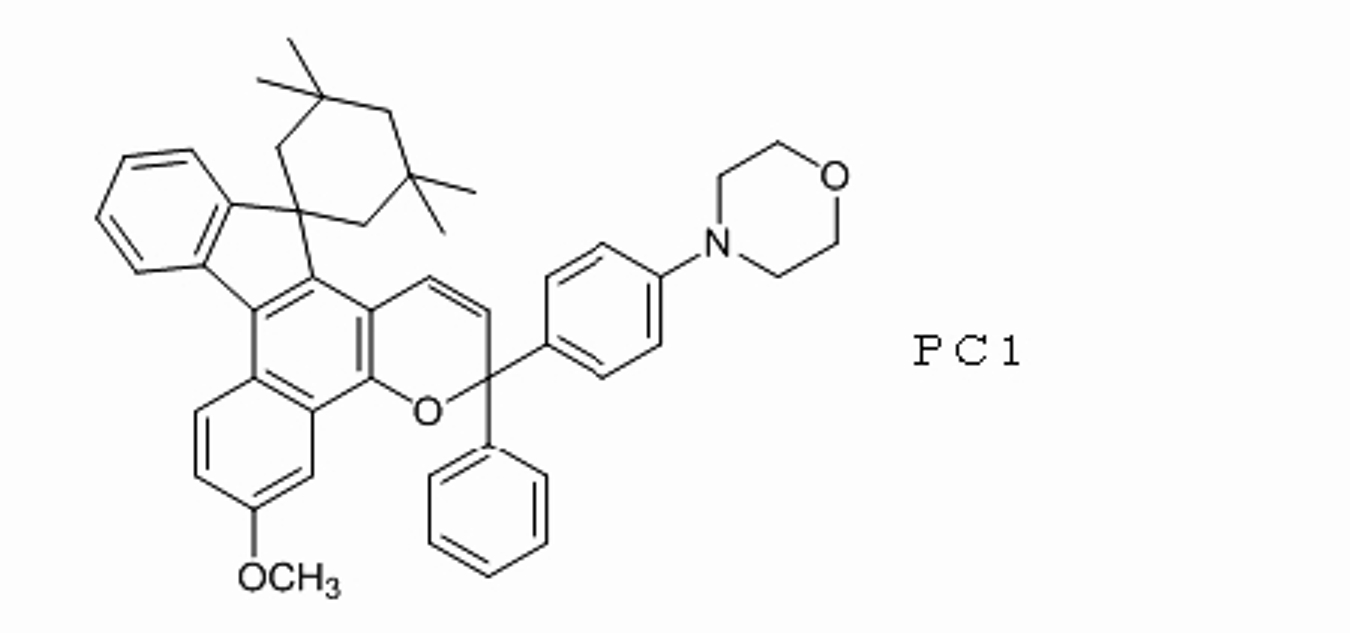
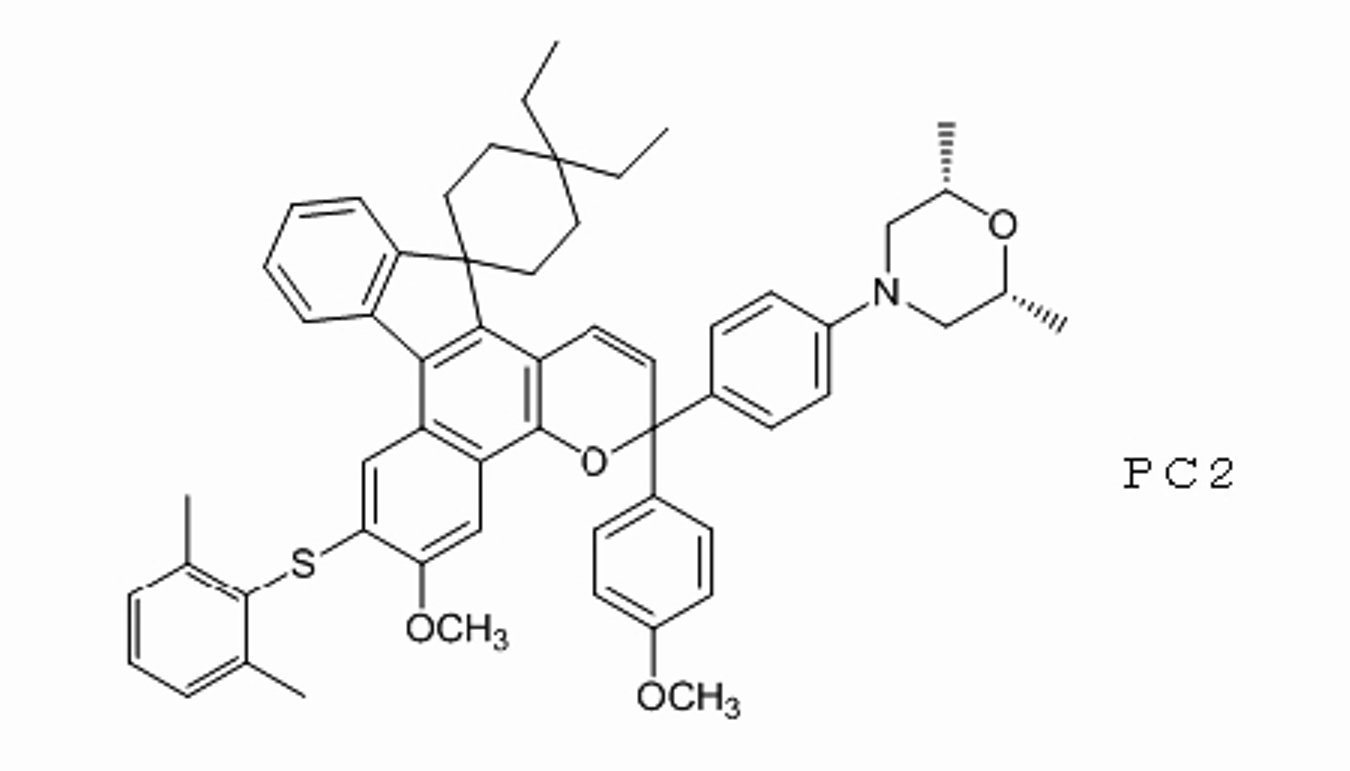

(材料E:紫外線安定剤)
E1;ビス(1,2,2,6,6-ペンタメチル-4-ピペリジル)セバ
ケート(分子量508)(HALS)
E2;エチレンビス(オキシエチレン)ビス[3-(5-tert-ブチ
ル-4-ヒドロキシ-m-トリル)プロピオネート](チバ・スペ
シャルティ・ケミカルズ社製Irganox245)(HP)
E1;ビス(1,2,2,6,6-ペンタメチル-4-ピペリジル)セバ
ケート(分子量508)(HALS)
E2;エチレンビス(オキシエチレン)ビス[3-(5-tert-ブチ
ル-4-ヒドロキシ-m-トリル)プロピオネート](チバ・スペ
シャルティ・ケミカルズ社製Irganox245)(HP)
(フォトクロミック硬化性組成物(F1)の調製)
以下の材料;
TMPT(材料D1) 20質量部、
D-TMP(材料D2) 30質量部、
BPE500(材料D3) 30質量部、
14G(材料D4) 17質量部、
MA1(材料D6) 3質量部、
材料PC1 1.2質量部、
材料PC2 0.4質量部、
材料PC3 1.2質量部、
HALS(材料E1) 3質量部、
HP(材料E2) 3質量部、
フェニルビス(2,4,6-トリメチルベンゾイル)-ホスフィンオ
キシド(材料B1) 0.3質量部および
東レ・ダウコーニング株式会社製L7001(レベリング剤)(L)
0.1質量部
を加え、70℃で15分間撹拌混合し、フォトクロミック硬化性組成物(F1)を得た。各配合量を表2に示した。
以下の材料;
TMPT(材料D1) 20質量部、
D-TMP(材料D2) 30質量部、
BPE500(材料D3) 30質量部、
14G(材料D4) 17質量部、
MA1(材料D6) 3質量部、
材料PC1 1.2質量部、
材料PC2 0.4質量部、
材料PC3 1.2質量部、
HALS(材料E1) 3質量部、
HP(材料E2) 3質量部、
フェニルビス(2,4,6-トリメチルベンゾイル)-ホスフィンオ
キシド(材料B1) 0.3質量部および
東レ・ダウコーニング株式会社製L7001(レベリング剤)(L)
0.1質量部
を加え、70℃で15分間撹拌混合し、フォトクロミック硬化性組成物(F1)を得た。各配合量を表2に示した。
(フォトクロミック硬化性組成物(F2)~(F3)の調製)
表2に示す通り、(メタ)アクリルモノマーの組成を変えた点以外は、フォトクロミック硬化性組成物(F1)と同様の方法にて、フォトクロミック硬化性組成物(F2)~(F3)を調整した。組成を表2に示す。
表2に示す通り、(メタ)アクリルモノマーの組成を変えた点以外は、フォトクロミック硬化性組成物(F1)と同様の方法にて、フォトクロミック硬化性組成物(F2)~(F3)を調整した。組成を表2に示す。

<実験例1>
レンズ基材として、中心厚が2mmで屈折率が1.50のアリル系プラスチックレンズ(PL1)または度数+8.00、中心厚15mm、エッジ厚1.5mm、屈折率1.50のアリル系プラスチックレンズ(PL2)を用意した。尚、PL1およびPL2は、事前に10%水酸化ナトリウム水溶液を用いて50℃で5分間のアルカリエッチングを行い、その後十分に蒸留水で洗浄した。PL1は評価1)~5)に使用し、PL2は評価5)のみに使用した。
レンズ基材として、中心厚が2mmで屈折率が1.50のアリル系プラスチックレンズ(PL1)または度数+8.00、中心厚15mm、エッジ厚1.5mm、屈折率1.50のアリル系プラスチックレンズ(PL2)を用意した。尚、PL1およびPL2は、事前に10%水酸化ナトリウム水溶液を用いて50℃で5分間のアルカリエッチングを行い、その後十分に蒸留水で洗浄した。PL1は評価1)~5)に使用し、PL2は評価5)のみに使用した。
スピンコーター(1H-DX2、MIKASA製)を用いて、上記のプラスチックレンズの表面に、本発明のプライマー組成物(P1)をスピンコートし、室温(20~25℃)で10分間乾燥させ、プライマー前駆体層を有するレンズ基材を得た。得られたプライマー前駆体層の厚さは、6.5~7.5μmであった。
その後、フォトクロミック硬化性組成物(F1)約2gを、前記プライマー前駆体層上にスピンコートした。前記フォトクロミック硬化性組成物の塗膜により表面がコートされたレンズ基材に、窒素ガス雰囲気中で、レンズ基材表面の405nmにおける出力が200mW/cm2になるように調整したDバルブを搭載したF3000SQ(フュージョンUVシステムズ社製)を用いて、90秒間光照射し、塗膜を硬化させた。その後、さらに100℃の恒温器にて、1時間の加熱処理を行うことでフォトクロミック積層体を得た。得られたフォトクロミックコート層の膜厚は、40±1μmであった。
得られたフォトクロミック積層体について下記1)~5)に示す評価を実施した。その結果、当該フォトクロミック積層体は、以下の特性を示した。
1)ビッカース硬度 12.0
2-1)最大吸収波長 588nm
2-2)発色濃度 1.0
2-3)退色速度 58秒
3)初期密着性 100
4)煮沸後密着性 2時間
5)外観評価(レンズがPL1の場合) 1
5)外観評価(レンズがPL2の場合) 1
1)ビッカース硬度 12.0
2-1)最大吸収波長 588nm
2-2)発色濃度 1.0
2-3)退色速度 58秒
3)初期密着性 100
4)煮沸後密着性 2時間
5)外観評価(レンズがPL1の場合) 1
5)外観評価(レンズがPL2の場合) 1
〔試料評価方法〕
1)ビッカース硬度
ビッカース硬度は、マイクロビッカース硬度計PMT-X7A(株式会社マツザワ製)を用いて測定した。圧子には、四角錐型ダイヤモンド圧子を用い、荷重10gf、圧子の保持時間30秒の条件にて評価を行った。測定結果は、計4回の測定を実施した後、測定誤差の大きい1回目の値を除いた計3回の平均値で示した。
1)ビッカース硬度
ビッカース硬度は、マイクロビッカース硬度計PMT-X7A(株式会社マツザワ製)を用いて測定した。圧子には、四角錐型ダイヤモンド圧子を用い、荷重10gf、圧子の保持時間30秒の条件にて評価を行った。測定結果は、計4回の測定を実施した後、測定誤差の大きい1回目の値を除いた計3回の平均値で示した。
2)フォトクロミック特性(最大吸収波長、発色濃度、退色濃度)
得られたフォトクロミック積層体(フォトクロミック層の厚み40±1μm)を試料とし、これに、キセノンランプL-2480(300W)SHL-100(浜松ホトニクス製)をエアロマスフィルター(コーニング社製)を介して20℃±1℃、重合体表面でのビーム強度365nm=2.4mW/cm2、245nm=24μW/cm2で120秒間照射して発色させ、フォトクロミック特性を測定した。各フォトクロミック特性は以下の方法で評価した。
2-1)最大吸収波長(λmax)
分光光度計(瞬間マルチチャンネルフォトディテクターMCPD1000、(株)大塚電子工業製)により、発色後の最大吸収波長を求めた。最大吸収波長は、発色時の色調に関係する指標である。
2-2)発色濃度{ε(120)-ε(0)}
最大吸収波長における、120秒間光照射した後の吸光度{ε(120)}と光照射前の吸光度{ε(0)}との差を求め、発色濃度とした。この値が高いほどフォトクロミック性に優れている。
2-3)退色速度〔t1/2(sec.)〕:
120秒間光照射後、光の照射を止めたときに、試料の前記最大波長における吸光度が{ε(120)-ε(0)}の1/2まで低下するのに要する時間を測定し、退色速度とした。この時間が短いほどフォトクロミック性に優れている。
得られたフォトクロミック積層体(フォトクロミック層の厚み40±1μm)を試料とし、これに、キセノンランプL-2480(300W)SHL-100(浜松ホトニクス製)をエアロマスフィルター(コーニング社製)を介して20℃±1℃、重合体表面でのビーム強度365nm=2.4mW/cm2、245nm=24μW/cm2で120秒間照射して発色させ、フォトクロミック特性を測定した。各フォトクロミック特性は以下の方法で評価した。
2-1)最大吸収波長(λmax)
分光光度計(瞬間マルチチャンネルフォトディテクターMCPD1000、(株)大塚電子工業製)により、発色後の最大吸収波長を求めた。最大吸収波長は、発色時の色調に関係する指標である。
2-2)発色濃度{ε(120)-ε(0)}
最大吸収波長における、120秒間光照射した後の吸光度{ε(120)}と光照射前の吸光度{ε(0)}との差を求め、発色濃度とした。この値が高いほどフォトクロミック性に優れている。
2-3)退色速度〔t1/2(sec.)〕:
120秒間光照射後、光の照射を止めたときに、試料の前記最大波長における吸光度が{ε(120)-ε(0)}の1/2まで低下するのに要する時間を測定し、退色速度とした。この時間が短いほどフォトクロミック性に優れている。
3)初期密着性
密着性は、JISD-0202に準じてクロスカットテープ試験によって測定した。即ち、カッターナイフを使い、得られたフォトクロミック積層体のフォトクロミック層の表面に約1mm間隔の切れ目を入れ、マス目を100個形成した。その上にセロファン粘着テープ(ニチバン(株)製、セロテープ(登録商標))を強く貼り付けた。次いで、表面から90°方向へ一気にセロファン粘着テープを引張り、剥離した後、フォトクロミック層が残っているマス目の数を数えた。
密着性は、JISD-0202に準じてクロスカットテープ試験によって測定した。即ち、カッターナイフを使い、得られたフォトクロミック積層体のフォトクロミック層の表面に約1mm間隔の切れ目を入れ、マス目を100個形成した。その上にセロファン粘着テープ(ニチバン(株)製、セロテープ(登録商標))を強く貼り付けた。次いで、表面から90°方向へ一気にセロファン粘着テープを引張り、剥離した後、フォトクロミック層が残っているマス目の数を数えた。
4)煮沸後密着性
沸騰した蒸留水中に、試験片であるフォトクロミック積層体を1時間毎に浸漬した。その後、フォトクロミック積層体を取り出し、水滴を拭き取り、室温で1時間放置した。得られたフォトクロミック積層体について、3)初期密着性試験と同様にして密着性を測定した。100マス中95マス以上が残っているフォトクロミック積層体は、密着性を保持しているものとみなし、かかるフォトクロミック積層体に関しては、密着性を保持しなくなるまで(即ち、残っているマスが94マス以下になるまで)煮沸した。煮沸時間は、最長で合計5時間までとした。
沸騰した蒸留水中に、試験片であるフォトクロミック積層体を1時間毎に浸漬した。その後、フォトクロミック積層体を取り出し、水滴を拭き取り、室温で1時間放置した。得られたフォトクロミック積層体について、3)初期密着性試験と同様にして密着性を測定した。100マス中95マス以上が残っているフォトクロミック積層体は、密着性を保持しているものとみなし、かかるフォトクロミック積層体に関しては、密着性を保持しなくなるまで(即ち、残っているマスが94マス以下になるまで)煮沸した。煮沸時間は、最長で合計5時間までとした。
5)外観評価
レンズ基材PL1及びPL2を用いて得られた2種類のフォトクロミック積層体各10枚を目視により観察し、光重合工程又はその後の加熱工程において、クラック等の外観不良が生じた枚数を数えた。外観不良が生じた枚数により、外観評価を行った。
レンズ基材PL1及びPL2を用いて得られた2種類のフォトクロミック積層体各10枚を目視により観察し、光重合工程又はその後の加熱工程において、クラック等の外観不良が生じた枚数を数えた。外観不良が生じた枚数により、外観評価を行った。
<実験例2-17、19-21>
表3に示したプライマー組成物およびフォトクロミック硬化性組成物を用いた以外、実験例1と同様の方法で、フォトクロミック積層体を作製し、評価を行なった。結果を表3に示した。実験例19のフォトクロミック積層体は、初期密着性が95マス未満だったため、煮沸後密着性の測定を行うことができなかった。
表3に示したプライマー組成物およびフォトクロミック硬化性組成物を用いた以外、実験例1と同様の方法で、フォトクロミック積層体を作製し、評価を行なった。結果を表3に示した。実験例19のフォトクロミック積層体は、初期密着性が95マス未満だったため、煮沸後密着性の測定を行うことができなかった。

<実験例18>
レンズ基材として、実験例1で使用したものと同じレンズ(PL1、PL2)を使用した。PL1は評価1)~5)で使用し、PL2は評価5)でのみ使用した。
レンズ基材として、実験例1で使用したものと同じレンズ(PL1、PL2)を使用した。PL1は評価1)~5)で使用し、PL2は評価5)でのみ使用した。
レンズ基材表面にプライマー組成物(P8)を塗布した後、フォトクロミック硬化性組成物(F1)を塗布する前に光硬化を行ったこと以外は、実験例1と同様にして、フォトクロミック積層体を得た。即ち、スピンコーター(1H-DX2、MIKASA製)を用いて、上記のプラスチックレンズの表面に、本発明のプライマー組成物(P8)をスピンコートし、室温(20~25℃)で10分間乾燥させた。次いで、窒素ガス雰囲気中で、レンズ基材表面の405nmにおける出力が200mW/cm2になるように調整したDバルブを搭載したF3000SQ(フュージョンUVシステムズ社製)を用いて、90秒間光照射して塗膜を硬化させ、プライマーコート層を有するレンズ基材を得た。得られたプライマーコート層の膜厚は、6.5~7.5μmであった。
その後、フォトクロミック硬化性組成物(F1)約2gを、前記プライマーコート層を有するレンズ基材の表面にスピンコートした。前記フォトクロミック硬化性組成物の塗膜により表面がコートされたレンズ基材に、窒素ガス雰囲気中で、レンズ基材表面の405nmにおける出力が200mW/cm2になるように調整したDバルブを搭載したF3000SQ(フュージョンUVシステムズ社製)を用いて、90秒間光照射して塗膜を硬化させた。その後、さらに100℃の恒温器にて、1時間の加熱処理を行うことでフォトクロミック積層体を得た。得られたフォトクロミックコート層の膜厚は、40±1μmであった。得られたフォトクロミック積層体について、実験例1と同様にして評価を行った。結果を表3に示した。
実験例1、2及び4-18から明らかな通り、本発明のプライマー組成物を用いて得られるフォトクロミック積層体は、フォトクロミック特性に優れるばかりでなく、表面硬度、密着性および外観にも優れている。しかしながら、実験例3および実験例19-21では、密着性、外観または表面硬度のうち、少なくとも1つの物性が不十分であり、全ての物性を同時に満足するものはなかった。
1 斜角形状を有するプラスチックレンズ基材
2 斜角形状部分
3 斜角形状の角度
2 斜角形状部分
3 斜角形状の角度
Claims (6)
- ウレタン(メタ)アクリレート及び光重合開始剤を含む水分散液からなる光学物品用光硬化性プライマー組成物であって、
前記ウレタン(メタ)アクリレートの単独硬化体の25℃における伸び率が0.1~10%であることを特徴とする光学物品用光硬化性プライマー組成物。 - 前記ウレタン(メタ)アクリレートの単独硬化体の25℃における引張り強度が10~50MPaである請求項1記載の光学物品用光硬化性プライマー組成物。
- 硬化させたときのビッカース硬度が8~30となる、請求項1記載の光学物品用光硬化性プライマー組成物。
- レンズ基材、プライマーコート層及びフォトクロミックコート層がこの順に積層されたフォトクロミック積層体であって、
前記プライマーコート層が、請求項1~3のいずれかに記載の光学物品用光硬化性プライマー組成物の硬化体であるフォトクロミック積層体。 - 前記プライマーコート層上にある前記フォトクロミックコート層のビッカース硬度が8より大きく12以下である、請求項4記載のフォトクロミック積層体。
- 請求項1~3のいずれかに記載の光学物品用光硬化性プライマー組成物をレンズ基材上に塗布して、硬化前のプライマー前駆体層が設けられた第一前駆体を形成する工程、
前記プライマー前駆体層上に、光重合開始剤を含むフォトクロミック硬化性組成物を塗布して、硬化前のフォトクロミック前駆体層を設けて第二前駆体を形成する工程、及び
前記第二前駆体に光を照射して、前記プライマー前駆体層および前記フォトクロミック前駆体層を硬化させる工程を含むことを特徴とするフォトクロミック積層体の製造方法。
Priority Applications (1)
| Application Number | Priority Date | Filing Date | Title |
|---|---|---|---|
| JP2015529616A JP6346183B2 (ja) | 2013-08-02 | 2014-07-31 | 光学物品用光硬化性プライマー組成物の硬化体を含むフォトクロミック積層体及び該積層体の製造方法 |
Applications Claiming Priority (2)
| Application Number | Priority Date | Filing Date | Title |
|---|---|---|---|
| JP2013-161687 | 2013-08-02 | ||
| JP2013161687 | 2013-08-02 |
Publications (1)
| Publication Number | Publication Date |
|---|---|
| WO2015016313A1 true WO2015016313A1 (ja) | 2015-02-05 |
Family
ID=52431840
Family Applications (1)
| Application Number | Title | Priority Date | Filing Date |
|---|---|---|---|
| PCT/JP2014/070217 Ceased WO2015016313A1 (ja) | 2013-08-02 | 2014-07-31 | 光学物品用光硬化性プライマー組成物、該組成物の硬化体を含むフォトクロミック積層体及び該積層体の製造方法 |
Country Status (2)
| Country | Link |
|---|---|
| JP (1) | JP6346183B2 (ja) |
| WO (1) | WO2015016313A1 (ja) |
Cited By (8)
| Publication number | Priority date | Publication date | Assignee | Title |
|---|---|---|---|---|
| WO2016013677A1 (ja) * | 2014-07-22 | 2016-01-28 | 株式会社トクヤマ | 硬化性組成物、及びフォトクロミック組成物 |
| JP2016153215A (ja) * | 2015-02-13 | 2016-08-25 | 三菱レイヨン株式会社 | 積層体及び積層体の製造方法 |
| EP3795602A1 (en) * | 2019-09-19 | 2021-03-24 | Essilor International | 2k pu-dual cure adhesive for lamination |
| WO2021132050A1 (ja) * | 2019-12-27 | 2021-07-01 | ホヤ レンズ タイランド リミテッド | 光学物品および光学物品の製造方法 |
| JPWO2021132051A1 (ja) * | 2019-12-27 | 2021-07-01 | ||
| JPWO2021201166A1 (ja) * | 2020-03-31 | 2021-10-07 | ||
| JP2023032885A (ja) * | 2021-08-27 | 2023-03-09 | 株式会社トクヤマ | 光学物品用水系プライマー組成物、光学積層体、光学物品、レンズ、及び眼鏡 |
| WO2024009834A1 (ja) * | 2022-07-04 | 2024-01-11 | ホヤ レンズ タイランド リミテッド | フォトクロミック物品およびフォトクロミック物品の製造方法 |
Families Citing this family (1)
| Publication number | Priority date | Publication date | Assignee | Title |
|---|---|---|---|---|
| JP2021148814A (ja) * | 2020-03-16 | 2021-09-27 | 株式会社トクヤマ | フォトクロミック積層体、フォトクロミック硬化性組成物、および該組成物の製造方法 |
Citations (7)
| Publication number | Priority date | Publication date | Assignee | Title |
|---|---|---|---|---|
| JPH07157531A (ja) * | 1993-12-09 | 1995-06-20 | Daicel Chem Ind Ltd | 水系ウレタンアクリレートの製造方法 |
| JP2005199683A (ja) * | 2003-03-20 | 2005-07-28 | Tokuyama Corp | 積層体、光学部品、これらの製造方法ならびにコーティング液 |
| WO2008001875A1 (en) * | 2006-06-30 | 2008-01-03 | Tokuyama Corporation | Method for producing photochromic optical article |
| JP2008046264A (ja) * | 2006-08-11 | 2008-02-28 | Seiko Epson Corp | 光学物品 |
| JP2010535909A (ja) * | 2007-08-11 | 2010-11-25 | バイエル・マテリアルサイエンス・アクチェンゲゼルシャフト | ポリウレタン水性分散体に基づく硬質被覆物系の製造方法 |
| JP2013023556A (ja) * | 2011-07-20 | 2013-02-04 | Ube Industries Ltd | 水性ポリウレタン樹脂分散体組成物及びその製造方法 |
| JP2013147707A (ja) * | 2012-01-19 | 2013-08-01 | Sunarrow Ltd | 電解メッキ用プライマー組成物、メッキ物の製造方法及びメッキ物 |
-
2014
- 2014-07-31 JP JP2015529616A patent/JP6346183B2/ja active Active
- 2014-07-31 WO PCT/JP2014/070217 patent/WO2015016313A1/ja not_active Ceased
Patent Citations (7)
| Publication number | Priority date | Publication date | Assignee | Title |
|---|---|---|---|---|
| JPH07157531A (ja) * | 1993-12-09 | 1995-06-20 | Daicel Chem Ind Ltd | 水系ウレタンアクリレートの製造方法 |
| JP2005199683A (ja) * | 2003-03-20 | 2005-07-28 | Tokuyama Corp | 積層体、光学部品、これらの製造方法ならびにコーティング液 |
| WO2008001875A1 (en) * | 2006-06-30 | 2008-01-03 | Tokuyama Corporation | Method for producing photochromic optical article |
| JP2008046264A (ja) * | 2006-08-11 | 2008-02-28 | Seiko Epson Corp | 光学物品 |
| JP2010535909A (ja) * | 2007-08-11 | 2010-11-25 | バイエル・マテリアルサイエンス・アクチェンゲゼルシャフト | ポリウレタン水性分散体に基づく硬質被覆物系の製造方法 |
| JP2013023556A (ja) * | 2011-07-20 | 2013-02-04 | Ube Industries Ltd | 水性ポリウレタン樹脂分散体組成物及びその製造方法 |
| JP2013147707A (ja) * | 2012-01-19 | 2013-08-01 | Sunarrow Ltd | 電解メッキ用プライマー組成物、メッキ物の製造方法及びメッキ物 |
Cited By (29)
| Publication number | Priority date | Publication date | Assignee | Title |
|---|---|---|---|---|
| US9873819B2 (en) | 2014-07-22 | 2018-01-23 | Tokuyama Corporation | Curable composition and photochromic composition |
| WO2016013677A1 (ja) * | 2014-07-22 | 2016-01-28 | 株式会社トクヤマ | 硬化性組成物、及びフォトクロミック組成物 |
| JP2016153215A (ja) * | 2015-02-13 | 2016-08-25 | 三菱レイヨン株式会社 | 積層体及び積層体の製造方法 |
| US12521966B2 (en) | 2019-09-19 | 2026-01-13 | Essilor International | 2K pu-dual cure adhesive for lamination |
| EP3795602A1 (en) * | 2019-09-19 | 2021-03-24 | Essilor International | 2k pu-dual cure adhesive for lamination |
| WO2021053089A1 (en) * | 2019-09-19 | 2021-03-25 | Essilor International | 2k pu-dual cure adhesive for lamination |
| CN114423840A (zh) * | 2019-09-19 | 2022-04-29 | 依视路国际公司 | 用于层压的2k pu-双重固化粘合剂 |
| JPWO2021132050A1 (ja) * | 2019-12-27 | 2021-07-01 | ||
| CN114599716B (zh) * | 2019-12-27 | 2023-12-29 | 豪雅镜片泰国有限公司 | 光学物品及光学物品的制造方法 |
| US12572064B2 (en) | 2019-12-27 | 2026-03-10 | Hoya Lens Thailand Ltd. | Optical article and method for producing optical article |
| WO2021132051A1 (ja) * | 2019-12-27 | 2021-07-01 | ホヤ レンズ タイランド リミテッド | 光学物品および光学物品の製造方法 |
| JPWO2021132051A1 (ja) * | 2019-12-27 | 2021-07-01 | ||
| CN114599716A (zh) * | 2019-12-27 | 2022-06-07 | 豪雅镜片泰国有限公司 | 光学物品及光学物品的制造方法 |
| US12421365B2 (en) | 2019-12-27 | 2025-09-23 | Hoya Lens Thailand Ltd. | Optical article and method for producing optical article |
| WO2021132050A1 (ja) * | 2019-12-27 | 2021-07-01 | ホヤ レンズ タイランド リミテッド | 光学物品および光学物品の製造方法 |
| JP7308293B2 (ja) | 2019-12-27 | 2023-07-13 | ホヤ レンズ タイランド リミテッド | 光学物品の製造方法 |
| JP7377285B2 (ja) | 2019-12-27 | 2023-11-09 | ホヤ レンズ タイランド リミテッド | 光学物品および光学物品の製造方法 |
| JP2024073640A (ja) * | 2020-03-31 | 2024-05-29 | ホヤ レンズ タイランド リミテッド | 光学物品用重合性組成物、光学物品および眼鏡 |
| JP7460756B2 (ja) | 2020-03-31 | 2024-04-02 | ホヤ レンズ タイランド リミテッド | 光学物品用重合性組成物、光学物品および眼鏡 |
| JP7650388B2 (ja) | 2020-03-31 | 2025-03-24 | ホヤ レンズ タイランド リミテッド | 光学物品用重合性組成物、光学物品および眼鏡 |
| CN115335734A (zh) * | 2020-03-31 | 2022-11-11 | 豪雅镜片泰国有限公司 | 光学物品用聚合性组合物、光学物品及眼镜 |
| WO2021201166A1 (ja) * | 2020-03-31 | 2021-10-07 | ホヤ レンズ タイランド リミテッド | 光学物品用重合性組成物、光学物品および眼鏡 |
| JPWO2021201166A1 (ja) * | 2020-03-31 | 2021-10-07 | ||
| CN115335734B (zh) * | 2020-03-31 | 2026-03-17 | 豪雅镜片泰国有限公司 | 光学物品用聚合性组合物、光学物品及眼镜 |
| JP2023032885A (ja) * | 2021-08-27 | 2023-03-09 | 株式会社トクヤマ | 光学物品用水系プライマー組成物、光学積層体、光学物品、レンズ、及び眼鏡 |
| JP7685909B2 (ja) | 2021-08-27 | 2025-05-30 | 株式会社トクヤマ | レンズ及び眼鏡 |
| WO2024009834A1 (ja) * | 2022-07-04 | 2024-01-11 | ホヤ レンズ タイランド リミテッド | フォトクロミック物品およびフォトクロミック物品の製造方法 |
| JP2024006618A (ja) * | 2022-07-04 | 2024-01-17 | ホヤ レンズ タイランド リミテッド | フォトクロミック物品およびフォトクロミック物品の製造方法 |
| JP7784356B2 (ja) | 2022-07-04 | 2025-12-11 | ホヤ レンズ タイランド リミテッド | フォトクロミック物品およびフォトクロミック物品の製造方法 |
Also Published As
| Publication number | Publication date |
|---|---|
| JP6346183B2 (ja) | 2018-06-20 |
| JPWO2015016313A1 (ja) | 2017-03-02 |
Similar Documents
| Publication | Publication Date | Title |
|---|---|---|
| JP6346183B2 (ja) | 光学物品用光硬化性プライマー組成物の硬化体を含むフォトクロミック積層体及び該積層体の製造方法 | |
| AU2004218188B2 (en) | Layered product, optical part, processes for producing these, and coating fluid | |
| JP6355209B2 (ja) | フォトクロミック硬化性組成物、その硬化体及びその硬化体を含む積層体 | |
| CN102812104A (zh) | 光致变色固化性组合物 | |
| JP7657197B2 (ja) | 積層体 | |
| WO2008001578A1 (en) | Photochromic film, photochromic lens having the same, and process for producing photochromic lens | |
| JPWO2018230513A1 (ja) | 光学物品用プライマー組成物および積層体 | |
| JP2017052869A (ja) | フォトクロミック硬化性組成物、その硬化体、及びその硬化体を含む積層体 | |
| JP7738054B2 (ja) | フォトクロミック硬化性組成物 | |
| WO2015072530A1 (ja) | 光学物品用プライマー組成物、該光学物品用プライマー組成物の硬化体を含むフォトクロミック積層体 | |
| EP3770182B1 (en) | Photochromic curable composition | |
| JP2021107909A (ja) | フォトクロミック物品の保護層形成用重合性組成物、フォトクロミック物品および眼鏡 | |
| JP2019164271A (ja) | 偏光フォトクロミック光学物品、その製造方法、および該光学物品を備えた積層物品 | |
| JP2015074199A (ja) | フォトクロミック積層体 | |
| CN107076879B (zh) | 硬涂薄膜的制造方法及硬涂薄膜 | |
| WO2011096304A1 (ja) | 光学物品用プライマー組成物及び光学物品 | |
| WO2016013677A1 (ja) | 硬化性組成物、及びフォトクロミック組成物 | |
| WO2017001902A1 (en) | Anti-scratch and photochromic coating, respective method of application and use | |
| CN114641710B (zh) | 光学物品及光学物品的制造方法 | |
| JP5766001B2 (ja) | フォトクロミック組成物 | |
| JP7685909B2 (ja) | レンズ及び眼鏡 | |
| WO2021132049A1 (ja) | フォトクロミック物品の保護層形成用重合性組成物、フォトクロミック物品および眼鏡 | |
| JP2006103298A (ja) | 積層体及びその製造方法 | |
| US20250188291A1 (en) | Photochromic article and method for producing photochromic article | |
| JP2022110997A (ja) | フォトクロミック硬化性組成物 |
Legal Events
| Date | Code | Title | Description |
|---|---|---|---|
| 121 | Ep: the epo has been informed by wipo that ep was designated in this application |
Ref document number: 14831210 Country of ref document: EP Kind code of ref document: A1 |
|
| ENP | Entry into the national phase |
Ref document number: 2015529616 Country of ref document: JP Kind code of ref document: A |
|
| NENP | Non-entry into the national phase |
Ref country code: DE |
|
| 122 | Ep: pct application non-entry in european phase |
Ref document number: 14831210 Country of ref document: EP Kind code of ref document: A1 |