WO2014208162A1 - シャンプー組成物 - Google Patents
シャンプー組成物 Download PDFInfo
- Publication number
- WO2014208162A1 WO2014208162A1 PCT/JP2014/058938 JP2014058938W WO2014208162A1 WO 2014208162 A1 WO2014208162 A1 WO 2014208162A1 JP 2014058938 W JP2014058938 W JP 2014058938W WO 2014208162 A1 WO2014208162 A1 WO 2014208162A1
- Authority
- WO
- WIPO (PCT)
- Prior art keywords
- mass
- component
- shampoo composition
- fatty acid
- shampoo
- Prior art date
- Legal status (The legal status is an assumption and is not a legal conclusion. Google has not performed a legal analysis and makes no representation as to the accuracy of the status listed.)
- Ceased
Links
Images
Classifications
-
- A—HUMAN NECESSITIES
- A61—MEDICAL OR VETERINARY SCIENCE; HYGIENE
- A61Q—SPECIFIC USE OF COSMETICS OR SIMILAR TOILETRY PREPARATIONS
- A61Q5/00—Preparations for care of the hair
- A61Q5/02—Preparations for cleaning the hair
-
- A—HUMAN NECESSITIES
- A61—MEDICAL OR VETERINARY SCIENCE; HYGIENE
- A61K—PREPARATIONS FOR MEDICAL, DENTAL OR TOILETRY PURPOSES
- A61K8/00—Cosmetics or similar toiletry preparations
- A61K8/18—Cosmetics or similar toiletry preparations characterised by the composition
- A61K8/30—Cosmetics or similar toiletry preparations characterised by the composition containing organic compounds
- A61K8/33—Cosmetics or similar toiletry preparations characterised by the composition containing organic compounds containing oxygen
- A61K8/34—Alcohols
- A61K8/345—Alcohols containing more than one hydroxy group
-
- A—HUMAN NECESSITIES
- A61—MEDICAL OR VETERINARY SCIENCE; HYGIENE
- A61K—PREPARATIONS FOR MEDICAL, DENTAL OR TOILETRY PURPOSES
- A61K8/00—Cosmetics or similar toiletry preparations
- A61K8/18—Cosmetics or similar toiletry preparations characterised by the composition
- A61K8/30—Cosmetics or similar toiletry preparations characterised by the composition containing organic compounds
- A61K8/33—Cosmetics or similar toiletry preparations characterised by the composition containing organic compounds containing oxygen
- A61K8/37—Esters of carboxylic acids
- A61K8/375—Esters of carboxylic acids the alcohol moiety containing more than one hydroxy group
-
- A—HUMAN NECESSITIES
- A61—MEDICAL OR VETERINARY SCIENCE; HYGIENE
- A61K—PREPARATIONS FOR MEDICAL, DENTAL OR TOILETRY PURPOSES
- A61K8/00—Cosmetics or similar toiletry preparations
- A61K8/18—Cosmetics or similar toiletry preparations characterised by the composition
- A61K8/30—Cosmetics or similar toiletry preparations characterised by the composition containing organic compounds
- A61K8/40—Cosmetics or similar toiletry preparations characterised by the composition containing organic compounds containing nitrogen
- A61K8/45—Derivatives containing from 2 to 10 oxyalkylene groups
-
- A—HUMAN NECESSITIES
- A61—MEDICAL OR VETERINARY SCIENCE; HYGIENE
- A61K—PREPARATIONS FOR MEDICAL, DENTAL OR TOILETRY PURPOSES
- A61K8/00—Cosmetics or similar toiletry preparations
- A61K8/18—Cosmetics or similar toiletry preparations characterised by the composition
- A61K8/30—Cosmetics or similar toiletry preparations characterised by the composition containing organic compounds
- A61K8/46—Cosmetics or similar toiletry preparations characterised by the composition containing organic compounds containing sulfur
- A61K8/463—Cosmetics or similar toiletry preparations characterised by the composition containing organic compounds containing sulfur containing sulfuric acid derivatives, e.g. sodium lauryl sulfate
Definitions
- the present invention relates to a shampoo composition.
- the pearlizing agent is dispersed in the shampoo composition to express a good gloss feeling, a stable pearly luster is obtained even when stored under high temperature conditions, the dispersion uniformity of the pearlizing agent is maintained, and the shampoo rinse is performed.
- the present condition is that the shampoo composition with the favorable feeling of time and the ease of styling during hair drying after shampoo is not provided.
- the present invention expresses good gloss, has a stable pearl appearance even when stored under high temperature conditions, maintains dispersion uniformity, feels during rinsing, and styling during hair drying after shampooing
- An object of the present invention is to provide a shampoo composition with good ease of care.
- the shampoo composition of the present invention as a means for solving the above problems, (A) (A1) fatty acid glycol ester, (A2) polyoxyethylene fatty acid monoalkanolamide having an average addition mole number of ethylene oxide of 1 to 5, (A3) polyhydric alcohol, (A4) polyoxyethylene alkyl ether sulfate And (A5) water, the mass ratio A1 / A2 of the component (A1) and the component (A2) is 0.5 to 4, and the component (A1), the component (A2) and the component (A A pearlizing agent dispersion having a mass ratio (A1 + A2) / A3 of A3) component of 20 to 100; (B) a sulfate type anionic surfactant having a sulfuric acid residue containing the component (A4).
- the conventional problems can be solved, the object can be achieved, a good gloss can be expressed, a stable pearl appearance can be obtained even under storage at high temperature, and dispersion uniformity can be achieved.
- a shampoo composition having a good feeling during rinsing and easy styling during hair drying after shampooing.
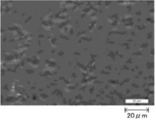
- FIG. 1 is a phase contrast micrograph of a pearlizing agent crystal (pearl luster particles) in the shampoo composition obtained in Example 1.
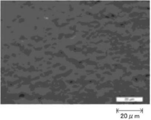
- FIG. 2 is a phase contrast micrograph of the pearlizing agent crystal (pearl luster particles) in the shampoo composition obtained in Comparative Example 4.
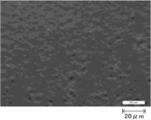
- FIG. 3 is a phase contrast micrograph of the pearlizing agent crystal (pearl luster particles) in the shampoo composition obtained in Comparative Example 6.
- the shampoo composition of the present invention comprises (A) (A1) fatty acid glycol ester, (A2) polyoxyethylene fatty acid monoalkanolamide having an average addition mole number of ethylene oxide of 1 to 5, (A3) polyhydric alcohol, (A4 A) a polyoxyethylene alkyl ether sulfate, and (A5) a pearlizing agent dispersion comprising water, and (B) a sulfate-type anionic surfactant having a sulfate residue containing the component (A4). Further, it contains other components as required.
- the fatty acid glycol ester of the component (A1) can generally impart glossiness to the shampoo composition by being dispersed as a crystal in the shampoo composition.
- the component (A1) is cooled by melting the fatty acid glycol ester of the component (A1) and dispersing and mixing it in an aqueous surfactant solution maintained at a melting point or higher of the fatty acid glycol ester of the component (A1).
- a pearlizing agent dispersion of fatty acid glycol ester crystals can be prepared.
- the obtained pearlizing agent dispersion of the component (A) is mixed with various component mixed solutions containing the sulfate type anionic surfactant which is the component (B), and the fatty acid glycol ester of the component (A1) in the shampoo.
- a shampoo composition having a pearl appearance can be prepared by adding so that the concentration becomes a predetermined concentration.
- the pearlizing agent dispersion of the component (A) includes (A1) fatty acid glycol ester, (A2) polyoxyethylene fatty acid monoalkanolamide having an average addition mole number of ethylene oxide of 1 to 5, (A3) polyhydric alcohol, (A4) Polyoxyethylene alkyl ether sulfate and (A5) water.
- the alkyl chain length of the fatty acid is preferably from 14 to 22, and more preferably from 18 to 22, from the viewpoint of pearly luster and storage stability.
- Specific examples include ethylene glycol dimyristate, ethylene glycol dipalmitate, ethylene glycol distearate, ethylene glycol monostearate, and ethylene glycol dibehenate. These may be used alone or in combination of two or more. Among these, ethylene glycol distearate is more preferable from the viewpoint of pearly luster.
- the melting point of the fatty acid glycol ester of the component (A1) is preferably 59 ° C. to 70 ° C., more preferably 61 ° C. to 63 ° C. from the viewpoint of pearly luster.
- the melting point exceeds 70 ° C., the pearly luster may not be sufficiently exhibited, and the stability of the pearlizing agent dispersion may deteriorate.
- the melting point is lower than 59 ° C., the storage stability of the pearl appearance may be lowered.
- the melting point of the fatty acid glycol ester of the component (A1) is determined according to “General Quaternary Raw Material Standard 2006 (Pharmaceutical Daily)” General Test Method 70. Melting
- ethylene glycol distearate As the fatty acid glycol ester of the component (A1).
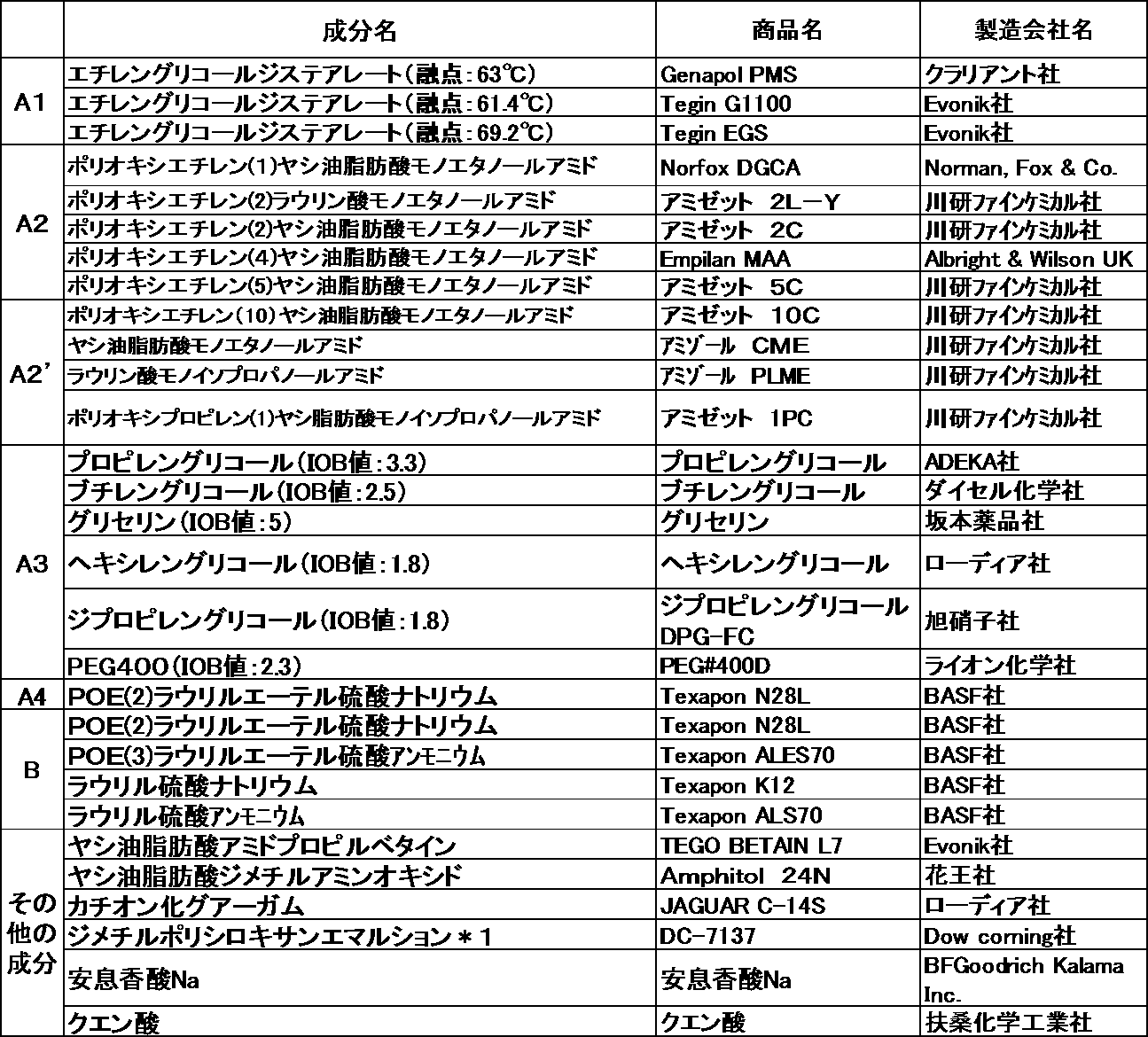
- examples of the commercially available ethylene glycol distearate include Genapol PMS (melting point: 63 ° C., manufactured by Clariant), Cutina AGS-T (melting point: 63 ° C., manufactured by BASF), Tegin G1100 (melting point: 61.4). Deg. C, manufactured by Evonik), Tegin EGS (melting point: 69.2 ° C, manufactured by Evonik), and the like.
- Tegin G1100 melting point: 61.4 ° C., manufactured by Evonik
- Genapol PMS melting point: 63 ° C., manufactured by Clariant
- Cutina AGS-T melting point: 63 ° C., BASF Corporation
- the content of the fatty acid glycol ester as the component (A1) is 0.5% by mass to 5% by mass with respect to the total amount of the shampoo composition in terms of pearly luster and ease of styling after shampooing. Preferably, 0.75 mass% to 3 mass% is more preferable.
- the content is less than 0.5% by mass, sufficient pearly luster may not be imparted to the shampoo composition.
- the content exceeds 5% by mass dispersion stability in the shampoo composition may be prevented. May deteriorate, and the styling ease after use of shampoo may deteriorate.
- the polyoxyethylene fatty acid monoalkanolamide as the component (A2) is a component that functions as a dispersant for the fatty acid glycol ester as the component (A1).
- the polyoxyethylene fatty acid monoalkanolamide as component (A2) has a carbon number of 9 to 17 from the viewpoint of pearly luster, dispersion stability, smoothness during shampooing, and ease of styling.
- the saturated or unsaturated hydrocarbon group is preferably, and the average added mole number of ethylene oxide (EO) is preferably 1 to 5.
- the fatty acid has 11 to 13 carbon atoms and the average added mole number of ethylene oxide (EO) is 1 to 2.
- the number of carbon atoms in the fatty acid is less than 9, the gloss of pearl is deteriorated, and when it exceeds 17, the stability of the pearlizing agent dispersion may be lowered.
- the average added mole number of the ethylene oxide (EO) is less than 1, the glossiness of the pearl is deteriorated, the smoothness at the time of rinsing after using the shampoo composition, and the styling is easy.
- it exceeds 5 the storage stability in the shampoo composition may be deteriorated without the appearance of pearly luster.
- polyoxyethylene (1) coconut oil fatty acid monoethanolamide, polyoxyethylene (2) lauric acid monoethanolamide, polyoxyethylene (2) coconut oil fatty acid monoethanolamide, polyoxyethylene (4 And coconut oil fatty acid monoethanolamide, polyoxyethylene (5) coconut oil fatty acid monoethanolamide, and the like may be used alone or in combination of two or more.
- polyoxyethylene (2) lauric acid monoethanolamide, polyoxyethylene (2) coconut oil fatty acid monoethanolamide, and polyoxyethylene (1) coconut oil fatty acid monoethanolamide are preferable.
- polyoxyethylene (2) lauric acid monoethanolamide is more preferable.
- a commercially available product can be used as the polyoxyethylene fatty acid monoalkanol amide as the component (A2).
- the commercially available products include trade name “Amidette” series manufactured by Kawaken Fine Chemical Co., Ltd., and polyoxyethylene (2) lauric acid monoethanolamide (Amidette 2L-Y), polyoxyethylene (2 ) Palm oil fatty acid monoethanolamide (Amidette 2C), polyoxyethylene (5) Palm oil fatty acid monoethanolamide (Amidette 5C), Polyoxyethylene (1) Palm oil fatty acid monoethanolamide (Norfox DGCA, Norman, Fox & Co Co., Ltd.), polyoxyethylene (4) coconut oil fatty acid monoethanolamide (Epilan MAA, manufactured by Albright & Wilson UK Limited), and the like.
- the content of the polyoxyethylene fatty acid monoalkanolamide as the component (A2) is 0.5% by mass to 5% by mass with respect to the total amount of the shampoo composition from the viewpoint of pearly luster and feeling of use of the shampoo composition. Is preferable, and 0.75 mass% to 3 mass% is more preferable.
- the content is less than 0.5% by mass, the fatty acid glycol ester of the component (A1) cannot be sufficiently dispersed, and the pearly luster may be deteriorated.
- the content exceeds 5% by mass, smoothness during rinsing may be impaired, and styling after shampooing may be inferior.
- the mass ratio A1 / A2 between the content of the component (A1) and the content of the component (A2) is 0.5 to 0.5 from the viewpoints of pearly luster and smoothness during shampooing and styling smoothness. 4, preferably 0.75 to 2.
- the mass ratio A1 / A2 is less than 0.5, pearly luster may not be obtained.
- it exceeds 4 the pearly luster is not sufficient, and the shampoo composition is smooth when rinsed. And the ease of styling after shampooing may be inferior.
- the total content of the component (A1) and the component (A2) is preferably 1.4% by mass to 8% by mass with respect to the total amount of the shampoo composition in terms of pearly luster and usability. 5% to 4.5% by mass is more preferable. Within this range, the pearl gloss and the dispersion stability of the shampoo composition are good. In addition, smoothness when shampoo composition is applied to hair and foamed and rinsed, and ease of styling after shampooing is good. When the total content is less than 1.4% by mass, sufficient pearly luster may not be obtained. When the total content exceeds 8% by mass, the smoothness during rinsing may be impaired, or styling after shampooing may occur. May be inferior.
- polyhydric alcohol examples include polyethylene glycol, propylene glycol, dipropylene glycol, hexylene glycol, sorbitol, 1,3-butylene glycol, isoprene glycol, glycerin and the like. These may be used alone or in combination of two or more.
- the IOB value is preferably 1.8 to 4, and more preferably 1.8 to 3.3, from the viewpoint of storage stability and feeling of use of the shampoo composition.
- propylene glycol (IOB value: 3.3), dipropylene glycol (IOB value: 1.8), hexylene glycol (IOB value: 1.8), 1,3-butylene glycol (IOB value: 2.5), isoprene glycol (IOB value: 2.0), and polyethylene glycol 400 (IOB value: 2.3) are preferable.
- IOB value is less than 1.8, the pearly luster is not good and the storage stability of the pearlizing agent may be unfavorable.
- the IOB value exceeds 4 the shampoo containing the pearlizing agent dispersion is blended. In some cases, the storage stability of the resin deteriorates, and the smoothness and ease of styling during rinsing are not preferable.
- the IOB value refers to the ratio of the inorganic value (IV) to the organic value (OV) in the organic conceptual diagram, that is, “inorganic value (IV) / organic value (OV)”.
- the organic conceptual diagram was proposed by Satoshi Fujita, and details thereof are described in “Pharmaceutical Bulletin”, 1954, vol. 2, 2, p. 163-173, “Area of Chemistry”, 1957, vol. 11, 10, p. 719-725, “Fragrance Journal”, 1981, vol. 50, p. 79-82 etc. That is, the source of all organic compounds is methane (CH 4 ), all other compounds are all regarded as derivatives of methane, and certain numbers are set for the carbon number, substituent, transformation part, ring, etc.
- the score is added to obtain an organic value and an inorganic value, and these values are plotted on a diagram with the organic value on the X axis and the inorganic value on the Y axis.
- This organic conceptual diagram is also shown in “Organic conceptual diagram-basics and applications-” (by Yoshio Koda, Sankyo Publishing, 1984).
- the content of the polyhydric alcohol as the component (A3) is 0.02% by mass to the total amount of the shampoo composition from the viewpoint of pearl appearance, storage stability of the shampoo composition, and smoothness at the time of rinsing. 0.5% by mass is preferable, and 0.03% by mass to 0.2% by mass is more preferable.
- the content is less than 0.02% by mass, the uniform dispersibility of the fatty acid glycol ester of the component (A1) may be deteriorated, and the storage stability of the shampoo composition and the smoothness during rinsing are poor. May be.
- the content exceeds 0.5% by mass, the pearly feeling may not be sufficiently exhibited.
- the component (A1) and the mass ratio (A1 + A2) / A3 of the component (A2) and the component (A3) are 20 to 100, preferably 30 to 75. Within this range, the pearly luster and storage stability of the shampoo composition are good, the smoothness when rinsing after foaming the shampoo composition, and the ease of styling after washing the shampoo are good. is there. If the mass ratio (A1 + A2) / A3 is less than 20, good pearly luster may not be obtained. If it exceeds 100, the storage stability of the pearlizing agent deteriorates and the shampoo composition is rinsed. The smoothness of time and the ease of styling after shampooing may not be good.
- the polyoxyethylene alkyl ether sulfate as the component (A4) can further enhance the dispersibility of the fatty acid glycol ester (A1).
- the same thing as the polyoxyethylene alkyl ether sulfate in the (B) component mentioned later can be used.
- the content of the polyoxyethylene alkyl ether sulfate as the component (A4) is preferably 0.5% by mass to 5% by mass and more preferably 1% by mass to 3% by mass with respect to the total amount of the pearlizing agent dispersion. .
- the content of the component (A4) in the shampoo composition is the sum and the content of the component (A4) contained in the sulfate type anionic surfactant having a sulfate residue of the component (B) described later. It is the value.
- the water of the component (A5) for example, pure water such as ion exchange water, purified water, ultrafiltration water, reverse osmosis water, distilled water, or ultrapure water can be used.
- the content of the component (A5) in the component (A) is 30 masses in terms of pearly luster and storage (separation) stability of the pearl dispersant relative to the total amount of the pearlizing agent dispersion. % To 90% by mass is preferable, and 45% to 85% by mass is more preferable. When the content exceeds 90% by mass, the pearly luster may not be sufficient. When the content is less than 30% by mass, the storage (separation) stability of the pearlizing agent is not preferable, and smoothness when shampooing is performed. May deteriorate.
- the content of the pearlizing agent dispersion of the component (A) is preferably 3% by mass to 25% by mass and more preferably 5% by mass to 20% by mass with respect to the total amount of the shampoo composition.
- the content is less than 3% by mass, the pearly luster and the stability of the pearling agent may be inferior.
- the content exceeds 25% by mass styling after shampooing may be difficult. is there.
- the sulfate-type anionic surfactant having a sulfate residue containing the component (A4) of the component (B) is a component that forms a suitable foam and serves as a cleaning base that removes dirt attached to the hair. It is.
- Examples of the sulfate type anionic surfactant having a sulfuric acid residue containing the component (A4) of the component (B) include alkyl sulfates, alkenyl sulfates, polyoxyalkylene alkyl ether sulfates, and polyoxyalkylenes.
- alkenyl ether sulfate examples thereof include alkenyl ether sulfate, polyoxyalkylene alkylphenyl ether sulfate, glyceride sulfate, and amide ether sulfate. These may be used alone or in combination of two or more.
- polyoxyalkylene alkyl ether sulfates represented by the following general formula (B1) polyoxyalkylene alkenyl ether sulfates, alkyl sulfates and alkenyl sulfates represented by the following general formula (B2) are preferable.
- a polyoxyethylene alkyl ether sulfate represented by the general formula (B1) is preferable.
- R 1 represents an alkyl group or alkenyl group having 10 to 18 carbon atoms
- M represents an alkali metal, ammonium, or alkanolamine
- m represents an average addition mole number of 1 to 1. The number 5 is shown.
- R 2 OSO 3 M general formula (B2) [In the general formula (B2), R 2 represents an alkyl group having 10 to 18 carbon atoms, and M represents an alkali metal, ammonium, or alkanolamine. ] Specific examples of R 1 and R 2 in the general formulas (B1) and (B2) include a lauryl group, a myristyl group, a palmityl group, and a stearyl group. Examples of M include alkali metals such as lithium, sodium and potassium, and alkanolamines such as monoethanolamine, diethanolamine and triethanolamine.
- R 1 in the general formula (B1) and R 2 in the general formula (B2) are: Alkyl groups having 12 to 16 carbon atoms are preferred. Specifically, a lauryl group, a myristyl group, and a palmityl group are preferable, and a lauryl group is more preferable.
- m in the general formula (B1) is preferably 2 to 3.
- M in the general formulas (B1) and (B2) is preferably sodium or ammonium from the viewpoint of smoothness at the time of rinsing after washing.
- Examples of the sulfate-type anionic surfactant having a sulfate residue as the component (B) include “Texapon N28L” which is polyoxyethylene (2) sodium lauryl ether sulfate as polyoxyethylene alkyl ether sulfate. (Manufactured by BASF), “Sinoline SPE-1250” (manufactured by Shin Nippon Chemical Co., Ltd.), “Pepmacol 2 SLES 70” (manufactured by PEPMACO), “Texapon ALES70” which is polyoxyethylene (3) ammonium lauryl ether sulfate, etc. Can be mentioned.
- alkyl sulfate examples include “Texapon ALS70” (manufactured by BASF) which is ammonium lauryl sulfate, “Texapon K12” (manufactured by BASF) which is sodium lauryl sulfate, and the like.
- polyoxyethylene (2) sodium lauryl ether sulfate and polyoxyethylene (3) ammonium lauryl ether sulfate are preferable from the viewpoint of smoothness at the time of rinsing.
- the inside of () shows the average addition mole number of ethylene oxide.
- the content of the sulfate-type anionic surfactant having a sulfuric acid residue as the component (B) is 5% by mass with respect to the total amount of the shampoo composition from the viewpoint of foaming, liquid properties during use, and detergency. % To 30% by mass, preferably 10% to 25% by mass, and more preferably 12% to 20% by mass. When the content is less than 5% by mass, the smoothness of rinsing may be deteriorated. When the content exceeds 30% by mass, the viscosity is high, and the smoothness during rinsing is also deteriorated, resulting in desired performance. May not be expressed.
- the content of the sulfate type anionic surfactant having a sulfate residue of the component (B) is the total content of the polyoxyethylene alkyl ether sulfate of the component (A4) in the pearlizing agent dispersion. It is the value.
- the other components are not particularly limited as long as the effects of the present invention are not impaired, and can be appropriately selected according to the purpose. Examples thereof include various additive components widely used in general shampoo compositions. It is done. Specific examples of the other components include hydrocarbons such as liquid paraffin and squalane; esters such as isopropyl myristate; vegetable oils such as camellia oil, almond oil and jojoba oil; silicone compounds such as methylpolysiloxane; birch extract Plant extracts; cationic surfactants such as behenyltrimethylammonium chloride; nonionic surfactants such as polyoxyethylene alkyl ether, glycerin fatty acid ester, sucrose fatty acid ester, polyglycerin fatty acid ester, polyoxyethylene hydrogenated castor oil; Amphoteric surfactants such as lauric acid amidopropyl betaine, lauric acid amide prohydroxysulfopyrubetaine, lauryl dimethylamine oxide; gallic acid
- Anionic polymers such as vinylpyrrolidone-based polymers; amphoteric polymers such as diallyldimethylammonium chloride / acrylic acid; cationic polymers such as cationized cellulose; anhydrous silica, magnesia silica, etc.
- Machine powder Organic powder such as nylon and polyethylene; Perfume; pH adjuster such as citric acid, sodium citrate and glycolic acid; Amines such as acyl glutamate triethanolamine; Preservative such as sodium benzoate; Hydroxyethane And stabilizers such as diphosphonic acid, dibutylhydroxytoluene, and edetate disodium. These may be used individually by 1 type and may use 2 or more types together.
- silicone compound a highly polymerized dimethylpolysiloxane and a silicone rubber are included
- dimethylpolysiloxane a highly polymerized dimethylpolysiloxane and a silicone rubber are included
- methylphenyl etc.
- Examples of the cationic polymer include dimethyldiallylammonium chloride / acrylamide copolymer, trimethylmethacrylamideamidopropylammonium chloride / acrylic acid / methyl acrylate terpolymer, trimethylmethacrylamideamidopropylammonium chloride / acrylic acid / acrylamide ternary. Copolymer, methacryloylethyltrimethylammonium chloride / N- (2-hydroxyethyl) acrylamide copolymer, O- [2-hydroxy-3- (trimethylammonio) propyl] hydroxyethylcellulose chloride, cationized guar gum, etc. It is done.
- the average particle diameter (number average major axis) of the pearlizing agent particles (crystals) is preferably 6 ⁇ m to 11 ⁇ m, more preferably 7 ⁇ m to 10 ⁇ m, from the viewpoint of the appearance of the pearl, pearl luster, and smoothness during rinsing. .
- the average particle size is less than 6 ⁇ m, the pearly luster is not sufficiently exhibited, and the storage (separation) stability of the pearlizing agent may be inferior.
- the average particle size is determined by dropping the shampoo composition onto a slide glass and observing at 400 times using a phase-contrast microscope (manufactured by Olympus Corporation, AX70). The average value obtained was taken as the average particle diameter (number average major axis) of the crystals.
- the pH of the shampoo composition is not particularly limited and may be appropriately selected depending on the intended purpose, but is preferably 5.0 to 6.0 at 25 ° C.
- the pH can be measured, for example, by measuring the shampoo composition at 25 ° C. using a pH meter (HM-30G, manufactured by Toa DKK Corporation).
- the pH of the shampoo composition can be adjusted using a desired pH adjuster.
- the pH adjuster is not particularly limited and may be appropriately selected depending on the intended purpose. Examples thereof include citric acid, succinic acid, sulfuric acid, 2-amino-2-methyl-1-propanol, monoethanolamine, and the like. And the like.
- the viscosity of the shampoo composition is not particularly limited and may be appropriately selected depending on the intended purpose, but is preferably 1 Pa ⁇ s to 30 Pa ⁇ s at 25 ° C.
- the viscosities are measured using, for example, a viscometer (BM type viscometer, manufactured by TOKIMEC). The measurement can be performed under the condition of 25 ° C. after 30 seconds at 30 rpm with a 4-rotor.
- the shampoo composition has a pearly luster appearance and good storage stability, can impart smoothness to the hair during rinsing, and can provide ease of styling after shampooing.
- a skin cleansing shampoo, a damage care shampoo, a conditioning shampoo, a rinse-in shampoo, a mild shampoo, a scalp care shampoo, an anti-dandruff shampoo and the like can be mentioned.
- the mass% of the component in the shampoo composition indicates a pure conversion value except for the pearlizing agent dispersion.
- the pure component conversion value is 2.0% by mass.
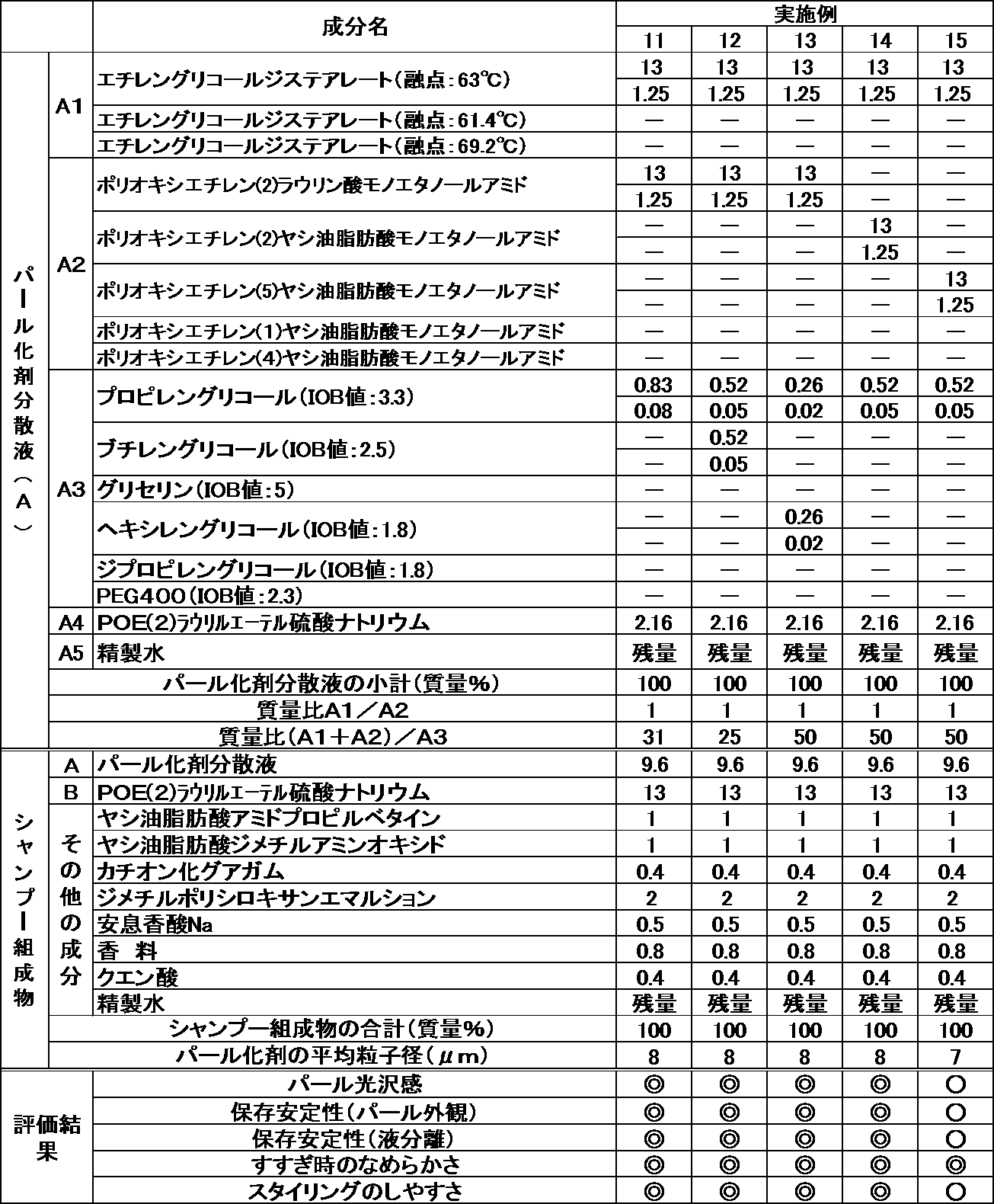
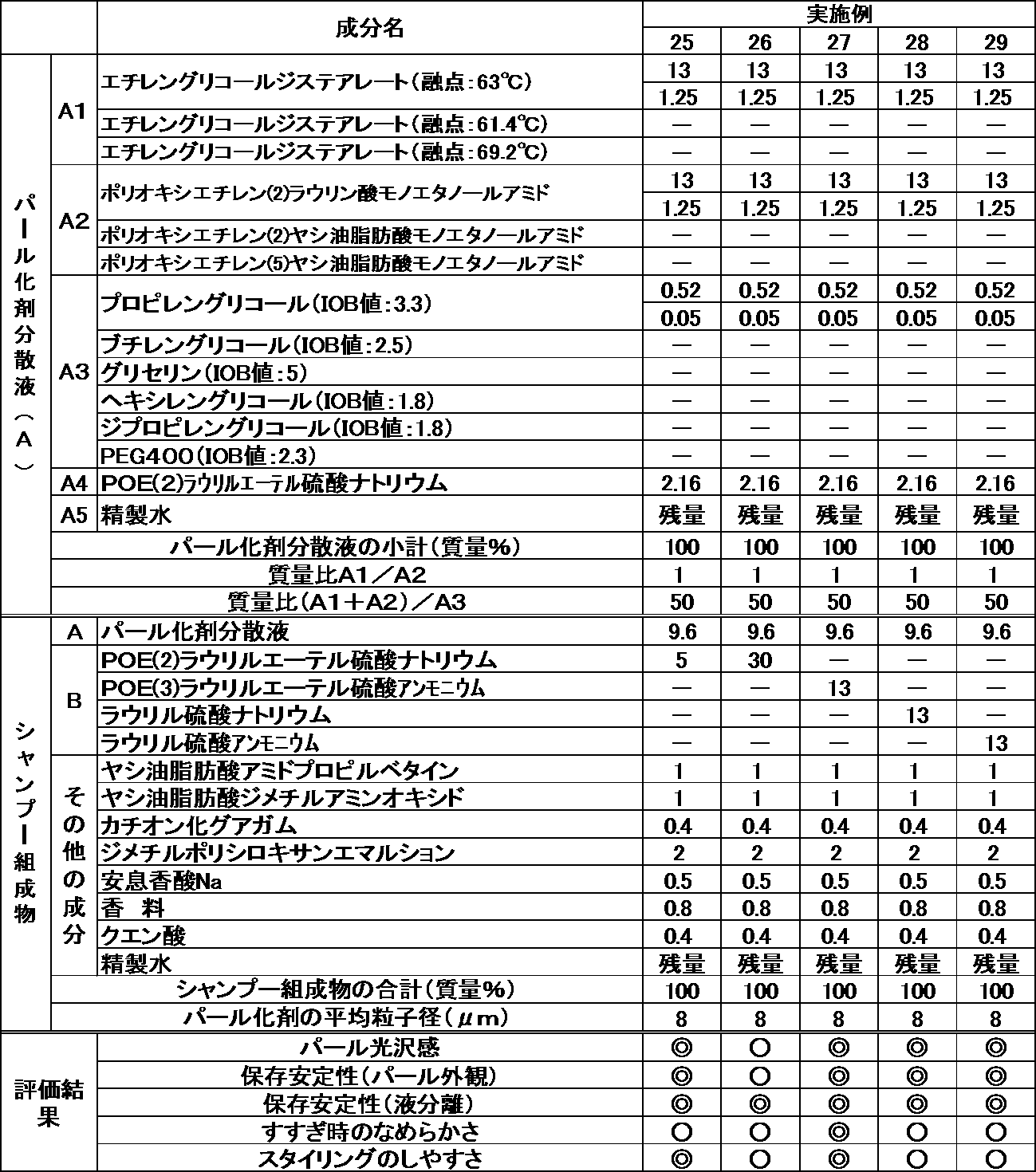
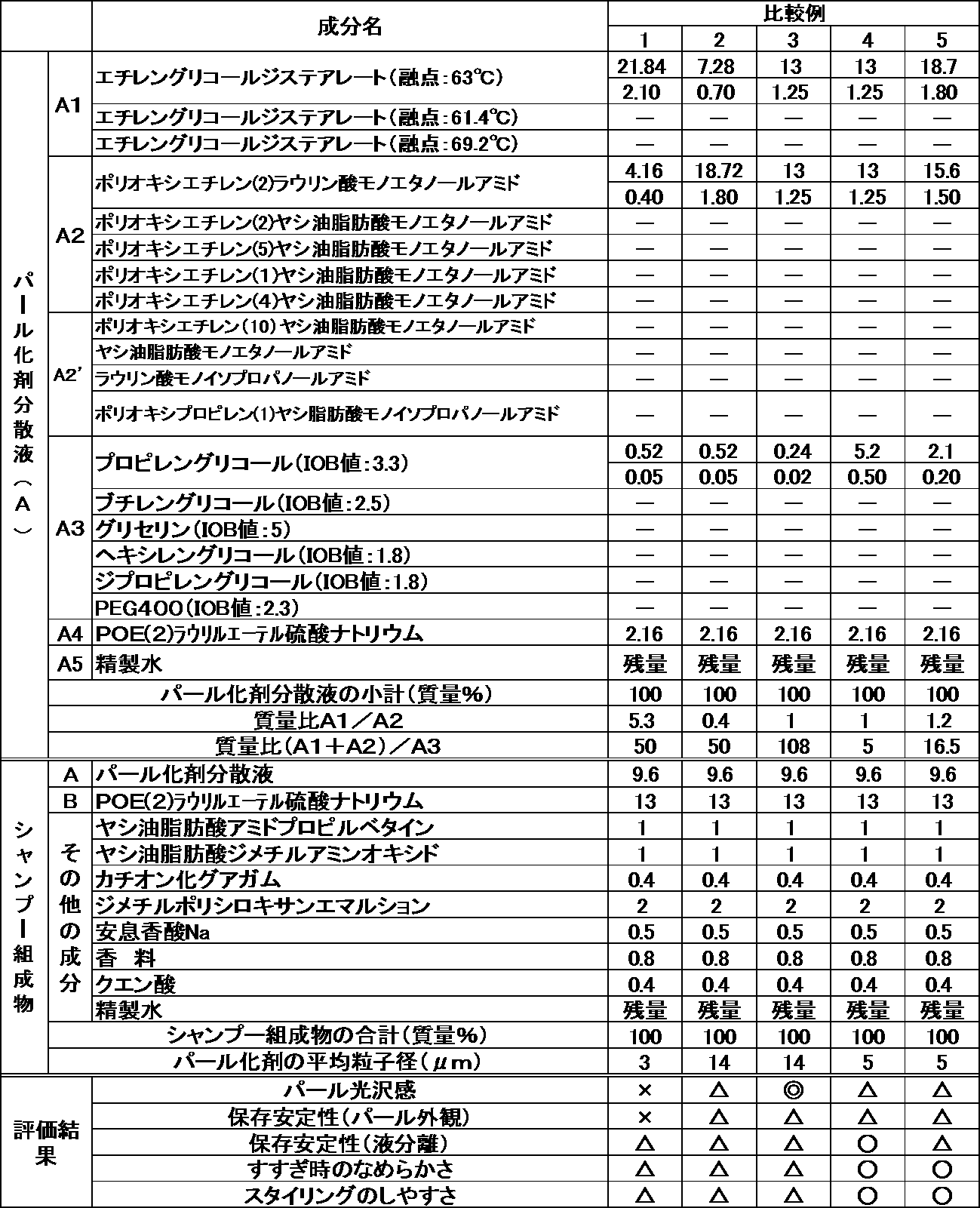
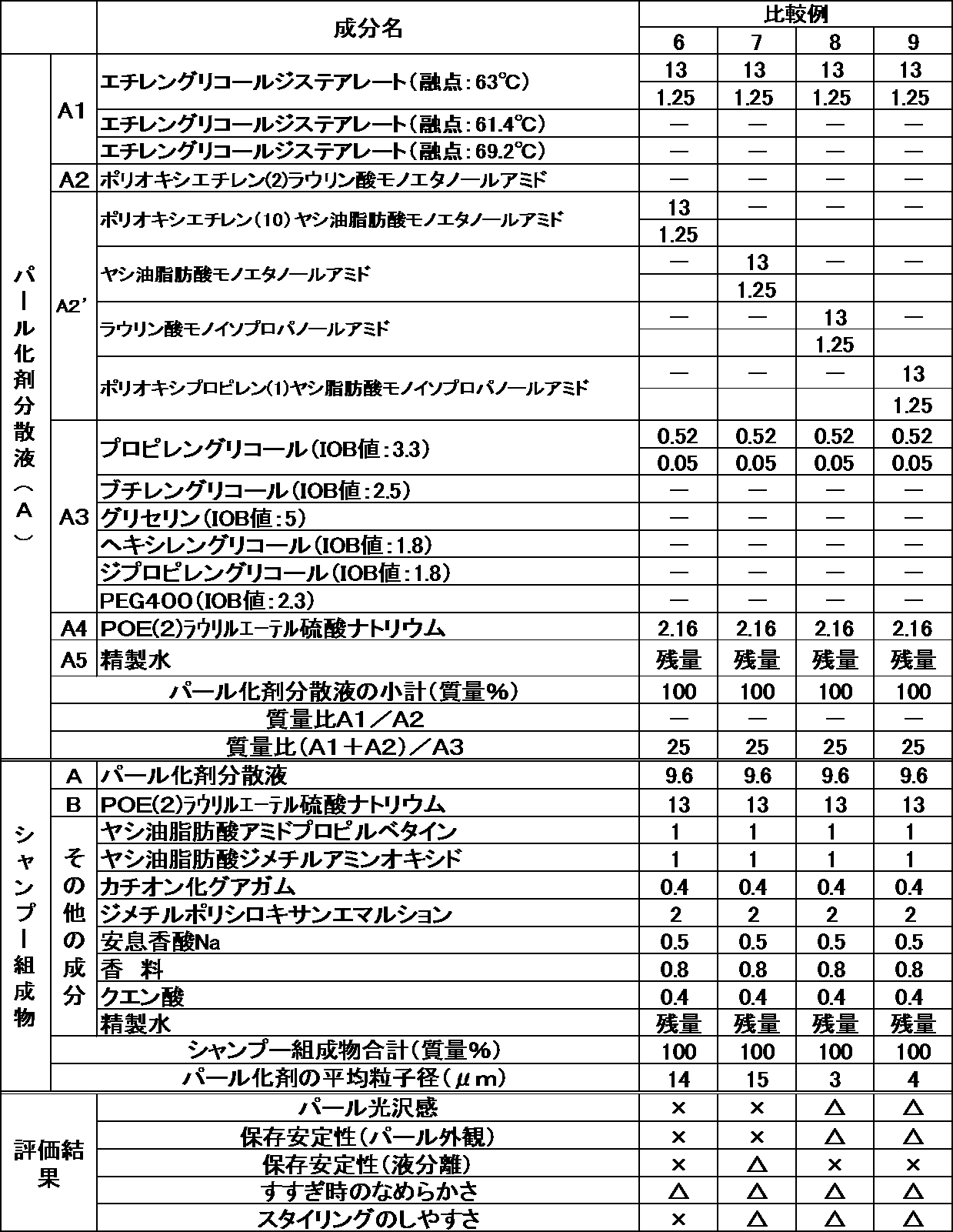
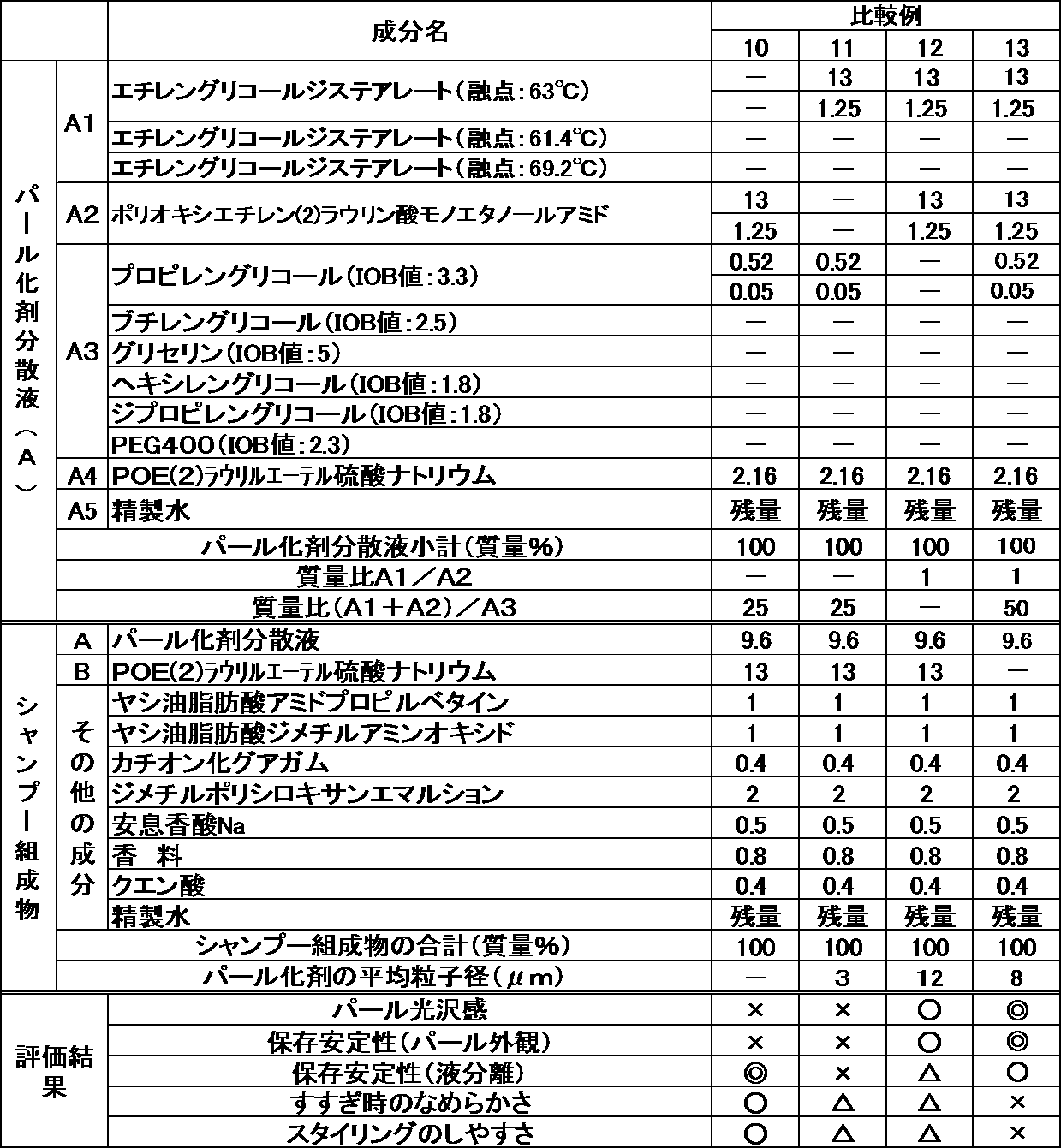
- Examples 1 to 29 and Comparative Examples 1 to 13 ⁇ Method for producing pearlizing agent dispersion> Components (A1) ethylene glycol distearate shown in Tables 1 to 9, (A2) component polyoxyethylene fatty acid monoalkanolamide, and (A3) component polyhydric alcohol are mixed and dispersed at a predetermined amount at 80 ° C. did. Subsequently, after adding and dispersing the (A4) component polyoxyethylene lauryl ether sodium sulfate and the (A5) component purified water, the mixture is gradually added with stirring to the same amount of 40 ° C. purified water as the mixture, Uniformly dispersed and mixed.
- the stirring was performed by mixing and dispersing using a three-one motor (manufactured by HEIDEN, FBL1200) and propeller blades.
- a three-one motor manufactured by HEIDEN, FBL1200
- propeller blades Next, while stirring the obtained dispersion mixture with a paddle mixer at a cooling rate of about 0.5 ° C./min, the inside of the dispersion mixing tank is cooled to 25 ° C., and the pearlizing agent dispersion of ethylene glycol distearate is obtained. Obtained. And 10 hours later, it was used to prepare the following shampoo composition.
- ⁇ Preparation method of shampoo composition The components (B) listed in Tables 1 to 9 below and other components were previously mixed with stirring at 25 ° C. for 30 minutes.
- the prepared pearlizing agent (ethylene glycol distearate) dispersion was added so that the pearling agent (ethylene glycol distearate) of the component (A1) in the entire composition was in a predetermined amount.
- concentration of the pearlizing agent in the shampoo composition was 1.25% by mass
- 9.6% by mass of the 13% by mass pearlizing agent dispersion of Example 1 was added.
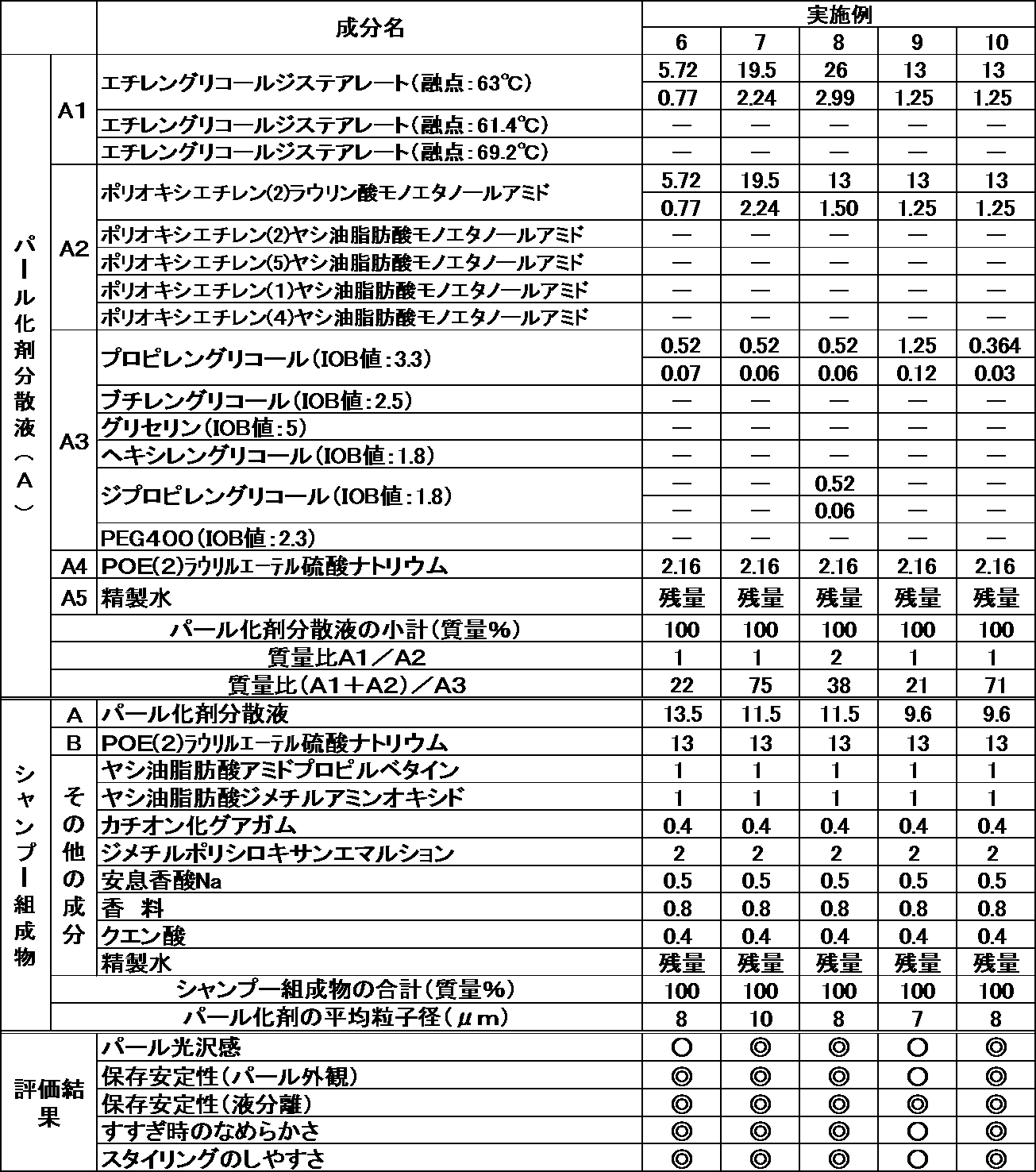
- the content in the pearlizing agent dispersion is described in the upper part, and the content in the total amount of the shampoo composition is described in the lower part.
- the pearlizing agent dispersion is calculated to contain 0.2% by mass (in terms of total shampoo composition) of the polyoxyethylene laurin ether sulfate (A4) component, but the content of the component (B) in the examples is In addition, it is described as the total amount with the addition amount from the pearlizing agent dispersion. However, the third decimal place was rounded off.
- the pH was adjusted to 5.8 with citric acid to prepare shampoo compositions of Examples 1 to 29 and Comparative Examples 1 to 13.
- the phase contrast micrograph of the pearlizing agent crystal in the shampoo composition obtained in Example 1 is shown in FIG. 1 and the phase contrast micrograph of the pearlizing agent crystal in the shampoo composition obtained in Comparative Example 4.
- FIG. 2 shows a phase contrast micrograph of the pearlizing agent crystal in the shampoo composition obtained in FIG. 2 and Comparative Example 6.
- ⁇ Pearl glossiness> Ten professional female panelists fill a 50 mL glass bottle with about 40 mL of each shampoo composition, take about 3 mL from the bottle, and evaluate the “pearl luster” by the following visual judgment to determine the average of the 10 persons. Evaluation was performed according to the following evaluation criteria. [Score] 3 points: pearl glossiness 2 points: pearl glossiness slightly 1 point: no pearl glossiness [Evaluation criteria] A: Average point of pearl glossiness 2.5 points or more ⁇ : Average point of pearl glossiness 2.0 points or more and less than 2.5 points ⁇ : Average point of pearl glossiness 1.5 points or more and less than 2.0 points ⁇ : Average point of pearl luster less than 1.5
- ⁇ Storage stability (pearl appearance)> About 40 mL of each shampoo composition was filled in a 50 mL transparent glass bottle and the pearl appearance after storage at 50 ° C. for 1 month was evaluated according to the following evaluation criteria.
- ⁇ Evaluation criteria A: There is a pearly luster and the pearl appearance is sufficiently exhibited. O: A slight loss of the pearly luster is recognized, but a pearly appearance is present. ⁇ : The pearly luster disappears and the pearl appearance is not exhibited.
- ⁇ Ease of styling> Wet the hair of 20 female panelists thoroughly with water, then apply each shampoo composition to the hair of the panelists at a usage rate of about 6 g / dose, and massage the scalp with your fingers to foam the entire hair. Foamed enough to cover. Next, it was rinsed with tap water at a temperature of 40 ° C. using a shower with a flow rate of 250 mL / 3 seconds. Next, the moisture of the hair was sufficiently wiped off with a towel and the ease of styling when it was blown using a dryer was evaluated. The “ease of styling” was evaluated according to the following criteria from the number of people judged to be good. ⁇ Evaluation criteria ⁇ ⁇ : 20 people, 16 people or more ⁇ : 20 people, 11 people or more and 15 people or less ⁇ : 20 people, 6 people or more and 10 people or less ⁇ : 20 people, 5 people or less
- the dimethylpolysiloxane emulsion in Table 10 has a kinematic viscosity of 600,000 mm 2 / s, a silicone content of 65% by mass, and an average particle size of 35 ⁇ m.
- Example 30 ⁇ Mild shampoo> Shampoo compositions were produced in the same manner as in Examples 1 to 29 and Comparative Examples 1 to 13, except that the composition and content were changed as follows.
- the pearlizing agent dispersion having the same composition as in Example 1 was used and added so that the content of ethylene glycol was 1.25% by mass in the shampoo composition.
- Example 31 ⁇ Conditioning shampoo> Shampoo compositions were produced in the same manner as in Examples 1 to 29 and Comparative Examples 1 to 13, except that the composition and content were changed as follows.
- the pearlizing agent dispersion having the same composition as in Example 14 was used and added so that the content of ethylene glycol was 2.0% by mass in the shampoo composition.
- Example 32 ⁇ Anti-dandruff shampoo> Shampoo compositions were produced in the same manner as in Examples 1 to 29 and Comparative Examples 1 to 13, except that the composition and content were changed as follows.
- the pearlizing agent dispersion having the same composition as in Example 11 was used and added so that the content of ethylene glycol was 1.5% by mass in the shampoo composition.
- “pearly luster”, “storage stability (pearl appearance)”, “storage stability (liquid) were determined in the same manner as in Examples 1 to 29 and Comparative Examples 1 to 13.
- Example 33 ⁇ Scalp care shampoo> Shampoo compositions were produced in the same manner as in Examples 1 to 29 and Comparative Examples 1 to 13, except that the composition and content were changed as follows.
- the pearlizing agent dispersion having the same composition as in Example 18 was used and added so that the content of ethylene glycol was 0.75% by mass in the shampoo composition.
- “pearly luster”, “storage stability (pearl appearance)”, “storage stability (liquid) were the same as in Examples 1 to 29 and Comparative Examples 1 to 13.
- Dimethylpolysiloxane B (emulsion) in Table 11 was prepared by the following method.
- Rheoflow DMS-60 manufactured by Yushi Co., Ltd.
- [Highly polymerized methylpolysiloxane with kinematic viscosity 10,000,000 mm 2 / s: Highly polymerized methylpolysiloxane with kinematic viscosity 4,000,000 mm 2 / s: Kinematic viscosity 1,000 mm 2 / s methylpolysiloxane 15: 15: 70 (mass ratio)]
- POE (15) cetyl ether (trade name: NPO-97, manufactured by Lion Chemical Co., Ltd.) was added as an emulsifier, Emulsified and dispersed.
- Examples of the aspect of the present invention include the following. ⁇ 1> (A) (A1) fatty acid glycol ester, (A2) polyoxyethylene fatty acid monoalkanolamide having an average addition mole number of ethylene oxide of 1 to 5, (A3) polyhydric alcohol, (A4) polyoxyethylene alkyl An ether sulfate and (A5) water, wherein the mass ratio A1 / A2 of the component (A1) and the component (A2) is 0.5 to 4, and the component (A1) and the component (A2) And a pearlizing agent dispersion in which a mass ratio (A1 + A2) / A3 of the component (A3) is 20 to 100; (B) A shampoo composition comprising a sulfate-type anionic surfactant having a sulfate residue containing the component (A4).
- the content of the component (A1) is 0.75% by mass to 3% by mass
- the content of the component (A2) is 0.75% by mass to 3% by mass
- (A3) The shampoo composition according to any one of ⁇ 1> to ⁇ 3>, wherein the content of the component is 0.03% by mass to 0.2% by mass.
- the shampoo composition of the present invention is suitably used as, for example, a skin cleansing shampoo, damage care shampoo, conditioning shampoo, rinse-in shampoo, mild shampoo, scalp care shampoo, anti-dandruff shampoo, and the like.
Landscapes
- Health & Medical Sciences (AREA)
- Life Sciences & Earth Sciences (AREA)
- Animal Behavior & Ethology (AREA)
- General Health & Medical Sciences (AREA)
- Public Health (AREA)
- Veterinary Medicine (AREA)
- Birds (AREA)
- Epidemiology (AREA)
- Emergency Medicine (AREA)
- Cosmetics (AREA)
Abstract
Description
このようなパール光沢を有するシャンプー組成物においては、長期保存や高温環境下において、該パール光沢の安定性やパール化剤粒子の分散均一性が失われるという問題がある。前記問題を解決するため、例えば、増粘したアニオン界面活性剤の水性系にイソプレングリコールを添加して、前記パール化剤を安定に分散させる方法(特許文献6参照)、キサンタンガムとカチオン系ポリマーとを含有させる方法(特許文献7参照)、パール化剤と共に、3-アルキル(C10~20)オキシ-2-ヒドロキシプロピルアルギニン及び/又はその塩を含有させる方法(特許文献8参照)、パール化剤が懸濁した水性液に、該パール化剤よりも、エステルを構成する脂肪酸の炭素数が大きいものの比率が高いパール化剤を溶融して、添加した後冷却しパール化剤を析出させる方法(特許文献9参照)、特定の水溶性ポリマーを添加し、特定の製造方法にてパール化剤を結晶化させるシャンプー組成物(特許文献10参照)などが提案されている。
また、シャンプー組成物中のパール化剤は泡立ちのみならず、シャンプー後の毛髪感触に影響することも知られており、特定の組成のパール光沢組成物から得られた特定の粒径のパール光沢粒子を含有する洗浄剤組成物は、毛髪のボリュームが低下せずに毛髪の滑り性が向上することが開示されている(特許文献12参照)。
(A)(A1)脂肪酸グリコールエステル、(A2)エチレンオキサイドの平均付加モル数が1~5のポリオキシエチレン脂肪酸モノアルカノールアミド、(A3)多価アルコール、(A4)ポリオキシエチレンアルキルエーテル硫酸塩、及び(A5)水からなり、前記(A1)成分と前記(A2)成分との質量比A1/A2が0.5~4であり、前記(A1)成分及び前記(A2)成分と前記(A3)成分との質量比(A1+A2)/A3が20~100であるパール化剤分散液と、
(B)前記(A4)成分を含む硫酸残基を有する硫酸塩型アニオン性界面活性剤と、を含有する。
本発明のシャンプー組成物は、(A)(A1)脂肪酸グリコールエステル、(A2)エチレンオキサイドの平均付加モル数が1~5のポリオキシエチレン脂肪酸モノアルカノールアミド、(A3)多価アルコール、(A4)ポリオキシエチレンアルキルエーテル硫酸塩、及び(A5)水からなるパール化剤分散液と、(B)前記(A4)成分を含む硫酸残基を有する硫酸塩型アニオン性界面活性剤と、を含有し、更に必要に応じてその他の成分を含有してなる。
前記(A)成分のパール化剤分散液は、(A1)脂肪酸グリコールエステル、(A2)エチレンオキサイドの平均付加モル数が1~5のポリオキシエチレン脂肪酸モノアルカノールアミド、(A3)多価アルコール、(A4)ポリオキシエチレンアルキルエーテル硫酸塩、及び(A5)水からなる。
前記(A1)成分の脂肪酸グリコールエステルとしては、パール光沢感及び保存安定性の点から、脂肪酸のアルキル鎖長は、14~22の直鎖が好ましく、18~22がより好ましい。具体的には、エチレングリコールジミリステート、エチレングリコールジパルミテート、エチレングリコールジステアレート、エチレングリコールモノステアレート、エチレングリコールジベヘニレートなどが挙げられる。これらは、1種単独で使用してもよく、2種以上を併用してもよい。これらの中でも、パール光沢感の点から、エチレングリコールジステアレートがより好ましい。
前記(A1)成分の脂肪酸グリコールエステルの融点は、「医薬部外品原料規格2006(薬事日報社)」一般試験法70.融点測定法.第1法に記載された方法を参照して測定することができる。
前記(A2)成分のポリオキシエチレン脂肪酸モノアルカノールアミドは、前記(A1)成分の脂肪酸グリコールエステルの分散剤として機能する成分である。
前記(A2)成分のポリオキシエチレン脂肪酸モノアルカノールアミドは、パール光沢感、分散安定性、シャンプー時のすすぎ時のなめらかさ、及びスタイリングのしやすさの点から、脂肪酸の炭素数は9~17の飽和又は不飽和炭化水素基が好ましく、エチレンオキサイド(E.O.)の平均付加モル数が1~5であることが好ましい。パールの光沢感、保存安定性の点から、脂肪酸の炭素数は11~13、エチレンオキサイド(E.O.)の平均付加モル数は、1~2がより好ましい。
前記脂肪酸の炭素数が、9未満であると、パールの光沢感が悪くなり、17を超えると、パール化剤分散液の安定性が低下することがある。また、前記エチレンオキサイド(E.O.)の平均付加モル数が1未満であると、パールの光沢感が悪くなるとともに、シャンプー組成物を使用した後のすすぎ時のなめらかさ、スタイリングのしやすさが劣化し、5を超えると、パール光沢感が発現することなく、シャンプー組成物中の保存安定性が悪化することがある。
前記(A2)成分のポリオキシエチレン脂肪酸モノアルカノールアミドとしては、市販品を用いることができる。前記市販品としては、例えば、川研ファインケミカル株式会社製の商品名「アミゼット」シリーズ、などが挙げられ、ポリオキシエチレン(2)ラウリン酸モノエタノールアミド(アミゼット2L-Y)、ポリオキシエチレン(2)ヤシ油脂肪酸モノエタノールアミド(アミゼット2C)、ポリオキシエチレン(5)ヤシ油脂肪酸モノエタノールアミド(アミゼット5C)であり、ポリオキシエチレン(1)ヤシ油脂肪酸モノエタノールアミド(Norfox DGCA、Norman,Fox&Co社製)、ポリオキシエチレン(4)ヤシ油脂肪酸モノエタノールアミド(Empilan MAA、Albright & Wilson UK Limited製)などが挙げられる。
前記(A1)成分の含有量と前記(A2)成分の含有量との質量比A1/A2は、パール光沢感とシャンプー時のすすぎ時のなめらかさ、スタイリングなめらかさの点から、0.5~4であり、0.75~2が好ましい。前記質量比A1/A2が、0.5未満であると、パール光沢感が得られないことがあり、4を超えると、パール光沢感が十分でなく、シャンプー組成物のすすぎ時のなめらかさ、及びシャンプー後のスタイリングのしやすさが劣ることがある。
前記(A3)成分の多価アルコールとしては、例えば、ポリエチレングリコール、プロピレングリコール、ジプロピレングリコール、ヘキシレングリコール、ソルビット、1,3-ブチレングリコール、イソプレングリコール、グリセリン、などが挙げられる。これらは、1種単独で使用してもよく、2種以上を併用してもよい。
前記多価アルコールの中でも、保存安定性とシャンプー組成物の使用感の点から、IOB値が1.8~4が好ましく、1.8~3.3がより好ましい。具体的には、プロピレングリコール(IOB値:3.3)、ジプロピレングリコール(IOB値:1.8)、ヘキシレングリコール(IOB値:1.8)、1,3-ブチレングリコール(IOB値:2.5)、イソプレングリコール(IOB値:2.0)、ポリエチレングリコール400(IOB値:2.3)が好ましい。前記IOB値が、1.8未満であると、パール光沢感が良好でなく、パール化剤の保存安定性が好ましくないことがあり、4を超えると、前記パール化剤分散液を配合したシャンプーの保存安定性が劣化したり、すすぎ時のなめらかさやスタイリングのしやすさが好ましくないことがある。
前記(A1)成分及び前記(A2)成分と前記(A3)成分との質量比(A1+A2)/A3は、20~100であり、30~75が好ましい。この範囲内であれば、シャンプー組成物のパール光沢感、及び保存安定性が良好であり、シャンプー組成物の泡立てた後のすすぎ時のなめらかさ、シャンプー洗髪後のスタイリングのしやすさが良好である。
前記質量比(A1+A2)/A3が、20未満であると、良好なパール光沢感が得られないことがあり、100を超えると、パール化剤の保存安定性が劣化し、シャンプー組成物のすすぎ時のなめらかさ、洗髪後のスタイリングのしやすさが良好でないことがある。
前記(A4)成分のポリオキシエチレンアルキルエーテル硫酸塩は、前記(A1)脂肪酸グリコールエステル等の分散性を更に高めることができる。後述する(B)成分におけるポリオキシエチレンアルキルエーテル硫酸塩と同じものを用いることができる。前記(A4)成分のポリオキシエチレンアルキルエーテル硫酸塩の含有量は、パール化剤分散液全量に対して、0.5質量%~5質量%が好ましく、1質量%~3質量%がより好ましい。
なお、前記(A4)成分のシャンプー組成物における含有量は、後述する(B)成分の硫酸残基を有する硫酸塩型アニオン性界面活性剤に含まれる前記(A4)成分との含有量と合計した値である。
前記(A5)成分の水としては、例えば、イオン交換水、精製水、限外濾過水、逆浸透水、蒸留水等の純水、又は超純水を用いることができる。前記(A5)成分の水の(A)成分中の含有量としては、パール化剤分散液全量に対して、パール光沢感、及びパール分散剤の保存(分離)安定性の点から、30質量%~90質量%が好ましく、45質量%~85質量%がより好ましい。前記含有量が、90質量%を超えると、パール光沢感が十分でない場合があり、30質量%未満であると、パール化剤の保存(分離)安定性が好ましくなかったり、シャンプーすすぎ時のなめらかさが劣化することがある。
前記(B)成分の前記(A4)成分を含む硫酸残基を有する硫酸塩型アニオン性界面活性剤は、適度な泡を形成し、かつ毛髪に付着した汚れを除去する洗浄基剤となる成分である。
前記(B)成分の前記(A4)成分を含む硫酸残基を有する硫酸塩型アニオン性界面活性剤としては、例えば、アルキル硫酸塩、アルケニル硫酸塩、ポリオキシアルキレンアルキルエーテル硫酸塩、ポリオキシアルキレンアルケニルエーテル硫酸塩、ポリオキシアルキレンアルキルフェニルエーテル硫酸塩、グリセライド硫酸塩、アミドエーテル硫酸塩、などが挙げられる。これらは、1種単独で使用してもよく、2種以上を併用してもよい。これらの中でも、下記一般式(B1)で示されるポリオキシアルキレンアルキルエーテル硫酸塩、ポリオキシアルキレンアルケニルエーテル硫酸塩、下記一般式(B2)で表されるアルキル硫酸塩、アルケニル硫酸塩が好ましく、下記一般式(B1)で表されるポリオキシエチレンアルキルエーテル硫酸塩が好ましい。
R1O(CH2CH2O)mSO3M ・・・ 一般式(B1)
〔ただし、前記一般式(B1)中、R1は炭素数10~18のアルキル基又はアルケニル基を示し、Mはアルカリ金属、アンモニウム、又はアルカノールアミンを示し、mは平均付加モル数で1~5の数を示す。〕
〔ただし、前記一般式(B2)中、R2は炭素数10~18のアルキル基を示し、Mはアルカリ金属、アンモニウム、又はアルカノールアミンを示す。〕
前記一般式(B1)及び(B2)において、R1、R2は、具体的には、ラウリル基、ミリスチル基、パルミチル基、ステアリル基、などが挙げられる。
Mとしては、リチウム、ナトリウム、カリウム等のアルカリ金属、モノエタノールアミン、ジエタノールアミン、トリエタノールアミン等のアルカノールアミンなどが挙げられる。
また、すすぎ時のなめらかさの点から、前記一般式(B1)中のmは、2~3が好ましい。
前記一般式(B1)及び(B2)中のMは、洗髪後のすすぎ時のなめらかさの点から、ナトリウム又はアンモニウムが好ましい。
なお、前記(B)成分の硫酸残基を有する硫酸塩型アニオン性界面活性剤の含有量は、パール化剤分散液中の(A4)成分のポリオキシエチレンアルキルエーテル硫酸塩の含有量を合計した値である。
前記その他の成分としては、本発明の効果を損なわない限り、特に制限はなく、目的に応じて適宜選択することができ、例えば、一般のシャンプー組成物に汎用されている各種添加成分などが挙げられる。
前記その他の成分の具体例としては、流動パラフィン、スクワラン等の炭化水素;イソプロピルミリステート等のエステル;ツバキ油、アーモンド油、ホホバ油等の植物油;メチルポリシロキサン等のシリコーン化合物;シラカバエキス等の植物エキス;ベヘニルトリメチルアンモニウムクロライド等のカチオン性界面活性剤;ポリオキシエチレンアルキルエ-テル、グリセリン脂肪酸エステル、ショ糖脂肪酸エステル、ポリグリセリン脂肪酸エステル、ポリオキシエチレン硬化ヒマシ油等のノニオン界面活性剤;ラウリン酸アミドプロピルベタイン、ラウリン酸アミドプロヒドロキシスルホピルベタイン、ラウリルジメチルアミンオキシド等の両性界面活性剤;没食子酸誘導体;グリシン、セリン、アルギニン等のアミノ酸;ピロリドンカルボン酸又は塩、生薬、ビタミン、グリチルリチン酸ジカリウム、グリチルレチン酸等の消炎剤;ピロクトンオラミン、ジンクピリチオン等のフケ止め剤;イソプロピルメチルフェノール、トリクロサン等の殺菌剤;タール色素;オキシベンソン、メトキシ桂皮酸2-エチルヘキシル等の紫外線吸収剤;ジブチルヒドロキシトルエン等の酸化防止剤;グリセリン、トリメチルグリシン等の保湿剤;水、エタノール等の溶剤;アクリル酸系ポリマー、アクリレート/ステアレス-20メタクリレート共重合体等のアニオン性ポリマー;ビニルピロリドン系ポリマー等のノニオン性ポリマー;塩化ジアリルジメチルアンモニウム/アクリル酸等の両性ポリマー;カチオン化セルロース等のカチオン性ポリマー;無水シリカ、マグネシアシリカ等の無機粉体;ナイロン、ポリエチレン等の有機粉体;香料;クエン酸、クエン酸ナトリウム、グリコール酸等のpH調整剤;アシルグルタミン酸トリエタノールアミン等のアミン類;安息香酸ナトリウム等の防腐剤;ヒドロキシエタンジホスホン酸、ジブチルヒドロキシトルエン、エデト酸2ナトリウム等の安定化剤;などが挙げられる。これらは、1種単独で使用してもよいし、2種以上を併用してもよい。
前記パール化剤粒子(結晶物)の平均粒子径(個数平均長径)は、パ-ル外観、パール光沢性、すすぎ時のなめらかさの点から、6μm~11μmが好ましく、7μm~10μmがより好ましい。
前記平均粒子径が、6μm未満であると、パール光沢感が十分に発現せず、パール化剤の保存(分離)安定性が劣ることがある。一方、11μmを超えると、パール化剤の保存(分離)安定性が劣ったり、すすぎ時のなめらかさ及びスタイリングのしやすさが劣化することがある。
前記平均粒子径は、シャンプー組成物をスライドガラス上に滴下し、位相差顕微鏡(オリンパス社製、AX70)を用い、400倍で観察し、結晶として確認されるパール化剤粒子の長径を無作為に50点測定し、得られる平均値を結晶の平均粒子径(個数平均長径)とした。
前記シャンプー組成物のpHとしては、特に制限はなく、目的に応じて適宜選択することができるが、25℃で、5.0~6.0が好ましい。
前記pHは、例えば、前記シャンプー組成物をpHメーター(HM-30G、東亜ディーケーケー株式会社製)を用いて25℃で測定することができる。
前記シャンプー組成物のpHは、所望のpH調整剤を用いて調整することができる。前記pH調整剤としては、特に制限はなく、目的に応じて適宜選択することができ、例えば、クエン酸、コハク酸、硫酸、2-アミノ-2-メチル-1-プロパノール、モノエタノールアミン、これらの塩などが挙げられる。
前記シャンプー組成物の粘度としては、特に制限はなく、目的に応じて適宜選択することができるが、25℃で、1Pa・s~30Pa・sが好ましい。
前記粘度は、例えば、粘度計(BM型粘度計、TOKIMEC社製)を用い、No.4ローターにて、30rpm、20秒間後、25℃の条件で測定することができる。
前記シャンプー組成物は、パール光沢外観を示し保存安定性が良好であり、すすぎ時の毛髪になめらかさを付与することができ、洗髪後のスタイリングのしやすさをもたらすことができるため、各種用途に用いることができ、例えば、地肌クレンジング用シャンプー、ダメージケア用シャンプー、コンディショニングシャンプー、リンスインシャンプー、マイルドシャンプー、頭皮ケアシャンプー、ふけ防止シャンプーなどが挙げられる。
<パール化剤分散液の製造方法>
表1~表9に示す(A1)成分のエチレングリコールジステアレート、(A2)成分のポリオキシエチレン脂肪酸モノアルカノールアミド、及び(A3)成分の多価アルコールを所定量、80℃にて混合分散した。続いて、(A4)成分のポリオキシエチレンラウリルエーテル硫酸ナトリウム、並びに(A5)成分の精製水を加えて混合分散した後、混合物と同量の40℃精製水に攪拌しながら徐々に添加し、均一に分散混合した。ここで、攪拌は、スリーワンモータ(HEIDEN社製、FBL1200)とプロペラ羽根を使用して混合分散した。
次いで、得られた分散混合物を約0.5℃/分間の冷却速度でパドルミキサを用いて攪拌しながら、分散混合槽内を25℃まで冷却し、エチレングリコールジステアレートのパール化剤分散液を得た。
そして、10時間後に、以下のシャンプー組成物を調製するために使用した。
下記表1~表9に記載の(B)成分、及びその他の成分を、予め25℃で30分間攪拌混合した。前記調製したパール化剤(ジステアリン酸エチレングリコール)分散液を、全組成中の(A1)成分のパール化剤(ジステアリン酸エチレングリコール)が所定量になるように添加した。例えば、シャンプー組成物中のパール化剤濃度が1.25質量%である場合は、実施例1の13質量%パール化剤分散液を9.6質量%添加した。(A1)、(A2)、及び(A3)成分は、上段にパール化剤分散液中の含有量、下段にシャンプー組成物全量中の含有量を記載した。前記パール化剤分散液には、(A4)成分のポリオキシエチレンラウリンエーテル硫酸塩0.2質量%(全シャンプー組成換算)含有する計算になるが、実施例における(B)成分の含有量は、パール化剤分散液中からの添加量との合算量として記載した。ただし、少数点第3位を四捨五入した。
パール化剤分散液添加後、十分攪拌の後、クエン酸でpHを5.8に調整し、実施例1~29及び比較例1~13のシャンプー組成物を作製した。
なお、実施例1で得られたシャンプー組成物中のパール化剤結晶物の位相差顕微鏡写真を図1、比較例4で得られたシャンプー組成物中のパール化剤結晶物の位相差顕微鏡写真を図2、比較例6で得られたシャンプー組成物中のパール化剤結晶物の位相差顕微鏡写真を図3に示した。
専門女性パネラー10名が50mLガラス瓶に約40mLの各シャンプー組成物を充填し、その瓶から、約3mLを手にとり「パール光沢感」について、下記目視判定により評価し、10名の平均値を求め、下記評価基準により評価した。
〔評点〕
3点:パール光沢感がある
2点:パール光沢感がややある
1点:パール光沢感がない
〔評価基準〕
◎:パール光沢感の平均点2.5点以上
○:パール光沢感の平均点2.0点以上2.5点未満
△:パール光沢感の平均点1.5点以上2.0点未満
×:パール光沢感の平均点1.5点未満
50mL透明ガラス瓶に約40mLの各シャンプー組成物を充填し、50℃にて1ヶ月保存した後のパール外観について、下記の評価基準で評価した。
〔評価基準〕
◎:パール光沢感があり、パール外観を十分に呈している
○:ごく僅かにパール光沢感の消失が認められるが、パール外観は呈している
△:パール光沢感がかなり消失され、ややパール外観は呈していない
×:パール光沢感が消失され、パール外観を呈しない
50mLの透明ガラス瓶に約40mLの各シャンプー組成物を充填し、50℃にて1ヶ月間保存した後の液分離について、下記の基準で評価した。
〔評価基準〕
◎:液分離なく安定である
○:ごく僅かに液分離が認められるが、商品価値あり
△:液分離が認められる
×:著しく液分離が認められる
女性専門パネラー20名の毛髪を十分に水で濡らした後、各シャンプー組成物を専門パネラーの毛髪に約6g/回の使用量で塗布し、指で頭皮をマッサージするようにして頭髪全体を泡で覆うことができる程度に十分に泡立てた。
次に、流量250mL/3秒間のシャワーを用い、温度40℃の水道水ですすいでいる時の「髪のなめらかさ」を評価し、良好と判断した人数から、下記基準により「すすぎ時の毛髪のなめらかさ」を評価した。
〔評価基準〕
◎:20名中、16名以上
○:20名中、11名以上15名以下
△:20名中、6名以上10名以下
×:20名中、5名以下
女性専門パネラー20名の毛髪を十分に水で濡らした後、各シャンプー組成物を専門パネラーの毛髪に約6g/回の使用量で塗布し、指で頭皮をマッサージするようにして頭髪全体を泡で覆うことができる程度に十分に泡立てた。
次に、流量250mL/3秒間のシャワーを用い、温度40℃の水道水ですすいだ。
次に、毛髪の水気をタオルで十分に拭き取り、ドライヤーを用いてブローしたときのスタイリングのしやすさを評価し、良好と判断した人数から下記基準により「スタイリングのしやすさ」を評価した。
〔評価基準〕
◎:20名中、16名以上
○:20名中、11名以上15名以下
△:20名中、6名以上10名以下
×:20名中、5名以下



<マイルドシャンプー>
下記の組成及び含有量に変えた以外は、実施例1~29及び比較例1~13と同様の方法でシャンプー組成物を製造した。パール化剤分散液は、実施例1と同組成のものを使用し、エチレングリコールの含有量がシャンプー組成物中1.25質量%になるように添加した。
得られた実施例30のシャンプー組成物について、実施例1~29及び比較例1~13と同様にして、「パール光沢感」、「保存安定性(パール外観)」、「保存安定性(液分離)」、「すすぎ時の毛髪のなめらかさ」、及び「スタイリングのしやすさ」について評価した。結果を下記に示す。
〔組成及び含有量〕
・実施例1のパール化剤分散液(A):9.6質量%
・・パール化剤分散液中の各成分の含有量
・・・(A1)エチレングリコールジステアレート(融点63℃):1.25質量%
・・・(A2)ポリオキシエチレン(2)ラウリン酸モノエタアノールアミド:1.25質量%
・・・(A3)プロピレングリコール(IOB値:3.3):0.05質量%
・POE(2)ラウリルエーテル硫酸ナトリウム(B):11.0質量%
・ラウリン酸アミドプロピルベタイン:1.0質量%
・ラウリルジメチルアミンオキシド:0.2質量%
・カチオン化グアーガムA:0.3質量%
・カチオン化セルロースA:0.1質量%
・ジメチルポリシロキサンC:2.0質量%
・POE(20)硬化ヒマシ油:1.0質量%
・安息香酸ナトリウム:0.3質量%
・ヒドロキシエタンジホスホン酸:0.2質量%
・香料:0.5質量%
・クエン酸:pHが5.8になる適量
・精製水:残量(合計:100質量%)
質量比A1/A2:1
質量比(A1+A2)/A3:50
[評価結果]
・パール光沢感:◎
・保存安定性(パール外観):◎
・保存安定性(液分離):◎
・すすぎ時の毛髪のなめらかさ:◎
・スタイリングのしやすさ:◎
<コンディショニングシャンプー>
下記組成及び含有量に変更した以外は、実施例1~29及び比較例1~13と同様の方法でシャンプー組成物を製造した。パール化剤分散液は、実施例14と同組成のものを使用し、エチレングリコールの含有量がシャンプー組成物中2.0質量%になるように添加した。
得られた実施例31のシャンプー組成物について、実施例1~29及び比較例1~13と同様にして、「パール光沢感」、「保存安定性(パール外観)」、「保存安定性(液分離)」、「すすぎ時の毛髪のなめらかさ」、及び「スタイリングのしやすさ」について評価した。結果を下記に示す。
[組成及び含有量]
・実施例14のパール化剤分散液(A):15.38質量%
・・パール化剤分散液中の各成分の含有量
・・・(A1)エチレングリコールジステアレート(融点63℃):2.00質量%
・・・(A2)ポリオキシエチレン(2)ヤシ油脂肪酸モノエタノールアミド:2.00質量%
・・・(A3)プロピレングリコール(IOB値:3.3):0.08質量%
・POE(3)ラウリルエーテル硫酸アンモニウム(B):9.0質量%
・ラウリル硫酸アンモニウム(B):6.0質量%
・アシルグルタミン酸トリエタノールアミン:1.5質量%
・ラウリルジメチルアミンオキシド:0.3質量%
・ラウリン酸アミドプロヒドロキシスルホピルベタイン:0.5質量%
・カチオン化グアーガムB:0.2質量%
・カチオン化セルロースA:0.05質量%
・ジメチルポリシロキサンA:2.0質量%
・アミノ変性シリコーンB:0.3質量%
・パンテノール:0.12質量%
・エチルパンテノール:0.1質量%
・グリシン:0.05質量%
・安息香酸ナトリウム:0.9質量%
・アルギニン:0.1質量%
・シラカバエキス:0.1質量%
・黄色203号:0.001質量%
・黄色5号:0.002質量%
・香料:0.5質量%
・クエン酸:pHが5.8になる適量
・精製水:残量(合計:100質量%)
質量比A1/A2:1
質量比(A1+A2)/A3:50
[評価結果]
・パール光沢感:◎
・保存安定性(外観):◎
・保存安定性(液分離):◎
・すすぎ時の毛髪のなめらかさ:◎
・スタイリングのしやすさ:◎
<ふけ防止シャンプー>
下記組成及び含有量に変更した以外は、実施例1~29及び比較例1~13と同様の方法でシャンプー組成物を製造した。パール化剤分散液は、実施例11と同組成のものを使用し、エチレングリコールの含有量がシャンプー組成物中1.5質量%になるように添加した。
得られた実施例32のシャンプー組成物について、実施例1~29及び比較例1~13と同様にして、「パール光沢感」、「保存安定性(パール外観)」、「保存安定性(液分離)」、「すすぎ時の毛髪のなめらかさ」、及び「スタイリングのしやすさ」について評価した。結果を下記に示す。
[組成及び含有量]
・実施例11のパール化剤分散液(A):11.53質量%
・・パール化剤分散液中の各成分の含有量
・・・(A1)エチレングリコールジステアレート(融点63℃):1.50質量%
・・・(A2)ポリオキシエチレン(2)ラウリン酸モノエタアノールアミド:1.50質量%
・・・(A3)プロピレングリコール(IOB値:3.3):0.096質量%
・POE(2)ラウリルエーテル硫酸ナトリウム(B):11.0質量%
・ラウリル硫酸ナトリウム(B):3.0質量%
・ラウリン酸アミドプロピルベタイン:0.4質量%
・カチオン化グアーガムA:0.3質量%
・カチオン化セルロースB:0.1質量%
・ジメチルポリシロキサンA:1.0質量%
・ジメチルポリシロキサンB:1.0質量%
・ピロクトンオラミン:0.5質量%
・ジンクピリチオン:0.5質量%
・グリチルリチン酸ジカリウム:0.1質量%
・アクリレート/ステアレス-20メタクリレート共重合体:0.3質量%
・安息香酸ナトリウム:0.5質量%
・トリメチルグリシン:0.1質量%
・ジブチルヒドロキシトルエン:0.01質量%
・オキシベンソン:0.1質量%
・香料:0.5質量%
・クエン酸:pHが5.8になる適量
・精製水:残量(合計:100質量%)
質量比A1/A2:1
質量比(A1+A2)/A3:31
[評価結果]
・パール光沢感:◎
・保存安定性(外観):◎
・保存安定性(液分離):◎
・すすぎ時の毛髪のなめらかさ:◎
・洗髪後のスタイリングのしやすさ:◎
<頭皮ケアシャンプー>
下記組成及び含有量に変更した以外は、実施例1~29及び比較例1~13と同様の方法でシャンプー組成物を製造した。パール化剤分散液は、実施例18と同組成のものを使用し、エチレングリコールの含有量がシャンプー組成物中0.75質量%になるように添加した。
得られた実施例33のシャンプー組成物について、実施例1~29及び比較例1~13と同様にして、「パール光沢感」、「保存安定性(パール外観)」、「保存安定性(液分離)」、「すすぎ時の毛髪のなめらかさ」、及び「スタイリングのしやすさ」について評価した。結果を下記に示す。
[組成及び含有量]
・実施例18のパール化剤分散液(A):5.77質量%
・・パール化剤分散液中の各成分の含有量
・・・(A1)エチレングリコールジステアレート(融点61.4℃):0.75質量%
・・・(A2)ポリオキシエチレン(2)ラウリン酸モノエタアノールアミド:0.75質量%
・・・(A3)プロピレングリコール(IOB値:3.3):0.03質量%
・POE(2)ラウリルエーテル硫酸アンモニウム(B):13.0質量%
・ラウリン酸アミドプロピルベタイン:1.0質量%
・ラウリルジメチルアミンオキシド:0.3質量%
・カチオン化セルロースA:0.3質量%
・ジメチルポリシロキサンA:2.0質量%
・ベヘニルトリメチルアンモニウムクロライド:0.1質量%
・エデト酸2ナトリウム:0.1質量%
・安息香酸ナトリウム:0.3質量%
・クララ根エキス:0.1質量%
・グリチルリチン酸ジカリウム:0.1質量%
・メトキシ桂皮酸2-エチルヘキシル:0.3質量%
・ジブチルヒドロキシトルエン:0.01質量%
・グリコール酸:0.1質量%
・香料:0.5質量%
・クエン酸:pHが5.8になる適量
・精製水:残量(合計:100質量%)
質量比A1/A2:1
質量比(A1+A2)/A3:50
[評価結果]
・パール光沢感:◎
・保存安定性(外観):◎
・保存安定性(液分離):◎
・すすぎ時の毛髪のなめらかさ:◎
・洗髪後のスタイリングのしやすさ:◎
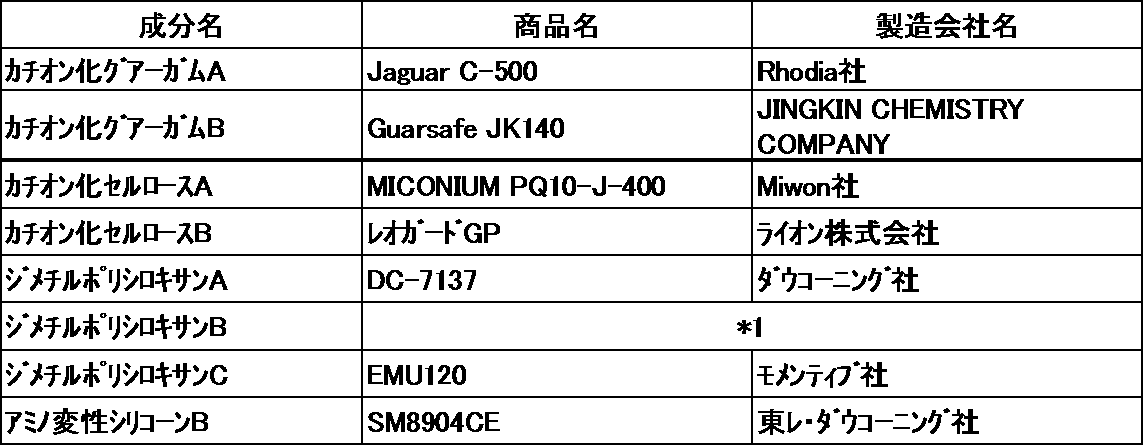
レオフローDMS-60(一方社油脂工業株式会社製)〔動粘度10,000,000mm2/sの高重合メチルポリシロキサン:動粘度4,000,000mm2/sの高重合メチルポリシロキサン:動粘度1,000mm2/sのメチルポリシロキサン=15:15:70(質量比)〕に、POE(15)セチルエーテル(商品名:NPO-97、ライオンケミカル株式会社製)を乳化剤として添加し、水に乳化分散した。
<1> (A)(A1)脂肪酸グリコールエステル、(A2)エチレンオキサイドの平均付加モル数が1~5のポリオキシエチレン脂肪酸モノアルカノールアミド、(A3)多価アルコール、(A4)ポリオキシエチレンアルキルエーテル硫酸塩、及び(A5)水からなり、前記(A1)成分と前記(A2)成分との質量比A1/A2が0.5~4であり、前記(A1)成分及び前記(A2)成分と前記(A3)成分との質量比(A1+A2)/A3が20~100であるパール化剤分散液と、
(B)前記(A4)成分を含む硫酸残基を有する硫酸塩型アニオン性界面活性剤と、を含有することを特徴とするシャンプー組成物である。
<2> (A1)成分の脂肪酸グリコールエステルの融点が、61℃~63℃である前記<1>に記載のシャンプー組成物である。
<3> (A2)成分の多価アルコールのIOB値が、1.8~3.3である前記<1>から<2>のいずれかに記載のシャンプー組成物である。
<4> (A1)成分の含有量が0.75質量%~3質量%であり、
(A2)成分の含有量が0.75質量%~3質量%であり、
(A3)成分の含有量が0.03質量%~0.2質量%である前記<1>から<3>のいずれかに記載のシャンプー組成物である。
Claims (4)
- (A)(A1)脂肪酸グリコールエステル、(A2)エチレンオキサイドの平均付加モル数が1~5のポリオキシエチレン脂肪酸モノアルカノールアミド、(A3)多価アルコール、(A4)ポリオキシエチレンアルキルエーテル硫酸塩、及び(A5)水からなり、前記(A1)成分と前記(A2)成分との質量比A1/A2が0.5~4であり、前記(A1)成分及び前記(A2)成分と前記(A3)成分との質量比(A1+A2)/A3が20~100であるパール化剤分散液と、
(B)前記(A4)成分を含む硫酸残基を有する硫酸塩型アニオン性界面活性剤と、を含有することを特徴とするシャンプー組成物。 - (A1)成分の脂肪酸グリコールエステルの融点が、61℃~63℃である請求項1に記載のシャンプー組成物。
- (A2)成分の多価アルコールのIOB値が、1.8~3.3である請求項1から2のいずれかに記載のシャンプー組成物。
- (A1)成分の含有量が0.75質量%~3質量%であり、
(A2)成分の含有量が0.75質量%~3質量%であり、
(A3)成分の含有量が0.03質量%~0.2質量%である請求項1から3のいずれかに記載のシャンプー組成物。
Priority Applications (4)
| Application Number | Priority Date | Filing Date | Title |
|---|---|---|---|
| KR1020157024541A KR102159536B1 (ko) | 2013-06-27 | 2014-03-27 | 샴푸 조성물 |
| CN201480034963.1A CN105307630B (zh) | 2013-06-27 | 2014-03-27 | 洗发剂组合物 |
| JP2015523895A JP6154012B2 (ja) | 2013-06-27 | 2014-03-27 | シャンプー組成物 |
| PH12015502759A PH12015502759A1 (en) | 2013-06-27 | 2015-12-10 | Shampoo composition |
Applications Claiming Priority (2)
| Application Number | Priority Date | Filing Date | Title |
|---|---|---|---|
| JP2013-134883 | 2013-06-27 | ||
| JP2013134883 | 2013-06-27 |
Publications (1)
| Publication Number | Publication Date |
|---|---|
| WO2014208162A1 true WO2014208162A1 (ja) | 2014-12-31 |
Family
ID=52141516
Family Applications (1)
| Application Number | Title | Priority Date | Filing Date |
|---|---|---|---|
| PCT/JP2014/058938 Ceased WO2014208162A1 (ja) | 2013-06-27 | 2014-03-27 | シャンプー組成物 |
Country Status (6)
| Country | Link |
|---|---|
| JP (1) | JP6154012B2 (ja) |
| KR (1) | KR102159536B1 (ja) |
| CN (1) | CN105307630B (ja) |
| MY (1) | MY173814A (ja) |
| PH (1) | PH12015502759A1 (ja) |
| WO (1) | WO2014208162A1 (ja) |
Cited By (5)
| Publication number | Priority date | Publication date | Assignee | Title |
|---|---|---|---|---|
| JP2019536775A (ja) * | 2017-05-12 | 2019-12-19 | ザ プロクター アンド ギャンブルカンパニーThe Procter & Gamble Company | 付着性を増加させた頭皮用健康剤を有する組成物 |
| US10680449B2 (en) | 2015-02-10 | 2020-06-09 | Kaneka Corporation | Power storage device |
| US10925823B2 (en) | 2018-05-15 | 2021-02-23 | The Procter And Gamble Company | Synergistic antioxidant compositions |
| US11253450B2 (en) | 2018-12-20 | 2022-02-22 | The Procter & Gamble Company | Scalp care composition with improved stability |
| US11980612B2 (en) | 2020-06-26 | 2024-05-14 | The Procter & Gamble Company | Synergistic anti-inflammatory compositions |
Families Citing this family (2)
| Publication number | Priority date | Publication date | Assignee | Title |
|---|---|---|---|---|
| CN110960433B (zh) * | 2019-11-12 | 2023-03-03 | 澳宝化妆品(惠州)有限公司 | 一种含长条状结晶的组合物及其应用 |
| JP7508834B2 (ja) * | 2020-03-31 | 2024-07-02 | 株式会社エーピーアイ コーポレーション | 粒子及びその製造方法 |
Citations (7)
| Publication number | Priority date | Publication date | Assignee | Title |
|---|---|---|---|---|
| JPH06504781A (ja) * | 1991-02-06 | 1994-06-02 | ヘンケル・コマンディットゲゼルシャフト・アウフ・アクチェン | 流動性のある真珠光沢濃厚物 |
| JPH09291017A (ja) * | 1996-04-24 | 1997-11-11 | Kao Corp | パール剤分散液 |
| JP2003155214A (ja) * | 2001-09-10 | 2003-05-27 | Lion Corp | 真珠様光沢剤分散液及びその製造方法 |
| JP2005119985A (ja) * | 2003-10-14 | 2005-05-12 | Lion Corp | 乳濁化剤分散液及びその製造方法 |
| JP2006316035A (ja) * | 2005-05-16 | 2006-11-24 | Lion Corp | シャンプー組成物及びその製造方法 |
| JP2007084482A (ja) * | 2005-09-22 | 2007-04-05 | Lion Corp | 毛髪洗浄剤組成物 |
| JP2008255110A (ja) * | 2007-03-12 | 2008-10-23 | Kao Corp | パール光沢組成物 |
Family Cites Families (10)
| Publication number | Priority date | Publication date | Assignee | Title |
|---|---|---|---|---|
| JPS6025906A (ja) | 1983-07-20 | 1985-02-08 | Mitsubishi Yuka Fine Chem Co Ltd | 高濃度パ−ル剤分散液の製造方法 |
| DE3843572A1 (de) * | 1988-12-23 | 1990-06-28 | Henkel Kgaa | Fliessfaehiges perlglanzkonzentrat |
| US5348736A (en) | 1989-06-21 | 1994-09-20 | Colgate-Palmolive Company | Stabilized hair-treating compositions |
| JPH0426614A (ja) | 1990-05-18 | 1992-01-29 | Nonogawa Shoji Kk | シャンプー組成物 |
| JPH07188693A (ja) | 1993-12-27 | 1995-07-25 | Kao Corp | 水性液体洗浄剤組成物 |
| JPH11228383A (ja) | 1998-02-05 | 1999-08-24 | Pola Chem Ind Inc | 洗浄用の化粧料 |
| JP2002121131A (ja) | 2000-10-16 | 2002-04-23 | Pola Chem Ind Inc | 安定なパール感を有する洗浄料 |
| JP3625458B2 (ja) | 2002-08-09 | 2005-03-02 | 花王株式会社 | 洗浄剤 |
| JP3766651B2 (ja) | 2002-08-27 | 2006-04-12 | 花王株式会社 | 洗浄剤組成物 |
| JP5294754B2 (ja) | 2008-08-26 | 2013-09-18 | 花王株式会社 | 洗浄剤組成物 |
-
2014
- 2014-03-27 JP JP2015523895A patent/JP6154012B2/ja active Active
- 2014-03-27 WO PCT/JP2014/058938 patent/WO2014208162A1/ja not_active Ceased
- 2014-03-27 MY MYPI2015704527A patent/MY173814A/en unknown
- 2014-03-27 CN CN201480034963.1A patent/CN105307630B/zh not_active Expired - Fee Related
- 2014-03-27 KR KR1020157024541A patent/KR102159536B1/ko not_active Expired - Fee Related
-
2015
- 2015-12-10 PH PH12015502759A patent/PH12015502759A1/en unknown
Patent Citations (7)
| Publication number | Priority date | Publication date | Assignee | Title |
|---|---|---|---|---|
| JPH06504781A (ja) * | 1991-02-06 | 1994-06-02 | ヘンケル・コマンディットゲゼルシャフト・アウフ・アクチェン | 流動性のある真珠光沢濃厚物 |
| JPH09291017A (ja) * | 1996-04-24 | 1997-11-11 | Kao Corp | パール剤分散液 |
| JP2003155214A (ja) * | 2001-09-10 | 2003-05-27 | Lion Corp | 真珠様光沢剤分散液及びその製造方法 |
| JP2005119985A (ja) * | 2003-10-14 | 2005-05-12 | Lion Corp | 乳濁化剤分散液及びその製造方法 |
| JP2006316035A (ja) * | 2005-05-16 | 2006-11-24 | Lion Corp | シャンプー組成物及びその製造方法 |
| JP2007084482A (ja) * | 2005-09-22 | 2007-04-05 | Lion Corp | 毛髪洗浄剤組成物 |
| JP2008255110A (ja) * | 2007-03-12 | 2008-10-23 | Kao Corp | パール光沢組成物 |
Cited By (7)
| Publication number | Priority date | Publication date | Assignee | Title |
|---|---|---|---|---|
| US10680449B2 (en) | 2015-02-10 | 2020-06-09 | Kaneka Corporation | Power storage device |
| JP2019536775A (ja) * | 2017-05-12 | 2019-12-19 | ザ プロクター アンド ギャンブルカンパニーThe Procter & Gamble Company | 付着性を増加させた頭皮用健康剤を有する組成物 |
| US10881597B2 (en) | 2017-05-12 | 2021-01-05 | The Procter And Gamble Company | Compositions with scalp health agents with increased deposition |
| JP7227129B2 (ja) | 2017-05-12 | 2023-02-21 | ザ プロクター アンド ギャンブル カンパニー | 付着性を増加させた頭皮用健康剤を有する組成物 |
| US10925823B2 (en) | 2018-05-15 | 2021-02-23 | The Procter And Gamble Company | Synergistic antioxidant compositions |
| US11253450B2 (en) | 2018-12-20 | 2022-02-22 | The Procter & Gamble Company | Scalp care composition with improved stability |
| US11980612B2 (en) | 2020-06-26 | 2024-05-14 | The Procter & Gamble Company | Synergistic anti-inflammatory compositions |
Also Published As
| Publication number | Publication date |
|---|---|
| CN105307630A (zh) | 2016-02-03 |
| MY173814A (en) | 2020-02-24 |
| CN105307630B (zh) | 2018-01-05 |
| JPWO2014208162A1 (ja) | 2017-02-23 |
| KR20160023635A (ko) | 2016-03-03 |
| KR102159536B1 (ko) | 2020-09-24 |
| PH12015502759A1 (en) | 2016-03-21 |
| JP6154012B2 (ja) | 2017-06-28 |
Similar Documents
| Publication | Publication Date | Title |
|---|---|---|
| JP6154012B2 (ja) | シャンプー組成物 | |
| JP6120870B2 (ja) | シャンプー組成物 | |
| CN103179946B (zh) | 用于清洗头皮和头发的组合物 | |
| CN103796630B (zh) | 洗发剂组合物 | |
| JP3404337B2 (ja) | 水性液状洗浄剤組成物 | |
| CN105050578A (zh) | 洗发剂组合物 | |
| CN100421643C (zh) | 清洁组合物 | |
| JP5294754B2 (ja) | 洗浄剤組成物 | |
| JP4331673B2 (ja) | 水性毛髪洗浄剤 | |
| CN117398299A (zh) | 毛发清洗剂组合物 | |
| JP6356533B2 (ja) | 毛髪洗浄用組成物 | |
| JP2006273732A (ja) | シャンプー組成物 | |
| JPH07138593A (ja) | 洗浄剤組成物 | |
| KR100663593B1 (ko) | 크림타입의 샴푸 조성물 | |
| JP2016013990A (ja) | 洗浄剤組成物 | |
| CN100506205C (zh) | 水性毛发清洁剂 | |
| CN107982082A (zh) | 透明类洗发剂组合物 | |
| CN107811880A (zh) | 透明类洗发剂组合物 | |
| JP2025070794A (ja) | シャンプーおよび洗浄方法 | |
| JP6845726B2 (ja) | シャンプー組成物 | |
| CN102727394B (zh) | 毛发洗净剂组合物 | |
| JP6589287B2 (ja) | 毛髪用洗浄剤組成物 | |
| JP2006062979A (ja) | 化粧料組成物 | |
| JP2019056127A (ja) | アスパラギン酸のタウリン誘導体を含有する界面活性剤組成物及び当該界面活性剤組成物を含有する洗浄剤組成物 | |
| CN102370584A (zh) | 毛发清洗剂组合物 |
Legal Events
| Date | Code | Title | Description |
|---|---|---|---|
| WWE | Wipo information: entry into national phase |
Ref document number: 201480034963.1 Country of ref document: CN |
|
| 121 | Ep: the epo has been informed by wipo that ep was designated in this application |
Ref document number: 14817432 Country of ref document: EP Kind code of ref document: A1 |
|
| ENP | Entry into the national phase |
Ref document number: 20157024541 Country of ref document: KR Kind code of ref document: A |
|
| ENP | Entry into the national phase |
Ref document number: 2015523895 Country of ref document: JP Kind code of ref document: A |
|
| WWE | Wipo information: entry into national phase |
Ref document number: 12015502759 Country of ref document: PH |
|
| NENP | Non-entry into the national phase |
Ref country code: DE |
|
| WWE | Wipo information: entry into national phase |
Ref document number: IDP00201600338 Country of ref document: ID |
|
| 122 | Ep: pct application non-entry in european phase |
Ref document number: 14817432 Country of ref document: EP Kind code of ref document: A1 |