WO2014181853A1 - 積層粘着シート及び積層体 - Google Patents
積層粘着シート及び積層体 Download PDFInfo
- Publication number
- WO2014181853A1 WO2014181853A1 PCT/JP2014/062431 JP2014062431W WO2014181853A1 WO 2014181853 A1 WO2014181853 A1 WO 2014181853A1 JP 2014062431 W JP2014062431 W JP 2014062431W WO 2014181853 A1 WO2014181853 A1 WO 2014181853A1
- Authority
- WO
- WIPO (PCT)
- Prior art keywords
- pressure
- sensitive adhesive
- adhesive layer
- laminated
- dielectric constant
- Prior art date
- Legal status (The legal status is an assumption and is not a legal conclusion. Google has not performed a legal analysis and makes no representation as to the accuracy of the status listed.)
- Ceased
Links
Images
Classifications
-
- C—CHEMISTRY; METALLURGY
- C09—DYES; PAINTS; POLISHES; NATURAL RESINS; ADHESIVES; COMPOSITIONS NOT OTHERWISE PROVIDED FOR; APPLICATIONS OF MATERIALS NOT OTHERWISE PROVIDED FOR
- C09J—ADHESIVES; NON-MECHANICAL ASPECTS OF ADHESIVE PROCESSES IN GENERAL; ADHESIVE PROCESSES NOT PROVIDED FOR ELSEWHERE; USE OF MATERIALS AS ADHESIVES
- C09J133/00—Adhesives based on homopolymers or copolymers of compounds having one or more unsaturated aliphatic radicals, each having only one carbon-to-carbon double bond, and at least one being terminated by only one carboxyl radical, or of salts, anhydrides, esters, amides, imides, or nitriles thereof; Adhesives based on derivatives of such polymers
- C09J133/04—Homopolymers or copolymers of esters
- C09J133/06—Homopolymers or copolymers of esters of esters containing only carbon, hydrogen and oxygen, the oxygen atom being present only as part of the carboxyl radical
- C09J133/08—Homopolymers or copolymers of acrylic acid esters
-
- B—PERFORMING OPERATIONS; TRANSPORTING
- B32—LAYERED PRODUCTS
- B32B—LAYERED PRODUCTS, i.e. PRODUCTS BUILT-UP OF STRATA OF FLAT OR NON-FLAT, e.g. CELLULAR OR HONEYCOMB, FORM
- B32B27/00—Layered products comprising a layer of synthetic resin
- B32B27/06—Layered products comprising a layer of synthetic resin as the main or only constituent of a layer, which is next to another layer of the same or of a different material
- B32B27/08—Layered products comprising a layer of synthetic resin as the main or only constituent of a layer, which is next to another layer of the same or of a different material of synthetic resin
-
- B—PERFORMING OPERATIONS; TRANSPORTING
- B32—LAYERED PRODUCTS
- B32B—LAYERED PRODUCTS, i.e. PRODUCTS BUILT-UP OF STRATA OF FLAT OR NON-FLAT, e.g. CELLULAR OR HONEYCOMB, FORM
- B32B27/00—Layered products comprising a layer of synthetic resin
- B32B27/30—Layered products comprising a layer of synthetic resin comprising vinyl (co)polymers; comprising acrylic (co)polymers
- B32B27/308—Layered products comprising a layer of synthetic resin comprising vinyl (co)polymers; comprising acrylic (co)polymers comprising acrylic (co)polymers
-
- B—PERFORMING OPERATIONS; TRANSPORTING
- B32—LAYERED PRODUCTS
- B32B—LAYERED PRODUCTS, i.e. PRODUCTS BUILT-UP OF STRATA OF FLAT OR NON-FLAT, e.g. CELLULAR OR HONEYCOMB, FORM
- B32B7/00—Layered products characterised by the relation between layers; Layered products characterised by the relative orientation of features between layers, or by the relative values of a measurable parameter between layers, i.e. products comprising layers having different physical, chemical or physicochemical properties; Layered products characterised by the interconnection of layers
- B32B7/02—Physical, chemical or physicochemical properties
- B32B7/025—Electric or magnetic properties
-
- C—CHEMISTRY; METALLURGY
- C09—DYES; PAINTS; POLISHES; NATURAL RESINS; ADHESIVES; COMPOSITIONS NOT OTHERWISE PROVIDED FOR; APPLICATIONS OF MATERIALS NOT OTHERWISE PROVIDED FOR
- C09J—ADHESIVES; NON-MECHANICAL ASPECTS OF ADHESIVE PROCESSES IN GENERAL; ADHESIVE PROCESSES NOT PROVIDED FOR ELSEWHERE; USE OF MATERIALS AS ADHESIVES
- C09J7/00—Adhesives in the form of films or foils
- C09J7/10—Adhesives in the form of films or foils without carriers
-
- C—CHEMISTRY; METALLURGY
- C09—DYES; PAINTS; POLISHES; NATURAL RESINS; ADHESIVES; COMPOSITIONS NOT OTHERWISE PROVIDED FOR; APPLICATIONS OF MATERIALS NOT OTHERWISE PROVIDED FOR
- C09J—ADHESIVES; NON-MECHANICAL ASPECTS OF ADHESIVE PROCESSES IN GENERAL; ADHESIVE PROCESSES NOT PROVIDED FOR ELSEWHERE; USE OF MATERIALS AS ADHESIVES
- C09J7/00—Adhesives in the form of films or foils
- C09J7/20—Adhesives in the form of films or foils characterised by their carriers
- C09J7/22—Plastics; Metallised plastics
-
- C—CHEMISTRY; METALLURGY
- C09—DYES; PAINTS; POLISHES; NATURAL RESINS; ADHESIVES; COMPOSITIONS NOT OTHERWISE PROVIDED FOR; APPLICATIONS OF MATERIALS NOT OTHERWISE PROVIDED FOR
- C09J—ADHESIVES; NON-MECHANICAL ASPECTS OF ADHESIVE PROCESSES IN GENERAL; ADHESIVE PROCESSES NOT PROVIDED FOR ELSEWHERE; USE OF MATERIALS AS ADHESIVES
- C09J7/00—Adhesives in the form of films or foils
- C09J7/30—Adhesives in the form of films or foils characterised by the adhesive composition
- C09J7/38—Pressure-sensitive adhesives [PSA]
-
- B—PERFORMING OPERATIONS; TRANSPORTING
- B32—LAYERED PRODUCTS
- B32B—LAYERED PRODUCTS, i.e. PRODUCTS BUILT-UP OF STRATA OF FLAT OR NON-FLAT, e.g. CELLULAR OR HONEYCOMB, FORM
- B32B2405/00—Adhesive articles, e.g. adhesive tapes
-
- C—CHEMISTRY; METALLURGY
- C08—ORGANIC MACROMOLECULAR COMPOUNDS; THEIR PREPARATION OR CHEMICAL WORKING-UP; COMPOSITIONS BASED THEREON
- C08L—COMPOSITIONS OF MACROMOLECULAR COMPOUNDS
- C08L2203/00—Applications
- C08L2203/20—Applications use in electrical or conductive gadgets
-
- C—CHEMISTRY; METALLURGY
- C09—DYES; PAINTS; POLISHES; NATURAL RESINS; ADHESIVES; COMPOSITIONS NOT OTHERWISE PROVIDED FOR; APPLICATIONS OF MATERIALS NOT OTHERWISE PROVIDED FOR
- C09J—ADHESIVES; NON-MECHANICAL ASPECTS OF ADHESIVE PROCESSES IN GENERAL; ADHESIVE PROCESSES NOT PROVIDED FOR ELSEWHERE; USE OF MATERIALS AS ADHESIVES
- C09J2203/00—Applications of adhesives in processes or use of adhesives in the form of films or foils
- C09J2203/318—Applications of adhesives in processes or use of adhesives in the form of films or foils for the production of liquid crystal displays
-
- C—CHEMISTRY; METALLURGY
- C09—DYES; PAINTS; POLISHES; NATURAL RESINS; ADHESIVES; COMPOSITIONS NOT OTHERWISE PROVIDED FOR; APPLICATIONS OF MATERIALS NOT OTHERWISE PROVIDED FOR
- C09J—ADHESIVES; NON-MECHANICAL ASPECTS OF ADHESIVE PROCESSES IN GENERAL; ADHESIVE PROCESSES NOT PROVIDED FOR ELSEWHERE; USE OF MATERIALS AS ADHESIVES
- C09J2301/00—Additional features of adhesives in the form of films or foils
- C09J2301/10—Additional features of adhesives in the form of films or foils characterized by the structural features of the adhesive tape or sheet
- C09J2301/12—Additional features of adhesives in the form of films or foils characterized by the structural features of the adhesive tape or sheet by the arrangement of layers
- C09J2301/124—Additional features of adhesives in the form of films or foils characterized by the structural features of the adhesive tape or sheet by the arrangement of layers the adhesive layer being present on both sides of the carrier, e.g. double-sided adhesive tape
- C09J2301/1242—Additional features of adhesives in the form of films or foils characterized by the structural features of the adhesive tape or sheet by the arrangement of layers the adhesive layer being present on both sides of the carrier, e.g. double-sided adhesive tape the opposite adhesive layers being different
-
- C—CHEMISTRY; METALLURGY
- C09—DYES; PAINTS; POLISHES; NATURAL RESINS; ADHESIVES; COMPOSITIONS NOT OTHERWISE PROVIDED FOR; APPLICATIONS OF MATERIALS NOT OTHERWISE PROVIDED FOR
- C09J—ADHESIVES; NON-MECHANICAL ASPECTS OF ADHESIVE PROCESSES IN GENERAL; ADHESIVE PROCESSES NOT PROVIDED FOR ELSEWHERE; USE OF MATERIALS AS ADHESIVES
- C09J2301/00—Additional features of adhesives in the form of films or foils
- C09J2301/20—Additional features of adhesives in the form of films or foils characterized by the structural features of the adhesive itself
- C09J2301/208—Additional features of adhesives in the form of films or foils characterized by the structural features of the adhesive itself the adhesive layer being constituted by at least two or more adjacent or superposed adhesive layers, e.g. multilayer adhesive
-
- C—CHEMISTRY; METALLURGY
- C09—DYES; PAINTS; POLISHES; NATURAL RESINS; ADHESIVES; COMPOSITIONS NOT OTHERWISE PROVIDED FOR; APPLICATIONS OF MATERIALS NOT OTHERWISE PROVIDED FOR
- C09J—ADHESIVES; NON-MECHANICAL ASPECTS OF ADHESIVE PROCESSES IN GENERAL; ADHESIVE PROCESSES NOT PROVIDED FOR ELSEWHERE; USE OF MATERIALS AS ADHESIVES
- C09J2301/00—Additional features of adhesives in the form of films or foils
- C09J2301/30—Additional features of adhesives in the form of films or foils characterized by the chemical, physicochemical or physical properties of the adhesive or the carrier
- C09J2301/312—Additional features of adhesives in the form of films or foils characterized by the chemical, physicochemical or physical properties of the adhesive or the carrier parameters being the characterizing feature
-
- C—CHEMISTRY; METALLURGY
- C09—DYES; PAINTS; POLISHES; NATURAL RESINS; ADHESIVES; COMPOSITIONS NOT OTHERWISE PROVIDED FOR; APPLICATIONS OF MATERIALS NOT OTHERWISE PROVIDED FOR
- C09J—ADHESIVES; NON-MECHANICAL ASPECTS OF ADHESIVE PROCESSES IN GENERAL; ADHESIVE PROCESSES NOT PROVIDED FOR ELSEWHERE; USE OF MATERIALS AS ADHESIVES
- C09J2433/00—Presence of (meth)acrylic polymer
Definitions
- the present invention relates to a laminated adhesive sheet and a laminated body. Specifically, the present invention relates to a laminated pressure-sensitive adhesive sheet having a controlled dielectric constant and capable of exhibiting desired adhesiveness.
- LCD liquid crystal display
- input devices used in combination with a display device such as a touch panel
- transparent double-sided pressure-sensitive adhesive sheets are used for bonding optical members
- transparent double-sided pressure-sensitive adhesive sheets are also used for bonding between display devices and input devices.
- Patent Document 4 discloses a laminated pressure-sensitive adhesive sheet having different dielectric constants.
- Patent Document 5 discloses a single-layer type pressure-sensitive adhesive sheet having a specific dielectric constant and dielectric loss tangent. As described above, it has been proposed to improve the operation performance of the touch panel by controlling the dielectric constant of the adhesive sheet.
- the dielectric constant of the pressure-sensitive adhesive sheet is required to be controlled within a predetermined range according to the performance required for the display device and the input device.
- the relative dielectric constant is a physical property value specific to a substance, it is not always easy to control with high accuracy, and it has been desired to find a method for controlling the relative dielectric constant more accurately.
- the present inventors have found a method for controlling the relative permittivity more accurately in order to solve the problems of the conventional technology, and provide an adhesive sheet whose relative permittivity is controlled by the control method. We proceeded with a study for this purpose.
- the present inventors have determined that the ratio of the first pressure-sensitive adhesive layer in the laminated pressure-sensitive adhesive sheet having at least the first pressure-sensitive adhesive layer and the second pressure-sensitive adhesive layer. It was found that the relative dielectric constant of the laminated adhesive sheet can be adjusted by adjusting the dielectric constant and thickness and the relative dielectric constant and thickness of the second pressure-sensitive adhesive layer to satisfy specific conditions. Thus, the present inventors succeeded in obtaining a laminated pressure-sensitive adhesive sheet having a controlled relative dielectric constant, and completed the present invention. Specifically, the present invention has the following configuration.
- a laminated pressure-sensitive adhesive sheet having at least a first pressure-sensitive adhesive layer and a second pressure-sensitive adhesive layer, wherein a difference in relative dielectric constant between the first pressure-sensitive adhesive layer and the second pressure-sensitive adhesive layer at a frequency of 1 MHz
- a laminated pressure-sensitive adhesive sheet having an absolute value of 0.5 or more.
- a laminated pressure-sensitive adhesive sheet having at least a first pressure-sensitive adhesive layer and a second pressure-sensitive adhesive layer, a first pressure-sensitive adhesive layer having a relative dielectric constant at a frequency of 1 MHz of less than 4, and a relative dielectric constant at a frequency of 1 MHz Has 4 or more 2nd adhesive layers, The laminated adhesive sheet as described in [1] characterized by the above-mentioned.
- a relative dielectric constant adjusting method wherein the relative dielectric constant of the laminated adhesive sheet is adjusted by adjusting the rate and the thickness, respectively.
- the relative dielectric constant and thickness of the first pressure-sensitive adhesive layer at a frequency of 1 MHz and the relative dielectric constant and thickness of the second pressure-sensitive adhesive layer at a frequency of 1 MHz are adjusted using the following formula (1).
- n the number of layers of the pressure-sensitive adhesive layer.
- a method for producing a laminated pressure-sensitive adhesive sheet comprising:
- the present invention it is possible to provide a method for controlling the relative dielectric constant more accurately in the laminated adhesive sheet. For this reason, in this invention, the lamination adhesive sheet which has a desired dielectric constant can be obtained. Further, in the present invention, since the relative dielectric constant can be accurately controlled in the laminated adhesive sheet, the production efficiency of the laminated adhesive sheet can be increased, and the detailed needs required when producing a laminate are met. I can do things.
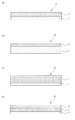
- FIG. 1 is a schematic cross-sectional view of the laminated pressure-sensitive adhesive sheet of the present invention.
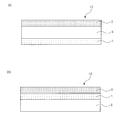
- FIG. 2 is a schematic cross-sectional view showing another aspect of the laminated pressure-sensitive adhesive sheet of the present invention.
- a numerical range expressed using “to” means a range including numerical values described before and after “to” as a lower limit value and an upper limit value.
- the present invention relates to a laminated pressure-sensitive adhesive sheet having at least a first pressure-sensitive adhesive layer and a second pressure-sensitive adhesive layer.
- the absolute value of the difference in relative dielectric constant at a frequency of 1 MHz between the first pressure-sensitive adhesive layer and the second pressure-sensitive adhesive layer is 0.5 or more.
- the dielectric constant in the frequency 1MHz of the 1st adhesive layer of the laminated adhesive sheet of this invention is less than 4, and the dielectric constant in the frequency 1MHz of the 2nd adhesive layer is 4 or more.
- the laminated pressure-sensitive adhesive sheet of the present invention can function as a double-sided pressure-sensitive adhesive sheet having at least a first pressure-sensitive adhesive layer and a second pressure-sensitive adhesive layer.
- the laminated pressure-sensitive adhesive sheet 10 has a first pressure-sensitive adhesive layer 1 and a second pressure-sensitive adhesive layer 2.
- the laminated pressure-sensitive adhesive sheet 10 is composed of only the first pressure-sensitive adhesive layer 1 and the second pressure-sensitive adhesive layer 2, but has other functional layers and pressure-sensitive adhesive layers. It may be.
- the laminated pressure-sensitive adhesive sheet 10 of the present invention includes a third pressure-sensitive adhesive layer 3 in addition to the first pressure-sensitive adhesive layer 1 and the second pressure-sensitive adhesive layer 2. You may have.
- the laminated pressure-sensitive adhesive sheet 10 has a functional layer other than the pressure-sensitive adhesive layer, at least one of the first pressure-sensitive adhesive layer 1, the second pressure-sensitive adhesive layer 2, and the third pressure-sensitive adhesive layer 3 is the outermost layer. Placed in.
- the absolute value of the difference in relative dielectric constant between the first pressure-sensitive adhesive layer and the second pressure-sensitive adhesive layer is 0.5 or more.
- the absolute value of the difference in relative dielectric constant between the first pressure-sensitive adhesive layer and the second pressure-sensitive adhesive layer is preferably 1 or more, and more preferably 2 or more.
- the relative permittivity of the first pressure-sensitive adhesive layer at a frequency of 1 MHz is preferably less than 4, more preferably less than 3, further preferably less than 2.5, and less than 2. Even more preferably.
- the relative dielectric constant of the first pressure-sensitive adhesive layer can be controlled more efficiently. It is also possible to keep the relative dielectric constant of the entire laminated adhesive sheet low.
- the relative dielectric constant at a frequency of 1 MHz of the second pressure-sensitive adhesive layer is preferably 4 or more, more preferably 4.5 or more, further preferably 5 or more, and 5.5 or more. Is even more preferable.
- the relative dielectric constant of the first pressure-sensitive adhesive layer at a frequency of 1 MHz and the relative dielectric constant of the second pressure-sensitive adhesive layer at a frequency of 1 MHz are set to a specific range, thereby controlling the relative dielectric constant of the entire laminated adhesive sheet. can do.
- the relative dielectric constant ( ⁇ ) in the present invention can be obtained by a method defined in JIS-C-2138.
- the ratio of the thickness of the first pressure-sensitive adhesive layer and the second pressure-sensitive adhesive layer is preferably 1:99 to 99: 1.
- the relative dielectric constant of the entire laminated pressure-sensitive adhesive sheet can be controlled.
- the relative dielectric constant of the whole laminated pressure-sensitive adhesive sheet can be controlled by providing the first pressure-sensitive adhesive layer and the second pressure-sensitive adhesive layer under specific conditions.
- the relative permittivity of the laminated adhesive sheet can be controlled by adjusting the relative permittivity and thickness of the first adhesive layer and the relative permittivity and thickness of the second adhesive layer, respectively. it can.
- the relative dielectric constant and thickness of the first pressure-sensitive adhesive layer and the relative dielectric constant and thickness of the second pressure-sensitive adhesive layer can be adjusted using the following formula (1).
- ⁇ represents the relative dielectric constant of the entire laminated adhesive sheet
- d represents the thickness of the entire laminated adhesive sheet.
- epsilon n represents the dielectric constant of the adhesive layer
- d n represents the thickness of each adhesive layer. Note that n represents the number of pressure-sensitive adhesive layers.
- the dielectric constant and thickness of the first pressure-sensitive adhesive layer and the second pressure-sensitive adhesive layer using the above formula (1)
- the relative dielectric constant and thickness can be calculated. That is, if the relative dielectric constant required for the laminated adhesive sheet is determined and the thickness of the required laminated adhesive sheet is determined, the relative dielectric constant and thickness of the first adhesive layer and the second adhesive layer are calculated. be able to.
- the dielectric constant is preferably adjusted under the following conditions.
- d 1 to d n can be determined so as to be a specific ⁇ under conditions where ⁇ 1 to ⁇ n are fixed.
- epsilon n and d n are fixed, and ⁇ 1 ⁇ ⁇ n-1, it is possible to determine the d 1 ⁇ d n-1.
- a desired dielectric constant can be obtained while selecting a pressure-sensitive adhesive having an adhesive property according to the adherend using the above formula (1).
- a laminated pressure-sensitive adhesive sheet having the following can be formed.
- n is preferably 2 to 6, more preferably 2 to 4, and still more preferably 2 or 3.
- the laminated pressure-sensitive adhesive sheet of the present invention may have a third pressure-sensitive adhesive layer.
- the third pressure-sensitive adhesive layer is a pressure-sensitive adhesive layer having the same dielectric constant as the first pressure-sensitive adhesive layer or the second pressure-sensitive adhesive layer that is not adjacent to each other.
- it may be a pressure-sensitive adhesive layer having the same dielectric constant as the adjacent first pressure-sensitive adhesive layer or second pressure-sensitive adhesive layer. That is, the third pressure-sensitive adhesive layer may have the same dielectric constant as that of the adjacent pressure-sensitive adhesive layer, or may have a different relative dielectric constant.
- the dielectric constant of the 1st adhesive layer and the 3rd adhesive layer is It may be the same.
- the third pressure-sensitive adhesive layer may be a pressure-sensitive adhesive layer having a relative dielectric constant different from any of the first pressure-sensitive adhesive layer and the second pressure-sensitive adhesive layer.
- the absolute difference between the relative dielectric constant of the third pressure-sensitive adhesive layer and the relative dielectric constant of the adjacent first pressure-sensitive adhesive layer or second pressure-sensitive adhesive layer is preferably 0.5 or more, more preferably 1 or more, and even more preferably 2 or more.
- the absolute value of the difference in relative dielectric constant between all the adhesive layers is also preferably within the above range.
- the absolute value of the difference between the relative dielectric constant of the first pressure-sensitive adhesive layer and the relative dielectric constant of the second pressure-sensitive adhesive layer is preferably within the above range, and the relative dielectric constant of the second pressure-sensitive adhesive layer
- the absolute value of the difference in relative dielectric constant of the pressure-sensitive adhesive layer 3 is preferably within the above range, and the absolute value of the difference in relative dielectric constant between the first pressure-sensitive adhesive layer and the third pressure-sensitive adhesive layer is within the above range. It is preferable that
- the laminated pressure-sensitive adhesive sheet having a three-layered or more pressure-sensitive adhesive layer, in the above formula (1) under conditions epsilon 1 and epsilon n, d 1 and d n are fixed, ⁇ 2 ⁇ ⁇ n-1 and , D 2 to d n-1 can also be determined.
- a laminated pressure-sensitive adhesive sheet having a desired relative dielectric constant can be formed by adjusting the relative dielectric constant and thickness of the pressure-sensitive adhesive layer present inside the laminated pressure-sensitive adhesive sheet.
- a pressure-sensitive adhesive having appropriate pressure-sensitive adhesive properties according to the adherend as an adhesive layer in contact with the adherend (hereinafter referred to as the outermost pressure-sensitive adhesive layer) and a thickness are set in advance.
- the thickness of layers other than the outermost pressure-sensitive adhesive layer for obtaining the desired dielectric constant of the entire laminated pressure-sensitive adhesive sheet can be obtained by using the above formula (1). it can. Thereby, the laminated adhesive sheet which can achieve a desired adhesive physical property and a dielectric constant simultaneously is obtained.
- each of the first pressure-sensitive adhesive layer and the second pressure-sensitive adhesive layer of the laminated pressure-sensitive adhesive sheet of the present invention is preferably 10 ⁇ m or more. If it is more than the said lower limit, the relative dielectric constant of the whole lamination adhesive sheet can be adjusted with sufficient accuracy.
- the total thickness of the laminated pressure-sensitive adhesive sheet is preferably 20 to 1000 ⁇ m, particularly the thickness of the outermost pressure-sensitive adhesive layer is preferably 10 to 100 ⁇ m, and more preferably 25 to 50 ⁇ m.
- the present invention is a method for adjusting the relative dielectric constant of a laminated adhesive sheet having at least two pressure-sensitive adhesive layers, and also relates to a relative dielectric constant adjusting method using the above formula (1).
- laminated adhesive sheets having various relative dielectric constants can be easily formed. Thereby, the relative dielectric constant of the entire laminated adhesive sheet can be controlled with high accuracy.
- the present invention is a method for producing a laminated pressure-sensitive adhesive sheet having at least two pressure-sensitive adhesive layers, and a step of adjusting the relative dielectric constant of the laminated pressure-sensitive adhesive sheet by the relative dielectric constant adjusting method using the above formula (1). It is also related with the manufacturing method of the lamination adhesive sheet containing this. By using such a manufacturing method, the production efficiency of a laminated adhesive sheet can also be improved.
- Adhesive As the adhesive main agent that forms the first pressure-sensitive adhesive layer and the second pressure-sensitive adhesive layer, it is preferable to use a transparent material so as not to lower the visibility of a display device or the like.
- known pressure-sensitive adhesives such as acrylic pressure-sensitive adhesives, silicone-based pressure-sensitive adhesives, polyester-based pressure-sensitive adhesives, rubber-based pressure-sensitive adhesives, and polyurethane-based pressure-sensitive adhesives can be used.
- an acrylic pressure-sensitive adhesive is preferably used, and an acrylic pressure-sensitive adhesive containing an acrylic polymer as a base polymer is preferable.
- the acrylic polymer contains a non-crosslinkable (meth) acrylic acid ester unit and an acrylic monomer unit having a crosslinkable functional group.
- the “monomer unit” is a repeating unit constituting the polymer.
- An “acrylic monomer” is a compound having a (meth) acryloyl group.
- (Meth) acryloyl group” means an acryloyl group or a methacryloyl group.
- the non-crosslinkable acrylic monomer is an acrylic monomer having no crosslinkable group
- the crosslinkable monomer is a monomer having a crosslinkable group.
- the crosslinkable monomer may be an acrylic monomer or a non-acrylic monomer as long as it is polymerizable with the non-crosslinkable acrylic monomer, and is preferably an acrylic monomer.
- the crosslinkable group include a carboxy group, a hydroxy group, an amino group, an epoxy group, and a glycidyl group.
- non-crosslinkable acrylic monomer unit examples include a (meth) acrylic acid ester unit in which a hydrogen atom of a carboxy group of (meth) acrylic acid is substituted with a hydrocarbon group.
- each adhesive layer contains a (meth) acrylic acid ester unit.
- the number of carbon atoms of the hydrocarbon group in the (meth) acrylate unit is preferably 1-18, and more preferably 1-8.
- the hydrocarbon group may have a substituent, and the substituent is not particularly limited as long as it does not contain a crosslinkable group, and examples thereof include alkoxy groups such as a methoxy group and an ethoxy group.
- (meth) acrylic acid ester examples include methyl (meth) acrylate, ethyl (meth) acrylate, propyl (meth) acrylate, isopropyl (meth) acrylate, n-butyl (meth) acrylate, ( Isobutyl acrylate, t-butyl (meth) acrylate, n-pentyl (meth) acrylate, n-hexyl (meth) acrylate, 2-ethylhexyl (meth) acrylate, n-octyl (meth) acrylate , Isooctyl (meth) acrylate, n-nonyl (meth) acrylate, isobornyl (meth) acrylate, isononyl (meth) acrylate, n-decyl (meth) acrylate, isodecyl (meth) acrylate, (meth) N-und
- n-butyl acrylate, 2-ethylhexyl acrylate, and methyl acrylate are preferably used from the viewpoint of adhesiveness. These may be used individually by 1 type and may use 2 or more types together.
- (meth) acrylic acid means containing both “acrylic acid” and “methacrylic acid”.
- a carboxy group-containing copolymerizable monomer unit As the crosslinkable monomer unit, a carboxy group-containing copolymerizable monomer unit, a hydroxy group-containing copolymerizable monomer unit, an amino group-containing copolymerizable monomer unit, a glycidyl group-containing copolymerizable monomer Examples include body units.
- the carboxy group-containing copolymerizable monomer include ⁇ , ⁇ -unsaturated carboxylic acids such as acrylic acid, methacrylic acid, crotonic acid, maleic acid, fumaric acid, itaconic acid, citraconic acid, and grataconic acid, and anhydrides thereof. Such as things.
- Examples of the hydroxy group-containing copolymerizable monomer include (meth) acrylic acid such as 2-hydroxyethyl (meth) acrylate, 4-hydroxybutyl (meth) acrylate, and 2-hydroxypropyl (meth) acrylate. (Meth) acrylic acid lactones such as hydroxyalkyl, (meth) acrylic acid (meth) acrylic acid mono (diethylene glycol) [(mono, di or poly) alkylene glycol], (meth) acrylic acid monocaprolactone and the like.
- Examples of the amino group-containing copolymerizable monomer include (meth) acrylamide and allylamide.
- Examples of the glycidyl group-containing copolymerizable monomer include glycidyl (meth) acrylate.
- glycidyl (meth) acrylate examples include glycidyl (meth) acrylate.
- a hydroxy group-containing copolymerizable monomer Is preferred, hydroxyalkyl (meth) acrylate is more preferred, 2-hydroxyethyl (meth) acrylate, 4-hydroxybutyl (meth) acrylate is particularly preferred.
- the acidity becomes strong, so when a corrosive film such as a tin-doped indium oxide film or a metal film is in contact with these, May corrode the film.
- the content is preferably less than 0.5% by mass, More preferably it is not contained at all.
- the content rate of the carboxy group containing copolymerizable monomer unit in this acrylic polymer is less than 1.0 mass% from the point of corrosion prevention as the whole lamination adhesive sheet.
- the acrylic polymer may have other monomer units other than the non-crosslinkable acrylic monomer unit and the crosslinkable monomer unit.
- examples of other monomers include (meth) acrylonitrile, vinyl acetate, styrene, vinyl chloride, vinyl pyrrolidone, vinyl pyridine and the like.
- the content of other monomer units in the acrylic polymer is preferably 0.1 to 20% by mass, and more preferably 0.5 to 10% by mass. If the content of other monomer units is not less than the above lower limit, the physical properties can be easily adjusted, and if it is not more than the above upper limit, yellowing due to deterioration with time can be prevented.
- the relative dielectric constant of each pressure-sensitive adhesive layer can be set to a desired value by appropriately selecting the type of resin used for the pressure-sensitive adhesive.
- (meth) acrylic acid ester units having a relatively high polarity such as methyl (meth) acrylate, ethyl (meth) acrylate, propyl (meth) acrylate, (meth) acrylic It is preferable to use isopropyl acid, n-butyl (meth) acrylate, isobutyl (meth) acrylate, t-butyl (meth) acrylate, or the like.
- methyl (meth) acrylate and n-butyl (meth) acrylate are preferred from the viewpoints of transparency and adhesion between the first pressure-sensitive adhesive layer and the second pressure-sensitive adhesive layer.
- the crosslinkable monomer unit similarly, a relatively high carboxyl group-containing copolymerizable monomer unit, hydroxy group-containing copolymerizable monomer unit, amino group-containing copolymerizable monomer unit
- the carboxy group-containing copolymerizable monomer for example, ⁇ , ⁇ -unsaturation such as acrylic acid, methacrylic acid, crotonic acid, maleic acid, fumaric acid, itaconic acid, citraconic acid, grataconic acid, etc.
- Examples of the carboxylic acid, anhydride thereof, and hydroxy group-containing copolymerizable monomer include 2-hydroxyethyl (meth) acrylate, 4-hydroxybutyl (meth) acrylate, and 2-hydroxypropyl (meth) acrylate.
- (Meth) acrylic acid ((mono, di or poly) a) such as (meth) acrylic acid hydroxyalkyl, (meth) acrylic acid mono (diethylene glycol)
- Examples of (meth) acrylic acid lactone and amino group-containing copolymerizable monomers such as (alkylene glycol] and (meth) acrylic acid monocaprolactone include (meth) acrylamide and allylamide.
- the proportion of polar groups in the whole molecule is high, so 2-hydroxyethyl (meth) acrylate and 4-hydroxybutyl (meth) acrylate are preferred.
- a material having a low polarity may be used.
- (meth)) 2-ethylhexyl (meth) acrylate, n-octy
- a crosslinking agent may be used for each pressure-sensitive adhesive layer.
- the crosslinking agent include isocyanate compounds, epoxy compounds, oxazoline compounds, aziridine compounds, metal chelate compounds, butylated melamine compounds, and the like.
- an isocyanate compound and an epoxy compound are preferable because the acrylic polymer can be easily crosslinked.
- an isocyanate compound when the acrylic polymer contains only a hydroxy group-containing copolymerizable monomer unit as a crosslinkable monomer unit, it is preferable to use an isocyanate compound because of the reactivity of the hydroxy group.
- Examples of the isocyanate compound include tolylene diisocyanate, xylylene diisocyanate, hexamethylene diisocyanate, and isophorone diisocyanate.
- Examples of the epoxy compound include ethylene glycol diglycidyl ether, polyethylene glycol diglycidyl ether, propylene glycol diglycidyl ether, polypropylene glycol diglycidyl ether, glycerin diglycidyl ether, neopentyl glycol diglycidyl ether, and 1,6-hexanediol diester.
- Glycidyl ether tetraglycidyl xylenediamine, 1,3-bis (N, N-diglycidylaminomethyl) cyclohexane, trimethylolpropane polyglycidyl ether, diglycerol polyglycidyl ether, polyglycerol polyglycidyl ether, sorbitol polyglycidyl ether, etc. Can be mentioned. It is preferable that the content of the crosslinking agent is appropriately selected according to the desired pressure-sensitive adhesive properties.
- each pressure-sensitive adhesive layer may include an antioxidant, a metal corrosion inhibitor, a tackifier, a silane coupling agent, an ultraviolet absorber, a light stabilizer such as a hindered amine compound, a filler, and the like as necessary. May be included.
- the antioxidant include phenolic antioxidants, amine-based antioxidants, lactone-based antioxidants, phosphorus-based antioxidants, sulfur-based antioxidants, and the like. These antioxidants may be used alone or in combination of two or more.
- a benzotriazole-based resin is preferable because of the compatibility and high effect of the pressure-sensitive adhesive.
- Examples of the tackifier include rosin resins, terpene resins, terpene phenol resins, coumarone indene resins, styrene resins, xylene resins, phenol resins, petroleum resins, and the like.
- Examples of the silane coupling agent include mercaptoalkoxysilane compounds (for example, mercapto group-substituted alkoxy oligomers).
- Examples of the ultraviolet absorber include benzotriazole compounds and benzophenone compounds.
- the laminated pressure-sensitive adhesive sheet of the present invention may further have a resin layer in addition to the above-described first pressure-sensitive adhesive layer, second pressure-sensitive adhesive layer, and third pressure-sensitive adhesive layer.
- the resin layer may be an adhesive layer or a non-adhesive resin layer. Further, it may be a single layer or a plurality of layers.
- the resin used is preferably one that does not affect the optical properties, such as polycarbonate, polyethylene terephthalate, polymethyl methacrylate, polyethylene naphthalate, cycloolefin polymer, triacetyl cellulose. , Polyimide, cellulose acylate and the like.
- the pressure-sensitive adhesive agent having a transparency that does not deteriorate the visibility of the display device is preferable, as in the case of the pressure-sensitive adhesive agent used in each pressure-sensitive adhesive layer.
- known adhesives such as acrylic adhesives, silicone adhesives, polyester adhesives, rubber adhesives, polyurethane adhesives and the like can be used.
- An acrylic pressure-sensitive adhesive containing, as a base polymer, an acrylic polymer containing (meth) acrylic acid alkyl ester having 1 to 18 carbon atoms as a main monomer component is preferable.
- the laminated pressure-sensitive adhesive sheet 10 of the present invention has a first pressure-sensitive adhesive layer 1, a second pressure-sensitive adhesive layer 2, and a resin layer 5.
- the resin layer 5 may be provided between the first pressure-sensitive adhesive layer 1 and the second pressure-sensitive adhesive layer 2 as shown in FIG.
- the laminated pressure-sensitive adhesive sheet can function as a double-sided pressure-sensitive adhesive sheet. Further, as shown in FIG.
- the first pressure-sensitive adhesive layer 1 is laminated on the resin layer 5, and the second resin layer is disposed on the opposite side of the resin layer 5 through the first pressure-sensitive adhesive layer 1. 2 may be provided.
- the second pressure-sensitive adhesive layer 2 adheres to an adherend such as an optical member, the second pressure-sensitive adhesive layer 2 preferably contains a resin excellent in adhesiveness to the adherend.
- the relative dielectric constant of the resin layer at a frequency of 1 MHz is preferably 2 to 10.
- the relative dielectric constant of the resin layer is preferably adjusted by appropriately selecting the type of resin used.
- the thickness of the resin layer is preferably 10 to 500 ⁇ m, more preferably 25 to 250 ⁇ m. If the thickness of the resin layer is equal to or greater than the above lower limit, the relative dielectric constant of the entire laminated adhesive sheet can be easily controlled, and if the thickness of the resin layer is equal to or less than the above upper limit, the laminated adhesive sheet is easily manufactured. it can.
- the laminated pressure-sensitive adhesive sheet of the present invention is formed, for example, by coating the first pressure-sensitive adhesive composition and the second pressure-sensitive adhesive composition on a release sheet to form a coating film, and heating the coating film to obtain a cured product. Can be obtained.
- a release sheet a peelable laminate sheet having a release sheet substrate and a release agent layer provided on one side of the release sheet substrate, or a polyolefin film such as a polyethylene film or a polypropylene film as a low polarity substrate Is mentioned.
- the release sheet substrate in the peelable laminate sheet is used as the release sheet substrate in the peelable laminate sheet.
- a general-purpose addition type or condensation type silicone release agent or a long-chain alkyl group-containing compound is used as the release agent constituting the release agent layer.
- silicone release agents include BY24-4527 and SD-7220 manufactured by Toray Dow Corning Silicone, KS-3600, KS-774, and X62-2600 manufactured by Shin-Etsu Chemical Co., Ltd. Is mentioned.
- the silicone release agent may contain a silicone resin which is an organosilicon compound having a SiO 2 unit and a (CH 3 ) 3 SiO 1/2 unit or CH 2 ⁇ CH (CH 3 ) SiO 1/2 unit. preferable.
- Specific examples of the silicone resin include BY24-843, SD-7292, SHR-1404 manufactured by Toray Dow Corning Silicone, KS-3800, X92-183 manufactured by Shin-Etsu Chemical Co., Ltd., and the like.
- the first adhesive layer side release sheet and the second adhesive layer side release sheet have different peelability. That is, when the peelability from one side and the peelability from the other are different, it becomes easy to peel only the release sheet having the higher peelability first. In that case, what is necessary is just to adjust the peelability of a 1st adhesive layer side peeling sheet and a 2nd adhesive layer side peeling sheet according to the bonding method and the bonding order.
- the application of the pressure-sensitive adhesive composition for forming each pressure-sensitive adhesive layer can be carried out using a known coating apparatus.
- the pressure-sensitive adhesive composition may be applied to each pressure-sensitive adhesive layer, or two or more pressure-sensitive adhesive layers may be formed by simultaneous multilayer coating of the pressure-sensitive adhesive composition.
- the coating apparatus include a blade coater, an air knife coater, a roll coater, a bar coater, a gravure coater, a micro gravure coater, a rod blade coater, a lip coater, a die coater, and a curtain coater.
- the coating liquid contains a solvent.
- the solvent examples include methanol, ethanol, isopropanol, acetone, methyl ethyl ketone, toluene, n-hexane, n-butyl alcohol, methyl isobutyl ketone, methyl butyl ketone, ethyl butyl ketone, cyclohexanone, ethyl acetate, butyl acetate, propylene glycol monomethyl.
- Ether acetate, ethylene glycol monoethyl ether, propylene glycol monomethyl ether, N-methyl-2-pyrrolidone and the like are used. These may be used alone or in combination of two or more.
- the coating film can be heated using a known heating device such as a heating furnace or an infrared lamp.
- the resin layer can also be formed using the above coating apparatus.
- the resin layer when it is a non-adhesive resin layer, it can be molded by a known method and is not particularly limited, but a biaxial stretching method, a melt extrusion method, or the like is preferable.
- a laminated body in this invention, can be produced by sticking a laminated adhesive sheet to at least one optical member.
- the laminated adhesive sheet is a double-sided adhesive sheet, a pair of optical members can be bonded to both sides of the laminated adhesive sheet.
- the optical member constituting the laminate is each constituent member in an optical product such as a touch panel or an image display device.
- a constituent member of the touch panel for example, an ITO film in which an ITO film is provided on a transparent resin film, an ITO glass in which an ITO film is provided on the surface of a glass plate, a transparent conductive film in which a transparent polymer film is coated with a conductive polymer, Examples thereof include a hard coat film and an anti-fingerprint film.
- the constituent member of the image display device include an antireflection film, an alignment film, a polarizing film, a retardation film, and a brightness enhancement film used in a liquid crystal display device.
- Examples of materials used for these members include glass, polycarbonate, polyethylene terephthalate, polymethyl methacrylate, polyethylene naphthalate, cycloolefin polymer, triacetyl cellulose, polyimide, and cellulose acylate.
- bonding between ITO films inside the touch panel, bonding between ITO film and ITO glass, touch panel ITO film and liquid crystal panel Examples include bonding, bonding between a cover glass and an ITO film, and bonding between a cover glass and a decorative film.
- pressure-sensitive adhesive composition (A) contained in the first pressure-sensitive adhesive layer 80 parts by mass of 2-ethylhexyl acrylate as a non-crosslinkable acrylate unit, 17 parts by mass of isobornyl acrylate, and 3 parts by mass of 4-hydroxybutyl acrylate as an acrylic monomer unit having a crosslinkable functional group are used in a known solvent weight.
- a polymerization reaction was performed by a legal method to obtain an acrylate copolymer solution.
- a pressure-sensitive adhesive solution containing this acrylic acid ester copolymer solution as a pressure-sensitive adhesive was used as a pressure-sensitive adhesive composition (A).
- a release sheet As a release sheet, a release film (38 ⁇ m RL-07 (L), manufactured by Oji F-Tex Co., Ltd.) provided with a release layer on a PET film was prepared, and the above-mentioned pressure-sensitive adhesive composition ( The solution of A) was applied with a knife coater, heated at 100 ° C. for 3 minutes to form an adhesive layer having a thickness of 100 ⁇ m, and compared with JIS-C-2138 using a dielectric constant measurement system (Toyo Technica Model 1260). When the dielectric constant was measured and detected, the relative dielectric constant ⁇ 1 at a frequency of 1 MHz was 2.6.
- a dielectric constant measurement system Toyo Technica Model 1260
- a release sheet As a release sheet, a release film (38 ⁇ m RL-07 (L), manufactured by Oji F-Tex Co., Ltd.) provided with a release layer on a PET film was prepared, and the above-mentioned pressure-sensitive adhesive composition ( The solution of B) was applied with a knife coater, heated at 100 ° C. for 3 minutes to form an adhesive layer having a thickness of 100 ⁇ m, and the relative dielectric constant was measured.
- the relative dielectric constant ⁇ 2 at a frequency of 1 MHz was 5.4. It was.
- a release sheet As a release sheet, a release film (38 ⁇ m RL-07 (L), manufactured by Oji F-Tex Co., Ltd.) provided with a release layer on a PET film was prepared, and the above-mentioned pressure-sensitive adhesive composition ( The syrup of C) was coated with a knife coater and irradiated with an integrated light amount of 1000 mJ / cm 2 while cooling with a UV irradiator under a nitrogen atmosphere to form an adhesive layer having a thickness of 100 ⁇ m.
- a release film 38 ⁇ m RL-07 (L), manufactured by Oji F-Tex Co., Ltd.
- the syrup of D was applied with a knife coater and irradiated with an integrated light amount of 1000 mJ / cm 2 while cooling with a UV irradiator under a nitrogen atmosphere to form an adhesive layer having a thickness of 100 ⁇ m.
- the relative permittivity of this pressure-sensitive adhesive layer was measured based on JIS-C-2138 using a permittivity measurement system (Toyo Technica Model 1260), the relative permittivity ⁇ 1 at a frequency of 1 MHz was 5.8. It was.
- Example 1 Production of laminated adhesive sheet
- a release film (Oji F-Tex Co., Ltd., 38 ⁇ m RL-07 (L)) provided with a release agent layer on a PET film was prepared, and the release agent layer of the first release sheet was The solution of the pressure-sensitive adhesive composition (A) was applied with a knife coater and heated at 100 ° C. for 3 minutes to form a first pressure-sensitive adhesive layer having a thickness of 50 ⁇ m.
- a release film 38 ⁇ m RL-07 (L) manufactured by Oji F-Tex Co., Ltd.
- a release agent layer on a PET film was prepared, and the release agent layer of the second release sheet was
- the solution of the pressure-sensitive adhesive composition (B) was applied with a knife coater and heated at 100 ° C. for 3 minutes to form a second pressure-sensitive adhesive layer having a thickness of 50 ⁇ m.
- the first pressure-sensitive adhesive layer and the second pressure-sensitive adhesive layer were stacked and pressed together so that they were in contact with each other.
- the laminated adhesive sheet with a peeling sheet whose thickness of an adhesive layer is 100 micrometers was obtained.
- Example 4 Production of laminated adhesive sheet using UV curable adhesive composition
- adhesive compositions (C) and (D) In order to produce a laminated adhesive sheet having a relative dielectric constant of 3.5 using adhesive compositions (C) and (D).
- the ratio of the thicknesses of the first pressure-sensitive adhesive layer and the second pressure-sensitive adhesive layer was calculated using the formula (1).
- An adhesive layer and a second adhesive layer were formed.
- a release film (Oji F-Tex Co., Ltd., 38 ⁇ m RL-07 (L)) provided with a release agent layer on a PET film was prepared, and the release agent layer of the first release sheet was A syrup of the pressure-sensitive adhesive composition (C) was applied with a knife coater, and irradiated with an integrated light amount of 1000 mJ / cm 2 while being cooled with a UV irradiator in a nitrogen atmosphere to form a pressure-sensitive adhesive layer having a thickness of 45 ⁇ m.
- a release film 38 ⁇ m RL-07 (L) manufactured by Oji F-Tex Co., Ltd.
- a release agent layer on a PET film was prepared, and the release agent layer of the second release sheet was
- the solution of the pressure-sensitive adhesive composition (D) was applied with a knife coater, and irradiated with an integrated light amount of 1000 mJ / cm 2 while being cooled with a UV irradiator in a nitrogen atmosphere to form a pressure-sensitive adhesive layer having a thickness of 55 ⁇ m.
- the first pressure-sensitive adhesive layer and the second pressure-sensitive adhesive layer were stacked and pressed together so that they were in contact with each other.
- the laminated adhesive sheet with a peeling sheet whose thickness of an adhesive layer is 100 micrometers was obtained.
- a laminated pressure-sensitive adhesive sheet with a release sheet having a pressure-sensitive adhesive layer thickness of 100 ⁇ m was obtained in the same manner as in Example 4 except that the thickness of the pressure-sensitive adhesive layer was changed to 80 ⁇ m.
- Example 6 In order to produce a laminated pressure-sensitive adhesive sheet having a relative dielectric constant of 3.0 using the pressure-sensitive adhesive compositions (C) and (D), the first pressure-sensitive adhesive layer and the second pressure-sensitive adhesive layer are expressed using the formula (1).
- ⁇ represents the relative dielectric constant of the entire laminated adhesive sheet
- d represents the thickness of the entire laminated adhesive sheet.
- epsilon n represents the dielectric constant of the adhesive layer
- d n represents the thickness of each adhesive layer. Note that n represents the number of pressure-sensitive adhesive layers.
- pressure-sensitive adhesive composition (1) 40 parts by mass of methyl acrylate and 40 parts by mass of butyl acrylate as non-crosslinkable acrylic ester units, and 20 parts by mass of 4-hydroxybutyl acrylate as an acrylic monomer unit having a crosslinkable functional group are obtained by a known solvent polymerization method. A polymerization reaction was performed to obtain an acrylate copolymer solution. A pressure-sensitive adhesive solution containing this acrylic acid ester copolymer solution as a pressure-sensitive adhesive was designated as pressure-sensitive adhesive composition (1).
- pressure-sensitive adhesive composition (2) As a non-crosslinkable acrylic ester unit, 60 parts by mass of 2-ethylhexyl acrylate, 38 parts by mass of isobornyl acrylate, and 2 parts by mass of 4-hydroxybutyl acrylate as an acrylic monomer unit having a crosslinkable functional group are used. A polymerization reaction was performed by a legal method to obtain an acrylate copolymer solution. A pressure-sensitive adhesive solution containing the acrylic acid ester copolymer solution as a pressure-sensitive adhesive was designated as pressure-sensitive adhesive composition (2).
- Example 7 Production of Laminated Adhesive Sheet 7 Having Three Adhesive Layers
- Second Adhesive Layer As a first release sheet, a release film provided with a release agent layer on a PET film [Oji Ftex Co., Ltd., 38 ⁇ m RL-07 (L)] was prepared, and the adhesive (2) solution was applied to the release agent layer of the first release sheet with a knife coater at 100 ° C. for 3 minutes. Heated to form a second pressure-sensitive adhesive layer. The relative dielectric constant ⁇ r at a frequency of 100 Hz of the formed second pressure-sensitive adhesive layer was 4.5.
- the formula (1) As a result of obtaining the optimum thickness of the second pressure-sensitive adhesive layer by using, the second pressure-sensitive adhesive (2) was applied so as to have a thickness of 51 ⁇ m.
- first pressure-sensitive adhesive layer comprising a release agent layer having a lower release property than the first release sheet on the PET film as the second release sheet [manufactured by Oji F-Tex Co., Ltd., 38 ⁇ m RL -07 (2)], and a solution of the above-mentioned adhesive (1) was applied to the release agent layer of the second release sheet with a knife coater so as to have a thickness of 25 ⁇ m, and 100 ° C. for 3 minutes. Heated to form a first pressure-sensitive adhesive layer.
- the relative dielectric constant ⁇ r at a frequency of 100 Hz of the formed first pressure-sensitive adhesive layer was 7.1.
- third pressure-sensitive adhesive layer As a third release sheet, the same release film as the first release film [manufactured by Oji F-Tex Co., Ltd., 38 ⁇ m RL-07 (L)] was prepared. A solution of the pressure-sensitive adhesive (1) was applied to the release agent layer of the release sheet with a knife coater so as to have a thickness of 25 ⁇ m, and heated at 100 ° C. for 3 minutes to form a third pressure-sensitive adhesive layer. The relative dielectric constant ⁇ r at a frequency of 100 Hz of the formed third pressure-sensitive adhesive layer was 7.1.
- the overall relative dielectric constant of the laminated pressure-sensitive adhesive sheet 7 is substantially close to the estimated value. Actual measurement values could be obtained. That is, it can be said that a laminated adhesive sheet having a desired relative dielectric constant was obtained.
- Example 8 Production of laminated adhesive sheet 8 Adhesive (1) for the first adhesive layer, adhesive (2) for the second adhesive layer, and adhesive (3) for the third adhesive layer.
- the laminated adhesive sheet 8 was produced by the same method as Example 7.
- the thickness and relative dielectric constant of the first adhesive layer and the thickness and relative dielectric constant of the third adhesive layer are expressed by the formula (1).
- the pressure-sensitive adhesive (2) was applied so as to have a thickness of 100 ⁇ m.
- Example 9 Production of Laminated Adhesive Sheet 9
- a laminated adhesive sheet 9 was produced in the same manner as in Example 8 except that it was used.
- the pressure-sensitive adhesive (1) was applied so as to have a thickness of 100 ⁇ m.
- Table 4 shows the thickness and relative dielectric constant of each layer of the laminated adhesive sheets 8 and 9.
- the relative dielectric constant of the entire laminated adhesive sheet can be freely adjusted by controlling the relative dielectric constant and thickness of the adhesive layer even when the relative dielectric constants of all the adhesive layers are different. It was possible.
- the laminated pressure-sensitive adhesive sheet of the present invention is useful for bonding optical members, for example, bonding of ITO films in a touch panel sensor, or bonding of a touch panel module and a liquid crystal module.
Landscapes
- Chemical & Material Sciences (AREA)
- Organic Chemistry (AREA)
- Adhesive Tapes (AREA)
- Adhesives Or Adhesive Processes (AREA)
- Laminated Bodies (AREA)
Abstract
Description
具体的に、本発明は、以下の構成を有する。
[2]少なくとも第1の粘着剤層と第2の粘着剤層を有する積層粘着シートであって、周波数1MHzにおける比誘電率が4未満の第1の粘着剤層と、周波数1MHzにおける比誘電率が4以上の第2の粘着剤層を有することを特徴とする[1]に記載の積層粘着シート。
[3]前記第1の粘着剤層の周波数1MHzにおける比誘電率が3未満であることを特徴とする[1]又は[2]に記載の積層粘着シート。
[4]前記第1の粘着剤層と前記第2の粘着剤層の各層の厚みが10μm以上であることを特徴とする[1]~[3]のいずれかに記載の積層粘着シート。
[5]前記第1の粘着剤層と前記第2の粘着剤層の厚みの比は、1:99~99:1であることを特徴とする[1]~[4]のいずれかに記載の積層粘着シート。
[6]前記第1の粘着剤層と前記第2の粘着剤層は、アクリル系粘着剤層であることを特徴とする[1]~[5]のいずれかに記載の積層粘着シート。
[7]前記第1の粘着剤層と前記第2の粘着剤層は、(メタ)アクリル酸エステルを含むことを特徴とする[1]~[6]のいずれかに記載の積層粘着シート。
[8]さらに第3の粘着剤層を有することを特徴とする[1]~[7]のいずれかに記載の積層粘着シート。
[9]さらに樹脂層を有することを特徴とする[1]~[8]のいずれかに記載の積層粘着シート。
[10]前記樹脂層は、前記第1の粘着剤層と前記第2の粘着剤層の間に設けられることを特徴とする[9]に記載の積層粘着シート。
[11]前記樹脂層の上に前記第1の粘着剤層が積層され、前記第1の粘着剤層を介して前記樹脂層とは反対側に前記第2の粘着剤層が積層されることを特徴とする[9]に記載の積層粘着シート。
[12]前記樹脂層の周波数1MHzにおける比誘電率が2~10であることを特徴とする[9]~[11]のいずれかに記載の積層粘着シート。
[13][1]~[12]のいずれかに記載の積層粘着シートが、少なくとも1つの光学部材に貼着され形成されることを特徴とする積層体。
[14]前記光学部材の少なくとも1つがITOガラス又はITOフィルムであることを特徴とする[13]に記載の積層体。
[15]少なくとも2層の粘着剤層を有する積層粘着シートの比誘電率を調整する方法であって、前記積層粘着シートは、周波数1MHzにおける比誘電率が4未満の第1の粘着剤層と、周波数1MHzにおける比誘電率が4以上の第2の粘着剤層を有し、第1の粘着剤層の周波数1MHzにおける比誘電率及び厚みと、第2の粘着剤層の周波数1MHzにおける比誘電率及び厚みをそれぞれ調整することによって、前記積層粘着シートの比誘電率を調整することを特徴とする比誘電率調整方法。
[16]前記第1の粘着剤層の周波数1MHzにおける比誘電率及び厚みと、前記第2の粘着剤層の周波数1MHzにおける比誘電率及び厚みは、下記式(1)を用いて調整されることを特徴とする[15]に記載の比誘電率調整方法。

[17]前記式(1)において、ε1~εnが固定されている条件下で、特定のεとなるように、d1~dnを決定することを特徴とする[16]に記載の比誘電率調整方法。
[18]前記式(1)において、εnとdnが固定されている条件下で、特定のεとなるように、ε1~εn-1と、d1~dn-1を決定することを特徴とする[16]に記載の比誘電率調整方法。
[19]前記式(1)において、nは2であることを特徴とする[16]~[18]のいずれかに記載の比誘電率調整方法。
[20]少なくとも2層の粘着剤層を有する積層粘着シートの製造方法であって、[16]~[19]のいずれかに記載の比誘電率調整方法によって積層粘着シートの比誘電率を調節することを特徴とする積層粘着シートの製造方法。
本発明は、少なくとも第1の粘着剤層と第2の粘着剤層を有する積層粘着シートに関する。本発明の積層粘着シートにおいては、第1の粘着剤層と第2の粘着剤層の周波数1MHzにおける比誘電率の差の絶対値は0.5以上である。また、本発明の積層粘着シートの第1の粘着剤層の周波数1MHzにおける比誘電率は4未満であり、第2の粘着剤層の周波数1MHzにおける比誘電率は4以上であることが好ましい。なお、本発明の積層粘着シートは、少なくとも第1の粘着剤層と第2の粘着剤層を有する両面粘着シートとして機能し得る。
本発明では、第1の粘着剤層の比誘電率及び厚みと、第2の粘着剤層の比誘電率及び厚みは、下記式(1)を用いて調整することができる。

このように、積層粘着シートの態様に合わせて条件を設定することにより、上記式(1)を用いて、被着体に応じた粘着物性を有する粘着剤を選択しつつ、所望の比誘電率を有する積層粘着シートを形成することができる。
第1の粘着剤層と第2の粘着剤層を形成する粘着主剤としては、表示装置等の視認性を低下させないように、透明性を有するものを用いることが好ましい。例えば、アクリル系粘着剤、シリコーン系粘着剤、ポリエステル系粘着剤、ゴム系粘着剤、ポリウレタン系粘着剤などの公知の粘着剤を使用することができる。中でも、アクリル系粘着剤を用いることが好ましく、アクリル重合体をベースポリマーとして含有するアクリル系粘着剤が好ましい。
アクリル重合体は、非架橋性の(メタ)アクリル酸エステル単位と、架橋性官能基を有するアクリル単量体単位を含有する。ここで、「単量体単位」は重合体を構成する繰り返し単位である。「アクリル単量体」は、(メタ)アクリロイル基を有する化合物である。「(メタ)アクリロイル基」は、アクリロイル基又はメタクリロイル基であることを示す。また、非架橋性アクリル単量体は架橋性基を有さないアクリル単量体であり、架橋性単量体は架橋性基を有する単量体である。架橋性単量体は、非架橋性アクリル単量体と重合可能なものであればアクリル単量体であっても非アクリル単量体であってもよく、アクリル単量体であることが好ましい。なお、架橋性基としては、カルボキシ基、ヒドロキシ基、アミノ基、エポキシ基、グリシジル基等が挙げられる。
ヒドロキシ基含有共重合性単量体としては、例えば、(メタ)アクリル酸2-ヒドロキシエチル、(メタ)アクリル酸4-ヒドロキシブチル、(メタ)アクリル酸2-ヒドロキシプロピルなどの(メタ)アクリル酸ヒドロキシアルキル、(メタ)アクリル酸モノ(ジエチレングリコール)などの(メタ)アクリル酸[(モノ、ジ又はポリ)アルキレングリコール]、(メタ)アクリル酸モノカプロラクトンなどの(メタ)アクリル酸ラクトンが挙げられる。
アミノ基含有共重合性単量体としては、例えば、(メタ)アクリルアミド、アリルアミドなどが挙げられる。
グリシジル基含有共重合性単量体としては、例えば、(メタ)アクリル酸グリシジルなどが挙げられる。
これらの中でも、粘着性、架橋性および重合性、さらには透明導電膜に用いられるスズドープ酸化インジウムや電磁波シールドに用いられる銅などの金属の腐食性が小さい点から、ヒドロキシ基含有共重合性単量体が好ましく、(メタ)アクリル酸ヒドロキシアルキルがより好ましく、(メタ)アクリル酸2-ヒドロキシエチル、(メタ)アクリル酸4-ヒドロキシブチルが特に好ましい。
アクリル重合体におけるその他の単量体単位の含有率は、0.1~20質量%であることが好ましく、0.5~10質量%であることがより好ましい。その他の単量体単位の含有率が上記下限値以上であれば、物性を容易に調整でき、上記上限値以下であれば、経時劣化による黄変などを防止できる。
また、架橋性単量体単位としては、同様に比較的極性の高いカルボキシ基含有共重合性単量体単位、ヒドロキシ基含有共重合性単量体単位、アミノ基含有共重合性単量体単位を用いればよく、カルボキシ基含有共重合性単量体としては、例えば、アクリル酸、メタクリル酸、クロトン酸、マレイン酸、フマル酸、イタコン酸、シトラコン酸、グラタコン酸などのα,β-不飽和カルボン酸やその無水物、ヒドロキシ基含有共重合性単量体としては、例えば、(メタ)アクリル酸2-ヒドロキシエチル、(メタ)アクリル酸4-ヒドロキシブチル、(メタ)アクリル酸2-ヒドロキシプロピルなどの(メタ)アクリル酸ヒドロキシアルキル、(メタ)アクリル酸モノ(ジエチレングリコール)などの(メタ)アクリル酸[(モノ、ジ又はポリ)アルキレングリコール]、(メタ)アクリル酸モノカプロラクトンなどの(メタ)アクリル酸ラクトン、アミノ基含有共重合性単量体としては、例えば、(メタ)アクリルアミド、アリルアミドなどが挙げられる。中でも、比誘電率の制御のしやすさの観点から、分子全体に占める極性基の割合が高くなるので(メタ)アクリル酸2-ヒドロキシエチル、(メタ)アクリル酸4-ヒドロキシブチルが好ましい。
各粘着剤層には、架橋剤が用いられてもよい。架橋剤としては、例えば、イソシアネート化合物、エポキシ化合物、オキサゾリン化合物、アジリジン化合物、金属キレート化合物、ブチル化メラミン化合物などが挙げられる。これら架橋剤の中でも、アクリル重合体を容易に架橋できることから、イソシアネート化合物、エポキシ化合物が好ましい。特に、アクリル重合体が架橋性単量体単位としてヒドロキシ基含有共重合性単量体単位のみを含む場合は、ヒドロキシ基の反応性からイソシアネート化合物を用いることが好ましい。
イソシアネート化合物としては、例えば、トリレンジイソシアネート、キシリレンジイソシアネート、ヘキサメチレンジイソシアネート、イソホロンジイソシアネートなどが挙げられる。エポキシ化合物としては、例えば、エチレングリコールジグリシジルエーテル、ポリエチレングリコールジグリシジルエーテル、プロピレングリコールジグリシジルエーテル、ポリプロピレングリコールジグリシジルエーテル、グリセリンジグリシジルエーテル、ネオペンチルグリコールジグリシジルエーテル、1,6-ヘキサンジオールジグリシジルエーテル、テトラグリシジルキシレンジアミン、1,3-ビス(N,N-ジグリシジルアミノメチル)シクロヘキサン、トリメチロールプロパンポリグリシジルエーテル、ジグリセロールポリグリシジルエーテル、ポリグリセロールポリグリシジルエーテル、ソルビトールポリグリシジルエーテルなどが挙げられる。架橋剤の含有量は、所望とする粘着物性に応じて適宜選択することが好ましい。
また、各粘着剤層には、必要に応じて、酸化防止剤、金属腐食防止剤、粘着付与剤、シランカップリング剤、紫外線吸収剤、ヒンダードアミン系化合物等の光安定剤、充填剤などの他の添加剤が含まれてもよい。
酸化防止剤としては、フェノール系酸化防止剤、アミン系酸化防止剤、ラクトン系酸化防止剤、リン系酸化防止剤、イオウ系酸化防止剤等が挙げられる。これら酸化防止剤は1種を単独で使用してもよいし、2種以上を併用してもよい。
金属腐食防止剤としては、粘着剤の相溶性や効果の高さから、ベンゾトリアゾール系樹脂が好ましい。
粘着付与剤としては、例えば、ロジン系樹脂、テルペン系樹脂、テルペンフェノール系樹脂、クマロンインデン系樹脂、スチレン系樹脂、キシレン系樹脂、フェノール系樹脂、石油樹脂などが挙げられる。
シランカップリング剤としては、例えば、メルカプトアルコキシシラン化合物(例えば、メルカプト基置換アルコキシオリゴマー等)などが挙げられる。
紫外線吸収剤としては、例えば、ベンゾトリアゾール系化合物、ベンゾフェノン系化合物などが挙げられる。
本発明の積層粘着シートは、上述した第1の粘着剤層、第2の粘着剤層及び第3の粘着剤層に加えて、さらに樹脂層を有してもよい。樹脂層は、粘着剤層であってもよく、非粘着性の樹脂層であってもよい。また、単一の層であってもよく、複数の層であってもよい。樹脂層が非粘着性の樹脂層である場合、用いられる樹脂としては光学物性に影響を与えないものが好ましく、例えばポリカーボネート、ポリエチレンテレフタレート、ポリメチルメタクリレート、ポリエチレンナフタレート、シクロオレフィンポリマー、トリアセチルセルロース、ポリイミド、セルロースアシレートなどが挙げられる。
樹脂層が粘着剤層である場合の粘着主剤は、各粘着剤層に用いられる粘着主剤と同様、表示装置の視認性を低下させない程度の透明性を有するものが好ましい。例えば、アクリル系粘着剤、シリコーン系粘着剤、ポリエステル系粘着剤、ゴム系粘着剤、ポリウレタン系粘着剤などの公知の粘着剤を使用することができるが、特に耐久性の観点からは、アルキル基の炭素数が1~18である(メタ)アクリル酸アルキルエステルを主モノマー成分とするアクリル重合体をベースポリマーとして含有しているアクリル系粘着剤が好ましい。
また、図2(b)のように樹脂層5の上に第1の粘着剤層1を積層し、第1の粘着剤層1を介して樹脂層5とは反対側に第2の樹脂層2を設けてもよい。この場合、第2の粘着剤層2が光学部材等の被着物と接着することとなるため、第2の粘着剤層2は被着物との接着性に優れた樹脂を含有することが好ましい。
本発明の積層粘着シートは、例えば、剥離シート上に第1の粘着剤組成物と第2の粘着剤組成物を塗工して塗膜を形成し、該塗膜を加熱して硬化物とすることにより得られる。剥離シートとしては、剥離シート用基材と該剥離シート用基材の片面に設けられた剥離剤層とを有する剥離性積層シート、あるいは、低極性基材としてポリエチレンフィルムやポリプロピレンフィルム等のポリオレフィンフィルムが挙げられる。
シリコーン系剥離剤としては、具体的には、東レ・ダウコーニングシリコーン社製のBY24-4527、SD-7220等や、信越化学工業(株)製のKS-3600、KS-774、X62-2600などが挙げられる。また、シリコーン系剥離剤中にSiO2単位と(CH3)3SiO1/2単位あるいはCH2=CH(CH3)SiO1/2単位を有する有機珪素化合物であるシリコーンレジンを含有することが好ましい。シリコーンレジンの具体例としては、東レ・ダウコーニングシリコーン社製のBY24-843、SD-7292、SHR-1404等や、信越化学工業(株)製のKS-3800、X92-183等が挙げられる。
塗膜の加熱は、加熱炉、赤外線ランプ等の公知の加熱装置を用いて実施できる。
本発明では、積層粘着シートを、少なくとも1つの光学部材に貼着することによって積層体を作製することができる。積層粘着シートが両面粘着シートである場合、積層粘着シートの両面に一対の光学部材を貼合することができる。
また、本発明の積層粘着シートによって貼合される一対の光学部材としては、タッチパネルの内部におけるITOフィルム同士の貼合、ITOフィルムとITOガラスとの貼合、タッチパネルのITOフィルムと液晶パネルとの貼合、カバーガラスとITOフィルムとの貼合、カバーガラスと加飾フィルムとの貼合などが挙げられる。
非架橋性アクリル酸エステル単位としてアクリル酸2-エチルヘキシル80質量部、アクリル酸イソボルニル17質量部、架橋性官能基を有するアクリル単量体単位としてアクリル酸4-ヒドロキシブチル3質量部を公知の溶媒重合法によって重合反応させ、アクリル酸エステル共重合体溶液を得た。このアクリル酸エステル共重合体溶液を粘着主剤とする粘着剤溶液を粘着剤組成物(A)とした。
剥離シートとして、PETフィルムに剥離剤層を備えた剥離フィルム〔王子エフテックス(株)製、38μmRL-07(L)〕を用意し、この剥離シートの剥離剤層に、上記粘着剤組成物(A)の溶液をナイフコータにより塗工し、100℃、3分間加熱し、厚み 100μmの粘着剤層を形成し、誘電率測定システム(東陽テクニカ製1260型)によりJIS-C-2138に基づいて比誘電率を測定し、検出したところ、周波数1MHzにおける比誘電率ε1は2.6であった。
非架橋性アクリル酸エステル単位としてアクリル酸メチル40質量部、アクリル酸ブチル40質量部、架橋性官能基を有するアクリル単量体単位としてアクリル酸2-ヒドロキシエチル20質量部を公知の溶媒重合法によって重合反応させ、アクリル酸エステル共重合体溶液を得た。このアクリル酸エステル共重合体溶液を粘着主剤とする粘着剤溶液を粘着剤組成物(B)とした。
剥離シートとして、PETフィルムに剥離剤層を備えた剥離フィルム〔王子エフテックス(株)製、38μmRL-07(L)〕を用意し、この剥離シートの剥離剤層に、上記粘着剤組成物(B)の溶液をナイフコータにより塗工し、100℃、3分間加熱し、厚み100μmの粘着剤層を形成し、比誘電率を測定したところ周波数1MHzにおける比誘電率ε2は5.4であった。
アクリル酸2-エチルヘキシル80質量部、アクリル酸イソボルニル17質量部、アクリル酸4-ヒドロキシブチル3質量部を公知の塊状重合法によって重合反応させ、アクリル酸エステル共重合体を得た。このアクリル酸エステル共重合体100質量部に対して反応性希釈剤としてアクリル酸2-エチルヘキシル30質量部、アクリル酸イソオクチル20質量部、光重合開始剤0.5質量部を加えて調整した粘着剤シロップを粘着剤組成物(C)とした。
剥離シートとして、PETフィルムに剥離剤層を備えた剥離フィルム〔王子エフテックス(株)製、38μmRL-07(L)〕を用意し、この剥離シートの剥離剤層に、上記粘着剤組成物(C)のシロップをナイフコータにより塗工し、窒素雰囲気下でUV照射機にて冷却しながら積算光量1000mJ/cm2を照射し、厚み 100μmの粘着剤層を形成した。この粘着剤層を誘電率測定システム(東陽テクニカ製1260型)によりJIS-C-2138に基づいて比誘電率を測定し、検出したところ、周波数1MHzにおける比誘電率ε1は2.4であった。
非架橋性アクリル酸エステル単位としてアクリル酸メチル40質量部、アクリル酸ブチル40質量部、架橋性官能基を有するアクリル単量体単位としてアクリル酸2-ヒドロキシエチル20質量部を公知の塊状重合法によって重合反応させ、アクリル酸エステル共重合体を得た。このアクリル酸エステル共重合体100質量部に対してアクリル酸ラウリル50質量部、光重合開始剤0.5質量部を加えて調整した粘着剤シロップを粘着剤組成物(D)とした。
剥離シートとして、PETフィルムに剥離剤層を備えた剥離フィルム〔王子エフテックス(株)製、38μmRL-07(L)〕を用意し、この剥離シートの剥離剤層に、上記粘着剤組成物(D)のシロップをナイフコータにより塗工し、窒素雰囲気下でUV照射機にて冷却しながら積算光量1000mJ/cm2を照射し、厚み 100μmの粘着剤層を形成した。この粘着剤層を誘電率測定システム(東陽テクニカ製1260型)によりJIS-C-2138に基づいて比誘電率を測定し、検出したところ、周波数1MHzにおける比誘電率ε1は5.8であった。
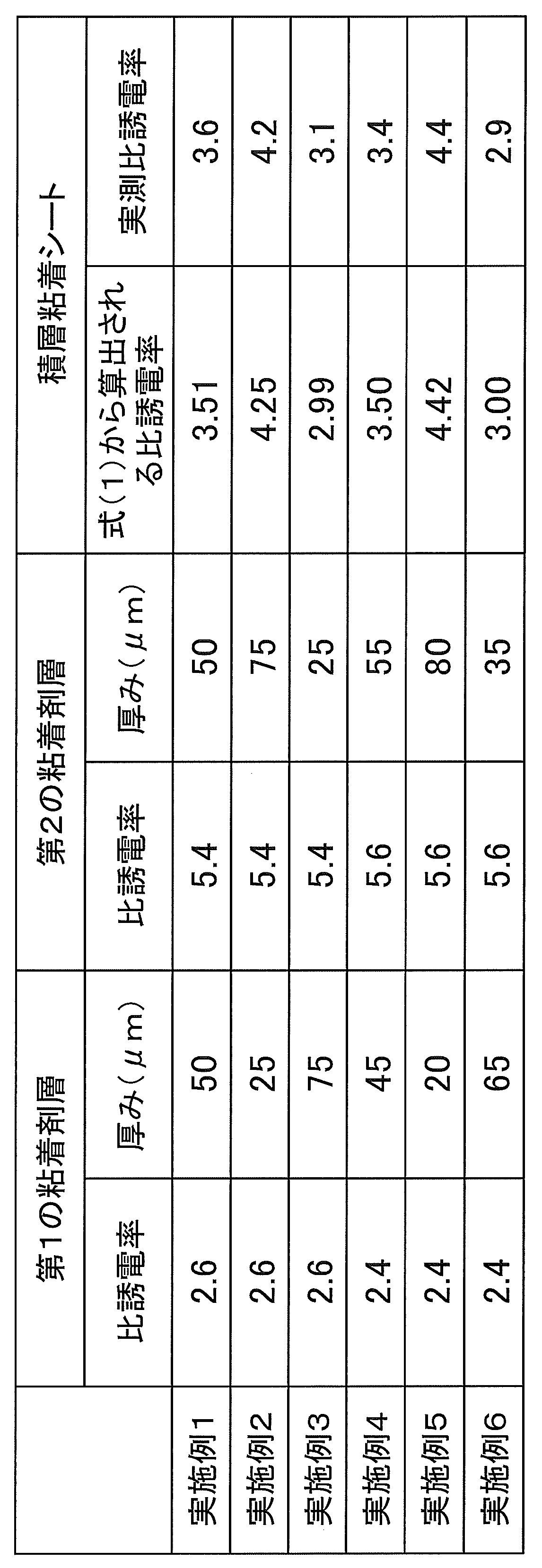
粘着剤組成物(A)と(B)を用いて比誘電率が3.5である積層粘着シートを作製するために、式(1)を用いて、第1の粘着剤層と第2の粘着剤層の厚さの比を算出した。算出した厚みの比は「(第1の粘着剤増の厚み):(第2の粘着剤層の厚み)=1:1」であったため、下記のようにして、第1の粘着剤層と第2の粘着剤層を形成した。
粘着剤組成物(A)と(B)を用いて比誘電率が4.3である積層粘着シートを作製するために、式(1)を用いて、第1の粘着剤層と第2の粘着剤層の厚みの比を算出した。算出した厚みの比は「(第1の粘着剤増の厚み):(第2の粘着剤層の厚み)=1:3」であったため、第1の粘着剤層の厚みを25μmと第2の粘着剤層の厚みを75μmにした以外は実施例1と同様にして、粘着剤層の厚みが100μmの剥離シート付き積層粘着シートを得た。
粘着剤組成物(A)と(B)を用いて比誘電率が3.0である積層粘着シートを作製するために、式(1)を用いて、第1の粘着剤層と第2の粘着剤層の厚みの比を算出した。算出した厚みの比は「(第1の粘着剤増の厚み):(第2の粘着剤層の厚み)=3:1」であったため、第1の粘着剤層の厚みを75μmと第2の粘着剤層の厚みを25μmにした以外は実施例1と同様にして、粘着剤層の厚みが100μmの剥離シート付き積層粘着シートを得た。
粘着剤組成物(C)と(D)を用いて比誘電率が3.5である積層粘着シートを作製するために、式(1)を用いて、第1の粘着剤層と第2の粘着剤層の厚さの比を算出した。算出した厚みの比は「(第1の粘着剤増の厚み):(第2の粘着剤層の厚み)=0.9:1.1」であったため、下記のようにして、第1の粘着剤層と第2の粘着剤層を形成した。
粘着剤組成物(C)と(D)を用いて比誘電率が4.4である積層粘着シートを作製するために、式(1)を用いて、第1の粘着剤層と第2の粘着剤層の厚みの比を算出した。算出した厚みの比は「(第1の粘着剤増の厚み):(第2の粘着剤層の厚み)=1:4」であったため、第1の粘着剤層の厚みを20μmと第2の粘着剤層の厚みを80μmにした以外は実施例4と同様にして、粘着剤層の厚みが100μmの剥離シート付き積層粘着シートを得た。
粘着剤組成物(C)と(D)を用いて比誘電率が3.0である積層粘着シートを作製するために、式(1)を用いて、第1の粘着剤層と第2の粘着剤層の厚みの比を算出した。算出した厚みの比は「(第1の粘着剤増の厚み):(第2の粘着剤層の厚み)=6.5:3.5」であったため、第1の粘着剤層の厚みを65μmと第2の粘着剤層の厚みを35μmにした以外は実施例4と同様にして、粘着剤層の厚みが100μmの剥離シート付き積層粘着シートを得た。
実施例で得られた積層粘着シートの周波数1MHzにおける比誘電率を測定したところ、表1の結果となった。なお、理論比誘電率とは式(1)によって求めた値である。

非架橋性アクリル酸エステル単位としてアクリル酸メチル40質量部、アクリル酸ブチル40質量部、架橋性官能基を有するアクリル単量体単位としてアクリル酸4-ヒドロキシブチル20質量部を公知の溶媒重合法によって重合反応させ、アクリル酸エステル共重合体溶液を得た。このアクリル酸エステル共重合体溶液を粘着主剤とする粘着剤溶液を粘着剤組成物(1)とした。
非架橋性アクリル酸エステル単位としてアクリル酸2-エチルヘキシル60質量部、アクリル酸イソボルニル38質量部、架橋性官能基を有するアクリル単量体単位としてアクリル酸4-ヒドロキシブチル2質量部を公知の溶媒重合法によって重合反応させ、アクリル酸エステル共重合体溶液を得た。このアクリル酸エステル共重合体溶液を粘着主剤とする粘着剤溶液を粘着剤組成物(2)とした。
非架橋性アクリル酸エステル単位としてアクリル酸メチル30質量部、アクリル酸ブチル60質量部、架橋性官能基を有するアクリル単量体単位としてアクリル酸4-ヒドロキシブチル10質量部を公知の溶媒重合法によって重合反応させ、アクリル酸エステル共重合体溶液を得た。このアクリル酸エステル共重合体溶液を粘着主剤とする粘着剤溶液を粘着剤組成物(3)とした。
(1)第2の粘着剤層の作製
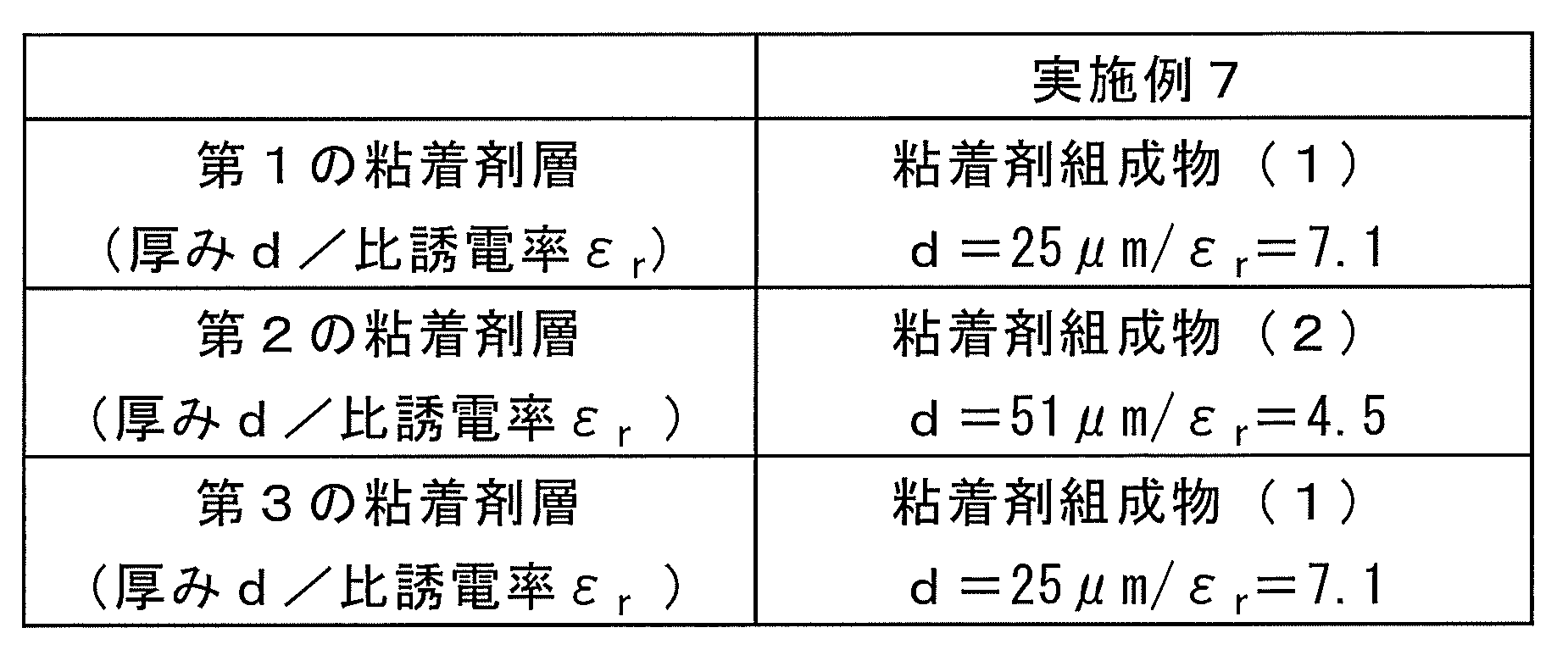
第1の剥離シートとして、PETフィルムに剥離剤層を備えた剥離フィルム〔王子エフテックス(株)製、38μmRL-07(L)〕を用意し、その第1の剥離シートの剥離剤層に、上記粘着剤(2)の溶液をナイフコータにより塗工し、100℃、3分間加熱し、第2の粘着剤層を形成した。形成された第2の粘着剤層の周波数100Hzにおける比誘電率εrは4.5であった。
なお、積層粘着シート7全体の比誘電率を5.5とするために、第1の粘着剤層の厚みと比誘電率及び第3の粘着剤層の厚みと比誘電率から式(1)を用いて第2の粘着剤層の最適な厚みを求めた結果、51μmの厚みとなるように第2の粘着剤(2)を塗工した。
第2の剥離シートとしてPETフィルムに前述の第1の剥離シートより剥離性の低い剥離剤層を備えた剥離フィルム〔王子エフテックス(株)製、38μmRL-07(2)〕を用意し、その第2の剥離シートの剥離剤層に、厚みが25μmとなるように上記の粘着剤(1)の溶液をナイフコータにより塗工し、100℃、3分間加熱し、第1の粘着剤層を形成した。形成された第1の粘着剤層の周波数100Hzにおける比誘電率εrは7.1であった。
第3の剥離シートとして、第1の剥離フィルムと同じ剥離フィルム〔王子エフテックス(株)製、38μmRL-07(L)〕を用意し、その第3の剥離シートの剥離剤層に、厚みが25μmとなるように上記粘着剤(1)の溶液をナイフコータにより塗工し、100℃、3分間加熱し、第3の粘着剤層を形成した。形成された第3の粘着剤層の周波数100Hzにおける比誘電率εrは7.1であった。
上記第2の粘着剤層と第1の粘着剤層とが接するように重ね、圧着した後、第1の剥離シートを剥がして第2の粘着剤層を露出させて、第2の粘着剤層と第3の粘着剤層と接するように重ね、圧着した後、剥離シート付き積層粘着シート7を得た。積層粘着シート7の各層の厚みと比誘電率は表2の通りである。
上記積層粘着シート7の周波数100kHzにおける比誘電率を測定したところ、得られた積層粘着シート7全体の周波数100Hzにおける比誘電率εrは5.4であった。表3には、積層粘着シート7の周波数100Hzにおける比誘電率の水素口と実測値を示した。

第1の粘着剤層に粘着剤(1)、第2の粘着剤層に粘着剤(2)、第3の粘着剤層に粘着剤(3)を使用して、実施例7と同様の方法で積層粘着シート8を作製した。なお、積層粘着シート8の比誘電率を5.0とするために、第1の粘着剤層の厚みと比誘電率、及び第3の粘着剤層の厚みと比誘電率から式(1)を用いて第2の粘着剤層の最適な厚みを求めた結果、100μmの厚みとなるように粘着剤(2)を塗工した。
第1の粘着剤層に粘着剤(3)、第2の粘着剤層に粘着剤(1)、第3の粘着剤層に粘着剤(2)を使用した他は、実施例8と同様にして積層粘着シート9を作製した。
なお、積層粘着シート9全体の比誘電率εrを6.3とするために、第1の粘着剤層の厚みと比誘電率、及び第3の粘着剤層の厚みと比誘電率から式(1)を用いて第2の粘着剤層の最適な厚みを求めた結果、100μmの厚みとなるように粘着剤(1)を塗工した。
積層粘着シート8および9の各層の厚みと比誘電率は表4の通りである。

上記積層粘着シート8及び9の周波数100kHzにおける比誘電率を測定したところ、表5の結果となった。

2 第2の粘着剤層
3 第3の粘着剤層
5 樹脂層
10 積層粘着シート
Claims (20)
- 少なくとも第1の粘着剤層と第2の粘着剤層を有する積層粘着シートであって、前記第1の粘着剤層と前記第2の粘着剤層の周波数1MHzにおける比誘電率の差の絶対値が0.5以上であることを特徴とする積層粘着シート。
- 少なくとも第1の粘着剤層と第2の粘着剤層を有する積層粘着シートであって、周波数1MHzにおける比誘電率が4未満の第1の粘着剤層と、周波数1MHzにおける比誘電率が4以上の第2の粘着剤層を有することを特徴とする請求項1に記載の積層粘着シート。
- 前記第1の粘着剤層の周波数1MHzにおける比誘電率が3未満であることを特徴とする請求項1又は2に記載の積層粘着シート。
- 前記第1の粘着剤層と前記第2の粘着剤層の各層の厚みが10μm以上であることを特徴とする請求項1~3のいずれか1項に記載の積層粘着シート。
- 前記第1の粘着剤層と前記第2の粘着剤層の厚みの比は、1:99~99:1であることを特徴とする請求項1~4のいずれか1項に記載の積層粘着シート。
- 前記第1の粘着剤層と前記第2の粘着剤層は、アクリル系粘着剤層であることを特徴とする請求項1~5のいずれか1項に記載の積層粘着シート。
- 前記第1の粘着剤層と前記第2の粘着剤層は、(メタ)アクリル酸エステルを含むことを特徴とする請求項1~6のいずれか1項に記載の積層粘着シート。
- さらに第3の粘着剤層を有することを特徴とする請求項1~7のいずれか1項に記載の積層粘着シート。
- さらに樹脂層を有することを特徴とする請求項1~8のいずれか1項に記載の積層粘着シート。
- 前記樹脂層は、前記第1の粘着剤層と前記第2の粘着剤層の間に設けられることを特徴とする請求項9に記載の積層粘着シート。
- 前記樹脂層の上に前記第1の粘着剤層が積層され、前記第1の粘着剤層を介して前記樹脂層とは反対側に前記第2の粘着剤層が積層されることを特徴とする請求項9に記載の積層粘着シート。
- 前記樹脂層の周波数1MHzにおける比誘電率が2~10であることを特徴とする請求項9~11のいずれか1項に記載の積層粘着シート。
- 請求項1~12のいずれか1項に記載の積層粘着シートが、少なくとも1つの光学部材に貼着され形成されることを特徴とする積層体。
- 前記光学部材の少なくとも1つがITOガラス又はITOフィルムであることを特徴とする請求項13に記載の積層体。
- 少なくとも2層の粘着剤層を有する積層粘着シートの比誘電率を調整する方法であって、
前記積層粘着シートは、周波数1MHzにおける比誘電率が4未満の第1の粘着剤層と、周波数1MHzにおける比誘電率が4以上の第2の粘着剤層を有し、
第1の粘着剤層の周波数1MHzにおける比誘電率及び厚みと、第2の粘着剤層の周波数1MHzにおける比誘電率及び厚みをそれぞれ調整することによって、前記積層粘着シートの比誘電率を調整することを特徴とする比誘電率調整方法。 - 前記第1の粘着剤層の周波数1MHzにおける比誘電率及び厚みと、前記第2の粘着剤層の周波数1MHzにおける比誘電率及び厚みは、下記式(1)を用いて調整されることを特徴とする請求項15に記載の比誘電率調整方法。

- 前記式(1)において、ε1~εnが固定されている条件下で、特定のεとなるように、d1~dnを決定することを特徴とする請求項16に記載の比誘電率調整方法。
- 前記式(1)において、εnとdnが固定されている条件下で、ε1~εn-1と、d1~dn-1を決定することを特徴とする請求項16に記載の比誘電率調整方法。
- 前記式(1)において、nは2であることを特徴とする請求項16~18のいずれか1項に記載の比誘電率調整方法。
- 少なくとも2層の粘着剤層を有する積層粘着シートの製造方法であって、請求項16~19のいずれか1項に記載の比誘電率調整方法によって積層粘着シートの比誘電率を調節することを特徴とする積層粘着シートの製造方法。
Priority Applications (3)
| Application Number | Priority Date | Filing Date | Title |
|---|---|---|---|
| KR1020157034897A KR101894734B1 (ko) | 2013-05-10 | 2014-05-09 | 적층 점착 시트 및 적층체 |
| JP2015515901A JP6354752B2 (ja) | 2013-05-10 | 2014-05-09 | 積層粘着シート及び積層体 |
| CN201480025770.XA CN105229100B (zh) | 2013-05-10 | 2014-05-09 | 层叠粘着片、相对介电常数调整方法及其应用 |
Applications Claiming Priority (2)
| Application Number | Priority Date | Filing Date | Title |
|---|---|---|---|
| JP2013100203 | 2013-05-10 | ||
| JP2013-100203 | 2013-05-10 |
Publications (1)
| Publication Number | Publication Date |
|---|---|
| WO2014181853A1 true WO2014181853A1 (ja) | 2014-11-13 |
Family
ID=51867325
Family Applications (1)
| Application Number | Title | Priority Date | Filing Date |
|---|---|---|---|
| PCT/JP2014/062431 Ceased WO2014181853A1 (ja) | 2013-05-10 | 2014-05-09 | 積層粘着シート及び積層体 |
Country Status (5)
| Country | Link |
|---|---|
| JP (1) | JP6354752B2 (ja) |
| KR (1) | KR101894734B1 (ja) |
| CN (1) | CN105229100B (ja) |
| TW (1) | TWI645009B (ja) |
| WO (1) | WO2014181853A1 (ja) |
Cited By (4)
| Publication number | Priority date | Publication date | Assignee | Title |
|---|---|---|---|---|
| JP2017008299A (ja) * | 2015-06-16 | 2017-01-12 | 日東電工株式会社 | 粘着剤組成物 |
| US10253522B2 (en) | 2013-02-05 | 2019-04-09 | Campvalley (Xiamen) Co., Ltd. | Shelter frame with transverse member |
| CN110506088A (zh) * | 2017-05-22 | 2019-11-26 | 株式会社Lg化学 | 多层粘合带 |
| US10836937B2 (en) | 2015-06-16 | 2020-11-17 | Nitto Denko Corporation | Pressure-sensitive adhesive composition |
Families Citing this family (2)
| Publication number | Priority date | Publication date | Assignee | Title |
|---|---|---|---|---|
| KR102920778B1 (ko) * | 2020-03-20 | 2026-02-03 | 삼성디스플레이 주식회사 | 표시장치 |
| JP7388323B2 (ja) * | 2020-09-07 | 2023-11-29 | 株式会社レゾナック | 積層構造体及び対象物検知構造 |
Citations (7)
| Publication number | Priority date | Publication date | Assignee | Title |
|---|---|---|---|---|
| JP2006124528A (ja) * | 2004-10-29 | 2006-05-18 | Toyo Ink Mfg Co Ltd | 粘着積層体およびそれを用いた液晶セル用部材 |
| JP4093355B2 (ja) * | 2002-10-21 | 2008-06-04 | 日東電工株式会社 | 帯電防止用シート及び粘着テープ |
| JP2011170511A (ja) * | 2010-02-17 | 2011-09-01 | Alps Electric Co Ltd | 静電容量式の入力装置 |
| WO2012147464A1 (ja) * | 2011-04-27 | 2012-11-01 | 日東電工株式会社 | 粘着シート |
| JP2012251030A (ja) * | 2011-06-01 | 2012-12-20 | Toray Advanced Film Co Ltd | 粘着シート、表面保護層付き静電容量式タッチパネルおよび表示装置 |
| WO2013005507A1 (ja) * | 2011-07-01 | 2013-01-10 | 日東電工株式会社 | 多層粘着性物品及び粘着シート |
| JP2013104028A (ja) * | 2011-11-15 | 2013-05-30 | Oji Holdings Corp | 光学部材用両面粘着シートおよび積層体 |
Family Cites Families (9)
| Publication number | Priority date | Publication date | Assignee | Title |
|---|---|---|---|---|
| JP3880418B2 (ja) | 2002-02-21 | 2007-02-14 | 日東電工株式会社 | 両面粘着シートおよびタッチパネルの表示装置への貼着固定方法 |
| JP4151828B2 (ja) | 2002-05-29 | 2008-09-17 | 日東電工株式会社 | 両面粘着シートおよびタッチパネル付き表示装置 |
| JP4493273B2 (ja) | 2003-01-29 | 2010-06-30 | 日東電工株式会社 | 両面粘着シートおよびタッチパネル付き表示装置 |
| JP2010147047A (ja) | 2008-12-16 | 2010-07-01 | Toppan Printing Co Ltd | 多層配線板の製造方法 |
| CN102190972B (zh) * | 2010-03-14 | 2014-01-29 | 宸鸿科技(厦门)有限公司 | 多层结构的光学黏结层 |
| CN102510888B (zh) * | 2010-08-05 | 2014-03-12 | 新塔克化成株式会社 | 双面粘合片、带剥离片的双面粘合片、其制造方法以及透明层叠体 |
| US20120113361A1 (en) * | 2010-11-10 | 2012-05-10 | Tpk Touch Solutions Inc. | Optical Level Composite Pressure-Sensitive Adhesive and an Apparatus Therewith |
| KR101393778B1 (ko) * | 2010-11-22 | 2014-05-13 | (주)엘지하우시스 | 양면 점착 시트 및 이를 포함하는 터치 패널 표시장치 |
| JP5758647B2 (ja) * | 2011-02-17 | 2015-08-05 | 日東電工株式会社 | 光学用粘着シート |
-
2014
- 2014-05-09 TW TW103116612A patent/TWI645009B/zh not_active IP Right Cessation
- 2014-05-09 KR KR1020157034897A patent/KR101894734B1/ko active Active
- 2014-05-09 CN CN201480025770.XA patent/CN105229100B/zh active Active
- 2014-05-09 JP JP2015515901A patent/JP6354752B2/ja active Active
- 2014-05-09 WO PCT/JP2014/062431 patent/WO2014181853A1/ja not_active Ceased
Patent Citations (7)
| Publication number | Priority date | Publication date | Assignee | Title |
|---|---|---|---|---|
| JP4093355B2 (ja) * | 2002-10-21 | 2008-06-04 | 日東電工株式会社 | 帯電防止用シート及び粘着テープ |
| JP2006124528A (ja) * | 2004-10-29 | 2006-05-18 | Toyo Ink Mfg Co Ltd | 粘着積層体およびそれを用いた液晶セル用部材 |
| JP2011170511A (ja) * | 2010-02-17 | 2011-09-01 | Alps Electric Co Ltd | 静電容量式の入力装置 |
| WO2012147464A1 (ja) * | 2011-04-27 | 2012-11-01 | 日東電工株式会社 | 粘着シート |
| JP2012251030A (ja) * | 2011-06-01 | 2012-12-20 | Toray Advanced Film Co Ltd | 粘着シート、表面保護層付き静電容量式タッチパネルおよび表示装置 |
| WO2013005507A1 (ja) * | 2011-07-01 | 2013-01-10 | 日東電工株式会社 | 多層粘着性物品及び粘着シート |
| JP2013104028A (ja) * | 2011-11-15 | 2013-05-30 | Oji Holdings Corp | 光学部材用両面粘着シートおよび積層体 |
Cited By (9)
| Publication number | Priority date | Publication date | Assignee | Title |
|---|---|---|---|---|
| US10253522B2 (en) | 2013-02-05 | 2019-04-09 | Campvalley (Xiamen) Co., Ltd. | Shelter frame with transverse member |
| JP2017008299A (ja) * | 2015-06-16 | 2017-01-12 | 日東電工株式会社 | 粘着剤組成物 |
| US10836937B2 (en) | 2015-06-16 | 2020-11-17 | Nitto Denko Corporation | Pressure-sensitive adhesive composition |
| CN110506088A (zh) * | 2017-05-22 | 2019-11-26 | 株式会社Lg化学 | 多层粘合带 |
| EP3597713A4 (en) * | 2017-05-22 | 2020-04-22 | LG Chem, Ltd. | MULTILAYER TAPE |
| JP2020512443A (ja) * | 2017-05-22 | 2020-04-23 | エルジー・ケム・リミテッド | 多層粘着テープ |
| US11091674B2 (en) | 2017-05-22 | 2021-08-17 | Lg Chem, Ltd. | Multilayer adhesive tape |
| CN110506088B (zh) * | 2017-05-22 | 2021-12-31 | 株式会社Lg化学 | 多层粘合带 |
| JP7088952B2 (ja) | 2017-05-22 | 2022-06-21 | コザ ノベル マテリアル コリア カンパニー リミテッド | 多層粘着テープ |
Also Published As
| Publication number | Publication date |
|---|---|
| CN105229100A (zh) | 2016-01-06 |
| TWI645009B (zh) | 2018-12-21 |
| KR101894734B1 (ko) | 2018-09-04 |
| TW201446932A (zh) | 2014-12-16 |
| JP6354752B2 (ja) | 2018-07-11 |
| CN105229100B (zh) | 2018-02-06 |
| JPWO2014181853A1 (ja) | 2017-02-23 |
| KR20160006743A (ko) | 2016-01-19 |
Similar Documents
| Publication | Publication Date | Title |
|---|---|---|
| JP6274206B2 (ja) | 粘着シート及び積層体とその製造方法 | |
| JP4918166B1 (ja) | 両面粘着シート、剥離シート付き両面粘着シート、その製造方法および透明積層体 | |
| JP6354752B2 (ja) | 積層粘着シート及び積層体 | |
| JP7070398B2 (ja) | 粘着剤組成物及び粘着シート | |
| WO2013061938A1 (ja) | 粘着シート及びその使用方法並びに積層体 | |
| CN103228748A (zh) | 双面粘结片和包括该粘结片的触控面板用显示设备 | |
| JP2013100447A (ja) | 多層両面粘着シート、積層体、およびタッチパネル付表示装置 | |
| JP4939647B2 (ja) | 両面粘着シート、剥離シート付き両面粘着シート、その製造方法および透明積層体 | |
| JP2013104028A (ja) | 光学部材用両面粘着シートおよび積層体 | |
| WO2017159789A1 (ja) | 粘着シート及び積層体 | |
| JP6036502B2 (ja) | 多層両面粘着シート、積層体、タッチパネル付表示装置、および多層両面粘着シートの剥離方法 | |
| JP2017200975A (ja) | 粘着シート及び積層体 | |
| JP7287280B2 (ja) | 粘着シート及び積層体の製造方法 | |
| WO2015146664A1 (ja) | 両面粘着シートおよび光学部材 | |
| JP6969481B2 (ja) | 粘着剤組成物、粘着シート及び積層体 | |
| JP6943081B2 (ja) | 粘着剤組成物、粘着シートおよび積層体 | |
| KR102068020B1 (ko) | 광학 부재의 제조 방법 | |
| JP2019182929A (ja) | 粘着剤組成物、粘着シート及び積層体 | |
| JP6248996B2 (ja) | 光学部材積層体の製造方法 | |
| WO2019004107A1 (ja) | 粘着剤組成物、粘着シートおよび積層体 | |
| JP2022174182A (ja) | 粘着シート、剥離シート付き粘着シート、積層体及び積層体の製造方法 | |
| JP6969226B2 (ja) | 粘着剤組成物、粘着シートおよび積層体 | |
| JP6866787B2 (ja) | 粘着剤組成物、粘着シートおよび積層体 | |
| WO2019124332A1 (ja) | 粘着剤組成物、両面粘着シート及び積層体の製造方法 | |
| JP2014218624A (ja) | 比誘電率調整方法及び積層粘着シート |
Legal Events
| Date | Code | Title | Description |
|---|---|---|---|
| WWE | Wipo information: entry into national phase |
Ref document number: 201480025770.X Country of ref document: CN |
|
| 121 | Ep: the epo has been informed by wipo that ep was designated in this application |
Ref document number: 14794729 Country of ref document: EP Kind code of ref document: A1 |
|
| ENP | Entry into the national phase |
Ref document number: 2015515901 Country of ref document: JP Kind code of ref document: A |
|
| NENP | Non-entry into the national phase |
Ref country code: DE |
|
| ENP | Entry into the national phase |
Ref document number: 20157034897 Country of ref document: KR Kind code of ref document: A |
|
| 122 | Ep: pct application non-entry in european phase |
Ref document number: 14794729 Country of ref document: EP Kind code of ref document: A1 |