WO2014181537A1 - 溶接構造用鋼材 - Google Patents
溶接構造用鋼材 Download PDFInfo
- Publication number
- WO2014181537A1 WO2014181537A1 PCT/JP2014/002428 JP2014002428W WO2014181537A1 WO 2014181537 A1 WO2014181537 A1 WO 2014181537A1 JP 2014002428 W JP2014002428 W JP 2014002428W WO 2014181537 A1 WO2014181537 A1 WO 2014181537A1
- Authority
- WO
- WIPO (PCT)
- Prior art keywords
- less
- steel
- steel material
- content
- weather resistance
- Prior art date
- Legal status (The legal status is an assumption and is not a legal conclusion. Google has not performed a legal analysis and makes no representation as to the accuracy of the status listed.)
- Ceased
Links
Images

Classifications
-
- C—CHEMISTRY; METALLURGY
- C22—METALLURGY; FERROUS OR NON-FERROUS ALLOYS; TREATMENT OF ALLOYS OR NON-FERROUS METALS
- C22C—ALLOYS
- C22C38/00—Ferrous alloys, e.g. steel alloys
-
- C—CHEMISTRY; METALLURGY
- C22—METALLURGY; FERROUS OR NON-FERROUS ALLOYS; TREATMENT OF ALLOYS OR NON-FERROUS METALS
- C22C—ALLOYS
- C22C38/00—Ferrous alloys, e.g. steel alloys
- C22C38/001—Ferrous alloys, e.g. steel alloys containing N
-
- C—CHEMISTRY; METALLURGY
- C22—METALLURGY; FERROUS OR NON-FERROUS ALLOYS; TREATMENT OF ALLOYS OR NON-FERROUS METALS
- C22C—ALLOYS
- C22C38/00—Ferrous alloys, e.g. steel alloys
- C22C38/002—Ferrous alloys, e.g. steel alloys containing In, Mg, or other elements not provided for in one single group C22C38/001 - C22C38/60
-
- C—CHEMISTRY; METALLURGY
- C22—METALLURGY; FERROUS OR NON-FERROUS ALLOYS; TREATMENT OF ALLOYS OR NON-FERROUS METALS
- C22C—ALLOYS
- C22C38/00—Ferrous alloys, e.g. steel alloys
- C22C38/005—Ferrous alloys, e.g. steel alloys containing rare earths, i.e. Sc, Y, Lanthanides
-
- C—CHEMISTRY; METALLURGY
- C22—METALLURGY; FERROUS OR NON-FERROUS ALLOYS; TREATMENT OF ALLOYS OR NON-FERROUS METALS
- C22C—ALLOYS
- C22C38/00—Ferrous alloys, e.g. steel alloys
- C22C38/008—Ferrous alloys, e.g. steel alloys containing tin
-
- C—CHEMISTRY; METALLURGY
- C22—METALLURGY; FERROUS OR NON-FERROUS ALLOYS; TREATMENT OF ALLOYS OR NON-FERROUS METALS
- C22C—ALLOYS
- C22C38/00—Ferrous alloys, e.g. steel alloys
- C22C38/02—Ferrous alloys, e.g. steel alloys containing silicon
-
- C—CHEMISTRY; METALLURGY
- C22—METALLURGY; FERROUS OR NON-FERROUS ALLOYS; TREATMENT OF ALLOYS OR NON-FERROUS METALS
- C22C—ALLOYS
- C22C38/00—Ferrous alloys, e.g. steel alloys
- C22C38/04—Ferrous alloys, e.g. steel alloys containing manganese
-
- C—CHEMISTRY; METALLURGY
- C22—METALLURGY; FERROUS OR NON-FERROUS ALLOYS; TREATMENT OF ALLOYS OR NON-FERROUS METALS
- C22C—ALLOYS
- C22C38/00—Ferrous alloys, e.g. steel alloys
- C22C38/06—Ferrous alloys, e.g. steel alloys containing aluminium
-
- C—CHEMISTRY; METALLURGY
- C22—METALLURGY; FERROUS OR NON-FERROUS ALLOYS; TREATMENT OF ALLOYS OR NON-FERROUS METALS
- C22C—ALLOYS
- C22C38/00—Ferrous alloys, e.g. steel alloys
- C22C38/08—Ferrous alloys, e.g. steel alloys containing nickel
-
- C—CHEMISTRY; METALLURGY
- C22—METALLURGY; FERROUS OR NON-FERROUS ALLOYS; TREATMENT OF ALLOYS OR NON-FERROUS METALS
- C22C—ALLOYS
- C22C38/00—Ferrous alloys, e.g. steel alloys
- C22C38/12—Ferrous alloys, e.g. steel alloys containing tungsten, tantalum, molybdenum, vanadium, or niobium
-
- C—CHEMISTRY; METALLURGY
- C22—METALLURGY; FERROUS OR NON-FERROUS ALLOYS; TREATMENT OF ALLOYS OR NON-FERROUS METALS
- C22C—ALLOYS
- C22C38/00—Ferrous alloys, e.g. steel alloys
- C22C38/14—Ferrous alloys, e.g. steel alloys containing titanium or zirconium
-
- C—CHEMISTRY; METALLURGY
- C22—METALLURGY; FERROUS OR NON-FERROUS ALLOYS; TREATMENT OF ALLOYS OR NON-FERROUS METALS
- C22C—ALLOYS
- C22C38/00—Ferrous alloys, e.g. steel alloys
- C22C38/16—Ferrous alloys, e.g. steel alloys containing copper
-
- C—CHEMISTRY; METALLURGY
- C22—METALLURGY; FERROUS OR NON-FERROUS ALLOYS; TREATMENT OF ALLOYS OR NON-FERROUS METALS
- C22C—ALLOYS
- C22C38/00—Ferrous alloys, e.g. steel alloys
- C22C38/18—Ferrous alloys, e.g. steel alloys containing chromium
- C22C38/40—Ferrous alloys, e.g. steel alloys containing chromium with nickel
- C22C38/42—Ferrous alloys, e.g. steel alloys containing chromium with nickel with copper
-
- C—CHEMISTRY; METALLURGY
- C22—METALLURGY; FERROUS OR NON-FERROUS ALLOYS; TREATMENT OF ALLOYS OR NON-FERROUS METALS
- C22C—ALLOYS
- C22C38/00—Ferrous alloys, e.g. steel alloys
- C22C38/18—Ferrous alloys, e.g. steel alloys containing chromium
- C22C38/40—Ferrous alloys, e.g. steel alloys containing chromium with nickel
- C22C38/48—Ferrous alloys, e.g. steel alloys containing chromium with nickel with niobium or tantalum
-
- C—CHEMISTRY; METALLURGY
- C22—METALLURGY; FERROUS OR NON-FERROUS ALLOYS; TREATMENT OF ALLOYS OR NON-FERROUS METALS
- C22C—ALLOYS
- C22C38/00—Ferrous alloys, e.g. steel alloys
- C22C38/60—Ferrous alloys, e.g. steel alloys containing lead, selenium, tellurium, or antimony, or more than 0.04% by weight of sulfur
-
- C—CHEMISTRY; METALLURGY
- C21—METALLURGY OF IRON
- C21D—MODIFYING THE PHYSICAL STRUCTURE OF FERROUS METALS; GENERAL DEVICES FOR HEAT TREATMENT OF FERROUS OR NON-FERROUS METALS OR ALLOYS; MAKING METAL MALLEABLE, e.g. BY DECARBURISATION OR TEMPERING
- C21D8/00—Modifying the physical properties of ferrous metals or ferrous alloys by deformation combined with, or followed by, heat treatment
- C21D8/02—Modifying the physical properties of ferrous metals or ferrous alloys by deformation combined with, or followed by, heat treatment during manufacturing of plates or strips
- C21D8/0221—Modifying the physical properties of ferrous metals or ferrous alloys by deformation combined with, or followed by, heat treatment during manufacturing of plates or strips characterised by the working steps
- C21D8/0226—Hot rolling
Definitions
- the present invention relates to a steel structure for welded structure that is excellent in weather resistance and is suitable for use in a steel structure that is mainly used outdoors such as a bridge, particularly a member that requires weather resistance in a high salinity environment such as the vicinity of a coast. It is.
- Weather-resistant steel is a steel material whose corrosion rate is remarkably reduced when the surface is covered with a highly protective rust layer enriched with alloy elements such as Cu, P, Cr, and Ni in an air exposure environment.
- Non-Patent Document 1 conventional weathering steel (JIS G 3114: weathering hot rolled steel for welded structures) has an incoming salt content of 0.05 mg ⁇ NaCl / dm 2 / day (hereinafter, unit (mg ⁇ (NaCl / dm 2 / day) may be written in mdd). It is said that it can be used without painting only in the following areas. Therefore, in an environment where there is a large amount of salinity such as the vicinity of the coast, the present situation is that ordinary steel (JIS G 3106: rolled steel for welded structure) is used after being subjected to anticorrosion measures such as painting.
- ordinary steel JIS G 3106: rolled steel for welded structure
- steel materials containing a large amount of various alloy elements, particularly Ni, have been developed as steel materials that can be used without coating in a high-flying salinity environment such as near the coast.
- Patent Document 1 discloses a high weather resistance steel material to which 1% or more of Ni and Cu are added as a weather resistance improving element.
- Patent Document 2 discloses a steel material excellent in weather resistance to which 1% or more of Ni and Mo are added.
- Patent Document 3 discloses a steel material excellent in weather resistance in which Cu and Ti are added in addition to Ni.
- Patent Document 4 discloses a steel material excellent in weather resistance in which the amount of Ni added is suppressed to 0.5% or less and Sn and / or Sb is added.
- Patent Document 5 discloses a steel material excellent in weather resistance in which the addition amount of Ni is less than 0.65% and W is added.
- Japanese Patent No. 3785271 Japanese Patent No. 3846218 Japanese Patent No. 3568760 JP 2009-179882 A JP 2012-067377 A
- Patent Documents 1 and 2 improve the weather resistance by increasing the Ni content.
- Patent Document 3 discloses an invention example in which the content of Ni is kept low and Ti is added to improve the weather resistance, but there is a problem that the toughness of the steel is lowered.
- Patent Document 4 Although content of Ni is restrained low and also weather resistance is improved by adding Sn and / or Sb, when a steel piece is heated at the time of rolling, a crack will arise on the surface, etc. There was a problem that productivity was inferior.
- Patent Document 5 the Ni content is kept low and the weather resistance is improved by adding W.
- W is a small amount, it is still expensive and is also a rare element. I was concerned about supplying raw materials from overseas.
- the present invention has been developed in view of the above-mentioned present situation, and provides a steel material for welded structure excellent in weather resistance that can be used without coating in a high-flying salinity environment such as near the coast. Objective.
- the “high flying salinity environment” means an environment where the flying salt content is 0.01 mg ⁇ NaCl / dm 2 / day or more.
- the present inventors have obtained knowledge that the weather resistance of steel materials in a high-flying salinity environment can be improved while ensuring manufacturability without the inclusion of various elements.
- the present invention is based on the above findings.
- the gist configuration of the present invention is as follows. 1. % By mass C: 0.02% or more and less than 0.14%, Si: 0.05% or more and 2.0% or less, Mn: 0.2% or more and 2.0% or less, P: 0.005% to 0.03%, S: 0.0001% to 0.02%, Al: 0.001% to 0.1%, Cu: 0.1% or more and 1.0% or less, Ni: 0.1% or more and 1.0% or less, Nb: 0.004% or more and 0.2% or less and Sn: 0.001% or more and 0.2% or less Further, a steel for welded structure in which the contents of Cu, Ni and Sn satisfy the relationship of the following formula (1), and the balance is composed of Fe and inevitable impurities. ([% Cu] +10 [% Sn]) / 2 [% Ni] ⁇ 1 (1) However, [% M] is the content (mass%) of M element in steel.
- the steel material is further in mass%, Cr: 0.2% to 2.0%, Ti: 0.005% or more and 0.200% or less, V: 0.005% or more and 0.200% or less, Zr: 0.005% or more and 0.200% or less, B: 0.0001% or more and 0.0050% or less, Mg: 0.0001% or more and 0.0100% or less, Co: 0.01% or more and 1.00% or less, Mo: 0.005% to 1.000%, 2.
- the steel material for welded structures excellent in the weather resistance which can be used without coating in a high flying salt environment is obtained. Further, the steel material for welded structure of the present invention has a periodic salinity exceeding 0.05 mdd, and even when applied to a steel structure such as a bridge used in a high flying salinity environment of 0.20 mdd or more, Since repair painting is not required, maintenance costs can be significantly reduced.
- the corrosion amounts of the steel type A as an example of the invention and the steel type AK as the reference steel are plotted against the amount of salt inflow.
- Cu and Ni densify the rust layer generated on the steel sheet surface, and prevent chloride ions, which are corrosion promoting factors, from passing through the rust layer and reaching the base iron.
- Nb is concentrated near the interface between the rust layer and the ground iron in the anode part, and suppresses the anode reaction and the cathode reaction.
- Sn also concentrates near the interface between the rust layer and the ground iron in the anode part, and suppresses the anode reaction and the cathode reaction.
- C 0.02% or more and less than 0.14% C is an element that improves the strength of the steel material, and it is necessary to contain 0.02% or more in order to ensure a predetermined strength.
- the C content is 0.02% or more and less than 0.14%.
- Si 0.05% or more and 2.0% or less Si should be contained in an amount of 0.05% or more in order to ensure a predetermined strength by improving the strength of the steel material as a deoxidizer during steelmaking.
- Si when Si is contained excessively exceeding 2.0%, toughness and weldability are significantly deteriorated. Therefore, the Si content is 0.05% or more and 2.0% or less.
- Mn 0.2% or more and 2.0% or less
- Mn is an element that improves the strength of the steel material, and it is necessary to contain 0.2% or more in order to ensure a predetermined strength.
- Mn exceeds 2.0% and is contained excessively, toughness and weldability deteriorate. Therefore, the Mn content is 0.2% or more and 2.0% or less.
- P 0.005% or more and 0.03% or less
- P is an element that improves the weather resistance of the steel material. In order to acquire such an effect, it is necessary to contain 0.005% or more of P. On the other hand, when P exceeds 0.03%, weldability deteriorates. Therefore, the P content is 0.005% or more and 0.03% or less.
- S 0.0001% or more and 0.02% or less If S exceeds 0.02%, weldability and toughness deteriorate. On the other hand, when the S content is reduced to less than 0.0001%, the production cost increases. Therefore, the S content is 0.0001% or more and 0.02% or less.
- Al 0.001% to 0.1%
- Al is an element necessary for deoxidation during steelmaking. In order to acquire such an effect, it is necessary to contain Al 0.001% or more. On the other hand, if the Al content exceeds 0.1%, the weldability is adversely affected. Therefore, the Al content is 0.001% or more and 0.1% or less.
- Cu 0.1% or more and 1.0% or less
- Cu has the effect of forming a dense rust layer by refining rust grains and improving the weather resistance of the steel material. Such an effect is obtained when the Cu content is 0.1% or more.
- the Cu content exceeds 1.0%, an increase in the cost associated with an increase in the consumption of Cu is caused. Therefore, the Cu content is 0.1% or more and 1.0% or less. Preferably they are 0.2% or more and 1.0% or less.
- Ni 0.1% or more and 1.0% or less Ni has an effect of forming a dense rust layer by refining rust grains and improving the weather resistance of the steel material. In order to obtain this effect sufficiently, it is necessary to contain 0.1% or more of Ni. On the other hand, if the Ni content exceeds 1.0%, an increase in Ni consumption results in an increase in cost. Therefore, the Ni content is 0.1% or more and 1.0% or less. Preferably they are 0.2% or more and 1.0% or less.
- Nb 0.004% or more and 0.2% or less
- Sn 0.001% or more and 0.2% or less
- Nb is concentrated near the interface between the rust layer and the ground iron in the anode part, and anode reaction and cathode reaction Suppress. In order to obtain these effects sufficiently, it is necessary to contain 0.004% or more of Nb. On the other hand, if the Nb content exceeds 0.2%, the toughness is reduced. Therefore, the Nb content is 0.004% or more and 0.2% or less. Preferably it is 0.004% or more and 0.1% or less.
- Nb has the effect of remarkably improving the weather resistance of a steel material in a high flying salinity environment by coexisting with Sn.
- Sn improves the weather resistance of steel materials by forming an oxide film containing Sn at the steel material / rust layer interface and suppressing the anode reaction and cathode reaction of the steel materials.
- Sn content shall be 0.001% or more and 0.2% or less.
- it is 0.001% or more and 0.1% or less. More preferably, it is 0.001% or more and 0.05% or less.
- this Sn has the effect of significantly improving the weather resistance of the steel material in a high-flying salinity environment by coexisting with Nb.
- Nb and Sn are contained, the effect of the present invention can be achieved.
- the weather resistance is more remarkably improved.
- the contents of Nb and Sn can be reduced without deteriorating the weather resistance. For these reasons, it is preferable to contain both Nb and Sn.
- each component satisfies the above range.
- Sn When Sn is contained, it is necessary to satisfy the following formula (1) for Ni, Cu and Sn contents. ([% Cu] +10 [% Sn]) / 2 [% Ni] ⁇ 1 (1)
- [% M] is the content (mass%) of M element in steel.
- Cr 0.2% or more and 2.0% or less
- Cr is an element that forms a dense rust layer by refining rust grains and improves weather resistance. In order to obtain this effect sufficiently, it is necessary to contain 0.2% or more of Cr. On the other hand, if it exceeds 2.0%, the weldability is reduced. Therefore, the Cr content is 0.2% or more and 2.0% or less.
- Ti 0.005% to 0.200%
- Ti is an element that increases the strength of steel. In order to sufficiently obtain this effect, Ti needs to be contained by 0.005% or more. On the other hand, if it exceeds 0.200%, the toughness is deteriorated. Therefore, Ti content shall be 0.005% or more and 0.200% or less.
- V 0.005% to 0.200%
- V is an element that increases the strength of the steel material. In order to sufficiently obtain this effect, V needs to be contained by 0.005% or more. On the other hand, if it exceeds 0.200%, the effect is saturated. Therefore, the V content is 0.005% or more and 0.200% or less.
- Zr 0.005% or more and 0.200% or less
- Zr is an element that increases the strength of steel. In order to obtain this effect sufficiently, it is necessary to contain 0.005% or more of Zr. On the other hand, if it exceeds 0.200%, the effect is saturated. Therefore, the Zr content is 0.005% or more and 0.200% or less.
- B 0.0001% or more and 0.0050% or less B is an element that increases the strength of the steel material. In order to sufficiently obtain this effect, B needs to be contained by 0.0001% or more. On the other hand, if it exceeds 0.0050%, the toughness is deteriorated. Therefore, the B content is 0.0001% or more and 0.0050% or less.
- Mg 0.0001% or more and 0.0100% or less Mg is an element effective for fixing S in steel and improving the toughness of the weld heat affected zone. In order to sufficiently obtain this effect, Mg needs to be contained in an amount of 0.0001% or more. On the other hand, if it exceeds 0.0100%, the amount of inclusions in the steel increases, which leads to deterioration of toughness. Therefore, the Mg content is 0.0001% or more and 0.0100% or less.
- Co 0.01% or more and 1.00% or less
- Co has the effect of improving the weather resistance of the steel material by forming a dense rust layer by refining rust grains distributed throughout the rust layer. In order to obtain such an effect sufficiently, it is necessary to contain 0.01% or more of Co. On the other hand, if it exceeds 1.00%, the cost increases due to the increase in Co consumption. Therefore, the Co content is 0.01% or more and 1.00% or less.
- Mo 0.005% or more 1.000% or less
- Mo is, MoO 4 2-elutes with the anodic reaction of the steel material, by MoO 4 2-is distributed rust layer, chloride ions rust layer of corrosion-promoting factors To prevent it from reaching the railway. Moreover, the anode reaction of steel materials is suppressed because the compound containing Mo precipitates on the steel material surface. In order to obtain these effects sufficiently, it is necessary to contain Mo by 0.005% or more. On the other hand, if it exceeds 1.000%, the cost will increase due to the increase in Mo consumption. Therefore, the Mo content is 0.005% or more and 1.000% or less.
- Sb 0.005% or more and 0.200% or less
- Sb is an element that improves the weather resistance of the steel material by suppressing the anode reaction of the steel material and also suppressing the hydrogen generation reaction that is a cathode reaction. In order to obtain such effects sufficiently, Sb needs to be contained in an amount of 0.005% or more. On the other hand, if it exceeds 0.200%, the toughness is deteriorated. Therefore, the Sb content is 0.005% or more and 0.200% or less.
- REM 0.0001% or more and 0.1000% or less REM has the effect of forming a dense rust layer and improving the weather resistance of the steel material by refining rust grains distributed throughout the rust layer. In order to obtain this effect sufficiently, it is necessary to contain REM 0.0001% or more. On the other hand, when it exceeds 0.1000%, the effect is saturated. Therefore, the REM content is 0.0001% or more and 0.1000% or less.
- Ceq 0.44% by mass or less
- Ceq [% C] + [% Si] / 24 + [% Mn] / 6 + [% Ni] / 40 + [% Cu] / 5 + [% V] / 14
- [% M] is the content (mass%) of M element in steel.
- P CM 0.25 wt% or less
- P CM defined by the following formula Is preferably 0.25% by mass or less.
- P CM [% C] + [% Si] / 30 + [% Mn] / 20 + [% Cu] / 20 + [% Ni] / 60 + [% Cr] / 20 + [% Mo] / 15 + [% V] / 10 + 5 ⁇ [% B]
- [% M] is the content (mass%) of M element in steel.
- components other than those described above are Fe and inevitable impurities.
- Ca: 0.0010% or less are acceptable as inevitable impurities.
- the molten steel having the above component composition is melted in a known furnace such as a converter or an electric furnace, and is made into a slab by a known method such as a continuous casting method or a lump method.
- a known furnace such as a converter or an electric furnace
- a known method such as a continuous casting method or a lump method.
- the slab obtained as described above is hot-rolled to obtain a steel material such as a thick plate, a shape steel, a thin steel plate, or a steel bar.
- the heating conditions and rolling conditions may be appropriately determined according to the required material, and controlled rolling, accelerated cooling, reheating heat treatment, or the like may be combined.
- the test piece thus obtained was subjected to the following weather resistance test to evaluate the weather resistance.
- -Weather resistance test Specimens were exposed outdoors for one year in four coastal areas in Japan with different amounts of salinity (Zushi: 0.20mdd, Ikehama: 0.30mdd, Miyakojima: 0.36mdd, Okinawa: 0.50mdd). The exposure was carried out by placing a test piece on a covered exposure stand. This simulates the environment inside a bridge girder that is not subject to rain, which is considered to be the most severe when steel is applied to structures such as actual bridges.
- the collected test pieces were derusted by immersing them in an aqueous solution obtained by adding hexamethylenetetramine to hydrochloric acid. Then, the weight of the derusted test piece is measured, the difference from the initial weight is obtained, the value is divided by the surface area of the test piece, and the average reduction in thickness (in mm) per side is the amount of corrosion. As sought. In addition, this corrosion amount was made into the average value of the corrosion amount in the said test twice, having performed said test twice per 1 steel type. Moreover, the relative ratio with the corrosion amount of the steel type AK which is the reference steel was obtained as the corrosion amount ratio. It was judged that the weather resistance was good when this corrosion amount ratio was less than 1 in all four salt content environments. These results are also shown in Table 2.
- FIG. 1 is a plot of the amount of corrosion of steel type A as an example of invention and the amount of corrosion of steel type AK, which is a reference steel, with respect to the amount of incoming salt.
- the corrosion amount ratio is less than 1 in all four salt content environments, and good weather resistance is obtained.
- the corrosion amount per year is 0.036 mm at the maximum.
- durability equivalent to 100 years can be obtained.
Landscapes
- Chemical & Material Sciences (AREA)
- Engineering & Computer Science (AREA)
- Materials Engineering (AREA)
- Mechanical Engineering (AREA)
- Metallurgy (AREA)
- Organic Chemistry (AREA)
- Heat Treatment Of Steel (AREA)
- Underground Or Underwater Handling Of Building Materials (AREA)
- Physics & Mathematics (AREA)
- Thermal Sciences (AREA)
- Crystallography & Structural Chemistry (AREA)
- Revetment (AREA)
- Arc Welding In General (AREA)
- Heat Treatment Of Sheet Steel (AREA)
Abstract
Description
また、特許文献2では、1%以上のNiと、Moとを添加した耐候性に優れた鋼材が開示されている。
さらに、特許文献3では、Niに加え、Cu、Tiを添加した耐候性に優れた鋼材が開示されている。
特許文献5では、Ni添加量を0.65%未満に抑え、Wを添加した耐候性に優れた鋼材が開示されている。
特許文献3では、Niの含有量を低く抑え、さらにTiを添加することで、耐侯性を向上させている発明例も開示されているが、鋼の靱性が低下するという問題があった。
特許文献5では、Niの含有量を低く抑え、さらにWを添加することで耐侯性を向上させているが、Wは微量ではあるもののやはり高価であり、また希少性の高い元素でもあるので、海外からの原料供給に不安があった。
その結果、Cu、Niと、Snおよび/またはNbを複合含有させ、また特にCu、Ni、Snの含有量については所定の関係を満足させることにより、大量のNiや、Wなどの希少で高価な元素を含有させることなく、製造性を確保しながら、高飛来塩分環境における鋼材の耐候性を向上できるとの知見を得た。
本発明は、上記の知見に立脚するものである。
1.質量%で、
C:0.02%以上0.14%未満、
Si:0.05%以上2.0%以下、
Mn:0.2%以上2.0%以下、
P:0.005%以上0.03%以下、
S:0.0001%以上0.02%以下、
Al:0.001%以上0.1%以下、
Cu:0.1%以上1.0%以下および
Ni:0.1%以上1.0%以下
を含有し、かつ
Nb:0.004%以上0.2%以下および
Sn:0.001%以上0.2%以下
のうちから選んだ1種又は2種を含有し、さらに、Cu、NiおよびSnの含有量が下記式(1)の関係を満足し、残部はFe及び不可避的不純物からなる溶接構造用鋼材。
記
([%Cu]+10[%Sn])/2[%Ni]≦1・・・(1)
ただし、[%M]はM元素の鋼中含有量(質量%)である。
Cr:0.2%以上2.0%以下、
Ti:0.005%以上0.200%以下、
V:0.005%以上0.200%以下、
Zr:0.005%以上0.200%以下、
B:0.0001%以上0.0050%以下、
Mg:0.0001%以上0.0100%以下、
Co:0.01%以上1.00%以下、
Mo:0.005%以上1.000%以下、
Sb:0.005%以上0.200%以下および
REM:0.0001%以上0.1000%以下
のうちから選んだ1種または2種以上を含有する前記1に記載の溶接構造用鋼材。
そして、本発明の溶接構造用鋼材は、飛来塩分量が0.05mdd超え、さらには0.20mdd以上といった高飛来塩分環境で用いられる橋梁などの鋼構造物に適用した場合であっても、定期的な補修塗装が不要なので、メンテナンス費用を大幅に低減することが可能となる。
まず、本発明の鋼材に含有させる元素のうち、耐候性を向上させるために特に重要であるCu、Ni、NbおよびSnについて説明する。
CuおよびNiは、鋼板表面に生じるさび層を緻密化させ、腐食促進因子である塩化物イオンがさび層を透過して地鉄に到達するのを防止する。
また、Nbは、アノード部においてさび層と地鉄の界面付近に濃化し、アノード反応およびカソード反応を抑制する。Snも、Nbと同様、アノード部においてさび層と地鉄の界面付近に濃化し、アノード反応およびカソード反応を抑制する。
これらの効果は、それぞれの元素を単独で含有させるだけでは不十分であるが、Cu、NiとNbおよび/またはSnを複合含有させることで得られる相乗効果により、腐食抑制効果が大きく向上し、その結果、高飛来塩分環境での使用に耐え得る耐候性が発現するものと考えられる。
C:0.02%以上0.14%未満
Cは、鋼材の強度を向上させる元素であり、所定の強度を確保するため0.02%以上含有させる必要がある。一方、C含有量が0.14%以上では、溶接性および靭性が劣化する。したがって、C含有量は0.02%以上0.14%未満とする。
Siは、製鋼時の脱酸剤として、また鋼材の強度を向上させて所定の強度を確保するため、0.05%以上含有させる必要がある。一方、Siが2.0%を超えて過剰に含有されると、靭性および溶接性が著しく劣化する。したがって、Si含有量は0.05%以上2.0%以下とする。
Mnは、鋼材の強度を向上させる元素であり、所定の強度を確保するために0.2%以上含有させる必要がある。一方、Mnが2.0%を超えて過剰に含有されると、靭性および溶接性が劣化する。したがって、Mn含有量は0.2%以上2.0%以下とする。
Pは、鋼材の耐候性を向上させる元素である。このような効果を得るためには、Pを0.005%以上含有させる必要がある。一方、Pが0.03%を超えて含有されると、溶接性が劣化する。したがって、P含有量は0.005%以上0.03%以下とする。
Sは、0.02%を超えて含有させると、溶接性および靭性が劣化する。一方、S含有量を0.0001%未満まで低下させると、生産コストが増大する。したがって、S含有量は0.0001%以上0.02%以下とする。
Alは、製鋼時の脱酸に必要な元素である。このような効果を得るため、Alは0.001%以上含有させる必要がある。一方、Al含有量が0.1%を超えると溶接性に悪影響を及ぼす。したがって、Al含有量は0.001%以上0.1%以下とする。
Cuは、さび粒を微細化することで緻密なさび層を形成し、鋼材の耐候性を向上させる効果を有する。このような効果は、Cu含有量が0.1%以上で得られる。一方、Cu含有量が1.0%を超えると、Cuの消費量が増加することに伴う、コストの上昇を招く。したがって、Cu含有量は0.1%以上1.0%以下とする。好ましくは0.2%以上1.0%以下である。
Niはさび粒を微細化することで緻密なさび層を形成し、鋼材の耐候性を向上させる効果を有する。この効果を十分に得るためには、Niを0.1%以上含有させる必要がある。一方、Ni含有量が1.0%を超えると、Niの消費量が増加することに伴う、コストの上昇を招く。したがって、Ni含有量は0.1%以上1.0%以下とする。好ましくは0.2%以上1.0%以下である。
Nbは、アノード部においてさび層と地鉄の界面付近に濃化し、アノード反応およびカソード反応を抑制する。これらの効果を十分に得るためには、Nbを0.004%以上含有させる必要がある。一方、Nb含有量が0.2%を超えると、靭性の低下を招く。したがって、Nb含有量は0.004%以上0.2%以下とする。好ましくは0.004%以上0.1%以下である。
なお、Nbは、Snと共存させることにより、高飛来塩分環境における鋼材の耐候性を著しく向上させる効果がある。
そして、このSnは、上述したとおり、Nbと共存させることにより、高飛来塩分環境における鋼材の耐候性を著しく向上させる効果がある。
([%Cu]+10[%Sn])/2[%Ni]≦1・・・(1)
ただし、[%M]はM元素の鋼中含有量(質量%)である。
この([%Cu]+10[%Sn])/2[%Ni]を1以下とすることにより、鋼材の表面割れなどを抑制して製造性を確保しつつ、上記した耐候性向上に寄与する元素の腐食抑制効果が最大限発揮されるのである。
Cr:0.2%以上2.0%以下
Crは、さび粒を微細化することで緻密なさび層を形成し、耐侯性を向上させる元素である。この効果を十分に得るためには、Crは0.2%以上含有させる必要がある。一方、2.0%を超えると、溶接性の低下を招く。したがって、Cr含有量は0.2%以上2.0%以下とする。
Tiは、鋼材の強度を高める元素である。この効果を十分に得るためには、Tiは0.005%以上含有させる必要がある。一方、0.200%を超えると靭性の劣化を招く。したがって、Ti含有量は0.005%以上0.200%以下とする。
Vは、鋼材の強度を高める元素である。この効果を十分に得るためには、Vは0.005%以上含有させる必要がある。一方、0.200%を超えると効果が飽和する。したがって、V含有量は0.005%以上0.200%以下とする。
Zrは、鋼材の強度を高める元素である。この効果を十分に得るためには、Zrは0.005%以上含有させる必要がある。一方、0.200%を超えると効果が飽和する。したがって、Zr含有量は0.005%以上0.200%以下とする。
Bは、鋼材の強度を高める元素である。この効果を十分に得るためには、Bは0.0001%以上含有させる必要がある。一方、0.0050%を超えると靭性の劣化を招く。したがって、B含有量は0.0001%以上0.0050%以下とする。
Mgは、鋼中のSを固定して溶接熱影響部の靭性を向上させるのに有効な元素である。この効果を十分に得るためには、Mgは0.0001%以上含有させる必要がある。一方、0.0100%を超えると鋼中の介在物の量が増加し、かえって靭性の劣化を招く。したがって、Mg含有量は0.0001%以上0.0100%以下とする。
Coは、さび層全体に分布してさび粒を微細化することにより、緻密なさび層を形成し、鋼材の耐候性を向上させる効果を有する。このような効果を十分に得るためには、Coは0.01%以上含有させる必要がある。一方、1.00%を超えるとCoの消費量が増加することに伴うコスト上昇を招く。したがって、Co含有量は0.01%以上1.00%以下とする。
Moは、鋼材のアノード反応に伴ってMoO4 2-が溶出し、さび層中にMoO4 2-が分布することで、腐食促進因子の塩化物イオンがさび層を透過して地鉄に到達するのを防止する。また、鋼材表面にMoを含む化合物が沈殿することで、鋼材のアノード反応を抑制する。これらの効果を十分に得るためには、Moは0.005%以上含有させる必要がある。一方、1.000%を超えると、Moの消費量が増加することに伴うコスト上昇を招く。したがって、Mo含有量は0.005%以上1.000%以下とする。
Sbは、鋼材のアノード反応を抑制するとともに、カソード反応である水素発生反応も抑制することで、鋼材の耐候性を向上させる元素である。このような効果を十分に得るためには、Sbは0.005%以上含有させる必要がある。一方、0.200%を超えると靭性の劣化を招く。したがって、Sb含有量は0.005%以上0.200%以下とする。
REMは、さび層全体に分布してさび粒を微細化することで、緻密なさび層を形成し、鋼材の耐候性を向上させる効果を有する。この効果を十分に得るためには、REM は0.0001%以上含有させる必要がある。一方、0.1000%を超えるとその効果は飽和する。したがって、REM含有量は0.0001%以上0.1000%以下とする。
次式で定義されるCeqの値が大きくなると、溶接熱影響部が硬化して、溶接条件によっては、低温割れが生じる可能性が高くなる。したがって、Ceqは0.44質量%以下とすることが好ましい。
Ceq=[%C]+[%Si]/24+[%Mn]/6+[%Ni]/40+[%Cu]/5+[%V]/14
ただし、[%M]はM元素の鋼中含有量(質量%)である。
また、溶接での低温割れを防止し、溶接施工時の予熱温度を50℃以下と実操業上問題のないレベルにするためには、次式で定義されるPCMが0.25質量%以下であることが好ましい。
PCM=[%C]+[%Si]/30+[%Mn]/20+[%Cu]/20+[%Ni]/60+[%Cr]/20+[%Mo]/15+[%V]/10+5×[%B]
ただし、[%M]はM元素の鋼中含有量(質量%)である。
ここで、不可避的不純物としては、例えば、N:0.010%以下、O:0.010%以下、Ca:0.0010%以下であれば許容できる。
上記した成分組成になる溶鋼を、転炉や電気炉等の公知の炉で溶製し、連続鋳造法や分塊法等の公知の方法でスラブとする。なお、溶鋼の成分調整方法は、公知の鋼製錬方法に従えばよい。
ついで、上記のようにして得られたスラブに熱間圧延を施し、厚板や形鋼、薄鋼板、棒鋼等の鋼材とする。ここに、加熱条件や圧延条件は、要求される材質に応じて適宜決定すればよく、制御圧延、加速冷却、あるいは再加熱熱処理等を組合せることも可能である。
表1に示す成分組成になる鋼を溶製し、連続鋳造によりスラブとした。ついで、1150℃に加熱した後、熱間圧延を行い、室温まで空冷して厚さ6mmの鋼板とした。製造時における表面割れの発生有無の調査結果を表2に示す。
また、得られた鋼板から100mm×50mm×5mmの試験片を採取し、試験片の表面が算術平均粗さRaで1.6以下となるよう研削加工した。なお、端面および裏面も試験対象面とし、同様の研削加工を施した。
・耐候性試験
飛来塩分量の異なる国内の海岸4地域(銚子:0.20mdd、生浜:0.30mdd、宮古島:0.36mdd、沖縄:0.50mdd)において、屋外で試験片を1年間曝露した。曝露は、覆い付きの曝露架台に試験片を設置して行った。これは、鋼材が実際の橋梁などの構造物に適用された場合に最も厳しいと考えられる、雨のかからない橋桁内部の環境を模擬するものである。
また、基準鋼である鋼種AKの腐食量との相対比を、腐食量比として求めた。この腐食量比が、4つ全ての塩分飛来量の環境において1未満となる場合に、耐候性が良好である判断した。
これらの結果を表2に併記する。

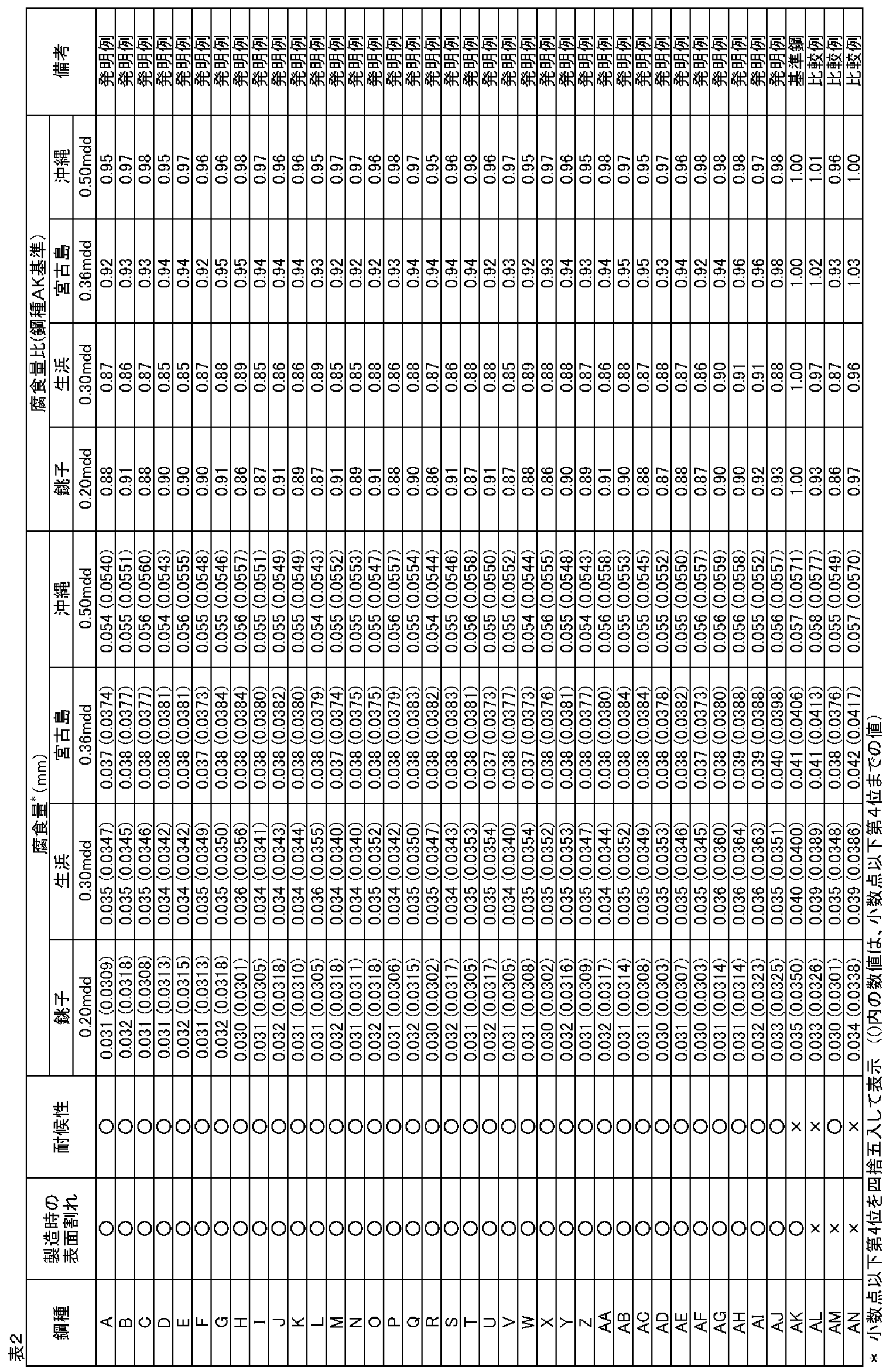
また、発明例についてはいずれも、製造時における表面割れは発生しなかった。
Claims (2)
- 質量%で、
C:0.02%以上0.14%未満、
Si:0.05%以上2.0%以下、
Mn:0.2%以上2.0%以下、
P:0.005%以上0.03%以下、
S:0.0001%以上0.02%以下、
Al:0.001%以上0.1%以下、
Cu:0.1%以上1.0%以下および
Ni:0.1%以上1.0%以下
を含有し、かつ
Nb:0.004%以上0.2%以下および
Sn:0.001%以上0.2%以下
のうちから選んだ1種又は2種を含有し、さらに、Cu、NiおよびSnの含有量が下記式(1)の関係を満足し、残部はFe及び不可避的不純物からなる溶接構造用鋼材。
記
([%Cu]+10[%Sn])/2[%Ni]≦1・・・(1)
ただし、[%M]はM元素の鋼中含有量(質量%)である。 - 前記鋼材が、さらに、質量%で、
Cr:0.2%以上2.0%以下、
Ti:0.005%以上0.200%以下、
V:0.005%以上0.200%以下、
Zr:0.005%以上0.200%以下、
B:0.0001%以上0.0050%以下、
Mg:0.0001%以上0.0100%以下、
Co:0.01%以上1.00%以下、
Mo:0.005%以上1.000%以下、
Sb:0.005%以上0.200%以下および
REM:0.0001%以上0.1000%以下
のうちから選んだ1種または2種以上を含有する請求項1に記載の溶接構造用鋼材。
Priority Applications (4)
| Application Number | Priority Date | Filing Date | Title |
|---|---|---|---|
| BR112015028240A BR112015028240B1 (pt) | 2013-05-10 | 2014-05-07 | material de aço para estrutura soldada |
| KR1020157033853A KR101723459B1 (ko) | 2013-05-10 | 2014-05-07 | 용접 구조용 강재 |
| JP2015515783A JP6094669B2 (ja) | 2013-05-10 | 2014-05-07 | 溶接構造用鋼材 |
| CN201480026250.0A CN105229189B (zh) | 2013-05-10 | 2014-05-07 | 焊接结构用钢材 |
Applications Claiming Priority (2)
| Application Number | Priority Date | Filing Date | Title |
|---|---|---|---|
| JP2013100507 | 2013-05-10 | ||
| JP2013-100507 | 2013-05-10 |
Publications (1)
| Publication Number | Publication Date |
|---|---|
| WO2014181537A1 true WO2014181537A1 (ja) | 2014-11-13 |
Family
ID=51867025
Family Applications (1)
| Application Number | Title | Priority Date | Filing Date |
|---|---|---|---|
| PCT/JP2014/002428 Ceased WO2014181537A1 (ja) | 2013-05-10 | 2014-05-07 | 溶接構造用鋼材 |
Country Status (6)
| Country | Link |
|---|---|
| JP (1) | JP6094669B2 (ja) |
| KR (1) | KR101723459B1 (ja) |
| CN (1) | CN105229189B (ja) |
| BR (1) | BR112015028240B1 (ja) |
| MY (1) | MY174874A (ja) |
| WO (1) | WO2014181537A1 (ja) |
Cited By (4)
| Publication number | Priority date | Publication date | Assignee | Title |
|---|---|---|---|---|
| WO2017043021A1 (ja) * | 2015-09-11 | 2017-03-16 | Jfeスチール株式会社 | 耐候性に優れた構造用鋼材 |
| JP2022175772A (ja) * | 2021-05-14 | 2022-11-25 | 日本製鉄株式会社 | Cu、Ni、Sn含有鋼の製造方法 |
| JP2024502793A (ja) * | 2021-02-01 | 2024-01-23 | 南京鋼鉄股▲ふん▼有限公司 | 耐候性橋梁鋼およびその製錬方法 |
| CN117512478A (zh) * | 2023-10-11 | 2024-02-06 | 首钢集团有限公司 | 一种耐腐蚀钢及其应用 |
Families Citing this family (1)
| Publication number | Priority date | Publication date | Assignee | Title |
|---|---|---|---|---|
| CN117947335A (zh) * | 2022-10-28 | 2024-04-30 | 宝山钢铁股份有限公司 | 一种光伏桩基用高强度耐蚀钢及其制造方法 |
Citations (9)
| Publication number | Priority date | Publication date | Assignee | Title |
|---|---|---|---|---|
| JP2010163643A (ja) * | 2009-01-14 | 2010-07-29 | Jfe Steel Corp | 耐候性に優れた構造用鋼材 |
| CN101892431A (zh) * | 2010-07-07 | 2010-11-24 | 江苏省沙钢钢铁研究院有限公司 | 热轧态屈服强度500MPa级耐候桥梁钢及其制造方法 |
| CN102021495A (zh) * | 2010-12-16 | 2011-04-20 | 马鞍山钢铁股份有限公司 | 420MPa高韧性耐候桥梁钢及其热轧板卷的制备方法 |
| CN102168229A (zh) * | 2010-02-25 | 2011-08-31 | 宝山钢铁股份有限公司 | 耐候钢板及其制造方法 |
| JP2011202215A (ja) * | 2010-03-25 | 2011-10-13 | Jfe Steel Corp | 耐候性に優れた構造用鋼材 |
| JP2012067377A (ja) * | 2009-09-30 | 2012-04-05 | Jfe Steel Corp | 耐候性に優れた構造用鋼材および鋼構造物 |
| JP2012188754A (ja) * | 2011-02-25 | 2012-10-04 | Jfe Steel Corp | 耐候性に優れた鋼材 |
| JP2012214871A (ja) * | 2011-03-29 | 2012-11-08 | Jfe Steel Corp | 耐食性に優れたさび層付き鋼材 |
| JP2013019021A (ja) * | 2011-07-11 | 2013-01-31 | Jfe Steel Corp | 大入熱溶接熱影響部の靭性に優れる溶接構造用鋼の製造方法 |
Family Cites Families (6)
| Publication number | Priority date | Publication date | Assignee | Title |
|---|---|---|---|---|
| JPH10251797A (ja) * | 1997-03-10 | 1998-09-22 | Nkk Corp | 耐候性に優れた溶接構造用鋼及びその製造方法 |
| JP3568760B2 (ja) | 1997-06-24 | 2004-09-22 | 株式会社神戸製鋼所 | 裸耐候性と溶接性に優れた厚板 |
| JP3785271B2 (ja) | 1997-10-01 | 2006-06-14 | 新日本製鐵株式会社 | 高溶接性高耐候性鋼 |
| JP3846218B2 (ja) | 2001-04-10 | 2006-11-15 | Jfeスチール株式会社 | 耐候性に優れた構造用鋼 |
| JP4586489B2 (ja) | 2004-10-22 | 2010-11-24 | 住友金属工業株式会社 | 海浜耐候性に優れた鋼材と構造物 |
| JP5233829B2 (ja) | 2009-05-11 | 2013-07-10 | 新日鐵住金株式会社 | 海浜耐候性に優れた鋼材と構造物 |
-
2014
- 2014-05-07 JP JP2015515783A patent/JP6094669B2/ja active Active
- 2014-05-07 BR BR112015028240A patent/BR112015028240B1/pt active IP Right Grant
- 2014-05-07 MY MYPI2015703970A patent/MY174874A/en unknown
- 2014-05-07 KR KR1020157033853A patent/KR101723459B1/ko active Active
- 2014-05-07 CN CN201480026250.0A patent/CN105229189B/zh active Active
- 2014-05-07 WO PCT/JP2014/002428 patent/WO2014181537A1/ja not_active Ceased
Patent Citations (9)
| Publication number | Priority date | Publication date | Assignee | Title |
|---|---|---|---|---|
| JP2010163643A (ja) * | 2009-01-14 | 2010-07-29 | Jfe Steel Corp | 耐候性に優れた構造用鋼材 |
| JP2012067377A (ja) * | 2009-09-30 | 2012-04-05 | Jfe Steel Corp | 耐候性に優れた構造用鋼材および鋼構造物 |
| CN102168229A (zh) * | 2010-02-25 | 2011-08-31 | 宝山钢铁股份有限公司 | 耐候钢板及其制造方法 |
| JP2011202215A (ja) * | 2010-03-25 | 2011-10-13 | Jfe Steel Corp | 耐候性に優れた構造用鋼材 |
| CN101892431A (zh) * | 2010-07-07 | 2010-11-24 | 江苏省沙钢钢铁研究院有限公司 | 热轧态屈服强度500MPa级耐候桥梁钢及其制造方法 |
| CN102021495A (zh) * | 2010-12-16 | 2011-04-20 | 马鞍山钢铁股份有限公司 | 420MPa高韧性耐候桥梁钢及其热轧板卷的制备方法 |
| JP2012188754A (ja) * | 2011-02-25 | 2012-10-04 | Jfe Steel Corp | 耐候性に優れた鋼材 |
| JP2012214871A (ja) * | 2011-03-29 | 2012-11-08 | Jfe Steel Corp | 耐食性に優れたさび層付き鋼材 |
| JP2013019021A (ja) * | 2011-07-11 | 2013-01-31 | Jfe Steel Corp | 大入熱溶接熱影響部の靭性に優れる溶接構造用鋼の製造方法 |
Cited By (7)
| Publication number | Priority date | Publication date | Assignee | Title |
|---|---|---|---|---|
| WO2017043021A1 (ja) * | 2015-09-11 | 2017-03-16 | Jfeスチール株式会社 | 耐候性に優れた構造用鋼材 |
| CN107849664A (zh) * | 2015-09-11 | 2018-03-27 | 杰富意钢铁株式会社 | 耐候性优良的结构钢材 |
| JP2024502793A (ja) * | 2021-02-01 | 2024-01-23 | 南京鋼鉄股▲ふん▼有限公司 | 耐候性橋梁鋼およびその製錬方法 |
| JP7663695B2 (ja) | 2021-02-01 | 2025-04-16 | 南京鋼鉄股▲ふん▼有限公司 | 耐候性橋梁鋼の製錬方法 |
| JP2022175772A (ja) * | 2021-05-14 | 2022-11-25 | 日本製鉄株式会社 | Cu、Ni、Sn含有鋼の製造方法 |
| JP7684555B2 (ja) | 2021-05-14 | 2025-05-28 | 日本製鉄株式会社 | Cu、Ni、Sn含有鋼の製造方法 |
| CN117512478A (zh) * | 2023-10-11 | 2024-02-06 | 首钢集团有限公司 | 一种耐腐蚀钢及其应用 |
Also Published As
| Publication number | Publication date |
|---|---|
| BR112015028240B1 (pt) | 2020-04-22 |
| JPWO2014181537A1 (ja) | 2017-02-23 |
| JP6094669B2 (ja) | 2017-03-15 |
| KR20160003165A (ko) | 2016-01-08 |
| MY174874A (en) | 2020-05-20 |
| KR101723459B1 (ko) | 2017-04-05 |
| CN105229189A (zh) | 2016-01-06 |
| CN105229189B (zh) | 2017-09-15 |
| BR112015028240A2 (pt) | 2017-07-25 |
Similar Documents
| Publication | Publication Date | Title |
|---|---|---|
| JP5691350B2 (ja) | 耐候性に優れた構造用鋼材および鋼構造物 | |
| JP5120472B2 (ja) | 耐候性に優れた構造用鋼材 | |
| JP5120510B2 (ja) | 耐候性に優れた鋼材 | |
| JP6556163B2 (ja) | 耐候性に優れた構造用鋼材 | |
| JP6094669B2 (ja) | 溶接構造用鋼材 | |
| JP5891892B2 (ja) | 高塩分環境下で耐候性に優れたさび層付き鋼材 | |
| JP5446278B2 (ja) | 耐候性に優れた構造用鋼材 | |
| JP2017226878A (ja) | ボルト用鋼材 | |
| KR20100046995A (ko) | 고강도 내후성강 및 그 제조방법 | |
| JP5796403B2 (ja) | 耐候性に優れた溶接構造用鋼材 | |
| JP5797877B2 (ja) | 高湿潤環境下において耐食性に優れる耐候性鋼材 | |
| JP5600986B2 (ja) | 耐候性に優れた構造用鋼材 | |
| KR101304637B1 (ko) | 내식성이 우수한 고강도 고연성 열연강판 및 그 제조방법 | |
| JP6432607B2 (ja) | 耐候性に優れた構造用鋼材 | |
| JP3846218B2 (ja) | 耐候性に優れた構造用鋼 | |
| JP2014055334A (ja) | 石油タンク用耐食鋼材 | |
| JP2021161458A (ja) | 耐火性および塗装耐食性に優れた構造用鋼材および構造物 | |
| JP5929391B2 (ja) | 塗装耐久性に優れた塗装鋼材 |
Legal Events
| Date | Code | Title | Description |
|---|---|---|---|
| WWE | Wipo information: entry into national phase |
Ref document number: 201480026250.0 Country of ref document: CN |
|
| 121 | Ep: the epo has been informed by wipo that ep was designated in this application |
Ref document number: 14795297 Country of ref document: EP Kind code of ref document: A1 |
|
| ENP | Entry into the national phase |
Ref document number: 2015515783 Country of ref document: JP Kind code of ref document: A |
|
| WWE | Wipo information: entry into national phase |
Ref document number: 12015502442 Country of ref document: PH |
|
| NENP | Non-entry into the national phase |
Ref country code: DE |
|
| ENP | Entry into the national phase |
Ref document number: 20157033853 Country of ref document: KR Kind code of ref document: A |
|
| WWE | Wipo information: entry into national phase |
Ref document number: IDP00201508257 Country of ref document: ID |
|
| REG | Reference to national code |
Ref country code: BR Ref legal event code: B01A Ref document number: 112015028240 Country of ref document: BR |
|
| 122 | Ep: pct application non-entry in european phase |
Ref document number: 14795297 Country of ref document: EP Kind code of ref document: A1 |
|
| ENP | Entry into the national phase |
Ref document number: 112015028240 Country of ref document: BR Kind code of ref document: A2 Effective date: 20151110 |