WO2014168165A1 - 光電変換素子、色素増感太陽電池、金属錯体色素、色素溶液、色素吸着電極および色素増感太陽電池の製造方法 - Google Patents
光電変換素子、色素増感太陽電池、金属錯体色素、色素溶液、色素吸着電極および色素増感太陽電池の製造方法 Download PDFInfo
- Publication number
- WO2014168165A1 WO2014168165A1 PCT/JP2014/060255 JP2014060255W WO2014168165A1 WO 2014168165 A1 WO2014168165 A1 WO 2014168165A1 JP 2014060255 W JP2014060255 W JP 2014060255W WO 2014168165 A1 WO2014168165 A1 WO 2014168165A1
- Authority
- WO
- WIPO (PCT)
- Prior art keywords
- group
- ring
- dye
- photoelectric conversion
- formula
- Prior art date
- Legal status (The legal status is an assumption and is not a legal conclusion. Google has not performed a legal analysis and makes no representation as to the accuracy of the status listed.)
- Ceased
Links
- 0 CC(CCCC1)(C1CC1)C(CC2)C1C1C2C(*)CC1 Chemical compound CC(CCCC1)(C1CC1)C(CC2)C1C1C2C(*)CC1 0.000 description 1
Images

Classifications
-
- C—CHEMISTRY; METALLURGY
- C09—DYES; PAINTS; POLISHES; NATURAL RESINS; ADHESIVES; COMPOSITIONS NOT OTHERWISE PROVIDED FOR; APPLICATIONS OF MATERIALS NOT OTHERWISE PROVIDED FOR
- C09B—ORGANIC DYES OR CLOSELY-RELATED COMPOUNDS FOR PRODUCING DYES, e.g. PIGMENTS; MORDANTS; LAKES
- C09B57/00—Other synthetic dyes of known constitution
- C09B57/10—Metal complexes of organic compounds not being dyes in uncomplexed form
-
- C—CHEMISTRY; METALLURGY
- C09—DYES; PAINTS; POLISHES; NATURAL RESINS; ADHESIVES; COMPOSITIONS NOT OTHERWISE PROVIDED FOR; APPLICATIONS OF MATERIALS NOT OTHERWISE PROVIDED FOR
- C09B—ORGANIC DYES OR CLOSELY-RELATED COMPOUNDS FOR PRODUCING DYES, e.g. PIGMENTS; MORDANTS; LAKES
- C09B15/00—Acridine dyes
-
- C—CHEMISTRY; METALLURGY
- C09—DYES; PAINTS; POLISHES; NATURAL RESINS; ADHESIVES; COMPOSITIONS NOT OTHERWISE PROVIDED FOR; APPLICATIONS OF MATERIALS NOT OTHERWISE PROVIDED FOR
- C09B—ORGANIC DYES OR CLOSELY-RELATED COMPOUNDS FOR PRODUCING DYES, e.g. PIGMENTS; MORDANTS; LAKES
- C09B19/00—Oxazine dyes
-
- C—CHEMISTRY; METALLURGY
- C09—DYES; PAINTS; POLISHES; NATURAL RESINS; ADHESIVES; COMPOSITIONS NOT OTHERWISE PROVIDED FOR; APPLICATIONS OF MATERIALS NOT OTHERWISE PROVIDED FOR
- C09B—ORGANIC DYES OR CLOSELY-RELATED COMPOUNDS FOR PRODUCING DYES, e.g. PIGMENTS; MORDANTS; LAKES
- C09B21/00—Thiazine dyes
-
- C—CHEMISTRY; METALLURGY
- C09—DYES; PAINTS; POLISHES; NATURAL RESINS; ADHESIVES; COMPOSITIONS NOT OTHERWISE PROVIDED FOR; APPLICATIONS OF MATERIALS NOT OTHERWISE PROVIDED FOR
- C09B—ORGANIC DYES OR CLOSELY-RELATED COMPOUNDS FOR PRODUCING DYES, e.g. PIGMENTS; MORDANTS; LAKES
- C09B23/00—Methine or polymethine dyes, e.g. cyanine dyes
- C09B23/10—The polymethine chain containing an even number of >CH- groups
- C09B23/105—The polymethine chain containing an even number of >CH- groups two >CH- groups
-
- C—CHEMISTRY; METALLURGY
- C09—DYES; PAINTS; POLISHES; NATURAL RESINS; ADHESIVES; COMPOSITIONS NOT OTHERWISE PROVIDED FOR; APPLICATIONS OF MATERIALS NOT OTHERWISE PROVIDED FOR
- C09B—ORGANIC DYES OR CLOSELY-RELATED COMPOUNDS FOR PRODUCING DYES, e.g. PIGMENTS; MORDANTS; LAKES
- C09B57/00—Other synthetic dyes of known constitution
- C09B57/008—Triarylamine dyes containing no other chromophores
-
- C—CHEMISTRY; METALLURGY
- C09—DYES; PAINTS; POLISHES; NATURAL RESINS; ADHESIVES; COMPOSITIONS NOT OTHERWISE PROVIDED FOR; APPLICATIONS OF MATERIALS NOT OTHERWISE PROVIDED FOR
- C09B—ORGANIC DYES OR CLOSELY-RELATED COMPOUNDS FOR PRODUCING DYES, e.g. PIGMENTS; MORDANTS; LAKES
- C09B69/00—Dyes not provided for by a single group of this subclass
- C09B69/008—Dyes containing a substituent, which contains a silicium atom
-
- H—ELECTRICITY
- H10—SEMICONDUCTOR DEVICES; ELECTRIC SOLID-STATE DEVICES NOT OTHERWISE PROVIDED FOR
- H10K—ORGANIC ELECTRIC SOLID-STATE DEVICES
- H10K85/00—Organic materials used in the body or electrodes of devices covered by this subclass
- H10K85/30—Coordination compounds
- H10K85/341—Transition metal complexes, e.g. Ru(II)polypyridine complexes
- H10K85/344—Transition metal complexes, e.g. Ru(II)polypyridine complexes comprising ruthenium
-
- H—ELECTRICITY
- H01—ELECTRIC ELEMENTS
- H01G—CAPACITORS; CAPACITORS, RECTIFIERS, DETECTORS, SWITCHING DEVICES, LIGHT-SENSITIVE OR TEMPERATURE-SENSITIVE DEVICES OF THE ELECTROLYTIC TYPE
- H01G9/00—Electrolytic capacitors, rectifiers, detectors, switching devices, light-sensitive or temperature-sensitive devices; Processes of their manufacture
- H01G9/20—Light-sensitive devices
- H01G9/2059—Light-sensitive devices comprising an organic dye as the active light absorbing material, e.g. adsorbed on an electrode or dissolved in solution
-
- Y—GENERAL TAGGING OF NEW TECHNOLOGICAL DEVELOPMENTS; GENERAL TAGGING OF CROSS-SECTIONAL TECHNOLOGIES SPANNING OVER SEVERAL SECTIONS OF THE IPC; TECHNICAL SUBJECTS COVERED BY FORMER USPC CROSS-REFERENCE ART COLLECTIONS [XRACs] AND DIGESTS
- Y02—TECHNOLOGIES OR APPLICATIONS FOR MITIGATION OR ADAPTATION AGAINST CLIMATE CHANGE
- Y02E—REDUCTION OF GREENHOUSE GAS [GHG] EMISSIONS, RELATED TO ENERGY GENERATION, TRANSMISSION OR DISTRIBUTION
- Y02E10/00—Energy generation through renewable energy sources
- Y02E10/50—Photovoltaic [PV] energy
- Y02E10/542—Dye sensitized solar cells
-
- Y—GENERAL TAGGING OF NEW TECHNOLOGICAL DEVELOPMENTS; GENERAL TAGGING OF CROSS-SECTIONAL TECHNOLOGIES SPANNING OVER SEVERAL SECTIONS OF THE IPC; TECHNICAL SUBJECTS COVERED BY FORMER USPC CROSS-REFERENCE ART COLLECTIONS [XRACs] AND DIGESTS
- Y02—TECHNOLOGIES OR APPLICATIONS FOR MITIGATION OR ADAPTATION AGAINST CLIMATE CHANGE
- Y02E—REDUCTION OF GREENHOUSE GAS [GHG] EMISSIONS, RELATED TO ENERGY GENERATION, TRANSMISSION OR DISTRIBUTION
- Y02E10/00—Energy generation through renewable energy sources
- Y02E10/50—Photovoltaic [PV] energy
- Y02E10/549—Organic PV cells
-
- Y—GENERAL TAGGING OF NEW TECHNOLOGICAL DEVELOPMENTS; GENERAL TAGGING OF CROSS-SECTIONAL TECHNOLOGIES SPANNING OVER SEVERAL SECTIONS OF THE IPC; TECHNICAL SUBJECTS COVERED BY FORMER USPC CROSS-REFERENCE ART COLLECTIONS [XRACs] AND DIGESTS
- Y02—TECHNOLOGIES OR APPLICATIONS FOR MITIGATION OR ADAPTATION AGAINST CLIMATE CHANGE
- Y02P—CLIMATE CHANGE MITIGATION TECHNOLOGIES IN THE PRODUCTION OR PROCESSING OF GOODS
- Y02P70/00—Climate change mitigation technologies in the production process for final industrial or consumer products
- Y02P70/50—Manufacturing or production processes characterised by the final manufactured product
Definitions
- the present invention relates to a photoelectric conversion element, a dye-sensitized solar cell, a metal complex dye, a dye solution, a dye-adsorbing electrode, and a method for producing a dye-sensitized solar battery.
- Photoelectric conversion elements are used in various optical sensors, copiers, solar cells and the like.
- Various types of photoelectric conversion elements have been put to practical use, such as those using metals, semiconductors, organic pigments and dyes, or combinations thereof.
- a solar cell using non-depleting solar energy does not require fuel, and its full-scale practical use is expected as an inexhaustible clean energy.
- silicon solar cells have been researched and developed for a long time. It is spreading due to the policy considerations of each country. However, silicon is an inorganic material, and its throughput and molecular modification are naturally limited.
- N3, N719, Z907, J2 and the like have been developed as metal complex dyes used in photoelectric conversion elements.
- conventional dye-sensitized solar cells generally have insufficient photoelectric conversion efficiency and durability.
- metal complex dyes has been extensively studied as combinations of bidentate ligands and bidentate ligands, or combinations of bidentate and tridentate ligands. (For example, see Patent Documents 1 to 3)
- further studies have been required to improve durability.
- solar cells are attracting attention and expectation as an energy source to replace nuclear power generation, and further performance improvements as solar cells are required.
- Patent Document 1 Conventional metal complex dyes including the metal complex dyes described in Patent Document 1 are significantly improved and improved in terms of improvement in photoelectric conversion efficiency and improvement in durability compared to solar cells using inorganic silicon. is necessary. In particular, since improving the durability, which is the fate of organic materials, is a difficult task, it is important to find a new development. According to the study by the present inventors, in addition to the above points, the performance of the obtained photoelectric conversion element and the dye-sensitized solar cell is not stable. It was found that there was a problem that the same performance could not be obtained among the solar cells.
- the present invention provides a photoelectric conversion element, a dye-sensitized solar cell, and a metal complex dye whose durability is greatly improved in addition to improvement in photoelectric conversion efficiency, and that these performances are stably maintained even after repeated production. It is an object to provide a method for producing a dye solution containing dye, a dye-adsorbing electrode, and a dye-sensitized solar cell.
- the present inventors studied the relationship between a ligand having an acidic group such as a carboxy group and a ligand not having an acidic group in order to adsorb on the surface of the semiconductor fine particles, and increased durability by increasing the adsorption power. As a result of investigating and studying the interaction between ligands such as the electronic interaction between ligands, the inventors have obtained a clue to solving the above-mentioned problems. It came.
- the object of the present invention has been achieved by the following means.
- a photoelectric conversion element having semiconductor fine particles carrying a dye is represented by the following formula (I)
- M represents a metal ion.
- LD represents a bidentate ligand represented by the following formula (DL-1).
- LA represents a tridentate ligand represented by the following formula (AL-1) or (AL-2).
- Z represents a monodentate ligand.
- CI represents a counter ion necessary for neutralizing the electric charge.
- ring A represents a nitrogen-containing heterocycle selected from a pyridine ring, a pyrimidine ring and a pyridazine ring.
- Y 1 represents a carbon atom or a nitrogen atom, and ring C 1 represents a monocyclic or condensed aryl ring or heteroaryl ring coordinated to M with a carbon anion.
- R A is a group represented by the following formula (U).
- R B represents a substituent.
- R C represents a halogen atom, an alkyl group, a cycloalkyl group, an acyl group, an alkylsulfinyl group, an arylsulfinyl group, an alkylsulfonyl group, an arylsulfonyl group, a cyano group, or a nitro group.
- a1 represents an integer of 1 to 4
- a2 represents an integer of 0 to 3
- a3 represents 0 or an integer of 1 or more.
- L u represents a single bond, an ethenylene group or an ethynylene group.
- Ring X u represents an arylene group or a heteroarylene group, and q represents an integer of 0 to 2.
- R u represents a linear or branched alkyl group, alkoxy group, alkylthio group, alkynyl group, alkenyl group, silyloxy group, amino group, alkylamino group or arylamino group.
- R u is a linear or branched alkyl group, an alkoxy group, an alkylthio group, an alkynyl group, an alkenyl group, or a silyloxy group.
- nu represents an integer of 1 to 4, and when nu is 2 or more, plural Rus may be the same as or different from each other, and may be bonded to each other to form a ring.
- Anc 1 to Anc 3 each independently represent —CO 2 H, —SO 3 H, —PO 3 H 2 or a group in which any one of these protons is dissociated.
- RAL represents a substituent, and b1 represents an integer of 0 to 4.
- M is Fe 2+ , Ru 2+ or Os 2+ .
- R A1 represents a substituent having an acidic group.
- R A2 represents a substituent.
- nA represents an integer of 0 or more.
- a dye-sensitized solar cell comprising the photoelectric conversion element according to any one of (1) to (10).
- (12) A metal complex dye represented by the following formula (I).
- M represents a metal ion.
- LD represents a bidentate ligand represented by the following formula (DL-1).
- LA represents a tridentate ligand represented by the following formula (AL-1) or (AL-2).
- Z represents a monodentate ligand.
- CI represents a counter ion necessary for neutralizing the electric charge.
- ring A represents a nitrogen-containing heterocycle selected from a pyridine ring, a pyrimidine ring and a pyridazine ring.
- Y 1 represents a carbon atom or a nitrogen atom, and ring C 1 represents a monocyclic or condensed aryl ring or heteroaryl ring coordinated to M with a carbon anion.
- R A is a group represented by the following formula (U).
- R B represents a substituent.
- R C represents a halogen atom, an alkyl group, a cycloalkyl group, an acyl group, an alkylsulfinyl group, an arylsulfinyl group, an alkylsulfonyl group, an arylsulfonyl group, a cyano group, or a nitro group.
- a1 represents an integer of 1 to 4
- a2 represents an integer of 0 to 3
- a3 represents 0 or an integer of 1 or more.
- L u represents a single bond, an ethenylene group or an ethynylene group.
- Ring X u represents an arylene group or a heteroarylene group, and q represents an integer of 0 to 2.
- R u represents a linear or branched alkyl group, alkoxy group, alkylthio group, alkynyl group, alkenyl group, silyloxy group, amino group, alkylamino group or arylamino group.
- R u is a linear or branched alkyl group, an alkoxy group, an alkylthio group, an alkynyl group, an alkenyl group, or a silyloxy group.
- nu represents an integer of 1 to 4, and when nu is 2 or more, plural Rus may be the same as or different from each other, and may be bonded to each other to form a ring.
- Anc 1 to Anc 3 each independently represent —CO 2 H, —SO 3 H, —PO 3 H 2 or a group in which any one of these protons is dissociated.
- RAL represents a substituent
- b1 represents an integer of 0 to 4.
- the dye solution according to (15), wherein the co-adsorbent is represented by the following formula (CA).
- R A1 represents a substituent having an acidic group.
- R A2 represents a substituent.
- nA represents an integer of 0 or more.
- a numerical range represented by using “to” means a range including numerical values described before and after that as a lower limit value and an upper limit value.
- the carbon-carbon double bond may be any of E type and Z type in the molecule, or a mixture thereof.
- substituents, etc. linking groups, ligands, etc.
- the respective substituents and the like may be the same as or different from each other. The same applies to the definition of the number of substituents and the like.
- substituents and the like when a plurality of substituents and the like are adjacent (particularly adjacent to each other), they may be connected to each other to form a ring unless otherwise specified.
- a ring such as an alicyclic ring, an aromatic ring, or a hetero ring may be further condensed to form a condensed ring.
- each substituent may be further substituted with a substituent unless otherwise specified.
- the durability is greatly improved, and even if it is repeatedly manufactured, these performances are stably maintained, including a photoelectric conversion element, a dye-sensitized solar cell, and a metal complex dye It is possible to provide a method for producing a dye solution, a dye adsorption electrode, and a dye-sensitized solar cell.
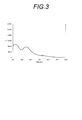
- FIG. 3 is a visible absorption spectrum diagram of a metal complex dye A-29 synthesized in an example of the present invention in a DMF solution.
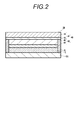
- the photoelectric conversion element of the present invention includes a conductive support 1, a photoreceptor layer 2 including semiconductor fine particles 22 sensitized by supporting a dye (metal complex dye) 21, It consists of a charge transfer layer 3 and a counter electrode 4 which are hole transport layers.
- the conductive support 1 provided with the photoreceptor layer 2 functions as a working electrode in the photoelectric conversion element 10.
- the photoelectric conversion element 10 is shown as a system 100 using a dye-sensitized solar cell that can be used for a battery application in which the operating means M (electric motor) works by the external circuit 6.
- the light-receiving electrode 5 includes a conductive support 1 and a photoreceptor layer 2 including semiconductor fine particles 22 on which a dye (metal complex dye) 21 is adsorbed.
- the photoreceptor layer 2 is designed according to the purpose, and may be a single layer structure or a multilayer structure.
- the dye (metal complex dye) 21 in one layer of the photoreceptor layer may be one kind or a mixture of many kinds, and at least one of them is the metal complex dye of the present invention described later.
- the light incident on the photoreceptor layer 2 excites the dye (metal complex dye) 21.
- the excited dye has high energy electrons, and the electrons are transferred from the dye (metal complex dye) 21 to the conduction band of the semiconductor fine particles 22 and reach the conductive support 1 by diffusion.
- the dye (metal complex dye) 21 is an oxidant, but the electrons on the electrode work in the external circuit 6 and pass through the counter electrode 4 so that the oxidant of the dye (metal complex dye) 21 and By returning to the photoreceptor layer 2 where the electrolyte is present, it functions as a solar cell.
- the material used for the photoelectric conversion element or the dye-sensitized solar cell and the method for producing each member may employ a production method usually used for this type of material, for example, US Pat. No. 4,927, No. 721, US Pat. No. 4,684,537, US Pat. No. 5,084,365, US Pat. No. 5,350,644, US Pat. No. 5,463,057
- a production method usually used for this type of material for example, US Pat. No. 4,927, No. 721, US Pat. No. 4,684,537, US Pat. No. 5,084,365, US Pat. No. 5,350,644, US Pat. No. 5,463,057
- an outline of the main members will be described.
- the photoreceptor layer is a layer containing semiconductor fine particles containing an electrolyte described later and carrying a sensitizing dye containing the metal complex dye of the present invention described below.
- the metal complex dye of the present invention is represented by the following formula (I).
- M represents a metal ion.
- LD represents a bidentate ligand represented by the following formula (DL-1).
- LA represents a tridentate ligand represented by the following formula (AL-1) or (AL-2).
- Z represents a monodentate ligand.
- CI represents a counter ion necessary for neutralizing the electric charge.
- ring A represents a nitrogen-containing heterocycle selected from a pyridine ring, a pyrimidine ring and a pyridazine ring.
- Y 1 represents a carbon atom or a nitrogen atom, and ring C 1 represents a monocyclic or condensed aryl ring or heteroaryl ring coordinated to M with a carbon anion.
- R A is a group represented by the following formula (U).
- R B represents a substituent.
- R C represents a halogen atom, an alkyl group, a cycloalkyl group, an acyl group, an alkylsulfinyl group, an arylsulfinyl group, an alkylsulfonyl group, an arylsulfonyl group, a cyano group, or a nitro group.
- a1 represents an integer of 1 to 4
- a2 represents an integer of 0 to 3
- a3 represents 0 or an integer of 1 or more.
- L u represents a single bond, an ethenylene group or an ethynylene group.
- Ring X u represents an arylene group or a heteroarylene group, and q represents an integer of 0 to 2.
- R u represents a linear or branched alkyl group, alkoxy group, alkylthio group, alkynyl group, alkenyl group, silyloxy group, amino group, alkylamino group or arylamino group.
- R u is a linear or branched alkyl group, an alkoxy group, an alkylthio group, an alkynyl group, an alkenyl group, or a silyloxy group.
- nu represents an integer of 1 to 4, and when nu is 2 or more, plural Rus may be the same as or different from each other, and may be bonded to each other to form a ring.
- Anc 1 to Anc 3 each independently represent —CO 2 H, —SO 3 H, —PO 3 H 2 or a group in which any one of these protons is dissociated.
- RAL represents a substituent, and b1 represents an integer of 0 to 4.
- -Metal ion M- M represents a central metal ion of the metal complex dye, and examples thereof include ions of group 6 to 12 metal atoms on the long periodic table, and more preferably Ru, Fe, Os, Cu, W, Cr, Mo, Ni, Pd. , Pt, Co, Ir, Rh, Re, Mn or Zn, more preferably Fe 2+ , Ru 2+ or Os 2+ , and most preferably Ru 2+ .
- the ligand represented by the formula (DL-1) is used as the ligand LD.
- the ligand LD and the ligand LA are combined with a compound having a specific ligand structure and coordinated to the metal ion M.
- the ligand LA is a ligand having an acidic group that is adsorbed on the surface of the semiconductor fine particles
- the ligand LD is a ligand that is not assumed to be adsorbed on the surface of the semiconductor fine particles.
- the electronic effect of the ligand LD that is, the acidic group of the ligand LA is arranged instead of the ligand LA.
- It adjusts the adsorptive power via the ligand LD, and it is considered effective to use a bidentate ligand having higher ⁇ electron acceptability than a conventional pyridine ligand. Furthermore, it is considered effective to suppress dye association and improve coordination ability by changing the ring or modifying the substituent.
- An effective ligand LD for such purposes is a nitrogen-containing heterocycle selected from a pyridine ring, a pyrimidine ring and a pyridazine ring coordinated with a nitrogen atom with respect to a metal ion M, and a carbon anion.
- a bidentate ligand in which an aryl ring or a heteroaryl ring is linked, and at least a nitrogen-containing heterocycle selected from a pyridine ring, a pyrimidine ring and a pyridazine ring in which a nitrogen atom is coordinated to the metal ion M The above formula (DL-1) having a specific substituent is useful.
- Ring A represents a nitrogen-containing heterocycle selected from a pyridine ring, a pyrimidine ring, and a pyridazine ring, and a pyridine ring is preferable.
- the ring A is substituted with at least one RA .
- R A represents the above formula (U), and a1 represents an integer of 1 to 4, and a1 is preferably 1 or 2, and more preferably 1.
- L u represents a single bond
- a single bond, an ethenylene group is preferred.
- Aryl ring in the arylene group ring X u is aryl ring, and the ring C1, benzene ring is preferred.
- Heteroaryl ring in heteroarylene group ring X u, the heteroaryl ring, and the ring C1, thiophene ring or furan ring are preferred, a thiophene ring or a condensed thiophene ring is more preferred.
- the ring condensed with the thiophene ring is preferably a benzene ring, a ring formed with an ethylenedioxy group, a thiophene ring, or a combination thereof.
- the above-mentioned condensed thiophene ring that is, a divalent condensed thiophene ring is preferably the following group.
- each of the above rings may have a substituent, and examples of the substituent include the substituent T described below.
- substituent an alkyl group, an aryl group, a heterocyclic group, an alkoxy group, an aryloxy group, an alkylthio group, an arylthio group, and an amino group are preferable.
- Q represents an integer of 0 to 2, preferably 0 or 1, and more preferably 0.
- R u represents a linear or branched alkyl group, alkoxy group, alkylthio group, alkynyl group, alkenyl group, silyloxy group, amino group, alkylamino group or arylamino group, and ring X u is an arylene group or heteroarylene group.
- R u is a linear or branched alkyl group, an alkoxy group, an alkylthio group, an alkynyl group, an alkenyl group or silyloxy group.
- the linear or branched alkyl group preferably has 1 to 20 carbon atoms, more preferably 3 to 18 carbon atoms, and still more preferably 3 to 14 carbon atoms.
- the above alkoxy group preferably has 1 to 20 carbon atoms, more preferably 6 to 8 carbon atoms, still more preferably 6 carbon atoms, such as methoxy, ethoxy, hexyloxy, 2-ethylpentyloxy, octyloxy, 2 -Ethylhexyloxy and the like can be mentioned, and hexyloxy, 2-ethylpentyloxy, octyloxy, 2-ethylhexyloxy are preferable.
- the alkylthio group preferably has 1 to 20 carbon atoms, more preferably 2 to 8 carbon atoms, still more preferably 6 carbon atoms, such as methylthio, ethylthio, propylthio, isopropylthio, butylthio, hexylthio, octylthio, 2- Examples include ethylhexylthio, and preferred are hexylthio, octylthio, and 2-ethylhexylthio.
- the alkynyl group preferably has 2 to 20 carbon atoms, more preferably 3 to 13 carbon atoms, still more preferably 7 carbon atoms, such as 1-propynyl, 2-propynyl, 2-butynyl, 1-heptynyl, 1 -Octynyl and the like.
- the alkenyl group preferably has 2 to 20 carbon atoms, more preferably 3 to 13 carbon atoms, and still more preferably 7 carbon atoms.
- the silyloxy group is preferably a silyloxy group in which an alkyl group or an aryl group is substituted on the silyl atom, and the substituted alkyl group preferably has 1 to 20 carbon atoms, more preferably 1 to 12, more preferably 3 to 8. preferable.
- the substituted aryl group preferably has 6 to 20 carbon atoms, and more preferably 6 to 12 carbon atoms. Of these, a trialkylsilyloxy group is preferred as the silyloxy group.
- the number of carbon atoms as the silyloxy group is preferably 3 to 60, more preferably 3 to 40, and still more preferably 8 to 20.
- Examples include trimethylsilyloxy, triethylsilyloxy, tributylsilyloxy, dimethylbenzylsilyloxy, dimethylphenylsilyloxy, benzyldiphenylsilyloxy, and the like.
- R u is preferably an amino group, an alkylamino group, or an arylamino group when L u is a single bond and q is 0.
- R u is preferably an alkylamino group or an arylamino group, more preferably an arylamino group, among amino groups, alkylamino groups or arylamino groups, particularly from the viewpoint of increasing the wavelength of absorption.
- the arylamino group include an N-alkyl-N-arylamino group and a diarylamino group, and a diarylamino group is preferable.
- R u is preferably a group represented by the following formula (SA).
- R uA1 and R uA2 each independently represents an alkyl group or an aryl group. R uA1 and R uA2 may be bonded to each other to form a ring.
- One of R uA1 and R uA2 is preferably an aryl group, and both R uA1 and R uA2 are more preferably aryl groups.
- the ring group formed by bonding R uA1 and R uA2 to each other is preferably a 5-membered or 6-membered carbocyclic group or heterocyclic group.
- the ring group formed by bonding R uA1 and R uA2 to each other is more preferably the following group.
- R uA3 and R uA4 each independently represent an alkyl group.
- the carbon number of the alkyl group in R uA3 and R uA4 is preferably 1 to 20, more preferably 1 to 12, still more preferably 1 to 8, and particularly preferably methyl.
- the ring formed by bonding a plurality of Rus to each other is preferably a 5-membered or 6-membered carbocyclic or heterocyclic ring. These rings may be aromatic rings.
- Preferable rings include a ring formed from an ethylenedioxy group, an aryl ring, and a heteroaryl ring, and the aryl ring and heteroaryl ring are preferably an aryl ring and a heteroaryl ring described in ring C1 described later.
- R u is preferably bonded to the ortho position or the meta position with respect to the position of the ring X u atom to which L u is bonded.
- the group represented by the above formula (U) is preferably a group in which L u is a single bond, q is 0, and R u is an amino group, an alkylamino group or an arylamino group.
- A is a pyridine ring is particularly preferred.
- Y 1 represents a carbon atom or a nitrogen atom.
- Ring C1 represents a monocyclic or condensed aryl ring or heteroaryl ring coordinated with a carbon anion.
- the bond between Y 1 and the carbon anion may be a single bond or a double bond.
- the aryl ring in ring C1 include a benzene ring and a naphthalene ring, and a benzene ring is preferable.
- the ring-constituting hetero atom is preferably an oxygen atom, a sulfur atom, or a nitrogen atom, and a plurality of these may be combined.
- the nitrogen atom when adjacent to Y 1 is preferably a nitrogen atom having a substituent group, if not adjacent to Y 1 is a hydrogen atom to the nitrogen atom substituted Or may be ⁇ N—, but a nitrogen atom having a substituent is preferred.
- Rx is a substituent, and examples of the substituent include the substituent T described later.
- An alkyl group and an aryl group are preferable, and an alkyl group is more preferable. preferable.
- the heteroaryl ring in ring C1 is preferably a 5-membered ring or a 6-membered ring, and more preferably a 5-membered ring.
- Ring C1 may be a condensed ring, and in the case of a condensed ring, a ring in which a heterocycle including an aryl ring, an alicyclic ring, and a heteroaryl ring is condensed with the above aryl monocyclic ring or heteroaryl monocyclic ring.
- a naphthalene ring is mentioned, and a ring formed with ethylenedioxy on a benzene ring is also preferable.
- a 5-membered ring includes a furan ring, a thiophene ring, a pyrrole ring, a pyrazole ring, an imidazole ring, a triazole ring, an oxazole ring, an isoxazole ring, a thiazole ring, an isothiazole ring, and a furazane ring.
- a ring in which a benzene ring is condensed to these rings for example, a benzofuran ring, a benzothiophene ring, an indole ring, a benzimidazole ring, and the like can be given.
- a ring that forms a condensed ring with ethylenedioxy is also preferred.
- a 6-membered ring includes a pyridine ring, a pyrazine ring, a pyrimidine ring, a pyridazine ring and the like, and examples of the condensed ring include a condensed ring of these rings and a benzene ring.
- the ring C1 is preferably a thiophene ring, a furan ring, a pyrrole ring, or a benzene ring.
- the ring C1 is preferably a ring represented by the following formulas (C1-a) to (C1-e).
- R C and a 3 have the same meanings as R C and a3 in formula (DL-1), and preferred ranges are also the same.
- a 3 in each formula is preferably an integer of 0 to 2 in the formulas (C1-a) and (C1-b), and is preferably an integer of 0 to 3 in the formula (C1-c).
- in the formula (C1-e) an integer of 0 to 4 is preferable.
- Rx is the same as Rx described above and represents a substituent. Examples of the substituent include the substituent T described later, but an alkyl group and an aryl group are preferable, and an alkyl group is more preferable.
- R B in formula (DL-1) represents a substituent, and examples of the substituent include substituent T described later.
- R B there are two or more may be the same or different in the case of a3 is 2 or more
- R C may be the same or different from one another more than one.
- the substituent in R B is an alkyl group, an alkenyl group, an alkynyl group, a cycloalkyl group, a cycloalkenyl group, an aryl group, a heterocyclic group, an alkoxy group, an aryloxy group, an alkylthio group, an arylthio group, an amino group, or a halogen atom.
- An alkyl group, an alkenyl group, an alkynyl group, a cycloalkyl group, a cycloalkenyl group, an aryl group, a heterocyclic group, an alkoxy group, an aryloxy group, an alkylthio group, and an arylthio group are more preferable.
- A2 is preferably 0 or 1, particularly preferably 0.
- R C represents an alkyl group, a cycloalkyl group, a halogen atom, an acyl group, an alkylsulfinyl group, an arylsulfinyl group, an alkylsulfonyl group, an arylsulfonyl group, a cyano group, or a nitro group, and an alkyl group or a halogen atom is preferable.
- the above alkyl group is preferably an unsubstituted alkyl group or an alkyl group substituted with a halogen atom, more preferably a perhalogenoalkyl group, more preferably a perfluoroalkyl group, and particularly preferably a trifluoromethyl group.
- the halogen atom is preferably a fluorine atom.
- the carbon number of the alkyl group is preferably 1-20, more preferably 1-12, further preferably 1-8, more preferably 1 or 2, and particularly preferably 1.
- the cycloalkyl group preferably has 3 to 20 carbon atoms, more preferably 3 to 16 carbon atoms, and still more preferably 3 to 12 carbon atoms such as cyclopropyl, cyclopentyl, cyclohexyl, 3-methylcyclopentyl, 4-methylcyclohexyl, 4 -Ethylcyclohexyl, 3,5-dimethylcyclohexyl and the like.
- the acyl group includes a formyl group, an alkylcarbonyl group, an alkenylcarbonyl group, a cycloalkylcarbonyl group, an arylcarbonyl group, and a heterocyclic carbonyl group, and the acyl group preferably has 1 to 20 carbon atoms. More preferred is 1 to 12. Examples include formyl, acetyl, propionyl, butyryl, pivaloyl, cyclohexylcarbonyl, benzoyl, acryl, methacryl, benzoyl, naphthoyl, pyridinylcarbonyl, and the like.
- the alkylsulfinyl group and arylsulfinyl group preferably have 1 to 20 carbon atoms, more preferably 1 to 16 carbon atoms, and still more preferably 1 to 8 carbon atoms, such as methylsulfinyl, ethylsulfinyl, propylsulfinyl, butylsulfinyl, pentylsulfinyl, Examples include hexylsulfinyl, phenylsulfinyl, 1-naphthylsulfinyl, 2-naphthylsulfinyl, p-toluenesulfinyl and the like.
- the alkylsulfonyl group and arylsulfonyl group preferably have 1 to 20 carbon atoms, more preferably 1 to 16 carbon atoms, still more preferably 1 to 8 carbon atoms, such as methylsulfonyl, ethylsulfonyl, cyclohexylsulfonyl, phenylsulfonyl, 1-naphthyl. Examples include sulfonyl, 2-naphthylsulfonyl, p-toluenesulfonyl and the like.
- A3 is preferably an integer of 0 to 2, more preferably 1 or 2.
- the carbon number is preferably 6 to 40, more preferably 6 to 36, and further more preferably 6 to 24. 8 to 24 are particularly preferable.
- R A , R B and R C has a carbon number within this preferable range.
- R u is the number of carbon atoms.
- the total number of carbon atoms of R A , R B and R C is preferably 6 to 50, more preferably 8 to 30, and still more preferably 8 to 25.
- At least one of R A , R B and R C is preferably a group containing a heteroaryl ring, and particularly preferably a group containing a thiophene ring.
- R u in R A is an amino group, an alkylamino group or an arylamino group, particularly an arylamino group.
- L u is a single bond and q is 0. .
- the ligand LA is a ligand represented by the formula (AL-1) or (AL-2).
- Anc 1 to Anc 3 represent —CO 2 H, —SO 3 H, —PO 3 H 2 , or a group in which these protons are dissociated.
- the group in which the proton is dissociated is, for example, the above anion or a salt thereof, and an anion is preferable for coordination with the metal ion M.
- —CO 2 ⁇ , —SO 3 ⁇ , —PO 3 H ⁇ , and —PO 3 2 ⁇ is preferable.
- R AL represents a substituent, and examples of the substituent include the substituent T described later.
- RAL is preferably an alkyl group, a cycloalkyl group, an alkenyl group, an alkynyl group, an aryl group, an aromatic heterocyclic group, or a substituted amino group.
- the substituted amino group is preferably an alkylsulfonamide group, and the number of carbon atoms of the alkyl group is not particularly limited, but is preferably 1 to 6.
- a thienyl group and a furanyl group are preferable, and a thienyl group is more preferable.
- b1 represents an integer of 0 to 4, preferably 0 or 1, and more preferably 1.
- Anc 1 to Anc 3 are shown in a state where dissociable protons are not dissociated, but these protons are dissociated to form a tetrabutylammonium ion ( + NBu 4 ), a triethylammonium ion ( + NHE 3 ), lithium ions, sodium ions, potassium ions, cesium ions and the like may form a salt that forms an ion pair.
- Z-Ligand Z- Z represents a monodentate ligand.
- Z is, for example, an acyloxy group, an acylthio group, a thioacyloxy group, a thioacylthio group, an acylaminooxy group, a thiocarbamate group, a dithiocarbamate group, a thiocarbonate group, a dithiocarbonate group, a trithiocarbonate group, an acyl group, Coordinate with a group selected from the group consisting of thiocyanate group, isothiocyanate group, cyanate group, isocyanate group, selenate group, isoselenate group, isoselenocyanate group, cyano group, alkylthio group, arylthio group, alkoxy group and aryloxy group And monodentate ligands selected from the group consisting of halogen atoms, phosphine ligands, carbonyls, dial
- ligand Z is preferably an isothiocyanate group, an isoselenocyanate group, an isocyanate group, a halogen atom or a cyano group.
- the ligand Z may be linear or branched and may be substituted or unsubstituted.
- an aryl moiety, a heterocyclic moiety, a cycloalkyl moiety and the like may be substituted or unsubstituted, and may be monocyclic or condensed.
- -Charge neutralization counter ion CI- CI represents a counter ion when a counter ion is required to neutralize the charge.
- a dye is a cation or an anion or has a net ionic charge depends on the metal, ligand and substituent in the metal complex dye.
- the metal complex dye may be dissociated and have a negative charge, for example, because the substituent has a dissociable group. In this case, the entire charge of the metal complex dye is electrically neutralized by CI.
- the counter ion CI is a positive counter ion
- the counter ion CI is an inorganic or organic ammonium ion (for example, tetraalkylammonium ion, pyridinium ion, etc.), phosphonium ion (for example, tetraalkylphosphonium ion, alkyltriphenylphosphonium ion). Etc.), alkali metal ions, metal complex ions or protons.
- the positive counter ion is preferably an inorganic or organic ammonium ion (such as triethylammonium ion or tetrabutylammonium ion) or a proton.
- the counter ion CI may be an inorganic anion or an organic anion.
- hydroxide ion, halogen anion for example, fluoride ion, chloride ion, bromide ion, iodide ion, etc.
- substituted or unsubstituted alkylcarboxylate ion acetate ion, trifluoroacetate ion, etc.
- Substituted or unsubstituted arylcarboxylate ions (benzoate ions, etc.), substituted or unsubstituted alkylsulfonate ions (methanesulfonate ions, trifluoromethanesulfonate ions, etc.), substituted or unsubstituted arylsulfonate ions (for example, p-toluenesulfonate ion, p-chlor
- an ionic polymer or another dye having a charge opposite to that of the dye may be used as the charge balance counter ion, and a metal complex ion (for example, bis (benzene-1,2-dithiolato) nickel (III)) can also be used. It is.
- Negative counter ions include halogen anions, substituted or unsubstituted alkyl carboxylate ions, substituted or unsubstituted alkyl sulfonate ions, substituted or unsubstituted aryl sulfonate ions, aryl disulfonate ions, perchlorate ions Or a hexafluorophosphate ion is preferable and a halogen anion or a hexafluorophosphate ion is more preferable.
- CI in the formula (I) is marked as a proton, but may be tetrabutylammonium ion ( + NBu 4 ), sodium ion, or the like.
- the metal complex dyes of the present invention are disclosed in JP-A-2009-51999, Chemistry-A European Journal, 17 (39), 10871-10878 (2011), Angelwandte Chemie, 84, 824-826 (1972), Dalton Transactions. 770-772 (2009), Japanese Patent Application Laid-Open No. 2001-291534 and a method according to the method cited in the publication, Angew. Chem. Int. Ed. , 50, 2054 to 2058 (2011), and can be easily synthesized.
- the maximum absorption wavelength in the solution is preferably in the range of 300 to 1000 nm, more preferably in the range of 350 to 950 nm, and particularly preferably in the range of 370 to 900 nm.
- the metal complex dye of the present invention may be used in combination with another dye.
- the dye used in combination include Ru complex dyes described in JP-A-7-500630 (particularly the dyes synthesized in Examples 1 to 19 on page 5, lower left column, line 5 to page 7, upper right column, line 7). ), Ru complex dyes described in JP-T-2002-512729 (especially dyes synthesized in Examples 1 to 16 from the third line to the 29th page and the 23rd line from the bottom of page 20), JP-A-2001- Ru complex dyes described in Japanese Patent No. 59062 (particularly dyes described in paragraphs 0087 to 0104), Ru complex dyes described in Japanese Patent Application Laid-Open No.
- Cyanine dyes (particularly paragraphs 0039-0046 and paragraphs 0054-00) 0), squarylium cyanine dyes described in JP 2012-84503 A (particularly dyes described in paragraphs 0066 to 0076, etc.), organic dyes described in JP 2004-063274 A (particularly, (Dyes described in paragraphs 0017 to 0021), organic dyes described in JP-A-2005-123033 (particularly, dyes described in paragraphs 0021-0028), and organic dyes described in JP-A-2007-287694 ( In particular, the dyes described in paragraphs 0091 to 0096), the organic dyes described in JP-A-2008-71648 (particularly, the dyes described in paragraphs 0030 to 0034), and the pamphlets described in International Publication No.
- Organic dyes (particularly the dyes described in [0024]), Angew. Chem. Int. Ed. , 49, 1-5 (2010), etc., Angew. Chem. Int. Ed. , 46, 8358 (2007), and the like.
- the dye used in combination is preferably a Ru complex dye, a squarylium cyanine dye, or an organic dye.
- the ratio of the mass of the metal complex dye of the present invention to the mass of the other dye is preferably 95/5 to 10/90, and 95/5 to 50/50. Is more preferable, 95/5 to 60/40 is further preferable, 95/5 to 65/35 is particularly preferable, and 95/5 to 70/30 is most preferable.
- the conductive support is preferably a support made of glass or plastic having a conductive film layer on the surface, such as a metal, which is conductive in itself.
- the plastic support include a transparent polymer film described in paragraph No. 0153 of JP-A No. 2001-291534.
- the support in addition to glass and plastic, ceramic (Japanese Patent Laid-Open No. 2005-135902) or conductive resin (Japanese Patent Laid-Open No. 2001-160425) may be used.
- the surface may be provided with a light management function. For example, an antireflection film in which high refractive films and low refractive index oxide films described in JP-A-2003-123859 are alternately laminated Or a light guide function described in JP-A-2002-260746.
- the thickness of the conductive film layer is preferably 0.01 to 30 ⁇ m, more preferably 0.03 to 25 ⁇ m, and particularly preferably 0.05 to 20 ⁇ m.
- the conductive support is substantially transparent. “Substantially transparent” means that the light transmittance is 10% or more, preferably 50% or more, and particularly preferably 80% or more.
- a glass or plastic coated with a conductive metal oxide is preferable.
- the metal oxide tin oxide is preferable, and indium-tin oxide and fluorine-doped oxide are particularly preferable.
- the coating amount of the conductive metal oxide at this time is preferably 0.1 to 100 g per 1 m 2 of the glass or plastic support. When a transparent conductive support is used, light is preferably incident from the support side.
- the semiconductor fine particles are preferably metal chalcogenide (for example, oxide, sulfide, selenide, etc.) or perovskite fine particles.
- metal chalcogenide for example, oxide, sulfide, selenide, etc.
- perovskite fine particles Preferred examples of the metal chalcogenide include titanium, tin, zinc, tungsten, zirconium, hafnium, strontium, indium, cerium, yttrium, lanthanum, vanadium, niobium, tantalum oxide, cadmium sulfide, cadmium selenide, and the like.
- Preferred perovskites include strontium titanate and calcium titanate. Of these, titanium oxide (titania), zinc oxide, tin oxide, and tungsten oxide are particularly preferable.
- titania examples include anatase type, brookite type, and rutile type, and anatase type and brookite type are preferable. Titania nanotubes, nanowires, and nanorods may be mixed with titania fine particles or used as a semiconductor electrode.
- the particle diameters of the semiconductor fine particles are 0.001 to 1 ⁇ m as primary particles and 0.01 to 100 ⁇ m as the average particle diameter of the dispersion as the average particle diameter using the diameter when the projected area is converted into a circle. preferable.
- Examples of the method for coating the semiconductor fine particles on the conductive support include a wet method, a dry method, and other methods.
- the semiconductor fine particles preferably have a large surface area so that many dyes can be adsorbed.
- the surface area is preferably 10 times or more, more preferably 100 times or more the projected area.
- the preferred thickness of the photoreceptor layer which is a semiconductor layer, varies depending on the use of the device, but is typically 0.1 to 100 ⁇ m. When used as a dye-sensitized solar cell, it is preferably 1 to 50 ⁇ m, more preferably 3 to 30 ⁇ m.
- the semiconductor fine particles may be fired at a temperature of 100 to 800 ° C. for 10 minutes to 10 hours in order to adhere the particles to each other after being applied to the support. When glass is used as the support, the film forming temperature is preferably 60 to 400 ° C.
- the coating amount of semiconductor fine particles per 1 m 2 of support is preferably 0.5 to 500 g, more preferably 5 to 100 g.
- the total amount of the dye used is preferably 0.01 to 100 mmol, more preferably 0.1 to 50 mmol, and particularly preferably 0.1 to 10 mmol per 1 m 2 of the support.
- the amount of the metal complex dye of the present invention is preferably 5 mol% or more.
- the adsorption amount of the dye to the semiconductor fine particles is preferably 0.001 to 1 mmol, more preferably 0.1 to 0.5 mmol, with respect to 1 g of the semiconductor fine particles. By using such a dye amount, the sensitizing effect in the semiconductor fine particles can be sufficiently obtained.
- the counter ion of the specific metal complex dye is not particularly limited, and examples thereof include alkali metal ions and quaternary ammonium ions.
- the surface of the semiconductor fine particles may be treated with amines.
- amines include pyridines (for example, 4-tert-butylpyridine, polyvinylpyridine) and the like. In the case of a liquid, these may be used as they are, or may be used after being dissolved in an organic solvent.
- the photoelectric conversion element for example, the photoelectric conversion element 10
- the dye-sensitized solar cell for example, the dye-sensitized solar cell 20
- at least the metal complex dye of the present invention is used.
- the charge transfer layer used in the photoelectric conversion element of the present invention is a layer having a function of replenishing electrons to the oxidant of the dye, and is provided between the light receiving electrode (photoelectrode) and the counter electrode (counter electrode).
- the charge transfer layer includes an electrolyte.
- the electrolyte include a liquid electrolyte obtained by dissolving a redox couple in an organic solvent, a so-called gel electrolyte obtained by impregnating a polymer matrix obtained by dissolving a redox couple in an organic solvent, and a molten salt containing the redox couple. .
- a liquid electrolyte is preferable.
- a nitrile compound As the solvent for the liquid electrolyte, a nitrile compound, an ether compound, an ester compound or the like is used, and a nitrile compound is preferable, and acetonitrile and methoxypropionitrile are particularly preferable.
- iodine and iodide iodide salt, ionic liquid is preferred, lithium iodide, tetrabutylammonium iodide, tetrapropylammonium iodide, methylpropylimidazolium iodide are more preferred
- alkyl viologen for example, methyl viologen chloride, hexyl viologen bromide, benzyl viologen tetrafluoroborate
- polyhydroxybenzenes for example, hydroquinone, naphthohydroquinone, etc.
- 2 Combinations of valent and trivalent iron complexes for example, combinations of red blood salt and yellow blood salt
- divalent and trivalent cobalt complexes and the like.
- a combination of iodine and iodide or a combination of alkyl viologen for example, methyl viologen chloride, hexyl viologen bromide, benzy
- the cobalt complex is preferably a complex represented by the following formula (CC).
- LL represents a bidentate or tridentate ligand.
- X represents a monodentate ligand.
- ma represents an integer of 0 to 3.
- mb represents an integer of 0-6.
- CI represents a counter ion when a counter ion is required to neutralize the charge.
- CI includes CI in the formula (I).
- LL is preferably a ligand represented by the following formula (LC).
- X LC1 and X LC3 each independently represent a carbon atom or a nitrogen atom.
- XLC1 N
- XLC3 N
- XLC3 N
- X LC3 N
- Z LC1 , Z LC2 and Z LC3 each independently represent a nonmetallic atom group necessary for forming a 5-membered ring or a 6-membered ring.
- Z LC1 , Z LC2 and Z LC3 may have a substituent and may be closed with an adjacent ring via the substituent. Examples of the substituent include the substituent T described later.
- q represents 0 or 1; In addition, when q is 0, the carbon atom at the position where X LC3 is bonded to the 5-membered ring or 6-membered ring formed by Z LC2 is a hydrogen atom or a substituent other than the heterocyclic group formed by Z LC3 Join.
- X is preferably a halogen ion.
- the ligand represented by the above formula (LC) is more preferably a ligand represented by the following formulas (LC-1) to (LC-4).
- R LC1 to R LC11 each independently represents a substituent.
- q1, q2, q6 and q7 each independently represents an integer of 0 to 4.
- q3, q5, q10 and q11 each independently represents an integer of 0 to 3.
- q4 represents an integer of 0-2.
- examples of the substituent in R LC1 to R LC11 include an aliphatic group, an aromatic group, and a heterocyclic group.
- Specific examples of the substituent include an alkyl group, an alkoxy group, an alkylthio group, an aryl group, an aryloxy group, an arylthio group, and a heterocyclic group.
- Preferred examples include alkyl groups (eg methyl, ethyl, n-butyl, n-hexyl, isobutyl, sec-butyl, t-butyl, n-dodecyl, cyclohexyl, benzyl etc.), aryl groups (eg phenyl, tolyl, naphthyl).
- alkyl groups eg methyl, ethyl, n-butyl, n-hexyl, isobutyl, sec-butyl, t-butyl, n-dodecyl, cyclohexyl, benzyl etc.
- aryl groups eg phenyl, tolyl, naphthyl
- alkoxy groups eg methoxy, ethoxy, isopropoxy, butoxy etc.
- alkylthio groups eg methylthio, n-butylthio, n-hexylthio, 2-ethylhexylthio etc.
- aryloxy groups eg phenoxy, naphthoxy etc.
- arylthio groups eg, phenylthio, naphthylthio, etc.
- heterocyclic groups eg, 2-thienyl, 2-furyl, etc.
- cobalt complex having a ligand represented by the formula (LC) include the following complexes.
- iodine and iodide When a combination of iodine and iodide is used as the electrolyte, it is preferable to further use an iodine salt of a 5-membered or 6-membered nitrogen-containing aromatic cation.
- the organic solvent that dissolves the redox couple is preferably an aprotic polar solvent (eg acetonitrile, propylene carbonate, ethylene carbonate, dimethylformamide, dimethyl sulfoxide, sulfolane, 1,3-dimethylimidazolinone, 3-methyloxazolidinone, etc.).
- aprotic polar solvent eg acetonitrile, propylene carbonate, ethylene carbonate, dimethylformamide, dimethyl sulfoxide, sulfolane, 1,3-dimethylimidazolinone, 3-methyloxazolidinone, etc.
- the polymer (polymer matrix) used in the gel electrolyte matrix include polyacrylonitrile and polyvinylidene fluoride.
- the molten salt include those imparted with fluidity at room temperature by mixing polyethylene oxide with lithium iodide and at least one other lithium salt (such as lithium acetate and lithium perchlorate). It is done.
- aminopyridine compounds As an additive to the electrolyte, in addition to the aforementioned 4-tert-butylpyridine, aminopyridine compounds, benzimidazole compounds, aminotriazole compounds and aminothiazole compounds, imidazole compounds, aminotriazine compounds, urea derivatives, Amide compounds, pyrimidine compounds and nitrogen-free heterocycles can be added.
- a method of controlling the moisture of the electrolytic solution may be taken.
- Preferred methods for controlling moisture include a method for controlling the concentration and a method in which a dehydrating agent is allowed to coexist.
- an inclusion compound of iodine and cyclodextrin may be used, or a method of constantly supplying water may be used.
- Cyclic amidine may be used, and an antioxidant, hydrolysis inhibitor, decomposition inhibitor, and zinc iodide may be added.
- a molten salt may be used as the electrolyte, and preferred molten salts include ionic liquids containing imidazolium or triazolium type cations, oxazolium-based, pyridinium-based, guanidinium-based, and combinations thereof. These cationic systems may be combined with specific anions. Additives may be added to these molten salts. You may have a liquid crystalline substituent. Further, a quaternary ammonium salt-based molten salt may be used.
- molten salt other than these for example, flowability at room temperature was imparted by mixing polyethylene oxide with lithium iodide and at least one other lithium salt (for example, lithium acetate, lithium perchlorate, etc.). And the like.
- the electrolyte may be made pseudo-solid by adding a gelling agent to an electrolyte solution composed of an electrolyte and a solvent to cause gelation (the pseudo-solid electrolyte is also referred to as “pseudo-solid electrolyte” hereinafter).
- the gelling agent include organic compounds having a molecular weight of 1000 or less, Si-containing compounds having a molecular weight in the range of 500 to 5000, organic salts made of a specific acidic compound and a basic compound, sorbitol derivatives, and polyvinylpyridine.
- the matrix polymer is preferably a polymer having a nitrogen-containing heterocyclic ring in the main chain or side chain repeating unit, a crosslinked product obtained by reacting these with an electrophilic compound, a polymer having a triazine structure, or a ureido structure.
- polymers liquid crystal compounds, ether-bonded polymers, polyvinylidene fluoride, methacrylate / acrylate, thermosetting resins, crosslinked polysiloxane, polyvinyl alcohol (PVA), polyalkylene glycol and dextrin
- PVA polyvinyl alcohol
- Examples include compounds, systems to which oxygen-containing or sulfur-containing polymers are added, natural polymers, and the like.
- An alkali swelling polymer, a polymer having a compound capable of forming a charge transfer complex between a cation moiety and iodine in one polymer, and the like may be added thereto.
- a system containing a crosslinked polymer obtained by reacting a bifunctional or higher functional isocyanate with a functional group such as a hydroxy group, an amino group, or a carboxy group may be used.
- a crosslinking method in which a crosslinked polymer composed of a hydrosilyl group and a double bond compound, polysulfonic acid, polycarboxylic acid, or the like is reacted with a divalent or higher valent metal ion compound may be used.
- Examples of the solvent that can be preferably used in combination with the quasi-solid electrolyte include a specific phosphate ester, a mixed solvent containing ethylene carbonate, a solvent having a specific dielectric constant, and the like.
- the liquid electrolyte solution may be held in a solid electrolyte membrane or pores, and preferred methods thereof include conductive polymer membranes, fibrous solids, and cloth-like solids such as filters.
- a solid charge transport layer such as a p-type semiconductor or a hole transport material, for example, CuI, CuNCS, or the like can be used. Also, Nature, vol. 486, p. The electrolyte described in 487 (2012) or the like may be used. An organic hole transport material may be used as the solid charge transport layer.
- the organic hole transport material is preferably a conductive polymer such as polythiophene, polyaniline, polypyrrole or polysilane, and a spiro compound in which two rings share a central element such as C or Si and a tetrahedral structure, an aromatic such as triarylamine Group amine derivatives, triphenylene derivatives, nitrogen-containing heterocyclic derivatives, and liquid crystalline cyano derivatives.
- a conductive polymer such as polythiophene, polyaniline, polypyrrole or polysilane
- a spiro compound in which two rings share a central element such as C or Si and a tetrahedral structure, an aromatic such as triarylamine Group amine derivatives, triphenylene derivatives, nitrogen-containing heterocyclic derivatives, and liquid crystalline cyano derivatives.
- a preferable concentration is 0.01 mol / L or more in total, more preferably 0.1 mol / L or more, and particularly preferably 0.3 mol / L or more.
- the upper limit in this case is not particularly limited, but is usually about 5 mol / L.
- a coadsorbent In the photoelectric conversion element of this invention, it is preferable to use a coadsorbent with the metal complex dye of this invention or the pigment
- a coadsorbent a coadsorbent having at least one acidic group (preferably, a carboxy group or a salt thereof) is preferable, and examples thereof include compounds having a fatty acid or a steroid skeleton.
- the fatty acid may be a saturated fatty acid or an unsaturated fatty acid, and examples thereof include butanoic acid, hexanoic acid, octanoic acid, decanoic acid, hexadecanoic acid, dodecanoic acid, palmitic acid, stearic acid, oleic acid, linoleic acid, and linolenic acid.
- Examples of the compound having a steroid skeleton include cholic acid, glycocholic acid, chenodeoxycholic acid, hyocholic acid, deoxycholic acid, lithocholic acid, ursodeoxycholic acid and the like. Preferred are cholic acid, deoxycholic acid and chenodeoxycholic acid, and more preferred are chenodeoxycholic acid.
- a preferred co-adsorbent is a compound represented by the following formula (CA).
- R A1 represents a substituent having an acidic group.
- R A2 represents a substituent.
- nA represents an integer of 0 or more.
- the acidic group has the same meaning as Anc 1 to Anc 3 in formulas (AL-1) and (AL-2), and the preferred range is also the same.
- R A1 is preferably a carboxy group or a sulfo group or an alkyl group substituted by a salt thereof, —CH (CH 3 ) CH 2 CH 2 CO 2 H, —CH (CH 3 ) CH 2 CH 2 CONHCH More preferred is 2 CH 2 SO 3 H.
- R A2 examples include the substituent T described later. Among them, an alkyl group, a hydroxy group, an acyloxy group, an alkylaminocarbonyloxy group, and an arylaminocarbonyloxy group are preferable, and an alkyl group, a hydroxy group, and an acyloxy group are more preferable. . nA is preferably 2 to 4.
- These specific compounds include the compounds exemplified as the compounds having the steroid skeleton described above.
- the co-adsorbent used in the present invention has an effect of suppressing inefficient association of dyes by adsorbing to semiconductor fine particles and an effect of preventing reverse electron transfer from the surface of the semiconductor fine particles to the redox system in the electrolyte.
- the amount of the coadsorbent used is not particularly limited, but is preferably 1 to 200 mol, more preferably 10 to 150 mol, and particularly preferably 20 to 50 mol with respect to 1 mol of the dye. Is effectively expressed, and is preferable.
- ⁇ Substituent T> In this specification, about the display of a compound (a complex and a pigment
- a substituent that does not specify substitution or non-substitution means that the group may have an arbitrary substituent. This is also synonymous for compounds that do not specify substituted or unsubstituted.
- Preferred substituents include the following substituent T. Further, in the present specification, when it is described only as a substituent, it refers to this substituent T, and each group, for example, an alkyl group, is only described. The preferred range and specific examples of the corresponding group of the substituent T are applied.
- substituent T examples include the following.
- An alkyl group preferably having 1 to 20 carbon atoms, such as methyl, ethyl, isopropyl, t-butyl, pentyl, heptyl, 1-ethylpentyl, benzyl, 2-ethoxyethyl, 1-carboxymethyl, trifluoromethyl, etc.
- Alkenyl groups preferably having 2 to 20 carbon atoms, such as vinyl, allyl, oleyl, etc.
- alkynyl groups preferably having 2 to 20 carbon atoms, such as ethynyl, butynyl, phenylethynyl, etc.
- cycloalkyl groups preferably Has 3 to 20 carbon atoms, for example, cyclopropyl, cyclopentyl, cyclohexyl, 4-methylcyclohexyl and the like, cycloalkenyl group (preferably having 5 to 20 carbon atoms
- alkoxycarbonyl group preferably having 2 to 20 carbon atoms such as ethoxycarbonyl, 2-ethylhexyloxycarbonyl, etc.
- a cycloalkoxycarbonyl group preferably having 4 to 20 carbon atoms such as cyclopropyloxycarbonyl, cyclopentyloxycarbonyl, etc.
- Cyclohexyloxycarbonyl, etc. aryloxycarbonyl groups (preferably having 6 to 20 carbon atoms, such as phenyloxycarbonyl, naphthyloxycarbonyl, etc.)
- amino groups preferably having 0 to 20 carbon atoms, alkylamino groups, alkenyls
- An acyl group preferably having 1 to 20 carbon atoms such as acetyl, cyclohexylcarbonyl, benzoyl, etc.
- an acyloxy group preferably having 1 to 20 carbon atoms such as acetyloxy, cyclohexylcarbonyloxy).
- Benzoyloxy, etc. carbamoyl group (preferably an carbamoyl group having 1 to 20 carbon atoms, alkyl, cycloalkyl or aryl, such as N, N-dimethylcarbamoyl, N-cyclohexylcarbamoyl, N-phenylcarbamoyl, etc.)
- N, N-dimethylcarbamoyl, N-cyclohexylcarbamoyl, N-phenylcarbamoyl, etc.
- An acylamino group (preferably an acylamino group having 1 to 20 carbon atoms, such as acetylamino, cyclohexylcarbonylamino, benzoylamino, etc.), a sulfonamide group (preferably an alkyl, cycloalkyl or aryl sulfonamide having 0 to 20 carbon atoms) Groups such as methanesulfonamide, benzenesulfonamide, N-methylmethanesulfonamide, N-cyclohexylsulfonamide, N-ethylbenzenesulfonamide, etc., alkylthio groups (preferably having 1 to 20 carbon atoms, eg, methylthio , Ethylthio, isopropylthio, benzylthio, etc.), cycloalkylthio groups (preferably having 3 to 20 carbon atoms, such as cyclopropylthio, cyclopent
- a silyl group (preferably a silyl group having 1 to 20 carbon atoms and substituted by alkyl, aryl, alkoxy and aryloxy, such as triethylsilyl, triphenylsilyl, diethylbenzylsilyl, dimethylphenylsilyl, etc.), silyloxy group ( Preferably, it is a silyloxy group having 1 to 20 carbon atoms and substituted with alkyl, aryl, alkoxy and aryloxy, such as triethylsilyloxy, triphenylsilyloxy, diethylbenzylsilyloxy, dimethylphenylsilyloxy, etc.), hydroxy group , Cyano group, nitro group, halogen atom (for example, fluorine atom, chlorine atom, bromine atom, iodine atom), carboxyl group, sulfo group, phosphonyl group, phosphoryl group, boric acid group, more
- a compound or a substituent when a compound or a substituent includes an alkyl group, an alkenyl group, etc., these may be linear or branched, and may be substituted or unsubstituted. When an aryl group, a heterocyclic group, or the like is included, they may be monocyclic or condensed, and may be substituted or unsubstituted.
- the counter electrode is preferably a positive electrode of a dye-sensitized solar cell (photoelectrochemical cell).
- the counter electrode is usually synonymous with the conductive support described above, but the support is not necessarily required in a configuration in which the strength is sufficiently maintained.
- As the structure of the counter electrode a structure having a high current collecting effect is preferable.
- at least one of the conductive support and the counter electrode described above must be substantially transparent.
- the conductive support is preferably transparent, and sunlight is preferably incident from the support side. In this case, it is more preferable that the counter electrode has a property of reflecting light.
- a counter electrode of the dye-sensitized solar cell glass or plastic on which metal or conductive oxide is vapor-deposited is preferable, and glass on which platinum is vapor-deposited is particularly preferable.
- the dye-sensitized solar cell it is preferable to seal the side surface of the battery with a polymer, an adhesive or the like in order to prevent the constituents from evaporating.
- the present invention is disclosed in Japanese Patent No. 4260494, Japanese Patent Application Laid-Open No. 2004-146425, Japanese Patent Application Laid-Open No. 2000-340269, Japanese Patent Application Laid-Open No. 2002-289274, Japanese Patent Application Laid-Open No. 2004-152613, and Japanese Patent Application Laid-Open No. 9-27352. It can apply to the described photoelectric conversion element and a dye-sensitized solar cell.
- the metal complex dye of the present invention is dissolved in a solvent and may contain a co-adsorbent and other components as necessary.
- the solvent to be used include, but are not particularly limited to, the solvents described in JP-A No. 2001-291534.
- an organic solvent is preferable, and alcohols, amides, nitriles, hydrocarbons, and a mixed solvent of two or more of these are preferable.
- a mixed solvent of an alcohol and a solvent selected from amides, nitriles or hydrocarbons is preferable. Further preferred are alcohols and amides, mixed solvents of alcohols and hydrocarbons, and particularly preferred are mixed solvents of alcohols and amides. Specifically, methanol, ethanol, propanol, butanol, dimethylformamide, and dimethylacetamide are preferable.
- the dye solution preferably contains a co-adsorbent.
- the co-adsorbent the above-mentioned co-adsorbent is preferable, and among them, the compound represented by the formula (CA) is preferable.
- the dye solution of the present invention is a dye solution in which the concentration of the metal complex dye or coadsorbent is adjusted so that the solution can be used as it is when producing a photoelectric conversion element or a dye-sensitized solar cell. Is preferred.
- the metal complex dye of the present invention is preferably contained in an amount of 0.001 to 0.1% by mass.
- the water content of the dye solution is particularly preferably adjusted. Therefore, in the present invention, the water content (content ratio) is preferably adjusted to 0 to 0.1% by mass. Similarly, adjustment of the water content of the electrolytic solution in the photoelectric conversion element or the dye-sensitized solar cell is also preferable for effectively achieving the effects of the present invention. For this reason, the water content (content rate) of the electrolytic solution is preferable. Is preferably adjusted to 0 to 0.1% by mass.
- the electrolytic solution is particularly preferably adjusted with a dye solution.
- a dye adsorption electrode which is a semiconductor electrode for a dye-sensitized solar cell in which a metal complex dye is supported on the surface of a semiconductor fine particle provided in a semiconductor electrode using the dye solution is preferable. That is, a dye-adsorbing electrode for a dye-sensitized solar cell is obtained by applying a composition obtained from the dye solution onto a conductive support provided with semiconductor fine particles, and curing the composition after application. What was made into the photoreceptor layer is preferable.
- a dye-sensitized solar cell by using the dye-adsorbing electrode for the dye-sensitized solar cell, preparing an electrolyte and a counter electrode, and assembling them using these.
- Example 1 Synthesis of metal complex dye
- the method for synthesizing the metal complex dye of the present invention will be described in detail, but the starting material, the dye intermediate and the synthesis route are not limited thereto.
- Metal complex dye A-13 was synthesized according to the following synthesis scheme.
- compound A-13-1 and compound A-13-1-1 were coupled with tetrakistriphenylphosphine palladium catalyst to give compound A-13-2.
- the benzylic anion obtained by treating compound A-13-2 with LDA (lithium diisopropylamide) is reacted with aldehyde A-13-S to dehydrate, thereby obtaining ligand A-13-3. It was.
- This ligand was reacted with compound d-1-7, then compound A-13-5 and NH 4 SCN (ammonium thiocyanate) were sequentially added, and the mixture was heated and stirred to obtain compound A-13-6. . Finally, the ester was hydrolyzed to obtain a metal complex dye A-13.
- Metal complex dye A-29 was synthesized according to the following synthesis scheme.
- FIG. 3 is a spectrum diagram when the measurement solvent is DMF.
- the structure of the obtained metal complex dye was confirmed by MS (mass spectrum) measurement.
- the measurement results of the mass spectrum are shown in Table 1 below.
- Example 2 (Preparation of dye-sensitized solar cell) A photoelectrode having the same configuration as the photoelectrode 12 shown in FIG. 5 described in Japanese Patent Laid-Open No. 2002-289274 is manufactured by the following procedure, and further shown in FIG. 3 of the same publication. A dye-sensitized solar cell having a scale of 10 mm ⁇ 10 mm having the same configuration as that of the dye-sensitized solar cell 20 of FIG. 3 except that this photoelectrode was used instead of the photoelectrode was produced. The specific configuration is shown in FIG. In FIG.
- 41 is a transparent electrode
- 42 is a semiconductor electrode
- 43 is a transparent conductive film
- 44 is a substrate
- 45 is a semiconductor layer
- 46 is a light scattering layer
- 40 is a photoelectrode
- 20 is a dye-sensitized solar cell
- CE is The counter electrode
- E is an electrolyte
- S is a spacer.
- Paste A A titania slurry was prepared by placing spherical TiO 2 particles (anatase, average particle size; 25 nm, hereinafter referred to as spherical TiO 2 particles A) in a nitric acid solution and stirring. Next, a cellulosic binder was added to the titania slurry as a thickener and kneaded to prepare paste A.
- a titania slurry was prepared by stirring spherical TiO 2 particles A and spherical TiO 2 particles (anatase, average particle size: 200 nm, hereinafter referred to as spherical TiO 2 particles B) in a nitric acid solution. .
- a cellulose binder as a thickener was added to the titania slurry and kneaded to prepare a paste 1 having a mass of TiO 2 particles A: a mass of TiO 2 particles B of 30:70.
- rod-like TiO 2 particles C anatase, diameter: 100 nm, aspect ratio: 5, hereinafter referred to as rod-like TiO 2 particles C
- a transparent electrode 41 (conductive support) in which a fluorine-doped SnO 2 conductive film (transparent conductive film 43, film thickness: 500 nm) was formed on a glass substrate (substrate 44) was prepared. Then, the SnO 2 conductive film, a paste 1 of the above screen printing and then dried. Then, it baked on the conditions of 450 degreeC in the air. Furthermore, by repeating screen printing and baking using the paste 2, a semiconductor electrode having the same configuration as the semiconductor electrode 42 shown in FIG. 2 (light receiving surface area; 10 mm ⁇ 10 mm, layer thickness) is formed on the SnO 2 conductive film. 10 ⁇ m, the thickness of the semiconductor layer; 6 ⁇ m, the thickness of the light scattering layer; 4 ⁇ m, the content of rod-like TiO 2 particles C contained in the light scattering layer; A photoelectrode containing no was produced.
- dye was made to adsorb
- the metal complex dyes listed in Table 2 below were used at a concentration of 3 ⁇ 10 ⁇ 4 mol / L.
- 20 mol of an equimolar mixture of chenodeoxycholic acid and cholic acid was added to 1 mol of the metal complex dye to prepare each dye solution.
- each dye solution When the water content of each dye solution was measured by Karl Fischer titration, the water content of each dye solution was less than 0.01% by mass.
- the semiconductor electrode is immersed in each dye solution at 40 ° C. for 10 hours, and then pulled up and dried at 50 ° C., thereby completing the photoelectrode 40 in which the dye is adsorbed to the semiconductor electrode by about 2 ⁇ 10 ⁇ 7 mol / cm 2. I let you.
- a platinum electrode (thickness of Pt thin film; 100 nm) having the same shape and size as the above-mentioned photoelectrode 40 as the counter electrode CE, 0.1M iodine as an electrolyte, 0.05M lithium iodide, 4- An iodine-based redox acetonitrile solution containing 0.25M t-butylpyridine was prepared. Furthermore, a DuPont spacer S (trade name: “Surlin”) having a shape matched to the size of the semiconductor electrode is prepared, and the photoelectrode 40 and the counter electrode CE are opposed to each other through the spacer S and thermocompression bonded.
- a DuPont spacer S (trade name: “Surlin”) having a shape matched to the size of the semiconductor electrode is prepared, and the photoelectrode 40 and the counter electrode CE are opposed to each other through the spacer S and thermocompression bonded.
- the above electrolyte was filled inside (a charge transfer layer was formed).
- the outer periphery of the battery and the electrolyte injection port were sealed and cured using Resin XNR-5516 manufactured by Nagase Chemtech to complete each dye-sensitized solar cell (sample numbers 101 to 127 and c11 to c15). It was.
- the performance of this dye-sensitized solar cell was evaluated as follows.
- Initial photoelectric conversion efficiency evaluation criteria A The photoelectric conversion efficiency is 1.3 times or more than the initial photoelectric conversion efficiency of the sample c11
- B The photoelectric conversion efficiency is 1.1 times or more and 1.3 times the initial photoelectric conversion efficiency of the sample c11 Less than C: The photoelectric conversion efficiency is less than 1.1 times the initial photoelectric conversion efficiency of the sample c11. Table 2 below shows the initial performance.
- Deterioration rate ( ⁇ 0 ⁇ 200 ) ⁇ ⁇ 0 ⁇ 100
- Evaluation was made under the same conditions, 5 cells were produced, and the deterioration rate evaluation result showed the average value of these. Further, the variation in the deterioration rate was evaluated by the standard deviation. The obtained results were evaluated according to the following evaluation criteria.
- Comparative compound 2 is compound 3 described in JP-A-2009-51999, and comparative compound 5 is a compound described in WO 2009/131183.
Landscapes
- Chemical & Material Sciences (AREA)
- Organic Chemistry (AREA)
- Crystallography & Structural Chemistry (AREA)
- Inorganic Chemistry (AREA)
- Engineering & Computer Science (AREA)
- Materials Engineering (AREA)
- Hybrid Cells (AREA)
- Photovoltaic Devices (AREA)
Abstract
導電性支持体、電解質を含む感光体層、電解質を含む電荷移動体層及び対極を有し、感光体層が、式(I)で表される金属錯体色素が担持された半導体微粒子を有する光電変換素子、色素増感太陽電池、色素溶液及び色素増感太陽電池の製造方法。 M(LD)(LA)(Z)・(CI) 式(I) Mは金属イオン、LDは式(DL-1)で表される2座の配位子、LAは特定のターピリジル系3座の配位子、Zは単座の配位子、CIは電荷を中和するのに必要な対イオンを表す。
Description
本発明は、光電変換素子、色素増感太陽電池、金属錯体色素、色素溶液、色素吸着電極および色素増感太陽電池の製造方法に関する。
光電変換素子は各種の光センサー、複写機、太陽電池等に用いられている。この光電変換素子には金属を用いたもの、半導体を用いたもの、有機顔料や色素を用いたもの、あるいはこれらを組み合わせたものなどの様々な方式が実用化されている。とくに、非枯渇性の太陽エネルギーを利用した太陽電池は、燃料が不要であり、無尽蔵のクリーンエネルギーを利用するものとして、その本格的な実用化が大いに期待されている。その中でも、シリコン系太陽電池は古くから研究開発が進められてきた。各国の政策的な配慮もあって普及が進んでいる。しかし、シリコンは無機材料であり、スループット及び分子修飾には自ずと限界がある。
そこで色素増感太陽電池の研究が精力的に行われている。特にその契機となったのは、スイス ローザンヌ工科大学のGraetzel等の研究成果である。彼らは、ポーラス酸化チタン薄膜の表面にルテニウム錯体からなる色素を固定した構造を採用し、アモルファスシリコン並の変換効率を実現した。これにより、色素増感太陽電池が一躍世界の研究者から注目を集めるようになった。
現在までに、光電変換素子に使用される金属錯体色素としてN3、N719、Z907、J2等が開発されている。しかしながら、従来の色素増感太陽電池は、一般に光電変換効率および耐久性が十分でない場合が多かった。
従来、金属錯体色素の開発は、金属に配位する配位子として、2座配位子と2座配位子の組合せもしくは2座配位子と3座配位子の組合せが盛んに検討(例えば、特許文献1~3参照)されてきたが、耐久性を向上させるには、さらなる検討が必要とされていた。
しかも、太陽電池は原子力発電に代わるエネルギー源としてその注目と期待が高まっており、太陽電池としてのさらなる性能改良が求められている。
従来、金属錯体色素の開発は、金属に配位する配位子として、2座配位子と2座配位子の組合せもしくは2座配位子と3座配位子の組合せが盛んに検討(例えば、特許文献1~3参照)されてきたが、耐久性を向上させるには、さらなる検討が必要とされていた。
しかも、太陽電池は原子力発電に代わるエネルギー源としてその注目と期待が高まっており、太陽電池としてのさらなる性能改良が求められている。
特許文献1に記載の金属錯体色素を含め、従来の金属錯体色素は、光電変換効率の向上と耐久性の向上に関して、無機素材のシリコンを使用する太陽電池と比較すると、大幅な向上、改善が必要である。特に有機素材の宿命である耐久性の改善は困難な課題であるがゆえに、新たな開発の切り口を見出すことが重要である。
本発明者らの検討によれば、上記点に加え、得られた光電変換素子、色素増感太陽電池の性能が安定しない、すなわち、同じように作製したとしても作製した光電変換素子や色素増感太陽電池の間で同じ性能が得られない問題があることがわかった。
従って、本発明は、光電変換効率の向上に加え、耐久性が大きく改善され、しかも繰り返し製造してもこれらの性能が安定して維持される光電変換素子、色素増感太陽電池、金属錯体色素を含有する色素溶液、色素吸着電極および色素増感太陽電池の製造方法を提供することを課題とする。
本発明者らの検討によれば、上記点に加え、得られた光電変換素子、色素増感太陽電池の性能が安定しない、すなわち、同じように作製したとしても作製した光電変換素子や色素増感太陽電池の間で同じ性能が得られない問題があることがわかった。
従って、本発明は、光電変換効率の向上に加え、耐久性が大きく改善され、しかも繰り返し製造してもこれらの性能が安定して維持される光電変換素子、色素増感太陽電池、金属錯体色素を含有する色素溶液、色素吸着電極および色素増感太陽電池の製造方法を提供することを課題とする。
本発明者らは、半導体微粒子表面に吸着するためにカルボキシ基のような酸性基を有する配位子と、酸性基を有さない配位子の関係を検討し、吸着力を高めることで耐久性の向上を図り、配位子間の電子的な相互作用等の配位子間の相互作用に着目し、検討を行った結果、上記の課題解決への手掛りを得るに至り、本発明に至った。
すなわち、本発明の課題は、以下の手段によって達成された。
(1)導電性支持体、電解質を含む感光体層、電解質を含む電荷移動体層および対極を有する光電変換素子であって、該感光体層が、下記式(I)で表される金属錯体色素が担持された半導体微粒子を有する光電変換素子。
M(LD)(LA)(Z)・(CI) 式(I)
式(I)において、Mは金属イオンを表す。
LDは下記式(DL-1)で表される2座の配位子を表す。
LAは下記式(AL-1)または(AL-2)で表される3座の配位子を表す。
Zは単座の配位子を表す。
CIは電荷を中和するのに必要な対イオンを表す。
LDは下記式(DL-1)で表される2座の配位子を表す。
LAは下記式(AL-1)または(AL-2)で表される3座の配位子を表す。
Zは単座の配位子を表す。
CIは電荷を中和するのに必要な対イオンを表す。

式(DL-1)中、環Aはピリジン環、ピリミジン環およびピリダジン環から選ばれる含窒素ヘテロ環を表す。Y1は炭素原子または窒素原子を表し、環C1は炭素アニオンでMに配位する単環もしくは縮環のアリール環またはヘテロアリール環を表す。RAは下記式(U)で表される基である。RBは置換基を表す。RCはハロゲン原子、アルキル基、シクロアルキル基、アシル基、アルキルスルフィニル基、アリールスルフィニル基、アルキルスルホニル基、アリールスルホニル基、シアノ基またはニトロ基を表す。a1は1~4の整数を表し、a2は0~3の整数を表し、a3は0または1以上の整数を表す。RA、RBおよびRCが、各々において、それぞれ複数存在する場合、これらは、互いに同一でも異なってもよい。
式(U)中、Luは単結合、エテニレン基またはエチニレン基を表す。環Xuはアリーレン基またはヘテロアリーレン基を表し、qは0~2の整数を表す。Ruは直鎖もしくは分岐のアルキル基、アルコキシ基、アルキルチオ基、アルキニル基、アルケニル基、シリルオキシ基、アミノ基、アルキルアミノ基またはアリールアミノ基を表す。ただし、環Xuがアリーレン基の場合、Ruは直鎖もしくは分岐のアルキル基、アルコキシ基、アルキルチオ基、アルキニル基、アルケニル基またはシリルオキシ基である。nuは1~4の整数を表し、nuが2以上のとき、複数のRuは互いに同一でも異なってもよく、互いに結合して環を形成してもよい。
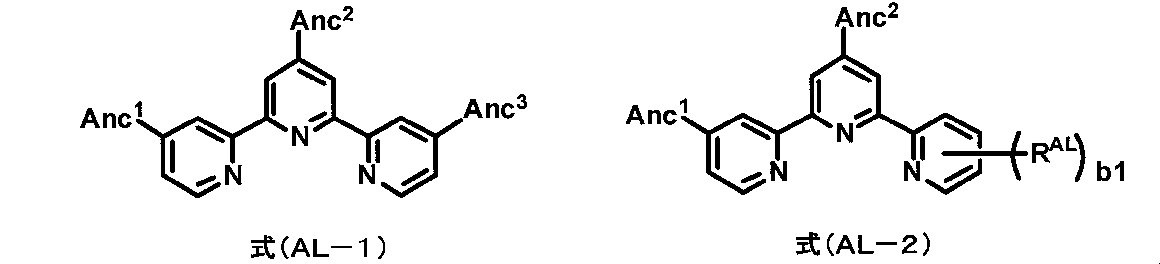
式(AL-1)、(AL-2)中、Anc1~Anc3は各々独立に、-CO2H、-SO3H、-PO3H2またはこれらのいずれかのプロトンが解離した基を表す。RALは置換基を表し、b1は0~4の整数を表す。
(2)Mが、Fe2+、Ru2+またはOs2+である(1)に記載の光電変換素子。
(3)環C1が、チオフェン環、フラン環、ピロール環またはベンゼン環である(1)または(2)に記載の光電変換素子。
(4)環Xuが、ヘテロアリール環基である(1)~(3)のいずれかに記載の光電変換素子。
(5)環Xuが、チオフェン環基またはフラン環基である(1)~(4)のいずれかに記載の光電変換素子。
(6)Luが単結合であり、qが0であり、Ruがアミノ基、アルキルアミノ基またはアリールアミノ基である(1)~(5)のいずれかに記載の光電変換素子。
(7)環Aが、ピリジン環である(1)~(6)のいずれかに記載の光電変換素子。
(8)LAが、式(AL-1)で表される(1)~(7)のいずれかに記載の光電変換素子。(9)半導体微粒子に、さらに酸性基を1つ以上有する共吸着剤が担持されてなる(1)~(8)のいずれかに記載の光電変換素子。
(10)共吸着剤が下記式(CA)で表される(9)に記載の光電変換素子。
(2)Mが、Fe2+、Ru2+またはOs2+である(1)に記載の光電変換素子。
(3)環C1が、チオフェン環、フラン環、ピロール環またはベンゼン環である(1)または(2)に記載の光電変換素子。
(4)環Xuが、ヘテロアリール環基である(1)~(3)のいずれかに記載の光電変換素子。
(5)環Xuが、チオフェン環基またはフラン環基である(1)~(4)のいずれかに記載の光電変換素子。
(6)Luが単結合であり、qが0であり、Ruがアミノ基、アルキルアミノ基またはアリールアミノ基である(1)~(5)のいずれかに記載の光電変換素子。
(7)環Aが、ピリジン環である(1)~(6)のいずれかに記載の光電変換素子。
(8)LAが、式(AL-1)で表される(1)~(7)のいずれかに記載の光電変換素子。(9)半導体微粒子に、さらに酸性基を1つ以上有する共吸着剤が担持されてなる(1)~(8)のいずれかに記載の光電変換素子。
(10)共吸着剤が下記式(CA)で表される(9)に記載の光電変換素子。

式中、RA1は酸性基を有する置換基を表す。RA2は置換基を表す。nAは0以上の整数を表す。
(11) (1)~(10)のいずれかに記載の光電変換素子を具備する色素増感太陽電池。
(12)下記式(I)で表される金属錯体色素。
(11) (1)~(10)のいずれかに記載の光電変換素子を具備する色素増感太陽電池。
(12)下記式(I)で表される金属錯体色素。
M(LD)(LA)(Z)・(CI) 式(I)
式(I)において、Mは金属イオンを表す。
LDは下記式(DL-1)で表される2座の配位子を表す。
LAは下記式(AL-1)または(AL-2)で表される3座の配位子を表す。
Zは単座の配位子を表す。
CIは電荷を中和するのに必要な対イオンを表す。
LDは下記式(DL-1)で表される2座の配位子を表す。
LAは下記式(AL-1)または(AL-2)で表される3座の配位子を表す。
Zは単座の配位子を表す。
CIは電荷を中和するのに必要な対イオンを表す。

式(DL-1)中、環Aはピリジン環、ピリミジン環およびピリダジン環から選ばれる含窒素ヘテロ環を表す。Y1は炭素原子または窒素原子を表し、環C1は炭素アニオンでMに配位する単環もしくは縮環のアリール環またはヘテロアリール環を表す。RAは下記式(U)で表される基である。RBは置換基を表す。RCはハロゲン原子、アルキル基、シクロアルキル基、アシル基、アルキルスルフィニル基、アリールスルフィニル基、アルキルスルホニル基、アリールスルホニル基、シアノ基またはニトロ基を表す。a1は1~4の整数を表し、a2は0~3の整数を表し、a3は0または1以上の整数を表す。RA、RBおよびRCが、各々において、それぞれ複数存在する場合、これらは、互いに同一でも異なってもよい。

式(U)中、Luは単結合、エテニレン基またはエチニレン基を表す。環Xuはアリーレン基またはヘテロアリーレン基を表し、qは0~2の整数を表す。Ruは直鎖もしくは分岐のアルキル基、アルコキシ基、アルキルチオ基、アルキニル基、アルケニル基、シリルオキシ基、アミノ基、アルキルアミノ基またはアリールアミノ基を表す。ただし、環Xuがアリーレン基の場合、Ruは直鎖もしくは分岐のアルキル基、アルコキシ基、アルキルチオ基、アルキニル基、アルケニル基またはシリルオキシ基である。nuは1~4の整数を表し、nuが2以上のとき、複数のRuは互いに同一でも異なってもよく、互いに結合して環を形成してもよい。
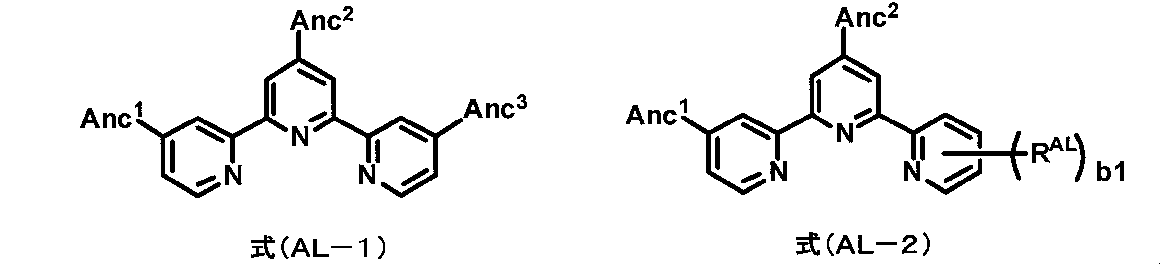
式(AL-1)、(AL-2)中、Anc1~Anc3は各々独立に、-CO2H、-SO3H、-PO3H2またはこれらのいずれかのプロトンが解離した基を表す。RALは置換基を表し、b1は0~4の整数を表す。
(13) (12)に記載の金属錯体色素を溶解してなる色素溶液。
(14)有機溶媒中に、金属錯体色素を0.001~0.1質量%含有し、含水率が0.1質量%以下である(13)に記載の色素溶液。
(15)色素溶液が、さらに共吸着剤を含有する(13)または(14)に記載の色素溶液。
(16)共吸着剤が、下記式(CA)で表される(15)に記載の色素溶液。
(13) (12)に記載の金属錯体色素を溶解してなる色素溶液。
(14)有機溶媒中に、金属錯体色素を0.001~0.1質量%含有し、含水率が0.1質量%以下である(13)に記載の色素溶液。
(15)色素溶液が、さらに共吸着剤を含有する(13)または(14)に記載の色素溶液。
(16)共吸着剤が、下記式(CA)で表される(15)に記載の色素溶液。

式中、RA1は酸性基を有する置換基を表す。RA2は置換基を表す。nAは0以上の整数を表す。
(17)半導体微粒子を付与した導電性支持体に、(13)~(16)のいずれかに記載の色素溶液から得られてなる組成物を塗布し、塗布後の該組成物を硬化させて感光体層としてなる色素増感太陽電池用の色素吸着電極。
(18) (17)に記載の色素増感太陽電池用の色素吸着電極、電解質および対極を用いて組み立てる色素増感太陽電池の製造方法。
(17)半導体微粒子を付与した導電性支持体に、(13)~(16)のいずれかに記載の色素溶液から得られてなる組成物を塗布し、塗布後の該組成物を硬化させて感光体層としてなる色素増感太陽電池用の色素吸着電極。
(18) (17)に記載の色素増感太陽電池用の色素吸着電極、電解質および対極を用いて組み立てる色素増感太陽電池の製造方法。
本明細書において「~」を用いて表される数値範囲は、その前後に記載される数値を下限値および上限値として含む範囲を意味する。
本明細書において、特段の断りがない限り、炭素-炭素二重結合については、分子内にE型及びZ型が存在する場合、そのいずれであっても、またそれらの混合物であってもよい。特定の符号で表示された置換基や連結基、配位子等(以下、置換基等という)が複数ある場合、あるいは複数の置換基等を同時もしくは択一的に規定する場合には、特段の断りがない限り、それぞれの置換基等は互いに同一でも異なっていてもよい。このことは、置換基等の数の規定についても同様である。また、複数の置換基等が近接する場合(特に、隣接する場合)には特段の断りがない限り、それらが互いに連結して環を形成してもよい。また、環、例えば脂環、芳香環、ヘテロ環、はさらに縮環して縮合環を形成していてもよい。
本発明においては、各置換基は、特に断らない限り、さらに置換基で置換されていてもよい。
本発明においては、各置換基は、特に断らない限り、さらに置換基で置換されていてもよい。
本発明により、光電変換効率の向上に加え、耐久性が大きく改善され、しかも繰り返し製造してもこれらの性能が安定して維持される光電変換素子、色素増感太陽電池、金属錯体色素を含有する色素溶液、色素吸着電極および色素増感太陽電池の製造方法を提供することが可能となった。
<<光電変換素子および色素増感太陽電池>>
本発明の光電変換素子は、例えば、図1に示すように、導電性支持体1、色素(金属錯体色素)21が担持されることにより増感された半導体微粒子22を含む感光体層2、正孔輸送層である電荷移動体層3および対極4からなる。感光体層2を設置した導電性支持体1は光電変換素子10において作用電極として機能する。本実施形態においては、この光電変換素子10を外部回路6で動作手段M(電動モーター)に仕事をさせる電池用途に使用できるようにした色素増感太陽電池を利用したシステム100として示している。
本発明の光電変換素子は、例えば、図1に示すように、導電性支持体1、色素(金属錯体色素)21が担持されることにより増感された半導体微粒子22を含む感光体層2、正孔輸送層である電荷移動体層3および対極4からなる。感光体層2を設置した導電性支持体1は光電変換素子10において作用電極として機能する。本実施形態においては、この光電変換素子10を外部回路6で動作手段M(電動モーター)に仕事をさせる電池用途に使用できるようにした色素増感太陽電池を利用したシステム100として示している。
本実施形態において受光電極5は、導電性支持体1、および色素(金属錯体色素)21が吸着した半導体微粒子22を含む感光体層2よりなる。感光体層2は目的に応じて設計され、単層構成でも多層構成でもよい。一層の感光体層中の色素(金属錯体色素)21は一種類でも多種類の混合でもよいが、そのうちの少なくとも1種には、後述する本発明の金属錯体色素を用いる。感光体層2に入射した光は色素(金属錯体色素)21を励起する。励起された色素はエネルギーの高い電子を有しており、この電子が色素(金属錯体色素)21から半導体微粒子22の伝導帯に渡され、さらに拡散によって導電性支持体1に到達する。このとき色素(金属錯体色素)21は酸化体となっているが、電極上の電子が外部回路6で仕事をしながら、対極4を経由して、色素(金属錯体色素)21の酸化体および電解質が存在する感光体層2に戻ることで太陽電池として働く。
本発明において、光電変換素子もしくは色素増感太陽電池に用いられる材料および各部材の作製方法については、この種のものにおいて通常なされる作製方法を採用すればよく、例えば米国特許第4,927,721号明細書、米国特許第4,684,537号明細書、米国特許第5,084,365号明細書、米国特許第5,350,644号明細書、米国特許第5,463,057号明細書、米国特許第5,525,440号明細書、特開平7-249790号公報、特開2004-220974号公報、特開2008-135197号公報を参照することができる。
以下、主たる部材について概略を説明する。
以下、主たる部材について概略を説明する。
<感光体層>
感光体層は後述する電解質を含み、下記本発明の金属錯体色素を含む増感色素が担持された半導体微粒子を含む層である。
感光体層は後述する電解質を含み、下記本発明の金属錯体色素を含む増感色素が担持された半導体微粒子を含む層である。
<<金属錯体色素>>
本発明の金属錯体色素は、下記式(I)で表される。
本発明の金属錯体色素は、下記式(I)で表される。
M(LD)(LA)(Z)・(CI) 式(I)
式(I)において、Mは金属イオンを表す。
LDは下記式(DL-1)で表される2座の配位子を表す。
LAは下記式(AL-1)または(AL-2)で表される3座の配位子を表す。
Zは単座の配位子を表す。
CIは電荷を中和するのに必要な対イオンを表す。
LDは下記式(DL-1)で表される2座の配位子を表す。
LAは下記式(AL-1)または(AL-2)で表される3座の配位子を表す。
Zは単座の配位子を表す。
CIは電荷を中和するのに必要な対イオンを表す。

式(DL-1)中、環Aはピリジン環、ピリミジン環およびピリダジン環から選ばれる含窒素ヘテロ環を表す。Y1は炭素原子または窒素原子を表し、環C1は炭素アニオンでMに配位する単環もしくは縮環のアリール環またはヘテロアリール環を表す。RAは下記式(U)で表される基である。RBは置換基を表す。RCはハロゲン原子、アルキル基、シクロアルキル基、アシル基、アルキルスルフィニル基、アリールスルフィニル基、アルキルスルホニル基、アリールスルホニル基、シアノ基またはニトロ基を表す。a1は1~4の整数を表し、a2は0~3の整数を表し、a3は0または1以上の整数を表す。RA、RBおよびRCが、各々において、それぞれ複数存在する場合、これらは、互いに同一でも異なってもよい。

式(U)中、Luは単結合、エテニレン基またはエチニレン基を表す。環Xuはアリーレン基またはヘテロアリーレン基を表し、qは0~2の整数を表す。Ruは直鎖もしくは分岐のアルキル基、アルコキシ基、アルキルチオ基、アルキニル基、アルケニル基、シリルオキシ基、アミノ基、アルキルアミノ基またはアリールアミノ基を表す。ただし、環Xuがアリーレン基の場合、Ruは直鎖もしくは分岐のアルキル基、アルコキシ基、アルキルチオ基、アルキニル基、アルケニル基またはシリルオキシ基である。nuは1~4の整数を表し、nuが2以上のとき、複数のRuは互いに同一でも異なってもよく、互いに結合して環を形成してもよい。

式(AL-1)、(AL-2)中、Anc1~Anc3は各々独立に、-CO2H、-SO3H、-PO3H2またはこれらのいずれかのプロトンが解離した基を表す。RALは置換基を表し、b1は0~4の整数を表す。
- 金属イオンM -
Mは金属錯体色素の中心金属イオンを表し、長周期律表上6~12族の金属原子のイオンが挙げられ、より好ましくはRu、Fe、Os、Cu、W、Cr、Mo、Ni、Pd、Pt、Co、Ir、Rh、Re、MnまたはZnのイオンであり、さらに好ましくはFe2+、Ru2+またはOs2+であり、最も好ましくはRu2+である。
Mは金属錯体色素の中心金属イオンを表し、長周期律表上6~12族の金属原子のイオンが挙げられ、より好ましくはRu、Fe、Os、Cu、W、Cr、Mo、Ni、Pd、Pt、Co、Ir、Rh、Re、MnまたはZnのイオンであり、さらに好ましくはFe2+、Ru2+またはOs2+であり、最も好ましくはRu2+である。
- 配位子LD -
本発明では、配位子LDとして、前記式(DL-1)で表される配位子を使用する。
本発明では、配位子LDとして、前記式(DL-1)で表される配位子を使用する。
本発明では、本発明の式(I)から明らかなように、配位子LDと配位子LAに特定の配位子構造の化合物を組合せて、金属イオンMに配位させるものであり、配位子LAは、半導体微粒子表面に吸着する酸性基を有する配位子であり、配位子LDは、半導体微粒子表面に吸着することを想定しない配位子である。
本発明においては、配位子LAの半導体微粒子表面への吸着力を高めるため、配位子LDの電子効果、すなわち、配位子LAの酸性基に対して、配位子LAではなく、配位子LDを介して吸着力を調整するものであり、従来のピリジン系配位子よりもπ電子受容性の高い2座の配位子を使用することが有効であると考えられる。さらに、環の変更や置換基修飾による色素の会合抑制、配位力向上が有効であると考えられる。
本発明においては、配位子LAの半導体微粒子表面への吸着力を高めるため、配位子LDの電子効果、すなわち、配位子LAの酸性基に対して、配位子LAではなく、配位子LDを介して吸着力を調整するものであり、従来のピリジン系配位子よりもπ電子受容性の高い2座の配位子を使用することが有効であると考えられる。さらに、環の変更や置換基修飾による色素の会合抑制、配位力向上が有効であると考えられる。
このような目的のために有効な配位子LDは、金属イオンMに対して、窒素原子が配位するピリジン環、ピリミジン環およびピリダジン環から選ばれる含窒素ヘテロ環と、炭素アニオンが配位するアリール環もしくはヘテロアリール環が連結した2座の配位子であって、少なくとも、金属イオンMに対して、窒素原子が配位するピリジン環、ピリミジン環およびピリダジン環から選ばれる含窒素ヘテロ環に特定の置換基を有する前記式(DL-1)が有用である。
以下に、式(DL-1)で表される配位子を詳細に説明する。
環Aは、ピリジン環、ピリミジン環およびピリダジン環から選ばれる含窒素ヘテロ環を表し、ピリジン環が好ましい。なお、該環AにはRAが少なくとも1つ置換する。
RAは前記式(U)を表し、a1は1~4の整数を表すが、a1は1または2が好ましく、1がより好ましい。
以下に、式(U)で表される基を詳細に説明する。
Luは単結合、エテニレン基またはエチニレン基を表すが、単結合、エテニレン基が好ましい。
環Xuのアリーレン基におけるアリール環は、環C1におけるアリール環が挙げられ、ベンゼン環が好ましい。
環Xuのヘテロアリーレン基におけるヘテロアリール環は、環C1におけるヘテロアリール環が挙げられ、チオフェン環またはフラン環が好ましく、チオフェン環もしくは縮環されたチオフェン環がより好ましい。
チオフェン環に縮環する環は、ベンゼン環、エチレンジオキシ基で環形成された環、チオフェン環もしくはこれらを組み合わせた環が好ましい。
Luは単結合、エテニレン基またはエチニレン基を表すが、単結合、エテニレン基が好ましい。
環Xuのアリーレン基におけるアリール環は、環C1におけるアリール環が挙げられ、ベンゼン環が好ましい。
環Xuのヘテロアリーレン基におけるヘテロアリール環は、環C1におけるヘテロアリール環が挙げられ、チオフェン環またはフラン環が好ましく、チオフェン環もしくは縮環されたチオフェン環がより好ましい。
チオフェン環に縮環する環は、ベンゼン環、エチレンジオキシ基で環形成された環、チオフェン環もしくはこれらを組み合わせた環が好ましい。
上記の縮環したチオフェン環、すなわち2価の縮環したチオフェン環は以下の基が好ましい。

なお、上記の各環は置換基を有していてもよく、該置換基としては後述の置換基Tが挙げられる。該置換基としては、アルキル基、アリール基、ヘテロ環基、アルコキシ基、アリールオキシ基、アルキルチオ基、アリールチオ基、アミノ基が好ましい。
qは0~2の整数を表すが、0または1が好ましく、0がより好ましい。
Ruは直鎖もしくは分岐のアルキル基、アルコキシ基、アルキルチオ基、アルキニル基、アルケニル基、シリルオキシ基、アミノ基、アルキルアミノ基またはアリールアミノ基を表すが、環Xuがアリーレン基またはヘテロアリーレン基の場合、Ruは直鎖もしくは分岐のアルキル基、アルコキシ基、アルキルチオ基、アルキニル基、アルケニル基またはシリルオキシ基である。
上記の直鎖もしくは分岐のアルキル基としては、炭素数1~20が好ましく、炭素数3~18がより好ましく、炭素数3~14がさらに好ましく、例えば、メチル、エチル、プロピル、イソプロピル、t-ブチル、ペンチル、ヘキシル、ヘプチル、オクチル、イソオクチル、2-エチルヘキシル、ノニル、トリデシル等が挙げられ、好ましくは、プロピル、ペンチル、ヘキシル、ヘプチル、オクチル、2-エチルヘキシル、ノニル、トリデシルである。
上記のアルコキシ基としては、炭素数1~20が好ましく、炭素数6~8がより好ましく、炭素数6がさらに好ましく、例えば、メトキシ、エトキシ、ヘキシルオキシ、2-エチルペンチルオキシ、オクチルオキシ、2-エチルヘキシルオキシ等が挙げられ、好ましくは、ヘキシルオキシ、2-エチルペンチルオキシ、オクチルオキシ、2-エチルヘキシルオキシである。
上記のアルキルチオ基としては、炭素数1~20が好ましく、炭素数2~8がより好ましく、炭素数6がさらに好ましく、例えば、メチルチオ、エチルチオ、プロピルチオ、イソプロピルチオ、ブチルチオ、ヘキシルチオ、オクチルチオ、2-エチルヘキシルチオ等が挙げられ、好ましくは、ヘキシルチオ、オクチルチオ、2-エチルヘキシルチオである。
上記のアルキニル基としては、炭素数2~20が好ましく、炭素数3~13がより好ましく、炭素数7がさらに好ましく、例えば、1-プロピニル、2-プロピニル、2-ブチニル、1-ヘプチニル、1-オクチニル等が挙げられる。
上記のアルケニル基としては、炭素数2~20が好ましく、炭素数3~13がより好ましく、炭素数7がさらに好ましく、例えば、ビニル、アリル、2-プロペニル、2-ブテニル、1-ヘプテニル、オレイル等が挙げられる。
上記のシリルオキシ基としては、シリル原子に、アルキル基、アリール基が置換したシリルオキシ基が好ましく、置換するアルキル基の炭素数は1~20が好ましく、1~12がより好ましく、3~8がさらに好ましい。置換するアリール基は、炭素数6~20が好ましく、6~12がより好ましい。シリルオキシ基は、このうち、トリアルキルシリルオキシ基が好ましい。
シリルオキシ基としての炭素数は3~60が好ましく、3~40がより好ましく、8~20がさらに好ましい。例えば、トリメチルシリルオキシ、トリエチルシリルオキシ、トリブチルシリルオキシ、ジメチルベンジルシリルオキシ、ジメチルフェニルシリルオキシ、ベンジルジフェニルシリルオキシ等が挙げられる。
シリルオキシ基としての炭素数は3~60が好ましく、3~40がより好ましく、8~20がさらに好ましい。例えば、トリメチルシリルオキシ、トリエチルシリルオキシ、トリブチルシリルオキシ、ジメチルベンジルシリルオキシ、ジメチルフェニルシリルオキシ、ベンジルジフェニルシリルオキシ等が挙げられる。
Ruは、なかでも、Luが単結合で、qが0の場合、アミノ基、アルキルアミノ基またはアリールアミノ基が好ましい。
Ruは、特に吸収の長波長化の観点から、アミノ基、アルキルアミノ基またはアリールアミノ基のなかでも、アルキルアミノ基またはアリールアミノ基が好ましく、アリールアミノ基がより好ましい。アリールアミノ基としては、N-アルキル-N-アリールアミノ基、ジアリールアミノ基が挙げられ、ジアリールアミノ基が好ましい。
Ruは、下記式(SA)で表される基が好ましい。
Ruは、特に吸収の長波長化の観点から、アミノ基、アルキルアミノ基またはアリールアミノ基のなかでも、アルキルアミノ基またはアリールアミノ基が好ましく、アリールアミノ基がより好ましい。アリールアミノ基としては、N-アルキル-N-アリールアミノ基、ジアリールアミノ基が挙げられ、ジアリールアミノ基が好ましい。
Ruは、下記式(SA)で表される基が好ましい。

式中、RuA1およびRuA2は各々独立にアルキル基またはアリール基を表す。RuA1とRuA2は互いに結合して環を形成してもよい。RuA1およびRuA2のどちらか一方がアリール基であることが好ましく、RuA1およびRuA2がともにアリール基であることがより好ましい。
ここで、RuA1とRuA2が互いに結合して形成された環の基は、5員環または6員環の炭素環の基もしくはヘテロ環の基が好ましい。
RuA1とRuA2が互いに結合して形成された環の基は以下の基がさらに好ましい。
RuA1とRuA2が互いに結合して形成された環の基は以下の基がさらに好ましい。
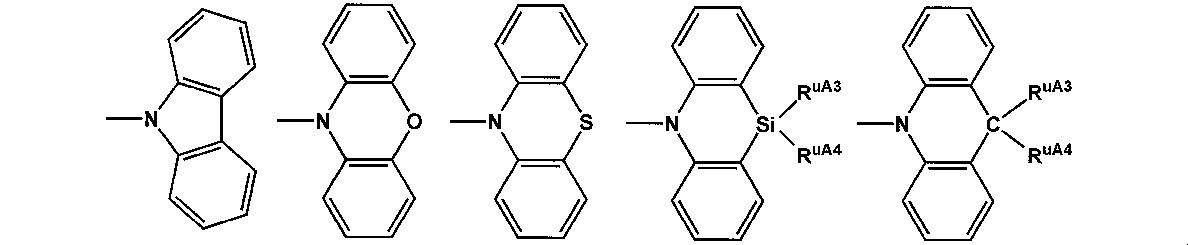
ここで、RuA3およびRuA4は各々独立にアルキル基を表す。
RuA3およびRuA4におけるアルキル基の炭素数は1~20が好ましく、1~12がより好ましく、1~8がさらに好ましく、メチルが特に好ましい。
RuA3およびRuA4におけるアルキル基の炭素数は1~20が好ましく、1~12がより好ましく、1~8がさらに好ましく、メチルが特に好ましい。
式(U)中、複数のRuが、互いに結合して形成する環としては、5員環または6員環の炭素環もしくはヘテロ環が好ましい。これらの環は芳香環であっても構わない。好ましい環としては、エチレンジオキシ基で形成される環、アリール環、ヘテロアリール環が挙げられ、該アリール環、ヘテロアリール環は、後述の環C1で挙げるアリール環、ヘテロアリール環が好ましい。
上記式(U)で表される基のうち、Ruは、Luが結合する環Xuの原子の位置に対してオルト位、またはメタ位に結合するのが好ましい。
上記式(U)で表される基は、なかでも、Luが単結合で、qが0であって、Ruがアミノ基、アルキルアミノ基またはアリールアミノ基である場合が好ましく、さらに環Aがピリジン環である場合が、特に好ましい。
式(DL-1)において、Y1は炭素原子または窒素原子を表す。
環C1は炭素アニオンで配位する単環もしくは縮環のアリール環またはヘテロアリール環を表す。ここで、Y1と炭素アニオンとの結合は、単結合であっても二重結合であっても構わない。
環C1におけるアリール環はベンゼン環、ナフタレン環が挙げられ、ベンゼン環が好ましい。
環C1におけるヘテロアリール環は、環構成ヘテロ原子が、酸素原子、硫黄原子、窒素原子が好ましく、これらが複数組み合わされていてもよい。なお、環構成原子に窒素原子を含む場合、該窒素原子は、Y1に隣接する場合は、置換基を有する窒素原子が好ましく、Y1に隣接しない場合は、該窒素原子に水素原子が置換していてもよく、=N-であっても構わないが、置換基を有する窒素原子が好ましい。具体的には、-N(Rx)-のように、Rxが置換基であって、該置換基としては後述の置換基Tが挙げられるが、アルキル基、アリール基が好ましく、アルキル基がより好ましい。
環C1は炭素アニオンで配位する単環もしくは縮環のアリール環またはヘテロアリール環を表す。ここで、Y1と炭素アニオンとの結合は、単結合であっても二重結合であっても構わない。
環C1におけるアリール環はベンゼン環、ナフタレン環が挙げられ、ベンゼン環が好ましい。
環C1におけるヘテロアリール環は、環構成ヘテロ原子が、酸素原子、硫黄原子、窒素原子が好ましく、これらが複数組み合わされていてもよい。なお、環構成原子に窒素原子を含む場合、該窒素原子は、Y1に隣接する場合は、置換基を有する窒素原子が好ましく、Y1に隣接しない場合は、該窒素原子に水素原子が置換していてもよく、=N-であっても構わないが、置換基を有する窒素原子が好ましい。具体的には、-N(Rx)-のように、Rxが置換基であって、該置換基としては後述の置換基Tが挙げられるが、アルキル基、アリール基が好ましく、アルキル基がより好ましい。
環C1におけるヘテロアリール環は、5員環または6員環が好ましく、5員環がより好ましい。
環C1は縮環であってもよく、縮環の場合、上記のアリール単環またはヘテロアリール単環に、アリール環、脂環、およびヘテロアリール環を含むヘテロ環が縮環しているものを含む。
アリール環の場合、ナフタレン環が挙げられ、ベンゼン環にエチレンジオキシで環形成されたものも好ましい。
環C1は縮環であってもよく、縮環の場合、上記のアリール単環またはヘテロアリール単環に、アリール環、脂環、およびヘテロアリール環を含むヘテロ環が縮環しているものを含む。
アリール環の場合、ナフタレン環が挙げられ、ベンゼン環にエチレンジオキシで環形成されたものも好ましい。
ヘテロアリール環は、単環の場合、5員環では、フラン環、チオフェン環、ピロール環、ピラゾール環、イミダゾール環、トリアゾール環、オキサゾール環、イソオキサゾール環、チアゾール環、イソチアゾール環、フラザン環が挙げられ、縮環の場合は、これらの環にベンゼン環が縮環した環、例えば、ベンゾフラン環、ベンゾチオフェン環、インドール環、ベンゾイミダゾール環等が挙げられる。また、エチレンジオキシで縮環を形成する環も好ましい。
ヘテロアリール環は、単環の場合、6員環では、ピリジン環、ピラジン環、ピリミジン環、ピリダジン環等が挙げられ、縮環としては、これらの環とベンゼン環との縮環が挙げられる。
本発明において、環C1は、チオフェン環、フラン環、ピロール環、ベンゼン環が好ましい。
環C1は、下記式(C1-a)~(C1-e)で表される環が好ましい。
環C1は、下記式(C1-a)~(C1-e)で表される環が好ましい。

ここで、RCおよびa3は、前記式(DL-1)におけるRCおよびa3と同義であり、好ましい範囲も同じである。なお、各式におけるa3は、式(C1-a)および(C1-b)では0~2の整数が好ましく、式(C1-c)では0~3の整数が好ましく、式(C1-d)では0~2の整数が好ましく、式(C1-e)では0~4の整数が好ましい。
Rxは、前述のRxと同じで、置換基を表し、該置換基は、後述の置換基Tが挙げられるが、アルキル基、アリール基が好ましく、アルキル基がより好ましい。
Rxは、前述のRxと同じで、置換基を表し、該置換基は、後述の置換基Tが挙げられるが、アルキル基、アリール基が好ましく、アルキル基がより好ましい。
式(DL-1)におけるRBは置換基を表し、該置換基としては、後述の置換基Tが挙げられる。なお、a2が2以上の場合、複数存在するRBは互いに同一でも異なってもよく、a3が2以上の場合、複数存在するRCは互いに同一でも異なってもよい。
RBにおける置換基は、アルキル基、アルケニル基、アルキニル基、シクロアルキル基、シクロアルケニル基、アリール基、ヘテロ環基、アルコキシ基、アリールオキシ基、アルキルチオ基、アリールチオ基、アミノ基、ハロゲン原子が好ましく、アルキル基、アルケニル基、アルキニル基、シクロアルキル基、シクロアルケニル基、アリール基、ヘテロ環基、アルコキシ基、アリールオキシ基、アルキルチオ基、アリールチオ基がより好ましい。
a2は、0または1が好ましく、0が特に好ましい。
RCは、アルキル基、シクロアルキル基、ハロゲン原子、アシル基、アルキルスルフィニル基、アリールスルフィニル基、アルキルスルホニル基、アリールスルホニル基、シアノ基、ニトロ基を表し、アルキル基、ハロゲン原子が好ましい。
上記のアルキル基は、無置換アルキル基、ハロゲン原子が置換したアルキル基が好ましく、なかでもパーハロゲノアルキル基が好ましく、パーフルオロアルキル基がより好ましく、トリフルオロメチル基が特に好ましい。ハロゲン原子はフッ素原子が好ましい。なお、アルキル基の炭素数は、1~20が好ましく、1~12がより好ましく、1~8がさらに好ましく、1または2がより好ましく、1が特に好ましい。
上記のシクロアルキル基の炭素数は、3~20が好ましく、3~16がより好ましく、3~12がさらに好ましく、例えば、シクロプロピル、シクロペンチル、シクロヘキシル、3-メチルシクロペンチル、4-メチルシクロヘキシル、4-エチルシクロヘキシル、3,5-ジメチルシクロヘキシル等が挙げられる。
上記のアシル基は、ホルミル基、アルキルカルボニル基、アルケニルカルボニル基、シクロアルキルカルボニル基、アリールカルボニル基、ヘテロ環カルボニル基を含み、アシル基の炭素数は、1~20が好ましく、1~16がより好ましく、1~12がさらに好ましい。例えば、ホルミル、アセチル、プロピオニル、ブチリル、ピバロイル、シクロヘキシルカルボニル、ベンゾイル、アクリル、メタクリル、ベンゾイル、ナフトイル、ピリジニルカルボニル等が挙げられる。
上記のアルキルスルフィニル基、アリールスルフィニル基の炭素数は1~20が好ましく、1~16がより好ましく、1~8がさらに好ましく、例えば、メチルスルフィニル、エチルスルフィニル、プロピルスルフィニル、ブチルスルフィニル、ペンチルスルフィニル、ヘキシルスルフィニル、フェニルスルフィニル、1-ナフチルスルフィニル、2-ナフチルスルフィニル、p-トルエンスルフィニル等が挙げられる。
上記のアルキルスルホニル基、アリールスルホニル基の炭素数は1~20が好ましく、1~16がより好ましく、1~8がさらに好ましく、例えば、メチルスルホニル、エチルスルホニル、シクロヘキシルスルホニル、フェニルスルホニル、1-ナフチルスルホニル、2-ナフチルスルホニル、p-トルエンスルホニル等が挙げられる。
a3は0~2の整数が好ましく、1または2がより好ましい。
なお、式(DL-1)中、RA、RBおよびRCにおける置換基の炭素数の観点からは、炭素数が6~40が好ましく、6~36がより好ましく、6~24がさらに好ましく、8~24が特に好ましい。このため、RA、RBおよびRCの少なくとも1つは、この好ましい範囲の炭素数であることが好ましい。特に、RAにおいては、Ruが上記炭素数であることが好ましい。
また、RA、RBおよびRCの炭素数の合計は、6~50が好ましく、8~30がより好ましく、8~25がさらに好ましい。
RA、RBおよびRCの少なくとも1つが、ヘテロアリール環を含む基であることが好ましく、なかでもチオフェン環を含む基であることが好ましい。
また、RA、RBおよびRCの炭素数の合計は、6~50が好ましく、8~30がより好ましく、8~25がさらに好ましい。
RA、RBおよびRCの少なくとも1つが、ヘテロアリール環を含む基であることが好ましく、なかでもチオフェン環を含む基であることが好ましい。
なかでも、RAにおけるRuがアミノ基、アルキルアミノ基またはアリールアミノ基、特にアリールアミノ基であるものが好ましく、この場合、好ましくは、Luが単結合で、qが0の場合である。
以下に、本発明の式(DL-1)で表される配位子の具体例を示すが、本発明はこれらに限定されない。


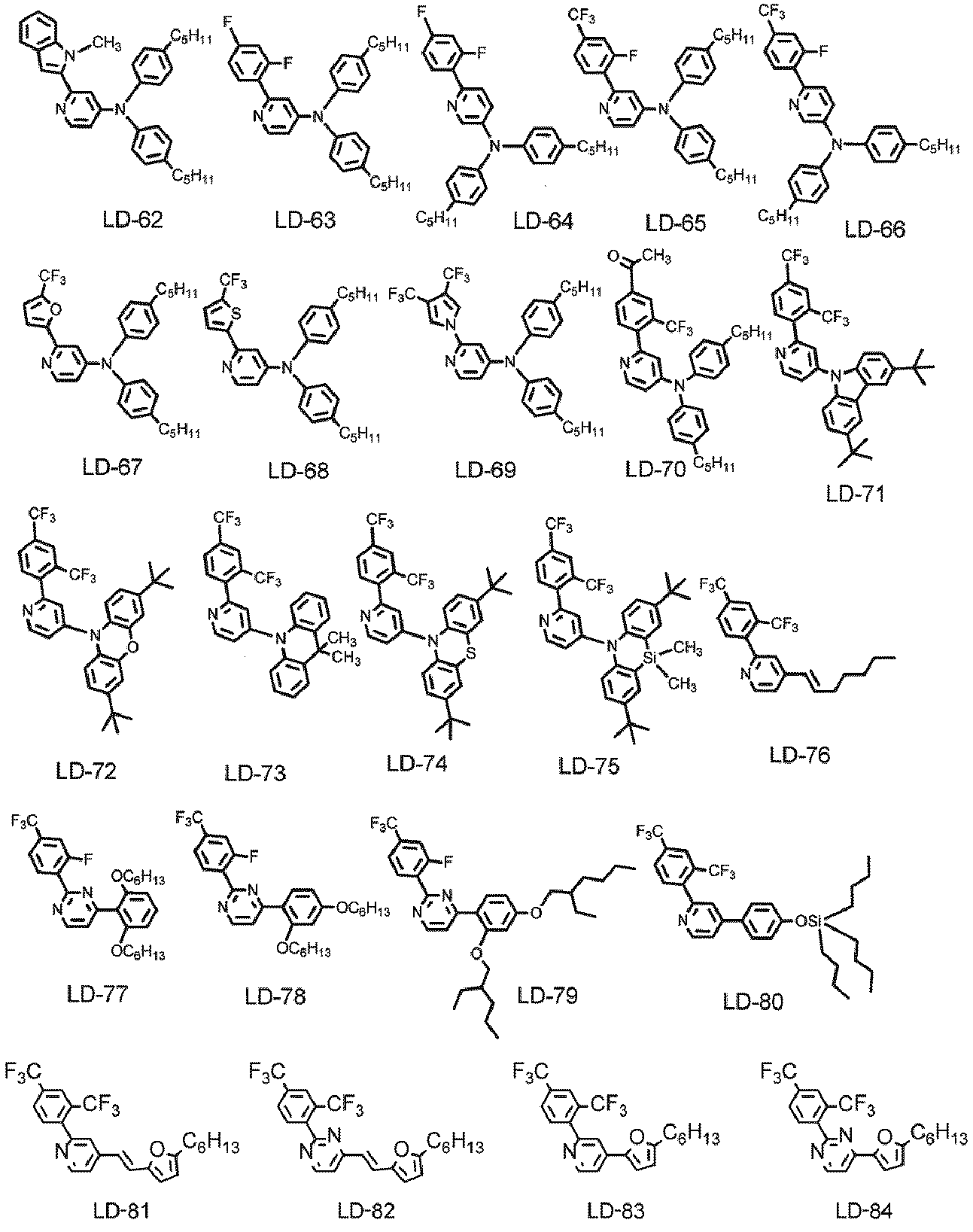
- 配位子LA -
本発明において、配位子LAは、前記式(AL-1)または(AL-2)で表される配位子である。
本発明において、配位子LAは、前記式(AL-1)または(AL-2)で表される配位子である。
式(AL-1)および(AL-2)において、Anc1~Anc3は、-CO2H、-SO3H、-PO3H2、またはこれらのプロトンが解離した基を表す。
ここで、プロトンが解離した基とは、例えば、上記のアニオンもしくはその塩であり、金属イオンMとの配位のためにはアニオンが好ましい。例えば、-CO2 -、-SO3 -、-PO3H-、-PO3 2-である。
本発明においては、-CO2Hもしくはそのプロトンが解離した基が好ましい。
ここで、プロトンが解離した基とは、例えば、上記のアニオンもしくはその塩であり、金属イオンMとの配位のためにはアニオンが好ましい。例えば、-CO2 -、-SO3 -、-PO3H-、-PO3 2-である。
本発明においては、-CO2Hもしくはそのプロトンが解離した基が好ましい。
式(AL-2)において、RALは置換基を表し、該置換基としては、後述の置換基Tが挙げられる。
RALは、アルキル基、シクロアルキル基、アルケニル基、アルキニル基、アリール基、芳香族ヘテロ環基、置換アミノ基が好ましい。ここで、置換アミノ基としては、アルキルスルホンアミド基が好ましく、アルキル基の炭素数は特に限定されないが、好ましくは1~6である。また、芳香族ヘテロ環基としてはチエニル基、フラニル基が好ましく、チエニル基がより好ましい。
b1は0~4の整数を表すが、0または1が好ましく、1がより好ましい。
RALは、アルキル基、シクロアルキル基、アルケニル基、アルキニル基、アリール基、芳香族ヘテロ環基、置換アミノ基が好ましい。ここで、置換アミノ基としては、アルキルスルホンアミド基が好ましく、アルキル基の炭素数は特に限定されないが、好ましくは1~6である。また、芳香族ヘテロ環基としてはチエニル基、フラニル基が好ましく、チエニル基がより好ましい。
b1は0~4の整数を表すが、0または1が好ましく、1がより好ましい。
以下に、配位子LAの具体例を示すが、これによって、本発明がこれらに限定されない。
なお、下記構造において、Anc1~Anc3は解離可能なプロトンが解離していない状態で表記したが、これらのプロトンが解離して、テトラブチルアンモニウムイオン(+NBu4)、トリエチルアンモニウムイオン(+NHEt3)、リチウムイオン、ナトリウムイオン、カリウムイオン、セシウムイオン等とイオン対を形成した塩となっていてもよい。
なお、下記構造において、Anc1~Anc3は解離可能なプロトンが解離していない状態で表記したが、これらのプロトンが解離して、テトラブチルアンモニウムイオン(+NBu4)、トリエチルアンモニウムイオン(+NHEt3)、リチウムイオン、ナトリウムイオン、カリウムイオン、セシウムイオン等とイオン対を形成した塩となっていてもよい。
式(AL-1)で表される配位子の具体例

式(AL-2)で表される配位子の具体例
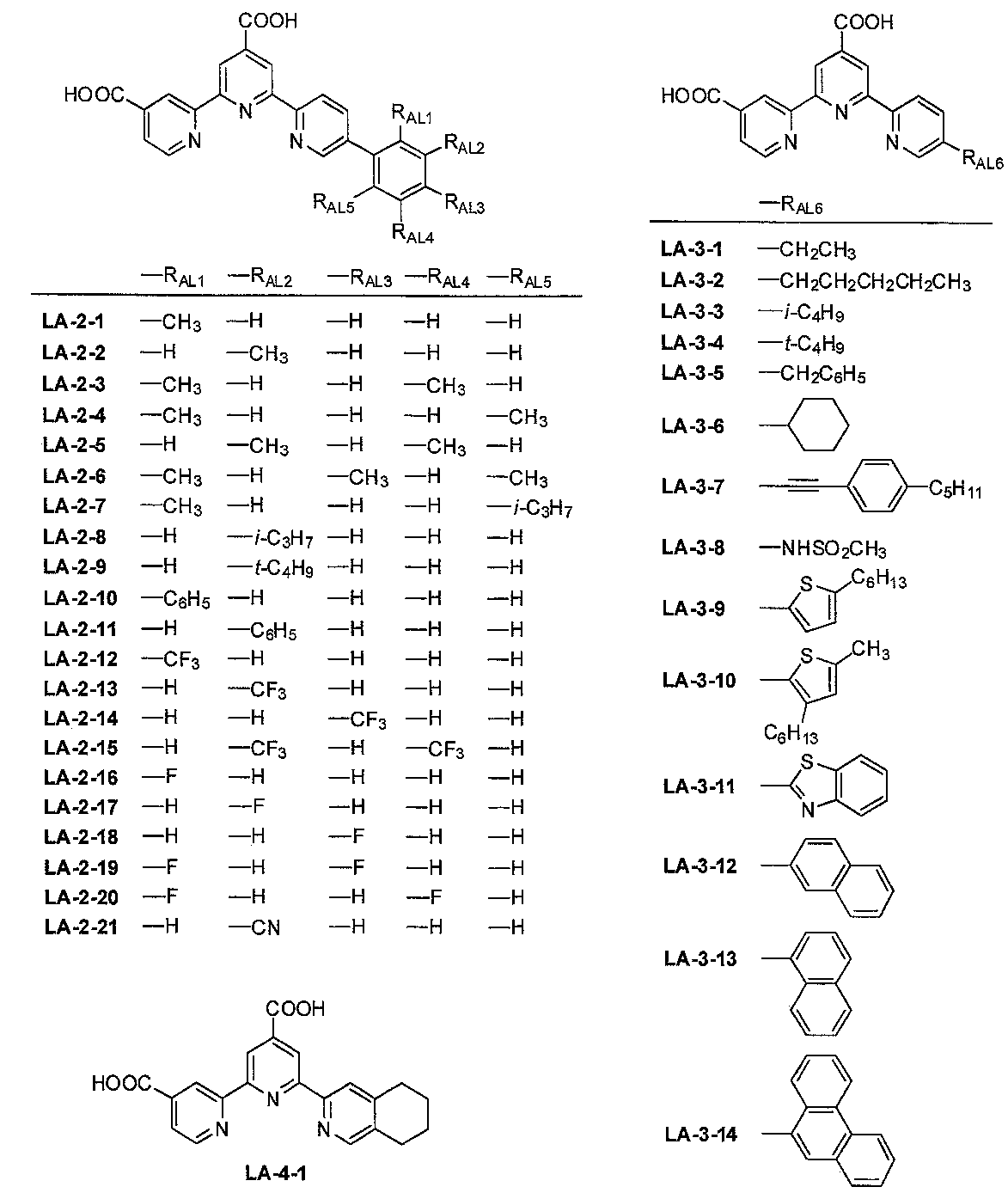
- 配位子Z -
Zは、単座の配位子を表す。Zは、例えば、アシルオキシ基、アシルチオ基、チオアシルオキシ基、チオアシルチオ基、アシルアミノオキシ基、チオカルバメート基、ジチオカルバメート基、チオカルボネート基、ジチオカルボネート基、トリチオカルボネート基、アシル基、チオシアネート基、イソチオシアネート基、シアネート基、イソシアネート基、セレネート基、イソセレネート基、イソセレノシアネート基、シアノ基、アルキルチオ基、アリールチオ基、アルコキシ基およびアリールオキシ基からなる群より選ばれた基で配位する単座の配位子またはハロゲン原子、ホスフィン配位子、カルボニル、ジアルキルケトン、カルボンアミド、チオカルボンアミドおよびチオ尿素からなる群より選ばれる単座の配位子を挙げることができる。Zとして好ましくは、イソチオシアネート基、イソセレノシアネート基、イソシアネート基、ハロゲン原子またはシアノ基である。なお配位子Zがアルキル部位、アルケニル部位、アルキニル部位、アルキレン部位等を含む場合、それらは直鎖状でも分岐状でもよく、置換されていても無置換でもよい。またアリール部位、ヘテロ環部位、シクロアルキル部位等を含む場合、それらは置換されていても無置換でもよく、単環でも縮環していてもよい。
Zは、単座の配位子を表す。Zは、例えば、アシルオキシ基、アシルチオ基、チオアシルオキシ基、チオアシルチオ基、アシルアミノオキシ基、チオカルバメート基、ジチオカルバメート基、チオカルボネート基、ジチオカルボネート基、トリチオカルボネート基、アシル基、チオシアネート基、イソチオシアネート基、シアネート基、イソシアネート基、セレネート基、イソセレネート基、イソセレノシアネート基、シアノ基、アルキルチオ基、アリールチオ基、アルコキシ基およびアリールオキシ基からなる群より選ばれた基で配位する単座の配位子またはハロゲン原子、ホスフィン配位子、カルボニル、ジアルキルケトン、カルボンアミド、チオカルボンアミドおよびチオ尿素からなる群より選ばれる単座の配位子を挙げることができる。Zとして好ましくは、イソチオシアネート基、イソセレノシアネート基、イソシアネート基、ハロゲン原子またはシアノ基である。なお配位子Zがアルキル部位、アルケニル部位、アルキニル部位、アルキレン部位等を含む場合、それらは直鎖状でも分岐状でもよく、置換されていても無置換でもよい。またアリール部位、ヘテロ環部位、シクロアルキル部位等を含む場合、それらは置換されていても無置換でもよく、単環でも縮環していてもよい。
- 電荷中和対イオンCI -
CIは電荷を中和させるのに対イオンが必要な場合の対イオンを表す。一般に、色素が陽イオンまたは陰イオンであるか、あるいは正味のイオン電荷を有するかどうかは、金属錯体色素中の金属、配位子および置換基に依存する。
置換基が解離性基を有することなどにより、金属錯体色素は解離して負電荷を有していてもよい。この場合、金属錯体色素全体の電荷はCIにより電気的に中性とされる。
CIは電荷を中和させるのに対イオンが必要な場合の対イオンを表す。一般に、色素が陽イオンまたは陰イオンであるか、あるいは正味のイオン電荷を有するかどうかは、金属錯体色素中の金属、配位子および置換基に依存する。
置換基が解離性基を有することなどにより、金属錯体色素は解離して負電荷を有していてもよい。この場合、金属錯体色素全体の電荷はCIにより電気的に中性とされる。
対イオンCIが正の対イオンの場合、例えば、対イオンCIは、無機もしくは有機のアンモニウムイオン(例えばテトラアルキルアンモニウムイオン、ピリジニウムイオン等)、ホスホニウムイオン(例えばテトラアルキルホスホニウムイオン、アルキルトリフェニルホスホニウムイオン等)、アルカリ金属イオン、金属錯体イオンまたはプロトンである。正の対イオンとしては、無機もしくは有機のアンモニウムイオン(トリエチルアンモニウムイオン、テトラブチルアンモニウムイオン等)またはプロトンが好ましい。
対イオンCIが負の対イオンの場合、例えば、対イオンCIは、無機陰イオンでも有機陰イオンでもよい。例えば、水酸化物イオン、ハロゲン陰イオン(例えば、フッ化物イオン、塩化物イオン、臭化物イオン、ヨウ化物イオン等)、置換もしくは無置換のアルキルカルボン酸イオン(酢酸イオン、トリフルオロ酢酸イオン等)、置換もしくは無置換のアリールカルボン酸イオン(安息香酸イオン等)、置換もしくは無置換のアルキルスルホン酸イオン(メタンスルホン酸イオン、トリフルオロメタンスルホン酸イオン等)、置換もしくは無置換のアリールスルホン酸イオン(例えばp-トルエンスルホン酸イオン、p-クロロベンゼンスルホン酸イオン等)、アリールジスルホン酸イオン(例えば1,3-ベンゼンジスルホン酸イオン、1,5-ナフタレンジスルホン酸イオン、2,6-ナフタレンジスルホン酸イオン等)、アルキル硫酸イオン(例えばメチル硫酸イオン等)、硫酸イオン、チオシアン酸イオン、過塩素酸イオン、テトラフルオロホウ酸イオン、ヘキサフルオロホスフェートイオンまたはピクリン酸イオンが挙げられる。さらに電荷均衡対イオンとして、イオン性ポリマーあるいは色素と逆電荷を有する他の色素を用いてもよく、金属錯イオン〔例えばビス(ベンゼン-1,2-ジチオラト)ニッケル(III)等〕も使用可能である。負の対イオンとしては、ハロゲン陰イオン、置換もしくは無置換のアルキルカルボン酸イオン、置換もしくは無置換のアルキルスルホン酸イオン、置換もしくは無置換のアリールスルホン酸イオン、アリールジスルホン酸イオン、過塩素酸イオンまたはヘキサフルオロホスフェートイオンが好ましく、ハロゲン陰イオンまたはヘキサフルオロホスフェートイオンがより好ましい。
以下に、本発明の金属錯体色素の具体例を示すが、本発明はこれらに限定されない。なお、下記構造において、式(I)におけるCIはプロトンとして標記したが、テトラブチルアンモニウムイオン(+NBu4)やナトリウムイオン等でもよい。
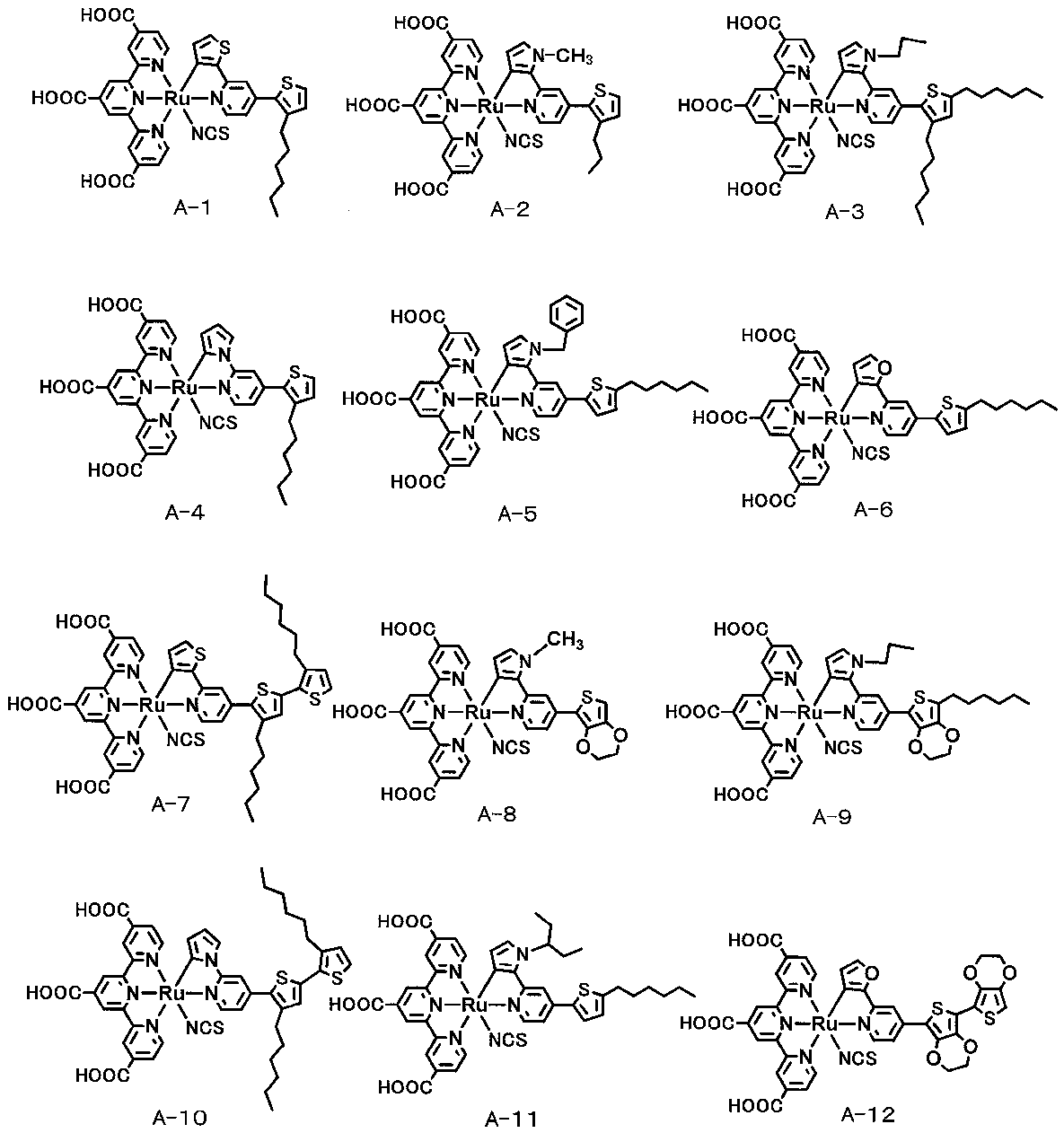
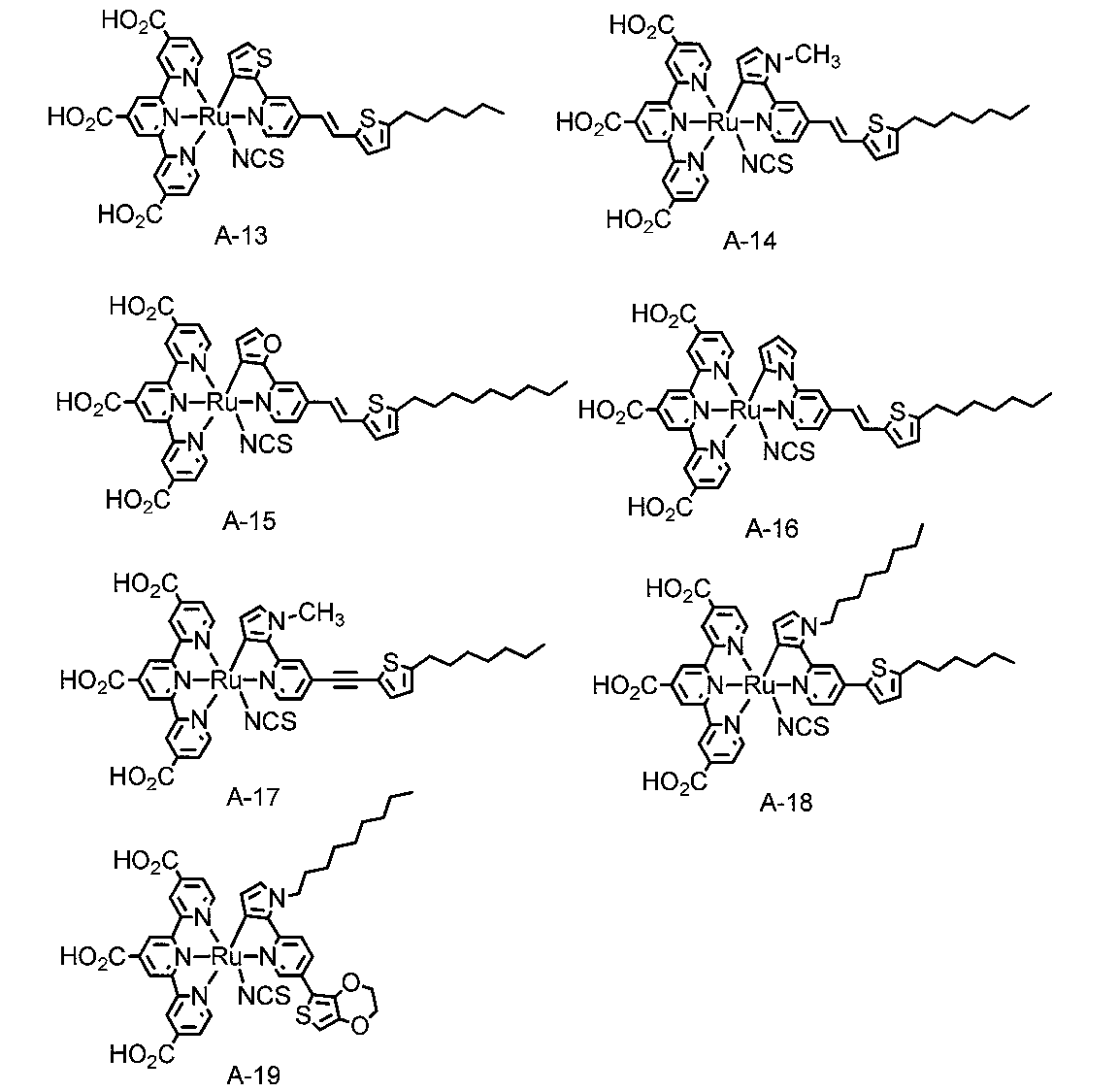


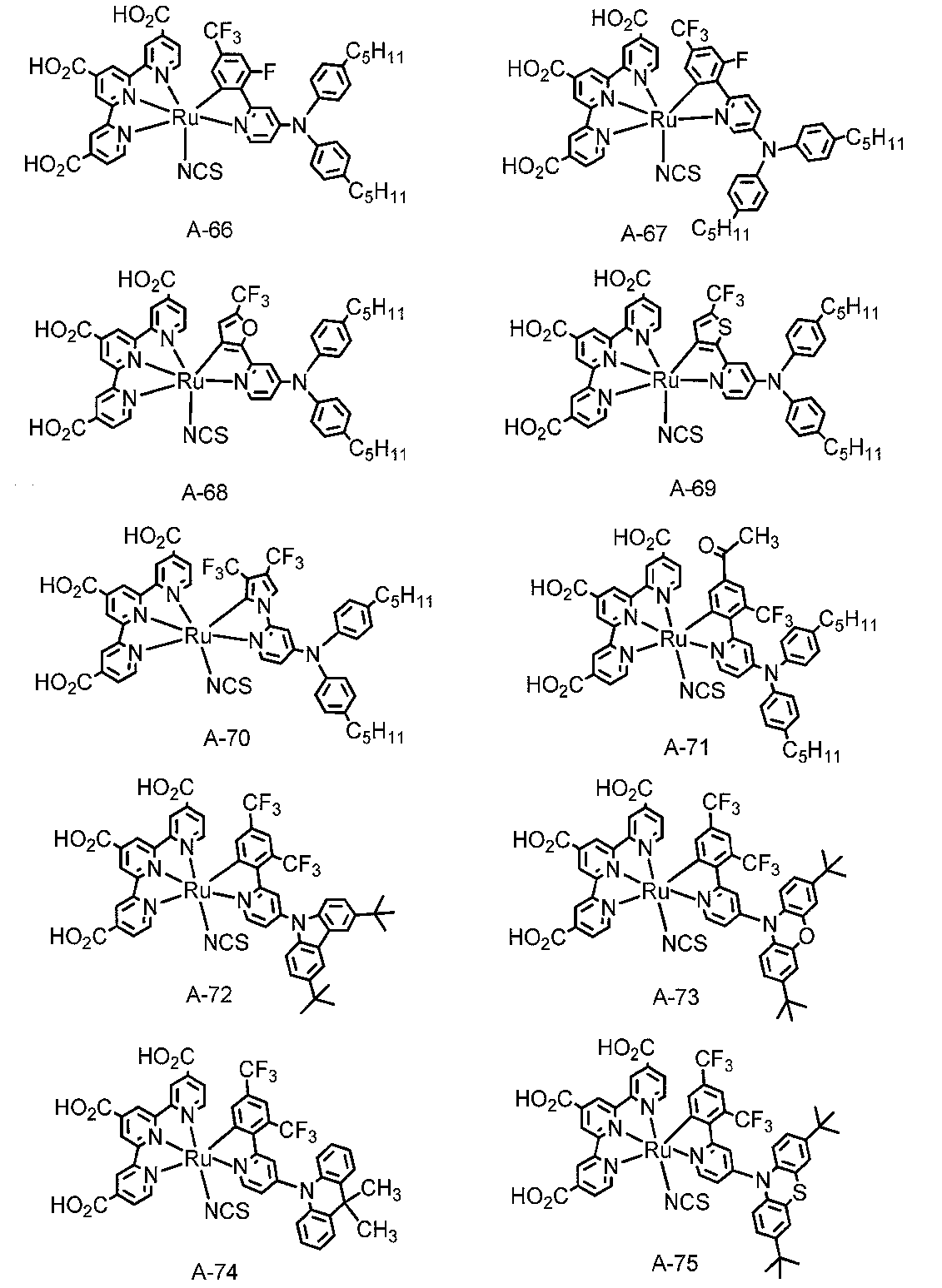
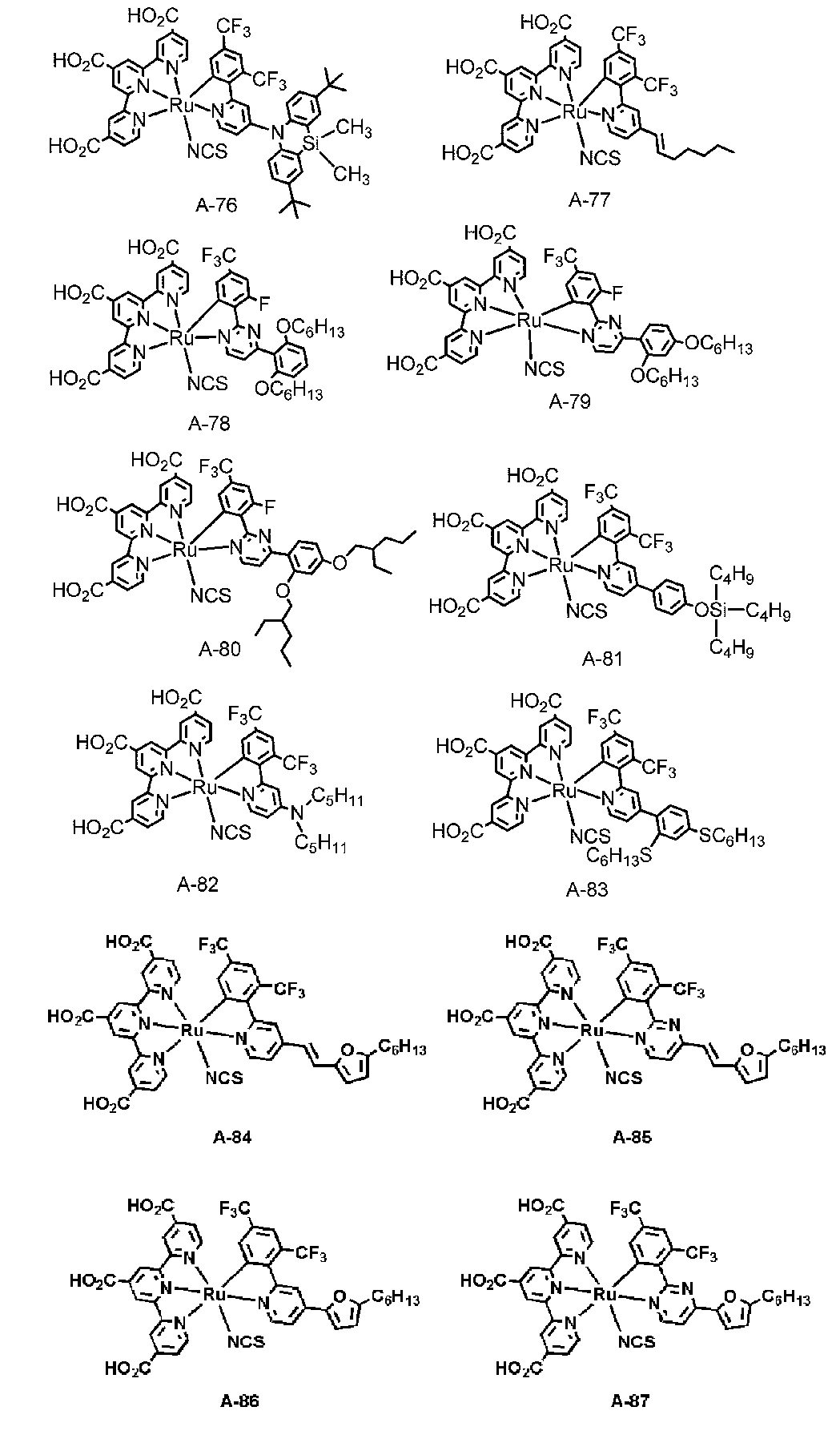
本発明の金属錯体色素は、特開2009-51999号公報、Chemistry - A European Journal,17(39),10871~10878(2011)、Angewandte Chemie,84,824~826(1972)、Dalton Transactions,5,770~772(2009)、特開2001-291534号公報や当該公報に引用された方法に準じた方法、Angew.Chem.Int.Ed.,50,2054~2058(2011)に記載の方法に準じた方法で容易に合成することができる。
本発明の金属錯体色素は、溶液における極大吸収波長が、好ましくは300~1000nmの範囲であり、より好ましくは350~950nmの範囲であり、特に好ましくは370~900nmの範囲である。
本発明においては、本発明の金属錯体色素と他の色素を併用してもよい。
併用する色素としては、特表平7-500630号公報に記載のRu錯体色素(特に第5頁左下欄5行目~第7頁右上欄7行目に例1~例19で合成された色素)、特表2002-512729号公報に記載のRu錯体色素(特に第20頁の下から3行目~第29頁23行目に例1~例16で合成された色素)、特開2001-59062号公報に記載のRu錯体色素(特に、段落番号0087~0104に記載の色素)、特開2001-6760号公報に記載のRu錯体色素(特に、段落番号0093~0102に記載の色素)、特開2001-253894号公報に記載のRu錯体色素(特に、段落番号0009~0010に記載の色素)、特開2003-212851号公報に記載のRu錯体色素(特に、段落番号0005に記載の色素)、国際公開第2007/91525号パンフレットに記載のRu錯体色素(特に、[0067]に記載の色素)、特開2001-291534号公報に記載のRu錯体色素(特に、段落番号0120~0144に記載の色素)、特開2012-012570号公報に記載のRu錯体色素(特に、段落番号0095~0103に記載の色素)、国際公開第2013/47615号パンフレットに記載のRu錯体色素(特に、[0078]~[0082]に記載の色素)、特開平11-214730号公報に記載のスクアリリウムシアニン色素(特に、段落番号0036~0047に記載の色素)、特開2012-144688号公報に記載のスクアリリウムシアニン色素(特に、段落番号0039~0046および段落番号0054~0060に記載の色素)、特開2012-84503号公報に記載のスクアリリウムシアニン色素(特に、段落番号0066~0076などに記載の色素)、特開2004-063274号公報に記載の有機色素(特に、段落番号0017~0021に記載の色素)、特開2005-123033号公報に記載の有機色素(特に、段落番号0021~0028に記載の色素)、特開2007-287694号公報に記載の有機色素(特に、段落番号0091~0096に記載の色素)、特開2008-71648号公報に記載の有機色素(特に、段落番号0030~0034に記載の色素)、国際公開第2007/119525号パンフレットに記載の有機色素(特に、[0024]に記載の色素)、Angew.Chem.Int.Ed.,49,1~5(2010)等に記載のポルフィリン色素、Angew.Chem.Int.Ed.,46,8358(2007)等に記載のフタロシアニン色素が挙げられる。
併用する色素として好ましくは、Ru錯体色素、スクアリリウムシアニン色素、または有機色素が挙げられる。
併用する色素としては、特表平7-500630号公報に記載のRu錯体色素(特に第5頁左下欄5行目~第7頁右上欄7行目に例1~例19で合成された色素)、特表2002-512729号公報に記載のRu錯体色素(特に第20頁の下から3行目~第29頁23行目に例1~例16で合成された色素)、特開2001-59062号公報に記載のRu錯体色素(特に、段落番号0087~0104に記載の色素)、特開2001-6760号公報に記載のRu錯体色素(特に、段落番号0093~0102に記載の色素)、特開2001-253894号公報に記載のRu錯体色素(特に、段落番号0009~0010に記載の色素)、特開2003-212851号公報に記載のRu錯体色素(特に、段落番号0005に記載の色素)、国際公開第2007/91525号パンフレットに記載のRu錯体色素(特に、[0067]に記載の色素)、特開2001-291534号公報に記載のRu錯体色素(特に、段落番号0120~0144に記載の色素)、特開2012-012570号公報に記載のRu錯体色素(特に、段落番号0095~0103に記載の色素)、国際公開第2013/47615号パンフレットに記載のRu錯体色素(特に、[0078]~[0082]に記載の色素)、特開平11-214730号公報に記載のスクアリリウムシアニン色素(特に、段落番号0036~0047に記載の色素)、特開2012-144688号公報に記載のスクアリリウムシアニン色素(特に、段落番号0039~0046および段落番号0054~0060に記載の色素)、特開2012-84503号公報に記載のスクアリリウムシアニン色素(特に、段落番号0066~0076などに記載の色素)、特開2004-063274号公報に記載の有機色素(特に、段落番号0017~0021に記載の色素)、特開2005-123033号公報に記載の有機色素(特に、段落番号0021~0028に記載の色素)、特開2007-287694号公報に記載の有機色素(特に、段落番号0091~0096に記載の色素)、特開2008-71648号公報に記載の有機色素(特に、段落番号0030~0034に記載の色素)、国際公開第2007/119525号パンフレットに記載の有機色素(特に、[0024]に記載の色素)、Angew.Chem.Int.Ed.,49,1~5(2010)等に記載のポルフィリン色素、Angew.Chem.Int.Ed.,46,8358(2007)等に記載のフタロシアニン色素が挙げられる。
併用する色素として好ましくは、Ru錯体色素、スクアリリウムシアニン色素、または有機色素が挙げられる。
本発明の金属錯体色素と他の色素を併用する場合、本発明の金属錯体色素の質量/他の色素の質量の比は、95/5~10/90が好ましく、95/5~50/50がより好ましく、95/5~60/40がさらに好ましく、95/5~65/35が特に好ましく、95/5~70/30が最も好ましい。
- 導電性支持体 -
導電性支持体は、金属のように支持体そのものに導電性があるものか、または表面に導電膜層を有するガラスもしくはプラスチックの支持体であるのが好ましい。プラスチックの支持体としては、例えば、特開2001-291534号公報の段落番号0153に記載の透明ポリマーフィルムが挙げられる。支持体としては、ガラスおよびプラスチックの他、セラミック(特開2005-135902号公報)、導電性樹脂(特開2001-160425号公報)を用いてもよい。導電性支持体上には、表面に光マネージメント機能を施してもよく、例えば、特開2003-123859号公報に記載の高屈折膜および低屈折率の酸化物膜を交互に積層した反射防止膜を有してもよく、特開2002-260746号公報に記載のライトガイド機能を有してもよい。
導電性支持体は、金属のように支持体そのものに導電性があるものか、または表面に導電膜層を有するガラスもしくはプラスチックの支持体であるのが好ましい。プラスチックの支持体としては、例えば、特開2001-291534号公報の段落番号0153に記載の透明ポリマーフィルムが挙げられる。支持体としては、ガラスおよびプラスチックの他、セラミック(特開2005-135902号公報)、導電性樹脂(特開2001-160425号公報)を用いてもよい。導電性支持体上には、表面に光マネージメント機能を施してもよく、例えば、特開2003-123859号公報に記載の高屈折膜および低屈折率の酸化物膜を交互に積層した反射防止膜を有してもよく、特開2002-260746号公報に記載のライトガイド機能を有してもよい。
導電膜層の厚さは0.01~30μmであることが好ましく、0.03~25μmであることが更に好ましく、特に好ましくは0.05~20μmである。
導電性支持体は実質的に透明であることが好ましい。実質的に透明であるとは光の透過率が10%以上であることを意味し、50%以上であることが好ましく、80%以上であることが特に好ましい。透明導電性支持体としては、ガラスもしくはプラスチックに導電性の金属酸化物を塗設したものが好ましい。金属酸化物としてはスズ酸化物が好ましく、インジウム-スズ酸化物、フッ素ドープド酸化物が特に好ましい。このときの導電性の金属酸化物の塗布量は、ガラスもしくはプラスチックの支持体1m2当たり0.1~100gが好ましい。透明導電性支持体を用いる場合、光は支持体側から入射させることが好ましい。
- 半導体微粒子 -
半導体微粒子は、好ましくは金属のカルコゲニド(例えば酸化物、硫化物、セレン化物等)またはペロブスカイトの微粒子である。金属のカルコゲニドとしては、好ましくはチタン、スズ、亜鉛、タングステン、ジルコニウム、ハフニウム、ストロンチウム、インジウム、セリウム、イットリウム、ランタン、バナジウム、ニオブ、もしくはタンタルの酸化物、硫化カドミウム、セレン化カドミウム等が挙げられる。ペロブスカイトとしては、好ましくはチタン酸ストロンチウム、チタン酸カルシウム等が挙げられる。これらのうち酸化チタン(チタニア)、酸化亜鉛、酸化スズ、酸化タングステンが特に好ましい。
半導体微粒子は、好ましくは金属のカルコゲニド(例えば酸化物、硫化物、セレン化物等)またはペロブスカイトの微粒子である。金属のカルコゲニドとしては、好ましくはチタン、スズ、亜鉛、タングステン、ジルコニウム、ハフニウム、ストロンチウム、インジウム、セリウム、イットリウム、ランタン、バナジウム、ニオブ、もしくはタンタルの酸化物、硫化カドミウム、セレン化カドミウム等が挙げられる。ペロブスカイトとしては、好ましくはチタン酸ストロンチウム、チタン酸カルシウム等が挙げられる。これらのうち酸化チタン(チタニア)、酸化亜鉛、酸化スズ、酸化タングステンが特に好ましい。
チタニアの結晶構造としては、アナターゼ型、ブルッカイト型、またはルチル型が挙げられ、アナターゼ型、ブルッカイト型が好ましい。チタニアナノチューブ・ナノワイヤー・ナノロッドをチタニア微粒子に混合するか、または半導体電極として用いてもよい。
半導体微粒子の粒径は、投影面積を円に換算したときの直径を用いた平均粒径で1次粒子として0.001~1μm、分散物の平均粒径として0.01~100μmであることが好ましい。半導体微粒子を導電性支持体上に塗設する方法として、湿式法、乾式法、その他の方法が挙げられる。
透明導電膜と半導体層(感光体層)の間には、電解質と電極が直接接触することによる逆電流を防止するため、短絡防止層を形成することが好ましい。光電極と対極の接触を防ぐために、スペーサーやセパレータを用いることが好ましい。半導体微粒子は多くの色素を吸着することができるように表面積の大きいものが好ましい。例えば半導体微粒子を支持体上に塗設した状態で、その表面積が投影面積に対して10倍以上であることが好ましく、100倍以上であることがより好ましい。この上限には特に制限はないが、通常5000倍程度である。一般に、半導体微粒子を含む層(感光体層)の厚みが大きいほど単位面積当たりに担持できる色素の量が増えるため光の吸収効率が高くなるが、発生した電子の拡散距離が増すため電荷再結合によるロスも大きくなる。半導体層である感光体層の好ましい厚みは素子の用途によって異なるが、典型的には0.1~100μmである。色素増感太陽電池として用いる場合は、1~50μmが好ましく、3~30μmがより好ましい。半導体微粒子は、支持体に塗布した後に粒子同士を密着させるために、100~800℃の温度で10分~10時間焼成してもよい。支持体としてガラスを用いる場合、製膜温度は60~400℃が好ましい。
なお、半導体微粒子の支持体1m2当たりの塗布量は0.5~500g、さらには5~100gが好ましい。色素の使用量は、全体で、支持体1m2当たり0.01~100ミリモルが好ましく、より好ましくは0.1~50ミリモル、特に好ましくは0.1~10ミリモルである。この場合、本発明の金属錯体色素の使用量は5モル%以上とすることが好ましい。また、色素の半導体微粒子に対する吸着量は半導体微粒子1gに対して0.001~1ミリモルが好ましく、より好ましくは0.1~0.5ミリモルである。このような色素量とすることによって、半導体微粒子における増感効果が十分に得られる。
前記色素が塩である場合、前記特定の金属錯体色素の対イオンは特に限定されず、例えばアルカリ金属イオンまたは4級アンモニウムイオン等が挙げられる。
前記色素が塩である場合、前記特定の金属錯体色素の対イオンは特に限定されず、例えばアルカリ金属イオンまたは4級アンモニウムイオン等が挙げられる。
色素を吸着させた後に、アミン類を用いて半導体微粒子の表面を処理してもよい。好ましいアミン類としてピリジン類(例えば4-tert-ブチルピリジン、ポリビニルピリジン)等が挙げられる。これらは液体の場合はそのまま用いてもよいし、有機溶媒に溶解して用いてもよい。
本発明の光電変換素子(例えば光電変換素子10)および色素増感太陽電池(例えば色素増感太陽電池20)においては、少なくとも上記の本発明の金属錯体色素を使用する。
- 電荷移動体層 -
本発明の光電変換素子に用いられる電荷移動体層は、色素の酸化体に電子を補充する機能を有する層であり、受光電極(光電極)と対極(対向電極)との間に設けられる。電荷移動体層は電解質を含む。電解質の例としては、酸化還元対を有機溶媒に溶解した液体電解質、酸化還元対を有機溶媒に溶解した液体をポリマーマトリクスに含浸したいわゆるゲル電解質、酸化還元対を含有する溶融塩などが挙げられる。光電変換効率を高めるためには液体電解質が好ましい。液体電解質の溶媒はニトリル化合物、エーテル化合物、エステル化合物等が用いられるが、ニトリル化合物が好ましく、アセトニトリル、メトキシプロピオニトリルが特に好ましい。
本発明の光電変換素子に用いられる電荷移動体層は、色素の酸化体に電子を補充する機能を有する層であり、受光電極(光電極)と対極(対向電極)との間に設けられる。電荷移動体層は電解質を含む。電解質の例としては、酸化還元対を有機溶媒に溶解した液体電解質、酸化還元対を有機溶媒に溶解した液体をポリマーマトリクスに含浸したいわゆるゲル電解質、酸化還元対を含有する溶融塩などが挙げられる。光電変換効率を高めるためには液体電解質が好ましい。液体電解質の溶媒はニトリル化合物、エーテル化合物、エステル化合物等が用いられるが、ニトリル化合物が好ましく、アセトニトリル、メトキシプロピオニトリルが特に好ましい。
酸化還元対として、例えばヨウ素とヨウ化物(ヨウ化物塩、ヨウ化イオン性液体が好ましく、ヨウ化リチウム、ヨウ化テトラブチルアンモニウム、ヨウ化テトラプロピルアンモニウム、ヨウ化メチルプロピルイミダゾリウムがより好ましい)との組み合わせ、アルキルビオローゲン(例えばメチルビオローゲンクロリド、ヘキシルビオローゲンブロミド、ベンジルビオローゲンテトラフルオロボレート)とその還元体との組み合わせ、ポリヒドロキシベンゼン類(例えばハイドロキノン、ナフトハイドロキノン等)とその酸化体との組み合わせ、2価と3価の鉄錯体の組み合せ(例えば赤血塩と黄血塩の組み合せ)、2価と3価のコバルト錯体の組み合わせ等が挙げられる。これらのうち、ヨウ素とヨウ化物との組み合わせまたは2価と3価のコバルト錯体の組み合わせが好ましい。
前記コバルト錯体は、なかでも下記式(CC)で表される錯体が好ましい。
Co(LL)ma(X)mb・CI 式(CC)
式(CC)において、LLは2座または3座の配位子を表す。Xは単座の配位子を表す。maは0~3の整数を表す。mbは0~6の整数を表す。CIは電荷を中和させるのに対イオンが必要な場合の対イオンを表す。
CIは前記式(I)におけるCIが挙げられる。
LLは下記式(LC)で表される配位子が好ましい。
LLは下記式(LC)で表される配位子が好ましい。

式(LC)において、XLC1およびXLC3は各々独立に炭素原子または窒素原子を表す。ここで、XLC1が炭素原子の場合、XLC1と隣接するN原子の結合は二重結合(XLC1=N)を表し、XLC3が炭素原子の場合、XLC3と隣接するN原子の結合は二重結合(XLC3=N)を表し、XLC1が窒素原子の場合、XLC1と隣接するN原子の結合は単結合(XLC1-N)を表し、XLC3が窒素原子の場合、XLC3と隣接するN原子の結合は単結合(XLC3-N)を表す。
ZLC1、ZLC2およびZLC3は各々独立に、5員環または6員環を形成するのに必要な非金属原子群を表す。ZLC1、ZLC2およびZLC3は置換基を有していてもよく、置換基を介して隣接する環と閉環していてもよい。該置換基としては、後述の置換基Tが挙げられる。qは0または1を表す。なお、qが0の場合、XLC3がZLC2で形成される5員環または6員環に結合する位置の炭素原子は、水素原子、またはZLC3で形成されるヘテロ環基以外の置換基が結合する。
ZLC1、ZLC2およびZLC3は各々独立に、5員環または6員環を形成するのに必要な非金属原子群を表す。ZLC1、ZLC2およびZLC3は置換基を有していてもよく、置換基を介して隣接する環と閉環していてもよい。該置換基としては、後述の置換基Tが挙げられる。qは0または1を表す。なお、qが0の場合、XLC3がZLC2で形成される5員環または6員環に結合する位置の炭素原子は、水素原子、またはZLC3で形成されるヘテロ環基以外の置換基が結合する。
式(CC)中、Xはハロゲンイオンが好ましい。
上記式(LC)で表される配位子は、下記式(LC-1)~(LC-4)で表される配位子がより好ましい。
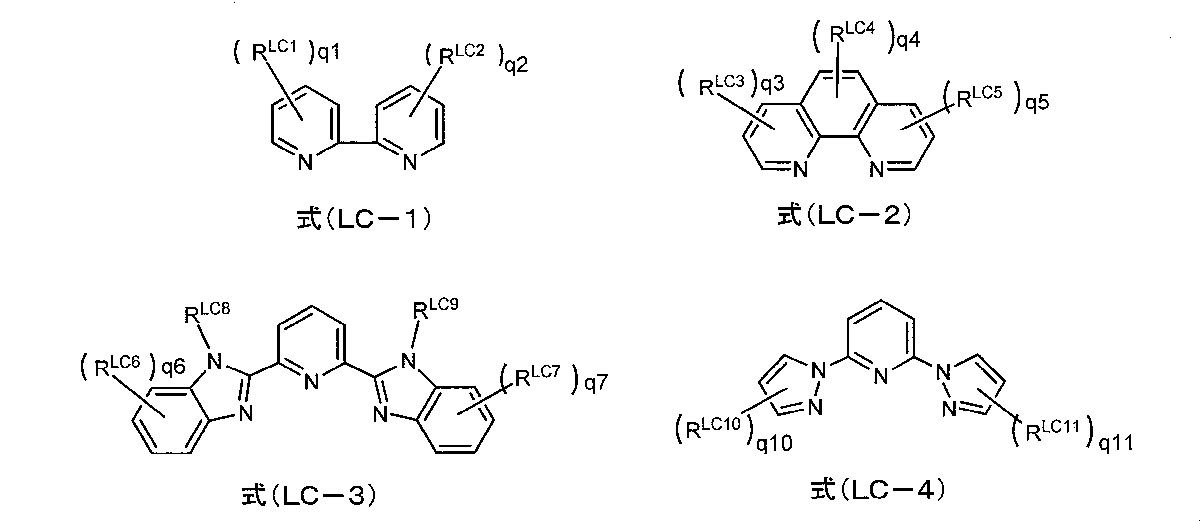
RLC1~RLC11は各々独立に置換基を表す。q1、q2、q6およびq7は各々独立に、0~4の整数を表す。q3、q5、q10およびq11は各々独立に、0~3の整数を表す。q4は0~2の整数を表す。
式(LC-1)~(LC-4)において、RLC1~RLC11における置換基は、例えば、脂肪族基、芳香族基、複素環基等が挙げられる。置換基の具体的な例としては、アルキル基、アルコキシ基、アルキルチオ基、アリール基、アリールオキシ基、アリールチオ基、ヘテロ環基等を挙げることができる。好ましい例としては、アルキル基(例えばメチル、エチル、n-ブチル、n-ヘキシル、イソブチル、sec-ブチル、t-ブチル、n-ドデシル、シクロヘキシル、ベンジル等)、アリール基(例えばフェニル、トリル、ナフチル等)、アルコキシ基(例えば、メトキシ、エトキシ、イソプロポキシ、ブトキシ等)、アルキルチオ基(例えば、メチルチオ、n-ブチルチオ、n-ヘキシルチオ、2-エチルヘキシルチオ等)、アリールオキシ基(例えば、フェノキシ、ナフトキシ等)、アリールチオ基(例えば、フェニルチオ、ナフチルチオ等)、ヘテロ環基(例えば、2-チエニル、2-フリル等)を挙げることができる。
式(LC)で表される配位子を有するコバルト錯体の具体例としては、例えば以下の錯体が挙げられる。
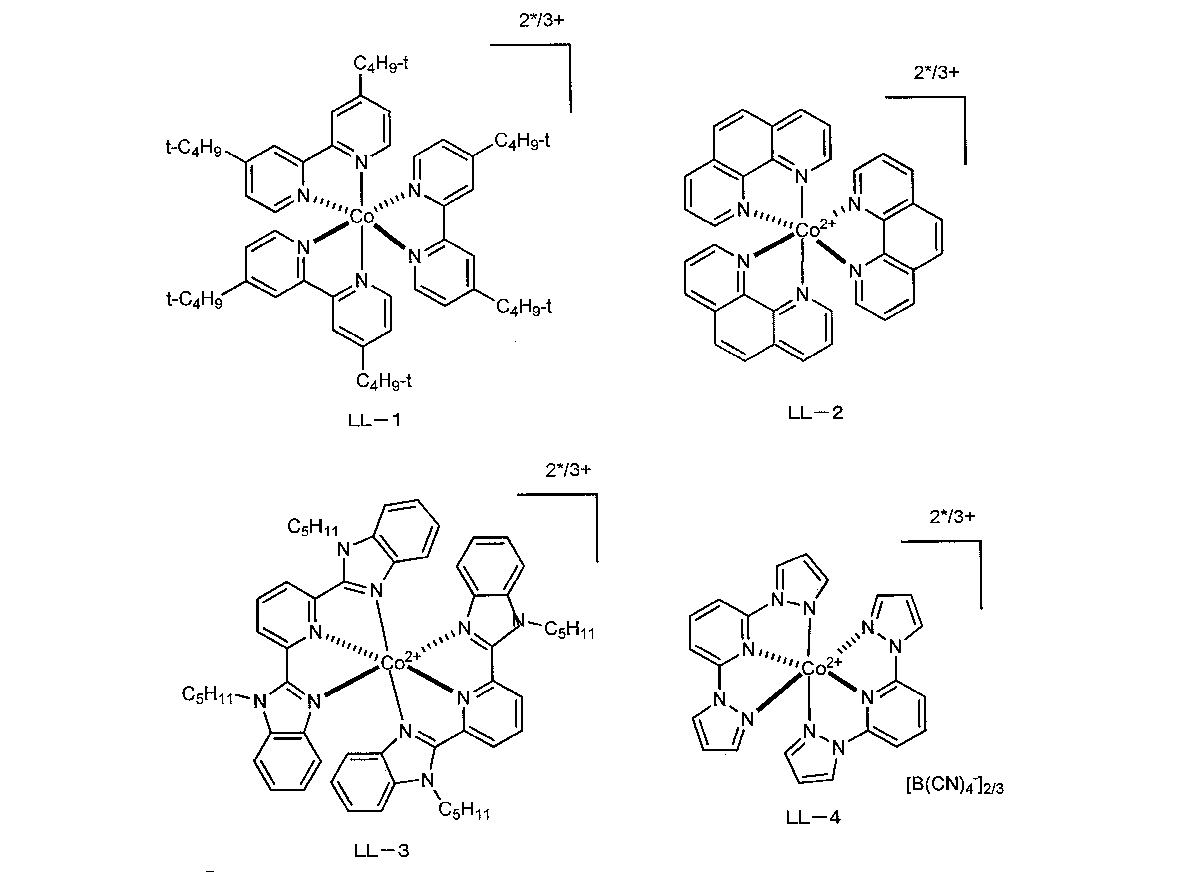
電解質として、ヨウ素とヨウ化物との組み合せを用いる場合、5員環または6員環の含窒素芳香族カチオンのヨウ素塩をさらに併用するのが好ましい。
酸化還元対を溶かす有機溶媒としては、非プロトン性の極性溶媒(例えばアセトニトリル、炭酸プロピレン、炭酸エチレン、ジメチルホルムアミド、ジメチルスルホキシド、スルホラン、1,3-ジメチルイミダゾリノン、3-メチルオキサゾリジノン等)が好ましい。ゲル電解質のマトリクスに使用されるポリマー(ポリマーマトリクス)としては、例えばポリアクリロニトリル、ポリビニリデンフルオリド等が挙げられる。溶融塩としては、例えばヨウ化リチウムと他の少なくとも1種類のリチウム塩(例えば酢酸リチウム、過塩素酸リチウム等)にポリエチレンオキシドを混合することにより、室温での流動性を付与したもの等が挙げられる。この場合のポリマーの添加量は1~50質量%である。また、γ-ブチロラクトンを電解液に含んでいてもよく、これによりヨウ化物イオンの拡散効率が高くなり変換効率が向上する。
電解質への添加物として、前述の4-tert-ブチルピリジンのほか、アミノピリジン系化合物、ベンズイミダゾール系化合物、アミノトリアゾール系化合物およびアミノチアゾール系化合物、イミダゾール系化合物、アミノトリアジン系化合物、尿素誘導体、アミド化合物、ピリミジン系化合物および窒素を含まない複素環を加えることができる。
また、光電変換効率を向上するために、電解液の水分を制御する方法をとってもよい。水分を制御する好ましい方法としては、濃度を制御する方法や脱水剤を共存させる方法を挙げることができる。ヨウ素の毒性軽減のために、ヨウ素とシクロデキストリンの包摂化合物の使用をしてもよく、水分を常時補給する方法を用いてもよい。また環状アミジンを用いてもよく、酸化防止剤、加水分解防止剤、分解防止剤、ヨウ化亜鉛を加えてもよい。
電解質として溶融塩を用いてもよく、好ましい溶融塩としては、イミダゾリウムまたはトリアゾリウム型陽イオンを含むイオン性液体、オキサゾリウム系、ピリジニウム系、グアニジウム系およびこれらの組み合わせが挙げられる。これらカチオン系に対して特定のアニオンと組み合わせてもよい。これらの溶融塩に対しては添加物を加えてもよい。液晶性の置換基を持っていてもよい。また、四級アンモニウム塩系の溶融塩を用いてもよい。
これら以外の溶融塩としては、例えば、ヨウ化リチウムと他の少なくとも1種類のリチウム塩(例えば酢酸リチウム、過塩素酸リチウム等)にポリエチレンオキシドを混合することにより、室温での流動性を付与したもの等が挙げられる。
電解質と溶媒からなる電解液にゲル化剤を添加してゲル化させることにより、電解質を擬固体化してもよい(擬固体化された電解質を、以下、「擬固体電解質」ともいう。)。ゲル化剤としては、分子量1000以下の有機化合物、分子量500~5000の範囲のSi含有化合物、特定の酸性化合物と塩基性化合物からできる有機塩、ソルビトール誘導体、ポリビニルピリジンが挙げられる。
また、マトリックス高分子、架橋型高分子化合物またはモノマー、架橋剤、電解質および溶媒を高分子中に閉じ込める方法を用いてもよい。
マトリックス高分子として好ましくは、含窒素複素環を主鎖あるいは側鎖の繰り返し単位中に持つ高分子およびこれらを求電子性化合物と反応させた架橋体、トリアジン構造を持つ高分子、ウレイド構造をもつ高分子、液晶性化合物を含むもの、エーテル結合を有する高分子、ポリフッ化ビニリデン系、メタクリレート・アクリレート系、熱硬化性樹脂、架橋ポリシロキサン、ポリビニルアルコール(PVA)、ポリアルキレングリコールとデキストリンなどの包摂化合物、含酸素または含硫黄高分子を添加した系、天然高分子などが挙げられる。これらにアルカリ膨潤型高分子、一つの高分子内にカチオン部位とヨウ素との電荷移動錯体を形成できる化合物を持った高分子などを添加してもよい。
マトリックス高分子として好ましくは、含窒素複素環を主鎖あるいは側鎖の繰り返し単位中に持つ高分子およびこれらを求電子性化合物と反応させた架橋体、トリアジン構造を持つ高分子、ウレイド構造をもつ高分子、液晶性化合物を含むもの、エーテル結合を有する高分子、ポリフッ化ビニリデン系、メタクリレート・アクリレート系、熱硬化性樹脂、架橋ポリシロキサン、ポリビニルアルコール(PVA)、ポリアルキレングリコールとデキストリンなどの包摂化合物、含酸素または含硫黄高分子を添加した系、天然高分子などが挙げられる。これらにアルカリ膨潤型高分子、一つの高分子内にカチオン部位とヨウ素との電荷移動錯体を形成できる化合物を持った高分子などを添加してもよい。
ポリマーマトリックスとして、2官能以上のイソシアネートと、ヒドロキシ基、アミノ基、カルボキシ基などの官能基とを反応させた架橋ポリマーを含む系を用いても良い。また、ヒドロシリル基と二重結合性化合物による架橋高分子、ポリスルホン酸またはポリカルボン酸などを2価以上の金属イオン化合物と反応させる架橋方法などを用いてもよい。
上記擬固体電解質との組み合わせで好ましく用いることができる溶媒としては、特定のリン酸エステル、エチレンカーボネートを含む混合溶媒、特定の比誘電率を持つ溶媒等が挙げられる。固体電解質膜あるいは細孔に液体電解質溶液を保持させてもよく、その方法として好ましくは、導電性高分子膜、繊維状固体、フィルタなどの布状固体が挙げられる。
以上の液体電解質および擬固体電解質の代わりに、p型半導体あるいはホール輸送材料などの固体電荷輸送層、例えば、CuI、CuNCSなどを用いることができる。また、Nature,vol.486,p.487(2012)等に記載の電解質を用いてもよい。固体電荷輸送層として有機ホール輸送材料を用いてもよい。有機ホール輸送材料として好ましくは、ポリチオフェン、ポリアニリン、ポリピロールおよびポリシランなどの導電性高分子および2個の環がC、Siなど四面体構造をとる中心元素を共有するスピロ化合物、トリアリールアミンなどの芳香族アミン誘導体、トリフェニレン誘導体、含窒素複素環誘導体、液晶性シアノ誘導体が挙げられる。
酸化還元対は、電子のキャリアになるので、ある程度の濃度が必要である。好ましい濃度としては合計で0.01モル/L以上であり、より好ましくは0.1モル/L以上であり、特に好ましくは0.3モル/L以上である。この場合の上限は特に制限はないが、通常5モル/L程度である。
- 共吸着剤 -
本発明の光電変換素子においては、本発明の金属錯体色素または必要により併用する色素とともに共吸着剤を使用することが好ましい。このような共吸着剤としては酸性基(好ましくは、カルボキシ基もしくはその塩)を1つ以上有する共吸着剤が好ましく、脂肪酸やステロイド骨格を有する化合物が挙げられる。脂肪酸は、飽和脂肪酸でも不飽和脂肪酸でもよく、例えばブタン酸、ヘキサン酸、オクタン酸、デカン酸、ヘキサデカン酸、ドデカン酸、パルミチン酸、ステアリン酸、オレイン酸、リノール酸、リノレン酸等が挙げられる。
ステロイド骨格を有する化合物として、コール酸、グリココール酸、ケノデオキシコール酸、ヒオコール酸、デオキシコール酸、リトコール酸、ウルソデオキシコール酸等が挙げられる。好ましくはコール酸、デオキシコール酸、ケノデオキシコール酸であり、さらに好ましくはケノデオキシコール酸である。
本発明の光電変換素子においては、本発明の金属錯体色素または必要により併用する色素とともに共吸着剤を使用することが好ましい。このような共吸着剤としては酸性基(好ましくは、カルボキシ基もしくはその塩)を1つ以上有する共吸着剤が好ましく、脂肪酸やステロイド骨格を有する化合物が挙げられる。脂肪酸は、飽和脂肪酸でも不飽和脂肪酸でもよく、例えばブタン酸、ヘキサン酸、オクタン酸、デカン酸、ヘキサデカン酸、ドデカン酸、パルミチン酸、ステアリン酸、オレイン酸、リノール酸、リノレン酸等が挙げられる。
ステロイド骨格を有する化合物として、コール酸、グリココール酸、ケノデオキシコール酸、ヒオコール酸、デオキシコール酸、リトコール酸、ウルソデオキシコール酸等が挙げられる。好ましくはコール酸、デオキシコール酸、ケノデオキシコール酸であり、さらに好ましくはケノデオキシコール酸である。
好ましい共吸着剤は、下記式(CA)で表される化合物である。

式中、RA1は酸性基を有する置換基を表す。RA2は置換基を表す。nAは0以上の整数を表す。
酸性基は、式(AL-1)、(AL-2)中のAnc1~Anc3と同義であり、好ましい範囲も同じである。
RA1は、これらの中でも、カルボキシ基またはスルホ基もしくはそれらの塩が置換したアルキル基が好ましく、-CH(CH3)CH2CH2CO2H、-CH(CH3)CH2CH2CONHCH2CH2SO3Hがさらに好ましい。
酸性基は、式(AL-1)、(AL-2)中のAnc1~Anc3と同義であり、好ましい範囲も同じである。
RA1は、これらの中でも、カルボキシ基またはスルホ基もしくはそれらの塩が置換したアルキル基が好ましく、-CH(CH3)CH2CH2CO2H、-CH(CH3)CH2CH2CONHCH2CH2SO3Hがさらに好ましい。
RA2としては、後述の置換基Tが挙げられるが、中でもアルキル基、ヒドロキシ基、アシルオキシ基、アルキルアミノカルボニルオキシ基、アリールアミノカルボニルオキシ基が好ましく、アルキル基、ヒドロキシ基、アシルオキシ基がより好ましい。
nAは2~4が好ましい。
nAは2~4が好ましい。
これらの具体的化合物としては、上述のステロイド骨格を有する化合物として例示した化合物が挙げられる。
本発明で用いられる共吸着剤は、半導体微粒子に吸着させることにより、色素の非効率な会合を抑制する効果および半導体微粒子表面から電解質中のレドックス系への逆電子移動を防止する効果がある。共吸着剤の使用量は特に限定されないが、上記色素1モルに対して、好ましくは1~200モル、さらに好ましくは10~150モル、特に好ましくは20~50モルであることが、上記の作用を効果的に発現させられ、好ましい。
<置換基T>
本明細書において化合物(錯体、色素を含む)の表示については、当該化合物そのもののほか、その塩、そのイオンを含む意味に用いる。また、本明細書において置換または無置換を明記していない置換基(連結基および配位子についても同様)については、その基に任意の置換基を有していてもよい意味である。これは置換または無置換を明記していない化合物についても同義である。好ましい置換基としては、下記置換基Tが挙げられる。
また、本明細書において、単に置換基としてしか記載されていない場合は、この置換基Tを参照するものであり、また、各々の基、例えば、アルキル基、が記載されているのみの場合は、この置換基Tの対応する基における好ましい範囲、具体例が適用される。
本明細書において化合物(錯体、色素を含む)の表示については、当該化合物そのもののほか、その塩、そのイオンを含む意味に用いる。また、本明細書において置換または無置換を明記していない置換基(連結基および配位子についても同様)については、その基に任意の置換基を有していてもよい意味である。これは置換または無置換を明記していない化合物についても同義である。好ましい置換基としては、下記置換基Tが挙げられる。
また、本明細書において、単に置換基としてしか記載されていない場合は、この置換基Tを参照するものであり、また、各々の基、例えば、アルキル基、が記載されているのみの場合は、この置換基Tの対応する基における好ましい範囲、具体例が適用される。
置換基Tとしては、下記のものが挙げられる。
アルキル基(好ましくは炭素数1~20で、例えばメチル、エチル、イソプロピル、t-ブチル、ペンチル、ヘプチル、1-エチルペンチル、ベンジル、2-エトキシエチル、1-カルボキシメチル、トリフルオロメチル等)、アルケニル基(好ましくは炭素数2~20で、例えば、ビニル、アリル、オレイル等)、アルキニル基(好ましくは炭素数2~20で、例えば、エチニル、ブチニル、フェニルエチニル等)、シクロアルキル基(好ましくは炭素数3~20で、例えば、シクロプロピル、シクロペンチル、シクロヘキシル、4-メチルシクロヘキシル等)、シクロアルケニル基(好ましくは炭素数5~20で、例えばシクロペンテニル、シクロヘキセニル等)、アリール基(好ましくは炭素数6~26で、例えば、フェニル、1-ナフチル、4-メトキシフェニル、2-クロロフェニル、3-メチルフェニル等)、ヘテロ環基(好ましくは炭素数2~20で、少なくとも1つの酸素原子、硫黄原子、窒素原子を有する5員環または6員環のヘテロ環基がより好ましく、例えば、2-ピリジル、4-ピリジル、2-イミダゾリル、2-ベンゾイミダゾリル、2-チアゾリル、2-オキサゾリル等)、アルコキシ基(好ましくは炭素数1~20で、例えば、メトキシ、エトキシ、イソプロピルオキシ、ベンジルオキシ等)、アルケニルオキシ基(好ましくは炭素数2~20で、例えば、ビニルオキシ、アリルオキシ等)、アルキニルオキシ基(好ましくは炭素数2~20で、例えば、2-プロピニルオキシ、4-ブチニルオキシ等)、シクロアルキルオキシ基(好ましくは炭素数3~20で、例えば、シクロプロピルオキシ、シクロペンチルオキシ、シクロヘキシルオキシ、4-メチルシクロヘキシルオキシ等)、アリールオキシ基(好ましくは炭素数6~26で、例えば、フェノキシ、1-ナフチルオキシ、3-メチルフェノキシ、4-メトキシフェノキシ等)、ヘテロ環オキシ基(例えば、イミダゾリルオキシ、ベンゾイミダゾリルオキシ、チアゾリルオキシ、ベンゾチアゾリルオキシ、トリアジニルオキシ、プリニルオキシ)、
アルキル基(好ましくは炭素数1~20で、例えばメチル、エチル、イソプロピル、t-ブチル、ペンチル、ヘプチル、1-エチルペンチル、ベンジル、2-エトキシエチル、1-カルボキシメチル、トリフルオロメチル等)、アルケニル基(好ましくは炭素数2~20で、例えば、ビニル、アリル、オレイル等)、アルキニル基(好ましくは炭素数2~20で、例えば、エチニル、ブチニル、フェニルエチニル等)、シクロアルキル基(好ましくは炭素数3~20で、例えば、シクロプロピル、シクロペンチル、シクロヘキシル、4-メチルシクロヘキシル等)、シクロアルケニル基(好ましくは炭素数5~20で、例えばシクロペンテニル、シクロヘキセニル等)、アリール基(好ましくは炭素数6~26で、例えば、フェニル、1-ナフチル、4-メトキシフェニル、2-クロロフェニル、3-メチルフェニル等)、ヘテロ環基(好ましくは炭素数2~20で、少なくとも1つの酸素原子、硫黄原子、窒素原子を有する5員環または6員環のヘテロ環基がより好ましく、例えば、2-ピリジル、4-ピリジル、2-イミダゾリル、2-ベンゾイミダゾリル、2-チアゾリル、2-オキサゾリル等)、アルコキシ基(好ましくは炭素数1~20で、例えば、メトキシ、エトキシ、イソプロピルオキシ、ベンジルオキシ等)、アルケニルオキシ基(好ましくは炭素数2~20で、例えば、ビニルオキシ、アリルオキシ等)、アルキニルオキシ基(好ましくは炭素数2~20で、例えば、2-プロピニルオキシ、4-ブチニルオキシ等)、シクロアルキルオキシ基(好ましくは炭素数3~20で、例えば、シクロプロピルオキシ、シクロペンチルオキシ、シクロヘキシルオキシ、4-メチルシクロヘキシルオキシ等)、アリールオキシ基(好ましくは炭素数6~26で、例えば、フェノキシ、1-ナフチルオキシ、3-メチルフェノキシ、4-メトキシフェノキシ等)、ヘテロ環オキシ基(例えば、イミダゾリルオキシ、ベンゾイミダゾリルオキシ、チアゾリルオキシ、ベンゾチアゾリルオキシ、トリアジニルオキシ、プリニルオキシ)、
アルコキシカルボニル基(好ましくは炭素数2~20で、例えば、エトキシカルボニル、2-エチルヘキシルオキシカルボニル等)、シクロアルコキシカルボニル基(好ましくは炭素数4~20で、例えば、シクロプロピルオキシカルボニル、シクロペンチルオキシカルボニル、シクロヘキシルオキシカルボニル等)、アリールオキシカルボニル基(好ましくは炭素数6~20で、例えば、フェニルオキシカルボニル、ナフチルオキシカルボニル等)、アミノ基(好ましくは炭素数0~20で、アルキルアミノ基、アルケニルアミノ基、アルキニルアミノ基、シクロアルキルアミノ基、シクロアルケニルアミノ基、アリールアミノ基、ヘテロ環アミノ基を含み、例えば、アミノ、N,N-ジメチルアミノ、N,N-ジエチルアミノ、N-エチルアミノ、N-アリルアミノ、N-(2-プロピニル)アミノ、N-シクロヘキシルアミノ、N-シクロヘキセニルアミノ、アニリノ、ピリジルアミノ、イミダゾリルアミノ、ベンゾイミダゾリルアミノ、チアゾリルアミノ、ベンゾチアゾリルアミノ、トリアジニルアミノ等)、スルファモイル基(好ましくは炭素数0~20で、アルキル、シクロアルキルもしくはアリールのスルファモイル基が好ましく、例えば、N,N-ジメチルスルファモイル、N-シクロヘキシルスルファモイル、N-フェニルスルファモイル等)、アシル基(好ましくは炭素数1~20で、例えば、アセチル、シクロヘキシルカルボニル、ベンゾイル等)、アシルオキシ基(好ましくは炭素数1~20で、例えば、アセチルオキシ、シクロヘキシルカルボニルオキシ、ベンゾイルオキシ等)、カルバモイル基(好ましくは炭素数1~20で、アルキル、シクロアルキルもしくはアリールのカルバモイル基が好ましく、例えば、N,N-ジメチルカルバモイル、N-シクロヘキシルカルバモイル、N-フェニルカルバモイル等)、
アシルアミノ基(好ましくは炭素数1~20のアシルアミノ基、例えば、アセチルアミノ、シクロヘキシルカルボニルアミノ、ベンゾイルアミノ等)、スルホンアミド基(好ましくは炭素数0~20で、アルキル、シクロアルキルもしくはアリールのスルホンアミド基が好ましく、例えば、メタンスルホンアミド、ベンゼンスルホンアミド、N-メチルメタンスルホンアミド、N-シクロヘキシルスルホンアミド、N-エチルベンゼンスルホンアミド等)、アルキルチオ基(好ましくは炭素数1~20で、例えば、メチルチオ、エチルチオ、イソプロピルチオ、ベンジルチオ等)、シクロアルキルチオ基(好ましくは炭素数3~20で、例えば、シクロプロピルチオ、シクロペンチルチオ、シクロヘキシルチオ、4-メチルシクロヘキシルチオ等)、アリールチオ基(好ましくは炭素数6~26で、例えば、フェニルチオ、1-ナフチルチオ、3-メチルフェニルチオ、4-メトキシフェニルチオ等)、アルキル、シクロアルキルもしくはアリールスルホニル基(好ましくは炭素数1~20で、例えば、メチルスルホニル、エチルスルホニル、シクロヘキシルスルホニル、ベンゼンスルホニル等)、
シリル基(好ましくは炭素数1~20で、アルキル、アリール、アルコキシおよびアリールオキシが置換したシリル基が好ましく、例えば、トリエチルシリル、トリフェニルシリル、ジエチルベンジルシリル、ジメチルフェニルシリル等)、シリルオキシ基(好ましくは炭素数1~20で、アルキル、アリール、アルコキシおよびアリールオキシが置換したシリルオキシ基が好ましく、例えば、トリエチルシリルオキシ、トリフェニルシリルオキシ、ジエチルベンジルシリルオキシ、ジメチルフェニルシリルオキシ等)、ヒドロキシ基、シアノ基、ニトロ基、ハロゲン原子(例えばフッ素原子、塩素原子、臭素原子、ヨウ素原子等)、カルボキシル基、スルホ基、ホスホニル基、ホスホリル基、ホウ酸基であり、より好ましくはアルキル基、アルケニル基、シクロアルキル基、アリール基、ヘテロ環基、アルコキシ基、シクロアルコキシ基、アリールオキシ基、アルコキシカルボニル基、シクロアルコキシカルボニル基、アミノ基、アシルアミノ基、シアノ基またはハロゲン原子であり、特に好ましくはアルキル基、アルケニル基、ヘテロ環基、アルコキシ基、アルコキシカルボニル基、アミノ基、アシルアミノ基またはシアノ基が挙げられる。
化合物ないし置換基等がアルキル基、アルケニル基等を含むとき、これらは直鎖状でも分岐状でもよく、置換されていても無置換でもよい。またアリール基、ヘテロ環基等を含むとき、それらは単環でも縮環でもよく、置換されていても無置換でもよい。
<対極(対向電極)>
対極は、色素増感太陽電池(光電気化学電池)の正極として働くものであることが好ましい。対極は、通常前述の導電性支持体と同義であるが、強度が十分に保たれるような構成では支持体は必ずしも必要でない。対極の構造としては、集電効果が高い構造が好ましい。感光体層に光が到達するためには、前述の導電性支持体と対極との少なくとも一方は実質的に透明でなければならない。本発明の色素増感太陽電池においては、導電性支持体が透明であって太陽光を支持体側から入射させるのが好ましい。この場合、対極は光を反射する性質を有することがさらに好ましい。色素増感太陽電池の対極としては、金属もしくは導電性の酸化物を蒸着したガラス、またはプラスチックが好ましく、白金を蒸着したガラスが特に好ましい。色素増感太陽電池では、構成物の蒸散を防止するために、電池の側面をポリマーや接着剤等で密封することが好ましい。
対極は、色素増感太陽電池(光電気化学電池)の正極として働くものであることが好ましい。対極は、通常前述の導電性支持体と同義であるが、強度が十分に保たれるような構成では支持体は必ずしも必要でない。対極の構造としては、集電効果が高い構造が好ましい。感光体層に光が到達するためには、前述の導電性支持体と対極との少なくとも一方は実質的に透明でなければならない。本発明の色素増感太陽電池においては、導電性支持体が透明であって太陽光を支持体側から入射させるのが好ましい。この場合、対極は光を反射する性質を有することがさらに好ましい。色素増感太陽電池の対極としては、金属もしくは導電性の酸化物を蒸着したガラス、またはプラスチックが好ましく、白金を蒸着したガラスが特に好ましい。色素増感太陽電池では、構成物の蒸散を防止するために、電池の側面をポリマーや接着剤等で密封することが好ましい。
本発明は、特許第4260494号公報、特開2004-146425号公報、特開2000-340269号公報、特開2002-289274号公報、特開2004-152613号公報、特開平9-27352号公報に記載の光電変換素子、色素増感太陽電池に適用することができる。また、特開2004-152613号公報、特開2000-90989号公報、特開2003-217688号公報、特開2002-367686号公報、特開2003-323818号公報、特開2001-43907号公報、特開2000-340269号公報、特開2005-85500号公報、特開2004-273272号公報、特開2000-323190号公報、特開2000-228234号公報、特開2001-266963号公報、特開2001-185244号公報、特表2001-525108号公報、特開2001-203377号公報、特開2000-100483号公報、特開2001-210390号公報、特開2002-280587号公報、特開2001-273937号公報、特開2000-285977号公報、特開2001-320068号公報等に記載の光電変換素子、色素増感太陽電池に適用することができる。
<<色素溶液、それを用いた色素吸着電極および色素増感太陽電池の製造方法>>
本発明においては、本発明の金属錯体色素を含有する色素溶液を使用して色素吸着電極を製造することが好ましい。
このような色素溶液には、本発明の金属錯体色素が溶媒に溶解されてなり、必要により共吸着剤や他の成分を含んでもよい。
使用する溶媒としては、特開2001-291534号公報に記載の溶媒が挙げられるが特に限定されない。本発明においては有機溶媒が好ましく、さらにアルコール類、アミド類、ニトリル類、炭化水素類、および、これらの2種以上の混合溶媒が好ましい。混合溶媒としては、アルコール類と、アミド類、ニトリル類または炭化水素類から選択される溶媒との混合溶媒が好ましい。さらに好ましくはアルコール類とアミド類、アルコール類と炭化水素類の混合溶媒、特に好ましくはアルコール類とアミド類の混合溶媒である。具体的にはメタノール、エタノール、プロパノール、ブタノール、ジメチルホルムアミド、ジメチルアセトアミドが好ましい。
本発明においては、本発明の金属錯体色素を含有する色素溶液を使用して色素吸着電極を製造することが好ましい。
このような色素溶液には、本発明の金属錯体色素が溶媒に溶解されてなり、必要により共吸着剤や他の成分を含んでもよい。
使用する溶媒としては、特開2001-291534号公報に記載の溶媒が挙げられるが特に限定されない。本発明においては有機溶媒が好ましく、さらにアルコール類、アミド類、ニトリル類、炭化水素類、および、これらの2種以上の混合溶媒が好ましい。混合溶媒としては、アルコール類と、アミド類、ニトリル類または炭化水素類から選択される溶媒との混合溶媒が好ましい。さらに好ましくはアルコール類とアミド類、アルコール類と炭化水素類の混合溶媒、特に好ましくはアルコール類とアミド類の混合溶媒である。具体的にはメタノール、エタノール、プロパノール、ブタノール、ジメチルホルムアミド、ジメチルアセトアミドが好ましい。
色素溶液は共吸着剤を含有することが好ましく、共吸着剤としては、前述の共吸着剤が好ましく、なかでも前記式(CA)で表される化合物が好ましい。
ここで、本発明の色素溶液は、光電変換素子や色素増感太陽電池を製造する際に、この溶液をこのまま使用できるように、金属錯体色素や共吸着剤の濃度が調整されている色素溶液が好ましい。本発明においては、本発明の金属錯体色素を0.001~0.1質量%含有することが好ましい。
ここで、本発明の色素溶液は、光電変換素子や色素増感太陽電池を製造する際に、この溶液をこのまま使用できるように、金属錯体色素や共吸着剤の濃度が調整されている色素溶液が好ましい。本発明においては、本発明の金属錯体色素を0.001~0.1質量%含有することが好ましい。
色素溶液は、水分含有量を調整することが特に好ましく、従って、本発明では水の含有量(含有率)を0~0.1質量%に調整することが好ましい。
同様に、光電変換素子や色素増感太陽電池における電解液の水分含有量の調整も、本発明の効果を効果的に奏するために好ましく、このため、この電解液の水分含有量(含有率)を0~0.1質量%に調整することが好ましい。この電解液の調整は、色素溶液で行うのが特に好ましい。
同様に、光電変換素子や色素増感太陽電池における電解液の水分含有量の調整も、本発明の効果を効果的に奏するために好ましく、このため、この電解液の水分含有量(含有率)を0~0.1質量%に調整することが好ましい。この電解液の調整は、色素溶液で行うのが特に好ましい。
本発明では、上記色素溶液を用いて、半導体電極が備える半導体微粒子表面に金属錯体色素を担持させてなる色素増感太陽電池用の半導体電極である色素吸着電極が好ましい。
すなわち、色素増感太陽電池用の色素吸着電極は、上記色素溶液から得られてなる組成物を、半導体微粒子を付与した導電性支持体上に塗布し、塗布後の該組成物を硬化させて感光体層としたものが好ましい。
本発明では、この色素増感太陽電池用の色素吸着電極を使用し、電解質、および対極を準備し、これらを用いて組み立てることで、色素増感太陽電池を製造することが好ましい。
すなわち、色素増感太陽電池用の色素吸着電極は、上記色素溶液から得られてなる組成物を、半導体微粒子を付与した導電性支持体上に塗布し、塗布後の該組成物を硬化させて感光体層としたものが好ましい。
本発明では、この色素増感太陽電池用の色素吸着電極を使用し、電解質、および対極を準備し、これらを用いて組み立てることで、色素増感太陽電池を製造することが好ましい。
以下に実施例に基づき本発明について更に詳細に説明するが、本発明がこれに限定して解釈されない。
実施例1(金属錯体色素の合成)
以下に、本発明の金属錯体色素の合成方法を詳しく説明するが、出発物質、色素中間体および合成ルートが、これによって限定されない。
以下に、本発明の金属錯体色素の合成方法を詳しく説明するが、出発物質、色素中間体および合成ルートが、これによって限定されない。
(金属錯体色素A-13の合成)
下記の合成スキームに従って金属錯体色素A-13を合成した。
下記の合成スキームに従って金属錯体色素A-13を合成した。

市販の化合物A-13-1と化合物A-13-1-1とを、テトラキストリフェニルフォスフィンパラジウム触媒下カップリングさせて化合物A-13-2を得た。化合物A-13-2を、LDA(リチウムジイソプロピルアミド)で処理して得たベンジル位のアニオンを、アルデヒドA-13-Sと反応させ脱水することで、配位子A-13-3を得た。この配位子を化合物d-1-7と反応させ、次いで化合物A-13-5、NH4SCN(チオシアン酸アンモニウム)と順次加えて加熱攪拌することで、化合物A-13-6を得た。最後にエステルを加水分解して、金属錯体色素A-13を得た。
(金属錯体色素A-29の合成)
以下の合成スキームに従って、金属錯体色素A-29を合成した。
以下の合成スキームに従って、金属錯体色素A-29を合成した。
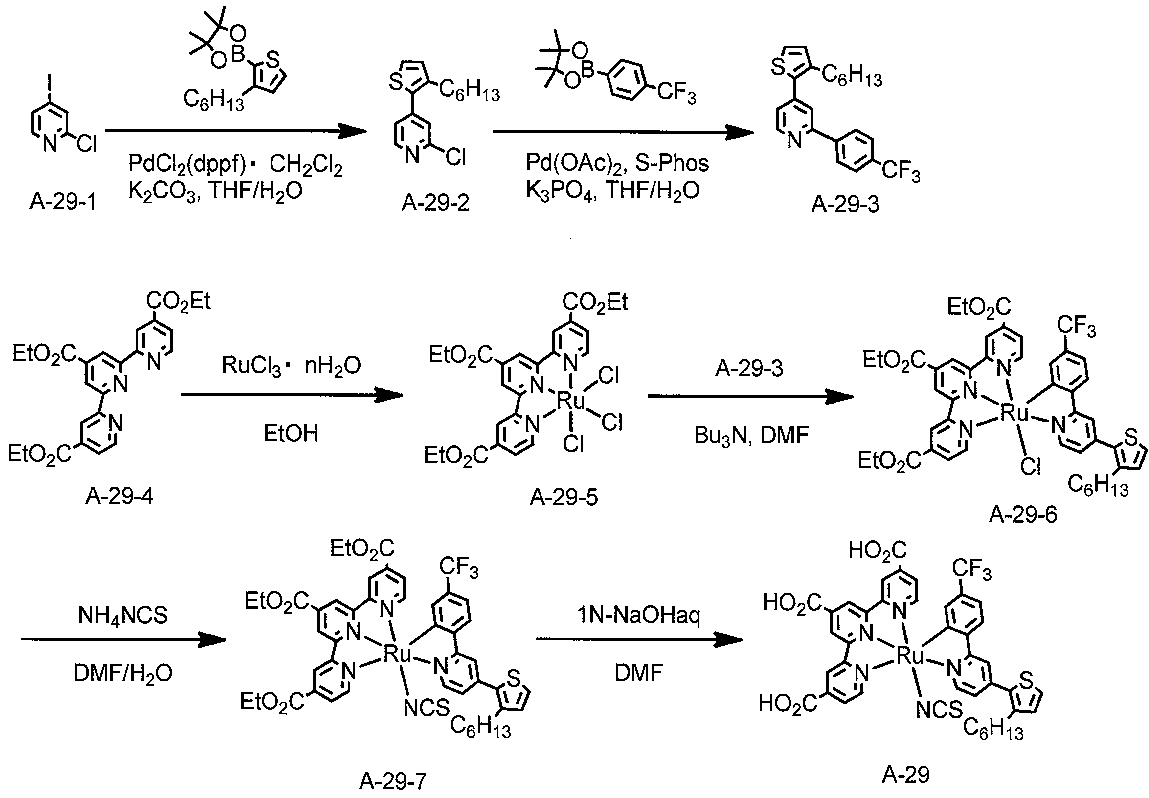
(i)化合物A-29-2の合成
化合物A-29-1を15.0g、2-(3-ヘキシルチオフェン-2-イル)-4,4,5,5-テトラメチル-1,3,2-ジオキサボロラン20.5mL、炭酸カリウム26.0g、1,1’-ビス(ジフェニルホスフィノ)フェロセン-パラジウム(II)ジクロリド-ジクロロメタン錯体5.1g、THF(テトラヒドロフラン)150mL、純水150mLを、500mLの3つ口フラスコに入れ、窒素雰囲気下で3時間加熱還流させた。得られた溶液を室温に戻し、塩化アンモニウムで中和した後、反応生成物を酢酸エチルで抽出した。有機相を濃縮し、シリカゲルカラムクロマトグラフィ-で精製することにより、化合物A-29-2を13g得た。
化合物A-29-1を15.0g、2-(3-ヘキシルチオフェン-2-イル)-4,4,5,5-テトラメチル-1,3,2-ジオキサボロラン20.5mL、炭酸カリウム26.0g、1,1’-ビス(ジフェニルホスフィノ)フェロセン-パラジウム(II)ジクロリド-ジクロロメタン錯体5.1g、THF(テトラヒドロフラン)150mL、純水150mLを、500mLの3つ口フラスコに入れ、窒素雰囲気下で3時間加熱還流させた。得られた溶液を室温に戻し、塩化アンモニウムで中和した後、反応生成物を酢酸エチルで抽出した。有機相を濃縮し、シリカゲルカラムクロマトグラフィ-で精製することにより、化合物A-29-2を13g得た。
(ii)配位子A-29-3の合成
化合物A-29-2を5.0g、リン酸カリウム15.2g、THF45mL、純水45mL、酢酸パラジウム0.2g、S-Phos(2-ジシクロヘキシルフォスフィノ-2’,6’-ジメトキシビフェニル)0.88g、4,4,5,5-テトラメチル-l-2-[4-(トリフルオロメチル)フェニル]-1,3,2-ジオキサボロラン5.83gを、200mLの3つ口フラスコに入れ、窒素雰囲気下で3時間加熱還流させた。得られた溶液を室温に戻し、塩化アンモニウムで中和した後、反応生成物を酢酸エチルで抽出した。有機相を濃縮し、シリカゲルカラムクロマトグラフィ-で精製することにより、配位子A-29-3を3.8g得た。
化合物A-29-2を5.0g、リン酸カリウム15.2g、THF45mL、純水45mL、酢酸パラジウム0.2g、S-Phos(2-ジシクロヘキシルフォスフィノ-2’,6’-ジメトキシビフェニル)0.88g、4,4,5,5-テトラメチル-l-2-[4-(トリフルオロメチル)フェニル]-1,3,2-ジオキサボロラン5.83gを、200mLの3つ口フラスコに入れ、窒素雰囲気下で3時間加熱還流させた。得られた溶液を室温に戻し、塩化アンモニウムで中和した後、反応生成物を酢酸エチルで抽出した。有機相を濃縮し、シリカゲルカラムクロマトグラフィ-で精製することにより、配位子A-29-3を3.8g得た。
(iii)化合物A-29-5の合成
化合物A-29-4を4.0g、塩化ルテニウム2.42g、エタノール90mLを、200mLの3つ口フラスコに入れ、窒素雰囲気下で4時間加熱還流させた。得られた沈殿物を濾過し、エタノールで洗浄することにより、化合物A-29-5を5.6g得た。
化合物A-29-4を4.0g、塩化ルテニウム2.42g、エタノール90mLを、200mLの3つ口フラスコに入れ、窒素雰囲気下で4時間加熱還流させた。得られた沈殿物を濾過し、エタノールで洗浄することにより、化合物A-29-5を5.6g得た。
(iv)化合物A-29-6の合成
化合物A-29-5を1.73g、化合物A-29-3を1.02g、DMF(N,N-ジメチルホルムアミド)27mL、トリブチルアミン2.44gを、3つ口フラスコに入れ、窒素雰囲気下、140℃で3時間加熱させた。得られた溶液を室温に戻したあと、濃縮し、シリカゲルカラムクロマトグラフィ-で精製することにより、化合物A-29-6を0.5g得た。
化合物A-29-5を1.73g、化合物A-29-3を1.02g、DMF(N,N-ジメチルホルムアミド)27mL、トリブチルアミン2.44gを、3つ口フラスコに入れ、窒素雰囲気下、140℃で3時間加熱させた。得られた溶液を室温に戻したあと、濃縮し、シリカゲルカラムクロマトグラフィ-で精製することにより、化合物A-29-6を0.5g得た。
(v)化合物A-29-7の合成
化合物A-29-6を0.5g、チオシアン酸アンモニウム52.3mg、DMF10mL、純水1.0mLの混合物を、20mLのガラス容器にいれ、160℃で10分間マイクロウェーブにて加熱した。得られた溶液を濃縮し、シリカゲルカラムクロマトグラフィ-で精製することにより、化合物A-29-7を0.16g得た。
化合物A-29-6を0.5g、チオシアン酸アンモニウム52.3mg、DMF10mL、純水1.0mLの混合物を、20mLのガラス容器にいれ、160℃で10分間マイクロウェーブにて加熱した。得られた溶液を濃縮し、シリカゲルカラムクロマトグラフィ-で精製することにより、化合物A-29-7を0.16g得た。
(vi)金属錯体色素A-29の合成
化合物A-29-7を160mg、DMF42mL、1NのNaOH水溶液1.4mLを、100mLのナスフラスコに入れ、室温で反応させた。得られた溶液をTfOH(トリフルオロメタンスルホン酸)を用いてpH2.9にした後、濾過し、次いで、超純水で洗浄することにより、金属錯体色素A-29を120mg得た。
化合物A-29-7を160mg、DMF42mL、1NのNaOH水溶液1.4mLを、100mLのナスフラスコに入れ、室温で反応させた。得られた溶液をTfOH(トリフルオロメタンスルホン酸)を用いてpH2.9にした後、濾過し、次いで、超純水で洗浄することにより、金属錯体色素A-29を120mg得た。
得られた金属錯体色素A-29の可視吸収スペクトルを図3に示す。
当該スペクトルは、17μモル/Lの濃度で、株式会社島津製作所製のUV-3600を用いて測定した。
図3は測定溶媒がDMFでのスペクトル図である。
当該スペクトルは、17μモル/Lの濃度で、株式会社島津製作所製のUV-3600を用いて測定した。
図3は測定溶媒がDMFでのスペクトル図である。
表1に記載する他の金属錯体色素も上記と同様な方法、またはこれに準じた方法で合成した。
得られた金属錯体色素の構造はMS(マススペクトル)測定により確認した。
マススペクトルの測定結果を下記表1に示す。
マススペクトルの測定結果を下記表1に示す。
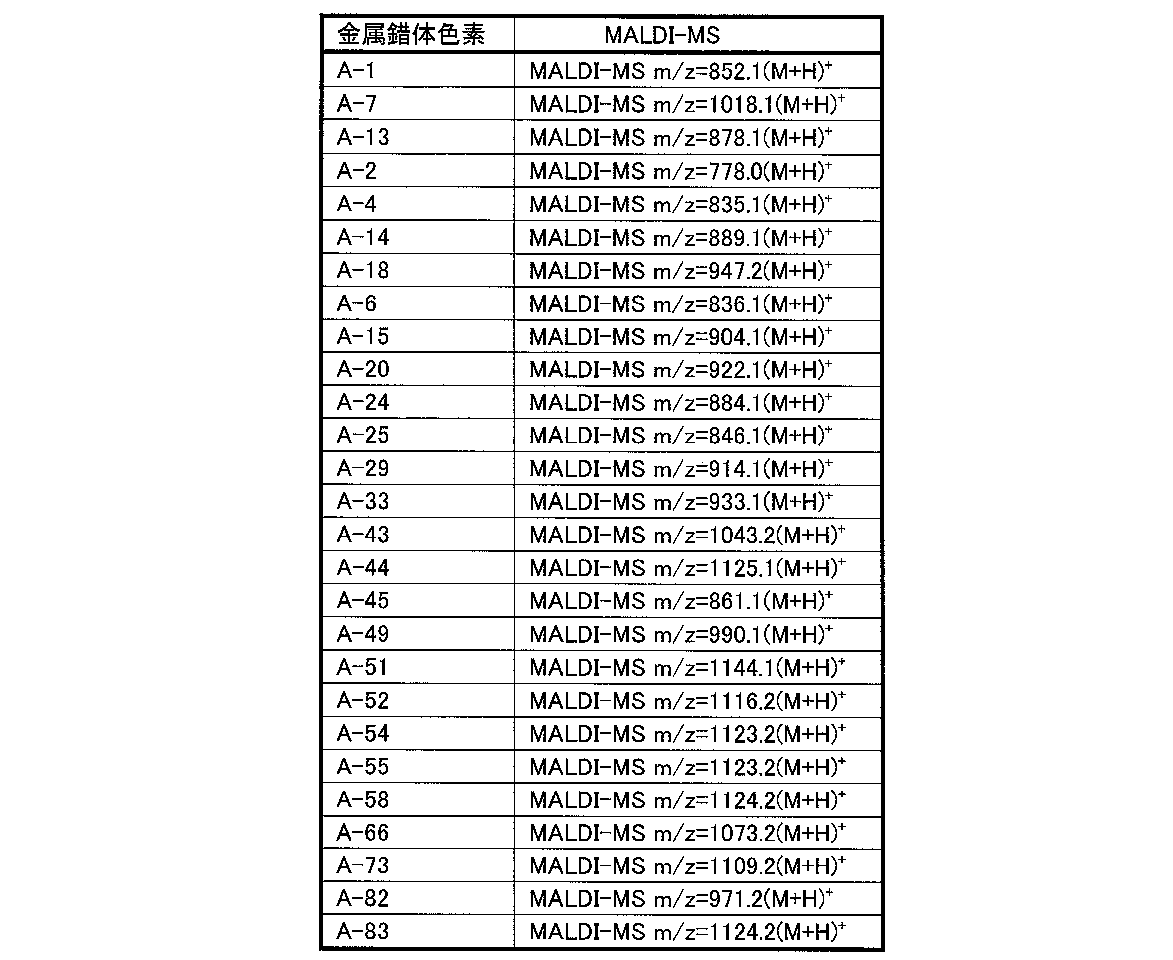
実施例2(色素増感太陽電池の作製)
以下に示す手順により、特開2002-289274号公報に記載の図5に示されている光電極12と同様の構成を有する光電極を作製し、更に、同公報の図3に示されている光電極に代えてこの光電極を用いた以外は図3の色素増感太陽電池20と同様の構成を有する10mm×10mmのスケールの色素増感太陽電池を作製した。具体的な構成は図2に示した。図2では、41が透明電極、42が半導体電極、43が透明導電膜、44が基板、45が半導体層、46が光散乱層、40が光電極、20が色素増感太陽電池、CEが対極、Eが電解質、Sがスペーサーである。
以下に示す手順により、特開2002-289274号公報に記載の図5に示されている光電極12と同様の構成を有する光電極を作製し、更に、同公報の図3に示されている光電極に代えてこの光電極を用いた以外は図3の色素増感太陽電池20と同様の構成を有する10mm×10mmのスケールの色素増感太陽電池を作製した。具体的な構成は図2に示した。図2では、41が透明電極、42が半導体電極、43が透明導電膜、44が基板、45が半導体層、46が光散乱層、40が光電極、20が色素増感太陽電池、CEが対極、Eが電解質、Sがスペーサーである。
(ペーストの調製)
(ペーストA)球形のTiO2粒子(アナターゼ、平均粒径;25nm、以下、球形TiO2粒子Aという)を硝酸溶液に入れて撹拌することによりチタニアスラリーを調製した。次に、チタニアスラリーに増粘剤としてセルロース系バインダーを加え、混練してペーストAを調製した。
(ペースト1)球形TiO2粒子Aと、球形のTiO2粒子(アナターゼ、平均粒径;200nm、以下、球形TiO2粒子Bという)とを硝酸溶液に入れて撹拌することによりチタニアスラリーを調製した。次に、チタニアスラリーに増粘剤としてセルロース系バインダーを加えて混練し、TiO2粒子Aの質量:TiO2粒子Bの質量=30:70のペースト1を調製した。
(ペースト2)ペーストAに、棒状TiO2粒子(アナターゼ、直径;100nm、アスペクト比;5、以下、棒状TiO2粒子Cという)を混合し、棒状TiO2粒子Cの質量:ペーストAの質量=30:70のペースト2を調製した。
(ペーストA)球形のTiO2粒子(アナターゼ、平均粒径;25nm、以下、球形TiO2粒子Aという)を硝酸溶液に入れて撹拌することによりチタニアスラリーを調製した。次に、チタニアスラリーに増粘剤としてセルロース系バインダーを加え、混練してペーストAを調製した。
(ペースト1)球形TiO2粒子Aと、球形のTiO2粒子(アナターゼ、平均粒径;200nm、以下、球形TiO2粒子Bという)とを硝酸溶液に入れて撹拌することによりチタニアスラリーを調製した。次に、チタニアスラリーに増粘剤としてセルロース系バインダーを加えて混練し、TiO2粒子Aの質量:TiO2粒子Bの質量=30:70のペースト1を調製した。
(ペースト2)ペーストAに、棒状TiO2粒子(アナターゼ、直径;100nm、アスペクト比;5、以下、棒状TiO2粒子Cという)を混合し、棒状TiO2粒子Cの質量:ペーストAの質量=30:70のペースト2を調製した。
(半導体電極の作製)
ガラス基板(基板44)上にフッ素ドープされたSnO2導電膜(透明導電膜43、膜厚;500nm)を形成した透明電極41(導電性支持体)を準備した。そして、このSnO2導電膜上に、上述のペースト1をスクリーン印刷し、次いで乾燥させた。その後、空気中、450℃の条件のもとで焼成した。更に、ペースト2を用いてスクリーン印刷と焼成とを繰り返すことにより、SnO2導電膜上に、図2に示す半導体電極42と同様の構成の半導体電極(受光面の面積;10mm×10mm、層厚;10μm、半導体層の層厚;6μm、光散乱層の層厚;4μm、光散乱層に含有される棒状TiO2粒子Cの含有率;30質量%)(感光体層)を形成し、色素を含有していない光電極を作製した。
ガラス基板(基板44)上にフッ素ドープされたSnO2導電膜(透明導電膜43、膜厚;500nm)を形成した透明電極41(導電性支持体)を準備した。そして、このSnO2導電膜上に、上述のペースト1をスクリーン印刷し、次いで乾燥させた。その後、空気中、450℃の条件のもとで焼成した。更に、ペースト2を用いてスクリーン印刷と焼成とを繰り返すことにより、SnO2導電膜上に、図2に示す半導体電極42と同様の構成の半導体電極(受光面の面積;10mm×10mm、層厚;10μm、半導体層の層厚;6μm、光散乱層の層厚;4μm、光散乱層に含有される棒状TiO2粒子Cの含有率;30質量%)(感光体層)を形成し、色素を含有していない光電極を作製した。
(色素吸着)
次に、半導体電極(色素吸着電極の前駆体)に色素を以下のようにして吸着させた。まず、マグネシウムエトキシドで脱水したt-ブタノールとジメチルホルムアミドの1:1(体積比)の混合物を溶媒として、下記表2に記載の金属錯体色素を、濃度が3×10⁻⁴モル/Lとなるように溶解し、さらに共吸着剤として、ケノデオキシコール酸とコール酸の等モル混合物を金属錯体色素1モルに対して20モル加え、各色素溶液を調製した。各色素溶液をカール・フィッシャー滴定により水分量を測定したところ、いずれの色素溶液も、水は0.01質量%未満であった。次に、各色素溶液に半導体電極を40℃10時間浸漬し、引き上げ後50℃で乾燥させることにより、半導体電極に色素が約2×10-7mol/cm2吸着した光電極40をそれぞれ完成させた。
次に、半導体電極(色素吸着電極の前駆体)に色素を以下のようにして吸着させた。まず、マグネシウムエトキシドで脱水したt-ブタノールとジメチルホルムアミドの1:1(体積比)の混合物を溶媒として、下記表2に記載の金属錯体色素を、濃度が3×10⁻⁴モル/Lとなるように溶解し、さらに共吸着剤として、ケノデオキシコール酸とコール酸の等モル混合物を金属錯体色素1モルに対して20モル加え、各色素溶液を調製した。各色素溶液をカール・フィッシャー滴定により水分量を測定したところ、いずれの色素溶液も、水は0.01質量%未満であった。次に、各色素溶液に半導体電極を40℃10時間浸漬し、引き上げ後50℃で乾燥させることにより、半導体電極に色素が約2×10-7mol/cm2吸着した光電極40をそれぞれ完成させた。
(色素増感太陽電池の組み立て)
次に、対極CEとして上記の光電極40と同様の形状と大きさを有する白金電極(Pt薄膜の厚さ;100nm)、電解液として、ヨウ素0.1M、ヨウ化リチウム0.05M、4-t-ブチルピリジン0.25Mを含むヨウ素系レドックスアセトニトリル溶液を調製した。更に、半導体電極の大きさに合わせた形状を有するデュポン社製のスペーサーS(商品名:「サーリン」)を準備し、光電極40と対極CEを、スペーサーSを介して対向、熱圧着させ、内部に上記の電解質を充填した(電荷移動体層を形成した)。作成した電池の外周および電解液注入口を、ナガセケムテック製レジンXNR-5516を用いて封止、硬化し、各色素増感太陽電池(試料番号101~127およびc11~c15)をそれぞれ完成させた。この色素増感太陽電池の性能を下記のようにして評価した。
次に、対極CEとして上記の光電極40と同様の形状と大きさを有する白金電極(Pt薄膜の厚さ;100nm)、電解液として、ヨウ素0.1M、ヨウ化リチウム0.05M、4-t-ブチルピリジン0.25Mを含むヨウ素系レドックスアセトニトリル溶液を調製した。更に、半導体電極の大きさに合わせた形状を有するデュポン社製のスペーサーS(商品名:「サーリン」)を準備し、光電極40と対極CEを、スペーサーSを介して対向、熱圧着させ、内部に上記の電解質を充填した(電荷移動体層を形成した)。作成した電池の外周および電解液注入口を、ナガセケムテック製レジンXNR-5516を用いて封止、硬化し、各色素増感太陽電池(試料番号101~127およびc11~c15)をそれぞれ完成させた。この色素増感太陽電池の性能を下記のようにして評価した。
(評価実験1)
電池特性試験を行い、上記色素増感太陽電池の短絡電流密度(Jsc 単位mA/cm2)、開放電圧(Voc 単位v)、フィルファクター(FF)を求め、電池出力を入射エネルギーで除することにより初期光電変換効率〔η(%)〕を算出した。電池特性試験は、ソーラーシミュレーター(ペクセル・テクノロジーズ株式会社製PEC-L12)を用いた。特性評価はペクセル・テクノロジーズ株式会社製I-V特性計測装置(PECK2400-N)を用いた。評価は同一条件に付き、5個のセルを作製し、初期光電変換効率評価結果はこれらの平均値を示した。また、初期光電変換効率のバラツキは標準偏差によって評価した。得られた結果を下記の評価基準で評価した。
電池特性試験を行い、上記色素増感太陽電池の短絡電流密度(Jsc 単位mA/cm2)、開放電圧(Voc 単位v)、フィルファクター(FF)を求め、電池出力を入射エネルギーで除することにより初期光電変換効率〔η(%)〕を算出した。電池特性試験は、ソーラーシミュレーター(ペクセル・テクノロジーズ株式会社製PEC-L12)を用いた。特性評価はペクセル・テクノロジーズ株式会社製I-V特性計測装置(PECK2400-N)を用いた。評価は同一条件に付き、5個のセルを作製し、初期光電変換効率評価結果はこれらの平均値を示した。また、初期光電変換効率のバラツキは標準偏差によって評価した。得られた結果を下記の評価基準で評価した。
初期光電変換効率評価基準
A:光電変換効率が試料c11の初期光電変換効率に対し1.3倍以上
B:光電変換効率が試料c11の初期光電変換効率に対し1.1倍以上1.3倍未満
C:光電変換効率が試料c11の初期光電変換効率に対し1.1倍未満
なお、下記表2には初期性能として示す。
A:光電変換効率が試料c11の初期光電変換効率に対し1.3倍以上
B:光電変換効率が試料c11の初期光電変換効率に対し1.1倍以上1.3倍未満
C:光電変換効率が試料c11の初期光電変換効率に対し1.1倍未満
なお、下記表2には初期性能として示す。
初期光電変換効率のバラツキ評価基準
A:標準偏差が0.07未満
B:標準偏差が0.07以上0.15未満
C:標準偏差が0.15以上
なお、下記表2には初期性能のバラツキとして示す。
A:標準偏差が0.07未満
B:標準偏差が0.07以上0.15未満
C:標準偏差が0.15以上
なお、下記表2には初期性能のバラツキとして示す。
(評価実験2)
上記色素増感太陽電池を、65℃の環境下に200時間放置する前後の光電変換効率(η200)を測定し、その比を劣化率とした。
すなわち、劣化率は、初期光電変換効率(η0)とすると、下記式で求められる。
上記色素増感太陽電池を、65℃の環境下に200時間放置する前後の光電変換効率(η200)を測定し、その比を劣化率とした。
すなわち、劣化率は、初期光電変換効率(η0)とすると、下記式で求められる。
劣化率=(η0-η200)÷η0×100
評価は同一条件に付き、5個のセルを作製し、劣化率評価結果はこれらの平均値を示した。また、劣化率のバラツキは標準偏差によって評価した。得られた結果を下記の評価基準で評価した。
劣化率評価基準
A:劣化率がマイナス(良化した)
B:劣化率が0~10%
C:劣化率が10%超
なお、表2には熱耐久性として示す。
A:劣化率がマイナス(良化した)
B:劣化率が0~10%
C:劣化率が10%超
なお、表2には熱耐久性として示す。
劣化率のバラツキ評価基準
A:標準偏差が2%未満
B:標準偏差が2%以上5%未満
C:標準偏差が5%以上
なお、表2には熱耐久性のバラツキとして示す。
A:標準偏差が2%未満
B:標準偏差が2%以上5%未満
C:標準偏差が5%以上
なお、表2には熱耐久性のバラツキとして示す。
得られた結果をまとめて、下記表2に示す。
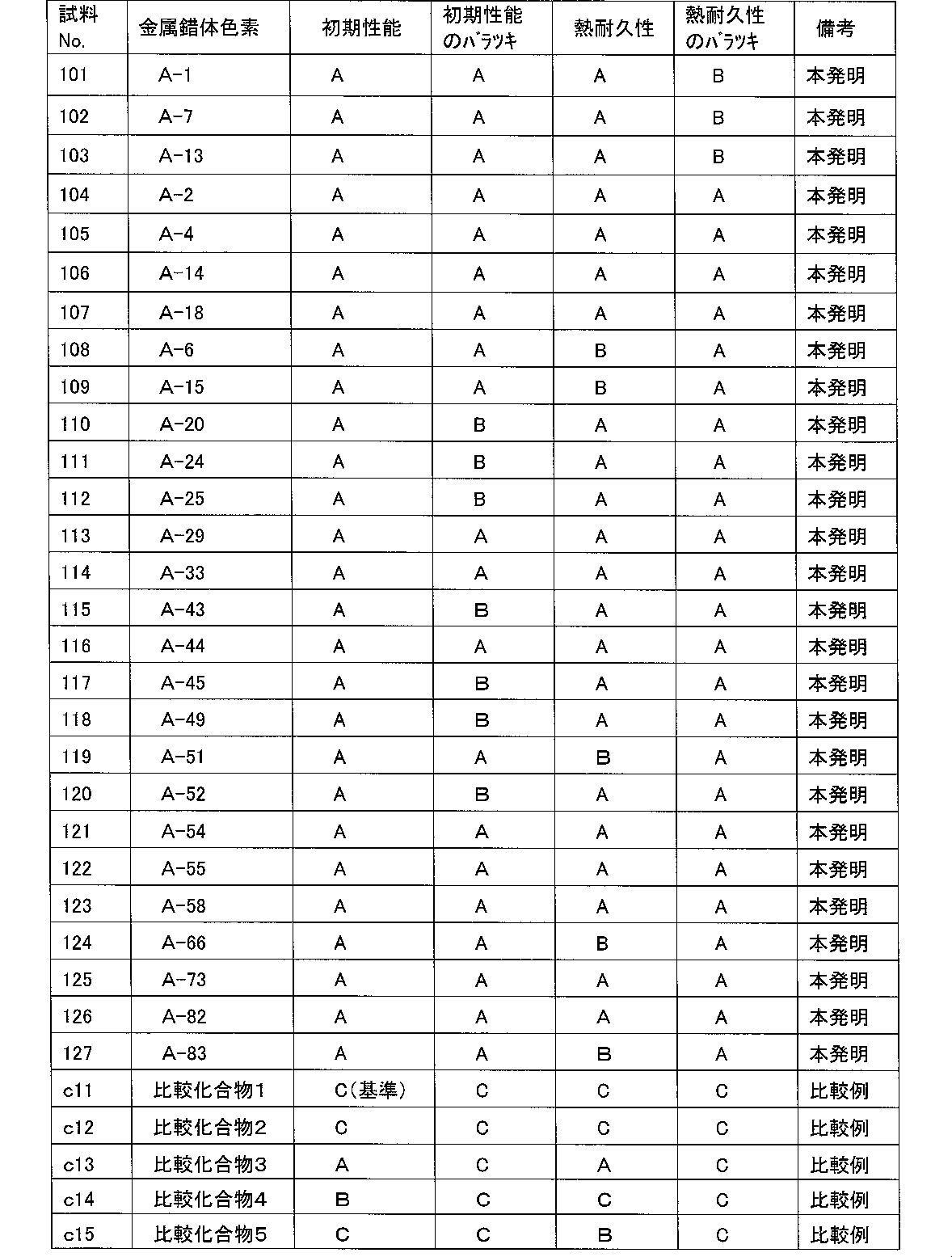

なお、比較化合物2は、特開2009-51999号公報に記載の化合物3であり、比較化合物5は、国際公開第2009/131183号パンフレットに記載の化合物である。
表2から明らかなように、本発明の光電変換素子はいずれも初期の光電変換効率に優れ、しかも耐久性が高い。
また、繰返し製造におけるこれらの性能のバラツキが小さいことがわかる。
また、繰返し製造におけるこれらの性能のバラツキが小さいことがわかる。
1 導電性支持体
2 感光体層
21 色素(金属錯体色素)
22 半導体微粒子
3 電荷移動体層
4 対極
5 受光電極
6 回路
10 光電変換素子
100 色素増感太陽電池を利用したシステム
M 動作手段
2 感光体層
21 色素(金属錯体色素)
22 半導体微粒子
3 電荷移動体層
4 対極
5 受光電極
6 回路
10 光電変換素子
100 色素増感太陽電池を利用したシステム
M 動作手段
20 色素増感太陽電池
40 光電極
41 透明電極
42 半導体電極
43 透明導電膜
44 基板
45 半導体層
46 光散乱層
CE 対極
E 電解質
S スペーサー
40 光電極
41 透明電極
42 半導体電極
43 透明導電膜
44 基板
45 半導体層
46 光散乱層
CE 対極
E 電解質
S スペーサー
Claims (18)
- 導電性支持体、電解質を含む感光体層、電解質を含む電荷移動体層および対極を有する光電変換素子であって、該感光体層が、下記式(I)で表される金属錯体色素が担持された半導体微粒子を有する光電変換素子。
M(LD)(LA)(Z)・(CI) 式(I)
式(I)において、Mは金属イオンを表す。
LDは下記式(DL-1)で表される2座の配位子を表す。
LAは下記式(AL-1)または(AL-2)で表される3座の配位子を表す。
Zは単座の配位子を表す。
CIは電荷を中和するのに必要な対イオンを表す。


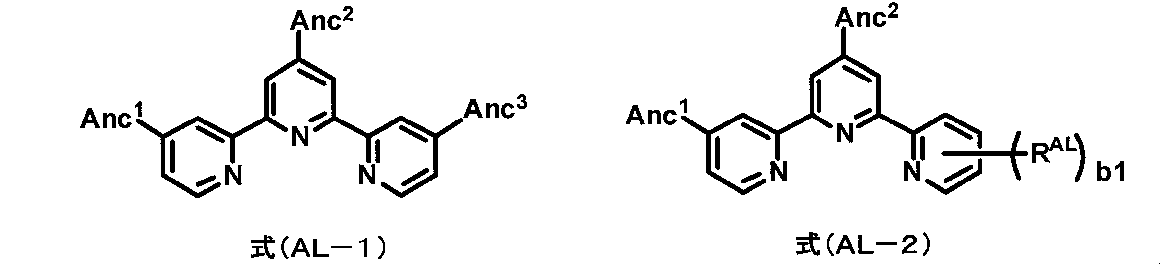
- 前記Mが、Fe2+、Ru2+またはOs2+である請求項1に記載の光電変換素子。
- 前記環C1が、チオフェン環、フラン環、ピロール環またはベンゼン環である請求項1または2に記載の光電変換素子。
- 前記環Xuが、ヘテロアリール環基である請求項1~3のいずれか1項に記載の光電変換素子。
- 前記環Xuが、チオフェン環基またはフラン環基である請求項1~4のいずれか1項に記載の光電変換素子。
- 前記Luが単結合であり、前記qが0であり、前記Ruがアミノ基、アルキルアミノ基またはアリールアミノ基である請求項1~5のいずれか1項に記載の光電変換素子。
- 前記環Aが、ピリジン環である請求項1~6のいずれか1項に記載の光電変換素子。
- 前記LAが、前記式(AL-1)で表される請求項1~7のいずれか1項に記載の光電変換素子。
- 前記半導体微粒子に、さらに酸性基を1つ以上有する共吸着剤が担持されてなる請求項1~8のいずれか1項に記載の光電変換素子。
- 前記共吸着剤が下記式(CA)で表される請求項9に記載の光電変換素子。

- 請求項1~10のいずれか1項に記載の光電変換素子を具備する色素増感太陽電池。
- 下記式(I)で表される金属錯体色素。
M(LD)(LA)(Z)・(CI) 式(I)
式(I)において、Mは金属イオンを表す。
LDは下記式(DL-1)で表される2座の配位子を表す。
LAは下記式(AL-1)または(AL-2)で表される3座の配位子を表す。
Zは単座の配位子を表す。
CIは電荷を中和するのに必要な対イオンを表す。



- 請求項12に記載の金属錯体色素を溶解してなる色素溶液。
- 有機溶媒中に、前記金属錯体色素を0.001~0.1質量%含有し、含水率が0.1質量%以下である請求項13に記載の色素溶液。
- 前記色素溶液が、さらに共吸着剤を含有する請求項13または14に記載の色素溶液。
- 前記共吸着剤が、下記式(CA)で表される請求項15に記載の色素溶液。

- 半導体微粒子を付与した導電性支持体に、請求項13~16のいずれか1項に記載の色素溶液から得られてなる組成物を塗布し、塗布後の該組成物を硬化させて感光体層としてなる色素増感太陽電池用の色素吸着電極。
- 請求項17に記載の色素増感太陽電池用の色素吸着電極、電解質および対極を用いて組み立てる色素増感太陽電池の製造方法。
Applications Claiming Priority (4)
| Application Number | Priority Date | Filing Date | Title |
|---|---|---|---|
| JP2013084417 | 2013-04-12 | ||
| JP2013-084417 | 2013-04-12 | ||
| JP2013264800 | 2013-12-24 | ||
| JP2013-264800 | 2013-12-24 |
Publications (1)
| Publication Number | Publication Date |
|---|---|
| WO2014168165A1 true WO2014168165A1 (ja) | 2014-10-16 |
Family
ID=51689571
Family Applications (1)
| Application Number | Title | Priority Date | Filing Date |
|---|---|---|---|
| PCT/JP2014/060255 Ceased WO2014168165A1 (ja) | 2013-04-12 | 2014-04-09 | 光電変換素子、色素増感太陽電池、金属錯体色素、色素溶液、色素吸着電極および色素増感太陽電池の製造方法 |
Country Status (3)
| Country | Link |
|---|---|
| JP (1) | JP6017491B2 (ja) |
| TW (1) | TW201440287A (ja) |
| WO (1) | WO2014168165A1 (ja) |
Cited By (7)
| Publication number | Priority date | Publication date | Assignee | Title |
|---|---|---|---|---|
| WO2016143507A1 (ja) * | 2015-03-09 | 2016-09-15 | 富士フイルム株式会社 | 光電変換素子、色素増感太陽電池、金属錯体色素および色素溶液 |
| WO2016148100A1 (ja) * | 2015-03-17 | 2016-09-22 | 富士フイルム株式会社 | ルテニウム錯体色素、色素溶液、光電変換素子および色素増感太陽電池 |
| EP3157026A4 (en) * | 2014-06-11 | 2017-05-03 | Fujifilm Corporation | Photoelectric conversion element, dye-sensitized solar cell, metal-complex pigment, pigment solution, and terpyridine compound or esterified terpyridine compound |
| EP3323822A1 (en) * | 2016-09-23 | 2018-05-23 | Universal Display Corporation | Organic electroluminescent materials and devices |
| CN113257453A (zh) * | 2021-04-15 | 2021-08-13 | 中国科学院山西煤炭化学研究所 | 一种含磷有机载体perc太阳能正面银浆及制备方法 |
| EP3806206A4 (en) * | 2018-05-24 | 2022-02-23 | Zeon Corporation | ELECTRODE MATERIAL, ELECTRODE, ENERGY STORAGE DEVICE AND SPRAY COMPOSITION |
| CN115966770A (zh) * | 2023-03-09 | 2023-04-14 | 宁德新能源科技有限公司 | 一种电解液、包含该电解液的电化学装置和电子装置 |
Families Citing this family (1)
| Publication number | Priority date | Publication date | Assignee | Title |
|---|---|---|---|---|
| KR102013538B1 (ko) * | 2015-09-17 | 2019-08-22 | 후지필름 가부시키가이샤 | 광전 변환 소자, 색소 증감 태양 전지, 색소 조성물 및 산화물 반도체 전극 |
Citations (5)
| Publication number | Priority date | Publication date | Assignee | Title |
|---|---|---|---|---|
| JP2009051999A (ja) * | 2007-08-29 | 2009-03-12 | National Institute Of Advanced Industrial & Technology | 色素及びそれを用いた色素増感太陽電池 |
| JP2009067976A (ja) * | 2007-09-17 | 2009-04-02 | Jsr Corp | 色素、色素増感太陽電池及びその製造方法 |
| WO2009131183A1 (ja) * | 2008-04-24 | 2009-10-29 | シャープ株式会社 | ピリジン系金属錯体、それを用いた光電極およびそれを備えた色素増感太陽電池 |
| WO2013047384A1 (ja) * | 2011-09-29 | 2013-04-04 | 富士フイルム株式会社 | 光電変換素子及び光電気化学電池、並びにこれに用いられる金属錯体色素 |
| WO2013047238A1 (ja) * | 2011-09-29 | 2013-04-04 | 富士フイルム株式会社 | 光電変換素子及び光電気化学電池、これらに用いられる色素 |
Family Cites Families (1)
| Publication number | Priority date | Publication date | Assignee | Title |
|---|---|---|---|---|
| JP6033143B2 (ja) * | 2013-03-25 | 2016-11-30 | 富士フイルム株式会社 | 光電変換素子、色素増感太陽電池、金属錯体、金属錯体色素、色素溶液、色素吸着電極の製造方法および色素増感太陽電池の製造方法 |
-
2014
- 2014-04-09 JP JP2014080220A patent/JP6017491B2/ja not_active Expired - Fee Related
- 2014-04-09 WO PCT/JP2014/060255 patent/WO2014168165A1/ja not_active Ceased
- 2014-04-11 TW TW103113329A patent/TW201440287A/zh unknown
Patent Citations (5)
| Publication number | Priority date | Publication date | Assignee | Title |
|---|---|---|---|---|
| JP2009051999A (ja) * | 2007-08-29 | 2009-03-12 | National Institute Of Advanced Industrial & Technology | 色素及びそれを用いた色素増感太陽電池 |
| JP2009067976A (ja) * | 2007-09-17 | 2009-04-02 | Jsr Corp | 色素、色素増感太陽電池及びその製造方法 |
| WO2009131183A1 (ja) * | 2008-04-24 | 2009-10-29 | シャープ株式会社 | ピリジン系金属錯体、それを用いた光電極およびそれを備えた色素増感太陽電池 |
| WO2013047384A1 (ja) * | 2011-09-29 | 2013-04-04 | 富士フイルム株式会社 | 光電変換素子及び光電気化学電池、並びにこれに用いられる金属錯体色素 |
| WO2013047238A1 (ja) * | 2011-09-29 | 2013-04-04 | 富士フイルム株式会社 | 光電変換素子及び光電気化学電池、これらに用いられる色素 |
Non-Patent Citations (1)
| Title |
|---|
| TAKASHI FUNAKI ET AL.: "Synthesis of a new class of cyclometallated ruthenium(II) complexes and their application in dye- sensitized solar cells", INORGANIC CHEMISTRY COMMUNICATIONS, vol. 12, no. 9, 3 July 2009 (2009-07-03), pages 842 - 845 * |
Cited By (11)
| Publication number | Priority date | Publication date | Assignee | Title |
|---|---|---|---|---|
| EP3157026A4 (en) * | 2014-06-11 | 2017-05-03 | Fujifilm Corporation | Photoelectric conversion element, dye-sensitized solar cell, metal-complex pigment, pigment solution, and terpyridine compound or esterified terpyridine compound |
| WO2016143507A1 (ja) * | 2015-03-09 | 2016-09-15 | 富士フイルム株式会社 | 光電変換素子、色素増感太陽電池、金属錯体色素および色素溶液 |
| JPWO2016143507A1 (ja) * | 2015-03-09 | 2018-01-25 | 富士フイルム株式会社 | 光電変換素子、色素増感太陽電池、金属錯体色素および色素溶液 |
| WO2016148100A1 (ja) * | 2015-03-17 | 2016-09-22 | 富士フイルム株式会社 | ルテニウム錯体色素、色素溶液、光電変換素子および色素増感太陽電池 |
| CN107406686A (zh) * | 2015-03-17 | 2017-11-28 | 富士胶片株式会社 | 钌络合物色素、色素溶液、光电转换元件及色素增感太阳能电池 |
| JPWO2016148100A1 (ja) * | 2015-03-17 | 2018-01-11 | 富士フイルム株式会社 | ルテニウム錯体色素、色素溶液、光電変換素子および色素増感太陽電池 |
| CN107406686B (zh) * | 2015-03-17 | 2019-06-28 | 富士胶片株式会社 | 钌络合物色素、色素溶液、光电转换元件及色素增感太阳能电池 |
| EP3323822A1 (en) * | 2016-09-23 | 2018-05-23 | Universal Display Corporation | Organic electroluminescent materials and devices |
| EP3806206A4 (en) * | 2018-05-24 | 2022-02-23 | Zeon Corporation | ELECTRODE MATERIAL, ELECTRODE, ENERGY STORAGE DEVICE AND SPRAY COMPOSITION |
| CN113257453A (zh) * | 2021-04-15 | 2021-08-13 | 中国科学院山西煤炭化学研究所 | 一种含磷有机载体perc太阳能正面银浆及制备方法 |
| CN115966770A (zh) * | 2023-03-09 | 2023-04-14 | 宁德新能源科技有限公司 | 一种电解液、包含该电解液的电化学装置和电子装置 |
Also Published As
| Publication number | Publication date |
|---|---|
| JP6017491B2 (ja) | 2016-11-02 |
| JP2015144227A (ja) | 2015-08-06 |
| TW201440287A (zh) | 2014-10-16 |
Similar Documents
| Publication | Publication Date | Title |
|---|---|---|
| JP6017491B2 (ja) | 光電変換素子、色素増感太陽電池、金属錯体色素、色素溶液、色素吸着電極および色素増感太陽電池の製造方法 | |
| JP6047513B2 (ja) | 金属錯体色素、光電変換素子、色素増感太陽電池および金属錯体色素を含有する色素溶液 | |
| JP5972849B2 (ja) | 金属錯体、金属錯体色素、光電変換素子、色素増感太陽電池、色素溶液、色素吸着電極および色素増感太陽電池の製造方法 | |
| JP2014209606A (ja) | 光電変換素子、色素増感太陽電池、金属錯体色素を含有する色素吸着液および光電変換素子の製造方法 | |
| JP6005678B2 (ja) | 金属錯体色素、光電変換素子、色素増感太陽電池および金属錯体色素を含有する色素溶液 | |
| JP5944372B2 (ja) | 光電変換素子、色素増感太陽電池、金属錯体色素、色素溶液、色素吸着電極および色素増感太陽電池の製造方法 | |
| WO2014050527A1 (ja) | 光電変換素子および色素増感太陽電池 | |
| WO2014050528A1 (ja) | 光電変換素子および色素増感太陽電池 | |
| JP6026236B2 (ja) | 金属錯体色素、光電変換素子、色素増感太陽電池、色素溶液、色素吸着電極及び色素増感太陽電池の製造方法 | |
| JP5913223B2 (ja) | 金属錯体色素、光電変換素子、色素増感太陽電池、色素溶液および色素吸着電極 | |
| JP6009484B2 (ja) | 光電変換素子、色素増感太陽電池およびこれに用いる金属錯体色素 | |
| JP6154177B2 (ja) | 光電変換素子、色素増感太陽電池、金属錯体色素、色素溶液、色素吸着電極および色素増感太陽電池の製造方法 | |
| JP6144619B2 (ja) | 光電変換素子、色素増感太陽電池およびこれに用いる金属錯体色素 | |
| WO2015002081A1 (ja) | 光電変換素子、色素増感太陽電池、金属錯体色素、配位子、色素溶液、色素吸着電極および色素増感太陽電池の製造方法 | |
| JP6063361B2 (ja) | 光電変換素子、色素増感太陽電池および光電変換素子用電子移動促進剤 | |
| WO2014156859A1 (ja) | 光電変換素子、色素増感太陽電池およびこれに用いる金属錯体色素 | |
| JP2015053150A (ja) | 光電変換素子および色素増感太陽電池 | |
| JP2016076585A (ja) | 光電変換素子、色素増感太陽電池、ルテニウム錯体色素および色素溶液 |
Legal Events
| Date | Code | Title | Description |
|---|---|---|---|
| 121 | Ep: the epo has been informed by wipo that ep was designated in this application |
Ref document number: 14782171 Country of ref document: EP Kind code of ref document: A1 |
|
| NENP | Non-entry into the national phase |
Ref country code: DE |
|
| 122 | Ep: pct application non-entry in european phase |
Ref document number: 14782171 Country of ref document: EP Kind code of ref document: A1 |