WO2014157664A1 - 光学材料用重合性組成物、光学材料および光学材料の製造方法 - Google Patents
光学材料用重合性組成物、光学材料および光学材料の製造方法 Download PDFInfo
- Publication number
- WO2014157664A1 WO2014157664A1 PCT/JP2014/059286 JP2014059286W WO2014157664A1 WO 2014157664 A1 WO2014157664 A1 WO 2014157664A1 JP 2014059286 W JP2014059286 W JP 2014059286W WO 2014157664 A1 WO2014157664 A1 WO 2014157664A1
- Authority
- WO
- WIPO (PCT)
- Prior art keywords
- group
- polymerizable composition
- optical material
- compound
- bis
- Prior art date
- Legal status (The legal status is an assumption and is not a legal conclusion. Google has not performed a legal analysis and makes no representation as to the accuracy of the status listed.)
- Ceased
Links
Classifications
-
- C—CHEMISTRY; METALLURGY
- C08—ORGANIC MACROMOLECULAR COMPOUNDS; THEIR PREPARATION OR CHEMICAL WORKING-UP; COMPOSITIONS BASED THEREON
- C08G—MACROMOLECULAR COMPOUNDS OBTAINED OTHERWISE THAN BY REACTIONS ONLY INVOLVING UNSATURATED CARBON-TO-CARBON BONDS
- C08G18/00—Polymeric products of isocyanates or isothiocyanates
- C08G18/06—Polymeric products of isocyanates or isothiocyanates with compounds having active hydrogen
- C08G18/28—Polymeric products of isocyanates or isothiocyanates with compounds having active hydrogen characterised by the compounds used containing active hydrogen
- C08G18/30—Low-molecular-weight compounds
- C08G18/38—Low-molecular-weight compounds having heteroatoms other than oxygen
- C08G18/3855—Low-molecular-weight compounds having heteroatoms other than oxygen having sulfur
- C08G18/3876—Low-molecular-weight compounds having heteroatoms other than oxygen having sulfur containing mercapto groups
-
- B—PERFORMING OPERATIONS; TRANSPORTING
- B29—WORKING OF PLASTICS; WORKING OF SUBSTANCES IN A PLASTIC STATE IN GENERAL
- B29D—PRODUCING PARTICULAR ARTICLES FROM PLASTICS OR FROM SUBSTANCES IN A PLASTIC STATE
- B29D11/00—Producing optical elements, e.g. lenses or prisms
- B29D11/00009—Production of simple or compound lenses
- B29D11/00038—Production of contact lenses
-
- B—PERFORMING OPERATIONS; TRANSPORTING
- B29—WORKING OF PLASTICS; WORKING OF SUBSTANCES IN A PLASTIC STATE IN GENERAL
- B29D—PRODUCING PARTICULAR ARTICLES FROM PLASTICS OR FROM SUBSTANCES IN A PLASTIC STATE
- B29D11/00—Producing optical elements, e.g. lenses or prisms
- B29D11/00009—Production of simple or compound lenses
- B29D11/00038—Production of contact lenses
- B29D11/00125—Auxiliary operations, e.g. removing oxygen from the mould, conveying moulds from a storage to the production line in an inert atmosphere
- B29D11/00134—Curing of the contact lens material
-
- C—CHEMISTRY; METALLURGY
- C08—ORGANIC MACROMOLECULAR COMPOUNDS; THEIR PREPARATION OR CHEMICAL WORKING-UP; COMPOSITIONS BASED THEREON
- C08G—MACROMOLECULAR COMPOUNDS OBTAINED OTHERWISE THAN BY REACTIONS ONLY INVOLVING UNSATURATED CARBON-TO-CARBON BONDS
- C08G18/00—Polymeric products of isocyanates or isothiocyanates
- C08G18/06—Polymeric products of isocyanates or isothiocyanates with compounds having active hydrogen
- C08G18/08—Processes
-
- C—CHEMISTRY; METALLURGY
- C08—ORGANIC MACROMOLECULAR COMPOUNDS; THEIR PREPARATION OR CHEMICAL WORKING-UP; COMPOSITIONS BASED THEREON
- C08G—MACROMOLECULAR COMPOUNDS OBTAINED OTHERWISE THAN BY REACTIONS ONLY INVOLVING UNSATURATED CARBON-TO-CARBON BONDS
- C08G18/00—Polymeric products of isocyanates or isothiocyanates
- C08G18/06—Polymeric products of isocyanates or isothiocyanates with compounds having active hydrogen
- C08G18/70—Polymeric products of isocyanates or isothiocyanates with compounds having active hydrogen characterised by the isocyanates or isothiocyanates used
- C08G18/81—Unsaturated isocyanates or isothiocyanates
- C08G18/8133—Unsaturated isocyanates or isothiocyanates having acetylenic groups
-
- G—PHYSICS
- G02—OPTICS
- G02B—OPTICAL ELEMENTS, SYSTEMS OR APPARATUS
- G02B1/00—Optical elements characterised by the material of which they are made; Optical coatings for optical elements
- G02B1/04—Optical elements characterised by the material of which they are made; Optical coatings for optical elements made of organic materials, e.g. plastics
-
- G—PHYSICS
- G02—OPTICS
- G02B—OPTICAL ELEMENTS, SYSTEMS OR APPARATUS
- G02B1/00—Optical elements characterised by the material of which they are made; Optical coatings for optical elements
- G02B1/04—Optical elements characterised by the material of which they are made; Optical coatings for optical elements made of organic materials, e.g. plastics
- G02B1/041—Lenses
-
- C—CHEMISTRY; METALLURGY
- C08—ORGANIC MACROMOLECULAR COMPOUNDS; THEIR PREPARATION OR CHEMICAL WORKING-UP; COMPOSITIONS BASED THEREON
- C08G—MACROMOLECULAR COMPOUNDS OBTAINED OTHERWISE THAN BY REACTIONS ONLY INVOLVING UNSATURATED CARBON-TO-CARBON BONDS
- C08G2120/00—Compositions for reaction injection moulding processes
Definitions
- the present invention relates to a polymerizable composition for an optical material, an optical material, and a method for producing the optical material.
- plastic lenses are rapidly spreading to optical elements such as eyeglass lenses and camera lenses because they are lighter and harder to break than inorganic lenses and can be dyed.
- a plastic material having a high refractive index is desired from the viewpoint of reducing the thickness of the lens
- a plastic material having a high Abbe number is desired from the viewpoint of reducing chromatic aberration.
- a plastic lens made of a polythiourethane resin obtained by reacting polythiol and a polyiso (thio) cyanate compound has a high refractive index and is excellent in impact resistance, dyeability, workability, and the like.
- Patent Document 1 discloses a polymerizable composition for an optical material containing phenylene diisocyanate and a predetermined polythiol compound, and an ultrahigh refractive index polythiourethane plastic lens having a refractive index of 1.7 or more obtained from the composition. It is disclosed.
- Patent Document 2 discloses an optical material polymerizable composition containing episulfide (thioepoxide). It is described that an episulfide plastic lens having a refractive index of about 1.7 was obtained with the composition.
- Patent Document 3 discloses a plastic containing a compound having at least one radical polymerizable unsaturated double bond in the molecule, a predetermined alicyclic or aromatic polyisocyanate compound, and a predetermined polythiol compound. A lens composition and a plastic lens obtained from the composition are disclosed.
- the plastic lens obtained from the polymerizable composition for an optical material described in Patent Document 1 has a high refractive index, but sometimes has a low Abbe number and a relatively large chromatic aberration. In other words, there was room for improvement in the Abbe number.
- the plastic lens obtained from the polymeric composition for optical materials containing the episulfide compound of patent document 2 has a high refractive index, mechanical strength may fall.
- the plastic lens obtained from the composition described in Patent Document 3 has a low refractive index and has room for improvement in terms of optical properties.
- the composition contains three polymerization components, and it has a structure excellent in manufacturing stability, such as management of manufacturing processes and manufacturing conditions becomes complicated and the yield of plastic lenses decreases. It was hard to say.
- the present invention has been made in view of such circumstances, and is a thiourethane optical material having excellent optical properties such as refractive index and Abbe number, and excellent mechanical strength, that is, an excellent balance of these physical properties.
- An object is to provide a thiourethane optical material.
- B a polythiol compound;
- a polymerizable composition for an optical material comprising: [2]
- the compound (A) is represented by the following general formula (1) (In the formula (1), A 1 represents an optionally substituted alkylene group having 1 to 4 carbon atoms or an optionally substituted phenylene group, n is an integer of 0 or 1, and R 1 is Represents an isocyanato group or an isothiocyanato group, and R 2 represents a hydrogen atom, an alkyl group having 1 to 4 carbon atoms, or the following formula (Wherein, A 2 and R 3 have the same meanings as A 1 and R 1 , respectively, and may be the same as or different from these groups.
- the compound (A) is represented by the following general formula (2) (In Formula (2), A 3 represents an optionally substituted alkylene group having 1 to 4 carbon atoms or an optionally substituted phenylene group, R 4 represents an isocyanato group or an isothiocyanato group, and n represents It is an integer of 0 or 1.
- the polymerizable composition for optical materials represented by: [4]
- the polythiol compound (B) is Pentaerythritol tetrakis (3-mercaptopropionate), 4-mercaptomethyl-1,8-dimercapto-3,6-dithiaoctane, 5,7-dimercaptomethyl-1,11-dimercapto-3,6,9-tri Thiaundecane, 4,7-dimercaptomethyl-1,11-dimercapto-3,6,9-trithiaundecane, 4,8-dimercaptomethyl-1,11-dimercapto-3,6,9-trithiaundecane 1,1,3,3-tetrakis (mercaptomethylthio) propane, 4,6-bis (mercaptomethylthio) -1,3-dithiane, 2- (2,2-bis (mercaptomethylthio) ethyl) -1,3 -Dithietane, 1,1,2,2-te
- an optical material having a high refractive index and a high Abbe number and excellent in mechanical strength that is, an optical material excellent in balance of these characteristics is obtained.
- the polymerizable composition for an optical material of the present invention comprises (A) a compound having, in the molecule, a carbon-carbon triple bond and one or more groups selected from isocyanato groups and isothiocyanato groups, and (B) polythiol. And a compound.
- the present inventors have a particularly high optical refractive index by using the compound (A) having a relatively small molecular weight and having an isocyanato group and a carbon-carbon triple bond in the molecule. It was found that a material was obtained.
- the compound (A) used in the present embodiment has a carbon-carbon triple bond and one or more groups selected from an isocyanato group and an isothiocyanato group.
- the compound (A) can be represented by the following general formula (1).
- a 1 represents an optionally substituted alkylene group having 1 to 4 carbon atoms or an optionally substituted phenylene group.
- substituent of the alkylene group having 1 to 4 carbon atoms which may be substituted include a monomethyl group and a dimethyl group.
- a methyl group etc. can be mentioned as a substituent of the phenylene group which may be substituted.
- a 1 is preferably a methylene group, an ethylene group, a propylene group, a butylene group, an o-phenylene group, a p-phenylene group, or an m-phenylene group.
- n is an integer of 0 or 1.
- R 1 represents an isocyanato group or an isothiocyanato group, preferably an isocyanato group.
- R 2 is a hydrogen atom, an alkyl group having 1 to 4 carbon atoms, or a group represented by the following formula.
- a 2 and R 3 have the same meanings as A 1 and R 1 , respectively, and may be the same as or different from these groups. * Indicates a bond.
- R 2 in the general formula (1) is preferably a hydrogen atom, a methyl group, or an isocyanatomethylene group.
- a 3 represents an optionally substituted alkylene group having 1 to 4 carbon atoms or an optionally substituted phenylene group.
- substituent of the alkylene group having 1 to 4 carbon atoms which may be substituted include a monomethyl group and a dimethyl group.
- a methyl group etc. can be mentioned as a substituent of the phenylene group which may be substituted.
- a 3 is preferably a methylene group, an ethylene group or a phenylene group.
- R 4 represents an isocyanato group or an isothiocyanato group, preferably an isocyanato group.
- n is an integer of 0 or 1.
- Examples of the compound represented by the general formula (2) include propargyl isocyanate, ethynyl isocyanate, 3-butynyl isocyanate, ethynyl phenylene isocyanate, propargyl isothiocyanate, ethynyl isothiocyanate, 3-butynyl isothiocyanate, ethynyl phenylene isocyanate.
- Examples include thiocyanate.
- propargyl isocyanate, propargyl isothiocyanate, ethynyl phenylene isocyanate, and ethynyl phenylene isothiocyanate can be preferably used.
- the compound represented by the general formula (1) can be obtained by reacting the corresponding amine compound or hydrochloride of the amine compound with a phosgene equivalent such as phosgene or triphosgene in a solvent.
- polythiol compound (B) examples include methanedithiol, 1,2-ethanedithiol, 1,2,3-propanetrithiol, 1,2-cyclohexanedithiol, bis (2-mercaptoethyl) thioether, tetrakis (mercaptomethyl) methane , Diethylene glycol bis (2-mercaptoacetate), diethylene glycol bis (3-mercaptopropionate), ethylene glycol bis (2-mercaptoacetate), ethylene glycol bis (3-mercaptopropionate), trimethylolpropane tris (2- Mercaptoacetate), trimethylolpropane tris (3-mercaptopropionate), trimethylolethanetris (2-mercaptoacetate), trimethylolethanetris (3-mercaptopropionate), Intererythritol tetrakis (2-mercaptoacetate), pentaerythritol tetrakis (2-mercaptoacetate), pent
- the polythiol compound (B) is preferably pentaerythritol tetrakis (3-mercaptopropionate), 4-mercaptomethyl-1,8-dimercapto-3,6-dithiaoctane, 5,7-dimercaptomethyl-1,11.
- the polymerizable composition for an optical material of the present embodiment includes a reaction catalyst, a radical polymerization initiator, a polyisocyanate compound, an isocyanate compound having an isothiocyanate group, A thiocyanate compound, a thiol compound having a hydroxy group, and the like can be included.
- reaction catalyst examples include tin compounds such as dibutyltin dilaurate, dibutyltin dichloride, and dimethyltin dichloride, and amine compounds such as tertiary amines. One or two or more can be used in combination. A known urethanization catalyst or thiourethanization catalyst can also be used.
- the amount of the reaction catalyst used is not particularly limited, but is usually in the range of 0 to 10 parts by weight with respect to 100 parts by weight of the polymerizable component.
- the radical polymerization initiator is not particularly limited as long as it is sensitive to heat or active energy rays such as ultraviolet rays.
- heat polymerization conventionally known organic peroxides and azo compounds can be used. Although depending on the heating conditions, compounds having a 10-hour half-life temperature of 120 ° C. or lower are usually preferred.
- cumyl peroxyneodecanoate di-n-propyl peroxydicarbonate, di (2-ethylhexyl) Peroxydicarbonate, t-butylperoxyneodecanoate, 2,4-dichlorobenzoyl peroxide, lauroyl peroxide, acetyl peroxide, t-butylperoxy-2-ethylhexanoate, benzoyl peroxide, t -Butyl peroxyisobutyrate, t-butyl peroxylaurate, t-butyl peroxy-3,5,5-trimethylhexanoate, t-butyl peroxyisopropyl carbonate, t-butyl peroxyacetate, t- Butyl peroxybenzoate, methyl ether Le ketone peroxide, dicumyl peroxide, and the like t- butyl cumyl peroxide.
- azo compound examples include azobisisobutyronitrile, 2,2′-azobis (4-methoxy-2,4-dimethylvaleronitrile), azobis (methylbutylnitrile), and the like. These catalysts may be used individually by 1 type, and may use 2 or more types together. The reaction catalyst and the radical polymerization initiator may be used alone or in combination.
- Polyisocyanate compounds include hexamethylene diisocyanate, 2,2,4-trimethylhexane diisocyanate, 2,4,4-trimethylhexamethylene diisocyanate, lysine diisocyanatomethyl ester, lysine triisocyanate, m-xylylene diisocyanate, ⁇ , ⁇ , ⁇ ', ⁇ '-tetramethylxylylene diisocyanate, bis (isocyanatomethyl) naphthalene, mesityrylene triisocyanate, bis (isocyanatomethyl) sulfide, bis (isocyanatoethyl) sulfide, bis (isocyanatomethyl) Disulfide, bis (isocyanatoethylthio) disulfide, bis (isocyanatomethylthio) methane, bis (isocyanatoethylthio) methane, bis (isocyanatoethylthi
- Examples of the isocyanate compound having an isothiocyanato group include those obtained by changing a part of the isocyanato group of the polyisocyanate compound exemplified above to an isothiocyanato group.
- Polyisothiocyanate compounds include hexamethylene diisothiocyanate, lysine diisothiocyanate methyl ester, lysine triisothiocyanate, m-xylylene diisothiocyanate, bis (isothiocyanatomethyl) sulfide, bis (isothiocyanatoethyl) sulfide Aliphatic polyisothiocyanate compounds such as bis (isothiocyanatoethyl) disulfide; Isophorone diisothiocyanate, bis (isothiocyanatomethyl) cyclohexane, dicyclohexylmethane diisothiocyanate, cyclohexane diisothiocyanate, methylcyclohexane diisothiocyanate, 2,5-bis (isothiocyanatomethyl) bicyclo- [2.2.1 ] -Heptane, 2,6-bis (isothiocyan
- polyisocyanate compounds such as chlorine-substituted products and bromine-substituted products of polyisothiocyanate compounds, alkyl-substituted products, alkoxy-substituted products, nitro-substituted products, and polyhydric alcohols
- halogen-substituted products such as chlorine-substituted products and bromine-substituted products of polyisothiocyanate compounds, alkyl-substituted products, alkoxy-substituted products, nitro-substituted products, and polyhydric alcohols
- Prepolymer-type modified products, carbodiimide-modified products, urea-modified products, biuret-modified products, dimerization or trimerization reaction products, and the like can also be used.
- Examples of the thiol compound having a hydroxy group include 2-mercaptoethanol, 3-mercapto-1,2-propanediol, glycerol bis (mercaptoacetate), 4-mercaptophenol, 2,3-dimercapto-1-propanol, and pentaerythritol. Tris (3-mercaptopropionate), pentaerythritol tris (thioglycolate) and the like can be mentioned.
- the polymerizable composition for an optical material includes an ultraviolet light absorber such as a benzotriazole type, an internal mold release agent such as an acidic phosphate ester, a resin, if necessary, in the same manner as in a known molding method.
- an ultraviolet light absorber such as a benzotriazole type
- an internal mold release agent such as an acidic phosphate ester
- a resin if necessary, in the same manner as in a known molding method.
- Substances such as a modifier, a light stabilizer, an antioxidant, a chain extender, a crosslinking agent, a coloring inhibitor, an oil-soluble dye, and a filler may be added.
- UV absorber examples include 2,2′-dihydroxy-4,4′-dimethoxybenzophenone, 2-hydroxy-4-acryloyloxybenzophenone, 2-hydroxy-4-acryloyloxy-5-tert-butylbenzophenone, 2-hydroxy Benzophenone ultraviolet absorbers such as -4-acryloyloxy-2 ′, 4′-dichlorobenzophenone, 2-hydroxy-4-methoxybenzophenone, 2- [4-[(2-hydroxy-3-dodecyloxypropyl) oxy] -2-hydroxyphenyl] -4,6-bis (2,4-dimethylphenyl) -1,3,5-triazine, 2- [4- (2-Hydroxy-3-tridecyloxypropyl) oxy] -2-hydroxyphenyl] -4,6-bis (2,4dimethylphenyl) -1,3,5-triazine, 2- [4- [(2-hydroxy-3- (2′-ethyl)
- An acidic phosphate ester can be used as the internal mold release agent.
- acidic phosphoric acid esters include phosphoric acid monoesters and phosphoric acid diesters, which can be used alone or in combination of two or more.
- ZelecUN manufactured by STEPAN MR internal mold release agent manufactured by Mitsui Chemicals, JP series manufactured by Johoku Chemical Industry, Phosphanol series manufactured by Toho Chemical Industry, AP and DP manufactured by Daihachi Chemical Industry Series, etc.
- ZelecUN manufactured by STEPAN MR internal mold release agent manufactured by Mitsui Chemicals
- JP series manufactured by Johoku Chemical Industry
- Phosphanol series manufactured by Toho Chemical Industry AP and DP manufactured by Daihachi Chemical Industry Series, etc.
- the polymerizable composition of the present embodiment includes resin modification for the purpose of adjusting various physical properties such as optical properties, impact resistance, and specific gravity of the obtained resin, and adjusting the viscosity and pot life of the composition.
- An agent can be added as long as the effects of the present invention are not impaired.
- the resin modifier include olefin compounds including episulfide compounds, alcohol compounds, amine compounds, epoxy compounds, organic acids and anhydrides thereof, (meth) acrylate compounds, and the like.
- a hindered amine compound can be used as the light stabilizer.
- As hindered amine compounds commercially available products such as Chemila's Lowilite 76, Lowilite 92, BASF's Tinuvin 144, Tinuvin 292, Tinuvin 765, ADEKA's Adeka Stub LA-52, LA-72, Johoku Chemical Co., Ltd., JF-95, etc. Can be mentioned.
- the bluing agent examples include those having an absorption band in the wavelength range from orange to yellow in the visible light region, and a function of adjusting the hue of the optical material made of resin. More specifically, the bluing agent contains a substance exhibiting a blue to purple color.
- the polymerizable composition for an optical material can be obtained by mixing the above components by a predetermined method.
- the mixing order and mixing method of each component in the composition are not particularly limited as long as each component can be uniformly mixed, and can be performed by a known method.
- Known methods include, for example, a method of preparing a master batch containing a predetermined amount of additives, and dispersing and dissolving the master batch in a solvent.
- the optical material of this embodiment can be manufactured by the following steps. In the following, the case where the optical material is a plastic spectacle lens will be described.
- the manufacturing method of the optical material of this embodiment includes the manufacturing method of the polymeric composition for optical materials as a process (a). Step (a): Compound (A) and polythiol compound (B) are mixed to prepare a polymerizable composition for an optical material. Step (b): The polymerizable composition is poured into a lens casting mold. Step (c): The polymerizable composition is polymerized and cured in the mold.
- Step (a) In the step (a), the compound (A) and the polythiol compound (B) are mixed, and if necessary, various polyisocyanate compounds, isocyanate compounds having an isothiocyanate group, or polyisothiocyanate compounds, hydroxy groups. Examples thereof include a method of adding a catalyst and various additives as required to a mixed liquid prepared by using a thiol compound having the same in combination, and then mixing and dissolving the mixture.
- the number of moles of thiol groups contained in the product] is in the range of 0.5 to 3.0, preferably in the range of 0.5 to 1.5. If it is the said range, it will become rubbery at the time of hardening, the deterioration of a hue, etc. are suppressed, and the molded object suitable for an optical material use can be obtained.
- optical properties such as refractive index and physical properties required for the obtained molded article.
- Specific examples include 2,5-bis (isocyanatomethyl) bicyclo- [2.2.1] -heptane and 2,6-bis (isocyanatomethyl) bicyclo- [2.2.1] -heptane. be able to.
- Mixing is usually performed at a temperature of 30 ° C. or lower. From the viewpoint of the pot life of the polymerizable composition, it may be preferable that the temperature is further lowered. Further, additives such as a catalyst and a release agent are added to the compound (A) and the polythiol compound (B), if necessary, a polyisocyanate compound, an isocyanate compound having an isothiocyanate group, or a polyisothiocyanate compound, a hydroxy group In the case where good solubility is not exhibited with respect to the thiol compound or the like having a salt, it may be heated in advance and dissolved in the compound (A), the polythiol compound (B) or a mixture thereof.
- additives such as a catalyst and a release agent are added to the compound (A) and the polythiol compound (B), if necessary, a polyisocyanate compound, an isocyanate compound having an isothiocyanate group, or a polyisothiocyanate
- Step (b) the polymerizable composition for an optical material obtained in the step (a) is injected into a lens casting mold held by a gasket or a tape.
- a gasket or a tape it is preferable to carry out defoaming treatment under reduced pressure, filtration treatment under pressure, reduced pressure, etc., if necessary.
- Step (c) In the step (c), after the composition is injected, the lens casting mold is cured by heating it for several hours to several tens of hours with a predetermined temperature program in a heatable apparatus such as an oven or water. Mold.
- the polymerization curing temperature is not limited because the conditions vary depending on the composition of the polymerizable composition, the type of catalyst, the shape of the mold, etc., but is approximately 1 to 100 hours at a temperature of ⁇ 50 to 200 ° C. Usually, it is started at a temperature in the range of 5 ° C. to 40 ° C., and then gradually raised to a range of 80 ° C. to 130 ° C. for curing.
- the plastic spectacle lens of this embodiment can be obtained by taking out from the lens casting mold after completion of the curing molding.
- the annealing temperature is usually in the range of 80 to 150 ° C., preferably in the range of 100 to 130 ° C., more preferably in the range of 110 to 130 ° C.
- the annealing time is usually in the range of 0.5 to 5 hours, preferably in the range of 1 to 4 hours.
- the plastic spectacle lens of this embodiment is used with a coating layer on one side or both sides as required.
- the coating layer include a primer layer, a hard coat layer, an antireflection film layer, an antifogging coat layer, a stainproof layer, and a water repellent layer. These coating layers may be used singly or in a multilayered form. When a coating layer is applied to both sides, a similar coating layer or a different coating layer may be applied to each surface.
- Each of these coating layers contains an ultraviolet absorber for the purpose of protecting the lens and eyes from ultraviolet rays, an infrared absorber for the purpose of protecting the eyes from infrared rays, and a light stabilizer and an antioxidant for the purpose of improving the weather resistance of the lens.
- Dyes and pigments for the purpose of enhancing the fashionability of the lens photochromic dyes and photochromic pigments, antistatic agents, and other known additives may be used in combination for the purpose of enhancing the performance of the lens.
- Various leveling agents may be used for the purpose of improving coatability.
- the plastic spectacle lens of the present embodiment may be subjected to back surface polishing, antistatic treatment, dyeing treatment, light control treatment, and the like as necessary.
- the plastic spectacle lens of the present embodiment thus obtained has a high refractive index, and the refractive index of e-line is in the range of 1.60 to 1.80.
- the optical material of the present embodiment is described as an example of using as a plastic spectacle lens.
- eyeglass lenses for correcting vision polarizing lenses, dimming lenses, lenses for imaging devices, Fresnel lenses for liquid crystal projectors, lenticular lenses
- plastic lenses such as lenses, sealing materials for light emitting diodes (LEDs), optical waveguides, optical adhesives used for bonding optical lenses and optical waveguides, antireflection films used for optical lenses, liquid crystal display device members (substrates, It can also be used as a transparent coating or a transparent substrate used for a light guide plate, a film, a sheet and the like.
- the lens obtained by polymerization was evaluated by performing a performance test.
- the refractive index / Abbe number, specific gravity, bending strength, and tensile strength were evaluated by the following test methods.
- Refractive index (ne) Abbe number ( ⁇ e): Measured at 20 ° C. using a Purfrich refractometer KPR-30 manufactured by Shimadzu Corporation. Specific gravity: Measured by Archimedes method at 20 ° C. Bending test: Measured by AUTOGRAPH AGS-J manufactured by Shimadzu Corporation. Using a resin test piece having a thickness of 3.0 mm, a length of 75 mm, and a width of 25.0 mm, the maximum point stress (N / mm 2 ) when a load is applied to the center of the test piece at a descending speed of 1.2 mm / min. ) was measured.
- polythiol A Two other polythiol compound components were detected by LC analysis of polythiol A (9.8% and 9.8% in chromatogram area ratio, respectively). When these components were purified and analyzed by preparative LC, 4,6-bis (mercaptomethylthio) -1,3-dithiane, 2- (2,2-bis (mercaptomethylthio) ethyl) -1,3- Dithietan. The analysis results are shown below. Moreover, the thiol equivalent of polythiol A was measured by the following method. A 0.05 mol / L iodine solution was gradually added dropwise to a mixed solvent solution of 95.1 mg of polythiol A in 30 ml of chloroform and 30 ml of methanol.
- Example 1 Compound No. produced in Reference Production Example 1 21 parts by weight of the compound represented by 1-1, 1,1,3,3-tetrakis (mercaptomethylthio) propane produced in Reference Production Example 2 as a polythiol, 4,6-bis (mercaptomethylthio) -1,3- 79 parts by weight of polythiol compound A mainly composed of dithiane, 2- (2,2-bis (mercaptomethylthio) ethyl) -1,3-dithietane, 100 ppm of dimethyltin dichloride, “Perbutyl (R)” manufactured by NOF Corporation O ”2500 ppm, 1500 ppm of a 1: 9 mixture of monobutyl phosphoric acid and dibutyl phosphoric acid was mixed and dissolved at room temperature, filtered under reduced pressure through a PTFE filter, and then sufficiently deaerated until no foaming was observed under a reduced pressure of 150 kPa to 200 kPa.
- polythiol compound A
- the polymerizable composition was poured into a mold composed of a glass mold and a tape, then placed in a heating oven and gradually heated to 25 to 120 ° C. to carry out polymerization for 22 hours.
- the polymerizable composition [(number of moles of isocyanato groups contained in the polymerizable composition + number of moles of isothiocyanate groups contained in the polymerizable composition + (number of triple bonds) ⁇ 2) / polymerizable composition]
- the number of moles of thiol groups contained] was 1.0.
- the obtained resin molded piece had good transparency and good appearance without distortion.
- the evaluation results are shown in Table-1.
- Examples 2 to 3 The same operation as in Example 1 was performed except that the composition shown in Table 1 was changed. The composition and evaluation results are shown in Table 1.
- the mixed compound is degassed under reduced pressure, and the polymerizable composition is poured into a mold composed of a glass mold and a tape, then placed in a heating oven and gradually heated to 25-120 ° C. and polymerized for 20 hours. Went.
- the obtained resin molded piece had good transparency and good appearance without distortion, but the Abbe number was 30.
- the evaluation results are shown in Table-1.
- Example 4 Compound No. produced in Reference Production Example 1 23 parts by weight of the compound represented by 1-1, 4,8-dimercaptomethyl-1,11-dimercapto-3,6,9-trithiaundecane, 4,7-dimercaptomethyl-1,11 as the polythiol compound -Dimercapto-3,6,9-trithiaundecane, 77 parts by weight of polythiol B based on 5,7-dimercaptomethyl-1,11-dimercapto-3,6,9-trithiaundecane, dimethyltin dichloride 100 ppm, 2500 ppm “Perbutyl (R) O” manufactured by NOF Corporation, 1500 ppm of a 1: 9 mixture of monobutyl phosphoric acid and dibutyl phosphoric acid were mixed and dissolved at room temperature, filtered under reduced pressure with a PTFE filter, and then under reduced pressure of 150 kPa to 200 kPa.
- Perbutyl (R) O manufactured by NO
- the polymerizable composition was poured into a mold composed of a glass mold and a tape, then placed in a heating oven and gradually heated to 25 to 120 ° C. to carry out polymerization for 22 hours.
- the obtained resin molded piece had good transparency and good appearance without distortion.
- the evaluation results are shown in Table 2.
- Example 5 to 7 The same operation as in Example 4 was carried out except that pentaerythritol tetrakismercaptopropionate (polythiol C) was added and the composition was changed to those shown in Table-2. The composition and evaluation results are shown in Table 2.
- the mixed compound is degassed under reduced pressure, and the polymerizable composition is poured into a mold composed of a glass mold and a tape, then placed in a heating oven and gradually heated to 25-120 ° C. and polymerized for 20 hours. Went.
- the obtained resin molded piece had good transparency and good appearance without distortion, but the Abbe number was 31.
- the evaluation results are shown in Table 2.
- Example 8 Compound No. produced in Reference Production Example 1 1-1, 14 parts by weight of a compound represented by 1-1, 2,5-bis (isocyanatomethyl) bicyclo- [2.2.1] -heptane as an isocyanate compound, 2,6-bis (isocyanatomethyl) bicyclo- [ 2.2.1] -heptane mixture (compound (b)) 21 parts by weight, 4,8-dimercaptomethyl-1,11-dimercapto-3,6,9-trithiaundecane as polythiol compound, Main components are 7-dimercaptomethyl-1,11-dimercapto-3,6,9-trithiaundecane and 5,7-dimercaptomethyl-1,11-dimercapto-3,6,9-trithiaundecane 65 parts by weight of polythiol B, 100 ppm of dimethyltin dichloride, 2500 ppm of “Perbutyl (R) O” manufactured by NOF Corporation, monobutyl
- the polymerizable composition was poured into a mold composed of a glass mold and a tape, then placed in a heating oven and gradually heated to 25 to 120 ° C. to carry out polymerization for 22 hours.
- the obtained resin molded piece had good transparency and good appearance without distortion.
- the evaluation results are shown in Table 3.
- Example 9 to 14 The same operation as in Example 8 was performed except that the composition shown in Table 3 was changed. The composition and evaluation results are shown in Table 3.
- the mixed compound is degassed under reduced pressure, and the polymerizable composition is poured into a mold composed of a glass mold and a tape, then placed in a heating oven and gradually heated to 25-120 ° C. and polymerized for 20 hours. Went.
- Table 3 The evaluation results are shown in Table 3.
- Example 15 No. as an isothiocyanate compound.
- the polymerizable composition was poured into a mold composed of a glass mold and a tape, then placed in a heating oven and gradually heated to 25 to 120 ° C. to carry out polymerization for 22 hours.
- the obtained resin molded piece had good transparency and good appearance without distortion.
- the evaluation results are shown in Table-4.
Landscapes
- Chemical & Material Sciences (AREA)
- Health & Medical Sciences (AREA)
- Physics & Mathematics (AREA)
- Organic Chemistry (AREA)
- Chemical Kinetics & Catalysis (AREA)
- Medicinal Chemistry (AREA)
- Polymers & Plastics (AREA)
- Engineering & Computer Science (AREA)
- Optics & Photonics (AREA)
- General Physics & Mathematics (AREA)
- Ophthalmology & Optometry (AREA)
- Manufacturing & Machinery (AREA)
- Mechanical Engineering (AREA)
- Polyurethanes Or Polyureas (AREA)
- Eyeglasses (AREA)
- General Health & Medical Sciences (AREA)
Abstract
Description
また近年ではファッション性の観点から眼鏡レンズを保持するためのフレームが眼鏡レンズの周縁部に設けられていない2ポイントフレームが用いられるようになってきている。2ポイントフレームを用いる場合、眼鏡レンズの両端に穴を開ける加工(2ポイント加工)を施すため、眼鏡レンズは加工性に優れ、高強度である必要があった。
また、特許文献2にはエピスルフィド(チオエポキシド)を含む光学材料重合性組成物が開示されている。そして、該組成物により、屈折率1.7程度のエピスルフィド系プラスチックレンズが得られたことが記載されている。
また、特許文献3には、分子内に少なくとも1個のラジカル重合性不飽和二重結合を有する化合物と、所定の脂環族または芳香族系ポリイソシアネート化合物と、所定のポリチオール化合物とを含むプラスチックレンズ用組成物、さらに当該組成物から得られるプラスチックレンズが開示されている。
また、特許文献2に記載のエピスルフィド化合物を含む光学材料用重合性組成物から得られるプラスチックレンズは、高屈折率を有するものの、機械強度が低下する場合があった。
特許文献3に記載された組成物から得られるプラスチックレンズは、屈折率が低く、光学物性の点で改善の余地があった。なお、当該組成物は三つの重合成分を含むものであり、製造工程や製造条件の管理が煩雑になりプラスチックレンズの歩留まりが低下するなど、製造安定性に優れた構成を有しているとは言い難いものであった。
[1] (A)分子内に、炭素-炭素三重結合と、イソシアナト基およびイソチオシアナト基から選択される1以上の基と、を有する化合物と、
(B)ポリチオール化合物と、
を含む、光学材料用重合性組成物。
[2] 化合物(A)は、下記一般式(1)


で表される、[1]に記載の光学材料用重合性組成物。
[3] 化合物(A)は、下記一般式(2)

[4] ポリチオール化合物(B)は、
ペンタエリスリトールテトラキス(3-メルカプトプロピオネート)、4-メルカプトメチル-1,8-ジメルカプト-3,6-ジチアオクタン、5,7-ジメルカプトメチル-1,11-ジメルカプト-3,6,9-トリチアウンデカン、4,7-ジメルカプトメチル-1,11-ジメルカプト-3,6,9-トリチアウンデカン、4,8-ジメルカプトメチル-1,11-ジメルカプト-3,6,9-トリチアウンデカン、1,1,3,3-テトラキス(メルカプトメチルチオ)プロパン、4,6-ビス(メルカプトメチルチオ)-1,3-ジチアン、2-(2,2-ビス(メルカプトメチルチオ)エチル)-1,3-ジチエタン、1,1,2,2-テトラキス(メルカプトメチルチオ)エタンおよび3-メルカプトメチル-1,5-ジメルカプト-2,4-ジチアペンタンよりなる群から選ばれる少なくとも1種である、[1]乃至[3]のいずれかに記載の光学材料用重合性組成物。
[5] 下記式で表される官能基モル比が、0.5~3.0である、[1]乃至[4]のいずれかに記載の光学材料用重合性組成物。
式:[(重合性組成物に含まれるイソシアナト基のモル数+重合性組成物に含まれるイソチオシアナト基のモル数+(3重結合の数)×2)/重合性組成物に含まれるチオール基のモル数]
[6] 化合物(A)とポリチオール化合物(B)とを混合し、[1]乃至[5]のいずれかに記載の光学材料用重合性組成物を調製する工程と、
前記重合性組成物を、注型用鋳型内に注入する工程と、
前記鋳型内で、前記重合性組成物を重合硬化する工程と、
を含む、光学材料の製造方法。
[7] [6]に記載の製造方法で得られた光学材料。
[8] e線の屈折率が1.60~1.80の範囲である[7]に記載の光学材料。
[9] [7]または[8]に記載の光学材料からなる、プラスチック眼鏡レンズ。
本発明者らは、このような構成のうちでも、特に、分子量が比較的小さく、イソシアナト基と炭素-炭素三重結合を分子内に有する化合物(A)を用いることにより、高い屈折率を有する光学材料が得られることを見出した。さらに、化合物(A)とポリチオール化合物(B)と組み合わせて用いることにより、高屈折率、高アッベ数を有するとともに、機械強度等にも優れた光学材料が得られることを見出した。本発明はこのような知見に基づき完成されたものである。
まず、各成分について説明する。
本実施形態において用いられる化合物(A)は、炭素-炭素三重結合と、イソシアナト基およびイソチオシアナト基から選択される1以上の基と、を有する。
化合物(A)は、下記一般式(1)で表すことができる。

置換されてもよい炭素数1~4のアルキレン基の置換基としては、モノメチル基、ジメチル基等を挙げることができる。置換されてもよいフェニレン基の置換基としては、メチル基等を挙げることができる。
A1として好ましくは、メチレン基、エチレン基、プロピレン基、ブチレン基、o-フェニレン基、p-フェニレン基、m-フェニレン基である。
式(1)中、nは0もしくは1の整数である。
式(1)中、R1は、イソシアナト基またはイソチオシアナト基を示し、好ましくはイソシアナト基である。
式(1)中、R2は水素原子、炭素数1~4のアルキル基、または下記式で表される基である。

一般式(1)のR2として、好ましくは、水素原子、メチル基、またはイソシアナトメチレン基である。

置換されてもよい炭素数1~4のアルキレン基の置換基としては、モノメチル基、ジメチル基等を挙げることができる。置換されてもよいフェニレン基の置換基としては、メチル基等を挙げることができる。A3として好ましくは、メチレン基、エチレン基、フェニレン基である。
R4は、イソシアナト基またはイソチオシアナト基を示し、好ましくはイソシアナト基である。
nは0もしくは1の整数である。
ポリチオール化合物(B)としては、メタンジチオール、1,2-エタンジチオール、1,2,3-プロパントリチオール、1,2-シクロヘキサンジチオール、ビス(2-メルカプトエチル)チオエーテル、テトラキス(メルカプトメチル)メタン、ジエチレングリコールビス(2-メルカプトアセテート)、ジエチレングリコールビス(3-メルカプトプロピオネート)、エチレングリコールビス(2-メルカプトアセテート)、エチレングリコールビス(3-メルカプトプロピオネート)、トリメチロールプロパントリス(2-メルカプトアセテート)、トリメチロールプロパントリス(3-メルカプトプロピオネート)、トリメチロールエタントリス(2-メルカプトアセテート)、トリメチロールエタントリス(3-メルカプトプロピオネート)、ペンタエリスリトールテトラキス(2-メルカプトアセテート)、ペンタエリスリトールテトラキス(3-メルカプトプロピオネート)、ビス(メルカプトメチル)スルフィド、ビス(メルカプトメチル)ジスルフィド、ビス(メルカプトエチル)スルフィド、ビス(メルカプトエチル)ジスルフィド、ビス(メルカプトプロピル)スルフィド、ビス(メルカプトメチルチオ)メタン、ビス(2-メルカプトエチルチオ)メタン、ビス(3-メルカプトプロピルチオ)メタン、1,2-ビス(メルカプトメチルチオ)エタン、1,2-ビス(2-メルカプトエチルチオ)エタン、1,2-ビス(3-メルカプトプロピルチオ)エタン、1,2,3-トリス(メルカプトメチルチオ)プロパン、1,2,3-トリス(2-メルカプトエチルチオ)プロパン、1,2,3-トリス(3-メルカプトプロピルチオ)プロパン、4-メルカプトメチル-1,8-ジメルカプト-3,6-ジチアオクタン、5,7-ジメルカプトメチル-1,11-ジメルカプト-3,6,9-トリチアウンデカン、4,7-ジメルカプトメチル-1,11-ジメルカプト-3,6,9-トリチアウンデカン、4,8-ジメルカプトメチル-1,11-ジメルカプト-3,6,9-トリチアウンデカン、テトラキス(メルカプトメチルチオメチル)メタン、テトラキス(2-メルカプトエチルチオメチル)メタン、テトラキス(3-メルカプトプロピルチオメチル)メタン、ビス(2,3-ジメルカプトプロピル)スルフィド、2,5-ジメルカプトメチル-1,4-ジチアン、2、5-ジメルカプト-1,4-ジチアン、2,5-ジメルカプトメチル-2,5-ジメチル-1,4-ジチアン、及びこれらのチオグリコール酸およびメルカプトプロピオン酸のエステル、ヒドロキシメチルスルフィドビス(2-メルカプトアセテート)、ヒドロキシメチルスルフィドビス(3-メルカプトプロピオネート)、ヒドロキシエチルスルフィドビス(2-メルカプトアセテート)、ヒドロキシエチルスルフィドビス(3-メルカプトプロピオネート)、ヒドロキシメチルジスルフィドビス(2-メルカプトアセテート)、ヒドロキシメチルジスルフィドビス(3-メルカプトプロピオネート)、ヒドロキシエチルジスルフィドビス(2―メルカプトアセテート)、ヒドロキシエチルジスルフィドビス(3―メルカプトプロピネート)、2-メルカプトエチルエーテルビス(2-メルカプトアセテート)、2-メルカプトエチルエーテルビス(3-メルカプトプロピオネート)、チオジグリコール酸ビス(2-メルカプトエチルエステル)、チオジプロピオン酸ビス(2-メルカプトエチルエステル)、ジチオジグリコール酸ビス(2-メルカプトエチルエステル)、ジチオジプロピオン酸ビス(2-メルカプトエチルエステル)、1,1,3,3-テトラキス(メルカプトメチルチオ)プロパン、1,1,2,2-テトラキス(メルカプトメチルチオ)エタン、4,6-ビス(メルカプトメチルチオ)-1,3-ジチアン、トリス(メルカプトメチルチオ)メタン、トリス(メルカプトエチルチオ)メタン等の脂肪族ポリチオール化合物;
1,2-ジメルカプトベンゼン、1,3-ジメルカプトベンゼン、1,4-ジメルカプトベンゼン、1,2-ビス(メルカプトメチル)ベンゼン、1,3-ビス(メルカプトメチル)ベンゼン、1,4-ビス(メルカプトメチル)ベンゼン、1,2-ビス(メルカプトエチル)ベンゼン、1,3-ビス(メルカプトエチル)ベンゼン、1,4-ビス(メルカプトエチル)ベンゼン、1,3,5-トリメルカプトベンゼン、1,3,5-トリス(メルカプトメチル)ベンゼン、1,3,5-トリス(メルカプトメチレンオキシ)ベンゼン、1,3,5-トリス(メルカプトエチレンオキシ)ベンゼン、2,5-トルエンジチオール、3,4-トルエンジチオール、1,5-ナフタレンジチオール、2,6-ナフタレンジチオール等の芳香族ポリチオール化合物;
2-メチルアミノ-4,6-ジチオール-sym-トリアジン、3,4-チオフェンジチオール、ビスムチオール、4,6-ビス(メルカプトメチルチオ)-1,3-ジチアン、2-(2,2-ビス(メルカプトメチルチオ)エチル)-1,3-ジチエタン等の複素環ポリチオール化合物等を挙げることができ、少なくとも一種を用いることができる。
さらにこれらポリチオール化合物のオリゴマーや塩素置換体、臭素置換体等のハロゲン置換体を使用することもできる。
本実施形態の光学材料用重合性組成物は、上記の化合物(A)およびポリチオール化合物(B)以外に、反応触媒、ラジカル重合開始剤、ポリイソシアネート化合物、イソチオシアナト基を有するイソシアネート化合物、またはポリイソチオシアネート化合物、ヒドロキシ基を有するチオール化合物等を含むことができる。
反応触媒の使用量は、特に限定されるものではないが、通常、重合性成分100重量部に対して0~10重量部の範囲である。
反応触媒とラジカル重合開始剤とは、単独で使用してもよいし、両方を併用してもよい。
イソホロンジイソシアネート、ビス(イソシアナトメチル)シクロヘキサン、ジシクロヘキシルメタンジイソシアネート、シクロヘキサンジイソシアネート、メチルシクロヘキサンジイソシアネート、ジシクロヘキシルジメチルメタンイソシアネート、2,5-ビス(イソシアナトメチル)ビシクロ-[2.2.1]-ヘプタン、2,6-ビス(イソシアナトメチル)ビシクロ-[2.2.1]-ヘプタン、3,8-ビス(イソシアナトメチル)トリシクロデカン、3,9-ビス(イソシアナトメチル)トリシクロデカン、4,8-ビス(イソシアナトメチル)トリシクロデカン、4,9-ビス(イソシアナトメチル)トリシクロデカン等の脂環族ポリイソシアネート化合物;
ジフェニルスルフィド-4,4-ジイソシアネート等の芳香族ポリイソシアネート化合物;
2,5-ジイソシアナトチオフェン、2,5-ビス(イソシアナトメチル)チオフェン、2,5-ジイソシアナトテトラヒドロチオフェン、2,5-ビス(イソシアナトメチル)テトラヒドロチオフェン、3,4-ビス(イソシアナトメチル)テトラヒドロチオフェン、2,5-ジイソシアナト-1,4-ジチアン、2,5-ビス(イソシアナトメチル)-1,4-ジチアン、4,5-ジイソシアナト-1,3-ジチオラン、4,5-ビス(イソシアナトメチル)-1,3-ジチオラン等の複素環ポリイソシアネート化合物等を挙げることができる。
イソホロンジイソチオシアネート、ビス(イソチオシアナトメチル)シクロヘキサン、ジシクロヘキシルメタンジイソチオシアネート、シクロヘキサンジイソチオシアネート、メチルシクロヘキサンジイソチオシアネート、2,5-ビス(イソチオシアナトメチル)ビシクロ-[2.2.1]-ヘプタン、2,6-ビス(イソチオシアナトメチル)ビシクロ-[2.2.1]-ヘプタン、3,8-ビス(イソチオシアナトメチル)トリシクロデカン、3,9-ビス(イソチオシアナトメチル)トリシクロデカン、4,8-ビス(イソチオシアナトメチル)トリシクロデカン、4,9-ビス(イソチオシアナトメチル)トリシクロデカン等の脂環族ポリイソチオシアネート化合物、;
ジフェニルジスルフィド-4,4-ジイソチオシアネート等の芳香族ポリイソチオシアネート化合物;
2,5-ジイソチオシアナトチオフェン、2,5-ビス(イソチオシアナトメチル)チオフェン、2,5-ジイソチオシアナトテトラヒドロチオフェン、2,5-ビス(イソチオシアナトメチル)テトラヒドロチオフェン、3,4-ビス(イソチオシアナトメチル)テトラヒドロチオフェン、2,5-ジイソチオシアナト-1,4-ジチアン、2,5-ビス(イソチオシアナトメチル)-1,4-ジチアン、4,5-ジイソチオシアナト-1,3-ジチオラン、4,5-ビス(イソチオシアナトメチル)-1,3-ジチオラン等の含硫複素環ポリイソチオシアネート化合物等を挙げることができる。
ヒドロキシ基を有するチオール化合物としては、例えば、2-メルカプトエタノール、3-メルカプト-1,2-プロパンジオール、グルセリンビス(メルカプトアセテート)、4-メルカプトフェノール、2,3-ジメルカプト-1-プロパノール、ペンタエリスリトールトリス(3-メルカプトプロピオネート)、ペンタエリスリトールトリス(チオグリコレート)等を挙げることができる。
紫外線吸収剤としては、2,2'-ジヒドロキシ-4,4'-ジメトキシベンゾフェノン、2-ヒドロキシ-4-アクリロイルオキシベンゾフェノン、2-ヒドロキシ-4-アクリロイルオキシ-5-tert-ブチルベンゾフェノン、2-ヒドロキシ-4-アクリロイルオキシ-2',4'-ジクロロベンゾフェノン、2-ヒドロキシ-4-メトキシベンゾフェノン等のベンゾフェノン系紫外線吸収剤、
2-[4-[(2-ヒドロキシ-3-ドデシルオキシプロピル)オキシ]-2-ヒドロキシフェニル]-4,6-ビス(2,4-ジメチルフェニル)-1,3,5-トリアジン、2-[4-(2-ヒドロキシ-3-トリデシルオキシプロピル)オキシ]-2-ヒドロキシフェニル]-4,6-ビス(2,4ジメチルフェニル)-1,3,5-トリアジン、2-[4-[(2-ヒドロキシ-3-(2'-エチル)ヘキシル)オキシ]-2-ヒドロキシフェニル]-4,6-ビス(2,4-ジメチルフェニル)-1,3,5-トリアジン、2,4-ビス(2-ヒドロキシ-4-ブチルオキシフェニル)-6-(2,4-ビス-ブチルオキシフェニル)-1,3,5-トリアジン、2-(2-ヒドロキシ-4-[1-オクチルオキシカルボニルエトキシ]フェニル)-4,6-ビス(4-フェニルフェニル)-1,3,5-トリアジン等のトリアジン系紫外線吸収剤、
2-(2H-ベンゾトリアゾール-2-イル)-4-メチルフェノール、2-(2H-ベンゾトリアゾール-2-イル)-4-tert-オクチルフェノール、2-(2H-ベンゾトリアゾール-2-イル)-4,6-ビス(1-メチル-1-フェニルエチル)フェノール、2-(2H-ベンゾトリアゾール-2-イル)-4,6-ジ-tert-ペンチルフェノール、2-(5-クロロ-2H-ベンゾトリアゾール-2-イル)-4-メチル-6-tert-ブチルフェノール、2-(5-クロロ-2H-ベンゾトリアゾール-2-イル)-2,4-tert-ブチルフェノール、2,2'-メチレンビス[6-(2H-ベンゾトリアゾール-2-イル)-4-(1,1,3,3-テトラメチルブチル)フェノール]等のベンゾトリアゾール系紫外線吸収剤などが挙げられるが、好ましくは2-(2H-ベンゾトリアゾール-2-イル)-4-tert-オクチルフェノールや2-(5-クロロ-2H-ベンゾトリアゾール-2-イル)-4-メチル-6-tert-ブチルフェノールのベンゾトリアゾール系紫外線吸収剤や2-ヒドロキシ-4-メトキシベンゾフェノンといったベンゾフェノン系紫外線吸収剤が挙げられる。これらの紫外線吸収剤は単独でも2種以上を併用することもできる。
内部離型剤としては、酸性リン酸エステルを用いることができる。酸性リン酸エステルとしては、リン酸モノエステル、リン酸ジエステルを挙げることができ、それぞれ単独または2種類以上混合して使用することできる。
例えば、STEPAN社製のZelecUN、三井化学社製のMR用内部離型剤、城北化学工業社製のJPシリーズ、東邦化学工業社製のフォスファノールシリーズ、大八化学工業社製のAP、DPシリーズ等、を用いることができる。
また、本実施形態の重合性組成物には、得られる樹脂の光学物性、耐衝撃性、比重等の諸物性の調節及び、当該組成物の粘度やポットライフの調整を目的に、樹脂改質剤を本発明の効果を損なわない範囲で加えることができる。
樹脂改質剤としては、例えば、エピスルフィド化合物、アルコール化合物、アミン化合物、エポキシ化合物、有機酸及びその無水物、(メタ)アクリレート化合物等を含むオレフィン化合物等が挙げられる。
光安定化剤としては、ヒンダードアミン系化合物を用いることができる。ヒンダードアミン系化合物は、市販品としてChemtura社製のLowilite76、Lowilite92、BASF社製のTinuvin144、Tinuvin292、Tinuvin765、ADEKA社製のアデカスタブLA-52、LA-72、城北化学工業社製のJF-95等を挙げることができる。
ブルーイング剤としては、可視光領域のうち橙色から黄色の波長域に吸収帯を有し、樹脂からなる光学材料の色相を調整する機能を有するものが挙げられる。ブルーイング剤は、さらに具体的には、青色から紫色を示す物質を含む。
組成物中の各成分の混合順序や混合方法は、各成分を均一に混合することができれば特に限定されず、公知の方法で行うことができる。公知の方法としては、例えば、添加物を所定量含むマスターバッチを作製して、このマスターバッチを溶媒に分散・溶解させる方法などがある。
本実施形態の光学材料は、以下の工程により製造することができる。以下においては、光学材料が、プラスチック眼鏡レンズである場合により説明する。なお、本実施形態の光学材料の製造方法は、光学材料用重合性組成物の製造方法を工程(a)として含む。
工程(a):化合物(A)とポリチオール化合物(B)とを混合して、光学材料用重合性組成物を調製する。
工程(b):前記重合性組成物を、レンズ注型用の鋳型内に注入する。
工程(c):前記鋳型内で、前記重合性組成物を重合硬化する。
工程(a)においては、化合物(A)とポリチオール化合物(B)とを混合して、さらに必要に応じて種々のポリイソシアネート化合物、イソチオシアナト基を有するイソシアネート化合物、またはポリイソチオシアネート化合物、ヒドロキシ基を有するチオール化合物等を併用して、調整した混合液に、触媒、必要に応じて種々の添加剤を加えた後、混合、溶解させる方法が挙げられる。
上記範囲であれば、硬化時にゴム状となったり、色相の悪化などが抑制され、光学材料用途に適した成形体を得ることができる。
工程(b)においては、ガスケットまたはテープ等で保持されたレンズ注型用鋳型内に、工程(a)で得られた光学材料用重合性組成物を注入する。
得られるプラスチック眼鏡レンズに要求される物性によっては、必要に応じて、減圧下での脱泡処理や加圧、減圧等での濾過処理等を予め行っておくことが好ましい。
工程(c)においては、組成物が注入された後、レンズ注型用鋳型をオーブン中または水中等の加熱可能装置内で所定の温度プログラムにて数時間から数十時間かけて加熱して硬化成形する。
さらに、本実施形態のプラスチック眼鏡レンズは、必要に応じ、裏面研磨、帯電防止処理、染色処理、調光処理等を施してもよい。
このようにして得られた本実施形態のプラスチック眼鏡レンズは高屈折率であり、e線の屈折率が1.60~1.80の範囲にある。
重合により得られたレンズは性能試験を行い評価した。性能試験は、屈折率・アッベ数、比重、曲げ強度、引張り強度とし、以下の試験法により評価した。
・ 比重:20℃にてアルキメデス法により測定した。
・ 曲げ試験:島津製作所製AUTOGRAPH AGS-Jにより測定した。厚さ3.0mm、長さ75mm、幅25.0mmの樹脂試験片を用いて、試験片中央に下降速度1.2mm/minにて荷重を負荷させた時の最大点応力(N/mm2)を測定した。
・ 引張り強度試験:レンズ径45mm、厚さ2.5mmに調製された樹脂平板に、ツーポイントフレーム加工を想定して、ドリルにて両端の2箇所に直径1.6mmの穴を開けた。そして、島津製作所製AUTOGRAPH AGS-Jを用いて、1.6mmの金属製シャフトを穴に通し、サンプルの両端を固定治具に取り付けた後、5の速度で引張り、最大点の試験力を測定した。得られた最大点試験力を樹脂平板の厚さで割った値(kgf/mm)を算出した。
攪拌装置と温度計を備えた反応器中に、プロパルギルアミン11.2g、飽和炭酸水素ナトリウム水溶液300mlおよびジクロロメタン300mlを装入して、攪拌している溶液を、氷水浴を用いて5℃まで冷却した。この反応液に対して、トリホスゲン19.6gを一度に装入した。5℃から10℃の間で1時間、攪拌して反応を行った後、減圧ろ過をおこない不溶固体を除去した。残った混合溶液を静置した後に分液操作をおこない、有機層(下層)を取り出した。同様の反応を5回おこない、得られた反応溶液をあわせて常圧で蒸留、溶媒を留去した後に減圧下で蒸留をおこなった。沸点50℃/160Paの留分を集めて無色透明液体状の目的物であるプロパルギルイソシアネート(化合物No.1-1)を純度97.7%で31.3g得た。収率37.1%
特開2004-2820号公報の製造例2に記載の方法に準拠して、1,1,3,3-テトラキス(メルカプトメチルチオ)プロパン、4,6-ビス(メルカプトメチルチオ)-1,3-ジチアン、2-(2,2-ビス(メルカプトメチルチオ)エチル)-1,3-ジチエタンを主成分として含むポリチオールAを合成した。
攪拌羽根、温度計、蒸留塔、窒素導入用キャピラリーを設置した2リットル底抜きコック付きフラスコに、1,1,3,3-テトラメトキシプロパン164.2g(1mol)、アセチルチオメチルチオール488.8g(4mol)およびパラトルエンスルホン酸7.6g(0.04mol)を加え、1kPa以下の真空度を保ち且つ攪拌しながら40℃に加熱した。メタノールの留出が停止するまで18時間程加熱を続けた。冷却後、真空を解除し、蒸留塔の代わりにコンデンサーを取り付けた後、メタノール400mlとクロロホルム400mlおよび36%塩酸200mlを加え、60℃に加熱してアルコリシスを行い、目的化合物である1,1,3,3-テトラキス(メルカプトメチルチオ)プロパンを主成分として含むポリチオールAを合成した。
適量の水およびクロロホルムを加えて分液させ、クロロホルム層を数回水洗した。脱溶媒してクロロホルムおよび低沸分を除いた後、3μmテフロン(登録商標)フィルターで濾過後340.0gのポリチオールAを得た。ポリチオールAのLC分析により、その他ポリチオール化合物成分が2成分検出された(クロマトグラム面積比でそれぞれ9.8%、9.8%)。これらの成分を分取LCによって精製し分析したところ、それぞれ4,6-ビス(メルカプトメチルチオ)-1,3-ジチアン、2-(2,2-ビス(メルカプトメチルチオ)エチル)-1,3-ジチエタンであった。以下に分析結果を示す。
また、ポリチオールAのチオール当量を以下の方法により測定した。ポリチオールA 95.1mgのクロロホルム30ml、メタノール30ml混合溶媒溶液に0.05mol/Lヨウ溶液を徐々に滴下した。9.7mlを滴下した時点で、滴下したヨウ素の褐色が消失しなくなり、この点を当量点としてポリチオールAに含まれるSH基の量を算出した結果、9.64meq/gであった。
1H-NMR δ(CDCl3):2.18(t, 4H)、2.49(t, 2H)、3.78-3.90(m, 8H)、4.64(t, 2H)
13C-NMR δ(CDCl3):26.7, 41.3, 48.7
FT-IR :538cm-1
MS :m/z=356(M+)
1H-NMR δ(CDCl3):2.02(t, 2H)、2.56(t, 2H)、3.77-3.91(m, 8H)、3.97(s, 2H)、4.66(t, 2H)
13C-NMR δ(CDCl3):27.1, 28.8, 38.1, 44.6
FT-IR :2538cm-1
MS:m/z=276(M+)
1H-NMR δ(CDCl3):2.03(t, 2H)、2.13-2.21(m, 1H)、2.75-2.80(m, 1H)、3.79-3.84(m, 1H)、3.90-3.96(m, 3H)、4.32-4.35(m, 2H)
13C-NMR δ(CDCl3):27.2, 32.3, 38.9, 46.2
FT-IR:2538cm-1
MS :m/z=276(M+)
参考製造例1で製造した化合物No.1-1で表される化合物21重量部、ポリチオールとして参考製造例2で製造した1,1,3,3-テトラキス(メルカプトメチルチオ)プロパン、4,6-ビス(メルカプトメチルチオ)-1,3-ジチアン、2-(2,2-ビス(メルカプトメチルチオ)エチル)-1,3-ジチエタンを主成分とするポリチオール化合物Aを79重量部、ジメチル錫ジクロリド100ppm、日本油脂株式会社製「パーブチル(R)O」 2500ppm、モノブチルリン酸とジブチルリン酸の1:9混合物1500ppmを室温にて混合溶解させてPTFE製フィルターで減圧濾過した後、150kPa~200kPaの減圧下に発泡が認められなくなるまで十分脱気させた。続いて、ガラスモールドとテープよりなるモールド中へ該重合性組成物を注入した後、加熱オーブン中へ入れ25~120℃まで徐々に昇温し22時間重合を行った。この重合性組成物の[(重合性組成物に含まれるイソシアナト基のモル数+重合性組成物に含まれるイソチオシアナト基のモル数+(3重結合の数)×2)/重合性組成物に含まれるチオール基のモル数]の値は1.0であった。
得られた樹脂の成形片は透明性良好であり、歪みのない外観良好なものであった。評価結果を表-1に示す。
表-1に示した組成に変更した以外は実施例1と同様な操作を行った。組成および評価結果を表-1に示す。
ガラス製ビーカーに触媒のジメチル錫ジクロリド100ppm、Zelec-UN(商品名Stepan社製品;酸性リン酸エステル)1500ppm、m-キシレンジイソシアネート(化合物(a))を44重量部、1,1,3,3-テトラキス(メルカプトメチルチオ)プロパン、4,6-ビス(メルカプトメチルチオ)-1,3-ジチアン、2-(2,2-ビス(メルカプトメチルチオ)エチル)-1,3-ジチエタンを主成分とするポリチオールAを56重量部装入し、室温で攪拌し混合した。混合した化合物を減圧下、脱気操作をおこない、ガラスモールドとテープよりなるモールド中へ該重合性組成物を注入した後、加熱オーブン中へ入れ25~120℃まで徐々に昇温し20時間重合を行った。
得られた樹脂の成形片は透明性良好であり、歪みのない外観良好なものであったが、アッベ数は30であった。評価結果を表-1に示す。

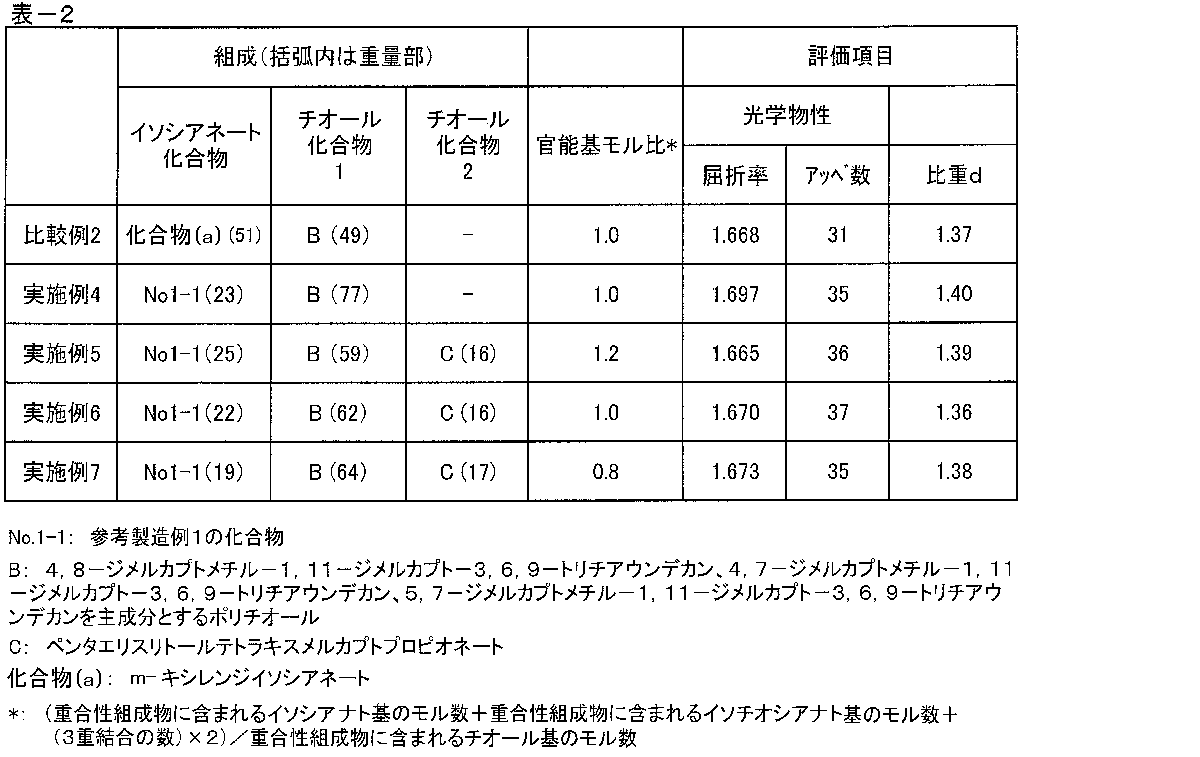
参考製造例1で製造した化合物No.1-1で表される化合物23重量部、ポリチオール化合物として4,8-ジメルカプトメチル-1,11-ジメルカプト-3,6,9-トリチアウンデカン、4,7-ジメルカプトメチル-1,11-ジメルカプト-3,6,9-トリチアウンデカン、5,7-ジメルカプトメチル-1,11-ジメルカプト-3,6,9-トリチアウンデカンを主成分とするポリチオールB 77重量部、ジメチル錫ジクロリド100ppm、日本油脂株式会社製「パーブチル(R)O」2500ppm、モノブチルリン酸とジブチルリン酸の1:9混合物1500ppmを室温にて混合溶解させてPTFE製フィルターで減圧濾過した後、150kPa~200kPaの減圧下に発泡が認められなくなるまで十分脱気させた。続いて、ガラスモールドとテープよりなるモールド中へ該重合性組成物を注入した後、加熱オーブン中へ入れ25~120℃まで徐々に昇温し22時間重合を行った。
得られた樹脂の成形片は透明性良好であり、歪みのない外観良好なものであった。評価結果を表-2に示す。
ペンタエリスリトールテトラキスメルカプトプロピオネート(ポリチオールC)を加え、表-2に示した組成に変更した以外は実施例4と同様な操作を行った。組成および評価結果を表-2に示す。
ガラス製ビーカーに触媒のジメチル錫ジクロリド100ppm、Zelec-UN(商品名、Stepan社製品;酸性リン酸エステル)1500ppm、m-キシレンジイソシアネート(化合物(a))を51重量部、4,8-ジメルカプトメチル-1,11-ジメルカプト-3,6,9-トリチアウンデカン、4,7-ジメルカプトメチル-1,11-ジメルカプト-3,6,9-トリチアウンデカン、5,7-ジメルカプトメチル-1,11-ジメルカプト-3,6,9-トリチアウンデカンを主成分とするポリチオールBを49重量部装入し、室温で攪拌し混合した。混合した化合物を減圧下、脱気操作をおこない、ガラスモールドとテープよりなるモールド中へ該重合性組成物を注入した後、加熱オーブン中へ入れ25~120℃まで徐々に昇温し20時間重合を行った。
得られた樹脂の成形片は透明性良好であり、歪みのない外観良好なものであったが、アッベ数は31であった。評価結果を表-2に示す。
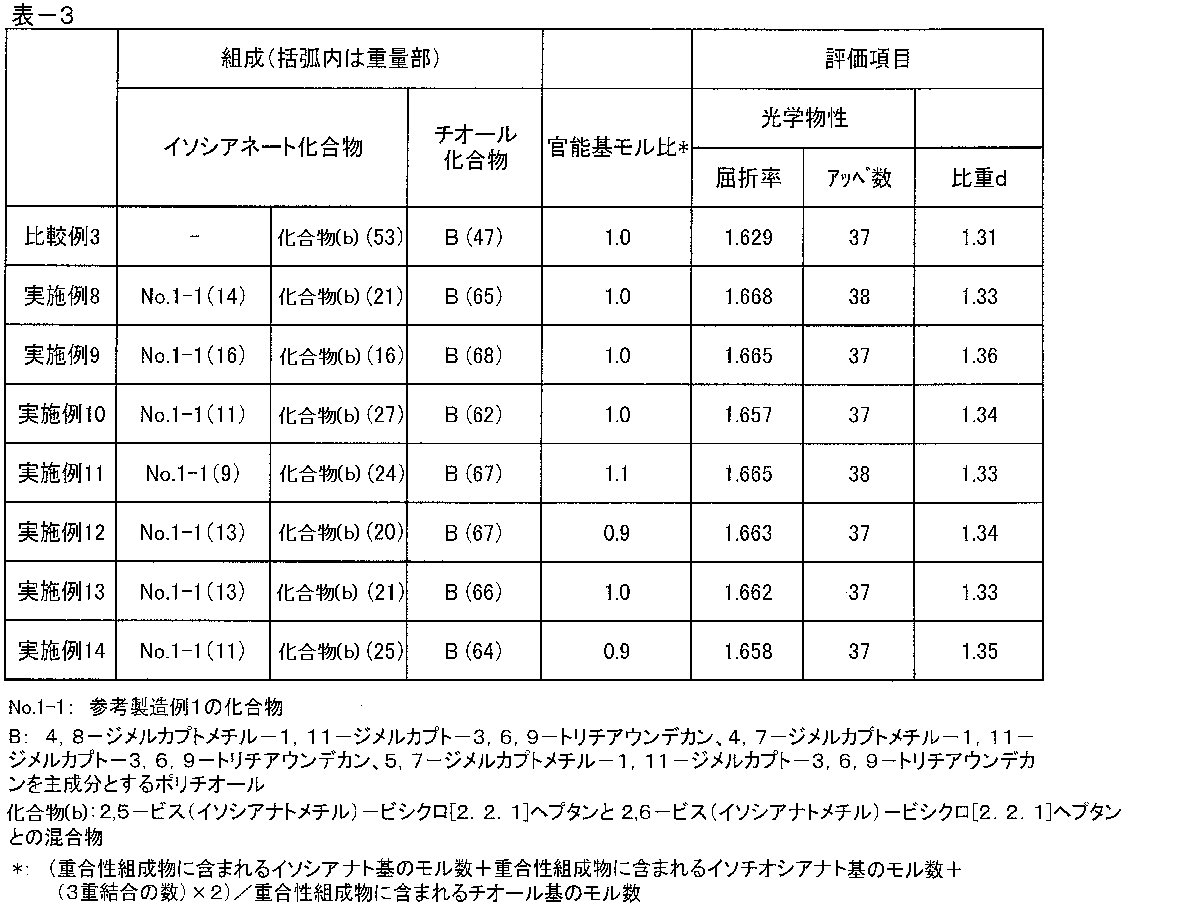
参考製造例1で製造した化合物No.1-1で表される化合物14重量部、イソシアネート化合物として2,5-ビス(イソシアナトメチル)ビシクロ-[2.2.1]-ヘプタン、2,6-ビス(イソシアナトメチル)ビシクロ-[2.2.1]-ヘプタンの混合物(化合物(b))を21重量部、ポリチオール化合物として4,8-ジメルカプトメチル-1,11-ジメルカプト-3,6,9-トリチアウンデカン、4,7-ジメルカプトメチル-1,11-ジメルカプト-3,6,9-トリチアウンデカン、5,7-ジメルカプトメチル-1,11-ジメルカプト-3,6,9-トリチアウンデカンを主成分とするポリチオールB 65重量部、ジメチル錫ジクロリド100ppm、日本油脂株式会社製「パーブチル(R)O」2500ppm、モノブチルリン酸とジブチルリン酸の1:9混合物1500ppmを室温にて混合溶解させてPTFE製フィルターで減圧濾過した後、150kPa~200kPaの減圧下に発泡が認められなくなるまで十分脱気させた。続いて、ガラスモールドとテープよりなるモールド中へ該重合性組成物を注入した後、加熱オーブン中へ入れ25~120℃まで徐々に昇温し22時間重合を行った。
得られた樹脂の成形片は透明性良好であり、歪みのない外観良好なものであった。評価結果を表-3に示す。
表-3に示した組成に変更した以外は実施例8と同様な操作を行った。組成および評価結果を表-3に示す。
ガラス製ビーカーに触媒のジメチル錫ジクロリド100ppm、Zelec-UN(商品名、Stepan社製品;酸性リン酸エステル)1500ppm、2,5-ビス(イソシアナトメチル)ビシクロ-[2.2.1]-ヘプタン、2,6-ビス(イソシアナトメチル)ビシクロ-[2.2.1]-ヘプタンの混合物(化合物(b))を53重量部、ポリチオール化合物として4,8-ジメルカプトメチル-1,11-ジメルカプト-3,6,9-トリチアウンデカン、4,7-ジメルカプトメチル-1,11-ジメルカプト-3,6,9-トリチアウンデカン、5,7-ジメルカプトメチル-1,11-ジメルカプト-3,6,9-トリチアウンデカンを主成分とするポリチオールBを47重量部装入し、室温で攪拌し混合した。混合した化合物を減圧下、脱気操作をおこない、ガラスモールドとテープよりなるモールド中へ該重合性組成物を注入した後、加熱オーブン中へ入れ25~120℃まで徐々に昇温し20時間重合を行った。評価結果を表-3に示す。
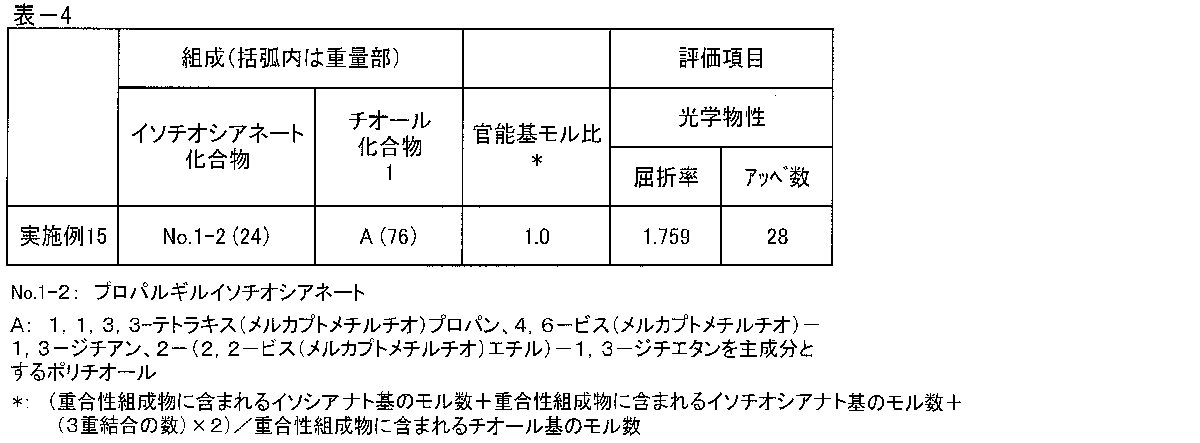
イソチオシアネート化合物としてNo.1-2で表されるプロパルギルイソチオシアネート(Fluorochem社製)24重量部、ポリチオール化合物として1,1,3,3-テトラキス(メルカプトメチルチオ)プロパン、4,6-ビス(メルカプトメチルチオ)-1,3-ジチアン、2-(2,2-ビス(メルカプトメチルチオ)エチル)-1,3-ジチエタンを主成分とするポリチオールA 76重量部、ジメチル錫ジクロリド100ppm、日本油脂株式会社製「パーブチル(R)O」 2500ppm、モノブチルリン酸とジブチルリン酸の1:9混合物1500ppmを室温にて混合溶解させてPTFE製フィルターで減圧濾過した後、150kPa~200kPaの減圧下に発泡が認められなくなるまで十分脱気させた。続いて、ガラスモールドとテープよりなるモールド中へ該重合性組成物を注入した後、加熱オーブン中へ入れ25~120℃まで徐々に昇温し22時間重合を行った。
得られた樹脂の成形片は透明性良好であり、歪みのない外観良好なものであった。評価結果を表-4に示す。
ビス(2,3-エピチオプロピル)ジスルフィド(化合物(E-1))90.9重量部、紫外線吸収剤(商品名:Tinuvin PS)1重量部を20℃にて混合溶解して均一溶液とした。この溶液にポリチオール化合物として4,8-ジメルカプトメチル-1,11-ジメルカプト-3,6,9-トリチアウンデカン、4,7-ジメルカプトメチル-1,11-ジメルカプト-3,6,9-トリチアウンデカン、5,7-ジメルカプトメチル-1,11-ジメルカプト-3,6,9-トリチアウンデカンを主成分とするポリチオールB 9.1重量部を添加、混合溶解させた後、3μmPTFE製フィルターで濾過を行なった。続いて、この溶液にジシクロヘキシルメチルアミン910ppmおよびジメチルシクロヘキシルアミン190ppmを添加、混合溶解させた後、ガラスモールドとテープからなるモールド型へ注入し、30℃~80℃まで21時間かけて徐々に昇温して重合させた。重合終了後、ガラスモールド型を離型させて樹脂成形体を得た。得られた樹脂成形体をさらに120℃で3時間アニール処理を行った。樹穴開け引張り試験のデータを表-5に示す。

Claims (9)
- (A)分子内に、炭素-炭素三重結合と、イソシアナト基およびイソチオシアナト基から選択される1以上の基と、を有する化合物と、
(B)ポリチオール化合物と、
を含む、光学材料用重合性組成物。 - 化合物(A)は、下記一般式(1)


で表される、請求項1に記載の光学材料用重合性組成物。 - 化合物(A)は、下記一般式(2)

- ポリチオール化合物(B)は、
ペンタエリスリトールテトラキス(3-メルカプトプロピオネート)、4-メルカプトメチル-1,8-ジメルカプト-3,6-ジチアオクタン、5,7-ジメルカプトメチル-1,11-ジメルカプト-3,6,9-トリチアウンデカン、4,7-ジメルカプトメチル-1,11-ジメルカプト-3,6,9-トリチアウンデカン、4,8-ジメルカプトメチル-1,11-ジメルカプト-3,6,9-トリチアウンデカン、1,1,3,3-テトラキス(メルカプトメチルチオ)プロパン、4,6-ビス(メルカプトメチルチオ)-1,3-ジチアン、2-(2,2-ビス(メルカプトメチルチオ)エチル)-1,3-ジチエタン、1,1,2,2-テトラキス(メルカプトメチルチオ)エタンおよび3-メルカプトメチル-1,5-ジメルカプト-2,4-ジチアペンタンよりなる群から選ばれる少なくとも1種である、請求項1乃至3のいずれかに記載の光学材料用重合性組成物。 - 下記式で表される官能基モル比が、0.5~3.0である、請求項1乃至4のいずれかに記載の光学材料用重合性組成物。
式:[(重合性組成物に含まれるイソシアナト基のモル数+重合性組成物に含まれるイソチオシアナト基のモル数+(3重結合の数)×2)/重合性組成物に含まれるチオール基のモル数] - 化合物(A)とポリチオール化合物(B)とを混合し、請求項1乃至5のいずれかに記載の光学材料用重合性組成物を調製する工程と、
前記重合性組成物を、注型用鋳型内に注入する工程と、
前記鋳型内で、前記重合性組成物を重合硬化する工程と、
を含む、光学材料の製造方法。 - 請求項6に記載の製造方法で得られた光学材料。
- e線の屈折率が1.60~1.80の範囲である請求項7に記載の光学材料。
- 請求項7または8に記載の光学材料からなる、プラスチック眼鏡レンズ。
Priority Applications (6)
| Application Number | Priority Date | Filing Date | Title |
|---|---|---|---|
| EP14775594.6A EP2980113B1 (en) | 2013-03-29 | 2014-03-28 | Polymerizable composition for optical material, optical material, and method for producing optical material |
| BR112015024306A BR112015024306A2 (pt) | 2013-03-29 | 2014-03-28 | composição polimerizável para material ótico, material ótico, e método de fabricação de material ótico |
| CN201480013331.7A CN105143300B (zh) | 2013-03-29 | 2014-03-28 | 光学材料用聚合性组合物、光学材料及光学材料的制造方法 |
| KR1020157024471A KR101766104B1 (ko) | 2013-03-29 | 2014-03-28 | 광학 재료용 중합성 조성물, 광학 재료 및 광학 재료의 제조 방법 |
| JP2015508787A JP5859709B2 (ja) | 2013-03-29 | 2014-03-28 | 光学材料用重合性組成物、光学材料および光学材料の製造方法 |
| US14/778,177 US10202485B2 (en) | 2013-03-29 | 2014-03-28 | Polymerizable composition for optical material, optical material, and method of manufacturing optical material |
Applications Claiming Priority (2)
| Application Number | Priority Date | Filing Date | Title |
|---|---|---|---|
| JP2013-071284 | 2013-03-29 | ||
| JP2013071284 | 2013-03-29 |
Publications (1)
| Publication Number | Publication Date |
|---|---|
| WO2014157664A1 true WO2014157664A1 (ja) | 2014-10-02 |
Family
ID=51624621
Family Applications (1)
| Application Number | Title | Priority Date | Filing Date |
|---|---|---|---|
| PCT/JP2014/059286 Ceased WO2014157664A1 (ja) | 2013-03-29 | 2014-03-28 | 光学材料用重合性組成物、光学材料および光学材料の製造方法 |
Country Status (7)
| Country | Link |
|---|---|
| US (1) | US10202485B2 (ja) |
| EP (1) | EP2980113B1 (ja) |
| JP (1) | JP5859709B2 (ja) |
| KR (1) | KR101766104B1 (ja) |
| CN (1) | CN105143300B (ja) |
| BR (1) | BR112015024306A2 (ja) |
| WO (1) | WO2014157664A1 (ja) |
Cited By (3)
| Publication number | Priority date | Publication date | Assignee | Title |
|---|---|---|---|---|
| WO2016129563A1 (ja) * | 2015-02-10 | 2016-08-18 | 三井化学株式会社 | 重合性組成物および新規なアルキン化合物 |
| CN108026277A (zh) * | 2015-09-16 | 2018-05-11 | 三井化学株式会社 | 光学材料用聚合性组合物、光学材料、光学材料用聚合性组合物的制造方法及光学材料的制造方法 |
| US20210317241A1 (en) * | 2018-07-20 | 2021-10-14 | Montanuniversität Leoben | Resin composition suitable for printing and printing methods |
Families Citing this family (10)
| Publication number | Priority date | Publication date | Assignee | Title |
|---|---|---|---|---|
| JP6228599B2 (ja) * | 2013-05-24 | 2017-11-08 | 株式会社ブリヂストン | 接着剤、接着シート及び積層体 |
| KR101831892B1 (ko) * | 2016-06-30 | 2018-02-26 | 에스케이씨 주식회사 | 폴리티오우레탄계 광학 재료용 중합성 조성물 |
| KR101893558B1 (ko) * | 2017-02-03 | 2018-08-30 | 에스케이씨 주식회사 | 플라스틱 렌즈용 중합성 조성물 |
| KR102582232B1 (ko) * | 2018-03-30 | 2023-09-22 | 미쓰이 가가쿠 가부시키가이샤 | 유기 머캅토 화합물 또는 그의 중간체의 제조 방법, (폴리)싸이올 성분, 광학 재료용 중합성 조성물, 성형체, 광학 재료 및 렌즈 |
| EP3632663A1 (en) | 2018-10-05 | 2020-04-08 | Essilor International (Compagnie Generale D'optique) | Method for the manufacturing of an optical element, optical element thus obtained |
| KR102036091B1 (ko) | 2019-08-14 | 2019-10-25 | 신화건설(주) | 초고온 미생물에 의한 가축사체처리시스템 |
| KR102269337B1 (ko) | 2020-12-31 | 2021-06-28 | 신화건설(주) | 구제역 발병지역 가축분변 초고온 발효처리 시스템 |
| CN121532441A (zh) | 2023-07-20 | 2026-02-13 | 依视路国际公司 | 衍生自由杂双官能炔烃化合物获得的预聚物的光学材料 |
| CN121443662A (zh) | 2023-07-20 | 2026-01-30 | 依视路国际公司 | 衍生自含有末端二炔化合物的可聚合组合物的光学材料 |
| CN121532442A (zh) | 2023-07-20 | 2026-02-13 | 依视路国际公司 | 衍生自含有杂双官能炔烃化合物的可聚合组合物的光学材料 |
Citations (8)
| Publication number | Priority date | Publication date | Assignee | Title |
|---|---|---|---|---|
| US4380647A (en) * | 1981-03-03 | 1983-04-19 | University Patents, Inc. | 2-Aminopyrrolin 5-ones and aminocyclopropyl isocyanates therefrom |
| JPS62257937A (ja) * | 1986-05-02 | 1987-11-10 | Showa Highpolymer Co Ltd | 硬化可能な組成物 |
| JPH01306424A (ja) * | 1988-06-02 | 1989-12-11 | Showa Highpolymer Co Ltd | 硬化可能な樹脂組成物 |
| JPH0525240A (ja) | 1991-07-19 | 1993-02-02 | Mitsubishi Rayon Co Ltd | プラスチツクレンズ用組成物 |
| JPH11322930A (ja) | 1998-03-13 | 1999-11-26 | Mitsui Chem Inc | 重合性組成物 |
| JP2004002820A (ja) | 2002-04-19 | 2004-01-08 | Mitsui Chemicals Inc | チオウレタン系光学材料 |
| WO2010001550A1 (ja) * | 2008-06-30 | 2010-01-07 | 三井化学株式会社 | ポリチオウレタン系光学材料用重合性組成物、該重合性組成物より得られるポリチオウレタン系光学材料及びポリチオウレタン系光学材料用重合触媒 |
| WO2010032365A1 (ja) | 2008-09-22 | 2010-03-25 | 三井化学株式会社 | 光学材料用重合性組成物、光学材料および光学材料の製造方法 |
Family Cites Families (8)
| Publication number | Priority date | Publication date | Assignee | Title |
|---|---|---|---|---|
| US4505792A (en) | 1981-03-03 | 1985-03-19 | University Patents, Inc. | Photochemical rearrangement of 2-aminopyrrolin-5-ones to aminocyclopropyl isocyanates and polymers thereof |
| JPS62232424A (ja) | 1986-04-02 | 1987-10-12 | Showa Highpolymer Co Ltd | 硬化可能な組成物 |
| JPS62250035A (ja) * | 1986-04-24 | 1987-10-30 | Showa Highpolymer Co Ltd | 硬化可能な組成物 |
| JPS62257935A (ja) * | 1986-05-02 | 1987-11-10 | Showa Highpolymer Co Ltd | 硬化可能な組成物 |
| US6204311B1 (en) | 1998-03-13 | 2001-03-20 | Mitsui Chemicals, Inc. | Polymerizable composition |
| DE10031987A1 (de) | 2000-06-30 | 2002-01-24 | Basf Coatings Ag | Mit Propargylalkohol blockierte Polyisocyanate, Verfahren zu ihrer Herstellung und ihre Verwendung |
| US20100311861A1 (en) | 2009-06-03 | 2010-12-09 | 3M Innovative Properties Company | Thiol-yne shape memory polymer |
| US20120286435A1 (en) | 2011-03-04 | 2012-11-15 | Ppg Industries Ohio, Inc. | Process for preparing molded optical articles |
-
2014
- 2014-03-28 KR KR1020157024471A patent/KR101766104B1/ko active Active
- 2014-03-28 WO PCT/JP2014/059286 patent/WO2014157664A1/ja not_active Ceased
- 2014-03-28 US US14/778,177 patent/US10202485B2/en active Active
- 2014-03-28 EP EP14775594.6A patent/EP2980113B1/en active Active
- 2014-03-28 JP JP2015508787A patent/JP5859709B2/ja active Active
- 2014-03-28 BR BR112015024306A patent/BR112015024306A2/pt not_active Application Discontinuation
- 2014-03-28 CN CN201480013331.7A patent/CN105143300B/zh active Active
Patent Citations (8)
| Publication number | Priority date | Publication date | Assignee | Title |
|---|---|---|---|---|
| US4380647A (en) * | 1981-03-03 | 1983-04-19 | University Patents, Inc. | 2-Aminopyrrolin 5-ones and aminocyclopropyl isocyanates therefrom |
| JPS62257937A (ja) * | 1986-05-02 | 1987-11-10 | Showa Highpolymer Co Ltd | 硬化可能な組成物 |
| JPH01306424A (ja) * | 1988-06-02 | 1989-12-11 | Showa Highpolymer Co Ltd | 硬化可能な樹脂組成物 |
| JPH0525240A (ja) | 1991-07-19 | 1993-02-02 | Mitsubishi Rayon Co Ltd | プラスチツクレンズ用組成物 |
| JPH11322930A (ja) | 1998-03-13 | 1999-11-26 | Mitsui Chem Inc | 重合性組成物 |
| JP2004002820A (ja) | 2002-04-19 | 2004-01-08 | Mitsui Chemicals Inc | チオウレタン系光学材料 |
| WO2010001550A1 (ja) * | 2008-06-30 | 2010-01-07 | 三井化学株式会社 | ポリチオウレタン系光学材料用重合性組成物、該重合性組成物より得られるポリチオウレタン系光学材料及びポリチオウレタン系光学材料用重合触媒 |
| WO2010032365A1 (ja) | 2008-09-22 | 2010-03-25 | 三井化学株式会社 | 光学材料用重合性組成物、光学材料および光学材料の製造方法 |
Non-Patent Citations (1)
| Title |
|---|
| MIURA T. ET AL.: "Synthesis of Stereodefined 3- Alkylideneoxindoles by Palladium-catalyzed Reactions of 2-(Alkynyl)aryl Isocyanates with Thiols and Alchols", CHEMISTRY LETTERS, vol. 38, no. 12, 2009, pages 1174 - 1175, XP055288059 * |
Cited By (13)
| Publication number | Priority date | Publication date | Assignee | Title |
|---|---|---|---|---|
| CN107207656B (zh) * | 2015-02-10 | 2019-10-18 | 三井化学株式会社 | 聚合性组合物及新型炔化合物 |
| JP6034997B1 (ja) * | 2015-02-10 | 2016-11-30 | 三井化学株式会社 | 重合性組成物および新規なアルキン化合物 |
| KR20170101296A (ko) | 2015-02-10 | 2017-09-05 | 미쯔이가가꾸가부시끼가이샤 | 중합성 조성물 및 신규한 알킨 화합물 |
| CN107207656A (zh) * | 2015-02-10 | 2017-09-26 | 三井化学株式会社 | 聚合性组合物及新型炔化合物 |
| US10472435B2 (en) | 2015-02-10 | 2019-11-12 | Mitsui Chemicals, Inc. | Polymerizable composition and novel alkyne compound |
| EP3257876A4 (en) * | 2015-02-10 | 2018-10-10 | Mitsui Chemicals, Inc. | Polymerizable composition and novel alkyne compound |
| WO2016129563A1 (ja) * | 2015-02-10 | 2016-08-18 | 三井化学株式会社 | 重合性組成物および新規なアルキン化合物 |
| EP3351583A4 (en) * | 2015-09-16 | 2019-05-15 | Mitsui Chemicals, Inc. | POLYMERIZABLE COMPOSITION FOR OPTICAL MATERIAL, OPTICAL MATERIAL, METHOD FOR PRODUCING A POLYMERIZABLE COMPOSITION FOR OPTICAL MATERIAL AND METHOD FOR PRODUCING AN OPTICAL MATERIAL |
| CN108026277A (zh) * | 2015-09-16 | 2018-05-11 | 三井化学株式会社 | 光学材料用聚合性组合物、光学材料、光学材料用聚合性组合物的制造方法及光学材料的制造方法 |
| US10954341B2 (en) | 2015-09-16 | 2021-03-23 | Mitsui Chemicals, Inc. | Polymerizable composition for optical material, optical material, process for preparing polymerizable composition for optical material, and method of manufacturing optical material |
| CN108026277B (zh) * | 2015-09-16 | 2021-07-16 | 三井化学株式会社 | 光学材料用聚合性组合物、光学材料、光学材料用聚合性组合物的制造方法及光学材料的制造方法 |
| US20210317241A1 (en) * | 2018-07-20 | 2021-10-14 | Montanuniversität Leoben | Resin composition suitable for printing and printing methods |
| US12024580B2 (en) * | 2018-07-20 | 2024-07-02 | Montanuniversität Leoben | Resin composition suitable for printing and printing methods |
Also Published As
| Publication number | Publication date |
|---|---|
| EP2980113A4 (en) | 2016-12-07 |
| US10202485B2 (en) | 2019-02-12 |
| KR20150119030A (ko) | 2015-10-23 |
| EP2980113A1 (en) | 2016-02-03 |
| JPWO2014157664A1 (ja) | 2017-02-16 |
| BR112015024306A2 (pt) | 2017-07-18 |
| CN105143300A (zh) | 2015-12-09 |
| KR101766104B1 (ko) | 2017-08-23 |
| JP5859709B2 (ja) | 2016-02-10 |
| CN105143300B (zh) | 2017-11-24 |
| US20160280840A1 (en) | 2016-09-29 |
| EP2980113B1 (en) | 2017-09-20 |
Similar Documents
| Publication | Publication Date | Title |
|---|---|---|
| JP5859709B2 (ja) | 光学材料用重合性組成物、光学材料および光学材料の製造方法 | |
| US10066081B2 (en) | Polymerizable composition for optical materials | |
| JP6275247B2 (ja) | 光学材料用重合性組成物、光学材料および光学材料の製造方法 | |
| US9778397B2 (en) | Polymerizable composition, optical material, and manufacturing method of the same | |
| JP6335274B2 (ja) | 光学材料の製造方法 | |
| CN108026277B (zh) | 光学材料用聚合性组合物、光学材料、光学材料用聚合性组合物的制造方法及光学材料的制造方法 | |
| JP5444251B2 (ja) | 光学材料用重合性組成物、光学材料および光学材料の製造方法 | |
| KR20180020954A (ko) | 플라스틱 렌즈 | |
| US20160313575A1 (en) | Polymerizable composition for optical materials, optical material, and process for producing same | |
| JP6691990B1 (ja) | 光学材料用チオール含有組成物、光学材料用重合性組成物 | |
| WO2015088011A1 (ja) | 光学材料用重合性組成物、光学材料およびその用途 | |
| KR102757712B1 (ko) | 폴리티올 조성물 및 그의 응용 | |
| JP2020184068A (ja) | 光学材料用チオール含有組成物、光学材料用重合性組成物 | |
| JP2022156417A (ja) | ポリチオウレタン系重合性組成物、透明樹脂、及びレンズ基材 | |
| CN108474968A (zh) | 眼镜镜片的制造方法、及眼镜镜片 | |
| JP2019172855A (ja) | 光学材料用重合性組成物、当該重合性組成物から得られる光学材料および新規ジチオール化合物 |
Legal Events
| Date | Code | Title | Description |
|---|---|---|---|
| WWE | Wipo information: entry into national phase |
Ref document number: 201480013331.7 Country of ref document: CN |
|
| 121 | Ep: the epo has been informed by wipo that ep was designated in this application |
Ref document number: 14775594 Country of ref document: EP Kind code of ref document: A1 |
|
| ENP | Entry into the national phase |
Ref document number: 2015508787 Country of ref document: JP Kind code of ref document: A |
|
| ENP | Entry into the national phase |
Ref document number: 20157024471 Country of ref document: KR Kind code of ref document: A |
|
| REEP | Request for entry into the european phase |
Ref document number: 2014775594 Country of ref document: EP |
|
| WWE | Wipo information: entry into national phase |
Ref document number: 2014775594 Country of ref document: EP |
|
| WWE | Wipo information: entry into national phase |
Ref document number: 14778177 Country of ref document: US |
|
| NENP | Non-entry into the national phase |
Ref country code: DE |
|
| REG | Reference to national code |
Ref country code: BR Ref legal event code: B01A Ref document number: 112015024306 Country of ref document: BR |
|
| ENP | Entry into the national phase |
Ref document number: 112015024306 Country of ref document: BR Kind code of ref document: A2 Effective date: 20150922 |