WO2014157459A1 - 耐熱性黄色含水酸化鉄顔料の製造方法 - Google Patents
耐熱性黄色含水酸化鉄顔料の製造方法 Download PDFInfo
- Publication number
- WO2014157459A1 WO2014157459A1 PCT/JP2014/058751 JP2014058751W WO2014157459A1 WO 2014157459 A1 WO2014157459 A1 WO 2014157459A1 JP 2014058751 W JP2014058751 W JP 2014058751W WO 2014157459 A1 WO2014157459 A1 WO 2014157459A1
- Authority
- WO
- WIPO (PCT)
- Prior art keywords
- iron oxide
- hydrous iron
- yellow
- oxide pigment
- weight
- Prior art date
- Legal status (The legal status is an assumption and is not a legal conclusion. Google has not performed a legal analysis and makes no representation as to the accuracy of the status listed.)
- Ceased
Links
Classifications
-
- C—CHEMISTRY; METALLURGY
- C01—INORGANIC CHEMISTRY
- C01G—COMPOUNDS CONTAINING METALS NOT COVERED BY SUBCLASSES C01D OR C01F
- C01G49/00—Compounds of iron
- C01G49/02—Oxides; Hydroxides
-
- C—CHEMISTRY; METALLURGY
- C09—DYES; PAINTS; POLISHES; NATURAL RESINS; ADHESIVES; COMPOSITIONS NOT OTHERWISE PROVIDED FOR; APPLICATIONS OF MATERIALS NOT OTHERWISE PROVIDED FOR
- C09C—TREATMENT OF INORGANIC MATERIALS, OTHER THAN FIBROUS FILLERS, TO ENHANCE THEIR PIGMENTING OR FILLING PROPERTIES ; PREPARATION OF CARBON BLACK ; PREPARATION OF INORGANIC MATERIALS WHICH ARE NO SINGLE CHEMICAL COMPOUNDS AND WHICH ARE MAINLY USED AS PIGMENTS OR FILLERS
- C09C1/00—Treatment of specific inorganic materials other than fibrous fillers; Preparation of carbon black
- C09C1/22—Compounds of iron
- C09C1/24—Oxides of iron
-
- C—CHEMISTRY; METALLURGY
- C09—DYES; PAINTS; POLISHES; NATURAL RESINS; ADHESIVES; COMPOSITIONS NOT OTHERWISE PROVIDED FOR; APPLICATIONS OF MATERIALS NOT OTHERWISE PROVIDED FOR
- C09C—TREATMENT OF INORGANIC MATERIALS, OTHER THAN FIBROUS FILLERS, TO ENHANCE THEIR PIGMENTING OR FILLING PROPERTIES ; PREPARATION OF CARBON BLACK ; PREPARATION OF INORGANIC MATERIALS WHICH ARE NO SINGLE CHEMICAL COMPOUNDS AND WHICH ARE MAINLY USED AS PIGMENTS OR FILLERS
- C09C3/00—Treatment in general of inorganic materials, other than fibrous fillers, to enhance their pigmenting or filling properties
- C09C3/06—Treatment with inorganic compounds
- C09C3/063—Coating
-
- C—CHEMISTRY; METALLURGY
- C01—INORGANIC CHEMISTRY
- C01P—INDEXING SCHEME RELATING TO STRUCTURAL AND PHYSICAL ASPECTS OF SOLID INORGANIC COMPOUNDS
- C01P2006/00—Physical properties of inorganic compounds
- C01P2006/60—Optical properties, e.g. expressed in CIELAB-values
- C01P2006/62—L* (lightness axis)
-
- C—CHEMISTRY; METALLURGY
- C01—INORGANIC CHEMISTRY
- C01P—INDEXING SCHEME RELATING TO STRUCTURAL AND PHYSICAL ASPECTS OF SOLID INORGANIC COMPOUNDS
- C01P2006/00—Physical properties of inorganic compounds
- C01P2006/60—Optical properties, e.g. expressed in CIELAB-values
- C01P2006/63—Optical properties, e.g. expressed in CIELAB-values a* (red-green axis)
-
- C—CHEMISTRY; METALLURGY
- C01—INORGANIC CHEMISTRY
- C01P—INDEXING SCHEME RELATING TO STRUCTURAL AND PHYSICAL ASPECTS OF SOLID INORGANIC COMPOUNDS
- C01P2006/00—Physical properties of inorganic compounds
- C01P2006/60—Optical properties, e.g. expressed in CIELAB-values
- C01P2006/64—Optical properties, e.g. expressed in CIELAB-values b* (yellow-blue axis)
Definitions
- the present invention relates to a method for producing a yellow hydrated iron oxide pigment having excellent dispersibility and excellent heat resistance.
- Yellow pigments are widely used as coloring materials for resins, paints, and road pavements.
- heat resistance of about 250 ° C. is required.
- materials such as lead chromate, strontium chromate, cadmium sulfide are often used as yellow pigments.
- lead chromate, strontium chromate, cadmium sulfide are often used as yellow pigments.
- strontium chromate, cadmium sulfide are often used as yellow pigments.
- cadmium sulfide is often used as yellow pigments.
- these substances are excellent in heat resistance, their use is problematic because they are toxic and carcinogenic.
- yellow hydrated iron oxide pigments are used in various applications such as resins, paints, inks, etc., and because of their non-toxicity, they are safe materials for the human body and excellent as environmentally friendly materials. .
- heat resistance there is a problem that the color is changed to reddish brown at about 230 ° C. with desorption of crystal water at around 200 ° C.
- thermoplastic resins such as polyethylene, polypropylene, styrene polymer, polyamide, polyolefin, ABS, etc. that are usually processed at 200 ° C or higher, paints that are baked at about 200 to 250 ° C, or heated at 200 ° C or higher during construction.
- paints that are baked at about 200 to 250 ° C, or heated at 200 ° C or higher during construction.
- it has been difficult to use a yellow hydrous iron oxide pigment in a road surface display paint that is used by melting or melting.
- the yellow hydrated iron oxide pigment that has been treated by the method of the aforementioned Patent Document 1 has improved heat resistance, but the shape and particle size distribution of the particles are greatly changed before and after the heat resistance improving treatment step. As a result, there was a problem in dispersibility and the change in hue was large.
- the yellow hydrous iron oxide pigment treated by the method of the above-mentioned Patent Document 2 has a small change in hue, but is not sufficient in dispersibility and heat resistance.
- the yellow iron oxide pigments processed by the methods of the above-mentioned Patent Documents 3 to 5 have a small change in hue, but are not sufficient in dispersibility and heat resistance.
- an aqueous dispersion containing hydrous iron oxide particles is treated with hydrous iron oxide particles by adding a phosphoric acid compound in a pH range of 4 to 7, and then an aluminum compound is added in a pH range of 3 to 5.
- This is a method for producing a heat-resistant yellow hydrous iron oxide pigment in which a phosphorous compound and an aluminum compound are adhered to the surface of the hydrous iron oxide particles by adjusting to a neutral pH and heat-treating.
- Production of heat-resistant yellow hydrous iron oxide pigments characterized in that the phosphorus content of the iron pigment is 0.1 to 6% by weight in terms of P and the aluminum compound content is 2 to 12% by weight in terms of Al This is a method (Invention 1).
- this invention 1 is a manufacturing method of this invention 1 which adds water-soluble silicate when adjusting to neutral pH (this invention 2).
- the method for producing a yellow hydrous iron oxide pigment according to the present invention is a simple process that does not use a special apparatus, a heat resistance improving process, a yellow color with little change in hue before and after the process, and excellent dispersibility. Since a hydrous iron oxide pigment is obtained, it is suitable as a method for producing a yellow hydrous iron oxide pigment.
- a hydrous iron oxide particle is treated by adding a phosphoric acid compound in a pH range of 4 to 7 to an aqueous dispersion containing hydrous iron oxide particles. Thereafter, an aluminum compound is added and treated at a pH in the range of 3 to 5, and further adjusted to a neutral pH, followed by heat treatment. If necessary, after the aluminum compound is treated, a water-soluble silicate may be further added, followed by heat treatment at a neutral pH.
- ammonium phosphate ammonium hydrogen phosphate, sodium hexametaphosphate and the like can be used.
- the addition amount as a phosphoric acid compound is suitably 0.1 to 6% by weight as P with respect to the hydrous iron oxide particles. More preferably, it is 0.5 to 5% by weight. When it is less than 0.1% by weight, the heat resistance of the resulting yellow hydrous iron oxide pigment is insufficient, and when it exceeds 6% by weight, the hue of the yellow hydrous iron oxide pigment changes.
- aluminum compound in the present invention aluminum acetate, sodium aluminate, aluminum sulfate and the like can be used.
- the addition amount of the aluminum compound is suitably 2 to 12% by weight as Al with respect to the hydrous iron oxide particles. More preferably, it is 4 to 10% by weight. If it is less than 2% by weight, the dispersibility and heat resistance of the resulting yellow hydrated iron oxide pigment are insufficient, while if it exceeds 12% by weight, the hue changes.
- sodium silicate, potassium silicate, or the like can be used as the water-soluble silicate in the present invention.
- the amount of water-soluble silicate added is suitably 1 to 20% by weight based on the hydrous iron oxide particles. More preferably, it is 2 to 15% by weight. If it is less than 1% by weight, the effect of improving the heat resistance of the obtained yellow hydrated iron oxide pigment is insufficient. On the other hand, if it exceeds 20% by weight, the filterability deteriorates, and filtration takes too much time.
- a phosphoric acid compound is added to a 3 to 10% by weight aqueous dispersion of hydrous iron oxide particles and reacted at 50 to 80 ° C. for 30 minutes to 2 hours.
- the pH at this time is in the range of 4-7.
- the pH of the reaction solution is outside the above range, it is not preferable in that the phosphate compound does not adhere to the particle surface.
- an aluminum compound is added and reacted at 70 to 90 ° C. for 1 to 3 hours.
- the pH is in the range of 3-5.
- the pH of the reaction solution is outside the above range, it is not preferable in that the aluminum compound does not adhere to the particle surface.
- the pH is adjusted to around neutral (pH is 5 to 8) and then reacted at the same temperature as above for 1 to 2 hours. After cooling to room temperature, a yellow hydrous iron oxide pigment can be obtained by a predetermined treatment of filtration and drying.
- a silicate compound when coating with a silicate compound, an aluminum compound is added and reacted at 70 to 90 ° C. for 1 to 3 hours, and then a predetermined amount of No. 3 sodium silicate is added to the same temperature. For 1 to 3 hours. After completion of the reaction, after cooling to room temperature, a yellow hydrous iron oxide pigment can be obtained by a predetermined treatment of filtration and drying.
- the heat-resistant yellow hydrous iron oxide pigment according to the present invention has a spindle shape, a needle shape, or a rice grain shape.
- the heat-resistant yellow hydrous iron oxide pigment according to the present invention has an average major axis diameter of 0.1 to 1.0 ⁇ m, preferably 0.15 to 0.6 ⁇ m.
- the average major axis diameter is less than 0.1 ⁇ m, the cohesive force between the particles increases due to the increase in the surface area due to the refinement of the particles, making it difficult to disperse in the resin composition or vehicle.
- it exceeds 1.0 ⁇ m it becomes difficult to uniformly disperse the resin composition or vehicle as the particle size increases.
- the heat-resistant yellow hydrous iron oxide pigment according to the present invention has an average minor axis diameter of 0.01 to 0.20 ⁇ m, more preferably 0.012 to 0.15 ⁇ m.
- the average minor axis diameter is less than 0.01 ⁇ m, the cohesive force between the particles increases due to the increase in the surface area due to the refinement of the particles, making it difficult to disperse in the resin composition or vehicle.
- it exceeds 0.20 ⁇ m it becomes difficult to uniformly disperse the resin composition or vehicle as the particle size increases.
- the heat-resistant yellow hydrous iron oxide pigment according to the present invention has an axial ratio (average major axis diameter / average minor axis diameter) of 2 to 20, more preferably 2.5 to 18.
- the axial ratio is less than 2, it is difficult to obtain a coating film having sufficient stiffness.
- the axial ratio exceeds 20, entanglement of particles in the vehicle increases, and dispersibility may deteriorate and viscosity may increase.
- the heat-resistant yellow hydrous iron oxide pigment according to the present invention has a BET specific surface area of 10 to 180 m 2 / g, more preferably 10 to 150 m 2 / g.
- the reason why the BET specific surface area is preferably 10 to 180 m 2 / g is the same reason as the upper and lower limits of the average major axis diameter and the average minor axis diameter.
- the abundance of the phosphoric acid compound is preferably 0.1 to 6% by weight as P with respect to the hydrous iron oxide particles.
- the abundance of the aluminum compound in the present invention is preferably 2 to 12% by weight, more preferably 4 to 10% by weight as Al with respect to the hydrous iron oxide particles.
- the abundance of the silicon compound is preferably 0.1 to 20% by weight, more preferably 0.2 to 15% by weight, based on the hydrous iron oxide particles.
- the weight ratio of Al / P in the coating layer is preferably in the range of 1/1 to 6/1.
- the heat resistance of the heat-resistant yellow hydrous iron oxide pigment according to the present invention is preferably 250 ° C. or higher. If the heat resistance is less than 250 ° C., the object of the present invention cannot be achieved. In addition, the heat resistance in this invention was evaluated according to the evaluation method mentioned later.
- the hue of the heat-resistant yellow hydrated iron oxide pigment according to the present invention is preferably in the range of L * value of 40 to 80, a * value of ⁇ 30 to +35, and b * value of +30 to +100.
- L * value, the a * value, and the b * value are out of the above ranges, the intended yellow pigment of the present invention cannot be obtained.
- the yellow hydrous iron oxide pigment according to the present invention is preferably further coated with the following materials on the surface. That is, as a material used for the surface coating treatment, any one or a combination of rosin compound, lecithin, sorbitan acid ester compound and oleic acid can be used. These can all be expected to improve the lipophilicity of the pigment surface and reduce the oil absorption. As a result, the viscosity of the paint can be reduced.
- the amount of oil absorption measured according to JIS K 5101 of the yellow hydrated iron oxide pigment according to the present invention is preferably 50 or less, more preferably 30 to 40.
- rosin compound gum rosin, tall oil rosin, modified rosin, rosin ester and the like can be used.
- soybean lecithin and egg yolk lecithin can be used as the lecithin.
- sorbitan acid ester compound sorbitan monostearate, sorbitan tristearate, sorbitan monolaurate, sorbitan monooleate, sorbitan monopalmitate and the like can be used. There are a plurality of these in various degrees of esterification.
- the surface coating with these materials is preferably performed at 0.5 to 5% by weight with respect to the yellow hydrated iron oxide pigment. Further, it is preferable to treat 0.5 to 2% by weight.
- the surface coating with these materials is simple and preferably performed using a dry mixer such as a Henschel mixer, a Nauta mixer, or a mortar mixer.
- a dry mixer such as a Henschel mixer, a Nauta mixer, or a mortar mixer.
- Add a predetermined amount of heat-treated yellow hydrous iron oxide pigment to these processors add the surface treatment material as it is or dissolved in an appropriate solvent, and mix for a predetermined time to make it dispersible.
- An excellent heat-resistant yellow hydrous iron oxide pigment can be obtained.
- the blending ratio of the yellow hydrated iron oxide pigment in the paint according to the present invention can be used in the range of 0.5 to 100 parts by weight with respect to 100 parts by weight of the base material constituting the paint.
- the amount is preferably 1.0 to 100 parts by weight.
- paint constituting base material resin, solvent, and if necessary, fats and oils, antifoaming agent, extender pigment, drying accelerator, surfactant, curing accelerator, auxiliary agent and the like are blended.
- Resins include acrylic resin, alkyd resin, polyester resin, polyurethane resin, epoxy resin, phenol resin, melamine resin, amino resin, vinyl chloride resin, silicone resin, gum rosin that are usually used for solvent-based paints and oil-based printing inks. Rosin resins such as lime rosin, maleic resin, polyamide resin, nitrocellulose, ethylene-vinyl acetate copolymer resin, rosin modified phenolic resin, rosin modified maleic resin and other rosin modified resins, petroleum resins, etc. can be used. .
- water-soluble acrylic resins For water-based paints, water-soluble acrylic resins, water-soluble styrene-maleic acid resins, water-soluble alkyd resins, water-soluble melamine resins, water-soluble urethane emulsion resins, water-soluble epoxies commonly used in water-based paints and water-based inks Resins, water-soluble polyester resins, and the like can be used.
- Solvents include soybean oil, toluene, xylene, thinner, butyl acetate, methyl acetate, methyl isobutyl ketone, methyl cellosolve, ethyl cellosolve, propyl cellosolve, butyl cellosolve, propylene glycol monomethyl ether, etc.
- Glycol ether solvents such as ethyl acetate, butyl acetate, and amyl acetate
- ester solvents such as ethyl acetate, butyl acetate, and amyl acetate
- aliphatic hydrocarbon solvents such as hexane, heptane, and octane
- alicyclic hydrocarbon solvents such as cyclohexane
- petroleum-based solvents such as mineral spirits
- Solvents ketone solvents such as acetone and methyl ethyl ketone
- alcohol solvents such as methyl alcohol, ethyl alcohol, propyl alcohol, and butyl alcohol, aliphatic hydrocarbons, and the like can be used.
- Water-based paint solvents include water and alcohol-based solvents usually used for water-based paints, such as ethyl alcohol, propyl alcohol, and butyl alcohol, methyl ether solvents such as methyl cellosolve, ethyl cellosolve, propyl cellosolve, and butyl cellosolve, and diethylene glycol.
- alcohol-based solvents usually used for water-based paints, such as ethyl alcohol, propyl alcohol, and butyl alcohol
- methyl ether solvents such as methyl cellosolve, ethyl cellosolve, propyl cellosolve, and butyl cellosolve
- diethylene glycol diethylene glycol
- Oxyethylene or oxypropylene addition polymer such as triethylene glycol, polyethylene glycol, dipropylene glycol, tripropylene glycol, polypropylene glycol, alkylene glycol such as ethylene glycol, propylene glycol, 1,2,6-hexanetriol, glycerin, It can be used by mixing with a water-soluble organic solvent such as 2-pyrrolidone.
- boil oils obtained by processing dry oils such as sesame oil, cutting oil, sea lion oil, safflower oil and the like can be used.
- Antifoaming agents include Nopco 8034 (product name), SN deformer 477 (product name), SN deformer 5013 (product name), SN deformer 247 (product name), SN deformer 382 (product name) (all of these are San Nopco Commercially available products such as manufactured by Co., Ltd., Antihome 08 (trade name), Emulgen 903 (trade name) (all of which are manufactured by Kao Corporation) can be used.
- the blending ratio of the yellow hydrated iron oxide pigment in the resin composition according to the present invention can be used in the range of 0.01 to 200 parts by weight with respect to 100 parts by weight of the resin, taking into account the handling of the resin composition. For example, it is preferably 0.05 to 150 parts by weight, more preferably 0.1 to 100 parts by weight.
- a yellow hydrated iron pigment and a well-known thermoplastic resin As a constituent substrate in the resin composition according to the present invention, a yellow hydrated iron pigment and a well-known thermoplastic resin, if necessary, additives such as lubricants, plasticizers, antioxidants, ultraviolet absorbers, various stabilizers, etc. Is blended.
- the resin examples include polyolefins such as polyethylene, polypropylene, polybutene, polyisobutylene, polyvinyl chloride, polymethylpentene, polyethylene terephthalate, polybutylene terephthalate, polystyrene, styrene-acrylic acid ester copolymer, styrene-vinyl acetate copolymer, Acrylonitrile-butadiene-styrene copolymer, acrylonitrile-EPDM-styrene copolymer, acrylic resin, polyamide, polycarbonate, polyacetal, polyurethane, and other thermoplastic resins, rosin-modified maleic resin, phenol resin, epoxy resin, polyester resin, Silicone resin, rosin ester, rosin, natural rubber, synthetic rubber and the like can be used.
- polyolefins such as polyethylene, polypropylene, polybutene, polyisobutylene, polyvinyl chloride,
- the amount of the additive may be 50% by weight or less based on the total amount of the yellow hydrous iron oxide pigment and the resin. When the content of the additive exceeds 50% by weight, the moldability is lowered.
- the resin raw material and the yellow hydrous iron oxide pigment are mixed well in advance, and then a strong shearing action is applied under heating using a kneader or an extruder to produce a yellow hydrous iron oxide pigment.
- the agglomerates are broken and the yellow hydrated iron oxide pigment is uniformly dispersed in the resin composition, and then molded into a shape suitable for the purpose.
- the resin composition according to the present invention can also be obtained via a master batch pellet.
- the master batch pellet in the present invention is a blender such as a ribbon blender, a Nauter mixer, a Henschel mixer, a super mixer, etc., if necessary, the binder resin as a constituent substrate of the paint and the resin composition and the yellow hydrous iron oxide pigment. Kneaded with a well-known single-screw kneading extruder or twin-screw kneading extruder, etc., then cut, or kneaded by mixing the above mixture with a Banbury mixer, pressure kneader, etc. It is manufactured by crushing or molding and cutting.
- the supply of the binder resin and the yellow hydrated iron oxide pigment to the kneader may be quantitatively supplied at a predetermined ratio or a mixture of both.
- the master batch pellet in the present invention has an average major axis of 1 to 6 mm, preferably 2 to 5 mm.
- the average minor axis is 2 to 5 mm, preferably 2.5 to 4 mm.
- the average major axis is less than 1 mm, the workability at the time of producing the pellet is poor, which is not preferable.
- the thickness exceeds 6 mm, the difference from the size of the binder resin for dilution is large, and it becomes difficult to sufficiently disperse.
- the shape can be various, and can be indefinite and spherical, cylindrical, flakes, and the like.
- the same resin as the resin for resin composition can be used.
- composition of the binder resin in the masterbatch pellet may be the same resin as the diluent binder resin or a different resin, but if different resins are used, What is necessary is just to determine in consideration of the various characteristics determined by the compatibility.
- the amount of the yellow hydrated iron oxide pigment blended in the masterbatch pellet is 1 to 200 parts by weight, preferably 1 to 150 parts by weight, more preferably 1 to 100 parts by weight with respect to 100 parts by weight of the binder resin. .
- the amount is less than 1 part by weight, the melt viscosity at the time of kneading is insufficient, and it is difficult to disperse the yellow hydrous iron oxide pigment well.
- the amount exceeds 200 parts by weight, the binder resin with respect to the yellow hydrated iron oxide pigment is small, so that it is difficult to disperse the yellow hydrated iron oxide pigment well, and the resin composition is changed by a slight change in the addition amount of the master batch pellet. Since the content of the yellow hydrated iron oxide pigment blended in the product greatly changes, it is difficult to adjust to the desired content, which is not preferable. Also, mechanical wear is severe and not suitable.
- an important point in the present invention is that a phosphorous compound containing 0.1 to 6% by weight in terms of P with respect to the hydrated yellow iron oxide particles is added to the aqueous dispersion of the yellow hydrated iron oxide particles in a pH range of 4 to 7. After the treatment, 2 to 12% by weight of an aluminum compound in terms of Al is treated in the range of pH 3 to 5, and further adjusted to a pH in the range of 5 to 8, followed by heat treatment to obtain the aluminum hydroxide. A layer can be formed on the surface of the yellow hydrous iron oxide particles to obtain a heat-resistant yellow hydrous iron oxide pigment.
- a phosphorous compound containing 0.1 to 6% by weight in terms of P with respect to the yellow hydrated iron oxide particles was treated in an aqueous dispersion of the yellow hydrated iron oxide particles in a pH range of 4 to 7, and then 2 in terms of Al. ⁇ 12% by weight of aluminum compound was treated in the range of pH 3-5, and further adjusted to a pH in the range of 5-8, followed by heat treatment, and then a predetermined amount of water-soluble silicate was added, The reaction is carried out at the same temperature for 1 to 3 hours. After completion of the reaction, after cooling to room temperature, a yellow hydrous iron oxide pigment having an aluminum hydroxide layer and a silica layer on the particle surface can be obtained by a predetermined treatment of filtration and drying.
- the surface of the obtained heat-resistant yellow hydrated iron oxide pigment is coated with a material of any one of rosin compound, lecithin, sorbitan acid ester compound, oleic acid, or a combination thereof, and heat resistance excellent in dispersibility This is a point where a yellow hydrous iron oxide pigment can be obtained.
- a typical embodiment of the present invention is as follows. EXAMPLES Hereinafter, although this invention is demonstrated further in detail based on an Example and a comparative example, this invention is not restrict
- the average major axis diameter and average minor axis diameter of the particles are 350 major particle diameters of 350 particles shown in the photograph ( ⁇ 80000) obtained by doubling the electron micrograph ( ⁇ 20000) in the vertical and horizontal directions, respectively.
- the minor axis diameter was measured and indicated by the average value.
- the P value, Al value and Si amount contained in the yellow hydrated iron oxide pigment were measured by fluorescent X-ray analysis.
- the soluble sodium salt content of the sample was measured by weighing 5 g of the sample into a 300 ml Erlenmeyer flask, adding 100 ml of boiled pure water, heating and holding the boiled state for about 5 minutes, then plugging and releasing to room temperature. Cool, add water corresponding to the weight loss, plug again, shake for 1 minute, let stand for 5 minutes, and then add the supernatant to No. Filtration was performed using 5C filter paper, and Na + in the filtrate was measured using an inductively coupled plasma emission spectroscopic analyzer (manufactured by Seiko Denshi Kogyo Co., Ltd.).
- the hue of the sample is 0.5 g of castor oil and 0.5 ml of castor oil, which is kneaded with a Hoover-type Mahler to make a paste.
- An application piece (coating thickness: about 30 ⁇ m) applied using an applicator was prepared, and the application piece was subjected to a multi-light source spectrocolorimeter (MSC-IS-2D, manufactured by Suga Test Instruments Co., Ltd.) Multi-spctro- Color-meter is used to measure L * values, a * values, and b * values using Hunter's Lab space, and the International Lighting Commission (CIIE) 1976 (L * values, a * values). , B * value) It was shown as a value according to the uniform perceptual space.
- MSC-IS-2D multi-light source spectrocolorimeter
- a solvent-based paint using a heat-resistant yellow hydrated iron oxide pigment is prepared by the following method, and the paint is applied to an aluminum plate (0.8 mm ⁇ 70 mm ⁇ 150 mm) at a thickness of 20 ⁇ m and dried.
- the heat resistance of the coated piece obtained by forming a coating film was evaluated. That is, each test piece is put into an electric furnace, and the temperature of the electric furnace is changed variously, and heat treatment is performed for 5 minutes at each temperature, and the hue (L * value, a value *, b value *) was measured using a multi-light source spectrocolorimeter (MSC-1S-2D, manufactured by Suga Test Instruments Co., Ltd.) Multi-Spectro-Color-Meter.
- MSC-1S-2D multi-light source spectrocolorimeter
- ⁇ E * is obtained, and the heating temperature is plotted on the horizontal axis and the ⁇ E * value is plotted on the vertical axis using a semi-logarithmic graph, and the temperature when the ⁇ E * value is just 1.5 is defined as the heat resistance temperature of the coating film.
- ⁇ E * (( ⁇ L *) 2 + ( ⁇ a *) 2 + ( ⁇ b *) 2 ) 1/2 ⁇ L * value: difference in L * value before and after heat treatment of the sample to be compared ⁇ a * value: difference in a * value before and after heat treatment of the sample to be compared ⁇ b * value: b * value before and after heat treatment of the sample to be compared difference
- Oil absorption was measured by dropping linseed oil onto a sample according to JIS K 5101, kneading with a spatula, and forming a single lump.
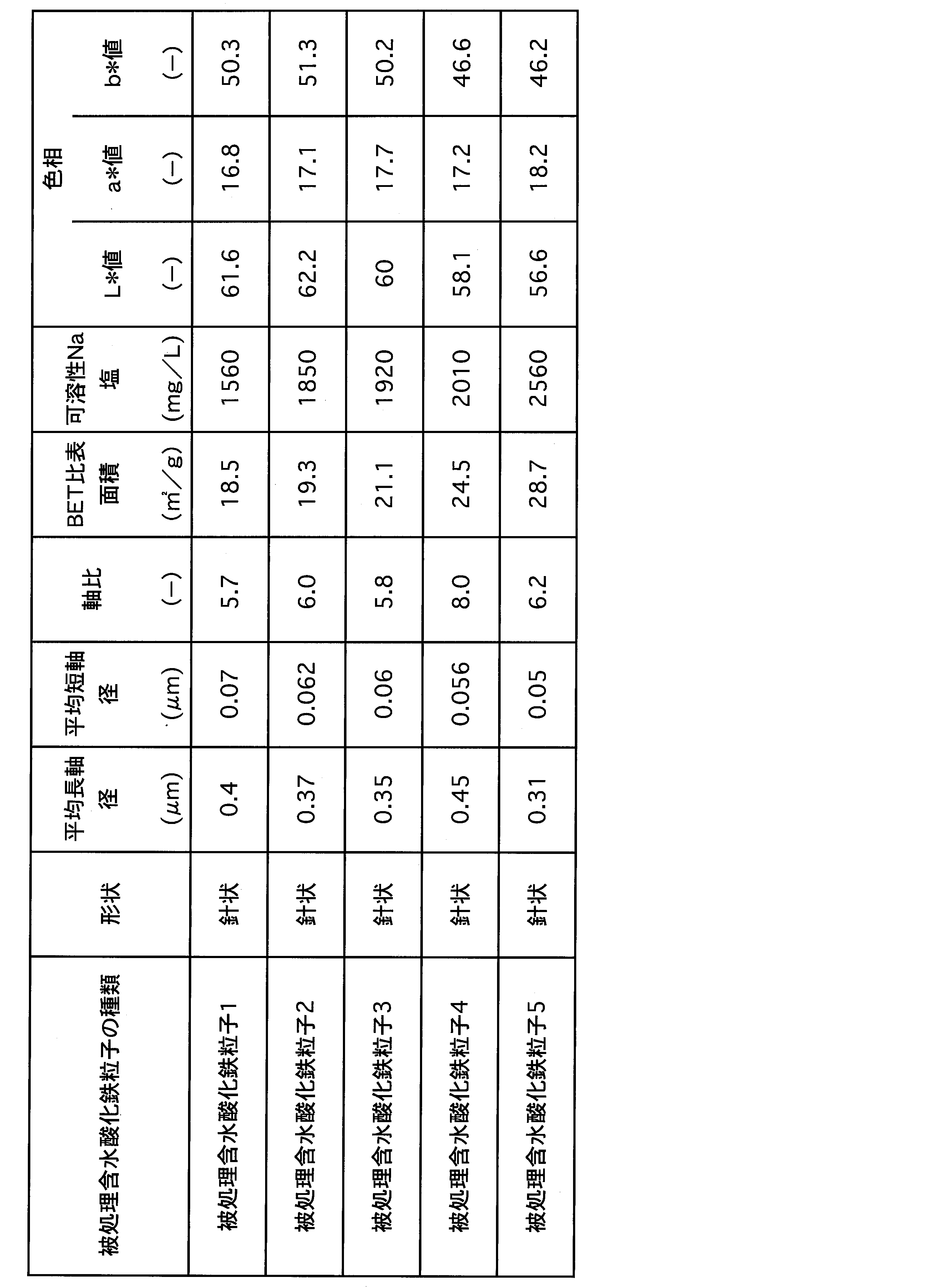
- Example 1 Hydrous iron oxide powder as starting material (treated hydrous iron oxide particles 1: major axis average diameter 0.4 ⁇ m, minor axis average diameter 0.07 ⁇ m, axial ratio (major axis diameter / minor axis diameter) 5.7, BET A wet cake having a specific surface area of 18.5 m 2 / g) is suspended in water to prepare 3000 mL of a suspension having a concentration of 5% by weight, and then the water content in the suspension is measured using a high-speed dissolver and a vertical bead mill. The iron oxide particle powder was well dispersed. The pH of the aqueous suspension at this time was 5.6.
- the pH was adjusted to 6 using 2N caustic soda and reacted at 80 ° C. for 1 hour. After the temperature was lowered to room temperature, it was filtered and washed with Nutsche, followed by drying in a dryer at 100 ° C. for 1 day.
- the obtained hydrous iron oxide particle powder was pulverized by using a Leica machine, and the hydrous iron oxide powder surface-treated with P and Al had a P content of 2.4% with respect to the hydrous iron oxide.
- the Al content was 4.8%.
- the Al / P weight ratio in the coating layer was 2/1.
- the composite hydrous iron oxide particle powder had a BET specific surface area of 19.5 m 2 / g.
- ⁇ Preparation of solvent-based paint containing heat-resistant yellow hydrous iron oxide pigment 10 g of the above heat-resistant yellow hydrous iron oxide pigment, amino alkyd resin and thinner are blended in the following proportions and added to a 140 ml glass bottle together with 90 g of 3 mm ⁇ glass beads, and then 1 minute, 3 minutes, 5 minutes, 10 minutes with a paint shaker , 30 minutes, 60 minutes, and 90 minutes, and mixed by changing the shaking time to produce each mill base.
- Heat resistant yellow hydrous iron oxide pigment 10g Amino alkyd resin: 16g Solvent (thinner): 6g Glass beads (3mm ⁇ ): 90g
- a paint was prepared by adding 50 g of amino alkyd resin to the mill base thus prepared and shaking for 5 minutes with a paint conditioner.
- the hue of the coated piece obtained by applying the obtained paint to an aluminum plate (0.8 mm ⁇ 70 mm ⁇ 150 mm) at a thickness of 20 ⁇ m and drying to form a coating film has an L * value of 61.8, The a * value was 17.6 and the b * value was 50.8.
- the heat resistance was evaluated by the above evaluation method.
- Heat resistant yellow hydrous iron oxide pigment 10g Amino alkyd resin: 66g Solvent (thinner): 6g Glass beads (3mm ⁇ ): 90g
- Hydrous iron oxide 1-5 As treated particles, treated hydrous iron oxide particles 1 to 5 shown in Table 1 were prepared.
- Example 2 A 3 L flask was charged with 1000 g of a 5 wt% aqueous suspension of acicular hydrous iron oxide powder having an average major axis diameter of 0.37 ⁇ m, an average minor axis diameter of 0.062 ⁇ m, and a BET specific surface area of 19.3 m 2 / g. Then, 47 g of an aqueous 10 wt% ammonium dihydrogen phosphate solution is added, and the temperature is raised over 1 hour so that the liquid temperature becomes 80 ° C. After maintaining at the same temperature for 1 hour, 85 g of a 10 wt% aqueous solution of aluminum acetate is added, and the temperature is maintained at 80 ° C. for 2 hours.
- the pH of the obtained reaction solution was 3.6.
- 2N sodium hydroxide aqueous solution was added to adjust the pH to 6.5, and then reacted at 80 ° C. for 1 hour.
- the mixture was cooled to room temperature, filtered and washed with water using a Nutsche, and the resulting cake was dried in a dryer at 100 ° C.
- the particle powder has an average major axis diameter of 0.37 ⁇ m, an average minor axis diameter of 0.063 ⁇ m, a BET specific surface area of 19.5 m 2 / g, a hue of L * value 61.8, and a * value of 17.6.
- the b * value was 50.8.
- the heat resistance temperature is 267 ° C.
- the absolute value of the hue change before and after the heat resistance test of the yellow hydrated iron oxide pigment is L * value, a * value, b * value. Both were less than 1.
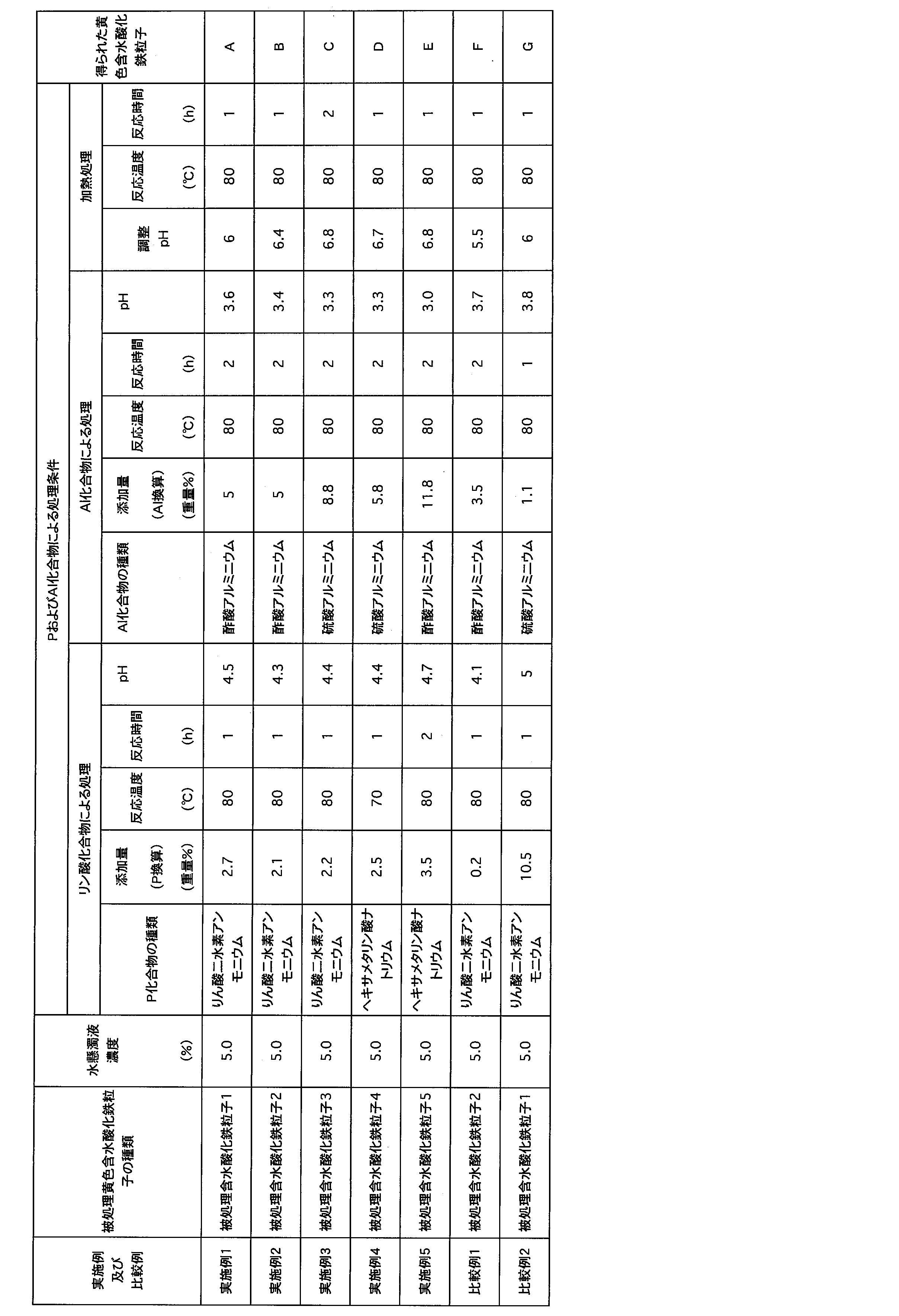
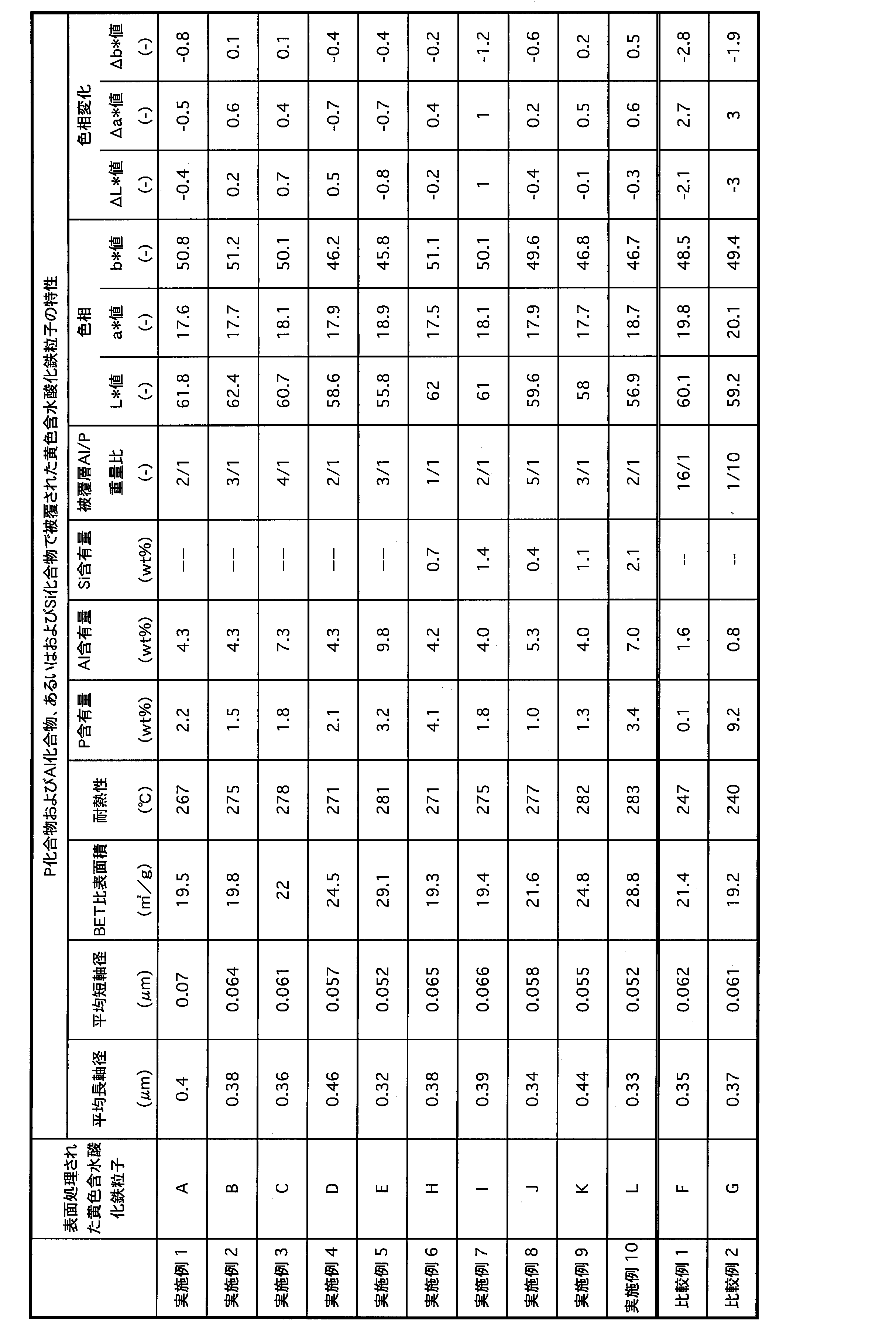
- Examples 3-5, Comparative Examples 1-2 It was prepared in the same manner as in Example 1 except that the type and amount of the phosphorus compound, the type and amount of the aluminum compound, the reaction time, and the pH were variously changed. Tables 2 and 4 show the main production conditions and various characteristics.
- Example 6 In the same manner as in Example 1, 5 wt% aqueous suspension of acicular hydrous iron oxide powder having an average major axis diameter of 0.37 ⁇ m, an average minor axis diameter of 0.062 ⁇ m, and a BET specific surface area of 19.3 m 2 / g 1000 g of the liquid is charged into a 3 L flask, and 47 g of a 10 wt% aqueous solution of ammonium dihydrogen phosphate is added thereto, and the temperature is raised over 1 hour so that the liquid temperature becomes 80 ° C. After maintaining at the same temperature for 1 hour, 85 g of a 10 wt% aqueous solution of aluminum acetate was added, and the temperature was maintained at 80 ° C.
- the particle powder has an average major axis diameter of 0.38 ⁇ m, an average minor axis diameter of 0.065 ⁇ m, a BET specific surface area of 19.3 m 2 / g, and a hue of L * value 62, a * value 17.5, b * The value was 51.1. Further, as a result of the heat resistance test, the heat resistance temperature was 271 ° C., and the absolute value of the hue change before and after the heat resistance test was less than 1 for all L * values, a * values, and b * values.
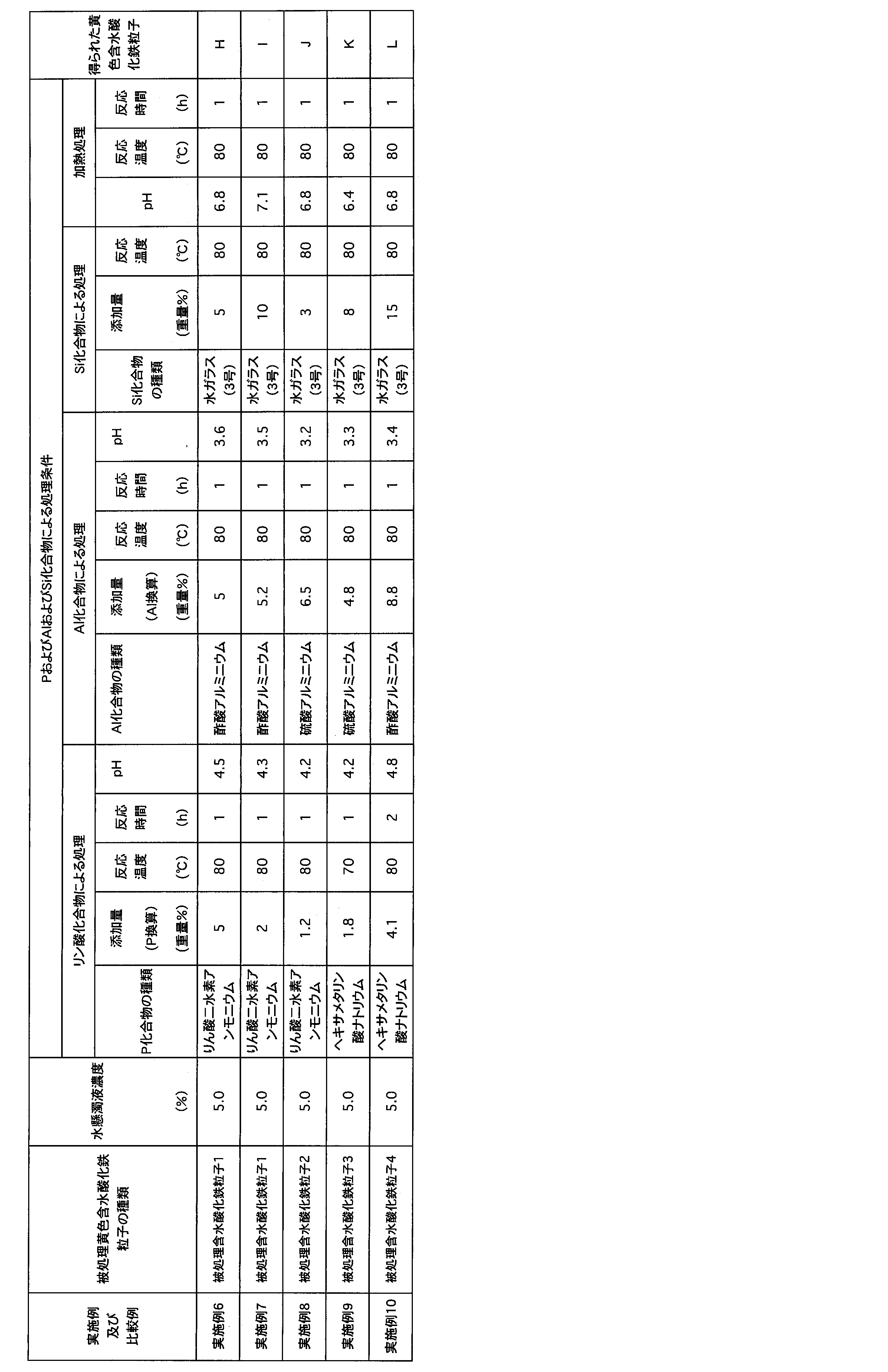
- Examples 7 to 10 It was prepared in the same manner as in Example 6 except that the kind and amount of the phosphorus compound, the kind and amount of the aluminum compound, the addition amount of water glass, and the reaction time and pH were variously changed. Tables 3 and 4 show the main production conditions and various characteristics.
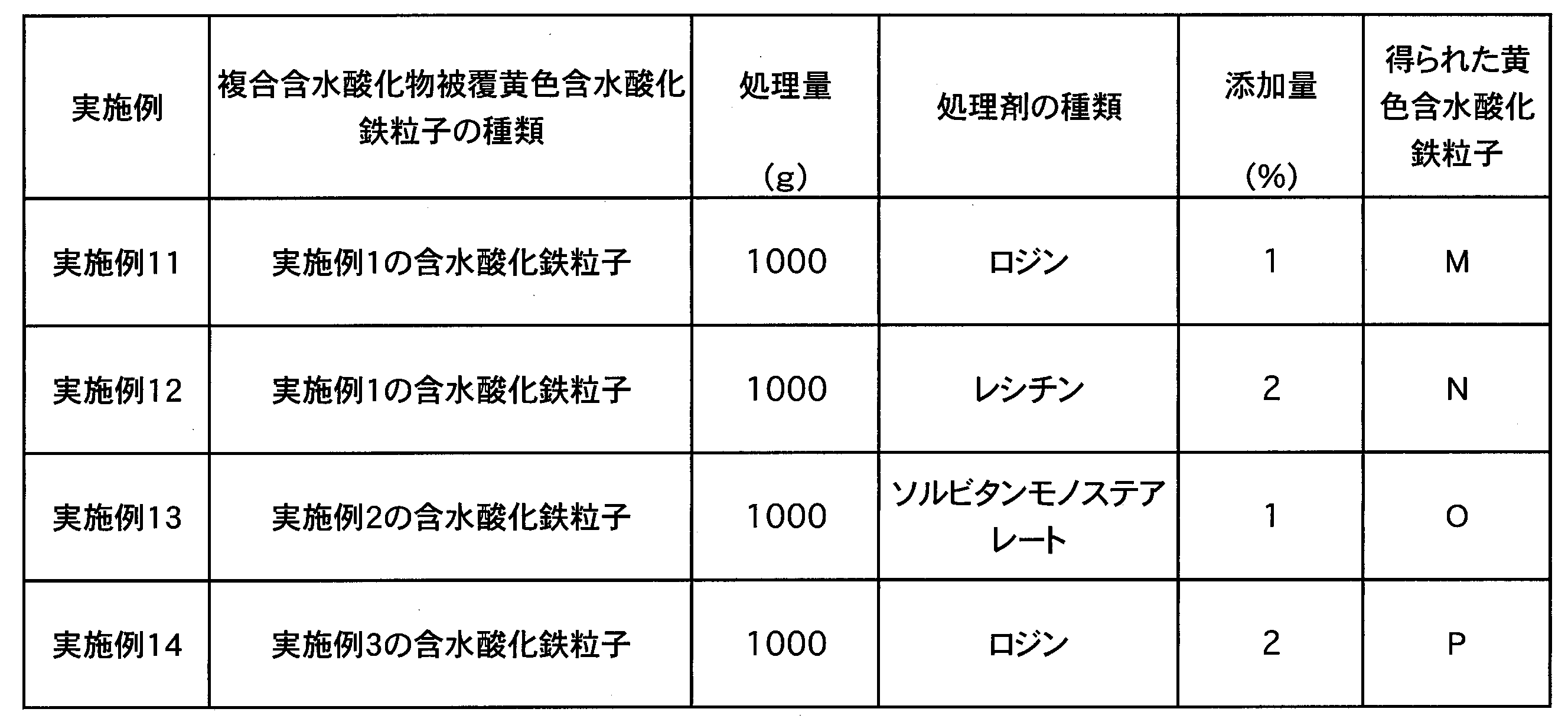
- Example 11 1000 g of the surface-coated yellow hydrated iron pigment obtained in Example 1 was charged into a 20 L Henschel mixer, and 10 g of rosin powder and 10 g of ethanol were added thereto, followed by mixing at room temperature for 1 hour.
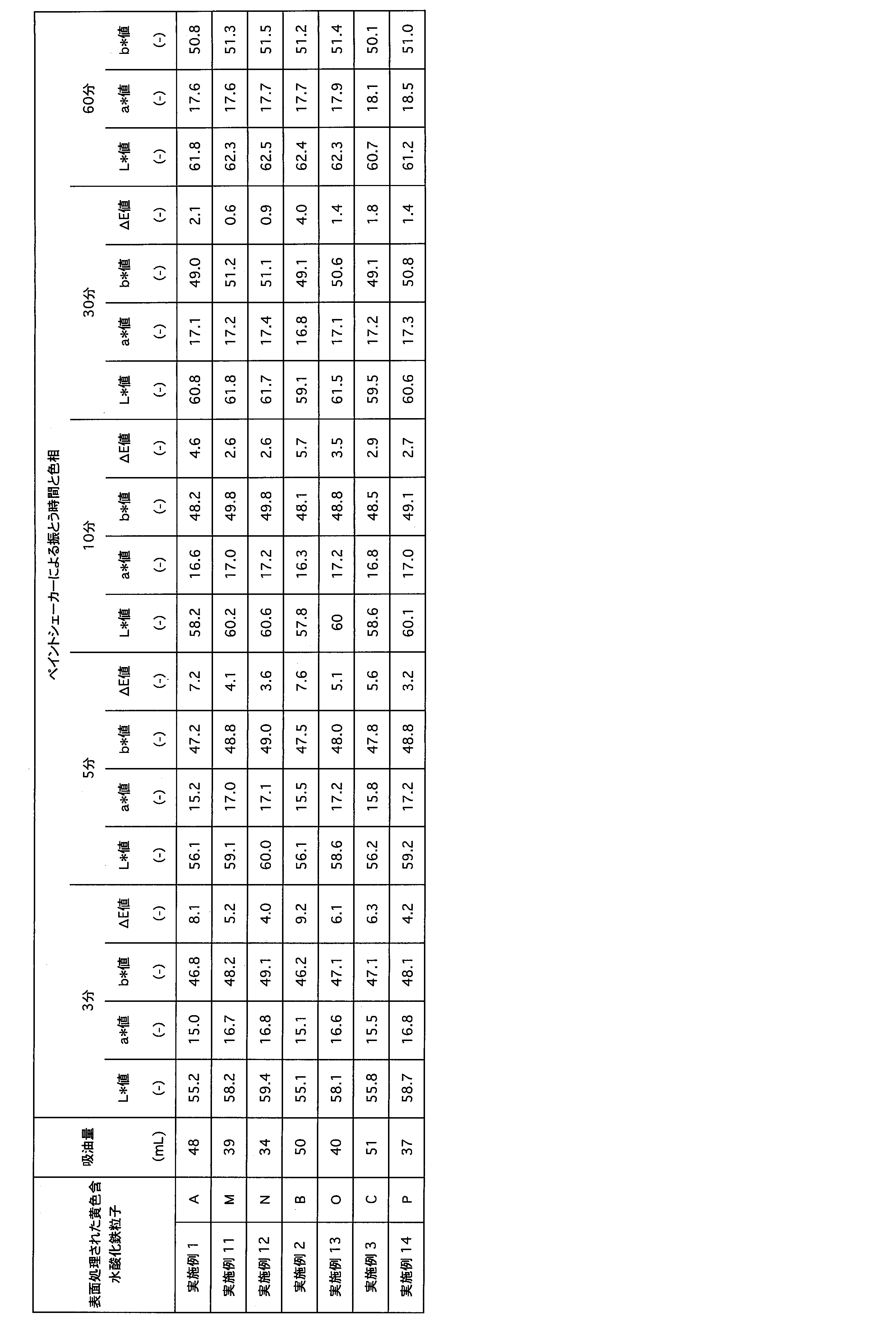
- the obtained surface-coated yellow hydrous iron oxide pigment had an oil absorption of 39.
- Heat resistant yellow hydrous iron oxide pigment 10g Amino alkyd resin: 66g Solvent (thinner): 6g Glass beads (3mm ⁇ ): 90g
- the hue of the coated piece obtained by applying the obtained paint to mirror-coated paper and drying to form a coating film was measured for each sample.
- Examples 12-14 It was prepared in the same manner as in Example 11 except that various types of heat-resistant yellow hydrous iron oxide pigments, types of surface treatment agents and addition amounts were changed. Table 6 shows the production conditions and various characteristics at this time.
- the heat-resistant yellow hydrous iron oxide pigments (A, B, C, M, N, O and P) according to the present invention have a low oil absorption of 55 or less and are excellent in dispersibility. is there.
- the heat-resistant yellow hydrous iron oxide pigments (M, N, O, P) coated with one or more compounds selected from rosin compounds, lecithin, sorbitan acid esters, and oleic acid are each before surface treatment.
- the shake of the paint shaker becomes a hue close to the target hue in a short time. In other words, it became clear that it could be dispersed in a shorter time.
- the heat-resistant yellow iron oxide hydroxide (M, N, O, P) has a change in ⁇ E value of 1.5 or less as the difference from the value when the shaking time on the paint shaker is 30 minutes to the value after 60 minutes. Met.
- the method for producing a yellow hydrous iron oxide pigment according to the present invention is a simple process that does not use a special apparatus, a heat resistance improving process, a yellow color with little change in hue before and after the process, and excellent dispersibility. It is a manufacturing method of a hydrous iron oxide pigment.
Landscapes
- Chemical & Material Sciences (AREA)
- Organic Chemistry (AREA)
- Inorganic Chemistry (AREA)
- Pigments, Carbon Blacks, Or Wood Stains (AREA)
- Compounds Of Iron (AREA)
Abstract
Description
まず、本発明において重要な点は、黄色含水酸化鉄粒子の水分散液に、該含水黄色酸化鉄粒子に対しP換算で0.1~6重量%を含むリン化合物をpH4~7の範囲で処理した後に、Al換算で2~12重量%のアルミニウム化合物を、pH3~5の範囲で処理し、さらにpHを5~8の範囲に調製した後に、加熱処理することでアルミニウムの水酸化物の層を該黄色含水酸化鉄粒子の表面に形成し、耐熱性黄色含水酸化鉄顔料を得ることができる点である。
<式>
ΔE*=((ΔL*)2+(Δa*)2+(Δb*)2)1/2
ΔL*値:比較する試料の加熱処理前後のL*値の差
Δa*値:比較する試料の加熱処理前後のa*値の差
Δb*値:比較する試料の加熱処理前後のb*値の差
実施例1:
出発原料としての含水酸化鉄粒子粉末(被処理含水酸化鉄粒子1:長軸平均径0.4μm、短軸平均径0.07μm、軸比(長軸径/短軸径)5.7、BET比表面積18.5m2/g)の湿ケーキを水に懸濁して、濃度5重量%の懸濁液3000mLを準備し、次いで、高速ディゾルバー及び縦型ビーズミルを用いて該懸濁液中の含水酸化鉄粒子粉末をよく分散させた。このときの水懸濁液のpHは5.6であった。
上記耐熱性黄色含水酸化鉄顔料10gとアミノアルキッド樹脂およびシンナーを下記割合で配合して3mmΦガラスビーズ90gとともに140mlのガラス瓶に添加し、次いで、ペイントシェーカーで1分、3分、5分、10分、30分、60分、90分と振とう時間を変化させて混合し、おのおのミルベースを作製した。
アミノアルキッド樹脂 : 16g
溶剤(シンナー) : 6g
ガラスビーズ(3mmΦ) : 90g
上記で得られた耐熱性黄色含水酸化鉄顔料10gとアミノアルキッド樹脂およびシンナーを下記割合で配合して3mmΦガラスビーズ90gとともに140mlのガラス瓶に添加し、次いで、ペイントシェーカーで1分、3分、5分、10分、30分、60分、90分と振とう時間を振って混合し、おのおのミルベースを作製した。
アミノアルキッド樹脂 : 66g
溶剤(シンナー) : 6g
ガラスビーズ(3mmΦ) : 90g
被処理粒子として、表1に示される被処理含水酸化鉄粒子1~5を準備した。
平均長軸径0.37μm、平均短軸径0.062μm、BET比表面積19.3m2/gの針状含水酸化鉄粒子粉末の5重量%濃度の水懸濁液1000gを、3Lフラスコに仕込み、そこに、10重量%りん酸二水素アンモニウム水溶液47gを添加し、液温が80℃になるように1時間を掛けて昇温する。同温度にて1時間保持した後、10重量%酢酸アルミニウム水溶液を85g添加し、同じく80℃で2時間保持する。得られた反応液のpHは3.6であった。
次に、2N苛性ソーダ水溶液を添加して、pHを6.5に調整した後、80℃で1時間反応させた。反応終了後、室温まで冷却し、ヌッチェを用いてろ過および水洗処理を行い、得られたケーキを100℃の乾燥機内で乾燥させた。
当該粒子粉末は、平均長軸径が0.37μm、平均短軸径が0.063μm、BET比表面積が19.5m2/g、色相は、L*値61.8、a*値17.6、b*値50.8であった。
さらに、耐熱性試験の結果、耐熱温度は267℃であり、黄色含水酸化鉄顔料の耐熱性試験の試験前-試験後の色相変化の絶対値は、L*値、a*値、b*値ともに1未満であった。
りん化合物の種類および量、アルミニウム化合物の種類および量、反応時間、pHを種々変化させた以外は実施例1と同様にして調製した。主要製造条件および諸特性を表2および表4に示す。
実施例1と同様にして、平均長軸径0.37μm、平均短軸径0.062μm、BET比表面積19.3m2/gの針状含水酸化鉄粒子粉末の5重量%濃度の水懸濁液1000gを、3Lフラスコに仕込み、そこに、10重量%りん酸二水素アンモニウム水溶液47gを添加し、液温が80℃になるように1時間を掛けて昇温する。同温度にて1時間保持した後、10重量%酢酸アルミニウム水溶液を85g添加し、同じく80℃で2時間保持した。
次に、3号水ガラス8.3gを添加し、80℃で1時間反応させた。反応終了後、室温まで冷却した。液のpHは6.8であった。さらに、ヌッチェを用いてろ過および水洗処理を行い、得られたケーキを100℃の乾燥機内で乾燥させた。
さらに、耐熱性試験の結果、耐熱温度は271℃で、耐熱性試験の試験前-試験後の色相変化の絶対値は、L*値、a*値、b*値ともに1未満であった。
りん化合物の種類および量、アルミニウム化合物の種類および量、水ガラスの添加量、さらには、反応時間、pHを種々変化させた以外は実施例6と同様にして調製した。主要製造条件および諸特性を表3および表4に示す。
実施例1で得られた表面被覆黄色含水酸化鉄顔料1000gを20Lのヘンシェルミキサーに仕込み、そこにロジン粉末10gとエタノール10gを添加し、室温で1時間混合処理を行った。
上記耐熱性黄色含水酸化鉄顔料10gとアミノアルキッド樹脂およびシンナーを下記割合で配合して3mmΦガラスビーズ90gとともに140mlのガラス瓶に添加し、次いで、ペイントシェーカーで1分、3分、5分、10分、30分、60分、90分と振とう時間を振って混合し、おのおのミルベースを作製した。
アミノアルキッド樹脂 : 66g
溶剤(シンナー) : 6g
ガラスビーズ(3mmΦ) : 90g
耐熱性黄色含水酸化鉄顔料の種類、表面処理剤の種類及び添加量を種々変化させた以外は実施例11と同様にして調製した。このときの製造条件および諸特性を表6に示す。
Claims (3)
- 含水酸化鉄粒子を含む水分散液に、pH4~7の範囲でリン酸化合物を添加して含水酸化鉄粒子を処理した後に、pH3~5の範囲でアルミニウム化合物を添加して処理し、さらに中性pHに調整して加熱処理して含水酸化鉄粒子の粒子表面にリン化合物及びアルミニウム化合物を付着させる耐熱性黄色含水酸化鉄顔料の製造方法であり、耐熱性黄色含水酸化鉄顔料のリン含有量がP換算で0.1~6重量%であってアルミニウム化合物の含有量がAl換算で2~12重量%であることを特徴とする耐熱性黄色含水酸化鉄顔料の製造方法。
- 中性pHに調整する際に水溶性ケイ酸塩を添加する請求項1記載の製造方法。
- 更に、乾式混合機を用いて、ロジン、レシチン、ソルビタン酸エステル、オレイン酸のいずれか一種以上を用いて、得られた黄色含水酸化鉄顔料の処理を行う請求項1記載の製造方法。
Priority Applications (2)
| Application Number | Priority Date | Filing Date | Title |
|---|---|---|---|
| JP2015508659A JP6380380B2 (ja) | 2013-03-29 | 2014-03-27 | 耐熱性黄色含水酸化鉄顔料の製造方法 |
| CN201480010378.8A CN105073904B (zh) | 2013-03-29 | 2014-03-27 | 耐热性黄色含水氧化铁颜料的制造方法 |
Applications Claiming Priority (2)
| Application Number | Priority Date | Filing Date | Title |
|---|---|---|---|
| JP2013-074474 | 2013-03-29 | ||
| JP2013074474 | 2013-03-29 |
Publications (1)
| Publication Number | Publication Date |
|---|---|
| WO2014157459A1 true WO2014157459A1 (ja) | 2014-10-02 |
Family
ID=51624421
Family Applications (1)
| Application Number | Title | Priority Date | Filing Date |
|---|---|---|---|
| PCT/JP2014/058751 Ceased WO2014157459A1 (ja) | 2013-03-29 | 2014-03-27 | 耐熱性黄色含水酸化鉄顔料の製造方法 |
Country Status (3)
| Country | Link |
|---|---|
| JP (1) | JP6380380B2 (ja) |
| CN (1) | CN105073904B (ja) |
| WO (1) | WO2014157459A1 (ja) |
Cited By (2)
| Publication number | Priority date | Publication date | Assignee | Title |
|---|---|---|---|---|
| WO2018135108A1 (ja) * | 2017-01-17 | 2018-07-26 | 学校法人神奈川大学 | 粒子状組成物、液体組成物、粒子状組成物の製造方法、表面改質剤、水分散性の向上方法 |
| CN114479515A (zh) * | 2022-01-16 | 2022-05-13 | 湖州师范学院 | 一种优化包裹型氧化铁黄颜料耐热性的方法 |
Families Citing this family (1)
| Publication number | Priority date | Publication date | Assignee | Title |
|---|---|---|---|---|
| CN105504883B (zh) * | 2015-12-29 | 2018-01-02 | 中国科学院宁波材料技术与工程研究所 | 一种高耐温性氧化铁黄颜料的制备方法 |
Citations (10)
| Publication number | Priority date | Publication date | Assignee | Title |
|---|---|---|---|---|
| JPS5335698A (en) * | 1976-09-14 | 1978-04-03 | Pfizer | Thermally stable iron oxide |
| JPS54152699A (en) * | 1978-05-22 | 1979-12-01 | Hercules Inc | Magnetic needleelike nonnstoichiometric ferrous and ferric oxide particle and its manufacture |
| JPS55158130A (en) * | 1979-05-30 | 1980-12-09 | Titan Kogyo Kk | Heat resistance improving method for yellow iron oxide pigment |
| JPS62112661A (ja) * | 1985-11-06 | 1987-05-23 | バイエル・アクチエンゲゼルシヤフト | 耐熱性黄色顔料 |
| JPS62197319A (ja) * | 1986-02-20 | 1987-09-01 | Hitachi Maxell Ltd | 磁性粉末およびその製造方法 |
| JPH04147909A (ja) * | 1990-10-09 | 1992-05-21 | Mitsui Mining & Smelting Co Ltd | 磁気記録用磁性金属粉末の製造方法 |
| JPH0710543A (ja) * | 1993-04-02 | 1995-01-13 | Basf Ag | 透明な黄色酸化鉄の製法 |
| JPH10101339A (ja) * | 1996-09-27 | 1998-04-21 | Titan Kogyo Kk | マグネタイト粒子粉末及びその製造方法並びにその応用 |
| JPH1112492A (ja) * | 1997-06-23 | 1999-01-19 | Toda Kogyo Corp | 耐熱性黄色含水酸化鉄顔料の製造法 |
| JP2002361628A (ja) * | 2001-06-12 | 2002-12-18 | Toda Kogyo Corp | プラスチック製フィルムの製造法及びプラスチック製フィルム用マスターバッチペレット |
Family Cites Families (3)
| Publication number | Priority date | Publication date | Assignee | Title |
|---|---|---|---|---|
| DE10023286A1 (de) * | 2000-05-12 | 2001-11-15 | Merck Patent Gmbh | Pigmentpräparation mit modifizierten Kolophoniumharzen |
| CN1903943B (zh) * | 2006-08-01 | 2010-11-17 | 上海一品颜料有限公司 | 一种氧化铁颜料的制备方法 |
| CN101824235B (zh) * | 2010-04-29 | 2012-10-31 | 南通宝聚颜料有限公司 | 一种耐中温氧化铁黄的制作工艺 |
-
2014
- 2014-03-27 CN CN201480010378.8A patent/CN105073904B/zh not_active Expired - Fee Related
- 2014-03-27 JP JP2015508659A patent/JP6380380B2/ja active Active
- 2014-03-27 WO PCT/JP2014/058751 patent/WO2014157459A1/ja not_active Ceased
Patent Citations (10)
| Publication number | Priority date | Publication date | Assignee | Title |
|---|---|---|---|---|
| JPS5335698A (en) * | 1976-09-14 | 1978-04-03 | Pfizer | Thermally stable iron oxide |
| JPS54152699A (en) * | 1978-05-22 | 1979-12-01 | Hercules Inc | Magnetic needleelike nonnstoichiometric ferrous and ferric oxide particle and its manufacture |
| JPS55158130A (en) * | 1979-05-30 | 1980-12-09 | Titan Kogyo Kk | Heat resistance improving method for yellow iron oxide pigment |
| JPS62112661A (ja) * | 1985-11-06 | 1987-05-23 | バイエル・アクチエンゲゼルシヤフト | 耐熱性黄色顔料 |
| JPS62197319A (ja) * | 1986-02-20 | 1987-09-01 | Hitachi Maxell Ltd | 磁性粉末およびその製造方法 |
| JPH04147909A (ja) * | 1990-10-09 | 1992-05-21 | Mitsui Mining & Smelting Co Ltd | 磁気記録用磁性金属粉末の製造方法 |
| JPH0710543A (ja) * | 1993-04-02 | 1995-01-13 | Basf Ag | 透明な黄色酸化鉄の製法 |
| JPH10101339A (ja) * | 1996-09-27 | 1998-04-21 | Titan Kogyo Kk | マグネタイト粒子粉末及びその製造方法並びにその応用 |
| JPH1112492A (ja) * | 1997-06-23 | 1999-01-19 | Toda Kogyo Corp | 耐熱性黄色含水酸化鉄顔料の製造法 |
| JP2002361628A (ja) * | 2001-06-12 | 2002-12-18 | Toda Kogyo Corp | プラスチック製フィルムの製造法及びプラスチック製フィルム用マスターバッチペレット |
Cited By (5)
| Publication number | Priority date | Publication date | Assignee | Title |
|---|---|---|---|---|
| WO2018135108A1 (ja) * | 2017-01-17 | 2018-07-26 | 学校法人神奈川大学 | 粒子状組成物、液体組成物、粒子状組成物の製造方法、表面改質剤、水分散性の向上方法 |
| JPWO2018135108A1 (ja) * | 2017-01-17 | 2019-08-08 | 学校法人神奈川大学 | 粒子状組成物、液体組成物、粒子状組成物の製造方法、表面改質剤、水分散性の向上方法 |
| US12269955B2 (en) | 2017-01-17 | 2025-04-08 | Kanagawa University | Particulate composition, liquid composition, method for producing particulate composition, surface modifying agent, and method for improving water dispersibility |
| CN114479515A (zh) * | 2022-01-16 | 2022-05-13 | 湖州师范学院 | 一种优化包裹型氧化铁黄颜料耐热性的方法 |
| CN114479515B (zh) * | 2022-01-16 | 2023-09-08 | 湖州师范学院 | 一种优化包裹型氧化铁黄颜料耐热性的方法 |
Also Published As
| Publication number | Publication date |
|---|---|
| CN105073904A (zh) | 2015-11-18 |
| CN105073904B (zh) | 2017-04-26 |
| JP6380380B2 (ja) | 2018-08-29 |
| JPWO2014157459A1 (ja) | 2017-02-16 |
Similar Documents
| Publication | Publication Date | Title |
|---|---|---|
| JP6217905B2 (ja) | 耐熱性黄色含水酸化鉄顔料及びその製造方法、該耐熱性黄色含水酸化鉄顔料を用いた塗料及び樹脂組成物 | |
| JP5934833B2 (ja) | ポリエーテルアミンで処理された酸化カーボンブラックおよびそれを含むコーティング組成物 | |
| JP5392453B2 (ja) | 赤外線反射性青色顔料、該赤外線反射性青色顔料を用いた塗料及び樹脂組成物 | |
| CN102282221B (zh) | 磷酸铝浆料 | |
| CN103890106B (zh) | 新一代高岭土基漆体质颜料 | |
| US20020088376A1 (en) | Calcined kaolin pigments having improved combination of physical and applied properties, their production and use | |
| TWI522432B (zh) | 用於水基塗料之碳黑 | |
| DE10001437A1 (de) | Fließ- und pumpfähiges Metallpigment-Halbfabrikat zur Herstellung von Farben und Lacken | |
| JP2022519022A (ja) | 水をベースとする顔料調製物、それらの製造および使用 | |
| JP2021517917A (ja) | 混ぜ入れ二酸化チタン顔料組成物 | |
| JP5201401B2 (ja) | 赤外線反射性黒色系顔料、該赤外線反射性黒色系顔料を用いた塗料及び樹脂組成物 | |
| JP6380380B2 (ja) | 耐熱性黄色含水酸化鉄顔料の製造方法 | |
| US20080267851A1 (en) | High Whiteness Metakaolin and High Whiteness Fully Calcined Kaolin | |
| JP6508487B2 (ja) | ヘマタイト粒子粉末の製造方法、該ヘマタイト粒子粉末を用いた塗料の製造方法及び樹脂組成物の製造方法 | |
| JP2015086126A (ja) | 酸化鉄粒子粉末、該酸化鉄粒子粉末を用いた塗料及び樹脂組成物 | |
| JP4438925B2 (ja) | 改質カーボンブラック粒子粉末及びその製造法、当該改質カーボンブラック粒子粉末を含有する塗料及び樹脂組成物 | |
| EP1791915A2 (de) | Thixotrope beschichtungsmassen | |
| EP3601439A1 (de) | Al-haltige eisenoxidpigmente | |
| JP4407789B2 (ja) | 改質カーボンブラック粒子粉末及びその製造法、当該改質カーボンブラック粒子粉末を含有する塗料及び樹脂組成物 | |
| JP3894292B2 (ja) | 黒色複合粒子粉末及び該黒色複合粒子粉末を含有する塗料及び樹脂組成物 | |
| JP2010150353A (ja) | 赤外線反射性黒色顔料、該赤外線反射性黒色顔料の製造方法、該赤外線反射性黒色顔料を用いた塗料及び樹脂組成物 | |
| JP5494926B2 (ja) | 黒色複合樹脂粒子粉末、並びに該黒色複合樹脂粒子粉末を用いた塗料、樹脂組成物及びソフトフィール塗料 | |
| JP2003160744A (ja) | 複合粒子粉末及び該複合粒子粉末を含有する塗料及び樹脂組成物 | |
| JP4424461B2 (ja) | 表面改質有機顔料及びその製造法、該表面改質有機顔料を用いた塗料、該表面改質有機顔料を用いた樹脂組成物及び該表面改質有機顔料を用いたゴム組成物 | |
| JP2005290059A (ja) | 赤色酸化鉄顔料並びに該顔料を用いた塗料及び樹脂組成物 |
Legal Events
| Date | Code | Title | Description |
|---|---|---|---|
| WWE | Wipo information: entry into national phase |
Ref document number: 201480010378.8 Country of ref document: CN |
|
| 121 | Ep: the epo has been informed by wipo that ep was designated in this application |
Ref document number: 14776322 Country of ref document: EP Kind code of ref document: A1 |
|
| ENP | Entry into the national phase |
Ref document number: 2015508659 Country of ref document: JP Kind code of ref document: A |
|
| NENP | Non-entry into the national phase |
Ref country code: DE |
|
| 122 | Ep: pct application non-entry in european phase |
Ref document number: 14776322 Country of ref document: EP Kind code of ref document: A1 |