WO2014142144A1 - 着色感放射線性組成物、着色硬化膜、カラーフィルタ、着色パターン形成方法、カラーフィルタの製造方法、固体撮像素子及び液晶表示装置 - Google Patents
着色感放射線性組成物、着色硬化膜、カラーフィルタ、着色パターン形成方法、カラーフィルタの製造方法、固体撮像素子及び液晶表示装置 Download PDFInfo
- Publication number
- WO2014142144A1 WO2014142144A1 PCT/JP2014/056410 JP2014056410W WO2014142144A1 WO 2014142144 A1 WO2014142144 A1 WO 2014142144A1 JP 2014056410 W JP2014056410 W JP 2014056410W WO 2014142144 A1 WO2014142144 A1 WO 2014142144A1
- Authority
- WO
- WIPO (PCT)
- Prior art keywords
- group
- dye
- sensitive composition
- colored
- color filter
- Prior art date
- Legal status (The legal status is an assumption and is not a legal conclusion. Google has not performed a legal analysis and makes no representation as to the accuracy of the status listed.)
- Ceased
Links
Images
Classifications
-
- G—PHYSICS
- G03—PHOTOGRAPHY; CINEMATOGRAPHY; ANALOGOUS TECHNIQUES USING WAVES OTHER THAN OPTICAL WAVES; ELECTROGRAPHY; HOLOGRAPHY
- G03F—PHOTOMECHANICAL PRODUCTION OF TEXTURED OR PATTERNED SURFACES, e.g. FOR PRINTING, FOR PROCESSING OF SEMICONDUCTOR DEVICES; MATERIALS THEREFOR; ORIGINALS THEREFOR; APPARATUS SPECIALLY ADAPTED THEREFOR
- G03F7/00—Photomechanical, e.g. photolithographic, production of textured or patterned surfaces, e.g. printing surfaces; Materials therefor, e.g. comprising photoresists; Apparatus specially adapted therefor
- G03F7/0005—Production of optical devices or components in so far as characterised by the lithographic processes or materials used therefor
- G03F7/0007—Filters, e.g. additive colour filters; Components for display devices
-
- G—PHYSICS
- G02—OPTICS
- G02B—OPTICAL ELEMENTS, SYSTEMS OR APPARATUS
- G02B5/00—Optical elements other than lenses
- G02B5/20—Filters
- G02B5/22—Absorbing filters
- G02B5/223—Absorbing filters containing organic substances, e.g. dyes, inks or pigments
-
- G—PHYSICS
- G03—PHOTOGRAPHY; CINEMATOGRAPHY; ANALOGOUS TECHNIQUES USING WAVES OTHER THAN OPTICAL WAVES; ELECTROGRAPHY; HOLOGRAPHY
- G03F—PHOTOMECHANICAL PRODUCTION OF TEXTURED OR PATTERNED SURFACES, e.g. FOR PRINTING, FOR PROCESSING OF SEMICONDUCTOR DEVICES; MATERIALS THEREFOR; ORIGINALS THEREFOR; APPARATUS SPECIALLY ADAPTED THEREFOR
- G03F7/00—Photomechanical, e.g. photolithographic, production of textured or patterned surfaces, e.g. printing surfaces; Materials therefor, e.g. comprising photoresists; Apparatus specially adapted therefor
- G03F7/004—Photosensitive materials
- G03F7/0048—Photosensitive materials characterised by the solvents or agents facilitating spreading, e.g. tensio-active agents
-
- G—PHYSICS
- G03—PHOTOGRAPHY; CINEMATOGRAPHY; ANALOGOUS TECHNIQUES USING WAVES OTHER THAN OPTICAL WAVES; ELECTROGRAPHY; HOLOGRAPHY
- G03F—PHOTOMECHANICAL PRODUCTION OF TEXTURED OR PATTERNED SURFACES, e.g. FOR PRINTING, FOR PROCESSING OF SEMICONDUCTOR DEVICES; MATERIALS THEREFOR; ORIGINALS THEREFOR; APPARATUS SPECIALLY ADAPTED THEREFOR
- G03F7/00—Photomechanical, e.g. photolithographic, production of textured or patterned surfaces, e.g. printing surfaces; Materials therefor, e.g. comprising photoresists; Apparatus specially adapted therefor
- G03F7/004—Photosensitive materials
- G03F7/027—Non-macromolecular photopolymerisable compounds having carbon-to-carbon double bonds, e.g. ethylenic compounds
-
- G—PHYSICS
- G03—PHOTOGRAPHY; CINEMATOGRAPHY; ANALOGOUS TECHNIQUES USING WAVES OTHER THAN OPTICAL WAVES; ELECTROGRAPHY; HOLOGRAPHY
- G03F—PHOTOMECHANICAL PRODUCTION OF TEXTURED OR PATTERNED SURFACES, e.g. FOR PRINTING, FOR PROCESSING OF SEMICONDUCTOR DEVICES; MATERIALS THEREFOR; ORIGINALS THEREFOR; APPARATUS SPECIALLY ADAPTED THEREFOR
- G03F7/00—Photomechanical, e.g. photolithographic, production of textured or patterned surfaces, e.g. printing surfaces; Materials therefor, e.g. comprising photoresists; Apparatus specially adapted therefor
- G03F7/004—Photosensitive materials
- G03F7/027—Non-macromolecular photopolymerisable compounds having carbon-to-carbon double bonds, e.g. ethylenic compounds
- G03F7/032—Non-macromolecular photopolymerisable compounds having carbon-to-carbon double bonds, e.g. ethylenic compounds with binders
- G03F7/033—Non-macromolecular photopolymerisable compounds having carbon-to-carbon double bonds, e.g. ethylenic compounds with binders the binders being polymers obtained by reactions only involving carbon-to-carbon unsaturated bonds, e.g. vinyl polymers
-
- G—PHYSICS
- G03—PHOTOGRAPHY; CINEMATOGRAPHY; ANALOGOUS TECHNIQUES USING WAVES OTHER THAN OPTICAL WAVES; ELECTROGRAPHY; HOLOGRAPHY
- G03F—PHOTOMECHANICAL PRODUCTION OF TEXTURED OR PATTERNED SURFACES, e.g. FOR PRINTING, FOR PROCESSING OF SEMICONDUCTOR DEVICES; MATERIALS THEREFOR; ORIGINALS THEREFOR; APPARATUS SPECIALLY ADAPTED THEREFOR
- G03F7/00—Photomechanical, e.g. photolithographic, production of textured or patterned surfaces, e.g. printing surfaces; Materials therefor, e.g. comprising photoresists; Apparatus specially adapted therefor
- G03F7/004—Photosensitive materials
- G03F7/038—Macromolecular compounds which are rendered insoluble or differentially wettable
- G03F7/0388—Macromolecular compounds which are rendered insoluble or differentially wettable with ethylenic or acetylenic bands in the side chains of the photopolymer
-
- G—PHYSICS
- G03—PHOTOGRAPHY; CINEMATOGRAPHY; ANALOGOUS TECHNIQUES USING WAVES OTHER THAN OPTICAL WAVES; ELECTROGRAPHY; HOLOGRAPHY
- G03F—PHOTOMECHANICAL PRODUCTION OF TEXTURED OR PATTERNED SURFACES, e.g. FOR PRINTING, FOR PROCESSING OF SEMICONDUCTOR DEVICES; MATERIALS THEREFOR; ORIGINALS THEREFOR; APPARATUS SPECIALLY ADAPTED THEREFOR
- G03F7/00—Photomechanical, e.g. photolithographic, production of textured or patterned surfaces, e.g. printing surfaces; Materials therefor, e.g. comprising photoresists; Apparatus specially adapted therefor
- G03F7/004—Photosensitive materials
- G03F7/09—Photosensitive materials characterised by structural details, e.g. supports, auxiliary layers
- G03F7/105—Photosensitive materials characterised by structural details, e.g. supports, auxiliary layers having substances, e.g. indicators, for forming visible images
-
- G—PHYSICS
- G03—PHOTOGRAPHY; CINEMATOGRAPHY; ANALOGOUS TECHNIQUES USING WAVES OTHER THAN OPTICAL WAVES; ELECTROGRAPHY; HOLOGRAPHY
- G03F—PHOTOMECHANICAL PRODUCTION OF TEXTURED OR PATTERNED SURFACES, e.g. FOR PRINTING, FOR PROCESSING OF SEMICONDUCTOR DEVICES; MATERIALS THEREFOR; ORIGINALS THEREFOR; APPARATUS SPECIALLY ADAPTED THEREFOR
- G03F7/00—Photomechanical, e.g. photolithographic, production of textured or patterned surfaces, e.g. printing surfaces; Materials therefor, e.g. comprising photoresists; Apparatus specially adapted therefor
- G03F7/16—Coating processes; Apparatus therefor
-
- G—PHYSICS
- G03—PHOTOGRAPHY; CINEMATOGRAPHY; ANALOGOUS TECHNIQUES USING WAVES OTHER THAN OPTICAL WAVES; ELECTROGRAPHY; HOLOGRAPHY
- G03F—PHOTOMECHANICAL PRODUCTION OF TEXTURED OR PATTERNED SURFACES, e.g. FOR PRINTING, FOR PROCESSING OF SEMICONDUCTOR DEVICES; MATERIALS THEREFOR; ORIGINALS THEREFOR; APPARATUS SPECIALLY ADAPTED THEREFOR
- G03F7/00—Photomechanical, e.g. photolithographic, production of textured or patterned surfaces, e.g. printing surfaces; Materials therefor, e.g. comprising photoresists; Apparatus specially adapted therefor
- G03F7/20—Exposure; Apparatus therefor
-
- G—PHYSICS
- G03—PHOTOGRAPHY; CINEMATOGRAPHY; ANALOGOUS TECHNIQUES USING WAVES OTHER THAN OPTICAL WAVES; ELECTROGRAPHY; HOLOGRAPHY
- G03F—PHOTOMECHANICAL PRODUCTION OF TEXTURED OR PATTERNED SURFACES, e.g. FOR PRINTING, FOR PROCESSING OF SEMICONDUCTOR DEVICES; MATERIALS THEREFOR; ORIGINALS THEREFOR; APPARATUS SPECIALLY ADAPTED THEREFOR
- G03F7/00—Photomechanical, e.g. photolithographic, production of textured or patterned surfaces, e.g. printing surfaces; Materials therefor, e.g. comprising photoresists; Apparatus specially adapted therefor
- G03F7/26—Processing photosensitive materials; Apparatus therefor
- G03F7/30—Imagewise removal using liquid means
- G03F7/32—Liquid compositions therefor, e.g. developers
Definitions
- the present invention relates to a colored radiation-sensitive composition suitable for producing a color filter used for forming colored pixels.
- the present invention also relates to a colored cured film, a color filter, a coloring pattern forming method, a color filter manufacturing method, a solid-state imaging device, and a liquid crystal display device using a colored radiation-sensitive composition.
- color filters are used as key devices for these displays and optical elements, and there is an increasing demand for higher sensitivity and miniaturization.
- Such a color filter normally has a coloring pattern of three primary colors of red (R), green (G), and blue (B), and plays a role of separating transmitted light into the three primary colors.
- One of the methods for producing the color filter is a pigment dispersion method.
- a method for producing a color filter by a photolithography method or an inkjet method by a pigment dispersion method is stable to light and heat because a pigment is used.
- the pigment itself is a fine particle, problems such as light scattering, color unevenness, and roughness often occur. In order to solve these problems, finer pigments are used, but there is a problem that it is difficult to achieve both dispersion stability.
- a method for producing a color filter in place of the pigment dispersion method a method using a dye as a colorant can be mentioned. Since the dye is dissolved in the composition, light scattering, color unevenness, and roughness like a pigment can be suppressed. In recent years, dyes having excellent fastness have been developed.
- Patent Documents 1 to 5 describe dye-containing negative curable compositions used for color filters.
- An object of the present invention is to provide a colored radiation-sensitive composition capable of suppressing residue color mixing on other colors. Another object of the present invention is to provide a colored cured film, a color filter, a color pattern forming method, a color filter manufacturing method, a solid-state imaging device, and an image display device using the colored radiation-sensitive composition.
- a nonionic surfactant having a specific structure and a HLB value of a predetermined value in the colored radiation-sensitive composition As a result of intensive studies by the present inventors under such circumstances, by adding a nonionic surfactant having a specific structure and a HLB value of a predetermined value in the colored radiation-sensitive composition, It was found that color mixing of residues can be suppressed.
- a nonionic surfactant having a specific partial structure in the colored radiation-sensitive composition and having a predetermined HLB value that is, a specific hydrophilic partial structure and It is presumed that by mixing a nonionic surfactant having a specific hydrophobic partial structure, it is possible to effectively suppress residue color mixing on other colors.
- the specific hydrophobic partial structure in the nonionic surfactant makes the interaction with the hydrophobic portion of the dye more likely to occur, so the nonionic surfactant can easily cover the dye, and the nonionic surfactant It is presumed that due to the specific hydrophilic partial structure in the surfactant, the solubility of the dye in the developer is further improved, and as a result, the residual color mixture on other colors can be effectively suppressed.
- the above problem has been solved by the following means ⁇ 1>, preferably ⁇ 2> to ⁇ 16>.
- a colored radiation-sensitive composition comprising a nonionic surfactant that is 2 to 15.5.
- R 1 and R 2 each independently represent a hydrocarbon group having 8 or more carbon atoms
- n1 and n2 each independently represent a number of 4 to 25. .
- R 3 represents an alkyl group or alkenyl group having 8 or more carbon atoms, and n3 represents a number of 4 to 25.
- the nonionic surfactant is a compound represented by the following general formula (4).
- R 4 represents an alkyl or alkenyl group having 15 to 19 carbon atoms, and n4 represents a number of 4 to 25.
- ⁇ 4> The colored radiation-sensitive composition according to any one of ⁇ 1> to ⁇ 3>, wherein the dye has a weight average molecular weight of 5000 or more.
- the dye has a partial structure derived from a dye selected from a dipyrromethene dye, an azo dye, an anthraquinone dye, a triphenylmethane dye, a xanthene dye, a cyanine dye, a squarylium dye, a quinophthalone dye, a phthalocyanine dye, and a subphthalocyanine dye.
- ⁇ 7> The colored radiation-sensitive composition according to any one of ⁇ 1> to ⁇ 6>, further containing a pigment.
- ⁇ 8> The colored radiation-sensitive composition according to any one of ⁇ 1> to ⁇ 7>, further comprising an alkali-soluble resin.
- ⁇ 9> The colored radiation-sensitive composition according to any one of ⁇ 1> to ⁇ 8>, which is used for forming a colored layer of a color filter.
- ⁇ 10> A colored cured film obtained by curing the colored radiation-sensitive composition according to any one of ⁇ 1> to ⁇ 9>.
- ⁇ 11> A color filter having the colored cured film according to ⁇ 10>.
- a colored pattern forming method comprising: an exposure step of exposing the colored radiation-sensitive composition layer in a pattern; and a pattern forming step of developing and removing unexposed portions to form a colored pattern.
- a method for producing a color filter comprising: an exposure step of exposing a colored radiation-sensitive composition layer in a pattern; and a pattern formation step of developing and removing an unexposed portion to form a colored pattern.
- a solid-state imaging device having a color filter according to ⁇ 11> or ⁇ 12> or a color filter obtained by the method for producing a color filter according to ⁇ 14>.
- An image display device having the color filter according to ⁇ 11> or ⁇ 12> or the color filter obtained by the method for producing a color filter according to ⁇ 14>.
- a colored radiation-sensitive composition capable of suppressing residue color mixing on other colors.
- a colored cured film, a color filter, a colored pattern forming method, a color filter manufacturing method, a solid-state imaging device, and a liquid crystal display device in which mixed colors of residues on other colors are suppressed can be provided.
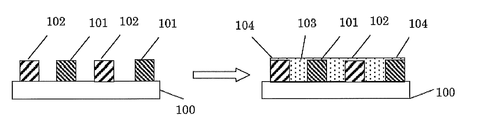
- FIG. 10 is a schematic diagram illustrating an example of a case where a residue color mixture on other colors occurs when pixels of a plurality of colors are formed.
- the contents of the present invention will be described in detail.
- “to” is used to mean that the numerical values described before and after it are included as a lower limit value and an upper limit value.
- the notation which does not describe substitution and unsubstituted includes what has a substituent with what does not have a substituent.
- the “alkyl group” includes not only an alkyl group having no substituent (unsubstituted alkyl group) but also an alkyl group having a substituent (substituted alkyl group).
- the “colored layer” means a pixel used for a color filter.
- the pigment in the present invention means, for example, an insoluble coloring compound that does not dissolve in a solvent. Typically, it means a dye compound that exists in a dispersed state as particles in the composition.
- the solvent includes the solvent exemplified in the solvent column described later. Therefore, the coloring compound which does not melt
- the pigment used in the present invention preferably has a solubility at 25 ° C. of 0.1 g / 100 g Solvent or less, for example, for both propylene glycol monomethyl ether acetate and water.
- the colored region includes a colored pixel (colored pattern) region and a light shielding film forming region in the color filter.
- HLB Hydrophilic-Lypophilic Balance
- HLB value 20 ⁇ sum of formula weight of hydrophilic part / molecular weight
- the hydrophilic part of the nonionic surfactant is, for example, ethyleneoxy moiety, propyleneoxy moiety, polyhydric alcohol It refers to a site (glycol, glycerin, glucoside, sorbitan, mannitol or sorbit).
- the colored radiation-sensitive composition of the present invention comprises a dye, a photopolymerizable compound, a photopolymerization initiator, and a weight average molecular weight of 2500 or less having a partial structure represented by the following general formula (1) or (2), and A nonionic surfactant having an HLB value of 9.2 to 15.5 is included.
- R 1 and R 2 each independently represent a hydrocarbon group having 8 or more carbon atoms, and n1 and n2 each independently represent a number of 4 to 25.
- the colored radiation-sensitive composition of the present invention is a nonionic system having a weight average molecular weight of 2500 or less having a partial structure represented by the general formula (1) or (2) and an HLB value of 9.2 to 15.5.
- the surfactant By containing the surfactant, it is possible to suppress residue color mixing in other colors.
- the colored radiation-sensitive composition of the present invention can also improve the temporal stability.
- the hydrophilic moiety in the nonionic surfactant (formula (1) in the (-C 2 H 4 O-) n1 , or the general formula (2) in the (-C 2 H 4 O-) By n2), it is presumed that the solubility of the dye in the developer is further improved, and as a result, it is possible to effectively suppress the residual color mixture on the other colors.
- the HLB value of the nonionic surfactant is set to 9.2 to 15.5, the ratio of the hydrophilic partial structure to the hydrophobic partial structure in the nonionic surfactant is adjusted. It is estimated that residue color mixing can be effectively suppressed.
- each component of the colored radiation-sensitive composition of the present invention will be described.
- the nonionic surfactant used in the present invention has a weight average molecular weight of 2500 or less having a partial structure represented by the general formula (1) or (2), and an HLB value of 9.2 to 15.5.
- R 1 and R 2 each independently represent a hydrocarbon group having 8 or more carbon atoms.
- a hydrocarbon group an alkyl group, an alkenyl group, and an aryl group are preferable, and an alkyl group or an alkenyl group is more preferable.
- the alkyl group may be linear, branched or cyclic, but is more preferably linear.
- the alkyl group may be substituted or unsubstituted, but is preferably unsubstituted.
- the alkyl group When the alkyl group is cyclic, it may be monocyclic or polycyclic.
- the alkyl group preferably has 10 or more carbon atoms, more preferably 15 or more, and still more preferably 18 or more. Further, the upper limit of the carbon number of the alkyl group is preferably 22 or less, more preferably 20 or less, and even more preferably 19 or less. In particular, the alkyl group preferably has 18 carbon atoms.
- the alkenyl group may be linear, branched or cyclic, but is more preferably linear.
- the alkenyl group may be substituted or unsubstituted, but is preferably unsubstituted. When the alkenyl group is cyclic, it may be monocyclic or polycyclic.
- the number of carbon atoms in the alkenyl group is preferably 10 or more, more preferably 15 or more, and still more preferably 18 or more. Further, the upper limit of the carbon number of the alkyl group is preferably 22 or less, more preferably 20 or less, and even more preferably 19 or less. In particular, the alkenyl group preferably has 18 carbon atoms.
- the aryl group a substituted or unsubstituted aryl group having 8 to 20 carbon atoms is preferable, and a substituted or unsubstituted aryl group having 8 to 16 carbon atoms is more preferable. Specific examples of the aryl group include a phenyl group and a naltyl group.
- the substituent that the hydrocarbon group may have is not particularly limited, but examples thereof include a polymerizable group, a halogen atom, an alkyl group, a carboxylate group, a halogenated alkyl group, an alkoxy group, a methacryloyloxy group, and acryloyl.
- examples include an oxy group, an ether group, a sulfonyl group, a sulfide group, an amide group, an acyl group, a hydroxy group, and a carboxyl group.
- n1 and n2 each independently represent a number of 4 to 25, preferably 4 to 20, more preferably 6 to 20, still more preferably 7 to 20, and 8 to 20 is particularly preferred.
- the nonionic surfactant used in the present invention is preferably a compound represented by the following general formula (3).
- R 3 represents an alkyl group or alkenyl group having 8 or more carbon atoms, and n3 represents a number of 4 to 25.
- R 3 represents an alkyl group or alkenyl group having 8 or more carbon atoms.
- An alkyl group or an alkenyl group is synonymous with R ⁇ 1 > and R ⁇ 2 > in General formula (1) and (2), and its preferable range is also the same.
- n3 represents a number of 4 to 25 and is synonymous with n1 and n2 in the general formulas (1) and (2), and the preferred range is also the same.
- the nonionic surfactant used in the present invention is preferably a compound represented by the following general formula (4).
- R 4 represents an alkyl or alkenyl group having 15 to 19 carbon atoms, and n4 represents a number of 4 to 25.
- R 4 represents an alkyl group or alkenyl group having 15 to 19 carbon atoms.
- An alkyl group or an alkenyl group is synonymous with R ⁇ 3 > in General formula (3).
- R 4 represents an alkyl group, the alkyl group preferably has 15 or more carbon atoms, more preferably 18 or more.
- R 4 represents an alkyl group
- the upper limit of the carbon number of the alkyl group is preferably 19 or less, and in particular, the carbon number of the alkyl group is preferably 18.
- the alkenyl group preferably has 15 or more carbon atoms, more preferably 18 or more.
- the upper limit of the carbon number of the alkyl group is preferably 19 or less, and in particular, the carbon number of the alkenyl group is preferably 18.
- n4 represents a number of 4 to 25 and is synonymous with n1 and 2 in the general formulas (1) and (2), and the preferred range is also the same.
- the preferred polymerization average molecular weight of the nonionic surfactant is 2500 or less from the viewpoint of effectively removing the residual color mixture on other colors. More preferably, it is 350 to 2500, still more preferably 500 to 2000, and particularly preferably 500 to 1500.
- the range of the HLB value in the present invention is 9.2 to 15.5, preferably 10.0 to 14.0, and particularly preferably 10.5 to 13.0. If the HLB value is 15.5 or less, the hydrophilicity of the nonionic surfactant is good, the interaction between the hydrophobic part of the dye and the hydrophobic part of the nonionic surfactant is likely to occur, and residual color mixing over other colors Can be suppressed. Moreover, if the HLB value is 15.5 or less, the solubility in a solvent is good, and separation in a colored radiation-sensitive composition is unlikely to occur and is practical. When the HLB value is 9.2 or more, the hydrophobic property of the nonionic surfactant does not become too high, the solubility of the dye in the developing solution is good, and residual color mixing on other colors can be suppressed.
- nonionic surfactants used in the present invention include polyoxyethylene alkyl ethers (polyoxyethylene lauryl ether, polyoxyethylene stearyl ether, polyoxyethylene oleyl ether, polyoxyethylene 2-ethylhexyl ether). ), Polyoxyethylene aryl ethers (polyoxyethylene octyl phenyl ether, polyoxyethylene nonyl phenyl ether), polyethylene glycol dilaurate, polyethylene glycol distearate, polyethylene glycol monolaurate, polyoxyethylene glyceryl isostearate, tristearic acid Examples include polyoxyethylene glycerin.
- polyoxyethylene lauryl ether polyoxyethylene oleyl ether, or polyoxyethylene glyceryl isostearate is preferable.
- Emulgen series Emulgen 104P, Emulgen 106, Emulgen 108, Emulgen 210P, Emulgen 306P, Emulgen 408, Emulgen 409PV, Emulgen 420, Emulgen 707, Emalgen LS-106
- Emanon series (Emanon) manufactured by Kao Corporation 1112
- Leox series made by Lion Leox CL-30
- Leocol series Leocol TD-50, SC-50
- Newcol series made by Nippon Emulsifier Co., Ltd.
- Newcoal NT-5 Newcoal 2304YM, New Cole 1008, New Cole 707, New Cole 564
- NOF Series made by NOF NONION L-2, NONION DL-4HN
- UNIOX Series UNIOX GM-5IS, UNIO Scan GT-20IS
- Uni-Lube series Uni-Lube series
- the addition amount of the nonionic surfactant in the present invention is 0.1 to 15 masses with respect to the total solid content of the colored radiation-sensitive composition of the present invention, from the viewpoint of effectively suppressing residual color mixing over other colors. %, More preferably 0.5 to 10% by mass, and particularly preferably 2 to 6% by mass.
- a surfactant other than the nonionic surfactant may be used in combination.
- Other surfactants include various surfactants such as fluorosurfactants, cationic surfactants, anionic surfactants, nonionic surfactants other than nonionic surfactants, and silicone surfactants. Is mentioned.
- fluorosurfactants such as fluorosurfactants, cationic surfactants, anionic surfactants, nonionic surfactants other than nonionic surfactants, and silicone surfactants.
- silicone surfactants such as fluorine-based surfactants, cationic surfactants, anionic surfactants, nonionic surfactants other than nonionic surfactants, and silicone surfactants.
- the fluorine content in the fluorosurfactant is preferably 3 to 40% by mass, more preferably 5 to 30% by mass, and particularly preferably 7 to 25% by mass.
- a fluorine-based surfactant having a fluorine content within this range is effective in terms of uniformity of coating film thickness and liquid-saving properties, and has good solubility in the colored photosensitive composition.
- fluorosurfactant examples include Megafac F171, F172, F173, F176, F176, F177, F141, F142, F143, F144, R30, F437, F479, F482, F780, F781 (above, manufactured by DIC Corporation), Florard FC430, FC431, FC171 (above, manufactured by Sumitomo 3M), Surflon S-382, SC-101, SC-103, SC-104, SC-105, SC1068, SC-381, SC-383, S393, KH-40 (manufactured by Asahi Glass Co., Ltd.) and the like.
- cationic surfactant examples include phthalocyanine derivatives (trade name: EFKA-745, manufactured by Morishita Sangyo Co., Ltd.), organosiloxane polymer KP341 (manufactured by Shin-Etsu Chemical Co., Ltd.), (meth) acrylic acid ( Co) polymer polyflow no. 75, no. 90, no. 95 (manufactured by Kyoeisha Yushi Chemical Co., Ltd.), W001 (manufactured by Yusho Co., Ltd.) and the like.
- Specific examples of the anionic surfactant include W004, W005, W017 (manufactured by Yusho Co., Ltd.) and the like.
- silicone-based surfactant examples include “Tore Silicone DC3PA”, “Tore Silicone SH7PA”, “Tore Silicone DC11PA”, “Tore Silicone SH21PA”, “Tore Silicone SH28PA”, and “Tore Silicone SH29PA” manufactured by Torre Silicone Co., Ltd. , “Tole Silicone SH30PA”, “Tole Silicone SH8400”, “TSF-4440”, “TSF-4300”, “TSF-4445”, “TSF-444 (4) (5) (6)” manufactured by Toshiba Silicone Co., Ltd.
- the colored radiation-sensitive composition of the present invention contains a dye.
- a well-known dye can be used for color filters conventionally.
- dye monomers and dye multimers can be used.
- an acidic dye and / or its derivative may be used suitably from a viewpoint that the binder and / or dye of a light non-irradiation part are removed completely by image development.
- the dye used in the present invention has a partial structure derived from a dye selected from dipyrromethene dye, azo dye, anthraquinone dye, triphenylmethane dye, xanthene dye, cyanine dye, squarylium dye, quinophthalone dye, phthalocyanine dye and subphthalocyanine dye. What has is preferable.
- the dye used in the present invention is preferably a multimer having a partial structure and a polymerizable group, and preferably includes a structure such as a dimer, a trimer and a polymer.
- each of the dyes constituting the partial structure derived from the dye preferably has a dye skeleton having a maximum absorption wavelength in the range of 400 to 780 nm. This dye functions, for example, as a colorant in the colored radiation-sensitive composition of the present invention.
- the “partial structure derived from a dye” refers to a dye multimer connecting part (polymer chain or polymer chain) obtained by removing a hydrogen atom from a specific dye (hereinafter also referred to as a dye compound) that can form a dye structure described later. It represents a structure that can be linked to a dendrimer core or the like.
- Pigment structure examples of the partial structure derived from the pigment in the dye used in the colored radiation-sensitive composition of the present invention include quinone pigments (benzoquinone pigments, naphthoquinone pigments, anthraquinone pigments, anthrapyridone pigments).
- Carbonium dyes (diphenylmethane dyes, triphenylmethane dyes, xanthene dyes, acridine dyes, etc.), quinoneimine dyes (oxazine dyes, thiazine dyes, etc.), azine dyes, polymethine dyes (oxonol dyes, merocyanine dyes, arylidene dyes, styryl dyes) , Cyanine dye, squarylium dye, croconium dye, etc.), quinophthalone dye, phthalocyanine dye, subphthalocyanine dye, perinone dye, indigo dye, thioindigo dye, quinoline dye, nitro dye, nitro dye Seo dyes, dipyrromethene dyes and dye structure selected from azo dyes and their metal complex dye and the like.
- quinoneimine dyes oxazine dyes, thiazine dyes, etc.
- dye structures from the viewpoint of color separation, substrate adhesion and surface roughness, dipyrromethene dyes, azo dyes, anthraquinone dyes, triphenylmethane dyes, xanthene dyes, cyanine dyes, squarylium dyes, quinophthalone dyes, phthalocyanine dyes Particularly preferred are dye structures selected from subphthalocyanine dyes.
- a hydrogen atom in the pigment structure may be substituted with a substituent selected from the following substituent group A.
- substituent group A examples of the substituent that the dye multimer may have include a halogen atom, an alkyl group, a cycloalkyl group, an alkenyl group, a cycloalkenyl group, an alkynyl group, an aryl group, a heterocyclic group, a cyano group, a hydroxyl group, a nitro group, Carboxyl group, alkoxy group, aryloxy group, silyloxy group, heterocyclic oxy group, acyloxy group, carbamoyloxy group, amino group (including alkylamino group and anilino group), acylamino group, aminocarbonylamino group, alkoxycarbonylamino group , Aryloxycarbonylamino group, sulfamoylamino group, alkyl or arylsulfonylamino group, mercapto group, alkylthio group, arylthio group, heterocyclic
- anthraquinone dye Those having a partial structure derived from an anthraquinone dye (anthraquinone compound) are preferably partial structures derived from compounds represented by the following general formulas (AQ-1) to (AQ-3) (anthraquinone compounds).
- the anthraquinone compound is a general term for compounds having a dye moiety containing an anthraquinone skeleton in the molecule.
- a and B each independently represent an amino group, a hydroxyl group, an alkoxy group or a hydrogen atom.
- Xqa represents ORqa 1 or NRqa 2 Rqa 3.
- Rqa 1 to Rqa 3 each independently represents a hydrogen atom, an alkyl group or an aryl group.
- Rq 1 to Rq 4 represent a substituent.
- the substituents that Rq 1 to Rq 4 can take are the same as the substituents mentioned in the section of the substituent group A.
- Ra and Rb each independently represents a hydrogen atom, an alkyl group or an aryl group.
- C and D have the same meanings as A and B in general formula (AQ-1).
- Xqb represents ORqb 1 or NRqb 2 Rqb 3.
- Rqb 1 to Rqb 3 each independently represents a hydrogen atom, an alkyl group or an aryl group.
- Rq 5 to Rq 8 represent a substituent.
- Rq 5 to Rq 8 have the same meanings as Rq 1 to Rq 4 in formula (AQ-1).
- Rc has the same meaning as Ra or Rb in formula (AQ-1).
- E and F have the same meanings as A and B in general formula (AQ-1).
- Xqc represents ORqc 1 or NRqc 2 Rqc 3.
- Rqc 1 to Rqc 3 each independently represents a hydrogen atom, an alkyl group or an aryl group.
- Rq 9 to Rq 12 have the same meanings as Rq 1 to Rq 4 in formula (AQ-1).
- Rd has the same meaning as Ra or Rb in formula (AQ-1).
- anthraquinone dye for example, paragraphs 0049 and 0050 of JP2013-29760A can be referred to, and the contents thereof are incorporated in the present specification.
- Triphenylmethane dye As what has a partial structure derived from a triphenylmethane pigment
- the triphenylmethane compound is a general term for compounds having a dye moiety containing a triphenylmethane skeleton in the molecule.
- Rtp 1 to Rtp 4 each independently represents a hydrogen atom, an alkyl group or an aryl group.
- Rtp 5 represents a hydrogen atom, an alkyl group, an aryl group, or NRtp 9 Rtp 10 (Rtp 9 And Rtp 10 represents a hydrogen atom, an alkyl group or an aryl group)
- Rtp 6 , Rtp 7 and Rtp 8 represent a substituent, a, b and c each represents an integer of 0 to 4.
- Rtp 6, Rtp 7 and Rtp 8 are may be coupled to each other to form a ring .
- X - is .X representing the anion structure - if there is no, Rtp 1 ⁇ At least one of Rtp 7 contains an anion.
- TP general formula
- Xanthene dye As what has a partial structure derived from a xanthene pigment (xanthene compound), the partial structure derived from the xanthene compound represented by the following general formula (J) is preferable.
- R 81 , R 82 , R 83 and R 84 each independently represents a hydrogen atom or a monovalent substituent
- R 85 each independently represents a monovalent substituent
- m is 0 Represents an integer from 5 to 5.
- X ⁇ represents an anion.
- R 81 to R 85 contains an anion.
- paragraphs 0066 to 0073 of JP2013-29760A can be referred to, and the contents thereof are incorporated in the present specification.
- Cyanine dye As the one having a partial structure derived from a cyanine dye (cyanine compound), a partial structure derived from a compound (cyanine compound) represented by the following general formula (PM) is preferable.
- the cyanine compound is a general term for compounds having a dye moiety containing a cyanine skeleton in the molecule.
- ring Z1 and ring Z2 each independently represent a heterocyclic ring which may have a substituent.
- l represents an integer of 0 or more and 3 or less.
- X ⁇ represents an anion.
- paragraphs 0077 to 0084 of JP 2013-29760 A can be referred to, and the contents thereof are incorporated in the present specification.
- the squarylium dye As what has a partial structure derived from a squarylium pigment
- the squarylium compound is a general term for compounds having a dye moiety containing a squarylium skeleton in the molecule.
- a and B each independently represent an aryl group or a heterocyclic group.
- the aryl group is preferably an aryl group having 6 to 48 carbon atoms, more preferably 6 to 24 carbon atoms, and examples thereof include phenyl and naphthyl.
- the heterocyclic group is preferably a 5-membered or 6-membered heterocyclic group, and examples thereof include pyroyl, imidazoyl, pyrazoyl, thienyl, pyridyl, pyrimidyl, pyridazyl, triazol-1-yl, thienyl, furyl, thiadiazoyl, and the like.
- paragraphs 0088 to 0106 of JP2013-29760A can be referred to, and the contents thereof are incorporated in the present specification.
- quinophthalone dye As a compound having a partial structure derived from a quinophthalone dye (quinophthalone compound), a partial structure derived from a compound (quinophthalone compound) represented by the following general formula (QP) is preferable.
- the quinophthalone compound is a general term for compounds having a dye moiety containing a quinophthalone skeleton in the molecule.
- Rqp 1 to Rqp 6 each independently represents a hydrogen atom or a substituent. When at least two of Rqp 1 to Rqp 6 are adjacent to each other, they may be bonded to each other to form a ring, and the above-described ring may further have a substituent.
- the general formula (QP) for example, paragraphs 0110 to 0114 of JP2013-29760A can be referred to, and the contents thereof are incorporated in the present specification.
- phthalocyanine dye As what has a partial structure derived from a phthalocyanine pigment
- dye (phthalocyanine compound) what has the partial structure derived from the compound (phthalocyanine compound) represented by the following general formula (F) is preferable.
- the phthalocyanine compound is a general term for compounds having a dye moiety containing a phthalocyanine skeleton in the molecule.
- M 1 represents a metal
- Z 1 , Z 2 , Z 3 , and Z 4 are each independently composed of an atom selected from a hydrogen atom, a carbon atom, and a nitrogen atom. Represents a group of atoms necessary to form a 6-membered ring.
- paragraphs 0118 to 0124 of JP2013-29760A can be referred to, and the contents thereof are incorporated in the present specification.
- subphthalocyanine compound As what has a partial structure derived from a subphthalocyanine pigment
- the term “subphthalocyanine compound” is a general term for compounds having a dye moiety containing a subphthalocyanine skeleton in the molecule.
- Z 1 to Z 12 each independently represent a hydrogen atom, an alkyl group, an aryl group, a hydroxy group, a mercapto group, an amino group, an alkoxy group, an aryloxy group, or a thioether group.
- X represents an anion.
- paragraphs 0128 to 0133 of JP2013-29760A can be referred to, and the contents thereof are incorporated in the present specification.
- paragraphs 0033 to 0135 in JP 2011-95732 A can be referred to, and the contents thereof are incorporated in the present specification.
- the dye used in the colored radiation-sensitive composition of the present invention may be a dye monomer having one partial structure derived from the above-described dye in the molecule, or the partial structure derived from the above-described dye is a molecule. It may be a dye oligomer or dye multimer having two or more.
- the dye monomer preferably contains a polymerizable group.
- a polymerizable group By adopting such a configuration, the heat resistance tends to be improved.
- One type of polymerizable group may be included, or two or more types may be included.
- the polymerizable group a known polymerizable group that can be cross-linked by a radical, acid or heat can be used. For example, a group containing an ethylenically unsaturated bond, a cyclic ether group (epoxy group, oxetane group), a methylol group, etc.
- a group containing an ethylenically unsaturated bond is preferable, a (meth) acryloyl group is more preferable, and (meth) acryloyl derived from glycidyl (meth) acrylate and 3,4-epoxy-cyclohexylmethyl (meth) acrylate The group is particularly preferred.
- Examples of a method for introducing a polymerizable group include a method in which a dye monomer and a polymerizable group-containing compound are copolymerized and introduced.
- paragraphs 0181 to 0188 in JP 2013-29760 A can be referred to, the contents of which are incorporated herein.
- the number of polymerizable groups in one molecule of the dye monomer is preferably 1 to 4, and more preferably 1 to 2.
- the dye monomer may have an alkali-soluble group.
- the alkali-soluble group include a carboxylic acid group, a sulfonic acid group, and a phosphoric acid group.
- the method for introducing an alkali-soluble group into the dye monomer include a method in which an alkali-soluble group is introduced into the dye monomer in advance.
- the number of alkali-soluble groups in one molecule of the dye monomer is preferably 1 to 4, and more preferably 1 to 2.
- Other functional groups that the dye monomer may have include lactone, acid anhydride, amide, —COCH 2 CO—, development promoting groups such as cyano group, long chain and cyclic alkyl groups, aralkyl groups, Examples include an affinity control group such as an aryl group, a polyalkylene oxide group, a hydroxyl group, a maleimide group, and an amino group, which can be appropriately introduced.
- the acid value of the dye monomer is preferably 5 to 200 mgKOH / g, more preferably 10 to 180 mgKOH / g.
- the dye oligomer is an oligomer having two or more partial structures derived from the above-mentioned dye in the molecule, and includes any structure from a dimer to an octamer.
- the dye oligomer is preferably an oligomer represented by the following general formula (I).
- Q in the general formula (I) represents an (m + n) -valent linking group, and is preferably a trivalent to hexavalent linking group.
- the (m + n) -valent linking group represented by Q is preferably a linking group represented by the following general formula (Q-1) or (Q-2).
- General formula (Q-1) (In general formula (Q-1), R 1 to R 4 each independently represents a linking group or a substituent, provided that at least two of R 1 to R 4 are linking groups.)
- the substituent represented by R 1 to R 4 is an alkyl group having 1 to 10 carbon atoms (preferably an alkyl group having 1 to 6 carbon atoms, more preferably an alkyl group having 1 to 3 carbon atoms), or 6 to 20 carbon atoms.
- An aryl group preferably an aryl group having 6 to 14 carbon atoms, more preferably an aryl group having 6 to 10 carbon atoms
- an alkyl group having 1 to 10 carbon atoms is more preferable
- a methyl group, an ethyl group, or a propyl group is preferable. Further preferred.
- the linking group represented by R 1 to R 4 is an alkylene group (preferably a linear or branched alkylene group, more preferably — (CH 2 ) n1 — (n1 is preferably an integer of 1 to 3)). ), —O—, —CO—, —SO 2 — or —NRa— (wherein Ra is an alkyl group having 1 to 5 carbon atoms or a hydrogen atom), and combinations of two or more thereof A group is more preferable, and a group composed of a combination of two or more of an alkylene group, —O—, —CO— and —NRa— is more preferable.
- the number of atoms connecting R or D and the central C is preferably 1 to 15 and more preferably 1 to 10 respectively.
- the linking group is —CH 2 —CH 2 —C ( ⁇ O) —O—CH 2 —
- the number of atoms connecting R or D and the central C is 5.
- a 1 to A 4 each independently represents a carbon atom or a nitrogen atom.
- R 11 to R 16 each independently represents a hydrogen atom, ⁇ O or a linking group. Represents a single bond or a double bond.
- Examples of the 6-membered ring including A 1 to A 4 in formula (Q-2) include an aliphatic ring, a heterocyclic ring, and a benzene ring, and a heterocyclic ring and a benzene ring are preferable.
- the linking group represented by R 11 to R 16 has the same meaning as the linking group represented by R 1 to R 4 in formula (Q-1), and the preferred range is also the same.
- R in general formula (I) represents a substituent each independently, and when m is 2 or more, a plurality of R may be different from each other.
- substituent represented by R include a halogen atom, an alkyl group, a cycloalkyl group, an alkenyl group, a cycloalkenyl group, an alkynyl group, an aryl group, a heterocyclic group, a cyano group, a hydroxyl group, a nitro group, and a carboxyl group.
- R may be a polymerizable group or an alkali-soluble group.
- Examples of the polymerizable group include known polymerizable groups that can be cross-linked by radicals, acids, and heat. Examples include a group containing an ethylenically unsaturated bond, a cyclic ether group (epoxy group, oxetane group), a methylol group, a group containing an ethylenically unsaturated bond is preferred, a (meth) acryloyl group is more preferred, Particularly preferred are (meth) acryloyl groups derived from glycidyl (meth) acrylate and 3,4-epoxy-cyclohexylmethyl (meth) acrylate.
- alkali-soluble group examples include acid groups such as a carboxyl group, a sulfo group, and a phosphoric acid group.
- a carboxyl group is preferred.
- n represents an integer of 2 to 8, preferably an integer of 2 to 6, and more preferably an integer of 2 to 5.
- m + n represents an integer of 2 to 8, preferably an integer of 2 to 7, and more preferably an integer of 3 to 6.
- the dye multimer has two or more partial structures derived from the aforementioned dye in the molecule.
- the dye multimer is a dye multimer comprising at least one of structural units represented by the following general formula (A), general formula (B), and general formula (C), or the general formula ( A dye multimer represented by D) is preferred.
- X 1 represents a linking group formed by polymerization
- L 1 represents a single bond or a divalent linking group.
- DyeI represents the dye structure described above.
- the general formula (A) will be described in detail.
- X 1 represents a linking group formed by polymerization. That is, it refers to a portion that forms a structural unit corresponding to the main chain formed by the polymerization reaction.
- part represented by two * becomes a structural unit.
- X 1 is not particularly limited as long as it is a linking group formed from a known polymerizable monomer, but in particular, linking groups represented by the following (XX-1) to (X-24) are preferred, and (XX -1) and (XX-2) (meth) acrylic linking chains, (XX-10) to (XX-17) styrenic linking chains, (XX-18) and (XX- 19), and more preferably selected from vinyl-based linking chains represented by (XX-24), (meth) acrylic linking chains represented by (XX-1) and (XX-2), More preferably, it is selected from styrenic linking chains represented by (XX-10) to (XX-17) and vinyl linking chains represented by (XX-24), and (XX-1) and (XX -2) and a (meth) acrylic linking chain represented by (XX-11) Styrene connecting chains are more preferred.
- linking groups represented by the following (XX-1) to (X-24) are preferred, and (XX -1) and (XX
- L 1 represents a single bond or a divalent linking group.
- the divalent linking group may be a substituted or unsubstituted alkylene group having 1 to 30 carbon atoms (eg, methylene group, ethylene group, trimethylene group, propylene group, butylene group).
- L 1 is more preferably a single bond or an alkylene group, and more preferably a single bond or — (CH 2 ) n— (n is an integer of 1 to 5).
- R represents a hydrogen atom, an alkyl group, an aryl group, or a heterocyclic group each independently. An example of the case where L 1 contains an anion will be described later.
- DyeI represents the dye structure described above.
- the dye multimer having the structural unit represented by the general formula (A) includes (1) a method of synthesizing a monomer having a dye residue by addition polymerization, (2) an isocyanate group, an acid anhydride group or an epoxy group. It can be synthesized by a method in which a polymer having a highly reactive functional group is reacted with a dye having a functional group (hydroxyl group, primary or secondary amino group, carboxyl group, etc.) capable of reacting with the highly reactive group.
- the dye multimer used in the present invention is preferably an addition polymer.
- the dye multimer having the structural unit represented by the general formula (A) is a radical polymer obtained by radical polymerization using a dye monomer having an ethylenically unsaturated bond from the viewpoint of heat resistance. It is preferable that For details of the general formula (A), paragraphs 0138 to 0152 of JP 2013-29760 A can be referred to, the contents of which are incorporated herein.
- X 2 has the same meaning as X 1 in general formula (A).
- L 2 has the same meaning as L 1 in formula (A).
- Y 2 represents a group capable of ionic bonding or coordination bonding with DyeII.
- DyeII represents a dye structure.
- L 3 represents a single bond or a divalent linking group.
- DyeIII represents a dye structure.
- m represents 0 or 1;
- L 4 represents an n-valent linking group.
- n represents an integer of 2 to 20.
- the structures of DyeIV may be the same or different.
- DyeIV represents a dye structure.
- the dye multimer having the structural unit represented by the general formula (A), the general formula (B) and / or the general formula (C), and the dye multimer represented by the general formula (D), the general formula Since the dye multimer having the structural unit represented by (A) and the general formula (C) and the dye multimer represented by the general formula (D) are linked by a covalent bond, the dye multimer contains the dye multimer.
- the colored radiation-sensitive composition is preferable because it is excellent in heat resistance and has an effect of suppressing color transfer to other adjacent colored patterns when the colored radiation-sensitive composition is applied to the formation of a plurality of colored patterns.
- the compound represented by the general formula (A) is preferable because the molecular weight of the dye multimer is easily controlled.
- the content of the constitutional unit having a dye structure is preferably 15 to 60 mol%, and preferably 20 to 50 mol% when the total constitutional unit in the dye multimer is 100 mol%. Is more preferably 20 to 45 mol%.
- the dye multimer may have a functional group or a constituent unit other than the constituent unit having a dye structure.
- the functional group may be contained in a constituent unit having a dye structure, or may be contained as another constituent unit containing a functional group separately from the constituent unit having a dye structure.
- Examples of functional groups include polymerizable groups and alkali-soluble groups. Details of these will be described below.
- polymerizable group One type of polymerizable group may be included, or two or more types may be included.
- a known polymerizable group that can be crosslinked by a radical, acid, or heat can be used.
- a group containing an ethylenically unsaturated bond, a cyclic ether group (epoxy group, oxetane group), or a methylol group can be used.
- a group containing an ethylenically unsaturated bond is preferable, a (meth) acryloyl group is more preferable, glycidyl (meth) acrylate and (meth) derived from 3,4-epoxycyclohexylmethyl (meth) acrylate More preferred is an acryloyl group.
- the structural unit having a polymerizable group is preferably represented by the following general formula (P).
- General formula (P) In general formula (P), X 1 represents a linking group formed by polymerization, and L 1 represents a single bond or a divalent linking group. P represents a polymerizable group.
- X 1 and L 1 in the general formula (P) have the same meanings as X 1 and L 1 in formula (A), and preferred ranges are also the same.
- a method for introducing a polymerizable group (1) (a) a method in which a polymerizable group is introduced by modifying it with a polymerizable group-containing compound and (2) a copolymerization of the polymerizable group-containing compound. There are methods to introduce.
- the amount of the polymerizable group contained in the dye monomer is preferably 0.1 to 2.0 mmol with respect to 1 g of the dye structure, and 0.2 to 1. It is more preferably 5 mmol, particularly preferably 0.3 to 1.0 mmol. Further, when the other structural unit contains a polymerizable group, the amount thereof is preferably 10 to 40% by weight, and more preferably 15 to 35% by weight with respect to 100% by weight of all the structural units.
- Alkali-soluble group An example of the alkali-soluble group that the dye multimer may have is an acid group.
- the acid group include a carboxylic acid group, a sulfonic acid group, and a phosphoric acid group.
- the alkali-soluble group is preferably contained in the dye multimer as a structural unit having an alkali-soluble group. More specifically, in the general formula (P), a repeating unit in which P is an alkali-soluble group is preferable.
- a method for introducing an alkali-soluble group into a dye multimer a method in which an alkali-soluble group is introduced into a dye monomer in advance, and a monomer other than a dye monomer having an alkali-soluble group ((meth) acrylic acid, acrylic Modified product of caprolactone of acid, modified product of succinic anhydride of 2-hydroxyethyl (meth) acrylate, modified product of phthalic anhydride of 2-hydroxyethyl (meth) acrylate, 1,2-hydroxyethyl (meth) acrylate 2-cyclohexanedicarboxylic acid anhydride modified product, carboxylic acid-containing monomer such as styrene carboxylic acid, itaconic acid, maleic acid, norbornene carboxylic acid, phosphoric acid-containing monomer such as acid phosphooxyethyl methacrylate, vinyl phosphonic acid, vinyl sulfonic acid, Such as 2-acrylamido-2-methylsulf
- the alkali-soluble group amount (acid value) of the dye multimer is preferably 15 mgKOH / g to 130 mgKOH / g, more preferably 25 mgKOH / g to 100 mgKOH / g, and more preferably 25 mgKOH / g. More preferably, it is g to 80 mg KOH / g.
- the alkali-soluble group amount (acid value) can be measured by titration using a 0.1N sodium hydroxide aqueous solution.
- the proportion of the structural unit containing a structural unit having an acid group is the structural unit 100 containing a dye monomer. For example, 5-70 mol is preferable with respect to mol, and 10-50 mol is more preferable.
- the functional groups possessed by the dye multimer include development accelerators such as lactones, acid anhydrides, amides, —COCH 2 CO—, cyano groups, long chain and cyclic alkyl groups, aralkyl groups, aryl groups, polyalkylene oxide groups, hydroxyl groups Groups, maleimide groups, amino groups and other hydrophilicity adjusting groups, and the like, which can be appropriately introduced.
- development accelerators such as lactones, acid anhydrides, amides, —COCH 2 CO—, cyano groups, long chain and cyclic alkyl groups, aralkyl groups, aryl groups, polyalkylene oxide groups, hydroxyl groups Groups, maleimide groups, amino groups and other hydrophilicity adjusting groups, and the like, which can be appropriately introduced.
- Examples of the introduction method include a method of introducing the dye monomer in advance and a method of copolymerizing the monomer having the functional group.
- the structural unit having a dye structure may contain a structure represented by the formulas (1) to (5).
- the structure represented by the formula (1) is generically called a hindered amine system.
- the structure represented by the formula (2) is generically called a hindered phenol type.
- the structure represented by the formula (3) is generically called a benzotriazole type.
- the structure represented by the formula (4) is generically referred to as a hydroxybenzophenone series.
- the structure represented by the formula (5) is generically called a triazine type.
- the structure represented by the formula (1) and the structure represented by the formula (2) are preferable, and the structure represented by the formula (1) is particularly preferable.
- the dye multimer used in the present invention has the dye structure and the structure represented by the formula (1) in the same molecule, so that the amine group in the structure represented by the formula (1) can interact with the substrate. Since it acts, adhesiveness can be improved more.
- R 1 represents a hydrogen atom, an alkyl group having 1 to 18 carbon atoms, an aryl group, or an oxy radical.
- R 2 and R 3 each independently represents an alkyl group having 1 to 18 carbon atoms.
- R 2 and R 3 may be bonded to each other to represent an aliphatic ring having 4 to 12 carbon atoms.
- “*” Represents a bond between the structure represented by the formula (1) and the polymer skeleton.
- R 1 represents a hydrogen atom, an alkyl group having 1 to 18 carbon atoms, an aryl group or an oxy radical, preferably an alkyl group having 1 to 18 carbon atoms.
- the alkyl group having 1 to 18 carbon atoms may be linear, branched or cyclic, but is preferably linear.
- the number of carbon atoms of the alkyl group having 1 to 18 carbon atoms is preferably 1 to 12, more preferably 1 to 8, still more preferably 1 to 3, and particularly preferably 1 or 2.
- the alkyl group having 1 to 18 carbon atoms is preferably a methyl group or an ethyl group, and more preferably a methyl group.
- the aryl group may have 6 to 18 carbon atoms, 6 to 12 carbon atoms, or 6 to 6 carbon atoms. Specific examples include a phenyl group.
- R 1 in Formula (1) represents an alkyl group or aryl group having 1 to 18 carbon atoms
- the alkyl group or aryl group having 1 to 18 carbon atoms may have a substituent or unsubstituted It may be.
- the substituent which may have include a substituent selected from the substituent group A described above.
- R 2 and R 3 each independently represents an alkyl group having 1 to 18 carbon atoms, preferably an alkyl group having 1 to 3 carbon atoms, and more preferably a methyl group.
- R 2 and R 3 may be bonded to each other to represent an aliphatic ring having 4 to 12 carbon atoms.
- “*” represents a bond between the structure represented by formula (1) and the polymer skeleton. The bond may be bonded to the polymer backbone directly or via a linking group, or may be bonded to the above-described dye structure directly or via a linking group. In particular, “*” in formula (1) is preferably bonded to the polymer backbone directly or via a linking group.
- “*” represents a bond between the structure represented by the formula (2) and the polymer skeleton.
- R 4 represents the following formula (2A), an alkyl group having 1 to 18 carbon atoms or an aryl group.
- R 5 each independently represents a hydrogen atom or an alkyl group having 1 to 18 carbon atoms.
- “*” Represents a bond between the structure represented by the formula (2) and the polymer skeleton.
- R 4 represents the above formula (2A), an alkyl group having 1 to 18 carbon atoms or an aryl group, and is preferably represented by formula (2A).
- the alkyl group and aryl group having 1 to 18 carbon atoms have the same meaning as the alkyl group and aryl group having 1 to 18 carbon atoms described for R 1 in formula (1).
- “*” Is synonymous with the bond described in the formula (1).
- each R 6 independently represents an alkyl group having 1 to 18 carbon atoms.
- “*” Represents a bond between the structure represented by the formula (2A) and the structure represented by the formula (2).
- R 6 has the same meaning as the alkyl group having 1 to 18 carbon atoms explained for R 1 in the formula (1).
- “*” Is synonymous with the bond described in the formula (1).
- the specific example of the structure represented by Formula (2) is shown, it is not limited to these.
- “*” represents a bond between the structure represented by the formula (2) and the polymer skeleton.
- R 7 represents an alkyl group having 1 to 18 carbon atoms; n1 represents an integer of 0 to 3. When n1 is 2 or 3, each R 7 may be the same or different.
- “*” Represents a bond between the structure represented by the formula (3) and the polymer skeleton.
- R 7 has the same meaning as the alkyl group having 1 to 18 carbon atoms explained for R 1 in the formula (1).
- n1 represents an integer of 0 to 3, preferably an integer of 0 to 2, and preferably 0 or 1.
- “*” is synonymous with the bond described in formula (1).
- “*” represents a bond between the structure represented by the formula (3) and the polymer skeleton.
- R 8 and R 9 each independently represents an alkyl group having 1 to 18 carbon atoms.
- n2 represents an integer of 0 to 3.
- n3 represents an integer of 0 to 4.
- each R 8 may be the same or different.
- n3 represents an integer of 2 to 4, each R 9 may be the same or different.
- “*” Represents a bond between the structure represented by the formula (4) and the polymer skeleton.
- R 8 and R 9 have the same meaning as the alkyl group having 1 to 18 carbon atoms explained for R 1 in the formula (1).
- n2 represents an integer of 0 to 3, preferably an integer of 0 to 2, and preferably 0 or 1.
- n3 represents an integer of 0 to 4, preferably an integer of 0 to 2, and preferably 0 or 1.
- “*” is synonymous with the bond described in formula (1).
- the specific example of the structure represented by Formula (4) is shown, it is not limited to these.
- “*” represents a bond between the structure represented by the formula (4) and the polymer skeleton.
- R 10 to R 12 each independently represents an alkyl group having 1 to 18 carbon atoms or an alkoxy group having 1 to 8 carbon atoms.
- n4 to n6 each independently represents an integer of 0 to 5.
- n7 to n9 each independently represents 0 or 1, and at least one of n7 to n9 represents 1.
- “*” Represents a bond between the structure represented by the formula (5) and the polymer skeleton.
- R 10 in formula (5) represents an alkyl group having 1 to 18 carbon atoms, it is synonymous with the alkyl group having 1 to 18 carbon atoms described for R 1 in formula (1), and has 1 to 3 carbon atoms.
- the alkyl group is preferably a methyl group.
- R 10 represents an alkoxy group having 1 to 8 carbon atoms, the alkoxy group preferably has 1 to 6 carbon atoms, more preferably 1 to 5 carbon atoms, and still more preferably 1 to 4 carbon atoms.
- N4 in the formula (5) represents an integer of 0 to 5, preferably an integer of 1 to 4, and preferably 2 or 3. When n4 represents an integer of 2 to 5, each R 10 may be the same or different.
- R 11 in formula (5) has the same meaning as R 10 in formula (5), and the preferred range is also the same.
- N5 in the formula (5) represents an integer of 0 to 5, preferably an integer of 1 to 3, and preferably 1 or 2. When n5 represents an integer of 2 to 5, each R 11 may be the same or different.
- R 12 in formula (5) has the same meaning as R 10 in formula (5), and the preferred range is also the same.
- N6 in the formula (5) represents an integer of 0 to 5, preferably an integer of 0 to 3, and preferably 0 or 1. When n6 represents an integer of 2 to 5, each R 12 may be the same or different.
- n7 to n9 each independently represents 0 or 1, and at least one of n7 to n9 represents 1.
- R 10 to R 12 in the formula (5) may each independently have a substituent or may be unsubstituted. Examples of the substituent which may have include a substituent selected from the substituent group A described above.
- “*” is synonymous with the bond described in formula (1).
- the specific example of the structure represented by Formula (5) is shown, it is not limited to these.
- “*” represents a bond between the structure represented by the formula (5) and the polymer skeleton.
- L 4 has the same meaning as L 1 in formula (A).
- Z 1 represents a structure represented by the above formulas (1) to (5). Specific examples of structural units having at least one of the structures represented by formulas (1) to (5) are shown below, but the present invention is not limited to these.
- the content of the constitutional unit having at least one of the structures represented by the formulas (1) to (5) is 0.5 to It is preferably 20% by mass, more preferably 1 to 10% by mass, and particularly preferably 1 to 5% by mass.
- the content of the structural unit having at least one of the structures represented by formulas (1) to (5) with respect to 1 mole of the structural unit including the dye structure is preferably 0.5 to 25 mol%. 10 mol% is more preferable, and 1 to 5 mol% is more preferable.
- the counter anion may be in the same constituent unit of the dye multimer or outside the same constituent unit.
- the counter anion is in the same structural unit means that the cation and the anion are bonded via a covalent bond in the structural unit having a dye structure.
- “outside the same structural unit” means a case other than the above.
- the anion in the present invention is preferably a non-nucleophilic anion.
- the non-nucleophilic anion may be an organic anion or an inorganic anion, and an organic anion is preferred.
- Examples of the counter anion used in the present invention include known non-nucleophilic anions described in paragraph No. 0075 of JP-A-2007-310315, the contents of which are incorporated herein.
- the non-nucleophilic property means a property that does not nucleophilic attack the dye by heating.
- the first embodiment of the anion in the present invention is the case where the counter anion is in the same structural unit.
- the anion moiety is at least selected from —SO 3 ⁇ , —COO ⁇ , —PO 4 ⁇ , a structure represented by the following general formula (A1), and a structure represented by the following general formula (A2).
- 1 type is preferable and at least 1 sort (s) selected from the structure represented by the following general formula (A1) and the structure represented by the following general formula (A2) is more preferable.
- the anion moiety may contain a carboxylate anion, a sulfonate anion, an anion represented by general formula (A1-1-2), or an anion represented by general formula (A1-1-3).
- the general formula (A1) is more preferably represented by the following general formula (A1-1).
- Formula (A1-1) (In General Formula (A1-1), R 1 and R 2 each independently represent —SO 2 — or —CO—, and X 1 and X 2 each independently represent an alkylene group or an arylene group. )
- R 1 and R 2 of the general formula (A1) in the same meaning as R 1 and R 2, and preferred ranges are also the same.
- X 1 represents an alkylene group
- the alkylene group preferably has 1 to 8 carbon atoms, and more preferably 1 to 6 carbon atoms.
- X 1 represents an arylene group
- the number of carbon atoms in the arylene group is preferably 6 to 18, more preferably 6 to 12, and still more preferably 6.
- X 1 has a substituent, it is preferably substituted with a fluorine atom.
- X 2 represents an alkyl group or an aryl group, and an alkyl group is preferable.
- the alkyl group preferably has 1 to 8 carbon atoms, more preferably 1 to 6, more preferably 1 to 3, and particularly preferably 1.
- X 2 has a substituent, it is preferably substituted with a fluorine atom.
- R 3 represents —SO 2 — or —CO—.
- R 4 and R 5 each independently represents —SO 2 —, —CO— or —CN.
- Preferably representing the at least two R 3 ⁇ R 5 is -SO 2 - - In formula (A2), at least one of R 3 ⁇ R 5 -SO 2 more preferably represents.
- a part of L 1 includes a portion represented by the general formula (A1).
- the case is given as a preferred example. Specific examples in this case include (a-xt-1), (a-xt-5), and (a-xt-6) among examples of structural units having a dye structure described later.
- the case where the skeleton of the dye multimer includes the structural unit represented by the general formula (B) is also given as an example. Specific examples in this case include (B-dp-1), (B-mp-1), (B-xt-1), (B-xt-) among examples of structural units having a dye structure to be described later. 2) is exemplified.
- the second embodiment of the anion in the present invention is a case where the counter anion is outside the same structural unit, and the cation and the anion do not bind via a covalent bond and exist as separate molecules.
- the anion in this case include a fluorine anion, a chlorine anion, a bromine anion, an iodine anion, a cyanide ion, a perchlorate anion, and a non-nucleophilic anion, and a non-nucleophilic anion is preferable.
- the non-nucleophilic counter anion may be an organic anion or an inorganic anion, and an organic anion is preferred.
- Examples of the counter anion used in the present invention include known non-nucleophilic anions described in paragraph No. 0075 of JP-A-2007-310315, the contents of which are incorporated herein.
- 4-n1 R a is an alkyl group having 1 to 10 carbon atoms or carbon number Represents an aryl group of 6 to 10, n1 represents 1 to 4)
- PF n2 R P (6-n2) ⁇ R P represents a fluorinated alkyl group having 1 to 10 carbon atoms, and n2 represents 1 to 6
- AN-1 a structure represented by the following general formula (AN-1) is preferable.
- X 1 and X 2 each independently represents a fluorine atom or an alkyl group having 1 to 10 carbon atoms having a fluorine atom.
- X 1 and X 2 are bonded to each other to form a ring. It may be formed.
- X 1 and X 2 each independently represent a fluorine atom or an alkyl group having 1 to 10 carbon atoms having a fluorine atom, preferably a fluorine atom or an alkyl group having 1 to 10 carbon atoms having a fluorine atom, More preferred is a perfluoroalkyl group of ⁇ 10, more preferred is a perfluoroalkyl group having 1 to 4 carbon atoms, and a trifluoromethyl group is particularly preferred.
- a structure represented by the following general formula (AN-2) is preferable.
- X 3 , X 4 and X 5 each independently represents a fluorine atom or an alkyl group having 1 to 10 carbon atoms.
- X 3 , X 4 and X 5 are each independently the same as X 1 and X 2 , and the preferred range is also the same.
- the tetraarylborate anion which is a non-nucleophilic counter anion, is preferably a compound represented by the following general formula ((AN-5)).
- AN-5 Ar 1 , Ar 2 , Ar 3 and Ar 4 each independently represents an aryl group.
- Ar 1 , Ar 2 , Ar 3 and Ar 4 are each independently preferably an aryl group having 6 to 20 carbon atoms, more preferably an aryl group having 6 to 14 carbon atoms, and further an aryl group having 6 to 10 carbon atoms preferable.
- the aryl group represented by Ar 1 , Ar 2 , Ar 3 and Ar 4 may have a substituent.
- a halogen atom, an alkyl group, an aryl group, an alkoxy group, a carbonyl group, a carbonyloxy group, a carbamoyl group, a sulfo group, a sulfonamide group, a nitro group and the like can be mentioned, and a halogen atom and an alkyl group are preferable, A fluorine atom and an alkyl group are more preferable, and a fluorine atom and a perfluoroalkyl group having 1 to 4 carbon atoms are more preferable.
- Ar 1 , Ar 2 , Ar 3 and Ar 4 are each independently more preferably a phenyl group having a halogen atom and / or an alkyl group having a halogen atom, and a phenyl group having a fluorine atom and / or an alkyl group having fluorine. Is more preferable.
- the non-nucleophilic counter anion is also —B (CN) n1 (OR a ) 4-n1 (R a represents an alkyl group having 1 to 10 carbon atoms or an aryl group having 6 to 10 carbon atoms, and n1 represents It is preferably an integer of 1 to 4.
- Ra as the alkyl group having 1 to 10 carbon atoms is preferably an alkyl group having 1 to 6 carbon atoms, and more preferably an alkyl group having 1 to 4 carbon atoms.
- R a as the aryl group having 6 to 10 carbon atoms is preferably a phenyl group or a naphthyl group.
- n1 is preferably 1 to 3, and more preferably 1 to 2.
- the non-nucleophilic counter anion is further —PF 6 R P (6-n2) ⁇ (R P represents a fluorinated alkyl group having 1 to 10 carbon atoms, and n2 represents an integer of 1 to 6) It is preferable that R P is preferably an alkyl group having 1 to 6 carbon atoms, more preferably an alkyl group having 1 to 4 carbon atoms, and further preferably a perfluoroalkyl group having 1 to 3 carbon atoms. n2 is preferably an integer of 1 to 4, and more preferably 1 or 2.
- the mass per molecule of the non-nucleophilic counter anion used in the present invention is preferably 100 to 1,000, and more preferably 200 to 500.
- the dye multimer of the present invention may contain only one kind of non-nucleophilic counter anion, or may contain two or more kinds.
- non-nucleophilic counter anion used in the present invention are shown below, but the present invention is not limited thereto.
- the anion may be a multimer.
- the multimer in this case include a multimer containing a structural unit containing an anion and not containing a structural unit derived from a dye structure containing a cation.
- a structural unit containing an anion a structural unit containing an anion described in the third embodiment to be described later can be cited as a preferred example.
- the multimer containing an anion may have a structural unit other than the structural unit containing an anion.
- another repeating unit that may be contained in the dye multimer used in the present invention to be described later is exemplified as a preferred example.
- the anion may be present in the side chain of the dye multimer, may be present in the main chain, or has a counter anion in both the main chain and the side chain. Also good. Preferably, it is a side chain.
- the structural unit containing an anion include the structural unit represented by the general formula (C1) and the structural unit represented by the general formula (D1).
- Formula (C1) (In general formula (C1), X 1 represents the main chain of the structural unit. L 1 represents a single bond or a divalent linking group. Anion represents a counter anion.)
- X 1 represents the main chain of the structural unit, and usually represents a linking group formed by a polymerization reaction.
- (meth) acrylic, styrene-based, vinyl-based, etc. are preferable. More preferred are (meth) acrylic and styrene, and (meth) acrylic is more preferred.
- part represented by two * becomes a structural unit.
- L 1 represents a divalent linking group
- an alkylene group having 1 to 30 carbon atoms (methylene group, ethylene group, trimethylene group, propylene group, butylene group, etc.), an arylene group having 6 to 30 carbon atoms (phenylene group, Naphthalene group, etc.), heterocyclic linking group, —CH ⁇ CH—, —O—, —S—, —C ( ⁇ O) —, —CO—, —NR—, —CONR—, —OC—, —SO —, —SO 2 — and a linking group obtained by combining two or more thereof are preferred.
- R represents a hydrogen atom, an alkyl group, an aryl group, or a heterocyclic group each independently.
- L 1 is a single bond, an alkylene group having 1 to 10 carbon atoms (preferably — (CH 2 ) n— (n is an integer of 5 to 10), an arylene group having 6 to 12 carbon atoms (preferably phenylene group, naphthalene group) is, - NH -, - CO 2 -, - O- and -SO 2 - is a divalent linking group formed by combining two or more preferred.
- L 2 and L 3 represent a divalent linking group, an alkylene group having 1 to 30 carbon atoms, an arylene group having 6 to 30 carbon atoms, a heterocyclic linking group, —CH ⁇ CH— , —O—, —S—, —C ( ⁇ O) —, —CO 2 —, —NR—, —CONR—, —O 2 C—, —SO—, —SO 2 — and combinations of two or more thereof
- the linking group is preferred.
- R represents a hydrogen atom, an alkyl group, an aryl group, or a heterocyclic group each independently.
- L 2 is preferably an arylene group having 6 to 12 carbon atoms (particularly a phenylene group).
- the arylene group having 6 to 30 carbon atoms is preferably substituted with a fluorine atom.
- L 3 is preferably a group composed of a combination of an arylene group having 6 to 12 carbon atoms (particularly a phenylene group) and —O—, and at least one arylene group having 6 to 12 carbon atoms is substituted with a fluorine atom. It is preferable.
- the anion moiety described in the case where the counter anion is in the same structural unit is exemplified as a preferable anion.
- xanthene compounds include the following.
- X ⁇ represents a counter anion. Moreover, although a part of X is shown in a state where the anion structure is not dissociated, it goes without saying that the dissociated state is also included in the present invention.
- Examples of the structural unit having a dye structure include structural units derived from any of the following exemplary compounds M-17 to M-37, M-39, M-40, and M-43.
- the dye used in the present invention preferably has a maximum absorption wavelength of 400 to 650 nm, and more preferably 450 to 600 nm.
- the weight average molecular weight of the dye used in the present invention is preferably 2000 or more, more preferably 3000 or more, still more preferably 4000 or more, and particularly preferably 5000 or more.
- the solubility of the colored radiation-sensitive composition of the present invention in a developing solution is improved, so that residue color mixing on other colors can be more effectively suppressed.
- the upper limit of the weight average molecular weight of the dye is not particularly limited, but is preferably 30000 or less, more preferably 20000 or less, further preferably 15000 or less, and particularly preferably 10,000 or less. preferable.
- the ratio of the weight average molecular weight (Mw) to the number average molecular weight (Mn) [(Mw) / (Mn)] is preferably 1.0 to 3.0, It is more preferably 1.6 to 2.5, and particularly preferably 1.6 to 2.0.
- the glass transition temperature (Tg) of the dye used in the present invention is preferably 50 ° C. or higher, and more preferably 100 ° C. or higher. Further, the 5% weight loss temperature by thermogravimetric analysis (TGA measurement) is preferably 120 ° C. or higher, more preferably 150 ° C. or higher, and further preferably 200 ° C. or higher. By being in this region, when the colored radiation-sensitive composition of the present invention is applied to the production of a color filter or the like, it becomes possible to reduce the concentration change caused by the heating process.
- the molar extinction coefficient of the dye is preferably as high as possible from the viewpoint of coloring power.
- the maximum absorption wavelength and molar extinction coefficient are measured with a spectrophotometer carry5 (manufactured by Varian).
- the dye used in the present invention is preferably a compound that dissolves in the following organic solvent.
- the organic solvent include esters (eg, methyl 3-ethoxypropionate, ethyl 3-ethoxypropionate, ethyl lactate, butyl acetate, methyl 3-methoxypropionate), ethers (eg, methyl cellosolve acetate, ethyl cellosolve acetate).
- the dye may be used alone or in combination of two or more.
- the content of the dye in the colored radiation-sensitive composition of the present invention is preferably 10 to 70% by mass, more preferably 10 to 50% by mass, and more preferably 15 to 50% by mass with respect to the total solid content of the colored radiation-sensitive composition. 30% by mass is particularly preferred. Moreover, it is preferable that the density
- the colored radiation-sensitive composition of the present invention can be used for color filters, ink materials (particularly UV ink materials), sublimation thermal transfer materials, and the like.
- the colored radiation-sensitive composition of the present invention has a colored pattern formed in a thin film (for example, a thickness of 1 ⁇ m or less) depending on the characteristics of the pigment structure having a specific structure contained in the structure of the dye used in the present invention. . Therefore, the colored radiation-sensitive composition of the present invention is required to have a high definition with a minute size of 2 ⁇ m or less (the side length of the pixel pattern viewed from the substrate normal direction is, for example, 0.5 to 2.0 ⁇ m). It is particularly suitable for producing a color filter for a solid-state imaging device that requires a rectangular cross-sectional profile.
- the colored radiation-sensitive composition of the present invention various conventionally known pigments other than dyes (for example, inorganic pigments and organic pigments) can be used as long as the effects of the present invention are not impaired. Even when a pigment is used, it is preferable that the formed colored film has a high transmittance, and the kind, particle size, and amount of the pigment should be controlled so that the physical properties can be maintained.
- inorganic pigments include metal compounds represented by metal oxides, metal complex salts, and the like, or carbon black (CI Pigment Black 7).
- specific examples of the metal compound include metal oxides such as iron, cobalt, aluminum, cadmium, lead, copper, titanium, magnesium, chromium, zinc, and antimony, and metal composite oxides.
- organic pigment for example, C. I. Pigment yellow 11,24,31,53,83,93,99,108,109,110,138,139,147,150,151,154,155,167,180,185,199; C. I. Pigment orange 36, 38, 43, 71; C. I. Pigment red 81,105,122,149,150,155,171,175,176,177,209,220,224,242,254,255,264,270; C. I. Pigment violet 19, 23, 32, 39; C. I. Pigment Blue 1, 2, 15, 15: 1, 15: 3, 15: 6, 16, 22, 60, 66; C. I. Pigment green 7, 36, 37, 58; C. I. Pigment brown 25, 28; C. I. Pigment black 1; Etc.
- Examples of the pigment that can be preferably used in the present invention include the following. However, the present invention is not limited to these.
- the colored radiation-sensitive composition of the present invention contains a pigment
- it can contain a dispersant.
- the dispersant include polymer dispersants [for example, polyamidoamine and its salt, polycarboxylic acid and its salt, high molecular weight unsaturated acid ester, modified polyurethane, modified polyester, modified poly (meth) acrylate, (meth) acrylic type Copolymer, naphthalenesulfonic acid formalin condensate], surfactants such as polyoxyethylene alkyl phosphate ester, polyoxyethylene alkyl amine, alkanolamine, and pigment derivatives.
- the polymer dispersant can be further classified into a linear polymer, a terminal-modified polymer, a graft polymer, and a block polymer from the structure thereof.
- Examples of the terminal-modified polymer having an anchor site to the pigment surface include a polymer having a phosphate group at the terminal described in JP-A-3-112992, JP-A-2003-533455, and the like. Examples thereof include polymers having a sulfonic acid group at the terminal end described in JP-A-273191 and the like, and polymers having a partial skeleton of an organic dye and a heterocyclic ring described in JP-A-9-77994. In addition, polymers having two or more pigment surface anchor sites (acid groups, basic groups, organic dye partial skeletons, heterocycles, etc.) introduced at the polymer ends described in JP-A-2007-277514 are also available. It is preferable because of excellent dispersion stability.
- Examples of the graft polymer having an anchor site to the pigment surface include a polyester-based dispersant, and specific examples thereof include JP-A-54-37082, JP-A-8-507960, Reaction products of poly (lower alkyleneimine) and polyester described in JP-A-2009-258668, etc., reaction products of polyallylamine and polyester described in JP-A-9-169821, etc., JP-A-10-339949 A copolymer of a macromonomer and a nitrogen atom monomer described in JP-A-2004-37986, JP-A-2003-238837, JP-A-2008-9426, JP-A-2008-81732, etc.
- a graft type polymer having a partial skeleton or a heterocyclic ring of the organic dye described in JP 2010-106268 A Copolymer of a macromonomer and acid group-containing monomer of the mounting thereof.
- the amphoteric dispersion resin having a basic group and an acidic group described in JP-A-2009-203462 is a dispersibility of a pigment dispersion, a dispersion stability, and a colored radiation-sensitive composition using the pigment dispersion. It is particularly preferable from the viewpoint of developability.
- Macromonomer AA-6 (terminal) manufactured by Toa Gosei Co., Ltd. Polymethyl methacrylate having a methacryloyl group), AS-6 (polystyrene having a methacryloyl group at the end group), AN-6S (a copolymer of styrene and acrylonitrile having a methacryloyl group at the end group), AB-6 ( Polybutyl acrylate whose end group is a methacryloyl group), Plaxel FM5 manufactured by Daicel Chemical Industries, Ltd.
- the polyester-based macromonomer that is particularly excellent in flexibility and solvophilicity is from the viewpoint of the dispersibility of the pigment dispersion, the dispersion stability, and the developability exhibited by the colored radiation-sensitive composition using the pigment dispersion.
- Particularly preferred are polyester macromonomers represented by polyester macromonomers described in JP-A-2-272009.
- block polymers having an anchor site to the pigment surface block polymers described in JP-A Nos. 2003-49110 and 2009-52010 are preferable.
- the dispersant is also available as a commercial product. Specific examples thereof include “DA-7301” manufactured by Kashiwagi Chemical Co., Ltd., “Disperbyk-101 (polyamideamine phosphate)” manufactured by BYK Chemie, 107 (carboxylic acid).
- Ester 110 (copolymer containing acid group), 130 (polyamide), 161, 162, 163, 164, 165, 166, 170 (polymer copolymer) ”,“ BYK-P104, P105 (high molecular weight) Unsaturated polycarboxylic acid), “EFKA 4047, 4050 to 4010 to 4165 (polyurethane type), EFKA 4330 to 4340 (block copolymer), 4400 to 4402 (modified polyacrylate), 5010 (polyesteramide), 5765 (manufactured by EFKA) High molecular weight polycarboxylate), 6220 (fatty acid poly) Steal), 6745 (phthalocyanine derivative), 6750 (azo pigment derivative), “Ajisper PB821, PB822, PB880, PB881” manufactured by Ajinomoto Fan Techno Co., Ltd., “Floren TG-710 (urethane oligomer)” manufactured by Kyoeisha Chemical Co., Ltd.,
- Disperse Aid 9100 Polymer dispersants such as Disperse Aid 9100, manufactured by ADEKA Corporation “Adeka Pluronic L31, F38, L42, L44, L61, L64, F68, L72, P95, F77, P84, F87, P94, L101, P103, F108, L121, P-123 ”,“ Ionet (trade name) S-20 ”manufactured by Sanyo Chemical Co., Ltd., and the like.
- Disperse Aid 9100 manufactured by ADEKA Corporation “Adeka Pluronic L31, F38, L42, L44, L61, L64, F68, L72, P95, F77, P84, F87, P94, L101, P103, F108, L121, P-123 ”,“ Ionet (trade name) S-20 ”manufactured by Sanyo Chemical Co., Ltd., and the like.
- Dispersing agents may be used alone or in combination of two or more. In the present invention, it is particularly preferable to use a combination of a pigment derivative and a polymer dispersant.
- the dispersant of the present invention may be used in combination with an alkali-soluble resin together with a terminal-modified polymer, a graft polymer, or a block polymer having an anchor site to the pigment surface.
- Alkali-soluble resins include (meth) acrylic acid copolymer, itaconic acid copolymer, crotonic acid copolymer, maleic acid copolymer, partially esterified maleic acid copolymer, etc., and carboxylic acid in the side chain.
- the acid cellulose derivative examples include a resin having a hydroxyl group modified with an acid anhydride, and a (meth) acrylic acid copolymer is particularly preferable.
- a resin having a hydroxyl group modified with an acid anhydride examples include a (meth) acrylic acid copolymer is particularly preferable.
- An alkali-soluble resin containing is also preferred.
- the content of the dispersant in the colored radiation-sensitive composition is preferably 1 to 80 parts by weight, more preferably 5 to 70 parts by weight, and more preferably 10 to 60 parts by weight with respect to 100 parts by weight of the pigment. More preferably.
- the amount used is preferably in the range of 5 to 100 parts in terms of mass with respect to 100 parts by mass of the pigment, and in the range of 10 to 80 parts. It is more preferable that When the dispersant and the pigment derivative are used in combination, the amount of the pigment derivative used is preferably in the range of 1 to 30 parts, more preferably 3 to 20 parts, more preferably 5 to 15 with respect to 100 parts by weight of the pigment. Part is particularly preferred.
- the concentration of the colorant containing the dye and the pigment with respect to the total solid content of the colored radiation-sensitive composition is 50 mass from the viewpoint of curing sensitivity and color density. % Or more, preferably 60% by mass or more, and more preferably 70% by mass or more. Moreover, it is preferable that the density
- the concentration of the pigment with respect to the total solid content of the colored radiation-sensitive composition is preferably 25% by mass or more, and 35% by mass or more. Is more preferable, and it is further more preferable that it is 45 mass% or more. Moreover, it is preferable that the density
- the colored radiation-sensitive composition of the present invention can suppress residue color mixing on other colors even when such a high concentration of colorant is used.
- the colored radiation-sensitive composition of the present invention contains a photopolymerizable compound.
- a photopolymerizable compound a known photopolymerizable compound that can be cross-linked by radical, acid or heat can be used.
- the photopolymerizable compound is preferably selected from photopolymerizable compounds having at least one terminal ethylenically unsaturated bond, preferably two or more, from the viewpoint of sensitivity.
- a polyfunctional photopolymerizable compound having 4 or more functional groups is preferable, and a polyfunctional photopolymerizable compound having 5 or more functional groups is more preferable.
- Such compounds are widely known in the industrial field, and can be used without particular limitation in the present invention. These may be in any of chemical forms such as, for example, monomers, prepolymers, that is, dimers, trimers and oligomers or mixtures thereof and multimers thereof.
- the photopolymerizable compound in this invention may be used individually by 1 type, and may use 2 or more types together.
- examples of monomers and prepolymers thereof include unsaturated carboxylic acids (for example, acrylic acid, methacrylic acid, itaconic acid, crotonic acid, isocrotonic acid, maleic acid, etc.), esters thereof, amides, And multimers thereof, preferably esters of unsaturated carboxylic acids and aliphatic polyhydric alcohol compounds, amides of unsaturated carboxylic acids and aliphatic polyhydric amine compounds, and multimers thereof. is there.
- unsaturated carboxylic acids for example, acrylic acid, methacrylic acid, itaconic acid, crotonic acid, isocrotonic acid, maleic acid, etc.
- esters thereof for example, acrylic acid, methacrylic acid, itaconic acid, crotonic acid, isocrotonic acid, maleic acid, etc.
- esters thereof for example, acrylic acid, methacrylic acid, itaconic acid, crotonic acid, isocrotonic acid, maleic acid, etc.
- a dehydration condensation reaction product with a functional carboxylic acid is also preferably used.
- a substitution reaction product of an unsaturated carboxylic acid ester or amide having a detachable substituent such as a tosyloxy group and a monofunctional or polyfunctional alcohol, amine or thiol is also suitable.
- compounds described in paragraph numbers 0095 to 0108 of JP-A-2009-288705 can be referred to, and the contents thereof are incorporated in the present specification.
- a compound having an ethylenically unsaturated group having at least one addition-polymerizable ethylene group and having a boiling point of 100 ° C. or higher under normal pressure is also preferable.
- paragraph 0227 of JP2013-29760A can be referred to, the contents of which are incorporated herein.
- Examples of the compound having a boiling point of 100 ° C. or higher under normal pressure and having at least one ethylenically unsaturated group capable of addition polymerization include compounds described in paragraphs 0254 to 0257 of JP-A-2008-292970. Which is incorporated herein by reference.
- dipentaerythritol triacrylate (KAYARAD D-330 as a commercial product; manufactured by Nippon Kayaku Co., Ltd.), dipentaerythritol tetraacrylate (KAYARAD D-320 as a commercial product; Nippon Kayaku) Co., Ltd.) Dipentaerythritol penta (meth) acrylate (as a commercial product, KAYARAD D-310; manufactured by Nippon Kayaku Co., Ltd.), dipentaerythritol hexa (meth) acrylate (as a commercial product, KAYARAD DPHA; Nippon Kayaku Co., Ltd.) And a structure in which these (meth) acryloyl groups are interposed via ethylene glycol and propylene glycol residues. These oligomer types can also be used. Preferred embodiments of the polymerizable compound are shown below.
- the photopolymerizable compound is a polyfunctional monomer and may have an acid group such as a carboxyl group, a sulfonic acid group, or a phosphoric acid group. If the ethylenic compound has an unreacted carboxyl group as in the case of a mixture as described above, this can be used as it is. Non-aromatic carboxylic acid anhydrides may be reacted to introduce acid groups.
- non-aromatic carboxylic acid anhydride examples include tetrahydrophthalic anhydride, alkylated tetrahydrophthalic anhydride, hexahydrophthalic anhydride, alkylated hexahydrophthalic anhydride, succinic anhydride, anhydrous Maleic acid is mentioned.
- the monomer having an acid group is an ester of an aliphatic polyhydroxy compound and an unsaturated carboxylic acid, and a non-aromatic carboxylic acid anhydride is reacted with an unreacted hydroxyl group of the aliphatic polyhydroxy compound.
- a polyfunctional monomer having an acid group is preferred, and particularly preferably, in this ester, the aliphatic polyhydroxy compound is pentaerythritol and / or dipentaerythritol.
- Examples of commercially available products include M-510, M-520, and Aronix TO2349 as polybasic acid-modified acrylic oligomers manufactured by Toagosei Co., Ltd.
- a preferable acid value of the polyfunctional monomer having an acid group is 0.1 mgKOH / g to 40 mgKOH / g, and particularly preferably 5 mgKOH / g to 30 mgKOH / g.
- the acid value of the polyfunctional monomer is too low, the developing dissolution properties are lowered, and if it is too high, the production and handling are difficult, the photopolymerization performance is lowered, and the curability such as the surface smoothness of the pixel is deteriorated. Accordingly, when two or more polyfunctional monomers having different acid groups are used in combination, or when a polyfunctional monomer having no acid group is used in combination, the acid groups as the entire polyfunctional monomer should be adjusted so as to fall within the above range. Is preferred.
- polyfunctional monomer having a caprolactone structure is not particularly limited as long as it has a caprolactone structure in the molecule.
- R 1 represents a hydrogen atom or a methyl group
- m represents a number of 1 or 2
- “*” represents a bond
- R 1 represents a hydrogen atom or a methyl group, and “*” represents a bond.
- the polyfunctional monomer which has a caprolactone structure can be used individually or in mixture of 2 or more types.
- the specific monomer in the present invention is preferably at least one selected from the group of compounds represented by the following general formula (Z-4) or (Z-5).
- each E independently represents — ((CH 2 ) yCH 2 O) — or — ((CH 2 ) yCH (CH 3 ) O) —.
- Y represents an integer of 0 to 10
- X independently represents an acryloyl group, a methacryloyl group, a hydrogen atom, or a carboxyl group.
- the total number of acryloyl groups and methacryloyl groups is 3 or 4
- each m independently represents an integer of 0 to 10
- the total of each m is an integer of 0 to 40 .
- any one of X is a carboxyl group.
- the total number of acryloyl groups and methacryloyl groups is 5 or 6, each n independently represents an integer of 0 to 10, and the total of each n is an integer of 0 to 60. However, when the total of each n is 0, any one of X is a carboxyl group.
- m is preferably an integer of 0 to 6, and more preferably an integer of 0 to 4.
- the total of each m is preferably an integer of 2 to 40, more preferably an integer of 2 to 16, and particularly preferably an integer of 4 to 8.
- n is preferably an integer of 0 to 6, and more preferably an integer of 0 to 4.
- the total of each n is preferably an integer of 3 to 60, more preferably an integer of 3 to 24, and particularly preferably an integer of 6 to 12.
- — ((CH 2 ) yCH 2 O) — or — ((CH 2 ) yCH (CH 3 ) O) — represents an oxygen atom side.
- a form in which the terminal of X is bonded to X is preferred.
- the compounds represented by formula (Z-4) or formula (Z-5) may be used alone or in combination of two or more.
- a form in which all six Xs are acryloyl groups is preferable.
- the total content of the compound represented by the general formula (Z-4) or the general formula (Z-5) in the photopolymerizable compound is preferably 20% by mass or more, and more preferably 50% by mass or more.
- the compound represented by the general formula (Z-4) or (Z-5) is a conventionally known process, which is a ring-opening addition of ethylene oxide or propylene oxide to pentaerythritol or dipentaerythritol. It can be synthesized from a step of bonding a ring-opening skeleton by a reaction and a step of introducing a (meth) acryloyl group by reacting, for example, (meth) acryloyl chloride with a terminal hydroxyl group of the ring-opening skeleton. Each step is a well-known step, and a person skilled in the art can easily synthesize a compound represented by the general formula (i) or (ii).
- a pentaerythritol derivative and / or a dipentaerythritol derivative are more preferable.
- Specific examples include compounds represented by the following formulas (a) to (f) (hereinafter also referred to as “exemplary compounds (a) to (f)”).
- exemplary compounds (a), (f) b), (e) and (f) are preferred.
- Examples of commercially available photopolymerizable compounds represented by the general formulas (Z-4) and (Z-5) include SR-494, a tetrafunctional acrylate having four ethyleneoxy chains manufactured by Sartomer, Nippon Kayaku. Examples thereof include DPCA-60, which is a hexafunctional acrylate having 6 pentyleneoxy chains, and TPA-330, which is a trifunctional acrylate having 3 isobutyleneoxy chains.
- photopolymerizable compound examples include urethane acrylates as described in JP-B-48-41708, JP-A-51-37193, JP-B-2-32293, and JP-B-2-16765. Also suitable are urethane compounds having an ethylene oxide skeleton as described in JP-B-58-49860, JP-B-56-17654, JP-B-62-39417, and JP-B-62-39418. Further, as photopolymerizable compounds, addition polymerization having an amino structure or a sulfide structure in the molecule described in JP-A-63-277653, JP-A-63-260909, and JP-A-1-105238 is disclosed.
- curable compounds By using curable compounds, it is possible to obtain a curable composition having an extremely excellent photosensitive speed.
- Commercially available photopolymerizable compounds include urethane oligomers UAS-10, UAB-140 (Sanyo Kokusaku Pulp Co., Ltd.), UA-7200 (Shin Nakamura Chemical Co., DPHA-40H (Nippon Kayaku Co., Ltd.), UA -306H, UA-306T, UA-306I, AH-600, T-600, AI-600 (manufactured by Kyoeisha) and the like.
- the details of usage methods such as the structure, single use or combination, addition amount and the like can be arbitrarily set according to the final performance design of the colored radiation-sensitive composition.
- a structure having a high unsaturated group content per molecule is preferable, and in many cases, a bifunctional or higher functionality is preferable.
- those having three or more functional groups are preferable, and further, different functional groups / different polymerizable groups (for example, acrylic acid ester, methacrylic acid ester, styrene compound, vinyl ether type).
- a method of adjusting both sensitivity and strength by using a compound) is also effective.
- a photopolymerizable compound having three or more functionalities and different ethylene oxide chain lengths it is possible to control the developability of the colored radiation-sensitive composition by using a photopolymerizable compound having three or more functionalities and different ethylene oxide chain lengths, and an excellent pattern forming ability can be obtained. Is preferable.
- selection of a photopolymerizable compound is also required for compatibility and dispersibility with other components (for example, a photopolymerization initiator, a dispersion, an alkali-soluble resin, etc.) contained in the colored radiation-sensitive composition.
- the usage method is an important factor, and for example, compatibility may be improved by using a low-purity compound or using two or more kinds in combination.
- a specific structure may be selected from the viewpoint of improving adhesion to a hard surface such as a support.
- the content of the photopolymerizable compound in the colored radiation-sensitive composition of the present invention is preferably 0.1% by mass to 90% by mass, and 1.0% by mass with respect to the total solid content in the colored radiation-sensitive composition. % To 50% by mass is more preferable, and 2.0% to 30% by mass is particularly preferable.
- the colored radiation-sensitive composition of the present invention further contains a photopolymerization initiator from the viewpoint of further improving sensitivity.
- the photopolymerization initiator is not particularly limited as long as it has the ability to initiate polymerization of the photopolymerizable compound, and can be appropriately selected from known photopolymerization initiators. For example, those having photosensitivity to visible light from the ultraviolet region are preferable. Further, it may be an activator that generates some action with a photoexcited sensitizer and generates an active radical, or may be an initiator that initiates cationic polymerization according to the type of monomer.
- the photopolymerization initiator preferably contains at least one compound having a molecular extinction coefficient of at least about 50 within a range of about 300 nm to 800 nm (more preferably 330 nm to 500 nm).
- the photopolymerization initiator examples include halogenated hydrocarbon derivatives (for example, those having a triazine skeleton, those having an oxadiazole skeleton, etc.), acylphosphine compounds such as acylphosphine oxide, hexaarylbiimidazole, and oxime derivatives.
- Oxime compounds such as organic peroxides, thio compounds, ketone compounds, aromatic onium salts, ketoxime ethers, aminoacetophenone compounds, and hydroxyacetophenones.
- trihalomethyltriazine compounds trihalomethyltriazine compounds, benzyldimethylketal compounds, ⁇ -hydroxyketone compounds, ⁇ -aminoketone compounds, acylphosphine compounds, phosphine oxide compounds, metallocene compounds, oxime compounds, triallylimidazole dimers, oniums
- compounds selected from the group consisting of compounds, benzothiazole compounds, benzophenone compounds, acetophenone compounds and derivatives thereof, cyclopentadiene-benzene-iron complexes and salts thereof, halomethyloxadiazole compounds, and 3-aryl substituted coumarin compounds are preferred.
- the colored radiation-sensitive composition of the present invention when used for the production of a color filter of a solid-state imaging device, it is necessary to form a fine pattern with a sharp shape. It is important that the development be free of residue. From such a viewpoint, it is particularly preferable to use an oxime compound as the polymerization initiator.
- stepper exposure is used for curing exposure, but this exposure machine may be damaged by halogen, and it is necessary to keep the addition amount of a polymerization initiator low.
- an oxime compound as the photopolymerization initiator (C) in order to form a fine pattern such as a solid-state imaging device.
- the photopolymerization initiator used in the present invention for example, paragraphs 0265 to 0268 of JP2013-29760A can be referred to, and the contents thereof are incorporated in the present specification.
- hydroxyacetophenone compounds As the photopolymerization initiator, hydroxyacetophenone compounds, aminoacetophenone compounds, and acylphosphine compounds can also be suitably used. More specifically, for example, aminoacetophenone initiators described in JP-A-10-291969 and acylphosphine oxide initiators described in Japanese Patent No. 4225898 can also be used.
- hydroxyacetophenone-based initiator IRGACURE-184, DAROCUR-1173, IRGACURE-500, IRGACURE-2959, IRGACURE-127 (trade names: all manufactured by BASF) can be used.
- aminoacetophenone-based initiator commercially available products IRGACURE-907, IRGACURE-369, and IRGACURE-379 (trade names: all manufactured by BASF) can be used.
- aminoacetophenone-based initiator a compound described in JP-A-2009-191179 in which an absorption wavelength is matched with a long-wave light source such as 365 nm or 405 nm can also be used.
- acylphosphine initiator commercially available products such as IRGACURE-819 and DAROCUR-TPO (trade names: both manufactured by BASF) can be used.
- photopolymerization initiator examples include oxime compounds.
- oxime compounds compounds described in JP-A No. 2001-233842, compounds described in JP-A No. 2000-80068, and compounds described in JP-A No. 2006-342166 can be used.
- oxime ester compounds examples include J.M. C. S. Perkin II (1979) pp. 1653-1660), J.M. C. S. Perkin II (1979) pp. 156-162, Journal of Photopolymer Science and Technology (1995) pp. 202-232, compounds described in JP-A No. 2000-66385, compounds described in JP-A Nos. 2000-80068, JP-T 2004-534797, JP-A No. 2006-342166, and the like.
- IRGACURE-OXE01 manufactured by BASF
- IRGACURE-OXE02 manufactured by BASF
- oxime ester compounds other than those described above compounds described in JP-T 2009-519904 in which oxime is linked to the N-position of carbazole, compounds described in US Pat. No. 7,626,957 in which a hetero substituent is introduced into the benzophenone moiety
- a compound described in JP 2010-15025 A and US Patent Publication No. 2009-292039 in which a nitro group is introduced into the dye moiety a ketoxime compound described in International Publication No. 2009-131189, the triazine skeleton and the oxime skeleton are the same
- a compound described in US Pat. No. 7,556,910 contained in the molecule a compound described in Japanese Patent Application Laid-Open No.
- the oxime polymerization initiator is preferably a compound represented by the following formula (OX-1).
- the oxime N—O bond may be an (E) oxime compound, a (Z) oxime compound, or a mixture of (E) and (Z) isomers. .
- R and B each independently represent a monovalent substituent, A represents a divalent organic group, and Ar represents an aryl group.
- Examples of such an oxime initiator include those represented by the following formulas (OX-1) and (OX-2) in paragraph 0513 of JP2012-208494A (corresponding to [0632] of US Patent Application Publication No. 2012/235099).
- Or (OX-3) can be referred to, and the contents thereof are incorporated herein.
- the oxime compound has a maximum absorption wavelength in a wavelength region of 350 nm to 500 nm, preferably has an absorption wavelength in a wavelength region of 360 nm to 480 nm, and particularly preferably has a high absorbance at 365 nm and 455 nm.
- the molar extinction coefficient at 365 nm or 405 nm of the oxime compound is preferably from 1,000 to 300,000, more preferably from 2,000 to 300,000, more preferably from 5,000 to 200, from the viewpoint of sensitivity. Is particularly preferred.
- a known method can be used for the molar extinction coefficient of the compound.
- an ultraviolet-visible spectrophotometer (Varian Inc., Carry-5 spctrophotometer) is used with an ethyl acetate solvent. It is preferable to measure at a concentration of / L. You may use the photoinitiator used for this invention in combination of 2 or more type as needed.
- the content of the (C) photopolymerization initiator contained in the colored radiation-sensitive composition of the present invention is 0.1% by mass or more and 50% by mass or less based on the total solid content of the colored radiation-sensitive composition. More preferably, it is 0.5 mass% or more and 30 mass% or less, More preferably, it is 1 mass% or more and 20 mass% or less. Within this range, better sensitivity and pattern formability can be obtained.
- the colored radiation-sensitive composition of the present invention may contain an alkali-soluble resin.
- the alkali-soluble resin is a linear organic polymer, and promotes at least one alkali-solubility in a molecule (preferably a molecule having an acrylic copolymer or a styrene copolymer as a main chain). It can be suitably selected from alkali-soluble resins having a group. From the viewpoint of heat resistance, polyhydroxystyrene resins, polysiloxane resins, acrylic resins, acrylamide resins, and acryl / acrylamide copolymer resins are preferable. From the viewpoint of development control, acrylic resins and acrylamide resins are preferable.
- Resins and acrylic / acrylamide copolymer resins are preferred.
- examples of the group that promotes alkali solubility include a carboxyl group, a phosphoric acid group, a sulfonic acid group, and a phenolic hydroxyl group.
- the group is soluble in an organic solvent and developed with a weak alkaline aqueous solution. Possible are preferable, and (meth) acrylic acid is particularly preferable.
- These acid groups may be used alone or in combination of two or more.
- Examples of the monomer that can give an acid group after polymerization include, for example, a monomer having a hydroxyl group such as 2-hydroxyethyl (meth) acrylate, a monomer having an epoxy group such as glycidyl (meth) acrylate, and 2-isocyanatoethyl (meth). And monomers having an isocyanate group such as acrylate.
- a monomer having a hydroxyl group such as 2-hydroxyethyl (meth) acrylate
- a monomer having an epoxy group such as glycidyl (meth) acrylate
- 2-isocyanatoethyl (meth) 2-isocyanatoethyl (meth)
- monomers having an isocyanate group such as acrylate.
- a monomer having an acid group and / or a monomer capable of imparting an acid group after polymerization (hereinafter sometimes referred to as “monomer for introducing an acid group”) .) May be polymerized as a monomer component.
- a treatment for imparting an acid group as described later is required after the polymerization.
- a known radical polymerization method can be applied.
- Polymerization conditions such as temperature, pressure, type and amount of radical initiator, type of solvent, etc. when producing an alkali-soluble resin by radical polymerization can be easily set by those skilled in the art, and the conditions are determined experimentally. It can also be done.
- a polymer having a carboxylic acid in the side chain is preferable, such as a methacrylic acid copolymer, an acrylic acid copolymer, an itaconic acid copolymer, and a crotonic acid copolymer.
- a copolymer of (meth) acrylic acid and another monomer copolymerizable therewith is suitable as the alkali-soluble resin.
- examples of other monomers copolymerizable with (meth) acrylic acid include alkyl (meth) acrylates, aryl (meth) acrylates, and vinyl compounds.
- alkyl (meth) acrylate and aryl (meth) acrylate methyl (meth) acrylate, ethyl (meth) acrylate, propyl (meth) acrylate, butyl (meth) acrylate, isobutyl (meth) acrylate, pentyl (meth) acrylate,
- vinyl compounds such as hexyl (meth) acrylate, octyl (meth) acrylate, phenyl (meth) acrylate, benzyl (meth) acrylate, tolyl (meth) acrylate, naphthyl (meth) acrylate, cyclohexyl (meth) acrylate, styrene, ⁇ -methylstyrene, vinyltoluene, glycidyl methacrylate, acrylonitrile, vinyl acetate, N-vinylpyrrolidone, tetrahydrofurfury
- the alkali-soluble resin may include a polymer (a) obtained by polymerizing a monomer component which essentially includes a compound represented by the following general formula (ED) (hereinafter sometimes referred to as “ether dimer”). preferable.
- ED general formula
- R 1 and R 2 each independently represent a hydrogen atom or a hydrocarbon group having 1 to 25 carbon atoms which may have a substituent.
- the colored radiation-sensitive composition of the present invention can form a cured coating film that is extremely excellent in heat resistance and transparency.
- the hydrocarbon group having 1 to 25 carbon atoms which may have a substituent represented by R 1 and R 2 is not particularly limited, but for example, methyl Linear, branched alkyl groups such as ethyl, n-propyl, isopropyl, n-butyl, isobutyl, t-butyl, t-amyl, stearyl, lauryl, 2-ethylhexyl; aryl groups such as phenyl; cyclohexyl, substituted with alicyclic groups such as t-butylcyclohexyl, dicyclopentadienyl, tricyclodecanyl, isobornyl, adamantyl, 2-methyl-2-adamantyl; alkoxy such as 1-methoxyethyl, 1-
- ether dimer for example, paragraph 0317 of JP2013-29760A can be referred to, and the contents thereof are incorporated in the present specification. Only one type of ether dimer may be used, or two or more types may be used.
- the structure derived from the compound represented by the general formula (ED) may be copolymerized with other monomers.
- an alkali-soluble resin having a polymerizable group may be used.
- an alkali-soluble resin having a polymerizable group an alkali-soluble resin containing an allyl group, a (meth) acryl group, an allyloxyalkyl group or the like in the side chain is useful.
- the polymer containing the polymerizable group described above for example, paragraph 0318 of JP-A-2013-29760 can be referred to, and the contents thereof are incorporated in the present specification.
- alkali-soluble resin in particular, a benzyl (meth) acrylate / (meth) acrylic acid copolymer and a multi-component copolymer composed of benzyl (meth) acrylate / (meth) acrylic acid / other monomers are suitable.
- the acid value of the alkali-soluble resin is preferably 30 mgKOH / g to 200 mgKOH / g, more preferably 50 mgKOH / g to 150 mgKOH / g, and particularly preferably 70 mgKOH / g to 120 mgKOH / g.
- the weight average molecular weight (Mw) of the alkali-soluble resin is preferably 2,000 to 50,000, more preferably 5,000 to 30,000, and particularly preferably 7,000 to 20,000.
- the content of the alkali-soluble resin in the colored radiation-sensitive composition is preferably 1% by mass to 15% by mass, more preferably 2% by mass to 12%, based on the total solid content of the colored radiation-sensitive composition. % By mass, particularly preferably 3% by mass to 10% by mass.
- the mass ratio of the (B) photopolymerizable compound to the alkali-soluble resin is preferably 0.8 to 4.0, and more preferably 1.0 to 3.0. By being in this range, the substrate adhesion at the peripheral edge of the substrate and the surface roughness of the color filter are excellent.
- the colored radiation-sensitive composition of the present invention may further contain other components such as an organic solvent and a crosslinking agent, in addition to the above-described components, as long as the effects of the present invention are not impaired.
- Organic solvent Organic solvent
- the colored radiation-sensitive composition of the present invention may contain an organic solvent.
- the organic solvent is basically not particularly limited as long as the solubility of each component and the coating property of the colored radiation-sensitive composition are satisfied, but in particular, the solubility and coating of UV absorbers, alkali-soluble resins and dispersants, etc. Is preferably selected in consideration of safety and safety.
- organic solvents examples include esters of 3-oxypropionic acid alkyl esters, 2-oxypropionic acid alkyl esters, ethers, ketones, aromatic hydrocarbons, etc.
- organic solvents include, for example: Reference can be made to paragraph 0324 of JP 2013-29760 A, the content of which is incorporated herein.
- organic solvents are preferably mixed in two or more types from the viewpoints of solubility of the ultraviolet absorber and alkali-soluble resin, improvement of the coated surface, and the like.
- It is a mixed solution composed of two or more selected from carbitol acetate, butyl carbitol acetate, propylene glycol methyl ether, and propylene glycol methyl ether acetate.
- the content of the organic solvent in the colored radiation-sensitive composition is preferably such that the total solid concentration of the composition is 5% by mass to 80% by mass from the viewpoint of applicability. % By mass is more preferable, and 10% by mass to 50% by mass is particularly preferable.
- the colored radiation-sensitive composition of the present invention can be supplemented with a crosslinking agent to further increase the hardness of the colored cured film obtained by curing the colored radiation-sensitive composition.
- the crosslinking agent is not particularly limited as long as the film can be cured by a crosslinking reaction. For example, at least selected from (a) an epoxy resin, (b) a methylol group, an alkoxymethyl group, and an acyloxymethyl group.
- Polymerization inhibitor In the colored radiation-sensitive composition of the present invention, a small amount of a polymerization inhibitor should be added in order to prevent unnecessary thermal polymerization of the photopolymerizable compound during the production or storage of the colored radiation-sensitive composition. Is desirable.
- Polymerization inhibitors that can be used in the present invention include hydroquinone, p-methoxyphenol, di-t-butyl-p-cresol, pyrogallol, t-butylcatechol, benzoquinone, 4,4′-thiobis (3-methyl-6- t-butylphenol), 2,2′-methylenebis (4-methyl-6-t-butylphenol), N-nitrosophenylhydroxyamine primary cerium salt and the like.
- the addition amount of the polymerization inhibitor is preferably about 0.01% by mass to about 5% by mass with respect to the mass of the whole composition.
- additives such as fillers, adhesion promoters, antioxidants, ultraviolet absorbers, anti-aggregation agents, and the like can be blended with the colored radiation-sensitive composition as necessary. Examples of these additives include those described in paragraphs 0155 to 0156 of JP-A No. 2004-295116.
- the colored radiation-sensitive composition of the present invention may contain a sensitizer and a light stabilizer described in paragraph 0078 of JP-A No. 2004-295116, and a thermal polymerization inhibitor described in paragraph 0081 of the same publication. it can.
- the colored radiation-sensitive composition of the present invention may contain an organic carboxylic acid having a molecular weight of 1000 or less and / or an organic carboxylic acid anhydride.
- organic carboxylic acid and the organic carboxylic acid anhydride for example, paragraphs 0338 to 0340 of JP 2013-29760 A can be referred to, and the contents thereof are incorporated in the present specification.
- the colored radiation-sensitive composition of the present invention is prepared by mixing the aforementioned components.
- the components constituting the colored radiation-sensitive composition may be combined at once, or may be sequentially mixed after each component is dissolved and dispersed in a solvent.
- the composition may be prepared by dissolving and dispersing all components in a solvent at the same time. If necessary, each component may be suitably used as two or more solutions / dispersions at the time of use (at the time of application). ) May be mixed to prepare a composition.
- the colored radiation-sensitive composition of the present invention is preferably filtered with a filter for the purpose of removing foreign substances or reducing defects. If it is conventionally used for the filtration use etc., it can use without being specifically limited.
- fluorine resin such as PTFE (polytetrafluoroethylene), polyamide resin such as nylon-6 and nylon-6,6, polyolefin resin such as polyethylene and polypropylene (PP) (including high density and ultra high molecular weight), etc. Filter.
- polypropylene including high density polypropylene
- the pore size of the filter is suitably about 0.01 to 7.0 ⁇ m, preferably about 0.01 to 3.0 ⁇ m, more preferably about 0.05 to 0.5 ⁇ m. By setting it as this range, it becomes possible to remove reliably the fine foreign material which inhibits preparation of the uniform and smooth coloring radiation sensitive composition in a post process.
- the filtering by the first filter may be performed only once or may be performed twice or more.
- the pore diameter here can refer to the nominal value of the filter manufacturer.
- a commercially available filter for example, it can be selected from various filters provided by Nippon Pole Co., Ltd., Advantech Toyo Co., Ltd., Japan Entegris Co., Ltd. (formerly Japan Microlith Co., Ltd.) or KITZ Micro Filter Co., Ltd. .
- the second filter a filter formed of the same material as the first filter described above can be used.
- the filtering by the first filter may be performed only with the dispersion, and the second filtering may be performed after mixing other components.
- the colored radiation-sensitive composition of the present invention can be suitably used for forming a colored layer of a color filter because it can form a colored cured film having improved surface adhesion and good surface roughness.
- the colored radiation-sensitive composition of the present invention is suitable for forming a colored pattern such as a color filter used in an image display device such as a solid-state imaging device (for example, CCD, CMOS, etc.) or a liquid crystal display device (LCD). Can be used. Furthermore, it can be suitably used as a production application for printing ink, inkjet ink, paint, and the like.
- the color filter for solid-state image sensors such as CCD and CMOS, can be used suitably for a production use.
- the color filter manufacturing method of the present invention applies the pattern forming method of the present invention, a colored layer forming step of forming a colored layer by applying the colored curable composition of the present invention onto a substrate, and coloring It is characterized by including an exposure step of exposing the layer in a pattern and curing the exposed portion, and a pattern forming step of forming a colored pattern by removing the uncured portion in the colored layer after exposure by development.
- the pattern forming method of the present invention can be suitably applied to the formation of a colored layer (pixel) included in a color filter.
- the support for forming a pattern by the pattern forming method of the present invention is not particularly limited as long as it is a support applicable to pattern formation in addition to a plate-like object such as a substrate.
- a process in the pattern formation method of this invention is demonstrated in detail through the manufacturing method of the color filter for solid-state image sensors, this invention is not limited to this method.
- the method for producing a color filter of the present invention applies the pattern forming method of the present invention, and includes a step of forming a colored pattern on a support using the pattern forming method of the present invention.
- the method for producing a color filter of the present invention includes a colored layer forming step of forming the colored layer by applying the colored photosensitive resin composition of the present invention on a support, and exposing the colored layer in a pattern to expose the exposed portion. And a pattern forming step of forming a colored pattern by removing an uncured portion in the colored layer after the exposure by development. Furthermore, you may provide the process (prebaking process) of baking a colored layer and the process (post-baking process) of baking the developed colored layer as needed. Hereinafter, these steps may be collectively referred to as a pattern forming step.
- the color filter of the present invention can be suitably obtained by the above production method.
- the color filter for the solid-state imaging device may be simply referred to as “color filter”.
- the colored radiation-sensitive composition of the present invention is applied on the support to form a colored layer.
- a support for example, a solid-state imaging device in which an imaging device (light receiving device) such as a CCD (Charge Coupled Device) or a CMOS (Complementary Metal-Oxide Semiconductor) is provided on a substrate (for example, a silicon substrate).
- An element substrate can be used.
- the colored pattern in the present invention may be formed on the imaging element forming surface side (front surface) of the solid-state imaging element substrate, or may be formed on the imaging element non-forming surface side (back surface).
- a light shielding film may be provided between the colored patterns in the solid-state image sensor or on the back surface of the substrate for the solid-state image sensor. Further, if necessary, an undercoat layer may be provided on the support for improving adhesion with the upper layer, preventing diffusion of substances, or flattening the substrate surface.
- various coating methods such as slit coating, ink jet method, spin coating, cast coating, roll coating, and screen printing can be applied. Slit coating and spin coating are more preferable.
- the colored radiation-sensitive composition layer coated on the support can be dried (prebaked) at a temperature of 50 ° C. to 140 ° C. for 10 seconds to 300 seconds using a hot plate, oven, or the like.
- the colored layer formed in the colored layer forming step is subjected to pattern exposure using an exposure apparatus such as a stepper through a mask having a predetermined mask pattern.
- an exposure apparatus such as a stepper through a mask having a predetermined mask pattern.
- curing the colored radiation sensitive composition of this invention is obtained.
- radiation (light) that can be used for exposure ultraviolet rays such as g-line and i-line are particularly preferable (particularly preferably i-line).
- Irradiation dose (exposure dose) is more preferably 30mJ / cm 2 ⁇ 1500mJ / cm 2 is preferably 50mJ / cm 2 ⁇ 1000mJ / cm 2, 80mJ / cm 2 ⁇ 500mJ / cm 2 is particularly preferred.
- the thickness of the colored cured film is preferably 1.5 ⁇ m or less, more preferably 0.2 to 1.5 ⁇ m, still more preferably 0.35 to 1.10 ⁇ m, and 0.50 to Particularly preferred is 0.90 ⁇ m. It is preferable to set the film thickness to 1.5 ⁇ m or less because high resolution and high adhesion can be obtained.
- the colored layer of the light non-irradiated portion in the exposure step is eluted in the alkaline aqueous solution, and only the photocured portion remains.
- the developer is preferably an organic alkali developer that does not adversely affect the underlying image sensor or circuit.
- the development temperature is usually 20 ° C. to 30 ° C., and the development time is conventionally 20 seconds to 90 seconds. In order to remove the residue more, in recent years, it may be carried out for 120 seconds to 180 seconds. Furthermore, in order to further improve residue removability, the process of shaking off the developer every 60 seconds and further supplying a new developer may be repeated several times.
- alkaline agent used in the developer examples include ammonia water, ethylamine, diethylamine, dimethylethanolamine, tetramethylammonium hydroxide, tetraethylammonium hydroxide, choline, pyrrole, piperidine, 1,8-diazabicyclo- [5, 4, Organic alkaline compounds such as 0] -7-undecene, and these alkaline agents are added in pure water so that the concentration is 0.001 to 10% by mass, preferably 0.01 to 1% by mass.
- a diluted alkaline aqueous solution is preferably used as the developer.
- an inorganic alkali may be used for the developer, and as the inorganic alkali, for example, sodium hydroxide, potassium hydroxide, sodium carbonate, sodium hydrogencarbonate, sodium oxalate, sodium metaoxalate and the like are preferable.
- a developer composed of such an alkaline aqueous solution it is generally washed (rinsed) with pure water after development.
- post-bake heat treatment after drying. If a colored pattern of a plurality of colors is formed, a cured film can be produced by sequentially repeating the steps described above for each color. Thereby, a color filter is obtained.
- the post-baking is a heat treatment after development for complete curing, and a heat curing treatment is usually performed at 100 ° C. to 240 ° C., preferably 200 ° C. to 240 ° C.
- This post-bake treatment is performed continuously or batchwise using a heating means such as a hot plate, a convection oven (hot air circulation dryer), a high-frequency heater, or the like so that the coating film after development is in the above-described condition. be able to.
- the manufacturing method of this invention may have a well-known process as a manufacturing method of the color filter for solid-state image sensors as processes other than the above as needed.
- a curing step of curing the formed colored pattern by heating and / or exposure may be included as necessary.
- the solvent related to the present composition as the cleaning liquid.
- paragraph 0358 of JP 2013-29760 A can be referred to, and the contents thereof are incorporated in the present specification.
- alkylene glycol monoalkyl ether carboxylate and alkylene glycol monoalkyl ether are preferred. These solvents may be used alone or in combination of two or more.
- the mass ratio of the solvent having a hydroxyl group and the solvent having no hydroxyl group is from 1/99 to 99/1, preferably from 10/90 to 90/10, more preferably from 20/80 to 80/20.
- a mixed solvent of propylene glycol monomethyl ether acetate (PGMEA) and propylene glycol monomethyl ether (PGME) the ratio is particularly preferably 60/40.
- a surfactant related to the present composition described above may be added to the cleaning liquid.
- the color filter for a solid-state imaging device of the present invention uses the colored radiation-sensitive composition of the present invention, there are few peeling defects and residual defects, and the color pattern linearity is excellent.
- the color filter for a solid-state imaging device of the present invention can be suitably used for a solid-state imaging device such as a CCD or CMOS, and is particularly suitable for a CCD or CMOS having a high resolution exceeding 1 million pixels.
- the color filter for a solid-state image sensor of the present invention can be used as a color filter disposed between, for example, a light receiving portion of each pixel constituting a CCD or CMOS and a microlens for condensing light.
- the film thickness of the colored pattern (colored pixel) in the color filter for the solid-state imaging device is preferably 1.5 ⁇ m or less, more preferably 0.2 to 1.5 ⁇ m, and more preferably 0.2 to 1. More preferably, it is 2 ⁇ m. Further, the size (pattern width) of the colored pattern (colored pixel) is preferably 2.5 ⁇ m or less, more preferably 2.0 ⁇ m or less, and particularly preferably 1.7 ⁇ m or less.
- the solid-state image sensor in the present invention includes the color filter for the solid-state image sensor of the present invention described above.
- the configuration of the solid-state imaging device in the present invention is a configuration provided with the color filter for solid-state imaging device in the present invention, and is not particularly limited as long as it is a configuration that functions as a solid-state imaging device. A configuration is mentioned.
- a solid-state imaging device CCD image sensor, CMOS image sensor, etc.
- a transfer electrode made of polysilicon, etc.
- the photodiode is placed on the transfer electrode.
- the color filter for a solid-state image sensor according to the present invention is provided.
- a configuration having a light collecting means for example, a micro lens, etc., the same applies hereinafter
- a structure having the light collecting means on the color filter, etc. may be.
- the color filter in the present invention can be used not only for a solid-state imaging device but also for an image display device such as a liquid crystal display device or an organic EL display device, and is particularly suitable for use in a liquid crystal display device.
- an image display device such as a liquid crystal display device or an organic EL display device
- it contains a metal complex dye excellent in spectral characteristics and heat resistance as a colorant, but has little alignment failure of liquid crystal molecules due to a decrease in specific resistance, and the display image has a good hue. Excellent characteristics.
- the liquid crystal display device provided with the color filter of the present invention can display a high-quality image having a good display image color tone and excellent display characteristics.
- the color filter in the present invention may be used in a color TFT type liquid crystal display device.
- the color TFT liquid crystal display device is described in, for example, “Color TFT liquid crystal display (issued in 1996 by Kyoritsu Publishing Co., Ltd.)”. Further, the present invention is applied to a liquid crystal display device with a wide viewing angle, such as a horizontal electric field driving method such as IPS, a pixel division method such as MVA, STN, TN, VA, OCS, FFS, and R-OCB. it can.
- the color filter in the present invention can be used for a bright and high-definition COA (Color-filter On Array) system.
- paragraph 0365 of JP 2013-29760 A can be referred to, the contents of which are incorporated herein.
- the liquid crystal display device provided with the color filter according to the present invention includes various members such as an electrode substrate, a polarizing film, a retardation film, a backlight, a spacer, and a viewing angle guarantee film in addition to the color filter according to the present invention.
- the color filter of the present invention can be applied to a liquid crystal display device composed of these known members.
- paragraph 0366 of JP 2013-29760 A can be referred to, and the contents thereof are incorporated in the present specification.
- the color filter according to the present invention When the color filter according to the present invention is used in a liquid crystal display device, a high contrast can be realized when combined with a conventionally known three-wavelength tube of a cold cathode tube, and further, red, green, and blue LED light sources (RGB-LED).
- RGB-LED red, green, and blue LED light sources
- Dye a (pigment monomer M1) was obtained by the method described in paragraphs 0413 to 0423 of JP2012-158739A.
- the weight average molecular weight (Mw) of the dye b confirmed from the GPC measurement was 9,000, and the ratio of the weight average molecular weight / number average molecular weight (Mw / Mn) was 2.2.
- the acid value was 28 mgKOH / g by the titration using 0.1N sodium hydroxide aqueous solution.
- dye a pigment monomer M1
- dye b structure of dye b
- dye c structure of dye c
- Dye monomer M2 (15 g), 2-acrylamido-2-methylpropanesulfonic acid (6.5 g), hydroxyethyl methacrylate (23 g), methacrylic acid (5.5 g), 28% by weight aqueous ammonia (2 g), and Azobisisobutyronitrile (5 g) was added to N-ethylpyrrolidone (70 g) and dissolved by stirring at room temperature for 30 minutes (polymerization solution for dropping).
- dye monomer M2 (15 g), 2-acrylamido-2-methylpropanesulfonic acid (6.5 g), hydroxyethyl methacrylate (23 g), methacrylic acid (5.5 g), 28% by mass aqueous ammonia (2 g) was dissolved in N-ethylpyrrolidone (70 g) and stirred at 95 ° C.
- Dye monomer M3 (8.21 g), methacrylic acid (1.08 g), dodecyl mercaptan (0.20 g), propylene glycol 1-monomethyl ether 2-acetate (PGMEA) (23.3 g) were added to the reaction vessel. And heated to 80 ° C. under a nitrogen atmosphere.
- Dye monomer M3 (8.21 g), methacrylic acid (1.08 g), dodecyl mercaptan (0.25 g), 2,2′-azobis (isobutyric acid) dimethyl (0.46 g), PGMEA ( 23.3 g) of a mixed solution (the turbidity of this mixed solution was 8 ppm at room temperature) was added dropwise over 2 hours.
- the weight average molecular weight (Mw) was 9,000, and the ratio of weight average molecular weight / number average molecular weight (Mw / Mn) was 1.9.
- the acid value was 42 mgKOH / g by titration with a 0.1N sodium hydroxide aqueous solution, and the amount of polymerizable group contained in the dye multimer was 22 mg / kg of dye multimer 13 (1 g) by NMR measurement. g.
- Dye j to dye u were synthesized in the same manner as the synthesis of dye i except that the types of pigment monomers were as shown in Table 1 below.
- the dye monomers M4 to M15 and the formulas (105) to (116) are as follows.
- the dye monomer M4 and the dye monomer M5 are anthraquinone dyes
- the dye monomer M6 is a squarylium dye
- the dye monomer M7 is a cyanine dye
- the dye monomer M8 is a phthalocyanine dye.
- the dye monomer M9 is a subphthalocyanine dye
- the dye monomer M10 is a quinophthalone dye
- the dye monomer M11 is a xanthene dye
- the dye monomers M12 to M15 are azo dyes. It is a pigment.
- Table 1 shows the types of pigment monomers (M1 to M15) that can form pigment structures contained in the dye multimers dyes c to u, and the structures of the pigment multimers (formulas (101) to (15)). (116) and the acid value and weight average molecular weight (Mw) of the obtained dye multimer are described.
- a mixed solvent of ethyl acetate / acetonitrile 1530 mL / 170 mL.
- 25.3 g of dye ad which is a pigment multimer was obtained.
- the dye ad had an acid value of 2.23 mmol / g, and the composition ratio (molar ratio) was confirmed by 1 H-NMR.
- the pigment part: methacrylic acid part: PE-90 parts 20: 68: 12.
- the pigment part: methacrylic acid part: polymerizable group-containing part: PE-90 part 20: 36 : 32:12.
- the intermediate (C-1) was added to 20 ml of a 1N aqueous potassium hydroxide solution, stirred for 1 hour, an aqueous solution of a lithium salt of bis (trifluoromethylsulfonyl) imide was added, and the resulting precipitate was collected by filtration. 4.5 g of dye at was obtained.
- the obtained reaction solution was dropped into a mixed solvent of 100 mL of hexane and 100 mL of ethyl acetate, and the resulting solid was filtered to obtain 4.5 g of (C-1).
- (C-1) 4.5 g, 2-hydroxy-3-acryloyloxypropyl methacrylate 0.26 g, and triethylamine 0.02 g were dissolved in DMF 11 g and stirred at room temperature for 16 hours.
- the obtained reaction solution was dropped into a mixed solvent of 75 mL of hexane and 75 mL of ethyl acetate, and the resulting solid was filtered to obtain 4.0 g of dye au.
- Pigment dispersion P1 Preparation of dispersion containing PR254 / PY139
- PMEA propylene glycol methyl ether acetate
- a mixed liquid consisting of 79.3 parts was mixed and dispersed for 3 hours by a bead mill (zirconia beads 0.3 mm diameter) to prepare a pigment dispersion.
- the dispersion treatment was further performed at a flow rate of 500 g / min under a pressure of 2000 kg / cm 3 using a high-pressure disperser NANO-3000-10 with a decompression mechanism (manufactured by Nippon BEE Co., Ltd.). This dispersion treatment was repeated 10 times to obtain a pigment dispersion P1.
- Pigment dispersion P2 Dispersion containing PG36 / PG7 / PY139
- Pigment Green 36 is 5.9 parts
- Pigment Green 7 is 5.5 parts
- Pigment Yellow 139 is 5.1 parts
- Pigment Dispersant BYK-161 manufactured by BYK
- PGMEA is 75.4 parts.
- the mixed solution was mixed and dispersed for 3 hours by a bead mill (zirconia beads 0.3 mm diameter) to prepare a pigment dispersion.
- the dispersion treatment was further performed at a flow rate of 500 g / min under a pressure of 2000 kg / cm 3 using a high-pressure disperser NANO-3000-10 with a decompression mechanism (manufactured by Nippon BEE Co., Ltd.). This dispersion treatment was repeated 10 times to obtain a pigment dispersion P2.
- a green colored radiation-sensitive composition Green-1 was prepared in the same manner as the preparation of Red-1, except that the pigment dispersion P1 was changed to the pigment dispersion P2.
- a blue colored radiation-sensitive composition Blue-1 was prepared in the same manner as the preparation of Red-1, except that the pigment dispersion P1 was changed to the pigment dispersion P3.
- Pigment Blue 15: 6 (blue pigment; hereinafter also referred to as “PB15: 6”) 19.4 parts by mass (average primary particle size 55 nm), and pigment dispersant BY-161 (manufactured by BYK) 2.95 parts by mass Then, a mixed solution composed of 2.95 parts by mass of alkali-soluble resin 1 and 172.3 parts by mass of PGMEA was mixed and dispersed for 3 hours by a beads mill (zirconia beads 0.3 mm diameter).
- the dispersion treatment was further performed at a flow rate of 500 g / min under a pressure of 2000 kg / cm 3 using a high-pressure disperser NANO-3000-10 (manufactured by Nippon BEE Co., Ltd.) with a decompression mechanism.
- This dispersion treatment was repeated 10 times to obtain C.I. I. Pigment Blue 15: 6 dispersion was obtained.
- the obtained C.I. I. Pigment Blue 15: 6 dispersion, the average primary particle diameter of the pigment was measured by a dynamic light scattering method (Microtrac Nanotrac UPA-EX150 (manufactured by Nikkiso Co., Ltd.)), and was found to be 24 nm. .
- composition of coloring composition Blue2 The following components were mixed and dispersed and dissolved to obtain a colored composition (colored radiation-sensitive composition 1).
- Composition of coloring composition 1 Organic solvent (PGMEA): 17.12 parts Alkali-soluble resin 1 (copolymer of BzMA and MAA, 30% PGMEA solution): 1.23 parts Alkali-soluble resin 2 (Acrycure-RD-F8 (Nippon Shokubai Co., Ltd.) 0.23 parts, photopolymerization initiator 1-1 (IRGACURE OXE-01): 0.975 parts, cyclohexanone solution of dye a (solids concentration 12.3%): 24.57 parts, pigment dispersion Liquid P4 (CI Pigment Blue 15: 6 dispersion, PGMEA solution, solid concentration 12.8%): 51.40 parts Photopolymerizable compound (NK ester A-DPH-12E (manufactured by Shin-Nakamura Chemical Co., Ltd.)) ): 1.31 parts ⁇ Polymerization
- Pigment dispersion P5 C I. Pigment Red 254 (PR254) (average primary particle size 26 nm) -Pigment B for red (dispersion is described as “PR177” in the table)
- Pigment dispersion P6 C I. Pigment Red 177 (PR177) (average primary particle size 28 nm) Green pigment A pigment dispersion P7 C.
- Pigment Green 36 (PG36) average primary particle size 25 nm) -Green pigment B, pigment dispersion P8 C.
- Pigment Green 58 (PG58) average primary particle size 30 nm) -Yellow pigment A, pigment dispersion P9 C.
- Pigment Yellow 139 (PY139) (average primary particle size 27 nm) ⁇ Yellow Pigment B Pigment Dispersion Liquid P10 C.
- I. Pigment Yellow 150 (PY150) (average primary particle size 26 nm) -Purple Pigment A Pigment Dispersion P11 C.
- I. Pigment Violet 23 (PV150) (average primary particle size 27 nm)
- n1 or n2 in the following table represents n1 or n2 in the general formula (1) or (2) of the nonionic surfactant described above.
- Mw represents the weight average molecular weight of the nonionic surfactant described above.
- a glass wafer with an undercoat layer used for evaluation was produced as follows.
- undercoat layer composition is uniformly applied by spin coating on an 8-inch glass wafer to form a coating film, and the formed coating film is formed on a hot plate at 120 ° C. Heat treatment was performed for 120 seconds. The spin coating speed was adjusted so that the thickness of the coating film after the heat treatment was about 0.5 ⁇ m. The coating film after the heat treatment was further treated in an oven at 220 ° C. for 1 hour to cure the coating film to form an undercoat layer. As described above, a glass wafer with an undercoat layer in which an undercoat layer was formed on an 8-inch glass wafer was obtained.
- the evaluation of the residual color mixture was performed using the colored radiation-sensitive composition described in the following table.
- the evaluation results are shown in the following table.
- the colored radiation-sensitive composition used for forming the first colored pattern of the color filter was applied onto a glass wafer with an undercoat layer using a spin coater so that the film thickness after drying was 1.0 ⁇ m, and 100 ° C.
- a heat treatment (pre-baking) was performed for 120 seconds using a hot plate.
- FPA-3000i5 + manufactured by Canon Inc.
- the glass wafer on which the exposed coating film is formed is placed on a horizontal rotary table of a spin shower developing machine (DW-30 type, manufactured by Chemitronics), and CD-2000 (Fuji Film Electronics). Paddle development was performed at 23 ° C. for 60 seconds using a 60% diluted solution (manufactured by Materials Co., Ltd.) to form a colored pattern on the glass wafer.
- a glass wafer on which a colored pattern is formed is fixed to a horizontal rotary table by a vacuum chuck method, and pure water is supplied in a shower form from an ejection nozzle above the rotation center while rotating the glass wafer at a rotation speed of 50 rpm by a rotating device.
- a rinse treatment was performed, followed by spray drying.
- heat treatment post-baking
- a spin coater is used on the obtained monochromatic color filter having the coloring pattern of the first layer so that the colored radiation-sensitive composition having a color different from that of the first layer is 1.0 ⁇ m after drying. Then, a heat treatment (pre-baking) was performed for 120 seconds using a hot plate at 100 ° C., and a second colored radiation-sensitive composition layer (second layer) was formed on the first color filter. A laminated color filter was obtained. Next, the obtained laminated color filter was subjected to development, rinsing and drying in the same manner as the formation of the first colored pixel, and the colored radiation-sensitive composition layer in the uncured part was developed and removed.
- the residual color mixture of the second layer of the colored radiation-sensitive composition remaining on the colored pixel formed as the first layer was evaluated.
- A, B, or C is a level with no practical problem.
- D is a practically problematic level
- E is remarkably poor in residual color mixing over other colors.
- the color filter obtained using the colored radiation-sensitive composition of the present invention was excellent in residual color mixing over other colors. Moreover, it turned out that the color filter obtained using the colored radiation-sensitive composition of this invention is excellent also in temporal stability.
- Example 1 ⁇ Preparation of coloring composition> (Uses polymer dye) ⁇ Examples 11 to 33, Comparative Examples 7 to 14> (Preparation of coloring composition) Example 1 except that the photopolymerization initiator in Example 1 was changed to I-2 (the following structure, IRGACURE OXE-02), and the pigment dispersion, dye, and nonionic surfactant were changed as shown in the following table.
- Colored Composition Blue 2 Colored Compositions Blue 16 to 24, Green 4 to 10, and Red 2 to 14 were prepared.
- surface the partial structure of nonionic surfactant represents general formula (1) or (2) of a nonionic surfactant mentioned above.
- R 1 or R 2 represents R 1 or R 2 in the general formula of the nonionic surfactant mentioned above (1) or (2).
- n1 or n2 in the following table represents n1 or n2 in the general formula (1) or (2) of the nonionic surfactant described above.
- Mw represents the weight average molecular weight of the nonionic surfactant described above.
- the color filter obtained using the colored radiation-sensitive composition of the present invention was excellent in residual color mixing over other colors. Moreover, it turned out that the color filter obtained using the colored radiation-sensitive composition of this invention is excellent also in temporal stability.
- Examples 35 to 42, Comparative Examples 15 to 20> The colored compositions Blue 26 to 39 were prepared in the same manner as in “Preparation of colored composition Blue 2” in Example 34, except that the pigment dispersion, dye, and nonionic surfactant in Example 34 were changed as shown in the following table. Prepared.
- the color filter obtained using the colored radiation-sensitive composition of the present invention was excellent in residual color mixing over other colors. Moreover, it turned out that the color filter obtained using the colored radiation-sensitive composition of this invention is excellent also in temporal stability.
- Examples 44 to 53, Comparative Example 21> Except for changing the pigment dispersion, the dye, and the nonionic surfactant in Example 34 as shown in the following table, in the same manner as in “Preparation of Colored Composition Blue 40” in Example 34, the colored compositions Blue 41 to 51 ( Examples 44 to 53 and Comparative Example 21) were prepared.
- the color filter obtained using the colored radiation-sensitive composition of the present invention was excellent in residual color mixing over other colors. Moreover, it turned out that the color filter obtained using the colored radiation-sensitive composition of this invention is excellent also in temporal stability.
- Example 100 ⁇ Production of full-color color filter for solid-state image sensor> Using the colored radiation-sensitive composition for green color prepared in Example 33, green pixels were formed in a 1.0 ⁇ 1.0 ⁇ m island Bayer pattern, and then for red color prepared in Example 14 The colored radiation-sensitive composition for blue prepared in Example 12 is formed in the remaining lattice by forming red pixels in a 1.0 ⁇ 1.0 ⁇ m island-like pattern using the colored radiation-sensitive composition. A blue pixel having an island-shaped pattern of 1.0 ⁇ 1.0 ⁇ m was formed using the object, and a color filter for a light-shielding part solid-state imaging device was produced.
- Example 101 ⁇ Production of color filter for liquid crystal display device> A red (R) coloring pattern of 80 ⁇ 80 ⁇ m was formed on the black matrix using the colored radiation-sensitive composition for red prepared in Example 22. Further, in the same manner, green (G) using the colored radiation-sensitive composition for green prepared in Example 9 and blue (B) using the colored radiation-sensitive composition for blue prepared in Example 8 are used. Color patterns were sequentially formed to produce a color filter for a liquid crystal display device. ⁇ Evaluation> A full-color color filter was processed such as an ITO transparent electrode and an alignment film to provide a liquid crystal display device. Since the colored radiation-sensitive composition of the present invention has good uniformity of the coated surface and the formed color filter has a good pattern shape, the liquid crystal display device provided with the color filter has no display unevenness and good image quality. It was confirmed that.
Landscapes
- Physics & Mathematics (AREA)
- General Physics & Mathematics (AREA)
- Spectroscopy & Molecular Physics (AREA)
- Optics & Photonics (AREA)
- Structural Engineering (AREA)
- Architecture (AREA)
- Engineering & Computer Science (AREA)
- Chemical & Material Sciences (AREA)
- Chemical Kinetics & Catalysis (AREA)
- Materials For Photolithography (AREA)
- Optical Filters (AREA)
- Color Television Image Signal Generators (AREA)
- Liquid Crystal (AREA)
- Addition Polymer Or Copolymer, Post-Treatments, Or Chemical Modifications (AREA)
Abstract
Description
上記カラーフィルタを作製する方法の一つに顔料分散法を挙げることができる。顔料分散法で、フォトリソグラフィ法やインクジェット法によってカラーフィルタを作製する方法は、顔料を使用しているために光や熱に対して安定である。しかし、顔料自身が微粒子であるため、光散乱や色ムラ・ザラツキといった問題がしばしば生じる。それらを解決する為に顔料微細化が行われているが、分散安定性との両立が困難であるという課題がある。
また、特許文献6及び7には、カラーフィルタに用いられる染料含有ネガ型硬化性組成物について記載されている。
例えば、カラーフィルタのように複数色の着色硬化膜の着色画素を有するものにおいて、このような複数色の画素を形成するには、一つ色を示す画素を形成した後に、他の色を示す画素を形成する必要がある。このとき、例えば図1に示すように、先に形成された画素101、102上に他の色の着色感放射線性組成物を塗布し、先に得られた画素とは異なる場所に、他の色の着色感放射性組成物により画素103を順次形成する。
しかし、このような、複数の着色感放射性組成物を用いて画素を順次形成する場合、先に形成された画素101、102上に他の色の着色感放射性組成物が残渣104として残ったり、あるいは、先に形成された画素101、102に他の色の着色感放射性組成物が浸透したりして、先に得られた画素101、102の色純度が低下するという現象(以下このような現象を「他色上残渣混色」とも称する。)を生じてしまう。
このような他色上残渣混色は、得られたカラーフィルタの色純度を低下させ、色純度が高く、着色力の高い着色剤を用いても、その効果が低減してしまい、色分解性の高いカラーフィルタを得ることができなかった。
いかなる理論にも拘束されるものではないが、着色感放射線性組成物中に特定の部分構造を有し、HLB値が所定値であるノニオン系界面活性剤、すなわち、特定の親水性部分構造と、特定の疎水性部分構造とを有するノニオン系界面活性剤を配合することにより、他色上残渣混色を効果的に抑制することができると推定される。具体的には、ノニオン系界面活性剤中の特定の疎水性部分構造により、染料の疎水部との相互作用がより起こりやすくなるためノニオン系界面活性剤が染料を覆いやすくなり、また、ノニオン系界面活性剤中の特定の親水性部分構造により、現像液に対する染料の溶解性がより向上する結果、他色上残渣混色を効果的に抑制することができると推定される。
具体的には、以下の手段<1>により、好ましくは、<2>~<16>により、上記課題は解決された。
<1>染料、光重合性化合物、光重合開始剤、及び下記一般式(1)又は(2)で表される部分構造を有する重量平均分子量2500以下、かつ、グリフィン法によるHLB値が9.2~15.5であるノニオン系界面活性剤を含む、着色感放射線性組成物。

<2>ノニオン系界面活性剤が下記一般式(3)で表される化合物である、<1>に記載の着色感放射線性組成物。

<3>ノニオン系界面活性剤が下記一般式(4)で表される化合物である、<1>又は<2>に記載の着色感放射線性組成物。

<4>染料の重量平均分子量が5000以上である、<1>~<3>のいずれかに記載の着色感放射線性組成物。
<5>着色感放射線性組成物の全固形分に対する染料を含む着色剤の濃度が50質量%以上である、<1>~<4>のいずれかに記載の着色感放射線性組成物。
<6>染料が、ジピロメテン色素、アゾ色素、アントラキノン色素、トリフェニルメタン色素、キサンテン色素、シアニン色素、スクアリリウム色素、キノフタロン色素、フタロシアニン色素及びサブフタロシアニン色素から選ばれる色素に由来する部分構造を有する、<1>~<5>のいずれかに記載の着色感放射線性組成物。
<7>さらに、顔料を含有する<1>~<6>のいずれかに記載の着色感放射線性組成物。
<8>さらに、アルカリ可溶性樹脂を含有する<1>~<7>のいずれかに記載の着色感放射線性組成物。
<9>カラーフィルタの着色層形成に用いる<1>~<8>のいずれかに記載の着色感放射線性組成物。
<10><1>~<9>のいずれかに記載の着色感放射線性組成物を硬化してなる着色硬化膜。
<11><10>に記載の着色硬化膜を有するカラーフィルタ。
<12>着色硬化膜の厚さが0.2~1.5μmである、<11>に記載のカラーフィルタ。
<13><1>~<9>のいずれかに記載の着色感放射線性組成物を支持体上に適用して着色感放射線性組成物層を形成する着色感放射線性組成物層形成工程と、着色感放射線性組成物層をパターン状に露光する露光工程と、未露光部を現像除去して着色パターンを形成するパターン形成工程と、を含む着色パターン形成方法。
<14><1>~<9>のいずれかに記載の着色感放射線性組成物を支持体上に適用して着色感放射線性組成物層を形成する着色感放射線性組成物層形成工程と、着色感放射線性組成物層をパターン状に露光する露光工程と、未露光部を現像除去して着色パターンを形成するパターン形成工程と、を含むカラーフィルタの製造方法。
<15><11>又は<12>に記載のカラーフィルタ又は<14>に記載のカラーフィルタの製造方法により得られたカラーフィルタを有する固体撮像素子。
<16><11>又は<12>に記載のカラーフィルタ又は<14>に記載のカラーフィルタの製造方法により得られたカラーフィルタを有する画像表示装置。
本願明細書において「~」とはその前後に記載される数値を下限値及び上限値として含む意味で使用される。
本明細書における基(原子団)の表記において、置換及び無置換を記していない表記は、置換基を有さないものと共に置換基を有するものも包含する。例えば「アルキル基」とは、置換基を有さないアルキル基(無置換アルキル基)のみならず、置換基を有するアルキル基(置換アルキル基)も包含する。
本明細書中において、“(メタ)アクリレート”はアクリレート及びメタクリレートを表し、“(メタ)アクリル”はアクリル及びメタクリルを表し、“(メタ)アクリロイル”はアクリロイル及びメタクリロイルを表す。
本明細書中において、「着色層」は、カラーフィルタに用いられる画素を意味する。
本発明における顔料とは、例えば、溶剤に溶解しない不溶性の色素化合物を意味する。典型的には、組成物中に粒子として分散された状態で存在する色素化合物を意味する。ここで、溶剤とは、後述する溶剤の欄で例示する溶剤が挙げられる。したがって、これらの溶剤に溶解しない色素化合物が本発明における顔料に該当する。本発明に用いられる顔料は、例えば、プロプレングリコールモノメチルエーテルアセテ-トおよび水のいずれに対しても、25℃における溶解度が0.1g/100gSolvent以下が好ましい。
本明細書中において、着色領域とは、カラーフィルタにおける着色画素(着色パターン)領域、及び、遮光膜形成領域を包含するものである。
本明細書において、HLB(親水性-親油性のバランス(Hydrophilic-Lypophilic Balance))は、ノニオン系界面活性剤の全分子量に占める親水基部分の分子量を示すものであり、次のグリフィン(Griffin)の式により求められるものである。グリフィンの式は文献(W.C.Greiffin, J. Soc. Cosmetic Chemists, 1,311(1949)、吉田時行、進藤信一、大垣忠義、山中樹好編、新版界面活性剤ハンドブック(1987)工学図書株式会社、p234)に示されている。HLB値が大きいほど親水的であり、小さいほど疎水的であることを表す。
HLB値(グリフィン法による測定値)=20×親水部の式量の総和/分子量
本明細書において、ノニオン系界面活性剤の親水部とは、例えば、エチレンオキシ部位、プロピレンオキシ部位、多価アルコール部位(グリコール、グリセリン、グルコシド、ソルビタン、マンニット又はソルビット)のことをいう。
本発明の着色感放射線性組成物は、染料、光重合性化合物、光重合開始剤、及び下記一般式(1)又は(2)で表される部分構造を有する重量平均分子量2500以下、かつ、HLB値が9.2~15.5であるノニオン系界面活性剤を含む。

本発明の着色感放射線性組成物は、一般式(1)又は(2)で表される部分構造を有する重量平均分子量2500以下、かつ、HLB値が9.2~15.5であるノニオン系界面活性剤を含有することにより、他色上残渣混色を抑制することができる。また、本発明の着色感放射線性組成物は、経時安定性も向上させることができる。
いかなる理論にも拘束されるものではないが、ノニオン系界面活性剤中の疎水性部分構造(一般式(1)中の(R1-O-)又は一般式(2)中の(R2C(=O)O-))により、染料の疎水部との相互作用がより起こりやすくなるため、ノニオン系界面活性剤が染料を覆いやすくなると推定される。また、ノニオン系界面活性剤中の親水性部分構造(一般式(1)中の(-C2H4O-)n1、又は、一般式(2)中の(-C2H4O-)n2)により、現像液に対する染料の溶解性がより向上し、その結果、他色上残渣混色を効果的に抑制することができると推定される。
また、ノニオン系界面活性剤のHLB値を9.2~15.5とすることにより、ノニオン系界面活性剤中の親水性部分構造と疎水性部分構造の割合が調節されるため、他色上残渣混色を効果的に抑制することができると推定される。
以下、本発明の着色感放射線性組成物の各成分について説明する。
本発明で用いられるノニオン系界面活性剤は、一般式(1)又は(2)で表される部分構造を有する重量平均分子量2500以下、かつ、HLB値が9.2~15.5である。
一般式(1)及び(2)中、R1及びR2は、各々独立して炭素数8以上の炭化水素基を表す。炭化水素基としては、アルキル基、アルケニル基、アリール基が好ましく、アルキル基又はアルケニル基がより好ましい。
アルキル基としては、直鎖状、分枝状、環状のいずれであってもよいが、直鎖状であることがより好ましい。アルキル基は、置換又は無置換であってもよいが、無置換であることが好ましい。アルキル基が環状である場合、単環、多環のいずれであってもよい。アルキル基の炭素数は、10以上が好ましく、15以上がより好ましく、18以上がさらに好ましい。また、アルキル基の炭素数の上限は、22以下が好ましく、20以下がより好ましく、19以下がさらに好ましい。特に、アルキル基の炭素数は18が好ましい。
アルケニル基としては、直鎖状、分枝状、環状のいずれであってもよいが、直鎖状であることがより好ましい。アルケニル基は、置換又は無置換であってもよいが、無置換であることが好ましい。アルケニル基が環状である場合、単環、多環のいずれであってもよい。アルケニル基の炭素数は、10以上が好ましく、15以上がより好ましく、18以上がさらに好ましい。また、アルキル基の炭素数の上限は、22以下が好ましく、20以下がより好ましく、19以下がさらに好ましい。特に、アルケニル基の炭素数は18が好ましい。
アリール基としては、置換又は無置換の炭素数8~20のアリール基が好ましく、置換又は無置換の炭素数8~16のアリール基がより好ましい。アリール基としては、例えば、具体的にはフェニル基、ナルチル基等が挙げられる。
炭化水素基が有していてもよい置換基としては、特に限定されないが、例えば、重合性基、ハロゲン原子、アルキル基、カルボン酸エステル基、ハロゲン化アルキル基、アルコキシ基、メタクリロイルオキシ基、アクリロイルオキシ基、エーテル基、スルホニル基、スルフィド基、アミド基、アシル基、ヒドロキシ基、カルボキシル基などが例示される。

一般式(3)中、R3は、炭素数8以上のアルキル基又はアルケニル基を表す。アルキル基又はアルケニル基は、一般式(1)及び(2)中のR1及びR2と同義であり、好ましい範囲も同様である。
一般式(3)中、n3は、4~25の数を表し、一般式(1)及び(2)中のn1及びn2と同義であり、好ましい範囲も同様である。

一般式(4)中、R4は、炭素数15~19のアルキル基又はアルケニル基を表す。アルキル基又はアルケニル基は、一般式(3)中のR3と同義である。
R4がアルキル基を表す場合、アルキル基の炭素数は、15以上が好ましく、18以上がさらに好ましい。また、R4がアルキル基を表す場合、アルキル基の炭素数の上限は、19以下が好ましく、特に、アルキル基の炭素数は18が好ましい。
R4がアルケニル基を表す場合、アルケニル基の炭素数は、15以上が好ましく、18以上がさらに好ましい。また、アルキル基の炭素数の上限は、19以下が好ましく、特に、アルケニル基の炭素数は18が好ましい。
一般式(4)中、n4は、4~25の数を表し、一般式(1)及び(2)中のn1及び2と同義であり、好ましい範囲も同様である。
具体的には、花王社製のエマルゲンシリーズ(エマルゲン104P、エマルゲン106、エマルゲン108、エマルゲン210P、エマルゲン306P、エマルゲン408、エマルゲン409PV、エマルゲン420、エマルゲン707、エマルゲンLS-106)、エマノーンシリーズ(エマノーン1112)、ライオン社製のレオックスシリーズ(レオックスCL-30)、レオコールシリーズ(レオコールTD-50、SC-50)日本乳化剤社製のニューコルシリーズ(ニューコールNT-5、ニューコール2304YM、ニューコール1008、ニューコール707、ニューコール564)、日油社製のノニオンシリーズ(ノニオンL-2、ノニオンDL-4HN)、ユニオックスシリーズ(ユニオックスGM-5IS、ユニオックスGT-20IS)ユニルーブシリーズなどが挙げられる。
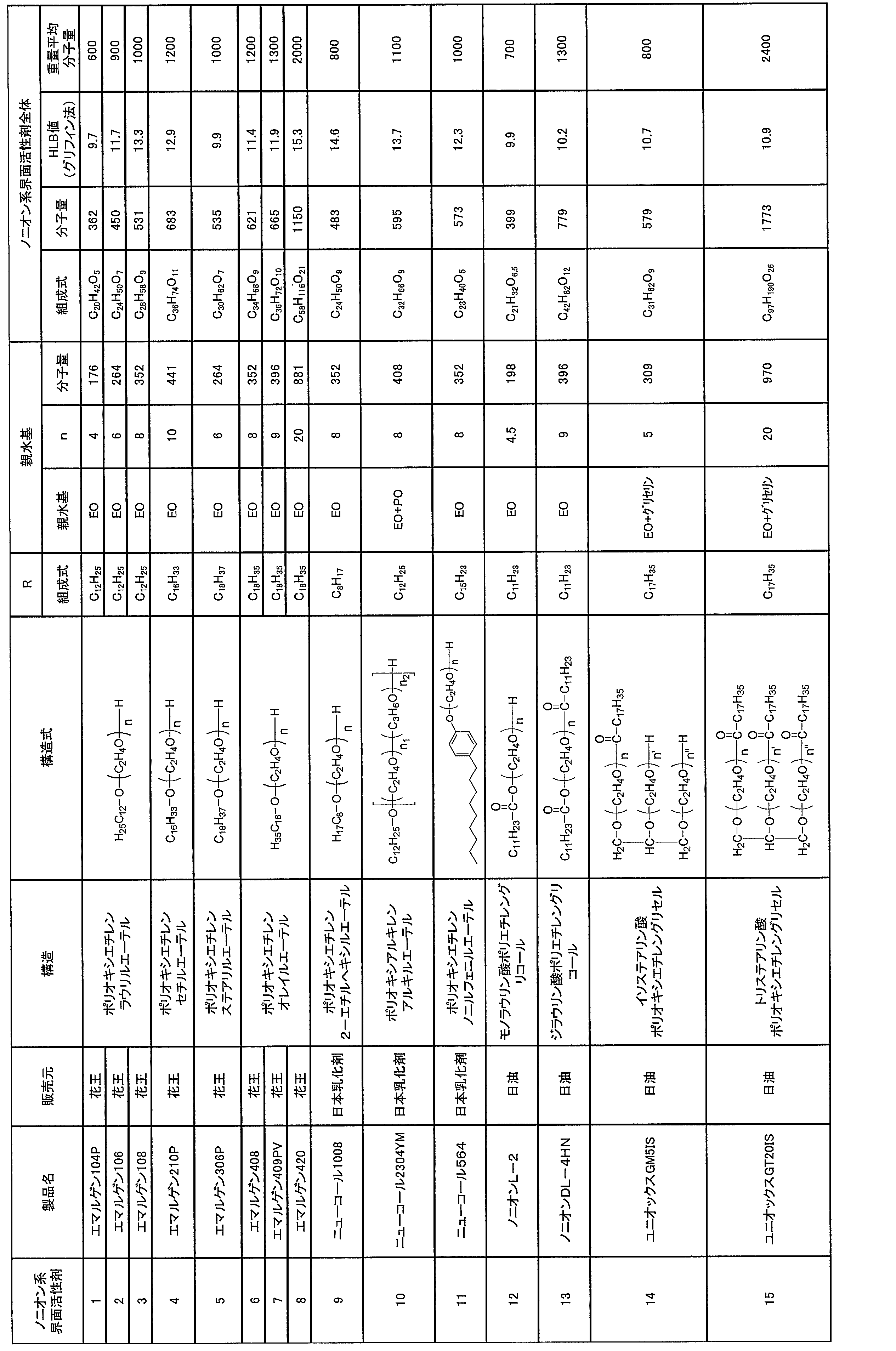
アニオン系界面活性剤として具体的には、W004、W005、W017(裕商(株)社製)等が挙げられる。
シリコーン系界面活性剤としては、例えば、トーレシリコーン株式会社製「トーレシリコーンDC3PA」、「トーレシリコーンSH7PA」、「トーレシリコーンDC11PA」,「トーレシリコーンSH21PA」,「トーレシリコーンSH28PA」、「トーレシリコーンSH29PA」、「トーレシリコーンSH30PA」、「トーレシリコーンSH8400」、東芝シリコーン株式会社製「TSF-4440」、「TSF-4300」、「TSF-4445」、「TSF-444(4)(5)(6)(7)6」、「TSF-44 60」、「TSF-4452」、シリコーン株式会社製「KP341」、ビッグケミー社製「BYK323」、「BYK330」等が挙げられる。
その他の界面活性剤は、1種のみを用いてもよいし、2種類以上を組み合わせてもよい。
本発明の着色感放射線性組成物にその他の界面活性剤が添加される場合、その他の界面活性剤の添加量は、本発明の着色感放射線性組成物の全固形分に対して、0.005~2質量%であることが好ましく、0.01~1質量%であることがより好ましい。
本発明の着色感放射線性組成物は、染料を含有する。染料は、特に制限はなく、従来カラーフィルタ用として公知の染料が使用できる。例えば、染料の単量体及び染料の多量体を用いることができる。具体的には、ピラゾールアゾ系、アニリノアゾ系、トリフェニルメタン系、アントラキノン系、アンスラピリドン系、ベンジリデン系、オキソノール系、ピラゾロトリアゾールアゾ系、ピリドンアゾ系、シアニン系、フェノチアジン系、ピロロピラゾールアゾメチン系、キサテン系、フタロシアニン系、ベンゾピラン系、インジゴ系、ピロメテン系、メチン系等の染料が使用できる。また、これらの染料の多量体を用いてもよい。
また、水又はアルカリ現像を行う場合、現像により光未照射部のバインダー及び/又は染料を完全に除去するという観点では、酸性染料及び/又はその誘導体が好適に使用できる場合がある。
本発明に用いられる染料は、ジピロメテン色素、アゾ色素、アントラキノン色素、トリフェニルメタン色素、キサンテン色素、シアニン色素、スクアリリウム色素、キノフタロン色素、フタロシアニン色素及びサブフタロシアニン色素から選ばれる色素に由来する部分構造を有するものが好ましい。
さらに、本発明に用いられる染料は、部分構造と、重合性基とを有する多量体であることが好ましく、二量体、三量体及びポリマーなどの構造を包含するものが好ましい。
本発明に用いられる染料において、色素に由来する部分構造を構成する上記の各色素は、最大吸収波長が400~780nmの範囲に存在する色素骨格を有することが好ましい。この染料は、本発明の着色感放射線性組成物において、例えば着色剤として機能する。
なお、「色素に由来する部分構造」とは、後述する色素構造を形成しうる具体的な色素(以下、色素化合物とも称する。)から水素原子を除いた、色素多量体連結部(ポリマー鎖やデンドリマーのコア等)と連結可能である構造を表す。
本発明の着色感放射線性組成物に用いる染料における色素に由来する部分構造(以下、「色素構造」とも称する。)としては、例えば、キノン色素(ベンゾキノン色素、ナフトキノン色素、アントラキノン色素、アントラピリドン色素など)、カルボニウム色素(ジフェニルメタン色素、トリフェニルメタン色素、キサンテン色素、アクリジン色素など)、キノンイミン色素(オキサジン色素、チアジン色素など)、アジン色素、ポリメチン色素(オキソノール色素、メロシアニン色素、アリーリデン色素、スチリル色素、シアニン色素、スクアリリウム色素、クロコニウム色素など)、キノフタロン色素、フタロシアニン色素、サブフタロシアニン色素、ペリノン色素、インジゴ色素、チオインジゴ色素、キノリン色素、ニトロ色素、ニトロソ色素、ジピロメテン色素、アゾ色素及びそれらの金属錯体色素から選ばれる色素構造などを挙げることができる。
これらの色素構造の中でも、色分離性、基板密着性及び表面粗度の観点から、ジピロメテン色素、アゾ色素、アントラキノン色素、トリフェニルメタン色素、キサンテン色素、シアニン色素、スクアリリウム色素、キノフタロン色素、フタロシアニン色素、サブフタロシアニン色素から選ばれる色素構造が特に好ましい。
色素多量体が有してもよい置換基としては、ハロゲン原子、アルキル基、シクロアルキル基、アルケニル基、シクロアルケニル基、アルキニル基、アリール基、ヘテロ環基、シアノ基、ヒドロキシル基、ニトロ基、カルボキシル基、アルコキシ基、アリールオキシ基、シリルオキシ基、ヘテロ環オキシ基、アシルオキシ基、カルバモイルオキシ基、アミノ基(アルキルアミノ基、アニリノ基を含む)、アシルアミノ基、アミノカルボニルアミノ基、アルコキシカルボニルアミノ基、アリールオキシカルボニルアミノ基、スルファモイルアミノ基、アルキル又はアリールスルホニルアミノ基、メルカプト基、アルキルチオ基、アリールチオ基、ヘテロ環チオ基、スルファモイル基、スルホ基、アルキル又はアリールスルフィニル基、アルキル又はアリールスルホニル基、アシル基、アリールオキシカルボニル基、アルコキシカルボニル基、カルバモイル基、アリール又はヘテロ環アゾ基、イミド基、ホスフィノ基、ホスフィニル基、ホスフィニルオキシ基、ホスフィニルアミノ基、シリル基などが挙げられる。
詳細については、例えば、特開2013-29760号公報の段落0027~0038を参酌することができ、この内容は本願明細書に組み込まれる。
以下、特に好ましい色素骨格について説明する。
アントラキノン色素(アントラキノン化合物)に由来する部分構造を有するものとしては、下記一般式(AQ-1)~(AQ-3)で表される化合物(アントラキノン化合物)に由来する部分構造が好ましい。本発明においてアントラキノン化合物とは、分子内にアントラキノン骨格を含む色素部位を有する化合物を総称するものである。

一般式(AQ-1)、(AQ-2)及び(AQ-3)の好ましい範囲としては、例えば、特開2013-29760号公報の段落0045~0047を参酌することができ、この内容は本願明細書に組み込まれる。
トリフェニルメタン色素(トリフェニルメタン化合物)に由来する部分構造を有するものとしては、下記一般式(TP)で表される化合物(トリフェニルメタン化合物)に由来する部分構造が好ましい。本発明においてトリフェニルメタン化合物とは、分子内にトリフェニルメタン骨格を含む色素部位を有する化合物を総称するものである。
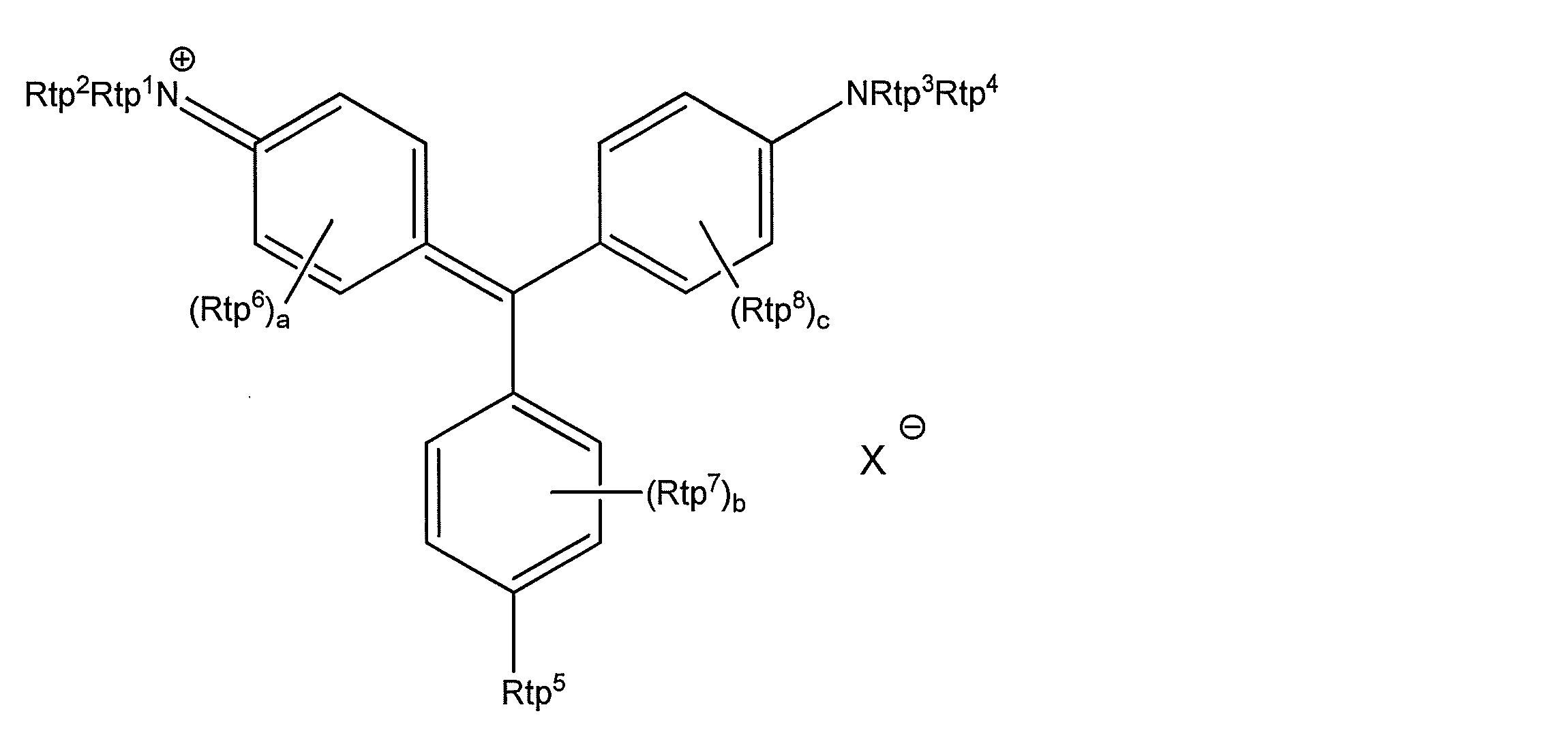
一般式(TP)の好ましい範囲としては、例えば、特開2013-29760号公報の段落0055~0062を参酌することができ、この内容は本願明細書に組み込まれる。
キサンテン色素(キサンテン化合物)に由来する部分構造を有するものとしては、下記一般式(J)で表されるキサンテン化合物に由来する部分構造が好ましい。

一般式(J)の好ましい範囲としては、例えば、特開2013-29760号公報の段落0066~0073を参酌することができ、この内容は本願明細書に組み込まれる。
シアニン色素(シアニン化合物)に由来する部分構造を有するものとしては、下記一般式(PM)で表される化合物(シアニン化合物)に由来する部分構造が好ましい。本発明においてシアニン化合物とは、分子内にシアニン骨格を含む色素部位を有する化合物を総称するものである。

一般式(PM)の好ましい範囲としては、例えば、特開2013-29760号公報の段落0077~0084を参酌することができ、この内容は本願明細書に組み込まれる。
スクアリリウム色素(スクアリリウム化合物)に由来する部分構造を有するものとしては、下記一般式(K)で表される化合物(スクアリリウム化合物)に由来する部分構造が好ましい。本発明においてスクアリリウム化合物とは、分子内にスクアリリウム骨格を含む色素部位を有する化合物を総称するものである。
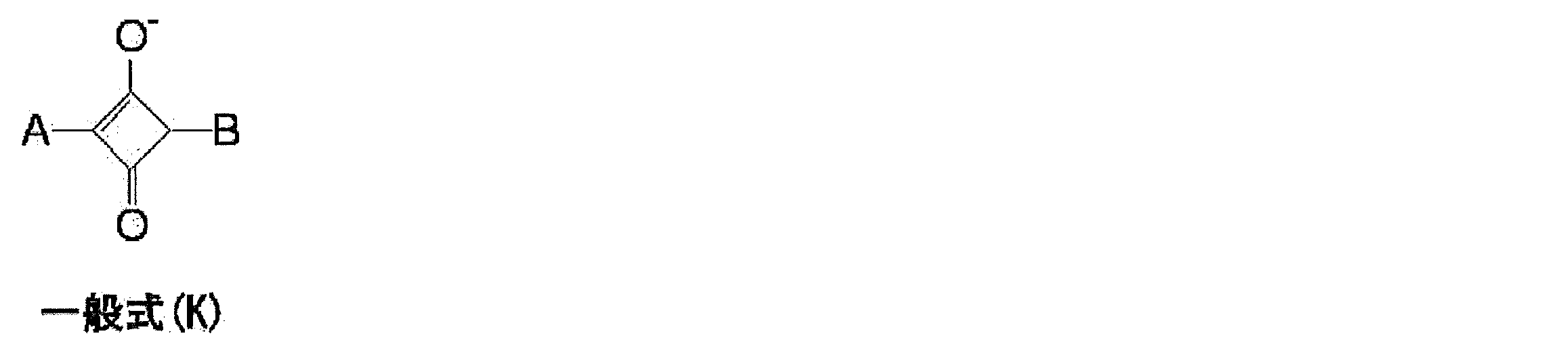
一般式(K)の好ましい範囲としては、例えば、特開2013-29760号公報の段落0088~0106を参酌することができ、この内容は本願明細書に組み込まれる。
キノフタロン色素(キノフタロン化合物)に由来する部分構造を有するものとしては、下記一般式(QP)で表される化合物(キノフタロン化合物)に由来する部分構造が好ましい。本発明においてキノフタロン化合物とは、分子内にキノフタロン骨格を含む色素部位を有する化合物を総称するものである。

一般式(QP)の好ましい範囲としては、例えば、特開2013-29760号公報の段落0110~0114を参酌することができ、この内容は本願明細書に組み込まれる。
フタロシアニン色素(フタロシアニン化合物)に由来する部分構造を有するものとしては、下記一般式(F)で表される化合物(フタロシアニン化合物)に由来する部分構造を有するものが好ましい。本発明においてフタロシアニン化合物とは、分子内にフタロシアニン骨格を含む色素部位を有する化合物を総称するものである。
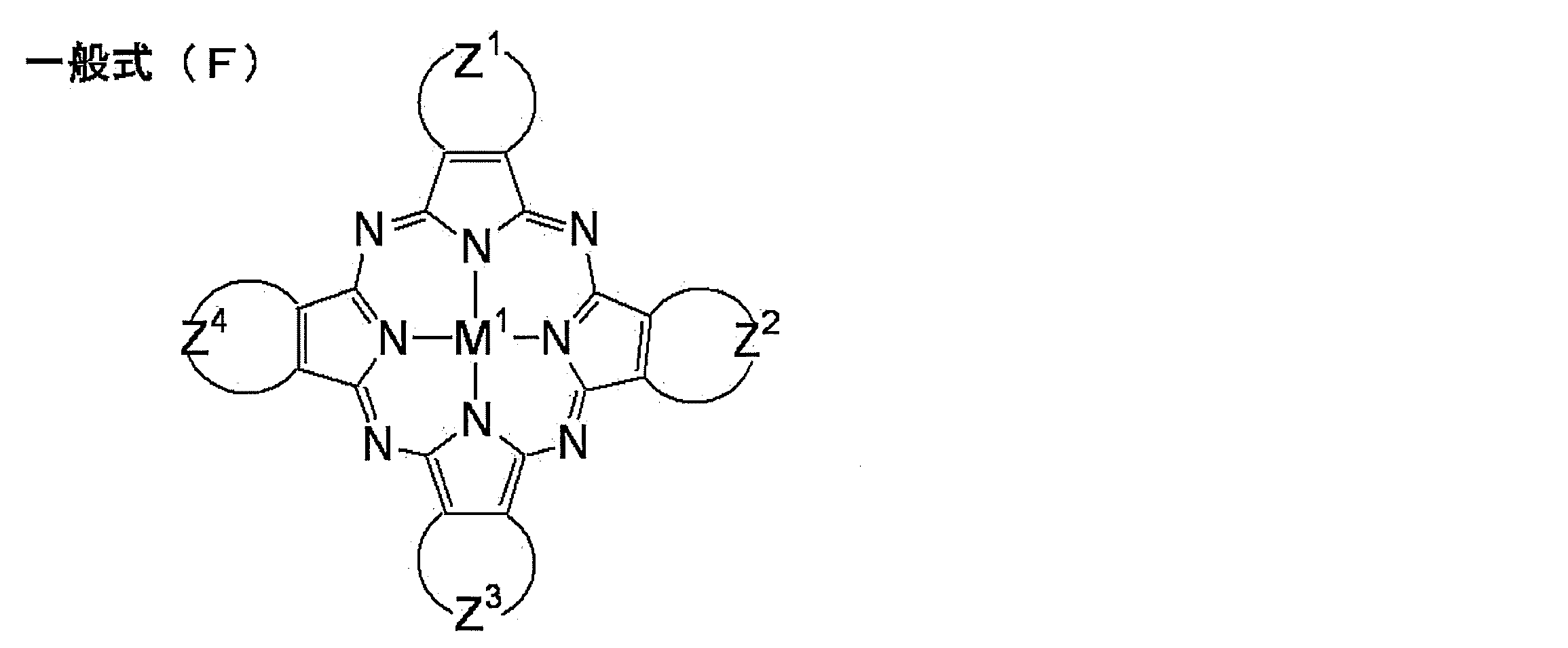
一般式(F)の好ましい範囲としては、例えば、特開2013-29760号公報の段落0118~0124を参酌することができ、この内容は本願明細書に組み込まれる。
サブフタロシアニン色素(フタロシアニン化合物)に由来する部分構造を有するものとしては、下記一般式(SP)で表される化合物(サブフタロシアニン化合物)に由来する部分構造を有するものが好ましい。本発明においてサブフタロシアニン化合物とは、分子内にサブフタロシアニン骨格を含む色素部位を有する化合物を総称するものである。
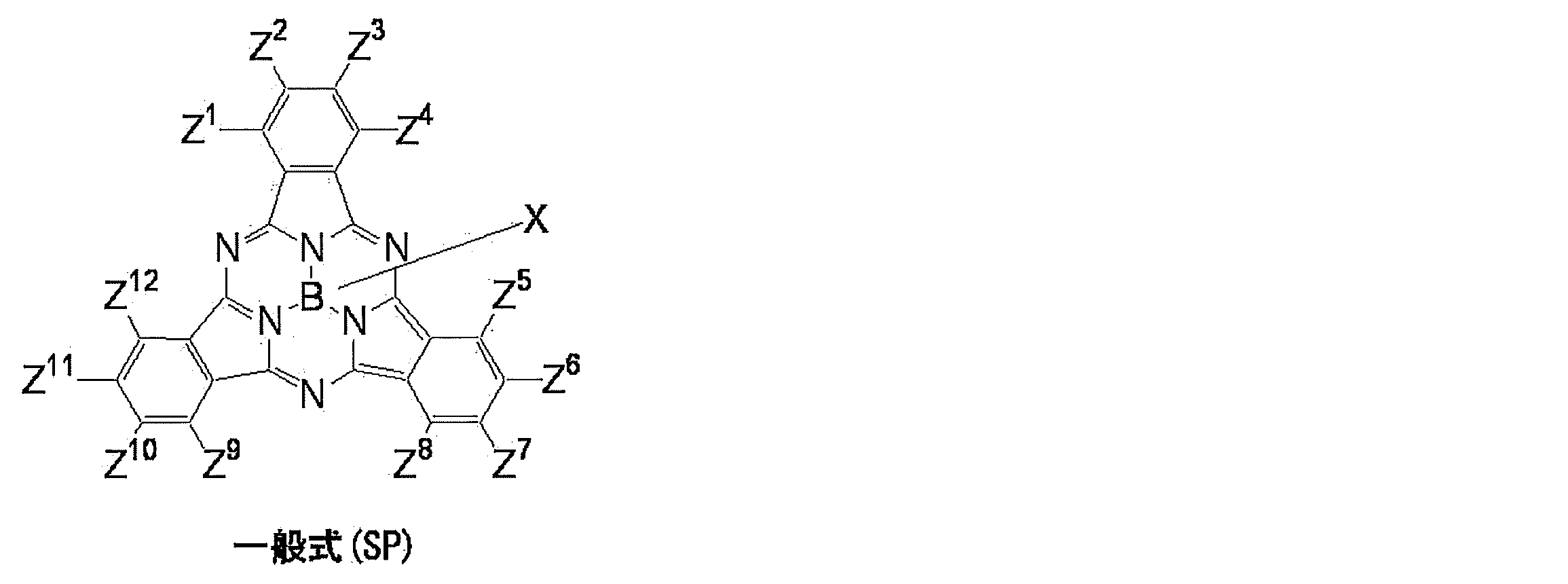
一般式(SP)の好ましい範囲としては、例えば、特開2013-29760号公報の段落0128~0133を参酌することができ、この内容は本願明細書に組み込まれる。
また、ジピロメテン色素及びアゾ色素については、例えば、特開2011-95732号公報の段落0033~0135を参酌することができ、この内容は本願明細書に組み込まれる。
色素単量体は、重合性基を含むことが好ましい。
このような構成とすることにより耐熱性が向上する傾向にある。重合性基は1種類のみ含んでいても良いし、2種類以上含んでいても良い。重合性基としては、ラジカル、酸や熱により架橋可能な公知の重合性基を用いることができ、例えばエチレン性不飽和結合を含む基、環状エーテル基(エポキシ基、オキセタン基)、メチロール基等が挙げられるが、特にエチレン性不飽和結合を含む基が好ましく、(メタ)アクリロイル基がさらに好ましく、(メタ)アクリル酸グリシジル及び3,4-エポキシーシクロヘキシルメチル(メタ)アクリレート由来の(メタ)アクリロイル基が特に好ましい。
また、色素単量体へのアルカリ可溶性基の導入方法としては、色素単量体に予めアルカリ可溶性基を導入しておく方法が挙げられる。
色素単量体の1分子中のアルカリ可溶性基の数は、1~4が好ましく、1~2がより好ましい。
その他、色素単量体が有していてもよい官能基としては、ラクトン、酸無水物、アミド、-COCH2CO-、シアノ基等の現像促進基、長鎖および環状アルキル基、アラルキル基、アリール基、ポリアルキレンオキシド基、ヒドロキシル基、マレイミド基、アミノ基等の親疏水性調整基等が挙げられ、適宜導入することができる。
色素オリゴマーは、上述した色素に由来する部分構造を分子内に2以上有するオリゴマーであり、二量体から八量体に至るいずれかの構造を包含する。色素オリゴマーは、下記一般式(I)で表されるオリゴマーであることが好ましい。
(R)m-Q-(D)n
(一般式(I)中、Qは、(m+n)価の連結基を表し、Rは、置換基を表し、Dは、前述した色素構造を表す。mは、0~6の整数を表し、nは、2~8の整数を表し、(m+n)は2~8の整数を表す。mが2以上の場合、複数のRは互いに異なっていても良く、nが2以上の場合、複数のDは互いに異なっていても良い。)
一般式(Q-1)

R1~R4が表す連結基は、RまたはDと中心のCをつなぐ原子の数が、それぞれ、1~15であることが好ましく、それぞれ、1~10であることがより好ましい。例えば、連結基が、-CH2-CH2-C(=O)-O-CH2-の場合、RまたはDと中心のCをつなぐ原子の数は5となる。


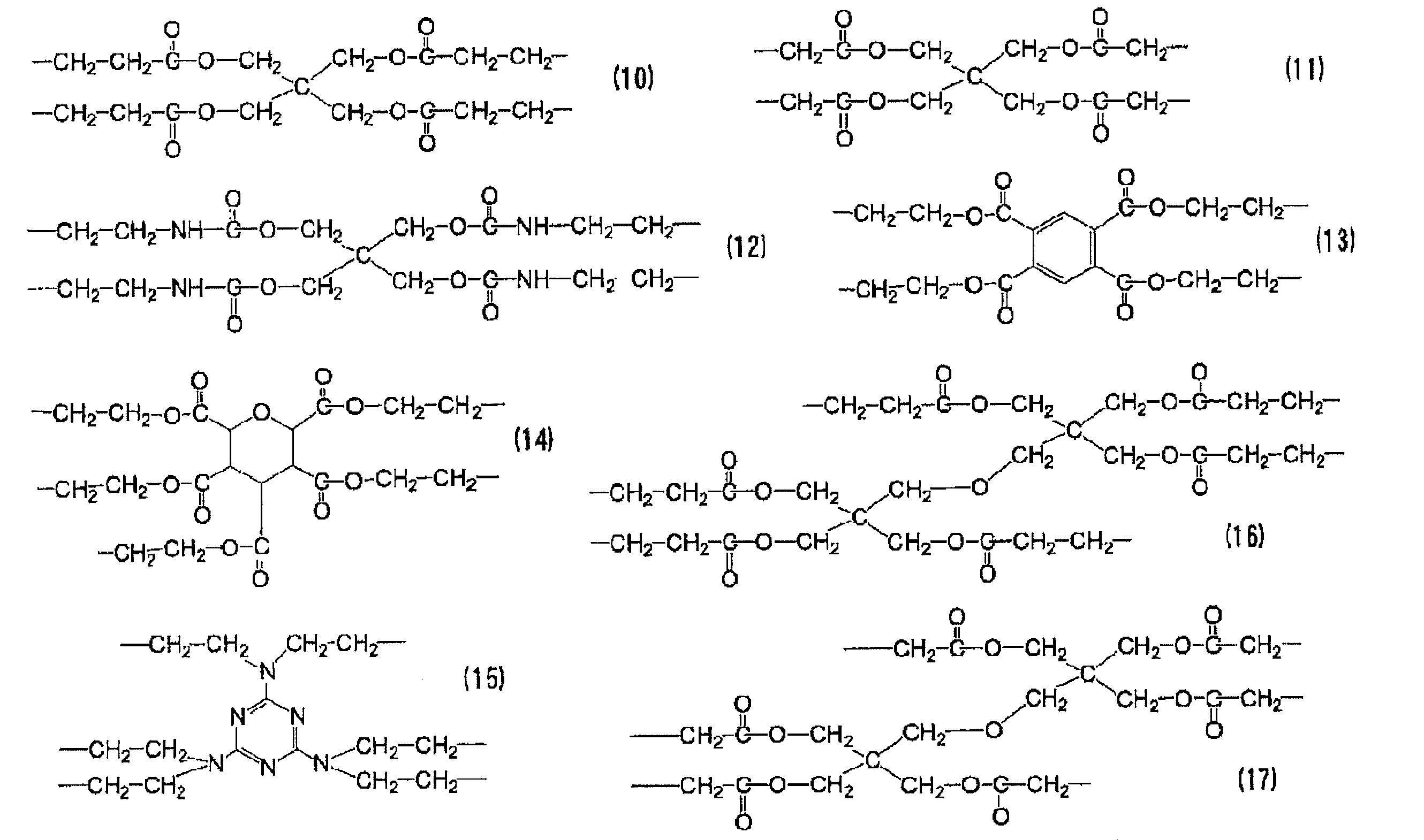
Rにより表される置換基としては、例えば、ハロゲン原子、アルキル基、シクロアルキル基、アルケニル基、シクロアルケニル基、アルキニル基、アリール基、ヘテロ環基、シアノ基、ヒドロキシル基、ニトロ基、カルボキシル基、アルコキシ基、アリールオキシ基、シリルオキシ基、ヘテロ環オキシ基、アシルオキシ基、カルバモイルオキシ基、アミノ基(アルキルアミノ基、アニリノ基を含む)、アシルアミノ基、アミノカルボニルアミノ基、アルコキシカルボニルアミノ基、アリールオキシカルボニルアミノ基、スルファモイルアミノ基、アルキルまたはアリールスルホニルアミノ基、メルカプト基、アルキルチオ基、アリールチオ基、ヘテロ環チオ基、スルファモイル基、スルホ基、アルキルまたはアリールスルフィニル基、アルキルまたはアリールスルホニル基、アシル基、アリールオキシカルボニル基、アルコキシカルボニル基、カルバモイル基、アリールまたはヘテロ環アゾ基、イミド基、ホスフィノ基、ホスフィニル基、ホスフィニルオキシ基、ホスフィニルアミノ基、ホスホノ基、シリル基などが挙げられる。
nは2~8の整数を表し、2~6の整数であることが好ましく、2~5の整数であることがより好ましい。
m+nは、2~8の整数を表し、2~7の整数であることが好ましく、3~6の整数であることがより好ましい。
色素多量体は、上述した色素に由来する部分構造を分子内に2以上有する。色素多量体は下記一般式(A)、一般式(B)、及び、一般式(C)で表される構成単位の少なくとも一つを含んでなる色素多量体であるか、又は、一般式(D)で表される色素多量体であることが好ましい。

以下、一般式(A)について詳細に説明する。
(XX-1)~(X-24)中、*で示された部位でL1と連結していることを表す。Meはメチル基を表す。また、(XX-18)および(XX-19)中のRは、水素原子、炭素数1~5のアルキル基またはフェニル基を表す。
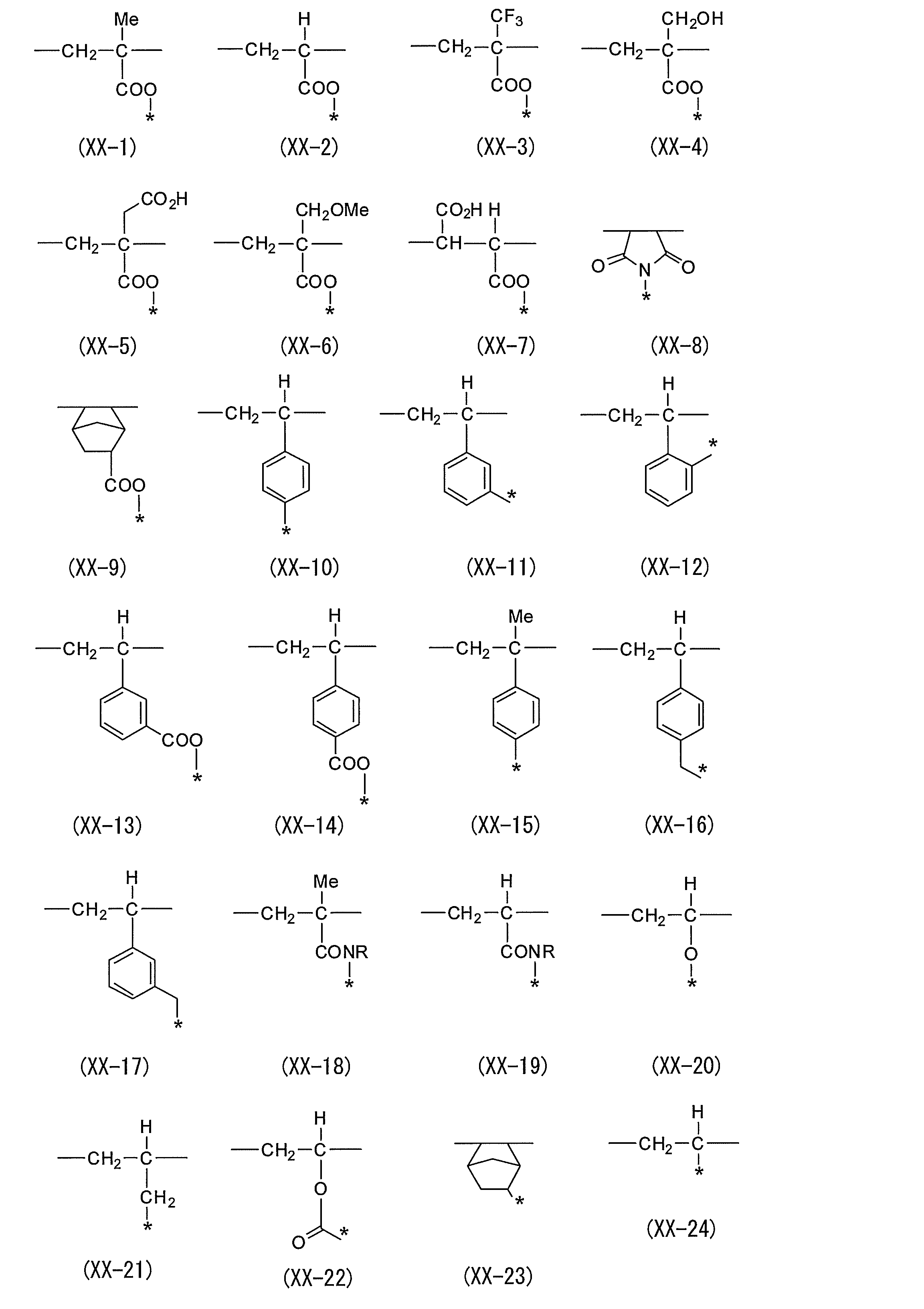

一般式(A)で表される構成単位を有する色素多量体は、(1)色素残基を有するモノマーを付加重合により合成する方法、(2)イソシアネート基、酸無水物基またはエポキシ基等の高反応性官能基を有するポリマーと、高反応性基と反応可能な官能基(ヒドロキシル基、一級または二級アミノ基、カルボキシル基等)を有する色素とを反応させる方法により合成できる。
付加重合には公知の付加重合(ラジカル重合、アニオン重合、カチオン重合)が適用できるが、このうち、特にラジカル重合により合成することが反応条件を穏和化でき、色素構造を分解させないため好ましい。ラジカル重合には、公知の反応条件を適用することができる。すなわち、本発明で用いる色素多量体は、付加重合体であることが好ましい。
中でも、一般式(A)で表される構成単位を有する色素多量体は、耐熱性の観点から、エチレン性不飽和結合を有する色素単量体を用いてラジカル重合して得られたラジカル重合体であることが好ましい。
一般式(A)についての詳細は、特開2013-29760号公報の段落0138~0152を参酌することができ、この内容は本願明細書に組み込まれる。
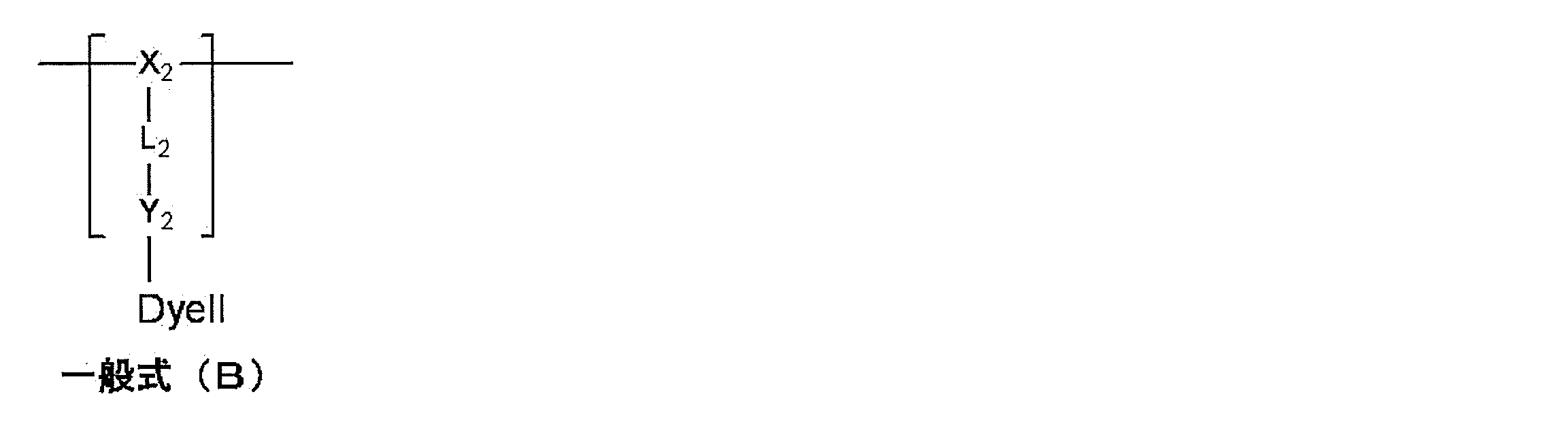


色素多量体は、官能基や、色素構造を有する構成単位以外の他の構成単位を有していても良い。
官能基は、色素構造を有する構成単位に含まれていても良いし、色素構造を有する構成単位とは別に、官能基を含む他の構成単位として含まれていてもよい。
官能基としては、重合性基、アルカリ可溶性基等が例示される。
以下、これらの詳細について説明する。
重合性基は1種類のみ含んでいても良いし、2種類以上含んでいても良い。
重合性基としては、ラジカル、酸、熱により架橋可能な公知の重合性基を用いることができ、例えば、エチレン性不飽和結合を含む基、環状エーテル基(エポキシ基、オキセタン基)、メチロール基等が挙げられるが、特にエチレン性不飽和結合を含む基が好ましく、(メタ)アクリロイル基がさらに好ましく、(メタ)アクリル酸グリシジルおよび3,4-エポキシーシクロヘキシルメチル(メタ)アクリレート由来の(メタ)アクリロイル基がさらに好ましい。
一般式(P)
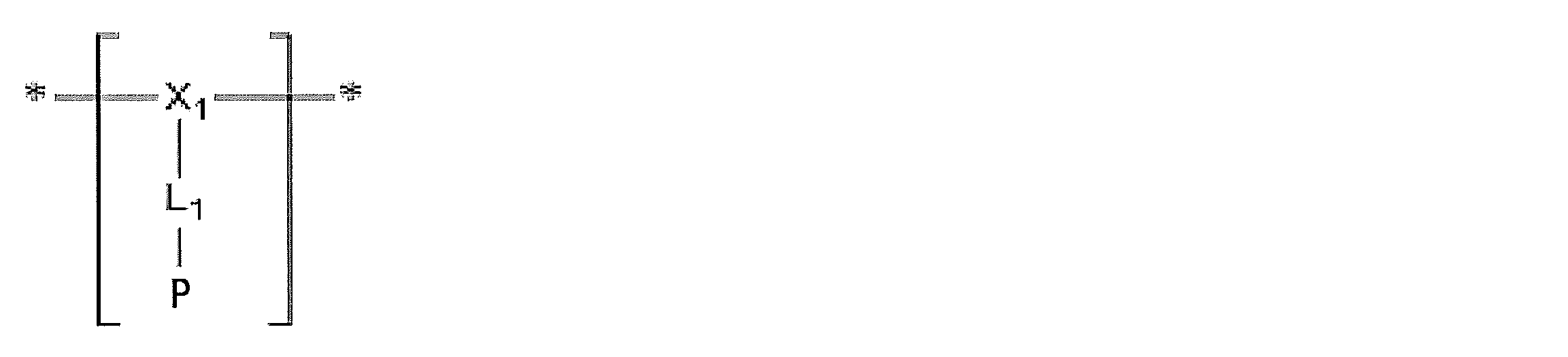
一般式(P)におけるX1およびL1はそれぞれ、一般式(A)におけるX1およびL1と同義であり、好ましい範囲も同様である。
また、他の構成単位が重合性基を含有する場合、その量は、全構成単位100質量%に対し、例えば、10~40質量%が好ましく、15~35質量%がより好ましい。
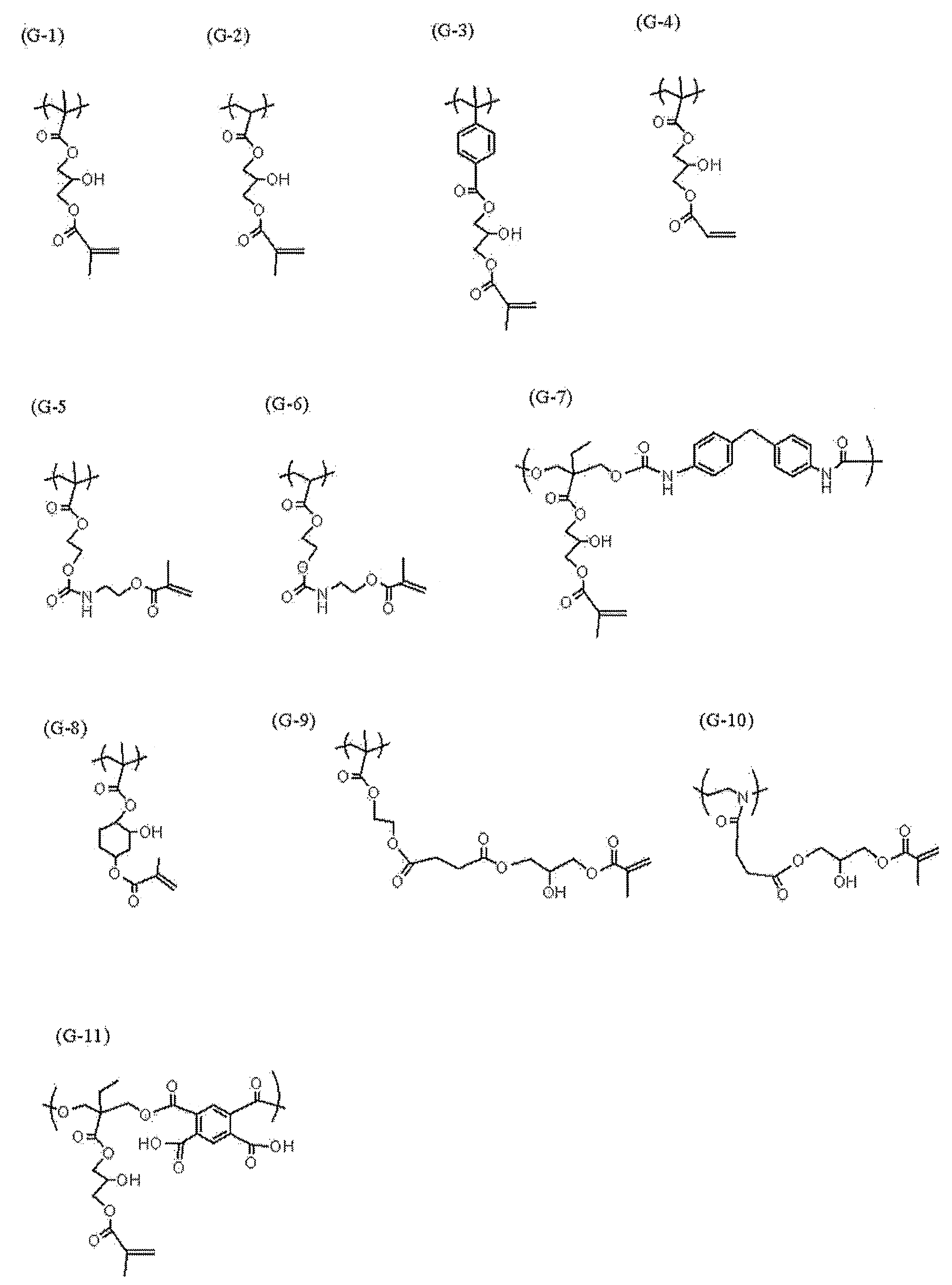

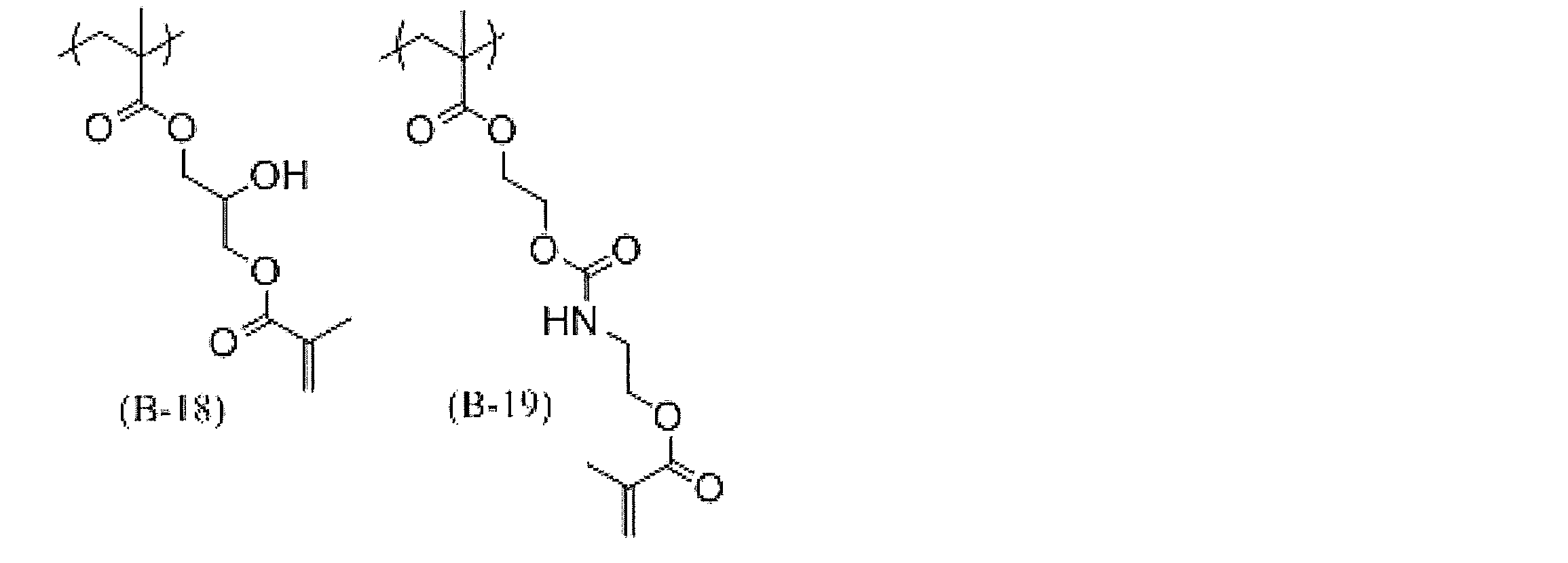
色素多量体が有していてもよいアルカリ可溶性基の一例としては、酸基が挙げられる。酸基としては、カルボン酸基、スルホン酸基、リン酸基が例示される。
本発明では好ましくは、アルカリ可溶性基は、アルカリ可溶性基を有する構成単位として、色素多量体中に含まれることが好ましい。より具体的には、上記一般式(P)において、Pがアルカリ可溶性基である繰り返し単位が好ましい。
また、色素多量体が色素単量体を含む構成単位と酸基を有する構成単位を含有する場合、酸基を有する構成単位を含有する構成単位の割合は、色素単量体を含む構成単位100モルに対し、例えば、5~70モルが好ましく、10~50モルがより好ましい。
導入方法として、色素単量体にあらかじめ導入しておく方法、および上記官能基を有するモノマーを共重合する方法が挙げられる。
色素多量体は、色素構造を有する構成単位が、式(1)~(5)で表される構造を含んでいてもよい。
式(1)で表される構造はヒンダードアミン系と総称されるものである。式(2)で表される構造はヒンダードフェノール系と総称されるものである。式(3)で表される構造はベンゾトリアゾール系と総称されるものである。式(4)で表される構造はヒドロキシベンゾフェノン系と総称されるものである。式(5)で表される構造はトリアジン系と総称されるものである。
式(1)~(5)で表される構造のうち、式(1)で表される構造および式(2)で表される構造が好ましく、式(1)で表される構造が特に好ましい。本発明で用いられる色素多量体が、色素構造と、式(1)で表される構造を同一分子内に有することにより、式(1)で表される構造中のアミン基が基板との相互作用するため、密着性をより向上させることができる。

炭素数1~18のアルキル基は、直鎖状、分岐鎖状または環状のいずれであってもよいが、直鎖状が好ましい。炭素数1~18のアルキル基の炭素数は、1~12が好ましく、1~8がより好ましく、1~3がさらに好ましく、1または2が特に好ましい。特に、炭素数1~18のアルキル基は、メチル基またはエチル基が好ましく、メチル基がより好ましい。
アリール基の炭素数は、6~18であってもよいし、6~12であってもよいし、6~6であってもよい。具体的には、フェニル基が挙げられる。
式(1)中のR1が炭素数1~18のアルキル基またはアリール基を表す場合、炭素数1~18のアルキル基およびアリール基は、置換基を有していてもよいし、無置換であってもよい。有していてもよい置換基としては、上述した置換基群Aから選択された置換基が挙げられる。
式(1)中、R2およびR3はそれぞれ独立に炭素数1~18のアルキル基を表し、炭素数1~3のアルキル基が好ましく、メチル基がより好ましい。R2およびR3は互いに結合して炭素数4~12の脂肪族環を表してもよい。
式(1)中、「*」は式(1)で表される構造とポリマー骨格との結合手を表す。結合手は、ポリマー骨格と直接または連結基を介して結合していてもよいし、上述した色素構造に直接または連結基を介して結合していてもよい。特に、式(1)中の「*」は、ポリマー骨格と直接または連結基を介して結合していていることが好ましい。
以下、式(1)で表される構造の具体例を示すが、これらに限定されるものではない。下記構造中、「*」は式(2)で表される構造とポリマー骨格との結合手を表す。


式(2)中、R4は上記式(2A)、炭素数1~18のアルキル基またはアリール基を表し、式(2A)で表されることが好ましい。炭素数1~18のアルキル基およびアリール基は、式(1)中のR1で説明した炭素数1~18のアルキル基およびアリール基と同義である。また、「*」は、式(1)中で説明した結合手と同義である。

式(2A)中、R6は、式(1)中のR1で説明した炭素数1~18のアルキル基と同義である。また、「*」は、式(1)中で説明した結合手と同義である。
以下、式(2)で表される構造の具体例を示すが、これらに限定されるものではない。下記構造中、「*」は式(2)で表される構造とポリマー骨格との結合手を表す。

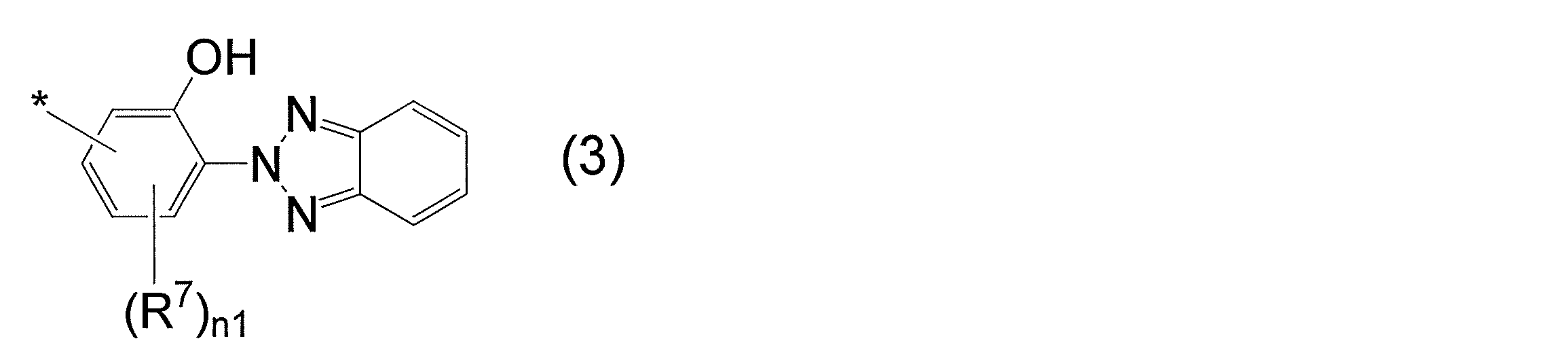
式(3)中、R7は、式(1)中のR1で説明した炭素数1~18のアルキル基と同義である。
式(3)中、n1は0~3の整数を表し、0~2の整数が好ましく、0または1が好ましい。
式(3)中、「*」は式(1)中で説明した結合手と同義である。
以下、式(3)で表される構造の具体例を示すが、これらに限定されるものではない。下記構造中、「*」は式(3)で表される構造とポリマー骨格との結合手を表す。

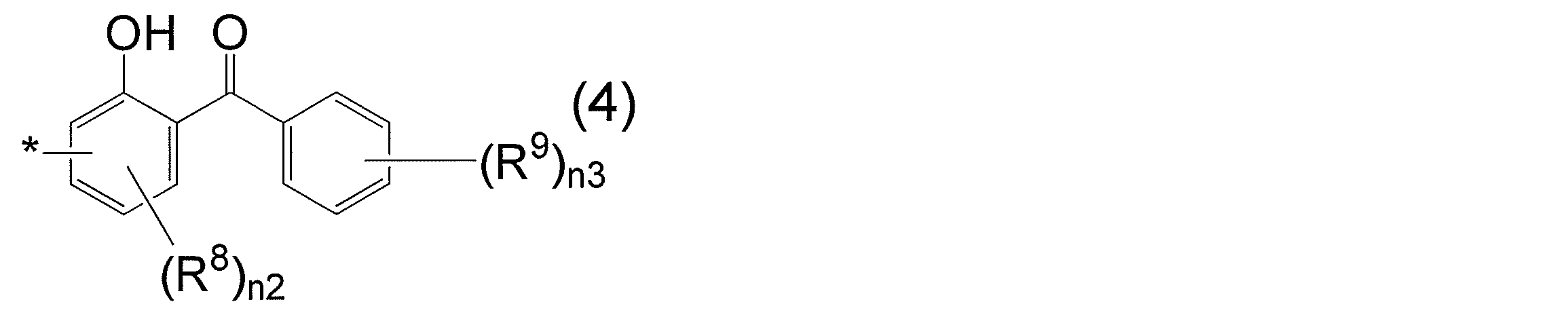
式(4)中、R8およびR9は、式(1)中のR1で説明した炭素数1~18のアルキル基と同義である。
式(4)中、n2は0~3の整数を表し、0~2の整数が好ましく、0または1が好ましい。
式(4)中、n3は0~4の整数を表し、0~2の整数が好ましく、0または1が好ましい。
式(4)中、「*」は、式(1)中で説明した結合手と同義である。
以下、式(4)で表される構造の具体例を示すが、これらに限定されるものではない。下記構造中、「*」は式(4)で表される構造とポリマー骨格との結合手を表す。

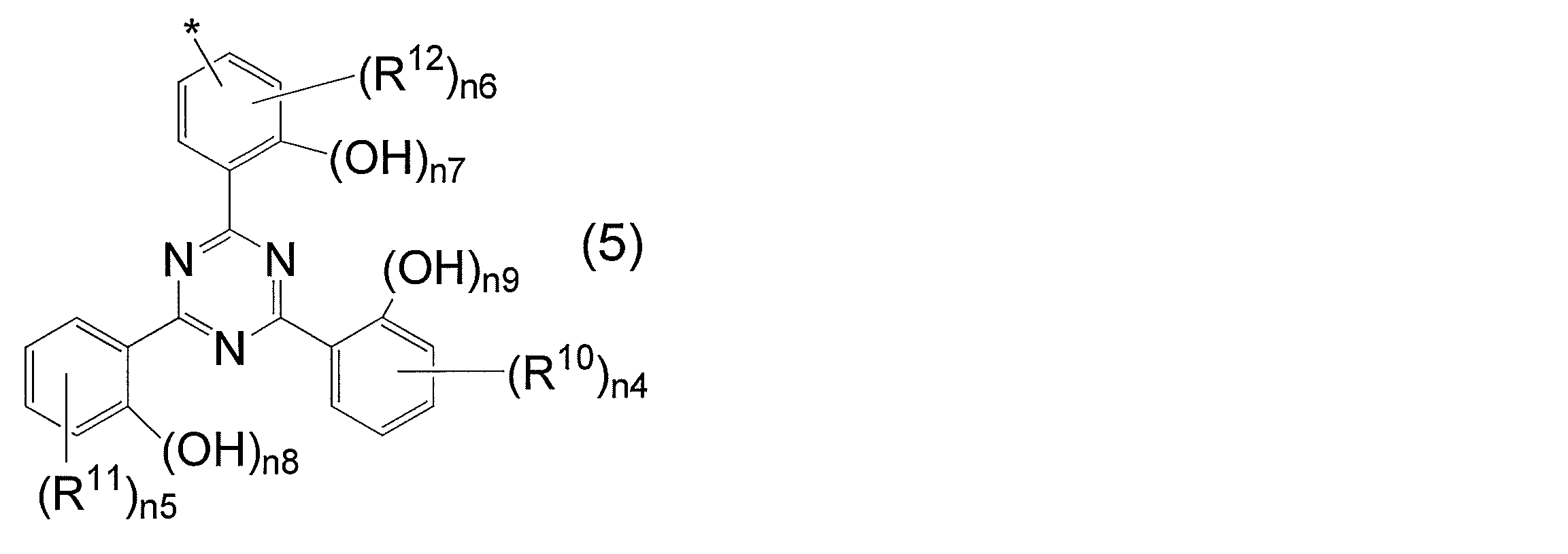
式(5)中のn4は0~5の整数を表し、1~4の整数が好ましく、2または3が好ましい。n4が2~5の整数を表す場合、それぞれのR10は、同一であっても異なっていても良い。
式(5)中のR11は、式(5)中のR10と同義であり、好ましい範囲も同様である。
式(5)中のn5は0~5の整数を表し、1~3の整数が好ましく、1または2が好ましい。n5が2~5の整数を表す場合、それぞれのR11は、同一であっても異なっていても良い。
式(5)中のR12は、式(5)中のR10と同義であり、好ましい範囲も同様である。
式(5)中のn6は0~5の整数を表し、0~3の整数が好ましく、0または1が好ましい。n6が2~5の整数を表す場合、それぞれのR12は、同一であっても異なっていても良い。
式(5)中のn7~n9はそれぞれ独立に0または1を表し、n7~n9の少なくとも1つが1を表す。特に、n7のみが1を表すか、n8およびn9のみが1を表すか、n7とn8およびn9のいずれか一方のみが1を表すことが好ましい。
式(5)中のR10~R12はそれぞれ独立に置換基を有していてもよいし、無置換であってもよい。有していてもよい置換基としては、上述した置換基群Aから選択された置換基が挙げられる。
式(5)中、「*」は式(1)中で説明した結合手と同義である。
以下、式(5)で表される構造の具体例を示すが、これらに限定されるものではない。下記構造中、「*」は式(5)で表される構造とポリマー骨格との結合手を表す。
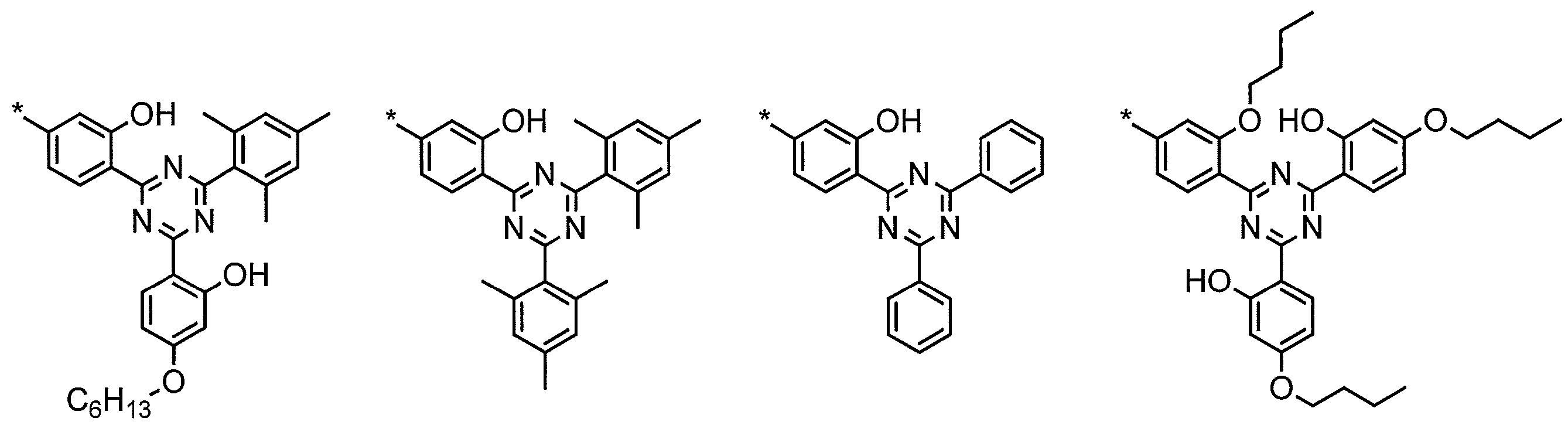
式(1)~(5)で表される構造の少なくとも1つを有する構成単位は、下記式(E)で表されることが好ましい。
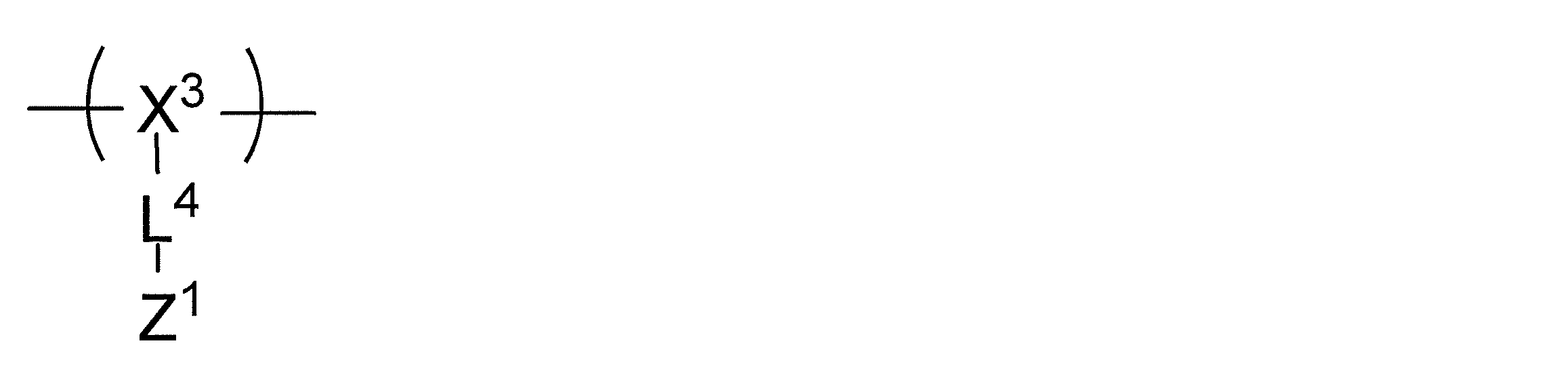
以下、式(1)~(5)で表される構造の少なくとも1つを有する構成単位の具体例を示すが、本発明はこれらに限定されるものではない。

また、色素構造を含む構成単位1モルに対する、式(1)~(5)で表される構造の少なくとも1つを有する構成単位の含有量は、0.5~25モル%が好ましく、1~10モル%がより好ましく、1~5モル%がさらに好ましい。
本発明で用いる色素構造がカチオン構造を有する場合、対アニオンは、色素多量体の同一構成単位内にあってもよいし、同一構成単位外にあってもよい。対アニオンが同一構成単位内にあるとは、色素構造を有する構成単位内で、カチオンとアニオンが共有結合を介して結合している場合をいう。一方、同一構成単位外とは、上記以外の場合をいう。例えば、カチオンとアニオンが共有結合を介して結合せず、別化合物として存在している場合や、カチオンとアニオンが色素多量体のそれぞれ独立の構成単位として含まれる場合をいう。
本発明におけるアニオンは、非求核性アニオンであることが好ましい非求核性のアニオンには、有機アニオンであっても、無機アニオンであってもよく、有機アニオンが好ましい。本発明で用いられる対アニオンの例として、特開2007-310315号公報の段落番号0075に記載の公知の非求核性アニオンが挙げられ、これらの内容は本願明細書に組み込まれる。ここで、非求核性とは、加熱により色素を求核攻撃しない性質を意味する。
本発明におけるアニオンの第一の実施形態は、対アニオンが同一構成単位内にある場合であり、具体的には、色素構造を有する構成単位内で、カチオンとアニオンが共有結合を介して結合している場合である。
この場合のアニオン部としては、-SO3 -、-COO-、-PO4 -、下記一般式(A1)で表される構造および下記一般式(A2)で表される構造から選択される少なくとも1種が好ましく、下記一般式(A1)で表される構造および下記一般式(A2)で表される構造から選択される少なくとも1種がより好ましい。
また、アニオン部は、カルボン酸アニオン、スルホン酸アニオン、一般式(A1-1-2)で表されるアニオンまたは一般式(A1-1-3)で表されるアニオンを含んでいてもよい。

一般式(A1)中、R1およびR2の少なくとも1つが-SO2-を表すことが好ましく、R1およびR2の両方が-SO2-を表すことがより好ましい。
一般式(A1-1)

一般式(A1-1)中、R1およびR2は、一般式(A1)中のR1およびR2と同義であり、好ましい範囲も同様である。
X1がアルキレン基を表す場合、アルキレン基の炭素数は、1~8が好ましく、1~6がより好ましい。X1がアリーレン基を表す場合、アリーレン基の炭素数は、6~18が好ましく、6~12がより好ましく、6がさらに好ましい。X1が置換基を有する場合、フッ素原子で置換されていることが好ましい。
X2は、アルキル基またはアリール基を表し、アルキル基が好ましい。アルキル基の炭素数は、1~8が好ましく、1~6がより好ましく、1~3がさらに好ましく、1が特に好ましい。X2が置換基を有する場合、フッ素原子で置換されていることが好ましい。

一般式(A2)中、R3~R5の少なくとも1つが-SO2-を表すことが好ましく、R3~R5の少なくとも2つが-SO2-を表すことがより好ましい。
また、本実施形態では、色素多量体の骨格が一般式(B)で表される構成単位を含む場合も、一例として挙げられる。この場合の具体例としては、後述する色素構造を有する構成単位の例示のうち、(B-dp-1)、(B-mp-1)、(B-xt-1)、(B-xt-2)が例示される。
本発明におけるアニオンの第二の実施形態は、対アニオンが同一構成単位外にある場合であって、カチオンとアニオンが共有結合を介して結合せず、別分子として存在している場合である。
この場合のアニオンとしては、フッ素アニオン、塩素アニオン、臭素アニオン、ヨウ素アニオン、シアン化物イオン、過塩素酸アニオン等や非求核性アニオンが例示され、非求核性アニオンが好ましい。
非求核性の対アニオンは、有機アニオンであっても、無機アニオンであってもよく、有機アニオンが好ましい。本発明で用いられる対アニオンの例として、特開2007-310315号公報の段落番号0075に記載の公知の非求核性アニオンが挙げられ、これらの内容は本願明細書に組み込まれる。
好ましくは、ビス(スルホニル)イミドアニオン、トリス(スルホニル)メチルアニオン、テトラアリールボレートアニオン、B-(CN)n1(ORa)4-n1(Raは炭素数1~10のアルキル基または炭素数6~10のアリール基を表し、n1は1~4を表す)およびPFn2RP (6-n2) -(RPは炭素数1~10のフッ素化アルキル基を表し、n2は1~6の整数を表す)が挙げられ、ビス(スルホニル)イミドアニオン、トリス(スルホニル)メチルアニオンおよびテトラアリールボレートアニオンから選択されることがより好ましく、ビス(スルホニル)イミドアニオンであることがさらに好ましい。このような非求核性の対アニオンを用いることにより、本発明の効果がより効果的に発揮される傾向にある。
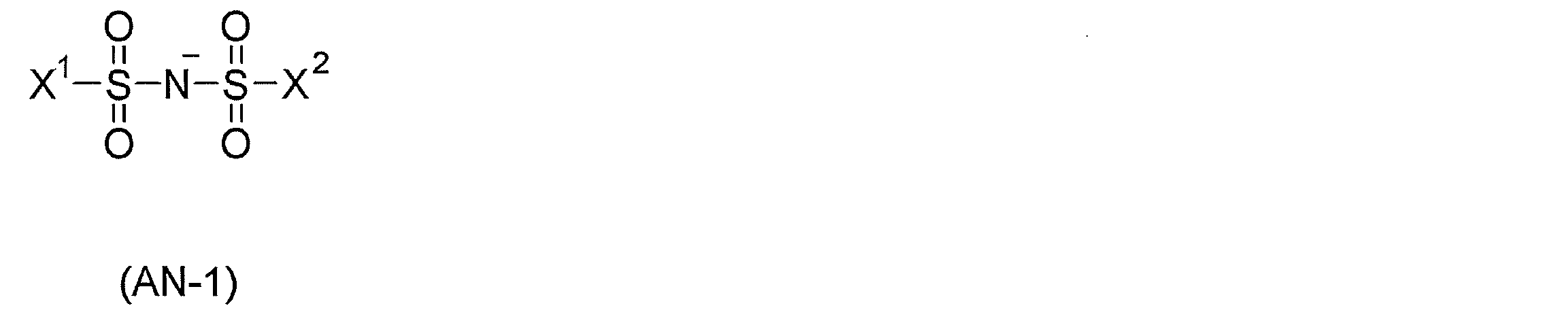
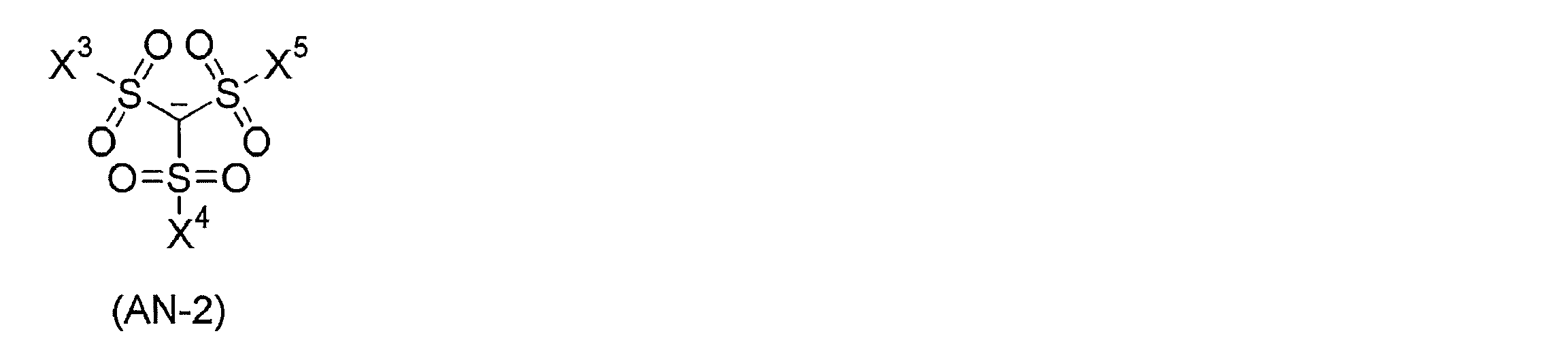
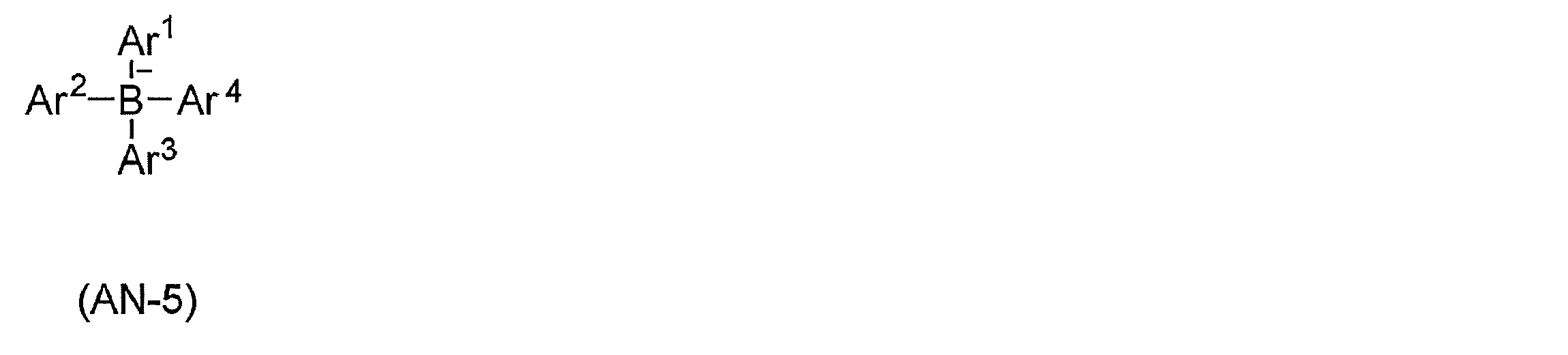
Ar1、Ar2、Ar3およびAr4が表わすアリール基は、置換基を有しても良い。置換基を有する場合、ハロゲン原子、アルキル基、アリール基、アルコキシ基、カルボニル基、カルボニルオキシ基、カルバモイル基、スルホ基、スルホンアミド基、ニトロ基等が挙げられ、ハロゲン原子およびアルキル基が好ましく、フッ素原子、アルキル基がより好ましく、フッ素原子、炭素数1~4のペルフルオロアルキル基がさらに好ましい。
n1は、1~3が好ましく、1~2がより好ましい。
n2は、1~4の整数が好ましく、1または2がより好ましい。
本発明の色素多量体は、非求核性対アニオンを1種類のみ含んでいても良いし、2種類以上を含んでいても良い。
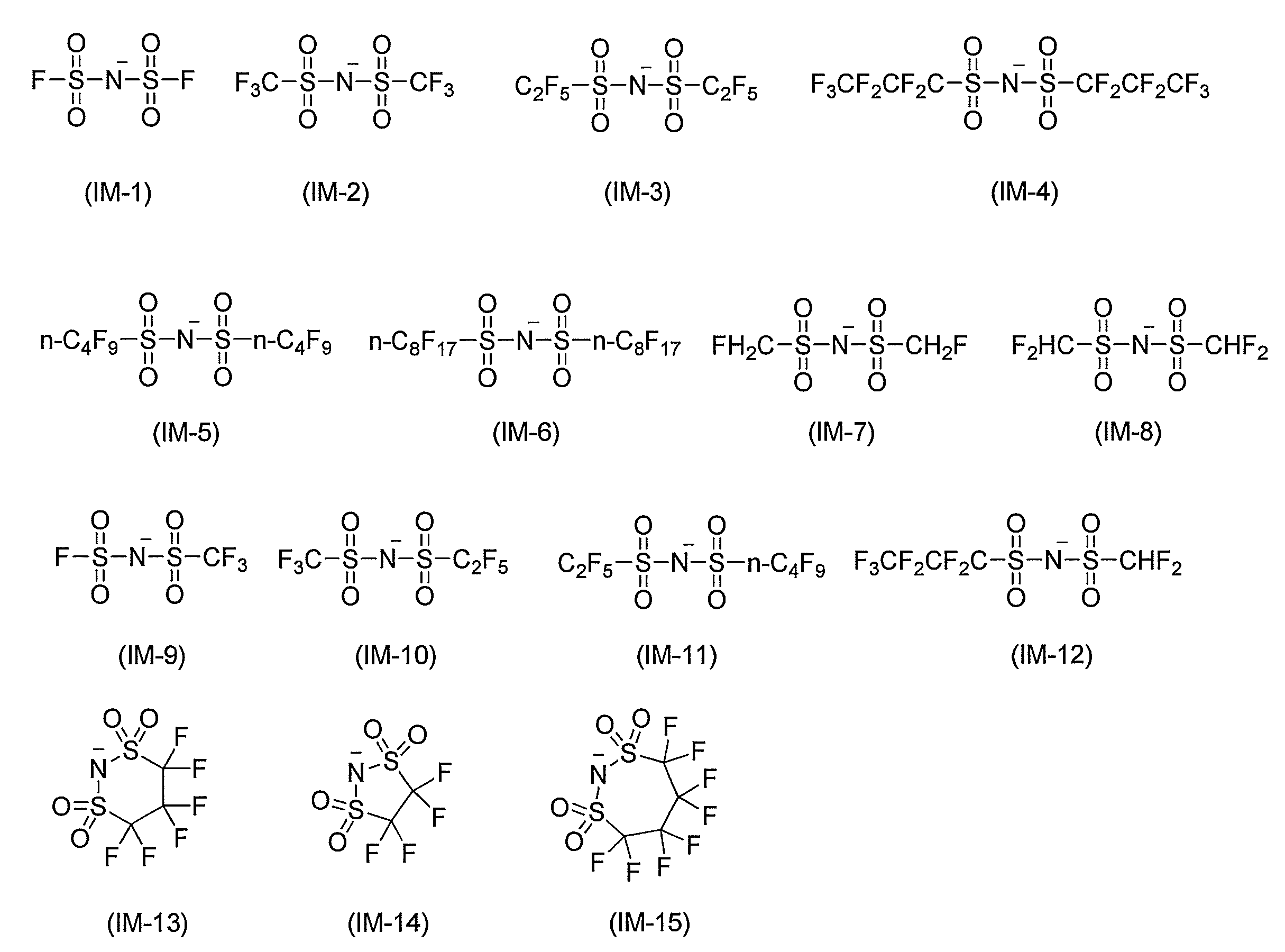


本発明における第三の実施形態としては、カチオンとアニオンが色素多量体のそれぞれ独立の構成単位に含まれる場合をいう。
本実施形態の場合、アニオンは、色素多量体の側鎖に有していてもよいし、主鎖に有していても良いし、主鎖および側鎖の両方に対アニオンを有していてもよい。好ましくは、側鎖である。
アニオンを含む構成単位の好ましい例としては、一般式(C1)で表される構成単位および一般式(D1)で表される構成単位が例示される。

特に、L1は、単結合、または、炭素数1~10のアルキレン基(好ましくは、-(CH2)n-(nは5~10の整数)、炭素数6~12のアリーレン基(好ましくはフェニレン基、ナフタレン基)、-NH-、-CO2-、-O-および-SO2-を2以上組み合わせた2価の連結基が好ましい。

L2は、炭素数6~12のアリーレン基(特にフェニレン基)が好ましい。炭素数6~30のアリーレン基は、フッ素原子で置換されていることが好ましい。
L3は、炭素数6~12のアリーレン基(特にフェニレン基)と-O-との組み合わせからなる基が好ましく、少なくとも1種の炭素数6~12のアリーレン基がフッ素原子で置換されていることが好ましい。


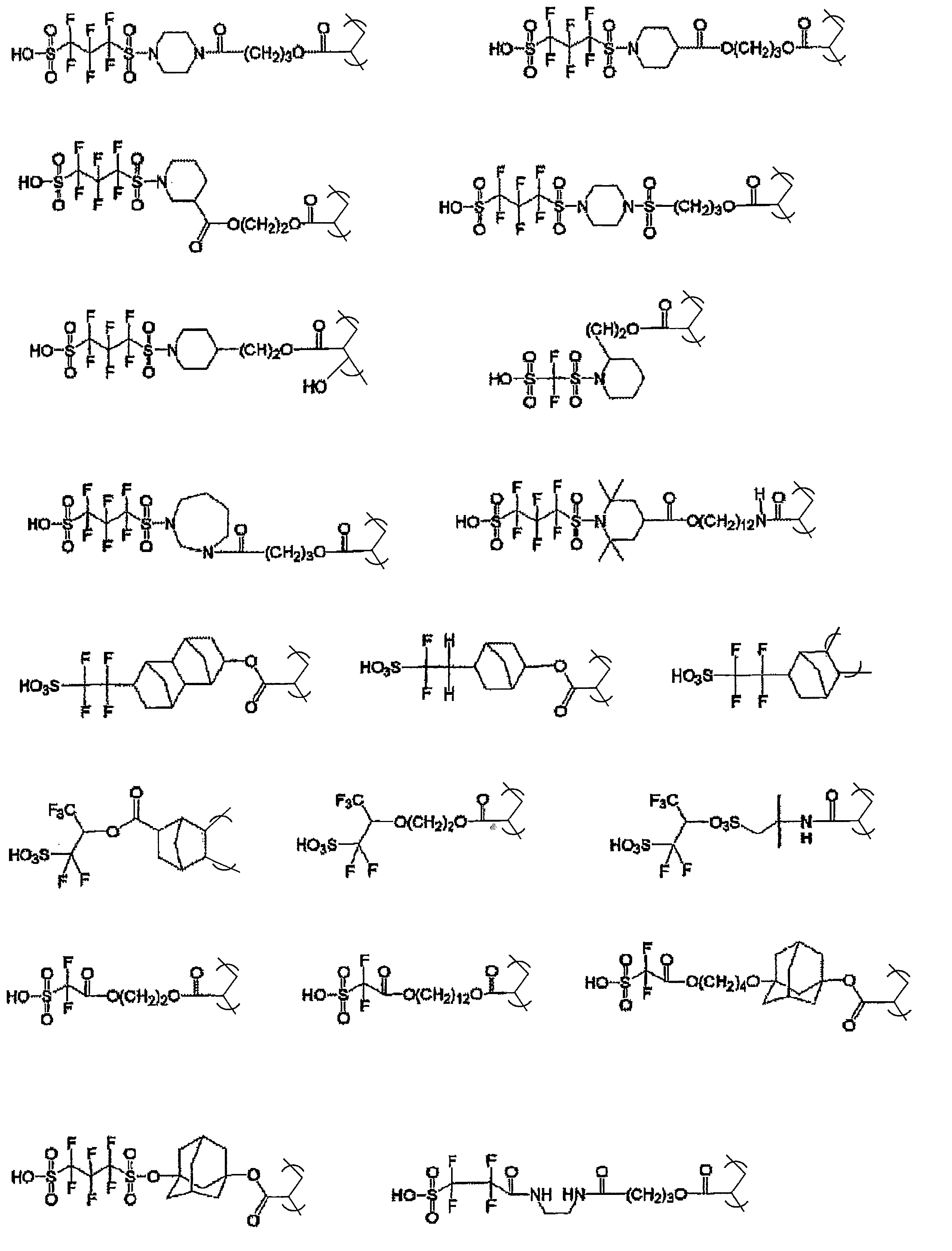
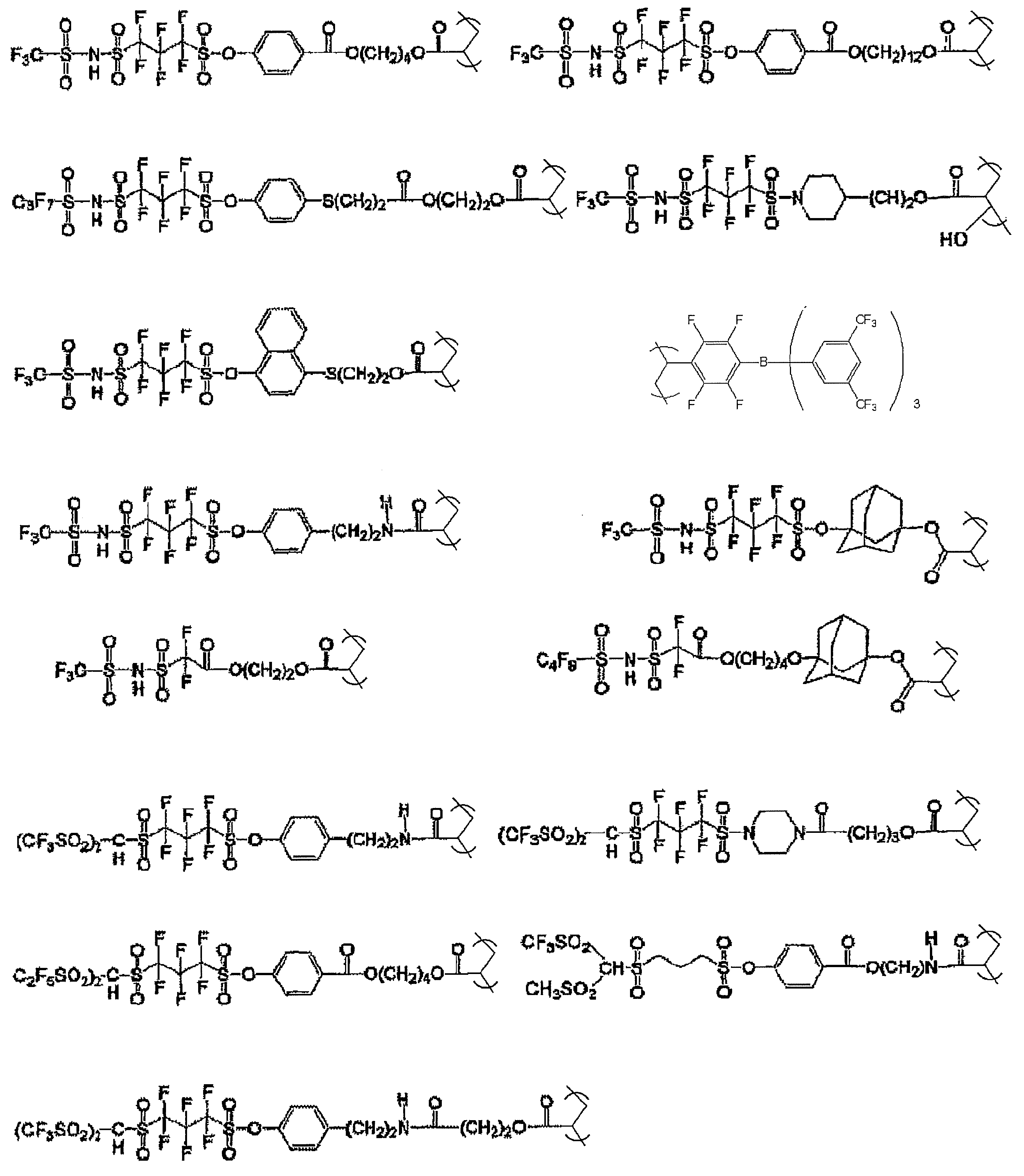
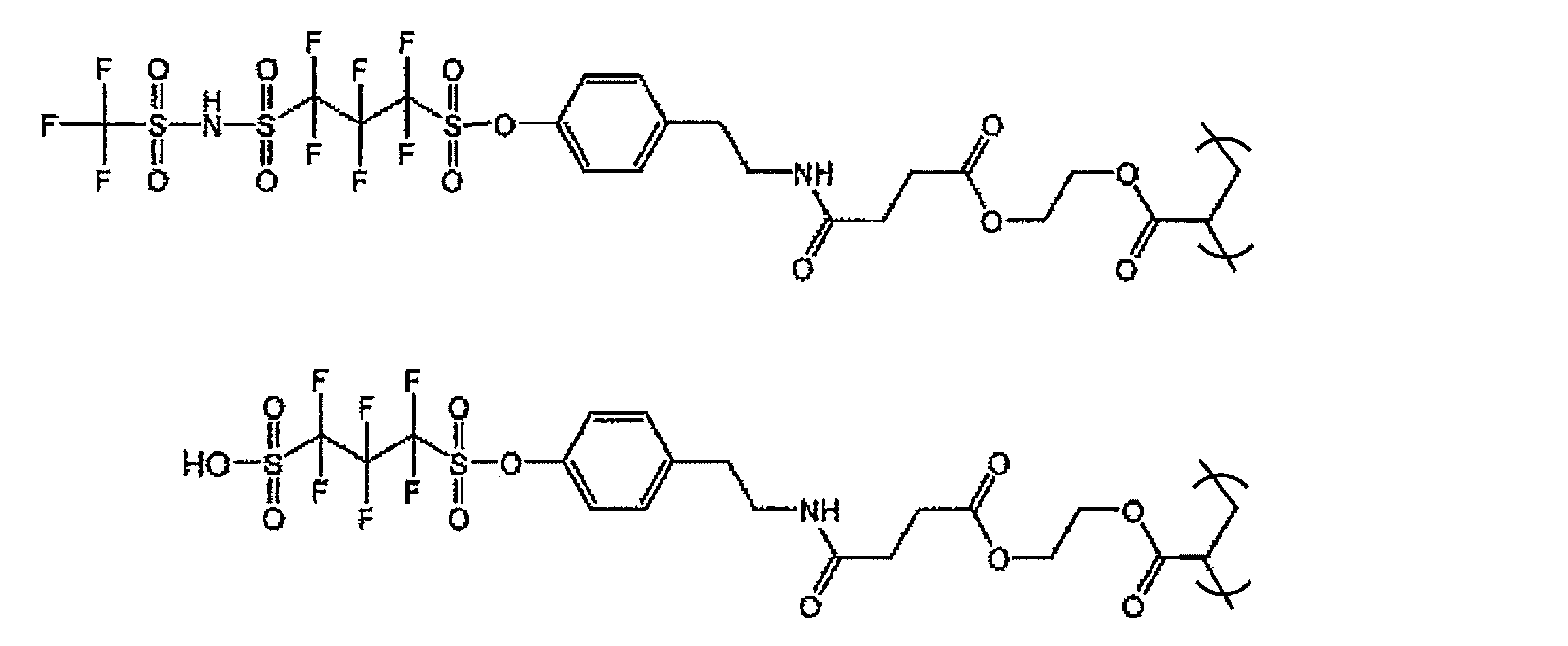
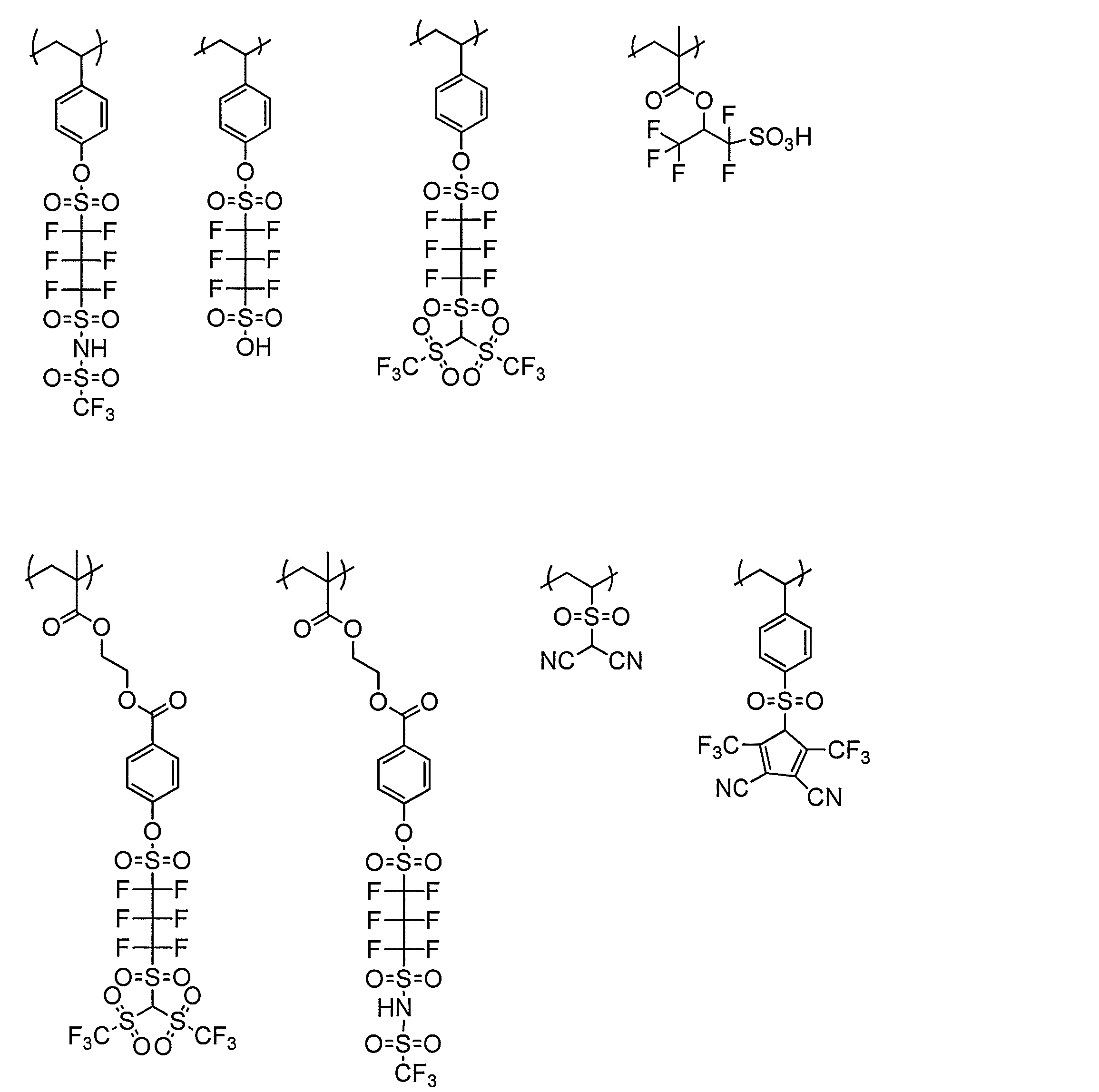
以下に、染料の具体例を示すが、本発明はこれに限定されるものではない。下記具体例において、X-はアニオンを表す。また、以下に示す色素構造中のいずれかの水素原子が、ポリマー骨格と結合する。
トリフェニルメタン化合物の具体例としては、以下が挙げられる。
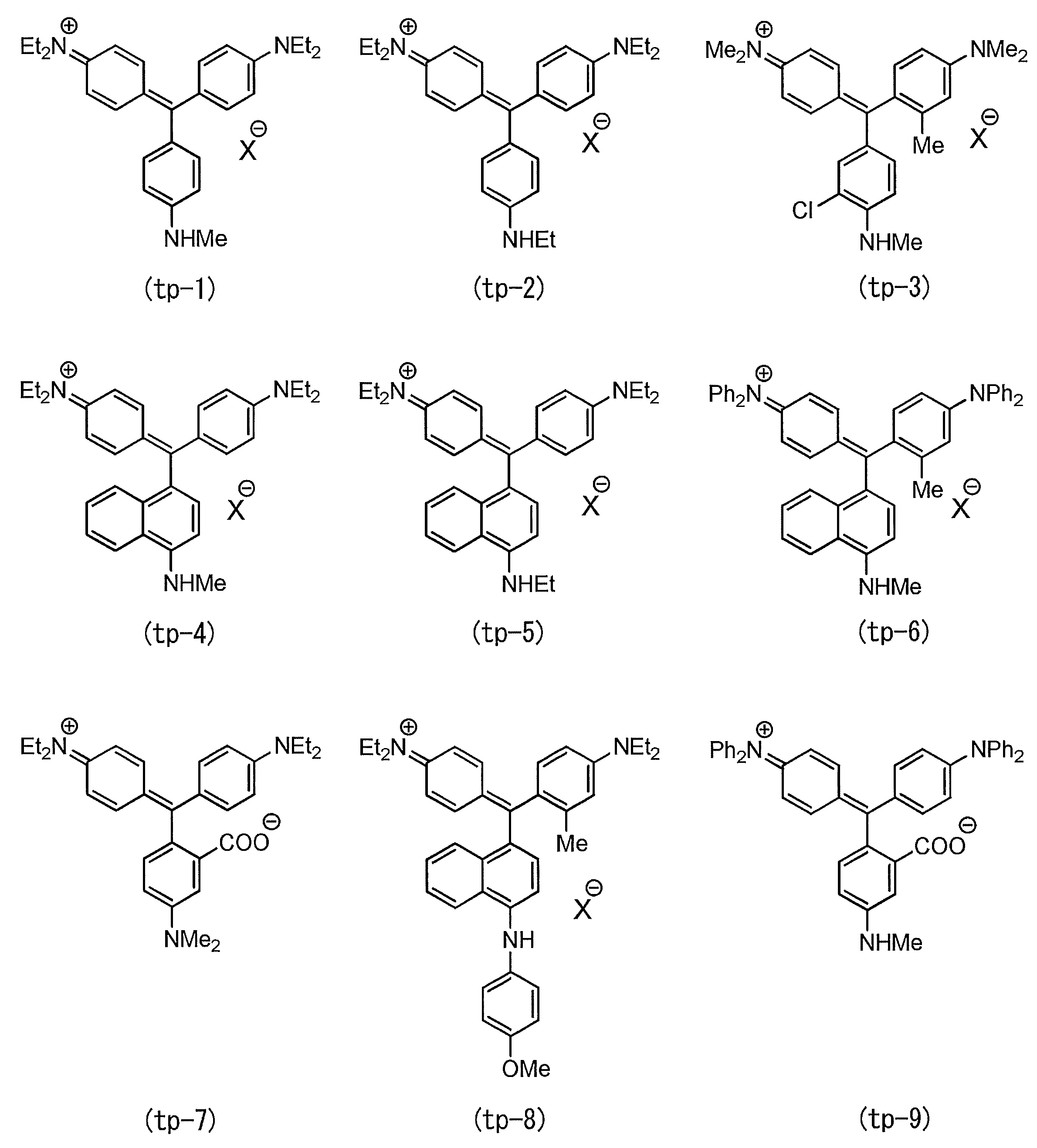


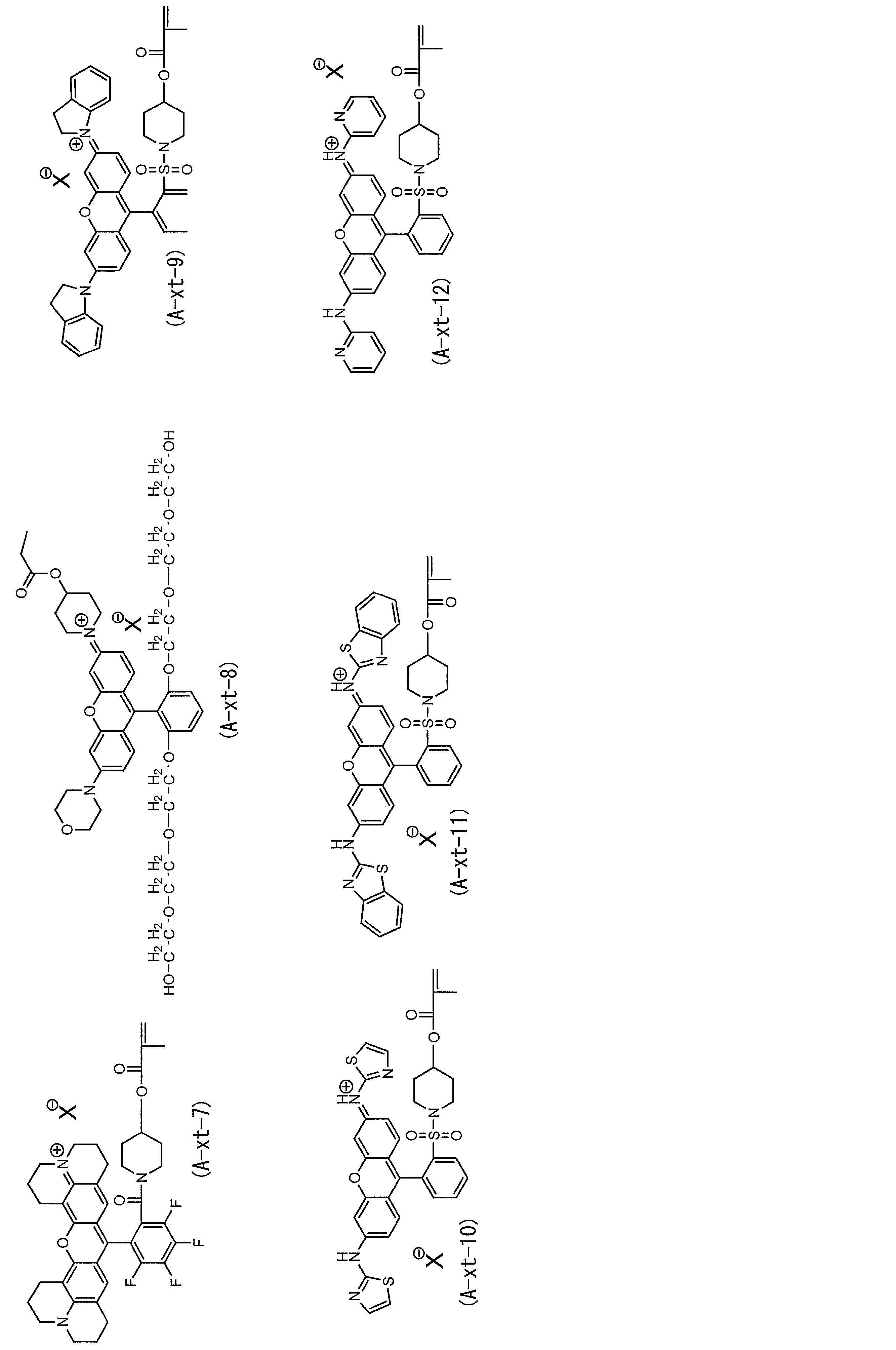


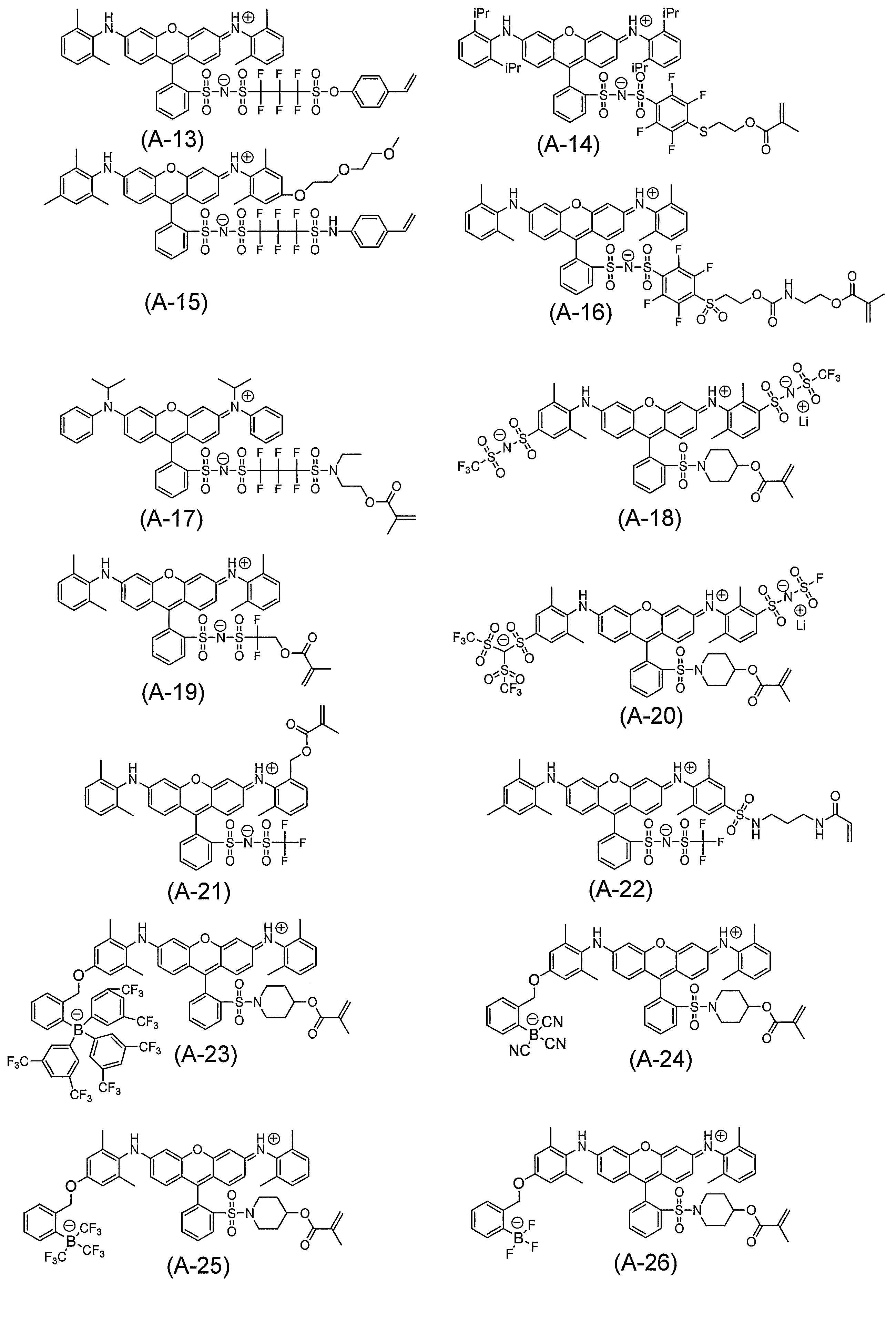
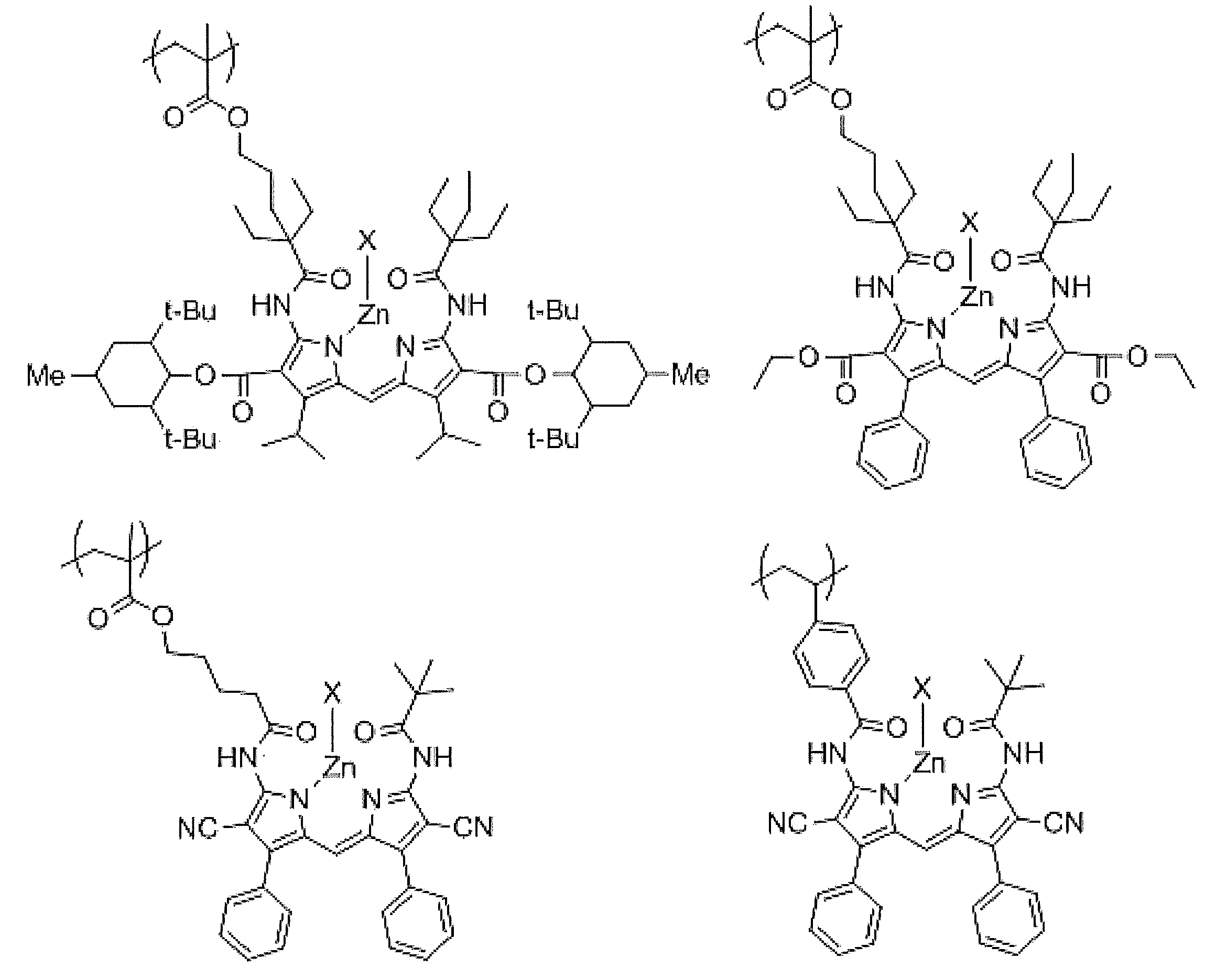


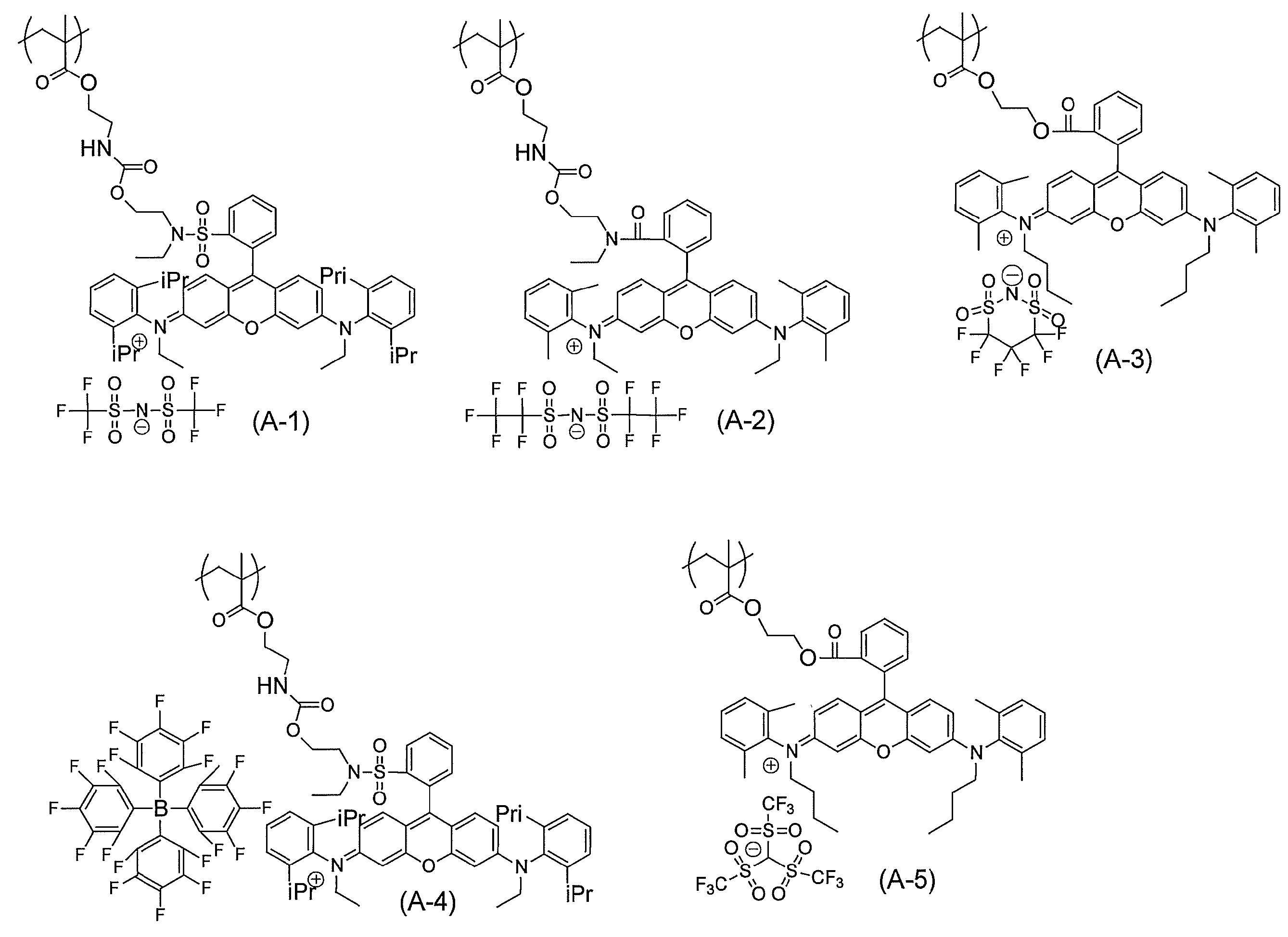
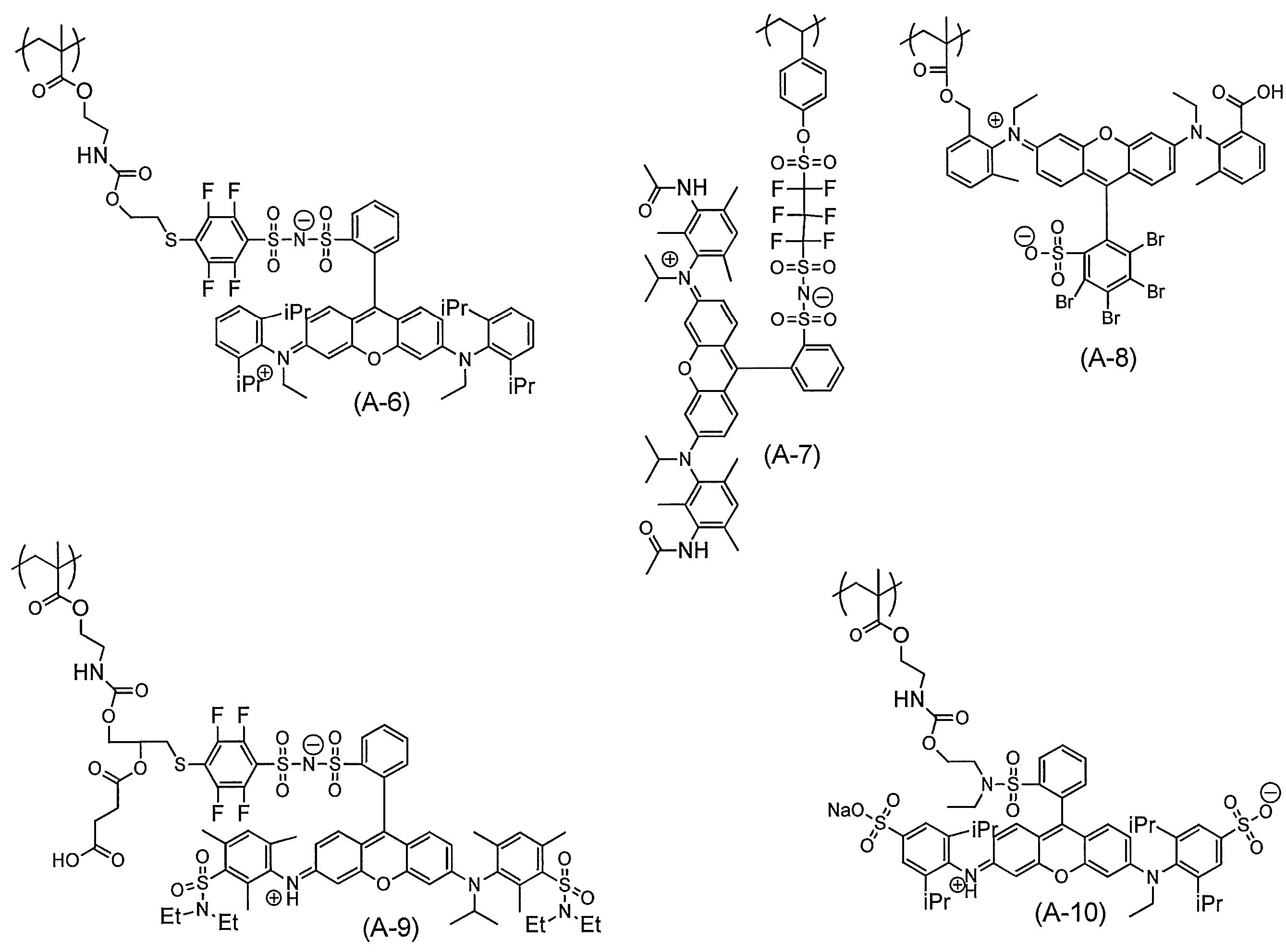
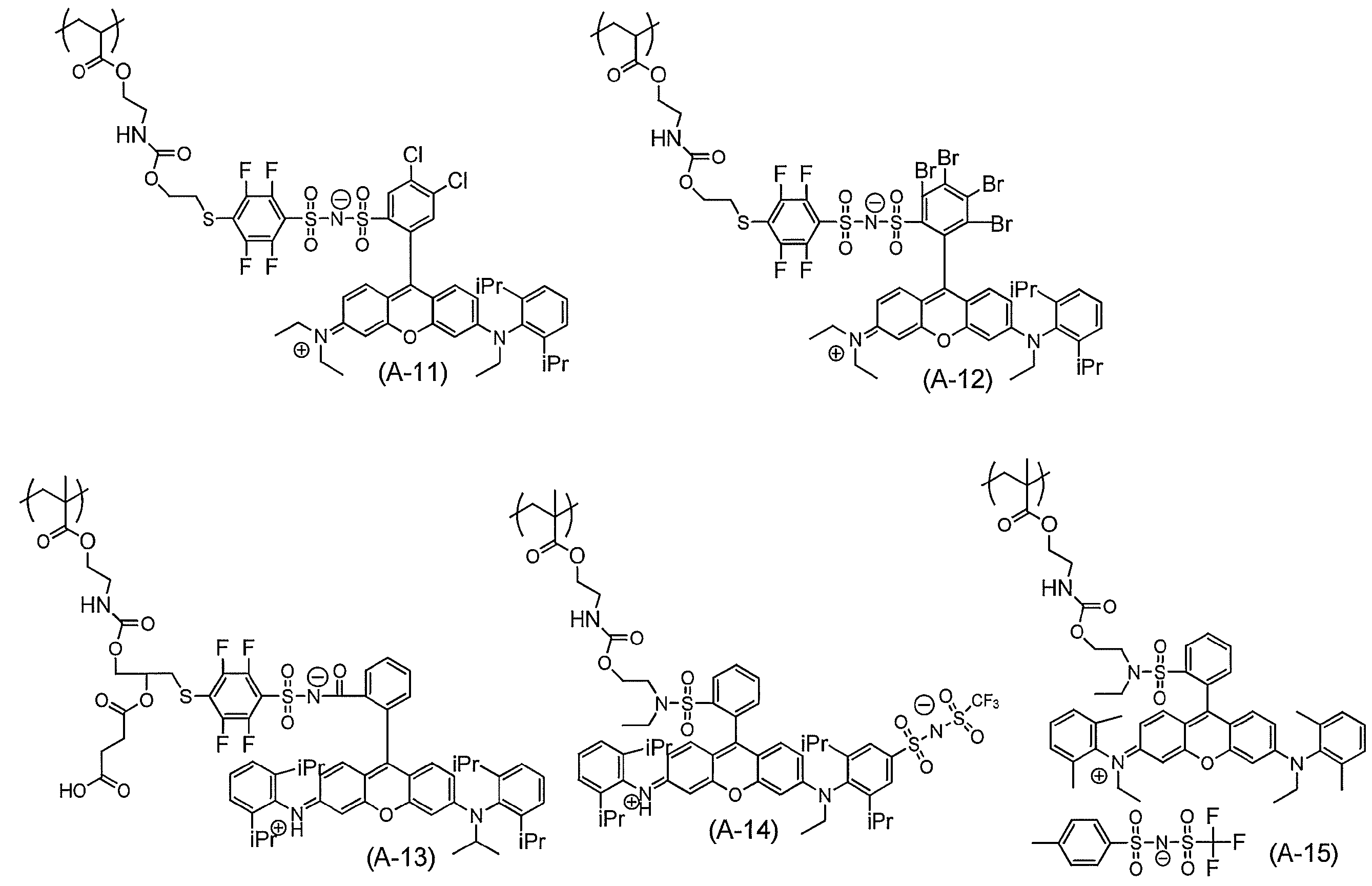
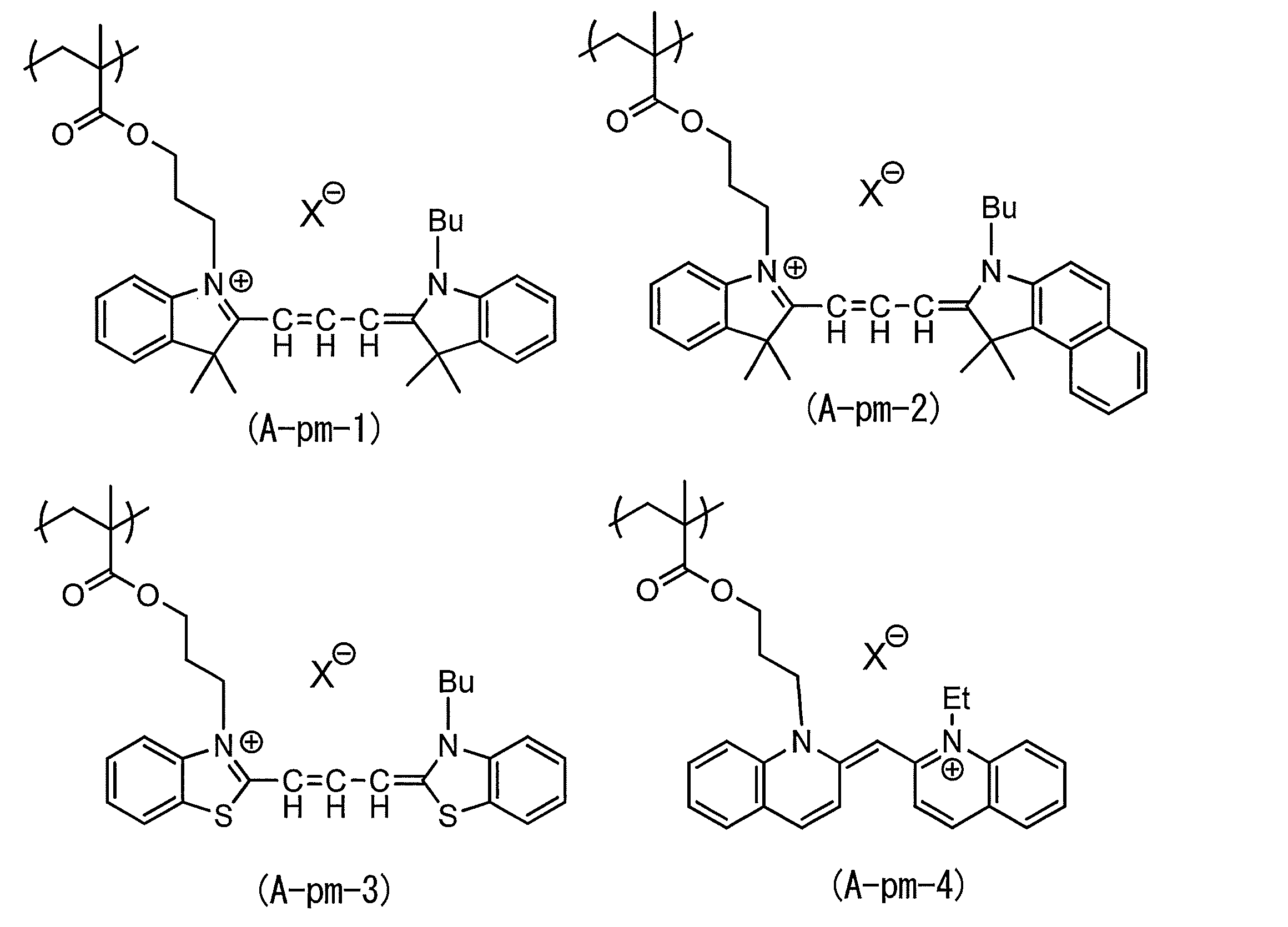

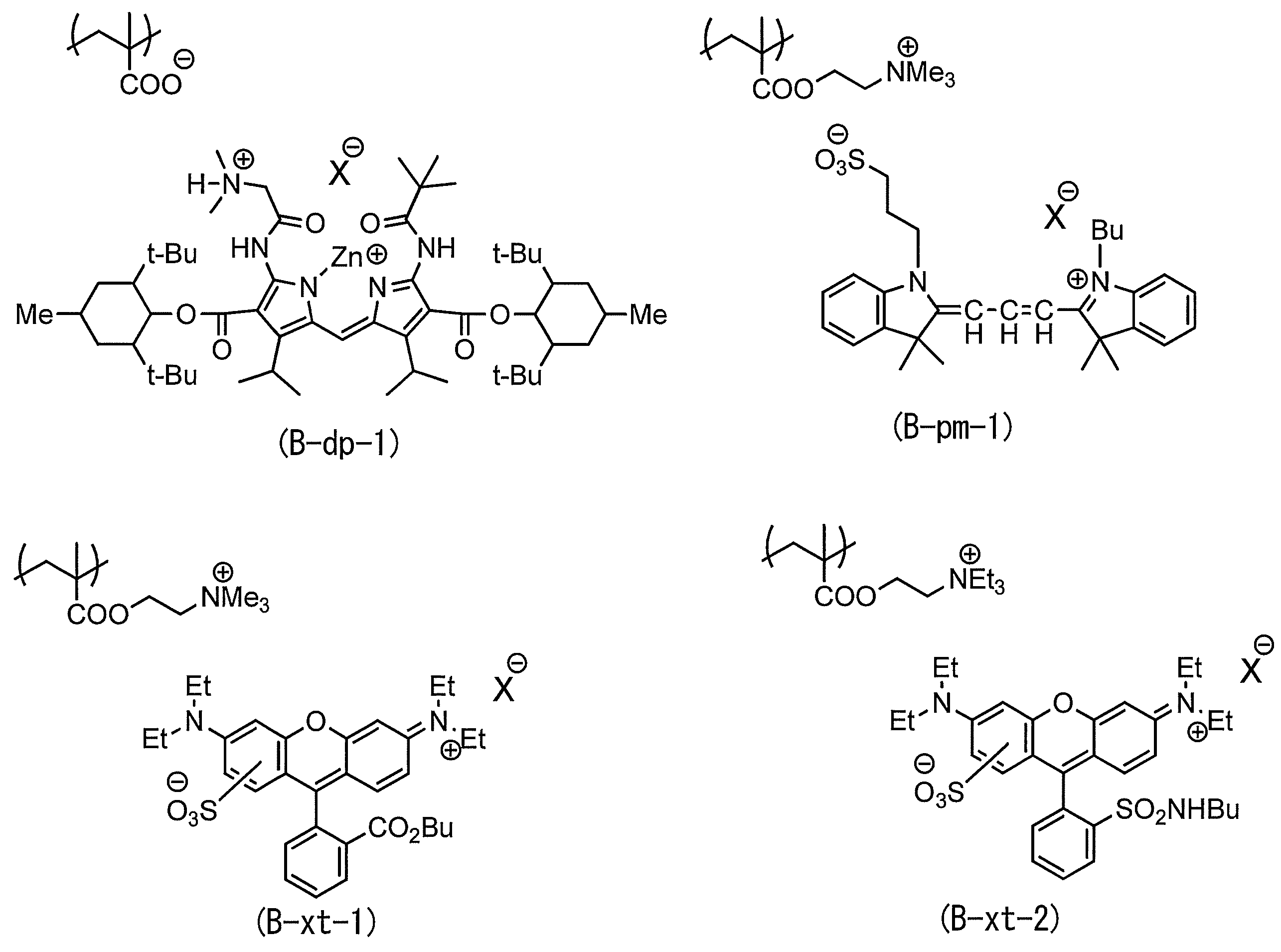
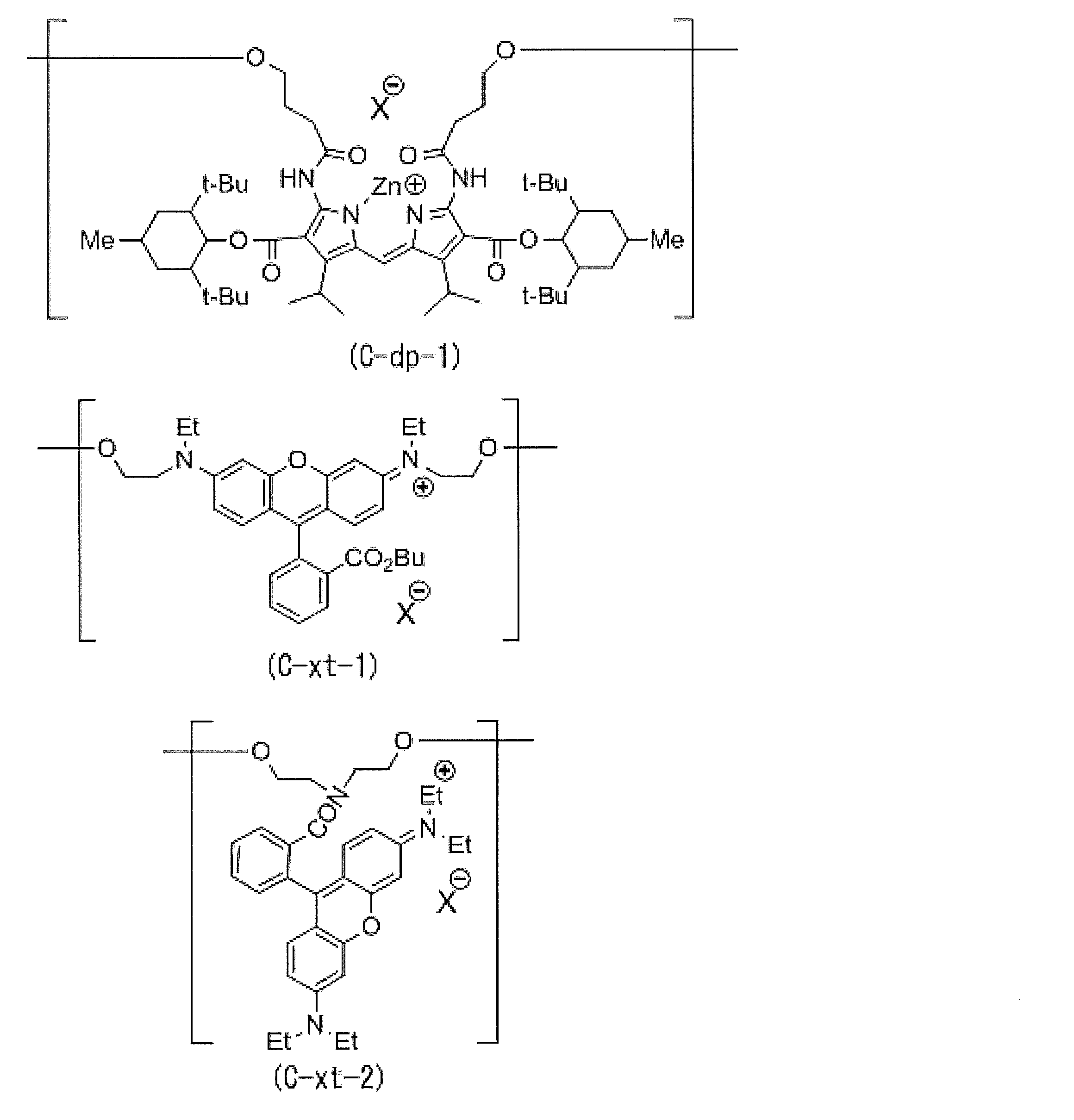

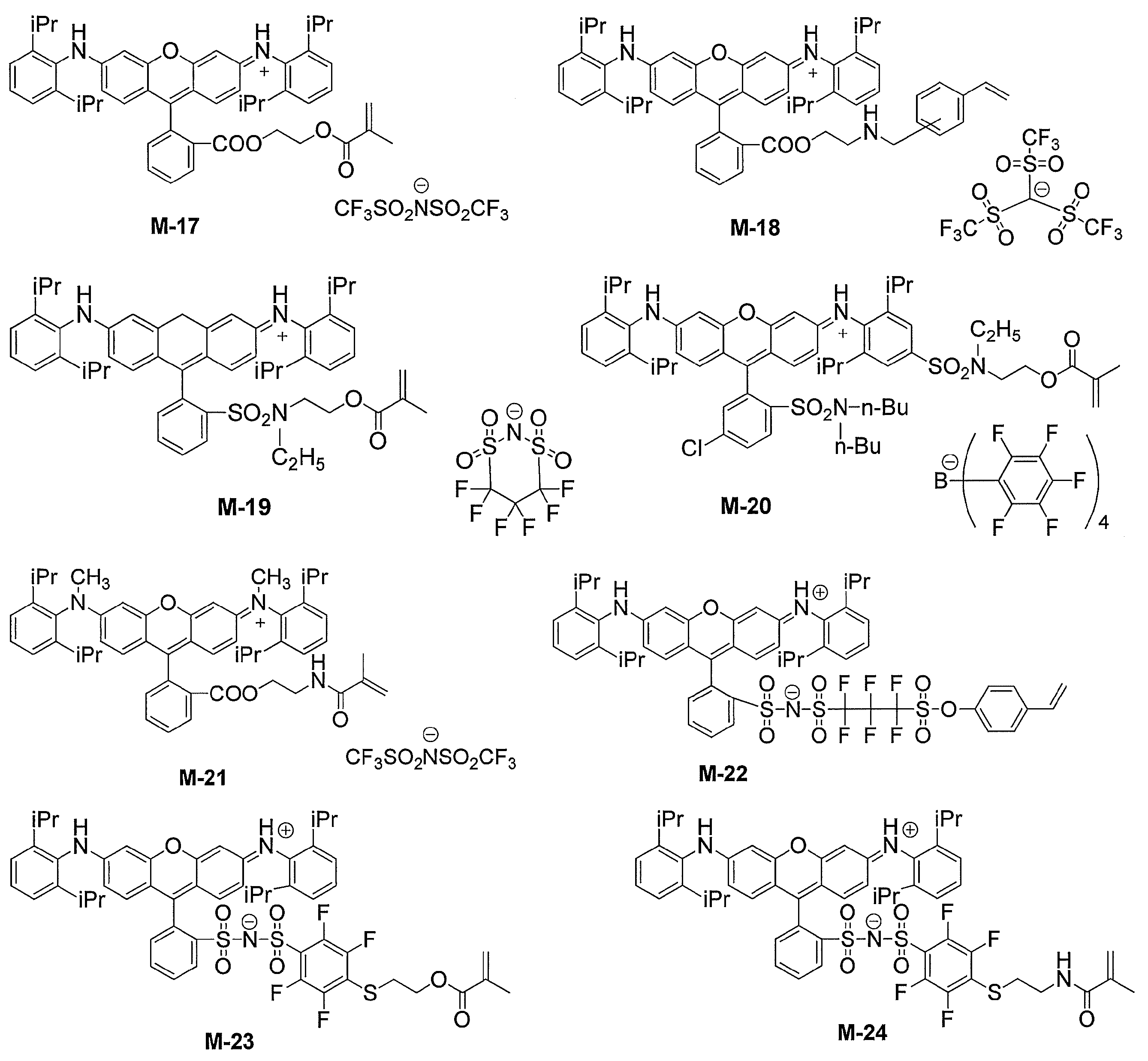
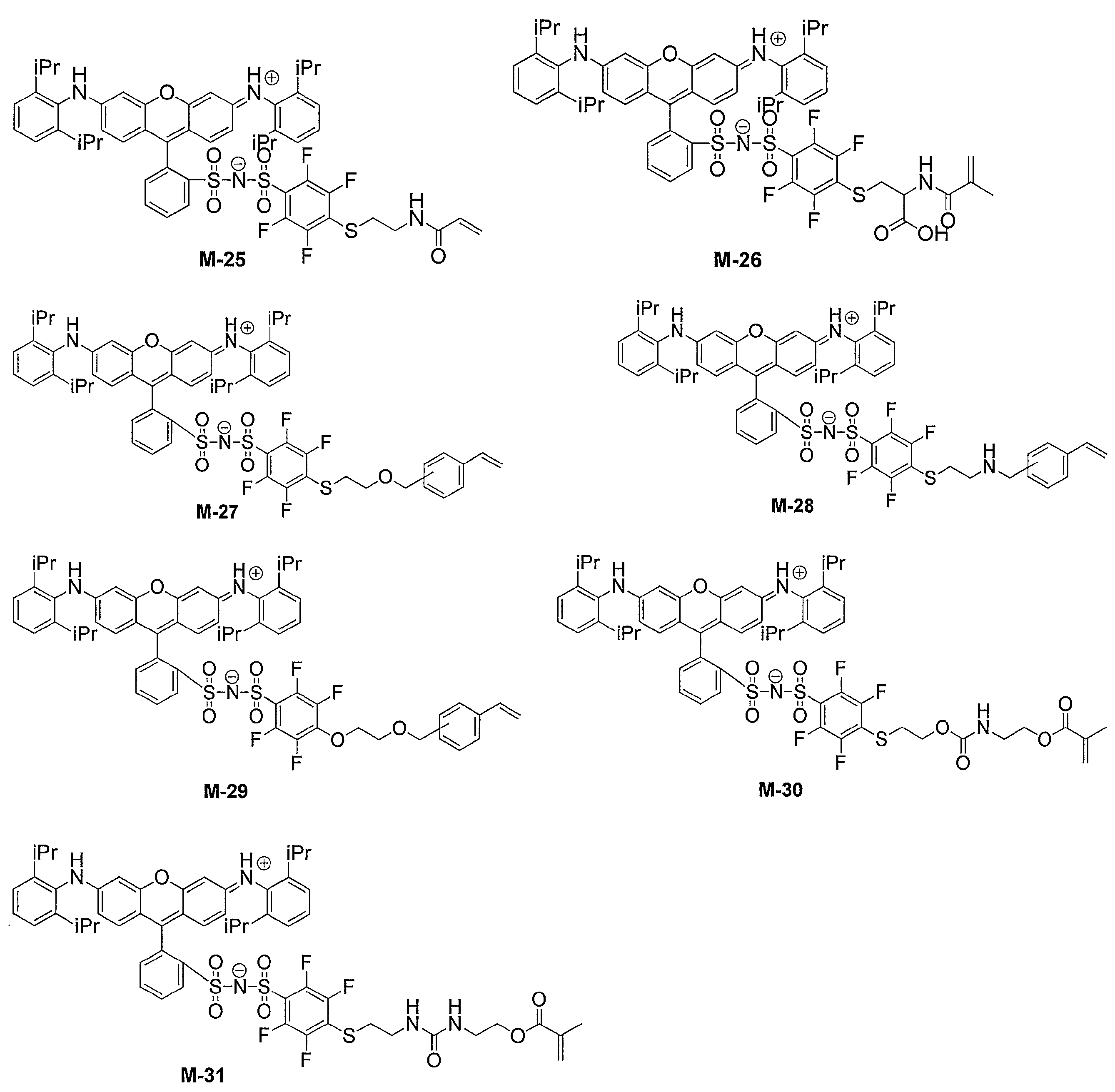
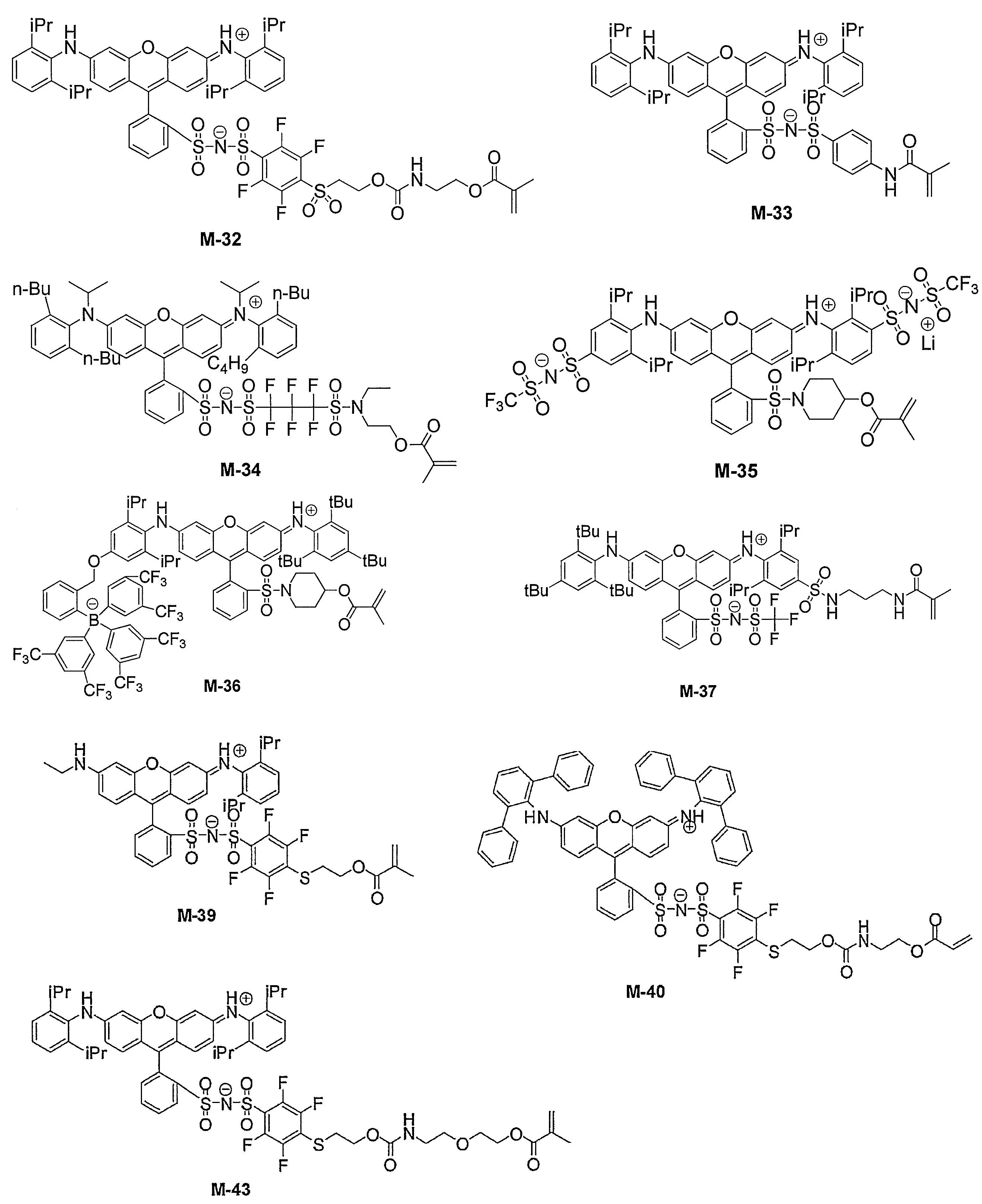
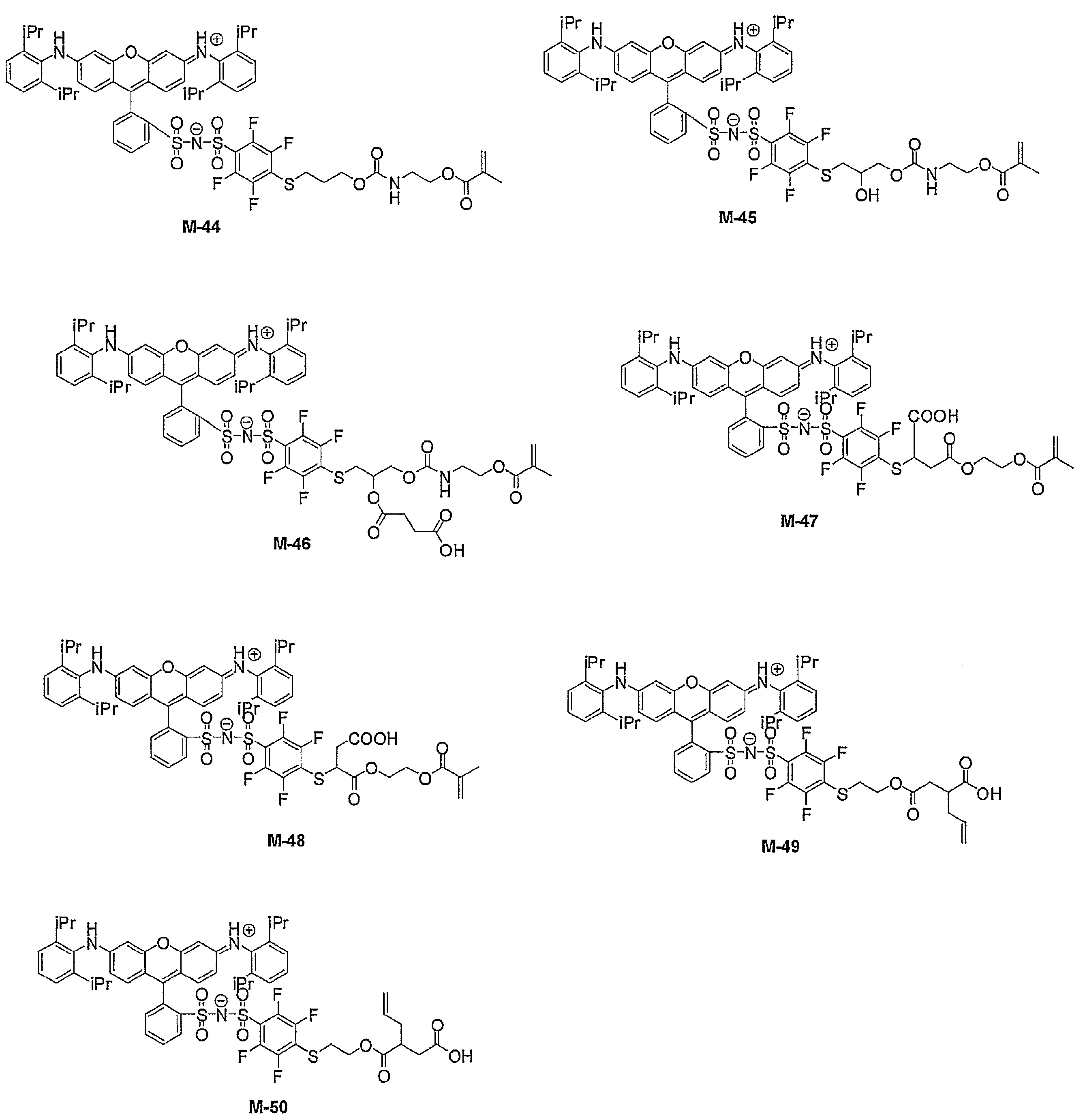
本発明に用いられる染料は、最大吸収波長が400~650nmであることが好ましく、450~600nmであることがより好ましい。
本明細書において、重量平均分子量及び数平均分子量は、GPC法によりスチレン換算で測定した値を用いる。
また、染料が色素多量体の場合、重量平均分子量(Mw)と、数平均分子量(Mn)との比〔(Mw)/(Mn)〕は1.0~3.0であることが好ましく、1.6~2.5であることがさらに好ましく、1.6~2.0であることが特に好ましい。
なお、最大吸収波長及びモル吸光係数は、分光光度計cary5(バリアン社製)により測定されるものである。
本発明の着色感放射線性組成物においては、染料を1種単独で用いてもよく、2種以上併用してもよい。
また、着色感放射線性組成物の全固形分に対する染料を含む着色剤の濃度が50質量%以上であることが好ましく、60質量%以上であることがより好ましい。
本発明に用いられる染料がその構造中に含む、特定の構造を有する色素構造の特性によって、本発明の着色感放射線性組成物は、着色パターンが薄膜(例えば、厚み1μm以下)に形成される。したがって、本発明の着色感放射線性組成物は、2μm以下の微少サイズ(基板法線方向からみた画素パターンの辺長が、例えば0.5~2.0μm)の高精細さが求められ、良好な矩形の断面プロファイルが要求される固体撮像素子用のカラーフィルタの作製に特に好適である。
C.I.ピグメントイエロー11,24,31,53,83,93,99,108,109,110,138,139,147,150,151,154,155,167,180,185,199,;
C.I.ピグメントオレンジ36,38,43,71;
C.I.ピグメントレッド81,105,122,149,150,155,171,175,176,177,209,220,224,242,254,255,264,270;
C.I.ピグメントバイオレット19,23,32,39;
C.I.ピグメントブルー1,2,15,15:1,15:3,15:6,16,22,60,66;
C.I.ピグメントグリーン7,36,37,58;
C.I.ピグメントブラウン25,28;
C.I.ピグメントブラック1;
等を挙げることができる。
C.I.ピグメントイエロー11,24,108,109,110,138,139,150,151,154,167,180,185,
C.I.ピグメントオレンジ36,71,
C.I.ピグメントレッド122,150,171,175,177,209,224,242,254,255,264,
C.I.ピグメントバイオレット19,23,32,
C.I.ピグメントブルー15:1,15:3,15:6,16,22,60,66,
C.I.ピグメントグリーン7,36,37,58;
C.I.ピグメントブラック1,7
本発明の着色感放射線性組成物は、顔料を含む場合、分散剤を含有することができる。
分散剤としては、高分子分散剤〔例えば、ポリアミドアミンとその塩、ポリカルボン酸とその塩、高分子量不飽和酸エステル、変性ポリウレタン、変性ポリエステル、変性ポリ(メタ)アクリレート、(メタ)アクリル系共重合体、ナフタレンスルホン酸ホルマリン縮合物〕、及び、ポリオキシエチレンアルキルリン酸エステル、ポリオキシエチレンアルキルアミン、アルカノールアミン等の界面活性剤、及び、顔料誘導体等を挙げることができる。
高分子分散剤は、その構造から更に直鎖状高分子、末端変性型高分子、グラフト型高分子、ブロック型高分子に分類することができる。
具体的には、高分子分散剤を用いる場合であれば、その使用量としては、顔料100質量部に対して、質量換算で5部~100部の範囲が好ましく、10部~80部の範囲であることがより好ましい。
また、分散剤と顔料誘導体を併用する場合、顔料誘導体の使用量としては、顔料100質量部に対し、質量換算で1~30部の範囲が好ましく、3~20部がより好ましく、5~15部が特に好ましい。
また、本発明の着色感放射線性組成物において、顔料を用いる場合、着色感放射線性組成物の全固形分に対する顔料の濃度が25質量%以上であることが好ましく、35質量%以上であることがより好ましく、45質量%以上であることがさらに好ましい。また、着色感放射線性組成物の全固形分に対する顔料の濃度が65質量%以下であることが好ましく、55質量%以下であることがより好ましい。
本発明の着色感放射線性組成物は、このような高濃度の着色剤の濃度とした場合にも、他色上残渣混色を抑制することができる。
本発明の着色感放射線性組成物は、光重合性化合物を含有する。
光重合性化合物としては、ラジカル、酸や熱により架橋可能な公知の光重合性化合物を用いることがで、例えばエチレン性不飽和結合、環状エーテル(エポキシ、オキセタン)、メチロール等を含む光重合性化合物が挙げられる。光重合性化合物としては、感度の観点から、末端エチレン性不飽和結合を少なくとも1個、好ましくは2個以上有する光重合性化合物から好適に選ばれる。中でも、4官能以上の多官能光重合性化合物が好ましく、5官能以上の多官能光重合性化合物がさらに好ましい。
このような化合物は産業分野において広く知られているものであり、本発明においてはこれらを特に限定なく用いることができる。これらは、例えば、モノマー、プレポリマー、すなわち2量体、3量体及びオリゴマー又はそれらの混合物並びにそれらの多量体などの化学的形態のいずれであってもよい。本発明における光重合性化合物は一種単独で用いてもよいし、2種以上を併用してもよい。
これらの具体的な化合物としては、特開2009-288705号公報の段落番号0095~0108に記載されている化合物を参酌でき、この内容は本願明細書に組み込まれる。
酸基を有する多官能モノマーの好ましい酸価としては、0.1mgKOH/g~40mgKOH/gであり、特に好ましくは5mgKOH/g~30mgKOH/gである。多官能モノマーの酸価が低すぎると現像溶解特性が落ち、高すぎると製造や取扱いが困難になり光重合性能が落ち、画素の表面平滑性等の硬化性が劣るものとなる。従って、異なる酸基の多官能モノマーを2種以上併用する場合、或いは酸基を有しない多官能モノマーを併用する場合、全体の多官能モノマーとしての酸基が上記範囲に入るように調整することが好ましい。
カプロラクトン構造を有する多官能性単量体としては、その分子内にカプロラクトン構造を有する限り特に限定されるものではないが、例えば、トリメチロールエタン、ジトリメチロールエタン、トリメチロールプロパン、ジトリメチロールプロパン、ペンタエリスリトール、ジペンタエリスリトール、トリペンタエリスリトール、グリセリン、ジグリセロール、トリメチロールメラミン等の多価アルコールと、(メタ)アクリル酸及びε-カプロラクトンをエステル化することにより得られる、ε-カプロラクトン変性多官能(メタ)アクリレートを挙げることができる。なかでも下記一般式(Z-1)で表されるカプロラクトン構造を有する多官能性単量体が好ましい。



本発明において、カプロラクトン構造を有する多官能性単量体は、単独で又は2種以上を混合して使用することができる。
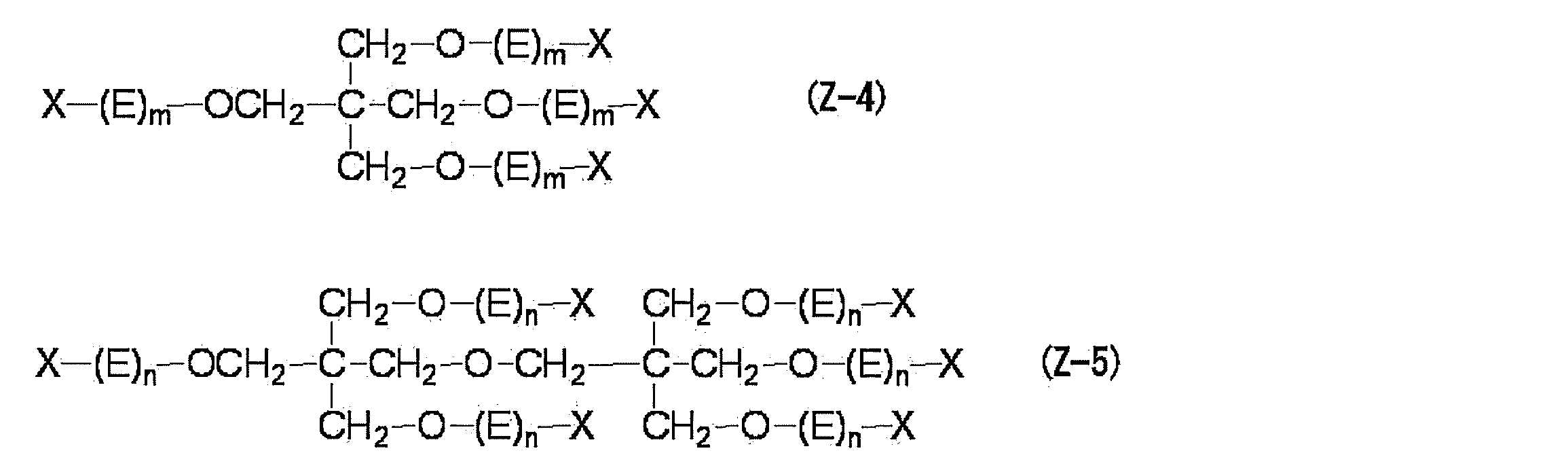
一般式(Z-4)中、アクリロイル基及びメタクリロイル基の合計は3個又は4個であり、mは各々独立に0~10の整数を表し、各mの合計は0~40の整数である。但し、各mの合計が0の場合、Xのうちいずれか1つはカルボキシル基である。
一般式(ii)中、アクリロイル基及びメタクリロイル基の合計は5個又は6個であり、nは各々独立に0~10の整数を表し、各nの合計は0~60の整数である。但し、各nの合計が0の場合、Xのうちいずれか1つはカルボキシル基である。
また、各mの合計は、2~40の整数が好ましく、2~16の整数がより好ましく、4~8の整数が特に好ましい。
一般式(Z-5)中、nは、0~6の整数が好ましく、0~4の整数がより好ましい。
また、各nの合計は、3~60の整数が好ましく、3~24の整数がより好ましく、6~12の整数が特に好ましい。
また、一般式(Z-4)又は一般式(Z-5)中の-((CH2)yCH2O)-又は-((CH2)yCH(CH3)O)-は、酸素原子側の末端がXに結合する形態が好ましい。
具体的には、下記式(a)~(f)で表される化合物(以下、「例示化合物(a)~(f)」とも称する。)が挙げられ、中でも、例示化合物(a)、(b)、(e)、(f)が好ましい。
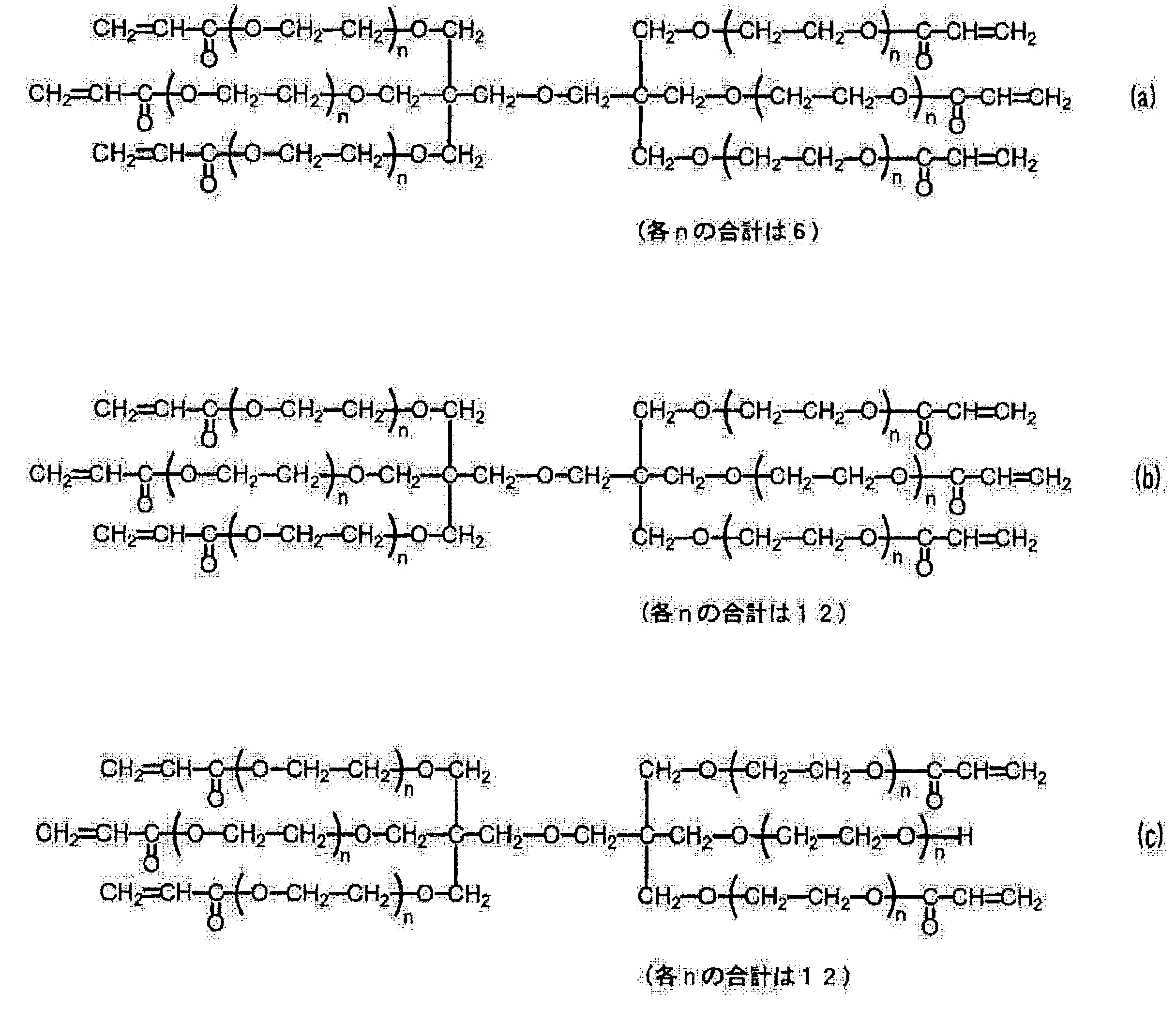
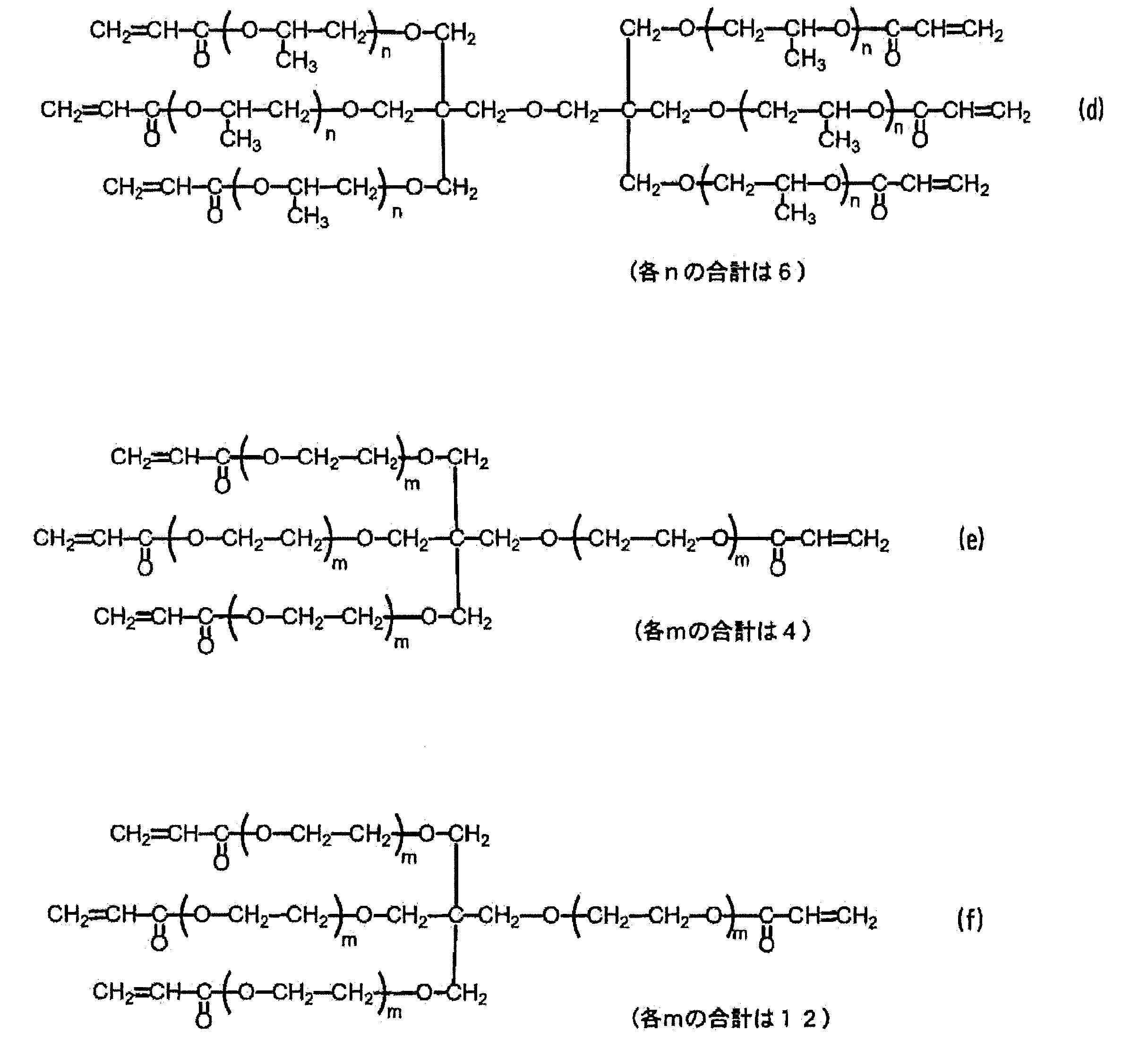
光重合性化合物の市販品としては、ウレタンオリゴマーUAS-10、UAB-140(山陽国策パルプ社製)、UA-7200」(新中村化学社製、DPHA-40H(日本化薬社製)、UA-306H、UA-306T、UA-306I、AH-600、T-600、AI-600(共栄社製)などが挙げられる。
また、着色感放射線性組成物に含有される他の成分(例えば、光重合開始剤、被分散体、アルカリ可溶性樹脂等)との相溶性、分散性に対しても、光重合性化合物の選択・使用法は重要な要因であり、例えば、低純度化合物の使用や2種以上の併用により相溶性を向上させうることがある。また、支持体などの硬質表面との密着性を向上させる観点で特定の構造を選択することもあり得る。
本発明の着色感放射線性組成物は、さらに光重合開始剤を含有することが、さらなる感度向上の観点から必須である。
光重合開始剤としては、光重合性化合物の重合を開始する能力を有する限り、特に制限はなく、公知の光重合開始剤の中から適宜選択することができる。例えば、紫外線領域から可視の光線に対して感光性を有するものが好ましい。また、光励起された増感剤と何らかの作用を生じ、活性ラジカルを生成する活性剤であってもよく、モノマーの種類に応じてカチオン重合を開始させるような開始剤であってもよい。
また、光重合開始剤は、約300nm~800nm(330nm~500nmがより好ましい。)の範囲内に少なくとも約50の分子吸光係数を有する化合物を、少なくとも1種含有していることが好ましい。
本発明に用いられる光重合開始剤の具体例としては、例えば、特開2013-29760号公報の段落0265~0268を参酌することができ、この内容は本願明細書に組み込まれる。
ヒドロキシアセトフェノン系開始剤としては、IRGACURE-184、DAROCUR-1173、IRGACURE-500、IRGACURE-2959,IRGACURE-127(商品名:いずれもBASF社製)を用いることができる。
アミノアセトフェノン系開始剤としては、市販品であるIRGACURE-907、IRGACURE-369、及び、IRGACURE-379(商品名:いずれもBASF社製)を用いることができる。アミノアセトフェノン系開始剤として、365nm又は405nm等の長波光源に吸収波長がマッチングされた特開2009-191179公報に記載の化合物も用いることができる。
また、アシルホスフィン系開始剤としては市販品であるIRGACURE-819やDAROCUR-TPO(商品名:いずれもBASF社製)を用いることができる。
市販品ではIRGACURE-OXE01(BASF社製)、IRGACURE-OXE02(BASF社製)も好適に用いられる。
好ましくは、特開2013-29760号公報の段落0274~0275を参酌することができ、この内容は本願明細書に組み込まれる。
具体的には、オキシム重合開始剤としては、下記式(OX-1)で表される化合物が好ましい。なお、オキシムのN-O結合が(E)体のオキシム化合物であっても、(Z)体のオキシム化合物であっても、(E)体と(Z)体との混合物であってもよい。

このようなオキシム開始剤としては、特開2012-208494号公報段落0513(対応する米国特許出願公開第2012/235099号明細書の[0632])以降の式(OX-1)、(OX-2)又は(OX-3)で表される化合物の説明を参酌でき、これらの内容は本願明細書に組み込まれる。

オキシム化合物は、365nm又は405nmにおけるモル吸光係数は、感度の観点から、1,000~300,000であることが好ましく、2,000~300,000であることがより好ましく、5,000~200,000であることが特に好ましい。
化合物のモル吸光係数は、公知の方法を用いることができるが、具体的には、例えば、紫外可視分光光度計(Varian社製Carry-5 spctrophotometer)にて、酢酸エチル溶媒を用い、0.01g/Lの濃度で測定することが好ましい。
本発明に用いられる光重合開始剤は、必要に応じて2種以上を組み合わせて使用しても良い。
本発明の着色感放射線性組成物は、アルカリ可溶性樹脂を含有してもよい。
アルカリ可溶性樹脂としては、線状有機高分子重合体であって、分子(好ましくは、アクリル系共重合体、スチレン系共重合体を主鎖とする分子)中に少なくとも1つのアルカリ可溶性を促進する基を有するアルカリ可溶性樹脂の中から適宜選択することができる。耐熱性の観点からは、ポリヒドロキシスチレン系樹脂、ポリシロキサン系樹脂、アクリル系樹脂、アクリルアミド系樹脂、アクリル/アクリルアミド共重合体樹脂が好ましく、現像性制御の観点からは、アクリル系樹脂、アクリルアミド系樹脂、アクリル/アクリルアミド共重合体樹脂が好ましい。
アルカリ可溶性を促進する基(以下、酸基とも称する)としては、例えば、カルボキシル基、リン酸基、スルホン酸基、フェノール性水酸基などが挙げられるが、有機溶剤に可溶で弱アルカリ水溶液により現像可能なものが好ましく、(メタ)アクリル酸が特に好ましいものとして挙げられる。これら酸基は、1種のみであってもよいし、2種以上であってもよい。
重合後に酸基を付与しうるモノマーとしては、例えば、2-ヒドロキシエチル(メタ)アクリレート等の水酸基を有するモノマー、グリシジル(メタ)アクリレート等のエポキシ基を有するモノマー、2-イソシアナートエチル(メタ)アクリレート等のイソシアネート基を有するモノマー等が挙げられる。これら酸基を導入するための単量体は、1種のみであってもよいし、2種以上であってもよい。アルカリ可溶性樹脂に酸基を導入するには、例えば、酸基を有するモノマー及び/又は重合後に酸基を付与しうるモノマー(以下「酸基を導入するための単量体」と称することもある。)を、単量体成分として重合するようにすればよい。
なお、重合後に酸基を付与しうるモノマーを単量体成分として酸基を導入する場合には、重合後に例えば後述するような酸基を付与するための処理が必要となる。
アルカリ可溶性樹脂としては、下記一般式(ED)で示される化合物(以下「エーテルダイマー」と称することもある。)を必須とする単量体成分を重合してなるポリマー(a)を含むことも好ましい。

また、アルカリ可溶性樹脂の重量平均分子量(Mw)としては、2,000~50,000が好ましく、5,000~30,000がさらに好ましく、7,000~20,000が特に好ましい。
なお、アルカリ可溶性樹脂に対する(B)光重合性化合物の質量比は、0.8~4.0が好ましく、特に1.0~3.0であることがさらに好ましい。この範囲にあることで、基板周縁部の基板密着性及びカラーフィルタの表面粗度に優れる。
本発明の着色感放射線性組成物は、上述の各成分に加えて、本発明の効果を損なわない範囲で、更に、有機溶剤、架橋剤などの他の成分を含んでいてもよい。
(有機溶剤)
本発明の着色感放射線性組成物は、有機溶剤を含有してもよい。
有機溶剤は、各成分の溶解性や着色感放射線性組成物の塗布性を満足すれば基本的には特に制限はないが、特に紫外線吸収剤、アルカリ可溶性樹脂や分散剤等の溶解性、塗布性、安全性を考慮して選ばれることが好ましい。また、本発明における着色感放射線性組成物を調製する際には、少なくとも2種類の有機溶剤を含むことが好ましい。
有機溶剤の具体例としては、例えば、特開2013-29760号公報の段落0324を参酌することができ、この内容は本願明細書に組み込まれる。
本発明の着色感放射線性組成物に補足的に架橋剤を用い、着色感放射線性組成物を硬化させてなる着色硬化膜の硬度をより高めることもできる。
架橋剤としては、架橋反応により膜硬化を行なえるものであれば、特に限定はなく、例えば、(a)エポキシ樹脂、(b)メチロール基、アルコキシメチル基、及びアシロキシメチル基から選ばれる少なくとも1つの置換基で置換された、メラミン化合物、グアナミン化合物、グリコールウリル化合物又はウレア化合物、(c)メチロール基、アルコキシメチル基、及びアシロキシメチル基から選ばれる少なくとも1つの置換基で置換された、フェノール化合物、ナフトール化合物又はヒドロキシアントラセン化合物、が挙げられる。中でも、多官能エポキシ樹脂が好ましい。
架橋剤の具体例などの詳細については、特開2004-295116号公報の段落0134~0147の記載を参照することができ、この内容は本願明細書に組み込まれる。
本発明の着色感放射線性組成物においては、着色感放射線性組成物の製造中又は保存中において、光重合性化合物の不要な熱重合を阻止するために、少量の重合禁止剤を添加することが望ましい。
本発明に用いうる重合禁止剤としては、ハイドロキノン、p-メトキシフェノール、ジ-t-ブチル-p-クレゾール、ピロガロール、t-ブチルカテコール、ベンゾキノン、4,4'-チオビス(3-メチル-6-t-ブチルフェノール)、2,2'-メチレンビス(4-メチル-6-t-ブチルフェノール)、N-ニトロソフェニルヒドロキシアミン第一セリウム塩等が挙げられる。
重合禁止剤の添加量は、全組成物の質量に対して、約0.01質量%~約5質量%が好ましい。
着色感放射線性組成物には、必要に応じて、各種添加物、例えば、充填剤、密着促進剤、酸化防止剤、紫外線吸収剤、凝集防止剤等を配合することができる。これらの添加物としては、特開2004-295116号公報の段落0155~0156に記載のものを挙げることができる。
本発明の着色感放射線性組成物においては、特開2004-295116号公報の段落0078に記載の増感剤や光安定剤、同公報の段落0081に記載の熱重合防止剤を含有することができる。
本発明の着色感放射線性組成物は、分子量1000以下の有機カルボン酸、及び/又は有機カルボン酸無水物を含有していてもよい。有機カルボン酸及び有機カルボン酸無水物の具体例としては、例えば、特開2013-29760号公報の段落0338~0340を参酌することができ、この内容は本願明細書に組み込まれる。
本発明の着色感放射線性組成物は、前述の成分を混合することで調製される。
なお、着色感放射線性組成物の調製に際しては、着色感放射線性組成物を構成する各成分を一括配合してもよいし、各成分を溶剤に溶解・分散した後に逐次配合してもよい。また、配合する際の投入順序や作業条件は特に制約を受けない。例えば、全成分を同時に溶剤に溶解・分散して組成物を調製してもよいし、必要に応じては、各成分を適宜2つ以上の溶液・分散液としておいて、使用時(塗布時)にこれらを混合して組成物として調製してもよい。
本発明の着色感放射線性組成物は、異物の除去や欠陥の低減などの目的で、フィルタで濾過することが好ましい。従来からろ過用途等に用いられているものであれば特に限定されることなく用いることができる。例えば、PTFE(ポリテトラフルオロエチレン)等のフッ素樹脂、ナイロン-6、ナイロン-6,6等のポリアミド系樹脂、ポリエチレン、ポリプロピレン(PP)等のポリオレフィン樹脂(高密度、超高分子量を含む)等によるフィルタが挙げられる。これら素材の中でもポリプロピレン(高密度ポリプロピレンを含む)が好ましい。
フィルタの孔径は、0.01~7.0μm程度が適しており、好ましくは0.01~3.0μm程度、さらに好ましくは0.05~0.5μm程度である。この範囲とすることにより、後工程において均一及び平滑な着色感放射線性組成物の調製を阻害する、微細な異物を確実に除去することが可能となる。
また、上述した範囲内で異なる孔径の第1のフィルタを組み合わせてもよい。ここでの孔径は、フィルタメーカーの公称値を参照することができる。市販のフィルタとしては、例えば、日本ポール株式会社、アドバンテック東洋株式会社、日本インテグリス株式会社(旧日本マイクロリス株式会社)又は株式会社キッツマイクロフィルタ等が提供する各種フィルタの中から選択することができる。
第2のフィルタは、上述した第1のフィルタと同様の材料等で形成されたものを使用することができる。
例えば、第1のフィルタでのフィルタリングは、分散液のみで行い、他の成分を混合した後で、第2のフィルタリングを行ってもよい。
次に、本発明における着色硬化膜、パターン形成方法及びカラーフィルタについて、その製造方法を通じて詳述する。
本発明のカラーフィルタの製造方法は、本発明のパターン形成方法を適用するものであり、本発明の着色硬化性成物を基板上に付与して着色層を形成する着色層形成工程と、着色層をパターン様に露光し露光部を硬化させる露光工程と、露光後の着色層における未硬化部を現像により除去して着色パターンを形成するパターン形成工程と、を含むことを特徴とする。
本発明のパターン形成方法は、カラーフィルタが有する着色層(画素)の形成に好適に適用することができる。
以下、本発明のパターン形成方法における各工程については、固体撮像素子用カラーフィルタの製造方法を通じて詳細に説明するが、本発明はこの方法に限定されるものではない。
本発明のカラーフィルタは、上記製造方法により好適に得ることができる。
以下、固体撮像素子用カラーフィルタを単に「カラーフィルタ」と称することがある。
着色層形成工程では、支持体上に、本発明の着色感放射線性組成物を付与して着色層を形成する。
本工程に用いうる支持体としては、例えば、基板(例えば、シリコン基板)上にCCD(Charge Coupled Device)やCMOS(Complementary Metal-Oxide Semiconductor)等の撮像素子(受光素子)が設けられた固体撮像素子用基板を用いることができる。
本発明における着色パターンは、固体撮像素子用基板の撮像素子形成面側(おもて面)に形成されてもよいし、撮像素子非形成面側(裏面)に形成されてもよい。
固体撮像素子における着色パターンの間や、固体撮像素子用基板の裏面には、遮光膜が設けられていてもよい。
また、支持体上には、必要により、上部の層との密着改良、物質の拡散防止或いは基板表面の平坦化のために下塗り層を設けてもよい。
露光工程では、着色層形成工程において形成された着色層を、例えば、ステッパー等の露光装置を用い、所定のマスクパターンを有するマスクを介してパターン露光する。これにより、本発明の着色感放射線性組成物を硬化してなる着色硬化膜が得られる。
露光に際して用いることができる放射線(光)としては、特に、g線、i線等の紫外線が好ましく(特に好ましくはi線)用いられる。照射量(露光量)は30mJ/cm2~1500mJ/cm2が好ましく50mJ/cm2~1000mJ/cm2がより好ましく、80mJ/cm2~500mJ/cm2が特に好ましい。
着色硬化膜の膜厚は、1.5μm以下であることが好ましく、0.2~1.5μmであることがより好ましく、0.35~1.10μmであることがさらに好ましく、0.50~0.90μmであることが特に好ましい。
膜厚を、1.5μm以下とすることにより、高解像性、高密着性を得られるため、好ましい。
次いでアルカリ現像処理を行うことにより、露光工程における光未照射部分の着色層がアルカリ水溶液に溶出し、光硬化した部分だけが残る。
現像液としては、下地の撮像素子や回路などに悪影響を起さない、有機アルカリ現像液が望ましい。現像温度としては通常20℃~30℃であり、現像時間は、従来20秒~90秒であった。より残渣を除去するため、近年では120秒~180秒実施する場合もある。さらには、より残渣除去性を向上するため、現像液を60秒ごとに振り切り、さらに新たに現像液を供給する工程を数回繰り返す場合もある。
なお、現像液には無機アルカリを用いてもよく、無機アルカリとしては、例えば、水酸化ナトリウム、水酸化カリウム、炭酸ナトリウム、炭酸水素ナトリウム、硅酸ナトリウム、メタ硅酸ナトリウムなどが好ましい。
なお、このようなアルカリ性水溶液からなる現像液を使用した場合には、一般に現像後純水で洗浄(リンス)する。
ポストベークは、硬化を完全なものとするための現像後の加熱処理であり、通常100℃~240℃、好ましくは200℃~240℃の熱硬化処理を行う。
このポストベーク処理は、現像後の塗布膜を、上記条件になるようにホットプレートやコンベクションオーブン(熱風循環式乾燥機)、高周波加熱機等の加熱手段を用いて、連続式あるいはバッチ式で行うことができる。
上記のうち、アルキレングリコールモノアルキルエーテルカルボキシレート及びアルキレングリコールモノアルキルエーテルが好ましい。
これら溶媒は、単独で用いても2種以上を混合して用いてもよい。2種以上を混合する場合、水酸基を有する溶剤と水酸基を有しない溶剤とを混合することが好ましい。水酸基を有する溶剤と水酸基を有しない溶剤との質量比は、1/99~99/1、好ましくは10/90~90/10、更に好ましくは20/80~80/20である。プロピレングリコールモノメチルエーテルアセテート(PGMEA)とプロピレングリコールモノメチルエーテル(PGME)の混合溶剤で、その比率が60/40であることが特に好ましい。なお、汚染物に対する洗浄液の浸透性を向上させるために、洗浄液には前掲の本組成物に関する界面活性剤を添加してもよい。
本発明の固体撮像素子用カラーフィルタは、CCD、CMOS等の固体撮像素子に好適に用いることができ、特に100万画素を超えるような高解像度のCCDやCMOS等に好適である。本発明の固体撮像素子用カラーフィルタは、例えば、CCD又はCMOSを構成する各画素の受光部と、集光するためのマイクロレンズと、の間に配置されるカラーフィルタとして用いることができる。
また、着色パターン(着色画素)のサイズ(パターン幅)としては、2.5μm以下が好ましく、2.0μm以下がより好ましく、1.7μm以下が特に好ましい。
本発明における固体撮像素子は、既述の本発明の固体撮像素子用カラーフィルタを備える。本発明における固体撮像素子の構成としては、本発明における固体撮像素子用カラーフィルタが備えられた構成であり、固体撮像素子として機能する構成であれば特に限定はないが、例えば、以下のような構成が挙げられる。
更に、デバイス保護層上であってカラーフィルタの下(支持体に近い側)に集光手段(例えば、マイクロレンズ等。以下同じ)を有する構成や、カラーフィルタ上に集光手段を有する構成等であってもよい。
本発明におけるカラーフィルタは、固体撮像素子のみならず、液晶表示装置や有機EL表示装置などの、画像表示装置に用いることができ、特に液晶表示装置の用途に好適である。
液晶表示装置に用いた場合、分光特性及び耐熱性に優れた金属錯体色素を着色剤として含有しながらも、比抵抗の低下に伴う液晶分子の配向不良が少なく、表示画像の色合いが良好で表示特性に優れる。
このため、本発明のカラーフィルタを備えた液晶表示装置は、表示画像の色合いが良好で表示特性に優れた高画質画像を表示することができる。
また、本発明におけるカラーフィルタは、明るく高精細なCOA(Color-filter On Array)方式にも供することが可能である。例えば、特開2013-29760号公報の段落0365を参酌することができ、この内容は本願明細書に組み込まれる。
(合成例1)
特開2012-158739号公報の段落0413~0423に記載の方法により染料a(色素単量体M1)を得た。
染料aを50g、メタクリル酸3.67g、ドデカンチオール1.05g、重合開始剤(V-601、和光純薬製)4.78g、シクロヘキサノン50gの混合溶液を調製した。別途、反応容器に染料aを50g、メタクリル酸3.67g、ドデカンチオール1.05g、シクロヘキサノン50gを入れ、窒素フローをし、80℃に保ち撹拌させた。そこに調製した混合溶液を1時間かけて滴下し、3時間撹拌した後、反応を停止した。室温まで冷却後、アセトニトリル6200mLに、得られた反応溶液とメタノール1038mLを混合した溶液を20分かけて滴下し、10分撹拌した。得られた析出物をろ過し、次いで乾燥し、色素多量体である染料bを70g得た。GPC測定より確認した染料bの重量平均分子量(Mw)は、6,000であり、重量平均分子量/数平均分子量(Mw/Mn)の比は2.0であった。また、0.1N水酸化ナトリウム水溶液を用いた滴定により、酸価は82mgKOH/gであった。
染料bを15g、メタクリル酸グリシジル2.08g、テトラブチルアンモニウムブロミド0.38g、p-メトキシフェノール0.017g、プロピレングリコールメチルエーテルアセテート96.8gに加え100℃、8時間加熱撹拌した。得られた染料溶液をアセトニトリル180gとイオン交換水900gの混合溶液に滴下し、ろ過、乾燥させ、色素多量体である染料cを15g得た。GPC測定より確認した染料bの重量平均分子量(Mw)は、9,000であり、重量平均分子量/数平均分子量(Mw/Mn)の比は2.2であった。また、0.1N水酸化ナトリウム水溶液を用いた滴定により、酸価は28mgKOH/gであった。
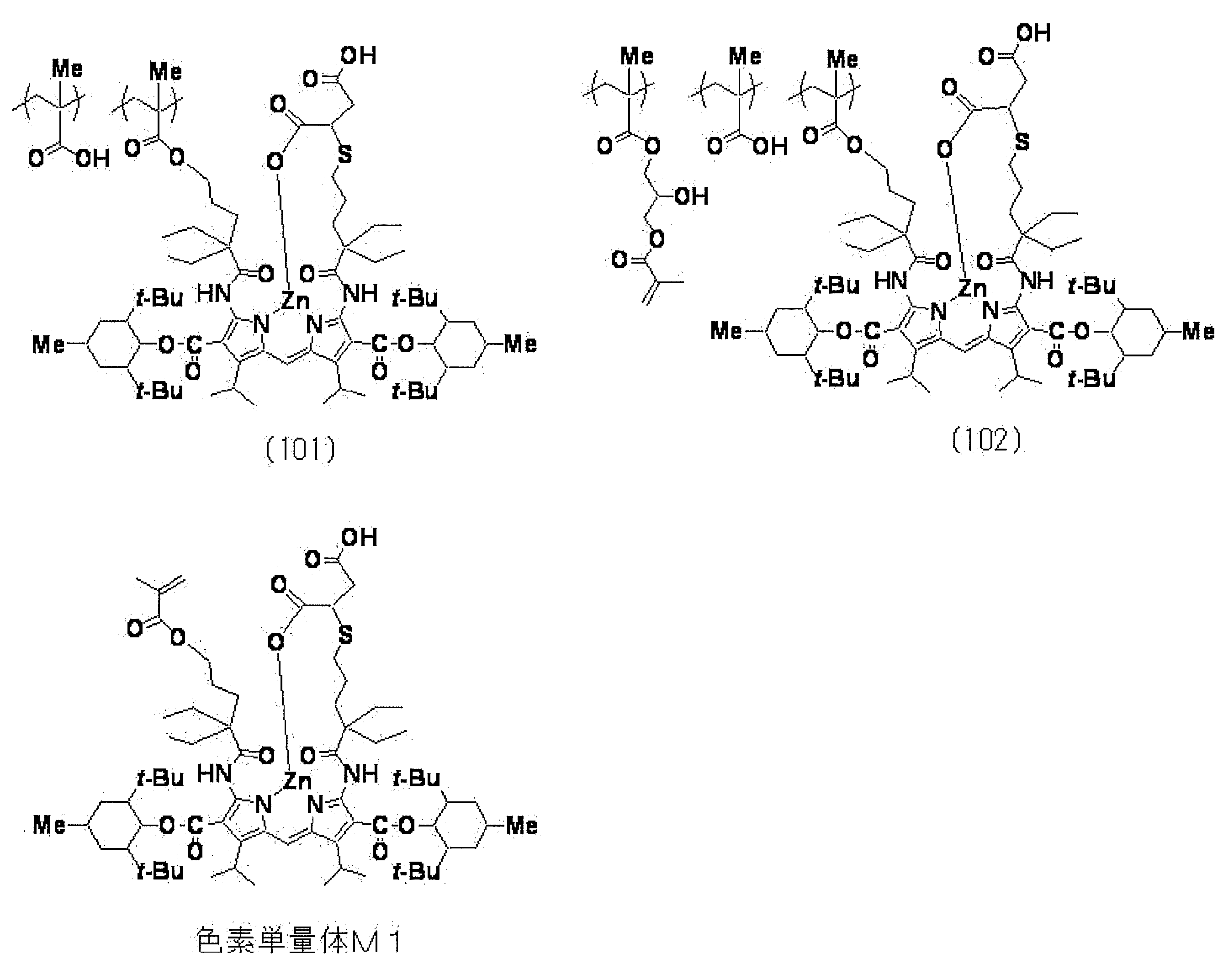
色素としてトリフェニルメタン色素である色素単量体M2を用い、下記式(103)で示される構造の色素多量体である染料eを合成した。以下、詳細な操作を説明する。

特開2000-162429号公報に記載の方法により染料d(色素単量体M2)を合成した。
色素としてアントラキノン色素である色素単量体M3を用い、以下のようにして式(104)で示される構造の染料iを合成した。

色素単量体の種類を下記表1に示すようにしたこと以外は、染料iの合成と同様にして、染料j~染料uを合成した。
下記表1において、色素単量体M4~M15、及び、式(105)~式(116)は以下の通りである。
ここで、色素単量体M4及び色素単量体M5はアントラキノン色素であり、色素単量体M6はスクアリリウム色素であり、色素単量体M7はシアニン色素であり、色素単量体M8はフタロシアニン色素であり、色素単量体M9はサブフタロシアニン色素であり、色素単量体M10はキノフタロン色素であり、色素単量体M11はキサンテン色素であり、色素単量体M12~色素単量体M15はアゾ色素である。
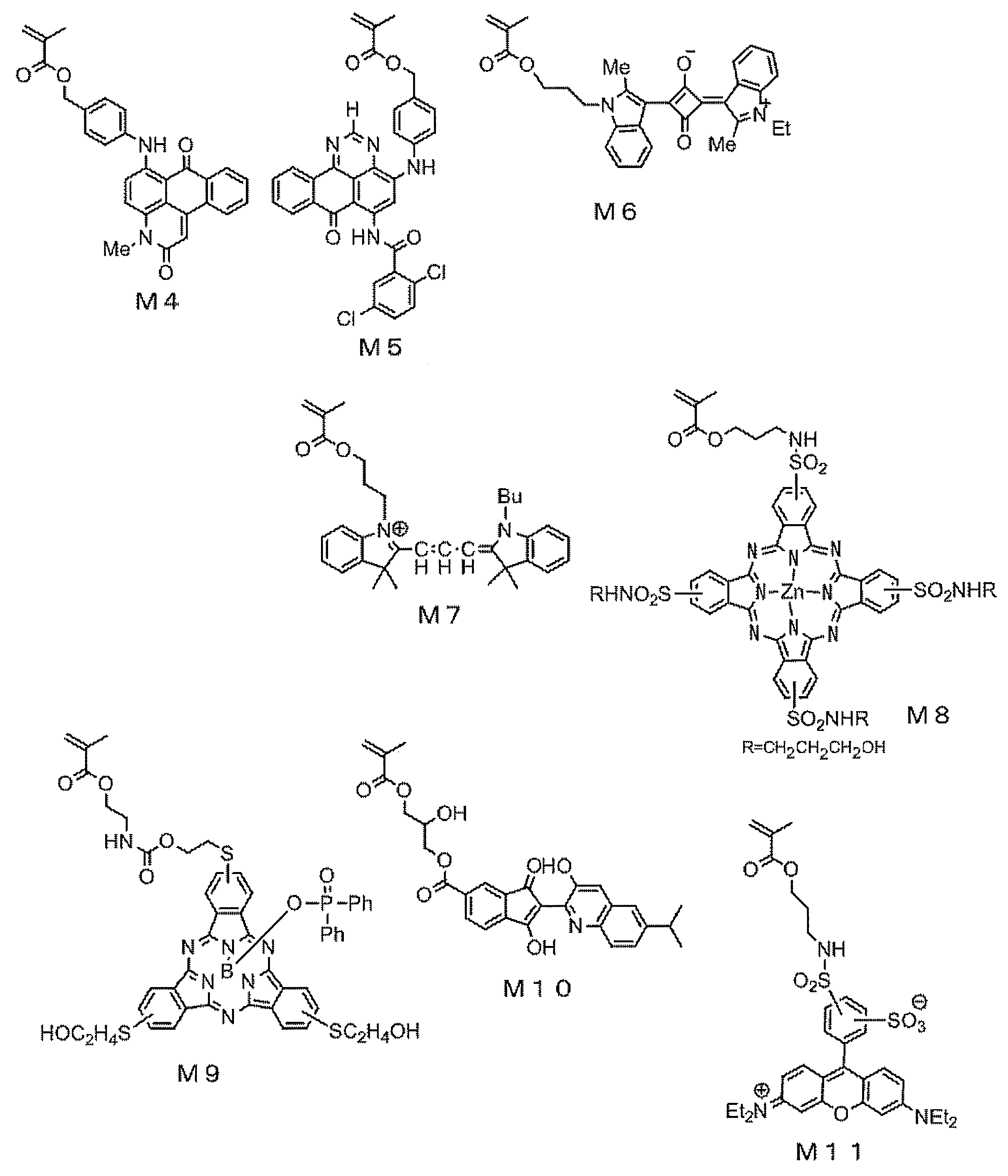


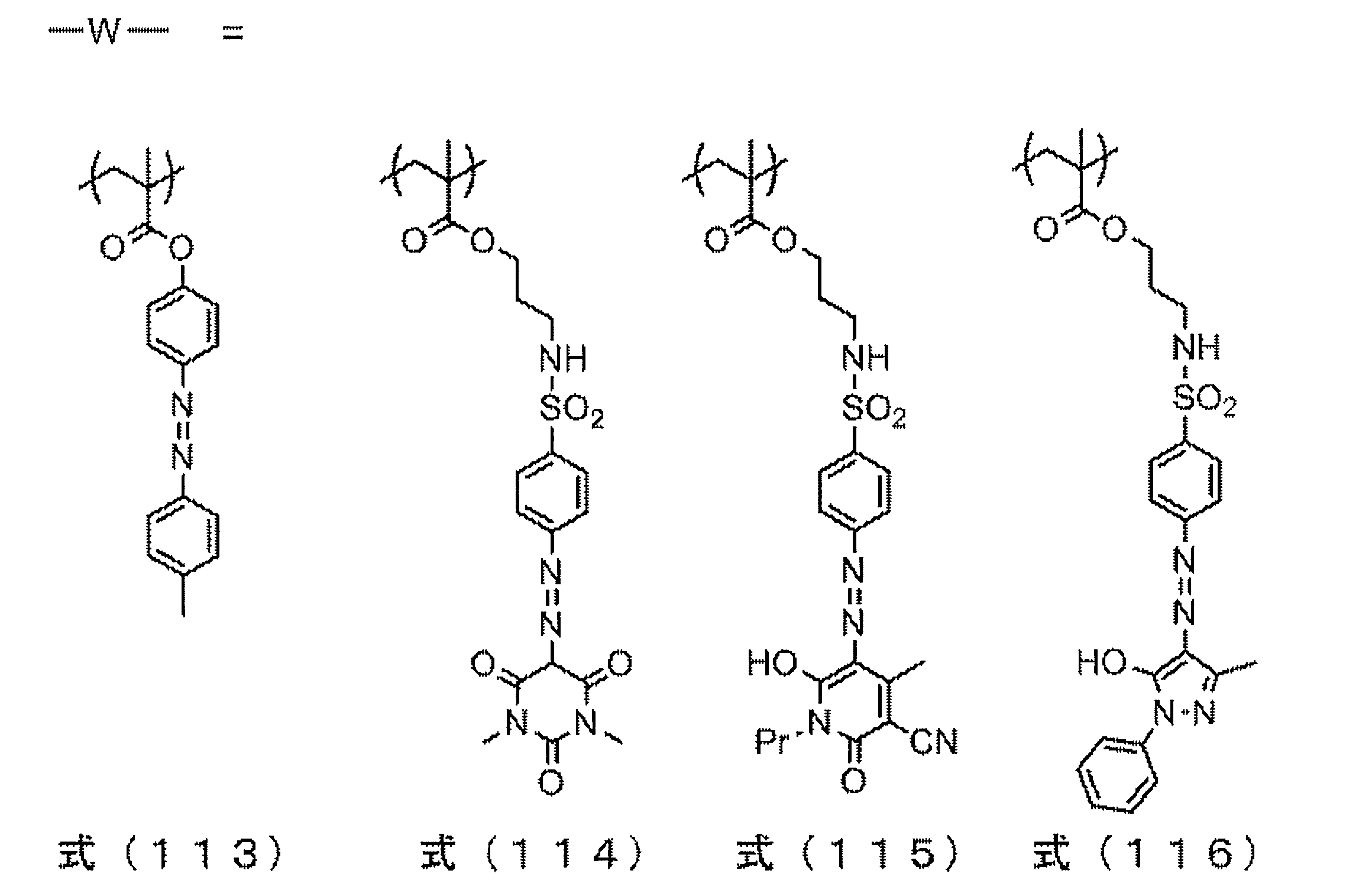

<染料aa(色素単量体M-21)の合成例>
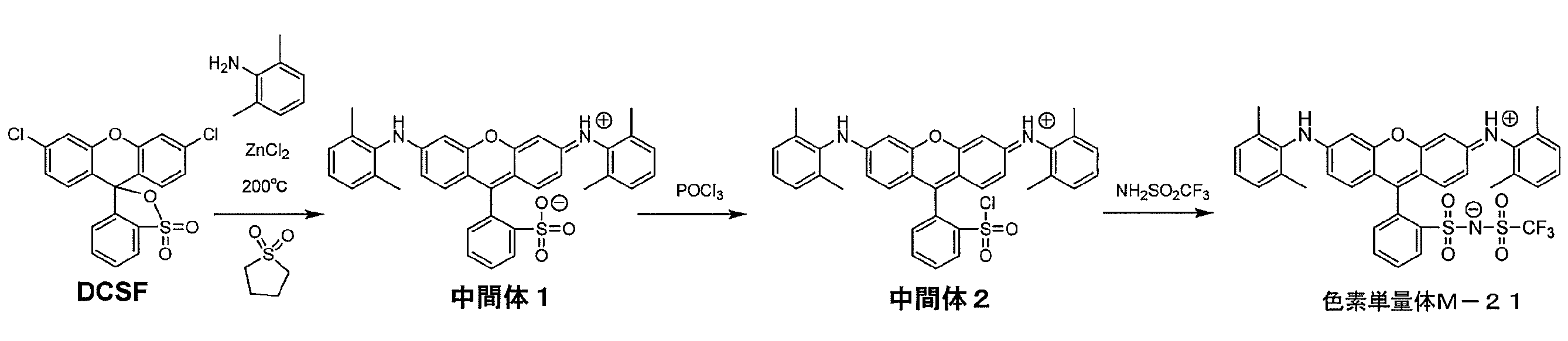
DCSF(中外化成製)50部、2,6-ジメチルアニリン74.76部、塩化亜鉛27.58部、スルホラン200部をフラスコへ入れ外温200度にて4時間攪拌した。その後、室温まで放冷し、2N塩酸500部へ滴下し、析出した結晶をろ別した。結晶を、アセトニトリル300部を40度で分散洗浄し、ろ取し、送風乾燥10時間をし、中間体1を46.5部(収率:65.6%)得た。
中間体1を20部およびオキシ塩化リン106部をフラスコへ入れ60℃で2時間攪拌した。室温まで放冷し、氷水1500部へ反応液を滴下し、30分攪拌した。得られた結晶をろ別し、水200部で洗浄し、送風乾燥10時間し、中間体2を18.5部(収率:89.4%)得た。
中間体2を7部、トリフルオロメチルスルホンアミド1.94部をクロロホルム40部に溶解させ、トリエチルアミン1.55部を滴下し、室温にて1時間攪拌した。その後、水100部を入れ水洗し、有機層を硫酸ナトリウムにて乾燥させ、カラムクロマトグラフィーにて精製し、減圧濃縮をして染料aa(3部(収率:36%))を得た。
<染料ab(色素単量体M-22)の合成例>
p-アセトキシスチレンを50部、酢酸エチル150部、ナトリウムメトキシド メタノール溶液28%89.2部をフラスコへ入れ室温下で1時間撹拌した。反応液に対して1規定塩酸水500部を加え、酢酸エチル層を洗浄し、その後酢酸エチル層を硫酸マグネシウムにて乾燥した。その溶液に対しトリエチルアミン4.63部を加え、0℃まで冷却し、三菱マテリアル社製EF-3000を13.8部を冷却下で滴下し、30分撹拌した。その後、アンモニア水溶液500部を加え30分撹拌した。反応液を1規定塩酸水で中和し、その後飽和食塩水500部にて水洗し、硫酸マグネシウムにて乾燥し、減圧濃縮を行った。残渣をシリカゲルカラムクロマトグラフィー(クロロホルム/メタノール=8/2の展開溶媒)にて精製し、中間体3を3部得た。
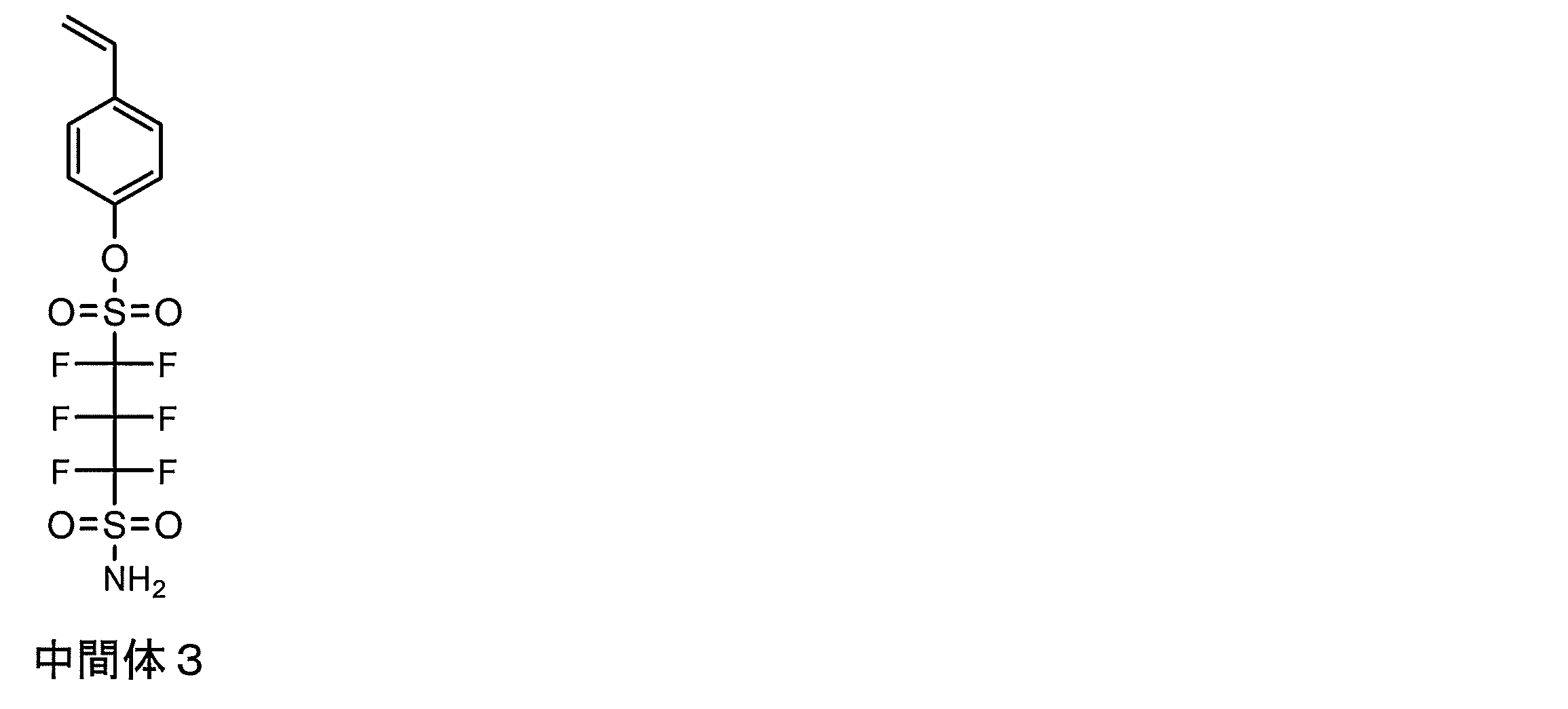
中間体3 3部、トリエチルアミン0.7部を塩化メチレン12部に溶解させ、中間体2 4.6部を加え室温下で1時間撹拌させた。反応液へ水50部を加え、水洗し、硫酸マグネシウムにて乾燥後、シリカゲルカラムクロマトグラフィー(クロロホルム/メタノール=8/2の展開溶媒)にて精製し、染料ab(色素単量体M-22)を0.8部得た。

<染料ac(色素単量体M-23)の合成例>
中間体1の合成における、2,6-ジメチルアニリンを2,6-ジイソプロピルアニリンに変更する以外は<染料ab(色素単量体M-22)>と同様にして、染料ac(色素単量体M-23)を合成した。

<染料ad・aeの合成>
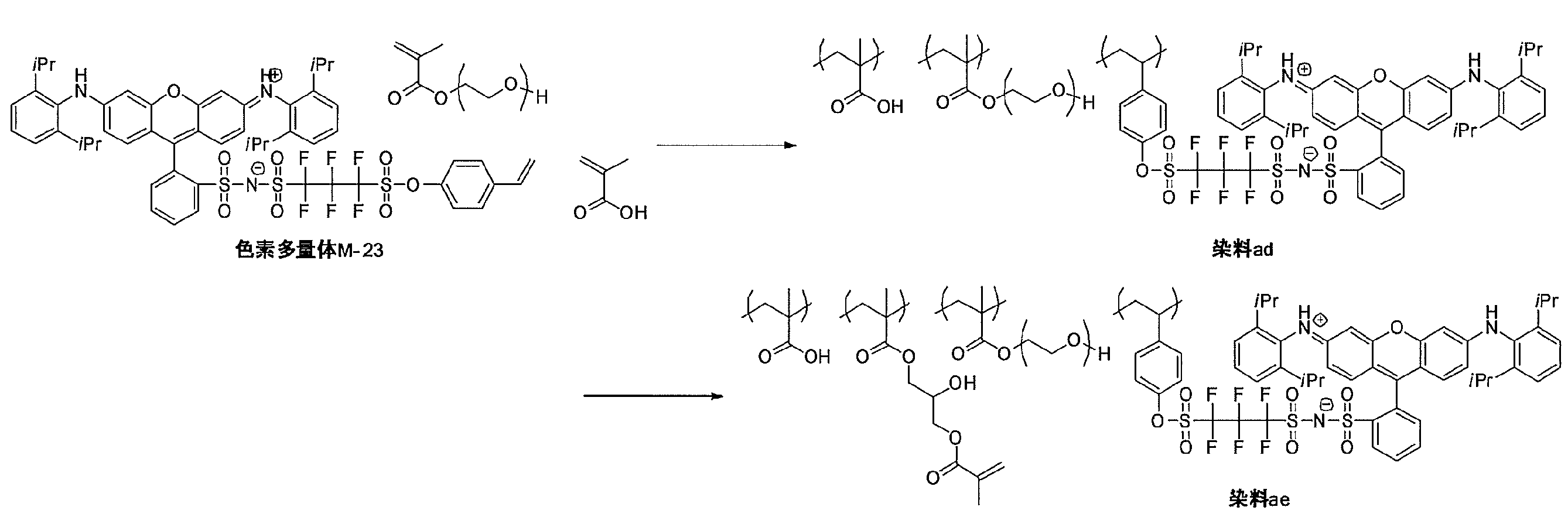
三口フラスコに上記で得られた染料ad(12.5g)、メタクリル酸グリシジル(2.19g)、テトラエチルアンモニウムブロミド(0.40g)、p-メトキシフェノール(0.015g)、シクロヘキサノン(83.3g)を添加し、空気下105℃で4時間攪拌した。その後、室温まで放冷し、酢酸エチル/アセトニトリル=748mL/39mLの混合溶媒に滴下して再沈した。40℃で送風乾燥を1日行った後、色素多量体である染料aeを6.52g得た。染料aeは酸価1.01mmol/gであり、組成比(モル比)を1H-NMRで確認したところ、色素部:メタクリル酸部:重合性基含有部:PE-90部=20:36:32:12であった。
<染料al~arの合成>
合成例8における色素単量体M-23及びポリエチレングリコールモノメタクリレートを、下記表3に記載の繰り返し単位となるようにモノマーを変更する以外は同様の操作を行い、合成した。
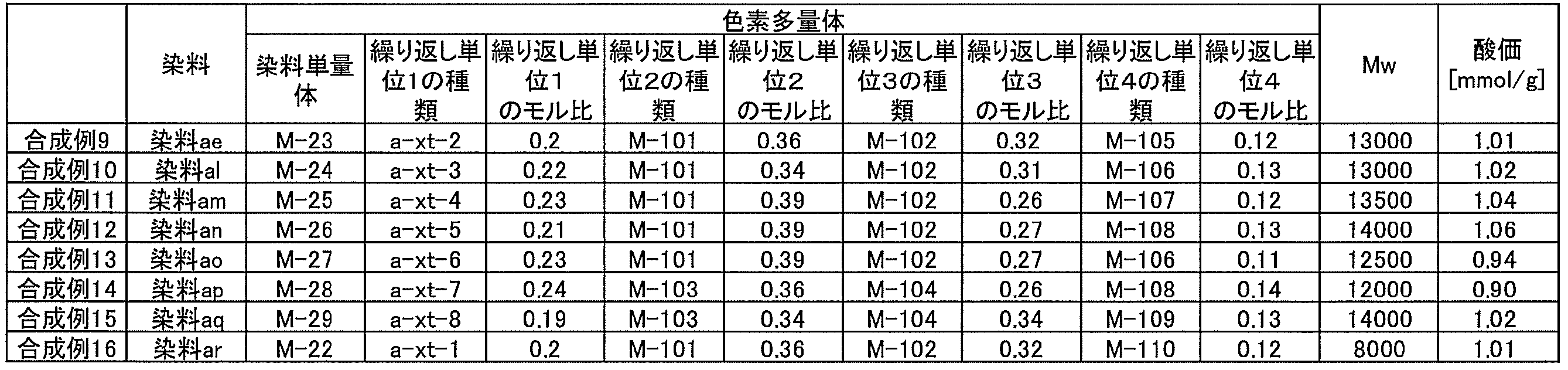

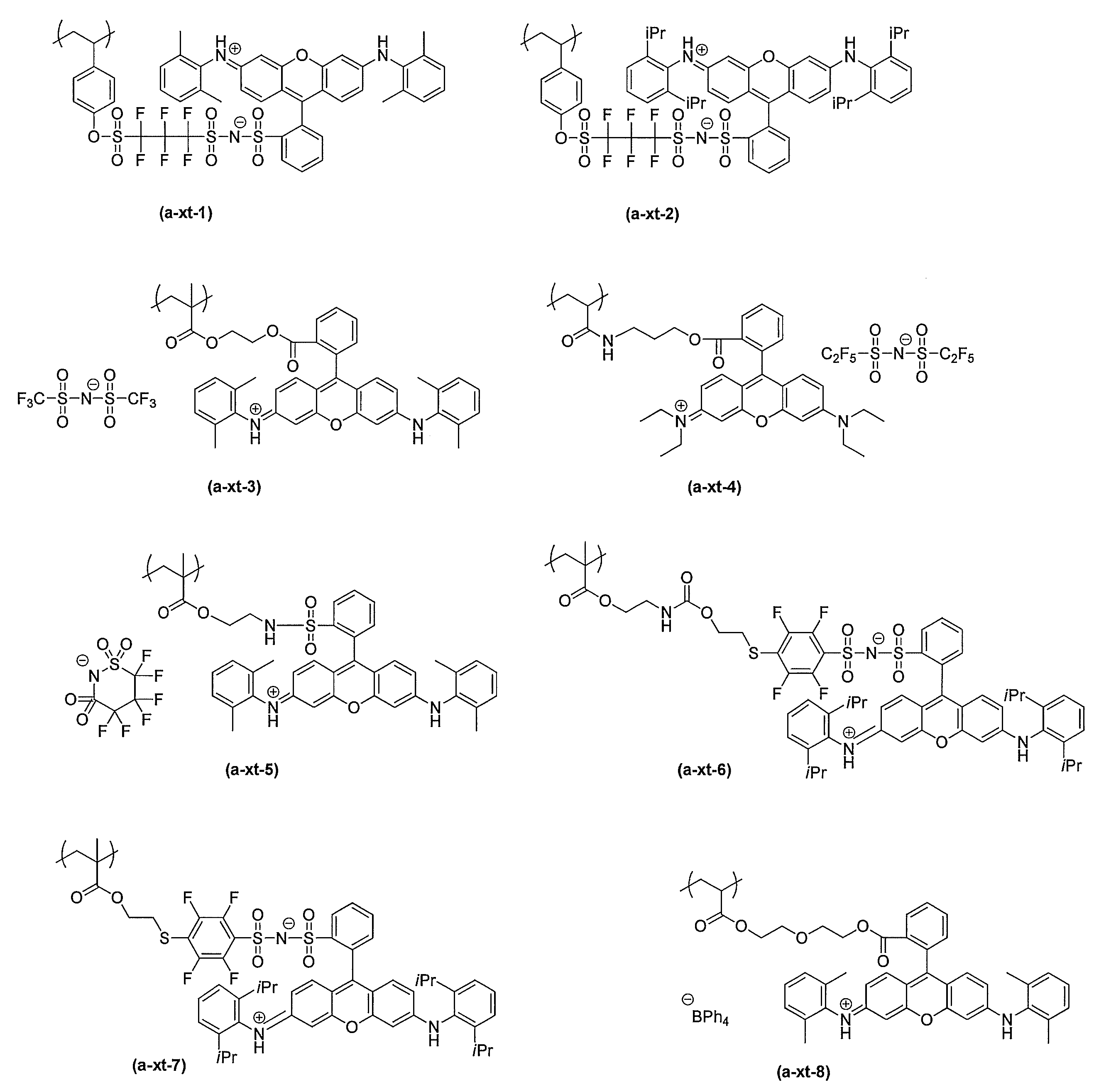
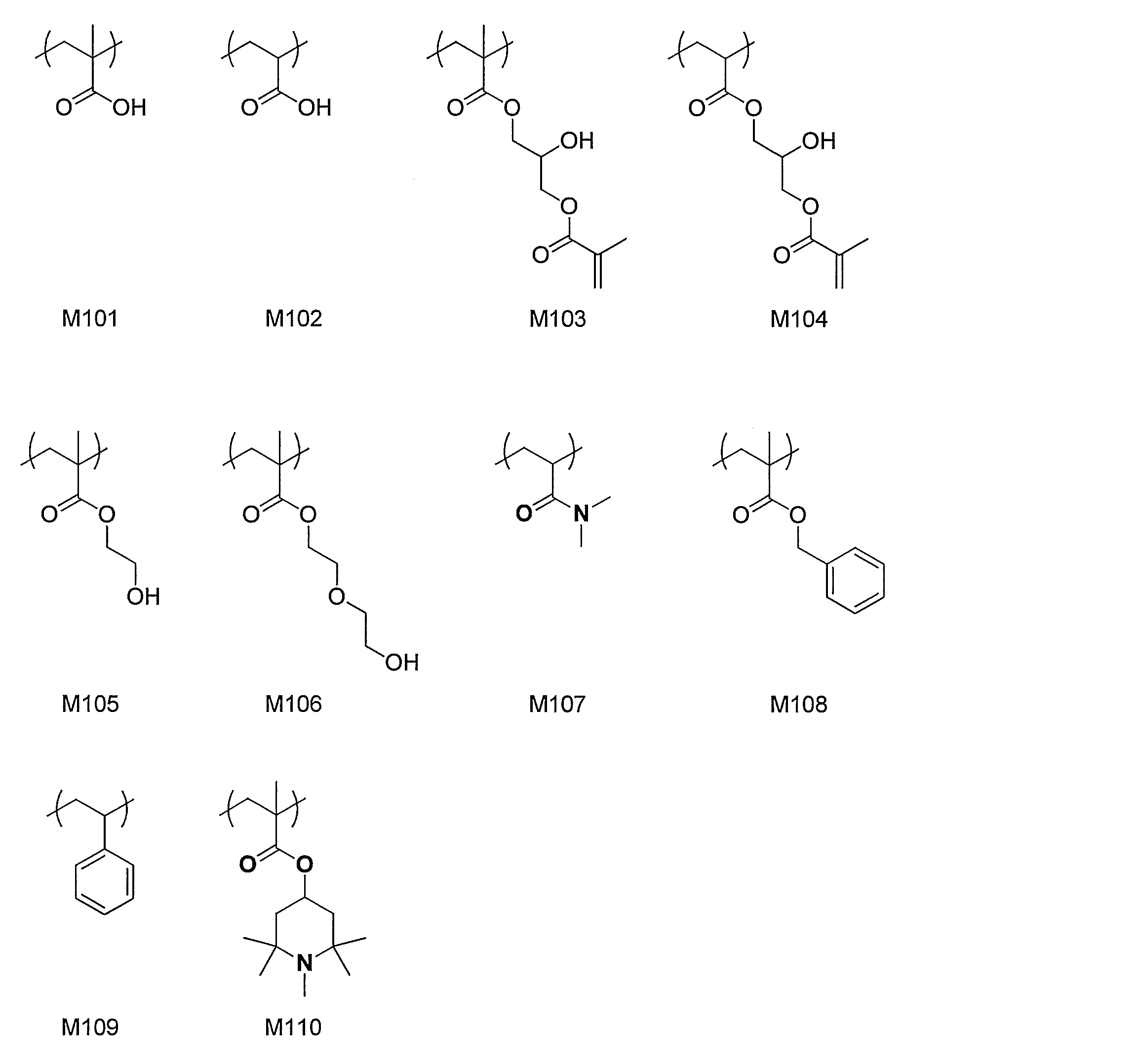
下記スキームに従って染料atを合成した。

下記スキームに従って染料auを合成した。
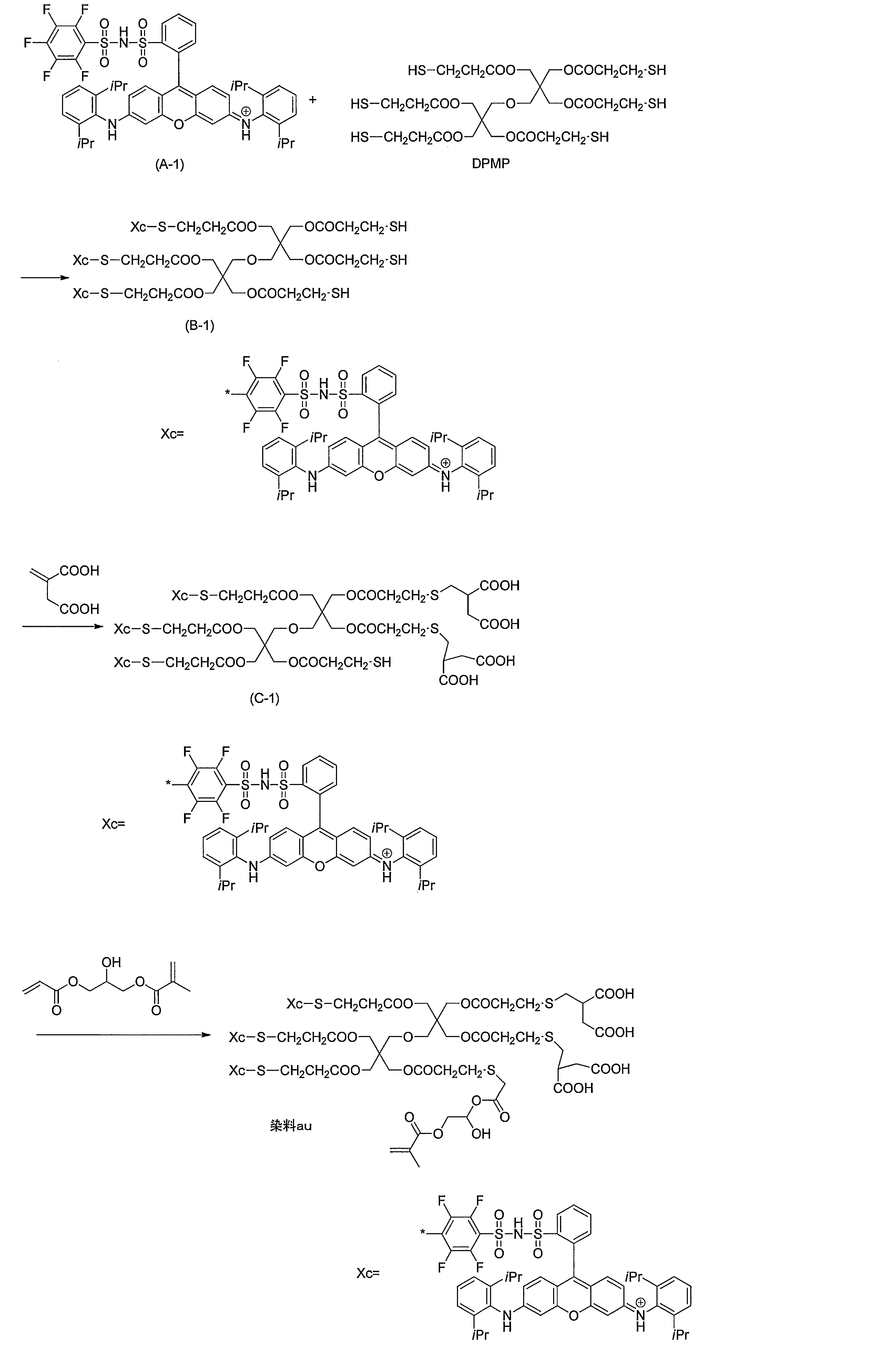
続いて、(B-1)6.0gとイタコン酸0.44gをN-メチル-2-ピロリドン(NMP)15.0gに溶かし、窒素雰囲気下90℃で攪拌し溶解させた。そこに2,2’-アゾビス(イソ酪酸)ジメチル)〔商品名:V601、和光純薬工業(株)製〕0.020gを添加し、90℃2時間加熱攪拌した。さらにV-601を0.020g添加し、90℃2時間加熱攪拌した。得られた反応液をヘキサン100mL・酢酸エチル100mLの混合溶媒に滴下して得られた固体をろ過し(C-1)を4.5g得た。
(C-1)4.5g、2-ヒドロキシ-3-アクリロイロキシプロピルメタクリレート0.26g、トリエチルアミン0.02gをDMF11gに溶解し、室温で16時間攪拌した。得られた反応液をヘキサン75mL・酢酸エチル75mLの混合溶媒に滴下して得られた固体をろ過し染料auを4.0g得た。
(顔料分散液P1:PR254/PY139を含有する分散液の調製)
Pigment Red 254を9.6部、Pigment Yellow 139を4.3部、顔料分散剤BYK-161(BYK社製)を6.8部、プロピレングリコールメチルエーテルアセテート(以下、「PGMEA」と称する。)79.3部からなる混合液を、ビーズミル(ジルコニアビーズ0.3mm径)により3時間混合・分散して、顔料分散液を調製した。その後さらに、減圧機構付き高圧分散機NANO-3000-10(日本ビーイーイー(株)製)を用いて、2000kg/cm3の圧力下で流量500g/minとして分散処理を行なった。この分散処理を10回繰り返し、顔料分散液P1を得た。
Pigment Green 36を5.9部、Pigment Green 7を5.5部、Pigment Yellow 139を5.1部、顔料分散剤BYK-161(BYK社製)を8.1部、PGMEA75.4部からなる混合液を、ビーズミル(ジルコニアビーズ0.3mm径)により3時間混合・分散して、顔料分散液を調製した。その後さらに、減圧機構付き高圧分散機NANO-3000-10(日本ビーイーイー(株)製)を用いて、2000kg/cm3の圧力下で流量500g/minとして分散処理を行なった。この分散処理を10回繰り返し、顔料分散液P2を得た。
Pigment Blue 15:6を9.5部、Pigment Violet 23を2.4部、顔料分散剤BYK-161(BYK社製)を5.6部、PGMEA82.5部からなる混合液を、ビーズミル(ジルコニアビーズ0.3mm径)により3時間混合・分散して、顔料分散液を調製した。その後さらに、減圧機構付き高圧分散機NANO-3000-10(日本ビーイーイー(株)製)を用いて、2000kg/cm3の圧力下で流量500g/minとして分散処理を行なった。この分散処理を10回繰り返し、顔料分散液P3を得た。
(着色感放射線性組成物Red-1の調製)
上記で得られた顔料分散液P1を用い、下記組成となるよう各成分を混合、撹拌して、赤色の着色感放射線性組成物Red-1を調製した。
<着色感放射線性組成物Red-1の組成>
・顔料分散液P1:169.74部
・アルカリ可溶性樹脂1(BzMAとMAAの共重合体(下記構造))、30%PGMEA溶液:7.25部
・アルカリ可溶性樹脂2(アクリキュア-RD-F8(日本触媒社製)):1.35部
・光重合性化合物(NKエステル A-DPH-12E(新中村化学社製)):3.41部
・光重合開始剤l-1(IRGACURE OXE-01(下記構造、BASF社製)):0.98部
・界面活性剤1(メガファックF-781(DIC(株)製、0.2%3-エトキシプロピオン酸エチル溶液):4.17部
・界面活性剤2(パイオニンD-6112-W(竹本油脂(株)製):1.68部
・重合禁止剤(p-メトキシフェノール(1.0%PGMEA溶液)):0.002部
・有機溶剤1(PGMEA):4.17部
・有機溶剤2(3-エトキシプロピオン酸エチル(以下、「EEP」と称する。)):7.24部

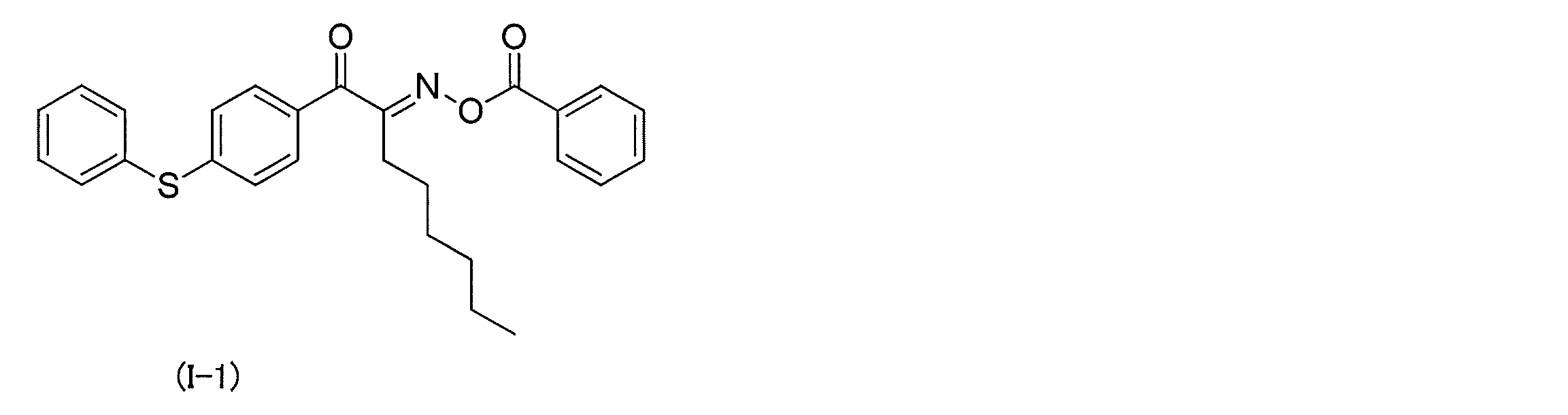
顔料分散液P1を顔料分散液P2に変更する以外は、Red-1の調製と同様にして、緑色の着色感放射線性組成物Green-1を調製した。
顔料分散液P1を顔料分散液P3に変更する以外は、Red-1の調製と同様にして、青色の着色感放射線性組成物Blue-1を調製した。
(低分子染料使用)
<実施例1>
(顔料分散液P4(C.I.Pigment Blue15:6分散液)の調製)
以下のようにして、顔料分散液P4(C.I.Pigment Blue15:6分散液)を調製した。
即ち、C.I.Pigment Blue15:6(青色顔料;以下、「PB15:6」とも称する)を19.4質量部(平均一次粒子径55nm)、及び顔料分散剤BY-161(BYK社製)を2.95質量部、アルカリ可溶性樹脂1を2.95質量部、PGMEA172.3質量部からなる混合液を、ビーズミル(beads mill)(ジルコニアビーズ0.3mm径)により3時間混合・分散した。その後、さらに、減圧機構付き高圧分散機NANO-3000-10(日本ビーイーイー(株)製)を用いて、2000kg/cm3の圧力下で流量500g/minとして分散処理を行なった。この分散処理を10回繰り返し、顔料分散液として、C.I.Pigment Blue15:6分散液を得た。得られたC.I.Pigment Blue15:6分散液について、顔料の平均一次粒子径を動的光散乱法(Microtrac Nanotrac UPA-EX150(日機装社(Nikkiso Co.,)td.)製))により測定したところ、24nmであった。
下記の各成分を混合して分散、溶解し、着色組成物(着色感放射線性組成物1)を得た。
(着色組成物1の組成)
・有機溶剤(PGMEA):17.12部
・アルカリ可溶性樹脂1(BzMAとMAAの共重合体、30%PGMEA溶液):1.23部
・アルカリ可溶性樹脂2(アクリキュア-RD-F8(日本触媒社製)):0.23部
・光重合開始剤l-1(IRGACURE OXE-01):0.975部
・染料aのシクロヘキサノン溶液(固形分濃度12.3%):24.57部
・顔料分散液P4(C.I.Pigment Blue15:6分散液、PGMEA溶液、固形分濃度12.8%):51.40部
・光重合性化合物(NKエステル A-DPH-12E(新中村化学社製)):1.31部
・重合禁止剤(p-メトキシフェノール):0.0007部
・フッ素系界面活性剤(DIC社製F475、1%PGMEA溶液):2.50部
・ノニオン系界面活性剤(エマルゲン408(花王)):0.65部
(顔料分散液P5~P10の調製)
下記の顔料分散液は、実施例1における「C.I.Pigment Blue15:6分散液の調製」において青色顔料として用いたC.I.Pigment Blue15:6に代えて、下記の顔料を用いたこと以外は実施例1における「C.I.Pigment Blue15:6分散液の調製」と同様にして調製した。
C.I.ピグメントレッド254(PR254)(平均一次粒子径26nm)
・赤色用顔料B(分散液は、表中「PR177」と記載) 顔料分散液P6
C.I.ピグメントレッド177(PR177)(平均一次粒子径28nm)
・緑色用顔料A 顔料分散液P7
C.I.ピグメントグリーン36(PG36)(平均一次粒子径25nm)
・緑色用顔料B 顔料分散液P8
C.I.ピグメントグリーン58(PG58)(平均一次粒子径30nm)
・黄色用顔料A 顔料分散液P9
C.I.ピグメントイエロー139(PY139)(平均一次粒子径27nm)
・黄色用顔料B 顔料分散液P10
C.I.ピグメントイエロー150(PY150)(平均一次粒子径26nm)
・紫色用顔料A 顔料分散液P11
C.I.ピグメントバイオレット23(PV150)(平均一次粒子径27nm)
実施例1における顔料分散液、染料、ノニオン系界面活性剤を下記表のように変えた以外は、実施例1における「着色組成物Blue2の調製」と同様にして、着色組成物Blue3~10、Green2、3を調製した。なお、下記表における染料aは色素単量体M1であり、染料dは色素単量体M2であり、染料fは色素単量体M13である。
なお、下記表中、ノニオン系界面活性剤の部分構造とは、上述したノニオン系界面活性剤の一般式(1)又は(2)を表す。また、下記表中「R1又はR2」とは、上述したノニオン系界面活性剤の一般式(1)又は(2)中のR1又はR2を表す。また、下記表中「n1又はn2」とは、上述したノニオン系界面活性剤の一般式(1)又は(2)中のn1又はn2を表す。また、下記表中「Mw」とは、上述したノニオン系界面活性剤の重量平均分子量を表す。
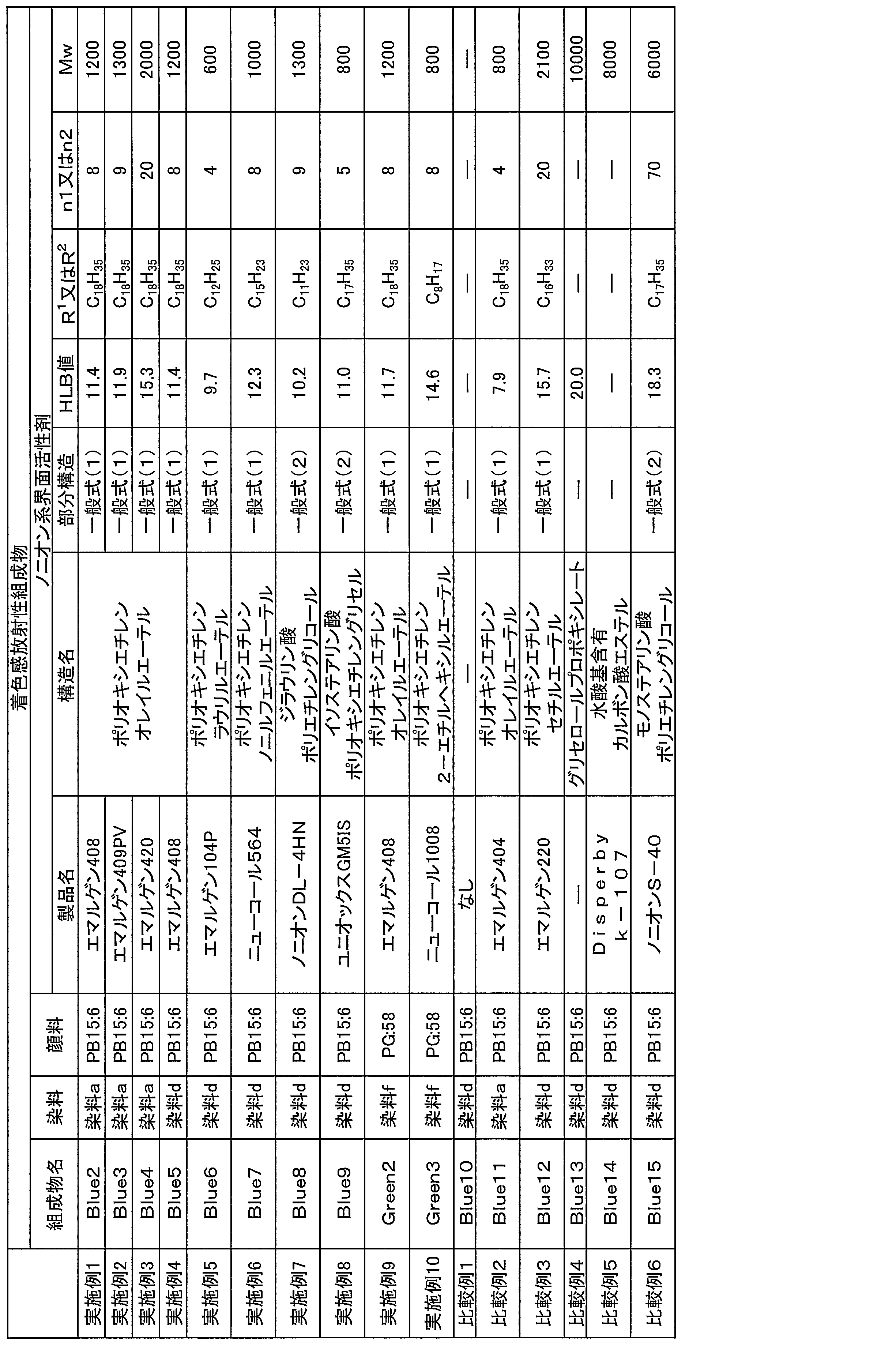
上記にて得られた、実施例1~10及び比較例1~6の着色感放射線性組成物を用いて、残渣混色について評価を行った。
評価に用いる下塗り層付ガラスウェハを以下のように作製した。
・プロピレングリコールモノメチルエーテルアセテート(PGMEA):19.20部
・乳酸エチル:36.67部
・バインダー((メタクリル酸ベンジル/メタクリル酸/メタクリル酸-2-ヒドロキシエチル)共重合体(モル比=60:20:20)41%EL溶液):30.51部
・ジペンタエリスリトールヘキサアクリレート:12.20部
・重合禁止剤(p-メトキシフェノール):0.006部
・フッ素系界面活性剤:0.83部
・光重合開始剤(TAZ-107(みどり化学社製)):0.59部
8インチガラスウェハ上に、下塗り層用組成物をスピンコートで均一に塗布して塗布膜を形成し、形成された塗布膜を120℃のホットプレート上で120秒間加熱処理した。尚、スピンコートの塗布回転数は、加熱処理後の塗布膜の膜厚が約0.5μmとなるように調整した。
加熱処理後の塗布膜を、さらに220℃のオーブンで1時間処理し、塗布膜を硬化させ、下塗り層とした。
以上のようにして、8インチガラスウェハ上に下塗り層が形成された、下塗り層付ガラスウェハを得た。
残渣混色の評価は、下記表に記載の着色感放射線性組成物を用いて行った。評価結果を下記表に示す。
カラーフィルタの1層目の着色パターン形成に用いる着色感放射線性組成物を、下塗り層付ガラスウェハ上に乾燥後の膜厚が1.0μmになるようにスピンコーターを用いて塗布し、100℃のホットプレートを用いて120秒間加熱処理(プリベーク)を行った。
次いで、i線ステッパー露光装置FPA-3000i5+(Canon(株)製)を使用して、365nmの波長光を1000mJ/cm2にて、2cm×2cmのパターンを有するマスクを介して露光した。
その後、露光された塗布膜が形成されているガラスウェハをスピン・シャワー現像機(DW-30型、(株)ケミトロニクス製)の水平回転テーブル上に載置し、CD-2000(富士フイルムエレクトロニクスマテリアルズ(株)製)の60%希釈液を用いて23℃で60秒間パドル現像を行い、ガラスウェハ上に着色パターンを形成した。
着色パターンが形成されたガラスウェハを真空チャック方式で水平回転テーブルに固定し、回転装置によってガラスウェハを回転数50rpmで回転させつつ、その回転中心の上方より純水を噴出ノズルからシャワー状に供給してリンス処理を行い、その後スプレー乾燥した。
さらに、200℃のホットプレートを用いて480秒間加熱処理(ポストベーク)を行い、1層目の着色パターンが形成された単色カラーフィルタを得た。
次いで、得られた積層カラーフィルタを1層目の着色画素の形成と同様にして、現像、リンス、乾燥処理を施して、未硬化部の着色感放射線性組成物層を現像除去した。
<判定基準>
A:ΔT%max<0.5%
B:0.5%<ΔT%max<1.0%
C:1.0%<ΔT%max<2.0%
D:2.0%<ΔT%max<5.0%
E:5.0%<ΔT%max
経時安定性の評価は、下記表に記載の着色感放射線性組成物を用いて行った。評価結果を下記表に示す。
4℃で3ヶ月保存した後の異物の析出度合いを、目視により下記判定基準に従って評価した。
<判定基準>
A:異物がまったくみられない
B:異物がみられるが実用上問題のないレベルである。
C:異物がみられ実用上問題となるレベルである。
D:著しく異物が多くみられ実用上問題となるレベルである。
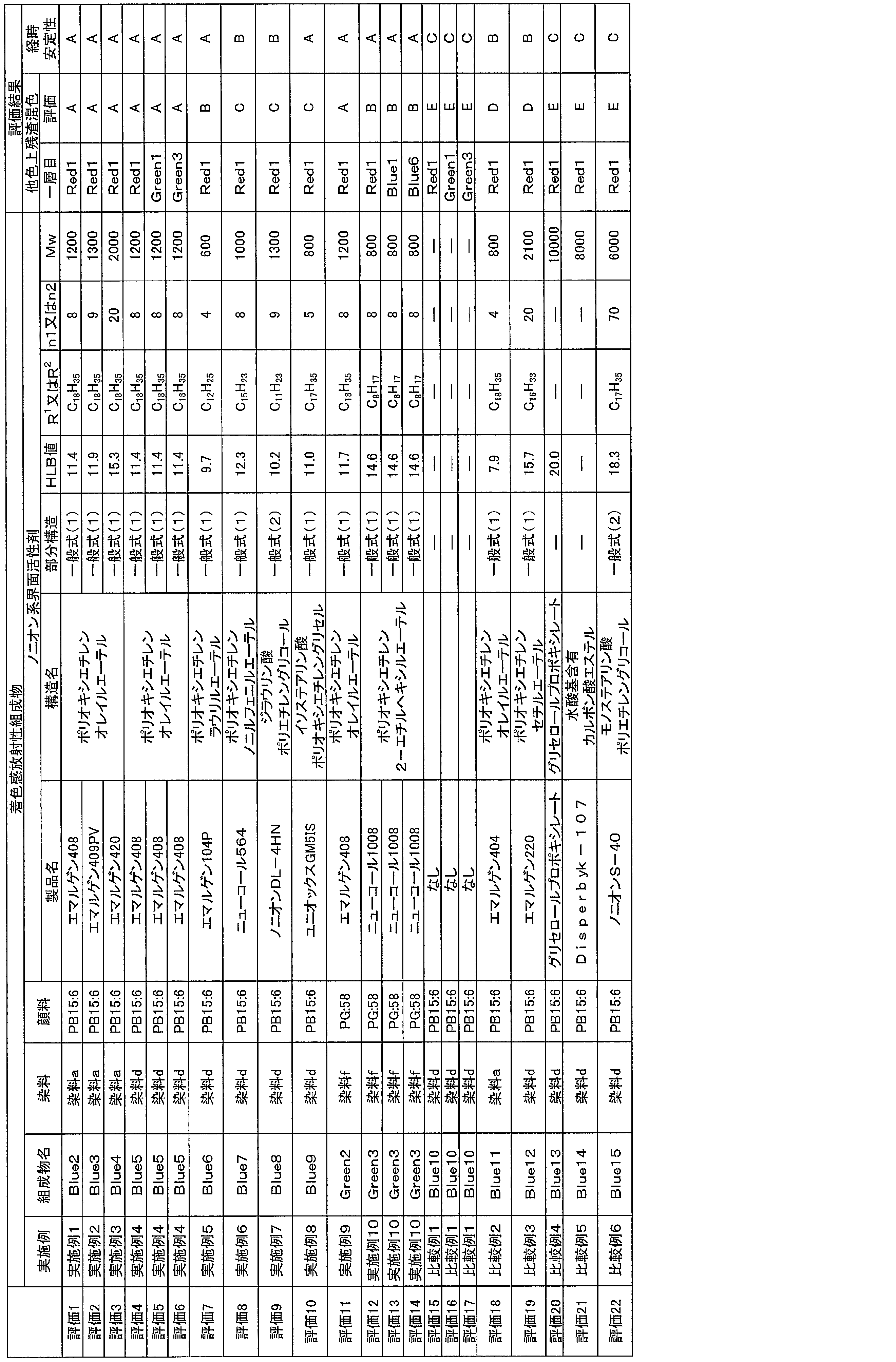
(高分子染料使用)
<実施例11~33、比較例7~14>
(着色組成物の調製)
実施例1における光重合開始剤をI-2(下記構造、IRGACURE OXE-02)に変更し、顔料分散液、染料、ノニオン系界面活性剤を下記表のように変えた以外は、実施例1における「着色組成物Blue2の調製」と同様にして、着色組成物Blue16~24、Green4~10、Red2~14を調製した。
なお、下記表中、ノニオン系界面活性剤の部分構造とは、上述したノニオン系界面活性剤の一般式(1)又は(2)を表す。また、下記表中「R1又はR2」とは、上述したノニオン系界面活性剤の一般式(1)又は(2)中のR1又はR2を表す。また、下記表中「n1又はn2」とは、上述したノニオン系界面活性剤の一般式(1)又は(2)中のn1又はn2を表す。また、下記表中「Mw」とは、上述したノニオン系界面活性剤の重量平均分子量を表す。
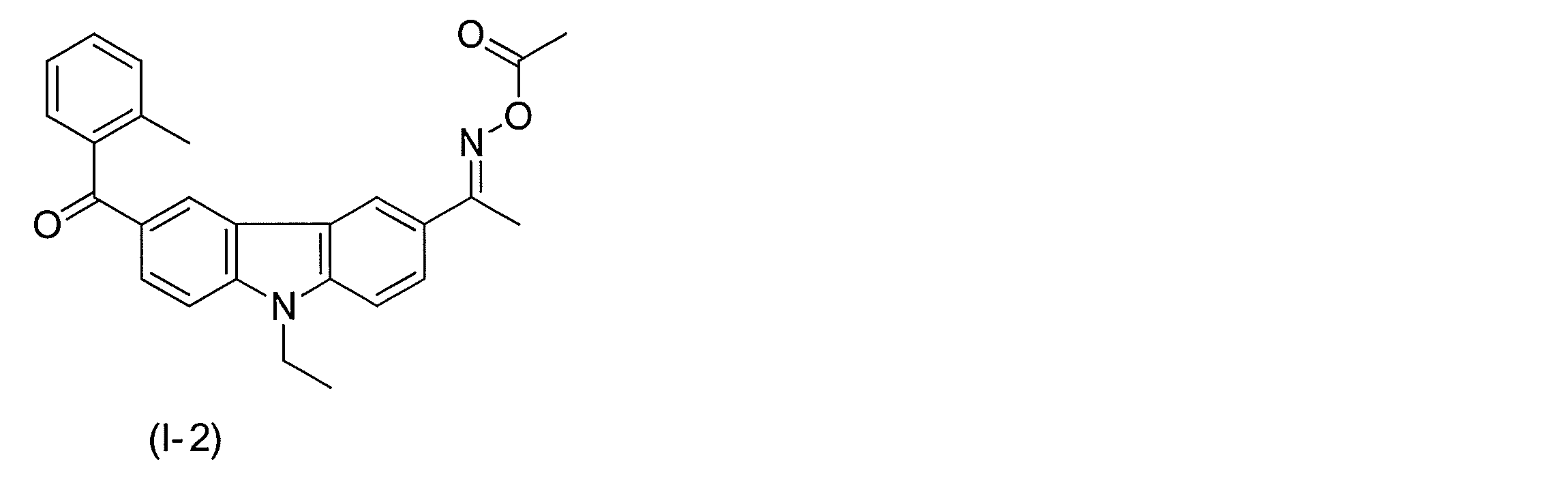
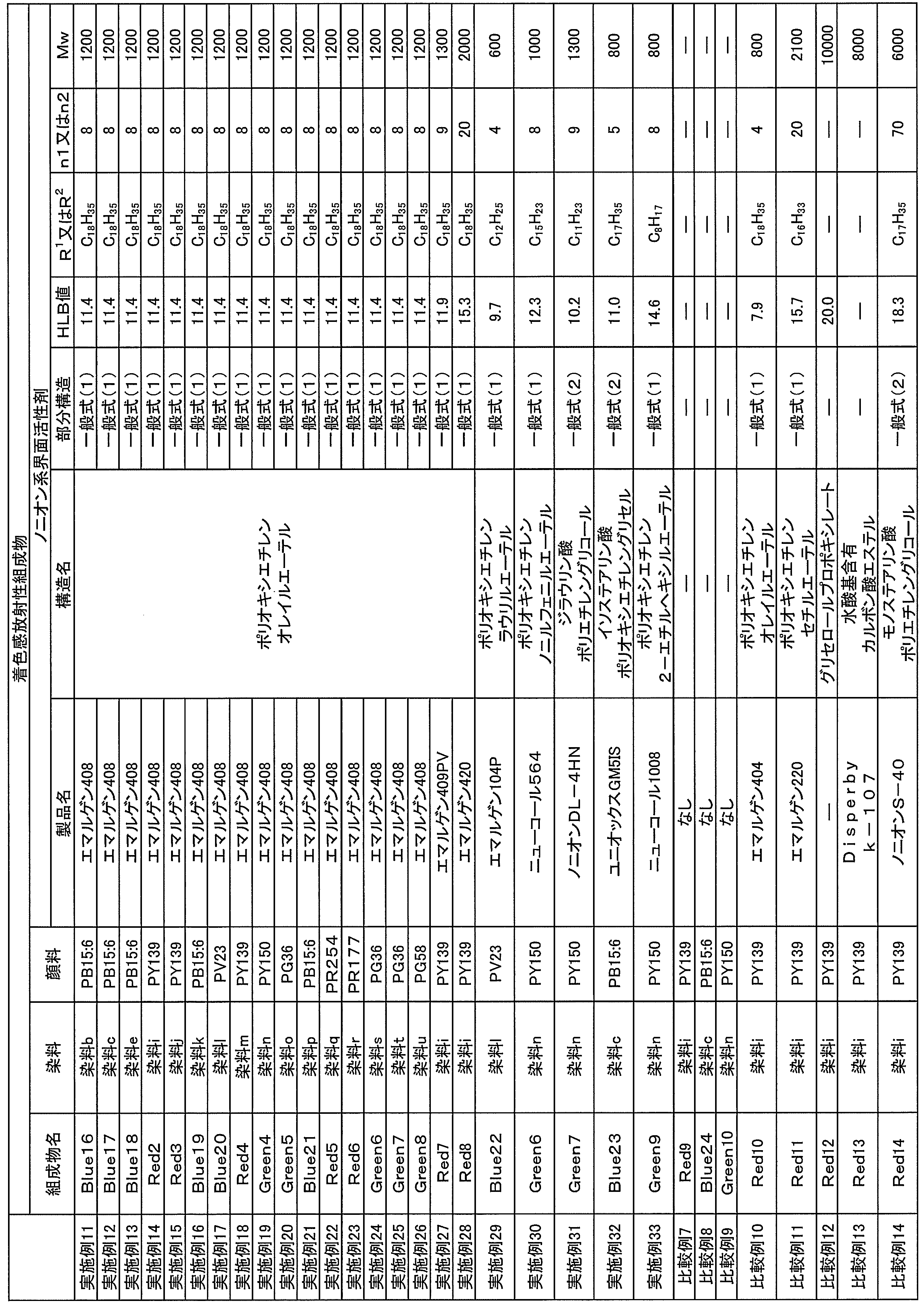
上記にて得られた、実施例11~33及び比較例7~14の着色感放射線性組成物を用いて、評価1~22と同様にして、残渣混色について評価23~59を行った。結果を下記表に示す。

(低分子染料使用2)
<実施例34>
(着色組成物Blue25の調製)
下記の各成分を混合して分散、溶解し、着色組成物Blue25を得た。
・有機溶剤(PGMEA):17.12部
・アルカリ可溶性樹脂J1(BzMAとMAAの共重合体、30%PGMEA溶液):1.23部
・アルカリ可溶性樹脂J2:0.23部
・光重合開始剤l-3(IRGACURE379):0.975部
・染料aaのシクロヘキサノン溶液(固形分濃度12.3%):24.57部
・顔料分散液P4(C.I.Pigment Blue15:6分散液、PGMEA溶液、固形分濃度12.8%):51.40部
・光重合性化合物(KARAYAD DPHA(日本化薬製)):1.31部
・重合禁止剤(p-メトキシフェノール):0.0007部
・フッ素系界面活性剤(DIC社製F475、1%PGMEA溶液):2.50部
・ノニオン系界面活性剤(エマルゲン408(花王)):0.65部
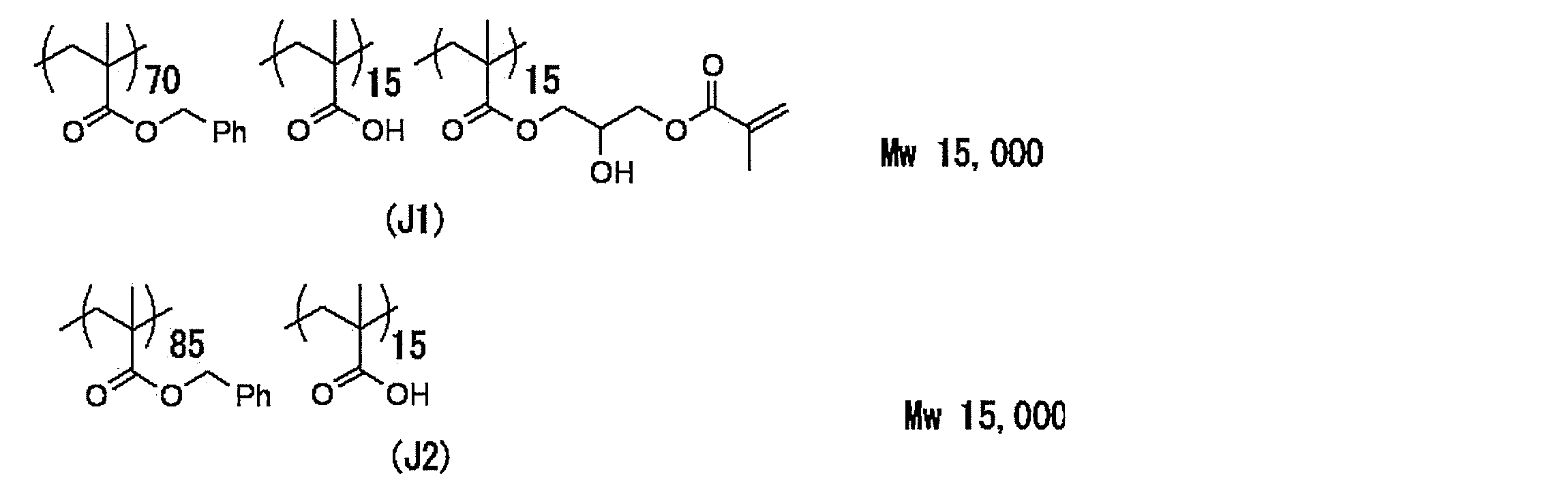
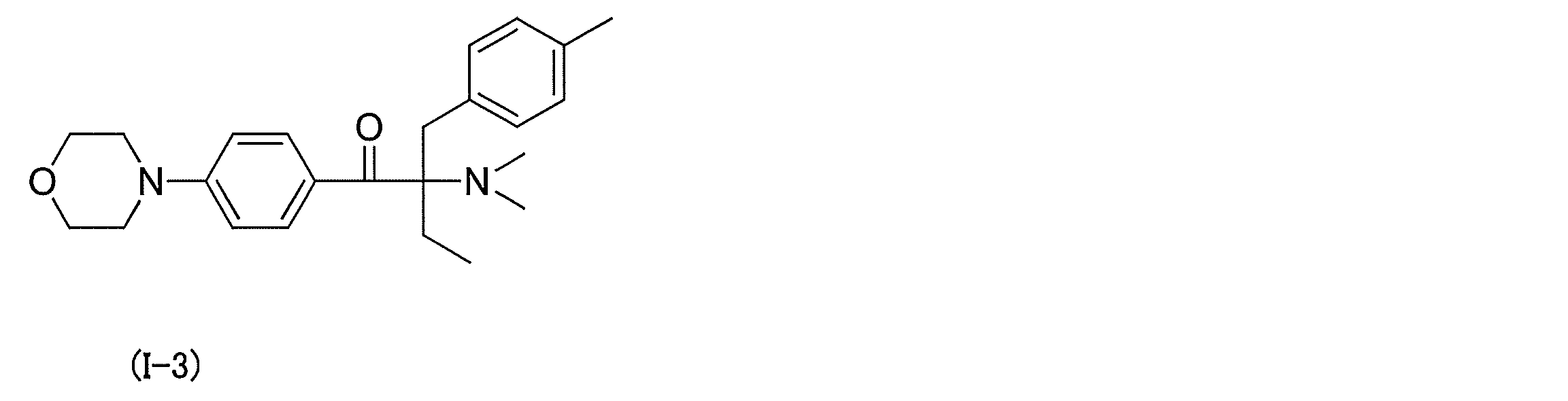
実施例34における顔料分散液、染料、ノニオン系界面活性剤を下記表のように変えた以外は、実施例34における「着色組成物Blue2の調製」と同様にして、着色組成物Blue26~39を調製した。
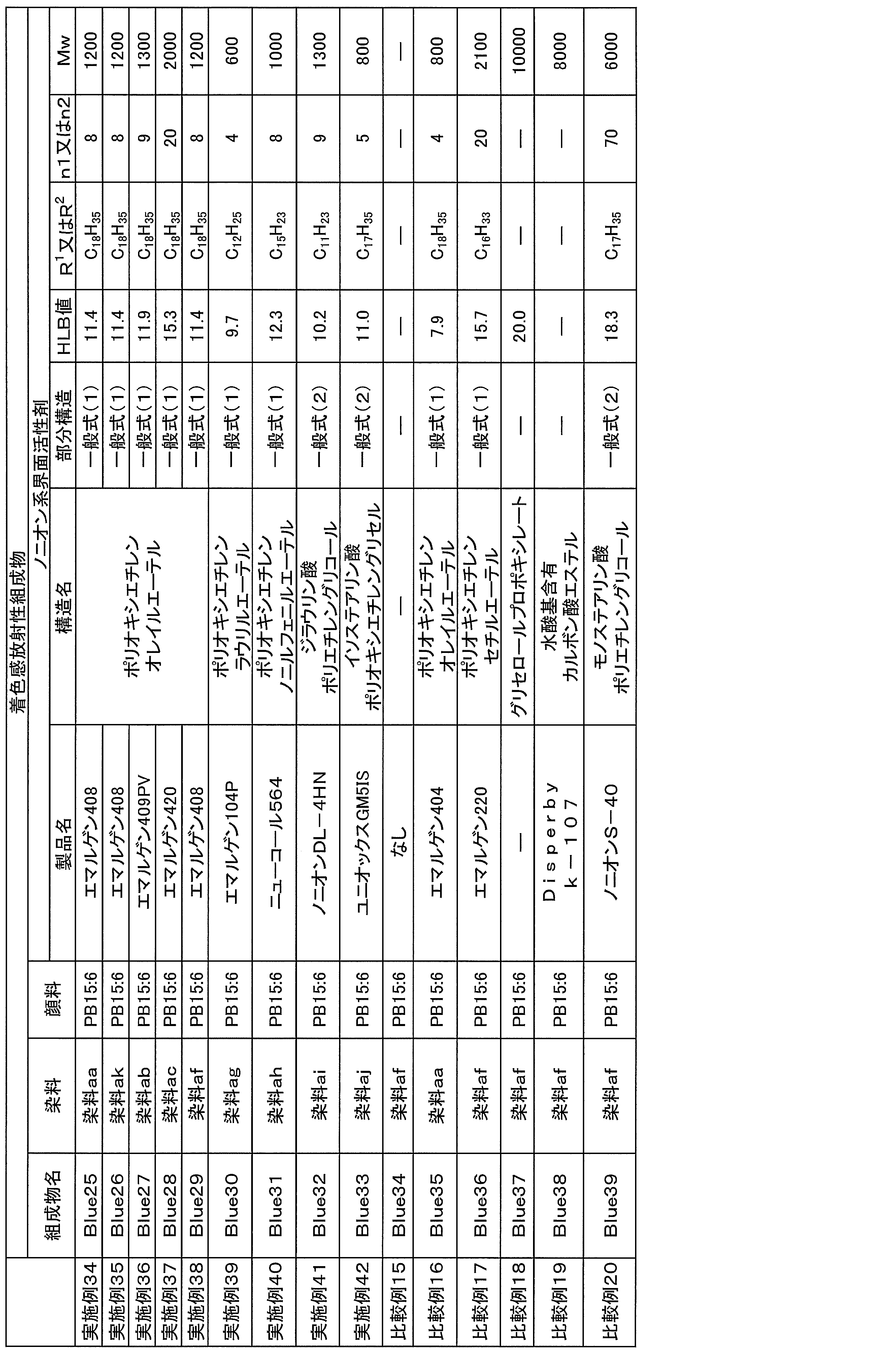
上記にて得られた、実施例34~42及び比較例15~20の着色感放射線性組成物を用いて、評価1~22と同様にして、残渣混色について評価23~59を行った。結果を下記表に示す。

(高分子染料使用2)
<実施例43>
(着色組成物Blue40の調製)
下記の各成分を混合して分散、溶解し、着色組成物Blue40を得た。
・有機溶剤(PGMEA):17.12部
・アルカリ可溶性樹脂1(BzMAとMAAの共重合体、30%PGMEA溶液):1.23部
・アルカリ可溶性樹脂2(アクリキュア-RD-F8(日本触媒社製)):0.23部
・光重合開始剤l-4:0.975部
・染料aeのシクロヘキサノン溶液(固形分濃度12.3%):24.57部
・顔料分散液P4(C.I.Pigment Blue15:6分散液、PGMEA溶液、固形分濃度12.8%):51.40部
・光重合性化合物(アロニックスTO2349(東亞合成社製)):1.31部
・重合禁止剤(p-メトキシフェノール):0.0007部
・フッ素系界面活性剤(DIC社製F475、1%PGMEA溶液):2.50部
・ノニオン系界面活性剤(エマルゲン408(花王)):0.65部


実施例34における顔料分散液、染料、ノニオン系界面活性剤を下記表のように変えた以外は、実施例34における「着色組成物Blue40の調製」と同様にして、着色組成物Blue41~51(実施例44~53、比較例21)を調製した。

上記にて得られた、実施例43~53及び比較例21の着色感放射線性組成物を用いて、評価1~22と同様にして、残渣混色について評価79~96を行った。結果を下記表に示す。

<固体撮像素子用のフルカラーのカラーフィルタの作製>
実施例33で調製した緑色用着色感放射線性組成物を用いて、1.0×1.0μmのアイランド ベイヤー(bayer)状パターンで緑色画素を形成し、次いで、実施例14で調製した赤色用着色感放射線性組成物を用いて1.0×1.0μmのアイランド(island)状パターンで赤色画素を形成し、さらに残りの格子の中に実施例12で調製した青色用着色感放射線性組成物を用いて1.0×1.0μmのアイランド状パターンの青色画素を形成して、遮光部固体撮像素子用のカラーフィルタを作製した。
得られた固体撮像素子用のフルカラーのカラーフィルタを固体撮像素子に組み込んだところ、固体撮像素子は、高解像度で、色分離性に優れることが確認された。
<液晶表示装置用カラーフィルタの作製>
ブラックマトリックス上に、実施例22で調製した赤色用着色感放射線性組成物を用いて、80×80μmの赤色(R)の着色パターンを形成した。さらに、同様にして実施例9で調製した緑色用着色感放射線性組成物を用いて緑色(G)、及び実施例8で調製した青色用着色感放射線性組成物を用いて青色(B)の着色パターンを順次形成して液晶表示装置用カラーフィルタを作製した。
<評価>
フルカラーのカラーフィルタにITO透明電極、配向膜等の加工を施し、液晶表示装置を設けた。本発明の着色感放射線性組成物は塗布面均一性が良好で、形成されたカラーフィルタは良好なパターン形状を有するため、カラーフィルタを備えた液晶表示装置は、表示ムラが無く、画質が良好であることが確認された。
101、102、103 画素
104 残渣
Claims (16)
- 染料、光重合性化合物、光重合開始剤、及び下記一般式(1)又は(2)で表される部分構造を有する重量平均分子量2500以下、かつ、グリフィン法によるHLB値が9.2~15.5であるノニオン系界面活性剤を含む、着色感放射線性組成物;

- 前記ノニオン系界面活性剤が下記一般式(3)で表される化合物である、請求項1に記載の着色感放射線性組成物;

- 前記ノニオン系界面活性剤が下記一般式(4)で表される化合物である、請求項1又は2に記載の着色感放射線性組成物;

- 前記染料の重量平均分子量が5000以上である、請求項1~3のいずれか1項に記載の着色感放射線性組成物。
- 前記着色感放射線性組成物の全固形分に対する前記染料を含む着色剤の濃度が50質量%以上である、請求項1~4のいずれか1項に記載の着色感放射線性組成物。
- 前記染料が、ジピロメテン色素、アゾ色素、アントラキノン色素、トリフェニルメタン色素、キサンテン色素、シアニン色素、スクアリリウム色素、キノフタロン色素、フタロシアニン色素及びサブフタロシアニン色素から選ばれる色素に由来する部分構造を有する、請求項1~5のいずれか1項に記載の着色感放射線性組成物。
- さらに、顔料を含有する請求項1~6のいずれか1項に記載の着色感放射線性組成物。
- さらに、アルカリ可溶性樹脂を含有する請求項1~7のいずれか1項に記載の着色感放射線性組成物。
- カラーフィルタの着色層形成に用いる請求項1~8のいずれか1項に記載の着色感放射線性組成物。
- 請求項1~9のいずれか1項に記載の着色感放射線性組成物を硬化してなる着色硬化膜。
- 請求項10に記載の着色硬化膜を有するカラーフィルタ。
- 前記着色硬化膜の厚さが0.2~1.5μmである、請求項11に記載のカラーフィルタ。
- 請求項1~9のいずれか1項に記載の着色感放射線性組成物を支持体上に適用して着色感放射線性組成物層を形成する着色感放射線性組成物層形成工程と、着色感放射線性組成物層をパターン状に露光する露光工程と、未露光部を現像除去して着色パターンを形成するパターン形成工程と、を含む着色パターン形成方法。
- 請求項1~9のいずれか1項に記載の着色感放射線性組成物を支持体上に適用して着色感放射線性組成物層を形成する着色感放射線性組成物層形成工程と、着色感放射線性組成物層をパターン状に露光する露光工程と、未露光部を現像除去して着色パターンを形成するパターン形成工程と、を含むカラーフィルタの製造方法。
- 請求項11又は12に記載のカラーフィルタ又は請求項14に記載のカラーフィルタの製造方法により得られたカラーフィルタを有する固体撮像素子。
- 請求項11又は12に記載のカラーフィルタ又は請求項14に記載のカラーフィルタの製造方法により得られたカラーフィルタを有する画像表示装置。
Priority Applications (3)
| Application Number | Priority Date | Filing Date | Title |
|---|---|---|---|
| CN201480014595.4A CN105074570B (zh) | 2013-03-15 | 2014-03-12 | 着色感放射线性组合物与其用途 |
| KR1020157024940A KR101733965B1 (ko) | 2013-03-15 | 2014-03-12 | 착색 감방사선성 조성물, 착색 경화막, 컬러 필터, 착색 패턴 형성 방법, 컬러 필터의 제조 방법, 고체 촬상 소자 및 액정 표시 장치 |
| US14/853,306 US10216083B2 (en) | 2013-03-15 | 2015-09-14 | Radiation-sensitive colored compositions, cured colored films, color filters, processes for forming colored patterns, processes for preparing color filters, solid-state image sensors and liquid crystal display devices |
Applications Claiming Priority (2)
| Application Number | Priority Date | Filing Date | Title |
|---|---|---|---|
| JP2013-054234 | 2013-03-15 | ||
| JP2013054234 | 2013-03-15 |
Related Child Applications (1)
| Application Number | Title | Priority Date | Filing Date |
|---|---|---|---|
| US14/853,306 Continuation US10216083B2 (en) | 2013-03-15 | 2015-09-14 | Radiation-sensitive colored compositions, cured colored films, color filters, processes for forming colored patterns, processes for preparing color filters, solid-state image sensors and liquid crystal display devices |
Publications (1)
| Publication Number | Publication Date |
|---|---|
| WO2014142144A1 true WO2014142144A1 (ja) | 2014-09-18 |
Family
ID=51536796
Family Applications (1)
| Application Number | Title | Priority Date | Filing Date |
|---|---|---|---|
| PCT/JP2014/056410 Ceased WO2014142144A1 (ja) | 2013-03-15 | 2014-03-12 | 着色感放射線性組成物、着色硬化膜、カラーフィルタ、着色パターン形成方法、カラーフィルタの製造方法、固体撮像素子及び液晶表示装置 |
Country Status (6)
| Country | Link |
|---|---|
| US (1) | US10216083B2 (ja) |
| JP (1) | JP6008891B2 (ja) |
| KR (1) | KR101733965B1 (ja) |
| CN (1) | CN105074570B (ja) |
| TW (1) | TWI567490B (ja) |
| WO (1) | WO2014142144A1 (ja) |
Cited By (1)
| Publication number | Priority date | Publication date | Assignee | Title |
|---|---|---|---|---|
| WO2015098804A1 (ja) * | 2013-12-25 | 2015-07-02 | 富士フイルム株式会社 | 着色組成物、およびこれを用いた硬化膜、カラーフィルタ、パターン形成方法、カラーフィルタの製造方法、固体撮像素子および画像表示装置 |
Families Citing this family (18)
| Publication number | Priority date | Publication date | Assignee | Title |
|---|---|---|---|---|
| JP6299329B2 (ja) * | 2013-04-09 | 2018-03-28 | Jsr株式会社 | 着色組成物、着色硬化膜及び表示素子 |
| JP6159309B2 (ja) | 2014-01-31 | 2017-07-05 | 富士フイルム株式会社 | 着色組成物、硬化膜、カラーフィルタ、カラーフィルタの製造方法、固体撮像素子および画像表示装置 |
| CN111221217B (zh) * | 2014-12-24 | 2024-03-12 | Dnp精细化工股份有限公司 | 色材分散液、感光性着色树脂组合物、彩色滤光片、液晶显示设备、及有机发光显示设备 |
| TWI557486B (zh) * | 2014-12-31 | 2016-11-11 | 鴻海精密工業股份有限公司 | 薄膜電晶體基板、其製作方法及顯示面板 |
| HK1243446A1 (zh) * | 2015-04-20 | 2018-07-13 | 日本化药株式会社 | 含有二色性色素的组合物、使用该组合物制作的色素膜以及具有该色素膜的偏振元件 |
| US11104813B2 (en) * | 2015-06-02 | 2021-08-31 | Asahi Kasei Kabushiki Kaisha | Dispersion |
| KR102041836B1 (ko) | 2015-06-22 | 2019-11-07 | 후지필름 가부시키가이샤 | 네거티브형 경화성 착색 조성물, 경화막, 컬러 필터, 패턴 형성 방법 및 장치 |
| CN109155258B (zh) | 2016-04-08 | 2022-04-26 | 赫普塔冈微光有限公司 | 具有孔径的薄光电模块及其制造 |
| CN106646997A (zh) * | 2016-12-27 | 2017-05-10 | 深圳市华星光电技术有限公司 | 一种佳能光罩制作色阻层的挡板标识及其使用方法 |
| KR102025478B1 (ko) | 2017-11-28 | 2019-09-25 | 주식회사 엘지화학 | 착색제 조성물 제조방법, 이를 이용하여 제조된 착색제 조성물, 착색제 분산액, 감광성 수지 조성물, 컬러필터 및 액정 표시 장치 |
| TWI657116B (zh) * | 2017-12-19 | 2019-04-21 | 住華科技股份有限公司 | 著色樹脂組成物、及應用其之彩色濾光片和顯示裝置 |
| CN108089402B (zh) * | 2017-12-29 | 2019-10-11 | 深圳市华星光电技术有限公司 | 颜料分散体系及其制作方法与彩色光刻胶 |
| CN108508700B (zh) * | 2018-03-21 | 2020-03-17 | 深圳市华星光电技术有限公司 | 一种染料单体及彩色光刻胶 |
| CN110407970A (zh) * | 2019-07-19 | 2019-11-05 | 深圳市华星光电技术有限公司 | 罗丹明类染料单体低聚合物的制备方法、纯色材料及液晶显示装置 |
| JP7527925B2 (ja) * | 2019-12-17 | 2024-08-05 | 保土谷化学工業株式会社 | キサンテン色素の製造方法 |
| CN115052911B (zh) * | 2020-02-06 | 2024-08-27 | 富士胶片株式会社 | 化合物、液晶组合物、液晶膜 |
| JP7795882B2 (ja) * | 2020-09-14 | 2026-01-08 | 住友化学株式会社 | 硬化性着色組成物 |
| KR102678332B1 (ko) * | 2022-02-24 | 2024-06-24 | 삼성에스디아이 주식회사 | 감광성 수지 조성물, 이를 이용하여 제조된 감광성 수지막 및 컬러 필터 |
Citations (4)
| Publication number | Priority date | Publication date | Assignee | Title |
|---|---|---|---|---|
| JP2008015204A (ja) * | 2006-07-05 | 2008-01-24 | Fujifilm Corp | 染料含有ネガ型硬化性組成物、カラーフィルタおよびその製造方法 |
| JP2009229720A (ja) * | 2008-03-21 | 2009-10-08 | Fujifilm Corp | 感光性樹脂組成物、フォトスペーサー及びその形成方法、保護膜、着色パターン、表示装置用基板、並びに表示装置 |
| WO2010027061A1 (ja) * | 2008-09-04 | 2010-03-11 | 旭化成イーマテリアルズ株式会社 | 感光性樹脂組成物、感光性樹脂積層体、レジストパターン形成方法並びに導体パターン、プリント配線板、リードフレーム、基材及び半導体パッケージの製造方法 |
| JP2012159651A (ja) * | 2011-01-31 | 2012-08-23 | Asahi Kasei E-Materials Corp | 感光性樹脂組成物及びその用途 |
Family Cites Families (19)
| Publication number | Priority date | Publication date | Assignee | Title |
|---|---|---|---|---|
| JPH06106048A (ja) * | 1992-09-25 | 1994-04-19 | Brother Ind Ltd | マイクロカプセルの製造方法 |
| JP3108251B2 (ja) * | 1993-07-08 | 2000-11-13 | 富士写真フイルム株式会社 | 感光性転写材料 |
| JP3736221B2 (ja) | 1998-08-28 | 2006-01-18 | 凸版印刷株式会社 | カラーフィルターおよびこれを備えた液晶表示装置 |
| JP2000275830A (ja) * | 1999-03-25 | 2000-10-06 | Mitsubishi Chemicals Corp | 光重合性組成物、画像形成材料及び感光性平版印刷版 |
| JP4025894B2 (ja) * | 2000-11-14 | 2007-12-26 | コダックグラフィックコミュニケーションズ株式会社 | 光重合性組成物、光重合性平版印刷版、及び画像形成方法 |
| JP2003186208A (ja) * | 2001-12-14 | 2003-07-03 | Mitsubishi Chemicals Corp | 平版印刷版の再生方法 |
| JP4775535B2 (ja) * | 2004-01-21 | 2011-09-21 | Jsr株式会社 | カラーフィルタ欠陥修復用感放射線性樹脂組成物およびカラーフィルタ欠陥の修復方法 |
| JP4360242B2 (ja) * | 2004-03-24 | 2009-11-11 | Jsr株式会社 | ネガ型感放射線性樹脂組成物 |
| JP2005274968A (ja) | 2004-03-24 | 2005-10-06 | Fuji Photo Film Co Ltd | 染料含有ネガ型硬化性組成物、カラーフィルターおよびその製造方法 |
| JP4556479B2 (ja) * | 2004-04-27 | 2010-10-06 | Jsr株式会社 | 着色層形成用感放射線性組成物、カラーフィルタおよび液晶表示パネル |
| JP2006106099A (ja) | 2004-09-30 | 2006-04-20 | Fuji Photo Film Co Ltd | 染料含有ネガ型硬化性組成物、カラーフィルターおよびその製造方法 |
| JP4689442B2 (ja) | 2005-11-15 | 2011-05-25 | 富士フイルム株式会社 | 着色硬化性組成物、カラーフィルタ及びその製造方法 |
| JP5191094B2 (ja) | 2005-11-18 | 2013-04-24 | 富士フイルム株式会社 | 着色硬化性組成物、カラーフィルタ、及びその製造方法。 |
| JP5535814B2 (ja) | 2009-09-14 | 2014-07-02 | 富士フイルム株式会社 | 光重合性組成物、カラーフィルタ、及びその製造方法、固体撮像素子、液晶表示装置、平版印刷版原版、並びに、新規化合物 |
| TWI466882B (zh) | 2009-09-29 | 2015-01-01 | Fujifilm Corp | 著色劑多聚體、著色硬化組成物、彩色濾光片及其製備方法 |
| JP5680359B2 (ja) | 2009-09-30 | 2015-03-04 | 富士フイルム株式会社 | 着色硬化性組成物、カラーレジスト、カラーフィルタ及びカラーフィルタの製造方法、並びにカラーフィルタを備えた固体撮像素子及び画像表示デバイス |
| JP5606868B2 (ja) * | 2010-10-22 | 2014-10-15 | 富士フイルム株式会社 | 光重合性組成物、カラーフィルタ、その製造方法、及び、固体撮像素子 |
| JP5283747B2 (ja) | 2011-02-09 | 2013-09-04 | 富士フイルム株式会社 | 着色感放射線性組成物、カラーフィルタ、その製造方法、固体撮像素子、及び液晶表示装置 |
| JP5851141B2 (ja) | 2011-07-29 | 2016-02-03 | 富士フイルム株式会社 | 着色硬化性組成物、着色硬化膜、カラーフィルタ、パターン形成方法、カラーフィルタの製造方法、固体撮像素子及び画像表示装置 |
-
2014
- 2014-03-05 JP JP2014042375A patent/JP6008891B2/ja active Active
- 2014-03-12 WO PCT/JP2014/056410 patent/WO2014142144A1/ja not_active Ceased
- 2014-03-12 CN CN201480014595.4A patent/CN105074570B/zh active Active
- 2014-03-12 KR KR1020157024940A patent/KR101733965B1/ko active Active
- 2014-03-13 TW TW103108859A patent/TWI567490B/zh active
-
2015
- 2015-09-14 US US14/853,306 patent/US10216083B2/en active Active
Patent Citations (4)
| Publication number | Priority date | Publication date | Assignee | Title |
|---|---|---|---|---|
| JP2008015204A (ja) * | 2006-07-05 | 2008-01-24 | Fujifilm Corp | 染料含有ネガ型硬化性組成物、カラーフィルタおよびその製造方法 |
| JP2009229720A (ja) * | 2008-03-21 | 2009-10-08 | Fujifilm Corp | 感光性樹脂組成物、フォトスペーサー及びその形成方法、保護膜、着色パターン、表示装置用基板、並びに表示装置 |
| WO2010027061A1 (ja) * | 2008-09-04 | 2010-03-11 | 旭化成イーマテリアルズ株式会社 | 感光性樹脂組成物、感光性樹脂積層体、レジストパターン形成方法並びに導体パターン、プリント配線板、リードフレーム、基材及び半導体パッケージの製造方法 |
| JP2012159651A (ja) * | 2011-01-31 | 2012-08-23 | Asahi Kasei E-Materials Corp | 感光性樹脂組成物及びその用途 |
Cited By (2)
| Publication number | Priority date | Publication date | Assignee | Title |
|---|---|---|---|---|
| WO2015098804A1 (ja) * | 2013-12-25 | 2015-07-02 | 富士フイルム株式会社 | 着色組成物、およびこれを用いた硬化膜、カラーフィルタ、パターン形成方法、カラーフィルタの製造方法、固体撮像素子および画像表示装置 |
| JP2015143330A (ja) * | 2013-12-25 | 2015-08-06 | 富士フイルム株式会社 | 着色組成物、およびこれを用いた硬化膜、カラーフィルタ、パターン形成方法、カラーフィルタの製造方法、固体撮像素子および画像表示装置 |
Also Published As
| Publication number | Publication date |
|---|---|
| JP6008891B2 (ja) | 2016-10-19 |
| TW201443561A (zh) | 2014-11-16 |
| KR101733965B1 (ko) | 2017-05-10 |
| CN105074570B (zh) | 2019-06-07 |
| US20160004154A1 (en) | 2016-01-07 |
| KR20150119221A (ko) | 2015-10-23 |
| CN105074570A (zh) | 2015-11-18 |
| TWI567490B (zh) | 2017-01-21 |
| US10216083B2 (en) | 2019-02-26 |
| JP2014199436A (ja) | 2014-10-23 |
Similar Documents
| Publication | Publication Date | Title |
|---|---|---|
| JP6008891B2 (ja) | 着色感放射線性組成物、着色硬化膜、カラーフィルタ、着色パターン形成方法、カラーフィルタの製造方法、固体撮像素子及び液晶表示装置 | |
| JP6374172B2 (ja) | 着色組成物、およびこれを用いた硬化膜、カラーフィルタ、パターン形成方法、カラーフィルタの製造方法、固体撮像素子、画像表示装置ならびに染料多量体 | |
| JP6162165B2 (ja) | 着色組成物、硬化膜、カラーフィルタ、カラーフィルタの製造方法、固体撮像素子、画像表示装置、有機エレクトロルミネッセンス素子、色素および色素の製造方法 | |
| CN105940058B (zh) | 着色组合物、固化膜、彩色滤光片、彩色滤光片的制造方法、固体成像元件及图像显示装置 | |
| JP6159348B2 (ja) | 着色組成物、硬化膜、カラーフィルタ、パターン形成方法、カラーフィルタの製造方法、固体撮像素子、および、画像表示装置 | |
| JP6476302B2 (ja) | 着色層の製造方法、カラーフィルタ、遮光膜、固体撮像素子および画像表示装置 | |
| JP6339208B2 (ja) | 着色組成物、硬化膜、カラーフィルタ、カラーフィルタの製造方法、固体撮像素子、および画像表示装置 | |
| JP6082705B2 (ja) | 着色組成物、およびこれを用いた硬化膜、カラーフィルタ、パターン形成方法、カラーフィルタの製造方法、固体撮像素子および画像表示装置 | |
| TWI636099B (zh) | 著色硬化性組成物、著色硬化性組成物的製造方法、硬化膜、彩色濾光片、彩色濾光片的製造方法、固體攝像元件及圖像顯示裝置 | |
| JP2015151530A (ja) | 複合体およびその製造方法、着色組成物、硬化膜、カラーフィルタ、カラーフィルタの製造方法、固体撮像素子および画像表示装置、ならびに、積層体よび積層体 | |
| WO2016121194A1 (ja) | 着色組成物、カラーフィルタ、パターン形成方法、カラーフィルタの製造方法、固体撮像素子、および、画像表示装置 | |
| JP6205288B2 (ja) | 着色組成物、硬化膜、カラーフィルタ、パターン形成方法、カラーフィルタの製造方法、固体撮像素子、および、画像表示装置 | |
| WO2015115416A1 (ja) | 着色組成物、硬化膜、カラーフィルタの製造方法、カラーフィルタ、固体撮像素子および画像表示装置 | |
| WO2016072259A1 (ja) | 着色硬化性組成物、カラーフィルタ、パターン形成方法、カラーフィルタの製造方法、固体撮像素子、および、画像表示装置 | |
| JP6279745B2 (ja) | 着色組成物、カラーフィルタ、パターン形成方法、カラーフィルタの製造方法、固体撮像素子、画像表示装置および色素多量体の製造方法 | |
| JP6341694B2 (ja) | 感放射線性組成物およびその製造方法、硬化膜、カラーフィルタおよびその製造方法、パターン形成方法、固体撮像素子ならびに画像表示装置 | |
| JP6054894B2 (ja) | 着色組成物、パターン形成方法、カラーフィルタの製造方法、カラーフィルタ、固体撮像素子、画像表示装置および着色組成物の製造方法 |
Legal Events
| Date | Code | Title | Description |
|---|---|---|---|
| WWE | Wipo information: entry into national phase |
Ref document number: 201480014595.4 Country of ref document: CN |
|
| 121 | Ep: the epo has been informed by wipo that ep was designated in this application |
Ref document number: 14763093 Country of ref document: EP Kind code of ref document: A1 |
|
| ENP | Entry into the national phase |
Ref document number: 20157024940 Country of ref document: KR Kind code of ref document: A |
|
| NENP | Non-entry into the national phase |
Ref country code: DE |
|
| 122 | Ep: pct application non-entry in european phase |
Ref document number: 14763093 Country of ref document: EP Kind code of ref document: A1 |