WO2014129364A1 - 半芳香族ポリアミド樹脂組成物 - Google Patents
半芳香族ポリアミド樹脂組成物 Download PDFInfo
- Publication number
- WO2014129364A1 WO2014129364A1 PCT/JP2014/053242 JP2014053242W WO2014129364A1 WO 2014129364 A1 WO2014129364 A1 WO 2014129364A1 JP 2014053242 W JP2014053242 W JP 2014053242W WO 2014129364 A1 WO2014129364 A1 WO 2014129364A1
- Authority
- WO
- WIPO (PCT)
- Prior art keywords
- semi
- aromatic polyamide
- resin composition
- polyamide resin
- acid
- Prior art date
- Legal status (The legal status is an assumption and is not a legal conclusion. Google has not performed a legal analysis and makes no representation as to the accuracy of the status listed.)
- Ceased
Links
Images
Classifications
-
- C—CHEMISTRY; METALLURGY
- C08—ORGANIC MACROMOLECULAR COMPOUNDS; THEIR PREPARATION OR CHEMICAL WORKING-UP; COMPOSITIONS BASED THEREON
- C08K—Use of inorganic or non-macromolecular organic substances as compounding ingredients
- C08K13/00—Use of mixtures of ingredients not covered by one single of the preceding main groups, each of these compounds being essential
- C08K13/06—Pretreated ingredients and ingredients covered by the main groups C08K3/00 - C08K7/00
-
- C—CHEMISTRY; METALLURGY
- C08—ORGANIC MACROMOLECULAR COMPOUNDS; THEIR PREPARATION OR CHEMICAL WORKING-UP; COMPOSITIONS BASED THEREON
- C08K—Use of inorganic or non-macromolecular organic substances as compounding ingredients
- C08K3/00—Use of inorganic substances as compounding ingredients
- C08K3/01—Use of inorganic substances as compounding ingredients characterized by their specific function
- C08K3/013—Fillers, pigments or reinforcing additives
-
- C—CHEMISTRY; METALLURGY
- C08—ORGANIC MACROMOLECULAR COMPOUNDS; THEIR PREPARATION OR CHEMICAL WORKING-UP; COMPOSITIONS BASED THEREON
- C08G—MACROMOLECULAR COMPOUNDS OBTAINED OTHERWISE THAN BY REACTIONS ONLY INVOLVING UNSATURATED CARBON-TO-CARBON BONDS
- C08G69/00—Macromolecular compounds obtained by reactions forming a carboxylic amide link in the main chain of the macromolecule
- C08G69/02—Polyamides derived from amino-carboxylic acids or from polyamines and polycarboxylic acids
- C08G69/26—Polyamides derived from amino-carboxylic acids or from polyamines and polycarboxylic acids derived from polyamines and polycarboxylic acids
-
- C—CHEMISTRY; METALLURGY
- C08—ORGANIC MACROMOLECULAR COMPOUNDS; THEIR PREPARATION OR CHEMICAL WORKING-UP; COMPOSITIONS BASED THEREON
- C08K—Use of inorganic or non-macromolecular organic substances as compounding ingredients
- C08K3/00—Use of inorganic substances as compounding ingredients
- C08K3/18—Oxygen-containing compounds, e.g. metal carbonyls
- C08K3/20—Oxides; Hydroxides
- C08K3/22—Oxides; Hydroxides of metals
-
- C—CHEMISTRY; METALLURGY
- C08—ORGANIC MACROMOLECULAR COMPOUNDS; THEIR PREPARATION OR CHEMICAL WORKING-UP; COMPOSITIONS BASED THEREON
- C08K—Use of inorganic or non-macromolecular organic substances as compounding ingredients
- C08K3/00—Use of inorganic substances as compounding ingredients
- C08K3/18—Oxygen-containing compounds, e.g. metal carbonyls
- C08K3/24—Acids; Salts thereof
- C08K3/26—Carbonates; Bicarbonates
-
- C—CHEMISTRY; METALLURGY
- C08—ORGANIC MACROMOLECULAR COMPOUNDS; THEIR PREPARATION OR CHEMICAL WORKING-UP; COMPOSITIONS BASED THEREON
- C08K—Use of inorganic or non-macromolecular organic substances as compounding ingredients
- C08K3/00—Use of inorganic substances as compounding ingredients
- C08K3/30—Sulfur-, selenium- or tellurium-containing compounds
-
- C—CHEMISTRY; METALLURGY
- C08—ORGANIC MACROMOLECULAR COMPOUNDS; THEIR PREPARATION OR CHEMICAL WORKING-UP; COMPOSITIONS BASED THEREON
- C08K—Use of inorganic or non-macromolecular organic substances as compounding ingredients
- C08K5/00—Use of organic ingredients
- C08K5/04—Oxygen-containing compounds
- C08K5/15—Heterocyclic compounds having oxygen in the ring
- C08K5/159—Heterocyclic compounds having oxygen in the ring having more than two oxygen atoms in the ring
-
- C—CHEMISTRY; METALLURGY
- C08—ORGANIC MACROMOLECULAR COMPOUNDS; THEIR PREPARATION OR CHEMICAL WORKING-UP; COMPOSITIONS BASED THEREON
- C08K—Use of inorganic or non-macromolecular organic substances as compounding ingredients
- C08K5/00—Use of organic ingredients
- C08K5/16—Nitrogen-containing compounds
- C08K5/17—Amines; Quaternary ammonium compounds
- C08K5/18—Amines; Quaternary ammonium compounds with aromatically bound amino groups
-
- C—CHEMISTRY; METALLURGY
- C08—ORGANIC MACROMOLECULAR COMPOUNDS; THEIR PREPARATION OR CHEMICAL WORKING-UP; COMPOSITIONS BASED THEREON
- C08K—Use of inorganic or non-macromolecular organic substances as compounding ingredients
- C08K5/00—Use of organic ingredients
- C08K5/16—Nitrogen-containing compounds
- C08K5/34—Heterocyclic compounds having nitrogen in the ring
- C08K5/3412—Heterocyclic compounds having nitrogen in the ring having one nitrogen atom in the ring
- C08K5/3415—Five-membered rings
- C08K5/3417—Five-membered rings condensed with carbocyclic rings
-
- C—CHEMISTRY; METALLURGY
- C08—ORGANIC MACROMOLECULAR COMPOUNDS; THEIR PREPARATION OR CHEMICAL WORKING-UP; COMPOSITIONS BASED THEREON
- C08K—Use of inorganic or non-macromolecular organic substances as compounding ingredients
- C08K5/00—Use of organic ingredients
- C08K5/36—Sulfur-, selenium-, or tellurium-containing compounds
- C08K5/37—Thiols
- C08K5/372—Sulfides, e.g. R-(S)x-R'
-
- C—CHEMISTRY; METALLURGY
- C08—ORGANIC MACROMOLECULAR COMPOUNDS; THEIR PREPARATION OR CHEMICAL WORKING-UP; COMPOSITIONS BASED THEREON
- C08K—Use of inorganic or non-macromolecular organic substances as compounding ingredients
- C08K5/00—Use of organic ingredients
- C08K5/49—Phosphorus-containing compounds
- C08K5/51—Phosphorus bound to oxygen
- C08K5/52—Phosphorus bound to oxygen only
- C08K5/524—Esters of phosphorous acids, e.g. of H3PO3
-
- C—CHEMISTRY; METALLURGY
- C08—ORGANIC MACROMOLECULAR COMPOUNDS; THEIR PREPARATION OR CHEMICAL WORKING-UP; COMPOSITIONS BASED THEREON
- C08K—Use of inorganic or non-macromolecular organic substances as compounding ingredients
- C08K7/00—Use of ingredients characterised by shape
- C08K7/02—Fibres or whiskers
- C08K7/04—Fibres or whiskers inorganic
- C08K7/14—Glass
-
- C—CHEMISTRY; METALLURGY
- C08—ORGANIC MACROMOLECULAR COMPOUNDS; THEIR PREPARATION OR CHEMICAL WORKING-UP; COMPOSITIONS BASED THEREON
- C08K—Use of inorganic or non-macromolecular organic substances as compounding ingredients
- C08K9/00—Use of pretreated ingredients
- C08K9/04—Ingredients treated with organic substances
- C08K9/06—Ingredients treated with organic substances with silicon-containing compounds
-
- C—CHEMISTRY; METALLURGY
- C08—ORGANIC MACROMOLECULAR COMPOUNDS; THEIR PREPARATION OR CHEMICAL WORKING-UP; COMPOSITIONS BASED THEREON
- C08L—COMPOSITIONS OF MACROMOLECULAR COMPOUNDS
- C08L77/00—Compositions of polyamides obtained by reactions forming a carboxylic amide link in the main chain; Compositions of derivatives of such polymers
- C08L77/06—Polyamides derived from polyamines and polycarboxylic acids
-
- H—ELECTRICITY
- H10—SEMICONDUCTOR DEVICES; ELECTRIC SOLID-STATE DEVICES NOT OTHERWISE PROVIDED FOR
- H10H—INORGANIC LIGHT-EMITTING SEMICONDUCTOR DEVICES HAVING POTENTIAL BARRIERS
- H10H20/00—Individual inorganic light-emitting semiconductor devices having potential barriers, e.g. light-emitting diodes [LED]
- H10H20/80—Constructional details
- H10H20/85—Packages
- H10H20/855—Optical field-shaping means, e.g. lenses
- H10H20/856—Reflecting means
-
- C—CHEMISTRY; METALLURGY
- C08—ORGANIC MACROMOLECULAR COMPOUNDS; THEIR PREPARATION OR CHEMICAL WORKING-UP; COMPOSITIONS BASED THEREON
- C08K—Use of inorganic or non-macromolecular organic substances as compounding ingredients
- C08K3/00—Use of inorganic substances as compounding ingredients
- C08K3/18—Oxygen-containing compounds, e.g. metal carbonyls
- C08K3/20—Oxides; Hydroxides
- C08K3/22—Oxides; Hydroxides of metals
- C08K2003/2217—Oxides; Hydroxides of metals of magnesium
- C08K2003/2224—Magnesium hydroxide
-
- C—CHEMISTRY; METALLURGY
- C08—ORGANIC MACROMOLECULAR COMPOUNDS; THEIR PREPARATION OR CHEMICAL WORKING-UP; COMPOSITIONS BASED THEREON
- C08K—Use of inorganic or non-macromolecular organic substances as compounding ingredients
- C08K3/00—Use of inorganic substances as compounding ingredients
- C08K3/18—Oxygen-containing compounds, e.g. metal carbonyls
- C08K3/20—Oxides; Hydroxides
- C08K3/22—Oxides; Hydroxides of metals
- C08K2003/2237—Oxides; Hydroxides of metals of titanium
- C08K2003/2241—Titanium dioxide
-
- C—CHEMISTRY; METALLURGY
- C08—ORGANIC MACROMOLECULAR COMPOUNDS; THEIR PREPARATION OR CHEMICAL WORKING-UP; COMPOSITIONS BASED THEREON
- C08K—Use of inorganic or non-macromolecular organic substances as compounding ingredients
- C08K3/00—Use of inorganic substances as compounding ingredients
- C08K3/18—Oxygen-containing compounds, e.g. metal carbonyls
- C08K3/24—Acids; Salts thereof
- C08K3/26—Carbonates; Bicarbonates
- C08K2003/265—Calcium, strontium or barium carbonate
-
- C—CHEMISTRY; METALLURGY
- C08—ORGANIC MACROMOLECULAR COMPOUNDS; THEIR PREPARATION OR CHEMICAL WORKING-UP; COMPOSITIONS BASED THEREON
- C08K—Use of inorganic or non-macromolecular organic substances as compounding ingredients
- C08K3/00—Use of inorganic substances as compounding ingredients
- C08K3/30—Sulfur-, selenium- or tellurium-containing compounds
- C08K2003/3045—Sulfates
-
- C—CHEMISTRY; METALLURGY
- C08—ORGANIC MACROMOLECULAR COMPOUNDS; THEIR PREPARATION OR CHEMICAL WORKING-UP; COMPOSITIONS BASED THEREON
- C08L—COMPOSITIONS OF MACROMOLECULAR COMPOUNDS
- C08L2201/00—Properties
- C08L2201/08—Stabilised against heat, light or radiation or oxydation
-
- H—ELECTRICITY
- H10—SEMICONDUCTOR DEVICES; ELECTRIC SOLID-STATE DEVICES NOT OTHERWISE PROVIDED FOR
- H10W—GENERIC PACKAGES, INTERCONNECTIONS, CONNECTORS OR OTHER CONSTRUCTIONAL DETAILS OF DEVICES COVERED BY CLASS H10
- H10W72/00—Interconnections or connectors in packages
- H10W72/50—Bond wires
- H10W72/551—Materials of bond wires
- H10W72/552—Materials of bond wires comprising metals or metalloids, e.g. silver
- H10W72/5522—Materials of bond wires comprising metals or metalloids, e.g. silver comprising gold [Au]
-
- H—ELECTRICITY
- H10—SEMICONDUCTOR DEVICES; ELECTRIC SOLID-STATE DEVICES NOT OTHERWISE PROVIDED FOR
- H10W—GENERIC PACKAGES, INTERCONNECTIONS, CONNECTORS OR OTHER CONSTRUCTIONAL DETAILS OF DEVICES COVERED BY CLASS H10
- H10W90/00—Package configurations
- H10W90/701—Package configurations characterised by the relative positions of pads or connectors relative to package parts
- H10W90/751—Package configurations characterised by the relative positions of pads or connectors relative to package parts of bond wires
- H10W90/756—Package configurations characterised by the relative positions of pads or connectors relative to package parts of bond wires between a chip and a stacked lead frame, conducting package substrate or heat sink
Definitions
- the present invention relates to a semi-aromatic polyamide resin composition excellent in fluidity, reflow resistance and reflectivity in addition to heat resistance, whiteness and mechanical properties.
- LEDs light-emitting diodes
- a reflector that also serves as a housing is an important component.
- the resin material constituting the reflector is required to have excellent whiteness and reflectivity, and heat resistance (reflow resistance) that can withstand a reflow soldering process generally performed when mounting on an electronic substrate. .
- a semi-aromatic polyamide containing titanium oxide or calcium carbonate is known as a resin material suitable for a reflector.
- Patent Document 1 discloses a resin composition in which titanium oxide is blended with polynonamethylene terephthalamide (PA9T), and Patent Document 2 discloses polyhexamethylene terephthalamide (PA6T) and polydecamethylene terephthalamide.
- PA9T polynonamethylene terephthalamide
- PA6T polyhexamethylene terephthalamide
- PA10T polydecamethylene terephthalamide
- the present invention solves the above-mentioned problems, and in addition to excellent heat resistance, whiteness, and mechanical properties, it is a semi-aromatic polyamide resin excellent in fluidity, reflow resistance, and reflectivity during injection molding.
- An object is to provide a composition.
- the present inventors have found that the above object can be achieved by using a semi-aromatic polyamide having a specific monocarboxylic acid component, and have reached the present invention. did. That is, the gist of the present invention is as follows.
- the semi-aromatic polyamide (A) is composed of an aromatic dicarboxylic acid component, an aliphatic diamine component, and a monocarboxylic acid component
- a semiaromatic polyamide resin composition comprising a monocarboxylic acid having a molecular weight of 140 or more as a monocarboxylic acid component, the content of which is 1 to 8% by mass of the semiaromatic polyamide (A) .
- C fibrous reinforcing material
- the present invention in addition to excellent heat resistance, whiteness, and mechanical properties, it is possible to provide a semi-aromatic polyamide resin composition excellent in fluidity, reflow resistance, and reflectivity during injection molding. .
- the semi-aromatic polyamide resin composition of the present invention contains a semi-aromatic polyamide (A) and a white pigment (B), and the semi-aromatic polyamide (A) comprises an aromatic dicarboxylic acid component, an aliphatic diamine component, and the like. And a monocarboxylic acid component.
- the aromatic dicarboxylic acid component constituting the semi-aromatic polyamide (A) preferably contains terephthalic acid in order to improve heat resistance.
- aromatic dicarboxylic acids other than terephthalic acid include phthalic acid, isophthalic acid, and naphthalenedicarboxylic acid.
- aromatic dicarboxylic acid component oxalic acid, malonic acid, succinic acid, glutaric acid, adipic acid, pimelic acid, suberic acid, azelaic acid, sebacic acid, undecanedioic acid, dodecanedioic acid, etc.
- dicarboxylic acids such as alicyclic dicarboxylic acids such as cyclohexanedicarboxylic acid.
- the aromatic dicarboxylic acid, aliphatic dicarboxylic acid and alicyclic dicarboxylic acid other than terephthalic acid have a copolymerization amount of the total number of moles of raw material monomers. It is preferable that it is 5 mol% or less with respect to this, and it is more preferable that it is not contained substantially.
- examples of the aliphatic diamine component constituting the semiaromatic polyamide (A) include 1,2-ethanediamine, 1,3-propanediamine, 1,4-butanediamine, and 1,5-pentanediamine. 1,6-hexanediamine, 1,7-heptanediamine, 1,8-octanediamine, 1,9-nonanediamine, 1,10-decanediamine, 1,11-undecanediamine, 1,12-dodecanediamine, -Methyl-1,5-pentanediamine, 2-methyl-1,8-octanediamine.
- 1,8-decanediamine, 1,10-decanediamine, and 1,12-dodecanediamine are preferable because of high crystallinity and improved whiteness and reflectivity. Molding fluidity and mechanical strength are preferred. In view of good balance, 1,10-decanediamine is more preferred.
- the above-mentioned aliphatic diamine components may be used in combination.
- the copolymerizable component other than the aliphatic diamine component examples include alicyclic diamines such as cyclohexanediamine, and diamine components such as aromatic diamines such as xylylenediamine and benzenediamine.
- the alicyclic diamine and aromatic diamine may have a copolymerization amount of 5 mol% or less with respect to the total number of moles of raw material monomers. Preferably, it is substantially not included.
- the semiaromatic polyamide (A) may be copolymerized with lactams such as caprolactam and laurolactam, and ⁇ -aminocarboxylic acids such as aminocaproic acid and 11-aminoundecanoic acid, if necessary.
- the monocarboxylic acid component constituting the semi-aromatic polyamide (A) needs to contain a monocarboxylic acid having a molecular weight of 140 or more, and the molecular weight of the monocarboxylic acid is preferably 170 or more. .
- the molecular weight of the monocarboxylic acid is less than 140, the effect of improving the molding fluidity of the semi-aromatic polyamide resin (A) is poor, the mold filling property at the time of molding is not sufficient, and the reflection of the obtained LED package In the plate, cracks (cracks) may occur due to heat during the reflow test, or peeling may occur between the transparent sealing resin.
- Examples of monocarboxylic acids include aliphatic monocarboxylic acids, alicyclic monocarboxylic acids, and aromatic monocarboxylic acids. Among these, aliphatic monocarboxylic acids are preferred because of their high effect of improving fluidity. Examples of the aliphatic monocarboxylic acid having a molecular weight of 140 or more include caprylic acid, nonanoic acid, decanoic acid, lauric acid, myristic acid, palmitic acid, stearic acid, and behenic acid. Of these, stearic acid is preferred because of its high versatility.
- Examples of the alicyclic monocarboxylic acid having a molecular weight of 140 or more include 4-ethylcyclohexanecarboxylic acid, 4-hexylcyclohexanecarboxylic acid, and 4-laurylcyclohexanecarboxylic acid.
- Examples of aromatic monocarboxylic acids having a molecular weight of 140 or more include alkylbenzoic acids such as 4-ethylbenzoic acid, 4-hexylbenzoic acid and 4-laurylbenzoic acid, and naphthoic acids such as 1-naphthoic acid and 2-naphthoic acid. And their derivatives.
- a plurality of monocarboxylic acid components may be used in combination.
- a monocarboxylic acid having a molecular weight of 140 or more and a monocarboxylic acid having a molecular weight of less than 140 may be used in combination.
- the content of the monocarboxylic acid having a molecular weight of 140 or more needs to be 1 to 8% by mass, and preferably 2 to 5% by mass.
- the content of the monocarboxylic acid having a molecular weight of 140 or more is less than 1% by mass, the molding fluidity is lowered, the molding cycle becomes long, and the appearance of the resulting molded article may be inferior.
- the content exceeds 8% by mass the mechanical strength may be lowered.
- the monocarboxylic acid content refers to the content of the monocarboxylic acid residue in the semi-aromatic polyamide (A), that is, the content of the monocarboxylic acid from which the terminal hydroxyl group is eliminated.
- a polymer has a crystalline phase and an amorphous phase, and crystal characteristics such as a melting point are determined solely by the state of the crystalline phase. Since the terminal group in the polymer exists in an amorphous phase, the melting point does not change depending on the presence or absence and type of the terminal group. And since the monocarboxylic acid which acts as a terminal blocker also exists in an amorphous phase, unlike the case where other components are melt-kneaded, the melting point of the semi-aromatic polyamide is not lowered by the inclusion of the monocarboxylic acid.
- the semi-aromatic polyamide (A) preferably has a melting point of 300 ° C. or higher.
- the semi-aromatic polyamide (A) preferably has a relative viscosity of 1.8 or more when measured in 96% sulfuric acid at 25 ° C. and at a concentration of 1 g / dL. 2.6 is more preferable, and 1.9 to 2.4 is even more preferable.
- the relative viscosity can be used as an index of molecular weight.
- Semi-aromatic polyamide (A) can be produced using a conventionally known method such as a heat polymerization method or a solution polymerization method. Of these, the heat polymerization method is preferably used because it is industrially advantageous.
- the heat polymerization method includes a step (i) of obtaining a reaction product from an aromatic dicarboxylic acid component, an aliphatic diamine component, and a monocarboxylic acid, and a step (ii) of polymerizing the obtained reaction product. Is mentioned.
- aromatic dicarboxylic acid powder and monocarboxylic acid are mixed and heated in advance to a temperature not lower than the melting point of the aliphatic diamine and not higher than the melting point of the aromatic dicarboxylic acid.
- a method of adding an aliphatic diamine to the dicarboxylic acid powder and the monocarboxylic acid without substantially containing water so as to keep the state of the aromatic dicarboxylic acid powder can be mentioned.
- a suspension of a molten aliphatic diamine and a solid aromatic dicarboxylic acid is stirred and mixed to obtain a mixed solution, and then the melting point of the semi-aromatic polyamide finally produced
- the salt formation reaction by the reaction of the aromatic dicarboxylic acid, the aliphatic diamine and the monocarboxylic acid, and the formation reaction of the low polymer by polymerization of the generated salt are carried out at a temperature of less than
- the method of obtaining is mentioned. In this case, crushing may be performed while the reaction is performed, or crushing may be performed after the reaction is once taken out. In the step (i), the former is preferred because the shape of the reactant can be easily controlled.
- the reaction product obtained in the step (i) is solid-phase polymerized at a temperature lower than the melting point of the semi-aromatic polyamide to be finally produced, and the molecular weight is increased to a predetermined molecular weight.
- a method for obtaining a semi-aromatic polyamide is mentioned.
- the solid phase polymerization is preferably performed in a stream of inert gas such as nitrogen at a polymerization temperature of 180 to 270 ° C. and a reaction time of 0.5 to 10 hours.
- reaction apparatus for step (i) and step (ii) is not particularly limited, and a known apparatus may be used. Step (i) and step (ii) may be performed by the same apparatus or may be performed by different apparatuses.
- the heating method in the heat polymerization method is not particularly limited, but the method of heating the reaction vessel with a medium such as water, steam, heat transfer oil, the method of heating the reaction vessel with an electric heater, the stirring generated by stirring A method using frictional heat accompanying the movement of contents such as heat can be mentioned. Moreover, you may combine these methods.
- a polymerization catalyst may be used in order to increase the polymerization efficiency.
- the polymerization catalyst include phosphoric acid, phosphorous acid, hypophosphorous acid or salts thereof, and the addition amount of the polymerization catalyst is usually based on the total moles of aromatic dicarboxylic acid and aliphatic diamine. It is preferable to use at 2 mol% or less.
- Examples of the white pigment (B) constituting the semi-aromatic polyamide resin composition of the present invention include titanium oxide, zinc oxide, zinc sulfide, zinc sulfate, barium sulfate, calcium carbonate, and aluminum oxide. Titanium, barium sulfate and calcium carbonate are preferred. By using two or more kinds of white pigments among titanium oxide, barium sulfate, and calcium carbonate, the reflectance retention can be improved.
- Titanium oxide is preferably a rutile type having a high refractive index and good light stability.
- the particle diameter of titanium oxide is preferably 0.05 to 2.0 ⁇ m, and more preferably 0.05 to 0.5 ⁇ m.
- the barium sulfate may be naturally produced or synthetic, and the former includes barite and the latter includes precipitated barium sulfate.
- the particle size of barium sulfate is preferably 0.005 to 10 ⁇ m, and more preferably 0.01 to 1 ⁇ m.
- Examples of calcium carbonate include calcite (calcite), aragonite (aragonite), natural calcium carbonate (heavy calcium carbonate), and synthetic calcium carbonate (precipitated calcium carbonate). Among them, calcite and aragonite are preferable.
- the particle size of calcium carbonate is preferably 0.05 to 10 ⁇ m, and more preferably 0.1 to 5 ⁇ m.
- the white pigment (B) may be surface-treated for neutralization or for improving wettability with the resin.
- the surface treatment agent include metal oxides such as alumina, silica, zinc oxide and zirconium oxide, organic acids such as stearic acid or metal salts thereof, polyols, silane coupling agents, and titanium coupling agents.
- the content of the white pigment (B) needs to be 10 to 150 parts by weight, preferably 20 to 130 parts by weight, with respect to 100 parts by weight of the semi-aromatic polyamide (A).
- the amount is more preferably part by mass, and further preferably 30 to 100 parts by mass.
- the content of the white pigment (B) is less than 10 parts by mass, the whiteness and the reflectance may be lowered, and the obtained molded product may be discolored by heat and have poor reflow resistance.
- the content exceeds 150 parts by mass not only the reinforcement efficiency of the mechanical strength is lowered, but also the workability at the time of melt kneading is lowered, and it becomes difficult to obtain a semi-aromatic polyamide resin composition pellet. Sometimes.
- the semi-aromatic polyamide resin composition of the present invention may contain a fibrous reinforcing material (C) from the viewpoint of improving mechanical strength.
- the fibrous reinforcing material (C) include glass fiber, potassium titanate fiber, alumina fiber, silica fiber, zirconia fiber, silicon carbide fiber, ceramic fiber, wollastonite, sepiolite, and attapulgite.
- glass fiber, potassium titanate fiber, wollastonite, sepiolite, and attapulgite are preferable in terms of maintaining whiteness without melting at the melting temperature of the semi-aromatic polyamide (A), and glass fiber and potassium titanate fiber.
- the combined use of glass fiber and wollastonite is preferred.
- the glass fiber is preferably surface-treated with a silane coupling agent.
- a silane coupling agent may be dispersed in a sizing agent for bundling glass fibers to treat the glass fibers.
- the silane coupling agent include vinyl silanes, acrylic silanes, epoxy silanes, and amino silanes, and aminosilanes are preferred because it is easy to obtain an adhesion effect between the semi-aromatic polyamide (A) and the glass fiber. .
- the fiber length of the fibrous reinforcing material (C) is preferably 0.1 to 7 mm, and more preferably 0.5 to 6 mm.
- the fiber diameter is preferably 3 to 20 ⁇ m, more preferably 5 to 13 ⁇ m. When the fiber length is 0.1 to 7 mm and the fiber diameter is 3 to 20 ⁇ m, the fiber can be efficiently reinforced without adversely affecting the moldability.
- the content thereof is preferably 10 to 80 parts by mass, and preferably 15 to 60 parts by mass with respect to 100 parts by mass of the semiaromatic polyamide (A). More preferred is 20 to 40 parts by mass.
- the content of the fibrous reinforcing material (C) is 5 parts by mass, the effect of improving the mechanical strength may not be obtained.
- the reinforcing efficiency of the mechanical strength is lowered, the workability at the time of melt kneading is lowered, and it may be difficult to obtain a semi-aromatic polyamide resin composition pellet.
- the reflectance may decrease due to the fibrous reinforcing material floating on the surface of the molded body.
- the method of incorporating the fibrous reinforcing material (C) is not particularly limited as long as the reinforcing effect is not impaired, but melt kneading using a biaxial kneader is preferable.
- the kneading temperature must be equal to or higher than the melting point of the semi-aromatic polyamide (A), and is preferably less than (melting point + 80 ° C.). If the kneading temperature is lower than the melting point, the kneader is overloaded, and problems such as vent-up may occur. When the kneading temperature is too high, the semi-aromatic polyamide (A) may be decomposed or yellowed.
- the semi-aromatic polyamide resin composition of the present invention preferably further contains a metal hydroxide such as aluminum hydroxide, magnesium hydroxide or calcium hydroxide.
- a metal hydroxide such as aluminum hydroxide, magnesium hydroxide or calcium hydroxide.
- the metal hydroxide may be surface-treated for neutralization or for improving wettability with the resin.
- the content of the metal hydroxide is preferably 0.1 to 30 parts by mass and more preferably 1 to 20 parts by mass with respect to 100 parts by mass of the semiaromatic polyamide (A).
- the semi-aromatic polyamide resin composition of the present invention may further contain an antioxidant.
- the antioxidant is usually contained for the purpose of preventing the molecular weight of the semi-aromatic polyamide (A) from being lowered and preventing the color from deteriorating.
- the residence stability of the resin composition can be improved. That is, when the semi-aromatic polyamide resin composition containing the fibrous reinforcement (C) stays in a high-temperature cylinder for a long time, the surface treatment agent of the fibrous reinforcement (C) is thermally decomposed and mechanically May cause a decrease in strength.
- the resin composition stays in the cylinder for a long time, that is, when the molding cycle is long at the time of injection molding or the injection amount is small and the resin stays in the cylinder for a long time. Even in this case, a decrease in the tensile strength of the resin composition can be suppressed.
- the content thereof is preferably 0.05 to 5 parts by mass and preferably 0.2 to 5 parts by mass with respect to 100 parts by mass of the semi-aromatic polyamide (A). Further preferred.
- the content is less than 0.05 parts by mass, the above effects are small, and when it exceeds 5 parts by mass, the mold is likely to become dirty during molding, and molding defects may occur.
- antioxidants examples include phosphorus antioxidants, hindered phenol antioxidants, hindered amine antioxidants, triazine compounds, and sulfur compounds, among which phosphorus antioxidants and hindered phenols. Of these, antioxidants and sulfur compounds are preferred.
- the phosphorus-based antioxidant may be an inorganic compound or an organic compound.
- Phosphorus antioxidants include, for example, monosodium phosphate, disodium phosphate, trisodium phosphate, sodium phosphite, calcium phosphite, magnesium phosphite, manganese phosphite, and other inorganic salts, triphenyl phosphate Phyto, trioctadecyl phosphite, tridecyl phosphite, trinonylphenyl phosphite, diphenylisodecyl phosphite, bis (2,6-di-tert-butyl-4-methylphenyl) pentaerythritol diphosphite, tris (2 , 4-di-tert-butylphenyl) phosphite, distearyl pentaerythritol diphosphite, bis (nonyl
- bis (2,6-di-tert-butyl-4-methylphenyl) pentaerythritol diphosphite and tetrakis (2,4-di-tert-butylphenyl) -4,4-biphenylylene phosphite are preferable. . These may be used alone or in combination. Examples of commercially available phosphorus antioxidants include “ADEKA STAB” PEP-8, PEP-36 and PEP-4C manufactured by Adeka, and “Hostanox” P-EPQ manufactured by Clariant.
- hindered phenol antioxidant examples include n-octadecyl-3- (3 ′, 5′-di-t-butyl-4′-hydroxyphenyl) -propionate, n-octadecyl-3- (3′- Methyl-5'-t-butyl-4'-hydroxyphenyl) -propionate, n-tetradecyl-3- (3 ', 5'-di-t-butyl-4'-hydroxyphenyl) -propionate, 1,6- Hexanediol-bis- [3- (3,5-di-t-butyl-4-hydroxyphenyl) -propionate], 1,4-butanediol-bis- [3- (3,5-di-t-butyl -4-hydroxyphenyl) -propionate], 2,2'-methylenebis- (4-methyl-t-butylphenol), triethylene glycol-bis- [3- (3-t-butyl)
- hindered phenol antioxidants examples include “ADEKA STAB” AO-20, AO-30, AO-40, AO-50, AO-60, AO-70, AO-80, and AO— manufactured by Adeka Corporation. 330, “Irganox” 245, 259, 565, 1010, 1035, 1076, 1098, 1222, 1330, 1425, 1520, 3114, 5057 manufactured by Ciba Specialty Chemical Co., Ltd.
- sulfur-based antioxidants include distearyl 3,3′-thiodipropionate, pentaerythrityltetrakis (3-laurylthiopropionate), 2-mercaptobenzimidazole, didodecyl 3,3′-thiodiprote. Pionate, dioctadecyl 3,3'-thiodipropionate, ditridecyl 3,4'-thiodipropionate, 2,2-bis [[3- (dodecylthio) -1-oxopropoxy] methyl] -1,3 Mention may be made of propanediyl esters.
- distearyl 3,3′-thiodipropionate and pentaerythrityl tetrakis (3-laurylthiopropionate) are preferable. These may be used alone or in combination.
- sulfur-based antioxidants include “Sumilyzer” TP-D manufactured by Sumitomo Chemical Co., Ltd.
- the semi-aromatic polyamide resin composition of the present invention may further contain a light stabilizer.
- a light stabilizer when titanium oxide is used as the white pigment, it is preferable to contain a light stabilizer because titanium oxide may promote photolysis.
- the light stabilizer include a benzophenone compound, a benzotriazole compound, a salicylate compound, a hindered amine compound (HALS), and a hindered phenol compound, and among them, affinity with a semi-aromatic polyamide and heat resistance. Is high, hindered amine compounds are preferred.
- Light stabilizers include, for example, “Nyrostub” S-EED manufactured by Clariant Japan, “Biosorb” 04 manufactured by Kyodo Yakuhin Co., Ltd., “Tinubin” 622, 765 manufactured by Ciba Specialty Chemicals, and “Siasorb” manufactured by Cytec. UV-3346, “Adeka Stub” LA-57 manufactured by Asahi Denka Kogyo Co., Ltd., and “Timasorb” 119, 944 manufactured by BASF.
- the content thereof is preferably 0.1 to 5 parts by mass and preferably 0.2 to 5 parts by mass with respect to 100 parts by mass of the semi-aromatic polyamide (A). Further preferred.
- the reflectance retention can be improved.
- an antioxidant and a light stabilizer in combination.
- an antioxidant and a light stabilizer in combination, it is possible to improve the retention stability during molding, efficiently prevent light deterioration due to ultraviolet rays during use, and improve reflectance and whiteness. .
- the semi-aromatic polyamide resin composition of the present invention may further contain an optical brightener.
- optical brightener include bisbenzoxazole, bis (styryl) biphenyl, phenylcoumarin (specifically, triazine-phenylcoumarin, benzotriazole-phenylcoumarin and naphthotriazole-phenylcoumarin), and triazine-stilbene. It is done.
- fluorescent brighteners include “Chino Pearl” OB manufactured by Ciba Specialty Chemicals, “Hostanox” KS manufactured by Clariant, and “East Bright” OB-1 manufactured by Eastman.
- the semi-aromatic polyamide resin composition of the present invention may contain other additives as necessary.
- the other additives include fillers such as plate-like reinforcing materials, talc, swellable clay minerals, silica and glass beads, antistatic agents, flame retardants, and flame retardant aids.
- the effect of the method of adding the fibrous reinforcing material, white pigment, antioxidant, light stabilizer, fluorescent whitening agent and other additives to the semi-aromatic polyamide resin composition of the present invention must be impaired.
- the method is not particularly limited, and examples thereof include a method of adding at the time of polymerization or melt kneading of the semi-aromatic polyamide (A).
- Examples of the method for molding the semi-aromatic polyamide resin composition of the present invention include an injection molding method, an extrusion molding method, and a blow molding method, and among these, the injection molding method is preferable.
- the injection molding machine is not particularly limited, and examples thereof include a screw inline type injection molding machine and a plunger type injection molding machine.
- a semi-aromatic polyamide resin composition heated and melted in a cylinder of an injection molding machine is weighed for each shot, injected into a mold in a molten state, cooled to a predetermined shape, solidified, and then formed into a molded body. Removed from the mold.
- the resin temperature at the time of injection molding must be equal to or higher than the melting point of the semi-aromatic polyamide resin composition, and is preferably less than (melting point + 100 ° C.).
- the semi-aromatic polyamide resin composition is heated and melted, it is preferable to use a semi-aromatic polyamide resin composition that has been sufficiently dried. If the water content is large, the resin foams in the cylinder of the injection molding machine, and it may be difficult to obtain an optimal molded body.
- the water content of the semi-aromatic polyamide resin composition used for injection molding is preferably less than 0.3% by mass, and more preferably less than 0.1% by mass.
- the semi-aromatic polyamide (A) constituting the resin composition of the present invention has a higher melting point than the polyamide 6 and the polyamide 66 and a high melting temperature for obtaining a molded product.
- the resin is likely to deteriorate and decomposition gas is likely to be generated. Therefore, in order to obtain a molded article having excellent heat resistance by molding the semi-aromatic polyamide resin composition of the present invention, the molding cycle should be shortened and the residence of the molten resin in the molding machine cylinder should be suppressed as much as possible. Is preferred.
- the semi-aromatic polyamide resin composition of the present invention is excellent in whiteness, reflectance, and reflow resistance in addition to mechanical strength, heat resistance and moldability. Can be used for applications.
- Examples of automobile parts include electrical components such as a lamp reflector, a lamp housing, a lamp extension, and a lamp socket.
- Examples of the electric / electronic component include a reflector of an LED package.
- the LED package can be used for an LED lighting device.
- Measuring method (1) Relative viscosity of semi-aromatic polyamide 96% by mass sulfuric acid was used as a solvent, and the concentration was measured at a concentration of 1 g / dL and 25 ° C.
- MFR Melt flow rate
- the whiteness W was calculated by the following formula.
- Reflectivity of semi-aromatic polyamide resin composition, retention ratio of reflectance after heat treatment The molded piece obtained in (6) above is heat-treated in an oven at 140 ° C. for 300 hours, and molded before and after the treatment. About the piece, the reflectance at a wavelength of 460 nm was measured with a spectrophotometer SE6000 (light source: C-2) manufactured by Nippon Denshoku.
- the reflectance before treatment is preferably 85% or more, more preferably 90% or more
- the reflectance after treatment is preferably 60% or more, more preferably 70% or more, and further preferably 80% or more.
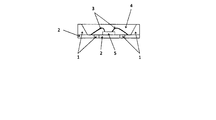
- a semi-aromatic polyamide resin composition is injection-molded on a lead frame set in a mold to produce a reflector, and then a blue LED element made of InGaN-based blue is used as a semiconductor light emitting element. And fixed with silver paste.
- a gold wire was attached, and then a transparent sealing resin was injected, heated at 150 ° C. for 1 hour, and cured to obtain a surface-mounted LED package shown in FIG.
- 1 is a reflecting plate
- 2 is a lead frame
- 3 is a gold wire
- 4 is a transparent sealing resin
- 5 is a semiconductor light emitting element.
- the reflecting plate 1 has discoloration or cracks, or there is peeling between the reflecting plate 1 and the transparent sealing resin 4.
- Non-defective product The reflecting plate 1 is not discolored or cracked, and there is no peeling between the reflecting plate 1 and the transparent sealing resin 4.
- the defective product rate is 95% or more “ ⁇ ”, 90% or more “ ⁇ ”. , Less than 90% was evaluated as “x”, and the reflow resistance was evaluated.
- Aromatic dicarboxylic acid component / TPA terephthalic acid / IPA: isophthalic acid
- White pigment Titanium oxide (manufactured by Ishihara Sangyo Co., Ltd., Tyco PC-3, average particle size 0.21 ⁇ m)
- BS barium sulfate (manufactured by Sakai Chemical Industry, Varifine BF-20, average particle size 0.03 ⁇ m)
- CC calcium carbonate (manufactured by Shiroishi Kogyo Co., Ltd., Brilliant-1500, average particle size 0.20 ⁇ m)
- Fibrous reinforcing material / GF-1 Glass fiber (manufactured by Nippon Electric Glass Co., Ltd., ECS03T-786H, average fiber diameter 10.5 ⁇ m, average fiber length 3 mm)
- GF-2 glass fiber (manufactured by Nittobo, CS3J256, average fiber diameter 11 ⁇ m, average fiber length 3 mm)
- Antioxidant AO-1 Bis (2,6-di-tert-butyl-4-methylphenyl) pentaerythritol diphosphite (phosphorus antioxidant, manufactured by Adeka, Adeka Stub PEP-36)
- AO-2 3,9-bis [2- ⁇ 3- (3-tert-butyl-4-hydroxy-5-methylphenyl) propionyloxy ⁇ -1,1-dimethylethyl] 2,4,8,10 -Tetraoxaspiro (5,5) undecane (hindered phenol-based antioxidant, manufactured by Adeka, AO-80)
- AO-3 Pentaerythrityl tetrakis (3-lauryl thiopropionate) (sulfur-based antioxidant, manufactured by Sumitomo Chemical Co., Ltd., Smither TP-D)
- Light stabilizer LS 2-ethyl-2-ethoxy-oxalanilide (manufactured by Clariant Japan, Nyrostab S-EED)
- Fluorescent whitening agent • FB 2,2 ′-(1,2-ethylenediyldi-4,1-phenylene) bisbenzoxazole (Eastman, East Bright OB-1)
- Production Example 1 8.70 kg of powdered terephthalic acid (TPA) as an aromatic dicarboxylic acid component, 0.32 kg of stearic acid (STA) having a molecular weight of 284 as monocarboxylic acid, and sodium hypophosphite monohydrate as a polymerization catalyst. 3 g was put into a ribbon blender type reactor and heated to 170 ° C. with stirring at a rotation speed of 30 rpm under nitrogen sealing. Thereafter, while maintaining the temperature at 170 ° C. and maintaining the rotation speed at 30 rpm, 4.98 kg of 1,10-decanediamine (DDA) heated to 100 ° C. as an aliphatic diamine component was added using a liquid injection device.
- TPA powdered terephthalic acid
- STA stearic acid
- DDA 1,10-decanediamine
- reaction product was polymerized by heating at 250 ° C. and a rotation speed of 30 rpm for 8 hours in the same reaction apparatus in a nitrogen stream, taken into a strand, and then cooled and solidified by passing it through a water bath. Cutting with a pelletizer gave semi-aromatic polyamide (P-1) pellets.
- Production Examples 2 to 17 Semi-aromatic polyamide pellets (P-2 to P-17) were obtained in the same manner as in Production Example 1 except that the types and blending amounts of the components were changed so that the resin composition shown in Table 1 was obtained.
- Table 1 shows the composition, melting point and relative viscosity of the semi-aromatic polyamides obtained in Production Examples 1 to 17.
- Example 1 Semi-fragrance weighed using Kubota's loss-in-weight continuous quantitative feeder CE-W-1 at the main supply port of the same-direction twin-screw extruder (TEM 26SS, Toshiba Machine, screw diameter 26 mm, L / D49) Group polyamide (P-1) 100 parts by weight, white pigment (TI) 40 parts by weight, antioxidant (AO-1) 0.5 part by weight, light stabilizer (LS) 0.5 part by weight, fluorescent whitening agent (FB) 0.1 parts by mass was supplied, and 25 parts by mass of the fibrous reinforcing material (GF-1) was supplied from the side feeder, and melt kneading was performed. The melting temperature was 320 ° C.
- the screw rotation speed was 250 rpm, and the discharge rate was 35 kg / hour. Then, after taking up in the form of a strand, it was cooled and solidified through a water tank, and cut with a pelletizer to obtain a semi-aromatic polyamide resin composition.
- Examples 2-31 and Comparative Examples 1, 3-7 A semi-aromatic polyamide resin composition was obtained in the same manner as in Example 1 except that the resin composition was changed so as to have the types and contents shown in Tables 2 and 3. Glass fiber was supplied from the side feeder, and the other was supplied from the main supply port.
- Comparative Example 2 Except for changing the content of the white content, the same operation as in Example 1 was performed, but since the content of the white pigment was high, the strands were cut and a semi-aromatic polyamide resin composition could not be obtained. It was.
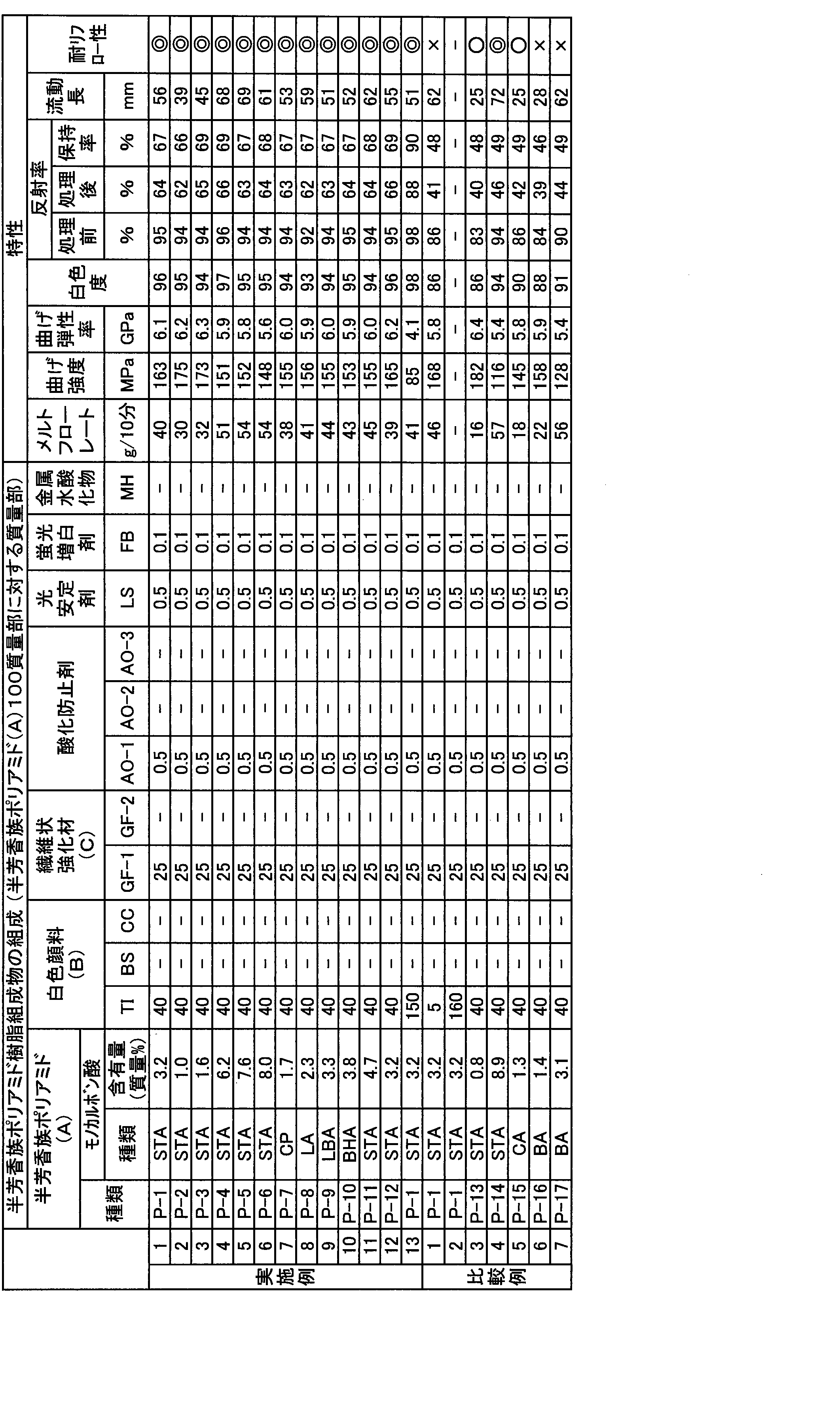
- Tables 2 and 3 show the compositions and characteristics of the semi-aromatic polyamide resin compositions obtained in Examples and Comparative Examples.
- Example 1 to 31 in addition to heat resistance, whiteness, bending strength, and flexural modulus, the fluidity, reflow resistance, and reflectance were all excellent.
- Example 26 and 27 in which two types of titanium oxide, calcium carbonate, and barium sulfate were used in combination as white pigments, the retention rate of reflectance was improved as compared with Example 25 using only titanium oxide. It was.
- Example 31 containing a metal hydroxide (magnesium hydroxide) an improvement in the retention rate of the reflectance was observed as compared with Example 1 not containing a metal hydroxide.
- Comparative Example 1 since the content of the white pigment was small, the whiteness and reflectance were low, and the reflow resistance was inferior.
- Comparative Example 3 since the monocarboxylic acid content in the semi-aromatic polyamide was less than the range specified in the present invention, the molding fluidity was lowered and the flow length was short.
- Comparative Example 4 the bending strength was low because the content of monocarboxylic acid in the semi-aromatic polyamide was larger than the range specified in the present invention.
- caproic acid having a molecular weight of less than 140 was used as the monocarboxylic acid in the semi-aromatic polyamide, so the molding fluidity improvement effect was poor and the flow length was short.
- Comparative Example 6 since benzoic acid having a molecular weight of less than 140 was used as the monocarboxylic acid in the semi-aromatic polyamide, the flow length was short as in Comparative Example 5. Moreover, it was inferior to reflow resistance. In Comparative Example 7, when a semi-aromatic polyamide having a reduced benzoic acid content and a lower relative viscosity was used, the flow length increased, but the reflow resistance remained inferior. In contrast to Example 1, although the monocarboxylic acid content was almost the same, the reflectance before the treatment was low, and the reflectance retention was also low.
Landscapes
- Chemical & Material Sciences (AREA)
- Health & Medical Sciences (AREA)
- Chemical Kinetics & Catalysis (AREA)
- Medicinal Chemistry (AREA)
- Polymers & Plastics (AREA)
- Organic Chemistry (AREA)
- Compositions Of Macromolecular Compounds (AREA)
- Polyamides (AREA)
- Led Device Packages (AREA)
Abstract
Description
[1]半芳香族ポリアミド(A)100質量部と、白色顔料(B)10~150質量部とを含有する半芳香族ポリアミド樹脂組成物であって、
半芳香族ポリアミド(A)が、芳香族ジカルボン酸成分と、脂肪族ジアミン成分と、モノカルボン酸成分とから構成され、
モノカルボン酸成分として、分子量が140以上のモノカルボン酸を含有し、その含有量が、半芳香族ポリアミド(A)の1~8質量%であることを特徴とする半芳香族ポリアミド樹脂組成物。
[2]さらに繊維状強化材(C)を10~80質量部含有することを特徴とする[1]記載の半芳香族ポリアミド樹脂組成物。
[3]モノカルボン酸が、脂肪族モノカルボン酸であることを特徴とする[1]または[2]記載の半芳香族ポリアミド樹脂組成物。
[4]脂肪族モノカルボン酸が、ステアリン酸であることを特徴とする[3]記載の半芳香族ポリアミド樹脂組成物。
[5]脂肪族ジアミン成分が、1,10-デカンジアミンを含有することを特徴とする[1]~[4]のいずれかに記載の半芳香族ポリアミド樹脂組成物。
[6]白色顔料(B)が、酸化チタン、炭酸カルシウムおよび硫酸バリウムからなる群より選ばれる1種以上であることを特徴とする[1]~[5]のいずれかに記載の半芳香族ポリアミド樹脂組成物。
[7]さらに、水酸化アルミニウム、水酸化マグネシウムおよび水酸化カルシウムからなる群より選ばれる1種以上の金属水酸化物を0.1~30質量部含有することを特徴とする[1]~[6]のいずれかに記載の半芳香族ポリアミド樹脂組成物。
[8]上記[1]~[7]のいずれかに記載の半芳香族ポリアミド樹脂組成物を成形してなる反射板。
[9]上記[8]記載の反射板を備えるLEDパッケージ。
[10]上記[9]記載のLEDパッケージを備える照明装置。
本発明の半芳香族ポリアミド樹脂組成物は、半芳香族ポリアミド(A)と白色顔料(B)とを含有し、半芳香族ポリアミド(A)は、芳香族ジカルボン酸成分と脂肪族ジアミン成分とモノカルボン酸成分とから構成される。
分子量が140以上の脂肪族モノカルボン酸としては、カプリル酸、ノナン酸、デカン酸、ラウリン酸、ミリスチン酸、パルミチン酸、ステアリン酸、ベヘン酸が挙げられる。中でも、汎用性が高いことから、ステアリン酸が好ましい。
分子量が140以上の脂環族モノカルボン酸としては、4-エチルシクロヘキサンカルボン酸、4-へキシルシクロヘキサンカルボン酸、4-ラウリルシクロヘキサンカルボン酸が挙げられる。
分子量が140以上の芳香族モノカルボン酸としては、4-エチル安息香酸、4-へキシル安息香酸、4-ラウリル安息香酸などのアルキル安息香酸類、1-ナフトエ酸、2-ナフトエ酸などのナフトエ酸類およびそれらの誘導体が挙げられる。
モノカルボン酸成分は複数種を併用してもよく、例えば、分子量が140以上のモノカルボン酸と分子量が140未満のモノカルボン酸とを併用してもよい。
酸化防止剤は、通常、半芳香族ポリアミド(A)の分子量低下や色の退化防止を目的に含有させるものである。本発明においては、これらの効果に加えて、樹脂組成物の滞留安定性を向上させることができる。すなわち、繊維状強化材(C)を含有する半芳香族ポリアミド樹脂組成物は、高温のシリンダー内に長時間滞留した場合、繊維状強化材(C)の表面処理剤が熱分解し、機械的強度の低下を引き起こす場合がある。しかしながら、酸化防止剤を含有することにより、シリンダー内で長時間樹脂組成物を滞溜させた場合、すなわち、射出成形時において成形サイクルが長い場合や射出量が少なくシリンダー内に樹脂が長く滞留する場合でも、樹脂組成物の引張強度の低下を抑制することができる。
市販のリン系酸化防止剤としては、例えば、アデカ社製“アデカスタブ”PEP-8、PEP-36、PEP-4C、クラリアント社製“ホスタノックス”P-EPQが挙げられる。
市販のヒンダードフェノール系酸化防止剤としては、例えば、アデカ社製“アデカスタブ”AO-20、AO-30、AO-40、AO-50、AO-60、AO-70、AO-80、AO-330、チバスペシャリティケミカル社製“イルガノックス”245、259、565、1010、1035、1076、1098、1222、1330、1425、1520、3114、5057、住友化学工業社製“スミライザー”BHT-R、MDP-S、BBM-S、WX-R、NW、BP-76、BP-101、GA-80、GM、GS、サイアナミド社製“サイアノックス”CY-1790が挙げられる。
市販の硫黄系酸化防止剤としては、例えば、住友化学工業社製“スミライザー”TP-Dが挙げられる。
市販の光安定剤としては、例えば、クラリアントジャパン社製“ナイロスタブ”S-EED、共同薬品社製“バイオソーブ”04、チバ・スペシャリティ・ケミカルズ社製“チヌビン”622、765、Cytec社製“サイアソーブ”UV-3346、旭電化工業社製“アデカスタブ”LA-57、BASF社製“チマソーブ”119、944が挙げられる。
市販の蛍光増白剤としては、例えば、チバスペシャリティケミカル社製“チノパール”OB、クラリアント社製“ホスタノックス”KS、イーストマン社製“イーストブライト”OB-1が挙げられる。
射出成形機としては、特に限定されず、例えば、スクリューインライン式射出成形機、プランジャ式射出成形機が挙げられる。
射出成形機のシリンダー内で加熱溶融された半芳香族ポリアミド樹脂組成物は、ショットごとに計量され、金型内に溶融状態で射出され、所定の形状で冷却、固化された後、成形体として金型から取り出される。射出成形時の樹脂温度は、半芳香族ポリアミド樹脂組成物の融点以上とする必要があり、(融点+100℃)未満とすることが好ましい。
なお、半芳香族ポリアミド樹脂組成物の加熱溶融時には、用いる半芳香族ポリアミド樹脂組成物は十分に乾燥されたものを用いることが好ましい。含有する水分量が多いと、射出成形機のシリンダー内で樹脂が発泡し、最適な成形体を得ることが困難となることがある。射出成形に用いる半芳香族ポリアミド樹脂組成物の水分率は、0.3質量%未満が好ましく、0.1質量%未満がより好ましい。
また、本発明の樹脂組成物を構成する半芳香族ポリアミド(A)は、ポリアミド6、ポリアミド66に比べ、融点が高く、成形体を得るための溶融温度が高いため、樹脂が長時間にわたって成形機シリンダー内に滞留する場合、前記樹脂が劣化しやすく、分解ガスが発生しやすい。したがって、本発明の半芳香族ポリアミド樹脂組成物を成形して耐熱性に優れた成形体を得るためには、成形サイクルを短くし、溶融樹脂の成形機シリンダー内への滞留を極力抑制することが好ましい。
(1)半芳香族ポリアミドの相対粘度
96質量%硫酸を溶媒とし、濃度1g/dL、25℃で測定した。
パーキンエルマー社製示差走査型熱量計DSC-7を用い、昇温速度20℃/分で350℃まで昇温した後、350℃で5分間保持し、降温速度20℃/分で25℃まで降温し、さらに25℃で5分間保持後、再び昇温速度20℃/分で昇温測定した際の吸熱ピークのトップを融点とした。
半芳香族ポリアミドについて、1H-NMR測定をおこない、各成分の組成を求めた(溶媒:重水素化トリフルオロ酢酸、温度:25℃)。
半芳香族ポリアミド樹脂組成物を用いて、JIS K7210に従って、340℃、1.2kgfの荷重で測定した。実用上、1~80g/10分が好ましく、20~70g/10分がより好ましい。
半芳香族ポリアミド樹脂組成物を十分に乾燥した後、ファナック製射出成形機(α-100iA)を用いて、樹脂温度330℃、金型温度135℃、成形サイクル25秒の条件で、ISO準拠の試験片を作製し、ISO178に従って曲げ強度、曲げ弾性率を測定した。
実用上、曲げ強度は120MPa以上が好ましく、曲げ弾性率は4.0GPa以上が好ましい。
半芳香族ポリアミド樹脂組成物を十分に乾燥した後、ニイガタマシンテクノ社製射出成形機(CND-15AII)を用いて、樹脂温度330℃、金型温度135℃、成形サイクル15秒の条件で、20mm×20mm×0.5mmの成形片を作製した。得られた成形片を用いて、JIS Z8730に従って、日本電色社製スペクトロフォトメーターSE6000(光源:C-2)により、ハンターの色差式による明度(L値)、赤色度(a値)および黄色度(b値)を求め、下記式により、白色度Wを算出した。なお、標準あわせは、セラミックガラス製のピトロ白板を用いた。
W=100-〔(100-L)2+a2+b2〕1/2
実用上、白色度は90以上が好ましい。
上記(6)で得られた成形片を140℃で300時間、オーブンで加熱処理し、処理前後の成形片について、日本電色社製スペクトロフォトメーターSE6000(光源:C-2)により、460nmの波長の反射率を測定した。
実用上、処理前の反射率は85%以上が好ましく、90%以上がより好ましく、処理後の反射率は、60%以上が好ましく、70%以上がより好ましく、80%以上がさらに好ましい。
反射率の保持率は、以下の式を用いて求めた。
保持率=([処理後の反射率]/[処理前の反射率])×100
ファナック社製射出成形機S2000i-100Bを用いて、シリンダー温度を(融点+25℃)、金型温度を(融点-185℃)に設定した後、型締力100トン、射出圧力120MPa、射出速度80mm/秒、射出時間5秒の条件で、片側1点ゲートの専用金型を取り付けて成形をおこなった。専用金型は、厚さ0.4mm、幅20mmのL字状の成形品が採取できる形状で、流動長は最大150mmであった。流動長が長いほど、流動性に優れていることを意味する。
金型内にセットされたリードフレームに、半芳香族ポリアミド樹脂組成物を射出成形し、反射板を作製し、次いで、半導体発光素子としてInGaN系青色からなる青色LED素子を、銀ペーストを用いて固定した。金線を取り付け、その後、透明封止樹脂を注入し、150℃、1時間加熱し、硬化させ、図1に示す表面実装型LEDパッケージを得た。図1において、1は反射板、2はリードフレーム、3は金線、4は透明封止樹脂、5は半導体発光素子を示す。
得られた表面実装型LEDパッケージ20個を、JEDEC(電子機器技術評議会、Joint Electron Device Engineering Council)レベル3の吸湿処理(環境条件:温度60℃、湿度60%で50時間処理)をおこなった後、JEDECJ-STD-020Dに準じて、ピーク温度260℃10秒の温度条件におけるリフロー試験を2回繰り返した。リフロー試験後、LEDパッケージ内の反射板1と透明封止樹脂4を、実体顕微鏡を用いて観察し、以下の基準で評価した。
不良品:反射板1に変色、ひび割れ(クラック)があるか、反射板1と透明封止樹脂4の間の剥離がある。
良品:反射板1に変色、ひび割れ(クラック)がなく、反射板1と透明封止樹脂4の間の剥離もない。
リフロー試験後の不良品率(=(不良品の数/試験に用いたパッケージ数)×100(%))を計算し、不良品率95%以上を「◎」、90%以上を「○」、90%未満を「×」として、耐リフロー性を評価した。
用いた原材料を以下に示す。
(1)芳香族ジカルボン酸成分
・TPA:テレフタル酸
・IPA:イソフタル酸
・DDA:1,10-デカンジアミン
・HMDA:1,6-ヘキサンジアミン
・NDA:1,9-ノナンジアミン
・STA:ステアリン酸(分子量:284)
・CP:カプリル酸(分子量:144)
・LA:ラウリン酸(分子量:200)
・LBA:4-ラウリル安息香酸(分子量:290)
・BHA:ベヘン酸(分子量:341)
・CA:カプロン酸(分子量:116)
・BA:安息香酸(分子量:122)
・TI:酸化チタン(石原産業社製、タイペークPC-3、平均粒径0.21μm)
・BS:硫酸バリウム(堺化学社製、バリファインBF-20、平均粒径0.03μm)
・CC:炭酸カルシウム(白石工業社製、Brilliant-1500、平均粒径0.20μm)
・GF-1:ガラス繊維(日本電気硝子社製、ECS03T-786H、平均繊維径10.5μm、平均繊維長3mm)
・GF-2:ガラス繊維(日東紡社製、CS3J256、平均繊維径11μm、平均繊維長3mm)
・AO-1:ビス(2,6-ジ-tert-ブチル-4-メチルフェニル)ペンタエリスリトールジホスファイト(リン系酸化防止剤、アデカ社製、アデカスタブPEP-36)
・AO-2:3,9-ビス[2-{3-(3-t-ブチル-4-ヒドロキシ-5-メチルフェニル)プロピオニルオキシ}-1,1-ジメチルエチル]2,4,8,10-テトラオキサスピロ(5,5)ウンデカン(ヒンダードフェノール系酸化防止剤、アデカ社製、AO-80)
・AO-3:ペンタエリスリチルテトラキス(3-ラウリルチオプロピオネート)(硫黄系酸化防止剤、住友化学工業社製、スミライザーTP-D)
・LS:2-エチル-2-エトキシ-オキザルアニリド(クラリアントジャパン社製、ナイロスタブS-EED)
・FB:2,2′-(1,2-エチレンジイルジ-4,1-フェニレン)ビスベンゾオキサゾール(イーストマン社製、イーストブライトOB-1)
・MH:水酸化マグネシウム(協和化学工業社製、キスマ5E)
芳香族ジカルボン酸成分として粉末状のテレフタル酸(TPA)4.70kgと、モノカルボン酸として分子量284のステアリン酸(STA)0.32kgと、重合触媒として次亜リン酸ナトリウム一水和物9.3gとを、リボンブレンダー式の反応装置に入れ、窒素密閉下、回転数30rpmで撹拌しながら170℃に加熱した。その後、温度を170℃に保ち、かつ回転数を30rpmに保ったまま、液注装置を用いて、脂肪族ジアミン成分として100℃に加温した1,10-デカンジアミン(DDA)4.98kgを、2.5時間かけて連続的(連続液注方式)に添加し反応物を得た。
その後、得られた反応物を、同じ反応装置で、窒素気流下、250℃、回転数30rpmで8時間加熱して重合し、ストランド状に引き取った後、水槽に通して冷却固化し、それをペレタイザーでカッティングして半芳香族ポリアミド(P-1)ペレットを得た。
表1に示す樹脂組成になるように各成分の種類や配合量を変更した以外は、製造例1と同様にして半芳香族ポリアミドペレット(P-2~P-17)を得た。

同方向二軸押出機(東芝機械社製TEM26SS、スクリュー径26mm、L/D49)の主供給口に、クボタ社製ロスインウェイト式連続定量供給装置CE-W-1を用いて計量した半芳香族ポリアミド(P-1)100質量部、白色顔料(TI)40質量部、酸化防止剤(AO-1)0.5質量部、光安定剤(LS)0.5質量部、蛍光増白剤(FB)0.1質量部を供給し、サイドフィーダーより繊維状強化材(GF-1)を25質量部供給し、溶融混練をおこなった。溶融温度は320℃~340℃、スクリュー回転数は250rpm、吐出量は35kg/時間であった。その後、ストランド状に引き取った後、水槽に通して冷却固化し、それをペレタイザーでカッティングして半芳香族ポリアミド樹脂組成物を得た。
表2および表3に示す種類、含有量になるように樹脂組成を変更した以外は、実施例1と同様にして半芳香族ポリアミド樹脂組成物を得た。なお、ガラス繊維はサイドフィーダーから、その他は主供給口から供給した。
白色含量の含有量を変更した以外は、実施例1と同様の操作をおこなったが、白色顔料の含有量が高かったため、ストランドが切断し、半芳香族ポリアミド樹脂組成物を得ることができなかった。
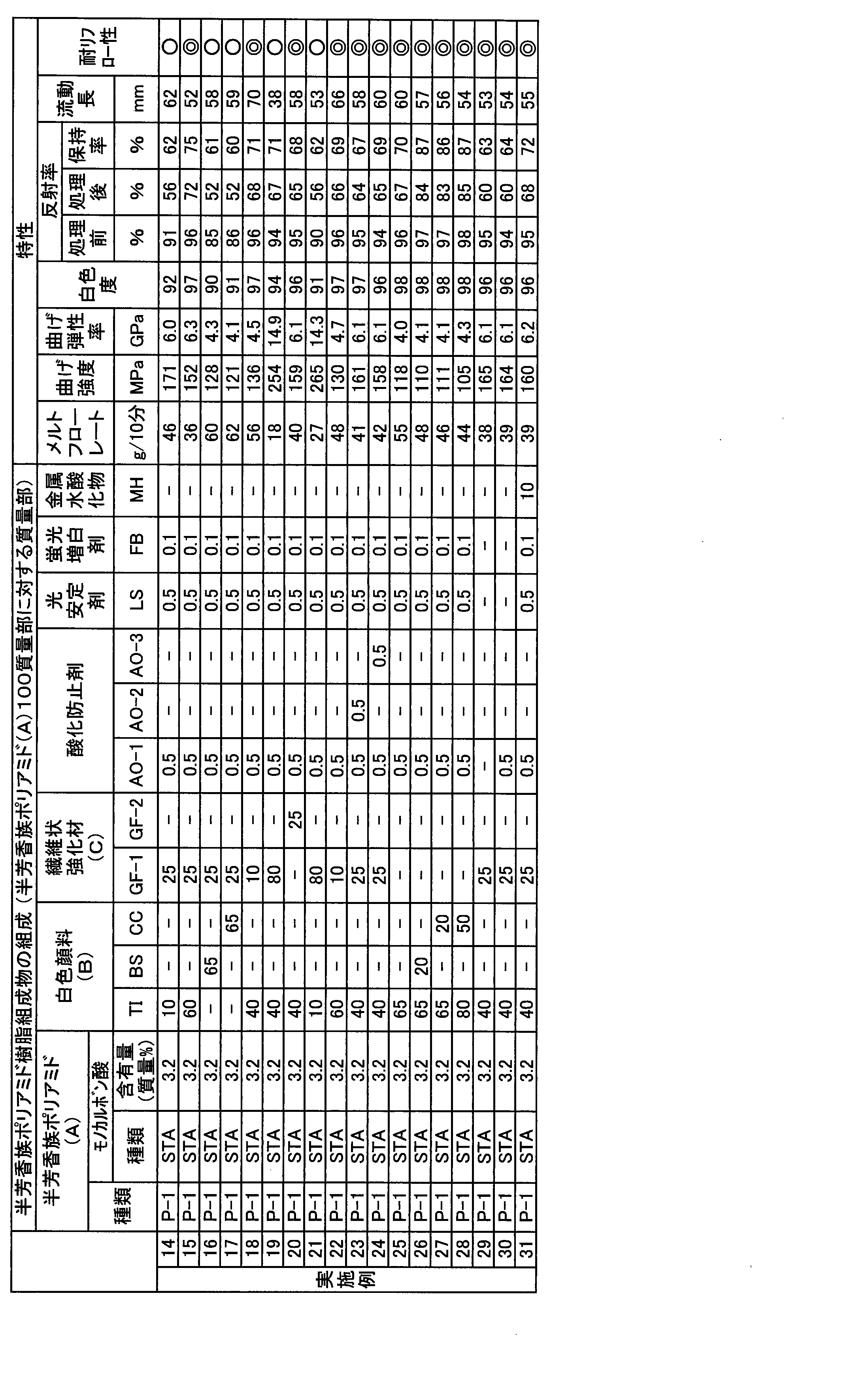
白色顔料として酸化チタン、炭酸カルシウム、硫酸バリウムのうちの2種を併用した実施例26、27では、酸化チタンのみを用いた実施例25と比較して、反射率の保持率の向上がみられた。また、金属水酸化物(水酸化マグネシウム)を含有した実施例31においても、金属水酸化物を含有しない実施例1と比較して、反射率の保持率の向上がみられた。
比較例3は、半芳香族ポリアミド中のモノカルボン酸の含有量が本発明で規定する範囲よりも少なかったため、成形流動性が低下し、流動長が短かった。比較例4は、半芳香族ポリアミド中のモノカルボン酸の含有量が本発明で規定する範囲よりも多かったため、曲げ強度が低かった。
比較例5は、半芳香族ポリアミド中のモノカルボン酸として、分子量が140未満のカプロン酸を用いたため、成形流動性向上効果が乏しく、流動長が短かった。
比較例6は、半芳香族ポリアミド中のモノカルボン酸として、分子量が140未満の安息香酸を用いたため、比較例5と同様に、流動長が短かった。また、耐リフロー性にも劣っていた。
比較例7において安息香酸の含有量を増やして相対粘度を下げた半芳香族ポリアミドを使用したところ、流動長は長くなったが、耐リフロー性は劣ったままであった。また、実施例1と対比して、モノカルボン酸の含有量はほぼ同じにもかかわらず、処理前の反射率が低く、反射率の保持率も低かった。
2 リードフレーム
3 金線
4 透明封止樹脂
5 半導体発光素子
Claims (10)
- 半芳香族ポリアミド(A)100質量部と、白色顔料(B)10~150質量部とを含有する半芳香族ポリアミド樹脂組成物であって、
半芳香族ポリアミド(A)が、芳香族ジカルボン酸成分と、脂肪族ジアミン成分と、モノカルボン酸成分とから構成され、
モノカルボン酸成分として、分子量が140以上のモノカルボン酸を含有し、その含有量が、半芳香族ポリアミド(A)の1~8質量%であることを特徴とする半芳香族ポリアミド樹脂組成物。 - さらに繊維状強化材(C)を10~80質量部含有することを特徴とする請求項1記載の半芳香族ポリアミド樹脂組成物。
- モノカルボン酸が、脂肪族モノカルボン酸であることを特徴とする請求項1または2記載の半芳香族ポリアミド樹脂組成物。
- 脂肪族モノカルボン酸が、ステアリン酸であることを特徴とする請求項3記載の半芳香族ポリアミド樹脂組成物。
- 脂肪族ジアミン成分が、1,10-デカンジアミンを含有することを特徴とする請求項1~4のいずれかに記載の半芳香族ポリアミド樹脂組成物。
- 白色顔料(B)が、酸化チタン、炭酸カルシウムおよび硫酸バリウムからなる群より選ばれる1種以上であることを特徴とする請求項1~5のいずれかに記載の半芳香族ポリアミド樹脂組成物。
- さらに、水酸化アルミニウム、水酸化マグネシウムおよび水酸化カルシウムからなる群より選ばれる1種以上の金属水酸化物を0.1~30質量部含有することを特徴とする請求項1~6のいずれかに記載の半芳香族ポリアミド樹脂組成物。
- 請求項1~7のいずれかに記載の半芳香族ポリアミド樹脂組成物を成形してなる反射板。
- 請求項8記載の反射板を備えるLEDパッケージ。
- 請求項9記載のLEDパッケージを備える照明装置。
Priority Applications (3)
| Application Number | Priority Date | Filing Date | Title |
|---|---|---|---|
| JP2014530834A JP5646120B1 (ja) | 2013-02-19 | 2014-02-13 | 半芳香族ポリアミド樹脂組成物 |
| CN201480004931.7A CN104919001B (zh) | 2013-02-19 | 2014-02-13 | 半芳香族聚酰胺树脂组合物 |
| KR1020157014596A KR20150120331A (ko) | 2013-02-19 | 2014-02-13 | 반방향족 폴리아미드 수지 조성물 |
Applications Claiming Priority (4)
| Application Number | Priority Date | Filing Date | Title |
|---|---|---|---|
| JP2013030049 | 2013-02-19 | ||
| JP2013-030049 | 2013-02-19 | ||
| JP2013235047 | 2013-11-13 | ||
| JP2013-235047 | 2013-11-13 |
Publications (1)
| Publication Number | Publication Date |
|---|---|
| WO2014129364A1 true WO2014129364A1 (ja) | 2014-08-28 |
Family
ID=51391159
Family Applications (1)
| Application Number | Title | Priority Date | Filing Date |
|---|---|---|---|
| PCT/JP2014/053242 Ceased WO2014129364A1 (ja) | 2013-02-19 | 2014-02-13 | 半芳香族ポリアミド樹脂組成物 |
Country Status (5)
| Country | Link |
|---|---|
| JP (1) | JP5646120B1 (ja) |
| KR (1) | KR20150120331A (ja) |
| CN (1) | CN104919001B (ja) |
| TW (1) | TWI583738B (ja) |
| WO (1) | WO2014129364A1 (ja) |
Cited By (5)
| Publication number | Priority date | Publication date | Assignee | Title |
|---|---|---|---|---|
| JP2016084399A (ja) * | 2014-10-24 | 2016-05-19 | 大塚化学株式会社 | 反射板用樹脂組成物及び反射板 |
| JP2016088961A (ja) * | 2014-10-30 | 2016-05-23 | ユニチカ株式会社 | ポリアミド |
| JP2017014397A (ja) * | 2015-07-01 | 2017-01-19 | 旭化成株式会社 | ポリアミド組成物、成形品、及びled用反射板 |
| JP2018016765A (ja) * | 2016-07-29 | 2018-02-01 | 日亜化学工業株式会社 | 樹脂組成物、樹脂組成物の製造方法及び発光装置 |
| JP2024533587A (ja) * | 2021-09-18 | 2024-09-12 | 珠海万通特種工程塑料有限公司 | Pa10t成形複合材料、その製造方法及び使用 |
Families Citing this family (3)
| Publication number | Priority date | Publication date | Assignee | Title |
|---|---|---|---|---|
| CN111201286B (zh) * | 2017-11-30 | 2022-12-30 | 尤尼吉可株式会社 | 聚酰胺树脂组合物和将其成型而成的成型体 |
| CN117120549B (zh) * | 2021-04-12 | 2025-02-18 | 尤尼吉可株式会社 | 聚酰胺树脂组合物 |
| JPWO2024004933A1 (ja) * | 2022-06-30 | 2024-01-04 |
Citations (9)
| Publication number | Priority date | Publication date | Assignee | Title |
|---|---|---|---|---|
| JPS6236459A (ja) * | 1985-08-10 | 1987-02-17 | Mitsui Petrochem Ind Ltd | ポリアミド組成物及びその製造方法 |
| JPH08325376A (ja) * | 1995-05-31 | 1996-12-10 | Toray Ind Inc | ポリアミド樹脂の製造方法 |
| JP2004075994A (ja) * | 2002-06-21 | 2004-03-11 | Kuraray Co Ltd | ポリアミド組成物 |
| JP2006002113A (ja) * | 2004-06-21 | 2006-01-05 | Kuraray Co Ltd | ポリアミド樹脂組成物およびその成形品 |
| JP2011506646A (ja) * | 2008-07-11 | 2011-03-03 | キンファ サイエンス アンド テクノロジー カンパニー リミテッド | 半芳香族ポリアミド、及び、半芳香族ポリアミドの調製方法 |
| JP2011241398A (ja) * | 2010-05-17 | 2011-12-01 | Ems-Patent Ag | ポリアミド成形材料、及び、ledハウジング部材の製造のための該材料の使用 |
| WO2012026413A1 (ja) * | 2010-08-27 | 2012-03-01 | 東洋紡績株式会社 | 表面実装型led用反射板に使用するポリアミド樹脂組成物 |
| WO2012101997A1 (ja) * | 2011-01-28 | 2012-08-02 | 株式会社クラレ | 反射板用ポリアミド組成物、反射板、該反射板を備えた発光装置、ならびに該発光装置を備えた照明装置および画像表示装置 |
| WO2013042541A1 (ja) * | 2011-09-22 | 2013-03-28 | ユニチカ株式会社 | 半芳香族ポリアミドおよびそれからなる成形体 |
Family Cites Families (4)
| Publication number | Priority date | Publication date | Assignee | Title |
|---|---|---|---|---|
| DE10224947B4 (de) * | 2002-06-05 | 2006-07-06 | Ems Chemie Ag | Transparente Polyamid-Formmassen mit verbesserter Transparenz, Chemikalienbeständigkeit und dynamischer Belastbarkeit |
| CA2432522C (en) * | 2002-06-21 | 2010-09-21 | Kuraray Co., Ltd. | Polyamide composition |
| WO2009012933A1 (en) * | 2007-07-23 | 2009-01-29 | Dsm Ip Assets B.V. | Plastic component for a lighting systems |
| JP5568879B2 (ja) * | 2009-03-19 | 2014-08-13 | 宇部興産株式会社 | 磁性材樹脂複合体成形用ポリアミド樹脂組成物、磁性材樹脂複合材料、及び磁性材樹脂複合体 |
-
2014
- 2014-02-13 CN CN201480004931.7A patent/CN104919001B/zh not_active Expired - Fee Related
- 2014-02-13 KR KR1020157014596A patent/KR20150120331A/ko not_active Withdrawn
- 2014-02-13 WO PCT/JP2014/053242 patent/WO2014129364A1/ja not_active Ceased
- 2014-02-13 JP JP2014530834A patent/JP5646120B1/ja not_active Expired - Fee Related
- 2014-02-17 TW TW103105068A patent/TWI583738B/zh not_active IP Right Cessation
Patent Citations (9)
| Publication number | Priority date | Publication date | Assignee | Title |
|---|---|---|---|---|
| JPS6236459A (ja) * | 1985-08-10 | 1987-02-17 | Mitsui Petrochem Ind Ltd | ポリアミド組成物及びその製造方法 |
| JPH08325376A (ja) * | 1995-05-31 | 1996-12-10 | Toray Ind Inc | ポリアミド樹脂の製造方法 |
| JP2004075994A (ja) * | 2002-06-21 | 2004-03-11 | Kuraray Co Ltd | ポリアミド組成物 |
| JP2006002113A (ja) * | 2004-06-21 | 2006-01-05 | Kuraray Co Ltd | ポリアミド樹脂組成物およびその成形品 |
| JP2011506646A (ja) * | 2008-07-11 | 2011-03-03 | キンファ サイエンス アンド テクノロジー カンパニー リミテッド | 半芳香族ポリアミド、及び、半芳香族ポリアミドの調製方法 |
| JP2011241398A (ja) * | 2010-05-17 | 2011-12-01 | Ems-Patent Ag | ポリアミド成形材料、及び、ledハウジング部材の製造のための該材料の使用 |
| WO2012026413A1 (ja) * | 2010-08-27 | 2012-03-01 | 東洋紡績株式会社 | 表面実装型led用反射板に使用するポリアミド樹脂組成物 |
| WO2012101997A1 (ja) * | 2011-01-28 | 2012-08-02 | 株式会社クラレ | 反射板用ポリアミド組成物、反射板、該反射板を備えた発光装置、ならびに該発光装置を備えた照明装置および画像表示装置 |
| WO2013042541A1 (ja) * | 2011-09-22 | 2013-03-28 | ユニチカ株式会社 | 半芳香族ポリアミドおよびそれからなる成形体 |
Cited By (6)
| Publication number | Priority date | Publication date | Assignee | Title |
|---|---|---|---|---|
| JP2016084399A (ja) * | 2014-10-24 | 2016-05-19 | 大塚化学株式会社 | 反射板用樹脂組成物及び反射板 |
| JP2016088961A (ja) * | 2014-10-30 | 2016-05-23 | ユニチカ株式会社 | ポリアミド |
| JP2017014397A (ja) * | 2015-07-01 | 2017-01-19 | 旭化成株式会社 | ポリアミド組成物、成形品、及びled用反射板 |
| JP2018016765A (ja) * | 2016-07-29 | 2018-02-01 | 日亜化学工業株式会社 | 樹脂組成物、樹脂組成物の製造方法及び発光装置 |
| JP2024533587A (ja) * | 2021-09-18 | 2024-09-12 | 珠海万通特種工程塑料有限公司 | Pa10t成形複合材料、その製造方法及び使用 |
| JP7851399B2 (ja) | 2021-09-18 | 2026-04-24 | 珠海万通特種工程塑料有限公司 | Pa10t成形複合材料、その製造方法及び使用 |
Also Published As
| Publication number | Publication date |
|---|---|
| TW201439210A (zh) | 2014-10-16 |
| JPWO2014129364A1 (ja) | 2017-02-02 |
| CN104919001A (zh) | 2015-09-16 |
| TWI583738B (zh) | 2017-05-21 |
| JP5646120B1 (ja) | 2014-12-24 |
| CN104919001B (zh) | 2017-04-26 |
| KR20150120331A (ko) | 2015-10-27 |
Similar Documents
| Publication | Publication Date | Title |
|---|---|---|
| JP5646120B1 (ja) | 半芳香族ポリアミド樹脂組成物 | |
| EP2610313B1 (en) | Polyamide resin composition having improved physical properties including thin-wall moldability | |
| JP4525917B2 (ja) | Ledリフレクタ成形用ポリアミド樹脂組成物およびledリフレクタ | |
| JP4998841B2 (ja) | 表面実装型led用反射板に使用するポリアミド樹脂組成物 | |
| US8440756B2 (en) | Flame-retardant polyamide resin composition | |
| EP2436717B1 (en) | Polyamide resin | |
| JP6046958B2 (ja) | ポリアミド樹脂組成物およびそれからなる成形体 | |
| KR101950539B1 (ko) | Led 적용을 위한 향상된 폴리아미드 조성물 | |
| WO2015199062A1 (ja) | 樹脂組成物およびその成形体 | |
| CN102115590B (zh) | 具有良好的反射比、冲击强度、耐热性和抗水性的聚酰胺树脂组合物及其制备方法 | |
| KR101426268B1 (ko) | 표면 반사율 및 내열성이 우수한 폴리아미드 조성물 | |
| WO2013026778A1 (en) | Polyamide composition and article manufactured therefrom | |
| JP2018070674A (ja) | 成形体およびその製造方法 | |
| JP2019085448A (ja) | 熱可塑性樹脂組成物およびそれを成形した成形体 | |
| KR101581080B1 (ko) | 박막 성형성을 비롯한 물성을 향상시킨 폴리아미드 수지 조성물 | |
| JP2013076001A (ja) | ポリアミド樹脂組成物 | |
| JP2017193638A (ja) | ポリアミド樹脂組成物、その製造方法およびそれからなる成形体 | |
| JP2019094374A (ja) | 熱可塑性樹脂組成物およびそれを用いた成形体 | |
| JP2019023260A (ja) | 熱可塑性樹脂組成物およびそれからなる成形体、反射板 | |
| CN103911000B (zh) | 具有优异的表面光泽、反射性、抗黄化性和模制性的热塑性树脂组合物 |
Legal Events
| Date | Code | Title | Description |
|---|---|---|---|
| ENP | Entry into the national phase |
Ref document number: 2014530834 Country of ref document: JP Kind code of ref document: A |
|
| 121 | Ep: the epo has been informed by wipo that ep was designated in this application |
Ref document number: 14753536 Country of ref document: EP Kind code of ref document: A1 |
|
| ENP | Entry into the national phase |
Ref document number: 20157014596 Country of ref document: KR Kind code of ref document: A |
|
| NENP | Non-entry into the national phase |
Ref country code: DE |
|
| 122 | Ep: pct application non-entry in european phase |
Ref document number: 14753536 Country of ref document: EP Kind code of ref document: A1 |