WO2014126121A1 - 太陽電池封止材用樹脂組成物、並びにそれを用いた太陽電池封止材及び太陽電池モジュール - Google Patents
太陽電池封止材用樹脂組成物、並びにそれを用いた太陽電池封止材及び太陽電池モジュール Download PDFInfo
- Publication number
- WO2014126121A1 WO2014126121A1 PCT/JP2014/053247 JP2014053247W WO2014126121A1 WO 2014126121 A1 WO2014126121 A1 WO 2014126121A1 JP 2014053247 W JP2014053247 W JP 2014053247W WO 2014126121 A1 WO2014126121 A1 WO 2014126121A1
- Authority
- WO
- WIPO (PCT)
- Prior art keywords
- solar cell
- resin composition
- component
- ethylene
- weight
- Prior art date
- Legal status (The legal status is an assumption and is not a legal conclusion. Google has not performed a legal analysis and makes no representation as to the accuracy of the status listed.)
- Ceased
Links
Images
Classifications
-
- C—CHEMISTRY; METALLURGY
- C08—ORGANIC MACROMOLECULAR COMPOUNDS; THEIR PREPARATION OR CHEMICAL WORKING-UP; COMPOSITIONS BASED THEREON
- C08L—COMPOSITIONS OF MACROMOLECULAR COMPOUNDS
- C08L23/00—Compositions of homopolymers or copolymers of unsaturated aliphatic hydrocarbons having only one carbon-to-carbon double bond; Compositions of derivatives of such polymers
- C08L23/02—Compositions of homopolymers or copolymers of unsaturated aliphatic hydrocarbons having only one carbon-to-carbon double bond; Compositions of derivatives of such polymers not modified by chemical after-treatment
- C08L23/04—Homopolymers or copolymers of ethene
- C08L23/08—Copolymers of ethene
-
- C—CHEMISTRY; METALLURGY
- C08—ORGANIC MACROMOLECULAR COMPOUNDS; THEIR PREPARATION OR CHEMICAL WORKING-UP; COMPOSITIONS BASED THEREON
- C08K—Use of inorganic or non-macromolecular organic substances as compounding ingredients
- C08K5/00—Use of organic ingredients
- C08K5/04—Oxygen-containing compounds
- C08K5/14—Peroxides
-
- C—CHEMISTRY; METALLURGY
- C08—ORGANIC MACROMOLECULAR COMPOUNDS; THEIR PREPARATION OR CHEMICAL WORKING-UP; COMPOSITIONS BASED THEREON
- C08K—Use of inorganic or non-macromolecular organic substances as compounding ingredients
- C08K5/00—Use of organic ingredients
- C08K5/16—Nitrogen-containing compounds
- C08K5/34—Heterocyclic compounds having nitrogen in the ring
- C08K5/3412—Heterocyclic compounds having nitrogen in the ring having one nitrogen atom in the ring
- C08K5/3432—Six-membered rings
- C08K5/3435—Piperidines
-
- C—CHEMISTRY; METALLURGY
- C08—ORGANIC MACROMOLECULAR COMPOUNDS; THEIR PREPARATION OR CHEMICAL WORKING-UP; COMPOSITIONS BASED THEREON
- C08L—COMPOSITIONS OF MACROMOLECULAR COMPOUNDS
- C08L23/00—Compositions of homopolymers or copolymers of unsaturated aliphatic hydrocarbons having only one carbon-to-carbon double bond; Compositions of derivatives of such polymers
- C08L23/02—Compositions of homopolymers or copolymers of unsaturated aliphatic hydrocarbons having only one carbon-to-carbon double bond; Compositions of derivatives of such polymers not modified by chemical after-treatment
- C08L23/04—Homopolymers or copolymers of ethene
- C08L23/08—Copolymers of ethene
- C08L23/0807—Copolymers of ethene with unsaturated hydrocarbons only containing four or more carbon atoms
- C08L23/0815—Copolymers of ethene with unsaturated hydrocarbons only containing four or more carbon atoms with aliphatic 1-olefins containing one carbon-to-carbon double bond
-
- H—ELECTRICITY
- H10—SEMICONDUCTOR DEVICES; ELECTRIC SOLID-STATE DEVICES NOT OTHERWISE PROVIDED FOR
- H10F—INORGANIC SEMICONDUCTOR DEVICES SENSITIVE TO INFRARED RADIATION, LIGHT, ELECTROMAGNETIC RADIATION OF SHORTER WAVELENGTH OR CORPUSCULAR RADIATION
- H10F19/00—Integrated devices, or assemblies of multiple devices, comprising at least one photovoltaic cell covered by group H10F10/00, e.g. photovoltaic modules
- H10F19/80—Encapsulations or containers for integrated devices, or assemblies of multiple devices, having photovoltaic cells
- H10F19/804—Materials of encapsulations
-
- Y—GENERAL TAGGING OF NEW TECHNOLOGICAL DEVELOPMENTS; GENERAL TAGGING OF CROSS-SECTIONAL TECHNOLOGIES SPANNING OVER SEVERAL SECTIONS OF THE IPC; TECHNICAL SUBJECTS COVERED BY FORMER USPC CROSS-REFERENCE ART COLLECTIONS [XRACs] AND DIGESTS
- Y02—TECHNOLOGIES OR APPLICATIONS FOR MITIGATION OR ADAPTATION AGAINST CLIMATE CHANGE
- Y02E—REDUCTION OF GREENHOUSE GAS [GHG] EMISSIONS, RELATED TO ENERGY GENERATION, TRANSMISSION OR DISTRIBUTION
- Y02E10/00—Energy generation through renewable energy sources
- Y02E10/50—Photovoltaic [PV] energy
Definitions
- the present invention relates to a resin composition for a solar cell encapsulant, and a solar cell encapsulant and a solar cell module using the same, and more specifically, contains an ethylene / ⁇ -olefin copolymer and an organic peroxide.
- the present invention relates to a resin composition for a solar cell encapsulant excellent in crosslinking characteristics, heat resistance, transparency and impact resistance, and a solar cell encapsulant and a solar cell module using the same.
- solar power generation has come into focus again along with the effective use of hydropower, wind power, and geothermal heat.
- solar cell elements such as silicon, gallium-arsenic, copper-indium-selenium are generally protected with an upper transparent protective material and a lower substrate protective material, and the solar cell elements and protective material are sealed with resin. It uses solar cell modules fixed with materials and packaged, and although it is smaller in scale than hydropower and wind power generation, etc., it can be distributed and placed in places where power is required, so it improves performance such as power generation efficiency. Research and development aimed at lowering prices is being promoted.
- the solar cell encapsulant constituting the solar cell module As a condition of the solar cell encapsulant constituting the solar cell module, it is required to have good transparency in order to secure the incident amount of sunlight so as not to decrease the power generation efficiency of the solar cell. Moreover, since a solar cell module is usually installed outdoors, it is exposed to sunlight for a long period of time and the temperature rises. Therefore, in order to avoid troubles in which the resin sealing material flows and the module is deformed, it must have heat resistance. In addition, thinning is progressing year by year in order to reduce the material cost of solar cell elements, and a sealing material having excellent impact resistance is also required to protect cells.
- an organic peroxide is blended with an ethylene / vinyl acetate copolymer (EVA) having a high vinyl acetate content and crosslinked.
- EVA ethylene / vinyl acetate copolymer
- a composition having a structure is employed (see, for example, Patent Document 1).
- ethylene / vinyl acetate copolymer (EVA) resin when used over a long period of time, has deteriorated moisture resistance due to deterioration / deterioration such as yellowing, cracking and foaming, and power generation due to corrosion of solar cells, etc. The amount was reduced. These are considered to be easily affected by sunlight and moisture because the EVA resin has an ester structure with high hydrolyzability.
- a solar cell module sealing material which is made of an amorphous or low crystalline ⁇ -olefin copolymer having a crystallinity of 40% or less (see Patent Document 2).
- Patent Document 2 it is exemplified that a low crystalline ethylene / butene copolymer is mixed with an organic peroxide and a sheet is produced at a processing temperature of 100 ° C. using a profile extruder. Since processing temperature is low, there exists a problem that productivity cannot be improved.
- a sealing material for solar cell modules (a) a density of less than about 0.90 g / cc, (b) a 2% secant modulus of less than about 150 megapascals (MPa) as measured by ASTM D-882-02 (C) a melting point of less than about 95 ° C., (d) an ⁇ -olefin content of at least about 15 and less than about 50% by weight based on the weight of the polymer, (e) a Tg of less than about ⁇ 35 ° C., and (f) A polymer material containing a polyolefin copolymer that satisfies one or more conditions of at least about 50 SCBDI has been proposed (see Patent Document 3).
- the solar cell encapsulant tends to become thinner as the solar cell element becomes thinner. At that time, when an impact is applied from the upper or lower protective material side of the solar cell sealing material, the wiring is likely to be disconnected. In order to improve it, it is required to increase the rigidity of the sealing material. However, in the polymer material of Patent Document 3, if the rigidity is increased, there is a problem that the crosslinking efficiency is deteriorated.
- an object of the present invention is a solar cell encapsulating containing an ethylene / ⁇ -olefin copolymer and an organic peroxide and having excellent crosslinking characteristics, heat resistance, transparency and impact resistance. It is providing the resin composition for stopping materials, and the solar cell sealing material and solar cell module using the same.
- the present inventors have determined that a specific ethylene / ⁇ -olefin satisfying a predetermined condition regarding the number of branches and the number of vinyl and vinylidene as a resin component due to the comonomer in the copolymer.
- a resin composition for a solar cell encapsulant that is excellent in crosslinkability, heat resistance, transparency and impact resistance can be obtained and used.
- the inventors have obtained knowledge that the productivity of the solar cell module is greatly improved, and have completed the present invention.
- the resin composition for solar cell sealing materials characterized by containing the following component (A) and component (B) is provided.
- the total number (V) satisfies the relationship of the following formula (1).
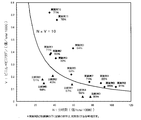
- N ⁇ V ⁇ 10 (However, N and V are numbers per 1000 carbon atoms in total of the main chain and side chain measured by NMR.)
- MFR (190 ° C., 21.18 N load) is 0.1 to 100 g / 10 minutes (a3) Density is 0.860 to 0.920 g / cm 3
- the component (A) further comprises an ethylene / ⁇ -olefin copolymer having the following characteristics (a4): Provided is a resin composition for a solar cell encapsulant, which is a coalescence.
- N The number of branches (N) by the comonomer in the ethylene / ⁇ -olefin copolymer satisfies the relationship of the following formula (2).
- Formula (2) 0 ⁇ N ⁇ 54.0 (However, N is the number per 1000 carbon atoms in total of the main chain and side chain measured by NMR.)
- the content of the component (B) is 0.2 to 5 parts by weight with respect to 100 parts by weight of the component (A).
- the resin composition for solar cell sealing materials characterized by this is provided.
- a resin composition for a solar cell encapsulant characterized by further comprising the following component (C) in any one of the first to third aspects of the invention: Provided.
- content of a component (C) is 100 weight part of component (A)
- a resin composition for a solar cell encapsulant is provided that is 0.01 to 2.5 parts by weight.
- the ⁇ -olefin of component (A) has 8 to 20 carbon atoms.
- a resin composition for a stopper is provided.
- the ⁇ -olefin of component (A) is 1-octene.
- a resin composition is provided.
- a solar cell encapsulant comprising the resin composition for a solar cell encapsulant according to any one of the first to seventh aspects.
- a solar cell module using the solar cell sealing material according to the eighth invention.
- the resin composition for a solar cell encapsulant of the present invention is mainly composed of an ethylene / ⁇ -olefin copolymer that satisfies specific conditions with respect to the number of branches and the number of vinyl and vinylidene, and an organic peroxide is added thereto.
- the resin composition is made into a sheet, the ethylene / ⁇ -olefin copolymer can be crosslinked in a relatively short time, a module can be easily formed as a solar cell sealing material, and the manufacturing cost can be reduced. Can do.
- the obtained solar cell module has excellent crosslinking characteristics, heat resistance, transparency, impact resistance, and the like, and can be expected to maintain stable conversion efficiency for a long period of time.
- FIG. 1 is a graph showing the relationship between the number of branches (N) and the number of vinyl and vinylidene (V) in Examples and Comparative Examples.
- the present invention relates to a novel resin composition for a solar cell encapsulant comprising a specific ethylene / ⁇ -olefin copolymer and an organic peroxide as a resin component, and a solar cell encapsulant using the same
- the present invention relates to a solar cell module.
- each component used in the present invention the obtained resin composition for a solar cell encapsulant, a solar cell encapsulant using the same, a solar cell module and the like will be described in detail.
- Resin composition for solar cell encapsulant comprises a component (A) that is an ethylene / ⁇ -olefin copolymer and an organic peroxide. It contains the component (B) which is an oxide.
- Component (A) used in the present invention is an ethylene / ⁇ -olefin copolymer having the following properties (a1) to (a3).
- (A1) The number of branches (N) due to the comonomer in the ethylene / ⁇ -olefin copolymer and the total number (V) of vinyl and vinylidene satisfy the relationship of the following formula (1).
- N ⁇ V ⁇ 10 (However, N and V are the numbers per 1000 carbon atoms in total of the main chain and side chain measured by NMR.
- Pieces / total 1000C) (A2) MFR (190 ° C., 21.18 N load) is 0.1 to 100 g / 10 minutes (a3) Density is 0.860 to 0.920 g / cm 3
- the resin composition of the present invention has good crosslinking properties, heat resistance and transparency by satisfying the above properties.
- (I) Characteristics of component (A) (a1) Relationship between the number of branches by comonomer (N) and the number of vinyl and vinylidene (V)
- the ethylene / ⁇ -olefin copolymer used in the present invention has a number of branches by comonomer ( It is important that the total number (V) of N) and vinyl and vinylidene satisfy the following formula (1).
- Formula (1) N ⁇ V ⁇ 10
- the number of branches (N) and the number of vinyls and vinylidenes (V) are the number per 1000 carbon atoms (total / total 1000 C) of the main chain and side chain measured by NMR.
- the structures of vinyl and vinylidene are shown below.
- R1 represents a polymer main chain
- R2 represents a methyl group or a polymer main chain.
- Patent Document 5 discloses a resin composition for a solar cell encapsulant having a specific number of branches (N) due to a comonomer and having good crosslinking characteristics. Has found that there is a problem of poor blocking resistance during sheet molding. Therefore, the present inventors have further studied. As long as the density satisfies 0.860 to 0.920 g / cm 3 , the above formula (1) is satisfied and the number of branches (N) is the following formula (2 ), It was found that a resin composition having excellent crosslinking characteristics and improved blocking resistance during sheet molding can be obtained.
- Formula (2) 0 ⁇ N ⁇ 54.0 (However, N is the number per 1000 carbon atoms in total of the main chain and side chain measured by NMR.)
- the number of branches (N) due to the comonomer in the polymer is, for example, E.I. W. Hansen, R.A. Blom, and O.M. M.M. It can be calculated from a 13 C-NMR spectrum with reference to Bade, Polymer, 36, 4295 (1997).
- the number of branches (N) due to the comonomer in the polymer can be adjusted by the polymerization conditions such as the amount of ⁇ -olefin added during the production and the polymerization temperature.
- the number (V) of vinyl and vinylidene in the ethylene / ⁇ -olefin copolymer is preferably 0.10 (pieces / total 1000 C) or more, more preferably 0.12 or more, as long as the formula (1) is satisfied. 0.17 or more is more preferable, and 0.2 or more is particularly preferable.
- the upper limit of the number (V) is not particularly limited, but is preferably 5.0 or less, more preferably 3.0 or less, and particularly preferably 1.5 or less from the viewpoint of the thermal stability of the resin.
- the individual amounts of vinyl and vinylidene are not particularly limited, but for example, vinyl and vinylidene are each preferably 0.05 or more.
- the number of vinyl and vinylidene can be measured by 1 H-NMR method.
- the number of vinyl and vinylidene in the polymer is measured by 1 H-NMR method, and is determined by the number per 1000 carbon atoms in total of the main chain and the side chain. Specifically, the vinyl number per 1000 carbon atoms was calculated from the peak area derived from a saturated alkyl chain appearing between 0.4 and 2.8 ppm in chemical shift and the peak area derived from vinyl around 4.9 ppm. The vinylidene number was calculated using a characteristic peak around 4.7 ppm.
- the number of vinyls and vinylidenes can be adjusted by using production conditions such as polymerization temperature or using a diene compound as a comonomer.
- the ethylene / ⁇ -olefin copolymer used in the present invention has an MFR of 0.1 to 100 g / 10 min, preferably 5 to 50 g / 10 min, more preferably 20 to 40 g / 10 min.
- MFR of the ethylene / ⁇ -olefin copolymer is less than 0.1 g / 10 min, the molecular weight is too high and extrusion during kneading becomes difficult.
- the MFR exceeds 100 g / 10 min, the melt viscosity becomes too low. Thus, the handling property is lacking.
- the MFR of the ethylene / ⁇ -olefin copolymer is measured according to JIS-K6922-2: 1997 appendix (190 ° C., 21.18 N load).
- (A3) an ethylene ⁇ alpha-olefin copolymer used in the density present invention, density of 0.860 ⁇ 0.920g / cm 3, preferably 0.865 ⁇ 0.915g / cm 3, more preferably 0 870 to 0.900 g / cm 3 .
- density of the ethylene / ⁇ -olefin copolymer is less than 0.860 g / cm 3 , the processed sheet is blocked, whereas when the density exceeds 0.920 g / cm 3 , the rigidity of the processed sheet is low. It is too high and it is not easy to handle.
- the density of the polymer for example, a method of appropriately adjusting the ⁇ -olefin content, the polymerization temperature, the catalyst amount and the like is employed.
- the density of the ethylene / ⁇ -olefin copolymer is measured according to JIS-K6922-2: 1997 appendix (in the case of low density polyethylene) (23 ° C.).
- the ethylene / ⁇ -olefin copolymer used in the present invention is a random copolymer of ethylene and ⁇ -olefin, the main component of which is a constitutional unit derived from ethylene.
- the ⁇ -olefin used as a comonomer is an ⁇ -olefin having 3 to 50 carbon atoms, preferably an ⁇ -olefin having 8 to 20 carbon atoms.
- 1-octene, 1-nonene, 1-decene, 1-undecene, 1-dodecene and vinylbenzene are preferable, and 1-octene is particularly preferable.
- the solar cell encapsulant is also required to be thin as the solar cell element is thin.
- a solar cell encapsulating material having a reduced thickness it is required to increase the rigidity of the encapsulating material in order to prevent disconnection when an impact is applied from the upper or lower protective material side. Therefore, from the viewpoint of improving impact resistance, the ⁇ -olefin used as a comonomer is preferably an ⁇ -olefin having 8 to 20 carbon atoms, and among them, 1-octene, 1-nonene, 1-decene, 1-undecene. It is preferable to use 1-dodecene, vinylbenzene or the like. When these are used, the tensile elastic modulus is increased and excellent impact resistance is exhibited.
- the crosslinking property is excellent, and an excellent tensile elastic modulus as compared with the case of using other 1-propene, 1-butene, and 1-hexene. And blocking resistance.
- the ⁇ -olefin may be used alone or in combination of two or more.
- diene compounds such as 1,5-hexadiene, 1,6-heptadiene, 1,7-octadiene, 1,8-nonadiene, and 1,9-decadiene may be blended in a small amount with ⁇ -olefin.
- diene compounds When these diene compounds are blended, long-chain branching is possible, so that the crystallinity of the ethylene / ⁇ -olefin copolymer is lowered, transparency, flexibility, adhesiveness, etc. are improved, and it becomes a cross-linking agent between molecules. So the mechanical strength increases.
- the terminal group of the long chain branch is an unsaturated group, it can easily undergo a crosslinking reaction with an organic peroxide, a copolymerization reaction with an acid anhydride group-containing compound or an epoxy group-containing compound, and a graft reaction. it can.
- cyclic dienes such as 5-vinyl-2-norbornene and 5-ethylidene-2-norbornene can be used as a diene compound blended in a small amount with an ⁇ -olefin.
- the ethylene / ⁇ -olefin copolymer used in the present invention preferably has an ⁇ -olefin content of 5 to 40% by weight, more preferably 10 to 35% by weight, and particularly preferably 15 to 35% by weight. . If it is this range, the softness
- the ethylene / ⁇ -olefin copolymer used in the present invention is a Ziegler catalyst, vanadium catalyst or metallocene catalyst, preferably vanadium catalyst or metallocene catalyst, more preferably metallocene. It can be produced using a catalyst. Examples of the production method include a high-pressure ion polymerization method, a gas phase method, a solution method, and a slurry method. In particular, it is preferable to use a high-pressure method such as a high-pressure ion polymerization method.
- the catalyst which uses a metallocene compound, such as a zirconium compound coordinated with the group which has a cyclopentadienyl skeleton, etc., and a promoter as a catalyst component is mentioned.
- a metallocene compound such as a zirconium compound in which a group having a cyclopentadienyl skeleton is coordinated.
- Commercially available products include Japan-made Harmolex series, Kernel series, Prime Polymer's Evolution series, Sumitomo Chemical's Excellen GMH series, Excellen FX series, Dow Chemical's Engage series, Exxon Mobil. The Exact series made by the company is mentioned.
- the vanadium catalyst include a catalyst having a soluble vanadium compound and an organic aluminum halide as catalyst components.
- the organic peroxide of component (B) in the present invention is mainly used for crosslinking component (A).
- an organic peroxide having a decomposition temperature temperature at which the half-life is 1 hour
- 70 to 180 ° C., particularly 90 to 160 ° C. can be used.
- organic peroxides examples include t-butyl peroxyisopropyl carbonate, t-butyl peroxy-2-ethylhexyl carbonate, t-butyl peroxyacetate, t-butyl peroxybenzoate, dicumyl peroxide, , 5-dimethyl-2,5-di (t-butylperoxy) hexane, di-t-butylperoxide, 2,5-dimethyl-2,5-di (t-butylperoxy) hexyne-3, 1 , 1-di (t-butylperoxy) -3,3,5-trimethylcyclohexane, 1,1-di (t-butylperoxy) cyclohexane, methyl ethyl ketone peroxide, 2,5-dimethylhexyl-2,5- Diperoxybenzoate, t-butyl hydroperoxide, p-menthane hydroperoxy Id, be
- the blending ratio of component (B) is preferably 0.2 to 5 parts by weight, more preferably 0.5 to 3 parts by weight, and still more preferably when component (A) is 100 parts by weight. 1 to 2 parts by weight.
- component (B) is less than the above range, crosslinking is not performed or it takes time for crosslinking.
- distribution will become inadequate and it will be easy to become non-uniform
- Component (C) In this invention, it is preferable to mix
- the hindered amine light stabilizer captures radical species harmful to the polymer and prevents generation of new radicals.
- Low molecular weight hindered amine light stabilizers include decanedioic acid bis (2,2,6,6-tetramethyl-1 (octyloxy) -4-piperidinyl) ester, 1,1-dimethylethyl hydroperoxide and Composed of 70% by weight of a reaction product of octane (molecular weight 737) and 30% by weight of polypropylene; bis (1,2,2,6,6-pentamethyl-4-piperidyl) [[3,5-bis (1,1 -Dimethylethyl) -4-hydroxyphenyl] methyl] butyl malonate (molecular weight 685); bis (1,2,2,6,6-pentamethyl-4-piperidyl) sebacate and methyl-1,2,2,6 6-Pentamethyl-4-piperidyl sebacate mixture (molecular weight 509); bis (2,2,6,6-tetramethyl-4-piperidyl) sebacate Molecular weight 481); tetraki
- High molecular weight hindered amine light stabilizers include poly [ ⁇ 6- (1,1,3,3-tetramethylbutyl) amino-1,3,5-triazine-2,4-diyl ⁇ ⁇ (2, 2,6,6-tetramethyl-4-piperidyl) imino ⁇ hexamethylene ⁇ (2,2,6,6-tetramethyl-4-piperidyl) imino ⁇ ] (molecular weight 2,000-3,100); succinic acid Polymer of dimethyl and 4-hydroxy-2,2,6,6-tetramethyl-1-piperidineethanol (molecular weight 3,100 to 4,000); N, N ′, N ′′, N ′′ ′-tetrakis- ( 4,6-bis- (butyl- (N-methyl-2,2,6,6-tetramethylpiperidin-4-yl) amino) -triazin-2-yl) -4,7-diazadecane-1,10- Diamine (molecular weight 2,286) and A mixture of a poly
- hindered amine light stabilizer poly [ ⁇ 6- (1,1,3,3-tetramethylbutyl) amino-1,3,5-triazine-2,4-diyl ⁇ ⁇ (2 , 2,6,6-tetramethyl-4-piperidyl) imino ⁇ hexamethylene ⁇ (2,2,6,6-tetramethyl-4-piperidyl) imino ⁇ ] (molecular weight 2,000-3,100); Polymer of dimethyl acid and 4-hydroxy-2,2,6,6-tetramethyl-1-piperidineethanol (molecular weight 3,100 to 4,000); N, N ′, N ′′, N ′′ ′-tetrakis- (4,6-bis- (butyl- (N-methyl-2,2,6,6-tetramethylpiperidin-4-yl) amino) -triazin-2-yl) -4,7-diazadecane-1,10 -Diamine (molecular weight 2,28 ) And the above-mentione
- the content of the hindered amine light stabilizer is 0.01 to 2.5 parts by weight, preferably 0.01 to 1. part by weight based on 100 parts by weight of the ethylene / ⁇ -olefin copolymer.
- the amount is 0 part by weight, more preferably 0.01 to 0.5 part by weight, still more preferably 0.01 to 0.2 part by weight, and most preferably 0.03 to 0.1 part by weight.
- the content is 0.01 parts by weight or more, a sufficient stabilizing effect is obtained, and when the content is 2.5 parts by weight or less, the resin is discolored due to excessive addition of a hindered amine light stabilizer.
- the weight ratio (B: C) of the organic peroxide (B) to the hindered amine light stabilizer (C) is 1: 0.01 to 1:10.
- the ratio is preferably 1: 0.02 to 1: 6.5.
- a crosslinking assistant can be mix
- the crosslinking aid is effective in promoting the crosslinking reaction and increasing the degree of crosslinking of the ethylene / ⁇ -olefin copolymer.
- Specific examples thereof include polyaryl compounds and poly (meth) acryloxy compounds. Saturated compounds can be exemplified. More specifically, polyallyl compounds such as triallyl isocyanurate, triallyl cyanurate, diallyl phthalate, diallyl fumarate, diallyl maleate, ethylene glycol diacrylate, ethylene glycol dimethacrylate, trimethylolpropane trimethacrylate, etc. Examples include poly (meth) acryloxy compounds and divinylbenzene.
- the crosslinking aid can be blended at a ratio of about 0 to 5 parts by weight with respect to 100 parts by weight of component (A).
- UV absorber can be mix
- the ultraviolet absorber include various types such as benzophenone, benzotriazole, triazine, and salicylic acid ester.
- the benzophenone ultraviolet absorber include 2-hydroxy-4-methoxybenzophenone, 2-hydroxy-4-methoxy-2′-carboxybenzophenone, 2-hydroxy-4-n-octoxybenzophenone, 2-hydroxy-4 -N-dodecyloxybenzophenone, 2-hydroxy-4-n-octadecyloxybenzophenone, 2-hydroxy-4-benzyloxybenzophenone, 2-hydroxy-4-methoxy-5-sulfobenzophenone, 2-hydroxy-5-chlorobenzophenone 2,2-dihydroxybenzophenone, 2,2'-dihydroxy-4-methoxybenzophenone, 2,2'-dihydroxy-4,4'-dimethoxybenzophenone, 2,2 ', 4,4'-t
- benzotriazole ultraviolet absorber examples include hydroxyphenyl-substituted benzotriazole compounds such as 2- (2-hydroxy-5-methylphenyl) benzotriazole and 2- (2-hydroxy-5-tert-butylphenyl).
- Benzotriazole 2- (2-hydroxy-3,5-dimethylphenyl) benzotriazole, 2- (2-methyl-4-hydroxyphenyl) benzotriazole, 2- (2-hydroxy-3-methyl-5-t- Butylphenyl) benzotriazole, 2- (2-hydroxy-3,5-di-t-amylphenyl) benzotriazole, 2- (2-hydroxy-3,5-di-t-butylphenyl) benzotriazole, etc. Can be mentioned.
- triazine ultraviolet absorbers examples include 2- [4,6-bis (2,4-dimethylphenyl) -1,3,5-triazin-2-yl] -5- (octyloxy) phenol, 2- ( Examples include 4,6-diphenyl-1,3,5-triazin-2-yl) -5- (hexyloxy) phenol.
- salicylic acid esters include phenyl salicylate and p-octylphenyl salicylate. These ultraviolet absorbers are blended in an amount of 0 to 2.0 parts by weight, preferably 0.05 to 2.0 parts by weight, more preferably 0.1 to 1. parts by weight based on 100 parts by weight of the ethylene / ⁇ -olefin copolymer. 0 part by weight, more preferably 0.1 to 0.5 part by weight, and most preferably 0.2 to 0.4 part by weight is blended.
- silane coupling agent can be used in the resin composition of the present invention mainly for the purpose of improving the adhesive strength between the solar cell upper protective material and the solar cell element.
- silane coupling agent in the present invention include ⁇ -chloropropyltrimethoxysilane; vinyltrichlorosilane; vinyltriethoxysilane; vinyltrimethoxysilane; vinyl-tris- ( ⁇ -methoxyethoxy) silane; ⁇ -methacryloxypropyl.
- Vinyltrimethoxysilane, ⁇ -methacryloxypropyltrimethoxysilane, and 3-acryloxypropyltrimethoxysilane are preferable.
- silane coupling agents are used in an amount of 0 to 5 parts by weight, preferably 0.01 to 4 parts by weight, more preferably 0.01 to 2 parts by weight, based on 100 parts by weight of the ethylene / ⁇ -olefin copolymer. More preferably, it is used in an amount of 0.05 to 1 part by weight.
- additive components in the resin composition of the present invention, other additional optional components can be blended within a range that does not significantly impair the object of the present invention.
- optional components antioxidants, crystal nucleating agents, clearing agents, lubricants, colorants, dispersants, fillers, fluorescent whitening agents, UV absorbers used in ordinary polyolefin resin materials, A light stabilizer etc. can be mentioned.
- a crystalline ethylene / ⁇ -olefin copolymer polymerized by a Ziegler-based or metallocene-based catalyst within a range not impairing the object of the present invention.
- 3 to 75 parts by weight of high-pressure low-density polyethylene can be blended to impart melt tension and the like.
- the solar cell encapsulant of the present invention (hereinafter also simply referred to as encapsulant) is obtained by pelletizing or resinating the resin composition. If this solar cell sealing material is used, a solar cell module can be manufactured by fixing a solar cell element with upper and lower protective materials. Examples of such solar cell modules include various types. For example, the upper transparent protective material / encapsulant / solar cell element / encapsulant / lower protective material sandwiched between the solar cell elements from both sides, formed on the inner peripheral surface of the lower substrate protective material A solar cell element formed on the inner peripheral surface of the upper transparent protective material, for example, a fluororesin-based transparent protective material. The thing of the structure which forms a sealing material and a lower protective material on what created the amorphous solar cell element by sputtering etc. can be mentioned.
- the solar cell element is not particularly limited, and is based on silicon such as single crystal silicon, polycrystalline silicon, amorphous silicon, III-V group or II-VI group such as gallium-arsenic, copper-indium-selenium, cadmium-tellurium.
- silicon such as single crystal silicon, polycrystalline silicon, amorphous silicon, III-V group or II-VI group such as gallium-arsenic, copper-indium-selenium, cadmium-tellurium.
- Various solar cell elements such as compound semiconductors can be used. In the present invention, those using glass as the substrate are preferred.
- the upper protective material constituting the solar cell module examples include glass, acrylic resin, polycarbonate, polyester, and fluorine-containing resin.
- the lower protective material is a single or multilayer sheet such as a metal or various thermoplastic resin films, for example, a metal such as tin, aluminum or stainless steel, an inorganic material such as glass, polyester, an inorganic vapor-deposited polyester, or fluorine.
- the protective material include a single layer or a multilayer such as a containing resin and polyolefin.
- Such an upper and / or lower protective material can be subjected to a primer treatment in order to enhance the adhesion to the sealing material.
- glass is preferred as the upper protective material.
- the solar cell encapsulant of the present invention may be used as a pellet, but is usually used after being formed into a sheet having a thickness of about 0.1 to 1 mm. If the thickness is less than 0.1 mm, the strength is small and the adhesion is insufficient. If the thickness is more than 1 mm, the transparency may be lowered, which may be a problem. A preferred thickness is 0.1 to 0.8 mm.
- the sheet-like solar cell encapsulant can be produced by a known sheet molding method using a T-die extruder, a calendar molding machine or the like.
- a cross-linking agent is added to an ethylene / ⁇ -olefin copolymer and, if necessary, a hindered amine light stabilizer, a cross-linking aid, a silane coupling agent, an ultraviolet absorber, an antioxidant, a light stabilizer.
- An additive such as an agent can be obtained by dry blending in advance and feeding from a hopper of a T-die extruder and extruding into a sheet at an extrusion temperature of 80 to 150 ° C.
- some or all of the additives can be used in the form of a masterbatch.
- a part or all of the additive is melt-mixed in advance into the amorphous ⁇ -olefin copolymer using a single screw extruder, twin screw extruder, Banbury mixer, kneader, etc.
- resin composition can also be used.
- the formed sheet is wound around a paper tube for easy storage and transportation. At this time, the sheets may adhere to each other (blocking may occur). If blocking occurs, when the sheet is fed out and used in the next step, it cannot be stably fed out, resulting in a decrease in productivity.
- the sheet of the sealing material of the present invention is prepared in advance, and is subjected to pressure bonding at a temperature at which the resin composition of the sealing material melts, for example, 150 to 200 ° C. as described above.
- a temperature at which the resin composition of the sealing material melts for example, 150 to 200 ° C. as described above.
- a module having a simple structure can be formed.
- the solar cell module can be manufactured in one step without bothering to form a sheet. Is possible.
- the sealing material is temporarily applied to the solar cell element or the protective material at a temperature at which the organic peroxide is not substantially decomposed and the sealing material of the present invention is melted. Adhesion is then performed, and the temperature is raised to achieve sufficient adhesion and crosslinking of the ethylene / ⁇ -olefin copolymer.
- the gel in the encapsulant layer is used in order to obtain a solar cell module with good heat resistance having a melting point (DSC method) of the encapsulant layer of 85 ° C. or higher and a storage elastic modulus of 150 ° C. of 10 3 Pa or higher.
- Fraction (1 g of sample is immersed in 100 ml of xylene, heated at 110 ° C. for 24 hours, then filtered through a 20 mesh wire net and the mass fraction of unmelted is measured) is 50 to 98%, preferably about 70 to 95% It is better to crosslink so that
- the solar cell element is temporarily bonded by heating to a temperature at which the organic peroxide is not decomposed for several minutes to 10 minutes, For example, there is a method in which the organic peroxide is decomposed in the oven at a high temperature of about 150 to 200.degree.
- the sealing material of the present invention when the number of branches (N) of the component (A) and the total number of vinyl and vinylidene (V) satisfy the specific relationship as described above, the crosslinking characteristics are improved, and the heat resistance A solar cell module having excellent properties can be obtained.
- N The number of branches (N) in the polymer was measured by 13 C-NMR, and the number of vinyl and vinylidene (V) was measured by 1 H-NMR under the following conditions: The amount of comonomer was determined by the number per 1000 carbons in total of the main chain and the side chain.
- the gel fraction As for the gel fraction, about 1 g of the sheet is cut out and weighed accurately, immersed in 100 cc of xylene, treated at 110 ° C. for 24 hours, the residue after filtration is dried and weighed, and divided by the weight before treatment. Calculate the gel fraction.
- PE-1 Ethylene / ⁇ -olefin Copolymer
- PE-2 Exact 8230 manufactured by DEX Plastomers
- PE-3 Exact 8210 manufactured by DEX Platamers
- PE-3 ⁇ Production method of PE-3, PE-5, PE-13 to 17> is described below.
- PE-4 Tuffmer P-0180 manufactured by Mitsui Chemicals, Inc.
- PE-5) ⁇ Production method of PE-3, PE-5, PE-13 to 17> described below.
- PE-6 Tuffmer P-0275 manufactured by Mitsui Chemicals, Inc.
- PE-7) Exact5008 manufactured by ExxonMobil
- PE-8) Tuffmer P-0280 manufactured by Mitsui Chemicals
- PE-9) Exact4041 manufactured by ExxonMobil
- PE-10) Dow Engage 8401
- PE-11 Tuffmer A-4050S manufactured by Mitsui Chemicals
- PE-12 Tuffmer A-4070S manufactured by Mitsui Chemicals
- PE-13 Tuffmer A-4070S manufactured by Mitsui Chemicals (PE-13) to (PE-17): The production method is described in the following ⁇ Method for producing PE-3, PE-5, PE-13 to 17>. Note that PE-1 to 8 and PE-13 to 15 are PE-9 to 12, PE-16, and 17 were used for the comparative examples. The physical properties are shown in Table 1.
- ethylene / propylene / 1-hexene having a propylene content of 12.1 wt%, a 1-hexene content of 11.3 wt%, an MFR of 30 g / 10 min, and a density of 0.880 g / cm 3 A copolymer (PE-3) was obtained.
- Example 1 2,5-dimethyl-2,5-di (t-butylperoxy) hexane (Arkema Yoshitomi Co., Ltd.) as an organic peroxide with respect to 100 parts by weight of a copolymer of ethylene and 1-octene (PE-1) RUPEROX 101), 1.5 parts by weight of hindered amine light stabilizer, dimethyl succinate and 4-hydroxy-2,2,6,6-tetramethyl-1-piperidineethanol polymer (BASF) TINUVIN 622LD) 0.05 parts by weight and 0.3 parts by weight of 2-hydroxy-4-n-octoxybenzophenone (CYTEC UV531 manufactured by Sun Chemical Co., Ltd.) as a UV absorber.
- PE-1octene PE-1 RUPEROX 101
- BASF 4-hydroxy-2,2,6,6-tetramethyl-1-piperidineethanol polymer
- BASF 4-hydroxy-2,2,6,6-tetramethyl-1-piperidineethanol polymer
- Example 2 A sheet was prepared in the same manner as in Example 1 except that PE-2 was used instead of PE-1. The evaluation results are shown in Table 2.
- Example 3 A sheet was produced in the same manner as in Example 1 except that PE-3 was used instead of PE-1. The evaluation results are shown in Table 2.
- Example 4 A sheet was produced in the same manner as in Example 1 except that PE-4 was used instead of PE-1. The evaluation results are shown in Table 2.
- Example 5 A sheet was prepared in the same manner as in Example 1 except that PE-5 was used instead of PE-1. The evaluation results are shown in Table 2.
- Example 6 A sheet was produced in the same manner as in Example 1 except that PE-6 was used instead of PE-1. The evaluation results are shown in Table 2.
- Example 7 A sheet was produced in the same manner as in Example 1 except that PE-7 was used instead of PE-1. The evaluation results are shown in Table 2.
- Example 8 A sheet was produced in the same manner as in Example 1 except that PE-8 was used instead of PE-1. The evaluation results are shown in Table 2.
- Example 9 A sheet was produced in the same manner as in Example 1 except that PE-13 was used in Example 1. The evaluation results are shown in Table 2.
- Example 10 A sheet was produced in the same manner as in Example 1 except that PE-14 was used in Example 1. The evaluation results are shown in Table 2.
- Example 11 A sheet was produced in the same manner as in Example 1 except that PE-15 was used in Example 1. The evaluation results are shown in Table 2.
- Example 1 A sheet was prepared in the same manner as in Example 1 except that PE-9 was used instead of the copolymer of ethylene and 1-octene (PE-1). The evaluation results are shown in Table 2.
- Example 2 A sheet was produced in the same manner as in Example 1 except that PE-10 was used instead of PE-1. The evaluation results are shown in Table 2.
- Example 3 A sheet was produced in the same manner as in Example 1 except that PE-11 was used instead of PE-1. The evaluation results are shown in Table 2.
- Example 4 A sheet was prepared in the same manner as in Example 1 except that PE-12 was used instead of PE-1. The evaluation results are shown in Table 2.
- Example 5 A sheet was produced in the same manner as in Example 1 except that PE-16 was used instead of PE-1. The evaluation results are shown in Table 2.
- a sheet obtained from an ethylene / ⁇ -copolymer using 1-octene (C8) as a comonomer is excellent in rigidity and impact resistance. Furthermore, it turns out that these sheets are also excellent in blocking resistance.
- Comparative Example 3 is 10.0%, which is a relatively high value, but all of Examples 1 to 11 are good, being 2.5% or less.
- the light transmittance is 90% or more in all of Examples 1 to 11, and it can be seen that the sheet obtained from the present invention is excellent in transparency.
- the resin composition for a solar cell encapsulant of the present invention is preferably used as a solar cell encapsulant because it has good crosslinking properties and high heat resistance, and is excellent in transparency, impact resistance and the like. It is particularly useful as a thin film solar cell or solar cell module.
Landscapes
- Chemical & Material Sciences (AREA)
- Health & Medical Sciences (AREA)
- Chemical Kinetics & Catalysis (AREA)
- Medicinal Chemistry (AREA)
- Polymers & Plastics (AREA)
- Organic Chemistry (AREA)
- Photovoltaic Devices (AREA)
- Compositions Of Macromolecular Compounds (AREA)
- Addition Polymer Or Copolymer, Post-Treatments, Or Chemical Modifications (AREA)
Priority Applications (3)
| Application Number | Priority Date | Filing Date | Title |
|---|---|---|---|
| CN201480008774.7A CN104995745B (zh) | 2013-02-15 | 2014-02-13 | 太阳能电池密封材料用树脂组合物、及使用其的太阳能电池密封材料和太阳能电池组件 |
| US14/768,123 US9587094B2 (en) | 2013-02-15 | 2014-02-13 | Resin composition for solar cell encapsulant, and solar cell encapsulant and solar cell module using the same |
| EP14752203.1A EP2958151B1 (en) | 2013-02-15 | 2014-02-13 | Resin composition for solar cell sealing materials, solar cell sealing material using same, and solar cell module |
Applications Claiming Priority (2)
| Application Number | Priority Date | Filing Date | Title |
|---|---|---|---|
| JP2013027654 | 2013-02-15 | ||
| JP2013-027654 | 2013-02-15 |
Publications (1)
| Publication Number | Publication Date |
|---|---|
| WO2014126121A1 true WO2014126121A1 (ja) | 2014-08-21 |
Family
ID=51354120
Family Applications (1)
| Application Number | Title | Priority Date | Filing Date |
|---|---|---|---|
| PCT/JP2014/053247 Ceased WO2014126121A1 (ja) | 2013-02-15 | 2014-02-13 | 太陽電池封止材用樹脂組成物、並びにそれを用いた太陽電池封止材及び太陽電池モジュール |
Country Status (5)
| Country | Link |
|---|---|
| US (1) | US9587094B2 (enExample) |
| EP (1) | EP2958151B1 (enExample) |
| JP (2) | JP5592032B1 (enExample) |
| CN (1) | CN104995745B (enExample) |
| WO (1) | WO2014126121A1 (enExample) |
Cited By (4)
| Publication number | Priority date | Publication date | Assignee | Title |
|---|---|---|---|---|
| JP2016056337A (ja) * | 2013-11-26 | 2016-04-21 | 日本ポリエチレン株式会社 | 架橋用エチレン・α−オレフィン共重合体、架橋性樹脂組成物、及びそれを用いた架橋体 |
| JP2017110221A (ja) * | 2015-12-14 | 2017-06-22 | 日本ポリエチレン株式会社 | ポリエチレン樹脂、ポリエチレン樹脂組成物、並びにそれを用いた太陽電池封止材及び太陽電池モジュール |
| JP2018109117A (ja) * | 2016-12-29 | 2018-07-12 | 日本ポリエチレン株式会社 | ポリエチレン樹脂の製造方法並びに当該方法により製造されたポリエチレン樹脂を用いた太陽電池封止材および太陽電池モジュール |
| CN111902273A (zh) * | 2018-04-16 | 2020-11-06 | 北欧化工公司 | 多层元件 |
Families Citing this family (12)
| Publication number | Priority date | Publication date | Assignee | Title |
|---|---|---|---|---|
| JP6735531B2 (ja) * | 2014-10-07 | 2020-08-05 | Mcppイノベーション合同会社 | 3次元網目状構造体用の変性ポリエチレン組成物及び3次元網目状構造体 |
| EP3247758B1 (en) | 2015-01-23 | 2019-12-25 | Bostik, Inc. | Metallocene polyolefin based low activation temperature heat seal hot melt adhesive |
| JP6519271B2 (ja) * | 2015-03-30 | 2019-05-29 | 日本ポリエチレン株式会社 | オレフィン系熱可塑性エラストマー組成物 |
| JP6736946B2 (ja) * | 2016-03-30 | 2020-08-05 | 日本ポリエチレン株式会社 | 太陽電池封止材用ポリエチレン樹脂組成物、並びにそれを用いた太陽電池封止材及び太陽電池モジュール |
| US12278300B2 (en) * | 2019-09-19 | 2025-04-15 | Sabic Global Technologies B.V. | Photovoltaic element |
| ES3027671T3 (en) | 2019-12-26 | 2025-06-16 | Dow Global Technologies Llc | Ethylene/alpha-olefin interpolymer based compositions with improved balance of cure and processability |
| EP4081586A4 (en) | 2019-12-26 | 2023-11-15 | Dow Global Technologies LLC | ETHYLENE/ALPHA-OLEFIN INTERPOLYMER COMPOSITIONS WITH HIGH ADHESION TO GLASS |
| US20240076458A1 (en) | 2021-05-12 | 2024-03-07 | Dow Global Technologies Llc | Rheology modified olefin-based polymer compositions |
| KR20240095441A (ko) * | 2021-11-03 | 2024-06-25 | 사빅 글로벌 테크놀러지스 비.브이. | 가교결합성 폴리올레핀 조성물 |
| KR20250098940A (ko) * | 2023-12-22 | 2025-07-01 | 주식회사 엘지화학 | 봉지재 필름용 조성물 및 이를 포함하는 봉지재 필름 |
| WO2025135621A1 (ko) * | 2023-12-22 | 2025-06-26 | 주식회사 엘지화학 | 폴리올레핀 조성물 |
| WO2025135622A1 (ko) * | 2023-12-22 | 2025-06-26 | 주식회사 엘지화학 | 봉지재 필름용 조성물 및 이를 포함하는 봉지재 필름 |
Citations (9)
| Publication number | Priority date | Publication date | Assignee | Title |
|---|---|---|---|---|
| JPS5823870A (ja) | 1981-08-03 | 1983-02-12 | Du Pont Mitsui Polychem Co Ltd | 太陽電池用保護材と充填材との接着方法 |
| JPH10218921A (ja) | 1997-01-31 | 1998-08-18 | Hoechst Ag | メタロセン触媒システムを製造するための方法 |
| JP2006210906A (ja) | 2004-12-28 | 2006-08-10 | Mitsui Chemical Fabro Inc | 太陽電池封止材 |
| JP2010504647A (ja) | 2006-09-20 | 2010-02-12 | ダウ グローバル テクノロジーズ インコーポレイティド | ポリオレフィンコポリマーを含む電子装置モジュール |
| WO2010114028A1 (ja) * | 2009-03-31 | 2010-10-07 | 日本ポリエチレン株式会社 | 太陽電池封止材用樹脂組成物、太陽電池封止材及びそれを用いた太陽電池モジュール |
| WO2011150193A1 (en) * | 2010-05-26 | 2011-12-01 | Dow Global Technologies Llc | Electronic device module comprising polyolefin copolymer with low unsaturation and optional vinyl silane |
| JP2012009688A (ja) | 2010-06-25 | 2012-01-12 | Japan Polyethylene Corp | 太陽電池封止材用樹脂組成物、及びそれを用いた太陽電池封止材、太陽電池モジュール |
| JP2012009691A (ja) | 2010-06-25 | 2012-01-12 | Japan Polyethylene Corp | 太陽電池封止材用樹脂組成物、及びそれを用いた太陽電池封止材、太陽電池モジュール |
| WO2012066923A1 (ja) * | 2010-11-19 | 2012-05-24 | 富士フイルム株式会社 | 太陽電池封止材及びそれを用いた太陽電池モジュール |
Family Cites Families (11)
| Publication number | Priority date | Publication date | Assignee | Title |
|---|---|---|---|---|
| KR100886444B1 (ko) * | 2004-11-25 | 2009-03-04 | 미쓰이 가가쿠 가부시키가이샤 | 프로필렌계 수지 조성물 및 그 용도 |
| EP1837372B1 (en) * | 2004-12-28 | 2010-10-06 | Du Pont-Mitsui Polychemicals Co., Ltd. | Solar cell sealing material |
| WO2006095762A1 (ja) | 2005-03-08 | 2006-09-14 | Du Pont/Mitsui Polychemicals Co. Ltd. | 太陽電池封止材 |
| JP5764819B2 (ja) * | 2010-06-25 | 2015-08-19 | 日本ポリエチレン株式会社 | 押出成形用樹脂組成物、それを用いた太陽電池モジュールの封止材と太陽電池モジュール、遮水シート、又はターポリン |
| CN102958996B (zh) | 2010-06-25 | 2015-08-05 | 日本聚乙烯株式会社 | 太阳能电池密封材料用树脂组合物、太阳能电池密封材料及使用其的太阳能电池组件 |
| WO2012002264A1 (ja) | 2010-06-28 | 2012-01-05 | 日本ポリエチレン株式会社 | 太陽電池封止材、及びそれを用いた太陽電池モジュール |
| EP2626911B1 (en) | 2010-10-08 | 2015-12-16 | Mitsui Chemicals, Inc. | Solar cell sealing material, and solar cell module |
| US9349895B2 (en) | 2010-11-02 | 2016-05-24 | Mitsui Chemicals, Inc. | Encapsulating material for solar cell and solar cell module |
| WO2012066783A1 (ja) | 2010-11-17 | 2012-05-24 | 三井化学株式会社 | 太陽電池封止材およびそれを用いた太陽電池モジュール |
| JP5857460B2 (ja) * | 2011-06-15 | 2016-02-10 | 大日本印刷株式会社 | 太陽電池モジュール用封止材組成物 |
| EP2826074A1 (en) | 2012-03-12 | 2015-01-21 | RENOLIT Belgium N.V. | Backsheet and photovoltaic modules comprising it |
-
2014
- 2014-02-13 WO PCT/JP2014/053247 patent/WO2014126121A1/ja not_active Ceased
- 2014-02-13 JP JP2014025055A patent/JP5592032B1/ja active Active
- 2014-02-13 CN CN201480008774.7A patent/CN104995745B/zh active Active
- 2014-02-13 US US14/768,123 patent/US9587094B2/en active Active
- 2014-02-13 EP EP14752203.1A patent/EP2958151B1/en not_active Revoked
- 2014-06-06 JP JP2014117613A patent/JP6269329B2/ja active Active
Patent Citations (9)
| Publication number | Priority date | Publication date | Assignee | Title |
|---|---|---|---|---|
| JPS5823870A (ja) | 1981-08-03 | 1983-02-12 | Du Pont Mitsui Polychem Co Ltd | 太陽電池用保護材と充填材との接着方法 |
| JPH10218921A (ja) | 1997-01-31 | 1998-08-18 | Hoechst Ag | メタロセン触媒システムを製造するための方法 |
| JP2006210906A (ja) | 2004-12-28 | 2006-08-10 | Mitsui Chemical Fabro Inc | 太陽電池封止材 |
| JP2010504647A (ja) | 2006-09-20 | 2010-02-12 | ダウ グローバル テクノロジーズ インコーポレイティド | ポリオレフィンコポリマーを含む電子装置モジュール |
| WO2010114028A1 (ja) * | 2009-03-31 | 2010-10-07 | 日本ポリエチレン株式会社 | 太陽電池封止材用樹脂組成物、太陽電池封止材及びそれを用いた太陽電池モジュール |
| WO2011150193A1 (en) * | 2010-05-26 | 2011-12-01 | Dow Global Technologies Llc | Electronic device module comprising polyolefin copolymer with low unsaturation and optional vinyl silane |
| JP2012009688A (ja) | 2010-06-25 | 2012-01-12 | Japan Polyethylene Corp | 太陽電池封止材用樹脂組成物、及びそれを用いた太陽電池封止材、太陽電池モジュール |
| JP2012009691A (ja) | 2010-06-25 | 2012-01-12 | Japan Polyethylene Corp | 太陽電池封止材用樹脂組成物、及びそれを用いた太陽電池封止材、太陽電池モジュール |
| WO2012066923A1 (ja) * | 2010-11-19 | 2012-05-24 | 富士フイルム株式会社 | 太陽電池封止材及びそれを用いた太陽電池モジュール |
Non-Patent Citations (2)
| Title |
|---|
| E.W. HANSEN; R. BLOM; O.M. BADE, POLYMER, vol. 36, 1997, pages 4295 |
| See also references of EP2958151A4 |
Cited By (5)
| Publication number | Priority date | Publication date | Assignee | Title |
|---|---|---|---|---|
| JP2016056337A (ja) * | 2013-11-26 | 2016-04-21 | 日本ポリエチレン株式会社 | 架橋用エチレン・α−オレフィン共重合体、架橋性樹脂組成物、及びそれを用いた架橋体 |
| JP2017110221A (ja) * | 2015-12-14 | 2017-06-22 | 日本ポリエチレン株式会社 | ポリエチレン樹脂、ポリエチレン樹脂組成物、並びにそれを用いた太陽電池封止材及び太陽電池モジュール |
| JP2018109117A (ja) * | 2016-12-29 | 2018-07-12 | 日本ポリエチレン株式会社 | ポリエチレン樹脂の製造方法並びに当該方法により製造されたポリエチレン樹脂を用いた太陽電池封止材および太陽電池モジュール |
| CN111902273A (zh) * | 2018-04-16 | 2020-11-06 | 北欧化工公司 | 多层元件 |
| US11491767B2 (en) | 2018-04-16 | 2022-11-08 | Borealis Ag | Multilayer element |
Also Published As
| Publication number | Publication date |
|---|---|
| EP2958151A1 (en) | 2015-12-23 |
| JP2014209637A (ja) | 2014-11-06 |
| JP2014177625A (ja) | 2014-09-25 |
| JP5592032B1 (ja) | 2014-09-17 |
| CN104995745A (zh) | 2015-10-21 |
| US9587094B2 (en) | 2017-03-07 |
| CN104995745B (zh) | 2017-03-08 |
| EP2958151A4 (en) | 2016-09-28 |
| EP2958151B1 (en) | 2018-10-10 |
| US20160002440A1 (en) | 2016-01-07 |
| JP6269329B2 (ja) | 2018-01-31 |
Similar Documents
| Publication | Publication Date | Title |
|---|---|---|
| JP6269329B2 (ja) | 太陽電池封止材用樹脂組成物、並びにそれを用いた太陽電池封止材及び太陽電池モジュール | |
| JP5688441B2 (ja) | 太陽電池封止材用樹脂組成物 | |
| JP5539063B2 (ja) | 太陽電池封止材用樹脂組成物、及びそれを用いた太陽電池封止材、太陽電池モジュール | |
| JP6428199B2 (ja) | 太陽電池封止材用樹脂組成物、並びにそれを用いた太陽電池封止材及び太陽電池モジュール | |
| WO2010114028A1 (ja) | 太陽電池封止材用樹脂組成物、太陽電池封止材及びそれを用いた太陽電池モジュール | |
| JP5636221B2 (ja) | 太陽電池封止材用樹脂組成物 | |
| WO2011162324A1 (ja) | 太陽電池封止材用樹脂組成物、及びそれを用いた太陽電池封止材と太陽電池モジュール | |
| JP5519409B2 (ja) | 太陽電池封止材用樹脂シート | |
| JP5800053B2 (ja) | 太陽電池封止材用樹脂組成物、及びそれを用いた太陽電池封止材、太陽電池モジュール | |
| JP2013139558A (ja) | 太陽電池封止材用樹脂組成物、及びそれを用いた太陽電池封止材、太陽電池モジュール | |
| JP2015211189A (ja) | 太陽電池封止材用樹脂組成物、並びにそれを用いた太陽電池封止材及び太陽電池モジュール | |
| JP5417534B2 (ja) | 太陽電池封止材、及びそれを用いた太陽電池モジュール | |
| JP5821341B2 (ja) | 太陽電池封止材用樹脂組成物、及びそれを用いた太陽電池封止材 | |
| JP5854073B2 (ja) | 太陽電池封止材用シートの製造方法、それを用いた太陽電池モジュール | |
| JP5764819B2 (ja) | 押出成形用樹脂組成物、それを用いた太陽電池モジュールの封止材と太陽電池モジュール、遮水シート、又はターポリン | |
| JP5542503B2 (ja) | 太陽電池封止材用樹脂組成物 | |
| JP2017110221A (ja) | ポリエチレン樹脂、ポリエチレン樹脂組成物、並びにそれを用いた太陽電池封止材及び太陽電池モジュール | |
| JP5824902B2 (ja) | 太陽電池封止材用樹脂組成物、及びそれを用いた太陽電池封止材と太陽電池モジュール | |
| JP5539064B2 (ja) | 太陽電池封止材用樹脂組成物、及びそれを用いた太陽電池封止材、太陽電池モジュール | |
| JP5530828B2 (ja) | 太陽電池封止材用樹脂組成物の製造方法 | |
| JP5542566B2 (ja) | 太陽電池封止材用樹脂組成物 | |
| JP5519428B2 (ja) | 太陽電池封止材用樹脂組成物 | |
| JP5800054B2 (ja) | 太陽電池封止材用樹脂組成物、及びそれを用いた太陽電池封止材、太陽電池モジュール |
Legal Events
| Date | Code | Title | Description |
|---|---|---|---|
| 121 | Ep: the epo has been informed by wipo that ep was designated in this application |
Ref document number: 14752203 Country of ref document: EP Kind code of ref document: A1 |
|
| WWE | Wipo information: entry into national phase |
Ref document number: 2014752203 Country of ref document: EP |
|
| WWE | Wipo information: entry into national phase |
Ref document number: 14768123 Country of ref document: US |
|
| NENP | Non-entry into the national phase |
Ref country code: DE |