WO2014123124A1 - 着色剤分散液、着色剤分散液の製造方法、カラーフィルタ用着色樹脂組成物、カラーフィルタ、液晶表示装置、及び有機発光表示装置 - Google Patents
着色剤分散液、着色剤分散液の製造方法、カラーフィルタ用着色樹脂組成物、カラーフィルタ、液晶表示装置、及び有機発光表示装置 Download PDFInfo
- Publication number
- WO2014123124A1 WO2014123124A1 PCT/JP2014/052584 JP2014052584W WO2014123124A1 WO 2014123124 A1 WO2014123124 A1 WO 2014123124A1 JP 2014052584 W JP2014052584 W JP 2014052584W WO 2014123124 A1 WO2014123124 A1 WO 2014123124A1
- Authority
- WO
- WIPO (PCT)
- Prior art keywords
- group
- colorant
- solvent
- color filter
- general formula
- Prior art date
- Legal status (The legal status is an assumption and is not a legal conclusion. Google has not performed a legal analysis and makes no representation as to the accuracy of the status listed.)
- Ceased
Links
Images
Classifications
-
- C—CHEMISTRY; METALLURGY
- C09—DYES; PAINTS; POLISHES; NATURAL RESINS; ADHESIVES; COMPOSITIONS NOT OTHERWISE PROVIDED FOR; APPLICATIONS OF MATERIALS NOT OTHERWISE PROVIDED FOR
- C09B—ORGANIC DYES OR CLOSELY-RELATED COMPOUNDS FOR PRODUCING DYES, e.g. PIGMENTS; MORDANTS; LAKES
- C09B67/00—Influencing the physical, e.g. the dyeing or printing properties of dyestuffs without chemical reactions, e.g. by treating with solvents grinding or grinding assistants, coating of pigments or dyes; Process features in the making of dyestuff preparations; Dyestuff preparations of a special physical nature, e.g. tablets, films
- C09B67/0071—Process features in the making of dyestuff preparations; Dehydrating agents; Dispersing agents; Dustfree compositions
- C09B67/0084—Dispersions of dyes
-
- C—CHEMISTRY; METALLURGY
- C09—DYES; PAINTS; POLISHES; NATURAL RESINS; ADHESIVES; COMPOSITIONS NOT OTHERWISE PROVIDED FOR; APPLICATIONS OF MATERIALS NOT OTHERWISE PROVIDED FOR
- C09B—ORGANIC DYES OR CLOSELY-RELATED COMPOUNDS FOR PRODUCING DYES, e.g. PIGMENTS; MORDANTS; LAKES
- C09B11/00—Diaryl- or thriarylmethane dyes
- C09B11/04—Diaryl- or thriarylmethane dyes derived from triarylmethanes, i.e. central C-atom is substituted by amino, cyano, alkyl
- C09B11/10—Amino derivatives of triarylmethanes
- C09B11/12—Amino derivatives of triarylmethanes without any OH group bound to an aryl nucleus
-
- C—CHEMISTRY; METALLURGY
- C09—DYES; PAINTS; POLISHES; NATURAL RESINS; ADHESIVES; COMPOSITIONS NOT OTHERWISE PROVIDED FOR; APPLICATIONS OF MATERIALS NOT OTHERWISE PROVIDED FOR
- C09B—ORGANIC DYES OR CLOSELY-RELATED COMPOUNDS FOR PRODUCING DYES, e.g. PIGMENTS; MORDANTS; LAKES
- C09B11/00—Diaryl- or thriarylmethane dyes
- C09B11/04—Diaryl- or thriarylmethane dyes derived from triarylmethanes, i.e. central C-atom is substituted by amino, cyano, alkyl
- C09B11/10—Amino derivatives of triarylmethanes
- C09B11/24—Phthaleins containing amino groups ; Phthalanes; Fluoranes; Phthalides; Rhodamine dyes; Phthaleins having heterocyclic aryl rings; Lactone or lactame forms of triarylmethane dyes
-
- C—CHEMISTRY; METALLURGY
- C09—DYES; PAINTS; POLISHES; NATURAL RESINS; ADHESIVES; COMPOSITIONS NOT OTHERWISE PROVIDED FOR; APPLICATIONS OF MATERIALS NOT OTHERWISE PROVIDED FOR
- C09B—ORGANIC DYES OR CLOSELY-RELATED COMPOUNDS FOR PRODUCING DYES, e.g. PIGMENTS; MORDANTS; LAKES
- C09B67/00—Influencing the physical, e.g. the dyeing or printing properties of dyestuffs without chemical reactions, e.g. by treating with solvents grinding or grinding assistants, coating of pigments or dyes; Process features in the making of dyestuff preparations; Dyestuff preparations of a special physical nature, e.g. tablets, films
- C09B67/0071—Process features in the making of dyestuff preparations; Dehydrating agents; Dispersing agents; Dustfree compositions
- C09B67/0084—Dispersions of dyes
- C09B67/0085—Non common dispersing agents
- C09B67/009—Non common dispersing agents polymeric dispersing agent
-
- G—PHYSICS
- G02—OPTICS
- G02B—OPTICAL ELEMENTS, SYSTEMS OR APPARATUS
- G02B5/00—Optical elements other than lenses
- G02B5/20—Filters
- G02B5/22—Absorbing filters
- G02B5/223—Absorbing filters containing organic substances, e.g. dyes, inks or pigments
-
- G—PHYSICS
- G02—OPTICS
- G02F—OPTICAL DEVICES OR ARRANGEMENTS FOR THE CONTROL OF LIGHT BY MODIFICATION OF THE OPTICAL PROPERTIES OF THE MEDIA OF THE ELEMENTS INVOLVED THEREIN; NON-LINEAR OPTICS; FREQUENCY-CHANGING OF LIGHT; OPTICAL LOGIC ELEMENTS; OPTICAL ANALOGUE/DIGITAL CONVERTERS
- G02F1/00—Devices or arrangements for the control of the intensity, colour, phase, polarisation or direction of light arriving from an independent light source, e.g. switching, gating or modulating; Non-linear optics
- G02F1/01—Devices or arrangements for the control of the intensity, colour, phase, polarisation or direction of light arriving from an independent light source, e.g. switching, gating or modulating; Non-linear optics for the control of the intensity, phase, polarisation or colour
- G02F1/13—Devices or arrangements for the control of the intensity, colour, phase, polarisation or direction of light arriving from an independent light source, e.g. switching, gating or modulating; Non-linear optics for the control of the intensity, phase, polarisation or colour based on liquid crystals, e.g. single liquid crystal display cells
- G02F1/133—Constructional arrangements; Operation of liquid crystal cells; Circuit arrangements
- G02F1/1333—Constructional arrangements; Manufacturing methods
- G02F1/1335—Structural association of cells with optical devices, e.g. polarisers or reflectors
- G02F1/133509—Filters, e.g. light shielding masks
- G02F1/133514—Colour filters
-
- G—PHYSICS
- G03—PHOTOGRAPHY; CINEMATOGRAPHY; ANALOGOUS TECHNIQUES USING WAVES OTHER THAN OPTICAL WAVES; ELECTROGRAPHY; HOLOGRAPHY
- G03F—PHOTOMECHANICAL PRODUCTION OF TEXTURED OR PATTERNED SURFACES, e.g. FOR PRINTING, FOR PROCESSING OF SEMICONDUCTOR DEVICES; MATERIALS THEREFOR; ORIGINALS THEREFOR; APPARATUS SPECIALLY ADAPTED THEREFOR
- G03F7/00—Photomechanical, e.g. photolithographic, production of textured or patterned surfaces, e.g. printing surfaces; Materials therefor, e.g. comprising photoresists; Apparatus specially adapted therefor
- G03F7/0005—Production of optical devices or components in so far as characterised by the lithographic processes or materials used therefor
- G03F7/0007—Filters, e.g. additive colour filters; Components for display devices
-
- H—ELECTRICITY
- H10—SEMICONDUCTOR DEVICES; ELECTRIC SOLID-STATE DEVICES NOT OTHERWISE PROVIDED FOR
- H10K—ORGANIC ELECTRIC SOLID-STATE DEVICES
- H10K59/00—Integrated devices, or assemblies of multiple devices, comprising at least one organic light-emitting element covered by group H10K50/00
- H10K59/30—Devices specially adapted for multicolour light emission
- H10K59/38—Devices specially adapted for multicolour light emission comprising colour filters or colour changing media [CCM]
-
- G—PHYSICS
- G02—OPTICS
- G02F—OPTICAL DEVICES OR ARRANGEMENTS FOR THE CONTROL OF LIGHT BY MODIFICATION OF THE OPTICAL PROPERTIES OF THE MEDIA OF THE ELEMENTS INVOLVED THEREIN; NON-LINEAR OPTICS; FREQUENCY-CHANGING OF LIGHT; OPTICAL LOGIC ELEMENTS; OPTICAL ANALOGUE/DIGITAL CONVERTERS
- G02F1/00—Devices or arrangements for the control of the intensity, colour, phase, polarisation or direction of light arriving from an independent light source, e.g. switching, gating or modulating; Non-linear optics
- G02F1/01—Devices or arrangements for the control of the intensity, colour, phase, polarisation or direction of light arriving from an independent light source, e.g. switching, gating or modulating; Non-linear optics for the control of the intensity, phase, polarisation or colour
- G02F1/13—Devices or arrangements for the control of the intensity, colour, phase, polarisation or direction of light arriving from an independent light source, e.g. switching, gating or modulating; Non-linear optics for the control of the intensity, phase, polarisation or colour based on liquid crystals, e.g. single liquid crystal display cells
- G02F1/133—Constructional arrangements; Operation of liquid crystal cells; Circuit arrangements
- G02F1/1333—Constructional arrangements; Manufacturing methods
- G02F1/1335—Structural association of cells with optical devices, e.g. polarisers or reflectors
- G02F1/133509—Filters, e.g. light shielding masks
- G02F1/133514—Colour filters
- G02F1/133516—Methods for their manufacture, e.g. printing, electro-deposition or photolithography
Definitions
- the present invention relates to a colorant dispersion, a method for producing a colorant dispersion, a colored resin composition for a color filter, a color filter, a liquid crystal display device, and an organic light emitting display device.
- a backlight is used as a light source, the amount of light is controlled by electrically driving the liquid crystal, and color expression is performed by the light passing through a color filter. Therefore, a color filter must be present in the color representation of a liquid crystal television and plays a major role in determining the performance of the display.
- a color filter In the organic light emitting display device, when a color filter is used for the white light emitting organic light emitting element, a color image is formed in the same manner as in the liquid crystal display device.
- An image display device including a color filter affects the design and performance of a mobile terminal in order to directly relate to the usable time and charging frequency of the mobile terminal.
- the color filter is generally formed on a transparent substrate, a transparent layer formed on the transparent substrate, and composed of a colored layer of three primary colors of red, green, and blue, and on the transparent substrate so as to partition each colored pattern. And a light shielding portion formed.
- a pigment dispersion method using a pigment having excellent heat resistance and light resistance as a colorant has been widely used.
- color filters using pigments it has become difficult to achieve the current demand for higher brightness.
- a photosensitive resin composition for a color filter using a dye As one means for achieving high brightness, a photosensitive resin composition for a color filter using a dye has been studied. Dyes generally have higher transmittance than pigments and can produce high-intensity color filters, but heat resistance and light resistance are poor, and chromaticity is likely to change during high-temperature heating in the color filter production process. There was a problem. Moreover, the photosensitive resin composition using a dye has a problem that foreign matters are likely to precipitate during the drying process. When foreign matter is deposited on the coating film, the contrast is remarkably deteriorated and it is difficult to use it as a colored layer.
- Patent Document 1 discloses a specific colored photosensitive resin composition containing a colorant containing a specific dye and a pigment and a specific solvent. According to Patent Document 1, it is said that the colored photosensitive resin composition can provide a coating film having high heat resistance and less coating unevenness.
- Patent Document 2 discloses a specific blue photosensitive resin composition containing, as a colorant, an organic solvent-soluble dye having a specific structure and an organic pigment. According to Patent Document 2, it is said that a color filter with high brightness can be obtained by using the colored photosensitive resin composition.
- the specific dyes in Patent Documents 1 and 2 are used by being dissolved in a solvent, have poor heat resistance and light resistance, and contain a polar solvent for dissolving the dye, and thus have poor stability.
- Patent Documents 3 and 4 include a specific color material including a divalent or higher cation in which a plurality of dye skeletons are cross-linked by a cross-linking group, a divalent or higher anion, and a color filter using the color material. It is disclosed. It is disclosed that the color material has excellent heat resistance, and a color filter using the color material has high contrast, excellent solvent resistance, and electrical reliability.
- Patent Document 5 discloses a dye dispersion liquid in which a specific dye is dispersed in a solvent by a specific dispersant. It is described that by using the dye dispersion liquid, no foreign matters are deposited at the time of coating film formation, the heat resistance and the light resistance are excellent, and the brightness of the color filter can be increased.
- the present invention has been made in view of the above circumstances, and is superior in heat resistance compared to the case of using a conventional dye, a colorant dispersion capable of forming a high-brightness coating film, excellent in heat resistance, and high in resistance.
- a colored resin composition for a color filter capable of forming a bright colored layer a high-brightness color filter using the colored resin composition, a liquid crystal display device having the color filter, and an organic light emitting display device To do.
- the colorant dispersion according to the present invention contains (A) a colorant, (B) a dispersant, and (C) a solvent, and the (A) colorant is represented by the following general formula (I).
- the solvent is a solvent having a solubility at 23 ° C. of each of the colorant and the xanthene dye of 0.2 (g / 100 g solvent) or less, A colorant and the xanthene dye are dispersed in the solvent (C) with the dispersant (B).
- A is an a-valent organic group in which the carbon atom directly bonded to N has no ⁇ bond, and the organic group is saturated aliphatic carbonized at least at the terminal directly bonded to N.
- R 1 to R 5 each independently represents a hydrogen atom, an optionally substituted alkyl group or an optionally substituted aryl group, R 2 and R 3 , R 4 and good .
- Ar 1 also R 5 combine to form a ring structure represents a divalent aromatic group which may have a substituent.
- R 1 ⁇ R 5 and Ar 1 are each the same It may or may not be.
- a and c represent an integer of 2 or more
- b and d represent an integer of 1 or more.
- e is 0 or 1, and when e is 0, there is no bond.
- a plurality of e may be the same or different.
- the method for producing a colorant dispersion according to the present invention comprises (A) a colorant, (B) a dispersant, and (C) a solvent, wherein the (A) colorant is the above general formula (I).
- the (C) solvent is a solvent having a solubility at 23 ° C. of each of the colorant and the xanthene dye of 0.2 (g / 100 g solvent) or less.
- a method for producing a colorant dispersion, A step of adding the colorant, the xanthene dye, and the dispersant (B) to the solvent (C) and co-dispersing the colorant and the xanthene dye is provided.
- the colored resin composition for a color filter according to the present invention contains (A) a colorant, (B) a dispersant, (C) a solvent, and (D) a binder component.
- the colorant represented by the above general formula (I) and a xanthene dye are included, and the solvent (C) has a solubility at 23 ° C. of the colorant and the xanthene dye of 0.2 (g / 100 g, respectively).
- Solvent The following solvent, wherein the colorant and the xanthene dye are dispersed in the solvent (C) by the dispersant (B).
- the method for producing the colorant dispersion, and the colored resin composition for a color filter is a compound represented by the following general formula (II): From the viewpoint of sex.
- R 6 and R 7 are each independently an alkyl group or an aryl group
- R 8 and R 9 are each independently an aryl group or a heteroaryl group. 6 to R 9 may be the same or different.
- the (B) dispersant contains a urethane dispersant, and at least the xanthene dye is the urethane. Dispersion with a system dispersant is preferred from the viewpoint that good dispersion is possible with a small amount of dispersant.
- the anion (B c ⁇ ) in the general formula (I) has a molar ratio of tungsten to molybdenum.
- a polyacid anion of 100: 0 to 90:10 is preferred from the viewpoint of improving heat resistance.
- the method for producing a colorant dispersion, and the colored resin composition for a color filter it is preferable to further contain an antioxidant from the viewpoint of improving heat resistance.
- the color filter according to the present invention is a color filter comprising at least a transparent substrate and a colored layer provided on the transparent substrate, wherein at least one of the colored layers is a colored resin for a color filter according to the present invention. It is a colored layer formed by curing the composition.
- the present invention provides a liquid crystal display device comprising the color filter according to the present invention, a counter substrate, and a liquid crystal layer formed between the color filter and the counter substrate.
- the present invention also provides an organic light emitting display device comprising the color filter according to the present invention and an organic light emitter.
- a colorant dispersion that is excellent in heat resistance and capable of forming a high-brightness coating film as compared with the case where a conventional dye is used, and a color that is excellent in heat resistance and can form a high-brightness colored layer.
- a colored resin composition for a filter, a high-intensity color filter using the colored resin composition, a liquid crystal display device and an organic light emitting display device having the color filter can be provided.
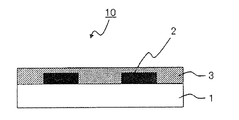
- FIG. 1 is a schematic view showing an example of the color filter of the present invention.
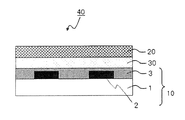
- FIG. 2 is a schematic view showing an example of the liquid crystal display device of the present invention.
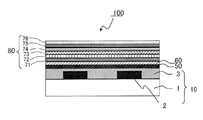
- FIG. 3 is a schematic view illustrating an example of the organic light emitting display device of the present invention.
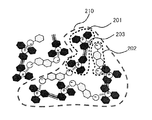
- FIG. 4 is a schematic diagram showing a molecular association state of the coloring material represented by the general formula (I).
- the light includes electromagnetic waves having wavelengths in the visible and non-visible regions, and further includes radiation, and the radiation includes, for example, microwaves and electron beams. Specifically, it means an electromagnetic wave having a wavelength of 5 ⁇ m or less and an electron beam.
- (meth) acryl represents each of acryl and methacryl
- (meth) acrylate represents each of acrylate and methacrylate.
- the organic group means a group having one or more carbon atoms.
- the colorant dispersion according to the present invention contains (A) a colorant, (B) a dispersant, and (C) a solvent, and the (A) colorant is represented by the following general formula (I).
- the solvent is a solvent having a solubility at 23 ° C. of each of the colorant and the xanthene dye of 0.2 (g / 100 g solvent) or less, A colorant and the xanthene dye are dispersed in the solvent (C) with the dispersant (B).
- A is an a-valent organic group in which the carbon atom directly bonded to N has no ⁇ bond, and the organic group is saturated aliphatic carbonized at least at the terminal directly bonded to N.
- R 1 to R 5 each independently represents a hydrogen atom, an optionally substituted alkyl group or an optionally substituted aryl group, R 2 and R 3 , R 4 and good .
- Ar 1 also R 5 combine to form a ring structure represents a divalent aromatic group which may have a substituent.
- R 1 ⁇ R 5 and Ar 1 are each the same It may or may not be.
- a and c represent an integer of 2 or more
- b and d represent an integer of 1 or more.
- e is 0 or 1, and when e is 0, there is no bond.
- a plurality of e may be the same or different.
- the specific colorant and the xanthene dye are selected and combined as the colorant, and the specific colorant and the xanthene dye are combined by (B) the dispersant.
- the specific colorant and xanthene-based dye are not dissolved in the solvent (C) and are dispersed in the solvent, so that a coating film with superior heat resistance and higher brightness than the case of using a conventional dye is obtained.
- the action of exerting the above-described effects by the specific combination is not yet elucidated, but is estimated as follows.
- the color material represented by the general formula (I) (hereinafter sometimes referred to simply as a color material) has a plurality of color development sites, and the color development sites have the same basic skeleton as the basic dye. High brightness can be achieved in the same way as a sexual dye.
- the colorant (A) is used in combination with the colorant represented by the general formula (I) and a xanthene dye which is a dye having high transmittance, particularly high luminance can be realized.
- the colorant represented by the general formula (I) has excellent heat resistance by being able to form a molecular aggregate as described later.
- the coloring material and xanthene dye represented by the general formula (I) are dispersed in (C) a solvent that does not substantially dissolve the coloring material and the dye by (B) a dispersant,
- the coloring material and the xanthene dye are dispersed in a solvent in the form of fine particles. Since the colorant dispersed in the state of fine particles in this manner is aggregated at the molecular level, dissociation and decomposition of the colorant ion pair are unlikely to occur, and heat resistance is higher than that of a dye dissolved in a solution. It is estimated to be.
- the colorant represented by the general formula (I) and the xanthene dye are uniformly dispersed in the solvent as fine particles surrounded by the dispersant in a miniaturized state. be able to. Therefore, when the colorant dispersion is used, the colorant is not easily faded even during heating, so that the color originally possessed by the colorant can be maintained, the transmittance is high, and each colorant component is miniaturized. Therefore, it is possible to form a coating film that can realize the demand for higher brightness.
- the colorant dispersion of the present invention contains at least (A) a colorant, (B) a dispersant, and (C) a solvent, and further contains other components as long as the effects of the present invention are not impaired. It may contain.
- A a colorant
- B a dispersant
- C a solvent
- each component of the colorant dispersion of the present invention will be described in detail in order.
- the colorant (A) used in the present invention contains at least a colorant represented by the following general formula (I) and a xanthene dye, and further contains other colorants as long as the effects of the present invention are not impaired. It may be contained.
- the color material represented by the general formula (I) and the xanthene dye are used in combination to realize a color that cannot be achieved only by the color material represented by the general formula (I).
- a color filter with excellent heat resistance and high brightness can be obtained.
- ⁇ Coloring material represented by general formula (I)> a colorant represented by the following general formula (I) is used as a colorant.
- the coloring material it is possible to increase the luminance of the color filter and to form a colored layer having excellent solvent resistance and electrical reliability.
- A is an a-valent organic group in which the carbon atom directly bonded to N has no ⁇ bond, and the organic group is saturated aliphatic carbonized at least at the terminal directly bonded to N.
- R 1 to R 5 each independently represents a hydrogen atom, an optionally substituted alkyl group or an optionally substituted aryl group, R 2 and R 3 , R 4 and good .
- Ar 1 also R 5 combine to form a ring structure represents a divalent aromatic group which may have a substituent.
- R 1 ⁇ R 5 and Ar 1 are each the same It may or may not be.
- a and c represent an integer of 2 or more
- b and d represent an integer of 1 or more.
- e is 0 or 1, and when e is 0, there is no bond.
- a plurality of e may be the same or different.
- the color material represented by the general formula (I) includes a divalent or higher valent anion 202 and a divalent or higher cation 201. It is presumed that the cation and the cation are not simply ion-bonded by one molecule to one molecule but form a molecular aggregate 210 in which a plurality of molecules are associated through the ion bond 203. Therefore, the apparent molecular weight of the coloring material represented by the general formula (I) is remarkably increased as compared with the molecular weight of the conventional lake pigment. It is presumed that the formation of such molecular aggregates increases the cohesive force in the solid state, lowers the thermal motion, suppresses dissociation of ion pairs and decomposition of the cation part, and improves heat resistance.
- a in the general formula (I) is an a-valent organic group in which the carbon atom directly bonded to N (nitrogen atom) does not have a ⁇ bond, and the organic group is saturated at least at the terminal directly bonded to N.
- A preferably does not have a siloxane bond, and more preferably does not have Si (silicon atom).
- an aliphatic hydrocarbon group having a saturated aliphatic hydrocarbon group at the terminal directly bonded to N is linear, branched or cyclic unless the terminal carbon atom directly bonded to N has a ⁇ bond.
- the carbon atom other than the terminal may have an unsaturated bond, may have a substituent, and the carbon chain contains O, S, and N. Also good.
- a carbonyl group, a carboxy group, an oxycarbonyl group, an amide group or the like may be contained, and a hydrogen atom may be further substituted with a halogen atom or the like.
- the aromatic group having an aliphatic hydrocarbon group in A is a monocyclic or polycyclic aromatic group having an aliphatic hydrocarbon group having a saturated aliphatic hydrocarbon group at the terminal directly bonded to N. And may have a substituent, and may be a heterocyclic ring containing O, S, and N. Especially, it is preferable that A contains a cyclic
- the cyclic aliphatic hydrocarbon groups a bridged alicyclic hydrocarbon group is preferable from the viewpoint of skeleton fastness.
- the bridged alicyclic hydrocarbon group means a polycyclic aliphatic hydrocarbon group having a bridged structure in the aliphatic ring and having a polycyclic structure, for example, norbornane, bicyclo [2,2,2]. Examples include octane and adamantane.
- norbornane is preferable.
- the group containing a benzene ring and a naphthalene ring is mentioned, for example, Among these, the group containing a benzene ring is preferable.
- A is a divalent organic group, a linear, branched or cyclic alkylene group having 1 to 20 carbon atoms, or an aromatic group substituted with two alkylene groups having 1 to 20 carbon atoms such as a xylylene group Etc.
- the valence a in A is the number of chromogenic cation sites constituting the cation, and a is an integer of 2 or more.
- the cation valence a is 2 or more, it is excellent in heat resistance, and among them, the cation valence a is preferably 3 or more.
- the upper limit of a is not particularly limited, but a is preferably 4 or less, and more preferably 3 or less, from the viewpoint of ease of production.
- the alkyl group for R 1 to R 5 is not particularly limited. Examples thereof include straight-chain or branched alkyl groups having 1 to 20 carbon atoms. Among them, straight-chain or branched alkyl groups having 1 to 8 carbon atoms are preferable, and straight chain having 1 to 5 carbon atoms. A chain or branched alkyl group is more preferable from the viewpoint of luminance and heat resistance.
- the alkyl group in R 1 to R 5 is particularly preferably an ethyl group or a methyl group.
- the substituent that the alkyl group may have is not particularly limited, and examples thereof include an aryl group, a halogen atom, and a hydroxyl group, and examples of the substituted alkyl group include a benzyl group.
- the aryl group in R 1 to R 5 is not particularly limited. For example, a phenyl group, a naphthyl group, etc. are mentioned. Examples of the substituent that the aryl group may have include an alkyl group and a halogen atom.
- R 2 and R 3 , R 4 and R 5 are combined to form a ring structure.
- R 2 and R 3 , R 4 and R 5 form a ring structure through a nitrogen atom.
- the ring structure is not particularly limited, and examples thereof include a pyrrolidine ring, a piperidine ring, and a morpholine ring.
- R 1 to R 5 are each independently a hydrogen atom, an alkyl group having 1 to 5 carbon atoms, a phenyl group, or R 2 and R 3 , or R 4 and R 5.
- R 1 to R 5 are each independently a hydrogen atom, an alkyl group having 1 to 5 carbon atoms, a phenyl group, or R 2 and R 3 , or R 4 and R 5.
- R 1 to R 5 can each independently have the above structure, but among them, R 1 is preferably a hydrogen atom from the viewpoint of color purity, and R 2 to R 5 from the viewpoint of ease of production and raw material procurement. More preferably, all R 5 are the same.
- the divalent aromatic group in Ar 1 is not particularly limited.
- the aromatic group for Ar 1 the same aromatic groups as those described for the aromatic group for A can be used.
- Ar 1 is preferably an aromatic group having 6 to 20 carbon atoms, and more preferably an aromatic group comprising a condensed polycyclic carbocycle having 10 to 14 carbon atoms. Among these, a phenylene group or a naphthylene group is more preferable because the structure is simple and the raw material is inexpensive.
- a plurality of R 1 to R 5 and Ar 1 in one molecule may be the same or different.
- R A desired color can be adjusted by a combination of 1 to R 5 and Ar 1 .
- the anion portion (B c ⁇ ) is not particularly limited, and may be an organic anion or an inorganic anion.
- the organic anion represents an anion containing at least one carbon atom.
- an inorganic anion represents the anion which does not contain a carbon atom.
- B c- is preferably an inorganic anion from the viewpoint of high brightness and excellent heat resistance.
- B c- is an organic anion
- the structure is not particularly limited.
- Specific examples of the organic anion include those described in International Publication No. 2012/144520 pamphlet.
- an organic anion having two or more monovalent anionic substituents in one molecule is preferable from the viewpoint of stabilizing the coloring material.
- anionic substituent examples include, for example, —SO 2 N — SO 2 CH 3 , —SO 2 N — COCH 3 , —SO 2 N — SO 2 CF 3 , —SO 2 N — COCF 3 , —CF Imido acid groups such as 2 SO 2 N — SO 2 CH 3 , —CF 2 SO 2 N — COCH 3 , —CF 2 SO 2 N — SO 2 CF 3 , —CF 2 SO 2 N — COCF 3 ; 3 -, -CF 2 SO 3 - , -PO 3 2-, -COO -, -CF 2 PO 3 2-, -CF 2 COO - , and the like, to stabilize the cation by high acidity maintain the color development state From the viewpoint of high effect, an imido acid group, —SO 3 ⁇ , —CF 2 SO 3 — are preferable, and —SO 3 — (sulfonate group) is more preferable.
- anionic substituent examples include,
- B c- is an inorganic anion
- its structure is not particularly limited.
- an anion of a divalent or higher oxo acid phosphate ion, sulfate ion, chromate ion, tungstate ion (WO 4 2- ), Molybdate ions (MoO 4 2 ⁇ ) and the like, and inorganic anions such as polyacid ions condensed with a plurality of oxo acids, and mixtures thereof.
- the polyacid may be an isopolyacid ion (M m O n ) c- or a heteropoly acid ion (X l M m O n ) c- .
- M represents a poly atom
- X represents a hetero atom
- m represents a composition ratio of poly atoms
- n represents a composition ratio of oxygen atoms.
- the poly atom M include Mo, W, V, Ti, and Nb.
- the hetero atom X include Si, P, As, S, Fe, and Co.
- a counter cation such as Na + or H + may be partially included.
- an anion of an inorganic acid containing at least one of tungsten (W) and molybdenum (Mo) is preferable from the viewpoint of high brightness and excellent heat resistance, and tungsten and molybdenum are included from the viewpoint of light resistance.
- An anion of an inorganic acid is preferable.
- tungstate ion [W 10 O 32 ] 4 ⁇ , molybdate ion [Mo 6 O 19 ], which is an isopolyacid is used.
- 2- or heteropolyacids such as phosphotungstate ion [PW 12 O 40 ] 3 ⁇ , silicotungstate ion [SiW 12 O 40 ] 4 ⁇ , phosphomolybdate ion [PMo 12 O 40 ] 3 ⁇ , lintongue Molybdate ion [PW 12-x Mo x O 40 ] 3 ⁇ , H 3 [PW 2 ⁇ x Mo x O 7 ] 4 ⁇ and the like.
- the anion of an inorganic acid containing at least one of tungsten (W) and molybdenum (Mo) is preferably a heteropolyacid among the above from the viewpoint of heat resistance and the availability of raw materials. More preferably, it is a heteropolyacid containing (phosphorus).
- the molar ratio of tungsten to molybdenum is not particularly limited, but it is preferably an inorganic acid anion of 100: 0 to 90:10. This is preferable from the viewpoint of excellent brightness and heat resistance.
- b represents the number of cations
- d represents the number of anions in the molecular aggregate
- b and d represent an integer of 1 or more.
- a plurality of cations in the molecular aggregate may be one kind alone, or two or more kinds may be combined.
- the anion present in the molecular aggregate may be a single anion or a combination of two or more, and an organic anion and an inorganic anion may be used in combination. .
- E in the general formula (I) is an integer of 0 or 1.
- a plurality of e may be the same or different. That is, for example, it may be a cation moiety having only a triarylmethane skeleton or a plurality of xanthene skeletons, or may be a cation moiety containing both a triarylmethane skeleton and a xanthene skeleton in one molecule. From the viewpoint of color purity, an anion portion having only the same skeleton is preferable.
- the color material represented by the general formula (I) can be adjusted to a desired color by using a cation portion including both a triarylmethane skeleton and a xanthene skeleton.
- the color material represented by the general formula (I) may be included in a xanthene dye described later, but as long as the color material represented by the general formula (I) is applicable, the present invention. In this case, it is assumed that it corresponds to the color material represented by the general formula (I).
- the method for producing the color material represented by the general formula (I) is not particularly limited. For example, it can be obtained by the production method described in International Publication No. 2012/144520 pamphlet.
- the xanthene dye refers to a dye having a xanthene skeleton.
- the xanthene dye is preferably a dye having an acidic group.
- the acidic group include a carboxy group (—COOH), a carboxylate group (—COO ⁇ ), a carboxylate group (—COOM, where M represents a metal atom), a sulfonate group (—SO 3 ⁇ ), a sulfo group.
- sulfonate (-SO 3 H), sulfonate (-SO 3 M, wherein M represents a metal atom.) include and the like, among them, a sulfonato group (-SO 3 -), a sulfo group (-SO 3 H) Or having at least one sulfonate group (—SO 3 M) is preferable from the viewpoint of high heat resistance.
- the metal atom M include a sodium atom and a potassium atom. Since the xanthene dye having an acidic group has a functional group that can be converted into an acid, for example, by using it in combination with a dispersant (B) having an amine value, an acid-base interaction with the dispersant is achieved.
- the xanthene dye is fixed in the dispersant and stabilized.
- the stabilization state of such a xanthene dye and dispersant is centered on the xanthene dye, the colorant-affinity part of the dispersant surrounds the xanthene dye, and the solvent-affinity part of the dispersant is placed outside the xanthene dye.
- micelles of a xanthene dye and a dispersant are formed.
- a compound represented by the following general formula (II ') can be used as the xanthene dye.
- R 10 to R 13 each independently represents a hydrogen atom, an alkyl group, an aryl group, or a heteroaryl group, and R 10 and R 12 , R 11 and R 13 are bonded to each other.
- R 14 represents an acidic group
- X represents a halogen atom
- m represents an integer of 0 to 5.
- General formula (II ′) has one or more acidic groups And n is an integer of 0 or more.
- the alkyl group in R 10 to R 13 is not particularly limited. Examples thereof include a linear or branched alkyl group having 1 to 20 carbon atoms which may have a substituent. Among them, a linear or branched alkyl group having 1 to 8 carbon atoms is preferable. More preferably, it is a linear or branched alkyl group having 1 to 5 carbon atoms.
- the substituent that the alkyl group may have is not particularly limited, and examples thereof include an aryl group, a halogen atom, a hydroxyl group, and the like, and the substituted alkyl group includes a benzyl group, and further, a substituent. May have a halogen atom or an acidic group.
- the aryl group in R 10 to R 13 is not particularly limited.
- an aryl group which may have a substituent having 6 to 20 carbon atoms is exemplified, and among them, a group having a phenyl group, a naphthyl group or the like is preferable.
- the heteroaryl group in R 10 to R 13 include heteroaryl groups that may have a substituent having 5 to 20 carbon atoms, and those containing a nitrogen atom, an oxygen atom, or a sulfur atom as a heteroatom are preferable. .
- aryl group or heteroaryl group examples include an alkyl group having 1 to 5 carbon atoms, a halogen atom, an acidic group, a hydroxyl group, an alkoxy group, a carbamoyl group, and a carboxylic acid ester group.
- R 10 to R 13 may be the same or different.
- n represents the number of anions in one molecule of the xanthene dye, and it is preferable from the viewpoint of heat resistance that the + valence number and the ⁇ valence number in the molecule are the same. Further, n is preferably 0 or 1 from the viewpoint of heat resistance.
- xanthene dyes include, for example, Acid Red 51, 52, 87, 92, 94, 289, 388, C.I. I.
- acid violet 9, 30, 102 sulforhodamine G, sulforhodamine B, sulforhodamine 101, sulforhodamine 640, and the like
- xanthene dyes described in JP 2010-32999 A, JP 4492760 A, etc. are suitable. As mentioned.
- the xanthene dye is a compound represented by the following general formula (II) from the viewpoint of excellent light resistance.
- R 6 and R 7 are each independently an alkyl group or an aryl group, and R 8 and R 9 are each independently an aryl group or a heteroaryl group.
- the alkyl group in R 6 and R 7 is not particularly limited. Examples thereof include a linear or branched alkyl group having 1 to 20 carbon atoms which may have a substituent. Among them, a linear or branched alkyl group having 1 to 8 carbon atoms is preferable. More preferably, it is a linear or branched alkyl group having 1 to 5 carbon atoms.
- the substituent that the alkyl group may have is not particularly limited, and examples thereof include an aryl group, a halogen atom, a hydroxyl group, and the like, and the substituted alkyl group includes a benzyl group, and further, a substituent. May have a halogen atom.
- the aryl group in R 6 to R 9 is not particularly limited.
- an aryl group which may have a substituent having 6 to 20 carbon atoms is exemplified, and among them, a group having a phenyl group, a naphthyl group or the like is preferable.
- the heteroaryl group in R 8 and R 9 include heteroaryl groups which may have a substituent having 5 to 20 carbon atoms, and those containing a nitrogen atom, an oxygen atom, or a sulfur atom as a heteroatom are preferable. .
- the substituent that the aryl group or heteroaryl group may have include an alkyl group having 1 to 5 carbon atoms, a halogen atom, a hydroxyl group, an alkoxy group, a carbamoyl group, and a carboxylic acid ester group.
- R 6 to R 9 do not have an acidic group from the viewpoint of light resistance.
- the substitution position of the sulfonate group (—SO 3 ⁇ ) of the benzene ring substituting the xanthene skeleton is not particularly limited, but is preferably ortho or para with respect to the xanthene skeleton. From the viewpoint of light resistance, the sulfonate group is preferably substituted in the ortho position relative to the xanthene skeleton.
- the compound represented by the general formula (II) has one sulfonate group and does not have a metal ion or a halogen atom.
- R 6 to R 9 are not hydrogen atoms, and R 8 and R 9 are either aryl groups or heteroaryl groups. Since the compound represented by the general formula (II) has a cationic xanthene skeleton and one anionic sulfonate group, it is electrically stabilized without having a metal ion or a halogen ion. Therefore, even if dispersed in a solvent, it is presumed to be excellent in stability without dissociating.
- the nitrogen atom has an aromatic substituent such as an aryl group or a heteroaryl group, the lone electron pair of the nitrogen atom resonates with the aryl group or heteroaryl group as well as the xanthene skeleton. Therefore, it is presumed that the molecule becomes more stable. Furthermore, since the nitrogen atom is not directly bonded to the hydrogen atom, the hydrogen atom is not eliminated from the nitrogen atom and the dye is not destabilized. From these facts, the compound represented by the general formula (II) is stable under light irradiation and excellent in light resistance. By using the compound, a light-resistant and high-brightness coating film or colored layer is formed. It becomes possible.
- the method for producing the compound represented by the general formula (II ′) is not particularly limited. It can be obtained with reference to Japanese Patent Application Laid-Open No. 2010-211198.
- the compound represented by the general formula (II) can be obtained by subjecting a halogen atom contained in the compound represented by the following general formula (A) to an amine compound having a desired substituent. it can.
- X is a halogen atom, and a plurality of X may be the same or different from each other.
- the compound represented by the general formula (A) and the amine compound having a desired substituent are refluxed in a solvent, and the resulting reaction solution is filtered while hot to remove insoluble matters, Remove the part.
- the reaction liquid is added to dilute hydrochloric acid, and then water is added and stirred to obtain the compound represented by the general formula (II).
- a first amine compound having a desired substituent for example, —N (R 6 ) (for example, —N (R 6 ) ( after reaction with dropwise little by little to compound) corresponding to R 8), a second amine compound having a desired substituent (e.g., -N (R 7) (compounds corresponding to R 9)) was added
- a second amine compound having a desired substituent e.g., -N (R 7) (compounds corresponding to R 9)
- a method in which —N (R 6 ) (R 8 ) and —N (R 7 ) (R 9 ) have different structures is obtained by reacting slowly while dropping.
- the xanthene dye can be obtained in high yield.
- a halogen atom in X a fluorine atom, a chlorine atom, and a bromine atom are mentioned, Among these, a chlorine atom is preferable.
- the compound represented by the general formula (A) and the amine compound having a desired substituent may be synthesized by a known method, or a commercially available product may be used.
- the colorant may further contain another colorant for the purpose of controlling the color tone within a range not impairing the effects of the present invention.
- examples of other colorants include known pigments and dyes, and one or more of them can be used.
- the blending amount of the other colorant is not particularly limited as long as the effect of the present invention is not impaired, and can be the same as that used in the color resin composition for color filter described later.
- the content of the coloring material represented by the general formula (I) is preferably 40 to 99.9 parts by mass with respect to (A) the total amount of the colorant of 100 parts by mass, and 70 to 99 parts by mass. More preferably. Further, the content of the xanthene dye is preferably 0.1 to 60 parts by mass and more preferably 1 to 30 parts by mass with respect to 100 parts by mass of the total amount of the colorant (A).
- the colorant and xanthene dye represented by the general formula (I) are used by being dispersed in a solvent with the (B) dispersant.
- the dispersant can be appropriately selected from those conventionally used as dispersants. Examples of the dispersant that can be used include cationic, anionic, nonionic, amphoteric, silicone, and fluorine surfactants. Among the surfactants, a polymer surfactant (polymer dispersant) is preferable because it can be uniformly and finely dispersed.
- polymer dispersant examples include (co) polymers of unsaturated carboxylic acid esters such as polyacrylic acid esters; (partial) amine salts of (co) polymers of unsaturated carboxylic acid such as polyacrylic acid; (Partial) ammonium salts and (partial) alkylamine salts; (co) polymers of hydroxyl group-containing unsaturated carboxylic acid esters such as hydroxyl group-containing polyacrylates and their modified products; polyurethanes; unsaturated polyamides; polysiloxanes Long chain polyaminoamide phosphates; polyethylenimine derivatives (amides and their bases obtained by reaction of poly (lower alkylene imines) with free carboxyl group-containing polyesters); polyallylamine derivatives (polyallylamine and free carboxyls) Polyester, polyamide, or ester and amide co-condensation Object reaction product obtained by reacting one or more compound selected from among the three compounds of (polyester amide)), and the
- the coloring material represented by the above general formula (I) and the xanthene dye can be suitably dispersed, and the dispersion stability is good.
- a polymer dispersant containing an amine value is preferred.
- the dispersant (B) used to disperse the xanthene dye is, among other things, a polymer dispersant made of a polymer containing a repeating unit having a tertiary amine, or a urethane dispersant.
- a colorant dispersion that is capable of forming a coating film excellent in heat resistance, capable of realizing excellent brightness, that does not deposit foreign matters during coating film formation, has excellent re-solubility in a solvent, and has excellent heat resistance. It is preferable because it can be used.
- the two types of dispersants preferable as the dispersant for xanthene dyes will be described in detail.
- ⁇ Polymer containing repeating unit having tertiary amine> By using a polymer containing a repeating unit having a tertiary amine as a dispersant, the dispersibility and dispersion stability of the (A) colorant are improved.
- the repeating unit having a tertiary amine is a site having an affinity for the colorant (A).
- the tertiary amine of the repeating unit and the acidic group of the xanthene dye in the colorant (A) are stabilized by generating an acid-base interaction.
- the polymer dispersant made of a polymer containing a repeating unit having a tertiary amine usually contains a repeating unit that becomes a site having an affinity for a solvent.
- the polymer containing a repeating unit having a tertiary amine include a block copolymer having a repeating unit having a tertiary amine and a block unit having a solvent affinity, and a repeating unit having a tertiary amine.
- a graft copolymer containing a repeating unit having a polymer chain having solvent affinity is preferably used.
- the repeating unit having a tertiary amine may be contained in a polymer chain corresponding to a branch part, and the solvent affinity with the repeating unit having a polymer chain containing a repeating unit having a tertiary amine It may be a graft copolymer containing a repeating unit having a polymer chain.
- the repeating unit having a tertiary amine only needs to have a tertiary amine, and the tertiary amine may be contained in the side chain of the block polymer or may constitute the main chain.
- a repeating unit having a tertiary amine in the side chain is preferable, and among them, the structure represented by the following general formula (III) is preferable because the main chain skeleton is hardly thermally decomposed and has high heat resistance. Is more preferable.
- R 15 is a hydrogen atom or a methyl group
- Q is a direct bond or a divalent linking group
- R 16 is an alkylene group having 1 to 8 carbon atoms
- R 17 and R 18 each independently represent a optionally substituted linear or cyclic hydrocarbon group, R 17 and R 18 form a ring structure by bonding with each other .
- R 20 and R Each 21 is independently a hydrogen atom or a methyl group.
- x represents an integer of 1 to 18, y represents an integer of 1 to 5, and
- z represents an integer of 1 to 18.
- Examples of the divalent linking group Q in the general formula (III) include, for example, an alkylene group having 1 to 10 carbon atoms, an arylene group, a —CONH— group, a —COO— group, an ether group having 1 to 10 carbon atoms (— R′—OR ′′ —: R ′ and R ′′ are each independently an alkylene group) and combinations thereof.
- Q is preferably a —COO— group from the viewpoint of heat resistance of the obtained polymer, solubility in PGMEA, and a relatively inexpensive material.
- the divalent organic group R 16 in the general formula (III) is an alkylene group having 1 to 8 carbon atoms, — [CH (R 20 ) —CH (R 21 ) —O] x —CH (R 20 ) —CH (R 21 ) — or — [(CH 2 ) y —O] z — (CH 2 ) y —.
- the alkylene group having 1 to 8 carbon atoms may be linear or branched. For example, methylene group, ethylene group, trimethylene group, propylene group, various butylene groups, various pentylene groups, various hexylenes. Groups, various octylene groups and the like.
- R 20 and R 21 are each independently a hydrogen atom or a methyl group.
- R 16 is preferably an alkylene group having 1 to 8 carbon atoms from the viewpoint of dispersibility. Among them, R 16 is more preferably a methylene group, an ethylene group, a propylene group, or a butylene group. Groups are more preferred.
- Examples of the cyclic structure formed by combining R 17 and R 18 in the general formula (III) include a 5- to 7-membered nitrogen-containing heterocyclic monocycle or a condensed ring formed by condensing two of these. It is done.
- the nitrogen-containing heterocycle preferably has no aromaticity, more preferably a saturated ring.
- repeating unit represented by the general formula (III) examples include (meth) acryloyloxypropyldimethylamine, (meth) acryloyloxyethyldimethylamine, (meth) acryloyloxypropyldiethylamine, (meth) acryloyloxyethyldiethylamine, and the like. Examples include, but are not limited to, derived repeating units.
- the block part having solvent affinity has good solvent affinity and improved dispersibility.
- the repeating unit derived from the non-basic monomer is appropriately selected according to the solvent so as to have solvent affinity.
- the non-basic monomer gives a solution having a pH lower than 7.1 when dissolved in water at 25 ° C. at a concentration of 0.1 N (saturation concentration when the saturation concentration is less than 0.1 N).
- a polymerizable monomer is a polymerizable monomer.
- the polymer of unsaturated carboxylic acid esters such as polyacrylic acid ester, unsaturated carboxylic acid polymers, such as polyacrylic acid, etc. are mentioned, for example.
- R 22 is a hydrogen atom or a methyl group
- A is a direct bond or a divalent linking group
- R 23 is an alkyl group having 1 to 18 carbon atoms
- R 24 and R 25 are each independently a hydrogen atom or a methyl group
- R 26 is a hydrogen atom, an alkyl group having 1 to 18 carbon atoms, an alkenyl group having 2 to 18 carbon atoms, an aralkyl group
- z represents an integer of 1 to 18.
- m represents an integer of 3 to 200
- n represents an integer of
- a block copolymer having a block part composed of a repeating unit having a tertiary amine and a block part having a solvent affinity for example, a block copolymer described in Japanese Patent No. 4911253 is used. It can be mentioned as a suitable thing.
- R 15 ′ represents a hydrogen atom or a methyl group
- L represents a direct bond or a divalent linking group
- Polymer represents a polymer chain.
- L is a direct bond or a divalent linking group.
- the divalent linking group in L is not particularly limited as long as it can link an ethylenically unsaturated double bond and a polymer chain.
- Examples of the divalent linking group for L include an alkylene group, an alkylene group having a hydroxyl group, an arylene group, a —CONH— group, a —COO— group, a —NHCOO— group, an ether group (—O— group), and a thioether group. (—S— group), and combinations thereof.
- the direction of bonding of the divalent linking group is arbitrary.
- -CO when -CONH- is contained in the divalent linking group, -CO may be on the carbon atom side of the main chain and -NH may be on the side of the polymer chain. On the carbon atom side, —CO may be the polymer chain side chain.
- the polymer chain may be appropriately selected so as to have solubility in the solvent (C).
- the solubility of the graft copolymer at 23 ° C. with respect to the solvent (C) used is 50 (g / 100 g solvent) or more from the viewpoint of improving the dispersibility by improving the solvent affinity.
- the polymer chain preferably has at least one structural unit represented by the following general formula (VI) and general formula (VII) from the viewpoint of solubility in a solvent.
- R 28 is a hydrogen atom or a methyl group
- R 29 is an alkyl group having 1 to 18 carbon atoms, a benzyl group, a phenyl group, a biphenyl group, a cyano group, — [CH (R 30 ) —CH (R 31 ) —O] x —R 32 , — [(CH 2 ) y —O] z —R 32 , — [CO— (CH 2 ) y —O] z — A monovalent group represented by R 32 , —CO—O—R 33 or —O—CO—R 34.
- R 30 and R 31 each independently represents a hydrogen atom or a methyl group.
- R 32 is a hydrogen atom or a monovalent group represented by a C 1-18 alkyl group, benzyl group, phenyl group, biphenyl group, —CHO, —CH 2 CHO or —CH 2 COOR 35 ;
- 33 is an alkyl group having 1 to 18 carbon atoms, benzyl group, phenyl group, biphenyl group, cyano group, — [CH (R 30 ) —CH (R 31 ) —O] x —R 32 , — [(CH 2 ) Y —O] z —R 32 or a monovalent group represented by — [CO— (CH 2 ) y —O] z —R 32 .
- R 34 represents an alkyl group having 1 to 18 carbon atoms
- R 35 represents a hydrogen atom or an alkyl group having 1 to 5 carbon atoms
- m represents an integer of 1 to 5
- n and n ′ represent an integer of 5 to 200
- graft copolymer containing such a repeating unit having a tertiary amine and a repeating unit having a polymer chain having a solvent affinity include, for example, the graft copolymer described in Japanese Patent No. 4911256. It can be mentioned as a suitable thing.
- the amine value of the polymer containing a repeating unit having a tertiary amine is not particularly limited, but is 60 to 180 mgKOH from the viewpoints of good dispersibility, excellent heat resistance, re-dissolvability, and alkali developability.
- / G is preferable, 70 to 170 mgKOH / g is more preferable, and 80 to 160 mgKOH / g is more preferable.
- the amine value refers to the number of mg of potassium hydroxide equivalent to perchloric acid required to neutralize the amine component contained in 1 g of a sample, and can be measured by the method defined in JIS-K7237.
- the polymer containing the repeating unit having the tertiary amine is added to 100 parts by mass of the xanthene dye.
- the content is preferably 70 to 300 parts by mass, and more preferably 100 to 250 parts by mass. Within the above range, the dispersibility and dispersion stability are excellent.
- the colorant represented by the general formula (I) is dispersed alone, or the colorant represented by the general formula (I) and the xanthene dye are co-dispersed.
- a dispersant in which at least a part of the amino group in the polymer containing a repeating unit having a tertiary amine and an organic acid compound form a salt (hereinafter referred to as this dispersant).
- Such a polymer is sometimes referred to as a salt-type polymer).
- acidic organic phosphorus compounds are preferred because they are excellent in dispersibility and dispersion stability.
- Specific examples of such a dispersant include, for example, a salt type block copolymer described in JP2012-236882A, a salt type graft copolymer described in JP2012-63429A, and the like. Are mentioned as preferred.
- a urethane dispersant suitably used as a dispersant for xanthene dyes is a dispersant composed of a compound having one or more urethane bonds (—NH—COO—) in one molecule.
- a urethane-based dispersant By using a urethane-based dispersant, good dispersion can be achieved in a smaller amount than a polymer containing a repeating unit having a tertiary amine.
- By making the amount of the dispersant small it is possible to relatively increase the amount of the curing component and the like, and as a result, it is possible to form a colored layer having excellent heat resistance.
- the urethane dispersant is preferably a reaction product of a polyisocyanate having two or more isocyanate groups in one molecule and a polyester having a hydroxyl group at one or both ends.
- the polyisocyanate preferably has at least one isocyanate compound selected from diisocyanates and triisocyanates, and is a polymer having a main chain skeleton obtained by polymerizing at least one of diisocyanates and triisocyanates. May be.
- the main chain structure in which at least one of diisocyanates and triisocyanates is polymerized includes a molecular structure in which isocyanate groups are bonded to each other and polymerized between the above polyisocyanates. Further, the chain structure of the main chain skeleton may contain a ring structure such as an aromatic ring or a heterocyclic ring which may have a substituent.
- Diisocyanates used in the urethane-based dispersant may be aliphatic diisocyanates such as hexamethylene diisocyanate and isophorone diisocyanate, but aromatic diisocyanates are preferable from the viewpoint of heat resistance.
- benzene-1,3-diisocyanate Benzene diisocyanates such as benzene-1,4-diisocyanate; toluene diisocyanates such as toluene-2,4-diisocyanate, toluene-2,5-diisocyanate, toluene-2,6-diisocyanate, toluene-3,5-diisocyanate 1,2-xylene-3,5-diisocyanate, 1,2-xylene-3,6-diisocyanate, 1,2-xylene-4,6-diisocyanate, 1,3-xylene-2,4-diisocyanate 1,3-xylene-2,4-diisocyanate 1,3-xylene-2,5-diisocyanate, 1,3-xylene-2,6-diisocyanate, 1,3-xylene-4,6-diisocyanate, 1,4-xylene-2,
- triisocyanates examples include benzene triisocyanates such as benzene-1,2,4-triisocyanate, benzene-1,2,5-triisocyanate, and benzene-1,3,5-triisocyanate; -2,3,5-triisocyanate, toluene-2,3,6-triisocyanate, toluene-2,4,5-triisocyanate, toluene-2,4,6-triisocyanate, toluene-3,4,6 -Toluene isocyanates such as triisocyanate, toluene-3,5,6-triisocyanate, 1,2-xylene-3,4,6-triisocyanate, 1,2-xylene-3,5,6-triisocyanate 1,3-xylene-2,4,5-triisocyanate, 1,3-xylene-2,4,6 Xylene such as triisocyanate, 1,3-xylene-3,4,5-triisocyanate, 1,3
- toluene diisocyanates are preferred from the viewpoint of high heat resistance.
- These diisocyanates and triisocyanates can be used alone or in admixture of two or more.
- polyesters having a hydroxyl group at one end or both ends among them, from the viewpoint of dispersibility, — (O—R j CO) n— (R j is an alkylene group having 1 to 20 carbon atoms, and n is 2 or more. It is preferable that it is a compound containing the polyester chain represented by this.
- Specific examples of the polyester chain include polylactones such as polycaprolactone, polyvalerolactone and polypropiolactone, and polycondensation polyesters such as polyethylene terephthalate and polybutylene terephthalate.
- polylactones such as polycaprolactone, polyvalerolactone and polypropiolactone
- polycondensation polyesters such as polyethylene terephthalate and polybutylene terephthalate.
- a urethane type dispersing agent does not have an acidic functional group from the point of a dispersibility.
- the acidic functional group include a carboxyl group, a sulfo group, and a phosphoric acid group, and a representative example is a carboxyl group.
- the acid value of the pigment dispersant is preferably lower from the viewpoint of dispersibility, and is preferably 0 mgKOH / g.
- an acid value shows the acid value per 1g of solid content, and says the value calculated
- the amine value is preferably 5 to 180 mgKOH / g, more preferably 10 to 160 mgKOH / g, from the viewpoint of dispersibility.
- a urethane type dispersing agent does not contain the polyether chain
- the polyether chain means a structure represented by — (O—R i ) n— (R i is an alkylene group having 1 to 10 carbon atoms, and n is an integer of 2 or more).
- the molecular weight of the urethane-based dispersant is preferably in the range of 500 to 30000 in terms of polystyrene-equivalent mass average molecular weight from the viewpoints of heat resistance, electrical reliability, and dispersibility.
- Disperbyk-161, 162, 164, 166 (above, manufactured by Big Chemie Japan Co., Ltd.), Azisper PB711 (manufactured by Ajinomoto Co., Inc.), EFKA-46, 47, 48 (EFKA) CHEMICALS).
- Disperbyk-161, 162, and 166 are preferable from the viewpoint of heat resistance, electrical reliability, and dispersibility.
- the content of the urethane dispersant is preferably 20 to 150 parts by mass with respect to 100 parts by mass of the xanthene dye, and preferably 50 to 120. More preferably, it is part by mass. Within the above range, the dispersibility and dispersion stability are excellent.
- (B) dispersants may be used alone or in combination of two or more.
- the content of the (B) dispersant is usually 1 to 50% by mass, more preferably 1 to 20% by mass, based on the total amount of the dispersion. And from the viewpoint of dispersion stability.
- the solvent (C) a solvent having a solubility at 23 ° C. of the coloring material represented by the general formula (I) and the xanthene dye of 0.2 (g / 100 g solvent) or less is used. .
- the colorant dispersion according to the present invention allows the (A) colorant to be dispersed as fine particles in the solvent.
- the solvent (C) used in the present invention is excellent in dispersibility and heat resistance, and a high-brightness coating film is obtained, so that the solubility of the coloring material and the xanthene dye at 23 ° C.
- the solvent (C) is a mixed solvent containing two or more solvents
- the colorant represented by the general formula (I) and the xanthene dye have a solubility at 23 ° C. in the mixed solvent. Each may be 0.2 (g / 100 g solvent) or less.
- the solvent in which the solubility of the coloring material and the xanthene dye at 23 ° C. is 0.2 (g / 100 g solvent) or less can be easily determined by the following evaluation method.
- a solvent which does not substantially dissolve the colorant or the xanthene dye Into a 20 mL sample tube, 0.1 g of a colorant whose solubility is to be determined is added, and the solvent S is added using a 10 ml hole pipette, and after further capping, it is treated with ultrasound for 3 minutes.
- the obtained liquid is stored in a 23 ° C. water bath for 60 minutes.
- the solubility is further determined by the following evaluation method.
- a good solvent of a colorant for which solubility is to be judged for example, an alcohol such as methanol
- a filtrate is similarly obtained to prepare a colorant solution, and then 10,000 times
- the solution is appropriately diluted to about 100000 times, and the absorbance at the maximum absorption wavelength of the colorant is measured in the same manner.
- the solubility of the colorant in the solvent S is calculated from the absorbance and dilution ratio of the colorant solution of the solvent S and the colorant solution of the good solvent.
- a solvent having a solubility of the colorant or the xanthene dye of 0.2 (g / 100 g solvent) or less is determined to be a poorly soluble solvent in which the colorant can be used in the present invention.
- ester solvents having a solubility of the coloring material and the xanthene dye of 0.2 (g / 100 g solvent) or less, and preferable ester solvents include, for example, methyl methoxypropionate, ethyl ethoxypropionate, methoxyethyl acetate, propylene Glycol monomethyl ether acetate, 3-methoxy-3-methyl-1-butyl acetate, 3-methoxybutyl acetate, methoxybutyl acetate, ethoxyethyl acetate, ethyl cellosolve acetate, dipropylene glycol methyl ether acetate, propylene glycol diacetate, 1, 3-butylene glycol diacetate, cyclohexanol acetate, 1,6-hexanediol diacetate, di
- propylene glycol monomethyl ether acetate PGMEA
- PGMEA propylene glycol monomethyl ether acetate
- solvents may be used alone or in combination of two or more.
- the total amount of the colorant and the xanthene dye having a solubility at 23 ° C. of 0.2 (g / 100 g solvent) or less is 70% by mass or more in the total solvent. It is preferable to contain 80% by mass or more, more preferably 90% by mass or more, and particularly preferably 100% by mass.
- the solvent used in the present invention preferably contains propylene glycol monomethyl ether acetate in an amount of 50% by mass or more, more preferably 70% by mass or more, more preferably 90% by mass or more, It is particularly preferable that 100% by mass in all the solvents is propylene glycol monomethyl ether acetate.
- the solvent whose solubility of a coloring agent exceeds 0.2 may be used in combination as appropriate, and such a solvent with high solubility of a coloring agent is combined.
- the content ratio of the solvent having high solubility is such that the solubility of the colorant represented by the general formula (I) and the xanthene dye at 23 ° C. with respect to the mixed solvent containing the solvent having high solubility is 0. It can adjust suitably in the range which becomes 2 (g / 100g solvent) or less.
- the proportion of the solvent having a high solubility of the colorant may vary depending on the kind of the colorant and the solvent, but as a guide, it can be 30% by mass or less in the total solvent, and 20% by mass. % Or less, more preferably 10% by mass or less.
- the colorant dispersion of the present invention is prepared using a solvent in a proportion of usually 50 to 95% by mass, preferably 60 to 85% by mass, based on the total amount of the colorant dispersion.
- a solvent in a proportion of usually 50 to 95% by mass, preferably 60 to 85% by mass, based on the total amount of the colorant dispersion.
- a viscosity will rise and a dispersibility will fall easily.
- concentration will fall and it may be difficult to achieve the chromaticity coordinate which makes the coloring resin composition for color filters the target after preparation.
- dispersion auxiliary resin examples include alkali-soluble resins exemplified by a colored resin composition for a color filter described later.
- the steric hindrance of the alkali-soluble resin makes it difficult for the colorant particles to come into contact with each other, and may have the effect of stabilizing the dispersion and reducing the dispersant due to the dispersion stabilizing effect.
- Other components include, for example, surfactants for improving wettability, silane coupling agents for improving adhesion, antifoaming agents, repellency inhibitors, antioxidants, anti-aggregation agents, and UV absorbers. Etc.
- the colorant dispersion of the present invention is used as a preliminary preparation for preparing a colored resin composition for a color filter described later. That is, the colorant dispersion is preliminarily prepared (the colorant component mass in the composition) / (the solid content mass other than the colorant component in the composition) in the stage before preparing the color resin composition described later. ) Colorant dispersion with a high ratio. Specifically, the ratio of (mass of colorant component in composition) / (mass of solid content other than colorant component in composition) is usually 1.0 or more.
- a method for producing a colorant dispersion is a method in which a colorant represented by the general formula (I) and a xanthene dye are dispersed in a solvent by a dispersant to obtain a colorant dispersion. If it exists, it will not specifically limit, For example, after preparing the dispersion liquid of the coloring material represented by (a) general formula (I), and the dispersion liquid of a xanthene type dye, respectively, this is mixed and this is used.
- a method for preparing a colorant dispersion (b) a colorant represented by the general formula (I) in the solvent; a xanthene dye; and (B) a dispersant; and the colorant, the xanthene dye, And the like to obtain a colorant dispersion of the present invention.
- the dispersion is prepared by mixing (B) the dispersant in the solvent (C) and stirring to prepare a dispersant solution, and then adding the dispersant solution to the general formula (I ) Or a xanthene-based dye and other components as necessary, and dispersed using a known stirrer or disperser to prepare a dispersion.
- each colorant dispersion is known by mixing a small amount of a colorant represented by the general formula (I) or a xanthene dye, (B) a dispersant, (C) solvent, and a good solvent for the colorant. It may be prepared by dispersing with a stirrer or disperser and separating the good solvent of the colorant after the reaction is completed.
- the preparation method is not particularly limited, and examples thereof include the following methods.
- a xanthene dye having a sulfonate is dissolved in a good solvent for a xanthene dye such as methanol or ethanol, and an acid such as concentrated hydrochloric acid is added.
- C solvent such as propylene glycol monomethyl ether acetate (PGMEA) and
- B dispersant are added to the solution and heated, and then the good solvent for colorant such as methanol is removed by distillation under reduced pressure.
- the colorant dispersion according to the present invention can be prepared by filtering the precipitate and obtaining a filtrate.
- the dispersing machine for performing the dispersion treatment examples include a roll mill such as a two-roll or a three-roll, a ball mill such as a ball mill or a vibration ball mill, a bead mill such as a paint conditioner, a continuous disk type bead mill, or a continuous annular type bead mill.
- the bead diameter to be used is preferably 0.03 to 2.00 mm, more preferably 0.10 to 1.0 mm.
- preliminary dispersion is performed with 2 mm zirconia beads having a relatively large bead diameter, and the main dispersion is further performed with 0.1 mm zirconia beads having a relatively small bead diameter. Further, after dispersion, it is preferably filtered through a membrane filter of 0.5 to 0.1 ⁇ m.
- the colorant dispersion is preferably prepared by the method (b) from the viewpoint of excellent dispersibility. That is, the method for producing a colorant dispersion according to the present invention includes (A) a colorant, (B) a dispersant, and (C) a solvent, and the (A) colorant is represented by the general formula ( The colorant represented by I) and a xanthene dye, and the solvent (C) has a solubility of the colorant and the xanthene dye at 23 ° C. of 0.2 (g / 100 g solvent) or less, respectively.
- a method for producing a colorant dispersion which is a solvent, A step of adding the colorant, the xanthene dye, and the dispersant (B) to the solvent (C) and co-dispersing the colorant and the xanthene dye is provided.
- the method for producing a colorant dispersion when the colorant represented by the general formula (I) and the xanthene dye are co-dispersed, In a state where the colorant represented by the general formula (I) and the xanthene dye are combined by surface modification of the dye based on ⁇ - ⁇ interaction, electrical interaction, or acid-base interaction As the dispersion progresses, it is estimated that the dispersibility is improved and the heat resistance and light resistance are also excellent.
- the sulfonate of the xanthene dye having a sulfonate can be favorably dispersed without converting it to a sulfo group.
- each component in the method for producing a colorant dispersion according to the present invention is the same as that in the colorant dispersant, description thereof is omitted here.
- the method for preparing the co-dispersion can be the same as the method for preparing the dispersion.
- a colorant dispersion having excellent dispersibility of the colorant fine particles can be obtained.
- the colorant dispersion is used as a preliminary preparation for preparing a colored resin composition for a color filter having excellent colorant dispersibility.
- the colored resin composition for a color filter contains (A) a colorant, (B) a dispersant, (C) a solvent, and (D) a binder component. It contains a colorant represented by the following general formula (I) and a xanthene dye, and the solvent (C) has a solubility at 23 ° C. of the colorant and the xanthene dye of 0.2 (g / 100 g, respectively). Solvent) The following solvent, wherein the colorant and the xanthene dye are dispersed in the solvent (C) by the dispersant (B).
- the colored resin composition for a color filter of the present invention has high brightness and heat resistance by dispersing the specific colorant (A) in the solvent (C) with the dispersant (B). It is possible to form an excellent colored layer.
- the colored resin composition for a color filter of the present invention contains (A) a colorant, (B) a dispersant, (C) a solvent, and (D) a binder component. As long as it is not impaired, it may contain other components as needed.
- the color resin composition for a color filter according to the present invention will be described.
- the (A) colorant, (B) dispersant, and (C) solvent are the colorant dispersion according to the present invention. The description here is omitted.
- the colored resin composition for a color filter of the present invention contains a binder component in order to impart film formability and adhesion to the surface to be coated.
- a curable binder component it is preferable to contain a curable binder component.
- the curable binder component used in forming the coloring layer of a conventionally well-known color filter can be used suitably.
- the curable binder component include a photocurable binder component containing a photocurable resin that can be polymerized and cured by visible light, ultraviolet light, electron beam, and the like, and a thermosetting resin that can be polymerized and cured by heating. What contains the thermosetting binder component to contain can be used.
- the colored resin composition for a color filter according to the present invention can be selectively adhered in a pattern on a substrate to form a colored layer, for example, when used in an inkjet method, the developability of the curable binder component Is not necessary.
- a well-known thermosetting binder component, a photosensitive binder component, etc. which are used when forming a color filter colored layer by an inkjet system etc. can be used suitably.
- the thermosetting binder a combination of a compound having two or more thermosetting functional groups in one molecule and a curing agent is usually used, and a catalyst capable of promoting a thermosetting reaction may be added.
- thermosetting functional group examples include an epoxy group, an oxetanyl group, an isocyanate group, and an ethylenically unsaturated bond.
- An epoxy group is preferably used as the thermosetting functional group.
- Specific examples of the thermosetting binder component include those described in International Publication No. 2012/144521 pamphlet.
- the photosensitive binder component which has alkali developability is used suitably.
- a curable binder component is not limited to these.
- a thermosetting binder component that can be polymerized and cured by heating such as an epoxy resin may be further used.
- Examples of the photosensitive binder component include a positive photosensitive binder component and a negative photosensitive binder component.
- Examples of the positive photosensitive binder component include a system containing an alkali-soluble resin and an o-quinonediazide group-containing compound as a photosensitizing component.
- the negative photosensitive binder component a system containing at least an alkali-soluble resin, a polyfunctional monomer, and a photoinitiator is preferably used.
- a negative photosensitive binder component is preferable because a pattern can be easily formed by an existing process by a photolithography method.
- the alkali-soluble resin, the polyfunctional monomer, and the photoinitiator constituting the negative photosensitive binder component will be specifically described.
- the alkali-soluble resin in the present invention has a carboxyl group, acts as a binder resin, and is suitably selected and used as long as it is soluble in a developer used for pattern formation, particularly preferably an alkali developer. be able to.
- a preferable alkali-soluble resin in the present invention is a resin having a carboxyl group, and specific examples thereof include an acrylic copolymer having a carboxyl group and an epoxy (meth) acrylate resin having a carboxyl group.
- particularly preferred are those having a carboxyl group in the side chain and further having a photopolymerizable functional group such as an ethylenically unsaturated group in the side chain. This is because the film strength of the cured film formed by containing the photopolymerizable functional group is improved.
- These acrylic copolymers and epoxy acrylate resins may be used as a mixture of two or more.
- the acrylic copolymer having a carboxyl group is obtained by copolymerizing a carboxyl group-containing ethylenically unsaturated monomer and an ethylenically unsaturated monomer.
- the acrylic copolymer having a carboxyl group may further contain a structural unit having an aromatic carbocyclic ring.
- the aromatic carbocycle functions as a component that imparts coating properties to the colored resin composition for color filters.
- the acrylic copolymer having a carboxyl group may further contain a structural unit having an ester group.
- the structural unit having an ester group not only functions as a component that suppresses alkali solubility of the colored resin composition for a color filter, but also functions as a component that improves the solubility in a solvent and further the solvent resolubility.
- acrylic copolymer having a carboxyl group examples include those described in International Publication No. 2012/144521 pamphlet. Specifically, for example, methyl (meth) acrylate, ethyl ( Examples thereof include a copolymer composed of a monomer having no carboxyl group, such as (meth) acrylate, and one or more selected from (meth) acrylic acid and anhydrides thereof.
- a polymer having an ethylenically unsaturated bond introduced by adding an ethylenically unsaturated compound having a reactive functional group such as a glycidyl group or a hydroxyl group to the above copolymer can be exemplified, but the present invention is not limited thereto. Is not to be done.
- a polymer having an ethylenically unsaturated bond introduced, for example, by adding an ethylenically unsaturated compound having a glycidyl group or a hydroxyl group to the copolymer is polymerized with a polyfunctional monomer described later at the time of exposure. This is particularly suitable in that the colored layer becomes more stable.
- the copolymerization ratio of the carboxyl group-containing ethylenically unsaturated monomer in the carboxyl group-containing copolymer is usually 5 to 50% by mass, preferably 10 to 40% by mass.
- the copolymerization ratio of the carboxyl group-containing ethylenically unsaturated monomer is less than 5% by mass, the solubility of the resulting coating film in an alkaline developer is lowered, and pattern formation becomes difficult.
- the copolymerization ratio exceeds 50% by mass, there is a tendency that the formed pattern is easily detached from the substrate or the pattern surface is roughened during development with an alkali developer.
- the preferred molecular weight of the carboxyl group-containing copolymer is preferably in the range of 1,000 to 500,000, more preferably 3,000 to 200,000. If it is less than 1,000, the binder function after curing is remarkably lowered, and if it exceeds 500,000, pattern formation may be difficult during development with an alkaline developer.
- Acrylate compounds are suitable.
- the epoxy compound, unsaturated group-containing monocarboxylic acid, and acid anhydride can be appropriately selected from known ones. Specific examples include those described in International Publication No. 2012/144521 pamphlet. Each of the epoxy compound, the unsaturated group-containing monocarboxylic acid, and the acid anhydride may be used alone or in combination of two or more.
- unsaturated group-containing monocarboxylic acids examples include (meth) acrylic acid, 2- (meth) acryloyloxyethyl succinic acid, 2- (meth) acryloyloxyethyl phthalic acid, (meth) acryloyloxyethyl hexahydrophthalic acid, (Meth) acrylic acid dimer, ⁇ -furfurylacrylic acid, ⁇ -styrylacrylic acid, cinnamic acid, crotonic acid, ⁇ -cyanocinnamic acid and the like. These unsaturated group-containing monocarboxylic acids may be used alone or in combination of two or more.
- Acid anhydrides include maleic anhydride, succinic anhydride, itaconic anhydride, phthalic anhydride, tetrahydrophthalic anhydride, hexahydrophthalic anhydride, methylhexahydrophthalic anhydride, endomethylenetetrahydrophthalic anhydride, methylendo Dibasic acid anhydrides such as methylenetetrahydrophthalic acid, chlorendic anhydride, methyltetrahydrophthalic anhydride, trimellitic anhydride, pyromellitic anhydride, benzophenonetetracarboxylic dianhydride, biphenyltetracarboxylic dianhydride, biphenyl Aromatic polycarboxylic acid anhydrides such as ether tetracarboxylic acid, 5- (2,5-dioxotetrahydrofuryl) -3-methyl-3-cyclohexene-1,2-dicarboxylic acid anhydride, endobicycl
- the alkali-soluble resin used in the colored resin composition for a color filter of the present invention may be used alone or in combination of two or more thereof. It is usually in the range of 10 to 1000 parts by weight, preferably in the range of 20 to 500 parts by weight, with respect to 100 parts by weight of the colorant contained. If the content of the alkali-soluble resin is too small, sufficient alkali developability may not be obtained, and if the content of the alkali-soluble resin is too large, the ratio of the colorant becomes relatively low and sufficient. The coloring density may not be obtained.
- the polyfunctional monomer used in the colored resin composition for a color filter of the present invention is not particularly limited as long as it can be polymerized by a photoinitiator described later, and usually has two ethylenically unsaturated double bonds.
- a compound having the above is used, and it is particularly preferably a polyfunctional (meth) acrylate having two or more acryloyl groups or methacryloyl groups.
- Such polyfunctional (meth) acrylate may be appropriately selected from conventionally known ones. Specific examples include those described in International Publication No. 2012/144521 pamphlet.
- polyfunctional (meth) acrylates may be used individually by 1 type, and may be used in combination of 2 or more type.
- the polyfunctional monomer has three (trifunctional) or more polymerizable double bonds.
- the content of the polyfunctional monomer used in the colored resin composition for a color filter of the present invention is not particularly limited, but is usually about 5 to 500 parts by mass, preferably 20 with respect to 100 parts by mass of the alkali-soluble resin. It is in the range of ⁇ 300 parts by mass. If the content of the polyfunctional monomer is less than the above range, the photocuring may not sufficiently proceed and the exposed part may be eluted, and if the content of the polyfunctional monomer is more than the above range, the alkali developability may be deteriorated. There is.
- Photoinitiator There is no restriction
- the content of the photoinitiator used in the colored resin composition of the present invention is usually about 0.01 to 100 parts by mass, preferably 5 to 60 parts by mass with respect to 100 parts by mass of the polyfunctional monomer. If the content is less than the above range, the polymerization reaction cannot be sufficiently caused, so that the hardness of the colored layer may not be sufficient. In some cases, the content of the colorant or the like in the solid content is relatively small, and a sufficient color density cannot be obtained.
- the colored resin composition of the present invention may contain other colorants and various additives as required, as long as the object of the present invention is not impaired.
- ком ⁇ онент You may mix
- a conventionally known pigment or dye can be selected according to the purpose, and one or more kinds can be used.
- Specific examples of other colorants include C.I. I. Pigment violet 1, C.I. I. Pigment violet 19, C.I. I. Pigment violet 23, C.I. I. Pigment violet 29, C.I. I. Pigment violet 32, C.I. I. Pigment violet 36, C.I. I. Pigment violet 38; C.I. I. Pigment blue 1, C.I. I. Pigment blue 15, C.I. I. Pigment blue 15: 3, C.I. I. Pigment blue 15: 4, C.I. I.
- the blending amount is not particularly limited as long as the effect of the present invention is not impaired.
- the other colorant is preferably 40 parts by mass or less and more preferably 20 parts by mass or less with respect to 100 parts by mass of the total amount of (A) colorant. Within this range, the color tone can be controlled without impairing the colorant represented by the general formula (I), the high transmittance characteristic of the xanthene dye, and the heat resistance and light resistance characteristics. Because it becomes.
- the colored resin composition of the present invention further contains an antioxidant.
- the antioxidant may be appropriately selected from conventionally known antioxidants. Specific examples of antioxidants include, for example, hindered phenol antioxidants, amine antioxidants, phosphorus antioxidants, sulfur antioxidants, hydrazine antioxidants, and the like. From the viewpoint, it is preferable to use a hindered phenol-based antioxidant.
- the amount of the antioxidant is not particularly limited as long as the effect of the present invention is not impaired.
- the blending amount of the antioxidant is preferably 0.1 to 5.0 parts by mass with respect to 100 parts by mass of the total solid content in the colored resin composition, and preferably 0.5 to 4. More preferably, it is 0 parts by mass. If it is more than the said lower limit, it is excellent in heat resistance. On the other hand, if it is below the said upper limit, the colored resin composition of this invention can be made into a highly sensitive photosensitive resin composition.
- antioxidant additives in addition to the above antioxidants, for example, polymerization terminators, chain transfer agents, leveling agents, plasticizers, surfactants, antifoaming agents, silane coupling agents, ultraviolet absorbers, adhesion promoters, etc. Is mentioned. Specific examples of the surfactant and the plasticizer include those described in International Publication No. 2012/144521 pamphlet.
- the total content of the colorant (A) is preferably 3 to 65% by mass, more preferably 4 to 55% by mass, based on the total solid content of the colored resin composition. If it is at least the lower limit, the colored layer has a sufficient color density when the colored resin composition is applied to a predetermined film thickness (usually 1.0 to 5.0 ⁇ m). Moreover, if it is below the said upper limit, while being excellent in the dispersibility and dispersion stability, the colored layer which has sufficient hardness and adhesiveness with a board
- the solid content is everything except the above-mentioned solvent, and includes a liquid polyfunctional monomer.
- the content of the (B) dispersant is not particularly limited as long as the (A) colorant can be uniformly dispersed.
- the solid content of the colored resin composition is 100 mass. 3 to 40 parts by mass can be used with respect to parts. Further, it is preferably blended at a ratio of 5 to 35 parts by weight, particularly preferably 5 to 25 parts by weight, based on 100 parts by weight of the solid content of the colored resin composition. If it is more than the said lower limit, it is excellent in the dispersibility and dispersion stability of (A) coloring agent, and is excellent in storage stability. Moreover, if it is below the said upper limit, developability will become favorable.
- the total amount of the binder component is 10 to 92% by mass, preferably 15 to 87% by mass, based on the total solid content of the colored resin composition. If it is more than the said lower limit, the colored layer which has sufficient hardness and adhesiveness with a board
- the coating property can be excellent.
- the method for producing a colored resin composition for a color filter according to the present invention comprises (A) a colorant, (B) a dispersant, (C) a solvent, (D) a binder component, and various additive components used as desired.
- the colorant may be any method that can be uniformly dispersed in the solvent (C) than the (B) dispersant, and is not particularly limited, and is prepared by mixing using a known mixing means. can do.
- Examples of the method for preparing the resin composition include (1) a method of mixing (D) a binder component and various additive components used as required in the colorant dispersion according to the present invention; A method of mixing a dispersion of a colorant represented by I), a dispersion of a xanthene dye, (D) a binder component, and various additive components used as desired; (3) (C) in a solvent (A) A coloring agent, (B) a dispersing agent, (D) a binder component, and various additive components used as desired are simultaneously added and mixed; (4) (C) In a solvent, ( B) A dispersant, (D) a binder component, and various additive components used as desired are added and mixed, and then (A) a colorant is added and mixed.
- the above method (1) or (2) is preferable from the viewpoint that the aggregation of the colorant can be effectively prevented and dispersed uniformly.
- the color filter according to the present invention is a color filter including at least a transparent substrate and a colored layer provided on the transparent substrate, and at least one of the colored layers includes the colored resin composition according to the present invention. It has a colored layer formed by curing.
- FIG. 1 is a schematic sectional view showing an example of the color filter of the present invention.
- the color filter 10 of the present invention has a transparent substrate 1, a light shielding part 2, and a colored layer 3.
- At least one of the colored layers used in the color filter of the present invention is a colored layer formed by curing the colored resin composition for a color filter according to the present invention.
- the colored layer is usually formed in an opening of a light shielding part on a transparent substrate, which will be described later, and is usually composed of a colored pattern of three or more colors.
- the arrangement of the colored layers is not particularly limited, and for example, a general arrangement such as a stripe type, a mosaic type, a triangle type, or a four-pixel arrangement type can be used.
- variety, area, etc. of a colored layer can be set arbitrarily.
- the thickness of the colored layer is appropriately controlled by adjusting the coating method, the solid content concentration, the viscosity, and the like of the colored resin composition, but is usually preferably in the range of 1 to 5 ⁇ m.
- the colored layer can be formed by the following method.
- the above-described colored resin composition for a color filter of the present invention is applied onto a transparent substrate described later using an application means such as a spray coating method, a dip coating method, a bar coating method, a coal coating method, or a spin coating method.
- an application means such as a spray coating method, a dip coating method, a bar coating method, a coal coating method, or a spin coating method.
- a wet paint film After drying the wet coating film using a hot plate or oven, it is exposed to light through a mask having a predetermined pattern, and an alkali-soluble resin and a polyfunctional monomer are photopolymerized.
- a photosensitive coating film is used.
- Examples of the light source used for exposure include ultraviolet rays such as a low-pressure mercury lamp, a high-pressure mercury lamp, and a metal halide lamp, and an electron beam.
- the exposure amount is appropriately adjusted depending on the light source used, the thickness of the coating film, and the like.
- the heating conditions are appropriately selected depending on the blending ratio of each component in the colored resin composition to be used, the thickness of the coating film, and the like.
- a coating film is formed with a desired pattern by melt
- a solution in which an alkali is dissolved in water or a water-soluble solvent is usually used.
- An appropriate amount of a surfactant or the like may be added to the alkaline solution.
- a general method can be employ
- the developer is usually washed and the cured coating film of the colored resin composition is dried to form a colored layer.
- the light shielding part in the color filter of the present invention is formed in a pattern on a transparent substrate described later, and can be the same as that used as a light shielding part in a general color filter.
- the pattern shape of the light shielding portion is not particularly limited, and examples thereof include a stripe shape and a matrix shape.
- Examples of the light-shielding portion include those obtained by dispersing or dissolving a black pigment in a binder resin, and metal thin films such as chromium and chromium oxide.
- the metal thin film may be a CrO x film (x is an arbitrary number) and a laminate of two Cr films, and a CrO x film (x is an arbitrary number) with a reduced reflectance.
- the light-shielding part is a material in which a black colorant is dispersed or dissolved in a binder resin
- the method for forming the light-shielding part is not particularly limited as long as the light-shielding part can be patterned.
- a photolithography method, a printing method, an ink jet method and the like using the colored resin composition for the light shielding part can be exemplified.
- the thickness of the light shielding part is set to about 0.2 to 0.4 ⁇ m in the case of a metal thin film, and about 0.5 to 2 ⁇ m in the case where a black colorant is dispersed or dissolved in a binder resin. Is set.
- the transparent substrate in the color filter of the present invention is not particularly limited as long as it is a base material transparent to visible light, and a transparent substrate used for a general color filter can be used. Specifically, it has flexibility and flexibility such as a transparent rigid material such as quartz glass, non-alkali glass, and synthetic quartz plate, or a transparent resin film, an optical resin plate, and flexible glass. A transparent flexible material is mentioned.
- the thickness of the transparent substrate is not particularly limited, but a substrate having a thickness of, for example, about 100 ⁇ m to 1 mm can be used depending on the use of the color filter of the present invention.
- the color filter of the present invention may be one in which, for example, an overcoat layer, a transparent electrode layer, an alignment film, a columnar spacer, or the like is formed in addition to the transparent substrate, the light shielding portion, and the colored layer. .
- the liquid crystal display device of the present invention includes the color filter according to the present invention described above, a counter substrate, and a liquid crystal layer formed between the color filter and the counter substrate. Such a liquid crystal display device of the present invention will be described with reference to the drawings.
- FIG. 2 is a schematic view showing an example of the liquid crystal display device of the present invention.
- the liquid crystal display device 40 of the present invention includes a color filter 10, a counter substrate 20 having a TFT array substrate and the like, and a liquid crystal layer formed between the color filter 10 and the counter substrate 20. 30.
- the liquid crystal display device of the present invention is not limited to the configuration shown in FIG. 2, and can be a configuration generally known as a liquid crystal display device using a color filter.
- the driving method of the liquid crystal display device of the present invention is not particularly limited, and a driving method generally used for a liquid crystal display device can be employed. Examples of such a drive method include a TN method, an IPS method, an OCB method, and an MVA method. In the present invention, any of these methods can be preferably used. Further, the counter substrate can be appropriately selected and used according to the driving method of the liquid crystal display device of the present invention. Furthermore, as the liquid crystal constituting the liquid crystal layer, various liquid crystals having different dielectric anisotropy and mixtures thereof can be used according to the driving method of the liquid crystal display device of the present invention.
- a method generally used as a method for manufacturing a liquid crystal cell can be used, and examples thereof include a vacuum injection method and a liquid crystal dropping method.
- a vacuum injection method for example, a liquid crystal cell is prepared in advance using a color filter and a counter substrate, and the liquid crystal is heated to obtain an isotropic liquid, and the liquid crystal is applied to the liquid crystal cell using the capillary effect.
- the liquid crystal layer can be formed by injecting in this state and sealing with an adhesive. Thereafter, the sealed liquid crystal can be aligned by slowly cooling the liquid crystal cell to room temperature.
- liquid crystal dropping method for example, a sealant is applied to the periphery of the color filter, the color filter is heated to a temperature at which the liquid crystal becomes isotropic, and the liquid crystal is dropped in an isotropic liquid state using a dispenser or the like. Then, the color filter and the counter substrate are overlapped with each other under a reduced pressure, and bonded through a sealant, whereby a liquid crystal layer can be formed. Thereafter, the sealed liquid crystal can be aligned by slowly cooling the liquid crystal cell to room temperature.
- FIG. 3 is a schematic view illustrating an example of the organic light emitting display device of the present invention.
- the organic light emitting display device 100 of the present invention includes a color filter 10 and an organic light emitter 80.
- An organic protective layer 50 and an inorganic oxide film 60 may be provided between the color filter 10 and the organic light emitter 80.
- the transparent anode 71, the hole injection layer 72, the hole transport layer 73, the light emitting layer 74, the electron injection layer 75, and the cathode 76 are sequentially formed on the upper surface of the color filter. Examples thereof include a method and a method in which an organic light emitter 80 formed on another substrate is bonded onto the inorganic oxide film 60.
- the transparent anode 71, the hole injection layer 72, the hole transport layer 73, the light emitting layer 74, the electron injection layer 75, the cathode 76, and other configurations in the organic light emitting body 80 known structures can be appropriately used.
- the organic light emitting display device 100 manufactured as described above can be applied to, for example, a passive drive type organic EL display or an active drive type organic EL display.
- the organic light emitting display device of the present invention is not limited to the configuration shown in FIG. 3, and may be a known configuration as an organic light emitting display device that generally uses a color filter.
- the average dispersed particle size of the particles contained in each dispersion is appropriately diluted 100 to 1000 times with each PGMEA, and a laser light scattering particle size distribution analyzer (Nanotrack particle size distribution measuring device UPA manufactured by Nikkiso Co., Ltd.). The particle size distribution was measured at 23 ° C. by a dynamic light scattering method using -EX150), and the 50% average particle size was obtained by volume conversion (MV). In the dye dispersion, the particle size is estimated as the average dispersed particle size of the micelles of the dye and the dispersant.
- the absorbance spectrum of the obtained filtrate was measured with a UV-visible spectrophotometer (UV-2500PC, manufactured by Shimadzu Corporation) using a 1 cm cell, and the absorbance at the maximum absorption wavelength of each colorant was determined. If the absorbance measured under the above conditions is 2 or less, it can be said that the substance is not substantially dissolved. As a result, the blue lake pigment A, blue lake pigment B, xanthene dye A, and AR289 all had an absorbance of 2 or less and a solubility of 0.2 g / 100 g or less with respect to PGMEA.
- the solution was transferred to another 30 ml mayonnaise bottle, 30 parts by mass of 0.1 mm zirconia beads were added, and the mixture was shaken for 5 hours with a paint shaker to obtain a colorant dispersion (A).
- 0.1 parts by mass of the obtained dispersion (A) was diluted with 9.9 parts by mass of PGMEA, and the particle size distribution was measured using a Microtrac UPA particle size distribution meter (manufactured by Nikkiso Co., Ltd.). Evaluation was performed with a 50% average particle diameter, and 114 nm in terms of volume (MV).
- a dispersant LPN6919 (trade name, manufactured by BYK Chemie Co., Ltd., block polymer containing a block unit consisting of a repeating unit having a tertiary amine, non-volatile content 60%, amine value 120 mgKOH / g, mass average molecular weight 8000) was added. Stir. Thereafter, a reflux condenser was connected, the temperature was raised to 80 ° C. with a water bath, and the reaction was performed for 4 hours after reaching 80 ° C.
- Dispersant Disperbyk 161 (trade name, manufactured by BYK Chemie, urethane-based dispersant, nonvolatile content 30%, amine value 11 mgKOH / g) was added and stirred. Thereafter, a reflux condenser was connected, the temperature was raised to 80 ° C. with a water bath, and the reaction was performed for 4 hours after reaching 80 ° C. Thereafter, methanol was distilled off by an evaporator at a water bath of 45 ° C., 1000 parts by mass of PGMEA was added, and the mixture was allowed to cool at room temperature for 16 hours.
- dispersant Disperbyk 161 trade name, manufactured by BYK Chemie, urethane-based dispersant, nonvolatile content 30%, amine value 11 mgKOH / g
- the precipitate is filtered off, the filtrate is washed with about 100 parts by mass of PGMEA, and the obtained filtrate is recovered to obtain the dye dispersion (G) of Production Example 9 in which the dye is uniformly dispersed. It was.
- the particle size distribution was measured using a Microtrac UPA particle size distribution meter (manufactured by Nikkiso Co., Ltd.). The evaluation was performed with a 50% average particle diameter, and the result of volume conversion (MV) was 68 nm.
- Example 1 Preparation of colorant / dye co-dispersion liquid (I)
- a 30 ml mayonnaise bottle 2.79 parts by mass of Colorant A of Production Example 1, 0.21 parts by mass of Xanthene Dye A obtained in Production Example 3, and 4.5 parts by mass of LPN21116 (non-volatile content 40% by Big Chemie)
- PGMEA propylene glycol monomethyl ether acetate
- zirconia beads having a diameter of 2 mm were added and pre-ground for 1 hour with a paint shaker (manufactured by Asada Steel).
- Colorant dispersion of Example 1 (co-dispersion of colorant and dye) (I) was obtained. 0.1 parts by mass of the obtained colorant dispersion (I) was diluted with 9.9 parts by mass of PGMEA, and the particle size distribution was measured using a Microtrac UPA particle size distribution meter (manufactured by Nikkiso Co., Ltd.). The evaluation was performed with a 50% average particle diameter, and was 128 nm in terms of volume (MV).
- Example 2 Preparation of colorant dispersion (J)
- 90 parts by mass of the colorant dispersion (A) of Production Example 5 and 10 parts by mass of the dye dispersion (F) of Production Example 8 were mixed to obtain a colorant dispersion (J) of Example 2.
- the particle size distribution of the obtained dispersion liquid (J) was measured in the same manner as in Example 1, the 50% average particle diameter was 106 nm in terms of volume (MV).
- Example 1 Preparation of pigment / dye co-dispersion (K)
- a co-dispersion liquid (K) was prepared in the same manner as in Example 1 except that a commercially available pigment blue 15: 6 pigment (PB15: 6) was used instead of the coloring material A.
- the co-dispersion (K) has thickened.
- 50% average particle diameter was over 150 nm in volume conversion (MV).
- Example 1 in which a colorant and a xanthene dye are co-dispersed is more than the colorant dispersion of Example 2 in which a colorant dispersion and a xanthene dye dispersion are mixed.
- the dispersion stability is excellent.
- Example 3 Preparation of colored resin composition
- Example 3 Mass average molecular weight: 9000, acid value: 70 mg KOH / g, active ingredient content 40% by mass) 2.07 parts by mass, dipentaerythritol hexaacrylate monomer (“Aronix M-403” manufactured by Toa Gosei), 0.59 parts by mass, IRGACURE 907 (manufactured by BASF) 0.38 parts by mass, KAYACURE DETX-S (manufactured by Nippon Kayaku) 0.08 parts by mass, KBM503 (manufactured by Shin-Etsu Chemical) 0.03 parts by mass, Megafuck R08MH (manufactured by DIC) 0.0003
- the colored resin composition of Example 3 was obtained by adding mass parts and 9.09 mass parts of PGMEA, stirring, and filtering through a 0.25 ⁇ m mesh.
- Examples 4 to 10 Preparation of colored resin composition
- Example 11 Preparation of colored resin composition
- Example 3 was carried out in the same manner as in Example 3 except that 3.84 parts by mass of the colorant dispersion (I) of Example 1 was used instead of the colorant dispersion (A) and the dye dispersion (E). Thus, a colored resin composition of Example 11 was obtained.
- Example 12 Preparation of colored resin composition
- the colored resin composition of Example 12 was obtained in the same manner as in Example 4 except that 0.04 parts by mass of the hindered phenol antioxidant IRGANOX1010 (BASF) was additionally added.
- BASF hindered phenol antioxidant
- Comparative Examples 2 to 4 Preparation of Comparative Colored Resin Composition
- a comparative colored resin composition was obtained in the same manner as in Example 3, except that the colorant dispersion (A) and the dye dispersion (E) in Example 3 were changed to the combinations shown in Table 1 below.
- Comparative Example 5 Preparation of comparative colored resin composition
- a comparative colored resin composition was obtained in the same manner as in Example 3 except that the dye dispersion liquid (E) in Example 3 was changed to 0.07 parts by mass of a 4.5 mass% methanol solution of AR289.
- optical characteristic evaluation> The optical property evaluation was performed as follows.
- the colored resin compositions of Examples 3 to 12 and Comparative Examples 2 to 5 were each applied onto a glass substrate having a thickness of 0.7 mm (“NA35” manufactured by NH Techno Glass Co., Ltd.) using a spin coater. Then, it heat-dried for 3 minutes on an 80 degreeC hotplate.
- a cured film blue colored film was obtained by irradiating ultraviolet rays of 60 mJ / cm 2 using an ultrahigh pressure mercury lamp without passing through a photomask.
- the glass plate on which the colored film was formed was post-baked in a clean oven at 230 ° C. for 30 minutes, and the contrast, chromaticity (x, y) and luminance (Y) of the obtained colored film were measured. Contrast was measured using “Contrast measuring device CT-1B” manufactured by Aisaka Electric Co., Ltd., and chromaticity and luminance were measured using “Microspectroscopy measuring device OSP-SP200” manufactured by Olympus Corporation.
- Example 11 in which the colorant A and the xanthene dye A were co-dispersed was further compared with Example 4 in which the colorant A dispersion and the xanthene dye A dispersion were separately prepared.
- the brightness was high. From this result, it became clear that the colored resin composition prepared using the co-dispersing liquid has particularly excellent heat resistance. Moreover, it became clear that Example 12 using an antioxidant has heat resistance superior to Example 4 which does not have an oxidizing agent. The light resistance of the colored resin compositions of Examples 3 to 12 having high brightness and excellent heat resistance was further evaluated.
- Examples 3 to 12 were all excellent in light resistance. While the light resistance of Example 3 was ⁇ , the light resistance of Example 4 was ⁇ . From this, it became clear that the xanthene dye A, which is a compound represented by the general formula (II), is superior in light resistance to the conventional dye AR289. This is also shown by a comparison of Examples 5 and 6, a comparison of Examples 7 and 8, and a comparison of Examples 9 and 10. The light resistance of Example 4 was ⁇ , while the light resistance of Example 8 was ⁇ . From this, it was revealed that the light resistance is further improved by using a coloring material in which the anion in the general formula (I) is an inorganic acid anion having tungsten and molybdenum.
- Example 6 and 10 This is also shown by a comparison of Examples 6 and 10, a comparison of Examples 3 and 7, and a comparison of Examples 5 and 9. From a comparison between Examples 4 and 11, it was revealed that the coating film of the colored resin composition of Example 11 prepared using the co-dispersing liquid was also excellent in light resistance. Moreover, it became clear from the comparison of Example 4 and Example 12 that it is excellent in light resistance by using antioxidant.
Landscapes
- Chemical & Material Sciences (AREA)
- Physics & Mathematics (AREA)
- Organic Chemistry (AREA)
- General Physics & Mathematics (AREA)
- Optics & Photonics (AREA)
- Chemical Kinetics & Catalysis (AREA)
- Dispersion Chemistry (AREA)
- Nonlinear Science (AREA)
- Mathematical Physics (AREA)
- Crystallography & Structural Chemistry (AREA)
- Optical Filters (AREA)
- Electroluminescent Light Sources (AREA)
- Liquid Crystal (AREA)
- Engineering & Computer Science (AREA)
- Manufacturing & Machinery (AREA)
Abstract
Description
これらの液晶表示装置や有機発光表示装置には、カラーフィルタが用いられる。例えばカラー液晶ディスプレイの場合は、バックライトを光源とし、電気的に液晶を駆動させることで光量を制御し、その光がカラーフィルタを通過することで色表現を行っている。よって液晶テレビの色表現にはカラーフィルタは無くてはならず、またディスプレイの性能を左右する大きな役目を担っている。また、有機発光表示装置では、白色発光の有機発光素子にカラーフィルタを用いた場合は液晶表示装置と同様にカラー画像を形成する。
技術進化により電池容量が大きくなったとは言え、モバイルの蓄電量は有限であることに変わりはなく、その一方で画面サイズの拡大に伴い消費電力は増加する傾向にある。モバイル端末の使用可能時間や充電頻度に直結するために、カラーフィルタを含む画像表示装置は、モバイル端末の設計や性能を左右する。
このような着色層の形成方法においては、着色剤として耐熱性や耐光性に優れた顔料を用いた、顔料分散法が広く用いられてきた。しかし、顔料を用いたカラーフィルタでは、現在の更なる高輝度化の要求を達成することが困難となってきた。
また、特許文献2には、着色剤として、特定構造の有機溶剤可溶性染料と、有機顔料とを含む、特定の青色感光性樹脂組成物が開示されている。特許文献2によれば、当該着色感光性樹脂組成物を用いることにより高明度なカラーフィルタが得られるとされている。
特許文献1及び2における上記特定の染料は、溶剤に溶解して用いられており、耐熱性や耐光性が悪く、また染料を溶解させるための極性溶剤を含むため安定性が悪かった。
他の着色剤として顔料を用いた場合には輝度が低下してしまい、染料を用いた場合には耐熱性や耐光性が悪化し、結果として輝度が低下するという問題があった。
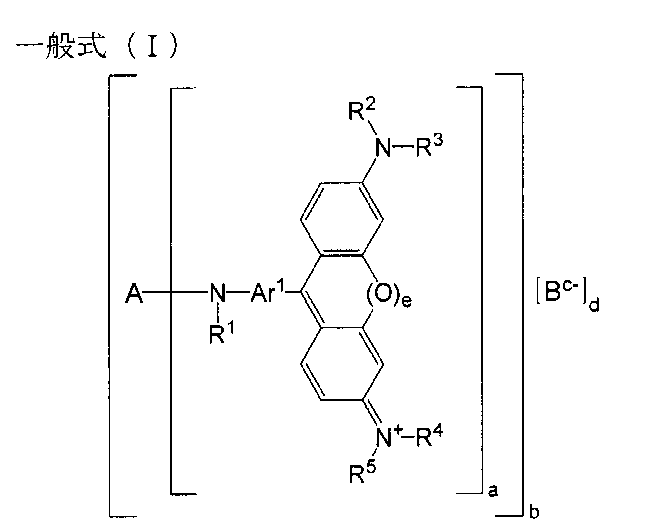
a及びcは2以上の整数、b及びdは1以上の整数を表す。eは0又は1であり、eが0のとき結合は存在しない。複数あるeは同一であっても異なっていてもよい。)
前記(C)溶剤に、前記色材と、前記キサンテン系染料と、前記(B)分散剤とを加え、前記色材と前記キサンテン系染料とを共分散する工程を有することを特徴とする。
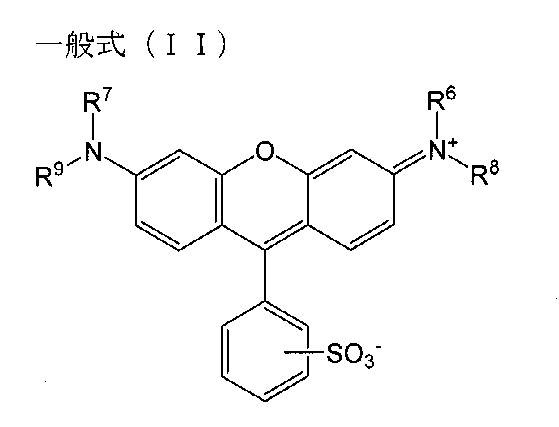
また、本発明は、前記本発明に係るカラーフィルタと、有機発光体とを有する、有機発光表示装置を提供する。
なお、本発明において光には、可視及び非可視領域の波長の電磁波、さらには放射線が含まれ、放射線には、例えばマイクロ波、電子線が含まれる。具体的には、波長5μm以下の電磁波、及び電子線のことをいう。
本発明において(メタ)アクリルとは、アクリル及びメタクリルの各々を表し、(メタ)アクリレートとは、アクリレート及びメタクリレートの各々を表す。
また、本発明において有機基とは、炭素原子を1個以上有する基のことをいう。
本発明に係る着色剤分散液は、(A)着色剤と、(B)分散剤と、(C)溶剤とを含有し、前記(A)着色剤が、下記一般式(I)で表される色材と、キサンテン系染料とを含み、前記(C)溶剤は、前記色材及び前記キサンテン系染料の23℃における溶解度がそれぞれ0.2(g/100g溶剤)以下の溶剤であり、前記色材及び前記キサンテン系染料とが、前記(B)分散剤により、前記(C)溶剤に分散されてなることを特徴とする。

a及びcは2以上の整数、b及びdは1以上の整数を表す。eは0又は1であり、eが0のとき結合は存在しない。複数あるeは同一であっても異なっていてもよい。)
一般式(I)で表される色材(以下、単に色材とすることがある。)は、複数の発色部位を持ち、当該発色部位が塩基性染料と同様の基本骨格を有するため、塩基性染料と同様に高輝度を実現できる。本発明において(A)着色剤は、このような一般式(I)で表される色材と、透過率の高い染料であるキサンテン系染料とを組み合わせて用いるため、特に高い輝度を実現し得る。
一般式(I)で表される色材は、後述するように分子会合体を形成し得ることにより優れた耐熱性を有する。更に、一般式(I)で表される色材及びキサンテン染料を、(B)分散剤により、当該色材及び染料を実質的に溶解しない(C)溶剤中に分散させて用いることにより、当該色材及び当該キサンテン系染料は、微粒子の状態で溶剤中に分散される。
このように微粒子の状態で分散した着色剤は、分子レベルでは凝集しているため、着色剤イオン対の解離や分解が生じにくく、溶液中に溶解した染料に比べて、耐熱性が高くなるものと推定される。このような微粒子の状態の着色剤は、分散剤を用いることにより、顔料と同様に、溶剤中での分散性や分散安定性を向上することができる。本発明の着色剤分散液においては、一般式(I)で表される色材とキサンテン系染料とが、微細化された状態で分散剤に取り囲まれた微粒子として、溶剤中に均一に分散することができる。そのため、当該着色剤分散液を用いると、加熱時においても着色剤が退色しにくいため、着色剤が本来有する色を保つことができ、透過率が高く、また各着色剤成分が微細化されているため、高輝度化の要求を実現可能な塗膜を形成することができる。
以下、このような本発明の着色剤分散液の各成分について順に詳細に説明する。
本発明において用いられる(A)着色剤は、少なくとも、下記一般式(I)で表される色材と、キサンテン系染料とを含み、本発明の効果を損なわない範囲で更に他の着色剤を含有してもよいものである。本発明においては、一般式(I)で表される色材とキサンテン系染料とを組み合わせて用いることにより、一般式(I)で表される色材のみでは実現できなかった色味を実現することが可能になり、且つ、耐熱性に優れ、高輝度のカラーフィルタを得ることができる。
本発明においては、着色剤として下記一般式(I)で表される色材が用いられる。当該色材を用いることにより、カラーフィルタの高輝度化を可能とするとともに、耐溶剤性や電気信頼性にも優れた着色層を形成することができる。

a及びcは2以上の整数、b及びdは1以上の整数を表す。eは0又は1であり、eが0のとき結合は存在しない。複数あるeは同一であっても異なっていてもよい。)
Aにおいて、少なくともNと直接結合する末端に飽和脂肪族炭化水素基を有する脂肪族炭化水素基は、Nと直接結合する末端の炭素原子がπ結合を有しなければ、直鎖、分岐又は環状のいずれであってもよく、末端以外の炭素原子が不飽和結合を有していてもよく、置換基を有していてもよく、炭素鎖中に、O、S、Nが含まれていてもよい。例えば、カルボニル基、カルボキシ基、オキシカルボニル基、アミド基等が含まれていてもよく、水素原子が更にハロゲン原子等に置換されていてもよい。
また、Aにおいて上記脂肪族炭化水素基を有する芳香族基は、少なくともNと直接結合する末端に飽和脂肪族炭化水素基を有する脂肪族炭化水素基を有する、単環又は多環芳香族基が挙げられ、置換基を有していてもよく、O、S、Nが含まれる複素環であってもよい。
中でも、骨格の堅牢性の点から、Aは、環状の脂肪族炭化水素基又は芳香族基を含むことが好ましい。
環状の脂肪族炭化水素基としては、中でも、有橋脂環式炭化水素基が、骨格の堅牢性の点から好ましい。有橋脂環式炭化水素基とは、脂肪族環内に橋かけ構造を有し、多環構造を有する多環状脂肪族炭化水素基をいい、例えば、ノルボルナン、ビシクロ[2,2,2]オクタン、アダマンタン等が挙げられる。有橋脂環式炭化水素基の中でも、ノルボルナンが好ましい。また、芳香族基としては、例えば、ベンゼン環、ナフタレン環を含む基が挙げられ、中でも、ベンゼン環を含む基が好ましい。例えば、Aが2価の有機基の場合、炭素数1~20の直鎖、分岐、又は環状のアルキレン基や、キシリレン基等の炭素数1~20のアルキレン基を2個置換した芳香族基等が挙げられる。
R1~R5におけるアリール基は、特に限定されない。例えば、フェニル基、ナフチル基等が挙げられる。アリール基が有してもよい置換基としては、例えばアルキル基、ハロゲン原子等が挙げられる。
Ar1は炭素数が6~20の芳香族基であることが好ましく、炭素数が10~14の縮合多環式炭素環からなる芳香族基がより好ましい。中でも、構造が単純で原料が安価である点からフェニレン基やナフチレン基であることがより好ましい。
1~R5及びAr1の組み合わせにより、所望の色に調整することができる。
中でも、1分子中に1価のアニオン性置換基を2つ以上有する有機アニオンが、色材を安定化させる点から好ましい。アニオン性置換基の具体例としては、例えば、-SO2N-SO2CH3、-SO2N-COCH3、-SO2N-SO2CF3、-SO2N-COCF3、-CF2SO2N-SO2CH3、-CF2SO2N-COCH3、-CF2SO2N-SO2CF3、-CF2SO2N-COCF3等のイミド酸基や、-SO3 -、-CF2SO3 -、-PO3 2-、-COO-、-CF2PO3 2-、-CF2COO-等が挙げられ、高い酸性度によりカチオンを安定化し発色状態を維持する効果が高い点から、イミド酸基や、-SO3 -、-CF2SO3 -が好ましく、更に、-SO3 -(スルホナト基)であることが好ましい。アニオン性置換基を複数置換する場合は、同一の置換基であってもよく、異なる置換基を用いてもよい。
上記ポリ酸としては、イソポリ酸イオン(MmOn)c-であってもヘテロポリ酸イオン(XlMmOn)c-であってもよい。上記イオン式中、Mはポリ原子、Xはヘテロ原子、mはポリ原子の組成比、nは酸素原子の組成比を表す。ポリ原子Mとしては、例えば、Mo、W、V、Ti、Nb等が挙げられる。またヘテロ原子Xとしては、例えば、Si、P、As、S、Fe、Co等が挙げられる。また、一部にNa+やH+等の対カチオンが含まれていてもよい。
中でも、高輝度で耐熱性に優れる点から、タングステン(W)及びモリブデン(Mo)の少なくとも1種を含む無機酸のアニオンであることが好ましく、耐光性の点からは、タングステンとモリブデンとを含む無機酸のアニオンであることが好ましい。
なお、一般式(I)で表される色材がキサンテン骨格を有する場合、後述するキサンテン系染料にも含まれ得るが、一般式(I)で表される色材に該当する限り、本発明においては、一般式(I)で表される色材に該当するものとして取り扱うものとする。
本発明において、キサンテン系染料とは、キサンテン骨格を有する染料をいう。本発明においてキサンテン系染料は、酸性基を有する染料であることが好ましい。酸性基としては、カルボキシ基(-COOH)、カルボキシラト基(-COO-)、カルボン酸塩基(-COOM、ここでMは金属原子を表す。)、スルホナト基(-SO3 -)、スルホ基(-SO3H)、スルホン酸塩基(-SO3M、ここでMは金属原子を表す。)等が挙げられ、中でも、スルホナト基(-SO3 -)、スルホ基(-SO3H)、又はスルホン酸塩基(-SO3M)の少なくとも1種を有することが、高い耐熱性を示す点から好ましい。金属原子Mとしては、ナトリウム原子、カリウム原子等が挙げられる。上記酸性基を有するキサンテン系染料は、酸に変換可能な官能基を有するため、例えば、アミン価を有する(B)分散剤と組み合わせて用いることにより、分散剤との間で酸塩基相互作用を生じ、キサンテン系染料が分散剤中に固定され、安定化する。このようなキサンテン系染料と分散剤の安定化状態は、キサンテン系染料を中心に、分散剤の着色剤親和性部位がキサンテン系染料を取り囲み、その外側に、分散剤の溶剤親和性部位が配置された状態、すなわちキサンテン系染料と分散剤のミセルを形成していると推定される。

R10~R13におけるアリール基は、特に限定されない。例えば、炭素数6~20の置換基を有していてもよいアリール基が挙げられ、中でも、フェニル基、ナフチル基等を有する基が好ましい。R10~R13におけるヘテロアリール基は、炭素数5~20の置換基を有していてもよいヘテロアリール基が挙げられ、ヘテロ原子として、窒素原子、酸素原子、硫黄原子を含むものが好ましい。
アリール基又はヘテロアリール基が有してもよい置換基としては、例えば、炭素数1~5のアルキル基、ハロゲン原子、酸性基、水酸基、アルコキシ基、カルバモイル基、カルボン酸エステル基等が挙げられる。
なお、R10~R13は、同一であっても異なっていてもよい。
nは、キサンテン系染料1分子中のアニオンの個数を表し、分子内の+電価数と-電価数とが同一となる値をとることが耐熱性の点から好ましい。また、nが0又は1であることが耐熱性の点から好ましい。
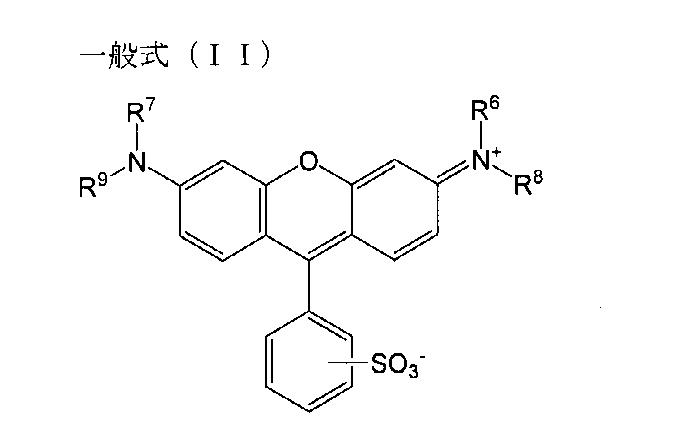
R6~R9におけるアリール基は、特に限定されない。例えば、炭素数6~20の置換基を有していてもよいアリール基が挙げられ、中でも、フェニル基、ナフチル基等を有する基が好ましい。R8及びR9におけるヘテロアリール基は、炭素数5~20の置換基を有していてもよいヘテロアリール基が挙げられ、ヘテロ原子として、窒素原子、酸素原子、硫黄原子を含むものが好ましい。
アリール基又はヘテロアリール基が有してもよい置換基としては、例えば、炭素数1~5のアルキル基、ハロゲン原子、水酸基、アルコキシ基、カルバモイル基、カルボン酸エステル基等が挙げられる。
なお、一般式(II)においては、耐光性の点から、R6~R9は酸性基を有しないものである。
一般式(II)において、キサンテン骨格を置換するベンゼン環が有するスルホナト基(-SO3 -)の置換位置は、特に限定されないが、キサンテン骨格に対して、オルト位又はパラ位であることが好ましく、スルホナト基がキサンテン骨格に対してオルト位に置換されていることが、耐光性の点から好ましい。
一般式(II)で表される化合物は、カチオン性のキサンテン骨格と、アニオン性のスルホナト基1個とを有するため、金属イオンやハロゲンイオンを有することなく電気的に安定化する。そのため、溶剤中に分散させても、解離することなく安定性に優れているものと推定される。そのため、耐熱性や耐光性に優れるとともに、例えば、液晶表示装置用のカラーフィルタとして用いる場合、当該カラーフィルタから液晶層への不純物イオンの溶出が無く、液晶表示駆動への悪影響を防ぐことが出来る。
また、窒素原子が、アリール基又はヘテロアリール基のような芳香族性の置換基を有するため、当該窒素原子が有する孤立電子対が、キサンテン骨格のみならず当該アリール基又はヘテロアリール基とも共鳴することにより、分子がより安定化するものと推定される。更に、窒素原子は直接水素原子と結合していないため、窒素原子から水素原子が脱離して染料が不安定化することはない。これらのことから一般式(II)で表される化合物は光照射下でも安定で、耐光性に優れており、当該化合物を用いることにより耐光性に優れ、高輝度な塗膜や着色層が形成可能となる。
特開2010-211198号公報を参考に得ることができる。また、上記一般式(II)で表される化合物は、下記一般式(A)で表される化合物が有するハロゲン原子と、所望の置換基を有するアミン化合物とを置換反応することにより得ることができる。

なお、Xにおけるハロゲン原子としては、フッ素原子、塩素原子、臭素原子が挙げられ、中でも塩素原子であることが好ましい。
一般式(A)で表される化合物、及び所望の置換基を有するアミン化合物は、公知の方法により合成してもよく、市販品を用いてもよい。
(A)着色剤は、本発明の効果を損なわない範囲で、色調の制御を目的として、更に他の着色剤を含有してもよい。他の着色剤としては、公知の顔料及び染料が挙げられ、1種又は2種以上用いることができる。他の着色剤の配合量は、本発明の効果が損なわれない範囲であれば特に限定されず、後述するカラーフィルタ用着色樹脂組成物で用いられる場合と同様とすることができる。
一般式(I)で表される色材と、キサンテン系染料との配合割合は、所望の色調が得られるように適宜調整すればよい。
中でも、(A)着色剤全量100質量部に対して、一般式(I)で表される色材の含有量が、40~99.9質量部であることが好ましく、70~99質量部であることがより好ましい。
また、(A)着色剤全量100質量部に対して、キサンテン系染料の含有量が、0.1~60質量部であることが好ましく、1~30質量部であることがより好ましい。
本発明の着色剤分散液において、前記一般式(I)で表される色材及びキサンテン系染料は、(B)分散剤により、溶剤中に分散させて用いられる。(B)分散剤としては、従来、分散剤として用いられているものの中から適宜選択して用いることができる。分散剤としては、例えば、カチオン系、アニオン系、ノニオン系、両性、シリコーン系、フッ素系等の界面活性剤を使用できる。界面活性剤の中でも、均一に、微細に分散し得る点から、高分子界面活性剤(高分子分散剤)が好ましい。
3級アミンを有する繰り返し単位を含む重合体を分散剤として用いることにより、前記(A)着色剤の分散性及び分散安定性が向上する。
3級アミンを有する繰り返し単位は、前記(A)着色剤と親和性を有する部位である。特に、当該繰り返し単位が有する3級アミンと(A)着色剤中のキサンテン系染料が有する酸性基とは、酸塩基相互作用を生じて安定化する。3級アミンを有する繰り返し単位を含む重合体からなる高分子分散剤は、通常、溶剤と親和性を有する部位となる繰り返し単位を含む。
3級アミンを有する繰り返し単位を含む重合体としては、3級アミンを有する繰り返し単位からなるブロック部と、溶剤親和性を有するブロック部とを有するブロック共重合体や、3級アミンを有する繰り返し単位と、溶剤親和性を有するポリマー鎖を有する繰り返し単位とを含むグラフト共重合体が好適に用いられる。グラフト共重合体において、3級アミンを有する繰り返し単位は、枝部に相当するポリマー鎖中に含まれていても良く、3級アミンを有する繰り返し単位を含むポリマー鎖を有する繰り返し単位と溶剤親和性を有するポリマー鎖を有する繰り返し単位とを含むグラフト共重合体であっても良い。
中でも、側鎖に3級アミンを有する繰り返し単位であることが好ましく、中でも、主鎖骨格が熱分解し難く、耐熱性が高い点から、下記一般式(III)で表される構造であることが、より好ましい。
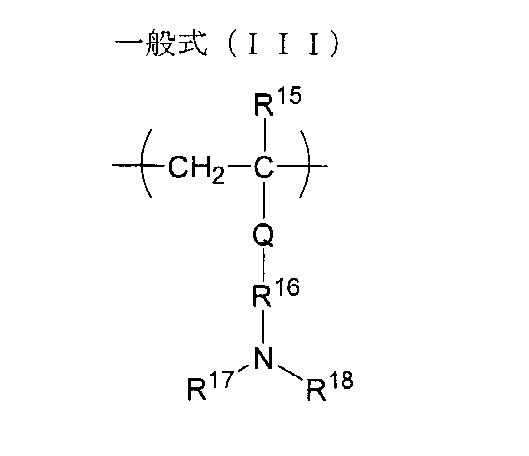
xは1~18の整数、yは1~5の整数、zは1~18の整数を示す。)
R20及びR21は、それぞれ独立に水素原子又はメチル基である。
上記R16としては、分散性の点から、炭素数1~8のアルキレン基が好ましく、中でも、R16がメチレン基、エチレン基、プロピレン基、ブチレン基であることが更に好ましく、メチレン基及びエチレン基がより好ましい。
前記3級アミンを有する繰り返し単位からなるブロック部と溶剤親和性を有するブロック部とを有するブロック共重合体における、溶剤親和性を有するブロック部としては、溶剤親和性を良好にし、分散性を向上する点から、非塩基性モノマーから誘導される繰り返し単位の中から、溶剤親和性を有するように溶剤に応じて適宜選択して用いられることが好ましい。ここで非塩基性モノマーとは、25℃の水に0.1Nの濃度(飽和濃度が0.1N未満の時は、飽和濃度)で溶解した時、7.1より低いpHを有する溶液を与える重合性モノマーをいう。溶剤親和性を有するブロック部としては、例えば、ポリアクリル酸エステル等の不飽和カルボン酸エステルの重合体、ポリアクリル酸等の不飽和カルボン酸の重合体等が挙げられる。中でも、下記一般式(IV)で表される、繰り返し単位を有する重合体であることが、(A)着色剤の分散性及び分散安定性を向上させながら、耐熱性も向上する点から好ましい。
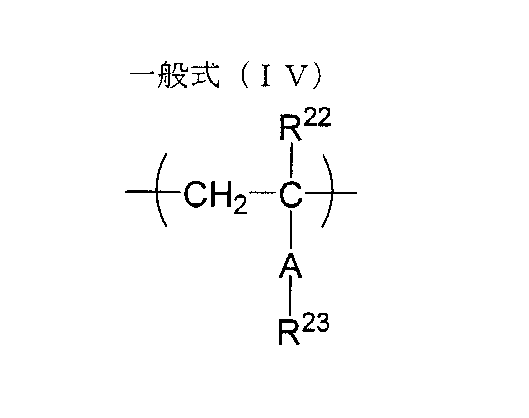
前記3級アミンを有する繰り返し単位と溶剤親和性を有するポリマー鎖を有する繰り返し単位とを含むグラフト共重合体において、溶剤親和性を有するポリマー鎖を有する繰り返し単位としては、例えば下記一般式(V)で表される構成単位が挙げられる。
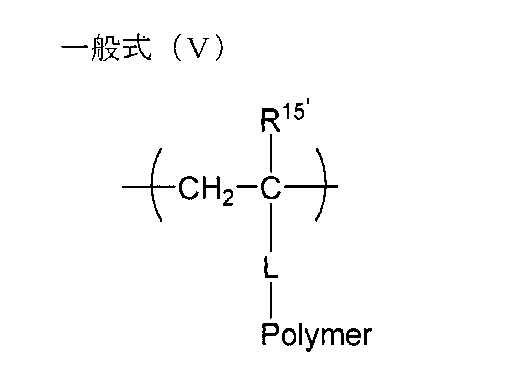
基、Polymerは、ポリマー鎖を表す。)
目安としては、溶剤親和性を良好にして分散性を向上する点から、用いられる(C)溶剤に対して、グラフト共重合体の23℃における溶解度が50(g/100g溶剤)以上になるように、ポリマー鎖を選択することが好ましい。
前記ポリマー鎖は、中でも、下記一般式(VI)及び一般式(VII)で表される構成単位を少なくとも1種有するものであることが、溶剤への溶解性の点から好ましい。

R32は、水素原子、あるいは炭素数1~18のアルキル基、ベンジル基、フェニル基、ビフェニル基、-CHO、-CH2CHO又は-CH2COOR35で示される1価の基であり、R33は、炭素数1~18のアルキル基、ベンジル基、フェニル基、ビフェニル基、シアノ基、-[CH(R30)-CH(R31)-O]x-R32、-[(CH2)y-O]z-R32、又は-[CO-(CH2)y-O]z-R32で示される1価の基である。R34は、炭素数1~18のアルキル基であり、R35は水素原子又は炭素数1~5のアルキル基を示す。
mは1~5の整数、n及びn’は5~200の整数を示す。xは1~18の整数、yは1~5の整数、zは1~18の整数を示す。)
アミン価は、試料1g中に含まれるアミン成分を中和するのに要する過塩素酸と当量の水酸化カリウムのmg数をいい、JIS-K7237に定義された方法により測定することができる。
当該塩型重合体を用いることにより、特に、前記一般式(I)で表される色材の分散性及び分散安定性が向上する。前記有機酸化合物としては、中でも、酸性有機リン化合物が、分散性及び分散安定性に優れる点から好ましい。
このような分散剤の具体例としては、例えば、特開2012-236882号公報等に記載の塩型ブロック共重合体や、特開2012-63429号公報等に記載の塩型グラフト共重合体等が好適なものとして挙げられる。
キサンテン系染料の分散剤として好適に用いられるウレタン系分散剤は、1分子内に1個以上のウレタン結合(-NH-COO-)を有する化合物からなる分散剤である。
ウレタン系分散剤を用いることにより、前記3級アミンを有する繰り返し単位を含む重合体よりも少量で良好な分散が可能なとなる。分散剤を少量とすることにより、相対的に硬化成分等の配合量を増やすことができ、その結果、耐熱性に優れた着色層を形成することができる。
また前記トリイソシアネート類としては、例えば、ベンゼン-1,2,4-トリイソシアネート、ベンゼン-1,2,5-トリイソシアネート、ベンゼン-1,3,5-トリイソシアネート等のベンゼントリイソシアネート類;トルエン-2,3,5-トリイソシアネート、トルエン-2,3,6-トリイソシアネート、トルエン-2,4,5-トリイソシアネート、トルエン-2,4,6-トリイソシアネート、トルエン-3,4,6-トリイソシアネート、トルエン-3,5,6-トリイソシアネート等のトルエントリイソシアネート類、1,2-キシレン-3,4,6-トリイソシアネート、1,2-キシレン-3,5,6-トリイソシアネート、1,3-キシレン-2,4,5-トリイソシアネート、1,3-キシレン-2,4,6-トリイソシアネート、1,3-キシレン-3,4,5-トリイソシアネート、1,4-キシレン-2,3,5-トリイソシアネート、1,4-キシレン-2,3,6-トリイソシアネート等のキシレントリイソシアネート類等の芳香族トリイソシアネート類を挙げられる。中でも高い耐熱性の点から、トルエンジイソシアネート類が好ましい。これらのジイソシアネート類およびトリイソシアネート類は、それぞれ単独でまたは2種以上を混合して使用することができる。中でも、トルエンジイソシアネート類が単独で重合した主鎖構造を有することが高い耐熱性の点から好ましい。
酸性官能基としては、例えばカルボキシル基、スルホ基、リン酸基等が挙げられるが、代表的にはカルボキシル基である。
本発明の着色剤分散液において、(B)分散剤の含有量は、通常、分散液の全量に対して1~50質量%、更に1~20質量%の範囲内であることが、分散性及び分散安定性の点から好ましい。
本発明においては(C)溶剤として、前記一般式(I)で表される色材、及び前記キサンテン系染料の23℃における溶解度がそれぞれ0.2(g/100g溶剤)以下の溶剤が用いられる。着色剤に対してこのような実質的に溶解しない溶剤又は難溶性の溶剤を用いることにより、本発明に係る着色剤分散液は前記(A)着色剤を溶剤中で微細な粒子として分散させて用いることができる。本発明において用いられる(C)溶剤は、分散性、耐熱性に優れ、高輝度の塗膜が得られる点から、23℃における前記色材及び前記キサンテン系染料の溶解度が0.1(g/100g溶剤)以下の溶剤であることが好ましい。
なお、(C)溶剤が、2種以上の溶剤を含む混合溶剤である場合は、当該混合溶剤に対する前記一般式(I)で表される色材、及び前記キサンテン系染料の23℃における溶解度がそれぞれ0.2(g/100g溶剤)以下であればよい。
まず、下記の方法により、前記色材又は前記キサンテン系染料を実質的に溶解しない溶剤であるか否かを判断することができる。
20mLサンプル管瓶に、溶解性を判断しようとする着色剤を0.1g投入し、溶剤Sを10mlホールピペットを用いて投入し、更にふたをした後に超音波で3分間処理する。得られた液は23℃のウォーターバスで60分間静置保管する。この上澄み液5mlをPTFE5μmメンブレンフィルターでろ過し、さらに0.25μmメンブレンフィルターでろ過し、不溶物を除く。得られたろ液の吸光スペクトルを紫外可視分光光度計(例えば、島津製作所社製 UV-2500PC)で1cmセルを用いて測定する。各着色剤の極大吸収波長における吸光度(abs)を求める。このとき、吸光度(abs)が測定上限値の40%未満(島津製作所社製 UV-2500PCの場合、吸光度(abs)が2未満)であれば当該溶剤は、前記着色剤を実質的に溶解しない溶剤であると評価できる。このとき、吸光度(abs)が測定上限値の40%以上の場合には、更に次の評価方法により、溶解度を求める。
まず、上記溶剤Sの代わりに、溶解性を判断しようとする着色剤の良溶剤(例えばメタノール等のアルコール)を用いて、同様にろ液を得て、着色剤溶液を作製し、その後10000倍~100000倍程度に適宜希釈し、同様に着色剤の極大吸収波長における吸光度を測定する。上記溶剤Sの着色剤溶液と良溶剤の着色剤溶液の吸光度と希釈倍率から上記溶剤Sに対する着色剤の溶解度を算出する。
その結果、前記色材又は前記キサンテン系染料の溶解度が0.2(g/100g溶剤)以下である溶剤は、本発明で用いることが可能な、着色剤が難溶性の溶剤であると判断される。
前記色材及び前記キサンテン系染料の溶解度が0.2(g/100g溶剤)以下である溶剤で、好ましいエステル系溶剤としては、例えば、メトキシプロピオン酸メチル、エトキシプロピオン酸エチル、メトキシエチルアセテート、プロピレングリコールモノメチルエーテルアセテート、3-メトキシ-3-メチル-1-ブチルアセテート、3-メトキシブチルアセテート、メトキシブチルアセテート、エトキシエチルアセテート、エチルセロソルブアセテート、ジプロピレングリコールメチルエーテルアセテート、プロピレングリコールジアセテート、1,3-ブチレングリコールジアセテート、シクロヘキサノールアセテート、1,6-ヘキサンジオールジアセテート、ジエチレングリコールモノエチルエーテルアセテート、ジエチレングリコールモノブチルエーテルアセテート等が挙げられる。
中でも、人体への危険性が低いこと、室温付近での揮発性が低いが加熱乾燥性が良い点から、プロピレングリコールモノメチルエーテルアセテート(PGMEA)を用いることが好ましい。この場合には、従来のPGMEAを用いた着色樹脂組成物との切り替えの際にも特別な洗浄工程を必要としないというメリットがある。
これらの溶剤は単独もしくは2種以上を組み合わせて使用してもよい。
また、本発明で用いられる溶剤としては、プロピレングリコールモノメチルエーテルアセテートを全溶剤中50質量%以上含むことが好ましく、更に70質量%以上含むことが好ましく、より更に90質量%以上含むことが好ましく、全溶剤中100質量%が、プロピレングリコールモノメチルエーテルアセテートであることが特に好ましい。
本発明の着色剤分散液には、本発明の効果が損なわれない限り、更に必要に応じて、分散補助樹脂、その他の成分を配合してもよい。
分散補助樹脂としては、例えば後述するカラーフィルタ用着色樹脂組成物で例示されるアルカリ可溶性樹脂が挙げられる。アルカリ可溶性樹脂の立体障害によって着色剤粒子同士が接触しにくくなり、分散安定化することやその分散安定化効果によって分散剤を減らす効果がある場合がある。
また、その他の成分としては、例えば、濡れ性向上のための界面活性剤、密着性向上のためのシランカップリング剤、消泡剤、ハジキ防止剤、酸化防止剤、凝集防止剤、紫外線吸収剤などが挙げられる。
本発明において、着色剤分散液の製造方法は、前記一般式(I)で表される色材と、キサンテン系染料とが分散剤により、溶剤に分散された着色剤分散液が得られる方法であれば、特に限定されず、例えば、(a)一般式(I)で表される色材の分散液と、キサンテン系染料の分散液をそれぞれ調製した後、これを混合して、本発明の着色剤分散液とする方法、(b)溶剤に一般式(I)で表される色材と、キサンテン系染料と、(B)分散剤とを加え、前記色材と、前記キサンテン系染料とを共分散して、本発明の着色剤分散液とする方法等が挙げられる。
また、各着色剤の分散液は、一般式(I)で表される色材、又はキサンテン系染料、(B)分散剤、(C)溶剤と、着色剤の良溶剤を少量混合し、公知の攪拌機又は分散機で分散処理し、反応終了後、着色剤の良溶剤を分離することにより調製してもよい。
スルホン酸塩を有するキサンテン系染料をメタノール、エタノール等のキサンテン系染料の良溶剤に溶かし、例えば濃塩酸等の酸を加える。当該溶液に、プロピレングリコールモノメチルエーテルアセテート(PGMEA)等の(C)溶剤と、(B)分散剤とを加えて加熱した後、減圧蒸留等によりメタノール等の着色剤の良溶剤を除去し、更に、析出物を濾別し、ろ液を得ることにより、本発明に係る着色剤分散液を調製することができる。
即ち、本発明に係る着色剤分散液の製造方法は、(A)着色剤と、(B)分散剤と、(C)溶剤とを含有し、前記(A)着色剤が、前記一般式(I)で表される色材と、キサンテン系染料とを含み、前記(C)溶剤は、前記色材及び前記キサンテン系染料の23℃における溶解度がそれぞれ0.2(g/100g溶剤)以下の溶剤である、着色剤分散液の製造方法であって、
前記(C)溶剤に、前記色材と、前記キサンテン系染料と、前記(B)分散剤とを加え、前記色材と前記キサンテン系染料とを共分散する工程を有することを特徴とする。
本発明に係るカラーフィルタ用着色樹脂組成物は、(A)着色剤と、(B)分散剤と、(C)溶剤と、(D)バインダー成分を含有し、前記(A)着色剤が、下記一般式(I)で表される色材と、キサンテン系染料とを含み、前記(C)溶剤は、前記色材及び前記キサンテン系染料の23℃における溶解度がそれぞれ0.2(g/100g溶剤)以下の溶剤であり、前記色材及び前記キサンテン系染料とが、前記(B)分散剤により、前記(C)溶剤に分散されてなることを特徴とする。

以下、このような本発明に係るカラーフィルタ用着色樹脂組成物について説明するが、(A)着色剤、(B)分散剤、及び(C)溶剤については、前記本発明に係る着色剤分散液と同様のものとすることができるため、ここでの説明は省略する。
本発明のカラーフィルタ用着色樹脂組成物は、成膜性や被塗工面に対する密着性を付与するためにバインダー成分を含有する。塗膜に充分な硬度を付与するために、硬化性バインダー成分を含有することが好ましい。硬化性バインダー成分としては、特に限定されず、従来公知のカラーフィルタの着色層を形成するのに用いられる硬化性バインダー成分を適宜用いることができる。
硬化性バインダー成分としては、例えば、可視光線、紫外線、電子線等により重合硬化させることができる光硬化性樹脂を含む光硬化性バインダー成分や、加熱により重合硬化させることができる熱硬化性樹脂を含む熱硬化性バインダー成分を含むものを用いることができる。
熱硬化性バインダーとしては、1分子中に熱硬化性官能基を2個以上有する化合物と硬化剤の組み合わせが通常用いられ、更に、熱硬化反応を促進できる触媒を添加しても良い。熱硬化性官能基としては、エポキシ基、オキセタニル基、イソシアネート基、エチレン性不飽和結合等が挙げられる。熱硬化性官能基としてはエポキシ基が好ましく用いられる。熱硬化性バインダー成分の具体例としては、例えば、国際公開第2012/144521号パンフレットに記載のものを挙げることができる。
以下、感光性バインダー成分について説明するが、硬化性バインダー成分はこれらに限定されるものではない。以下に説明する感光性バインダー成分の他に、エポキシ樹脂のような加熱により重合硬化させることができる熱硬化性のバインダー成分を更に用いてもよい。
本発明に係るカラーフィルタ用着色樹脂組成物においては、ネガ型感光性バインダー成分であることが、フォトリソグラフィー法によって既存のプロセスを用いて簡便にパターンを形成できる点から好ましい。
以下、ネガ型感光性バインダー成分を構成する、アルカリ可溶性樹脂と、多官能モノマーと、光開始剤について、具体的に説明する。
本発明におけるアルカリ可溶性樹脂はカルボキシル基を有するものであり、バインダー樹脂として作用し、かつパターン形成する際に用いられる現像液、特に好ましくはアルカリ現像液に可溶性である限り、適宜選択して使用することができる。
本発明における好ましいアルカリ可溶性樹脂は、カルボキシル基を有する樹脂であり、具体的には、カルボキシル基を有するアクリル系共重合体、カルボキシル基を有するエポキシ(メタ)アクリレート樹脂等が挙げられる。これらの中で特に好ましいものは、側鎖にカルボキシル基を有するとともに、さらに側鎖にエチレン性不飽和基等の光重合性官能基を有するものである。光重合性官能基を含有することにより形成される硬化膜の膜強度が向上するからである。また、これらアクリル系共重合体、及びエポキシアクリレート樹脂は、2種以上混合して使用してもよい。
カルボキシル基を有するアクリル系共重合体は、更に芳香族炭素環を有する構成単位を含有していてもよい。芳香族炭素環はカラーフィルタ用着色樹脂組成物に塗膜性を付与する成分として機能する。
カルボキシル基を有するアクリル系共重合体は、更にエステル基を有する構成単位を含有していてもよい。エステル基を有する構成単位は、カラーフィルタ用着色樹脂組成物のアルカリ可溶性を抑制する成分として機能するだけでなく、溶剤に対する溶解性、さらには溶剤再溶解性を向上させる成分としても機能する。
これらの中で、コポリマーにグリシジル基又は水酸基を有するエチレン性不飽和化合物を付加等することにより、エチレン性不飽和結合を導入したポリマー等は、露光時に、後述する多官能性モノマーと重合することが可能となり、着色層がより安定なものとなる点で、特に好適である。
エポキシ化合物、不飽和基含有モノカルボン酸、及び酸無水物は、公知のものの中から適宜選択して用いることができる。具体例としては、例えば、国際公開第2012/144521号パンフレットに記載のもの等が挙げられる。エポキシ化合物、不飽和基含有モノカルボン酸、及び酸無水物は、それぞれ1種単独で使用してもよいし、二種以上を併用してもよい。
このようにして得られるカルボキシル基を有するエポキシ(メタ)アクリレート化合物の分子量は特に制限されないが、好ましくは1000~40000、より好ましくは2000~5000である。
本発明のカラーフィルタ用着色樹脂組成物において用いられる多官能モノマーは、後述する光開始剤によって重合可能なものであればよく、特に限定されず、通常、エチレン性不飽和二重結合を2つ以上有する化合物が用いられ、特にアクリロイル基又はメタクリロイル基を2つ以上有する、多官能(メタ)アクリレートであることが好ましい。
このような多官能(メタ)アクリレートとしては、従来公知のものの中から適宜選択して用いればよい。具体例としては、例えば、国際公開第2012/144521号パンフレットに記載のもの等が挙げられる。
本発明のカラーフィルタ用着色樹脂組成物において用いられる上記多官能モノマーの含有量は、特に制限はないが、上記アルカリ可溶性樹脂100質量部に対して、通常5~500質量部程度、好ましくは20~300質量部の範囲である。多官能モノマーの含有量が上記範囲より少ないと十分に光硬化が進まず、露光部分が溶出する場合があり、また、多官能モノマーの含有量が上記範囲より多いとアルカリ現像性が低下するおそれがある。
本発明のカラーフィルタ用着色樹脂組成物において用いられる光開始剤としては、特に制限はなく、従来知られている各種光開始剤の中から、1種又は2種以上を組み合わせて用いることができる。具体例としては、例えば、国際公開第2012/144521号パンフレットに記載のもの等が挙げられる。
本発明の着色樹脂組成物には、本発明の目的が損なわれない範囲で、必要に応じて他の着色剤や各種添加剤を含むものであってもよい。
色調の制御を目的として必要に応じて他の着色剤を配合してもよい。他の着色剤としては、例えば、従来公知の顔料や染料を目的に応じて選択することができ、1種又は2種以上用いることができる。
他の着色剤の具体例としては、例えば、C.I.ピグメントバイオレット1、C.I.ピグメントバイオレット19、C.I.ピグメントバイオレット23、C.I.ピグメントバイオレット29、C.I.ピグメントバイオレット32、C.I.ピグメントバイオレット36、C.I.ピグメントバイオレット38;C.I.ピグメントブルー1、C.I.ピグメントブルー15、C.I.ピグメントブルー15:3、C.I.ピグメントブルー15:4、C.I.ピグメントブルー15:6、C.I.ピグメントブルー60、C.I.ピグメントレッド82、C.I.ピグメントバイオレット1、C.I.ピグメントバイオレット2、C.I.ピグメントバイオレット3等の顔料や、アシッドレッド等の染料が挙げられる。
この範囲内であれば、一般式(I)で表される色材や、キサンテン系染料の有する高透過率の特性や、耐熱性や耐光性の特性を損なうことなく、色調の制御が可能となるからである。
本発明の着色樹脂組成物は、更に酸化防止剤を含有することが、耐熱性の点から好ましい。酸化防止剤は従来公知のものの中から適宜選択すればよい。酸化防止剤の具体例としては、例えば、ヒンダードフェノール系酸化防止剤、アミン系酸化防止剤、リン系酸化防止剤、硫黄系酸化防止剤、ヒドラジン系酸化防止剤等が挙げられ、耐熱性の点から、ヒンダードフェノール系酸化防止剤を用いることが好ましい。
添加剤としては、上記酸化防止剤の他、例えば、重合停止剤、連鎖移動剤、レベリング剤、可塑剤、界面活性剤、消泡剤、シランカップリング剤、紫外線吸収剤、密着促進剤等などが挙げられる。
界面活性剤及び可塑剤の具体例としては、例えば、国際公開第2012/144521号パンフレットに記載のものが挙げられる。
(A)着色剤の合計の含有量は、着色樹脂組成物の固形分全量に対して、3~65質量%、より好ましくは4~55質量%の割合で配合することが好ましい。上記下限値以上であれば、着色樹脂組成物を所定の膜厚(通常は1.0~5.0μm)に塗布した際の着色層が充分な色濃度を有する。また、上記上限値以下であれば、分散性及び分散安定性に優れると共に、充分な硬度や、基板との密着性を有する着色層を得ることができる。尚、本発明において固形分は、上述した溶剤以外のもの全てであり、液状の多官能モノマー等も含まれる。
また、(B)分散剤の含有量としては、(A)着色剤を均一に分散することができるものであれば特に限定されるものではないが、例えば、着色樹脂組成物の固形分100質量部に対して3~40質量部用いることができる。更に、着色樹脂組成物の固形分100質量部に対して5~35質量部の割合で配合するのが好ましく、特に5~25質量部の割合で配合するのが好ましい。上記下限値以上であれば、(A)着色剤の分散性及び分散安定性に優れ、保存安定性に優れている。また、上記上限値以下であれば、現像性が良好なものとなる。
(D)バインダー成分は、これらの合計量が、着色樹脂組成物の固形分全量に対して10~92質量%、好ましくは15~87質量%の割合で配合するのが好ましい。上記下限値以上であれば、充分な硬度や、基板との密着性を有する着色層を得ることができる。また上記上限値以下であれば、現像性に優れたり、熱収縮による微小なシワの発生も抑制される。
また、(C)溶剤の含有量は、着色層を精度良く形成することができる範囲で適宜設定すればよい。該溶剤を含む上記着色樹脂組成物の全量に対して、通常、55~95質量%の範囲内であることが好ましく、中でも、65~88質量%の範囲内であることがより好ましい。上記溶剤の含有量が、上記範囲内であることにより、塗布性に優れたものとすることができる。
本発明のカラーフィルタ用着色樹脂組成物の製造方法は、(A)着色剤と、(B)分散剤と、(C)溶剤と、(D)バインダー成分と所望により用いられる各種添加成分とを含有し、(A)着色剤が(B)分散剤より(C)溶剤中に均一に分散させ得る方法であればよく、特に制限されず、公知の混合手段を用いて混合することにより、調製することができる。
当該樹脂組成物の調製方法としては、例えば、(1)前記本発明に係る着色剤分散液に、(D)バインダー成分と所望により用いられる各種添加成分を混合する方法;(2)一般式(I)で表される色材の分散液と、キサンテン系染料の分散液と、(D)バインダー成分と、所望により用いられる各種添加成分とを混合する方法;(3)(C)溶剤中に、(A)着色剤と、(B)分散剤と、(D)バインダー成分と、所望により用いられる各種添加成分とを同時に投入し、混合する方法;(4)(C)溶剤中に、(B)分散剤と、(D)バインダー成分と、所望により用いられる各種添加成分とを添加し、混合したのち、(A)着色剤を加えて混合する方法;などを挙げることができる。
これらの方法の中で、上記(1)又は(2)の方法が、着色剤の凝集を効果的に防ぎ、均一に分散させ得る点から好ましい。
本発明に係るカラーフィルタは、透明基板と、当該透明基板上に設けられた着色層とを少なくとも備えるカラーフィルタであって、当該着色層の少なくとも1つが、前記本発明に係る着色樹脂組成物を硬化させて形成されてなる着色層を有する。
本発明のカラーフィルタに用いられる着色層は、少なくとも1つが、前記本発明に係るカラーフィルタ用着色樹脂組成物を硬化させて形成されてなる着色層である。
着色層は、通常、後述する透明基板上の遮光部の開口部に形成され、通常3色以上の着色パターンから構成される。
また、当該着色層の配列としては、特に限定されず、例えば、ストライプ型、モザイク型、トライアングル型、4画素配置型等の一般的な配列とすることができる。また、着色層の幅、面積等は任意に設定することができる。
当該着色層の厚みは、塗布方法、着色樹脂組成物の固形分濃度や粘度等を調整することにより、適宜制御されるが、通常、1~5μmの範囲であることが好ましい。
まず、前述した本発明のカラーフィルタ用着色樹脂組成物を、スプレーコート法、ディップコート法、バーコート法、コールコート法、スピンコート法などの塗布手段を用いて後述する透明基板上に塗布して、ウェット塗膜を形成させる。
次いで、ホットプレートやオーブンなどを用いて、該ウェット塗膜を乾燥させたのち、これに、所定のパターンのマスクを介して露光し、アルカリ可溶性樹脂及び多官能モノマー等を光重合反応させて、感光性の塗膜とする。露光に使用される光源としては、例えば低圧水銀灯、高圧水銀灯、メタルハライドランプなどの紫外線、電子線等が挙げられる。露光量は、使用する光源や塗膜の厚みなどによって適宜調整される。
また、露光後に重合反応を促進させるために、加熱処理を行ってもよい。加熱条件は、使用する着色樹脂組成物中の各成分の配合割合や、塗膜の厚み等によって適宜選択される。
現像処理後は、通常、現像液の洗浄、着色樹脂組成物の硬化塗膜の乾燥が行われ、着色層が形成される。なお、現像処理後に、塗膜を十分に硬化させるために加熱処理を行ってもよい。加熱条件としては特に限定はなく、塗膜の用途に応じて適宜選択される。
本発明のカラーフィルタにおける遮光部は、後述する透明基板上にパターン状に形成されるものであって、一般的なカラーフィルタに遮光部として用いられるものと同様とすることができる。
当該遮光部のパターン形状としては、特に限定されず、例えば、ストライプ状、マトリクス状等の形状が挙げられる。この遮光部としては、例えば、黒色顔料をバインダー樹脂中に分散又は溶解させたものや、クロム、酸化クロム等の金属薄膜等が挙げられる。この金属薄膜は、CrOx膜(xは任意の数)及びCr膜が2層積層されたものであってもよく、また、より反射率を低減させたCrOx膜(xは任意の数)、CrNy膜(yは任意の数)及びCr膜が3層積層されたものであってもよい。
当該遮光部が黒色着色剤をバインダー樹脂中に分散又は溶解させたものである場合、この遮光部の形成方法としては、遮光部をパターニングすることができる方法であればよく、特に限定されず、例えば、遮光部用着色樹脂組成物を用いたフォトリソグラフィー法、印刷法、インクジェット法等を挙げることができる。
本発明のカラーフィルタにおける透明基板としては、可視光に対して透明な基材であればよく、特に限定されず、一般的なカラーフィルタに用いられる透明基板を使用することができる。具体的には、石英ガラス、無アルカリガラス、合成石英板等の可撓性のない透明なリジッド材、あるいは、透明樹脂フィルム、光学用樹脂板、フレキシブルガラス等の可撓性やフレキシブル性を有する透明なフレキシブル材が挙げられる。
当該透明基板の厚みは、特に限定されるものではないが、本発明のカラーフィルタの用途に応じて、例えば100μm~1mm程度のものを使用することができる。
なお、本発明のカラーフィルタは、上記透明基板、遮光部及び着色層以外にも、例えば、オーバーコート層や透明電極層、さらには配向膜や柱状スペーサ等が形成されたものであってもよい。
本発明の液晶表示装置は、前述した本発明に係るカラーフィルタと、対向基板と、前記カラーフィルタと前記対向基板との間に形成された液晶層とを有することを特徴とする。
このような本発明の液晶表示装置について、図を参照しながら説明する。図2は、本発明の液晶表示装置の一例を示す概略図である。図2に例示するように本発明の液晶表示装置40は、カラーフィルタ10と、TFTアレイ基板等を有する対向基板20と、上記カラーフィルタ10と上記対向基板20との間に形成された液晶層30とを有している。
なお、本発明の液晶表示装置は、この図2に示される構成に限定されるものではなく、一般的にカラーフィルタが用いられた液晶表示装置として公知の構成とすることができる。
また、対向基板としては、本発明の液晶表示装置の駆動方式等に応じて適宜選択して用いることができる。
さらに、液晶層を構成する液晶としては、本発明の液晶表示装置の駆動方式等に応じて、誘電異方性の異なる各種液晶、及びこれらの混合物を用いることができる。
真空注入方式では、例えば、あらかじめカラーフィルタ及び対向基板を用いて液晶セルを作製し、液晶を加温することにより等方性液体とし、キャピラリー効果を利用して液晶セルに液晶を等方性液体の状態で注入し、接着剤で封止することにより液晶層を形成することができる。その後、液晶セルを常温まで徐冷することにより、封入された液晶を配向させることができる。
また液晶滴下方式では、例えば、カラーフィルタの周縁にシール剤を塗布し、このカラーフィルタを液晶が等方相になる温度まで加熱し、ディスペンサー等を用いて液晶を等方性液体の状態で滴下し、カラーフィルタ及び対向基板を減圧下で重ね合わせ、シール剤を介して接着させることにより、液晶層を形成することができる。その後、液晶セルを常温まで徐冷することにより、封入された液晶を配向させることができる。
本発明に係る有機発光表示装置は、前述した本発明に係るカラーフィルタと、有機発光体とを有することを特徴とする。
このような本発明の有機発光表示装置について、図を参照しながら説明する。図3は、本発明の有機発光表示装置の一例を示す概略図である。図3に例示するように本発明の有機発光表示装置100は、カラーフィルタ10と、有機発光体80とを有している。カラーフィルタ10と、有機発光体80との間に、有機保護層50や無機酸化膜60を有していても良い。
なお、本発明の有機発光表示装置は、この図3に示される構成に限定されるものではなく、一般的にカラーフィルタが用いられた有機発光表示装置として公知の構成とすることができる。
なお、各分散液中に含まれる粒子の平均分散粒径は、各分散液をPGMEAで100~1000倍程度に適宜希釈し、レーザー光散乱粒度分布計(日機装社製ナノトラック粒度分布測定装置UPA-EX150)を用いて動的光散乱法により23℃にて粒度分布を測定し、50%平均粒子径を、体積換算(MV)して求めた。染料分散液において、当該粒径は、染料と分散剤のミセルの平均分散粒径と推定される。
(1)中間体1の合成
和光純薬(株)製 1-ヨードナフタレン15.2g(60mmol)、三井化学(株)製 ノルボルナンジアミン(NBDA)(CAS No.56602-77-8)4.63g(30mmol)、ナトリウム-tert-ブトキシド 8.07g(84mmol)、アルドリッチ製 2-ジシクロヘキシルホスフィノ-2’,6’,-ジメトキシビフェニル 0.09g(0.2mmol)、和光純薬(株)製 酢酸パラジウム 0.021g(0.1mmol)、キシレン 30mLに分散し130-135℃で48時間反応させた。反応終了後、室温に冷却し水を加え抽出した。次いで硫酸マグネシウムで乾燥し濃縮することにより下記化学式(1)で示される中間体1 8.5g(収率70%)を得た。
得られた化合物は、下記の分析結果より目的の化合物であることを確認した。
・MS(ESI) (m/z):407(M+H)、
・元素分析値:CHN実測値 (85.47%、8.02%、6.72%);理論値(85.26%、8.11%、6.63%)
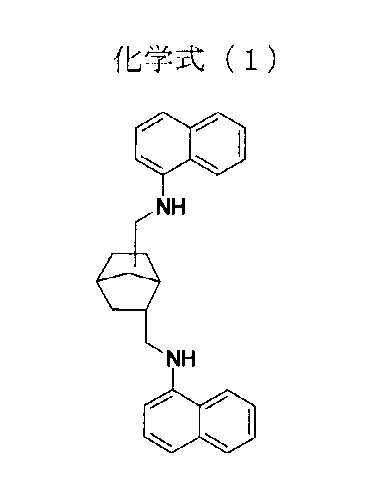
中間体1 8.46g(20.8mmol)、東京化成工業製 4,4’-ビス(ジメチルアミノ)ベンゾフェノン13.5g(41.6mmol)トルエン60mLを入れ45-50℃で攪拌した。和光純薬工業製オキシ塩化リン 6.38g(51.5mmol)を滴下し、2時間還流し冷却した。反応終了後、トルエンをデカントした。樹脂状析出物をクロロホルム40mL、水40mL、濃塩酸を加えて溶解しクロロホルム層を分液した。クロロホルム層を水で洗浄し、硫酸マグネシウムで乾燥、濃縮した。濃縮物に酢酸エチル65mLを加え還流した。冷却の後に析出物を濾過し下記化学式(2)で示される中間体2を15.9g(収率70%)得た。
得られた化合物は、下記の分析結果より目的の化合物であることを確認した。
・MS(ESI) (m/z):511(+)、2価
・元素分析値:CHN実測値 (78.13%、7.48%、7.78%);理論値(78.06%、7.75%、7.69%)

中間体2 5.00g(4.58mmol)を水300mlに加え、90℃で溶解させ中間体2溶液とした。次に日本無機化学工業製リンタングステン酸・n水和物 H3[PW12O40]・nH2O(n=30) 10.44g(3.05mmol)を水100mLに入れ、90℃で攪拌し、リンタングステン酸水溶液を調製した。先の中間体2溶液にリンタングステン酸水溶液を90℃で混合し、生成した沈殿物を濾取し、水で洗浄した。得られたケーキを乾燥して下記化学式(3)で表される色材Aを13.25g(収率98%)を得た。
得られた化合物は、下記の分析結果より目的の化合物であることを確認した。(モル比W/Mo=100/0)
・MS(ESI) (m/z):510(+)、2価
・元素分析値:CHN実測値 (41.55%、5.34%、4.32%);理論値(41.66%、5.17%、4.11%)
また、リンタングステン酸のポリ酸構造が色材Aとなった後も保たれていることを31P-NMRにより確認した。
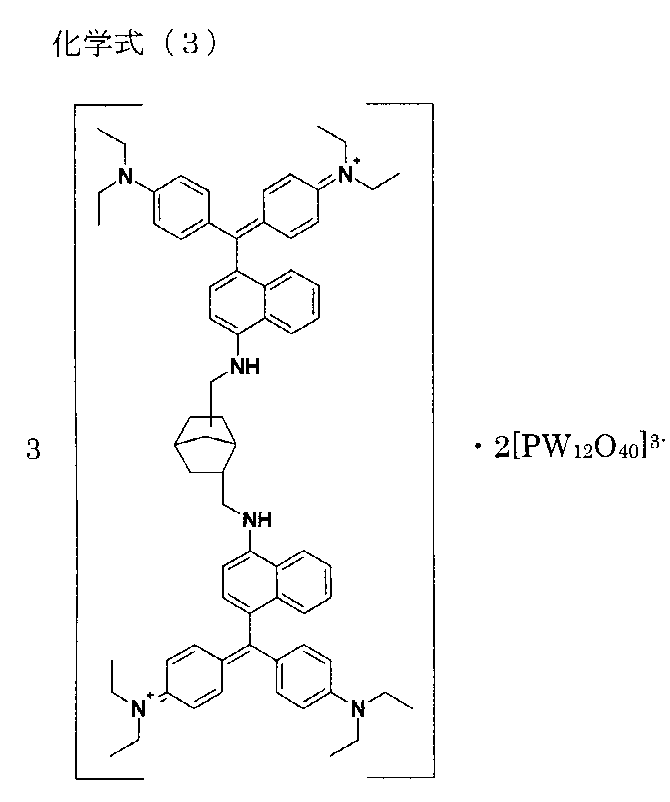
前記製造例1の(2)で得られた中間体2 5.00g(4.58mmol)を水300mlに加え、90℃で溶解させ中間体2溶液を得た。次に日本無機化学工業製リンタングステン酸・n水和物 H3[PW12O40]・nH2O (n=30) 10.23g(2.99mmol)および日本無機化学工業製リンモリブデン酸・n水和物 H3[PMo12O40]・nH2O (n=30) 0.144g(0.06mmol)
を水100mLに入れ、90℃で攪拌し、無機酸水溶液を作製した。先の中間体2溶液に無機酸水溶液を90℃で混合し、生成した沈殿物を濾取し、水で洗浄した。得られたケーキを乾燥して下記化学式(4)で表される色材Bを12.7g(収率95%、W/Mo=98/2(モル比))を得た。
得られた化合物は、下記の分析結果より目的の化合物であることを確認した。
・MS(ESI) (m/z):510(+)、2価
・元素分析値:CHN実測値 (41.55%、5.34%、4.32%);理論値(41.66%、5.17%、4.11%)
また無機酸原料中のリンモリブデン酸は無機酸水溶液調製時に一部のリンタングステン酸と反応して、リンタングストモリブデン酸となるが、それらのポリ酸構造が色材Bとなった後も保たれていることを31P-NMRにより確認した。

500mlの4つ口フラスコに、下記化学式(5)のスルホフルオラン化合物41.0部、メタノール312部、N-メチル-2,6-キシリジン6.79部及びN-メチル-o-トルイジン6.13部を仕込み、30時間還流させた。この反応液を60℃でろ過して不溶解分を除いた後、反応液が約70mlになるまで減圧下で溶媒を除き、6%塩酸200部に注いだ。次いで、水600部を加えて室温で30分間攪拌した後、ウェットケーキをろ取した。このウェットケーキを100部の水に懸濁させて60℃で2時間攪拌した後、再びろ取して60℃の湯で水洗後、乾燥させることにより、下記化学式(6)で表されるキサンテン系染料Aを得た。


20mLサンプル管瓶に、製造例1~3で得られた色材A、色材B、キサンテン系染料A、及びキサンテン系染料であるアシッドレッド289(AR289、東京化成社製)をそれぞれ0.2gずつPGMEA100gに投入し、ふたをして20秒間よく振った後、10分間静置した。この上澄み液5gをろ過し不溶物を除いた。得られたろ液の吸光スペクトルを紫外可視分光光度計(島津製作所社製 UV-2500PC)で1cmセルを用いて測定し、各着色剤の極大吸収波長における吸光度を求めた。
上記条件で測定した吸光度が2以下であれば、実質的に溶解しないといえる。
結果は、青色レーキ顔料A、青色レーキ顔料B、キサンテン系染料A、及びAR289は、いずれも吸光度が2以下であり、PGMEAに対して0.2g/100g以下の溶解度であった。
アルカリ可溶性樹脂としてメタクリル酸/メタクリル酸メチル/メタクリル酸ベンジル共重合体(モル比:10/30/50、質量平均分子量:9000、酸価:70mgKOH/g、有効成分含量40質量%)100質量部、多官能性モノマーとしてジペンタエリスリトールヘキサアクリレート(日本化薬社製、「KAYARAD DPHA」)60質量部、光開始剤として2-メチル-1-[4-(メチルチオ)フェニル]-2-モルフォリノプロパン-1-オン(BASF社製、「IRGACURE907」)11.1質量部、ジエチルチオキサントン(日本化薬社製、「DETX-S」)3.7部及び溶剤としてPGMEA172.2質量部を添加した後、均一になるまで混合し、感光性バインダー成分(CR-1)を得た。
30mlマヨネーズ瓶に製造例1の色材A 3.0質量部、LPN21116(ビックケミー社製、アミノ基が塩形成している4級アンモニウム塩型アクリルブロック共重合体、不揮発分40%)を4.5質量部、プロピレングリコールモノメチルエーテルアセテート(以下PGMEA、ダイセル化学製)22.5質量部、径2mmのジルコニアビーズ30質量部を入れ、ペイントシェーカー(浅田鉄鋼製)にて1時間予備解砕した後、溶液を別の30mlマヨネーズ瓶に移し変え、径0.1mmのジルコニアビーズ30質量部を加えてペイントシェーカーにて5時間振とうし、色材分散液(A)を得た。得られた分散液(A)0.1質量部をPGMEA9.9質量部で希釈し、マイクロトラックUPA粒度分布計(日機装社製)を用いて、粒度分布を測定した。評価は50%平均粒子径で行い、体積換算(MV)で114nmであった。
製造例5において、色材Aの代わりに、製造例2の色材Bを用いた以外は、製造例5と同様にして、製造例6の色材分散液(B)を得た。得られた色材分散液(B)0.1質量部をPGMEA9.9質量部で希釈し、マイクロトラックUPA粒度分布計(日機装社製)を用いて、粒度分布を測定した。評価は50%平均粒子径で行い、体積換算(MV)した結果は108nmmであった。
製造例5において、色材Aの代わりに、市販のピグメントブルー15:6顔料(PB15:6)を用いた以外は、製造例5と同様にして、比較製造例1の顔料分散液(C)を得た。得られた顔料分散液(C)についてそれぞれ0.1質量部をPGMEA9.9質量部で希釈し、マイクロトラックUPA粒度分布計(日機装社製)を用いて、粒度分布を測定した。評価は50%平均粒子径で行い、体積換算(MV)した結果は47nmであった。
製造例5において、色材Aの代わりに、市販のピグメントバイオレット顔料(PV23)を用いた以外は、製造例5と同様にして、比較製造例2の顔料分散液(D)を得た。得られた顔料分散液(D)0.1質量部をPGMEA9.9質量部で希釈し、マイクロトラックUPA粒度分布計(日機装社製)を用いて、粒度分布を測定した。評価は50%平均粒子径で行い、体積換算(MV)した結果は87nmであった。
フラスコにアシッドレッド289(AR289;キサンテン系染料、東京化成社製)100質量部に対し、メタノールを1000質量部加えてマグネチックスターラーにて溶解させた。溶解を確認後、濃塩酸29.9質量部を加え攪拌し、AR289が有するスルホン酸塩をスルホ基とした。この溶液に、さらにPGMEA1000質量部を加えた。次いで分散剤LPN6919(商品名、ビックケミー社製、3級アミンを有する繰り返し単位からなるブロック部を含むブロックポリマー、不揮発分60%、アミン価120mgKOH/g、質量平均分子量8000)276質量部を加えて攪拌した。その後、還流冷却管を接続し、ウォーターバスにて80℃まで昇温させ、80℃到達後4時間反応させた。その後エバポレーターにより、ウォーターバス45℃でメタノールを溜去し、PGMEA1000質量部を加えた後16時間室温で冷却放置した。次いで析出物をろ別し、100質量部程度のPGMEAにてろ過物を洗浄し、得られたろ液を回収して染料が均一に分散された製造例7の染料分散液(E)を得た。マイクロトラックUPA粒度分布計(日機装社製)を用いて、粒度分布を測定した。評価は50%平均粒子径で行い、体積換算(MV)した結果は78nmであった。
製造例7においてアシッドレッド289の代わりに、製造例3で得られたキサンテン系染料100質量部、濃塩酸17.2質量部、LPN6919を318質量部使用した以外は、製造例7と同様にして、染料が均一に分散された製造例8の染料分散液(F)を得た。マイクロトラックUPA粒度分布計(日機装社製)を用いて、粒度分布を測定した。評価は50%平均粒子径で行い、体積換算(MV)した結果は86nmであった。
フラスコにアシッドレッド289(AR289、東京化成社製)100質量部に対し、メタノールを1000質量部加えてマグネチックスターラーにて溶解させた。溶解を確認後、濃塩酸16.46質量部を加え攪拌し、AR289が有するスルホン酸塩をスルホ基とした。さらにPGMEA1000質量部を加えた。次いで分散剤Disperbyk161(商品名、ビックケミー社製、ウレタン系分散剤、不揮発分30%、アミン価11mgKOH/g)332質量部を加えて攪拌した。その後、還流冷却管を接続し、ウォーターバスにて80℃まで昇温させ、80℃到達後4時間反応させた。その後エバポレーターにより、ウォーターバス45℃でメタノールを溜去し、PGMEA1000質量部を加えた後16時間室温で冷却放置した。次いで析出物をろ別し、100質量部程度のPGMEAにてろ過物を洗浄し、得られたろ液を回収して、染料が均一に分散された製造例9の染料分散液(G)を得た。マイクロトラックUPA粒度分布計(日機装社製)を用いて、粒度分布を測定した。評価は50%平均粒子径で行い、体積換算(MV)した結果は68nmであった。
製造例7においてアシッドレッド289の代わりに製造例3で得られたキサンテン系染料A 100質量部、Disperbyk161 332質量部を使用し、濃塩酸を用いなかった以外は製造例7と同様にして染料が均一に分散された染料分散液(H)を得た。マイクロトラックUPA粒度分布計(日機装社製)を用いて、粒度分布を測定した。評価は50%平均粒子径で行い、体積換算(MV)した結果は79nmであった。
30mlマヨネーズ瓶に製造例1の色材A 2.79質量部、製造例3で得られたキサンテン系染料A 0.21質量部、LPN21116(ビックケミー社製 不揮発分40%)を4.5質量部、プロピレングリコールモノメチルエーテルアセテート(以下PGMEA、ダイセル化学製)22.5質量部、径2mmのジルコニアビーズ30質量部を入れ、ペイントシェーカー(浅田鉄鋼製)にて1時間予備解砕した後、溶液を別の30mlマヨネーズ瓶に移し変え、径0.1mmのジルコニアビーズ30質量部を加えてペイントシェーカーにて5時間振とうし、実施例1の着色剤分散液(色材と染料の共分散液)(I)を得た。得られた着色剤分散液(I)0.1質量部をPGMEA9.9質量部で希釈し、マイクロトラックUPA粒度分布計(日機装社製)を用いて、粒度分布を測定した。評価は50%平均粒子径で行い、体積換算(MV)で128nmであった。
製造例5の色材分散液(A)90質量部と、製造例8の染料分散液(F)10質量部を混合し実施例2の着色剤分散液(J)を得た。実施例1と同様にして、得られた分散液(J)の粒度分布を測定したところ、50%平均粒子径は、体積換算(MV)で106nmであった。
実施例1において、色材Aの代わりに市販のピグメントブルー15:6顔料(PB15:6)を用いた以外は、実施例1と同様に共分散液(K)を調製したところ、得られた共分散液(K)は増粘してしまった。また、実施例1と同様にして、得られた分散液(K)の粒度分布を測定したところ、50%平均粒子径は、体積換算(MV)で150nmを超えていた。
実施例1及び2の着色剤分散液をそれぞれ、40℃で1週間保存した後、上記と同様に粒度分布を測定したところ、実施例1の着色剤分散液(I)の50%平均粒子径は、体積換算(MV)で132nmであり、実施例2の着色剤分散液(J)の50%平均粒子径は、体積換算(MV)で147nmであった。
実施例1及び2、並びに比較例1の結果から、実施例1及び2の着色剤分散液は分散性に優れていることが明らかとなった。更に、色材とキサンテン系染料とを共分散した実施例1の着色剤分散液は、色材分散液と、キサンテン系染料分散液とを混合した実施例2の着色剤分散液と比べても、特に分散安定性に優れていることが明らかとなった。
上記色材分散液(A)を3.14質量部、染料分散液(E)を0.70質量部、メタクリル酸/メタクリル酸メチル/メタクリル酸ベンジル共重合体(モル比:10/30/50、質量平均分子量:9000、酸価:70mgKOH/g、有効成分含量40質量%)2.07質量部、ジペンタエリスリトールヘキサアクリレートモノマー(東亜合成製『アロニックスM-403』)0.59質量部、IRGACURE 907(BASF製)0.38質量部、KAYACURE DETX-S(日本化薬製)0.08質量部、KBM503(信越化学製)0.03質量部、メガファックR08MH(DIC製)0.0003質量部、PGMEA9.09質量部を加えて攪拌し、0.25μmメッシュでろ過して実施例3の着色樹脂組成物を得た。
実施例3において色材分散液(A)および染料分散液(E)の代わりに、下記表1のような組合せに変更して、230℃30分ポストベーク後の色度がy=0.09にしたときにx=0.145となるように着色剤の混合比率を変えた以外は、実施例3と同様にして実施例4~10の着色樹脂組成物を得た。
実施例3において色材分散液(A)および染料分散液(E)の代わりに、実施例1の着色剤分散液(I)3.84質量部を用いた以外は、実施例3と同様にして、実施例11の着色樹脂組成物を得た。
実施例4において、ヒンダードフェノール系酸化防止剤IRGANOX1010(BASF)0.04質量部を追加で加えた以外は、実施例4と同様にして実施例12の着色樹脂組成物を得た。
実施例3において着色剤分散液(A)および染料分散液(E)を、下記表1のような組合せに変更した以外は、実施例3と同様にして比較着色樹脂組成物を得た。
実施例3において染料分散液(E)を、AR289の4.5質量%メタノール溶液 0.07質量部に変えた以外は、実施例3と同様にして比較着色樹脂組成物を得た。

光学特性評価は以下のように行った。実施例3~12及び比較例2~5の着色樹脂組成物をそれぞれ、厚み0.7mmのガラス基板(NHテクノグラス(株)製、「NA35」)上に、スピンコーターを用いて塗布した。その後、80℃のホットプレート上で3分間加熱乾燥を行った。フォトマスクを介さずに超高圧水銀灯を用いて60mJ/cm2の紫外線を照射することによって硬化膜(青色着色膜)を得た。乾燥硬化後の膜厚(T;μm)は後述のポストベーク後の色度がy=0.090となるようにした。着色膜が形成されたガラス板を230℃のクリーンオーブンで30分間ポストベークし、得られた着色膜のコントラスト、色度(x、y)及び輝度(Y)を測定した。コントラストは壺坂電気(株)社製「コントラスト測定装置CT-1B」を用い、色度及び輝度はオリンパス(株)社製「顕微分光測定装置OSP-SP200」を用いて測定した。

染料溶液を用いた比較例5の着色樹脂組成物は、スピンコーターでの塗布後、80℃のホットプレート上で3分間加熱乾燥し、溶剤の大半が揮発した時点で溶解性の低いAR289が激しく析出してしまった。また、ポストベーク後の基板において、析出したAR289が無い部分の輝度を測定したところ、輝度は10以下であった。染料溶液を用いることにより耐熱性が低下したことに加え、色材Aの一部がメタノールに溶解することにより、更に耐熱性が低下しているものと推測される。
実施例3と7、実施例4と8、実施例5と9、実施例6と10の比較から、一般式(I)で表される色材において、アニオンがリンタングステン酸イオンである色材Aを用いた実施例3~6の着色層のほうが、色材Bを用いた実施例よりもポストベーク後の輝度が高く、耐熱性により優れていることが明らかとなった。
また、実施例3と4、実施例5と6、実施例7と8、実施例9と10の比較から、キサンテン系染料Aを用いた実施例4、6、8、10の着色層のほうがAR289を用いた実施例よりもポストベーク後の輝度が高く、耐熱性により優れていることが明らかとなった。
色材Aとキサンテン系染料Aとを共分散した実施例11は、色材Aの分散液と、キサンテン系染料Aの分散液を別々に調製した実施例4と比較しても更に加熱後の輝度が高かった。この結果から、共分散液を用いて調製した着色樹脂組成物が特に優れた耐熱性を有することが明らかとなった。
また、酸化防止剤を用いた実施例12は、酸化剤を有しない実施例4よりも優れた耐熱性を有することが明らかとなった。
このような、高輝度で耐熱性に優れた実施例3~12の着色樹脂組成物について、更に耐光性の評価を行った。
上記光学特性評価と同様に調製されたポストベーク処理された基板を別途用意し、オリンパス(株)社製「顕微分光測定装置OSP-SP200」を用いて当該基板の色座標(L、a、b)をそれぞれ測定し、これをL1、a1、b1とした。
次いで、大気圧下でキセノンランプ(アトラス社製Ci4000ウェザメータ、内側フィルター:石英、外側フィルター:ソーダライム&赤外線吸収コーティング(CIRA))を用い、420nmの波長で、照度を1.2W/m2として、70時間(300kJ/m2相当)照射した。得られた着色膜の色座標を再び測定し、L2、a2、b2とした。ΔEab2は下記式より算出される。結果を表3に示す。
ΔEab={(L2-L1)2+(a2-a1)2+(b2-b1)2}1/2
ΔEabの値が7未満である場合は◎、7以上10未満を○とし、10以上15未満は△、15以上を×とした。◎、○又は△が実用の範囲内である。その結果、実施例8、10、11、12が◎、実施例4、6、7、9が○、実施例3、5が△となった。
実施例3の耐光性が△であるのに対し、実施例4の耐光性は○であった。このことから、従来の染料であるAR289よりも、一般式(II)で表される化合物であるキサンテン系染料Aのほうが耐光性に優れていることが明らかとなった。このことは、実施例5と6の比較、実施例7と8の比較、及び実施例9と10との比較によっても示されている。
実施例4の耐光性が○であるのに対し実施例8の耐光性は◎であった。このことから、一般式(I)におけるアニオンが、タングステンとモリブデンとを有する無機酸アニオンである色材を用いることにより、耐光性が更に優れていることが明らかとなった。このことは、実施例6と10の比較、実施例3と7の比較、及び実施例5と9の比較によっても示されている。
実施例4と11の比較から、共分散液を用いて調製された実施例11の着色樹脂組成物の塗膜は、耐光性にも優れていることが明らかとなった。
また、実施例4と実施例12の比較から、酸化防止剤を用いることにより耐光性に優れていることが明らかとなった。
2 遮光部
3 着色層
10 カラーフィルタ
20 対向基板
30 液晶層
40 液晶表示装置
50 有機保護層
60 無機酸化膜
71 透明陽極
72 正孔注入層
73 正孔輸送層
74 発光層
75 電子注入層
76 陰極
80 有機発光体
100 有機発光表示装置
201 2価以上のカチオン
202 2価以上のアニオン
203 イオン結合
210 分子会合体
Claims (14)
- (A)着色剤と、(B)分散剤と、(C)溶剤とを含有し、前記(A)着色剤が、下記一般式(I)で表される色材と、キサンテン系染料とを含み、前記(C)溶剤は、前記色材及び前記キサンテン系染料の23℃における溶解度がそれぞれ0.2(g/100g溶剤)以下の溶剤であり、前記色材及び前記キサンテン系染料とが、前記(B)分散剤により、前記(C)溶剤に分散されてなる、着色剤分散液。

a及びcは2以上の整数、b及びdは1以上の整数を表す。eは0又は1であり、eが0のとき結合は存在しない。複数あるeは同一であっても異なっていてもよい。) - 前記キサンテン系染料が、下記一般式(II)で表される化合物である、請求項1に記載の着色剤分散液。
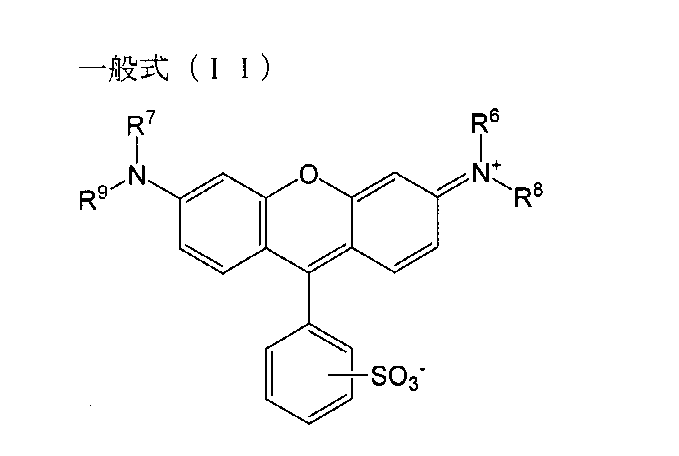
- 前記(B)分散剤が、ウレタン系分散剤を含み、少なくとも前記キサンテン系染料が前記ウレタン系分散剤により分散されてなる、請求項1に記載の着色剤分散液。
- 前記一般式(I)におけるアニオン(Bc-)が、タングステンとモリブデンとのモル比が100:0~90:10の無機酸アニオンである、請求項1に記載の着色剤分散液。
- 更に酸化防止剤を含有する、請求項1に記載の着色剤分散液。
- (A)着色剤と、(B)分散剤と、(C)溶剤とを含有し、前記(A)着色剤が、下記一般式(I)で表される色材と、キサンテン系染料とを含み、前記(C)溶剤は、前記色材及び前記キサンテン系染料の23℃における溶解度がそれぞれ0.2(g/100g溶剤)以下の溶剤である、着色剤分散液の製造方法であって、
前記(C)溶剤に、前記色材と、前記キサンテン系染料と、前記(B)分散剤とを加え、前記色材と前記キサンテン系染料とを共分散する工程を有することを特徴とする、着色剤分散液の製造方法。

a及びcは2以上の整数、b及びdは1以上の整数を表す。eは0又は1であり、eが0のとき結合は存在しない。複数あるeは同一であっても異なっていてもよい。) - (A)着色剤と、(B)分散剤と、(C)溶剤と、(D)バインダー成分を含有し、前記(A)着色剤が、下記一般式(I)で表される色材と、キサンテン系染料とを含み、前記(C)溶剤は、前記色材及び前記キサンテン系染料の23℃における溶解度がそれぞれ0.2(g/100g溶剤)以下の溶剤であり、前記色材及び前記キサンテン系染料とが、前記(B)分散剤により、前記(C)溶剤に分散されてなる、カラーフィルタ用着色樹脂組成物。
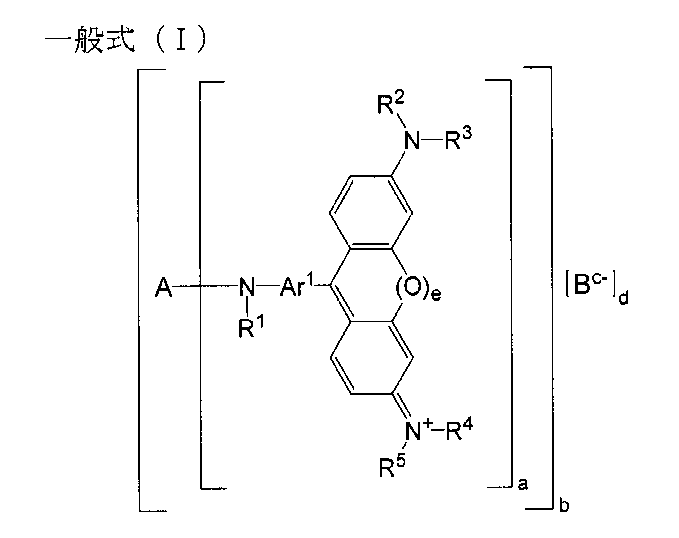
a及びcは2以上の整数、b及びdは1以上の整数を表す。eは0又は1であり、eが0のとき結合は存在しない。複数あるeは同一であっても異なっていてもよい。) - 前記キサンテン系染料が、下記一般式(II)で表される化合物である、請求項7に記載のカラーフィルタ用着色樹脂組成物。

- 前記(B)分散剤が、ウレタン系分散剤を含み、少なくとも前記キサンテン系染料が前記ウレタン系分散剤により分散されてなる、請求項7に記載のカラーフィルタ用着色樹脂組成物。
- 前記一般式(I)におけるアニオン(Bc-)が、タングステンとモリブデンとのモル比が100:0~90:10の無機酸アニオンである、請求項7に記載のカラーフィルタ用着色樹脂組成物。
- 更に酸化防止剤を含有する、請求項7に記載のカラーフィルタ用着色樹脂組成物。
- 透明基板と、当該透明基板上に設けられた着色層とを少なくとも備えるカラーフィルタであって、当該着色層の少なくとも1つが前記請求項7乃至11のいずれか一項に記載のカラーフィルタ用着色樹脂組成物を硬化させて形成されてなる着色層を有することを特徴とするカラーフィルタ。
- 前記請求項12に記載のカラーフィルタと、対向基板と、前記カラーフィルタと前記対向基板との間に形成された液晶層とを有することを特徴とする液晶表示装置。
- 前記請求項12に記載のカラーフィルタと、有機発光体を有することを特徴とする有機発光表示装置。
Priority Applications (3)
| Application Number | Priority Date | Filing Date | Title |
|---|---|---|---|
| US14/766,320 US9376571B2 (en) | 2013-02-08 | 2014-02-04 | Colorant dispersion liquid, method for producing colorant dispersion liquid, color resin composition for color filters, color filter, liquid crystal display device, and organic light-emitting display device |
| CN201480008065.9A CN104995263B (zh) | 2013-02-08 | 2014-02-04 | 着色剂分散液、着色剂分散液的制造方法、彩色滤光片用着色树脂组合物、彩色滤光片、液晶显示装置及有机发光显示装置 |
| KR1020157021389A KR20150116441A (ko) | 2013-02-08 | 2014-02-04 | 착색제 분산액, 착색제 분산액의 제조 방법, 컬러 필터용 착색 수지 조성물, 컬러 필터, 액정 표시 장치 및 유기 발광 표시 장치 |
Applications Claiming Priority (2)
| Application Number | Priority Date | Filing Date | Title |
|---|---|---|---|
| JP2013-023787 | 2013-02-08 | ||
| JP2013023787A JP5647279B2 (ja) | 2013-02-08 | 2013-02-08 | 着色剤分散液、着色剤分散液の製造方法、カラーフィルタ用着色樹脂組成物、カラーフィルタ、液晶表示装置、及び有機発光表示装置 |
Publications (1)
| Publication Number | Publication Date |
|---|---|
| WO2014123124A1 true WO2014123124A1 (ja) | 2014-08-14 |
Family
ID=51299717
Family Applications (1)
| Application Number | Title | Priority Date | Filing Date |
|---|---|---|---|
| PCT/JP2014/052584 Ceased WO2014123124A1 (ja) | 2013-02-08 | 2014-02-04 | 着色剤分散液、着色剤分散液の製造方法、カラーフィルタ用着色樹脂組成物、カラーフィルタ、液晶表示装置、及び有機発光表示装置 |
Country Status (6)
| Country | Link |
|---|---|
| US (1) | US9376571B2 (ja) |
| JP (1) | JP5647279B2 (ja) |
| KR (1) | KR20150116441A (ja) |
| CN (1) | CN104995263B (ja) |
| TW (1) | TWI638866B (ja) |
| WO (1) | WO2014123124A1 (ja) |
Cited By (4)
| Publication number | Priority date | Publication date | Assignee | Title |
|---|---|---|---|---|
| WO2016121194A1 (ja) * | 2015-01-29 | 2016-08-04 | 富士フイルム株式会社 | 着色組成物、カラーフィルタ、パターン形成方法、カラーフィルタの製造方法、固体撮像素子、および、画像表示装置 |
| JP2016153880A (ja) * | 2015-02-13 | 2016-08-25 | 大日本印刷株式会社 | カラーフィルタおよび液晶表示装置 |
| JP2017101210A (ja) * | 2015-12-04 | 2017-06-08 | 大日本印刷株式会社 | 色材分散液、カラーフィルタ用着色樹脂組成物、カラーフィルタ及びその製造方法、液晶表示装置、並びに発光表示装置 |
| TWI707201B (zh) * | 2016-01-20 | 2020-10-11 | 南韓商東友精細化工有限公司 | 著色固化性樹脂組合物、濾色器和顯示裝置 |
Families Citing this family (17)
| Publication number | Priority date | Publication date | Assignee | Title |
|---|---|---|---|---|
| JP6217307B2 (ja) * | 2013-04-26 | 2017-10-25 | 大日本印刷株式会社 | 色材、色材分散液、カラーフィルタ用着色樹脂組成物、カラーフィルタ、液晶表示装置、及び有機発光表示装置 |
| JP5772919B2 (ja) | 2013-10-23 | 2015-09-02 | 大日本印刷株式会社 | カラーフィルタ用色材分散液、色材、カラーフィルタ、液晶表示装置、及び、有機発光表示装置 |
| JP6441636B2 (ja) * | 2014-10-14 | 2018-12-19 | 大日本印刷株式会社 | 画像表示装置用モジュール及び画像表示装置 |
| JP6056844B2 (ja) * | 2014-12-26 | 2017-01-11 | 大日本印刷株式会社 | カラーフィルタ用色材分散液、カラーフィルタ用着色樹脂組成物、色材、カラーフィルタ、液晶表示装置及び発光表示装置 |
| JP6056843B2 (ja) * | 2014-12-26 | 2017-01-11 | 大日本印刷株式会社 | カラーフィルタ用色材分散液、カラーフィルタ用着色樹脂組成物、色材、カラーフィルタ、液晶表示装置及び発光表示装置 |
| KR101897040B1 (ko) | 2016-02-26 | 2018-09-11 | 삼성에스디아이 주식회사 | 신규 화합물, 이를 포함하는 착색제, 이를 포함하는 감광성 수지 조성물 및 컬러필터 |
| US10101655B2 (en) | 2016-02-26 | 2018-10-16 | Samsung Sdi Co., Ltd. | Compound, polymer, photosensitive resin composition, and color filter |
| US10087170B2 (en) | 2016-09-09 | 2018-10-02 | Samsung Sdi Co., Ltd. | Compound, photosensitive resin composition including the same, and color filter |
| CN109689697B (zh) * | 2016-09-16 | 2021-08-24 | 三菱化学株式会社 | 着色树脂组合物、固化物及图像显示装置 |
| KR102503367B1 (ko) * | 2016-11-16 | 2023-02-24 | 동우 화인켐 주식회사 | 착색 감광성 수지 조성물, 이를 이용하여 제조된 컬러필터 및 화상표시장치 |
| JP6858545B2 (ja) * | 2016-12-19 | 2021-04-14 | 株式会社Dnpファインケミカル | 色素 |
| JP6946792B2 (ja) * | 2017-07-07 | 2021-10-06 | 三菱ケミカル株式会社 | 着色組成物、硬化物、及び画像表示装置 |
| JP6917950B2 (ja) * | 2017-08-23 | 2021-08-11 | 東友ファインケム株式会社Dongwoo Fine−Chem Co., Ltd. | 着色硬化性樹脂組成物、カラーフィルタ、及び表示装置 |
| KR102025478B1 (ko) | 2017-11-28 | 2019-09-25 | 주식회사 엘지화학 | 착색제 조성물 제조방법, 이를 이용하여 제조된 착색제 조성물, 착색제 분산액, 감광성 수지 조성물, 컬러필터 및 액정 표시 장치 |
| KR102027036B1 (ko) * | 2017-11-28 | 2019-09-30 | 주식회사 엘지화학 | 착색제 조성물, 착색제 분산액, 감광성 수지 조성물, 컬러필터 및 액정 표시 장치 |
| JP7440016B2 (ja) * | 2019-07-10 | 2024-02-28 | サカタインクス株式会社 | カラーフィルター用染料分散組成物及びカラーフィルター用染料分散レジスト組成物 |
| KR102950537B1 (ko) | 2024-02-14 | 2026-04-09 | 고려대학교 세종산학협력단 | 컬러필터 조성물, 그를 이용한 제조 방법 및 디스플레이 디바이스 |
Citations (8)
| Publication number | Priority date | Publication date | Assignee | Title |
|---|---|---|---|---|
| GB744972A (en) * | 1950-07-20 | 1956-02-15 | Farbwerke Hoechts Aktengesells | Manufacture of triphenylmethane dyestuffs |
| GB749308A (en) * | 1951-12-31 | 1956-05-23 | Hoechst Ag | Manufacture of triphenylmethane dyestuffs |
| WO1991013122A1 (en) * | 1990-02-23 | 1991-09-05 | Steadfast, Incorporated | Substituted xanthene compounds |
| WO2012144520A1 (ja) * | 2011-04-21 | 2012-10-26 | 大日本印刷株式会社 | 色材、及びその製造方法 |
| WO2012144521A1 (ja) * | 2011-04-21 | 2012-10-26 | 大日本印刷株式会社 | 色材分散液、カラーフィルター用着色樹脂組成物、カラーフィルター、液晶表示装置及び有機発光表示装置 |
| JP2012233034A (ja) * | 2011-04-28 | 2012-11-29 | Dainippon Printing Co Ltd | 染料分散液、カラーフィルター用感光性樹脂組成物、カラーフィルター、液晶表示装置及び、有機発光表示装置 |
| JP2013166872A (ja) * | 2012-02-16 | 2013-08-29 | Sumitomo Chemical Co Ltd | 着色硬化性樹脂組成物 |
| JP2013203955A (ja) * | 2012-03-29 | 2013-10-07 | Sumitomo Chemical Co Ltd | 着色硬化性樹脂組成物 |
Family Cites Families (10)
| Publication number | Priority date | Publication date | Assignee | Title |
|---|---|---|---|---|
| JP5504627B2 (ja) | 2008-07-01 | 2014-05-28 | 住友化学株式会社 | 着色感光性樹脂組成物 |
| JP5251329B2 (ja) * | 2008-07-22 | 2013-07-31 | 東洋インキScホールディングス株式会社 | カラーフィルタ用青色着色組成物、カラーフィルタおよびカラー表示装置 |
| TWI475320B (zh) | 2009-02-13 | 2015-03-01 | Sumitomo Chemical Co | 著色感光性樹脂組成物及彩色濾光片 |
| JP5579536B2 (ja) * | 2009-09-03 | 2014-08-27 | 富士フイルム株式会社 | 着色硬化性組成物及びその調製方法、カラーフィルタ及びその製造方法、並びに固体撮像素子 |
| WO2011158794A1 (ja) | 2010-06-15 | 2011-12-22 | 日本化薬株式会社 | 着色樹脂組成物、着色硬化膜、カラーフィルター、表示装置及び固体撮像素子 |
| JP2012063429A (ja) | 2010-09-14 | 2012-03-29 | Dainippon Printing Co Ltd | カラーフィルタ用熱硬化性樹脂組成物、カラーフィルタ及びその製造方法、並びに液晶表示装置 |
| JP5813561B2 (ja) * | 2011-04-21 | 2015-11-17 | 大日本印刷株式会社 | 色材、及びその製造方法 |
| JP2012236882A (ja) | 2011-05-10 | 2012-12-06 | Dainippon Printing Co Ltd | 黄色顔料分散液、カラーフィルタ用黄色感光性樹脂組成物、カラーフィルタ、液晶表示装置及び有機発光表示装置 |
| JP4911256B1 (ja) | 2011-06-30 | 2012-04-04 | 大日本印刷株式会社 | 染料分散液、カラーフィルター用感光性樹脂組成物、カラーフィルター、液晶表示装置、及び、有機発光表示装置 |
| JP5775479B2 (ja) * | 2012-03-21 | 2015-09-09 | 富士フイルム株式会社 | 着色感放射線性組成物、着色硬化膜、カラーフィルタ、パターン形成方法、カラーフィルタの製造方法、固体撮像素子、及び画像表示装置 |
-
2013
- 2013-02-08 JP JP2013023787A patent/JP5647279B2/ja active Active
-
2014
- 2014-02-04 CN CN201480008065.9A patent/CN104995263B/zh active Active
- 2014-02-04 KR KR1020157021389A patent/KR20150116441A/ko not_active Withdrawn
- 2014-02-04 US US14/766,320 patent/US9376571B2/en active Active
- 2014-02-04 WO PCT/JP2014/052584 patent/WO2014123124A1/ja not_active Ceased
- 2014-02-07 TW TW103104027A patent/TWI638866B/zh active
Patent Citations (8)
| Publication number | Priority date | Publication date | Assignee | Title |
|---|---|---|---|---|
| GB744972A (en) * | 1950-07-20 | 1956-02-15 | Farbwerke Hoechts Aktengesells | Manufacture of triphenylmethane dyestuffs |
| GB749308A (en) * | 1951-12-31 | 1956-05-23 | Hoechst Ag | Manufacture of triphenylmethane dyestuffs |
| WO1991013122A1 (en) * | 1990-02-23 | 1991-09-05 | Steadfast, Incorporated | Substituted xanthene compounds |
| WO2012144520A1 (ja) * | 2011-04-21 | 2012-10-26 | 大日本印刷株式会社 | 色材、及びその製造方法 |
| WO2012144521A1 (ja) * | 2011-04-21 | 2012-10-26 | 大日本印刷株式会社 | 色材分散液、カラーフィルター用着色樹脂組成物、カラーフィルター、液晶表示装置及び有機発光表示装置 |
| JP2012233034A (ja) * | 2011-04-28 | 2012-11-29 | Dainippon Printing Co Ltd | 染料分散液、カラーフィルター用感光性樹脂組成物、カラーフィルター、液晶表示装置及び、有機発光表示装置 |
| JP2013166872A (ja) * | 2012-02-16 | 2013-08-29 | Sumitomo Chemical Co Ltd | 着色硬化性樹脂組成物 |
| JP2013203955A (ja) * | 2012-03-29 | 2013-10-07 | Sumitomo Chemical Co Ltd | 着色硬化性樹脂組成物 |
Cited By (7)
| Publication number | Priority date | Publication date | Assignee | Title |
|---|---|---|---|---|
| WO2016121194A1 (ja) * | 2015-01-29 | 2016-08-04 | 富士フイルム株式会社 | 着色組成物、カラーフィルタ、パターン形成方法、カラーフィルタの製造方法、固体撮像素子、および、画像表示装置 |
| KR20170071574A (ko) * | 2015-01-29 | 2017-06-23 | 후지필름 가부시키가이샤 | 착색 조성물, 컬러 필터, 패턴 형성 방법, 컬러 필터의 제조 방법, 고체 촬상 소자, 및 화상 표시 장치 |
| JPWO2016121194A1 (ja) * | 2015-01-29 | 2017-12-14 | 富士フイルム株式会社 | 着色組成物、カラーフィルタ、パターン形成方法、カラーフィルタの製造方法、固体撮像素子、および、画像表示装置 |
| KR102018516B1 (ko) * | 2015-01-29 | 2019-09-05 | 후지필름 가부시키가이샤 | 착색 조성물, 컬러 필터, 패턴 형성 방법, 컬러 필터의 제조 방법, 고체 촬상 소자, 및 화상 표시 장치 |
| JP2016153880A (ja) * | 2015-02-13 | 2016-08-25 | 大日本印刷株式会社 | カラーフィルタおよび液晶表示装置 |
| JP2017101210A (ja) * | 2015-12-04 | 2017-06-08 | 大日本印刷株式会社 | 色材分散液、カラーフィルタ用着色樹脂組成物、カラーフィルタ及びその製造方法、液晶表示装置、並びに発光表示装置 |
| TWI707201B (zh) * | 2016-01-20 | 2020-10-11 | 南韓商東友精細化工有限公司 | 著色固化性樹脂組合物、濾色器和顯示裝置 |
Also Published As
| Publication number | Publication date |
|---|---|
| TWI638866B (zh) | 2018-10-21 |
| US20150368473A1 (en) | 2015-12-24 |
| KR20150116441A (ko) | 2015-10-15 |
| JP2014152274A (ja) | 2014-08-25 |
| JP5647279B2 (ja) | 2014-12-24 |
| CN104995263B (zh) | 2017-12-01 |
| CN104995263A (zh) | 2015-10-21 |
| TW201443174A (zh) | 2014-11-16 |
| US9376571B2 (en) | 2016-06-28 |
Similar Documents
| Publication | Publication Date | Title |
|---|---|---|
| JP5647279B2 (ja) | 着色剤分散液、着色剤分散液の製造方法、カラーフィルタ用着色樹脂組成物、カラーフィルタ、液晶表示装置、及び有機発光表示装置 | |
| JP5646663B2 (ja) | カラーフィルタ用着色樹脂組成物、色材分散液、カラーフィルタ、液晶表示装置、及び有機発光表示装置 | |
| JP4911253B1 (ja) | 染料分散液、カラーフィルター用感光性樹脂組成物、カラーフィルター、液晶表示装置及び、有機発光表示装置 | |
| JP6217307B2 (ja) | 色材、色材分散液、カラーフィルタ用着色樹脂組成物、カラーフィルタ、液晶表示装置、及び有機発光表示装置 | |
| KR102210033B1 (ko) | 컬러 필터용 색재 분산액, 색재, 컬러 필터, 액정 표시 장치, 및 유기 발광 표시 장치 | |
| WO2013001923A1 (ja) | 染料分散液、カラーフィルター用感光性樹脂組成物、カラーフィルター、液晶表示装置、及び、有機発光表示装置 | |
| CN109415572B (zh) | 色材分散液、着色树脂组合物、滤色器、液晶显示设备和发光显示设备 | |
| JP2014214274A (ja) | 色材分散液、カラーフィルタ用着色樹脂組成物、カラーフィルタ、液晶表示装置、及び有機発光表示装置 | |
| WO2016103864A1 (ja) | カラーフィルタ用色材分散液、カラーフィルタ用着色樹脂組成物、色材、カラーフィルタ、液晶表示装置及び発光表示装置 | |
| JP6056844B2 (ja) | カラーフィルタ用色材分散液、カラーフィルタ用着色樹脂組成物、色材、カラーフィルタ、液晶表示装置及び発光表示装置 | |
| JP6841283B2 (ja) | 着色組成物、カラーフィルタ及びその製造方法、液晶表示装置、並びに、発光表示装置 | |
| JP6256126B2 (ja) | 色材分散組成物、カラーフィルタ、液晶表示装置、及び有機発光表示装置 | |
| JP6534523B2 (ja) | カラーフィルタ用着色樹脂組成物、カラーフィルタ、及び表示装置 | |
| JP6295600B2 (ja) | 色材、色材分散液、カラーフィルタ用着色樹脂組成物、カラーフィルタ、液晶表示装置、及び有機発光表示装置 | |
| JP6520118B2 (ja) | 色材分散液、カラーフィルター用着色樹脂組成物、カラーフィルター、液晶表示装置、及び発光表示装置 | |
| JP6319205B2 (ja) | カラーフィルタ用色材分散液、色材、カラーフィルタ、液晶表示装置、及び、有機発光表示装置 | |
| JP6091198B2 (ja) | 感光性樹脂組成物、カラーフィルタ、液晶表示装置、及び有機発光表示装置 | |
| JP2017132930A (ja) | 色材分散液、カラーフィルター用着色樹脂組成物、カラーフィルター、液晶表示装置、及び、発光表示装置 |
Legal Events
| Date | Code | Title | Description |
|---|---|---|---|
| 121 | Ep: the epo has been informed by wipo that ep was designated in this application |
Ref document number: 14749056 Country of ref document: EP Kind code of ref document: A1 |
|
| WWE | Wipo information: entry into national phase |
Ref document number: 14766320 Country of ref document: US |
|
| ENP | Entry into the national phase |
Ref document number: 20157021389 Country of ref document: KR Kind code of ref document: A |
|
| NENP | Non-entry into the national phase |
Ref country code: DE |
|
| 122 | Ep: pct application non-entry in european phase |
Ref document number: 14749056 Country of ref document: EP Kind code of ref document: A1 |