WO2014119256A1 - 非水電解質二次電池用負極活物質、当該負極活物質を用いた非水電解質二次電池用負極、及び当該負極を用いた非水電解質二次電池 - Google Patents
非水電解質二次電池用負極活物質、当該負極活物質を用いた非水電解質二次電池用負極、及び当該負極を用いた非水電解質二次電池 Download PDFInfo
- Publication number
- WO2014119256A1 WO2014119256A1 PCT/JP2014/000327 JP2014000327W WO2014119256A1 WO 2014119256 A1 WO2014119256 A1 WO 2014119256A1 JP 2014000327 W JP2014000327 W JP 2014000327W WO 2014119256 A1 WO2014119256 A1 WO 2014119256A1
- Authority
- WO
- WIPO (PCT)
- Prior art keywords
- negative electrode
- active material
- electrode active
- electrolyte secondary
- particle
- Prior art date
- Legal status (The legal status is an assumption and is not a legal conclusion. Google has not performed a legal analysis and makes no representation as to the accuracy of the status listed.)
- Ceased
Links
Images



Classifications
-
- H—ELECTRICITY
- H01—ELECTRIC ELEMENTS
- H01M—PROCESSES OR MEANS, e.g. BATTERIES, FOR THE DIRECT CONVERSION OF CHEMICAL ENERGY INTO ELECTRICAL ENERGY
- H01M4/00—Electrodes
- H01M4/02—Electrodes composed of, or comprising, active material
- H01M4/36—Selection of substances as active materials, active masses, active liquids
- H01M4/362—Composites
- H01M4/366—Composites as layered products
-
- H—ELECTRICITY
- H01—ELECTRIC ELEMENTS
- H01M—PROCESSES OR MEANS, e.g. BATTERIES, FOR THE DIRECT CONVERSION OF CHEMICAL ENERGY INTO ELECTRICAL ENERGY
- H01M10/00—Secondary cells; Manufacture thereof
- H01M10/05—Accumulators with non-aqueous electrolyte
- H01M10/052—Li-accumulators
- H01M10/0525—Rocking-chair batteries, i.e. batteries with lithium insertion or intercalation in both electrodes; Lithium-ion batteries
-
- H—ELECTRICITY
- H01—ELECTRIC ELEMENTS
- H01M—PROCESSES OR MEANS, e.g. BATTERIES, FOR THE DIRECT CONVERSION OF CHEMICAL ENERGY INTO ELECTRICAL ENERGY
- H01M4/00—Electrodes
- H01M4/02—Electrodes composed of, or comprising, active material
- H01M4/13—Electrodes for accumulators with non-aqueous electrolyte, e.g. for lithium-accumulators; Processes of manufacture thereof
-
- H—ELECTRICITY
- H01—ELECTRIC ELEMENTS
- H01M—PROCESSES OR MEANS, e.g. BATTERIES, FOR THE DIRECT CONVERSION OF CHEMICAL ENERGY INTO ELECTRICAL ENERGY
- H01M4/00—Electrodes
- H01M4/02—Electrodes composed of, or comprising, active material
- H01M4/36—Selection of substances as active materials, active masses, active liquids
- H01M4/38—Selection of substances as active materials, active masses, active liquids of elements or alloys
- H01M4/381—Alkaline or alkaline earth metals elements
- H01M4/382—Lithium
-
- H—ELECTRICITY
- H01—ELECTRIC ELEMENTS
- H01M—PROCESSES OR MEANS, e.g. BATTERIES, FOR THE DIRECT CONVERSION OF CHEMICAL ENERGY INTO ELECTRICAL ENERGY
- H01M4/00—Electrodes
- H01M4/02—Electrodes composed of, or comprising, active material
- H01M4/36—Selection of substances as active materials, active masses, active liquids
- H01M4/38—Selection of substances as active materials, active masses, active liquids of elements or alloys
- H01M4/386—Silicon or alloys based on silicon
-
- H—ELECTRICITY
- H01—ELECTRIC ELEMENTS
- H01M—PROCESSES OR MEANS, e.g. BATTERIES, FOR THE DIRECT CONVERSION OF CHEMICAL ENERGY INTO ELECTRICAL ENERGY
- H01M4/00—Electrodes
- H01M4/02—Electrodes composed of, or comprising, active material
- H01M4/36—Selection of substances as active materials, active masses, active liquids
- H01M4/48—Selection of substances as active materials, active masses, active liquids of inorganic oxides or hydroxides
- H01M4/483—Selection of substances as active materials, active masses, active liquids of inorganic oxides or hydroxides for non-aqueous cells
-
- H—ELECTRICITY
- H01—ELECTRIC ELEMENTS
- H01M—PROCESSES OR MEANS, e.g. BATTERIES, FOR THE DIRECT CONVERSION OF CHEMICAL ENERGY INTO ELECTRICAL ENERGY
- H01M4/00—Electrodes
- H01M4/02—Electrodes composed of, or comprising, active material
- H01M4/36—Selection of substances as active materials, active masses, active liquids
- H01M4/58—Selection of substances as active materials, active masses, active liquids of inorganic compounds other than oxides or hydroxides, e.g. sulfides, selenides, tellurides, halogenides or LiCoFy; of polyanionic structures, e.g. phosphates, silicates or borates
- H01M4/583—Carbonaceous material, e.g. graphite-intercalation compounds or CFx
- H01M4/587—Carbonaceous material, e.g. graphite-intercalation compounds or CFx for inserting or intercalating light metals
-
- Y—GENERAL TAGGING OF NEW TECHNOLOGICAL DEVELOPMENTS; GENERAL TAGGING OF CROSS-SECTIONAL TECHNOLOGIES SPANNING OVER SEVERAL SECTIONS OF THE IPC; TECHNICAL SUBJECTS COVERED BY FORMER USPC CROSS-REFERENCE ART COLLECTIONS [XRACs] AND DIGESTS
- Y02—TECHNOLOGIES OR APPLICATIONS FOR MITIGATION OR ADAPTATION AGAINST CLIMATE CHANGE
- Y02E—REDUCTION OF GREENHOUSE GAS [GHG] EMISSIONS, RELATED TO ENERGY GENERATION, TRANSMISSION OR DISTRIBUTION
- Y02E60/00—Enabling technologies; Technologies with a potential or indirect contribution to GHG emissions mitigation
- Y02E60/10—Energy storage using batteries
Definitions
- the present invention relates to a negative electrode active material for a nonaqueous electrolyte secondary battery, a negative electrode for a nonaqueous electrolyte secondary battery using the negative electrode active material, and a nonaqueous electrolyte secondary battery using the negative electrode.
- Patent Document 1 proposes a nonaqueous electrolyte secondary battery in which SiO x is mixed with graphite to form a negative electrode active material.
- the nonaqueous electrolyte secondary battery using SiO x or the like as the negative electrode active material has a problem that the initial charge / discharge efficiency is poor and the capacity is greatly reduced at the beginning of the cycle as compared with the case where graphite is used as the negative electrode active material. There is.
- the main cause of the above problem is that the volume change of SiO x and the like during charging / discharging is larger than that of graphite.
- a large volume change of the active material is considered to cause, for example, a decrease in conductivity of the active material layer, leading to deterioration of the initial charge / discharge efficiency.
- a negative electrode active material for a nonaqueous electrolyte secondary battery is a particulate negative electrode active material used for a nonaqueous electrolyte secondary battery, and is composed of silicon or silicon oxide. And a conductive coating layer covering at least part of the surface of the mother particle, and voids are formed inside the particle.
- the negative electrode for a non-aqueous electrolyte secondary battery according to the present invention is configured by mixing the negative electrode active material and a conductive carbon material.
- a non-aqueous electrolyte secondary battery includes a negative electrode containing the negative electrode active material, a positive electrode, and a non-aqueous electrolyte.
- the initial charge / discharge efficiency and the cycle characteristics can be improved.
- substantially ** means “substantially equivalent” as an example, and it is intended to include not only exactly the same but also what is recognized as substantially the same.
- a nonaqueous electrolyte secondary battery which is an example of an embodiment of the present invention includes a positive electrode including a positive electrode active material, a negative electrode including a negative electrode active material, and a nonaqueous electrolyte including a nonaqueous solvent.
- a separator is preferably provided between the positive electrode and the negative electrode.
- the non-aqueous electrolyte secondary battery there is a structure in which an electrode body in which a positive electrode and a negative electrode are wound via a separator and a non-aqueous electrolyte are housed in an exterior body.
- the positive electrode is preferably composed of a positive electrode current collector and a positive electrode active material layer formed on the positive electrode current collector.
- a positive electrode current collector for example, a conductive thin film, particularly a metal foil or alloy foil that is stable in the potential range of the positive electrode such as aluminum, or a film having a metal surface layer such as aluminum is used.
- the positive electrode active material layer preferably contains a conductive material and a binder in addition to the positive electrode active material.
- the positive electrode active material is not particularly limited, but is preferably a lithium-containing transition metal oxide.
- the lithium-containing transition metal oxide may contain non-transition metal elements such as Mg and Al. Specific examples include lithium-containing transition metal oxides such as lithium cobaltate, olivine-type lithium phosphate represented by lithium iron phosphate, Ni—Co—Mn, Ni—Mn—Al, and Ni—Co—Al. It is done. These positive electrode active materials may be used alone or in combination of two or more.
- carbon materials such as carbon black, acetylene black, ketjen black, graphite, and a mixture of two or more thereof can be used.
- binder polytetrafluoroethylene, polyvinylidene fluoride, polyvinyl acetate, polyacrylonitrile, polyvinyl alcohol, and a mixture of two or more thereof can be used.
- the negative electrode 10 preferably includes a negative electrode current collector 11 and a negative electrode active material layer 12 formed on the negative electrode current collector 11.
- a conductive thin film particularly a metal foil or alloy foil that is stable in the potential range of the negative electrode such as copper, or a film having a metal surface layer such as copper is used.
- the negative electrode active material layer 12 preferably contains a binder (not shown) in addition to the negative electrode active material 13.
- a binder polytetrafluoroethylene or the like can be used as in the case of the positive electrode, but styrene-butadiene rubber (SBR), polyimide, or the like is preferably used.
- SBR styrene-butadiene rubber
- the binder may be used in combination with a thickener such as carboxymethylcellulose.
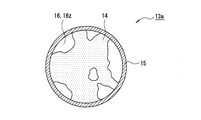
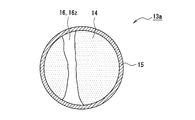
- the negative electrode active material 13 includes a negative electrode active material having a mother particle 14 made of silicon (Si) or silicon oxide (SiO x ) and a conductive coating layer 15 covering at least part of the surface of the mother particle 14.
- Substance 13a is used.
- the negative electrode active material 13a may be used alone, but from the viewpoint of achieving both high capacity and improved cycle characteristics, the volume change due to charge / discharge is smaller than that of the negative electrode active material 13a. It is preferable to use a mixture with the substance 13b.
- the negative electrode active material 13b is not particularly limited, but is preferably a carbon-based active material such as graphite or hard carbon.
- the ratio of the negative electrode active material 13a to graphite is 1:99 to 20:80 by mass ratio. preferable. If the mass ratio is within the range, it is easy to achieve both higher capacity and improved cycle characteristics. On the other hand, when the ratio of the negative electrode active material 13a to the total mass of the negative electrode active material 13 is lower than 1% by mass, the merit of increasing the capacity by adding the negative electrode active material 13a is reduced.
- the negative electrode active material 13a has a particle shape in which a coating layer 15 is formed on the surface of the base particle 14 (hereinafter referred to as “negative electrode active material particles 13a”).
- a void 16 is formed inside the negative electrode active material particle 13a.
- the air gap 16 plays a role of relaxing the volume change of the mother particle 14 due to charge / discharge. As will be described in detail later, the formation of the void 16 greatly improves the initial charge / discharge efficiency and the cycle characteristics in the nonaqueous electrolyte secondary battery using the negative electrode active material particles 13a.
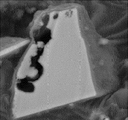
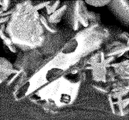
- the negative electrode active material particles 13a are often angular, for example, and have various shapes such as a lump shape, a flat shape, an elongated rod shape, and a needle shape (see FIGS. 5 and 6). As will be described later, the particle diameter of the negative electrode active material particles 13a is substantially the same as the particle diameter of the mother particles 14 before the voids 16 are formed because the coating layer 15 is thin.
- the mother particle 14 is made of Si or SiO x .
- SiO x (preferably 0 ⁇ x ⁇ 1.5) has, for example, a structure in which Si is dispersed in an amorphous SiO 2 matrix. When observed with a transmission electron microscope (TEM), the presence of dispersed Si can be confirmed. Si or SiO x can occlude a larger amount of Li + than carbon materials such as graphite, and contributes to increasing the capacity because the capacity per unit volume is high.
- Si and SiO x also have characteristics unsuitable for application to a negative electrode active material, such as a large volume change due to charge and discharge, and low electron conductivity. In the negative electrode active material particles 13a, the coating layer 15 and the voids 16 improve this drawback.
- SiO x constituting the mother particle 14 may contain lithium silicate (Li 4 SiO 4 , Li 2 SiO 3 , Li 2 Si 2 O 5 , Li 8 SiO 6, etc.) in the particle.
- lithium silicate Li 4 SiO 4 , Li 2 SiO 3 , Li 2 Si 2 O 5 , Li 8 SiO 6, etc.
- the average particle size of the base particles 14 is preferably 1 to 30 ⁇ m, more preferably 2 to 15 ⁇ m from the viewpoint of increasing the capacity.
- the “average particle diameter” means a particle diameter (volume average particle diameter; Dv 50 ) at which the volume integrated value becomes 50% in the particle size distribution measured by the laser diffraction scattering method. Dv 50 can be measured, for example, using “LA-750” manufactured by HORIBA. Note that if the average particle size of the mother particles 14 becomes too small, the particle surface area increases, so that the amount of reaction with the electrolyte increases and the capacity tends to decrease. On the other hand, if the average particle size becomes too large, the volume change amount due to charging / discharging becomes large, so the total volume of the voids 16 needs to be increased, and the capacity per unit volume tends to decrease.
- the covering layer 15 is a conductive layer made of a material having higher conductivity than Si and SiO x .
- the conductive material constituting the coating layer 15 is preferably electrochemically stable, and is preferably at least one selected from the group consisting of carbon materials, metals, and metal compounds.
- carbon material carbon black, acetylene black, ketjen black, graphite, and a mixture of two or more thereof can be used as in the conductive material of the positive electrode active material layer.
- metal Cu, Ni, and alloys thereof that are stable in the negative electrode 10 can be used. Examples of the metal compound include a Cu compound and a Ni compound.
- the covering layer 15 is preferably formed so as to cover substantially the entire surface of the mother particle 14.
- “covering substantially the entire surface of the mother particle 14” does not mean that the coating layer 15 is formed in contact with almost the entire region of the mother particle 14, and covers the surface of the negative electrode active material particle 13 a.
- an interface void 16z described later is formed, a part of the coating layer 15 is formed on the mother particle 14 and the other part is formed away from the surface of the mother particle 14.
- some streaky cracks are confirmed in the coating layer 15 after charging and discharging.
- the average thickness of the coating layer 15 is preferably 1 to 200 nm and more preferably 5 to 100 nm in consideration of ensuring conductivity and diffusibility of Li + into SiO x or the like as the mother particle 14. Moreover, it is suitable for the coating layer 15 to have a substantially uniform thickness over the whole area.
- the average thickness of the coating layer 15 can be measured by cross-sectional observation of the negative electrode active material particles 13a using a scanning electron microscope (SEM), a transmission electron microscope (TEM), or the like.
- SEM scanning electron microscope
- TEM transmission electron microscope
- the covering layer 15 can be formed using a general method such as a CVD method, a sputtering method, or a plating method (electrolytic / electroless plating).
- a general method such as a CVD method, a sputtering method, or a plating method (electrolytic / electroless plating).
- the coating layer 15 made of a carbon material is formed on the surface of the SiO x particles by the CVD method, for example, the SiO x particles and the hydrocarbon-based gas are heated in a gas phase, and the hydrocarbon-based gas is thermally decomposed. The resulting carbon is deposited on the SiO x particles. In this case, before the void 16 is formed, the coating layer 15 is formed in contact with the SiO x particles.
- the hydrocarbon gas methane gas or acetylene gas can be used.
- the void 16 is formed inside the negative electrode active material particles 13a as described above. That is, the void 16 is present inside the particle surrounded by the coating layer 15 that becomes the shell of the negative electrode active material particle 13a.
- the negative electrode active material particles 13a are completely different from the conventional graphite-coated SiO x particles (see FIG. 7), and the SiO x particles are not densely packed in the shell (see FIGS. 5 and 6).
- one large void 16 may be formed in the negative electrode active material particle 13a, it is preferable that a large number of voids 16 are formed in order to efficiently relieve the volume change due to charge and discharge.
- the ratio of the total volume of the voids 16 to the total volume of the negative electrode active material particles 13a is preferably 1 to 60%, and more preferably 5 to 50%. If the porosity is within the range, volume change due to charging / discharging can be efficiently reduced. Even if the gap 16 is small, the above-described relaxation effect is exhibited, but the effect is hardly exhibited in evaluating the cycle characteristics and the like. On the other hand, if the porosity is too large, the capacity per unit volume is lowered, which is not preferable from the viewpoint of increasing the capacity.
- the porosity of the negative electrode active material particles 13a can be determined by, for example, the following method.
- (1) Method of obtaining from density The bulk density of particles is measured before and after the void formation treatment, and the porosity is calculated by the following formula.
- Porosity (%) 1- (bulk density after treatment / bulk density before treatment) Since the state and particle size of the particle surface do not change before and after the treatment, the porosity can be obtained from the difference ratio of bulk density. Note that the bulk density before treatment can be calculated based on the composition, composition ratio, and particle size of the compounds constituting the particles.
- the cross section of the negative electrode active material particle 13a is exposed and the cross section of the particle is observed with an SEM (see FIG. 5 and the like). . And the porosity of a particle cross section is measured, and the porosity is calculated from the average value of 30 particles.
- the void 16 preferably includes an interfacial void 16z formed between the mother particle 14 and the coating layer 15. That is, the interfacial void 16z is a void formed in a region including the interface between the surface of the mother particle 14 and the inner surface of the coating layer 15 facing the inside of the particle, and its periphery is surrounded by the mother particle 14 and the coating layer 15. It is. As the void 16, there is one in which the periphery is surrounded only by the mother particles 14 in addition to the interface void 16 z. However, even if it looks like the latter gap in one cross-sectional observation by SEM, there are actually cases where the interface gap is 16z.
- the interfacial void 16z is particularly preferably present in a proportion of 50% by volume or more of the total volume of the void 16.
- the mother particles 14 expand in volume by occlusion of Li + , but the expansion is likely to occur toward the outside of the mother particles 14. For this reason, the expansion
- the interfacial space 16z is more preferably 60% by volume or more, particularly preferably 70% by volume or more. Almost all of the gap 16 may be the interface gap 16z.
- the void 16 may have a form that divides the mother particle 14.
- the mother particle 14 is divided into two by the void 16 (for example, see FIG. 5), but when the other cross-section is observed, it is divided by the cross-section. There are many cases where connected parts are connected.
- the void 16 may be in the form of a crack entering the inside of the mother particle 14.
- a large number of crack-like voids 16 may be formed in the mother particle 14, for example.
- the crack-like void 16 may be an interfacial void 16 z extending to the surface of the mother particle 14.
- Examples of the method for forming the void 16 include the following methods.
- (1) A method in which, after forming the coating layer 15 on the mother particle 14, a part of the mother particle 14 is eluted using an agent that can dissolve the mother particle 14 and does not attack the coating layer 15.
- Drug; alkaline solution, etc. for example, LiOH, KOH, NaOH aqueous solution
- Treatment conditions A treated product is immersed in the above-mentioned drug. For example, immersion treatment is performed at 60 ° C. for 1 hour.
- the porosity can be adjusted by changing the concentration, treatment time, and treatment temperature of the drug. For example, when the treatment time is increased, the porosity is usually increased.
- the removal method can be appropriately changed according to the type of the void forming material.
- the void forming material is a resin
- a method of eluting and removing the resin using an organic solvent, and a method of decomposing and removing the resin by heating to a high temperature can be used.
- the non-aqueous electrolyte includes a non-aqueous solvent and an electrolyte salt dissolved in the non-aqueous solvent.
- the nonaqueous electrolyte is not limited to a liquid electrolyte (nonaqueous electrolyte solution), and may be a solid electrolyte using a gel polymer or the like.
- Examples of non-aqueous solvents that can be used include esters, ethers, nitriles (acetonitrile, etc.), amides (dimethylformamide, etc.), and a mixture of two or more of these.
- esters examples include cyclic carbonates such as ethylene carbonate (EC), propylene carbonate, butylene carbonate, dimethyl carbonate, methyl ethyl carbonate, diethyl carbonate (DEC), methyl propyl carbonate, ethyl propyl carbonate, methyl isopropyl carbonate, and the like.
- carboxylic acid esters such as chain carbonate, methyl acetate, ethyl acetate, propyl acetate, methyl propionate, ethyl propionate, and ⁇ -butyrolactone.
- ethers examples include cyclic ethers such as 1,3-dioxolane, tetrahydrofuran, 2-methyltetrahydrofuran, propylene oxide, 1,2-butylene oxide, 1,3-dioxane, furan, 1,8-cineol, , 2-dimethoxyethane, ethyl vinyl ether, ethyl phenyl ether, 1,2-diethoxyethane, 1,2-dibutoxyethane, diethylene glycol dimethyl ether, 1,1-dimethoxymethane, 1,1-diethoxyethane, triethylene glycol
- chain ethers such as dimethyl ether.
- non-aqueous solvent it is preferable to use at least a cyclic carbonate among the solvents exemplified above, and it is more preferable to use a cyclic carbonate and a chain carbonate in combination.
- the electrolyte salt is preferably a lithium salt.
- lithium salts include LiPF 6 , LiBF 4 , LiAsF 6 , LiN (SO 2 CF 3 ) 2 , LiN (SO 2 CF 5 ) 2 , LiPF 6-x (C n F 2n + 1 ) x (1 ⁇ x ⁇ 6, n is 1 or 2). These lithium salts may be used alone or in combination of two or more.
- the concentration of the lithium salt is preferably 0.8 to 1.8 mol per liter of the nonaqueous solvent.
- separator a porous sheet having ion permeability and insulating properties is used.
- the porous sheet include a microporous thin film, a woven fabric, and a nonwoven fabric.
- material of the separator polyolefin such as polyethylene and polypropylene is suitable.
- the coating layer was made of a conductive carbon material, and was formed under the condition of 800 ° C. using acetylene gas as the source gas.
- the coated particles A1 were immersed in a 1M LiOH aqueous solution at 60 ° C. for 1 hour to form voids inside the particles. Thereafter, the treated particles were collected by filtration, and the collected particles were dried to produce negative electrode active material particles B1.
- the porosity of the negative electrode active material particle B1 was 30%. The porosity was calculated by the difference ratio of the bulk density before and after the treatment (the same applies hereinafter).
- Cross-sectional SEM images of the negative electrode active material particles B1 are shown in FIGS. As is clear from the SEM image, a large number of voids are formed in the negative electrode active material particles B1. More than half or almost all of the voids exist between the mother particle and the coating layer.
- the negative electrode active material particles B1 and polyimide as a binder were mixed at a mass ratio of 95: 5, and N-methyl-pyrrolidone (NMP) was added as a diluent solvent.
- NMP N-methyl-pyrrolidone
- the mixture was stirred using a mixer (manufactured by PRIMIX, Robomix) to prepare a slurry for forming a negative electrode active material layer.
- the slurry was applied on one surface of a copper foil serving as a negative electrode current collector so that the mass per 1 m 2 of the negative electrode active material layer was 25 g.
- the said copper foil was dried at 105 degreeC in air
- the packing density of the negative electrode active material layer was 1.50 g / mL.
- test Cell T1 In an inert atmosphere, an electrode body in which the negative electrode and the Li metal foil were arranged to face each other through the separator was prepared using the negative electrode with the Ni tab attached to the outer periphery, the Li metal foil, and the polyethylene separator. .
- the electrode body was inserted into an exterior body composed of an aluminum laminate sheet, and then a non-aqueous electrolyte was injected, and the opening of the exterior body was sealed to prepare a test cell T1.
- Example 2 Except that the coated particles A1 were immersed in a 1M LiOH aqueous solution at 25 ° C. for 10 minutes, negative electrode active material particles B2 were produced in the same manner as in Example 1, and a test cell T2 was obtained using this.
- the porosity of the negative electrode active material particle B2 was 1%.
- Negative electrode active material particles B3 were produced in the same manner as in Example 1 except that the coated particles A1 were immersed in a 1M LiOH aqueous solution at 60 ° C. for 4 hours, and a test cell T3 was obtained using the negative electrode active material particles B3. The porosity of the negative electrode active material particles B3 was 58%.
- Example 4 Using Si particles (Dv 50 ; 5.0 ⁇ m) as mother particles, a coating layer having an average thickness of 50 nm and 10% by mass is formed on the entire surface by CVD to produce Si particles A4 having a coating layer formed. did.
- negative electrode active material particles B4 were produced in the same manner as in Example 1, and a test cell T4 was obtained using this. The porosity of the negative electrode active material particles B4 was 42%.
- Example 7 A negative electrode active material particle B7 was produced in the same manner as in Example 1 except that a Cu metal layer having an average thickness of 100 nm and 5% by mass was formed as a coating layer, and a test cell T7 was obtained using this. The porosity of the negative electrode active material particle B7 was 15%. The Cu metal layer was formed using an electroless plating method.
- a negative electrode active material particle C2 was produced in the same manner as in Example 4 except that the Si particle A4 on which the coating layer was formed was not immersed in the LiOH aqueous solution, and a test cell R2 was obtained using this.
- the porosity of the negative electrode active material particles C2 was 0%.
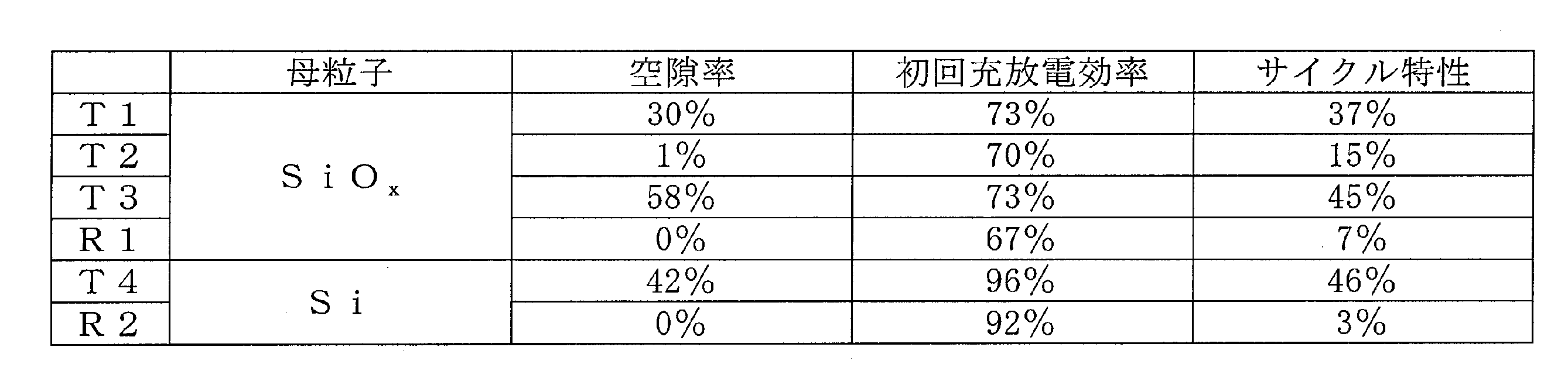
- the initial charge / discharge efficiency and cycle characteristics are improved by providing voids in the negative electrode active material particles containing SiO x or Si base particles.
- the introduction of voids improves the characteristics.
- the porosity is about 30 to 60%, and both characteristics show particularly good values.
- a porosity of about 30% (about 20 to 40%) is preferable.
- the voids, particularly the interfacial voids can absorb volume expansion of SiO x and the like due to charge / discharge, and play a role of suppressing a decrease in conductivity due to a large volume change of the negative electrode active material layer. That is, in the negative electrode active material particles of the example, the volume expansion of the entire particles is suppressed as compared with the negative electrode active material particles of the comparative example having no voids.
- the initial charge / discharge efficiency and cycle characteristics are improved regardless of the average particle diameter of the mother particles and the average particle diameter of the negative electrode active material particles.
- the improvement rate tends to decrease due to an increase in the amount of reaction with the electrolytic solution.
- an average particle diameter of about 5 ⁇ m (about 3 to 10 ⁇ m) is preferable.
- NMP was added by mixing lithium cobaltate, acetylene black (manufactured by Denki Kagaku Kogyo Co., Ltd., HS100), and polyvinylidene fluoride in a mass ratio of 95: 2.5: 2.5.
- the mixture was stirred using a mixer (Primix Co., Ltd., TK Hibismix) to prepare a positive electrode active material layer forming slurry.
- the slurry was applied on both surfaces of an aluminum foil serving as a positive electrode current collector so that the mass per 1 m 2 of the positive electrode active material layer was 42 g.
- the aluminum foil was dried at 105 ° C. in the air and rolled to produce a positive electrode.
- the packing density of the active material layer was 3.6 g / mL.
- the negative electrode active material carboxymethylcellulose (CMC, manufactured by Daicel Finechem, # 1380, degree of etherification: 1.0 to 1.5), and SBR in a mass ratio of 97.5: 1.0: 1.5 And water was added as a diluent solvent.
- the mixture was stirred using a mixer (Primix Co., Ltd., TK Hibismix) to prepare a slurry for forming a negative electrode active material layer.
- the slurry was applied on one surface of a copper foil serving as a negative electrode current collector so that the mass per 1 m 2 of the negative electrode active material layer was 190 g. Then, the said copper foil was dried at 105 degreeC in air
- the packing density of the negative electrode active material layer was 1.60 g / mL.
- test cell T8 A tab was attached to each of the electrodes, and the positive electrode and the negative electrode were spirally wound through a separator so that the tab was positioned on the outermost peripheral portion, thereby producing an electrode body.
- the electrode body is inserted into an exterior body made of an aluminum laminate sheet and vacuum-dried at 105 ° C. for 2 hours, and then the non-aqueous electrolyte is injected to seal the opening of the exterior body, and the test cell T8.
- the design capacity of the test cell T8 is 800 mAh.
- Example 8 A test cell T9 was produced in the same manner as in Example 9 except that the negative electrode active material particles B1 and graphite were mixed at a mass ratio of 20:80.
- Example 3 A negative electrode was produced in the same manner as in Example 8 except that the negative electrode active material particle C1 was used instead of the negative electrode active material particle B1, and a test cell R3 was obtained using this.
- a negative electrode was produced in the same manner as in Example 9 except that the negative electrode active material particle C1 was used instead of the negative electrode active material particle B1, and a test cell R4 was obtained using this.
- Cycle test A cycle test was performed on each test cell under the above charge / discharge conditions. The number of cycles to reach 80% of the discharge capacity at the first cycle was measured and defined as the cycle life. The cycle life is an index with the cycle life of the test cell R3 as 100.
Landscapes
- Chemical & Material Sciences (AREA)
- Chemical Kinetics & Catalysis (AREA)
- Electrochemistry (AREA)
- General Chemical & Material Sciences (AREA)
- Engineering & Computer Science (AREA)
- Materials Engineering (AREA)
- Composite Materials (AREA)
- Inorganic Chemistry (AREA)
- Manufacturing & Machinery (AREA)
- Battery Electrode And Active Subsutance (AREA)
- Secondary Cells (AREA)
Abstract
Description
実施形態の説明で参照する図面は、模式的に記載されたものであり、図面に描画された構成要素の寸法比率などは、現物と異なる場合がある。具体的な寸法比率等は、以下の説明を参酌して判断されるべきである。
正極は、正極集電体と、正極集電体上に形成された正極活物質層とで構成されることが好適である。正極集電体には、例えば、導電性を有する薄膜体、特にアルミニウムなどの正極の電位範囲で安定な金属箔や合金箔、アルミニウムなどの金属表層を有するフィルムが用いられる。正極活物質層は、正極活物質の他に、導電材及び結着剤を含むことが好ましい。
図1に例示するように、負極10は、負極集電体11と、負極集電体11上に形成された負極活物質層12とを備えることが好適である。負極集電体11には、例えば、導電性を有する薄膜体、特に銅などの負極の電位範囲で安定な金属箔や合金箔、銅などの金属表層を有するフィルムが用いられる。負極活物質層12は、負極活物質13の他に、結着剤(図示せず)を含むことが好適である。結着剤としては、正極の場合と同様にポリテトラフルオロエチレン等を用いることもできるが、スチレン-ブタジエンゴム(SBR)やポリイミド等を用いることが好ましい。結着剤は、カルボキシメチルセルロース等の増粘剤と併用されてもよい。
(1)密度から求める方法
空隙形成処理の前後で粒子のかさ密度を測定し、次の式により空隙率を算出する。
空隙率(%)=1-(処理後かさ密度/処理前かさ密度)
粒子表面の状態及び粒径は処理前後において変化しないため、かさ密度の差分比より空隙率を求めることができる。なお、処理前のかさ密度は、粒子を構成する化合物の組成、組成比、及び粒径に基づいて算出することも可能である。
(2)SEMから求める方法
例えば、日立ハイテク社製のイオンミリング装置(ex.IM4000)を用いて、負極活物質粒子13aの断面を露出させ、粒子断面をSEMで観察する(図5等参照)。そして、粒子断面の空隙率を測定し、粒子30点の平均値より空隙率を算出する。
(1)母粒子14上に被覆層15を形成した後、母粒子14を溶解可能で被覆層15を侵さない薬剤を用いて母粒子14の一部を溶出する方法。
薬剤;アルカリ性溶液等(例えば、LiOH、KOH、NaOH水溶液)
処理条件;上記薬剤に処理物を浸漬。例えば、60℃×1時間の条件で浸漬処理。
薬剤の濃度や処理時間、処理温度を変更することにより、空隙率を調整することが可能である。例えば、処理時間を長くすると、通常空隙率が高くなる。
(2)母粒子14上に選択的に除去可能な材料(以下、「空隙形成材」という)を付着又は形成した後、被覆層15を形成して空隙形成材のみを除去する方法。この場合、空隙形成材の種類に応じて除去方法を適宜変更できる。例えば、空隙形成材が樹脂である場合は、有機溶剤を用いて樹脂を溶出除去する方法、高温に加熱して樹脂を分解除去する方法が挙げられる。
非水電解質は、非水溶媒と、非水溶媒に溶解した電解質塩とを含む。非水電解質は、液体電解質(非水電解液)に限定されず、ゲル状ポリマー等を用いた固体電解質であってもよい。非水溶媒には、例えば、エステル類、エーテル類、ニトリル類(アセトニトリル等)、アミド類(ジメチルホルムアミド等)、及びこれらの2種以上の混合溶媒などを用いることができる。
セパレータには、イオン透過性及び絶縁性を有する多孔性シートが用いられる。多孔性シートの具体例としては、微多孔薄膜、織布、不織布等が挙げられる。セパレータの材質としては、ポリエチレン、ポリプロピレン等のポリオレフィンが好適である。
[負極活物質粒子B1の作製]
母粒子であるSiOx粒子(x=0.93,Dv50;5.0μm)の表面全体に、CVD法により平均厚み50nm、10質量%(被覆層の質量/被覆粒子A1の質量)の被覆層を形成して、被覆層が形成されたSiOx粒子A1(以下、「被覆粒子A1」という)を作製した。被覆層は、導電性炭素材料から構成され、原料ガスにアセチレンガスを用いて800℃の条件で形成した。
負極活物質粒子B1の空隙率は30%であった。空隙率は、処理前後のかさ密度の差分比により算出した(以下同様)。
負極活物質粒子B1の断面SEM像を図5,6に示す。当該SEM像から明らかなように、負極活物質粒子B1には多数の空隙が形成されている。空隙の半数以上ないし略全てが、母粒子と被覆層との間に存在している。
負極活物質粒子B1及び結着剤であるポリイミドを質量比で95:5となるように混合し、さらに希釈溶媒としてN-メチル-ピロリドン(NMP)を添加した。混合機(プライミクス社製、ロボミックス)を用いて当該混合物を撹拌し、負極活物質層形成用スラリーを調整した。
次に、負極活物質層の1m2当りの質量が25gとなるように、負極集電体となる銅箔の片面上に上記スラリーを塗布した。続いて、当該銅箔を大気中にて105℃で乾燥し、圧延することにより負極を作製した。負極活物質層の充填密度は、1.50g/mLであった。
EC:DEC=3:7(容積比)となるように混合した非水溶媒に、LiPF6を1.0mol/Lとなるように添加して非水電解液を調製した。
不活性雰囲気中で、外周部にNiタブを取り付けた上記負極と、Li金属箔と、ポリエチレン製セパレータとを用いて、セパレータを介して負極とLi金属箔とが対向配置した電極体を作製した。当該電極体をアルミニウムラミネートシートで構成される外装体に挿入してから非水電解液を注入し、外装体の開口部を封止して試験セルT1を作製した。
被覆粒子A1を1MのLiOH水溶液に25℃、10分の条件で浸漬した以外は、実施例1と同様にして負極活物質粒子B2を作製し、これを用いて試験セルT2を得た。負極活物質粒子B2の空隙率は1%であった。
被覆粒子A1を1MのLiOH水溶液に60℃、4時間の条件で浸漬した以外は、実施例1と同様にして負極活物質粒子B3を作製し、これを用いて試験セルT3を得た。負極活物質粒子B3の空隙率は58%であった。
母粒子としてSi粒子(Dv50;5.0μm)を用いて、その表面全体にCVD法により平均厚み50nm、10質量%の被覆層を形成して、被覆層が形成されたSi粒子A4を作製した。その他、実施例1と同様にして負極活物質粒子B4を作製し、これを用いて試験セルT4を得た。負極活物質粒子B4の空隙率は42%であった。
母粒子としてSiOx粒子(x=0.93,Dv50;1.0μm)を用いた以外は、実施例1と同様にして負極活物質粒子B5を作製し、これを用いて試験セルT5を得た。負極活物質粒子B5の空隙率は45%であった。
母粒子としてSiOx粒子(x=0.93,Dv50;30.0μm)を用いた以外は、実施例1と同様にして負極活物質粒子B6を作製し、これを用いて試験セルT6を得た。負極活物質粒子B6の空隙率は23%であった。
被覆層として平均厚み100nm、5質量%のCu金属層を形成した以外は、実施例1と同様にして負極活物質粒子B7を作製し、これを用いて試験セルT7を得た。負極活物質粒子B7の空隙率は15%であった。Cu金属層は、無電解メッキ法を用いて形成した。
被覆粒子A1をLiOH水溶液に浸漬処理しなかった以外は、実施例1と同様にして負極活物質粒子C1を作製し、これを用いて試験セルR1を得た。負極活物質粒子C1の空隙率は0%であった。負極活物質粒子C1の断面SEM像を図7に示す。当該SEM像から明らかなように、負極活物質粒子C1には空隙が全く存在しない。
被覆層が形成されたSi粒子A4をLiOH水溶液に浸漬処理しなかった以外は、実施例4と同様にして負極活物質粒子C2を作製し、これを用いて試験セルR2を得た。負極活物質粒子C2の空隙率は0%であった。
試験セルT1~T7、R1,R2について、初回充放電効率及びサイクル特性の評価を行い、構成材料等と共に評価結果を表1~表4に示した。表2~表4は、それぞれ空隙率、母粒子の平均粒径、及び被覆層の構成材料と、評価結果との関係を分かり易くするためにまとめたものである。
(1)充電;0.2Itの電流で電圧が0Vになるまで定電流充電を行い、その後0.0 5Itの電流で電圧が0Vになるまで定電流充電を行った。
(2)放電;0.2Itの電流で電圧が1.0Vになるまで定電流放電を行った。
(3)休止;上記充電と上記放電との間の休止時間は10分とした。
1サイクル目の充電容量に対する1サイクル目の放電容量の割合を、初回充放電効率とした。初回充放電効率(%)=(1サイクル目の放電容量/1サイクル目の充電容量)×100
上記充放電条件で各試験セルについてサイクル試験を行った。
1サイクル目の放電容量に対する10サイクル目の放電容量の割合を、サイクル特性とした。サイクル特性(%)=(10サイクル目の放電容量/1サイクル目の放電容量)×100



[正極の作製]
コバルト酸リチウム、アセチレンブラック(電気化学工業社製、HS100)、及びポリフッ化ビニリデンを質量比で95:2.5:2.5の割合で混合してNMPを添加した。混合機(プライミクス社製、T.K.ハイビスミックス)を用いて当該混合物を撹拌し、正極活物質層形成用スラリーを調整した。
次に、正極活物質層の1m2当りの質量が42gとなるように、正極集電体となるアルミニウム箔の両面上に上記スラリーを塗布した。続いて、当該アルミニウム箔を大気中にて105℃で乾燥し、圧延することにより正極を作製した。活物質層の充填密度は、3.6g/mLであった。
負極活物質粒子B1と黒鉛とを質量比で5:95となるように混合したものを負極活物質として用いた。当該負極活物質と、カルボキシメチルセルロース(CMC、ダイセルファインケム社製、#1380、エーテル化度:1.0~1.5)と、SBRとを質量比で97.5:1.0:1.5となるように混合し、希釈溶媒として水を添加した。混合機(プライミクス社製、T.K.ハイビスミックス)を用いて当該混合物を撹拌し、負極活物質層形成用スラリーを調整した。
次に、負極活物質層の1m2当りの質量が190gとなるように、負極集電体となる銅箔の片面上に上記スラリーを塗布した。続いて、当該銅箔を大気中にて105℃で乾燥し、圧延することにより負極を作製した。負極活物質層の充填密度は、1.60g/mLであった。
上記各電極にタブをそれぞれ取り付け、タブが最外周部に位置するようにセパレータを介して上記正極及び上記負極を渦巻き状に巻回して電極体を作製した。当該電極体をアルミニウムラミネートシートで構成される外装体に挿入して、105℃で2時間真空乾燥した後、上記非水電解液を注入し、外装体の開口部を封止して試験セルT8を作製した。なお、試験セルT8の設計容量は800mAhである。
負極活物質粒子B1と黒鉛とを質量比で20:80となるように混合した以外は、実施例9と同様にして試験セルT9を作製した。
負極活物質粒子B1に代えて負極活物質粒子C1を用いた以外は、実施例8と同様にして負極を作製し、これを用いて試験セルR3を得た。
負極活物質粒子B1に代えて負極活物質粒子C1を用いた以外は、実施例9と同様にして負極を作製し、これを用いて試験セルR4を得た。
試験セルT8,T9、R3,R4について、初回充放電効率及びサイクル寿命の評価を行い、SiOxの混合率と共に評価結果を表5に示した。
(1)1It(800mA)の電流で電池電圧が4.2Vになるまで定電流充電を行い、その後4.2Vの定電圧で電流が1/20It(40mA)になるまで定電圧充電を行った。
(2)1It(800mA)の電流で電池電圧が2.75Vになるまで定電流放電を行った。
(3)上記充電と上記放電との間の休止時間は10分とした。
1サイクル目の充電容量に対する1サイクル目の放電容量の割合を、初回充放電効率とした。初回充放電効率(%)=(1サイクル目の放電容量/1サイクル目の充電容量)×100
上記充放電条件で各試験セルについてサイクル試験を行った。
1サイクル目の放電容量の80%に達するまでのサイクル数を測定し、サイクル寿命とした。なお、サイクル寿命は、試験セルR3のサイクル寿命を100とした指数である。

Claims (9)
- 非水電解質二次電池に用いられる粒子状の負極活物質であって、
シリコン又はシリコン酸化物から構成される母粒子と、
前記母粒子の表面の少なくとも一部を覆う導電性の被覆層と、
を有し、
粒子内部に空隙が形成された非水電解質二次電池用負極活物質。 - 請求項1に記載の負極活物質であって、
前記空隙は、前記母粒子と前記被覆層との間に形成された界面空隙を含む負極活物質。 - 請求項2に記載の負極活物質であって、
前記空隙の総体積のうち50体積%以上が、前記界面空隙である負極活物質。 - 請求項1~3のいずれか1項に記載の負極活物質であって、
前記母粒子の平均粒径が、1~30μmである負極活物質。 - 請求項1~4のいずれか1項に記載の負極活物質であって、
粒子体積に対する前記空隙の体積の割合が、1~60%である負極活物質。 - 請求項1~5のいずれか1項に記載の負極活物質であって、
前記被覆層は、炭素材料、金属、及び金属化合物からなる群より選択される少なくとも1種から構成される負極活物質。 - 負極集電体と、
前記負極集電体上に形成された負極活物質層であって請求項1~6のいずれか1項に記載の前記負極活物質を含む負極活物質層と、
を備えた非水電解質二次電池用負極。 - 請求項7に記載の負極であって、
前記負極活物質層は、炭素系負極活物質をさらに含む非水電解質二次電池用負極。 - 請求項7又は8に記載の前記負極と、正極と、非水電解質と、を備えた非水電解質二次電池。
Priority Applications (3)
| Application Number | Priority Date | Filing Date | Title |
|---|---|---|---|
| JP2014559554A JP6407727B2 (ja) | 2013-01-29 | 2014-01-23 | 非水電解質二次電池用負極活物質、当該負極活物質を用いた非水電解質二次電池用負極、及び当該負極を用いた非水電解質二次電池 |
| CN201480006425.1A CN104981925A (zh) | 2013-01-29 | 2014-01-23 | 非水电解质二次电池用负极活性物质、使用该负极活性物质的非水电解质二次电池用负极、以及使用该负极的非水电解质二次电池 |
| US14/763,979 US20150372294A1 (en) | 2013-01-29 | 2014-01-23 | Negative electrode active material for nonaqueous electrolyte secondary battery, negative electrode for nonaqueous electrolyte secondary battery using negative electrode active material, and nonaqueous electrolyte secondary battery using negative electrode |
Applications Claiming Priority (2)
| Application Number | Priority Date | Filing Date | Title |
|---|---|---|---|
| JP2013-014279 | 2013-01-29 | ||
| JP2013014279 | 2013-01-29 |
Publications (1)
| Publication Number | Publication Date |
|---|---|
| WO2014119256A1 true WO2014119256A1 (ja) | 2014-08-07 |
Family
ID=51261974
Family Applications (1)
| Application Number | Title | Priority Date | Filing Date |
|---|---|---|---|
| PCT/JP2014/000327 Ceased WO2014119256A1 (ja) | 2013-01-29 | 2014-01-23 | 非水電解質二次電池用負極活物質、当該負極活物質を用いた非水電解質二次電池用負極、及び当該負極を用いた非水電解質二次電池 |
Country Status (4)
| Country | Link |
|---|---|
| US (1) | US20150372294A1 (ja) |
| JP (1) | JP6407727B2 (ja) |
| CN (1) | CN104981925A (ja) |
| WO (1) | WO2014119256A1 (ja) |
Cited By (16)
| Publication number | Priority date | Publication date | Assignee | Title |
|---|---|---|---|---|
| WO2016035274A1 (ja) * | 2014-09-01 | 2016-03-10 | 三洋電機株式会社 | 非水電解質二次電池用負極活物質 |
| KR20160081692A (ko) * | 2014-12-31 | 2016-07-08 | 삼성전자주식회사 | 실리콘계 음극 활물질, 이의 제조방법, 상기 실리콘계 음극 활물질을 포함하는 음극 및 상기 음극을 포함하는 리튬 이차전지 |
| WO2016121321A1 (ja) * | 2015-01-28 | 2016-08-04 | 三洋電機株式会社 | 非水電解質二次電池用負極活物質及び非水電解質二次電池 |
| WO2016121320A1 (ja) * | 2015-01-28 | 2016-08-04 | 三洋電機株式会社 | 非水電解質二次電池用負極活物質及び非水電解質二次電池 |
| JP2017069165A (ja) * | 2015-10-02 | 2017-04-06 | 大阪瓦斯株式会社 | リチウム二次電池用負極材料及びその製造方法、負極活物質層形成用組成物、リチウム二次電池用負極、リチウム二次電池、並びに樹脂複合シリコン粒子 |
| JP2017092009A (ja) * | 2015-11-17 | 2017-05-25 | 信越化学工業株式会社 | 負極活物質、混合負極活物質材料、非水電解質二次電池用負極、リチウムイオン二次電池、負極活物質の製造方法、及びリチウムイオン二次電池の製造方法 |
| KR20170088410A (ko) * | 2014-12-04 | 2017-08-01 | 덴카 주식회사 | 전극용 도전성 조성물, 비수계 전지용 전극 및 비수계 전지 |
| JP2017526144A (ja) * | 2014-08-29 | 2017-09-07 | 日本電気株式会社 | リチウムイオン電池用アノード材料 |
| KR20190018680A (ko) * | 2016-06-14 | 2019-02-25 | 넥세온 엘티디 | 금속-이온 전지들용 전극들 |
| JP2019526915A (ja) * | 2016-09-09 | 2019-09-19 | バイエリシエ・モトーレンウエルケ・アクチエンゲゼルシヤフト | 多孔質ケイ素材料および導電性ポリマーバインダー電極 |
| WO2020138313A1 (ja) * | 2018-12-26 | 2020-07-02 | 昭和電工株式会社 | リチウムイオン二次電池の負極用の複合粒子 |
| JP2021521622A (ja) * | 2018-09-28 | 2021-08-26 | 貝特瑞新材料集団股▲ふん▼有限公司Btr New Material Group Co., Ltd. | リチウムイオン二次電池用負極材料、その製造方法及び使用 |
| JP2022522021A (ja) * | 2020-01-17 | 2022-04-13 | 天津大学 | ミクロン珪素-炭素複合負極材料、製造方法、負極シートおよびリチウムイオン電池 |
| JP2023512358A (ja) * | 2020-12-28 | 2023-03-27 | 寧徳新能源科技有限公司 | 負極片、当該負極片を含む電気化学装置及び電子装置 |
| JP2024167468A (ja) * | 2023-05-22 | 2024-12-04 | プライムプラネットエナジー&ソリューションズ株式会社 | 二次電池の負極、当該負極の製造方法、および当該負極を用いた二次電池 |
| WO2025205085A1 (ja) * | 2024-03-29 | 2025-10-02 | パナソニックエナジー株式会社 | 非水電解質二次電池 |
Families Citing this family (44)
| Publication number | Priority date | Publication date | Assignee | Title |
|---|---|---|---|---|
| JP6268049B2 (ja) * | 2014-06-23 | 2018-01-24 | 信越化学工業株式会社 | 非水電解質二次電池用負極材及び非水電解質二次電池並びに負極活物質粒子の製造方法 |
| US10516158B2 (en) * | 2015-01-28 | 2019-12-24 | Sanyo Electric Co., Ltd. | Negative-electrode active material for non-aqueous electrolyte secondary battery and non-aqueous electrolyte secondary battery |
| US10734642B2 (en) | 2016-03-30 | 2020-08-04 | Global Graphene Group, Inc. | Elastomer-encapsulated particles of high-capacity anode active materials for lithium batteries |
| JP6944773B2 (ja) * | 2016-09-26 | 2021-10-06 | 日産自動車株式会社 | 非水電解質二次電池用負極 |
| US11495792B2 (en) | 2017-02-16 | 2022-11-08 | Global Graphene Group, Inc. | Method of manufacturing a lithium secondary battery having a protected high-capacity anode active material |
| US10840502B2 (en) | 2017-02-24 | 2020-11-17 | Global Graphene Group, Inc. | Polymer binder for lithium battery and method of manufacturing |
| US11978904B2 (en) | 2017-02-24 | 2024-05-07 | Honeycomb Battery Company | Polymer binder for lithium battery and method of manufacturing |
| US10985373B2 (en) | 2017-02-27 | 2021-04-20 | Global Graphene Group, Inc. | Lithium battery cathode and method of manufacturing |
| US11742475B2 (en) | 2017-04-03 | 2023-08-29 | Global Graphene Group, Inc. | Encapsulated anode active material particles, lithium secondary batteries containing same, and method of manufacturing |
| US10483533B2 (en) | 2017-04-10 | 2019-11-19 | Global Graphene Group, Inc. | Encapsulated cathode active material particles, lithium secondary batteries containing same, and method of manufacturing |
| US10862129B2 (en) | 2017-04-12 | 2020-12-08 | Global Graphene Group, Inc. | Lithium anode-protecting polymer layer for a lithium metal secondary battery and manufacturing method |
| JP2018206560A (ja) | 2017-06-01 | 2018-12-27 | 信越化学工業株式会社 | 負極活物質、混合負極活物質材料、及び、負極活物質粒子の製造方法 |
| US10964951B2 (en) | 2017-08-14 | 2021-03-30 | Global Graphene Group, Inc. | Anode-protecting layer for a lithium metal secondary battery and manufacturing method |
| US11721832B2 (en) | 2018-02-23 | 2023-08-08 | Global Graphene Group, Inc. | Elastomer composite-encapsulated particles of anode active materials for lithium batteries |
| US10971722B2 (en) | 2018-03-02 | 2021-04-06 | Global Graphene Group, Inc. | Method of manufacturing conducting elastomer composite-encapsulated particles of anode active materials for lithium batteries |
| US11005094B2 (en) | 2018-03-07 | 2021-05-11 | Global Graphene Group, Inc. | Electrochemically stable elastomer-encapsulated particles of anode active materials for lithium batteries |
| US10818926B2 (en) | 2018-03-07 | 2020-10-27 | Global Graphene Group, Inc. | Method of producing electrochemically stable elastomer-encapsulated particles of anode active materials for lithium batteries |
| US11043694B2 (en) | 2018-04-16 | 2021-06-22 | Global Graphene Group, Inc. | Alkali metal-selenium secondary battery containing a cathode of encapsulated selenium particles |
| US10978698B2 (en) | 2018-06-15 | 2021-04-13 | Global Graphene Group, Inc. | Method of protecting sulfur cathode materials for alkali metal-sulfur secondary battery |
| US11121398B2 (en) | 2018-06-15 | 2021-09-14 | Global Graphene Group, Inc. | Alkali metal-sulfur secondary battery containing cathode material particulates |
| US10978744B2 (en) | 2018-06-18 | 2021-04-13 | Global Graphene Group, Inc. | Method of protecting anode of a lithium-sulfur battery |
| US10854927B2 (en) | 2018-06-18 | 2020-12-01 | Global Graphene Group, Inc. | Method of improving cycle-life of alkali metal-sulfur secondary battery |
| US10862157B2 (en) | 2018-06-18 | 2020-12-08 | Global Graphene Group, Inc. | Alkali metal-sulfur secondary battery containing a conductive electrode-protecting layer |
| US10957912B2 (en) | 2018-06-18 | 2021-03-23 | Global Graphene Group, Inc. | Method of extending cycle-life of a lithium-sulfur battery |
| US12218346B2 (en) | 2018-06-21 | 2025-02-04 | Honeycomb Battery Company | Method of extending cycle-life of a lithium metal secondary battery |
| US11276852B2 (en) | 2018-06-21 | 2022-03-15 | Global Graphene Group, Inc. | Lithium metal secondary battery containing an elastic anode-protecting layer |
| US12288883B2 (en) | 2018-06-21 | 2025-04-29 | Honeycomb Battery Company | Method of improving cycle-life of a lithium metal secondary battery |
| US10777810B2 (en) | 2018-06-21 | 2020-09-15 | Global Graphene Group, Inc. | Lithium metal secondary battery containing a protected lithium anode |
| US12609344B2 (en) | 2018-06-21 | 2026-04-21 | Honeycomb Battery Company | Method of improving the cycle stability and energy density of a lithium metal secondary battery |
| US10873088B2 (en) | 2018-06-25 | 2020-12-22 | Global Graphene Group, Inc. | Lithium-selenium battery containing an electrode-protecting layer and method of improving cycle-life |
| US11239460B2 (en) | 2018-08-22 | 2022-02-01 | Global Graphene Group, Inc. | Method of producing electrochemically stable elastomer-encapsulated particles of cathode active materials for lithium batteries |
| US11043662B2 (en) | 2018-08-22 | 2021-06-22 | Global Graphene Group, Inc. | Electrochemically stable elastomer-encapsulated particles of cathode active materials for lithium batteries |
| US11223049B2 (en) | 2018-08-24 | 2022-01-11 | Global Graphene Group, Inc. | Method of producing protected particles of cathode active materials for lithium batteries |
| US10886528B2 (en) | 2018-08-24 | 2021-01-05 | Global Graphene Group, Inc. | Protected particles of cathode active materials for lithium batteries |
| US10971724B2 (en) | 2018-10-15 | 2021-04-06 | Global Graphene Group, Inc. | Method of producing electrochemically stable anode particulates for lithium secondary batteries |
| US12444744B2 (en) | 2018-10-15 | 2025-10-14 | Honeycomb Battery Company | Electrochemically stable anode particulates for lithium secondary batteries |
| WO2020081379A1 (en) * | 2018-10-15 | 2020-04-23 | Global Graphene Group, Inc. | Electrochemically stable anode particulates for lithium secondary batteries and method of production |
| US11791450B2 (en) | 2019-01-24 | 2023-10-17 | Global Graphene Group, Inc. | Method of improving cycle life of a rechargeable lithium metal battery |
| US10971725B2 (en) | 2019-01-24 | 2021-04-06 | Global Graphene Group, Inc. | Lithium metal secondary battery containing elastic polymer foam as an anode-protecting layer |
| KR102909999B1 (ko) * | 2019-07-22 | 2026-01-08 | 주식회사 엘지에너지솔루션 | 이차전지의 제조방법 |
| JP7727260B2 (ja) * | 2021-03-31 | 2025-08-21 | 戸田工業株式会社 | ケイ素含有非晶質炭素材料及びその製造方法、リチウムイオン二次電池 |
| US20230246192A1 (en) * | 2022-02-03 | 2023-08-03 | Global Graphene Group, Inc. | Elastomer-Protected Anode and Lithium Battery |
| CN118738364B (zh) * | 2023-03-31 | 2025-12-23 | 比亚迪股份有限公司 | 一种负极片、电池和用电设备 |
| CN118738363A (zh) * | 2023-03-31 | 2024-10-01 | 比亚迪股份有限公司 | 一种负极片、电池和用电设备 |
Citations (4)
| Publication number | Priority date | Publication date | Assignee | Title |
|---|---|---|---|---|
| JP2005228565A (ja) * | 2004-02-12 | 2005-08-25 | Sony Corp | 電解液および電池 |
| JP2006216374A (ja) * | 2005-02-03 | 2006-08-17 | Sony Corp | 負極材料およびそれを用いた電池 |
| JP2010003675A (ja) * | 2008-06-20 | 2010-01-07 | Toyota Motor Engineering & Manufacturing North America Inc | コアシェル構造を有する材料 |
| JP2012164616A (ja) * | 2011-02-09 | 2012-08-30 | Nec Corp | 二次電池用負極材料及びその製造方法 |
Family Cites Families (16)
| Publication number | Priority date | Publication date | Assignee | Title |
|---|---|---|---|---|
| JP3987853B2 (ja) * | 2002-02-07 | 2007-10-10 | 日立マクセル株式会社 | 電極材料およびその製造方法、並びに非水二次電池およびその製造方法 |
| JP5124975B2 (ja) * | 2006-04-24 | 2013-01-23 | 三菱化学株式会社 | リチウムイオン二次電池用負極材料およびその製造方法 |
| US10312518B2 (en) * | 2007-10-26 | 2019-06-04 | Murata Manufacturing Co., Ltd. | Anode and method of manufacturing the same, and secondary battery |
| US9853292B2 (en) * | 2009-05-11 | 2017-12-26 | Nexeon Limited | Electrode composition for a secondary battery cell |
| JP2013510405A (ja) * | 2009-11-03 | 2013-03-21 | エンビア・システムズ・インコーポレイテッド | リチウムイオン電池用の高容量アノード材料 |
| TWI503277B (zh) * | 2010-09-17 | 2015-10-11 | Furukawa Electric Co Ltd | 多孔質矽粒子及多孔質矽複合物粒子、及其等之製造方法 |
| JP2012113933A (ja) * | 2010-11-24 | 2012-06-14 | Nec Corp | リチウムイオン二次電池用負極活物質、リチウムイオン二次電池用負極及びリチウムイオン二次電池 |
| JP6010279B2 (ja) * | 2011-04-08 | 2016-10-19 | 信越化学工業株式会社 | 非水電解質二次電池用負極活物質の製造方法 |
| CN102208634B (zh) * | 2011-05-06 | 2014-04-16 | 北京科技大学 | 一种多孔硅/碳复合材料及其制备方法 |
| EP2772969A4 (en) * | 2011-10-24 | 2015-04-08 | Lg Chemical Ltd | METHOD FOR PRODUCING A CATHODE ACTIVE MATERIAL, CATHODIC ACTIVATING MATERIAL AND LITHIUM SUBSTITUTING BATTERY THEREWITH |
| US9139441B2 (en) * | 2012-01-19 | 2015-09-22 | Envia Systems, Inc. | Porous silicon based anode material formed using metal reduction |
| CN102593418A (zh) * | 2012-02-24 | 2012-07-18 | 奇瑞汽车股份有限公司 | 一种碳硅复合材料及其制备方法、含该材料的锂离子电池 |
| US9780358B2 (en) * | 2012-05-04 | 2017-10-03 | Zenlabs Energy, Inc. | Battery designs with high capacity anode materials and cathode materials |
| US10553871B2 (en) * | 2012-05-04 | 2020-02-04 | Zenlabs Energy, Inc. | Battery cell engineering and design to reach high energy |
| US9765271B2 (en) * | 2012-06-27 | 2017-09-19 | James J. Myrick | Nanoparticles, compositions, manufacture and applications |
| CN105264654A (zh) * | 2013-01-07 | 2016-01-20 | 威廉马歇莱思大学 | 用于制备多孔硅微粒的电化学和化学蚀刻的组合方法 |
-
2014
- 2014-01-23 CN CN201480006425.1A patent/CN104981925A/zh active Pending
- 2014-01-23 WO PCT/JP2014/000327 patent/WO2014119256A1/ja not_active Ceased
- 2014-01-23 JP JP2014559554A patent/JP6407727B2/ja active Active
- 2014-01-23 US US14/763,979 patent/US20150372294A1/en not_active Abandoned
Patent Citations (4)
| Publication number | Priority date | Publication date | Assignee | Title |
|---|---|---|---|---|
| JP2005228565A (ja) * | 2004-02-12 | 2005-08-25 | Sony Corp | 電解液および電池 |
| JP2006216374A (ja) * | 2005-02-03 | 2006-08-17 | Sony Corp | 負極材料およびそれを用いた電池 |
| JP2010003675A (ja) * | 2008-06-20 | 2010-01-07 | Toyota Motor Engineering & Manufacturing North America Inc | コアシェル構造を有する材料 |
| JP2012164616A (ja) * | 2011-02-09 | 2012-08-30 | Nec Corp | 二次電池用負極材料及びその製造方法 |
Cited By (41)
| Publication number | Priority date | Publication date | Assignee | Title |
|---|---|---|---|---|
| JP2017526144A (ja) * | 2014-08-29 | 2017-09-07 | 日本電気株式会社 | リチウムイオン電池用アノード材料 |
| WO2016035274A1 (ja) * | 2014-09-01 | 2016-03-10 | 三洋電機株式会社 | 非水電解質二次電池用負極活物質 |
| CN106797025B (zh) * | 2014-09-01 | 2019-06-18 | 三洋电机株式会社 | 非水电解质二次电池用负极活性物质 |
| US10741833B2 (en) | 2014-09-01 | 2020-08-11 | Sanyo Electric Co., Ltd. | Negative electrode active material for nonaqueous electrolyte secondary battery |
| CN106797025A (zh) * | 2014-09-01 | 2017-05-31 | 三洋电机株式会社 | 非水电解质二次电池用负极活性物质 |
| JPWO2016035274A1 (ja) * | 2014-09-01 | 2017-06-15 | 三洋電機株式会社 | 非水電解質二次電池用負極活物質 |
| US10062903B2 (en) | 2014-09-01 | 2018-08-28 | Sanyo Electric Co., Ltd. | Negative electrode active material for nonaqueous electrolyte secondary battery |
| JPWO2016088880A1 (ja) * | 2014-12-04 | 2017-10-12 | デンカ株式会社 | 電極用導電性組成物、非水系電池用電極及び非水系電池 |
| KR102492457B1 (ko) * | 2014-12-04 | 2023-01-30 | 덴카 주식회사 | 전극용 도전성 조성물, 비수계 전지용 전극 및 비수계 전지 |
| KR20170088410A (ko) * | 2014-12-04 | 2017-08-01 | 덴카 주식회사 | 전극용 도전성 조성물, 비수계 전지용 전극 및 비수계 전지 |
| KR20160081692A (ko) * | 2014-12-31 | 2016-07-08 | 삼성전자주식회사 | 실리콘계 음극 활물질, 이의 제조방법, 상기 실리콘계 음극 활물질을 포함하는 음극 및 상기 음극을 포함하는 리튬 이차전지 |
| KR102301040B1 (ko) | 2014-12-31 | 2021-09-14 | 삼성전자주식회사 | 실리콘계 음극 활물질, 이의 제조방법, 상기 실리콘계 음극 활물질을 포함하는 음극 및 상기 음극을 포함하는 리튬 이차전지 |
| US10312516B2 (en) | 2015-01-28 | 2019-06-04 | Sanyo Electric Co., Ltd. | Negative-electrode active material for non-aqueous electrolyte secondary battery, and non-aqueous electrolyte secondary battery |
| CN107210442A (zh) * | 2015-01-28 | 2017-09-26 | 三洋电机株式会社 | 非水电解质二次电池用负极活性物质和非水电解质二次电池 |
| JPWO2016121320A1 (ja) * | 2015-01-28 | 2017-11-09 | 三洋電機株式会社 | 非水電解質二次電池用負極活物質及び非水電解質二次電池 |
| JPWO2016121321A1 (ja) * | 2015-01-28 | 2017-11-09 | 三洋電機株式会社 | 非水電解質二次電池用負極活物質及び非水電解質二次電池 |
| CN107112534A (zh) * | 2015-01-28 | 2017-08-29 | 三洋电机株式会社 | 非水电解质二次电池用负极活性物质和非水电解质二次电池 |
| WO2016121320A1 (ja) * | 2015-01-28 | 2016-08-04 | 三洋電機株式会社 | 非水電解質二次電池用負極活物質及び非水電解質二次電池 |
| WO2016121321A1 (ja) * | 2015-01-28 | 2016-08-04 | 三洋電機株式会社 | 非水電解質二次電池用負極活物質及び非水電解質二次電池 |
| CN107210442B (zh) * | 2015-01-28 | 2020-06-16 | 三洋电机株式会社 | 非水电解质二次电池用负极活性物质和非水电解质二次电池 |
| US10886534B2 (en) | 2015-01-28 | 2021-01-05 | Sanyo Electric Co., Ltd. | Negative-electrode active material for non-aqueous electrolyte secondary battery and non-aqueous electrolyte secondary battery |
| JP2017069165A (ja) * | 2015-10-02 | 2017-04-06 | 大阪瓦斯株式会社 | リチウム二次電池用負極材料及びその製造方法、負極活物質層形成用組成物、リチウム二次電池用負極、リチウム二次電池、並びに樹脂複合シリコン粒子 |
| WO2017085906A1 (ja) * | 2015-11-17 | 2017-05-26 | 信越化学工業株式会社 | 負極活物質、混合負極活物質材料、非水電解質二次電池用負極、リチウムイオン二次電池、負極活物質の製造方法、及びリチウムイオン二次電池の製造方法 |
| JP2017092009A (ja) * | 2015-11-17 | 2017-05-25 | 信越化学工業株式会社 | 負極活物質、混合負極活物質材料、非水電解質二次電池用負極、リチウムイオン二次電池、負極活物質の製造方法、及びリチウムイオン二次電池の製造方法 |
| US10559822B2 (en) | 2015-11-17 | 2020-02-11 | Shin-Etsu Chemical Co., Ltd. | Negative electrode active material, mixed negative electrode active material, negative electrode for non-aqueous electrolyte secondary battery, lithium ion secondary battery, method for producing negative electrode active material, and method for producing lithium ion secondary battery |
| JP2019522872A (ja) * | 2016-06-14 | 2019-08-15 | ネクシオン リミテッド | 金属イオン電池用電極 |
| KR102413416B1 (ko) | 2016-06-14 | 2022-06-27 | 넥세온 엘티디 | 금속-이온 전지들용 전극들 |
| KR20190018680A (ko) * | 2016-06-14 | 2019-02-25 | 넥세온 엘티디 | 금속-이온 전지들용 전극들 |
| JP6995786B2 (ja) | 2016-06-14 | 2022-01-17 | ネクシオン リミテッド | 金属イオン電池用電極 |
| JP2019526915A (ja) * | 2016-09-09 | 2019-09-19 | バイエリシエ・モトーレンウエルケ・アクチエンゲゼルシヤフト | 多孔質ケイ素材料および導電性ポリマーバインダー電極 |
| JP7193449B2 (ja) | 2016-09-09 | 2022-12-20 | バイエリシエ・モトーレンウエルケ・アクチエンゲゼルシヤフト | 多孔質ケイ素材料および導電性ポリマーバインダー電極 |
| JP7061229B2 (ja) | 2018-09-28 | 2022-04-27 | 貝特瑞新材料集団股▲ふん▼有限公司 | リチウムイオン二次電池用負極材料、その製造方法及び使用 |
| JP2021521622A (ja) * | 2018-09-28 | 2021-08-26 | 貝特瑞新材料集団股▲ふん▼有限公司Btr New Material Group Co., Ltd. | リチウムイオン二次電池用負極材料、その製造方法及び使用 |
| US12166210B2 (en) | 2018-09-28 | 2024-12-10 | Btr New Material Group Co., Ltd. | Negative electrode material of lithium ion secondary battery, preparation method thereof and use thereof |
| WO2020138313A1 (ja) * | 2018-12-26 | 2020-07-02 | 昭和電工株式会社 | リチウムイオン二次電池の負極用の複合粒子 |
| JP2022522021A (ja) * | 2020-01-17 | 2022-04-13 | 天津大学 | ミクロン珪素-炭素複合負極材料、製造方法、負極シートおよびリチウムイオン電池 |
| JP7261509B2 (ja) | 2020-01-17 | 2023-04-20 | 天津大学 | ミクロン珪素-炭素複合負極材料の製造方法 |
| JP2023512358A (ja) * | 2020-12-28 | 2023-03-27 | 寧徳新能源科技有限公司 | 負極片、当該負極片を含む電気化学装置及び電子装置 |
| JP2024167468A (ja) * | 2023-05-22 | 2024-12-04 | プライムプラネットエナジー&ソリューションズ株式会社 | 二次電池の負極、当該負極の製造方法、および当該負極を用いた二次電池 |
| JP7710486B2 (ja) | 2023-05-22 | 2025-07-18 | プライムプラネットエナジー&ソリューションズ株式会社 | 二次電池の負極、当該負極の製造方法、および当該負極を用いた二次電池 |
| WO2025205085A1 (ja) * | 2024-03-29 | 2025-10-02 | パナソニックエナジー株式会社 | 非水電解質二次電池 |
Also Published As
| Publication number | Publication date |
|---|---|
| US20150372294A1 (en) | 2015-12-24 |
| JP6407727B2 (ja) | 2018-10-17 |
| CN104981925A (zh) | 2015-10-14 |
| JPWO2014119256A1 (ja) | 2017-01-26 |
Similar Documents
| Publication | Publication Date | Title |
|---|---|---|
| JP6407727B2 (ja) | 非水電解質二次電池用負極活物質、当該負極活物質を用いた非水電解質二次電池用負極、及び当該負極を用いた非水電解質二次電池 | |
| US11201328B2 (en) | Nickel active material precursor for lithium secondary battery, method for producing nickel active material precursor, nickel active material for lithium secondary battery produced by method, and lithium secondary battery having cathode containing nickel active material | |
| CN107210442B (zh) | 非水电解质二次电池用负极活性物质和非水电解质二次电池 | |
| JP7281570B2 (ja) | 非水電解液二次電池およびその製造方法 | |
| JP5851541B2 (ja) | 非水電解質電池 | |
| JP6058704B2 (ja) | 非水電解質二次電池用負極活物質、当該負極活物質を用いた非水電解質二次電池用負極、及び当該負極を用いた非水電解質二次電池 | |
| JP6314990B2 (ja) | 非水電解質二次電池用負極活物質及びその負極活物質を用いた非水電解質二次電池 | |
| JP6079869B2 (ja) | 非水電解質二次電池 | |
| JPWO2016035289A1 (ja) | 非水電解質二次電池用負極及び非水電解質二次電池 | |
| JP5528564B2 (ja) | 非水電解質二次電池 | |
| JP2010073651A (ja) | 非水電解質電池用負極活物質及び非水電解質電池 | |
| CN107112534A (zh) | 非水电解质二次电池用负极活性物质和非水电解质二次电池 | |
| JP2009245940A (ja) | 非水電解質二次電池 | |
| JP2009200007A (ja) | 多孔性金属酸化物被覆正極活物質の製造方法、およびリチウム二次電池の製造方法 | |
| JP2016033848A (ja) | 非水電解質二次電池用正極活物質及びこれを用いた非水電解質二次電池 | |
| JP7732720B2 (ja) | 負極およびこれを含む二次電池 | |
| JPWO2018150843A1 (ja) | 非水電解質二次電池 | |
| WO2007069562A1 (ja) | 非水電解液二次電池 | |
| JP6508049B2 (ja) | リチウムイオン二次電池用負極、リチウムイオン二次電池及びその製造方法 | |
| JP2015176804A (ja) | リチウムイオン二次電池 | |
| JP2008071746A (ja) | 非水電解質二次電池 | |
| CN113921771A (zh) | 一种采用石墨微片复合正极材料的锰酸锂电池制备方法 | |
| JP7803326B2 (ja) | 電池用負極、電池、及び電池用負極の製造方法 | |
| JP6414545B2 (ja) | 非水電解質二次電池 | |
| JP2008041437A (ja) | 非水電解質二次電池 |
Legal Events
| Date | Code | Title | Description |
|---|---|---|---|
| 121 | Ep: the epo has been informed by wipo that ep was designated in this application |
Ref document number: 14746290 Country of ref document: EP Kind code of ref document: A1 |
|
| ENP | Entry into the national phase |
Ref document number: 2014559554 Country of ref document: JP Kind code of ref document: A |
|
| WWE | Wipo information: entry into national phase |
Ref document number: 14763979 Country of ref document: US |
|
| NENP | Non-entry into the national phase |
Ref country code: DE |
|
| 122 | Ep: pct application non-entry in european phase |
Ref document number: 14746290 Country of ref document: EP Kind code of ref document: A1 |