WO2014092061A1 - ヒダントイン誘導体 - Google Patents
ヒダントイン誘導体 Download PDFInfo
- Publication number
- WO2014092061A1 WO2014092061A1 PCT/JP2013/083022 JP2013083022W WO2014092061A1 WO 2014092061 A1 WO2014092061 A1 WO 2014092061A1 JP 2013083022 W JP2013083022 W JP 2013083022W WO 2014092061 A1 WO2014092061 A1 WO 2014092061A1
- Authority
- WO
- WIPO (PCT)
- Prior art keywords
- phenyl
- dione
- triazaspiro
- sulfonyl
- compound
- Prior art date
- Legal status (The legal status is an assumption and is not a legal conclusion. Google has not performed a legal analysis and makes no representation as to the accuracy of the status listed.)
- Ceased
Links
- XJDLVSGEOFSEBW-UHFFFAOYSA-N NC(N)(ON)ON Chemical compound NC(N)(ON)ON XJDLVSGEOFSEBW-UHFFFAOYSA-N 0.000 description 3
- GKNNZGQYASDADH-UHFFFAOYSA-N CC(C)(C)OC(N(CC1)CCC1(C(NC1=O)=O)N1c1cc(C)c(CCS(N(CC2)CCC22N=C(c(cc3)ccc3OC(F)(F)F)NC2=O)(=O)=O)c(C)c1)=O Chemical compound CC(C)(C)OC(N(CC1)CCC1(C(NC1=O)=O)N1c1cc(C)c(CCS(N(CC2)CCC22N=C(c(cc3)ccc3OC(F)(F)F)NC2=O)(=O)=O)c(C)c1)=O GKNNZGQYASDADH-UHFFFAOYSA-N 0.000 description 1
- GUYWUNLSCYQZOL-UHFFFAOYSA-N Cc1c(CCS(N(CC2)CCC22N=C(c(cc3)ccc3OC(F)(F)F)NC2=O)(=O)=O)c(C)cc(N(C2(CCNCC2)C(N2)=O)C2=O)c1 Chemical compound Cc1c(CCS(N(CC2)CCC22N=C(c(cc3)ccc3OC(F)(F)F)NC2=O)(=O)=O)c(C)cc(N(C2(CCNCC2)C(N2)=O)C2=O)c1 GUYWUNLSCYQZOL-UHFFFAOYSA-N 0.000 description 1
Images

Classifications
-
- C—CHEMISTRY; METALLURGY
- C07—ORGANIC CHEMISTRY
- C07D—HETEROCYCLIC COMPOUNDS
- C07D471/00—Heterocyclic compounds containing nitrogen atoms as the only ring hetero atoms in the condensed system, at least one ring being a six-membered ring with one nitrogen atom, not provided for by groups C07D451/00 - C07D463/00
- C07D471/02—Heterocyclic compounds containing nitrogen atoms as the only ring hetero atoms in the condensed system, at least one ring being a six-membered ring with one nitrogen atom, not provided for by groups C07D451/00 - C07D463/00 in which the condensed system contains two hetero rings
- C07D471/10—Spiro-condensed systems
-
- A—HUMAN NECESSITIES
- A61—MEDICAL OR VETERINARY SCIENCE; HYGIENE
- A61K—PREPARATIONS FOR MEDICAL, DENTAL OR TOILETRY PURPOSES
- A61K31/00—Medicinal preparations containing organic active ingredients
- A61K31/33—Heterocyclic compounds
- A61K31/395—Heterocyclic compounds having nitrogen as a ring hetero atom, e.g. guanethidine or rifamycins
- A61K31/435—Heterocyclic compounds having nitrogen as a ring hetero atom, e.g. guanethidine or rifamycins having six-membered rings with one nitrogen as the only ring hetero atom
- A61K31/438—The ring being spiro-condensed with carbocyclic or heterocyclic ring systems
-
- A—HUMAN NECESSITIES
- A61—MEDICAL OR VETERINARY SCIENCE; HYGIENE
- A61P—SPECIFIC THERAPEUTIC ACTIVITY OF CHEMICAL COMPOUNDS OR MEDICINAL PREPARATIONS
- A61P19/00—Drugs for skeletal disorders
-
- A—HUMAN NECESSITIES
- A61—MEDICAL OR VETERINARY SCIENCE; HYGIENE
- A61P—SPECIFIC THERAPEUTIC ACTIVITY OF CHEMICAL COMPOUNDS OR MEDICINAL PREPARATIONS
- A61P3/00—Drugs for disorders of the metabolism
-
- A—HUMAN NECESSITIES
- A61—MEDICAL OR VETERINARY SCIENCE; HYGIENE
- A61P—SPECIFIC THERAPEUTIC ACTIVITY OF CHEMICAL COMPOUNDS OR MEDICINAL PREPARATIONS
- A61P3/00—Drugs for disorders of the metabolism
- A61P3/12—Drugs for disorders of the metabolism for electrolyte homeostasis
- A61P3/14—Drugs for disorders of the metabolism for electrolyte homeostasis for calcium homeostasis
-
- A—HUMAN NECESSITIES
- A61—MEDICAL OR VETERINARY SCIENCE; HYGIENE
- A61P—SPECIFIC THERAPEUTIC ACTIVITY OF CHEMICAL COMPOUNDS OR MEDICINAL PREPARATIONS
- A61P43/00—Drugs for specific purposes, not provided for in groups A61P1/00-A61P41/00
-
- A—HUMAN NECESSITIES
- A61—MEDICAL OR VETERINARY SCIENCE; HYGIENE
- A61P—SPECIFIC THERAPEUTIC ACTIVITY OF CHEMICAL COMPOUNDS OR MEDICINAL PREPARATIONS
- A61P5/00—Drugs for disorders of the endocrine system
-
- A—HUMAN NECESSITIES
- A61—MEDICAL OR VETERINARY SCIENCE; HYGIENE
- A61P—SPECIFIC THERAPEUTIC ACTIVITY OF CHEMICAL COMPOUNDS OR MEDICINAL PREPARATIONS
- A61P5/00—Drugs for disorders of the endocrine system
- A61P5/18—Drugs for disorders of the endocrine system of the parathyroid hormones
-
- C—CHEMISTRY; METALLURGY
- C07—ORGANIC CHEMISTRY
- C07D—HETEROCYCLIC COMPOUNDS
- C07D491/00—Heterocyclic compounds containing in the condensed ring system both one or more rings having oxygen atoms as the only ring hetero atoms and one or more rings having nitrogen atoms as the only ring hetero atoms, not provided for by groups C07D451/00 - C07D459/00, C07D463/00, C07D477/00 or C07D489/00
- C07D491/02—Heterocyclic compounds containing in the condensed ring system both one or more rings having oxygen atoms as the only ring hetero atoms and one or more rings having nitrogen atoms as the only ring hetero atoms, not provided for by groups C07D451/00 - C07D459/00, C07D463/00, C07D477/00 or C07D489/00 in which the condensed system contains two hetero rings
- C07D491/10—Spiro-condensed systems
-
- C—CHEMISTRY; METALLURGY
- C07—ORGANIC CHEMISTRY
- C07D—HETEROCYCLIC COMPOUNDS
- C07D519/00—Heterocyclic compounds containing more than one system of two or more relevant hetero rings condensed among themselves or condensed with a common carbocyclic ring system not provided for in groups C07D453/00 or C07D455/00
Definitions
- the present invention relates to a pharmaceutical comprising a hydantoin derivative having high metabolic stability and exhibiting a strong PTH-like action as an active ingredient.
- PTH Parathyroid hormone
- PTH1R PTH1 receptor
- GPCR G protein-coupled receptor
- cAMP cyclic AMP
- PTH is known as a hormone that acts on bone and kidney target cells to regulate calcium (Ca) and phosphorus (Pi) homeostasis (Non-patent Document 1).
- Ca calcium
- Pi phosphorus
- Maintenance of serum Ca concentration levels by PTH is performed mainly by direct or indirect effects on the digestive tract, bones, and kidneys.
- PTH promotes the reabsorption of Ca in the renal tubule and suppresses the excretion of in vivo Ca out of the body.
- PTH promotes the release of Ca from bone by indirectly enhancing osteoclast differentiation through osteoblasts and the like. It is believed that these PTH actions are exerted mainly through activation by adenylate cyclase and / or phospholipase C receptors through cAMP production by binding to PTH1R.
- PTH preparations [PTH (1-34) and PTH (1-84)] have a strong bone forming action and induce a remarkable increase in bone density and bone strength.
- many osteoporosis therapeutic agents available in humans are bone resorption inhibitors, and the only osteogenic agents that actively increase bone density are PTH preparations.
- the PTH preparation is regarded as one of the most effective treatments for the treatment of osteoporosis (Non-patent Document 2).
- Non-patent Document 2 since it is a peptide, invasive administration is required. Therefore, creation of a drug that has a PTH-like action and can be administered non-invasively is expected.
- Hypoparathyroidism is a metabolic disease that exhibits hypocalcemia and hyperpiemia caused by a failure of PTH secreted from the parathyroid gland and various symptoms associated therewith.
- an active vitamin D preparation and a Ca agent are used for treatment of hypoparathyroidism.
- the regulation mechanism by PTH does not work, a sufficient therapeutic effect is not obtained.
- the active vitamin D preparation increases urinary Ca excretion, it has been pointed out that the risk of renal damage in long-term treatment is increased.
- clinical trials of replacement therapy with PTH preparations are underway for this disease, but in order to obtain sufficient efficacy, invasive administration multiple times a day and continuous use of pumps Administration has been attempted (Non-patent Document 3).
- hypoparathyroidism it is desired to create a drug that has a PTH-like action and can be administered noninvasively.
- other diseases such as fractures, aplastic ossification, achondroplasia, hypochondral dysplasia, osteomalacia, osteoarthritis, arthritis, thrombocytopenia, hyperphosphatemia, neoplastic calcification
- a drug that has a PTH-like action and can be administered noninvasively is desired.
- Patent Document 1 Is useful as a compound having a PTH-like action, preferably a PTH1R agonist, and is osteoporosis, fracture, osteomalacia, arthritis, thrombocytopenia, hypoparathyroidism, hyperphosphatemia, or neoplastic calcification
- Patent Document 1 A patent application was first filed (Patent Document 1), which was found to be useful for prevention and / or treatment of the above, or stem cell mobilization.
- a method in which the effect is confirmed by oral administration by an in vivo test using a model animal.
- a model animal for example, a thyroid parathyroidectomy (TPTX) rat is known for hypoparathyroidism.
- TPTX thyroid parathyroidectomy
- a therapeutic agent having a strong PTH-like action and high metabolic stability and acting orally against hypoparathyroidism
- a method for verifying the effect of oral administration in a TPTX rat model is effective.
- the treatment target range of serum Ca concentration is set to 7.6 to 8.8 mg / dL, which is slightly lower than the lower limit of the normal range (Non-patent Document 4).
- the normal range of rat serum Ca concentration is around 10 mg / dL, which is the same level as that of humans, even in the rat pathological model, from the therapeutic target range (7.6 to 8.8 mg / dL) in humans.
- Achieving serum Ca concentrations in the range up to the lower limit of hypercalcemia in humans ( ⁇ 11.2 mg / dL) is important for verification of therapeutic effects.
- the present invention finds a compound having a strong PTH-like action and high metabolic stability, and enables the treatment of a pathological condition that can be treated by a PTH-like action including hypoparathyroidism, and a pharmaceutical composition containing the compound
- the purpose is to provide goods.
- the present inventors have conducted research, and the newly found hydantoin derivative of the present invention exhibits a strong cAMP producing ability in cells in which human PTH1R is forcibly expressed, and It has been found that it has high stability against the metabolism of liver microsomes.
- the inventors of the present invention show that the compound of the present invention has a strong cAMP production ability in cells in which rat PTH1R is forcibly expressed, and has high stability against metabolism in rat hepatocytes, Furthermore, in the TPTX rat model, it was newly found that the serum Ca concentration was recovered to 7.6 to 8.8 mg / dL, which is the therapeutic target range, at a dose of 30 mg / kg under oral administration.
- the compound represented by the general formula (1) showing a strong action on human PTH1R and high stability in human liver microsomes is useful as a therapeutic agent for hypoparathyroidism. Suggests that.
- the present invention relates to the following.
- a compound represented by the following general formula (1) or a pharmacologically acceptable salt thereof [Where, R1 and R2 are each independently 1) a hydrogen atom under the condition that R1 and R2 are not both hydrogen atoms, 2) a halogen atom, 3) an alkyl group having 1 to 2 carbon atoms which may be substituted with 1 to 5 fluorine atoms, or 4) 1 to 2 carbon atoms which may be substituted with 1 to 5 fluorine atoms An alkoxy group; or R 1 and R 2 are bonded to each other to form the following formula: Wherein each * in the formula represents a bonding position with a phenyl moiety; R3 and R4 are each independently a methyl group which may be substituted with 1 to 3 fluorine atoms; or R3 and R4, together with the carbon atom to which they are attached, are substituted with a ring having 3 to 6 carbon atoms (wherein one of the carbon atoms forming the ring is an oxygen atom;
- R1 and R2 are a trifluoromethyl group and a hydrogen atom, and R3 and R4 are combined with the carbon atom to which they are bonded.
- Compounds that form a cyclopentyl ring can be excluded.
- R1 and R2 are selected from the following combinations: 1) R1 is a hydrogen atom or a halogen atom, and R2 is a hydrogen atom, a trifluoromethyl group, or a trifluoromethoxy group (except when R1 and R2 are both hydrogen atoms); 2) R1 is a trifluoromethyl group or a trifluoromethoxy group, and R2 is a hydrogen atom or a halogen atom; 3)
- the following formula formed by bonding R1 and R2 to each other: (In the formula, each * represents a bonding position with a phenyl moiety); And R3 and R4 are methyl groups; or R3 and R4 together with the carbon atom to which they are attached are selected from the following: (* In the formula represents a bonding position with an imidazolidine-2,4-dione moiety.) Or a pharmacologically acceptable salt thereof according to [1].
- R1 and R2 are selected from the following combinations: 1) R1 is a trifluoromethoxy group and R2 is a fluorine atom; 2) R1 is a bromine atom and R2 is a hydrogen atom; 3) R1 is a trifluoromethyl group and R2 is a fluorine atom; 4) R1 is a fluorine atom and R2 is a trifluoromethoxy group; 5) R1 is a trifluoromethyl group and R2 is a hydrogen atom; 6) R1 is a hydrogen atom and R2 is a trifluoromethoxy group; 7) R1 and R2 are bonded to each other to form the following formula: (In the formula, each * represents a bonding position with a phenyl moiety); And R3 and R4 are methyl groups; or R3 and R4 together with the carbon atom to which they are attached are selected from the following: (* In the formula indicates the bonding position with the imidazolidine-2,4-
- a ring wherein R3 and R4 together with the carbon atom to which they are attached are selected from: (* In the formula represents a bonding position with an imidazolidine-2,4-dione moiety.) Or a pharmacologically acceptable salt thereof according to [1].
- the compound is 1- (3,5-dimethyl-4- (2-((4-oxo-2- (3- (trifluoromethyl) phenyl) -1,3,8-triazaspiro [4.5]
- the compound is 1- (3,5-dimethyl-4- (2-((4-oxo-2- (4- (trifluoromethoxy) phenyl) -1,3,8-triazaspiro [4.5]
- the compound is 1- (3,5-dimethyl-4- (2-((4-oxo-2- (4- (trifluoromethoxy) phenyl) -1,3,8-triazaspiro [4.5] Deca-1-en-8-yl) sulfonyl) ethyl) phenyl) -1,3-diazaspiro [4.4] nonane-2,4-dione or a pharmacologically acceptable compound thereof according to [1] Salt.
- a pharmaceutical composition comprising the compound according to any one of [1] to [9] or a pharmacologically acceptable salt thereof as an active ingredient.
- a pharmaceutical composition for activating an intracellular cAMP response comprising as an active ingredient the compound according to any one of [1] to [9] or a pharmacologically acceptable salt thereof.
- Osteoporosis, fracture, aplastic ossification, achondroplasia, cartilage low comprising as an active ingredient the compound according to any one of [1] to [9] or a pharmacologically acceptable salt thereof
- a preventive or therapeutic agent for stem disease, osteomalacia, osteoarthritis, arthritis, thrombocytopenia, hypoparathyroidism, hyperphosphatemia, or neoplastic calcification, or stem cell mobilization agent comprising as an active ingredient the compound according to any one of [1] to [9] or a pharmacologically acceptable salt thereof
- a preventive or therapeutic agent for stem disease osteomalacia, osteoarthritis, arthritis, thrombocytopenia, hypoparathyroidism, hyperphosphatemia, or neoplastic calcification, or stem cell mobilization agent.
- a method for preventing or treating the disease or stem cell mobilization comprising administering to a patient in need thereof.
- the present invention also provides a method for treating a disease state that can be treated by PTH-like action including hypoparathyroidism by administering the general formula (1) or a salt thereof.
- a hydantoin derivative having a strong PTH-like action and high metabolic stability was provided.
- a pathological condition caused by a PTH-like action such as hypoparathyroidism.
- the present invention relates to a hydantoin derivative and use thereof.
- the present inventors synthesized for the first time a compound represented by the formula (1) or a pharmacologically acceptable salt thereof, and the compound or a salt thereof has a strong PTH-like action and a high metabolic stability. I found out that
- Alkyl in the present specification is a monovalent group derived by removing an arbitrary hydrogen atom from an aliphatic hydrocarbon, does not contain a heteroatom or an unsaturated carbon-carbon bond in the skeleton, It has a subset of hydrocarbyl or hydrocarbon group structures containing hydrogen and carbon atoms. Alkyl groups include linear and branched structures. The alkyl group is preferably an alkyl group having 1 or 2 carbon atoms. Specific examples of alkyl include a methyl group and an ethyl group, and a methyl group is preferable.
- alkoxy means an oxy group to which the above-defined “alkyl” is bonded, and is preferably an alkoxy group having 1 or 2 carbon atoms. Specific examples include a methoxy group and an ethoxy group, and a methoxy group is preferable.
- B which may be substituted with A indicates that any hydrogen atom in B may be substituted with any number of A.
- the number of substituents is not limited unless otherwise specified.
- the number of substituents is 1 to 5, 1 to 4, 1 to 3, 1 to 2, or 1 The case where it is an individual etc. is mentioned.
- Halogen atom in the present specification means a fluorine atom, a chlorine atom, a bromine atom or an iodine atom.
- PTH-like action refers to the action of PTH receptor or the signal transduction system via PTH receptor to produce intracellular cAMP (cAMP: cyclic adenosine monophosphate). Means activity.
- Whether “strong PTH-like action” or “strong PTH-like action” in the present invention is determined by, for example, cAMP signaling analysis according to the method described in J. Bone.Miner. Res. 14: 11-20, 1999. This can be confirmed by measuring cAMP signal activity. Specifically, for example, according to the method described in Test Example 1, the amount of cAMP produced in cells in which human PTH1R is forcibly expressed is measured using a commercially available cAMP EIA kit (for example, Biotrack cAMP EIA system, GE health care).
- a commercially available cAMP EIA kit for example, Biotrack cAMP EIA system, GE health care.
- the concentration of each compound exhibiting 20% cAMP signal activity (EC20) or the concentration exhibiting 50% cAMP signal activity (EC50) was determined with the cAMP signal activity when 100 nM human PTH (1-34) was administered as 100%.
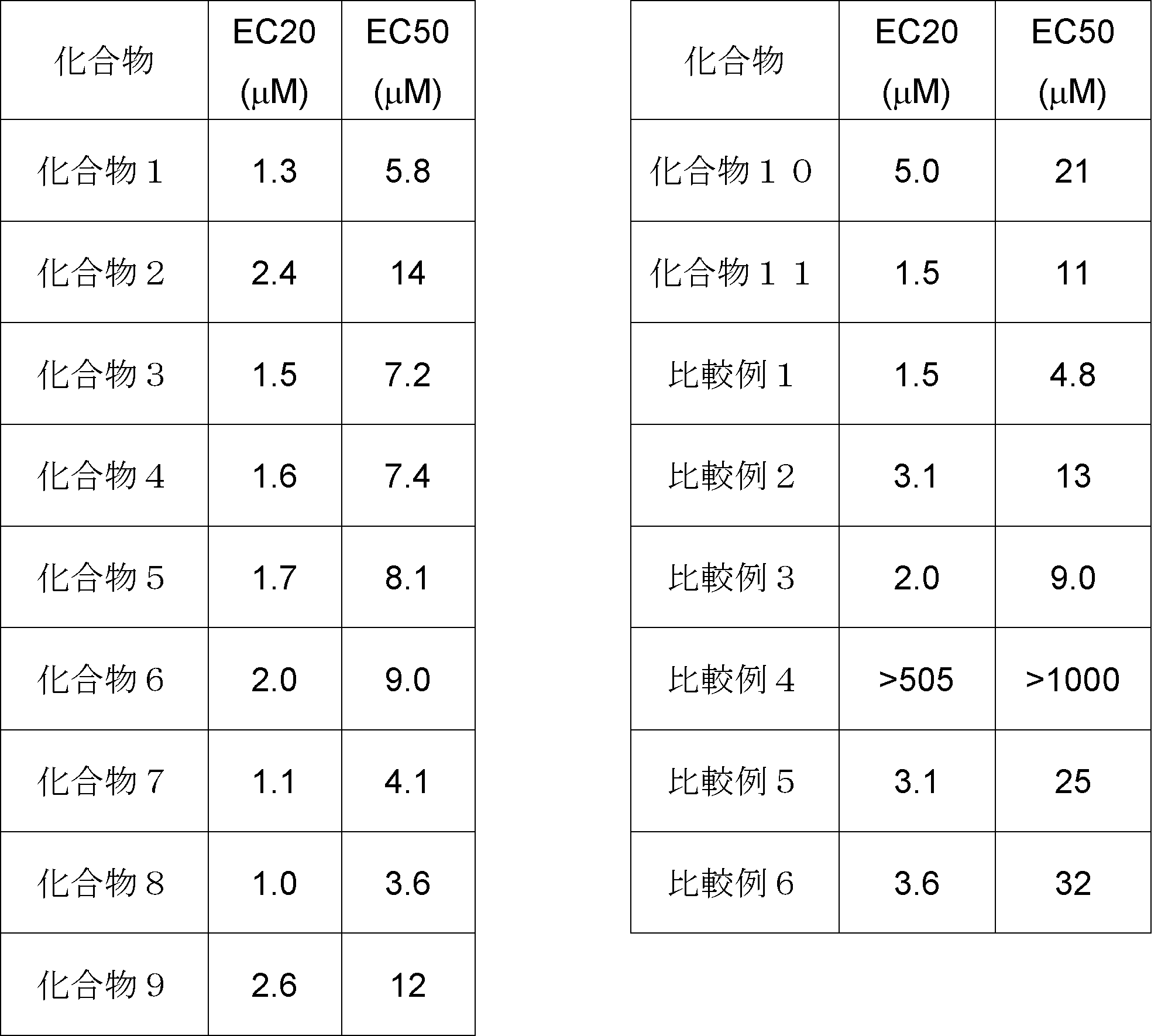
- the “strong PTH-like action” or “strong PTH-like action” in the present invention preferably has an EC20 value ( ⁇ M) measured by the above method of 5.0 or less, preferably 3.0 or less. More preferably, it is 2.0 or less.
- the value ( ⁇ M) measured by the above method is preferably 25.0 or less, more preferably 15.0 or less, and even more preferably 10.0 or less. .
- liver microsomes can be confirmed using a general measurement method. For example, it can be confirmed using hepatocytes, small intestinal cells, liver microsomes, small intestine microsomes, liver S9 and the like. Specifically, for example, the stability of compounds in liver microsomes is described by T Kronbach et al. (Oxidation of midazolam and triazolam by human liver cytochrome P450IIIA4. Mol. Pharmacol, 1989, 36 (1), 89-96) It can confirm by measuring according to. More specifically, it can be confirmed according to the method described in Test Example 3.
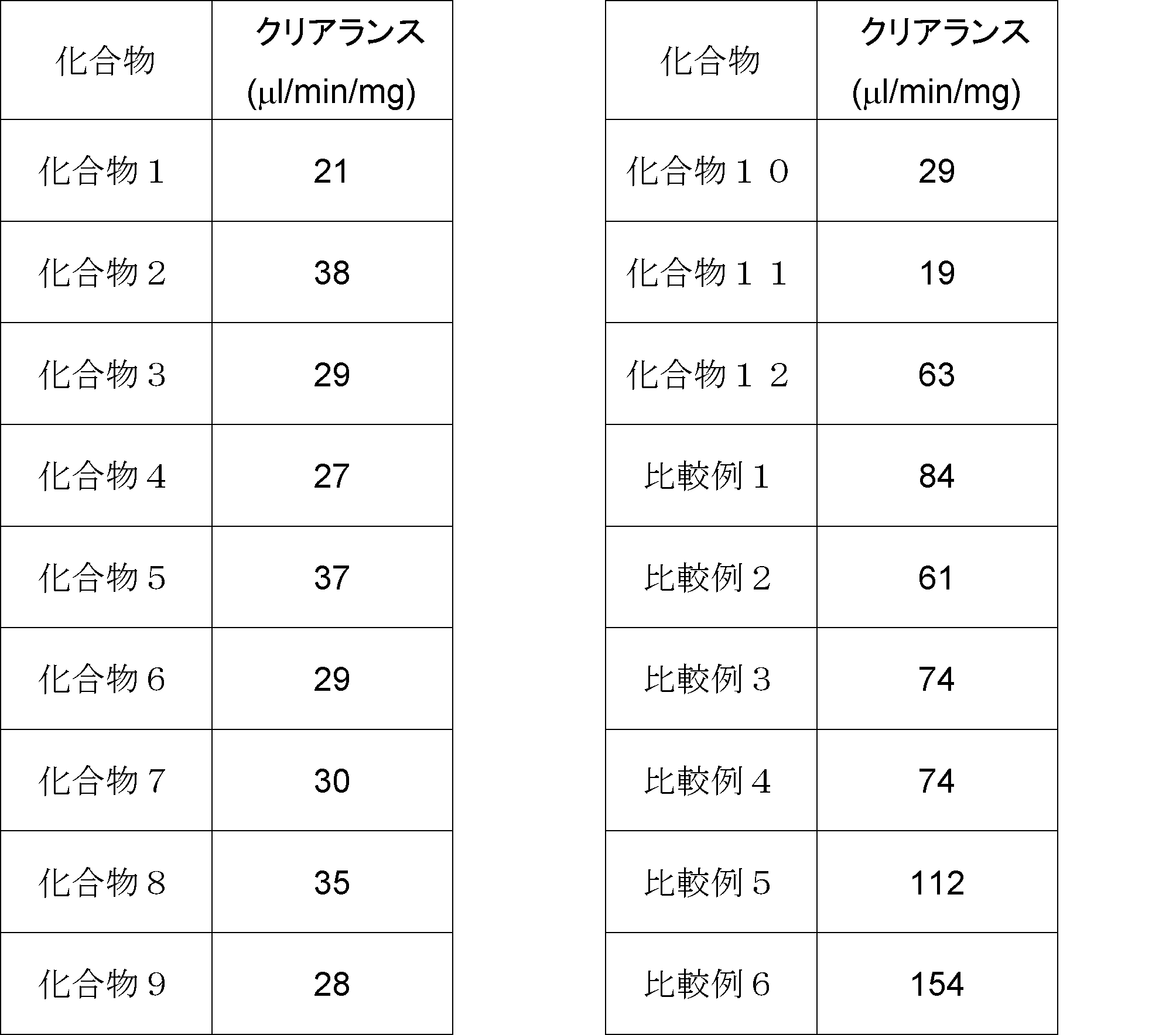
- the “high metabolic stability” or “high metabolic stability” of the present invention means that, for example, the clearance ( ⁇ L / min / mg) value in a metabolic stability test using human liver microsomes described in the above test examples is It is preferably 60 or less, more preferably 40 or less, and even more preferably 35 or less.
- the combination of R1 and R2 is a trifluoromethyl group and a hydrogen atom, and R3 and R4 together with the carbon atom to which they are bonded form a cyclopentyl ring It is possible to obtain high metabolic stability.
- the compound according to the present invention is included in the present invention regardless of whether it is a free form or a pharmacologically acceptable salt.
- Salts include inorganic acid salts, organic acid salts, inorganic base salts, organic base salts, acidic or basic amino acid salts, and the like.
- inorganic acid salts include hydrochloride, hydrobromide, sulfate, nitrate, phosphate and the like
- organic acid salts include, for example, acetate, succinate and fumarate.
- the inorganic base salt include alkali metal salts such as sodium salt and potassium salt, alkaline earth metal salts such as calcium salt and magnesium salt, aluminum salt and ammonium salt.
- organic base salts examples thereof include diethylamine salt, diethanolamine salt, meglumine salt, N, N-dibenzylethylenediamine salt and the like.
- Preferred examples of the acidic amino acid salt include aspartate and glutamate, and preferred examples of the basic amino acid salt include arginine salt, lysine salt and ornithine salt.
- the compound of the present invention When the compound of the present invention is left in the air, the compound absorbs moisture and may have adsorbed water or become a hydrate. Such a hydrate is also included in the salt of the present invention.
- the compound of the present invention may absorb a certain other solvent and become a solvate, and such a salt is also included in the present invention as a salt of the compound of the formula (1).
- the structural formula of a compound may represent a certain isomer for convenience, but in the present invention, all geometrical isomers generated from the structure of the compound, optical isomers based on asymmetric carbon, stereo It includes isomers such as isomers and tautomers and isomer mixtures, and is not limited to the description of the formula for convenience, and may be either one isomer or a mixture. Therefore, the compound of the present invention may have an asymmetric carbon atom in the molecule, and an optically active substance and a racemate may exist. However, the present invention is not limited and includes both.
- the present invention includes all isotopes of the compound represented by the formula (1).
- the isotope of the compound of the present invention at least one atom is substituted with an atom having the same atomic number (number of protons) and a different mass number (sum of the number of protons and neutrons).
- Examples of isotopes contained in the compound of the present invention include a hydrogen atom, a carbon atom, a nitrogen atom, an oxygen atom, a phosphorus atom, a sulfur atom, a fluorine atom, and a chlorine atom, and 2 H, 3 H, and 13 C, respectively. , 14 C, 15 N, 17 O, 18 O, 31 P, 32 P, 35 S, 18 F, 36 Cl, and the like.
- radioactive isotopes such as 3 H and 14 C that decay by emitting radioactivity are useful in pharmaceutical tissue or compound tissue distribution tests and the like. Stable isotopes can be used safely because they do not decay, their abundances are almost unchanged, and there is no radioactivity.
- the isotope of the compound of the present invention can be converted according to a conventional method by replacing the reagent used in the synthesis with a reagent containing the corresponding isotope.
- the compound according to the present invention may have a crystal polymorph, but is not particularly limited, and any one of the crystal forms may be a single crystal form or a mixture of crystal forms.
- the compound according to the present invention includes its prodrug.
- a prodrug is a derivative of a compound of the present invention that has a group that can be chemically or metabolically decomposed and is restored to the original compound after administration to a living body and exhibits its original medicinal properties. No complexes and salts.
- R1 and R2 are selected from the following combinations: 1) R1 is a hydrogen atom or a halogen atom, and R2 is a hydrogen atom, a trifluoromethyl group, or a trifluoromethoxy group (except when R1 and R2 are both hydrogen atoms); 2) R1 is a trifluoromethyl group or a trifluoromethoxy group, and R2 is a hydrogen atom or a halogen atom; 3)
- R 1 and R 2 are selected from the following combinations: 1) R1 is a trifluoromethoxy group and R2 is a fluorine atom; 2) R1 is a bromine atom and R2 is a hydrogen atom; 3) R1 is a trifluoromethyl group and R2 is a fluorine atom; 4) R1 is a fluorine atom and R2 is a trifluoromethoxy group; 5) R1 is a trifluoromethyl group and R2 is a hydrogen atom; 6) R1 is a hydrogen atom and R2 is a trifluoromethoxy group; 7) R1 and R2 are bonded to each other to form the following formula: (In the formula, each * represents a bonding position with the phenyl moiety); And R3 and R4 are methyl groups; Or R3 and R4 together with the carbon atom to which they are attached are selected from the following: (* In the formula, each * represents a bonding position with the phenyl moiety); And
- the compound represented by the formula (1) of the present invention is more preferably a compound selected from the group consisting of the following, or a pharmacologically acceptable salt thereof.
- Compound 1 1- (4- (2-((2- (4-Fluoro-3- (trifluoromethoxy) phenyl) -4-oxo-1,3,8-triazaspiro [4.5] dec-1- En-8-yl) sulfonyl) ethyl) -3,5-dimethylphenyl) -5,5-dimethylimidazolidine-2,4-dione
- Compound 2 1- (4- (2-((2- (3-bromophenyl) -4-oxo-1,3,8-triazaspiro [4.5] dec-1-en-8-yl) sulfonyl) Ethyl) -3,5-dimethylphenyl) -5,5-dimethylimidazolidine-2,4-dione
- Compound 3 1- (4-
- Such a compound represented by the above formula (1) or a pharmacologically acceptable salt thereof of the present invention is useful as a compound having a PTH-like action, preferably a PTH1R agonist, and is used for osteoporosis, fracture, agenesis.
- a PTH-like action preferably a PTH1R agonist
- the compound according to the present invention or a salt thereof is converted into a tablet, powder, fine granule, granule, coated tablet, capsule, syrup, troche, inhalant, suppository, injection, ointment by a conventional method.
- Ointments Ointments, eye drops, nasal drops, ear drops, poultices, lotions and the like.
- Excipients, binders, lubricants, colorants, flavoring agents, and if necessary stabilizers, emulsifiers, absorption promoters, surfactants, pH adjusters, preservatives, Antioxidants and the like can be used.
- ingredients that are used as raw materials for pharmaceutical preparations are blended to prepare a preparation by a conventional method.
- the compound according to the present invention in order to produce an oral preparation, the compound according to the present invention or a pharmacologically acceptable salt and excipient thereof, and if necessary, a binder, a disintegrant, a lubricant, a coloring agent, and a flavoring agent. After adding, etc., it is made into powders, fine granules, granules, tablets, coated tablets, capsules and the like by conventional methods.
- these components include animal and vegetable oils such as soybean oil, beef tallow and synthetic glycerides; hydrocarbons such as liquid paraffin, squalane and solid paraffin; ester oils such as octyldodecyl myristate and isopropyl myristate; cetostearyl alcohol and behenyl alcohol Higher alcohols; silicone resins; silicone oils; surfactants such as polyoxyethylene fatty acid esters, sorbitan fatty acid esters, glycerin fatty acid esters, polyoxyethylene sorbitan fatty acid esters, polyoxyethylene hydrogenated castor oil, polyoxyethylene polyoxypropylene block copolymers Water-soluble such as hydroxyethylcellulose, polyacrylic acid, carboxyvinyl polymer, polyethylene glycol, polyvinylpyrrolidone, methylcellulose Polymers; lower alcohols such as ethanol and isopropanol; polyhydric alcohols such as glycerin, propylene glycol, dipropylene glycol
- excipient examples include lactose, corn starch, sucrose, glucose, mannitol, sorbitol, crystalline cellulose, silicon dioxide and the like.
- binder examples include polyvinyl alcohol, polyvinyl ether, methylcellulose, ethylcellulose, gum arabic, tragacanth, gelatin, shellac, hydroxypropylmethylcellulose, hydroxypropylcellulose, polyvinylpyrrolidone, polypropylene glycol, polyoxyethylene block polymer, meglumine, and the like. It is done.
- disintegrant examples include starch, agar, gelatin powder, crystalline cellulose, calcium carbonate, sodium bicarbonate, calcium citrate, dextrin, pectin, carboxymethylcellulose / calcium and the like.
- lubricant examples include magnesium stearate, talc, polyethylene glycol, silica, and hardened vegetable oil.
- coloring agents those permitted to be added to pharmaceuticals are used, and as flavoring agents, cocoa powder, mint brain, aroma powder, mint oil, dragon brain, cinnamon powder, and the like are used.
- these tablets and granules may be coated with sugar coating and other coatings as necessary.
- a liquid preparation such as a syrup or an injectable preparation
- a compound according to the present invention or a pharmacologically acceptable salt thereof, a pH adjuster, a solubilizer, an isotonic agent, etc. are necessary. Add a solubilizing agent, stabilizer, etc. accordingly, and formulate it by a conventional method.
- the method for producing the external preparation is not limited and can be produced by a conventional method. That is, as a base material used for formulation, various raw materials usually used for pharmaceuticals, quasi drugs, cosmetics, and the like can be used. Specific examples of base materials to be used include animal and vegetable oils, mineral oils, ester oils, waxes, higher alcohols, fatty acids, silicone oils, surfactants, phospholipids, alcohols, polyhydric alcohols, Examples include raw materials such as water-soluble polymers, clay minerals, and purified water. If necessary, pH adjusters, antioxidants, chelating agents, antiseptic / antifungal agents, coloring agents, fragrances, etc. may be added. However, the base material of the external preparation according to the present invention is not limited thereto.
- the addition amount of the said base raw material is an amount used as the density
- the form thereof is not particularly limited, and it may be administered orally or parenterally by a commonly used method.
- a commonly used method for example, tablets, powders, granules, capsules, syrups, troches, inhalants, suppositories, injections, ointments, eye ointments, eye drops, nasal drops, ear drops, poultices, lotions, etc. It can be formulated and administered as an agent.
- the compound of the present invention since the compound of the present invention has excellent cAMP signal activity and metabolic stability, it is suitable for use as an oral preparation.
- the dosage of the medicament according to the present invention can be appropriately selected according to the degree of symptoms, age, sex, body weight, dosage form / salt type, specific type of disease, and the like.
- the dose varies significantly depending on the patient's disease type, symptom severity, patient age, sex difference, sensitivity to drugs, etc., but is usually about 0.03-1000 mg per day as an adult, preferably 0.1 -500 mg, more preferably 0.1-100 mg, is administered in 1 to several divided doses per day.
- the raw material compounds and various reagents may form salts, hydrates or solvates, all of which are starting materials, solvents used, etc. It does not specifically limit as long as it does not inhibit reaction.
- the solvent used is not particularly limited as long as it varies depending on the starting materials, reagents and the like, and can dissolve the starting material to some extent without inhibiting the reaction.
- Various isomers eg geometric isomers, optical isomers based on asymmetric carbon, rotational isomers, stereoisomers, tautomers, etc.
- it can be purified and isolated by using an enzyme resolution method and various types of chromatography (for example, thin layer chromatography, column chromatography, high performance liquid chromatography, gas chromatography, etc.).
- the compound according to the present invention When the compound according to the present invention is obtained as a free form, it can be converted into a salt which may be formed by the compound or a hydrate thereof according to a conventional method. When the compound according to the present invention is obtained as a salt or hydrate of the compound, it can be converted into a free form of the compound according to a conventional method.
- the isolation and purification of the compound according to the present invention can be performed by applying ordinary chemical operations such as extraction, concentration, distillation, crystallization, filtration, recrystallization, and various chromatography.
- the compounds of the present invention can be synthesized by various methods, some of which are illustrated in the following schemes.
- the scheme is exemplary and the invention is not limited to only the specified chemical reactions and conditions. In the following schemes, some substituents are excluded for clarity, but these are not intended to limit the disclosure of the scheme.
- the representative compounds of the present invention can be synthesized using appropriate intermediates, known compounds, and reagents.
- R1, R2, R3, and R4 in the formulas in the following general synthesis method are R1, R2, and R1 of the compound represented by the general formula (1) (the compound represented by formula 1 in the following general synthesis method). It is synonymous with R3 and R4.
- the compound of the present invention (Formula 1) can be synthesized by the following production method (Method A, Method B).
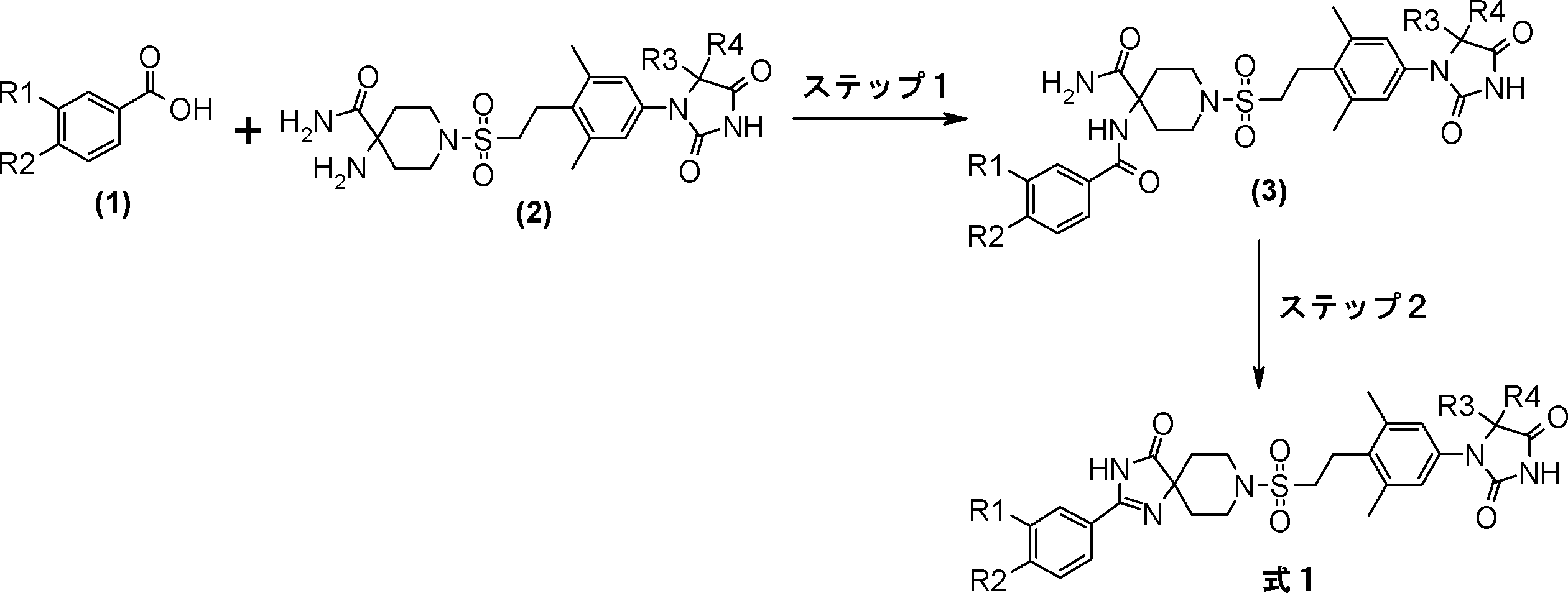
- Step 1 is a method of reacting the carboxylic acid derivative (1) with the amino-amide derivative (2).
- the coupling reagent include N, N′-dicyclohexylcarbodiimide (DCC), 1-ethyl-3- (3-dimethylaminopropyl) carbodiimide hydrochloride (EDC), O- (7-azabenzotriazole-1- Yl) -1,1,3,3-tetramethyluronium hexafluorophosphate (HATU) and 4- (4,6-dimethoxy-1,3,5-triazin-2-yl) -4-methyl And morpholinium chloride n-hydrate (DMT-MM).
- DCC N′-dicyclohexylcarbodiimide
- EDC 1-ethyl-3- (3-dimethylaminopropyl) carbodiimide hydrochloride
- HATU O- (7-azabenzotriazole-1- Yl) -1,1,3,3-te
- Examples of the base include triethylamine or N, N-diisopropylethylamine. If necessary, 4- (dimethylamino) pyridine (DMAP) can be used as a catalyst.
- Suitable solvents include dichloromethane or N, N-dimethylformamide.
- Suitable reaction solvents when using DMT-MM include methanol, ethanol, and acetonitrile.
- the reaction temperature is, for example, 0 ° C. to room temperature, and the reaction time is 0.5 to 24 hours.
- the resulting amide-amide derivative (3) is isolated by general techniques and may be purified by crystallization or chromatography, if necessary.
- Step 2 cyclizes the amide-amide derivative (3) in a suitable solvent such as ethanol, tert-butanol, or dimethyl sulfoxide in the presence of a suitable base such as aqueous sodium hydroxide or potassium t-butoxide.
- a suitable solvent such as ethanol, tert-butanol, or dimethyl sulfoxide
- a suitable base such as aqueous sodium hydroxide or potassium t-butoxide.
- the reaction temperature is, for example, from room temperature to reflux conditions, and the reaction time is 1 to 24 hours.
- the resulting hydantoin derivative (Formula 1) is isolated by conventional techniques and may be purified by crystallization or chromatography, if necessary.
- the amino-amide derivative (2) shown in Scheme 1 can be synthesized from the piperidinone derivative (4).
- Scheme 2 shows a method for synthesizing the amino-amide derivative (2).
- Step 3 is a Strecker synthesis that leads the piperidinone derivative (4) to the amino-nitrile derivative (5).
- piperidinone derivative (4) is sodium cyanide or potassium cyanide and ammonium chloride or ammonium acetate in a suitable solvent such as methanol, ethanol or tetrahydrofuran in the presence / absence of water. It is the method of making it react.
- the reaction temperature is, for example, room temperature to 80 ° C., and the reaction time is 2 to 72 hours.
- the resulting amino-nitrile derivative (5) is isolated by general techniques and may be purified by crystallization or chromatography, if necessary.
- Step 4 is a method for converting a nitrile group into an amide group under basic hydrolysis conditions in the presence of hydrogen peroxide. This reaction can be performed with reference to Chemistry-A European Journal (2002), 8 (2), 439-450, for example.
- Step 5 comprises compound (6) in an inert solvent such as methanol, ethanol, trifluoroethanol, dimethylformamide, or dimethylacetamide in the presence of a catalyst such as palladium carbon or palladium hydroxide carbon, respectively, under an H 2 atmosphere.
- a catalyst such as palladium carbon or palladium hydroxide carbon, respectively, under an H 2 atmosphere.
- the reaction temperature is from room temperature to 80 ° C., and the reaction may be performed under pressure.
- the resulting amino-amide derivative (2) is isolated by general techniques and may be purified by crystallization or chromatography, if necessary.
- the piperidinone derivative (4) shown in Scheme 2 can be synthesized from a known ketal-vinylsulfonyl derivative (7) and a hydantoin-aryl bromide derivative (8).
- Scheme 3 shows a method for synthesizing the piperidinone derivative (4).
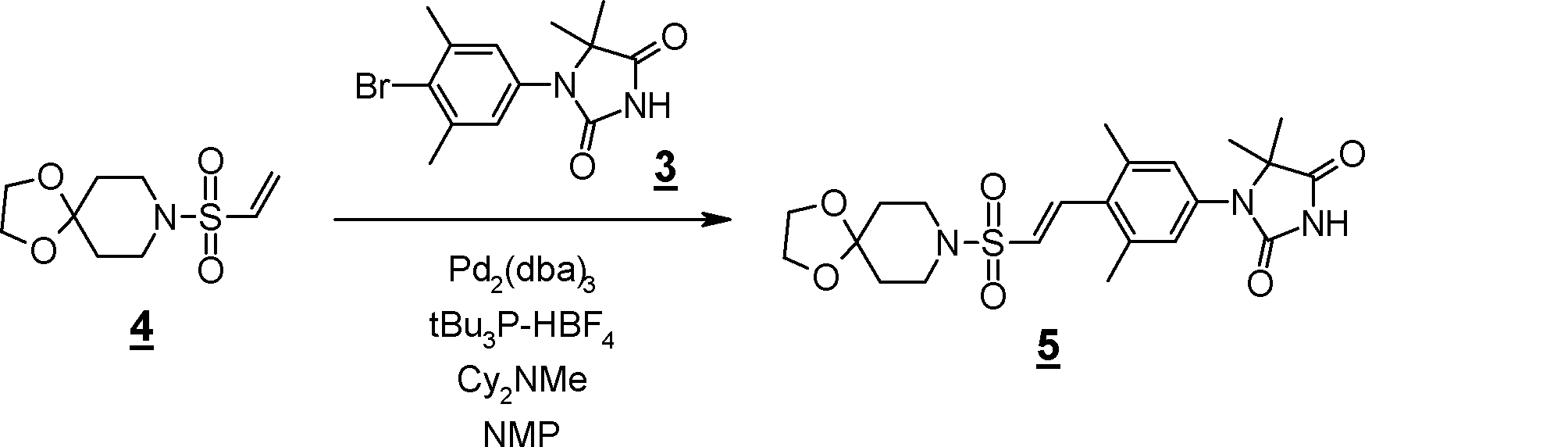
- Step 6 is performed in the presence of a palladium catalyst such as tris (dibenzylideneacetone) dipalladium (0) or bis (dibenzylideneacetone) palladium in an N 2 atmosphere, respectively.
- a suitable base such as phosphine ligand, methyldicyclohexylamine, and in a suitable solvent such as N-methyl-2-piperidone (NMP), ketal-vinylsulfonyl derivative (7) and hydantoin-aryl bromide derivative (8)
- NMP N-methyl-2-piperidone
- ketal-vinylsulfonyl derivative (7) and hydantoin-aryl bromide derivative (8) Is a method of synthesizing a ketal-arylvinylsulfonyl derivative (9) by coupling.
- the reaction temperature is 90 ° C. to reflux temperature.
- Step 7 is a method in which the ketal-arylvinylsulfonyl derivative (9) is converted into a ketone in the presence of an acid such as hydrochloric acid in an appropriate solvent such as hydrous tetrahydrofuran.
- the reaction temperature is, for example, the boiling point of the solvent, and the reaction time is 1 to 24 hours.
- the resulting piperidinone derivative (4) is isolated by general techniques and, if necessary, may be purified by crystallization or chromatography.
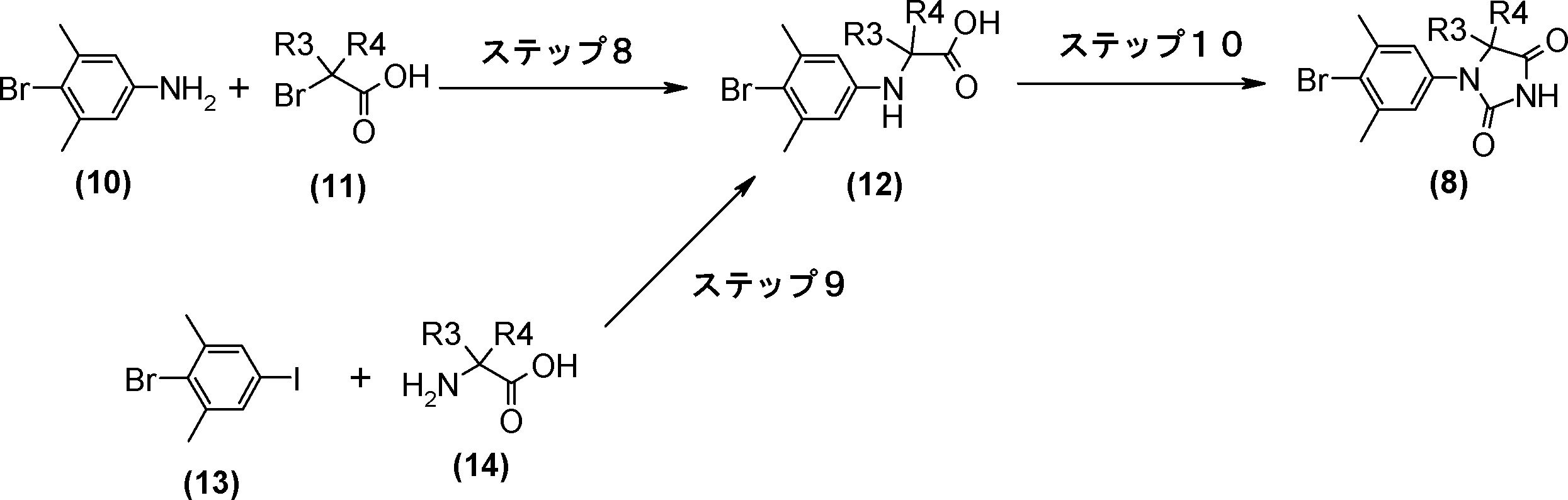
- Hydantoin-aryl bromide derivative (8) shown in scheme 3 is 4-bromo-3,5-dimethylaniline (10) and bromoacetic acid derivative (11) or 2-bromo-5-iodo-1,3-dimethyl. It can be synthesized from benzene (13) and an amino acid derivative (14).
- Scheme 4 shows a method for synthesizing the hydantoin-aryl bromide derivative (8).
- Step 8 is a process of converting 4-bromo-3,5-dimethylaniline (10) to a bromoacetic acid derivative (10) in a suitable solvent such as N-methyl-2-piperidone (NMP) in the presence of a suitable base such as diisopropylethylamine.
- a suitable solvent such as N-methyl-2-piperidone (NMP)
- NMP N-methyl-2-piperidone
- a suitable base such as diisopropylethylamine.
- Alkylation method Alkylation method.
- the reaction temperature is, for example, room temperature to 100 ° C., and the reaction time is 1 to 24 hours.
- the resulting aryl bromide-amino acid derivative (12) is isolated by general techniques and may be purified by crystallization or chromatography, if necessary.
- Step 9 comprises reacting 2-bromo-5-iodo-1,3-dimethylbenzene (13) with an amino acid derivative (14) in the presence of a metal catalyst such as copper (I) iodide to produce an aryl bromide-amino acid derivative ( 12).
- the reaction can be carried out in the presence of a suitable base such as diazabicycloundecene (DBU) in a suitable solvent such as N, N-dimethylacetamide (DMA) at a reaction temperature of about 80 to 120 ° C.
- DBU diazabicycloundecene
- DMA N, N-dimethylacetamide
- the resulting aryl bromide-amino acid derivative (12) is isolated by general techniques and may be purified by crystallization or chromatography, if necessary.
- Step 10 is a method of synthesizing the hydantoin-aryl bromide derivative (8) by reacting the aryl bromide-amino acid derivative (12) with sodium cyanate under acidic conditions.
- the solvent is, for example, a mixed solvent such as acetic acid-dichloromethane, the reaction temperature is from room temperature to 60 ° C., and the reaction time is from 1 to 24 hours.
- the resulting hydantoin-aryl bromide derivative (8) is isolated by conventional techniques and may be purified by crystallization or chromatography, if necessary.
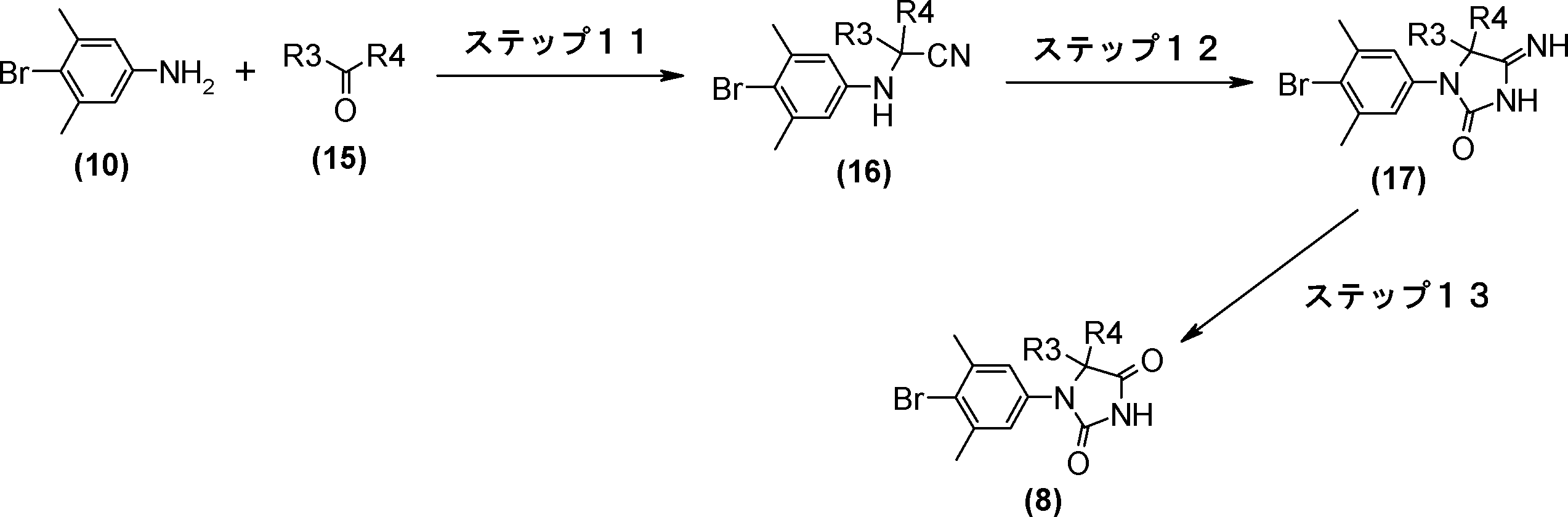
- the hydantoin-aryl bromide derivative (8) shown in Scheme 3 can also be synthesized from 4-bromo-3,5-dimethylaniline (10) and a ketone derivative (15).
- Scheme 5 shows a method for synthesizing the hydantoin-aryl bromide derivative (8).
- Step 11 is a Strecker synthesis leading the ketone derivative (15) to the arylamino-nitrile derivative (16). That is, this is a method in which the ketone derivative (15) is reacted with 4-bromo-3,5-dimethylaniline (10) and trimethylsilyl cyanide in a suitable solvent such as acetic acid. The reaction can be carried out at a reaction temperature such as room temperature, and the reaction time is about 1 to 3 hours. The resulting arylamino-nitrile derivative (16) is isolated by conventional techniques and may be purified by crystallization or chromatography, if necessary.
- step 12 the arylamino-nitrile derivative (16) is reacted with 2,2,2-trichloroacetyl isocyanate in a suitable solvent such as dichloromethane, and then a reagent such as methanol, water, triethylamine is added to the mixture under heating conditions.
- a suitable solvent such as dichloromethane
- a reagent such as methanol, water, triethylamine
- Step 13 is a method for converting the iminohydantoin derivative (17) into the hydantoin-aryl bromide derivative (8) under acidic conditions.
- it can be synthesized in a solvent of acetic acid-water under a heating condition of about 65 ° C. and a reaction time of about 1 to 6 hours.
- the resulting hydantoin-aryl bromide derivative (8) is isolated by conventional techniques and may be purified by crystallization or chromatography, if necessary.
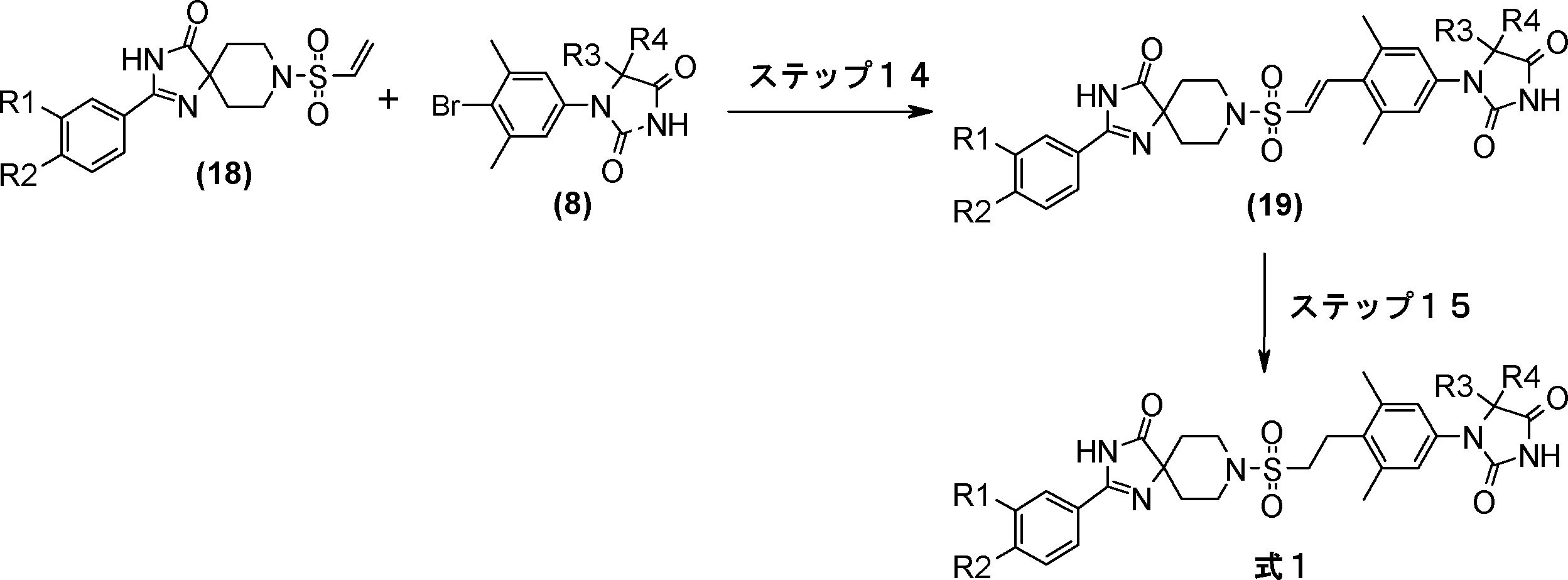
- step 14 can be synthesized according to the method of step 6 and the reaction of step 15 can be synthesized according to the method of step 5.
- the resulting hydantoin derivative (Formula 1) is isolated by conventional techniques and may be purified by crystallization or chromatography, if necessary.
- Example 1 (4- (2-((2- (4-Fluoro-3- (trifluoromethoxy) phenyl) -4-oxo-1,3,8-triazaspiro [4.5] dec-1-ene-8 -Yl) sulfonyl) ethyl) -3,5-dimethylphenyl) -5,5-dimethylimidazolidine-2,4-dione (compound 1)
- reaction mixture was cooled, diluted with water, quenched with saturated aqueous ammonium chloride, and extracted with dichloromethane.
- the organic layer was washed successively with water and saturated brine, dried over anhydrous sodium sulfate, and concentrated under reduced pressure.
- Example 2 (3,5-dimethyl-4- (2-((4-oxo-2- (3- (trifluoromethyl) phenyl) -1,3,8-triazaspiro [4.5] dec-1-ene -8-yl) sulfonyl) ethyl) phenyl) -5,5-dimethylimidazolidine-2,4-dione (compound 6)
- Example 3 (3,5-Dimethyl-4- (2-((4-oxo-2- (4- (trifluoromethoxy) phenyl) -1,3,8-triazaspiro [4.5] dec-1-ene -8-yl) sulfonyl) ethyl) phenyl) -5,5-dimethylimidazolidine-2,4-dione (compound 7)
- Example 4 (3,5-Dimethyl-4- (2-((4-oxo-2- (4- (trifluoromethoxy) phenyl) -1,3,8-triazaspiro [4.5] dec-1-ene -8-yl) sulfonyl) ethyl) phenyl) -1,3-diazaspiro [4.4] nonane-2,4-dione (compound 8)
- Trimethylsilyl cyanide (0.063 ml, 0.500 mmol) was added to a mixture of cyclopentanone (42 mg, 0.500 mmol) and 4-bromo-3,5-dimethylaniline (100 mg, 0.500 mmol) in acetic acid (0.5 ml). was added at room temperature. The mixture was stirred at room temperature for 1.5 hours under a nitrogen stream. The reaction mixture was quenched into 28% aqueous ammonia (1 ml), diluted with water and extracted with dichloromethane.
- Acetic acid (1.0 ml) of 1- (4-bromo-3,5-dimethylphenyl) -4-imino-1,3-diazaspiro [4.4] nonan-2-one (crude product obtained in the previous reaction) ) And water (0.25 ml) were heated and stirred at 65 ° C. for 1.5 hours under a nitrogen stream. Further, acetic acid (1.0 ml) and water (0.25 ml) were added, and the mixture was heated and stirred at 65 ° C. for 17 hours under a nitrogen stream. The reaction mixture was cooled, diluted with water, adjusted to pH 8 with saturated aqueous sodium hydrogen carbonate solution, and extracted with ethyl acetate.
- Example 5 (3,5-Dimethyl-4- (2-((4-oxo-2- (4- (trifluoromethoxy) phenyl) -1,3,8-triazaspiro [4.5] dec-1-ene -8-yl) sulfonyl) ethyl) phenyl) -8-methyl-1,3,8-triazaspiro [4.5] decane-2,4-dione (compound 9)
- Example 7 4- (3,5-Dimethyl-4- (2-((4-oxo-2- (4- (trifluoromethoxy) phenyl) -1,3,8-triazaspiro [4.5] dec-1-ene -8-yl) sulfonyl) ethyl) phenyl) -4,6-diazaspiro [2.4] heptane-5,7-dione (compound 11)
- reaction mixture was purified by silica gel column chromatography (Wakosil C18, acetonitrile-water (0.1% formic acid)) to obtain 1-((4-bromo-3,5-dimethylphenyl) amino) cyclopropanecarboxylic acid. (219 mg, 80%).
- MS (ESI) m / z 284, 286 (M + H) +.
- Example 8 1- (3,5-dimethyl-4- (2-((4-oxo-2- (3- (trifluoromethyl) phenyl) -1,3,8-triazaspiro [4.5] dec-1-ene -8-yl) sulfonyl) ethyl) phenyl) -1,3-diazaspiro [4.4] nonane-2,4-dione (compound 12)
- Test Example Regarding the compound of the present invention cAMP production ability via human PTH1R, cAMP production ability via rat receptor, metabolic stability using human liver microsomes, metabolic stability using rat hepatocytes, in TPTX rat model Test results for serum Ca concentration increasing action are shown in Test Examples 1 to 5.
- As comparative compounds the compounds described in WO2010 / 126030A1 shown in Table 2 were used.
- Test Example 1 Measurement of in vitro cAMP signal activity of a compound in human PTH1R (peptide) Human PTH (1-34) and calcitonin were purchased from Peptide Institute (Osaka, Japan), dissolved in 10 mM acetic acid to 1 mM, and stored in a ⁇ 80 ° C. freezer. (Cell culture) Cells were placed in Dulbecco's modified Eagle's medium (DMEM) supplemented with 10% fetal calf serum (Hyclone), 100 units / ml penicillin G, and 100 ⁇ g / ml streptomycin sulfate (Invitrogen Corp), in a humidified atmosphere containing 5% CO2. Cultured at 37 ° C.
- DMEM Dulbecco's modified Eagle's medium
- LLC-PK1 cells not expressing PTH1R and HKRK-B7 overexpressing 9.5 ⁇ 10 5 human PTH1R per cell of LLC-PK1 were used for cAMP signaling analysis (Takasu et al ., J. Bone. Miner. Res. 14: 11-20, 1999).
- CAMP stimulation HKRK-B7 or LLC-PK1 cells were seeded in 96-well plates at 1 ⁇ 10 5 cells / well and incubated overnight.
- cAMP assay buffer (DMEM, 2 mM IBMX, 0.2 mg / ml bovine serum albumin, 35 mM Hepes-NaOH, pH 7.4) containing human PTH (1-34) or compound is then added, 37 ° C. And incubating for 20 minutes. After removing the medium, the cells were washed once with 100 ⁇ l cAMP assay buffer. Plates were placed on dry ice powder to freeze the cells and then removed from the dry ice. Cells were thawed with 40 ⁇ l of 50 mM HCl and frozen again on dry ice. The amount of intracellular cAMP produced was measured using a commercially available cAMP EIA kit (Biotrack cAMP EIA system, GE health care).
- Test Example 2 Measurement of in vitro cAMP signal activity of a compound in rat PTH1R Measurement was performed in the same manner as in Test Example 1 using LLC-PK46_RATO_PTH1R cells overexpressing rat PTH1R established by Chugai instead of HKRK-B7 cells. .
- the results using LLC-PK46_RATO_PTH1R cells are shown in Table 4.
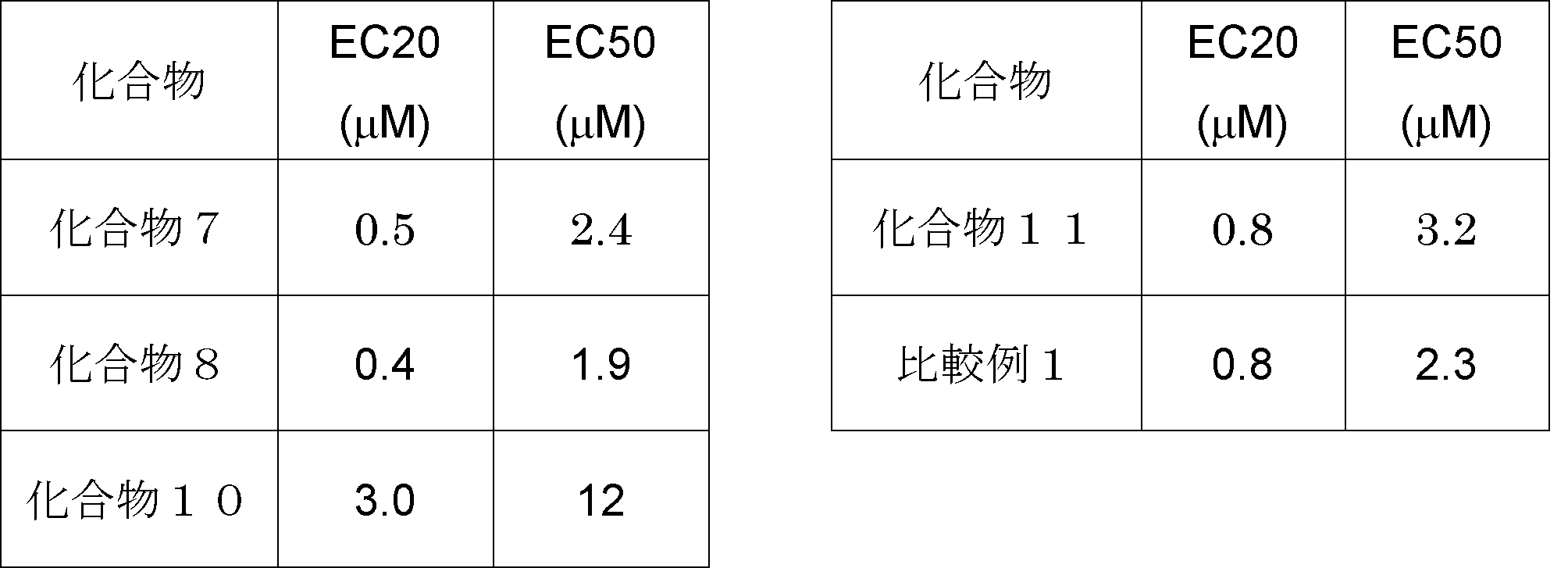
- the EC20 value of in vitro cAMP signal activity at rat PTH1 receptor was in good correlation with the EC20 value of in vitro cAMP signal activity at human PTH1R. There was also a good correlation between rats and humans for EC50 values.
- Test Example 3 Metabolic stability test using human liver microsomes In a 0.1 M phosphate buffer (pH 7.4), human liver microsomes and compounds or comparative examples were incubated at 37 ° C. in the presence of NADPH for a predetermined time. The parent compound concentration at each reaction time was measured using LC / MS / MS, and the intrinsic clearance ( ⁇ L / min / mg protein) was calculated from the slope of the residual rate with respect to the reaction time.
- Test Example 4 Metabolic stability test using rat hepatocytes Hepatocytes were prepared from rat (SD, rabbit) liver by the collagenase reflux method. Example compounds or comparative examples were added and incubated at 37 ° C. for a predetermined time, and then a reaction stop solution was added. The parent compound concentration at each reaction time was measured using LC / MS / MS, and the intrinsic clearance ( ⁇ L / 10 6 cells / min) was calculated from the slope of the residual rate with respect to the reaction time.
- ⁇ Assay conditions Cell concentration: 1 ⁇ 10 6 cells / mL Compound concentration: 1 ⁇ M Medium: Williams' medium E Reaction time: 0, 15, 30, 60, 120 and 240 minutes Stop solution: Acetonitrile / 2-propanol (4/6, v / v)
- mice Five days after the surgery, the mice were divided into 8 TPTX groups and 1 Sham group, 5 mice in each group based on the serum Ca concentration and body weight measured 4 days after the surgery.
- the solvent alone was orally administered at a dose of 10 mL / kg.
- TPTX-each sample group was orally administered after dissolving in a solvent at a dose of 30 mg / 10 mL / kg for each sample.
- the composition of the solvent is 10% dimethyl sulfoxide (Wako Pure Chemical Industries, Ltd.), 10% Cremophor EL (Sigma Aldrich Japan GK), 20% hydroxypropyl- ⁇ -cyclodextrin (Nippon Food Chemical Co., Ltd.), glycine ( What was adjusted to pH 10 by Wako Pure Chemical Industries, Ltd.) was used.
- Pre blood was collected immediately before each administration, and blood was also collected 2, 6, 10 and 24 hours after administration to measure serum Ca concentration. Each blood collection was performed from the jugular vein under isoflurane inhalation anesthesia.
- Serum Ca measurement Serum obtained by centrifugation from the collected blood was measured using an automatic analyzer TBA-120FR (Toshiba Medical Systems).
- the Pre value of serum Ca concentration was 9.9 mg / dL in the Sham group, and 5.3 to 6.2 mg / dL in each TPTX group.
- the average value of the amount of change from the Pre value for serum Ca concentration up to 24 hours after administration of each compound is shown in FIG.
- the peak of serum Ca concentration after administration of each compound was 6 hours or 10 hours after administration for any compound.
- the amount of positive change from the Pre value of Compound 1, Comparative Example 1, and Comparative Example 2 with low rat hepatocyte metabolic stability was smaller than that of Compound 6, Compound 7, and Compound 8.
- Compound 7 and Compound 8 were statistically superior to Comparative Examples 1 and 2.
- the therapeutic target range of serum Ca concentration in patients with hypoparathyroidism was 7.6 to 8.8 mg / dL.
- the present invention provides a compound having a strong PTH-like action and high metabolic stability. Further, according to the present invention, osteoporosis, fracture, aplastic ossification, achondroplasia, hypochondrosis, osteomalacia, osteoarthritis, arthritis, thrombocytopenia, hypoparathyroidism, hyperphosphatemia Or a medicament for the prevention and / or treatment of neoplastic calcification or the like, or stem cell mobilization.
Landscapes
- Chemical & Material Sciences (AREA)
- Organic Chemistry (AREA)
- Health & Medical Sciences (AREA)
- General Health & Medical Sciences (AREA)
- Veterinary Medicine (AREA)
- Public Health (AREA)
- Medicinal Chemistry (AREA)
- Animal Behavior & Ethology (AREA)
- Life Sciences & Earth Sciences (AREA)
- Pharmacology & Pharmacy (AREA)
- Bioinformatics & Cheminformatics (AREA)
- Nuclear Medicine, Radiotherapy & Molecular Imaging (AREA)
- Engineering & Computer Science (AREA)
- General Chemical & Material Sciences (AREA)
- Chemical Kinetics & Catalysis (AREA)
- Diabetes (AREA)
- Endocrinology (AREA)
- Hematology (AREA)
- Obesity (AREA)
- Rheumatology (AREA)
- Epidemiology (AREA)
- Physical Education & Sports Medicine (AREA)
- Pharmaceuticals Containing Other Organic And Inorganic Compounds (AREA)
- Nitrogen Condensed Heterocyclic Rings (AREA)
- Nitrogen And Oxygen Or Sulfur-Condensed Heterocyclic Ring Systems (AREA)
- Nutrition Science (AREA)
- Physiology (AREA)
Abstract
Description
その他、骨折、無形成骨症、軟骨無形成症、軟骨低形成症、骨軟化症、変形性関節症、関節炎、血小板減少症、高リン血症、腫瘍状石灰沈着症などの疾患の治療においても、PTH様作用を有し、かつ非侵襲的に投与できる薬剤が望まれる。
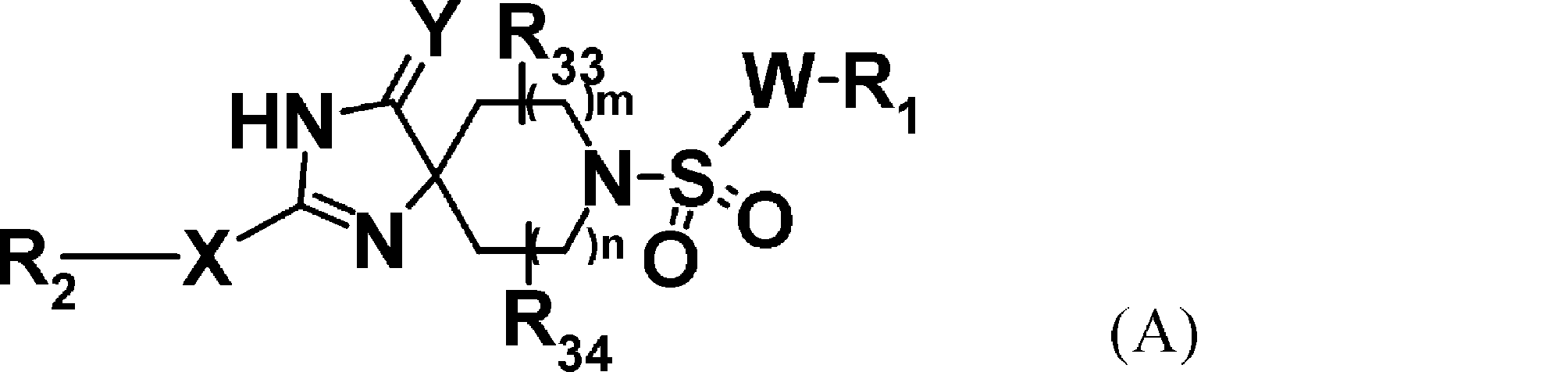
が、PTH様作用をもつ化合物、好ましくはPTH1Rアゴニスト、として有用であり、骨粗鬆症、骨折、骨軟化症、関節炎、血小板減少症、副甲状腺機能低下症、高リン血症、または腫瘍状石灰沈着症などの予防および/または治療、あるいは幹細胞動員に有用であることを見出して、先に特許出願をした(特許文献1)。
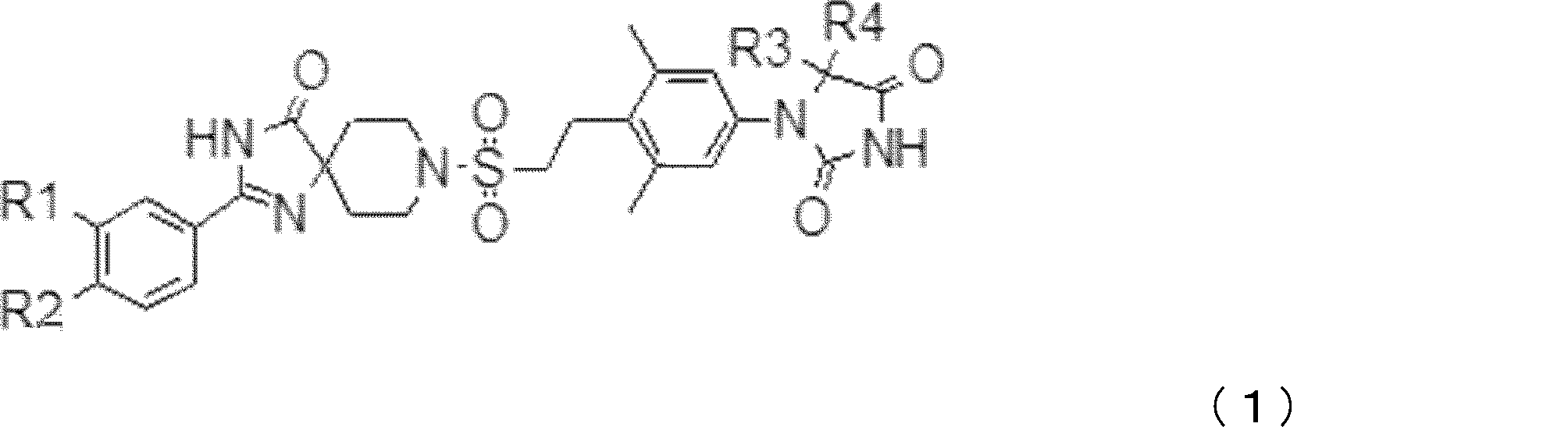
R1およびR2は、R1とR2が共に水素原子ではないとの条件の下、それぞれ独立して
1)水素原子、
2)ハロゲン原子、
3)1~5個のフッ素原子で置換されていてもよい炭素数1~2個のアルキル基、または
4)1~5個のフッ素原子で置換されていてもよい炭素数1~2個のアルコキシ基
であるか;または、
R1およびR2は、互いに結合して形成される下記式:

かつ、R3およびR4は、それぞれ独立して1~3個のフッ素原子で置換されていてもよいメチル基であるか;または、
R3およびR4は、それらが結合する炭素原子と一緒になって炭素数3~6の環(ここで、環を形成する炭素原子のうち一つは酸素原子;硫黄原子;またはメチル基で置換されていてもよい窒素原子で置換されていてもよい。)を形成する。〕。
1)R1が水素原子、またはハロゲン原子であり、かつR2が水素原子、トリフルオロメチル基、またはトリフルオロメトキシ基である(但し、R1とR2が共に水素原子となる場合を除く);
2)R1がトリフルオロメチル基、またはトリフルオロメトキシ基であり、かつR2が水素原子、またはハロゲン原子である;
3)R1およびR2が互いに結合して形成される下記式:

かつ、R3およびR4は、メチル基であるか;または、
R3およびR4はそれらが結合する炭素原子と一緒になって以下から選択される環:

1)R1がトリフルオロメトキシ基であり、かつR2がフッ素原子である;
2)R1が臭素原子であり、かつR2が水素原子である;
3)R1がトリフルオロメチル基であり、かつR2がフッ素原子である;
4)R1がフッ素原子であり、かつR2がトリフルオロメトキシ基である;
5)R1がトリフルオロメチル基であり、かつR2が水素原子である;
6)R1が水素原子であり、かつR2がトリフルオロメトキシ基である;
7)R1、R2は互いに結合して形成される下記式:

かつ、R3およびR4はメチル基であるか;または、
R3およびR4はそれらが結合する炭素原子と一緒になって以下から選択される環:

〔1〕記載の化合物またはその薬理学的に許容される塩。

1-(4-(2-((2-(4-フルオロ-3-(トリフルオロメトキシ)フェニル)-4-オキソ-1,3,8-トリアザスピロ[4.5]デカ-1-エン-8-イル)スルホニル)エチル)-3,5-ジメチルフェニル)-5,5-ジメチルイミダゾリジン-2,4-ジオン;
1-(4-(2-((2-(3-ブロモフェニル)-4-オキソ-1,3,8-トリアザスピロ[4.5]デカ-1-エン-8-イル)スルホニル)エチル)-3,5-ジメチルフェニル)-5,5-ジメチルイミダゾリジン-2,4-ジオン:
1-(4-(2-((2-(4-フルオロ-3-(トリフルオロメチル)フェニル)-4-オキソ-1,3,8-トリアザスピロ[4.5]デカ-1-エン-8-イル)スルホニル)エチル)-3,5-ジメチルフェニル)-5,5-ジメチルイミダゾリジン-2,4-ジオン;
1-(4-(2-((2-(3-フルオロ-4-(トリフルオロメトキシ)フェニル)-4-オキソ-1,3,8-トリアザスピロ[4.5]デカ-1-エン-8-イル)スルホニル)エチル)-3,5-ジメチルフェニル)-5,5-ジメチルイミダゾリジン-2,4-ジオン;
1-(4-(2-((2-(2,2-ジフルオロベンゾ[d][1,3]ジオキソール-5-イル)-4-オキソ-1,3,8-トリアザスピロ[4.5]デカ-1-エン-8-イル)スルホニル)エチル)-3,5-ジメチルフェニル)-5,5-ジメチルイミダゾリジン-2,4-ジオン;
1-(3,5-ジメチル-4-(2-((4-オキソ-2-(3-(トリフルオロメチル)フェニル)-1,3,8-トリアザスピロ[4.5]デカ-1-エン-8-イル)スルホニル)エチル)フェニル)-5,5-ジメチルイミダゾリジン-2,4-ジオン;
1-(3,5-ジメチル-4-(2-((4-オキソ-2-(4-(トリフルオロメトキシ)フェニル)-1,3,8-トリアザスピロ[4.5]デカ-1-エン-8-イル)スルホニル)エチル)フェニル)-5,5-ジメチルイミダゾリジン-2,4-ジオン):
1-(3,5-ジメチル-4-(2-((4-オキソ-2-(4-(トリフルオロメトキシ)フェニル)-1,3,8-トリアザスピロ[4.5]デカ-1-エン-8-イル)スルホニル)エチル)フェニル)-1,3-ジアザスピロ[4.4]ノナン-2,4-ジオン;
1-(3,5-ジメチル-4-(2-((4-オキソ-2-(4-(トリフルオロメトキシ)フェニル)-1,3,8-トリアザスピロ[4.5]デカ-1-エン-8-イル)スルホニル)エチル)フェニル)-8-メチル-1,3,8-トリアザスピロ[4.5]デカン-2,4-ジオン;
5-(3,5-ジメチル-4-(2-((4-オキソ-2-(4-(トリフルオロメトキシ)フェニル)-1,3,8-トリアザスピロ[4.5]デカ-1-エン-8-イル)スルホニル)エチル)フェニル)-2-オキサ-5,7-ジアザスピロ[3.4]オクタン-6,8-ジオン;および
4-(3,5-ジメチル-4-(2-((4-オキソ-2-(4-(トリフルオロメトキシ)フェニル)-1,3,8-トリアザスピロ[4.5]デカ-1-エン-8-イル)スルホニル)エチル)フェニル)-4,6-ジアザスピロ[2.4]ヘプタン-5,7-ジオン。
また、本発明においては、置換基の数は特に断りのない限り限定されないが、たとえば、置換基の数は、1~5個、1~4個、1~3個、1~2個あるいは1個などである場合が挙げられる。
本明細書における「PTH様作用」とは、PTH受容体に作用して、あるいはPTH受容体を介したシグナル伝達系に作用して、細胞内cAMP(cAMP:環状アデノシン一リン酸)を産生させる活性を意味する。
式中、R1およびR2が以下の組み合わせから選択され:
1)R1が水素原子、またはハロゲン原子であり、かつR2が水素原子、トリフルオロメチル基、またはトリフルオロメトキシ基である(但し、R1とR2が共に水素原子となる場合を除く);
2)R1がトリフルオロメチル基、またはトリフルオロメトキシ基であり、かつR2が水素原子、またはハロゲン原子である;
3)R1およびR2が互いに結合して形成される下記式:

かつ、R3およびR4は、メチル基であるか;
またはR3およびR4はそれらが結合する炭素原子と一緒になって以下から選択される環:

式中、R1、R2は以下の組み合わせから選択され:
1)R1がトリフルオロメトキシ基であり、かつR2がフッ素原子である;
2)R1が臭素原子であり、かつR2が水素原子である;
3)R1がトリフルオロメチル基であり、かつR2がフッ素原子である;
4)R1がフッ素原子であり、かつR2がトリフルオロメトキシ基である;
5)R1がトリフルオロメチル基であり、かつR2が水素原子である;
6)R1が水素原子であり、かつR2がトリフルオロメトキシ基である;
7)R1、R2は互いに結合して形成される下記式:

かつ、R3およびR4はメチル基であるか;
またはR3およびR4はそれらが結合する炭素原子と一緒になって以下から選択される環:

化合物1:1-(4-(2-((2-(4-フルオロ-3-(トリフルオロメトキシ)フェニル)-4-オキソ-1,3,8-トリアザスピロ[4.5]デカ-1-エン-8-イル)スルホニル)エチル)-3,5-ジメチルフェニル)-5,5-ジメチルイミダゾリジン-2,4-ジオン、
化合物2:1-(4-(2-((2-(3-ブロモフェニル)-4-オキソ-1,3,8-トリアザスピロ[4.5]デカ-1-エン-8-イル)スルホニル)エチル)-3,5-ジメチルフェニル)-5,5-ジメチルイミダゾリジン-2,4-ジオン、
化合物3:1-(4-(2-((2-(4-フルオロ-3-(トリフルオロメチル)フェニル)-4-オキソ-1,3,8-トリアザスピロ[4.5]デカ-1-エン-8-イル)スルホニル)エチル)-3,5-ジメチルフェニル)-5,5-ジメチルイミダゾリジン-2,4-ジオン、
化合物4:1-(4-(2-((2-(3-フルオロ-4-(トリフルオロメトキシ)フェニル)-4-オキソ-1,3,8-トリアザスピロ[4.5]デカ-1-エン-8-イル)スルホニル)エチル)-3,5-ジメチルフェニル)-5,5-ジメチルイミダゾリジン-2,4-ジオン、
化合物5:1-(4-(2-((2-(2,2-ジフルオロベンゾ[d][1,3]ジオキソール-5-イル)-4-オキソ-1,3,8-トリアザスピロ[4.5]デカ-1-エン-8-イル)スルホニル)エチル)-3,5-ジメチルフェニル)-5,5-ジメチルイミダゾリジン-2,4-ジオン、
化合物6:1-(3,5-ジメチル-4-(2-((4-オキソ-2-(3-(トリフルオロメチル)フェニル)-1,3,8-トリアザスピロ[4.5]デカ-1-エン-8-イル)スルホニル)エチル)フェニル)-5,5-ジメチルイミダゾリジン-2,4-ジオン、
化合物7:1-(3,5-ジメチル-4-(2-((4-オキソ-2-(4-(トリフルオロメトキシ)フェニル)-1,3,8-トリアザスピロ[4.5]デカ-1-エン-8-イル)スルホニル)エチル)フェニル)-5,5-ジメチルイミダゾリジン-2,4-ジオン、
化合物8:1-(3,5-ジメチル-4-(2-((4-オキソ-2-(4-(トリフルオロメトキシ)フェニル)-1,3,8-トリアザスピロ[4.5]デカ-1-エン-8-イル)スルホニル)エチル)フェニル)-1,3-ジアザスピロ[4.4]ノナン-2,4-ジオン、
化合物9:1-(3,5-ジメチル-4-(2-((4-オキソ-2-(4-(トリフルオロメトキシ)フェニル)-1,3,8-トリアザスピロ[4.5]デカ-1-エン-8-イル)スルホニル)エチル)フェニル)-8-メチル-1,3,8-トリアザスピロ[4.5]デカン-2,4-ジオン、
化合物10:5-(3,5-ジメチル-4-(2-((4-オキソ-2-(4-(トリフルオロメトキシ)フェニル)-1,3,8-トリアザスピロ[4.5]デカ-1-エン-8-イル)スルホニル)エチル)フェニル)-2-オキサ-5,7-ジアザスピロ[3.4]オクタン-6,8-ジオン、および
化合物11:4-(3,5-ジメチル-4-(2-((4-オキソ-2-(4-(トリフルオロメトキシ)フェニル)-1,3,8-トリアザスピロ[4.5]デカ-1-エン-8-イル)スルホニル)エチル)フェニル)-4,6-ジアザスピロ[2.4]ヘプタン-5,7-ジオン。
これらの化合物1~11のなかでは、化合物6、7、8がより好適である。
本発明の化合物は様々な方法によって合成することができるが、その一部を以下のスキームで説明する。スキームは例示であり、本発明は、明示された化学反応および条件だけで制限されない。以下のスキームでは、明解にするために一部の置換基が除外されているが、これらはスキームの開示の制限を意図するものではない。本発明の代表的化合物は、適切な中間体、公知の化合物、および、試薬を用いて合成することができる。下記一般的合成法中の式におけるR1、R2、R3、R4は、前記一般式(1)で表される化合物(下記一般的合成法中では式1で表される化合物)のR1、R2、R3、R4と同意義である。


なお、本明細書において引用された全ての先行技術文献は、参照として本明細書に組み入れられる。
1-(4-(2-((2-(4-フルオロ-3-(トリフルオロメトキシ)フェニル)-4-オキソ-1,3,8-トリアザスピロ[4.5]デカ-1-エン-8-イル)スルホニル)エチル)-3,5-ジメチルフェニル)-5,5-ジメチルイミダゾリジン-2,4-ジオン(化合物1)
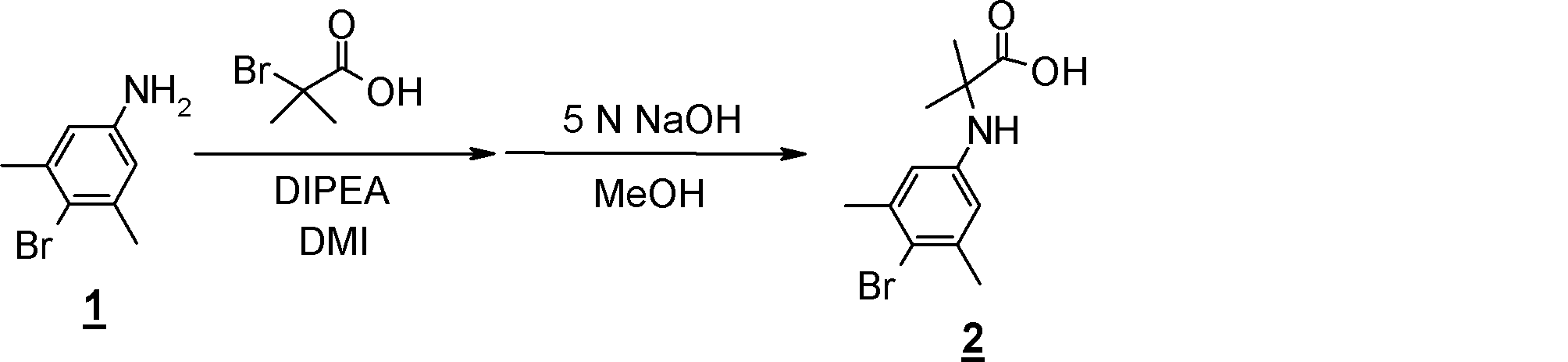
反応混合物にMeOH(52ml)と5N水酸化ナトリウム水溶液(52ml,260mmol)を室温にて加えた後、この混合物を75度Cにて1.5時間加熱攪拌した。反応混合物を冷却後、水を加え、1N硫酸水素カリウム水溶液でpH5とし、酢酸エチルで抽出した。有機層を水で洗浄後、無水硫酸マグネシウムで乾燥、濃縮し、2-((4-ブロモ-3,5-ジメチルフェニル)アミノ)-2-メチルプロパン酸を粗生成物として得た(5.79g)。
MS(ESI) m/z = 286, 288 (M+H)+

MS(ESI) m/z = 311, 313 (M+H)+
MS(ESI) m/z = 464 (M+H)+

MS(ESI) m/z = 420 (M+H)+

1H-NMR (300MHz, DMSO-d6) δ: 1.3 (6H, s), 1.7 (2H, m), 2.0 (2H, m), 2.3 (6H, s), 2.7 (2H, s), 2.9 (2H, m), 3.4 (2H, m), 6.9 (1H, d, J = 15.9 Hz), 7.1 (2H, s), 7.4 (1H, d, J = 15.9 Hz), 11.2 (1H, brs)

MS(ESI) m/z = 464 (M+H)+

MS(ESI) m/z = 466 (M+H)+

MS(ESI) m/z = 672 (M+H)+

MS(ESI) m/z = 654 (M+H)+。1H-NMR (400MHz, CD3OD) δ: 1.40 (6H, s), 1.71-1.80 (2H, m), 2.00-2.08 (2H, m), 2.43 (6H, s), 3.22 (4H, s), 3.47-3.57 (2H, m), 3.80-3.88 (2H, m), 7.01 (2H, s), 7.50-7.57 (1H, m), 7.97-8.04 (1H, m), 8.05-8.12 (1H, m)
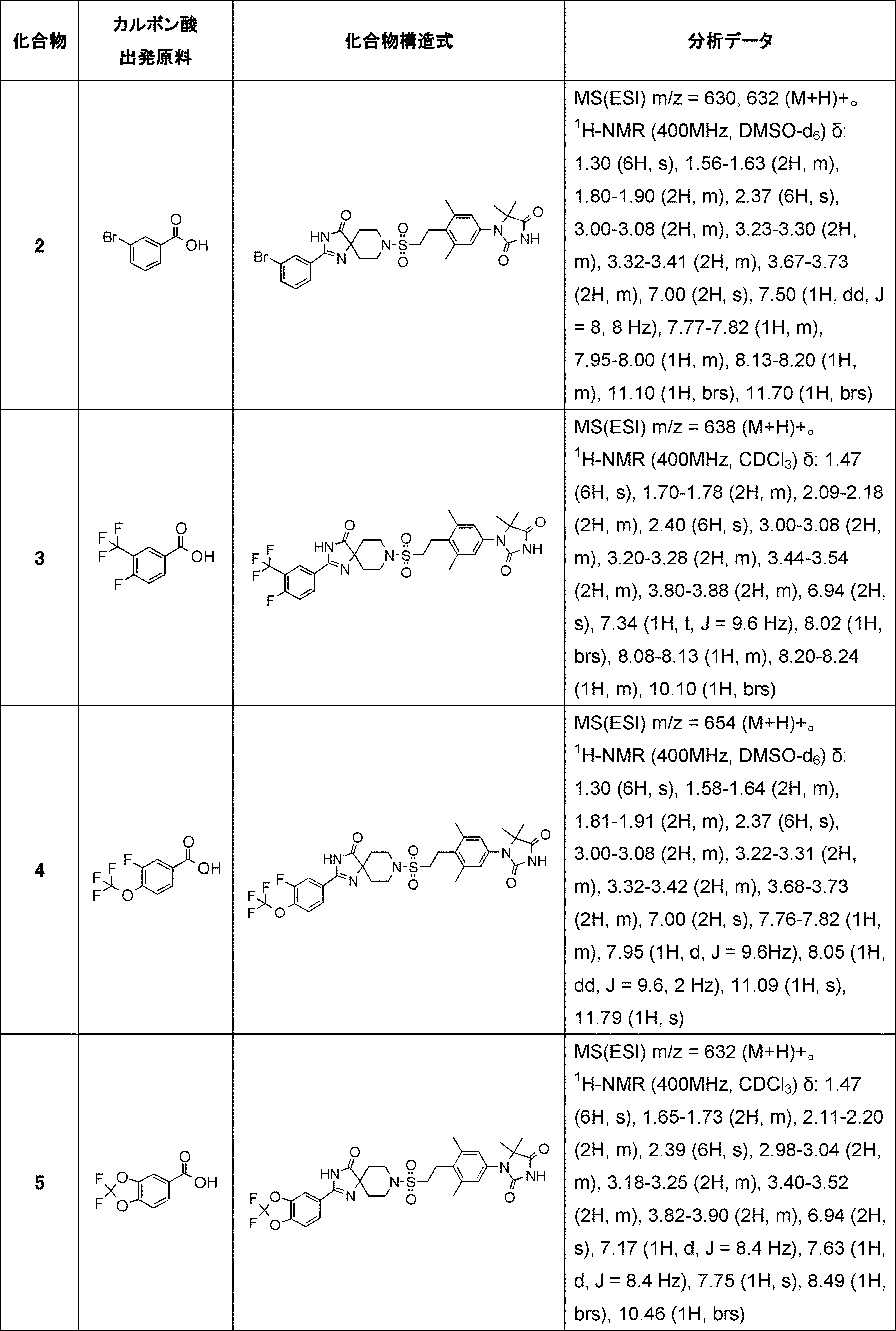
1-(3,5-ジメチル-4-(2-((4-オキソ-2-(3-(トリフルオロメチル)フェニル)-1,3,8-トリアザスピロ[4.5]デカ-1-エン-8-イル)スルホニル)エチル)フェニル)-5,5-ジメチルイミダゾリジン-2,4-ジオン(化合物6)
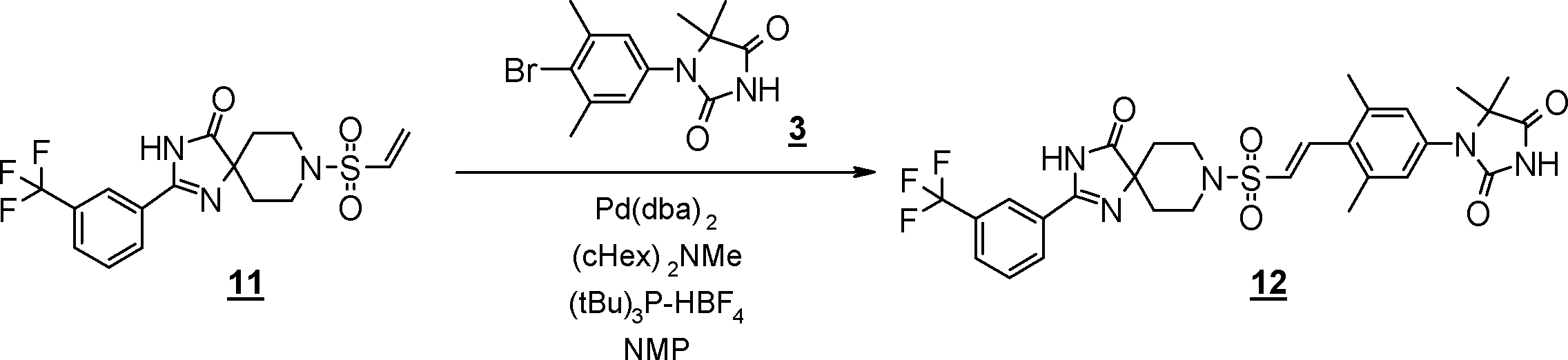
MS(ESI) m/z = 618 (M+H)+。

MS(ESI) m/z = 620 (M+H)+。1H-NMR (400MHz, CD3OD) δ: 1.40 (6H, s), 1.72-1.81 (2H, m), 2.00-2.10 (2H, m), 2.44 (6H, s), 3.22 (4H, s), 3.50-3.58 (2H, m), 3.80-3.88 (2H, m), 7.01 (2H, s), 7.72-7.79 (1H, m), 7.88-7.94 (1H, m), 8.16-8.23 (1H, m), 8.31 (1H, s)
1-(3,5-ジメチル-4-(2-((4-オキソ-2-(4-(トリフルオロメトキシ)フェニル)-1,3,8-トリアザスピロ[4.5]デカ-1-エン-8-イル)スルホニル)エチル)フェニル)-5,5-ジメチルイミダゾリジン-2,4-ジオン(化合物7)
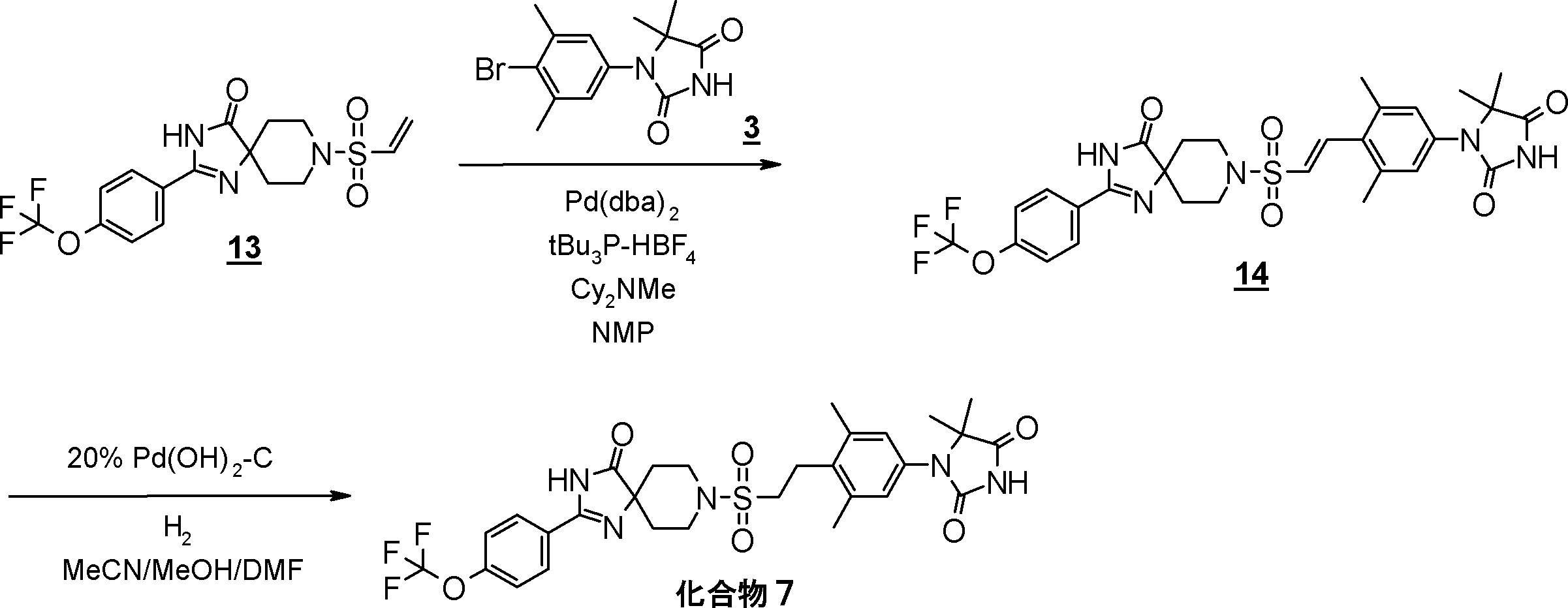
MS(ESI) m/z = 636 (M+H)+。1H-NMR (400MHz, CDCl3) δ: 1.47 (6H, s), 1.70-1.78 (2H, m), 2.10-2.19 (2H, m), 2.40 (6H, s), 3.00-3.07 (2H, m), 3.19-3.25 (2H, m), 3.45-3.53 (2H, m), 3.81-3.88 (2H, m), 6.94 (2H, s), 7.35 (2H, d, J = 8.0 Hz), 7.73 (1H, brs), 7.93 (2H, d, J = 8.0 Hz), 9.37 (1H, brs)
1-(3,5-ジメチル-4-(2-((4-オキソ-2-(4-(トリフルオロメトキシ)フェニル)-1,3,8-トリアザスピロ[4.5]デカ-1-エン-8-イル)スルホニル)エチル)フェニル)-1,3-ジアザスピロ[4.4]ノナン-2,4-ジオン(化合物8)

1H-NMR (400MHz, CDCl3) δ: 1.83-1.92 (4H, m), 2.07-2.15 (2H, m), 2.33-2.42 (2H, m), 2.37 (6H, m), 3.71 (1H, brs), 6.56 (2H, s)

反応混合液に、トリエチルアミン(0.103ml,0.742mmol)、水(0.045ml)およびメタノール(0.10ml)を順次加えた後、混合物を窒素気流下、1.5時間加熱還流した。反応混合物を冷却後、水で希釈し、1N塩酸水溶液でpH5とした後、ジクロロメタンで抽出した。有機層を水、飽和食塩水で順次洗浄後、無水硫酸ナトリウムで乾燥、減圧下濃縮し1-(4-ブロモ-3,5-ジメチルフェニル)-4-イミノ-1,3-ジアザスピロ[4.4]ノナン-2-オンを粗生成物として得た。
MS(ESI) m/z = 336, 338 (M+H)+。

MS(ESI) m/z = 337, 339 (M+H)+。
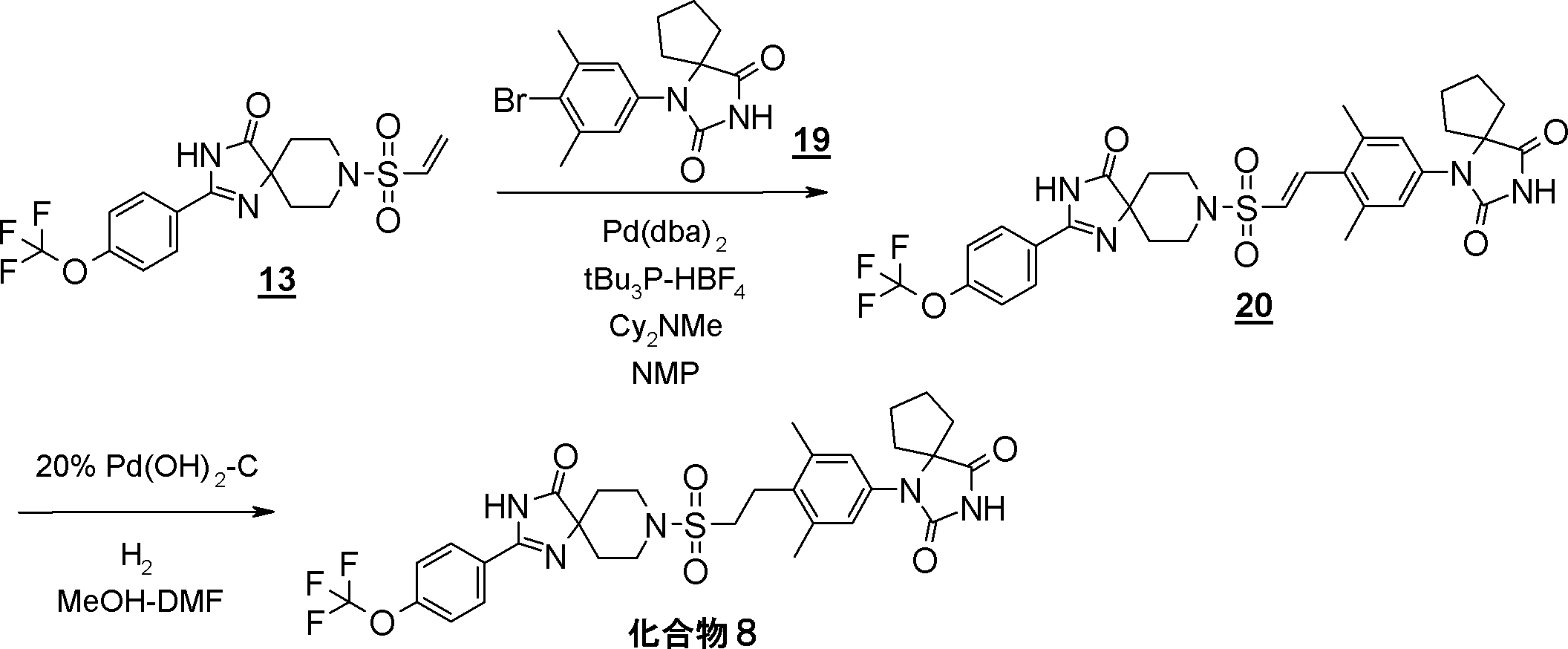
MS(ESI) m/z = 662 (M+H)+。1H-NMR (400MHz, DMSO-d6) δ: 1.36-1.44 (2H, m), 1.60-1.70 (4H. m), 1.82-1.91 (2H, m), 1.91-2.06 (4H, m), 2.38 (6H, s), 3.01-3.09 (2H, m), 3.22-3.30 (2H, m), 3.30-3.42 (2H, m), 3.70-3.77 (2H, m), 7.03 (2H, s), 7.57 (2H, d, J = 8.4 Hz), 8.14 (2H, d, J = 8.4 Hz)
1-(3,5-ジメチル-4-(2-((4-オキソ-2-(4-(トリフルオロメトキシ)フェニル)-1,3,8-トリアザスピロ[4.5]デカ-1-エン-8-イル)スルホニル)エチル)フェニル)-8-メチル-1,3,8-トリアザスピロ[4.5]デカン-2,4-ジオン(化合物9)

MS(ESI) m/z = 777 (M+H)+。
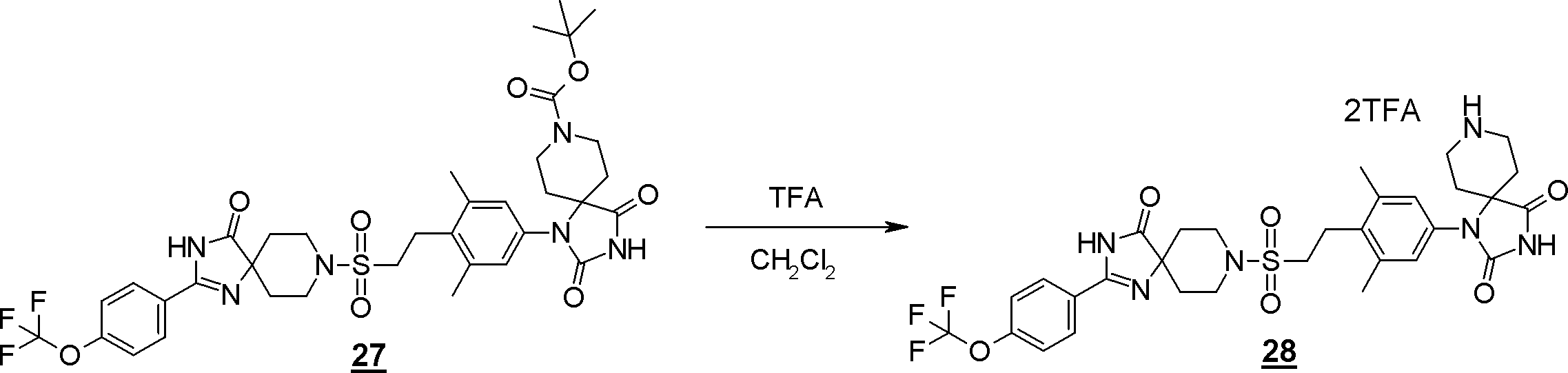
MS(ESI) m/z = 677 (M+H)+。

MS(ESI) m/z = 691 (M+H)+。1H-NMR (400MHz, CD3OD) δ: 1.76-1.84 (2H, m), 1.92-2.02 (2H, m), 2.02-2.12 (4H, m), 2.38 (3H, s), 2.46 (6H, s), 2.81-2.88 (2H, m), 2.92-3.02 (2H, m), 3.23 (4H, s), 3.51-3.60 (2H, m), 3.72-3.80 (2H, m), 7.01 (2H, s), 7.48 (2H, d, J = 8.0 Hz), 8.10 (2H, d, J = 8.0 Hz)
5-(3,5-ジメチル-4-(2-((4-オキソ-2-(4-(トリフルオロメトキシ)フェニル)-1,3,8-トリアザスピロ[4.5]デカ-1-エン-8-イル)スルホニル)エチル)フェニル)-2-オキサ-5,7-ジアザスピロ[3.4]オクタン-6,8-ジオン(化合物10)
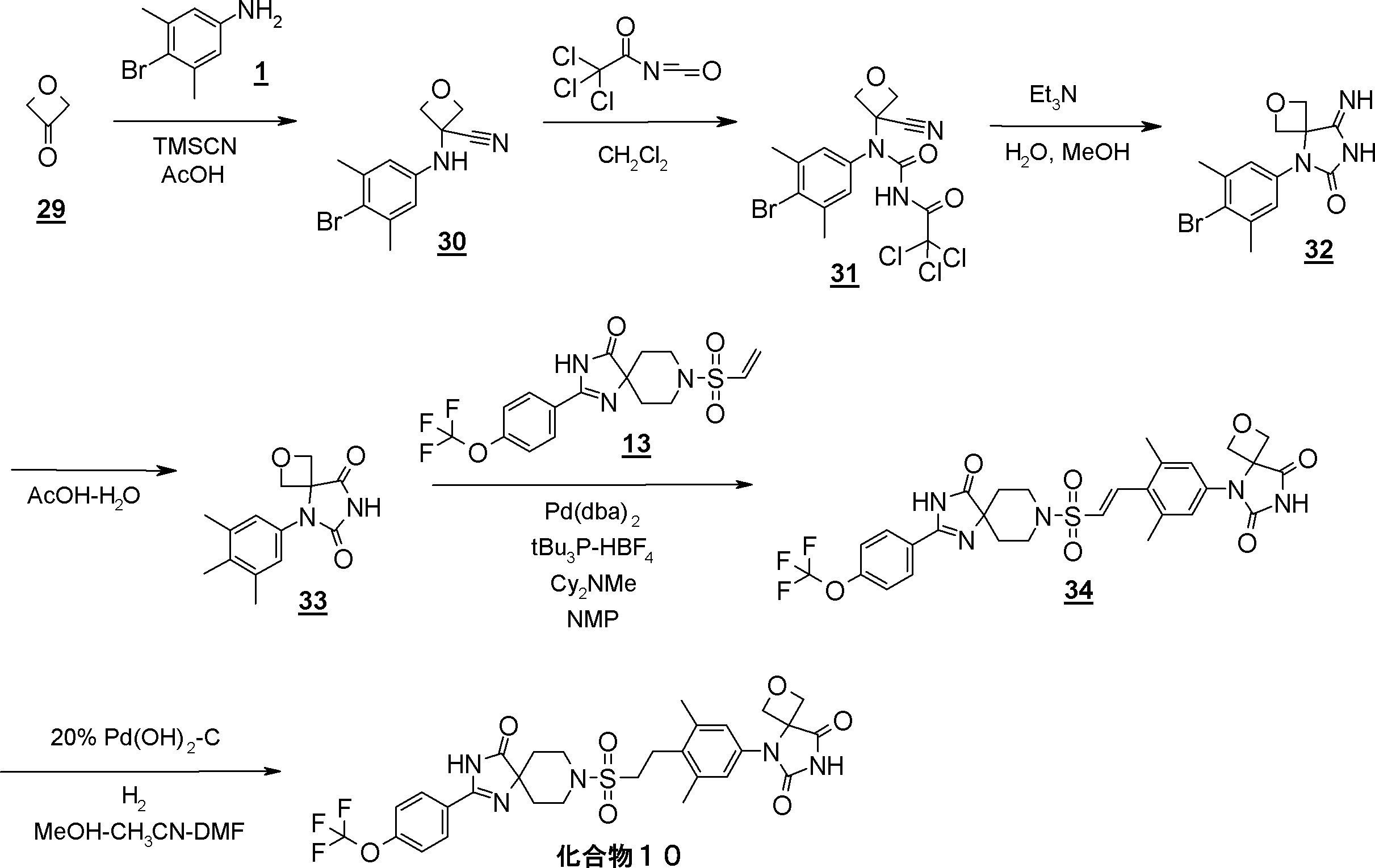
MS(ESI) m/z = 650 (M+H)+。1H-NMR (400MHz, CDCl3) δ: 1.69-1.77 (2H, m), 2.12-2.22 (2H, m), 2.45 (6H, s), 3.03-3.11 (2H, m), 3.22-3.29 (2H, m), 3.46-3.53 (2H, m), 3.84-3.91 (2H, m), 4.86 (2H, d, J = 7.2 Hz), 5.03 (2H, d, J = 7.2 Hz), 7.07 (2H, s), 7.35 (2H, d, J = 8.4 Hz), 7.98 (2H, d, J = 8.4 Hz), 8.56 (1H, s), 10.34 (1H, s)
4-(3,5-ジメチル-4-(2-((4-オキソ-2-(4-(トリフルオロメトキシ)フェニル)-1,3,8-トリアザスピロ[4.5]デカ-1-エン-8-イル)スルホニル)エチル)フェニル)-4,6-ジアザスピロ[2.4]ヘプタン-5,7-ジオン(化合物11)

MS(ESI) m/z = 284, 286 (M+H)+。

MS(ESI) m/z = 309, 311 (M+H)+。
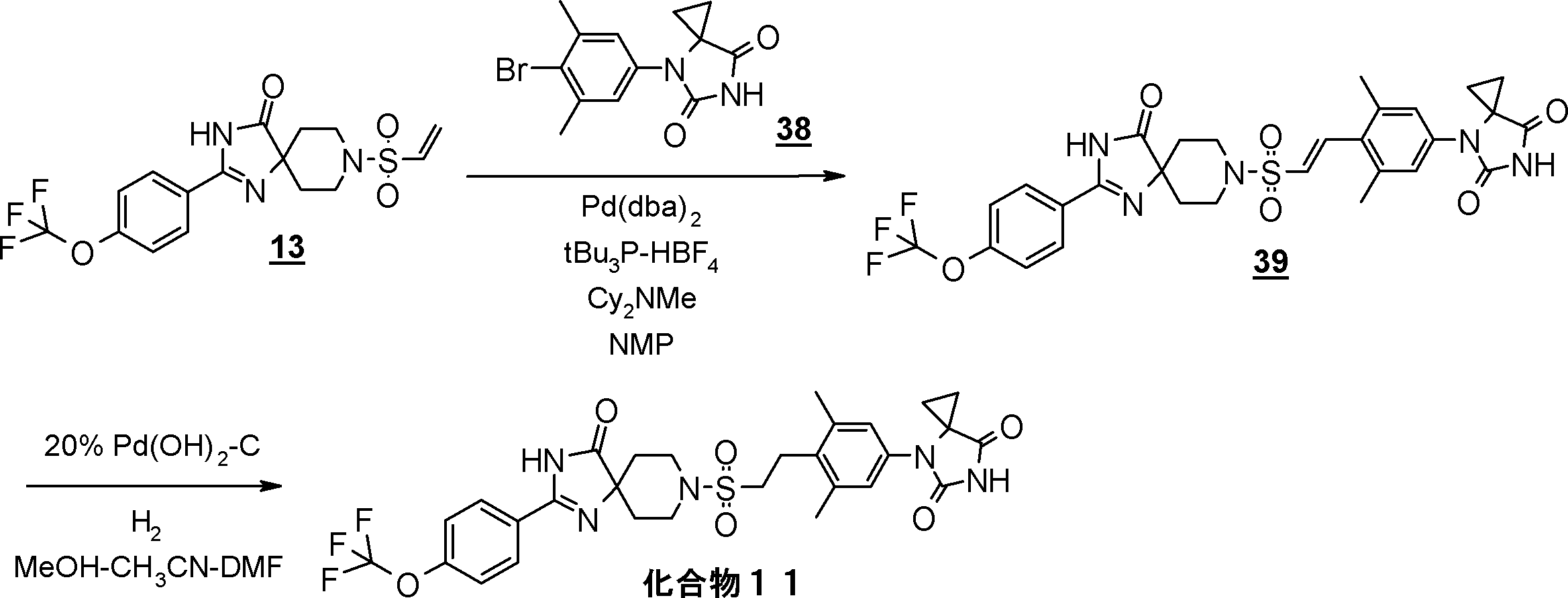
MS(ESI) m/z = 634 (M+H)+。1H-NMR (400MHz, DMSO-d6) δ: 0.99-1.03 (2H, m), 1.19-1.27 (4H, m), 1.58-1.64 (2H, m), 1.81-1.90 (2H, m), 2.35 (6H, s), 2.99-3.04 (2H, m), 3.22-3.29 (2H, m), 3.67-3.73 (2H, m), 6.95 (2H, s), 7.56 (2H, d, J = 8.4 Hz), 8.12 (2H, d, J = 8.4 Hz)
1-(3,5-ジメチル-4-(2-((4-オキソ-2-(3-(トリフルオロメチル)フェニル)-1,3,8-トリアザスピロ[4.5]デカ-1-エン-8-イル)スルホニル)エチル)フェニル)-1,3-ジアザスピロ[4.4]ノナン-2,4-ジオン(化合物12)
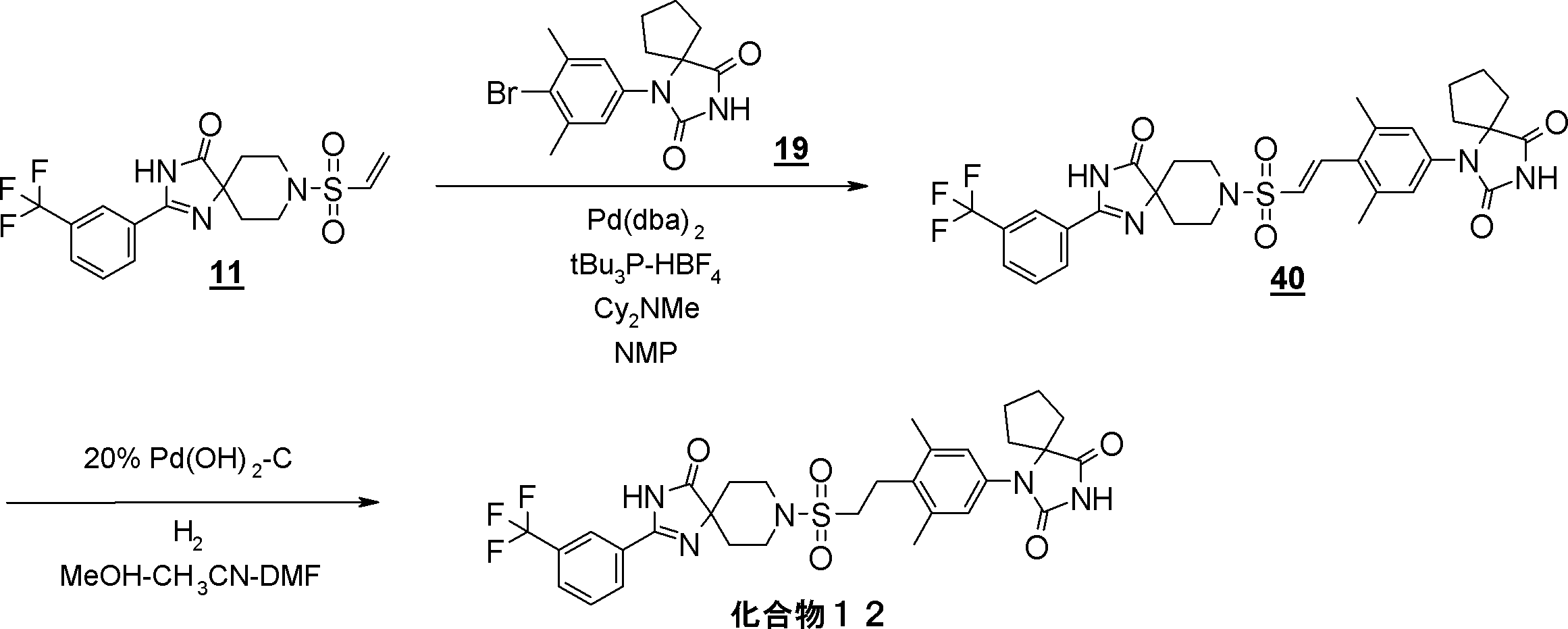
MS(ESI) m/z = 646 (M+H)+。1H-NMR (400MHz, DMSO-d6) δ: 1.40-1.48 (2H, m), 1.62-1.71 (4H, m), 1.88-1.97 (2H, m), 1.97-2.08 (4H, m), 2.41 (6H, s), 3.03-3.10 (2H, m), 2.29-3.34 (2H, m), 3.38-3.47 (2H, m), 3.72-3.79 (2H, m), 7.06 (2H, s), 7.84 (1H, dd, J = 7.6, 7.6 Hz), 8.02 (1H, d, J = 7.6 Hz), 8.33 (1H, d, J = 7.6 Hz), 8.38 (1H, s)
本発明の化合物について、ヒトPTH1Rを介するcAMP産生能、ラット受容体を介するcAMP産生能、ヒト肝ミクロソームを用いた代謝安定性、ラット肝細胞を用いた代謝安定性、TPTXラットモデルでの血清Ca濃度上昇作用、に対する各試験結果を試験例1~5に示す。尚、比較化合物として、表2に示すWO2010/126030A1に記載の化合物を用いた。

(ペプチド)
ヒトPTH(1-34)およびカルシトニンはペプチド研究所(日本、大阪)より購入して、10mM酢酸に溶解して1mMとし、-80℃冷凍庫で保存した。
(細胞培養)
細胞は、10%ウシ胎児血清(Hyclone)、100単位/mlペニシリンG、および100μg/ml硫酸ストレプトマイシン(Invitrogen Corp)を添加したダルベッコ改変イーグル培地(DMEM)中で、5%CO2含有加湿雰囲気下、37℃で培養した。
PTH1Rを発現していないLLC-PK1細胞、および、LLC-PK1の1細胞あたり9.5×10⁵個のヒトPTH1Rを過剰発現するHKRK-B7を、cAMPシグナル伝達分析に用いた(Takasu et al., J. Bone. Miner. Res. 14:11-20, 1999)。
(cAMP刺激)
HKRK-B7またはLLC-PK1細胞を1X10⁵細胞/ウェルで96ウェルプレートに播種し、一晩インキュベーションした。翌日、次にヒトPTH(1-34)または化合物を含む50μlのcAMPアッセイ緩衝液(DMEM、2mM IBMX、0.2mg/mlウシ血清アルブミン、35mM Hepes-NaOH、pH7.4)を加え、37℃のインキュベーター中に置き、20分間インキュベーションした。培地を除去した後、細胞を100μlのcAMPアッセイ緩衝液で1回洗浄した。細胞を凍結させるためにプレートをドライアイス粉末上に置き、その後ドライアイスから取り出した。40μlの50mM HClを用いて細胞を融解させ、ドライアイス上で再度凍結させた。市販のcAMP EIAキット(Biotrack cAMP EIA system, GE health care)を用いて細胞内cAMPの産生量を測定した。
可変勾配によるS字形用量反応式を用いて解析し、100nMでのヒトPTH(1-34)のcAMPシグナル活性を100%として、各化合物が20%もしくは50%のcAMPシグナル活性を示す濃度をEC20もしくはEC50として算出した。
HKRK-B7細胞における結果を表3に示す。
なお、LLC-PK1細胞においてのcAMP応答の程度はHKRK-B7細胞での程度に比べ低いものであった。
HKRK-B7細胞の代わりに中外製薬で樹立したラットPTH1Rを過剰発現するLLC-PK46_RATO_PTH1R細胞を用いて試験例1と同様に測定を行った。
LLC-PK46_RATO_PTH1R細胞を用いた結果を表4に示す。
ラットPTH1受容体におけるインビトロcAMPシグナル活性のEC20値は、ヒトPTH1RにおけるインビトロcAMPシグナル活性のEC20値と良好な相関関係にあった。EC50値についても、ラットとヒトの間で良好な相関関係にあった。
0.1Mリン酸緩衝液(pH7.4)中、ヒト肝ミクロゾームと化合物あるいは比較例をNADPH共存下37℃で所定の時間インキュベーションした。各反応時間における親化合物濃度をLC/MS/MSを用いて測定し、反応時間に対する残存率の傾きから固有クリアランス(μL/min/mg protein)を算出した。
化合物濃度: 1μM
ミクロゾーム: 0.5mg/mL
NADPH: 1mM
反応時間: 0、5、15および30分
ラット(SD、♀)の肝臓からコラゲナーゼ還流法により肝細胞を調製した。実施例化合物あるいは比較例を添加して37℃で所定の時間インキュベーションした後反応停止液を添加した。各反応時間における親化合物濃度をLC/MS/MSを用いて測定し、反応時間に対する残存率の傾きから固有クリアランス(μL/106cells/min)を算出した。
細胞濃度: 1×10⁶cells/mL
化合物濃度: 1μM
培地: Williams' medium E
反応時間: 0、15、30、60、120および240分
反応停止液: アセトニトリル/2-プロパノール(4/6、v/v)

4週齢の雌性Crl:CD(SD)ラットを日本チャールス・リバー株式会社(厚木飼育センター)より入手し、20~26℃、湿度35~75%の標準実験室条件下で1週間順化させた。ラットには、水道水ならびに1.1%カルシウム、1.0%リン酸および250IU/100gのビタミンD3を含む標準げっ歯動物飼料(CE-2)(日本クレア株式会社)を自由に摂取させた。
5週齢のラットにTPTXを実施した。一部の個体には、偽手術(Sham)を実施した。使用するためのTPTXラットは、手術4日後の血清Ca濃度が8mg/dL未満の個体を選択した。手術5日後に、手術4日後に測定した血清Ca濃度と体重に基づき、各群5匹ずつ8つのTPTX群と1つのSham群に振り分けた。Sham群およびTPTX-Vehicle群には、溶媒のみを10mL/kgの用量で経口投与した。TPTX-各検体群には、各検体30 mg/10mL/kgの用量で溶媒に溶解させてそれぞれ経口投与した。溶媒の組成は、10%ジメチルスルホキシド(和光純薬工業株式会社)、10%クレモフォールEL(シグマ アルドリッチ ジャパン合同会社)、20%ヒドロキシプロピル‐β‐シクロデキストリン(日本食品化工株式会社)、グリシン(和光純薬工業株式会社)によりpH10に調製したものを使用した。各々の投与直前にPre採血をし、投与2、6、10および24時間後にも採血を実施して血清Ca濃度を測定した。各血液採取はイソフルラン吸入麻酔下にて頸静脈から行った。
Claims (16)
- 下記一般式(1)で表される化合物またはその薬理学的に許容される塩;

R1およびR2は、R1とR2が共に水素ではないとの条件の下、それぞれ独立して
1)水素、
2)ハロゲン原子、
3)1~5個のフッ素原子で置換されていてもよい炭素数1~2個のアルキル基、または
4)1~5個のフッ素原子で置換されていてもよい炭素数1~2個のアルコキシ基
であるか;または、
R1およびR2は、互いに結合して形成される下記式:

かつ、R3およびR4は、それぞれ独立して1~3個のフッ素原子で置換されていてもよいメチル基であるか;または、
R3およびR4は、それらが結合する炭素原子と一緒になって炭素数3~6の環(ここで、環を形成する炭素原子のうち一つは酸素原子;硫黄原子;またはメチル基で置換されていてもよい窒素原子で置換されていてもよい。)を形成する。〕。 - R1およびR2は以下の組み合わせから選択され:
1)R1が水素原子、またはハロゲン原子であり、かつR2が水素原子、トリフルオロメチル基、またはトリフルオロメトキシ基である(但し、R1とR2が共に水素原子となる場合を除く);
2)R1がトリフルオロメチル基、またはトリフルオロメトキシ基であり、かつR2が水素原子、またはハロゲン原子である;
3)R1およびR2が互いに結合して形成される下記式:

かつ、R3およびR4は、メチル基であるか;または、
R3およびR4はそれらが結合する炭素原子と一緒になって以下から選択される環:

- R1、R2は以下の組み合わせから選択され:
1)R1がトリフルオロメトキシ基であり、かつR2がフッ素原子である;
2)R1が臭素原子であり、かつR2が水素原子である;
3)R1がトリフルオロメチル基であり、かつR2がフッ素原子である;
4)R1がフッ素原子であり、かつR2がトリフルオロメトキシ基である;
5)R1がトリフルオロメチル基であり、かつR2が水素原子である;
6)R1が水素原子であり、かつR2がトリフルオロメトキシ基である;
7)R1、R2は互いに結合して形成される下記式:

かつ、R3およびR4はメチル基であるか;または、
R3およびR4はそれらが結合する炭素原子と一緒になって以下から選択される環:

請求項1記載の化合物またはその薬理学的に許容される塩。 - R3およびR4がメチル基である、請求項1に記載の化合物またはその薬理学的に許容される塩。
- R3およびR4がそれらが結合する炭素原子と一緒になって以下から選択される環:

- 化合物が以下からなる群より選択される、請求項1記載の化合物またはその薬理学的に許容される塩:
1-(4-(2-((2-(4-フルオロ-3-(トリフルオロメトキシ)フェニル)-4-オキソ-1,3,8-トリアザスピロ[4.5]デカ-1-エン-8-イル)スルホニル)エチル)-3,5-ジメチルフェニル)-5,5-ジメチルイミダゾリジン-2,4-ジオン;
1-(4-(2-((2-(3-ブロモフェニル)-4-オキソ-1,3,8-トリアザスピロ[4.5]デカ-1-エン-8-イル)スルホニル)エチル)-3,5-ジメチルフェニル)-5,5-ジメチルイミダゾリジン-2,4-ジオン:
1-(4-(2-((2-(4-フルオロ-3-(トリフルオロメチル)フェニル)-4-オキソ-1,3,8-トリアザスピロ[4.5]デカ-1-エン-8-イル)スルホニル)エチル)-3,5-ジメチルフェニル)-5,5-ジメチルイミダゾリジン-2,4-ジオン;
1-(4-(2-((2-(3-フルオロ-4-(トリフルオロメトキシ)フェニル)-4-オキソ-1,3,8-トリアザスピロ[4.5]デカ-1-エン-8-イル)スルホニル)エチル)-3,5-ジメチルフェニル)-5,5-ジメチルイミダゾリジン-2,4-ジオン;
1-(4-(2-((2-(2,2-ジフルオロベンゾ[d][1,3]ジオキソール-5-イル)-4-オキソ-1,3,8-トリアザスピロ[4.5]デカ-1-エン-8-イル)スルホニル)エチル)-3,5-ジメチルフェニル)-5,5-ジメチルイミダゾリジン-2,4-ジオン;
1-(3,5-ジメチル-4-(2-((4-オキソ-2-(3-(トリフルオロメチル)フェニル)-1,3,8-トリアザスピロ[4.5]デカ-1-エン-8-イル)スルホニル)エチル)フェニル)-5,5-ジメチルイミダゾリジン-2,4-ジオン;
1-(3,5-ジメチル-4-(2-((4-オキソ-2-(4-(トリフルオロメトキシ)フェニル)-1,3,8-トリアザスピロ[4.5]デカ-1-エン-8-イル)スルホニル)エチル)フェニル)-5,5-ジメチルイミダゾリジン-2,4-ジオン):
1-(3,5-ジメチル-4-(2-((4-オキソ-2-(4-(トリフルオロメトキシ)フェニル)-1,3,8-トリアザスピロ[4.5]デカ-1-エン-8-イル)スルホニル)エチル)フェニル)-1,3-ジアザスピロ[4.4]ノナン-2,4-ジオン;
1-(3,5-ジメチル-4-(2-((4-オキソ-2-(4-(トリフルオロメトキシ)フェニル)-1,3,8-トリアザスピロ[4.5]デカ-1-エン-8-イル)スルホニル)エチル)フェニル)-8-メチル-1,3,8-トリアザスピロ[4.5]デカン-2,4-ジオン;
5-(3,5-ジメチル-4-(2-((4-オキソ-2-(4-(トリフルオロメトキシ)フェニル)-1,3,8-トリアザスピロ[4.5]デカ-1-エン-8-イル)スルホニル)エチル)フェニル)-2-オキサ-5,7-ジアザスピロ[3.4]オクタン-6,8-ジオン;および
4-(3,5-ジメチル-4-(2-((4-オキソ-2-(4-(トリフルオロメトキシ)フェニル)-1,3,8-トリアザスピロ[4.5]デカ-1-エン-8-イル)スルホニル)エチル)フェニル)-4,6-ジアザスピロ[2.4]ヘプタン-5,7-ジオン。 - 化合物が1-(3,5-ジメチル-4-(2-((4-オキソ-2-(3-(トリフルオロメチル)フェニル)-1,3,8-トリアザスピロ[4.5]デカ-1-エン-8-イル)スルホニル)エチル)フェニル)-5,5-ジメチルイミダゾリジン-2,4-ジオンである、請求項1記載の化合物またはその薬理学的に許容される塩。
- 化合物が1-(3,5-ジメチル-4-(2-((4-オキソ-2-(4-(トリフルオロメトキシ)フェニル)-1,3,8-トリアザスピロ[4.5]デカ-1-エン-8-イル)スルホニル)エチル)フェニル)-5,5-ジメチルイミダゾリジン-2,4-ジオンである、請求項1記載の化合物またはその薬理学的に許容される塩。
- 化合物が1-(3,5-ジメチル-4-(2-((4-オキソ-2-(4-(トリフルオロメトキシ)フェニル)-1,3,8-トリアザスピロ[4.5]デカ-1-エン-8-イル)スルホニル)エチル)フェニル)-1,3-ジアザスピロ[4.4]ノナン-2,4-ジオンである、請求項1記載の化合物またはその薬理学的に許容される塩。
- 請求項1~9のいずれかに記載の化合物またはその薬理学的に許容される塩を有効成分として含有する、医薬組成物。
- 医薬組成物が経口投与用である、請求項10に記載の医薬組成物。
- 請求項1~9のいずれかに記載の化合物またはその薬理学的に許容される塩を有効成分として含有する、細胞内cAMP応答を活性化するための医薬組成物。
- 請求項1~9のいずれかに記載の化合物またはその薬理学的に許容される塩を有効成分として含有する、骨粗鬆症、骨折、無形成骨症、軟骨無形成症、軟骨低形成症、骨軟化症、変形性関節症、関節炎、血小板減少症、副甲状腺機能低下症、高リン血症、または腫瘍状石灰沈着症の予防剤もしくは治療剤、または幹細胞動員剤。
- 請求項1~9のいずれかに記載の化合物またはその薬理学的に許容される塩を含有する組成物の医薬的に有効な量を、骨粗鬆症、骨折、無形成骨症、軟骨無形成症、軟骨低形成症、骨軟化症、変形性関節症、関節炎、血小板減少症、副甲状腺機能低下症、高リン血症、または腫瘍状石灰沈着症の予防もしくは治療、または幹細胞動員を必要とする患者に投与することからなる、該疾患の予防もしくは治療、または幹細胞動員方法。
- 骨粗鬆症骨粗鬆症、骨折、無形成骨症、軟骨無形成症、軟骨低形成症、骨軟化症、変形性関節症、関節炎、血小板減少症、副甲状腺機能低下症、高リン血症、または腫瘍状石灰沈着症の予防剤もしくは治療剤、または幹細胞動員剤の製造のための、請求項1~9のいずれかに記載の化合物またはその薬理学的に許容される塩の使用。
- 骨粗鬆症、骨折、無形成骨症、軟骨無形成症、軟骨低形成症、骨軟化症、変形性関節症、関節炎、血小板減少症、副甲状腺機能低下症、高リン血症、または腫瘍状石灰沈着症の治療もしくは予防、または幹細胞動員のための、請求項1~9のいずれかに記載の化合物またはその薬理学的に許容される塩。
Priority Applications (32)
| Application Number | Priority Date | Filing Date | Title |
|---|---|---|---|
| MX2015007309A MX2015007309A (es) | 2012-12-10 | 2013-12-10 | Derivado de hidantoina. |
| NZ70794613A NZ707946A (en) | 2012-12-10 | 2013-12-10 | Hydantoin derivative |
| NO13862318A NO2930176T3 (ja) | 2012-12-10 | 2013-12-10 | |
| KR1020157017844A KR102168738B1 (ko) | 2012-12-10 | 2013-12-10 | 히단토인 유도체 |
| UAA201504548A UA115072C2 (uk) | 2012-12-10 | 2013-12-10 | Похідні гідантоїну |
| JP2014552040A JP5951799B2 (ja) | 2012-12-10 | 2013-12-10 | ヒダントイン誘導体 |
| HRP20180647TT HRP20180647T1 (hr) | 2012-12-10 | 2013-12-10 | Derivat hidantoina |
| EP13862318.6A EP2930176B1 (en) | 2012-12-10 | 2013-12-10 | Hydantoin derivative |
| PL13862318T PL2930176T3 (pl) | 2012-12-10 | 2013-12-10 | Pochodna hydantoiny |
| HK15110436.4A HK1209735B (en) | 2012-12-10 | 2013-12-10 | Hydantoin derivative |
| DK13862318.6T DK2930176T3 (en) | 2012-12-10 | 2013-12-10 | hydantoin derivatives |
| CN201380064459.1A CN104854106B (zh) | 2012-12-10 | 2013-12-10 | 乙内酰脲衍生物 |
| LTEP13862318.6T LT2930176T (lt) | 2012-12-10 | 2013-12-10 | Hidantoino dariniai |
| MA38250A MA38250B1 (fr) | 2012-12-10 | 2013-12-10 | Nouveau dérivés d'hydantoïne pour leurs utilisations dans le traitement de maladies, comme l'osteoporose et la thrombocytopenie |
| BR112015012411-9A BR112015012411B1 (pt) | 2012-12-10 | 2013-12-10 | Derivado de hidantoína, seu uso, composição farmacêutica e agente de mobilização de célulatronco, ou um agente para prevenção ou tratamento de doenças |
| RU2015127624A RU2678984C2 (ru) | 2012-12-10 | 2013-12-10 | Производное гидантоина |
| CA2892621A CA2892621C (en) | 2012-12-10 | 2013-12-10 | Hydantoin derivative |
| AU2013358167A AU2013358167B2 (en) | 2012-12-10 | 2013-12-10 | Hydantoin derivative |
| SG11201504204XA SG11201504204XA (en) | 2012-12-10 | 2013-12-10 | Hydantoin derivative |
| SI201331009T SI2930176T1 (en) | 2012-12-10 | 2013-12-10 | HIDANTOIN DERIVATIVES |
| ES13862318.6T ES2663797T3 (es) | 2012-12-10 | 2013-12-10 | Derivados de hidantoína |
| US14/426,408 US9428505B2 (en) | 2012-12-10 | 2013-12-10 | Hydantoin derivative |
| RS20180517A RS57190B1 (sr) | 2012-12-10 | 2013-12-10 | Derivat hidantoina |
| IL238277A IL238277B (en) | 2012-12-10 | 2015-04-14 | A consequence of hydantoin |
| CR20150272A CR20150272A (es) | 2012-12-10 | 2015-05-21 | Derivado de hidantoina |
| ZA2015/03597A ZA201503597B (en) | 2012-12-10 | 2015-05-21 | Hydantoin derivative |
| PH12015501146A PH12015501146B1 (en) | 2012-12-10 | 2015-05-22 | Hydantoin derivative |
| SA515360528A SA515360528B1 (ar) | 2012-12-10 | 2015-06-04 | مشتق هيدانتوين |
| US15/214,729 US20160326175A1 (en) | 2012-12-10 | 2016-07-20 | Hydantoin derivative |
| US15/848,267 US20180237436A1 (en) | 2012-12-10 | 2017-12-20 | Hydantoin derivative |
| US16/805,204 US20210024524A1 (en) | 2012-12-10 | 2020-02-28 | Hydantoin derivative |
| US17/330,200 US20220162208A1 (en) | 2012-12-10 | 2021-05-25 | Hydantoin derivative |
Applications Claiming Priority (2)
| Application Number | Priority Date | Filing Date | Title |
|---|---|---|---|
| JP2012-269178 | 2012-12-10 | ||
| JP2012269178 | 2012-12-10 |
Related Child Applications (2)
| Application Number | Title | Priority Date | Filing Date |
|---|---|---|---|
| US14/426,408 A-371-Of-International US9428505B2 (en) | 2012-12-10 | 2013-12-10 | Hydantoin derivative |
| US15/214,729 Continuation US20160326175A1 (en) | 2012-12-10 | 2016-07-20 | Hydantoin derivative |
Publications (1)
| Publication Number | Publication Date |
|---|---|
| WO2014092061A1 true WO2014092061A1 (ja) | 2014-06-19 |
Family
ID=50934349
Family Applications (1)
| Application Number | Title | Priority Date | Filing Date |
|---|---|---|---|
| PCT/JP2013/083022 Ceased WO2014092061A1 (ja) | 2012-12-10 | 2013-12-10 | ヒダントイン誘導体 |
Country Status (34)
| Country | Link |
|---|---|
| US (5) | US9428505B2 (ja) |
| EP (1) | EP2930176B1 (ja) |
| JP (1) | JP5951799B2 (ja) |
| KR (1) | KR102168738B1 (ja) |
| CN (1) | CN104854106B (ja) |
| AU (1) | AU2013358167B2 (ja) |
| BR (1) | BR112015012411B1 (ja) |
| CA (1) | CA2892621C (ja) |
| CL (2) | CL2015001391A1 (ja) |
| CR (1) | CR20150272A (ja) |
| DK (1) | DK2930176T3 (ja) |
| ES (1) | ES2663797T3 (ja) |
| HR (1) | HRP20180647T1 (ja) |
| HU (1) | HUE037530T2 (ja) |
| IL (1) | IL238277B (ja) |
| LT (1) | LT2930176T (ja) |
| MA (1) | MA38250B1 (ja) |
| MX (1) | MX2015007309A (ja) |
| MY (1) | MY178583A (ja) |
| NO (1) | NO2930176T3 (ja) |
| NZ (1) | NZ707946A (ja) |
| PE (1) | PE20151295A1 (ja) |
| PH (1) | PH12015501146B1 (ja) |
| PL (1) | PL2930176T3 (ja) |
| PT (1) | PT2930176T (ja) |
| RS (1) | RS57190B1 (ja) |
| RU (1) | RU2678984C2 (ja) |
| SA (1) | SA515360528B1 (ja) |
| SG (1) | SG11201504204XA (ja) |
| SI (1) | SI2930176T1 (ja) |
| TW (1) | TWI615394B (ja) |
| UA (1) | UA115072C2 (ja) |
| WO (1) | WO2014092061A1 (ja) |
| ZA (1) | ZA201503597B (ja) |
Cited By (3)
| Publication number | Priority date | Publication date | Assignee | Title |
|---|---|---|---|---|
| US20170112812A1 (en) * | 2014-06-09 | 2017-04-27 | Chugai Seiyaku Kabushiki Kaisha | Hydantoin derivative-containing pharmaceutical composition |
| WO2020027011A1 (ja) | 2018-07-30 | 2020-02-06 | 中外製薬株式会社 | ヒダントイン誘導体の固体分散体 |
| WO2024143501A1 (ja) | 2022-12-28 | 2024-07-04 | 中外製薬株式会社 | 分散対象物質を含む固体分散体、それを含む医薬組成物及びそれらの製造方法 |
Families Citing this family (3)
| Publication number | Priority date | Publication date | Assignee | Title |
|---|---|---|---|---|
| TWI496782B (zh) | 2009-04-28 | 2015-08-21 | Chugai Pharmaceutical Co Ltd | Spiro haloperidone derivatives |
| MY178583A (en) * | 2012-12-10 | 2020-10-16 | Chugai Pharmaceutical Co Ltd | Hydantoin derivative |
| CN110464002A (zh) * | 2019-09-12 | 2019-11-19 | 西南石油大学 | 一种天然冰粉的制备方法及其应用 |
Citations (6)
| Publication number | Priority date | Publication date | Assignee | Title |
|---|---|---|---|---|
| JPH1135470A (ja) * | 1997-07-23 | 1999-02-09 | Teijin Ltd | ビタミンd3誘導体を含有する副甲状腺ホルモン産生促進剤 |
| WO2002017911A1 (en) * | 2000-08-30 | 2002-03-07 | Teijin Limited | Parathyroid hormone production inhibitors containing vitamin d3 derivatives |
| JP2005502605A (ja) * | 2001-06-15 | 2005-01-27 | ノバルティス アクチエンゲゼルシャフト | 甲状腺ホルモンの放出を促進するキナゾリン誘導体 |
| JP2007522215A (ja) * | 2004-02-11 | 2007-08-09 | スミスクライン・ビーチャム・コーポレイション | Pthアゴニスト |
| JP2007522214A (ja) * | 2004-02-11 | 2007-08-09 | スミスクライン・ビーチャム・コーポレイション | Pthアゴニスト |
| WO2010126030A1 (ja) | 2009-04-28 | 2010-11-04 | 中外製薬株式会社 | スピロイミダゾロン誘導体 |
Family Cites Families (13)
| Publication number | Priority date | Publication date | Assignee | Title |
|---|---|---|---|---|
| CN1132819C (zh) | 1998-12-11 | 2003-12-31 | 霍夫曼-拉罗奇有限公司 | 作为TNF-α抑制剂的环状肼衍生物 |
| CZ20031083A3 (cs) * | 2000-10-26 | 2004-03-17 | Pfizer Products Inc. | 5-Spiropyrimidin-2, 4, 6-trionové inhibitory metaloproteinasy |
| SE0100902D0 (sv) | 2001-03-15 | 2001-03-15 | Astrazeneca Ab | Compounds |
| AU2003237424A1 (en) * | 2002-06-06 | 2003-12-22 | Donnelly Corporation | Interior rearview mirror system with compass |
| US7659264B2 (en) | 2004-10-07 | 2010-02-09 | Merck Sharp & Dohme Corp. | CGRP receptor antagonists |
| WO2007135417A1 (en) | 2006-05-19 | 2007-11-29 | James Black Foundation | Benzotriazepinone derivatives |
| WO2007149873A2 (en) | 2006-06-20 | 2007-12-27 | Wyeth | Kv1.5 potassium channel inhibitors |
| DE602008003221D1 (de) | 2007-06-07 | 2010-12-09 | Hoffmann La Roche | Prolinamidderivate als nk3-antagonisten |
| BRPI0820669A2 (pt) | 2007-12-10 | 2020-08-04 | Novartis Ag | compostos orgânicos |
| US7981904B2 (en) | 2008-03-20 | 2011-07-19 | Takeda Pharmaceutical Company Limited | Acetyl CoA carboxylase inhibitors |
| EP2349325B1 (en) | 2008-10-13 | 2018-05-30 | University Of Rochester | Teriparatide for use for promoting repair of articular cartilage |
| MY178583A (en) * | 2012-12-10 | 2020-10-16 | Chugai Pharmaceutical Co Ltd | Hydantoin derivative |
| MX371090B (es) * | 2014-06-09 | 2020-01-16 | Chugai Pharmaceutical Co Ltd | Composicion farmaceutica que contiene derivado de hidantoina. |
-
2013
- 2013-12-10 MY MYPI2015701868A patent/MY178583A/en unknown
- 2013-12-10 NZ NZ70794613A patent/NZ707946A/en not_active IP Right Cessation
- 2013-12-10 LT LTEP13862318.6T patent/LT2930176T/lt unknown
- 2013-12-10 US US14/426,408 patent/US9428505B2/en active Active
- 2013-12-10 NO NO13862318A patent/NO2930176T3/no unknown
- 2013-12-10 CN CN201380064459.1A patent/CN104854106B/zh not_active Expired - Fee Related
- 2013-12-10 PT PT138623186T patent/PT2930176T/pt unknown
- 2013-12-10 CA CA2892621A patent/CA2892621C/en active Active
- 2013-12-10 EP EP13862318.6A patent/EP2930176B1/en active Active
- 2013-12-10 ES ES13862318.6T patent/ES2663797T3/es active Active
- 2013-12-10 TW TW102145318A patent/TWI615394B/zh not_active IP Right Cessation
- 2013-12-10 MA MA38250A patent/MA38250B1/fr unknown
- 2013-12-10 SG SG11201504204XA patent/SG11201504204XA/en unknown
- 2013-12-10 JP JP2014552040A patent/JP5951799B2/ja not_active Expired - Fee Related
- 2013-12-10 RU RU2015127624A patent/RU2678984C2/ru active
- 2013-12-10 PE PE2015000878A patent/PE20151295A1/es active IP Right Grant
- 2013-12-10 HR HRP20180647TT patent/HRP20180647T1/hr unknown
- 2013-12-10 MX MX2015007309A patent/MX2015007309A/es active IP Right Grant
- 2013-12-10 SI SI201331009T patent/SI2930176T1/en unknown
- 2013-12-10 BR BR112015012411-9A patent/BR112015012411B1/pt not_active IP Right Cessation
- 2013-12-10 KR KR1020157017844A patent/KR102168738B1/ko not_active Expired - Fee Related
- 2013-12-10 HU HUE13862318A patent/HUE037530T2/hu unknown
- 2013-12-10 RS RS20180517A patent/RS57190B1/sr unknown
- 2013-12-10 PL PL13862318T patent/PL2930176T3/pl unknown
- 2013-12-10 DK DK13862318.6T patent/DK2930176T3/en active
- 2013-12-10 UA UAA201504548A patent/UA115072C2/uk unknown
- 2013-12-10 WO PCT/JP2013/083022 patent/WO2014092061A1/ja not_active Ceased
- 2013-12-10 AU AU2013358167A patent/AU2013358167B2/en not_active Ceased
-
2015
- 2015-04-14 IL IL238277A patent/IL238277B/en active IP Right Grant
- 2015-05-21 CR CR20150272A patent/CR20150272A/es unknown
- 2015-05-21 ZA ZA2015/03597A patent/ZA201503597B/en unknown
- 2015-05-22 CL CL2015001391A patent/CL2015001391A1/es unknown
- 2015-05-22 PH PH12015501146A patent/PH12015501146B1/en unknown
- 2015-06-04 SA SA515360528A patent/SA515360528B1/ar unknown
-
2016
- 2016-07-20 US US15/214,729 patent/US20160326175A1/en not_active Abandoned
-
2017
- 2017-01-11 CL CL2017000069A patent/CL2017000069A1/es unknown
- 2017-12-20 US US15/848,267 patent/US20180237436A1/en not_active Abandoned
-
2020
- 2020-02-28 US US16/805,204 patent/US20210024524A1/en not_active Abandoned
-
2021
- 2021-05-25 US US17/330,200 patent/US20220162208A1/en not_active Abandoned
Patent Citations (6)
| Publication number | Priority date | Publication date | Assignee | Title |
|---|---|---|---|---|
| JPH1135470A (ja) * | 1997-07-23 | 1999-02-09 | Teijin Ltd | ビタミンd3誘導体を含有する副甲状腺ホルモン産生促進剤 |
| WO2002017911A1 (en) * | 2000-08-30 | 2002-03-07 | Teijin Limited | Parathyroid hormone production inhibitors containing vitamin d3 derivatives |
| JP2005502605A (ja) * | 2001-06-15 | 2005-01-27 | ノバルティス アクチエンゲゼルシャフト | 甲状腺ホルモンの放出を促進するキナゾリン誘導体 |
| JP2007522215A (ja) * | 2004-02-11 | 2007-08-09 | スミスクライン・ビーチャム・コーポレイション | Pthアゴニスト |
| JP2007522214A (ja) * | 2004-02-11 | 2007-08-09 | スミスクライン・ビーチャム・コーポレイション | Pthアゴニスト |
| WO2010126030A1 (ja) | 2009-04-28 | 2010-11-04 | 中外製薬株式会社 | スピロイミダゾロン誘導体 |
Non-Patent Citations (8)
| Title |
|---|
| CHEMISTRY-A EUROPEAN JOURNAL, vol. 8, no. 2, 2002, pages 439 - 450 |
| J. BONE, MINER. RES., vol. 14, 1999, pages 11 - 20 |
| KRONENBERG, H.M. ET AL.: "Handbook of Experimental Pharmacology", 1993, SPRINGER-VERLAG, pages: 185 - 201 |
| REJNMARK ET AL., OSTEOPOROSIS INT., 27 November 2012 (2012-11-27) |
| T. KRONBACH ET AL.: "Oxidation of midazolam and triazolam by human liver cytochrome P450IIIA4", MOL. PHARMACOL, vol. 36, no. 1, 1989, pages 89 - 96 |
| TAKASU ET AL., J. BONE. MINER. RES., vol. 14, 1999, pages 11 - 20 |
| TASHJIAN; GAGEL, J. BONE MINER. RES., vol. 21, 2006, pages 354 - 365 |
| WINER KK ET AL., J. CLIN. ENDOCRINOL. METAB., vol. 88, no. 9, 2003, pages 4214 - 4220 |
Cited By (6)
| Publication number | Priority date | Publication date | Assignee | Title |
|---|---|---|---|---|
| US20170112812A1 (en) * | 2014-06-09 | 2017-04-27 | Chugai Seiyaku Kabushiki Kaisha | Hydantoin derivative-containing pharmaceutical composition |
| US9993462B2 (en) | 2014-06-09 | 2018-06-12 | Chugai Seiyaku Kabushiki Kaisha | Hydantoin derivative-containing pharmaceutical composition |
| WO2020027011A1 (ja) | 2018-07-30 | 2020-02-06 | 中外製薬株式会社 | ヒダントイン誘導体の固体分散体 |
| KR20210038614A (ko) | 2018-07-30 | 2021-04-07 | 추가이 세이야쿠 가부시키가이샤 | 하이단토인 유도체의 고체 분산체 |
| JPWO2020027011A1 (ja) * | 2018-07-30 | 2021-08-02 | 中外製薬株式会社 | ヒダントイン誘導体の固体分散体 |
| WO2024143501A1 (ja) | 2022-12-28 | 2024-07-04 | 中外製薬株式会社 | 分散対象物質を含む固体分散体、それを含む医薬組成物及びそれらの製造方法 |
Also Published As
Similar Documents
| Publication | Publication Date | Title |
|---|---|---|
| TWI755992B (zh) | 一種蛋白降解劑化合物的製備方法和應用 | |
| EP4332102A1 (en) | Isoquinolone compound and use thereof | |
| JP5951799B2 (ja) | ヒダントイン誘導体 | |
| US8633318B2 (en) | Compounds for treatment or prevention of inflammation, an inflammatory disease, or an immune or an autoimmune disorder | |
| JP6107650B2 (ja) | テトラヒドロカルボリン誘導体 | |
| CN121941685A (zh) | 一种glp-1r激动剂化合物及其应用 | |
| CN106535892B (zh) | 含有乙内酰脲衍生物的药物组合物 | |
| HK1209735B (en) | Hydantoin derivative | |
| TWI686392B (zh) | 含有乙內醯脲衍生物之醫藥組合物 | |
| JP2017048118A (ja) | ヒダントイン誘導体含有医薬組成物 | |
| HK1230945B (en) | Hydantoin derivative-containing pharmaceutical composition |
Legal Events
| Date | Code | Title | Description |
|---|---|---|---|
| 121 | Ep: the epo has been informed by wipo that ep was designated in this application |
Ref document number: 13862318 Country of ref document: EP Kind code of ref document: A1 |
|
| ENP | Entry into the national phase |
Ref document number: 2014552040 Country of ref document: JP Kind code of ref document: A |
|
| WWE | Wipo information: entry into national phase |
Ref document number: 14426408 Country of ref document: US |
|
| WWE | Wipo information: entry into national phase |
Ref document number: DZP2015000174 Country of ref document: DZ |
|
| ENP | Entry into the national phase |
Ref document number: 2013358167 Country of ref document: AU Date of ref document: 20131210 Kind code of ref document: A |
|
| WWE | Wipo information: entry into national phase |
Ref document number: 238277 Country of ref document: IL |
|
| WWE | Wipo information: entry into national phase |
Ref document number: A201504548 Country of ref document: UA |
|
| WWE | Wipo information: entry into national phase |
Ref document number: CR2015-000272 Country of ref document: CR |
|
| WWE | Wipo information: entry into national phase |
Ref document number: 12015501146 Country of ref document: PH |
|
| ENP | Entry into the national phase |
Ref document number: 2892621 Country of ref document: CA |
|
| WWE | Wipo information: entry into national phase |
Ref document number: P708/2015 Country of ref document: AE |
|
| REG | Reference to national code |
Ref country code: BR Ref legal event code: B01A Ref document number: 112015012411 Country of ref document: BR |
|
| WWE | Wipo information: entry into national phase |
Ref document number: 000878-2015 Country of ref document: PE Ref document number: MX/A/2015/007309 Country of ref document: MX |
|
| NENP | Non-entry into the national phase |
Ref country code: DE |
|
| WWE | Wipo information: entry into national phase |
Ref document number: 2013862318 Country of ref document: EP |
|
| ENP | Entry into the national phase |
Ref document number: 20157017844 Country of ref document: KR Kind code of ref document: A |
|
| WWE | Wipo information: entry into national phase |
Ref document number: IDP00201504132 Country of ref document: ID |
|
| WWE | Wipo information: entry into national phase |
Ref document number: 38250 Country of ref document: MA |
|
| WWE | Wipo information: entry into national phase |
Ref document number: 15158246 Country of ref document: CO |
|
| WWP | Wipo information: published in national office |
Ref document number: CR2015-000272 Country of ref document: CR |
|
| ENP | Entry into the national phase |
Ref document number: 2015127624 Country of ref document: RU Kind code of ref document: A |
|
| ENP | Entry into the national phase |
Ref document number: 112015012411 Country of ref document: BR Kind code of ref document: A2 Effective date: 20150528 |
|
| WWG | Wipo information: grant in national office |
Ref document number: CR2015-000272 Country of ref document: CR |
|
| WWW | Wipo information: withdrawn in national office |
Ref document number: 707946 Country of ref document: NZ |