WO2014054656A1 - 多元金属化合物からなる粉塵低減剤、多元金属化合物を含む吸水剤及びその製造方法 - Google Patents
多元金属化合物からなる粉塵低減剤、多元金属化合物を含む吸水剤及びその製造方法 Download PDFInfo
- Publication number
- WO2014054656A1 WO2014054656A1 PCT/JP2013/076739 JP2013076739W WO2014054656A1 WO 2014054656 A1 WO2014054656 A1 WO 2014054656A1 JP 2013076739 W JP2013076739 W JP 2013076739W WO 2014054656 A1 WO2014054656 A1 WO 2014054656A1
- Authority
- WO
- WIPO (PCT)
- Prior art keywords
- water
- mass
- absorbent resin
- parts
- resin particles
- Prior art date
- Legal status (The legal status is an assumption and is not a legal conclusion. Google has not performed a legal analysis and makes no representation as to the accuracy of the status listed.)
- Ceased
Links
Classifications
-
- A—HUMAN NECESSITIES
- A61—MEDICAL OR VETERINARY SCIENCE; HYGIENE
- A61L—METHODS OR APPARATUS FOR STERILISING MATERIALS OR OBJECTS IN GENERAL; DISINFECTION, STERILISATION OR DEODORISATION OF AIR; CHEMICAL ASPECTS OF BANDAGES, DRESSINGS, ABSORBENT PADS OR SURGICAL ARTICLES; MATERIALS FOR BANDAGES, DRESSINGS, ABSORBENT PADS OR SURGICAL ARTICLES
- A61L15/00—Chemical aspects of, or use of materials for, bandages, dressings or absorbent pads
- A61L15/16—Bandages, dressings or absorbent pads for physiological fluids such as urine or blood, e.g. sanitary towels, tampons
- A61L15/42—Use of materials characterised by their function or physical properties
- A61L15/60—Liquid-swellable gel-forming materials, e.g. super-absorbents
-
- A—HUMAN NECESSITIES
- A61—MEDICAL OR VETERINARY SCIENCE; HYGIENE
- A61L—METHODS OR APPARATUS FOR STERILISING MATERIALS OR OBJECTS IN GENERAL; DISINFECTION, STERILISATION OR DEODORISATION OF AIR; CHEMICAL ASPECTS OF BANDAGES, DRESSINGS, ABSORBENT PADS OR SURGICAL ARTICLES; MATERIALS FOR BANDAGES, DRESSINGS, ABSORBENT PADS OR SURGICAL ARTICLES
- A61L15/00—Chemical aspects of, or use of materials for, bandages, dressings or absorbent pads
- A61L15/16—Bandages, dressings or absorbent pads for physiological fluids such as urine or blood, e.g. sanitary towels, tampons
- A61L15/18—Bandages, dressings or absorbent pads for physiological fluids such as urine or blood, e.g. sanitary towels, tampons containing inorganic materials
-
- A—HUMAN NECESSITIES
- A61—MEDICAL OR VETERINARY SCIENCE; HYGIENE
- A61L—METHODS OR APPARATUS FOR STERILISING MATERIALS OR OBJECTS IN GENERAL; DISINFECTION, STERILISATION OR DEODORISATION OF AIR; CHEMICAL ASPECTS OF BANDAGES, DRESSINGS, ABSORBENT PADS OR SURGICAL ARTICLES; MATERIALS FOR BANDAGES, DRESSINGS, ABSORBENT PADS OR SURGICAL ARTICLES
- A61L15/00—Chemical aspects of, or use of materials for, bandages, dressings or absorbent pads
- A61L15/16—Bandages, dressings or absorbent pads for physiological fluids such as urine or blood, e.g. sanitary towels, tampons
- A61L15/22—Bandages, dressings or absorbent pads for physiological fluids such as urine or blood, e.g. sanitary towels, tampons containing macromolecular materials
- A61L15/26—Macromolecular compounds obtained otherwise than by reactions only involving carbon-to-carbon unsaturated bonds; Derivatives thereof
-
- A—HUMAN NECESSITIES
- A61—MEDICAL OR VETERINARY SCIENCE; HYGIENE
- A61L—METHODS OR APPARATUS FOR STERILISING MATERIALS OR OBJECTS IN GENERAL; DISINFECTION, STERILISATION OR DEODORISATION OF AIR; CHEMICAL ASPECTS OF BANDAGES, DRESSINGS, ABSORBENT PADS OR SURGICAL ARTICLES; MATERIALS FOR BANDAGES, DRESSINGS, ABSORBENT PADS OR SURGICAL ARTICLES
- A61L15/00—Chemical aspects of, or use of materials for, bandages, dressings or absorbent pads
- A61L15/16—Bandages, dressings or absorbent pads for physiological fluids such as urine or blood, e.g. sanitary towels, tampons
- A61L15/42—Use of materials characterised by their function or physical properties
-
- A—HUMAN NECESSITIES
- A61—MEDICAL OR VETERINARY SCIENCE; HYGIENE
- A61L—METHODS OR APPARATUS FOR STERILISING MATERIALS OR OBJECTS IN GENERAL; DISINFECTION, STERILISATION OR DEODORISATION OF AIR; CHEMICAL ASPECTS OF BANDAGES, DRESSINGS, ABSORBENT PADS OR SURGICAL ARTICLES; MATERIALS FOR BANDAGES, DRESSINGS, ABSORBENT PADS OR SURGICAL ARTICLES
- A61L15/00—Chemical aspects of, or use of materials for, bandages, dressings or absorbent pads
- A61L15/16—Bandages, dressings or absorbent pads for physiological fluids such as urine or blood, e.g. sanitary towels, tampons
- A61L15/42—Use of materials characterised by their function or physical properties
- A61L15/56—Wetness-indicators or colourants
-
- B—PERFORMING OPERATIONS; TRANSPORTING
- B01—PHYSICAL OR CHEMICAL PROCESSES OR APPARATUS IN GENERAL
- B01J—CHEMICAL OR PHYSICAL PROCESSES, e.g. CATALYSIS OR COLLOID CHEMISTRY; THEIR RELEVANT APPARATUS
- B01J20/00—Solid sorbent compositions or filter aid compositions; Sorbents for chromatography; Processes for preparing, regenerating or reactivating thereof
- B01J20/02—Solid sorbent compositions or filter aid compositions; Sorbents for chromatography; Processes for preparing, regenerating or reactivating thereof comprising inorganic material
- B01J20/04—Solid sorbent compositions or filter aid compositions; Sorbents for chromatography; Processes for preparing, regenerating or reactivating thereof comprising inorganic material comprising compounds of alkali metals, alkaline earth metals or magnesium
- B01J20/041—Oxides or hydroxides
-
- B—PERFORMING OPERATIONS; TRANSPORTING
- B01—PHYSICAL OR CHEMICAL PROCESSES OR APPARATUS IN GENERAL
- B01J—CHEMICAL OR PHYSICAL PROCESSES, e.g. CATALYSIS OR COLLOID CHEMISTRY; THEIR RELEVANT APPARATUS
- B01J20/00—Solid sorbent compositions or filter aid compositions; Sorbents for chromatography; Processes for preparing, regenerating or reactivating thereof
- B01J20/22—Solid sorbent compositions or filter aid compositions; Sorbents for chromatography; Processes for preparing, regenerating or reactivating thereof comprising organic material
- B01J20/26—Synthetic macromolecular compounds
- B01J20/265—Synthetic macromolecular compounds modified or post-treated polymers
- B01J20/267—Cross-linked polymers
-
- C—CHEMISTRY; METALLURGY
- C08—ORGANIC MACROMOLECULAR COMPOUNDS; THEIR PREPARATION OR CHEMICAL WORKING-UP; COMPOSITIONS BASED THEREON
- C08J—WORKING-UP; GENERAL PROCESSES OF COMPOUNDING; AFTER-TREATMENT NOT COVERED BY SUBCLASSES C08B, C08C, C08F, C08G or C08H
- C08J3/00—Processes of treating or compounding macromolecular substances
- C08J3/24—Crosslinking, e.g. vulcanising, of macromolecules
- C08J3/245—Differential crosslinking of one polymer with one crosslinking type, e.g. surface crosslinking
-
- C—CHEMISTRY; METALLURGY
- C08—ORGANIC MACROMOLECULAR COMPOUNDS; THEIR PREPARATION OR CHEMICAL WORKING-UP; COMPOSITIONS BASED THEREON
- C08L—COMPOSITIONS OF MACROMOLECULAR COMPOUNDS
- C08L33/00—Compositions of homopolymers or copolymers of compounds having one or more unsaturated aliphatic radicals, each having only one carbon-to-carbon double bond, and only one being terminated by only one carboxyl radical, or of salts, anhydrides, esters, amides, imides or nitriles thereof; Compositions of derivatives of such polymers
- C08L33/02—Homopolymers or copolymers of acids; Metal or ammonium salts thereof
-
- C—CHEMISTRY; METALLURGY
- C09—DYES; PAINTS; POLISHES; NATURAL RESINS; ADHESIVES; COMPOSITIONS NOT OTHERWISE PROVIDED FOR; APPLICATIONS OF MATERIALS NOT OTHERWISE PROVIDED FOR
- C09K—MATERIALS FOR MISCELLANEOUS APPLICATIONS, NOT PROVIDED FOR ELSEWHERE
- C09K3/00—Materials not provided for elsewhere
- C09K3/22—Materials not provided for elsewhere for dust-laying or dust-absorbing
-
- G—PHYSICS
- G01—MEASURING; TESTING
- G01N—INVESTIGATING OR ANALYSING MATERIALS BY DETERMINING THEIR CHEMICAL OR PHYSICAL PROPERTIES
- G01N31/00—Investigating or analysing non-biological materials by the use of the chemical methods specified in the subgroup; Apparatus specially adapted for such methods
-
- B—PERFORMING OPERATIONS; TRANSPORTING
- B01—PHYSICAL OR CHEMICAL PROCESSES OR APPARATUS IN GENERAL
- B01J—CHEMICAL OR PHYSICAL PROCESSES, e.g. CATALYSIS OR COLLOID CHEMISTRY; THEIR RELEVANT APPARATUS
- B01J2220/00—Aspects relating to sorbent materials
- B01J2220/40—Aspects relating to the composition of sorbent or filter aid materials
- B01J2220/46—Materials comprising a mixture of inorganic and organic materials
-
- B—PERFORMING OPERATIONS; TRANSPORTING
- B01—PHYSICAL OR CHEMICAL PROCESSES OR APPARATUS IN GENERAL
- B01J—CHEMICAL OR PHYSICAL PROCESSES, e.g. CATALYSIS OR COLLOID CHEMISTRY; THEIR RELEVANT APPARATUS
- B01J2220/00—Aspects relating to sorbent materials
- B01J2220/50—Aspects relating to the use of sorbent or filter aid materials
- B01J2220/68—Superabsorbents
-
- C—CHEMISTRY; METALLURGY
- C08—ORGANIC MACROMOLECULAR COMPOUNDS; THEIR PREPARATION OR CHEMICAL WORKING-UP; COMPOSITIONS BASED THEREON
- C08J—WORKING-UP; GENERAL PROCESSES OF COMPOUNDING; AFTER-TREATMENT NOT COVERED BY SUBCLASSES C08B, C08C, C08F, C08G or C08H
- C08J2333/00—Characterised by the use of homopolymers or copolymers of compounds having one or more unsaturated aliphatic radicals, each having only one carbon-to-carbon double bond, and only one being terminated by only one carboxyl radical, or of salts, anhydrides, esters, amides, imides, or nitriles thereof; Derivatives of such polymers
- C08J2333/02—Homopolymers or copolymers of acids; Metal or ammonium salts thereof
Definitions
- the present invention relates to a water-absorbing agent dust reducing agent used for sanitary materials such as disposable diapers and sanitary napkins, so-called incontinence pads, a water-absorbing agent containing a multi-component metal compound, and a method for producing the same.
- SAP superabsorbent polymer having a function of preventing condensation due to the addition of kaolin and a small amount of dust. Specifically, 0.5 to 3% by mass of kaolin is added to the particulate SAP precursor material, followed by heat treatment by adding a surface cross-linking aqueous solution containing ethylene carbonate. It is a superabsorbent polymer obtained by adding an aqueous solution containing kaolin in an amount of 2 to 3% by mass, or adding a surface cross-linking agent aqueous solution containing kaolin and heating.
- the anti-caking function depends on the amount of kaolin added, and at 0.5% by mass, the anti-caking function is low.
- the qualitative dust evaluation showed a tendency to depend on the amount of kaolin added.
- AUL is lowered in a method in which an aqueous solution containing kaolin is not added after surface crosslinking.
- Japanese Patent Application Laid-Open No. 62-223203 discloses a method for producing a high-expansion water-absorbing polymer that is crosslinked using a crosslinking agent in the presence of a binary metal hydroxide having anion exchange ability. Specifically, the water absorption rate can be increased by adding about 5 to 20% by mass of hydrotalcite and a crosslinking agent to the water-absorbing resin particle-containing solution obtained by reversed-phase suspension polymerization to perform azeotropic dehydration. A highly swellable polymer with high air permeability and no stickiness after water absorption is obtained. According to the said patent document, it is essential that hydrotalcite coexists at the time of a crosslinking reaction, and it is described that there is no effect in simple mixing. The reason is that, as a result of IR and X-ray analysis of the obtained polymer, it was different from simple mixing, and it was speculated that a completely new complex was formed.
- Additives for imparting moisture-absorbing fluidity have problems such as generation of dust and reduced water absorption performance such as reduced water absorption magnification or reduced water absorption rate under pressure.
- an inorganic compound containing a divalent and trivalent metal cation having a hydrotalcite structure and a hydroxyl group (hereinafter sometimes referred to as a multi-component metal compound).
- a multi-component metal compound an inorganic compound containing a divalent and trivalent metal cation having a hydrotalcite structure and a hydroxyl group
- the multi-component metal compound has a surprising effect that, by only dry-mixing, it produces an effect of reducing dust generation, does not reduce water absorption properties such as water absorption capacity under pressure, and exhibits a gel blocking reduction effect in a small amount. As a result, the present invention was completed.
- the dust reducing agent of the present invention comprises two kinds of bivalent and trivalent metal cations and a hydroxyl group that reduce dust generation of a water absorbent mainly composed of a surface-crosslinked polyacrylic acid (salt) water absorbent resin.
- the divalent and trivalent metal cations of the multi-element metal compound are magnesium and aluminum cations (hereinafter sometimes referred to as HT compounds), respectively.
- One embodiment of the method for producing a water-absorbing agent of the present invention is a polyacrylic acid (polyacrylic acid) containing a surface crosslinking step, a divalent and trivalent metal cation having a hydrotalcite structure, and a hydroxyl group.
- a salt) -based water-absorbent resin powder 0.01% to 5% by weight, preferably 0.01% to 3% by weight, more preferably 0.01% to 1% by weight. Have.
- the water-absorbing resin powder and the multi-component metal compound are preferably dry-mixed, and further, a surface cross-linking step is performed in a pre-process and / or a post-process of the multi-component metal compound addition step. More preferred.
- the multi-component metal compound is contained in an amount of 0.01% to 5% by mass, more preferably 0.01% to 3% by mass, and still more preferably 0.01% by mass.
- the moisture absorption blocking rate is 0 to 30% by mass.
- a preferred embodiment of the water-absorbing agent of the present invention is obtained by the above production method, and has a moisture absorption blocking rate of 0 to 30% by mass. Such a water absorbing agent has high water absorption performance.
- the multi-component metal compound according to the present invention not only reduces the dust of the water-absorbing agent composed of the multi-component metal compound and the water-absorbent resin powder, but also increases the dust reducing ability increased by adding inorganic fine particles other than the multi-component metal compound. It also has.
- the third component for adding the multi-component metal compound, such as water is not necessary, the manufacturing process is simplified and it is not necessary to consider the influence of the third component.
- it mixes only by dry type it has very high adhesiveness, and furthermore, the multi-component metal compound itself exhibits a high moisture absorption blocking effect in a small amount, and does not impair the water absorption performance.
- the water-absorbing agent containing the multi-component metal compound has a small amount of dust, hardly causes moisture absorption blocking, and has high water absorption performance. Therefore, in the manufacturing process of the water absorbing agent and the manufacturing process of the absorbent body using the water absorbing agent, deterioration of the working environment due to dust scattering or the like is suppressed.
- a weight and mass, weight% and mass%, a weight part, and a mass part are the same meaning, and use in a sentence is unified to a mass, a mass%, and a mass part.
- water-absorbing agent refers to a water-absorbing resin as a main component, and is obtained by subjecting the water-absorbing resin to a surface cross-linking step and the multi-element metal addition step. It is the gelling agent of the obtained aqueous liquid.
- the main component means that the content of the water-absorbing resin in the water-absorbing agent is 70% by mass or more of the water-absorbing agent, preferably 80% by mass or more, more preferably 90% by mass or more (upper limit) Is 99.99 mass%).
- the water-absorbing agent contains a multi-component metal compound in addition to the absorbent resin, and in addition, inorganic fine particles, cationic polymer compounds, water-soluble polyvalent metal cation-containing compounds, surfactants, anti-coloring agents, urine resistance improvers , Deodorant, fragrance, antibacterial agent, foaming agent, pigment, dye, fertilizer, oxidizing agent, reducing agent and the like may be contained in an amount of 0 to 10% by mass, preferably 0.1 to 1% by mass, respectively.
- surface-crosslinked water-absorbing resin is an aqueous gelling agent obtained by subjecting a water-absorbing resin to a surface-crosslinking step.
- a case obtained by subjecting to a surface cross-linking step after the addition step and the multi-component metal compound addition step is also referred to as a surface cross-linked water-absorbing resin.
- Water-absorbing resin in the present specification means a water-swelling, water-insoluble polymer gelling agent.
- Water swellability means that the CRC (absorption capacity under no pressure) specified by ERT441.2-02 is 5 [g / g] or more, and “water insolubility” means ERT470.
- ERT441.2-02 water-soluble content specified in 2-02 is 0 to 50% by mass.
- the total amount (100% by mass) of the water-absorbent resin is not limited to the polymer, and may contain additives and the like within the range of maintaining the above performance, and the water-absorbent resin composition containing a small amount of additives.
- the shape of the water-absorbent resin includes a sheet shape, a fiber shape, a film shape, a gel shape, etc., preferably a powder shape, particularly preferably a powder-like water-absorbent resin having a particle size and water content described below, Sometimes referred to as water absorbent resin powder.
- polyacrylic acid (salt) -based water-absorbing resin in the present specification includes an optional graft component and mainly includes acrylic acid and / or a salt thereof (hereinafter referred to as acrylic acid (salt)) as a repeating unit. It means a polymer as a component.
- polymer containing 50 to 100 mol% of acrylic acid (salt) among the total monomers (excluding the crosslinking agent) used in the polymerization preferably 70 to 100 mol%, more preferably.
- polyacrylate type (neutralization type) polymers are also collectively referred to as polyacrylic acid (salt) water-absorbing resins.
- CRC is an abbreviation for Centrifugation Retention Capacity (centrifuge retention capacity) and means absorption capacity without pressure (hereinafter also referred to as “absorption capacity”). Specifically, after 0.200 g of the water-absorbing resin in the non-woven fabric was freely swollen for 30 minutes with respect to a large excess of 0.9 mass% sodium chloride aqueous solution (physiological saline), further using a centrifuge. Absorption capacity after draining at 250 G (unit: [g / g]).
- AAP is an abbreviation for Absorption Against Pressure, and means absorption capacity under pressure. Specifically, 0.900 g of the water-absorbent resin was swollen under a load of 2.06 kPa (0.3 psi) for 1 hour against a 0.9 mass% sodium chloride aqueous solution (physiological saline). Absorption capacity (unit: [g / g]).
- PSD is an abbreviation for Particle Size Distribution and means a particle size distribution measured by sieving.
- the mass average particle size (D50) and the particle size distribution width are measured by the same method as “Average Particle Diameter and Distribution of Particle Diameter” described in European Patent 0349240.
- X to Y indicating a range means “X or more and Y or less” including X and Y.
- t (ton) as a unit of mass means “Metric ton” (metric ton)
- ppm means “mass ppm” unless otherwise noted.
- ⁇ acid (salt) means “ ⁇ acid and / or salt thereof”
- (meth) acryl means “acryl and / or methacryl”.
- measurement is performed at room temperature (20 to 25 ° C.) and relative humidity 40 to 50% RH.
- the method for producing a water-absorbing agent of the present invention comprises a surface cross-linking step, two kinds of bivalent and trivalent metal cations and a hydroxyl group.
- the surface cross-linking step and the multi-component metal compound addition step will be described, and a preferred embodiment of the method for producing the water-absorbent resin powder and the water-absorbing agent will also be described.
- the water-absorbing resin powder to which the multi-component metal compound is added may be before surface crosslinking or after surface crosslinking. That is, the water absorbent resin powder to which the multi-component metal compound is added may be a surface crosslinked water absorbent resin powder.
- acrylic acid (salt) monomer aqueous solution means a single amount mainly composed of acrylic acid (salt).
- This is an aqueous solution of the body that contains components that make up the water-absorbent resin powder such as cross-linking agents, grafting components and trace components (chelating agents, surfactants, dispersants, etc.) as necessary.
- a polymerization initiator added to the polymerization.
- the acrylic acid (salt) may be unneutralized or salt type (completely neutralized type or partially neutralized type), and the monomer aqueous solution may exceed the saturation concentration, and acrylic acid ( Even a supersaturated aqueous solution of salt) or a slurry aqueous solution (aqueous dispersion) is treated as the acrylic acid (salt) monomer aqueous solution of the present invention.
- acrylic acid (salt) type monomer aqueous solution below saturation concentration from a viewpoint of the physical property of the water-absorbent resin powder obtained.
- aqueous solution means that 100% by mass of the solvent is not limited to water, and a water-soluble organic solvent (eg, alcohol) may be used in an amount of 0 to 30% by mass, preferably 0 to 5% by mass. Often, these are treated as aqueous solutions in the present invention.
- a water-soluble organic solvent eg, alcohol
- the “acrylic acid (salt) -based monomer aqueous solution being prepared” refers to a monomer aqueous solution containing acrylic acid (salt) as a main component before all components are mixed. It refers to an aqueous solution of acrylic acid (salt), and specifically includes an aqueous solution of acrylic acid and a completely neutralized or partially neutralized acrylate solution.
- the final acrylic acid (salt) system can be obtained by further neutralizing the acrylic acid (salt) monomer aqueous solution under preparation, mixing water as a solvent, or mixing the above-mentioned trace components. A monomer aqueous solution is used.
- this final acrylic acid (salt) -based monomer aqueous solution the state before the polymerization is started before being charged into the polymerization apparatus or after being charged into the polymerization apparatus, “after the preparation before the polymerization step” Acrylic acid (salt) monomer aqueous solution ”.
- the monomer to be used is not particularly limited as long as it becomes a water-absorbing resin by polymerization.
- the content (amount used) of acrylic acid (salt) is usually 50 mol% or more, preferably 70 mol% or more, more preferably 80 mol% or more, based on the entire monomer (excluding the internal crosslinking agent). More preferably, it is 90 mol% or more, particularly preferably 95 mol% or more (the upper limit is 100 mol%).
- polyacrylic acid (salt) is not limited to non-neutralization (neutralization rate of 0 mol%), but is a concept including partial neutralization or complete neutralization (neutralization rate of 100 mol%).
- the neutralization rate of the acrylic acid (salt) monomer or the hydrogel crosslinked polymer after polymerization is not particularly limited, but the properties of the resulting water-absorbent resin powder and the reactivity of the surface crosslinking agent are not limited. From the viewpoint, 40 to 90 mol% is preferable, and 50 to 80 mol% is more preferable.
- the neutralization rate when the neutralization rate is low, the water absorption rate (for example, FSR and Vortex) tends to decrease. Conversely, when the neutralization rate is high, the polyacrylic acid (salt) water-absorbing resin powder and the surface crosslinking agent In particular, the reactivity with alkylene carbonate decreases, and the productivity, liquid permeability (for example, SFC) and absorption capacity under pressure (for example, AAP and PUP) tend to decrease. The sum is preferred. In applications that may come into contact with the human body, such as paper diapers, neutralization after polymerization is not required.
- the acrylic acid (salt) monomer or the hydrogel crosslinked polymer is partially or All may be in a salt form, and monovalent salts such as sodium salt, lithium salt, potassium salt, ammonium salt, and amines are preferable, alkali metal salt is more preferable, sodium salt and / or potassium salt is more preferable, cost and From the viewpoint of physical properties, sodium salt is particularly preferable.
- the acrylic acid (salt) monomer may contain a polymerization inhibitor.
- the polymerization inhibitor is not particularly limited, and examples thereof include N-oxyl compounds, manganese compounds, and substituted phenol compounds disclosed in International Publication No. 2008/096713. Of these, substituted phenols are preferred, and methoxyphenols are particularly preferred.
- methoxyphenol examples include o, m, p-methoxyphenol, and methoxyphenol having one or more substituents such as a methyl group, a t-butyl group, and a hydroxyl group.
- p-methoxyphenol is particularly preferred.
- the content of the polymerization inhibitor in the acrylic acid (salt) monomer is preferably 10 to 200 ppm, and in the following order, preferably 5 to 160 ppm, 10 to 160 ppm, 10 to 100 ppm, and 10 to 80 ppm. ⁇ 70 ppm is most preferred.
- the content is 10 to 200 ppm, there is little deterioration in the color tone (coloration such as yellowing or yellowing) of the resulting water-absorbing agent, and unintentional polymerization occurs when the polymerization inhibitor is removed by purification such as distillation. There is little risk to cause.
- the aqueous monomer solution may contain an internal crosslinking agent as required.
- an internal crosslinking agent known ones can be used. For example, N, N′-methylenebis (meth) acrylamide, (poly) ethylene glycol di (meth) acrylate, (poly) propylene glycol di (meth) acrylate, trimethyl Roll propane tri (meth) acrylate, glycerin tri (meth) acrylate, glycerin acrylate methacrylate, ethylene oxide modified trimethylolpropane tri (meth) acrylate, pentaerythritol hexa (meth) acrylate, triallyl cyanurate, triallyl isocyanurate, tri Allyl phosphate, triallylamine, poly (meth) allyloxyalkane, (poly) ethylene glycol diglycidyl ether, glycerol diglycidyl ether, ethylene glycol Poly
- the internal cross-linked structure can be changed by changing the reactivity of the functional group, so that an amide compound, a (meth) acrylate compound, an allyl compound, an amine compound It is preferable to select and use an internal cross-linking agent having a different functional group from the above exemplified compounds such as an imine compound, an alcohol compound, a carbonate compound, and a glycidyl compound.
- the amount of the internal cross-linking agent used can be appropriately determined depending on the desired properties of the water-absorbing agent, but is preferably 0.001 to 5 mol%, preferably 0.005 to 5%, based on the entire acrylic acid (salt) monomer. 2 mol% is more preferable, and 0.01 to 1 mol% is still more preferable.
- the amount of each internal cross-linking agent used is preferably 0.001 to 5 mol% with respect to the entire acrylic acid (salt) monomer. 0.005 to 2 mol% is more preferable, and 0.01 to 1 mol% is still more preferable.
- the amount used (the total amount in the case of two or more combinations) is 0.001 to 5 mol%, the water-soluble component of the resulting water-absorbing agent is low, and the amount of water absorption under pressure is sufficient.
- the crosslinking density of the obtained water-absorbing agent is appropriate, and the amount of water absorption is sufficient.
- the internal cross-linking agent may be added to the acrylic acid (salt) monomer aqueous solution after preparation before the polymerization step, or a part thereof may be added after the polymerization is started.
- Aqueous solution polymerization step (Polymerization method) Examples of the polymerization method for obtaining the water-absorbent resin powder include spray polymerization, droplet polymerization, bulk polymerization, precipitation polymerization, aqueous solution polymerization, or reverse phase suspension polymerization. Aqueous polymerization is used.
- the aqueous solution polymerization is a method of polymerizing an aqueous monomer solution without using a dispersion solvent.
- the concentration of the aqueous monomer solution during the polymerization is not particularly limited, but is preferably 20% by mass to saturated concentration or less, more preferably 25 to 80% by mass, and further preferably 30 to 70% by mass. When the concentration is 20% by mass or more, a decrease in productivity can be suppressed.
- the polymerization in the monomer slurry (acrylic acid aqueous dispersion) shows a decrease in physical properties, so that the polymerization is preferably carried out at a saturation concentration or lower (see Japanese Patent Laid-Open No. 1-318021).
- a dissolved oxygen degassing step (for example, a substitution step with an inert gas) may be provided as necessary during the polymerization.
- polymerization is carried out by adding bubbles (particularly inert gas) and various foaming agents (for example, organic or inorganic carbonates, azo compounds, urea compounds) during polymerization.
- foaming may be performed so that the volume becomes 1.001 to 10 times.
- the polymerization step in the present invention can be carried out at normal pressure, reduced pressure, or increased pressure, but is preferably carried out at normal pressure (or in the vicinity thereof, usually ⁇ 10 mmHg).
- the temperature at the start of the polymerization is preferably 15 to 130 ° C., more preferably 20 to 120 ° C., although it depends on the type of polymerization initiator used.
- the polymerization initiator used in the present invention is appropriately determined depending on the polymerization form and is not particularly limited, and examples thereof include a photodegradable polymerization initiator, a thermal decomposition polymerization initiator, and a redox polymerization initiator. Polymerization is initiated by these polymerization initiators.
- photodegradable polymerization initiator examples include benzoin derivatives, benzyl derivatives, acetophenone derivatives, benzophenone derivatives, and azo compounds. Specifically, benzoin, benzoin methyl ether, benzoin ethyl ether, benzoin isopropyl ether, ⁇ -methylbenzoin, ⁇ -phenylbenzoin, anthraquinone, methylanthraquinone, acetophenone, 2,2-diethoxyacetophenone, 2,2-dimethoxy-2 -Phenylacetone, benzyldiacetylacetophenone, benzophenone, p-chlorobenzophenone, 2-hydroxy-2-methylpropiophenone, diphenyl disulfide, tetramethylthiuram sulfide, ⁇ -chloromethylnaphthalene, anthracene, hexachlorobutadiene, pentachlorobutadiene, Mich
- Such a photodegradable polymerization initiator may be a commercially available product, trade names of Ciba Specialty Chemicals: Irgacure (registered trademark) 184 (hydroxycyclohexyl-phenyl ketone), Irgacure (registered trademark) 2959 (1- [4- (2-hydroxy Ethoxy) -phenyl] -2-hydroxy-2-methyl-1-propan-1-one) and the like.
- thermal decomposition polymerization initiator examples include persulfates such as sodium persulfate, potassium persulfate, and ammonium persulfate; peroxides such as hydrogen peroxide, t-butyl peroxide, and methyl ethyl ketone peroxide; 2 Azo compounds such as 2,2′-azobis (2-amidinopropane) dihydrochloride and 2,2′-azobis [2- (2-imidazolin-2-yl) propane] dihydrochloride.
- persulfates such as sodium persulfate, potassium persulfate, and ammonium persulfate
- peroxides such as hydrogen peroxide, t-butyl peroxide, and methyl ethyl ketone peroxide
- 2 Azo compounds such as 2,2′-azobis (2-amidinopropane) dihydrochloride and 2,2′-azobis [2- (2-imidazolin-2-yl) propane]
- examples of the redox polymerization initiator include a system in which a reducing compound such as L-ascorbic acid or sodium bisulfite is used in combination with the persulfate or peroxide.
- photodecomposition polymerization initiator and the thermal decomposition polymerization initiator in combination.
- active energy rays such as ultraviolet rays, electron beams, and ⁇ rays may be used alone or in combination with the above polymerization initiator.
- the amount of the polymerization initiator used is preferably 0.0001 to 1 mol%, more preferably 0.0005 to 0.5 mol%, based on the monomer. When the amount used is within the above range, there is little deterioration in the color tone of the water-absorbent resin powder, and there are also few residual monomers.
- a chain transfer agent such as hypophosphorous acid (salt), a chelating agent such as diethylenetriaminepentaacetic acid (salt), etc. may be added to the reaction system before or during the polymerization. .
- a polymerization method of an acrylic acid (salt) monomer aqueous solution from the viewpoint of the physical properties (for example, water absorption speed and liquid permeability) of the water absorbent resin powder and the ease of polymerization control, reverse phase suspension is performed. At least one of polymerization, spray polymerization, droplet polymerization or aqueous solution polymerization, particularly aqueous solution polymerization is employed.
- the polymerization initiation temperature is preferably 40 ° C. or higher, more preferably 50 ° C. or higher, further preferably 60 ° C. or higher, particularly preferably 70 ° C. or higher, and most preferably 80 ° C. or higher (the upper limit is High-temperature initiating aqueous solution polymerization to the boiling point) or the monomer concentration is preferably 40% by mass or more, more preferably 45% by mass or more, still more preferably 50% by mass or more (the upper limit is 90% by mass or less, preferably 80% by mass). % Or less, more preferably 70% by mass or less), and high-concentration / high-temperature initiating aqueous solution polymerization combining these.
- kneader polymerization or belt polymerization is preferable.
- aqueous solution polymerization continuous belt polymerization (US Pat. Nos. 4,893,999, 6,241,928, US Patent Application Publication No. 2005/215734, International Publication No. 2008/114847 pamphlet), continuous kneader polymerization, batch kneader polymerization (disclosed in US Pat. Nos. 6,987,151, 6,710,141, WO 2008/114848, etc.).
- Another preferred example is batch or continuous kneader polymerization in which the polymerization start temperature is 15 ° C. or more and the monomer concentration is 30% by mass or more.
- the polymerization start time (the time from when the polymerization initiator is added until the polymerization starts) is preferably more than 0 and within 300 seconds, and more preferably from 1 to 240 seconds.
- hydrogel hydrogel crosslinked polymer obtained through the above-described polymerization step (particularly aqueous solution polymerization) is gel-pulverized to form particulate particles.
- This is an optional step of obtaining a hydrous gel (hereinafter referred to as “particulate hydrous gel”).
- the water-containing gel is finely divided by gel pulverization, particularly gel pulverization by kneading, so that both the water absorption speed and the liquid permeability can be achieved, and the impact resistance is also improved. That is, aqueous polymerization in which gel pulverization is performed particularly during polymerization (for example, kneader polymerization) or after polymerization (for example, belt polymerization, and further, kneader polymerization if necessary) is preferable.
- the gel pulverizer that can be used in the present invention is not particularly limited.
- a gel pulverizer having a plurality of rotary stirring blades such as a batch-type or continuous double-arm kneader, a single-screw extruder, and a twin-screw extruder. , Meat chopper and the like.
- a screw type extruder having a perforated plate at the tip is preferable, and examples thereof include a screw type extruder disclosed in Japanese Patent Application Laid-Open No. 2000-063527.
- the temperature of the hydrogel before gel grinding is preferably 60 to 120 ° C., more preferably 65 to 110 ° C., from the viewpoints of particle size control and physical properties.
- the gel temperature is in the above range, the hardness (softness) of the hydrated gel becomes appropriate, and the particle shape and particle size distribution can be easily controlled during gel pulverization.
- the gel temperature can be controlled by the temperature during polymerization, heating or cooling after polymerization, and the like.
- the mass average particle diameter (D50) (specified by sieve classification) of the particulate hydrogel after gel pulverization is preferably 0.5 to 10 mm, more preferably 1.0 to 10 mm, and 2.0 to 8.0 mm. Is more preferable.
- the ratio of coarse particles having a particle diameter of 10 mm or more contained in the particulate hydrogel to be subjected to the subsequent drying step is preferably 10% by mass or less, more preferably 5% by mass or less, based on the entire particulate hydrous gel. 1 mass% or less is still more preferable.
- the polymerization step and the gel grinding step are a kneader polymerization method in which the water-containing gel-like crosslinked polymer is gel-ground during polymerization, a method in which the water-containing gel-like crosslinked polymer obtained by continuous belt polymerization is subjected to the gel grinding step, Any of a method of performing a polymerization step and a gel grinding step in a batch can be carried out.
- (2-4) Drying step This step is a step of drying the hydrogel obtained through the above polymerization step and the like to obtain a dry polymer.
- the said polymerization process is aqueous solution polymerization
- pulverization fine-graining
- the drying method in the present invention is not particularly limited, and various methods can be employed. Specific examples include heat drying, hot air drying, vacuum drying, infrared drying, microwave drying, azeotropic dehydration drying with a hydrophobic organic solvent, and high humidity drying using high-temperature steam. Or 2 types can also be used together.
- the drying temperature is preferably from 100 to 300 ° C, more preferably from 150 to 250 ° C.
- the drying time depends on the surface area and water content of the hydrogel, the type of dryer, etc., and for example, 1 minute to 5 hours is preferable, and 5 minutes to 1 hour is more preferable.
- the resin solid content obtained from loss on drying (1 g of powder or particles is dried at 180 ° C. for 3 hours) is preferably 80% by mass or more, more preferably 85 to 99% by mass, and still more preferably 90 to 98% by mass.
- This step is a step of pulverizing and / or classifying the dry polymer obtained in the drying step to obtain a water absorbent resin powder having a specific particle size.
- the (2-3) gel pulverization step is different in that the object to be pulverized has undergone a drying step. Further, the water absorbent resin after the pulverization step may be referred to as a pulverized product.
- the mass average particle diameter (D50) of the water-absorbent resin powder to be used in the subsequent surface cross-linking step is preferably in the range of 200 to 600 ⁇ m from the viewpoint of water absorption speed, liquid permeability, absorption capacity under pressure, and the like.
- the range of 550 ⁇ m is more preferable, the range of 250 to 500 ⁇ m is still more preferable, and the range of 300 to 450 ⁇ m is particularly preferable.
- the content of the fine particles is preferably 0 to 5% by mass, more preferably 0 to 3% by mass, 0 to 1% by mass is more preferable.
- the content of coarse particles is preferably 0 to 5% by mass, 3% by mass is more preferable, and 0 to 1% by mass is even more preferable.
- the particle size distribution range is preferably in the range of 150 ⁇ m or more and less than 850 ⁇ m, more preferably in the range of 150 ⁇ m or more and less than 710 ⁇ m, in terms of water absorption speed, liquid permeability, absorption capacity under pressure, etc. It is more preferable that 98% by mass or more is included, and 99% by mass or more is more preferable (the upper limit is 100% by mass).
- the particle size can be controlled in the polymerization step, the gel pulverization step, or the pulverization / classification step in the drying step, but is particularly preferably performed in the classification step after drying.
- the particle size is measured using a JIS standard sieve (Z8801-1 (2000)) according to a method defined in International Publication No. 2004/69915 or EDANA-ERT420.2-02.
- the shape of the water-absorbent resin powder of the present invention may be spherical or an aggregate thereof, or may be an indeterminate shape (crushed) obtained through a pulverization step for a hydrogel or a dry polymer, From the viewpoint, an irregular shape (crushed) or a granulated product thereof is preferable.
- the above particle size is preferably applied to the water-absorbing agent which is the final product, more preferably after the surface crosslinking step. That is, the water-absorbing agent of the present invention is preferably contained in a range of 150 ⁇ m or more and less than 850 ⁇ m, more preferably 150 ⁇ m or more and less than 710 ⁇ m, in terms of water absorption speed, liquid permeability, absorption capacity under pressure, etc. It is more preferable that 98% by mass or more is included, and 99% by mass or more is more preferable (the upper limit is 100% by mass).
- Fine powder recovery step Water-absorbing property including a classification step after the drying step (including the second classification step after the surface cross-linking step, the same shall apply hereinafter), and passing through a standard sieve having a mesh size of 150 ⁇ m. After separating the resin fine particles, it is preferable to collect (reuse) the water-absorbent resin fine particles or a water additive thereof in a step before the drying step. The coarse particles removed in the classification step may be re-pulverized as necessary, and the fine particles removed in the classification step may be discarded or used for other purposes. You may use for this fine powder collection
- the water absorption speed (for example, FSR) can be further improved by removing the fine particles.
- the fine powder collecting step includes water-absorbing resin fine particles (particularly those containing 70% by mass or more of particles having a particle diameter of 150 ⁇ m or less, which are generated in the drying step and, if necessary, the pulverization and classification steps. May be referred to as “fine powder”), and then collected as it is, or hydrated or granulated, and collected before the drying process, preferably collected in the polymerization process, gel grinding process or drying process. Refers to a process.
- the particle size of the water-absorbing resin and the water-absorbing agent can be controlled, and the water absorption speed can be further improved by this step.
- the fine powder to be recovered may be a fine powder before the surface cross-linking step or a fine powder after the surface cross-linking step, and the amount of fine powder recovered is preferably 1 to 40% by mass of the dry polymer, and more preferably 5 to 30% by mass.
- the fine powder recovery method suitable for the present invention is a method in which a water-absorbent resin fine powder or a hydrate or granulated product thereof is mixed with an aqueous monomer solution before polymerization or a hydrogel during polymerization, if necessary, with inorganic fine particles.
- the method for recovering the monomer aqueous solution before polymerization is WO 92/001008 and 92/020723, and the method for recovering the hydrogel during polymerization is WO 2007/074167
- the methods for recovering to the drying step (dryer) are exemplified in 2009/109563, 2009/153196, 2010/006937, and US Pat. No. 6,228,930. A recovery method is preferably applied.
- This step is a step of preparing a water-absorbing resin powder containing a surface cross-linking agent used for the surface cross-linking step.
- surface cross-linking is performed by adding an organic surface cross-linking agent described later, polymerizing monomers on the surface of the water-absorbent resin powder, or adding a radical polymerization initiator such as persulfate, and heating / ultraviolet irradiation. Is called.
- Organic surface cross-linking agent As the organic surface cross-linking agent that can be used in the present invention, from the viewpoint of physical properties of the water-absorbent resin powder obtained, a carboxyl group that is a functional group of the polyacrylic acid (salt) -based water-absorbent resin powder, a dehydration esterification reaction, or An organic compound having a reactive group such as a hydroxyl group and / or an amino group that undergoes dehydration amidation reaction is preferable.
- the organic compound is not limited to an alcohol compound or an amine compound having a hydroxyl group or an amino group directly, and even if it is a cyclic compound such as an alkylene carbonate compound or an oxazolidinone compound, a reactive group and / or a hydroxyl group and an amino group are generated.
- a compound having a reactive group that directly reacts with the carboxyl group is also included.
- organic surface crosslinking agents include polyhydric alcohol compounds, epoxy compounds, polyvalent amine compounds or condensates thereof with haloepoxy compounds, oxazoline compounds, (mono, di, or poly) oxazolidinone compounds, oxetane compounds, alkylene carbonate compounds, and the like.
- An epoxy compound, a polyhydric alcohol compound, an alkylene carbonate compound, and an oxazolidinone compound are more preferable. These may be used alone or in combination of two or more.
- organic surface crosslinking agent examples include (di, tri, tetra, poly) ethylene glycol, (di, poly) propylene glycol, 1,3-propanediol, 2,2,4-trimethyl-1,3-pentanediol, (Poly) glycerin, 2-butene-1,4-diol, 1,4-butanediol, 1,3-butanediol, 1,5-pentanediol, 1,6-hexanediol, trimethylolpropane, di- or triethanol
- Polyalcohol compounds such as amine, pentaerythritol, sorbitol; epoxy compounds such as (poly) ethylene glycol diglycidyl ether, (di, poly) glycerol polyglycidyl ether, glycidol; 2-oxazolidone, N-hydroxyethyl-2-oxazolidone, 1,2-ethylenebisoxa Ox
- the polyhydric alcohol is preferably a polyhydric alcohol having 2 to 8 carbon atoms, more preferably a polyhydric alcohol having 3 to 6 carbon atoms, and still more preferably a polyhydric alcohol having 3 to 4 carbon atoms.
- diols are preferable, and examples include ethylene glycol, propylene glycol, 1,3-propanediol, and 1,4-butanediol.
- Propylene glycol (1,2-propanediol), 1,3-propanediol, 1,4 -Polyhydric alcohols selected from butanediol are preferred.
- the epoxy compound is preferably a polyglycidyl compound, and ethylene glycol diglycidyl ether is preferably used.
- the oxazoline compound is preferably 2-oxazolidinone, and the alkylene carbonate compound is preferably 1,3-dioxolan-2-one (ethylene carbonate). used.
- a combination of two or more compounds selected from polyhydric alcohol compounds, epoxy compounds, oxazoline compounds, and alkylene carbonate compounds is preferable, a combination of a polyhydric alcohol and the organic surface crosslinking agent other than the polyhydric alcohol is preferable, a combination of a polyhydric alcohol and an epoxy compound or an alkylene carbonate compound is more preferable, and from the viewpoint of improving CRC. More preferably, at least a combination of a polyhydric alcohol and an alkylene carbonate compound is used.
- the ratio (mass ratio) is 1 except for the polyhydric alcohol: polyhydric alcohol. : 100 to 100: 1 is preferable, 1:50 to 50: 1 is more preferable, and 1:30 to 30: 1 is still more preferable.
- the temperature of the solvent in which these are mixed is appropriately determined. However, if the temperature is too low, the solubility and viscosity may be too low.
- a solid non-polymeric organic compound is used as a surface crosslinking agent, particularly ethylene carbonate.
- water heated to room temperature or higher preferably 30 to 100 ° C., more preferably 35 to 70 ° C., and further preferably 40 to 65 ° C. is used as the solvent.
- non-polymeric organic compounds especially solid surface cross-linking agents, and solid cyclic compounds such as polyhydric alcohols and alkylene carbonates
- water are preferably heated. It is more preferable that it is in the temperature range.
- the alkylene carbonate compound or the polyhydric alcohol compound, particularly the solid alkylene carbonate compound is preferably heated in advance before mixing with water.
- the heating temperature is preferably higher than the temperature of the aqueous surface crosslinking agent solution after the addition of water.
- polyhydric alcohol, particularly solid polyhydric alcohol is also heated and melted.
- the temperature is preferably 30 to 100 ° C., more preferably 35 to 70 ° C., and still more preferably 40 to 65 ° C.
- the total amount of the organic surface cross-linking agent added is preferably 0.001 to 15 parts by mass, and 0.01 to 5 parts by mass with respect to 100 parts by mass of the water-absorbent resin before the addition. Is more preferable.
- the polyhydric alcohol compound is added to 100 parts by mass of the water absorbent resin before addition.
- the total amount is preferably 0.001 to 10 parts by mass, more preferably 0.01 to 5 parts by mass, and the total amount of compounds other than polyhydric alcohols is 0.001 to 10 parts by mass. It is preferably 0.01 to 5 parts by mass.
- the organic surface cross-linking agent is preferably added as an aqueous solution.
- the amount of water used in the aqueous solution is preferably 0.5 to 20 parts by mass, more preferably 0.5 to 10 parts by mass, based on 100 parts by mass of the water absorbent resin before the addition treatment. Note that the amount of water includes crystal water, hydration water, and the like of the surface cross-linking agent.
- a hydrophilic organic solvent may be added to the organic surface crosslinking agent aqueous solution, and the amount of the hydrophilic organic solvent is more than 0 parts by mass and 10 parts by mass with respect to 100 parts by mass of the water-absorbing resin before the addition treatment. Part or less, more preferably 0 part by mass or more and 5 parts by mass or less.
- the hydrophilic organic solvent include primary alcohols having 1 to 4 carbon atoms, further 2 to 3 carbon atoms, and other lower ketones having 4 or less carbon atoms such as acetone. Volatile alcohols having a temperature of less than 100 ° C., more preferably less than 100 ° C. are more preferable because they do not leave a residue because they volatilize during the surface crosslinking treatment.
- lower alcohols such as methyl alcohol, ethyl alcohol, n-propyl alcohol, isopropyl alcohol, n-butyl alcohol, isobutyl alcohol and t-butyl alcohol; ketones such as acetone; dioxane, tetrahydrofuran, methoxy (poly ) Ethers such as ethylene glycol; Amides such as ⁇ -caprolactam and N, N-dimethylformamide; Sulphoxides such as dimethyl sulfoxide; Polyhydric alcohols such as polyoxypropylene and oxyethylene-oxypropylene block copolymers Is mentioned.
- the water-insoluble fine particles and the surfactant are added to 100 parts by mass of the water-absorbent resin before the addition treatment within a range not impeding the effects of the present invention. And more than 0 parts by mass, preferably less than 0 parts by mass and less than 5 parts by mass, more preferably more than 0 parts by mass and less than 1 part by mass.
- the surfactant used is disclosed in US Pat. No. 7,473,739.
- the water-insoluble fine particles include silicon dioxide (silica), zeolite, talc, and titanium dioxide.
- the concentration of the surface cross-linking agent in the surface cross-linking agent solution is appropriately determined, but it is 1 to 80% by mass, more preferably 5 to 60% by mass, 10 to 40% by mass, and 15 to 30% by mass in terms of physical properties. .
- the remainder contains the hydrophilic organic solvent and other components.
- the temperature of the surface cross-linking agent solution is appropriately determined based on the solubility of the organic surface cross-linking agent used, the viscosity of the aqueous solution, etc., but is preferably ⁇ 10 to 100 ° C., more preferably 5 to 70 ° C., and further preferably 10 to 65 ° C. A range of 25 to 50 ° C. is particularly preferable.
- the cyclic compound is hydrolyzed (for example, decomposition from ethylene carbonate to ethylene glycol, decomposition from oxazolidinone to ethanolamine), water, This is preferable because there are few harmful effects such as volatilization of the hydrophilic organic solvent and lowering of the mixing property, and there is little possibility that the surface crosslinking agent solution is solidified or the surface crosslinking agent is precipitated.
- the surface crosslinking agent solution may contain an acid or base in addition to the organic surface crosslinking agent, water, hydrophilic organic solvent, surfactant and water-insoluble fine particles in order to promote the reaction and uniform mixing of the surface crosslinking agent. Good.
- an organic acid or a salt thereof, an inorganic acid or a salt thereof, or an inorganic base is used, and is 0 to 10 parts by mass, more preferably 0.001 with respect to 100 parts by mass of the water absorbent resin before the addition treatment. -5 parts by mass, and more preferably 0.01-3 parts by mass.
- the organic acid is a water-soluble organic acid having 1 to 6 carbon atoms, more preferably 2 to 4 carbon atoms, a water-soluble saturated organic acid, particularly a saturated organic acid containing a hydroxyl group.
- non-crosslinkable water-soluble inorganic bases preferably alkali metal salts, ammonium salts, alkali metal hydroxides, and ammonia or hydroxides thereof
- non-reducing alkali metal salt pH buffering agents Preferably bicarbonate, dihydrogen phosphate, hydrogen phosphate, etc.
- the organic surface cross-linking agent is added to the water absorbent resin powder by the addition treatment.
- the method of the addition treatment is not particularly limited.
- the water-absorbing resin is immersed in a hydrophilic organic solvent to adsorb the added cross-linking agent, and the added cross-linking agent solution is sprayed or dropped directly on the water-absorbing resin and mixed.
- the latter is preferable from the viewpoint of uniformly adding a predetermined amount.
- two or more kinds of crosslinking agents having different compositions may be added simultaneously using different spray nozzles, for example, but a single composition is preferable from the viewpoint of uniformity. Moreover, if it is a single composition, you may use several spray nozzles in consideration of the magnitude
- Examples of the apparatus used for the addition treatment include, for example, a cylindrical mixer, a double wall conical mixer, a V-shaped mixer, a ribbon mixer, and a screw-type mixer. Suitable are a machine, a fluidized-type furnace, a rotary disk mixer, an airflow-type mixer, a double-arm kneader, an internal mixer, a pulverizing kneader, a rotary mixer, a screw-type extruder, a turbuler, a pro-share mixer, etc. . Furthermore, in large-scale production such as commercial production, an apparatus capable of continuous mixing is preferable. Moreover, the same apparatus may be used for each addition process, and a different apparatus may be used.
- the water-absorbent resin powder used in this step is preferably heated and kept warm, and the temperature is preferably in the range of 30 to 100 ° C., more preferably 35 to 80 ° C., still more preferably 40 to 70 ° C. It is.
- the temperature is preferably in the range of 30 to 100 ° C., more preferably 35 to 80 ° C., still more preferably 40 to 70 ° C. It is.
- This step heat treatment is performed to cross-link the surface of the water-absorbent resin powder or the vicinity of the surface in order to improve the absorption capacity and liquid permeability under pressure. It is a process. It can be carried out simultaneously with the surface cross-linking agent addition step or after the surface cross-linking agent addition step, preferably after the surface cross-linking agent addition step. Further, this step may be performed once or a plurality of times under the same conditions or different conditions.
- the heating temperature is preferably 250 ° C. or less, more preferably 70 to 200 ° C., and particularly preferably 90 to 180 ° C. when damage resistance is regarded as a physical property of the water-absorbing agent to be obtained.
- the heating temperature is more preferably 120 to 280 ° C., further preferably 150 to 250 ° C., and particularly preferably 170 to 230 ° C.
- the heating time is preferably 1 minute to 2 hours.
- Heating device As the heating device used in the present invention, a continuous or batch type (batch type) heating device provided with a gas discharge mechanism and / or a gas supply mechanism for setting a predetermined atmosphere in a known dryer or heating furnace, A continuous heating device is preferable.
- a conduction heat transfer type As the heating method of the heating device, a conduction heat transfer type, a radiation heat transfer type, a hot air heat transfer type, and a dielectric heating type are suitable. More preferred is a conductive heat transfer and / or hot air heat transfer type heating method, and still more preferred is a conductive heat transfer type method.
- control temperature of the heating device is not limited as long as the water-absorbing resin can be heated to an appropriate temperature, and need not be constant from the beginning to the end of the process. However, it is preferably 50 to 300 ° C. in order to prevent partial overheating and the like.
- an apparatus equipped with a mechanism for continuously stirring and / or flowing the object to be heated in order to increase the heating efficiency and perform uniform heat treatment is preferable.
- a stirring and / or fluidizing method a grooved stirring method, a screw type, a rotary type, a disk type, a kneading type, a fluidized tank type, etc. are preferable, such as a stirring method using a stirring blade (paddle) or a rotary retort furnace.
- a stirring method by movement of the heat transfer surface itself is more preferable.
- the agitation and / or flow mechanism is intended to perform a uniform heat treatment, and is not used when the amount of treatment is small, for example, when the thickness of an object to be dried is less than 1 cm. It doesn't matter.
- the heating apparatus includes a gas discharge mechanism for discharging steam generated from the object to be heated, and the adjustment of the mechanism, for example, the dew point and temperature of the atmosphere of the heating unit (inside the heating apparatus) can be controlled by the discharge amount. I can do it.
- the heating unit is not a so-called heat source such as a heater or a dielectric coil, but a place for heating the object to be heated.
- the outlet mechanism When the gas is discharged from the outlet of the heat treatment product as well as the simple exhaust port, the outlet mechanism also corresponds to the discharge mechanism. Further, it is preferable to adjust the amount of gas discharged and the pressure using a blower or the like. Further, the number of exhaust locations is not limited to one, and a plurality of exhaust locations can be provided in consideration of the size of the heating device and the adjustment state of the dew point and temperature.
- the heating device includes a gas supply mechanism, and the dew point and temperature of the atmosphere of the heating unit can be controlled by adjusting the mechanism, for example, the supply amount.
- the gas pressure in the heating part is preferably slightly reduced from normal pressure.
- the differential pressure with respect to atmospheric pressure is preferably 0 to ⁇ 10 kPa, more preferably 0 to ⁇ 5 kPa, and further preferably 0 to ⁇ 2 kPa.
- the heated object is placed in one or more trays that are substantially evenly distributed, or the heated object is filled in a single tank or multiple tanks.
- a method of heating while stirring with a stirring blade or the like, a fluidized tank or the like is used.
- the water-absorbing resin taken out from the heating device as necessary is preferably less than 100 ° C., more preferably 0 to 95 ° C., 40 to 90 for the purpose of suppressing excessive crosslinking reaction and improving the handleability in the subsequent process. It may be cooled to ° C.
- This step is a step of adding a liquid permeability improver to the water absorbent resin particles after the drying step or the water absorbent resin particles after the surface crosslinking step.
- the liquid permeability improver referred to in the present invention refers to the saline flow conductivity (SFC) of the water absorbent resin particles after the liquid permeability improver addition step, and the water absorption before the liquid permeability improver addition step. A substance that improves the SFC of resin particles.
- liquid permeability improver examples include water-soluble polyvalent metal cation-containing compounds.
- the polyvalent metal cation is a divalent or higher valent metal cation, preferably divalent to tetravalent, and more preferably trivalent.
- the water-soluble refers to a compound that dissolves in 1 g or more, preferably 10 g or more in 100 g of water (25 ° C.).
- the polyvalent metal compound containing the polyvalent metal cation may be mixed as it is (mainly in solid form) with the water-absorbent resin particles, but it is preferable to mix an aqueous solution with the water-absorbent resin.
- the polyvalent metal cation element that can be used in the present invention is at least one metal selected from a typical metal and a transition metal having a group number of 4 to 11, and includes Mg, Ca, Ti, Zr, V, One selected from Cr, Mn, Fe, Co, Ni, Pd, Cu, Zn, Cd, and Al is preferable, Mg, Ca, Zn, and Al are more preferable, and Al is particularly preferable.
- the anion of the counter may be either organic or inorganic and is not particularly limited.
- water-soluble aluminum salts such as aluminum acetate, aluminum lactate, aluminum acrylate, aluminum chloride, polyaluminum chloride, aluminum sulfate, aluminum nitrate, potassium bissulfate aluminum, sodium bissulfate aluminum; calcium chloride, calcium nitrate, magnesium chloride,
- water-soluble alkaline earth metal salts such as magnesium sulfate and magnesium nitrate
- transition metal salts such as zinc chloride, zinc sulfate, zinc nitrate, copper sulfate, cobalt chloride, zirconium chloride, zirconium sulfate, and zirconium nitrate. it can.
- aluminum compounds are particularly preferred.
- aluminum sulfate is preferred, and water-containing crystal powders such as aluminum sulfate 14-18 hydrate can be most suitably
- preferred anions include anisic acid, benzoic acid, p-hydroxybenzoic acid, formic acid, valeric acid, citric acid, glycolic acid, glyceric acid, glutaric acid, chloroacetic acid, chloropropion Acid, cinnamic acid, succinic acid, acetic acid, tartaric acid, lactic acid, pyruvic acid, fumaric acid, propionic acid, 3-hydroxypropionic acid, malonic acid, maleic acid, butyric acid, isobutyric acid, imidinoacetic acid, malic acid, isothionic acid, It is a base corresponding to acids such as methylmaleic acid, adipic acid, itaconic acid, crotonic acid, oxalic acid, salicylic acid, gluconic acid, gallic acid, sorbic acid and stearic acid. Of these, tartrate and lactate are preferred, and lactate such as aluminum lactate and calcium lactate is most
- the method of mixing the polyvalent metal cation is an aqueous solution containing the polyvalent metal cation in the water-absorbing resin, particularly an aqueous solution having a polyvalent metal cation concentration of 1 to 60% by mass, more preferably 10 to 50% by mass. Thereafter, heating may be performed at about 40 to 150 ° C., further about 60 to 100 ° C. if necessary.
- the amount of water used is preferably 0.1 to 5 parts by mass, and more preferably 0.5 to 3 parts by mass with respect to 100 parts by mass of the water-absorbent resin.
- a polyhydric alcohol or ⁇ -hydroxycarboxylic acid is used together during mixing.
- the polyhydric alcohol or ⁇ -hydroxycarboxylic acid is appropriately selected from the various compounds described above.
- the amount of polyhydric alcohol or ⁇ -hydroxycarboxylic acid is less than water and is 0 to 4 parts by weight, 0.01 to 3 parts by weight, and further 0.1 to 0.5 parts by weight with respect to 100 parts by weight of the water absorbent resin. It is preferably used.
- the polyvalent metal compound is used in an amount of 0.001 to 1 part by mass based on 100 parts by mass of the water-absorbent resin particles as a polyvalent metal cation (for example, Al 3+ regardless of the type of salt in the case of an aluminum salt).
- the range is preferable, the range of 0.005 to 0.5 parts by mass is more preferable, the range of 0.01 to 0.2 parts by mass is even more preferable, and the range of 0.02 to 0.1 parts by mass is more preferable.
- the polyvalent metal cation content is less than 0.001 part by mass with respect to 100 parts by mass of the water-absorbing resin in the particulate water-absorbing agent, the SFC is not sufficiently improved, and the content is more than 1 part by mass. In some cases, AAP may be greatly reduced.
- the method for producing a water-absorbing agent of the present invention includes a multi-component metal compound addition step.
- the multi-component metal compound addition step is a step of adding the multi-component metal compound to the water absorbent resin powder.
- the multi-component metal compound addition step is preferably performed after the drying step, and more preferably after the pulverization / classification step.
- it is preferable to carry out as a pre-process and / or a post-process of the surface cross-linking process (the surface cross-linking process is performed in the pre-process and / or post-process of the multi-component metal compound adding process), and is performed after the surface cross-linking process (surface cross-linking process).
- the step may be performed a plurality of times, in which case it is performed at least once after the drying step, more preferably after the pulverization / classification step, and as a pre-process and / or post-process of the surface cross-linking process. It is preferred to carry out, particularly preferably after the surface crosslinking step.
- the dust reducing agent is a multi-component metal compound used for the purpose of reducing the amount of dust generated from the water absorbing agent. Specifically, it is only necessary that the amount of dust by the method described in the examples described later of the water absorbing agent after the addition is less than the water absorbing agent in the case where the multi-component metal compound is not added.
- the amount of dust in the water-absorbing agent is preferably reduced by 10% or more with respect to the water-absorbing agent when the multi-component metal compound is not added, more preferably reduced by 20% or more, and reduced by 30% or more. Is more preferable.
- the multi-component metal compound of the present invention is a multi-component metal compound containing two kinds of bivalent and trivalent metal cations and a hydroxyl group, and further has a small decrease in water absorption performance such as AAP of the water absorbing agent and suppresses moisture absorption blocking. It has both functions.
- the divalent metal cation examples include Mg 2+ , Fe 2+ , Zn 2+ , Ca 2+ , Ni 2+ , Co 2+ , and Cu 2+ , and Mg 2+ is preferable from the viewpoint of heat resistance and the like.
- the trivalent metal cation examples include Al 3+ , Fe 3+ and Mn 3+ , and Al 3+ is preferable from the viewpoint of heat resistance and the like. Accordingly, in a preferred embodiment of the multi-component metal compound as the dust reducing agent, the divalent metal cation is a magnesium cation and the trivalent metal cation is an aluminum cation.
- Multi-element metal compound general formula (1) [M 1 2+ 1-x M 2 3+ x (OH ⁇ ) 2 ] x + ⁇ [(A n ⁇ ) x / n ⁇ mH 2 O] x ⁇ (M 1 2+ is 2 valent metal cation, M 2 3+ is a trivalent metal cation, a n-n-valent anion, H 2 O is hydrotalcite-like known as the structure of the lamellar compound represented by representing the water) It preferably has a structure.
- x is preferably in the range of 0.2 to 0.75, more preferably in the range of 0.25 to 0.7. A range of 0.25 to 0.5 is more preferable.
- the anion include OH ⁇ , F ⁇ , Cl ⁇ , Br ⁇ , NO 3 ⁇ , CO 3 2 ⁇ , SO 4 2 ⁇ , Fe (CN) 6 3 ⁇ , CH 3 COO ⁇ , oxalate ion or Examples include salicylate ions, and carbonate anions are preferred.
- M is a real number larger than 0, and preferably 0 ⁇ m ⁇ 10.
- the shape of the multi-component metal compound is not particularly limited, but is preferably spherical (including powder).
- the multi-component metal compound preferably has a constant particle size, and the volume average particle size is preferably 2 ⁇ m or less, more preferably 1.5 ⁇ m or less, and even more preferably 1 ⁇ m or less.
- the volume average particle diameter is preferably 0.05 ⁇ m or more, more preferably 0.1 ⁇ m or more, and 0.3 ⁇ m or more.
- the volume average particle diameter of the fine powder reducing agent can be measured by a “laser diffraction scattering method” (for example, measured by Nikkiso Co., Ltd., trade name: Microtrac MT3000II particle size analyzer). Moreover, the measurement of the average particle diameter of the multi-component metal compound adhering to the water-absorbent resin surface can be performed by a measuring method using SEM (scanning electron microscope) which is a method described in the examples.
- SEM scanning electron microscope
- an organic compound may be intercalated between the layers, and a surface treatment may be performed to improve the mixing property with a resin or the like.
- Preferred structural formulas for the multi-element metal compound include Mg 6 Al 2 (OH) 16 CO 3 .4H 2 O and Mg 4 Al 2 (OH) 12 CO 3 .3H 2 O.
- Kyowa Examples thereof include DHT-4H and DHT-6 manufactured by Chemical Industry Co., Ltd., STABIACE HT-1-NC and STABIACE HT-P manufactured by Sakai Chemical Industry Co., Ltd., and the like.
- the HT compound may or may not be surface-treated, but an HT compound that is not surface-treated is more preferable.
- Specific examples of the surface treatment agent used for the surface treatment include the following (a) to (j).
- (C) Higher alcohol sulfates such as stearyl alcohol and oleyl alcohol, polyethylene glycol ether sulfates, amide bond sulfates, ether bond sulfonates, ester bond sulfonates, amide bond alkylaryl sulfonates, ethers Anionic surfactants such as bonded alkylaryl sulfonates.
- Silane coupling agents such as vinylethoxysilane, ⁇ -methacryloxypropyltrimethoxysilane, vinyltris (2-methoxyethoxy) silane, and ⁇ -aminopropyltrimethoxysilane.
- Titanium coupling agents such as isopropyl triisostearoyl titanate, isopropyl tris (dioctyl pyrophosphate) titanate, isopropyl tridecylbenzenesulfonyl titanate, and the like.
- Alkaline coupling agents such as acetoalkoxyaluminum diisopropylate.
- Ethanolamines such as monoethanolamine, diethanolamine or triethanolamine.
- n-propanolamines such as n-propanolamine, di-n-propanolamine or tri-n-propanolamine.
- Isopropanolamines such as monoisopropanolamine, diisopropanolamine or triisopropanolamine.
- ethanolamines such as monoethanolamine, diethanolamine and triethanolamine are preferred.
- the addition amount of the multi-component metal compound is preferably 0.01 to 5% by mass, more preferably 0.01 to 4.5% by mass, and still more preferably based on the polyacrylic acid (salt) -based water absorbent resin powder.
- the content is 0.1 to 4.5% by mass, more preferably 0.1 to 4% by mass, and particularly preferably 0.15 to 3.5% by mass. If it is less than 0.01% by mass, a sufficient dust reduction effect may not be obtained, and even if it is added in excess of 5% by mass, a reduction effect sufficient for the amount added cannot be obtained.
- the content of the multi-component metal compound in the final absorbent of the present invention is defined by the above, but the content of the multi-component metal compound in the absorbent is small because the amount of the multi-component metal compound added is small relative to the water-absorbing agent. Is substantially 0.01% by mass to 5% by mass.
- 0.1% by mass or more is preferable, and 0.2% by mass or more is more preferable. Further, from the viewpoint of water absorption performance, it is preferably 1% by mass or less, more preferably 0.8% by mass or less, still more preferably 0.6% by mass or less, and particularly preferably 0.4% by mass or less.
- the dry mixing means mixing in a state where there is no liquid substance other than the liquid substance absorbed or retained by the multi-component metal compound and the water-absorbent resin powder used in this step.
- a water-absorbing material having a moisture-absorbing moisture or a multi-component metal compound containing an organic compound held between layers, a drying residue, moisture-absorbing moisture, a surface crosslinking agent or a solvent added in the surface crosslinking agent adding step, and the like.
- the form which mixes resin powder, without adding a liquid substance further is contained.
- This step is a step of adding an additive of a multi-component metal compound in order to impart various functions to the (surface cross-linking) water-absorbent resin.
- Consists of Examples of such additives include inorganic / organic fine particles, cationic polymer compounds, water-soluble polyvalent metal cation-containing compounds, surfactants, coloring inhibitors, urine resistance improvers, deodorants, fragrances, antibacterial agents, foaming Agents, pigments, dyes, fertilizers, oxidizing agents, reducing agents, and the like, and the additives may be given or enhanced functions.
- the amount of the additive is less than 10% by mass, preferably less than 5% by mass, and more preferably less than 1% by mass with respect to 100% by mass of the surface-crosslinked water-absorbent resin powder.
- These additives may be performed simultaneously with the surface cross-linking agent addition step or in a separate step.
- Inorganic fine particles include silicon dioxide, titanium dioxide, aluminum oxide, magnesium oxide, zinc oxide, talc, metal phosphates (eg calcium phosphate, barium phosphate, aluminum phosphate), metal borates (eg titanium borate, boric acid) Aluminum, iron borate, magnesium borate, manganese borate, and calcium borate), silicic acid or its salts, clay, diatomaceous earth, zeolite, bentonite, kaolin, water-insoluble fine inorganic powder such as activated clay, etc. Inorganic fine particles other than the compound may be mentioned.
- metal phosphates eg calcium phosphate, barium phosphate, aluminum phosphate
- metal borates eg titanium borate, boric acid
- silicic acid or its salts clay, diatomaceous earth, zeolite, bentonite, kaolin, water-insoluble fine inorganic powder such as activated clay
- organic fine particles examples include organic fine powders such as calcium lactate, aluminum lactate, and metal soap (polyvalent metal salt of long chain fatty acid).
- the volume average particle size (specified by a laser diffraction / scattering particle size meter) of the inorganic / organic fine particles is preferably 10 ⁇ m or less, and more preferably 1 ⁇ m or less.
- the lower limit of the volume average particle diameter of the inorganic / organic fine particles is not particularly limited, but is preferably 5 nm or more.
- water-absorbent resin in the form of powder, mixed with an aqueous dispersion (slurry, for example, colloidal silica), or dispersed in a surface cross-linking agent or an aqueous solution thereof and mixed.
- aqueous dispersion slurry, for example, colloidal silica
- the multi-component metal compound of the present invention has an effect of suppressing the amount of dust caused by adding the inorganic fine particles to the water-absorbent resin powder, and is preferably used in combination when the inorganic fine particles are used.
- the added amount of the inorganic / organic fine particles to be used is preferably 0.01 to 3 parts by mass, more preferably 0.1 to 1.0 part by mass with respect to 100 parts by mass of the water absorbent resin to be added. preferable.
- the cationic polymer compound is not particularly limited, but the cationic polymer compounds exemplified in US Pat. Nos. 5,382,610, 7098284, WO2009 / 110645, WO2009 / 041731, and WO2009 / 041727 are suitable. Can be used for Among these, polyethyleneimine, polyvinylamine, polyallylamine, and a dimethylamine / ammonia / epichlorohydrin condensate are preferable.
- the molecular weight of the cationic polymer compound is preferably from 1,000 to 5,000,000, more preferably from 2,000 to 1,000,000, and even more preferably from 10,000 to 500,000.
- the cationic polymer compound is preferably water-soluble.
- water-soluble means that 1 g or more dissolves in 100 g of water at 25 ° C.
- water-absorbent resin may be mixed directly with the water-absorbent resin, or may be mixed with a solution, particularly an aqueous solution, or may be mixed after being dissolved in a surface crosslinking agent or an aqueous solution thereof.
- the water-soluble polyvalent metal cation-containing compound refers to a compound other than a multi-component metal compound containing a metal cation that is divalent or higher, preferably trivalent or higher.
- Examples of the trivalent or higher metal cation include aluminum, zirconium and titanium, and aluminum is preferred.
- polyvalent metal cation-containing compound examples include aluminum sulfate, aluminum chloride, zirconium chloride oxide, ammonium zirconium carbonate, potassium zirconium carbonate, potassium zirconium carbonate, zirconium sulfate, zirconium acetate, zirconium nitrate, and other inorganic salts, acetic acid
- polyvalent metal compounds such as organic salts of polyvalent metals such as aluminum, aluminum lactate, zirconium hydroxychloride, titanium triethanolamate, and titanium lactate.
- a compound containing aluminum as a polyvalent metal cation is preferable.
- water-absorbent resin may be mixed directly with the water-absorbent resin as a powder, or may be mixed in a solution, particularly an aqueous solution, or may be mixed in a surface cross-linking agent or an aqueous solution thereof.
- the addition amount of the water-soluble polyvalent metal cation-containing compound is preferably 0.001 to 5 parts by mass in terms of the amount of polyvalent metal cation with respect to 100 parts by mass of the water-absorbing resin to be added.
- the amount is more preferably 2 parts by mass, and further preferably 0.01 to 1 part by mass.
- the (mass) ratio is defined in the range of 1/99 to 99/1, preferably 10/90 to 90/10. . Exceeding these ranges is not preferable because it is very close to the same situation as the one-time addition and the effect of the multiple-time addition becomes poor.
- a hydrophilic organic solvent alcohol or polyglycol
- a surfactant is used in combination to improve dispersibility, solubility, and mixing properties. Also good.
- the amount of water to be used is appropriately determined depending on the type and addition method of the additive. For example, 0 part by mass (dry mixing) to 50 parts by mass, and further 0.1 to 10 parts per 100 parts by mass of the water absorbent resin. Parts by mass, 0.5 to 5 parts by mass.
- the polyacrylic acid (salt) -based water-absorbent resin powder may contain a surfactant, and the production method of the present invention preferably includes a step of mixing the surfactant in any step.
- the surface of the water absorbent resin powder of the present invention is coated with a surfactant to obtain a water absorbent resin powder having a high water absorption rate and high liquid permeability.
- the surfactant is not particularly limited, but the surfactants disclosed in WO 97/017397 and US Pat. No. 6,107,358, that is, nonionic surfactants, anionic surfactants, cationic interfaces Examples include activators and amphoteric surfactants. These surfactants may be polymerizable or reactive with acrylic acid (salt) monomers or water-absorbing resin powders. As specific compounds, the compounds described in (2-1) of Patent Documents 45 and 46 are applied.
- the type and amount of the surfactant to be used are appropriately determined, but it is preferably used within the range of the surface tension, and is 0 to 0.5 parts by mass, more preferably 0.00001 with respect to 100 parts by mass of the water absorbent resin. It is used in the range of -0.1 parts by mass and 0.001-0.05 parts by mass.
- these surfactants anionic surfactants, nonionic surfactants, or silicone surfactants are preferably used from the viewpoint of effects, and nonionic surfactants or silicone surfactants are used. More preferably.
- chelating agents especially organophosphorus chelating agents and aminocarboxylic acid chelating agents
- ⁇ -hydroxycarboxylic acids especially malic acid (salts)
- a coloring inhibitor or urine resistance improver selected from inorganic or organic reducing agents (especially sulfur-based inorganic reducing agents).
- the water absorbent resin powder having a large surface area generally tends to be colored or deteriorated.
- the water-absorbing agent preferably contains a chelating agent from the standpoint of preventing coloration over time and improving urine resistance.
- the chelating agent ⁇ -hydroxycarboxylic acid (salt), inorganic
- a preferred embodiment of the present invention further includes a chelating agent addition step of adding a chelating agent.
- chelating agent examples include chelating agents disclosed in US Pat. Nos. 6,599,989, 6,469,080, and European Patent No. 2,163,302, particularly non-polymer chelating agents, organophosphorus chelating agents, and aminocarboxylic acid chelating agents. Agents, inorganic polyvalent phosphoric acid, and amino polyvalent phosphoric acid.
- Organic phosphorus chelating agents include nitriloacetic acid-di (methylenephosphinic acid), nitriloacetic acid- (methylenephosphinic acid), nitriloacetic acid- ⁇ -propionic acid-methylenephosphonic acid, nitrilotris (methylenephosphonic acid), 1-hydroxy And ethylidene diphosphonic acid.
- aminocarboxylic acid chelating agents include iminodiacetic acid, hydroxyethyliminodiacetic acid, nitrilotriacetic acid, nitrilo-3-propionic acid, ethylenediaminetetraacetic acid, diethylenetriaminepentaacetic acid, triethylenetetraminehexaacetic acid, trans-1,2-diaminocyclohexane.
- Examples of the inorganic polyvalent phosphoric acid include metaphosphoric acid, pyrophosphoric acid, tripolyphosphoric acid, hexametaphosphoric acid, and salts thereof.
- aminopolyvalent phosphoric acid examples include ethylenediamine-N, N′-di (methylenephosphinic acid), ethylenediaminetetra (methylenephosphinic acid), cyclohexanediaminetetra (methylenephosphonic acid), ethylenediamine-N, N′-diacetic acid-N , N'-di (methylenephosphonic acid), ethylenediamine-N, N'-di (methylenephosphonic acid), ethylenediaminetetra (methylenephosphonic acid), polymethylenediaminetetra (methylenephosphonic acid), diethylenetriaminepenta (methylenephosphonic acid) And salts thereof.
- the salt include monovalent salts, particularly alkali metal salts such as sodium salts and potassium salts, ammonium salts, and amine salts, and sodium salts and potassium salts are particularly preferable.
- aminocarboxylic acid chelating agents aminocarboxylic acid chelating agents, amino polyvalent phosphoric acids, and salts thereof are preferably used from the viewpoint of preventing coloring.
- diethylenetriaminepentaacetic acid triethylenetetraminehexaacetic acid, trans-1,2-diaminocyclohexanetetraacetic acid, ethylenediaminetetra (methylenephosphonic acid), diethylenetriaminepenta (methylenephosphonic acid) and salts thereof are more preferably used.
- ethylenediaminetetra (methylenephosphonic acid) or a salt thereof is most preferable.
- ⁇ -hydroxycarboxylic acid examples include malic acid (salt), succinic acid (salt), and lactic acid (salt) disclosed in US Patent Application Publication No. 2009/0312183.
- Examples of the inorganic or organic reducing agent include sulfur-based reducing agents disclosed in US Patent Application Publication No. 2010/0062252 and the like, particularly sulfites and bisulfites.
- the inorganic reducing agent in the present invention is distinguished from the reducing agent as the polymerization initiator used in the polymerization step. That is, the inorganic reducing agent refers to a compound having a reducing property, as long as it has a reducing inorganic element, and specifically includes a compound having a reducing sulfur atom or a reducing phosphorus atom. And preferably a compound containing a reducing sulfur atom or a water-soluble compound containing a reducing phosphorus atom. Therefore, even if it is an inorganic compound or an organic compound, if it has a reducing sulfur atom or a reducing phosphorus atom, it is regarded as the inorganic reducing agent of the present invention.
- the inorganic reducing agent may be an acid type, but is preferably a salt type, and the salt is more preferably a monovalent or polyvalent metal salt, and more preferably a monovalent salt.
- oxygen-containing reducing inorganic compounds exemplified below, that is, inorganic reducing agents in which sulfur or phosphorus is combined with oxygen, among which oxygen-containing reducing inorganic salts are preferable.
- These inorganic reducing agents may be inorganic reducing agents having a reducing inorganic atom, preferably a reducing sulfur atom or phosphorus atom, in an organic compound such as an alkyl group or a hydroxyalkyl group.
- the inorganic reducing agent having a reducing sulfur atom or a reducing phosphorus atom used in the present invention the most stable oxidation number of the sulfur atom is +6 (positive hexavalent), and the oxidation of the phosphorus atom.
- the number is +5 (positive pentavalent), but generally, each atom having an oxidation number of less than that has reducibility, and a + 4-valent sulfur compound (for example, sulfite, bisulfite, pyrosulfite), + Trivalent sulfur compounds (e.g. dithionite), + divalent sulfur compounds (e.g. sulfoxylate), + tetravalent phosphorus compounds (e.g.
- hypophosphate + trivalent phosphorus compounds (e.g. suboxide) Phosphates, pyrophosphites), +1 valent phosphorus compounds (eg hypophosphites) are used.
- the reducing sulfur atom or the reducing phosphorus atom may be substituted with an organic substance.
- the inorganic compound containing a sulfur atom which is an inorganic reducing agent, is not particularly limited.
- sulfites such as sodium sulfite, potassium sulfite, calcium sulfite, zinc sulfite, and ammonium sulfite
- sodium bisulfite, potassium bisulfite, and sulfite Bisulfites such as calcium hydrogen and ammonium bisulfite
- pyrosulfites such as sodium pyrosulfite, potassium pyrosulfite and ammonium pyrosulfite
- sodium dithionite, potassium dithionite, ammonium dithionite, dithione Dithionites such as calcium oxide and zinc dithionite
- Trithionates such as potassium trithionate and sodium trithionate
- Tethionates such as potassium tetrathionate and sodium tetrathionate
- Examples of the organic compound containing a sulfur atom as an inorganic reducing agent include 2-hydroxy-2-sulfinate acetic acid, sodium formaldehydesulfoxylate, formamidinesulfinic acid, and tris (2-carboxyethyl) phosphine thioglycolate.
- Examples include hydrochloride (TCEP) and tributylphosphine (TBP).
- TCEP hydrochloride
- TBP tributylphosphine
- sulfites, hydrogen sulfites, pyrosulfites, and dithionites are preferred.
- Sodium sulfite, sodium hydrogen sulfite, potassium pyrosulfite, sodium dithionite, 2-hydroxy-2-sulfinate acetate Preferred examples include -hydroxy-2-sulfonatoacetic acid and / or a salt thereof.
- Preferred salts are alkali metal and alkaline earth metal salts, with Li, Na and K being preferred, and sodium salt being particularly preferred.
- 2-Hydroxy-2-sulfinate acetic acid (salt) may be used in combination with 2-hydroxy-2-sulfonatoacetic acid (salt).
- 2-hydroxy-2-sulfinate acetic acid is an inorganic reducing agent of the present invention because it has a reducing sulfur atom as a sulfinate group, and BRUGGOLITE (available from Brueggemann Chemical, Heilbron, Germany) R) FF7, available from 50-60 wt% 2-hydroxy-2-sulfinate acetic acid disodium salt, 30-35 wt% sodium sulfite (Na 2 SO 3 ) and 2-hydroxy-2-sulfonate It can be obtained as BRUGGOLITE® FF6 containing 10-15% by weight of disodium acetate.
- the phosphorus compound includes an organic phosphorus compound or an inorganic phosphorus compound, and is preferably a water-soluble phosphorus compound.
- the phosphorus compound is insoluble in water, the affinity with the water-containing gel polymer or the water-absorbing resin is lowered, so that the anti-coloring effect and the anti-coloring effect of the particulate water-absorbing agent are not preferred.
- an inorganic phosphorus compound is preferable from the viewpoint of the physical properties of the obtained water-absorbing agent, for example, the absorption capacity under pressure, and particularly the suppression of the decrease in surface tension.
- Particularly preferable phosphorus compounds are water-soluble inorganic phosphorus compounds.
- phosphoric acid, phosphorous acid, hypophosphorous acid, triphosphoric acid, tripolyphosphoric acid, and salts thereof for example, monobasic sodium phosphate 1 salt
- a particularly preferred compound is phosphoric acid (salt) having no reducing property from the viewpoint of absorption characteristics of the water-absorbing agent.
- Preferred salts include water-soluble monovalent salts, that is, alkali metal salts such as sodium salt and potassium salt, ammonium salt, and amine salt.
- the salts from the viewpoint of the effect of preventing coloration with time, it is most preferable to exhibit an acidity of pH 7 or lower.
- the above phosphorus compounds may be used alone or in combination of two or more.
- the amount of the coloring inhibitor or urine resistance improver used is preferably 0 to 3 parts by mass, more preferably 0.001 to 1 part by mass, and more preferably 0.05 to 0.5 parts by mass with respect to 100 parts by mass of the water absorbent resin powder. Part by mass is particularly preferred.
- the anti-coloring agent or urine resistance (weather resistance) improver can be added to the monomer, hydrous gel, dry polymer, water absorbent resin powder, etc., but is preferably added after the polymerization step.
- the inorganic or organic reducing agent is consumed in the polymerization step, it is preferably added after the polymerization step, further after the drying step, particularly at least partly after the surface crosslinking step.
- an anti-coloring agent or a urine resistance (weather resistance) improver is added in the step (2-1) of preparing the acrylic acid (salt) monomer aqueous solution, or (2- 8) Add to the water-absorbent resin powder obtained in the surface cross-linking step after the surface cross-linking step and before (2-9) the multi-component metal compound addition step.
- the amount used in each manufacturing process is the content in the water-absorbing agent obtained substantially, but each compound in the water-absorbing agent is absorbed by water or physiological saline as in the determination of residual monomers and water-soluble components.
- Each compound is extracted from the agent and can be appropriately quantified by liquid chromatography, ion chromatography or the like.
- the water-absorbing agent preferably contains a chelating agent, but at least a part of the chelating agent is (2-1) the step of preparing an acrylic acid (salt) monomer aqueous solution, or (2-2 ) It is preferably added in the aqueous solution polymerization step, and more preferably added to the acrylic acid (salt) monomer aqueous solution at least in step (2-1).
- the addition amount of the chelating agent is preferably 0.1 to 3.0% by mass with respect to the acrylic acid (salt) monomer.
- a chelating agent is added in the above (2-1) preparation step of the acrylic acid (salt) monomer aqueous solution or (2-2) the aqueous solution polymerization step.
- the addition amount (total amount) of these compounds is preferably 0.001 to 5 parts by mass with respect to 100 parts by mass of the water-absorbent resin particles after surface crosslinking.
- a chelating agent, an inorganic reducing agent, and a phosphorus compound may be used individually by 1 type, and may be used together 2 or more types.
- the addition of the chelating agent, inorganic reducing agent, ⁇ -hydroxycarboxylic acid and phosphorus compound may be added to the water-absorbent resin after surface crosslinking without a solvent.
- powder mixing dry blending
- the compound is made into a solution, further an aqueous solution or an aqueous liquid.
- the solvent water, a mixed solvent of an organic solvent and water is in the range of 0.01 to 10 parts by mass, further 0.05 to 30 parts by mass, and 0.1 to 10 parts by mass with respect to 100 parts by mass of the water-absorbing resin.
- the aqueous solution concentration may be about 1 to 50% by mass.
- a surfactant or the like may be used as necessary.
- the solvent may be dried if necessary.
- water-soluble polysiloxanes described in International Publication No. 2009/093708 and primary to tertiary amine compounds described in International Publication No. 2008/108343 can be preferably used as additives.
- the absorption capacity (AAP) with respect to a 0.9 mass% sodium chloride aqueous solution under a pressure of 2.06 kPa is 20 (g / g) or more, and 25 (g / G) or more is preferable, and more preferably 30 (g / g) or more. The higher the AAP, the better.
- the upper limit is preferably 40 (g / g) or less, further 35 (g / g) or less, and 33 (g / g) or less. Is done.
- AAP can be controlled by surface crosslinking and CRC.
- AAP inorganic fine particles other than multi-metal compounds such as silica that have been used in the past greatly reduces AAP (for example, 3 to 10 g / g), whereas multi-metal compounds of the present invention have a moisture absorption blocking ratio of 30% by mass. If the amount is added to adjust to the following, AAP hardly decreases (usually 1 g / g or less, further 0.5 g / g or less). Therefore, the AAP improvement effect by surface cross-linking can be kept high, and good absorption in actual use (for example, high absorption capacity in diapers) is exhibited.
- the water-absorbing agent of the present invention preferably has an absorption capacity (AAP) of 20 (g / g) or more with respect to a 0.9% by mass sodium chloride aqueous solution under a pressure of 2.06 kPa, It is more preferably (g / g) or more, and further preferably 30 (g / g) or more.
- AAP absorption capacity
- it is so preferable that it is high, Usually, it is about 50 (g / g) or less of an upper limit.
- Non-pressure absorption capacity (CRC) of the water-absorbing resin mixed with the multi-component metal compound and the water-absorbing agent obtained by mixing is preferably 25 (g / g) or more, and preferably 30 (g / g) or more. The thing which shows 33 (g / g) or more is more preferable. If the absorption capacity under no pressure is low, the efficiency when used for sanitary materials such as diapers is deteriorated.
- CRC is so preferable that it is high, from the balance with another physical property (for example, AAP),
- the upper limit is 60 (g / g) or less,
- CRC can be controlled by the crosslinking density during polymerization or surface crosslinking.
- the CRC is lowered (at most, for example, 1% by weight added). Sometimes the CRC is reduced by about 1%, usually 1 g / g or less, and further 0.5 g / g or less). Therefore, a water-absorbing agent having a high CRC can be obtained, so that it exhibits good absorption performance in actual use (for example, high absorption capacity in diapers).
- the addition of the multi-component metal compound of the present invention to the water-absorbent resin powder makes it possible to achieve both a high AAP and a low moisture-absorption blocking rate in the resulting water-absorbing agent, and to reduce the amount of dust.
- the solid content of the water-absorbing agent is a value calculated by the method described in the examples, and is preferably 85 to 99 mass%, more preferably 88 to 98 mass%. More preferably, it is 90 to 95% by mass.
- the solid content is less than 85% by weight, the absorption capacity under no pressure and the absorption capacity under pressure decrease, which is not preferable.
- the solid content is higher than 98% by weight, the decrease in absorption capacity under pressure due to mechanical damage due to transportation is large. It is not preferable.
- the moisture absorption blocking rate is calculated by the method described in the examples, and is preferably as low as possible, preferably 30% by mass or less, more preferably 28% by mass or less, and still more preferably 26% by mass or less.
- the lower limit is 0% by mass or more on the calculation principle.
- the moisture absorption blocking rate can be controlled to be low by adding and dry mixing an appropriate amount especially after the surface crosslinking step. By controlling the moisture absorption blocking rate to be low, the water-absorbing agent can be stably used in any working environment or user's usage conditions (for example, operating conditions in the diaper manufacturing process).
- the value of the amount of dust varies depending on the production method of the water-absorbent resin powder and additives other than the multi-component metal compound, but the water-absorbing agent is usually preferably 200 mg / Kg water-absorbing agent or less, more preferably 150 mg / Kg water-absorbing agent or less, 100 mg / Kg water-absorbing agent or less is more preferable, and 70 mg / Kg water-absorbing agent or less is particularly preferable.
- the ideal value is 0 mg / Kg water-absorbing agent, but considering the productivity on practical use and industrial scale, the lower limit is 10 mg / Kg water-absorbing agent or more, preferably 15 mg / Kg water-absorbing agent or more, 20 mg / Kg water absorbing agent or more is more preferable.
- the amount of dust can be controlled to be low by using the multi-component metal compound of the present invention, particularly by dry mixing after the surface crosslinking step.
- the amount of dust can be controlled to a low level, there is no problem with dust in any working environment or user usage conditions (for example, operating conditions in the diaper manufacturing process).
- the multi-component metal compound of the present invention can be used for a water-absorbing resin having substantially no dust, for example, a film, a sheet, or a gel.
- the multi-element metal compound of the present invention can be used for a water-absorbent resin powder containing a predetermined amount of dust.
- Water absorbent resin powder for example, 2 mg / kg water absorbent resin powder or more, further 5 mg / kg water absorbent resin powder or more, further 5 to 1000 mg / kg water absorbent resin powder, 10 to 500 mg / kg water absorbent resin powder, 20 to
- the present invention can be suitably applied to a water-absorbing resin powder containing 400 mg / kg water-absorbing resin powder dust, particularly an amorphous water-absorbing resin powder.
- the water-absorbing resin and water-absorbing agent Extract The (water-soluble content) is preferably 5 to 30% by mass, more preferably 5 to 20% by mass, still more preferably 5 to 18% by mass, and even more preferably 5 to 15% by mass.
- the above Extr. When the content exceeds 30% by mass, the gel strength of the water-absorbing resin or water-absorbing agent obtained is weak and the liquid permeability may be inferior.
- the water absorbent resin is used for a water absorbent body such as a diaper, it is not preferable because there is a possibility that a water absorbent resin with little liquid return (rewetting) when pressure is applied to the water absorbent body cannot be obtained.
- Extr. Can be appropriately controlled by the internal cross-linking agent described above. However, Extr. In order to obtain a water-absorbing resin or water-absorbing agent with an amount of less than 5% by mass, it is necessary to use a large amount of an internal cross-linking agent. Since it reduces, it is not preferable.
- the upper limit of the particle size is less than 1 mm, and it is preferable to obtain a water-absorbing resin or water-absorbing agent with the following particle size.
- the coarse particles not only cause discomfort to the wearer, but also constitute an absorbent article when used for thin sanitary materials and absorbent articles. This is not preferable because the water-impermeable material, so-called back sheet, is damaged due to scratches and may cause leakage of urine in actual use. Therefore, it is preferable that the number of particles of 850 ⁇ m or more is smaller, preferably 0 to 5% by mass, more preferably 0 to 3% by mass, still more preferably 0 to 1% by mass, and particularly preferably substantially free of particles. .
- the proportion of particles having a particle diameter of less than 150 ⁇ m is preferably 0 to 3% by mass, more preferably 0 to 2% by mass, and further preferably 0 to 1.5% by mass. preferable.
- the proportion of particles having a particle diameter of less than 150 ⁇ m is preferably 0 to 3% by mass, more preferably 0 to 2% by mass, and further preferably 0 to 1.5% by mass. preferable.
- the particle size distribution of the water-absorbent resin or water-absorbing agent is preferably 95% by mass or more, more preferably 98% by mass or more, within the range of 150 ⁇ m or more and less than 850 ⁇ m. Preferably, it is more preferably 99% by mass or more, and most preferably substantially the entire amount is included in the range.
- the water-absorbing agent obtained as a water-absorbing resin or a final product through the above-described steps in the present invention preferably has a mass average particle diameter of 600 ⁇ m or less as defined by standard sieve classification, and 550- More preferably, it is in the range of 200 ⁇ m, more preferably in the range of 500 to 250 ⁇ m, and most preferably in the range of 450 to 300 ⁇ m.
- the ratio of particles having a particle size of less than 300 ⁇ m is preferably 10% by mass or more, more preferably in the range of 10 to 50% by mass, and further preferably in the range of 10 to 30% by mass.
- the particle size can be appropriately controlled by performing pulverization and classification (before and / or after the surface crosslinking step), granulation, the fine powder collecting step, and the like.
- the multi-component metal compound of the present invention is fine particles (preferably less than 2 ⁇ m or more), but does not cause an increase in fine powder (for example, less than 150 ⁇ m) or dust of the added water-absorbing agent.
- the cationic fine particles cause an interaction with the carboxy group (anionic group) of the water-absorbent resin, and associate on the surface of the water-absorbent resin (preferably the main component is 150 ⁇ m or more and less than 850 ⁇ m). Therefore, it is presumed that the increase in fine powder and the suppression of dust are achieved.
- the number of particles having a particle size of less than 150 ⁇ m is as small as possible because it not only lowers the liquid permeability but also has an adverse effect due to dust generation in the manufacturing work environment of the absorbent article using a water absorbent resin as a raw material. Is preferred.
- the shape of the water-absorbing agent and the water-absorbing resin can be applied particularly to a sheet shape, a fiber shape, a powder shape, a gel shape, etc., but can be applied to a powder shape having the above particle size, and further to an irregular shape particle.
- the irregular shape is a particle shape obtained by pulverizing a gel or a dried product.
- the particles may be a granulated product or primary particles.
- Multi-component metal compounds in which the divalent metal cation is magnesium ion may have decreased coloration resistance and urinary resistance.
- the present inventors have found that the degree of property reduction correlates with the elution amount of magnesium ions from the multi-component metal compound.
- transition metals such as Fe
- magnesium which is an alkaline earth metal has not been known.
- the stability constant logK ML of the chelating agent is higher for Fe ions, which are widely known as a cause of coloring of the water absorbing agent, than for Mg ions.
- Fe ions which are widely known as a cause of coloring of the water absorbing agent
- Mg ions For example, in EDTA, Fe 2+ is 14.3, Fe 3+ is 25.1, and Mg 2+ is 8.7. In DTPA, Fe 2+ is 16.6 and Fe 3+ is 28.6. , Mg 2+ is 9.3.
- the chelating agent used as a coloring resistance improver should supplement Fe ions preferentially over Mg ions, so the presence of Mg ions is thought to hinder the ability to capture Fe ions. Hateful.
- the present invention is also a method for evaluating the coloring property of a water-absorbing agent by water-soluble magnesium ions in a raw material used for producing the water-absorbing agent.
- magnesium ion is contained in an amount of 0.1 mass ppm or more, particularly 0.2 mass ppm or more in terms of the amount added to the water-absorbing agent by the (5-12) water-soluble magnesium ion determination method described later. Therefore, it can be estimated that there is a concern about a decrease in coloring resistance of the water-absorbing agent.
- the amount of water-soluble magnesium ions may vary depending on its composition and production method, and can be used as a means for selecting a more suitable hydrotalcite.
- this evaluation method can be applied not only to multi-component metal compounds but also to other additives containing magnesium, such as magnesium oxide, magnesium carbonate, and hard water.
- other additives containing magnesium such as magnesium oxide, magnesium carbonate, and hard water.
- the present invention relates to a water-absorbing agent containing a raw material having a converted amount of water-soluble magnesium ion of 0.1 mass ppm or more and a chelating agent in the colorability evaluation method. It is also an agent.
- the conversion amount is less than 0.1 ppm, there is no reduction in color resistance enough to add a chelating agent, and when the conversion amount is 20 mass ppm or more, a large amount of chelating agent is required, which is a problem in terms of cost. There is a case.
- the one where conversion amount is smaller is preferable, 15 mass ppm or less is preferable, 10 mass ppm or less is more preferable, 5 mass ppm or less is further more preferable, and 1 mass ppm or less is especially preferable.
- hydrotalcite containing magnesium and aluminum is preferable as the raw material.
- the chelating agents described in the above (2-10) anti-coloring agent can be used. Further, it is more preferable to use an ⁇ -hydroxycarboxylic acid (particularly malic acid (salt)) and an inorganic or organic reducing agent (particularly a sulfur-based inorganic reducing agent) described in (2-10) anti-coloring agent.
- the water-absorbent resin of the present invention is used for sanitary materials such as disposable diapers, sanitary napkins, incontinence pads, and medical pads.
- sanitary materials such as disposable diapers, sanitary napkins, incontinence pads, and medical pads.
- a liquid permeable topsheet placed adjacent to the wearer's body (b) far away from the wearer's body and against the liquid placed adjacent to the wearer's clothing It is preferably used in a configuration comprising an impermeable backsheet and a water absorbent disposed between the topsheet and the backsheet. Two or more water absorbent bodies may be used, or a water absorbent body may be used together with a pulp layer.
- JIS standard sieve JIS Z8801-1 (2000) having a mesh size of 850 ⁇ m, 710 ⁇ m, 600 ⁇ m, 500 ⁇ m, 420 ⁇ m, 300 ⁇ m, 212 ⁇ m, 150 ⁇ m, 106 ⁇ m, 45 ⁇ m or a corresponding sieve.
- the solid content was measured as follows.
- the water-absorbing resin powder / water-absorbing agent in the aluminum cup was gently transferred onto a JIS standard sieve (The IIDA TESTING SIEVE / inner diameter 80 mm) having an opening of 2000 ⁇ m (8.6 mesh), and a low-tap type sieve shaker ( Using an ES-65 type sieve shaker / rotational speed of 230 rpm and impact number of 130 rpm, classification was performed for 5 seconds under conditions of a temperature of 20 to 25 ° C. and a relative humidity of 50% RH.
- JIS standard sieve The IIDA TESTING SIEVE / inner diameter 80 mm
- a low-tap type sieve shaker Using an ES-65 type sieve shaker / rotational speed of 230 rpm and impact number of 130 rpm, classification was performed for 5 seconds under conditions of a temperature of 20 to 25 ° C. and a relative humidity of 50% RH.
- the mass of the water absorbent resin powder / water absorbent (mass W9 [g]) remaining on the JIS standard sieve and the mass of the water absorbent resin powder / water absorbent (mass W10 [g]) that passed through the JIS standard sieve were measured.
- the hygroscopic fluidity (hygroscopic blocking rate) was calculated according to the following formula 3. The lower the value of the moisture absorption blocking rate, the better the moisture absorption fluidity.
- a water-absorbing agent to which a multi-component metal compound is added is classified, and 300 ⁇ m to 600 ⁇ m is classified.
- a water absorbent having a particle size was taken out.
- About 0.05 g of the water-absorbing agent was sprayed on a 0.8 cm ⁇ 0.8 cm conductive carbon double-sided tape for SEM (manufactured by Nissin EM Co., Ltd.) and affixed to a 3D real surface view microscope observation base.
- a 3D real surface view microscope (detector: secondary electron detector, acceleration voltage: 1.7 kV, magnification: 5000 times) is used to capture the surface of the water-absorbing agent and determine the multi-component metal compound adhering to the surface of the water-absorbing agent.
- the directional diameter was measured and the average particle diameter was determined.
- the particles are appropriately classified from particles having a particle size distribution with a sieve opening of 600 to 300 ⁇ m close to an upper and lower limit of 300 ⁇ m.
- the mass of the glass fiber filter paper is measured to the unit of 0.00001 g ([Db]).
- the amount of dust is calculated according to the following equation 4 using the Da and the Db.
- thermo-hygrostat small environment tester manufactured by Espec Co., Ltd .; model SH-641 adjusted to an atmosphere (equipment setting) at a temperature of 70 ° C. and a relative humidity of 65 RH%.
- a powder / paste sample container filled with 0.01 g was put in and exposed for 1 week.
- the color tone of the water absorbent resin after the exposure was measured.
- the measurement was performed using a spectroscopic color difference meter SZ- ⁇ 80 COLOR MEASURING SYSTEM manufactured by Nippon Denshoku Industries Co., Ltd.
- the measurement cell is a round cell 35 mm ⁇ ⁇ 15H manufactured by Nippon Denshoku Kogyo Co., Ltd., and the measurement setting conditions are reflection measurement, standard round white plate No. for powder / paste as standard. 2, 30 ⁇ floodlight pipe was used.
- the cell was filled with 5 g ⁇ 0.01 g of water absorbent resin.
- Degraded soluble component elution amount (% by mass) 0.1 ⁇ Mw ⁇ 200 (Amount of solution A) ⁇ 100 ⁇ (Vb ⁇ Vbb) / 1000/1 (water absorbent) / 50 (amount of filtrate used for titration)
- neutralization rate of water-absorbent resin ⁇ (((Va ⁇ Vab) / (Vb ⁇ Vbb)) ⁇ 1) ⁇ 100 (5-11)
- L-as / Fe resistance test method 60 g of 0.90% by mass sodium chloride aqueous solution in which 0.02% by weight of L-ascorbic acid and 0.0002% by weight of iron sulfate heptahydrate are dissolved, and a water absorbing agent (Composition) 2 g was put into a 120
- the liquid after stirring was filtered twice using ADVANTEC filter paper N0.2 (24 cm ⁇ ), and the filtrate was further sucked into a plastic syringe having a capacity of 60 ml, and a membrane filter (Chromatodisc 25A, GL Science Co., Ltd., pore size 0) was obtained. .45 ⁇ m) was used as a measurement sample.
- Magnesium ions were quantified using an ICP emission analyzer (Thermo Fisher Scientific, Thermo iCAP6500 Duo) under the following conditions.
- Measurement mode Axial (Axial metering) Detection wavelength 279.6nm RF power 1150W Pump flow rate 50rpm Auxiliary gas 1L / min Nebulizer gas 0.65L / min Taranto gas 12L / min Additive gas 0L / min Purge gas 5.2L / min
- the calibration was performed by an external calibration curve method using a calibration curve prepared using a general-purpose standard solution for quantification of 23 elements (XSTC-22, manufactured by SPEX).
- XSTC-22 a general-purpose standard solution for quantification of 23 elements
- the sample was uniformly filled in a glass sample folder having a recess of 0.5 mm, and another glass plate was used from the outside to flatten the surface of the filled sample.
- the glass plate filled with the sample was placed in a powder X-ray diffractometer, and an XRD pattern was obtained.
- Whether or not the water absorbent resin powder has a hydrotalcite compound can be determined by whether or not a peak of two strong lines peculiar to the hydrotalcite compound is observed in the obtained XRD pattern. Specifically, when there are diffraction peaks at all of the following two diffraction angles (a) and (b), it can be determined that the hydrotalcite compound is present.
- the monomer aqueous solution (a) is charged into a reactor having a lid on a double-armed jacketed stainless steel kneader having two sigma type blades with an internal volume of 10 L, and the liquid temperature is set to 30 ° C. While maintaining, nitrogen gas was blown into the reactor, and nitrogen substitution was performed so that the dissolved oxygen in the system was 1 ppm or less.
- hydrogel crosslinked polymer (a) was polymerized at 30 to 90 ° C. while pulverizing, and the hydrogel crosslinked polymer (c) was taken out of the reactor after 60 minutes from the start of polymerization.
- the obtained hydrogel crosslinked polymer (a) had a diameter of about 5 mm.
- the finely divided hydrogel crosslinked polymer (a) is spread on a wire mesh having an opening of 300 ⁇ m (50 mesh), dried with hot air at 180 ° C. for 45 minutes, pulverized with a roll mill, and further has an opening of 850 ⁇ m.
- Classification was performed with a 150 ⁇ m JIS standard sieve. Through this series of operations, a water-absorbent resin powder (a) which was an irregularly shaped water-absorbent resin (solid content: 4.0% by mass) was obtained.
- the CRC of the water absorbent resin powder (a) (absorption capacity under no pressure) was 53.0 [g / g].
- the water-absorbent resin powder (a) was transferred to a rotary mixer manufactured by REDEIGE, Germany, and 100 parts by mass of the water-absorbent resin powder (a) was ethylene glycol diglycidyl ether (trade name Denacol EX-810, manufactured by Nagase ChemteX Corporation). ) 0.025 parts by mass, ethylene carbonate (melting point 36 ° C.) 0.3 parts by mass, 1,2-propanediol (melting point ⁇ 59 ° C.) 0.5 parts by mass, water surface crosslinking agent aqueous solution consisting of 3.0 parts by mass Were uniformly mixed and heat-treated at 175 ° C. for 40 minutes.
- ethylene glycol diglycidyl ether trade name Denacol EX-810, manufactured by Nagase ChemteX Corporation
- water absorbent resin particles surface crosslinked water absorbent resin (a-1) were obtained by passing through a JIS standard sieve having an opening of 850 ⁇ m.
- the water-absorbent resin particles (a-1) were indeterminate and contained in an amount of 95% by mass or more in the range of 150 ⁇ m or more and less than 850 ⁇ m.
- the monomer aqueous solution (C) was obtained by quickly adding and mixing the solution (B) to the solution (A) stirred in step (b).
- the aqueous monomer solution (C) rose to about 100 ° C. due to heat of neutralization and heat of dissolution.
- the neutralization rate of acrylic acid was 73.5 mol%.
- Polymerization started soon after the monomer aqueous solution was poured into the vat (the temperature at the start of polymerization was 98 ° C.), and the polymerization reached a peak temperature within about 1 minute. After 3 minutes, the irradiation of ultraviolet rays was stopped, and the water-containing polymer was taken out. These series of operations were performed in a system open to the atmosphere.
- the obtained water-containing polymer was pulverized with a meat chopper (MEAT-CHOPER TYPE: 12VR-400KSOX Iizuka Kogyo Co., Ltd., die hole diameter: 6.4 mm, hole number: 38, die thickness 8 mm) Polymer particles were obtained (mass average particle diameter 1000 ⁇ m).
- the finely divided pulverized hydropolymer particles are spread on a 50 mesh (mesh 300 ⁇ m) wire mesh, dried with hot air at 180 ° C., and the dried product is pulverized with a roll mill, and further JIS with a mesh opening 850 ⁇ m and mesh 150 ⁇ m.
- a water-absorbent resin powder (b) which is an irregularly crushed water-absorbent resin (solid content: 96% by mass) was obtained.
- the CRC of the water absorbent resin powder (b) (absorption capacity under no pressure) was 47.3 [g / g].
- the water-absorbent resin powder (b) was transferred to a rotary mixer manufactured by Deutsche Laedige, and 0.015 parts by mass of ethylene glycol diglycidyl ether and 1.0 g of propylene glycol were added to 100 parts by mass of the water-absorbent resin powder (b).
- a surface cross-linking agent aqueous solution consisting of part by mass and 3.0 parts by mass of water was uniformly mixed and heat-treated at 100 ° C. for 45 minutes. Thereafter, the particles were sized with a JIS standard sieve having an opening of 850 ⁇ m to obtain water-absorbing resin particles (b-1) having a crosslinked surface.
- the water-absorbent resin particles (b-1) were indeterminate and contained in a range of 150 ⁇ m or more and less than 850 ⁇ m by 95% by mass or more.
- Production Example 3 In Production Example 2, except that the amount of ethylene glycol diglycidyl ether added was changed to 0.03 parts by mass, the same operation as in Production Example 2 was carried out to obtain the water-absorbent resin particles (b-2) whose surfaces were crosslinked. Obtained.
- a paint shaker manufactured by Toyo Seiki
- the performance of the water absorbent resin particles (1) is shown in Table 1 below.
- Table 3 shows the particle size measurement results of the water absorbent resin particles (1).
- the water-absorbent resin particles (1) contained 98.6% by mass in a particle size range of 150 ⁇ m or more and less than 850 ⁇ m.
- the content of hydrotalcite by XRD measurement was 0.3% by mass.
- Example 2 In the same manner as in Example 1, 0.3 part by mass of the hydrotalcite used in Example 1 was mixed with 100 parts by mass of the water-absorbent resin particles (a-1) obtained in Production Example 1, and the water-absorbent resin particles (2) Got.
- the performance of the water absorbent resin particles (2) is shown in Table 1 below.
- the content of hydrotalcite by XRD measurement was 0.3% by mass.
- the water-absorbent resin particles (2) contained 98.5% by mass in a particle size range of 150 ⁇ m or more and less than 850 ⁇ m.
- Example 3 In the same manner as in Example 1, 0.3 part by weight of the hydrotalcite used in Example 1 was mixed with 100 parts by weight of the water absorbent resin particles (b-2) obtained in Production Example 3, and the water absorbent resin particles (3) Got. The performance of the water absorbent resin particles (3) is shown in Table 1 below. The content of hydrotalcite by XRD measurement was 0.3% by mass. The water-absorbent resin particles (3) contained 98.6% by mass in a particle size range of 150 ⁇ m or more and less than 850 ⁇ m.
- Example 5 In the same manner as in Example 1, 100 parts by weight of the water-absorbent resin particles (b-1) obtained in Production Example 2 were mixed with 0.2 part by weight of hydrotalcite (product name DHT-6, manufactured by Kyowa Chemical Industry Co., Ltd.). Water-absorbing resin particles (5) were obtained. The performance of the water absorbent resin particles (5) is shown in Table 1 below. Further, the content of hydrotalcite by XRD measurement was 0.2% by mass. The water-absorbent resin particles (5) contained 98.5% by mass in a particle size range of 150 ⁇ m or more and less than 850 ⁇ m.
- Example 7 Water-absorbent resin particles (7) were obtained in the same manner as in Example 1 except that the amount of hydrotalcite added in Example 1 was changed to 1.0 part by mass.
- the performance of the water absorbent resin particles (7) is shown in Table 1 below.
- Table 3 shows the particle size measurement results of the water absorbent resin particles (7).
- content of the hydrotalcite by XRD measurement was 1.0 mass%.
- the water absorbent resin particles (7) contained 99.0% by mass in a particle size range of 150 ⁇ m or more and less than 850 ⁇ m.
- Example 8 Water-absorbent resin particles (8) were obtained in the same manner as in Example 1 except that the amount of hydrotalcite added in Example 1 was changed to 3.0 parts by mass. The performance of the water absorbent resin particles (8) is shown in Table 1 below. In addition, Table 3 shows the particle size measurement results of the water absorbent resin particles (8). The water-absorbent resin particles (8) contained 98.8% by mass in a particle size range of 150 ⁇ m or more and less than 850 ⁇ m.
- Comparative Example 7 100 parts by weight of the water-absorbent resin particles (a-1) obtained in Production Example 1 were mixed with 0.3 part by weight of montmorillonite (CAS No. 1318-93-0 manufactured by Alfa Aesar) in the same manner as in Example 1 to obtain comparative water absorption. Resin particles (7) were obtained. The performance of the comparative water absorbent resin particles (7) is shown in Table 1 below.
- Example 8 The water-absorbent resin particles (b-1) obtained in Production Example 2 were mixed with 0.3 part by mass of talc (product name SG-2000, manufactured by Nippon Talc Co., Ltd.) in the same manner as in Example 1 to obtain comparative water absorption. Resin particles (8) were obtained. The performance of the comparative water absorbent resin particles (8) is shown in Table 1 below.
- Comparative Example 9 100 parts by weight of the water-absorbent resin particles (a-1) obtained in Production Example 1 were mixed with 0.3 part by weight of silica (product name: Aerosil 200CF, manufactured by Nippon Aerosil Co., Ltd.) in the same manner as in Example 1 to obtain comparative water absorption. Resin particles (9) were obtained. The performance of the comparative water absorbent resin particles (9) is shown in Table 1 below.
- Comparative Example 10 100 parts by weight of the water-absorbent resin particles (b-1) obtained in Production Example 2 were mixed with 0.3 part by weight of silica (product name: Aerosil 200CF, manufactured by Nippon Aerosil Co., Ltd.) in the same manner as in Example 1 to obtain comparative water absorption. Resin particles (10) were obtained. The performance of the comparative water absorbent resin particles (10) is shown in Table 1 below.
- Comparative water-absorbent resin particles were mixed with 100 parts by weight of the water-absorbent resin particles (a-1) obtained in Production Example 1 in the same manner as in Example 1 with 0.3 part by weight of Laponite (product name: Laponite XLG, manufactured by Rockwood). (11) was obtained. The performance of the comparative water absorbent resin particles (11) is shown in Table 1 below.
- Comparative water-absorbent resin particles were mixed with 100 parts by weight of the water-absorbent resin particles (b-1) obtained in Production Example 2 in the same manner as in Example 1 with 0.3 part by weight of Laponite (product name: Laponite XLG, manufactured by Rockwood). (12) was obtained.
- the performance of the comparative water absorbent resin particles (12) is shown in Table 1 below.
- Comparative Example 13 0.5 parts by weight of kaolin (product name Neogen 2000, manufactured by Dry Brab Kaolin Company) was mixed in advance with the water absorbent resin powder (a) obtained in Production Example 1, and the addition and heating of the surface cross-linking agent were further conducted in the same manner as in Production Example 1. By performing the treatment, comparative water absorbent resin particles (13) were obtained. The performance of the comparative water absorbent resin particles (13) is shown in Table 1 below.
- Comparative Example 14 Comparative Example 13 was carried out in the same manner as Comparative Example 14 except that the amount of kaolin used was 3.0 parts by mass, thereby obtaining comparative water absorbent resin particles (14).
- the performance of the comparative water absorbent resin particles (14) is shown in Table 1 below.
- Comparative Example 15 When heat-treating the water-absorbent resin powder (a) in Production Example 1, 2.0 parts by mass of kaolin (product name Neogen 2000, manufactured by Dry Brab Kaolin Company) are mixed with the surface crosslinking agent aqueous solution described above. Comparative water-absorbent resin particles (15) were obtained in the same manner as in Comparative Example 1 except that the heat treatment was performed using the surface cross-linking agent aqueous solution. The performance of the comparative water absorbent resin particles (15) is shown in Table 1 below.
- Comparative Example 16 In a similar manner, 100 parts by mass of the water-absorbent resin particles (b-1) obtained in Production Example 2 were mixed with 0.4 part by mass of tricalcium phosphate (manufactured by Wako Pure Chemical Industries, Ltd., CAS No. 7758-87-4). Comparative water-absorbent resin particles (16) were obtained. The amount of dust in the comparative water absorbent resin particles (16) was 192 mg / kg. Table 2 shows the results of the additive and the amount of dust contained in the comparative water absorbent resin particles (16). The moisture absorption blocking rate of the comparative water absorbent resin particles (16) was 0.0% by mass, and the AAP was 31.5 g / g.
- Example 9 100 parts by mass of the water-absorbent resin particles (b-1) obtained in Production Example 2 and 0.3 part by mass of tricalcium phosphate (manufactured by Wako Pure Chemical Industries, Ltd., CAS No. 7758-87-4) and hydrotalcite (Product name DHT-6, manufactured by Kyowa Chemical Industry Co., Ltd.) 0.1 parts by mass was mixed to obtain water absorbent resin particles (9).
- the dust amount of the water absorbent resin particles (9) was 129 mg / kg, which was smaller than the dust amount in tricalcium phosphate alone.
- Table 2 shows the results of additives and dust amount contained in the water-absorbent resin particles (9).
- the moisture absorption blocking rate of the water absorbent resin particles (9) was 0.0% by mass, and the AAP was 31.2 g / g.
- Example 10 100 parts by mass of the water-absorbent resin particles (b-1) obtained in Production Example 2, 0.2 part by mass of tricalcium phosphate (manufactured by Wako Pure Chemical Industries, Ltd., CAS No. 7758-87-4) and hydrotalcite (Product name DHT-6, manufactured by Kyowa Chemical Industry Co., Ltd.) 0.2 parts by mass was mixed to obtain water absorbent resin particles (10).
- the dust amount of the water absorbent resin particles (10) was 70 mg / kg.
- Table 2 shows the results of additives contained in the water-absorbent resin particles (10) and the amount of dust.
- the moisture absorption blocking rate of the water absorbent resin particles (10) was 0.0% by mass, and the AAP was 30.9 g / g.
- Comparative Example 17 100 parts by mass of the water-absorbent resin particles (b-1) obtained in Production Example 2 and 0.3 part by mass of tricalcium phosphate (manufactured by Wako Pure Chemical Industries, CAS No. 7758-87-4) and kaolin (product) 0.1 parts by mass (name Neogen 2000, manufactured by Dry Brab Kaolin Company) were mixed to obtain comparative water absorbent resin particles (17).
- the amount of dust in the comparative water absorbent resin particles (17) was 204 mg / kg.
- Table 2 shows the results of the additive and the amount of dust contained in the comparative water absorbent resin particles (17).
- the comparative water absorbent resin particles (17) had a moisture absorption blocking rate of 2.0% by mass and an AAP of 30.8 g / g.
- the dust reducing agent of the present invention greatly reduces the amount of dust, the moisture absorption blocking rate is 0%, and AAP does not substantially decrease (decrease width of 0.7 g / g or less). I understand that. Furthermore, even if the addition amount is increased to 3% by mass, the dust does not increase.
- the amount of dust is increased, and when the amount of moisture absorption blocking rate is 0%, AAP is greatly reduced (decrease width of 2.9 to 7 g / g).
- Example 3 As a result of the particle size distribution measurement using a sieve, even in Example 9 to which 3% by mass of the dust reducing agent having an average particle diameter of 0.5 ⁇ m of the present invention was added, the number of powders having a particle size of less than 150 ⁇ m to less than 45 ⁇ m increased. It is thought that it is closely attached to the water-absorbing agent.
- the temperature of this monomer solution was stable at about 95 ° C.
- the polyethylene glycol diacrylate of the internal cross-linking agent has an average addition mole number n of 9 of ethylene oxide.
- the monomer liquid was stirred with a stirrer that was a static mixer with an element of 18.6 mm in length and 6 mm in diameter, with a twist of 1.5 rotations inserted into a pipe with a pipe diameter of 6 mm, and then downstream from the end of the element
- the mixed liquid 40 has an endless belt whose surface is 3.8 m long and 60 cm wide and is coated with a fluororesin.
- a UV lamp is installed on the belt, and the bottom surface and the periphery are heated and kept at about 100 ° C.
- the pipe line length from joining the polymerization initiator to the discharge port to the polymerization machine was 30 cm.
- a band-shaped polymer gel having a surface temperature of about 70 ° C. is continuously pulverized with a meat chopper, dried with hot air at 180 ° C. to obtain a dried product, pulverized with a roll mill, and further JIS standard with openings of 850 ⁇ m and 150 ⁇ m.
- the water absorbent resin powder (B-1) had a CRC (water absorption capacity under no pressure) of 52.0 [g / g].
- a supply mechanism for the monomer liquid 20 is provided on the upstream side of the supply pipe 10.
- a tank 50 in which a NaOH (sodium hydroxide) aqueous solution is stored and a tank 60 in which AA (acrylic acid) is stored are provided.
- Tanks 50 and 60 are connected to disperser 56 via pumps 54 and 64, respectively.
- a crosslinker solution for example, PEGDA (polyethylene glycol diacrylate), water, other additives (for example, a chelating agent or a photoinitiator), etc.
- NaOH sodium hydroxide
- Aqueous solution, AA, PEGDA, etc. are uniformly neutralized and mixed to form monomer liquid 20.
- the monomer liquid 20 is adjusted to a predetermined temperature by a condenser or a heater between the disperser 56 and the stirrer 12.
- a temperature adjusting jacket or the like is added to the disperser 56. It is not necessary to install a condenser or a heater after the disperser, and the aqueous NaOH solution supplied to the disperser 56.
- Temperature adjustment of the monomer liquid 20 by previously thermostated or AA or the like is also achieved to a certain extent.
- a polymerization initiator 30 for example, a sodium persulfate aqueous solution
- the monomer liquid 20 exiting the disperser 56 may be swirled by stirring and mixing by the disperser 56.
- the polymerization initiator 30 may be joined here and the disperser 56 may be used as the stirrer 12.
- a supply hole (discharge port) on the downstream side of the supply pipe 10 is installed above the belt conveyor 70 constituting the polymerization apparatus.
- the mixed liquid 40 is discharged onto a belt conveyor, and polymerization proceeds on the belt to form a polymer gel 42 of a band-shaped water absorbent resin.
- a water-absorbent resin powder (B-3) was obtained in the same manner as in Production Example 2-1, except that a 5.45 wt% EDTMP ⁇ 5Na aqueous solution was used instead of the 0.54 wt% DTPA ⁇ 3Na aqueous solution.
- a water absorbent resin powder (B-5) was obtained in the same manner as in Production Example 2-1, except that a 10.9 wt% DTPA ⁇ 3Na aqueous solution was used instead of the 0.54 wt% DTPA ⁇ 3Na aqueous solution.
- the monomer aqueous solution (a) is charged into a reactor having a lid on a double-armed jacketed stainless steel kneader having two sigma type blades with an internal volume of 10 L, and the liquid temperature is set to 30 ° C. While maintaining, nitrogen gas was blown into the reactor, and nitrogen substitution was performed so that the dissolved oxygen in the system was 1 ppm or less.
- hydrogel crosslinked polymer (a) was polymerized at 30 to 90 ° C. while pulverizing, and the hydrogel crosslinked polymer (a) was taken out of the reactor after 60 minutes from the start of polymerization.
- the obtained hydrogel crosslinked polymer (a) had a diameter of about 5 mm.
- the finely divided hydrogel crosslinked polymer (a) is spread on a wire mesh having an opening of 300 ⁇ m (50 mesh), dried with hot air at 180 ° C. for 45 minutes, pulverized with a roll mill, and further has an opening of 850 ⁇ m.
- Classification was performed with a 150 ⁇ m JIS standard sieve. Through this series of operations, a water-absorbent resin powder (a) which was an irregularly shaped water-absorbent resin (solid content: 4.0% by mass) was obtained.
- the CRC of the water absorbent resin powder (a) (absorption capacity under no pressure) was 53.0 [g / g].
- the water-absorbent resin powder (a) was transferred to a rotary mixer manufactured by REDEIGE, Germany, and 100 parts by mass of the water-absorbent resin powder (a) was ethylene glycol diglycidyl ether (trade name Denacol EX-810, manufactured by Nagase ChemteX Corporation). ) Uniformly mixing 0.015 parts by weight, 1,2-propanediol (melting point -59 ° C.) 1.5 parts by weight, and a surface cross-linking agent aqueous solution consisting of 3.5 parts by weight of water heated to 40 ° C. Heat treatment was performed at 100 ° C. for 45 minutes.
- comparative water absorbent resin particles surface crosslinked water absorbent resin
- the comparative water-absorbent resin particles (a-2) were indeterminate and contained in an amount of 95% by mass or more in the range of 150 ⁇ m or more and less than 850 ⁇ m.
- the performance is shown in Table 2-2 with the comparative water absorbent resin particles (surface crosslinked water absorbent resin) (a-2) as the comparative water absorbent resin particles (water absorbent) (2-1).
- Comparative Example 2-2 The water-absorbent resin powder (a) obtained in Comparative Example 2-1 was transferred to a rotary mixer manufactured by REDEIGE, Germany, and 100 parts by mass of the water-absorbent resin powder (a) with ethylene glycol diglycidyl ether (trade name Denacol EX- 810 (manufactured by Nagase ChemteX) 0.025 parts by mass, 0.3 parts by mass of ethylene carbonate (melting point 36 ° C.) preheated to 40 ° C., 0.5 parts by mass of 1,2-propanediol (melting point ⁇ 59 ° C.) A surface cross-linking agent aqueous solution consisting of 3.0 parts by weight of water heated to 40 ° C.
- ethylene glycol diglycidyl ether trade name Denacol EX- 810 (manufactured by Nagase ChemteX) 0.025 parts by mass, 0.3 parts by mass of ethylene carbonate (melting point 36
- comparative water absorbent resin particles surface crosslinked water absorbent resin
- a-1 comparative water absorbent resin particles
- the comparative water-absorbent resin particles (a-1) were indeterminate and contained in an amount of 95% by mass or more in the range of 150 ⁇ m or more and less than 850 ⁇ m.
- the performance is shown in Table 2-2, with the comparative water absorbent resin particles (a-1) as comparative water absorbent resin particles (water absorbent) (2-2).
- a mixed liquid consisting of 0.01 parts by mass of DTPA ⁇ 3Na and 1 part by mass of water is uniformly mixed and granulated. Heat-treated for minutes. Thereafter, granulated comparative water absorbent resin particles (2-3) were obtained by sizing with a JIS standard sieve having an opening of 850 ⁇ m. The comparative water-absorbent resin particles (2-3) were indeterminate and contained in an amount of 95% by mass or more in the range of 150 ⁇ m or more and less than 850 ⁇ m. The performance of the comparative water absorbent resin particles (2-3) is shown in Table 2-2.
- hydrotalcite product name DHT-6, manufactured by Kyowa Chemical Industry Co., Ltd.
- water-absorbent resin particles (2-1) For mixing, 30 g of the water-absorbent resin was placed in a 225 mL mayonnaise bottle together with hydrotalcite and mixed for 3 minutes by vibration of a paint shaker (manufactured by Toyo Seiki) to obtain water-absorbent resin particles (2-1).
- the water-absorbent resin particles (2-1) were contained in a particle size range of 150 ⁇ m or more and less than 850 ⁇ m in an amount of 95% by mass or more.
- the performance of the water absorbent resin particles (2-1) is shown in Table 2-2.
- Example 2-2 Instead of a mixed solution consisting of 0.01 parts by mass of DTPA ⁇ 3Na and 1 part by mass of water, water-absorbent resin particles whose surfaces are cross-linked with a mixed solution consisting of 1.5 parts by mass of sodium dihydrogen phosphate and 3.5 parts by mass of water Except for the use, water-absorbent resin particles (2-2) were obtained in the same manner as in Example 2-1.
- the water-absorbent resin particles (2-2) were contained in a particle size range of 150 ⁇ m or more and less than 850 ⁇ m in an amount of 95% by mass or more.
- the performance of the water absorbent resin particles (2-2) is shown in Table 2-2.
- Example 2-3 0.025 parts by mass of ethylene glycol diglycidyl ether (trade name Denacol EX-810 manufactured by Nagase ChemteX) with respect to 100 parts by mass of the water-absorbent resin powder (B-2) obtained in Production Example 2-2, A surface cross-linking agent aqueous solution consisting of 1.5 parts by mass of 2-propanediol (melting point -59 ° C.) and 3.5 parts by mass of water heated to 40 ° C. was uniformly mixed and heat-treated at 100 ° C. for 45 minutes. Then, the water-absorbent resin particle
- Example 2-1 0.3 part by mass of hydrotalcite used in Example 2-1 was mixed in the same manner as in Example 2-1, to obtain water-absorbing resin particles (2-3).
- the water-absorbent resin particles (2-3) were contained in an amount of 95% by mass or more in a particle size range of 150 ⁇ m or more and less than 850 ⁇ m.
- the performance of the water absorbent resin particles (2-3) is shown in Table 2-2.
- the water-absorbent resin particles (2-4) were contained in a particle size range of 150 ⁇ m or more and less than 850 ⁇ m in an amount of 95% by mass or more.
- the performance of the water absorbent resin particles (2-4) is shown in Table 2-2.
- the water-absorbent resin particles (2-5) were contained in an amount of 95% by mass or more in the particle size range of 150 ⁇ m or more and less than 850 ⁇ m.
- the performance of the water absorbent resin particles (2-5) is shown in Table 2-2.
- Example 2-6 Instead of a mixed solution consisting of 0.01 parts by mass of DTPA ⁇ 3Na and 1 part by mass of water, a surface crosslinking of a mixed solution consisting of 0.03 parts by mass of DTPA ⁇ 3Na, 0.5 parts by mass of sodium bisulfite and 3.5 parts by mass of water
- Water-absorbing resin particles (2-6) were obtained in the same manner as in Example 2-1, except that the water-absorbing resin particles were used.
- the water-absorbent resin particles (2-6) were contained in a particle size range of 150 ⁇ m or more and less than 850 ⁇ m in an amount of 95% by mass or more.
- the performance of the water absorbent resin particles (2-6) is shown in Table 2-2.
- Example 2-7 0.025 parts by mass of ethylene glycol diglycidyl ether (trade name Denacol EX-810 manufactured by Nagase ChemteX) with respect to 100 parts by mass of the water-absorbent resin powder (B-2) obtained in Production Example 2-2, A surface cross-linking agent aqueous solution consisting of 1.5 parts by mass of 2-propanediol (melting point -59 ° C.) and 3.5 parts by mass of water heated to 40 ° C. was uniformly mixed and heat-treated at 100 ° C. for 45 minutes. Then, the water-absorbent resin particle
- a mixed liquid consisting of 0.44 parts by mass of sodium dihydrogen phosphate and 3.5 parts by mass of water is uniformly mixed and granulated. And heat treatment at 60 ° C. for 45 minutes. Thereafter, granulated water absorbent resin particles were obtained by sizing with a JIS standard sieve having an opening of 850 ⁇ m.
- Example 2-1 0.3 part by mass of hydrotalcite used in Example 2-1 was mixed in the same manner as in Example 2-1, to obtain water-absorbing resin particles (2-7).
- the water-absorbent resin particles (2-7) were contained in a particle size range of 150 ⁇ m or more and less than 850 ⁇ m in an amount of 95% by mass or more.
- the performance of the water absorbent resin particles (2-7) is shown in Table 2-2.
- Example 2-8 In Example 2-7, the water-absorbent resin particles (2-8) were prepared in the same manner as in Example 2-7, except that the hydrotalcite used was changed from 0.3 parts by mass to 0.5 parts by mass. Obtained.
- the water-absorbing resin particles (2-8) were contained in a particle size range of 150 ⁇ m or more and less than 850 ⁇ m in an amount of 95% by mass or more.
- the performance of the water absorbent resin particles (2-8) is shown in Table 2-2.
- Example 2-9 water-absorbent resin particles (2-9) were obtained in the same manner as in Example 2-7, except that sodium dihydrogen phosphate 0.44 parts by mass was changed to 1.0 part by mass. It was.
- the water-absorbent resin particles (2-9) were contained in a particle size range of 150 ⁇ m or more and less than 850 ⁇ m in an amount of 95% by mass or more.
- the performance of the water absorbent resin particles (2-9) is shown in Table 2-2.
- Example 2-10 water-absorbent resin particles (2-10) were obtained in the same manner as in Example 2-7, except that 0.44 parts by mass of sodium dihydrogen phosphate was changed to disodium hydrogen phosphate. It was.
- the water-absorbent resin particles (2-10) were contained in a particle size range of 150 ⁇ m or more and less than 850 ⁇ m in an amount of 95% by mass or more.
- the performance of the water absorbent resin particles (2-10) is shown in Table 2-2.
- Example 2-11 In Example 2-7, the water-absorbing resin particles (2 ⁇ 2) were prepared in the same manner as in Example 2-7, except that 0.44 parts by mass of sodium dihydrogen phosphate was changed to 0.5 parts by mass of trisodium phosphate. 11) was obtained.
- the water-absorbent resin particles (2-11) were contained in a particle size range of 150 ⁇ m or more and less than 850 ⁇ m in an amount of 95% by mass or more.
- the performance of the water absorbent resin particles (2-11) is shown in Table 2-2.
- Example 2-12 0.025 parts by mass of ethylene glycol diglycidyl ether (trade name Denacol EX-810 manufactured by Nagase ChemteX Corporation) with respect to 100 parts by mass of the water-absorbent resin powder (B-2) obtained in Production Example 2-2, 0.3 parts by mass of ethylene carbonate (melting point 36 ° C.) heated to 0 ° C., 0.5 parts by mass of 1,2-propanediol (melting point ⁇ 59 ° C.), 3.0 parts by mass of water heated to 40 ° C.
- the surface treatment agent consisting of was uniformly mixed and heat-treated at 175 ° C. for 40 minutes. Then, the water-absorbent resin particle
- a mixture of 0.5 parts by mass of tripolyphosphoric acid and 3.5 parts by mass of water is uniformly mixed and granulated with respect to 100 parts by mass of the water-absorbing resin particles whose surface has been crosslinked, and then 60 ° C. For 45 minutes. Thereafter, granulated water absorbent resin particles were obtained by sizing with a JIS standard sieve having an opening of 850 ⁇ m.
- Example 2-1 0.3 part by mass of hydrotalcite used in Example 2-1 was mixed in the same manner as in Example 2-1, to obtain water-absorbing resin particles (2-12).
- the water-absorbent resin particles (2-12) were contained in a particle size range of 150 ⁇ m or more and less than 850 ⁇ m in an amount of 95% by mass or more.
- the performance of the water absorbent resin particles (2-12) is shown in Table 2-2.
- Example 2-13 water-absorbent resin particles (2-13) were obtained in the same manner as in Example 2-12, except that 0.5 parts by mass of tripolyphosphoric acid was changed to 0.5 parts by mass of hexametaphosphoric acid.
- the water-absorbent resin particles (2-13) were contained in a particle size range of 150 ⁇ m or more and less than 850 ⁇ m in an amount of 95% by mass or more.
- the performance of the water absorbent resin particles (2-13) is shown in Table 2-2.
- Example 2-14 In Example 2-7, water-absorbing resin particles (2-14) were obtained in the same manner as in Example 2-7, except that 0.44 parts by mass of sodium dihydrogen phosphate was changed to 0.1 parts by mass of sodium bisulfite. Obtained.
- the water-absorbent resin particles (2-14) were contained in a particle size range of 150 ⁇ m or more and less than 850 ⁇ m in an amount of 95% by mass or more.
- the performance of the water absorbent resin particles (2-14) is shown in Table 2-2.
- Example 2-15 water-absorbent resin particles (2-15) were obtained in the same manner as in Example 2-14, except that 0.1 part by mass of sodium bisulfite was changed to 1 part by mass.
- the water-absorbent resin particles (2-15) were contained in a particle size range of 150 ⁇ m or more and less than 850 ⁇ m in an amount of 95% by mass or more.
- the performance of the water absorbent resin particles (2-15) is shown in Table 2-2.
- Example 2-16 water-absorbent resin particles (2-2) were prepared in the same manner as in Example 2-14, except that 0.1 part by mass of sodium bisulfite was changed to 0.05 part by mass of 2-hydroxy-2-sulfinate acetic acid. 16) was obtained.
- the water-absorbent resin particles (2-15) were contained in a particle size range of 150 ⁇ m or more and less than 850 ⁇ m in an amount of 95% by mass or more.
- the performance of the water absorbent resin particles (2-16) is shown in Table 2-2.
- Example 2-17 In Example 2-16, the water-absorbent resin particles (2-17) were obtained in the same manner as in Example 2-16, except that 0.05 part by weight of 2-hydroxy-2-sulfinate acetic acid was changed to 0.5 part by weight. Obtained.
- the water-absorbent resin particles (2-17) were contained in an amount of 95% by mass or more in the particle size range of 150 ⁇ m or more and less than 850 ⁇ m.
- the performance of the water absorbent resin (2-17) is shown in Table 2-2.
- Example 2-18 water-absorbent resin particles (2-18) were obtained in the same manner as in Example 2-12, except that 0.5 parts by mass of tripolyphosphoric acid was changed to 0.2 parts by mass of hypophosphorous acid. .
- the water-absorbent resin particles (2-18) were contained in a particle size range of 150 ⁇ m or more and less than 850 ⁇ m in an amount of 95% by mass or more.
- the performance of the water absorbent resin particles (2-18) is shown in Table 2-2.
- Example 2-19 water-absorbent resin particles (2-19) were obtained in the same manner as in Example 2-18, except that 0.2 part by mass of hypophosphorous acid was changed to 1.0 part by mass.
- the water-absorbent resin particles (2-19) were contained in an amount of 95% by mass or more in a particle size range of 150 ⁇ m or more and less than 850 ⁇ m.
- the performance of the water absorbent resin particles (2-19) is shown in Table 2-2.
- Example 2-7 water-absorbent resin particles (2-20) were prepared in the same manner as in Example 2-7, except that 0.44 parts by mass of sodium dihydrogen phosphate was changed to 0.5 parts by mass of DL-malic acid. Got.
- the water-absorbent resin particles (2-20) were contained in a particle size range of 150 ⁇ m or more and less than 850 ⁇ m in an amount of 95% by mass or more.
- the performance of the water absorbent resin particles (2-20) is shown in Table 2-2.
- Example 2-21 In Example 2-20, water-absorbent resin particles (2-21) were obtained in the same manner as in Example 2-20, except that 0.5 part by mass of DL-malic acid was changed to 1.5 parts by mass.
- the water-absorbent resin particles (2-21) were contained in a particle size range of 150 ⁇ m or more and less than 850 ⁇ m in an amount of 95% by mass or more.
- the performance of the water absorbent resin particles (2-21) is shown in Table 2-2.
- Example 2-22 0.025 parts by mass of ethylene glycol diglycidyl ether (trade name Denacol EX-810 manufactured by Nagase ChemteX), 100 parts by mass of the water-absorbent resin powder (B-3) obtained in Production Example 2-3
- Example 2-1 0.3 part by mass of hydrotalcite used in Example 2-1 was mixed in the same manner as in Example 2-1, to obtain water-absorbing resin particles (2-22).
- the water-absorbent resin particles (2-22) were contained in a particle size range of 150 ⁇ m or more and less than 850 ⁇ m in an amount of 95% by mass or more.
- the performance of the water absorbent resin particles (2-22) is shown in Table 2-2.
- Example 2-23 0.025 parts by mass of ethylene glycol diglycidyl ether (trade name Denacol EX-810 manufactured by Nagase ChemteX) with respect to 100 parts by mass of the water-absorbent resin powder (B-5) obtained in Production Example 2-5, A surface cross-linking agent aqueous solution consisting of 1.5 parts by mass of 2-propanediol (melting point -59 ° C.) and 3.5 parts by mass of water heated to 40 ° C. was uniformly mixed and heat-treated at 100 ° C. for 45 minutes. Then, the water-absorbent resin particle
- Example 2-1 0.3 part by mass of hydrotalcite used in Example 2-1 was mixed in the same manner as in Example 2-1, to obtain water-absorbing resin particles (2-23).
- the water-absorbent resin particles (2-23) were contained in a particle size range of 150 ⁇ m or more and less than 850 ⁇ m in an amount of 95% by mass or more.
- the performance of the water absorbent resin particles (2-23) is shown in Table 2-2.
- Example 2-24 0.025 parts by mass of ethylene glycol diglycidyl ether (trade name Denacol EX-810 manufactured by Nagase ChemteX) with respect to 100 parts by mass of the water-absorbent resin powder (B-1) obtained in Production Example 2-1.
- a mixed liquid consisting of 0.095 parts by mass of DTPA ⁇ 3Na and 1 part by mass of water is uniformly mixed and granulated with respect to 100 parts by mass of the water-absorbing resin particles whose surface is crosslinked, and then the mixture is granulated at 45 ° C. at 45 ° C. Heat-treated for minutes.
- granulated water absorbent resin particles (2-24) were obtained by sizing with a JIS standard sieve having an opening of 850 ⁇ m.
- the water-absorbent resin particles (2-24) were indeterminate and contained in a range of 150 ⁇ m or more and less than 850 ⁇ m by 95% by mass or more.
- the performance of the water absorbent resin particles (2-24) is shown in Table 2-2.
- Example 2-25 0.025 parts by mass of ethylene glycol diglycidyl ether (trade name Denacol EX-810 manufactured by Nagase ChemteX), 100 parts by mass of the water-absorbent resin powder (B-4) obtained in Production Example 2-4
- Example 2-1 0.3 part by mass of hydrotalcite used in Example 2-1 was mixed in the same manner as in Example 2-1, to obtain water-absorbing resin particles (2-25).
- the water-absorbent resin particles (2-25) were contained in a particle size range of 150 ⁇ m or more and less than 850 ⁇ m in an amount of 95% by mass or more.
- the performance of the water absorbent resin particles (2-25) is shown in Table 2-2.
- Example 2-26 0.025 parts by mass of ethylene glycol diglycidyl ether (trade name Denacol EX-810 manufactured by Nagase ChemteX) with respect to 100 parts by mass of the water-absorbent resin powder (B-2) obtained in Production Example 2-2, A surface cross-linking agent aqueous solution consisting of 1.5 parts by mass of 2-propanediol (melting point -59 ° C.) and 3.5 parts by mass of water heated to 40 ° C. was uniformly mixed and heat-treated at 100 ° C. for 45 minutes. Then, the water-absorbent resin particle
- N, N, N ′, N′-ethylenediaminetetrakismethylenephosphonate (abbreviation: EDTMP ⁇ 5Na, Dequest (registered trademark) 2046 with respect to 100 parts by mass of the water-absorbing resin particles whose surfaces are crosslinked.
- EDTMP ⁇ 5Na, Dequest (registered trademark) 2046 with respect to 100 parts by mass of the water-absorbing resin particles whose surfaces are crosslinked.
- EDTMP ⁇ 5Na, Dequest (registered trademark) 2046 with respect to 100 parts by mass of the water-absorbing resin particles whose surfaces are crosslinked.
- the water-absorbent resin particles (2-5) were contained in an amount of 95% by mass or more in the particle size range of 150 ⁇ m or more and less than 850 ⁇ m.
- the performance of the water absorbent resin particles (2-5) is shown in Table 2-2.
- Comparative water-absorbent resin particles (2 ⁇ 2) were prepared in the same manner as in Example 2-3 except that 0.3 parts by mass of hydrotalcite was changed to 0.3 parts by mass of magnesium hydroxide (manufactured by Wako Pure Chemical Industries, Ltd.). 6) was obtained.
- the water-absorbent resin particles (2-6) were contained in a particle size range of 150 ⁇ m or more and less than 850 ⁇ m in an amount of 95% by mass or more.
- the performance of the water absorbent resin particles (2-6) is shown in Table 2-2.
- the water absorbing agent of the present invention has a low moisture absorption blocking rate. Moreover, it turns out that coloring with time is suppressed by addition of a chelating agent.
- the monomer aqueous solution (a) is charged into a reactor having a lid on a double-armed jacketed stainless steel kneader having two sigma type blades with an internal volume of 10 L, and the liquid temperature is set to 30 ° C. While maintaining, nitrogen gas was blown into the reactor, and nitrogen substitution was performed so that the dissolved oxygen in the system was 1 ppm or less.
- hydrogel crosslinked polymer (a) was polymerized at 30 to 90 ° C. while pulverizing, and the hydrogel crosslinked polymer (a) was taken out of the reactor after 60 minutes from the start of polymerization.
- the obtained hydrogel crosslinked polymer (a) had a diameter of about 5 mm.
- the finely divided hydrogel crosslinked polymer (a) is spread on a wire mesh having an opening of 300 ⁇ m (50 mesh), dried with hot air at 180 ° C. for 45 minutes, pulverized with a roll mill, and further has an opening of 850 ⁇ m.
- Classification was performed with a 150 ⁇ m JIS standard sieve. Through this series of operations, a water-absorbent resin powder (a) which was an irregularly shaped water-absorbent resin (solid content: 4.0% by mass) was obtained.
- the CRC (water absorption capacity under no pressure) of the water absorbent resin powder (a) was 56.0 [g / g].
- the water-absorbent resin powder (a) was transferred to a rotary mixer manufactured by REDEIGE, Germany, and 100 parts by mass of the water-absorbent resin powder (a) was ethylene glycol diglycidyl ether (trade name Denacol EX-810, manufactured by Nagase ChemteX Corporation). ) A surface cross-linking agent aqueous solution consisting of 0.025 parts by weight, ethylene carbonate 0.3 parts by weight, 1,2-propanediol (melting point -59 ° C.) 0.5 parts by weight, and water 3.0 parts by weight is uniformly mixed. Heat treatment was performed at 175 ° C. for 40 minutes.
- water absorbent resin particles surface crosslinked water absorbent resin (a-1) were obtained by passing through a JIS standard sieve having an opening of 850 ⁇ m.
- the water-absorbent resin particles (a-1) were indeterminate and contained in an amount of 95% by mass or more in the range of 150 ⁇ m or more and less than 850 ⁇ m.
- the monomer aqueous solution (C) was obtained by quickly adding and mixing the solution (B) to the solution (A) stirred in step (b).
- the aqueous monomer solution (C) rose to about 100 ° C. due to heat of neutralization and heat of dissolution.
- the neutralization rate of acrylic acid was 73.5 mol%.
- Polymerization started soon after the monomer aqueous solution was poured into the vat (the temperature at the start of polymerization was 98 ° C.), and the polymerization reached a peak temperature within about 1 minute. After 3 minutes, the irradiation of ultraviolet rays was stopped, and the water-containing polymer was taken out. These series of operations were performed in a system open to the atmosphere.
- the obtained water-containing polymer was pulverized with a meat chopper (MEAT-CHOPER TYPE: 12VR-400KSOX Iizuka Kogyo Co., Ltd., die hole diameter: 7.5 mm, hole number: 38, die thickness 8 mm), and pulverized water content Polymer particles were obtained (mass average particle diameter 1000 ⁇ m).
- the finely divided pulverized hydropolymer particles are spread on a 50 mesh (mesh 300 ⁇ m) wire mesh, dried with hot air at 180 ° C., and the dried product is pulverized with a roll mill, and further JIS with a mesh opening 850 ⁇ m and mesh 150 ⁇ m.
- a water-absorbent resin powder (b) which is an irregularly crushed water-absorbent resin (solid content: 96% by mass) was obtained.
- the CRC of the water absorbent resin powder (b) (absorption capacity under no pressure) was 52.0 [g / g].
- the water-absorbent resin powder (b) was transferred to a rotary mixer manufactured by Irish Laedige, and 0.025 parts by mass of ethylene glycol diglycidyl ether and propylene glycol 1.5 to 100 parts by mass of the water-absorbent resin powder (b).
- a surface cross-linking agent aqueous solution consisting of part by mass and 3.5 parts by mass of water was uniformly mixed and heat-treated at 100 ° C. for 45 minutes. Thereafter, the particles were sized with a JIS standard sieve having an opening of 850 ⁇ m to obtain water-absorbing resin particles (b-1) having a crosslinked surface.
- the water-absorbent resin particles (b-1) were indeterminate and contained in a range of 150 ⁇ m or more and less than 850 ⁇ m by 95% by mass or more.
- Production Example 3-3 In Production Example 3-1, when the monomer aqueous solution (a) was prepared, 0.45% by weight diethylenetriaminepentaacetic acid sodium salt (abbreviation DTPA ⁇ 3Na, Kirest PC-45; manufactured by Kirest Co., Ltd.) was used as the monomer aqueous solution (a 0.61 g was added and polymerized, and the others were treated in the same manner as in Production Example 3-1. Thus, water-absorbent resin particles (c-1) having a crosslinked surface were obtained. The water-absorbent resin particles (c-1) were indeterminate and contained in a range of 150 ⁇ m or more and less than 850 ⁇ m by 95% by mass or more.
- DTPA ⁇ 3Na diethylenetriaminepentaacetic acid sodium salt
- Production Example 3-4 In Production Example 3-2, 0.45% by weight of diethylenetriaminepentaacetic acid sodium salt (abbreviated DTPA ⁇ 3Na, Kirest PC-45; manufactured by Kirest Co., Ltd.) was used as the monomer aqueous solution (a) when the monomer aqueous solution (a) was prepared. 0.61 g was added and polymerized, and the others were treated in the same manner as in Production Example 3-2 to obtain water-absorbing resin particles (d-1) having a crosslinked surface. The water-absorbent resin particles (d-1) were indeterminate and contained in an amount of 95% by mass or more in the range of 150 ⁇ m or more and less than 850 ⁇ m.
- DTPA ⁇ 3Na diethylenetriaminepentaacetic acid sodium salt
- N, N, N ′, N′-ethylenediaminetetrakismethylenephosphonate pentasodium (abbreviation: EDTMP ⁇ 5Na, DAIQUE (registered trademark) 2046;
- the surface-crosslinked water-absorbent resin particles (e-1) were obtained by carrying out the same treatment as in Production Example 3-1, except that 3.6 g of Italmatch Chemicals (31% aqueous solution) was added and polymerized. .
- the water-absorbent resin particles (e-1) were indeterminate and contained in an amount of 95% by mass or more in the range of 150 ⁇ m or more and less than 850 ⁇ m.
- the monomer aqueous solution (a) was prepared at the time of preparation with N, N, N′N′-ethylenediaminetetrakismethylenephosphonate pentasodium (abbreviation: EDTMP ⁇ 5Na, DAIQUE (registered trademark) 2046;
- a water-absorbing resin particle (f-1) having a crosslinked surface was obtained by performing the same treatment as in Production Example 3-2 except that 3.6 g of Chemicals (31% aqueous solution) was added and polymerized.
- the water-absorbent resin particles (f-1) were indeterminate and contained in an amount of 95% by mass or more in the range of 150 ⁇ m or more and less than 850 ⁇ m.
- Production Example 3-7 the aqueous monomer solution (a) was prepared at the time of preparation with 5 sodium N, N, N ′, N′-ethylenediaminetetrakismethylenephosphonate (abbreviation: EDTMP ⁇ 5Na, Dequest® 2046); A water-absorbing resin particle (g-1) having a cross-linked surface was obtained by carrying out the same treatment as in Production Example 3-2 except that 8.9 g of Italmatch Chemicals (31% aqueous solution) was added and polymerized. .
- the water-absorbent resin particles (g-1) were indeterminate and contained in an amount of 95% by mass or more in the range of 150 ⁇ m or more and less than 850 ⁇ m.
- Production Example 3-8 In Production Example 3-2, 0.45% by weight of diethylenetriaminepentaacetic acid sodium salt (abbreviated DTPA ⁇ 3Na, Kirest PC-45; manufactured by Kirest Co., Ltd.) was used as the monomer aqueous solution (a) when the monomer aqueous solution (a) was prepared. And 12.2 g were polymerized, and the others were treated in the same manner as in Production Example 3-2 to obtain water-absorbing resin particles (h-1) having a crosslinked surface. The water-absorbent resin particles (h-1) were indeterminate and contained in a range of 150 ⁇ m or more and less than 850 ⁇ m by 95% by mass or more.
- DTPA ⁇ 3Na diethylenetriaminepentaacetic acid sodium salt
- Example 3-1 To 100 parts by mass of the water-absorbent resin particles (c-1) described in Production Example 3-3, a mixed solution consisting of 0.01 parts by mass of DTPA ⁇ 3Na and 1 part by mass of water was uniformly mixed and granulated. Heat treatment was performed at 60 ° C. for 45 minutes. Thereafter, granulated water absorbent resin particles were obtained by sizing with a JIS standard sieve having an opening of 850 ⁇ m.
- Hydrotalcite product name: DHT-6, manufactured by Kyowa Chemical Industry Co., Ltd., Mg 6 Al 2 (OH) 16 CO 3 / 4H 2
- Hydrotalcite product name: DHT-6, manufactured by Kyowa Chemical Industry Co., Ltd., Mg 6 Al 2 (OH) 16 CO 3 / 4H 2
- 30 g of the water-absorbing resin was placed in a mayonnaise bottle with a capacity of 225 mL together with hydrotalcite and mixed for 3 minutes by vibration of a paint shaker (manufactured by Toyo Seiki) to obtain a water-absorbing resin (3-1).
- the performance of the water absorbent resin (3-1) is shown in Table 3-2.
- Example 3-2 To 100 parts by mass of the water-absorbent resin particles (d-1) described in Production Example 3-4, a mixed solution consisting of 0.01 parts by mass of DTPA ⁇ 3Na and 1 part by mass of water was uniformly mixed and granulated. Heat treatment was performed at 60 ° C. for 45 minutes. Thereafter, granulated water absorbent resin particles were obtained by sizing with a JIS standard sieve having an opening of 850 ⁇ m.
- Hydrotalcite product name: DHT-6, manufactured by Kyowa Chemical Industry Co., Ltd., Mg 6 Al 2 (OH) 16 CO 3 / 4H 2
- Hydrotalcite product name: DHT-6, manufactured by Kyowa Chemical Industry Co., Ltd., Mg 6 Al 2 (OH) 16 CO 3 / 4H 2
- 30 g of the water-absorbing resin was placed in a 225 mL mayonnaise bottle together with hydrotalcite, and mixed for 3 minutes by vibration of a paint shaker (manufactured by Toyo Seiki) to obtain a water-absorbing resin (3-2).
- the performance of the water absorbent resin (3-2) is shown in Table 3-2.
- Example 3-3 In Example 3-2, except that the mixed liquid consisting of 0.03 parts by mass of DTPA ⁇ 3Na and 1 part by mass of water was uniformly mixed with 100 parts by mass of the water-absorbing resin particles whose surfaces were crosslinked. In the same manner as in 3-2, a water absorbent resin (3-3) was obtained. The performance of the water absorbent resin (3-3) is shown in Table 3-2.
- Example 3-4 water absorption was performed in the same manner as in Example 3-1, except that 0.01 part by weight of DTPA ⁇ 3Na and 1 part by weight of water were added and 0.3 part by weight of SBS (sodium hydrogen sulfite) was added. Resin (3-4) was obtained. The performance of the water absorbent resin (3-4) is shown in Table 3-2.
- Example 3-5 A water absorbent resin (3-5) was obtained in the same manner as in Example 3-3, except that 0.03 part by mass of DTPA ⁇ 3Na was replaced by 0.022 part by mass of EDTMP in Example 3-3. The performance of the water absorbent resin (3-5) is shown in Table 3-2.
- Comparative water-absorbent resin particles (3-4) surface crosslinked water-absorbent resin 100 parts by mass were mixed with 0.3 part by mass of silica (product name: Aerosil 200CF, manufactured by Nippon Aerosil Co., Ltd.) in the same manner as in Example 3-6. Comparative water-absorbent resin particles (3-5) were obtained. The performance of the comparative water absorbent resin particles (3-5) is shown in Table 3-2.
- Comparative Example 3-6 Comparative Example 3-6 was mixed with 0.3 part by mass of silica (product name: Aerosil 200CF, manufactured by Nippon Aerosil Co., Ltd.) in 100 parts by mass of the water-absorbent resin (e-1) described in Production Example 3-5. Water-absorbent resin particles (3-6) were obtained. The performance of the comparative water absorbent resin particles (3-6) is shown in Table 3-2.
- Example 3-8 A mixture of DTPA ⁇ 3Na 0.01 parts by mass and water 1 part by mass was uniformly mixed with 100 parts by mass of the water absorbent resin (e-1) described in Production Example 3-5, granulated, and then 60 parts. Heat treatment was performed at a temperature of 45 ° C. for 45 minutes. Then, granulated water-absorbent resin particles were obtained by sizing with a JIS standard sieve having an opening of 850 ⁇ m.
- Hydrotalcite product name: DHT-6, manufactured by Kyowa Chemical Industry Co., Ltd., Mg 6 Al 2 (OH) 16 CO 3 / 4H 2
- granulated water-absorbing resin particles surface crosslinked water-absorbing resin
- 30 g of the water-absorbent resin was placed in a 225 mL mayonnaise bottle together with hydrotalcite, and mixed for 3 minutes by vibration of a paint shaker (manufactured by Toyo Seiki) to obtain a water-absorbent resin (3-8).
- the performance of the water absorbent resin (3-8) is shown in Table 3-2.
- Example 3-9 A mixture of DTPA ⁇ 3Na 0.01 parts by mass and water 1 part by mass was uniformly mixed with 100 parts by mass of the water-absorbent resin (g-1) described in Production Example 3-7, granulated, Heat treatment was carried out at 45 ° C for 45 minutes. Thereafter, granulated water absorbent resin particles were obtained by sizing with a JIS standard sieve having an opening of 850 ⁇ m.
- Hydrotalcite product name: DHT-6, manufactured by Kyowa Chemical Industry Co., Ltd., Mg 6 Al 2 (OH) 16 CO 3 / 4H 2
- a water-absorbent resin 3-9
- the performance of the water absorbent resin (3-9) is shown in Table 3-2.
- Example 3-10 From 100 parts by mass of comparative water absorbent resin particles (3-4) (surface crosslinked water absorbent resin), 0.03 parts by mass of DTPA ⁇ 3Na, 0.440 parts by mass of sodium dihydrogen phosphate, and 3.0 parts by mass of water The resulting mixture was uniformly mixed and granulated, and then heat-treated at 60 ° C. for 45 minutes. Thereafter, granulated water absorbent resin particles were obtained by sizing with a JIS standard sieve having an opening of 850 ⁇ m.
- Hydrotalcite product name: DHT-6, manufactured by Kyowa Chemical Industry Co., Ltd., Mg 6 Al 2 (OH) 16 CO 3 / 4H 2
- Hydrotalcite product name: DHT-6, manufactured by Kyowa Chemical Industry Co., Ltd., Mg 6 Al 2 (OH) 16 CO 3 / 4H 2
- 30 g of the water-absorbent resin was placed in a 225 mL mayonnaise bottle together with hydrotalcite and mixed for 3 minutes by vibration of a paint shaker (manufactured by Toyo Seiki) to obtain a water-absorbent resin (3-10).
- the performance of the water absorbent resin (3-10) is shown in Table 3-2.
- Example 3-11 In Example 3-10, except that DTPA ⁇ 3Na 0.03 part by mass and sodium dihydrogen phosphate 0.440 part by mass were changed to sodium bisulfite 0.5 part by mass, the same operation as Example 3-10 As a result, a water absorbent resin (3-11) was obtained.
- the performance of the water absorbent resin (3-11) is shown in Table 3-2.
- Example 3-13 A mixture of DTPA ⁇ 3Na 0.1 part by mass and water 1 part by mass was uniformly mixed with 100 parts by mass of the water-absorbent resin (a-1) described in Production Example 3-2 and granulated. Heat treatment was performed at a temperature of 45 ° C. for 45 minutes. Thereafter, granulated water absorbent resin particles were obtained by sizing with a JIS standard sieve having an opening of 850 ⁇ m.
- Hydrotalcite product name: DHT-6, manufactured by Kyowa Chemical Industry Co., Ltd., Mg 6 Al 2 (OH) 16 CO 3 / 4H 2
- granulated water-absorbing resin particles surface crosslinked water-absorbing resin
- 30 g of the water-absorbent resin was placed in a 225 mL mayonnaise bottle together with hydrotalcite, and mixed for 3 minutes by vibration of a paint shaker (manufactured by Toyo Seiki) to obtain a water-absorbent resin (3-13).
- the performance of the water absorbent resin (3-13) is shown in Table 3-2.
- Example 3-15 A water-absorbent resin (3-15) was obtained in the same manner as in Example 3-8 except that 0.01 part by mass of DTPA ⁇ 3Na was replaced by 0.08 part by mass of EDTMP ⁇ 5Na in Example 3-6. .
- the performance of the water absorbent resin (3-15) is shown in Table 3-2.
- Example 3-16 A water-absorbent resin (3-16) was obtained in the same manner as in Example 3-8, except that in Example 3-6, 0.01 parts by mass of DTPA ⁇ 3Na was changed to 0.03 parts by mass.
- the performance of the water absorbent resin (3-16) is shown in Table 3-2.
- Example 3-17 To 100 parts by mass of the water-absorbent resin (i-1) described in Production Example 3-9, a mixed solution consisting of 0.1 part by mass of DTPA ⁇ 3Na and 1 part by mass of water was uniformly mixed, granulated, Heat treatment was carried out at 45 ° C for 45 minutes. Thereafter, granulated water absorbent resin particles were obtained by sizing with a JIS standard sieve having an opening of 850 ⁇ m.
- Hydrotalcite product name: DHT-6, manufactured by Kyowa Chemical Industry Co., Ltd., Mg 6 Al 2 (OH) 16 CO 3 / 4H 2
- Hydrotalcite product name: DHT-6, manufactured by Kyowa Chemical Industry Co., Ltd., Mg 6 Al 2 (OH) 16 CO 3 / 4H 2
- 30 g of the water-absorbing resin was put together with hydrotalcite into a 225 mL mayonnaise bottle and mixed for 3 minutes by vibration of a paint shaker (manufactured by Toyo Seiki) to obtain a water-absorbing resin (3-17).
- the performance of the water absorbent resin (3-17) is shown in Table 3-2.
- the water-absorbing agent of the present invention has a low moisture absorption blocking rate, and it can be seen that urine resistance is suppressed by the addition of a chelating agent.
- the monomer aqueous solution (a) is charged into a reactor having a lid on a double-armed jacketed stainless steel kneader having two sigma type blades with an internal volume of 10 L, and the liquid temperature is set to 30 ° C. While maintaining, nitrogen gas was blown into the reactor, and nitrogen substitution was performed so that the dissolved oxygen in the system was 1 ppm or less.
- hydrogel crosslinked polymer (a) was polymerized at 30 to 90 ° C. while pulverizing, and the hydrogel crosslinked polymer (c) was taken out of the reactor after 60 minutes from the start of polymerization.
- the obtained hydrogel crosslinked polymer (a) had a diameter of about 5 mm.
- the finely divided hydrogel crosslinked polymer (a) is spread on a wire mesh having an opening of 300 ⁇ m (50 mesh), dried with hot air at 180 ° C. for 45 minutes, pulverized with a roll mill, and further has an opening of 850 ⁇ m.
- Classification was performed with a 150 ⁇ m JIS standard sieve. Through this series of operations, a water-absorbent resin powder (a) which was an irregularly shaped water-absorbent resin (solid content: 4.0% by mass) was obtained.
- the CRC of the water absorbent resin powder (a) (absorption capacity under no pressure) was 53.0 [g / g].
- the water-absorbent resin powder (a) was transferred to a rotary mixer manufactured by Radige, Germany, and 100 parts by mass of the water-absorbent resin powder (a) was ethylene glycol diglycidyl ether (trade name Denacol EX-810 manufactured by Nagase ChemteX Corporation). ) 0.025 parts by mass, ethylene carbonate (melting point 36 ° C.) 0.3 parts by mass, 1,2-propanediol (melting point ⁇ 59 ° C.) 0.5 parts by mass, water surface crosslinking agent aqueous solution Were uniformly mixed and heat-treated at 175 ° C. for 40 minutes. Then, water absorbent resin particles (surface crosslinked water absorbent resin) (4-1) were obtained by passing through a JIS standard sieve having an opening of 850 ⁇ m.
- the monomer aqueous solution (C) was obtained by quickly adding and mixing the solution (B) to the solution (A) stirred in step (b).
- the aqueous monomer solution (C) rose to about 100 ° C. due to heat of neutralization and heat of dissolution.
- the neutralization rate of acrylic acid was 73.5 mol%.
- Polymerization started soon after the monomer aqueous solution was poured into the vat (the temperature at the start of polymerization was 98 ° C.), and the polymerization reached a peak temperature within about 1 minute. After 3 minutes, the irradiation of ultraviolet rays was stopped, and the water-containing polymer was taken out. These series of operations were performed in a system open to the atmosphere.
- the obtained water-containing polymer was pulverized with a meat chopper (MEAT-CHOPER TYPE: 12VR-400KSOX Iizuka Kogyo Co., Ltd., die hole diameter: 6.4 mm, hole number: 38, die thickness 8 mm) Polymer particles) was obtained (mass average particle diameter 1000 ⁇ m).
- the finely divided pulverized hydropolymer particles are spread on a 50 mesh (mesh 300 ⁇ m) wire mesh, dried with hot air at 180 ° C., and the dried product is pulverized with a roll mill, and further JIS with a mesh opening 850 ⁇ m and mesh 150 ⁇ m.
- a water-absorbent resin powder (b) which is an irregularly crushed water-absorbent resin (solid content: 96% by mass) was obtained.
- the CRC of the water absorbent resin powder (b) (absorption capacity under no pressure) was 47.3 [g / g].
- the water-absorbent resin powder (b) was transferred to a rotary mixer manufactured by Deutsche Laedige, and 0.015 parts by mass of ethylene glycol diglycidyl ether and 1.0 g of propylene glycol were added to 100 parts by mass of the water-absorbent resin powder (b).
- a surface cross-linking agent aqueous solution consisting of part by mass and 3.0 parts by mass of water was uniformly mixed and heat-treated at 100 ° C. for 45 minutes. Thereafter, the particle size was adjusted with a JIS standard sieve having an opening of 850 ⁇ m to obtain water-absorbing resin particles (4-2) having a crosslinked surface.
- Example 4-1 Hydrotalcite (product name DHT-6, manufactured by Kyowa Chemical Industry Co., Ltd.) having a Mg / Al ratio of 3.0 / 1 to 100 parts by mass of the water-absorbent resin particles (4-1) obtained in Production Example 4-1. 3 parts by weight were mixed.
- 30 g of a water-absorbing resin was placed in a mayonnaise bottle with a capacity of 225 ml together with hydrotalcite and mixed by vibration of a paint shaker (manufactured by Toyo Seiki) (for 3 minutes at room temperature) to obtain a water-absorbing agent (4-1).
- the performance of the water absorbing agent (4-1) is shown in Table 4-1 below.
- the particle size measurement results of the water absorbing agent (4-1) are shown in Table 4-2.
- Example 4-2 Hydrotalcite (product name DHT-4H, manufactured by Kyowa Chemical Industry Co., Ltd.) having a Mg / Al ratio of 2.1 / 1 to 100 parts by mass of the water-absorbent resin particles (4-1) obtained in Production Example 4-1. 3 parts by weight were mixed.
- 30 g of a water-absorbing resin was placed in a mayonnaise bottle with a capacity of 225 ml together with hydrotalcite and mixed by vibration of a paint shaker (manufactured by Toyo Seiki) (at room temperature for 3 minutes) to obtain a water-absorbing agent (4-2).
- the performance of the water absorbing agent (4-2) is shown in Table 4-1 below.
- Table 4-2 shows the particle size measurement results of the water-absorbing agent (4-2).
- Example 4-3 In the same manner as in Example 4-1, 0.3 part by mass of the hydrotalcite used in Example 4-1 was mixed with 100 parts by weight of the water-absorbent resin particles (4-2) obtained in Production Example 4-2 to absorb water. Agent (4-3) was obtained. The performance of the water absorbing agent (4-3) is shown in Table 1 below. In addition, Table 4-2 shows the particle size measurement results of the water-absorbing agent (4-3).
- Example 4-4 Hydrotalcite (product name: HT-1-NC, manufactured by Sakai Chemical Industry Co., Ltd.) having an Mg / Al ratio of 2.1 / 1 to 100 parts by mass of the water-absorbent resin particles (4-2) obtained in Production Example 4-2 ) 0.3 part by mass was mixed in the same manner as in Example 4-1, to obtain a water absorbing agent (4-4).
- the performance of the water absorbing agent (4-4) is shown in Table 4-1 below.
- Table 4-2 shows the particle size measurement results of the water-absorbing agent (4-4).
- Example 4-5 In the same manner as in Example 4-1, 0.3 part by weight of hydrotalcite used in Example 4-1 was mixed with 100 parts by weight of the water-absorbent resin particles (4-3) obtained in Production Example 4-3, and the water absorption Agent (4-5) was obtained. The performance of the water absorbing agent (4-5) is shown in Table 4-2 below.
- Example 4-6 In the same manner as in Example 4-1, 0.3 part by weight of hydrotalcite used in Example 4-2 was mixed with 100 parts by weight of the water-absorbent resin particles (4-3) obtained in Production Example 4-3, and water absorption Agent (4-6) was obtained. The performance of the water absorbing agent (4-6) is shown in Table 4-2 below.
- Example 4-7 The water absorbent resin powder (4-1) obtained in Production Example 4-1 was further pulverized with a roll mill, and further classified with JIS standard sieves having openings of 850 ⁇ m and 150 ⁇ m. By this series of operations, a water absorbent resin powder (c) was obtained.
- the CRC of the water absorbent resin powder (c) was 53.0 [g / g].
- ethylene glycol diglycidyl ether (trade name Denacol EX-810 manufactured by Nagase ChemteX Corp.), ethylene carbonate (melting point 36 ° C.) 0.
- a surface treating agent consisting of 3 parts by weight, 0.5 part by weight of 1,2-propanediol (melting point -59 ° C.) and 3.0 parts by weight of water was uniformly mixed and heat-treated at 175 ° C. for 40 minutes. Then, water absorbent resin particles (4-4) were obtained by passing through a JIS standard sieve having an opening of 850 ⁇ m.
- Example 4-2 In the same manner as in Example 4-1, 0.3 part by weight of hydrotalcite used in Example 4-2 was mixed with 100 parts by weight of water-absorbent resin particles (4-4) to obtain a water-absorbing agent (4-7). It was. The performance of the water absorbing agent (4-7) is shown in Table 4-2 below.
- Table 4-1 shows properties of the water absorbent resin particles (4-1) described in Production Example 4-1 as a comparative water absorbent (4-1).
- Table 4-2 shows the particle size measurement results of the comparative water-absorbing agent (4-1).
- Example 4-4 In the same manner as in Example 4-1, 100 parts by mass of the water-absorbent resin particles (4-2) obtained in Production Example 4-2 were mixed with 0.3 part by mass of silica (product name: Aerosil 200CF, manufactured by Nippon Aerosil Co., Ltd.). A comparative water-absorbing agent (4-4) was obtained. The performance of the comparative water-absorbing agent (4-4) is shown later in Table 4-1. In addition, Table 4-2 shows the particle size measurement results of the comparative water-absorbing agent (4-4).
- Example 4-5 As in Example 4-1, 100 parts by mass of the water-absorbent resin particles (4-2) obtained in Production Example 4-2 were mixed with 0.3 parts by mass of magnesium oxide (product name: 500-04R, manufactured by Kyowa Chemical Industry Co., Ltd.). To obtain a comparative water-absorbing agent (4-5). The performance of the comparative water-absorbing agent (4-5) is shown in Table 4-2 below.
- Comparative Example 4-6 In the same manner as in Example 1, 100 parts by weight of the water-absorbent resin particles (4-2) obtained in Production Example 4-2 were mixed with 0.3 part by weight of magnesium aluminate (Aldrich) having an Mg / Al ratio of 0.5 / 1. As a result, a comparative water-absorbing agent (4-6) was obtained. The performance of the comparative water-absorbing agent (4-6) is shown in Table 4-2 below.
- the absorbent article to be measured was produced by the following method. That is, first, 60 parts by weight of a water absorbent (or water absorbent resin) and 40 parts by weight of pulverized wood pulp were used on a wire screen formed in 400 mesh (mesh size 38 ⁇ m) using a batch type air paper making device. Then, it was formed into a web having a size of 120 mm ⁇ 400 mm by air-making. Further, the web was pressed with a hydraulic press to obtain an absorbent having a density of about 0.1 g / cm 3 . Next, the absorbent body was provided with a liquid-impermeable back sheet and a liquid-permeable top sheet to obtain an absorbent article.
- a 20 mesh wire mesh having a size of 120 mm ⁇ 400 mm is placed on the absorbent article, and a load of 20 g / cm 2 (1.9 kPa) is uniformly applied to the whole.
- a cylinder with a diameter of 70 mm and a height of 100 mm was pressed against the central portion, and the cylinder was set up vertically.
- 75 g of a 37 ° C. test solution was poured into the cylinder at a rate of 7 ml / second, and the time from when the test solution started to be completely absorbed by the absorber was measured. Absorption rate (seconds).
- the same measurement was repeated three times at 60-minute intervals using the absorber used in the above measurement, the second absorption rate (seconds), the third absorption rate (seconds), and the fourth absorption rate ( Seconds).
- the fourth test solution was added, 30 minutes later, the load was removed from the absorbent article and a paper towel (manufacturer: Oji Paper Co., Ltd., kitchen towel extra dry, cut into 120 mm x 450 mm and stacked 30 sheets) was placed on an absorbent article, and a load of 43 g / cm 2 (4.2 kPa) was left on the absorbent article for 1 minute.
- the test solution was 0.9% by mass sodium chloride aqueous solution.
- Example 4-8 Using the water-absorbing agent (4-3) obtained in Example 4-3, the absorption rate (core acquisition) and return amount of the absorbent article were evaluated. The results of absorber evaluation are shown in Table 4-3.
- Comparative Example 4-7 Using the comparative water-absorbing agent (4-4) obtained in Comparative Example 4-4, the absorption rate (core acquisition) and return amount of the absorbent article were evaluated. The results of absorber evaluation are shown in Table 4-3.
- Table 5 shows a comparison between the coloring resistance, the water-soluble magnesium ion measurement results, and the converted amount (converted addition amount) when added to the water-absorbing agent. As shown in Table 5, it can be seen that YI increases as the equivalent amount of water-soluble magnesium ions increases.
Landscapes
- Chemical & Material Sciences (AREA)
- Health & Medical Sciences (AREA)
- Organic Chemistry (AREA)
- Chemical Kinetics & Catalysis (AREA)
- Life Sciences & Earth Sciences (AREA)
- General Health & Medical Sciences (AREA)
- Engineering & Computer Science (AREA)
- Materials Engineering (AREA)
- Animal Behavior & Ethology (AREA)
- Veterinary Medicine (AREA)
- Public Health (AREA)
- Epidemiology (AREA)
- Hematology (AREA)
- Analytical Chemistry (AREA)
- Medicinal Chemistry (AREA)
- Polymers & Plastics (AREA)
- Inorganic Chemistry (AREA)
- Physics & Mathematics (AREA)
- Dispersion Chemistry (AREA)
- Pathology (AREA)
- Immunology (AREA)
- General Physics & Mathematics (AREA)
- Biochemistry (AREA)
- Molecular Biology (AREA)
- Solid-Sorbent Or Filter-Aiding Compositions (AREA)
- Absorbent Articles And Supports Therefor (AREA)
- Processes Of Treating Macromolecular Substances (AREA)
- Compositions Of Macromolecular Compounds (AREA)
- Addition Polymer Or Copolymer, Post-Treatments, Or Chemical Modifications (AREA)
Description
本発明の目的は、加圧下吸水倍率等の吸水剤に求められる吸水物性を損なうことなく、吸湿ブロッキングを抑制し、かつ粉塵の発生量が少ない粉塵低減剤、及び該粉塵低減剤を用いた吸水剤の製造方法、そして吸湿ブロッキングが抑制され粉塵の発生量の少ない吸水剤を提供することにある。本発明の他の目的は、ハイドロタルサイト構造を有する2価及び3価の金属カチオンと水酸基とを含有する無機化合物を用いた場合に、低下する耐尿性と耐経時着色性とが改善された吸水剤を提供することにある。
本発明者らは上記課題を解決すべく鋭意検討した結果、ハイドロタルサイト構造を有する2価及び3価の金属カチオンと水酸基とを含有する無機化合物(以下、多元金属化合物と称することがある)は、吸水剤の粉塵量自体を低減させる効果を有することを見出した。更に、該低減効果は、前記多元金属化合物と吸水性樹脂粉末を含む吸水剤の粉塵発生が低下するのみならず、他の無機微粒子添加による粉塵発生量の抑制にも効果があることを見出した。更に、耐尿性の低下及び耐経時着色性の低下原因が、前記多元金属化合物中の2価金属、特にマグネシウムイオン(Mg2+)による影響であることを解明し、キレート剤を添加することで改善することを見出した。
(1-1)吸水剤
本明細書において、「吸水剤」とは、吸水性樹脂を主成分とし、吸水性樹脂に表面架橋工程及び前記多元金属添加工程を施して得られた水性液のゲル化剤である。ここで、主成分とは、吸水剤における吸水性樹脂の含有量が、吸水剤の70質量%以上であることを指し、好ましくは80質量%以上、さらに好ましくは90質量%以上である(上限は99.99質量%)。吸水剤は、吸収性樹脂の他、多元金属化合物を含み、その他に、無機微粒子、カチオン性高分子化合物、水溶性多価金属カチオン含有化合物、界面活性剤、着色防止剤、耐尿性向上剤、消臭剤、香料、抗菌剤、発泡剤、顔料、染料、肥料、酸化剤、還元剤等を、それぞれ0~10質量%、好ましくは0.1~1質量%含有してもよい。
本明細書において、「表面架橋吸水性樹脂」とは、吸水性樹脂に表面架橋工程を施して得られた、水溶液のゲル化剤であり、表面架橋剤添加工程及び多元金属化合物添加工程後に表面架橋工程を施して得られた場合も表面架橋吸水性樹脂と称する。
本明細書における吸水性樹脂とは、水膨潤性水不溶性の高分子ゲル化剤を意味する。尚、「水膨潤性」とは、ERT441.2-02で規定するCRC(無加圧下吸収倍率)が5[g/g]以上であることをいい、また、「水不溶性」とは、ERT470.2-02で規定するExtr(水可溶分)が0~50質量%であることをいう。
「EDANA」は、欧州不織布工業会(European Disposables and Nonwovens Assoiations)の略称であり、「ERT」は、欧州標準である吸水性樹脂の測定方法(EDANA Recommended Test Metods)の略称である。尚、本発明では、特に断りのない限り、ERT原本(公知文献:2002年改定)に準拠して、吸水性樹脂の物性を測定する。
「CRC」は、Centrifuge Retention Capacity(遠心分離機保持容量)の略称であり、無加圧下吸収倍率(以下、「吸収倍率」と称することもある)を意味する。具体的には、不織布中の吸水性樹脂0.200gを、大過剰の0.9質量%塩化ナトリウム水溶液(生理食塩水)に対して30分間自由膨潤させた後、更に遠心分離機を用いて250Gで水切りした後の吸収倍率(単位;[g/g])である。
「AAP」は、Absorption Against Pressureの略称であり、加圧下吸収倍率を意味する。具体的には、吸水性樹脂0.900gを、0.9質量%塩化ナトリウム水溶液(生理食塩水)に対して1時間、2.06kPa(0.3psi)での荷重下で膨潤させた後の吸収倍率(単位;[g/g])である。
「PSD」とは、Particle Size Distributionの略称であり、篩分級により測定される粒度分布を意味する。尚、質量平均粒子径(D50)及び粒子径分布幅は欧州特許0349240号に記載された「Average Particle Diameter and Distribution of Particle Diameter」と同様の方法で測定する。
本明細書において、範囲を示す「X~Y」は、X及びYを含む「X以上Y以下」であることを意味する。また、質量の単位である「t(トン)」は、「Metric ton(メトリック トン)」であることを意味し、更に、特に注釈のない限り、「ppm」は「質量ppm」を意味する。また、「~酸(塩)」は「~酸及び/又はその塩」を意味し、「(メタ)アクリル」は「アクリル及び/又はメタクリル」を意味する。また、物性等の測定に関しては、特に断りのない限り、室温(20~25℃)、相対湿度40~50%RHで測定する。
本発明の吸水剤の製造方法は、表面架橋工程と、2価及び3価の2種類の金属カチオンと水酸基とを含有する無機化合物である多元金属化合物をポリアクリル酸(塩)系吸水性樹脂粉末に対して0.01質量%~3質量%添加する多元金属化合物添加工程と、を有する。以下、表面架橋工程、多元金属化合物添加工程について述べるとともに、吸水性樹脂粉末および吸水剤の製造方法における好適な実施形態についても記載する。
本明細書において、「アクリル酸(塩)系単量体水溶液」とは、アクリル酸(塩)を主成分とする単量体の水溶液であって、必要により架橋剤、グラフト成分や微量成分(キレート剤、界面活性剤、分散剤等)等の吸水性樹脂粉末を構成する成分が調合されたものを指し、そのままの状態で重合開始剤を添加して重合に供されるものをいう。
用いられるモノマー(単量体)としては、重合により吸水性樹脂となるものであれば特に限定されず、例えば、(メタ)アクリル酸、(無水)マレイン酸、イタコン酸、ケイ皮酸、ビニルスルホン酸、アリルトルエンスルホン酸、ビニルトルエンスルホン酸、スチレンスルホン酸、2-(メタ)アクリルアミド-2-メチルプロパンスルホン酸、2-(メタ)アクリロイルエタンスルホン酸、2-(メタ)アクリロイルプロパンスルホン酸、2-ヒドロキシエチル(メタ)アクリロイルフォスフェート等のアニオン性不飽和単量体(塩);メルカプト基含有不飽和単量体;フェノール性水酸基含有不飽和単量体;(メタ)アクリルアミド、N-エチル(メタ)アクリルアミド、N,N-ジメチル(メタ)アクリルアミド等のアミド基含有不飽和単量体;N,N-ジメチルアミノエチル(メタ)アクリレート、N,N-ジメチルアミノプロピル(メタ)アクリレート、N,N-ジメチルアミノプロピル(メタ)アクリルアミド等のアミノ基含有不飽和単量体等が挙げられる。これらの単量体は単独で用いてもよいし、2種以上併用してもよい。
アクリル酸(塩)系単量体は重合禁止剤を含有していてもよい。該重合禁止剤としては、特に限定されないが、例えば、国際公開第2008/096713号に開示されるN-オキシル化合物、マンガン化合物、置換フェノール化合物等が挙げられる。中でも、置換フェノール類が好ましく、メトキシフェノール類が特に好ましい。
単量体水溶液は、必要に応じて内部架橋剤を含んでいてもよい。該内部架橋剤としては、公知のものが使用でき、例えば、N,N’-メチレンビス(メタ)アクリルアミド、(ポリ)エチレングリコールジ(メタ)アクリレート、(ポリ)プロピレングリコールジ(メタ)アクリレート、トリメチルロールプロパントリ(メタ)アクリレート、グリセリントリ(メタ)アクリレート、グリセリンアクリレートメタクリレート、エチレンオキサイド変性トリメチロールプロパントリ(メタ)アクリレート、ペンタエリスリトールヘキサ(メタ)アクリレート、トリアリルシアヌレート、トリアリルイソシアヌレート、トリアリルホスフェート、トリアリルアミン、ポリ(メタ)アリロキシアルカン、(ポリ)エチレングリコールジグリシジルエーテル、グリセロールジグリシジルエーテル、エチレングリコール、ポリエチレングリコール、プロピレングリコール、グリセリン、1,4-ブタンジオール、ペンタエリスリトール、エチレンジアミン、エチレンカーボネート、プロピレンカーボネート、ポリエチレンイミン、グリシジル(メタ)アクリレート等を挙げることができる。これらの中から、反応性を考慮して、1種又は2種以上を使用することができ、中でも2個以上の重合性不飽和基を有する化合物を使用することが好ましい。
(重合方法)
吸水性樹脂粉末を得るための重合方法として、噴霧重合、液滴重合、バルク重合、沈殿重合、水溶液重合又は逆相懸濁重合等を挙げることができるが、好適には、単量体を水溶液とする水溶液重合が用いられる。
本発明において使用される重合開始剤は、重合形態によって適宜決定され、特に限定されないが、例えば、光分解型重合開始剤、熱分解型重合開始剤、レドックス系重合開始剤等が挙げられる。これらの重合開始剤によって、重合が開始される。
上記重合に際しては、更に必要に応じて、重合前または重合途中の反応系に、次亜燐酸(塩)等の連鎖移動剤、ジエチレントリアミン5酢酸(塩)等のキレート剤等を添加してもよい。
本発明において、アクリル酸(塩)系単量体水溶液の重合方法として、吸水性樹脂粉末の物性(例えば、吸水速度や通液性)や重合制御の容易性等の観点から、逆相懸濁重合、噴霧重合、液滴重合ないし水溶液重合の少なくとも1種、特に水溶液重合が採用される。
本工程は、上記重合工程等(特に水溶液重合)を経て得られる、含水ゲル状架橋重合体(以下、「含水ゲル」と称する)をゲル粉砕し、粒子状の含水ゲル(以下、「粒子状含水ゲル」と称する)を得る任意の工程である。
本工程は、上記重合工程等を経て得られる含水ゲルを乾燥して乾燥重合体を得る工程である。尚、上記重合工程が水溶液重合である場合、含水ゲルの乾燥前及び/又は乾燥後に、ゲル粉砕(細粒化)が行われる。また、乾燥工程で得られる乾燥重合体(凝集物)はそのまま粉砕工程に供給されてもよい。
本工程は、上記乾燥工程で得られた乾燥重合体を、粉砕及び/又は分級して、好ましくは特定粒度の吸水性樹脂粉末を得る工程である。尚、上記(2-3)ゲル粉砕工程とは、粉砕対象物が乾燥工程を経ている点で異なる。また、粉砕工程後の吸水性樹脂を粉砕物と称することもある。
次工程の表面架橋工程に供される吸水性樹脂粉末の質量平均粒子径(D50)は、吸水速度や通液性、加圧下吸収倍率等の観点から、200~600μmの範囲が好ましく、200~550μmの範囲がより好ましく、250~500μmの範囲が更に好ましく、300~450μmの範囲が特に好ましい。
乾燥工程後に分級工程(表面架橋工程後の第2分級工程を含む。以下同じ。)を含み、上記分級工程において、目開き150μmの標準篩通過物である吸水性樹脂微粒子を分離した後、該吸水性樹脂微粒子又はその水添加物を乾燥工程以前の工程に回収(再利用)することが好ましい。尚、上記分級工程で除去される粗大粒子は、必要に応じて再粉砕してもよく、また、上記分級工程で除去される微粒子は、廃棄しても、他の用途に使用しても、本微粉回収工程に供してもよい。
本工程は、表面架橋工程に供する表面架橋剤を含有する吸水性樹脂粉末を調製する工程である。一般に、表面架橋は、後述の有機表面架橋剤の添加や、吸水性樹脂粉末表面での単量体の重合、又は、過硫酸塩等のラジカル重合開始剤の添加及び加熱・紫外線照射等によって行われる。本発明においては、上記分級工程で得られる吸水性樹脂粉末、更には微粉回収工程を経て得られた吸水性樹脂粉末を含む吸水性樹脂粉末に有機表面架橋剤を添加するのが好ましい。また、後述する通液性向上剤添加工程を同時に行ってもよい。
本発明で使用できる有機表面架橋剤としては、得られる吸水性樹脂粉末の物性の観点から、ポリアクリル酸(塩)系吸水性樹脂粉末の官能基であるカルボキシル基と、脱水エステル化反応、あるいは脱水アミド化反応する水酸基及び/又はアミノ基等の反応性基を有する有機化合物が好ましい。該有機化合物は、水酸基やアミノ基を直接有するアルコール化合物やアミン化合物に限られず、アルキレンカーボネート化合物やオキサゾリジノン化合物のように環状化合物であっても、水酸基やアミノ基を生成する反応性基及び/又は直接的に前記カルボキシル基と反応するような反応性基を有する化合物も含まれる。
有機表面架橋剤の添加量は、その総量が、添加前の前記吸水性樹脂100質量部に対して、0.001~15質量部であることが好ましく、0.01~5質量部であることがさらに好ましい。
表面架橋剤溶液は、表面架橋剤の反応や均一な混合を促進するため、有機表面架橋剤、水、親水性有機溶媒、界面活性剤及び水不溶性微粒子以外に、酸又は塩基を含んでいてもよい。
添加処理により、有機表面架橋剤は吸水性樹脂粉末に添加される。該添加処理の方法は特に限定されず、例えば、吸水性樹脂を親水性有機溶剤に浸漬し、添加架橋剤を吸着させる方法、吸水性樹脂に直接、添加架橋剤溶液を噴霧若しくは滴下して混合する方法等が例示でき、所定量を均一に添加する観点から、後者が好ましい。更に、均一に添加するために、吸水性樹脂を攪拌しながら添加処理を行うのが好ましく、更に表面架橋剤溶液を噴霧するのが好ましい。
本工程は、吸水性樹脂粉末の加圧下吸収倍率や通液性を向上させるために、吸水性樹脂粉末の表面又は表面近傍を架橋処理するために加熱処理を行う工程である。表面架橋剤添加工程と同時に実施する、又は表面架橋剤添加工程の後に実施することができ、表面架橋剤添加工程の後に実施するのが好ましい。また本工程の実施は一回でもよく、同じ条件又は別の条件で複数回行ってもよい。
本発明で用いられる加熱装置としては、公知の乾燥機又は加熱炉に所定の雰囲気とするための気体排出機構及び/又は気体供給機構を具備せしめた連続式又は回分式(バッチ式)加熱装置、好ましくは連続式加熱装置が好適である。
本工程は、上記乾燥工程後の吸水性樹脂粒子または表面架橋工程後の吸水性樹脂粒子に対して、通液性向上剤を添加する工程である。本発明でいう通液性向上剤とは、該通液性向上剤添加工程後の吸水性樹脂粒子の生理食塩水流れ誘導性(SFC)を、該通液性向上剤添加工程前の吸水性樹脂粒子のSFCに比べて向上させる物質をいう。
本工程において用いられる通液性向上剤としては、水溶性多価金属カチオン含有化合物が挙げられる。該多価金属カチオンは、2価以上の金属カチオンであり、2~4価であることが好ましく、3価であることがより好ましい。
本発明の吸水剤の製造方法は、多元金属化合物の添加工程を有する。
粉塵低減剤とは、吸水剤から発生する粉塵量を低減させる目的で用いられる多元金属化合物である。具体的には、多元金属化合物を添加しない場合の吸水剤よりも添加後の吸水剤の後述の実施例に記載の方法による粉塵量が低減していればよく、具体的には、添加後の吸水剤の粉塵量が多元金属化合物を添加しない場合の吸水剤に対して10%以上低減していることが好ましく、20%以上低減していることがより好ましく、30%以上低減していることが更に好ましい。本発明の多元金属化合物は、2価及び3価の2種類の金属カチオンと水酸基とを含有する多元金属化合物であり、更に吸水剤のAAP等の吸水性能の低下が小さく、吸湿ブロッキングを抑制する機能を併せ持つ。
多元金属化合物の添加量は、ポリアクリル酸(塩)系吸水性樹脂粉末に対して0.01~5質量%が好ましく、より好ましくは0.01~4.5質量%であり、更に好ましくは0.1~4.5質量%であり、より更に好ましくは0.1~4質量%であり、特に好ましくは0.15~3.5質量%である。0.01質量%未満では、十分な粉塵低減効果が得られないことがあり、5質量%を超えて添加しても添加量に見合うだけの低減効果は得られない。
本発明の多元金属化合物と吸水性樹脂粉末とを、乾式混合するのが好ましい。乾式混合により、得られる吸水剤の粉塵量が低減するため好ましい。該乾式混合とは、本工程に供される多元金属化合物及び吸水性樹脂粉末が吸収又は保持している液状物質以外の液状物質が存在しない状態での混合を意味する。具体的には、吸湿水分や層間に保持されている有機化合物を含む多元金属化合物と、乾燥残分や吸湿水分、前記表面架橋剤添加工程で添加された表面架橋剤や溶媒等を有する吸水性樹脂粉末とを、更に液状物質を添加することなしに混合する形態が含まれる。
本工程は(表面架橋)吸水性樹脂に種々の機能を付与するために、多元金属化合物の添加剤を添加する工程であり、一つ又は複数の工程から構成される。該添加剤としては、無機/有機微粒子、カチオン性高分子化合物、水溶性多価金属カチオン含有化合物、界面活性剤、着色防止剤、耐尿性向上剤、消臭剤、香料、抗菌剤、発泡剤、顔料、染料、肥料、酸化剤、還元剤、等が挙げられ、また、該添加物の、機能を付与あるいは高めたものであってもよい。
無機微粒子としては、二酸化ケイ素、二酸化チタン、酸化アルミニウム、酸化マグネシウム、酸化亜鉛、タルク、金属リン酸塩(例えばリン酸カルシウム、リン酸バリウム、リン酸アルミニウム)、金属硼酸塩(例えばホウ酸チタン、ホウ酸アルミニウム、ホウ酸鉄、ホウ酸マグネシウム、ホウ酸マンガン、およびホウ酸カルシウム)、珪酸またはその塩、粘土、珪藻土、ゼオライト、ベントナイト、カオリン、活性白土等の水不溶性微粒子状無機粉体等、多元金属化合物以外の無機微粒子が挙げられる。有機微粒子としては、乳酸カルシウム、乳酸アルミニウム、金属石鹸(長鎖脂肪酸の多価金属塩)等の有機微粉末が挙げられる。無機/有機微粒子の体積平均粒子径(レーザー回折散乱粒度計で規定)は10μm以下が好ましく、1μm以下がより好ましい。無機/有機微粒子の体積平均粒子径の下限は特に限定されないが、5nm以上であることが好ましい。
該カチオン性高分子化合物は、特に限定されるものではないが、米国特許5382610号、同7098284号、WO2009/110645号、WO2009/041731号、WO2009/041727号に例示のカチオン性高分子化合物が好適に使用できる。中でも、ポリエチレンイミン、ポリビニルアミン、ポリアリルアミン、ジメチルアミン/アンモニア/エピクロロヒドリンの縮合物が好ましい。
水溶性多価金属カチオン含有化合物とは、2価以上好ましく3価以上の、金属カチオンを含有する多元金属化合物以外の化合物を指す。該3価以上の金属カチオンとしては、アルミニウム、ジルコニウム、チタニウムが例示され、アルミニウムが好ましい。該多価金属カチオン含有化合物としては、硫酸アルミニウム、塩化アルミニウム、塩化酸化ジルコニウム、炭酸ジルコニウムアンモニウム、炭酸ジルコニウムカリウム、炭酸ジルコニウムカリウム、硫酸ジルコニウム、酢酸ジルコニウム、硝酸ジルコニウムなどの多価金属の無機塩、酢酸アルミニウム、乳酸アルミニウム、ヒドロキシ塩化ジルコニウム、チタントリエタノールアミネート、チタンラクテートなどの多価金属の有機塩等の多価金属化合物等が挙げられる。中でも、多価金属カチオンとしてアルミニウムを含有する化合物であることが好ましい。
さらに、ポリアクリル酸(塩)系吸水性樹脂粉末は、界面活性剤を含んでいてもよく、本発明の製造方法がいずれかの工程で界面活性剤を混合する工程を含むことが好ましい。
本発明においては、着色防止や劣化防止(その他残存モノマー低減など)を目的として、キレート剤(特に有機リン系キレート剤、アミノカルボン酸系キレート剤)、α-ヒドロキシカルボン酸(特にリンゴ酸(塩))、無機又は有機還元剤(特に硫黄系無機還元剤)から選ばれる着色防止剤又は耐尿性向上剤を更に含むことが好ましい。尚、表面積の大きい吸水性樹脂粉末は一般的に着色や劣化し易い傾向にある。中でも経時での着色防止効果および耐尿性向上の観点から、吸水剤がキレート剤を含むことが好ましく、さらに、着色防止効果の観点から、キレート剤と、α-ヒドロキシカルボン酸(塩)、無機又は有機還元剤(特に硫黄系無機還元剤)およびリン化合物からなる群から選ばれる化合物と、を含むことが好ましい。したがって、本発明の好適な一実施形態はさらにキレート剤を添加するキレート剤添加工程を含む。
(3-1)AAP(加圧下吸収倍率)
多元金属化合物を混合する吸水性樹脂及び混合して得られた吸水剤は所定のAAPを有することが好ましい。上記重合後の表面架橋を達成手段の一例として、2.06kPaの加圧下での0.9質量%の塩化ナトリウム水溶液に対する吸収倍率(AAP)は20(g/g)以上を示し、25(g/g)以上を示す物が好ましく、30(g/g)以上を示す物がより好ましい。なお、AAPも高いほど好ましいが、他の物性(例えばCRC)とのバランスから、好ましくは、上限40(g/g)以下、さらに35(g/g)以下、33(g/g)以下とされる。なお、AAPは表面架橋、CRCで制御できる。
多元金属化合物を混合する吸水性樹脂及び混合して得られた吸水剤の無加圧下吸収倍率(CRC)は25(g/g)以上を示し、30(g/g)以上を示す物が好ましく、33(g/g)以上を示す物がより好ましい。無加圧下吸収倍率が低いとおむつ等の衛生材料に使用する場合の効率が悪くなる。なお、CRCは高いほど好ましいが、他の物性(例えばAAP)とのバランスから、好ましくは、上限60(g/g)以下、さらには50(g/g)以下、45(g/g)以下とされる。CRCは重合時ないし表面架橋での架橋密度で制御できる。
吸水剤の固形分は、実施例に記載の方法により算出される値であり、85~99質量%であることが好ましく、88~98質量%であることがより好ましく、90~95質量%であることが更に好ましい。固形分が85重量%未満の場合、無加圧下吸収倍率や加圧下吸収倍率が低下するため好ましくなく、98重量%より高い場合、搬送などによる機械的ダメージによる加圧下吸収倍率の低下が大きいため好ましくない。
吸湿ブロッキング率は、実施例記載の方法により算出され、低いほど好ましく、30質量%以下が好ましく、28質量%以下がより好ましく、26質量%以下が更に好ましい。下限値は算出原理上、0質量%以上となる。吸湿ブロッキング率は本発明の多元金属化合物のみの使用であっても、特に表面架橋工程後に適切な量を添加・乾式混合によって低く制御できる。吸湿ブロッキング率を低く制御することで、いかなる作業環境やユーザー先の使用条件(例えばおむつ製造工程の運転条件)でも安定的に吸水剤を使用できる。
多元金属化合物を混合する吸水性樹脂及び混合して得られた吸水剤の粉塵量は、実施例記載の方法により算出される。
本発明で得られる吸水性樹脂や吸水剤のExtr.(水可溶分)は、5~30質量%が好ましく、5~20質量%がより好ましく、5~18質量%がさらに好ましく、5~15質量%がよりに好ましい。上記Extr.が30質量%を超える場合、得られる吸水性樹脂あるいは吸水剤のゲル強度が弱く、液透過性に劣ったものとなるおそれがある。また、吸水性樹脂をおむつなどの吸水体に使用すると、吸水体に圧力が加わった際の液の戻り(リウェット)が少ない吸水性樹脂を得ることができないおそれがあるため、好ましくない。
本発明で用いられる、吸水性樹脂(特に表面架橋工程前及び/又は多元金属化合物添加工程前)や得られる吸水剤の粒径や粒度分布に特に制限は無いが、最後の表面後架橋剤を添加・混合した後に整粒し、下記範囲(篩分級で規定)とすることが好ましい。
吸水剤及び吸水性樹脂の形状は特にシート状、繊維状、粉末状、ゲル状などにも適用できるが、上記粒度の粉末状、さらには不定形の粒子に適用できる。ここで、不定形とはゲル又は乾燥物を粉砕して得られた粒子形状である。なお、粒子は造粒物でもよく、一次粒子でもよい。
2価金属カチオンがマグネシウムイオンである多元金属化合物は、耐着色性や耐尿性が低下する場合があり、耐着色性低下度合いと多元金属化合物からのマグネシウムイオンの溶出量とが相関することを、本発明者らは見出した。従来は、耐着色性の低下原因として、Fe等の遷移金属による影響があることは知られていたが、アルカリ土類金属であるマグネシウムによる影響は知られていなかった。
本発明は、前記着色性の評価方法における水溶性マグネシウムイオンの換算量が0.1質量ppm以上である原料とキレート剤とを含む吸水剤でもある。換算量が0.1ppm未満ではキレート剤を添加するほどの耐着色性の低下は見られず、換算量が20質量ppm以上では、大量のキレート剤が必要になるため、費用の点で問題となる場合がある。尚、換算量は少ないほうが好ましく、15質量ppm以下が好ましく、10質量ppm以下がより好ましく、5質量ppm以下がさらに好ましく、1質量ppm以下が特に好ましい。
本発明の吸水性樹脂は紙おむつ、生理用ナプキン、失禁パッド、医療用パッド等の衛生材料に使用される。その場合(a)着用者の体に隣接して配置される液体透過性のトップシート、(b)着用者の身体から遠くに、着用者の衣類に隣接して配置される、液体に対して不透過性のバックシート、及びトップシートとバックシートの間に配置された吸水体を含んでなる構成で使用されることが好ましい。吸水体は二層以上であっても良いし、パルプ層などとともに用いても良い。
以下、実施例に従って発明を説明するが、本発明は実施例に限定され解釈されるものではない。また、本発明の特許請求の範囲や実施例に記載の諸物性は、以下の測定法(5-1)~(5-13)に従って求めた。尚、特に断りのない限り、各実施例での各工程は実質常圧(大気圧の±5%、更に好ましくは1%以内)で行われ、同一工程では意図的な加圧又は減圧による圧力変化は加えずに実施した。
本発明に係る吸水性樹脂粉末/吸水剤の粒度は、欧州特許0349240号に開示された測定方法に準じて行った。
ERT441.2-0.2に従い、0.90質量%塩化ナトリウム水溶液(生理食塩水とも称する)に対する無加圧下で30分の吸水倍率(CRC)を求めた。
加圧下吸水倍率(AAP)の測定は、ERT442.2-02に準じて行った。
(5-4)固形分
吸水性樹脂粉末において、180℃で揮発しない成分が占める割合を表す。含水率との関係は、{固形分=100-含水率}となる。
(5-6)吸湿ブロッキング率
吸水性樹脂粉末/吸水剤約2gを、直径52mmのアルミカップに均一に散布した後、温度25℃、相対湿度90±5%RHに調整した恒温恒湿器(エスペック株式会社製;MODEL: SH-641)に1時間静置した。
(5-7)吸水剤上の多元金属化合物(ハイドロタルサイト)の粒度測定
本発明に係る多元金属化合物(ハイドロタルサイト)の粒度は、吸水性樹脂表面に付着した微粒子100粒の定方向径を測定し、平均粒子径を求めた。測定装置は3Dリアルサーフェスビュー顕微鏡(株式会社キーエンス製)を用いた。
(5-8)粉塵量の測定
国際公開2006/098271号の[281]~[282]の記載に従い実施した。すなわち、下記の条件で所定時間にガラス繊維濾紙に吸引され捕捉されたダストの質量増をもって、吸水剤の粉塵量を測定した。測定装置としては独国Heubach Engineering GmbH製ホイバッハ・ダストメータ(Heubach DUSTMETER)、測定モードTypeIIで実施した。測定時の雰囲気の温度は23℃(±2℃),相対湿度20~40%,常圧で行った。測定方法は以下のように行った。
(5-9)経時着色評価方法
下記着色促進試験を行った後の吸水性樹脂の着色を評価した。
L-アスコルビン酸 0.05重量%を溶解させた0.90質量%塩化ナトリウム水溶液200g(溶液A)と吸水性樹脂(組成物)1gを250mlのガラス製ビーカーに入れ、食品用ラップフィルムで蓋をして、60℃で2時間放置した。その後、35mm回転子を入れ、マグネチックスターラー(約500rpm)で1時間攪拌し、ひだ折り濾紙(東洋濾紙株式会社製、No.2)で濾過した。得られた濾液50gを100mlビーカーにとり、酸-アルカリ滴定を行った。
Mw:ポリマーユニットの平均分子量=72(アクリル酸の分子量)×(1-N/100)+94(アクリル酸ソーダの分子量)×N/100
N:吸水性樹脂の中和率=-(((Va-Vab)/(Vb-Vbb))-1)×100
(5-11)L-as/Fe耐性試験方法
L-アスコルビン酸0.02重量%及び硫酸鉄七水和物0.0002重量%を溶解させた0.90質量%塩化ナトリウム水溶液60gと吸水剤(組成物)2gとを120mlの蓋つきプラスチック容器に入れ、容器に蓋をして37℃で16時間放置した。16時間後、オーブンから取り出し、以下の評価基準にて目視で評価を行った。
○:容器を横に倒してもゲルが流動しない
△:容器を横に倒すと変形する
×:容器を横に倒すと変形し、容器の端に到達する
(5-12)水溶性マグネシウムイオン定量方法
ビーカーに100gのイオン交換水を量り取り、70℃に昇温させる。70℃になった時点で水量を100gに調整し、ハイドロタルサイトを1.0g添加して、10分間攪拌する。攪拌後の液を、ADVANTECのろ紙N0.2(24cmφ)を用いて2回濾過を行い、更に容量60mlのプラスチック製シリンジにろ液を吸い取り、メンブレンフィルタ(ジーエルサイエンス社製クロマトディスク25A、孔径0.45μm)を装着してろ過した液を測定サンプルとして用いた。
検出波長 279.6nm
RFパワー 1150W
ポンプ流量 50rpm
補助ガス 1L/min
ネブライザーガス 0.65L/min
ターラントガス 12L/min
添加ガス 0L/min
パージガス 5.2L/min
尚、検量は、23元素定量用汎用標準溶液(XSTC-22、SPEX社製)を用いて作成した検量線を使用する外部検量線法にて行った。また、標準用液の濃度調整及び測定サンプルの濃度調整する場合には、純水製造装置(MILLIPORE社製、Milli-Q Labo)で得られた超純水を使用した。
粉末X線回折装置(株式会社リガク製、製品名:SmartLab)を用いた粉末X線回折(XRD)により、吸水性樹脂粉末に含まれるハイドロタルサイト化合物の定性および定量を行った。以下に、測定条件を示す。
走査範囲:2θ=5~80°
スキャンスピード:3°/min
試料は、くぼみ0.5mmのガラス製サンプルフォルダに均一に充填し、外部から別のガラス板を用い、充填された試料の表面を平らにした。次いで、試料が充填されたガラス板を粉末X線回折装置に設置し、XRDパターンを取得した。
(a)2θ=11.5°±1.0°
(b)2θ=22.9°±1.0°
なお、(a)の位置に存在する回折ピークは、ハイドロタルサイト化合物の(003)面に対する回折線に基づくものと判定し、(b)の位置に存在する回折ピークは、ハイドロタルサイト化合物の(006)面に対する回折線に基づくものと判定する。
中和率75モル%のアクリル酸ナトリウム水溶液5500g(単量体濃度35質量%)に、トリメチロールプロパントリアクリレート(分子量296)0.38g(0.006モル%対単量体)を溶解し、単量体水溶液(a)を調製した後、窒素ガス雰囲気下で30分間脱気した。
断熱材である発泡スチロールで覆われた、内径80mm、容量1リットルのポリプロピレン製容器に、アクリル酸291g、内部架橋剤としてのポリエチレングリコールジアクリレート(分子量523)0.43g(カルボキシル基含有不飽和単量体に対し0.02モル%)、および1.0質量%ジエチレントリアミン5酢酸・5ナトリウム水溶液1.80g、IRGACURE(登録商標)184の1.0質量%アクリル酸溶液3.60gを混合した溶液(A)と、48.5質量%水酸化ナトリウム水溶液247gと50℃に調温したイオン交換水255gを混合した溶液(B)を作製した。長さ5cmのマグネチックスターラーを用い800r.p.m.で攪拌した溶液(A)に、溶液(B)をすばやく加え混合することで単量体水溶液(C)を得た。単量体水溶液(C)は、中和熱と溶解熱により、液温が約100℃まで上昇した。なお、アクリル酸の中和率は、73.5モル%であった。
製造例2において、エチレングリコールジグリシジルエーテルの添加量を0.03質量部に変更した以外は、製造例2と同様の操作を行い、表面が架橋された吸水性樹脂粒子(b-2)を得た。
製造例1記載の吸水性樹脂粒子(a-1)を比較吸水性樹脂粒子(吸水剤)(1)として、諸物性を表1に示した。
製造例2記載の吸水性樹脂粒子(b-1)を比較吸水性樹脂粒子(2)として、諸物性を表1に示した。また、比較吸水性樹脂粒子(2)の粒度測定結果を表3に示す。
製造例3記載の吸水性樹脂粒子(b-2)を比較吸水性樹脂粒子(3)として、諸物性を表1に示した。
製造例2で得た吸水性樹脂粒子(b-1)100質量部にハイドロタルサイト(製品名DHT-6、協和化学工業株式会社製、Mg6Al2(OH)16CO3・4H2O[一般式(1)のx=0.25、m=0.50]、体積平均粒子径0.5μm)0.3質量部を混合した。混合は吸水性樹脂30gを容量225mlのマヨネーズ瓶にハイドロタルサイトと共に入れ、ペイントシェーカー(東洋精機製)の振動(室温下で3分間)によって混合し、吸水性樹脂粒子(吸水剤)(1)を得た。吸水性樹脂粒子(1)の性能を後の表1に示す。また、吸水性樹脂粒子(1)の粒度測定結果を表3に示す。吸水性樹脂粒子(1)は、150μm以上850μm未満の粒度範囲に98.6質量%含んでいた。また、XRD測定によるハイドロタルサイトの含有量は0.3質量%であった。
製造例1で得た吸水性樹脂粒子(a-1)100質量部に実施例1で使用したハイドロタルサイト0.3質量部を実施例1と同様に混合し、吸水性樹脂粒子(2)を得た。吸水性樹脂粒子(2)の性能を後の表1に示す。また、XRD測定によるハイドロタルサイトの含有量は0.3質量%であった。吸水性樹脂粒子(2)は、150μm以上850μm未満の粒度範囲に98.5質量%含んでいた。
製造例3で得た吸水性樹脂粒子(b-2)100量部に実施例1で使用したハイドロタルサイト0.3質量部を実施例1と同様に混合し、吸水性樹脂粒子(3)を得た。吸水性樹脂粒子(3)の性能を後の表1に示す。また、XRD測定によるハイドロタルサイトの含有量は0.3質量%であった。吸水性樹脂粒子(3)は、150μm以上850μm未満の粒度範囲に98.6質量%含んでいた。
製造例2で得た吸水性樹脂粒子(b-1)100質量部にハイドロタルサイト(製品名HT-1-NC、堺化学工業株式会社製、化学式Mg4Al2(OH)12CO3・3H2O[一般式(1)のx=0.33、m=0.5]、体積平均粒子径0.58μm)0.3質量部を実施例1と同様に混合し、吸水性樹脂粒子(4)を得た。吸水性樹脂粒子(4)の性能を後の表1に示す。吸水性樹脂粒子(4)は、150μm以上850μm未満の粒度範囲に98.8質量%含んでいた。また、上記吸水性樹脂上のハイドロタルサイトの粒度測定による平均粒子径は、0.58μmであった。また、XRD測定によるハイドロタルサイトの含有量は0.3質量%であった。
製造例2で得た吸水性樹脂粒子(b-1)100質量部にハイドロタルサイト(製品名DHT-6、協和化学工業株式会社製)0.2質量部を実施例1と同様に混合し、吸水性樹脂粒子(5)を得た。吸水性樹脂粒子(5)の性能を後の表1に示す。また、XRD測定によるハイドロタルサイトの含有量は0.2質量%であった。吸水性樹脂粒子(5)は、150μm以上850μm未満の粒度範囲に98.5質量%含んでいた。
製造例2で得た吸水性樹脂粒子(b-1)100質量部にハイドロタルサイト(製品名HT-P、堺化学工業株式会社製、化学式Mg4.5Al2(OH)13CO3・3.5H2O[一般式(1)のx=0.69、m=0.54]、体積平均粒子径0.45μm)0.3質量部を実施例1と同様に混合し、吸水性樹脂粒子(6)を得た。吸水性樹脂粒子(6)の性能を後の表1に示す。吸水性樹脂粒子(6)は、150μm以上850μm未満の粒度範囲に98.8質量%含んでいた。また、上記吸水性樹脂上のハイドロタルサイトの粒度測定による平均粒子径は、0.45μmであった。
実施例1のハイドロタルサイトの添加量を1.0質量部に変更した以外は、実施例1と同様にして吸水性樹脂粒子(7)を得た。吸水性樹脂粒子(7)の性能を後の表1に示す。また、吸水性樹脂粒子(7)の粒度測定結果を表3に示す。また、XRD測定によるハイドロタルサイトの含有量は1.0質量%であった。吸水性樹脂粒子(7)は、150μm以上850μm未満の粒度範囲に99.0質量%含んでいた。
実施例1のハイドロタルサイトの添加量を3.0質量部に変更した以外は、実施例1と同様にして吸水性樹脂粒子(8)を得た。吸水性樹脂粒子(8)の性能を後の表1に示す。また、吸水性樹脂粒子(8)の粒度測定結果を表3に示す。吸水性樹脂粒子(8)は、150μm以上850μm未満の粒度範囲に98.8質量%含んでいた。
製造例2で得た吸水性樹脂粒子(b-1)100質量部にカオリン(製品名Neogen2000、Dry Brabch Kaolin Company製)0.3質量部を実施例1と同様に混合し、比較吸水性樹脂粒子(4)を得た、比較吸水性樹脂粒子(4)の性能を後の表1に示す。
製造例1で得た吸水性樹脂粒子(a-1)100質量部にカオリン(製品名Neogen2000、Dry Brabch Kaolin Company製)0.3質量部を実施例1と同様に混合し、比較吸水性樹脂粒子(5)を得た。比較吸水性樹脂粒子(5)の性能を後の表1に示す。
製造例2で得た吸水性樹脂粒子(b-1)100質量部にモンモリロナイト(Alfa Aesar製 CAS No.1318-93-0)0.3質量部を実施例1と同様に混合し、比較吸水性樹脂粒子(6)を得た。比較吸水性樹脂粒子(6)の性能を後の表1に示す。
製造例1で得た吸水性樹脂粒子(a-1)100質量部にモンモリロナイト(Alfa Aesar製 CAS No.1318-93-0)0.3質量部を実施例1と同様に混合し、比較吸水性樹脂粒子(7)を得た。比較吸水性樹脂粒子(7)の性能を後の表1に示す。
製造例2で得た吸水性樹脂粒子(b-1)100質量部にタルク(製品名SG-2000、日本タルク株式会社製)0.3質量部を実施例1と同様に混合し、比較吸水性樹脂粒子(8)を得た。比較吸水性樹脂粒子(8)の性能を後の表1に示す。
製造例1で得た吸水性樹脂粒子(a-1)100質量部にシリカ(製品名アエロジル200CF、日本アエロジル株式会社製)0.3質量部を実施例1と同様に混合し、比較吸水性樹脂粒子(9)を得た。比較吸水性樹脂粒子(9)の性能を後の表1に示す。
製造例2で得た吸水性樹脂粒子(b-1)100質量部にシリカ(製品名アエロジル200CF、日本アエロジル株式会社製)0.3質量部を実施例1と同様に混合し、比較吸水性樹脂粒子(10)を得た。比較吸水性樹脂粒子(10)の性能を後の表1に示す。
製造例1で得た吸水性樹脂粒子(a-1)100質量部にラポナイト(製品名ラポナイトXLG、Rockwood社製)0.3質量部を実施例1と同様に混合し、比較吸水性樹脂粒子(11)を得た。比較吸水性樹脂粒子(11)の性能を後の表1に示す。
製造例2で得た吸水性樹脂粒子(b-1)100質量部にラポナイト(製品名ラポナイトXLG、Rockwood社製)0.3質量部を実施例1と同様に混合し、比較吸水性樹脂粒子(12)を得た。比較吸水性樹脂粒子(12)の性能を後の表1に示す。
製造例1で得た吸水性樹脂粉末(a)にカオリン(製品名Neogen2000、Dry Brabch Kaolin Company製)0.5質量部を予め混合し、さらに製造例1と同様に表面架橋剤の添加及び加熱処理を行うことで、比較吸水性樹脂粒子(13)を得た。比較吸水性樹脂粒子(13)の性能を後の表1に示す。
比較例13のうち、カオリンの使用量を3.0質量部とした以外は比較例14と同様に行い、比較吸水性樹脂粒子(14)を得た。比較吸水性樹脂粒子(14)の性能を後の表1に示す。
[比較例15]
製造例1で吸水性樹脂粉末(a)に加熱処理を施す際、記載の表面架橋剤水溶液にカオリン(製品名Neogen2000、Dry Brabch Kaolin Company製)2.0質量部を混合させておいたものを表面架橋剤水溶液として用いて加熱処理を行ったこと以外は比較例1と同様に、比較吸水性樹脂粒子(15)を得た。比較吸水性樹脂粒子(15)の性能を後の表1に示す。
製造例2で得た吸水性樹脂粒子(b-1)100質量部にリン酸三カルシウム(和光純薬工業株式会社製、CAS No.7758-87-4)0.4質量部を同様に混合し、比較吸水性樹脂粒子(16)を得た。比較吸水性樹脂粒子(16)の粉塵量は192mg/kgであった。比較吸水性樹脂粒子(16)が含有する添加剤および粉塵量の結果を表2に示す。比較吸水性樹脂粒子(16)の吸湿ブロッキング率は0.0質量%であり、AAPは31.5g/gであった。
製造例2で得た吸水性樹脂粒子(b-1)100質量部にリン酸三カルシウム(和光純薬工業株式会社製、CAS No.7758-87-4)0.3質量部及びハイドロタルサイト(製品名DHT-6、協和化学工業株式会社製)0.1質量部を混合し、吸水性樹脂粒子(9)を得た。吸水性樹脂粒子(9)の粉塵量は129mg/kgであり、リン酸三カルシウム単独におけるダスト量に比べて減少していた。吸水性樹脂粒子(9)が含有する添加剤および粉塵量の結果を表2に示す。吸水性樹脂粒子(9)の吸湿ブロッキング率は0.0質量%であり、AAPは31.2g/gであった。
製造例2で得た吸水性樹脂粒子(b-1)100質量部にリン酸三カルシウム(和光純薬工業株式会社製、CAS No.7758-87-4)0.2質量部及びハイドロタルサイト(製品名DHT-6、協和化学工業株式会社製)0.2質量部を混合し、吸水性樹脂粒子(10)を得た。吸水性樹脂粒子(10)の粉塵量は70mg/kgであった。吸水性樹脂粒子(10)が含有する添加剤および粉塵量の結果を表2に示す。吸水性樹脂粒子(10)の吸湿ブロッキング率は0.0質量%であり、AAPは30.9g/gであった。
製造例2で得た吸水性樹脂粒子(b-1)100質量部にリン酸三カルシウム(和光純薬工業株式会社製、CAS No.7758-87-4)0.3質量部及びカオリン(製品名Neogen2000、Dry Brabch Kaolin Company製)0.1質量部を混合し、比較吸水性樹脂粒子(17)を得た。比較吸水性樹脂粒子(17)の粉塵量は204mg/kgであった。比較吸水性樹脂粒子(17)が含有する添加剤および粉塵量の結果を表2に示す。比較吸水性樹脂粒子(17)の吸湿ブロッキング率は2.0質量%であり、AAPは30.8g/gであった。
製造例2で得た吸水性樹脂粒子(b-1)100質量部にリン酸三カルシウム(和光純薬工業株式会社製、CAS No.7758-87-4)0.3質量部及びモンモリロナイト(Alfa Aesar製 CAS No.1318-93-0)0.1質量部を混合し、比較吸水性樹脂粒子(18)を得た。比較吸水性樹脂粒子(18)の粉塵量は230mg/kgであった。比較吸水性樹脂粒子(18)が含有する添加剤および粉塵量の結果を表2に示す。比較吸水性樹脂粒子(18)の吸湿ブロッキング率は1.5質量%であり、AAPは31.3g/gであった。

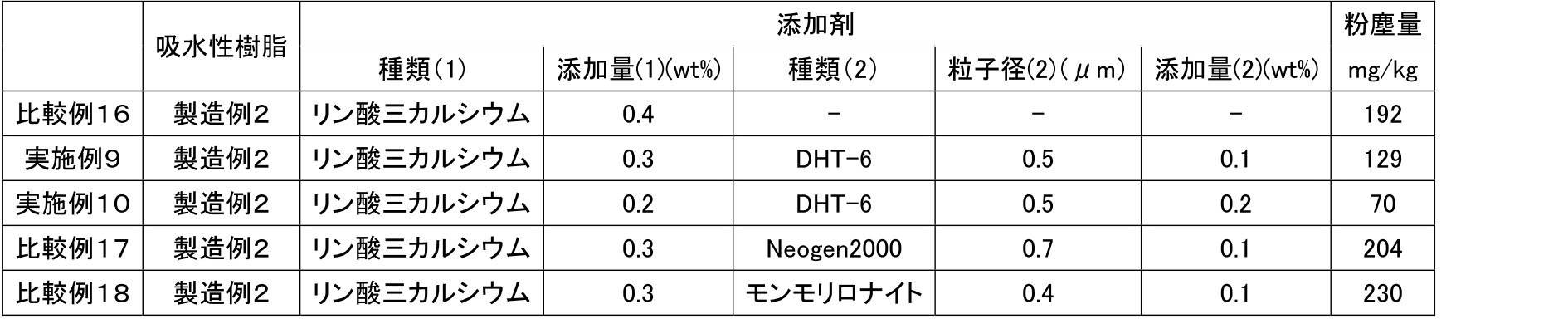

本発明の粉塵低減剤は、僅か0.3質量%の添加で、粉塵量を大幅に削減し、吸湿ブロッキング率が0%であり、AAPも実質下がらない(低下幅0.7g/g以下)ことがわかる。更に、3質量%まで添加量を増やしても、粉塵は増加しない。
他の添加剤と併用した場合には、本発明の粉塵低減剤のみが粉塵量を低減出来る事がわかる。
ふるいを用いた粒度分布測定の結果において、本発明の平均粒子径が0.5μmの粉塵低減剤を3質量%添加した実施例9であっても、150μm未満ないし45μm未満の粉体は増えておらず、吸水剤に密着していると考えられる。
表1及び表3より、本発明の粉塵低減剤は、本明細書の粉塵測定方法によって測定できないのではなく、吸水性樹脂に密着して、効果を発揮していることが分かる。更に、表2より、単に粉塵低減剤と吸水剤とが密着しているだけでなく、第3の粒子成分の添加に起因すると思われる粉塵量さえも低減できることがわかる。
米国特許公開第2004/0092688A1号記載の図3に示す装置を用い、吸水性樹脂粉末を下記に従い製造した。まず、48.5重量%の水酸化ナトリウム水溶液が5.13g/s、アクリル酸が6.09g/s、30重量%ポリエチレングリコールジアクリレート水溶液(I)が0.15g/s、1.0重量%2-ヒドロキシメチル-2-メチルプロピオフェノンのアクリル酸溶液50.0質量部と、0.54重量%ジエチレントリアミン5酢酸3ナトリウム(略称:DTPA・3Na、キレストPC-45;キレスト株式会社製)水溶液50.0質量部と、を混合した溶液(II)が0.16g/s、水が4.63g/sの流量となるように設定し、米国特許公開第2004/0092688A1号記載の図3に示す装置を用いてモノマー液20を作成した。
0.54重量%DTPA・3Na水溶液に代えて、2.18重量%N,N,N’,N’-エチレンジアミンテトラキスメチレンホスホン酸5ナトリウム(略称:EDTMP・5Na、デイクエスト(登録商標)2046;Italmatch Chemicals(31%水溶液)希釈)水溶液を使用する以外は製造例2-1と同様にして吸水性樹脂粉末(B-2)を得た。
0.54重量%DTPA・3Na水溶液に代えて、5.45重量%EDTMP・5Na水溶液を使用する以外は製造例2-1と同様にして吸水性樹脂粉末(B-3)を得た。
0.54重量%DTPA・3Na水溶液に代えて、10.9重量%N,N,N’,N’-エチレンジアミンテトラキスメチレンホスホン酸5ナトリウム(略称:EDTMP・5Na、デイクエスト(登録商標)2046;Italmatch Chemicals(31%水溶液)希釈)水溶液を使用する以外は製造例2-1と同様にして吸水性樹脂粉末(B-4)を得た。
0.54重量%DTPA・3Na水溶液に代えて、10.9重量%DTPA・3Na水溶液を使用する以外は製造例2-1と同様にして吸水性樹脂粉末(B-5)を得た。
中和率75モル%のアクリル酸ナトリウム水溶液5500g(単量体濃度35質量%)に、トリメチロールプロパントリアクリレート(分子量296)0.38g(0.006モル%対単量体)を溶解し、単量体水溶液(a)を調製した後、窒素ガス雰囲気下で30分間脱気した。
比較例2-1にて得た吸水性樹脂粉末(a)をドイツレーディゲ社製回転ミキサーに移し、吸水性樹脂粉末(a)100質量部に対して、エチレングリコールジグリシジルエーテル(商品名デナコールEX-810ナガセケムテックス社製)0.025質量部、予め40℃に加温されたエチレンカーボネート(融点36℃)0.3質量部、1,2-プロパンジオール(融点-59℃)0.5質量部、40℃に加温された水3.0質量部からなる表面架橋剤水溶液を均一に混合し、175℃で40分間加熱処理した。その後、目開きが850μmのJIS標準篩を通過させることで比較吸水性樹脂粒子(表面架橋吸水性樹脂)(a-1)を得た。比較吸水性樹脂粒子(a-1)は、不定形であり、150μm以上850μm未満の範囲に95質量%以上含まれていた。この比較吸水性樹脂粒子(a-1)を比較吸水性樹脂粒子(吸水剤)(2-2)として、性能を表2-2に示す。
製造例2-1で得た吸水性樹脂粉末(B-1)100質量部に対して、エチレングリコールジグリシジルエーテル(商品名デナコールEX-810ナガセケムテックス社製)0.025質量部、1,2-プロパンジオール(融点-59℃)1.5質量部、40℃に加温された水3.5質量部からなる表面架橋剤水溶液を均一に混合し、100℃で45分間加熱処理した。その後、目開きが850μmのJIS標準篩で整粒させることで、表面が架橋された吸水性樹脂粒子を得た。
製造例2-1で得た吸水性樹脂粉末(B-1)100質量部に対して、エチレングリコールジグリシジルエーテル(商品名デナコールEX-810ナガセケムテックス社製)0.025質量部、予め40℃に加温されたエチレンカーボネート(融点36℃)0.3質量部、1,2-プロパンジオール(融点-59℃)0.5質量部、40℃に加温された水3.0質量部からなる表面架橋剤水溶液を均一に混合し、175℃で40分間加熱処理した。その後、目開きが850μmのJIS標準篩で整粒させることで、表面が架橋された吸水性樹脂粒子を得た。
比較例2-3で作成した造粒された比較吸水性樹脂粒子(表面架橋吸水性樹脂)(2-3)100質量部にハイドロタルサイト(製品名DHT-6、協和化学工業株式会社製、Mg6Al2(OH)16CO3・4H2O[一般式(1)のx=0.25、m=0.50]、体積平均粒子径0.5μm)0.3重量部を混合した。混合は吸水性樹脂30gを容量225mLのマヨネーズ瓶にハイドロタルサイトと共に入れ、ペイントシェーカー(東洋精機製)の振動によって3分間混合し、吸水性樹脂粒子(2-1)を得た。吸水性樹脂粒子(2-1)は、150μm以上850μm未満の粒度範囲に95質量%以上含まれていた。吸水性樹脂粒子(2-1)の性能を表2-2に示す。
DTPA・3Na0.01質量部、水1質量部からなる混合液に代えて、リン酸二水素ナトリウム1.5質量部、水3.5質量部からなる混合液を表面架橋した吸水性樹脂粒子に使用した以外は実施例2-1と同様にして吸水性樹脂粒子(2-2)を得た。吸水性樹脂粒子(2-2)は、150μm以上850μm未満の粒度範囲に95質量%以上含まれていた。吸水性樹脂粒子(2-2)の性能を表2-2に示す。
製造例2-2で得た吸水性樹脂粉末(B-2)100質量部に対して、エチレングリコールジグリシジルエーテル(商品名デナコールEX-810ナガセケムテックス社製)0.025質量部、1,2-プロパンジオール(融点-59℃)1.5質量部、40℃に加温された水3.5質量部からなる表面架橋剤水溶液を均一に混合し、100℃で45分間加熱処理した。その後、目開きが850μmのJIS標準篩で整粒させることで、表面が架橋された吸水性樹脂粒子を得た。
ハイドロタルサイトをDHT-6からDHT-4H(協和化学工業株式会社製、化学式Mg4.5Al2(OH)13CO3・3.5H2O[一般式(1)のx=0.31、m=0.54]、体積平均粒子径0.4μm)へと変更する以外は実施例2-3と同様の方法で吸水性樹脂粒子(2-4)を得た。吸水性樹脂粒子(2-4)は、150μm以上850μm未満の粒度範囲に95質量%以上含まれていた。吸水性樹脂粒子(2-4)の性能を表2-2に示す。
ハイドロタルサイトをDHT-6からHT-1-NC(堺化学工業株式会社製、化学式Mg4Al2(OH)12CO3・3H2O[一般式(1)のx=0.33、m=0.5]、体積平均粒子径0.58μm)へと変更する以外は実施例2-3と同様の方法で吸水性樹脂粒子(2-5)を得た。吸水性樹脂粒子(2-5)は、150μm以上850μm未満の粒度範囲に95質量%以上含まれていた。吸水性樹脂粒子(2-5)の性能を表2-2に示す。
DTPA・3Na0.01質量部、水1質量部からなる混合液に代えて、DTPA・3Na0.03質量部、重亜硫酸ナトリウム0.5質量部および水3.5質量部からなる混合液を表面架橋した吸水性樹脂粒子に使用した以外は実施例2-1と同様の方法で吸水性樹脂粒子(2-6)を得た。吸水性樹脂粒子(2-6)は、150μm以上850μm未満の粒度範囲に95質量%以上含まれていた。吸水性樹脂粒子(2-6)の性能を表2-2に示す。
製造例2-2で得た吸水性樹脂粉末(B-2)100質量部に対して、エチレングリコールジグリシジルエーテル(商品名デナコールEX-810ナガセケムテックス社製)0.025質量部、1,2-プロパンジオール(融点-59℃)1.5質量部、40℃に加温された水3.5質量部からなる表面架橋剤水溶液を均一に混合し、100℃で45分間加熱処理した。その後、目開きが850μmのJIS標準篩で整粒させることで、表面が架橋された吸水性樹脂粒子を得た。
実施例2-7において、使用するハイドロタルサイトを0.3質量部から0.5質量部に変更する以外は、実施例2-7と同様の操作により吸水性樹脂粒子(2-8)を得た。吸水性樹脂粒子(2-8)は、150μm以上850μm未満の粒度範囲に95質量%以上含まれていた。吸水性樹脂粒子(2-8)の性能を表2-2に示す。
実施例2-7において、リン酸二水素ナトリウム0.44質量部を1.0質量部に変更する以外は、実施例2-7と同様の操作により吸水性樹脂粒子(2-9)を得た。吸水性樹脂粒子(2-9)は、150μm以上850μm未満の粒度範囲に95質量%以上含まれていた。吸水性樹脂粒子(2-9)の性能を表2-2に示す。
実施例2-7において、リン酸二水素ナトリウム0.44質量部をリン酸水素二ナトリウムに変更する以外は、実施例2-7と同様の操作により吸水性樹脂粒子(2-10)を得た。吸水性樹脂粒子(2-10)は、150μm以上850μm未満の粒度範囲に95質量%以上含まれていた。吸水性樹脂粒子(2-10)の性能を表2-2に示す。
実施例2-7において、リン酸二水素ナトリウム0.44質量部をリン酸三ナトリウム0.5質量部に変更する以外は、実施例2-7と同様の操作により吸水性樹脂粒子(2-11)を得た。吸水性樹脂粒子(2-11)は、150μm以上850μm未満の粒度範囲に95質量%以上含まれていた。吸水性樹脂粒子(2-11)の性能を表2-2に示す。
製造例2-2で得た吸水性樹脂粉末(B-2)100質量部に対して、エチレングリコールジグリシジルエーテル(商品名デナコールEX-810ナガセケムテックス社製)0.025質量部、予め40℃に加温されたエチレンカーボネート(融点36℃)0.3質量部、1,2-プロパンジオール(融点-59℃)0.5質量部、40℃に加温された水3.0質量部からなる表面処理剤を均一に混合し、175℃で40分間加熱処理した。その後、目開きが850μmのJIS標準篩で整粒させることで、表面が架橋された吸水性樹脂粒子を得た。
実施例2-12において、トリポリリン酸0.5質量部をヘキサメタリン酸0.5質量部とする以外、実施例2-12と同様の操作により吸水性樹脂粒子(2-13)を得た。吸水性樹脂粒子(2-13)は、150μm以上850μm未満の粒度範囲に95質量%以上含まれていた。吸水性樹脂粒子(2-13)の性能を表2-2に示す。
実施例2-7において、リン酸二水素ナトリウム0.44質量部を重亜硫酸ナトリウム0.1質量部とする以外、実施例2-7と同様の操作により吸水性樹脂粒子(2-14)を得た。吸水性樹脂粒子(2-14)は、150μm以上850μm未満の粒度範囲に95質量%以上含まれていた。吸水性樹脂粒子(2-14)の性能を表2-2に示す。
実施例2-14において、重亜硫酸ナトリウム0.1質量部を1質量部とする以外、実施例2-14と同様の操作により吸水性樹脂粒子(2-15)を得た。吸水性樹脂粒子(2-15)は、150μm以上850μm未満の粒度範囲に95質量%以上含まれていた。吸水性樹脂粒子(2-15)の性能を表2-2に示す。
実施例2-14において、重亜硫酸ナトリウム0.1質量部を2-ヒドロキシ-2-スルフィナート酢酸0.05質量部とする以外、実施例2-14と同様の操作により吸水性樹脂粒子(2-16)を得た。吸水性樹脂粒子(2-15)は、150μm以上850μm未満の粒度範囲に95質量%以上含まれていた。吸水性樹脂粒子(2-16)の性能を表2-2に示す。
実施例2-16において、2-ヒドロキシ-2-スルフィナート酢酸0.05質量部を0.5重量部とする以外、実施例2-16と同様の操作により吸水性樹脂粒子(2-17)を得た。吸水性樹脂粒子(2-17)は、150μm以上850μm未満の粒度範囲に95質量%以上含まれていた。吸水性樹脂(2-17)の性能を表2-2に示す。
実施例2-12において、トリポリリン酸0.5質量部を次亜リン酸0.2質量部とする以外、実施例2-12と同様の操作により吸水性樹脂粒子(2-18)を得た。吸水性樹脂粒子(2-18)は、150μm以上850μm未満の粒度範囲に95質量%以上含まれていた。吸水性樹脂粒子(2-18)の性能を表2-2に示す。
実施例2-18において、次亜リン酸0.2質量部を1.0質量部とする以外、実施例2-18と同様の操作により吸水性樹脂粒子(2-19)を得た。吸水性樹脂粒子(2-19)は、150μm以上850μm未満の粒度範囲に95質量%以上含まれていた。吸水性樹脂粒子(2-19)の性能を表2-2に示す。
実施例2-7において、リン酸二水素ナトリウム0.44質量部をDL-リンゴ酸0.5質量部とする以外、実施例2-7と同様の操作により吸水性樹脂粒子(2-20)を得た。吸水性樹脂粒子(2-20)は、150μm以上850μm未満の粒度範囲に95質量%以上含まれていた。吸水性樹脂粒子(2-20)の性能を表2-2に示す。
実施例2-20において、DL-リンゴ酸0.5質量部を1.5質量部とする以外、実施例2-20と同様の操作により吸水性樹脂粒子(2-21)を得た。吸水性樹脂粒子(2-21)は、150μm以上850μm未満の粒度範囲に95質量%以上含まれていた。吸水性樹脂粒子(2-21)の性能を表2-2に示す。
製造例2-3で得た吸水性樹脂粉末(B-3)100質量部に対して、エチレングリコールジグリシジルエーテル(商品名デナコールEX-810ナガセケムテックス社製)0.025質量部、1,2-プロパンジオール(融点-59℃)1.5質量部、40℃に加温された水3.5質量部からなる表面架橋剤水溶液を均一に混合し、100℃で45分間加熱処理した。その後、目開きが850μmのJIS標準篩で整粒させることで、表面が架橋された吸水性樹脂粒子を得た。
製造例2-5で得た吸水性樹脂粉末(B-5)100質量部に対して、エチレングリコールジグリシジルエーテル(商品名デナコールEX-810ナガセケムテックス社製)0.025質量部、1,2-プロパンジオール(融点-59℃)1.5質量部、40℃に加温された水3.5質量部からなる表面架橋剤水溶液を均一に混合し、100℃で45分間加熱処理した。その後、目開きが850μmのJIS標準篩で整粒させることで、表面が架橋された吸水性樹脂粒子を得た。
製造例2-1で得た吸水性樹脂粉末(B-1)100質量部に対して、エチレングリコールジグリシジルエーテル(商品名デナコールEX-810ナガセケムテックス社製)0.025質量部、1,2-プロパンジオール(融点-59℃)1.5質量部、40℃に加温された水3.5質量部からなる表面架橋剤水溶液を均一に混合し、100℃で45分間加熱処理した。その後、目開きが850μmのJIS標準篩で整粒させることで、表面が架橋された吸水性樹脂粒子を得た。
製造例2-4で得た吸水性樹脂粉末(B-4)100質量部に対して、エチレングリコールジグリシジルエーテル(商品名デナコールEX-810ナガセケムテックス社製)0.025質量部、1,2-プロパンジオール(融点-59℃)1.5質量部、40℃に加温された水3.5質量部からなる表面架橋剤水溶液を均一に混合し、100℃で45分間加熱処理した。その後、目開きが850μmのJIS標準篩で整粒させることで、表面が架橋された吸水性樹脂粒子を得た。
製造例2-2で得た吸水性樹脂粉末(B-2)100質量部に対して、エチレングリコールジグリシジルエーテル(商品名デナコールEX-810ナガセケムテックス社製)0.025質量部、1,2-プロパンジオール(融点-59℃)1.5質量部、40℃に加温された水3.5質量部からなる表面架橋剤水溶液を均一に混合し、100℃で45分間加熱処理した。その後、目開きが850μmのJIS標準篩で整粒させることで、表面が架橋された吸水性樹脂粒子を得た。
ハイドロタルサイト0.3質量部をシリカ(製品名アエロジル200CF、日本アエロジル株式会社製)0.3質量部へと変更する以外は実施例2-3と同様の方法で比較吸水性樹脂粒子(2-5)を得た。吸水性樹脂粒子(2-5)は、150μm以上850μm未満の粒度範囲に95質量%以上含まれていた。吸水性樹脂粒子(2-5)の性能を表2-2に示す。
ハイドロタルサイト0.3質量部を水酸化マグネシウム(和光純薬工業株式会社製)0.3質量部へと変更する以外は実施例2-3と同様の方法で比較吸水性樹脂粒子(2-6)を得た。吸水性樹脂粒子(2-6)は、150μm以上850μm未満の粒度範囲に95質量%以上含まれていた。吸水性樹脂粒子(2-6)の性能を表2-2に示す。
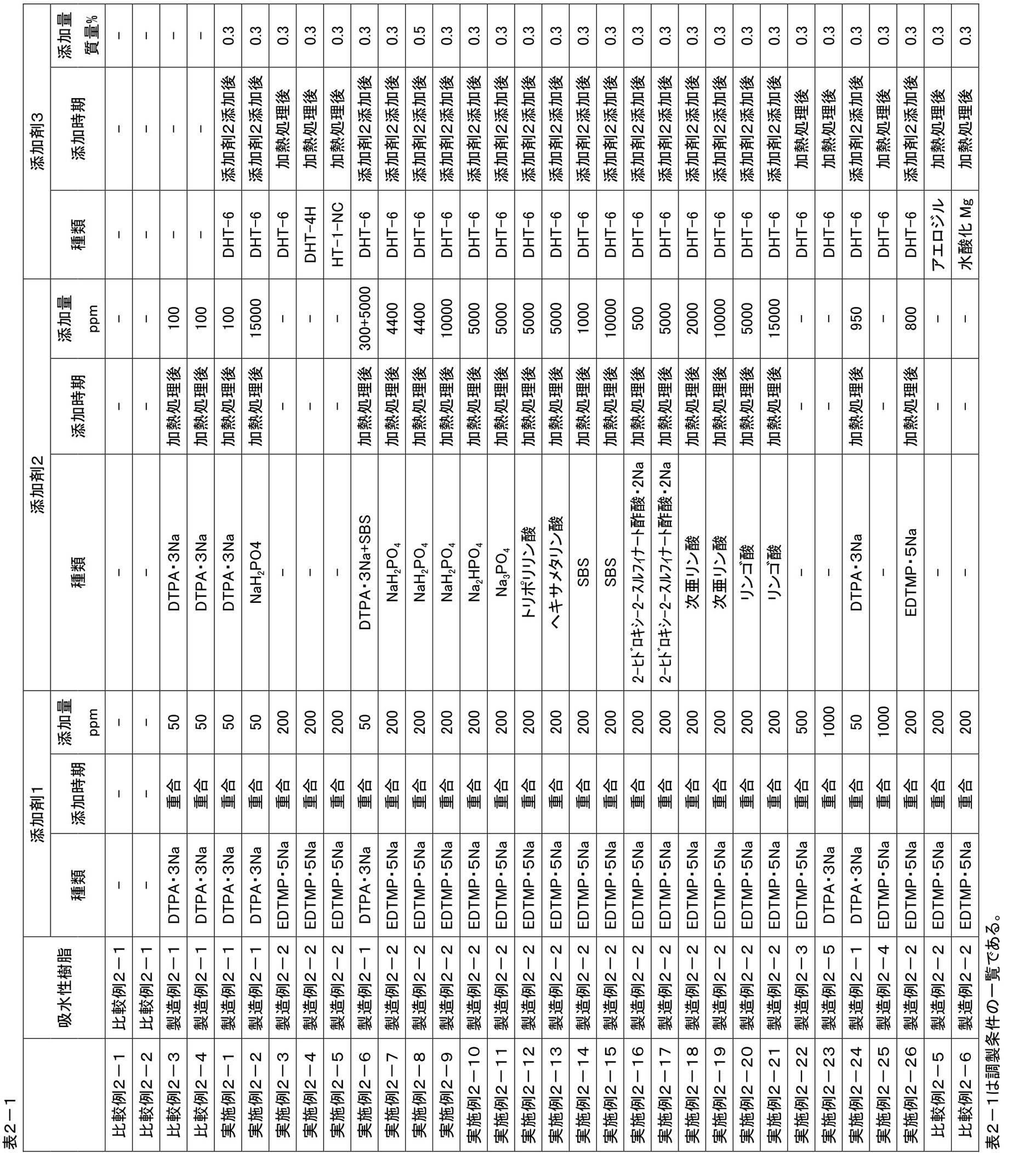
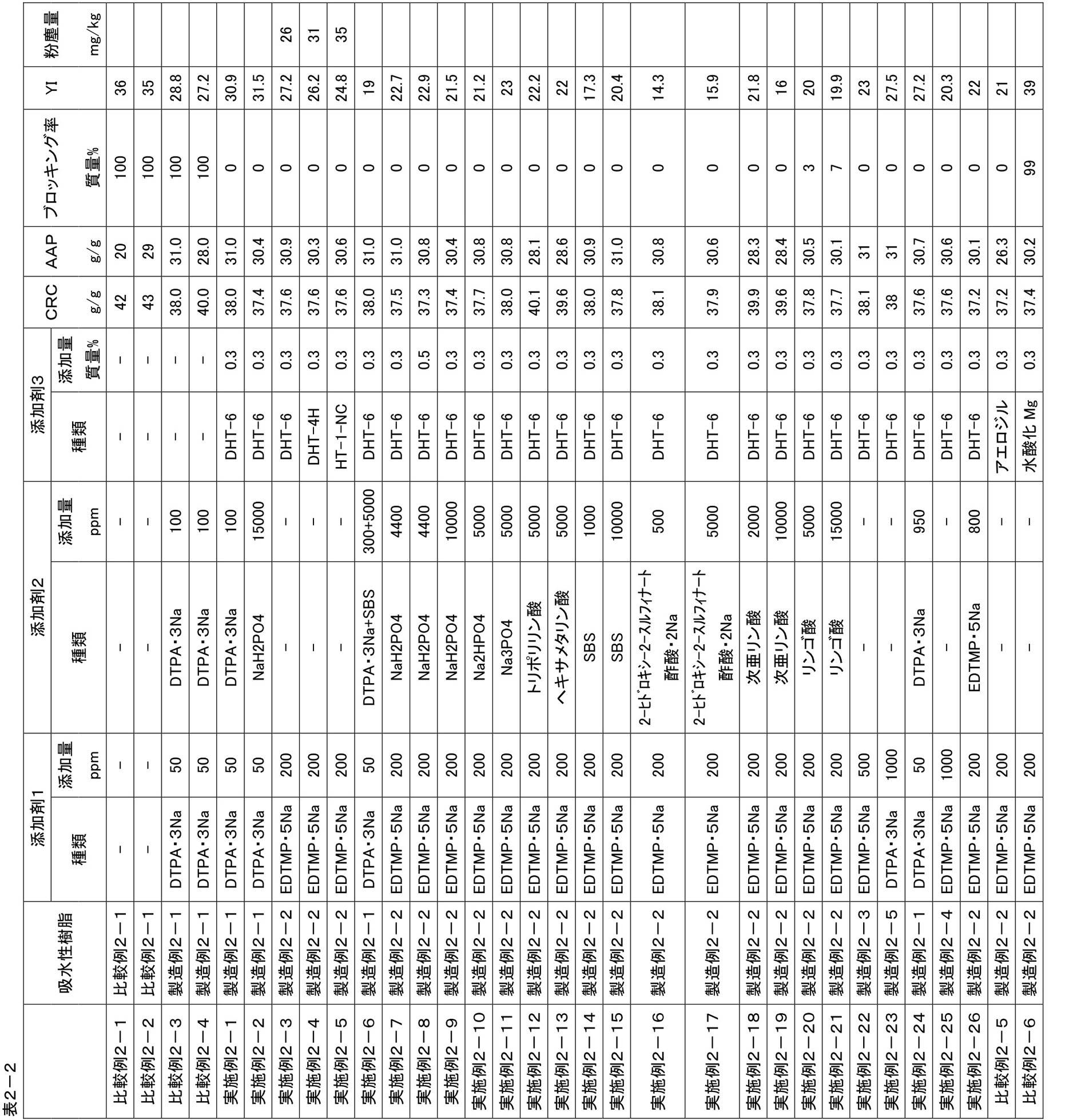
上記表で示されるように、本発明の吸水剤は、吸湿ブロッキング率が低い。また、キレート剤の添加により、経時での着色が抑制されることがわかる。
中和率75モル%のアクリル酸ナトリウム水溶液5500g(単量体濃度35質量%)に、トリメチロールプロパントリアクリレート(分子量296)0.38g(0.006モル%対単量体)を溶解し、単量体水溶液(a)を調製した後、窒素ガス雰囲気下で30分間脱気した。
断熱材である発泡スチロールで覆われた、内径80mm、容量1リットルのポリプロピレン製容器に、アクリル酸291g、内部架橋剤としてのポリエチレングリコールジアクリレート(分子量523)0.43g(カルボキシル基含有不飽和単量体に対し0.02モル%)、アクリル酸にIRGACURE(登録商標)184を1.0質量%溶解させたアクリル酸溶液3.60gを混合した溶液(A)と、48.5質量%水酸化ナトリウム水溶液247gと50℃に調温したイオン交換水255gを混合した溶液(B)を作製した。長さ5cmのマグネチックスターラーを用い800r.p.m.で攪拌した溶液(A)に、溶液(B)をすばやく加え混合することで単量体水溶液(C)を得た。単量体水溶液(C)は、中和熱と溶解熱により、液温が約100℃まで上昇した。なお、アクリル酸の中和率は、73.5モル%であった。
製造例3-1のうち、単量体水溶液(a)を調製時に0.45重量%ジエチレントリアミン5酢酸ナトリウム(略称DTPA・3Na、キレストPC-45;キレスト株式会社製)を単量体水溶液(a)に0.61g加えて重合させ、他は製造例3-1と同様の処理を行うことにより表面が架橋された吸水性樹脂粒子(c-1)を得た。吸水性樹脂粒子(c-1)は、不定形であり、150μm以上850μm未満の範囲に95質量%以上含まれていた。
製造例3-2のうち、単量体水溶液(a)を調製時に0.45重量%ジエチレントリアミン5酢酸ナトリウム(略称DTPA・3Na、キレストPC-45;キレスト株式会社製)を単量体水溶液(a)に0.61g加えて重合させ、他は製造例3-2と同様の処理を行うことにより表面が架橋された吸水性樹脂粒子(d-1)を得た。吸水性樹脂粒子(d-1)は、不定形であり、150μm以上850μm未満の範囲に95質量%以上含まれていた。
製造例3-1のうち、単量体水溶液(a)を調製時にN,N,N’,N’-エチレンジアミンテトラキスメチレンホスホン酸5ナトリウム(略称:EDTMP・5Na、デイクエスト(登録商標)2046;Italmatch Chemicals(31%水溶液)希釈)3.6gを加えて重合させた他は製造例3-1と同様の処理を行うことにより表面が架橋された吸水性樹脂粒子(e-1)を得た。吸水性樹脂粒子(e-1)は、不定形であり、150μm以上850μm未満の範囲に95質量%以上含まれていた。
製造例3-2のうち、単量体水溶液(a)を調製時にN,N,N’N’-エチレンジアミンテトラキスメチレンホスホン酸5ナトリウム(略称:EDTMP・5Na、デイクエスト(登録商標)2046;Italmatch Chemicals(31%水溶液)希釈)3.6gを加えて重合させた他は製造例3-2と同様の処理を行うことにより表面が架橋された吸水性樹脂粒子(f-1)を得た。吸水性樹脂粒子(f-1)は、不定形であり、150μm以上850μm未満の範囲に95質量%以上含まれていた。
製造例3-2のうち、単量体水溶液(a)を調製時にN,N,N’,N’-エチレンジアミンテトラキスメチレンホスホン酸5ナトリウム(略称:EDTMP・5Na、デイクエスト(登録商標)2046;Italmatch Chemicals(31%水溶液)希釈)8.9gを加えて重合させた他は製造例3-2と同様の処理を行うことにより表面が架橋された吸水性樹脂粒子(g-1)を得た。吸水性樹脂粒子(g-1)は、不定形であり、150μm以上850μm未満の範囲に95質量%以上含まれていた。
製造例3-2のうち、単量体水溶液(a)を調製時に0.45重量%ジエチレントリアミン5酢酸ナトリウム(略称DTPA・3Na、キレストPC-45;キレスト株式会社製)を単量体水溶液(a)に12.2g加えて重合させ、他は製造例3-2と同様の処理を行うことにより表面が架橋された吸水性樹脂粒子(h-1)を得た。吸水性樹脂粒子(h-1)は、不定形であり、150μm以上850μm未満の範囲に95質量%以上含まれていた。
製造例3-2のうち、単量体水溶液(a)を調製時にN,N,N’N’-エチレンジアミンテトラキスメチレンホスホン酸5ナトリウム(略称:EDTMP・5Na、デイクエスト(登録商標)2046;Italmatch Chemicals(31%水溶液)希釈)18.0gを加えて重合させ、他は製造例3-2と同様の処理を行うことにより表面が架橋された吸水性樹脂粒子(i-1)を得た。吸水性樹脂粒子(i-1)は、不定形であり、150μm以上850μm未満の範囲に95質量%以上含まれていた。
製造例3-2記載の吸水性樹脂粒子(b-1)を比較吸水性樹脂粒子(吸水剤)(1)として、諸物性を表3-2に示した。
製造例3-1記載の吸水性樹脂粒子(a-1)を比較吸水性樹脂粒子(吸水剤)(2)として、諸物性を表3-2に示した。
製造例3-4記載の吸水性樹脂粒子(d-1)を比較吸水性樹脂(吸水剤)(3)として、所物性を表3-2に示した。
製造例3-3記載の吸水性樹脂粒子(c-1)100質量部に対して、DTPA・3Na0.01質量部、水1質量部からなる混合液を均一に混合し、造粒した後、60℃で45分間加熱処理した。その後、目開きが850μmのJIS標準篩で整粒させることで、造粒された吸水性樹脂粒子を得た。
製造例3-4記載の吸水性樹脂粒子(d-1)100質量部に対して、DTPA・3Na0.01質量部、水1質量部からなる混合液を均一に混合し、造粒した後、60℃で45分間加熱処理した。その後、目開きが850μmのJIS標準篩で整粒させることで、造粒された吸水性樹脂粒子を得た。
実施例3-2において、表面が架橋された吸水性樹脂粒子100質量部に対して、DTPA・3Na0.03質量部、水1質量部からなる混合液を均一に混合したこと以外は、実施例3-2と同様にして、吸水性樹脂(3-3)を得た。吸水性樹脂(3-3)の性能を表3-2に示す。
実施例3-1において、DTPA・3Na0.01質量部と水1質量部に加えてSBS(亜硫酸水素ナトリウム)0.3質量部を加えたこと以外は実施例3-1と同様にして吸水性樹脂(3-4)を得た。吸水性樹脂(3-4)の性能を表3-2に示す。
実施例3-3において、DTPA・3Na0.03質量部をEDTMP0.022質量部に代えたこと以外は、実施例3-3と同様にして、吸水性樹脂(3-5)を得た。吸水性樹脂(3-5)の性能を表3-2に示す。
製造例3-6記載の吸水性樹脂(f-1)100質量部にハイドロタルサイト(製品名DHT-6、協和化学工業株式会社製、Mg6Al2(OH)16CO3・4H2O[一般式(1)のx=0.25、m=0.50]、体積平均粒子径0.5μm)0.3重量部を混合した。混合は吸水性樹脂30gを容量225mLのマヨネーズ瓶にハイドロタルサイトと共に入れ、ペイントシェーカー(東洋精機製)の振動によって3分間混合し、吸水性樹脂(3-6)を得た。吸水性樹脂(3-6)の性能を表3-2に示す。
製造例3-7記載の吸水性樹脂(g-1)100質量部にハイドロタルサイト(製品名DHT-6、協和化学工業株式会社製、Mg6Al2(OH)16CO3・4H2O[一般式(1)のx=0.25、m=0.50]、体積平均粒子径0.5μm)0.3重量部を混合した。混合は吸水性樹脂30gを容量225mLのマヨネーズ瓶にハイドロタルサイトと共に入れ、ペイントシェーカー(東洋精機製)の振動によって3分間混合し、吸水性樹脂(3-7)を得た。吸水性樹脂(3-7)の性能を表3-2に示す。
製造例3-6記載の吸水性樹脂粒子(f-1)を比較吸水性樹脂粒子(3-4)として、性能を表3-2に示す。
比較吸水性樹脂粒子(3-4)(表面架橋吸水性樹脂)100質量部にシリカ(製品名アエロジル200CF、日本アエロジル株式会社製)0.3質量部を実施例3-6と同様に混合し、比較吸水性樹脂粒子(3-5)を得た。比較吸水性樹脂粒子(3-5)の性能を表3-2に示す。
製造例3-5記載の吸水性樹脂(e-1)100質量部にシリカ(製品名アエロジル200CF、日本アエロジル株式会社製)0.3質量部を実施例3-6と同様に混合し、比較吸水性樹脂粒子(3-6)を得た。比較吸水性樹脂粒子(3-6)の性能を表3-2に示す。
製造例3-5記載の吸水性樹脂(e-1)100質量部に対して、DTPA・3Na0.01質量部、水1質量部からなる混合液を均一に混合し、造粒した後、60℃で45分間加熱処理した。その後、目開きが850μmのJIS標準篩で整粒させることで、造粒された吸水性樹脂粒子を得た。
製造例3-7記載の吸水性樹脂(g-1)100質量部に対して、DTPA・3Na0.01質量部、水1質量部からなる混合液を均一に混合し、造粒した後、60℃で45分間加熱処理した。その後、目開きが850μmのJIS標準篩で整粒させることで、造粒された吸水性樹脂粒子を得た。
比較吸水性樹脂粒子(3-4)(表面架橋吸水性樹脂)100質量部に対して、DTPA・3Na0.03質量部、リン酸二水素ナトリウム0.440質量部、水3.0質量部からなる混合液を均一に混合し、造粒した後、60℃で45分間加熱処理した。その後、目開きが850μmのJIS標準篩で整粒させることで、造粒された吸水性樹脂粒子を得た。
実施例3-10において、DTPA・3Na0.03質量部、リン酸二水素ナトリウム0.440質量部を重亜硫酸ナトリウム0.5質量部に変更すること以外は、実施例3-10と同様の操作により吸水性樹脂(3-11)を得た。吸水性樹脂(3-11)の性能を表3-2に示す。
製造例3-8記載の吸水性樹脂(h-1)100質量部にハイドロタルサイト(製品名DHT-6、協和化学工業株式会社製、Mg6Al2(OH)16CO3・4H2O[一般式(1)のx=0.25、m=0.50]、体積平均粒子径0.5μm)0.3重量部を混合した。混合は吸水性樹脂30gを容量225mLのマヨネーズ瓶にハイドロタルサイトと共に入れ、ペイントシェーカー(東洋精機製)の振動によって3分間混合し、吸水性樹脂(3-12)を得た。吸水性樹脂(3-12)の性能を表3-2に示す。
製造例3-2記載の吸水性樹脂(a-1)100質量部に対して、DTPA・3Na0.1質量部、水1質量部からなる混合液を均一に混合し、造粒した後、60℃で45分間加熱処理した。その後、目開きが850μmのJIS標準篩で整粒させることで、造粒された吸水性樹脂粒子を得た。
製造例3-9記載の吸水性樹脂(i-1)100質量部にハイドロタルサイト(製品名DHT-6、協和化学工業株式会社製、Mg6Al2(OH)16CO3・4H2O[一般式(1)のx=0.25、m=0.50]、体積平均粒子径0.5μm)0.3重量部を混合した。混合は吸水性樹脂30gを容量225mLのマヨネーズ瓶にハイドロタルサイトと共に入れ、ペイントシェーカー(東洋精機製)の振動によって3分間混合し、吸水性樹脂(3-14)を得た。吸水性樹脂(3-14)の性能を表3-2に示す。
実施例3-6において、DTPA・3Na0.01質量部をEDTMP・5Na0.08質量部に代えたこと以外は、実施例3-8と同様にして、吸水性樹脂(3-15)を得た。吸水性樹脂(3-15)の性能を表3-2に示す。
実施例3-6において、DTPA・3Na0.01質量部を0.03質量部に代えたこと以外は、実施例3-8と同様にして、吸水性樹脂(3-16)を得た。吸水性樹脂(3-16)の性能を表3-2に示す。
製造例3-9記載の吸水性樹脂(i-1)100質量部に対して、DTPA・3Na0.1質量部、水1質量部からなる混合液を均一に混合し、造粒した後、60℃で45分間加熱処理した。その後、目開きが850μmのJIS標準篩で整粒させることで、造粒された吸水性樹脂粒子を得た。


上記表で示されるように、本発明の吸水剤は、吸湿ブロッキング率が低いとともに、キレート剤の添加により、耐尿性が抑制されることがわかる。
中和率75モル%のアクリル酸ナトリウム水溶液5500g(単量体濃度35質量%)に、トリメチロールプロパントリアクリレート(分子量296)0.38g(0.006モル%対単量体)を溶解し、単量体水溶液(a)を調製した後、窒素ガス雰囲気下で30分間脱気した。
断熱材である発泡スチロールで覆われた、内径80mm、容量1リットルのポリプロピレン製容器に、アクリル酸291g、内部架橋剤としてのポリエチレングリコールジアクリレート(分子量523)0.43g(カルボキシル基含有不飽和単量体に対し0.02モル%)、および1.0質量%ジエチレントリアミン5酢酸・5ナトリウム水溶液1.80g、IRGACURE(登録商標)184の1.0質量%アクリル酸溶液3.60gを混合した溶液(A)と、48.5質量%水酸化ナトリウム水溶液247gと50℃に調温したイオン交換水255gを混合した溶液(B)を作製した。長さ5cmのマグネチックスターラーを用い800r.p.m.で攪拌した溶液(A)に、溶液(B)をすばやく加え混合することで単量体水溶液(C)を得た。単量体水溶液(C)は、中和熱と溶解熱により、液温が約100℃まで上昇した。なお、アクリル酸の中和率は、73.5モル%であった。
製造例4-2において、エチレングリコールジグリシジルエーテルを0.03質量部に変更した以外は、製造例2と同様の操作を行い、表面が架橋された吸水性樹脂粒子(4-3)を得た。
製造例4-1で得た吸水性樹脂粒子(4-1)100質量部にMg/Al比が3.0/1のハイドロタルサイト(製品名DHT-6、協和化学工業株式会社製)0.3質量部を混合した。混合は吸水性樹脂30gを容量225mlのマヨネーズ瓶にハイドロタルサイトと共に入れ、ペイントシェーカー(東洋精機製)の振動(室温下で3分間)によって混合し、吸水剤(4-1)を得た。吸水剤(4-1)の性能を後の表4-1に示す。また、吸水剤(4-1)の粒度測定結果を表4-2に示す。
製造例4-1で得た吸水性樹脂粒子(4-1)100質量部にMg/Al比が2.1/1のハイドロタルサイト(製品名DHT-4H、協和化学工業株式会社製)0.3質量部を混合した。混合は吸水性樹脂30gを容量225mlのマヨネーズ瓶にハイドロタルサイトと共に入れ、ペイントシェーカー(東洋精機製)の振動(室温下で3分間)によって混合し、吸水剤(4-2)を得た。吸水剤(4-2)の性能を後の表4-1に示す。また、吸水剤(4-2)の粒度測定結果を表4-2に示す。
製造例4-2で得た吸水性樹脂粒子(4-2)100量部に実施例4-1で使用したハイドロタルサイト0.3質量部を実施例4-1と同様に混合し、吸水剤(4-3)を得た。吸水剤(4-3)の性能を後の表1に示す。また、吸水剤(4-3)の粒度測定結果を表4-2に示す。
製造例4-2で得た吸水性樹脂粒子(4-2)100質量部にMg/Al比が2.1/1のハイドロタルサイト(製品名HT-1-NC、堺化学工業株式会社製)0.3質量部を実施例4-1と同様に混合し、吸水剤(4-4)を得た。吸水剤(4-4)の性能を後の表4-1に示す。また、吸水剤(4-4)の粒度測定結果を表4-2に示す。
製造例4-3で得た吸水性樹脂粒子(4-3)100量部に実施例4-1で使用したハイドロタルサイト0.3質量部を実施例4-1と同様に混合し、吸水剤(4-5)を得た。吸水剤(4-5)の性能を後の表4-2に示す。
製造例4-3で得た吸水性樹脂粒子(4-3)100量部に実施例4-2で使用したハイドロタルサイト0.3質量部を実施例4-1と同様に混合し、吸水剤(4-6)を得た。吸水剤(4-6)の性能を後の表4-2に示す。
製造例4-1で得た吸水性樹脂粉末(4-1)を更にロールミルで粉砕し、更に目開きが850μmと150μmのJIS標準篩で分級した。この一連の操作により、吸水性樹脂粉末(c)を得た。尚、吸水性樹脂粉末(c)のCRC(無加圧下吸水倍率)は53.0[g/g]であった。
製造例4-1記載の吸水性樹脂粒子(4-1)を比較吸水剤(4-1)として、諸物性を表4-1に示した。また、比較吸水剤(4-1)の粒度測定結果を表4-2に示す。
製造例4-2記載の吸水性樹脂粒子(4-2)を比較吸水剤(4-2)として、諸物性を表4-1に示した。また、比較吸水剤(4-2)の粒度測定結果を表4-2に示す。
製造例4-3記載の吸水性樹脂粒子(4-3)を比較吸水剤(4-3)として、諸物性を表4-2に示した。
製造例4-2で得た吸水性樹脂粒子(4-2)100質量部にシリカ(製品名アエロジル200CF、日本アエロジル株式会社製)0.3質量部を実施例4-1と同様に混合し、比較吸水剤(4-4)を得た。比較吸水剤(4-4)の性能を後の表4-1に示す。また、比較吸水剤(4-4)の粒度測定結果を表4-2に示す。
製造例4-2で得た吸水性樹脂粒子(4-2)100質量部に酸化マグネシウム(製品名500-04R、協和化学工業株式会社製)0.3質量部を実施例4-1と同様に混合し、比較吸水剤(4-5)を得た。比較吸水剤(4-5)の性能を後の表4-2に示す。
製造例4-2で得た吸水性樹脂粒子(4-2)100質量部にMg/Al比が0.5/1アルミン酸マグネシウム(アルドリッチ)0.3質量部を実施例1と同様に混合し、比較吸水剤(4-6)を得た。比較吸水剤(4-6)の性能を後の表4-2に示す。
測定すべき吸収性物品は、下記の方法により作製した。即ち、先ず、吸水剤(又は吸水性樹脂)60重量部と、木材粉砕パルプ40重量部とを、400メッシュ(目の大きさ38μm)に形成されたワイヤースクリーン上にバッチ型空気抄造装置を用いて空気抄造することにより、120mm×400mmの大きさのウェブに成形した。さらに、このウェブを油圧式プレス機でプレスすることにより、密度が約0.1g/cm3の吸収体を得た。次いで、この吸収体に液不透過性のバックシートおよび液透過性のトップシートを備え、吸収性物品を得た。
実施例4-3で得られた吸水剤(4-3)を用いて、吸収性物品の吸収速度(コア・アクイジション)・戻り量の評価を行った。吸収体評価結果を表4-3に示す。
比較例4-4で得られた比較吸水剤(4-4)を用いて、吸収性物品の吸収速度(コア・アクイジション)・戻り量の評価を行った。吸収体評価結果を表4-3に示す。

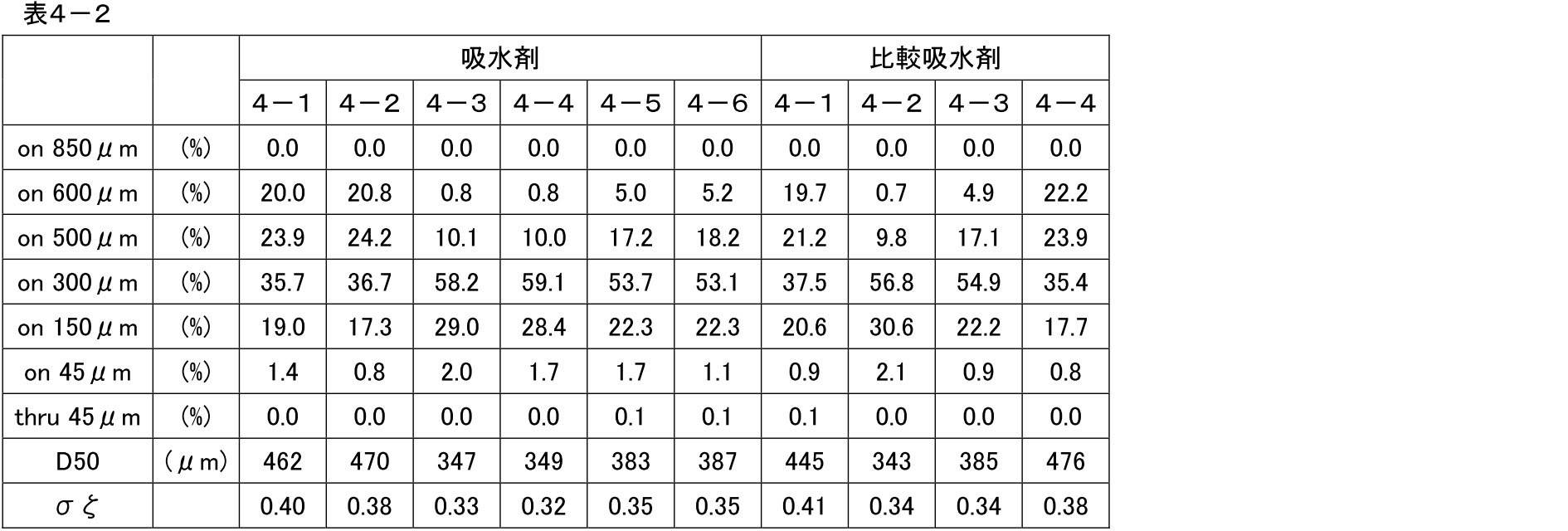


Claims (14)
- ハイドロタルサイト構造を有する2価及び3価の2種類の金属カチオンと水酸基とを含有する多元金属化合物であって、表面架橋されたポリアクリル酸(塩)系吸水性樹脂を主成分とする吸水剤の粉塵低減剤。
- 前記多元金属化合物の体積平均粒子径が、2μm以下である、請求項1記載の粉塵低減剤。
- 前記2価及び3価の金属カチオンが、それぞれマグネシウム及びアルミニウムのカチオンである、請求項1又は2に記載の粉塵低減剤。
- 表面架橋工程と、
ハイドロタルサイト構造を有する2価及び3価の2種類の金属カチオンと水酸基とを含有する多元金属化合物をポリアクリル酸(塩)系吸水性樹脂粉末に対して0.01質量%~5質量%添加する多元金属化合物添加工程と、を有する事を特徴とする吸水剤の製造方法。 - 前記多元金属化合物添加工程において、前記吸水性樹脂粉末と前記多元金属化合物とを乾式混合する、請求項4に記載の製造方法。
- 前記多元金属化合物添加工程の前工程及び/又は後工程において表面架橋工程を施すことを特徴とする請求項4又は5に記載の製造方法。
- さらに、キレート剤を添加するキレート剤添加工程を含む、請求項4~6のいずれか1項に記載の製造方法
- キレート剤の添加をアクリル酸(塩)系単量体水溶液の調製工程又は水溶液重合工程で行い、さらに表面架橋工程後で多元金属化合物の添加工程前に、キレート剤、無機還元剤、α-ヒドロキシカルボン酸及びリン化合物から選ばれる少なくとも1種を添加する請求項4~7のいずれか1項に記載の製造方法。
- 水溶性マグネシウムイオン定量方法による吸水剤原料の着色性の評価方法。
- キレート剤と、水溶性マグネシウムイオン定量方法による吸水剤原料の着色性の評価方法における水溶性マグネシウムイオン換算量が0.1ppm以上である添加物と、を含む吸水剤。
- ポリアクリル酸(塩)系吸水性樹脂を主成分とする吸水剤であって、ハイドロタルサイト構造を有する2価及び3価の2種類の金属カチオンと水酸基とを含有する多元金属化合物を0.01質量%~5質量%含むことを特徴とする、吸湿ブロッキング率が0~30質量%である吸水剤。
- 前記多元金属化合物の体積平均粒子径が2μm以下である、請求項11に記載の吸水剤。
- 加圧下吸収倍率(AAP)が20(g/g)以上である、請求項11又は12に記載の吸水剤。
- さらにキレート剤を含む、請求項11~13のいずれか1項に記載の吸水剤。
Priority Applications (5)
| Application Number | Priority Date | Filing Date | Title |
|---|---|---|---|
| JP2014539767A JP5996664B2 (ja) | 2012-10-01 | 2013-10-01 | 多元金属化合物からなる粉塵低減剤、多元金属化合物を含む吸水剤及びその製造方法 |
| US14/432,446 US9974882B2 (en) | 2012-10-01 | 2013-10-01 | Dust reducer consisting of multi-component metal compound, water absorbing agent containing multi-component metal compound, and method for producing the same |
| EP13843510.2A EP2905071B1 (en) | 2012-10-01 | 2013-10-01 | Dust-reducing agent comprising multiple metal compound, water absorbent containing multiple metal compound and method for manufacturing same |
| CN201380051635.8A CN104703690B (zh) | 2012-10-01 | 2013-10-01 | 包含多元金属化合物的降尘剂、包含多元金属化合物的吸水剂及其制造方法 |
| KR1020157008234A KR102196888B1 (ko) | 2012-10-01 | 2013-10-01 | 다원 금속 화합물을 포함하는 분진 저감제, 다원 금속 화합물을 포함하는 흡수제 및 그의 제조 방법 |
Applications Claiming Priority (6)
| Application Number | Priority Date | Filing Date | Title |
|---|---|---|---|
| JP2012-219517 | 2012-10-01 | ||
| JP2012219517 | 2012-10-01 | ||
| JP2013184485 | 2013-09-05 | ||
| JP2013-184485 | 2013-09-05 | ||
| JP2013-184487 | 2013-09-05 | ||
| JP2013184487 | 2013-09-05 |
Publications (1)
| Publication Number | Publication Date |
|---|---|
| WO2014054656A1 true WO2014054656A1 (ja) | 2014-04-10 |
Family
ID=50434980
Family Applications (1)
| Application Number | Title | Priority Date | Filing Date |
|---|---|---|---|
| PCT/JP2013/076739 Ceased WO2014054656A1 (ja) | 2012-10-01 | 2013-10-01 | 多元金属化合物からなる粉塵低減剤、多元金属化合物を含む吸水剤及びその製造方法 |
Country Status (6)
| Country | Link |
|---|---|
| US (1) | US9974882B2 (ja) |
| EP (1) | EP2905071B1 (ja) |
| JP (1) | JP5996664B2 (ja) |
| KR (1) | KR102196888B1 (ja) |
| CN (1) | CN104703690B (ja) |
| WO (1) | WO2014054656A1 (ja) |
Cited By (10)
| Publication number | Priority date | Publication date | Assignee | Title |
|---|---|---|---|---|
| JP2017119255A (ja) * | 2015-12-28 | 2017-07-06 | 日本国土開発株式会社 | 生体関連物質吸着剤およびその製造方法ならびに生体関連物質吸着剤を含有する樹脂、繊維、衣服、フィルタおよびマスク |
| JPWO2017170604A1 (ja) * | 2016-03-28 | 2019-02-28 | 株式会社日本触媒 | 吸水剤の製造方法 |
| WO2019198821A1 (ja) | 2018-04-13 | 2019-10-17 | 株式会社日本触媒 | 吸水性シート、吸水性シートの製造方法および吸収性物品 |
| WO2020032280A1 (ja) | 2018-08-09 | 2020-02-13 | 株式会社日本触媒 | 吸水性シートおよびそれを含む吸水性物品 |
| WO2020145383A1 (ja) | 2019-01-11 | 2020-07-16 | 株式会社日本触媒 | 吸水剤、及び吸水剤の製造方法 |
| KR20210041070A (ko) | 2018-09-28 | 2021-04-14 | 가부시키가이샤 닛폰 쇼쿠바이 | 흡수성 수지 분말의 제조 방법 및 흡수성 수지 분말 |
| KR20210058928A (ko) | 2018-09-21 | 2021-05-24 | 가부시키가이샤 닛폰 쇼쿠바이 | 킬레이트제를 포함하는 흡수성 수지의 제조 방법 |
| WO2022019219A1 (ja) * | 2020-07-22 | 2022-01-27 | 住友精化株式会社 | 吸水性樹脂組成物、吸収体及び吸収性物品 |
| JP7058787B1 (ja) | 2021-05-12 | 2022-04-22 | 株式会社日本触媒 | ポリ(メタ)アクリル酸(塩)系吸水性樹脂、及び吸収体 |
| WO2025126867A1 (ja) * | 2023-12-12 | 2025-06-19 | 住友精化株式会社 | 吸水性樹脂粒子、吸収体、吸収性物品、及び、吸水性樹脂粒子を製造する方法 |
Families Citing this family (16)
| Publication number | Priority date | Publication date | Assignee | Title |
|---|---|---|---|---|
| WO2017170605A1 (ja) * | 2016-03-28 | 2017-10-05 | 株式会社日本触媒 | 粒子状吸水剤 |
| KR101956831B1 (ko) | 2016-06-01 | 2019-03-11 | 주식회사 엘지화학 | 고흡수성 수지 및 이의 제조 방법 |
| KR102500281B1 (ko) | 2018-12-12 | 2023-02-15 | 주식회사 엘지화학 | 고흡수성 수지의 제조 방법 |
| CN109856134B (zh) * | 2019-02-21 | 2021-04-27 | 上海历思实业有限公司 | 铜离子检测试剂、试纸及制备方法和在铜离子检测中的应用 |
| CN110075881A (zh) * | 2019-05-06 | 2019-08-02 | 西安向阳航天材料股份有限公司 | 一种用于人工减霾作业的催化剂 |
| WO2021006178A1 (ja) | 2019-07-05 | 2021-01-14 | 住友精化株式会社 | 粒子状吸水性樹脂組成物 |
| US20220387971A1 (en) * | 2019-11-12 | 2022-12-08 | Nippon Shokubai Co., Ltd. | Particulate water-absorbing agent and method for producing the same |
| CN110665483B (zh) * | 2019-11-20 | 2022-07-12 | 广州大学 | 一种碳纤维水滑石复合材料及其制备方法和应用 |
| JP7352001B2 (ja) * | 2020-02-14 | 2023-09-27 | 株式会社日本触媒 | 吸収体、吸水剤および吸水剤の製造方法 |
| WO2022019218A1 (ja) * | 2020-07-22 | 2022-01-27 | 住友精化株式会社 | 吸水性樹脂組成物、吸水性樹脂組成物の製造方法、及び吸水性樹脂粒子の吸水速度低速化方法 |
| CN112459825B (zh) * | 2020-11-03 | 2022-11-18 | 山东科技大学 | 一种矿用抑尘-抑爆剂、制备方法及应用 |
| KR102470511B1 (ko) * | 2022-01-05 | 2022-11-25 | 이승진 | 포졸란 반응을 일으키지 않는 가교형 비산먼지 경화제 및 그 제조방법 |
| CN115386186A (zh) * | 2022-04-21 | 2022-11-25 | 宜兴丹森科技有限公司 | 一种聚丙烯酸系高吸水性树脂及其制备方法 |
| CN115678501B (zh) * | 2022-12-08 | 2024-01-26 | 山东科技大学 | 一种露天矿用高效生物降解抑尘剂及其制备方法 |
| CN115851233B (zh) * | 2022-12-09 | 2024-05-24 | 青岛科凯达橡塑有限公司 | 一种可生物降解抑尘剂及其制备方法和使用方法 |
| CN116606631B (zh) * | 2023-05-22 | 2025-07-15 | 国家能源集团宁夏煤业有限责任公司 | 抑尘剂、其制备方法及应用 |
Citations (54)
| Publication number | Priority date | Publication date | Assignee | Title |
|---|---|---|---|---|
| US4286082A (en) | 1979-04-06 | 1981-08-25 | Nippon Shokubai Kagaku Kogyo & Co., Ltd. | Absorbent resin composition and process for producing same |
| US4625001A (en) | 1984-09-25 | 1986-11-25 | Nippon Shokubai Kagaku Kogyo Co., Ltd. | Method for continuous production of cross-linked polymer |
| JPS62223203A (ja) | 1986-03-25 | 1987-10-01 | Osaka Yuki Kagaku Kogyo Kk | 高膨張型吸水性ポリマ−の製造法 |
| US4873299A (en) | 1986-03-21 | 1989-10-10 | Basf Aktiengesellschaft | Batchwise preparation of crosslinked, finely divided polymers |
| JPH01318021A (ja) | 1988-06-17 | 1989-12-22 | Kazuo Saotome | 吸水性樹脂成形物の製造方法 |
| EP0349240A2 (en) | 1988-06-28 | 1990-01-03 | Nippon Shokubai Co., Ltd. | Water-absorbent resin and production process |
| US4893999A (en) | 1985-12-18 | 1990-01-16 | Chemische Fabrik Stockhausen Gmbh | Apparatus for the continuous production of polymers and copolymers of water-soluble monomers |
| JPH02215863A (ja) * | 1989-02-17 | 1990-08-28 | Toagosei Chem Ind Co Ltd | 吸水性樹脂組成物 |
| US4973632A (en) | 1988-06-28 | 1990-11-27 | Nippon Shokubai Kagaku Kogyo Co., Ltd. | Production process for water-absorbent resin |
| US4985518A (en) | 1981-10-26 | 1991-01-15 | American Colloid Company | Process for preparing water-absorbing resins |
| WO1992001008A1 (de) | 1990-07-09 | 1992-01-23 | Chemische Fabrik Stockhausen Gmbh | Verfahren zur herstellung wasserquellbarer produkte unter verwendung von feinstanteilen wasserquellbarer polymerer |
| US5124416A (en) | 1988-05-23 | 1992-06-23 | Nippon Shokubai Kagaku Kogyo, Co., Ltd. | Method for production of absorbent polymer |
| US5145906A (en) | 1989-09-28 | 1992-09-08 | Hoechst Celanese Corporation | Super-absorbent polymer having improved absorbency properties |
| WO1992020723A1 (en) | 1991-05-16 | 1992-11-26 | The Dow Chemical Company | Process for recycling aqueous fluid absorbent fines to a polymerizer |
| US5250640A (en) | 1991-04-10 | 1993-10-05 | Nippon Shokubai Co., Ltd. | Method for production of particulate hydrogel polymer and absorbent resin |
| US5264495A (en) | 1990-04-27 | 1993-11-23 | Nippon Shokubai Kagaku Kogyo Co., Ltd. | Method for production of salt-resistant absorbent resin |
| US5380808A (en) | 1990-07-17 | 1995-01-10 | Sanyo Chemical Industries, Ltd. | Process for producing water-absorbing resins |
| US5382610A (en) | 1990-12-21 | 1995-01-17 | Nippon Shokubai Co., Ltd. | Water absorbent matter and method for producing it as well as water absorbent and method for producing it |
| JPH07242709A (ja) * | 1994-03-03 | 1995-09-19 | Toagosei Co Ltd | 吸水性樹脂の製造方法 |
| WO1997017397A1 (de) | 1995-11-03 | 1997-05-15 | Basf Aktiengesellschaft | Wasserabsorbierende, schaumförmige, vernetzte hydrogel-polymere |
| WO1997030109A1 (en) | 1996-02-16 | 1997-08-21 | The Dow Chemical Company | Dust control of absorbent polymers |
| EP0811636A1 (en) | 1996-06-05 | 1997-12-10 | Nippon Shokubai Co., Ltd. | Method for production of cross-linked polymer |
| EP0922717A1 (en) | 1997-12-10 | 1999-06-16 | Nippon Shokubai Co., Ltd. | Production process of water-absorbent resin |
| EP0955086A2 (en) | 1998-04-28 | 1999-11-10 | Nippon Shokubai Co., Ltd. | Method for production of shaped hydrogel of absorbent resin |
| JP2000063527A (ja) | 1998-08-12 | 2000-02-29 | Nippon Shokubai Co Ltd | 含水ゲル状架橋重合体の細粒化方法 |
| WO2000010619A1 (en) | 1998-08-18 | 2000-03-02 | Stockhausen Gmbh & Co. Kg | Superabsorbent polymers having anti-caking characteristics |
| US6107358A (en) | 1996-08-23 | 2000-08-22 | Nippon Shokubai Co., Ltd. | Water-absorbent resin and method for production thereof |
| US6228930B1 (en) | 1997-06-18 | 2001-05-08 | Nippon Shokubai Co., Ltd. | Water-absorbent resin granule-containing composition and production process for water-absorbent resin granule |
| US6241928B1 (en) | 1998-04-28 | 2001-06-05 | Nippon Shokubai Co., Ltd. | Method for production of shaped hydrogel of absorbent resin |
| US6469080B2 (en) | 1999-12-15 | 2002-10-22 | Nippon Shokubai Co., Ltd. | Water-absorbent resin composition |
| US6599989B2 (en) | 1998-03-03 | 2003-07-29 | Nippon Skokubai Co., Ltd. | Water-absorbent agents containing polycarboxylic amine chelating agents |
| JP2003525105A (ja) * | 1999-11-04 | 2003-08-26 | パラゴン トレード ブランズ インコーポレイテッド | 改良強化吸水材と、それを用いた吸水用品 |
| US6710141B1 (en) | 1999-11-20 | 2004-03-23 | Basf Aktiengesellschaft | Method for continuously producing cross-linked fine-particle geleous polymerizates |
| US20040092688A1 (en) | 2002-11-07 | 2004-05-13 | Yorimichi Dairoku | Process and apparatus for production of water-absorbent resin |
| WO2004069915A2 (en) | 2003-02-10 | 2004-08-19 | Nippon Shokubai Co., Ltd. | Particulate water-absorbing agent |
| US20050215734A1 (en) | 2004-03-24 | 2005-09-29 | Yorimichi Dairoku | Method for continuous production of water-absorbent resin |
| US6987151B2 (en) | 2001-09-12 | 2006-01-17 | Dow Global Technologies Inc. | Continuous polymerization process for the manufacture of superabsorbent polymers |
| US7098284B2 (en) | 2001-01-26 | 2006-08-29 | Nippon Shokubal Co., Ltd | Water-absorbing agent and production process therefor, and water-absorbent structure |
| WO2006098271A1 (ja) | 2005-03-14 | 2006-09-21 | Nippon Shokubai Co., Ltd. | 吸水剤およびその製造方法 |
| WO2007074167A2 (de) | 2005-12-29 | 2007-07-05 | Basf Se | Herstellung eines wasserabsorbierenden harzes unter einmischen eines teilchenförmigen additivs |
| WO2008096713A1 (ja) | 2007-02-05 | 2008-08-14 | Nippon Shokubai Co., Ltd. | 粒子状吸水剤およびその製造方法 |
| WO2008108343A1 (ja) | 2007-03-05 | 2008-09-12 | Nippon Shokubai Co., Ltd. | 吸水剤及びその製造方法 |
| WO2008114847A1 (en) | 2007-03-16 | 2008-09-25 | Nippon Shokubai Co., Ltd. | Water absorbent resin production method and usage thereof |
| US7473739B2 (en) | 2004-02-05 | 2009-01-06 | Nippon Shokubai Co., Ltd. | Particulate water absorbent agent and production method thereof, and water absorbent article |
| WO2009005114A1 (ja) * | 2007-07-04 | 2009-01-08 | Nippon Shokubai Co., Ltd. | 粒子状吸水剤およびその製造方法 |
| WO2009041731A1 (en) | 2007-09-28 | 2009-04-02 | Nippon Shokubai Co., Ltd. | Water absorbing agent and production method thereof |
| WO2009041727A1 (en) | 2007-09-28 | 2009-04-02 | Nippon Shokubai Co., Ltd. | Water absorbing agent and production method thereof |
| WO2009093708A1 (ja) | 2008-01-24 | 2009-07-30 | Nippon Shokubai Co., Ltd. | 吸水剤およびその製造方法 |
| WO2009109563A1 (en) | 2008-03-05 | 2009-09-11 | Basf Se | Process for producing superabsorbents |
| WO2009110645A1 (en) | 2008-03-07 | 2009-09-11 | Nippon Shokubai Co., Ltd. | Water absorbing agent and production method thereof |
| US20090312183A1 (en) | 2006-08-31 | 2009-12-17 | Hirotama Fujimaru | Particulate water absorbing agent and production method thereof |
| WO2009153196A1 (de) | 2008-06-19 | 2009-12-23 | Basf Se | Verfahren zur kontinuierlichen herstellung wasserabsorbierender polymerpartikel |
| WO2010006937A1 (de) | 2008-07-15 | 2010-01-21 | Basf Se | Verfahren zur herstellung wasserabsorbierender polymerpartikel |
| US20100062252A1 (en) | 2005-02-15 | 2010-03-11 | Nippon Shokubai Co., Ltd | Water absorbing agent, water absorbing article and method for production of water absorbing agent |
Family Cites Families (7)
| Publication number | Priority date | Publication date | Assignee | Title |
|---|---|---|---|---|
| US4735987A (en) | 1986-03-25 | 1988-04-05 | Osaka Yuki Kagaku Kogyo Kabushiki Kaisha | Method for manufacture of high-expansion type absorbent polymer |
| EP1616581B1 (en) * | 2004-06-18 | 2009-12-23 | Nippon Shokubai Co., Ltd. | Water absorbent resin composition and production method thereof |
| CN101045792B (zh) * | 2006-03-27 | 2012-10-10 | 株式会社日本触媒 | 吸水性树脂组合物 |
| US8148485B2 (en) | 2008-03-13 | 2012-04-03 | Nippon Shokubai Co., Ltd. | Production method for water-absorbing resin |
| CN101392038A (zh) * | 2008-10-27 | 2009-03-25 | 浙江大学 | 聚(丙烯酸-丙烯酰胺)/水滑石高吸水性树脂的制备方法 |
| JP5801203B2 (ja) * | 2009-09-29 | 2015-10-28 | 株式会社日本触媒 | 粒子状吸水剤及びその製造方法 |
| WO2011040530A1 (ja) * | 2009-09-30 | 2011-04-07 | 株式会社日本触媒 | 粒子状吸水剤及びその製造方法 |
-
2013
- 2013-10-01 WO PCT/JP2013/076739 patent/WO2014054656A1/ja not_active Ceased
- 2013-10-01 EP EP13843510.2A patent/EP2905071B1/en active Active
- 2013-10-01 KR KR1020157008234A patent/KR102196888B1/ko active Active
- 2013-10-01 CN CN201380051635.8A patent/CN104703690B/zh active Active
- 2013-10-01 JP JP2014539767A patent/JP5996664B2/ja active Active
- 2013-10-01 US US14/432,446 patent/US9974882B2/en active Active
Patent Citations (56)
| Publication number | Priority date | Publication date | Assignee | Title |
|---|---|---|---|---|
| US4286082A (en) | 1979-04-06 | 1981-08-25 | Nippon Shokubai Kagaku Kogyo & Co., Ltd. | Absorbent resin composition and process for producing same |
| US4985518A (en) | 1981-10-26 | 1991-01-15 | American Colloid Company | Process for preparing water-absorbing resins |
| US4625001A (en) | 1984-09-25 | 1986-11-25 | Nippon Shokubai Kagaku Kogyo Co., Ltd. | Method for continuous production of cross-linked polymer |
| US4893999A (en) | 1985-12-18 | 1990-01-16 | Chemische Fabrik Stockhausen Gmbh | Apparatus for the continuous production of polymers and copolymers of water-soluble monomers |
| US4873299A (en) | 1986-03-21 | 1989-10-10 | Basf Aktiengesellschaft | Batchwise preparation of crosslinked, finely divided polymers |
| JPS62223203A (ja) | 1986-03-25 | 1987-10-01 | Osaka Yuki Kagaku Kogyo Kk | 高膨張型吸水性ポリマ−の製造法 |
| US5124416A (en) | 1988-05-23 | 1992-06-23 | Nippon Shokubai Kagaku Kogyo, Co., Ltd. | Method for production of absorbent polymer |
| JPH01318021A (ja) | 1988-06-17 | 1989-12-22 | Kazuo Saotome | 吸水性樹脂成形物の製造方法 |
| EP0349240A2 (en) | 1988-06-28 | 1990-01-03 | Nippon Shokubai Co., Ltd. | Water-absorbent resin and production process |
| US4973632A (en) | 1988-06-28 | 1990-11-27 | Nippon Shokubai Kagaku Kogyo Co., Ltd. | Production process for water-absorbent resin |
| JPH02215863A (ja) * | 1989-02-17 | 1990-08-28 | Toagosei Chem Ind Co Ltd | 吸水性樹脂組成物 |
| US5145906A (en) | 1989-09-28 | 1992-09-08 | Hoechst Celanese Corporation | Super-absorbent polymer having improved absorbency properties |
| US5264495A (en) | 1990-04-27 | 1993-11-23 | Nippon Shokubai Kagaku Kogyo Co., Ltd. | Method for production of salt-resistant absorbent resin |
| WO1992001008A1 (de) | 1990-07-09 | 1992-01-23 | Chemische Fabrik Stockhausen Gmbh | Verfahren zur herstellung wasserquellbarer produkte unter verwendung von feinstanteilen wasserquellbarer polymerer |
| US5380808A (en) | 1990-07-17 | 1995-01-10 | Sanyo Chemical Industries, Ltd. | Process for producing water-absorbing resins |
| US5382610A (en) | 1990-12-21 | 1995-01-17 | Nippon Shokubai Co., Ltd. | Water absorbent matter and method for producing it as well as water absorbent and method for producing it |
| US5250640A (en) | 1991-04-10 | 1993-10-05 | Nippon Shokubai Co., Ltd. | Method for production of particulate hydrogel polymer and absorbent resin |
| WO1992020723A1 (en) | 1991-05-16 | 1992-11-26 | The Dow Chemical Company | Process for recycling aqueous fluid absorbent fines to a polymerizer |
| JPH07242709A (ja) * | 1994-03-03 | 1995-09-19 | Toagosei Co Ltd | 吸水性樹脂の製造方法 |
| WO1997017397A1 (de) | 1995-11-03 | 1997-05-15 | Basf Aktiengesellschaft | Wasserabsorbierende, schaumförmige, vernetzte hydrogel-polymere |
| WO1997030109A1 (en) | 1996-02-16 | 1997-08-21 | The Dow Chemical Company | Dust control of absorbent polymers |
| EP0811636A1 (en) | 1996-06-05 | 1997-12-10 | Nippon Shokubai Co., Ltd. | Method for production of cross-linked polymer |
| US6107358A (en) | 1996-08-23 | 2000-08-22 | Nippon Shokubai Co., Ltd. | Water-absorbent resin and method for production thereof |
| US6228930B1 (en) | 1997-06-18 | 2001-05-08 | Nippon Shokubai Co., Ltd. | Water-absorbent resin granule-containing composition and production process for water-absorbent resin granule |
| EP0922717A1 (en) | 1997-12-10 | 1999-06-16 | Nippon Shokubai Co., Ltd. | Production process of water-absorbent resin |
| US6599989B2 (en) | 1998-03-03 | 2003-07-29 | Nippon Skokubai Co., Ltd. | Water-absorbent agents containing polycarboxylic amine chelating agents |
| US6241928B1 (en) | 1998-04-28 | 2001-06-05 | Nippon Shokubai Co., Ltd. | Method for production of shaped hydrogel of absorbent resin |
| EP0955086A2 (en) | 1998-04-28 | 1999-11-10 | Nippon Shokubai Co., Ltd. | Method for production of shaped hydrogel of absorbent resin |
| JP2000063527A (ja) | 1998-08-12 | 2000-02-29 | Nippon Shokubai Co Ltd | 含水ゲル状架橋重合体の細粒化方法 |
| WO2000010619A1 (en) | 1998-08-18 | 2000-03-02 | Stockhausen Gmbh & Co. Kg | Superabsorbent polymers having anti-caking characteristics |
| JP2003525105A (ja) * | 1999-11-04 | 2003-08-26 | パラゴン トレード ブランズ インコーポレイテッド | 改良強化吸水材と、それを用いた吸水用品 |
| US6710141B1 (en) | 1999-11-20 | 2004-03-23 | Basf Aktiengesellschaft | Method for continuously producing cross-linked fine-particle geleous polymerizates |
| US6469080B2 (en) | 1999-12-15 | 2002-10-22 | Nippon Shokubai Co., Ltd. | Water-absorbent resin composition |
| US7098284B2 (en) | 2001-01-26 | 2006-08-29 | Nippon Shokubal Co., Ltd | Water-absorbing agent and production process therefor, and water-absorbent structure |
| US6987151B2 (en) | 2001-09-12 | 2006-01-17 | Dow Global Technologies Inc. | Continuous polymerization process for the manufacture of superabsorbent polymers |
| US20040092688A1 (en) | 2002-11-07 | 2004-05-13 | Yorimichi Dairoku | Process and apparatus for production of water-absorbent resin |
| WO2004069915A2 (en) | 2003-02-10 | 2004-08-19 | Nippon Shokubai Co., Ltd. | Particulate water-absorbing agent |
| US7473739B2 (en) | 2004-02-05 | 2009-01-06 | Nippon Shokubai Co., Ltd. | Particulate water absorbent agent and production method thereof, and water absorbent article |
| US20050215734A1 (en) | 2004-03-24 | 2005-09-29 | Yorimichi Dairoku | Method for continuous production of water-absorbent resin |
| US20100062252A1 (en) | 2005-02-15 | 2010-03-11 | Nippon Shokubai Co., Ltd | Water absorbing agent, water absorbing article and method for production of water absorbing agent |
| WO2006098271A1 (ja) | 2005-03-14 | 2006-09-21 | Nippon Shokubai Co., Ltd. | 吸水剤およびその製造方法 |
| WO2007074167A2 (de) | 2005-12-29 | 2007-07-05 | Basf Se | Herstellung eines wasserabsorbierenden harzes unter einmischen eines teilchenförmigen additivs |
| US20090312183A1 (en) | 2006-08-31 | 2009-12-17 | Hirotama Fujimaru | Particulate water absorbing agent and production method thereof |
| WO2008096713A1 (ja) | 2007-02-05 | 2008-08-14 | Nippon Shokubai Co., Ltd. | 粒子状吸水剤およびその製造方法 |
| WO2008108343A1 (ja) | 2007-03-05 | 2008-09-12 | Nippon Shokubai Co., Ltd. | 吸水剤及びその製造方法 |
| WO2008114848A1 (en) | 2007-03-16 | 2008-09-25 | Nippon Shokubai Co., Ltd. | Water absorbent resin production method, water absorbent resin, and usage thereof |
| WO2008114847A1 (en) | 2007-03-16 | 2008-09-25 | Nippon Shokubai Co., Ltd. | Water absorbent resin production method and usage thereof |
| WO2009005114A1 (ja) * | 2007-07-04 | 2009-01-08 | Nippon Shokubai Co., Ltd. | 粒子状吸水剤およびその製造方法 |
| EP2163302A1 (en) | 2007-07-04 | 2010-03-17 | Nippon Shokubai Co., Ltd. | Particulate water-absorbing agent and method for producing the same |
| WO2009041731A1 (en) | 2007-09-28 | 2009-04-02 | Nippon Shokubai Co., Ltd. | Water absorbing agent and production method thereof |
| WO2009041727A1 (en) | 2007-09-28 | 2009-04-02 | Nippon Shokubai Co., Ltd. | Water absorbing agent and production method thereof |
| WO2009093708A1 (ja) | 2008-01-24 | 2009-07-30 | Nippon Shokubai Co., Ltd. | 吸水剤およびその製造方法 |
| WO2009109563A1 (en) | 2008-03-05 | 2009-09-11 | Basf Se | Process for producing superabsorbents |
| WO2009110645A1 (en) | 2008-03-07 | 2009-09-11 | Nippon Shokubai Co., Ltd. | Water absorbing agent and production method thereof |
| WO2009153196A1 (de) | 2008-06-19 | 2009-12-23 | Basf Se | Verfahren zur kontinuierlichen herstellung wasserabsorbierender polymerpartikel |
| WO2010006937A1 (de) | 2008-07-15 | 2010-01-21 | Basf Se | Verfahren zur herstellung wasserabsorbierender polymerpartikel |
Non-Patent Citations (1)
| Title |
|---|
| See also references of EP2905071A4 |
Cited By (14)
| Publication number | Priority date | Publication date | Assignee | Title |
|---|---|---|---|---|
| JP2017119255A (ja) * | 2015-12-28 | 2017-07-06 | 日本国土開発株式会社 | 生体関連物質吸着剤およびその製造方法ならびに生体関連物質吸着剤を含有する樹脂、繊維、衣服、フィルタおよびマスク |
| JPWO2017170604A1 (ja) * | 2016-03-28 | 2019-02-28 | 株式会社日本触媒 | 吸水剤の製造方法 |
| US11224857B2 (en) | 2016-03-28 | 2022-01-18 | Nippon Shokubai Co., Ltd. | Method for manufacturing water absorbing agent |
| WO2019198821A1 (ja) | 2018-04-13 | 2019-10-17 | 株式会社日本触媒 | 吸水性シート、吸水性シートの製造方法および吸収性物品 |
| WO2020032280A1 (ja) | 2018-08-09 | 2020-02-13 | 株式会社日本触媒 | 吸水性シートおよびそれを含む吸水性物品 |
| KR20210058928A (ko) | 2018-09-21 | 2021-05-24 | 가부시키가이샤 닛폰 쇼쿠바이 | 킬레이트제를 포함하는 흡수성 수지의 제조 방법 |
| KR20210041070A (ko) | 2018-09-28 | 2021-04-14 | 가부시키가이샤 닛폰 쇼쿠바이 | 흡수성 수지 분말의 제조 방법 및 흡수성 수지 분말 |
| WO2020145383A1 (ja) | 2019-01-11 | 2020-07-16 | 株式会社日本触媒 | 吸水剤、及び吸水剤の製造方法 |
| US12285739B2 (en) | 2019-01-11 | 2025-04-29 | Nippon Shokubai Co., Ltd. | Water absorbent agent and method for producing water absorbent agent |
| WO2022019219A1 (ja) * | 2020-07-22 | 2022-01-27 | 住友精化株式会社 | 吸水性樹脂組成物、吸収体及び吸収性物品 |
| JPWO2022019219A1 (ja) * | 2020-07-22 | 2022-01-27 | ||
| JP7058787B1 (ja) | 2021-05-12 | 2022-04-22 | 株式会社日本触媒 | ポリ(メタ)アクリル酸(塩)系吸水性樹脂、及び吸収体 |
| JP2022175091A (ja) * | 2021-05-12 | 2022-11-25 | 株式会社日本触媒 | ポリ(メタ)アクリル酸(塩)系吸水性樹脂、及び吸収体 |
| WO2025126867A1 (ja) * | 2023-12-12 | 2025-06-19 | 住友精化株式会社 | 吸水性樹脂粒子、吸収体、吸収性物品、及び、吸水性樹脂粒子を製造する方法 |
Also Published As
| Publication number | Publication date |
|---|---|
| EP2905071B1 (en) | 2020-02-12 |
| US20150258237A1 (en) | 2015-09-17 |
| US9974882B2 (en) | 2018-05-22 |
| CN104703690A (zh) | 2015-06-10 |
| JP5996664B2 (ja) | 2016-09-21 |
| EP2905071A4 (en) | 2016-08-10 |
| KR20150064051A (ko) | 2015-06-10 |
| EP2905071A1 (en) | 2015-08-12 |
| KR102196888B1 (ko) | 2020-12-30 |
| JPWO2014054656A1 (ja) | 2016-08-25 |
| CN104703690B (zh) | 2018-04-27 |
Similar Documents
| Publication | Publication Date | Title |
|---|---|---|
| JP5996664B2 (ja) | 多元金属化合物からなる粉塵低減剤、多元金属化合物を含む吸水剤及びその製造方法 | |
| CN109310986B (zh) | 颗粒状吸水剂 | |
| US8952116B2 (en) | Particulate water absorbent and process for production thereof | |
| KR102717404B1 (ko) | 폴리(메트)아크릴산(염)계 입자상 흡수제 및 제조 방법 | |
| JP6803964B2 (ja) | 吸水性シート、長尺状吸水性シートおよび吸収性物品 | |
| JP6286533B2 (ja) | 粒子状吸水剤及びその製造方法 | |
| CN111356426B (zh) | 吸水剂及吸收性物品 | |
| JP6327571B2 (ja) | 吸収性物品の製造方法 | |
| EP3112022A1 (en) | Poly(meth)acrylic acid (salt)-based particulate absorbent, and production method | |
| CN102574100A (zh) | 颗粒状吸水剂及其制造方法 | |
| JPWO2009005114A1 (ja) | 粒子状吸水剤およびその製造方法 | |
| WO2014021388A1 (ja) | ポリアクリル酸(塩)系吸水性樹脂粉末を用いた吸水剤及びその製造方法 | |
| JP7352001B2 (ja) | 吸収体、吸水剤および吸水剤の製造方法 | |
| KR20210041070A (ko) | 흡수성 수지 분말의 제조 방법 및 흡수성 수지 분말 | |
| TW202607046A (zh) | 製造超吸收劑之方法 |
Legal Events
| Date | Code | Title | Description |
|---|---|---|---|
| 121 | Ep: the epo has been informed by wipo that ep was designated in this application |
Ref document number: 13843510 Country of ref document: EP Kind code of ref document: A1 |
|
| ENP | Entry into the national phase |
Ref document number: 2014539767 Country of ref document: JP Kind code of ref document: A |
|
| WWE | Wipo information: entry into national phase |
Ref document number: 14432446 Country of ref document: US |
|
| ENP | Entry into the national phase |
Ref document number: 20157008234 Country of ref document: KR Kind code of ref document: A |
|
| NENP | Non-entry into the national phase |
Ref country code: DE |
|
| WWE | Wipo information: entry into national phase |
Ref document number: 2013843510 Country of ref document: EP |