WO2014050136A1 - 複層板 - Google Patents
複層板 Download PDFInfo
- Publication number
- WO2014050136A1 WO2014050136A1 PCT/JP2013/005764 JP2013005764W WO2014050136A1 WO 2014050136 A1 WO2014050136 A1 WO 2014050136A1 JP 2013005764 W JP2013005764 W JP 2013005764W WO 2014050136 A1 WO2014050136 A1 WO 2014050136A1
- Authority
- WO
- WIPO (PCT)
- Prior art keywords
- methacrylic resin
- resin layer
- multilayer board
- methacrylic
- polycarbonate resin
- Prior art date
- Legal status (The legal status is an assumption and is not a legal conclusion. Google has not performed a legal analysis and makes no representation as to the accuracy of the status listed.)
- Ceased
Links
Classifications
-
- B—PERFORMING OPERATIONS; TRANSPORTING
- B32—LAYERED PRODUCTS
- B32B—LAYERED PRODUCTS, i.e. PRODUCTS BUILT-UP OF STRATA OF FLAT OR NON-FLAT, e.g. CELLULAR OR HONEYCOMB, FORM
- B32B27/00—Layered products comprising a layer of synthetic resin
- B32B27/06—Layered products comprising a layer of synthetic resin as the main or only constituent of a layer, which is next to another layer of the same or of a different material
- B32B27/08—Layered products comprising a layer of synthetic resin as the main or only constituent of a layer, which is next to another layer of the same or of a different material of synthetic resin
-
- B—PERFORMING OPERATIONS; TRANSPORTING
- B32—LAYERED PRODUCTS
- B32B—LAYERED PRODUCTS, i.e. PRODUCTS BUILT-UP OF STRATA OF FLAT OR NON-FLAT, e.g. CELLULAR OR HONEYCOMB, FORM
- B32B27/00—Layered products comprising a layer of synthetic resin
- B32B27/30—Layered products comprising a layer of synthetic resin comprising vinyl (co)polymers; comprising acrylic (co)polymers
- B32B27/308—Layered products comprising a layer of synthetic resin comprising vinyl (co)polymers; comprising acrylic (co)polymers comprising acrylic (co)polymers
-
- B—PERFORMING OPERATIONS; TRANSPORTING
- B32—LAYERED PRODUCTS
- B32B—LAYERED PRODUCTS, i.e. PRODUCTS BUILT-UP OF STRATA OF FLAT OR NON-FLAT, e.g. CELLULAR OR HONEYCOMB, FORM
- B32B27/00—Layered products comprising a layer of synthetic resin
- B32B27/36—Layered products comprising a layer of synthetic resin comprising polyesters
- B32B27/365—Layered products comprising a layer of synthetic resin comprising polyesters comprising polycarbonates
-
- B—PERFORMING OPERATIONS; TRANSPORTING
- B32—LAYERED PRODUCTS
- B32B—LAYERED PRODUCTS, i.e. PRODUCTS BUILT-UP OF STRATA OF FLAT OR NON-FLAT, e.g. CELLULAR OR HONEYCOMB, FORM
- B32B7/00—Layered products characterised by the relation between layers; Layered products characterised by the relative orientation of features between layers, or by the relative values of a measurable parameter between layers, i.e. products comprising layers having different physical, chemical or physicochemical properties; Layered products characterised by the interconnection of layers
- B32B7/02—Physical, chemical or physicochemical properties
- B32B7/027—Thermal properties
-
- C—CHEMISTRY; METALLURGY
- C08—ORGANIC MACROMOLECULAR COMPOUNDS; THEIR PREPARATION OR CHEMICAL WORKING-UP; COMPOSITIONS BASED THEREON
- C08F—MACROMOLECULAR COMPOUNDS OBTAINED BY REACTIONS ONLY INVOLVING CARBON-TO-CARBON UNSATURATED BONDS
- C08F220/00—Copolymers of compounds having one or more unsaturated aliphatic radicals, each having only one carbon-to-carbon double bond, and only one being terminated by only one carboxyl radical or a salt, anhydride ester, amide, imide or nitrile thereof
- C08F220/02—Monocarboxylic acids having less than ten carbon atoms; Derivatives thereof
- C08F220/10—Esters
- C08F220/12—Esters of monohydric alcohols or phenols
- C08F220/14—Methyl esters, e.g. methyl (meth)acrylate
-
- C—CHEMISTRY; METALLURGY
- C08—ORGANIC MACROMOLECULAR COMPOUNDS; THEIR PREPARATION OR CHEMICAL WORKING-UP; COMPOSITIONS BASED THEREON
- C08F—MACROMOLECULAR COMPOUNDS OBTAINED BY REACTIONS ONLY INVOLVING CARBON-TO-CARBON UNSATURATED BONDS
- C08F220/00—Copolymers of compounds having one or more unsaturated aliphatic radicals, each having only one carbon-to-carbon double bond, and only one being terminated by only one carboxyl radical or a salt, anhydride ester, amide, imide or nitrile thereof
- C08F220/02—Monocarboxylic acids having less than ten carbon atoms; Derivatives thereof
- C08F220/10—Esters
- C08F220/12—Esters of monohydric alcohols or phenols
- C08F220/16—Esters of monohydric alcohols or phenols of phenols or of alcohols containing two or more carbon atoms
- C08F220/18—Esters of monohydric alcohols or phenols of phenols or of alcohols containing two or more carbon atoms with acrylic or methacrylic acids
- C08F220/1811—C10or C11-(Meth)acrylate, e.g. isodecyl (meth)acrylate, isobornyl (meth)acrylate or 2-naphthyl (meth)acrylate
-
- B—PERFORMING OPERATIONS; TRANSPORTING
- B32—LAYERED PRODUCTS
- B32B—LAYERED PRODUCTS, i.e. PRODUCTS BUILT-UP OF STRATA OF FLAT OR NON-FLAT, e.g. CELLULAR OR HONEYCOMB, FORM
- B32B2250/00—Layers arrangement
- B32B2250/02—2 layers
-
- B—PERFORMING OPERATIONS; TRANSPORTING
- B32—LAYERED PRODUCTS
- B32B—LAYERED PRODUCTS, i.e. PRODUCTS BUILT-UP OF STRATA OF FLAT OR NON-FLAT, e.g. CELLULAR OR HONEYCOMB, FORM
- B32B2250/00—Layers arrangement
- B32B2250/24—All layers being polymeric
-
- B—PERFORMING OPERATIONS; TRANSPORTING
- B32—LAYERED PRODUCTS
- B32B—LAYERED PRODUCTS, i.e. PRODUCTS BUILT-UP OF STRATA OF FLAT OR NON-FLAT, e.g. CELLULAR OR HONEYCOMB, FORM
- B32B2307/00—Properties of the layers or laminate
- B32B2307/40—Properties of the layers or laminate having particular optical properties
- B32B2307/406—Bright, glossy, shiny surface
-
- B—PERFORMING OPERATIONS; TRANSPORTING
- B32—LAYERED PRODUCTS
- B32B—LAYERED PRODUCTS, i.e. PRODUCTS BUILT-UP OF STRATA OF FLAT OR NON-FLAT, e.g. CELLULAR OR HONEYCOMB, FORM
- B32B2307/00—Properties of the layers or laminate
- B32B2307/50—Properties of the layers or laminate having particular mechanical properties
- B32B2307/554—Wear resistance
-
- B—PERFORMING OPERATIONS; TRANSPORTING
- B32—LAYERED PRODUCTS
- B32B—LAYERED PRODUCTS, i.e. PRODUCTS BUILT-UP OF STRATA OF FLAT OR NON-FLAT, e.g. CELLULAR OR HONEYCOMB, FORM
- B32B2307/00—Properties of the layers or laminate
- B32B2307/50—Properties of the layers or laminate having particular mechanical properties
- B32B2307/558—Impact strength, toughness
-
- B—PERFORMING OPERATIONS; TRANSPORTING
- B32—LAYERED PRODUCTS
- B32B—LAYERED PRODUCTS, i.e. PRODUCTS BUILT-UP OF STRATA OF FLAT OR NON-FLAT, e.g. CELLULAR OR HONEYCOMB, FORM
- B32B2307/00—Properties of the layers or laminate
- B32B2307/50—Properties of the layers or laminate having particular mechanical properties
- B32B2307/584—Scratch resistance
-
- B—PERFORMING OPERATIONS; TRANSPORTING
- B32—LAYERED PRODUCTS
- B32B—LAYERED PRODUCTS, i.e. PRODUCTS BUILT-UP OF STRATA OF FLAT OR NON-FLAT, e.g. CELLULAR OR HONEYCOMB, FORM
- B32B2457/00—Electrical equipment
- B32B2457/20—Displays, e.g. liquid crystal displays, plasma displays
- B32B2457/208—Touch screens
-
- Y—GENERAL TAGGING OF NEW TECHNOLOGICAL DEVELOPMENTS; GENERAL TAGGING OF CROSS-SECTIONAL TECHNOLOGIES SPANNING OVER SEVERAL SECTIONS OF THE IPC; TECHNICAL SUBJECTS COVERED BY FORMER USPC CROSS-REFERENCE ART COLLECTIONS [XRACs] AND DIGESTS
- Y10—TECHNICAL SUBJECTS COVERED BY FORMER USPC
- Y10T—TECHNICAL SUBJECTS COVERED BY FORMER US CLASSIFICATION
- Y10T428/00—Stock material or miscellaneous articles
- Y10T428/24—Structurally defined web or sheet [e.g., overall dimension, etc.]
- Y10T428/24942—Structurally defined web or sheet [e.g., overall dimension, etc.] including components having same physical characteristic in differing degree
- Y10T428/2495—Thickness [relative or absolute]
-
- Y—GENERAL TAGGING OF NEW TECHNOLOGICAL DEVELOPMENTS; GENERAL TAGGING OF CROSS-SECTIONAL TECHNOLOGIES SPANNING OVER SEVERAL SECTIONS OF THE IPC; TECHNICAL SUBJECTS COVERED BY FORMER USPC CROSS-REFERENCE ART COLLECTIONS [XRACs] AND DIGESTS
- Y10—TECHNICAL SUBJECTS COVERED BY FORMER USPC
- Y10T—TECHNICAL SUBJECTS COVERED BY FORMER US CLASSIFICATION
- Y10T428/00—Stock material or miscellaneous articles
- Y10T428/24—Structurally defined web or sheet [e.g., overall dimension, etc.]
- Y10T428/24942—Structurally defined web or sheet [e.g., overall dimension, etc.] including components having same physical characteristic in differing degree
- Y10T428/2495—Thickness [relative or absolute]
- Y10T428/24967—Absolute thicknesses specified
- Y10T428/24975—No layer or component greater than 5 mils thick
-
- Y—GENERAL TAGGING OF NEW TECHNOLOGICAL DEVELOPMENTS; GENERAL TAGGING OF CROSS-SECTIONAL TECHNOLOGIES SPANNING OVER SEVERAL SECTIONS OF THE IPC; TECHNICAL SUBJECTS COVERED BY FORMER USPC CROSS-REFERENCE ART COLLECTIONS [XRACs] AND DIGESTS
- Y10—TECHNICAL SUBJECTS COVERED BY FORMER USPC
- Y10T—TECHNICAL SUBJECTS COVERED BY FORMER US CLASSIFICATION
- Y10T428/00—Stock material or miscellaneous articles
- Y10T428/26—Web or sheet containing structurally defined element or component, the element or component having a specified physical dimension
- Y10T428/269—Web or sheet containing structurally defined element or component, the element or component having a specified physical dimension including synthetic resin or polymer layer or component
-
- Y—GENERAL TAGGING OF NEW TECHNOLOGICAL DEVELOPMENTS; GENERAL TAGGING OF CROSS-SECTIONAL TECHNOLOGIES SPANNING OVER SEVERAL SECTIONS OF THE IPC; TECHNICAL SUBJECTS COVERED BY FORMER USPC CROSS-REFERENCE ART COLLECTIONS [XRACs] AND DIGESTS
- Y10—TECHNICAL SUBJECTS COVERED BY FORMER USPC
- Y10T—TECHNICAL SUBJECTS COVERED BY FORMER US CLASSIFICATION
- Y10T428/00—Stock material or miscellaneous articles
- Y10T428/31504—Composite [nonstructural laminate]
- Y10T428/31507—Of polycarbonate
-
- Y—GENERAL TAGGING OF NEW TECHNOLOGICAL DEVELOPMENTS; GENERAL TAGGING OF CROSS-SECTIONAL TECHNOLOGIES SPANNING OVER SEVERAL SECTIONS OF THE IPC; TECHNICAL SUBJECTS COVERED BY FORMER USPC CROSS-REFERENCE ART COLLECTIONS [XRACs] AND DIGESTS
- Y10—TECHNICAL SUBJECTS COVERED BY FORMER USPC
- Y10T—TECHNICAL SUBJECTS COVERED BY FORMER US CLASSIFICATION
- Y10T428/00—Stock material or miscellaneous articles
- Y10T428/31504—Composite [nonstructural laminate]
- Y10T428/31855—Of addition polymer from unsaturated monomers
Definitions
- the present invention relates to a multilayer board. More specifically, the present invention relates to a multilayer board suitable for a protective cover of a touch panel and the like, which has good surface properties and suppresses the occurrence of warpage due to residual stress.
- the touch panel (or touch screen) is an electronic component that combines a display device and a position input device.
- the electronic device can be operated by touching the touch panel with a finger or a pen.
- Touch panels are used in ATMs, financial institutions such as banks, mobile phones, personal digital assistants (PDAs), digital audio players, portable game consoles, tablet personal computers, copiers, fax machines, car navigation systems, and other digital information devices. in use.
- An input operation using a touch panel may cause scratches on the surface or the inside may be crushed.
- a transparent protective cover is installed on the surface of the touch panel. Tempered glass is mainly used as a protective cover.
- a transparent resin protective cover has been developed.
- the protective cover is required to have gloss, scratch resistance, impact resistance, and the like.
- the polycarbonate resin is one of resins suitable for obtaining a molded article having excellent impact resistance.
- a methacrylic resin is one of resins suitable for obtaining a molded product having high gloss and excellent scratch resistance.
- the multilayer board which consists of a layer which consists of a polycarbonate resin, and a layer which consists of a methacryl resin can be manufactured by heat-melt-molding (for example, coextrusion molding) simultaneously with a polycarbonate resin and a methacryl resin. In the heat-melt molding of resin, not a little strain stress remains in the obtained molded product.
- the strain stress remaining in the molded product is called residual stress
- the molded product having the residual stress is warped or shrunk due to heat or the like.
- warping caused by residual stress is a problem.
- a method by adjusting the rotational speed of a cooling roll used for extrusion molding is known (see Patent Document 1). .
- An object of the present invention is to provide a multilayer board suitable for a protective cover of a touch panel and the like, which has good surface properties and suppresses the occurrence of warping due to residual stress.
- this invention includes the following aspects.
- the methacrylic resin contains 10 to 60% by mass of a structural unit derived from a methacrylic acid ester represented by formula (I) (referred to as methacrylic acid ester (I)).
- the multilayer board as described.
- the multilayer board of the present invention has good surface properties and suppresses the occurrence of warpage due to residual stress.
- the multilayer board of the present invention is suitable for a touch panel protective cover that requires gloss, scratch resistance and impact resistance.
- the multilayer board of the present invention has a layer made of methacrylic resin (hereinafter sometimes referred to as methacrylic resin layer) and a layer made of polycarbonate resin (hereinafter sometimes referred to as polycarbonate resin layer). .
- the lower limit of the glass transition temperature of the methacrylic resin constituting the methacrylic resin layer is usually 120 ° C., preferably 125 ° C., more preferably 130 ° C.
- the upper limit of the glass transition temperature is usually 180 ° C., preferably 165 ° C, more preferably 155 ° C, still more preferably 150 ° C.
- the methacrylic resin contains a structural unit derived from a methacrylic acid ester.
- the content of the structural unit derived from the methacrylic acid ester is usually 90% by mass or more, preferably 95% by mass or more, more preferably 98% by mass or more, and most preferably 100% by mass.
- the gloss is good.
- Such a methacrylic acid ester is represented by the formula (II).
- R represents a hydrocarbon group.
- the hydrocarbon group may be a saturated hydrocarbon group or an unsaturated hydrocarbon group.
- the hydrocarbon group represented by R may be an acyclic aliphatic hydrocarbon group such as a methyl group, an ethyl group or a propyl group, an alicyclic hydrocarbon group, or an aromatic hydrocarbon group such as a phenyl group. It may be.
- R is an alicyclic hydrocarbon group, it is a methacrylic acid ester (I).
- Methacrylic acid ester (I) includes methacrylic acid monocyclic aliphatic hydrocarbon esters such as cyclohexyl methacrylate, cyclopentyl methacrylate, cycloheptyl methacrylate; 2-norbornyl methacrylate, 2-methyl-2-norbornyl Methacrylate, 2-ethyl-2-norbornyl methacrylate, 2-isobornyl methacrylate, 2-methyl-2-isobornyl methacrylate, 2-ethyl-2-isobornyl methacrylate, 8-tricyclo [5.2.
- methacrylic acid monocyclic aliphatic hydrocarbon esters such as cyclohexyl methacrylate, cyclopentyl methacrylate, cycloheptyl methacrylate
- 2-norbornyl methacrylate 2-methyl-2-norbornyl Methacrylate
- 2-ethyl-2-norbornyl methacrylate 2-
- the methacrylic resin used in the present invention preferably includes a structural unit derived from methyl methacrylate and a structural unit derived from methacrylic ester (I), and a structural unit derived from methyl methacrylate and a polycyclic fatty acid methacrylate. And a structural unit derived from an aromatic hydrocarbon ester, more preferably a structural unit derived from methyl methacrylate and a structural unit derived from 8-tricyclo [5.2.1.0 2,6 ] decanyl methacrylate. More preferably, those containing
- the methacrylic resin used in the present invention preferably contains 40 to 90% by mass, more preferably 50 to 80% by mass of a structural unit derived from methyl methacrylate from the viewpoint of hardness. More preferably, it is contained by mass%.
- the methacrylic resin used in the present invention may contain 10 to 60% by mass of a structural unit derived from the methacrylic acid ester (I) from the viewpoint of setting the glass transition temperature in the range of 120 to 180 ° C. and hygroscopicity.
- the content is preferably 20 to 50% by mass, and more preferably 30 to 40% by mass.
- the methacrylic resin used in the present invention may contain known additives in order to improve impact resistance, light resistance and the like.
- Additives include antioxidants, thermal degradation inhibitors, UV absorbers, light stabilizers, lubricants, mold release agents, polymer processing aids, antistatic agents, flame retardants, dyes and pigments, light diffusing agents, organic dyes , Matting agents, impact resistance modifiers, phosphors and the like.
- the polycarbonate resin used in the present invention is not particularly limited by its production method.
- obtained by interfacial polycondensation of dihydric phenol and carbonate precursor obtained by reaction by melt transesterification method; obtained by reacting carbonate prepolymer by solid phase transesterification method; cyclic carbonate
- examples thereof include those obtained by ring-opening polymerization of a compound.
- Polycarbonate resin used in the present invention has a melt volume flow rate (MVR) is preferably 2 ⁇ 22 (cm 3/10 min). When the MVR is in this range, the stability of heat-melt molding is good.
- MVR melt volume flow rate
- the polycarbonate resin used in the present invention preferably has the same glass transition temperature as that of the methacrylic resin.
- the difference ⁇ Tg between the glass transition temperature of the polycarbonate resin and the glass transition temperature of the methacrylic resin is preferably 30 ° C. or less, more preferably 20 ° C. or less. If the glass transition temperatures of the two are the same, the effect of suppressing the occurrence of warpage due to residual stress is further enhanced.
- the polycarbonate resin used in the present invention may contain a known additive in order to improve light resistance and the like.
- Additives include antioxidants, thermal degradation inhibitors, UV absorbers, light stabilizers, lubricants, mold release agents, polymer processing aids, antistatic agents, flame retardants, dyes and pigments, light diffusing agents, organic dyes , Matting agents, impact resistance modifiers, phosphors and the like.
- the layer structure in the multilayer board of the present invention is not particularly limited.
- methacrylic resin layer / polycarbonate resin layer methacrylic resin layer / polycarbonate resin layer / methacrylic resin layer, polycarbonate resin layer / methacrylic resin layer / polycarbonate resin layer, methacrylic resin layer / polycarbonate resin layer / methacrylic resin layer / polycarbonate resin layer /
- Examples of the layer structure include a methacrylic resin layer.
- the multilayer board of the present invention When the multilayer board of the present invention is used as a protective cover, it is preferable to use it by placing it so that the methacrylic resin layer is located on the outermost side as viewed from the surface to be protected (protected surface). Therefore, for example, a multilayer plate having a layer structure of methacrylic resin layer / polycarbonate resin layer is arranged in the order of methacrylic resin layer / polycarbonate resin layer / protected surface, or methacrylic resin layer / polycarbonate resin layer / methacrylic resin layer. It is preferable to use a multi-layer board having a layer structure in the order of methacrylic resin layer / polycarbonate resin layer / methacrylic resin layer / protected surface.
- the thickness (total thickness) of the multilayer board of the present invention is preferably 0.4 to 2 mm, more preferably 0.5 to 1.5 mm, and still more preferably 1.0 to 1.5 mm. If it is too thin, the rigidity tends to be insufficient. If it is too thick, it tends to hinder weight reduction of liquid crystal display devices.
- the multilayer board of the present invention has a total thickness T ( ⁇ m) of the multilayer board, a thickness d ( ⁇ m) of the methacrylic resin layer, and a difference ⁇ Tg between the glass transition temperature of the polycarbonate resin and the glass transition temperature of the methacrylic resin. (° C), it is excellent in surface properties, suppresses the occurrence of warping due to residual stress, and increases the surface hardness, impact resistance and light weight in a balanced manner, ⁇ Tg ⁇ d ⁇ T -1
- the value is preferably 3.0 (° C.) or less, more preferably 2.8 (° C.) or less, and further preferably 2.5 (° C.) or less.
- the thickness of the methacrylic resin layer is preferably 20 to 140 ⁇ m, more preferably 25 to 100 ⁇ m, and further preferably 25 to 70 ⁇ m.
- the ratio of the thickness of the methacrylic resin layer to the total thickness of the multilayer board (d ⁇ T ⁇ 1 ) is preferably 0.04 to 0.20, more preferably 0.00. It is 05 to 0.18, more preferably 0.06 to 0.15.
- the production method of the multilayer board of the present invention is not particularly limited, but from the viewpoint of productivity, coextrusion molding of polycarbonate resin and methacrylic resin is preferable.
- a multilayer plate obtained by coextrusion molding was cut into a size of 500 mm ⁇ 500 mm to prepare a test plate.
- a hanging thread is attached to the position of 1/3 and 2/3 of one side parallel to the extrusion direction, and the side parallel to the extrusion direction is horizontal by the hanging thread. Hung.
- the measurement yarn was stretched over half of the two sides perpendicular to the extrusion direction, and the gap distance between the midpoint of the measurement yarn and the test plate surface was measured. This was defined as the amount of warpage (mm) before heating.
- the test plate was placed in a thermostat set at a predetermined temperature and left for 24 hours.
- the test plate was taken out from the thermostat and the gap distance was measured by the same method as described above. This was the amount of warping (mm) after heating.
- the temperature of the thermostat was set to 100 ° C. or 110 ° C., and the test was performed respectively under the two temperature conditions. The difference between the amount of warpage before heating and the amount of warpage after heating was defined as the amount of warpage change (mm) due to heating.
- the methacrylic resin layer side surface of the multilayer board was measured according to JIS-K5600-5-4, and the surface hardness was evaluated by pencil hardness.
- the multilayer board obtained by extrusion molding was cut into a rectangle having a side parallel to the extrusion flow direction of 70 mm and a side perpendicular to the extrusion flow direction of 100 mm to prepare a test piece.
- a steel ball having a diameter of 30 mm and a mass of 112 g was freely dropped from a height of 1 m to the center of the methacrylic resin layer side surface of the test piece.
- the cracked state of the test piece was visually observed, and the impact resistance was evaluated according to the following criteria.
- X A crack penetrating in the thickness direction of the test piece occurred.
- ⁇ There is no crack penetrating in the thickness direction of the test piece.
- Methodacrylic resin A copolymer obtained by radical polymerization of methyl methacrylate and 8-tricyclo [5.2.1.0 2,6 ] decanyl methacrylate was prepared as a methacrylic resin. Note that 8-tricyclo [5.2.1.0 2, 6] decanyl methacrylate was charged in the total amount of methyl methacrylate and 8 tricyclo [5.2.1.0 2, 6] decanyl methacrylate The ratio (mass percentage) will be referred to as the TC ratio.
- Polycarbonate resin Sumitomo scan Tyrone polycarbonate Co., Ltd. "PCX” (MVR: 8cm 3/10 min (300 °C / 1.2kg), glass transition temperature: 150 °C) was prepared as a polycarbonate resin.
- Example 1 TC Ratio 35% by weight methacrylic resin (MVR: 2cm 3/10 min (230 °C / 3.8kg), glass transition temperature: 130 ° C.) and a polycarbonate resin, at a rate of 4m / min, and co-extruded, A multi-layer plate having a total thickness of 1000 ⁇ m composed of a methacrylic resin layer having a thickness of 70 ⁇ m and a polycarbonate resin layer having a thickness of 930 ⁇ m was produced. The evaluation results are shown in Table 1.
- Example 2 Instead of the TC ratio 35% by weight methacrylic resin, TC ratio 20% by weight methacrylic resin (MVR: 2cm 3/10 min (230 °C / 3.8kg), glass transition temperature: 120 ° C.) was used instead, the A multilayer board was produced in the same manner as in Example 1. The evaluation results are shown in Table 1.
- Example 3 Instead of the TC ratio 35% by weight methacrylic resin, TC ratio 60% by weight methacrylic resin (MVR: 2cm 3/10 min (230 °C / 3.8kg), glass transition temperature: 0.99 ° C.) was used, instead, A multilayer board was produced in the same manner as in Example 1. The evaluation results are shown in Table 1.
- Example 4 A multi-layer board having a total thickness of 1000 ⁇ m comprising a methacrylic resin layer having a thickness of 20 ⁇ m and a polycarbonate resin layer having a thickness of 980 ⁇ m was produced in the same manner as in Example 1 except that the extrusion amounts of the methacrylic resin and the polycarbonate resin were changed. did. The evaluation results are shown in Table 1.
- Example 5 A multilayer plate having a total thickness of 1000 ⁇ m made of a methacrylic resin layer having a thickness of 25 ⁇ m and a polycarbonate resin layer having a thickness of 975 ⁇ m was produced in the same manner as in Example 1 except that the extrusion amounts of the methacrylic resin and the polycarbonate resin were changed. did. The evaluation results are shown in Table 1.
- Example 6 Total thickness consisting of a 70 ⁇ m-thick methacrylic resin layer and a 430 ⁇ m-thick polycarbonate resin layer in the same manner as in Example 1 except that the amount of methacrylic resin and polycarbonate resin extruded and the spacing between the extrusion rolls were changed. A 500 ⁇ m multilayer board was produced. The evaluation results are shown in Table 1.
- Example 7 A multi-layer board having a total thickness of 1000 ⁇ m comprising a methacrylic resin layer having a thickness of 150 ⁇ m and a polycarbonate resin layer having a thickness of 850 ⁇ m was produced in the same manner as in Example 1 except that the extrusion amounts of the methacrylic resin and the polycarbonate resin were changed. did. The evaluation results are shown in Table 1.
- Example 8 Total thickness consisting of a 150 ⁇ m thick methacrylic resin layer and a 1350 ⁇ m thick polycarbonate resin layer in the same manner as in Example 1 except that the extrusion amount of the methacrylic resin and the polycarbonate resin and the interval between the extrusion rolls were changed. A 1500 ⁇ m multilayer board was produced. The evaluation results are shown in Table 1.
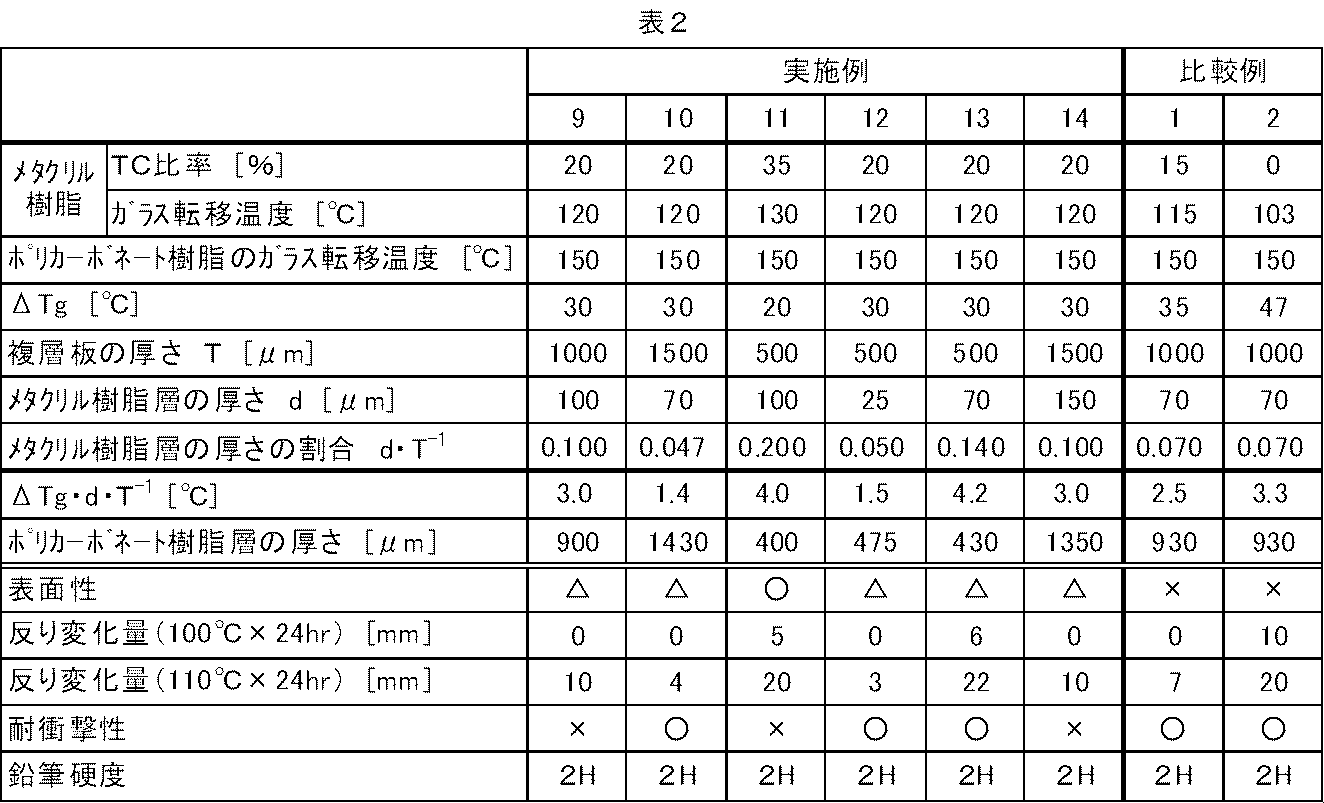
- Example 9 A multilayer plate having a total thickness of 1000 ⁇ m composed of a methacrylic resin layer having a thickness of 100 ⁇ m and a polycarbonate resin layer having a thickness of 900 ⁇ m was produced in the same manner as in Example 2 except that the extrusion amounts of the methacrylic resin and the polycarbonate resin were changed. .
- the evaluation results are shown in Table 2.
- Example 10 The total thickness consisting of a methacrylic resin layer having a thickness of 70 ⁇ m and a polycarbonate resin layer having a thickness of 1430 ⁇ m, in the same manner as in Example 2 except that the extrusion amount of the methacrylic resin and the polycarbonate resin and the interval between the extrusion rolls were changed. A 1500 ⁇ m multilayer board was produced. The evaluation results are shown in Table 2.
- Example 11 A multi-layer board having a total thickness of 500 ⁇ m consisting of a methacrylic resin layer having a thickness of 100 ⁇ m and a polycarbonate resin layer having a thickness of 400 ⁇ m was produced in the same manner as in Example 6 except that the extrusion amounts of the methacrylic resin and the polycarbonate resin were changed. did. The evaluation results are shown in Table 2.
- Example 12 The total thickness consisting of a 25 ⁇ m-thick methacrylic resin layer and a 475 ⁇ m-thick polycarbonate resin layer in the same manner as in Example 2 except that the extrusion amount of the methacrylic resin and the polycarbonate resin and the interval between the extrusion rolls were changed. A 500 ⁇ m multilayer board was produced. The evaluation results are shown in Table 2.
- Example 13 A multilayer board having a total thickness of 500 ⁇ m made of a methacrylic resin layer having a thickness of 70 ⁇ m and a polycarbonate resin layer having a thickness of 430 ⁇ m was produced in the same manner as in Example 12 except that the extrusion amounts of the methacrylic resin and the polycarbonate resin were changed. did. The evaluation results are shown in Table 2.
- Example 14 Total thickness consisting of a 150 ⁇ m thick methacrylic resin layer and a 1350 ⁇ m thick polycarbonate resin layer in the same manner as in Example 12 except that the extrusion amount of the methacrylic resin and the polycarbonate resin and the interval between the extrusion rolls were changed. A 1500 ⁇ m multilayer board was produced. The evaluation results are shown in Table 2.
- the multilayer board of the present invention when the ratio of the thickness of the methacrylic resin layer (d ⁇ T ⁇ 1 ) is almost the same, it can be seen that the impact resistance is further improved when the methacrylic resin layer becomes thinner (Example 6 and 7). Further, in the multilayer plate of the present invention, it can be seen that when the value of ⁇ Tg ⁇ d ⁇ T ⁇ 1 is decreased, warpage at 110 ° C. is further suppressed (Examples 6 and 11, Examples 10 and 13, and (Refer to the comparison between Examples 12 and 14). In the multilayer board of the present invention, the same physical properties can be obtained particularly when the total thickness T is in the range of 1000 ⁇ m to 1500 ⁇ m (see Examples 1 and 6 and Examples 2 and 10).
- the multilayer board of the present invention is suitable for a protective cover for a touch panel.
Landscapes
- Chemical & Material Sciences (AREA)
- Health & Medical Sciences (AREA)
- Chemical Kinetics & Catalysis (AREA)
- Medicinal Chemistry (AREA)
- Polymers & Plastics (AREA)
- Organic Chemistry (AREA)
- Physics & Mathematics (AREA)
- Thermal Sciences (AREA)
- Laminated Bodies (AREA)
- Addition Polymer Or Copolymer, Post-Treatments, Or Chemical Modifications (AREA)
Abstract
Description
タッチパネルによる入力操作で、表面に擦傷ができたり、内部が圧壊したりすることがある。これを防止するためにタッチパネルの表面に透明な保護カバーが設置される。保護カバーとして強化ガラス製のものが主に使われている。また、加工性や軽量化の観点から、透明樹脂製の保護カバーの開発が行われている。この保護カバーには、光沢、耐擦傷性、耐衝撃性などが求められる。
ところで、ポリカーボネート樹脂は、耐衝撃性に優れる成形品を得るのに適した樹脂の一つである。メタクリル樹脂は、高光沢で、耐擦傷性に優れる成形品を得るのに適した樹脂の一つである。また、ポリカーボネート樹脂とメタクリル樹脂とを同時に加熱溶融成形(例えば共押出成形)することによって、ポリカーボネート樹脂からなる層とメタクリル樹脂からなる層とからなる複層板が製造できる。樹脂の加熱溶融成形においては、得られる成形品に少なからず歪み応力が残る。この成形品に残った歪み応力を残留応力と呼び、該残留応力を有する成形品は、熱などによって、反りや縮みを発生する。上記複層板のような、板状成形品においては、特に残留応力に起因する反りが問題となる。板状成形品中の残留応力を減らし、反りの発生を抑制する方法の一つとして、押出成形に用いられる冷却ロールの回転速度を調整することによる方法が知られている(特許文献1参照)。
本発明の目的は、表面性が良好で、残留応力に起因する反りの発生が抑制された、タッチパネルの保護カバーなどに好適な複層板を提供することである。
〔1〕 メタクリル酸エステルに由来する構造単位を90質量%以上含有するガラス転移温度120~180℃のメタクリル樹脂からなる層と、
ポリカーボネート樹脂からなる層とを有する複層板。
〔2〕 前記メタクリル樹脂が、メタクリル酸メチルに由来する構造単位を40~90質量%含有する〔1〕に記載の複層板。
〔3〕 前記メタクリル樹脂が、式(I)で表されるメタクリル酸エステル(メタクリル酸エステル(I)と称する)に由来する構造単位を10~60質量%含有する〔1〕又は〔2〕に記載の複層板。

(式(I)中のCyは脂環式炭化水素基を表す。)
〔4〕 式(I)におけるCyが多環脂肪族炭化水素基である、〔3〕に記載の複層板。

Rが表す炭化水素基は、メチル基、エチル基、プロピル基などの非環状脂肪族炭化水素基であっても、脂環式炭化水素基であっても、フェニル基などの芳香族炭化水素基であってもよい。ここで、Rが脂環式炭化水素基の場合は、メタクリル酸エステル(I)である。
また、本発明の複層板は、複層板の総厚さに対するメタクリル樹脂層の厚さの割合(d・T-1)が、好ましくは0.04~0.20、より好ましくは0.05~0.18、さらに好ましくは0.06~0.15である。メタクリル樹脂層の厚さの割合を上記範囲内にすると、残留応力に起因する反りの発生が抑制され、且つ表面硬度、耐衝撃性および軽量化のバランスがより良好となる傾向がある。
樹脂および複層板の物性を以下の方法にて測定した。
示差走査熱量計(「DSC-50」、株式会社リガク製)を用い、JIS-K7121に準拠して、樹脂10mgをアルミパンで封止し、10ml/minの窒素気流中、10℃/minの条件で測定した。本明細書ではJIS-K7121の定める中間点ガラス転移温度をガラス転移温度と定義した。
メルトインデクサー(「TAKARA L241-153」、株式会社テクノ・セブン製)を使用し、JIS-K7210に準じて測定した。
共押出成形で得られた複層板を500mm×500mmの大きさに切り出して試験板を作成した。
試験板の成形時押出方向に平行な一辺の1/3および2/3の位置に吊り下げ用糸を取り付け、該吊り下げ用糸によって前記押し出し方向に平行な一辺が水平になるように試験板を吊り下げた。試験板の成形時押出方向に直角な二辺の1/2の位置に測定用糸を張り渡し、該測定用糸の中点と試験板表面との隙間距離を測定した。これを加熱前の反り量(mm)とした。
次いで、試験板を所定温度に設定された恒温器に入れて24時間放置した。その後、恒温器から試験板を取り出し上記と同じ方法で隙間距離を測定した。これを加熱後の反り量(mm)とした。なお、恒温器の温度は100℃または110℃に設定し、該2つの温度条件にてそれぞれ試験を行った。
加熱前の反り量と加熱後の反り量との差を加熱による反り変化量(mm)と定義した。
蛍光灯が設置された室内にて、複層板のメタクリル樹脂層側表面を肉眼観察し、次の基準で表面性を評価した。
○:メタクリル樹脂層側表面にチャタマークが見えない。
△:メタクリル樹脂層側表面にチャタマークが見えるが、目立たない
×:メタクリル樹脂層側表面にチャタマークが目立つ。
複層板のメタクリル樹脂層側表面を、JIS-K5600-5-4に準じて測定し、鉛筆硬度にて表面硬度を評価した。
押出成形で得られた複層板を、押出流れ方向に平行な辺が70mm、押出流れ方向に直角な辺が100mmとなる長方形に切り出して試験片を作製した。
直径30mm、質量112gの鋼球を、1mの高さから試験片のメタクリル樹脂層側表面の中央に自由落下させた。試験片の割れ状態を肉眼観察し、以下の基準で耐衝撃性を評価した。
×:試験片の厚さ方向に貫通する割れが生じた。
○:試験片の厚さ方向に貫通する割れがない。
メタクリル酸メチルと8-トリシクロ[5.2.1.02,6]デカニルメタクリレートとのラジカル重合によって得られる共重合体をメタクリル樹脂として用意した。
なお、8-トリシクロ[5.2.1.02,6]デカニルメタクリレートが、メタクリル酸メチルと8-トリシクロ[5.2.1.02,6]デカニルメタクリレートの合計量に占める仕込み比率(質量百分率)を、TC比率と称することにする。
住化スタイロンポリカーボネート株式会社製「PCX」(MVR:8cm3/10分(300℃/1.2kg)、ガラス転移温度:150℃)をポリカーボネート樹脂として用意した。
TC比率35質量%のメタクリル樹脂(MVR:2cm3/10分(230℃/3.8kg)、ガラス転移温度:130℃)とポリカーボネート樹脂とを、速度4m/分で、共押出成形して、厚さ70μmのメタクリル樹脂層と厚さ930μmのポリカーボネート樹脂層とからなる総厚さ1000μmの複層板を製造した。評価結果を表1に示す。
TC比率35質量%のメタクリル樹脂に代えて、TC比率20質量%のメタクリル樹脂(MVR:2cm3/10分(230℃/3.8kg)、ガラス転移温度:120℃)を使用した以外は、実施例1と同じ手法にて複層板を製造した。評価結果を表1に示す。
TC比率35質量%のメタクリル樹脂に代えて、TC比率60質量%のメタクリル樹脂(MVR:2cm3/10分(230℃/3.8kg)、ガラス転移温度:150℃)を使用した以外は、実施例1と同じ手法にて複層板を製造した。評価結果を表1に示す。
メタクリル樹脂とポリカーボネート樹脂の押出量を変更した以外は実施例1と同じ手法にて、厚さ20μmのメタクリル樹脂層と厚さ980μmのポリカーボネート樹脂層とからなる総厚さ1000μmの複層板を製造した。評価結果を表1に示す。
メタクリル樹脂とポリカーボネート樹脂の押出量を変更した以外は実施例1と同じ手法にて、厚さ25μmのメタクリル樹脂層と厚さ975μmのポリカーボネート樹脂層とからなる総厚さ1000μmの複層板を製造した。評価結果を表1に示す。
メタクリル樹脂とポリカーボネート樹脂の押出量と、押出ロール間の間隔を変更した以外は実施例1と同じ手法にて、厚さ70μmのメタクリル樹脂層と厚さ430μmのポリカーボネート樹脂層とからなる総厚さ500μmの複層板を製造した。評価結果を表1に示す。
メタクリル樹脂とポリカーボネート樹脂の押出量を変更した以外は実施例1と同じ手法にて、厚さ150μmのメタクリル樹脂層と厚さ850μmのポリカーボネート樹脂層とからなる総厚さ1000μmの複層板を製造した。評価結果を表1に示す。
メタクリル樹脂とポリカーボネート樹脂の押出量、および押出ロール間の間隔を変更した以外は実施例1と同じ手法にて、厚さ150μmのメタクリル樹脂層と厚さ1350μmのポリカーボネート樹脂層とからなる総厚さ1500μmの複層板を製造した。評価結果を表1に示す。

メタクリル樹脂とポリカーボネート樹脂の押出量を変更した以外は実施例2と同じにして、厚さ100μmのメタクリル樹脂層と厚さ900μmのポリカーボネート樹脂層とからなる総厚さ1000μmの複層板を製造した。評価結果を表2に示す。
メタクリル樹脂とポリカーボネート樹脂の押出量、および押出ロール間の間隔を変更した以外は実施例2と同じ手法にて、厚さ70μmのメタクリル樹脂層と厚さ1430μmのポリカーボネート樹脂層とからなる総厚さ1500μmの複層板を製造した。評価結果を表2に示す。
メタクリル樹脂とポリカーボネート樹脂の押出量を変更した以外は実施例6と同じ手法にて、厚さ100μmのメタクリル樹脂層と厚さ400μmのポリカーボネート樹脂層とからなる総厚さ500μmの複層板を製造した。評価結果を表2に示す。
メタクリル樹脂とポリカーボネート樹脂の押出量、および押出ロール間の間隔を変更した以外は実施例2と同じ手法にて、厚さ25μmのメタクリル樹脂層と厚さ475μmのポリカーボネート樹脂層とからなる総厚さ500μmの複層板を製造した。評価結果を表2に示す。
メタクリル樹脂とポリカーボネート樹脂の押出量を変更した以外は実施例12と同じ手法にて、厚さ70μmのメタクリル樹脂層と厚さ430μmのポリカーボネート樹脂層とからなる総厚さ500μmの複層板を製造した。評価結果を表2に示す。
メタクリル樹脂とポリカーボネート樹脂の押出量、および押出ロール間の間隔を変更した以外は実施例12と同じ手法にて、厚さ150μmのメタクリル樹脂層と厚さ1350μmのポリカーボネート樹脂層とからなる総厚さ1500μmの複層板を製造した。評価結果を表2に示す。
TC比率35質量%のメタクリル樹脂に代えて、TC比率15質量%のメタクリル樹脂(MVR:2cm3/10分(230℃/3.8kg)、ガラス転移温度:115℃)を使用した以外は、実施例1と同じ手法にて複層板を製造した。評価結果を表2に示す。
[比較例2]
TC比率35質量%のメタクリル樹脂に代えて、メタクリル酸メチルのホモポリマー(MVR:2cm3/10分(230℃/3.8kg)、ガラス転移温度:103℃)を使用した以外は、実施例1と同じ手法にて複層板を製造した。評価結果を表2に示す。
TC比率35質量%のメタクリル樹脂に代えて、TC比率65質量%のメタクリル樹脂(MVR:2cm3/10分(230℃/3.8kg)、ガラス転移温度:155℃)を使用した以外は、実施例1と同じ手法にて複層板を製造しようとしたが、押出成形中に割れが発生し、製造できなかった。
Claims (4)
- メタクリル酸エステルに由来する構造単位90質量%以上を含有するガラス転移温度120~180℃のメタクリル樹脂からなる層と、
ポリカーボネート樹脂からなる層とを有する複層板。 - 前記メタクリル樹脂が、メタクリル酸メチルに由来する構造単位40~90質量%を含有する請求項1に記載の複層板。
- 前記メタクリル樹脂が、式(I)で表されるメタクリル酸エステルに由来する構造単位10~60質量%を含有する請求項1又は2に記載の複層板。

(式中、Cyは脂環式炭化水素基を表す。) - 式(I)中におけるCyが多環脂肪族炭化水素基である、請求項3に記載の複層板。
Priority Applications (4)
| Application Number | Priority Date | Filing Date | Title |
|---|---|---|---|
| CN201380050598.9A CN104684731A (zh) | 2012-09-28 | 2013-09-27 | 多层板 |
| KR1020157006813A KR102112887B1 (ko) | 2012-09-28 | 2013-09-27 | 복층판 |
| US14/431,994 US9827748B2 (en) | 2012-09-28 | 2013-09-27 | Multilayer plate |
| JP2014538200A JP6293054B2 (ja) | 2012-09-28 | 2013-09-27 | 複層板 |
Applications Claiming Priority (2)
| Application Number | Priority Date | Filing Date | Title |
|---|---|---|---|
| JP2012215774 | 2012-09-28 | ||
| JP2012-215774 | 2012-09-28 |
Publications (1)
| Publication Number | Publication Date |
|---|---|
| WO2014050136A1 true WO2014050136A1 (ja) | 2014-04-03 |
Family
ID=50387568
Family Applications (1)
| Application Number | Title | Priority Date | Filing Date |
|---|---|---|---|
| PCT/JP2013/005764 Ceased WO2014050136A1 (ja) | 2012-09-28 | 2013-09-27 | 複層板 |
Country Status (6)
| Country | Link |
|---|---|
| US (1) | US9827748B2 (ja) |
| JP (1) | JP6293054B2 (ja) |
| KR (1) | KR102112887B1 (ja) |
| CN (1) | CN104684731A (ja) |
| TW (1) | TWI602697B (ja) |
| WO (1) | WO2014050136A1 (ja) |
Cited By (6)
| Publication number | Priority date | Publication date | Assignee | Title |
|---|---|---|---|---|
| WO2016042727A1 (ja) * | 2014-09-18 | 2016-03-24 | 株式会社クラレ | 押出樹脂板の製造方法及び押出樹脂板 |
| WO2016121924A1 (ja) * | 2015-01-30 | 2016-08-04 | 株式会社クラレ | メタクリル系樹脂組成物およびそれを用いた積層体 |
| WO2017164276A1 (ja) * | 2016-03-23 | 2017-09-28 | 株式会社クラレ | 押出樹脂板の製造方法及び押出樹脂板 |
| JP2017531574A (ja) * | 2014-09-30 | 2017-10-26 | コーロン インダストリーズ インク | 透明プラスチックシート |
| WO2021014915A1 (ja) * | 2019-07-25 | 2021-01-28 | 三菱瓦斯化学株式会社 | 透明樹脂積層体並びにそれを用いた透明基板材料及び透明保護材料 |
| CN114851658A (zh) * | 2022-04-01 | 2022-08-05 | 万华化学集团股份有限公司 | 一种透明多层板材及其用途 |
Families Citing this family (2)
| Publication number | Priority date | Publication date | Assignee | Title |
|---|---|---|---|---|
| TWI735619B (zh) * | 2016-09-05 | 2021-08-11 | 日商理研科技股份有限公司 | 多層薄膜之製造方法、具有多層薄膜之物品之製造方法、及具有多層薄膜之物品 |
| US11951720B2 (en) * | 2018-10-26 | 2024-04-09 | Mitsubishi Gas Chemical Company, Inc. | Thermoplastic resin laminate |
Citations (3)
| Publication number | Priority date | Publication date | Assignee | Title |
|---|---|---|---|---|
| JP2003221418A (ja) * | 2002-01-31 | 2003-08-05 | Daicel Chem Ind Ltd | メタクリル系樹脂及びメタクリル系樹脂を用いた光学用材料 |
| JP2012121271A (ja) * | 2010-12-09 | 2012-06-28 | Sumitomo Chemical Co Ltd | 積層押出樹脂板の製造方法 |
| JP2012177979A (ja) * | 2011-02-25 | 2012-09-13 | Sumitomo Chemical Co Ltd | 下部電極基板用樹脂板、並びにそれを用いてなる下部電極板およびタッチパネル |
Family Cites Families (10)
| Publication number | Priority date | Publication date | Assignee | Title |
|---|---|---|---|---|
| KR920702857A (ko) * | 1990-02-23 | 1992-10-28 | 나가이 야타로 | 광학식 정보기록체용 메타그릴 수지 성형재료 |
| US6717057B1 (en) * | 2001-08-09 | 2004-04-06 | Flexcon Company, Inc. | Conductive composite formed of a thermoset material |
| JP4673708B2 (ja) * | 2005-08-25 | 2011-04-20 | 新日本製鐵株式会社 | 容器用着色ラミネート金属板およびその製造方法 |
| KR20070063431A (ko) | 2005-12-14 | 2007-06-19 | 스미또모 가가꾸 가부시끼가이샤 | 투과형 스크린용 수지판 |
| JP4396698B2 (ja) | 2005-12-14 | 2010-01-13 | 住友化学株式会社 | 押出樹脂板の製造方法 |
| JP5031598B2 (ja) * | 2008-01-28 | 2012-09-19 | 株式会社クラレ | ポリカーボネート樹脂積層体 |
| US20110244242A1 (en) | 2008-08-28 | 2011-10-06 | Mitsubishi Gas Chemical Company, Inc. | Thermoplastic resin laminate |
| DE102009020937A1 (de) * | 2009-05-12 | 2010-11-18 | Bayer Materialscience Ag | Kälte schlagzähe Coextrusionsfolien |
| WO2011145630A1 (ja) * | 2010-05-21 | 2011-11-24 | 三菱瓦斯化学株式会社 | 合成樹脂積層体 |
| US10011095B2 (en) * | 2012-02-22 | 2018-07-03 | Mitsubishi Gas Chemical Company, Inc. | Synthetic resin laminate |
-
2013
- 2013-09-27 WO PCT/JP2013/005764 patent/WO2014050136A1/ja not_active Ceased
- 2013-09-27 US US14/431,994 patent/US9827748B2/en not_active Expired - Fee Related
- 2013-09-27 KR KR1020157006813A patent/KR102112887B1/ko not_active Expired - Fee Related
- 2013-09-27 CN CN201380050598.9A patent/CN104684731A/zh active Pending
- 2013-09-27 JP JP2014538200A patent/JP6293054B2/ja not_active Expired - Fee Related
- 2013-09-30 TW TW102135255A patent/TWI602697B/zh not_active IP Right Cessation
Patent Citations (3)
| Publication number | Priority date | Publication date | Assignee | Title |
|---|---|---|---|---|
| JP2003221418A (ja) * | 2002-01-31 | 2003-08-05 | Daicel Chem Ind Ltd | メタクリル系樹脂及びメタクリル系樹脂を用いた光学用材料 |
| JP2012121271A (ja) * | 2010-12-09 | 2012-06-28 | Sumitomo Chemical Co Ltd | 積層押出樹脂板の製造方法 |
| JP2012177979A (ja) * | 2011-02-25 | 2012-09-13 | Sumitomo Chemical Co Ltd | 下部電極基板用樹脂板、並びにそれを用いてなる下部電極板およびタッチパネル |
Cited By (15)
| Publication number | Priority date | Publication date | Assignee | Title |
|---|---|---|---|---|
| TWI683740B (zh) * | 2014-09-18 | 2020-02-01 | 日商可樂麗股份有限公司 | 擠出樹脂板之製造方法及擠出樹脂板 |
| KR20170057301A (ko) * | 2014-09-18 | 2017-05-24 | 주식회사 쿠라레 | 압출 수지판의 제조 방법 및 압출 수지판 |
| JPWO2016042727A1 (ja) * | 2014-09-18 | 2017-06-29 | 株式会社クラレ | 押出樹脂板の製造方法及び押出樹脂板 |
| KR102365229B1 (ko) * | 2014-09-18 | 2022-02-18 | 주식회사 쿠라레 | 압출 수지판의 제조 방법 및 압출 수지판 |
| WO2016042727A1 (ja) * | 2014-09-18 | 2016-03-24 | 株式会社クラレ | 押出樹脂板の製造方法及び押出樹脂板 |
| JP2017531574A (ja) * | 2014-09-30 | 2017-10-26 | コーロン インダストリーズ インク | 透明プラスチックシート |
| JPWO2016121924A1 (ja) * | 2015-01-30 | 2017-11-09 | 株式会社クラレ | メタクリル系樹脂組成物およびそれを用いた積層体 |
| WO2016121924A1 (ja) * | 2015-01-30 | 2016-08-04 | 株式会社クラレ | メタクリル系樹脂組成物およびそれを用いた積層体 |
| CN107207822A (zh) * | 2015-01-30 | 2017-09-26 | 株式会社可乐丽 | 甲基丙烯酸类树脂组合物和使用该树脂组合物的层叠体 |
| WO2017164276A1 (ja) * | 2016-03-23 | 2017-09-28 | 株式会社クラレ | 押出樹脂板の製造方法及び押出樹脂板 |
| JPWO2017164276A1 (ja) * | 2016-03-23 | 2019-02-14 | 株式会社クラレ | 押出樹脂板の製造方法及び押出樹脂板 |
| WO2021014915A1 (ja) * | 2019-07-25 | 2021-01-28 | 三菱瓦斯化学株式会社 | 透明樹脂積層体並びにそれを用いた透明基板材料及び透明保護材料 |
| JPWO2021014915A1 (ja) * | 2019-07-25 | 2021-01-28 | ||
| JP7522112B2 (ja) | 2019-07-25 | 2024-07-24 | 三菱瓦斯化学株式会社 | 透明樹脂積層体並びにそれを用いた透明基板材料及び透明保護材料 |
| CN114851658A (zh) * | 2022-04-01 | 2022-08-05 | 万华化学集团股份有限公司 | 一种透明多层板材及其用途 |
Also Published As
| Publication number | Publication date |
|---|---|
| CN104684731A (zh) | 2015-06-03 |
| TWI602697B (zh) | 2017-10-21 |
| US9827748B2 (en) | 2017-11-28 |
| KR102112887B1 (ko) | 2020-05-19 |
| KR20150060702A (ko) | 2015-06-03 |
| JPWO2014050136A1 (ja) | 2016-08-22 |
| TW201425031A (zh) | 2014-07-01 |
| US20150239219A1 (en) | 2015-08-27 |
| JP6293054B2 (ja) | 2018-03-14 |
Similar Documents
| Publication | Publication Date | Title |
|---|---|---|
| JP6293054B2 (ja) | 複層板 | |
| TWI683740B (zh) | 擠出樹脂板之製造方法及擠出樹脂板 | |
| JP6500097B2 (ja) | 透明プラスチックシート | |
| CN105705332B (zh) | 高硬度多层片 | |
| KR102574014B1 (ko) | 열성형용 적층판과 그 제조 방법 | |
| CN106680912B (zh) | 一种高雾度光学扩散膜 | |
| JP6508330B2 (ja) | 積層体 | |
| CN101786358A (zh) | 树脂层叠体 | |
| JP6864671B2 (ja) | 押出樹脂板の製造方法及び耐擦傷性層付き押出樹脂板の製造方法 | |
| JP6997771B2 (ja) | 押出樹脂板とその製造方法 | |
| CN109562553B (zh) | 挤出树脂板的制造方法和挤出树脂板 | |
| JP2011046098A (ja) | 透明樹脂積層板 | |
| TW201811562A (zh) | 樹脂積層體的製造方法 | |
| JP6680036B2 (ja) | 積層体 | |
| JP2016216686A (ja) | ポリカーボネート樹脂組成物 | |
| CN106164145A (zh) | 聚酯薄膜以及使用该聚酯薄膜的透明电极膜 | |
| KR101186746B1 (ko) | 탄성이 있는 광학 시트 | |
| JP2012092216A (ja) | 光学用ポリカーボネート系樹脂フィルムの製造方法及び光学用ポリカーボネート系樹脂フィルム | |
| TW202106500A (zh) | 多層複合板及其製造方法與應用 | |
| JP7150628B2 (ja) | 透明導電性フィルム積層体 |
Legal Events
| Date | Code | Title | Description |
|---|---|---|---|
| 121 | Ep: the epo has been informed by wipo that ep was designated in this application |
Ref document number: 13841982 Country of ref document: EP Kind code of ref document: A1 |
|
| ENP | Entry into the national phase |
Ref document number: 2014538200 Country of ref document: JP Kind code of ref document: A |
|
| ENP | Entry into the national phase |
Ref document number: 20157006813 Country of ref document: KR Kind code of ref document: A |
|
| WWE | Wipo information: entry into national phase |
Ref document number: 14431994 Country of ref document: US |
|
| NENP | Non-entry into the national phase |
Ref country code: DE |
|
| 122 | Ep: pct application non-entry in european phase |
Ref document number: 13841982 Country of ref document: EP Kind code of ref document: A1 |