WO2014007267A1 - マイクロレンズの製造方法 - Google Patents
マイクロレンズの製造方法 Download PDFInfo
- Publication number
- WO2014007267A1 WO2014007267A1 PCT/JP2013/068185 JP2013068185W WO2014007267A1 WO 2014007267 A1 WO2014007267 A1 WO 2014007267A1 JP 2013068185 W JP2013068185 W JP 2013068185W WO 2014007267 A1 WO2014007267 A1 WO 2014007267A1
- Authority
- WO
- WIPO (PCT)
- Prior art keywords
- group
- microlens
- etching
- substituent
- lens
- Prior art date
- Legal status (The legal status is an assumption and is not a legal conclusion. Google has not performed a legal analysis and makes no representation as to the accuracy of the status listed.)
- Ceased
Links
Images



Classifications
-
- G—PHYSICS
- G02—OPTICS
- G02B—OPTICAL ELEMENTS, SYSTEMS OR APPARATUS
- G02B3/00—Simple or compound lenses
- G02B3/0006—Arrays
- G02B3/0012—Arrays characterised by the manufacturing method
-
- G—PHYSICS
- G02—OPTICS
- G02B—OPTICAL ELEMENTS, SYSTEMS OR APPARATUS
- G02B3/00—Simple or compound lenses
- G02B3/0006—Arrays
- G02B3/0037—Arrays characterized by the distribution or form of lenses
- G02B3/0056—Arrays characterized by the distribution or form of lenses arranged along two different directions in a plane, e.g. honeycomb arrangement of lenses
-
- H—ELECTRICITY
- H10—SEMICONDUCTOR DEVICES; ELECTRIC SOLID-STATE DEVICES NOT OTHERWISE PROVIDED FOR
- H10F—INORGANIC SEMICONDUCTOR DEVICES SENSITIVE TO INFRARED RADIATION, LIGHT, ELECTROMAGNETIC RADIATION OF SHORTER WAVELENGTH OR CORPUSCULAR RADIATION
- H10F39/00—Integrated devices, or assemblies of multiple devices, comprising at least one element covered by group H10F30/00, e.g. radiation detectors comprising photodiode arrays
- H10F39/80—Constructional details of image sensors
- H10F39/806—Optical elements or arrangements associated with the image sensors
- H10F39/8063—Microlenses
Definitions
- the present invention relates to a method for manufacturing a microlens using dry etching.
- a solid-state imaging device is provided with a color filter in which organic pixels of a plurality of colors such as red pixels, green pixels, and blue pixels are two-dimensionally arranged on a support such as a semiconductor substrate.
- a microlens array made of a transparent resin is formed on the upper portion.
- One approach is to form a microlens that etches back so as to eliminate a gap between adjacent microlenses (hereinafter simply referred to as a gap) using a dry etching apparatus.
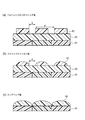
- FIGS. 8A Examples of conventional microlens manufacturing by etch-back are shown in FIGS.
- a layer made of a photoresist is laminated on a color filter layer 61 through a lens material layer 62 made of a transparent resin material, exposed, developed, and patterned to form a mask material 63.
- the pattern pitch (pixel size) is indicated by d
- the inter-pattern gap is indicated by g.
- the inter-pattern gap g in FIG. 8B be as small as possible within a range where adjacent patterns are not fused.
- the lens shape does not leave the corners of the photoresist, and it is desired that the lenses do not fuse.
- a lens-shaped mask material 63 (hereinafter also referred to as a lens matrix) made of a photoresist is transferred to the lens material layer 62 by dry etching using a dry etching apparatus.
- deposits (hereinafter also simply referred to as deposits) are deposited on the sidewalls of the microlenses and etching is performed to narrow the gap between the microlenses and form a microlens with a large surface area. In order to eliminate the optical loss, it is desired to eliminate the gap of the microlens at this time.
- Patent Documents 1 to 3 have been reported as microlens forming methods by these etch-back methods. These documents relate to a technique for etching a lens material layer and a lens-shaped photoresist formed thereon, and transferring the lens shape of the photoresist to the lens material layer. It is described that it is possible to improve the narrowing of gaps between the lenses (hereinafter, also simply referred to as gaplessness) in the microlens finally obtained by the fabrication.
- Japanese Unexamined Patent Publication No. 2006-73605 Japanese Unexamined Patent Publication No. 2006-190903 Japanese Unexamined Patent Publication No. 2008-281414
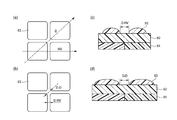
- FIGS. 9A and 9B are top views of the mask material 63
- FIGS. 9C and 9D are a schematic sectional view and a diagonal direction in the pitch direction (HV) in FIG. 9A, respectively. It is a cross-sectional schematic diagram in (D).
- the curvature of the mask material in the pitch direction (HV) is steep, and the curvature in the diagonal direction (D) is gentle.
- the resist film thickness in the pitch direction is thick and the diagonal direction is thin.
- the amount of deposit generated by etching the side wall during etch back has a correlation with the resist film thickness, and it is said that the thicker the resist film thickness, the easier the gap is narrowed. Therefore, narrowing the gap in the D direction becomes more difficult than in the HV direction.
- the gap length when forming the photoresist to be the mask pattern tends to be wide in the diagonal direction (DD) with respect to the pattern pitch direction (D-HV). Therefore, it is disadvantageous from the viewpoint of narrowing the gap.
- the tail flow of the photoresist tends to slip due to the heat flow at the time of forming the lens of the photoresist in the melt process, and the gap characteristics, in-plane and gap uniformity between processing substrates are required to be strictly controlled, and the process window There was a problem that would narrow.
- the process window refers to an allowable range when the process condition changes from an optimal state. It is difficult to stably form the gap between the lens matrixes of the photoresist to 0.3 ⁇ m or less because of the resolution limit of photolithography and the controllability of the heat flow. In order to enable gaplessness for these mask materials, it is required to form a transfer lens under etching conditions having a large CD gain value.
- the CD gain value is a change amount of the transferred lens diameter after etching with respect to the diameter of the lens matrix, and a narrow gap or gapless can be achieved by a high CD gain.
- the CD gain value is 260 nm
- the transfer lens diameter is increased by 260 nm as compared with the diameter of the lens matrix. Therefore, when the gap between the lenses of the lens matrix is 300 nm, the transfer lens gap is reduced to 40 nm. It can be made smaller.
- it is required to strictly control the selection of gas species, the mixing ratio, power, and other etching parameters.
- the object of the present invention has been made in view of such problems, and it is necessary to ensure a gap between patterns by forming a lens by a melt process because the photoresist as a mask material does not go through a melt process. Therefore, the gap between the mask patterns can be narrowed, the variation in the line width can be eliminated, and the inter-pattern fusion due to the melt process does not occur, so that the process window for mask pattern formation can be expanded. As a result, it is an object of the present invention to provide a method of manufacturing a microlens that can preferably manufacture a gapless microlens.
- An object of the present invention is to provide a method for manufacturing a microlens that can improve the manufacturing process and shorten the etching time.
- the present inventor has improved the controllability of the gap between patterns and has the heat flow characteristics in the photoresist by forming the photoresist without forming a lens shape by a melt process. It has been found that narrow gaps in the diagonal direction can be particularly promoted by improving uniformity and making the height of the photoresist in the pitch direction and diagonal direction uniform because it is not required. In addition, since the photoresist does not require thermal flow characteristics, the resolution of the photoresist does not perform the melt process, so there is no need to consider the melt characteristics, and as a result, performance near the limit performance of the photoresist can be used.
- the present invention has been made based on the above findings. That is, the present invention [1] Without passing through the melt process, the mask layer formed on the lens material layer formed on the substrate is dry-etched together with the lens material layer, and the pattern of the mask layer is transferred to the lens material layer to form the microlens. A method for manufacturing a microlens. [2] The microlens manufacturing method according to [1], wherein a pixel size (pattern pitch) of the formed microlens is 2.0 ⁇ m or less.
- [3] The method for producing a microlens according to [1], wherein a lens material layer is formed on the organic photoelectric conversion film.
- [4] The microlens manufacturing method according to any one of [1] to [3], wherein a gap between patterns in the pitch direction of the formed microlens is 0.4 ⁇ m or less.
- [5] The method for manufacturing a microlens according to any one of [1] to [4], wherein a gap between patterns in the diagonal direction of the formed microlens is 0.4 ⁇ m or less.
- [6] 6 6.
- the two or more kinds of etching processes include a first etching process using a mixed gas containing oxygen and a second etching process using a gas containing one or more halogen compound gases. Lens manufacturing method.
- the mixed gas containing oxygen in the first etching step further contains an inert gas and a halogen compound gas, and the gas containing one or more halogen compound gases in the second etching step is CF 4 and C 4 F. 6.
- the flow rate of the dry etching gas is 300 ml / min or more in both the first etching step and the second etching step, and the pressure of the etching treatment layer is 0.8 to 5 Pa.
- the mask layer having the pattern shape is a mask layer formed by exposing and developing a photosensitive layer containing a resin, and then post-heating at a temperature lower than the glass transition point (Tg) of the resin.
- Tg glass transition point
- a method for producing a solid-state imaging device comprising a color filter and a microlens laminated directly or indirectly thereon, 1) a step of laminating a lens material layer on a color filter or a photoelectric conversion layer; 2) a step of forming a mask layer having a pattern shape as a lens matrix on the lens material layer without passing through a melt step; and 3) the pattern shape of the mask layer is changed to the lens material layer by dry etching.
- a method for manufacturing a solid-state imaging device which includes a step of forming a microlens by transferring the image to the substrate.
- [13] [1] A microlens formed by the method for producing a microlens according to any one of [11].
- the gap between the mask patterns can be narrowed,
- the line width variation can be eliminated, and the pattern pattern fusion process can be expanded because the melt-pattern fusion does not occur.
- a gapless microlens can be suitably manufactured. Can do.
- the mask material photoresist since the mask material photoresist has not undergone lens shaping by the melt process, the etching characteristics in the pitch direction and the diagonal direction (the balance between the formation of the deposit and the progress of the etching) are improved, and the gaplessness of the microlens. The etching time can be shortened.
- the gap between the patterns of the photoresist can make use of the resolution limit of photolithography as it is and can improve the narrowing of the mask pattern.
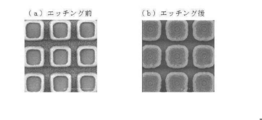
- FIG. 3 is a diagram showing the result of observation of a pattern formed in Example 1 by a length-measuring scanning electron micrograph (hereinafter referred to as a CD-SEM photograph). It is a figure which shows the observation result by the CD-SEM photograph of the photoresist formed through etching conditions (1) (chamfering process).
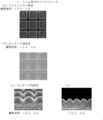
- FIG. 6 is a diagram showing an observation result by a CD-SEM photograph of a pattern formed in Example 2.
- (A)-(c) is a cross-sectional schematic diagram which shows the example of microlens manufacture by the conventional etch back. It is a schematic diagram which shows the example of microlens manufacture by the conventional etch back.
- the notation which does not describe substitution and non-substitution includes the thing which has a substituent with the thing which does not have a substituent.
- the “alkyl group” includes not only an alkyl group having no substituent (unsubstituted alkyl group) but also an alkyl group having a substituent (substituted alkyl group).
- the description of the constituent elements described below may be made based on typical embodiments of the present invention, but the present invention is not limited to such embodiments.
- a numerical range expressed using “to” means a range including numerical values described before and after “to” as a lower limit value and an upper limit value.
- (meth) acrylate represents acrylate and methacrylate
- (meth) acryl represents acryl and methacryl
- (meth) acryloyl represents acryloyl and methacryloyl.
- monomer and “monomer” are synonymous.
- the monomer in the present invention is distinguished from oligomer and polymer, and refers to a compound having a mass average molecular weight of 2,000 or less.
- a polymerizable compound means a compound having a polymerizable group, and may be a monomer or a polymer, and a polymerizable group is a group involved in a polymerization reaction.
- “refractive index” refers to a refractive index with respect to light having a wavelength of 500 nm unless otherwise specified.
- the manufacturing method of the microlens of this invention is suitable when forming the microlens layer after color filter layer formation on a solid-state image sensor.
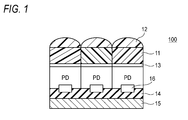
- the solid-state imaging device 100 includes a color filter layer 11 formed using a plurality of color resists on a two-dimensionally arranged photoelectric conversion device PD, and a microlens layer thereon. 12.
- the lower layer or the upper layer of the color filter layer 11 may have a planarization layer or adhesion layer 13 such as a silicon oxide (SiO 2 ) film or a silicon nitride (SiN) film.
- the photoelectric conversion element PD is disposed on the insulating layer 14 formed on the support 15.
- a signal readout circuit 16 that reads out a signal corresponding to the electric charge generated in the photoelectric conversion element PD of the pixel unit is formed for each pixel unit.
- the signal readout circuit 16 is composed of, for example, a CMOS circuit.
- the manufacturing method of the microlens of this invention can be used conveniently for manufacture of a solid-state image sensor (for example, CCD, CMOS, organic CMOS sensor). Particularly, it is suitable for a high-resolution one exceeding 1 million pixels.
- the present invention is suitable, for example, as a method for manufacturing a microlens for condensing formed on a light receiving portion and a color filter of each pixel constituting a CCD or CMOS.
- an organic photoelectric conversion film disclosed in Japanese Patent Application Laid-Open Nos. 2008-258474 and 2010-123779 may be used.
- the microlens may be formed not on the color filter layer but on the organic photoelectric conversion film, and the microlens manufacturing method of the present invention can be applied even when the pixel has a size of 2.0 ⁇ m or less.
- the method for manufacturing a microlens according to the present invention includes forming a mask layer having a pattern shape on a lens material layer formed on a substrate without undergoing a melt process, and performing dry etching together with the lens material layer. A step of transferring the pattern shape of the mask layer to the material layer to form a microlens. Since the method for manufacturing a microlens of the present invention is suitable for forming a microlens layer of a solid-state image sensor, the present invention also relates to a method for manufacturing a solid-state image sensor.
- the method for producing a solid-state imaging device of the present invention is a method for producing a solid-state imaging device comprising a color filter and a microlens laminated directly or indirectly thereon.
- the substrate is preferably a color filter layer formed on a two-dimensionally arranged photoelectric conversion device.
- the melt process refers to a process in which a photoresist is heat-flowed in order to form a lens matrix having a curved lens shape. The process of making it heat flow by doing is mentioned.
- slip of the tail portion of the photoresist can occur.
- post-baking for example, heating below Tg
- the pattern pitch (pixel size) of the formed microlens is preferably 2.0 ⁇ m or less, more preferably 1.2 ⁇ m or less, further preferably 1.0 ⁇ m or less, particularly preferably 0.8 ⁇ m or less, and particularly preferably 0.7 ⁇ m or less. Preferably, 0.6 ⁇ m or less is most preferable. Further, the gap between patterns in the pitch direction of the formed microlens is preferably 0.4 ⁇ m or less, more preferably 0.3 ⁇ m or less, still more preferably 0.2 ⁇ m or less, and particularly preferably 0.1 ⁇ m or less.
- the gap between patterns in the diagonal direction of the formed microlens is preferably 0.4 ⁇ m or less, more preferably 0.3 ⁇ m or less, still more preferably 0.2 ⁇ m or less, and particularly preferably 0.1 ⁇ m or less.
- the inter-pattern gap in the diagonal direction tends to be larger than the inter-pattern gap in the pitch direction, it is possible to achieve a narrow gap because there is no melt process.
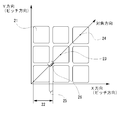
- the “microlens pattern pitch (pixel size)” is constant in each of the X direction and the Y direction perpendicular to the X direction (hereinafter, the X direction and the Y direction are collectively referred to as “pitch direction”). Is the sum of the pitch direction length of one pattern and the pitch direction length of the gap formed by two adjacent patterns in the pitch direction.
- the “inter-pattern gap in the pitch direction of the microlens” corresponds to the interval between the two patterns adjacent to each other in the pitch direction.
- the “diagonal direction” in the “inter-pattern gap in the diagonal direction of the microlens” refers to a direction that intersects both the X direction and the Y direction, and a direction in which the plurality of patterns are arranged.
- the “inter-pattern gap in the diagonal direction of the microlens” corresponds to the interval between the two adjacent patterns in the diagonal direction.
- the diagonal direction is preferably a direction intersecting at an angle of 43 ° to 47 ° (preferably 45 °) with respect to both the X direction and the Y direction which are pitch directions.
- the microlens manufactured by the microlens manufacturing method according to the present invention is, for example, a microlens having a circular bottom surface (in other words, a microlens having a circular shape when viewed from above)
- the pattern pitch (pixel size) 2 of the microlens is: This corresponds to the sum of the pitch direction length of one pattern and the interval 5 between two patterns adjacent in the pitch direction.
- the inter-pattern gap 6 in the diagonal direction of the microlens corresponds to the interval between two patterns adjacent in the diagonal direction.
- the diagonal direction is a direction connecting the centroid 3 of any one microlens and the centroid 4 of another microlens adjacent in the direction intersecting both the X direction and the Y direction. .
- the microlens manufactured by the method of manufacturing a microlens according to the present invention is, for example, a microlens having a substantially square bottom surface (in other words, a microlens having a substantially square shape when viewed from above).
- the microlens pattern pitch (pixel size) in the plurality of patterns 21 formed at regular intervals in the X direction and the Y direction perpendicular to the X direction, as shown in the top view of FIG. ) 22 corresponds to the sum of the pitch direction length of one pattern and the interval 25 between two patterns adjacent in the pitch direction.
- the “substantially quadrangular shape” means not only a quadrangular shape in which all corners are right angles, but also a quadrangular shape in which at least one of the corners is rounded, a quadrangular shape in which at least one of the corners is not a right angle, It means that one side includes a quadrangular shape or the like that is not a straight line (for example, a curved line).
- the “substantially square shape” is preferably rectangular, and is preferably square.
- the inter-pattern gap 26 in the diagonal direction of the microlens corresponds to an interval between two patterns adjacent in the diagonal direction.
- the diagonal direction is a direction connecting the centroid 23 of any one microlens and the centroid 24 of another microlens adjacent in the direction intersecting both the X direction and the Y direction. .
- the lens material layer is preferably formed of the following curable composition or transparent inorganic material.
- the curing of the lens material layer is not particularly limited, but is preferably thermosetting.
- the lens material layer can be formed of a transparent inorganic material by vapor deposition or sputtering.
- the curable composition used for forming the lens material layer includes a metal oxide particle (A) having a primary particle diameter of 1 nm to 100 nm, and a graft chain having a number of atoms excluding hydrogen atoms in the range of 40 to 10,000.
- the dispersion stability of the metal oxide particles (A) is excellent, and even when applied to a large-sized substrate with a high refractive index, there is a difference in film thickness between the central portion and the peripheral portion.
- a small lens material layer typically a transparent lens material layer
- the metal oxide particles are inorganic particles having a high refractive index, and include titanium dioxide (TiO 2 ) particles, zirconium dioxide (ZrO 2 ) particles, and silicon dioxide (SiO 2 ) particles.
- titanium dioxide particles hereinafter sometimes simply referred to as “titanium dioxide”
- the metal oxide particles are not particularly limited as long as the primary particle diameter is 1 nm to 100 nm.
- the metal oxide particles can be appropriately selected from commercially available metal oxide particles.
- the primary particle diameter of the metal oxide particles is 1 nm to 100 nm, preferably 1 nm to 80 nm, and particularly preferably 1 nm to 50 nm.
- the primary particle diameter of the metal oxide particles is obtained as the average particle diameter of the metal oxide particles.
- the average particle diameter of the metal oxide particles in the present invention is obtained by diluting a mixed liquid or dispersion containing the metal oxide particles 80 times with propylene glycol monomethyl ether acetate, and subjecting the obtained diluted liquid to a dynamic light scattering method. The value obtained by using and measuring. This measurement is the number average particle diameter obtained by using Microtrack UPA-EX150 manufactured by Nikkiso Co., Ltd.
- the refractive index of the metal oxide particles is not particularly limited, but is preferably 1.75 to 2.70, more preferably 1.90 to 2.70 from the viewpoint of obtaining a high refractive index.
- the specific surface area of the metal oxide particles is preferably 10 m 2 / g to 400 m 2 / g, more preferably 20 m 2 / g to 200 m 2 / g, and more preferably 30 m 2 / g to 150 m 2 / g. Most preferably.
- it can be a rice grain shape, a spherical shape, a cubic shape, a spindle shape, or an indefinite shape.
- the metal oxide particles may be surface-treated with an organic compound.
- organic compound used for the surface treatment include polyols, alkanolamines, stearic acid, silane coupling agents, and titanate coupling agents. Of these, silane coupling agents are preferred.
- the surface treatment may be carried out by using a single surface treatment agent or a combination of two or more surface treatment agents. It is also preferable that the surface of the metal oxide particles is covered with an oxide such as aluminum, silicon, or zirconia. Thereby, a weather resistance improves more.
- titanium dioxide particles As said metal oxide particle, what is marketed can be used preferably.
- examples of commercially available titanium dioxide particles include TTO series (TTO-51 (A), TTO-51 (C), etc.), TTO-S, and V series (TTO-S-1, TTO-) manufactured by Ishihara Sangyo Co., Ltd. S-2, TTO-V-3, etc.) and MT series (MT-01, MT-05, etc.) manufactured by Teika Corporation.
- zirconium dioxide particles examples include UEP (Daiichi Rare Element Chemical Co., Ltd.), PCS (Nippon Denko Co., Ltd.), JS-01, JS-03, JS-04 (Nippon Denko ( And UEP-100 (Daiichi Rare Element Chemical Industries, Ltd.).
- Examples of commercially available silicon dioxide particles include OG502-31 manufactured by Clariant Co.
- the metal oxide particles may be used singly or in combination of two or more.
- the content of the metal oxide particles in the composition is 45% by mass to 95% by mass with respect to the total solid content of the curable composition. More preferably, it is 50 mass% to 90 mass%, Most preferably, it is 55 mass% to 85 mass%.
- the size of one pixel is extremely small, and in order to collect light more efficiently, a microlens having a higher refractive index is required.
- the content of metal oxide particles is curable composition. If the amount is too small relative to the total solid content, it is difficult to obtain such a microlens.
- the curable composition when the content of the metal oxide particles is too much with respect to the total solid content of the curable composition, dispersibility and dispersion due to the reason that a sufficient amount of the graft copolymer (B) is hardly present. Stability is easily lost. Furthermore, when the curable composition is applied to a large size (for example, 12 inches) substrate, it is difficult to form a lens material layer having a small film thickness difference between the central portion and the peripheral portion of the substrate.
- the said curable composition contains a graft copolymer (henceforth "specific resin").
- the graft copolymer preferably has a graft chain in which the number of atoms excluding hydrogen atoms is in the range of 40 to 10,000.
- the graft chain in this case indicates from the base of the main chain of the copolymer (the atom bonded to the main chain in a group branched from the main chain) to the end of the group branched from the main chain.
- the specific resin is a dispersion resin that imparts dispersibility to the metal oxide particles, and has an affinity with a solvent due to a graft chain. Excellent dispersion stability after aging.
- the graft chain and a solvent show favorable interaction, it is thought that the uniformity of the film thickness in a coating film is suppressed.
- the graft copolymer (B) used in the present invention preferably has 40 to 10,000 atoms excluding hydrogen atoms per graft chain, but excluding hydrogen atoms per graft chain. More preferably, the number of atoms is from 100 to 500, and more preferably from 150 to 260, excluding hydrogen atoms per graft chain. If the number of atoms excluding hydrogen atoms per graft chain is less than 40, the graft chain is short, so that the steric repulsion effect is reduced and the dispersibility and dispersion stability may be lowered.
- the curable composition when applied to a large size (for example, 12 inches) substrate, it is difficult to form a lens material layer having a small film thickness difference between the central portion and the peripheral portion of the substrate.
- the number of atoms excluding hydrogen atoms per graft chain exceeds 10,000, the graft chain becomes too long, and the adsorptive power to the metal oxide particles decreases, resulting in a decrease in dispersibility and dispersion stability.
- the number of atoms excluding hydrogen atoms per graft chain is included from the base atom bonded to the polymer chain constituting the main chain to the end of the branch polymer branched from the main chain.
- the number of atoms other than hydrogen atoms When the graft copolymer contains two or more types of graft chains, it is sufficient that the number of atoms excluding hydrogen atoms of at least one type of graft chain satisfies the above.
- the polymer structure of the graft chain As the polymer structure of the graft chain, a poly (meth) acrylic structure, a polyester structure, a polyurethane structure, a polyurea structure, a polyamide structure, a polyether structure, etc. can be used, but the interaction between the graft chain and the solvent is improved.
- the graft chain has a poly (meth) acrylic structure, a polyester structure, or a polyether structure, and more preferably has a polyester structure or a polyether structure. preferable.
- the graft copolymer preferably has a structural unit having a graft chain (repeating unit), and can be obtained, for example, by polymerizing a macromonomer having a polymer structure as a graft chain based on a conventional method,
- the structure of such a macromonomer is not particularly limited as long as it has a substituent capable of reacting with the polymer main chain and has a graft chain satisfying the above, but preferably a reactive double bond
- a macromonomer having a functional group can be preferably used.
- the structural unit having a graft chain may be a structural unit that does not correspond to a structural unit having an acid group, which will be described later, or a structural unit that corresponds to a structural unit having the acid group.
- AA-6 manufactured by Toagosei
- AA-10 manufactured by Toagosei
- AB-6 manufactured by Toagosei
- AS-6 Toagosei
- AA-6 manufactured by Toagosei
- AA-10 manufactured by Toagosei
- AB-6 manufactured by Toagosei
- AS-6 manufactured by Toagosei
- AN-6 Toagosei Co., Ltd.
- Bremer PME-4000 manufactured by NOF Corporation
- the specific resin used in the present invention preferably contains at least a structural unit represented by any one of the following formulas (1) to (4) as the structural unit having a graft chain.
- 1A), the following formula (2A), the following formula (3), and the structural unit represented by any of the following formula (4) are more preferably included.
- X 1 , X 2 , X 3 , X 4 , and X 5 each independently represent a hydrogen atom or a monovalent organic group. From the viewpoint of synthesis restrictions, a hydrogen atom or an alkyl group having 1 to 12 carbon atoms is preferable, a hydrogen atom or a methyl group is more preferable, and a methyl group is particularly preferable.
- W 1 , W 2 , W 3 , and W 4 each independently represent an oxygen atom or NH, and particularly preferably an oxygen atom.
- R ′ represents a branched or straight chain alkylene group (the number of carbon atoms is preferably 1 to 10, more preferably 2 or 3, and from the viewpoint of dispersion stability, —CH 2 A group represented by —CH (CH 3 ) — or a group represented by —CH (CH 3 ) —CH 2 — is preferred.
- R ′ in the formula (3) two or more types of R ′ having different structures may be mixed and used in the specific resin.
- Y 1 , Y 2 , Y 3 , and Y 4 are each independently a divalent linking group and are not particularly limited in structure. Specific examples include the following (Y-1) to (Y-21) linking groups.
- a and B each represent a bond with the left terminal group and the right terminal group in formulas (1) to (4). Of the structures shown below, (Y-2) and (Y-13) are more preferred because of the ease of synthesis.
- Z 1 , Z 2 , Z 3 , and Z 4 are each independently a hydrogen atom or a monovalent substituent, and the structure of the substituent is not particularly limited. Specific examples include an alkyl group, a hydroxyl group, an alkoxy group, an aryloxy group, a heteroaryloxy group, an alkylthioether group, an arylthioether group, a heteroarylthioether group, and an amino group. Among these, in particular, from the viewpoint of improving dispersibility, it preferably has a steric repulsion effect.
- the monovalent substituents represented by Z 1 to Z 3 are each independently an alkyl group having 5 to 24 carbon atoms or a carbon atom.
- alkoxy group having 5 to 24 carbon atoms is preferable, and an alkoxy group having a branched alkyl group having 5 to 24 carbon atoms or a cyclic alkyl group having 5 to 24 carbon atoms is particularly preferable.
- the monovalent substituent represented by Z 4 is preferably an alkyl group having 5 to 24 carbon atoms, and among them, each independently a branched alkyl group having 5 to 24 carbon atoms or a cyclic group having 5 to 24 carbon atoms. Alkyl groups are preferred.
- n, m, p, and q are each an integer of 1 to 500.
- j and k each independently represent an integer of 2 to 8.
- J and k in formula (1) and formula (2) are preferably integers of 4 to 6, and most preferably 5, from the viewpoint of dispersion stability.
- R represents a hydrogen atom or a monovalent organic group and is not particularly limited in terms of structure, but is preferably a hydrogen atom, an alkyl group, an aryl group, or a heteroaryl group, more preferably a hydrogen atom.
- the alkyl group is preferably a linear alkyl group having 1 to 20 carbon atoms, a branched alkyl group having 3 to 20 carbon atoms, or a cyclic alkyl group having 5 to 20 carbon atoms.
- a linear alkyl group having 1 to 20 carbon atoms is more preferable, and a linear alkyl group having 1 to 6 carbon atoms is particularly preferable.
- two or more types of R having different structures may be mixed and used in the specific resin.
- the structural unit represented by the formula (1) is more preferably a structural unit represented by the following formula (1A) or (2A) from the viewpoint of dispersion stability.
- X 1, Y 1, Z 1 and n are as defined X 1, Y 1, Z 1 and n in Formula (1), and preferred ranges are also the same.
- X 2, Y 2, Z 2 and m are as defined X 2, Y 2, Z 2 and m in the formula (2), and preferred ranges are also the same.
- the specific resin is more preferably one having a structural unit represented by the formula (1A).
- the specific resin may have one or more types of structural units having the graft chain.
- the structural unit (repeating unit) having the graft chain is preferably contained in a range of 10% to 75%, and in a range of 12% to 70%, based on the total mass of the specific resin. More preferably, it is particularly preferably in the range of 15% to 65%. Within this range, the dispersibility and dispersion stability of the metal oxide particles are high, and the uniformity of the film thickness in the coating film formed using the dispersion composition is further improved.
- the specific resin may be a combination of two or more graft copolymers having different structures.
- the specific resin is preferably a polymer having a structural unit (repeating unit) having an acid group in an amount of 25% by mass to 90% by mass with respect to the total mass of the specific resin.
- the content of the structural unit having an acid group is more preferably 30% by mass or more and 80% by mass or less, and most preferably 35% by mass or more and 75% by mass or less with respect to the total mass of the specific resin.
- the adsorptivity to the metal oxide particles of the specific resin of the present invention is insufficient and the dispersion stability is poor.
- the curable composition when applied to a large size (for example, 12 inches) substrate, it is difficult to form a lens material layer having a small film thickness difference between the central portion and the peripheral portion of the wafer.
- the content of the structural unit having an acid group is more than 90% by mass with respect to the total mass of the specific resin, the amount of the graft chain introduced into the specific resin becomes insufficient, resulting in poor dispersion stability.
- the acid value of specific resin can be suitably adjusted in the following preferable range because content of the structural unit which has an acid group exists in the said range.
- the acid group can also function as a functional group capable of forming an interaction with the metal oxide particles in addition to the graft chain.
- the acid group examples include a carboxylic acid group, a sulfonic acid group, a phosphoric acid group, a phenolic hydroxyl group, and the like.
- the carboxylic acid group It is preferably at least one selected from a group, a sulfonic acid group, and a phosphoric acid group, and a carboxylic acid group is particularly preferable.
- the acid group structure is preferably a structure separated by 5 atoms or more from the main chain of the resin structure. Furthermore, as the acid group, a carboxylic acid bonded to an aromatic ring is most preferable.
- the acid value of the specific resin is preferably in the range of 60 mgKOH / g to 350 mgKOH / g, more preferably in the range of 65 mgKOH / g to 300 mgKOH / g, and still more preferably in the range of 70 mgKOH / g to 250 mgKOH / g. It is a range.
- the acid value of the specific resin can be calculated, for example, from the average content of acid groups in the specific resin. Moreover, resin which has a desired acid value can be obtained by changing content of the monomer unit containing the acid group which comprises specific resin.
- the specific resin may further have a structural unit (repeating unit) having a functional group capable of interacting with the metal oxide particles other than the graft chain and the acid group.
- a structural unit having a functional group capable of forming an interaction with other metal oxide particles is not particularly limited in terms of structure.
- a structural unit having a basic group or a structural unit having a coordinating group And structural units having a reactive group is not particularly limited in terms of structure.
- the basic group examples include a primary amino group, a secondary amino group, a tertiary amino group, a heterocyclic ring containing an N atom, and an amide group. Particularly preferred is a tertiary amino group having good adsorption power to metal oxide particles and high dispersibility and dispersion stability. As said basic group, these can be used individually by 1 type or in combination of 2 or more types.
- the specific resin may or may not contain a structural unit having a basic group (repeating unit), but when it is contained, the content of the structural unit having a basic group is based on the total mass of the specific resin. It is 0.1 mass% or more and 50 mass% or less, Most preferably, it is 0.1 mass% or more and 30 mass% or less.
- Examples of the coordinating group and the reactive group include acetylacetoxy group, trialkoxysilyl group, isocyanate group, acid anhydride residue, acid chloride residue and the like. Particularly preferred is an acetylacetoxy group having good adsorption power to metal oxide particles and high dispersibility and dispersion stability.
- the coordinating group and the reactive group these can be used alone or in combination of two or more.
- the specific resin may or may not contain a structural unit (repeating unit) having a coordinating group or a reactive group, but if included, it has a coordinating group or a reactive group. Content of a structural unit is 0.1 mass% or more and 50 mass% or less with respect to the total mass of specific resin, Most preferably, it is 0.1 mass% or more and 30 mass% or less.
- the specific resin may have the following general formula (i) as a structural unit having a functional group capable of interacting with metal oxide particles, which is different from the structural unit having the graft chain and the structural unit having the acid group.
- To (iii) may have at least one repeating unit obtained from the monomer represented by any one of (iii) to (iii).
- R 1 , R 2 , and R 3 each independently represent a hydrogen atom, a halogen atom (eg, fluorine, chlorine, bromine, etc.), or a carbon atom number of 1 to 6
- An alkyl group (for example, a methyl group, an ethyl group, a propyl group, etc.).
- R 1 , R 2 , and R 3 are more preferably a hydrogen atom or an alkyl group having 1 to 3 carbon atoms, and most preferably a hydrogen atom or a methyl group.
- R 2 and R 3 are particularly preferably a hydrogen atom.
- X represents an oxygen atom (—O—) or an imino group (—NH—), and is preferably an oxygen atom.
- L is a single bond or a divalent linking group.
- a divalent aliphatic group for example, an alkylene group, a substituted alkylene group, an alkenylene group, a substituted alkenylene group, an alkynylene group, a substituted alkynylene group
- a divalent aromatic group for example, an arylene group
- Substituted arylene groups divalent heterocyclic groups and their oxygen atoms (—O—), sulfur atoms (—S—), imino groups (—NH—), substituted imino groups (—NR 31 —, R 31 may be a combination with an aliphatic group, aromatic group or heterocyclic group) or a carbonyl group (—CO—).
- the divalent aliphatic group may have a cyclic structure or a branched structure.
- the aliphatic group has preferably 1 to 20 carbon atoms, more preferably 1 to 15 carbon atoms, and still more preferably 1 to 10 carbon atoms.
- the aliphatic group is preferably a saturated aliphatic group rather than an unsaturated aliphatic group.
- the aliphatic group may have a substituent. Examples of the substituent include a halogen atom, a hydroxyl group, an aromatic group, and a heterocyclic group.
- the number of carbon atoms of the divalent aromatic group is preferably 6 to 20, more preferably 6 to 15, and most preferably 6 to 10.
- the aromatic group may have a substituent. Examples of the substituent include a halogen atom, a hydroxyl group, an aliphatic group, an aromatic group, and a heterocyclic group.
- the divalent heterocyclic group preferably has a 5-membered or 6-membered ring as a heterocycle.
- Another heterocyclic ring, an aliphatic ring or an aromatic ring may be condensed with the heterocyclic ring.
- the heterocyclic group may have a substituent. Examples of substituents include halogen atoms, hydroxy groups, oxo groups ( ⁇ O), thioxo groups ( ⁇ S), imino groups ( ⁇ NH), substituted imino groups ( ⁇ N—R 32 , where R 32 is a fatty acid Aromatic group, aromatic group or heterocyclic group), aliphatic group, aromatic group and heterocyclic group.
- L is preferably a single bond, an alkylene group or a divalent linking group containing an oxyalkylene structure.
- the oxyalkylene structure is more preferably an oxyethylene structure or an oxypropylene structure.
- L may contain a polyoxyalkylene structure containing two or more oxyalkylene structures.
- the polyoxyalkylene structure is preferably a polyoxyethylene structure or a polyoxypropylene structure.
- the polyoxyethylene structure is represented by — (OCH 2 CH 2 ) n —, and n is preferably an integer of 2 or more, and more preferably an integer of 2 to 10.
- Z represents a functional group capable of interacting with the metal oxide particles, and is preferably the acid group, basic group, or reactive group described above.
- a carboxylic acid group or a tertiary amino group is more preferable, and a carboxylic acid group is still more preferable.
- Y represents a methine group or a nitrogen atom.
- R 4 , R 5 , and R 6 are each independently a hydrogen atom, a halogen atom (for example, fluorine, chlorine, bromine, etc.), or an alkyl group having 1 to 6 carbon atoms (for example, , Methyl group, ethyl group, propyl group, etc.), Z, or -LZ.
- L and Z are as defined above.
- R 4 , R 5 and R 6 are preferably a hydrogen atom or an alkyl group having 1 to 3 carbon atoms, more preferably a hydrogen atom.
- R 1 , R 2 , and R 3 are a hydrogen atom or a methyl group, and L includes an alkylene group or an oxyalkylene structure 2
- a compound in which X is an oxygen atom or an imino group and Z is a carboxylic acid group is preferable.
- R 1 is a hydrogen atom or a methyl group
- L is an alkylene group
- Z is a carboxylic acid group
- Y is a methine group. Is preferred.
- a compound in which R 4 , R 5 , and R 6 are a hydrogen atom or a methyl group and Z is a carboxylic acid group is preferable.
- Examples of typical compounds represented by formulas (i) to (iii) include methacrylic acid, crotonic acid, isocrotonic acid, compounds having an addition polymerizable double bond and a hydroxyl group in the molecule (for example, methacrylic acid 2 -Hydroxyethyl) and succinic anhydride reaction product, compound having addition polymerizable double bond and hydroxyl group in the molecule and phthalic anhydride reaction compound, compound having addition polymerizable double bond and hydroxyl group in the molecule And a reaction product of tetrahydroxyphthalic anhydride, a compound having an addition polymerizable double bond and a hydroxyl group in the molecule and trimellitic anhydride, a compound having an addition polymerizable double bond and a hydroxyl group in the molecule, and pyro Reaction with merit acid anhydride, acrylic acid, acrylic acid dimer, acrylic acid oligomer, maleic acid, itaconic acid, fumaric acid, 4-viny
- the specific resin is a structural unit having the graft chain, a structural unit having the acid group, and a structure thereof as long as the effects of the present invention are not impaired for the purpose of improving various performances such as image strength.
- structural units having functional groups that can interact with metal oxide particles, which are different from the units affinity with other structural units having various functions, for example, dispersion media used in dispersions
- a structural unit having a functional group having, etc. can be included as a structural unit derived from a copolymerization component.
- copolymerizable component copolymerizable with the specific resin examples include radical polymerizability selected from acrylic acid esters, methacrylic acid esters, styrenes, acrylonitriles, methacrylonitriles, acrylamides, methacrylamides, and the like. Compounds.
- acrylic esters such as alkyl acrylate (the alkyl group preferably has 1 to 20 carbon atoms), (specifically, for example, benzyl acrylate, 4-biphenyl acrylate, butyl Acrylate, sec-butyl acrylate, t-butyl acrylate, 4-t-butylphenyl acrylate, 4-chlorophenyl acrylate, pentachlorophenyl acrylate, 4-cyanobenzyl acrylate, cyanomethyl acrylate, cyclohexyl acrylate, 2-ethoxyethyl acrylate, ethyl acrylate 2-ethylhexyl acrylate, heptyl acrylate, hexyl acrylate, isobornyl acrylate, isopropyl acrylate, methyl acrylate, 3,5-dimethyl Ruadamantyl acrylate, 2-naphthyl acrylate, ne
- Methacrylic acid esters for example, benzyl methacrylate, 4-biphenyl methacrylate, butyl methacrylate, sec-butyl methacrylate, t-butyl methacrylate, 4-alkyl methacrylate (preferably having 1 to 20 carbon atoms in the alkyl group)) t-butylphenyl methacrylate, 4-chlorophenyl methacrylate, pentachlorophenyl methacrylate, 4-cyanophenyl methacrylate, cyanomethyl methacrylate, cyclohexyl methacrylate, 2-ethoxyethyl methacrylate, ethyl methacrylate, 2-ethylhexyl methacrylate, heptyl methacrylate, hexyl methacrylate, isobol Nyl methacrylate, isopropyl methacrylate, methyl methacrylate, 3,5- Methyl adamantyl meth
- Styrenes such as styrene and alkyl styrene (for example, methyl styrene, dimethyl styrene, trimethyl styrene, ethyl styrene, diethyl styrene, isopropyl styrene, butyl styrene, hexyl styrene, cyclohexyl styrene, decyl styrene, benzyl styrene, chloromethyl styrene, Trifluoromethylstyrene, ethoxymethylstyrene, acetoxymethylstyrene, etc.), alkoxystyrene (eg, methoxystyrene, 4-methoxy-3-methylstyrene, dimethoxystyrene, etc.), halogen styrene (eg, chlorost
- methacrylic acid esters, acrylamides, methacrylamides and styrenes are preferably used, and benzyl methacrylate, t-butyl methacrylate, 4-t-butylphenyl methacrylate, pentachlorophenyl methacrylate, 4-cyanophenyl methacrylate, cyclohexyl methacrylate, ethyl methacrylate, 2-ethylhexyl methacrylate, isobornyl methacrylate, isopropyl methacrylate, methyl methacrylate, 3,5-dimethyladamantyl methacrylate, 2- Naphthyl methacrylate, neopentyl methacrylate, phenyl methacrylate, tetrahydrofurfuryl methacrylate, 2-hydroxyethyl Methacrylate, 3-hydroxypropyl methacrylate, 2-hydroxypropyl methacrylate, 2-hydroxypropyl methacryl
- Styrene methyl styrene, dimethyl styrene, trimethyl styrene, isopropyl styrene, butyl styrene, cyclohexyl styrene, chloromethyl styrene, trifluoromethyl styrene, ethoxymethyl styrene, acetoxymethyl styrene, methoxy styrene, 4-methoxy-3-methyl styrene , Chlorostyrene, dichlorostyrene, trichlorostyrene, tetrachlorostyrene, pentachlorostyrene, bromostyrene, dibromostyrene, iodostyrene, fluorostyrene, trifluorostyrene, 2-bromo-4-trifluoromethylstyrene, 4-fluoro-3 -Trifluoromethylstyrene.
- radical polymerizable compounds can be used singly or in combination of two or more.
- the specific resin may or may not contain the above-mentioned radical polymerizable compound, but when it is contained, the content of the structural unit corresponding to these radical polymerizable compounds is 0.000 relative to the total mass of the specific resin. It is 1 mass% or more and 50 mass% or less, Most preferably, it is 0.1 mass% or more and 30 mass% or less.
- the specific resin in the present invention can be synthesized by a conventionally known method.
- the solvent used in the synthesis include ethylene dichloride, cyclohexanone, methyl ethyl ketone, acetone, methanol, ethanol, propanol, butanol, ethylene glycol monomethyl ether, ethylene glycol monoethyl ether, 2-methoxyethyl acetate, 1-methoxy- Examples include 2-propanol, 1-methoxy-2-propyl acetate, N, N-dimethylformamide, N, N-dimethylacetamide, dimethyl sulfoxide, toluene, ethyl acetate, methyl lactate, and ethyl lactate. These solvents may be used alone or in combination of two or more.
- the specific resin include the following Exemplified Compounds 1 to 32, but the present invention is not limited to these.
- the numerical value written together with each structural unit represents the content of the structural unit [mass%: described as (wt%)].
- the numerical value written together with the repeating part of the side chain indicates the number of repetitions of the repeating part.
- the weight average molecular weight (polystyrene conversion value measured by GPC method) of the specific resin is preferably 5,000 or more and 300,000 or less, more preferably 7,000 or more and 100,000 or less. It is particularly preferable that the number is from 50,000 to 50,000.
- the specific resin can be used alone or in combination of two or more.
- the content of the specific resin with respect to the total solid content of the curable composition is preferably in the range of 10 to 50% by mass, more preferably in the range of 11 to 40% by mass, from the viewpoint of dispersibility and dispersion stability.
- the range of 30% by mass is more preferable.
- the curable composition contains a dispersion resin other than the specific resin (hereinafter, may be referred to as “other dispersion resin”) for the purpose of adjusting the dispersibility of the metal oxide particles. Also good.
- dispersion resins that can be used in the present invention include polymer dispersants [for example, polyamidoamine and its salt, polycarboxylic acid and its salt, high molecular weight unsaturated acid ester, modified polyurethane, modified polyester, modified poly ( (Meth) acrylate, (meth) acrylic copolymer, naphthalene sulfonic acid formalin condensate], polyoxyethylene alkyl phosphate ester, polyoxyethylene alkyl amine, alkanol amine, pigment derivative and the like.
- Other dispersion resins can be further classified into linear polymers, terminal-modified polymers, graft polymers, and block polymers based on their structures.
- the other dispersion resin acts to adsorb on the surface of the metal oxide particles and optionally used pigment to prevent reaggregation. Therefore, a terminal-modified polymer, a graft polymer, and a block polymer having an anchor site to the surface of the metal oxide particles can be cited as preferred structures. On the other hand, other dispersion resins have the effect of promoting the adsorption of the dispersion resin by modifying the surface of the metal oxide particles.
- dispersion resins include “Disperbyk-101 (polyamidoamine phosphate), 107 (carboxylic acid ester), 110 (copolymer containing an acid group), 130 (polyamide), 161, manufactured by BYK Chemie.
- the curable composition may or may not contain other dispersion resin, but when it is contained, the content of the other dispersion resin with respect to the total solid content of the curable composition is 1 to 20% by mass.
- the range is preferable, and the range of 1 to 10% by mass is more preferable.
- the solvent can be composed of various organic solvents.
- Organic solvents that can be used here include acetone, methyl ethyl ketone, cyclohexane, ethyl acetate, ethylene dichloride, tetrahydrofuran, toluene, ethylene glycol monomethyl ether, ethylene glycol monoethyl ether, ethylene glycol dimethyl ether, propylene glycol monomethyl ether, propylene glycol monoethyl ether.
- the method for preparing the metal oxide particle dispersion is not particularly limited, and a commonly used method for preparing a dispersion composition can be applied.
- it can be prepared by mixing metal oxide particles, a graft copolymer, and a solvent, and dispersing the mixture using a circulation type dispersion device (bead mill) or the like.
- the polymerizable compound is an addition polymerizable compound having at least one ethylenically unsaturated double bond, and has at least one terminal ethylenically unsaturated bond, preferably two or more. It is chosen from the compound which has.
- Such compounds are widely known in the technical field, and can be used without particular limitation in the present invention. These have chemical forms such as monomers, prepolymers, i.e. dimers, trimers and oligomers, or mixtures thereof and copolymers thereof.
- Examples of monomers and copolymers thereof include unsaturated carboxylic acids (for example, acrylic acid, methacrylic acid, itaconic acid, crotonic acid, isocrotonic acid, maleic acid, etc.), and esters and amides thereof.
- unsaturated carboxylic acids for example, acrylic acid, methacrylic acid, itaconic acid, crotonic acid, isocrotonic acid, maleic acid, etc.
- esters and amides thereof examples include unsaturated carboxylic acids (for example, acrylic acid, methacrylic acid, itaconic acid, crotonic acid, isocrotonic acid, maleic acid, etc.), and esters and amides thereof.
- an ester of an unsaturated carboxylic acid and an aliphatic polyhydric alcohol compound, or an amide of an unsaturated carboxylic acid and an aliphatic polyvalent amine compound is used.
- an addition reaction product of an unsaturated carboxylic acid ester or unsaturated carboxylic acid amide having a nucleophilic substituent such as a hydroxyl group, an amino group or a mercapto group with a monofunctional or polyfunctional isocyanate or epoxy, and A dehydration condensation reaction product with a monofunctional or polyfunctional carboxylic acid is also preferably used.
- a substitution reaction product of an unsaturated carboxylic acid ester or unsaturated carboxylic acid amide having a leaving group such as a halogen group or a tosyloxy group and a monofunctional or polyfunctional alcohol, amine or thiol is also suitable. It is.
- ester monomer of an aliphatic polyhydric alcohol compound and an unsaturated carboxylic acid include acrylic acid esters such as ethylene glycol diacrylate, triethylene glycol diacrylate, 1,3-butanediol diacrylate, and tetramethylene glycol.
- Methacrylic acid esters include tetramethylene glycol dimethacrylate, triethylene glycol dimethacrylate, neopentyl glycol dimethacrylate, trimethylolpropane trimethacrylate, trimethylolethane trimethacrylate, ethylene glycol dimethacrylate, 1,3-butanediol dimethacrylate, Hexanediol dimethacrylate, pentaerythritol dimethacrylate, pentaerythritol trimethacrylate, pentaerythritol tetramethacrylate, dipentaerythritol dimethacrylate, dipentaerythritol hexamethacrylate, sorbitol trimethacrylate, sorbitol tetramethacrylate, bis [p- (3-methacryloxy- 2-hydroxyp Epoxy) phenyl] dimethyl methane, bis - [p- (me
- Itaconic acid esters include ethylene glycol diitaconate, propylene glycol diitaconate, 1,3-butanediol diitaconate, 1,4-butanediol diitaconate, tetramethylene glycol diitaconate, pentaerythritol diitaconate And sorbitol tetritaconate.
- crotonic acid esters include ethylene glycol dicrotonate, tetramethylene glycol dicrotonate, pentaerythritol dicrotonate, and sorbitol tetradicrotonate.
- isocrotonic acid esters include ethylene glycol diisocrotonate, pentaerythritol diisocrotonate, and sorbitol tetraisocrotonate.
- maleic acid esters include ethylene glycol dimaleate, triethylene glycol dimaleate, pentaerythritol dimaleate, and sorbitol tetramaleate.
- esters examples include, for example, aliphatic alcohol esters described in JP-B-51-47334 and JP-A-57-196231, JP-A-59-5240, and JP-A-59-5241. And those having an aromatic skeleton described in JP-A-2-226149 and those containing an amino group described in JP-A-1-165613 are preferably used. Furthermore, the ester monomers described above can also be used as a mixture.
- amide monomers of aliphatic polyvalent amine compounds and unsaturated carboxylic acids include methylene bis-acrylamide, methylene bis-methacrylamide, 1,6-hexamethylene bis-acrylamide, 1,6-hexamethylene bis. -Methacrylamide, diethylenetriamine trisacrylamide, xylylene bisacrylamide, xylylene bismethacrylamide and the like.
- examples of other preferable amide monomers include those having a cyclohexylene structure described in JP-B No. 54-21726.
- urethane-based addition polymerizable compounds produced by using an addition reaction of isocyanate and hydroxyl group are also suitable. Specific examples thereof include, for example, one molecule described in JP-B-48-41708.
- a vinylurethane compound containing two or more polymerizable vinyl groups in one molecule obtained by adding a vinyl monomer having a hydroxyl group represented by the following formula (V) to a polyisocyanate compound having two or more isocyanate groups: Etc.
- R 7 and R 8 each independently represent a hydrogen atom or a methyl group.
- urethane acrylates as described in JP-A-51-37193, JP-B-2-32293, JP-B-2-16765, JP-B-58-49860, JP-B-56- Urethane compounds having an ethylene oxide skeleton described in Japanese Patent No. 17654, Japanese Patent Publication No. 62-39417, and Japanese Patent Publication No. 62-39418 are also suitable.
- polymerizable compounds having an amino structure or a sulfide structure in the molecule described in JP-A-63-277653, JP-A-63-260909, and JP-A-1-105238. Can obtain a curable composition having a very high photosensitive speed.
- polyester acrylates examples include polyester acrylates, epoxy resins and (meth) acrylic acid described in JP-A-48-64183, JP-B-49-43191, JP-B-52-30490, and JP-B-52-30490. Mention may be made of polyfunctional acrylates and methacrylates such as epoxy acrylates obtained by reaction. Further, specific unsaturated compounds described in JP-B-46-43946, JP-B-1-40337, JP-B-1-40336, and vinylphosphonic acid compounds described in JP-A-2-25493 are also included. Can be mentioned. In some cases, a structure containing a perfluoroalkyl group described in JP-A-61-22048 is preferably used. Furthermore, the Japan Adhesion Association magazine vol. 20, no. 7, photocurable monomers and oligomers described on pages 300 to 308 (1984) can also be used.
- the details of usage methods can be arbitrarily set according to the final performance design of a curable composition.
- it is selected from the following viewpoints.
- a structure having a large unsaturated group content per molecule is preferable, and in many cases, a bifunctional or higher functionality is preferable.
- those having three or more functionalities are preferable, and further, different functional numbers and different polymerizable groups (for example, acrylic acid ester, methacrylic acid ester, styrene compound, vinyl ether compound).
- a method of adjusting both sensitivity and intensity by using a combination of these materials is also effective.
- dipentaerythritol triacrylate (KAYARAD D-330 as a commercial product; manufactured by Nippon Kayaku Co., Ltd.), dipentaerythritol tetraacrylate (as a commercial product, KAYARAD D-320; Nippon Kayaku Co., Ltd.) Company-made) dipentaerythritol penta (meth) acrylate (as a commercial product, KAYARAD D-310; manufactured by Nippon Kayaku Co., Ltd.), dipentaerythritol hexa (meth) acrylate (as a commercial product, KAYARAD DPHA; Nippon Kayaku Co., Ltd.) ), RP-1040 (manufactured by Nippon Kayaku Co., Ltd.), and a structure in which these (meth) acryloyl groups are mediated by ethylene glycol and propylene glycol residues, diglycerin EO
- oligomer types can also be used.
- the selection and use of the polymerizable compound is also an important factor for compatibility and dispersibility with other components (for example, polymerization initiator, metal oxide particles, etc.) contained in the curable composition.
- the compatibility may be improved by using a low-purity compound or using two or more other components in combination.
- a specific structure may be selected for the purpose of improving adhesion to a hard surface such as a substrate.
- the content of the polymerizable compound (D) with respect to the total solid content of the curable composition is preferably in the range of 1% by mass to 50% by mass, and preferably in the range of 3% by mass to 40% by mass. Is more preferable, and the range of 5 to 30% by mass is even more preferable. Within this range, the curability is good and preferable without lowering the refractive index.
- the (E) polymerization initiator used in the present invention is a compound that initiates and accelerates the polymerization of the (D) polymerizable compound, and is stable up to 45 ° C, but starts polymerization at high temperature heating.
- the performance is preferably good.
- a polymerization initiator can be used individually or in combination of 2 or more types.
- organic halogenated compounds for example, organic halogenated compounds, oxydiazole compounds, carbonyl compounds, ketal compounds, benzoin compounds, acridine compounds, organic peroxide compounds, azo compounds, coumarin compounds, azide compounds, metallocene compounds
- examples include hexaarylbiimidazole compounds, organic boric acid compounds, disulfonic acid compounds, oxime compounds, onium salt compounds, and acylphosphine (oxide) compounds.
- organic halogenated compounds include Wakabayashi et al., “Bull Chem. Soc Japan” 42, 2924 (1969), US Pat. No. 3,905,815, Japanese Patent Publication No. 46-4605, 48-36281, JP-A-55-32070, JP-A-60-239736, JP-A-61-169835, JP-A-61-169837, JP-A-62-58241 JP-A-62-212401, JP-A-63-70243, JP-A-63-298339, M.K. P.
- Examples include compounds described in Hut “Junal of Heterocyclic Chemistry” 1 (No 3), (1970) ”, and in particular, oxazole compounds substituted with a trihalomethyl group and s-triazine compounds.
- an s-triazine derivative in which at least one mono-, di-, or trihalogen-substituted methyl group is bonded to the s-triazine ring specifically, for example, 2,4,6- Tris (monochloromethyl) -s-triazine, 2,4,6-tris (dichloromethyl) -s-triazine, 2,4,6-tris (trichloromethyl) -s-triazine, 2-methyl-4,6- Bis (trichloromethyl) -s-triazine, 2-n-propyl-4,6-bis (trichloromethyl) -s-triazine, 2- ( ⁇ , ⁇ , ⁇ -trichloroethyl) -4,6-bis (trichloro Methyl) -s-triazine, 2-phenyl-4,6-bis (trichloromethyl) -s-triazine, 2- (
- Examples of oxydiazole compounds include 2-trichloromethyl-5-styryl-1,3,4-oxodiazole, 2-trichloromethyl-5- (cyanostyryl) -1,3,4-oxodiazole, 2-trichloromethyl-5- (naphth-1-yl) -1,3,4-oxodiazole, 2-trichloromethyl-5- (4-styryl) styryl-1,3,4-oxodiazole, etc. Can be mentioned.
- carbonyl compounds examples include benzophenone, Michler ketone, 2-methylbenzophenone, 3-methylbenzophenone, 4-methylbenzophenone, 2-chlorobenzophenone, 4-bromobenzophenone, benzophenone derivatives such as 2-carboxybenzophenone, 2,2-dimethoxy -2-phenylacetophenone, 2,2-diethoxyacetophenone, 1-hydroxycyclohexyl phenyl ketone, ⁇ -hydroxy-2-methylphenylpropanone, 1-hydroxy-1-methylethyl- (p-isopropylphenyl) ketone, 1 -Hydroxy-1- (p-dodecylphenyl) ketone, 2-methyl- (4 ′-(methylthio) phenyl) -2-morpholino-1-propanone, 2- (dimethylamino) -2-[(4-methylphenol L) methyl] -1- [4- (4-morpholinyl) phenyl] -1
- ketal compound examples include benzyl methyl ketal and benzyl- ⁇ -methoxyethyl ethyl acetal.
- benzoin compound examples include m-benzoin isopropyl ether, benzoin isobutyl ether, benzoin methyl ether, methyl o-benzoylbenzoate and the like.
- acridine compound examples include 9-phenylacridine, 1,7-bis (9-acridinyl) heptane and the like.
- organic peroxide compound examples include trimethylcyclohexanone peroxide, acetylacetone peroxide, 1,1-bis (tert-butylperoxy) -3,3,5-trimethylcyclohexane, 1,1-bis (tert-butylperoxide).
- Examples of the azo compound include azo compounds described in JP-A-8-108621.
- Examples of coumarin compounds include 3-methyl-5-amino-((s-triazin-2-yl) amino) -3-phenylcoumarin, 3-chloro-5-diethylamino-((s-triazin-2-yl). ) Amino) -3-phenylcoumarin, 3-butyl-5-dimethylamino-((s-triazin-2-yl) amino) -3-phenylcoumarin, and the like.
- azide compound examples include organic azide compounds described in US Pat. No. 2,848,328, US Pat. No. 2,852,379 and US Pat. No. 2,940,853, 2,6-bis (4-azidobenzylidene) -4 -Ethylcyclohexanone (BAC-E) and the like.
- metallocene compound examples include JP-A-59-152396, JP-A-61-151197, JP-A-63-41484, JP-A-2-249, JP-A-2-4705, Various titanocene compounds described in JP-A-5-83588, such as dicyclopentadienyl-Ti-bis-phenyl, dicyclopentadienyl-Ti-bis-2,6-difluorophenyl-1-yl, dicyclopenta Dienyl-Ti-bis-2,4-difluorophenyl-1-yl, dicyclopentadienyl-Ti-bis-2,4,6-trifluorophenyl-1-yl, dicyclopentadienyl-Ti- Bis-2,3,5,6-tetrafluorophenyl-1-yl, dicyclopentadienyl-Ti-bis-2,3,4,5,6-pentafluoro Enyl-1-yl
- a hexaarylbiimidazole compound (rophine dimer compound) is preferable.
- the hexaarylbiimidazole compound include lophine dimers described in JP-B-45-37377 and JP-B-44-86516, JP-B-6-29285, US Pat. No. 3,479,185, and the like.
- organic borate compound examples include JP-A-62-143044, JP-A-62-1050242, JP-A-9-188865, JP-A-9-188686, JP-A-9-188710, JP-A-2000. -131837, Japanese Patent Application Laid-Open No. 2002-107916, Japanese Patent No. 2764769, Japanese Patent Application Laid-Open No. 2001116539, etc., and Kunz, Martin “Rad Tech'98. Proceeding April 19-22, 1998, Chicago”.
- the organic boron iodonium complexes described in JP-A-9-188710, the organic boron phosphonium complexes described in JP-A-9-348710, JP-A-7-128785, JP-A-7-140589, JP-A-7- Specific examples include organoboron transition metal coordination complexes and the like described in JP-A-306527 and JP-A-7-292014.
- Examples of the disulfone compound include compounds described in JP-A Nos. 61-166544 and 2002-328465.
- the (E) polymerization initiator used in the present invention is preferably an oxime compound from the viewpoints of curability, stability over time, and difficulty in coloring during post-heating.
- oxime compounds include J.M. C. S. Perkin II (1979) 1653-1660), J. MoI. C. S. Perkin II (1979) 156-162, Journal of Photopolymer Science and Technology (1995) 202-232, JP-A 2000-66385, compounds described in JP-A 2000-80068, JP-T 2004-534797 Compounds and the like.
- the oxime compound used in the present invention is more preferably a compound represented by the following general formula (a) from the viewpoint of sensitivity and stability over time.
- R and X each independently represent a monovalent substituent
- A represents a divalent organic group
- Ar represents an aryl group
- n is an integer of 0 to 5.
- the plurality of Xs may be the same or different.
- the following monovalent nonmetallic atomic groups are preferable.
- the monovalent nonmetallic atomic group represented by R in the formula (a) include an alkyl group which may have a substituent, an aryl group which may have a substituent, and a substituent.
- an alkyl group having 1 to 30 carbon atoms is preferable.
- an aryl group having 6 to 30 carbon atoms is preferable, and a phenyl group, a biphenyl group, a 1-naphthyl group, a 2-naphthyl group, a 9-anthryl group, a 9-phenanthryl group, 1-pyrenyl group, 5-naphthacenyl group, 1-indenyl group, 2-azurenyl group, 9-fluorenyl group, terphenyl group, quarterphenyl group, o-, m-, and p-tolyl group, xylyl group, o- , M-, and p-cumenyl groups, mesityl groups, pentarenyl groups, binaphthalenyl groups, turnaphthalenyl groups, quarternaphthalenyl groups, heptaenyl groups, biphenylenyl groups, indacenyl groups, fluor
- the alkenyl group which may have a substituent is preferably an alkenyl group having 2 to 10 carbon atoms, and examples thereof include a vinyl group, an allyl group, and a styryl group.
- the alkynyl group which may have a substituent is preferably an alkynyl group having 2 to 10 carbon atoms, and examples thereof include an ethynyl group, a propynyl group, and a propargyl group.
- the alkylsulfinyl group which may have a substituent is preferably an alkylsulfinyl group having 1 to 20 carbon atoms, for example, methylsulfinyl group, ethylsulfinyl group, propylsulfinyl group, isopropylsulfinyl group, butylsulfinyl group, hexyl.
- Examples include sulfinyl group, cyclohexylsulfinyl group, octylsulfinyl group, 2-ethylhexylsulfinyl group, decanoylsulfinyl group, dodecanoylsulfinyl group, octadecanoylsulfinyl group, cyanomethylsulfinyl group, methoxymethylsulfinyl group and the like.
- the arylsulfinyl group which may have a substituent is preferably an arylsulfinyl group having 6 to 30 carbon atoms, for example, phenylsulfinyl group, 1-naphthylsulfinyl group, 2-naphthylsulfinyl group, 2-chlorophenylsulfinyl group.
- the alkylsulfonyl group which may have a substituent is preferably an alkylsulfonyl group having 1 to 20 carbon atoms, for example, methylsulfonyl group, ethylsulfonyl group, propylsulfonyl group, isopropylsulfonyl group, butylsulfonyl group, hexyl.
- Sulfonyl group cyclohexylsulfonyl group, octylsulfonyl group, 2-ethylhexylsulfonyl group, decanoylsulfonyl group, dodecanoylsulfonyl group, octadecanoylsulfonyl group, cyanomethylsulfonyl group, methoxymethylsulfonyl group, perfluoroalkylsulfonyl group, etc. Can be mentioned.
- the arylsulfonyl group which may have a substituent is preferably an arylsulfonyl group having 6 to 30 carbon atoms, for example, a phenylsulfonyl group, a 1-naphthylsulfonyl group, a 2-naphthylsulfonyl group, a 2-chlorophenylsulfonyl group.
- the acyl group which may have a substituent is preferably an acyl group having 2 to 20 carbon atoms.
- the alkoxycarbonyl group which may have a substituent is preferably an alkoxycarbonyl group having 2 to 20 carbon atoms, such as a methoxycarbonyl group, an ethoxycarbonyl group, a propoxycarbonyl group, a butoxycarbonyl group, a hexyloxycarbonyl group, Examples include octyloxycarbonyl group, decyloxycarbonyl group, octadecyloxycarbonyl group, trifluoromethyloxycarbonyl group, and the like.
- the aryloxycarbonyl group which may have a substituent includes a phenoxycarbonyl group, a 1-naphthyloxycarbonyl group, a 2-naphthyloxycarbonyl group, a 4-methylsulfanylphenyloxycarbonyl group, and a 4-phenylsulfanylphenyloxycarbonyl group.
- the phosphinoyl group which may have a substituent is preferably a phosphinoyl group having 2 to 50 carbon atoms in total, for example, dimethylphosphinoyl group, diethylphosphinoyl group, dipropylphosphinoyl group, diphenylphosphino group.
- Yl group dimethoxyphosphinoyl group, diethoxyphosphinoyl group, dibenzoylphosphinoyl group, bis (2,4,6-trimethylphenyl) phosphinoyl group and the like.
- the heterocyclic group which may have a substituent is preferably an aromatic or aliphatic heterocyclic ring containing a nitrogen atom, an oxygen atom, a sulfur atom or a phosphorus atom.
- thienyl group benzo [b] thienyl group, naphtho [2,3-b] thienyl group, thiantenyl group, furyl group, pyranyl group, isobenzofuranyl group, chromenyl group, xanthenyl group, phenoxathinyl group, 2H-pyrrolyl, pyrrolyl, pyrrolyl, imidazolyl, pyrazolyl, pyridyl, pyrazinyl, pyrimidinyl, pyridazinyl, indolizinyl, isoindolyl, 3H-indolyl, indolyl, 1H-indazolyl, purinyl, 4H- Quinoli
- alkylthiocarbonyl group which may have a substituent include, for example, methylthiocarbonyl group, propylthiocarbonyl group, butylthiocarbonyl group, hexylthiocarbonyl group, octylthiocarbonyl group, decylthiocarbonyl group, octadecylthiocarbonyl group, Examples thereof include a trifluoromethylthiocarbonyl group.
- the arylthiocarbonyl group which may have a substituent includes 1-naphthylthiocarbonyl group, 2-naphthylthiocarbonyl group, 4-methylsulfanylphenylthiocarbonyl group, 4-phenylsulfanylphenylthiocarbonyl group, 4-dimethyl Aminophenylthiocarbonyl group, 4-diethylaminophenylthiocarbonyl group, 2-chlorophenylthiocarbonyl group, 2-methylphenylthiocarbonyl group, 2-methoxyphenylthiocarbonyl group, 2-butoxyphenylthiocarbonyl group, 3-chlorophenylthiocarbonyl group Group, 3-trifluoromethylphenylthiocarbonyl group, 3-cyanophenylthiocarbonyl group, 3-nitrophenylthiocarbonyl group, 4-fluorophenylthiocarbonyl group, 4-cyanophenylthio Carbonyl group,
- dialkylaminocarbonyl group which may have a substituent include a dimethylaminocarbonyl group, a dimethylaminocarbonyl group, a dipropylaminocarbonyl group, and a dibutylaminocarbonyl group.
- dialkylaminothiocarbonyl group which may have a substituent include a dimethylaminothiocarbonyl group, a dipropylaminothiocarbonyl group, and a dibutylaminothiocarbonyl group.
- R in the formula (a) is more preferably an acyl group, and specifically, an acetyl group, an ethyloyl group, a propioyl group, a benzoyl group, or a toluyl group is preferable.
- Examples of the divalent organic group represented by A in formula (a) include an alkylene having 1 to 12 carbon atoms which may have a substituent, cyclohexylene which may have a substituent, and a substituent. Alkynylene which may be used is mentioned.
- substituents that can be introduced into these groups include halogen groups such as fluorine atom, chlorine atom, bromine atom and iodine atom, alkoxy groups such as methoxy group, ethoxy group and tert-butoxy group, phenoxy group, p- Aryloxy groups such as tolyloxy group, alkoxycarbonyl groups such as methoxycarbonyl group, butoxycarbonyl group, phenoxycarbonyl group, acyloxy groups such as acetoxy group, propionyloxy group, benzoyloxy group, acetyl group, benzoyl group, isobutyryl group, acryloyl group Group, acyl group such as methacryloyl group, methoxalyl group, alkylsulfanyl group such as methylsulfanyl group, tert-butylsulfanyl group, arylsulfanyl group such as phenylsulfanyl group, p
- a in the formula (a) is an unsubstituted alkylene group, alkyl group (for example, a methyl group, an ethyl group, a tert-butyl group, a dodecyl group) from the viewpoint of increasing sensitivity and suppressing coloring due to heating.
- alkyl group for example, a methyl group, an ethyl group, a tert-butyl group, a dodecyl group
- An alkylene group substituted with an alkenyl group for example, a vinyl group, an allyl group
- an aryl group for example, a phenyl group, a p-tolyl group, a xylyl group, a cumenyl group, a naphthyl group, an anthryl group
- An alkylene group substituted with a phenanthryl group or a styryl group is preferred.
- the aryl group represented by Ar in the formula (a) is preferably an aryl group having 6 to 30 carbon atoms, and may have a substituent.
- substituents include halogen groups such as fluorine atom, chlorine atom, bromine atom and iodine atom, alkoxy groups such as methoxy group, ethoxy group and tert-butoxy group.
- the structure of “SAr” formed by the Ar and the adjacent S is the following structure.
- the monovalent substituent represented by X in the formula (a) includes an alkyl group that may have a substituent, an aryl group that may have a substituent, and an alkenyl group that may have a substituent.
- Alkylsulfinyl group, arylsulfinyl group which may have a substituent, alkylsulfonyl group which may have a substituent, arylsulfonyl group which may have a substituent, acyl group which may have a substituent May have a substituent
- An alkoxycarbonyl group, an optionally substituted carbamoyl group, an optionally substituted sulfamoyl group, an optionally substituted amino group, an optionally substituted phosphinoyl group, and a substituent A heterocyclic group, a halogen group and the like which may have
- the alkyl group which may have a substituent is preferably an alkyl group having 1 to 30 carbon atoms, for example, a methyl group, an ethyl group, a propyl group, a butyl group, a hexyl group, an octyl group, a decyl group, or a dodecyl group.
- Octadecyl isopropyl, isobutyl, sec-butyl, tert-butyl, 1-ethylpentyl, cyclopentyl, cyclohexyl, trifluoromethyl, 2-ethylhexyl, phenacyl, 1-naphthoylmethyl Group, 2-naphthoylmethyl group, 4-methylsulfanylphenacyl group, 4-phenylsulfanylphenacyl group, 4-dimethylaminophenacyl group, 4-cyanophenacyl group 4-methylphenacyl group, 2-methylphenacyl group , 3-fluorophenacyl group, 3-trifluoromethylphenacyl group 3-Nitorofenashiru group, and the like.
- the aryl group which may have a substituent is preferably an aryl group having 6 to 30 carbon atoms, and includes a phenyl group, a biphenyl group, a 1-naphthyl group, a 2-naphthyl group, a 9-anthryl group, and a 9-phenanthryl group.
- 1-pyrenyl group 5-naphthacenyl group, 1-indenyl group, 2-azurenyl group, 9-fluorenyl group, terphenyl group, quarterphenyl group, o-, m-, and p-tolyl group, xylyl group, o -, M-, and p-cumenyl, mesityl, pentalenyl, binaphthalenyl, turnanaphthalenyl, quarternaphthalenyl, heptaenyl, biphenylenyl, indacenyl, fluoranthenyl, acenaphthylenyl, aceanthrylenyl , Phenalenyl group, fluorenyl group, anthryl group, bianthracenyl group, taran Rasenyl group, quarter anthracenyl group, anthraquinolyl group, phenanthryl group, triphenylenyl group,
- the alkenyl group which may have a substituent is preferably an alkenyl group having 2 to 10 carbon atoms, and examples thereof include a vinyl group, an allyl group, and a styryl group.
- the alkynyl group which may have a substituent is preferably an alkynyl group having 2 to 10 carbon atoms, and examples thereof include an ethynyl group, a propynyl group, and a propargyl group.
- the alkoxy group which may have a substituent is preferably an alkoxy group having 1 to 30 carbon atoms.
- the aryloxy group which may have a substituent is preferably an aryloxy group having 6 to 30 carbon atoms, such as a phenyloxy group, a 1-naphthyloxy group, a 2-naphthyloxy group, and a 2-chlorophenyloxy group.
- the alkylthio group which may have a substituent is preferably a thioalkoxy group having 1 to 30 carbon atoms.
- the arylthio group which may have a substituent is preferably an arylthio group having 6 to 30 carbon atoms, such as a phenylthio group, a 1-naphthylthio group, a 2-naphthylthio group, a 2-chlorophenylthio group, or 2-methylphenyl.
- Thio group 2-methoxyphenylthio group, 2-butoxyphenylthio group, 3-chlorophenylthio group, 3-trifluoromethylphenylthio group, 3-cyanophenylthio group, 3-nitrophenylthio group, 4-fluorophenyl Examples include a thio group, a 4-cyanophenylthio group, a 4-methoxyphenylthio group, a 4-dimethylaminophenylthio group, a 4-methylsulfanylphenylthio group, and a 4-phenylsulfanylphenylthio group.
- the acyloxy group which may have a substituent is preferably an acyloxy group having 2 to 20 carbon atoms, such as an acetyloxy group, a propanoyloxy group, a butanoyloxy group, a pentanoyloxy group, or trifluoromethylcarbonyl.
- Examples include an oxy group, a benzoyloxy group, a 1-naphthylcarbonyloxy group, and a 2-naphthylcarbonyloxy group.
- the alkylsulfanyl group which may have a substituent is preferably an alkylsulfanyl group having 1 to 20 carbon atoms, such as methylsulfanyl group, ethylsulfanyl group, propylsulfanyl group, isopropylsulfanyl group, butylsulfanyl group, hexyl.
- Examples thereof include a sulfanyl group, a cyclohexylsulfanyl group, an octylsulfanyl group, a 2-ethylhexylsulfanyl group, a decanoylsulfanyl group, a dodecanoylsulfanyl group, an octadecanoylsulfanyl group, a cyanomethylsulfanyl group, and a methoxymethylsulfanyl group.
- the arylsulfanyl group which may have a substituent is preferably an arylsulfanyl group having 6 to 30 carbon atoms, for example, a phenylsulfanyl group, a 1-naphthylsulfanyl group, a 2-naphthylsulfanyl group, a 2-chlorophenylsulfanyl group.
- the alkylsulfinyl group which may have a substituent is preferably an alkylsulfinyl group having 1 to 20 carbon atoms, for example, methylsulfinyl group, ethylsulfinyl group, propylsulfinyl group, isopropylsulfinyl group, butylsulfinyl group, hexyl.
- Examples include sulfinyl group, cyclohexylsulfinyl group, octylsulfinyl group, 2-ethylhexylsulfinyl group, decanoylsulfinyl group, dodecanoylsulfinyl group, octadecanoylsulfinyl group, cyanomethylsulfinyl group, methoxymethylsulfinyl group and the like.
- the arylsulfinyl group which may have a substituent is preferably an arylsulfinyl group having 6 to 30 carbon atoms, for example, phenylsulfinyl group, 1-naphthylsulfinyl group, 2-naphthylsulfinyl group, 2-chlorophenylsulfinyl group.
- the alkylsulfonyl group which may have a substituent is preferably an alkylsulfonyl group having 1 to 20 carbon atoms, for example, methylsulfonyl group, ethylsulfonyl group, propylsulfonyl group, isopropylsulfonyl group, butylsulfonyl group, hexyl.
- Examples include a sulfonyl group, a cyclohexylsulfonyl group, an octylsulfonyl group, a 2-ethylhexylsulfonyl group, a decanoylsulfonyl group, a dodecanoylsulfonyl group, an octadecanoylsulfonyl group, a cyanomethylsulfonyl group, and a methoxymethylsulfonyl group.
- the arylsulfonyl group which may have a substituent is preferably an arylsulfonyl group having 6 to 30 carbon atoms, for example, a phenylsulfonyl group, a 1-naphthylsulfonyl group, a 2-naphthylsulfonyl group, a 2-chlorophenylsulfonyl group.
- the acyl group which may have a substituent is preferably an acyl group having 2 to 20 carbon atoms.
- the alkoxycarbonyl group which may have a substituent is preferably an alkoxycarbonyl group having 2 to 20 carbon atoms, such as a methoxycarbonyl group, an ethoxycarbonyl group, a propoxycarbonyl group, a butoxycarbonyl group, a hexyloxycarbonyl group, Octyloxycarbonyl group, decyloxycarbonyl group, octadecyloxycarbonyl group, phenoxycarbonyl group, trifluoromethyloxycarbonyl group, 1-naphthyloxycarbonyl group, 2-naphthyloxycarbonyl group, 4-methylsulfanylphenyloxycarbonyl group, 4 -Phenylsulfanylphenyloxycarbonyl group, 4-dimethylaminophenyloxycarbonyl group, 4-diethylaminophenyloxycarbonyl group, 2-chlorophenyloxy Rubonyl group, 2-methyl
- the carbamoyl group which may have a substituent is preferably a carbamoyl group having 1 to 30 carbon atoms in total, for example, N-methylcarbamoyl group, N-ethylcarbamoyl group, N-propylcarbamoyl group, N-butylcarbamoyl group Group, N-hexylcarbamoyl group, N-cyclohexylcarbamoyl group, N-octylcarbamoyl group, N-decylcarbamoyl group, N-octadecylcarbamoyl group, N-phenylcarbamoyl group, N-2-methylphenylcarbamoyl group, N-2 -Chlorophenylcarbamoyl group, N-2-isopropoxyphenylcarbamoyl group, N-2- (2-ethylhexyl) phenylcarbamo
- the sulfamoyl group which may have a substituent is preferably a sulfamoyl group having 0 to 30 carbon atoms in total, for example, a sulfamoyl group, an N-alkylsulfamoyl group, an N-arylsulfamoyl group, N, N -Dialkylsulfamoyl group, N, N-diarylsulfamoyl group, N-alkyl-N-arylsulfamoyl group and the like.
- N-methylsulfamoyl group More specifically, N-methylsulfamoyl group, N-ethylsulfamoyl group, N-propylsulfamoyl group, N-butylsulfamoyl group, N-hexylsulfamoyl group, N-cyclohexylsulfur group.
- Famoyl group N-octylsulfamoyl group, N-2-ethylhexylsulfamoyl group, N-decylsulfamoyl group, N-octadecylsulfamoyl group, N-phenylsulfamoyl group, N-2- Methylphenylsulfamoyl group, N-2-chlorophenylsulfamoyl group, N-2-methoxyphenylsulfamoyl group, N-2-isopropoxyphenylsulfamoyl group, N-3-chlorophenylsulfamoyl group, N-3-nitrophenylsulfamoyl group, N-3-cyanophenylsulfamoyl group, N-4-methoxyphenyl Nylsulfamoyl group, N-4-cyanophenylsulfamoyl group, N-4
- the amino group which may have a substituent is preferably an amino group having 0 to 50 carbon atoms in total, for example, —NH 2 , N-alkylamino group, N-arylamino group, N-acylamino group, N -Sulfonylamino group, N, N-dialkylamino group, N, N-diarylamino group, N-alkyl-N-arylamino group, N, N-disulfonylamino group and the like.
- the phosphinoyl group which may have a substituent is preferably a phosphinoyl group having 2 to 50 carbon atoms in total, for example, dimethylphosphinoyl group, diethylphosphinoyl group, dipropylphosphinoyl group, diphenylphosphino group.
- Yl group dimethoxyphosphinoyl group, diethoxyphosphinoyl group, dibenzoylphosphinoyl group, bis (2,4,6-trimethylphenyl) phosphinoyl group and the like.
- the heterocyclic group which may have a substituent is preferably an aromatic or aliphatic heterocyclic ring containing a nitrogen atom, an oxygen atom, a sulfur atom or a phosphorus atom.
- thienyl group benzo [b] thienyl group, naphtho [2,3-b] thienyl group, thiantenyl group, furyl group, pyranyl group, isobenzofuranyl group, chromenyl group, xanthenyl group, phenoxathinyl group, 2H-pyrrolyl, pyrrolyl, pyrrolyl, imidazolyl, pyrazolyl, pyridyl, pyrazinyl, pyrimidinyl, pyridazinyl, indolizinyl, isoindolyl, 3H-indolyl, indolyl, 1H-indazolyl, purinyl, 4H- Quinoli
- halogen group examples include a fluorine atom, a chlorine atom, a bromine atom, and an iodine atom.
- alkyl group which may have a substituent mentioned above the aryl group which may have a substituent, the alkenyl group which may have a substituent, the alkynyl group which may have a substituent, a substituent
- An aryloxy group that may have a substituent an alkylthio group that may have a substituent, an arylthio group that may have a substituent, and a substituent.
- the carbamoyl group which may have a substituent, the sulfamoyl group which may have a substituent, the amino group which may have a substituent, and the heterocyclic group which may have a substituent may be further substituted with other substituents. May be substituted.
- substituents include halogen groups such as fluorine atom, chlorine atom, bromine atom and iodine atom, alkoxy groups such as methoxy group, ethoxy group and tert-butoxy group, phenoxy group and p-tolyloxy group.
- an alkyl group which may have a substituent an aryl group which may have a substituent, from the viewpoint of improving solvent solubility and absorption efficiency in the long wavelength region,
- An alkylthio group which may be substituted, an arylthio group which may have a substituent, and an amino group which may have a substituent are preferable.
- n represents an integer of 0 to 5, and an integer of 0 to 2 is preferable.
- the oxime compound has a function as a thermal polymerization initiator that is decomposed by heat to start and accelerate polymerization.
- the oxime compound represented by the formula (a) is less colored by post-heating and has good curability.
- oxime compound commercially available products such as IRUGACURE OXE01 and IRUGACURE OXE02 (both manufactured by BASF) can be suitably used.
- onium salt compounds examples include S.I. I. Schlesinger, Photogr. Sci. Eng. , 18, 387 (1974), T.A. S. Bal et al, Polymer, 21, 423 (1980), diazonium salts, US Pat. No. 4,069,055, ammonium salts described in JP-A-4-365049, US Pat. No. 4,069, The phosphonium salts described in the specifications of Nos. 055 and 4,069,056, the specifications of European Patent No. 104,143, and the specifications of JP-A-2-150848 and JP-A-2-296514 And iodonium salts.
- the iodonium salt that can be suitably used in the present invention is a diaryl iodonium salt, and from the viewpoint of stability, it may be substituted with two or more electron donating groups such as an alkyl group, an alkoxy group, and an aryloxy group. preferable.
- Examples of the sulfonium salt suitably used in the present invention include European Patent Nos. 370,693, 390,214, 233,567, 297,443, 297,442, and U.S. Pat. No. 4,933. 377, 4,760,013, 4,734,444, 2,833,827, German Patents 2,904,626, 3,604,580, 3, Examples thereof include sulfonium salts described in each specification of No. 604,581, and from the viewpoints of stability and sensitivity, those substituted with an electron withdrawing group are preferable.
- the electron withdrawing group preferably has a Hammett value greater than zero. Examples of preferable electron withdrawing groups include halogen atoms and carboxylic acid groups.
- sulfonium salts include sulfonium salts in which one substituent of the triarylsulfonium salt has a coumarin structure or an anthraquinone structure and absorbs at 300 nm or more.
- a sulfonium salt in which the triarylsulfonium salt has an allyloxy group or an arylthio group as a substituent and has absorption at 300 nm or more can be mentioned.
- onium salt compounds J. Org. V. Crivello et al, Macromolecules, 10 (6), 1307 (1977), J. MoI. V. Crivello et al, J.A. Polymer Sci. , Polymer Chem. Ed. , 17, 1047 (1979), a selenonium salt described in C.I. S. Wen et al, Teh, Proc. Conf. Rad. Curing ASIA, p478 Tokyo, Oct (1988) and onium salts such as arsonium salts.
- acylphosphine (oxide) compound examples include Irgacure 819, Darocur 4265, and Darocur TPO manufactured by BASF.
- trihalomethyltriazine compounds More preferred are trihalomethyltriazine compounds, ⁇ -aminoketone compounds, acylphosphine compounds, phosphine oxide compounds, oxime compounds, triallylimidazole dimers, onium compounds, benzophenone compounds, acetophenone compounds, and trihalo compounds. Most preferred is at least one compound selected from the group consisting of methyltriazine compounds, ⁇ -aminoketone compounds, oxime compounds, triallylimidazole dimers, and benzophenone compounds.
- the content (E) of the polymerization initiator contained in the curable composition (total content in the case of 2 or more) is 0.1% by mass or more and 10% by mass with respect to the total solid content of the curable composition. Or less, more preferably 0.3% by mass or more and 8% by mass or less, and further preferably 0.5% by mass or more and 5% by mass or less. Within this range, good curability can be obtained.
- the curable composition may further contain optional components described in detail below, if necessary. Hereinafter, optional components that the curable composition may contain will be described.
- Polymerization inhibitor In the present invention, it is preferable to add a polymerization inhibitor in order to prevent unnecessary polymerization of a compound having an ethylenically unsaturated double bond that can be polymerized during production or storage of the curable composition.
- Polymerization inhibitors that can be used in the present invention include phenolic hydroxyl group-containing compounds, N-oxide compounds, piperidine 1-oxyl free radical compounds, pyrrolidine 1-oxyl free radical compounds, N-nitrosophenylhydroxylamines, diazonium Examples include compounds, and cationic dyes, sulfide group-containing compounds, nitro group-containing compounds, and transition metal compounds such as FeCl 3 and CuCl 2 .
- the phenolic hydroxyl group-containing compound is hydroquinone, p-methoxyphenol, di-t-butyl-p-cresol, pyrogallol, t-butylcatechol, benzoquinone, 4,4-thiobis (3-methyl-6-t-butylphenol), A compound selected from the group consisting of 2,2′-methylenebis (4-methyl-6-t-butylphenol), phenolic resins, and cresol resins is preferred.
- N-oxide compounds include 5,5-dimethyl-1-pyrroline N-oxide, 4-methylmorpholine N-oxide, pyridine N-oxide, 4-nitropyridine N-oxide, 3-hydroxypyridine N-oxide, picoline A compound selected from the group consisting of acid N-oxide, nicotinic acid N-oxide, and isonicotinic acid N-oxide is preferred.
- Piperidine 1-oxyl free radical compounds include piperidine 1-oxyl free radical, 2,2,6,6-tetramethylpiperidine 1-oxyl free radical, 4-oxo-2,2,6,6-tetramethylpiperidine 1 -Oxyl free radical, 4-hydroxy-2,2,6,6-tetramethylpiperidine 1-oxyl free radical, 4-acetamido-2,2,6,6-tetramethylpiperidine 1-oxyl free radical, 4-maleimide A compound selected from the group consisting of -2,2,6,6-tetramethylpiperidine 1-oxyl free radical and 4-phosphonoxy-2,2,6,6-tetramethylpiperidine 1-oxyl free radical Is preferred.
- the pyrrolidine 1-oxyl free radical compound is preferably a 3-carboxyproxyl free radical (3-carboxy-2,2,5,5-tetramethylpyrrolidine 1-oxyl free radical).
- N-nitrosophenylhydroxylamines are preferably compounds selected from the group consisting of N-nitrosophenylhydroxylamine cerium salts and N-nitrosophenylhydroxylamine aluminum salts.
- the diazonium compound is selected from the group consisting of 4-diazophenyldimethylamine hydrogen sulfate, 4-diazodiphenylamine tetrafluoroborate, and 3-methoxy-4-diazodiphenylamine hexafluorophosphate Is preferred.
- phenolic polymerization inhibitors include the following exemplified compounds (P-1) to (P-24).
- Examples of amine polymerization inhibitors include the following exemplary compounds (N-1) to (N-7).
- sulfur polymerization inhibitors include the following exemplary compounds (S-1) to (S-5).
- Examples of phosphite polymerization inhibitors include the following exemplary compounds (R-1) to (R-5).
- each compound shown below can also be used as a suitable polymerization inhibitor.
- hydroquinone hydroquinone, p-methoxyphenol, di-t-butyl-p-cresol, pyrogallol, t-butylcatechol, benzoquinone, 4,4-thiobis (3-methyl-6-t-) are preferable.
- a preferable addition amount of the polymerization inhibitor is preferably 0.01 parts by weight or more and 10 parts by weight or less, and more preferably 0.01 parts by weight or more and 8 parts by weight or less with respect to 100 parts by weight of the polymerization initiator (E). It is preferable that it is in the range of 0.05 parts by mass or more and 5 parts by mass or less. By setting it as the said range, the curing reaction suppression in a non-image part and the curing reaction acceleration in an image part are fully performed, and image forming property and a sensitivity become favorable.
- the curable composition preferably further contains a binder polymer from the viewpoint of improving film properties. It is preferable to use a linear organic polymer as the binder polymer. As such a linear organic polymer, a well-known thing can be used arbitrarily.
- a linear organic polymer that is soluble or swellable in water or weak alkaline water is selected to enable water development or weak alkaline water development.
- the linear organic polymer is selected and used not only as a film forming agent but also according to the use as water, weak alkaline water or an organic solvent developer. For example, when a water-soluble organic polymer is used, water development becomes possible.
- linear organic polymer examples include radical polymers having a carboxylic acid group in the side chain, such as JP-A-59-44615, JP-B-54-34327, JP-B-58-12777, and JP-B-sho. No. 54-25957, JP-A-54-92723, JP-A-59-53836, JP-A-59-71048, ie, a monomer having a carboxyl group alone or Copolymerized resin, acid anhydride monomer alone or copolymerized, acid anhydride unit hydrolyzed, half esterified or half amidated, epoxy resin unsaturated monocarboxylic acid and acid anhydride Examples include modified epoxy acrylate.
- Examples of the monomer having a carboxyl group include acrylic acid, methacrylic acid, itaconic acid, crotonic acid, maleic acid, fumaric acid, and 4-carboxylstyrene.
- Examples of the monomer having an acid anhydride include maleic anhydride. It is done.
- those obtained by adding a cyclic acid anhydride to a polymer having a hydroxyl group are useful.
- a monomer other than the above-mentioned monomers can also be used as the compound to be copolymerized.
- examples of other monomers include the following compounds (1) to (12).
- Vinyl ethers such as ethyl vinyl ether, 2-chloroethyl vinyl ether, hydroxyethyl vinyl ether, propyl vinyl ether, butyl vinyl ether, octyl vinyl ether, and phenyl vinyl ether.
- Vinyl esters such as vinyl acetate, vinyl chloroacetate, vinyl butyrate and vinyl benzoate.
- Styrenes such as styrene, ⁇ -methylstyrene, methylstyrene, chloromethylstyrene, and p-acetoxystyrene.
- Vinyl ketones such as methyl vinyl ketone, ethyl vinyl ketone, propyl vinyl ketone, and phenyl vinyl ketone.
- Olefins such as ethylene, propylene, isobutylene, butadiene, and isoprene.
- N-vinylpyrrolidone (10) N-vinylpyrrolidone, acrylonitrile, methacrylonitrile and the like.
- Unsaturated imides such as maleimide, N-acryloylacrylamide, N-acetylmethacrylamide, N-propionylmethacrylamide, N- (p-chlorobenzoyl) methacrylamide.
- a methacrylic acid monomer having a hetero atom bonded to the ⁇ -position For example, compounds described in JP-A-2002-309057, JP-A-2002-311569 and the like can be mentioned.
- the binder polymer preferably contains a repeating unit obtained by polymerizing a compound represented by the following general formula (ED) (hereinafter sometimes referred to as “ether dimer”).
- ED general formula
- R 1 and R 2 each independently represents a hydrogen atom or a hydrocarbon group having 1 to 25 carbon atoms which may have a substituent.
- the said curable composition can form the cured coating film which was very excellent also in heat resistance and transparency.
- the hydrocarbon group having 1 to 25 carbon atoms which may have a substituent represented by R 1 and R 2 is not particularly limited, Linear or branched alkyl groups such as methyl, ethyl, n-propyl, isopropyl, n-butyl, isobutyl, t-butyl, t-amyl, stearyl, lauryl, 2-ethylhexyl; aryl groups such as phenyl; Alicyclic groups such as cyclohexyl, t-butylcyclohexyl, dicyclopentadienyl, tricyclodecanyl, isobornyl, adamantyl, 2-methyl-2-adamantyl; substituted with alkoxy such as 1-methoxyethyl, 1-ethoxyethyl
- ether dimer examples include dimethyl-2,2 ′-[oxybis (methylene)] bis-2-propenoate, diethyl-2,2 ′-[oxybis (methylene)] bis-2-propenoate, (N-propyl) -2,2 ′-[oxybis (methylene)] bis-2-propenoate, di (isopropyl) -2,2 ′-[oxybis (methylene)] bis-2-propenoate, di (n-butyl) ) -2,2 ′-[oxybis (methylene)] bis-2-propenoate, di (isobutyl) -2,2 ′-[oxybis (methylene)] bis-2-propenoate, di (t-butyl) -2, 2 ′-[oxybis (methylene)] bis-2-propenoate, di (t-butyl) -2, 2 ′-[oxybis (methylene)] bis-2-propenoate, di (t-amyl) -2,
- dimethyl-2,2 ′-[oxybis (methylene)] bis-2-propenoate, diethyl-2,2 ′-[oxybis (methylene)] bis-2-propenoate, dicyclohexyl-2,2′- [Oxybis (methylene)] bis-2-propenoate and dibenzyl-2,2 ′-[oxybis (methylene)] bis-2-propenoate are preferred.
- These ether dimers may be used alone or in combination of two or more.
- the structure derived from the compound represented by the general formula (ED) may be copolymerized with other monomers.
- ether dimer dimer dimer dimer dimer dimer examples include, for example, a monomer for introducing an acid group, a monomer for introducing a radical polymerizable double bond, and an epoxy group. Monomers and other copolymerizable monomers other than these may be mentioned. Only 1 type may be used for such a monomer and it may use 2 or more types.
- Examples of the monomer for introducing an acid group include monomers having a carboxyl group such as (meth) acrylic acid and itaconic acid, monomers having a phenolic hydroxyl group such as N-hydroxyphenylmaleimide, maleic anhydride, and anhydride. And monomers having a carboxylic anhydride group such as itaconic acid.
- (meth) acrylic acid is particularly preferable.
- the monomer for introducing an acid group may be a monomer that can give an acid group after polymerization, such as a monomer having a hydroxyl group such as 2-hydroxyethyl (meth) acrylate, Examples thereof include monomers having an epoxy group such as glycidyl (meth) acrylate, and monomers having an isocyanate group such as 2-isocyanatoethyl (meth) acrylate.
- a monomer for introducing a radical polymerizable double bond when using a monomer capable of imparting an acid group after polymerization, it is necessary to perform a treatment for imparting an acid group after polymerization.
- the treatment for adding an acid group after polymerization varies depending on the type of monomer, and examples thereof include the following treatment.
- a treatment of adding an acid anhydride such as succinic anhydride, tetrahydrophthalic anhydride, maleic anhydride or the like can be mentioned.
- a compound having an amino group and an acid group such as N-methylaminobenzoic acid or N-methylaminophenol is added, or, for example, (meth) acrylic
- an acid anhydride such as succinic acid anhydride, tetrahydrophthalic acid anhydride, maleic acid anhydride to the hydroxyl group generated after adding an acid such as an acid
- a monomer having an isocyanate group for example, a treatment of adding a compound having a hydroxyl group and an acid group such as 2-hydroxybutyric acid can be mentioned.
- the content ratio is not particularly limited, In the monomer component, the content is preferably 5 to 70% by mass, more preferably 10 to 60% by mass.
- Examples of the monomer for introducing a radical polymerizable double bond include, for example, monomers having a carboxyl group such as (meth) acrylic acid and itaconic acid; carboxylic acid anhydrides such as maleic anhydride and itaconic anhydride A monomer having a group; a monomer having an epoxy group such as glycidyl (meth) acrylate, 3,4-epoxycyclohexylmethyl (meth) acrylate, o- (or m-, or p-) vinylbenzylglycidyl ether; .
- monomers having a carboxyl group such as (meth) acrylic acid and itaconic acid
- carboxylic acid anhydrides such as maleic anhydride and itaconic anhydride
- a monomer having a group a monomer having an epoxy group such as glycidyl (meth) acrylate, 3,4-epoxycyclohexylmethyl (meth) acrylate, o
- the treatment for imparting a radical polymerizable double bond after polymerization differs depending on the type of monomer that can impart a radical polymerizable double bond to be used, and examples thereof include the following treatment.
- the content ratio is particularly limited. However, it is preferably 5 to 70% by mass, more preferably 10 to 60% by mass in the total monomer components.
- Examples of the monomer for introducing an epoxy group include glycidyl (meth) acrylate, 3,4-epoxycyclohexylmethyl (meth) acrylate, o- (or m-, or p-) vinylbenzyl glycidyl ether, and the like. Can be mentioned.
- the content ratio is not particularly limited, In the monomer component, the content is preferably 5 to 70% by mass, more preferably 10 to 60% by mass.
- copolymerizable monomers include, for example, methyl (meth) acrylate, ethyl (meth) acrylate, n-propyl (meth) acrylate, isopropyl (meth) acrylate, n (meth) acrylate -Butyl, isobutyl (meth) acrylate, t-butyl (meth) acrylate, methyl 2-ethylhexyl (meth) acrylate, cyclohexyl (meth) acrylate, benzyl (meth) acrylate, 2- (meth) acrylic acid 2- (Meth) acrylic acid esters such as hydroxyethyl; aromatic vinyl compounds such as styrene, vinyltoluene and ⁇ -methylstyrene; N-substituted maleimides such as N-phenylmaleimide and N-cyclohexylmaleimide; butadiene, isoprene and the like Butad
- the content ratio is not particularly limited, but is 95% by mass. The following is preferable, and it is more preferable that it is 85 mass% or less.
- the weight average molecular weight of the polymer obtained by polymerizing the monomer component containing the compound represented by the general formula (ED) is not particularly limited, but is formed by the viscosity of the colored radiation-sensitive composition and the composition. From the viewpoint of heat resistance of the coating film, it is preferably 2000 to 200000, more preferably 5000 to 100,000, and still more preferably 5000 to 20000.
- the acid value is preferably 30 to 500 mgKOH / g, more preferably 50 It should be ⁇ 400 mg KOH / g.
- a polymer obtained by polymerizing a monomer component containing a compound represented by the general formula (ED) can be easily obtained by polymerizing at least the above-mentioned monomer essentially containing an ether dimer. . At this time, the cyclization reaction of the ether dimer proceeds simultaneously with the polymerization to form a tetrahydropyran ring structure.
- the polymerization method applied to the synthesis of the polymer obtained by polymerizing the monomer component containing the compound represented by the general formula (ED) is not particularly limited, and various conventionally known polymerization methods can be adopted. However, it is particularly preferable to use a solution polymerization method.
- exemplary compounds of a polymer obtained by polymerizing a monomer component containing a compound represented by the general formula (ED) are shown, but the present invention is not limited to these.
- the composition ratio of the exemplary compounds shown below is mol%.
- DM dimethyl-2,2 ′-[oxybis (methylene)] bis-2-propenoate
- BzMA benzyl methacrylate
- MMA methyl methacrylate
- MAA Methacrylic acid
- GMA glycidyl methacrylate
- the molar ratio of DM: BzMA: MMA: MAA: GMA is preferably 5 to 15:40 to 50: 5 to 15: 5 to 15:20 to 30.
- the weight average molecular weight of such a polymer is preferably 9000 to 20000.
- the polymer used in the present invention has a weight average molecular weight (polystyrene conversion value measured by GPC method) of preferably 1000 to 2 ⁇ 10 5 , more preferably 2000 to 1 ⁇ 10 5 , and more preferably 5000 to More preferably, it is 5 ⁇ 10 4 .
- a (meth) acrylic resin having an allyl group, a vinyl ester group, and a carboxyl group in the side chain, and a side chain described in JP-A Nos. 2000-187322 and 2002-62698 are doubled.
- An alkali-soluble resin having a bond and an alkali-soluble resin having an amide group in the side chain described in JP-A No. 2001-242612 are preferable because of excellent balance of film strength, sensitivity, and developability.
- Japanese Patent Publication No. 7-120040 Japanese Patent Publication No. 7-120041, Japanese Patent Publication No. 7-120042, Japanese Patent Publication No. 8-12424, Japanese Patent Publication No. 63-287944, Japanese Patent Publication No. 63-287947.
- Urethane binder polymers containing acid groups as described in JP-A-1-271741 and the like, and urethane binders having acid groups and double bonds in side chains as described in JP-A-2002-107918 Since the polymer is very excellent in strength, it is advantageous in terms of film strength.
- Japanese Patent Application Laid-Open No. 2001-318463 is also preferable because of its excellent film strength.
- polyvinyl pyrrolidone, polyethylene oxide, and the like are useful as the water-soluble linear organic polymer.
- alcohol-soluble nylon, polyether of 2,2-bis- (4-hydroxyphenyl) -propane and epichlorohydrin are also useful.
- the weight average molecular weight (polystyrene conversion value measured by GPC method) of the binder polymer that can be used in the curable composition is preferably 5,000 or more, more preferably 10,000 or more and 300,000 or less.
- the number average molecular weight is preferably 1,000 or more, and more preferably 2,000 or more and 250,000 or less.
- the polydispersity (weight average molecular weight / number average molecular weight) is preferably 1 or more, more preferably 1.1 or more and 10 or less.
- These binder polymers may be any of random polymers, block polymers, graft polymers and the like.
- the binder polymer that can be used in the present invention can be synthesized by a conventionally known method.
- the solvent used in the synthesis include tetrahydrofuran, ethylene dichloride, cyclohexanone, methyl ethyl ketone, acetone, methanol, ethanol, ethylene glycol monomethyl ether, ethylene glycol monoethyl ether, 2-methoxyethyl acetate, diethylene glycol dimethyl ether, 1-methoxy.
- Examples include -2-propanol, 1-methoxy-2-propyl acetate, N, N-dimethylformamide, N, N-dimethylacetamide, toluene, ethyl acetate, methyl lactate, ethyl lactate, dimethyl sulfoxide, water and the like. These solvents are used alone or in combination of two or more.
- Examples of the radical polymerization initiator used in synthesizing a binder polymer that can be used in the curable composition include known compounds such as an azo initiator and a peroxide initiator.
- the binder polymer in the curable composition, can be used alone or in combination of two or more.
- the curable composition may or may not contain a binder polymer.
- the content of the binder polymer is 1% by mass or more and 40% by mass with respect to the total solid content of the curable composition.
- the content is preferably 3% by mass or more and 30% by mass or less, more preferably 4% by mass or more and 20% by mass or less.
- surfactant Various surfactants may be added to the curable composition from the viewpoint of further improving applicability.
- various surfactants such as a fluorine-based surfactant, a nonionic surfactant, a cationic surfactant, an anionic surfactant, and a silicone-based surfactant can be used.
- the curable composition contains a fluorosurfactant, so that the liquid properties (particularly fluidity) when prepared as a coating solution are further improved.
- Sex can be improved more. That is, in the case of forming a film using a coating liquid to which a photosensitive transparent composition containing a fluorosurfactant is applied, by reducing the interfacial tension between the coated surface and the coating liquid, The wettability is improved, and the coating property to the coated surface is improved. For this reason, even when a thin film of about several ⁇ m is formed with a small amount of liquid, it is effective in that it is possible to more suitably form a film having a uniform thickness with small thickness unevenness.
- the fluorine content in the fluorosurfactant is preferably 3% by mass to 40% by mass, more preferably 5% by mass to 30% by mass, and particularly preferably 7% by mass to 25% by mass.
- a fluorine-based surfactant having a fluorine content in this range is effective in terms of uniformity of coating film thickness and liquid-saving properties, and has good solubility in a curable composition.
- fluorosurfactant examples include Megafac F171, F172, F173, F176, F176, F177, F141, F142, F143, F144, R30, F437, F475, F479, F482, F554, F780, F780, F781 (above DIC Corporation), Florard FC430, FC431, FC171 (above, Sumitomo 3M Limited), Surflon S-382, SC-101, SC-103, SC-104, SC-105, SC1068, SC-381, SC-383, S393, KH-40 (above, manufactured by Asahi Glass Co., Ltd.) and the like.
- nonionic surfactants include glycerol, trimethylolpropane, trimethylolethane, and ethoxylates and propoxylates thereof (for example, glycerol propoxylate, glycerin ethoxylate, etc.), polyoxyethylene lauryl ether, polyoxyethylene Stearyl ether, polyoxyethylene oleyl ether, polyoxyethylene octylphenyl ether, polyoxyethylene nonylphenyl ether, polyethylene glycol dilaurate, polyethylene glycol distearate, sorbitan fatty acid ester (Pluronic L10, L31, L61, L62 manufactured by BASF, 10R5, 17R2, 25R2, Tetronic 304, 701, 704, 901, 904, 150R1, Sparse 20000 (manufactured by Nippon Lubrizol Corporation), and the like.
- cationic surfactant examples include phthalocyanine derivatives (trade name: EFKA-745, manufactured by Morishita Sangyo Co., Ltd.), organosiloxane polymer KP341 (manufactured by Shin-Etsu Chemical Co., Ltd.), (meth) acrylic acid ( Co) polymer polyflow no. 75, no. 90, no. 95 (manufactured by Kyoeisha Chemical Co., Ltd.), W001 (manufactured by Yusho Co., Ltd.) and the like.
- phthalocyanine derivatives trade name: EFKA-745, manufactured by Morishita Sangyo Co., Ltd.
- organosiloxane polymer KP341 manufactured by Shin-Etsu Chemical Co., Ltd.
- (meth) acrylic acid ( Co) polymer polyflow no. 75, no. 90, no. 95 manufactured by Kyoeisha Chemical Co., Ltd.
- W001 manufactured by Yusho Co., Ltd.
- anionic surfactants include W004, W005, W017 (manufactured by Yusho Co., Ltd.) and the like.
- silicone surfactant examples include “Toray Silicone DC3PA”, “Toray Silicone SH7PA”, “Tore Silicone DC11PA”, “Tore Silicone SH21PA”, “Tore Silicone SH28PA”, “Toray Silicone” manufactured by Toray Dow Corning Co., Ltd.
- the curable composition may or may not contain a surfactant.
- the addition amount of the surfactant is 0.001% by mass to 2% with respect to the total mass of the curable composition. It is preferably 0.0% by mass, more preferably 0.005% by mass to 1.0% by mass.
- the curable composition may contain an ultraviolet absorber.
- an ultraviolet absorber a compound represented by the following general formula (I) which is a conjugated diene compound is particularly preferable.
- R 1 and R 2 each independently represent a hydrogen atom, an alkyl group having 1 to 20 carbon atoms, or an aryl group having 6 to 20 carbon atoms, and R 1 and R 2 May be the same as or different from each other, but do not represent a hydrogen atom at the same time.
- the alkyl group having 1 to 20 carbon atoms represented by R 1 and R 2 is, for example, a methyl group, an ethyl group, a propyl group, an n-butyl group, an n-hexyl group, a cyclohexyl group, or n-decyl.
- the alkyl group represented by R 1 and R 2 may have a substituent, and examples of the substituent of the alkyl group having a substituent include an alkyl group, an aryl group, an alkoxy group, an aryloxy group, an acyloxy group, Halogen atom, acylamino group, acyl group, alkylthio group, arylthio group, hydroxy group, cyano group, alkyloxycarbonyl group, aryloxycarbonyl group, substituted carbamoyl group, substituted sulfamoyl group, nitro group, substituted amino group, alkylsulfonyl group, An arylsulfonyl group etc. are mentioned.
- the aryl group having 6 to 20 carbon atoms represented by R 1 and R 2 may be a single ring or a condensed ring, and is any of a substituted aryl group having a substituent or an unsubstituted aryl group. There may be. Examples thereof include a phenyl group, a 1-naphthyl group, a 2-naphthyl group, an anthryl group, a phenanthryl group, an indenyl group, an acenaphthenyl group, a fluorenyl group, and the like.
- Examples of the substituent of the substituted aryl group having a substituent include an alkyl group, an aryl group, an alkoxy group, an aryloxy group, an acyloxy group, a halogen atom, an acylamino group, an acyl group, an alkylthio group, an arylthio group, a hydroxy group, and a cyano group.
- R 1 and R 2 may form a cyclic amino group together with the nitrogen atom to which R 1 and R 2 are bonded.
- the cyclic amino group include piperidino group, morpholino group, pyrrolidino group, hexahydroazepino group, piperazino group and the like.
- R 1 and R 2 are each a lower alkyl group having 1 to 8 carbon atoms (eg, methyl, ethyl, isopropyl, butyl, sec-butyl, tert-butyl, pentyl, tert-pentyl, hexyl, octyl) , 2-ethylhexyl, tert-octyl, etc.) or a substituted or unsubstituted phenyl group (eg, tolyl group, phenyl group, anisyl group, mesityl group, chlorophenyl group, 2,4-di-tert-amylphenyl group, etc.) Is preferred. It is also preferred that R 1 and R 2 are combined to form a ring (for example, a piperidine ring, a pyrrolidine ring, a morpholine ring) containing the nitrogen atom represented by N in the formula.
- a ring for
- R 3 and R 4 represent an electron withdrawing group.
- the electron withdrawing group is an electron withdrawing group having a Hammett's substituent constant ⁇ p value (hereinafter simply referred to as “ ⁇ p value”) of 0.20 or more and 1.0 or less. Preferably, it is an electron withdrawing group having a ⁇ p value of 0.30 or more and 0.8 or less.
- ⁇ p value Hammett's substituent constant
- Substituent constants determined by Hammett's rule include ⁇ p value and ⁇ m value, and these values are described in many general books. A. Dean's “Lange's Handbook of Chemistry”, 12th edition, 1979 (Mc Graw-Hill) and “Area of Chemistry”, 122, 96-103, 1979 (Nanedo), Chemical Reviews, 91, 165-195, detailed in 1991. In the present invention, it does not mean that the values known in the literature described in these documents are limited to only certain substituents, but within the range when measured based on Hammett's law even if the value is unknown. Of course, it is included as long as it is included.
- the electron withdrawing group having a ⁇ p value of 0.20 or more and 1.0 or less include an acyl group, an acyloxy group, a carbamoyl group, an alkyloxycarbonyl group, an aryloxycarbonyl group, a cyano group, and a nitro group.
- an acyl group, a carbamoyl group, an alkyloxycarbonyl group, an aryloxycarbonyl group, a cyano group, a nitro group, an alkylsulfonyl group, an arylsulfonyl group, a sulfonyloxy group, and a sulfamoyl group are preferable.
- an acyl group, a carbamoyl group, an alkyloxycarbonyl group, an aryloxycarbonyl group, a cyano group, an alkylsulfonyl group, an arylsulfonyl group, a sulfonyloxy group, and a sulfamoyl group are preferable.
- R 3 is preferably a cyano group, a group selected from —COOR 5 , —CONHR 5 , —COR 5 , —SO 2 R 5 , and R 4 is cyano.
- R 5 and R 6 each independently represents an alkyl group having 1 to 20 carbon atoms or an aryl group having 6 to 20 carbon atoms.
- the alkyl group having 1 to 20 carbon atoms and the aryl group having 6 to 20 carbon atoms represented by R 5 and R 6 have the same meanings as those in the above R 1 and R 2 , and the preferred embodiments are also the same.
- R 3 and R 4 may be bonded to each other to form a ring.
- R 1 , R 2 , R 3 , and R 4 may be in the form of a polymer derived from a monomer bonded to a vinyl group via a linking group. It may be a copolymer with another monomer.
- other monomers include acrylic acid, ⁇ -chloroacrylic acid, ⁇ -alacrylic acid (for example, esters derived from acrylic acids such as methacrylic acid, preferably lower alkyl esters and amides such as Acrylamide, methacrylamide, t-butyl acrylamide, methyl acrylate, methyl methacrylate, ethyl acrylate, ethyl methacrylate, n-propyl acrylate, n-butyl acrylate, 2-ethylhexyl acrylate, n-hexyl acrylate, octyl methacrylate , Lauryl methacrylate, methylenebisacrylamide, etc.), vinyl esters (eg, vinyl acetate, vinyl propionate, vinyl laurate, etc.), acrylonitrile, methacryloni Tolyl, aromatic vinyl compounds (for example, styrene and its derivatives such as vinyl toluen
- acrylic acid esters methacrylic acid esters, and aromatic vinyl compounds are particularly preferable.
- Two or more of the other monomer compounds can be used together.
- n-butyl acrylate and divinylbenzene, styrene and methyl methacrylate, methyl acrylate and methacrylate acid, or the like can be used in combination.
- the ultraviolet absorbers represented by the general formula (I) are disclosed in JP-B 44-29620, JP-A 53-128333, JP-A 61-169831, JP-A 63-53543, and JP-A 63-53544. Can be synthesized by the methods described in JP-A 63-56651 and other publications, and WO 2009/123109 pamphlet. Specifically, the exemplified compound (1) can be synthesized by the method described in paragraph No. 0040 of WO2009 / 123109 pamphlet.
- the curable composition may or may not contain an ultraviolet absorber, but when it is contained, the content of the ultraviolet absorber is 0.1% by mass to 10% with respect to the total solid content of the composition. % By mass is preferable, 0.1% by mass to 5% by mass is more preferable, and 0.1% by mass to 3% by mass is particularly preferable.
- a known additive such as a plasticizer or a sensitizer may be added to the curable composition in order to improve the physical properties of the cured film (lens material layer).
- plasticizers include dioctyl phthalate, didodecyl phthalate, triethylene glycol dicaprylate, dimethyl glycol phthalate, tricresyl phosphate, dioctyl adipate, dibutyl sebacate, and triacetyl glycerin. , 10% by mass or less can be added with respect to the total mass of the polymerizable compound and the binder polymer.
- Formation of the lens material layer by the curable composition is not particularly limited, and a commonly used method can be applied. For example, it can be formed by a method including at least the following steps.
- (b) The coating film is heated to dry (or dry and cure) the coating film.
- the curable composition is applied onto a substrate such as a color filter to form a coating film.
- the coating method is not particularly limited, and for example, an appropriate method such as a spray method, a roll coating method, a spin coating method, or a bar coating method can be employed.
- a preferable embodiment of heating the coating film includes a two-step heat treatment of pre-baking and post-baking.
- the pre-baking conditions vary depending on the type and amount of each component used, but are usually 60 to 120 ° C. for about 30 seconds to 15 minutes.
- the thickness of the coating film to be formed is preferably about 0.5 to 20 ⁇ m as a value after pre-baking. This pre-baking step may be omitted.
- the coating film is cured by heating (post-baking) with a heating device such as a hot plate or an oven.
- the post-baking conditions are usually 120 ° C. to 300 ° C. for about 30 seconds to 60 minutes.
- UV rays such as g-rays and i-rays
- far ultraviolet rays such as KrF excimer lasers and ArF excimer lasers
- X-rays such as synchrotron radiation
- charged particle beams such as electron beams, etc.
- the exposure amount can be appropriately selected according to the composition of the photosensitive resin composition, but is preferably about 50 to 2,000 J / m 2 .
- the lens material layer formed from the curable composition preferably has a refractive index of 1.72 to 2.60. More preferably, it is 80 to 2.60.
- the physical property that the refractive index of the lens material layer is 1.72 to 2.60 may be achieved by any means for the curable composition.
- the polymerizable compound (D) or further added By adjusting the type and content of the binder polymer that can be made, and by including the metal oxide particles (A) in the curable composition, and adjusting the type and content of the metal oxide particles, Achieved.
- the above physical properties can be achieved more easily by making the metal oxide particles into the above-described preferred examples.
- the curable composition is preferably a transparent composition. More specifically, when a lens material layer having a film thickness of 1.0 ⁇ m is formed from the composition, the curable composition is in the thickness direction of the lens material layer. It is preferable that the composition has a light transmittance of 90% or more over the entire wavelength region of 400 to 700 nm.
- Such physical properties of light transmittance may be achieved by any means. For example, it is preferable to adjust the kind and content of the polymerizable compound (D) and a binder polymer that can be further added. To be achieved.
- the said physical property of the light transmittance can be suitably achieved also by adjusting the particle diameter of a metal oxide particle (A), and the kind and addition amount of a graft copolymer (B).
- the light transmittance of 90% or more over the entire wavelength region of 400 to 700 nm is an important factor particularly for the microlens to exhibit its required characteristics.
- the light transmittance is preferably 95% or more, more preferably 99% or more, and most preferably 100% over the entire wavelength region of 400 to 700 nm.
- the curable composition does not substantially contain a colorant (the content of the colorant is preferably 0% by mass with respect to the total solid content of the composition).
- the mask layer is formed on the lens material layer by forming a photosensitive layer containing resin (preferably a photosensitive layer having alkali solubility), and then exposing and developing through a photomask to form a pattern.
- a mask layer can be formed as a matrix.
- You may perform preheating (PB; Prebake) after film formation and before exposure.
- PEB post-exposure heating
- PEB Post Exposure Bake
- the heating temperature is preferably 70 to 140 ° C., more preferably 80 to 135 ° C. for both PB and PEB.
- post-baking (postbake) after development is a process different from the melt process by heat flow, and is a process performed at a temperature at which the photoresist pattern (mask layer) does not flow heat, and the tail portion of the resist also slips. (CD characteristics do not change). Thereby, the profile of the mask pattern can be improved.
- post-baking after development from the viewpoint that the mask layer does not heat flow, it is preferably less than the glass transition point (Tg) of the resin contained in the photosensitive layer forming the mask layer, and 150 ° C. or less. It is more preferable to carry out at the temperature.
- the heating time is preferably 30 to 300 seconds, more preferably 30 to 180 seconds, and still more preferably 30 to 90 seconds.
- Heating can be performed by means provided in a normal exposure / developing machine, and may be performed using a hot plate or the like.
- the reaction of the exposed part is promoted by baking, and the sensitivity and pattern profile are improved.
- Commercially available resins may be used as the alkali-soluble photosensitive resin (photosensitive photoresist) for forming the mask layer.
- photosensitive photoresist for forming the mask layer.
- GKR-5113, FHi4750 trade names; both manufactured by FUJIFILM Electronics Materials
- the exposure wavelength is not particularly limited, and examples include i-line exposure. However, in order to further improve the resolution limit, the exposure wavelength is shortened, for example, using a KrF (248 nm), ArF (193 nm) light source or the like. Thus, a fine pattern can be formed.
- the pattern shape of the lens matrix can be transferred to the lens material layer by dry etching to produce an array of microlenses. Since the present invention does not go through a melt process, the pattern shape can be transferred to the lens material layer while maintaining the pattern shape of the mask layer.
- the etching gas used for the dry etching in the present invention is preferably a gas containing one or more halogen compound gases. Examples of the halogen compound gas include CF 4 , C 4 F 6 , C 4 F 8 , C 5 F 8 , and CHF 3 gas, and a mixed gas containing two or more kinds of halogen compound gases is preferable.
- a fluorine-based gas may be further included.
- the fluorine-based gas include SF 6 and NF 3 . These gases can be turned into plasma, and the mask layer and the microlens material layer can be etched.
- the selection of the dry etching gas and the flow rate ratio are preferably selected from the viewpoint of performance such as surface roughness at the time of forming the transfer lens, the effect of narrowing the lens gap, and the etching rate.
- the effect of narrowing the gap is the efficiency of CD variation from the microlens matrix to the lens material transferred, and is the amount of thickening of the lens pattern with respect to the etching time. The larger this value, the shorter the process time can be made.
- the dry etching conditions can be appropriately selected in accordance with the materials and apparatuses to be used.
- the dry etching gas flow rate is preferably 300 ml / min or more, preferably 400 ml. / Min or more is more preferable.
- the upper limit of the flow rate of the dry etching gas is not particularly limited, but is preferably 1000 ml / min, and more preferably 800 ml / min.
- the pressure of the etching treatment layer (chamber) is preferably 0.8 to 5 Pa, and more preferably 1 to 3 Pa.
- the above-described dry etching process includes two or more kinds of etching processes.
- the two or more etching processes include a first etching process using a mixed gas containing oxygen and a second etching process using a gas containing one or more halogen compound gases.
- the pattern shape of the mask layer can be chamfered by the first etching step using a mixed gas containing oxygen.
- the pattern shape of the mask layer can be transferred to the lens material layer by a second etching step using a gas containing one or more halogen compound gases.
- the first etching step and the second etching step can be performed in a continuous process in the same chamber.
- the mixed gas containing oxygen in the first etching step preferably further contains an inert gas such as argon gas or nitrogen gas.
- an inert gas such as argon gas or nitrogen gas.
- the gas flow ratio of the inert gas to oxygen is 20/1 to 5/1. It is preferable that the ratio is 15/1 to 8/1.
- the mixed gas containing oxygen in the first etching step preferably further contains a halogen compound gas such as CF 4 , C 4 F 6 , C 4 F 8 , C 5 F 8 , or CHF 3 gas.
- the gas flow ratio of the inert gas to oxygen is 3/1 to 1/3. It is preferably 2/1 to 1/2.
- the conditions in the first etching step can be selected as appropriate in accordance with the materials and equipment to be used, but the dry etching gas flow rate is 300 ml / min or more as described above. It is preferably 400 ml / min or more. Further, the upper limit of the flow rate of the dry etching gas is preferably 1000 ml / min, and more preferably 800 ml / min, as described above.
- the pressure of the etching treatment layer (chamber) is also preferably 0.8 to 5 Pa, more preferably 1 to 3 Pa as described above.
- halogen compound gas in the second etching step in which the pattern of the mask layer is transferred to the lens material layer with a gas containing one or more halogen compound gases are as described above. It is preferable to use a combination of two or more halogen compound gases.
- the halogen compound gas is preferably CF 4 and / or C 4 F 6 , and more preferably a mixed gas of CF 4 and C 4 F 6 .
- a mixed gas of CF 4 and C 4 F 6 the gas flow rate ratio of CF 4 and C 4 F 6 (CF 4 / C 4 F 6) is preferably 5 / 1-10 / 1, More preferably, it is 6/1 to 9/1.
- the optimum conditions can be appropriately selected according to the material and the apparatus to be used.
- the flow rate of the dry etching gas is 300 ml / min or more. It is preferable that it is 400 ml / min or more.
- the upper limit of the flow rate of the dry etching gas is preferably 1000 ml / min, and more preferably 800 ml / min, as described above.
- the pressure of the etching treatment layer (chamber) is also preferably 0.8 to 5 Pa, more preferably 1 to 3 Pa as described above.
- the RF power in the first etching step and the second etching step is not particularly limited, but is preferably 300 to 1500 W, and more preferably 500 to 1200 W.
- the relationship among the RF power, antenna bias, and substrate (wafer) bias in the first etching step and the second etching step is not particularly limited, but is preferably 300 to 1500 W / 100 to 1000 W / 100 to 1200 W. 500 to 1200 W / 200 to 800 W / 200 to 1000 W is more preferable.
- the etching time in the first etching step and the second etching step is preferably 10 minutes (600 seconds) or less, more preferably 2 minutes (120 seconds) to 9 minutes (540 seconds), 3 More preferably, the time is from minutes (180 seconds) to 500 seconds.
- the substrate temperature in the first etching step and the second etching step is preferably 15 to 25 ° C., and more preferably 18 to 23 ° C.
- the height of the electrode in the first etching step and the second etching step is not particularly limited, but is preferably 10 to 100, and more preferably 20 to 80.
- the curved surface property (sphericity) of the lens can be improved by repeatedly performing a first etching step for chamfering the pattern and a second etching step for transferring the pattern to the lens material layer.
- the dispersing device was operated under the following conditions. ⁇ Bead diameter: ⁇ 0.05mm ⁇ Bead filling rate: 75% by volume ⁇ Peripheral speed: 8m / sec ⁇ Pump supply amount: 10kg / hour ⁇ Cooling water: Tap water ⁇ Bead mill annular passage volume: 0.15L ⁇ Amount of liquid mixture to be dispersed: 0.44 kg
- the average particle size was measured at 30 minute intervals (one pass time). The average particle diameter decreased with the dispersion time (pass number), but the amount of change gradually decreased. Dispersion was terminated when the change in the primary particle size when the dispersion time was extended by 30 minutes became 5 nm or less. The primary particle diameter of the titanium dioxide particles in this dispersion was 40 nm.
- the primary particle size of titanium dioxide is obtained by diluting a mixed solution or dispersion containing titanium dioxide 80 times (volume basis) with propylene glycol monomethyl ether acetate, and using the dynamic light scattering method for the obtained diluted solution. It means the value obtained by measuring. This measurement is the number average particle diameter obtained by using Microtrack UPA-EX150 manufactured by Nikkiso Co., Ltd.
- curable composition Using the titanium dioxide dispersion obtained above, each component was mixed so as to have the following composition to obtain a curable composition.
- ⁇ Composition of curable composition ⁇ -Titanium dioxide dispersion prepared above: 78.26 parts-Acrylate monomer (polymerizable compound, "KAYARAD DPHA" (manufactured by Nippon Kayaku Co., Ltd.)) ... 4.36 parts oxime-based photopolymerization initiator ...
- Example 1 A first embodiment of a method for manufacturing a microlens of the present invention will be described below.
- On-chip color filters and microlenses were formed on the hafnium oxide film (Hfo film) / SiO 2 film assumed as the substrate of the solid-state imaging device.
- (Formation of color filter) Green, blue and red color filters were formed on the hafnium oxide film (Hfo film) / SiO 2 film by the color filter manufacturing method described in JP-A-2009-31723.
- the film thickness of the color filter was 0.5 ⁇ m, and two types of color filters having a pixel size of 1.0 ⁇ m square and a 0.7 ⁇ m square color filter were formed.
- a thermal sintering (220 ° C. ⁇ 5 minutes) treatment is performed to form a microlens base material film.
- the following photosensitive photoresist was applied, exposed and developed to form a photoresist pattern.
- the formed photoresist pattern has a trapezoidal mask shape (not a lens shape having a spherical surface) with a height of 0.40 ⁇ m to 1.0 ⁇ m and a gap size between lens molds of 0.2 to 0.3 ⁇ m.
- the microlens base material is etched using the CF 4 and C 4 F 6 halogen compound gas, using the photoresist as a mask, and the mask shape is transferred. Microlenses were formed.
- Example 1 Each condition in Example 1 is shown below.
- Microlens base material The curable composition Formed film thickness: 1.0 ⁇ m Curing conditions 220 ° C x 5 minutes (on hot plate)
- Photoresist formation conditions Photosensitive photoresist: GKR-5113 (trade name; manufactured by FUJIFILM Electronics Materials)
- Prebake / PEB / Postbake 120 ° C. ⁇ 90 seconds / 110 ° C. ⁇ 90 seconds / 100 ° C. ⁇ 60 seconds
- FIG. 4 shows an observation result of the pattern formed in Example 1 by a CD-SEM photograph (observation magnification: ⁇ 50.0 k).
- FIG. 4A is a top view showing a 1.0 ⁇ m square photoresist shape
- FIG. 4B is a top view showing a 0.7 ⁇ m square photoresist shape
- FIG. 4C is a top view showing a 1.0 ⁇ m square etching shape
- FIG. 4D is a top view showing an etching shape of 0.7 ⁇ m square
- FIG. 4E is a perspective view showing a 1.0 ⁇ m square etching shape
- FIG. 4F is a perspective view showing an etching shape of 0.7 ⁇ m square.
- the obtained microlens pattern has an array in which there is no gap between lenses in either the pitch direction or the diagonal direction. I understand that.
- a pattern size of 1.0 ⁇ m a 1.0 ⁇ m square photoresist as shown in FIG. 4A is used as a mask, as shown in FIGS. 4C and 4E.
- a trapezoidal microlens was formed. The formation of the trapezoidal transfer lens as shown in FIGS. 4C and 4E depends on the shape of the photoresist as shown in FIG. 4A, and the pattern end is etched.
- the rectangular mask pattern has a rounding shape and has a curvature, but in the region away from the pattern edge, there is no influence of sidewall deposition, and the flat shape is transferred. is there.
- a microlens manufacturing method of the present invention a microlens having a peripheral portion having a pixel separation shape and a flat upper portion of the lens can be formed with a pattern size of 1.0 ⁇ m or more. Further, a 0.7 ⁇ m square photoresist as shown in FIG. 4B is used as a mask, and a pattern size less than 1.0 ⁇ m as shown in FIGS. 4D and 4F (for example, FIG.
- a microlens having a spherical surface on the top of the lens can be formed. According to the manufacturing method of the present invention, a microlens can be manufactured with high accuracy without requiring a complicated process.
- a back-illuminated photodiode is assumed for the photodiode aperture ratio of 100%.
- the front-illuminated type has wiring and pixel transistors on the photodiode, but the back-illuminated type does not exist on the photodiode, and the photodiode is efficiently affected by the light shielding of the wiring and pixel transistor. It was calculated to be 100% because the light taken in can be guided.
- the 1.0 ⁇ m square microlens of Example 1 has the same light collection efficiency and color mixing characteristics as a conventional curved lens having a height of 0.2 ⁇ m to 0.3 ⁇ m.
- the 0.7 ⁇ m square microlens of Example 1 has a curved lens shape, and the same light collection efficiency and color mixing characteristics as a conventional curved lens having a height of 0.4 ⁇ m to 0.5 ⁇ m can be obtained. It was. Although it is not certain how much the efficiency of the light collection efficiency and the color mixing characteristic is required for an actual sensor, the height of the microlens is 0.4 to 0.5 ⁇ m when simulated with a curved lens. And well-balanced characteristics can be obtained.
- Example 2 In Example 2, for the purpose of improving the efficiency of the 1.0- ⁇ m microlens obtained in Example 1 (making the efficiency close to that of a curved lens), a step of performing curvature by etching was further performed. As in Example 1, an on-chip color filter and a microlens were formed on the Hfo film / SiO 2 film assumed as the substrate of the solid-state imaging device.
- the mask material for the microlens is a trapezoidal lens matrix similar to that of Example 1, but the microlens pattern after transfer was made into a curved lens shape by performing etching in multiple stages.
- Example 1 when the pattern is 1.0 ⁇ m, the upper portion (top) has a flat shape and is not a curved lens shape.
- etching for transferring the resist shape (lens matrix) to the lens material specifically, the etching conditions of Example 1
- a curved lens shape was obtained by combining cornering, so-called chamfering) etching.
- a transparent resin layer was formed thereon to form a transparent layer serving as a lens base material.
- a photosensitive photoresist was applied, and exposure / development and the like were performed in the same manner as in Example 1 to form a photoresist pattern.
- Example 2 Each condition in Example 2 is shown below. So-called chamfering etching, in which the corners of the photoresist are cut, was performed under the etching condition (1). Specifically, the corners of the mask material were tapered, and the corners were cut off to obtuse the angle. This etching condition (1) tends to increase the effect of depositing the deposition gas, and can obtuse the shape of the photoresist. Thereby, the shape of the photoresist can be changed to a curved lens shape by etching.
- FIG. 5 shows an observation result of the photoresist formed through the etching condition (1) (chamfering step) by a CD-SEM photograph (observation magnification: ⁇ 50.0 k).
- FIG. 5 shows an observation result of the photoresist formed through the etching condition (1) (chamfering step) by a CD-SEM photograph (observation magnification: ⁇ 50.0 k).
- FIG. 5A is a top view showing a photoresist shape before etching of 1.0 ⁇ m square
- FIG. 5B is a top view showing the photoresist shape after etching of 1.0 ⁇ m square.
- the pattern has corners before etching, but as shown in FIG. 5B, the corners disappear after etching.
- the photoresist pattern was transferred to the lens material in the same manner as in Example 1 under the etching condition (2).
- Etching conditions (1) and (2) were performed in a continuous process in the same chamber.
- Microlens base material The curable composition Formed film thickness: 1.0 ⁇ m Curing conditions 220 ° C x 5 minutes (on hot plate) Photoresist formation conditions Photosensitive photoresist: GKR-5113 (trade name; manufactured by FUJIFILM Electronics Materials) Formed film thickness: 0.9 ⁇ m Exposure energy: 46 mJ / m 2 (NA / ⁇ : 0.63 / 0.65) Prebake / PEB / Postbake: 120 ° C. ⁇ 90 seconds / 110 ° C. ⁇ 90 seconds / 100 ° C. ⁇ 60 seconds
- FIG. 6 shows the result of observation of the pattern formed in Example 2 by CD-SEM photography.
- FIG. 6A is a top view (observation magnification: ⁇ 50.0 k) showing a 1.0 ⁇ m square photoresist shape.
- FIG. 6B is a top view (observation magnification: ⁇ 50.0 k) showing the photoresist shape after etching conditions (2) of 1.0 ⁇ m square.
- FIG.6 (c) is a perspective view (observation magnification: * 50.0k) which shows the photoresist shape after the etching conditions (2) of 1.0 micrometer square, FIG.
- FIGS. 6C and 6D are cross-sectional views (observation magnification: ⁇ 30.0 k) showing the photoresist shape after the 1.0 ⁇ m square etching condition (2). It can be seen that even in the case of a 1.0 ⁇ m lens, the microlens after transfer can have a curved lens shape as shown in FIGS. 6C and 6D by setting the etching conditions to a specific multistage condition.
- the photoresist shape change and the pattern transfer to the lens material may be repeated in multiple steps. As described above with respect to the change in the shape of the photoresist, it has been found that the etching of the lens material proceeds even under the etching conditions (1) and (2).
- each component was mixed so as to have the following composition to obtain a curable composition.
- ⁇ Composition of curable composition ⁇ ⁇ Titanium dioxide dispersion: 65.22 parts ⁇ Acrylate monomer (polymerizable compound, “KAYARAD DPHA” (manufactured by Nippon Kayaku Co., Ltd.)) ... 4.36 parts oxime-based photopolymerization initiator ...
- a lens material layer is formed in the same manner as in Example 1 except that the curable composition as the microlens base material in Example 1 is changed to the curable composition in Example 3, a photoresist pattern is formed, and etching is performed. A microlens was formed by processing.
- Example 3 as in Example 1, an array without gaps between lenses is formed in both the pitch direction and the diagonal direction.
- the peripheral portion has a pixel separation shape.
- a microlens having a flat lens upper portion was formed.
- a microlens having a spherical surface on the upper part of the lens was formed.
- Example 3 by performing etching in the above-mentioned specific two steps in the same manner as in Example 2 except that the curable composition as the microlens base material in Example 2 is changed to the curable composition in Example 3, 1
- the microlens after transfer of 0.0 ⁇ m could be formed into a curved lens shape.
- each component was mixed so as to have the following composition to obtain a curable composition.
- ⁇ Composition of curable composition ⁇ ⁇ Titanium dioxide dispersion: 63.91 parts ⁇ Acrylate monomer (polymerizable compound, “KAYARAD DPHA” (manufactured by Nippon Kayaku Co., Ltd.)) ... 4.36 parts oxime-based photopolymerization initiator ...
- a lens material layer is formed in the same manner as in Example 1 except that the curable composition as the microlens base material in Example 1 is changed to the curable composition in Example 4, a photoresist pattern is formed, and etching is performed. A microlens was formed by processing.
- Example 4 as in Example 1, an array having no gap between lenses is formed both in the pitch direction and in the diagonal direction.
- the peripheral portion has a pixel separation shape.
- a microlens having a flat lens upper portion was formed.
- a microlens having a spherical surface on the upper part of the lens was formed.
- Example 4 by performing etching in the above-mentioned specific two steps in the same manner as in Example 2 except that the curable composition as the microlens base material in Example 2 is changed to the curable composition in Example 4, 1
- the microlens after transfer of 0.0 ⁇ m could be formed into a curved lens shape.
- Example 5 A titanium dioxide dispersion (the primary particle diameter of titanium dioxide particles is 40 nm) was prepared in the same manner as described above with the following composition.
- TTO-51 (C) manufactured by Ishihara Sangyo Co., Ltd.) 150 parts-Resin of "Exemplary Compound 3" (graft copolymer (B)): 12.0 parts-Propylene glycol monomethyl ether acetate: 490 .5 part
- each component was mixed so as to obtain the following composition to obtain a curable composition.
- composition of curable composition ⁇ ⁇ Titanium dioxide dispersion: 117.39 parts ⁇ Acrylate monomer (polymerizable compound, “KAYARAD DPHA” (manufactured by Nippon Kayaku Co., Ltd.)) ... 0.73 part oxime photopolymerization initiator ... 0.10 part (polymerization initiator, said K-1) ⁇ Surfactant Megafac F-781... 0.01 partsPropylene glycol monomethyl ether acetate 10.0 parts The content of titanium dioxide based on the total solid content of the curable composition was 90% by mass.
- a lens material layer is formed in the same manner as in Example 1 except that the curable composition as the microlens base material in Example 1 is changed to the curable composition in Example 5, a photoresist pattern is formed, and etching is performed.
- a microlens was formed by processing.
- Example 5 as in Example 1, an array having no gap between lenses in both the pitch direction and the diagonal direction is formed.
- the peripheral portion has a pixel separation shape.
- a microlens having a flat lens upper portion was formed.
- a microlens having a spherical surface on the upper part of the lens was formed.
- etching is performed in the above-described two specific steps in the same manner as in Example 2 except that the curable composition as the microlens base material in Example 2 is changed to the curable composition in Example 5 to obtain 1
- the microlens after transfer of 0.0 ⁇ m could be formed into a curved lens shape.
- Example 6 ⁇ Composition of curable composition ⁇ -Titanium dioxide dispersion described in Example 5-118.69 parts-Acrylate monomer (polymerizable compound, "KAYARAD DPHA” (manufactured by Nippon Kayaku Co., Ltd.)) ... 0.44 part oxime photopolymerization initiator ... 0.08 part (polymerization initiator, said K-1) -Surfactant Megafak F-781 ... 0.01 part-Propylene glycol monomethyl ether acetate ... 10.0 parts
- the content of titanium dioxide based on the total solid content of the curable composition was 91% by mass.
- a lens material layer is formed in the same manner as in Example 1 except that the curable composition as the microlens base material in Example 1 is changed to the curable composition in Example 6, a photoresist pattern is formed, and etching is performed.
- a microlens was formed by processing.
- the peripheral portion has a pixel separation shape.
- a microlens having a flat lens upper portion was formed.
- a microlens having a spherical surface on the upper part of the lens was formed.
- etching is performed in the above-described two specific steps in the same manner as in Example 2 except that the curable composition as the microlens base material in Example 2 is changed to the curable composition in Example 6 to obtain 1
- the microlens after transfer of 0.0 ⁇ m could be formed into a curved lens shape.
- Example 1 In-plane uniformity of lens formation by heat flow of photoresist was evaluated as the formation of microlenses by the conventional melt method.
- Microlens base material Curable composition of Example 1 Formed film thickness: 1.0 ⁇ m Curing conditions 220 ° C x 5 minutes (on hot plate)
- Photoresist formation conditions Photosensitive photoresist: FHi4750 (trade name; manufactured by FUJIFILM Electronics Materials)
- Exposure energy 200 mJ / m 2 (NA / ⁇ : 0.63 / 0.65)
- Prebake / PEB / Postbake 70 ° C. ⁇ 90 seconds / None / 145 ° C.
- FIG. 7 shows a pattern formed by the conventional melt method of the comparative example. It is a figure which shows the observation result by CD-SEM photograph.
- FIG. 7A is a top view (observation magnification: ⁇ 50.0 k) showing a photoresist shape of 1.4 ⁇ m square
- FIG.7 (b) is a top view (observation magnification: x50.0k) which shows the photoresist shape after heating to 160 degreeC vicinity of Tg
- FIG. 7A is a top view (observation magnification: ⁇ 50.0 k) showing a photoresist shape of 1.4 ⁇ m square
- FIG.7 (b) is a top view (observation magnification: x50.0k) which shows the photoresist shape after heating to 160 degreeC vicinity of Tg
- FIG. 7A is a top view (observation magnification: ⁇ 50.0 k) showing a photoresist shape of 1.4 ⁇ m square
- FIG.7 (b) is
- FIG. 7C is a top view (observation magnification: ⁇ 50.0 k) showing the photoresist shape near the center (Point (1)) in the wafer surface after heating (melting) to 170 ° C.
- FIG. 7D is a top view (observation magnification: ⁇ 50.0 k) showing the photoresist shape near the right edge (Point (2)) in the wafer surface after heating (melting) to 170 ° C.
- FIG. 7 (e) is a top view (observation magnification: ⁇ 30.0k) showing the lens shape near the center of the wafer when it is further etched back after being heated (melted) to 160 ° C.
- FIG. 7F is a top view (observation magnification: ⁇ 30.0 k) showing the lens shape in the vicinity of the center of the wafer when it is further etched back after being heated (melted) to 170 ° C.
- the slip amount of the photoresist is small and is approaching a curved lens shape up to about 160 ° C. of the photoresist, but the corner of the photoresist remains. is there.
- the resist shape in this state is insufficient as a lens transfer mask (lens matrix).
- FIGS. 7C and 7D when the temperature is further raised to 170 ° C.
- FIG. 7E shows the lens shape observed from the upper surface when the melt treatment was performed at 160 ° C. ⁇ 120 seconds in the comparative example 1 and etched back under the same etching conditions as in the example 1 (magnification: 30.0k). Although the gap in the pitch direction was eliminated, the gap in the diagonal direction was 0.55 ⁇ m, and the gap in the diagonal direction could not be eliminated.
- Example 7 (f) shows the lens shape observed from the upper surface when the melt treatment was performed at 170 ° C. ⁇ 120 seconds and the other treatments were carried out in the same manner as in Example 1 (magnification: 30.0 k). ).
- the gap in the pitch direction is also eliminated in Comparative Example 2, but the diagonal gap is 0.25 ⁇ m, and the diagonal gap can be eliminated. You can see that there wasn't.
- the resist tends to be rounded by surface tension, but the pattern corners become thin (pulled to the center), and when a break occurs due to the interfacial energy difference with the substrate, due to the force of rounding between patterns. It is considered that slip occurs and is fused.
- priority is given to rounding the resist and allowing gap reduction between patterns, if the gap reduction is compensated for by the resolution of the photoresist (widening the space), the diagonal gap also becomes wider at the same time. End up.
- the pattern dimensions are reduced, the rectangularity of the pattern deteriorates (the corner radius is the same, but the contrast decreases). Accordingly, the diagonal dimension of the pattern also spreads and the accuracy deteriorates.
- the method for producing a microlens of the present invention can be applied to an element having a microlens, and is particularly suitable for a high-resolution solid-state imaging element having more than 1 million pixels. It is particularly suitable for a backside illumination imaging device formed with a cell size of 1.0 ⁇ m or less.
- the structure of the lower layer of the color filter is made to have a light shielding wall as shown in Japanese Patent Application Laid-Open No. 2010-134042, so that an effect of further suppressing color mixing that occurs in the lower layer of the color filter can be obtained.
- the transfer by etching is performed without performing the melt process.
- a layer having a refractive index lower than that of the microlens is formed by vapor deposition or coating of n layers (n ⁇ 1, refractive index is higher in order from the base material-lower order).
- n layers n ⁇ 1, refractive index is higher in order from the base material-lower order.
- the present invention it is not necessary to secure a gap between patterns due to lens shaping by the melt process by not undergoing lens shaping of the photoresist by the melt process, so the gap between the mask patterns can be narrowed, Also, the line width variation can be eliminated, and the pattern pattern fusion process does not occur due to the melt process, so that the process window for mask pattern formation can be enlarged, and as a result, a gapless microlens can be suitably manufactured. Can do.
Landscapes
- Physics & Mathematics (AREA)
- General Physics & Mathematics (AREA)
- Optics & Photonics (AREA)
- Engineering & Computer Science (AREA)
- Manufacturing & Machinery (AREA)
- Solid State Image Pick-Up Elements (AREA)
Description
本発明はドライエッチングを用いたマイクロレンズの製造方法に関する。
例えば固体撮像素子には、半導体基板等の支持体上に赤色画素、緑色画素、青色画素などの複数色の有機画素が2次元配列されたカラーフィルタが設けられている。この上部に透明性樹脂から成るマイクロレンズアレイが形成されることが多い。近年、画素サイズが縮小するにつれて、光学的なロスを極力なくすためマイクロレンズの集光面積を大きくする取り組みがなされている。その取り組みの一つがドライエッチング装置を用いて、隣接するマイクロレンズ間の隙間(以下、単にギャップという)をなくすようにエッチバックするマイクロレンズ形成である。
従来のエッチバックによるマイクロレンズ製造の例を図8(a)~(c)に示す。
まず、図8(a)に示すようにカラーフィルタ層61上に透明樹脂材よりなるレンズ材料層62を介してフォトレジストからなる層を積層し、露光、現像してパターニングしてマスク材63とする。
図8(a)において、パターンピッチ(画素サイズ)はdで、パターン間ギャップはgで示す。メルト処理による熱フローによる曲面レンズ形成時に、図8(b)のパターン間ギャップgは隣接パターン同士が融着しない範囲ででき得る限り小さくすることが望まれている。
図8(b)のメルト処理による熱フローによる曲面レンズ形成時においてレンズ形状はフォトレジストの角を残存させないことが望まれ、レンズ間が融着しないことが望まれている。
まず、図8(a)に示すようにカラーフィルタ層61上に透明樹脂材よりなるレンズ材料層62を介してフォトレジストからなる層を積層し、露光、現像してパターニングしてマスク材63とする。
図8(a)において、パターンピッチ(画素サイズ)はdで、パターン間ギャップはgで示す。メルト処理による熱フローによる曲面レンズ形成時に、図8(b)のパターン間ギャップgは隣接パターン同士が融着しない範囲ででき得る限り小さくすることが望まれている。
図8(b)のメルト処理による熱フローによる曲面レンズ形成時においてレンズ形状はフォトレジストの角を残存させないことが望まれ、レンズ間が融着しないことが望まれている。
そして、図8(c)に示すように、ドライエッチング装置を用いてドライエッチングにより、フォトレジストから成るレンズ形状のマスク材63(以下、レンズ母型ともいう)の形状をレンズ材料層62に転写する。このとき、マイクロレンズの側壁部に堆積物(以下、単にデポともいう)を堆積させると共にエッチングを行うことでマイクロレンズ同士のギャップを狭め、表面積の大きなマイクロレンズを形成し得る。このときのマイクロレンズのギャップがなくなるようにすることが光学的なロスをなくすために望まれている。
これらエッチバックによるマイクロレンズ形成方法として、特許文献1~3に記載の技術が報告されている。これら文献は、レンズ材料層と、その上に形成されたレンズ状に形成されたフォトレジストとをエッチングし、レンズ材料層にフォトレジストのレンズ形状を転写する技術に関し、エッチングガスやエッチングパワーの最適化により最終的に得られるマイクロレンズにおける各レンズ間の狭ギャップ化(以下、単にギャップレス化ともいう)を向上させることができる旨が記載されている。
一般的にエッチバックによるレンズ形成において、パターン間のギャップレス化はエッチング条件が同一下ではフォトレジストの側壁の曲率(高さ)に依存する。
図9(a)及び(b)はマスク材63の上面図を示し、図9(c)及び(d)は、それぞれ、(a)におけるピッチ方向(HV)における断面模式図、及び対角方向(D)における断面模式図である。
マスク材のレンズ形状を形成した後は、図9(a)に示すようなマスクパターン間のピッチ方向(HV)と対角方向(D)では、図9(c)及び(d)に示すように、ピッチ方向(HV)のマスク材の曲率は急峻であり、対角方向(D)の曲率はゆるやかなものとなる。言い換えるとピッチ方向のレジスト膜厚は厚く、対角方向は薄いものとなる。一般的にエッチバック時の側壁部のエッチングで生成された堆積物量はレジスト膜厚と相関があり、レジスト膜厚が厚いほどギャップが狭まり易い傾向にあると言われている。したがって、D方向の狭ギャップ化はHV方向に比較して困難なものになる。また、図9(b)に示すように、マスクパターンとなるフォトレジスト形成時のギャップ長も、パターンのピッチ方向(D-HV)に対し対角方向(D-D)が広くなってしまう傾向にあり、狭ギャップ化の観点では不利なものとなってしまう。
図9(a)及び(b)はマスク材63の上面図を示し、図9(c)及び(d)は、それぞれ、(a)におけるピッチ方向(HV)における断面模式図、及び対角方向(D)における断面模式図である。
マスク材のレンズ形状を形成した後は、図9(a)に示すようなマスクパターン間のピッチ方向(HV)と対角方向(D)では、図9(c)及び(d)に示すように、ピッチ方向(HV)のマスク材の曲率は急峻であり、対角方向(D)の曲率はゆるやかなものとなる。言い換えるとピッチ方向のレジスト膜厚は厚く、対角方向は薄いものとなる。一般的にエッチバック時の側壁部のエッチングで生成された堆積物量はレジスト膜厚と相関があり、レジスト膜厚が厚いほどギャップが狭まり易い傾向にあると言われている。したがって、D方向の狭ギャップ化はHV方向に比較して困難なものになる。また、図9(b)に示すように、マスクパターンとなるフォトレジスト形成時のギャップ長も、パターンのピッチ方向(D-HV)に対し対角方向(D-D)が広くなってしまう傾向にあり、狭ギャップ化の観点では不利なものとなってしまう。
更にメルト工程におけるフォトレジストのレンズ化時の熱フローにより、フォトレジストのテイル部がスリップする傾向にあり、ギャップ特性、面内及び処理基板間のギャップ均一性は厳密な制御が要求され、プロセスウインドウが狭まってしまうという問題があった。
ここで、プロセスウインドウとは、プロセス条件が最適な状態から変動したときの許容範囲をいう。
フォトレジストのレンズ母型間ギャップは、フォトリソグラフィーの解像限界や熱フロー量の制御性から、安定的に0.3μm以下に形成することは困難である。これらのマスク材に対しギャップレス化を可能にするには、大きなCDゲイン値のエッチング条件で転写レンズを形成することが要求される。
ここで、CDゲイン値とは、レンズ母型の径に対するエッチング後の転写レンズ径の変化量をいい、高いCDゲインにより狭ギャップ化ないしはギャップレス化を達成することができる。
例えば、CDゲイン値が260nmである場合、レンズ母型の径よりも転写レンズ径が260nm増加するということで、レンズ母型のレンズ間ギャップが300nmである場合、転写レンズ間ギャップを40nmにまで小さくすることができるということである。
これらの条件を満たしたエッチング条件を得るには、ガス種の選定、混合比、パワー、及びその他エッチングパラメータを厳密に制御することが要求される。
ここで、プロセスウインドウとは、プロセス条件が最適な状態から変動したときの許容範囲をいう。
フォトレジストのレンズ母型間ギャップは、フォトリソグラフィーの解像限界や熱フロー量の制御性から、安定的に0.3μm以下に形成することは困難である。これらのマスク材に対しギャップレス化を可能にするには、大きなCDゲイン値のエッチング条件で転写レンズを形成することが要求される。
ここで、CDゲイン値とは、レンズ母型の径に対するエッチング後の転写レンズ径の変化量をいい、高いCDゲインにより狭ギャップ化ないしはギャップレス化を達成することができる。
例えば、CDゲイン値が260nmである場合、レンズ母型の径よりも転写レンズ径が260nm増加するということで、レンズ母型のレンズ間ギャップが300nmである場合、転写レンズ間ギャップを40nmにまで小さくすることができるということである。
これらの条件を満たしたエッチング条件を得るには、ガス種の選定、混合比、パワー、及びその他エッチングパラメータを厳密に制御することが要求される。
そこで、本発明の目的は、このような問題に鑑みてなされたものであり、マスク材となるフォトレジストがメルト工程を経ないことにより、メルト工程によるレンズ形状化によるパターン間ギャップを確保する必要がないため、マスクパターン間のギャップを狭めることができ、またその線幅バラツキを排除でき、また、メルト工程によるパターン間融着が発生しないことから、マスクパターン形成のプロセスウインドウを拡大することができ、その結果、ギャップレスのマイクロレンズを好適に製造することができるマイクロレンズの製造方法を提供することにある。
また、マスク材のフォトレジストがメルト工程によるレンズ形状化を受けていないことから、ピッチ方向と対角方向とのエッチング特性(デポの生成とエッチング進行とのバランス)が改善され、マイクロレンズのギャップレス化を向上させることができ、エッチング時間を短縮することができるマイクロレンズの製造方法を提供することにある。
また、マスク材のフォトレジストがメルト工程によるレンズ形状化を受けていないことから、ピッチ方向と対角方向とのエッチング特性(デポの生成とエッチング進行とのバランス)が改善され、マイクロレンズのギャップレス化を向上させることができ、エッチング時間を短縮することができるマイクロレンズの製造方法を提供することにある。
本発明者は、上記課題を解決するために鋭意検討した結果、メルト工程によりフォトレジストをレンズ形状化することなく形成することで、パターン間ギャップの制御性の向上、フォトレジストに熱フロー特性が要求されないことなどから均一性の改善、フォトレジストのピッチ方向及び対角方向の高さを均一化することによる、特に対角方向の狭ギャップ化を促進することができることを見出した。また、フォトレジストに熱フロー特性が要求されないことからフォトレジストの解像力はメルト工程を行わないことからメルト特性を考慮する必要がなく、その結果フォトレジストの限界性能付近の性能を運用することができ、パターンサイズが1.0μm以下などの超微細なレンズ加工を実現することができることを見出した。
本発明は上記知見に基づきなされるに至ったものである。
すなわち、本発明は、
〔1〕
メルト工程を経ることなく、基板上に形成されたレンズ材料層上に形成されたマスク層を前記レンズ材料層とともにドライエッチングし、前記レンズ材料層に前記マスク層のパターンを転写してマイクロレンズを形成する、マイクロレンズの製造方法。
〔2〕
形成されるマイクロレンズの画素サイズ(パターンピッチ)が2.0μm以下である、〔1〕に記載のマイクロレンズの製造方法。
〔3〕
有機光電変換膜上にレンズ材料層を形成する、〔1〕に記載のマイクロレンズの製造方法。
〔4〕
形成されるマイクロレンズのピッチ方向のパターン間ギャップが0.4μm以下である、〔1〕~〔3〕のいずれか1項に記載のマイクロレンズの製造方法。
〔5〕
形成されるマイクロレンズの対角方向のパターン間ギャップが0.4μm以下である、〔1〕~〔4〕のいずれか1項に記載のマイクロレンズの製造方法。
〔6〕
前記マスク層のパターン形状を維持したまま前記レンズ材料層に前記パターン形状を転写する、〔1〕~〔5〕のいずれか1項に記載のマイクロレンズの製造方法。
〔7〕
前記ドライエッチングを2種以上のエッチング工程により行う、〔1〕~〔6〕のいずれか1項に記載のマイクロレンズの製造方法。
〔8〕
前記2種以上のエッチング工程が、酸素を含有する混合ガスによる第1のエッチング工程、及び1種以上のハロゲン化合物ガスを含有するガスによる第2のエッチング工程を含む、〔7〕に記載のマイクロレンズの製造方法。
〔9〕
第1のエッチング工程における酸素を含有する混合ガスが、不活性ガス及びハロゲン化合物ガスを更に含有し、第2のエッチング工程における1種以上のハロゲン化合物ガスを含有するガスがCF4及びC4F6の混合ガスである、〔8〕に記載のマイクロレンズの製造方法。
〔10〕
第1のエッチング工程及び第2のエッチング工程のいずれにおいてもドライエッチングガスの流量が300ml/分以上であり、エッチング処理層の圧力が0.8~5Paである、〔8〕又は〔9〕に記載のマイクロレンズの製造方法。
〔11〕
前記パターン形状を有するマスク層が、樹脂を含有する感光性層を露光、現像し、次いで、前記樹脂のガラス転移点(Tg)未満の温度で後加熱(Postbake)して形成されたマスク層である、〔1〕~〔10〕のいずれか1項に記載のマイクロレンズの製造方法。
〔12〕
カラーフィルタと、その上に直接あるいは間接的に積層されたマイクロレンズを具備する固体撮像素子の製造方法であって、
1)カラーフィルタ上、若しくは光電変換層上にレンズ材料層を積層する工程、
2)該レンズ材料層上に、メルト工程を経ることなく、レンズ母型としてのパターン形状を有するマスク層を形成する工程、及び
3)ドライエッチングにより、前記マスク層のパターン形状を前記レンズ材料層に転写し、前記マイクロレンズを形成する工程を有する固体撮像素子の製造方法。
〔13〕
〔1〕~〔11〕のいずれか1項に記載のマイクロレンズの製造方法によって形成されたマイクロレンズ。
〔14〕
〔12〕に記載の固体撮像素子の製造方法によって形成された固体撮像素子。
本発明は上記知見に基づきなされるに至ったものである。
すなわち、本発明は、
〔1〕
メルト工程を経ることなく、基板上に形成されたレンズ材料層上に形成されたマスク層を前記レンズ材料層とともにドライエッチングし、前記レンズ材料層に前記マスク層のパターンを転写してマイクロレンズを形成する、マイクロレンズの製造方法。
〔2〕
形成されるマイクロレンズの画素サイズ(パターンピッチ)が2.0μm以下である、〔1〕に記載のマイクロレンズの製造方法。
〔3〕
有機光電変換膜上にレンズ材料層を形成する、〔1〕に記載のマイクロレンズの製造方法。
〔4〕
形成されるマイクロレンズのピッチ方向のパターン間ギャップが0.4μm以下である、〔1〕~〔3〕のいずれか1項に記載のマイクロレンズの製造方法。
〔5〕
形成されるマイクロレンズの対角方向のパターン間ギャップが0.4μm以下である、〔1〕~〔4〕のいずれか1項に記載のマイクロレンズの製造方法。
〔6〕
前記マスク層のパターン形状を維持したまま前記レンズ材料層に前記パターン形状を転写する、〔1〕~〔5〕のいずれか1項に記載のマイクロレンズの製造方法。
〔7〕
前記ドライエッチングを2種以上のエッチング工程により行う、〔1〕~〔6〕のいずれか1項に記載のマイクロレンズの製造方法。
〔8〕
前記2種以上のエッチング工程が、酸素を含有する混合ガスによる第1のエッチング工程、及び1種以上のハロゲン化合物ガスを含有するガスによる第2のエッチング工程を含む、〔7〕に記載のマイクロレンズの製造方法。
〔9〕
第1のエッチング工程における酸素を含有する混合ガスが、不活性ガス及びハロゲン化合物ガスを更に含有し、第2のエッチング工程における1種以上のハロゲン化合物ガスを含有するガスがCF4及びC4F6の混合ガスである、〔8〕に記載のマイクロレンズの製造方法。
〔10〕
第1のエッチング工程及び第2のエッチング工程のいずれにおいてもドライエッチングガスの流量が300ml/分以上であり、エッチング処理層の圧力が0.8~5Paである、〔8〕又は〔9〕に記載のマイクロレンズの製造方法。
〔11〕
前記パターン形状を有するマスク層が、樹脂を含有する感光性層を露光、現像し、次いで、前記樹脂のガラス転移点(Tg)未満の温度で後加熱(Postbake)して形成されたマスク層である、〔1〕~〔10〕のいずれか1項に記載のマイクロレンズの製造方法。
〔12〕
カラーフィルタと、その上に直接あるいは間接的に積層されたマイクロレンズを具備する固体撮像素子の製造方法であって、
1)カラーフィルタ上、若しくは光電変換層上にレンズ材料層を積層する工程、
2)該レンズ材料層上に、メルト工程を経ることなく、レンズ母型としてのパターン形状を有するマスク層を形成する工程、及び
3)ドライエッチングにより、前記マスク層のパターン形状を前記レンズ材料層に転写し、前記マイクロレンズを形成する工程を有する固体撮像素子の製造方法。
〔13〕
〔1〕~〔11〕のいずれか1項に記載のマイクロレンズの製造方法によって形成されたマイクロレンズ。
〔14〕
〔12〕に記載の固体撮像素子の製造方法によって形成された固体撮像素子。
本発明によれば、メルト工程によるフォトレジストのレンズ形状化を経ないことにより、メルト工程によるレンズ形状化によるパターン間ギャップを確保する必要がないため、マスクパターン間のギャップを狭めることができ、またその線幅バラツキを排除でき、また、メルト工程によるパターン間融着が発生しないことから、マスクパターン形成のプロセスウインドウを拡大することができ、その結果、ギャップレスのマイクロレンズを好適に製造することができる。
また、マスク材のフォトレジストがメルト工程によるレンズ形状化を受けていないことから、ピッチ方向と対角方向とのエッチング特性(デポの生成とエッチング進行とのバランス)が改善され、マイクロレンズのギャップレス化を向上させることができ、エッチング時間を短縮することができる。
更に、メルト工程を経ないことから、フォトレジストのパターン間ギャップは、フォトリソグラフィーの解像力限界をそのまま活かすことができ、マスクパターンの狭ギャップ化を向上させることができる。
なお、前記解像力限界を更に向上させるには、露光波長の短波化、例えば、KrF、ArF光源等を活用して微細化パターンを形成することもできる。
また、マスク材のフォトレジストがメルト工程によるレンズ形状化を受けていないことから、ピッチ方向と対角方向とのエッチング特性(デポの生成とエッチング進行とのバランス)が改善され、マイクロレンズのギャップレス化を向上させることができ、エッチング時間を短縮することができる。
更に、メルト工程を経ないことから、フォトレジストのパターン間ギャップは、フォトリソグラフィーの解像力限界をそのまま活かすことができ、マスクパターンの狭ギャップ化を向上させることができる。
なお、前記解像力限界を更に向上させるには、露光波長の短波化、例えば、KrF、ArF光源等を活用して微細化パターンを形成することもできる。
本明細書に於ける基(原子団)の表記に於いて、置換及び無置換を記していない表記は、置換基を有さないものと共に置換基を有するものをも包含するものである。例えば、「アルキル基」とは、置換基を有さないアルキル基(無置換アルキル基)のみならず、置換基を有するアルキル基(置換アルキル基)をも包含するものである。
以下に記載する構成要件の説明は、本発明の代表的な実施態様に基づいてなされることがあるが、本発明はそのような実施態様に限定されるものではない。なお、本明細書において「~」を用いて表される数値範囲は、「~」の前後に記載される数値を下限値及び上限値として含む範囲を意味する。
なお、本明細書において、“(メタ)アクリレート”はアクリレート及びメタアクリレートを表し、“(メタ)アクリルはアクリル及びメタアクリルを表し、“(メタ)アクリロイル”は、アクリロイル及びメタクリロイルを表す。また、本明細書中において、“単量体”と“モノマー”とは同義である。本発明における単量体は、オリゴマー及びポリマーと区別され、質量平均分子量が2,000以下の化合物をいう。本明細書中において、重合性化合物とは、重合性基を有する化合物のことをいい、単量体であっても、ポリマーであってもよい。重合性基とは、重合反応に関与する基を言う。
また、本明細書において、「屈折率」とは、特に断らない限り、波長500nmの光に対する屈折率のことを言う。
以下に記載する構成要件の説明は、本発明の代表的な実施態様に基づいてなされることがあるが、本発明はそのような実施態様に限定されるものではない。なお、本明細書において「~」を用いて表される数値範囲は、「~」の前後に記載される数値を下限値及び上限値として含む範囲を意味する。
なお、本明細書において、“(メタ)アクリレート”はアクリレート及びメタアクリレートを表し、“(メタ)アクリルはアクリル及びメタアクリルを表し、“(メタ)アクリロイル”は、アクリロイル及びメタクリロイルを表す。また、本明細書中において、“単量体”と“モノマー”とは同義である。本発明における単量体は、オリゴマー及びポリマーと区別され、質量平均分子量が2,000以下の化合物をいう。本明細書中において、重合性化合物とは、重合性基を有する化合物のことをいい、単量体であっても、ポリマーであってもよい。重合性基とは、重合反応に関与する基を言う。
また、本明細書において、「屈折率」とは、特に断らない限り、波長500nmの光に対する屈折率のことを言う。
本発明のマイクロレンズの製造方法は、固体撮像素子上にカラーフィルタ層形成後の、マイクロレンズ層を形成する場合に好適である。
固体撮像素子100は、図1に示すように、2次元的に配置された光電変換素子PD上に、複数色のカラーレジストを用いて形成されたカラーフィルタ層11と、その上のマイクロレンズ層12とで構成される。カラーフィルタ層11の下層ないしは上層に平坦化ないしは密着性の観点から酸化ケイ素(SiO2)膜、窒化ケイ素(SiN)膜等の平坦化層ないしは密着層13を有していてもよい。
また、光電変換素子PDは、支持体15上に形成された絶縁層14上に配置されている。
絶縁層14内には、画素部毎に、その画素部の光電変換素子PDで発生した電荷に応じた信号を読み出す信号読出し回路16が形成されている。信号読出し回路16は例えばCMOS回路で構成される。
本発明のマイクロレンズの製造方法は、固体撮像素子(例えば、CCD,CMOS、有機CMOSセンサ)の製造に好適に使用することができる。特に100万画素を超えるような高解像度のものに好適である。本発明は、例えば、CCD又はCMOSを構成する各画素の受光部及びカラーフィルタ上に形成される、集光するためのマイクロレンズの製造方法として好適である。
本発明の固体撮像素子の構成としては、特開2008-258474号公報、特開2010-123779号公報に開示の有機光電変換膜を用いたものでもよい。この場合、カラーフィルタ層ではなく、有機光電変換膜上にマイクロレンズが形成されることがあり、2.0μm以下の画素になった場合でも、本発明のマイクロレンズの製造方法は適用できる。
固体撮像素子100は、図1に示すように、2次元的に配置された光電変換素子PD上に、複数色のカラーレジストを用いて形成されたカラーフィルタ層11と、その上のマイクロレンズ層12とで構成される。カラーフィルタ層11の下層ないしは上層に平坦化ないしは密着性の観点から酸化ケイ素(SiO2)膜、窒化ケイ素(SiN)膜等の平坦化層ないしは密着層13を有していてもよい。
また、光電変換素子PDは、支持体15上に形成された絶縁層14上に配置されている。
絶縁層14内には、画素部毎に、その画素部の光電変換素子PDで発生した電荷に応じた信号を読み出す信号読出し回路16が形成されている。信号読出し回路16は例えばCMOS回路で構成される。
本発明のマイクロレンズの製造方法は、固体撮像素子(例えば、CCD,CMOS、有機CMOSセンサ)の製造に好適に使用することができる。特に100万画素を超えるような高解像度のものに好適である。本発明は、例えば、CCD又はCMOSを構成する各画素の受光部及びカラーフィルタ上に形成される、集光するためのマイクロレンズの製造方法として好適である。
本発明の固体撮像素子の構成としては、特開2008-258474号公報、特開2010-123779号公報に開示の有機光電変換膜を用いたものでもよい。この場合、カラーフィルタ層ではなく、有機光電変換膜上にマイクロレンズが形成されることがあり、2.0μm以下の画素になった場合でも、本発明のマイクロレンズの製造方法は適用できる。
本発明のマイクロレンズの製造方法は、基板上に形成されたレンズ材料層上に、メルト工程を経ることなく、パターン形状を有するマスク層を形成し、前記レンズ材料層とともにドライエッチングし、前記レンズ材料層に前記マスク層のパターン形状を転写してマイクロレンズを形成する工程を有する。
本発明のマイクロレンズの製造方法は、固体撮像素子のマイクロレンズ層を形成する場合に好適であることから、本発明は固体撮像素子の製造方法に関するものでもある。
本発明の固体撮像素子の製造方法は、カラーフィルタと、その上に直接あるいは間接的に積層されたマイクロレンズを具備する固体撮像素子の製造方法であって、
1)カラーフィルタ上、若しくは光電変換層上にレンズ材料層を積層する工程、
2)該レンズ材料層上に、メルト工程を経ることなく、レンズ母型としてのパターン形状を有するマスク層を形成する工程、及び
3)ドライエッチングにより、前記マスク層のパターン形状を前記レンズ材料層に転写し、前記マイクロレンズを形成する工程を有する。
本発明のマイクロレンズの製造方法は、固体撮像素子のマイクロレンズ層を形成する場合に好適であることから、本発明は固体撮像素子の製造方法に関するものでもある。
本発明の固体撮像素子の製造方法は、カラーフィルタと、その上に直接あるいは間接的に積層されたマイクロレンズを具備する固体撮像素子の製造方法であって、
1)カラーフィルタ上、若しくは光電変換層上にレンズ材料層を積層する工程、
2)該レンズ材料層上に、メルト工程を経ることなく、レンズ母型としてのパターン形状を有するマスク層を形成する工程、及び
3)ドライエッチングにより、前記マスク層のパターン形状を前記レンズ材料層に転写し、前記マイクロレンズを形成する工程を有する。
以下本発明のマイクロレンズの製造方法について説明する。
本発明のマイクロレンズの製造方法において、前述のように固体撮像素子を構築する観点から、前記基板は、2次元的に配置された光電変換素子上に形成されたカラーフィルタ層であることが好ましい。
本発明において、メルト工程とは、曲面レンズ形状のレンズ母型を形成するためにフォトレジストを熱フローさせる工程をいい、例えば、フォトレジストに含有される樹脂のガラス転移点(Tg)以上に加熱することで熱フローさせる工程などが挙げられる。メルト工程においては、フォトレジストのテイル部の滑り(スリップ)が発生し得る。
本発明において、フォトレジストのテイル部の滑りが発生しない程度の加熱の後述のポストベーク(例えば、Tg未満の加熱)はメルト工程には含めないものとする。
本発明のマイクロレンズの製造方法において、前述のように固体撮像素子を構築する観点から、前記基板は、2次元的に配置された光電変換素子上に形成されたカラーフィルタ層であることが好ましい。
本発明において、メルト工程とは、曲面レンズ形状のレンズ母型を形成するためにフォトレジストを熱フローさせる工程をいい、例えば、フォトレジストに含有される樹脂のガラス転移点(Tg)以上に加熱することで熱フローさせる工程などが挙げられる。メルト工程においては、フォトレジストのテイル部の滑り(スリップ)が発生し得る。
本発明において、フォトレジストのテイル部の滑りが発生しない程度の加熱の後述のポストベーク(例えば、Tg未満の加熱)はメルト工程には含めないものとする。
メルト工程が存在するとマイクロレンズの形状の制御が難しく、マイクロレンズ間のギャップが大きくなる傾向があるが、本発明では、メルト工程がないことで、下記のような条件のマイクロレンズの微細な加工が可能となる。
形成されるマイクロレンズのパターンピッチ(画素サイズ)は2.0μm以下が好ましく、1.2μm以下がより好ましく、1.0μm以下が更に好ましく、0.8μm以下が特に好ましく、0.7μm以下がとりわけ好ましく、0.6μm以下が最も好ましい。
また、形成されるマイクロレンズのピッチ方向のパターン間ギャップは、0.4μm以下が好ましく、0.3μm以下がより好ましく、0.2μm以下が更に好ましく、0.1μm以下が特に好ましい。
また、形成されるマイクロレンズの対角方向のパターン間ギャップは0.4μm以下が好ましく、0.3μm以下がより好ましく、0.2μm以下が更に好ましく、0.1μm以下が特に好ましい。対角方向のパターン間ギャップはピッチ方向のパターン間ギャップよりも大きくなる傾向があるが、メルト工程がないことで、狭ギャップ化を達成することができる。
形成されるマイクロレンズのパターンピッチ(画素サイズ)は2.0μm以下が好ましく、1.2μm以下がより好ましく、1.0μm以下が更に好ましく、0.8μm以下が特に好ましく、0.7μm以下がとりわけ好ましく、0.6μm以下が最も好ましい。
また、形成されるマイクロレンズのピッチ方向のパターン間ギャップは、0.4μm以下が好ましく、0.3μm以下がより好ましく、0.2μm以下が更に好ましく、0.1μm以下が特に好ましい。
また、形成されるマイクロレンズの対角方向のパターン間ギャップは0.4μm以下が好ましく、0.3μm以下がより好ましく、0.2μm以下が更に好ましく、0.1μm以下が特に好ましい。対角方向のパターン間ギャップはピッチ方向のパターン間ギャップよりも大きくなる傾向があるが、メルト工程がないことで、狭ギャップ化を達成することができる。
ここで、「マイクロレンズのパターンピッチ(画素サイズ)」とは、X方向及びこれに垂直なY方向(以下、X方向及びY方向を纏めて“ピッチ方向”とも言う)の各々の方向に一定の間隔で形成された複数のパターンにおいて、1つのパターンのピッチ方向長さと、ピッチ方向に隣接する2個のパターンが為す隙間のピッチ方向長さとの和を意味する。また、「マイクロレンズのピッチ方向のパターン間ギャップ」とは、上記したピッチ方向に隣接する2個のパターンの間隔に相当する。
また、「マイクロレンズの対角方向のパターン間ギャップ」における「対角方向」とは、X方向及びY方向のいずれにも交差する方向であって、上記の複数のパターンが配列する方向を指し、典型的には、任意の1つのマイクロレンズの重心と、X方向及びY方向のいずれにも交差する方向に隣接する別のマイクロレンズの重心とを結ぶ方向である。よって、「マイクロレンズの対角方向のパターン間ギャップ」とは、上記した対角方向に隣接する2個のパターンの間隔に相当する。
対角方向は、ピッチ方向であるX方向及びY方向のいずれに対しても43°~47°(好ましくは45°)の角度で交差する方向であることが好ましい。
また、「マイクロレンズの対角方向のパターン間ギャップ」における「対角方向」とは、X方向及びY方向のいずれにも交差する方向であって、上記の複数のパターンが配列する方向を指し、典型的には、任意の1つのマイクロレンズの重心と、X方向及びY方向のいずれにも交差する方向に隣接する別のマイクロレンズの重心とを結ぶ方向である。よって、「マイクロレンズの対角方向のパターン間ギャップ」とは、上記した対角方向に隣接する2個のパターンの間隔に相当する。
対角方向は、ピッチ方向であるX方向及びY方向のいずれに対しても43°~47°(好ましくは45°)の角度で交差する方向であることが好ましい。
本発明に係るマイクロレンズの製造方法により製造されるマイクロレンズが、例えば、底面が円形状とされたマイクロレンズ(換言すれば、上方から見た場合に円形状を有するマイクロレンズ)である場合、図2の上面説明図に示すように、X方向及びこれに垂直なY方向の各々の方向に一定の間隔で形成された複数のパターン1において、マイクロレンズのパターンピッチ(画素サイズ)2は、1つのパターンのピッチ方向長さと、ピッチ方向に隣接する2個のパターンの間隔5との和に相当している。
また、マイクロレンズの対角方向のパターン間ギャップ6は、対角方向に隣接する2個のパターンの間隔に相当する。ここで、対角方向とは、任意の1つのマイクロレンズの重心3と、X方向及びY方向のいずれにも交差する方向に隣接する別のマイクロレンズの重心4とを結ぶ方向とされている。
また、マイクロレンズの対角方向のパターン間ギャップ6は、対角方向に隣接する2個のパターンの間隔に相当する。ここで、対角方向とは、任意の1つのマイクロレンズの重心3と、X方向及びY方向のいずれにも交差する方向に隣接する別のマイクロレンズの重心4とを結ぶ方向とされている。
また、本発明に係るマイクロレンズの製造方法により製造されるマイクロレンズが、例えば、底面が略四角形状とされたマイクロレンズ(換言すれば、上方から見た場合に略四角形状を有するマイクロレンズ)である場合、図3の上面説明図に示すように、X方向及びこれに垂直なY方向の各々の方向に一定の間隔で形成された複数のパターン21において、マイクロレンズのパターンピッチ(画素サイズ)22は、1つのパターンのピッチ方向長さと、ピッチ方向に隣接する2個のパターンの間隔25との和に相当している。
ここで「略四角形状」とは、角が全て直角の四角形状を意味するだけでなく、角の少なくとも1つが丸まった四角形状、角の少なくとも1つが直角ではない角度の四角形状、辺の少なくとも1辺が直線ではない(例えば、曲線)の四角形状等をも含むことを意味する。「略四角形状」は、長方形であることが好ましく、正方形であることが好ましい。
また、マイクロレンズの対角方向のパターン間ギャップ26は、対角方向に隣接する2個のパターンの間隔に相当する。ここで、対角方向とは、任意の1つのマイクロレンズの重心23と、X方向及びY方向のいずれにも交差する方向に隣接する別のマイクロレンズの重心24とを結ぶ方向とされている。
ここで「略四角形状」とは、角が全て直角の四角形状を意味するだけでなく、角の少なくとも1つが丸まった四角形状、角の少なくとも1つが直角ではない角度の四角形状、辺の少なくとも1辺が直線ではない(例えば、曲線)の四角形状等をも含むことを意味する。「略四角形状」は、長方形であることが好ましく、正方形であることが好ましい。
また、マイクロレンズの対角方向のパターン間ギャップ26は、対角方向に隣接する2個のパターンの間隔に相当する。ここで、対角方向とは、任意の1つのマイクロレンズの重心23と、X方向及びY方向のいずれにも交差する方向に隣接する別のマイクロレンズの重心24とを結ぶ方向とされている。
本発明において、レンズ材料層としては、下記硬化性組成物ないし透明無機材料により形成されることが好ましい。
レンズ材料層の硬化は特に制限はないが、熱硬化であることが好ましい。また透明無機材料によるレンズ材料層の形成は蒸着若しくはスパッタ法を適用することができる。
レンズ材料層の硬化は特に制限はないが、熱硬化であることが好ましい。また透明無機材料によるレンズ材料層の形成は蒸着若しくはスパッタ法を適用することができる。
<硬化性組成物>
レンズ材料層の形成に使用される硬化性組成物は、一次粒子径が1nm~100nmである金属酸化物粒子(A)と、水素原子を除いた原子数が40~10000の範囲であるグラフト鎖を有するグラフト共重合体(B)と、溶媒(C)と、重合性化合物(D)と、重合開始剤(E)とを含有し、必要に応じてその他の成分を含有する硬化性組成物であることが好ましい。金属酸化物粒子(A)の含有量が分散組成物の全固形分に対して50質量%以上90質量以下であることが好ましい。
かかる構成であることで、金属酸化物粒子(A)の分散安定性に優れるとともに、屈折率が高く、かつ大サイズの基板に塗布された場合でも、中心部と周辺部での膜厚差が小さいレンズ材料層(代表的には透明のレンズ材料層)を形成できる。
レンズ材料層の形成に使用される硬化性組成物は、一次粒子径が1nm~100nmである金属酸化物粒子(A)と、水素原子を除いた原子数が40~10000の範囲であるグラフト鎖を有するグラフト共重合体(B)と、溶媒(C)と、重合性化合物(D)と、重合開始剤(E)とを含有し、必要に応じてその他の成分を含有する硬化性組成物であることが好ましい。金属酸化物粒子(A)の含有量が分散組成物の全固形分に対して50質量%以上90質量以下であることが好ましい。
かかる構成であることで、金属酸化物粒子(A)の分散安定性に優れるとともに、屈折率が高く、かつ大サイズの基板に塗布された場合でも、中心部と周辺部での膜厚差が小さいレンズ材料層(代表的には透明のレンズ材料層)を形成できる。
(A)金属酸化物粒子
前記金属酸化物粒子としては、屈折率の高い無機粒子であり、二酸化チタン(TiO2)粒子、二酸化ジルコニウム(ZrO2)粒子、二酸化珪素(SiO2)粒子が挙げられるが、中でも二酸化チタン粒子(以下、単に「二酸化チタン」ということがある)が好ましい。
前記金属酸化物粒子は、一次粒子径が1nmから100nmであれば特に制限はなく、例えば、市販の金属酸化物粒子から適宜選択して用いることができる。
前記金属酸化物粒子の一次粒子径は1nmから100nmであるが、1nmから80nmであることが好ましく、1nmから50nmであることが特に好ましい。金属酸化物粒子の一次粒子径が100nmを超えると屈折率及び透過率が低下することがある。また1nm未満の場合には、凝集により分散性や分散安定性が低下する場合がある。
また、金属酸化物粒子の一次粒子径は、金属酸化物粒子の平均粒子径として得られる。本発明における金属酸化物粒子の平均粒子径は、金属酸化物粒子を含む混合液又は分散液を、プロピレングリコールモノメチルエーテルアセテートで80倍に希釈し、得られた希釈液について動的光散乱法を用いて測定することにより得られた値のことを言う。
この測定は、日機装株式会社製マイクロトラックUPA-EX150を用いて行って得られた数平均粒子径のこととする。
前記金属酸化物粒子としては、屈折率の高い無機粒子であり、二酸化チタン(TiO2)粒子、二酸化ジルコニウム(ZrO2)粒子、二酸化珪素(SiO2)粒子が挙げられるが、中でも二酸化チタン粒子(以下、単に「二酸化チタン」ということがある)が好ましい。
前記金属酸化物粒子は、一次粒子径が1nmから100nmであれば特に制限はなく、例えば、市販の金属酸化物粒子から適宜選択して用いることができる。
前記金属酸化物粒子の一次粒子径は1nmから100nmであるが、1nmから80nmであることが好ましく、1nmから50nmであることが特に好ましい。金属酸化物粒子の一次粒子径が100nmを超えると屈折率及び透過率が低下することがある。また1nm未満の場合には、凝集により分散性や分散安定性が低下する場合がある。
また、金属酸化物粒子の一次粒子径は、金属酸化物粒子の平均粒子径として得られる。本発明における金属酸化物粒子の平均粒子径は、金属酸化物粒子を含む混合液又は分散液を、プロピレングリコールモノメチルエーテルアセテートで80倍に希釈し、得られた希釈液について動的光散乱法を用いて測定することにより得られた値のことを言う。
この測定は、日機装株式会社製マイクロトラックUPA-EX150を用いて行って得られた数平均粒子径のこととする。
前記金属酸化物粒子の屈折率としては特に制限はないが、高屈折率を得る観点から、1.75~2.70であることが好ましく、1.90~2.70であることが更に好ましい。
また金属酸化物粒子の比表面積は、10m2/gから400m2/gであることが好ましく、20m2/gから200m2/gであることが更に好ましく、30m2/gから150m2/gであることが最も好ましい。
また金属酸化物粒子の形状には特に制限はない。例えば、米粒状、球形状、立方体状、紡錘形状あるいは不定形状であることができる。
また金属酸化物粒子の比表面積は、10m2/gから400m2/gであることが好ましく、20m2/gから200m2/gであることが更に好ましく、30m2/gから150m2/gであることが最も好ましい。
また金属酸化物粒子の形状には特に制限はない。例えば、米粒状、球形状、立方体状、紡錘形状あるいは不定形状であることができる。
前記金属酸化物粒子は、有機化合物により表面処理されたものであってもよい。表面処理に用いる有機化合物の例には、ポリオール、アルカノールアミン、ステアリン酸、シランカップリング剤及びチタネートカップリング剤が含まれる。中でもシランカップリング剤が好ましい。
表面処理は、1種単独の表面処理剤でも、2種類以上の表面処理剤を組み合わせて実施してもよい。
また金属酸化物粒子の表面が、アルミニウム、ケイ素、ジルコニアなどの酸化物により覆われていることもまた好ましい。これにより、より耐候性が向上する。
表面処理は、1種単独の表面処理剤でも、2種類以上の表面処理剤を組み合わせて実施してもよい。
また金属酸化物粒子の表面が、アルミニウム、ケイ素、ジルコニアなどの酸化物により覆われていることもまた好ましい。これにより、より耐候性が向上する。
前記金属酸化物粒子としては、市販されているものを好ましく用いることができる。
二酸化チタン粒子の市販物としては、例えば石原産業(株)製TTOシリーズ(TTO-51(A)、TTO-51(C)など)、TTO-S、Vシリーズ(TTO-S-1、TTO-S-2、TTO-V-3など)、テイカ(株)製MTシリーズ(MT-01、MT-05など)などを挙げることができる。
二酸化ジルコニウム粒子の市販物としては、例えば、UEP(第一稀元素化学工業(株)製)、PCS(日本電工(株)製)、JS-01、JS-03、JS-04(日本電工(株)製)、UEP-100(第一稀元素化学工業(株)製)などを挙げることができる。
二酸化珪素粒子の市販物としては、例えば、OG502-31クラリアント社(Clariant Co.)製などを挙げることができる。
二酸化チタン粒子の市販物としては、例えば石原産業(株)製TTOシリーズ(TTO-51(A)、TTO-51(C)など)、TTO-S、Vシリーズ(TTO-S-1、TTO-S-2、TTO-V-3など)、テイカ(株)製MTシリーズ(MT-01、MT-05など)などを挙げることができる。
二酸化ジルコニウム粒子の市販物としては、例えば、UEP(第一稀元素化学工業(株)製)、PCS(日本電工(株)製)、JS-01、JS-03、JS-04(日本電工(株)製)、UEP-100(第一稀元素化学工業(株)製)などを挙げることができる。
二酸化珪素粒子の市販物としては、例えば、OG502-31クラリアント社(Clariant Co.)製などを挙げることができる。
前記金属酸化物粒子は、1種単独でも、2種以上を組み合わせて用いてもよい。
また硬化性組成物を構成する際、非常に高い屈折率を得るべく、組成物中の金属酸化物粒子の含有量は、硬化性組成物の全固形分に対して45質量%から95質量%であることが好ましく、より好ましくは50質量%から90質量%であり、最も好ましくは55質量%から85質量%である。
近年では高画素化に伴い1画素のサイズが極めて小さく、より効率よく光を集めるべく、更に高い屈折率を有するマイクロレンズが要求されているが、金属酸化物粒子の含有量が、硬化性組成物の全固形分に対して少なすぎると、そのようなマイクロレンズを得難い。
また、金属酸化物粒子の含有量が、硬化性組成物の全固形分に対して多すぎると、充分な量のグラフト共重合体(B)を存在させにくい等の理由から、分散性及び分散安定性が損なわれやすい。更に、硬化性組成物を大サイズ(例えば12インチ)の基板に塗布した場合に、基板の中心部と周辺部での膜厚差が小さいレンズ材料層を形成しにくくなる。
近年では高画素化に伴い1画素のサイズが極めて小さく、より効率よく光を集めるべく、更に高い屈折率を有するマイクロレンズが要求されているが、金属酸化物粒子の含有量が、硬化性組成物の全固形分に対して少なすぎると、そのようなマイクロレンズを得難い。
また、金属酸化物粒子の含有量が、硬化性組成物の全固形分に対して多すぎると、充分な量のグラフト共重合体(B)を存在させにくい等の理由から、分散性及び分散安定性が損なわれやすい。更に、硬化性組成物を大サイズ(例えば12インチ)の基板に塗布した場合に、基板の中心部と周辺部での膜厚差が小さいレンズ材料層を形成しにくくなる。
(B)グラフト共重合体
前記硬化性組成物は、グラフト共重合体(以下、「特定樹脂」ともいう)を含むものである。前記グラフト共重合体は、水素原子を除いた原子数が40~10000の範囲であるグラフト鎖を有していることが好ましい。この場合のグラフト鎖とは、共重合体の主鎖の根元(主鎖から枝分かれしている基において主鎖に結合する原子)から、主鎖から枝分かれしている基の末端までを示す。前記硬化性組成物において、この特定樹脂は、金属酸化物粒子に分散性を付与する分散樹脂であり、グラフト鎖による溶媒との親和性を有するために、金属酸化物粒子の分散性、及び、経時後の分散安定性に優れる。また、前記硬化性組成物としたとき、グラフト鎖と溶媒とが良好な相互作用を示すことにより、塗布膜における膜厚の均一性が悪化することが抑制されるものと考えられる。
前記硬化性組成物は、グラフト共重合体(以下、「特定樹脂」ともいう)を含むものである。前記グラフト共重合体は、水素原子を除いた原子数が40~10000の範囲であるグラフト鎖を有していることが好ましい。この場合のグラフト鎖とは、共重合体の主鎖の根元(主鎖から枝分かれしている基において主鎖に結合する原子)から、主鎖から枝分かれしている基の末端までを示す。前記硬化性組成物において、この特定樹脂は、金属酸化物粒子に分散性を付与する分散樹脂であり、グラフト鎖による溶媒との親和性を有するために、金属酸化物粒子の分散性、及び、経時後の分散安定性に優れる。また、前記硬化性組成物としたとき、グラフト鎖と溶媒とが良好な相互作用を示すことにより、塗布膜における膜厚の均一性が悪化することが抑制されるものと考えられる。
本発明で使用される(B)グラフト共重合体としては、グラフト鎖1本あたりの水素原子を除いた原子数が40から10000であることが好ましいが、グラフト鎖1本あたりの水素原子を除いた原子数が100から500であることがより好ましく、グラフト鎖1本あたりの水素原子を除いた原子数が150から260であることが更に好ましい。
グラフト鎖1本あたりの水素原子を除いた原子数が40未満では、グラフト鎖が短いため、立体反発効果が小さくなり分散性や分散安定性が低下する場合がある。更に、硬化性組成物を大サイズ(例えば12インチ)の基板に塗布した場合に、基板の中心部と周辺部での膜厚差が小さいレンズ材料層を形成しにくくなる。一方、グラフト鎖1本あたりの水素原子を除いた原子数が10000を超えると、グラフト鎖が長くなりすぎ、金属酸化物粒子への吸着力が低下して分散性や分散安定性が低下する場合がある。
なお、グラフト鎖1本あたりの水素原子を除いた原子数とは、主鎖を構成する高分子鎖に結合している根元の原子から、主鎖から枝分かれしている枝ポリマーの末端までに含まれる水素原子以外の原子の数である。またグラフト共重合体にグラフト鎖が2種以上含まれる場合、少なくとも1種のグラフト鎖の水素原子を除いた原子数が上記を満たしていればよい。
グラフト鎖1本あたりの水素原子を除いた原子数が40未満では、グラフト鎖が短いため、立体反発効果が小さくなり分散性や分散安定性が低下する場合がある。更に、硬化性組成物を大サイズ(例えば12インチ)の基板に塗布した場合に、基板の中心部と周辺部での膜厚差が小さいレンズ材料層を形成しにくくなる。一方、グラフト鎖1本あたりの水素原子を除いた原子数が10000を超えると、グラフト鎖が長くなりすぎ、金属酸化物粒子への吸着力が低下して分散性や分散安定性が低下する場合がある。
なお、グラフト鎖1本あたりの水素原子を除いた原子数とは、主鎖を構成する高分子鎖に結合している根元の原子から、主鎖から枝分かれしている枝ポリマーの末端までに含まれる水素原子以外の原子の数である。またグラフト共重合体にグラフト鎖が2種以上含まれる場合、少なくとも1種のグラフト鎖の水素原子を除いた原子数が上記を満たしていればよい。
グラフト鎖のポリマー構造としては、ポリ(メタ)アクリル構造、ポリエステル構造、ポリウレタン構造、ポリウレア構造、ポリアミド構造、ポリエーテル構造などを用いることができるが、グラフト鎖と溶媒との相互作用性を向上させ、それにより分散性や分散安定性を高めるために、ポリ(メタ)アクリル構造、ポリエステル構造、又はポリエーテル構造を有するグラフト鎖であることが好ましく、ポリエステル構造、又はポリエーテル構造を有することがより好ましい。
グラフト共重合体は、上記グラフト鎖を有する構造単位(繰り返し単位)を有することが好ましく、例えば、ポリマー構造をグラフト鎖として有するマクロモノマーを、常法に基づいて重合させることにより得ることができ、このようなマクロモノマーの構造としては、ポリマー主鎖部と反応可能な置換基を有し、かつ上記を満たすグラフト鎖を有していれば、特に限定されないが、好ましくは、反応性二重結合性基を有するマクロモノマーを好適に使用することができる。
なお、上記グラフト鎖を有する構造単位は、後述する酸基を有する構造単位には相当しない構造単位であっても、該酸基を有する構造単位に相当する構造単位であっても良い。
なお、上記グラフト鎖を有する構造単位は、後述する酸基を有する構造単位には相当しない構造単位であっても、該酸基を有する構造単位に相当する構造単位であっても良い。
特定樹脂の合成に好適に用いられる市販マクロモノマーとしては、AA-6(東亞合成社製)、AA-10(東亞合成社製)、AB-6(東亞合成社製)、AS-6(東亞合成社製)、AN-6(東亞合成社製)、AW-6(東亞合成社製)、AA-714(東亞合成社製)、AY-707(東亞合成社製)、AY-714(東亞合成社製)、AK-5(東亞合成社製)、AK-30(東亞合成社製)、AK-32(東亞合成社製)、ブレンマーPP-100(日油社製)、ブレンマーPP-500(日油社製)、ブレンマーPP-800(日油社製)、ブレンマーPP-1000(日油社製)、ブレンマー55-PET-800(日油社製)、ブレンマーPME-4000(日油社製)、ブレンマーPSE-400(日油社製)、ブレンマーPSE-1300(日油社製)、ブレンマー43PAPE-600B(日油社製)、などが挙げられる。この中でも、好ましくは、AA-6(東亞合成社製)、AA-10(東亞合成社製)、AB-6(東亞合成社製)、AS-6(東亞合成社製)、AN-6(東亞合成社製)、ブレンマーPME-4000(日油社製)などが挙げられる。
本発明に使用される特定樹脂は、上記グラフト鎖を有する構造単位として、少なくとも下記式(1)~式(4)のいずれかで表される構造単位を含むことが好ましく、少なくとも、下記式(1A)、下記式(2A)、下記式(3)、及び、下記式(4)のいずれかで表される構造単位を含むことがより好ましい。

式(1)~式(4)において、X1、X2、X3、X4、及び、X5はそれぞれ独立に水素原子或いは1価の有機基を表す。合成上の制約の観点から、好ましくは水素原子、或いは炭素数1から12のアルキル基であり、水素原子或いはメチル基であることがより好ましく、メチル基が特に好ましい。
式(1)~式(4)において、W1、W2、W3、及び、W4はそれぞれ独立に酸素原子或いはNHを表し、特に酸素原子が好ましい。
式(1)~式(4)において、W1、W2、W3、及び、W4はそれぞれ独立に酸素原子或いはNHを表し、特に酸素原子が好ましい。
式(3)中、R’は、分岐若しくは直鎖のアルキレン基(炭素数は1~10が好ましく、2又は3であることがより好ましい)を表し、分散安定性の観点から、-CH2-CH(CH3)-で表される基、又は、-CH(CH3)-CH2-で表される基が好ましい。
また、式(3)中のR’としては特定樹脂中に構造の異なるR’を2種以上混合して用いても良い。
また、式(3)中のR’としては特定樹脂中に構造の異なるR’を2種以上混合して用いても良い。
式(1)~式(4)において、Y1、Y2、Y3、及び、Y4はそれぞれ独立に2価の連結基であり、特に構造上制約されない。具体的には、下記の(Y-1)から(Y-21)の連結基などが挙げられる。下記構造でA、Bはそれぞれ、式(1)~式(4)における左末端基、右末端基との結合を意味する。下記に示した構造のうち、合成の簡便性から、(Y-2)、(Y-13)であることがより好ましい。

式(1)~式(4)において、Z1、Z2、Z3、及び、Z4は、それぞれ独立に、水素原子又は1価の置換基であり、置換基の構造は特に限定されないが、具体的には、アルキル基、水酸基、アルコキシ基、アリールオキシ基、或いはヘテロアリールオキシ基、アルキルチオエーテル基、アリールチオエーテル基、或いはヘテロアリールチオエーテル基、アミノ基などが挙げられる。この中でも、特に分散性向上の観点から、立体反発効果を有することが好ましく、Z1~Z3で表される1価の置換基としては、各々独立に炭素数5~24のアルキル基又は炭素数5~24のアルコキシ基が好ましく、その中でも、特に各々独立に炭素数5~24の分岐アルキル基を有するアルコキシ基或いは炭素数5~24の環状アルキル基を有するアルコキシ基が好ましい。また、Z4で表される1価の置換基としては、炭素数5~24のアルキル基が好ましく、その中でも、各々独立に炭素数5~24の分岐アルキル基或いは炭素数5~24の環状アルキル基が好ましい。
式(1)~式(4)において、n、m、p、及び、qはそれぞれ1から500の整数である。
式(1)及び式(2)において、j及びkは、それぞれ独立に、2~8の整数を表す。式(1)及び式(2)におけるj及びkは、分散安定性の観点から、4~6の整数が好ましく、5が最も好ましい。
式(1)~式(4)において、n、m、p、及び、qはそれぞれ1から500の整数である。
式(1)及び式(2)において、j及びkは、それぞれ独立に、2~8の整数を表す。式(1)及び式(2)におけるj及びkは、分散安定性の観点から、4~6の整数が好ましく、5が最も好ましい。
式(4)中、Rは水素原子又は1価の有機基を表し、特に構造上限定はされないが、好ましくは、水素原子、アルキル基、アリール基、ヘテロアリール基であり、更に好ましくは、水素原子、アルキル基である。該Rがアルキル基である場合、該アルキル基としては、炭素数1~20の直鎖状アルキル基、炭素数3~20の分岐状アルキル基、又は炭素数5~20の環状アルキル基が好ましく、炭素数1~20の直鎖状アルキル基がより好ましく、炭素数1~6の直鎖状アルキル基が特に好ましい。
また、式(4)中のRとしては特定樹脂中に構造の異なるRを2種以上混合して用いても良い。
また、式(4)中のRとしては特定樹脂中に構造の異なるRを2種以上混合して用いても良い。
前記式(1)で表される構造単位としては、分散安定性の観点から、下記式(1A)又は(2A)で表される構造単位であることがより好ましい。

式(1A)中、X1、Y1、Z1及びnは、式(1)におけるX1、Y1、Z1及びnと同義であり、好ましい範囲も同様である。
式(2A)中、X2、Y2、Z2及びmは、式(2)におけるX2、Y2、Z2及びmと同義であり、好ましい範囲も同様である。
式(2A)中、X2、Y2、Z2及びmは、式(2)におけるX2、Y2、Z2及びmと同義であり、好ましい範囲も同様である。
特定樹脂としては、前記式(1A)で表される構造単位を有するものであることが更に好ましい。
特定樹脂は、上記グラフト鎖を有する構造単位を1種で有しても、複数種で有していてもよい。
前記特定樹脂において、上記グラフト鎖を有する構造単位(繰り返し単位)は、質量換算で、特定樹脂の総質量に対し10%~75%の範囲で含むことが好ましく、12%~70%の範囲で含むことがより好ましく、15%~65%の範囲で含むことが特に好ましい。この範囲内であると金属酸化物粒子の分散性や分散安定性が高く、分散組成物を用いた形成した塗布膜における膜厚の均一性が更に良好になる。また、前記特定樹脂としては、2種以上の構造が異なるグラフト共重合体の組み合わせであってもよい。
前記特定樹脂において、上記グラフト鎖を有する構造単位(繰り返し単位)は、質量換算で、特定樹脂の総質量に対し10%~75%の範囲で含むことが好ましく、12%~70%の範囲で含むことがより好ましく、15%~65%の範囲で含むことが特に好ましい。この範囲内であると金属酸化物粒子の分散性や分散安定性が高く、分散組成物を用いた形成した塗布膜における膜厚の均一性が更に良好になる。また、前記特定樹脂としては、2種以上の構造が異なるグラフト共重合体の組み合わせであってもよい。
また、前記特定樹脂は、酸基を有する構造単位(繰り返し単位)を、特定樹脂の総質量に対し25質量%以上90質量%以下で有する重合体であることが好ましい。酸基を有する構造単位の含有量は、特定樹脂の総質量に対し30質量%以上80質量%以下であることがより好ましく、35質量%以上75質量%以下であることが最も好ましい。
酸基を有する構造単位の含有量が、特定樹脂の総質量に対し25質量未満であると、本発明の特定樹脂の金属酸化物粒子への吸着性が不十分となって分散安定性が悪くなり、硬化性組成物を大サイズ(例えば12インチ)の基板に塗布した場合に、ウエハーの中心部と周辺部での膜厚差が小さいレンズ材料層を形成しにくくなる。
酸基を有する構造単位の含有量が、特定樹脂の総質量に対し90質量%超過であると、上記グラフト鎖の特定樹脂への導入量が不十分となって分散安定性が悪くなり、同様に、ウエハーの中心部と周辺部での膜厚差が小さい膜を形成しにくくなる。
また、酸基を有する構造単位の含有量が上記範囲内であることにより、特定樹脂の酸価を下記の好ましい範囲内に好適に調整できる。
酸基を有する構造単位の含有量が、特定樹脂の総質量に対し25質量未満であると、本発明の特定樹脂の金属酸化物粒子への吸着性が不十分となって分散安定性が悪くなり、硬化性組成物を大サイズ(例えば12インチ)の基板に塗布した場合に、ウエハーの中心部と周辺部での膜厚差が小さいレンズ材料層を形成しにくくなる。
酸基を有する構造単位の含有量が、特定樹脂の総質量に対し90質量%超過であると、上記グラフト鎖の特定樹脂への導入量が不十分となって分散安定性が悪くなり、同様に、ウエハーの中心部と周辺部での膜厚差が小さい膜を形成しにくくなる。
また、酸基を有する構造単位の含有量が上記範囲内であることにより、特定樹脂の酸価を下記の好ましい範囲内に好適に調整できる。
また、酸基は、グラフト鎖以外に金属酸化物粒子と相互作用を形成しうる官能基としても機能し得る。
前記酸基としては、例えば、カルボン酸基、スルホン酸基、リン酸基、フェノール性水酸基などが挙げられ、金属酸化物粒子への吸着力と、分散性・分散安定性の観点から、カルボン酸基、スルホン酸基、及びリン酸基から選ばれる少なくとも1種であることが好ましく、カルボン酸基が特に好ましい。
更に、酸基構造は、樹脂構造の主鎖より5原子分以上離れている構造が好ましい。更に酸基としては、芳香環に結合したカルボン酸が最も好ましい。
前記酸基としては、これらを1種単独であるいは2種以上を組み合わせて用いることができる。
上記特定樹脂の酸価は、60mgKOH/g以上350mgKOH/g以下の範囲であることが好ましく、より好ましくは65mgKOH/g以上300mgKOH/g以下の範囲、更に好ましくは70mgKOH/g以上250mgKOH/g以下の範囲である。酸価を上記範囲とすることにより、前記硬化性組成物が大サイズ(例えば12インチ)の基板に塗布された場合でも、基板の中心部と周辺部での膜厚差が小さいレンズ材料層をより確実に得ることができる。
本発明において、特定樹脂の酸価は、例えば、特定樹脂中における酸基の平均含有量から算出することができる。また、特定樹脂を構成する酸基を含有するモノマー単位の含有量を変化させることで所望の酸価を有する樹脂を得ることができる。
特定樹脂は、上記グラフト鎖及び酸基以外の、金属酸化物粒子と相互作用を形成しうる官能基を有する構造単位(繰り返し単位)を更に有していても良い。このような、その他の金属酸化物粒子と相互作用を形成しうる官能基を有する構造単位は、特に構造上限定されないが、例えば、塩基性基を有する構造単位、配位性基を有する構造単位、反応性を有する基を有する構造単位などが挙げられる。
前記塩基性基としては、例えば、第1級アミノ基、第2級アミノ基、第3級アミノ基、N原子を含むヘテロ環、アミド基などが挙げられる。特に好ましいものは、金属酸化物粒子への吸着力が良好で、かつ、分散性・分散安定性が高い第3級アミノ基である。前記塩基性基としては、これらを1種単独であるいは2種以上を組み合わせて用いることができる。
前記特定樹脂は、塩基性基を有する構造単位(繰り返し単位)を含有してもしなくても良いが、含有する場合、塩基性基を有する構造単位の含有量は、特定樹脂の総質量に対し0.1質量%以上50質量%以下であり、特に好ましくは、0.1質量%以上30質量%以下である。
前記特定樹脂は、塩基性基を有する構造単位(繰り返し単位)を含有してもしなくても良いが、含有する場合、塩基性基を有する構造単位の含有量は、特定樹脂の総質量に対し0.1質量%以上50質量%以下であり、特に好ましくは、0.1質量%以上30質量%以下である。
前記配位性基、反応性を有する基としては、例えば、アセチルアセトキシ基、トリアルコキシシリル基、イソシアネート基、酸無水物残基、酸塩化物残基などが挙げられる。特に好ましいものは、金属酸化物粒子への吸着力が良好で、分散性・分散安定性が高いアセチルアセトキシ基である。前記配位性基、反応性を有する基としては、これらを1種単独であるいは2種以上を組み合わせて用いることができる。
前記特定樹脂は、配位性基又は反応性を有する基を有する構造単位(繰り返し単位)を含有してもしなくても良いが、含有する場合、配位性基又は反応性を有する基を有する構造単位の含有量は、特定樹脂の総質量に対し0.1質量%以上50質量%以下であり、特に好ましくは、0.1質量%以上30質量%以下である。
前記特定樹脂は、配位性基又は反応性を有する基を有する構造単位(繰り返し単位)を含有してもしなくても良いが、含有する場合、配位性基又は反応性を有する基を有する構造単位の含有量は、特定樹脂の総質量に対し0.1質量%以上50質量%以下であり、特に好ましくは、0.1質量%以上30質量%以下である。
また、前記特定樹脂は、上記グラフト鎖を有する構造単位及び上記酸基を有する構造単位とは異なる、金属酸化物粒子と相互作用を形成しうる官能基を有する構造単位として、下記一般式(i)~(iii)のいずれかで表される単量体から得られる繰り返し単位の少なくとも1種を有していても良い。
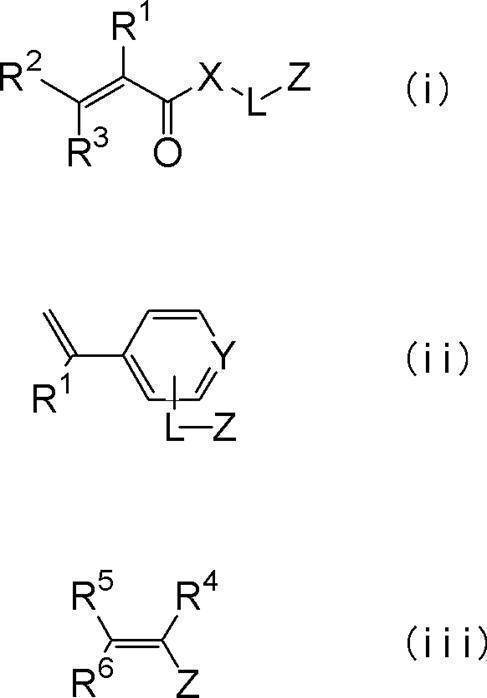
上記式(i)~(iii)中、R1、R2、及びR3は、それぞれ独立に、水素原子、ハロゲン原子(例えば、フッ素、塩素、臭素等)、又は炭素原子数が1~6のアルキル基(例えば、メチル基、エチル基、プロピル基等)を表す。
R1、R2、及びR3は、より好ましくは水素原子、又は炭素原子数が1~3のアルキル基であり、最も好ましくは、水素原子又はメチル基である。R2、及びR3は、水素原子であることが特に好ましい。
Xは、酸素原子(-O-)又はイミノ基(-NH-)を表し、酸素原子であることが好ましい。
R1、R2、及びR3は、より好ましくは水素原子、又は炭素原子数が1~3のアルキル基であり、最も好ましくは、水素原子又はメチル基である。R2、及びR3は、水素原子であることが特に好ましい。
Xは、酸素原子(-O-)又はイミノ基(-NH-)を表し、酸素原子であることが好ましい。
Lは、単結合又は2価の連結基である。2価の連結基としては、2価の脂肪族基(例えば、アルキレン基、置換アルキレン基、アルケニレン基、置換アルケニレン基、アルキニレン基、置換アルキニレン基)、2価の芳香族基(例えば、アリーレン基、置換アリーレン基)、2価の複素環基及びそれらと酸素原子(-O-)、硫黄原子(-S-)、イミノ基(-NH-)、置換イミノ基(-NR31-、ここでR31は脂肪族基、芳香族基又は複素環基)又はカルボニル基(-CO-)との組み合わせ等が挙げられる。
前記2価の脂肪族基は、環状構造又は分岐構造を有していてもよい。前記脂肪族基の炭素原子数は、1~20が好ましく、1~15がより好ましく、1~10が更に好ましい。脂肪族基は不飽和脂肪族基よりも飽和脂肪族基の方が好ましい。また、脂肪族基は、置換基を有していてもよい。置換基の例は、ハロゲン原子、ヒドロキシル基、芳香族基及び複素環基が挙げられる。
前記2価の芳香族基の炭素原子数は、6~20が好ましく、6~15が更に好ましく、6~10が最も好ましい。また、前記芳香族基は置換基を有していてもよい。置換基の例は、ハロゲン原子、ヒドロキシル基、脂肪族基、芳香族基及び複素環基が挙げられる。
前記2価の複素環基は、複素環として5員環又は6員環を有することが好ましい。複素環に他の複素環、脂肪族環又は芳香族環が縮合していてもよい。また、複素環基は置換基を有していてもよい。置換基の例としては、ハロゲン原子、ヒドロキシ基、オキソ基(=O)、チオキソ基(=S)、イミノ基(=NH)、置換イミノ基(=N-R32、ここでR32は脂肪族基、芳香族基又は複素環基)、脂肪族基、芳香族基及び複素環基が挙げられる。
Lは、単結合、アルキレン基又はオキシアルキレン構造を含む2価の連結基であることが好ましい。オキシアルキレン構造は、オキシエチレン構造又はオキシプロピレン構造であることがより好ましい。また、Lはオキシアルキレン構造を2以上繰り返して含むポリオキシアルキレン構造を含んでいてもよい。ポリオキシアルキレン構造としてはポリオキシエチレン構造又はポリオキシプロピレン構造が好ましい。ポリオキシエチレン構造は、-(OCH2CH2)n-で表され、nは、2以上の整数が好ましく、2~10の整数であることがより好ましい。
上記式(i)~(iii)中、Zは、金属酸化物粒子と相互作用を形成しうる官能基を表し、上記した酸基、塩基性基、又は反応性を有する基であることが好ましく、カルボン酸基、又は第三級アミノ基であることがより好ましく、カルボン酸基であることが更に好ましい。また、Yは、メチン基又は窒素原子を表す。
上記式(iii)中、R4、R5、及びR6は、それぞれ独立に、水素原子、ハロゲン原子(例えば、フッ素、塩素、臭素等)、炭素原子数が1~6のアルキル基(例えば、メチル基、エチル基、プロピル基等)、Z、又は-L-Zを表す。ここでL及びZは、上記におけるものと同義である。R4、R5、及びR6としては、水素原子、又は炭素数が1~3のアルキル基が好ましく、水素原子がより好ましい。
本発明においては、上記一般式(i)で表される単量体として、R1、R2、及びR3が水素原子又はメチル基であって、Lがアルキレン基又はオキシアルキレン構造を含む2価の連結基であって、Xが酸素原子又はイミノ基であって、Zがカルボン酸基である化合物が好ましい。
また、上記一般式(ii)で表される単量体として、R1が水素原子又はメチル基であって、Lがアルキレン基であって、Zがカルボン酸基であって、Yがメチン基である化合物が好ましい。また、上記一般式(iii)で表される単量体として、R4、R5、及びR6が水素原子又はメチル基であって、Zがカルボン酸基である化合物が好ましい。
また、上記一般式(ii)で表される単量体として、R1が水素原子又はメチル基であって、Lがアルキレン基であって、Zがカルボン酸基であって、Yがメチン基である化合物が好ましい。また、上記一般式(iii)で表される単量体として、R4、R5、及びR6が水素原子又はメチル基であって、Zがカルボン酸基である化合物が好ましい。
式(i)~(iii)で表される代表的な化合物の例としては、メタクリル酸、クロトン酸、イソクロトン酸、分子内に付加重合性二重結合と水酸基を有する化合物(例えば、メタクリル酸2-ヒドロキシエチル)とコハク酸無水物の反応物、分子内に付加重合性二重結合と水酸基を有する化合物とフタル酸無水物の反応物、分子内に付加重合性二重結合と水酸基を有する化合物とテトラヒドロキシフタル酸無水物の反応物、分子内に付加重合性二重結合と水酸基を有する化合物と無水トリメリット酸の反応物、分子内に付加重合性二重結合及び水酸基を有する化合物とピロメリット酸無水物との反応物、アクリル酸、アクリル酸ダイマー、アクリル酸オリゴマー、マレイン酸、イタコン酸、フマル酸、4-ビニル安息香酸、ビニルフェノール、4-ヒドロキシフェニルメタクリルアミドなどが挙げられる。
更に、前記特定樹脂は、画像強度などの諸性能を向上する目的で、本発明の効果を損なわない限りにおいて、前記グラフト鎖を有する構造単位、前記酸基を有する構造単位、及び、これらの構造単位とは異なる、金属酸化物粒子と相互作用を形成しうる官能基を有する構造単位に加えて、更に種々の機能を有する他の構造単位、例えば、分散物に用いられる分散媒との親和性を有する官能基、などを有する構造単位を共重合成分に由来する構造単位として含むことができる。
前記特定樹脂に共重合可能な共重合成分としては、例えば、アクリル酸エステル類、メタクリル酸エステル類、スチレン類、アクリロニトリル類、メタクリロニトリル類、アクリルアミド類、メタクリルアミド類などから選ばれるラジカル重合性化合物が挙げられる。
具体的には、例えば、アルキルアクリレート(該アルキル基の炭素原子数は1~20のものが好ましい)等のアクリル酸エステル類、(具体的には、例えば、ベンジルアクリレート、4-ビフェニルアクリレート、ブチルアクリレート、sec-ブチルアクリレート、t-ブチルアクリレート、4-t-ブチルフェニルアクリレート、4-クロロフェニルアクリレート、ペンタクロロフェニルアクリレート、4-シアノベンジルアクリレート、シアノメチルアクリレート、シクロヘキシルアクリレート、2-エトキシエチルアクリレート、エチルアクリレート、2-エチルヘキシルアクリレート、ヘプチルアクリレート、ヘキシルアクリレート、イソボルニルアクリレート、イソプロピルアクリレート、メチルアクリレート、3,5-ジメチルアダマンチルアクリレート、2-ナフチルアクリレート、ネオペンチルアクリレート、オクチルアクリレート、フェネチルアクリレート、フェニルアクリレート、プロピルアクリレート、トリルアクリレート、アミルアクリレート、テトラヒドロフルフリルアクリレート、2-ヒドロキシエチルアクリレート、3-ヒドロキシプロピルアクリレート、2-ヒドロキシプロピルアクリレート、4-ヒドロキシブチルアクリレート、5-ヒドロキシペンチルアクリレート、アリルアクリレート、2-アリロキシエチルアクリレート、プロパギルアクリレートなど)、
アルキルメタクリレート(該アルキル基の炭素原子は1~20のものが好ましい)等のメタクリル酸エステル類(例えば、ベンジルメタクリレート、4-ビフェニルメタクリレート、ブチルメタクリレート、sec-ブチルメタクリレート、t-ブチルメタクリレート、4-t-ブチルフェニルメタクリレート、4-クロロフェニルメタクリレート、ペンタクロロフェニルメタクリレート、4-シアノフェニルメタクリレート、シアノメチルメタクリレート、シクロヘキシルメタクリレート、2-エトキシエチルメタクリレート、エチルメタクリレート、2-エチルヘキシルメタクリレート、ヘプチルメタクリレート、ヘキシルメタクリレート、イソボルニルメタクリレート、イソプロピルメタクリレート、メチルメタクリレート、3,5-ジメチルアダマンチルメタクリレート、2-ナフチルメタクリレート、ネオペンチルメタクリレート、オクチルメタクリレート、フェネチルメタクリレート、フェニルメタクリレート、プロピルメタクリレート、トリルメタクリレート、アミルメタクリレート、テトラヒドロフルフリルメタクリレート、2-ヒドロキシエチルメタクリレート、3-ヒドロキシプロピルメタクリレート、2-ヒドロキシプロピルメタクリレート、4-ヒドロキシブチルメタクリレート、5-ヒドロキシペンチルメタクリレート、アリルメタクリレート、2-アリロキシエチルメタクリレート、プロパギルメタクリレート、2-ジエチルアミノエチルメタクリレート、2-ジメチルアミノメタクリレートなど)、
スチレン、アルキルスチレン等のスチレン類(例えば、メチルスチレン、ジメチルスチレン、トリメチルスチレン、エチルスチレン、ジエチルスチレン、イソプロピルスチレン、ブチルスチレン、ヘキシルスチレン、シクロへキシルスチレン、デシルスチレン、ベンジルスチレン、クロロメチルスチレン、トリフルオロメチルスチレン、エトキシメチルスチレン、アセトキシメチルスチレンなど)、アルコキシスチレン(例えばメトキシスチレン、4-メトキシ-3-メチルスチレン、ジメトキシスチレンなど)、ハロゲンスチレン(例えばクロロスチレン、ジクロロスチレン、トリクロロスチレン、テトラクロロスチレン、ペンタクロロスチレン、ブロモスチレン、ジブロモスチレン、ヨードスチレン、フルオロスチレン、トリフルオロスチレン、2-ブロモ-4-トリフルオロメチルスチレン、4-フルオロ-3-トリフルオロメチルスチレンなど)、アクリロニトリル、メタクリロニトリル等が挙げられる。
これらラジカル重合性化合物のうち、好適に使用されるのは、メタクリル酸エステル類、アクリルアミド類、メタクリルアミド類、スチレン類であり、特に好適に使用されるのは、ベンジルメタクリレート、t-ブチルメタクリレート、4-t-ブチルフェニルメタクリレート、ペンタクロロフェニルメタクリレート、4-シアノフェニルメタクリレート、シクロヘキシルメタクリレート、エチルメタクリレート、2-エチルヘキシルメタクリレート、イソボルニルメタクリレート、イソプロピルメタクリレート、メチルメタクリレート、3,5-ジメチルアダマンチルメタクリレート、2-ナフチルメタクリレート、ネオペンチルメタクリレート、フェニルメタクリレート、テトラヒドロフルフリルメタクリレート、2-ヒドロキシエチルメタクリレート、3-ヒドロキシプロピルメタクリレート、2-ヒドロキシプロピルメタクリレート、アリルメタクリレート、
アクリルアミド、N-メチルアクリルアミド、N-イソプロピルアクリルアミド、モルホリルアクリルアミド、ピペリジルアクリルアミド、N-t-ブチルアクリルアミド、N-シクロヘキシルアクリルアミド、N-フェニルアクリルアミド、N-ナフチルアクリルアミド、N-ヒドロキシメチルアクリルアミド、N-ヒドロキシエチルアクリルアミド、N-アリルアクリルアミド、4-ヒドロキシフェニルアクリルアミド、2-ヒドロキシフェニルアクリルアミド、N、N-ジメチルアクリルアミド、N、N-ジイソプロピルアクリルアミド、N、N-ジ-t-ブチルアクリルアミド、N、N-ジシクロヘキシルアクリルアミド、N、N-フェニルアクリルアミド、N、N-ジヒドロキシエチルアクリルアミド、N、N-ジアリルアクリルアミド、
メタクリルアミド、N-メチルメタクリルアミド、N-イソプロピルメタクリルアミド、モルホリルメタクリルアミド、ピペリジルメタクリルアミド、N-t-ブチルメタクリルアミド、N-シクロヘキシルメタクリルアミド、N-フェニルメタクリルアミド、N-ナフチルメタクリルアミド、N-ヒドロキシメチルメタクリルアミド、N-ヒドロキシエチルメタクリルアミド、N-アリルメタクリルアミド、4-ヒドロキシフェニルメタクリルアミド、2-ヒドロキシフェニルメタクリルアミド、N、N-ジメチルメタクリルアミド、N、N-ジイソプロピルメタクリルアミド、N、N-ジ-t-ブチルメタクリルアミド、N、N-ジシクロヘキシルメタクリルアミド、N、N-フェニルメタクリルアミド、N、N-ジヒドロキシエチルメタクリルアミド、N、N-ジアリルメタクリルアミド、
スチレン、メチルスチレン、ジメチルスチレン、トリメチルスチレン、イソプロピルスチレン、ブチルスチレン、シクロへキシルスチレン、クロロメチルスチレン、トリフルオロメチルスチレン、エトキシメチルスチレン、アセトキシメチルスチレン、メトキシスチレン、4-メトキシ-3-メチルスチレン、クロロスチレン、ジクロロスチレン、トリクロロスチレン、テトラクロロスチレン、ペンタクロロスチレン、ブロモスチレン、ジブロモスチレン、ヨードスチレン、フルオロスチレン、トリフルオロスチレン、2-ブロモ-4-トリフルオロメチルスチレン、4-フルオロ-3-トリフルオロメチルスチレンである。
これらのラジカル重合性化合物は、1種単独で、あるいは2種以上を組み合わせて用いることができる。特定樹脂は、上記のラジカル重合性化合物を含有してもしなくても良いが、含有する場合、これらのラジカル重合性化合物に対応する構造単位の含有量は、特定樹脂の総質量に対し0.1質量%以上50質量%以下であり、特に好ましくは、0.1質量%以上30質量%以下である。
本発明における特定樹脂は、従来公知の方法により合成することができる。合成する際に用いられる溶媒としては、例えば、エチレンジクロリド、シクロヘキサノン、メチルエチルケトン、アセトン、メタノール、エタノール、プロパノール、ブタノール、エチレングリコールモノメチルエーテル、エチレングリコールモノエチルエーテル、2-メトキシエチルアセテート、1-メトキシ-2-プロパノール、1-メトキシ-2-プロピルアセテート、N,N-ジメチルホルムアミド、N,N-ジメチルアセトアミド、ジメチルスルホキシド、トルエン、酢酸エチル、乳酸メチル、乳酸エチルなどが挙げられる。これらの溶媒は単独あるいは2種以上混合してもよい。
前記特定樹脂の具体例としては、以下の例示化合物1~32が挙げられるが、本発明はこれらに限定されない。下記例示化合物中、各構造単位に併記される数値(主鎖繰り返し単位に併記される数値)は、当該構造単位の含有量〔質量%:(wt%)と記載〕を表す。側鎖の繰り返し部位に併記される数値は、当該繰り返し部位の繰り返し数を示す。
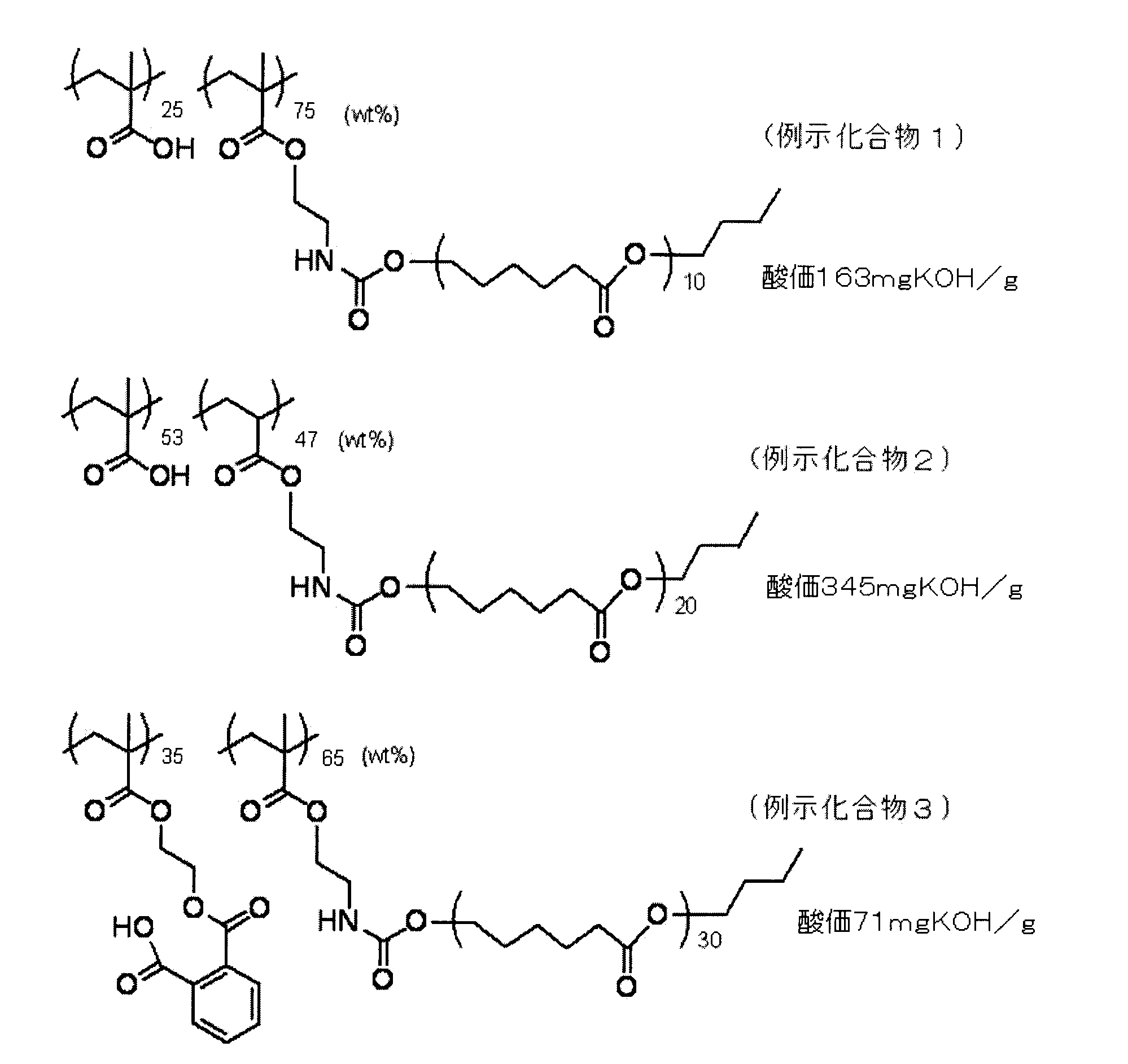
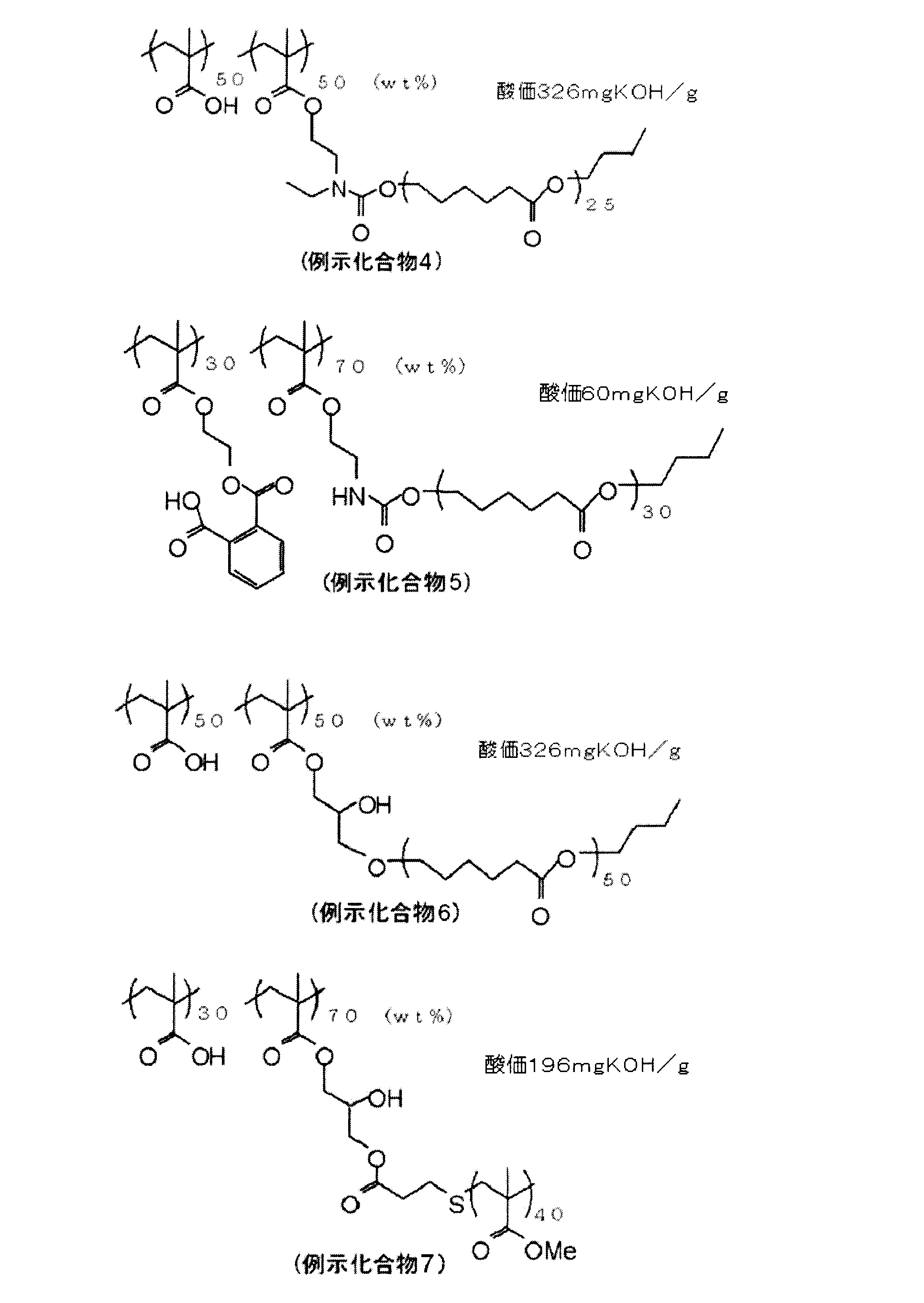


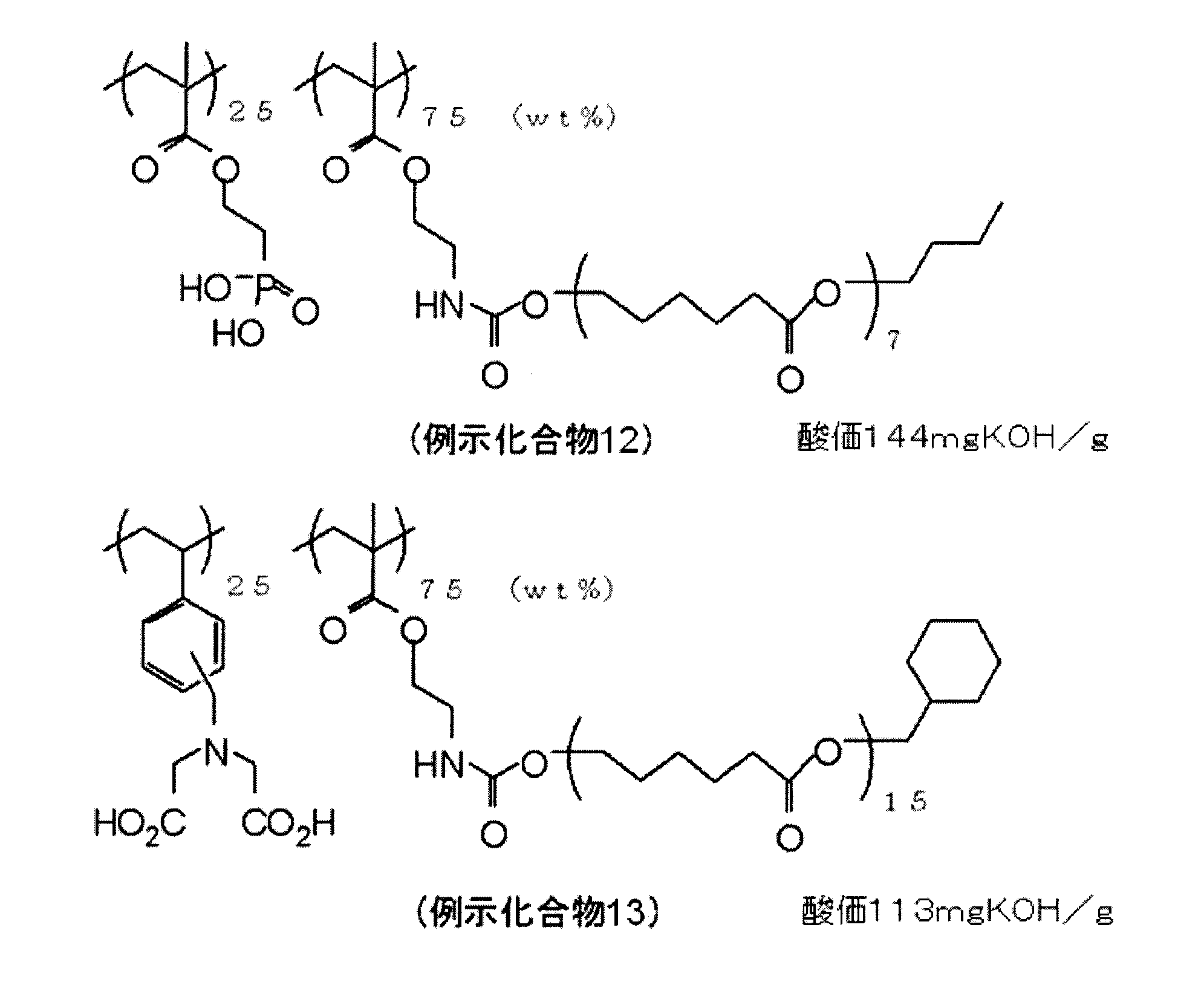

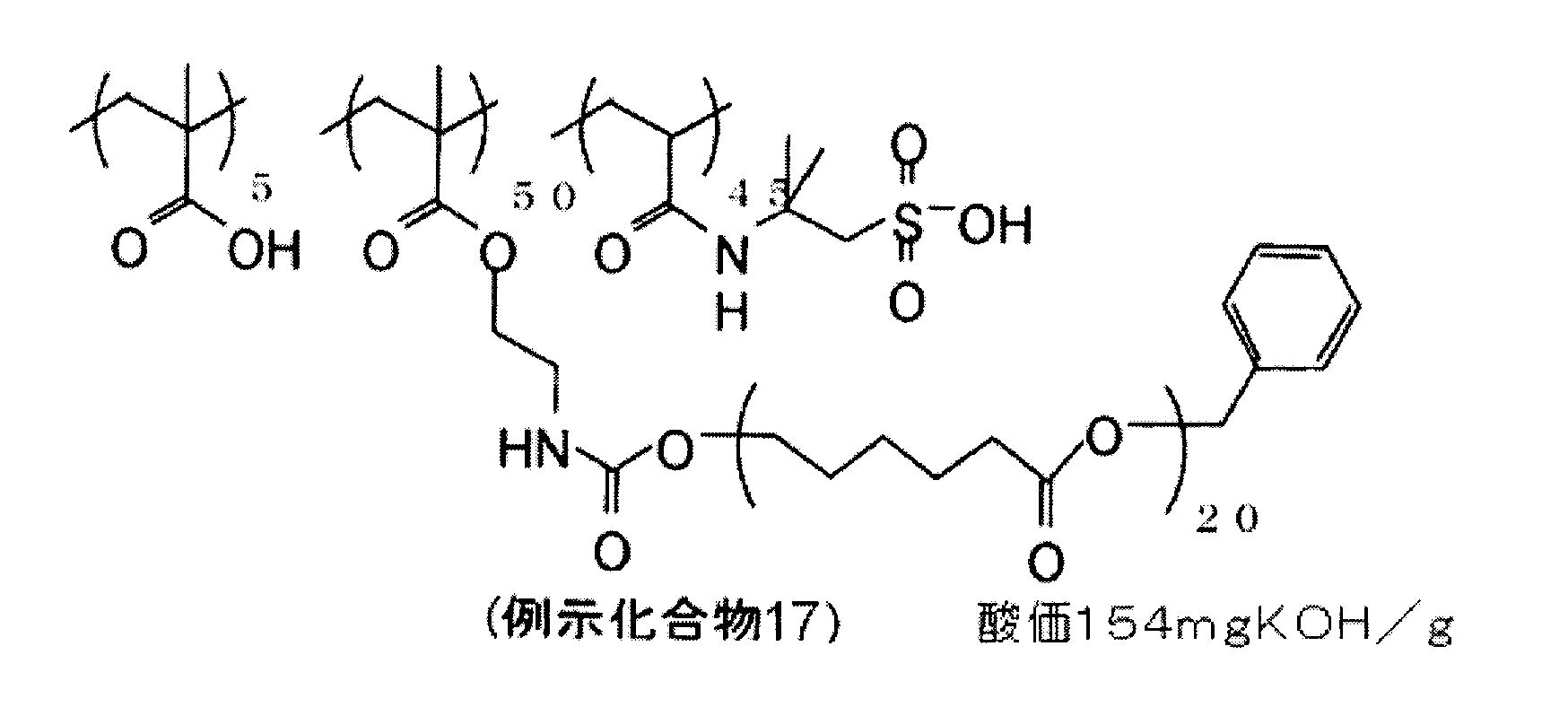

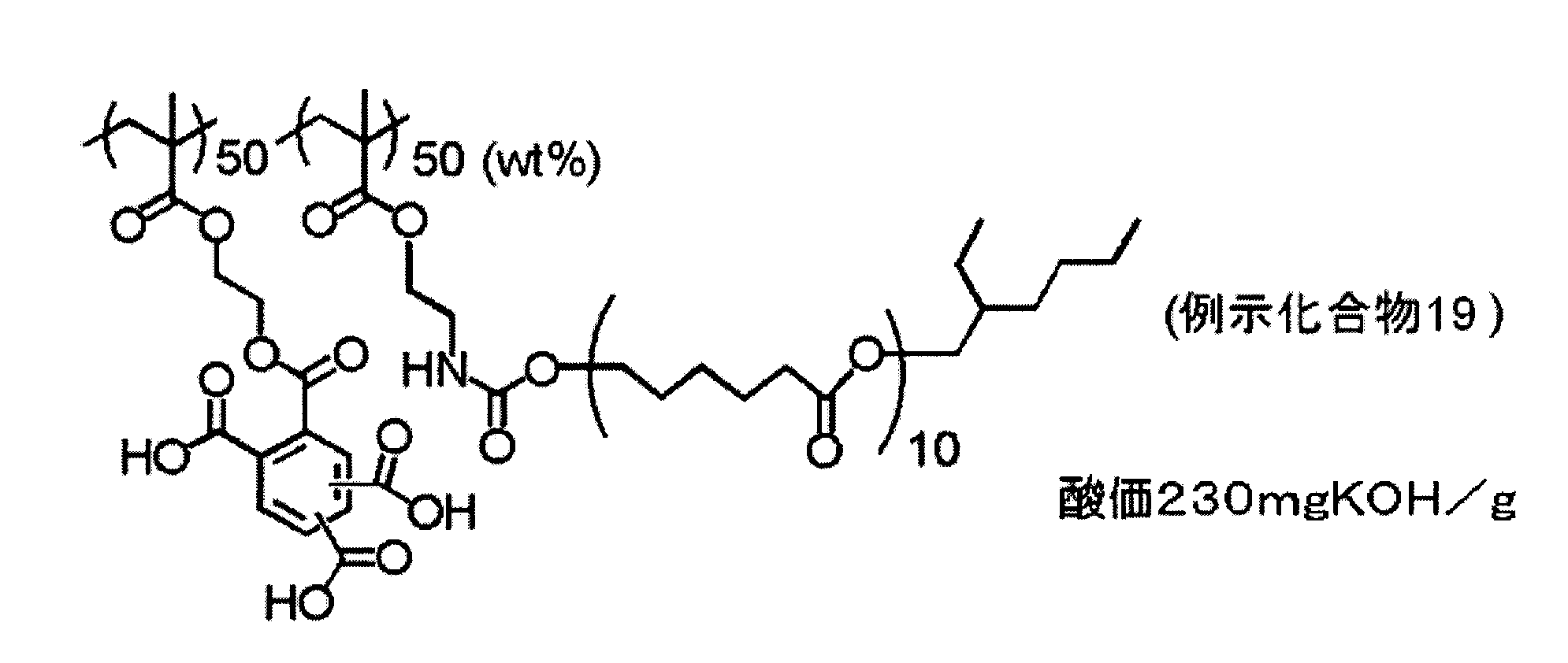

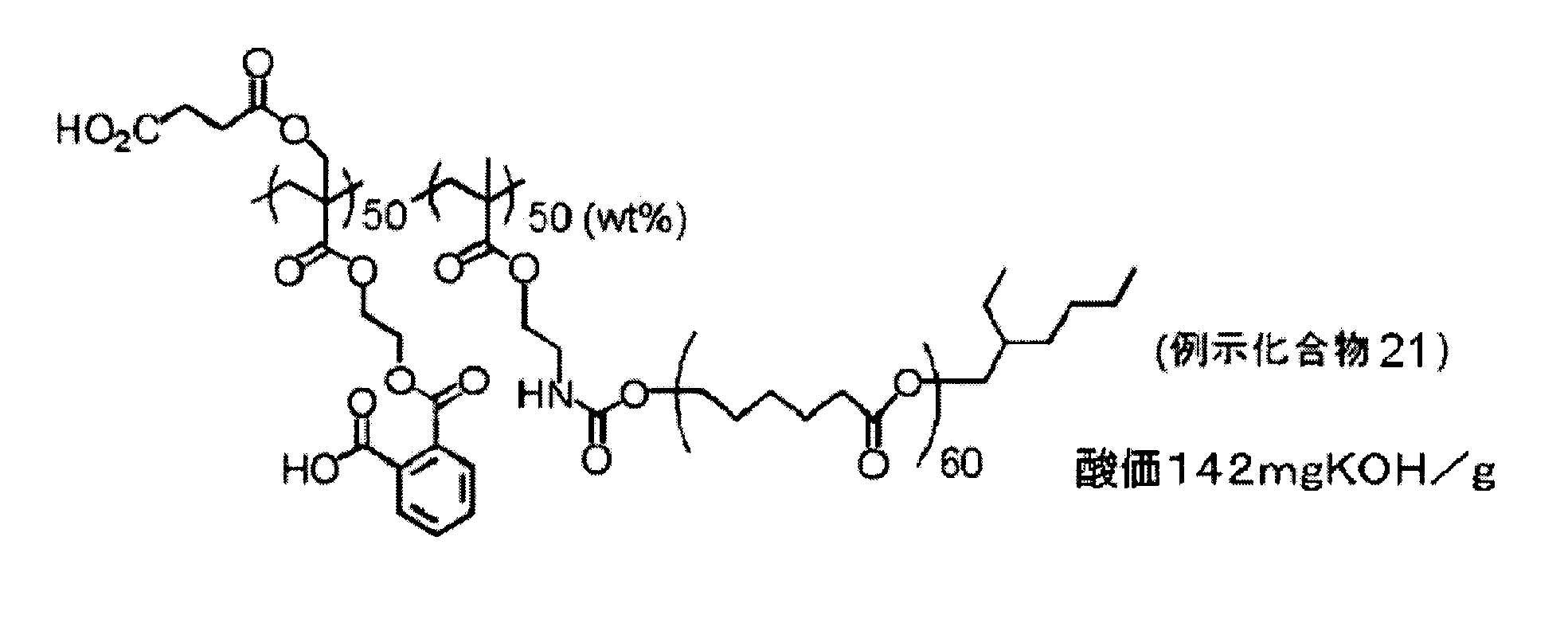
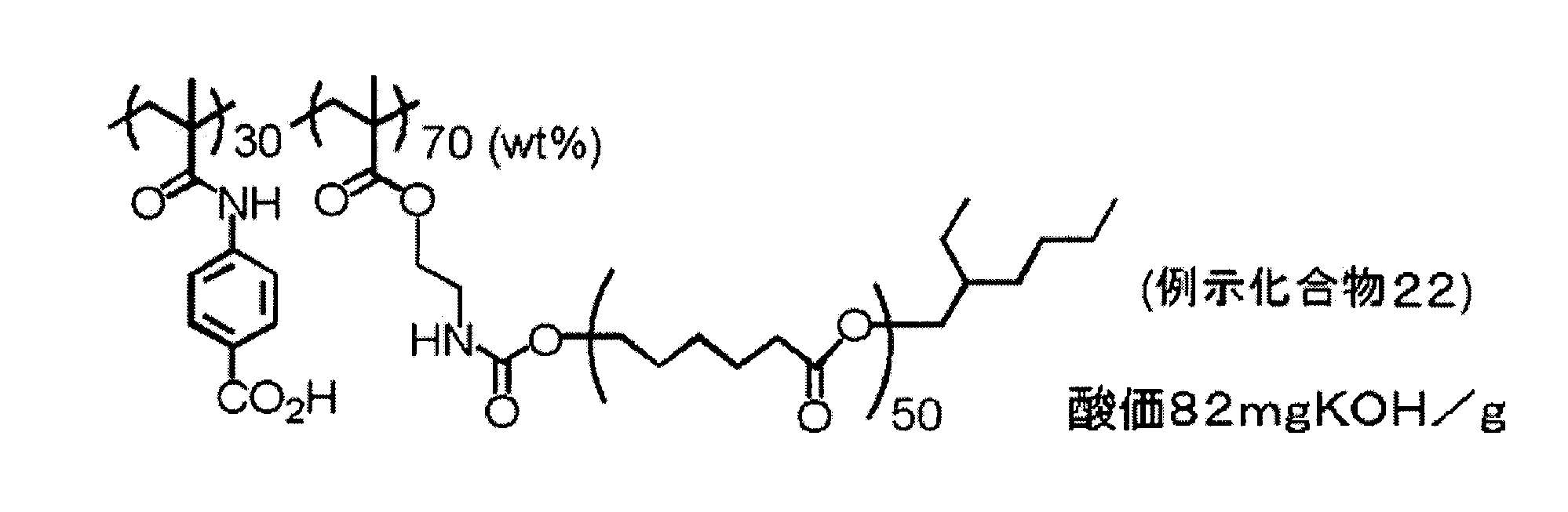
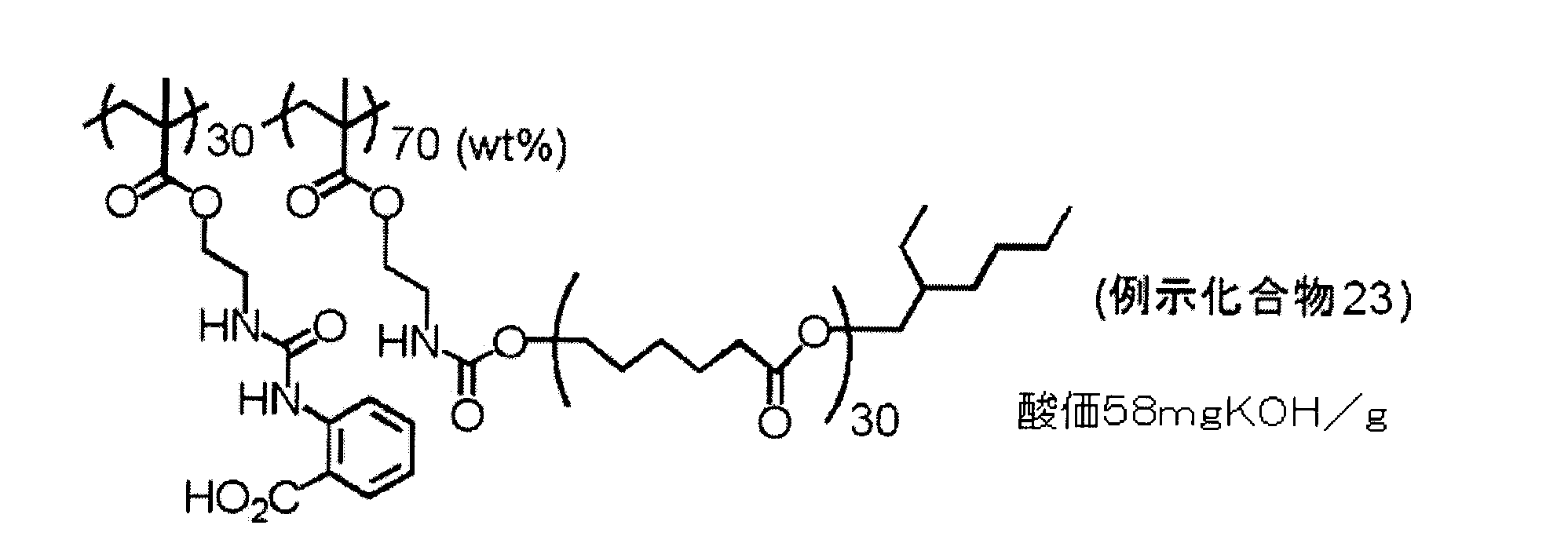


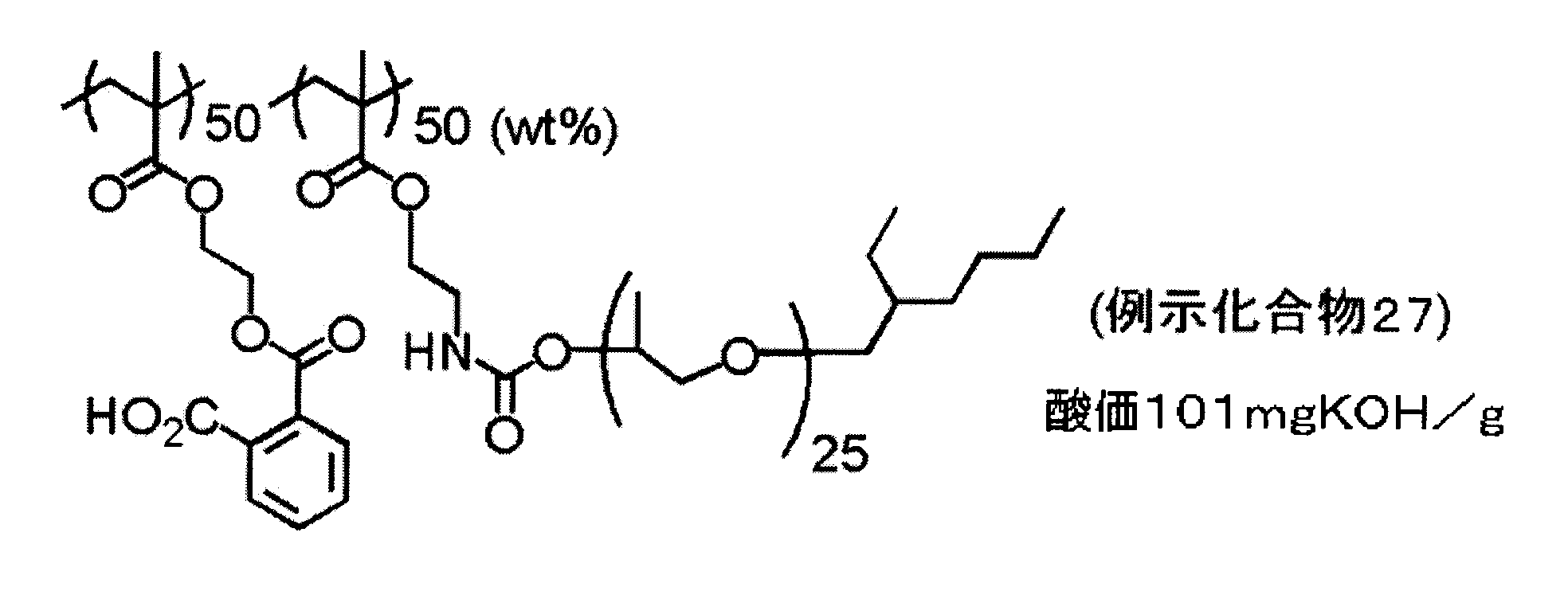


前記特定樹脂の重量平均分子量(GPC法で測定されたポリスチレン換算値)は、5,000以上300,000以下であることが好ましく、7,000以上100,000以下であることがより好ましく、10,000以上50,000以下であることが特に好ましい。
前記硬化性組成物において、特定樹脂は、1種単独で、あるいは2種以上を組み合わせて用いることができる。
前記硬化性組成物の全固形分に対する特定樹脂の含有量は、分散性、分散安定性の観点から、10~50質量%の範囲が好ましく、11~40質量%の範囲がより好ましく、12~30質量%の範囲が更に好ましい。
-その他の分散樹脂-
前記硬化性組成物には、金属酸化物粒子の分散性を調整する等の目的で、上記特定樹脂以外の分散樹脂(以下、「その他の分散樹脂」と称する場合がある)が含有されていてもよい。
本発明に用いることができるその他の分散樹脂としては、高分子分散剤〔例えば、ポリアミドアミンとその塩、ポリカルボン酸とその塩、高分子量不飽和酸エステル、変性ポリウレタン、変性ポリエステル、変性ポリ(メタ)アクリレート、(メタ)アクリル系共重合体、ナフタレンスルホン酸ホルマリン縮合物〕、及び、ポリオキシエチレンアルキルリン酸エステル、ポリオキシエチレンアルキルアミン、アルカノールアミン、顔料誘導体等を挙げることができる。
その他の分散樹脂は、その構造から更に直鎖状高分子、末端変性型高分子、グラフト型高分子、ブロック型高分子に分類することができる。
前記硬化性組成物には、金属酸化物粒子の分散性を調整する等の目的で、上記特定樹脂以外の分散樹脂(以下、「その他の分散樹脂」と称する場合がある)が含有されていてもよい。
本発明に用いることができるその他の分散樹脂としては、高分子分散剤〔例えば、ポリアミドアミンとその塩、ポリカルボン酸とその塩、高分子量不飽和酸エステル、変性ポリウレタン、変性ポリエステル、変性ポリ(メタ)アクリレート、(メタ)アクリル系共重合体、ナフタレンスルホン酸ホルマリン縮合物〕、及び、ポリオキシエチレンアルキルリン酸エステル、ポリオキシエチレンアルキルアミン、アルカノールアミン、顔料誘導体等を挙げることができる。
その他の分散樹脂は、その構造から更に直鎖状高分子、末端変性型高分子、グラフト型高分子、ブロック型高分子に分類することができる。
その他の分散樹脂は、金属酸化物粒子及び所望により併用する顔料の表面に吸着し、再凝集を防止するように作用する。そのため、金属酸化物粒子表面へのアンカー部位を有する末端変性型高分子、グラフト型高分子、ブロック型高分子が好ましい構造として挙げることができる。
一方で、その他の分散樹脂は、金属酸化物粒子表面を改質することで、分散樹脂の吸着を促進させる効果を有する。
一方で、その他の分散樹脂は、金属酸化物粒子表面を改質することで、分散樹脂の吸着を促進させる効果を有する。
その他の分散樹脂の具体例としては、BYK Chemie社製「Disperbyk-101(ポリアミドアミン燐酸塩)、107(カルボン酸エステル)、110(酸基を含む共重合物)、130(ポリアミド)、161、162、163、164、165、166、170(高分子共重合物)」、「BYK-P104、P105(高分子量不飽和ポリカルボン酸)、EFKA社製「EFKA4047、4050、4010、4165(ポリウレタン系)、EFKA4330、4340(ブロック共重合体)、4400、4402(変性ポリアクリレート)、5010(ポリエステルアミド)、5765(高分子量ポリカルボン酸塩)、6220(脂肪酸ポリエステル)、6745(フタロシアニン誘導体)、6750(アゾ顔料誘導体)」、味の素ファィンテクノ社製「アジスパーPB821、PB822」、共栄社化学社製「フローレンTG-710(ウレタンオリゴマー)」、「ポリフローNo.50E、No.300(アクリル系共重合体)」、楠本化成社製「ディスパロンKS-860、873SN、874、#2150(脂肪族多価カルボン酸)、#7004(ポリエーテルエステル)、DA-703-50、DA-705、DA-725」、花王社製「デモールRN、N(ナフタレンスルホン酸ホルマリン重縮合物)、MS、C、SN-B(芳香族スルホン酸ホルマリン重縮合物)」、「ホモゲノールL-18(高分子ポリカルボン酸)」、「エマルゲン920、930、935、985(ポリオキシエチレンノニルフェニルエーテル)」、「アセタミン86(ステアリルアミンアセテート)」、ルーブリゾール社製「ソルスパース5000(フタロシアニン誘導体)、22000(アゾ顔料誘導体)、13240(ポリエステルアミン)、3000、17000、27000(末端部に機能部を有する高分子)、24000、28000、32000、38500(グラフト型高分子)」、日光ケミカル者製「ニッコールT106(ポリオキシエチレンソルビタンモノオレート)、MYS-IEX(ポリオキシエチレンモノステアレート)」等が挙げられる。
これらのその他の樹脂は、単独で使用してもよく、2種以上を組み合わせて使用してもよい。
これらのその他の樹脂は、単独で使用してもよく、2種以上を組み合わせて使用してもよい。
前記硬化性組成物はその他の分散樹脂を含有してもしなくても良いが、含有する場合、前記硬化性組成物の全固形分に対するその他の分散樹脂の含有量は、1~20質量%の範囲が好ましく、1~10質量%の範囲がより好ましい。
(C)溶媒
硬化性組成物は溶媒を含むが、該溶媒は種々の有機溶剤を用いて構成することができる。
ここで使用できる有機溶剤としては、アセトン、メチルエチルケトン、シクロヘキサン、酢酸エチル、エチレンジクロライド、テトラヒドロフラン、トルエン、エチレングリコールモノメチルエーテル、エチレングリコールモノエチルエーテル、エチレングリコールジメチルエーテル、プロピレングリコールモノメチルエーテル、プロピレングリコールモノエチルエーテル、アセチルアセトン、シクロヘキサノン、ジアセトンアルコール、エチレングリコールモノメチルエーテルアセテート、エチレングリコールエチルエーテルアセテート、エチレングリコールモノイソプロピルエーテル、エチレングリコールモノブチルエーテルアセテート、3-メトキシプロパノール、メトキシメトキシエタノール、ジエチレングリコールモノメチルエーテル、ジエチレングリコールモノエチルエーテル、ジエチレングリコールジメチルエーテル、ジエチレングリコールジエチルエーテル、プロピレングリコールモノメチルエーテルアセテート、プロピレングリコールモノエチルエーテルアセテート、3-メトキシプロピルアセテート、N,N-ジメチルホルムアミド、ジメチルスルホキシド、γ-ブチロラクトン、乳酸メチル、乳酸エチルなどがある。
これらの有機溶剤は、単独あるいは混合して使用することができる。前記硬化性組成物における固形分の濃度は、2~60質量%であることが好ましい。
硬化性組成物は溶媒を含むが、該溶媒は種々の有機溶剤を用いて構成することができる。
ここで使用できる有機溶剤としては、アセトン、メチルエチルケトン、シクロヘキサン、酢酸エチル、エチレンジクロライド、テトラヒドロフラン、トルエン、エチレングリコールモノメチルエーテル、エチレングリコールモノエチルエーテル、エチレングリコールジメチルエーテル、プロピレングリコールモノメチルエーテル、プロピレングリコールモノエチルエーテル、アセチルアセトン、シクロヘキサノン、ジアセトンアルコール、エチレングリコールモノメチルエーテルアセテート、エチレングリコールエチルエーテルアセテート、エチレングリコールモノイソプロピルエーテル、エチレングリコールモノブチルエーテルアセテート、3-メトキシプロパノール、メトキシメトキシエタノール、ジエチレングリコールモノメチルエーテル、ジエチレングリコールモノエチルエーテル、ジエチレングリコールジメチルエーテル、ジエチレングリコールジエチルエーテル、プロピレングリコールモノメチルエーテルアセテート、プロピレングリコールモノエチルエーテルアセテート、3-メトキシプロピルアセテート、N,N-ジメチルホルムアミド、ジメチルスルホキシド、γ-ブチロラクトン、乳酸メチル、乳酸エチルなどがある。
これらの有機溶剤は、単独あるいは混合して使用することができる。前記硬化性組成物における固形分の濃度は、2~60質量%であることが好ましい。
金属酸化物粒子分散液の調製方法としては、特に制限はなく通常用いられる分散組成物の調製方法を適用することができる。例えば、金属酸化物粒子、グラフト共重合体、及び溶媒を混合し、循環型分散装置(ビーズミル)等を用いて分散処理することで調製することができる。
(D)重合性化合物
(D)重合性化合物は、少なくとも1個のエチレン性不飽和二重結合を有する付加重合性化合物であり、末端エチレン性不飽和結合を少なくとも1個、好ましくは2個以上有する化合物から選ばれる。このような化合物は当該技術分野において広く知られるものであり、本発明においてはこれらを特に限定無く用いることができる。
これらは、例えばモノマー、プレポリマー、すなわち2量体、3量体及びオリゴマー、又はそれらの混合物並びにそれらの共重合体などの化学的形態をもつ。モノマー及びその共重合体の例としては、不飽和カルボン酸(例えば、アクリル酸、メタクリル酸、イタコン酸、クロトン酸、イソクロトン酸、マレイン酸など)や、そのエステル類、アミド類が挙げられ、好ましくは、不飽和カルボン酸と脂肪族多価アルコール化合物とのエステル、不飽和カルボン酸と脂肪族多価アミン化合物とのアミド類が用いられる。また、ヒドロキシル基やアミノ基、メルカプト基等の求核性置換基を有する不飽和カルボン酸エステル類あるいは不飽和カルボン酸アミド類と単官能若しくは多官能イソシアネート類あるいはエポキシ類との付加反応物、及び単官能若しくは、多官能のカルボン酸との脱水縮合反応物等も好適に使用される。また、イソシアネート基や、エポキシ基等の親電子性置換基を有する不飽和カルボン酸エステルあるいは不飽和カルボン酸アミド類と単官能若しくは多官能のアルコール類、アミン類、チオール類との付加反応物;更にハロゲン基や、トシルオキシ基等の脱離性置換基を有する不飽和カルボン酸エステルあるいは不飽和カルボン酸アミド類と単官能若しくは多官能のアルコール類、アミン類、チオール類との置換反応物も好適である。また、別の例として、上記の不飽和カルボン酸の代わりに、不飽和ホスホン酸、スチレン、ビニルエーテル等に置き換えた化合物群を使用することも可能である。
(D)重合性化合物は、少なくとも1個のエチレン性不飽和二重結合を有する付加重合性化合物であり、末端エチレン性不飽和結合を少なくとも1個、好ましくは2個以上有する化合物から選ばれる。このような化合物は当該技術分野において広く知られるものであり、本発明においてはこれらを特に限定無く用いることができる。
これらは、例えばモノマー、プレポリマー、すなわち2量体、3量体及びオリゴマー、又はそれらの混合物並びにそれらの共重合体などの化学的形態をもつ。モノマー及びその共重合体の例としては、不飽和カルボン酸(例えば、アクリル酸、メタクリル酸、イタコン酸、クロトン酸、イソクロトン酸、マレイン酸など)や、そのエステル類、アミド類が挙げられ、好ましくは、不飽和カルボン酸と脂肪族多価アルコール化合物とのエステル、不飽和カルボン酸と脂肪族多価アミン化合物とのアミド類が用いられる。また、ヒドロキシル基やアミノ基、メルカプト基等の求核性置換基を有する不飽和カルボン酸エステル類あるいは不飽和カルボン酸アミド類と単官能若しくは多官能イソシアネート類あるいはエポキシ類との付加反応物、及び単官能若しくは、多官能のカルボン酸との脱水縮合反応物等も好適に使用される。また、イソシアネート基や、エポキシ基等の親電子性置換基を有する不飽和カルボン酸エステルあるいは不飽和カルボン酸アミド類と単官能若しくは多官能のアルコール類、アミン類、チオール類との付加反応物;更にハロゲン基や、トシルオキシ基等の脱離性置換基を有する不飽和カルボン酸エステルあるいは不飽和カルボン酸アミド類と単官能若しくは多官能のアルコール類、アミン類、チオール類との置換反応物も好適である。また、別の例として、上記の不飽和カルボン酸の代わりに、不飽和ホスホン酸、スチレン、ビニルエーテル等に置き換えた化合物群を使用することも可能である。
脂肪族多価アルコール化合物と不飽和カルボン酸とのエステルのモノマーの具体例としては、アクリル酸エステルとして、エチレングリコールジアクリレート、トリエチレングリコールジアクリレート、1,3-ブタンジオールジアクリレート、テトラメチレングリコールジアクリレート、プロピレングリコールジアクリレート、ネオペンチルグリコールジアクリレート、トリメチロールプロパントリアクリレート、トリメチロールプロパントリス(アクリロイルオキシプロピル)エーテル、トリメチロールエタントリアクリレート、ヘキサンジオールジアクリレート、1,4-シクロヘキサンジオールジアクリレート、テトラエチレングリコールジアクリレート、ペンタエリスリトールジアクリレート、ペンタエリスリトールトリアクリレート、ペンタエリスリトールテトラアクリレート、ジペンタエリスリトールジアクリレート、ジペンタエリスリトールヘキサアクリレート、ソルビトールトリアクリレート、ソルビトールテトラアクリレート、ソルビトールペンタアクリレート、ソルビトールヘキサアクリレート、トリス(アクリロイルオキシエチル)イソシアヌレート、ポリエステルアクリレートオリゴマー、イソシアヌール酸EO変性トリアクリレート等がある。
メタクリル酸エステルとしては、テトラメチレングリコールジメタクリレート、トリエチレングリコールジメタクリレート、ネオペンチルグリコールジメタクリレート、トリメチロールプロパントリメタクリレート、トリメチロールエタントリメタクリレート、エチレングリコールジメタクリレート、1,3-ブタンジオールジメタクリレート、ヘキサンジオールジメタクリレート、ペンタエリスリトールジメタクリレート、ペンタエリスリトールトリメタクリレート、ペンタエリスリトールテトラメタクリレート、ジペンタエリスリトールジメタクリレート、ジペンタエリスリトールヘキサメタクリレート、ソルビトールトリメタクリレート、ソルビトールテトラメタクリレート、ビス〔p-(3-メタクリルオキシ-2-ヒドロキシプロポキシ)フェニル〕ジメチルメタン、ビス-〔p-(メタクリルオキシエトキシ)フェニル〕ジメチルメタン等がある。
イタコン酸エステルとしては、エチレングリコールジイタコネート、プロピレングリコールジイタコネート、1,3-ブタンジオールジイタコネート、1,4-ブタンジオールジイタコネート、テトラメチレングリコールジイタコネート、ペンタエリスリトールジイタコネート、ソルビトールテトライタコネート等がある。
クロトン酸エステルとしては、エチレングリコールジクロトネート、テトラメチレングリコールジクロトネート、ペンタエリスリトールジクロトネート、ソルビトールテトラジクロトネート等がある。イソクロトン酸エステルとしては、エチレングリコールジイソクロトネート、ペンタエリスリトールジイソクロトネート、ソルビトールテトライソクロトネート等がある。
マレイン酸エステルとしては、エチレングリコールジマレート、トリエチレングリコールジマレート、ペンタエリスリトールジマレート、ソルビトールテトラマレート等がある。
クロトン酸エステルとしては、エチレングリコールジクロトネート、テトラメチレングリコールジクロトネート、ペンタエリスリトールジクロトネート、ソルビトールテトラジクロトネート等がある。イソクロトン酸エステルとしては、エチレングリコールジイソクロトネート、ペンタエリスリトールジイソクロトネート、ソルビトールテトライソクロトネート等がある。
マレイン酸エステルとしては、エチレングリコールジマレート、トリエチレングリコールジマレート、ペンタエリスリトールジマレート、ソルビトールテトラマレート等がある。
その他のエステルの例として、例えば、特公昭51-47334号公報、特開昭57-196231号公報記載の脂肪族アルコール系エステル類や、特開昭59-5240号公報、特開昭59-5241号公報、特開平2-226149号公報記載の芳香族系骨格を有するもの、特開平1-165613号公報記載のアミノ基を含有するもの等も好適に用いられる。更に、前述のエステルモノマーは混合物としても使用することができる。
また、脂肪族多価アミン化合物と不飽和カルボン酸とのアミドのモノマーの具体例としては、メチレンビス-アクリルアミド、メチレンビス-メタクリルアミド、1,6-ヘキサメチレンビス-アクリルアミド、1,6-ヘキサメチレンビス-メタクリルアミド、ジエチレントリアミントリスアクリルアミド、キシリレンビスアクリルアミド、キシリレンビスメタクリルアミド等がある。
その他の好ましいアミド系モノマーの例としては、特公昭54-21726号公報記載のシクロへキシレン構造を有すものを挙げることができる。
その他の好ましいアミド系モノマーの例としては、特公昭54-21726号公報記載のシクロへキシレン構造を有すものを挙げることができる。
また、イソシアネートと水酸基の付加反応を用いて製造されるウレタン系付加重合性化合物も好適であり、そのような具体例としては、例えば、特公昭48-41708号公報中に記載されている1分子に2個以上のイソシアネート基を有するポリイソシアネート化合物に、下記式(V)で表され、水酸基を有するビニルモノマーを付加させた1分子中に2個以上の重合性ビニル基を含有するビニルウレタン化合物等が挙げられる。
下記式(V)中、R7及びR8はそれぞれ独立して、水素原子又はメチル基を示す。
下記式(V)中、R7及びR8はそれぞれ独立して、水素原子又はメチル基を示す。

また、特開昭51-37193号公報、特公平2-32293号公報、特公平2-16765号公報に記載されているようなウレタンアクリレート類や、特公昭58-49860号公報、特公昭56-17654号公報、特公昭62-39417号公報、特公昭62-39418号公報記載のエチレンオキサイド系骨格を有するウレタン化合物類も好適である。更に、特開昭63-277653号公報、特開昭63-260909号公報、特開平1-105238号公報に記載される、分子内にアミノ構造やスルフィド構造を有する重合性化合物類を用いることによっては、非常に感光スピードに優れた硬化性組成物を得ることができる。
その他の例としては、特開昭48-64183号、特公昭49-43191号、特公昭52-30490号、各公報に記載されているようなポリエステルアクリレート類、エポキシ樹脂と(メタ)アクリル酸を反応させて得られたたエポキシアクリレート類等の多官能のアクリレートやメタクリレートを挙げることができる。また、特公昭46-43946号公報、特公平1-40337号公報、特公平1-40336号公報記載の特定の不飽和化合物や、特開平2-25493号公報記載のビニルホスホン酸系化合物等も挙げることができる。また、ある場合には、特開昭61-22048号公報記載のペルフルオロアルキル基を含有する構造が好適に使用される。更に、日本接着協会誌vol.20、No.7、300~308ページ(1984年)に記載されている光硬化性モノマー及びオリゴマーも使用することができる。
これらの重合性化合物について、その構造、単独使用か併用か、添加量等の使用方法の詳細は、硬化性組成物の最終的な性能設計にあわせて任意に設定できる。例えば、次のような観点から選択される。
感度の点では1分子あたりの不飽和基含量が多い構造が好ましく、多くの場合、2官能以上が好ましい。また、硬化膜の強度を高くするためには、3官能以上のものがよく、更に、異なる官能数・異なる重合性基(例えばアクリル酸エステル、メタクリル酸エステル、スチレン系化合物、ビニルエーテル系化合物)のものを併用することで、感度と強度の両方を調節する方法も有効である。
中でも、重合性化合物としては、ジペンタエリスリトールトリアクリレート(市販品としては KAYARAD D-330;日本化薬株式会社製)、ジペンタエリスリトールテトラアクリレート(市販品としては KAYARAD D-320;日本化薬株式会社製)ジペンタエリスリトールペンタ(メタ)アクリレート(市販品としては KAYARAD D-310;日本化薬株式会社製)、ジペンタエリスリトールヘキサ(メタ)アクリレート(市販品としては KAYARAD DPHA;日本化薬株式会社製)、RP-1040(日本化薬株式会社製)、及びこれらの(メタ)アクリロイル基がエチレングリコール、プロピレングリコール残基を介している構造や、ジグリセリンEO(エチレンオキシド)変性(メタ)アクリレート(市販品としては M-460;東亜合成製)が好ましい。これらのオリゴマータイプも使用できる。
また、硬化性組成物に含有される他の成分(例えば、重合開始剤、金属酸化物粒子等)との相溶性、分散性に対しても、重合性化合物の選択・使用法は重要な要因であり、例えば、低純度化合物の使用や、2種以上の他の成分の併用により相溶性を向上させうることがある。また、基板などの硬質表面との密着性を向上させる目的で特定の構造を選択することもあり得る。
感度の点では1分子あたりの不飽和基含量が多い構造が好ましく、多くの場合、2官能以上が好ましい。また、硬化膜の強度を高くするためには、3官能以上のものがよく、更に、異なる官能数・異なる重合性基(例えばアクリル酸エステル、メタクリル酸エステル、スチレン系化合物、ビニルエーテル系化合物)のものを併用することで、感度と強度の両方を調節する方法も有効である。
中でも、重合性化合物としては、ジペンタエリスリトールトリアクリレート(市販品としては KAYARAD D-330;日本化薬株式会社製)、ジペンタエリスリトールテトラアクリレート(市販品としては KAYARAD D-320;日本化薬株式会社製)ジペンタエリスリトールペンタ(メタ)アクリレート(市販品としては KAYARAD D-310;日本化薬株式会社製)、ジペンタエリスリトールヘキサ(メタ)アクリレート(市販品としては KAYARAD DPHA;日本化薬株式会社製)、RP-1040(日本化薬株式会社製)、及びこれらの(メタ)アクリロイル基がエチレングリコール、プロピレングリコール残基を介している構造や、ジグリセリンEO(エチレンオキシド)変性(メタ)アクリレート(市販品としては M-460;東亜合成製)が好ましい。これらのオリゴマータイプも使用できる。
また、硬化性組成物に含有される他の成分(例えば、重合開始剤、金属酸化物粒子等)との相溶性、分散性に対しても、重合性化合物の選択・使用法は重要な要因であり、例えば、低純度化合物の使用や、2種以上の他の成分の併用により相溶性を向上させうることがある。また、基板などの硬質表面との密着性を向上させる目的で特定の構造を選択することもあり得る。
硬化性組成物の全固形分に対して、(D)重合性化合物の含有量は、1質量%~50質量%の範囲であることが好ましく、3質量%~40質量%の範囲であることがより好ましく、5質量%~30質量%の範囲であることが更に好ましい。
この範囲内であると、屈折率を低下させることなく、硬化性が良好で好ましい。
この範囲内であると、屈折率を低下させることなく、硬化性が良好で好ましい。
(E)重合開始剤
本発明に用いられる(E)重合開始剤は、(D)重合性化合物の重合を開始、促進する化合物であり、45℃までは安定であるが高温加熱時の重合開始能が良好であることが好ましい。また、重合開始剤は、単独で、又は2種以上を併用して用いることができる。
本発明に用いられる(E)重合開始剤は、(D)重合性化合物の重合を開始、促進する化合物であり、45℃までは安定であるが高温加熱時の重合開始能が良好であることが好ましい。また、重合開始剤は、単独で、又は2種以上を併用して用いることができる。
(E)重合開始剤としては、例えば、有機ハロゲン化化合物、オキシジアゾール化合物、カルボニル化合物、ケタール化合物、ベンゾイン化合物、アクリジン化合物、有機過酸化化合物、アゾ化合物、クマリン化合物、アジド化合物、メタロセン化合物、ヘキサアリールビイミダゾール化合物、有機ホウ酸化合物、ジスルホン酸化合物、オキシム化合物、オニウム塩化合物、アシルホスフィン(オキシド)化合物が挙げられる。
有機ハロゲン化化合物の具体例としては、若林等、「Bull Chem.Soc Japan」42、2924(1969)、米国特許第3,905,815号明細書、特公昭46-4605号公報、特開昭48-36281号公報、特開昭55-32070号公報、特開昭60-239736号公報、特開昭61-169835号公報、特開昭61-169837号公報、特開昭62-58241号公報、特開昭62-212401号公報、特開昭63-70243号公報、特開昭63-298339号公報、M.P.Hutt “Jurnal of Heterocyclic Chemistry”1(No3),(1970)」等に記載の化合物が挙げられ、特に、トリハロメチル基が置換したオキサゾール化合物、s-トリアジン化合物が挙げられる。
s-トリアジン化合物として、より好適には、すくなくとも一つのモノ、ジ、又はトリハロゲン置換メチル基がs-トリアジン環に結合したs-トリアジン誘導体、具体的には、例えば、2,4,6-トリス(モノクロロメチル)-s-トリアジン、2,4,6-トリス(ジクロロメチル)-s-トリアジン、2,4,6-トリス(トリクロロメチル)-s-トリアジン、2-メチル-4,6-ビス(トリクロロメチル)-s-トリアジン、2―n-プロピル-4,6-ビス(トリクロロメチル)-s-トリアジン、2-(α,α,β-トリクロロエチル)-4,6-ビス(トリクロロメチル)-s-トリアジン、2-フェニル-4,6-ビス(トリクロロメチル)-s-トリアジン、2-(p-メトキシフェニル)-4,6-ビス(トリクロロメチル)-s-トリアジン、2-(3,4-エポキシフェニル)-4,6-ビス(トリクロロメチル)-s-トリアジン、2-(p-クロロフェニル)-4,6-ビス(トリクロロメチル)-s-トリアジン、2-〔1-(p-メトキシフェニル)-2,4-ブタジエニル〕-4,6-ビス(トリクロロメチル)-s-トリアジン、2-スチリル-4,6-ビス(トリクロロメチル)-s-トリアジン、2-(p-メトキシスチリル)-4,6-ビス(トリクロロメチル)-s-トリアジン、2-(p-i-プロピルオキシスチリル)-4,6-ビス(トリクロロメチル)-s-トリアジン、2-(p-トリル)-4,6-ビス(トリクロロメチル)-s-トリアジン、2-(4-ナトキシナフチル)-4,6-ビス(トリクロロメチル)-s-トリアジン、2-フェニルチオ-4,6-ビス(トリクロロメチル)-s-トリアジン、2-ベンジルチオ-4,6-ビス(トリクロロメチル)-s-トリアジン、2,4,6-トリス(ジブロモメチル)-s-トリアジン、2,4,6-トリス(トリブロモメチル)-s-トリアジン、2-メチル-4,6-ビス(トリブロモメチル)-s-トリアジン、2-メトキシ-4,6-ビス(トリブロモメチル)-s-トリアジン等が挙げられる。
オキシジアゾール化合物の例としては、2-トリクロロメチル-5-スチリル-1,3,4-オキソジアゾール、2-トリクロロメチル-5-(シアノスチリル)-1,3,4-オキソジアゾール、2-トリクロロメチル-5-(ナフト-1-イル)-1,3,4-オキソジアゾール、2-トリクロロメチル-5-(4-スチリル)スチリル-1,3,4-オキソジアゾールなどが挙げられる。
カルボニル化合物の例としては、ベンゾフェノン、ミヒラーケトン、2-メチルベンゾフェノン、3-メチルベンゾフェノン、4-メチルベンゾフェノン、2-クロロベンゾフェノン、4-ブロモベンゾフェノン、2-カルボキシベンゾフェノン等のベンゾフェノン誘導体、2,2-ジメトキシ-2-フェニルアセトフェノン、2,2-ジエトキシアセトフェノン、1-ヒドロキシシクロヘキシルフェニルケトン、α-ヒドロキシ-2-メチルフェニルプロパノン、1-ヒドロキシ-1-メチルエチル-(p-イソプロピルフェニル)ケトン、1-ヒドロキシ-1-(p-ドデシルフェニル)ケトン、2-メチル-(4’-(メチルチオ)フェニル)-2-モルホリノ-1-プロパノン、2-(ジメチルアミノ)-2-[(4-メチルフェニル)メチル]-1-[4-(4-モルホリニル)フェニル]-1-ブタノン、1,1,1-トリクロロメチル-(p-ブチルフェニル)ケトン、2-ベンジル-2-ジメチルアミノ-4-モルホリノブチロフェノン等のアセトフェノン誘導体、チオキサントン、2-エチルチオキサントン、2-イソプロピルチオキサントン、2-クロロチオキサントン、2,4-ジメチルチオキサントン、2,4-ジエチルチオキサントン、2,4-ジイソプロピルチオキサントン等のチオキサントン誘導体、p-ジメチルアミノ安息香酸エチル、p-ジエチルアミノ安息香酸エチル等の安息香酸エステル誘導体等を挙げることができる。
ケタール化合物の例としては、ベンジルメチルケタール、ベンジル-β-メトキシエチルエチルアセタールなどを挙げることができる。
ベンゾイン化合物の例としては、m-ベンゾインイソプロピルエーテル、ベンゾインイソブチルエーテル、ベンゾインメチルエーテル、メチルo-ベンゾイルベンゾエートなどを挙げることができる。
アクリジン化合物の例としては、9-フェニルアクリジン、1,7-ビス(9-アクリジニル)ヘプタンなどを挙げることができる。
有機過酸化化合物としては、例えば、トリメチルシクロヘキサノンパーオキサイド、アセチルアセトンパーオキサイド、1,1-ビス(tert-ブチルパーオキシ)-3,3,5-トリメチルシクロヘキサン、1,1-ビス(tert-ブチルパーオキシ)シクロヘキサン、2,2-ビス(tert-ブチルパーオキシ)ブタン、tert-ブチルハイドロパーオキサイド、クメンハイドロパーオキサイド、ジイソプロピルベンゼンハイドロパーオキサイド、2,5-ジメチルヘキサン-2,5-ジハイドロパーオキサイド、1,1,3,3-テトラメチルブチルハイドロパーオキサイド、tert-ブチルクミルパーオキサイド、ジクミルパーオキサイド、2,5-ジメチル-2,5-ジ(tert-ブチルパーオキシ)ヘキサン、2,5-オキサノイルパーオキサイド、過酸化こはく酸、過酸化ベンゾイル、2,4-ジクロロベンゾイルパーオキサイド、ジイソプロピルパーオキシジカーボネート、ジ-2-エチルヘキシルパーオキシジカーボネート、ジ-2-エトキシエチルパーオキシジカーボネート、ジメトキシイソプロピルパーオキシカーボネート、ジ(3-メチル-3-メトキシブチル)パーオキシジカーボネート、tert-ブチルパーオキシアセテート、tert-ブチルパーオキシピバレート、tert-ブチルパーオキシネオデカノエート、tert-ブチルパーオキシオクタノエート、tert-ブチルパーオキシラウレート、3,3’,4,4’-テトラ-(t-ブチルパーオキシカルボニル)ベンゾフェノン、3,3’,4,4’-テトラ-(t-ヘキシルパーオキシカルボニル)ベンゾフェノン、3,3’,4,4’-テトラ-(p-イソプロピルクミルパーオキシカルボニル)ベンゾフェノン、カルボニルジ(t-ブチルパーオキシ二水素二フタレート)、カルボニルジ(t-ヘキシルパーオキシ二水素二フタレート)等が挙げられる。
アゾ化合物としては、例えば、特開平8-108621号公報に記載のアゾ化合物等を挙げることができる。
クマリン化合物としては、例えば、3-メチル-5-アミノ-((s-トリアジン-2-イル)アミノ)-3-フェニルクマリン、3-クロロ-5-ジエチルアミノ-((s-トリアジン-2-イル)アミノ)-3-フェニルクマリン、3-ブチル-5-ジメチルアミノ-((s-トリアジン-2-イル)アミノ)-3-フェニルクマリン等を挙げることができる。
アジド化合物の例としては、米国特許第2848328号明細書、米国特許第2852379号明細書並びに米国特許第2940853号明細書に記載の有機アジド化合物、2,6-ビス(4-アジドベンジリデン)-4-エチルシクロヘキサノン(BAC-E)等が挙げられる。
メタロセン化合物としては、特開昭59-152396号公報、特開昭61-151197号公報、特開昭63-41484号公報、特開平2-249号公報、特開平2-4705号公報、特開平5-83588号公報記載の種々のチタノセン化合物、例えば、ジシクロペンタジエニル-Ti-ビス-フェニル、ジシクロペンタジエニル-Ti-ビス-2,6-ジフルオロフェニル-1-イル、ジシクロペンタジエニル-Ti-ビス-2,4-ジフルオロフェニル-1-イル、ジシクロペンタジエニル-Ti-ビス-2,4,6-トリフルオロフェニル-1-イル、ジシクロペンタジエニル-Ti-ビス-2,3,5,6-テトラフルオロフェニル-1-イル、ジシクロペンタジエニル-Ti-ビス-2,3,4,5,6-ペンタフルオロフェニル-1-イル、ジメチルシクロペンタジエニル-Ti-ビス-2,6-ジフルオロフェニル-1-イル、ジメチルシクロペンタジエニル-Ti-ビス-2,4,6-トリフルオロフェニル-1-イル、ジメチルシクロペンタジエニル-Ti-ビス-2,3,5,6-テトラフルオロフェニル-1-イル、ジ-メチルシクロペンタジエニル-Ti-ビス-2,3,4,5,6-ペンタフルオロフェニル-1-イル、特開平1-304453号公報、特開平1-152109号公報記載の鉄-アレーン錯体等が挙げられる。
ビイミダゾール系化合物としては、例えば、ヘキサアリールビイミダゾール化合物(ロフィンダイマー系化合物)等が好ましい。
ヘキサアリールビイミダゾール化合物としては、例えば、特公昭45-37377号公報、特公昭44-86516号公報記載のロフィンダイマー類、特公平6-29285号公報、米国特許第3,479,185号、同第4,311,783号、同第4,622,286号等の各明細書に記載の種々の化合物、具体的には、2,2’-ビス(o-クロロフェニル)-4,4’,5,5’-テトラフェニルビイミダゾール、2,2’-ビス(o-ブロモフェニル))4,4’,5,5’-テトラフェニルビイミダゾール、2,2’-ビス(o,p-ジクロロフェニル)-4,4’,5,5’-テトラフェニルビイミダゾール、2,2’-ビス(o-クロロフェニル)-4,4’,5,5’-テトラ(m-メトキシフェニル)ビイジダゾール、2,2’-ビス(o,o’-ジクロロフェニル)-4,4’,5,5’-テトラフェニルビイミダゾール、2,2’-ビス(o-ニトロフェニル)-4,4’,5,5’-テトラフェニルビイミダゾール、2,2’-ビス(o-メチルフェニル)-4,4’,5,5’-テトラフェニルビイミダゾール、2,2’-ビス(o-トリフルオロフェニル)-4,4’,5,5’-テトラフェニルビイミダゾール等が挙げられる。
ヘキサアリールビイミダゾール化合物としては、例えば、特公昭45-37377号公報、特公昭44-86516号公報記載のロフィンダイマー類、特公平6-29285号公報、米国特許第3,479,185号、同第4,311,783号、同第4,622,286号等の各明細書に記載の種々の化合物、具体的には、2,2’-ビス(o-クロロフェニル)-4,4’,5,5’-テトラフェニルビイミダゾール、2,2’-ビス(o-ブロモフェニル))4,4’,5,5’-テトラフェニルビイミダゾール、2,2’-ビス(o,p-ジクロロフェニル)-4,4’,5,5’-テトラフェニルビイミダゾール、2,2’-ビス(o-クロロフェニル)-4,4’,5,5’-テトラ(m-メトキシフェニル)ビイジダゾール、2,2’-ビス(o,o’-ジクロロフェニル)-4,4’,5,5’-テトラフェニルビイミダゾール、2,2’-ビス(o-ニトロフェニル)-4,4’,5,5’-テトラフェニルビイミダゾール、2,2’-ビス(o-メチルフェニル)-4,4’,5,5’-テトラフェニルビイミダゾール、2,2’-ビス(o-トリフルオロフェニル)-4,4’,5,5’-テトラフェニルビイミダゾール等が挙げられる。
有機ホウ酸塩化合物としては、例えば、特開昭62-143044号、特開昭62-150242号、特開平9-188685号、特開平9-188686号、特開平9-188710号、特開2000-131837、特開2002-107916、特許第2764769号、特開200116539号、等の各公報、及び、Kunz,Martin“Rad Tech’98.Proceeding April 19-22,1998,Chicago”等に記載される有機ホウ酸塩、特開平6-157623号公報、特開平6-175564号公報、特開平6-175561号公報に記載の有機ホウ素スルホニウム錯体あるいは有機ホウ素オキソスルホニウム錯体、特開平6-175554号公報、特開平6-175553号公報に記載の有機ホウ素ヨードニウム錯体、特開平9-188710号公報に記載の有機ホウ素ホスホニウム錯体、特開平6-348011号公報、特開平7-128785号公報、特開平7-140589号公報、特開平7-306527号公報、特開平7-292014号公報等の有機ホウ素遷移金属配位錯体等が具体例として挙げられる。
ジスルホン化合物の例としては、特開昭61-166544号公報、特開2002-328465号公報等に記載される化合物等が挙げられる。
本発明に用いられる(E)重合開始剤としては、硬化性、経時安定性、後加熱時に着色が起こりにくいという観点から、オキシム化合物が好ましい。
オキシム化合物としては、J.C.S.Perkin II(1979)1653-1660)、J.C.S.Perkin II(1979)156-162、Journal of Photopolymer Science and Technology(1995)202-232、特開2000-66385号公報記載の化合物、特開2000-80068号公報、特表2004-534797号公報記載の化合物等が挙げられる。
オキシム化合物としては、J.C.S.Perkin II(1979)1653-1660)、J.C.S.Perkin II(1979)156-162、Journal of Photopolymer Science and Technology(1995)202-232、特開2000-66385号公報記載の化合物、特開2000-80068号公報、特表2004-534797号公報記載の化合物等が挙げられる。
本発明に用いられるオキシム化合物としては、感度、経時安定性の観点から、下記一般式(a)で表される化合物がより好ましい。
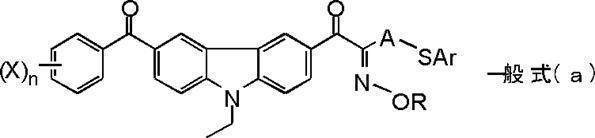
式(a)中、R、及びXは、各々独立に1価の置換基を表し、Aは二価の有機基を表し、Arはアリール基を表す。nは0~5の整数である。Xが複数存在する場合は、複数のXは同じでも、異なっていてもよい。
式(a)のRで表される1価の置換基の例としては、以下に示す1価の非金属原子団であることが好ましい。
式(a)のRで表される1価の非金属原子団の例としては、置換基を有してもよいアルキル基、置換基を有してもよいアリール基、置換基を有してもよいアルケニル基、置換基を有してもよいアルキニル基、置換基を有してもよいアルキルスルフィニル基、置換基を有してもよいアリールスルフィニル基、置換基を有してもよいアルキルスルホニル基、置換基を有してもよいアリールスルホニル基、置換基を有してもよいアシル基、置換基を有してもよいアルコキシカルボニル基、置換基を有してもよいアリールオキシカルボニル基、置換基を有してもよいホスフィノイル基、置換基を有してもよい複素環基、置換基を有してもよいアルキルチオカルボニル基、置換基を有してもよいアリールチオカルボニル基、置換基を有してもよいジアルキルアミノカルボニル基、置換基を有してもよいジアルキルアミノチオカルボニル基等が挙げられる。
式(a)のRで表される1価の非金属原子団の例としては、置換基を有してもよいアルキル基、置換基を有してもよいアリール基、置換基を有してもよいアルケニル基、置換基を有してもよいアルキニル基、置換基を有してもよいアルキルスルフィニル基、置換基を有してもよいアリールスルフィニル基、置換基を有してもよいアルキルスルホニル基、置換基を有してもよいアリールスルホニル基、置換基を有してもよいアシル基、置換基を有してもよいアルコキシカルボニル基、置換基を有してもよいアリールオキシカルボニル基、置換基を有してもよいホスフィノイル基、置換基を有してもよい複素環基、置換基を有してもよいアルキルチオカルボニル基、置換基を有してもよいアリールチオカルボニル基、置換基を有してもよいジアルキルアミノカルボニル基、置換基を有してもよいジアルキルアミノチオカルボニル基等が挙げられる。
置換基を有してもよいアルキル基としては、炭素数1~30のアルキル基が好ましく、例えば、メチル基、エチル基、プロピル基、ブチル基、ヘキシル基、オクチル基、デシル基、ドデシル基、オクダデシル基、イソプロピル基、イソブチル基、sec-ブチル基、t-ブチル基、1-エチルペンチル基、シクロペンチル基、シクロヘキシル基、トリフルオロメチル基、2-エチルヘキシル基、フェナシル基、1-ナフトイルメチル基、2-ナフトイルメチル基、4-メチルスルファニルフェナシル基、4-フェニルスルファニルフェナシル基、4-ジメチルアミノフェナシル基、4-シアノフェナシル基、4-メチルフェナシル基、2-メチルフェナシル基、3-フルオロフェナシル基、3-トリフルオロメチルフェナシル基、3-ニトロフェナシル基等が挙げられる。
置換基を有してもよいアリール基としては、炭素数6~30のアリール基が好ましく、フェニル基、ビフェニル基、1-ナフチル基、2-ナフチル基、9-アンスリル基、9-フェナントリル基、1-ピレニル基、5-ナフタセニル基、1-インデニル基、2-アズレニル基、9-フルオレニル基、ターフェニル基、クオーターフェニル基、o-、m-、及びp-トリル基、キシリル基、o-、m-、及びp-クメニル基、メシチル基、ペンタレニル基、ビナフタレニル基、ターナフタレニル基、クオーターナフタレニル基、ヘプタレニル基、ビフェニレニル基、インダセニル基、フルオランテニル基、アセナフチレニル基、アセアントリレニル基、フェナレニル基、フルオレニル基、アントリル基、ビアントラセニル基、ターアントラセニル基、クオーターアントラセニル基、アントラキノリル基、フェナントリル基、トリフェニレニル基、ピレニル基、クリセニル基、ナフタセニル基、プレイアデニル基、ピセニル基、ペリレニル基、ペンタフェニル基、ペンタセニル基、テトラフェニレニル基、ヘキサフェニル基、ヘキサセニル基、ルビセニル基、コロネニル基、トリナフチレニル基、ヘプタフェニル基、ヘプタセニル基、ピラントレニル基、オバレニル基等が挙げられる。
置換基を有してもよいアルケニル基としては、炭素数2以上10以下のアルケニル基が好ましく、例えば、ビニル基、アリル基、スチリル基等が挙げられる。
置換基を有してもよいアルキニル基としては、炭素数2以上10以下のアルキニル基が好ましく、例えば、エチニル基、プロピニル基、プロパルギル基等が挙げられる。
置換基を有してもよいアルキルスルフィニル基としては、炭素数1以上20以下のアルキルスルフィニル基が好ましく、例えば、メチルスルフィニル基、エチルスルフィニル基、プロピルスルフィニル基、イソプロピルスルフィニル基、ブチルスルフィニル基、ヘキシルスルフィニル基、シクロヘキシルスルフィニル基、オクチルスルフィニル基、2-エチルヘキシルスルフィニル基、デカノイルスルフィニル基、ドデカノイルスルフィニル基、オクタデカノイルスルフィニル基、シアノメチルスルフィニル基、メトキシメチルスルフィニル基等が挙げられる。
置換基を有してもよいアリールスルフィニル基としては、炭素数6以上30以下のアリールスルフィニル基が好ましく、例えば、フェニルスルフィニル基、1-ナフチルスルフィニル基、2-ナフチルスルフィニル基、2-クロロフェニルスルフィニル基、2-メチルフェニルスルフィニル基、2-メトキシフェニルスルフィニル基、2-ブトキシフェニルスルフィニル基、3-クロロフェニルスルフィニル基、3-トリフルオロメチルフェニルスルフィニル基、3-シアノフェニルスルフィニル基、3-ニトロフェニルスルフィニル基、4-フルオロフェニルスルフィニル基、4-シアノフェニルスルフィニル基、4-メトキシフェニルスルフィニル基、4-メチルスルファニルフェニルスルフィニル基、4-フェニルスルファニルフェニルスルフィニル基、4-ジメチルアミノフェニルスルフィニル基等が挙げられる。
置換基を有してもよいアルキルスルホニル基としては、炭素数1以上20以下のアルキルスルホニル基が好ましく、例えば、メチルスルホニル基、エチルスルホニル基、プロピルスルホニル基、イソプロピルスルホニル基、ブチルスルホニル基、ヘキシルスルホニル基、シクロヘキシルスルホニル基、オクチルスルホニル基、2-エチルヘキシルスルホニル基、デカノイルスルホニル基、ドデカノイルスルホニル基、オクタデカノイルスルホニル基、シアノメチルスルホニル基、メトキシメチルスルホニル基、パーフルオロアルキルスルホニル基等が挙げられる。
置換基を有してもよいアリールスルホニル基としては、炭素数6以上30以下のアリールスルホニル基が好ましく、例えば、フェニルスルホニル基、1-ナフチルスルホニル基、2-ナフチルスルホニル基、2-クロロフェニルスルホニル基、2-メチルフェニルスルホニル基、2-メトキシフェニルスルホニル基、2-ブトキシフェニルスルホニル基、3-クロロフェニルスルホニル基、3-トリフルオロメチルフェニルスルホニル基、3-シアノフェニルスルホニル基、3-ニトロフェニルスルホニル基、4-フルオロフェニルスルホニル基、4-シアノフェニルスルホニル基、4-メトキシフェニルスルホニル基、4-メチルスルファニルフェニルスルホニル基、4-フェニルスルファニルフェニルスルホニル基、4-ジメチルアミノフェニルスルホニル基等が挙げられる。
置換基を有してもよいアシル基としては、炭素数2以上20以下のアシル基が好ましく、例えば、アセチル基、プロパノイル基、ブタノイル基、トリフルオロメチルカルボニル基、ペンタノイル基、ベンゾイル基、1-ナフトイル基、2-ナフトイル基、4-メチルスルファニルベンゾイル基、4-フェニルスルファニルベンゾイル基、4-ジメチルアミノベンゾイル基、4-ジエチルアミノベンゾイル基、2-クロロベンゾイル基、2-メチルベンゾイル基、2-メトキシベンゾイル基、2-ブトキシベンゾイル基、3-クロロベンゾイル基、3-トリフルオロメチルベンゾイル基、3-シアノベンゾイル基、3-ニトロベンゾイル基、4-フルオロベンゾイル基、4-シアノベンゾイル基、4-メトキシベンゾイル基等が挙げられる。
置換基を有してもよいアルコキシカルボニル基としては、炭素数2以上20以下のアルコキシカルボニル基が好ましく、例えば、メトキシカルボニル基、エトキシカルボニル基、プロポキシカルボニル基、ブトキシカルボニル基、ヘキシルオキシカルボニル基、オクチルオキシカルボニル基、デシルオキシカルボニル基、オクタデシルオキシカルボニル基、トリフルオロメチルオキシカルボニル基等が挙げられる。
置換基を有してもよいアリールオキシカルボニル基としては、フェノキシカルボニル基、1-ナフチルオキシカルボニル基、2-ナフチルオキシカルボニル基、4-メチルスルファニルフェニルオキシカルボニル基、4-フェニルスルファニルフェニルオキシカルボニル基、4-ジメチルアミノフェニルオキシカルボニル基、4-ジエチルアミノフェニルオキシカルボニル基、2-クロロフェニルオキシカルボニル基、2-メチルフェニルオキシカルボニル基、2-メトキシフェニルオキシカルボニル基、2-ブトキシフェニルオキシカルボニル基、3-クロロフェニルオキシカルボニル基、3-トリフルオロメチルフェニルオキシカルボニル基、3-シアノフェニルオキシカルボニル基、3-ニトロフェニルオキシカルボニル基、4-フルオロフェニルオキシカルボニル基、4-シアノフェニルオキシカルボニル基、4-メトキシフェニルオキシカルボニル基等が挙げられる。
置換基を有してもよいホスフィノイル基としては、総炭素数2以上50以下のホスフィノイル基が好ましく、例えば、ジメチルホスフィノイル基、ジエチルホスフィノイル基、ジプロピルホスフィノイル基、ジフェニルホスフィノイル基、ジメトキシホスフィノイル基、ジエトキシホスフィノイル基、ジベンゾイルホスフィノイル基、ビス(2,4,6-トリメチルフェニル)ホスフィノイル基等が挙げられる。
置換基を有してもよい複素環基としては、窒素原子、酸素原子、硫黄原子、リン原子を含む、芳香族あるいは脂肪族の複素環が好ましい。例えば、チエニル基、ベンゾ[b]チエニル基、ナフト[2,3-b]チエニル基、チアントレニル基、フリル基、ピラニル基、イソベンゾフラニル基、クロメニル基、キサンテニル基、フェノキサチイニル基、2H-ピロリル基、ピロリル基、イミダゾリル基、ピラゾリル基、ピリジル基、ピラジニル基、ピリミジニル基、ピリダジニル基、インドリジニル基、イソインドリル基、3H-インドリル基、インドリル基、1H-インダゾリル基、プリニル基、4H-キノリジニル基、イソキノリル基、キノリル基、フタラジニル基、ナフチリジニル基、キノキサニリル基、キナゾリニル基、シンノリニル基、プテリジニル基、4aH-カルバゾリル基、カルバゾリル基、β-カルボリニル基、フェナントリジニル基、アクリジニル基、ペリミジニル基、フェナントロリニル基、フェナジニル基、フェナルサジニル基、イソチアゾリル基、フェノチアジニル基、イソキサゾリル基、フラザニル基、フェノキサジニル基、イソクロマニル基、クロマニル基、ピロリジニル基、ピロリニル基、イミダゾリジニル基、イミダゾリニル基、ピラゾリジニル基、ピラゾリニル基、ピペリジル基、ピペラジニル基、インドリニル基、イソインドリニル基、キヌクリジニル基、モルホリニル基、チオキサントリル基等が挙げられる。
置換基を有してもよいアルキルチオカルボニル基としては、例えば、メチルチオカルボニル基、プロピルチオカルボニル基、ブチルチオカルボニル基、ヘキシルチオカルボニル基、オクチルチオカルボニル基、デシルチオカルボニル基、オクタデシルチオカルボニル基、トリフルオロメチルチオカルボニル基等が挙げられる。
置換基を有してもよいアリールチオカルボニル基としては、1-ナフチルチオカルボニル基、2-ナフチルチオカルボニル基、4-メチルスルファニルフェニルチオカルボニル基、4-フェニルスルファニルフェニルチオカルボニル基、4-ジメチルアミノフェニルチオカルボニル基、4-ジエチルアミノフェニルチオカルボニル基、2-クロロフェニルチオカルボニル基、2-メチルフェニルチオカルボニル基、2-メトキシフェニルチオカルボニル基、2-ブトキシフェニルチオカルボニル基、3-クロロフェニルチオカルボニル基、3-トリフルオロメチルフェニルチオカルボニル基、3-シアノフェニルチオカルボニル基、3-ニトロフェニルチオカルボニル基、4-フルオロフェニルチオカルボニル基、4-シアノフェニルチオカルボニル基、4-メトキシフェニルチオカルボニル基等が挙げられる。
置換基を有してもよいジアルキルアミノカルボニル基としては、ジメチルアミノカルボニル基、ジメエルアミノカルボニル基、ジプロピルアミノカルボニル基、ジブチルアミノカルボニル基等が挙げられる。
置換基を有してもよいジアルキルアミノチオカルボニル基としては、ジメチルアミノチオカルボニル基、ジプロピルアミノチオカルボニル基、ジブチルアミノチオカルボニル基等が挙げられる。
中でも、高感度化の点から、式(a)のRとしてはアシル基がより好ましく、具体的には、アセチル基、エチロイル基、プロピオイル基、ベンゾイル基、トルイル基が好ましい。
式(a)のAで表される2価の有機基としては、置換基を有してもよい炭素数1以上12以下のアルキレン、置換基を有してもよいシクロヘキシレン、置換基を有してもよいアルキニレンが挙げられる。
これらの基に導入しうる置換基としては、例えば、フッ素原子、塩素原子、臭素原子、ヨウ素原子等のハロゲン基、メトキシ基、エトキシ基、tert-ブトキシ基等のアルコキシ基、フェノキシ基、p-トリルオキシ基等のアリールオキシ基、メトキシカルボニル基、ブトキシカルボニル基、フェノキシカルボニル基等のアルコキシカルボニル基、アセトキシ基、プロピオニルオキシ基、ベンゾイルオキシ基等のアシルオキシ基、アセチル基、ベンゾイル基、イソブチリル基、アクリロイル基、メタクリロイル基、メトキサリル基等のアシル基、メチルスルファニル基、tert-ブチルスルファニル基等のアルキルスルファニル基、フェニルスルファニル基、p-トリルスルファニル基等のアリールスルファニル基、メチルアミノ基、シクロヘキシルアミノ基等のアルキルアミノ基、ジメチルアミノ基、ジエチルアミノ基、モルホリノ基、ピペリジノ基等のジアルキルアミノ基、フェニルアミノ基、p-トリルアミノ基等のアリールアミノ基、メチル基、エチル基、tert-ブチル基、ドデシル基等のアルキル基、フェニル基、p-トリル基、キシリル基、クメニル基、ナフチル基、アンスリル基、フェナントリル基等のアリール基等の他、ヒドロキシ基、カルボキシ基、ホルミル基、メルカプト基、スルホ基、メシル基、p-トルエンスルホニル基、アミノ基、ニトロ基、シアノ基、トリフルオロメチル基、トリクロロメチル基、トリメチルシリル基、ホスフィニコ基、ホスホノ基、トリメチルアンモニウミル基、ジメチルスルホニウミル基、トリフェニルフェナシルホスホニウミル基等が挙げられる。
中でも、式(a)のAとしては、感度を高め、加熱経時による着色を抑制する点から、無置換のアルキレン基、アルキル基(例えば、メチル基、エチル基、tert-ブチル基、ドデシル基)で置換されたアルキレン基、アルケニル基(例えば、ビニル基、アリル基)で置換されたアルキレン基、アリール基(例えば、フェニル基、p-トリル基、キシリル基、クメニル基、ナフチル基、アンスリル基、フェナントリル基、スチリル基)で置換されたアルキレン基が好ましい。
これらの基に導入しうる置換基としては、例えば、フッ素原子、塩素原子、臭素原子、ヨウ素原子等のハロゲン基、メトキシ基、エトキシ基、tert-ブトキシ基等のアルコキシ基、フェノキシ基、p-トリルオキシ基等のアリールオキシ基、メトキシカルボニル基、ブトキシカルボニル基、フェノキシカルボニル基等のアルコキシカルボニル基、アセトキシ基、プロピオニルオキシ基、ベンゾイルオキシ基等のアシルオキシ基、アセチル基、ベンゾイル基、イソブチリル基、アクリロイル基、メタクリロイル基、メトキサリル基等のアシル基、メチルスルファニル基、tert-ブチルスルファニル基等のアルキルスルファニル基、フェニルスルファニル基、p-トリルスルファニル基等のアリールスルファニル基、メチルアミノ基、シクロヘキシルアミノ基等のアルキルアミノ基、ジメチルアミノ基、ジエチルアミノ基、モルホリノ基、ピペリジノ基等のジアルキルアミノ基、フェニルアミノ基、p-トリルアミノ基等のアリールアミノ基、メチル基、エチル基、tert-ブチル基、ドデシル基等のアルキル基、フェニル基、p-トリル基、キシリル基、クメニル基、ナフチル基、アンスリル基、フェナントリル基等のアリール基等の他、ヒドロキシ基、カルボキシ基、ホルミル基、メルカプト基、スルホ基、メシル基、p-トルエンスルホニル基、アミノ基、ニトロ基、シアノ基、トリフルオロメチル基、トリクロロメチル基、トリメチルシリル基、ホスフィニコ基、ホスホノ基、トリメチルアンモニウミル基、ジメチルスルホニウミル基、トリフェニルフェナシルホスホニウミル基等が挙げられる。
中でも、式(a)のAとしては、感度を高め、加熱経時による着色を抑制する点から、無置換のアルキレン基、アルキル基(例えば、メチル基、エチル基、tert-ブチル基、ドデシル基)で置換されたアルキレン基、アルケニル基(例えば、ビニル基、アリル基)で置換されたアルキレン基、アリール基(例えば、フェニル基、p-トリル基、キシリル基、クメニル基、ナフチル基、アンスリル基、フェナントリル基、スチリル基)で置換されたアルキレン基が好ましい。
式(a)のArで表されるアリール基としては、炭素数6以上30以下のアリール基が好ましく、また、置換基を有していてもよい。
具体的には、フェニル基、ビフェニル基、1-ナフチル基、2-ナフチル基、9-アンスリル基、9-フェナントリル基、1-ピレニル基、5-ナフタセニル基、1-インデニル基、2-アズレニル基、9-フルオレニル基、ターフェニル基、クオーターフェニル基、o-、m-、及びp-トリル基、キシリル基、o-、m-、及びp-クメニル基、メシチル基、ペンタレニル基、ビナフタレニル基、ターナフタレニル基、クオーターナフタレニル基、ヘプタレニル基、ビフェニレニル基、インダセニル基、フルオランテニル基、アセナフチレニル基、アセアントリレニル基、フェナレニル基、フルオレニル基、アントリル基、ビアントラセニル基、ターアントラセニル基、クオーターアントラセニル基、アントラキノリル基、フェナントリル基、トリフェニレニル基、ピレニル基、クリセニル基、ナフタセニル基、プレイアデニル基、ピセニル基、ペリレニル基、ペンタフェニル基、ペンタセニル基、テトラフェニレニル基、ヘキサフェニル基、ヘキサセニル基、ルビセニル基、コロネニル基、トリナフチレニル基、ヘプタフェニル基、ヘプタセニル基、ピラントレニル基、オバレニル基等が挙げられる。中でも、感度を高め、加熱経時による着色を抑制する点から、置換又は無置換のフェニル基が好ましい。
具体的には、フェニル基、ビフェニル基、1-ナフチル基、2-ナフチル基、9-アンスリル基、9-フェナントリル基、1-ピレニル基、5-ナフタセニル基、1-インデニル基、2-アズレニル基、9-フルオレニル基、ターフェニル基、クオーターフェニル基、o-、m-、及びp-トリル基、キシリル基、o-、m-、及びp-クメニル基、メシチル基、ペンタレニル基、ビナフタレニル基、ターナフタレニル基、クオーターナフタレニル基、ヘプタレニル基、ビフェニレニル基、インダセニル基、フルオランテニル基、アセナフチレニル基、アセアントリレニル基、フェナレニル基、フルオレニル基、アントリル基、ビアントラセニル基、ターアントラセニル基、クオーターアントラセニル基、アントラキノリル基、フェナントリル基、トリフェニレニル基、ピレニル基、クリセニル基、ナフタセニル基、プレイアデニル基、ピセニル基、ペリレニル基、ペンタフェニル基、ペンタセニル基、テトラフェニレニル基、ヘキサフェニル基、ヘキサセニル基、ルビセニル基、コロネニル基、トリナフチレニル基、ヘプタフェニル基、ヘプタセニル基、ピラントレニル基、オバレニル基等が挙げられる。中でも、感度を高め、加熱経時による着色を抑制する点から、置換又は無置換のフェニル基が好ましい。
上記フェニル基が置換基を有している場合、その置換基としては、例えば、フッ素原子、塩素原子、臭素原子、ヨウ素原子等のハロゲン基、メトキシ基、エトキシ基、tert-ブトキシ基等のアルコキシ基、フェノキシ基、p-トリルオキシ基等のアリールオキシ基、メチルチオ基、エチルチオ基、tert-ブチルチオ基等のアルキルチオ基、フェニルチオ基、p-トリルチオ基等のアリールチオ基、メトキシカルボニル基、ブトキシカルボニル基、フェノキシカルボニル基等のアルコキシカルボニル基、アセトキシ基、プロピオニルオキシ基、ベンゾイルオキシ基等のアシルオキシ基、アセチル基、ベンゾイル基、イソブチリル基、アクリロイル基、メタクリロイル基、メトキサリル基等のアシル基、メチルスルファニル基、tert-ブチルスルファニル基等のアルキルスルファニル基、フェニルスルファニル基、p-トリルスルファニル基等のアリールスルファニル基、メチルアミノ基、シクロヘキシルアミノ基等のアルキルアミノ基、ジメチルアミノ基、ジエチルアミノ基、モルホリノ基、ピペリジノ基等のジアルキルアミノ基、フェニルアミノ基、p-トリルアミノ基等のアリールアミノ基、エチル基、tert-ブチル基、ドデシル基等のアルキル基、ヒドロキシ基、カルボキシ基、ホルミル基、メルカプト基、スルホ基、メシル基、p-トルエンスルホニル基、アミノ基、ニトロ基、シアノ基、トリフルオロメチル基、トリクロロメチル基、トリメチルシリル基、ホスフィニコ基、ホスホノ基、トリメチルアンモニウミル基、ジメチルスルホニウミル基、トリフェニルフェナシルホスホニウミル基等が挙げられる。
式(a)においては、前記Arと隣接するSとで形成される「SAr」の構造が、以下に示す構造であることが感度の点で好ましい。

式(a)のXで表される1価の置換基としては、置換基を有してもよいアルキル基、置換基を有してもよいアリール基、置換基を有してもよいアルケニル基、置換基を有してもよいアルキニル基、置換基を有してもよいアルコキシ基、置換基を有してもよいアリールオキシ基、置換基を有してもよいアルキルチオ基、置換基を有してもよいアリールチオ基、置換基を有してもよいアシルオキシ基、置換基を有してもよいアルキルスルファニル基、置換基を有してもよいアリールスルファニル基、置換基を有してもよいアルキルスルフィニル基、置換基を有してもよいアリールスルフィニル基、置換基を有してもよいアルキルスルホニル基、置換基を有してもよいアリールスルホニル基、置換基を有してもよいアシル基、置換基を有してもよいアルコキシカルボニル基、置換基を有してもよいカルバモイル基、置換基を有してもよいスルファモイル基、置換基を有してもよいアミノ基、置換基を有してもよいホスフィノイル基、置換基を有してもよい複素環基、ハロゲン基等が挙げられる。
置換基を有してもよいアルキル基としては、炭素数1以上30以下のアルキル基が好ましく、例えば、メチル基、エチル基、プロピル基、ブチル基、ヘキシル基、オクチル基、デシル基、ドデシル基、オクダデシル基、イソプロピル基、イソブチル基、sec-ブチル基、tert-ブチル基、1-エチルペンチル基、シクロペンチル基、シクロヘキシル基、トリフルオロメチル基、2-エチルヘキシル基、フェナシル基、1-ナフトイルメチル基、2-ナフトイルメチル基、4-メチルスルファニルフェナシル基、4-フェニルスルファニルフェナシル基、4-ジメチルアミノフェナシル基、4-シアノフェナシル基4-メチルフェナシル基、2-メチルフェナシル基、3-フルオロフェナシル基、3-トリフルオロメチルフェナシル基、3-ニトロフェナシル基等が挙げられる。
置換基を有してもよいアリール基としては、炭素数6以上30以下のアリール基が好ましく、フェニル基、ビフェニル基、1-ナフチル基、2-ナフチル基、9-アンスリル基、9-フェナントリル基、1-ピレニル基、5-ナフタセニル基、1-インデニル基、2-アズレニル基、9-フルオレニル基、ターフェニル基、クオーターフェニル基、o-、m-、及びp-トリル基、キシリル基、o-、m-、及びp-クメニル基、メシチル基、ペンタレニル基、ビナフタレニル基、ターナフタレニル基、クオーターナフタレニル基、ヘプタレニル基、ビフェニレニル基、インダセニル基、フルオランテニル基、アセナフチレニル基、アセアントリレニル基、フェナレニル基、フルオレニル基、アントリル基、ビアントラセニル基、ターアントラセニル基、クオーターアントラセニル基、アントラキノリル基、フェナントリル基、トリフェニレニル基、ピレニル基、クリセニル基、ナフタセニル基、プレイアデニル基、ピセニル基、ペリレニル基、ペンタフェニル基、ペンタセニル基、テトラフェニレニル基、ヘキサフェニル基、ヘキサセニル基、ルビセニル基、コロネニル基、トリナフチレニル基、ヘプタフェニル基、ヘプタセニル基、ピラントレニル基、オバレニル基等がある。
置換基を有してもよいアルケニル基としては、炭素数2以上10以下のアルケニル基が好ましく、例えば、ビニル基、アリル基、スチリル基等が挙げられる。
置換基を有してもよいアルキニル基としては、炭素数2以上10以下のアルキニル基が好ましく、例えば、エチニル基、プロピニル基、プロパルギル基等が挙げられる。
置換基を有してもよいアルコキシ基としては、炭素数1以上30以下のアルコキシ基が好ましく、例えば、メトキシ基、エトキシ基、プロピルオキシ基、イソプロピルオキシ基、ブトキシ基、イソブトキシ基、sec-ブトキシ基、tert-ブトキシ基、ペンチルオキシ基、イソペンチルオキシ基、ヘキシルオキシ基、ヘプチルオキシ基、オクチルオキシ基、2-エチルヘキシルオキシ基、デシルオキシ基、ドデシルオキシ基、オクタデシルオキシ基、エトキシカルボニルメチル基、2-エチルヘキシルオキシカルボニルメチルオキシ基、アミノカルボニルメチルオキシ基、N,N-ジブチルアミノカルボニルメチルオキシ基、N-メチルアミノカルボニルメチルオキシ基、N-エチルアミノカルボニルメチルオキシ基、N-オクチルアミノカルボニルメチルオキシ基、N-メチル-N-ベンジルアミノカルボニルメチルオキシ基、ベンジルオキシ基、シアノメチルオキシ基等が挙げられる。
置換基を有してもよいアリールオキシ基としては、炭素数6以上30以下のアリールオキシ基が好ましく、例えば、フェニルオキシ基、1-ナフチルオキシ基、2-ナフチルオキシ基、2-クロロフェニルオキシ基、2-メチルフェニルオキシ基、2-メトキシフェニルオキシ基、2-ブトキシフェニルオキシ基、3-クロロフェニルオキシ基、3-トリフルオロメチルフェニルオキシ基、3-シアノフェニルオキシ基、3-ニトロフェニルオキシ基、4-フルオロフェニルオキシ基、4-シアノフェニルオキシ基、4-メトキシフェニルオキシ基、4-ジメチルアミノフェニルオキシ基、4-メチルスルファニルフェニルオキシ基、4-フェニルスルファニルフェニルオキシ基等がある。
置換基を有してもよいアルキルチオ基としては、炭素数1以上30以下のチオアルコキシ基が好ましく、例えば、メチルチオ基、エチルチオ基、プロピルチオ基、イソプロピルチオ基、ブチルチオ基、イソブチルチオ基、sec-ブチルチオ基、tert-ブチルチオ基、ペンチルチオ基、イソペンチルチオ基、ヘキシルチオ基、ヘプチルチオ基、オクチルチオ基、2-エチルヘキシルチオ基、デシルチオ基、ドデシルチオ基、オクタデシルチオ基、ベンジルチオ基等が挙げられる。
置換基を有してもよいアリールチオ基としては、炭素数6以上30以下のアリールチオ基が好ましく、例えば、フェニルチオ基、1-ナフチルチオ基、2-ナフチルチオ基、2-クロロフェニルチオ基、2-メチルフェニルチオ基、2-メトキシフェニルチオ基、2-ブトキシフェニルチオ基、3-クロロフェニルチオ基、3-トリフルオロメチルフェニルチオ基、3-シアノフェニルチオ基、3-ニトロフェニルチオ基、4-フルオロフェニルチオ基、4-シアノフェニルチオ基、4-メトキシフェニルチオ基、4-ジメチルアミノフェニルチオ基、4-メチルスルファニルフェニルチオ基、4-フェニルスルファニルフェニルチオ基等がある。
置換基を有してもよいアシルオキシ基としては、炭素数2以上20以下のアシルオキシ基が好ましく、例えば、アセチルオキシ基、プロパノイルオキシ基、ブタノイルオキシ基、ペンタノイルオキシ基、トリフルオロメチルカルボニルオキシ基、ベンゾイルオキシ基、1-ナフチルカルボニルオキシ基、2-ナフチルカルボニルオキシ基等が挙げられる。
置換基を有してもよいアルキルスルファニル基としては、炭素数1以上20以下のアルキルスルファニル基が好ましく、例えば、メチルスルファニル基、エチルスルファニル基、プロピルスルファニル基、イソプロピルスルファニル基、ブチルスルファニル基、ヘキシルスルファニル基、シクロヘキシルスルファニル基、オクチルスルファニル基、2-エチルヘキシルスルファニル基、デカノイルスルファニル基、ドデカノイルスルファニル基、オクタデカノイルスルファニル基、シアノメチルスルファニル基、メトキシメチルスルファニル基等が挙げられる。
置換基を有してもよいアリールスルファニル基としては、炭素数6以上30以下のアリールスルファニル基が好ましく、例えば、フェニルスルファニル基、1-ナフチルスルファニル基、2-ナフチルスルファニル基、2-クロロフェニルスルファニル基、2-メチルフェニルスルファニル基、2-メトキシフェニルスルファニル基、2-ブトキシフェニルスルファニル基、3-クロロフェニルスルファニル基、3-トリフルオロメチルフェニルスルファニル基、3-シアノフェニルスルファニル基、3-ニトロフェニルスルファニル基、4-フルオロフェニルスルファニル基、4-シアノフェニルスルファニル基、4-メトキシフェニルスルファニル基、4-メチルスルファニルフェニルスルファニル基、4-フェニルスルファニルフェニルスルファニル基、4-ジメチルアミノフェニルスルファニル基等が挙げられる。
置換基を有してもよいアルキルスルフィニル基としては、炭素数1以上20以下のアルキルスルフィニル基が好ましく、例えば、メチルスルフィニル基、エチルスルフィニル基、プロピルスルフィニル基、イソプロピルスルフィニル基、ブチルスルフィニル基、ヘキシルスルフィニル基、シクロヘキシルスルフィニル基、オクチルスルフィニル基、2-エチルヘキシルスルフィニル基、デカノイルスルフィニル基、ドデカノイルスルフィニル基、オクタデカノイルスルフィニル基、シアノメチルスルフィニル基、メトキシメチルスルフィニル基等が挙げられる。
置換基を有してもよいアリールスルフィニル基としては、炭素数6以上30以下のアリールスルフィニル基が好ましく、例えば、フェニルスルフィニル基、1-ナフチルスルフィニル基、2-ナフチルスルフィニル基、2-クロロフェニルスルフィニル基、2-メチルフェニルスルフィニル基、2-メトキシフェニルスルフィニル基、2-ブトキシフェニルスルフィニル基、3-クロロフェニルスルフィニル基、3-トリフルオロメチルフェニルスルフィニル基、3-シアノフェニルスルフィニル基、3-ニトロフェニルスルフィニル基、4-フルオロフェニルスルフィニル基、4-シアノフェニルスルフィニル基、4-メトキシフェニルスルフィニル基、4-メチルスルファニルフェニルスルフィニル基、4-フェニルスルファニルフェニルスルフィニル基、4-ジメチルアミノフェニルスルフィニル基等が挙げられる。
置換基を有してもよいアルキルスルホニル基としては、炭素数1以上20以下のアルキルスルホニル基が好ましく、例えば、メチルスルホニル基、エチルスルホニル基、プロピルスルホニル基、イソプロピルスルホニル基、ブチルスルホニル基、ヘキシルスルホニル基、シクロヘキシルスルホニル基、オクチルスルホニル基、2-エチルヘキシルスルホニル基、デカノイルスルホニル基、ドデカノイルスルホニル基、オクタデカノイルスルホニル基、シアノメチルスルホニル基、メトキシメチルスルホニル基等が挙げられる。
置換基を有してもよいアリールスルホニル基としては、炭素数6以上30以下のアリールスルホニル基が好ましく、例えば、フェニルスルホニル基、1-ナフチルスルホニル基、2-ナフチルスルホニル基、2-クロロフェニルスルホニル基、2-メチルフェニルスルホニル基、2-メトキシフェニルスルホニル基、2-ブトキシフェニルスルホニル基、3-クロロフェニルスルホニル基、3-トリフルオロメチルフェニルスルホニル基、3-シアノフェニルスルホニル基、3-ニトロフェニルスルホニル基、4-フルオロフェニルスルホニル基、4-シアノフェニルスルホニル基、4-メトキシフェニルスルホニル基、4-メチルスルファニルフェニルスルホニル基、4-フェニルスルファニルフェニルスルホニル基、4-ジメチルアミノフェニルスルホニル基等が挙げられる。
置換基を有してもよいアシル基としては、炭素数2以上20以下のアシル基が好ましく、例えば、アセチル基、プロパノイル基、ブタノイル基、トリフルオロメチルカルボニル基、ペンタノイル基、ベンゾイル基、1-ナフトイル基、2-ナフトイル基、4-メチルスルファニルベンゾイル基、4-フェニルスルファニルベンゾイル基、4-ジメチルアミノベンゾイル基、4-ジエチルアミノベンゾイル基、2-クロロベンゾイル基、2-メチルベンゾイル基、2-メトキシベンゾイル基、2-ブトキシベンゾイル基、3-クロロベンゾイル基、3-トリフルオロメチルベンゾイル基、3-シアノベンゾイル基、3-ニトロベンゾイル基、4-フルオロベンゾイル基、4-シアノベンゾイル基、4-メトキシベンゾイル基等が挙げられる。
置換基を有してもよいアルコキシカルボニル基としては、炭素数2以上20以下のアルコキシカルボニル基が好ましく、例えば、メトキシカルボニル基、エトキシカルボニル基、プロポキシカルボニル基、ブトキシカルボニル基、ヘキシルオキシカルボニル基、オクチルオキシカルボニル基、デシルオキシカルボニル基、オクタデシルオキシカルボニル基、フェノキシカルボニル基、トリフルオロメチルオキシカルボニル基、1-ナフチルオキシカルボニル基、2-ナフチルオキシカルボニル基、4-メチルスルファニルフェニルオキシカルボニル基、4-フェニルスルファニルフェニルオキシカルボニル基、4-ジメチルアミノフェニルオキシカルボニル基、4-ジエチルアミノフェニルオキシカルボニル基、2-クロロフェニルオキシカルボニル基、2-メチルフェニルオキシカルボニル基、2-メトキシフェニルオキシカルボニル基、2-ブトキシフェニルオキシカルボニル基、3-クロロフェニルオキシカルボニル基、3-トリフルオロメチルフェニルオキシカルボニル基、3-シアノフェニルオキシカルボニル基、3-ニトロフェニルオキシカルボニル基、4-フルオロフェニルオキシカルボニル基、4-シアノフェニルオキシカルボニル基、4-メトキシフェニルオキシカルボニル基等が挙げられる。
置換基を有してもよいカルバモイル基としては、総炭素数1以上30以下のカルバモイル基が好ましく、例えば、N-メチルカルバモイル基、N-エチルカルバモイル基、N-プロピルカルバモイル基、N-ブチルカルバモイル基、N-ヘキシルカルバモイル基、N-シクロヘキシルカルバモイル基、N-オクチルカルバモイル基、N-デシルカルバモイル基、N-オクタデシルカルバモイル基、N-フェニルカルバモイル基、N-2-メチルフェニルカルバモイル基、N-2-クロロフェニルカルバモイル基、N-2-イソプロポキシフェニルカルバモイル基、N-2-(2-エチルヘキシル)フェニルカルバモイル基、N-3-クロロフェニルカルバモイル基、N-3-ニトロフェニルカルバモイル基、N-3-シアノフェニルカルバモイル基、N-4-メトキシフェニルカルバモイル基、N-4-シアノフェニルカルバモイル基、N-4-メチルスルファニルフェニルカルバモイル基、N-4-フェニルスルファニルフェニルカルバモイル基、N-メチル-N-フェニルカルバモイル基、N、N-ジメチルカルバモイル基、N、N-ジブチルカルバモイル基、N、N-ジフェニルカルバモイル基等が挙げられる。
置換基を有してもよいスルファモイル基としては、総炭素数0以上30以下のスルファモイル基が好ましく、例えば、スルファモイル基、N-アルキルスルファモイル基、N-アリールスルファモイル基、N、N-ジアルキルスルファモイル基、N、N-ジアリールスルファモイル基、N-アルキル-N-アリールスルファモオイル基等が挙げられる。より具体的には、N-メチルスルファモイル基、N-エチルスルファモイル基、N-プロピルスルファモイル基、N-ブチルスルファモイル基、N-ヘキシルスルファモイル基、N-シクロヘキシルスルファモイル基、N-オクチルスルファモイル基、N-2-エチルヘキシルスルファモイル基、N-デシルスルファモイル基、N-オクタデシルスルファモイル基、N-フェニルスルファモイル基、N-2-メチルフェニルスルファモイル基、N-2-クロロフェニルスルファモイル基、N-2-メトキシフェニルスルファモイル基、N-2-イソプロポキシフェニルスルファモイル基、N-3-クロロフェニルスルファモイル基、N-3-ニトロフェニルスルファモイル基、N-3-シアノフェニルスルファモイル基、N-4-メトキシフェニルスルファモイル基、N-4-シアノフェニルスルファモイル基、N-4-ジメチルアミノフェニルスルファモイル基、N-4-メチルスルファニルフェニルスルファモイル基、N-4-フェニルスルファニルフェニルスルファモイル基、N-メチル-N-フェニルスルファモイル基、N,N-ジメチルスルファモイル基、N,N-ジブチルスルファモイル基、N,N-ジフェニルスルファモイル基等が挙げられる。
置換基を有してもよいアミノ基としては、総炭素数0以上50以下のアミノ基が好ましく、例えば、-NH2、N-アルキルアミノ基、N-アリールアミノ基、N-アシルアミノ基、N-スルホニルアミノ基、N,N-ジアルキルアミノ基、N,N-ジアリールアミノ基、N-アルキル-N-アリールアミノ基、N、N-ジスルホニルアミノ基等が挙げられる。より具体的には、N-メチルアミノ基、N-エチルアミノ基、N-プロピルアミノ基、N-イソプロピルアミノ基、N-ブチルアミノ基、N-tert―ブチルアミノ基、N-ヘキシルアミノ基、N-シクロヘキシルアミノ基、N-オクチルアミノ基、N-2-エチルヘキシルアミノ基、N-デシルアミノ基、N-オクタデシルアミノ基、N-ベンジルアミノ基、N-フェニルアミノ基、N-2-メチルフェニルアミノ基、N-2-クロロフェニルアミノ基、N-2-メトキシフェニルアミノ基、N-2-イソプロポキシフェニルアミノ基、N-2-(2-エチルヘキシル)フェニルアミノ基、N-3-クロロフェニルアミノ基、N-3-ニトロフェニルアミノ基、N-3-シアノフェニルアミノ基、N-3-トリフルオロメチルフェニルアミノ基、N-4-メトキシフェニルアミノ基、N-4-シアノフェニルアミノ基、N-4-トリフルオロメチルフェニルアミノ基、N-4-メチルスルファニルフェニルアミノ基、N-4-フェニルスルファニルフェニルアミノ基、N-4-ジメチルアミノフェニルアミノ基、N-メチル-N-フェニルアミノ基、N、N-ジメチルアミノ基、N、N-ジエチルアミノ基、N、N-ジブチルアミノ基、N、N-ジフェニルアミノ基、N、N-ジアセチルアミノ基、N、N-ジベンゾイルアミノ基、N、N-(ジブチルカルボニル)アミノ基、N、N-(ジメチルスルホニル)アミノ基、N、N-(ジエチルスルホニル)アミノ基、N、N-(ジブチルスルホニル)アミノ基、N、N-(ジフェニルスルホニル)アミノ基、モルホリノ基、3,5-ジメチルモルホリノ基、カルバゾール基等が挙げられる。
置換基を有してもよいホスフィノイル基としては、総炭素数2以上50以下のホスフィノイル基が好ましく、例えば、ジメチルホスフィノイル基、ジエチルホスフィノイル基、ジプロピルホスフィノイル基、ジフェニルホスフィノイル基、ジメトキシホスフィノイル基、ジエトキシホスフィノイル基、ジベンゾイルホスフィノイル基、ビス(2,4,6-トリメチルフェニル)ホスフィノイル基等が挙げられる。
置換基を有してもよい複素環基としては、窒素原子、酸素原子、硫黄原子、リン原子を含む、芳香族あるいは脂肪族の複素環が好ましい。例えば、チエニル基、ベンゾ[b]チエニル基、ナフト[2,3-b]チエニル基、チアントレニル基、フリル基、ピラニル基、イソベンゾフラニル基、クロメニル基、キサンテニル基、フェノキサチイニル基、2H-ピロリル基、ピロリル基、イミダゾリル基、ピラゾリル基、ピリジル基、ピラジニル基、ピリミジニル基、ピリダジニル基、インドリジニル基、イソインドリル基、3H-インドリル基、インドリル基、1H-インダゾリル基、プリニル基、4H-キノリジニル基、イソキノリル基、キノリル基、フタラジニル基、ナフチリジニル基、キノキサニリル基、キナゾリニル基、シンノリニル基、プテリジニル基、4aH-カルバゾリル基、カルバゾリル基、β-カルボリニル基、フェナントリジニル基、アクリジニル基、ペリミジニル基、フェナントロリニル基、フェナジニル基、フェナルサジニル基、イソチアゾリル基、フェノチアジニル基、イソキサゾリル基、フラザニル基、フェノキサジニル基、イソクロマニル基、クロマニル基、ピロリジニル基、ピロリニル基、イミダゾリジニル基、イミダゾリニル基、ピラゾリジニル基、ピラゾリニル基、ピペリジル基、ピペラジニル基、インドリニル基、イソインドリニル基、キヌクリジニル基、モルホリニル基、チオキサントリル基等がある。
ハロゲン基としては、フッ素原子、塩素原子、臭素原子、ヨウ素原子等がある。
更に、前述した置換基を有してもよいアルキル基、置換基を有してもよいアリール基、置換基を有してもよいアルケニル基、置換基を有してもよいアルキニル基、置換基を有してもよいアルコキシ基、置換基を有してもよいアリールオキシ基、置換基を有してもよいアルキルチオ基、置換基を有してもよいアリールチオ基、置換基を有してもよいアシルオキシ基、置換基を有してもよいアルキルスルファニル基、置換基を有してもよいアリールスルファニル基、置換基を有してもよいアルキルスルフィニル基、置換基を有してもよいアリールスルフィニル基、置換基を有してもよいアルキルスルホニル基、置換基を有してもよいアリールスルホニル基、置換基を有してもよいアシル基、置換基を有してもよいアルコキシカルボニル基、置換基を有してもよいカルバモイル基、置換基を有してもよいスルファモイル基、置換基を有してもよいアミノ基、置換基を有してもよい複素環基は、更に他の置換基で置換されていてもよい。
そのような置換基としては、例えば、フッ素原子、塩素原子、臭素原子、ヨウ素原子等のハロゲン基、メトキシ基、エトキシ基、tert-ブトキシ基等のアルコキシ基、フェノキシ基、p-トリルオキシ基等のアリールオキシ基、メトキシカルボニル基、ブトキシカルボニル基、フェノキシカルボニル基等のアルコキシカルボニル基、アセトキシ基、プロピオニルオキシ基、ベンゾイルオキシ基等のアシルオキシ基、アセチル基、ベンゾイル基、イソブチリル基、アクリロイル基、メタクリロイル基、メトキサリル基等のアシル基、メチルスルファニル基、tert-ブチルスルファニル基等のアルキルスルファニル基、フェニルスルファニル基、p-トリルスルファニル基等のアリールスルファニル基、メチルアミノ基、シクロヘキシルアミノ基等のアルキルアミノ基、ジメチルアミノ基、ジエチルアミノ基、モルホリノ基、ピペリジノ基等のジアルキルアミノ基、フェニルアミノ基、p-トリルアミノ基等のアリールアミノ基、メチル基、エチル基、tert-ブチル基、ドデシル基等のアルキル基、フェニル基、p-トリル基、キシリル基、クメニル基、ナフチル基、アンスリル基、フェナントリル基等のアリール基等の他、ヒドロキシ基、カルボキシ基、ホルミル基、メルカプト基、スルホ基、メシル基、p-トルエンスルホニル基、アミノ基、ニトロ基、シアノ基、トリフルオロメチル基、トリクロロメチル基、トリメチルシリル基、ホスフィニコ基、ホスホノ基、トリメチルアンモニウミル基、ジメチルスルホニウミル基、トリフェニルフェナシルホスホニウミル基等が挙げられる。
これらの中でも、式(a)のXとしては、溶剤溶解性と長波長領域の吸収効率向上の点から、置換基を有してもよいアルキル基、置換基を有してもよいアリール基、置換基を有してもよいアルケニル基、置換基を有してもよいアルキニル基、置換基を有してもよいアルコキシ基、置換基を有してもよいアリールオキシ基、置換基を有してもよいアルキルチオ基、置換基を有してもよいアリールチオ基、置換基を有してもよいアミノ基が好ましい。
また、式(a)におけるnは0~5の整数を表すが、0~2の整数が好ましい。
また、式(a)におけるnは0~5の整数を表すが、0~2の整数が好ましい。
以下、オキシム化合物の具体例を以下に示すが、本発明はこれらに限定されるものではない。
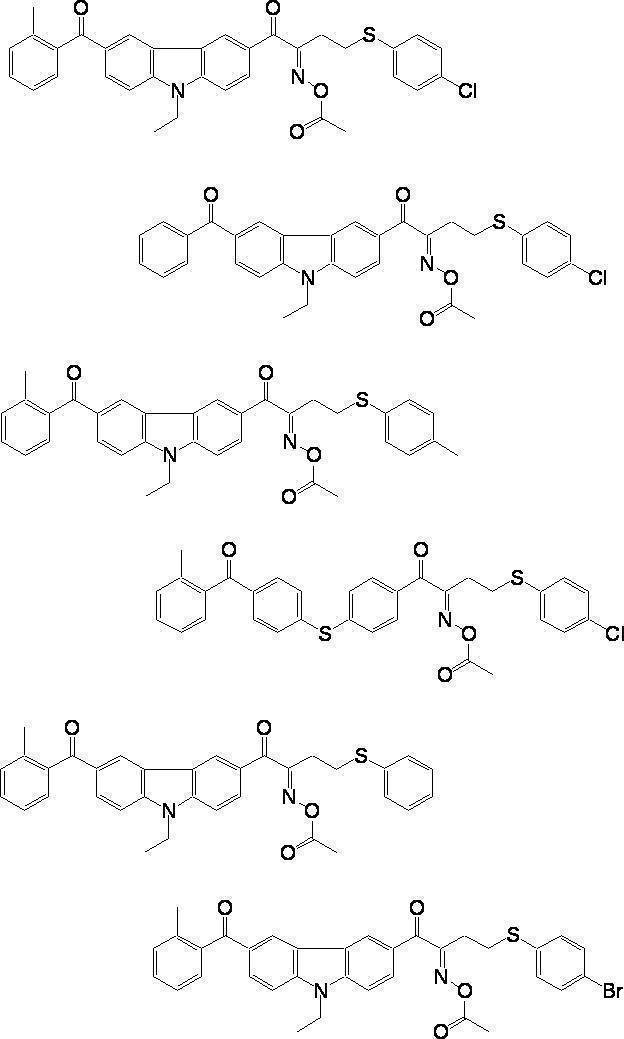

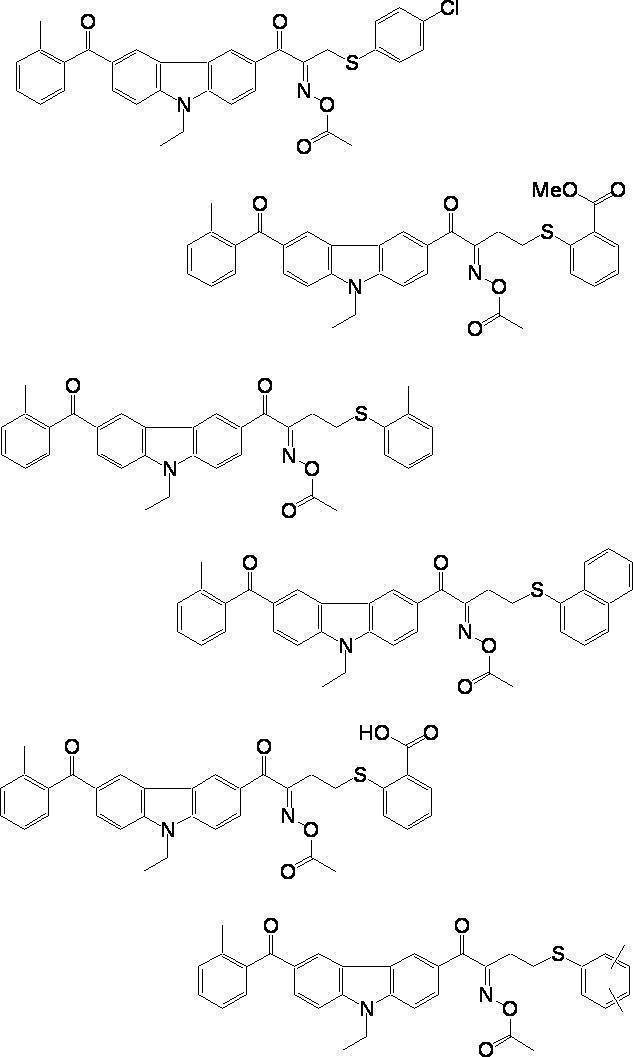


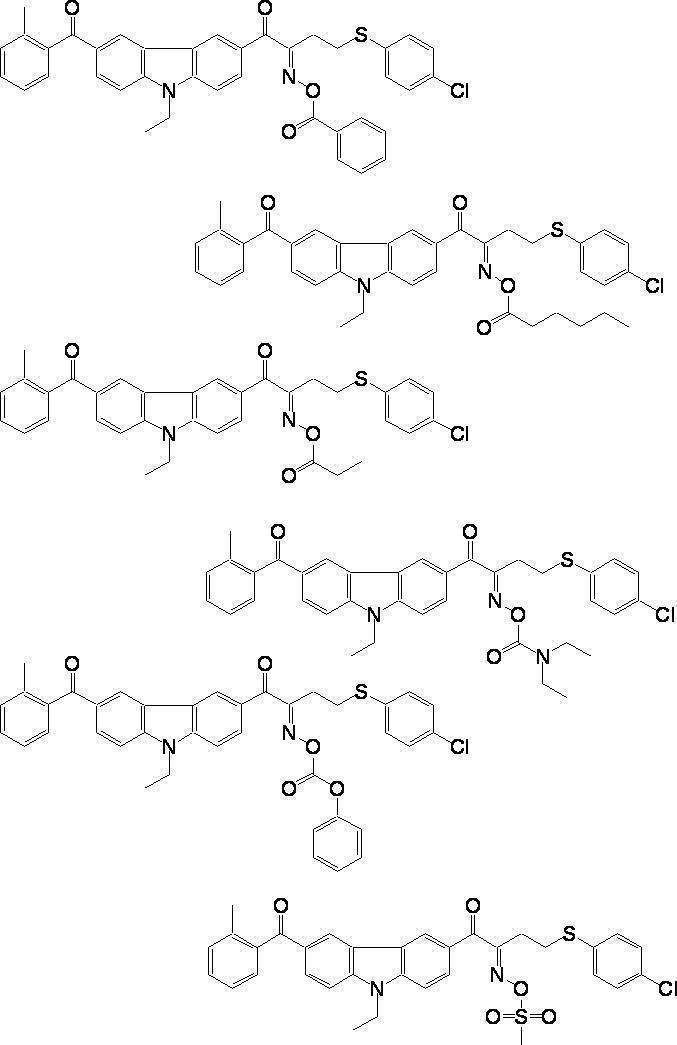

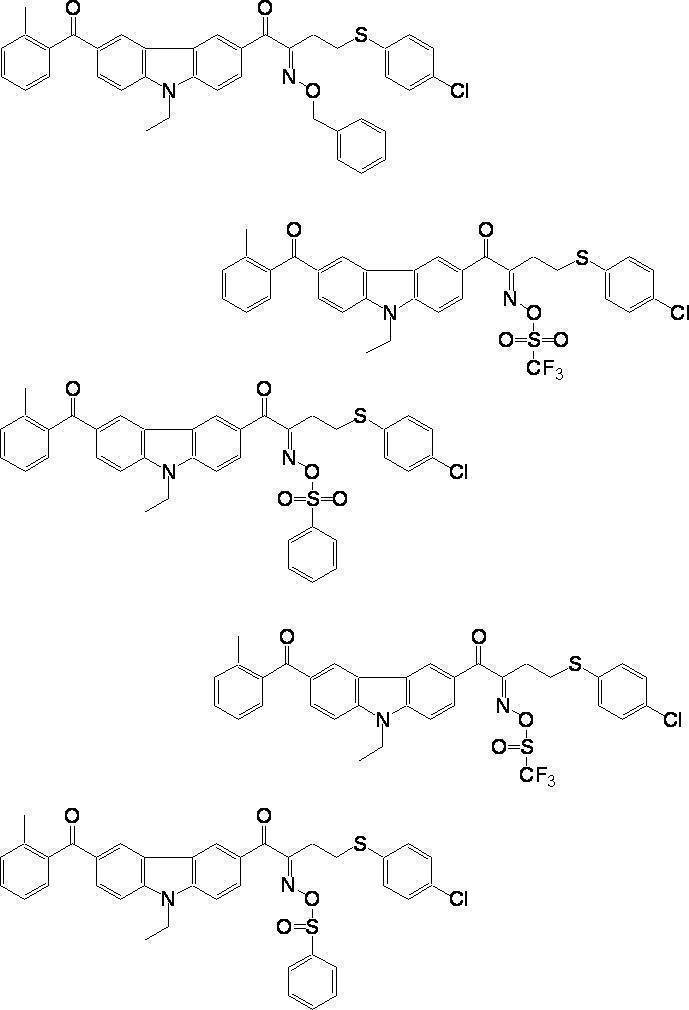
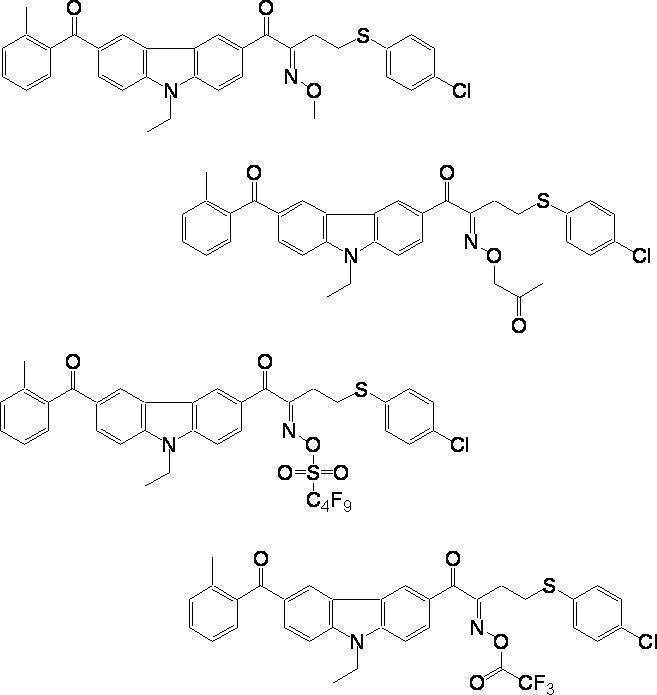

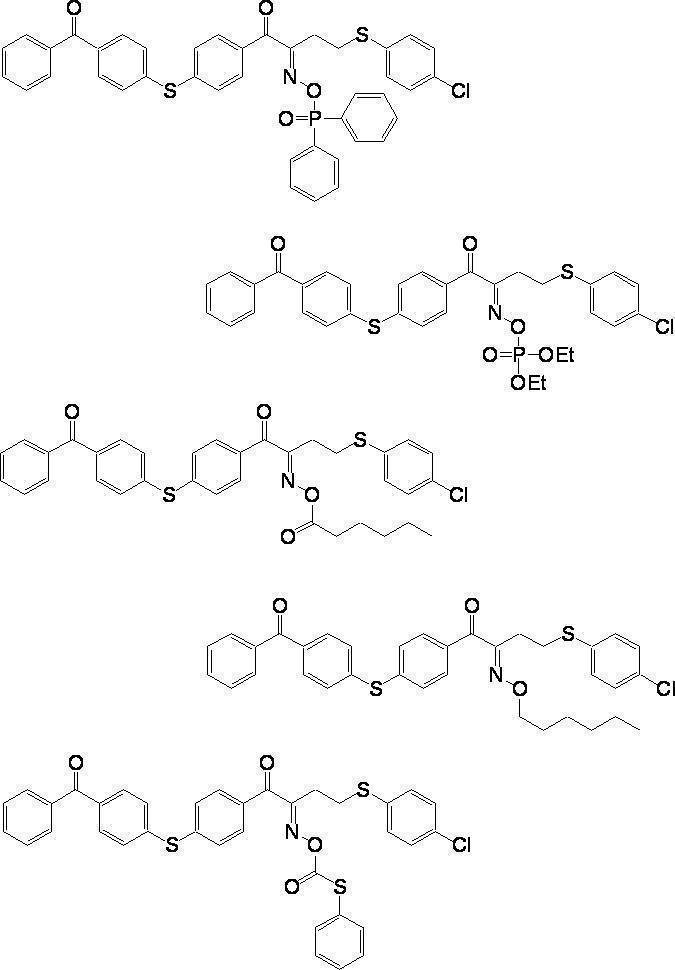

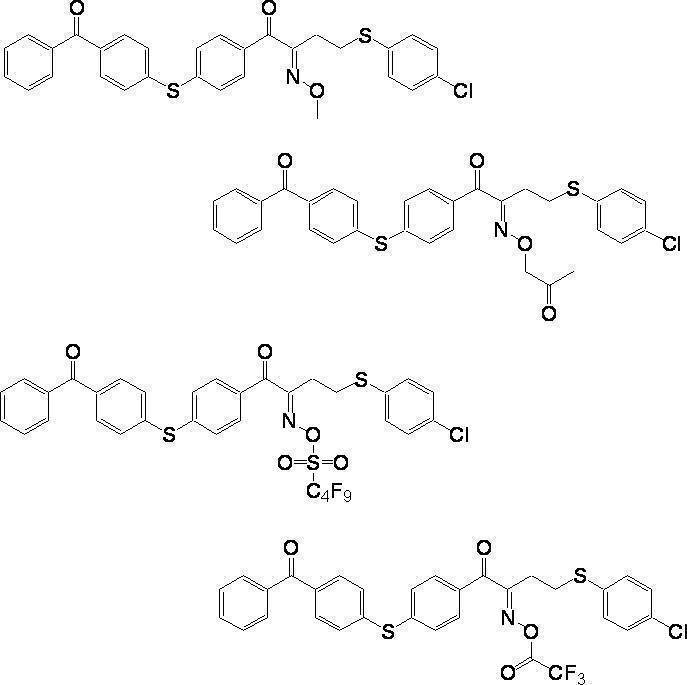
オキシム化合物は、熱により分解し重合を開始、促進する熱重合開始剤としての機能を有する。特に、式(a)で表されるオキシム化合物は後加熱での着色が少なく、硬化性も良好である。
また、オキシム化合物としては、IRUGACURE OXE01、及び、IRUGACURE OXE02などの市販品(いずれも、BASF社製)も好適に使用できる。
オニウム塩化合物としては、例えば、S.I.Schlesinger,Photogr.Sci.Eng.,18,387(1974)、T.S.Bal et al,Polymer,21,423(1980)に記載のジアゾニウム塩、米国特許第4,069,055号明細書、特開平4-365049号等に記載のアンモニウム塩、米国特許第4,069,055号、同4,069,056号の各明細書に記載のホスホニウム塩、欧州特許第104,143号の各明細書、特開平2-150848号、特開平2-296514号の各公報に記載のヨードニウム塩などが挙げられる。
本発明に好適に用いることのできるヨードニウム塩は、ジアリールヨードニウム塩であり、安定性の観点から、アルキル基、アルコキシ基、アリールオキシ基等の電子供与性基で2つ以上置換されていることが好ましい。
本発明に好適に用いられるスルホニウム塩としては、欧州特許第370,693号、同390,214号、同233,567号、同297,443号、同297,442号、米国特許第4,933,377号、同4,760,013号、同4,734,444号、同2,833,827号、独国特許第2,904,626号、同3,604,580号、同3,604,581号の各明細書に記載のスルホニウム塩が挙げられ、安定性及び感度の観点から、好ましくは電子求引性基で置換されているものである。電子求引性基としては、ハメット値が0より大きいことが好ましい。好ましい電子求引性基の例としては、ハロゲン原子、カルボン酸基などが挙げられる。
また、その他の好ましいスルホニウム塩としては、トリアリールスルホニウム塩の1つの置換基がクマリン構造又はアントアキノン構造を有し、300nm以上に吸収を有するスルホニウム塩が挙げられる。別の好ましいスルホニウム塩としては、トリアリールスルホニウム塩が、アリロキシ基、アリールチオ基を置換基に有する300nm以上に吸収を有するスルホニウム塩が挙げられる。
また、その他の好ましいスルホニウム塩としては、トリアリールスルホニウム塩の1つの置換基がクマリン構造又はアントアキノン構造を有し、300nm以上に吸収を有するスルホニウム塩が挙げられる。別の好ましいスルホニウム塩としては、トリアリールスルホニウム塩が、アリロキシ基、アリールチオ基を置換基に有する300nm以上に吸収を有するスルホニウム塩が挙げられる。
また、オニウム塩化合物の例としては、J.V.Crivello et al,Macromolecules,10(6),1307(1977)、J.V.Crivello et al,J.Polymer Sci.,Polymer Chem.Ed.,17,1047(1979)に記載のセレノニウム塩、C.S.Wen et al,Teh,Proc.Conf.Rad.Curing ASIA,p478 Tokyo,Oct(1988)に記載のアルソニウム塩等のオニウム塩等が挙げられる。
アシルホスフィン(オキシド)化合物としては、BASF社製のイルガキュア819、ダロキュア4265、ダロキュアTPOなどが挙げられる。
前記硬化性組成物に用いられる(E)重合開始剤としては、硬化性の観点から、トリハロメチルトリアジン系化合物、ベンジルジメチルケタール化合物、α-ヒドロキシケトン化合物、α-アミノケトン化合物、アシルホスフィン系化合物、フォスフィンオキサイド系化合物、メタロセン化合物、オキシム系化合物、トリアリルイミダゾールダイマー、オニウム系化合物、ベンゾチアゾール系化合物、ベンゾフェノン系化合物、アセトフェノン系化合物及びその誘導体、シクロペンタジエン-ベンゼン-鉄錯体及びその塩、ハロメチルオキサジアゾール化合物、3-アリール置換クマリン化合物からなる群より選択される化合物が好ましい。
更に好ましくは、トリハロメチルトリアジン系化合物、α-アミノケトン化合物、アシルホスフィン系化合物、フォスフィンオキサイド系化合物、オキシム系化合物、トリアリルイミダゾールダイマー、オニウム系化合物、ベンゾフェノン系化合物、アセトフェノン系化合物であり、トリハロメチルトリアジン系化合物、α-アミノケトン化合物、オキシム系化合物、トリアリルイミダゾールダイマー、ベンゾフェノン系化合物からなる群より選ばれる少なくとも一種の化合物が最も好ましい。
特に、前記硬化性組成物を、固体撮像素子のカラーフィルター上に設けてマイクロレンズとする観点から、特に、後加熱時の着色が少なく、かつ硬化性が良好であるため、(E)重合開始剤としては、オキシム系化合物を用いるのが最も好ましい。
前記硬化性組成物に含有される(E)重合開始剤の含有量(2種以上の場合は総含有量)は、硬化性組成物の全固形分に対し0.1質量%以上10質量%以下であることが好ましく、より好ましくは0.3質量%以上8質量%以下、更に好ましくは0.5質量%以上5質量%以下である。この範囲で、良好な硬化性が得られる。
前記硬化性組成物は、更に、必要に応じて、以下に詳述する任意成分を更に含有してもよい。以下、硬化性組成物が含有しうる任意成分について説明する。
[重合禁止剤]
本発明においては、硬化性組成物の製造中あるいは保存中において重合可能なエチレン性不飽和二重結合を有する化合物の不要な重合を阻止するために、重合禁止剤を添加することが好ましい。
本発明に用いうる重合禁止剤としては、フェノール系水酸基含有化合物、N-オキシド化合物類、ピペリジン1-オキシルフリーラジカル化合物類、ピロリジン1-オキシルフリーラジカル化合物類、N-ニトロソフェニルヒドロキシルアミン類、ジアゾニウム化合物類、及びカチオン染料類、スルフィド基含有化合物類、ニトロ基含有化合物類、FeCl3、CuCl2等の遷移金属化合物類が挙げられる。
本発明においては、硬化性組成物の製造中あるいは保存中において重合可能なエチレン性不飽和二重結合を有する化合物の不要な重合を阻止するために、重合禁止剤を添加することが好ましい。
本発明に用いうる重合禁止剤としては、フェノール系水酸基含有化合物、N-オキシド化合物類、ピペリジン1-オキシルフリーラジカル化合物類、ピロリジン1-オキシルフリーラジカル化合物類、N-ニトロソフェニルヒドロキシルアミン類、ジアゾニウム化合物類、及びカチオン染料類、スルフィド基含有化合物類、ニトロ基含有化合物類、FeCl3、CuCl2等の遷移金属化合物類が挙げられる。
更に好ましい態様としては、以下の通りである。
フェノール系水酸基含有化合物が、ハイドロキノン、p-メトキシフェノール、ジ-t-ブチル-p-クレゾール、ピロガロール、t-ブチルカテコール、ベンゾキノン、4,4-チオビス(3-メチル-6-t-ブチルフェノール)、2,2’-メチレンビス(4-メチル-6-t-ブチルフェノール)、フェノール樹脂類、及びクレゾール樹脂類からなる群より選択される化合物であるのが好ましい。
フェノール系水酸基含有化合物が、ハイドロキノン、p-メトキシフェノール、ジ-t-ブチル-p-クレゾール、ピロガロール、t-ブチルカテコール、ベンゾキノン、4,4-チオビス(3-メチル-6-t-ブチルフェノール)、2,2’-メチレンビス(4-メチル-6-t-ブチルフェノール)、フェノール樹脂類、及びクレゾール樹脂類からなる群より選択される化合物であるのが好ましい。
N-オキシド化合物類が、5,5-ジメチル-1-ピロリンN-オキシド、4-メチルモルホリンN-オキシド、ピリジンN-オキシド、4-ニトロピリジンN-オキシド、3-ヒドロキシピリジンN-オキシド、ピコリン酸N-オキシド、ニコチン酸N-オキシド、及びイソニコチン酸N-オキシドからなる群より選択される化合物であるのが好ましい。
ピペリジン1-オキシルフリーラジカル化合物類が、ピペリジン1-オキシルフリーラジカル、2,2,6,6-テトラメチルピペリジン1-オキシルフリーラジカル、4-オキソ-2,2,6,6-テトラメチルピペリジン1-オキシルフリーラジカル、4-ヒドロキシ-2,2,6,6-テトラメチルピペリジン1-オキシルフリーラジカル、4-アセトアミド-2,2,6,6-テトラメチルピペリジン1-オキシルフリーラジカル、4-マレイミド-2,2,6,6-テトラメチルピペリジン1-オキシルフリーラジカル、及び4-ホスホノキシ-2,2,6,6-テトラメチルピペリジン1-オキシルフリーラジカルからなる群より選択される化合物であるのが好ましい。
ピロリジン1-オキシルフリーラジカル化合物類が3-カルボキシプロキシルフリーラジカル(3-カルボキシ-2,2,5,5-テトラメチルピロリジン1-オキシルフリーラジカル)であるのが好ましい。
N-ニトロソフェニルヒドロキシルアミン類が、N-ニトロソフェニルヒドロキシルアミン第一セリウム塩及びN-ニトロソフェニルヒドロキシルアミンアルミニウム塩からなる化合物群から選択される化合物であるのが好ましい。
ジアゾニウム化合物類が、4-ジアゾフェニルジメチルアミンの硫酸水素塩、4-ジアゾジフェニルアミンのテトラフルオロホウ酸塩、及び3-メトキシ-4-ジアゾジフェニルアミンのヘキサフルオロリン酸塩からなる群より選択される化合物であるのが好ましい。
本発明に使用しうる好適な重合禁止剤を以下に例示するが、本発明はこれらに制限されるものではない。なおフェノール系重合禁止剤としては、下記例示化合物(P-1)~(P-24)が挙げられる。

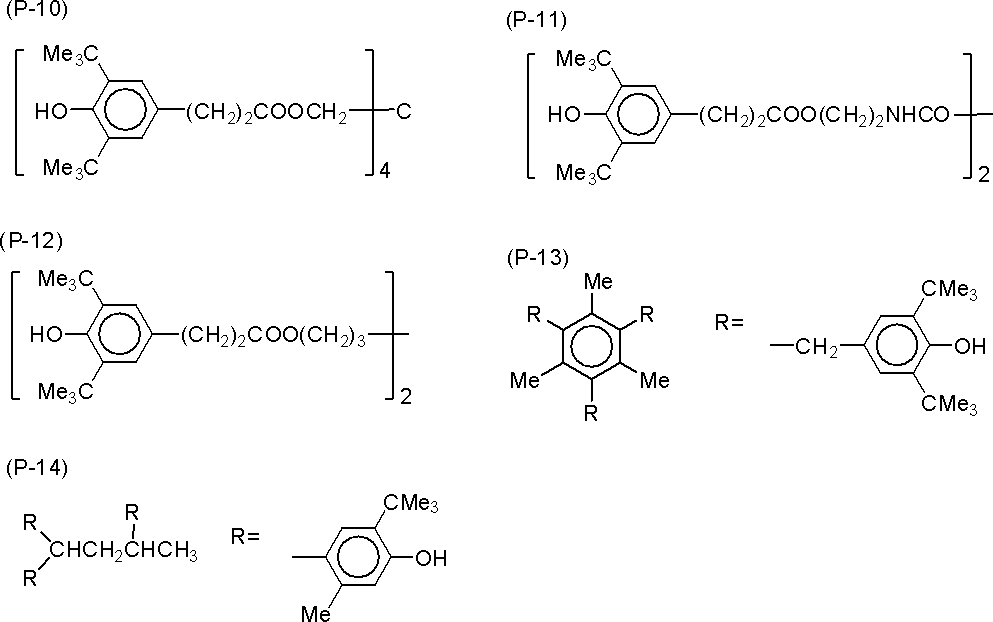
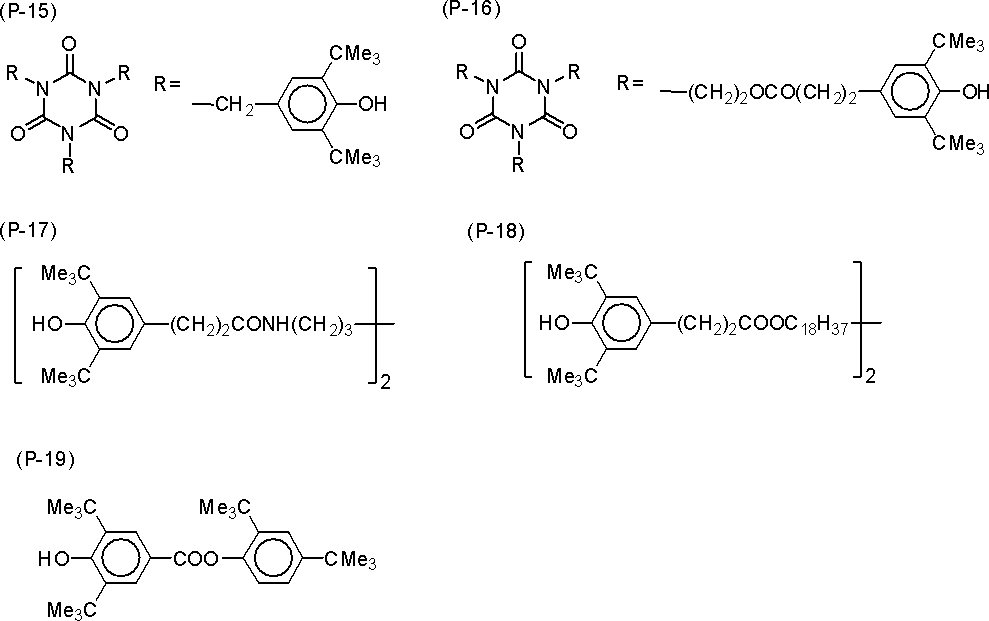
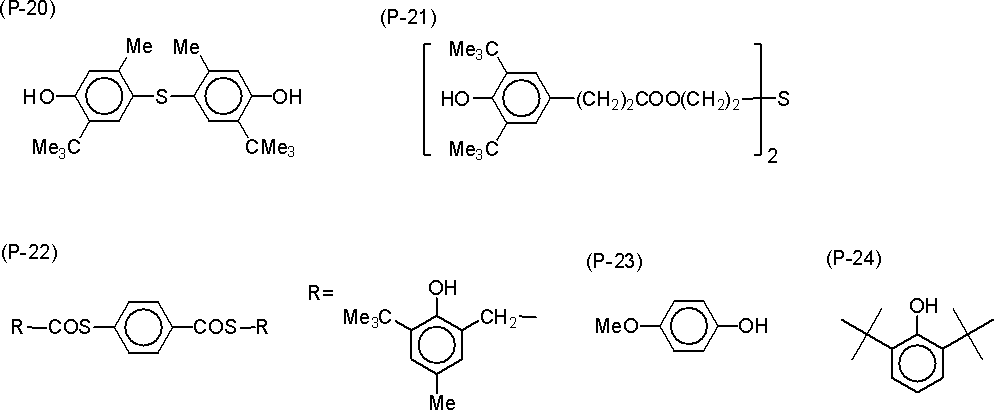
アミン系重合禁止剤としては、下記例示化合物(N-1)~(N-7)が挙げられる。

硫黄系重合禁止剤としては、下記例示化合物(S-1)~(S-5)が挙げられる。

フォスファイト系重合禁止剤としては、下記例示化合物(R-1)~(R-5)が挙げられる。
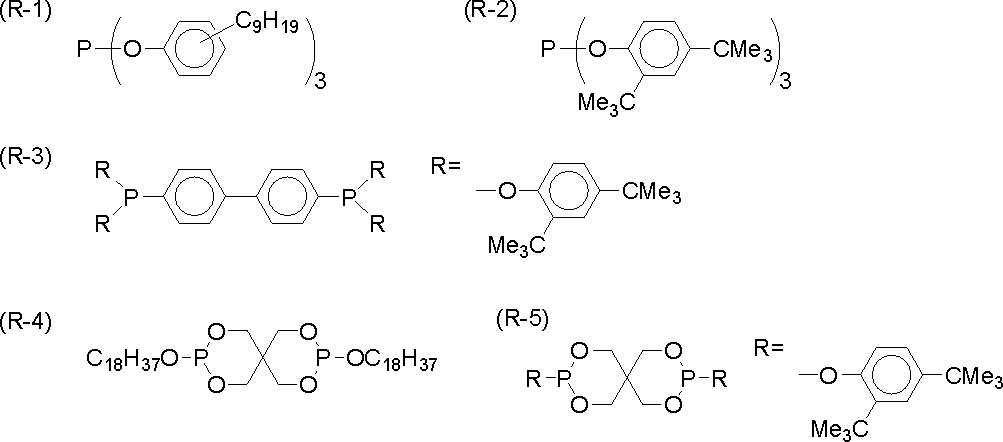
更に、以下に示す各化合物もまた、好適な重合禁止剤として使用しうる。
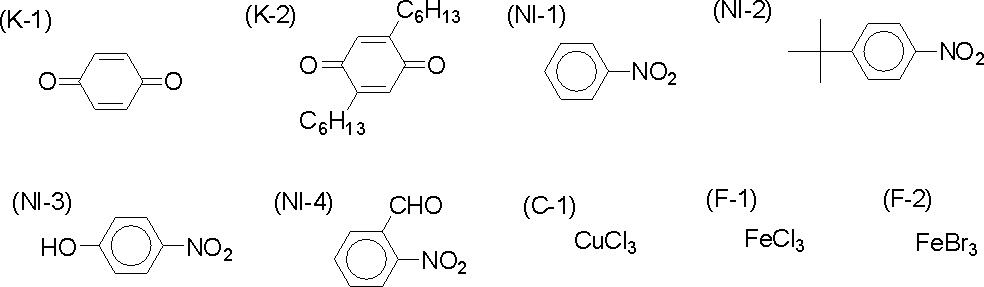
上記例示化合物のなかでも、好ましくは、ハイドロキノン、p-メトキシフェノール、ジ-t-ブチル-p-クレゾール、ピロガロール、t-ブチルカテコール、ベンゾキノン、4,4-チオビス(3-メチル-6-t-ブチルフェノール)、2,2’-メチレンビス(4-メチル-6-t-ブチルフェノール)のフェノール系水酸基含有化合物、ピペリジン1-オキシルフリーラジカル化合物類若しくは、2,2,6,6-テトラメチルピペリジン1-オキシルフリーラジカル、4-オキソ-2,2,6,6-テトラメチルピペリジン1-オキシルフリーラジカル、4-ヒドロキシ-2,2,6,6-テトラメチルピペリジン1-オキシルフリーラジカル、4-アセトアミド-2,2,6,6-テトラメチルピペリジン1-オキシルフリーラジカル、4-マレイミド-2,2,6,6-テトラメチルピペリジン1-オキシルフリーラジカル、及び4-ホスホノキシ-2,2,6,6-テトラメチルピペリジン1-オキシルフリーラジカルのピペリジン1-オキシルフリーラジカル化合物、若しくはN-ニトロソフェニルヒドロキシルアミン第一セリウム塩及びN-ニトロソフェニルヒドロキシルアミンアルミニウム塩のN-ニトロソフェニルヒドロキシルアミン化合物であり、より好ましくは、2,2,6,6-テトラメチルピペリジン1-オキシルフリーラジカル、4-オキソ-2,2,6,6-テトラメチルピペリジン1-オキシルフリーラジカル、4-ヒドロキシ-2,2,6,6-テトラメチルピペリジン1-オキシルフリーラジカル、4-アセトアミド-2,2,6,6-テトラメチルピペリジン1-オキシルフリーラジカル、4-マレイミド-2,2,6,6-テトラメチルピペリジン1-オキシルフリーラジカル、及び4-ホスホノキシ-2,2,6,6-テトラメチルピペリジン1-オキシルフリーラジカルのピペリジン1-オキシルフリーラジカル化合物、若しくはN-ニトロソフェニルヒドロキシルアミン第一セリウム塩及びN-ニトロソフェニルヒドロキシルアミンアルミニウム塩のN-ニトロソフェニルヒドロキシルアミン化合物であり、更に好ましくは、-ニトロソフェニルヒドロキシルアミン第一セリウム塩及びN-ニトロソフェニルヒドロキシルアミンアルミニウム塩のN-ニトロソフェニルヒドロキシルアミン化合物である。
重合禁止剤の好ましい添加量としては、(E)重合開始剤100質量部に対して、0.01質量部以上10質量部以下であることが好ましく、更に0.01質量部以上8質量部以下であることが好ましく、0.05質量部以上5質量部以下の範囲にあることが最も好ましい。
上記範囲とすることで、非画像部における硬化反応抑制及び画像部における硬化反応促進が充分おこなわれ、画像形成性及び感度が良好となる。
上記範囲とすることで、非画像部における硬化反応抑制及び画像部における硬化反応促進が充分おこなわれ、画像形成性及び感度が良好となる。
[バインダーポリマー]
前記硬化性組成物は、皮膜特性向上などの観点から、更にバインダーポリマーを含むことが好ましい。
前記バインダーポリマーとしては線状有機ポリマーを用いることが好ましい。このような線状有機ポリマーとしては、公知のものを任意に使用できる。好ましくは水現像あるいは弱アルカリ水現像を可能とするために、水あるいは弱アルカリ水に可溶性又は膨潤性である線状有機ポリマーが選択される。線状有機ポリマーは、皮膜形成剤としてだけでなく、水、弱アルカリ水あるいは有機溶剤現像剤としての用途に応じて選択使用される。例えば、水可溶性有機ポリマーを用いると水現像が可能になる。このような線状有機ポリマーとしては、側鎖にカルボン酸基を有するラジカル重合体、例えば特開昭59-44615号公報、特公昭54-34327号公報、特公昭58-12577号公報、特公昭54-25957号公報、特開昭54-92723号公報公報、特開昭59-53836号公報、特開昭59-71048号公報に記載されているもの、すなわち、カルボキシル基を有するモノマーを単独あるいは共重合させた樹脂、酸無水物を有するモノマーを単独あるいは共重合させ酸無水物ユニットを加水分解若しくはハーフエステル化若しくはハーフアミド化させた樹脂、エポキシ樹脂を不飽和モノカルボン酸及び酸無水物で変性させたエポキシアクリレート等が挙げられる。カルボキシル基を有するモノマーとしては、アクリル酸、メタクリル酸、イタコン酸、クロトン酸、マレイン酸、フマル酸、4-カルボキシルスチレン等があげられ、酸無水物を有するモノマーとしては、無水マレイン酸等が挙げられる。
また、同様に側鎖にカルボン酸基を有する酸性セルロース誘導体がある。この他に水酸基を有する重合体に環状酸無水物を付加させたものなどが有用である。
前記硬化性組成物は、皮膜特性向上などの観点から、更にバインダーポリマーを含むことが好ましい。
前記バインダーポリマーとしては線状有機ポリマーを用いることが好ましい。このような線状有機ポリマーとしては、公知のものを任意に使用できる。好ましくは水現像あるいは弱アルカリ水現像を可能とするために、水あるいは弱アルカリ水に可溶性又は膨潤性である線状有機ポリマーが選択される。線状有機ポリマーは、皮膜形成剤としてだけでなく、水、弱アルカリ水あるいは有機溶剤現像剤としての用途に応じて選択使用される。例えば、水可溶性有機ポリマーを用いると水現像が可能になる。このような線状有機ポリマーとしては、側鎖にカルボン酸基を有するラジカル重合体、例えば特開昭59-44615号公報、特公昭54-34327号公報、特公昭58-12577号公報、特公昭54-25957号公報、特開昭54-92723号公報公報、特開昭59-53836号公報、特開昭59-71048号公報に記載されているもの、すなわち、カルボキシル基を有するモノマーを単独あるいは共重合させた樹脂、酸無水物を有するモノマーを単独あるいは共重合させ酸無水物ユニットを加水分解若しくはハーフエステル化若しくはハーフアミド化させた樹脂、エポキシ樹脂を不飽和モノカルボン酸及び酸無水物で変性させたエポキシアクリレート等が挙げられる。カルボキシル基を有するモノマーとしては、アクリル酸、メタクリル酸、イタコン酸、クロトン酸、マレイン酸、フマル酸、4-カルボキシルスチレン等があげられ、酸無水物を有するモノマーとしては、無水マレイン酸等が挙げられる。
また、同様に側鎖にカルボン酸基を有する酸性セルロース誘導体がある。この他に水酸基を有する重合体に環状酸無水物を付加させたものなどが有用である。
本発明において、バインダーポリマーとして、共重合体を用いる場合、共重合させる化合物として、先にあげたモノマー以外の他のモノマーを用いることもできる。他のモノマーの例としては、下記(1)~(12)の化合物が挙げられる。
(1)2-ヒドロキシエチルアクリレート、2-ヒドロキシプロピルアクリレート、3-ヒドロキシプロピルアクリレート、4-ヒドロキシブチルアクリレート、2-ヒドロキシエチルメタクリレート、2-ヒドロキシプロピルメタクリレート、3-ヒドロキシプロピルメタクリレート、4-ヒドロキシブチルメタクリレート等の脂肪族水酸基を有するアクリル酸エステル類、及びメタクリル酸エステル類。
(2)アクリル酸メチル、アクリル酸エチル、アクリル酸プロピル、アクリル酸ブチル、アクリル酸イソブチル、アクリル酸アミル、アクリル酸ヘキシル、アクリル酸2-エチルヘキシル、アクリル酸オクチル、アクリル酸ベンジル、アクリル酸-2-クロロエチル、グリシジルアクリレート、3,4-エポキシシクロヘキシルメチルアクリレート、ビニルアクリレート、2-フェニルビニルアクリレート、1-プロペニルアクリレート、アリルアクリレート、2-アリロキシエチルアクリレート、プロパルギルアクリレート等のアルキルアクリレート。
(2)アクリル酸メチル、アクリル酸エチル、アクリル酸プロピル、アクリル酸ブチル、アクリル酸イソブチル、アクリル酸アミル、アクリル酸ヘキシル、アクリル酸2-エチルヘキシル、アクリル酸オクチル、アクリル酸ベンジル、アクリル酸-2-クロロエチル、グリシジルアクリレート、3,4-エポキシシクロヘキシルメチルアクリレート、ビニルアクリレート、2-フェニルビニルアクリレート、1-プロペニルアクリレート、アリルアクリレート、2-アリロキシエチルアクリレート、プロパルギルアクリレート等のアルキルアクリレート。
(3)メタクリル酸メチル、メタクリル酸エチル、メタクリル酸プロピル、メタクリル酸ブチル、メタクリル酸イソブチル、メタクリル酸アミル、メタクリル酸ヘキシル、メタクリル酸2-エチルヘキシル、メタクリル酸シクロヘキシル、メタクリル酸ベンジル、メタクリル酸-2-クロロエチル、グリシジルメタクリレート、3,4-エポキシシクロヘキシルメチルメタクリレート、ビニルメタクリレート、2-フェニルビニルメタクリレート、1-プロペニルメタクリレート、アリルメタクリレート、2-アリロキシエチルメタクリレート、プロパルギルメタクリレート等のアルキルメタクリレート。
(4)アクリルアミド、メタクリルアミド、N-メチロールアクリルアミド、N-エチルアクリルアミド、N-ヘキシルメタクリルアミド、N-シクロヘキシルアクリルアミド、N-ヒドロキシエチルアクリルアミド、N-フェニルアクリルアミド、N-ニトロフェニルアクリルアミド、N-エチル-N-フェニルアクリルアミド、ビニルアクリルアミド、ビニルメタクリルアミド、N,N-ジアリルアクリルアミド、N,N-ジアリルメタクリルアミド、アリルアクリルアミド、アリルメタクリルアミド等のアクリルアミド若しくはメタクリルアミド。
(4)アクリルアミド、メタクリルアミド、N-メチロールアクリルアミド、N-エチルアクリルアミド、N-ヘキシルメタクリルアミド、N-シクロヘキシルアクリルアミド、N-ヒドロキシエチルアクリルアミド、N-フェニルアクリルアミド、N-ニトロフェニルアクリルアミド、N-エチル-N-フェニルアクリルアミド、ビニルアクリルアミド、ビニルメタクリルアミド、N,N-ジアリルアクリルアミド、N,N-ジアリルメタクリルアミド、アリルアクリルアミド、アリルメタクリルアミド等のアクリルアミド若しくはメタクリルアミド。
(5)エチルビニルエーテル、2-クロロエチルビニルエーテル、ヒドロキシエチルビニルエーテル、プロピルビニルエーテル、ブチルビニルエーテル、オクチルビニルエーテル、フェニルビニルエーテル等のビニルエーテル類。
(6)ビニルアセテート、ビニルクロロアセテート、ビニルブチレート、安息香酸ビニル等のビニルエステル類。
(7)スチレン、α-メチルスチレン、メチルスチレン、クロロメチルスチレン、p-アセトキシスチレン等のスチレン類。
(8)メチルビニルケトン、エチルビニルケトン、プロピルビニルケトン、フェニルビニルケトン等のビニルケトン類。
(9)エチレン、プロピレン、イソブチレン、ブタジエン、イソプレン等のオレフィン類。
(6)ビニルアセテート、ビニルクロロアセテート、ビニルブチレート、安息香酸ビニル等のビニルエステル類。
(7)スチレン、α-メチルスチレン、メチルスチレン、クロロメチルスチレン、p-アセトキシスチレン等のスチレン類。
(8)メチルビニルケトン、エチルビニルケトン、プロピルビニルケトン、フェニルビニルケトン等のビニルケトン類。
(9)エチレン、プロピレン、イソブチレン、ブタジエン、イソプレン等のオレフィン類。
(10)N-ビニルピロリドン、アクリロニトリル、メタクリロニトリル等。
(11)マレイミド、N-アクリロイルアクリルアミド、N-アセチルメタクリルアミド、N-プロピオニルメタクリルアミド、N-(p-クロロベンゾイル)メタクリルアミド等の不飽和イミド。
(12)α位にヘテロ原子が結合したメタクリル酸系モノマー。例えば、特開2002-309057号、特開2002-311569号等の各公報に記載の化合物を挙げる事ができる。
(11)マレイミド、N-アクリロイルアクリルアミド、N-アセチルメタクリルアミド、N-プロピオニルメタクリルアミド、N-(p-クロロベンゾイル)メタクリルアミド等の不飽和イミド。
(12)α位にヘテロ原子が結合したメタクリル酸系モノマー。例えば、特開2002-309057号、特開2002-311569号等の各公報に記載の化合物を挙げる事ができる。
前記バインダーポリマーには、下記一般式(ED)で表される化合物(以下「エーテルダイマー」と称することもある。)を重合してなる繰り返し単位を含むことも好ましい。

(式(ED)中、R1及びR2は、それぞれ独立して、水素原子又は置換基を有していてもよい炭素数1~25の炭化水素基を表す。)
これにより、前記硬化性組成物は、耐熱性とともに透明性にも極めて優れた硬化塗膜を形成しうる。前記エーテルダイマーを示す前記一般式(ED)中、R1及びR2で表される置換基を有していてもよい炭素数1~25の炭化水素基としては、特に制限はないが、例えば、メチル、エチル、n-プロピル、イソプロピル、n-ブチル、イソブチル、t-ブチル、t-アミル、ステアリル、ラウリル、2-エチルヘキシル等の直鎖状又は分岐状のアルキル基;フェニル等のアリール基;シクロヘキシル、t-ブチルシクロヘキシル、ジシクロペンタジエニル、トリシクロデカニル、イソボルニル、アダマンチル、2-メチル-2-アダマンチル等の脂環式基;1-メトキシエチル、1-エトキシエチル等のアルコキシで置換されたアルキル基;ベンジル等のアリール基で置換されたアルキル基;等が挙げられる。これらの中でも特に、メチル、エチル、シクロヘキシル、ベンジル等のような酸や熱で脱離しにくい1級又は2級炭素の置換基が耐熱性の点で好ましい。
前記エーテルダイマーの具体例としては、例えば、ジメチル-2,2’-[オキシビス(メチレン)]ビス-2-プロペノエート、ジエチル-2,2’-[オキシビス(メチレン)]ビス-2-プロペノエート、ジ(n-プロピル)-2,2’-[オキシビス(メチレン)]ビス-2-プロペノエート、ジ(イソプロピル)-2,2’-[オキシビス(メチレン)]ビス-2-プロペノエート、ジ(n-ブチル)-2,2’-[オキシビス(メチレン)]ビス-2-プロペノエート、ジ(イソブチル)-2,2’-[オキシビス(メチレン)]ビス-2-プロペノエート、ジ(t-ブチル)-2,2’-[オキシビス(メチレン)]ビス-2-プロペノエート、ジ(t-アミル)-2,2’-[オキシビス(メチレン)]ビス-2-プロペノエート、ジ(ステアリル)-2,2’-[オキシビス(メチレン)]ビス-2-プロペノエート、ジ(ラウリル)-2,2’-[オキシビス(メチレン)]ビス-2-プロペノエート、ジ(2-エチルヘキシル)-2,2’-[オキシビス(メチレン)]ビス-2-プロペノエート、ジ(1-メトキシエチル)-2,2’-[オキシビス(メチレン)]ビス-2-プロペノエート、ジ(1-エトキシエチル)-2,2’-[オキシビス(メチレン)]ビス-2-プロペノエート、ジベンジル-2,2’-[オキシビス(メチレン)]ビス-2-プロペノエート、ジフェニル-2,2’-[オキシビス(メチレン)]ビス-2-プロペノエート、ジシクロヘキシル-2,2’-[オキシビス(メチレン)]ビス-2-プロペノエート、ジ(t-ブチルシクロヘキシル)-2,2’-[オキシビス(メチレン)]ビス-2-プロペノエート、ジ(ジシクロペンタジエニル)-2,2’-[オキシビス(メチレン)]ビス-2-プロペノエート、ジ(トリシクロデカニル)-2,2’-[オキシビス(メチレン)]ビス-2-プロペノエート、ジ(イソボルニル)-2,2’-[オキシビス(メチレン)]ビス-2-プロペノエート、ジアダマンチル-2,2’-[オキシビス(メチレン)]ビス-2-プロペノエート、ジ(2-メチル-2-アダマンチル)-2,2’-[オキシビス(メチレン)]ビス-2-プロペノエート等が挙げられる。これらの中でも特に、ジメチル-2,2’-[オキシビス(メチレン)]ビス-2-プロペノエート、ジエチル-2,2’-[オキシビス(メチレン)]ビス-2-プロペノエート、ジシクロヘキシル-2,2’-[オキシビス(メチレン)]ビス-2-プロペノエート、ジベンジル-2,2’-[オキシビス(メチレン)]ビス-2-プロペノエートが好ましい。これらエーテルダイマーは、1種のみ使用してもよいし、2種以上使用してもよい。また、前記一般式(ED)で示される化合物由来の構造体は、その他のモノマーを共重合させてもよい。
エーテルダイマーと共に共重合しうるその他の単量体としては、例えば、酸基を導入するための単量体、ラジカル重合性二重結合を導入するための単量体、エポキシ基を導入するための単量体、及び、これら以外の他の共重合可能な単量体が挙げられる。このような単量体は、1種のみを用いてもよいし、2種以上を用いてもよい。
エーテルダイマーと共に共重合しうるその他の単量体としては、例えば、酸基を導入するための単量体、ラジカル重合性二重結合を導入するための単量体、エポキシ基を導入するための単量体、及び、これら以外の他の共重合可能な単量体が挙げられる。このような単量体は、1種のみを用いてもよいし、2種以上を用いてもよい。
酸基を導入するための単量体としては、例えば、(メタ)アクリル酸やイタコン酸等のカルボキシル基を有するモノマー、N-ヒドロキシフェニルマレイミド等のフェノール性水酸基を有するモノマー、無水マレイン酸、無水イタコン酸等のカルボン酸無水物基を有するモノマー等が挙げられる。これらの中でも特に、(メタ)アクリル酸が好ましい。
また、酸基を導入するための単量体は、重合後に酸基を付与しうる単量体であってもよく、例えば、2-ヒドロキシエチル(メタ)アクリレート等の水酸基を有する単量体、グリシジル(メタ)アクリレート等のエポキシ基を有する単量体、2-イソシアナートエチル(メタ)アクリレート等のイソシアネート基を有する単量体等が挙げられる。ラジカル重合性二重結合を導入するための単量体を用いる場合、重合後に酸基を付与しうる単量体を用いる場合、重合後に酸基を付与する処理を行う必要がある。重合後に酸基を付与する処理は、単量体の種類によって異なり、例えば、次の処理が挙げられる。水酸基を有する単量体を用いる場合であれば、例えば、コハク酸無水物、テトラヒドロフタル酸無水物、マレイン酸無水物等の酸無水物を付加させる処理が挙げられる。エポキシ基を有する単量体を用いる場合であれば、例えば、N-メチルアミノ安息香酸、N-メチルアミノフェノール等のアミノ基と酸基を有する化合物を付加させか、又は、例えば(メタ)アクリル酸のような酸を付加させた後に生じた水酸基に、例えば、コハク酸無水物、テトラヒドロフタル酸無水物、マレイン酸無水物等の酸無水物を付加させる処理が挙げられる。イソシアネート基を有する単量体を用いる場合であれば、例えば、2-ヒドロキシ酪酸等の水酸基と酸基を有する化合物を付加させる処理が挙げられる。
また、酸基を導入するための単量体は、重合後に酸基を付与しうる単量体であってもよく、例えば、2-ヒドロキシエチル(メタ)アクリレート等の水酸基を有する単量体、グリシジル(メタ)アクリレート等のエポキシ基を有する単量体、2-イソシアナートエチル(メタ)アクリレート等のイソシアネート基を有する単量体等が挙げられる。ラジカル重合性二重結合を導入するための単量体を用いる場合、重合後に酸基を付与しうる単量体を用いる場合、重合後に酸基を付与する処理を行う必要がある。重合後に酸基を付与する処理は、単量体の種類によって異なり、例えば、次の処理が挙げられる。水酸基を有する単量体を用いる場合であれば、例えば、コハク酸無水物、テトラヒドロフタル酸無水物、マレイン酸無水物等の酸無水物を付加させる処理が挙げられる。エポキシ基を有する単量体を用いる場合であれば、例えば、N-メチルアミノ安息香酸、N-メチルアミノフェノール等のアミノ基と酸基を有する化合物を付加させか、又は、例えば(メタ)アクリル酸のような酸を付加させた後に生じた水酸基に、例えば、コハク酸無水物、テトラヒドロフタル酸無水物、マレイン酸無水物等の酸無水物を付加させる処理が挙げられる。イソシアネート基を有する単量体を用いる場合であれば、例えば、2-ヒドロキシ酪酸等の水酸基と酸基を有する化合物を付加させる処理が挙げられる。
一般式(ED)で表される化合物を含む単量体成分を重合してなる重合体が、酸基を導入するための単量体を含む場合、その含有割合は、特に制限されないが、全単量体成分中、5~70質量%が好ましく、より好ましくは10~60質量%である。
ラジカル重合性二重結合を導入するための単量体としては、例えば、例えば、(メタ)アクリル酸、イタコン酸等のカルボキシル基を有するモノマー;無水マレイン酸、無水イタコン酸等のカルボン酸無水物基を有するモノマー;グリシジル(メタ)アクリレート、3,4-エポキシシクロヘキシルメチル(メタ)アクリレート、o-(又はm-、又はp-)ビニルベンジルグリシジルエーテル等のエポキシ基を有するモノマー;等が挙げられる。ラジカル重合性二重結合を導入するための単量体を用いる場合、重合後にラジカル重合性二重結合を付与するための処理を行う必要がある。重合後にラジカル重合性二重結合を付与するための処理は、用いるラジカル重合性二重結合を付与しうるモノマーの種類によって異なり、例えば、次の処理が挙げられる。(メタ)アクリル酸やイタコン酸等のカルボキシル基を有するモノマーを用いる場合であれば、グリシジル(メタ)アクリレート、3,4-エポキシシクロヘキシルメチル(メタ)アクリレート、o-(又はm-、又はp-)ビニルベンジルグリシジルエーテル等のエポキシ基とラジカル重合性二重結合とを有する化合物を付加させる処理が挙げられる。無水マレイン酸や無水イタコン酸等のカルボン酸無水物基を有するモノマーを用いる場合であれば、2-ヒドロキシエチル(メタ)アクリレート等の水酸基とラジカル重合性二重結合とを有する化合物を付加させる処理が挙げられる。グリシジル(メタ)アクリレート、3,4-エポキシシクロヘキシルメチル(メタ)アクリレート、o-(又はm-、又はp-)ビニルベンジルグリシジルエーテル等のエポキシ基を有するモノマーを用いる場合であれば、(メタ)アクリル酸等の酸基とラジカル重合性二重結合とを有する化合物を付加させる処理が挙げられる。
一般式(ED)で表される化合物を含む単量体成分を重合してなる重合体が、ラジカル重合性二重結合を導入するための単量体を含む場合、その含有割合は、特に制限されないが、全単量体成分中、5~70質量%が好ましく、より好ましくは10~60質量%である。
エポキシ基を導入するための単量体としては、例えば、グリシジル(メタ)アクリレート、3,4-エポキシシクロヘキシルメチル(メタ)アクリレート、o-(又はm-、又はp-)ビニルベンジルグリシジルエーテル等が挙げられる。
一般式(ED)で表される化合物を含む単量体成分を重合してなる重合体が、エポキシ基を導入するための単量体を含む場合、その含有割合は、特に制限されないが、全単量体成分中、5~70質量%が好ましく、より好ましくは10~60質量%である。
一般式(ED)で表される化合物を含む単量体成分を重合してなる重合体が、エポキシ基を導入するための単量体を含む場合、その含有割合は、特に制限されないが、全単量体成分中、5~70質量%が好ましく、より好ましくは10~60質量%である。
他の共重合可能な単量体としては、例えば、(メタ)アクリル酸メチル、(メタ)アクリル酸エチル、(メタ)アクリル酸n-プロピル、(メタ)アクリル酸イソプロピル、(メタ)アクリル酸n-ブチル、(メタ)アクリル酸イソブチル、(メタ)アクリル酸t-ブチル、(メタ)アクリル酸メチル2-エチルヘキシル、(メタ)アクリル酸シクロヘキシル、(メタ)アクリル酸ベンジル、(メタ)アクリル酸2-ヒドロキシエチル等の(メタ)アクリル酸エステル類;スチレン、ビニルトルエン、α-メチルスチレン等の芳香族ビニル化合物;N-フェニルマレイミド、N-シクロヘキシルマレイミド等のN-置換マレイミド類;ブタジエン、イソプレン等のブタジエン又は置換ブタジエン化合物;エチレン、プロピレン、塩化ビニル、アクリロニトリル等のエチレン又は置換エチレン化合物;酢酸ビニル等のビニルエステル類;等が挙げられる。これらの中でも、(メタ)アクリル酸メチル、(メタ)アクリル酸シクロヘキシル、(メタ)アクリル酸ベンジル、スチレンが、透明性が良好で、耐熱性を損ないにくい点で好ましい。
一般式(ED)で表される化合物を含む単量体成分を重合してなる重合体が、他の共重合可能な単量体を含む場合、その含有割合は特に制限されないが、95質量%以下が好ましく、85質量%以下であるのがより好ましい。
一般式(ED)で表される化合物を含む単量体成分を重合してなる重合体の重量平均分子量は、特に制限されないが、着色感放射線性組成物の粘度、及び該組成物により形成される塗膜の耐熱性の観点から、好ましくは2000~200000、より好ましくは5000~100000であり、更に好ましくは5000~20000である。
また、一般式(ED)で表される化合物を含む単量体成分を重合してなる重合体が酸基を有する場合には、酸価が、好ましくは30~500mgKOH/g、より好ましくは50~400mgKOH/gであるのがよい。
また、一般式(ED)で表される化合物を含む単量体成分を重合してなる重合体が酸基を有する場合には、酸価が、好ましくは30~500mgKOH/g、より好ましくは50~400mgKOH/gであるのがよい。
一般式(ED)で表される化合物を含む単量体成分を重合してなる重合体は、少なくとも、エーテルダイマーを必須とする前記の単量体を重合することにより、容易に得ることができる。このとき、重合と同時にエーテルダイマーの環化反応が進行してテトラヒドロピラン環構造が形成される。
一般式(ED)で表される化合物を含む単量体成分を重合してなる重合体の合成に適用される重合方法としては、特に制限はなく、従来公知の各種重合方法を採用することができるが、特に、溶液重合法によることが好ましい。詳細には、例えば、特開204-300204号公報に記載されるポリマー(a)の合成方法に準じて、一般式(ED)で表される化合物を含む単量体成分を重合してなる重合体を合成することができる
一般式(ED)で表される化合物を含む単量体成分を重合してなる重合体の合成に適用される重合方法としては、特に制限はなく、従来公知の各種重合方法を採用することができるが、特に、溶液重合法によることが好ましい。詳細には、例えば、特開204-300204号公報に記載されるポリマー(a)の合成方法に準じて、一般式(ED)で表される化合物を含む単量体成分を重合してなる重合体を合成することができる
以下、一般式(ED)で表される化合物を含む単量体成分を重合してなる重合体の例示化合物を示すが、本発明はこれらに限定されるものではない。下記に示す例示化合物の組成比はモル%である。

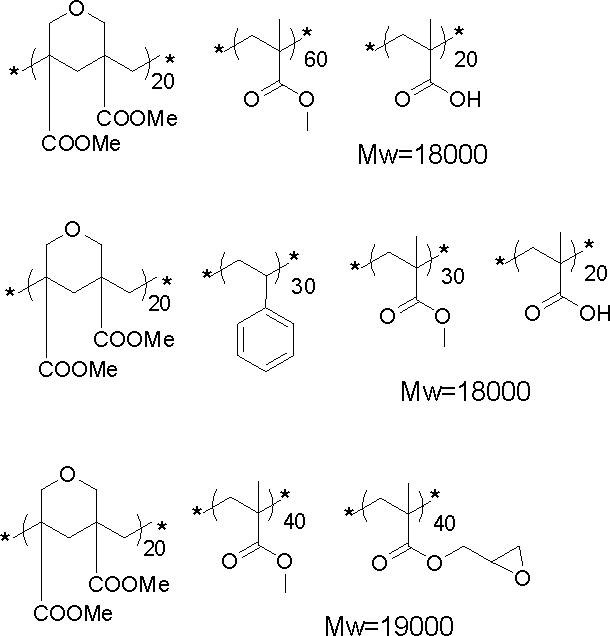
本発明では特に、ジメチル-2,2’-[オキシビス(メチレン)]ビス-2-プロペノエート(以下「DM」と称する)、ベンジルメタクリレート(以下「BzMA」と称する)、メタクリル酸メチル(以下「MMA」と称する)、メタクリル酸(以下「MAA」と称する)、グリシジルメタクリレート(以下「GMA」と称する)を共重合させた重合体が好ましい。特に、DM:BzMA:MMA:MAA:GMAのモル比が5~15:40~50:5~15:5~15:20~30であることが好ましい。本発明で用いる共重合体を構成する成分の95質量%以上がこれらの成分であることが好ましい。また、かかる重合体の重量平均分子量は9000~20000であることが好ましい。
本発明で用いる重合体は、重量平均分子量(GPC法で測定されたポリスチレン換算値)が1000~2×10⁵であることが好ましく、2000~1×10⁵であることがより好ましく、5000~5×10⁴であることが更に好ましい。
本発明で用いる重合体は、重量平均分子量(GPC法で測定されたポリスチレン換算値)が1000~2×10⁵であることが好ましく、2000~1×10⁵であることがより好ましく、5000~5×10⁴であることが更に好ましい。
これらの中で、側鎖にアリル基やビニルエステル基とカルボキシル基を有する(メタ)アクリル樹脂及び特開2000-187322号公報、特開2002-62698号公報に記載されている側鎖に二重結合を有するアルカリ可溶性樹脂や、特開2001-242612号公報に記載されている側鎖にアミド基を有するアルカリ可溶性樹脂が膜強度、感度、現像性のバランスに優れており、好適である。
また、特公平7-120040号公報、特公平7-120041号公報、特公平7-120042号公報、特公平8-12424号公報、特開昭63-287944号公報、特開昭63-287947号公報、特開平1-271741号公報等に記載される酸基を含有するウレタン系バインダーポリマーや、特開2002-107918号公報に記載される酸基と二重結合を側鎖に有するウレタン系バインダーポリマーは、非常に、強度に優れるので、膜強度の点で有利である。
また、欧州特許第993966号、欧州特許第1204000号、特開2001-318463号公報等に記載の酸基を有するアセタール変性ポリビニルアルコール系バインダーポリマーも、膜強度に優れており、好適である。
更にこの他に水溶性線状有機ポリマーとして、ポリビニルピロリドンやポリエチレンオキサイド等が有用である。また硬化皮膜の強度を上げるためにアルコール可溶性ナイロンや2,2-ビス-(4-ヒドロキシフェニル)-プロパンとエピクロロヒドリンのポリエーテル等も有用である。
また、欧州特許第993966号、欧州特許第1204000号、特開2001-318463号公報等に記載の酸基を有するアセタール変性ポリビニルアルコール系バインダーポリマーも、膜強度に優れており、好適である。
更にこの他に水溶性線状有機ポリマーとして、ポリビニルピロリドンやポリエチレンオキサイド等が有用である。また硬化皮膜の強度を上げるためにアルコール可溶性ナイロンや2,2-ビス-(4-ヒドロキシフェニル)-プロパンとエピクロロヒドリンのポリエーテル等も有用である。
前記硬化性組成物で使用しうるバインダーポリマーの重量平均分子量(GPC法で測定されたポリスチレン換算値)としては、好ましくは5,000以上であり、更に好ましくは1万以上30万以下の範囲であり、数平均分子量については好ましくは1,000以上であり、更に好ましくは2,000以上25万以下の範囲である。多分散度(重量平均分子量/数平均分子量)は1以上が好ましく、更に好ましくは1.1以上10以下の範囲である。
これらのバインダーポリマーは、ランダムポリマー、ブロックポリマー、グラフトポリマー等いずれでもよい。
これらのバインダーポリマーは、ランダムポリマー、ブロックポリマー、グラフトポリマー等いずれでもよい。
本発明で用いうるバインダーポリマーは、従来公知の方法により合成できる。合成する際に用いられる溶媒としては、例えば、テトラヒドロフラン、エチレンジクロリド、シクロヘキサノン、メチルエチルケトン、アセトン、メタノール、エタノール、エチレングリコールモノメチルエーテル、エチレングリコールモノエチルエーテル、2-メトキシエチルアセテート、ジエチレングリコールジメチルエーテル、1-メトキシ-2-プロパノール、1-メトキシ-2-プロピルアセテート、N,N-ジメチルホルムアミド、N,N-ジメチルアセトアミド、トルエン、酢酸エチル、乳酸メチル、乳酸エチル、ジメチルスルホキシド、水等が挙げられる。これらの溶媒は単独で又は2種以上混合して用いられる。
前記硬化性組成物において用いうるバインダーポリマーを合成する際に用いられるラジカル重合開始剤としては、アゾ系開始剤、過酸化物開始剤等公知の化合物が挙げられる。
前記硬化性組成物において用いうるバインダーポリマーを合成する際に用いられるラジカル重合開始剤としては、アゾ系開始剤、過酸化物開始剤等公知の化合物が挙げられる。
前記硬化性組成物において、バインダーポリマーは、1種単独で、あるいは2種以上を組み合わせて用いることができる。
前記硬化性組成物は、バインダーポリマーを含有してもしなくても良いが、含有する場合、硬化性組成物の全固形分に対して、バインダーポリマーの含有量は、1質量%以上40質量%以下であることが好ましく、3質量%以上30質量%以下であることがより好ましく、4質量%以上20質量%以下であることが更に好ましい。
[界面活性剤]
前記硬化性組成物は、塗布性をより向上させる観点から、各種の界面活性剤を添加してもよい。界面活性剤としては、フッ素系界面活性剤、ノニオン系界面活性剤、カチオン系界面活性剤、アニオン系界面活性剤、シリコーン系界面活性剤などの各種界面活性剤を使用できる。
前記硬化性組成物は、塗布性をより向上させる観点から、各種の界面活性剤を添加してもよい。界面活性剤としては、フッ素系界面活性剤、ノニオン系界面活性剤、カチオン系界面活性剤、アニオン系界面活性剤、シリコーン系界面活性剤などの各種界面活性剤を使用できる。
特に、前記硬化性組成物は、フッ素系界面活性剤を含有することで、塗布液として調製したときの液特性(特に、流動性)がより向上することから、塗布厚の均一性や省液性をより改善することができる。
即ち、フッ素系界面活性剤を含有する感光性透明組成物を適用した塗布液を用いて膜形成する場合においては、被塗布面と塗布液との界面張力を低下させることにより、被塗布面への濡れ性が改善され、被塗布面への塗布性が向上する。このため、少量の液量で数μm程度の薄膜を形成した場合であっても、厚みムラの小さい均一厚の膜形成をより好適に行える点で有効である。
即ち、フッ素系界面活性剤を含有する感光性透明組成物を適用した塗布液を用いて膜形成する場合においては、被塗布面と塗布液との界面張力を低下させることにより、被塗布面への濡れ性が改善され、被塗布面への塗布性が向上する。このため、少量の液量で数μm程度の薄膜を形成した場合であっても、厚みムラの小さい均一厚の膜形成をより好適に行える点で有効である。
フッ素系界面活性剤中のフッ素含有率は、3質量%~40質量%が好適であり、より好ましくは5質量%~30質量%であり、特に好ましくは7質量%~25質量%である。フッ素含有率がこの範囲内であるフッ素系界面活性剤は、塗布膜の厚さの均一性や省液性の点で効果的であり、硬化性組成物中における溶解性も良好である。
フッ素系界面活性剤としては、例えば、メガファックF171、同F172、同F173、同F176、同F177、同F141、同F142、同F143、同F144、同R30、同F437、同F475、同F479、同F482、同F554、同F780、同F781(以上、DIC(株)製)、フロラードFC430、同FC431、同FC171(以上、住友スリーエム(株)製)、サーフロンS-382、同SC-101、同SC-103、同SC-104、同SC-105、同SC1068、同SC-381、同SC-383、同S393、同KH-40(以上、旭硝子(株)製)等が挙げられる。
ノニオン系界面活性剤として具体的には、グリセロール、トリメチロールプロパン、トリメチロールエタン並びにそれらのエトキシレート及びプロポキシレート(例えば、グリセロールプロポキシレート、グリセリンエトキシレート等)、ポリオキシエチレンラウリルエーテル、ポリオキシエチレンステアリルエーテル、ポリオキシエチレンオレイルエーテル、ポリオキシエチレンオクチルフェニルエーテル、ポリオキシエチレンノニルフェニルエーテル、ポリエチレングリコールジラウレート、ポリエチレングリコールジステアレート、ソルビタン脂肪酸エステル(BASF社製のプルロニックL10、L31、L61、L62、10R5、17R2、25R2、テトロニック304、701、704、901、904、150R1、ソルスパース20000(日本ルーブリゾール(株)製)等が挙げられる。
カチオン系界面活性剤として具体的には、フタロシアニン誘導体(商品名:EFKA-745、森下産業(株)製)、オルガノシロキサンポリマーKP341(信越化学工業(株)製)、(メタ)アクリル酸系(共)重合体ポリフローNo.75、No.90、No.95(共栄社化学(株)製)、W001(裕商(株)製)等が挙げられる。
アニオン系界面活性剤として具体的には、W004、W005、W017(裕商(株)社製)等が挙げられる。
シリコーン系界面活性剤としては、例えば、東レ・ダウコーニング(株)製「トーレシリコーンDC3PA」、「トーレシリコーンSH7PA」、「トーレシリコーンDC11PA」,「トーレシリコーンSH21PA」,「トーレシリコーンSH28PA」、「トーレシリコーンSH29PA」、「トーレシリコーンSH30PA」、「トーレシリコーンSH8400」、モメンティブ・パフォーマンス・マテリアルズ社製「TSF-4440」、「TSF-4300」、「TSF-4445」、「TSF-4460」、「TSF-4452」、信越シリコーン株式会社製「KP341」、「KF6001」、「KF6002」、ビックケミー社製「BYK307」、「BYK323」、「BYK330」等が挙げられる。
界面活性剤は、1種のみを用いてもよいし、2種類以上を組み合わせてもよい。
界面活性剤は、1種のみを用いてもよいし、2種類以上を組み合わせてもよい。
硬化性組成物は、界面活性剤を含有してもしなくても良いが、含有する場合、界面活性剤の添加量は、硬化性組成物の全質量に対して、0.001質量%~2.0質量%が好ましく、より好ましくは0.005質量%~1.0質量%である。
[紫外線吸収剤]
前記硬化性組成物は、紫外線吸収剤を含有してもよい。紫外線吸収剤としては、共役ジエン系化合物である下記一般式(I)で表される化合物が特に好ましい。
前記硬化性組成物は、紫外線吸収剤を含有してもよい。紫外線吸収剤としては、共役ジエン系化合物である下記一般式(I)で表される化合物が特に好ましい。

前記一般式(I)において、R1及びR2は、各々独立に、水素原子、炭素原子数1~20のアルキル基、又は炭素原子数6~20のアリール基を表し、R1とR2とは互いに同一でも異なっていてもよいが、同時に水素原子を表すことはない。
R1及びR2で表される炭素原子数1~20のアルキル基は、例えば、メチル基、エチル基、プロピル基、n-ブチル基、n-へキシル基、シクロへキシル基、n-デシル基、n-ドデシル基、n-オクタデシル基、エイコシル基、メトキシエチル基、エトキシプロピル基、2-エチルへキシル基、ヒドロキシエチル基、クロロプロピル基、N,N-ジエチルアミノプロピル基、シアノエチル基、フェネチル基、ベンジル基、p-t-ブチルフェネチル基、p-t-オクチルフェノキシエチル基、3-(2,4-ジーt-アミルフェノキシ)プロピル基、エトキシカルボニルメチル基、2-(2-ヒドロキシエトキシ)エチル基、2-フリルエチル基などが挙げられ、メチル基、エチル基、プロピル基、n-ブチル基、n-へキシル基が好ましい。
R1及びR2で表されるアルキル基は置換基を有していてもよく、置換基を有するアルキル基の置換基としては、アルキル基、アリール基、アルコキシ基、アリールオキシ基、アシルオキシ基、ハロゲン原子、アシルアミノ基、アシル基、アルキルチオ基、アリールチオ基、ヒドロキシ基、シアノ基、アルキルオキシカルボニル基、アリールオキシカルボニル基、置換カルバモイル基、置換スルファモイル基、ニトロ基、置換アミノ基、アルキルスルホニル基、アリールスルホニル基等が挙げられる。
R1及びR2で表されるアルキル基は置換基を有していてもよく、置換基を有するアルキル基の置換基としては、アルキル基、アリール基、アルコキシ基、アリールオキシ基、アシルオキシ基、ハロゲン原子、アシルアミノ基、アシル基、アルキルチオ基、アリールチオ基、ヒドロキシ基、シアノ基、アルキルオキシカルボニル基、アリールオキシカルボニル基、置換カルバモイル基、置換スルファモイル基、ニトロ基、置換アミノ基、アルキルスルホニル基、アリールスルホニル基等が挙げられる。
R1及びR2で表される炭素原子数6~20のアリール基は、単環であっても縮合環であってもよく、置換基を有する置換アリール基、無置換のアリール基のいずれであってもよい。例えば、フェニル基、1-ナフチル基、2-ナフチル基、アントリル基、フェナントリル基、インデニル基、アセナブテニル基、フルオレニル基等を挙げることができる。置換基を有する置換アリール基の置換基としては、例えば、アルキル基、アリール基、アルコキシ基、アリールオキシ基、アシルオキシ基、ハロゲン原子、アシルアミノ基、アシル基、アルキルチオ基、アリールチオ基、ヒドロキシ基、シアノ基、アルキルオキシカルボニル基、アリールオキシカルボニル基、置換カルバモイル基、置換スルファモイル基、ニトロ基、置換アミノ基、アルキルスルホニル基、アリールスルホニル基等が挙げられる。中でも、置換又は無置換のフェニル基、1-ナフチル基、2-ナフチル基が好ましい。
また、R1及びR2は、R1及びR2が結合する窒素原子と共に、環状アミノ基を形成してもよい。環状アミノ基としては、例えば、ピペリジノ基、モルホリノ基、ピロリジノ基、ヘキサヒドロアゼピノ基、ピペラジノ基等が挙げられる。
上記のうち、R1及びR2としては、炭素数1~8の低級のアルキル基(例えば、メチル、エチル、イソプロピル、ブチル、sec-ブチル、tert-ブチル、ペンチル、tert-ペンチル、ヘキシル、オクチル、2-エチルヘキシル、tert-オクチルなど)、又は置換若しくは無置換のフェニル基(例えば、トリル基、フェニル基、アニシル基、メシチル基、クロロフェニル基、2,4-ジ-tert-アミルフェニル基など)が好ましい。また、R1とR2とが結合して、式中のNで表される窒素原子を含んで環(例えば、ピペリジン環、ピロリジン環、モルホリン環など)を形成していることも好ましい。
前記一般式(I)において、R3及びR4は、電子求引基を表す。ここで電子求引基は、ハメットの置換基定数σp値(以下、単に「σp値」という。)が、0.20以上1.0以下の電子求引性基である。好ましくは、σp値が0.30以上0.8以下の電子求引性基である。
ハメット則は、ベンゼン誘導体の反応又は平衡に及ぼす置換基の影響を定量的に論ずるために、1935年にL. P. Hammettにより提唱された経験則であるが、これは今日広く妥当性が認められている。ハメット則により求められた置換基定数には、σp値とσm値とがあり、これらの値は多くの一般的な成書に記載があるが、例えば、J.A. Dean編「Lange’s Handbook of Chemistry」第12版、1979年(Mc Graw-Hill)や「化学の領域増刊」、122号、96~103頁、1979年(南江堂)、Chemical Reviews, 91巻、165頁~195頁、1991年に詳しい。本発明では、これらの成書に記載の文献既知の値がある置換基にのみ限定されるという意味ではなく、その値が文献未知であってもハメット則に基づいて測定した場合にその範囲内に含まれる限り包含されることは勿論である。
ハメット則は、ベンゼン誘導体の反応又は平衡に及ぼす置換基の影響を定量的に論ずるために、1935年にL. P. Hammettにより提唱された経験則であるが、これは今日広く妥当性が認められている。ハメット則により求められた置換基定数には、σp値とσm値とがあり、これらの値は多くの一般的な成書に記載があるが、例えば、J.A. Dean編「Lange’s Handbook of Chemistry」第12版、1979年(Mc Graw-Hill)や「化学の領域増刊」、122号、96~103頁、1979年(南江堂)、Chemical Reviews, 91巻、165頁~195頁、1991年に詳しい。本発明では、これらの成書に記載の文献既知の値がある置換基にのみ限定されるという意味ではなく、その値が文献未知であってもハメット則に基づいて測定した場合にその範囲内に含まれる限り包含されることは勿論である。
前記σp値が、0.20以上1.0以下の電子求引性基の具体例としては、アシル基、アシルオキシ基、カルバモイル基、アルキルオキシカルボニル基、アリールオキシカルボニル基、シアノ基、ニトロ基、ジアルキルホスホノ基、ジアリールホスホノ基、ジアリールホスフィニル基、アルキルスルフィニル基、アリールスルフィニル基、アルキルスルホニル基、アリールスルホニル基、スルホニルオキシ基、アシルチオ基、スルファモイル基、チオシアネート基、チオカルボニル基、少なくとも2つ以上のハロゲン原子で置換されたアルキル基、少なくとも2つ以上のハロゲン原子で置換されたアルコキシ基、少なくとも2つ以上のハロゲン原子で置換されたアリールオキシ基、少なくとも2つ以上のハロゲン原子で置換されたアルキルアミノ基、少なくとも2つ以上のハロゲン原子で置換されたアルキルチオ基、σp値0.20以上の他の電子求引性基で置換されたアリール基、複素環基、塩素原子、臭素原子、アゾ基、又はセレノシアネート基が挙げられる。これらの置換基のうち、更に置換基を有することが可能な基は、先に挙げたような置換基を更に有してもよい。
これらのうち、R3及びR4としては、アシル基、カルバモイル基、アルキルオキシカルボニル基、アリールオキシカルボニル基、シアノ基、ニトロ基、アルキルスルホニル基、アリールスルホニル基、スルホニルオキシ基、スルファモイル基が好ましく、特にアシル基、カルバモイル基、アルキルオキシカルボニル基、アリールオキシカルボニル基、シアノ基、アルキルスルホニル基、アリールスルホニル基、スルホニルオキシ基、スルファモイル基が好ましい。
上記のうち、本発明においては、R3としては、シアノ基、-COOR5、-CONHR5、-COR5、-SO2R5より選択される基が好ましく、また、R4としては、シアノ基、-COOR6、-CONHR6、-COR6、-SO2R6より選択される基が好ましい。R5及びR6は、各々独立に、炭素原子数1~20のアルキル基、又は炭素原子数6~20のアリール基を表す。R5及びR6で表される炭素原子数1~20のアルキル基、炭素原子数6~20のアリール基は、前記R1及びR2における場合と同義であり、好ましい態様も同様である。
また、R3及びR4は互いに結合して環を形成してもよい。
上記のうち、本発明においては、R3としては、シアノ基、-COOR5、-CONHR5、-COR5、-SO2R5より選択される基が好ましく、また、R4としては、シアノ基、-COOR6、-CONHR6、-COR6、-SO2R6より選択される基が好ましい。R5及びR6は、各々独立に、炭素原子数1~20のアルキル基、又は炭素原子数6~20のアリール基を表す。R5及びR6で表される炭素原子数1~20のアルキル基、炭素原子数6~20のアリール基は、前記R1及びR2における場合と同義であり、好ましい態様も同様である。
また、R3及びR4は互いに結合して環を形成してもよい。
また、上記のR1、R2、R3、及びR4の少なくとも1つは、連結基を介して、ビニル基と結合したモノマーより導かれるポリマーの形になっていてもよい。他のモノマーとの共重合体であっても良い。共重合体の場合、他のモノマーとしては、アクリル酸、α―クロロアクリル酸、α―アルアクリル酸(例えば、メタアクリル酸などのアクリル酸類から誘導されるエステル、好ましくは低級アルキルエステル及びアミド例えばアクリルアミド、メタアクリルアミド、t-ブチルアクリルアミド、メチルアクリレート、メチルメタアクリレート、エチルアクリレート、エチルメタアクリレート、n-プロピルアクリレート、n-ブチルアクリレート、2-エチルへキシルアクリレート、n-へキシルアクリレート、オクチルメタアクリレート、及びラウリルメタアクリレート、メチレンビスアクリルアミド等)、ビニルエステル(例えば、ビニルアセテート、ビニルプロピオネート及びビニルラウレート等)、アクリロニトリル、メタアクリロニトリル、芳香族ビニル化合物(例えば、スチレン及びその誘導体、例えばビニルトルエン、ジビニルベンゼン、ビニルアセトフェノン、スルホスチレン、及びスチレンスルフィン酸等)、イタコン酸、シトラコン酸、クロトン酸、ビニリデンクロライド、ビニルアルキルエーテル(例えば、ビニルエチルエーテル等)、マレイン酸エステル、N-ビニル-2-ピロリドン、N-ビニルピリジン、2-及び4-ビニルピリジン等がある。
このうち特にアクリル酸エステル、メタアクリル酸エステル、芳香族ビニル化合物が好ましい。
上記他のモノマー化合物の2種以上を一緒に併用することも出来る。例えば、n-ブチルアクリレートとジビニルベンゼン、スチレンとメチルメタアクリレート、メチルアクリレートとメタアクリレート酸等を併用できる。
このうち特にアクリル酸エステル、メタアクリル酸エステル、芳香族ビニル化合物が好ましい。
上記他のモノマー化合物の2種以上を一緒に併用することも出来る。例えば、n-ブチルアクリレートとジビニルベンゼン、スチレンとメチルメタアクリレート、メチルアクリレートとメタアクリレート酸等を併用できる。
以下、前記一般式(I)で表される化合物の好ましい具体例〔例示化合物(1)~(14)〕を示す。但し、本発明においては、これらに制限されるものではない。


一般式(I)で表される紫外線吸収剤は、特公昭44-29620号、特開53-128333号、特開昭61-169831号、特開昭63-53543、特開昭63-53544号、特開昭63-56651号等の各公報、WO2009/123109号パンフレットに記載されている方法により合成することができる。具体的にはWO2009/123109号パンフレット段落番号0040に記載の方法で上記例示化合物(1)を合成することができる。
前記硬化性組成物は、紫外線吸収剤を含有してもしなくても良いが、含有する場合、紫外線吸収剤の含有量は、組成物の全固形分に対して、0.1質量%~10質量%が好ましく、0.1質量%~5質量%がより好ましく、0.1質量%~3質量%が特に好ましい。
[その他の添加剤]
更に、硬化性組成物に対しては、硬化皮膜(レンズ材料層)の物性を改良するために可塑剤や感脂化剤等の公知の添加剤を加えてもよい。
可塑剤としては、例えば、ジオクチルフタレート、ジドデシルフタレート、トリエチレングリコールジカプリレート、ジメチルグリコールフタレート、トリクレジルホスフェート、ジオクチルアジペート、ジブチルセバケート、トリアセチルグリセリン等があり、バインダーポリマーを使用した場合、重合性化合物とバインダーポリマーとの合計質量に対し10質量%以下添加することができる。
更に、硬化性組成物に対しては、硬化皮膜(レンズ材料層)の物性を改良するために可塑剤や感脂化剤等の公知の添加剤を加えてもよい。
可塑剤としては、例えば、ジオクチルフタレート、ジドデシルフタレート、トリエチレングリコールジカプリレート、ジメチルグリコールフタレート、トリクレジルホスフェート、ジオクチルアジペート、ジブチルセバケート、トリアセチルグリセリン等があり、バインダーポリマーを使用した場合、重合性化合物とバインダーポリマーとの合計質量に対し10質量%以下添加することができる。
前記硬化性組成物によるレンズ材料層の形成は特に制限はなく通常用いられる方法を適用することができる。例えば、少なくとも下記工程を含む方法により形成することができる。
(イ)前記硬化性組成物を用いて、カラーフィルター等の基板上に塗布膜を形成する工程(ロ)上記の塗布膜を加熱して、塗布膜の乾燥(又は、乾燥及び硬化)を行うことにより、レンズ材料層(透明膜)を得る工程
-(イ)工程-
この工程においては、前記硬化性組成物を、カラーフィルタ等の基板上に塗布して、塗布膜を形成する。
塗布方法としては、特に限定されるものではなく、例えば、スプレー法、ロールコート法、回転塗布法、バー塗布法等の適宜の方法を採用することができる。
-(ロ)工程-
この工程において、塗布膜の加熱の好ましい一実施形態としては、プリベークとポストベークの2段階の加熱処理が挙げられる。
プリベークの条件としては、各成分の種類や使用量等によっても異なるが、通常、60~120℃で30秒~15分間程度である。形成される塗膜の膜厚は、プリベーク後の値として、0.5~20μm程度が好ましい。このプリベークの工程は省略されることもある。
次いで、ホットプレート、オーブン等の加熱装置により加熱(ポストベーク)することにより、当該塗布膜を硬化させる。ポストベークの条件としては、通常、120℃~300℃で30秒~60分間程度である。なお、ポストベーク工程の前に露光を行うことにより、硬化を促進してもよい。
照射する放射線としては、例えば、g線、i線等の紫外線、KrFエキシマレーザー、ArFエキシマレーザー等の遠紫外線、シンクロトロン放射線等のX線、電子線等の荷電粒子線等を使用することができるが、これらのうち紫外線が好ましい。
露光量は、感光性樹脂組成物の構成等に応じて適宜選択できるが、50~2,000J/m2程度が好ましい。
硬化性組成物から形成したレンズ材料層(硬化性組成物により膜を形成し、次いで、硬化反応を行った膜)は、屈折率が1.72~2.60であることが好ましく、1.80~2.60であることがより好ましい。
レンズ材料層の屈折率が1.72~2.60であるという物性は、硬化性組成物が、どのような手段によって達成されても良いが、例えば、重合性化合物(D)や、更に添加され得るバインダーポリマーの種類及び含有量の調整することや、硬化性組成物に金属酸化物粒子(A)を含有させるとともに、金属酸化物粒子の種類及び含有量の調整することにより、好適に、達成される。
特に、金属酸化物粒子を、上記した好ましい例にすることにより、より容易に、上記物性を達成できる。
(イ)前記硬化性組成物を用いて、カラーフィルター等の基板上に塗布膜を形成する工程(ロ)上記の塗布膜を加熱して、塗布膜の乾燥(又は、乾燥及び硬化)を行うことにより、レンズ材料層(透明膜)を得る工程
-(イ)工程-
この工程においては、前記硬化性組成物を、カラーフィルタ等の基板上に塗布して、塗布膜を形成する。
塗布方法としては、特に限定されるものではなく、例えば、スプレー法、ロールコート法、回転塗布法、バー塗布法等の適宜の方法を採用することができる。
-(ロ)工程-
この工程において、塗布膜の加熱の好ましい一実施形態としては、プリベークとポストベークの2段階の加熱処理が挙げられる。
プリベークの条件としては、各成分の種類や使用量等によっても異なるが、通常、60~120℃で30秒~15分間程度である。形成される塗膜の膜厚は、プリベーク後の値として、0.5~20μm程度が好ましい。このプリベークの工程は省略されることもある。
次いで、ホットプレート、オーブン等の加熱装置により加熱(ポストベーク)することにより、当該塗布膜を硬化させる。ポストベークの条件としては、通常、120℃~300℃で30秒~60分間程度である。なお、ポストベーク工程の前に露光を行うことにより、硬化を促進してもよい。
照射する放射線としては、例えば、g線、i線等の紫外線、KrFエキシマレーザー、ArFエキシマレーザー等の遠紫外線、シンクロトロン放射線等のX線、電子線等の荷電粒子線等を使用することができるが、これらのうち紫外線が好ましい。
露光量は、感光性樹脂組成物の構成等に応じて適宜選択できるが、50~2,000J/m2程度が好ましい。
硬化性組成物から形成したレンズ材料層(硬化性組成物により膜を形成し、次いで、硬化反応を行った膜)は、屈折率が1.72~2.60であることが好ましく、1.80~2.60であることがより好ましい。
レンズ材料層の屈折率が1.72~2.60であるという物性は、硬化性組成物が、どのような手段によって達成されても良いが、例えば、重合性化合物(D)や、更に添加され得るバインダーポリマーの種類及び含有量の調整することや、硬化性組成物に金属酸化物粒子(A)を含有させるとともに、金属酸化物粒子の種類及び含有量の調整することにより、好適に、達成される。
特に、金属酸化物粒子を、上記した好ましい例にすることにより、より容易に、上記物性を達成できる。
また、前記硬化性組成物は、透明な組成物であることが好ましく、より具体的には、組成物により膜厚1.0μmのレンズ材料層を形成した時、該レンズ材料層の厚み方向に対する光透過率が、400~700nmの波長領域全域に渡って90%以上となるような組成物であることが好ましい。
このような光透過率の物性は、どのような手段によって達成されても良いが、例えば、重合性化合物(D)や、更に添加され得るバインダーポリマーの種類及び含有量の調整することにより、好適に達成される。また、金属酸化物粒子(A)の粒子径や、グラフト共重合体(B)の種類及び添加量を調整することによっても、上記光透過率の物性を好適に達成できる。
前記硬化性組成物に関し、上記光透過率が、400~700nmの波長領域全域に渡って90%以上であることは、特にマイクロレンズが、その求められる特性を発現するために重要な要素である。
上記光透過率は、400~700nmの波長領域全域に渡って、95%以上であることが好ましく、99%以上であることがより好ましく、100%であることが最も好ましい。
以上を鑑み、前記硬化性組成物は、実質的には、着色剤を含有しない(着色剤の含有量は、組成物の全固形分に対して、0質量%であることが好ましい)。
このような光透過率の物性は、どのような手段によって達成されても良いが、例えば、重合性化合物(D)や、更に添加され得るバインダーポリマーの種類及び含有量の調整することにより、好適に達成される。また、金属酸化物粒子(A)の粒子径や、グラフト共重合体(B)の種類及び添加量を調整することによっても、上記光透過率の物性を好適に達成できる。
前記硬化性組成物に関し、上記光透過率が、400~700nmの波長領域全域に渡って90%以上であることは、特にマイクロレンズが、その求められる特性を発現するために重要な要素である。
上記光透過率は、400~700nmの波長領域全域に渡って、95%以上であることが好ましく、99%以上であることがより好ましく、100%であることが最も好ましい。
以上を鑑み、前記硬化性組成物は、実質的には、着色剤を含有しない(着色剤の含有量は、組成物の全固形分に対して、0質量%であることが好ましい)。
マスク層のレンズ材料層上への形成は、樹脂を含有する感光性層(好ましくは、アルカリ可溶性を有する感光性層)を形成した後、フォトマスクを介して露光、現像し、パターン形成しレンズ母型としてマスク層を形成することができる。
製膜後、露光の前に、前加熱(PB;Prebake)を行ってもよい。
また、露光後かつ現像の前に、露光後加熱(PEB;Post Exposure Bake)を行ってもよい。
更に、現像後に後加熱(Postbake)を行ってもよい。
加熱温度はPB、PEB共に70~140℃で行うことが好ましく、80~135℃で行うことがより好ましい。
ここで、現像後の後加熱(Postbake)は熱フローによるメルト工程とは異なる工程であり、フォトレジストパターン(マスク層)が熱フローしない温度で行う工程であり、レジストのテイル部のスリップも発生することもない(CD特性も変化しない)。これによりマスクパターンのプロファイルを改善することができる。
現像後の後加熱(Postbake)としては、マスク層が熱フローしない観点から、マスク層を形成する感光性層に含有される樹脂のガラス転移点(Tg)未満であることが好ましく、150℃以下の温度で行うことがより好ましい。
加熱時間は30~300秒が好ましく、30~180秒がより好ましく、30~90秒が更に好ましい。
加熱は通常の露光・現像機に備わっている手段で行うことができ、ホットプレート等を用いて行っても良い。
ベークにより露光部の反応が促進され、感度やパターンプロファイルが改善する。
マスク層を形成するアルカリ可溶性を有する感光性樹脂(感光性フォトレジスト)としては市販の樹脂を使用することもでき、例えば、GKR-5113、FHi4750(商品名;いずれも富士フイルムエレクトロニクスマテリアルズ社製)等が挙げられる。
製膜後、露光の前に、前加熱(PB;Prebake)を行ってもよい。
また、露光後かつ現像の前に、露光後加熱(PEB;Post Exposure Bake)を行ってもよい。
更に、現像後に後加熱(Postbake)を行ってもよい。
加熱温度はPB、PEB共に70~140℃で行うことが好ましく、80~135℃で行うことがより好ましい。
ここで、現像後の後加熱(Postbake)は熱フローによるメルト工程とは異なる工程であり、フォトレジストパターン(マスク層)が熱フローしない温度で行う工程であり、レジストのテイル部のスリップも発生することもない(CD特性も変化しない)。これによりマスクパターンのプロファイルを改善することができる。
現像後の後加熱(Postbake)としては、マスク層が熱フローしない観点から、マスク層を形成する感光性層に含有される樹脂のガラス転移点(Tg)未満であることが好ましく、150℃以下の温度で行うことがより好ましい。
加熱時間は30~300秒が好ましく、30~180秒がより好ましく、30~90秒が更に好ましい。
加熱は通常の露光・現像機に備わっている手段で行うことができ、ホットプレート等を用いて行っても良い。
ベークにより露光部の反応が促進され、感度やパターンプロファイルが改善する。
マスク層を形成するアルカリ可溶性を有する感光性樹脂(感光性フォトレジスト)としては市販の樹脂を使用することもでき、例えば、GKR-5113、FHi4750(商品名;いずれも富士フイルムエレクトロニクスマテリアルズ社製)等が挙げられる。
露光波長としては特に限定されず、i線露光等が挙げられるが、前記解像力限界を更に向上させるには、露光波長の短波化、例えば、KrF(248nm)、ArF(193nm)光源等を活用して微細化パターンを形成することもできる。
最後に、前記マスク層をレンズ母型として、ドライエッチングによりレンズ母型のパターン形状を前記レンズ材料層に転写してマイクロレンズのアレイを製造することができる。
本発明は、メルト工程を経ることがないことから、前記マスク層のパターン形状を維持したまま前記レンズ材料層に前記パターン形状を転写することができる。
本発明における前記ドライエッチングに用いるエッチングガスとしては、1種以上のハロゲン化合物ガスを含有するガスであることが好ましい。ハロゲン化合物ガスとしては、CF4、C4F6、C4F8、C5F8、CHF3ガスなどが挙げられ、2種以上のハロゲン化合物ガスを含有する混合ガスであることが好ましい。また、ハロゲン化合物ガスに加え、フッソ系ガスを更に含んでもよい。フッソ系ガスとしてはSF6、NF3などが挙げられる。これらのガスをプラズマ化し、マスク層及びマイクロレンズ材料層のエッチングを行うことができる。
本発明において、ドライエッチングガスとして、C4F6及びCF4の混合ガスを用いることが特に好ましい。
ドライエッチングガスの選定及び流量比は、転写レンズ形成時の表面荒れ、レンズ狭ギャップ化効果、エッチングレート等の性能の観点から選定することが好ましい。
ここで、狭ギャップ化効果とは、マイクロレンズ母型から転写されるレンズ材へのCD変動の効率のことであり、エッチング時間対するレンズパターンの太り量のことである。この値が大きいほどプロセス時間の短縮化を可能にすることができる。
本発明は、メルト工程を経ることがないことから、前記マスク層のパターン形状を維持したまま前記レンズ材料層に前記パターン形状を転写することができる。
本発明における前記ドライエッチングに用いるエッチングガスとしては、1種以上のハロゲン化合物ガスを含有するガスであることが好ましい。ハロゲン化合物ガスとしては、CF4、C4F6、C4F8、C5F8、CHF3ガスなどが挙げられ、2種以上のハロゲン化合物ガスを含有する混合ガスであることが好ましい。また、ハロゲン化合物ガスに加え、フッソ系ガスを更に含んでもよい。フッソ系ガスとしてはSF6、NF3などが挙げられる。これらのガスをプラズマ化し、マスク層及びマイクロレンズ材料層のエッチングを行うことができる。
本発明において、ドライエッチングガスとして、C4F6及びCF4の混合ガスを用いることが特に好ましい。
ドライエッチングガスの選定及び流量比は、転写レンズ形成時の表面荒れ、レンズ狭ギャップ化効果、エッチングレート等の性能の観点から選定することが好ましい。
ここで、狭ギャップ化効果とは、マイクロレンズ母型から転写されるレンズ材へのCD変動の効率のことであり、エッチング時間対するレンズパターンの太り量のことである。この値が大きいほどプロセス時間の短縮化を可能にすることができる。
本発明において、ドライエッチング条件は、使用する材料、装置に合わせて、最適な条件を適宜選択し得るものであるが、ドライエッチングガスの流量としては、300ml/分以上であることが好ましく、400ml/分以上であることがより好ましい。ドライエッチングガスの流量の上限としては特に制限はないが、1000ml/分であることが好ましく、800ml/分であることがより好ましい。エッチング処理層(チャンバー)の圧力は0.8~5Paであることが好ましく、1~3Paであることがより好ましい。以上のような条件とすることによりレンズ間ギャップがよりゼロに近いマイクロレンズを得ることができる。
本発明におけるドライエッチングを行う装置としては特に制限はないが、U-621(商品名;日立ハイテクノロジーズ社製)等を使用することができる。
本発明において、曲面レンズを得る観点から、前述のドライエッチング工程が、2種以上のエッチング工程からなることが好ましい。
特に、前記2種以上のエッチング工程が、酸素を含有する混合ガスによる第1のエッチング工程、及び1種以上のハロゲン化合物ガスを含有するガスによる第2のエッチング工程を含むことがより好ましい。
酸素を含有する混合ガスによる第1のエッチング工程により前記マスク層の前記パターン形状の面取りを行うことができる。より具体的には、酸素は等方的なエッチングを進行させる傾向にあり、この第1のエッチング工程において、具体的には斜め方向成分のイオン照射により、フォトレジストの形状の面取りをし鈍角化させることができると考えられる。
1種以上のハロゲン化合物ガスを含有するガスによる第2のエッチング工程により前記マスク層の前記パターン形状を前記レンズ材料層に転写することができる。
第1のエッチング工程及び第2のエッチング工程は同一チャンバーにて、連続処理で行うことができる。
本発明におけるドライエッチングを行う装置としては特に制限はないが、U-621(商品名;日立ハイテクノロジーズ社製)等を使用することができる。
本発明において、曲面レンズを得る観点から、前述のドライエッチング工程が、2種以上のエッチング工程からなることが好ましい。
特に、前記2種以上のエッチング工程が、酸素を含有する混合ガスによる第1のエッチング工程、及び1種以上のハロゲン化合物ガスを含有するガスによる第2のエッチング工程を含むことがより好ましい。
酸素を含有する混合ガスによる第1のエッチング工程により前記マスク層の前記パターン形状の面取りを行うことができる。より具体的には、酸素は等方的なエッチングを進行させる傾向にあり、この第1のエッチング工程において、具体的には斜め方向成分のイオン照射により、フォトレジストの形状の面取りをし鈍角化させることができると考えられる。
1種以上のハロゲン化合物ガスを含有するガスによる第2のエッチング工程により前記マスク層の前記パターン形状を前記レンズ材料層に転写することができる。
第1のエッチング工程及び第2のエッチング工程は同一チャンバーにて、連続処理で行うことができる。
第1のエッチング工程における酸素を含有する混合ガスには、アルゴンガス、窒素ガス等の不活性ガスを更に含有することが好ましい。
第1のエッチング工程における酸素を含有する混合ガスに更に不活性ガスを含有させるとき、不活性ガスと酸素とのガス流量比(不活性ガス/酸素)は、20/1~5/1であることが好ましく、15/1~8/1であることがより好ましい。
第1のエッチング工程における酸素を含有する混合ガスには、CF4、C4F6、C4F8、C5F8、CHF3ガスなどのハロゲン化合物ガスを更に含有することも好ましい。
第1のエッチング工程における酸素を含有する混合ガスに更にハロゲン化合物ガスを含有させるとき、不活性ガスと酸素とのガス流量比(ハロゲン化合物ガス/酸素)は、3/1~1/3であることが好ましく、2/1~1/2であることがより好ましい。
第1のエッチング工程における条件は、使用する材料、装置に合わせて、最適な条件を適宜選択し得るものであるが、ドライエッチングガスの流量としては、上述のように、300ml/分以上であることが好ましく、400ml/分以上であることがより好ましい。また、ドライエッチングガスの流量の上限としても、1000ml/分であることが好ましく、800ml/分であることがより好ましいことは上述の通りである。エッチング処理層(チャンバー)の圧力としても、0.8~5Paであることが好ましく、1~3Paであることがより好ましいことは上述の通りである。
第1のエッチング工程における酸素を含有する混合ガスに更に不活性ガスを含有させるとき、不活性ガスと酸素とのガス流量比(不活性ガス/酸素)は、20/1~5/1であることが好ましく、15/1~8/1であることがより好ましい。
第1のエッチング工程における酸素を含有する混合ガスには、CF4、C4F6、C4F8、C5F8、CHF3ガスなどのハロゲン化合物ガスを更に含有することも好ましい。
第1のエッチング工程における酸素を含有する混合ガスに更にハロゲン化合物ガスを含有させるとき、不活性ガスと酸素とのガス流量比(ハロゲン化合物ガス/酸素)は、3/1~1/3であることが好ましく、2/1~1/2であることがより好ましい。
第1のエッチング工程における条件は、使用する材料、装置に合わせて、最適な条件を適宜選択し得るものであるが、ドライエッチングガスの流量としては、上述のように、300ml/分以上であることが好ましく、400ml/分以上であることがより好ましい。また、ドライエッチングガスの流量の上限としても、1000ml/分であることが好ましく、800ml/分であることがより好ましいことは上述の通りである。エッチング処理層(チャンバー)の圧力としても、0.8~5Paであることが好ましく、1~3Paであることがより好ましいことは上述の通りである。
1種以上のハロゲン化合物ガスを含有するガスにより前記マスク層の前記パターンを前記レンズ材料層に転写する第2のエッチング工程におけるハロゲン化合物ガスの具体例は前述の通りである。ハロゲン化合物ガスは2種以上を組み合わせて用いることが好ましい。ハロゲン化合物ガスはCF4及び/又はC4F6であることが好ましく、CF4及びC4F6の混合ガスであることがより好ましい。
CF4及びC4F6の混合ガスである場合、CF4とC4F6とのガス流量比(CF4/C4F6)は、5/1~10/1であることが好ましく、6/1~9/1であることがより好ましい。
第2のエッチング工程における条件についても、使用する材料、装置に合わせて、最適な条件を適宜選択し得るものであるが、ドライエッチングガスの流量としては、上述のように、300ml/分以上であることが好ましく、400ml/分以上であることがより好ましい。また、ドライエッチングガスの流量の上限としても、1000ml/分であることが好ましく、800ml/分であることがより好ましいことは上述の通りである。エッチング処理層(チャンバー)の圧力としても、0.8~5Paであることが好ましく、1~3Paであることがより好ましいことは上述の通りである。
第1のエッチング工程及び2のエッチング工程におけるRFパワーとしては特に制限はないが、300~1500Wであることが好ましく、500~1200Wであることがより好ましい。
第1のエッチング工程及び第2のエッチング工程におけるRFパワーとアンテナバイアスと基板(ウエハ)バイアスとの関係としても特に制限はないが、300~1500W/100~1000W/100~1200Wであることが好ましく、500~1200W/200~800W/200~1000Wであることがより好ましい。
第1のエッチング工程及び第2のエッチング工程におけるエッチング時間としては10分(600秒)以下であることが好ましく、2分(120秒)~9分(540秒)であることがより好ましく、3分(180秒)~500秒であることが更に好ましい。
第1のエッチング工程及び第2のエッチング工程における基板温度としては15~25℃であることが好ましく、18~23℃であることがより好ましい。
第1のエッチング工程及び第2のエッチング工程における電極の高さとしては特に制限はないが10~100であることが好ましく、20~80であることがより好ましい。
CF4及びC4F6の混合ガスである場合、CF4とC4F6とのガス流量比(CF4/C4F6)は、5/1~10/1であることが好ましく、6/1~9/1であることがより好ましい。
第2のエッチング工程における条件についても、使用する材料、装置に合わせて、最適な条件を適宜選択し得るものであるが、ドライエッチングガスの流量としては、上述のように、300ml/分以上であることが好ましく、400ml/分以上であることがより好ましい。また、ドライエッチングガスの流量の上限としても、1000ml/分であることが好ましく、800ml/分であることがより好ましいことは上述の通りである。エッチング処理層(チャンバー)の圧力としても、0.8~5Paであることが好ましく、1~3Paであることがより好ましいことは上述の通りである。
第1のエッチング工程及び2のエッチング工程におけるRFパワーとしては特に制限はないが、300~1500Wであることが好ましく、500~1200Wであることがより好ましい。
第1のエッチング工程及び第2のエッチング工程におけるRFパワーとアンテナバイアスと基板(ウエハ)バイアスとの関係としても特に制限はないが、300~1500W/100~1000W/100~1200Wであることが好ましく、500~1200W/200~800W/200~1000Wであることがより好ましい。
第1のエッチング工程及び第2のエッチング工程におけるエッチング時間としては10分(600秒)以下であることが好ましく、2分(120秒)~9分(540秒)であることがより好ましく、3分(180秒)~500秒であることが更に好ましい。
第1のエッチング工程及び第2のエッチング工程における基板温度としては15~25℃であることが好ましく、18~23℃であることがより好ましい。
第1のエッチング工程及び第2のエッチング工程における電極の高さとしては特に制限はないが10~100であることが好ましく、20~80であることがより好ましい。
前記パターンの面取りを行う第1のエッチング工程と、及び前記パターンを前記レンズ材料層に転写する第2のエッチング工程とを繰り返し行うことによりレンズの曲面性(球面性)を向上させることができる。
以下に実施例を挙げて本発明を更に具体的に説明する。以下の実施例に示す材料、試薬、物質量とその割合、操作等は本発明の趣旨から逸脱しない限り適宜変更することができる。従って、本発明の範囲は以下の具体例に制限されるものではない。なお、特に断りのない限り、「部」及び「%」は質量基準である。
[二酸化チタン分散液の調製]
下記組成の混合液に対し、循環型分散装置(ビーズミル)として、寿工業株式会社製ウルトラアペックスミルを用いて、以下のようにして分散処理を行い、二酸化チタン分散液を得た。
~組成~
・二酸化チタン(石原産業(株)製 TTO-51(C)): 150部
・「例示化合物3」の樹脂(グラフト共重合体(B)) : 40.5部
・プロピレングリコールモノメチルエーテルアセテート : 462部
例示化合物3の樹脂の、グラフト鎖の原子数(水素原子を除く)は253、重量平均分子量は30000である。
下記組成の混合液に対し、循環型分散装置(ビーズミル)として、寿工業株式会社製ウルトラアペックスミルを用いて、以下のようにして分散処理を行い、二酸化チタン分散液を得た。
~組成~
・二酸化チタン(石原産業(株)製 TTO-51(C)): 150部
・「例示化合物3」の樹脂(グラフト共重合体(B)) : 40.5部
・プロピレングリコールモノメチルエーテルアセテート : 462部
例示化合物3の樹脂の、グラフト鎖の原子数(水素原子を除く)は253、重量平均分子量は30000である。
また分散装置は以下の条件で運転した。
・ビーズ径:φ0.05mm
・ビーズ充填率:75体積%
・周速:8m/sec
・ポンプ供給量:10kg/hour
・冷却水:水道水
・ビーズミル環状通路内容積:0.15L
・分散処理する混合液量:0.44kg
・ビーズ径:φ0.05mm
・ビーズ充填率:75体積%
・周速:8m/sec
・ポンプ供給量:10kg/hour
・冷却水:水道水
・ビーズミル環状通路内容積:0.15L
・分散処理する混合液量:0.44kg
分散開始後、30分間隔(1パスの時間)で平均粒子径の測定を行った。
平均粒子径は分散時間(パス回数)とともに減少していったが、次第にその変化量が少なくなっていった。分散時間を30分間延長したときの一次粒子径の変化が5nm以下となった時点で分散を終了した。なお、この分散液中の二酸化チタン粒子の一次粒子径は40nmであった。
平均粒子径は分散時間(パス回数)とともに減少していったが、次第にその変化量が少なくなっていった。分散時間を30分間延長したときの一次粒子径の変化が5nm以下となった時点で分散を終了した。なお、この分散液中の二酸化チタン粒子の一次粒子径は40nmであった。
なお、二酸化チタンの一次粒子径は、二酸化チタンを含む混合液又は分散液を、プロピレングリコールモノメチルエーテルアセテートで80倍(体積基準)に希釈し、得られた希釈液について動的光散乱法を用いて測定することにより得られた値のことを言う。
この測定は、日機装株式会社製マイクロトラックUPA-EX150を用いて行って得られた数平均粒子径のこととする。
この測定は、日機装株式会社製マイクロトラックUPA-EX150を用いて行って得られた数平均粒子径のこととする。
[硬化性組成物の調製]
上記で得られた二酸化チタン分散液を用いて、以下の組成となるように各成分を混合して硬化性組成物を得た。
~硬化性組成物の組成~
・上記で調製した二酸化チタン分散液 … 78.26部
・アクリレートモノマー(重合性化合物、「KAYARAD DPHA」(日本化薬株式会社製))
… 4.36部
・オキシム系光重合開始剤 … 0.30部
(重合開始剤、下記K-1)
・バインダーポリマー … 2.18部
(下記J-1;重量平均分子量(Mw)及び共重合比(モル比)は下記の通りである)
・界面活性剤 メガファックF-781(DIC(株)社製)
… 0.30部
・プロピレングリコールモノメチルエーテルアセテート … 14.60部
なお、硬化性組成物の全固形分に対する二酸化チタンの含有量は60質量%であった。
上記で得られた二酸化チタン分散液を用いて、以下の組成となるように各成分を混合して硬化性組成物を得た。
~硬化性組成物の組成~
・上記で調製した二酸化チタン分散液 … 78.26部
・アクリレートモノマー(重合性化合物、「KAYARAD DPHA」(日本化薬株式会社製))
… 4.36部
・オキシム系光重合開始剤 … 0.30部
(重合開始剤、下記K-1)
・バインダーポリマー … 2.18部
(下記J-1;重量平均分子量(Mw)及び共重合比(モル比)は下記の通りである)
・界面活性剤 メガファックF-781(DIC(株)社製)
… 0.30部
・プロピレングリコールモノメチルエーテルアセテート … 14.60部
なお、硬化性組成物の全固形分に対する二酸化チタンの含有量は60質量%であった。
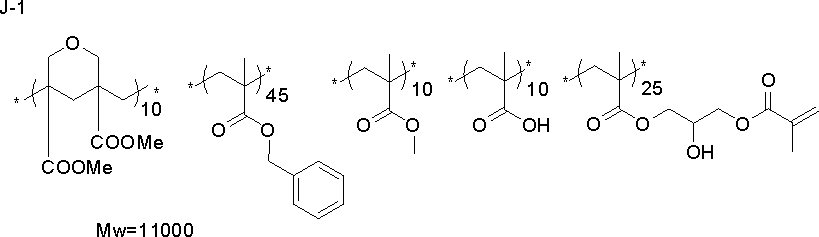

[実施例1]
本発明のマイクロレンズの製造方法の第1の実施形態を以下に示す。
固体撮像装置の基板として想定したハフニウム酸化膜(Hfo膜)/SiO2膜上にオンチップカラーフィルタ及びマイクロレンズを形成した。
(カラーフィルタの形成)
前記ハフニウム酸化膜(Hfo膜)/SiO2膜上に、特開2009-31723号公報に記載のカラーフィルタの製造方法により、グリーン、ブルー及びレッドのカラーフィルタを形成した。カラーフィルタの膜厚は0.5μmで、画素サイズが1.0μm四方のカラーフィルタと、0.7μm四方のカラーフィルタとの2種類を形成した。
本発明のマイクロレンズの製造方法の第1の実施形態を以下に示す。
固体撮像装置の基板として想定したハフニウム酸化膜(Hfo膜)/SiO2膜上にオンチップカラーフィルタ及びマイクロレンズを形成した。
(カラーフィルタの形成)
前記ハフニウム酸化膜(Hfo膜)/SiO2膜上に、特開2009-31723号公報に記載のカラーフィルタの製造方法により、グリーン、ブルー及びレッドのカラーフィルタを形成した。カラーフィルタの膜厚は0.5μmで、画素サイズが1.0μm四方のカラーフィルタと、0.7μm四方のカラーフィルタとの2種類を形成した。
次に前記カラーフィルタ上に熱硬化タイプのマイクロレンズ母材となる前記硬化性組成物を塗布・乾燥した後、熱焼結(220℃×5分)の処理を行い、マイクロレンズ母材の膜の硬化を行い、レンズ材料層を形成した(膜厚1.0μm)。
その後、下記感光性フォトレジストを塗布し、露光・現像して、フォトレジストパターンを形成した。形成されたフォトレジストパターンは、高さ0.40μm~1.0μm、レンズ母型間のギャップ寸法0.2~0.3μmの台形状のマスク形状(球面を有するレンズ形状としてはいない)とした。
最後に、下記ドライエッチング装置を用いて、下記のCF4とC4F6とのハロゲン化合物ガスを用い、前記フォトレジストをマスクとして前記マイクロレンズ母材のエッチング処理を行い、前記マスク形状が転写されたマイクロレンズを形成した。
その後、下記感光性フォトレジストを塗布し、露光・現像して、フォトレジストパターンを形成した。形成されたフォトレジストパターンは、高さ0.40μm~1.0μm、レンズ母型間のギャップ寸法0.2~0.3μmの台形状のマスク形状(球面を有するレンズ形状としてはいない)とした。
最後に、下記ドライエッチング装置を用いて、下記のCF4とC4F6とのハロゲン化合物ガスを用い、前記フォトレジストをマスクとして前記マイクロレンズ母材のエッチング処理を行い、前記マスク形状が転写されたマイクロレンズを形成した。
以下に実施例1における各条件を示す。
・マイクロレンズ母材
前記硬化性組成物
形成膜厚:1.0μm
硬化条件 220℃×5分(ホットプレート上)
・フォトレジスト形成条件
感光性フォトレジスト:GKR-5113(商品名;富士フイルムエレクトロニクスマテリアルズ社製)
形成膜厚:0.7μm
露光エネルギー:46mJ/m2(NA/σ:0.63/0.65)
Prebake/PEB/Postbake:120℃×90秒/110℃×90秒/100℃×60秒
・マイクロレンズ母材
前記硬化性組成物
形成膜厚:1.0μm
硬化条件 220℃×5分(ホットプレート上)
・フォトレジスト形成条件
感光性フォトレジスト:GKR-5113(商品名;富士フイルムエレクトロニクスマテリアルズ社製)
形成膜厚:0.7μm
露光エネルギー:46mJ/m2(NA/σ:0.63/0.65)
Prebake/PEB/Postbake:120℃×90秒/110℃×90秒/100℃×60秒
・エッチング条件
ドライエッチング装置:U-621(商品名;日立ハイテクノロジーズ社製)
ガス流量 :CF4/C4F6=350ml/50ml/分
Bias :RFパワー:1000W、
アンテナバイアス:400W、
ウエハバイアス:400W
・電極高さ :68mm
・圧力 :2.0Pa
・エッチング時間:500秒
・基板温度 :20℃
ドライエッチング装置:U-621(商品名;日立ハイテクノロジーズ社製)
ガス流量 :CF4/C4F6=350ml/50ml/分
Bias :RFパワー:1000W、
アンテナバイアス:400W、
ウエハバイアス:400W
・電極高さ :68mm
・圧力 :2.0Pa
・エッチング時間:500秒
・基板温度 :20℃
実施例1において形成されたパターンのCD-SEM写真(観察倍率:×50.0k)による観察結果を図4に示す。
図4(a)は1.0μm四方のフォトレジスト形状を示す上面図であり、
図4(b)は0.7μm四方のフォトレジスト形状を示す上面図であり、
図4(c)は1.0μm四方のエッチング形状を示す上面図であり、
図4(d)は0.7μm四方のエッチング形状を示す上面図であり、
図4(e)は1.0μm四方のエッチング形状を示す斜視図であり、
図4(f)は0.7μm四方のエッチング形状を示す斜視図である。
図4(c)~(f)に示した結果から明らかなように、得られたマイクロレンズのパターンは、ピッチ方向と対角方向とのいずれにもレンズ間のギャップが無いアレイが形成されていることがわかる。
また、本実施例1においては、1.0μmのパターンサイズでは、図4(a)に示すような1.0μm四方のフォトレジストをマスクとして用い、図4(c)及び(e)に示すような台形形状のマイクロレンズが形成されることとなった。図4(c)及び(e)に示すような台形形状の転写レンズ形成がされるのは、図4(a)に示すようなフォトレジストの形状に依存しており、パターン端部はエッチング進行とエッチング堆積の進行により、矩形なマスクパターンがラウンデイング形状となり曲率を有すが、パターンエッジから離れた領域では、側壁の堆積の影響はなく、フラットな形状が転写されるようになるからである。
また、本発明のマイクロレンズの製造方法によれば、1.0μm以上のパターンサイズでは、周縁部分が画素分離形状を持ち、かつレンズ上部が平坦なマイクロレンズを形成することができる。
また、図4(b)に示すような0.7μm四方のフォトレジストをマスクとして用い、図4(d)及び(f)に示すような1.0μm未満のパターンサイズ(例えば、図4(f)に示す0.7μm)では、レンズ上部も球面を有するマイクロレンズの形成が可能であることがわかる。本発明の製造方法によって、煩雑な工程を要することなく、高精度にマイクロレンズを製造することができる。
図4(a)は1.0μm四方のフォトレジスト形状を示す上面図であり、
図4(b)は0.7μm四方のフォトレジスト形状を示す上面図であり、
図4(c)は1.0μm四方のエッチング形状を示す上面図であり、
図4(d)は0.7μm四方のエッチング形状を示す上面図であり、
図4(e)は1.0μm四方のエッチング形状を示す斜視図であり、
図4(f)は0.7μm四方のエッチング形状を示す斜視図である。
図4(c)~(f)に示した結果から明らかなように、得られたマイクロレンズのパターンは、ピッチ方向と対角方向とのいずれにもレンズ間のギャップが無いアレイが形成されていることがわかる。
また、本実施例1においては、1.0μmのパターンサイズでは、図4(a)に示すような1.0μm四方のフォトレジストをマスクとして用い、図4(c)及び(e)に示すような台形形状のマイクロレンズが形成されることとなった。図4(c)及び(e)に示すような台形形状の転写レンズ形成がされるのは、図4(a)に示すようなフォトレジストの形状に依存しており、パターン端部はエッチング進行とエッチング堆積の進行により、矩形なマスクパターンがラウンデイング形状となり曲率を有すが、パターンエッジから離れた領域では、側壁の堆積の影響はなく、フラットな形状が転写されるようになるからである。
また、本発明のマイクロレンズの製造方法によれば、1.0μm以上のパターンサイズでは、周縁部分が画素分離形状を持ち、かつレンズ上部が平坦なマイクロレンズを形成することができる。
また、図4(b)に示すような0.7μm四方のフォトレジストをマスクとして用い、図4(d)及び(f)に示すような1.0μm未満のパターンサイズ(例えば、図4(f)に示す0.7μm)では、レンズ上部も球面を有するマイクロレンズの形成が可能であることがわかる。本発明の製造方法によって、煩雑な工程を要することなく、高精度にマイクロレンズを製造することができる。
以下、本発明によるマイクロレンズを形成したときの集光効率及び混色特性をシミュレーションした。
(シミュレーションモデル)
・1.0μm、0.7μmセルサイズ 裏面照射センサー
・下層のカラーフィルタ膜厚:0.50μmと想定
・マイクロレンズ高さ
○従来形状(曲面レンズ) 高さ:0.0μm~0.5μm
○実施例1のマイクロレンズの形状 実測値
・マイクロレンズギャップ ピッチ方向及び対角方向のいずれもギャップなし。
・入射光 波長λ=400~700nm
・入射角 0~40°
・レンズ材屈折率 2.0
・フォトダイオード開口率 100%
(シミュレーションモデル)
・1.0μm、0.7μmセルサイズ 裏面照射センサー
・下層のカラーフィルタ膜厚:0.50μmと想定
・マイクロレンズ高さ
○従来形状(曲面レンズ) 高さ:0.0μm~0.5μm
○実施例1のマイクロレンズの形状 実測値
・マイクロレンズギャップ ピッチ方向及び対角方向のいずれもギャップなし。
・入射光 波長λ=400~700nm
・入射角 0~40°
・レンズ材屈折率 2.0
・フォトダイオード開口率 100%
なお、前記のフォトダイオード開口率100%については、裏面照射型のフォトダイオードを想定している。表面照射型では、フォトダイオード上の配線、画素トランジスタを有しているが、裏面照射型ではこれらがフォトダイオード上に存在せず、配線や画素トランジスタの遮光の影響を受けることなく効率よくフォトダイオードに取り込まれた光を導くことができることから100%と計算した。
上記シミュレーションの結果、実施例1の1.0μm四方のマイクロレンズについては、高さ0.2μm~0.3μmの従来手法の曲面レンズと同等の集光効率及び混色特性が得られた。
実施例1の0.7μm四方のマイクロレンズについては、曲面レンズ形状を有しており、高さ0.4μm~0.5μmの従来手法の曲面レンズと同等の集光効率及び混色特性が得られた。
なお、実際のセンサーでは集光効率及び混色特性の性能がどの程度要求されるかは定かではないが、曲面レンズでシミュレートした場合、マイクロレンズの高さが0.4~0.5μmであるとバランスのよい特性が得られる。
実施例1の0.7μm四方のマイクロレンズについては、曲面レンズ形状を有しており、高さ0.4μm~0.5μmの従来手法の曲面レンズと同等の集光効率及び混色特性が得られた。
なお、実際のセンサーでは集光効率及び混色特性の性能がどの程度要求されるかは定かではないが、曲面レンズでシミュレートした場合、マイクロレンズの高さが0.4~0.5μmであるとバランスのよい特性が得られる。
[実施例2]
実施例2では、実施例1で得られた1.0μmのマイクロレンズの効率を向上させる(曲面レンズに効率を近づける)ことを目的とし、エッチング加工により曲率化を行う工程を更に行った。実施例1と同様に固体撮像装置の基板として想定したHfo膜/SiO2膜上にオンチップカラーフィルタ及びマイクロレンズを形成した。マイクロレンズのマスク材は実施例1と同様に台形状のレンズ母型であるが、エッチングを多段階で実施することで、転写後のマイクロレンズパターンが曲面レンズ形状となるようにした。
実施例2では、実施例1で得られた1.0μmのマイクロレンズの効率を向上させる(曲面レンズに効率を近づける)ことを目的とし、エッチング加工により曲率化を行う工程を更に行った。実施例1と同様に固体撮像装置の基板として想定したHfo膜/SiO2膜上にオンチップカラーフィルタ及びマイクロレンズを形成した。マイクロレンズのマスク材は実施例1と同様に台形状のレンズ母型であるが、エッチングを多段階で実施することで、転写後のマイクロレンズパターンが曲面レンズ形状となるようにした。
実施例1では、上述のように、パターンが1.0μmであると、上部(トップ)がフラット形状となり、曲面レンズ形状ではない。これを曲面レンズ形状にするため、レジスト形状(レンズ母型)をレンズ材に転写するエッチング(具体的には実施例1のエッチング条件)と、フォトレジストのトップ面積を小さく(フォトレジストの上部の角を取る、いわゆる面取り)エッチングを組み合わせることで、曲面レンズ形状を得た。
カラーフィルタ形成後、その上に例えば透明樹脂層を形成し、レンズ母材となる透明層を形成した。
その後、感光性フォトレジストを塗布し、露光・現像等を実施例1と同様の形態で実施し、フォトレジストパターンを形成した。
カラーフィルタ形成後、その上に例えば透明樹脂層を形成し、レンズ母材となる透明層を形成した。
その後、感光性フォトレジストを塗布し、露光・現像等を実施例1と同様の形態で実施し、フォトレジストパターンを形成した。
最後に、ドライエッチング装置を用いて、不活性ガス(アルゴン)及び酸素を用いたエッチングと、CF4とC4F6とのハロゲン化合物ガスを用いたエッチングとを組み合わせ、フォトレジストをマスクとしてレンズ材のエッチング処理を行い転写レンズを形成した。この時、形成されたマイクロレンズは、ピッチ方向と対角方向とのいずれにもギャップが無いものであり、更に、1.0μmレンズの形状も曲面レンズ形状とすることができた。
以下に実施例2における各条件を示す。
エッチング条件(1)によって、フォトレジストの角を削る、いわゆる面取りエッチングを実施した。具体的には、マスク材の角をテーパーを持った形状にし、角をそぎ落として鈍角化を行った。
本エッチング条件(1)は、デポガスの堆積の効果を大きくする傾向がありフォトレジストの形状を鈍角化させることができる。
これにより、エッチング加工にてフォトレジストの形状を曲面レンズ形状にすることができる。
図5にエッチング条件(1)(面取り工程)を経て形成されたフォトレジストのCD-SEM写真による観察結果を示した(観察倍率:×50.0k)。
図5(a)は1.0μm四方のエッチング前のフォトレジスト形状を示す上面図であり、
図5(b)は1.0μm四方のエッチング後のフォトレジスト形状を示す上面図である。
図5(a)に示したようにエッチング前にはパターンに角があったのが、図5(b)に示したようにエッチング後には角がなくなっていることがわかる。
その後、エッチング条件(2)によって、実施例1と同様にフォトレジストのパターンをレンズ材に転写した。エッチング条件(1)及び(2)は同一チャンバーにて、連続処理で行った。
・マイクロレンズ母材
前記硬化性組成物
形成膜厚:1.0μm
硬化条件 220℃×5分(ホットプレート上)
・フォトレジスト形成条件
感光性フォトレジスト:GKR-5113(商品名;富士フイルムエレクトロニクスマテリアルズ社製)
形成膜厚:0.9μm
露光エネルギー:46mJ/m2(NA/σ:0.63/0.65)
Prebake/PEB/Postbake:120℃×90秒/110℃×90秒/100℃×60秒
エッチング条件(1)によって、フォトレジストの角を削る、いわゆる面取りエッチングを実施した。具体的には、マスク材の角をテーパーを持った形状にし、角をそぎ落として鈍角化を行った。
本エッチング条件(1)は、デポガスの堆積の効果を大きくする傾向がありフォトレジストの形状を鈍角化させることができる。
これにより、エッチング加工にてフォトレジストの形状を曲面レンズ形状にすることができる。
図5にエッチング条件(1)(面取り工程)を経て形成されたフォトレジストのCD-SEM写真による観察結果を示した(観察倍率:×50.0k)。
図5(a)は1.0μm四方のエッチング前のフォトレジスト形状を示す上面図であり、
図5(b)は1.0μm四方のエッチング後のフォトレジスト形状を示す上面図である。
図5(a)に示したようにエッチング前にはパターンに角があったのが、図5(b)に示したようにエッチング後には角がなくなっていることがわかる。
その後、エッチング条件(2)によって、実施例1と同様にフォトレジストのパターンをレンズ材に転写した。エッチング条件(1)及び(2)は同一チャンバーにて、連続処理で行った。
・マイクロレンズ母材
前記硬化性組成物
形成膜厚:1.0μm
硬化条件 220℃×5分(ホットプレート上)
・フォトレジスト形成条件
感光性フォトレジスト:GKR-5113(商品名;富士フイルムエレクトロニクスマテリアルズ社製)
形成膜厚:0.9μm
露光エネルギー:46mJ/m2(NA/σ:0.63/0.65)
Prebake/PEB/Postbake:120℃×90秒/110℃×90秒/100℃×60秒
・エッチング条件(1)
ドライエッチング装置:U-621(商品名;日立ハイテクノロジーズ社製)
ガス流量 :Ar/C4F6/O2=1000ml/80ml/80ml/分
Bias :RFパワー:500W、
アンテナバイアス:600W、
ウエハバイアス:1000W
・電極高さ :30mm
・圧力 :2.0Pa
・基板温度 :20℃
・エッチング時間:240秒
ドライエッチング装置:U-621(商品名;日立ハイテクノロジーズ社製)
ガス流量 :Ar/C4F6/O2=1000ml/80ml/80ml/分
Bias :RFパワー:500W、
アンテナバイアス:600W、
ウエハバイアス:1000W
・電極高さ :30mm
・圧力 :2.0Pa
・基板温度 :20℃
・エッチング時間:240秒
・エッチング条件(2)
ガス流量 :CF4/C4F6=350ml/50ml/分
Bias :RFパワー:800W、
アンテナバイアス:400W、
ウエハバイアス:400W
・電極高さ :20mm
・圧力 :2.0Pa
・基板温度 :20℃
・エッチング時間:500秒
ガス流量 :CF4/C4F6=350ml/50ml/分
Bias :RFパワー:800W、
アンテナバイアス:400W、
ウエハバイアス:400W
・電極高さ :20mm
・圧力 :2.0Pa
・基板温度 :20℃
・エッチング時間:500秒
実施例2において形成されたパターンのCD-SEM写真による観察結果を図6に示す。
図6(a)は1.0μm四方のフォトレジスト形状を示す上面図(観察倍率:×50.0k)であり、
図6(b)は1.0μm四方のエッチング条件(2)後のフォトレジスト形状を示す上面図(観察倍率:×50.0k)であり、
図6(c)は1.0μm四方のエッチング条件(2)後のフォトレジスト形状を示す斜視図(観察倍率:×50.0k)であり、
図6(d)は1.0μm四方のエッチング条件(2)後のフォトレジスト形状を示す断面図(観察倍率:×30.0k)である。
1.0μmレンズにおいても、エッチング条件を特定の多段条件とすることにより、転写後のマイクロレンズを図6(c)及び(d)に示したような曲面レンズ形状とすることができることが分かる。
エッチング条件(1)及び(2)を実施例に示したような条件で行う以外に、複数回に分けてフォトレジストの形状変更とレンズ材へのパターン転写とを繰り返して行っても良い。なお、フォトレジストの形状変更と前述したが、エッチング条件(1)及び(2)に於いてもレンズ材のエッチングは進行することが分かっている。
図6(a)は1.0μm四方のフォトレジスト形状を示す上面図(観察倍率:×50.0k)であり、
図6(b)は1.0μm四方のエッチング条件(2)後のフォトレジスト形状を示す上面図(観察倍率:×50.0k)であり、
図6(c)は1.0μm四方のエッチング条件(2)後のフォトレジスト形状を示す斜視図(観察倍率:×50.0k)であり、
図6(d)は1.0μm四方のエッチング条件(2)後のフォトレジスト形状を示す断面図(観察倍率:×30.0k)である。
1.0μmレンズにおいても、エッチング条件を特定の多段条件とすることにより、転写後のマイクロレンズを図6(c)及び(d)に示したような曲面レンズ形状とすることができることが分かる。
エッチング条件(1)及び(2)を実施例に示したような条件で行う以外に、複数回に分けてフォトレジストの形状変更とレンズ材へのパターン転写とを繰り返して行っても良い。なお、フォトレジストの形状変更と前述したが、エッチング条件(1)及び(2)に於いてもレンズ材のエッチングは進行することが分かっている。
[実施例3]
前記二酸化チタン分散液を用いて、以下の組成となるように各成分を混合して硬化性組成物を得た。
~硬化性組成物の組成~
・前記二酸化チタン分散液 … 65.22部
・アクリレートモノマー(重合性化合物、「KAYARAD DPHA」(日本化薬株式会社製))
… 4.36部
・オキシム系光重合開始剤 … 0.30部
(重合開始剤、前記K-1)
・バインダーポリマー … 5.99部
(前記J-1;重量平均分子量(Mw)及び共重合比(モル比)は上記の通りである)
・界面活性剤 メガファックF-781 … 0.30部
・プロピレングリコールモノメチルエーテルアセテート
… 23.83部
なお、硬化性組成物の全固形分に対する二酸化チタンの含有量は50質量%であった。
実施例1におけるマイクロレンズ母材としての硬化性組成物を実施例3における硬化性組成物に変更する以外は実施例1と同様にしてレンズ材料層を形成し、フォトレジストパターンを形成し、エッチング処理をしてマイクロレンズを形成した。
実施例3においても実施例1と同様にピッチ方向と対角方向とのいずれにもレンズ間のギャップが無いアレイが形成され、1.0μm以上のパターンサイズでは、周縁部分が画素分離形状を持ち、かつレンズ上部が平坦なマイクロレンズが形成された。また、1.0μm未満のパターンサイズ(例えば、0.7μm)では、レンズ上部も球面を有するマイクロレンズの形成がされた。
また、実施例2におけるマイクロレンズ母材としての硬化性組成物を実施例3における硬化性組成物に変更する以外は実施例2と同様にして上記特定の2段階でエッチングを行うことにより、1.0μmの転写後のマイクロレンズを曲面レンズ形状とすることができた。
前記二酸化チタン分散液を用いて、以下の組成となるように各成分を混合して硬化性組成物を得た。
~硬化性組成物の組成~
・前記二酸化チタン分散液 … 65.22部
・アクリレートモノマー(重合性化合物、「KAYARAD DPHA」(日本化薬株式会社製))
… 4.36部
・オキシム系光重合開始剤 … 0.30部
(重合開始剤、前記K-1)
・バインダーポリマー … 5.99部
(前記J-1;重量平均分子量(Mw)及び共重合比(モル比)は上記の通りである)
・界面活性剤 メガファックF-781 … 0.30部
・プロピレングリコールモノメチルエーテルアセテート
… 23.83部
なお、硬化性組成物の全固形分に対する二酸化チタンの含有量は50質量%であった。
実施例1におけるマイクロレンズ母材としての硬化性組成物を実施例3における硬化性組成物に変更する以外は実施例1と同様にしてレンズ材料層を形成し、フォトレジストパターンを形成し、エッチング処理をしてマイクロレンズを形成した。
実施例3においても実施例1と同様にピッチ方向と対角方向とのいずれにもレンズ間のギャップが無いアレイが形成され、1.0μm以上のパターンサイズでは、周縁部分が画素分離形状を持ち、かつレンズ上部が平坦なマイクロレンズが形成された。また、1.0μm未満のパターンサイズ(例えば、0.7μm)では、レンズ上部も球面を有するマイクロレンズの形成がされた。
また、実施例2におけるマイクロレンズ母材としての硬化性組成物を実施例3における硬化性組成物に変更する以外は実施例2と同様にして上記特定の2段階でエッチングを行うことにより、1.0μmの転写後のマイクロレンズを曲面レンズ形状とすることができた。
[実施例4]
前記二酸化チタン分散液を用いて、以下の組成となるように各成分を混合して硬化性組
成物を得た。
~硬化性組成物の組成~
・前記二酸化チタン分散液 … 63.91部
・アクリレートモノマー(重合性化合物、「KAYARAD DPHA」(日本化薬株式会社製))
… 4.36部
・オキシム系光重合開始剤 … 0.30部
(重合開始剤、前記K-1)
・バインダーポリマー … 6.37部
(前記J-1;重量平均分子量(Mw)及び共重合比(モル比)は上記の通りである)
・界面活性剤 メガファックF-781 … 0.30部
・プロピレングリコールモノメチルエーテルアセテート
… 24.76部
なお、硬化性組成物の全固形分に対する二酸化チタンの含有量は49質量%であった。
実施例1におけるマイクロレンズ母材としての硬化性組成物を実施例4における硬化性組成物に変更する以外は実施例1と同様にしてレンズ材料層を形成し、フォトレジストパターンを形成し、エッチング処理をしてマイクロレンズを形成した。
実施例4においても実施例1と同様にピッチ方向と対角方向とのいずれにもレンズ間のギャップが無いアレイが形成され、1.0μm以上のパターンサイズでは、周縁部分が画素分離形状を持ち、かつレンズ上部が平坦なマイクロレンズが形成された。また、1.0μm未満のパターンサイズ(例えば、0.7μm)では、レンズ上部も球面を有するマイクロレンズの形成がされた。
また、実施例2におけるマイクロレンズ母材としての硬化性組成物を実施例4における硬化性組成物に変更する以外は実施例2と同様にして上記特定の2段階でエッチングを行うことにより、1.0μmの転写後のマイクロレンズを曲面レンズ形状とすることができた。
前記二酸化チタン分散液を用いて、以下の組成となるように各成分を混合して硬化性組
成物を得た。
~硬化性組成物の組成~
・前記二酸化チタン分散液 … 63.91部
・アクリレートモノマー(重合性化合物、「KAYARAD DPHA」(日本化薬株式会社製))
… 4.36部
・オキシム系光重合開始剤 … 0.30部
(重合開始剤、前記K-1)
・バインダーポリマー … 6.37部
(前記J-1;重量平均分子量(Mw)及び共重合比(モル比)は上記の通りである)
・界面活性剤 メガファックF-781 … 0.30部
・プロピレングリコールモノメチルエーテルアセテート
… 24.76部
なお、硬化性組成物の全固形分に対する二酸化チタンの含有量は49質量%であった。
実施例1におけるマイクロレンズ母材としての硬化性組成物を実施例4における硬化性組成物に変更する以外は実施例1と同様にしてレンズ材料層を形成し、フォトレジストパターンを形成し、エッチング処理をしてマイクロレンズを形成した。
実施例4においても実施例1と同様にピッチ方向と対角方向とのいずれにもレンズ間のギャップが無いアレイが形成され、1.0μm以上のパターンサイズでは、周縁部分が画素分離形状を持ち、かつレンズ上部が平坦なマイクロレンズが形成された。また、1.0μm未満のパターンサイズ(例えば、0.7μm)では、レンズ上部も球面を有するマイクロレンズの形成がされた。
また、実施例2におけるマイクロレンズ母材としての硬化性組成物を実施例4における硬化性組成物に変更する以外は実施例2と同様にして上記特定の2段階でエッチングを行うことにより、1.0μmの転写後のマイクロレンズを曲面レンズ形状とすることができた。
[実施例5]
下記の組成で、前記と同様にして二酸化チタン分散液(二酸化チタン粒子の一次粒子径は40nm)を調製した。
~組成~
・二酸化チタン(石原産業(株)製 TTO-51(C)): 150部
・「例示化合物3」の樹脂(グラフト共重合体(B)) : 12.0部
・プロピレングリコールモノメチルエーテルアセテート :490.5部
上記の二酸化チタン分散液を用いて、以下の組成となるように各成分を混合して硬化性組成物を得た。
~硬化性組成物の組成~
・上記二酸化チタン分散液 … 117.39部
・アクリレートモノマー(重合性化合物、「KAYARAD DPHA」(日本化薬株式会社製))
… 0.73部
・オキシム系光重合開始剤 … 0.10部
(重合開始剤、前記K-1)
・界面活性剤 メガファックF-781 … 0.01部
・プロピレングリコールモノメチルエーテルアセテート
… 10.0部
なお、硬化性組成物の全固形分に対する二酸化チタンの含有量は90質量%であった。
実施例1におけるマイクロレンズ母材としての硬化性組成物を実施例5における硬化性組成物に変更する以外は実施例1と同様にしてレンズ材料層を形成し、フォトレジストパターンを形成し、エッチング処理をしてマイクロレンズを形成した。
実施例5においても実施例1と同様にピッチ方向と対角方向とのいずれにもレンズ間のギャップが無いアレイが形成され、1.0μm以上のパターンサイズでは、周縁部分が画素分離形状を持ち、かつレンズ上部が平坦なマイクロレンズが形成された。また、1.0μm未満のパターンサイズ(例えば、0.7μm)では、レンズ上部も球面を有するマイクロレンズの形成がされた。
また、実施例2におけるマイクロレンズ母材としての硬化性組成物を実施例5における硬化性組成物に変更する以外は実施例2と同様にして上記特定の2段階でエッチングを行うことにより、1.0μmの転写後のマイクロレンズを曲面レンズ形状とすることができた。
下記の組成で、前記と同様にして二酸化チタン分散液(二酸化チタン粒子の一次粒子径は40nm)を調製した。
~組成~
・二酸化チタン(石原産業(株)製 TTO-51(C)): 150部
・「例示化合物3」の樹脂(グラフト共重合体(B)) : 12.0部
・プロピレングリコールモノメチルエーテルアセテート :490.5部
上記の二酸化チタン分散液を用いて、以下の組成となるように各成分を混合して硬化性組成物を得た。
~硬化性組成物の組成~
・上記二酸化チタン分散液 … 117.39部
・アクリレートモノマー(重合性化合物、「KAYARAD DPHA」(日本化薬株式会社製))
… 0.73部
・オキシム系光重合開始剤 … 0.10部
(重合開始剤、前記K-1)
・界面活性剤 メガファックF-781 … 0.01部
・プロピレングリコールモノメチルエーテルアセテート
… 10.0部
なお、硬化性組成物の全固形分に対する二酸化チタンの含有量は90質量%であった。
実施例1におけるマイクロレンズ母材としての硬化性組成物を実施例5における硬化性組成物に変更する以外は実施例1と同様にしてレンズ材料層を形成し、フォトレジストパターンを形成し、エッチング処理をしてマイクロレンズを形成した。
実施例5においても実施例1と同様にピッチ方向と対角方向とのいずれにもレンズ間のギャップが無いアレイが形成され、1.0μm以上のパターンサイズでは、周縁部分が画素分離形状を持ち、かつレンズ上部が平坦なマイクロレンズが形成された。また、1.0μm未満のパターンサイズ(例えば、0.7μm)では、レンズ上部も球面を有するマイクロレンズの形成がされた。
また、実施例2におけるマイクロレンズ母材としての硬化性組成物を実施例5における硬化性組成物に変更する以外は実施例2と同様にして上記特定の2段階でエッチングを行うことにより、1.0μmの転写後のマイクロレンズを曲面レンズ形状とすることができた。
[実施例6]
~硬化性組成物の組成~
・実施例5記載の二酸化チタン分散液 … 118.69部
・アクリレートモノマー(重合性化合物、「KAYARAD DPHA」(日本化薬株式会社製))
… 0.44部
・オキシム系光重合開始剤 … 0.08部
(重合開始剤、前記K-1)
・界面活性剤 メガファックF-781 … 0.01部
・プロピレングリコールモノメチルエーテルアセテート
… 10.0部
なお、硬化性組成物の全固形分に対する二酸化チタンの含有量は91質量%であった。
実施例1におけるマイクロレンズ母材としての硬化性組成物を実施例6における硬化性組成物に変更する以外は実施例1と同様にしてレンズ材料層を形成し、フォトレジストパターンを形成し、エッチング処理をしてマイクロレンズを形成した。
実施例6においても実施例1と同様にピッチ方向と対角方向とのいずれにもレンズ間のギャップが無いアレイが形成され、1.0μm以上のパターンサイズでは、周縁部分が画素分離形状を持ち、かつレンズ上部が平坦なマイクロレンズが形成された。また、1.0μm未満のパターンサイズ(例えば、0.7μm)では、レンズ上部も球面を有するマイクロレンズの形成がされた。
また、実施例2におけるマイクロレンズ母材としての硬化性組成物を実施例6における硬化性組成物に変更する以外は実施例2と同様にして上記特定の2段階でエッチングを行うことにより、1.0μmの転写後のマイクロレンズを曲面レンズ形状とすることができた。
~硬化性組成物の組成~
・実施例5記載の二酸化チタン分散液 … 118.69部
・アクリレートモノマー(重合性化合物、「KAYARAD DPHA」(日本化薬株式会社製))
… 0.44部
・オキシム系光重合開始剤 … 0.08部
(重合開始剤、前記K-1)
・界面活性剤 メガファックF-781 … 0.01部
・プロピレングリコールモノメチルエーテルアセテート
… 10.0部
なお、硬化性組成物の全固形分に対する二酸化チタンの含有量は91質量%であった。
実施例1におけるマイクロレンズ母材としての硬化性組成物を実施例6における硬化性組成物に変更する以外は実施例1と同様にしてレンズ材料層を形成し、フォトレジストパターンを形成し、エッチング処理をしてマイクロレンズを形成した。
実施例6においても実施例1と同様にピッチ方向と対角方向とのいずれにもレンズ間のギャップが無いアレイが形成され、1.0μm以上のパターンサイズでは、周縁部分が画素分離形状を持ち、かつレンズ上部が平坦なマイクロレンズが形成された。また、1.0μm未満のパターンサイズ(例えば、0.7μm)では、レンズ上部も球面を有するマイクロレンズの形成がされた。
また、実施例2におけるマイクロレンズ母材としての硬化性組成物を実施例6における硬化性組成物に変更する以外は実施例2と同様にして上記特定の2段階でエッチングを行うことにより、1.0μmの転写後のマイクロレンズを曲面レンズ形状とすることができた。
[比較例1]
従来法のメルト法によるマイクロレンズの形成として、フォトレジストの熱フローによるレンズ化の面内均一性を評価した。
・マイクロレンズ母材
実施例1の硬化性組成物
形成膜厚:1.0μm
硬化条件 220℃×5分(ホットプレート上)
・フォトレジスト形成条件
感光性フォトレジスト:FHi4750(商品名;富士フイルムエレクトロニクスマテリアルズ社製)
形成膜厚:0.9μm
露光エネルギー:200mJ/m2(NA/σ:0.63/0.65)
Prebake/PEB/Postbake:70℃×90秒/なし/145℃×120秒
メルト処理:160℃×120秒、170℃×120秒スプリット
図7は比較例の従来法のメルト法により形成されたパターンのCD-SEM写真による観察結果を示す図である。
図7(a)は1.4μm四方のフォトレジスト形状を示す上面図(観察倍率:×50.0k)であり、
図7(b)はTg付近の160℃に加熱後のフォトレジスト形状を示す上面図(観察倍率:×50.0k)であり、
図7(c)は170℃に加熱(メルト)後のウエハー面内の中央付近(Point(1))のフォトレジスト形状を示す上面図(観察倍率:×50.0k)であり、
図7(d)は170℃に加熱(メルト)後のウエハー面内の右側エッジ付近(Point(2))のフォトレジスト形状を示す上面図(観察倍率:×50.0k)であり、
図7(e)は160℃に加熱(メルト)後、更にエッチバックしたときのウエハー中心付近のレンズ形状を示す上面図(観察倍率:×30.0k)であり、
図7(f)は170℃に加熱(メルト)後、更にエッチバックしたときのウエハー中心付近のレンズ形状を示す上面図(観察倍率:×30.0k)である。
従来法のメルト法によるマイクロレンズの形成として、フォトレジストの熱フローによるレンズ化の面内均一性を評価した。
・マイクロレンズ母材
実施例1の硬化性組成物
形成膜厚:1.0μm
硬化条件 220℃×5分(ホットプレート上)
・フォトレジスト形成条件
感光性フォトレジスト:FHi4750(商品名;富士フイルムエレクトロニクスマテリアルズ社製)
形成膜厚:0.9μm
露光エネルギー:200mJ/m2(NA/σ:0.63/0.65)
Prebake/PEB/Postbake:70℃×90秒/なし/145℃×120秒
メルト処理:160℃×120秒、170℃×120秒スプリット
図7は比較例の従来法のメルト法により形成されたパターンのCD-SEM写真による観察結果を示す図である。
図7(a)は1.4μm四方のフォトレジスト形状を示す上面図(観察倍率:×50.0k)であり、
図7(b)はTg付近の160℃に加熱後のフォトレジスト形状を示す上面図(観察倍率:×50.0k)であり、
図7(c)は170℃に加熱(メルト)後のウエハー面内の中央付近(Point(1))のフォトレジスト形状を示す上面図(観察倍率:×50.0k)であり、
図7(d)は170℃に加熱(メルト)後のウエハー面内の右側エッジ付近(Point(2))のフォトレジスト形状を示す上面図(観察倍率:×50.0k)であり、
図7(e)は160℃に加熱(メルト)後、更にエッチバックしたときのウエハー中心付近のレンズ形状を示す上面図(観察倍率:×30.0k)であり、
図7(f)は170℃に加熱(メルト)後、更にエッチバックしたときのウエハー中心付近のレンズ形状を示す上面図(観察倍率:×30.0k)である。
図7(b)から明らかなように、メルト処理において、フォトレジストの160℃近辺程度まではフォトレジストのスリップ量も小さく、かつ曲面レンズ形状に近づきつつあるが、フォトレジストの角が残る状態である。従来技術では、この状態のレジスト形状はレンズ転写用マスク(レンズ母型)としては形状不十分であると判断されるものである。
図7(c)及び(d)に示したように、更に温度を上昇させて、170℃まで上げてレンズ形状にしたときの、ウエハー面内の中央付近(Point(1))とウエハー面内の右側エッジ付近(Point(2))の形状を確認したところ、フォトレジストの角は取れていたが、ウエハー面内の観察点によりレンズマスクパターン間の距離(ギャップ)にバラツキが発生していることがわかる。
更に、図7(e)に比較例1において、メルト処理:160℃×120秒で実施し、実施例1と同様のエッチング条件でエッチバックした際の上面から観察したレンズ形状を示す(倍率:30.0k)。ピッチ方向のギャップは解消されているが、対角方向のギャップは0.55μmであり対角方向のギャップを解消することができなかった。
[比較例2]
図7(f)は、メルト処理を170℃×120秒で実施し、他の処理は実施例1と同様にして処理を行った際の上面から観察したレンズ形状を示す(倍率:30.0k)。
図7(f)から明らかなように、比較例2においても、ピッチ方向のギャップは解消されているが、対角方向のギャップは0.25μmであり対角方向のギャップを解消することができなかったことがわかる。
図7(c)及び(d)に示したように、更に温度を上昇させて、170℃まで上げてレンズ形状にしたときの、ウエハー面内の中央付近(Point(1))とウエハー面内の右側エッジ付近(Point(2))の形状を確認したところ、フォトレジストの角は取れていたが、ウエハー面内の観察点によりレンズマスクパターン間の距離(ギャップ)にバラツキが発生していることがわかる。
更に、図7(e)に比較例1において、メルト処理:160℃×120秒で実施し、実施例1と同様のエッチング条件でエッチバックした際の上面から観察したレンズ形状を示す(倍率:30.0k)。ピッチ方向のギャップは解消されているが、対角方向のギャップは0.55μmであり対角方向のギャップを解消することができなかった。
[比較例2]
図7(f)は、メルト処理を170℃×120秒で実施し、他の処理は実施例1と同様にして処理を行った際の上面から観察したレンズ形状を示す(倍率:30.0k)。
図7(f)から明らかなように、比較例2においても、ピッチ方向のギャップは解消されているが、対角方向のギャップは0.25μmであり対角方向のギャップを解消することができなかったことがわかる。
上記比較例の結果から、フォトレジストのマスク材を熱フローにより曲率化する場合、メルト処理に使用するホットプレートの面内均一性の管理の厳密性が要求され、プロセスウインドウを狭めることがわかった。
フォトレジストのメルト工程による曲率化は、レジストをガラス転移点(Tg)以上に加熱することで熱流動が発生することを利用するものであるが、処理絶対温度バラツキや面内均一性バラツキの影響でフォトレジストのレンズ母型パターンが均一性よく形成されないことがある。
熱フロー時、レジストは表面張力によって丸くなろうとするが、パターン角部分は薄くなる(中心に引っ張られる)、パターン間は丸くなろうとする力により、やがては基材との界面エネルギー差でブレークするとスリップが発生して融着すると考えられる。
このときレジストを丸くすることを優先させパターン間のギャップ縮小を許容する場合、ギャップ縮小分をフォトレジストの解像性で補う(スペースを広くする)と、対角方向のギャップも同時に広くなってしまう。
また、パターン寸法縮小に伴いパターンの矩形性は劣化していく(コーナーの半径は同じだがコントラスト低下)。それに従い、パターンの対角方向の寸法も広がり精度劣化する。これに熱フロープロセスを加味すると、なおのこと今後の微細パターンにおいては、熱フローによるメルト処理を有するマイクロレンズ形成は困難になっていくと推測される。
実施例1~6、比較例1及び2の結果を下記表にまとめる。
フォトレジストのメルト工程による曲率化は、レジストをガラス転移点(Tg)以上に加熱することで熱流動が発生することを利用するものであるが、処理絶対温度バラツキや面内均一性バラツキの影響でフォトレジストのレンズ母型パターンが均一性よく形成されないことがある。
熱フロー時、レジストは表面張力によって丸くなろうとするが、パターン角部分は薄くなる(中心に引っ張られる)、パターン間は丸くなろうとする力により、やがては基材との界面エネルギー差でブレークするとスリップが発生して融着すると考えられる。
このときレジストを丸くすることを優先させパターン間のギャップ縮小を許容する場合、ギャップ縮小分をフォトレジストの解像性で補う(スペースを広くする)と、対角方向のギャップも同時に広くなってしまう。
また、パターン寸法縮小に伴いパターンの矩形性は劣化していく(コーナーの半径は同じだがコントラスト低下)。それに従い、パターンの対角方向の寸法も広がり精度劣化する。これに熱フロープロセスを加味すると、なおのこと今後の微細パターンにおいては、熱フローによるメルト処理を有するマイクロレンズ形成は困難になっていくと推測される。
実施例1~6、比較例1及び2の結果を下記表にまとめる。
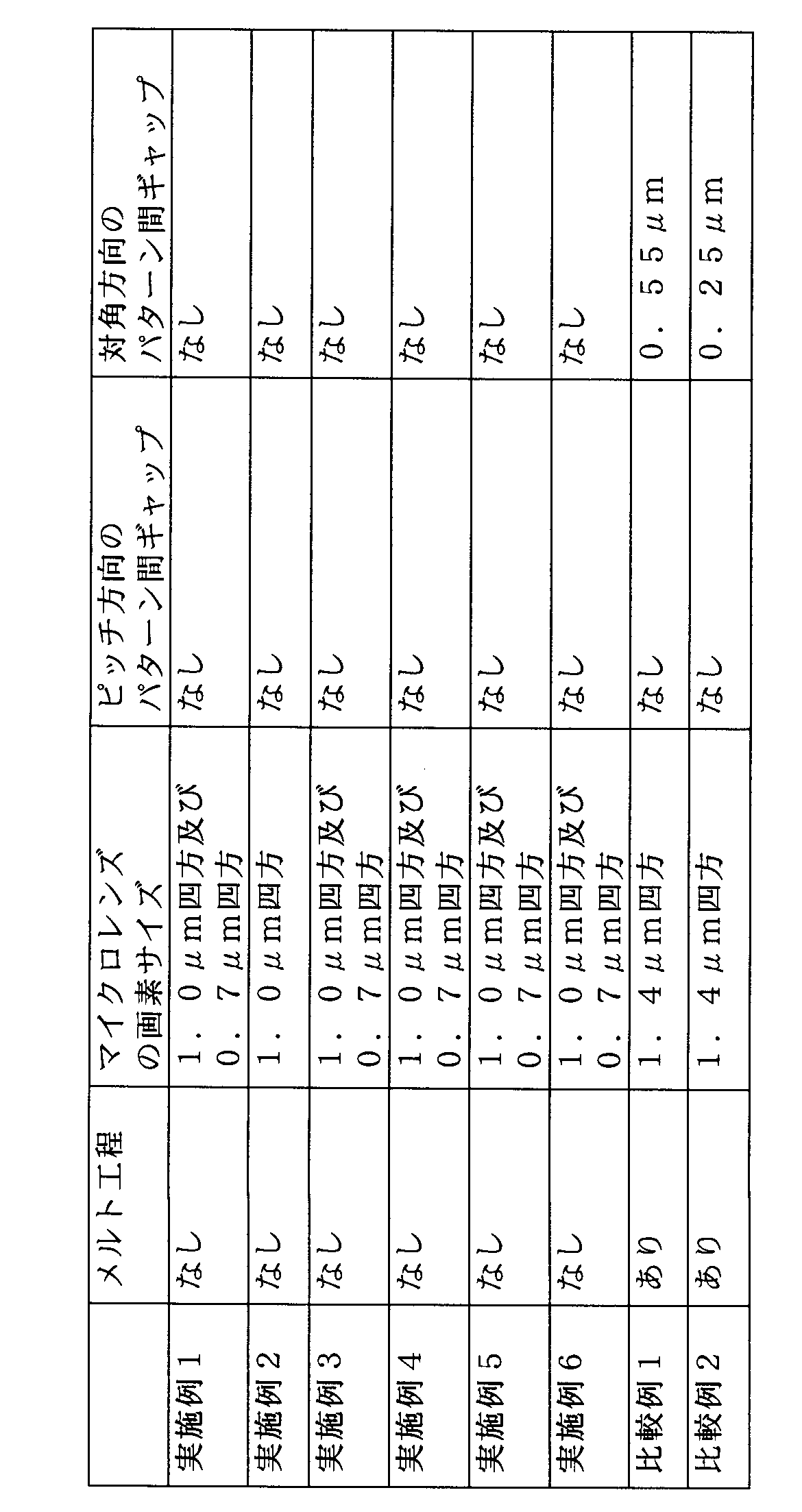
本発明のマイクロレンズの製造方法は、マイクロレンズを有する素子に適用することが可能であり、特に100万画素を超えるような高解像度の固体撮像素子に好適である。特に1.0μm以下のセルサイズで形成される裏面照射撮像装置に好適である。
また、カラーフィルタ下層の構造を特開2010-134042号公報に示すような遮光壁を設けた構造にすることにより、カラーフィルタより下層で発生する混色を更に抑制する効果が得られる。
本発明では、フォトレジストのメルト工程による曲面レンズ母型形成時に発生するフォトレジストのテイル部の滑り(スリップ)を回避する観点から、メルト工程を行うことなく、エッチングによる転写を行うことを上記実施例で示したが、テイル部のスリップが大きく発生しない程度の加熱(ポストベーク等(好ましくは、レジストのガラス転移点Tg未満の温度))を行うことは許容される。この施策により、解像力を落とすことなく、エッチング工程の負荷を低減することができる。
また本発明により得られたマイクロレンズ上に、マイクロレンズより屈折率の低い層をn層(n≧1、屈折率は基材から順番で高い-低いの順)蒸着や塗布により形成することにより、光の入射側からの反射を効率よく抑制し、センサの感度を向上させることができる。
また、カラーフィルタ下層の構造を特開2010-134042号公報に示すような遮光壁を設けた構造にすることにより、カラーフィルタより下層で発生する混色を更に抑制する効果が得られる。
本発明では、フォトレジストのメルト工程による曲面レンズ母型形成時に発生するフォトレジストのテイル部の滑り(スリップ)を回避する観点から、メルト工程を行うことなく、エッチングによる転写を行うことを上記実施例で示したが、テイル部のスリップが大きく発生しない程度の加熱(ポストベーク等(好ましくは、レジストのガラス転移点Tg未満の温度))を行うことは許容される。この施策により、解像力を落とすことなく、エッチング工程の負荷を低減することができる。
また本発明により得られたマイクロレンズ上に、マイクロレンズより屈折率の低い層をn層(n≧1、屈折率は基材から順番で高い-低いの順)蒸着や塗布により形成することにより、光の入射側からの反射を効率よく抑制し、センサの感度を向上させることができる。
本発明によれば、メルト工程によるフォトレジストのレンズ形状化を経ないことにより、メルト工程によるレンズ形状化によるパターン間ギャップを確保する必要がないため、マスクパターン間のギャップを狭めることができ、またその線幅バラツキを排除でき、また、メルト工程によるパターン間融着が発生しないことから、マスクパターン形成のプロセスウインドウを拡大することができ、その結果、ギャップレスのマイクロレンズを好適に製造することができる。
本発明を詳細にまた特定の実施態様を参照して説明したが、本発明の精神と範囲を逸脱することなく様々な変更や修正を加えることができることは当業者にとって明らかである。
本出願は、2012年7月4日出願の日本特許出願(特願2012-150690)に基づくものであり、その内容はここに参照として取り込まれる。
本出願は、2012年7月4日出願の日本特許出願(特願2012-150690)に基づくものであり、その内容はここに参照として取り込まれる。
1、21 マイクロレンズ
2、22 マイクロレンズのパターンピッチ
5、25 ピッチ方向のパターン間ギャップ
6、26 対角方向のパターン間ギャップ
11 カラーフィルタ層
12 マイクロレンズ層
PD 光電変換素子
100 固体撮像素子
HV ピッチ方向
D 対角方向
D-HV ピッチ方向のギャップ長
D-D 対角方向のギャップ長
2、22 マイクロレンズのパターンピッチ
5、25 ピッチ方向のパターン間ギャップ
6、26 対角方向のパターン間ギャップ
11 カラーフィルタ層
12 マイクロレンズ層
PD 光電変換素子
100 固体撮像素子
HV ピッチ方向
D 対角方向
D-HV ピッチ方向のギャップ長
D-D 対角方向のギャップ長
Claims (14)
- 基板上に形成されたレンズ材料層上に、メルト工程を経ることなく、パターン形状を有するマスク層を形成し、前記レンズ材料層とともにドライエッチングし、前記レンズ材料層に前記マスク層のパターン形状を転写してマイクロレンズを形成する、マイクロレンズの製造方法。
- 形成されるマイクロレンズの画素サイズが2.0μm以下である、請求項1に記載のマイクロレンズの製造方法。
- 有機光電変換膜上にレンズ材料層を形成する、請求項1に記載のマイクロレンズの製造方法。
- 形成されるマイクロレンズのピッチ方向のパターン間ギャップが0.4μm以下である、請求項1~3のいずれか1項に記載のマイクロレンズの製造方法。
- 形成されるマイクロレンズの対角方向のパターン間ギャップが0.4μm以下である、請求項1~4のいずれか1項に記載のマイクロレンズの製造方法。
- 前記マスク層のパターン形状を維持したまま前記レンズ材料層に前記パターン形状を転写する、請求項1~5のいずれか1項に記載のマイクロレンズの製造方法。
- 前記ドライエッチングを2種以上のエッチング工程により行う、請求項1~6のいずれか1項に記載のマイクロレンズの製造方法。
- 前記2種以上のエッチング工程が、酸素を含有する混合ガスによる第1のエッチング工程、及び1種以上のハロゲン化合物ガスを含有するガスによる第2のエッチング工程を含む、請求項7に記載のマイクロレンズの製造方法。
- 第1のエッチング工程における酸素を含有する混合ガスが、不活性ガス及びハロゲン化合物ガスを更に含有し、第2のエッチング工程における1種以上のハロゲン化合物ガスを含有するガスがCF4及びC4F6の混合ガスである、請求項8に記載のマイクロレンズの製造方法。
- 第1のエッチング工程及び第2のエッチング工程のいずれにおいてもドライエッチングガスの流量が300ml/分以上であり、エッチング処理層の圧力が0.8~5Paである、請求項8又は9に記載のマイクロレンズの製造方法。
- 前記パターン形状を有するマスク層が、樹脂を含有する感光性層を露光、現像し、次いで、前記樹脂のガラス転移点(Tg)未満の温度で後加熱(Postbake)して形成されたマスク層である、請求項1~10のいずれか1項に記載のマイクロレンズの製造方法。
- カラーフィルタと、その上に直接あるいは間接的に積層されたマイクロレンズを具備する固体撮像素子の製造方法であって、1)カラーフィルタ上、若しくは光電変換層上にレンズ材料層を積層する工程、2)該レンズ材料層上に、メルト工程を経ることなく、レンズ母型としてのパターン形状を有するマスク層を形成する工程、及び3)ドライエッチングにより、前記マスク層のパターン形状を前記レンズ材料層に転写し、前記マイクロレンズを形成する工程を有する固体撮像素子の製造方法。
- 請求項1~11のいずれか1項に記載のマイクロレンズの製造方法によって形成されたマイクロレンズ。
- 請求項12に記載の固体撮像素子の製造方法によって形成された固体撮像素子。
Priority Applications (2)
| Application Number | Priority Date | Filing Date | Title |
|---|---|---|---|
| KR20147036539A KR20150023501A (ko) | 2012-07-04 | 2013-07-02 | 마이크로 렌즈의 제조 방법 |
| CN201380034746.8A CN104428714A (zh) | 2012-07-04 | 2013-07-02 | 微透镜的制造方法 |
Applications Claiming Priority (2)
| Application Number | Priority Date | Filing Date | Title |
|---|---|---|---|
| JP2012150690 | 2012-07-04 | ||
| JP2012-150690 | 2012-07-04 |
Publications (1)
| Publication Number | Publication Date |
|---|---|
| WO2014007267A1 true WO2014007267A1 (ja) | 2014-01-09 |
Family
ID=49882021
Family Applications (1)
| Application Number | Title | Priority Date | Filing Date |
|---|---|---|---|
| PCT/JP2013/068185 Ceased WO2014007267A1 (ja) | 2012-07-04 | 2013-07-02 | マイクロレンズの製造方法 |
Country Status (5)
| Country | Link |
|---|---|
| JP (1) | JP2014029524A (ja) |
| KR (1) | KR20150023501A (ja) |
| CN (1) | CN104428714A (ja) |
| TW (1) | TW201411197A (ja) |
| WO (1) | WO2014007267A1 (ja) |
Families Citing this family (6)
| Publication number | Priority date | Publication date | Assignee | Title |
|---|---|---|---|---|
| US9746678B2 (en) * | 2014-04-11 | 2017-08-29 | Applied Materials | Light wave separation lattices and methods of forming light wave separation lattices |
| CN104890426A (zh) * | 2015-06-29 | 2015-09-09 | 福建省诺希科技园发展有限公司 | 一种压纹玻璃的制作方法及其制品 |
| CN107195647A (zh) * | 2017-04-25 | 2017-09-22 | 上海奕瑞光电子科技有限公司 | 一种非晶硅平板探测器及其制备方法 |
| CN109031482B (zh) * | 2018-09-01 | 2020-06-16 | 哈尔滨工程大学 | 一种制备微透镜结构的方法 |
| CN110720106B (zh) * | 2019-01-22 | 2021-04-23 | 深圳市汇顶科技股份有限公司 | 指纹识别的装置和电子设备 |
| JP7673372B2 (ja) * | 2020-08-07 | 2025-05-09 | Toppanホールディングス株式会社 | 固体撮像素子 |
Citations (10)
| Publication number | Priority date | Publication date | Assignee | Title |
|---|---|---|---|---|
| JP2001174607A (ja) * | 1999-12-16 | 2001-06-29 | Ricoh Opt Ind Co Ltd | 曲面形成方法および光学素子 |
| JP2003222705A (ja) * | 2002-01-30 | 2003-08-08 | Toppan Printing Co Ltd | マイクロレンズの製造方法 |
| JP2003287603A (ja) * | 2002-03-27 | 2003-10-10 | Seiko Epson Corp | マイクロレンズアレイおよびその製造方法並びに光学装置 |
| JP2005062362A (ja) * | 2003-08-08 | 2005-03-10 | Canon Inc | 光学素子の作製に用いるマスク、該マスクを用いた光学素子の作製方法、光学素子、光学系、露光装置、デバイス製造方法 |
| JP2005070666A (ja) * | 2003-08-27 | 2005-03-17 | Sharp Corp | マイクロレンズ基板の製造方法 |
| JP2010113270A (ja) * | 2008-11-10 | 2010-05-20 | Toppan Printing Co Ltd | 微小立体構造の製造方法及びそれに用いる露光用マスク |
| JP2011029337A (ja) * | 2009-07-23 | 2011-02-10 | Sony Corp | 固体撮像装置とその製造方法、及び電子機器 |
| JP2011040518A (ja) * | 2009-08-10 | 2011-02-24 | Sony Corp | 固体撮像装置とその製造方法および撮像装置 |
| JP2012049289A (ja) * | 2010-08-26 | 2012-03-08 | Sony Corp | 固体撮像装置とその製造方法、並びに電子機器 |
| JP2012108327A (ja) * | 2010-11-17 | 2012-06-07 | Sharp Corp | レンズおよびその製造方法、固体撮像素子およびその製造方法、電子情報機器 |
Family Cites Families (7)
| Publication number | Priority date | Publication date | Assignee | Title |
|---|---|---|---|---|
| JP4521938B2 (ja) * | 2000-06-19 | 2010-08-11 | キヤノン株式会社 | 撮像装置 |
| JP2003233916A (ja) * | 2002-02-08 | 2003-08-22 | Ricoh Co Ltd | 光情報処理装置およびマイクロレンズの製造方法 |
| JP4399310B2 (ja) * | 2004-04-13 | 2010-01-13 | 株式会社アルバック | ドライエッチング方法並びにマイクロレンズアレイ及びその作製方法 |
| JP2008209794A (ja) * | 2007-02-27 | 2008-09-11 | Oji Paper Co Ltd | マイクロレンズの製造方法 |
| CN101393387B (zh) * | 2007-09-17 | 2010-11-10 | 中芯国际集成电路制造(上海)有限公司 | 掩膜板及其制造方法 |
| JP2009103746A (ja) * | 2007-10-19 | 2009-05-14 | Fujifilm Corp | カラーフィルタ及びその製造方法並びに固体撮像装置 |
| JP5701576B2 (ja) * | 2009-11-20 | 2015-04-15 | 富士フイルム株式会社 | 分散組成物及び感光性樹脂組成物、並びに固体撮像素子 |
-
2013
- 2013-07-02 WO PCT/JP2013/068185 patent/WO2014007267A1/ja not_active Ceased
- 2013-07-02 CN CN201380034746.8A patent/CN104428714A/zh active Pending
- 2013-07-02 KR KR20147036539A patent/KR20150023501A/ko not_active Ceased
- 2013-07-02 JP JP2013139307A patent/JP2014029524A/ja active Pending
- 2013-07-04 TW TW102124054A patent/TW201411197A/zh unknown
Patent Citations (10)
| Publication number | Priority date | Publication date | Assignee | Title |
|---|---|---|---|---|
| JP2001174607A (ja) * | 1999-12-16 | 2001-06-29 | Ricoh Opt Ind Co Ltd | 曲面形成方法および光学素子 |
| JP2003222705A (ja) * | 2002-01-30 | 2003-08-08 | Toppan Printing Co Ltd | マイクロレンズの製造方法 |
| JP2003287603A (ja) * | 2002-03-27 | 2003-10-10 | Seiko Epson Corp | マイクロレンズアレイおよびその製造方法並びに光学装置 |
| JP2005062362A (ja) * | 2003-08-08 | 2005-03-10 | Canon Inc | 光学素子の作製に用いるマスク、該マスクを用いた光学素子の作製方法、光学素子、光学系、露光装置、デバイス製造方法 |
| JP2005070666A (ja) * | 2003-08-27 | 2005-03-17 | Sharp Corp | マイクロレンズ基板の製造方法 |
| JP2010113270A (ja) * | 2008-11-10 | 2010-05-20 | Toppan Printing Co Ltd | 微小立体構造の製造方法及びそれに用いる露光用マスク |
| JP2011029337A (ja) * | 2009-07-23 | 2011-02-10 | Sony Corp | 固体撮像装置とその製造方法、及び電子機器 |
| JP2011040518A (ja) * | 2009-08-10 | 2011-02-24 | Sony Corp | 固体撮像装置とその製造方法および撮像装置 |
| JP2012049289A (ja) * | 2010-08-26 | 2012-03-08 | Sony Corp | 固体撮像装置とその製造方法、並びに電子機器 |
| JP2012108327A (ja) * | 2010-11-17 | 2012-06-07 | Sharp Corp | レンズおよびその製造方法、固体撮像素子およびその製造方法、電子情報機器 |
Also Published As
| Publication number | Publication date |
|---|---|
| JP2014029524A (ja) | 2014-02-13 |
| CN104428714A (zh) | 2015-03-18 |
| KR20150023501A (ko) | 2015-03-05 |
| TW201411197A (zh) | 2014-03-16 |
Similar Documents
| Publication | Publication Date | Title |
|---|---|---|
| JP5816535B2 (ja) | 硬化性組成物、透明膜、マイクロレンズ、及び、固体撮像素子 | |
| JP5456149B2 (ja) | 重合性組成物、遮光性カラーフィルタ、固体撮像素子、液晶表示装置、ウェハレベルレンズ、及び撮像ユニット | |
| JP5701576B2 (ja) | 分散組成物及び感光性樹脂組成物、並びに固体撮像素子 | |
| KR101791493B1 (ko) | 흑색 경화성 조성물, 차광성 컬러필터, 차광막 및 그 제조 방법, 웨이퍼 레벨 렌즈, 및 고체 촬상 소자 | |
| JP5898887B2 (ja) | 組成物、並びに、これを用いた透明膜、マイクロレンズ、固体撮像素子、透明膜の製造方法、マイクロレンズの製造方法、及び、固体撮像素子の製造方法 | |
| JP5449061B2 (ja) | 感光性組成物、パターン形成材料、並びに、これを用いた感光性膜、パターン形成方法、パターン膜、低屈折率膜、光学デバイス、及び、固体撮像素子 | |
| JP2011252945A (ja) | 重合性組成物、硬化膜、カラーフィルタ、カラーフィルタの製造方法、および固体撮像素子 | |
| WO2014034814A1 (ja) | 分散組成物、これを用いた硬化性組成物、透明膜、マイクロレンズ、及び固体撮像素子 | |
| JP5745458B2 (ja) | 分散組成物、これを用いた硬化性組成物、透明膜、マイクロレンズ、及び固体撮像素子、並びに透明膜の製造方法、マイクロレンズの製造方法、及び固体撮像素子の製造方法 | |
| KR101441998B1 (ko) | 중합성 조성물, 차광성 컬러필터, 흑색 경화성 조성물, 고체촬상소자용 차광성 컬러필터와 그 제조 방법, 및 고체촬상소자 | |
| WO2014007267A1 (ja) | マイクロレンズの製造方法 | |
| JP2010138251A (ja) | 分散組成物、重合性組成物、遮光性カラーフィルタ、固体撮像素子、および液晶表示装置 | |
| JP5268415B2 (ja) | 重合性組成物及びそれを用いた固体撮像素子用遮光性カラーフィルタ並びに固体撮像素子 | |
| JP5241289B2 (ja) | 重合性組成物、遮光性カラーフィルタ、および固体撮像素子 | |
| JP5441352B2 (ja) | 重合性組成物、遮光性カラーフィルタ、および固体撮像素子 | |
| WO2012153826A1 (en) | Dispersion composition, curable composition, composition, transparent film, microlens, solid-state image sensing device, method for manufacturing transparent film, method for manufacturing microlens and method for manufacturing solid-state image sensing device | |
| KR101673363B1 (ko) | 분산 조성물, 경화성 조성물, 조성물, 투명 필름, 마이크로렌즈, 고체 촬상 소자, 투명 필름의 제조 방법, 마이크로렌즈의 제조 방법 및 고체 촬상 소자의 제조 방법 | |
| TWI549977B (zh) | 分散組成物、硬化性組成物、組成物、透明膜、微透鏡、固態影像感測元件、透明膜的製造方法、微透鏡的製造方法、固態影像感測元件的製造方法 | |
| JP2011089015A (ja) | 分散組成物、感光性樹脂組成物、遮光性カラーフィルタ、液晶表示装置、および固体撮像素子 | |
| JP2010085468A (ja) | 光硬化性組成物、カラーフィルタ用光硬化性組成物、カラーフィルタ、及びその製造方法、並びに、固体撮像素子 |
Legal Events
| Date | Code | Title | Description |
|---|---|---|---|
| 121 | Ep: the epo has been informed by wipo that ep was designated in this application |
Ref document number: 13813288 Country of ref document: EP Kind code of ref document: A1 |
|
| ENP | Entry into the national phase |
Ref document number: 20147036539 Country of ref document: KR Kind code of ref document: A |
|
| NENP | Non-entry into the national phase |
Ref country code: DE |
|
| 122 | Ep: pct application non-entry in european phase |
Ref document number: 13813288 Country of ref document: EP Kind code of ref document: A1 |