WO2013129201A1 - Led反射板用熱可塑性樹脂組成物 - Google Patents
Led反射板用熱可塑性樹脂組成物 Download PDFInfo
- Publication number
- WO2013129201A1 WO2013129201A1 PCT/JP2013/054124 JP2013054124W WO2013129201A1 WO 2013129201 A1 WO2013129201 A1 WO 2013129201A1 JP 2013054124 W JP2013054124 W JP 2013054124W WO 2013129201 A1 WO2013129201 A1 WO 2013129201A1
- Authority
- WO
- WIPO (PCT)
- Prior art keywords
- thermoplastic resin
- acid
- polyamide resin
- resin composition
- carbon atoms
- Prior art date
- Legal status (The legal status is an assumption and is not a legal conclusion. Google has not performed a legal analysis and makes no representation as to the accuracy of the status listed.)
- Ceased
Links
Classifications
-
- C—CHEMISTRY; METALLURGY
- C08—ORGANIC MACROMOLECULAR COMPOUNDS; THEIR PREPARATION OR CHEMICAL WORKING-UP; COMPOSITIONS BASED THEREON
- C08G—MACROMOLECULAR COMPOUNDS OBTAINED OTHERWISE THAN BY REACTIONS ONLY INVOLVING UNSATURATED CARBON-TO-CARBON BONDS
- C08G69/00—Macromolecular compounds obtained by reactions forming a carboxylic amide link in the main chain of the macromolecule
- C08G69/02—Polyamides derived from amino-carboxylic acids or from polyamines and polycarboxylic acids
- C08G69/36—Polyamides derived from amino-carboxylic acids or from polyamines and polycarboxylic acids derived from amino acids, polyamines and polycarboxylic acids
-
- C—CHEMISTRY; METALLURGY
- C08—ORGANIC MACROMOLECULAR COMPOUNDS; THEIR PREPARATION OR CHEMICAL WORKING-UP; COMPOSITIONS BASED THEREON
- C08K—Use of inorganic or non-macromolecular organic substances as compounding ingredients
- C08K3/00—Use of inorganic substances as compounding ingredients
- C08K3/01—Use of inorganic substances as compounding ingredients characterized by their specific function
- C08K3/013—Fillers, pigments or reinforcing additives
-
- C—CHEMISTRY; METALLURGY
- C08—ORGANIC MACROMOLECULAR COMPOUNDS; THEIR PREPARATION OR CHEMICAL WORKING-UP; COMPOSITIONS BASED THEREON
- C08K—Use of inorganic or non-macromolecular organic substances as compounding ingredients
- C08K7/00—Use of ingredients characterised by shape
- C08K7/02—Fibres or whiskers
- C08K7/04—Fibres or whiskers inorganic
-
- C—CHEMISTRY; METALLURGY
- C08—ORGANIC MACROMOLECULAR COMPOUNDS; THEIR PREPARATION OR CHEMICAL WORKING-UP; COMPOSITIONS BASED THEREON
- C08L—COMPOSITIONS OF MACROMOLECULAR COMPOUNDS
- C08L77/00—Compositions of polyamides obtained by reactions forming a carboxylic amide link in the main chain; Compositions of derivatives of such polymers
- C08L77/02—Polyamides derived from omega-amino carboxylic acids or from lactams thereof
-
- C—CHEMISTRY; METALLURGY
- C08—ORGANIC MACROMOLECULAR COMPOUNDS; THEIR PREPARATION OR CHEMICAL WORKING-UP; COMPOSITIONS BASED THEREON
- C08L—COMPOSITIONS OF MACROMOLECULAR COMPOUNDS
- C08L77/00—Compositions of polyamides obtained by reactions forming a carboxylic amide link in the main chain; Compositions of derivatives of such polymers
- C08L77/06—Polyamides derived from polyamines and polycarboxylic acids
-
- G—PHYSICS
- G02—OPTICS
- G02B—OPTICAL ELEMENTS, SYSTEMS OR APPARATUS
- G02B1/00—Optical elements characterised by the material of which they are made; Optical coatings for optical elements
- G02B1/04—Optical elements characterised by the material of which they are made; Optical coatings for optical elements made of organic materials, e.g. plastics
-
- H—ELECTRICITY
- H10—SEMICONDUCTOR DEVICES; ELECTRIC SOLID-STATE DEVICES NOT OTHERWISE PROVIDED FOR
- H10H—INORGANIC LIGHT-EMITTING SEMICONDUCTOR DEVICES HAVING POTENTIAL BARRIERS
- H10H20/00—Individual inorganic light-emitting semiconductor devices having potential barriers, e.g. light-emitting diodes [LED]
- H10H20/80—Constructional details
- H10H20/85—Packages
- H10H20/855—Optical field-shaping means, e.g. lenses
- H10H20/856—Reflecting means
-
- H—ELECTRICITY
- H10—SEMICONDUCTOR DEVICES; ELECTRIC SOLID-STATE DEVICES NOT OTHERWISE PROVIDED FOR
- H10H—INORGANIC LIGHT-EMITTING SEMICONDUCTOR DEVICES HAVING POTENTIAL BARRIERS
- H10H20/00—Individual inorganic light-emitting semiconductor devices having potential barriers, e.g. light-emitting diodes [LED]
- H10H20/80—Constructional details
- H10H20/882—Scattering means
Definitions
- the present invention relates to a thermoplastic resin composition for an LED reflector that is excellent in surface reflectance, heat discoloration, and the like and is effective in increasing the brightness of an LED.
- LEDs light-emitting diodes
- LEDs are used for lighting fixtures, optical elements, mobile phones, backlights for liquid crystal displays, automobile console panels, traffic lights, etc. by utilizing features such as low power consumption, long life, high brightness, and miniaturization. Although it is applied to display panels and the like, further higher brightness and durability are required.
- Patent Document 1 titanic acid is added to a copolyamide containing a dicarboxylic acid unit composed of 100 mol% terephthalic acid units and 50 mol% each of 2-methyl-1,5-pentamethylenediamine and hexamethylenediamine.
- a polyamide resin composition containing potassium fiber or wollastonite and titanium oxide is disclosed.
- Patent Document 2 a copolymer containing a dicarboxylic acid unit comprising 100 mol% of terephthalic acid units and a diamine unit comprising a molar ratio of 1,9-nonanediamine unit: 2-methyl-1,8octanediamine unit of 80:20.
- Patent Document 3 discloses a polyamide resin composition containing potassium titanate and titanium oxide in partially aromatic polyamide.
- the reinforcing material blended for improving the dimensional stability and mechanical strength absorbs part of the light reflected from the LED light emitting element and the white pigment such as titanium oxide. Therefore, it has been newly found that the effect of improving the whiteness and light reflectance is hindered and becomes an obstacle when trying to manufacture a higher brightness LED.
- the object of the present invention is not only excellent in the reinforcing effect as a reinforcing material, but also has a problem that hinders the light reflection and scattering effects of white pigments such as titanium oxide, which is a newly discovered problem, and the high brightness of the LED.
- An object of the present invention is to provide a thermoplastic resin composition for an LED reflector that is effective in improving the durability and durability.
- the present inventor diligently studied a reinforcing material composition that does not inhibit the reflection property of the white pigment in a system of white pigment and reinforcing material, and as a result, the present invention has been completed.
- the present invention has the following configurations (1) to (10).
- a thermoplastic resin containing 3 to 100 parts by weight of a white pigment (B) and 5 to 100 parts by weight of a needle-like or fibrous reinforcing material (C) with respect to 100 parts by weight of the thermoplastic resin A thermoplastic resin composition for an LED reflector, which is a composition and satisfies the following (A).
- thermoplastic resin (A) is a semi-aromatic polyamide resin (A1) having a melting point of 290 to 350 ° C.
- the semi-aromatic polyamide resin (A1) contains 50 mol% or more of a structural unit obtained from an equivalent molar salt of a diamine having 2 to 12 carbon atoms and terephthalic acid, and further comprises the following (a) and (b The thermoplastic resin composition for a reflector for LED according to (3).
- the semi-aromatic polyamide resin (A1) contains 50 mol% or more of a structural unit obtained from an equivalent molar salt of a diamine having 2 to 8 carbon atoms and terephthalic acid, and the following (a ′) and ( The thermoplastic resin composition for LED reflectors according to (3) or (4), wherein b ′) is satisfied and the thermoplastic resin composition satisfies the following (c): (A ′) 7.5 ⁇ number of carbon atoms in polyamide resin / number of amide bonds in polyamide resin ⁇ 8.2 (B ′) 0.28 ⁇ the number of carbon atoms on the aromatic ring in the polyamide resin / the total number of carbon atoms in the polyamide resin ⁇ 0.35 (C) The DSC
- a semi-aromatic polyamide resin (A1) is an aminocarboxylic acid or lactam having 11 to 18 carbon atoms as a component other than a structural unit obtained from an equivalent molar salt of a diamine having 2 to 8 carbon atoms and terephthalic acid.
- the thermoplastic resin composition for LED reflectors according to any one of (4) to (5), wherein one or more of them are copolymerized.
- thermoplastic resin composition for LED reflectors according to any one of (3) to (6), comprising 45 to 25 mol%.
- the white pigment (B) is titanium oxide, zinc oxide, zirconium oxide, tin oxide, aluminum oxide, silicon oxide, magnesium oxide, calcium oxide, antimony oxide, titanium hydroxide, zinc hydroxide, zirconium hydroxide, water It is at least one selected from the group consisting of aluminum oxide, magnesium hydroxide, lead hydroxide, barium sulfate, calcium sulfate, zinc sulfide, aluminum phosphate, calcium phosphate, calcium carbonate, lead carbonate, barium carbonate, and magnesium carbonate (1 ) To (7) The thermoplastic resin composition for LED reflectors.
- thermoplastic resin composition for LED reflectors according to any one of (1) to (8), wherein the solder reflow heat-resistant temperature is 280 ° C. or higher.
- thermoplastic resin composition containing the thermoplastic resin (A), the white pigment (B), and the needle-like or fibrous reinforcing material (C) the following (a) is satisfied.
- a method for producing a thermoplastic resin composition for an LED reflector comprising selecting a thermoplastic resin (A) and a reinforcing material (C).
- the refractive index of the reinforcing material is lower than the refractive index of the base resin, so that the light from the LED light emitting element or the light reflected by the white pigment is the base. It can suppress entering into the direction of a reinforcing material from resin.
- the thermoplastic resin composition for an LED reflector of the present invention can increase the light extraction efficiency of the LED light emitting device.
- the base resin is a polyamide resin
- the pH of the reinforcing material is alkaline, so that thermal discoloration can be suppressed, and it is possible to provide an LED reflector that is more durable.
- the resin composition for an LED reflector of the present invention is at least one reinforcing material (C) selected from the group consisting of a thermoplastic resin (A), a white pigment (B), a fibrous reinforcing material, and a needle-shaped reinforcing material. Containing.
- thermoplastic resin used in the present invention is polyamide (PA), polyphenylene sulfide (PPS), liquid crystal polymer (LCP), aramid resin, polyether ether ketone (PEEK), polyether ketone (PEK), polyether imide (PEI).
- PA polyamide
- PPS polyphenylene sulfide
- LCP liquid crystal polymer
- aramid resin polyether ether ketone
- PEEK polyether ketone
- PEK polyether ketone
- PEI polyether imide
- PAI polyamideimide
- PEKK polyether ketone ketone
- PES polyethersulfone
- PSU polyarylate
- PET polycarbonate
- POM polyoxymethylene
- PP polypropylene
- PE polyethylene
- TPX polymethylpentene
- polyamide, polyester, liquid crystal polymer, cyclopolyolefin, and syndiotactic polystyrene are preferable because they have a high melting point and can be applied to surface mounting technology.
- polyamide and polyester are more preferable, and polyamide is particularly preferable.
- the polyamide resin used in the present invention is not particularly limited, but for LED reflector applications, it is desired to have as high a melting point as possible and excellent heat resistance. Therefore, semi-aromatic polyamide, semi-alicyclic polyamide, or these polyamides Copolymerized polyamides and blends of these polyamides are preferred, and a melting point of about 290 to 350 ° C. is practical in terms of ease of molding, handleability, and energy saving.
- Semi-aromatic polyamides (A1) include 6T polyamides (for example, polyamide 6T6I made of terephthalic acid / isophthalic acid / hexamethylenediamine, polyamide 6T66 made of terephthalic acid / adipic acid / hexamethylenediamine, terephthalic acid / isophthalic acid / Polyamide 6T6I66 composed of adipic acid / hexamethylenediamine, polyamide 6T / M-5T composed of terephthalic acid / hexamethylenediamine / 2-methyl-1,5-pentamethylenediamine, and terephthalic acid / hexamethylenediamine / ⁇ -caprolactam Polyamide 6T6, Polyamide 6T / 4T made of terephthalic acid / hexamethylenediamine / tetramethylenediamine, 9T polyamide (terephthalic acid / 1,9-nonanedia
- semi-alicyclic polyamides include polyamides composed of 1,4-cyclohexanedicarboxylic acid / hexamethylenediamine, 1,4-cyclohexanedicarboxylic acid / 1,9-nonanediamine / 2-methyl-1,8-octanediamine. And polyamides composed of 1,4-cyclohexanedicarboxylic acid / 1,10-decanediamine.
- the following semi-aromatic polyamide resin (A1) is preferable because it can realize excellent UV resistance in addition to high melting point and low water absorption.
- This semi-aromatic polyamide resin (A1) contains 50 mol% or more of a structural unit obtained from an equivalent molar salt of a diamine having 2 to 12 carbon atoms and terephthalic acid, and further comprises the following (a) and (b): It is preferable to satisfy.
- this semi-aromatic polyamide resin (A1) contains 50 mol% or more of a structural unit obtained from an equivalent molar salt of a diamine having 2 to 8 carbon atoms and terephthalic acid, and further comprises the following (a ′) and ( More preferably, b ′) is satisfied, and the thermoplastic resin composition also satisfies the following (c).
- the DSC melting peak temperature existing on the lowest temperature side resulting from the polyamide resin (A) of the polyamide resin composition is 300 ° C. to 340 ° C.
- Examples of the diamine component having 2 to 12 carbon atoms in the semi-aromatic polyamide resin (A1) include 1,2-ethylenediamine, 1,3-trimethylenediamine, 1,4-tetramethylenediamine, 1,5-pentamethylenediamine, 2-methyl-1,5-pentamethylenediamine, 1,6-hexamethylenediamine, 1,7-heptamethylenediamine, 1,8-octamethylenediamine, 1,9-nonamethylenediamine, 2-methyl-1, Examples thereof include 8-octamethylenediamine, 1,10-decamethylenediamine, 1,11-undecamethylenediamine, and 1,12-dodecamethylenediamine, and these can be used alone or in combination.
- the structural unit obtained from an equivalent molar salt of a diamine having 2 to 12 carbon atoms and terephthalic acid is less than 50 mol%, the crystallinity and mechanical properties are undesirably lowered.
- a semi-aromatic polyamide comprising a structural unit obtained from an equimolar molar salt of a diamine having 9 or more carbon atoms and terephthalic acid, it may have a melting point at 300 ° C. or lower.
- a polyamide resin containing 50 mol% or more of a structural unit obtained from an equivalent molar salt of diamine and terephthalic acid and having a melting point on the lowest temperature side of 300 ° C. or more is preferred.
- the semi-aromatic polyamide resin (A1) can be copolymerized with other components at 50% mol or less in the structural unit.
- copolymerizable diamine components include 1,13-tridecamethylenediamine, 1,16-hexadecamethylenediamine, 1,18-octadecamethylenediamine, 2,2,4 (or 2,4,4)- Alicyclic diamines such as aliphatic diamines such as trimethylhexamethylenediamine, piperazine, cyclohexanediamine, bis (3-methyl-4-aminohexyl) methane, bis- (4,4′-aminocyclohexyl) methane, isophoronediamine
- aromatic diamines such as diamine, metaxylylenediamine, paraxylylenediamine, paraphenylenediamine and metaphenylenediamine, and hydrogenated products thereof.
- copolymerizable acid components include isophthalic acid, orthophthalic acid, 1,5-naphthalenedicarboxylic acid, 2,6-naphthalenedicarboxylic acid, 4,4′-diphenyldicarboxylic acid, 2,2′-diphenyldicarboxylic acid, 4 , 4'-diphenyl ether dicarboxylic acid, 5-sulfonic acid sodium isophthalic acid, 5-hydroxyisophthalic acid and other aromatic dicarboxylic acids, fumaric acid, maleic acid, succinic acid, itaconic acid, adipic acid, azelaic acid, sebacic acid, 1 , 11-undecanedioic acid, 1,12-dodecanedioic acid, 1,14-tetradecanedioic acid, 1,18-octadecanedioic acid, 1,4-cyclohexanedicarboxylic acid, 1,3-cyclohexanedicarboxylic acid
- lactams such as ⁇ -caprolactam, 11-aminoundecanoic acid, undecane lactam, 12-aminododecanoic acid, 12-lauryllactam, and aminocarboxylic acids having a structure in which they are ring-opened can be used.
- the copolymer component it is preferable to copolymerize one or more of diamines having 10 to 18 carbon atoms, dicarboxylic acids, aminocarboxylic acids, and lactams. More preferably, one or more of an aminocarboxylic acid having 11 to 18 carbon atoms or a lactam are copolymerized.
- the melting point is less than 300 ° C. depending on the combination, which is not preferable.
- the aminocarboxylic acid or lactam having 11 to 18 carbon atoms plays a role in improving the moldability by adjusting the melting point and the temperature rise crystallization temperature, and the role of improving the trouble due to the change in physical properties and dimensional change at the time of water absorption by reducing the water absorption rate. And, by introducing a flexible skeleton, it has a role of improving fluidity at the time of melting.
- the semi-aromatic polyamide resin (A1) in the present invention is 7.5 ⁇ [number of carbon atoms in polyamide resin / number of amide bonds in polyamide resin] Is preferably satisfied. (Hereinafter, [number of carbon atoms in polyamide resin / number of amide bonds in polyamide resin] may simply be abbreviated as the average number of carbon atoms between amide bonds.)
- [the number of carbon atoms in the polyamide resin / the number of amide bonds in the polyamide resin] is less than 7.5, the water absorption is too high, and foaming may occur in the subsequent reflow soldering process. Easy to discolor.
- the reactive sites with the silicone resin or epoxy resin are reduced, the adhesion is lowered, and the reliability of the LED package is greatly reduced. Therefore, it is more preferable that [the number of carbon atoms in the polyamide resin / the number of amide bonds in the polyamide resin] satisfies 8.2 or less.
- the semi-aromatic polyamide resin (A1) in the present invention is [Number of carbon atoms on aromatic ring in polyamide resin / total number of carbon atoms in polyamide resin] ⁇ 0.35 Is preferably satisfied.
- [the number of carbon atoms on the aromatic ring in the polyamide resin / the total number of carbon atoms in the polyamide resin] may be simply abbreviated as the carbon atom ratio on the aromatic ring.
- the semi-aromatic polyamide resin (A1) in the present invention hexamethylenediamine / terephthalic acid / 11-aminoundecanoic acid (undecalactam), hexamethylenediamine / terephthalic acid / 12-aminododecanoic acid (12-lauryllactam), Particularly preferred are polyamides consisting of decamethylenediamine / terephthalic acid / 11-aminoundecanoic acid (undecalactam) and decamethylenediamine / terephthalic acid / 12-aminododecanoic acid (12-lauryllactam).
- a structural unit obtained from an equimolar molar salt of hexamethylenediamine and terephthalic acid is used as a structural unit obtained from an equimolar molar salt of diamine having 2 to 8 carbon atoms and terephthalic acid.
- a structural unit obtained from an equimolar molar salt of diamine having 2 to 8 carbon atoms and terephthalic acid is used as a structural unit obtained from an equimolar molar salt of diamine having 2 to 8 carbon atoms and terephthalic acid.
- a copolymerized polyamide resin comprising 45 to 25 mol% is preferred.
- Such semi-aromatic polyamide resin (A1) includes conventional 6T polyamides (for example, polyamide 6T6I composed of terephthalic acid / isophthalic acid / hexamethylenediamine, polyamide 6T66 composed of terephthalic acid / adipic acid / hexamethylenediamine, terephthalic acid / Polyamide 6T6I66 composed of isophthalic acid / adipic acid / hexamethylenediamine, Polyamide 6T / M-5T composed of terephthalic acid / hexamethylenediamine / 2-methyl-1,5-pentamethylenediamine, terephthalic acid / hexamethylenediamine / ⁇ - Not only is the high water absorption, which is a disadvantage of polyamide 6T6) made of caprolactam, the heat absorption and surface reflectance necessary for the LED reflector are highly satisfactory. Furthermore, since it has a flexible long chain fatty skeleton derived from the
- the component (hereinafter referred to as 6T) corresponding to 6T polyamide obtained by co-condensation polymerization of hexamethylenediamine (6) and terephthalic acid (T) in an equimolar amount is specifically represented by the following formula (I). It is what is done.
- the 6T component is a main component of the semi-aromatic polyamide resin (A1) and has a role of imparting excellent heat resistance, mechanical properties, and the like to the semi-aromatic polyamide resin (A1).
- the blending ratio of the 6T component in the semi-aromatic polyamide resin (A1) is preferably 55 to 75 mol%, more preferably 60 to 70 mol%, still more preferably 62 to 68 mol%.
- the 6T polyamide which is a crystal component
- the melting point becomes too high, and there is a possibility of decomposition during processing, which is not preferable.
- the 11 polyamide component (hereinafter referred to as 11NY) obtained by polycondensation of 11-aminoundecanoic acid or undecane lactam is specifically represented by the following formula (II).
- the 11NY component is for improving water absorption and fluidity, which are disadvantages of the 6T component, and the role of adjusting the melting point and elevated temperature crystallization temperature of the semi-aromatic polyamide resin (A1) to improve moldability, It has the role of reducing the water absorption rate to improve troubles due to changes in physical properties and dimensional changes during water absorption, and the role of improving fluidity at the time of melting by introducing a flexible skeleton.
- the blending ratio of the 11NY component in the semi-aromatic polyamide resin (A1) is preferably 45 to 25 mol%, more preferably 40 to 30 mol%, still more preferably 38 to 32 mol%.
- the melting point of the semi-aromatic polyamide resin (A1) is not sufficiently lowered, the moldability may be insufficient, and the water absorption rate of the obtained resin is reduced. Is insufficient, and may cause instability of physical properties such as deterioration of mechanical properties upon water absorption.
- the melting point of the semi-aromatic polyamide resin (A1) is excessively lowered, the crystallization speed is slowed, the moldability may be adversely affected, and the amount of the 6T component is reduced. The characteristics and heat resistance may be insufficient, which is not preferable.
- the thermoplastic resin composition for LED reflector of the present invention has a DSC melting present on the lowest temperature side due to the polyamide resin in DSC measurement.
- the peak temperature (the melting peak temperature on the low temperature side in the case of a double peak), that is, the low temperature melting point (Tm) is preferably 290 to 350 ° C.
- Tm is more preferably 300 to 340 ° C., and further preferably 310 to 340 ° C.
- Tm exceeds the above upper limit, the processing temperature required for injection molding the thermoplastic resin composition of the present invention becomes extremely high, so that the thermoplastic resin composition decomposes during processing, and the desired physical properties and appearance are obtained.
- Tm 310 to 340 ° C. is preferable because it satisfies the reflow solder heat resistance of 280 ° C. and can be applied to a gold / tin eutectic solder process.
- 10 mg of polyamide resin dried under reduced pressure at 105 ° C. for 15 hours was weighed in an aluminum pan (TA Instruments, product number 900793.901), and an aluminum lid (TA Instruments, product number 90079.901).
- the semi-aromatic polyamide resin (A1) in the present invention is mainly composed of a structural unit obtained from an equimolar salt of a diamine having 2 to 8 carbon atoms and terephthalic acid, and has an amide bond concentration and an aromatic ring concentration. Since it is set to a specific range, in addition to a high melting point and moldability, it has an excellent balance of low water absorption and fluidity, and further has excellent light resistance. For this reason, the thermoplastic resin composition for an LED reflector of the present invention obtained from such a semi-aromatic polyamide resin (A1) has a high melting point of 300 ° C. or higher and low water absorption in the molding of a reflector of a surface-mounted LED. In addition to this, thin-walled, high-cycle molding is possible.
- the semi-aromatic polyamide resin (A1) is a structural unit obtained from an equimolar molar salt of the diamine having 2 to 8 carbon atoms and terephthalic acid, or the diamine, dicarboxylic acid, aminocarboxylic acid having 10 to 18 carbon atoms or A structural unit obtained from aminocarboxylic acid or lactam other than one or plural structural units of lactam may be copolymerized at a maximum of 20 mol%.
- Examples of the catalyst used in the production of the semi-aromatic polyamide resin (A1) include phosphoric acid, phosphorous acid, hypophosphorous acid, metal salts, ammonium salts, and esters thereof.
- Specific examples of the metal species of the metal salt include potassium, sodium, magnesium, vanadium, calcium, zinc, cobalt, manganese, tin, tungsten, germanium, titanium, and antimony.
- As the ester, ethyl ester, isopropyl ester, butyl ester, hexyl ester, isodecyl ester, octadecyl ester, decyl ester, stearyl ester, phenyl ester and the like can be added.
- alkali compounds such as sodium hydroxide, potassium hydroxide, magnesium hydroxide, magnesium oxide, from a viewpoint of a melt residence stability improvement.
- the relative viscosity (RV) of the semi-aromatic polyamide resin (A1) measured at 20 ° C. in 96% concentrated sulfuric acid is preferably 0.4 to 4.0, more preferably 1.0 to 3.0, More preferably, it is 1.5 to 2.5.
- Examples of a method for setting the relative viscosity of the polyamide within a certain range include a means for adjusting the molecular weight.
- the semi-aromatic polyamide resin (A1) adjusts the end group amount and molecular weight of the polyamide by adjusting the molar ratio between the amino group amount and the carboxyl group to perform polycondensation or adding a terminal blocking agent. Can do.
- timing for adding the end-capping agent examples include starting raw materials, starting polymerization, late polymerization, or finishing polymerization.
- the end capping agent is not particularly limited as long as it is a monofunctional compound having reactivity with the amino group or carboxyl group at the end of the polyamide, but acid anhydrides such as monocarboxylic acid or monoamine, phthalic anhydride, Monoisocyanates, monoacid halides, monoesters, monoalcohols and the like can be used.
- end capping agent examples include aliphatic monoacids such as acetic acid, propionic acid, butyric acid, valeric acid, caproic acid, caprylic acid, lauric acid, tridecanoic acid, myristic acid, palmitic acid, stearic acid, pivalic acid, and isobutyric acid.
- Alicyclic monocarboxylic acids such as carboxylic acid and cyclohexanecarboxylic acid, benzoic acid, toluic acid, ⁇ -naphthalenecarboxylic acid, ⁇ -naphthalenecarboxylic acid, methylnaphthalenecarboxylic acid, aromatic monocarboxylic acid such as phenylacetic acid, maleic anhydride Acid, phthalic anhydride, acid anhydrides such as hexahydrophthalic anhydride, methylamine, ethylamine, propylamine, butylamine, hexylamine, octylamine, decylamine, stearylamine, dimethylamine, diethylamine, dipropylamine, dibutylamine, etc.
- Aliphatic monoamines examples thereof include alicyclic monoamines such as cyclohexylamine and dicyclohexylamine; aromatic monoamines such as aniline, toluidine, diphenylamine and naphthylamine.
- the acid value and amine value of the semi-aromatic polyamide resin (A1) are preferably 0 to 200 eq / ton and 0 to 100 eq / ton, respectively.
- the terminal functional group exceeds 200 eq / ton, not only gelation and deterioration are promoted during the melt residence, but also problems such as coloring and hydrolysis are caused even in the use environment.
- the acid value and / or amine value is preferably 5 to 100 eq / ton in accordance with the reactivity and the reactive group.
- the semi-aromatic polyamide resin (A1) can be produced by a conventionally known method.
- the semi-aromatic polyamide resin (A1) can be easily synthesized by co-condensing a raw material monomer.
- the order of the copolycondensation reaction is not particularly limited, and all the raw material monomers may be reacted at once, or a part of the raw material monomers may be reacted first, followed by the remaining raw material monomers.
- the polymerization method is not particularly limited, the process from raw material preparation to polymer production may proceed in a continuous process. After the oligomer is produced once, the polymerization is advanced by an extruder or the like in another process, or the oligomer is solidified. A method of increasing the molecular weight by phase polymerization may be used. By adjusting the charging ratio of the raw material monomer, the proportion of each structural unit in the copolymerized polyamide to be synthesized can be controlled.
- the polyester resin used in the present invention has terephthalic acid, isophthalic acid, orthophthalic acid, 1,5-naphthalenedicarboxylic acid, 2,6-naphthalenedicarboxylic acid, 4,4′-diphenyldicarboxylic acid, 2,2 ′ as acid components.
- -Aromatic dibasic acids such as diphenyldicarboxylic acid, 4,4'-diphenyl ether dicarboxylic acid, succinic acid, fumaric acid, maleic acid, adipic acid, azelaic acid, sebacic acid, dodecanedioic acid, 1,4-cyclohexanedicarboxylic acid 1,3-cyclohexanedicarboxylic acid, 1,2-cyclohexanedicarboxylic acid, 4-methyl-1,2-cyclohexanedicarboxylic acid, dimer acid and other aliphatic and alicyclic dibasic acids, trimellitic acid, pyromellitic acid , Benzophenone tetracarboxylic acid, ethylene glycol bis (anhydrotrimellite G), can be copolymerized polybasic acids such as glycerol tris (anhydrotrimellitate).
- terephthalic acid naphthalenedicarboxylic acid, isophthalic acid, orthophthalic acid, 1,4-cyclohexanedicarboxylic acid, and 4,4′-diphenyldicarboxylic acid should be used to obtain a polyester having heat resistance and the desired melting point. Is more preferable.
- the glycol component is not particularly limited, but ethylene glycol, diethylene glycol, propylene glycol, 1,3-propanediol, 2-methyl-1,3-propanediol, 1,2-butanediol, 1,3-butanediol, 1,5-pentanediol, 1,6-hexanediol, 3-methyl-1,5-pentanediol, neopentyl glycol, dipropylene glycol, 2,2 , 4-Trimethyl-1,5-pentanediol, neopentyl hydroxypivalate, bisphenol A ethylene oxide adduct and propylene oxide adduct, hydrogenated bisphenol A ethylene oxide adduct and propylene oxide addition , 1,9-nonanediol, 2-methyloctane All, 1,10-decanediol, 2-butyl-2-ethyl-1,3-propanediol,
- ethylene glycol diethylene glycol, 1,3-propanediol, 1,4-butanediol, 1,6-hexanediol, 1,4 It is preferable to use cyclohexane dimethanol or neopentyl glycol.
- the melting point is preferably 290 ° C. or higher from the viewpoint of solder reflow heat resistance
- the resin composition is terephthalic acid / 1,4-cyclohexanedimethanol, naphthalenedicarboxylic acid / arbitrary glycol Diphenyldicarboxylic acid / arbitable glycol is preferred, and terephthalic acid / 1,4-cyclohexanedimethanol is particularly preferred.
- thermoplastic resin (A) is preferably present in a proportion of 25 to 90% by mass, more preferably 40 to 75% by mass in the thermoplastic resin composition of the present invention.
- the ratio of the thermoplastic resin (A) is less than the above lower limit, the mechanical strength becomes low, and when it exceeds the above upper limit, the blending amount of the white pigment (B) and the reinforcing material (C) is insufficient, and a desired effect is obtained. It becomes difficult to obtain.
- the white pigment (B) is blended in order to increase the surface reflectance of the reflector, and as the white pigment (B), titanium oxide, zinc oxide, zirconium oxide, tin oxide, aluminum oxide, silicon oxide, Magnesium oxide, calcium oxide, antimony oxide, titanium hydroxide, zinc hydroxide, zirconium hydroxide, aluminum hydroxide, magnesium hydroxide, lead hydroxide, barium sulfate, calcium sulfate, zinc sulfide, aluminum phosphate, calcium phosphate, calcium carbonate And at least one selected from the group consisting of lead carbonate, barium carbonate, and magnesium carbonate.
- the white pigment (B) preferably has a refractive index higher than that of the base resin. Among these white pigments, titanium oxide is preferable because it has a high refractive index, is stable and is easily available at low cost.
- titanium oxide examples include rutile type and anatase type titanium dioxide (TiO 2 ), titanium monoxide (TiO), and dititanium trioxide (Ti 2 O 3 ) produced by the sulfuric acid method and the chlorine method.
- TiO 2 titanium monoxide
- Ti 2 O 3 dititanium trioxide
- the average particle size of titanium oxide is generally in the range of 0.05 to 2.0 ⁇ m, preferably 0.15 to 0.5 ⁇ m, and may be used alone or in combination with titanium oxides having different particle sizes. May be used.
- the titanium oxide component concentration is 90% or more, preferably 95% or more, and more preferably 97% or more.
- titanium oxide that has been surface-treated with a metal oxide such as silica, alumina, zinc oxide, zirconia, a coupling agent, an organic acid, an organic polyhydric alcohol, or siloxane can be used.
- the ratio of the white pigment (B) is 3 to 100 parts by mass, preferably 10 to 70 parts by mass with respect to 100 parts by mass of the thermoplastic resin (A).
- the ratio of the white pigment (B) is less than the above lower limit, the surface reflectance is lowered, and when it exceeds the above upper limit, the molding processability may be lowered, for example, the physical properties are significantly lowered or the fluidity is lowered.
- the acicular or fibrous reinforcing material (C) is not particularly limited as long as it has a refractive index lower by 0.02 or more than the refractive index of the thermoplastic resin (A) of the base resin, and is a conventionally known reinforcing material.
- the material can be used according to the refractive index of the base resin.
- ⁇ The refractive index of the thermoplastic resin (A) ⁇ - ⁇ the refractive index of the reinforcing material (C) ⁇ is preferably 0.03 or more.
- the acicular reinforcing material include potassium titanate whisker, aluminum borate whisker, zinc oxide whisker, calcium carbonate whisker, basic magnesium sulfate whisker, and wollastonite.
- At least one selected from a fibrous reinforcement and an acicular reinforcement is used.
- the fibrous reinforcing material include glass fiber, carbon fiber, boron fiber, ceramic fiber, and metal fiber.
- the glass fiber chopped strand or continuous filament fiber having a length of 0.1 mm to 100 mm is used. Is possible.
- the cross-sectional shape of the glass fiber a glass fiber having a circular cross section and a non-circular cross section can be used.
- the diameter of the circular cross-section glass fiber is 20 ⁇ m or less, preferably 15 ⁇ m or less, more preferably 10 ⁇ m or less. Further, a glass fiber having a non-circular cross section is preferred from the viewpoint of physical properties and fluidity.
- Non-circular cross-section glass fibers include those that are substantially oval, substantially oval, or substantially bowl-shaped in a cross section perpendicular to the length direction of the fiber length, and have a flatness of 1.5 to 8. It is preferable.
- the flatness is assumed to be a rectangle with the smallest area circumscribing a cross section perpendicular to the longitudinal direction of the glass fiber, the length of the long side of the rectangle is the major axis, and the length of the short side is the minor axis. It is the ratio of major axis / minor axis.
- the thickness of the glass fiber is not particularly limited, but the minor axis is about 1 to 20 ⁇ m and the major axis is about 2 to 100 ⁇ m.
- glass fibers are preferably used in the form of chopped strands which are formed into fiber bundles and cut to a fiber length of about 1 to 20 mm.
- the refractive index of a thermoplastic resin is about 1.35 to 1.74, and considering the refractive index of a substance that can be used as a reinforcing material, ⁇ refractive index of the thermoplastic resin (A) ⁇ - ⁇ reinforced
- the refractive index of the material (C) is preferably 0.4 or less.
- the refractive index of the reinforcing material (C) is preferably 1.70 or less, more preferably 1.65 or less, still more preferably 1.60 or less, and particularly preferably 1.54 or less.
- the refractive index of the reinforcing material (C) is preferably 1.54 or less in order to satisfy the difference in refractive index.
- basic magnesium sulfate whiskers are particularly preferable because they have a relatively low refractive index and can easily take a difference in refractive index from the base resin.
- those having at least a basic surface are preferable because they tend to suppress thermal discoloration of the polyamide resin.
- the ratio of the acicular or fibrous reinforcing material (C) is 5 to 100 parts by mass, preferably 10 to 60 parts by mass with respect to 100 parts by mass of the thermoplastic resin (A).
- the proportion of the reinforcing material (C) is less than the above lower limit, the mechanical strength of the molded product is lowered, and when it exceeds the upper limit, the surface reflectance and the moldability tend to be lowered.
- Non-fibrous or non-needle fillers can be included depending on the purpose within a range not impairing the effects of the present invention.
- non-fibrous or non-needle fillers include reinforcing fillers, conductive fillers, magnetic fillers, flame retardant fillers, thermal conductive fillers, thermal yellowing suppression fillers, etc., specifically glass.
- These fillers may be used not only alone but also in combination of several kinds.
- talc is preferable because it lowers the crystallization temperature (Tc1) at the time of temperature rise and improves the moldability.
- the addition amount of the filler may be selected as an optimum amount, but it is possible to add up to 50 parts by mass with respect to 100 parts by mass of the thermoplastic resin (A), but the mechanical strength of the resin composition From the viewpoint, 0.1 to 20 parts by mass is preferable, and 1 to 10 parts by mass is more preferable.
- the fibrous reinforcing material and the filler it is preferable to use those treated with an organic treatment or a coupling agent, or used in combination with a coupling agent at the time of melt compounding.
- a coupling agent any of a silane coupling agent, a titanate coupling agent, and an aluminum coupling agent may be used, and among them, an aminosilane coupling agent and an epoxy silane coupling agent are particularly preferable.
- thermoplastic resin composition for LED reflectors can be used for the thermoplastic resin composition for LED reflectors of the present invention.
- the additive include a stabilizer, an impact improving material, a flame retardant, a release agent, a sliding property improving material, a colorant, a plasticizer, a crystal nucleating agent, and a resin different from the thermoplastic resin (A).
- Stabilizers include organic antioxidants such as hindered phenol antioxidants, sulfur antioxidants, phosphorus antioxidants, heat stabilizers, light stabilizers such as hindered amines, benzophenones, and imidazoles.
- An ultraviolet absorber, a metal deactivator, etc. are mentioned.
- copper compounds that are stabilizers for polyamide include cuprous chloride, cuprous bromide, cuprous iodide, cupric chloride, cupric bromide, cupric iodide, cupric phosphate, Copper salts of organic carboxylic acids such as cupric pyrophosphate, copper sulfide, copper nitrate, and copper acetate can be used.
- an alkali metal halide compound is preferably contained.
- the alkali metal halide compound include lithium chloride, lithium bromide, lithium iodide, sodium fluoride, sodium chloride, bromide.
- examples thereof include sodium, sodium iodide, potassium fluoride, potassium chloride, potassium bromide, potassium iodide and the like.
- These additives may be used alone or in combination of several kinds.
- the addition amount of the stabilizer may be an optimum amount, but it is possible to add up to 5 parts by mass with respect to 100 parts by mass of the thermoplastic resin (A).
- Impact modifiers include ethylene-propylene rubber (EPM), ethylene-propylene-diene rubber (EPDM), ethylene-acrylic acid copolymer, ethylene-acrylic acid ester copolymer, ethylene-methacrylic acid copolymer, ethylene- Polyolefin resins such as methacrylic acid ester copolymer, ethylene vinyl acetate copolymer, styrene-butadiene-styrene block copolymer (SBS), styrene-ethylene-butylene-styrene block copolymer (SEBS), styrene-isoprene -Styrene copolymer (SIS), vinyl polymer resin such as acrylate copolymer, polybutylene terephthalate or polybutylene naphthalate as hard segment, polytetramethylene glycol or polycaprolactone or poly Polyester block copolymer in which the turbo sulfonate diol as
- a combination of a halogen flame retardant and a flame retardant aid is good.
- a halogen flame retardant brominated polystyrene, brominated polyphenylene ether, brominated bisphenol type epoxy polymer, brominated styrene maleic anhydride Polymers, brominated epoxy resins, brominated phenoxy resins, decabromodiphenyl ether, decabromobiphenyl, brominated polycarbonate, perchlorocyclopentadecane, brominated cross-linked aromatic polymers, etc. are preferred.
- halogen flame retardant is preferably a combination of dibromopolystyrene and the flame retardant auxiliary is any combination of antimony trioxide, sodium antimonate, and zinc stannate.
- Non-halogen flame retardants include melamine cyanurate, red phosphorus, phosphinic acid metal salts, and nitrogen-containing phosphoric acid compounds.
- a combination of a phosphinic acid metal salt and a nitrogen-containing phosphoric acid compound is preferable, and examples of the nitrogen-containing phosphoric acid compound include melamine or a melamine condensate such as melam and melon and polyphosphoric acid reactive organisms or those.
- the nitrogen-containing phosphoric acid compound include melamine or a melamine condensate such as melam and melon and polyphosphoric acid reactive organisms or those.
- a mixture of As other flame retardants and flame retardant aids addition of hydrotalcite-based compounds and alkali compounds is preferable as metal corrosion prevention for molds and the like when these flame retardants are used.
- the addition amount of a flame retardant should just select an optimal quantity, it is possible to add a maximum of 50 mass parts with respect to 100 mass parts of thermoplastic resins (A).
- the release agent examples include long chain fatty acids or esters thereof, metal salts, amide compounds, polyethylene wax, silicone, polyethylene oxide, and the like.
- the long chain fatty acid preferably has 12 or more carbon atoms, and examples thereof include stearic acid, 12-hydroxystearic acid, behenic acid, and montanic acid. Partial or total carboxylic acid is esterified with monoglycol or polyglycol. Or a metal salt may be formed.
- the amide compound include ethylene bisterephthalamide and methylene bisstearyl amide. These release agents may be used alone or as a mixture. An optimum amount of the release material may be selected, but a maximum of 5 parts by mass can be added to 100 parts by mass of the thermoplastic resin (A).
- thermoplastic resin composition for LED reflector of the present invention can be produced by blending the above-described constituent components by a conventionally known method. For example, each component is added during the polycondensation reaction of the thermoplastic resin (A), the thermoplastic resin (A) and other components are dry blended, or each component is formed using a twin screw type extruder. A method of melt kneading the components can be mentioned.
- the present invention will be described more specifically with reference to examples, but the present invention is not limited to these examples.
- the measured value described in the Example is measured by the following method.
- the refractive index of the thermoplastic resin is the Abbe refractometer type 4 (Atago Co., Ltd.) using an unstretched film in accordance with method A of JIS K-7142 with sodium D line (wavelength 589 nm) as the light source. ).
- 1-bromonaphthalene was used as the contact liquid, and measurement was performed under conditions of a temperature of 23 ° C. and a relative humidity of 65%.
- the refractive index of the reinforcing material was measured under the conditions of a temperature of 23 ° C. and a relative humidity of 65% using sodium D line (wavelength 589 nm) as a light source in accordance with JIS K-7142 method B (Becke line method).
- the thing with a literature value and the thing with a difficult measurement depended on the literature value.
- the diffuse reflectance of a sample treated in an oven at 170 ° C. for 2 hours was measured.
- the ratio of the diffuse reflectance of each reinforcing material containing evaluation test piece with respect to the diffuse reflectance of the evaluating test piece when the reinforcing material was not contained was expressed as a retention rate (%).
- the test piece was heated in an air reflow oven (AIS-20-82C manufactured by ATEC) over 60 seconds from room temperature to 150 ° C, preheated, and then heated to 190 ° C at a rate of 0.5 ° C / min. Preheating was performed. Thereafter, the temperature was raised to a predetermined set temperature at a rate of 100 ° C./min, held at the predetermined temperature for 10 seconds, and then cooled. The set temperature was increased from 240 ° C. every 5 ° C., and the highest set temperature at which surface swelling and deformation did not occur was defined as the reflow heat resistant temperature, which was used as an index of solder heat resistance.
- ⁇ Reflow heat resistant temperature is 260 ° C or higher and lower than 280 ° C.
- X Reflow heat resistant temperature is lower than 260 ° C.
- reaction mixture was supplied to a pressure reaction can, heated to 290 ° C., and a part of water was distilled off so as to maintain the internal pressure of the can at 3 MPa to obtain a low-order condensate.
- the melting point was 314 ° C., and the refractive index was 1.56.
- a polyamide resin 2 was synthesized in the same manner as the polyamide resin 1 in a liter autoclave.
- polyester resin 1 Polycyclohexanedimethylene terephthalate (PCT resin) was obtained by the method described in US Pat. No. 2,901,466. The melting point of this PCT resin was 290 ° C., and the refractive index was 1.57.
- thermoplastic resin compositions of Examples and Comparative Examples A mold release agent so that the content of titanium oxide is 55 parts by mass and the content of each of the following reinforcing materials is 30 parts by mass with respect to 100 parts by mass of the thermoplastic resin of the synthesis example.
- the polyamide resin 1 and the polyamide resin 2 were 330 ° C.
- the polyester resin 1 was melt-kneaded at 310 ° C. to obtain thermoplastic resin compositions of Examples and Comparative Examples.
- a different composition was obtained except that the reinforcing material was not blended. The evaluation results are shown in Tables 1 to 3.
- Mold release agent Magnesium stearate Stabilizer: Pentaerythrityl tetrakis [3- (3,5-di-t-butyl-4-hydroxyphenyl) propionate] (Irganox 1010, manufactured by Ciba Specialty Chemicals)
- the basic magnesium sulfate whisker since the basic magnesium sulfate whisker has a sufficient reinforcing effect, it showed high heat resistance in the reflow heat resistance test. From the above, in the combination satisfying the characteristic of ⁇ refractive index of thermoplastic resin (A) ⁇ - ⁇ refractive index of reinforcing material (C) ⁇ ⁇ 0.02, the initial reflectivity and long-term required for the LED reflector are long-term. A special effect in maintaining the reflectance was confirmed.
- thermoplastic resin composition for an LED reflector of the present invention is excellent in light reflection characteristics, can increase the light extraction efficiency of the LED light-emitting element, and can suppress thermal discoloration. It can contribute to the improvement of durability.
Landscapes
- Chemical & Material Sciences (AREA)
- Health & Medical Sciences (AREA)
- Chemical Kinetics & Catalysis (AREA)
- Medicinal Chemistry (AREA)
- Polymers & Plastics (AREA)
- Organic Chemistry (AREA)
- Physics & Mathematics (AREA)
- General Physics & Mathematics (AREA)
- Optics & Photonics (AREA)
- Life Sciences & Earth Sciences (AREA)
- Proteomics, Peptides & Aminoacids (AREA)
- Compositions Of Macromolecular Compounds (AREA)
- Led Device Packages (AREA)
- Polyamides (AREA)
Description
しかしながら、これらの樹脂組成物では、寸法安定性や機械的強度向上のために配合した強化材が、LED発光素子からの光や酸化チタンなどの白色顔料からの反射光の一部を吸収してしまうため、白度や光反射率の向上効果が阻害され、より高輝度のLEDを製造しようとする際の障害になることが新たに判明した。
(1) 熱可塑性樹脂(A)100質量部に対して、白色顔料(B)3~100質量部、及び針状又は繊維状の強化材(C)5~100質量部を含有する熱可塑性樹脂組成物であり、下記(イ)を満足することを特徴とするLED反射板用熱可塑性樹脂組成物。
(イ){熱可塑性樹脂(A)の屈折率}-{強化材(C)の屈折率}≧0.02
(2) 強化材(C)が塩基性硫酸マグネシウムウィスカーである(1)に記載のLED反射板用熱可塑性樹脂組成物。
(3) 熱可塑性樹脂(A)が、融点290~350℃の半芳香族ポリアミド樹脂(A1)である(1)または(2)に記載のLED反射板用樹脂組成物。
(4) 半芳香族ポリアミド樹脂(A1)が、炭素数2~12のジアミンとテレフタル酸との等量モル塩から得られる構成単位を50モル%以上含有し、さらに下記(a)および(b)を満足する(3)に記載のLED用反射板用熱可塑性樹脂組成物。
(a)7.5≦ポリアミド樹脂中の炭素原子数/ポリアミド樹脂中のアミド結合数
(b)ポリアミド樹脂中の芳香環上の炭素原子数/ポリアミド樹脂中の全炭素原子数≦0.35
(5) 半芳香族ポリアミド樹脂(A1)が、炭素数2~8のジアミンとテレフタル酸との等量モル塩から得られる構成単位を50モル%以上含有し、さらに下記(a’)および(b’)を満足し、熱可塑性樹脂組成物が下記(c)を満足する(3)または(4)に記載のLED反射板用熱可塑性樹脂組成物。
(a’)7.5≦ポリアミド樹脂中の炭素原子数/ポリアミド樹脂中のアミド結合数≦8.2
(b’)0.28≦ポリアミド樹脂中の芳香環上の炭素原子数/ポリアミド樹脂中の全炭素原子数≦0.35
(c)熱可塑性樹脂組成物のポリアミド樹脂起因の最も低温側に存在するDSC融解ピーク温度が300℃~340℃
(6) 半芳香族ポリアミド樹脂(A1)が、炭素数2~8のジアミンとテレフタル酸との等量モル塩から得られる構成単位以外の成分として、炭素数11~18のアミノカルボン酸もしくはラクタムのうちの一種もしくは複数種を共重合してなることを特徴とする(4)~(5)のいずれかに記載のLED反射板用熱可塑性樹脂組成物。
(7) 半芳香族ポリアミド樹脂(A1)が、ヘキサメチレンジアミンとテレフタル酸との等量モル塩から得られる構成単位55~75モル%と、11-アミノウンデカン酸又はウンデカンラクタムから得られる構成単位45~25モル%とからなることを特徴とする(3)~(6)のいずれかに記載のLED反射板用熱可塑性樹脂組成物。
(8) 白色顔料(B)が、酸化チタン、酸化亜鉛、酸化ジルコニウム、酸化錫、酸化アルミニウム、酸化珪素、酸化マグネシウム、酸化カルシウム、酸化アンチモン、水酸化チタン、水酸化亜鉛、水酸化ジルコニウム、水酸化アルミニウム、水酸化マグネシウム、水酸化鉛、硫酸バリウム、硫酸カルシウム、硫化亜鉛、燐酸アルミニウム、燐酸カルシウム、炭酸カルシウム、炭酸鉛、炭酸バリウム、および炭酸マグネシウムからなる群から選ばれる少なくとも一種である(1)~(7)のいずれかに記載のLED反射板用熱可塑性樹脂組成物。
(9) ハンダリフロー耐熱温度が280℃以上であることを特徴とする(1)~(8)のいずれかに記載のLED反射板用熱可塑性樹脂組成物。
(10) 熱可塑性樹脂(A)、白色顔料(B)、及び針状又は繊維状の強化材(C)を含有する熱可塑性樹脂組成物を製造するに際し、下記(イ)を満足するように、熱可塑性樹脂(A)と強化材(C)とを選択することを特徴とするLED反射板用熱可塑性樹脂組成物の製造方法。
(イ){熱可塑性樹脂(A)の屈折率}-{強化材(C)の屈折率}≧0.02
また、ベース樹脂がポリアミド樹脂の場合、強化材のpHがアルカリ性であることにより、熱変色を抑制でき、より耐久性に優れたLED反射板の提供を可能にする。
半芳香族ポリアミド(A1)としては、6T系ポリアミド(例えば、テレフタル酸/イソフタル酸/ヘキサメチレンジアミンからなるポリアミド6T6I、テレフタル酸/アジピン酸/ヘキサメチレンジアミンからなるポリアミド6T66、テレフタル酸/イソフタル酸/アジピン酸/ヘキサメチレンジアミンからなるポリアミド6T6I66、テレフタル酸/ヘキサメチレンジアミン/2-メチル-1、5-ペンタメチレンジアミンからなるポリアミド6T/M-5T、テレフタル酸/ヘキサメチレンジアミン/ε-カプロラクタムからなるポリアミド6T6、テレフタル酸/ヘキサメチレンジアミン/テトラメチレンジアミンからなるポリアミド6T/4T)、9T系ポリアミド(テレフタル酸/1,9-ノナンジアミン/2-メチル-1,8-オクタンジアミン)、10T系ポリアミド(テレフタル酸/1,10-デカンジアミン)、12T系ポリアミド(テレフタル酸/1,12-ドデカンジアミン)、セバシン酸/パラキシレンジアミンからなるポリアミドなどが挙げられる。
半脂環族ポリアミドとしては、例えば、1,4-シクロヘキサンジカルボン酸/ヘキサメチレンジアミンからなるポリアミド、1,4-シクロヘキサンジカルボン酸/1,9-ノナンジアミン/2-メチル-1,8-オクタンンジアミンからなるポリアミド、1,4-シクロヘキサンジカルボン酸/1,10-デカンジアミンからなるポリアミドなどが挙げられる。
この半芳香族ポリアミド樹脂(A1)は、炭素数2~12のジアミンとテレフタル酸との等量モル塩から得られる構成単位を50モル%以上含有し、さらに下記(a)および(b)を満足することが好ましい。
(a)7.5≦ポリアミド樹脂中の炭素原子数/ポリアミド樹脂中のアミド結合数
(b)ポリアミド樹脂中の芳香環上の炭素原子数/ポリアミド樹脂中の全炭素原子数≦0.35
(a’)7.5≦ポリアミド樹脂中の炭素原子数/ポリアミド樹脂中のアミド結合数≦8.2
(b’)0.28≦ポリアミド樹脂中の芳香環上の炭素原子数/ポリアミド樹脂中の全炭素原子数≦0.35
(c)ポリアミド樹脂組成物のポリアミド樹脂(A)起因の最も低温側に存在するDSC融解ピーク温度が300℃~340℃
しかしながら、炭素数が9以上のジアミンとテレフタル酸との等量モル塩から得られる構成単位からなる半芳香族ポリアミドの場合、300℃以下に融点を有する場合があるため、炭素数2~8のジアミンとテレフタル酸との等量モル塩から得られる構成単位を50モル%以上含有し、最も低温側にある融点が300℃以上であるポリアミド樹脂が好ましい。
7.5≦[ポリアミド樹脂中の炭素原子数/ポリアミド樹脂中のアミド結合数]
を満足することが好ましい。(以下、[ポリアミド樹脂中の炭素原子数/ポリアミド樹脂中のアミド結合数]は、単にアミド結合間の平均炭素原子数と略すことがある。)
[ポリアミド樹脂中の芳香環上の炭素原子数/ポリアミド樹脂中の全炭素原子数]≦0.35
を満足することが好ましい。(以下、[ポリアミド樹脂中の芳香環上の炭素原子数/ポリアミド樹脂中の全炭素原子数]は、単に芳香環上の炭素原子比率と略すことがある。)

これらのうち、耐熱性や目的の融点を有するポリエステルを得るためにはテレフタル酸、ナフタレンジカルボン酸、イソフタル酸、オルソフタル酸、1,4-シクロヘキサンジカルボン酸、4,4’-ジフェニルジカルボン酸を用いることがより好ましい。
これらのうち、耐熱性や目的の融点を有するポリエステルを得るためには、エチレングリコール、ジエチレングリコール、1,3-プロパンジオール、1,4-ブタンジオ-ル、1,6-ヘキサンジオ-ル、1,4-シクロヘキサンジメタノ-ル、ネオペンチルグリコ-ルを用いることが好ましい。
針状強化材としては、例えばチタン酸カリウムウィスカー、ホウ酸アルミニウムウィスカー、酸化亜鉛ウィスカー、炭酸カルシウムウィスカー、塩基性硫酸マグネシウムウィスカー、ワラストナイトなどが挙げられる。繊維状強化材及び針状強化材から選択される少なくとも1種を使用する。繊維状強化材としては、例えばガラス繊維、炭素繊維、ホウ素繊維、セラミック繊維、金属繊維などが挙げられ、ガラス繊維としては、0.1mm~100mmの長さを有するチョップドストランドまたは連続フィラメント繊維を使用することが可能である。ガラス繊維の断面形状としては、円形断面及び非円形断面のガラス繊維を用いることができる。円形断面ガラス繊維の直径は20μm以下、好ましくは15μm以下、さらに好ましくは10μm以下である。また、物性面や流動性より非円形断面のガラス繊維が好ましい。非円形断面のガラス繊維としては、繊維長の長さ方向に対して垂直な断面において略楕円形、略長円形、略繭形であるものをも含み、偏平度が1.5~8であることが好ましい。ここで偏平度とは、ガラス繊維の長手方向に対して垂直な断面に外接する最小面積の長方形を想定し、この長方形の長辺の長さを長径とし、短辺の長さを短径としたときの、長径/短径の比である。ガラス繊維の太さは特に限定されるものではないが、短径が1~20μm、長径2~100μm程度である。また、ガラス繊維は繊維束となって、繊維長1~20mm程度に切断されたチョップドストランド状のものが好ましく使用できる。
一般的に、熱可塑性樹脂の屈折率は、1.35~1.74程度であり、強化材として使用できる物質の屈折率を考慮すると、{熱可塑性樹脂(A)の屈折率}-{強化材(C)の屈折率}は、0.4以下が好ましい。強化材(C)の屈折率は、1.70以下が好ましく、1.65以下がより好ましく、1.60以下が更に好ましく、1.54以下が特に好ましい。
熱可塑性樹脂(A)として、上記の半芳香族ポリアミド樹脂またはポリエステル樹脂を用いる場合は、上記屈折率の差を満足させるため、強化材(C)の屈折率は、1.54以下が好ましい。
熱可塑性樹脂の屈折率は、未延伸のフィルムについて、JIS K-7142のA法に準じ、ナトリウムD線(波長589nm)を光源として、アッベ屈折計4形((株)アタゴ製)を用いて測定した。このとき、接触液は1-ブロモナフタレンを使用し、温度23℃、相対湿度65%の条件下にて測定した。
強化材の屈折率は、JIS K-7142のB法(ベッケ線法)に準じ、ナトリウムD線(波長589nm)を光源として、温度23℃、相対湿度65%の条件下にて測定した。また、文献値があるもの、及び測定が困難なものは文献値に拠った。
東芝機械製射出成形機EC-100を用い、シリンダー温度は樹脂の融点+20℃、金型温度は140℃に設定し、縦100mm、横100mm、厚み2mmの平板を射出成形し、評価用試験片を作製した。この試験片を用いて、日立製作所製の自記分光光度計「U3500」に同社製の積分球を設置し、350nmから800nmの波長の反射率を測定した。反射率の比較には460nm、600nmの波長における拡散反射率を求めた。また、耐熱変色性の評価には、オーブンにて170℃、2時間処理したサンプルの拡散反射率を測定した。
なお、強化材を含有させない場合の評価用試験片の拡散反射率に対する各強化材含有評価用試験片の拡散反射率の比率を、保持率(%)として表記した。
実施例、比較例のペレットはISO 294-1に従い、試験片を射出成形し物性評価を行った。物性評価の方法は以下の通りである。
曲げ特性・・・ ISO 178
熱変形温度(荷重1.8MPa)・・・ ISO 75-1
(4)ハンダ耐熱性
東芝機械製射出成形機EC-100を用い、シリンダー温度は樹脂の融点+20℃、金型温度は140℃に設定し、長さ127mm、幅12.6mm、厚み0.8mmtのUL燃焼試験用テストピースを射出成形し、試験片を作製した。試験片は85℃、85%RH(相対湿度)の雰囲気中に72時間放置した。試験片はエアリフロー炉中(エイテック製 AIS-20-82C)、室温から150℃まで60秒かけて昇温させ予備加熱を行った後、190℃まで0.5℃/分の昇温速度でプレヒートを実施した。その後、100℃/分の速度で所定の設定温度まで昇温し、所定の温度で10秒間保持した後、冷却を行った。設定温度は240℃から5℃おきに増加させ、表面の膨れや変形が発生しなかった最高の設定温度をリフロー耐熱温度とし、ハンダ耐熱性の指標として用いた。
◎:リフロー耐熱温度が280℃以上
○:リフロー耐熱温度が260℃以上280℃未満
×:リフロー耐熱温度が260℃未満
1,6-ヘキサメチレンジアミン7.54kg、テレフタル酸10.79kg、11-アミノウンデカン酸7.04kg、触媒としてジ亜リン酸ナトリウム9g、末端調整剤として酢酸40gおよびイオン交換水17.52kgを50リットルのオートクレーブに仕込み、常圧から0.05MPaまでN2で加圧し、放圧させ、常圧に戻した。この操作を3回行い、N2置換を行った後、攪拌下135℃、0.3MPaにて均一溶解させた。その後、溶解液を送液ポンプにより、連続的に供給し、加熱配管で240℃まで昇温させ、1時間、熱を加えた。その後、加圧反応缶に反応混合物が供給され、290℃に加熱され、缶内圧を3MPaで維持するように、水の一部を留出させ、低次縮合物を得た。その後、この低次縮合物を、溶融状態を維持したまま直接二軸押出し機(スクリュー径37mm、L/D=60)に供給し、樹脂温度を330℃、3箇所のベントから水を抜きながら溶融下で重縮合を進め、ポリアミド樹脂1を得た。
得られたポリアミド樹脂1は、6T/11=65/35(モル比)、相対粘度2.1、アミド結合間の平均炭素原子数8.0、芳香環上の炭素原子比率0.281で、融点314℃、屈折率は、1.56であった。
1,10-デカメチレンジアミン15.51kg、テレフタル酸14.95kg、11-アミノウンデカン酸2.01kg、触媒としてジ亜リン酸ナトリウム9g、末端調整剤として酢酸40gおよびイオン交換水17.52kgを50リットルのオートクレーブに仕込み、ポリアミド樹脂1と同様の手法でポリアミド樹脂2を合成した。
得られたポリアミド樹脂2は、10T/11=90/10(モル比)、相対粘度2.0、アミド結合間の平均炭素原子数9.1、芳香環上の炭素原子比率0.312で、融点304℃、屈折率は、1.57であった。
米国特許第2901466号明細書に記載の方法によって、ポリシクロヘキサンジメチレンテレフタレート(PCT樹脂)を得た。このPCT樹脂の融点は、290℃、屈折率は、1.57であった。
合成例の熱可塑性樹脂100質量部に対し、酸化チタンの含有量が55質量部、下記の各強化材の含有量が30質量部となるように、離型剤及び安定剤の含有量は、それぞれ0.6質量部になるように、コペリオン(株)製二軸押出機STS-35を用いて、ポリアミド樹脂1、ポリアミド樹脂2に関しては330℃、ポリエステル樹脂1に関しては310℃で溶融混練し、実施例及び比較例の熱可塑性樹脂組成物を得た。また、参考例として強化材を配合しないだけが異なる組成物も得た。評価結果を表1~3に示す。
酸化チタン:石原産業(株)製 タイペークCR-60、ルチル型TiO2、平均粒径0.2μm
強化材(C)
塩基性硫酸マグネシウムウィスカー(略号:MS):宇部マテリアルズ製、モスハイジA-1、pH9.5、屈折率1.53、平均繊維径0.7μm、平均繊維長28μm、アスペクト比28
ガラス繊維(略号:GF):日本電気ガラス(株)製、T-275H
針状ワラストナイト(略号:WN):(株)NYCO製、NYGLOS8
炭酸カルシウムウィスカー(略号:CC):白石カルシウム製、ウィスカル
硼酸アルミニウムウィスカー(略号:AB):四国化成製、アルボレックス
安定剤:ペンタエリスリチル・テトラキス[3-(3、5-ジ-t-ブチル-4-ヒドロキシフェニル)プロピオネート](チバ・スペシャリティーケミカルズ製、イルガノックス1010)
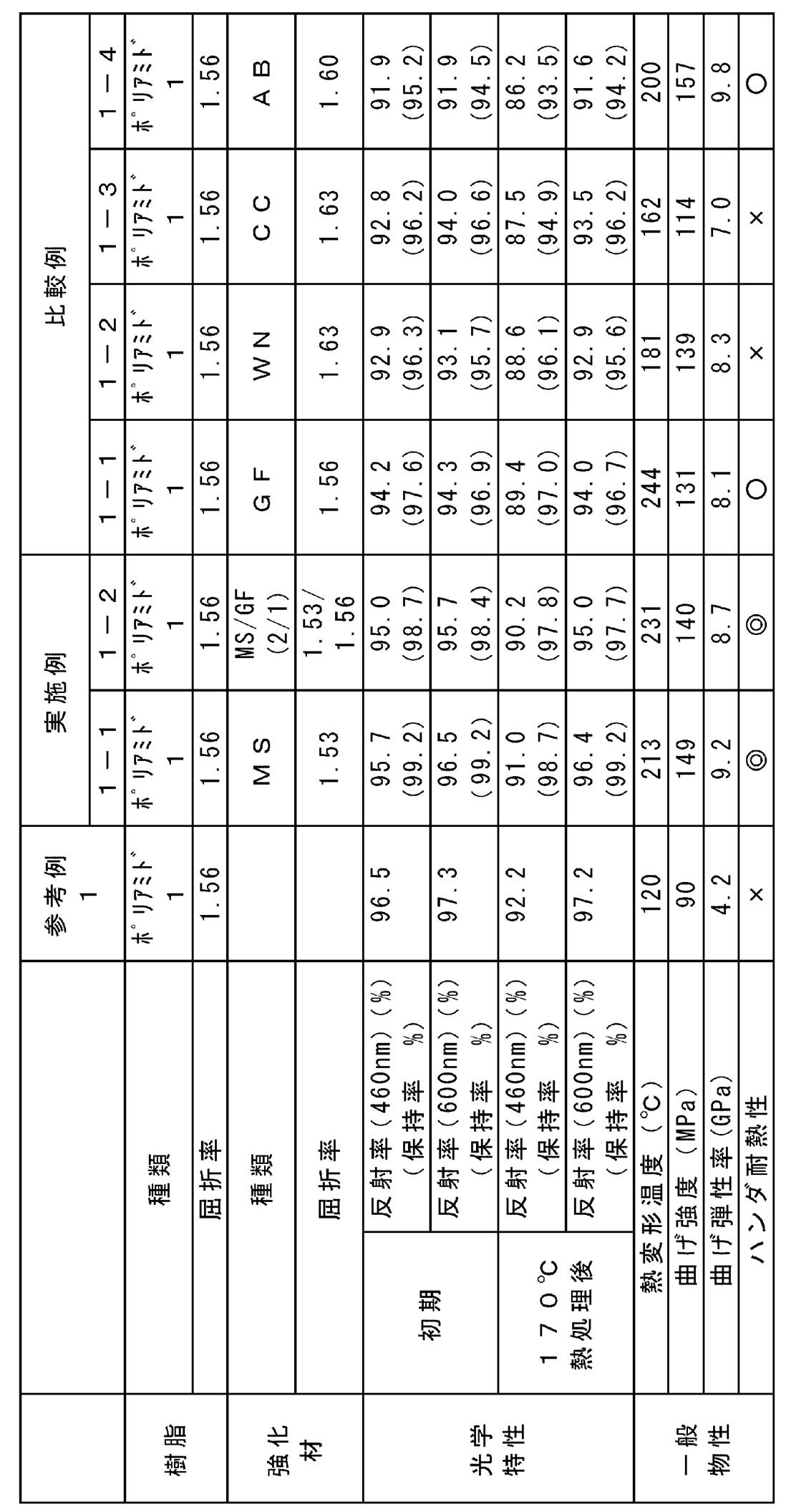

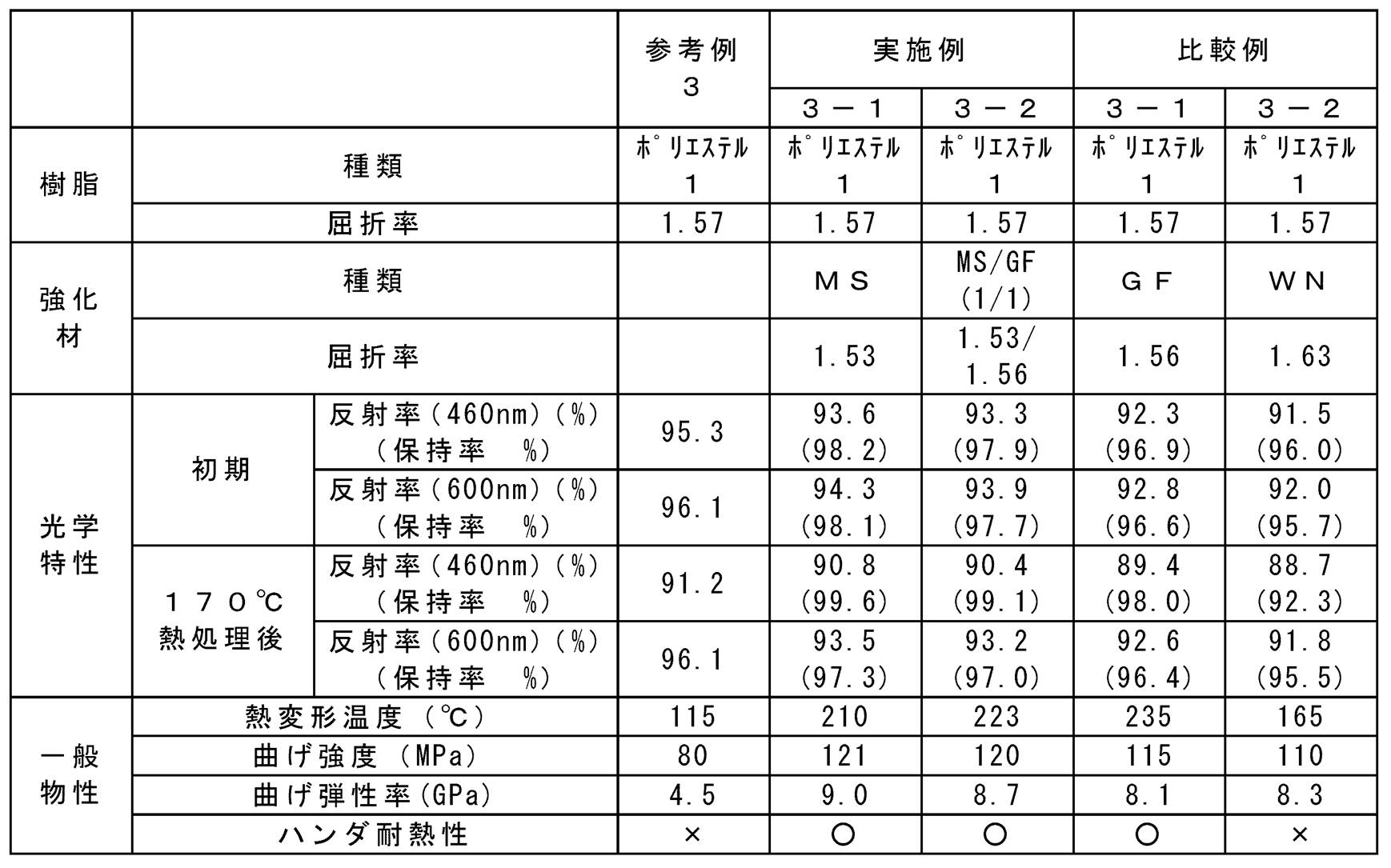
また、170℃2時間の熱処理後でも、高い反射率を維持している。さらに、塩基性硫酸マグネシウムウィスカーでは、十分な補強効果が得られるため、リフロー耐熱試験においても、高い耐熱性を示した。
以上より、{熱可塑性樹脂(A)の屈折率}-{強化材(C)の屈折率}≧0.02の特性を満足する組み合わせにおいて、LED反射板に必要な初期反射率および長期的な反射率維持に格別な効果が確認できた。
Claims (10)
- 熱可塑性樹脂(A)100質量部に対し、白色顔料(B)3~100質量部、及び針状又は繊維状の強化材(C)5~100質量部を含有する熱可塑性樹脂組成物であり、下記(イ)を満足することを特徴とするLED反射板用熱可塑性樹脂組成物。
(イ){熱可塑性樹脂(A)の屈折率}-{強化材(C)の屈折率}≧0.02 - 強化材(C)が、塩基性硫酸マグネシウムウィスカーである請求項1に記載のLED反射板用熱可塑性樹脂組成物。
- 熱可塑性樹脂(A)が、融点290~350℃の半芳香族ポリアミド樹脂(A1)である請求項1または2に記載のLED反射板用熱可塑性樹脂組成物。
- 半芳香族ポリアミド樹脂(A1)が、炭素数2~12のジアミンとテレフタル酸との等量モル塩から得られる構成単位を50モル%以上含有し、さらに下記(a)および(b)を満足する請求項3に記載のLED用反射板用熱可塑性樹脂組成物。
(a)7.5≦ポリアミド樹脂中の炭素原子数/ポリアミド樹脂中のアミド結合数
(b)ポリアミド樹脂中の芳香環上の炭素原子数/ポリアミド樹脂中の全炭素原子数≦0.35 - 半芳香族ポリアミド樹脂(A1)が、炭素数2~8のジアミンとテレフタル酸との等量モル塩から得られる構成単位を50モル%以上含有し、さらに下記(a’)および(b’)を満足し、熱可塑性樹脂組成物が下記(c)を満足する請求項3または4に記載のLED用反射板用熱可塑性樹脂組成物。
(a’)7.5≦ポリアミド樹脂中の炭素原子数/ポリアミド樹脂中のアミド結合数≦8.2
(b’)0.28≦ポリアミド樹脂中の芳香環上の炭素原子数/ポリアミド樹脂中の全炭素原子数≦0.35
(c)熱可塑性樹脂組成物のポリアミド樹脂起因の最も低温側に存在するDSC融解ピーク温度が300~340℃ - 半芳香族ポリアミド樹脂(A1)が、炭素数2~8のジアミンとテレフタル酸との等量モル塩から得られる構成単位以外の成分として、炭素数11~18のアミノカルボン酸もしくはラクタムのうちの一種もしくは複数種を共重合してなることを特徴とする請求項4~5のいずれかに記載のLED反射板用熱可塑性樹脂組成物。
- 半芳香族ポリアミド樹脂(A1)が、ヘキサメチレンジアミンとテレフタル酸との等量モル塩から得られる構成単位55~75モル%と、11-アミノウンデカン酸又はウンデカンラクタムから得られる構成単位45~25モル%とからなることを特徴とする請求項3~6のいずれかに記載のLED反射板用熱可塑性樹脂組成物。
- 白色顔料(B)が、酸化チタン、酸化亜鉛、酸化ジルコニウム、酸化錫、酸化アルミニウム、酸化珪素、酸化マグネシウム、酸化カルシウム、酸化アンチモン、水酸化チタン、水酸化亜鉛、水酸化ジルコニウム、水酸化アルミニウム、水酸化マグネシウム、水酸化鉛、硫酸バリウム、硫酸カルシウム、硫化亜鉛、燐酸アルミニウム、燐酸カルシウム、炭酸カルシウム、炭酸鉛、炭酸バリウム、および炭酸マグネシウムからなる群から選ばれる少なくとも一種である請求項1~7のいずれかに記載のLED反射板用熱可塑性樹脂組成物。
- ハンダリフロー耐熱温度が、280℃以上であることを特徴とする請求項1~8のいずれかに記載のLED反射板用熱可塑性樹脂組成物。
- 熱可塑性樹脂(A)、白色顔料(B)、及び針状又は繊維状の強化材(C)を含有する熱可塑性樹脂組成物を製造するに際し、下記(イ)を満足するように、熱可塑性樹脂(A)と強化材(C)とを選択することを特徴とするLED反射板用熱可塑性樹脂組成物の製造方法。
(イ){熱可塑性樹脂(A)の屈折率}-{強化材(C)の屈折率}≧0.02
Priority Applications (3)
| Application Number | Priority Date | Filing Date | Title |
|---|---|---|---|
| CN201380011494.7A CN104145347B (zh) | 2012-02-28 | 2013-02-20 | Led反射板用热塑性树脂组合物 |
| JP2013509765A JP6015652B2 (ja) | 2012-02-28 | 2013-02-20 | Led反射板用熱可塑性樹脂組成物 |
| KR1020147021564A KR101910698B1 (ko) | 2012-02-28 | 2013-02-20 | Led 반사판용 열가소성 수지 조성물 |
Applications Claiming Priority (2)
| Application Number | Priority Date | Filing Date | Title |
|---|---|---|---|
| JP2012-041465 | 2012-02-28 | ||
| JP2012041465 | 2012-02-28 |
Publications (1)
| Publication Number | Publication Date |
|---|---|
| WO2013129201A1 true WO2013129201A1 (ja) | 2013-09-06 |
Family
ID=49082401
Family Applications (1)
| Application Number | Title | Priority Date | Filing Date |
|---|---|---|---|
| PCT/JP2013/054124 Ceased WO2013129201A1 (ja) | 2012-02-28 | 2013-02-20 | Led反射板用熱可塑性樹脂組成物 |
Country Status (5)
| Country | Link |
|---|---|
| JP (1) | JP6015652B2 (ja) |
| KR (1) | KR101910698B1 (ja) |
| CN (1) | CN104145347B (ja) |
| TW (1) | TWI570173B (ja) |
| WO (1) | WO2013129201A1 (ja) |
Cited By (17)
| Publication number | Priority date | Publication date | Assignee | Title |
|---|---|---|---|---|
| JP2015074763A (ja) * | 2013-10-11 | 2015-04-20 | パナソニックIpマネジメント株式会社 | 光反射体用成形材料、光反射体及び照明器具 |
| JP2015105379A (ja) * | 2013-11-29 | 2015-06-08 | 三星エスディアイ株式会社Samsung SDI Co.,Ltd. | 熱可塑性樹脂組成物 |
| WO2015087886A1 (ja) * | 2013-12-13 | 2015-06-18 | 旭化成ケミカルズ株式会社 | ポリアミド組成物、成形品、led用反射板、及び熱による反射率の低下を抑制する方法 |
| JP2016084399A (ja) * | 2014-10-24 | 2016-05-19 | 大塚化学株式会社 | 反射板用樹脂組成物及び反射板 |
| JP2016122677A (ja) * | 2014-12-24 | 2016-07-07 | 日亜化学工業株式会社 | パッケージ及び発光装置の製造方法 |
| CN106084672A (zh) * | 2013-11-29 | 2016-11-09 | 三星Sdi株式会社 | 在高温下具有光稳定性的热塑性树脂组合物 |
| WO2017002824A1 (ja) * | 2015-06-29 | 2017-01-05 | 株式会社クラレ | Led反射板用ポリアミド組成物、led反射板、該反射板を備えた発光装置 |
| WO2017002825A1 (ja) * | 2015-06-29 | 2017-01-05 | 株式会社クラレ | Led反射板用ポリアミド組成物、led反射板、該反射板を備えた発光装置 |
| US9840610B2 (en) | 2014-09-30 | 2017-12-12 | Lotte Advanced Materials Co., Ltd. | Thermoplastic resin composition and molded article using the same |
| WO2018193893A1 (ja) * | 2017-04-17 | 2018-10-25 | 宇部マテリアルズ株式会社 | ポリオレフィン樹脂組成物及びポリオレフィン樹脂組成物成形体 |
| US10131785B2 (en) | 2015-06-30 | 2018-11-20 | Lotte Advanced Materials Co., Ltd. | Polyester resin composition with excellent impact resistance and light reliability and molded article using the same |
| US10508190B2 (en) | 2014-12-17 | 2019-12-17 | Lotte Advanced Materials Co., Ltd. | Polyester resin composition and molded article manufactured therefrom |
| US10636951B2 (en) | 2014-06-27 | 2020-04-28 | Lotte Advanced Materials Co., Ltd. | Thermoplastic resin composition having excellent reflectivity |
| WO2020162339A1 (ja) * | 2019-02-08 | 2020-08-13 | コニカミノルタ株式会社 | 樹脂組成物およびこれを用いた立体造形物の製造方法 |
| US10822490B2 (en) | 2013-12-30 | 2020-11-03 | Lotte Advanced Materials Co., Ltd. | Thermoplastic resin composition having excellent shock resistance and light resistance |
| CN114914345A (zh) * | 2022-03-25 | 2022-08-16 | 硅能光电半导体(广州)有限公司 | 一种led灯珠的封装方法 |
| CN115895249A (zh) * | 2022-11-30 | 2023-04-04 | 金发科技股份有限公司 | 一种聚酰胺复合材料及其制备方法和应用 |
Families Citing this family (4)
| Publication number | Priority date | Publication date | Assignee | Title |
|---|---|---|---|---|
| CN105602243B (zh) * | 2015-11-24 | 2018-08-31 | 金发科技股份有限公司 | 一种聚酰胺组合物及其应用 |
| CN108034245A (zh) * | 2017-12-28 | 2018-05-15 | 南京鸿瑞塑料制品有限公司 | 一种控制尼龙变色的方法 |
| CN115678268B (zh) * | 2022-09-29 | 2024-03-26 | 珠海万通特种工程塑料有限公司 | 一种聚酰胺模塑组合物及其制备方法和应用 |
| KR102896575B1 (ko) * | 2023-02-08 | 2025-12-09 | 한국다이요잉크 주식회사 | Led 패키지 및 led 패키지 제조 방법 |
Citations (4)
| Publication number | Priority date | Publication date | Assignee | Title |
|---|---|---|---|---|
| JP2001105449A (ja) * | 1999-07-30 | 2001-04-17 | Mitsubishi Engineering Plastics Corp | 熱可塑性樹脂製の光学的反射部材及びその製造方法 |
| JP2006257314A (ja) * | 2005-03-18 | 2006-09-28 | Kuraray Co Ltd | Ledリフレクタ成形用ポリアミド樹脂組成物およびledリフレクタ |
| JP2010080793A (ja) * | 2008-09-26 | 2010-04-08 | Toyoda Gosei Co Ltd | 光反射部材及び発光装置 |
| JP2011241398A (ja) * | 2010-05-17 | 2011-12-01 | Ems-Patent Ag | ポリアミド成形材料、及び、ledハウジング部材の製造のための該材料の使用 |
Family Cites Families (2)
| Publication number | Priority date | Publication date | Assignee | Title |
|---|---|---|---|---|
| JP5034773B2 (ja) * | 2006-08-22 | 2012-09-26 | 三菱エンジニアリングプラスチックス株式会社 | レーザー光を用いて溶着させる工程を含む複合成形品の製造方法及び複合成形品 |
| JP5687626B2 (ja) * | 2009-09-07 | 2015-03-18 | 株式会社クラレ | Led用反射板およびそれを備える発光装置 |
-
2013
- 2013-02-20 CN CN201380011494.7A patent/CN104145347B/zh not_active Expired - Fee Related
- 2013-02-20 JP JP2013509765A patent/JP6015652B2/ja active Active
- 2013-02-20 WO PCT/JP2013/054124 patent/WO2013129201A1/ja not_active Ceased
- 2013-02-20 KR KR1020147021564A patent/KR101910698B1/ko not_active Expired - Fee Related
- 2013-02-21 TW TW102106077A patent/TWI570173B/zh not_active IP Right Cessation
Patent Citations (4)
| Publication number | Priority date | Publication date | Assignee | Title |
|---|---|---|---|---|
| JP2001105449A (ja) * | 1999-07-30 | 2001-04-17 | Mitsubishi Engineering Plastics Corp | 熱可塑性樹脂製の光学的反射部材及びその製造方法 |
| JP2006257314A (ja) * | 2005-03-18 | 2006-09-28 | Kuraray Co Ltd | Ledリフレクタ成形用ポリアミド樹脂組成物およびledリフレクタ |
| JP2010080793A (ja) * | 2008-09-26 | 2010-04-08 | Toyoda Gosei Co Ltd | 光反射部材及び発光装置 |
| JP2011241398A (ja) * | 2010-05-17 | 2011-12-01 | Ems-Patent Ag | ポリアミド成形材料、及び、ledハウジング部材の製造のための該材料の使用 |
Cited By (30)
| Publication number | Priority date | Publication date | Assignee | Title |
|---|---|---|---|---|
| JP2015074763A (ja) * | 2013-10-11 | 2015-04-20 | パナソニックIpマネジメント株式会社 | 光反射体用成形材料、光反射体及び照明器具 |
| JP2015105379A (ja) * | 2013-11-29 | 2015-06-08 | 三星エスディアイ株式会社Samsung SDI Co.,Ltd. | 熱可塑性樹脂組成物 |
| CN106084672A (zh) * | 2013-11-29 | 2016-11-09 | 三星Sdi株式会社 | 在高温下具有光稳定性的热塑性树脂组合物 |
| US10301449B2 (en) | 2013-11-29 | 2019-05-28 | Lotte Advanced Materials Co., Ltd. | Thermoplastic resin composition having excellent light stability at high temperature |
| KR101821512B1 (ko) * | 2013-12-13 | 2018-01-23 | 아사히 가세이 가부시키가이샤 | 폴리아미드 조성물, 성형품, led 용 반사판, 및 열에 의한 반사율의 저하를 억제하는 방법 |
| WO2015087886A1 (ja) * | 2013-12-13 | 2015-06-18 | 旭化成ケミカルズ株式会社 | ポリアミド組成物、成形品、led用反射板、及び熱による反射率の低下を抑制する方法 |
| JPWO2015087886A1 (ja) * | 2013-12-13 | 2017-03-16 | 旭化成株式会社 | ポリアミド組成物、成形品、led用反射板、及び熱による反射率の低下を抑制する方法 |
| US10822490B2 (en) | 2013-12-30 | 2020-11-03 | Lotte Advanced Materials Co., Ltd. | Thermoplastic resin composition having excellent shock resistance and light resistance |
| US10636951B2 (en) | 2014-06-27 | 2020-04-28 | Lotte Advanced Materials Co., Ltd. | Thermoplastic resin composition having excellent reflectivity |
| US11355683B2 (en) | 2014-06-27 | 2022-06-07 | Lotte Chemical Corporation | Thermoplastic resin composition having excellent reflectivity |
| US9840610B2 (en) | 2014-09-30 | 2017-12-12 | Lotte Advanced Materials Co., Ltd. | Thermoplastic resin composition and molded article using the same |
| JP2016084399A (ja) * | 2014-10-24 | 2016-05-19 | 大塚化学株式会社 | 反射板用樹脂組成物及び反射板 |
| US10508190B2 (en) | 2014-12-17 | 2019-12-17 | Lotte Advanced Materials Co., Ltd. | Polyester resin composition and molded article manufactured therefrom |
| JP2016122677A (ja) * | 2014-12-24 | 2016-07-07 | 日亜化学工業株式会社 | パッケージ及び発光装置の製造方法 |
| US10703903B2 (en) | 2015-06-29 | 2020-07-07 | Kuraray Co., Ltd. | Polyamide composition for LED reflection plate, LED reflection plate, and light-emitting device including reflection plate |
| US10879439B2 (en) | 2015-06-29 | 2020-12-29 | Kuraray Co., Ltd. | Polyamide composition for LED reflection plate, LED reflection plate, and light-emitting device including reflection plate |
| WO2017002824A1 (ja) * | 2015-06-29 | 2017-01-05 | 株式会社クラレ | Led反射板用ポリアミド組成物、led反射板、該反射板を備えた発光装置 |
| JPWO2017002825A1 (ja) * | 2015-06-29 | 2018-04-12 | 株式会社クラレ | Led反射板用ポリアミド組成物、led反射板、該反射板を備えた発光装置 |
| WO2017002825A1 (ja) * | 2015-06-29 | 2017-01-05 | 株式会社クラレ | Led反射板用ポリアミド組成物、led反射板、該反射板を備えた発光装置 |
| CN107735454A (zh) * | 2015-06-29 | 2018-02-23 | 株式会社可乐丽 | Led反射板用聚酰胺组合物、led反射板、具备该反射板的发光装置 |
| JPWO2017002824A1 (ja) * | 2015-06-29 | 2018-04-12 | 株式会社クラレ | Led反射板用ポリアミド組成物、led反射板、該反射板を備えた発光装置 |
| US10538661B2 (en) | 2015-06-30 | 2020-01-21 | Lotte Advanced Materials Co., Ltd. | Polyester resin composition with excellent impact resistance and light reliability and molded article using the same |
| US10131785B2 (en) | 2015-06-30 | 2018-11-20 | Lotte Advanced Materials Co., Ltd. | Polyester resin composition with excellent impact resistance and light reliability and molded article using the same |
| JPWO2018193893A1 (ja) * | 2017-04-17 | 2020-02-27 | 宇部マテリアルズ株式会社 | ポリオレフィン樹脂組成物及びポリオレフィン樹脂組成物成形体 |
| WO2018193893A1 (ja) * | 2017-04-17 | 2018-10-25 | 宇部マテリアルズ株式会社 | ポリオレフィン樹脂組成物及びポリオレフィン樹脂組成物成形体 |
| WO2020162339A1 (ja) * | 2019-02-08 | 2020-08-13 | コニカミノルタ株式会社 | 樹脂組成物およびこれを用いた立体造形物の製造方法 |
| JPWO2020162339A1 (ja) * | 2019-02-08 | 2021-12-09 | コニカミノルタ株式会社 | 樹脂組成物およびこれを用いた立体造形物の製造方法 |
| JP7463971B2 (ja) | 2019-02-08 | 2024-04-09 | コニカミノルタ株式会社 | 樹脂組成物およびこれを用いた立体造形物の製造方法 |
| CN114914345A (zh) * | 2022-03-25 | 2022-08-16 | 硅能光电半导体(广州)有限公司 | 一种led灯珠的封装方法 |
| CN115895249A (zh) * | 2022-11-30 | 2023-04-04 | 金发科技股份有限公司 | 一种聚酰胺复合材料及其制备方法和应用 |
Also Published As
| Publication number | Publication date |
|---|---|
| CN104145347B (zh) | 2017-09-19 |
| KR20140130677A (ko) | 2014-11-11 |
| KR101910698B1 (ko) | 2018-10-22 |
| JP6015652B2 (ja) | 2016-10-26 |
| TWI570173B (zh) | 2017-02-11 |
| TW201343743A (zh) | 2013-11-01 |
| JPWO2013129201A1 (ja) | 2015-07-30 |
| CN104145347A (zh) | 2014-11-12 |
Similar Documents
| Publication | Publication Date | Title |
|---|---|---|
| JP6015652B2 (ja) | Led反射板用熱可塑性樹脂組成物 | |
| JP4998841B2 (ja) | 表面実装型led用反射板に使用するポリアミド樹脂組成物 | |
| JP4525917B2 (ja) | Ledリフレクタ成形用ポリアミド樹脂組成物およびledリフレクタ | |
| JP6048833B2 (ja) | 表面実装型led用反射板に使用するポリエステル樹脂組成物 | |
| TWI258494B (en) | Polyamide composition | |
| JP6260085B2 (ja) | Led反射板用ポリエステル樹脂組成物 | |
| JP5915948B2 (ja) | ポリエステル樹脂、及びそれを使用した表面実装型led反射板用ポリエステル樹脂組成物 | |
| JP2004075994A (ja) | ポリアミド組成物 | |
| JP5728969B2 (ja) | エンジン冷却水系部品用ポリアミド樹脂組成物およびそれを用いたエンジン冷却水系部品 | |
| CN106164177A (zh) | 树脂组合物及其成型体 | |
| WO2013125454A1 (ja) | 表面実装型led反射板用ポリエステル樹脂 | |
| JP2019127545A (ja) | 反射材用ポリエステル樹脂組成物および反射材 | |
| JP6042271B2 (ja) | 反射材用ポリエステル樹脂組成物および反射板 | |
| JP6221662B2 (ja) | Led反射板用ポリエステル樹脂組成物 |
Legal Events
| Date | Code | Title | Description |
|---|---|---|---|
| ENP | Entry into the national phase |
Ref document number: 2013509765 Country of ref document: JP Kind code of ref document: A |
|
| 121 | Ep: the epo has been informed by wipo that ep was designated in this application |
Ref document number: 13755579 Country of ref document: EP Kind code of ref document: A1 |
|
| ENP | Entry into the national phase |
Ref document number: 20147021564 Country of ref document: KR Kind code of ref document: A |
|
| NENP | Non-entry into the national phase |
Ref country code: DE |
|
| 122 | Ep: pct application non-entry in european phase |
Ref document number: 13755579 Country of ref document: EP Kind code of ref document: A1 |