WO2013062037A1 - 酸化物材料の製造方法 - Google Patents
酸化物材料の製造方法 Download PDFInfo
- Publication number
- WO2013062037A1 WO2013062037A1 PCT/JP2012/077568 JP2012077568W WO2013062037A1 WO 2013062037 A1 WO2013062037 A1 WO 2013062037A1 JP 2012077568 W JP2012077568 W JP 2012077568W WO 2013062037 A1 WO2013062037 A1 WO 2013062037A1
- Authority
- WO
- WIPO (PCT)
- Prior art keywords
- oxide material
- sno
- raw material
- oxide
- batch
- Prior art date
- Legal status (The legal status is an assumption and is not a legal conclusion. Google has not performed a legal analysis and makes no representation as to the accuracy of the status listed.)
- Ceased
Links
Images
Classifications
-
- H—ELECTRICITY
- H01—ELECTRIC ELEMENTS
- H01G—CAPACITORS; CAPACITORS, RECTIFIERS, DETECTORS, SWITCHING DEVICES, LIGHT-SENSITIVE OR TEMPERATURE-SENSITIVE DEVICES OF THE ELECTROLYTIC TYPE
- H01G11/00—Hybrid capacitors, i.e. capacitors having different positive and negative electrodes; Electric double-layer [EDL] capacitors; Processes for the manufacture thereof or of parts thereof
- H01G11/22—Electrodes
- H01G11/30—Electrodes characterised by their material
- H01G11/46—Metal oxides
-
- C—CHEMISTRY; METALLURGY
- C03—GLASS; MINERAL OR SLAG WOOL
- C03C—CHEMICAL COMPOSITION OF GLASSES, GLAZES OR VITREOUS ENAMELS; SURFACE TREATMENT OF GLASS; SURFACE TREATMENT OF FIBRES OR FILAMENTS MADE FROM GLASS, MINERALS OR SLAGS; JOINING GLASS TO GLASS OR OTHER MATERIALS
- C03C1/00—Ingredients generally applicable to manufacture of glasses, glazes, or vitreous enamels
- C03C1/006—Ingredients generally applicable to manufacture of glasses, glazes, or vitreous enamels to produce glass through wet route
-
- C—CHEMISTRY; METALLURGY
- C03—GLASS; MINERAL OR SLAG WOOL
- C03C—CHEMICAL COMPOSITION OF GLASSES, GLAZES OR VITREOUS ENAMELS; SURFACE TREATMENT OF GLASS; SURFACE TREATMENT OF FIBRES OR FILAMENTS MADE FROM GLASS, MINERALS OR SLAGS; JOINING GLASS TO GLASS OR OTHER MATERIALS
- C03C3/00—Glass compositions
- C03C3/12—Silica-free oxide glass compositions
- C03C3/16—Silica-free oxide glass compositions containing phosphorus
-
- H—ELECTRICITY
- H01—ELECTRIC ELEMENTS
- H01G—CAPACITORS; CAPACITORS, RECTIFIERS, DETECTORS, SWITCHING DEVICES, LIGHT-SENSITIVE OR TEMPERATURE-SENSITIVE DEVICES OF THE ELECTROLYTIC TYPE
- H01G11/00—Hybrid capacitors, i.e. capacitors having different positive and negative electrodes; Electric double-layer [EDL] capacitors; Processes for the manufacture thereof or of parts thereof
- H01G11/22—Electrodes
-
- H—ELECTRICITY
- H01—ELECTRIC ELEMENTS
- H01G—CAPACITORS; CAPACITORS, RECTIFIERS, DETECTORS, SWITCHING DEVICES, LIGHT-SENSITIVE OR TEMPERATURE-SENSITIVE DEVICES OF THE ELECTROLYTIC TYPE
- H01G11/00—Hybrid capacitors, i.e. capacitors having different positive and negative electrodes; Electric double-layer [EDL] capacitors; Processes for the manufacture thereof or of parts thereof
- H01G11/22—Electrodes
- H01G11/30—Electrodes characterised by their material
- H01G11/50—Electrodes characterised by their material specially adapted for lithium-ion capacitors, e.g. for lithium-doping or for intercalation
-
- H—ELECTRICITY
- H01—ELECTRIC ELEMENTS
- H01M—PROCESSES OR MEANS, e.g. BATTERIES, FOR THE DIRECT CONVERSION OF CHEMICAL ENERGY INTO ELECTRICAL ENERGY
- H01M4/00—Electrodes
- H01M4/02—Electrodes composed of, or comprising, active material
- H01M4/36—Selection of substances as active materials, active masses, active liquids
- H01M4/48—Selection of substances as active materials, active masses, active liquids of inorganic oxides or hydroxides
- H01M4/485—Selection of substances as active materials, active masses, active liquids of inorganic oxides or hydroxides of mixed oxides or hydroxides for inserting or intercalating light metals, e.g. LiTi2O4 or LiTi2OxFy
-
- H—ELECTRICITY
- H01—ELECTRIC ELEMENTS
- H01M—PROCESSES OR MEANS, e.g. BATTERIES, FOR THE DIRECT CONVERSION OF CHEMICAL ENERGY INTO ELECTRICAL ENERGY
- H01M4/00—Electrodes
- H01M4/02—Electrodes composed of, or comprising, active material
- H01M4/36—Selection of substances as active materials, active masses, active liquids
- H01M4/58—Selection of substances as active materials, active masses, active liquids of inorganic compounds other than oxides or hydroxides, e.g. sulfides, selenides, tellurides, halogenides or LiCoFy; of polyanionic structures, e.g. phosphates, silicates or borates
- H01M4/5825—Oxygenated metallic salts or polyanionic structures, e.g. borates, phosphates, silicates, olivines
-
- H—ELECTRICITY
- H01—ELECTRIC ELEMENTS
- H01M—PROCESSES OR MEANS, e.g. BATTERIES, FOR THE DIRECT CONVERSION OF CHEMICAL ENERGY INTO ELECTRICAL ENERGY
- H01M10/00—Secondary cells; Manufacture thereof
- H01M10/05—Accumulators with non-aqueous electrolyte
- H01M10/052—Li-accumulators
- H01M10/0525—Rocking-chair batteries, i.e. batteries with lithium insertion or intercalation in both electrodes; Lithium-ion batteries
-
- Y—GENERAL TAGGING OF NEW TECHNOLOGICAL DEVELOPMENTS; GENERAL TAGGING OF CROSS-SECTIONAL TECHNOLOGIES SPANNING OVER SEVERAL SECTIONS OF THE IPC; TECHNICAL SUBJECTS COVERED BY FORMER USPC CROSS-REFERENCE ART COLLECTIONS [XRACs] AND DIGESTS
- Y02—TECHNOLOGIES OR APPLICATIONS FOR MITIGATION OR ADAPTATION AGAINST CLIMATE CHANGE
- Y02E—REDUCTION OF GREENHOUSE GAS [GHG] EMISSIONS, RELATED TO ENERGY GENERATION, TRANSMISSION OR DISTRIBUTION
- Y02E60/00—Enabling technologies; Technologies with a potential or indirect contribution to GHG emissions mitigation
- Y02E60/10—Energy storage using batteries
Definitions
- the present invention relates to a method for producing an oxide material, and more particularly to a method for producing an oxide material suitable as a negative electrode material for an electricity storage device such as a lithium ion secondary battery or a lithium ion capacitor.
- LiCoO 2 , LiNiO 2 , LiCo 1-x Ni x O 2 (0 ⁇ x ⁇ 1), LiMn 2 O 4 and the like are widely used as positive electrode materials for lithium ion secondary batteries.
- a carbon material is generally used as the negative electrode material. These materials function as an electrode active material that reversibly occludes and releases lithium ions by charging and discharging, and constitute a so-called rocking chair type secondary battery that is electrochemically connected by a non-aqueous electrolyte or a solid electrolyte. .
- Examples of carbon materials used as negative electrode materials include graphitic carbon materials, pitch coke, fibrous carbon, and high-capacity soft carbon fired at low temperatures.
- the carbon material has a relatively small lithium storage capacity, there is a problem that the capacity is low. Specifically, even if a stoichiometric amount of lithium storage capacity can be realized, the capacity of the carbon material is limited to about 372 mAh / g.
- Patent Document 1 discloses an amorphous oxide mainly composed of tin oxide as a negative electrode material capable of inserting and extracting lithium ions and having a high capacity density exceeding that of a carbon-based material.
- amorphous oxide By using the amorphous oxide, volume change associated with insertion and extraction of lithium ions can be reduced, and a non-aqueous secondary battery excellent in charge / discharge cycle can be manufactured.
- Patent Document 1 In the negative electrode material manufacturing process described in Patent Document 1, diphosphorus pentoxide is used as a raw material. Since diphosphorus pentoxide is very hygroscopic, equipment for maintaining an atmosphere with a low dew point is necessary to produce a negative electrode material having a desired composition, resulting in high costs. Patent Document 1 also describes a method using a composite oxide such as stannous pyrophosphate as a raw material in addition to diphosphorus pentoxide. However, since stannous pyrophosphate is expensive, as a result In addition, the product cost has increased.
- Orthophosphoric acid (H 3 PO 4 ) is also used as a relatively stable and inexpensive phosphoric acid raw material.
- orthophosphoric acid rapidly undergoes the following reaction with stannous oxide (SnO) in the raw material preparation process, generates excessive heat (for example, 200 ° C. or higher), and the raw material batch is cured, resulting in a heterogeneous bulky solid.
- SnO stannous oxide
- the present invention provides a method for producing an oxide material containing SnO and P 2 O 5, and capable of producing a homogeneous oxide material having a desired composition at low cost.
- the purpose is to provide.
- the present invention is a method for producing an oxide material containing SnO and P 2 O 5 and includes a step of mixing a phosphoric acid aqueous solution and SnO powder to produce a raw material batch, and a step of melting the raw material batch
- the present invention relates to a manufacturing method.
- the concentration of the phosphoric acid aqueous solution is preferably 10 to 70% by mass.
- the reaction of the above formula (1) proceeds slowly, heat generation and agglomeration of the raw material batch can be effectively suppressed, and a homogeneous raw material batch is easily obtained.
- the concentration of the phosphoric acid aqueous solution refers to a concentration converted as orthophosphoric acid.
- phosphoric acid is orthophosphoric acid.
- orthophosphoric acid Since orthophosphoric acid is relatively stable, it is easy to handle and an oxide material having a desired composition is easily obtained. Moreover, since it is cheap, raw material cost can be reduced.
- the atmosphere for melting the raw material batch is preferably a reducing atmosphere or an inert atmosphere.
- the oxide material preferably contains SnO 45 to 95% and P 2 O 5 5 to 55% in terms of a composition.
- the present invention relates to an oxide material produced by any one of the above methods.
- the present invention relates to an oxide material containing SnO and P 2 O 5 and having a ⁇ -OH value of 0.1 to 1.7 / mm.
- ⁇ -OH value is an index indicating the amount of water in the composition, and can be expressed by the following equation.
- ⁇ -OH value (1 / X) log 10 (T1 / T2)
- X Sample thickness (mm)
- a homogeneous phosphate containing crystal water for example, SnHPO 4
- SnO powder a homogeneous phosphate containing crystal water
- the oxide material of the present invention preferably contains SnO 45 to 95% and P 2 O 5 5 to 55% in terms of composition. Moreover, it is preferable that the oxide material of this invention is used for the negative electrode material for electrical storage devices.
- an oxide material having a desired composition containing SnO and P 2 O 5 can be produced uniformly and inexpensively.
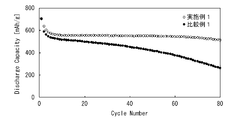
- Example 4 is a graph showing the results of a cycle test of test batteries produced in Example 1 and Comparative Example 1.
- the present invention is a method for producing an oxide material containing SnO and P 2 O 5 , and includes a step of preparing a raw material batch by mixing an aqueous phosphoric acid solution and SnO powder, and a step of melting the raw material batch It is characterized by.
- An oxide material containing SnO and P 2 O 5 plays a role as a negative electrode active material having a high capacity and excellent cycle characteristics in a power storage device such as a non-aqueous secondary battery.
- a negative electrode active material containing SnO it is known that the following reaction occurs in the negative electrode during charge and discharge.
- a reaction in which SnO accepts electrons and metal Sn is generated occurs irreversibly (formula (2)).
- the produced metal Sn combines with lithium ions that have moved from the positive electrode through the electrolyte and electrons supplied from the circuit, and a reaction occurs to form a Li y Sn alloy (formula (3)).
- Li y Sn alloys Li 2.6 Sn, Li 3.5 Sn, Li 4.4 Sn, and the like are known.
- the reaction occurs as a reversible reaction that proceeds rightward during charging and proceeds leftward during discharging. Thereafter, the charge / discharge reaction of the formula (3) is repeatedly performed.
- the charge / discharge reaction of formula (3) involves a volume change, but when an oxide material containing SnO and P 2 O 5 is used as the negative electrode active material, Sn x + ions in the oxide material are phosphoric acid. Since it exists in the state included in the network, the volume change of Sn accompanying charging / discharging can be relieved with the said phosphate network. Therefore, it is possible to suppress a decrease in cycle characteristics.
- the composition contains mol%, SnO 45 to 95%, and P 2 O 5 5 to 55%.
- % means “mol%” unless otherwise specified.
- SnO in the oxide material is an active material component that becomes a site for occluding and releasing lithium ions.
- the SnO content is preferably 45 to 95%, 50 to 90%, 55 to 87%, 60 to 85%, 68 to 83%, particularly 71 to 82%.
- the charge / discharge capacity per unit mass of the oxide material becomes small, and as a result, the charge / discharge capacity of the negative electrode active material also becomes small.
- the amorphous component in the oxide material decreases, so that the volume change associated with insertion and extraction of lithium ions during repeated charge and discharge cannot be alleviated, and the discharge capacity increases rapidly. May decrease.
- SnO ingredient content in the present invention, the tin oxide component other than SnO (SnO 2, etc.) also refers to that summed in terms of SnO.
- P 2 O 5 is a network-forming oxide and includes lithium ion storage and release sites in Sn atoms, and functions as a solid electrolyte to which lithium ions can move.
- the content of P 2 O 5 is preferably 5 to 55%, 10 to 50%, 13 to 45%, 15 to 40%, 17 to 32%, particularly 18 to 29%. If the content of P 2 O 5 is too small, the volume change of Sn atoms associated with insertion and extraction of lithium ions during charge / discharge cannot be alleviated, resulting in structural deterioration, and the discharge capacity tends to decrease during repeated charge / discharge. . On the other hand, when the content of P 2 O 5 is too large, the water resistance tends to lower.
- heterogeneous crystals for example, SnHPO 4
- SnP 2 O 7 a stable crystal
- the SnO / P 2 O 5 (molar ratio) is preferably 0.8 to 19, 1 to 18, and particularly preferably 1.2 to 17.
- SnO / P 2 O 5 is too small, Sn atoms in SnO are easily affected by the coordination of P 2 O 5 , and the initial charge / discharge efficiency tends to decrease.
- SnO / P 2 O 5 is too large, the discharge capacity tends to decrease when charging and discharging are repeated. This is because P 2 O 5 coordinated to the Sn atom in the oxide is reduced and the Sn atom cannot be sufficiently covered, and as a result, the volume change of the Sn atom due to insertion and extraction of lithium ions cannot be relaxed. This is considered to cause structural deterioration.
- various components can be further added to the oxide material.
- R represents Li, Na, K or Cs
- the structure becomes disordered and an amorphous material is easily obtained, but the phosphate network is easily cut.
- the volume change of the negative electrode active material accompanying charge / discharge cannot be relaxed, and the cycle characteristics may be deteriorated.
- the oxide material is preferably amorphous.
- the crystallinity of the oxide material is preferably 95% or less, 80% or less, 70% or less, 50% or less, 40% or less, particularly 20% or less, and is substantially amorphous. Is most preferred.
- substantially amorphous means that the crystallinity is substantially 0% (specifically, less than 0.1%). Specifically, the following CuK ⁇ ray In a powder X-ray diffraction measurement using, a crystal diffraction line is not detected.
- the crystallinity is obtained from a diffraction line profile of 10 to 60 ° in terms of 2 ⁇ values obtained by powder X-ray diffraction measurement using CuK ⁇ rays.
- the integrated intensity obtained by peak-separating a broad diffraction line (amorphous halo) at 10 to 60 ° from the total scattering curve obtained by subtracting the background from the diffraction line profile is expressed as Ia, 10
- the degree of crystallinity Xc can be obtained from the following equation.
- the concentration of the aqueous phosphoric acid solution is preferably 10 to 70% by mass, 12 to 60% by mass, and particularly preferably 15 to 50% by mass. If the concentration of the phosphoric acid aqueous solution is too low, phosphoric acid and SnO are difficult to come into contact with each other in the raw material batch, and unreacted phosphoric acid remains. Therefore, segregation easily occurs with the powder raw material and reaction product powder (for example, SnHPO 4 ). The resulting oxide material tends to be heterogeneous. On the other hand, when the concentration of the phosphoric acid aqueous solution is too high, it is difficult to uniformly mix the raw materials. Moreover, the heat generation in the reaction of the above formula (1) cannot be alleviated, the water is evaporated and the powder raw material tends to be in a state of a splint, and the resulting oxide material tends to be inhomogeneous.
- phosphoric acid for example, orthophosphoric acid (H 3 PO 4), pyrophosphoric acid (H 4 P 2 O 7) , tripolyphosphate (H 5 P 3 O 10) , metaphosphoric acid ((HPO 3) n) Etc. can be used.
- orthophosphoric acid H 3 PO 4
- pyrophosphoric acid H 4 P 2 O 7
- tripolyphosphate H 5 P 3 O 10
- metaphosphoric acid ((HPO 3) n) Etc.
- the drying temperature is not particularly limited as long as moisture sufficiently evaporates, and may be appropriately adjusted within a range of, for example, 50 to 250 ° C., 80 to 200 ° C., and particularly 100 to 180 ° C.
- the atmosphere during drying is not particularly limited, but a reducing atmosphere or an inert atmosphere is preferable in order to suppress oxidation of the raw material batch (particularly SnO).
- a mixed gas of nitrogen and hydrogen is used.
- the inert atmosphere it is preferable to use any of nitrogen, argon, and helium.
- homogeneity may be improved by grinding the raw material batch.
- a general pulverizer such as a mortar, a rake machine, a ball mill, a vibrating ball mill, a satellite ball mill, a planetary ball mill, a jet mill or the like can be used, and either a wet or dry method may be used.
- the average particle size of the raw material batch obtained by the present invention is preferably 2 to 500 ⁇ m, 5 to 300 ⁇ m, 10 to 250 ⁇ m, particularly preferably 20 to 150 ⁇ m. If the average particle size of the raw material batch is too small, the fluidity is lowered and problems such as clogging of the raw material batch inlet of the melting apparatus are likely to occur. Moreover, when it puts in a melting furnace, it exists in the tendency for a raw material batch to scatter. As a result, variation in input amount not only makes stable production difficult, but also tends to cause a composition shift of the obtained oxide material. On the other hand, if the average particle size of the raw material batch is too large, undissolved material is likely to be generated during melting, and the resulting oxide material tends to be heterogeneous.
- the average particle diameter is a median diameter of primary particles and indicates D50 (50% volume cumulative diameter), which is a value measured by a laser diffraction particle size distribution analyzer (SALD-2000 series, manufactured by Shimadzu Corporation). .
- the raw material batch is heated and melted to be vitrified.
- the melting atmosphere at the time of melting is preferably performed in a reducing atmosphere or an inert atmosphere for the reasons described above.
- the reducing gas or the inert gas may be supplied to the upper atmosphere of the molten glass in a melting furnace, may be directly supplied into the molten glass from a bubbling nozzle, or both methods may be performed simultaneously.
- the raw material batch may contain metal powder or carbon powder. Thereby, the oxidation of SnO in the molten glass can be suppressed.
- the metal powder any one of Sn, Al, Si, and Ti is preferably used. Among these, it is preferable to use Sn, Al, and Si powders.
- the molten glass is formed into a desired shape to obtain an oxide material.
- the shape of the oxide material is not particularly limited, and examples thereof include a bulk shape, a film shape, and a powder shape.
- the ⁇ -OH value of the oxide material obtained by the production method of the present invention is a certain value or more.
- the oxide material of the present invention has a ⁇ -OH value of, for example, 0.1 / mm or more, particularly 0.2 / mm or more.
- the ⁇ -OH value of the oxide material is preferably 1.7 / mm or less, 1.6 / mm or less, and particularly preferably 1.5 / mm or less.
- the ⁇ -OH value of the soot oxide material can be controlled (particularly reduced) by supplying a reducing gas or an inert gas into the molten atmosphere.
- the ⁇ -OH value of the oxide material can be more effectively reduced by supplying the gas directly from the bubbling nozzle into the molten glass.
- the ⁇ -OH value of the oxide material can be reduced by reducing the amount of water in the raw material batch (increasing the phosphoric acid aqueous solution concentration).
- the negative electrode of another non-aqueous secondary battery can also be applied to an active material or a negative electrode active material used in a hybrid capacitor in which a negative electrode material for a lithium ion secondary battery and a positive electrode material for a non-aqueous electric double layer capacitor are combined.
- Oxide Material (Negative Electrode Active Material) Powdered stannous oxide (Japan) is used so that the composition of the oxide material is mol%, SnO 72%, P 2 O 5 28%. Chemical industry SnO) and liquid orthophosphoric acid (Lhasa Industries strong phosphoric acid, H 3 PO 4 concentration 105 mass%) were weighed. Next, the amount of water was weighed so as to have the concentration shown in Table 1, and the weighed orthophosphoric acid was slowly added to prepare an aqueous phosphoric acid solution. Stannous oxide powder was added to the phosphoric acid aqueous solution and mixed to prepare a raw material batch. Examples 4 to 6 were dried in the atmosphere under the conditions shown in Table 1 to obtain powdery raw material batches.
- stannous oxide powder and orthophosphoric acid were weighed so as to have the composition described above, and the raw material batch was prepared by adding and mixing stannous oxide powder to orthophosphoric acid.
- the raw material batch was put into a quartz crucible and melted at 950 ° C. for 40 minutes in a nitrogen atmosphere using an electric furnace to be vitrified.
- the molten glass was poured out between a pair of rotating rollers and formed into a film having a thickness of 0.1 to 2 mm while rapidly cooling.
- the film-shaped molded body was pulverized with a ball mill and then classified with an air classifier to obtain a glass powder (oxide material) having an average particle diameter of 2 ⁇ m.
- the structure was identified by powder X-ray diffraction measurement for each sample.
- the oxide materials of Examples 1 to 6 were amorphous, and no crystals were detected.
- the oxide material of Comparative Example 1 was confirmed to have SnO 2 and Sn 2 P 2 O 7 crystal precipitation. The degree of crystallinity was 21%.
- test batteries were prepared using the oxide materials (negative electrode active materials) prepared in Example 1 and Comparative Example 1, and the battery characteristics were evaluated.
- test battery A polypropylene porous membrane having a diameter of 16 mm was placed on the lower lid of a coin cell with the working electrode placed with the copper foil surface facing down, and dried under reduced pressure at 60 ° C. for 8 hours.
- a test battery was manufactured by laminating a separator made of Hoechst Celanese Co., Ltd. Celgard # 2400) and metallic lithium as a counter electrode.
- the test battery was assembled in an environment with a dew point temperature of ⁇ 40 ° C. or lower.
- Table 2 and FIG. 1 show the results of the initial discharge capacity when the charge / discharge test was performed for each sample and the cycle characteristics when the sample was repeatedly charged / discharged.
- the initial discharge capacity of the battery using the oxide material of Example 1 was 705 mAh / g, and the discharge capacity at the 80th cycle was as good as 511 mAh / g.
- the battery using the oxide material of Comparative Example 1 had an initial discharge capacity of 700 mAh / g, but the discharge capacity at the 80th cycle was significantly reduced to 261 mAh / g.
- the oxide material obtained by the production method of the present invention is used as a sealing material for wavelength conversion members that are components of light emitting devices such as white LEDs and various electronic components, in addition to the negative electrode active material for power storage devices. Is also possible.
Landscapes
- Chemical & Material Sciences (AREA)
- Engineering & Computer Science (AREA)
- Power Engineering (AREA)
- Materials Engineering (AREA)
- Chemical Kinetics & Catalysis (AREA)
- General Chemical & Material Sciences (AREA)
- Microelectronics & Electronic Packaging (AREA)
- Electrochemistry (AREA)
- Geochemistry & Mineralogy (AREA)
- Life Sciences & Earth Sciences (AREA)
- Organic Chemistry (AREA)
- Inorganic Chemistry (AREA)
- Crystallography & Structural Chemistry (AREA)
- Glass Compositions (AREA)
- Electric Double-Layer Capacitors Or The Like (AREA)
- Battery Electrode And Active Subsutance (AREA)
Abstract
SnOおよびP2O5を含有する酸化物材料の製造方法であって、リン酸水溶液およびSnO粉末を混合して原料バッチを作製する工程、および、原料バッチを溶融する工程を含むことを特徴とする製造方法。リン酸水溶液の濃度が10~70質量%であることが好ましい。
Description
本発明は酸化物材料の製造方法に関し、特にリチウムイオン二次電池、リチウムイオンキャパシタ等の蓄電デバイス用の負極材料として好適である酸化物材料の製造方法に関する。
近年、携帯用パソコンや携帯電話の普及に伴い、蓄電デバイスの高容量化と小サイズ化に対する要望が高まっている。蓄電デバイスの高容量化が進めば電池材料の小サイズ化も容易となるため、蓄電デバイス用電極材料の高容量化へ向けての開発が急務となっている。
例えば、リチウムイオン二次電池用の正極材料には高電位型のLiCoO2、LiNiO2、LiCo1-xNixO2(0<x<1)、LiMn2O4等が広く用いられている。一方、負極材料には一般に炭素材料が用いられている。これらの材料は充放電によってリチウムイオンを可逆的に吸蔵および放出する電極活物質として機能し、非水電解液または固体電解質によって電気化学的に連結されたいわゆるロッキングチェア型の二次電池を構成する。
負極材料として用いられる炭素材料には、黒鉛質炭素材料、ピッチコークス、繊維状カーボン、低温で焼成される高容量型のソフトカーボン等がある。しかしながら、炭素材料はリチウム吸蔵容量が比較的小さいため、容量が低いという問題がある。具体的には、化学量論量のリチウム吸蔵容量を実現できたとしても、炭素材料の容量は約372mAh/gが限界である。
リチウムイオンを吸蔵および放出することが可能であり、カーボン系材料を超える高容量密度を有する負極材料として、特許文献1には、酸化スズを主体とする非晶質酸化物が開示されている。当該非晶質酸化物を用いることで、リチウムイオンの吸蔵および放出に伴う体積変化を緩和でき、充放電サイクルに優れた非水二次電池を作製することが可能となる。
特許文献1に記載の負極材料の製造工程では、原料に五酸化二リンが用いられている。五酸化二リンは非常に吸湿性が高いため、所望の組成を有する負極材料を製造するためには低露点の雰囲気を保つ設備が必要であり高コストとなる。また、特許文献1には、原料として五酸化二リン以外にもピロリン酸第一スズ等の複合酸化物を用いる方法も記載されているが、ピロリン酸第一スズは高価であるため、結果的に、製品コストも高騰してしまうという問題を有していた。
なお、比較的安定かつ安価なリン酸原料としてオルトリン酸(H3PO4)も使用される。しかしながら、オルトリン酸は原料調合過程において酸化第一スズ(SnO)との下記反応が急激に進行し、過剰に発熱する(例えば200℃以上)とともに原料バッチが硬化し、不均質な塊状の固形物になってしまうという問題がある。その結果、均質な原料バッチを得ることが難しいだけでなく、得られた酸化物材料(負極材料)中に脈理や分相が生じたり、望まない異種結晶(例えばSn2P2O7やSnO2)が析出するおそれがある。
SnO+H3PO4 → SnHPO4+H2O+ΔH・・・(1)
以上に鑑み、本発明は、SnOおよびP2O5を含有する酸化物材料を製造するための方法であって、所望組成を有する均質な酸化物材料を安価に製造することが可能な方法を提供することを目的とする。
本発明は、SnOおよびP2O5を含有する酸化物材料の製造方法であって、リン酸水溶液およびSnO粉末を混合して原料バッチを作製する工程、および、原料バッチを溶融する工程を含むことを特徴とする製造方法に関する。
SnOおよびP2O5を含有する酸化物材料を溶融法により製造するに際し、原料として酸化第一スズとリン酸(例えばオルトリン酸)を直接混合した場合は、既述の通り、過剰に発熱したり、原料バッチが塊状化するといった不具合が起こる。そこで、本発明者らは、原料としてリン酸を直接使用するのではなく、リン酸水溶液として使用することにより、上記問題を解決できることを見出した。具体的には、リン酸水溶液およびSnO粉末を混合して原料バッチを作製することにより、リン酸とSnOの反応に伴う過剰な発熱を抑制しつつ、均質なスラリー状の原料バッチを作製することができ、当該原料バッチを溶融することにより、脈理、分相または異種結晶等の不具合がほとんど存在しない酸化物材料を作製することが可能となる。
第二に、本発明の酸化物材料の製造方法において、リン酸水溶液の濃度が10~70質量%であることが好ましい。
当該構成によれば、上記式(1)の反応が緩やかに進行し、発熱や原料バッチの塊状化を効果的に抑制でき、均質な原料バッチが得られやすくなる。なお、本発明においてリン酸水溶液の濃度は、オルトリン酸として換算した濃度をいう。
第三に、本発明の酸化物材料の製造方法において、リン酸がオルトリン酸であることが好ましい。
オルトリン酸は比較的安定であるため、取扱いが容易であり、所望の組成を有する酸化物材料が得られやすい。また安価であるため、原料コストを低減できる。
第四に、本発明の酸化物材料の製造方法において、原料バッチを乾燥した後に溶融することが好ましい。
当該構成によれば、原料バッチの溶融炉内への投入が容易となるだけでなく、前記原料バッチ中の固形原料の分離や沈降による酸化物材料の組成ズレを抑制することが可能となる。さらに、原料バッチを溶融炉内に投入する際に急激な水の蒸発や水蒸気爆発等の危険が生じることを回避できるだけでなく、原料バッチの飛散を抑制することができる。
第五に、本発明の酸化物材料の製造方法において、原料バッチを溶融する雰囲気が還元雰囲気または不活性雰囲気であることが好ましい。
Snは、2価で存在するよりも4価で存在するほうが安定であるため、酸化物材料中のSnOは溶融工程で容易に酸化され、望まない異種結晶(例えばSnO2やSnP2O7等)が析出する傾向がある。そこで、原料バッチを溶融する雰囲気を還元雰囲気または不活性雰囲気とすることにより、SnOが酸化して前記異種結晶が析出することを抑制できる。
第六に、本発明の酸化物材料の製造方法において、酸化物材料が、組成としてモル%で、SnO 45~95%、P2O5 5~55%を含有することが好ましい。
第七に、本発明は、前記いずれかの方法により製造されてなることを特徴とする酸化物材料に関する。
第八に、本発明は、SnOおよびP2O5を含有し、β-OH値が0.1~1.7/mmであることを特徴とする酸化物材料に関する。
「β-OH値」は組成物中の水分量を示す指標であり、以下の式で表すことができる。
β-OH値=(1/X)log10(T1/T2)
X:試料肉厚(mm)
T1:参照波長3846cm-1(=2600nm)における透過率(%)
T2:水酸基吸収波長3000-3400cm-1(=3333-2941nm)付近における最低透過率(%)
X:試料肉厚(mm)
T1:参照波長3846cm-1(=2600nm)における透過率(%)
T2:水酸基吸収波長3000-3400cm-1(=3333-2941nm)付近における最低透過率(%)
本発明者等の調査によれば、上記製造方法により酸化物材料を作製した場合は、リン酸水溶液とSnO粉末の反応により、結晶水を含有する均質なリン酸塩(例えばSnHPO4)が原料バッチ中に生成し、溶融時に、原料バッチ中における水に加え、当該結晶水からも水分が供給されるため、得られる酸化物材料中のβ-OH値が一定値以上になることがわかった。
一方で、酸化物材料のβ-OH値が高くなるほど、溶融ガラス中のSnOが酸化される傾向が高くなり、既述の異種結晶の析出量が増加することが確認された。この結果から、一定値以下のβ-OH値となるように酸化物材料を製造すれば、異種結晶の発生を効果的に抑制できることがわかった。本発明の酸化物材料は、組成としてモル%で、SnO 45~95%、P2O5 5~55%を含有することが好ましい。また、本発明の酸化物材料は、蓄電デバイス用負極材料に使用されることが好ましい。
本発明によれば、SnOおよびP2O5を含有する所望組成の酸化物材料を、均質かつ安価に製造することが可能となる。
本発明はSnOおよびP2O5を含有する酸化物材料の製造方法であって、リン酸水溶液およびSnO粉末を混合して原料バッチを作製する工程、および、原料バッチを溶融する工程を含むことを特徴とする。
SnOおよびP2O5を含有する酸化物材料は、例えば非水二次電池等の蓄電デバイスにおいて、高容量かつサイクル特性に優れた負極活物質としての役割を果たす。SnOを含有する負極活物質を用いた場合、充放電の際に負極にて以下のような反応が起こることが知られている。
SnO+2Li++2e- → Sn+Li2O ・・・(2)
Sn+yLi++ye- ←→ LiySn ・・・(3)
Sn+yLi++ye- ←→ LiySn ・・・(3)
まず初回の充電時に、SnOが電子を受容して金属Snが生成する反応が不可逆的に起こる(式(2))。続いて、生成した金属Snは、正極から電解液を通って移動したリチウムイオンと回路から供給された電子と結合し、LiySn合金を形成する反応が起こる(式(3))。LiySn合金としては、Li2.6Sn、Li3.5Sn、Li4.4Sn等が知られている。当該反応は、充電時には右方向に反応が進み、放電時には左方向に進む可逆反応として起こる。以降、式(3)の充放電反応が繰り返し行われる。
ここで、式(3)の充放電反応では体積変化を伴うが、負極活物質としてSnOおよびP2O5を含有する酸化物材料を用いた場合、酸化物材料中のSnx+イオンがリン酸ネットワークに包括された状態で存在するため、充放電に伴うSnの体積変化を当該リン酸ネットワークで緩和することができる。よって、サイクル特性の低下を抑制することが可能となる。
SnOおよびP2O5を含有する酸化物材料の具体例としては、組成としてモル%で、SnO 45~95%、P2O5 5~55%を含有するものであることが好ましい。組成をこのように限定した理由を以下に説明する。なお、以下の組成の説明において、「%」は特に断りのない限り「モル%」を意味する。
酸化物材料中のSnOはリチウムイオンを吸蔵および放出するサイトとなる活物質成分である。SnOの含有量は45~95%、50~90%、55~87%、60~85%、68~83%、特に71~82%であることが好ましい。SnOの含有量が少なすぎると、酸化物材料の単位質量当たりの充放電容量が小さくなるため、結果的に負極活物質の充放電容量も小さくなる。一方、SnOの含有量が多すぎると、酸化物材料中の非晶質成分が少なくなるため、繰り返し充放電時のリチウムイオンの吸蔵および放出に伴う体積変化を緩和できずに、放電容量が急速に低下するおそれがある。なお、本発明においてSnO成分含有量は、SnO以外の酸化スズ成分(SnO2等)もSnOに換算して合算したものを指す。
P2O5は網目形成酸化物であり、Sn原子におけるリチウムイオンの吸蔵および放出サイトを包括し、リチウムイオンが移動可能な固体電解質としての機能を果たす。P2O5の含有量は5~55%、10~50%、13~45%、15~40%、17~32%、特に18~29%であることが好ましい。P2O5の含有量が少なすぎると、充放電時のリチウムイオンの吸蔵および放出に伴うSn原子の体積変化を緩和できず構造劣化を起こすため、繰り返し充放電時に放電容量が低下しやすくなる。一方、P2O5の含有量が多すぎると、耐水性が低下しやすくなる。また、吸湿することで異種結晶(例えばSnHPO4)が多量に形成され、繰り返し充放電した際に容量が低下しやすくなる。また、Sn原子とともに安定な結晶(例えばSnP2O7)を形成しやすく、鎖状P2O5における酸素原子が有する孤立電子対によるSn原子への配位結合の影響がより強い状態となる。このため、初回充電反応においてSnイオンを還元するために電子が多く必要となり、初回充放電効率が低下する傾向にある。
なお、SnO/P2O5(モル比)は、0.8~19、1~18、特に1.2~17であることが好ましい。SnO/P2O5が小さすぎると、SnOにおけるSn原子がP2O5の配位の影響を受けやすくなり、初回充放電効率が低下する傾向にある。一方、SnO/P2O5が大きすぎると、繰り返し充放電した際に放電容量が低下しやすくなる。これは、酸化物中のSn原子に配位するP2O5が少なくなってSn原子を十分に包括できず、結果として、リチウムイオンの吸蔵および放出に伴うSn原子の体積変化を緩和できなくなり、構造劣化を引き起こすためであると考えられる。
また酸化物材料には、上記成分に加えてさらに種々の成分を添加することができる。例えば、CuO、ZnO、B2O3、MgO、CaO、Al2O3、SiO2、R2O(RはLi、Na、KまたはCsを示す)を合量で0~20%、0~10%、特に0.1~7%含有することができる。これらの成分が多くなると、構造が無秩序になって非晶質材料が得られやすくなるが、リン酸ネットワークが切断されやすくなる。結果的に、充放電に伴う負極活物質の体積変化を緩和できずサイクル特性が低下するおそれがある。
酸化物材料は非晶質であることが好ましい。この場合、酸化物材料の結晶化度は95%以下、80%以下、70%以下、50%以下、40%以下、特に20%以下であることが好ましく、実質的に非晶質であることが最も好ましい。結晶化度が小さい(非晶質相の割合が大きい)ほど、繰り返し充放電時の体積変化を緩和でき、放電容量の低下抑制の観点から有利である。なお、「実質的に非晶質である」とは、結晶化度が実質的に0%(具体的には0.1%未満)であることを指し、具体的には、下記のCuKα線を用いた粉末X線回折測定において、結晶性回折線が検出されないものをいう。
結晶化度は、CuKα線を用いた粉末X線回折測定によって得られる2θ値で10~60°の回折線プロファイルから求められる。具体的には、回折線プロファイルからバックグラウンドを差し引いて得られた全散乱曲線から、10~60°におけるブロードな回折線(非晶質ハロー)をピーク分離して求めた積分強度をIa、10~60°において検出される各結晶性回折線をピーク分離して求めた積分強度の総和をIcとした場合、結晶化度Xcは次式から求められる。
Xc=[Ic/(Ic+Ia)]×100(%)
以下、本発明の製造方法の各工程毎に具体的にその手法を説明する。
リン酸水溶液の濃度は10~70質量%、12~60質量%、特に15~50質量%であることが好ましい。リン酸水溶液の濃度が低すぎると、原料バッチ中でリン酸とSnOが接触しにくくなり、未反応のリン酸が残るため、粉末原料や反応生成物粉末(例えばSnHPO4)とセグリゲーションを起こしやすく、得られる酸化物材料が不均質となる傾向にある。一方、リン酸水溶液の濃度が高すぎると、原料を均一に混合することが難しくなる。また、上記式(1)の反応における発熱を緩和できず、水分が蒸発して粉末原料が継粉の状態となりやすく、得られる酸化物材料が不均質となる傾向にある。
リン酸としては特に限定されず、例えばオルトリン酸(H3PO4)、ピロリン酸(H4P2O7)、トリポリリン酸(H5P3O10)、メタリン酸((HPO3)n)等を使用することができる。
リン酸水溶液とSnO粉末を混合した後、乾燥させて例えば粉末状の原料バッチにすることが好ましい。乾燥温度は水分が十分に蒸発する限り特に限定されず、例えば50~250℃、80~200℃、特100~180℃の範囲で適宜調整すればよい。乾燥時の雰囲気は特に限定されないが、原料バッチ(特にSnO)の酸化を抑制するため、還元雰囲気または不活性雰囲気が好ましい。
還元雰囲気とするためには、例えば窒素と水素の混合気体が使用される。具体的には、体積%で、N2 90~99.5%、H2 0.5~10%、特にN2 92~99%、H2 1~8%の混合気体を使用することが好ましい。
不活性雰囲気としては、窒素、アルゴン、ヘリウムのいずれかを使用することが好ましい。
また、当該原料バッチを粉砕することで均質性を向上させても良い。粉砕には乳鉢、らいかい機、ボールミル、振動ボールミル、衛星ボールミル、遊星ボールミル、ジェットミル等の一般的な粉砕機を用いることができ、湿式または乾式のいずれの方法を用いても良い。
本発明によって得られる原料バッチの平均粒子径は2~500μm、5~300μm、10~250μm、特に20~150μmであることが好ましい。原料バッチの平均粒子径が小さすぎると、流動性が低下して、溶融装置の原料バッチ投入口が詰まる等の不具合が生じやすくなる。また、溶融炉内へ投入する際に、原料バッチが飛散する傾向にある。その結果、投入量にばらつきが生じることから安定生産が困難になるだけでなく、得られる酸化物材料の組成ずれが生じやすくなる。一方、原料バッチの平均粒子径が大きすぎると、溶融時に溶け残りが生じやすく、得られる酸化物材料が不均質になる傾向にある。
なお本発明において、平均粒子径は一次粒子のメジアン径でD50(50%体積累積径)を示し、レーザー回折式粒度分布測定装置(島津製作所社製 SALD-2000シリーズ)により測定された値をいう。
次に、原料バッチを加熱溶融してガラス化する。ここで、溶融時の溶融雰囲気は還元雰囲気または不活性雰囲気中で行うことが、既述の理由から好ましい。還元雰囲気または不活性雰囲気で溶融する場合は、溶融炉中へ既述のいずれかのガスを供給することが好ましい。還元性ガスまたは不活性ガスは、溶融炉において溶融ガラスの上部雰囲気に供給してもよいし、バブリングノズルから溶融ガラス中に直接供給してもよく、両手法を同時に行ってもよい。
原料バッチ中は金属粉末または炭素粉末を含んでいても良い。これにより溶融ガラス中のSnOの酸化を抑制することができる。金属粉末としては、Sn、Al、Si、Tiのいずれかの粉末を用いることが好ましい。なかでも、Sn、Al、Siの粉末を用いることが好ましい。
その後、溶融ガラスを所望の形状に成形して酸化物材料を得る。酸化物材料の形状は特に限定されず、例えばバルク状、フィルム状または粉末状等が挙げられる。
既述の理由から、本発明の製造方法により得られた酸化物材料は、β-OH値が一定値以上になる。具体的には、本発明の酸化物材料は、β-OH値が例えば0.1/mm以上、特に0.2/mm以上である。一方、酸化物材料のβ-OH値が大きすぎると、溶融ガラス中のSnOが酸化されやすくなり、望まない異種結晶が増加する傾向にある。よって、酸化物材料のβ-OH値は1.7/mm以下、1.6/mm以下、特に1.5/mm以下であることが好ましい。
酸化物材料のβ-OH値は、還元性ガスまたは不活性ガスを溶融雰囲気中へ供給することで制御(特に低減)できる。特に、バブリングノズルから溶融ガラス中に前記ガスを直接供給することにより、酸化物材料のβ-OH値をより効果的に低減することができる。また、原料バッチ中の水分量を低減する(リン酸水溶液濃度を高くする)ことによっても、酸化物材料のβ-OH値を低減することができる。
以上、主に酸化物材料をリチウムイオン二次電池用負極活物質の用途に適用した例について説明してきたが、本発明はこれに限定されるものではなく、他の非水系二次電池の負極活物質や、さらには、リチウムイオン二次電池用の負極材料と非水系電気二重層キャパシタ用の正極材料とを組み合わせたハイブリットキャパシタに使用される負極活物質にも適用できる。
以下、本発明の酸化物材料の製造方法を、非水二次電池用負極材料の用途に適用した実施例について説明するが、本発明はこれらの実施例に限定されるものではない。
(1)酸化物材料(負極活物質)の作製
酸化物材料の組成として、モル%で、SnO 72%、P2O5 28%となるように、原料に粉末状の酸化第一スズ(日本化学工業製SnO)、液状のオルトリン酸(ラサ工業製強リン酸、H3PO4濃度として105質量%)を秤量した。次に、表1に示す濃度になるように水の量を秤量し、ここに秤量したオルトリン酸をゆっくりと添加してリン酸水溶液を調整した。リン酸水溶液に酸化第一スズ粉末を添加し、混合して原料バッチを調整した。なお、実施例4~6は大気中で表1記載の条件で乾燥させて、粉末状の原料バッチとした。
酸化物材料の組成として、モル%で、SnO 72%、P2O5 28%となるように、原料に粉末状の酸化第一スズ(日本化学工業製SnO)、液状のオルトリン酸(ラサ工業製強リン酸、H3PO4濃度として105質量%)を秤量した。次に、表1に示す濃度になるように水の量を秤量し、ここに秤量したオルトリン酸をゆっくりと添加してリン酸水溶液を調整した。リン酸水溶液に酸化第一スズ粉末を添加し、混合して原料バッチを調整した。なお、実施例4~6は大気中で表1記載の条件で乾燥させて、粉末状の原料バッチとした。
比較例1では、既述の組成となるように酸化第一スズ粉末とオルトリン酸を秤量し、オルトリン酸に酸化第一スズ粉末を添加し混合することにより原料バッチを作製した。
原料バッチを石英ルツボに投入し、電気炉を用いて窒素雰囲気にて950℃、40分間の溶融を行い、ガラス化した。
次いで、溶融ガラスを一対の回転ローラー間に流し出し、急冷しながら厚み0.1~2mmのフィルム状に成形した。フィルム状の成形体をボールミルで粉砕した後、空気分級機により分級して、平均粒径2μmのガラス粉末(酸化物材料)を得た。
各試料について粉末X線回折測定することにより構造を同定した。実施例1~6の酸化物材料は非晶質であり、結晶は検出されなかった。比較例1の酸化物材料は、SnO2およびSn2P2O7の結晶析出が確認された。結晶化度は21%であった。
(2)電池特性の評価
以下、実施例1および比較例1で作製された酸化物材料(負極活物質)を用いて試験電池を作製し、電池特性の評価を行った。
以下、実施例1および比較例1で作製された酸化物材料(負極活物質)を用いて試験電池を作製し、電池特性の評価を行った。
(2-a)負極の作製
ガラス粉末に対し、バインダーとしてポリイミド樹脂、導電性物質としてケッチェンブラックを、ガラス粉末:バインダー:導電性物質=85:10:5(質量比)となるように秤量し、これらをN-メチルピロリドン(NMP)に分散した後、自転・公転ミキサーで十分に撹拌してスラリー化した。次に、隙間150μmのドクターブレードを用いて、負極集電体である厚さ20μmの銅箔上に、得られたスラリーをコートし、乾燥機にて70℃で乾燥後、一対の回転ローラー間に通してプレスすることにより電極シートを得た。電極シートを電極打ち抜き機で直径11mmに打ち抜き、減圧しながら300℃で1時間イミド化させ、円形の作用極を得た。
ガラス粉末に対し、バインダーとしてポリイミド樹脂、導電性物質としてケッチェンブラックを、ガラス粉末:バインダー:導電性物質=85:10:5(質量比)となるように秤量し、これらをN-メチルピロリドン(NMP)に分散した後、自転・公転ミキサーで十分に撹拌してスラリー化した。次に、隙間150μmのドクターブレードを用いて、負極集電体である厚さ20μmの銅箔上に、得られたスラリーをコートし、乾燥機にて70℃で乾燥後、一対の回転ローラー間に通してプレスすることにより電極シートを得た。電極シートを電極打ち抜き機で直径11mmに打ち抜き、減圧しながら300℃で1時間イミド化させ、円形の作用極を得た。
(2-b)試験電池の作製
コインセルの下蓋に、上記作用極を銅箔面を下に向けて載置し、その上に60℃で8時間減圧乾燥した直径16mmのポリプロピレン多孔質膜(ヘキストセラニーズ社製 セルガード#2400)からなるセパレータ、および、対極である金属リチウムを積層し、試験電池を作製した。電解液としては、1M LiPF6溶液/EC(エチレンカーボネート):DEC(ジエチルカーボネート)=1:1を用いた。なお試験電池の組み立ては露点温度-40℃以下の環境で行った。
コインセルの下蓋に、上記作用極を銅箔面を下に向けて載置し、その上に60℃で8時間減圧乾燥した直径16mmのポリプロピレン多孔質膜(ヘキストセラニーズ社製 セルガード#2400)からなるセパレータ、および、対極である金属リチウムを積層し、試験電池を作製した。電解液としては、1M LiPF6溶液/EC(エチレンカーボネート):DEC(ジエチルカーボネート)=1:1を用いた。なお試験電池の組み立ては露点温度-40℃以下の環境で行った。
(2-c)充放電試験
充電(負極材料へのリチウムイオンの吸蔵)は、0.1Cの定電流で2Vから0Vまで充電を行った。次に、放電(負極材料からのリチウムイオンの放出)は、0.1Cの定電流で0Vから2Vまで放電させた。この充放電サイクルを繰り返し行った。放電容量(mAh/g)は単位質量あたりの酸化物材料から放電された電気量から求めた。
充電(負極材料へのリチウムイオンの吸蔵)は、0.1Cの定電流で2Vから0Vまで充電を行った。次に、放電(負極材料からのリチウムイオンの放出)は、0.1Cの定電流で0Vから2Vまで放電させた。この充放電サイクルを繰り返し行った。放電容量(mAh/g)は単位質量あたりの酸化物材料から放電された電気量から求めた。
各試料について充放電試験を行った際の初回の放電容量と、繰り返し充放電した際のサイクル特性の結果を表2および図1に示す。


表2および図1から明らかなように、実施例1の酸化物材料を用いた電池の初回放電容量は705mAh/gであり、80サイクル目の放電容量は511mAh/gと良好であった。一方、比較例1の酸化物材料を用いた電池は、初回放電容量が700mAh/gであったが、80サイクル目の放電容量は261mAh/gと著しく低下した。
本発明の製造方法により得られる酸化物材料は、蓄電デバイス用負極活物質以外にも、白色LED等の発光デバイスの構成部材である波長変換部材や、各種電子部品の封着材料として使用することも可能である。
Claims (10)
- SnOおよびP2O5を含有する酸化物材料の製造方法であって、リン酸水溶液およびSnO粉末を混合して原料バッチを作製する工程、および、原料バッチを溶融する工程を含むことを特徴とする製造方法。
- リン酸水溶液の濃度が10~70質量%であることを特徴とする請求項1に記載の酸化物材料の製造方法。
- リン酸がオルトリン酸であることを特徴とする請求項1または2に記載の酸化物材料の製造方法。
- 原料バッチを乾燥した後に溶融することを特徴する請求項1~3のいずれかに記載の酸化物材料の製造方法。
- 原料バッチを溶融する雰囲気が還元雰囲気または不活性雰囲気であることを特徴する請求項1~4のいずれかに記載の酸化物材料の製造方法。
- 酸化物材料が、組成としてモル%で、SnO 45~95%、P2O5 5~55%を含有することを特徴とする請求項1~5のいずれかに記載の酸化物材料の製造方法。
- 請求項1~6のいずれかに記載の方法により製造されてなることを特徴とする酸化物材料。
- SnOおよびP2O5を含有し、β-OH値が0.1~1.7/mmであることを特徴とする酸化物材料。
- 組成としてモル%で、SnO 45~95%、P2O5 5~55%を含有することを特徴とする請求項8に記載の酸化物材料。
- 蓄電デバイス用負極材料に使用されることを特徴とする請求項7~9のいずれかに記載の酸化物材料。
Applications Claiming Priority (2)
| Application Number | Priority Date | Filing Date | Title |
|---|---|---|---|
| JP2011-236576 | 2011-10-28 | ||
| JP2011236576A JP5892364B2 (ja) | 2011-10-28 | 2011-10-28 | 酸化物材料の製造方法 |
Publications (1)
| Publication Number | Publication Date |
|---|---|
| WO2013062037A1 true WO2013062037A1 (ja) | 2013-05-02 |
Family
ID=48167863
Family Applications (1)
| Application Number | Title | Priority Date | Filing Date |
|---|---|---|---|
| PCT/JP2012/077568 Ceased WO2013062037A1 (ja) | 2011-10-28 | 2012-10-25 | 酸化物材料の製造方法 |
Country Status (2)
| Country | Link |
|---|---|
| JP (1) | JP5892364B2 (ja) |
| WO (1) | WO2013062037A1 (ja) |
Cited By (1)
| Publication number | Priority date | Publication date | Assignee | Title |
|---|---|---|---|---|
| JP2014167900A (ja) * | 2013-01-30 | 2014-09-11 | Nippon Electric Glass Co Ltd | 蓄電デバイス用負極活物質 |
Citations (4)
| Publication number | Priority date | Publication date | Assignee | Title |
|---|---|---|---|---|
| JPH08236158A (ja) * | 1995-02-27 | 1996-09-13 | Fuji Photo Film Co Ltd | 非水二次電池 |
| JPH08298121A (ja) * | 1995-04-25 | 1996-11-12 | Fuji Photo Film Co Ltd | 非水二次電池 |
| JP2011016688A (ja) * | 2009-07-09 | 2011-01-27 | Asahi Glass Co Ltd | 封着用ガラス |
| JP2011046550A (ja) * | 2009-08-26 | 2011-03-10 | Nippon Electric Glass Co Ltd | 封止ガラスの製造方法および封止ガラス |
Family Cites Families (4)
| Publication number | Priority date | Publication date | Assignee | Title |
|---|---|---|---|---|
| JP4677743B2 (ja) * | 2004-08-05 | 2011-04-27 | 日本電気硝子株式会社 | 燃焼装置窓用Li2O−Al2O3−SiO2系透明結晶化ガラス |
| JP5552743B2 (ja) * | 2008-03-28 | 2014-07-16 | 旭硝子株式会社 | フリット |
| JP5381131B2 (ja) * | 2009-01-30 | 2014-01-08 | 旭硝子株式会社 | 発光素子被覆用ガラス粉末の製造方法 |
| JP5740778B2 (ja) * | 2009-07-24 | 2015-07-01 | 日本電気硝子株式会社 | 光学ガラスの製造方法 |
-
2011
- 2011-10-28 JP JP2011236576A patent/JP5892364B2/ja active Active
-
2012
- 2012-10-25 WO PCT/JP2012/077568 patent/WO2013062037A1/ja not_active Ceased
Patent Citations (4)
| Publication number | Priority date | Publication date | Assignee | Title |
|---|---|---|---|---|
| JPH08236158A (ja) * | 1995-02-27 | 1996-09-13 | Fuji Photo Film Co Ltd | 非水二次電池 |
| JPH08298121A (ja) * | 1995-04-25 | 1996-11-12 | Fuji Photo Film Co Ltd | 非水二次電池 |
| JP2011016688A (ja) * | 2009-07-09 | 2011-01-27 | Asahi Glass Co Ltd | 封着用ガラス |
| JP2011046550A (ja) * | 2009-08-26 | 2011-03-10 | Nippon Electric Glass Co Ltd | 封止ガラスの製造方法および封止ガラス |
Cited By (1)
| Publication number | Priority date | Publication date | Assignee | Title |
|---|---|---|---|---|
| JP2014167900A (ja) * | 2013-01-30 | 2014-09-11 | Nippon Electric Glass Co Ltd | 蓄電デバイス用負極活物質 |
Also Published As
| Publication number | Publication date |
|---|---|
| JP2013095601A (ja) | 2013-05-20 |
| JP5892364B2 (ja) | 2016-03-23 |
Similar Documents
| Publication | Publication Date | Title |
|---|---|---|
| Wang et al. | Effects of Na+ and Cl− co-doping on electrochemical performance in LiFePO4/C | |
| JP5645056B2 (ja) | 蓄電デバイス用負極活物質ならびにこれを用いた蓄電デバイス用負極材料および蓄電デバイス用負極 | |
| WO2017073457A1 (ja) | ナトリウムイオン二次電池用正極活物質 | |
| JP2012182115A (ja) | 蓄電デバイス用負極活物質の製造方法 | |
| JPWO2019003903A1 (ja) | ナトリウムイオン二次電池用正極活物質 | |
| JP6300176B2 (ja) | ナトリウム二次電池用負極活物質 | |
| JP2014096289A (ja) | 蓄電デバイス | |
| JP6124062B2 (ja) | 蓄電デバイス用正極材料、およびその製造方法 | |
| TWI699926B (zh) | 鹼離子二次電池用正極活性物質 | |
| JP5601615B2 (ja) | 蓄電デバイス用負極活物質及びその製造方法 | |
| JP5892364B2 (ja) | 酸化物材料の製造方法 | |
| WO2024101239A1 (ja) | 硫化物系無機固体電解質材料の製造方法、硫化リン組成物の製造方法、硫化リン組成物の評価方法および硫化リン組成物 | |
| JPWO2016072315A1 (ja) | 蓄電デバイス用正極活物質及びその製造方法 | |
| JP6754534B2 (ja) | 蓄電デバイス用正極活物質及びその製造方法 | |
| JP6175906B2 (ja) | 蓄電デバイス用負極活物質およびその製造方法 | |
| JP7405342B2 (ja) | ナトリウムイオン二次電池用負極活物質及びその製造方法 | |
| WO2011065307A1 (ja) | 蓄電デバイス用負極材料及びそれを用いた蓄電デバイス用負極 | |
| JP2012204266A (ja) | 蓄電デバイス用負極活物質、ならびに、それを用いた蓄電デバイス用負極材料および蓄電デバイス用負極 | |
| WO2016136555A1 (ja) | アルカリイオン二次電池用正極活物質 | |
| Nishida et al. | Mössbauer study of LiFeVPO x as a new cathode material for lithium-ion battery | |
| JP6183590B2 (ja) | 蓄電デバイス用負極活物質およびその製造方法 | |
| JP6241130B2 (ja) | 蓄電デバイス用負極活物質 | |
| Cao et al. | Synthesis of Li3V2 (PO4) 3/C composites as cathode materials for lithium ion batteries via a sol-gel method | |
| JP2014146431A (ja) | 蓄電デバイス用正極材料 | |
| JP2013080664A (ja) | 蓄電デバイス |
Legal Events
| Date | Code | Title | Description |
|---|---|---|---|
| 121 | Ep: the epo has been informed by wipo that ep was designated in this application |
Ref document number: 12844030 Country of ref document: EP Kind code of ref document: A1 |
|
| NENP | Non-entry into the national phase |
Ref country code: DE |
|
| 122 | Ep: pct application non-entry in european phase |
Ref document number: 12844030 Country of ref document: EP Kind code of ref document: A1 |