WO2012165618A1 - 金属含有重合性単量体およびその製造方法 - Google Patents
金属含有重合性単量体およびその製造方法 Download PDFInfo
- Publication number
- WO2012165618A1 WO2012165618A1 PCT/JP2012/064285 JP2012064285W WO2012165618A1 WO 2012165618 A1 WO2012165618 A1 WO 2012165618A1 JP 2012064285 W JP2012064285 W JP 2012064285W WO 2012165618 A1 WO2012165618 A1 WO 2012165618A1
- Authority
- WO
- WIPO (PCT)
- Prior art keywords
- meth
- acid
- metal
- polymerizable monomer
- acryloyloxyethyl
- Prior art date
- Legal status (The legal status is an assumption and is not a legal conclusion. Google has not performed a legal analysis and makes no representation as to the accuracy of the status listed.)
- Ceased
Links
Classifications
-
- C—CHEMISTRY; METALLURGY
- C08—ORGANIC MACROMOLECULAR COMPOUNDS; THEIR PREPARATION OR CHEMICAL WORKING-UP; COMPOSITIONS BASED THEREON
- C08F—MACROMOLECULAR COMPOUNDS OBTAINED BY REACTIONS ONLY INVOLVING CARBON-TO-CARBON UNSATURATED BONDS
- C08F230/00—Copolymers of compounds having one or more unsaturated aliphatic radicals, each having only one carbon-to-carbon double bond, and containing phosphorus, selenium, tellurium or a metal
- C08F230/04—Copolymers of compounds having one or more unsaturated aliphatic radicals, each having only one carbon-to-carbon double bond, and containing phosphorus, selenium, tellurium or a metal containing a metal
-
- C—CHEMISTRY; METALLURGY
- C07—ORGANIC CHEMISTRY
- C07C—ACYCLIC OR CARBOCYCLIC COMPOUNDS
- C07C51/00—Preparation of carboxylic acids or their salts, halides or anhydrides
-
- C—CHEMISTRY; METALLURGY
- C08—ORGANIC MACROMOLECULAR COMPOUNDS; THEIR PREPARATION OR CHEMICAL WORKING-UP; COMPOSITIONS BASED THEREON
- C08L—COMPOSITIONS OF MACROMOLECULAR COMPOUNDS
- C08L43/00—Compositions of homopolymers or copolymers of compounds having one or more unsaturated aliphatic radicals, each having only one carbon-to-carbon double bond, and containing boron, silicon, phosphorus, selenium, tellurium or a metal; Compositions of derivatives of such polymers
-
- C—CHEMISTRY; METALLURGY
- C09—DYES; PAINTS; POLISHES; NATURAL RESINS; ADHESIVES; COMPOSITIONS NOT OTHERWISE PROVIDED FOR; APPLICATIONS OF MATERIALS NOT OTHERWISE PROVIDED FOR
- C09D—COATING COMPOSITIONS, e.g. PAINTS, VARNISHES OR LACQUERS; FILLING PASTES; CHEMICAL PAINT OR INK REMOVERS; INKS; CORRECTING FLUIDS; WOODSTAINS; PASTES OR SOLIDS FOR COLOURING OR PRINTING; USE OF MATERIALS THEREFOR
- C09D143/00—Coating compositions based on homopolymers or copolymers of compounds having one or more unsaturated aliphatic radicals, each having only one carbon-to-carbon double bond, and containing boron, silicon, phosphorus, selenium, tellurium, or a metal; Coating compositions based on derivatives of such polymers
-
- C—CHEMISTRY; METALLURGY
- C09—DYES; PAINTS; POLISHES; NATURAL RESINS; ADHESIVES; COMPOSITIONS NOT OTHERWISE PROVIDED FOR; APPLICATIONS OF MATERIALS NOT OTHERWISE PROVIDED FOR
- C09D—COATING COMPOSITIONS, e.g. PAINTS, VARNISHES OR LACQUERS; FILLING PASTES; CHEMICAL PAINT OR INK REMOVERS; INKS; CORRECTING FLUIDS; WOODSTAINS; PASTES OR SOLIDS FOR COLOURING OR PRINTING; USE OF MATERIALS THEREFOR
- C09D5/00—Coating compositions, e.g. paints, varnishes or lacquers, characterised by their physical nature or the effects produced; Filling pastes
- C09D5/16—Antifouling paints; Underwater paints
Definitions
- the present invention relates to a metal-containing polymerizable monomer used for producing a copolymer that is a constituent of a coating composition having antifouling properties, and a method for producing the monomer.
- the coating film formed from the antifouling paint exhibits an antifouling effect when the antifouling agent contained therein elutes into the sea.
- a coating film formed from a disintegrating antifouling paint using a rosin compound is immersed in the sea for a long period of time, the eluted components gradually decrease and the non-eluting components increase. The film surface becomes uneven, and as a result, the effect of preventing the adhesion of organisms such as marine organisms is significantly reduced.
- the coating film formed from the hydrolyzable antifouling paint gradually dissolves and renews the surface of the coating (self-polishing), and the antifouling component is always exposed on the coating film surface. Long-term antifouling effect is demonstrated.
- Patent Document 1 a resin having at least one group containing zinc, copper, or tellurium atoms at the end of at least one side chain, and the resin is soluble.
- a hydrolyzable antifouling paint composition comprising a metal-containing resin composition comprising an organic solvent is disclosed.
- Patent Document 2 proposes a hydrolyzable antifouling paint composition containing a copolymer containing a polymerizable monomer unit containing a metal atom as a constituent and an antifouling agent.
- the antifouling paint using the metal atom-containing copolymer described in Patent Document 1 and Patent Document 2 has a decrease in antifouling property in a stationary state due to a decrease in hydrolyzability or generation of cracks. There is a problem that it is difficult to obtain an antifouling effect in a stationary state for a long time.
- the object of the present invention is to solve these problems, maintain an excellent antifouling performance even in a stationary state for a long period of time, and is useful for the preparation of an antifouling coating composition that does not cause coating film defects.
- An object of the present invention is to provide a metal-containing copolymer, and to provide a metal-containing polymerizable monomer as a raw material for the metal-containing copolymer.
- the first invention is a metal-containing polymerizable monomer (a1) represented by the following general formula (1).
- M represents a divalent metal
- R 8 and R 9 each independently represent H or CH 3
- R 1 and R 6 each independently represent a hydrocarbon having 2 or 3 carbon atoms.
- n is an integer from 1 to 20
- p is an integer from 0 to 20.
- the second invention is a metal-containing polymerizable monomer (a2) represented by the following general formula (2).
- M is a divalent metal
- R 8 and R 9 are each independently H or CH 3
- R 1 is a hydrocarbon having 2 or 3 carbon atoms
- R 4 and R 5 are carbonized. Indicates hydrogen.
- n is an integer from 1 to 20.
- the third invention is a metal-containing polymerizable monomer (a3) represented by the following general formula (3).
- M represents a divalent metal
- R 8 and R 9 each independently represent H or CH 3
- R 2 , R 3 , R 4 and R 5 represent hydrocarbons.
- m is 0 or 1.
- the fourth invention is a metal-containing polymerizable monomer (a4) represented by the following general formula (4).
- M represents a divalent metal
- R 8 represents H or CH 3
- R 1 represents a hydrocarbon having 2 or 3 carbon atoms
- R 7 represents an organic acid residue.
- n is an integer from 1 to 20.
- the fifth invention is a metal-containing polymerizable monomer (a5) represented by the following general formula (5).
- M represents a divalent metal
- R 8 represents H or CH 3
- R 2 and R 3 represent hydrocarbons
- R 7 represents an organic acid residue.
- the sixth invention is the process for producing a metal-containing polymerizable monomer according to any one of [1] to [5], wherein an inorganic metal compound and a carboxyl group-containing polymerizable monomer are reacted.
- the metal-containing copolymer obtained by using the metal-containing polymerizable monomer of the present invention has no coating film defects such as cracks, and is capable of maintaining excellent performance over a long period even in a stationary state. It is useful as a component of the composition for dirty paint.
- (meth) acryl means acryl or methacryl.
- Metal-containing polymerization monomer (a1) Specific examples of the metal-containing polymerizable monomer (a1) represented by the general formula (1) include the following. Di (3-acryloyloxypropionic acid) zinc, di (3-acryloyloxypropionic acid) copper, di (3-acryloyloxypropionic acid) magnesium, di (3-methacryloyloxy-2-methylpropionic acid) zinc, di (3 -Methacryloyloxy 2-methylpropionic acid) copper, di (3-methacryloyloxy-2-methylpropionic acid) magnesium, (meth) acrylic acid 3-acryloyloxypropionic acid zinc, (meth) acrylic acid 3-acryloyloxypropionic acid copper (Meth) acrylic acid 3-acryloyloxypropionate magnesium, (meth) acrylic acid 3-methacryloyloxy 2-methylpropionate zinc, (meth) acrylic acid 3-methacryloyloxy-2-methylpropionate copper, and (meth) )acrylic 3-methacryloyloxy
- Metal-containing polymerizable monomer (a2) Specific examples of the metal-containing polymerizable monomer (a2) represented by the general formula (2) include the following. 2- (meth) acryloyloxyethyl succinic acid, zinc 3-acryloyloxypropionate, 2- (meth) acryloyloxyethyl 3-succinic acid, copper acryloyloxypropionate, 2- (meth) acryloyloxyethyl 3-acryloyloxy succinate Magnesium propionate, succinic acid 2- (meth) acryloyloxyethyl 3-methacryloyloxy 2-methylpropionate zinc, succinic acid 2- (meth) acryloyloxyethyl 3-methacryloyloxy 2-methylpropionate copper, succinic acid 2- (Meth) acryloyloxyethyl 3-methacryloyloxy 2-methylpropionate magnesium, 2- (meth) acryloyloxyethyl 3-acryl
- metal-containing polymerizable monomer (a3) Specific examples of the metal-containing polymerizable monomer (a3) represented by the general formula (3) include the following. Di (succinic acid 2- (meth) acryloyloxyethyl) zinc, di (2- (meth) acryloyloxyethyl) succinic acid copper, di (2- (meth) acryloyloxyethyl) succinic acid magnesium, di (phthalic acid 2 -(Meth) acryloyloxyethyl) zinc, di (2- (meth) acryloyloxyethyl) phthalate, di (2- (meth) acryloyloxyethyl) magnesium phthalate, di (hexahydrophthalic acid 2- (meth) ) Acryloyloxyethyl) zinc, di (hexahydrophthalic acid 2- (meth) acryloyloxyethyl) copper, di (hexahydrophthalic acid 2- (meth)
- Metal-containing polymerizable monomer (a4) Specific examples of the metal-containing polymerizable monomer (a4) represented by the general formula (4) include the following. 3- (meth) acryloyloxypropionic acid (versaic acid) zinc, 3- (meth) acryloyloxypropionic acid (octylic acid) zinc, 3- (meth) acryloyloxypropionic acid (stearic acid) zinc, 3- (meth) Zinc acryloyloxypropionate (abithienoic acid), 3- (meth) acryloyloxypropionic acid (versaic acid) copper, 3- (meth) acryloyloxypropionic acid (octylic acid) copper, 3- (meth) acryloyloxypropionic acid ( Stearic acid) copper, 3- (meth) acryloyloxypropionic acid (abitienoic acid) copper, 3- (meth) acryloyloxypropionic acid (versaic acid) magnesium,
- Metal-containing polymerizable monomer (a5) Specific examples of the metal-containing polymerizable monomer (a5) represented by the general formula (5) include the following. 2- (meth) acryloyloxyethyl (versaic acid) zinc succinate, 2- (meth) acryloyloxyethyl (octylate) zinc succinate, 2- (meth) acryloyloxyethyl (stearic acid) zinc succinate, succinic acid 2- (meth) acryloyloxyethyl (abithienic acid) zinc, succinic acid 2- (meth) acryloyloxyethyl (versaic acid) copper, succinic acid 2- (meth) acryloyloxyethyl (octylic acid) copper, succinic acid 2- (Meth) acryloyloxyethyl (stearic acid) copper, succinic acid 2- (meth) acryloyloxyethyl (abithienic acid)
- Metal-containing polymerizable monomers (a1), (a2), (a3), (a4) and (a5) represented by the general formulas (1) to (5) (hereinafter referred to as “bivalent metal-containing polymerizable monomers”).
- the monomer (a) “may be collectively referred to as”) can be produced by the following method.
- the metal-containing polymerizable monomers (a1), (a2), and (a3) can be produced, for example, by a method of reacting an inorganic metal compound and a carboxyl group-containing polymerizable monomer.
- the metal-containing polymerizable monomers (a4) and (a5) include, for example, an inorganic metal compound, a carboxyl group-containing polymerizable monomer and a carboxyl group-containing non-polymerizable compound (hereinafter referred to as “carboxyl” It may be referred to as a “group-containing compound”).
- carboxyl group-containing polymerizable monomer means a compound having a polymerizable unsaturated double bond
- non-polymerizable compound means a compound having no polymerizable unsaturated double bond.
- the reaction temperature may be a temperature at which the carboxyl group-containing polymerizable monomer is not polymerized, and is preferably 120 ° C. or lower.
- a reaction method a method in which an inorganic metal compound and a carboxyl group-containing compound are reacted in an organic solvent containing an alcohol compound is preferable. By this method, the compatibility between the divalent metal-containing polymerizable monomer (a) of the present invention and the divalent metal-free polymerizable monomer (b) described later is improved, and the metal-containing copolymer is obtained. Polymerization for obtaining is facilitated.
- Examples of alcohol compounds contained in the organic solvent include ethanol, isopropanol, butanol, and propylene glycol monomethyl ether.
- inorganic metal compounds include metal oxides such as magnesium oxide, copper oxide, and zinc oxide; metal hydroxides such as magnesium hydroxide, copper hydroxide, and zinc hydroxide; metal chlorides such as magnesium chloride, copper chloride, and zinc chloride. Thing etc. are mentioned.
- the carboxyl group-containing polymerizable monomer includes a group of divalent metal-containing polymerizable monomers (a) represented by the general formulas (1), (2), (3), (4) and (5). What is necessary is just to select so that the 1 or more types of polymerizable monomer selected from may be produced
- 2-Carboxyethyl acrylate, 2-carboxypropyl methacrylate, and ⁇ -CEA are preferable from the viewpoint of good antifouling properties of the resulting coating film.
- Examples of the carboxyl group-containing non-polymerizable compound include the following. Acetic acid, monochloroacetic acid, monofluoroacetic acid, propionic acid, caproic acid, caprylic acid, 2-ethylhexylic acid, capric acid, versatic acid, isostearic acid, palmitic acid, cresotic acid, oleic acid, elaidic acid, linoleic acid, linolenic acid, Stearol acid, ricinoleic acid, ricinoelaidic acid, brassic acid, erucic acid, ⁇ -naphthoic acid, ⁇ -naphthoic acid, benzoic acid, 2,4,5-trichlorophenoxyacetic acid, 2,4-dichlorophenoxyacetic acid, quinoline Carboxylic acid, nitrobenzoic acid, nitronaphthalene carboxylic acid, purbinic acid, naphthenic acid, abietic acid,
- the ratio of the metal atom in the inorganic metal compound to the carboxyl group-containing polymerizable monomer is such that the metal atom is 0.3 mol or more and 2.5 mol or less with respect to 1 mol of the carboxyl group-containing polymerizable monomer. Preferably there is. If the metal atom is 0.3 mol or more, the amount of the metal and unreacted carboxyl groups is reduced, and the water resistance of the coating film tends to be good. If the metal atom is 2.5 mol or less, the amount of the polymerizable monomer in the raw material mixture for the reaction is increased, so that the amount of the metal-containing polymerizable monomer generated is increased. It becomes easy for the coating film to be continuously dissolved over a long period of time.
- the ratio of the metal atom in the inorganic metal compound to the carboxyl group-containing compound is preferably such that the metal atom is 0.6 mol or less with respect to 1 mol of the carboxyl group-containing compound.
- the metal atom is 0.6 mol or less, the carboxyl group and the unreacted metal atom are reduced, and the divalent metal-containing polymerizable monomer (a) and the divalent metal-free polymerizable monomer (b)
- the transparency of the mixture tends to be good.
- the metal-containing polymerizable monomers (a1) to (a5) since the antifouling property and crack resistance of the coating film over a long period of time are good, the metal-containing polymerizable monomers (a1), (a2) ) And (a4) are particularly preferred.
- the monomers other than the metal-containing polymerizable monomers (a1) to (a5) contained in the reaction product mixture include zinc (meth) acrylate, copper (meth) acrylate, and (meth) acrylic. Examples include magnesium acid.
- the content of the divalent metal-containing polymerizable monomer (a) in the total amount of the reaction product is preferably 5% by mass or more, particularly preferably 10% by mass or more.
- the obtained coating film has good hydrolyzability, and further has good crack resistance, and an excellent antifouling effect can be exhibited over a long period of time.
- the divalent metal-containing copolymer includes at least one monomer selected from the group consisting of metal-containing polymerizable monomers (a1) to (a5) containing a divalent metal of the present invention, and a divalent metal non-divalent metal. It can manufacture by polymerizing the containing polymerizable monomer (b).
- the divalent metal-free polymerizable monomer (b) is a polymerizable monomer that does not contain a divalent metal, and is particularly a monomer having a polymerizable unsaturated double bond. It is not limited, For example, the following are mentioned.
- Acid ester monomer water such as 2-hydroxyethyl (meth) acrylate, 2-hydroxypropyl (meth) acrylate, 2-hydroxybutyl (meth) acrylate, 4-hydroxybutyl (meth) acrylate Group-containing (meth) acrylic acid ester monomers; hydroxyl-containing (meth) acrylic acid ester monomers such as 2-hydroxyethyl (meth) acrylate and 2-hydroxypropyl (meth) acrylate, ethylene oxide, propylene oxide, Adducts with ⁇ -butyrolactone or ⁇ -caprolactone; carboxyl group-containing monomers such as (meth) acrylic acid, fumaric acid, maleic acid, itaconic acid, sorbic acid; carboxylic acids such as itaconic anhydride and maleic anhydride Anhydride group-containing monomers; dicarboxylic acid monoesters such as monoalkyl itaconate and monoalkyl maleate; hydroxyl group-containing (meth) acrylic such as 2-
- a polymerization method can be used as a method for polymerizing at least one of the metal-containing polymerizable monomers (a1) to (a5) containing a divalent metal and the divalent metal-free polymerizable monomer (b).
- the chain transfer agent is preferably a chain transfer agent other than mercaptan, and preferably styrene dimer.
- the solvent known organic solvents can be used, and examples thereof include the following. Xylene, propylene glycol methyl ether, toluene, methyl isobutyl ketone, n-butyl acetate, n-butanol and the like. The solvent may be used alone or in combination of two or more.
- the polymerization temperature is not particularly limited and is, for example, about 60 to 180 ° C.
- the polymerization time is not particularly limited and is, for example, about 2 to 14 hours.
- the ratio of the charged amounts of the divalent metal-containing monomer (a) and the divalent metal-free polymerizable monomer (b) as the polymerization raw material is not particularly limited, and is 5:95 to 70: It is about 30 (mass%).
- the divalent metal can be appropriately selected as necessary, but is selected from the group consisting of zinc, copper, magnesium and calcium from the viewpoint of solubility of the resulting divalent metal-containing copolymer in water. From the viewpoint of the water resistance of the coating film, zinc and copper are particularly preferable.
- the antifouling coating composition containing a divalent metal-containing copolymer obtained by using the divalent metal-containing polymerizable monomer (a) of the present invention as a constituent component contains a divalent metal-containing copolymer.
- This antifouling paint composition can further improve antifouling performance by blending an antifouling agent.
- the antifouling paint contains an antifouling agent or a pigment component together with the antifouling paint composition
- the proportion of the divalent metal-containing copolymer in the antifouling paint is usually 15% by mass (as a resin component Solid content conversion) or more is preferable.
- the blending amount is 15% by mass or more, the solubility of the divalent metal-containing copolymer in the antifouling paint is good, and the antifouling property and crack resistance of the coating film are good.
- the antifouling agent can be appropriately selected and used according to the required performance, and examples thereof include the following. Copper antifouling agents such as cuprous oxide, thiocyanic copper and copper powder; metal compounds such as lead, zinc and nickel; amine derivatives such as diphenylamine; nitrile compounds, benzothiazole compounds, maleimide compounds and pyridine compounds. These can be used alone or in combination.
- Antifouling paints may contain silicone compounds such as dimethylpolysiloxane and silicone oil, fluorine-containing compounds such as fluorocarbons, etc. for the purpose of imparting lubricity to the coating surface and preventing the adhesion of organisms. it can. Furthermore, extender pigments, color pigments, plasticizers, various paint additives, other resins, and the like can be blended in the antifouling paint as necessary.
- Examples of the solvent for dilution used in the antifouling paint include organic solvents such as xylene, propylene glycol methyl ether, toluene, methyl isobutyl ketone, n-butyl acetate, and n-butanol.
- the organic solvent may be used alone or in combination of two or more.
- Examples of articles having antifouling paint coatings include ships, various fishing nets, powerhouse conduits, oil fences, bridges, buoys, and submarines.
- Formation of the coating film using the antifouling paint is performed, for example, by the following method (1) or (2).
- An antifouling paint is directly applied to the surface of a substrate such as an underwater structure such as a ship, various fishing nets, a port facility, an oil fence, a bridge, and a submarine base.
- a primer such as wash primer, chlorinated rubber, epoxy, etc. to the base material, an intermediate coating, etc., and apply a brush, spray, roller, or submerged coating on the resulting coating. Apply antifouling paint by any means.
- the amount applied is generally an amount that results in a dry coating thickness of 50 to 400 ⁇ m.
- the coating film is generally dried at room temperature, but may be dried by heating.
- a coating with a thickness of about 300 ⁇ m was formed on a sandblasted steel plate that had been coated with a rust-preventive paint in advance, and the resulting specimen was immersed in Hiroshima Bay for 12 months. After 6 months, And the adhesion area (%) of the attached organism after 12 months was examined. The determination was made according to the following criteria.
- C The adhesion area of the attached organism after 12 months is 40% or more and less than 80%.
- D The adhesion area of attached organisms after 12 months is 80% or more and 100% or less.
- a coating film having a thickness of about 300 ⁇ m is formed on a sandblasted steel plate to which a rust preventive paint has been applied in advance, and the obtained test piece is sterilized and filtered at 20 ° C. for 6 months and 12 months. After soaking, it was dried at 20 ° C. for 1 week. And the coating-film surface was observed. Evaluation was performed according to the following criteria. A: Cracks and peeling are not observed at all. B: Slight cracks are observed. C: Cracks and peeling are partially observed. D: Cracks and peeling are observed on the entire surface.
- Example 1 In a four-necked flask equipped with a condenser, thermometer, dropping funnel and stirrer, 142 parts of PGM (propylene glycol methyl ether) as an initial solvent and 41 parts of zinc oxide were charged, and the temperature of the liquid in the flask was stirred. The temperature was raised to 75 ° C. On the other hand, a mixture (reaction raw material) consisting of 144 parts of 2-carboxyethyl acrylate and 5 parts of water was placed in the dropping funnel. This mixture was dropped into the flask over 3 hours with a constant addition amount per unit time. Further, after stirring the liquid in the flask for 2 hours, 10 parts of PGM was added to obtain a transparent divalent metal-containing polymerizable monomer (a) mixture M1. The solid content of the mixture M1 was 51.4% by mass.
- PGM polypropylene glycol methyl ether
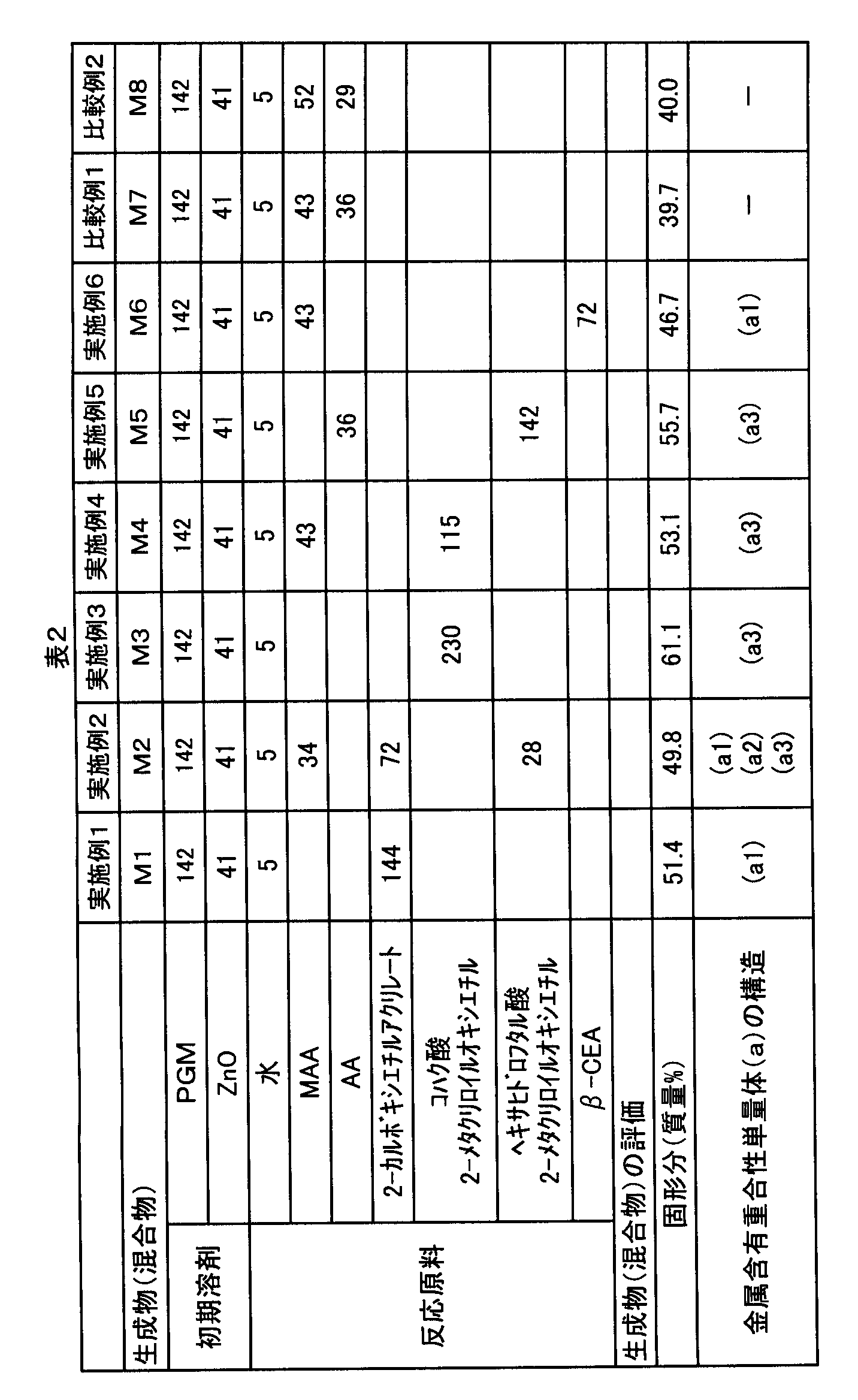
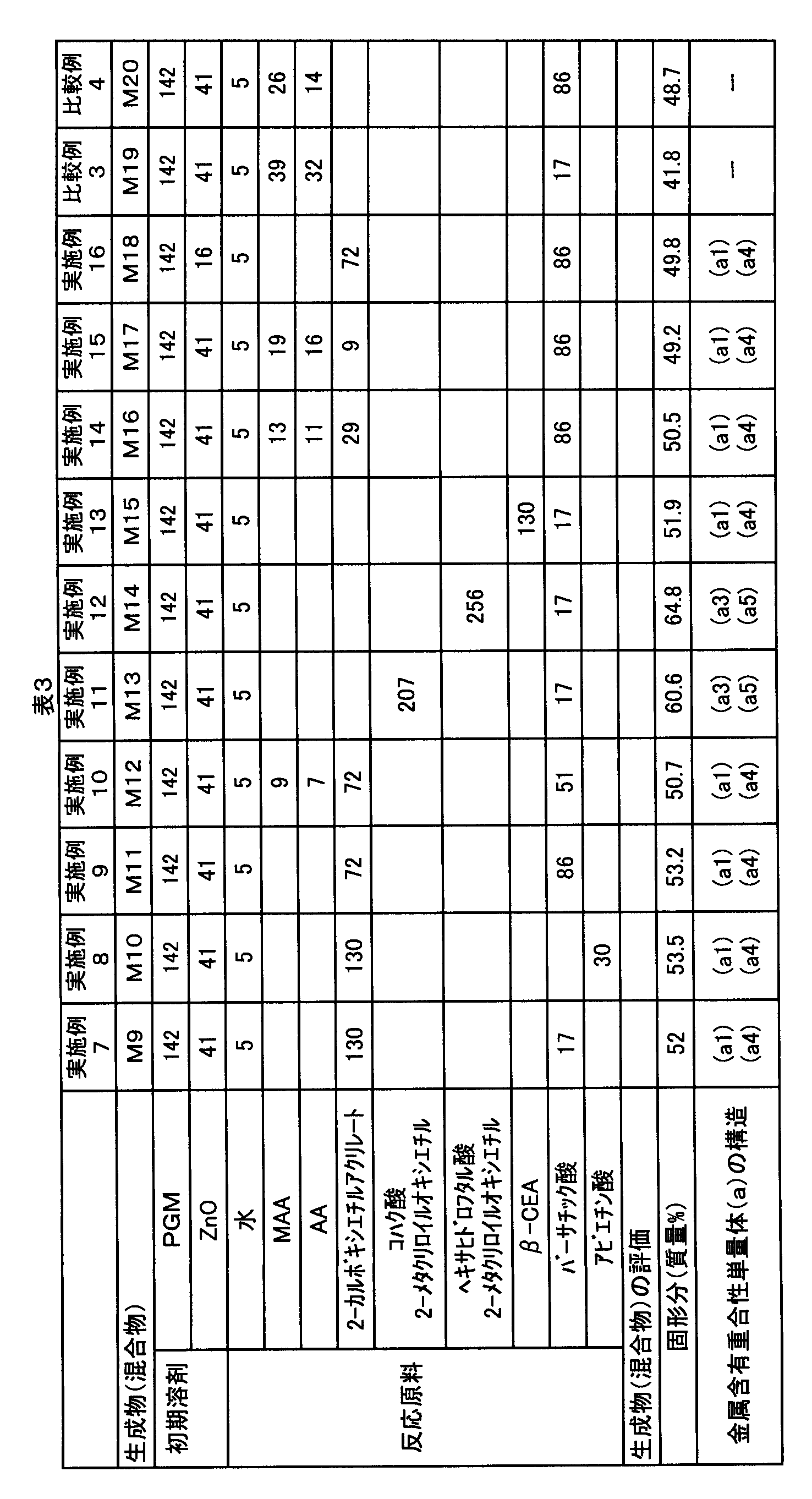
- Examples 2 to 16 and Comparative Examples 1 to 4 Contains divalent metal in the same manner as in Example 1 except that the amount of the initial solvent in the four-necked flask and the type and amount of the reaction raw material in the dropping funnel were changed to the conditions shown in Table 2 or Table 3. Mixtures M2 to M20 of sexual monomers were produced. The solid contents of the mixtures M2 to M20 are shown in Table 2 or Table 3.
- the obtained antifouling paint was applied onto a predetermined substrate so that the dry film thickness was about 300 ⁇ m, and dried at room temperature for 1 week.
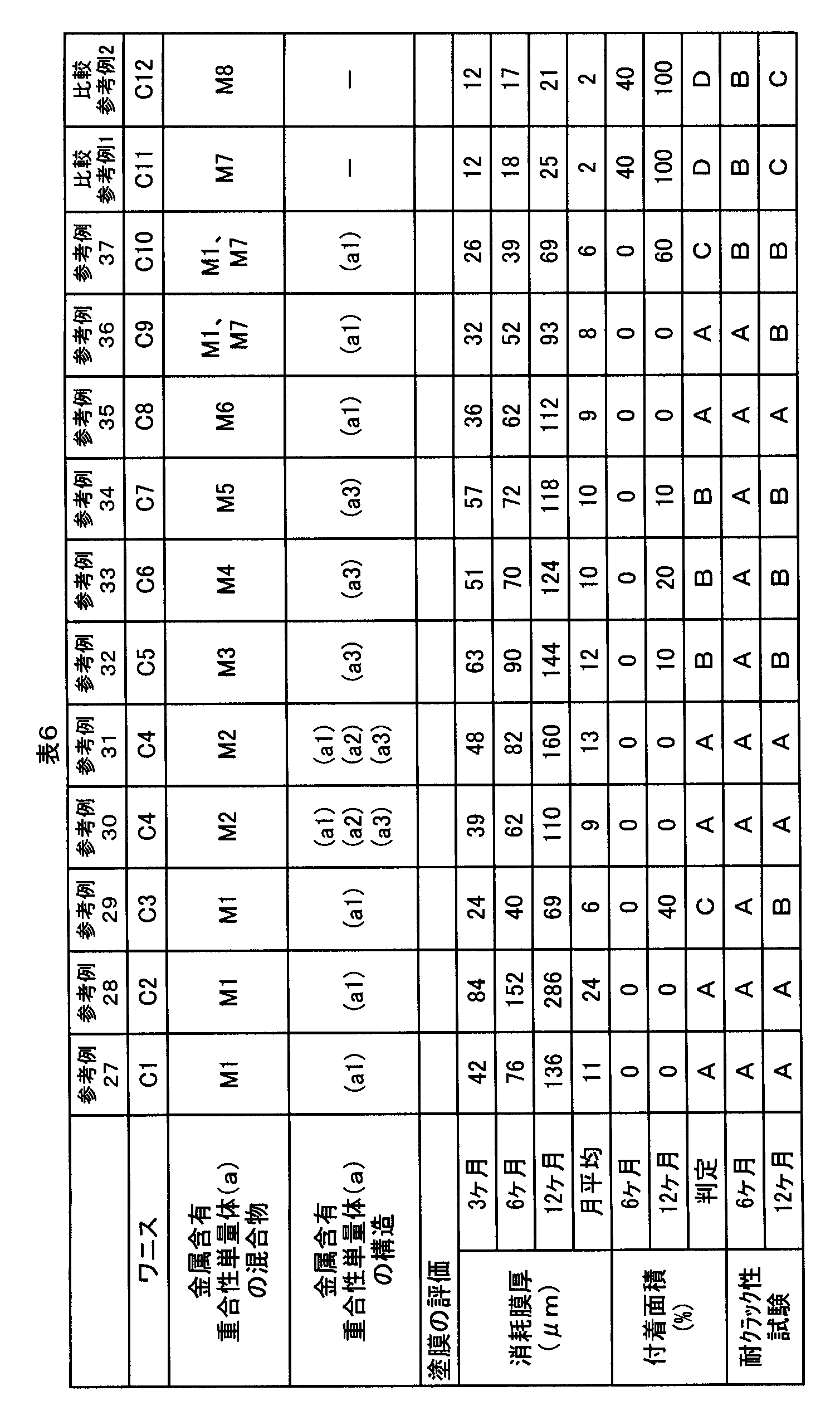
- the obtained coating film was subjected to a wear degree test, an antifouling test, and a crack resistance test. The evaluation results are shown in Table 6.
- the obtained antifouling paint was applied onto a substrate in the same manner as in Reference Example 27 to obtain a coating film.
- the evaluation results are shown in Table 6.
Landscapes
- Chemical & Material Sciences (AREA)
- Organic Chemistry (AREA)
- Engineering & Computer Science (AREA)
- Polymers & Plastics (AREA)
- Health & Medical Sciences (AREA)
- Chemical Kinetics & Catalysis (AREA)
- Medicinal Chemistry (AREA)
- Oil, Petroleum & Natural Gas (AREA)
- Wood Science & Technology (AREA)
- Materials Engineering (AREA)
- Life Sciences & Earth Sciences (AREA)
- Addition Polymer Or Copolymer, Post-Treatments, Or Chemical Modifications (AREA)
- Paints Or Removers (AREA)
- Organic Low-Molecular-Weight Compounds And Preparation Thereof (AREA)
Abstract
Description





前記一般式(1)で示される金属含有重合性単量体(a1)の具体例として以下のものが挙げられる。ジ(3-アクリロイルオキシプロピオン酸)亜鉛、ジ(3-アクリロイルオキシプロピオン酸)銅、ジ(3-アクリロイルオキシプロピオン酸)マグネシウム、ジ(3-メタクリロイルオキシ2-メチルプロピオン酸)亜鉛、ジ(3-メタクリロイルオキシ2-メチルプロピオン酸)銅、ジ(3-メタクリロイルオキシ2-メチルプロピオン酸)マグネシウム、(メタ)アクリル酸3-アクリロイルオキシプロピオン酸亜鉛、(メタ)アクリル酸3-アクリロイルオキシプロピオン酸銅、(メタ)アクリル酸3-アクリロイルオキシプロピオン酸マグネシウム、(メタ)アクリル酸3-メタクリロイルオキシ2-メチルプロピオン酸亜鉛、(メタ)アクリル酸3-メタクリロイルオキシ2-メチルプロピオン酸銅、および、(メタ)アクリル酸3-メタクリロイルオキシ2-メチルプロピオン酸マグネシウム等。
前記一般式(2)で示される金属含有重合性単量体(a2)の具体例として以下のものが挙げられる。コハク酸2-(メタ)アクリロイルオキシエチル3-アクリロイルオキシプロピオン酸亜鉛、コハク酸2-(メタ)アクリロイルオキシエチル3-アクリロイルオキシプロピオン酸銅、コハク酸2-(メタ)アクリロイルオキシエチル3-アクリロイルオキシプロピオン酸マグネシウム、コハク酸2-(メタ)アクリロイルオキシエチル3-メタクリロイルオキシ2-メチルプロピオン酸亜鉛、コハク酸2-(メタ)アクリロイルオキシエチル3-メタクリロイルオキシ2-メチルプロピオン酸銅、コハク酸2-(メタ)アクリロイルオキシエチル3-メタクリロイルオキシ2-メチルプロピオン酸マグネシウム、フタル酸2-(メタ)アクリロイルオキシエチル3-アクリロイルオキシプロピオン酸亜鉛、フタル酸2-(メタ)アクリロイルオキシエチル3-アクリロイルオキシプロピオン酸銅、フタル酸2-(メタ)アクリロイルオキシエチル3-アクリロイルオキシプロピオン酸マグネシウム、フタル酸2-(メタ)アクリロイルオキシエチル3-メタクリロイルオキシ2-メチルプロピオン酸亜鉛、フタル酸2-(メタ)アクリロイルオキシエチル3-メタクリロイルオキシ2-メチルプロピオン酸銅、フタル酸2-(メタ)アクリロイルオキシエチル3-メタクリロイルオキシ2-メチルプロピオン酸マグネシム、ヘキサヒドロフタル酸2-(メタ)アクリロイルオキシエチル3-アクリロイルオキシプロピオン酸亜鉛、ヘキサヒドロフタル酸2-(メタ)アクリロイルオキシエチル3-アクリロイルオキシプロピオン酸銅、ヘキサヒドロフタル酸2-(メタ)アクリロイルオキシエチル3-アクリロイルオキシプロピオン酸マグネシウム、ヘキサヒドロフタル酸2-(メタ)アクリロイルオキシエチル3-メタクリロイルオキシ2-メチルプロピオン酸亜鉛、ヘキサヒドロフタル酸2-(メタ)アクリロイルオキシエチル3-メタクリロイルオキシ2-メチルプロピオン酸銅、および、ヘキサヒドロフタル酸2-(メタ)アクリロイルオキシエチル3-メタクリロイルオキシ2-メチルプロピオン酸マグネシウム等。
前記一般式(3)で示される金属含有重合性単量体(a3)の具体例として以下のものが挙げられる。ジ(コハク酸2-(メタ)アクリロイルオキシエチル)亜鉛、ジ(コハク酸2-(メタ)アクリロイルオキシエチル)銅、ジ(コハク酸2-(メタ)アクリロイルオキシエチル)マグネシウム、ジ(フタル酸2-(メタ)アクリロイルオキシエチル)亜鉛、ジ(フタル酸2-(メタ)アクリロイルオキシエチル)銅、ジ(フタル酸2-(メタ)アクリロイルオキシエチル)マグネシウム、ジ(ヘキサヒドロフタル酸2-(メタ)アクリロイルオキシエチル)亜鉛、ジ(ヘキサヒドロフタル酸2-(メタ)アクリロイルオキシエチル)銅、ジ(ヘキサヒドロフタル酸2-(メタ)アクリロイルオキシエチル)マグネシウム、コハク酸2-(メタ)アクリロイルオキシエチル(メタ)アクリル酸亜鉛、コハク酸2-(メタ)アクリロイルオキシエチル(メタ)アクリル酸銅、コハク酸2-(メタ)アクリロイルオキシエチル(メタ)アクリル酸マグネシウム、フタル酸2-(メタ)アクリロイルオキシエチル(メタ)アクリル酸亜鉛、フタル酸2-(メタ)アクリロイルオキシエチル(メタ)アクリル酸銅、フタル酸2-(メタ)アクリロイルオキシエチル(メタ)アクリル酸マグネシウム、ヘキサヒドロフタル酸2-(メタ)アクリロイルオキシエチル(メタ)アクリル酸亜鉛、ヘキサヒドロフタル酸2-(メタ)アクリロイルオキシエチル(メタ)アクリル酸銅、および、ヘキサヒドロフタル酸2-(メタ)アクリロイルオキシエチル(メタ)アクリル酸マグネシウム等。
前記一般式(4)で示される金属含有重合性単量体(a4)の具体例として以下のものが挙げられる。3-(メタ)アクリロイルオキシプロピオン酸(バーサチック酸)亜鉛、3-(メタ)アクリロイルオキシプロピオン酸(オクチル酸)亜鉛、3-(メタ)アクリロイルオキシプロピオン酸(ステアリン酸)亜鉛、3-(メタ)アクリロイルオキシプロピオン酸(アビチエン酸)亜鉛、3-(メタ)アクリロイルオキシプロピオン酸(バーサチック酸)銅、3-(メタ)アクリロイルオキシプロピオン酸(オクチル酸)銅、3-(メタ)アクリロイルオキシプロピオン酸(ステアリン酸)銅、3-(メタ)アクリロイルオキシプロピオン酸(アビチエン酸)銅、3-(メタ)アクリロイルオキシプロピオン酸(バーサチック酸)マグネシウム、3-(メタ)アクリロイルオキシプロピオン酸(オクチル酸)マグネシウム、3-(メタ)アクリロイルオキシプロピオン酸(ステアリン酸)マグネシウム、3-(メタ)アクリロイルオキシプロピオン酸(アビチエン酸)マグネシウム、3-(メタ)アクリロイルオキシ2-メチルプロピオン酸(バーサチック酸)亜鉛、3-(メタ)アクリロイルオキシ2-メチルプロピオン酸(オクチル酸)亜鉛、3-(メタ)アクリロイルオキシ2-メチルプロピオン酸(ステアリン酸)亜鉛、3-(メタ)アクリロイルオキシ2-メチルプロピオン酸(アビチエン酸)亜鉛、3-(メタ)アクリロイルオキシ2-メチルプロピオン酸(バーサチック酸)銅、3-(メタ)アクリロイルオキシ2-メチルプロピオン酸(オクチル酸)銅、3-(メタ)アクリロイルオキシ2-メチルプロピオン酸(ステアリン酸)銅、3-(メタ)アクリロイルオキシ2-メチルプロピオン酸(アビチエン酸)銅、3-(メタ)アクリロイルオキシ2-メチルプロピオン酸(バーサチック酸)マグネシウム、3-(メタ)アクリロイルオキシ2-メチルプロピオン酸(オクチル酸)マグネシウム、3-(メタ)アクリロイルオキシ2-メチルプロピオン酸(ステアリン酸)マグネシウム、および、3-(メタ)アクリロイルオキシ2-メチルプロピオン酸(アビチエン酸)マグネシウム等。
前記一般式(5)で示される金属含有重合性単量体(a5)の具体例として以下のものが挙げられる。コハク酸2-(メタ)アクリロイルオキシエチル(バーサチック酸)亜鉛、コハク酸2-(メタ)アクリロイルオキシエチル(オクチル酸)亜鉛、コハク酸2-(メタ)アクリロイルオキシエチル(ステアリン酸)亜鉛、コハク酸2-(メタ)アクリロイルオキシエチル(アビチエン酸)亜鉛、コハク酸2-(メタ)アクリロイルオキシエチル(バーサチック酸)銅、コハク酸2-(メタ)アクリロイルオキシエチル(オクチル酸)銅、コハク酸2-(メタ)アクリロイルオキシエチル(ステアリン酸)銅、コハク酸2-(メタ)アクリロイルオキシエチル(アビチエン酸)銅、コハク酸2-(メタ)アクリロイルオキシエチル(バーサチック酸)マグネシウム、コハク酸2-(メタ)アクリロイルオキシエチル(オクチル酸)マグネシウム、コハク酸2-(メタ)アクリロイルオキシエチル(ステアリン酸)マグネシウム、コハク酸2-(メタ)アクリロイルオキシエチル(アビチエン酸)マグネシウム、フタル酸2-(メタ)アクリロイルオキシエチル(バーサチック酸)亜鉛、フタル酸2-(メタ)アクリロイルオキシエチル(オクチル酸)亜鉛、フタル酸2-(メタ)アクリロイルオキシエチル(ステアリン酸)亜鉛、フタル酸2-(メタ)アクリロイルオキシエチル(アビチエン酸)亜鉛、フタル酸2-(メタ)アクリロイルオキシエチル(バーサチック酸)銅、フタル酸2-(メタ)アクリロイルオキシエチル(オクチル酸)銅、フタル酸2-(メタ)アクリロイルオキシエチル(ステアリン酸)銅、フタル酸2-(メタ)アクリロイルオキシエチル(アビチエン酸)銅、フタル酸2-(メタ)アクリロイルオキシエチル(バーサチック酸)マグネシウム、フタル酸2-(メタ)アクリロイルオキシエチル(オクチル酸)マグネシウム、フタル酸2-(メタ)アクリロイルオキシエチル(ステアリン酸)マグネシウム、フタル酸2-(メタ)アクリロイルオキシエチル(アビチエン酸)マグネシウム、ヘキサヒドロフタル酸2-(メタ)アクリロイルオキシエチル(バーサチック酸)亜鉛、ヘキサヒドロフタル酸2-(メタ)アクリロイルオキシエチル(オクチル酸)亜鉛、ヘキサヒドロフタル酸2-(メタ)アクリロイルオキシエチル(ステアリン酸)亜鉛、ヘキサヒドロフタル酸2-(メタ)アクリロイルオキシエチル(アビチエン酸)亜鉛、ヘキサヒドロフタル酸2-(メタ)アクリロイルオキシエチル(バーサチック酸)銅、ヘキサヒドロフタル酸2-(メタ)アクリロイルオキシエチル(オクチル酸)銅、ヘキサヒドロフタル酸2-(メタ)アクリロイルオキシエチル(ステアリン酸)銅、ヘキサヒドロフタル酸2-(メタ)アクリロイルオキシエチル(アビチエン酸)銅、ヘキサヒドロフタル酸2-(メタ)アクリロイルオキシエチル(バーサチック酸)マグネシウム、ヘキサヒドロフタル酸2-(メタ)アクリロイルオキシエチル(オクチル酸)マグネシウム、ヘキサヒドロフタル酸2-(メタ)アクリロイルオキシエチル(ステアリン酸)マグネシウム、および、ヘキサヒドロフタル酸2-(メタ)アクリロイルオキシエチル(アビチエン酸)マグネシウム等。
一般式(1)~(5)で示される金属含有重合性単量体(a1)、(a2)、(a3)、(a4)および(a5)(以下、これらを「2価金属含有重合性単量体(a)」と総称する場合がある。)は、以下の方法によって製造することができる。金属含有重合性単量体(a1)、(a2)および(a3)は、例えば、無機金属化合物と、カルボキシル基含有重合性単量体とを反応させる方法によって製造できる。また、金属含有重合性単量体(a4)および(a5)は、例えば、無機金属化合物と、カルボキシル基含有重合性単量体およびカルボキシル基含有非重合性化合物(以下、両者を併せて「カルボキシル基含有化合物」という場合がある。)とを反応させる方法によって製造できる。なお、ここで「重合性単量体」とは重合性不飽和2重結合を有する化合物を意味し、「非重合性化合物」とは重合性不飽和2重結合を有しない化合物を意味する。
2価金属含有共重合体は、本発明の2価金属を含有する金属含有重合性単量体(a1)~(a5)の群から選ばれる1種以上の単量体と、2価金属非含有重合性単量体(b)とを重合することによって製造することができる。
本発明において、2価金属非含有重合性単量体(b)とは、2価金属を含有しない重合性単量体であり、重合性不飽和2重結合を有する単量体であれば特に限定されず、例えば以下のものが挙げられる。メチル(メタ)アクリレート、エチル(メタ)アクリレート、2-メトキシエチル(メタ)アクリレート、n-ブチル(メタ)アクリレート、i-ブチル(メタ)アクリレート、t-ブチル(メタ)アクリレート、2-エチルヘキシル(メタ)アクリレート、ラウリル(メタ)アクリレート、ステアリル(メタ)アクリレート、ベンジル(メタ)アクリレート、フェニル(メタ)アクリレート、イソボルニル(メタ)アクリレート、シクロヘキシル(メタ)アクリレート、グリシジル(メタ)アクリレート等の(メタ)アクリル酸エステル単量体;2-ヒドロキシエチル(メタ)アクリレート、2-ヒドロキシプロピル(メタ)アクリレート、2-ヒドロキシブチル(メタ)アクリレート、4-ヒドロキシブチル(メタ)アクリレート等の水酸基含有(メタ)アクリル酸エステル単量体;2-ヒドロキシエチル(メタ)アクリレート、2-ヒドロキシプロピル(メタ)アクリレート等の水酸基含有(メタ)アクリル酸エステル単量体と、エチレンオキサイド、プロピレンオキサイド、γ-ブチロラクトンまたはε-カプロラクトン等との付加物;(メタ)アクリル酸、フマル酸、マレイン酸、イタコン酸、ソルビン酸等のカルボキシル基含有単量体;無水イタコン酸、無水マレイン酸等のカルボン酸無水物基含有単量体;イタコン酸モノアルキル、マレイン酸モノアルキル等のジカルボン酸モノエステル類;2-ヒドロキシエチル(メタ)アクリレート、2-ヒドロキシプロピル(メタ)アクリレート等の水酸基含有(メタ)アクリル酸エステル単量体の二量体または三量体;グリセロール(メタ)アクリレート等の水酸基を複数有する(メタ)アクリル酸エステル単量体;ブチルアミノエチル(メタ)アクリレート、(メタ)アクリルアミド等の第一級および第二級アミノ基含有(メタ)アクリル酸エステル単量体;ジメチルアミノエチル(メタ)アクリレート、ジエチルアミノエチル(メタ)アクリレート等のアミノ基含有(メタ)アクリル酸エステル単量体;(メタ)アクリルアミド、N-ブチル(メタ)アクリルアミド等の(メタ)アクリルアミド単量体;スチレン、α-メチルスチレン、ビニルトルエン、(メタ)アクリロニトリル、塩化ビニル、酢酸ビニル等のビニル系単量体;アリルグリコール、ポリエチレングリコールアリルエーテル、メトキシポリエチレングリコールアリルエーテル、ブトキシポリエチレングリコールアリルエーテル、ポリプロピレングリコールアリルエーテル、メトキシポリプロピレングリコールアリルエーテル、ブトキシポリプロピレングリコールアリルエーテル等のアリル基含有単量体;並びに、エチレングリコールジ(メタ)アクリレート、ジエチレングリコールジ(メタ)アクリレート、トリエチレングリコールジ(メタ)アクリレート、アリル(メタ)アクリレート等の多官能(メタ)アクリル酸エステル単量体等。これらの単量体は単独であるいは2種類以上で使用される。
本発明の2価金属含有重合性単量体(a)を用いて得られる2価金属含有共重合体を構成成分として含む防汚塗料用組成物は、2価金属含有共重合体を含有することから、形成される塗膜に優れた防汚性能を保持させることができる。この防汚塗料用組成物は、さらに、防汚薬剤を配合することによって、防汚性能を向上させることができる。防汚塗料が、この防汚塗料用組成物と共に、防汚薬剤や顔料成分等を含む場合における、防汚塗料中の2価金属含有共重合体の割合は、樹脂成分として通常15質量%(固形分換算)以上であることが好ましい。この配合量が15質量%以上であれば、防汚塗料中における2価金属含有共重合体の溶解性が良好であって、塗膜の防汚性および耐クラック性が良好である。
(1)防汚塗料を、船舶、各種漁網、港湾施設、オイルフェンス、橋梁、海底基地等の水中構造物等の基材表面に直接に塗布する。
(2)基材にウオッシュプライマー、塩化ゴム系、エポキシ系等のプライマー、中塗り塗料等を塗布し、これによって得られた塗膜の上に、刷毛塗り、吹き付け塗り、ローラー塗り、沈漬塗り等の手段で防汚塗料を塗布する。
試料約0.5gを105℃で2時間加熱乾燥した後、その残分の質量を量り、下記計算式より算出した。
固形分(質量%)=残量の質量(g)/試料の質量(g)×100
[2.塗膜の消耗度試験]
縦50mm、横50mm、厚み2mmの硬質塩化ビニル製の板の上に厚み約300μmの塗膜を形成し、得られた試験片を海水中に設置した回転ドラムに取り付けた。そして、周速7.7m/s(15ノット)で回転させて、3ヵ月後、6ヵ月後および12ヶ月後の消耗膜厚を測定した。
あらかじめ防錆塗料が塗布されているサンドブラスト鋼製の板の上に厚み約300μmの塗膜を形成し、得られた試験片を広島県広島湾内で12ヶ月間静置浸漬し、6ヵ月後、および12ヶ月後の付着生物の付着面積(%)を調べた。判定は以下の基準で行った。
A:12ヶ月後の付着生物の付着面積が0%以上10%未満である。
B:12ヶ月後の付着生物の付着面積が10%以上40%未満である。
C:12ヶ月後の付着生物の付着面積が40%以上80%未満である。
D:12ヶ月後の付着生物の付着面積が80%以上100%以下である。
あらかじめ防錆塗料が塗布されているサンドブラスト鋼製の板の上に厚み約300μmの塗膜を形成し、得られた試験片を滅菌濾過した海水中に20℃で、6ヶ月間および12ヶ月間浸漬した後、20℃で1週間乾燥した。そして、塗膜表面を観察した。評価は以下の基準で行った。
A:クラックおよび剥離が全く観察されない。
B:クラックがわずかに観察される。
C:クラックおよび剥離が一部に観察される。
D:クラックおよび剥離が全面に観察される。
冷却器、温度計、滴下ロートおよび攪拌機を備えた四つ口フラスコ内に、初期溶剤としてのPGM(プロピレングリコールメチルエーテル)142部および酸化亜鉛41部を仕込み、撹拌しながらフラスコ内の液体の温度を75℃に昇温した。一方、滴下ロート内に2-カルボキシエチルアクリレート144部および水5部からなる混合物(反応原料)を入れた。この混合物を、単位時間当たりの添加量を一定にして、3時間かけて前記フラスコ内に滴下した。さらにフラスコ内の液体を2時間撹拌した後、PGM10部を添加して透明な2価金属含有重合性単量体(a)の混合物M1を得た。混合物M1の固形分は51.4質量%であった。
四つ口フラスコ内の初期溶剤の使用量並びに滴下ロート内の反応原料の種類と使用量を表2または表3に示す条件に変更したこと以外は実施例1と同様にして、2価金属含有性単量体の混合物M2~M20を製造した。混合物M2~M20の固形分を表2または表3に示す。
冷却器、温度計、滴下タンクおよび攪拌機を備えた四つ口フラスコ内に、キシレン66.4部、PGM(プロピレングリコールメチルエーテル)15部、エチルアクリレート4部を仕込み、撹拌しながらフラスコ内の液体の温度を100℃に昇温した。一方、メチルメタクリレート30部、エチルアクリレート22.7部、n-ブチルアクリレート20部、混合物M1:53.1部(固形分27.3部)、キシレン10部、連鎖移動剤(日本油脂(株)製、ノフマーMSD)1部、AIBN2部、AMBN8部からなる透明な混合物を調製して、滴下タンク内に入れた。この滴下タンク内の混合物を、単位時間当たりの添加量を一定にして、6時間かけて四つ口フラスコ内に滴下した。滴下終了後、さらにt-ブチルパーオクトエート0.5部とキシレン15部の混合物を30分間かけてフラスコ内に滴下し、さらに1時間30分間、撹拌した。その後、300メッシュのナイロンメッシュを用いてフラスコ内の混合物をろ過して、ガードナー粘度QRを有する不溶解物のないワニスC1を得た。ワニスC1の固形分は46.2質量%であった。
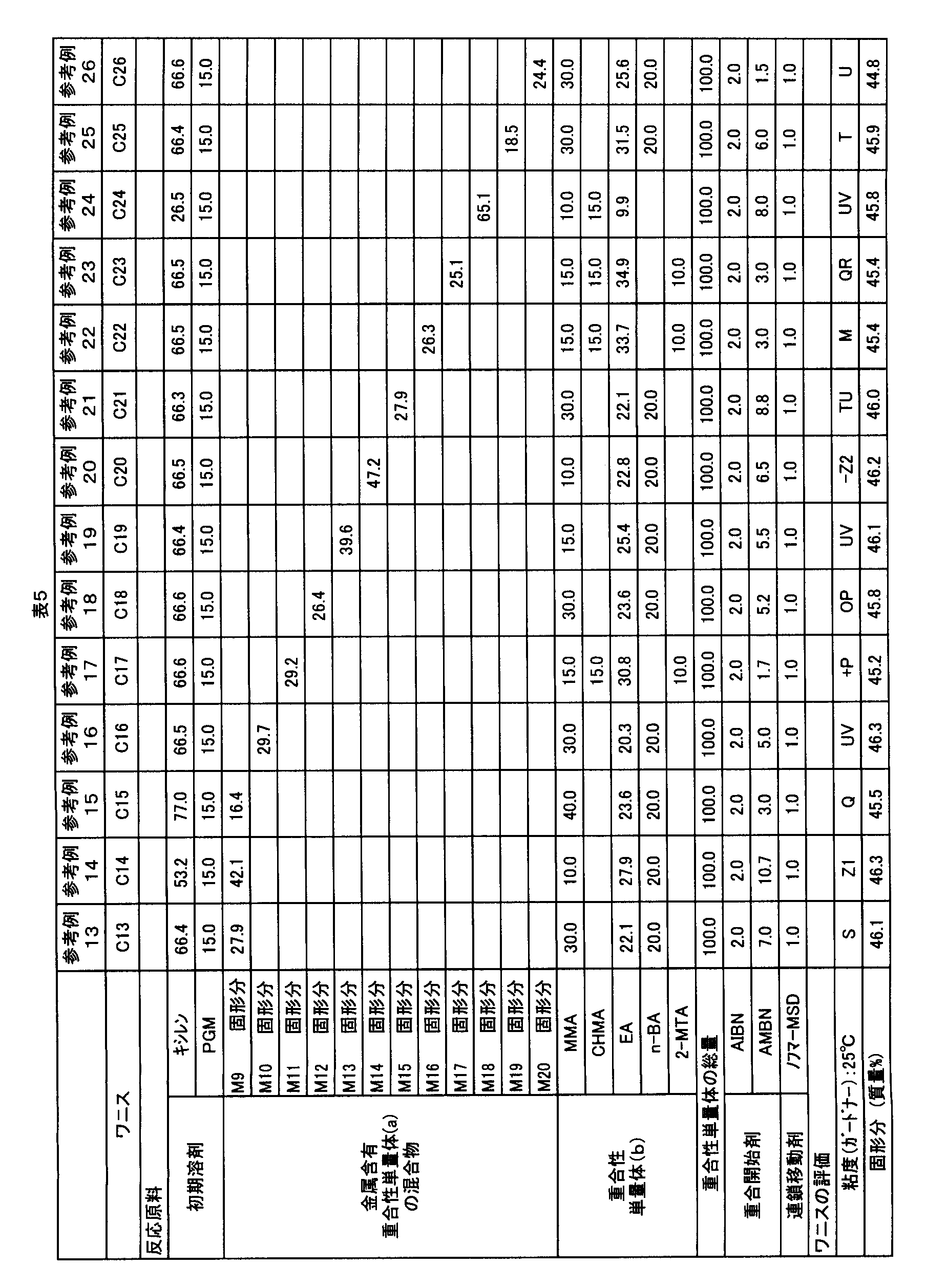
初期溶剤の使用量並びに滴下タンク中の材料の種類と使用量を表4または表5に示す条件に変更したこと以外は実施例21と同様にして、ワニスC2~C26を製造した。各ワニスの固形分を表4または表5に示す。
下記の5種類の材料を混合し防汚塗料を調製した。なお、適量のキシレンを加えて、ストマー粘度計(25℃)にて80~90KUとなるように粘度を調整した。
・ワニスC1:40部、
・亜酸化銅:50部、
・酸化鉄:1.5部、
・粉末状シリカ:3部、
・ディスパロン4200-20(楠本化成(株)製、沈降防止剤):1部。
材料の種類を表6または表7に示す条件としたこと以外は、参考例27と同様にして防汚塗料を調製し、基板上に塗布して塗膜を得た。評価結果を表6または表7に示す。
下記の6種類の材料を混合し防汚塗料を調製した。なお、適量のキシレンを加えて、ストマー粘度計(25℃)にて80~90KUとなるように粘度を調整した。
・ワニスC4:40部、
・ロダン銅:40部、
・2-ピリジンチオール-1-オキシド亜鉛塩:3部、
・酸化チタン:10部、
・粉末状シリカ:3部、
・ディスパロン4200-20:1部。
材料の種類を表7に示す条件としたこと以外は、参考例31と同様にして防汚塗料を調製し、基板上に塗布して塗膜を得た。評価結果を表7に示す。
材料の種類を表6または表7に示す条件としたこと以外は、参考例27と同様にして塗料を調製し、基板上に塗布して塗膜を得た。評価結果を表6または表7に示す。比較例1~4では、防汚塗料が2価金属含有重合性単量体(a)を含まないことから、塗膜消耗度が不十分であるか、または、クラック剥離がランクDであり、結果的に十分な防汚性が得られなかった。



Claims (6)
- 下記の一般式(1)で示される金属含有重合性単量体(a1):

- 下記の一般式(2)で示される金属含有重合性単量体(a2):

- 下記の一般式(3)で示される金属含有重合性単量体(a3):

- 下記の一般式(4)で示される金属含有重合性単量体(a4):

- 下記の一般式(5)で示される金属含有重合性単量体(a5):

- 無機金属化合物とカルボキシル基含有重合性単量体とを反応させる請求項1~5のいずれかの一項に記載の金属含有重合性単量体の製造方法。
Priority Applications (2)
| Application Number | Priority Date | Filing Date | Title |
|---|---|---|---|
| KR1020137032793A KR20140009558A (ko) | 2011-06-01 | 2012-06-01 | 금속 함유 중합성 단량체 및 그의 제조 방법 |
| CN201280029125.6A CN103608366A (zh) | 2011-06-01 | 2012-06-01 | 含金属的聚合性单体及其制造方法 |
Applications Claiming Priority (4)
| Application Number | Priority Date | Filing Date | Title |
|---|---|---|---|
| JP2011-123308 | 2011-06-01 | ||
| JP2011123308 | 2011-06-01 | ||
| JP2011209375 | 2011-09-26 | ||
| JP2011-209375 | 2011-09-26 |
Publications (1)
| Publication Number | Publication Date |
|---|---|
| WO2012165618A1 true WO2012165618A1 (ja) | 2012-12-06 |
Family
ID=47259469
Family Applications (2)
| Application Number | Title | Priority Date | Filing Date |
|---|---|---|---|
| PCT/JP2012/064285 Ceased WO2012165618A1 (ja) | 2011-06-01 | 2012-06-01 | 金属含有重合性単量体およびその製造方法 |
| PCT/JP2012/064313 Ceased WO2012165628A1 (ja) | 2011-06-01 | 2012-06-01 | 金属含有共重合体、その製造方法、防汚塗料用組成物、防汚塗料およびその塗膜を有する物品 |
Family Applications After (1)
| Application Number | Title | Priority Date | Filing Date |
|---|---|---|---|
| PCT/JP2012/064313 Ceased WO2012165628A1 (ja) | 2011-06-01 | 2012-06-01 | 金属含有共重合体、その製造方法、防汚塗料用組成物、防汚塗料およびその塗膜を有する物品 |
Country Status (4)
| Country | Link |
|---|---|
| JP (2) | JPWO2012165618A1 (ja) |
| KR (2) | KR20140009558A (ja) |
| CN (2) | CN103582657B (ja) |
| WO (2) | WO2012165618A1 (ja) |
Families Citing this family (4)
| Publication number | Priority date | Publication date | Assignee | Title |
|---|---|---|---|---|
| JP3072994B2 (ja) | 1989-03-20 | 2000-08-07 | 株式会社日立製作所 | トラツキングフイルタ付制御回路 |
| JP6472934B2 (ja) * | 2016-07-01 | 2019-02-20 | 中国塗料株式会社 | 積層防汚塗膜、防汚基材及び船舶 |
| SG11201810930RA (en) | 2016-07-05 | 2019-01-30 | Mitsubishi Chem Corp | Polymer-containing composition and antifouling coating composition |
| CN110607109B (zh) * | 2019-09-16 | 2021-08-03 | 浙江鱼童新材料股份有限公司 | 一种环保型防腐涂料及其制备方法 |
Citations (5)
| Publication number | Priority date | Publication date | Assignee | Title |
|---|---|---|---|---|
| JPH03246256A (ja) * | 1989-09-27 | 1991-11-01 | Jujo Paper Co Ltd | 新規なフタル酸誘導体金属塩及び該金属塩を含有する光遮断性及び光感応性のあるプレート |
| JPH05505836A (ja) * | 1990-03-08 | 1993-08-26 | デーエスエム ナムローゼ フェンノートシャップ | 放射線硬化可能な液状配合物 |
| JP2002105127A (ja) * | 2000-10-02 | 2002-04-10 | Nippon Shokubai Co Ltd | 金属塩をもつビニルモノマーを含む反応生成物およびこれを用いたポリマー |
| JP2002105135A (ja) * | 2000-10-02 | 2002-04-10 | Nippon Shokubai Co Ltd | 金属塩をもつビニルモノマーを含む反応生成物およびこれを用いたポリマー |
| JP2006008730A (ja) * | 2004-06-22 | 2006-01-12 | Kyoeisha Chem Co Ltd | 油膜被覆鋼材と発泡した硬化エポキシ樹脂充填材との接着性の増強剤 |
Family Cites Families (9)
| Publication number | Priority date | Publication date | Assignee | Title |
|---|---|---|---|---|
| EP0204456B1 (en) | 1985-05-17 | 1991-10-09 | Nippon Paint Co., Ltd. | A hydrolyzable resin composition and an antifouling coating composition containing the same |
| JPH0625317B2 (ja) * | 1986-08-26 | 1994-04-06 | 日本ペイント株式会社 | 防汚塗料用球形崩壊型ビニル樹脂粒子 |
| US6727304B2 (en) * | 2000-06-28 | 2004-04-27 | Mitsubishi Rayon Co., Ltd. | Metal-containing monomer dissolved mixture, metal-containing resin and antifouling paint composition |
| JP4846093B2 (ja) | 2000-12-25 | 2011-12-28 | 三菱レイヨン株式会社 | 金属含有共重合体の製造方法 |
| CN101492589A (zh) * | 2003-03-14 | 2009-07-29 | 三菱丽阳株式会社 | 防污涂料组合物 |
| DE602006017399D1 (de) * | 2005-09-01 | 2010-11-18 | Chugoku Marine Paints | Fleckenbeständige beschichtungszusammensetzung, flem beschichtungsfilm, verfahren zur formung einer d verfahren zur herstellung der fleckenbeständigkeit eines substrats |
| EP1978065A4 (en) * | 2005-12-28 | 2010-08-04 | Chugoku Marine Paints | HIGH SOLID ANTIFOULING COATING COMPOSITION, ANTIFOULING COATING FILM, COATED FILM BASE, ANTIFOULING BASE, METHOD FOR PRODUCING A COATING FILM ON A BASE SURFACE, METHOD FOR PREVENTING FOULING OF A BASE AND HIGHLY SOLID MULTICOMPONENT ANTIFOULING COATING COMPOSITION COMBINATION |
| DE102007034456A1 (de) * | 2007-07-20 | 2009-01-22 | Evonik Röhm Gmbh | Beschichtungsformulierung mit verbesserter Metallhaftung |
| JP5497351B2 (ja) * | 2009-07-10 | 2014-05-21 | 三菱レイヨン株式会社 | 防汚塗料用金属含有共重合体の製造方法および防汚塗料組成物 |
-
2012
- 2012-06-01 KR KR1020137032793A patent/KR20140009558A/ko not_active Ceased
- 2012-06-01 JP JP2012526773A patent/JPWO2012165618A1/ja active Pending
- 2012-06-01 JP JP2012526772A patent/JP5949549B2/ja not_active Expired - Fee Related
- 2012-06-01 KR KR1020137032792A patent/KR101668909B1/ko active Active
- 2012-06-01 CN CN201280026999.6A patent/CN103582657B/zh active Active
- 2012-06-01 WO PCT/JP2012/064285 patent/WO2012165618A1/ja not_active Ceased
- 2012-06-01 CN CN201280029125.6A patent/CN103608366A/zh active Pending
- 2012-06-01 WO PCT/JP2012/064313 patent/WO2012165628A1/ja not_active Ceased
Patent Citations (5)
| Publication number | Priority date | Publication date | Assignee | Title |
|---|---|---|---|---|
| JPH03246256A (ja) * | 1989-09-27 | 1991-11-01 | Jujo Paper Co Ltd | 新規なフタル酸誘導体金属塩及び該金属塩を含有する光遮断性及び光感応性のあるプレート |
| JPH05505836A (ja) * | 1990-03-08 | 1993-08-26 | デーエスエム ナムローゼ フェンノートシャップ | 放射線硬化可能な液状配合物 |
| JP2002105127A (ja) * | 2000-10-02 | 2002-04-10 | Nippon Shokubai Co Ltd | 金属塩をもつビニルモノマーを含む反応生成物およびこれを用いたポリマー |
| JP2002105135A (ja) * | 2000-10-02 | 2002-04-10 | Nippon Shokubai Co Ltd | 金属塩をもつビニルモノマーを含む反応生成物およびこれを用いたポリマー |
| JP2006008730A (ja) * | 2004-06-22 | 2006-01-12 | Kyoeisha Chem Co Ltd | 油膜被覆鋼材と発泡した硬化エポキシ樹脂充填材との接着性の増強剤 |
Also Published As
| Publication number | Publication date |
|---|---|
| CN103582657A (zh) | 2014-02-12 |
| JP5949549B2 (ja) | 2016-07-06 |
| CN103582657B (zh) | 2016-08-17 |
| KR101668909B1 (ko) | 2016-10-24 |
| WO2012165628A1 (ja) | 2012-12-06 |
| KR20140009558A (ko) | 2014-01-22 |
| JPWO2012165628A1 (ja) | 2015-02-23 |
| JPWO2012165618A1 (ja) | 2015-02-23 |
| CN103608366A (zh) | 2014-02-26 |
| KR20140009557A (ko) | 2014-01-22 |
Similar Documents
| Publication | Publication Date | Title |
|---|---|---|
| JP6426790B2 (ja) | 防汚塗料組成物、ならびに防汚塗膜、複合塗膜および水中構造物 | |
| JP6360909B2 (ja) | 二液型防汚塗料組成物、防汚塗膜、防汚基材および防汚基材の製造方法 | |
| JPWO2009031509A1 (ja) | 防汚塗料組成物、防汚塗膜、塗膜付き基材、防汚性基材、基材表面への塗膜の形成方法および基材の防汚方法 | |
| WO2011046087A1 (ja) | 防汚塗料組成物、ならびに防汚塗膜、複合塗膜および水中構造物 | |
| BR112012020841A2 (pt) | síntese de copolímero de acrilato de zinco. | |
| JP2010150355A (ja) | 防汚塗料組成物、防汚塗膜、ならびに防汚塗膜の加水分解速度の制御方法 | |
| WO2011158358A1 (ja) | 防汚塗料組成物、防汚塗膜、ならびに防汚塗膜の加水分解速度の制御方法 | |
| JP5949549B2 (ja) | 金属含有共重合体、その製造方法、防汚塗料用組成物、防汚塗料およびその塗膜を有する物品 | |
| JP6094484B2 (ja) | 防汚塗料用樹脂組成物、防汚塗料および防汚塗膜 | |
| JP4154344B2 (ja) | 塗料組成物及び共重合体 | |
| JP5424575B2 (ja) | 塗料組成物及び共重合体 | |
| JP2004196957A (ja) | 防汚塗料組成物、防汚塗膜、該防汚塗膜で被覆された船舶、水中構造物、漁具または漁網並びにこれらの防汚方法 | |
| JP2016210881A (ja) | 防汚塗料用樹脂組成物および防汚塗膜 | |
| JP4846093B2 (ja) | 金属含有共重合体の製造方法 | |
| JP5497351B2 (ja) | 防汚塗料用金属含有共重合体の製造方法および防汚塗料組成物 | |
| TW202003716A (zh) | 防污塗料組成物 | |
| CN113631378B (zh) | 防污涂料组合物 | |
| JPWO2009123263A1 (ja) | 淡水域対応型防汚塗料組成物、その塗膜、および防汚方法 | |
| JP4287482B2 (ja) | 防汚塗料 | |
| JP6354825B2 (ja) | 防汚塗料用金属含有共重合体および防汚塗料組成物 | |
| JP2002194293A (ja) | 防汚性塗料組成物 | |
| JP2000273366A (ja) | 防汚性塗料組成物 | |
| JP2015199857A (ja) | 2価金属含有樹脂の製造方法及び2価金属含有樹脂 | |
| JP2015178640A (ja) | 防汚塗料用金属含有共重合体および防汚塗料組成物 | |
| JP2013234329A (ja) | 防汚塗料用金属含有共重合体および防汚塗料組成物 |
Legal Events
| Date | Code | Title | Description |
|---|---|---|---|
| ENP | Entry into the national phase |
Ref document number: 2012526773 Country of ref document: JP Kind code of ref document: A |
|
| 121 | Ep: the epo has been informed by wipo that ep was designated in this application |
Ref document number: 12793514 Country of ref document: EP Kind code of ref document: A1 |
|
| NENP | Non-entry into the national phase |
Ref country code: DE |
|
| ENP | Entry into the national phase |
Ref document number: 20137032793 Country of ref document: KR Kind code of ref document: A |
|
| 122 | Ep: pct application non-entry in european phase |
Ref document number: 12793514 Country of ref document: EP Kind code of ref document: A1 |