WO2012161098A1 - アゾ系化合物及び該化合物を含むインク - Google Patents
アゾ系化合物及び該化合物を含むインク Download PDFInfo
- Publication number
- WO2012161098A1 WO2012161098A1 PCT/JP2012/062702 JP2012062702W WO2012161098A1 WO 2012161098 A1 WO2012161098 A1 WO 2012161098A1 JP 2012062702 W JP2012062702 W JP 2012062702W WO 2012161098 A1 WO2012161098 A1 WO 2012161098A1
- Authority
- WO
- WIPO (PCT)
- Prior art keywords
- group
- carbon atoms
- substituent
- compound
- general formula
- Prior art date
- Legal status (The legal status is an assumption and is not a legal conclusion. Google has not performed a legal analysis and makes no representation as to the accuracy of the status listed.)
- Ceased
Links
- 0 CC(C=C(C=C1)N(*)*)C=C1N=N[C@@]1Sc2ccccc2N1 Chemical compound CC(C=C(C=C1)N(*)*)C=C1N=N[C@@]1Sc2ccccc2N1 0.000 description 4
- ULYAQFDBACQQGC-UHFFFAOYSA-N CCCCC(CC)CNc(c(C(c1ccccc11)=O)c2C1=O)ccc2NCC(CC)CCCC Chemical compound CCCCC(CC)CNc(c(C(c1ccccc11)=O)c2C1=O)ccc2NCC(CC)CCCC ULYAQFDBACQQGC-UHFFFAOYSA-N 0.000 description 1
- XBFLKEDGKAJLEN-IHSPPPAMSA-N CCCC[C@H](CC)CN(CC(CC)CCCC)c1cccc(NC(C(CC)CCC)=O)c1 Chemical compound CCCC[C@H](CC)CN(CC(CC)CCCC)c1cccc(NC(C(CC)CCC)=O)c1 XBFLKEDGKAJLEN-IHSPPPAMSA-N 0.000 description 1
- PJQFZPWSFDVYIF-UHFFFAOYSA-N Cc1n[s]c(N)c1C#N Chemical compound Cc1n[s]c(N)c1C#N PJQFZPWSFDVYIF-UHFFFAOYSA-N 0.000 description 1
- FZOZZTMJYXSICC-UHFFFAOYSA-N NC(C1)C=CC=C1N Chemical compound NC(C1)C=CC=C1N FZOZZTMJYXSICC-UHFFFAOYSA-N 0.000 description 1
Classifications
-
- C—CHEMISTRY; METALLURGY
- C09—DYES; PAINTS; POLISHES; NATURAL RESINS; ADHESIVES; COMPOSITIONS NOT OTHERWISE PROVIDED FOR; APPLICATIONS OF MATERIALS NOT OTHERWISE PROVIDED FOR
- C09D—COATING COMPOSITIONS, e.g. PAINTS, VARNISHES OR LACQUERS; FILLING PASTES; CHEMICAL PAINT OR INK REMOVERS; INKS; CORRECTING FLUIDS; WOODSTAINS; PASTES OR SOLIDS FOR COLOURING OR PRINTING; USE OF MATERIALS THEREFOR
- C09D11/00—Inks
- C09D11/02—Printing inks
- C09D11/03—Printing inks characterised by features other than the chemical nature of the binder
-
- C—CHEMISTRY; METALLURGY
- C09—DYES; PAINTS; POLISHES; NATURAL RESINS; ADHESIVES; COMPOSITIONS NOT OTHERWISE PROVIDED FOR; APPLICATIONS OF MATERIALS NOT OTHERWISE PROVIDED FOR
- C09D—COATING COMPOSITIONS, e.g. PAINTS, VARNISHES OR LACQUERS; FILLING PASTES; CHEMICAL PAINT OR INK REMOVERS; INKS; CORRECTING FLUIDS; WOODSTAINS; PASTES OR SOLIDS FOR COLOURING OR PRINTING; USE OF MATERIALS THEREFOR
- C09D11/00—Inks
- C09D11/50—Sympathetic, colour changing or similar inks
-
- B—PERFORMING OPERATIONS; TRANSPORTING
- B41—PRINTING; LINING MACHINES; TYPEWRITERS; STAMPS
- B41J—TYPEWRITERS; SELECTIVE PRINTING MECHANISMS, i.e. MECHANISMS PRINTING OTHERWISE THAN FROM A FORME; CORRECTION OF TYPOGRAPHICAL ERRORS
- B41J3/00—Typewriters or selective printing or marking mechanisms characterised by the purpose for which they are constructed
- B41J3/407—Typewriters or selective printing or marking mechanisms characterised by the purpose for which they are constructed for marking on special material
- B41J3/4076—Typewriters or selective printing or marking mechanisms characterised by the purpose for which they are constructed for marking on special material printing on rewritable, bistable "electronic paper" by a focused electric or magnetic field
-
- C—CHEMISTRY; METALLURGY
- C07—ORGANIC CHEMISTRY
- C07D—HETEROCYCLIC COMPOUNDS
- C07D215/00—Heterocyclic compounds containing quinoline or hydrogenated quinoline ring systems
- C07D215/02—Heterocyclic compounds containing quinoline or hydrogenated quinoline ring systems having no bond between the ring nitrogen atom and a non-ring member or having only hydrogen atoms or carbon atoms directly attached to the ring nitrogen atom
- C07D215/12—Heterocyclic compounds containing quinoline or hydrogenated quinoline ring systems having no bond between the ring nitrogen atom and a non-ring member or having only hydrogen atoms or carbon atoms directly attached to the ring nitrogen atom with substituted hydrocarbon radicals attached to ring carbon atoms
-
- C—CHEMISTRY; METALLURGY
- C07—ORGANIC CHEMISTRY
- C07D—HETEROCYCLIC COMPOUNDS
- C07D231/00—Heterocyclic compounds containing 1,2-diazole or hydrogenated 1,2-diazole rings
- C07D231/02—Heterocyclic compounds containing 1,2-diazole or hydrogenated 1,2-diazole rings not condensed with other rings
- C07D231/10—Heterocyclic compounds containing 1,2-diazole or hydrogenated 1,2-diazole rings not condensed with other rings having two or three double bonds between ring members or between ring members and non-ring members
- C07D231/14—Heterocyclic compounds containing 1,2-diazole or hydrogenated 1,2-diazole rings not condensed with other rings having two or three double bonds between ring members or between ring members and non-ring members with hetero atoms or with carbon atoms having three bonds to hetero atoms with at the most one bond to halogen, e.g. ester or nitrile radicals, directly attached to ring carbon atoms
- C07D231/44—Oxygen and nitrogen or sulfur and nitrogen atoms
- C07D231/46—Oxygen atom in position 3 or 5 and nitrogen atom in position 4
-
- C—CHEMISTRY; METALLURGY
- C07—ORGANIC CHEMISTRY
- C07D—HETEROCYCLIC COMPOUNDS
- C07D265/00—Heterocyclic compounds containing six-membered rings having one nitrogen atom and one oxygen atom as the only ring hetero atoms
- C07D265/28—1,4-Oxazines; Hydrogenated 1,4-oxazines
- C07D265/34—1,4-Oxazines; Hydrogenated 1,4-oxazines condensed with carbocyclic rings
- C07D265/36—1,4-Oxazines; Hydrogenated 1,4-oxazines condensed with carbocyclic rings condensed with one six-membered ring
-
- C—CHEMISTRY; METALLURGY
- C07—ORGANIC CHEMISTRY
- C07D—HETEROCYCLIC COMPOUNDS
- C07D277/00—Heterocyclic compounds containing 1,3-thiazole or hydrogenated 1,3-thiazole rings
- C07D277/02—Heterocyclic compounds containing 1,3-thiazole or hydrogenated 1,3-thiazole rings not condensed with other rings
- C07D277/20—Heterocyclic compounds containing 1,3-thiazole or hydrogenated 1,3-thiazole rings not condensed with other rings having two or three double bonds between ring members or between ring members and non-ring members
- C07D277/32—Heterocyclic compounds containing 1,3-thiazole or hydrogenated 1,3-thiazole rings not condensed with other rings having two or three double bonds between ring members or between ring members and non-ring members with hetero atoms or with carbon atoms having three bonds to hetero atoms with at the most one bond to halogen, e.g. ester or nitrile radicals, directly attached to ring carbon atoms
-
- C—CHEMISTRY; METALLURGY
- C07—ORGANIC CHEMISTRY
- C07D—HETEROCYCLIC COMPOUNDS
- C07D277/00—Heterocyclic compounds containing 1,3-thiazole or hydrogenated 1,3-thiazole rings
- C07D277/02—Heterocyclic compounds containing 1,3-thiazole or hydrogenated 1,3-thiazole rings not condensed with other rings
- C07D277/20—Heterocyclic compounds containing 1,3-thiazole or hydrogenated 1,3-thiazole rings not condensed with other rings having two or three double bonds between ring members or between ring members and non-ring members
- C07D277/32—Heterocyclic compounds containing 1,3-thiazole or hydrogenated 1,3-thiazole rings not condensed with other rings having two or three double bonds between ring members or between ring members and non-ring members with hetero atoms or with carbon atoms having three bonds to hetero atoms with at the most one bond to halogen, e.g. ester or nitrile radicals, directly attached to ring carbon atoms
- C07D277/38—Nitrogen atoms
- C07D277/50—Nitrogen atoms bound to hetero atoms
-
- C—CHEMISTRY; METALLURGY
- C07—ORGANIC CHEMISTRY
- C07D—HETEROCYCLIC COMPOUNDS
- C07D277/00—Heterocyclic compounds containing 1,3-thiazole or hydrogenated 1,3-thiazole rings
- C07D277/60—Heterocyclic compounds containing 1,3-thiazole or hydrogenated 1,3-thiazole rings condensed with carbocyclic rings or ring systems
- C07D277/62—Benzothiazoles
- C07D277/68—Benzothiazoles with hetero atoms or with carbon atoms having three bonds to hetero atoms with at the most one bond to halogen, e.g. ester or nitrile radicals, directly attached in position 2
- C07D277/82—Nitrogen atoms
-
- C—CHEMISTRY; METALLURGY
- C07—ORGANIC CHEMISTRY
- C07D—HETEROCYCLIC COMPOUNDS
- C07D333/00—Heterocyclic compounds containing five-membered rings having one sulfur atom as the only ring hetero atom
- C07D333/02—Heterocyclic compounds containing five-membered rings having one sulfur atom as the only ring hetero atom not condensed with other rings
- C07D333/04—Heterocyclic compounds containing five-membered rings having one sulfur atom as the only ring hetero atom not condensed with other rings not substituted on the ring sulphur atom
- C07D333/26—Heterocyclic compounds containing five-membered rings having one sulfur atom as the only ring hetero atom not condensed with other rings not substituted on the ring sulphur atom with hetero atoms or with carbon atoms having three bonds to hetero atoms with at the most one bond to halogen, e.g. ester or nitrile radicals, directly attached to ring carbon atoms
- C07D333/30—Hetero atoms other than halogen
- C07D333/36—Nitrogen atoms
-
- C—CHEMISTRY; METALLURGY
- C07—ORGANIC CHEMISTRY
- C07D—HETEROCYCLIC COMPOUNDS
- C07D333/00—Heterocyclic compounds containing five-membered rings having one sulfur atom as the only ring hetero atom
- C07D333/02—Heterocyclic compounds containing five-membered rings having one sulfur atom as the only ring hetero atom not condensed with other rings
- C07D333/04—Heterocyclic compounds containing five-membered rings having one sulfur atom as the only ring hetero atom not condensed with other rings not substituted on the ring sulphur atom
- C07D333/26—Heterocyclic compounds containing five-membered rings having one sulfur atom as the only ring hetero atom not condensed with other rings not substituted on the ring sulphur atom with hetero atoms or with carbon atoms having three bonds to hetero atoms with at the most one bond to halogen, e.g. ester or nitrile radicals, directly attached to ring carbon atoms
- C07D333/38—Carbon atoms having three bonds to hetero atoms with at the most one bond to halogen, e.g. ester or nitrile radicals
-
- C—CHEMISTRY; METALLURGY
- C07—ORGANIC CHEMISTRY
- C07D—HETEROCYCLIC COMPOUNDS
- C07D409/00—Heterocyclic compounds containing two or more hetero rings, at least one ring having sulfur atoms as the only ring hetero atoms
- C07D409/02—Heterocyclic compounds containing two or more hetero rings, at least one ring having sulfur atoms as the only ring hetero atoms containing two hetero rings
- C07D409/04—Heterocyclic compounds containing two or more hetero rings, at least one ring having sulfur atoms as the only ring hetero atoms containing two hetero rings directly linked by a ring-member-to-ring-member bond
-
- C—CHEMISTRY; METALLURGY
- C07—ORGANIC CHEMISTRY
- C07D—HETEROCYCLIC COMPOUNDS
- C07D417/00—Heterocyclic compounds containing two or more hetero rings, at least one ring having nitrogen and sulfur atoms as the only ring hetero atoms, not provided for by group C07D415/00
- C07D417/02—Heterocyclic compounds containing two or more hetero rings, at least one ring having nitrogen and sulfur atoms as the only ring hetero atoms, not provided for by group C07D415/00 containing two hetero rings
- C07D417/04—Heterocyclic compounds containing two or more hetero rings, at least one ring having nitrogen and sulfur atoms as the only ring hetero atoms, not provided for by group C07D415/00 containing two hetero rings directly linked by a ring-member-to-ring-member bond
-
- C—CHEMISTRY; METALLURGY
- C07—ORGANIC CHEMISTRY
- C07D—HETEROCYCLIC COMPOUNDS
- C07D417/00—Heterocyclic compounds containing two or more hetero rings, at least one ring having nitrogen and sulfur atoms as the only ring hetero atoms, not provided for by group C07D415/00
- C07D417/02—Heterocyclic compounds containing two or more hetero rings, at least one ring having nitrogen and sulfur atoms as the only ring hetero atoms, not provided for by group C07D415/00 containing two hetero rings
- C07D417/12—Heterocyclic compounds containing two or more hetero rings, at least one ring having nitrogen and sulfur atoms as the only ring hetero atoms, not provided for by group C07D415/00 containing two hetero rings linked by a chain containing hetero atoms as chain links
-
- C—CHEMISTRY; METALLURGY
- C07—ORGANIC CHEMISTRY
- C07D—HETEROCYCLIC COMPOUNDS
- C07D417/00—Heterocyclic compounds containing two or more hetero rings, at least one ring having nitrogen and sulfur atoms as the only ring hetero atoms, not provided for by group C07D415/00
- C07D417/14—Heterocyclic compounds containing two or more hetero rings, at least one ring having nitrogen and sulfur atoms as the only ring hetero atoms, not provided for by group C07D415/00 containing three or more hetero rings
-
- C—CHEMISTRY; METALLURGY
- C09—DYES; PAINTS; POLISHES; NATURAL RESINS; ADHESIVES; COMPOSITIONS NOT OTHERWISE PROVIDED FOR; APPLICATIONS OF MATERIALS NOT OTHERWISE PROVIDED FOR
- C09B—ORGANIC DYES OR CLOSELY-RELATED COMPOUNDS FOR PRODUCING DYES, e.g. PIGMENTS; MORDANTS; LAKES
- C09B1/00—Dyes with anthracene nucleus not condensed with any other ring
- C09B1/16—Amino-anthraquinones
-
- C—CHEMISTRY; METALLURGY
- C09—DYES; PAINTS; POLISHES; NATURAL RESINS; ADHESIVES; COMPOSITIONS NOT OTHERWISE PROVIDED FOR; APPLICATIONS OF MATERIALS NOT OTHERWISE PROVIDED FOR
- C09B—ORGANIC DYES OR CLOSELY-RELATED COMPOUNDS FOR PRODUCING DYES, e.g. PIGMENTS; MORDANTS; LAKES
- C09B1/00—Dyes with anthracene nucleus not condensed with any other ring
- C09B1/16—Amino-anthraquinones
- C09B1/20—Preparation from starting materials already containing the anthracene nucleus
- C09B1/201—Dyes with no other substituents than the amino groups
-
- C—CHEMISTRY; METALLURGY
- C09—DYES; PAINTS; POLISHES; NATURAL RESINS; ADHESIVES; COMPOSITIONS NOT OTHERWISE PROVIDED FOR; APPLICATIONS OF MATERIALS NOT OTHERWISE PROVIDED FOR
- C09B—ORGANIC DYES OR CLOSELY-RELATED COMPOUNDS FOR PRODUCING DYES, e.g. PIGMENTS; MORDANTS; LAKES
- C09B1/00—Dyes with anthracene nucleus not condensed with any other ring
- C09B1/16—Amino-anthraquinones
- C09B1/20—Preparation from starting materials already containing the anthracene nucleus
- C09B1/26—Dyes with amino groups substituted by hydrocarbon radicals
- C09B1/28—Dyes with amino groups substituted by hydrocarbon radicals substituted by alkyl, aralkyl or cyclo alkyl groups
- C09B1/285—Dyes with no other substituents than the amino groups
-
- C—CHEMISTRY; METALLURGY
- C09—DYES; PAINTS; POLISHES; NATURAL RESINS; ADHESIVES; COMPOSITIONS NOT OTHERWISE PROVIDED FOR; APPLICATIONS OF MATERIALS NOT OTHERWISE PROVIDED FOR
- C09B—ORGANIC DYES OR CLOSELY-RELATED COMPOUNDS FOR PRODUCING DYES, e.g. PIGMENTS; MORDANTS; LAKES
- C09B1/00—Dyes with anthracene nucleus not condensed with any other ring
- C09B1/16—Amino-anthraquinones
- C09B1/20—Preparation from starting materials already containing the anthracene nucleus
- C09B1/36—Dyes with acylated amino groups
- C09B1/42—Dyes with acylated amino groups the acyl groups being residues of an aromatic carboxylic acid
-
- C—CHEMISTRY; METALLURGY
- C09—DYES; PAINTS; POLISHES; NATURAL RESINS; ADHESIVES; COMPOSITIONS NOT OTHERWISE PROVIDED FOR; APPLICATIONS OF MATERIALS NOT OTHERWISE PROVIDED FOR
- C09B—ORGANIC DYES OR CLOSELY-RELATED COMPOUNDS FOR PRODUCING DYES, e.g. PIGMENTS; MORDANTS; LAKES
- C09B1/00—Dyes with anthracene nucleus not condensed with any other ring
- C09B1/50—Amino-hydroxy-anthraquinones; Ethers and esters thereof
-
- C—CHEMISTRY; METALLURGY
- C09—DYES; PAINTS; POLISHES; NATURAL RESINS; ADHESIVES; COMPOSITIONS NOT OTHERWISE PROVIDED FOR; APPLICATIONS OF MATERIALS NOT OTHERWISE PROVIDED FOR
- C09B—ORGANIC DYES OR CLOSELY-RELATED COMPOUNDS FOR PRODUCING DYES, e.g. PIGMENTS; MORDANTS; LAKES
- C09B1/00—Dyes with anthracene nucleus not condensed with any other ring
- C09B1/50—Amino-hydroxy-anthraquinones; Ethers and esters thereof
- C09B1/51—N-substituted amino-hydroxy anthraquinone
- C09B1/515—N-alkyl, N-aralkyl or N-cycloalkyl derivatives
-
- C—CHEMISTRY; METALLURGY
- C09—DYES; PAINTS; POLISHES; NATURAL RESINS; ADHESIVES; COMPOSITIONS NOT OTHERWISE PROVIDED FOR; APPLICATIONS OF MATERIALS NOT OTHERWISE PROVIDED FOR
- C09B—ORGANIC DYES OR CLOSELY-RELATED COMPOUNDS FOR PRODUCING DYES, e.g. PIGMENTS; MORDANTS; LAKES
- C09B1/00—Dyes with anthracene nucleus not condensed with any other ring
- C09B1/56—Mercapto-anthraquinones
- C09B1/58—Mercapto-anthraquinones with mercapto groups substituted by aliphatic, cycloaliphatic, araliphatic or aryl radicals
- C09B1/585—Mercapto-anthraquinones with mercapto groups substituted by aliphatic, cycloaliphatic, araliphatic or aryl radicals substituted by aryl radicals
-
- C—CHEMISTRY; METALLURGY
- C09—DYES; PAINTS; POLISHES; NATURAL RESINS; ADHESIVES; COMPOSITIONS NOT OTHERWISE PROVIDED FOR; APPLICATIONS OF MATERIALS NOT OTHERWISE PROVIDED FOR
- C09B—ORGANIC DYES OR CLOSELY-RELATED COMPOUNDS FOR PRODUCING DYES, e.g. PIGMENTS; MORDANTS; LAKES
- C09B23/00—Methine or polymethine dyes, e.g. cyanine dyes
- C09B23/10—The polymethine chain containing an even number of >CH- groups
- C09B23/105—The polymethine chain containing an even number of >CH- groups two >CH- groups
-
- C—CHEMISTRY; METALLURGY
- C09—DYES; PAINTS; POLISHES; NATURAL RESINS; ADHESIVES; COMPOSITIONS NOT OTHERWISE PROVIDED FOR; APPLICATIONS OF MATERIALS NOT OTHERWISE PROVIDED FOR
- C09B—ORGANIC DYES OR CLOSELY-RELATED COMPOUNDS FOR PRODUCING DYES, e.g. PIGMENTS; MORDANTS; LAKES
- C09B29/00—Monoazo dyes prepared by diazotising and coupling
- C09B29/0003—Monoazo dyes prepared by diazotising and coupling from diazotized anilines
-
- C—CHEMISTRY; METALLURGY
- C09—DYES; PAINTS; POLISHES; NATURAL RESINS; ADHESIVES; COMPOSITIONS NOT OTHERWISE PROVIDED FOR; APPLICATIONS OF MATERIALS NOT OTHERWISE PROVIDED FOR
- C09B—ORGANIC DYES OR CLOSELY-RELATED COMPOUNDS FOR PRODUCING DYES, e.g. PIGMENTS; MORDANTS; LAKES
- C09B29/00—Monoazo dyes prepared by diazotising and coupling
- C09B29/0025—Monoazo dyes prepared by diazotising and coupling from diazotized amino heterocyclic compounds
- C09B29/0029—Monoazo dyes prepared by diazotising and coupling from diazotized amino heterocyclic compounds the heterocyclic ring containing only nitrogen as heteroatom
- C09B29/0037—Monoazo dyes prepared by diazotising and coupling from diazotized amino heterocyclic compounds the heterocyclic ring containing only nitrogen as heteroatom containing a five-membered heterocyclic ring with two nitrogen atoms
-
- C—CHEMISTRY; METALLURGY
- C09—DYES; PAINTS; POLISHES; NATURAL RESINS; ADHESIVES; COMPOSITIONS NOT OTHERWISE PROVIDED FOR; APPLICATIONS OF MATERIALS NOT OTHERWISE PROVIDED FOR
- C09B—ORGANIC DYES OR CLOSELY-RELATED COMPOUNDS FOR PRODUCING DYES, e.g. PIGMENTS; MORDANTS; LAKES
- C09B29/00—Monoazo dyes prepared by diazotising and coupling
- C09B29/0025—Monoazo dyes prepared by diazotising and coupling from diazotized amino heterocyclic compounds
- C09B29/0059—Monoazo dyes prepared by diazotising and coupling from diazotized amino heterocyclic compounds the heterocyclic ring containing only sulfur as heteroatom
-
- C—CHEMISTRY; METALLURGY
- C09—DYES; PAINTS; POLISHES; NATURAL RESINS; ADHESIVES; COMPOSITIONS NOT OTHERWISE PROVIDED FOR; APPLICATIONS OF MATERIALS NOT OTHERWISE PROVIDED FOR
- C09B—ORGANIC DYES OR CLOSELY-RELATED COMPOUNDS FOR PRODUCING DYES, e.g. PIGMENTS; MORDANTS; LAKES
- C09B29/00—Monoazo dyes prepared by diazotising and coupling
- C09B29/0025—Monoazo dyes prepared by diazotising and coupling from diazotized amino heterocyclic compounds
- C09B29/0074—Monoazo dyes prepared by diazotising and coupling from diazotized amino heterocyclic compounds the heterocyclic ring containing nitrogen and sulfur as heteroatoms
- C09B29/0077—Monoazo dyes prepared by diazotising and coupling from diazotized amino heterocyclic compounds the heterocyclic ring containing nitrogen and sulfur as heteroatoms containing a five-membered heterocyclic ring with one nitrogen and one sulfur as heteroatoms
- C09B29/0081—Isothiazoles or condensed isothiazoles
-
- C—CHEMISTRY; METALLURGY
- C09—DYES; PAINTS; POLISHES; NATURAL RESINS; ADHESIVES; COMPOSITIONS NOT OTHERWISE PROVIDED FOR; APPLICATIONS OF MATERIALS NOT OTHERWISE PROVIDED FOR
- C09B—ORGANIC DYES OR CLOSELY-RELATED COMPOUNDS FOR PRODUCING DYES, e.g. PIGMENTS; MORDANTS; LAKES
- C09B29/00—Monoazo dyes prepared by diazotising and coupling
- C09B29/0025—Monoazo dyes prepared by diazotising and coupling from diazotized amino heterocyclic compounds
- C09B29/0074—Monoazo dyes prepared by diazotising and coupling from diazotized amino heterocyclic compounds the heterocyclic ring containing nitrogen and sulfur as heteroatoms
- C09B29/0077—Monoazo dyes prepared by diazotising and coupling from diazotized amino heterocyclic compounds the heterocyclic ring containing nitrogen and sulfur as heteroatoms containing a five-membered heterocyclic ring with one nitrogen and one sulfur as heteroatoms
- C09B29/0085—Thiazoles or condensed thiazoles
-
- C—CHEMISTRY; METALLURGY
- C09—DYES; PAINTS; POLISHES; NATURAL RESINS; ADHESIVES; COMPOSITIONS NOT OTHERWISE PROVIDED FOR; APPLICATIONS OF MATERIALS NOT OTHERWISE PROVIDED FOR
- C09B—ORGANIC DYES OR CLOSELY-RELATED COMPOUNDS FOR PRODUCING DYES, e.g. PIGMENTS; MORDANTS; LAKES
- C09B29/00—Monoazo dyes prepared by diazotising and coupling
- C09B29/0025—Monoazo dyes prepared by diazotising and coupling from diazotized amino heterocyclic compounds
- C09B29/0074—Monoazo dyes prepared by diazotising and coupling from diazotized amino heterocyclic compounds the heterocyclic ring containing nitrogen and sulfur as heteroatoms
- C09B29/0077—Monoazo dyes prepared by diazotising and coupling from diazotized amino heterocyclic compounds the heterocyclic ring containing nitrogen and sulfur as heteroatoms containing a five-membered heterocyclic ring with one nitrogen and one sulfur as heteroatoms
- C09B29/0085—Thiazoles or condensed thiazoles
- C09B29/0088—Benzothiazoles
-
- C—CHEMISTRY; METALLURGY
- C09—DYES; PAINTS; POLISHES; NATURAL RESINS; ADHESIVES; COMPOSITIONS NOT OTHERWISE PROVIDED FOR; APPLICATIONS OF MATERIALS NOT OTHERWISE PROVIDED FOR
- C09B—ORGANIC DYES OR CLOSELY-RELATED COMPOUNDS FOR PRODUCING DYES, e.g. PIGMENTS; MORDANTS; LAKES
- C09B29/00—Monoazo dyes prepared by diazotising and coupling
- C09B29/06—Monoazo dyes prepared by diazotising and coupling from coupling components containing amino as the only directing group
- C09B29/08—Amino benzenes
-
- C—CHEMISTRY; METALLURGY
- C09—DYES; PAINTS; POLISHES; NATURAL RESINS; ADHESIVES; COMPOSITIONS NOT OTHERWISE PROVIDED FOR; APPLICATIONS OF MATERIALS NOT OTHERWISE PROVIDED FOR
- C09B—ORGANIC DYES OR CLOSELY-RELATED COMPOUNDS FOR PRODUCING DYES, e.g. PIGMENTS; MORDANTS; LAKES
- C09B29/00—Monoazo dyes prepared by diazotising and coupling
- C09B29/06—Monoazo dyes prepared by diazotising and coupling from coupling components containing amino as the only directing group
- C09B29/08—Amino benzenes
- C09B29/0805—Amino benzenes free of acid groups
- C09B29/0807—Amino benzenes free of acid groups characterised by the amino group
- C09B29/0809—Amino benzenes free of acid groups characterised by the amino group substituted amino group
- C09B29/081—Amino benzenes free of acid groups characterised by the amino group substituted amino group unsubstituted alkylamino, alkenylamino, alkynylamino, cycloalkylamino, aralkylamino or arylamino
-
- C—CHEMISTRY; METALLURGY
- C09—DYES; PAINTS; POLISHES; NATURAL RESINS; ADHESIVES; COMPOSITIONS NOT OTHERWISE PROVIDED FOR; APPLICATIONS OF MATERIALS NOT OTHERWISE PROVIDED FOR
- C09B—ORGANIC DYES OR CLOSELY-RELATED COMPOUNDS FOR PRODUCING DYES, e.g. PIGMENTS; MORDANTS; LAKES
- C09B29/00—Monoazo dyes prepared by diazotising and coupling
- C09B29/34—Monoazo dyes prepared by diazotising and coupling from other coupling components
- C09B29/36—Monoazo dyes prepared by diazotising and coupling from other coupling components from heterocyclic compounds
- C09B29/3604—Monoazo dyes prepared by diazotising and coupling from other coupling components from heterocyclic compounds containing only a nitrogen as heteroatom
- C09B29/3608—Monoazo dyes prepared by diazotising and coupling from other coupling components from heterocyclic compounds containing only a nitrogen as heteroatom containing a five-membered heterocyclic ring with only one nitrogen as heteroatom
- C09B29/3613—Monoazo dyes prepared by diazotising and coupling from other coupling components from heterocyclic compounds containing only a nitrogen as heteroatom containing a five-membered heterocyclic ring with only one nitrogen as heteroatom from an indole
-
- C—CHEMISTRY; METALLURGY
- C09—DYES; PAINTS; POLISHES; NATURAL RESINS; ADHESIVES; COMPOSITIONS NOT OTHERWISE PROVIDED FOR; APPLICATIONS OF MATERIALS NOT OTHERWISE PROVIDED FOR
- C09B—ORGANIC DYES OR CLOSELY-RELATED COMPOUNDS FOR PRODUCING DYES, e.g. PIGMENTS; MORDANTS; LAKES
- C09B29/00—Monoazo dyes prepared by diazotising and coupling
- C09B29/34—Monoazo dyes prepared by diazotising and coupling from other coupling components
- C09B29/36—Monoazo dyes prepared by diazotising and coupling from other coupling components from heterocyclic compounds
- C09B29/3604—Monoazo dyes prepared by diazotising and coupling from other coupling components from heterocyclic compounds containing only a nitrogen as heteroatom
- C09B29/3647—Monoazo dyes prepared by diazotising and coupling from other coupling components from heterocyclic compounds containing only a nitrogen as heteroatom containing a five-membered ring with two nitrogen atoms as heteroatoms
-
- C—CHEMISTRY; METALLURGY
- C09—DYES; PAINTS; POLISHES; NATURAL RESINS; ADHESIVES; COMPOSITIONS NOT OTHERWISE PROVIDED FOR; APPLICATIONS OF MATERIALS NOT OTHERWISE PROVIDED FOR
- C09B—ORGANIC DYES OR CLOSELY-RELATED COMPOUNDS FOR PRODUCING DYES, e.g. PIGMENTS; MORDANTS; LAKES
- C09B29/00—Monoazo dyes prepared by diazotising and coupling
- C09B29/34—Monoazo dyes prepared by diazotising and coupling from other coupling components
- C09B29/36—Monoazo dyes prepared by diazotising and coupling from other coupling components from heterocyclic compounds
- C09B29/3604—Monoazo dyes prepared by diazotising and coupling from other coupling components from heterocyclic compounds containing only a nitrogen as heteroatom
- C09B29/3647—Monoazo dyes prepared by diazotising and coupling from other coupling components from heterocyclic compounds containing only a nitrogen as heteroatom containing a five-membered ring with two nitrogen atoms as heteroatoms
- C09B29/3652—Monoazo dyes prepared by diazotising and coupling from other coupling components from heterocyclic compounds containing only a nitrogen as heteroatom containing a five-membered ring with two nitrogen atoms as heteroatoms containing a 1,2-diazoles or hydrogenated 1,2-diazoles
- C09B29/366—Monoazo dyes prepared by diazotising and coupling from other coupling components from heterocyclic compounds containing only a nitrogen as heteroatom containing a five-membered ring with two nitrogen atoms as heteroatoms containing a 1,2-diazoles or hydrogenated 1,2-diazoles containing hydroxy-1,2-diazoles, e.g. pyrazolone
-
- C—CHEMISTRY; METALLURGY
- C09—DYES; PAINTS; POLISHES; NATURAL RESINS; ADHESIVES; COMPOSITIONS NOT OTHERWISE PROVIDED FOR; APPLICATIONS OF MATERIALS NOT OTHERWISE PROVIDED FOR
- C09B—ORGANIC DYES OR CLOSELY-RELATED COMPOUNDS FOR PRODUCING DYES, e.g. PIGMENTS; MORDANTS; LAKES
- C09B31/00—Disazo and polyazo dyes of the type A->B->C, A->B->C->D, or the like, prepared by diazotising and coupling
- C09B31/02—Disazo dyes
- C09B31/04—Disazo dyes from a coupling component "C" containing a directive amino group
- C09B31/043—Amino-benzenes
-
- C—CHEMISTRY; METALLURGY
- C09—DYES; PAINTS; POLISHES; NATURAL RESINS; ADHESIVES; COMPOSITIONS NOT OTHERWISE PROVIDED FOR; APPLICATIONS OF MATERIALS NOT OTHERWISE PROVIDED FOR
- C09B—ORGANIC DYES OR CLOSELY-RELATED COMPOUNDS FOR PRODUCING DYES, e.g. PIGMENTS; MORDANTS; LAKES
- C09B31/00—Disazo and polyazo dyes of the type A->B->C, A->B->C->D, or the like, prepared by diazotising and coupling
- C09B31/02—Disazo dyes
- C09B31/12—Disazo dyes from other coupling components "C"
- C09B31/14—Heterocyclic components
- C09B31/143—1,2-Diazoles
- C09B31/147—Pyrazoles
-
- C—CHEMISTRY; METALLURGY
- C09—DYES; PAINTS; POLISHES; NATURAL RESINS; ADHESIVES; COMPOSITIONS NOT OTHERWISE PROVIDED FOR; APPLICATIONS OF MATERIALS NOT OTHERWISE PROVIDED FOR
- C09B—ORGANIC DYES OR CLOSELY-RELATED COMPOUNDS FOR PRODUCING DYES, e.g. PIGMENTS; MORDANTS; LAKES
- C09B35/00—Disazo and polyazo dyes of the type A<-D->B prepared by diazotising and coupling
- C09B35/02—Disazo dyes
- C09B35/039—Disazo dyes characterised by the tetrazo component
- C09B35/34—Disazo dyes characterised by the tetrazo component the tetrazo component being heterocyclic
-
- C—CHEMISTRY; METALLURGY
- C09—DYES; PAINTS; POLISHES; NATURAL RESINS; ADHESIVES; COMPOSITIONS NOT OTHERWISE PROVIDED FOR; APPLICATIONS OF MATERIALS NOT OTHERWISE PROVIDED FOR
- C09B—ORGANIC DYES OR CLOSELY-RELATED COMPOUNDS FOR PRODUCING DYES, e.g. PIGMENTS; MORDANTS; LAKES
- C09B43/00—Preparation of azo dyes from other azo compounds
- C09B43/006—Preparation of azo dyes from other azo compounds by introduction of hydrocarbon radicals on C-atom of azo dye
-
- C—CHEMISTRY; METALLURGY
- C09—DYES; PAINTS; POLISHES; NATURAL RESINS; ADHESIVES; COMPOSITIONS NOT OTHERWISE PROVIDED FOR; APPLICATIONS OF MATERIALS NOT OTHERWISE PROVIDED FOR
- C09B—ORGANIC DYES OR CLOSELY-RELATED COMPOUNDS FOR PRODUCING DYES, e.g. PIGMENTS; MORDANTS; LAKES
- C09B67/00—Influencing the physical, e.g. the dyeing or printing properties of dyestuffs without chemical reactions, e.g. by treating with solvents grinding or grinding assistants, coating of pigments or dyes; Process features in the making of dyestuff preparations; Dyestuff preparations of a special physical nature, e.g. tablets, films
- C09B67/0071—Process features in the making of dyestuff preparations; Dehydrating agents; Dispersing agents; Dustfree compositions
- C09B67/0083—Solutions of dyes
-
- C—CHEMISTRY; METALLURGY
- C09—DYES; PAINTS; POLISHES; NATURAL RESINS; ADHESIVES; COMPOSITIONS NOT OTHERWISE PROVIDED FOR; APPLICATIONS OF MATERIALS NOT OTHERWISE PROVIDED FOR
- C09D—COATING COMPOSITIONS, e.g. PAINTS, VARNISHES OR LACQUERS; FILLING PASTES; CHEMICAL PAINT OR INK REMOVERS; INKS; CORRECTING FLUIDS; WOODSTAINS; PASTES OR SOLIDS FOR COLOURING OR PRINTING; USE OF MATERIALS THEREFOR
- C09D11/00—Inks
- C09D11/02—Printing inks
- C09D11/03—Printing inks characterised by features other than the chemical nature of the binder
- C09D11/033—Printing inks characterised by features other than the chemical nature of the binder characterised by the solvent
-
- C—CHEMISTRY; METALLURGY
- C09—DYES; PAINTS; POLISHES; NATURAL RESINS; ADHESIVES; COMPOSITIONS NOT OTHERWISE PROVIDED FOR; APPLICATIONS OF MATERIALS NOT OTHERWISE PROVIDED FOR
- C09D—COATING COMPOSITIONS, e.g. PAINTS, VARNISHES OR LACQUERS; FILLING PASTES; CHEMICAL PAINT OR INK REMOVERS; INKS; CORRECTING FLUIDS; WOODSTAINS; PASTES OR SOLIDS FOR COLOURING OR PRINTING; USE OF MATERIALS THEREFOR
- C09D11/00—Inks
- C09D11/02—Printing inks
- C09D11/03—Printing inks characterised by features other than the chemical nature of the binder
- C09D11/037—Printing inks characterised by features other than the chemical nature of the binder characterised by the pigment
-
- G—PHYSICS
- G02—OPTICS
- G02B—OPTICAL ELEMENTS, SYSTEMS OR APPARATUS
- G02B26/00—Optical devices or arrangements for the control of light using movable or deformable optical elements
- G02B26/004—Optical devices or arrangements for the control of light using movable or deformable optical elements based on a displacement or a deformation of a fluid
- G02B26/005—Optical devices or arrangements for the control of light using movable or deformable optical elements based on a displacement or a deformation of a fluid based on electrowetting
-
- G—PHYSICS
- G02—OPTICS
- G02F—OPTICAL DEVICES OR ARRANGEMENTS FOR THE CONTROL OF LIGHT BY MODIFICATION OF THE OPTICAL PROPERTIES OF THE MEDIA OF THE ELEMENTS INVOLVED THEREIN; NON-LINEAR OPTICS; FREQUENCY-CHANGING OF LIGHT; OPTICAL LOGIC ELEMENTS; OPTICAL ANALOGUE/DIGITAL CONVERTERS
- G02F1/00—Devices or arrangements for the control of the intensity, colour, phase, polarisation or direction of light arriving from an independent light source, e.g. switching, gating or modulating; Non-linear optics
- G02F1/01—Devices or arrangements for the control of the intensity, colour, phase, polarisation or direction of light arriving from an independent light source, e.g. switching, gating or modulating; Non-linear optics for the control of the intensity, phase, polarisation or colour
- G02F1/165—Devices or arrangements for the control of the intensity, colour, phase, polarisation or direction of light arriving from an independent light source, e.g. switching, gating or modulating; Non-linear optics for the control of the intensity, phase, polarisation or colour based on translational movement of particles in a fluid under the influence of an applied field
- G02F1/166—Devices or arrangements for the control of the intensity, colour, phase, polarisation or direction of light arriving from an independent light source, e.g. switching, gating or modulating; Non-linear optics for the control of the intensity, phase, polarisation or colour based on translational movement of particles in a fluid under the influence of an applied field characterised by the electro-optical or magneto-optical effect
- G02F1/167—Devices or arrangements for the control of the intensity, colour, phase, polarisation or direction of light arriving from an independent light source, e.g. switching, gating or modulating; Non-linear optics for the control of the intensity, phase, polarisation or colour based on translational movement of particles in a fluid under the influence of an applied field characterised by the electro-optical or magneto-optical effect by electrophoresis
-
- G—PHYSICS
- G09—EDUCATION; CRYPTOGRAPHY; DISPLAY; ADVERTISING; SEALS
- G09F—DISPLAYING; ADVERTISING; SIGNS; LABELS OR NAME-PLATES; SEALS
- G09F13/00—Illuminated signs; Luminous advertising
- G09F13/20—Illuminated signs; Luminous advertising with luminescent surfaces or parts
Definitions
- the present invention relates to an azo compound and an ink containing the compound, and more particularly to an azo compound having a specific chemical structure and an ink containing the compound and useful as a display material or an optical shutter.
- the electrowetting display has a plurality of pixels filled with two phases of an aqueous medium and oil-based colored ink on a substrate, and the affinity of the aqueous medium / substrate interface is controlled by on-off of voltage application for each pixel.
- This is an image display format performed by developing / aggregating oil-based colored ink on a substrate (Non-patent Document 1).
- a dye used for an electrowetting display is required to have high solubility in a low polarity solvent (Patent Documents 1 and 2).
- Patent Documents 3 to 6 show polyester fiber dye pigments using disazo compounds having excellent fastness properties.
- Patent Document 7 discloses a cyan dye used for a thermal transfer sheet that easily undergoes at least one of sublimation or thermal diffusion, and an ink composition using the dye, and includes a medium for ink preparation. It has been.
- Patent Document 2 does not specifically describe a dye having high solubility in a low polarity solvent and a high extinction coefficient.
- Patent Documents 3 to 6 describe dye pigments
- Patent Document 7 describes pigments and ink adjustment media. These documents describe solubility of pigments in a solvent, particularly low. There is no description or suggestion about solubility in polar solvents.
- An object of the present invention is to provide a compound having excellent solubility in a low-polarity solvent and having a high extinction coefficient, and an ink containing the compound.
- the present inventors have found that an azo compound having a certain chemical structure is excellent in solubility in a solvent and has a high molar extinction coefficient.
- the present invention has been accomplished based on these findings. That is, the gist of the present invention is as follows (1) to (15). (1) An ink comprising a solvent having a relative dielectric constant at 22 ° C. of 3 or less at a measurement frequency of 1 kHz and a solubility in water at 25 ° C. of 20 mg / L or less, and an azo compound, An ink in which the system compound is represented by the following general formula (I).
- R 1 , R 2 , D 1 , A 1 and A 2 each independently represents an arbitrary substituent, m represents an integer of 1 to 4, and when m is 2 or more, D 1 present in 2 or more in one molecule may be the same or different, X represents a nitrogen atom or a methine group which may have a substituent.
- the solvent includes at least one selected from the group consisting of hydrocarbon solvents, silicone oils, and fluorocarbon solvents.
- R 101 , R 102 , D 3 and D 4 each independently represent an arbitrary substituent, e represents an integer of 1 to 5, and when e is 2 or more, D 3 present in 2 or more in one molecule may be the same or different, g represents an integer of 1 to 4, and when g is 2 or more, D 4 present in 2 or more in one molecule may be the same or different.
- R 201 , R 202 , R 203 , R 204 , R 205 , R 206 , R 207 and R 208 each independently represent an optional substituent; Z represents a nitrogen atom or a methine group which may have a substituent.
- R 301 , R 302 , D 5 and D 6 each independently represent an arbitrary substituent, l represents an integer of 1 to 4, and when l is 2 or more, two or more D 5 present in one molecule may be the same or different; j represents an integer of 1 to 4, and when j is 2 or more, D 6 present in 2 or more in one molecule may be the same or different.
- (6) The ink according to (4) or (5), wherein the cyanovinyl compound is represented by the following general formula (VI).
- R 401 , R 402 , R 403 , R 404 and D 7 each independently represents an arbitrary substituent, r represents an integer of 1 to 4, and when r is 2 or more, D 7 present in 2 or more in one molecule may be the same or different.
- r represents an integer of 1 to 4
- D 7 present in 2 or more in one molecule may be the same or different.
- the ink according to any one of (4) to (6), wherein the anthraquinone compound is represented by the following general formula (VII).
- D 8 represents an arbitrary substituent, t represents an integer of 1 to 8, and when t is 2 or more, D 8 present in 2 or more in one molecule may be the same or different.
- (8) The ink according to any one of (1) to (7), which is used for a display or an optical shutter.
- a display having a display part containing the ink according to any one of (1) to (7), wherein an image is displayed by controlling voltage application to the display part.
- the display portion further includes electrophoretic particles or an aqueous medium.
- (11) The display according to (9) or (10), wherein an image is displayed by a change in a coloring state due to the voltage application.
- R 601 and R 602 each independently represent a branched alkyl group having 7 to 20 carbon atoms which may have a substituent
- D 9 is a hydrogen atom, a halogen atom, an alkyl group having 1 to 20 carbon atoms which may have a substituent, an alkoxy group having 1 to 20 carbon atoms which may have a substituent
- —NHCOR 603 A group or —NHSO 2 R 608 group, R 603 and R 608 are each independently an alkyl group having 1 to 20 carbon atoms which may have a substituent, an aryl group having 6 to 20 carbon atoms which may have a substituent, or a substituent.
- a heteroaryl group having 2 to 20 carbon atoms which may have a group; a represents an integer of 1 to 4, and when a is 2 or more, D 9 present in 2 or more in one molecule may be the same or different,
- a 3 represents a halogen atom, a cyano group, an optionally substituted alkyl group having 1 to 20 carbon atoms, an optionally substituted aryl group having 6 to 20 carbon atoms, or a substituent.
- R 604 may have a substituent and may have an alkyl group having 1 to 20 carbon atoms, an aryl group having 6 to 20 carbon atoms which may have a substituent, or a substituent.
- a 4 may be a halogen atom, an optionally substituted alkyl group having 1 to 20 carbon atoms, an optionally substituted alkenyl group having 2 to 20 carbon atoms, or an optionally substituted group.
- R 605 may have an optionally substituted alkyl group having 1 to 20 carbon atoms, an optionally substituted aryl group having 6 to 20 carbon atoms, or an optionally substituted group.
- X 2 represents a nitrogen atom or a methine group which may have a halogen atom, a cyano group or a —COOR 607 group as a substituent
- R 607 may have an alkyl group having 1 to 20 carbon atoms which may have a substituent, an aryl group having 6 to 20 carbon atoms which may have a substituent, or a substituent. It represents a heteroaryl group having a good carbon number of 2-20.
- R 701 and R 702 each independently represents a branched alkyl group having 5 to 20 carbon atoms which may have a substituent, and D 11 represents a carbon atom which may have a hydrogen atom, a halogen atom or a substituent.
- an alkyl group having 1 to 20 carbon atoms which may have a substituent an aryl group having 6 to 20 carbon atoms which may have a substituent, or a carbon which may have a substituent
- d represents an integer of 1 to 4, and when d is 2 or more, D 11 present in 2 or more in one molecule may be the same or different
- a 5 represents a hydrogen atom, a halogen atom, a cyano group, an alkyl group having 1 to 20 carbon atoms which may have a substituent, an aryl group having 6 to 20 carbon atoms which may have a substituent, Represents a heteroaryl group having 2
- D 10 represents a hydrogen atom, a halogen atom, a cyano group, an alkyl group having 1 to 20 carbon atoms which may have a substituent, an alkoxy group having 1 to 20 carbon atoms which may have a substituent
- b represents an integer of 1 to 5, and when b is 2 or more, D 10 present in 2 or more in one molecule may be the same or different
- R 706 , R 709 and R 710 are each independently an alkyl group having 1 to 20 carbon atoms which may have a substituent, or an aryl having 6 to 20 carbon atoms which may have a substituent.
- X 3 represents a nitrogen atom or a methine group optionally having a halogen atom, a cyano group or a —COOR 707 group as a substituent
- R 707 may have an alkyl group having 1 to 20 carbon atoms which may have a substituent, an aryl group having 6 to 20 carbon atoms which may have a substituent, or a substituent.
- a good heteroaryl group having 2 to 20 carbon atoms is represented. ]
- the azo compound according to the present invention Since the azo compound according to the present invention has high solubility in an oil-soluble solvent, it can be widely used as an ink. Furthermore, an ink containing an azo compound according to the present invention has both high solubility in a low-polar solvent and a high molar extinction coefficient, and is particularly useful as an ink used for displays and optical shutters. Furthermore, the display has a display part containing ink, a display that displays an image by controlling voltage application of the display part, a display that displays an image by changing a coloring state by voltage application, It is particularly useful for a display that displays using migrating particles or an aqueous medium.
- the electrophoretic particles are charged particles, may have a color, and may include a plurality of types of electrophoretic particles in the display region.
- the aqueous medium is a fluid that may have a color, and may have a plurality of types of aqueous medium at the display site.
- the azo compounds and inks of the present invention are particularly useful as inks used in electrowetting display or electrophoretic display.
- the ink of the present invention can provide each color ink such as excellent black excellent in hue by combining the azo compound of the present invention with another compound, and a member that functions as an optical shutter. It is also useful.
- the ink according to the present invention can be used in any device as long as it is a display device having a display, but is particularly useful for electronic paper.
- the ink according to the present invention is an ink containing a solvent having a relative dielectric constant at 22 ° C. measured at a frequency of 1 kHz of 3 or less and a solubility in water at 25 ° C. of 20 mg / L or less, and an azo compound.
- the azo compound is an ink represented by the following general formula (I).
- R 1 , R 2 , D 1 , A 1 and A 2 each independently represent an arbitrary substituent, m represents an integer of 1 to 4, and when m is 2 or more, D 1 present in 2 or more in one molecule may be the same or different, X represents a nitrogen atom or a methine group which may have a substituent.
- the display and optical shutter of the present invention use a low polarity solvent as the ink solvent.
- the ink of the present invention has a layer such as a water layer or an oil layer, and can be used for a display device based on a break up or a move side.
- the oil layer containing the ink does not mix with the water layer and stably split or move, and the solvent has low compatibility with water and low polarity. That is required.
- the oil layer can be stably split or moved by including a specific solvent and an azo compound in the ink.
- the display device may be hindered if the dielectric constant of the solution is large.
- the solution can be colored without hindering the movement of the particles.
- the solvent used in the present invention has a relative dielectric constant of 3 or less at 22 ° C. measured at a frequency of 1 kHz. Preferably it is 2.5 or less, More preferably, it is 2.2 or less.
- the lower limit of the relative dielectric constant is not particularly limited, but is usually 1.5 or more, preferably 1.8 or more.
- the method for measuring the relative dielectric constant of the solvent is shown in the Examples.
- the relative dielectric constant refers to the relative dielectric constant of the mixed solvent.
- the display device may be driven without any trouble.
- the other layer not containing ink is an electrically conductive or polar liquid such as water or a salt solution
- the relative dielectric constant of the solvent used for the layer containing the ink is in an appropriate range.
- the layers may not mix.
- the solvent used in the present invention has a solubility in water at 25 ° C. of 20 mg / L or less. Preferably it is 10 mg / L or less, More preferably, it is 5 mg / L or less. Moreover, there is no lower limit, and the lower the better, the more preferable it is 0.001 mg / L or more.
- the method for measuring the solubility of the solvent in water is shown in the Examples. When a plurality of solvents are mixed and used as the ink solvent, the solubility in water indicates the solubility of the mixed solvent. Due to the low solubility in water, for example, the oil layer may not be mixed with the water layer and the display device may be driven without any problem.
- the boiling point of the solvent of the present invention is not particularly limited, but is preferably 120 ° C. or higher, more preferably 150 ° C. or higher, and particularly preferably 170 ° C. or higher. Moreover, it is preferable that it is 300 degrees C or less. If the boiling point is not too high, the melting point and viscosity of the solvent will not be too high, and it may be possible to drive the display device without hindering it. Safety may be obtained.
- the viscosity of the solvent used in the present invention is not particularly limited, but the viscosity when the solvent temperature is 25 ° C. is preferably 0.1 mPa ⁇ s or more. Further, it is preferably 10000 mPa ⁇ s or less, more preferably 1000 mPa ⁇ s or less, and particularly preferably 100 mPa ⁇ s or less. When the viscosity of the solvent is not too high, the compound or the like is easily dissolved, and the display device may be driven well.
- the solvent mentioned above can be used individually or in mixture. Specific examples include hydrocarbon solvents, fluorocarbon solvents, silicone oils, and the like.
- hydrocarbon solvent examples include linear or branched aliphatic hydrocarbons, alicyclic hydrocarbons, aromatic hydrocarbons, petroleum naphtha, and the like.
- aliphatic hydrocarbon solvent and the alicyclic hydrocarbon solvent include aliphatic hydrocarbon solvents such as n-decane, isodecane, decalin, nonane, dodecane, isododecane, tetradecane, hexadecane, and isoalkanes.
- Isopar E, Isopar G, Isopar H, Isopar L, Isopar M registered trademark, manufactured by Exxon Mobil Co., Ltd.
- IP Solvent registered trademark, manufactured by Idemitsu Petrochemical Co., Ltd.
- Saltol Philips Petroleum
- aromatic hydrocarbon solvent include alkyl naphthalene and tetralin.
- petroleum naphtha solvent Shell S.I. B. R.
- Shellzol 70 Shellzol 71 (manufactured by Shell Petrochemical Co., Ltd.), Pegasol (manufactured by Exxon Mobil Co., Ltd.), Hyzosol (manufactured by Nippon Oil Co., Ltd.), and the like.
- the fluorocarbon-based solvent is mainly a fluorine-substituted hydrocarbon, and examples thereof include perfluoroalkanes represented by C n F 2n + 2 such as C 7 F 16 and C 8 F 18 .
- Fluorinert PF5080, Fluorinert PF5070 (manufactured by Sumitomo 3M) and the like can be mentioned.
- Fluorinated inert liquids include Fluorinert FC series (manufactured by Sumitomo 3M), fluorocarbons include Krytox GPL series (registered trademark, manufactured by DuPont Japan Limited), and chlorofluorocarbons include HCFC-141b (Daikin Industries).
- F (CF 2 ) 4 CH 2 CH 2 I, F (CF 2 ) 6 I and other iodinated fluorocarbons include I-1420, I-1600 (manufactured by Daikin Fine Chemical Laboratory), and the like. It is done.
- silicone oil examples include low-viscosity synthetic dimethylpolysiloxane, and examples of commercially available products include KF96L (manufactured by Shin-Etsu Silicone) and SH200 (manufactured by Toray Dow Corning Silicone).
- the solvent contains at least one selected from the group consisting of a hydrocarbon solvent, a fluorocarbon solvent, and silicone oil.
- the content of these solvents is usually 50% by mass or more of the solvent, preferably 70% by mass or more, and more preferably 90% by mass or more.
- the relative dielectric constant of the mixed solvent is the volume fraction of each of the relative dielectric constants of each solvent constituting the mixed solvent. It can be approximated by the value obtained by multiplication.
- the solubility of the mixed solvent in water can be approximated by a total value obtained by multiplying the solubility of each solvent constituting the mixed solvent in water by each mole fraction. .
- the ink of the present invention contains a specific solvent and an azo compound, and is obtained by dissolving an azo compound and other compounds and additives used as necessary in a solvent.
- dissolution means that the azo compound does not need to be completely dissolved in the solvent, and the azo compound passes through a filter of about 0.1 micron and the absorption coefficient can be measured.
- the fine particles of the compound may be dispersed.
- the azo compound of the present invention has a chemical structure represented by the above general formula (I). Specific examples of R 1 , R 2 , A 1 , A 2 , D 1 , m, and X used in the general formula (I) will be described below.
- R 1 and R 2 each independently represents an arbitrary substituent.
- the optional substituent is not particularly limited, but R 1 and R 2 are each independently an alkyl group having 1 to 20 carbon atoms which may have a substituent. It is preferable from the point.
- the alkyl group which may have a substituent for R 1 and R 2 include a methyl group, an ethyl group, a propyl group, a butyl group, a pentyl group, a hexyl group, a heptyl group, an octyl group, a nonyl group, a decyl group, Linear alkyl group such as dodecyl group; branched alkyl group such as isopropyl group, isobutyl group, sec-butyl group, tert-butyl group, isooctyl group, isononyl group; cyclopropyl group, cyclobutyl group, cyclopentyl
- R 1 and R 2 preferably have 2 or more carbon atoms, more preferably 5 or more carbon atoms, and particularly preferably 7 or more carbon atoms. Moreover, it is preferable that carbon number is 16 or less, and it is further more preferable that it is 12 or less. When the number of carbon atoms is in an appropriate range, it may have excellent solubility in a solvent and a high gram extinction coefficient.
- at least one of R 1 and R 2 is preferably a branched alkyl group, and at least one of them is a branched alkyl group having 5 to 20 carbon atoms, and further a branched alkyl group having 7 to 20 carbon atoms. Is preferred. Further, it is more preferable from the viewpoint of solubility that R 1 and R 2 are both branched alkyl groups.
- the substituent which the alkyl group of R 1 and R 2 may have is not particularly limited, specific examples thereof are preferably a low-polar substituent group because of its solubility in a solvent, such as a fluorine atom, a chlorine atom, Halogen atoms such as bromine atom and iodine atom; alkoxy groups having 1 to 20 carbon atoms such as methoxy group, ethoxy group, propoxy group, butoxy group, isobutoxy group, sec-butoxy group, tert-butoxy group; methoxycarbonyl group, Examples thereof include an alkoxycarbonyl group having 2 to 20 carbon atoms such as an ethoxycarbonyl group and a t-butoxycarbonyl group; a cyano group and the like.
- a solvent such as a fluorine atom, a chlorine atom, Halogen atoms such as bromine atom and iodine atom
- alkoxy groups having 1 to 20 carbon atoms such as me
- D 1 represents an arbitrary substituent.
- the arbitrary substituent is not particularly limited, and is not particularly limited as long as it is a known substituent used for the coupler portion of the azo compound.
- D 1 particularly represents a hydrogen atom, a halogen atom, an alkyl group having 1 to 20 carbon atoms which may have a substituent, or an alkoxy group having 1 to 20 carbon atoms which may have a substituent.
- —NHCOR 3 group or —NHSO 2 R 8 group is preferable because of excellent solubility in a solvent and high molar extinction coefficient.
- M represents an integer of 1 to 4, and when m is 2 or more, D 1 present in 2 or more in one molecule may be the same or different.
- the alkyl group which may have a substituent of D 1 has the same meaning as the alkyl group exemplified for R 1 in the general formula (I), and the substituent which may have a substituent is also the same.
- the alkyl group for D 1 preferably has 16 or less carbon atoms, more preferably 10 or less, and particularly preferably 6 or less. When the number of carbon atoms is in an appropriate range, it may have excellent solubility in a solvent and a high gram extinction coefficient.
- alkoxy group which may have a substituent of D 1 include a methoxy group, an ethoxy group, a propoxy group, a butoxy group, a pentyloxy group, a hexyloxy group, a heptyloxy group, an octyloxy group, and a nonyloxy group.
- the alkoxy group for D 1 preferably has 16 or less carbon atoms, more preferably 10 or less, and particularly preferably 6 or less. When the number of carbon atoms is in an appropriate range, it may have excellent solubility in a solvent and a high gram extinction coefficient.
- the substituent which the alkoxy group of D 1 may have is not particularly limited, but specific examples include a halogen atom, an alkyl group having 1 to 20 carbon atoms, a formyl group, an acetyl group, a benzoyl group, Examples thereof include carbonyl groups having 1 to 20 carbon atoms such as carbazoyl group and phenylcarbonyl group.
- R 3 and R 8 are each independently an alkyl group having 1 to 20 carbon atoms which may have a substituent, an aryl group having 6 to 20 carbon atoms which may have a substituent, or a substituent. And a heteroaryl group having 2 to 20 carbon atoms which may have a group.
- the alkyl groups of R 3 and R 8 have the same meanings as the alkyl groups exemplified for R 1 in the general formula (I), and the substituents that may be present are also the same.
- the alkyl group of R 3 and R 8 preferably has 16 or less carbon atoms, more preferably 10 or less, and particularly preferably 6 or less.
- Alkoxy groups R 3 and R 8 wherein a respectively alkoxy group exemplified in D 1 of the general formula (I) synonymous, substituents which may have also the same meaning.
- the alkoxy group of R 3 and R 8 preferably has 16 or less carbon atoms, more preferably 10 or less, and particularly preferably 6 or less. When the number of carbon atoms is in an appropriate range, it may have excellent solubility in a solvent and a high gram extinction coefficient.
- the aryl group of R 3 and R 8 is a group obtained by removing one hydrogen atom from a single ring or a condensed ring formed by condensing 2 to 4 single rings, and specific examples include: Examples include benzene ring, naphthalene ring, anthracene ring, phenanthrene ring, perylene ring, tetracene ring, pyrene ring, benzpyrene ring, chrysene ring, triphenylene ring, acenaphthene ring, fluoranthene ring, and fluorene ring.
- the heteroaryl group of R 3 and R 8 is a group obtained by removing one hydrogen atom from a monocyclic ring or a condensed ring formed by condensing 2 to 4 monocyclic rings.
- Specific examples include: Furan ring, benzofuran ring, thiophene ring, benzothiophene ring, pyrrole ring, pyrazole ring, imidazole ring, oxadiazole ring, indole ring, carbazole ring, pyrroloimidazole ring, pyrrolopyrazole ring, pyrrolopyrrole ring, thienopyrrole ring, thienothiophene Ring, furopyrrole ring, furofuran ring, thienofuran ring, benzisoxazole ring, benzisothiazole ring, benzimidazole ring, pyridine ring, pyrazine ring, pyrida
- the substituent that the aryl group and heteroaryl group of R 3 may have is not particularly limited, but specific examples thereof include a halogen atom, an alkyl group having 1 to 20 carbon atoms, and a substituent having 1 to 20 carbon atoms. Examples thereof include an alkoxy group and an alkoxycarbonyl group having 1 to 20 carbon atoms.
- a 1 represents an arbitrary substituent.
- the optional substituent is not particularly limited, but may be a hydrogen atom, a halogen atom, a cyano group, an alkyl group having 1 to 20 carbon atoms which may have a substituent, or an optionally substituted carbon.
- Alkyl groups of A 1 has the same meaning as the alkyl groups exemplified for R 1 of Formula (I), as defined substituent which may have.
- the alkyl group for A 1 preferably has 16 or less carbon atoms, more preferably 10 or less, and particularly preferably 6 or less. When the number of carbon atoms is in an appropriate range, it may have excellent solubility in a solvent and a high gram extinction coefficient.
- Alkoxy groups of A 1 has the same meaning as alkoxy group exemplified in D 1 of the Formula (I), as defined substituent which may have.
- the alkoxy group for A 1 preferably has 16 or less carbon atoms, more preferably 10 or less, and particularly preferably 6 or less. When the number of carbon atoms is in an appropriate range, it may have excellent solubility in a solvent and a high gram extinction coefficient.
- the aryl group of A 1 is specifically synonymous with the aryl group exemplified for R 3 of the general formula (I), and the substituents that may be included are also exemplified for R 3 of the general formula (I). It is synonymous with the aryl group.
- the aryl group of A 1 for reasons of high solubility in a solvent, a phenyl group or a naphthyl group which may have a substituent is preferable.
- a halogen atom, an alkyl group having 1 to 10 carbon atoms, or an alkoxy group having 1 to 10 carbon atoms is preferable because of high solubility in a solvent. .
- the heteroaryl groups of A 1, specifically, R in the general formula has the same meaning as the heteroaryl group exemplified in R 3 of (I), wherein even substituent which may have the general formula (I) It is synonymous with the heteroaryl group illustrated in 3 .
- a thienyl group which may have a substituent is preferable because of high solubility in a solvent.
- the substituent that the thienyl group may have is preferably a halogen atom, an alkyl group having 1 to 10 carbon atoms, or an alkoxy group having 1 to 10 carbon atoms because of its high solubility in a solvent.
- R 4 may have a substituent and may have an alkyl group having 1 to 20 carbon atoms, an optionally substituted aryl group having 6 to 20 carbon atoms, or a substituent. A heteroaryl group having 2 to 20 carbon atoms is shown.
- the alkyl group of R 4 is specifically synonymous with the alkyl group exemplified for R 1 in the general formula (I), and the substituents that may be present are also synonymous.
- the alkyl group for R 4 preferably has 16 or less carbon atoms, more preferably 10 or less, and particularly preferably 6 or less. When the number of carbon atoms is in an appropriate range, it may have excellent solubility in a solvent and a high gram extinction coefficient.
- the aryl group of R 4 is specifically synonymous with the aryl group exemplified in R 3 of the general formula (I), and the substituents that may be included are also exemplified in R 3 of the general formula (I). It is synonymous with the aryl group.
- the heteroaryl group of R 4 is specifically synonymous with the heteroaryl group exemplified for R 3 of the general formula (I), and the substituent that may be included is also R of the general formula (I). It is synonymous with the heteroaryl group illustrated in 3 .
- a 2 represents an arbitrary substituent.
- the optional substituent is not particularly limited, but may be an alkyl group having 1 to 20 carbon atoms which may have a substituent, a halogen atom, or an alkenyl group having 2 to 20 carbon atoms which may have a substituent.
- D 2 represents an arbitrary substituent
- n represents an integer of 1 to 5
- n represents an integer of 1 to 5
- two or more D 2 present in one molecule may be the same or different .
- the alkyl group of A 2 has the same meaning as the alkyl group exemplified for R 1 in the general formula (I), and the substituent that may be included is also the same.
- the alkyl group for A 2 preferably has 16 or less carbon atoms, more preferably 10 or less, and particularly preferably 6 or less. When the number of carbon atoms is in an appropriate range, it may have excellent solubility in a solvent and a high gram extinction coefficient.
- the position of the carbon-carbon unsaturated bond in the alkenyl group for A 2 is not particularly limited, and may have a plurality of unsaturated bonds. Moreover, it may be linear or branched and may have an arbitrary substituent.
- the alkenyl group include a vinyl group, a propenyl group, and a hexenyl group, and among them, the number of carbon atoms is preferably 3 or more. Moreover, it is preferable that carbon number is 16 or less, and it is further more preferable that it is 12 or less. When the number of carbon atoms is in an appropriate range, it may have excellent solubility in a solvent and a high gram extinction coefficient.
- Examples of the alkyl group contained in the alkylcarbonyl group of A 2 include those having the same meaning as the alkyl group exemplified for R 1 in the general formula (I), and the carbon number of the alkyl group is 18 or less. It is preferable that it is 16 or less.
- Examples of the alkoxy group contained in the alkoxycarbonyl group of A 2 include those having the same meaning as the alkoxy group exemplified for D 1 in the general formula (I), and the alkoxy group preferably has 18 or less carbon atoms. More preferably, it is 16 or less.
- carbon number of A 2 is in the appropriate range, the excellent solubility in solvents, yet can have high gram extinction coefficient.
- the substituent that the alkylcarbonyl group of A 2 may have is not particularly limited, but specific examples include an alkoxy group having 1 to 20 carbon atoms, and the alkoxycarbonyl group of A 2 has
- the substituent that may be substituted is not particularly limited, and specific examples thereof include an alkyl group having 1 to 20 carbon atoms, and the substituent that the alkenyl group of A 2 may have includes An alkyl group having ⁇ 20, an alkoxy group having 1 to 20 carbon atoms, an alkoxycarbonyl group having 2 to 20 carbon atoms, and the like.
- R 5 may have an alkyl group having 1 to 20 carbon atoms which may have a substituent, an aryl group having 6 to 20 carbon atoms which may have a substituent, or a substituent. A heteroaryl group having 2 to 20 carbon atoms is shown.
- Alkyl group for R 5 is, specifically, has the same meaning as the alkyl groups exemplified for R 1 of Formula (I), as defined substituent which may have.
- the alkyl group for R 5 preferably has 16 or less carbon atoms, more preferably 10 or less, and particularly preferably 6 or less. When the number of carbon atoms is in an appropriate range, it may have excellent solubility in a solvent and a high gram extinction coefficient.
- the aryl group of R 5 is specifically synonymous with the aryl group exemplified in R 3 of the general formula (I), and the substituent that may be included is also exemplified in R 3 of the general formula (I). It is synonymous with the aryl group.
- the heteroaryl group of R 5 is specifically synonymous with the heteroaryl group exemplified for R 3 of the general formula (I), and the substituent that may be included is also R of the general formula (I). It is synonymous with the heteroaryl group illustrated in 3 .
- D 2 represents an arbitrary substituent and is not particularly limited. Specifically, the hydrogen atom, a halogen atom, a cyano group, an alkyl group having 1 to 20 carbon atoms which may have a substituent, An alkoxy group having 1 to 20 carbon atoms which may have a group, —COOR 6 group, —COR 9 group or —OCOR 10 group is excellent in solubility in a solvent and has a high molar extinction coefficient This is preferable.
- N represents an integer of 1 to 5, and when n is 2 or more, D 2 present in 2 or more in one molecule may be the same or different.
- Alkyl D 2 is specifically has the same meaning as the alkyl groups exemplified for R 1 of Formula (I), as defined substituent which may have.
- the alkyl group for D 2 preferably has 16 or less carbon atoms, more preferably 10 or less, and particularly preferably 6 or less. When the number of carbon atoms is in an appropriate range, it may have excellent solubility in a solvent and a high gram extinction coefficient.
- Alkoxy group D 2 is the a respectively alkoxy group exemplified in D 1 of the general formula (I) synonymous, substituents which may have also the same meaning.
- the alkoxy group for D 2 preferably has 16 or less carbon atoms, more preferably 10 or less, and particularly preferably 6 or less. When the number of carbon atoms is in an appropriate range, it may have excellent solubility in a solvent and a high gram extinction coefficient.
- R 6 , R 9 and R 10 are each independently an alkyl group having 1 to 20 carbon atoms which may have a substituent, or an aryl having 6 to 20 carbon atoms which may have a substituent.
- the alkyl groups of R 6 , R 9 and R 10 have the same meanings as the alkyl groups exemplified for R 1 in the general formula (I), and the substituents that may be present are also the same.
- the alkyl group of R 6 , R 9 and R 10 preferably has 16 or less carbon atoms, more preferably 10 or less, and particularly preferably 6 or less.
- the aryl group of R 6 , R 9 and R 10 has the same meaning as the aryl group exemplified for R 3 in the general formula (I), and the substituents that may be included are also the same.
- the heteroaryl group of R 6 , R 9 and R 10 has the same meaning as the heteroaryl group exemplified for R 3 in the general formula (I), and the substituents that may be present are also synonymous.
- X represents a nitrogen atom or a methine group which may have a substituent.
- the substituent that the methine group may have is not particularly limited, but is preferably a halogen atom, a cyano group, or a —COOR 7 group in order to obtain high solubility in a solvent and a high molar extinction coefficient.
- R 7 may have an alkyl group having 1 to 20 carbon atoms which may have a substituent, an aryl group having 6 to 20 carbon atoms which may have a substituent, or a substituent. A good heteroaryl group having 2 to 20 carbon atoms is shown.
- the alkyl group for R 7 is specifically synonymous with the alkyl group exemplified for R 1 in the general formula (I), and the substituents it may have are also synonymous.
- the alkyl group for R 7 preferably has 1 or more carbon atoms, preferably 16 or less, more preferably 10 or less, and particularly preferably 6 or less. When the number of carbon atoms is in an appropriate range, it may have excellent solubility in a solvent and a high gram extinction coefficient.
- Aryl group R 7 is specifically the same meaning as the aryl group exemplified for R 3 in the general formula (I), have also substituent which may have exemplified for R 3 in the general formula (I) It is synonymous with the aryl group.
- heteroaryl group of R 7 has the same definition as the heteroaryl group exemplified for R 3 of the general formula (I), and the substituent that may be included is also R of the general formula (I). It is synonymous with the heteroaryl group illustrated in 3 .
- Examples of the azo compound represented by the general formula (I) include compounds represented by the following general formulas (X) and (XI).
- R 801 and R 802 each independently represents an alkyl group having 1 to 20 carbon atoms which may have a substituent
- D 13 represents a hydrogen atom, a halogen atom, an alkyl group having 1 to 10 carbon atoms which may have a substituent, an alkoxy group having 1 to 20 carbon atoms which may have a substituent, or —COOR 803 Group
- e ′ represents an integer of 1 to 5, and when e ′ is 2 or more, D 13 present in 2 or more in one molecule may be the same or different
- R 803 represents an optionally substituted alkyl group having 1 to 10 carbon atoms
- D 12 represents a hydrogen atom, a halogen atom, an optionally substituted alkyl group having 1 to 10 carbon atoms, an optionally substituted alkoxy group having 1 to 10 carbon atoms or a substituent.
- R 804 may have e represents an integer of 1 to 4, and when e is 2 or more, D 12 present in 2 or more in one molecule may be the same or different, R 804 may have a substituent and may have an alkyl group having 1 to 10 carbon atoms, an optionally substituted alkoxy group having 1 to 20 carbon atoms, or a substituent.
- R 810 and R 811 each independently represents an optionally substituted alkyl group having 1 to 20 carbon atoms
- D 14 represents a hydrogen atom, a halogen atom, an alkyl group having 1 to 10 carbon atoms which may have a substituent, an alkoxy group having 1 to 10 carbon atoms which may have a substituent, or —NHCOR 813 Group
- R 813 may have a substituent and may have an alkyl group having 1 to 10 carbon atoms, an optionally substituted alkoxy group having 1 to 20 carbon atoms, or a substituent.
- An aryl group having 6 to 20 carbon atoms; f represents an integer of 1 to 4, and when f is 2 or more, D 14 present in 2 or more in one molecule may be the same or different,
- a 7 represents a hydrogen atom, a halogen atom, a cyano group, an optionally substituted alkyl group having 1 to 10 carbon atoms, an optionally substituted aryl group having 6 to 20 carbon atoms, An optionally substituted alkoxy group having 1 to 10 carbon atoms or a —COOR 814 group, R 814 represents an alkyl group having 1 to 10 carbon atoms which may have a substituent, A 8 is an optionally substituted alkyl group having 1 to 20 carbon atoms, an optionally substituted alkoxy group having 1 to 20 carbon atoms, or an optionally substituted carbon number.
- R 815 represents an optionally substituted alkyl group having 1 to 20 carbon atoms
- D 15 represents a hydrogen atom, a halogen atom, a cyano group, an alkyl group having 1 to 20 carbon atoms which may have a substituent, an alkoxy group having 1 to 20 carbon atoms which may have a substituent, or Represents -COOR 816 group
- f ′ represents an integer of 1 to 5, and when f ′ is 2 or more, D 15 present in 2 or more in one molecule may be the same or different
- R 816 represents an alkyl group having 1 to 10 carbon atoms which may have a substituent
- X 5 represents a nitrogen atom or a methine group which may have a halogen atom, a cyano group or —COOR 817 as a substituent
- R 817 represents an alkyl group having 1 to 10 carbon atoms which may have a substituent.
- R 801 and R 802 represent an alkyl group having 1 to 20 carbon atoms which may have a substituent.
- R 801 and R 802 preferably have 4 or more carbon atoms, and more preferably 5 or more alkyl groups. Moreover, it is preferable that carbon number is 16 or less, and it is further more preferable that it is 12 or less. If the alkyl group has too many carbon atoms, the molecular weight becomes too large and the gram extinction coefficient may deteriorate.
- at least one of R 801 and R 802 is preferably a branched alkyl group, and at least one of them is preferably a branched alkyl group having 5 to 20 carbon atoms. Further, it is more preferable that both R 801 and R 802 are branched alkyl groups.
- D 13 is a hydrogen atom, a halogen atom, an alkyl group having 1 to 10 carbon atoms which may have a substituent, an alkoxy group having 1 to 20 carbon atoms which may have a substituent, or a —COOR 803 group Indicates.
- E ′ represents an integer of 1 to 5, and when e ′ is 2 or more, D 13 present in 2 or more in one molecule may be the same or different.
- the number of carbon atoms is preferably 2 or more, preferably 8 or less, and more preferably 6 or less.
- D 13 is an alkoxy group
- the number of carbon atoms is preferably 4 or more, and more preferably 5 or more.
- R 803 represents an alkyl group having 1 to 10 carbon atoms which may have a substituent.
- the alkyl group represented by R803 preferably has 2 or more carbon atoms, preferably 8 or less, and more preferably 6 or less.
- the number of carbon atoms is in an appropriate range, it may have excellent solubility in a solvent and a high gram extinction coefficient.
- D 12 represents a hydrogen atom, a halogen atom, an alkyl group having 1 to 10 carbon atoms which may have a substituent, an alkoxy group having 1 to 10 carbon atoms which may have a substituent, or a —NHCOR 804 group.
- Show. E represents an integer of 1 to 4, and when e is 2 or more, two or more D 12 present in one molecule may be the same or different.
- the alkyl group and alkoxy group preferably have 1 or more carbon atoms, preferably 8 or less, and more preferably 6 or less.
- R 804 may have a substituent and may have an alkyl group having 1 to 10 carbon atoms, an optionally substituted alkoxy group having 1 to 20 carbon atoms, or a substituent.
- An aryl group having 6 to 20 carbon atoms is shown.
- Alkyl group R 804, alkoxy group preferably has a carbon number of 1 or more, and preferably 8 or less, and more preferably 6 or less.
- the aryl group of R 804 preferably has 6 or more carbon atoms, and more preferably 10 or more. Moreover, it is preferable that carbon number is 16 or less. When the number of carbon atoms is in an appropriate range, it may have excellent solubility in a solvent and a high gram extinction coefficient.
- X 4 represents a nitrogen atom or a methine group optionally having a halogen atom, a cyano group, or —COOR 805 as a substituent.
- R 805 represents an alkyl group having 1 to 10 carbon atoms which may have a substituent.
- the alkyl group for R 805 preferably has 1 or more carbon atoms, preferably 8 or less, and more preferably 6 or less. When the number of carbon atoms is in an appropriate range, it may have excellent solubility in a solvent and a high gram extinction coefficient.
- a 6 represents a hydrogen atom, a halogen atom, a cyano group, an optionally substituted alkyl group having 1 to 10 carbon atoms, an optionally substituted phenyl group, or an optionally substituted carbon.
- An alkoxy group having a number of 1 to 10 or a —COOR 806 group is shown. Of the alkyl groups and alkoxy groups having 1 to 10 carbon atoms, the carbon number is preferably 1 or more, more preferably 8 or less, and even more preferably 6 or less.
- R 806 represents a hydrogen atom or an alkyl group having 1 to 10 carbon atoms which may have a substituent.
- the alkyl group for R 806 preferably has 1 or more carbon atoms, preferably 8 or less, and more preferably 6 or less. When the number of carbon atoms is in an appropriate range, it may have excellent solubility in a solvent and a high gram extinction coefficient.
- alkyl group in the general formula (X) include methyl group, ethyl group, propyl group, butyl group, pentyl group, hexyl group, heptyl group, octyl group, nonyl group, decyl group, dodecyl group.
- Linear alkyl group such as isopropyl group, isobutyl group, sec-butyl group, tert-butyl group, isooctyl group, isononyl group, etc .; cyclopropyl group, cyclopentyl group, cyclohexyl group, cyclopropylmethyl group, etc. And the like, and the like.
- the alkyl group in the general formula (X) may have an arbitrary substituent.
- a low-polarity substituent is preferable because of its solubility in a solvent, for example, a halogen atom such as a fluorine atom, a chlorine atom, a bromine atom or an iodine atom; a methoxy group, an ethoxy group, a propoxy group or a butoxy group
- alkoxy groups having 1 to 10 carbon atoms such as isobutoxy group, sec-butoxy group and tert-butoxy group.
- R 810 and R 811 in the general formula (XI) represent an alkyl group having 1 to 20 carbon atoms which may have a substituent.
- the alkyl group which may have a substituent of R 810 and R 811 include a methyl group, an ethyl group, a propyl group, a butyl group, a pentyl group, a hexyl group, a heptyl group, an octyl group, a nonyl group, a decyl group, Linear alkyl group such as dodecyl group; branched alkyl group such as isopropyl group, isobutyl group, sec-butyl group, tert-butyl group, isooctyl group, isononyl group; cyclopropyl group, cyclobutyl group, cyclopentyl group, cyclohexyl group, And cyclic alkyl groups such as cyclo
- R 810 and R 811 preferably have 4 or more carbon atoms, and more preferably 5 or more carbon atoms. Moreover, it is preferable that carbon number is 16 or less, and it is further more preferable that it is 12 or less. When the number of carbon atoms is in an appropriate range, it may have excellent solubility in a solvent and a high gram extinction coefficient.
- at least one of R 810 and R 811 is preferably a branched alkyl group, and at least one of them is preferably a branched alkyl group having 5 to 20 carbon atoms. Moreover, it is more preferable from the point of solubility that R810 and R811 are both branched alkyl groups.
- substituents that the alkyl group of R 810 and R 811 may have are preferably a low-polarity substituent from the viewpoint of solubility in a solvent.
- Halogen atoms such as methoxy group, ethoxy group, propoxy group, butoxy group, isobutoxy group, sec-butoxy group, tert-butoxy group, etc., alkoxy groups having 1 to 20 carbon atoms; methoxycarbonyl group, ethoxycarbonyl group, t -C3-C20 alkoxycarbonyl group such as butoxycarbonyl group; cyano group and the like.
- D 14 represents a hydrogen atom, a halogen atom, an alkyl group having 1 to 10 carbon atoms which may have a substituent, an alkoxy group having 1 to 10 carbon atoms which may have a substituent, or —NHCOR 813 Indicates a group.
- F represents an integer of 1 to 4, and when f is 2 or more, two or more D 14 present in one molecule may be the same or different.
- the alkyl group which may have a substituent of D 14 has the same meaning as the alkyl group having 1 to 10 carbon atoms among the alkyl groups having 1 to 20 carbon atoms exemplified for R 810 .
- Alkoxy group which may have a substituent D 14 are methoxy, ethoxy, propoxy, butoxy, pentyloxy group, hexyloxy group, heptyloxy group, octyloxy group, nonyloxy group, decyloxy group and the like
- Examples include an alkoxy group having a cycloalkane structure such as an oxy group.
- Alkyl and alkoxy groups of D 14 is preferably carbon number of 8 or less, it is 6 or less, more preferably be advantageous in terms of gram extinction coefficient. Further, substituent which may be possessed by D 14, the low-polar substituents are preferred from the solubility in a solvent. Specific examples of the substituent that the alkyl group of D 14 may have include, for example, a halogen atom, an alkoxy group having 1 to 10 carbon atoms, an alkoxycarbonyl group having 3 to 10 carbon atoms, and the like.
- alkoxy group of D 14 may have include, for example, a halogen atom, an alkyl group having 1 to 10 carbon atoms, a formyl group, an acetyl group, a benzoyl group, a carbazoyl group, and a phenylcarbonyl group.
- carbonyl groups having 1 to 10 carbon atoms such as
- R 813 may have a substituent and may have an alkyl group having 1 to 10 carbon atoms, an optionally substituted alkoxy group having 1 to 20 carbon atoms, or a substituent. An aryl group having 6 to 20 carbon atoms is shown.
- the alkyl group for R 813 has the same meaning as the alkyl group exemplified for D 14 .
- the alkyl group for R 813 preferably has 9 or less carbon atoms, and more preferably 8 or less.
- Alkoxy group R 813 has the same meaning as alkoxy groups exemplified in A 8 which will be described later.
- the aryl group of R 813 is a 5- or 6-membered monocyclic ring or a group obtained by removing one hydrogen atom from a condensed ring formed by condensing 2 to 4 thereof.
- Specific examples include: Examples thereof include aromatic hydrocarbon ring groups or aromatic heterocyclic groups such as phenyl group, tolyl group, xylyl group, mesityl group, naphthyl group, thienyl group, pyridyl group, and preferably have 10 or more carbon atoms.
- the number of carbon atoms is preferably 16 or less, and more preferably 12 or less.
- the substituent that the alkyl group and alkoxy group of R 813 may have has the same meaning as the substituent that the alkyl group and alkoxy group exemplified for D 14 may have.
- the substituent that the aryl group of R 813 may have includes a halogen atom, an alkyl group having 1 to 20 carbon atoms, an alkoxy group having 1 to 10 carbon atoms, and an alkoxycarbonyl group having 1 to 10 carbon atoms. Etc. When the number of carbon atoms of R 813 is in an appropriate range, it may have excellent solubility in a solvent and a high gram extinction coefficient.
- a 7 represents a hydrogen atom, a halogen atom, a cyano group, an optionally substituted alkyl group having 1 to 10 carbon atoms, an optionally substituted aryl group having 6 to 20 carbon atoms, or a substituent.
- An alkoxy group having 1 to 10 carbon atoms or —COOR 814 group which may have
- Alkyl group, an alkoxy group of A 7 is an alkyl group exemplified in D 14, the same meaning as alkoxy groups.
- the carbon number is preferably 8 or less, and more preferably 6 or less.
- the aryl group for A 7 has the same meaning as the aryl group exemplified for R 813 , and among them, a phenyl group which may have a substituent is preferable.
- R 814 represents an alkyl group having 1 to 10 carbon atoms which may have a substituent.
- Alkyl group R 814 has the same meaning as the alkyl group exemplified in D 14, preferably among the carbon atoms is 8 or less, and more preferably 6 or less. When the number of carbon atoms of A 7 and R 814 is within an appropriate range, it may have excellent solubility in a solvent and a high gram extinction coefficient.
- the substituent that the alkyl group of A 7 and the alkyl group of R 814 may have is the same as the substituent that the alkyl group exemplified for D 14 may have, and the alkoxy of A 7
- the substituent that the group may have is the same as the substituent that the alkoxy group exemplified for D 14 may have, and the substituent that the aryl group of A 7 may have , R 813 has the same meaning as the substituent that the aryl group may have.
- a 8 represents an optionally substituted alkyl group having 1 to 20 carbon atoms, an optionally substituted alkoxy group having 1 to 20 carbon atoms, or an optionally substituted carbon number.
- Examples of the alkyl group for A 8 include the same groups as those exemplified for R 810 , and the number of carbon atoms is preferably 3 or more. The number of carbon atoms is preferably 18 or less, and more preferably 16 or less.
- the position of the carbon-carbon unsaturated bond is not particularly limited, and may have a plurality of unsaturated bonds. Moreover, it may be linear or branched and may have an arbitrary substituent.
- Examples of the alkenyl group include a vinyl group, a propenyl group, and a hexenyl group, and among them, the number of carbon atoms is preferably 3 or more. Moreover, it is preferable that carbon number is 16 or less, and it is further more preferable that it is 12 or less.
- Alkoxy groups A 8 in addition to those exemplified alkoxy group as defined in D 14, phenoxy group, naphthyloxy group, dodecane group, Tokishimechiru group, methoxyethyl group, methoxybutyl group, ethoxymethyl group, ethoxyethyl group And straight-chain, branched-chain, and cyclic alkoxy having 1 to 20 carbon atoms such as ethoxybutyl group.
- the number of carbon atoms is preferably 3 or more. Moreover, it is preferable that carbon number is 16 or less, and it is further more preferable that it is 12 or less.
- Alkyl groups included in the alkylcarbonyl group A 8 are, include those exemplified alkyl groups as defined in R 810, preferably has a carbon number 1 or more.
- the number of carbon atoms is preferably 18 or less, and more preferably 16 or less.
- Alkoxy group contained in the alkoxycarbonyl group of A 8 are, include those exemplified alkoxy group as defined in A 8, it is preferable that the carbon number is 1 or more.
- the number of carbon atoms is preferably 18 or less, and more preferably 16 or less.
- R 815 represents an alkyl group having 1 to 20 carbon atoms which may have a substituent.
- Alkyl group R 815 may include those exemplified alkyl groups as defined in R 810, the number of carbon atoms of R 815 is 2 or more, more preferably 4 or more. Further, it is preferably 18 or less, and more preferably 16 or less. When the number of carbon atoms is in an appropriate range, it may have excellent solubility in a solvent and a high gram extinction coefficient.
- the substituent that the alkyl group of A 8 and R 815 may have is the same as the substituent that the alkyl group exemplified for R 810 may have, and the alkoxy group of A 8 has Specific examples of the substituent that may be used include, for example, a halogen atom, an alkoxy group having 1 to 20 carbon atoms, an alkyl group having 1 to 20 carbon atoms, a formyl group, an acetyl group, a benzoyl group, a carbazoyl group, phenyl Examples thereof include a carbonyl group having 1 to 20 carbon atoms such as a carbonyl group.
- substituents which may be possessed by the alkyl group of A 8 include an alkoxy group having 1 to 20 carbon atoms, alkoxy substituent that may be a carbonyl group have the A 8 Specific examples include an alkyl group having 1 to 20 carbon atoms, and the substituents that the alkenyl group of A 8 may have include an alkyl group having 1 to 20 carbon atoms and an alkyl group having 1 to 20 carbon atoms. Examples thereof include an alkoxy group and an alkoxycarbonyl group having 2 to 20 carbon atoms.
- D 15 is a hydrogen atom, a halogen atom, a cyano group, an alkyl group having 1 to 20 carbon atoms which may have a substituent, or an alkoxy group having 1 to 20 carbon atoms which may have a substituent.
- Or represents -COOR 816 group.
- F ′ represents an integer of 1 to 5, and when f ′ is 2 or more, two or more D 15 present in one molecule may be the same or different.
- Examples of the alkyl group for D 15 include the same groups as those exemplified for R 810 , and among these, the number of carbon atoms is preferably 3 or more. The number of carbon atoms is preferably 18 or less, and more preferably 16 or less.
- Examples of the alkoxy group for D 15 include the same groups as those exemplified for A 8 , and among these, the number of carbon atoms is preferably 4 or more, and more preferably 5 or more. Moreover, it is preferable that carbon number is 16 or less, and it is further more preferable that it is 12 or less.
- R 816 is an alkyl group having 1 to 10 carbon atoms which may have a substituent, and specific examples thereof include those having the same meaning as the alkyl group exemplified for D 14 , and among them, the number of carbon atoms is 2 or more. It is preferably 8 or less, and more preferably 6 or less. When the number of carbon atoms of each group is in an appropriate range, it may have excellent solubility in a solvent and a high gram extinction coefficient.
- the substituent that the alkyl group of D 15 may have is the same as the substituent that the alkyl group exemplified for R 810 may have, and the alkoxy group of D 15 has even good substituent are the same as the substituent which may be possessed by exemplified alkoxy groups a 8.
- the substituent that the alkyl group represented by R 816 may have has the same meaning as the substituent that the alkyl group exemplified for D 14 may have.
- X 5 represents a nitrogen atom or a methine group optionally having a halogen atom, a cyano group, or —COOR 817 as a substituent.
- the alkyl group having 1 to 10 carbon atoms which may have a substituent of R 817 and the substituent which the alkyl group may have are the alkyl group and the alkyl group exemplified for D 14 Are the same as those of a good substituent.
- the number of carbon atoms is preferably 8 or less, and more preferably 6 or less. When the number of carbon atoms of each group is in an appropriate range, it may have excellent solubility in a solvent and a high gram extinction coefficient.
- azo compound of the present invention it is more preferable to use compounds represented by the following general formulas (VIII) and (IX) because the solubility in a solvent can be improved.
- R 601 and R 602 each independently represent a branched alkyl group having 7 to 20 carbon atoms which may have a substituent
- D 9 is a hydrogen atom, a halogen atom, an alkyl group having 1 to 20 carbon atoms which may have a substituent, an alkoxy group having 1 to 20 carbon atoms which may have a substituent
- —NHCOR 603 A group or —NHSO 2 R 608 group, R 603 and R 608 are each independently an alkyl group having 1 to 20 carbon atoms which may have a substituent, an aryl group having 6 to 20 carbon atoms which may have a substituent, or a substituent.
- a heteroaryl group having 2 to 20 carbon atoms which may have a group; a represents an integer of 1 to 4, and when a is 2 or more, D 9 present in 2 or more in one molecule may be the same or different,
- a 3 represents a halogen atom, a cyano group, an optionally substituted alkyl group having 1 to 20 carbon atoms, an optionally substituted aryl group having 6 to 20 carbon atoms, or a substituent.
- R 604 may have a substituent and may have an alkyl group having 1 to 20 carbon atoms, an aryl group having 6 to 20 carbon atoms which may have a substituent, or a substituent.
- a 4 may be a halogen atom, an optionally substituted alkyl group having 1 to 20 carbon atoms, an optionally substituted alkenyl group having 2 to 20 carbon atoms, or an optionally substituted group.
- R 605 may have an optionally substituted alkyl group having 1 to 20 carbon atoms, an optionally substituted aryl group having 6 to 20 carbon atoms, or an optionally substituted group.
- X 2 represents a nitrogen atom or a methine group optionally having a halogen atom, a cyano group or a —COOR 607 group as a substituent,
- R 607 may have an alkyl group having 1 to 20 carbon atoms which may have a substituent, an aryl group having 6 to 20 carbon atoms which may have a substituent, or a substituent.
- a good heteroaryl group having 2 to 20 carbon atoms is shown.
- R 701 and R 702 each independently represents a branched alkyl group having 5 to 20 carbon atoms which may have a substituent
- D 11 is a hydrogen atom, a halogen atom, an alkyl group having 1 to 20 carbon atoms which may have a substituent, an alkoxy group having 1 to 20 carbon atoms which may have a substituent
- —NHCOR 703 A group or —NHSO 2 R 708 group, R 703 and R 708 are each independently an alkyl group having 1 to 20 carbon atoms which may have a substituent, an aryl group having 6 to 20 carbon atoms which may have a substituent, or a substituent.
- a 5 represents a hydrogen atom, a halogen atom, a cyano group, an alkyl group having 1 to 20 carbon atoms which may have a substituent, an aryl group having 6 to 20 carbon atoms which may have a substituent,
- R 704 may have a substituent and may have an alkyl group having 1 to 20 carbon atoms, an optionally substituted aryl group having 6 to 20 carbon atoms, or a substituent.
- a heteroaryl group having 2 to 20 carbon atoms D 10 represents a hydrogen atom, a halogen atom, a cyano group, an alkyl group having 1 to 20 carbon atoms which may have a substituent, an alkoxy group having 1 to 20 carbon atoms which may have a substituent, Represents —COOR 706 group, —COR 709 group or —OCOR 710 group, b represents an integer of 1 to 5, and when b is 2 or more, D 10 present in 2 or more in one molecule may be the same or different, R 706 , R 709 and R 710 are each independently an alkyl group having 1 to 20 carbon atoms which may have a substituent, or an aryl having 6 to 20 carbon atoms which may have a substituent.
- X 3 represents a nitrogen atom or a methine group which may have a halogen atom, a cyano group or a —COOR 707 group as a substituent
- R 707 may have an alkyl group having 1 to 20 carbon atoms which may have a substituent, an aryl group having 6 to 20 carbon atoms which may have a substituent, or a substituent.
- a good heteroaryl group having 2 to 20 carbon atoms is shown.
- R 601 and R 602 each independently represent a branched alkyl group having 7 to 20 carbon atoms which may have a substituent
- R 701 And R 702 independently represent a branched alkyl group having 5 to 20 carbon atoms which may have a substituent.
- the alkyl group represented by R 601 and R 602 is synonymous with the branched alkyl group having 7 or more carbon atoms among the alkyl groups exemplified for R 1 in the general formula (I).
- the substituents that may be used are also synonymous.
- alkyl groups represented by R 701 and R 702 are specifically synonymous with branched alkyl groups having 5 or more carbon atoms, among the alkyl groups exemplified for R 1 in the general formula (I).
- the substituents that may be used are also synonymous.
- the alkyl group for R 601 and R 602 preferably has 7 or more carbon atoms, preferably 8 or more, more preferably 18 or less, and even more preferably 16 or less. .
- the alkyl group of R 701 and R 702 preferably has 5 or more carbon atoms, preferably 6 or more, and more preferably 8 or more.
- the number of carbon atoms is preferably 18 or less, and more preferably 16 or less.
- D 9 is a hydrogen atom, a halogen atom, an alkyl group having 1 to 20 carbon atoms which may have a substituent, an alkoxy group having 1 to 20 carbon atoms which may have a substituent, —NHCOR 603 A group or —NHSO 2 R 608 group
- D 11 is a hydrogen atom, a halogen atom, an alkyl group having 1 to 20 carbon atoms which may have a substituent, an alkoxy group having 1 to 20 carbon atoms which may have a substituent, —NHCOR 703 A group or —NHSO 2 R 708 group.
- the alkyl groups of D 9 and D 11 are specifically the same as the alkyl groups exemplified for R 1 in the general formula (I), and the substituents that may be present are also the same.
- the alkyl group of D 9 and D 11 preferably has 16 or less carbon atoms, more preferably 10 or less, and particularly preferably 6 or less. When the number of carbon atoms is in an appropriate range, it may have excellent solubility in a solvent and a high gram extinction coefficient.
- Alkoxy groups D 9 and D 11 is the a respectively alkoxy group exemplified in D 1 of the general formula (I) synonymous, substituents which may have also the same meaning.
- the alkoxy group of D 9 and D 11 preferably has 16 or less carbon atoms, more preferably 10 or less, and particularly preferably 6 or less. When the number of carbon atoms is in an appropriate range, it may have excellent solubility in a solvent and a high gram extinction coefficient.
- R 603 and R 608 are each independently an alkyl group having 1 to 20 carbon atoms which may have a substituent, an aryl group having 6 to 20 carbon atoms which may have a substituent, or a substituent.
- an aryl group having 6 to 20 carbon atoms which may have a substituent or a heteroaryl group having 2 to 20 carbon atoms which may have a substituent are each independently an alkyl group having 1 to 20 carbon atoms which may have a substituent, an aryl group having 6 to 20 carbon atoms which may have a substituent or a heteroaryl group having 2 to 20 carbon atoms which may have a substituent.
- the alkyl groups represented by R 603 and R 608 have the same meanings as the alkyl groups exemplified as R 1 in the general formula (I), and the substituents that may be included are also the same.
- the alkyl group of R 603 and R 608 preferably has 1 or more carbon atoms, preferably 16 or less, more preferably 10 or less, and particularly preferably 6 or less. preferable. When the number of carbon atoms is in an appropriate range, it may have excellent solubility in a solvent and a high gram extinction coefficient.
- the aryl groups of R 603 and R 608 are specifically the same as the aryl groups exemplified for R 3 of the general formula (I), and the substituents that may be included are those of the general formula (I). It is synonymous with the aryl group illustrated by R ⁇ 3 >, respectively.
- the heteroaryl groups of R 603 and R 608 have the same meanings as the heteroaryl groups exemplified for R 3 in the general formula (I), and the substituents that may be included are those in the general formula ( respectively heteroaryl groups exemplified in R 3 of I) are synonymous.
- a represents an integer of 1 to 4, and when a is 2 or more, D 9 present in 2 or more in one molecule may be the same or different, and d represents an integer of 1 to 4 , D is 2 or more, D 11 present in two or more in one molecule may be the same or different.
- a 3 represents a halogen atom, a cyano group, an optionally substituted alkyl group having 1 to 20 carbon atoms, an optionally substituted aryl group having 6 to 20 carbon atoms, or a substituent.
- alkyl groups of A 3 and A 5 are respectively synonymous with the alkyl groups exemplified as R 1 in the general formula (I), and the substituents that may be present are also synonymous.
- the alkyl group of A 3 and A 5 preferably has 16 or less carbon atoms, more preferably 10 or less, and particularly preferably 6 or less. When the number of carbon atoms is in an appropriate range, it may have excellent solubility in a solvent and a high gram extinction coefficient.
- Alkoxy groups A 3 and A 5 are the a respectively alkoxy group exemplified in D 1 of the general formula (I) synonymous, substituents which may have also the same meaning.
- the alkoxy group of A 3 and A 5 preferably has 16 or less carbon atoms, more preferably 10 or less, and particularly preferably 6 or less. When the number of carbon atoms is in an appropriate range, it may have excellent solubility in a solvent and a high gram extinction coefficient.
- the aryl groups of A 3 and A 5 are specifically the same as the aryl groups exemplified as R 3 in the general formula (I), and the substituents that may be included are those in the general formula (I). It is synonymous with the aryl group illustrated by R ⁇ 3 >, respectively.
- a phenyl group or a naphthyl group which may have a substituent is preferable because of high solubility in a solvent.
- the substituent that the phenyl group or naphthyl group may have, a halogen atom, an alkyl group having 1 to 10 carbon atoms, or an alkoxy group having 1 to 10 carbon atoms is preferable because of high solubility in a solvent. .
- heteroaryl groups of A 3 and A 5 are respectively synonymous with the heteroaryl groups exemplified for R 3 of the general formula (I), and the substituents that may be included are also those of the general formula ( respectively heteroaryl groups exemplified in R 3 of I) are synonymous.
- a thienyl group which may have a substituent is preferable because of high solubility in a solvent.
- the substituent that the thienyl group may have is preferably a halogen atom, an alkyl group having 1 to 10 carbon atoms, or an alkoxy group having 1 to 10 carbon atoms because of its high solubility in a solvent.
- R 604 may have a substituent and may have an alkyl group having 1 to 20 carbon atoms, an optionally substituted aryl group having 6 to 20 carbon atoms, or a substituent.
- R represents a heteroaryl group having 2 to 20 carbon atoms
- R 704 is an alkyl group having 1 to 20 carbon atoms which may have a substituent
- 6 to 20 carbon atoms which may have a substituent An aryl group or a heteroaryl group having 2 to 20 carbon atoms which may have a substituent.
- the alkyl group represented by R 604 and R 704 has the same meaning as the alkyl group exemplified as R 1 in the general formula (I), and the substituents that may be included are also the same.
- the alkyl group of R 604 and R 704 preferably has 16 or less carbon atoms, more preferably 10 or less, and particularly preferably 6 or less. When the number of carbon atoms is in an appropriate range, it may have excellent solubility in a solvent and a high gram extinction coefficient.
- the aryl groups of R 604 and R 704 are specifically synonymous with the aryl groups exemplified for R 3 of the general formula (I), and the substituents that may be included are those of the general formula (I).
- heteroaryl group of R 604 and R 704 has the same meaning as the heteroaryl group exemplified for R 3 in the general formula (I), and the substituent that may be included is also the general formula ( respectively heteroaryl groups exemplified in R 3 of I) are synonymous.
- X 2 is a halogen atom as a nitrogen atom, or a substituent, it showed good methine group which may have a cyano group or -COOR 607 group
- X 3 is a nitrogen atom, or a substituent group, a halogen atom, a cyano group or -
- a methine group optionally having a COOR 707 group is shown.
- R 607 has an alkyl group having 1 to 20 carbon atoms which may have a substituent, an aryl group having 6 to 20 carbon atoms which may have a substituent, or a substituent.
- R 707 is an alkyl group having 1 to 20 carbon atoms which may have a substituent, or a carbon number which may have a substituent. Represents an aryl group having 6 to 20 carbon atoms or a heteroaryl group having 2 to 20 carbon atoms which may have a substituent.
- Alkyl group of X 2 and X 3 specifically, the are each an alkyl group exemplified in R 1 of the general formula (I) synonymous, substituents which may have also the same meaning.
- the alkyl group of X 2 and X 3 preferably has 16 or less carbon atoms, more preferably 10 or less, and particularly preferably 6 or less. When the number of carbon atoms is in an appropriate range, it may have excellent solubility in a solvent and a high gram extinction coefficient.
- the aryl groups of X 2 and X 3 are specifically the same as the aryl groups exemplified as R 3 in the general formula (I), and the substituents that may be included are those in the general formula (I).
- heteroaryl groups of X 2 and X 3 are respectively synonymous with the heteroaryl groups exemplified for R 3 of the general formula (I), and the substituents that may be included are also those of the general formula ( respectively heteroaryl groups exemplified in R 3 of I) are synonymous.
- a 4 may be a halogen atom, an optionally substituted alkyl group having 1 to 20 carbon atoms, an optionally substituted alkenyl group having 2 to 20 carbon atoms, or an optionally substituted group.
- R 605 may have a substituent, an alkyl group having 1-20 carbon atoms, an aryl group having 6-20 carbon atoms, which may have a substituent, or A heteroaryl group having 2 to 20 carbon atoms which may have a substituent;
- the alkyl group of A 4 and R 605 has the same meaning as the alkyl group exemplified as R 1 in the general formula (I), and the substituents that may be present are also the same.
- the alkyl group for A 4 and R 605 preferably has 16 or less carbon atoms, more preferably 10 or less, and particularly preferably 6 or less. When the number of carbon atoms is in an appropriate range, it may have excellent solubility in a solvent and a high gram extinction coefficient.
- Alkenyl groups A 4 the a respectively alkenyl group exemplified by A 2 in the general formula (I) synonymous, substituents which may have also the same meaning.
- carbon number is 3 or more.
- carbon number is 16 or less, and it is further more preferable that it is 12 or less.
- the alkylcarbonyl group for A 4 include the same as the alkylcarbonyl group exemplified for A 2 in the general formula (I), and the substituents that may be included are also the same.
- the alkyl group of the alkylcarbonyl group of A 4 preferably has 1 or more carbon atoms, preferably 18 or less carbon atoms, and more preferably 16 or less carbon atoms.
- Alkoxycarbonyl group A 4, the general formula (I) include those exemplified alkoxycarbonyl group as defined in A 2 of the same meaning substituent which may have.
- the number of carbon atoms of the alkoxy group of the alkoxycarbonyl group of A 4 is preferably 1 or more, preferably 18 or less, and more preferably 16 or less. When the number of carbon atoms of A 4 is in an appropriate range, it may have excellent solubility in a solvent and a high gram extinction coefficient.
- the aryl group of R 605 is specifically synonymous with the aryl group exemplified for R 3 of the general formula (I), and the substituents that may be included are also exemplified for R 3 of the general formula (I). It is synonymous with the aryl group.
- the heteroaryl group of R 605 is specifically synonymous with the heteroaryl group exemplified for R 3 of the general formula (I), and the substituent that may be included is also R of the general formula (I). It is synonymous with the heteroaryl group illustrated in 3 .
- D 10 represents a hydrogen atom, a halogen atom, a cyano group, an alkyl group having 1 to 20 carbon atoms which may have a substituent, an alkoxy group having 1 to 20 carbon atoms which may have a substituent,
- R 706 , R 709 and R 710 are each independently an alkyl group having 1 to 20 carbon atoms which may have a substituent, or 6 to 20 carbon atoms which may have a substituent.
- the alkyl groups of D 10 , R 706 , R 709 and R 710 are specifically the same as the alkyl groups exemplified for R 1 in the general formula (I), and each may have a substituent. Is also synonymous.
- the alkyl group of D 10 , R 706 , R 709 and R 710 preferably has 16 or less carbon atoms, more preferably 10 or less, and particularly preferably 6 or less. When the number of carbon atoms is in an appropriate range, it may have excellent solubility in a solvent and a high gram extinction coefficient.
- Alkoxy group D 10 represent respectively the particle diameters has the same meaning as alkoxy group exemplified in D 1 of the Formula (I), as defined substituent which may have.
- the alkoxy group for D 10 preferably has 16 or less carbon atoms, more preferably 10 or less, and particularly preferably 6 or less. When the number of carbon atoms is in an appropriate range, it may have excellent solubility in a solvent and a high gram extinction coefficient.
- the aryl groups of R 706 , R 709 and R 710 have the same meanings as the aryl groups exemplified for R 3 of the general formula (I), and the substituents which may be included are also those of the general formula ( respectively exemplified an aryl group R 3 of I) are synonymous.
- the heteroaryl groups of R 706 , R 709 and R 710 have the same meanings as the heteroaryl groups exemplified for R 3 in the general formula (I), and the substituents which may be included are respectively heteroaryl groups exemplified in R 3 of the general formula (I) are synonymous.
- the molecular weight including the substituent is preferably 3000 or less, and more preferably 1500 or less. Moreover, it is preferable that it is 400 or more, and it is further more preferable that it is 500 or more. When the molecular weight is within an appropriate range, a good gram extinction coefficient may be obtained.
- the compounds represented by the above general formulas (I), (VIII) to (XI) can be synthesized, for example, according to the method described in JP-A-3-256793.
- the azo compound of the present invention is excellent in solubility in a solvent, particularly in a solvent having a relative dielectric constant of 3 or less at 22 ° C. and a solubility in water of 20 mg / L or less at 25 ° C. at a measurement frequency of 1 kHz. It is characterized by that.
- the azo compound of the present invention has a solubility in n-decane at 5 ° C. of usually 1 ⁇ 10 ⁇ 2 mol ⁇ L ⁇ 1 or more, preferably 3 ⁇ 10 ⁇ 2 mol ⁇ L ⁇ 1 or more, more preferably 5 ⁇ . 10 is -2 mol ⁇ L -1 or more. The higher the solubility, the better, but it is usually about 2 mol ⁇ L ⁇ 1 or less. When the solubility is equal to or higher than a specific value, display on a display device such as a display may be possible.
- water-insoluble means that the solubility in water at 25 ° C. and 1 atm is 0.1% by mass or less, preferably 0.01% by mass or less.
- the molar extinction coefficient is preferably 10,000 (L ⁇ mol ⁇ 1 ⁇ cm ⁇ 1 ) or more, and 40000 (L ⁇ mol ⁇ 1 ⁇ cm ⁇ 1 ) or more in order to satisfy the performance of the display device. Further preferred. Further, the molar extinction coefficient ⁇ (L ⁇ mol ⁇ 1 ⁇ cm ⁇ 1 ) at the absorption maximum wavelength of the n-decane solution of the azo compound of the present invention and the saturation concentration C of the azo compound with respect to n-decane at 5 ° C.
- the value of the product ⁇ C with (mol ⁇ L ⁇ 1 ) is preferably 1000 cm ⁇ 1 or more, more preferably 2000 cm ⁇ 1 or more. A higher ⁇ C value is preferable because the colorability is high, and there is no particular upper limit, but it is usually 100,000 cm ⁇ 1 or less.
- the concentration of the azo compound in the ink of the present invention is adjusted to an arbitrary concentration according to the purpose.
- concentration of the azo compound in the ink of the present invention is adjusted to an arbitrary concentration according to the purpose.
- it when used as a dye for an electrowetting display, it is usually used at a concentration of 1% by mass or more, diluted in a solvent according to the required ⁇ C value, preferably 3% by mass or more, more preferably It is 5 mass% or more.
- about 80 mass% or less is preferable normally.
- the ink of the present invention may contain the above azo compound alone, or may contain two or more kinds in any combination and ratio. Since the azo compound of the present invention is excellent in solubility in a solvent and has a high extinction coefficient, it is useful as an optical shutter material, a display material, particularly an electrowetting display material, and an electrophoretic display material.
- the lower limit of the ink viscosity when the ink temperature of the present invention is 25 ° C. is not particularly limited, but it is usually preferably 0.1 mPa ⁇ s or more.
- the upper limit is preferably 10,000 mPa ⁇ s or less, more preferably 1000 mPa ⁇ s or less, and particularly preferably 100 mPa ⁇ s or less.
- the display device may be driven well.
- the relative permittivity and viscosity of the solvent in the present invention and the ink containing the solvent and the pigment are preferably such that the difference between the value of the solvent and the ink is smaller because the influence on the driving characteristics when used in a display device is reduced.
- the ink according to the present invention may contain any additive suitable for each application as necessary within a range not impairing the effects of the present invention, but does not change the characteristics of the solvent. It is preferable.
- the ink of the present invention may be used alone as the azo compound, or may contain other compounds in order to obtain a desired color tone.
- a compound of a plurality of colors such as yellow, red, blue, purple, and orange may be mixed with the azo compound of the present invention to make each color such as black.
- Other compounds that may be contained in the ink of the present invention can be arbitrarily selected from compounds having solubility and dispersibility in the medium to be used within a range not impairing the effects of the present invention. It is.
- any other compound can be selected and used as the other compound.
- Examples include cyanovinyl compounds, natural dyes, oxidation dyes, inorganic pigments, metal complexes, and carbon black.
- Oil Blue N alkylamine substituted anthraquinone
- Solvent Green Solvent Blue
- Sudan Blue Sudan Red
- Sudan Yellow Sudan Yellow
- Disperse Violet Disperse Red
- Disperse Red Disperse Red
- Disperse Red Disperse Red
- Disperse Red Disperse Red
- Disperse Red examples include compounds described in 2009/063880, compounds described in International Publication No. 2010/031860, and the like. These compounds are known per se and are commercially available.
- the ink according to the present invention preferably includes at least one selected from the group consisting of a heterocyclic compound, a cyanovinyl compound, and an anthraquinone compound, and by combining these arbitrarily, a preferable color ink such as black can be obtained.
- a heterocyclic compound are not particularly limited, but are preferably at least one compound selected from the group consisting of general formulas (III) to (V) described later.
- Examples of the heterocyclic compound include compounds represented by the following general formula (III).
- R 101 , R 102 , D 3 and D 4 each independently represent an arbitrary substituent, e represents an integer of 1 to 5, and when e is 2 or more, D 3 present in 2 or more in one molecule may be the same or different, g represents an integer of 1 to 4, and when g is 2 or more, D 4 present in 2 or more in one molecule may be the same or different.
- R 101 and R 102 each independently represent an arbitrary substituent.
- R 101 is not particularly limited as long as the effects of the present invention are not impaired.
- R 101 may have an alkyl group having 1 to 20 carbon atoms, and may have 1 to 20 carbon atoms.
- An alkoxy group having 6 to 20 carbon atoms which may have a substituent, a heteroaryl group having 2 to 20 carbon atoms which may have a substituent, —COOR 103 group, —NR 107 R 108 group or —COR 112 group is preferable because of high solubility in a solvent and high extinction coefficient.
- R 102 is not particularly limited as long as the effects of the present invention are not impaired.
- the alkyl group may have a substituent and the alkyl group may have 1 to 20 carbon atoms, and the substituent may have 6 carbon atoms.
- An aryl group having ⁇ 20 or a heteroaryl group having 2 to 20 carbon atoms which may have a substituent is preferable because of high solubility in a solvent and high extinction coefficient.
- R 103 and R 112 are each independently an alkyl group having 1 to 20 carbon atoms which may have a substituent, an aryl group having 6 to 20 carbon atoms which may have a substituent, or a substituent.
- an alkyl group having 6 to 20 carbon atoms which may have a substituent or a heteroaryl group having 2 to 20 carbon atoms which may have a substituent are each independently an alkyl group having 1 to 20 carbon atoms which may have a substituent, an aryl group having 6 to 20 carbon atoms which may have a substituent, or a heteroaryl group having 2 to 20 carbon atoms which may have a substituent.
- the alkyl groups of R 101 , R 102 , R 103 , R 107 , R 108, and R 112 have the same meanings as the alkyl groups exemplified for R 1 in the general formula (I), respectively, and have The substituents that may be used are also synonymous.
- the alkyl group of R 102 , R 103 , R 107 , R 108 and R 112 preferably has 16 or less carbon atoms, more preferably 10 or less, and particularly preferably 6 or less. When the number of carbon atoms is in an appropriate range, it may have excellent solubility in a solvent and a high gram extinction coefficient.
- the aryl groups of R 101 , R 102 , R 103 , R 107 , R 108, and R 112 have the same meanings as the aryl groups exemplified for R 3 in the general formula (I), respectively.
- the substituents that may be used are the same as those of the aryl group exemplified for R 3 in the general formula (I).
- the heteroaryl group of R 101 , R 102 , R 103 , R 107 , R 108 and R 112 is specifically synonymous with the heteroaryl group exemplified for R 3 in the general formula (I), and has The substituent which may be present is also synonymous with the heteroaryl group exemplified for R 3 in formula (I).
- D 3 represents an arbitrary substituent.
- D 3 is not particularly limited as long as the effects of the present invention are not impaired, but may have a hydrogen atom, a halogen atom, an alkyl group having 1 to 20 carbon atoms which may have a substituent, or a substituent.
- E represents an integer of 1 to 5, and when e is 2 or more, D 3 present in 2 or more in one molecule may be the same or different.
- R 104 , R 109 , R 110 , R 113 and R 115 are each independently an alkyl group having 1 to 20 carbon atoms which may have a substituent, or a carbon number which may have a substituent. Represents an aryl group having 6 to 20 carbon atoms or a heteroaryl group having 2 to 20 carbon atoms which may have a substituent.
- alkyl groups of D 3 , R 104 , R 109 , R 110 , R 113 and R 115 are respectively synonymous with the alkyl groups exemplified for R 1 in the general formula (I), and have The substituents that may be used are also synonymous.
- the alkyl group of D 3 , R 104 , R 109 , R 110 , R 113 and R 115 preferably has 16 or less carbon atoms, more preferably 10 or less, and particularly preferably 6 or less. . When the number of carbon atoms is in an appropriate range, it may have excellent solubility in a solvent and a high gram extinction coefficient.
- Alkoxy group D 3 are the same as the alkoxy group exemplified in D 1 of the Formula (I), as defined substituent which may have.
- the alkoxy group of D 3 preferably has 16 or less carbon atoms, more preferably 10 or less, and particularly preferably 6 or less. When the number of carbon atoms is in an appropriate range, it may have excellent solubility in a solvent and a high gram extinction coefficient.
- the aryl groups of R 104 , R 109 , R 110 , R 113 and R 115 are specifically the same as the aryl groups exemplified for R 3 in the general formula (I), and may be substituted.
- the groups are also synonymous with the aryl groups exemplified for R 3 in the general formula (I).
- the heteroaryl group of R 104 , R 109 , R 110 , R 113 and R 115 is specifically synonymous with the heteroaryl group exemplified for R 3 in the general formula (I), and may have Good substituents are also synonymous with the heteroaryl group exemplified for R 3 in formula (I).
- D 4 represents an arbitrary substituent.
- D 4 is not particularly limited as long as the effects of the present invention are not impaired, but may have a hydrogen atom, a halogen atom, an alkyl group having 1 to 20 carbon atoms which may have a substituent, or a substituent.
- An alkoxy group having 1 to 20 carbon atoms, a cyano group, a —COOR 105 group, a —NHCOR 106 group, a —NHSO 2 R 111 group or a —COR 114 group has high solubility in a solvent and a high extinction coefficient. Therefore, it is preferable.
- g represents an integer of 1 to 4, and when g is 2 or more, D 4 present in 2 or more in one molecule may be the same or different.
- R 105 , R 106 , R 111 and R 114 are each independently an alkyl group having 1 to 20 carbon atoms which may have a substituent, or 6 to 6 carbon atoms which may have a substituent.
- the alkyl groups of D 4 , R 105 , R 106 , R 111, and R 114 are specifically the same as the alkyl groups exemplified for R 1 in the general formula (I), and may have The substituents are also synonymous.
- the alkyl group of D 4 , R 105 , R 106 , R 111, and R 114 preferably has 16 or less carbon atoms, more preferably 10 or less, and particularly preferably 6 or less. When the number of carbon atoms is in an appropriate range, it may have excellent solubility in a solvent and a high gram extinction coefficient.
- Alkoxy group D 4 has the same meaning as alkoxy group exemplified in D 1 of the Formula (I), as defined substituent which may have.
- the alkoxy group for D 4 preferably has 16 or less carbon atoms, more preferably 10 or less, and particularly preferably 6 or less. When the number of carbon atoms is in an appropriate range, it may have excellent solubility in a solvent and a high gram extinction coefficient.
- the aryl groups of R 105 , R 106 , R 111, and R 114 are specifically the same as the aryl groups exemplified for R 3 in the general formula (I), and the substituents that may be included are respectively and exemplified aryl groups synonymous with R 3 in the general formula (I).
- the heteroaryl group of R 105 , R 106 , R 111 and R 114 is specifically synonymous with the heteroaryl group exemplified for R 3 in the general formula (I), and may have a substituent Are also synonymous with the heteroaryl group exemplified for R 3 in formula (I).
- the compound represented by the general formula (III) can be synthesized, for example, according to the method described in International Publication No. 2009/063880.
- heterocyclic compound examples include compounds represented by the following general formula (IV).
- R 201 , R 202 , R 203 , R 204 , R 205 , R 206 , R 207 and R 208 each independently represent an optional substituent, Z represents a nitrogen atom or a methine group which may have a substituent.
- R 201 represents an arbitrary substituent.
- R 201 is not particularly limited as long as the effects of the present invention are not impaired, but a hydrogen atom or an alkyl group having 1 to 20 carbon atoms which may have a substituent is preferable because of its high extinction coefficient.
- the alkyl group having 1 to 20 carbon atoms which may have a substituent of R 201 has the same definition as the alkyl group exemplified for R 1 in the general formula (I), and may have a substituent. Is also synonymous.
- R 201 may combine with Z to form a cyclic structure.
- R 201 is preferably a substituent having a small molecular weight from the viewpoint of the Gram extinction coefficient.
- the carbon number is preferably 16 or less, more preferably 10 or less, and particularly preferably 6 or less. When the number of carbon atoms is in an appropriate range, it may have excellent solubility in a solvent and a high gram extinction coefficient.
- R 201 is preferably an unsubstituted alkyl group from the viewpoint of production, and is an unsubstituted alkyl group having 1 to 4 carbon atoms such as a methyl group, an ethyl group, a propyl group, an isopropyl group, or a butyl group. Particularly preferred is a group.
- R 202 represents an arbitrary substituent.
- R 202 is not particularly limited as long as the effects of the present invention are not impaired.
- R 202 is preferably a cyano group or a —COOR 209 group because of its high solubility in a solvent and a high extinction coefficient.
- R 209 may have a substituent and may have an alkyl group having 1 to 20 carbon atoms, an optionally substituted aryl group having 6 to 20 carbon atoms, or a substituent. A heteroaryl group having 2 to 20 carbon atoms is shown.
- the alkyl group for R 209 is specifically synonymous with the alkyl group exemplified for R 1 in the general formula (I), and the substituents it may have are also synonymous.
- the alkyl group for R 209 preferably has 16 or less carbon atoms, more preferably 10 or less, and particularly preferably 6 or less. When the number of carbon atoms is in an appropriate range, it may have excellent solubility in a solvent and a high gram extinction coefficient.
- the aryl group of R 209 is specifically synonymous with the aryl group exemplified for R 3 of the general formula (I), and the substituents that may be included are also exemplified for R 3 of the general formula (I). It is synonymous with the aryl group.
- the heteroaryl group of R 209 is specifically synonymous with the heteroaryl group exemplified for R 3 of the general formula (I), and the substituent that may be included is also R of the general formula (I). It is synonymous with the heteroaryl group illustrated in 3 .
- R 203 and R 204 each independently represent an arbitrary substituent.
- R 203 and R 204 are not particularly limited as long as the effects of the present invention are not impaired, but each of them may independently have a substituent, and an alkyl group having 1 to 20 carbon atoms is highly soluble in a solvent. And preferred for high extinction coefficient.
- R 203 and R 204 may combine with each other to form a cyclic structure.
- R 203 or R 204 may be bonded to R 206 and R 207 to form a ring structure.
- the alkyl group of R 203 and R 204 has the same meaning as the alkyl group exemplified as R 1 in the general formula (I), and the substituents that may be included are also the same.
- the alkyl group of R 203 and R 204 preferably has 2 or more carbon atoms, more preferably 4 or more.
- the number of carbon atoms is preferably 16 or less, more preferably 10 or less, and particularly preferably 6 or less. When the number of carbon atoms is in an appropriate range, it may have excellent solubility in a solvent and a high gram extinction coefficient.
- R 205 , R 206 , R 207 and R 208 each independently represent an arbitrary substituent.
- R 205 , R 206 , R 207 and R 208 are not particularly limited as long as the effects of the present invention are not impaired, but may be a hydrogen atom, a halogen atom, an alkyl group having 1 to 20 carbon atoms which may have a substituent, An alkoxy group having 1 to 20 carbon atoms, a —NHCOR 210 group or a —NHSO 2 R 212 group which may have a substituent is preferable because of high solubility in a solvent and a high extinction coefficient.
- R 210 and R 212 are each independently an alkyl group having 1 to 20 carbon atoms which may have a substituent, an aryl group having 6 to 20 carbon atoms which may have a substituent, or a substituent. And a heteroaryl group having 2 to 20 carbon atoms which may have a group.
- the alkyl groups of R 205 , R 206 , R 207 , R 208 , R 210 and R 212 are respectively synonymous with the alkyl groups exemplified for R 1 in the general formula (I), and have The substituents that may be used are also synonymous.
- the alkyl group of R 205 , R 206 , R 207 , R 208 , R 210 and R 212 preferably has 16 or less carbon atoms, more preferably 10 or less, and particularly preferably 6 or less. . When the number of carbon atoms is in an appropriate range, it may have excellent solubility in a solvent and a high gram extinction coefficient.
- Alkoxy groups R 205, R 206, R 207 and R 208 wherein a respectively alkoxy group exemplified in D 1 of the general formula (I) synonymous, substituents which may have also the same meaning.
- the alkoxy group of R 205 , R 206 , R 207 and R 208 preferably has 16 or less carbon atoms, more preferably 10 or less, and particularly preferably 6 or less. When the number of carbon atoms is in an appropriate range, it may have excellent solubility in a solvent and a high gram extinction coefficient.
- R 205 , R 206 , R 207 and R 208 are each independently a methyl group, an ethyl group, a propyl group, an isopropyl group, a cyclopropyl group, a butyl group, an isobutyl group, a sec-butyl group, or a tert-butyl group.
- An alkyl group having 1 to 4 carbon atoms such as —NHCOR 210 group or —NHSO 2 R 212 group is preferred, and a methyl group, —NHCOR 210 group or —NHSO 2 R 212 group has high solubility in solvents and gram absorption. This is particularly preferable from the viewpoint of coefficient.
- the aryl groups of R 210 and R 212 are specifically the same as the aryl groups exemplified for R 3 of the general formula (I), and the substituents that may be included are those of the general formula (I). It is synonymous with the aryl group illustrated by R ⁇ 3 >, respectively.
- the heteroaryl groups of R 210 and R 212 are respectively synonymous with the heteroaryl groups exemplified for R 3 of the general formula (I), and the substituents that may be included are those of the general formula ( respectively heteroaryl groups exemplified in R 3 of I) are synonymous.
- Z represents a nitrogen atom or a methine group which may have a substituent.
- Z When Z is a methine group, Z may be unsubstituted or may have a substituent, but Z may have a substituent having 1 to 1 carbon atoms that may have a substituent.
- R 211 represents an alkyl group having 1 to 20 carbon atoms which may have a substituent.
- Alkyl group R 211 is specifically has the same meaning as the alkyl groups exemplified for R 1 of Formula (I), as defined substituent which may have.
- the alkyl group for R211 preferably has 16 or less carbon atoms, more preferably 10 or less, and particularly preferably 6 or less.
- Z is preferably a nitrogen atom, a methine group, a methine group substituted with an alkyl group having 1 to 4 carbon atoms, or a methine group substituted with an alkoxycarbonyl group having 2 to 5 carbon atoms.
- particularly preferred compounds include compounds shown in the following Tables 1 to 3.
- the compound represented by the general formula (IV) can be synthesized, for example, according to the method described in JP-T-8-505820.
- heterocyclic compound examples include compounds represented by the following general formula (V).
- R 301 , R 302 , D 5 and D 6 each independently represent an arbitrary substituent, l represents an integer of 1 to 4, and when l is 2 or more, D 5 present in 2 or more in one molecule may be the same or different, j represents an integer of 1 to 4, and when j is 2 or more, D 6 present in 2 or more in one molecule may be the same or different.
- R 301 and R 302 each independently represent an arbitrary substituent.
- R 301 and R 302 are not particularly limited as long as the effects of the present invention are not impaired, but each of them may independently have a substituent and may have an alkyl group having 1 to 20 carbon atoms or a substituent.
- An aryl group having 6 to 20 carbon atoms or a heteroaryl group having 2 to 20 carbon atoms which may have a substituent is preferable because of its high extinction coefficient and high solubility in a solvent.
- the alkyl group of R 301 and R 302 has the same meaning as the alkyl group exemplified as R 1 in the general formula (I), and the substituents that may be included are also the same.
- the alkyl group for R 301 and R 302 preferably has 2 or more carbon atoms, and more preferably 4 or more carbon atoms. Moreover, it is preferable that carbon number is 16 or less, and it is further more preferable that it is 12 or less. When the number of carbon atoms is in an appropriate range, it may have excellent solubility in a solvent and a high gram extinction coefficient.
- the aryl groups of R 301 and R 302 are specifically the same as the aryl groups exemplified as R 3 in the general formula (I), and the substituents that may be included are those in the general formula (I). It is synonymous with the aryl group illustrated by R ⁇ 3 >, respectively.
- the heteroaryl group of R 301 and R 302 has the same meaning as the heteroaryl group exemplified for R 3 of the general formula (I), and the substituent that may be included is also the general formula ( respectively heteroaryl groups exemplified in R 3 of I) are synonymous.
- D 5 represents an arbitrary substituent.
- D 5 is not particularly limited as long as the effects of the present invention are not impaired, but it has a hydrogen atom, a halogen atom, a cyano group, an alkyl group having 1 to 20 carbon atoms which may have a substituent, or a substituent.
- An alkoxy group having 1 to 20 carbon atoms, a —SCN group, a —COOR 303 group, a —COR 306 group, or a —OCOR 307 group is preferable because of its high extinction coefficient and high solubility in a solvent.
- l represents an integer of 1 to 4, and when l is 2 or more, D 5 present in 2 or more in one molecule may be the same or different.
- R 303 , R 306 and R 307 are each independently an alkyl group having 1 to 20 carbon atoms which may have a substituent, and 6 to 20 carbon atoms which may have a substituent.
- alkyl groups of D 5 , R 303 , R 306 and R 307 are respectively synonymous with the alkyl groups exemplified for R 1 in the general formula (I), and the substituents which may be included Each is synonymous.
- the alkyl group of D 5 , R 303 , R 306 and R 307 preferably has 16 or less carbon atoms, more preferably 10 or less, and particularly preferably 6 or less. When the number of carbon atoms is in an appropriate range, it may have excellent solubility in a solvent and a high gram extinction coefficient.
- Alkoxy group D 5 has the same meaning as alkoxy group exemplified in D 1 of the Formula (I), as defined substituent which may have.
- the alkoxy group for D 5 and R 306 preferably has 16 or less carbon atoms, more preferably 10 or less, and particularly preferably 6 or less. When the number of carbon atoms is in an appropriate range, it may have excellent solubility in a solvent and a high gram extinction coefficient.
- the aryl groups of R 303 , R 306 and R 307 have the same meanings as the aryl groups exemplified for R 3 of the general formula (I), and the substituents which may be included are also the general formula ( respectively exemplified an aryl group R 3 of I) are synonymous.
- the heteroaryl groups of R 303 , R 306 and R 307 have the same meanings as the heteroaryl groups exemplified for R 3 of the general formula (I), and the substituents which may be included are also as described above. It is synonymous with the heteroaryl group illustrated by R ⁇ 3 > of general formula (I), respectively.
- D 6 represents an arbitrary substituent. D 6 is not particularly limited as long as the effects of the present invention are not impaired. However, the hydrogen atom, an alkyl group having 1 to 20 carbon atoms which may have a substituent, and a carbon number which may have a substituent may be used. An alkoxy group of 1 to 20, an —NHCOR 304 group or an —NHSO 2 R 305 group is preferred because of its high extinction coefficient and high solubility in a solvent. j represents an integer of 1 to 4, and when j is 2 or more, D 6 present in 2 or more in one molecule may be the same or different.
- R 304 and R 305 are each independently an alkyl group having 1 to 20 carbon atoms which may have a substituent, or an aryl group having 6 to 20 carbon atoms which may have a substituent. Alternatively, it represents a heteroaryl group having 2 to 20 carbon atoms which may have a substituent.
- the alkyl group of D 6 , R 304 and R 305 has the same meaning as the alkyl group exemplified as R 1 in the general formula (I), and the substituents which may be included are also the same. is there.
- the alkyl group of D 6 , R 304 and R 305 preferably has 16 or less carbon atoms, more preferably 10 or less, and particularly preferably 6 or less. When the number of carbon atoms is in an appropriate range, it may have excellent solubility in a solvent and a high gram extinction coefficient.
- Alkoxy group D 6 has the same meaning as alkoxy group exemplified in D 1 of the Formula (I), as defined substituent which may have.
- the alkoxy group for D 6 preferably has 16 or less carbon atoms, more preferably 10 or less, and particularly preferably 6 or less. When the number of carbon atoms is in an appropriate range, it may have excellent solubility in a solvent and a high gram extinction coefficient.
- the aryl groups of R 304 and R 305 are specifically the same as the aryl groups exemplified as R 3 in the general formula (I), and the substituents that may be included are those in the general formula (I). It is synonymous with the aryl group illustrated by R ⁇ 3 >, respectively.
- the heteroaryl group of R 304 and R 305 has the same meaning as the heteroaryl group exemplified for R 3 in the general formula (I), and the substituent that may be included is also the general formula ( respectively heteroaryl groups exemplified in R 3 of I) are synonymous.
- the heterocyclic compound represented by the general formula (V) can be synthesized according to the methods described in, for example, JP-A Nos. 10-204307 and 2000-280635.
- heterocyclic compounds represented by the general formulas (III) to (V) and the like described above have a molecular weight of usually 2000 or less, including substituents, if they have substituents, in terms of gram extinction coefficient. Preferably it is 1000 or less, and is usually 300 or more, preferably 400 or more.
- cyanovinyl compound examples are not particularly limited, but compounds represented by the following general formula (VI) are preferable.
- R 401 , R 402 , R 403 , R 404 and D 7 each independently represent an arbitrary substituent, r is an integer of 1 to 4. When r is 2 or more, D 7 present two or more in one molecule may be different even in the same. ]
- R 401 and R 402 each independently represent an arbitrary substituent.
- R 401 and R 402 are not particularly limited as long as the effects of the present invention are not impaired, but each of them may independently have a substituent and may have an alkyl group having 1 to 20 carbon atoms and a substituent.
- An aryl group having 6 to 20 carbon atoms or a heteroaryl group having 2 to 20 carbon atoms which may have a substituent is preferable because of its high extinction coefficient and high solubility in a solvent.
- the alkyl group of R 401 and R 402 has the same meaning as the alkyl group exemplified as R 1 in the general formula (I), and the substituents that may be included are also the same.
- the alkyl group of R 401 and R 402 preferably has 2 or more carbon atoms, more preferably 4 or more carbon atoms. Moreover, it is preferable that carbon number is 16 or less, and it is further more preferable that it is 12 or less. When the number of carbon atoms is in an appropriate range, it may have excellent solubility in a solvent and a high gram extinction coefficient.
- the aryl group of R 401 and R 402 is specifically synonymous with the aryl group exemplified for R 3 of the general formula (I), and the substituent that may be included is also R of the general formula (I). It is synonymous with the aryl group illustrated in 3 .
- the heteroaryl group of R 401 and R 402 has the same definition as the heteroaryl group exemplified for R 3 of the general formula (I), and the substituent that may be included is also the general formula (I And the same as the heteroaryl group exemplified for R 3 .
- R 403 and R 404 each independently represent an arbitrary substituent.
- R 403 and R 404 are not particularly limited as long as the effects of the present invention are not impaired, but R 403 is preferably a hydrogen atom or a cyano group, and R 404 is a cyano group or a —COR 405 group.
- R 405 may have a substituent, an alkyl group having 1 to 20 carbon atoms, an optionally substituted alkoxy group having 1 to 20 carbon atoms, or a substituent.
- An aryl group having 6 to 20 carbon atoms or a heteroaryl group having 2 to 20 carbon atoms which may have a substituent is shown.
- the alkyl group of R 405 is specifically synonymous with the alkyl group exemplified for R 1 in the general formula (I), and the substituents that may be present are also synonymous.
- the alkyl group for R 405 preferably has 16 or less carbon atoms, more preferably 10 or less, and particularly preferably 6 or less. When the number of carbon atoms is in an appropriate range, it may have excellent solubility in a solvent and a high gram extinction coefficient.
- Alkoxy group R 405 is the a respectively alkoxy group exemplified in D 1 of the general formula (I) synonymous, substituents which may have also the same meaning.
- the alkoxy group for R 405 preferably has 16 or less carbon atoms, more preferably 10 or less, and particularly preferably 6 or less. When the number of carbon atoms is in an appropriate range, it may have excellent solubility in a solvent and a high gram extinction coefficient.
- the aryl group of R 405 is specifically synonymous with the aryl group exemplified for R 3 of the general formula (I), and the substituents that may be included are also exemplified for R 3 of the general formula (I). It is synonymous with the aryl group.
- the heteroaryl group of R 405 is specifically synonymous with the heteroaryl group exemplified for R 3 of the general formula (I), and the substituent that may be included is also R of the general formula (I). It is synonymous with the heteroaryl group illustrated in 3 .
- D 7 represents an optional substituent.
- D 7 is not particularly limited as long as the effects of the present invention are not impaired, but may have a hydrogen atom, a halogen atom, a substituent, an alkyl group having 1 to 20 carbon atoms, or a substituent.
- a good alkoxy group having 1 to 20 carbon atoms, —NHCOR 406 group or —NHSO 2 R 407 group is preferable because of its high extinction coefficient and high solubility in a solvent.
- r represents an integer of 1 to 4, and when r is 2 or more, D 7 present in 2 or more in one molecule may be the same or different.
- R 406 and R 407 are each independently an alkyl group having 1 to 20 carbon atoms which may have a substituent, or an aryl group having 6 to 20 carbon atoms which may have a substituent. Alternatively, it represents a heteroaryl group having 2 to 20 carbon atoms which may have a substituent.
- the alkyl groups of D 7 , R 406 and R 407 have the same definitions as the alkyl groups exemplified for R 1 in the general formula (I), and the substituents which may be included are also the same. is there.
- the alkyl group for D 7 , R 406 and R 407 preferably has 2 or more carbon atoms, and more preferably has 4 or more carbon atoms. Moreover, it is preferable that carbon number is 16 or less, and it is further more preferable that it is 12 or less. When the number of carbon atoms is in an appropriate range, it may have excellent solubility in a solvent and a high gram extinction coefficient.
- Alkoxy groups D 7 has the same meaning as alkoxy group exemplified in D 1 of the Formula (I), as defined substituent which may have.
- the alkoxy group for D 7 preferably has 16 or less carbon atoms, more preferably 10 or less, and particularly preferably 6 or less. When the number of carbon atoms is in an appropriate range, it may have excellent solubility in a solvent and a high gram extinction coefficient.
- the aryl groups of R 406 and R 407 are specifically the same as the aryl groups exemplified for R 3 of the general formula (I), and the substituents that may be included are those of the general formula (I). It is synonymous with the aryl group illustrated by R ⁇ 3 >, respectively.
- the heteroaryl groups of R 406 and R 407 have the same meanings as the heteroaryl groups exemplified for R 3 in the general formula (I), and the substituents that may be included are those in the general formula ( respectively heteroaryl groups exemplified in R 3 of I) are synonymous.
- the compound represented by the general formula (VI) can be synthesized, for example, according to the method described in JP-A No. 11-100533 or JP-A No. 2000-247942.
- D 8 represents an arbitrary substituent
- t represents an integer of 1 to 8
- t represents an integer of 1 to 8
- two or more D 8 present in one molecule may be the same or different.
- D 8 represents an arbitrary substituent.
- D 8 is not particularly limited as long as the effects of the present invention are not impaired, but may have a hydrogen atom, a halogen atom, an alkyl group having 1 to 20 carbon atoms which may have a substituent, or a substituent.
- t represents an integer of 1 to 8. When t is 2 or more, D 8 present in 2 or more in one molecule may be the same or different.
- R 501 , R 502 , R 503 and R 504 are each independently an alkyl group having 1 to 20 carbon atoms which may have a substituent, or a carbon number which may have a substituent.
- the alkyl groups of D 8 , R 501 , R 502 , R 503 and R 504 are specifically the same as the alkyl groups exemplified for R 1 in the general formula (I) and may have The substituents are also synonymous.
- the alkyl group of D 8 , R 501 , R 502 , R 503 and R 504 preferably has 16 or less carbon atoms, more preferably 10 or less, and particularly preferably 6 or less. When the number of carbon atoms is in an appropriate range, it may have excellent solubility in a solvent and a high gram extinction coefficient.
- the aryl groups of R 501 , R 502 , R 503 and R 504 are specifically the same as the aryl groups exemplified for R 3 in the general formula (I), and the substituents which may be included are also as described above. It is synonymous with the aryl group illustrated by R ⁇ 3 > of general formula (I), respectively.
- the aryl group of R 502 and R 504 is preferably a phenyl group or a naphthyl group which may have a substituent, because of high solubility in a solvent.
- the substituent that the phenyl group or naphthyl group may have, a halogen atom, an alkyl group having 1 to 10 carbon atoms, or an alkoxy group having 1 to 10 carbon atoms is preferable because of high solubility in a solvent.
- the heteroaryl groups of R 501 , R 502 , R 503 and R 504 are specifically the same as the heteroaryl groups exemplified for R 3 in the general formula (I), and may be substituted.
- the groups are also synonymous with the heteroaryl groups exemplified for R 3 in formula (I).
- anthraquinone compound represented by the general formula (VII) is illustrated below, but the invention is not limited thereto unless it exceeds the gist.
- the anthraquinone compound represented by the general formula (VII) can be synthesized according to the method described in, for example, US Pat. No. 5,558,808 and Japanese Patent Publication No. 11-506151.
- the anthraquinone compound represented by the general formula (VII) has a molecular weight of usually 2000 or less, preferably 1000 or less, including a substituent, when having a substituent, from the point of Gram extinction coefficient. Usually 300 or more, preferably 400 or more.
- the concentration of the compound in the ink containing the compounds represented by the general formulas (I) to (VII) is prepared at an arbitrary concentration according to the purpose.
- concentration of 0.2% by weight or more diluted in a solvent according to the required ⁇ C value, preferably 1% by weight or more, more preferably It is 5 mass% or more.
- about 80 mass% or less is preferable normally.
- the ink of the present invention When used as black, it preferably contains at least one of the compounds represented by (III) to (VII) in addition to the above general formula (I). By containing these compounds, high light absorption can be realized in a wide wavelength range in the visible light region. Moreover, even when these compounds are used in combination, they are excellent in that they exhibit high solubility without lowering the solubility in a solvent. Furthermore, the ink of the present invention may contain any additive suitable for each application as necessary, as long as the effects of the present invention are not impaired.
- the hue of the ink can be quantitatively evaluated in the CIE color system chromaticity L * a * b * .
- L * represents lightness
- a * b * indicates the color, from a * b *
- C * ⁇ (a * 2 + b * 2) saturation by C * sought is represented, as C * has a value close to 0 Indicates an achromatic color.
- the value of L * and C * is close to 0, and therefore a preferable hue is shown.
- C * is preferably 20 or less, and more preferably 10 or less. Moreover, there is no lower limit and it is preferable that it is close to 0.
- the value of L * is preferably 20 or less, and more preferably 15 or less. Moreover, there is no lower limit and it is preferable that it is close to 0.
- the ink of the present invention is suitably used as a display ink.
- the display has a display part containing ink, a display that displays an image by controlling the voltage application of the display part, a display that displays an image by changing a coloring state by applying a voltage, and an electrical It is particularly useful for a display that displays using migrating particles or an aqueous medium.
- a display that displays an image by changing a colored state by applying a voltage is, for example, a colored or colorless ink or solvent that moves or unfolds by applying a voltage to change its color and display an image. Examples include, but are not limited to.
- the electrophoretic particles are charged particles, may have a color, and may include a plurality of types of electrophoretic particles in the display region.
- the aqueous medium is a fluid that may have a color, and may have a plurality of types of aqueous medium at the display site. Examples of the aqueous medium include water, a non-charged liquid, a liquid having affinity with water, and a liquid having a surface tension similar to that of water, such as alcohols and alkali metal halides. And a liquid containing an inorganic salt.
- the azo compounds and inks of the present invention are particularly useful as inks used in electrowetting display or electrophoretic display.
- by combining the azo compound of the present invention with another compound it is possible to provide a good ink excellent in hue such as black.
- black ink is useful as a member that functions as an optical shutter. It is.
- the ink of the present invention can be used in any device as long as it has a display, but is particularly useful for electronic paper.
- Examples of the display method include an electrowetting method and an electrophoresis method.
- Various uses of the display include those for computers, electronic paper, and electronic ink, and there is a possibility that most of the uses of the existing liquid crystal display can be replaced.
- the ink of the present invention is particularly preferable as an ink for an electrowetting display.
- the diazo solution was dropped into the solution for coupling.
- the produced precipitate was filtered off and purified by silica gel column chromatography to obtain a blue compound.
- a mixture of the obtained blue compound (0.30 g, 0.5 mmol), n-BuOH 3.0 ml and malononitrile 33 mg at room temperature, 0.3 equivalent of piperidine was dissolved in n-BuOH with respect to the raw material. Added.
- the reaction solution was dropped into water, filtered, washed with water, and purified by silica gel column chromatography to obtain Compound 11 (0.15 g, yield 46%).
- Comparative Example 1 ⁇ Synthesis of Comparative Example Compound 1> Comparative Example Compound 1 was synthesized according to the examples of International Publication No. 2010/031860.
- Comparative Example 2 ⁇ Synthesis of Comparative Example Compound 2> Compound M-2 of JP-A-01-136787 was synthesized as Comparative Example Compound 2.
- n-decane (relative dielectric constant 2.0, solubility in water of 1 mg / L or less), Isopar M (manufactured by Exxon Mobil Corporation, carbon number 13 to 17) as a solvent About 75% of a branched chain saturated hydrocarbon, a dielectric constant of 2.1, a solubility in water of 1 mg / L or less, Isopar L (manufactured by Exxon Mobil Corporation, a branched chain saturated hydrocarbon having 11 to 12 carbon atoms) Mainly containing about 20% of a branched chain saturated hydrocarbon having 13 to 17 carbon atoms, relative dielectric constant of 1.9, solubility in water of 1 mg / L or less, n-decane / Isopar L mixed solvent (mixing ratio (mass ratio) Ratio) 1/1, relative dielectric constant 1.9, solubility in water 1 mg / L or less) or Isopar L / decalin
- ⁇ Method of measuring solubility of solvent in water 30 g of pure water and 8 g of solvent were placed in a 110 ml vial and shaken at 200 times / min for 4 hours in a thermostatic bath at 25 ° C. The liquid after shaking was centrifuged (6000 ⁇ g, 5 minutes), the aqueous layer was sampled, and the concentration of the dissolved solvent was quantified by gas chromatography. In addition, since Isopar is not a single compound but a mixture, quantification was performed by TOC (total organic carbon), and the average molecular weight was Mw and converted to solubility by the following formula.
- TOC total organic carbon
- Solubility [mg / L] TOC [mg / L] ⁇ (14 Mw / ⁇ 12 (Mw ⁇ 2) ⁇ )
- solubility in water was determined by multiplying the solubility in water of each solvent constituting the mixed solvent by the respective mole fractions and totaling them.
- the solubility with respect to water can be measured by said method by identifying a solvent kind by mass spectrometry etc.
- ⁇ Measurement method of absorption maximum wavelength ⁇ max and molar extinction coefficient ⁇ > 1 mg of each of Compounds 1 to 15 and Comparative Compounds 1 and 2 was dissolved in 100 ml of each solvent, and an absorption spectrum was measured with a Hitachi spectrophotometer U-4100 using a quartz cell having a measurement optical path length of 10 mm. .
- the absorption maximum wavelength ⁇ max (nm) and the molar extinction coefficient ⁇ (L ⁇ mol ⁇ 1 ⁇ cm ⁇ 1 ) were determined from the obtained spectrum.
- solubility C of each compound in each solvent was measured as follows. The compound was added to each solvent until dissolved residue was generated, and sonicated at 30 ° C. for 30 minutes. After standing at 5 ° C. for 24 hours, it was subjected to centrifugal filtration with a 0.1 micron filter using a microcentrifuge (centrifugal force 5200 ⁇ g). The obtained saturated solution is diluted to an appropriate concentration, and an absorption spectrum is measured with a Hitachi spectrophotometer U-4100 using a quartz cell having a measurement optical path length of 10 mm, and the absorption maximum wavelength ⁇ max (nm) is measured.
- the concentration of each compound was determined from the relationship between the absorbance at and the molar extinction coefficient ⁇ (Lmol ⁇ 1 ⁇ cm ⁇ 1 ) measured in advance, and the solubility C (mol ⁇ L ⁇ 1 ) was calculated. Further, the value of the product ⁇ C of the molar extinction coefficient ⁇ (L ⁇ mol ⁇ 1 ⁇ cm ⁇ 1 ) and the solubility C (mol ⁇ L ⁇ 1 ) was determined.
- Example 16 ⁇ Preparation of black ink 1> Compound 3 and composition 1 comprising yellow compound A and red compound A described below are dissolved in n-decane (relative dielectric constant 2.0, solubility in water of 1 mg / L or less, manufactured by Tokyo Chemical Industry Co., Ltd.). A black ink 1 was prepared. The composition of the black ink 1 was as shown in Table 9.
- Example 17 ⁇ Preparation of black ink 2> Compound 3 and composition 2 consisting of yellow compound A and red compound A described below are dissolved in n-decane (relative dielectric constant 2.0, solubility in water of 1 mg / L or less, manufactured by Tokyo Chemical Industry Co., Ltd.). Thus, black ink 2 was prepared. The composition of the black ink 2 was as shown in Table 9.
- Example 18 ⁇ Preparation of black ink 3> Compound 3 and the dye composition 3 consisting of yellow compound A, red compound A, and blue compound A described below were mixed with n-decane (relative dielectric constant 2.0, solubility in water of 1 mg / L or less, Tokyo Chemical Industry Co., Ltd.) And black ink 3 was prepared.
- the composition of the black ink 3 was as shown in Table 9.
- Example 19 ⁇ Preparation of black ink 4> Compound 3 and composition 4 consisting of yellow compound A, red compound A, and blue compound A described below were mixed with n-decane (relative dielectric constant 2.0, solubility in water of 1 mg / L or less, manufactured by Tokyo Chemical Industry Co., Ltd.) And black ink 4 was prepared.
- the composition of the black ink 4 was as shown in Table 9.
- Example 20 ⁇ Preparation of black ink 5> Compound 3 and composition 5 consisting of yellow compound A, red compound A, red compound B, blue compound A, and blue compound B described below were added to n-decane (relative permittivity 2.0, water solubility 1 mg / L or less (manufactured by Tokyo Chemical Industry Co., Ltd.) to prepare black ink 5.
- the composition of the black ink 5 was as shown in Table 9.
- Example 21 ⁇ Preparation of black ink 6> Compound 3 and composition 6 consisting of yellow compound A, red compound C, and blue compound A described below were mixed with n-decane (relative dielectric constant 2.0, solubility in water of 1 mg / L or less, manufactured by Tokyo Chemical Industry Co., Ltd.) And black ink 6 was prepared.
- the composition of the black ink 6 was as shown in Table 9.
- Example 22 ⁇ Preparation of black ink 7> Compound 3 and composition 7 consisting of yellow compound A, red compound C, red compound D, and blue compound A described below were mixed with n-decane (relative dielectric constant 2.0, solubility in water of 1 mg / L or less, Tokyo, Japan). A black ink 7 was prepared by dissolving in Kasei Kogyo Co., Ltd. The composition of the black ink 7 was as shown in Table 9.
- Example 23 ⁇ Preparation of black ink 8> A composition 8 consisting of the compound 3 and the yellow compound A, red compound C, and blue compound A described below was prepared as Isopar M (relative permittivity 2.1, solubility in water of 1 mg / L or less, manufactured by Exxon Mobil) To prepare a black ink 8. The composition of the black ink 8 was as shown in Table 9.
- Example 24 ⁇ Preparation of black ink 9>
- the composition 9 consisting of the compound 3 and the yellow compound A, red compound C, red compound D, and blue dye A described below is mixed with Isopar M (relative dielectric constant 2.1, solubility in water of 1 mg / L or less, exon A black ink 9 was prepared by dissolving in Mobile).
- the composition of the black ink 9 was as shown in Table 9.
- Example 25 ⁇ Preparation of black ink 10> Compound 3, Compound 12, and composition 10 consisting of yellow compound A, red compound C and red compound D described below are dissolved in n-decane (relative dielectric constant 2.0, solubility in water of 1 mg / L or less). Thus, a black ink 10 was prepared. The composition of the black ink 10 was as shown in Table 9.
- Example 26 ⁇ Preparation of black ink 11> Compound 3, Compound 12, and composition 11 consisting of yellow compound A, red compound C and red compound D described below are dissolved in n-decane (relative dielectric constant 2.0, solubility in water of 1 mg / L or less). Thus, black ink 11 was prepared. The composition of the black ink 11 was as shown in Table 9.
- a black ink 12 was prepared by dissolving a composition 12 comprising Compound 3, yellow compound A and red compound E described below in n-decane (relative dielectric constant 2.0, solubility in water of 1 mg / L or less). .
- the composition of the black ink 12 was as shown in Table 9.
- Example 28 ⁇ Preparation of black ink 13> Compound 3 and the composition 13 consisting of yellow compound A, red compound C, red compound D and blue compound A described below to n-decane (relative dielectric constant 2.0, solubility in water of 1 mg / L or less) The black ink 13 was prepared by dissolving. The composition of the black ink 13 was as shown in Table 9.
- Example 29 ⁇ Preparation of black ink 14> A composition 14 consisting of Compound 3, Yellow Compound A, Red Compound B, Red Compound C, Blue Compound A, and Blue Compound B described below was prepared using n-decane (relative dielectric constant 2.0, solubility in water 1 mg / L In the following, the black ink 14 was prepared. The composition of the black ink 14 was as shown in Table 9.
- Example 30 ⁇ Preparation of black ink 15> Compound 3, composition 15 consisting of yellow compound A, red compound B, red compound C and blue compound B described below is dissolved in n-decane (relative dielectric constant 2.0, solubility in water of 1 mg / L or less). Thus, a black ink 15 was prepared. The composition of the black ink 15 was as shown in Table 9.
- Example 31 ⁇ Preparation of black ink 16> Compound 3, composition 16 consisting of yellow compound A, red compound C, red compound D and blue compound A described below was dissolved in n-decane (relative dielectric constant 2.0, solubility in water of 1 mg / L or less). Thus, a black ink 16 was prepared. The composition of the black ink 16 was as shown in Table 9.
- a black ink 18 was prepared by dissolving a composition 18 composed of the compound 3, yellow compound A and red compound E described below in Isopar L (relative dielectric constant 1.9, solubility in water of 1 mg / L or less).
- the composition of the black ink 18 was as shown in Table 9.
- Example 34 ⁇ Preparation of black ink 19> A composition 19 comprising the compound 3, yellow compound A and red compound E described below was mixed with n-decane / Isopar L mixed solvent (mixing ratio (mass ratio) 1/1, relative dielectric constant 1.9, solubility in water. The black ink 19 was prepared by dissolving in 1 mg / L or less. The composition of the black ink 19 was as shown in Table 9.
- a black ink 20 was prepared by dissolving a composition 20 comprising the compound 4, yellow compound A and red compound E described below in n-decane (relative dielectric constant 2.0, solubility in water of 1 mg / L or less). .
- the composition of the black ink 20 was as shown in Table 9.
- Example 36 ⁇ Preparation of black ink 21> A composition 21 comprising the compound 3, the yellow compound A and the red compound E described below was mixed with an isopar L / decalin mixed solvent (mixing ratio (mass ratio) 9/1, relative dielectric constant 1.9, solubility in water 1 mg / L or less) to prepare a black ink 21.
- the composition of the black ink 21 was as shown in Table 9.
- a black ink 22 was prepared by dissolving a composition 22 comprising the compound 3, yellow compound A and red compound E described below in n-decane (relative dielectric constant 2.0, solubility in water of 1 mg / L or less). .
- the composition of the black ink 22 was as shown in Table 9.
- a black ink 23 was prepared by dissolving a composition 23 comprising compound 3, compound 4, yellow compound A and red compound E described below in n-decane (relative dielectric constant 2.0, solubility in water of 1 mg / L or less). was prepared.
- the composition of the black ink 23 was as shown in Table 9.
- Example 39 ⁇ Preparation of black ink 24> Isopar L (relative dielectric constant 1) in which 10% by mass of carbon black (furnace black, manufactured by Mitsubishi Chemical Corporation) is dispersed in the composition 24 comprising the compound 3, the compound 4, the yellow compound A and the red compound E described below. .9, solubility in water of 1 mg / L or less) to prepare a black ink 24.
- the composition of the black ink 24 was as shown in Table 9.
- a black ink 25 was prepared by dissolving a composition 25 composed of the compound 4, yellow compound A and red compound E described below in n-decane (relative dielectric constant 2.0, solubility in water of 1 mg / L or less). .
- the composition of the black ink 25 was as shown in Table 9.
- a black ink 26 was prepared by dissolving a composition 26 composed of the compound 4, yellow compound A and red compound E described below in n-decane (relative dielectric constant 2.0, solubility in water of 1 mg / L or less). .
- the composition of the black ink 26 was as shown in Table 9.
- a black ink 27 was prepared by dissolving a composition 27 comprising the compound 4, the yellow compound A and the red compound E described below in n-decane (relative dielectric constant 2.0, solubility in water of 1 mg / L or less). .
- the composition of the black ink 27 was as shown in Table 9.
- Example 43 ⁇ Preparation of black ink 28> Isopar L (relative dielectric constant of 1.9, in which 10% by mass of carbon black (furnace black, manufactured by Mitsubishi Chemical Corporation) is dispersed in the composition 28 comprising the compound 3, the yellow compound A and the red compound E described below.
- a black ink 28 was prepared by dissolving in a water solubility of 1 mg / L or less. The composition of the black ink 28 was as shown in Table 9.
- a black ink 29 was prepared by dissolving a composition 29 comprising compound 3, compound 4, yellow compound A and red compound E described below in n-decane (relative dielectric constant 2.0, solubility in water of 1 mg / L or less). was prepared.
- the composition of the black ink 29 was as shown in Table 9.
- Red compound B Red compound B was synthesized in the same manner as red compound A, except that H-2 was used instead of H-1 and C-5 was used instead of C-1.
- Red compound C Red compound C was synthesized in the same manner as red compound A, except that C-10 was used instead of C-1.
- Red compound D Red compound D was synthesized in the same manner as red compound A, except that C-2 was used instead of C-1.
- Red compound E Red compound E was synthesized in the same manner as red compound A, except that H-2 was used instead of H-1.
- Black inks 1 to 20 and Comparative Example 3 ink are cells having a measurement optical path length of 0.01 mm
- black inks 21 and 25 to 28 are cells having a measurement optical path length of 0.004 mm
- black inks 22 to 24 and 29 are measurement optical path lengths of 0.
- the spectrum was measured using a 002 mm cell, and the hue was quantitatively evaluated by measuring the color under the conditions of a D65 light source and a viewing angle of 2 degrees using the color calculation program attached to the Hitachi spectrophotometer U-4100. .
- Table 10 shows the hue evaluation results of the black inks 1 to 29 and the comparative example 3 ink.
- the black inks 1 to 29 are good black inks having an L * value close to 0 and a C * value of 10 or less as compared with the ink of Comparative Example 3, and having an excellent black hue. I understand.
- the ink and azo compound of the present invention can be suitably used for displays and optical shutters, and can be particularly suitably used as electrowetting displays such as electronic paper and electrophoretic displays.
Landscapes
- Chemical & Material Sciences (AREA)
- Organic Chemistry (AREA)
- Physics & Mathematics (AREA)
- Life Sciences & Earth Sciences (AREA)
- Engineering & Computer Science (AREA)
- Chemical Kinetics & Catalysis (AREA)
- General Physics & Mathematics (AREA)
- Materials Engineering (AREA)
- Wood Science & Technology (AREA)
- Nonlinear Science (AREA)
- Optics & Photonics (AREA)
- General Chemical & Material Sciences (AREA)
- Health & Medical Sciences (AREA)
- Electrochemistry (AREA)
- Molecular Biology (AREA)
- Theoretical Computer Science (AREA)
- Inks, Pencil-Leads, Or Crayons (AREA)
- Electrochromic Elements, Electrophoresis, Or Variable Reflection Or Absorption Elements (AREA)
- Heterocyclic Compounds Containing Sulfur Atoms (AREA)
Abstract
Description
また、上記特許文献3~6には染料色素についての記載があり、上記特許文献7には色素及びインキ調整の媒体の記載があるが、これらの文献には色素の溶媒に対する溶解性、特に低極性溶媒への溶解性については記載も示唆もされていない。
本発明は、低極性の溶媒への溶解性に優れ、高い吸光係数を有する化合物および該化合物を含むインクの提供を目的とする。
すなわち、本発明の要旨は、以下の(1)~(15)のとおりである。
(1)測定周波数1kHzにおける22℃での比誘電率が3以下であり、かつ25℃における水に対する溶解度が20mg/L以下である溶媒と、アゾ系化合物とを含むインクであって、前記アゾ系化合物が、下記一般式(I)で表されるインク。
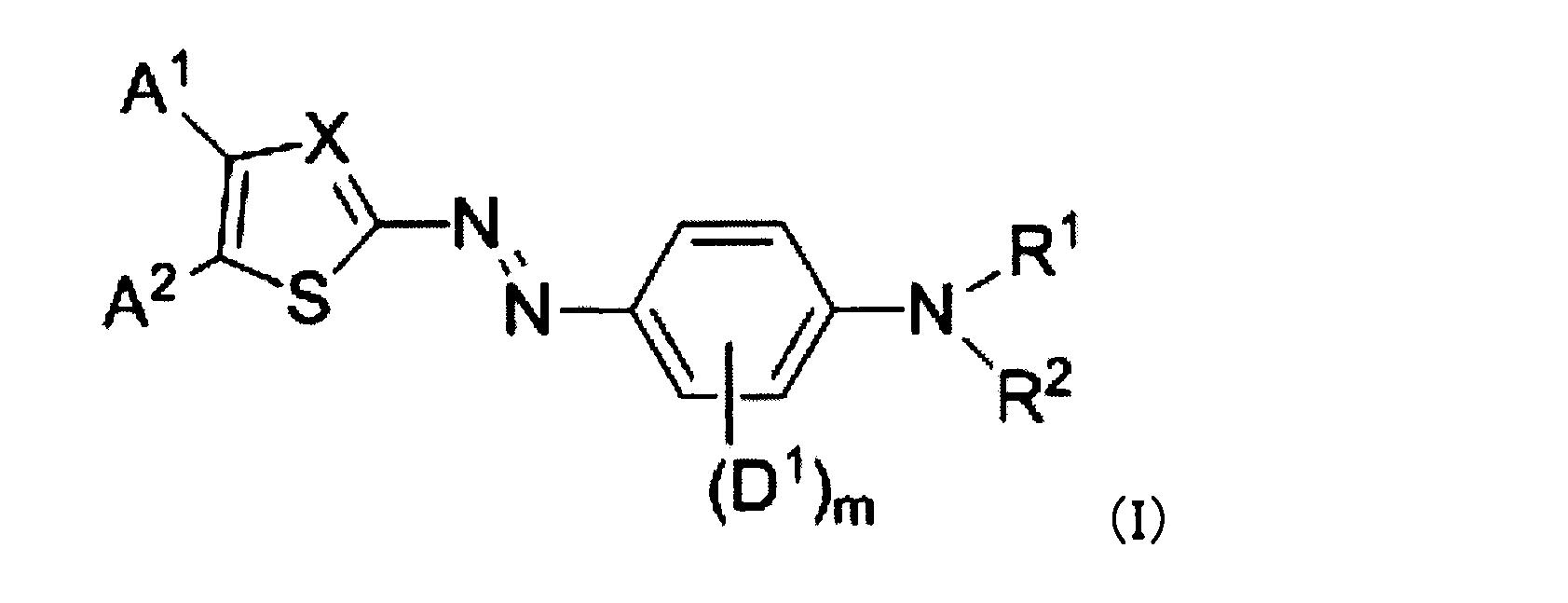
R1、R2、D1、A1及びA2はそれぞれ独立に、任意の置換基を表し、
mは1~4の整数を表し、mが2以上の場合、1分子中に2以上存在するD1は同一であっても異なっていてもよく、
Xは窒素原子、又は置換基を有していても良いメチン基を表す。]
(2)前記溶媒が、炭化水素系溶媒、シリコーンオイル及びフルオロカーボン系溶媒からなる群より選ばれた少なくとも1つを含む、前記(1)に記載のインク。
(3)前記アゾ系化合物のn-デカン溶液の吸収極大波長におけるモル吸光係数ε(L・mol-1・cm-1)と、5℃における前記アゾ系化合物のn-デカンに対する飽和濃度C(mol・L-1)との積εCが、1000cm-1以上である、前記(1)又は(2)に記載のインク。
(4)さらにヘテロ環化合物、シアノビニル化合物及びアントラキノン化合物からなる群より選ばれた少なくとも1つを含む、前記(1)~(3)のいずれか1に記載のインク。
(5)前記ヘテロ環化合物が下記一般式(III)~(V)からなる群より選ばれた少なくとも1つである、前記(4)に記載のインク。
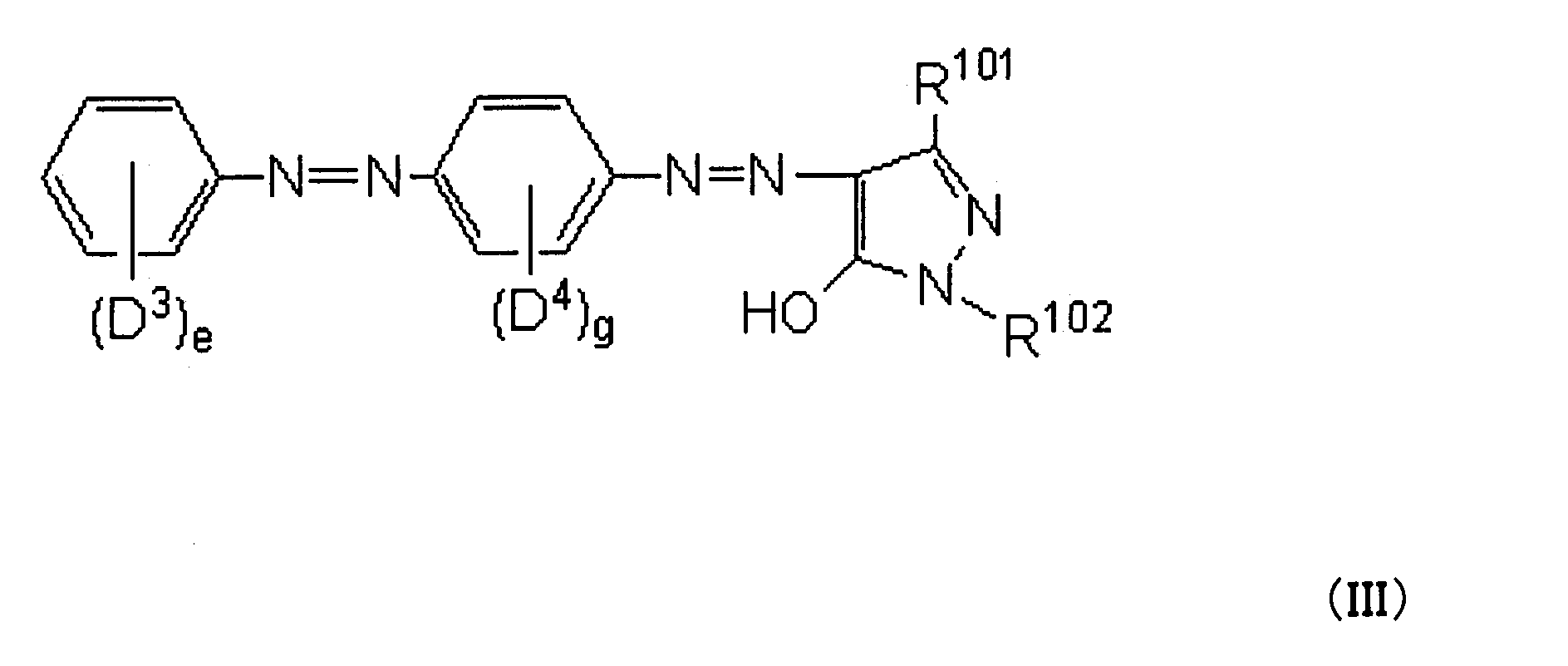
R101、R102、D3及びD4は、それぞれ独立に、任意の置換基を表し、
eは1~5の整数を表し、eが2以上の場合、1分子中に2以上存在するD3は同一であっても異なっていてもよく、
gは1~4の整数を表し、gが2以上の場合、1分子中に2以上存在するD4は同一であっても異なっていてもよい。]

R201、R202、R203、R204、R205、R206、R207及びR208は、それぞれ独立に、任意の置換基を表し、
Zは窒素原子又は置換基を有していても良いメチン基を表す。]
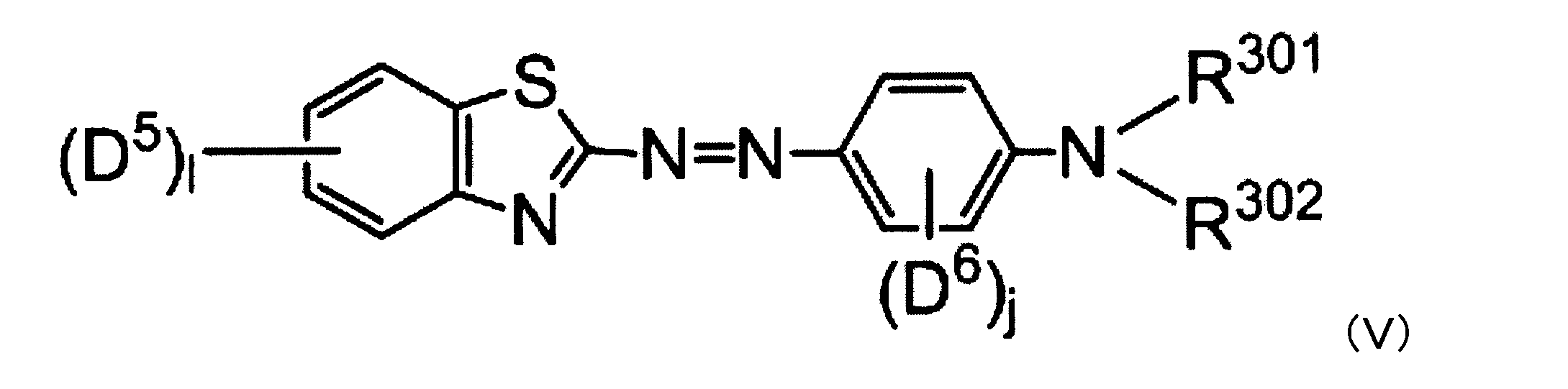
R301、R302、D5及びD6はそれぞれ独立に、任意の置換基を表し、
lは1~4の整数を表し、lが2以上の場合は、1分子中に2以上存在するD5は同一でも異なっていても良く、
jは1~4の整数を表し、jが2以上の場合は、1分子中に2以上存在するD6は同一でも異なっていても良い。]
(6)前記シアノビニル化合物が下記一般式(VI)で表される、前記(4)又は(5)に記載のインク。

R401、R402、R403、R404及びD7は、それぞれ独立に、任意の置換基を表し、
rは1~4の整数を表し、rが2以上の場合、1分子中に2以上存在するD7は同一であっても異なっていてもよい。]
(7)前記アントラキノン化合物が下記一般式(VII)で表される、前記(4)~(6)のいずれか1に記載のインク。

D8は任意の置換基を表し、tは1~8の整数を表し、tが2以上の場合、1分子中に2以上存在するD8は同一であっても異なっていてもよい。]
(8)ディスプレイ用又は光シャッター用である前記(1)~(7)のいずれか1に記載のインク。
(9)前記(1)~(7)のいずれか1に記載のインクを含む表示部位を有し、前記表示部位への電圧印加の制御により画像が表示されるディスプレイ。
(10)前記表示部位が、さらに電気泳動粒子又は水性媒体を含む前記(9)に記載のディスプレイ。
(11)前記電圧印加による着色状態の変化により画像が表示される前記(9)又は(10)に記載のディスプレイ。
(12)エレクトロウェッティング方式又は電気泳動方式により画像が表示される前記(9)~(11)のいずれか1に記載のディスプレイ。
(13)前記(9)~(12)のいずれか1に記載のディスプレイを有する電子ペーパー。
(14)下記一般式(VIII)で表されるアゾ系化合物。
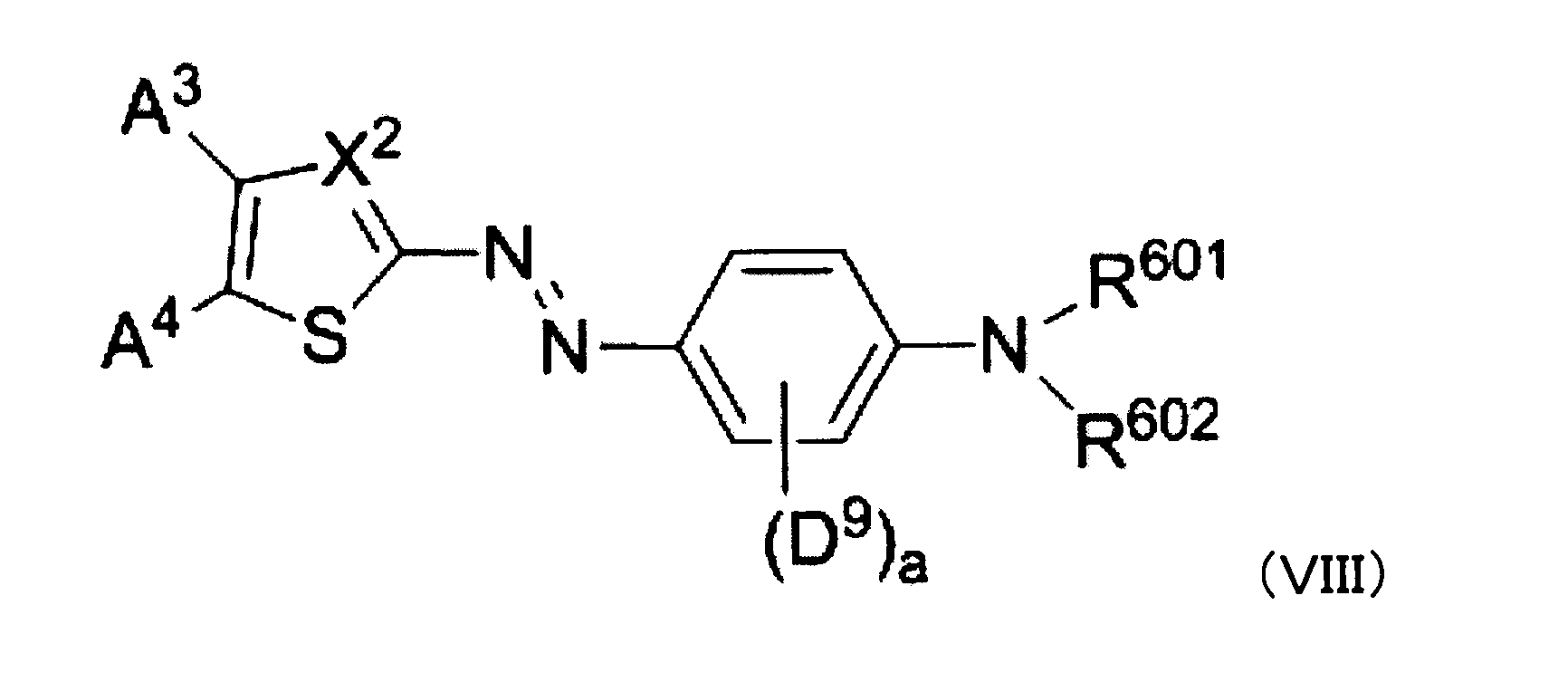
R601およびR602はそれぞれ独立に、置換基を有していても良い炭素数が7~20の分岐アルキル基を表し、
D9は水素原子、ハロゲン原子、置換基を有していても良い炭素数が1~20のアルキル基、置換基を有していても良い炭素数が1~20のアルコキシ基、-NHCOR603基又は-NHSO2R608基を表し、
R603及びR608は、それぞれ独立に、置換基を有していても良い炭素数が1~20のアルキル基、置換基を有していても良い炭素数が6~20のアリール基又は置換基を有していても良い炭素数が2~20のヘテロアリール基を表し、
aは1~4の整数を表し、aが2以上の場合、1分子中に2以上存在するD9は同一であっても異なっていてもよく、
A3はハロゲン原子、シアノ基、置換基を有していても良い炭素数が1~20のアルキル基、置換基を有していても良い炭素数が6~20のアリール基、置換基を有していても良い炭素数が2~20のヘテロアリール基、置換基を有していても良い炭素数が1~20のアルコキシ基又は-COOR604基を表し、
R604は置換基を有していても良い炭素数が1~20のアルキル基、置換基を有していても良い炭素数が6~20のアリール基又は置換基を有していても良い炭素数が2~20のヘテロアリール基を表し、
A4はハロゲン原子、置換基を有していても良い炭素数1~20のアルキル基、置換基を有していても良い炭素数2~20のアルケニル基、置換基を有していても良い炭素数2~20のアルキルカルボニル基、置換基を有していても良い炭素数が2~20のアルコキシカルボニル基、ホルミル基、R605OOC(NC)C=CH-基、又はNC(NC)C=CH-基を表し、
R605は置換基を有していても良い炭素数が1~20のアルキル基、置換基を有していても良い炭素数が6~20のアリール基又は置換基を有していても良い炭素数が2~20のヘテロアリール基を表し、
X2は窒素原子、又は置換基としてハロゲン原子、シアノ基若しくは-COOR607基を有していても良いメチン基を表し、
R607は、置換基を有していても良い炭素数が1~20のアルキル基、置換基を有していても良い炭素数が6~20のアリール基又は置換基を有していても良い炭素数が2~20のヘテロアリール基を表す。]
(15)下記一般式(IX)で表されるアゾ系化合物。

R701およびR702はそれぞれ独立に、置換基を有していても良い炭素数が5~20の分岐アルキル基を表し
D11は水素原子、ハロゲン原子、置換基を有していても良い炭素数が1~20のアルキル基、置換基を有していても良い炭素数が1~20のアルコキシ基、-NHCOR703基又は-NHSO2R708基を表し
R703及びR708は、それぞれ独立に、置換基を有していても良い炭素数が1~20のアルキル基、置換基を有していても良い炭素数が6~20のアリール基又は置換基を有していても良い炭素数が2~20のヘテロアリール基を表し、
dは1~4の整数を表し、dが2以上の場合、1分子中に2以上存在するD11は同一であっても異なっていてもよく、
A5は水素原子、ハロゲン原子、シアノ基、置換基を有していても良い炭素数が1~20のアルキル基、置換基を有していても良い炭素数が6~20のアリール基、置換基を有していても良い炭素数が2~20のヘテロアリール基、置換基を有していても良い炭素数が1~20のアルコキシ基又は-COOR704基を表し、
R704は置換基を有していても良い炭素数が1~20のアルキル基、置換基を有していても良い炭素数が6~20のアリール基又は置換基を有していても良い炭素数が2~20のヘテロアリール基を表し、
D10は水素原子、ハロゲン原子、シアノ基、置換基を有していても良い炭素数が1~20のアルキル基、置換基を有していても良い炭素数が1~20のアルコキシ基、-COOR706基、-COR709基又は-OCOR710基を表し、
bは1~5の整数を表し、bが2以上の場合、1分子中に2以上存在するD10は同一であっても異なっていてもよく、
R706、R709及びR710は、それぞれ独立に、置換基を有していても良い炭素数が1~20のアルキル基、置換基を有していても良い炭素数が6~20のアリール基又は置換基を有していても良い炭素数が2~20のヘテロアリール基を表し、
X3は窒素原子、又は置換基として、ハロゲン原子、シアノ基若しくは-COOR707基を有していても良いメチン基を表し、
R707は、置換基を有していても良い炭素数が1~20のアルキル基、置換基を有していても良い炭素数が6~20のアリール基又は置換基を有していても良い炭素数が2~20のヘテロアリール基を表す。]
さらにディスプレイとしては、インクを含む表示部位を有し、表示部位の電圧印加を制御することで画像を表示するディスプレイ、電圧印加によって着色状態を変化させることにより画像を表示するディスプレイ、表示部位に電気泳動粒子又は水性媒体を用いて表示をさせるディスプレイに特に有用である。
また、本発明のアゾ系化合物及びインクは、エレクトロウェッティング方式のディスプレイまたは電気泳動方式のディスプレイに用いられるインクとして特に有用である。
また、本発明のインクは、本発明のアゾ系化合物と他の化合物とを組み合わせることにより、色相に優れた良好な黒色などの各色インクを提供することも可能であり、光シャッターとして機能する部材としても有用である。
ここで、“重量%”と“質量%”とは同義である。
本発明に係るインクは、周波数1kHzで測定した22℃での比誘電率が3以下であり、かつ25℃における水に対する溶解度が20mg/L以下である溶媒と、アゾ系化合物とを含むインクであって、該アゾ系化合物が、下記一般式(I)で表されることを特徴とするインクである。

R1、R2、D1、A1及びA2はそれぞれ独立に、任意の置換基を示し、
mは1~4の整数を示し、mが2以上の場合、1分子中に2以上存在するD1は同一であっても異なっていてもよく、
Xは窒素原子、あるいは置換基を有していても良いメチン基を示す。]
本発明のディスプレイや光シャッターは低極性の溶媒をインクの溶媒として用いる。本発明のインクは、例えば水層、油層などの層を有し、層の分裂(break up)又は層の移動(move aside)に基づいた表示装置に用いることができる。表示を鮮明にするためには、インクが含まれる油層が水層と混合せず、安定的に分裂又は移動することが必要であり、溶媒は、水との相溶性が低く、低極性であること等が求められる。本発明は特定の溶媒とアゾ系化合物とをインクに含むことによって、油層が安定的に分裂又は移動することが可能となる。
溶媒の比誘電率の測定方法は実施例に示す。また、複数の溶媒を混合してインクの溶媒として用いる場合、上記比誘電率は、混合した溶媒の比誘電率を指す。
インクが含まれる層の比誘電率が適当な範囲にあることで、表示装置が支障なく駆動できる場合がある。例えば、インクが含まれない他の層が、水、塩類溶液など電気導電性又は有極性などの液体の場合、インクが含まれる層に用いられる溶媒の比誘電率が適当な範囲にあることで、層が混合しない場合がある。
水に対する溶解度が低いことで、例えば油層が水層と混合せず表示装置が支障なく駆動できる場合がある。
具体例としては、炭化水素系溶媒、フルオロカーボン系溶媒、シリコーンオイルなどが挙げられる。
脂肪族炭化水素系溶媒、及び脂環式炭化水素系溶媒としては、例えばn-デカン、イソデカン、デカリン、ノナン、ドデカン、イソドデカン、テトラデカン、ヘキサデカン、イソアルカン類等の脂肪族炭化水素系溶媒が挙げられ、市販品としては、アイソパーE、アイソパーG、アイソパーH、アイソパーL、アイソパーM(登録商標、エクソン・モービル株式会社製)、IPソルベント(登録商標、出光石油化学株式会社製)、ソルトール(フィリップス石油株式会社製)などが挙げられる。
芳香族炭化水素系溶媒としては、アルキルナフタレン、テトラリン等が挙げられる。
石油ナフサ系溶媒としては、シェルS.B.R.、シェルゾール70、シェルゾール71(シェル石油化学株式会社製)、ペガゾール(エクソン・モービル社製)、ハイソゾール(日本石油株式会社製)などが挙げられる。
フッ素系不活性液体としては、フロリナートFCシリーズ(住友3M社製)等、フルオロカーボン類としては、クライトックスGPLシリーズ(登録商標、デュポンジャパンリミテッド社製)、フロン類としては、HCFC-141b(ダイキン工業株式会社製)、F(CF2)4CH2CH2I、F(CF2)6I等のヨウ素化フルオロカーボン類としては、I-1420、I-1600(ダイキンファインケミカル研究所製)等が挙げられる。
ここで、溶解とは、アゾ系化合物が溶媒に完全に溶解している必要はなく、アゾ系化合物が0.1ミクロン程度のフィルターを通過し、かつ吸光係数が測定可能な程度の状態であればよく、化合物の微粒子が分散している状態であってもよい。
本発明のアゾ系化合物としては、上述した一般式(I)で表される化学構造を有するものである。
前記一般式(I)において用いられるR1、R2、A1、A2、D1、m及びXについて、具体例を以下に説明する。
R1及びR2の置換基を有していても良いアルキル基としては、メチル基、エチル基、プロピル基、ブチル基、ペンチル基、ヘキシル基、ヘプチル基、オクチル基、ノニル基、デシル基、ドデシル基等の直鎖のアルキル基;イソプロピル基、イソブチル基、sec-ブチル基、tert-ブチル基、イソオクチル基、イソノニル基等の分岐アルキル基;シクロプロピル基、シクロブチル基、シクロペンチル基、シクロヘキシル基、シクロプロピルメチル基、シクロヘキシルメチル基、4-ブチルメチルシクロヘキシル基等の環状アルキル基等が挙げられる。
また、R1とR2の少なくとも一方が、分岐アルキル基であることが好ましく、さらに、少なくとも一方が、炭素数5~20の分岐アルキル基、さらに炭素数7~20の分岐アルキル基であることが好ましい。また、R1およびR2は、その両方が分岐アルキル基であることが、溶解性の点からさらに好ましい。
D1としては、特に、水素原子、ハロゲン原子、置換基を有していても良い炭素数が1~20のアルキル基、置換基を有していても良い炭素数が1~20のアルコキシ基、-NHCOR3基または-NHSO2R8基であることが、溶媒への溶解性に優れ、しかも高いモル吸光係数を有するため好ましい。
また、mは1~4の整数を示し、mが2以上の場合は、1分子中に2以上存在するD1は同一であっても異なっていてもよい。
D1のアルキル基は、炭素数が16以下であることが好ましく、10以下であることがさらに好ましく、6以下であることが特に好ましい。炭素数が適当な範囲にあることで、溶媒への溶解性に優れ、しかも高いグラム吸光係数を有することができる場合がある。
また、D1のアルコキシ基が有していても良い置換基は、特に限定されないが、具体例としては、ハロゲン原子、炭素数が1~20のアルキル基、ホルミル基、アセチル基、ベンゾイル基、カルバゾイル基、フェニルカルボニル基等の炭素数1~20のカルボニル基等が挙げられる。
R3及びR8のアルキル基は、前記一般式(I)のR1で例示したアルキル基とそれぞれ同義であり、有していてもよい置換基もそれぞれ同義である。R3及びR8のアルキル基は、炭素数が16以下であることが好ましく、10以下であることがさらに好ましく、6以下であることが特に好ましい。炭素数が適当な範囲にあることで、溶媒への溶解性に優れ、しかも高いグラム吸光係数を有することができる場合がある。
R3及びR8のアルコキシ基は、前記一般式(I)のD1で例示したアルコキシ基とそれぞれ同義であり、有していてもよい置換基もそれぞれ同義である。R3及びR8のアルコキシ基は、炭素数が16以下であることが好ましく、10以下であることがさらに好ましく、6以下であることが特に好ましい。炭素数が適当な範囲にあることで、溶媒への溶解性に優れ、しかも高いグラム吸光係数を有することができる場合がある。
A1のアルコキシ基は、前記一般式(I)のD1で例示したアルコキシ基と同義であり、有していてもよい置換基も同義である。A1のアルコキシ基は、炭素数が16以下であることが好ましく、10以下であることがさらに好ましく、6以下であることが特に好ましい。炭素数が適当な範囲にあることで、溶媒への溶解性に優れ、しかも高いグラム吸光係数を有することができる場合がある。
A1のヘテロアリール基は、具体的には、前記一般式(I)のR3で例示したヘテロアリール基と同義であり、有していても良い置換基も前記一般式(I)のR3で例示したヘテロアリール基と同義である。A1のヘテロアリール基としては、溶媒への高溶解性の理由から、置換基を有しても良いチエニル基が好ましい。チエニル基の有しても良い置換基としては、溶媒への高溶解性の理由から、ハロゲン原子、炭素数が1~10のアルキル基、炭素数が1~10のアルコキシ基が好ましい。
R4のアルキル基は、具体的には、前記一般式(I)のR1で例示したアルキル基と同義であり、有していてもよい置換基も同義である。R4のアルキル基は、炭素数が16以下であることが好ましく、10以下であることがさらに好ましく、6以下であることが特に好ましい。炭素数が適当な範囲にあることで、溶媒への溶解性に優れ、しかも高いグラム吸光係数を有することができる場合がある。
R4のアリール基は、具体的には前記一般式(I)のR3で例示したアリール基と同義であり、有していても良い置換基も前記一般式(I)のR3で例示したアリール基と同義である。R4のヘテロアリール基は、具体的には、前記一般式(I)のR3で例示したヘテロアリール基と同義であり、有していても良い置換基も前記一般式(I)のR3で例示したヘテロアリール基と同義である。

D2は、任意の置換基を示し、nは1~5の整数を示し、nが2以上の場合は、1分子中に2以上存在するD2は同一であっても異なっていてもよい。]
A2のアルコキシカルボニル基に含まれるアルコキシ基は、前記一般式(I)のD1で例示したアルコキシ基と同義のものが挙げられ、該アルコキシ基の炭素数は、18以下であることが好ましく、16以下であることがさらに好ましい。
A2の炭素数が適当な範囲にあることで、溶媒への溶解性に優れ、しかも高いグラム吸光係数を有することができる場合がある。
R5のアルキル基は、具体的には、前記一般式(I)のR1で例示したアルキル基と同義であり、有していてもよい置換基も同義である。R5のアルキル基は、炭素数が16以下であることが好ましく、10以下であることがさらに好ましく、6以下であることが特に好ましい。炭素数が適当な範囲にあることで、溶媒への溶解性に優れ、しかも高いグラム吸光係数を有することができる場合がある。
R5のアリール基は、具体的には前記一般式(I)のR3で例示したアリール基と同義であり、有していても良い置換基も前記一般式(I)のR3で例示したアリール基と同義である。
R5のヘテロアリール基は、具体的には、前記一般式(I)のR3で例示したヘテロアリール基と同義であり、有していても良い置換基も前記一般式(I)のR3で例示したヘテロアリール基と同義である。
また、nは1~5の整数を示し、nが2以上の場合は、1分子中に2以上存在するD2は同一であっても異なっていてもよい。
R6、R9及びR10のアルキル基は、前記一般式(I)のR1で例示したアルキル基とそれぞれ同義であり、有していてもよい置換基もそれぞれ同義である。R6、R9及びR10のアルキル基は、炭素数が16以下であることが好ましく、10以下であることがさらに好ましく、6以下であることが特に好ましい。炭素数が適当な範囲にあることで、溶媒への溶解性に優れ、しかも高いグラム吸光係数を有することができる場合がある。
R6、R9及びR10のアリール基としては、前記一般式(I)のR3で例示したアリール基とそれぞれ同義であり、有していても良い置換基もそれぞれ同義である。R6、R9及びR10のヘテロアリール基としては、前記一般式(I)のR3で例示したヘテロアリール基と同義であり、有していても良い置換基も同義である。
各基の炭素数が適当な範囲にあることで、分子量が大きくなりすぎず、グラム吸光係数が悪化しない場合がある。
R7は、置換基を有していても良い炭素数が1~20のアルキル基、置換基を有していても良い炭素数が6~20のアリール基又は置換基を有していても良い炭素数が2~20のヘテロアリール基を示す。
R7のアリール基は、具体的には前記一般式(I)のR3で例示したアリール基と同義であり、有していても良い置換基も前記一般式(I)のR3で例示したアリール基と同義である。R7のヘテロアリール基は、具体的には、前記一般式(I)のR3で例示したヘテロアリール基と同義であり、有していても良い置換基も前記一般式(I)のR3で例示したヘテロアリール基と同義である。

R801およびR802はそれぞれ独立に置換基を有していても良い炭素数が1~20のアルキル基を示し、
D13は水素原子、ハロゲン原子、置換基を有していても良い炭素数が1~10のアルキル基、置換基を有していても良い炭素数が1~20のアルコキシ基又は-COOR803基を示し、
e’は1~5の整数を示し、e’が2以上の場合、1分子中に2以上存在するD13は同一であっても異なっていてもよく、
R803は置換基を有していても良い炭素数が1~10のアルキル基を示し、
D12は水素原子、ハロゲン原子、置換基を有していても良い炭素数が1~10のアルキル基、置換基を有していても良い炭素数が1~10のアルコキシ基又は置換基を有していても良い-NHCOR804基を示し、
eは1~4の整数を示し、eが2以上の場合、1分子中に2以上存在するD12は同一であっても異なっていてもよく、
R804は置換基を有していても良い炭素数が1~10のアルキル基、置換基を有していても良い炭素数が1~20のアルコキシ基又は置換基を有していてもよい炭素数が6~20のアリール基を示し、
X4は窒素原子、又は置換基としてハロゲン原子、シアノ基若しくは-COOR805基を有していても良いメチン基を示し、
R805は置換基を有していても良い炭素数が1~10のアルキル基を示し、
A6は水素原子、ハロゲン原子、シアノ基、置換基を有していても良い炭素数が1~10のアルキル基、置換基を有していてもよいフェニル基、置換基を有していてもよい炭素数が1~10のアルコキシ基又は-COOR806基を示し、
R806は置換基を有していても良い炭素数が1~10のアルキル基を示す。]
R810およびR811はそれぞれ独立に置換基を有していても良い炭素数が1~20のアルキル基を示し、
D14は水素原子、ハロゲン原子、置換基を有していても良い炭素数が1~10のアルキル基、置換基を有していても良い炭素数が1~10のアルコキシ基又は-NHCOR813基を示し、
R813は置換基を有していても良い炭素数が1~10のアルキル基、置換基を有していても良い炭素数が1~20のアルコキシ基又は置換基を有していても良い炭素数が6~20のアリール基を示し、
fは1~4の整数を示し、fが2以上の場合、1分子中に2以上存在するD14は同一であっても異なっていてもよく、
A7は水素原子、ハロゲン原子、シアノ基、置換基を有していても良い炭素数が1~10のアルキル基、置換基を有していても良い炭素数が6~20のアリール基、置換基を有していても良い炭素数が1~10のアルコキシ基又は-COOR814基を示し、
R814は置換基を有していても良い炭素数が1~10のアルキル基を示し、
A8は置換基を有していても良い炭素数1~20のアルキル基、置換基を有していても良い炭素数1~20のアルコキシ基、置換基を有していても良い炭素数2~20のアルケニル基、置換基を有していても良い炭素数1~20のアルキルカルボニル基、置換基を有していても良い炭素数が1~20のアルコキシカルボニル基、ホルミル基、R815OOC(NC)C=CH-基、NC(NC)C=CH-基又は下記一般式(XII)で示される基を示し、
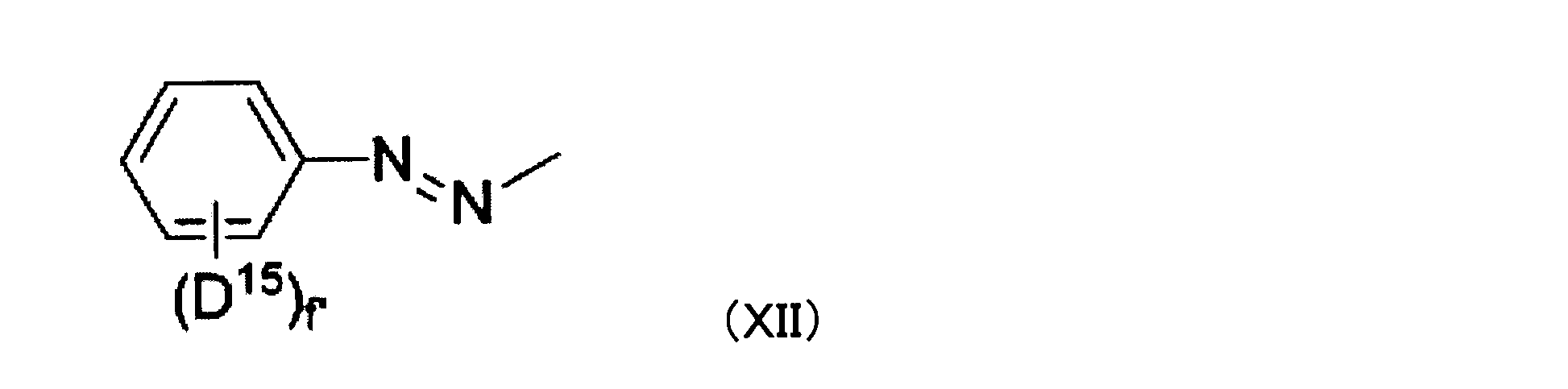
D15は水素原子、ハロゲン原子、シアノ基、置換基を有していても良い炭素数が1~20のアルキル基、置換基を有していても良い炭素数が1~20のアルコキシ基又は-COOR816基を示し、
f’は1~5の整数を示し、f’が2以上の場合、1分子中に2以上存在するD15は同一であっても異なっていてもよく、
R816は、置換基を有していても良い炭素数が1~10のアルキル基を示し、
X5は窒素原子、又は置換基として、ハロゲン原子、シアノ基若しくは-COOR817を有していても良いメチン基を示し、
R817は、置換基を有していても良い炭素数が1~10のアルキル基を示す。]
アルキル基の炭素数が多すぎると、分子量が大きくなりすぎるためグラム吸光係数が悪化する場合がある。また、R801及びR802の少なくとも一方が、分岐アルキル基であることが好ましく、さらに、少なくとも一方が炭素数が5~20の分岐アルキル基であることが好ましい。また、R801およびR802は、その両方が分岐アルキル基であることがさらに好ましい。
D13がアルキル基の場合、炭素数が2以上であることが好ましく、また、8以下が好ましく、6以下であることがさらに好ましい。
D13がアルコキシ基の場合、炭素数が4以上であることが好ましく、5以上であることがさらに好ましい。また、炭素数が16以下であることが好ましく、12以下であることがさらに好ましい。
D13が-COOR803基の場合、R803は置換基を有していても良い炭素数が1~10のアルキル基を示す。R803のアルキル基は、炭素数が2以上であることが好ましく、また、8以下が好ましく、6以下であることがさらに好ましい。
炭素数が適当な範囲にあることで、溶媒への溶解性に優れ、しかも高いグラム吸光係数を有することができる場合がある。
また、eは1~4の整数を示し、eが2以上の場合は、1分子中に2以上存在するD12は同一であっても異なっていてもよい。
アルキル基及びアルコキシ基は、炭素数が1以上であることが好ましく、また、8以下が好ましく、6以下であることがさらに好ましい。
また、R804のアリール基は炭素数が6以上であることが好ましく、10以上であることがさらに好ましい。また、炭素数が16以下であることが好ましい。炭素数が適当な範囲にあることで、溶媒への溶解性に優れ、しかも高いグラム吸光係数を有することができる場合がある。
メチン基が-COOR805を有する場合、R805は置換基を有していても良い炭素数が1~10のアルキル基を示す。R805のアルキル基は、炭素数が1以上であることが好ましく、また、8以下が好ましく、6以下であることがさらに好ましい。
炭素数が適当な範囲にあることで、溶媒への溶解性に優れ、しかも高いグラム吸光係数を有することができる場合がある。
炭素数が1~10のアルキル基及びアルコキシ基のなかでも、炭素数が1以上であることが好ましく、また、8以下が好ましく、6以下であることがさらに好ましい。
R806は水素原子、置換基を有していても良い炭素数が1~10のアルキル基を示す。R806のアルキル基は、炭素数が1以上であることが好ましく、また、8以下が好ましく、6以下であることがさらに好ましい。
炭素数が適当な範囲にあることで、溶媒への溶解性に優れ、しかも高いグラム吸光係数を有することができる場合がある。
また、R810及びR811の少なくとも一方が、分岐アルキル基であることが好ましく、さらに、少なくとも一方が、炭素数5~20の分岐アルキル基であることが好ましい。また、R810及びR811は、その両方が分岐アルキル基であることが、溶解性の点からさらに好ましい。
また、fは1~4の整数を示し、fが2以上の場合は、1分子中に2以上存在するD14は同一であっても異なっていてもよい。
D14の置換基を有していても良いアルキル基は、R810で例示した炭素数が1~20のアルキル基のうち、炭素数が1~10のアルキル基と同義である。
D14の置換基を有していても良いアルコキシ基は、メトキシ基、エトキシ基、プロポキシ基、ブトキシ基、ペンチルオキシ基、ヘキシルオキシ基、ヘプチルオキシ基、オクチルオキシ基、ノニルオキシ基、デシルオキシ基等の直鎖のアルコキシ基;イソプロポキシ基、イソブトキシ基、sec-ブトキシ基、tert-ブトキシ基、イソオクチルオキシ基等の分岐鎖アルコキシ基;シクロプロポキシ基、シクロペンチルオキシ基、シクロヘキシルオキシ基、シクロプロピルメチルオキシ基等のシクロアルカン構造を有するアルコキシ基等が挙げられる。
また、D14が有していても良い置換基は、溶媒への溶解性から低極性の置換基が好ましい。
D14のアルキル基が有していても良い置換基の具体例としては、例えば、ハロゲン原子、炭素数が1~10のアルコキシ基、炭素数3~10のアルコキシカルボニル基等が挙げられる。
D14のアルコキシ基が有していても良い置換基の具体例としては、例えば、ハロゲン原子、炭素数が1~10のアルキル基、ホルミル基、アセチル基、ベンゾイル基、カルバゾイル基、フェニルカルボニル基等の炭素数1~10のカルボニル基等が挙げられる。
R813のアルキル基は、D14で例示したアルキル基と同義である。R813のアルキル基は、炭素数が9以下であることが好ましく、8以下であることがさらに好ましい。R813のアルコキシ基は、後述するA8で例示したアルコキシ基と同義である。
R813のアリール基が有していても良い置換基としては、ハロゲン原子、炭素数が1~20のアルキル基、炭素数が1~10のアルコキシ基、炭素数が1~10のアルコキシカルボニル基等が挙げられる。
R813の炭素数が適当な範囲にあることで、溶媒への溶解性に優れ、しかも高いグラム吸光係数を有することができる場合がある。
A7のアリール基は、R813で例示したアリール基と同義であり、その中でも置換基を有していてもよいフェニル基であることが好ましい。

A8のアルケニル基は、炭素―炭素不飽和結合の位置は特に限定されず、複数の不飽和結合を有していても良い。また直鎖でも分岐でもよく、任意の置換基を有していても良い。アルケニル基としては、ビニル基、プロペニル基、ヘキセニル基等が挙げられ、この中でも、炭素数が3以上であることが好ましい。また、炭素数が16以下であることが好ましく、12以下であることがさらに好ましい。
A8のアルコキシカルボニル基に含まれるアルコキシ基は、A8で例示したアルコキシ基と同義のものが挙げられ、炭素数が1以上であることが好ましい。また、炭素数が18以下であることが好ましく、16以下であることがさらに好ましい。
A8の炭素数が適当な範囲にあることで、溶媒への溶解性に優れ、しかも高いグラム吸光係数を有することができる場合がある。
A8のアルキルカルボニル基が有していても良い置換基の具体例としては、炭素数1~20のアルコキシ基等が挙げられ、A8のアルコキシカルボニル基が有していても良い置換基の具体例としては、炭素数1~20のアルキル基等が挙げられ、A8のアルケニル基が有していても良い置換基としては、炭素数1~20のアルキル基、炭素数1~20のアルコキシ基、炭素数2~20のアルコキシカルボニル基等が挙げられる。
また、f’は1~5の整数を示し、f’が2以上の場合は、1分子中に2以上存在するD15は同一であっても異なっていてもよい。
D15のアルキル基は、R810で例示したアルキル基と同義のものが挙げられ、この中でも、炭素数が3以上であることが好ましい。また、炭素数が18以下であることが好ましく、16以下であることがさらに好ましい。
R816は置換基を有していても良い炭素数が1~10のアルキル基であり、具体的にはD14で例示したアルキル基と同義のものが挙げられ、この中でも炭素数が2以上であることが好ましく、また、8以下が好ましく、6以下であることがさらに好ましい。
各基の炭素数が適当な範囲にあることで、溶媒への溶解性に優れ、しかも高いグラム吸光係数を有することができる場合がある。
R817の置換基を有していても良い炭素数が1~10のアルキル基及びアルキル基が有していても良い置換基は、D14で例示したアルキル基及びアルキル基が有していても良い置換基と同義のものが挙げられ、この中でも、炭素数が8以下であることが好ましく、6以下であることがさらに好ましい。各基の炭素数が適当な範囲にあることで、溶媒への溶解性に優れ、しかも高いグラム吸光係数を有することができる場合がある。

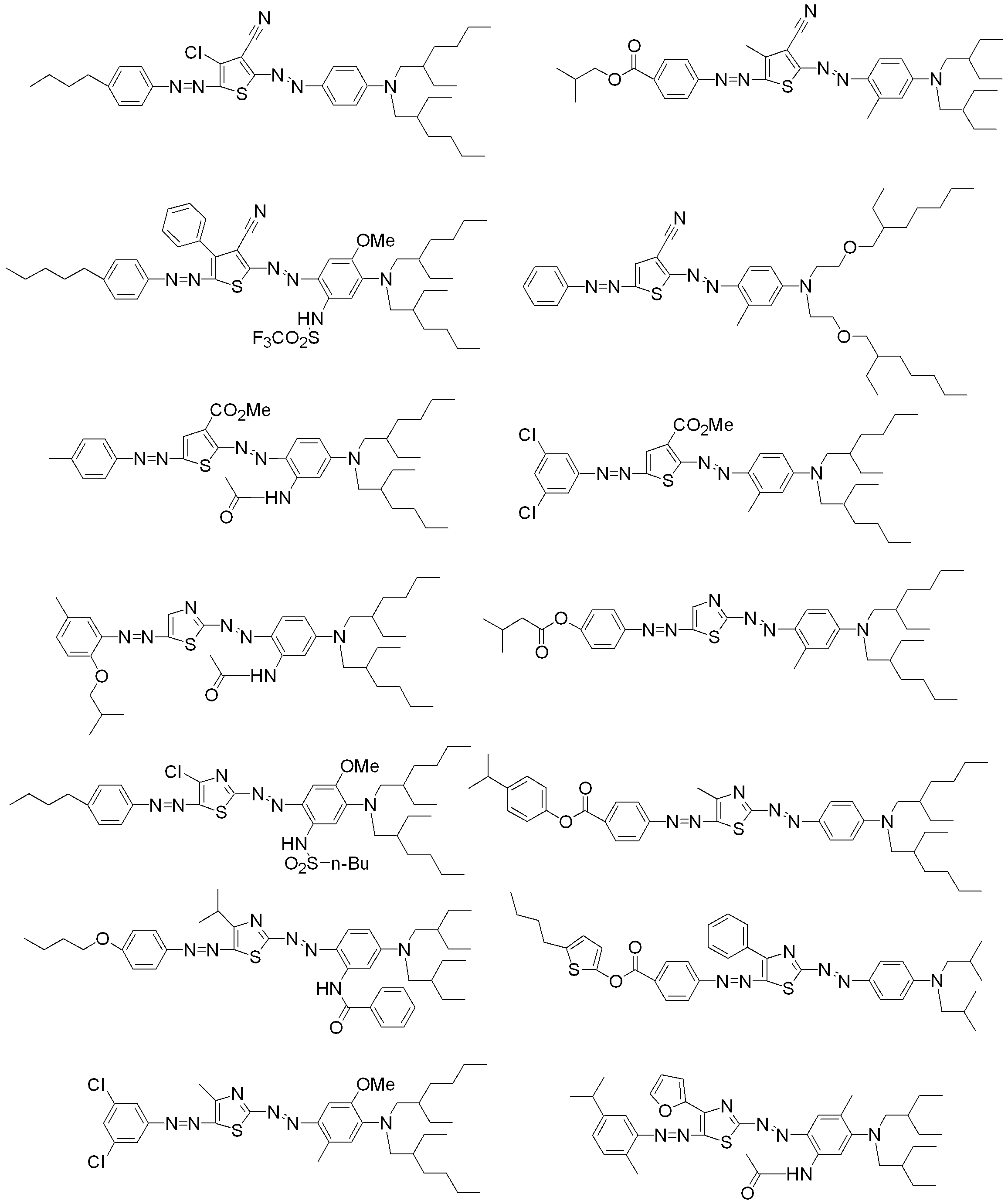
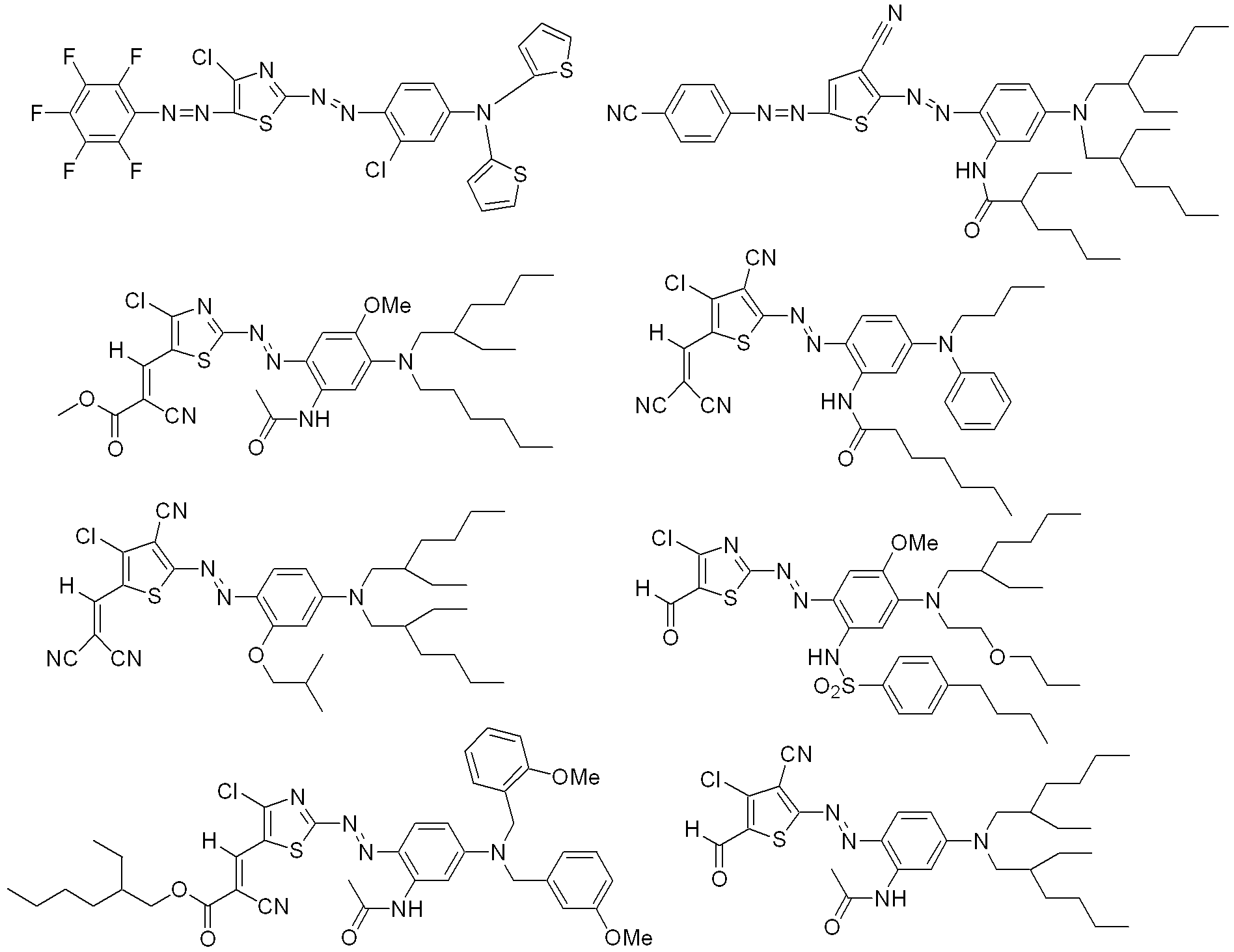


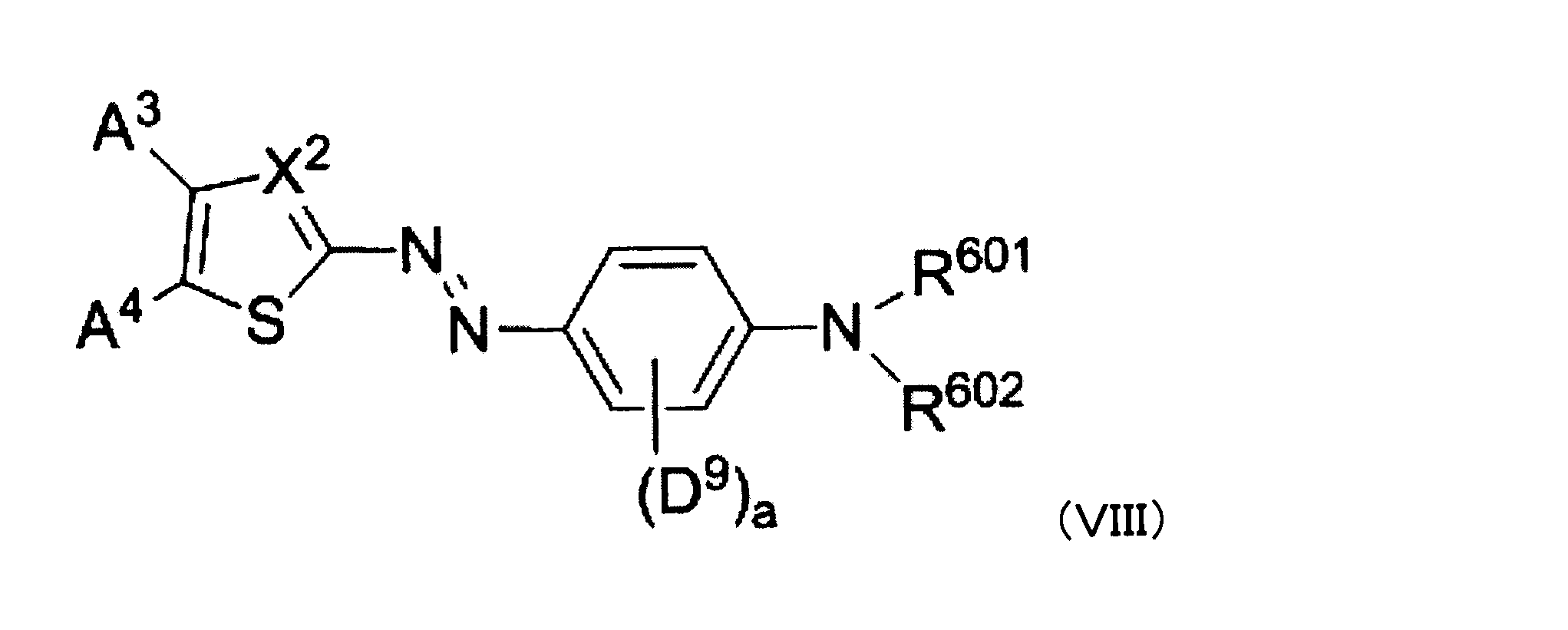
R601およびR602はそれぞれ独立に、置換基を有していても良い炭素数が7~20の分岐アルキル基を示し、
D9は水素原子、ハロゲン原子、置換基を有していても良い炭素数が1~20のアルキル基、置換基を有していても良い炭素数が1~20のアルコキシ基、-NHCOR603基又は-NHSO2R608基を示し、
R603及びR608は、それぞれ独立に、置換基を有していても良い炭素数が1~20のアルキル基、置換基を有していても良い炭素数が6~20のアリール基又は置換基を有していても良い炭素数が2~20のヘテロアリール基を示し、
aは1~4の整数を示し、aが2以上の場合、1分子中に2以上存在するD9は同一であっても異なっていてもよく、
A3はハロゲン原子、シアノ基、置換基を有していても良い炭素数が1~20のアルキル基、置換基を有していても良い炭素数が6~20のアリール基、置換基を有していても良い炭素数が2~20のヘテロアリール基、置換基を有していても良い炭素数が1~20のアルコキシ基又は-COOR604基を示し、
R604は置換基を有していても良い炭素数が1~20のアルキル基、置換基を有していても良い炭素数が6~20のアリール基又は置換基を有していても良い炭素数が2~20のヘテロアリール基を示し、
A4はハロゲン原子、置換基を有していても良い炭素数1~20のアルキル基、置換基を有していても良い炭素数2~20のアルケニル基、置換基を有していても良い炭素数2~20のアルキルカルボニル基、置換基を有していても良い炭素数が2~20のアルコキシカルボニル基、ホルミル基、R605OOC(NC)C=CH-基、又はNC(NC)C=CH-基を示し、
R605は置換基を有していても良い炭素数が1~20のアルキル基、置換基を有していても良い炭素数が6~20のアリール基又は置換基を有していても良い炭素数が2~20のヘテロアリール基を示し、
X2は窒素原子、又は置換基としてハロゲン原子、シアノ基若しくは-COOR607基を有していても良いメチン基を示し、
R607は、置換基を有していても良い炭素数が1~20のアルキル基、置換基を有していても良い炭素数が6~20のアリール基又は置換基を有していても良い炭素数が2~20のヘテロアリール基を示す。]
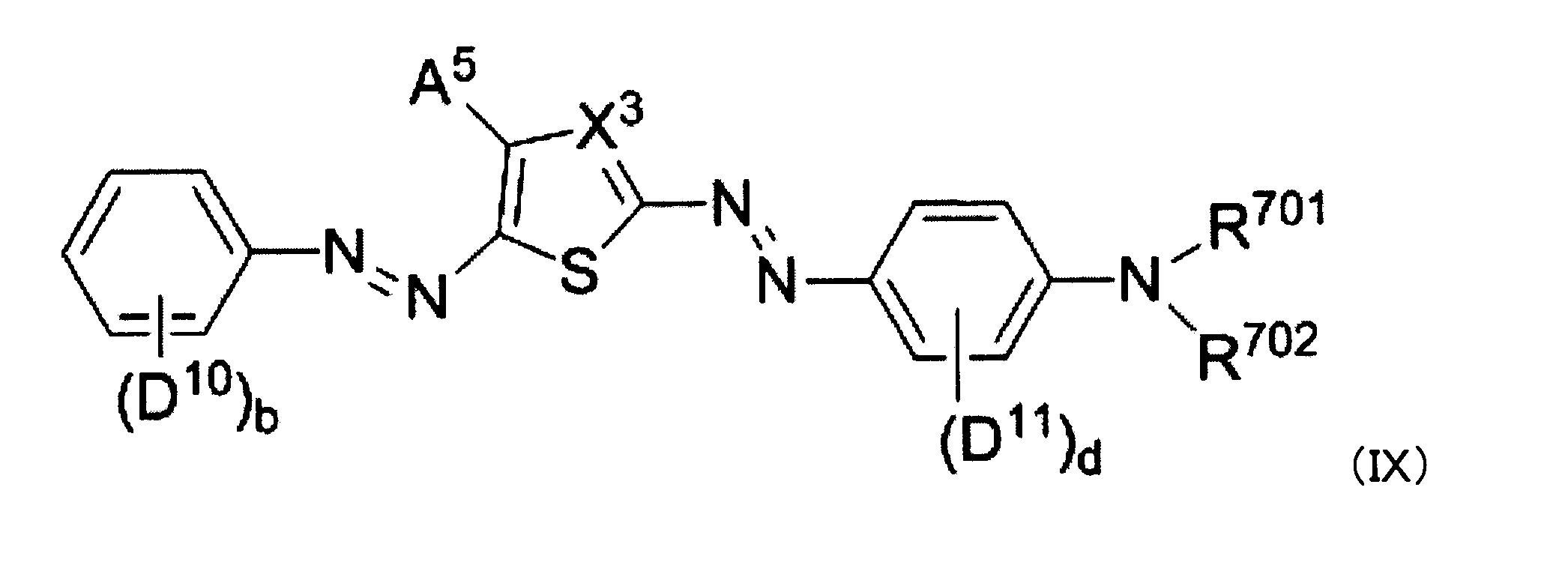
R701およびR702はそれぞれ独立に、置換基を有していても良い炭素数が5~20の分岐アルキル基を示し、
D11は水素原子、ハロゲン原子、置換基を有していても良い炭素数が1~20のアルキル基、置換基を有していても良い炭素数が1~20のアルコキシ基、-NHCOR703基又は-NHSO2R708基を示し、
R703及びR708は、それぞれ独立に、置換基を有していても良い炭素数が1~20のアルキル基、置換基を有していても良い炭素数が6~20のアリール基又は置換基を有していても良い炭素数が2~20のヘテロアリール基を示し、
dは1~4の整数を示し、dが2以上の場合、1分子中に2以上存在するD11は同一であっても異なっていてもよく、
A5は水素原子、ハロゲン原子、シアノ基、置換基を有していても良い炭素数が1~20のアルキル基、置換基を有していても良い炭素数が6~20のアリール基、置換基を有していても良い炭素数が2~20のヘテロアリール基、置換基を有していても良い炭素数が1~20のアルコキシ基又は-COOR704基を示し、
R704は置換基を有していても良い炭素数が1~20のアルキル基、置換基を有していても良い炭素数が6~20のアリール基又は置換基を有していても良い炭素数が2~20のヘテロアリール基を示し、
D10は水素原子、ハロゲン原子、シアノ基、置換基を有していても良い炭素数が1~20のアルキル基、置換基を有していても良い炭素数が1~20のアルコキシ基、-COOR706基、-COR709基又は-OCOR710基を示し、
bは1~5の整数を示し、bが2以上の場合、1分子中に2以上存在するD10は同一であっても異なっていてもよく、
R706、R709及びR710は、それぞれ独立に、置換基を有していても良い炭素数が1~20のアルキル基、置換基を有していても良い炭素数が6~20のアリール基又は置換基を有していても良い炭素数が2~20のヘテロアリール基を示し、
X3は窒素原子、又は置換基として、ハロゲン原子、シアノ基若しくは-COOR707基を有していても良いメチン基を示し、
R707は、置換基を有していても良い炭素数が1~20のアルキル基、置換基を有していても良い炭素数が6~20のアリール基又は置換基を有していても良い炭素数が2~20のヘテロアリール基を示す。]
R601およびR602のアルキル基は、具体的には、前記一般式(I)のR1で例示したアルキル基のうち、炭素数が7以上の分岐アルキル基とそれぞれ同義であり、有していてもよい置換基もそれぞれ同義である。また、R701およびR702のアルキル基は、具体的には、前記一般式(I)のR1で例示したアルキル基のうち、炭素数が5以上の分岐アルキル基とそれぞれ同義であり、有していてもよい置換基もそれぞれ同義である。
R701およびR702のアルキル基は、炭素数が5以上であることが好ましく、6以上であることが好ましく、8以上であることが更に好ましい。また、炭素数が18以下であることが好ましく、16以下であることがさらに好ましい。
R601、R602、R701およびR702の炭素数が適当な範囲にあることで、溶媒への溶解性に優れ、しかも高いグラム吸光係数を有することができる場合がある。
D11は水素原子、ハロゲン原子、置換基を有していても良い炭素数が1~20のアルキル基、置換基を有していても良い炭素数が1~20のアルコキシ基、-NHCOR703基又は-NHSO2R708基を示す。
D9及びD11のアルコキシ基は、前記一般式(I)のD1で例示したアルコキシ基とそれぞれ同義であり、有していてもよい置換基もそれぞれ同義である。D9及びD11のアルコキシ基は、炭素数が16以下であることが好ましく、10以下であることがさらに好ましく、6以下であることが特に好ましい。炭素数が適当な範囲にあることで、溶媒への溶解性に優れ、しかも高いグラム吸光係数を有することができる場合がある。
R603及びR608のアリール基は、具体的には前記一般式(I)のR3で例示したアリール基とそれぞれ同義であり、有していても良い置換基も前記一般式(I)のR3で例示したアリール基とそれぞれ同義である。R603及びR608のヘテロアリール基は、具体的には、前記一般式(I)のR3で例示したヘテロアリール基とそれぞれ同義であり、有していても良い置換基も前記一般式(I)のR3で例示したヘテロアリール基とそれぞれ同義である。
A3及びA5のアリール基としては、溶媒への高溶解性の理由から、置換基を有しても良いフェニル基又はナフチル基が好ましい。フェニル基又はナフチル基の有しても良い置換基としては、溶媒への高溶解性の理由から、ハロゲン原子、炭素数が1~10のアルキル基、炭素数が1~10のアルコキシ基が好ましい。
R604及びR704のアリール基は、具体的には前記一般式(I)のR3で例示したアリール基とそれぞれ同義であり、有していても良い置換基も前記一般式(I)のR3で例示したアリール基とそれぞれ同義である。
R604及びR704のヘテロアリール基は、具体的には、前記一般式(I)のR3で例示したヘテロアリール基とそれぞれ同義であり、有していても良い置換基も前記一般式(I)のR3で例示したヘテロアリール基とそれぞれ同義である。
また、R607は、置換基を有していても良い炭素数が1~20のアルキル基、置換基を有していても良い炭素数が6~20のアリール基又は置換基を有していても良い炭素数が2~20のヘテロアリール基を示し、R707は、置換基を有していても良い炭素数が1~20のアルキル基、置換基を有していても良い炭素数が6~20のアリール基又は置換基を有していても良い炭素数が2~20のヘテロアリール基を示す。
X2及びX3のアリール基は、具体的には前記一般式(I)のR3で例示したアリール基とそれぞれ同義であり、有していても良い置換基も前記一般式(I)のR3で例示したアリール基とそれぞれ同義である。
X2及びX3のヘテロアリール基は、具体的には、前記一般式(I)のR3で例示したヘテロアリール基とそれぞれ同義であり、有していても良い置換基も前記一般式(I)のR3で例示したヘテロアリール基とそれぞれ同義である。
A4及びR605のアルキル基は、具体的には、前記一般式(I)のR1で例示したアルキル基とそれぞれ同義であり、有していてもよいそれぞれ置換基も同義である。
A4及びR605のアルキル基は、炭素数が16以下であることが好ましく、10以下であることがさらに好ましく、6以下であることが特に好ましい。炭素数が適当な範囲にあることで、溶媒への溶解性に優れ、しかも高いグラム吸光係数を有することができる場合がある。
A4のアルキルカルボニル基は、前記一般式(I)のA2で例示したアルキルカルボニル基と同義のものが挙げられ、有していてもよい置換基も同義である。A4のアルキルカルボニル基のアルキル基の炭素数が1以上であることが好ましく、炭素数が18以下であることが好ましく、16以下であることがさらに好ましい。
A4のアルコキシカルボニル基、前記一般式(I)のA2で例示したアルコキシカルボニル基と同義のものが挙げられ、有していてもよい置換基も同義である。A4のアルコキシカルボニル基のアルコキシ基の炭素数が1以上であることが好ましく、炭素数が18以下であることが好ましく、16以下であることがさらに好ましい。
A4の炭素数が適当な範囲にあることで、溶媒への溶解性に優れ、しかも高いグラム吸光係数を有することができる場合がある。
R605のヘテロアリール基は、具体的には、前記一般式(I)のR3で例示したヘテロアリール基と同義であり、有していても良い置換基も前記一般式(I)のR3で例示したヘテロアリール基と同義である。
また、R706、R709及びR710は、それぞれ独立に、置換基を有していても良い炭素数が1~20のアルキル基、置換基を有していても良い炭素数が6~20のアリール基又は置換基を有していても良い炭素数が2~20のヘテロアリール基を示す。
R706、R709及びR710のヘテロアリール基は、具体的には、前記一般式(I)のR3で例示したヘテロアリール基とそれぞれ同義であり、有していても良い置換基も前記一般式(I)のR3で例示したヘテロアリール基とそれぞれ同義である。
上記一般式(I)、(VIII)~(XI)で表される化合物は、例えば、特開平3-256793号公報に記載の方法に準じて合成することができる。
さらに、本発明のアゾ系化合物のn-デカン溶液の吸収極大波長におけるモル吸光係数ε(L・mol-1・cm-1)と、5℃における前記アゾ系化合物のn-デカンに対する飽和濃度C(mol・L-1)との積εCの値が、好ましくは1000cm-1以上、より好ましくは2000cm-1以上である。εC値が高いほど着色性が高いため好ましく、上限は特にないが、通常100000cm-1以下である。
本発明のアゾ系化合物は、溶媒への溶解性に優れ、高い吸光係数を有することから、光シャッター用材料、ディスプレイ材料、特にエレクトロウェッティングディスプレイ材料、電気泳動法ディスプレイ材料として有用である。
従って、本発明に係るインクは、本発明の効果を損なわない範囲で、必要に応じて、各用途に適した任意の添加剤を含んでいてもよいが、溶媒の特性を変化させないようにすることが好ましい。
本発明のインクは、上記アゾ系化合物単体で用いてもよく、所望の色調とするために他の化合物を含んでいてもよい。例えば、本発明のアゾ系化合物に、黄色、赤色、青色、紫色、橙色等の複数の色の化合物を混合して黒色等の各色にしてもよい。
本発明のインクが含んでいてもよい他の化合物としては、使用する媒体に対して溶解性・分散性を有する化合物の中から、本発明の効果を損なわない範囲で任意に選択することが可能である。
ヘテロ環化合物の具体例としては特に限定はないが、後述する一般式(III)~(V)からなる群より選ばれた少なくとも1つの化合物であることが好ましい。
ヘテロ環化合物として、下記一般式(III)で表される化合物が挙げられる。
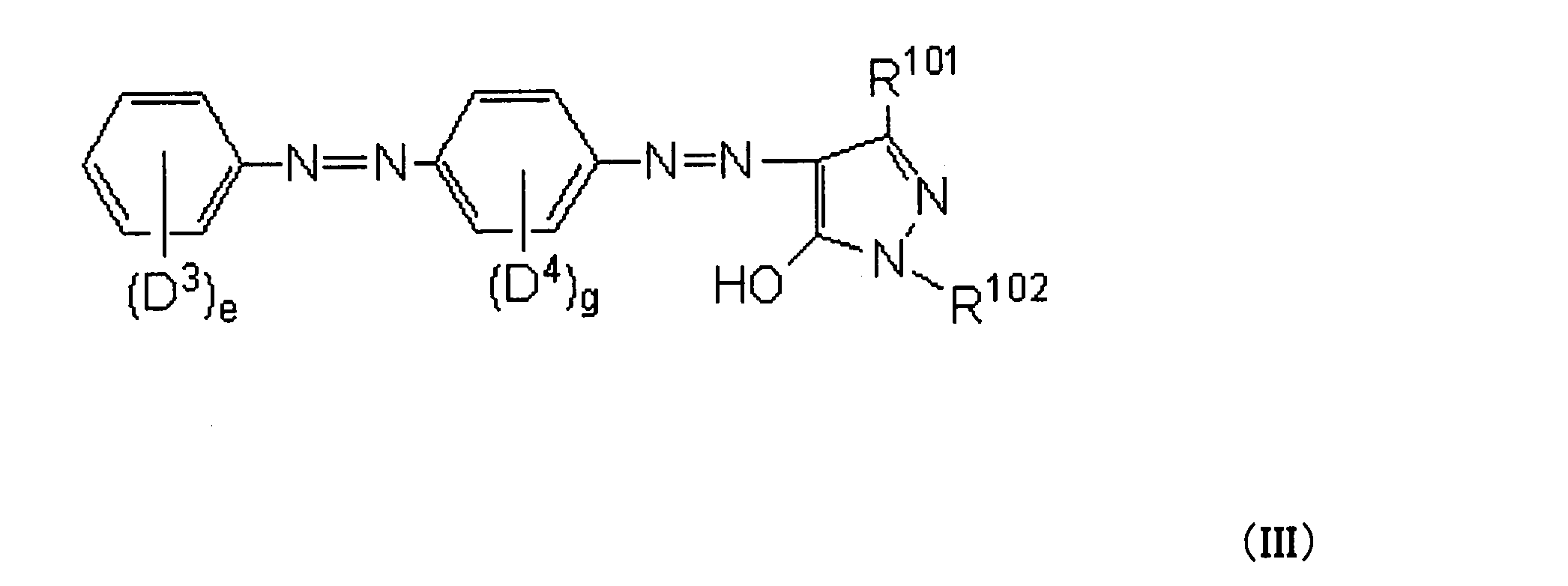
R101、R102、D3及びD4は、それぞれ独立に、任意の置換基を示し、
eは1~5の整数を示し、eが2以上の場合、1分子中に2以上存在するD3は同一であっても異なっていてもよく、
gは1~4の整数を示し、gが2以上の場合、1分子中に2以上存在するD4は同一であっても異なっていてもよい。]
R101は本発明の効果を損なわなければ特に限定されないが、置換基を有していても良い炭素数が1~20のアルキル基、置換基を有していても良い炭素数が1~20のアルコキシ基、置換基を有していても良い炭素数が6~20のアリール基、置換基を有していても良い炭素数が2~20のヘテロアリール基、-COOR103基、-NR107R108基又は-COR112基であることが、溶媒への高溶解性及び高吸光係数のために好ましい。
また、R102は本発明の効果を損なわなければ特に限定されないが、置換基を有していても良い炭素数が1~20のアルキル基、置換基を有していても良い炭素数が6~20のアリール基又は置換基を有していても良い炭素数が2~20のヘテロアリール基であることが、溶媒への高溶解性及び高吸光係数のために好ましい。
R101、R102、R103、R107、R108及びR112のヘテロアリール基は、具体的には、前記一般式(I)のR3で例示したヘテロアリール基と同義であり、有していても良い置換基も前記一般式(I)のR3で例示したヘテロアリール基と同義である。
また、eは1~5の整数を示し、eが2以上の場合、1分子中に2以上存在するD3は同一であっても異なっていてもよい。
R104、R109、R110、R113及びR115のヘテロアリール基は、具体的には、前記一般式(I)のR3で例示したヘテロアリール基と同義であり、有していても良い置換基も前記一般式(I)のR3で例示したヘテロアリール基と同義である。
gは1~4の整数を示し、gが2以上の場合、1分子中に2以上存在するD4は同一であっても異なっていてもよい。
R105、R106、R111及びR114のヘテロアリール基は、具体的には、前記一般式(I)のR3で例示したヘテロアリール基と同義であり、有していても良い置換基も前記一般式(I)のR3で例示したヘテロアリール基と同義である。
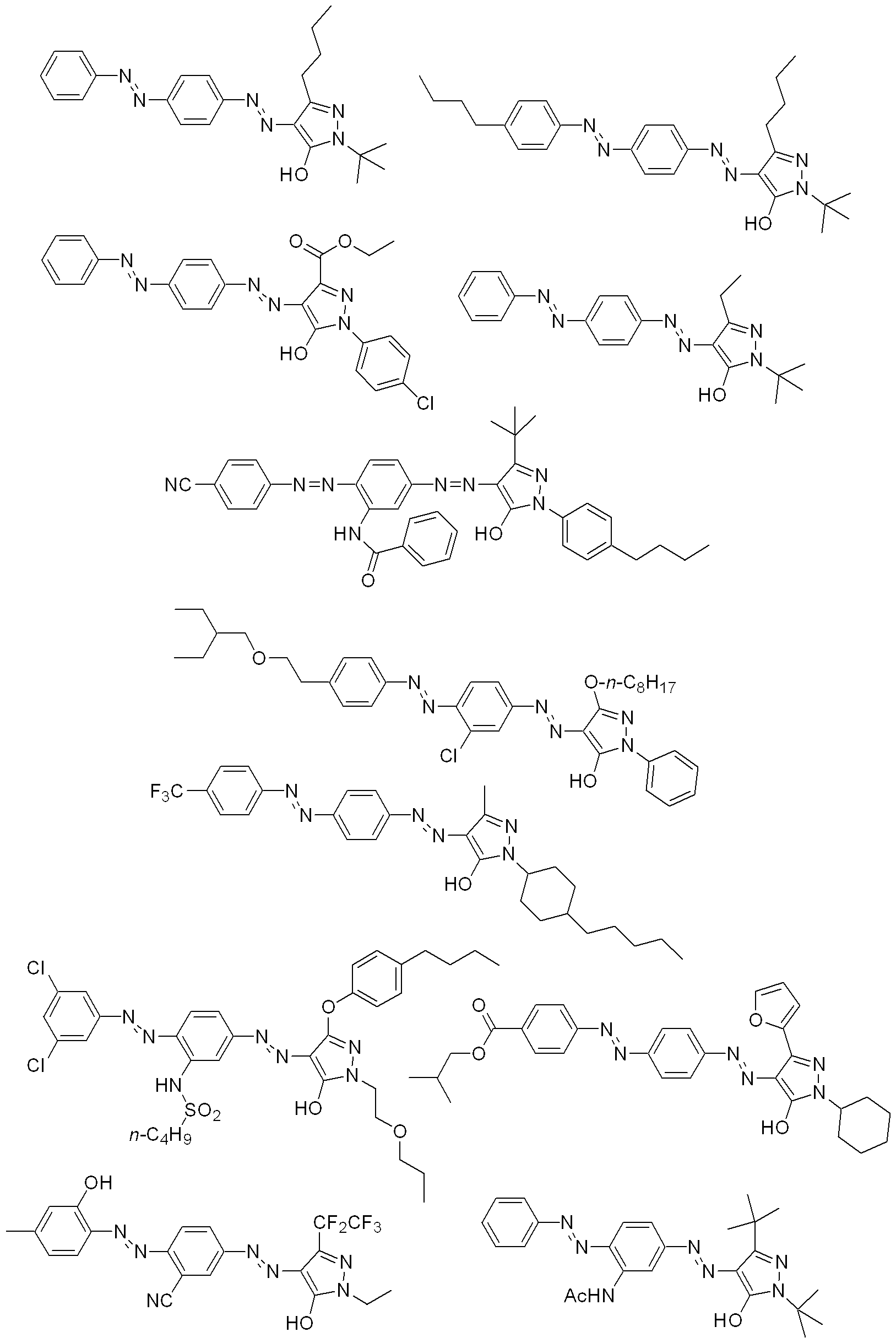
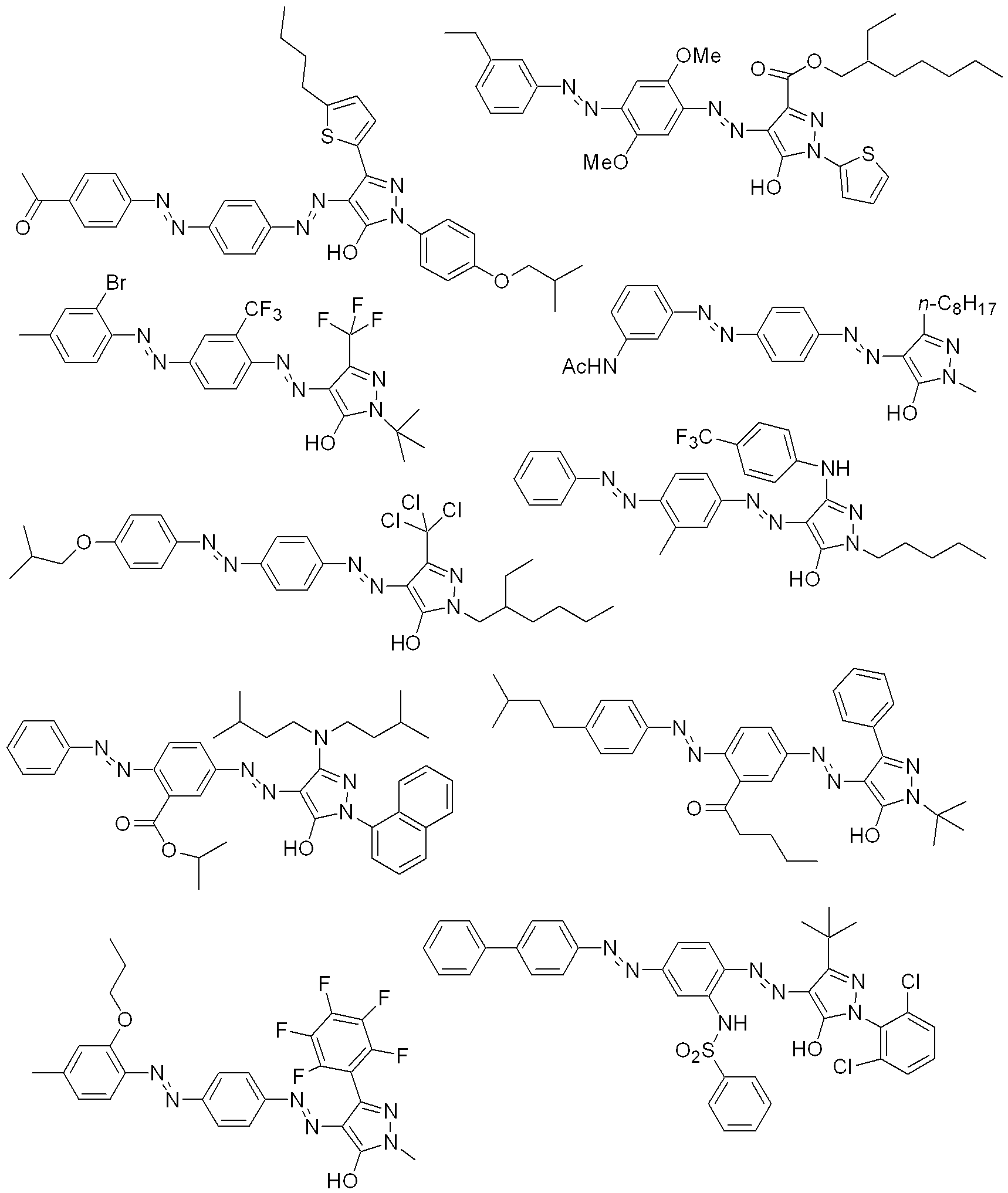
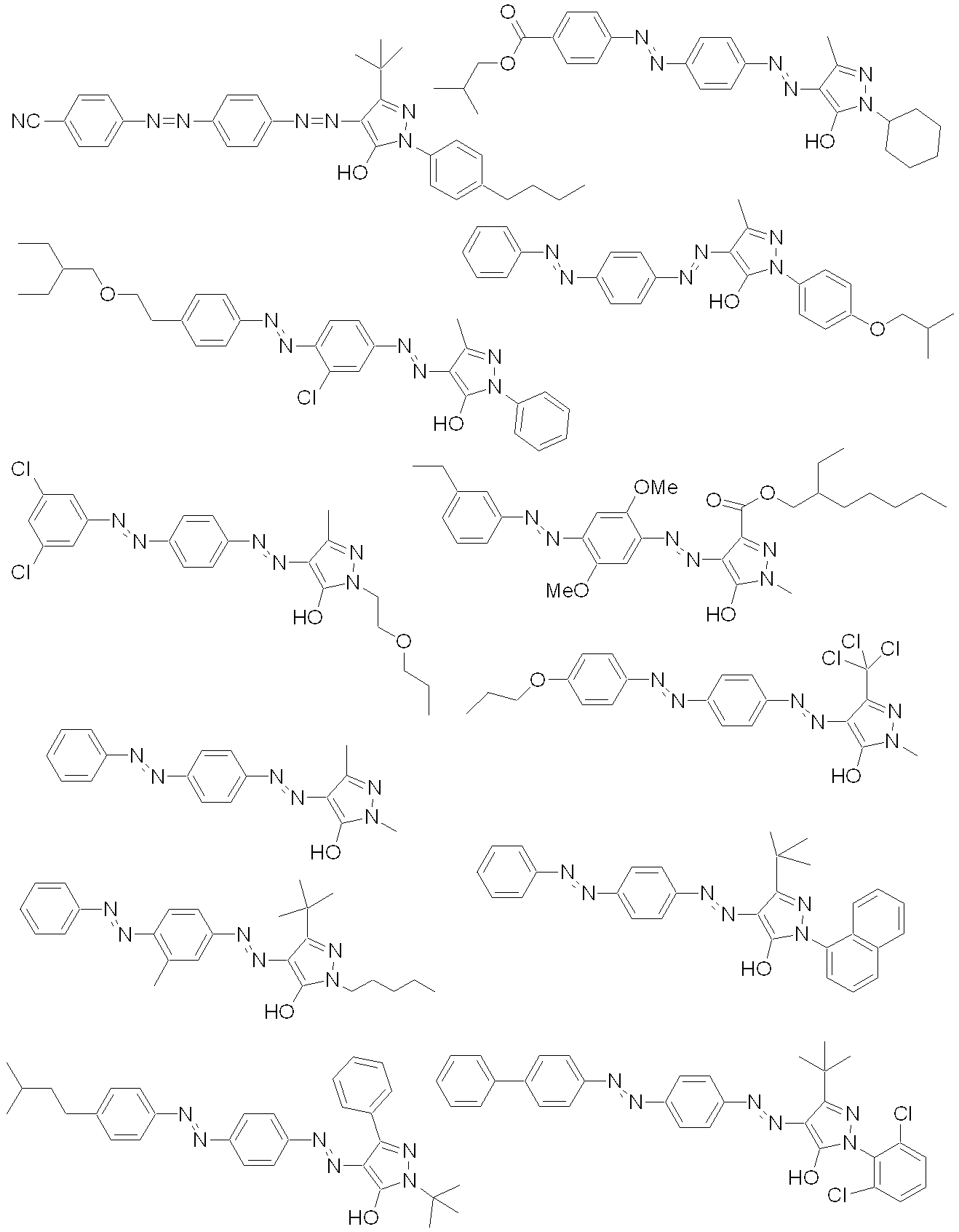

R201、R202、R203、R204、R205、R206、R207及びR208は、それぞれ独立に、任意の置換基を示し、
Zは窒素原子又は置換基を有していても良いメチン基を示す。]
R201の置換基を有していても良い炭素数が1~20のアルキル基は、前記一般式(I)のR1で例示したアルキル基と同義であり、有していても良い置換基も同義である。また、R201は、Zと結合して環状構造を形成しても良い。
また、R201は、製造上の観点からは無置換のアルキル基であることが好ましく、メチル基、エチル基、プロピル基、イソプロピル基、ブチル基等の無置換の炭素数が1~4のアルキル基であることが特に好ましい。
R209は置換基を有していても良い炭素数が1~20のアルキル基、置換基を有していても良い炭素数が6~20のアリール基又は置換基を有していても良い炭素数が2~20のヘテロアリール基を示す。
R209のヘテロアリール基は、具体的には、前記一般式(I)のR3で例示したヘテロアリール基と同義であり、有していても良い置換基も前記一般式(I)のR3で例示したヘテロアリール基と同義である。
R203およびR204は、互いに結合して環状構造を形成しても良い。また、R203またはR204は、それぞれR206、R207と結合して環構造を形成しても良い。
さらに、R205、R206、R207及びR208は、それぞれ独立に、メチル基、エチル基、プロピル基、イソプロピル基、シクロプロピル基、ブチル基、イソブチル基、sec-ブチル基、tert-ブチル基等の炭素数が1~4のアルキル基、-NHCOR210基又は-NHSO2R212基が好ましく、メチル基、-NHCOR210基又は-NHSO2R212基が、溶媒への高溶解度及びグラム吸光係数の点から特に好ましい。
R210及びR212のヘテロアリール基は、具体的には、前記一般式(I)のR3で例示したヘテロアリール基とそれぞれ同義であり、有していても良い置換基も前記一般式(I)のR3で例示したヘテロアリール基とそれぞれ同義である。
R211は置換基を有していても良い炭素数が1~20のアルキル基を示す。R211のアルキル基は、具体的には、前記一般式(I)のR1で例示したアルキル基と同義であり、有していてもよい置換基も同義である。R211のアルキル基は、炭素数が16以下であることが好ましく、10以下であることがさらに好ましく、6以下であることが特に好ましい。
炭素数が適当な範囲にあることで、溶媒への溶解性に優れ、しかも高いグラム吸光係数を有することができる場合がある。
Zとしては、窒素原子、メチン基、炭素数が1~4のアルキル基で置換されたメチン基、又は炭素数が2~5のアルコキシカルボニル基で置換されたメチン基が好ましい。
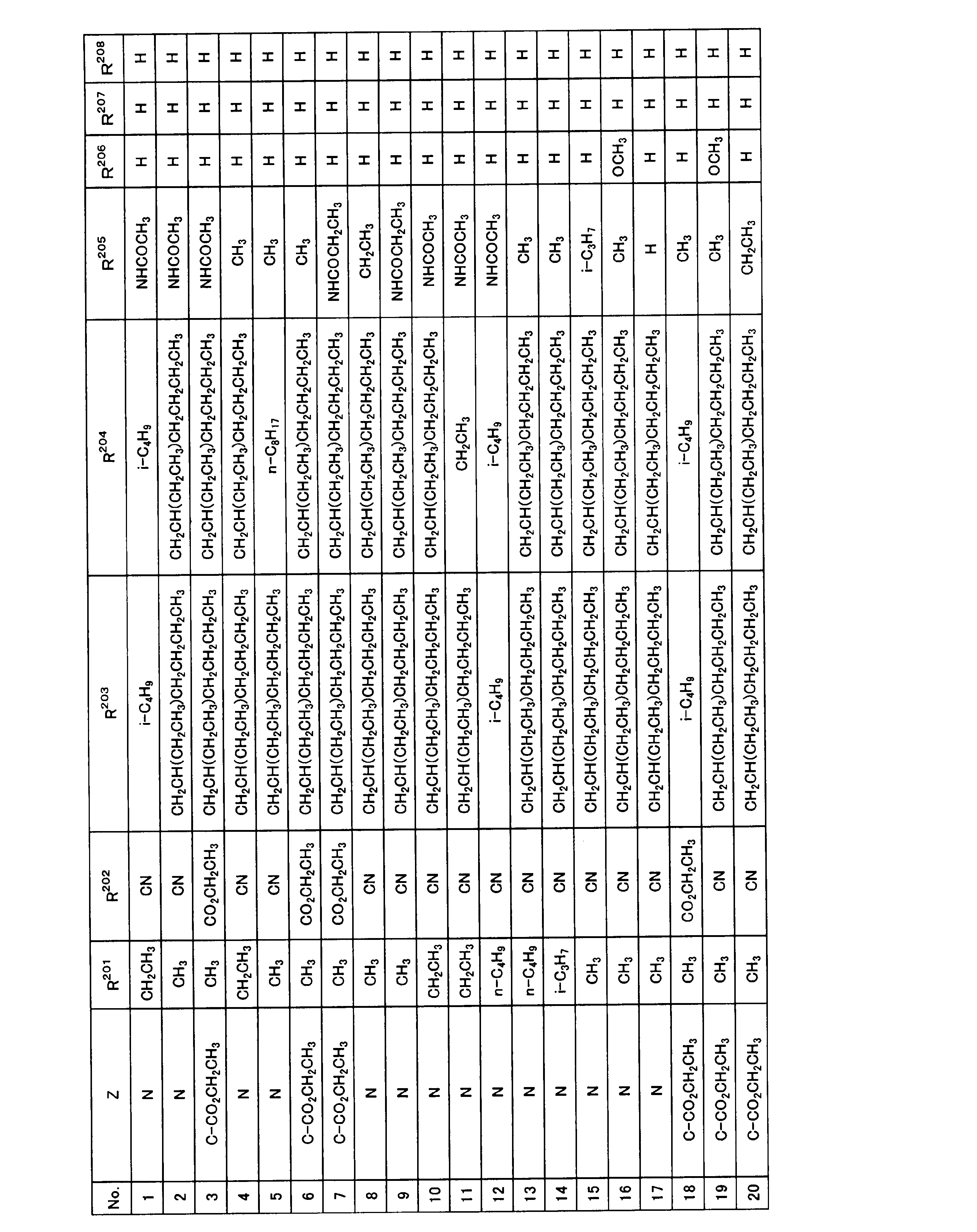
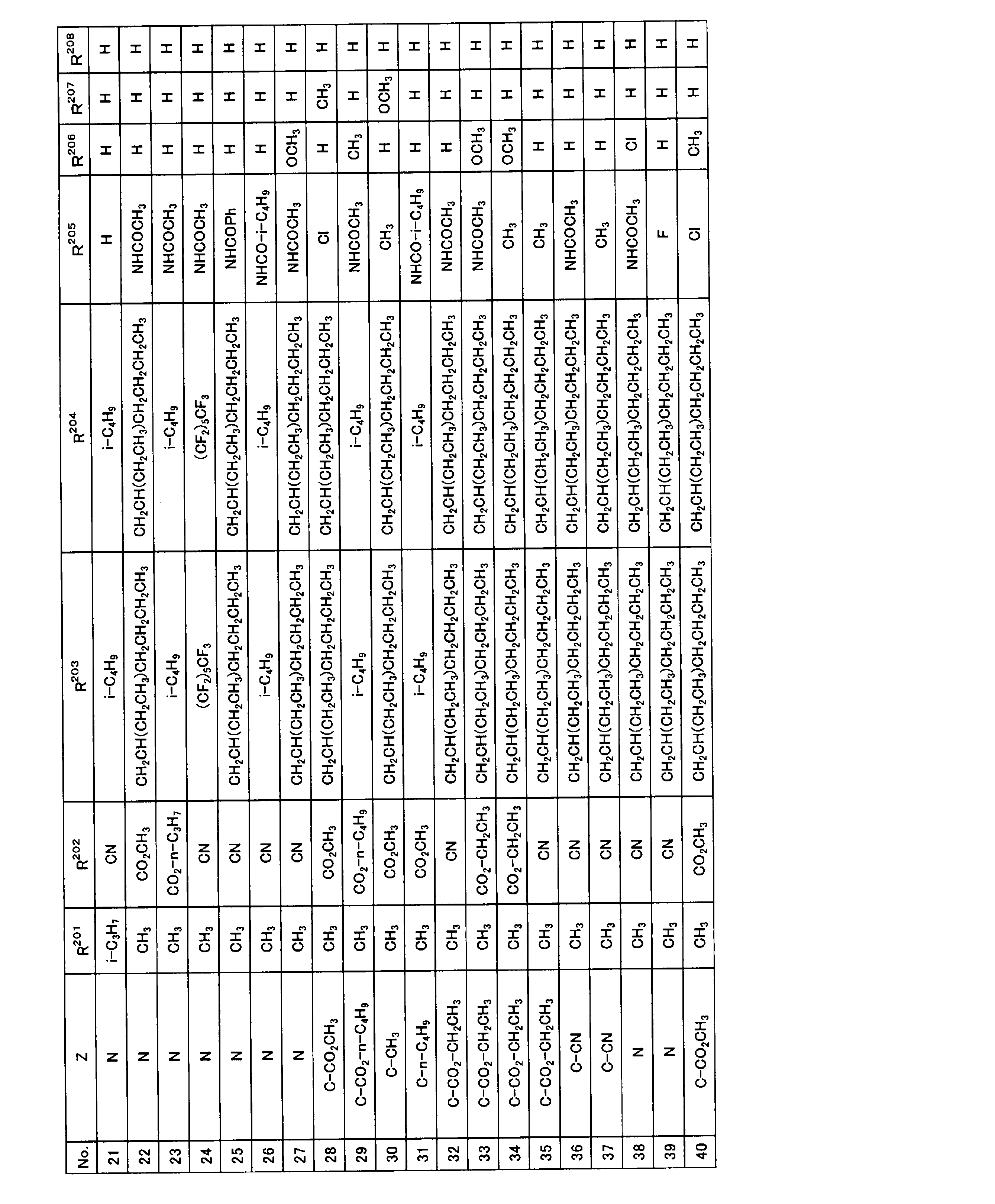

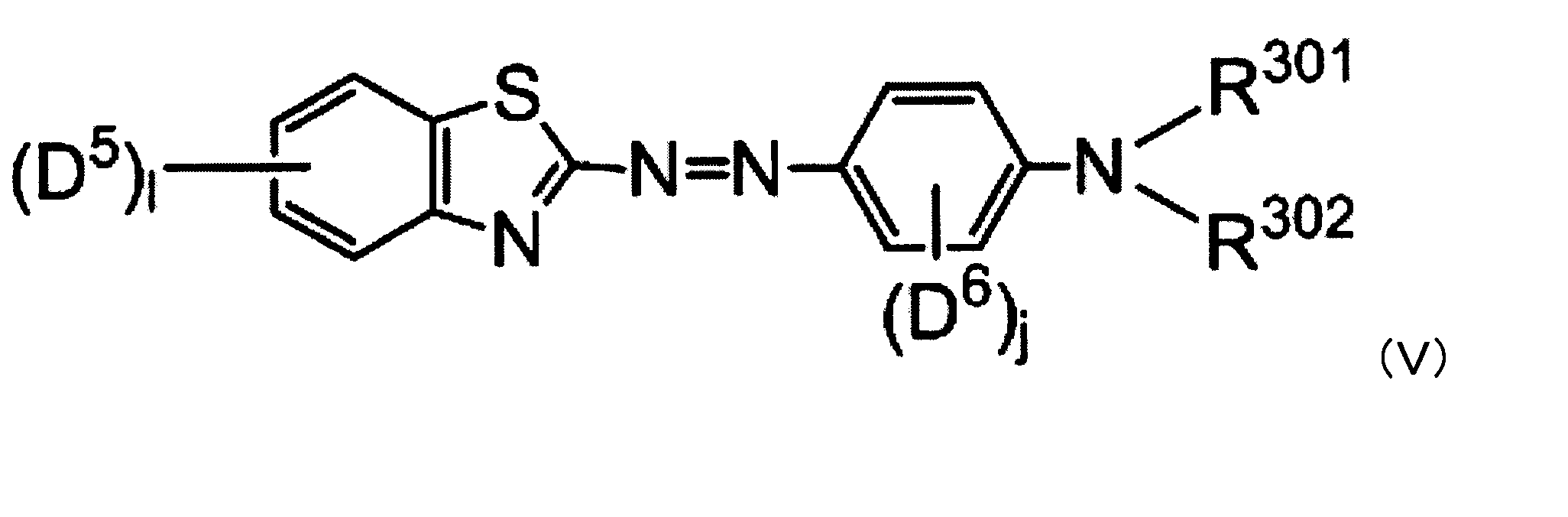
R301、R302、D5及びD6はそれぞれ独立に、任意の置換基を示し、
lは1~4の整数を示し、lが2以上の場合は、1分子中に2以上存在するD5は同一でも異なっていても良く、
jは1~4の整数を示し、jが2以上の場合は、1分子中に2以上存在するD6は同一でも異なっていても良い。]
R301及びR302のヘテロアリール基は、具体的には、前記一般式(I)のR3で例示したヘテロアリール基とそれぞれ同義であり、有していても良い置換基も前記一般式(I)のR3で例示したヘテロアリール基とそれぞれ同義である。
lは1~4の整数を示し、lが2以上の場合は、1分子中に2以上存在するD5は同一でも異なっていても良い。
また、R303、R306及びR307は、それぞれ独立に、置換基を有していても良い炭素数が1~20のアルキル基、置換基を有していても良い炭素数が6~20のアリール基又は置換基を有していても良い炭素数が2~20のヘテロアリール基を示す。
D5のアルコキシ基は、前記一般式(I)のD1で例示したアルコキシ基と同義であり、有していてもよい置換基も同義である。D5及びR306のアルコキシ基は、炭素数が16以下であることが好ましく、10以下であることがさらに好ましく、6以下であることが特に好ましい。炭素数が適当な範囲にあることで、溶媒への溶解性に優れ、しかも高いグラム吸光係数を有することができる場合がある。
R303、R306及びR307のヘテロアリール基は、具体的には、前記一般式(I)のR3で例示したヘテロアリール基とそれぞれ同義であり、有していても良い置換基も前記一般式(I)のR3で例示したヘテロアリール基とそれぞれ同義である。
jは1~4の整数を示し、jが2以上の場合は、1分子中に2以上存在するD6は同一でも異なっていても良い。
また、R304及びR305は、それぞれ独立に、置換基を有していても良い炭素数が1~20のアルキル基、置換基を有していても良い炭素数が6~20のアリール基又は置換基を有していても良い炭素数が2~20のヘテロアリール基を示す。
R304及びR305のヘテロアリール基は、具体的には、前記一般式(I)のR3で例示したヘテロアリール基とそれぞれ同義であり、有していても良い置換基も前記一般式(I)のR3で例示したヘテロアリール基とそれぞれ同義である。


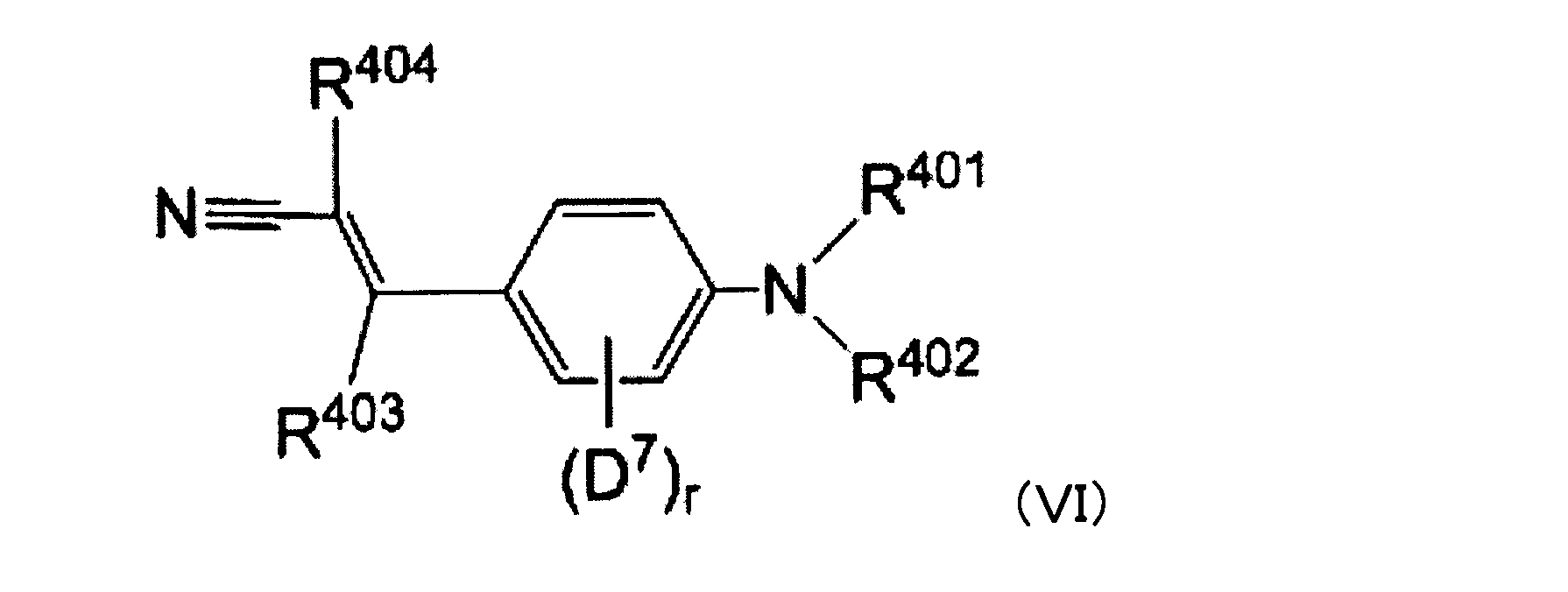
R401、R402、R403、R404及びD7は、それぞれ独立に、任意の置換基を示し、
rは1~4の整数を示し、rが2以上の場合、1分子中に2以上存在するD7は同一であっても異なっていてもよい。]
R401及びR402のヘテロアリール基は、具体的には、前記一般式(I)のR3で例示したヘテロアリール基と同義であり、有していても良い置換基も前記一般式(I)のR3で例示したヘテロアリール基と同義である。
また、R405は置換基を有していても良い炭素数1~20のアルキル基、置換基を有していてもよい炭素数が1~20のアルコキシ基、置換基を有していても良い炭素数が6~20のアリール基又は置換基を有していても良い炭素数が2~20のヘテロアリール基を示す。
R405のアルコキシ基は、前記一般式(I)のD1で例示したアルコキシ基とそれぞれ同義であり、有していてもよい置換基もそれぞれ同義である。R405のアルコキシ基は、炭素数が16以下であることが好ましく、10以下であることがさらに好ましく、6以下であることが特に好ましい。炭素数が適当な範囲にあることで、溶媒への溶解性に優れ、しかも高いグラム吸光係数を有することができる場合がある。
R405のヘテロアリール基は、具体的には、前記一般式(I)のR3で例示したヘテロアリール基と同義であり、有していても良い置換基も前記一般式(I)のR3で例示したヘテロアリール基と同義である。
rは1~4の整数を示し、rが2以上の場合、1分子中に2以上存在するD7は同一であっても異なっていてもよい。
また、R406及びR407は、それぞれ独立に、置換基を有していても良い炭素数が1~20のアルキル基、置換基を有していても良い炭素数が6~20のアリール基又は置換基を有していても良い炭素数が2~20のヘテロアリール基を示す。
D7のアルコキシ基は、前記一般式(I)のD1で例示したアルコキシ基と同義であり、有していてもよい置換基も同義である。D7のアルコキシ基は、炭素数が16以下であることが好ましく、10以下であることがさらに好ましく、6以下であることが特に好ましい。炭素数が適当な範囲にあることで、溶媒への溶解性に優れ、しかも高いグラム吸光係数を有することができる場合がある。
R406及びR407のヘテロアリール基は、具体的には、前記一般式(I)のR3で例示したヘテロアリール基とそれぞれ同義であり、有していても良い置換基も前記一般式(I)のR3で例示したヘテロアリール基とそれぞれ同義である。
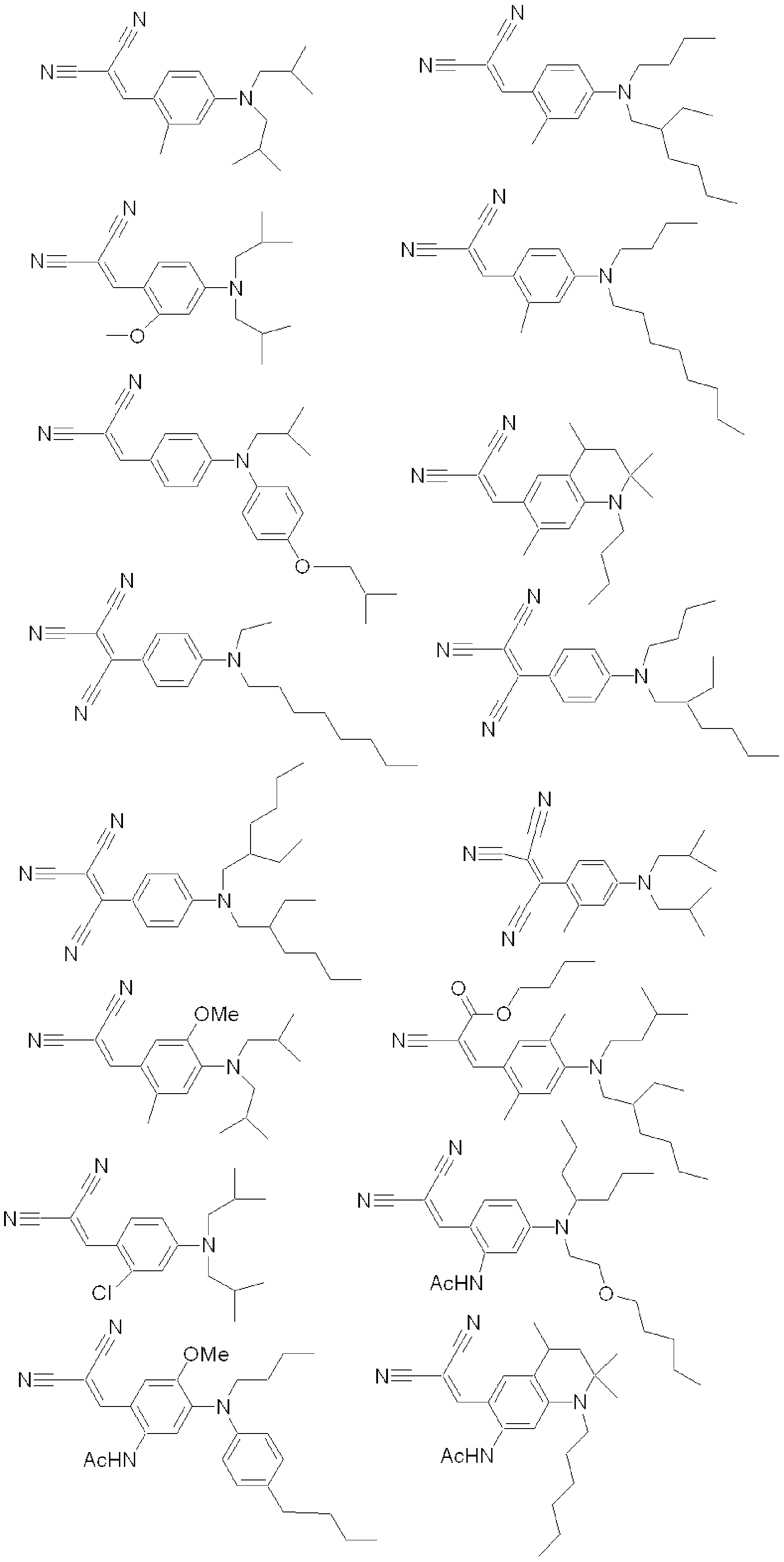
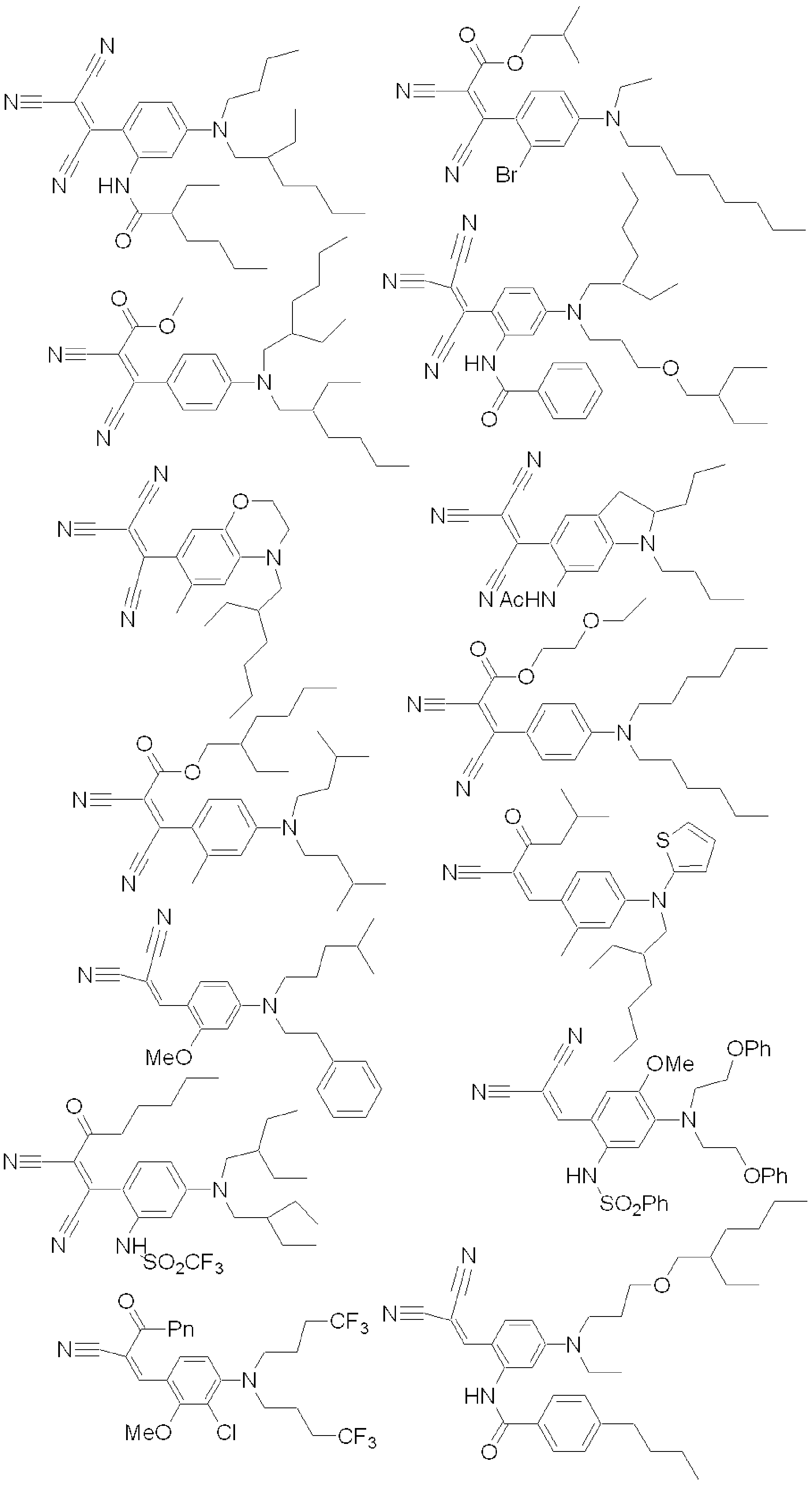
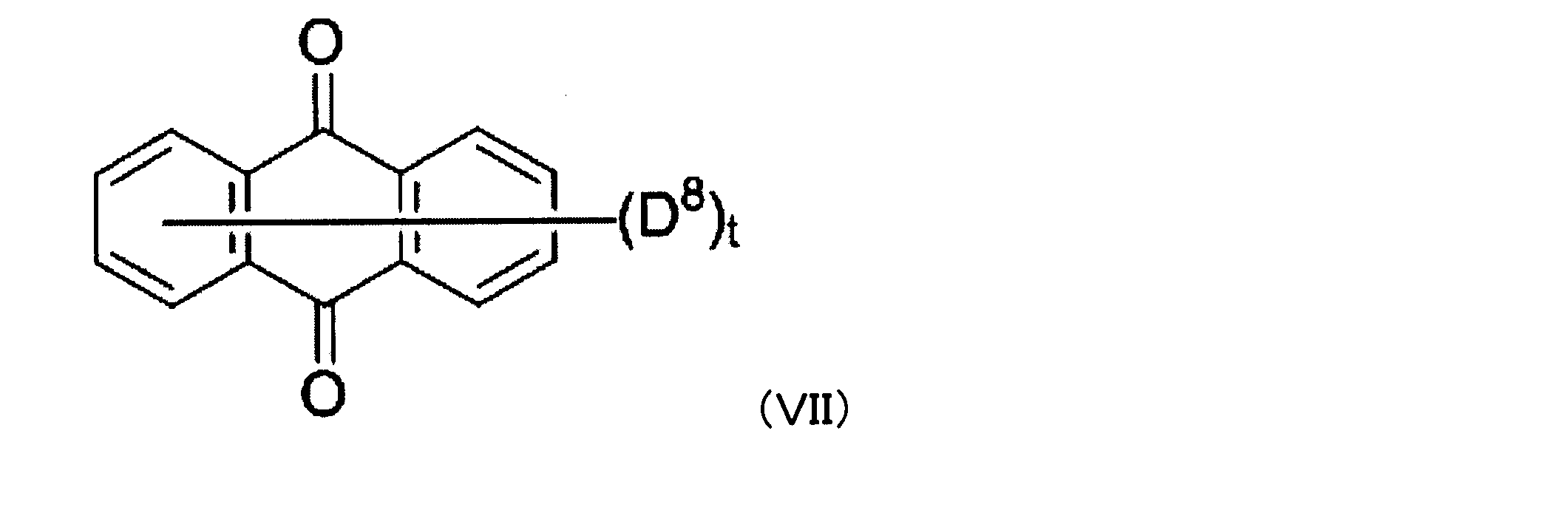
D8は任意の置換基を示し、tは1~8の整数を示し、tが2以上の場合、1分子中に2以上存在するD8は同一であっても異なっていてもよい。]
tは1~8の整数を示し、tが2以上の場合、1分子中に2以上存在するD8は同一であっても異なっていてもよい。
また、R501、R502、R503及びR504は、それぞれ独立に、置換基を有していても良い炭素数が1~20のアルキル基、置換基を有していてもよい炭素数が6~20のアリール基又は置換基を有していても良い炭素数が2~20のヘテロアリール基を示す。
フェニル基又はナフチル基の有しても良い置換基としては、溶媒への高溶解性の理由から、ハロゲン原子、炭素数が1~10のアルキル基、炭素数が1~10のアルコキシ基が好ましい。
R501、R502、R503及びR504のヘテロアリール基は、具体的には、前記一般式(I)のR3で例示したヘテロアリール基とそれぞれ同義であり、有していても良い置換基も前記一般式(I)のR3で例示したヘテロアリール基とそれぞれ同義である。
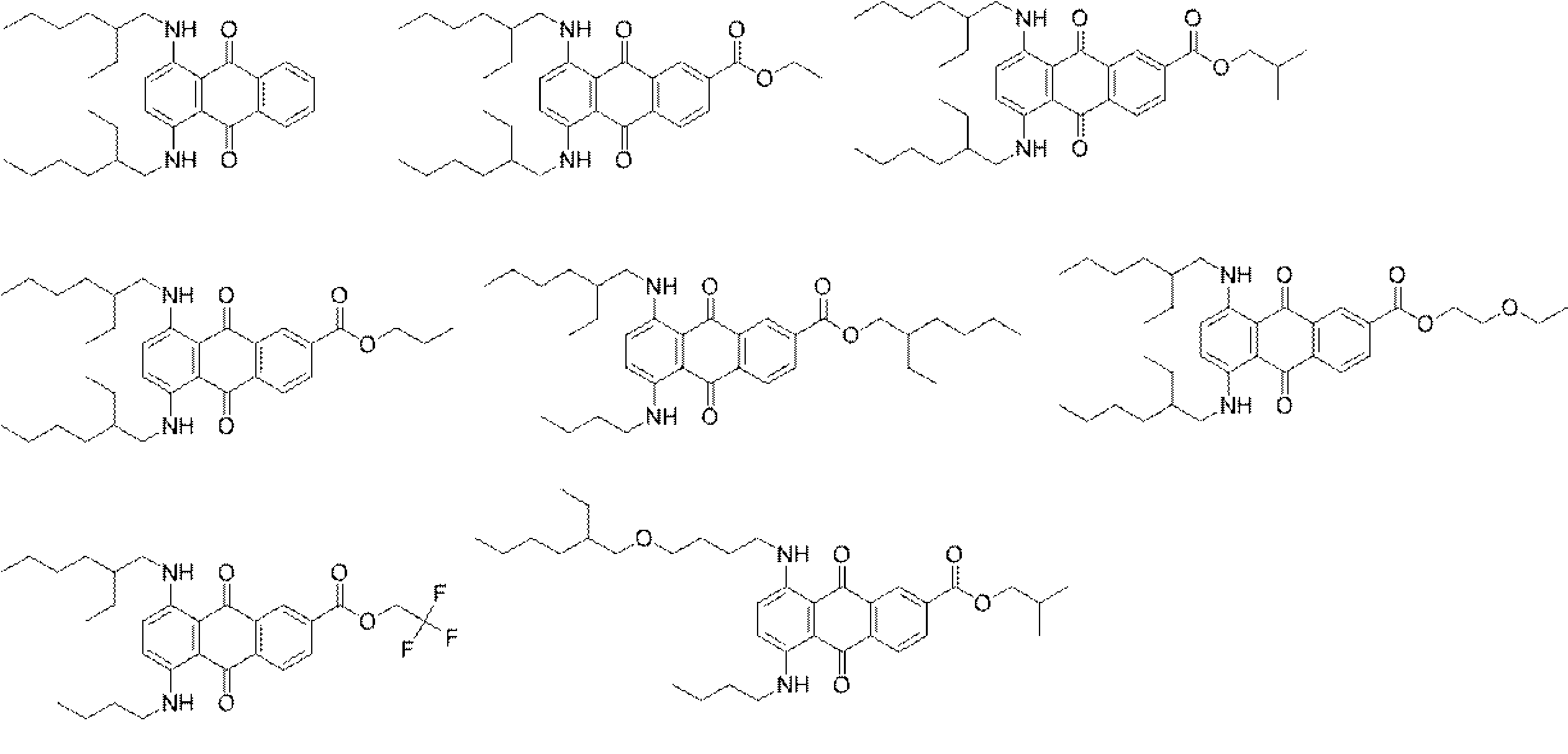
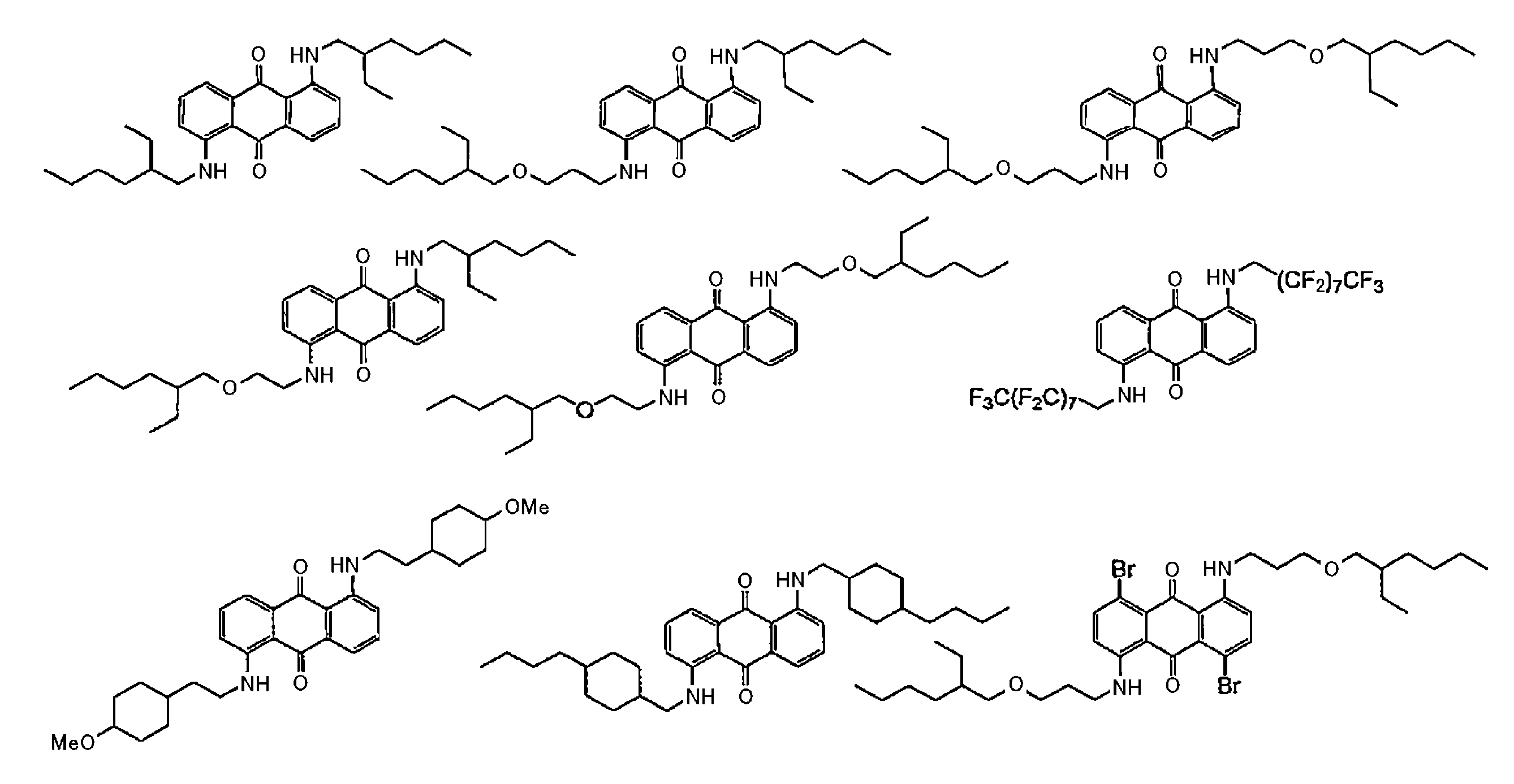
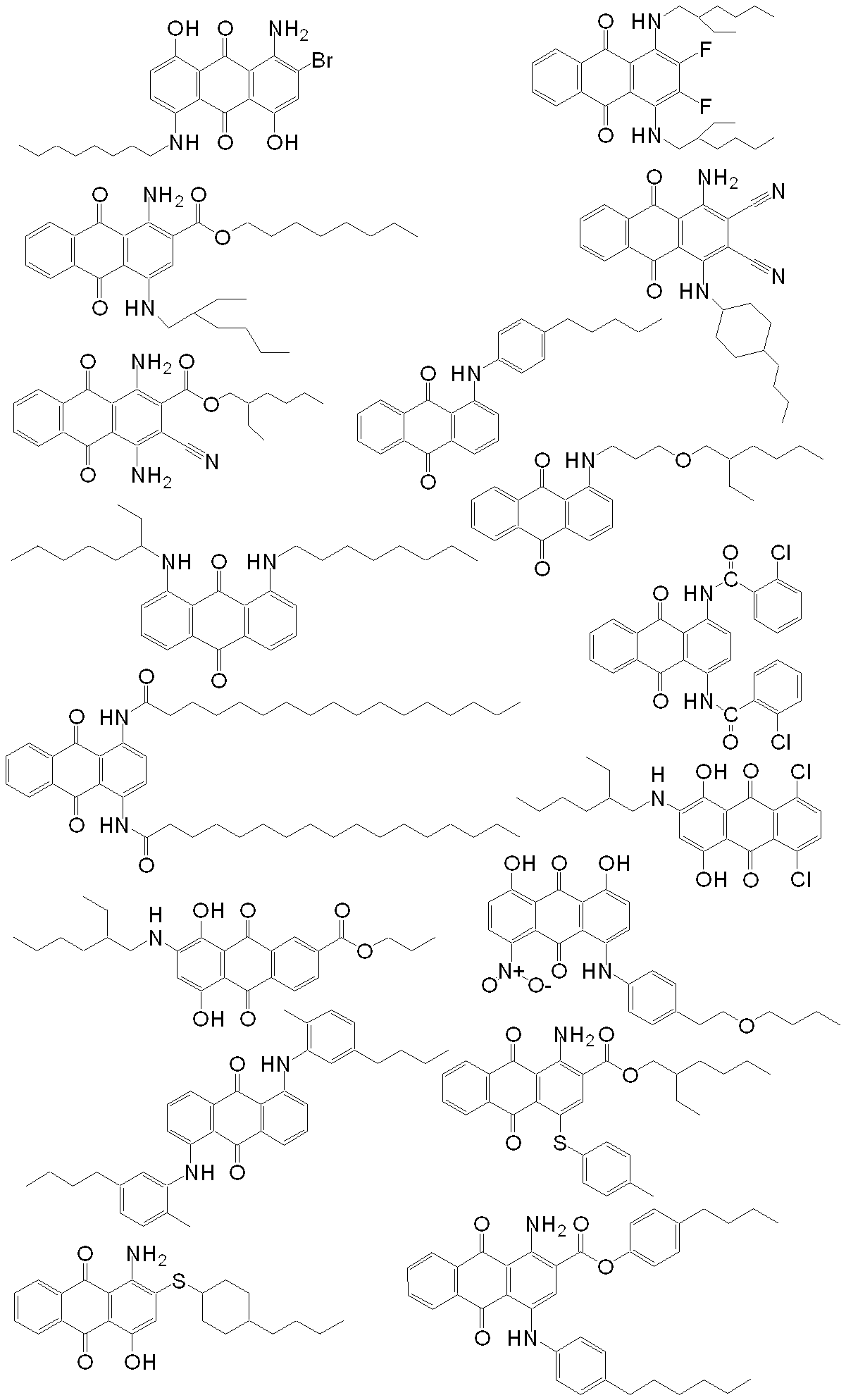
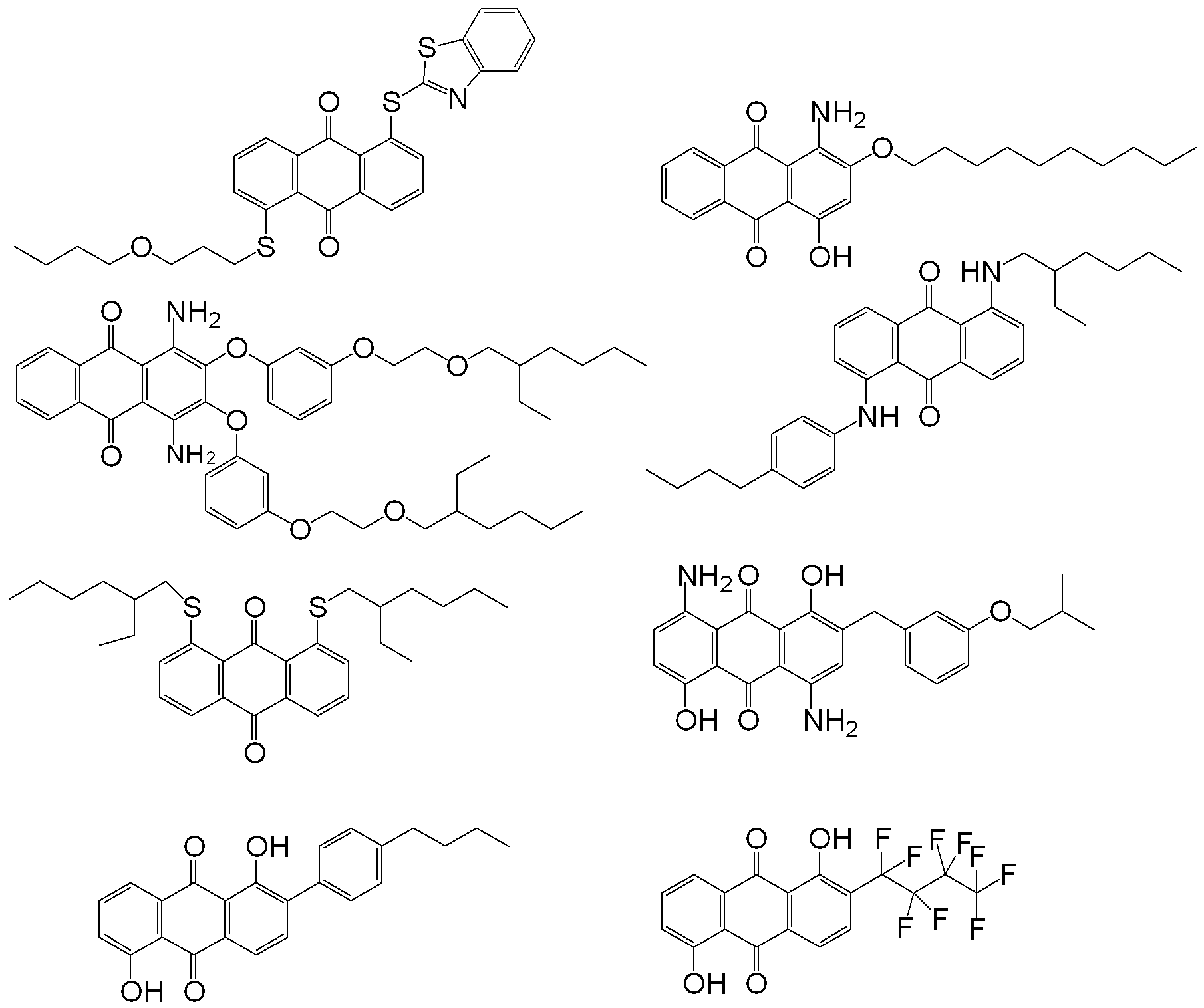
上記一般式(VII)で表されるアントラキノン化合物は、グラム吸光係数の点から、置換基を有する場合は置換基も含めて、その分子量が、通常2000以下、好ましくは1000以下であり、また、通常300以上、好ましくは400以上である。
さらに、本発明のインクは、本発明の効果を損なわない範囲で、必要に応じて、また各用途に適した任意の添加剤を含んでいてもよい。
なお、黒色インクの色相の評価する場合、分光光度計による測定では、非常に黒度の高いインクの場合、適切な透過光強度を得るためにセルの測定光路長を減じる必要がある。この場合、測定光路長が小さくなると透過光が増大するため、測定される明度L*の値は見かけ上大きくなる。したがって、測定光路長の異なるセルで測定されたL*を比較する場合、測定光路長の小さいセルで測定されたインクは見かけのL*よりも実際の黒度が高い場合があることに留意する必要がある。
本発明のインクはディスプレイ用インクに好適に用いられる。ディスプレイとしては、インクを含む表示部位を有し、表示部位の電圧印加を制御することで画像を表示するディスプレイ、電圧印加によって着色状態を変化させることにより画像を表示するディスプレイ、表示部位にさらに電気泳動粒子又は水性媒体を用いて表示をさせるディスプレイに特に有用である。
電圧印加によって着色状態を変化させることにより画像を表示するディスプレイとは、例えば、有色又は無色のインク又は溶媒が電圧印加によって展開又は凝集等の移動をすることで、色が変化し画像を表示させるものなどが挙げられるが、これに限ったものではない。
また、本発明のアゾ系化合物と他の化合物と組み合わせることにより、黒色等の色相に優れた良好なインクを提供することも可能であり、例えば黒色のインクは光シャッターとして機能する部材としても有用である。
ディスプレイの方式としては、エレクトロウェッティング法、電気泳動法などが例示される。ディスプレイの用途としては、コンピューター用、電子ペーパー用、電子インク用など様々なものが挙げられ、既存の液晶表示ディスプレイの用途のほとんどを代替することができる可能性がある。本発明のインクは、中でも、エレクトロウェッティングディスプレイ用のインクとして特に好ましい。
4-n-ブチルアニリン8.02g(54mmol)と7%塩酸水溶液80mlを攪拌、氷冷した後に亜硝酸ナトリウム3.76g(55mmol)を水25mlに溶かした水溶液を滴下、攪拌してジアゾ液にした。別容器に2-アミノ-3-シアノチオフェン6.68g(54mmol)、メタノール100mlを入れ、氷浴中ジアゾ溶液を滴下してカップリングさせた。生成した沈殿を濾別、乾燥しM-1(14g、収率92%)を得た。

4-n-アミルアニリン10.0g(61mmol)と7%塩酸水溶液100mlを攪拌、氷冷した後に亜硝酸ナトリウム4.23g(61mmol)を水40mlに溶かした水溶液を滴下、攪拌してジアゾ液にした。別容器に2-アミノ-3-シアノチオフェン7.60g(61mmol)、メタノール120mlを入れ、氷浴中ジアゾ溶液を滴下してカップリングさせた。生成した沈殿を濾別、乾燥しM-2(18.3g、収率100%)を得た。
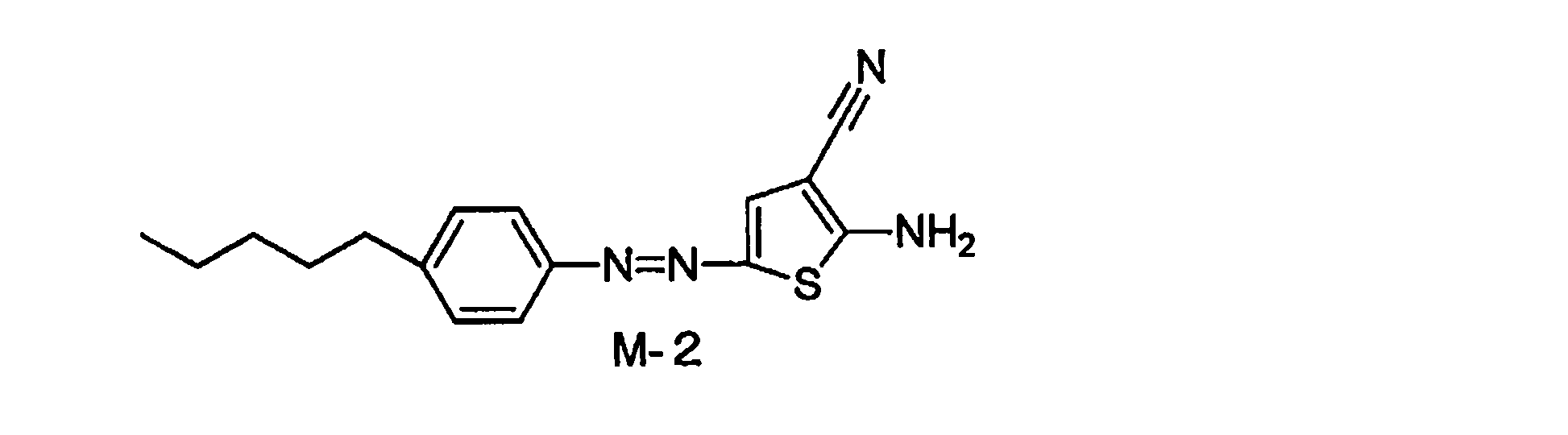
4-アミノ安息香酸イソブチル5.00g(26mmol)と7%塩酸水溶液50mlを攪拌、氷冷した後に亜硝酸ナトリウム1.78g(26mmol)を水20mlに溶かした水溶液を滴下、攪拌してジアゾ液にした。別容器に2-アミノ-3-シアノチオフェン3.21g(26mmol)、メタノール60mlを入れ、氷浴中ジアゾ溶液を滴下してカップリングさせた。生成した沈殿を濾別、乾燥しM-3(8.50g、収率100%)を得た。

4-アミノ安息香酸(2-エチル)ヘキシル6.22g(25mmol)と7%塩酸水溶液39mlを攪拌、氷冷した後に亜硝酸ナトリウム1.74g(25mmol)を水12mlに溶かした水溶液を滴下、攪拌してジアゾ液にした。別容器に2-アミノ-3-シアノチオフェン2.86g(23mmol)、メタノール50mlを入れ、氷浴中ジアゾ溶液を滴下してカップリングさせた。生成した沈殿を濾別、乾燥しM-4(6.04g、収率63%)を得た。

4-ブトキシアニリン(5.0g、30mmol)を7%塩酸(50ml)に溶解し、氷浴で冷却し、亜硝酸ナトリウム(2.2g、32mmol)の水溶液(10ml)を、内部温度を0~2℃に保ちつつ滴下し、同温度で60分間攪拌してジアゾ液を得た。別容器に、2-アミノ-4-メチルチアゾール(3.5g、30ml)、メタノール(60ml)、尿素(0.18g)を取り、氷浴で冷却して内部温度を5℃以下に保ちつつ、ジアゾ液を滴下した。酢酸ナトリウムで中和し、水を加え、不溶物を濾取し、メタノール/水=9/1(容積比)の混合溶媒およびメタノールで順次洗浄して、中間体M-5(7.69g)を得た。
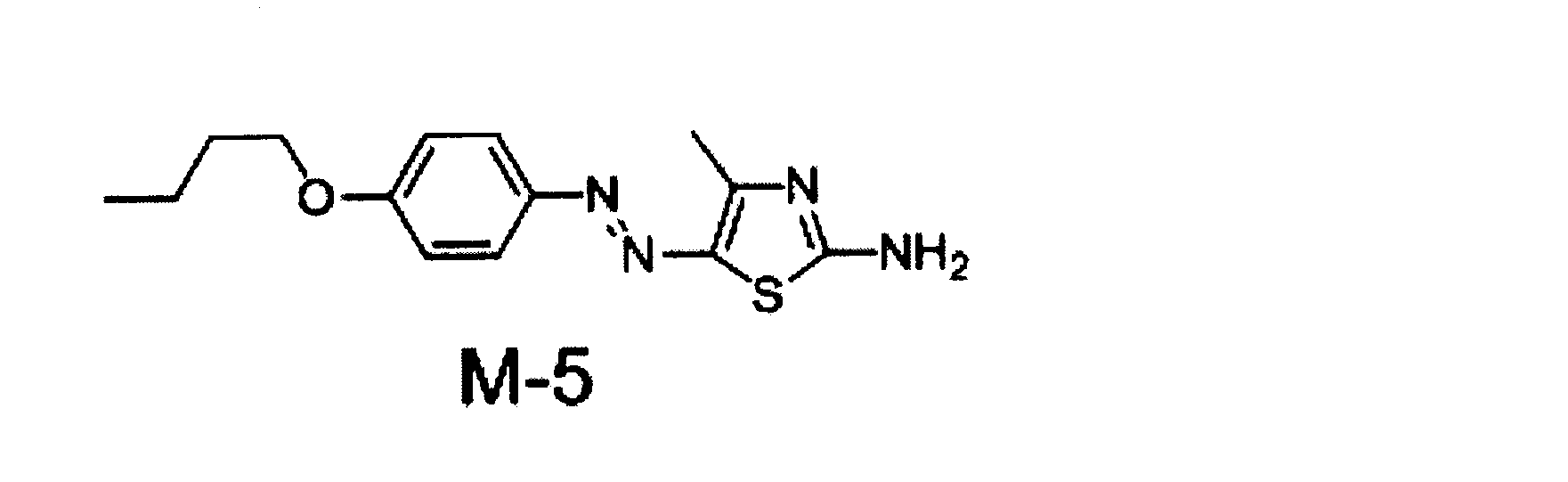
m-アミノアセトアニリド(13.0g、87mmol)、N,N-ジメチルホルムアミド(60ml)、1-ブロモ-2-エチルヘキサン(50.4g、261mmol)、炭酸カリウム(49.5g、358mmol)の混合物を140℃で14時間攪拌した。放冷後、濾過し、濾液に水を加えトルエンで抽出した。

3-エチルアニリン(10.0g、83mmol)、N,N-ジメチルホルムアミド(50ml)、1-ブロモ-2-エチルヘキサン(47.8g、248mmol)、炭酸カリウム(45.6g、330mmol)の混合物を110℃で24時間攪拌した。放冷後、濾過し、濾液に水を加えトルエンで抽出した。得られた有機層を濃縮した後シリカゲルカラムクロマトグラフィーで精製して、C-2(6.3g、収率22%)を得た。
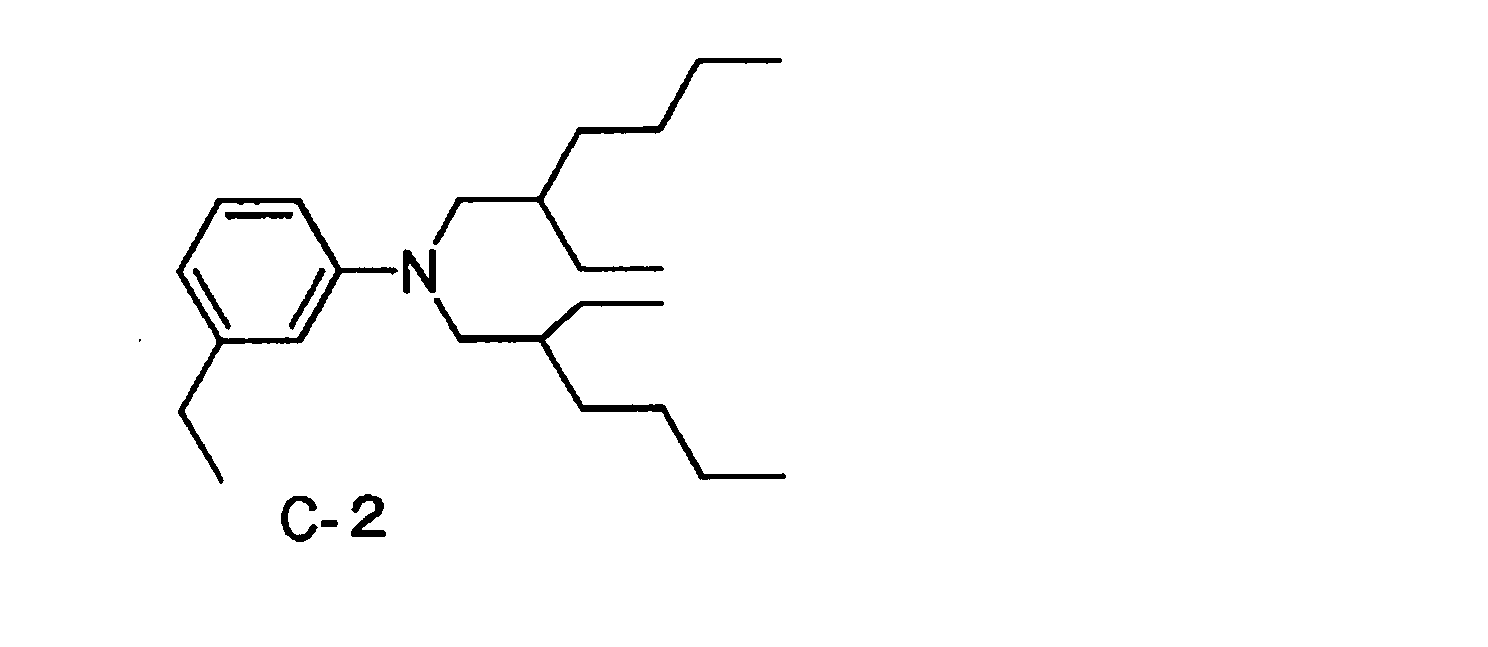
3-イソプロピルアニリン(10.0g、74mmol)、N,N-ジメチルホルムアミド(50ml)、1-ブロモ-2-エチルヘキサン(42.8g、220mmol)、炭酸カリウム(40.9g、300mmol)の混合物を140℃で20時間攪拌した。放冷後、濾過し、濾液に水を加えトルエンで抽出した。得られた有機層を濃縮した後シリカゲルカラムクロマトグラフィーで精製して、C-3(8.56g、収率32%)を得た。
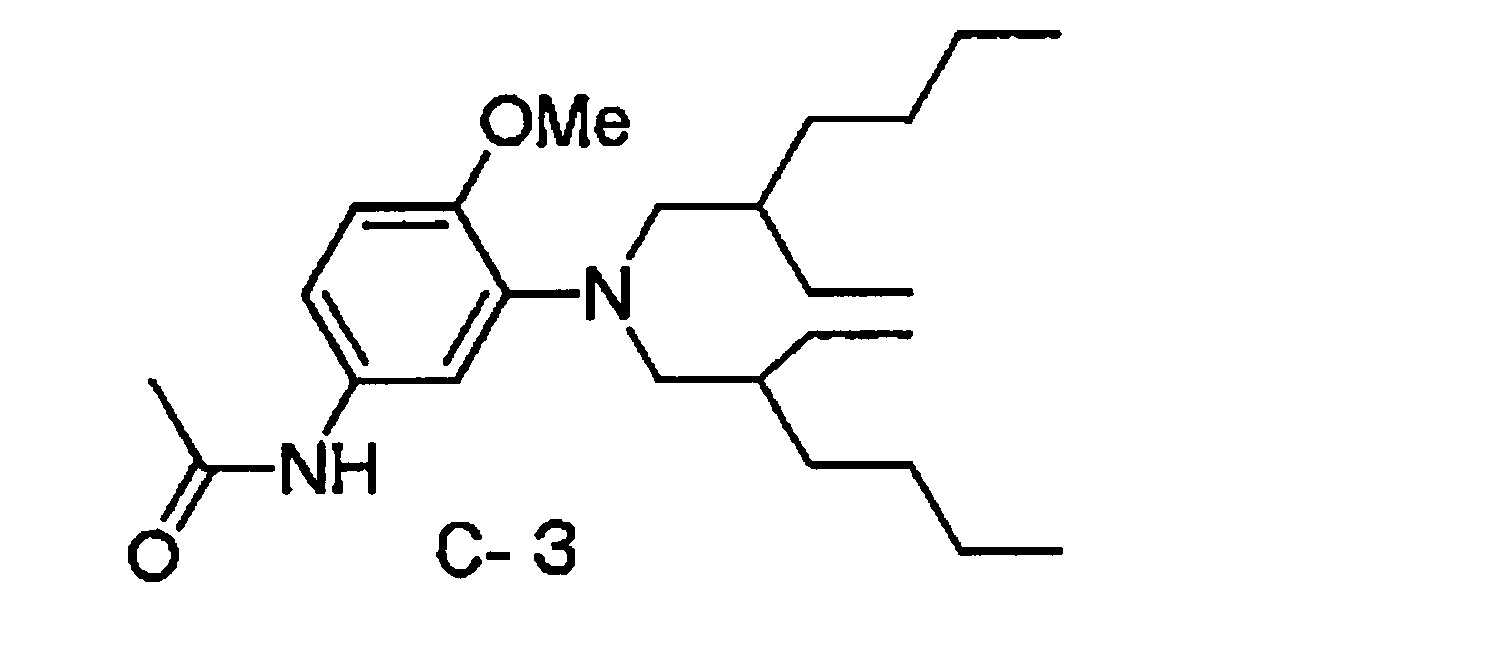
3’-アミノ-4’-メトキシアセトアニリド(25.0g、139mmol)、N,N-ジメチルホルムアミド(125ml)、1-ブロモ-2-エチルヘキサン(80.4g、416mmol)、炭酸カリウム(76.7g、554mmol)の混合物を140℃で14時間攪拌した。放冷後、濾過し、濾液に水を加えトルエンで抽出した。得られた有機層を濃縮した後シリカゲルカラムクロマトグラフィーで精製して、C-4(9.82g、収率18%)を得た。

m-トルイジン(51.1g、477mmol)、1-ブロモ-2-エチルヘキサン(357.3g、1.86mol)、炭酸カリウム(221.5g、1.6mol)の混合物を140℃で17時間攪拌した。放冷後、濾過し、得られた有機層を濃縮した後シリカゲルカラムクロマトグラフィーで精製して、C-5(52g、収率33%)を得た。
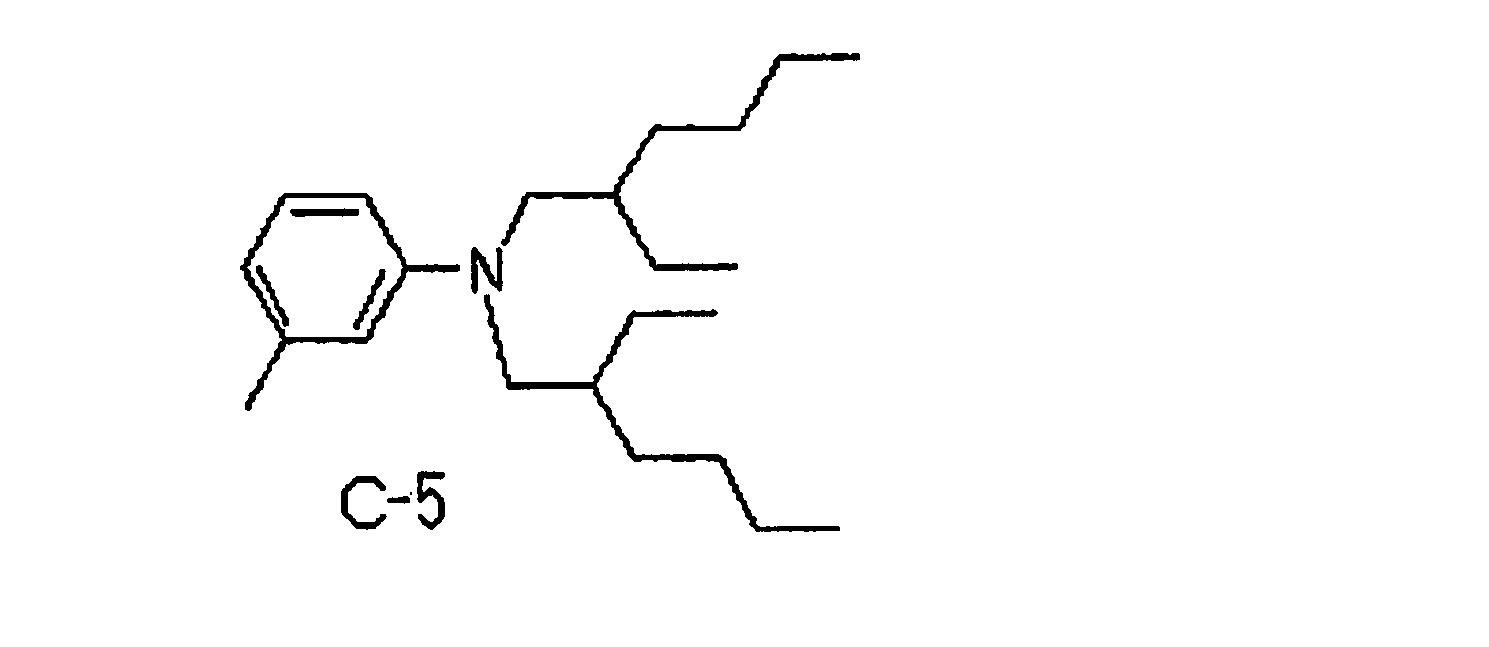
2-メトキシ-5-メチルアニリン(25.3g、184mmol)、N,N-ジメチルホルムアミド(100ml)、1-ブロモ-2-エチルヘキサン(145.2g、752mmol)、炭酸カリウム(90.1g、652mmol)の混合物を130℃で6時間攪拌した。放冷後、濾過し、濾液に水を加えトルエンで抽出した。得られた有機層を濃縮した後シリカゲルカラムクロマトグラフィーで精製して、C-6(11.76g、収率18%)を得た。
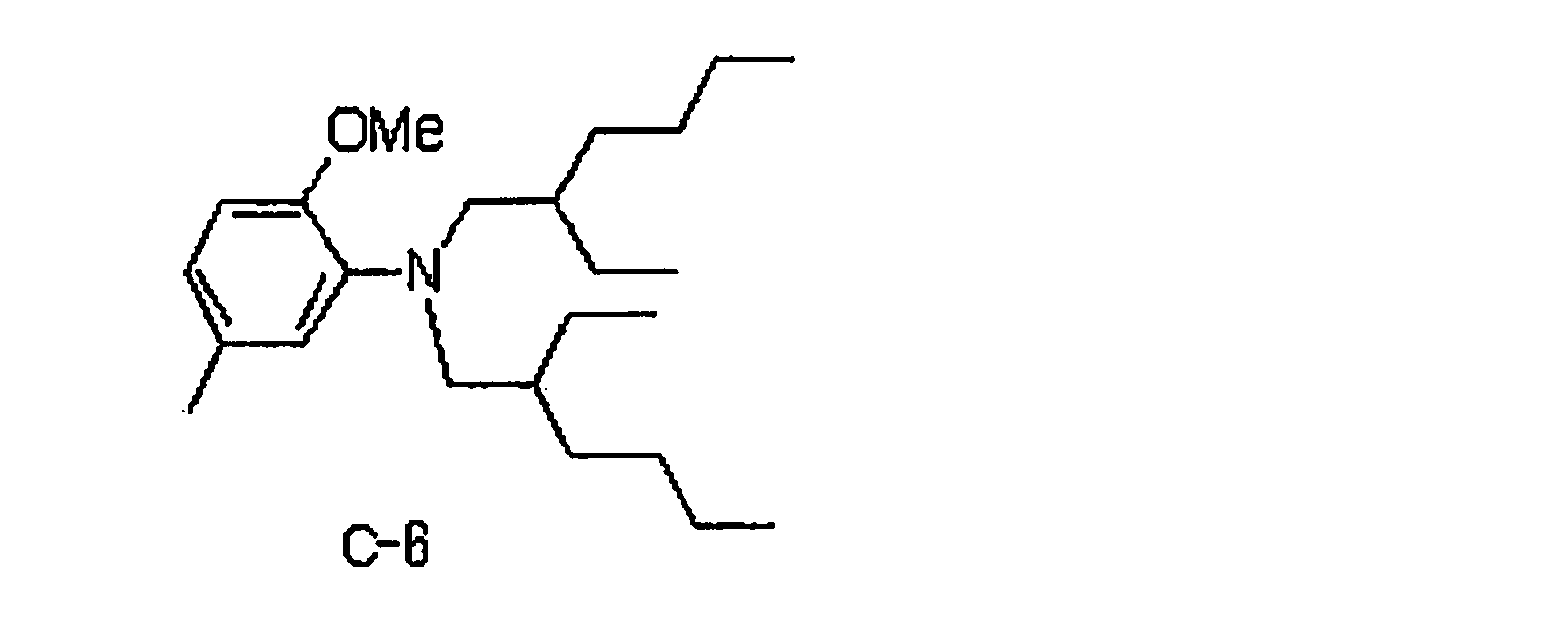
1,3-フェニレンジアミン(10g、93mmol)、テトラヒドロフラン(THF)(125ml)、トリエチルアミン(30ml、231mmol)の混合物に氷冷下、2-エチルヘキサノイルクロリド(19ml、111mmol)を滴下した。反応液をろ過し、得られたろ液を濃縮後シリカゲルカラムクロマトグラフィで精製した。得られたモノアミド体10.0g、ジメチルホルムアミド50ml、1-ブロモ-2-エチルヘキサン(21ml、120mmol)、炭酸カリウム(22g、160mmol)の混合物を140℃で24時間攪拌した。放冷後、濾過し、濾液に水を加えトルエンで抽出した。得られた有機層を濃縮した後シリカゲルカラムクロマトグラフィーで精製して、C-7(5.2g、収率27%)を得た。
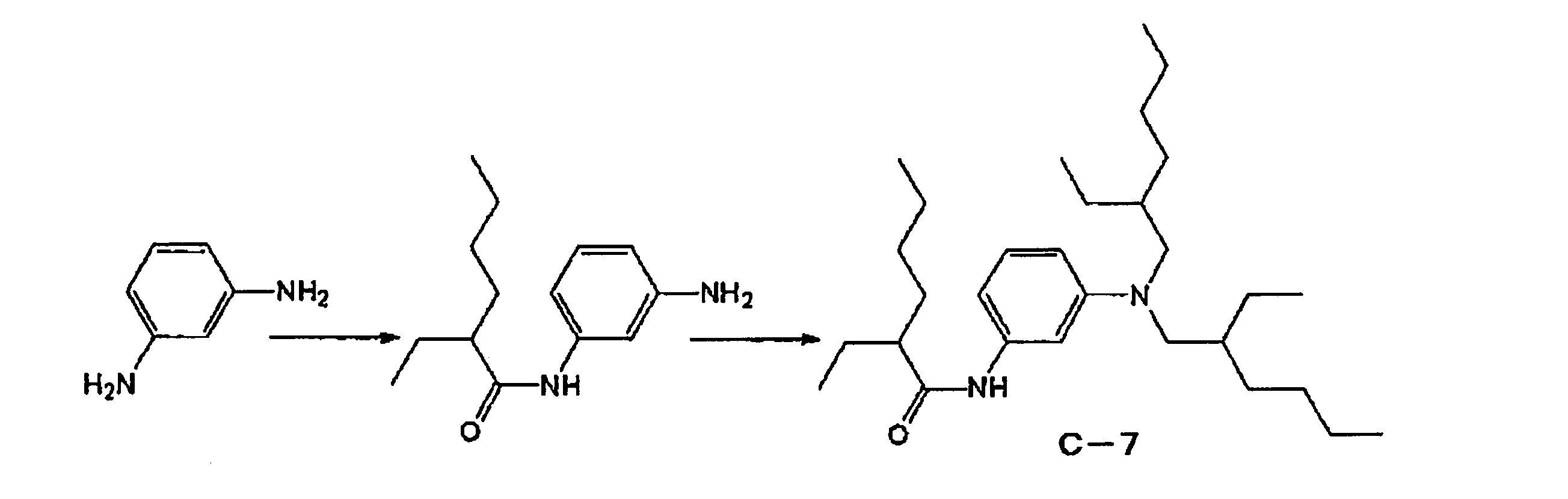
中間体C-3(5.0g、12.4mmol)、メタノール10ml、脱塩水30ml、35%塩酸3mlの混合物を、60℃で3時間攪拌した。35%塩酸3mlを追加したのち、さらに60℃で3時間攪拌した。35%塩酸1mlを追加し、さらに60℃で1.5時間攪拌した。別容器に酢酸ナトリウム14g、脱塩水200mlを入れ、反応液を氷冷しながら滴下した。酢酸ナトリウム50gを追加してpHを6.1に調整した。ヘキサンと酢酸エチルの混合物で抽出し、有機層を脱塩水で洗浄した。有機層を分離し、無水硫酸ナトリウムで乾燥し、減圧濃縮して、油状物4.6g(収率定量的)を得た。
得られた油状物4.5g(12mmol)に、N,N-ジメチルホルムアミド(45ml)、トリエチルアミン(3.9ml、31mmol)、プロピオン酸(1.1ml、15mmol)、1-エチル-3-(3-ジメチルアミノプロピル)カルボジイミド塩酸塩(2.4g,12mmol)を加え、室温で16時間攪拌後、プロピオン酸(1.1ml、15mmol)、1-エチル-3-(3-ジメチルアミノプロピル)カルボジイミド塩酸塩(2.4g,12mmol)を加えて23時間攪拌後、プロピオン酸(20ml)、さらに1-エチル-3-(3-ジメチルアミノプロピル)カルボジイミド塩酸塩(10g)を加え、45時間攪拌した。反応液にヘキサンおよび水を加え、有機層を分離し、水で洗浄し、減圧濃縮した。シリカゲルカラムクロマトグラフィーで精製して、中間体C-8(1.1g)を得た。
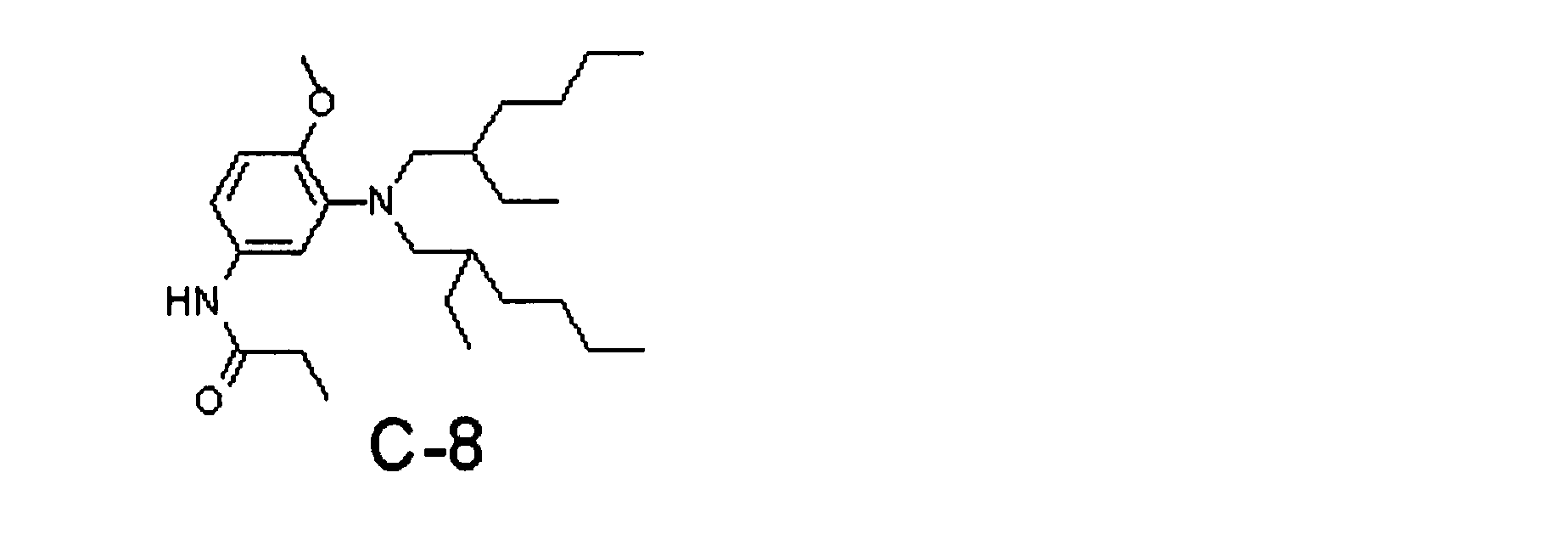
3-クロロアニリンと、1-ブロモ-2-エチルヘキサンから、中間体C-5の合成と同様にして中間体C-9を合成した。
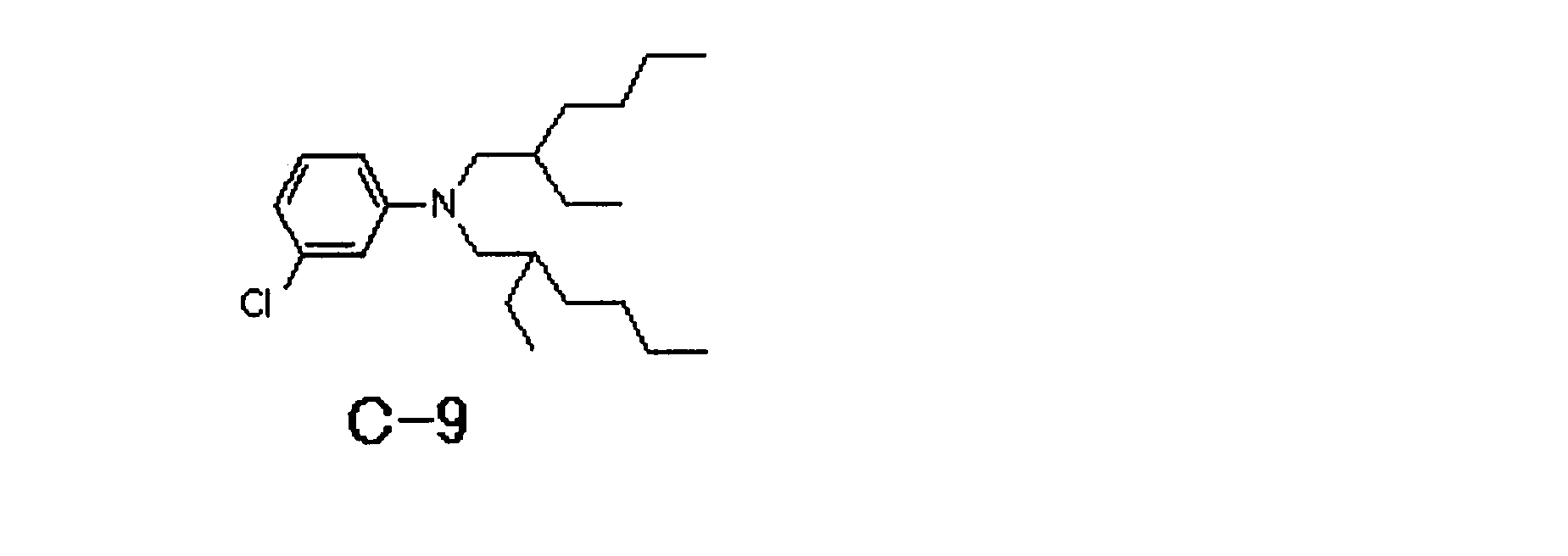
N-(3-アミノフェニル)プロパンアミド(10.0g、61mmol)、N,N-ジメチルホルムアミド(50ml)、1-ブロモ-2-エチルヘキサン(35.3g、183mmol)、炭酸カリウム(33.7g、244mmol)の混合物を110℃で24時間攪拌した。放冷後、濾過し、濾液に水を加えトルエンで抽出した。得られた有機層を濃縮した後シリカゲルカラムクロマトグラフィーで精製して、C-10(7.6g、収率32%)を合成した。

<化合物1の合成>
氷酢酸11.4ml、85%リン酸11.4mlを氷冷しながらM-1(1.3g、4.5mmol)を系内に入れ、44%ニトロシル硫酸1.6gを滴下、攪拌してジアゾ液にした。別容器にC-1(1.7g、4.4mmol)とTHF28ml、水50mlを入れて氷浴した。その中にジアゾ溶液を滴下してカップリングさせた。生成した沈殿をろ別後、シリカゲルカラムクロマトグラフィーで精製し、化合物1(0.535g、収率18%)を得た。
<化合物2の合成>
中間体M-3と中間体C-2から、化合物1の合成と同様の操作で化合物2を合成した。
<化合物3の合成>
中間体M-1と中間体C-3から、化合物1の合成と同様の操作で化合物3を合成した。
<化合物4の合成>
中間体M-3と中間体C-4から、化合物1の合成と同様の操作で化合物4を合成した。
<化合物5の合成>
中間体M-2と中間体C-3から、化合物1の合成と同様の操作で化合物5を合成した。
<化合物6の合成>
中間体M-4と中間体C-5から、化合物1の合成と同様の操作で化合物6を合成した。
[実施例7]
<化合物7の合成>
中間体M-1と中間体C-6から、化合物1の合成と同様の操作で化合物7を合成した。
<化合物8の合成>
中間体M-4と中間体C-1から、化合物1の合成と同様の操作で化合物8を合成した。
<化合物9の合成>
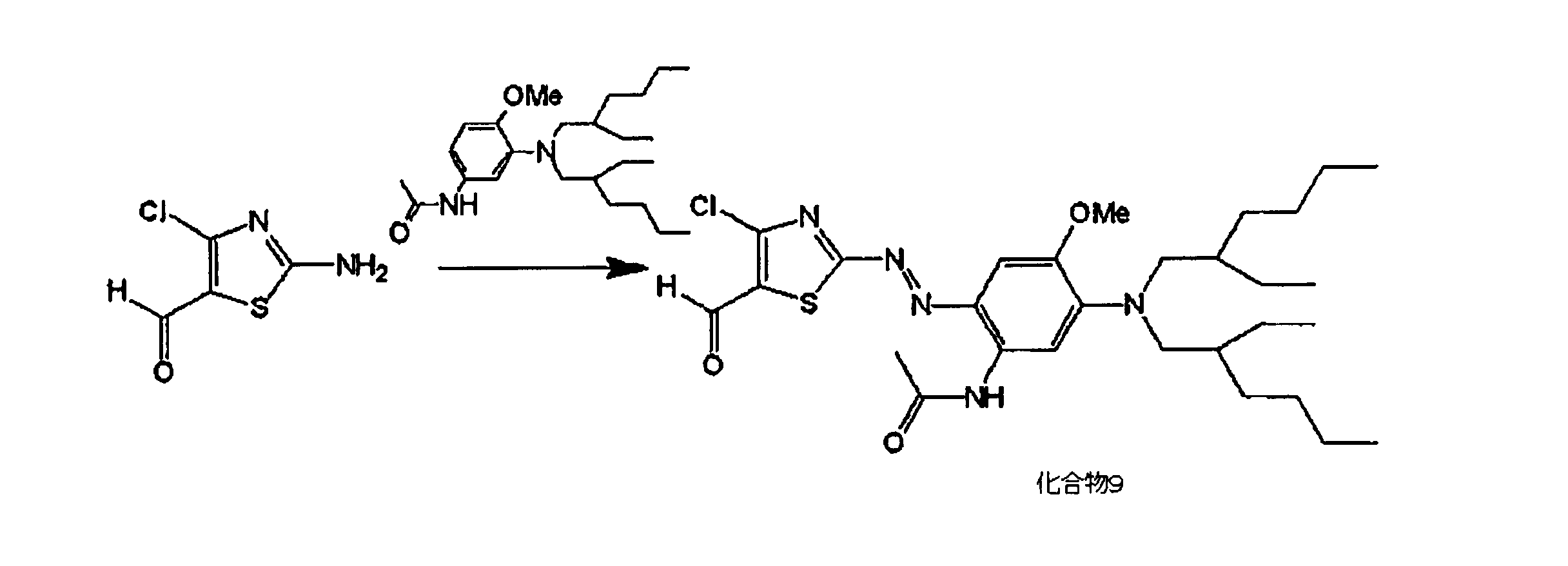
<化合物10の合成>
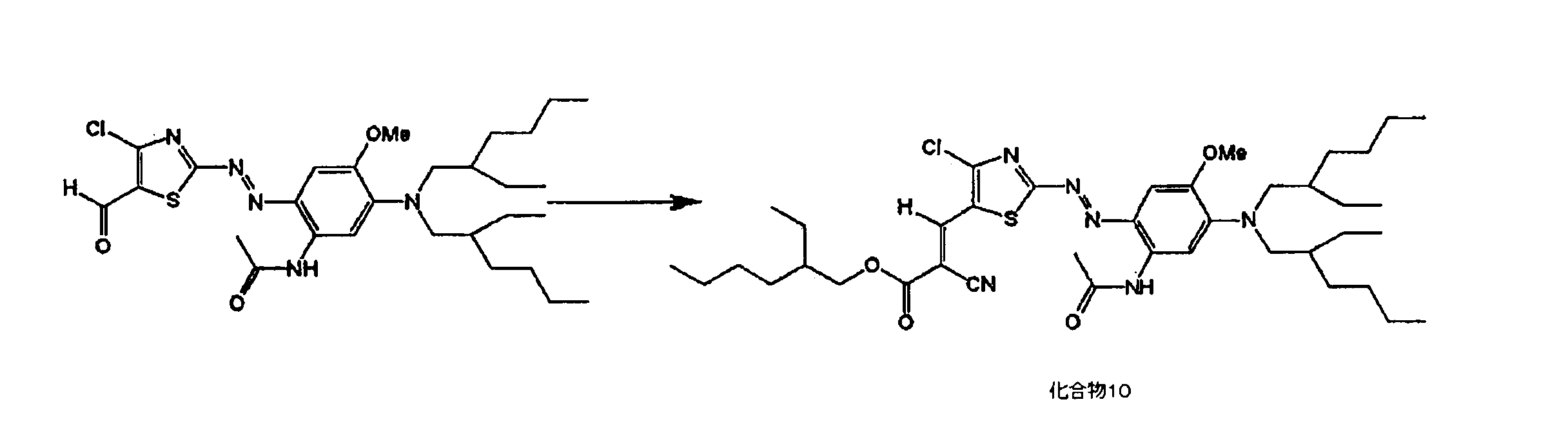
<化合物11の合成>
2-アミノ-3-シアノ-4-クロロ‐5-ホルミルチオフェン(0.5g、2.1mmol)、氷酢酸3ml、プロピオン酸0.7mlを氷冷しながら、硫酸2.7ml、脱塩水0.3m、44wt%ニトロシル硫酸(0.7g、2.3mmol)を滴下、攪拌してジアゾ液にした。別容器にC-7(0.95g、2.0mmol)、THF5ml、酢酸ナトリウム5.7g、スルファミン酸0.06g、水20mlを入れて氷浴した。その中にジアゾ溶液を滴下してカップリングさせた。生成した沈殿をろ別後、シリカゲルカラムクロマトグラフィーで精製し青色化合物を得た。
得られた青色化合物(0.30g、0.5mmol)、n-BuOH3.0ml、マロノニトリル33mgの混合物を室温にて攪拌しながら、原料に対して0.3等量のピペリジンをn-BuOHに溶解させて加えた。反応液を水中に滴下し、ろ過、水洗したのちシリカゲルカラムクロマトグラフィーで精製し、化合物11を得た(0.15g、収率46%)。
<化合物12の合成>
2-アミノ-3,5-ビス(エトキシカルボニル)-4-メチルチオフェン(2.0g、7.8mmol)、氷酢酸(14ml)、プロピオン酸(2.8ml)、硫酸(10.8ml)、脱塩水(1.2ml)の混合物を氷浴で冷却し、系内2℃で44wt%ニトロシル硫酸(2.5g、8.6mmol)を滴下した後、系内0±5℃を保ち1時間攪拌してジアゾ液を得た。別容器にC-3(2.9g、7.4mmol)、テトラヒドロフラン(40ml)、スルファミン酸(0.24g)、酢酸ナトリウム(5.7g)を取り、氷冷下でジアゾ液を系内0±5℃を保ちながら滴下した。途中氷を追加した。反応液をろ別し、ろ物をシリカゲルカラムクロマトグラフィーで精製し、化合物12(1.45g、収率28%)を得た。
<化合物13の合成>
中間体M-1と中間体C-8から、化合物1の合成と同様の操作で化合物13を合成した。
<化合物14の合成>
中間体M-5と中間体C-9から、化合物1の合成と同様の操作で化合物14を合成した。
<化合物15の合成>
中間体M-1と中間体C-5から、化合物1の合成と同様の操作で化合物15を合成した。
<比較例化合物1の合成>
国際公開第2010/031860号の実施例に準じて比較例化合物1を合成した。
[比較例2]
<比較例化合物2の合成>
特開平01-136787号公報の化合物M-2を比較例化合物2として合成した。
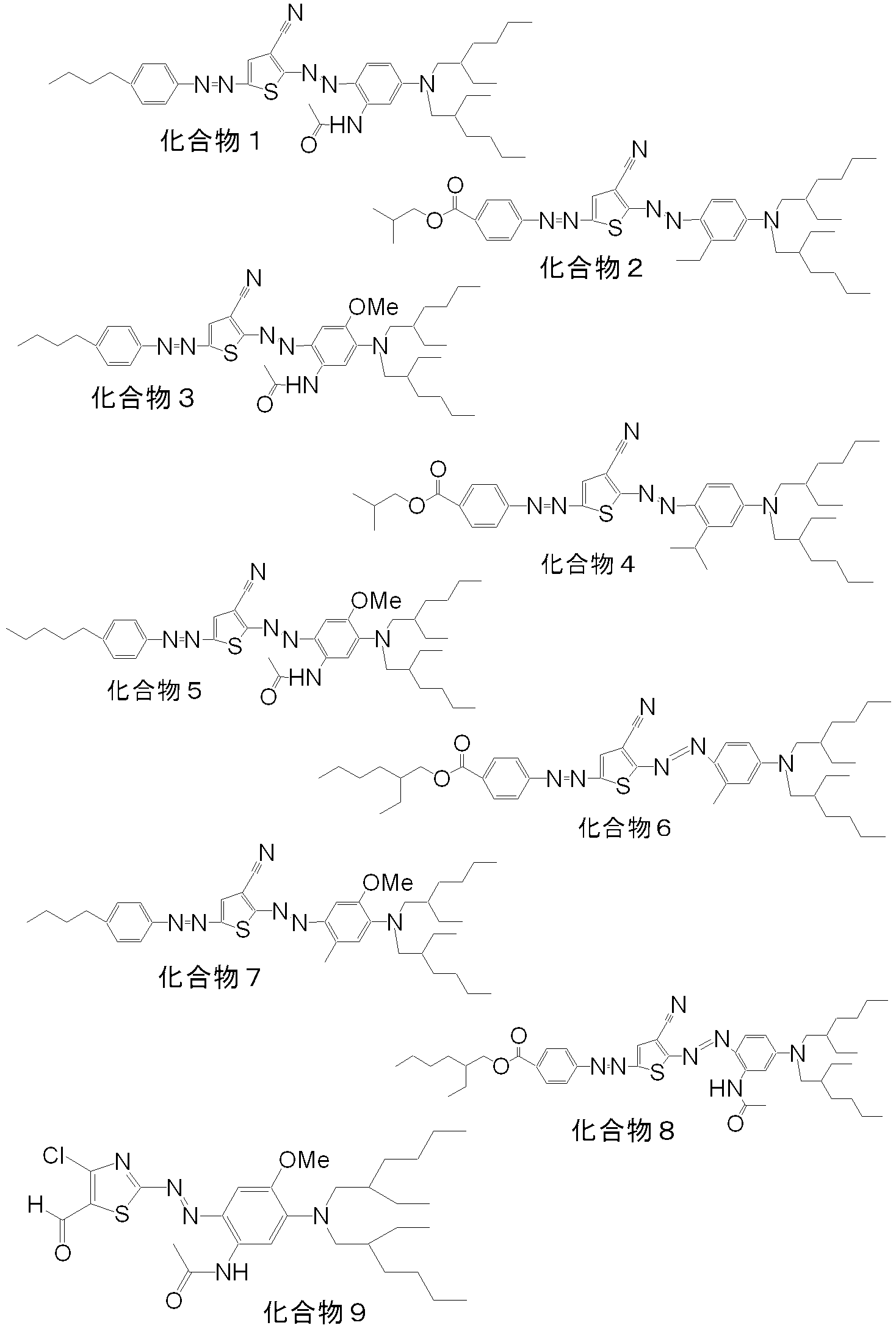

各溶媒での溶液の色、吸収極大波長(λmax)、5℃における溶解度C、モル吸光係数ε及びεCを表4~8にまとめた。
アジレント・テクノロジー株式会社製のプレシジョンLCRメータ 4284Aを用いてインピーダンスメーター法により測定した。溶媒及びインクのそれぞれを電極間隔30μmに対向、平行平板のITO電極付きガラス基板で挟持した後、22℃において、周波数1kHz,テスト信号電圧0.1V印加時の等価並列容量を測定し、下式による計算で比誘電率を決定し、評価した。
比誘電率=等価並列容量×電極間隔/電極面積/真空の誘電率(ε0)
純水30gと溶媒8gを110mlのバイアル瓶に入れ、25℃の恒温槽内で200回/分で4時間振盪した。振盪後の液を遠心分離し(6000×g、5分間)、水層をサンプリングして、溶解している溶媒の濃度をガスクロマトグラフィーで定量した。なお、アイソパーは単一化合物ではなく混合物であるため、定量はTOC(全有機炭素)で行い、平均分子量をMwとして、次の式によって溶解度に換算した。
溶解度[mg/L]=TOC[mg/L]×(14Mw/{12(Mw-2)})
2種類以上の溶媒を混合した混合溶媒の場合は、水に対する溶解度を混合溶媒を構成する各溶媒の水に対する溶解度に各々のモル分率を乗じて総計することによって求めた。
なお、使用されている溶媒種が不明な場合は、質量分析法等によって溶媒種を同定することによって、上記の方法で水に対する溶解度を測定することができる。
化合物1~15、比較例化合物1及び2それぞれ1mgを、各溶媒100mlに溶解し、測定光路長10mmの石英セルを使用して、日立分光光度計U-4100にて吸収スペクトルの測定を行った。得られたスペクトルから吸収極大波長λmax(nm)とモル吸光係数ε(L・mol-1・cm-1)を求めた。
各化合物の各溶媒に対する溶解度Cを次の通り測定した。
各溶媒に化合物をそれぞれ溶解残存分が生じるまで添加し、30℃で30分間超音波処理をした。5℃で24時間放置後、超小型遠心機を用い、0.1ミクロンのフィルターで遠心濾過した(遠心力5200×g)。得られた飽和溶液を適当な濃度に希釈して、測定光路長10mmの石英セルを使用して、日立分光光度計U-4100にて吸収スペクトルの測定を行い、吸収極大波長λmax(nm)における吸光度とあらかじめ測定したモル吸光係数ε(Lmol-1・cm-1)との関係から各化合物の濃度を求め、溶解度C(mol・L-1)を計算した。またモル吸光係数ε(L・mol-1・cm-1)と溶解度C(mol・L-1)の積εCの値を求めた。
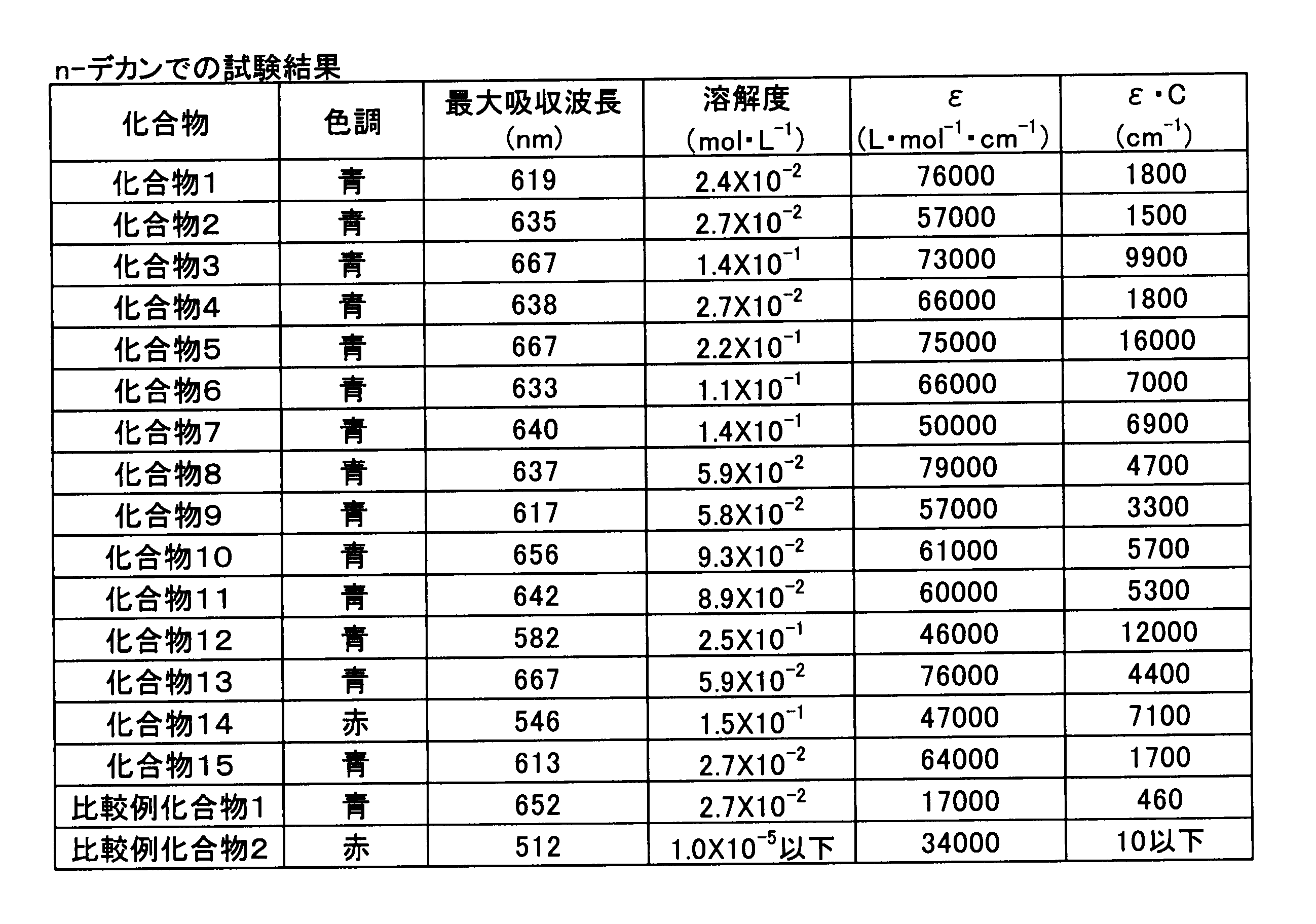

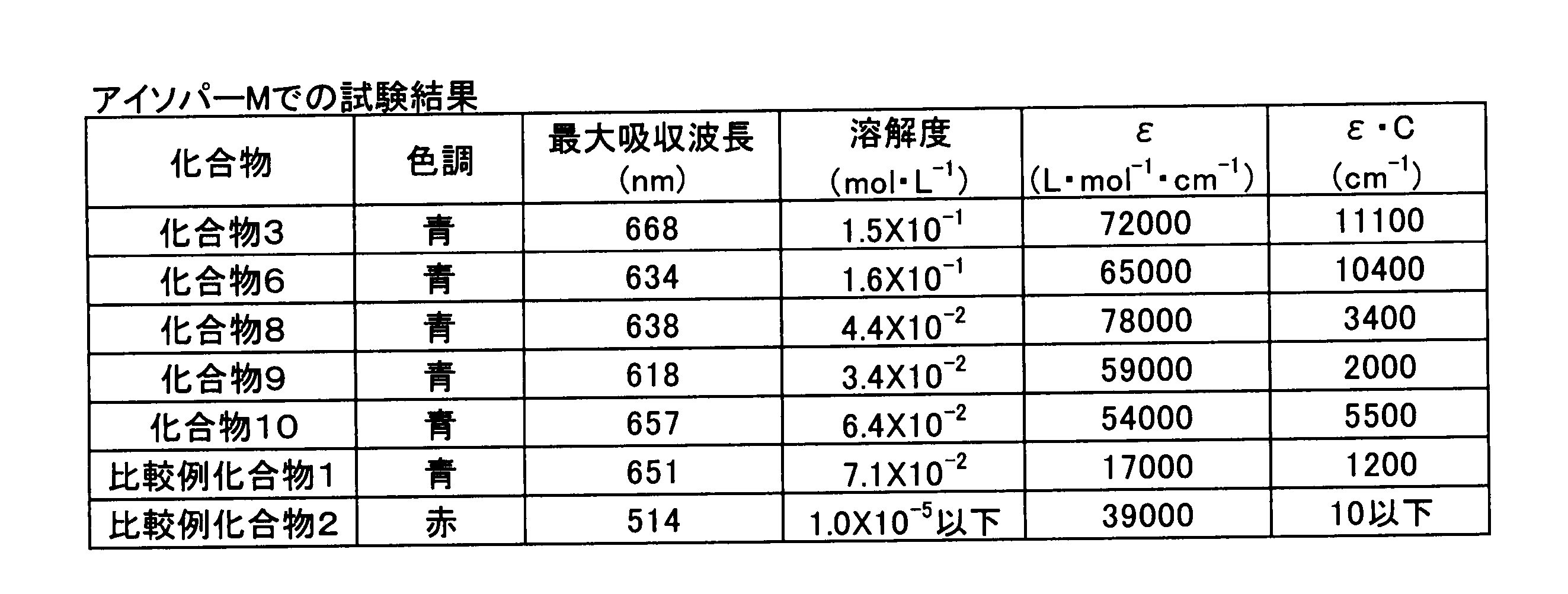


<黒色インク1の調製>
化合物3ならびに下記に記載した、黄色化合物A、赤色化合物Aからなる組成物1を、n-デカン(比誘電率2.0、水に対する溶解度1mg/L以下、東京化成工業社製)に溶解させて黒色インク1を調製した。黒色インク1の配合は、表9の通りとした。
<黒色インク2の調製>
化合物3ならびに下記に記載した、黄色化合物A、赤色化合物Aからなる組成物2を、n-デカン(比誘電率2.0、水に対する溶解度1mg/L以下、東京化成工業社製)に溶解させて黒色インク2を調製した。黒色インク2の配合は、表9の通りとした。
<黒色インク3の調製>
化合物3ならびに下記に記載した、黄色化合物A、赤色化合物A、青色化合物Aからなる色素組成物3を、n-デカン(比誘電率2.0、水に対する溶解度1mg/L以下、東京化成工業社製)に溶解させて黒色インク3を調製した。黒色インク3の配合は、表9の通りとした。
<黒色インク4の調製>
化合物3ならびに下記に記載した、黄色化合物A、赤色化合物A、青色化合物Aからなる組成物4を、n-デカン(比誘電率2.0、水に対する溶解度1mg/L以下、東京化成工業社製)に溶解させて黒色インク4を調製した。黒色インク4の配合は、表9の通りとした。
<黒色インク5の調製>
化合物3ならびに下記に記載した、黄色化合物A、赤色化合物A、赤色化合物B、青色化合物A、青色化合物Bからなる組成物5を、n-デカン(比誘電率2.0、水に対する溶解度1mg/L以下、東京化成工業社製)に溶解させて黒色インク5を調製した。黒色インク5の配合は、表9の通りとした。
<黒色インク6の調製>
化合物3ならびに下記に記載した、黄色化合物A、赤色化合物C、青色化合物Aからなる組成物6を、n-デカン(比誘電率2.0、水に対する溶解度1mg/L以下、東京化成工業社製)に溶解させて黒色インク6を調製した。黒色インク6の配合は、表9の通りとした。
<黒色インク7の調製>
化合物3ならびに下記に記載した、黄色化合物A、赤色化合物C、赤色化合物D、青色化合物Aからなる組成物7を、n-デカン(比誘電率2.0、水に対する溶解度1mg/L以下、東京化成工業社製)に溶解させて黒色インク7を調製した。黒色インク7の配合は、表9の通りとした。
<黒色インク8の調製>
化合物3ならびに下記に記載した、黄色化合物A、赤色化合物C、青色化合物Aからなる組成物8を、アイソパーM(比誘電率2.1、水に対する溶解度1mg/L以下、エクソン・モービル社製)に溶解させて黒色インク8を調製した。黒色インク8の配合は、表9の通りとした。
<黒色インク9の調製>
化合物3ならびに下記に記載した、黄色化合物A、赤色化合物C、赤色化合物D、青色色素Aからなる組成物9を、アイソパーM(比誘電率2.1、水に対する溶解度1mg/L以下、エクソン・モービル社製)に溶解させて黒色インク9を調製した。黒色インク9の配合は、表9の通りとした。
<黒色インク10の調製>
化合物3、化合物12、下記に記載した、黄色化合物A、赤色化合物C及び赤色化合物Dからなる組成物10を、n-デカン(比誘電率2.0、水に対する溶解度1mg/L以下)に溶解させて黒色インク10を調製した。黒色インク10の配合は、表9の通りとした。
<黒色インク11の調製>
化合物3、化合物12、下記に記載した、黄色化合物A、赤色化合物C及び赤色化合物Dからなる組成物11を、n-デカン(比誘電率2.0、水に対する溶解度1mg/L以下)に溶解させて黒色インク11を調製した。黒色インク11の配合は、表9の通りとした。
<黒色インク12の調製>
化合物3、下記に記載した黄色化合物A、赤色化合物Eからなる組成物12を、n-デカン(比誘電率2.0、水に対する溶解度1mg/L以下)に溶解させて黒色インク12を調製した。黒色インク12の配合は、表9の通りとした。
<黒色インク13の調製>
化合物3ならびに、下記に記載した黄色化合物A、赤色化合物C、赤色化合物D及び青色化合物Aからなる組成物13を、n-デカン(比誘電率2.0、水に対する溶解度1mg/L以下)に溶解させて黒色インク13を調製した。黒色インク13の配合は、表9の通りとした。
<黒色インク14の調製>
化合物3、下記に記載した黄色化合物A、赤色化合物B、赤色化合物C、青色化合物A及び青色化合物Bからなる組成物14を、n-デカン(比誘電率2.0、水に対する溶解度1mg/L以下)に溶解させて黒色インク14を調製した。黒色インク14の配合は、表9の通りとした。
<黒色インク15の調製>
化合物3、下記に記載した黄色化合物A、赤色化合物B、赤色化合物C及び青色化合物Bからなる組成物15を、n-デカン(比誘電率2.0、水に対する溶解度1mg/L以下)に溶解させて黒色インク15を調製した。黒色インク15の配合は、表9の通りとした。
<黒色インク16の調製>
化合物3、下記に記載した黄色化合物A、赤色化合物C、赤色化合物D及び青色化合物Aからなる組成物16を、n-デカン(比誘電率2.0、水に対する溶解度1mg/L以下)に溶解させて黒色インク16を調製した。黒色インク16の配合は、表9の通りとした。
<黒色インク17の調製>
化合物3、下記に記載した黄色化合物A、赤色化合物C、赤色化合物D及び青色化合物Aからなる組成物17を、n-デカン(比誘電率2.0、水に対する溶解度1mg/L以下)に溶解させて黒色インク17を調製した。黒色インク17の配合は、表9の通りとした。
<黒色インク18の調製>
化合物3、下記に記載した黄色化合物A及び赤色化合物Eからなる組成物18を、アイソパーL(比誘電率1.9、水に対する溶解度1mg/L以下)に溶解させて黒色インク18を調製した。黒色インク18の配合は、表9の通りとした。
<黒色インク19の調製>
化合物3、下記に記載した黄色化合物A及び赤色化合物Eからなる組成物19を、n-デカン/アイソパーL混合溶媒(混合比(質量比)1/1、比誘電率1.9、水に対する溶解度1mg/L以下)に溶解させて黒色インク19を調製した。黒色インク19の配合は、表9の通りとした。
<黒色インク20の調製>
化合物4、下記に記載した黄色化合物A、赤色化合物Eからなる組成物20を、n-デカン(比誘電率2.0、水に対する溶解度1mg/L以下)に溶解させて黒色インク20を調製した。黒色インク20の配合は、表9の通りとした。
<黒色インク21の調製>
化合物3、下記に記載した黄色化合物A及び赤色化合物Eからなる組成物21を、アイソパーL/デカリン混合溶媒(混合比(質量比)9/1、比誘電率1.9、水に対する溶解度1mg/L以下)に溶解させて黒色インク21を調製した。黒色インク21の配合は、表9の通りとした。
<黒色インク22の調製>
化合物3、下記に記載した黄色化合物A及び赤色化合物Eからなる組成物22を、n-デカン(比誘電率2.0、水に対する溶解度1mg/L以下)に溶解させて黒色インク22を調製した。黒色インク22の配合は、表9の通りとした。
<黒色インク23の調製>
化合物3、化合物4、下記に記載した黄色化合物Aおよび赤色化合物Eからなる組成物23を、n-デカン(比誘電率2.0、水に対する溶解度1mg/L以下)に溶解させて黒色インク23を調製した。黒色インク23の配合は、表9の通りとした。
<黒色インク24の調製>
化合物3、化合物4、下記に記載した黄色化合物A及び赤色化合物Eからなる組成物24を、カーボンブラック(ファーネスブラック、三菱化学株式会社製)10質量%を分散させたアイソパーL(比誘電率1.9、水に対する溶解度1mg/L以下)に溶解させて黒色インク24を調製した。黒色インク24の配合は、表9の通りとした。
<黒色インク25の調製>
化合物4、下記に記載した黄色化合物A及び赤色化合物Eからなる組成物25を、n-デカン(比誘電率2.0、水に対する溶解度1mg/L以下)に溶解させて黒色インク25を調製した。黒色インク25の配合は、表9の通りとした。
<黒色インク26の調製>
化合物4、下記に記載した黄色化合物A及び赤色化合物Eからなる組成物26を、n-デカン(比誘電率2.0、水に対する溶解度1mg/L以下)に溶解させて黒色インク26を調製した。黒色インク26の配合は、表9の通りとした。
<黒色インク27の調製>
化合物4、下記に記載した黄色化合物Aおよび赤色化合物Eからなる組成物27を、n-デカン(比誘電率2.0、水に対する溶解度1mg/L以下)に溶解させて黒色インク27を調製した。黒色インク27の配合は、表9の通りとした。
<黒色インク28の調製>
化合物3、下記に記載した黄色化合物A及び赤色化合物Eからなる組成物28を、カーボンブラック(ファーネスブラック、三菱化学株式会社製)10質量%を分散させたアイソパーL(比誘電率1.9、水に対する溶解度1mg/L以下)に溶解させて黒色インク28を調製した。黒色インク28の配合は、表9の通りとした。
<黒色インク29の調製>
化合物3、化合物4、下記に記載した黄色化合物A及び赤色化合物Eからなる組成物29を、n-デカン(比誘電率2.0、水に対する溶解度1mg/L以下)に溶解させて黒色インク29を調製した。黒色インク29の配合は、表9の通りとした。
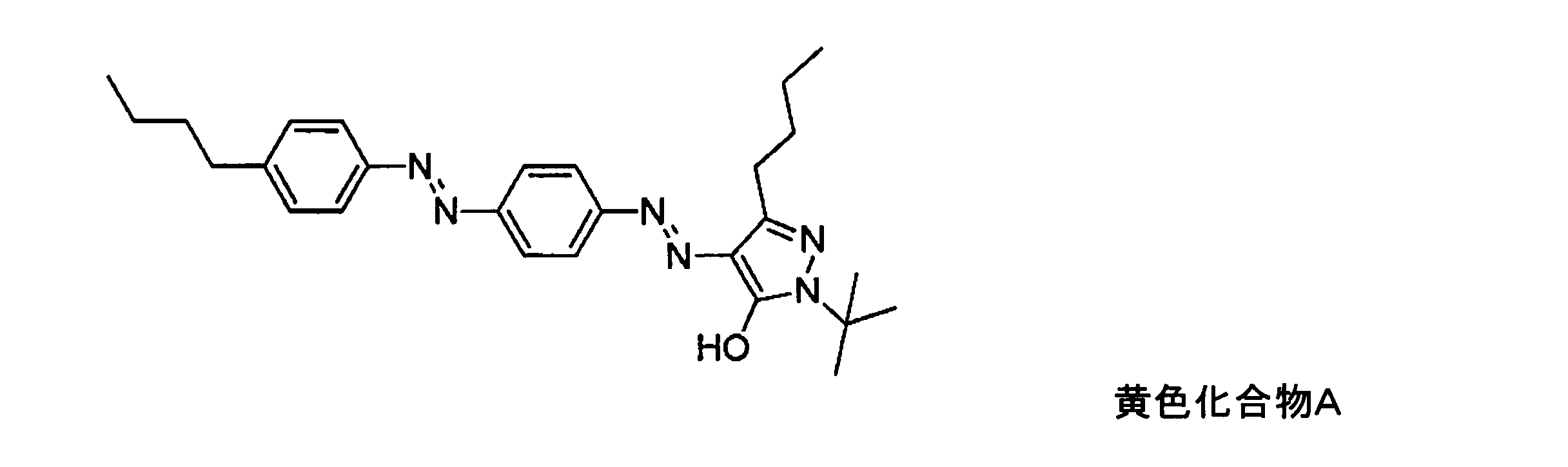
H-1(0.50g、3.3mmol)、氷酢酸(3ml)、プロピオン酸(0.7ml)、硫酸(2.7ml)、脱塩水(0.3ml)の混合物を氷浴で冷却し、系内1℃で44wt%ニトロシル硫酸(1.0g、3.6mmol)を滴下した後、系内0±5℃を保ち1時間攪拌してジアゾ液を得た。別容器にC-1(0.81g、3.1mmol)、テトラヒドロフラン(40ml)、スルファミン酸(0.06g、0.6mmol)、酢酸ナトリウム(5.7g)を取り、氷冷下でジアゾ液を系内0±5℃を保ちながら滴下した。途中氷とテトラヒドロフラン(40ml)を追加した。滴下終了後、酢酸ナトリウム水溶液を添加してpH4に調整した。トルエンで抽出後、減圧濃縮し、シリカゲルカラムクロマトグラフィーで精製し、生じた固体をメタノール/水(1/1(容積比))で洗浄して、赤色化合物A(0.45g、収率32%)を合成した。


H-1の代わりにH-2を、C-1の代わりにC-5を用いた以外は赤色化合物Aと同様の操作で赤色化合物Bを合成した。
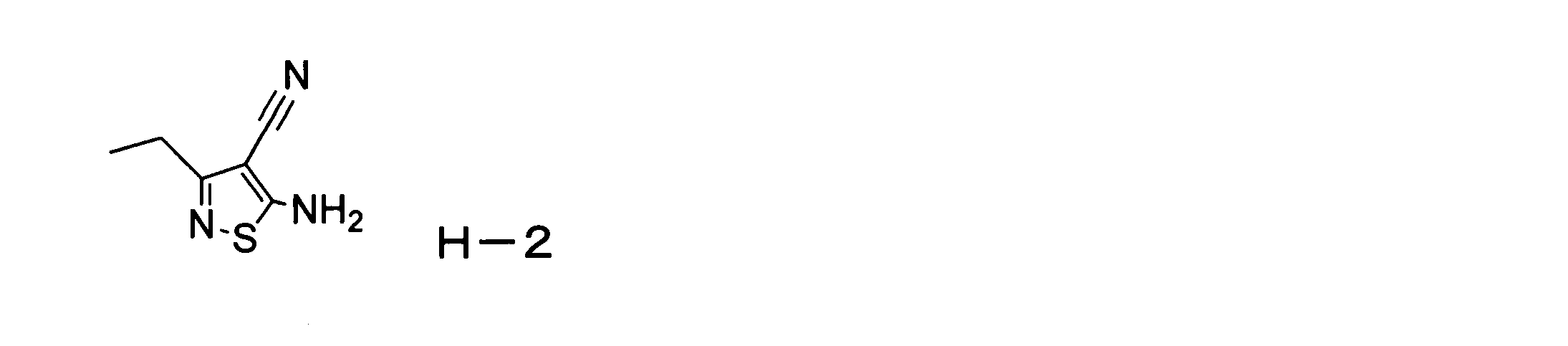

C-1の代わりにC-10を用いた以外は赤色化合物Aと同様の操作で赤色化合物Cを合成した。
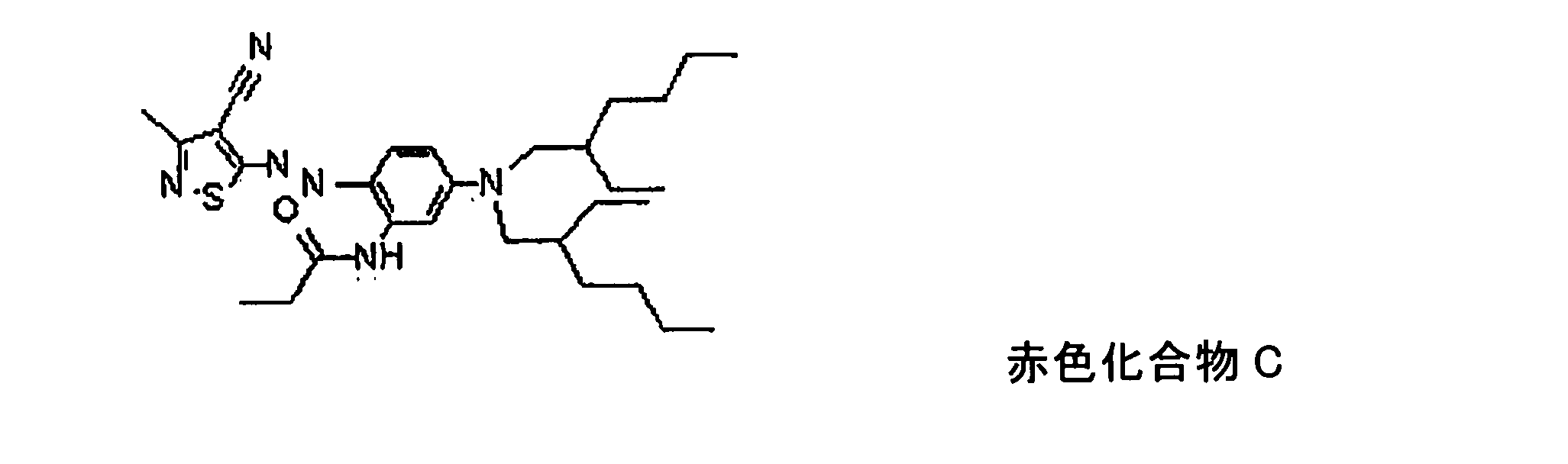
C-1の代わりにC-2を用いた以外は赤色化合物Aと同様の操作で赤色化合物Dを合成した。

H-1の代わりにH-2を用いた以外は赤色化合物Aと同様の操作で赤色化合物Eを合成した。

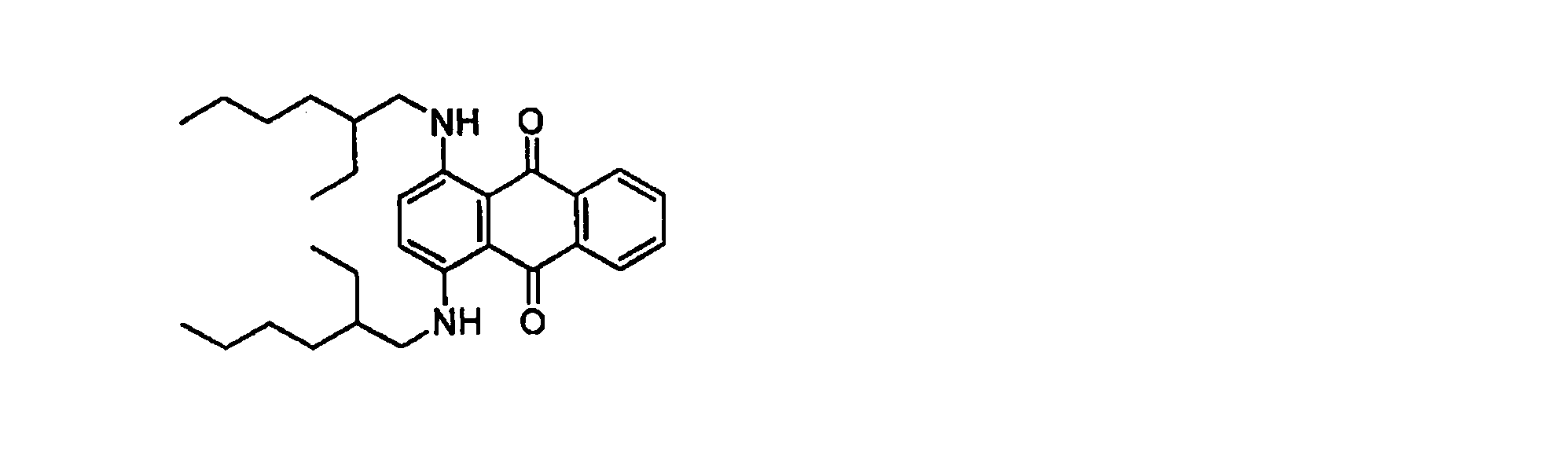
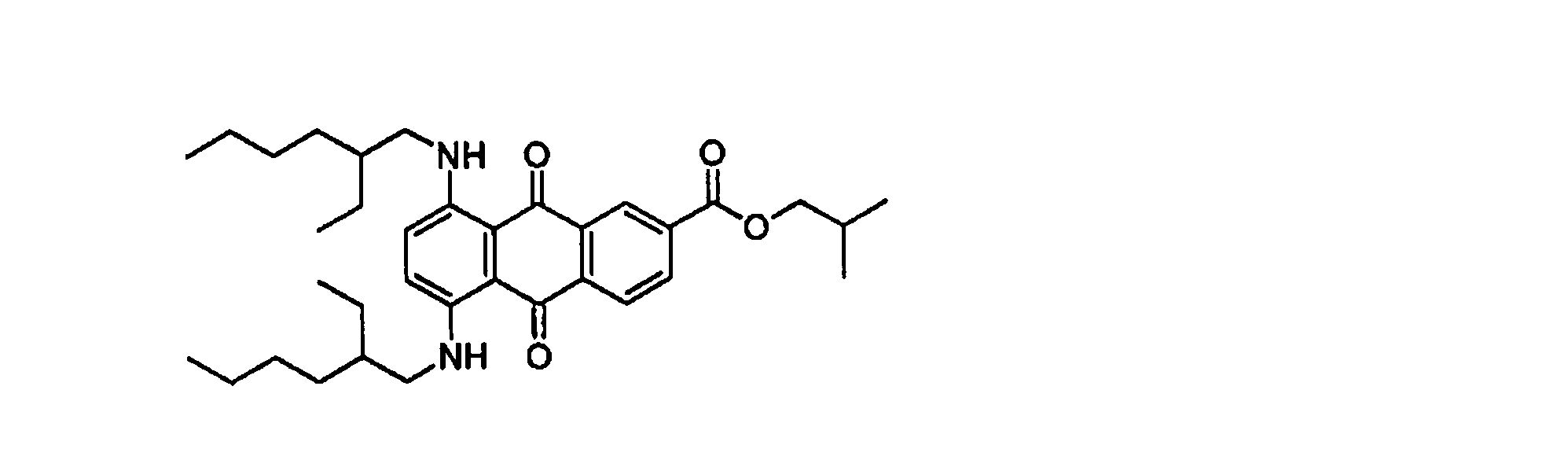
n-デカン(比誘電率2.0、水に対する溶解度1mg/L以下)に市販の油溶性黒色染料であるSudan Black B(東京化成工業社製)を溶解残存分が生じるまで添加し、30℃で30分間超音波処理をした。5℃で24時間放置後、超小型遠心機を用い、0.1ミクロンのフィルターで遠心濾過した(遠心力5200×g)。得られたn-デカン飽和溶液を適当な濃度に希釈し、あらかじめ測定した吸光係数との関係から化合物の溶解度を計算したところ、0.13質量%となった。
Sudan Black Bのデカン飽和溶液を調製し、比較例3インクとした。


黒色インク1~20および比較例3インクは測定光路長0.01mmのセル、黒インク21および25~28は測定光路長0.004mmのセル、黒インク22~24および29は測定光路長0.002mmのセルを用いてスペクトルを測定し、日立分光光度計U-4100付属の色彩計算プログラムを用いてD65光源、視野角2度の条件で測色を行うことにより、色相を定量的に評価した。

本出願は2011年5月20日出願の日本特許出願(特願2011-113759)、2011年10月3日出願の日本特許出願(特願2011-219414)、2012年1月13日出願の日本特許出願(特願2012-005119)、及び2012年4月5日出願の日本特許出願(特願2012-086605)に基づくものであり、その内容はここに参照として取り込まれる。
Claims (15)
- 測定周波数1kHzにおける22℃での比誘電率が3以下であり、かつ25℃における水に対する溶解度が20mg/L以下である溶媒と、アゾ系化合物とを含むインクであって、前記アゾ系化合物が、下記一般式(I)で表されるインク。

R1、R2、D1、A1及びA2はそれぞれ独立に、任意の置換基を表し、
mは1~4の整数を表し、mが2以上の場合、1分子中に2以上存在するD1は同一であっても異なっていてもよく、
Xは窒素原子、又は置換基を有していても良いメチン基を表す。] - 前記溶媒が、炭化水素系溶媒、シリコーンオイル及びフルオロカーボン系溶媒からなる群より選ばれた少なくとも1つを含む、請求項1に記載のインク。
- 前記アゾ系化合物のn-デカン溶液の吸収極大波長におけるモル吸光係数ε(L・mol-1・cm-1)と、5℃における前記アゾ系化合物のn-デカンに対する飽和濃度C(mol・L-1)との積εCが、1000cm-1以上である、請求項1又は2に記載のインク。
- さらにヘテロ環化合物、シアノビニル化合物及びアントラキノン化合物からなる群より選ばれた少なくとも1つを含む、請求項1~3のいずれか1項に記載のインク。
- 前記ヘテロ環化合物が下記一般式(III)~(V)からなる群より選ばれた少なくとも1つである、請求項4に記載のインク。

R101、R102、D3及びD4は、それぞれ独立に、任意の置換基を表し、
eは1~5の整数を表し、eが2以上の場合、1分子中に2以上存在するD3は同一であっても異なっていてもよく、
gは1~4の整数を表し、gが2以上の場合、1分子中に2以上存在するD4は同一であっても異なっていてもよい。]

R201、R202、R203、R204、R205、R206、R207及びR208は、それぞれ独立に、任意の置換基を表し、
Zは窒素原子又は置換基を有していても良いメチン基を表す。]

R301、R302、D5及びD6はそれぞれ独立に、任意の置換基を表し、
lは1~4の整数を表し、lが2以上の場合は、1分子中に2以上存在するD5は同一でも異なっていても良く、
jは1~4の整数を表し、jが2以上の場合は、1分子中に2以上存在するD6は同一でも異なっていても良い。] - 前記シアノビニル化合物が下記一般式(VI)で表される、請求項4又は5に記載のインク。
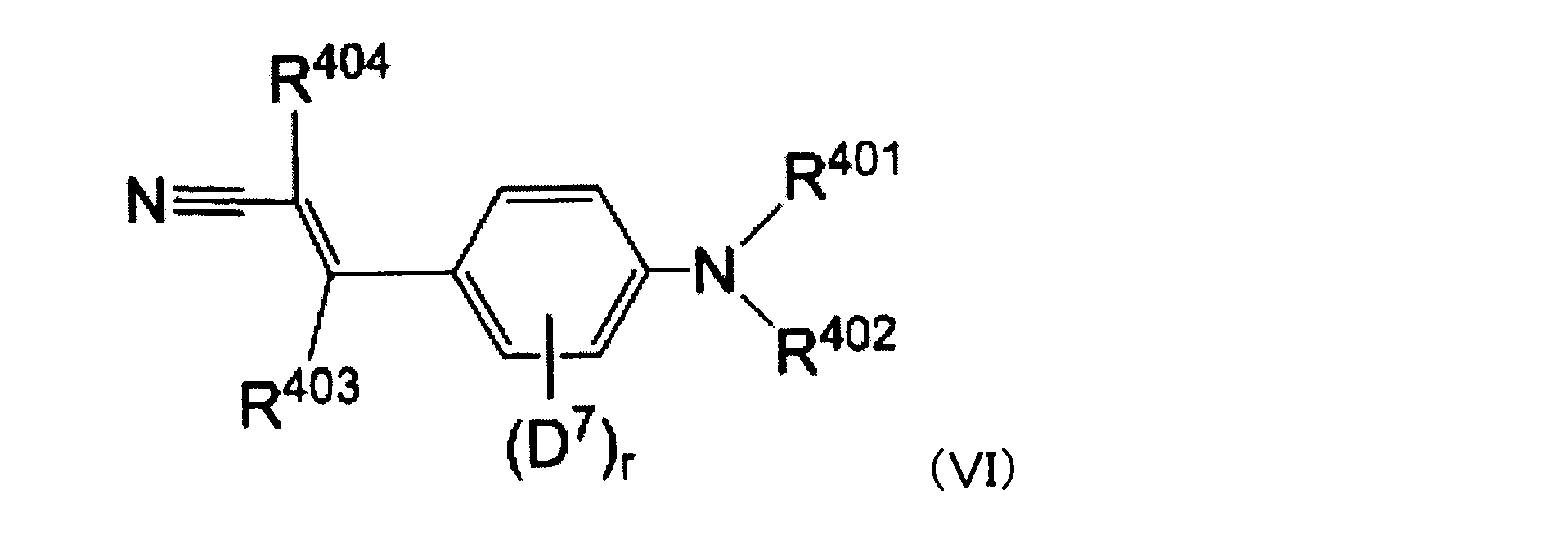
R401、R402、R403、R404及びD7は、それぞれ独立に、任意の置換基を表し、
rは1~4の整数を表し、rが2以上の場合、1分子中に2以上存在するD7は同一であっても異なっていてもよい。] - 前記アントラキノン化合物が下記一般式(VII)で表される、請求項4~6のいずれか1項に記載のインク。

D8は任意の置換基を表し、tは1~8の整数を表し、tが2以上の場合、1分子中に2以上存在するD8は同一であっても異なっていてもよい。] - ディスプレイ用又は光シャッター用である請求項1~7のいずれか1項に記載のインク。
- 請求項1~7のいずれか1項に記載のインクを含む表示部位を有し、前記表示部位への電圧印加の制御により画像が表示されるディスプレイ。
- 前記表示部位が、さらに電気泳動粒子又は水性媒体を含む請求項9に記載のディスプレイ。
- 前記電圧印加による着色状態の変化により画像が表示される請求項9又は10に記載のディスプレイ。
- エレクトロウェッティング方式又は電気泳動方式により画像が表示される請求項9~11のいずれか1項に記載のディスプレイ。
- 請求項9~12のいずれか1項に記載のディスプレイを有する電子ペーパー。
- 下記一般式(VIII)で表されるアゾ系化合物。

R601およびR602はそれぞれ独立に、置換基を有していても良い炭素数が7~20の分岐アルキル基を表し、
D9は水素原子、ハロゲン原子、置換基を有していても良い炭素数が1~20のアルキル基、置換基を有していても良い炭素数が1~20のアルコキシ基、-NHCOR603基又は-NHSO2R608基を表し、
R603及びR608は、それぞれ独立に、置換基を有していても良い炭素数が1~20のアルキル基、置換基を有していても良い炭素数が6~20のアリール基又は置換基を有していても良い炭素数が2~20のヘテロアリール基を表し、
aは1~4の整数を表し、aが2以上の場合、1分子中に2以上存在するD9は同一であっても異なっていてもよく、
A3はハロゲン原子、シアノ基、置換基を有していても良い炭素数が1~20のアルキル基、置換基を有していても良い炭素数が6~20のアリール基、置換基を有していても良い炭素数が2~20のヘテロアリール基、置換基を有していても良い炭素数が1~20のアルコキシ基又は-COOR604基を表し、
R604は置換基を有していても良い炭素数が1~20のアルキル基、置換基を有していても良い炭素数が6~20のアリール基又は置換基を有していても良い炭素数が2~20のヘテロアリール基を表し、
A4はハロゲン原子、置換基を有していても良い炭素数1~20のアルキル基、置換基を有していても良い炭素数2~20のアルケニル基、置換基を有していても良い炭素数2~20のアルキルカルボニル基、置換基を有していても良い炭素数が2~20のアルコキシカルボニル基、ホルミル基、R605OOC(NC)C=CH-基、又はNC(NC)C=CH-基を表し、
R605は置換基を有していても良い炭素数が1~20のアルキル基、置換基を有していても良い炭素数が6~20のアリール基又は置換基を有していても良い炭素数が2~20のヘテロアリール基を表し、
X2は窒素原子、又は置換基としてハロゲン原子、シアノ基若しくは-COOR607基を有していても良いメチン基を表し、
R607は、置換基を有していても良い炭素数が1~20のアルキル基、置換基を有していても良い炭素数が6~20のアリール基又は置換基を有していても良い炭素数が2~20のヘテロアリール基を表す。] - 下記一般式(IX)で表されるアゾ系化合物。

R701およびR702はそれぞれ独立に、置換基を有していても良い炭素数が5~20の分岐アルキル基を表し
D11は水素原子、ハロゲン原子、置換基を有していても良い炭素数が1~20のアルキル基、置換基を有していても良い炭素数が1~20のアルコキシ基、-NHCOR703基又は-NHSO2R708基を表し
R703及びR708は、それぞれ独立に、置換基を有していても良い炭素数が1~20のアルキル基、置換基を有していても良い炭素数が6~20のアリール基又は置換基を有していても良い炭素数が2~20のヘテロアリール基を表し、
dは1~4の整数を表し、dが2以上の場合、1分子中に2以上存在するD11は同一であっても異なっていてもよく、
A5は水素原子、ハロゲン原子、シアノ基、置換基を有していても良い炭素数が1~20のアルキル基、置換基を有していても良い炭素数が6~20のアリール基、置換基を有していても良い炭素数が2~20のヘテロアリール基、置換基を有していても良い炭素数が1~20のアルコキシ基又は-COOR704基を表し、
R704は置換基を有していても良い炭素数が1~20のアルキル基、置換基を有していても良い炭素数が6~20のアリール基又は置換基を有していても良い炭素数が2~20のヘテロアリール基を表し、
D10は水素原子、ハロゲン原子、シアノ基、置換基を有していても良い炭素数が1~20のアルキル基、置換基を有していても良い炭素数が1~20のアルコキシ基、-COOR706基、-COR709基又は-OCOR710基を表し、
bは1~5の整数を表し、bが2以上の場合、1分子中に2以上存在するD10は同一であっても異なっていてもよく、
R706、R709及びR710は、それぞれ独立に、置換基を有していても良い炭素数が1~20のアルキル基、置換基を有していても良い炭素数が6~20のアリール基又は置換基を有していても良い炭素数が2~20のヘテロアリール基を表し、
X3は窒素原子、又は置換基として、ハロゲン原子、シアノ基若しくは-COOR707基を有していても良いメチン基を表し、
R707は、置換基を有していても良い炭素数が1~20のアルキル基、置換基を有していても良い炭素数が6~20のアリール基又は置換基を有していても良い炭素数が2~20のヘテロアリール基を表す。]
Priority Applications (4)
| Application Number | Priority Date | Filing Date | Title |
|---|---|---|---|
| JP2013516332A JP5935801B2 (ja) | 2011-05-20 | 2012-05-17 | アゾ系化合物及び該化合物を含むインク |
| KR1020137030472A KR20140026499A (ko) | 2011-05-20 | 2012-05-17 | 아조계 화합물 및 그 화합물을 함유하는 잉크 |
| CN201280024560.XA CN103562325B (zh) | 2011-05-20 | 2012-05-17 | 偶氮系化合物及含有该化合物的油墨 |
| US14/084,972 US9200171B2 (en) | 2011-05-20 | 2013-11-20 | AZO compound and ink containing the compound |
Applications Claiming Priority (8)
| Application Number | Priority Date | Filing Date | Title |
|---|---|---|---|
| JP2011113759 | 2011-05-20 | ||
| JP2011-113759 | 2011-05-20 | ||
| JP2011219414 | 2011-10-03 | ||
| JP2011-219414 | 2011-10-03 | ||
| JP2012005119 | 2012-01-13 | ||
| JP2012-005119 | 2012-01-13 | ||
| JP2012086605 | 2012-04-05 | ||
| JP2012-086605 | 2012-04-05 |
Related Child Applications (1)
| Application Number | Title | Priority Date | Filing Date |
|---|---|---|---|
| US14/084,972 Continuation US9200171B2 (en) | 2011-05-20 | 2013-11-20 | AZO compound and ink containing the compound |
Publications (1)
| Publication Number | Publication Date |
|---|---|
| WO2012161098A1 true WO2012161098A1 (ja) | 2012-11-29 |
Family
ID=47217177
Family Applications (1)
| Application Number | Title | Priority Date | Filing Date |
|---|---|---|---|
| PCT/JP2012/062702 Ceased WO2012161098A1 (ja) | 2011-05-20 | 2012-05-17 | アゾ系化合物及び該化合物を含むインク |
Country Status (6)
| Country | Link |
|---|---|
| US (1) | US9200171B2 (ja) |
| JP (1) | JP5935801B2 (ja) |
| KR (1) | KR20140026499A (ja) |
| CN (1) | CN103562325B (ja) |
| TW (1) | TWI544036B (ja) |
| WO (1) | WO2012161098A1 (ja) |
Cited By (9)
| Publication number | Priority date | Publication date | Assignee | Title |
|---|---|---|---|---|
| JP2014010249A (ja) * | 2012-06-28 | 2014-01-20 | Fujifilm Corp | エレクトロウェッティング表示装置及びエレクトロウェッティング表示用染料組成物 |
| WO2014096263A1 (en) * | 2012-12-21 | 2014-06-26 | Liquavista B.V. | Electrowetting device |
| JP2015028589A (ja) * | 2013-06-24 | 2015-02-12 | セイコーエプソン株式会社 | 電気泳動粒子、電気泳動分散液、表示シート、表示装置および電子機器 |
| JP2015028590A (ja) * | 2013-06-24 | 2015-02-12 | セイコーエプソン株式会社 | 電気泳動粒子、電気泳動分散液、表示シート、表示装置および電子機器 |
| US20150284581A1 (en) * | 2012-11-28 | 2015-10-08 | Mitsubishi Chemical Corporation | Azo compound, ink containing azo compound, display including said ink and electronic paper |
| JP2015184551A (ja) * | 2014-03-25 | 2015-10-22 | 富士ゼロックス株式会社 | 液体現像剤及び回路基板 |
| JP2015224280A (ja) * | 2014-05-27 | 2015-12-14 | 三菱化学株式会社 | アゾ系化合物、アゾ系化合物を含むインク、該インクを含むディスプレイ並びに電子ペーパー |
| JP2017066402A (ja) * | 2015-09-29 | 2017-04-06 | 三菱化学株式会社 | ピラゾールジスアゾ系化合物を含むインク及び該インクを含むディスプレイ並びにピラゾールジスアゾ系化合物 |
| WO2017090668A1 (ja) * | 2015-11-24 | 2017-06-01 | 富士フイルム株式会社 | 2色性色素化合物、2色性色素組成物、光吸収異方性膜、偏光素子および画像表示装置 |
Families Citing this family (4)
| Publication number | Priority date | Publication date | Assignee | Title |
|---|---|---|---|---|
| JP2733422B2 (ja) | 1992-11-12 | 1998-03-30 | 富士車輌株式会社 | ゴミ貯留装置 |
| US8926065B2 (en) | 2009-08-14 | 2015-01-06 | Advanced Liquid Logic, Inc. | Droplet actuator devices and methods |
| CN104987747B (zh) * | 2015-07-30 | 2017-03-15 | 沈阳化工研究院有限公司 | 一种苯并咪唑酮偶氮颜料及其制备与应用 |
| CN105694521B (zh) * | 2016-03-04 | 2017-10-13 | 深圳市国华光电科技有限公司 | 一种偶氮类染料及其制备方法、油墨和电润湿显示器 |
Citations (15)
| Publication number | Priority date | Publication date | Assignee | Title |
|---|---|---|---|---|
| JPS60239291A (ja) * | 1984-05-11 | 1985-11-28 | Mitsubishi Chem Ind Ltd | 感熱記録用色素及び感熱記録用シート |
| JPS6141596A (ja) * | 1984-08-02 | 1986-02-27 | Matsushita Electric Ind Co Ltd | 感熱記録転写体用インキ組成物 |
| JPS6255194A (ja) * | 1985-08-27 | 1987-03-10 | インペリアル・ケミカル・インダストリーズ・ピーエルシー | 熱転写シ−トおよび方法 |
| JPH05112080A (ja) * | 1991-10-23 | 1993-05-07 | Sony Corp | 熱転写記録方式及びこれに用いるインクリボン並びに印画紙 |
| JPH08267939A (ja) * | 1995-03-24 | 1996-10-15 | Eastman Kodak Co | 感熱色素転写集成体 |
| JPH09109566A (ja) * | 1995-08-30 | 1997-04-28 | Eastman Kodak Co | 感熱色素転写集成体 |
| JPH09109561A (ja) * | 1995-09-07 | 1997-04-28 | Basf Ag | 担体から合成樹脂で被覆された紙の上への染料混合物の転写法 |
| JPH09176532A (ja) * | 1995-12-25 | 1997-07-08 | Mitsubishi Chem Corp | 油性黒色インク組成物 |
| JPH09508939A (ja) * | 1994-02-18 | 1997-09-09 | ゼネカ・リミテッド | フルオロスルフォニル基を含有するジズアゾ染料及びその使用 |
| JPH10119441A (ja) * | 1996-10-23 | 1998-05-12 | Mitsubishi Chem Corp | 感熱転写シート |
| JP2000313174A (ja) * | 1999-03-04 | 2000-11-14 | Mitsubishi Chemicals Corp | 感熱転写用アントラキノン系色素及びそれを用いた感熱転写用シート、並びに感熱転写用インク |
| JP2007099823A (ja) * | 2005-09-30 | 2007-04-19 | Fujifilm Corp | ジスアゾ染料の製造方法 |
| JP2007515509A (ja) * | 2003-11-28 | 2007-06-14 | ダイスター・テクスティルファルベン・ゲゼルシャフト・ミト・ベシュレンクテル・ハフツング・ウント・コンパニー・ドイッチュラント・コマンデイトゲゼルシャフト | 分散染料混合物 |
| WO2008142086A1 (en) * | 2007-05-23 | 2008-11-27 | Liquavista B.V. | Improvements in relation to electrowetting elements and optical display devices |
| JP2009138189A (ja) * | 2007-11-12 | 2009-06-25 | Mitsubishi Chemicals Corp | ピラゾールジスアゾ系色素および該色素を含むインク |
Family Cites Families (11)
| Publication number | Priority date | Publication date | Assignee | Title |
|---|---|---|---|---|
| JPS57111356A (en) | 1980-12-29 | 1982-07-10 | Mitsubishi Chem Ind Ltd | Disazo dye for polyester fiber |
| JPS57125263A (en) | 1981-01-27 | 1982-08-04 | Mitsubishi Chem Ind Ltd | Disazo dye for polyester fiber |
| GB2093056B (en) | 1980-12-26 | 1985-06-12 | Mitsubishi Chem Ind | Disazo dyestuffs and dyeing process |
| JPS57109860A (en) | 1980-12-26 | 1982-07-08 | Mitsubishi Chem Ind Ltd | Disazo dye for polyester fiber |
| JPS57125262A (en) | 1981-01-27 | 1982-08-04 | Mitsubishi Chem Ind Ltd | Disazo dye for polyester fiber |
| JPH03256793A (ja) | 1990-03-07 | 1991-11-15 | Mitsubishi Kasei Corp | 感熱転写シート及び感熱転写シート用インキ組成物 |
| DE69117701T2 (de) | 1990-12-21 | 1996-08-29 | Ici Plc | Wärmeübertragungsdruck |
| DE4333291A1 (de) * | 1993-09-30 | 1995-04-06 | Basf Ag | Verwendung von Azofarbstoffen in der nichtlinearen Optik |
| US7800816B2 (en) * | 2004-04-05 | 2010-09-21 | Liquavista B.V. | Display device based on electrowetting effect |
| GB0817175D0 (en) | 2008-09-19 | 2008-10-29 | Liquavista Bv | Improvements in relation to electrowetting elements |
| CN103080245B (zh) * | 2010-09-10 | 2015-06-10 | 三菱化学株式会社 | 含有杂环偶氮系色素的油墨及该油墨中使用的色素 |
-
2012
- 2012-05-17 WO PCT/JP2012/062702 patent/WO2012161098A1/ja not_active Ceased
- 2012-05-17 KR KR1020137030472A patent/KR20140026499A/ko not_active Withdrawn
- 2012-05-17 JP JP2013516332A patent/JP5935801B2/ja active Active
- 2012-05-17 CN CN201280024560.XA patent/CN103562325B/zh active Active
- 2012-05-18 TW TW101117949A patent/TWI544036B/zh active
-
2013
- 2013-11-20 US US14/084,972 patent/US9200171B2/en active Active
Patent Citations (15)
| Publication number | Priority date | Publication date | Assignee | Title |
|---|---|---|---|---|
| JPS60239291A (ja) * | 1984-05-11 | 1985-11-28 | Mitsubishi Chem Ind Ltd | 感熱記録用色素及び感熱記録用シート |
| JPS6141596A (ja) * | 1984-08-02 | 1986-02-27 | Matsushita Electric Ind Co Ltd | 感熱記録転写体用インキ組成物 |
| JPS6255194A (ja) * | 1985-08-27 | 1987-03-10 | インペリアル・ケミカル・インダストリーズ・ピーエルシー | 熱転写シ−トおよび方法 |
| JPH05112080A (ja) * | 1991-10-23 | 1993-05-07 | Sony Corp | 熱転写記録方式及びこれに用いるインクリボン並びに印画紙 |
| JPH09508939A (ja) * | 1994-02-18 | 1997-09-09 | ゼネカ・リミテッド | フルオロスルフォニル基を含有するジズアゾ染料及びその使用 |
| JPH08267939A (ja) * | 1995-03-24 | 1996-10-15 | Eastman Kodak Co | 感熱色素転写集成体 |
| JPH09109566A (ja) * | 1995-08-30 | 1997-04-28 | Eastman Kodak Co | 感熱色素転写集成体 |
| JPH09109561A (ja) * | 1995-09-07 | 1997-04-28 | Basf Ag | 担体から合成樹脂で被覆された紙の上への染料混合物の転写法 |
| JPH09176532A (ja) * | 1995-12-25 | 1997-07-08 | Mitsubishi Chem Corp | 油性黒色インク組成物 |
| JPH10119441A (ja) * | 1996-10-23 | 1998-05-12 | Mitsubishi Chem Corp | 感熱転写シート |
| JP2000313174A (ja) * | 1999-03-04 | 2000-11-14 | Mitsubishi Chemicals Corp | 感熱転写用アントラキノン系色素及びそれを用いた感熱転写用シート、並びに感熱転写用インク |
| JP2007515509A (ja) * | 2003-11-28 | 2007-06-14 | ダイスター・テクスティルファルベン・ゲゼルシャフト・ミト・ベシュレンクテル・ハフツング・ウント・コンパニー・ドイッチュラント・コマンデイトゲゼルシャフト | 分散染料混合物 |
| JP2007099823A (ja) * | 2005-09-30 | 2007-04-19 | Fujifilm Corp | ジスアゾ染料の製造方法 |
| WO2008142086A1 (en) * | 2007-05-23 | 2008-11-27 | Liquavista B.V. | Improvements in relation to electrowetting elements and optical display devices |
| JP2009138189A (ja) * | 2007-11-12 | 2009-06-25 | Mitsubishi Chemicals Corp | ピラゾールジスアゾ系色素および該色素を含むインク |
Cited By (17)
| Publication number | Priority date | Publication date | Assignee | Title |
|---|---|---|---|---|
| JP2014010249A (ja) * | 2012-06-28 | 2014-01-20 | Fujifilm Corp | エレクトロウェッティング表示装置及びエレクトロウェッティング表示用染料組成物 |
| US9708498B2 (en) * | 2012-11-28 | 2017-07-18 | Mitsubishi Chemical Corporation | Azo compound, ink containing azo compound, display including said ink and electronic paper |
| US20150284581A1 (en) * | 2012-11-28 | 2015-10-08 | Mitsubishi Chemical Corporation | Azo compound, ink containing azo compound, display including said ink and electronic paper |
| CN104871065A (zh) * | 2012-12-21 | 2015-08-26 | 利奎阿维斯塔股份有限公司 | 电润湿器件 |
| JP2016503188A (ja) * | 2012-12-21 | 2016-02-01 | リクアビスタ ビー ヴィ | エレクトロウェッティングデバイス |
| US9447282B2 (en) | 2012-12-21 | 2016-09-20 | Amazon Technologies, Inc. | Electrowetting device |
| US10444489B2 (en) | 2012-12-21 | 2019-10-15 | Amazon Technologies, Inc. | Electrowetting element |
| CN104871065B (zh) * | 2012-12-21 | 2018-05-01 | 利奎阿维斯塔股份有限公司 | 电润湿器件 |
| WO2014096263A1 (en) * | 2012-12-21 | 2014-06-26 | Liquavista B.V. | Electrowetting device |
| JP2015028589A (ja) * | 2013-06-24 | 2015-02-12 | セイコーエプソン株式会社 | 電気泳動粒子、電気泳動分散液、表示シート、表示装置および電子機器 |
| JP2015028590A (ja) * | 2013-06-24 | 2015-02-12 | セイコーエプソン株式会社 | 電気泳動粒子、電気泳動分散液、表示シート、表示装置および電子機器 |
| US9946183B2 (en) | 2014-03-25 | 2018-04-17 | Fuji Xerox Co., Ltd. | Liquid developer, circuit board, and conductive pattern forming apparatus |
| JP2015184551A (ja) * | 2014-03-25 | 2015-10-22 | 富士ゼロックス株式会社 | 液体現像剤及び回路基板 |
| JP2015224280A (ja) * | 2014-05-27 | 2015-12-14 | 三菱化学株式会社 | アゾ系化合物、アゾ系化合物を含むインク、該インクを含むディスプレイ並びに電子ペーパー |
| JP2017066402A (ja) * | 2015-09-29 | 2017-04-06 | 三菱化学株式会社 | ピラゾールジスアゾ系化合物を含むインク及び該インクを含むディスプレイ並びにピラゾールジスアゾ系化合物 |
| WO2017090668A1 (ja) * | 2015-11-24 | 2017-06-01 | 富士フイルム株式会社 | 2色性色素化合物、2色性色素組成物、光吸収異方性膜、偏光素子および画像表示装置 |
| JPWO2017090668A1 (ja) * | 2015-11-24 | 2018-07-26 | 富士フイルム株式会社 | 2色性色素化合物、2色性色素組成物、光吸収異方性膜、偏光素子および画像表示装置 |
Also Published As
| Publication number | Publication date |
|---|---|
| US20140078577A1 (en) | 2014-03-20 |
| TWI544036B (zh) | 2016-08-01 |
| TW201302923A (zh) | 2013-01-16 |
| JPWO2012161098A1 (ja) | 2014-07-31 |
| CN103562325B (zh) | 2016-05-11 |
| JP5935801B2 (ja) | 2016-06-15 |
| US9200171B2 (en) | 2015-12-01 |
| KR20140026499A (ko) | 2014-03-05 |
| CN103562325A (zh) | 2014-02-05 |
Similar Documents
| Publication | Publication Date | Title |
|---|---|---|
| JP5935801B2 (ja) | アゾ系化合物及び該化合物を含むインク | |
| JP5884732B2 (ja) | へテロ環アゾ系色素を含むインク及び該インクに用いられる色素 | |
| WO2011111710A1 (ja) | アントラキノン系色素を含むインク及び該インクに用いられる色素並びにディスプレイ | |
| JP6112114B2 (ja) | アゾ系化合物、アゾ系化合物を含むインク、該インクを含むディスプレイ並びに電子ペーパー | |
| TWI604255B (zh) | 電泳液、電泳液之用途及電泳顯示器裝置 | |
| JP6269318B2 (ja) | アゾ系化合物、アゾ系化合物を含むインク、該インクを含むディスプレイ並びに電子ペーパー | |
| CN104822780B (zh) | 偶氮系化合物、包含偶氮系化合物的油墨、包含该油墨的显示器以及电子纸 | |
| JP2013185126A (ja) | スチリル系、トリシアノビニル系化合物を含むインク | |
| JP5853601B2 (ja) | ベンゾチアゾール系化合物及び該化合物を含むインク | |
| JP6737111B2 (ja) | キノフタロン系化合物、キノフタロン系化合物を含むインク及び該インクを含むディスプレイ | |
| JP5842446B2 (ja) | アントラキノン系色素を含むインク及び該インクに用いられる色素 | |
| JP2017066402A (ja) | ピラゾールジスアゾ系化合物を含むインク及び該インクを含むディスプレイ並びにピラゾールジスアゾ系化合物 | |
| KR20120009706A (ko) | 안료 화합물, 이를 포함하는 안료 분산액, 이를 이용한 컬러필터 및 이를 이용한 이미지센서 |
Legal Events
| Date | Code | Title | Description |
|---|---|---|---|
| WWE | Wipo information: entry into national phase |
Ref document number: 201280024560.X Country of ref document: CN |
|
| 121 | Ep: the epo has been informed by wipo that ep was designated in this application |
Ref document number: 12788724 Country of ref document: EP Kind code of ref document: A1 |
|
| ENP | Entry into the national phase |
Ref document number: 2013516332 Country of ref document: JP Kind code of ref document: A |
|
| ENP | Entry into the national phase |
Ref document number: 20137030472 Country of ref document: KR Kind code of ref document: A |
|
| NENP | Non-entry into the national phase |
Ref country code: DE |
|
| 122 | Ep: pct application non-entry in european phase |
Ref document number: 12788724 Country of ref document: EP Kind code of ref document: A1 |