WO2012144261A1 - カチオン重合性接着剤及びそれを用いて得られた偏光板 - Google Patents
カチオン重合性接着剤及びそれを用いて得られた偏光板 Download PDFInfo
- Publication number
- WO2012144261A1 WO2012144261A1 PCT/JP2012/053926 JP2012053926W WO2012144261A1 WO 2012144261 A1 WO2012144261 A1 WO 2012144261A1 JP 2012053926 W JP2012053926 W JP 2012053926W WO 2012144261 A1 WO2012144261 A1 WO 2012144261A1
- Authority
- WO
- WIPO (PCT)
- Prior art keywords
- polymerizable adhesive
- parts
- group
- cationic polymerizable
- mass
- Prior art date
- Legal status (The legal status is an assumption and is not a legal conclusion. Google has not performed a legal analysis and makes no representation as to the accuracy of the status listed.)
- Ceased
Links
Classifications
-
- C—CHEMISTRY; METALLURGY
- C09—DYES; PAINTS; POLISHES; NATURAL RESINS; ADHESIVES; COMPOSITIONS NOT OTHERWISE PROVIDED FOR; APPLICATIONS OF MATERIALS NOT OTHERWISE PROVIDED FOR
- C09J—ADHESIVES; NON-MECHANICAL ASPECTS OF ADHESIVE PROCESSES IN GENERAL; ADHESIVE PROCESSES NOT PROVIDED FOR ELSEWHERE; USE OF MATERIALS AS ADHESIVES
- C09J171/00—Adhesives based on polyethers obtained by reactions forming an ether link in the main chain; Adhesives based on derivatives of such polymers
-
- C—CHEMISTRY; METALLURGY
- C08—ORGANIC MACROMOLECULAR COMPOUNDS; THEIR PREPARATION OR CHEMICAL WORKING-UP; COMPOSITIONS BASED THEREON
- C08G—MACROMOLECULAR COMPOUNDS OBTAINED OTHERWISE THAN BY REACTIONS ONLY INVOLVING UNSATURATED CARBON-TO-CARBON BONDS
- C08G59/00—Polycondensates containing more than one epoxy group per molecule; Macromolecules obtained by polymerising compounds containing more than one epoxy group per molecule using curing agents or catalysts which react with the epoxy groups
- C08G59/18—Macromolecules obtained by polymerising compounds containing more than one epoxy group per molecule using curing agents or catalysts which react with the epoxy groups ; e.g. general methods of curing
- C08G59/20—Macromolecules obtained by polymerising compounds containing more than one epoxy group per molecule using curing agents or catalysts which react with the epoxy groups ; e.g. general methods of curing characterised by the epoxy compounds used
- C08G59/22—Di-epoxy compounds
- C08G59/24—Di-epoxy compounds carbocyclic
- C08G59/245—Di-epoxy compounds carbocyclic aromatic
-
- C—CHEMISTRY; METALLURGY
- C08—ORGANIC MACROMOLECULAR COMPOUNDS; THEIR PREPARATION OR CHEMICAL WORKING-UP; COMPOSITIONS BASED THEREON
- C08G—MACROMOLECULAR COMPOUNDS OBTAINED OTHERWISE THAN BY REACTIONS ONLY INVOLVING UNSATURATED CARBON-TO-CARBON BONDS
- C08G59/00—Polycondensates containing more than one epoxy group per molecule; Macromolecules obtained by polymerising compounds containing more than one epoxy group per molecule using curing agents or catalysts which react with the epoxy groups
- C08G59/18—Macromolecules obtained by polymerising compounds containing more than one epoxy group per molecule using curing agents or catalysts which react with the epoxy groups ; e.g. general methods of curing
- C08G59/68—Macromolecules obtained by polymerising compounds containing more than one epoxy group per molecule using curing agents or catalysts which react with the epoxy groups ; e.g. general methods of curing characterised by the catalysts used
-
- C—CHEMISTRY; METALLURGY
- C08—ORGANIC MACROMOLECULAR COMPOUNDS; THEIR PREPARATION OR CHEMICAL WORKING-UP; COMPOSITIONS BASED THEREON
- C08G—MACROMOLECULAR COMPOUNDS OBTAINED OTHERWISE THAN BY REACTIONS ONLY INVOLVING UNSATURATED CARBON-TO-CARBON BONDS
- C08G65/00—Macromolecular compounds obtained by reactions forming an ether link in the main chain of the macromolecule
- C08G65/02—Macromolecular compounds obtained by reactions forming an ether link in the main chain of the macromolecule from cyclic ethers by opening of the heterocyclic ring
- C08G65/04—Macromolecular compounds obtained by reactions forming an ether link in the main chain of the macromolecule from cyclic ethers by opening of the heterocyclic ring from cyclic ethers only
- C08G65/06—Cyclic ethers having no atoms other than carbon and hydrogen outside the ring
- C08G65/08—Saturated oxiranes
- C08G65/10—Saturated oxiranes characterised by the catalysts used
- C08G65/105—Onium compounds
-
- C—CHEMISTRY; METALLURGY
- C08—ORGANIC MACROMOLECULAR COMPOUNDS; THEIR PREPARATION OR CHEMICAL WORKING-UP; COMPOSITIONS BASED THEREON
- C08G—MACROMOLECULAR COMPOUNDS OBTAINED OTHERWISE THAN BY REACTIONS ONLY INVOLVING UNSATURATED CARBON-TO-CARBON BONDS
- C08G65/00—Macromolecular compounds obtained by reactions forming an ether link in the main chain of the macromolecule
- C08G65/02—Macromolecular compounds obtained by reactions forming an ether link in the main chain of the macromolecule from cyclic ethers by opening of the heterocyclic ring
- C08G65/04—Macromolecular compounds obtained by reactions forming an ether link in the main chain of the macromolecule from cyclic ethers by opening of the heterocyclic ring from cyclic ethers only
- C08G65/06—Cyclic ethers having no atoms other than carbon and hydrogen outside the ring
- C08G65/16—Cyclic ethers having four or more ring atoms
- C08G65/18—Oxetanes
-
- C—CHEMISTRY; METALLURGY
- C09—DYES; PAINTS; POLISHES; NATURAL RESINS; ADHESIVES; COMPOSITIONS NOT OTHERWISE PROVIDED FOR; APPLICATIONS OF MATERIALS NOT OTHERWISE PROVIDED FOR
- C09J—ADHESIVES; NON-MECHANICAL ASPECTS OF ADHESIVE PROCESSES IN GENERAL; ADHESIVE PROCESSES NOT PROVIDED FOR ELSEWHERE; USE OF MATERIALS AS ADHESIVES
- C09J11/00—Features of adhesives not provided for in group C09J9/00, e.g. additives
- C09J11/02—Non-macromolecular additives
- C09J11/06—Non-macromolecular additives organic
-
- C—CHEMISTRY; METALLURGY
- C09—DYES; PAINTS; POLISHES; NATURAL RESINS; ADHESIVES; COMPOSITIONS NOT OTHERWISE PROVIDED FOR; APPLICATIONS OF MATERIALS NOT OTHERWISE PROVIDED FOR
- C09J—ADHESIVES; NON-MECHANICAL ASPECTS OF ADHESIVE PROCESSES IN GENERAL; ADHESIVE PROCESSES NOT PROVIDED FOR ELSEWHERE; USE OF MATERIALS AS ADHESIVES
- C09J163/00—Adhesives based on epoxy resins; Adhesives based on derivatives of epoxy resins
-
- C—CHEMISTRY; METALLURGY
- C09—DYES; PAINTS; POLISHES; NATURAL RESINS; ADHESIVES; COMPOSITIONS NOT OTHERWISE PROVIDED FOR; APPLICATIONS OF MATERIALS NOT OTHERWISE PROVIDED FOR
- C09J—ADHESIVES; NON-MECHANICAL ASPECTS OF ADHESIVE PROCESSES IN GENERAL; ADHESIVE PROCESSES NOT PROVIDED FOR ELSEWHERE; USE OF MATERIALS AS ADHESIVES
- C09J171/00—Adhesives based on polyethers obtained by reactions forming an ether link in the main chain; Adhesives based on derivatives of such polymers
- C09J171/02—Polyalkylene oxides
-
- G—PHYSICS
- G02—OPTICS
- G02B—OPTICAL ELEMENTS, SYSTEMS OR APPARATUS
- G02B5/00—Optical elements other than lenses
- G02B5/30—Polarising elements
-
- G—PHYSICS
- G02—OPTICS
- G02F—OPTICAL DEVICES OR ARRANGEMENTS FOR THE CONTROL OF LIGHT BY MODIFICATION OF THE OPTICAL PROPERTIES OF THE MEDIA OF THE ELEMENTS INVOLVED THEREIN; NON-LINEAR OPTICS; FREQUENCY-CHANGING OF LIGHT; OPTICAL LOGIC ELEMENTS; OPTICAL ANALOGUE/DIGITAL CONVERTERS
- G02F1/00—Devices or arrangements for the control of the intensity, colour, phase, polarisation or direction of light arriving from an independent light source, e.g. switching, gating or modulating; Non-linear optics
- G02F1/01—Devices or arrangements for the control of the intensity, colour, phase, polarisation or direction of light arriving from an independent light source, e.g. switching, gating or modulating; Non-linear optics for the control of the intensity, phase, polarisation or colour
- G02F1/13—Devices or arrangements for the control of the intensity, colour, phase, polarisation or direction of light arriving from an independent light source, e.g. switching, gating or modulating; Non-linear optics for the control of the intensity, phase, polarisation or colour based on liquid crystals, e.g. single liquid crystal display cells
- G02F1/133—Constructional arrangements; Operation of liquid crystal cells; Circuit arrangements
- G02F1/1333—Constructional arrangements; Manufacturing methods
- G02F1/1335—Structural association of cells with optical devices, e.g. polarisers or reflectors
-
- G—PHYSICS
- G02—OPTICS
- G02B—OPTICAL ELEMENTS, SYSTEMS OR APPARATUS
- G02B5/00—Optical elements other than lenses
- G02B5/30—Polarising elements
- G02B5/3025—Polarisers, i.e. arrangements capable of producing a definite output polarisation state from an unpolarised input state
Definitions
- the present invention relates to a cationic polymerizable adhesive that can be used in various applications including the production of polarizing plates used for liquid crystal displays, for example.
- a cationically polymerizable adhesive that is less likely to cause curing inhibition due to oxygen in the atmosphere and that can proceed with a curing reaction even after the supply of energy such as ultraviolet rays is stopped is drawing attention. For this reason, the development of cationically polymerizable adhesives has made remarkable progress in recent years, and adhesives suitable for various applications have been reported.
- Examples of the cationic polymerizable adhesive include a glycidyl ether group-containing compound obtained by distilling cyclohexanedimethanol diglycidyl ether, and a glycidyl ether group-containing compound obtained by distilling bisphenol F-type diglycidyl ether.
- a cationically polymerizable adhesive containing a hydrolyzable silyl group and epoxy group-containing compound and a cationic polymerization initiator and having a chlorine content of 500 ppm is disclosed (for example, see Patent Document 1).
- the cationic polymerizable adhesive has excellent permeability due to a practically usable level of adhesiveness and a low chlorine content.
- the cationic polymerizable adhesive has high rigidity, the cationic polymerizable adhesive is used, for example, for bonding a protective film and a polarizer, and when the polarizing plate is formed, the polarizing plate is bent. In such a case, the cationic polymerizable adhesive layer has problems such as peeling off from the protective film and / or polarizer and cracking of the adhesive layer.
- the cationic polymerizable adhesive has a relatively high viscosity, when the adhesive is applied to a protective film or a polarizer, unevenness occurs in the adhesive layer, which affects the optical characteristics of the polarizing plate. It also had problems such as causing
- a triacetyl cellulose (TAC) film has been widely used as a protective film constituting the polarizing plate.
- TAC triacetyl cellulose
- the drawn water droplets and the like are interposed as bubbles between the adhesive layer and the TAC film, adversely affecting the optical properties, and the water droplets are adhesive.
- the adhesive is strongly required to have water resistance capable of overcoming such problems.
- the problem to be solved by the present invention is excellent in adhesiveness and water resistance to the extent that the adhesive layer does not crack and does not peel off from the protective film and / or polarizer even when the polarizing plate or the like is bent. It is to provide a cationic polymerizable adhesive and a polarizing plate obtained using the same.
- the present inventors examined various combinations of cationically polymerizable compounds while advancing the study to solve the above-mentioned problems.
- the present inventors paid attention to combining an oxetane compound with the above adhesive for the purpose of reducing the rigidity of the adhesive layer and further improving the adhesive strength.
- the present inventors examined using a combination of oxetane compounds having two or more oxetanyl groups.
- the problem of the present invention can be solved only when a specific amount of the oxetane compound having two or more oxetanyl groups and the alicyclic epoxy group-containing silane coupling agent is used with respect to the aromatic glycidyl ether. I found.
- the present invention relates to an aromatic glycidyl ether (A), an oxetane compound (B) having two or more oxetanyl groups, an alicyclic epoxy group-containing silane coupling agent (C), and a cationic polymerization initiator (D
- the silane coupling agent (C) relates to a cationic polymerizable adhesive characterized by using 5 to 100 parts by mass and a polarizing plate obtained by adhering a polarizer and a protective film using the same.
- the cationic polymerizable adhesive of the present invention is excellent in adhesiveness, even when a polarizing plate or the like obtained using the adhesive of the present invention is bent, the adhesive is not peeled off from the protective film and / or the polarizer. The agent layer does not crack. Further, since the cationic polymerizable adhesive of the present invention is excellent in water resistance, when the adhesive of the present invention is used for the production of a polarizing plate, bubbles and foam in the laminate constituting the polarizing plate. Can be suppressed.
- the cationic polymerizable adhesive of the present invention has low viscosity and good curability, for example, even when the adhesive of the present invention is applied to a protective film or a polarizer, the adhesive is bonded. Unevenness does not occur in the agent layer, and the optical properties of the polarizing plate are not adversely affected.
- the aromatic glycidyl ether (A) is an essential component for providing adhesiveness.
- aromatic glycidyl ether (A) those having two or more glycidyl ether groups are preferably used for imparting good adhesiveness, and more preferably 2 to 6 are used.
- aromatic glycidyl ether (A) for example, bisphenol A type glycidyl ether, bisphenol F type glycidyl ether, bisphenol S type glycidyl ether, bisphenol AD type glycidyl ether, and the like can be used. Glycidyl ether and bisphenol F type glycidyl ether are preferred.
- bisphenol A glycidyl ether for example, bisphenol A diglycidyl ether can be used.
- bisphenol F-type glycidyl ether for example, bisphenol F diglycidyl ether can be used.
- aromatic glycidyl ether (A) bisphenol A diglycidyl ether and bisphenol F can be further improved from the viewpoint of further improving the curability and appropriately adjusting the hardness of the cured product and improving the adhesiveness. It is preferable to use one or more selected from the group consisting of diglycidyl ethers.
- aromatic glycidyl ether (A) and other glycidyl ethers may be used in combination as long as the effects of the present invention are not impaired.
- Examples of the other glycidyl ether include aliphatic glycidyl compounds having three glycidyl ether groups such as trimethylolpropane triglycidyl ether, glycerin triglycidyl ether, polyglycerol triglycidyl ether, diglycerol triglycidyl ether, and the like.
- Two glycidyl ethers such as methylolpropane diglycidyl ether, 1,6-hexanediol diglycidyl ether, 1,4-butanediol diglycidyl ether, cyclohexanedimethanol diglycidyl ether, propylene glycol diglycidyl ether, diethylene glycol diglycidyl ether
- a glycidyl compound having a group can be used.
- hydrogenated bisphenol A-type glycidyl ether or hydrogenated bisphenol F-type glycidyl ether obtained by hydrogenating the aromatic glycidyl ether (A) can also be used.
- the oxetane compound (B) is an essential component particularly for peeling from the protective film and / or polarizer, cracking of the adhesive layer, and low viscosity.
- the use of the oxetane compound (B) in the range of 300 to 395 parts by mass with respect to 100 parts by mass of the aromatic glycidyl ether (A) is essential for solving the problems of the present invention.
- oxetane compound (B) one having 2 or more, preferably 2 to 4 oxetanyl groups contributing to cationic polymerization can be used.
- oxetane compound (B) specifically, for example, compounds represented by the following general formulas (1) and (2) can be used.
- each R 1 is independently a hydrogen atom, a linear, branched or cyclic alkyl group having 1 to 6 carbon atoms, an allyl group, an aryl group, or an aralkyl group.
- a furyl group or a thienyl group each R 2 independently represents a divalent organic residue, and each Z independently represents an oxygen atom or a sulfur atom.
- Examples of the linear, branched or cyclic alkyl group having 1 to 6 carbon atoms represented by R 1 include, for example, methyl group, ethyl group, n- or i-propyl group, n-, i- or t- A butyl group, a pentyl group, a hexyl group, a cyclohexyl group, and the like; and an aryl group such as a phenyl, naphthyl, tolyl, and xylyl group; and an aralkyl group such as a benzyl and phenethyl group It is.
- examples of the divalent organic residue represented by R 2 include a linear, branched or cyclic alkylene group and a poly (oxy) having 4 to 30 carbon atoms.
- the linear, branched or cyclic alkylene group constituting R 2 has 1 carbon atom such as methylene group, ethylene group, 1,2- or 1,3-propylene group, butylene group, cyclohexylene group and the like.
- An alkylene group of ⁇ 15 is preferred.
- the poly (oxyalkylene) group having 4 to 30 carbon atoms is preferably one having 4 to 8 carbon atoms, such as a poly (oxyethylene) group or a poly (oxypropylene) group. Is preferred.
- R 3 represents an oxygen atom, a sulfur atom, CH 2 , NH, SO, SO 2 , C (CF 3 ) 2 or C (CH 3 ) 2 .
- R 4 represents an alkylene group having 1 to 6 carbon atoms, an arylene group, and a functional group represented by the following general formula (5).
- a represents an integer of 1 to 6
- b represents an integer of 1 to 15.
- b is preferably an integer of 1 to 3.
- Examples of the oxetane compound having 2 to 4 oxetane ring structures include Aron Oxetane OXT-221, Aron Oxetane OXT-121, Aron Oxetane OXT-223 (above, manufactured by Toagosei Co., Ltd.), Etanacol OXBP, Etanacol OXTP, etanacol OXIPA (above, Ube Industries, Ltd.) etc. are marketed.
- the molecular weight of the oxetane compound (B) is preferably in the range of 100 to 800, more preferably in the range of 100 to 500, from the viewpoint of further improving the low viscosity.
- the adhesive layer is usually formed as a thin film (several ⁇ m thick) in order to sufficiently cure. This is because the adhesive needs to have a low viscosity in order to uniformly apply the adhesive with the above-mentioned film thickness.
- the molecular weight of the said oxetane compound (B) shows the molecular weight calculated from structural formula.
- oxetane compounds (B) among those described above, those represented by the general formula (1) are preferably used.
- R 1 is an ethyl group
- R 2 is methylene.
- [1-ethyl (3-oxetanyl)] methyl ether is particularly preferred because the film thickness of the adhesive after curing can be further reduced, and the curability and adhesiveness can be further improved.
- the oxetane compound (B) and an oxetane compound having one oxetanyl group may be used in combination as long as the effects of the present invention are not impaired.
- oxetanyl compound having one oxetanyl group for example, a compound represented by the following general formula (6) can be used.
- R 1 in the general formula (6) represents a hydrogen atom, an alkyl group having 1 to 8 carbon atoms, an alkoxyalkyl group having 1 to 5 carbon atoms, or a hydroxyalkyl group having 1 to 6 carbon atoms.
- R 2 represents a hydrogen atom, an optionally branched alkyl group having 1 to 10 carbon atoms, an aliphatic cyclic structure, or an aromatic structure.
- Examples of the alkyl group having 1 to 8 carbon atoms that can constitute R 1 in the general formula (6) include a methyl group, an ethyl group, an n-propyl group, an i-propyl group, and a 2-ethylhexyl group. Is mentioned.
- Examples of the alkoxyalkyl group having 1 to 5 carbon atoms that can constitute R 1 in the general formula (6) include a methoxymethyl group, an ethoxymethyl group, a propoxymethyl group, a methoxyethyl group, and an ethoxyethyl group. And propoxyethyl group.
- Examples of the hydroxyalkyl group having 1 to 6 carbon atoms that can constitute R 1 in the general formula (6) include a hydroxymethyl group, a hydroxyethyl group, and a hydroxypropyl group.
- the optionally branched alkyl group having 1 to 10 carbon atoms that can constitute R 2 in the general formula (6) is a linear alkyl group such as a methyl group, an ethyl group, or a propyl group. And a branched alkyl group such as 2-ethylhexyl group.
- aliphatic cyclic structure may constitute R 2 in the general formula (6), such as cyclohexyl group and the like.
- the cyclohexyl group or the like may have an alkyl group or the like instead of a hydrogen atom.
- the aromatic structure may constitute R 2 in the general formula (6), for example, a phenyl group and the like.
- the phenyl group or the like may have an alkyl group or the like instead of a hydrogen atom.
- the silane coupling agent (C) is essential for imparting adhesiveness, water resistance, and strength of the adhesive layer coating film.
- silane coupling agent (C) in the range of 5 to 100 parts by mass with respect to 100 parts by mass of the aromatic glycidyl ether (A) is essential for solving the problems of the present invention. .
- the silane coupling agent (C) is not particularly limited as long as it is a silane coupling agent having an alicyclic epoxy group having an epoxy group in the alicyclic structure.
- silane coupling agents may be used in combination with the silane cup agent (C) as long as the effects of the present invention are not impaired.
- silane coupling agents examples include 3-glycidoxypropyltrimethoxysilane, 3-glycidoxypropyltriethoxysilane, 3-glycidoxypropylmethyldiethoxysilane, and 3-glycidoxypropylmethyl. Dimethoxysilane or the like can be used.
- the cationic polymerization initiator (D) used in the present invention refers to a compound that generates an acid capable of initiating cationic polymerization by irradiation of energy rays such as ultraviolet rays.
- the cation moiety may be aromatic sulfonium, aromatic iodonium, aromatic diazonium, aromatic ammonium, thianthrhenium, thioxanthonium, (2,4-cyclopentadiene-1 -Yl) [(1-methylethyl) benzene] -Fe cation, and the anion moiety is BF 4 ⁇ , PF 6 ⁇ , SbF 6 ⁇ , [BX 4 ] ⁇ (where X is at least two fluorine atoms)
- an onium salt composed of a phenyl group substituted with a trifluoromethyl group or the like can be used.
- aromatic sulfonium salt examples include bis [4- (diphenylsulfonio) phenyl] sulfide bishexafluorophosphate, bis [4- (diphenylsulfonio) phenyl] sulfide bishexafluoroantimonate, and bis [4- (diphenyl).
- aromatic iodonium salt examples include diphenyliodonium hexafluorophosphate, diphenyliodonium hexafluoroantimonate, diphenyliodonium tetrafluoroborate, diphenyliodonium tetrakis (pentafluorophenyl) borate, bis (dodecylphenyl) iodonium hexafluorophosphate, Bis (dodecylphenyl) iodonium hexafluoroantimonate, bis (dodecylphenyl) iodonium tetrafluoroborate, bis (dodecylphenyl) iodonium tetrakis (pentafluorophenyl) borate, 4-methylphenyl-4- (1-methylethyl) phenyliodonium Hexafluorophosphate, 4-methylphenyl-4- (1 -Meth
- aromatic diazonium salt for example, phenyldiazonium ⁇ ⁇ hexafluorophosphate, phenyldiazonium hexafluoroantimonate, phenyldiazonium tetrafluoroborate, phenyldiazonium tetrakis (pentafluorophenyl) borate and the like can be used.
- aromatic ammonium salt examples include 1-benzyl-2-cyanopyridinium hexafluorophosphate, 1-benzyl-2-cyanopyridinium hexafluoroantimonate, 1-benzyl-2-cyanopyridinium tetrafluoroborate, 1-benzyl -2-cyanopyridinium tetrakis (pentafluorophenyl) borate, 1- (naphthylmethyl) -2-cyanopyridinium hexafluorophosphate, 1- (naphthylmethyl) -2-cyanopyridinium hexafluoroantimonate, 1- (naphthylmethyl) -2-Cyanopyridinium tetrafluoroborate, 1- (naphthylmethyl) -2-cyanopyridinium tetrakis (pentafluorophenyl) borate, and the like can be used.
- thioxanthonium salt S-biphenyl 2-isopropyl thioxanthonium hexafluorophosphate or the like can be used.
- the (2,4-cyclopentadien-1-yl) [(1-methylethyl) benzene] -Fe salt includes (2,4-cyclopentadien-1-yl) [(1-methylethyl) benzene.
- Examples of the cationic polymerization initiator (D) include CPI-100P, CPI-101A, CPI-110P, CPI-200K, CPI-210S (manufactured by San Apro Co., Ltd.), a syracure photocuring initiator UVI-6990, Syracure photocuring initiator UVI-6922, Syracure photocuring initiator UVI-6976 (above, manufactured by Dow Chemical Japan Co., Ltd.), Adekaoptomer SP-150, Adekaoptomer SP-152, Adekaoptomer SP-170 , Adekaoptomer SP-172, Adekaoptomer SP-300 (above, manufactured by ADEKA), CI-5102, CI-2855 (above, made by Nippon Soda Co., Ltd.), Sun-Aid SI-60L, Sun-Aid SI- 80L, Sun Aid SI-100L, Sun Aid SI-110L, Sun A SI-180L, Sun-Aid SI-
- the amount of the cationic polymerization initiator (D) used is preferably in the range of 5 to 50 parts by mass as an active ingredient with respect to 100 parts by mass of the aromatic glycidyl ether (A).
- the cationic polymerizable adhesive of the present invention preferably further contains a photosensitizer (E).
- the cationic polymerizable adhesive of the present invention is used for adhesion between a polarizer and a protective film
- the cationic polymerizable adhesive is applied on the protective film, and then the polarizer is placed on the application surface. Then, from the protective film side, UV irradiation described later may be performed to cure the cationic polymerizable adhesive.
- the photosensitizer (E) may be contained so as to be cationically polymerizable. It is preferable from the viewpoint of improving the curability of the adhesive.
- Examples of the photosensitizer (E) include anthracene, anthraquinone, thioxanthone, benzophenone, benzoin isopropyl ether, and derivatives of these compounds. Among these, for the reasons described above, it is preferable to use one that exhibits maximum absorption in light having a wavelength of 380 nm or more, and more preferably an anthracene compound.
- Examples of the anthracene compound exhibiting maximum absorption in light having a wavelength of 380 nm or more include 9,10-dimethoxyanthracene, 9,10-diethoxyanthracene, 9,10-dipropoxyanthracene, and 9,10-diisopropoxyanthracene.
- the amount of the photosensitizer (E) used is desirably in the range of 0.5 to 10 parts by mass with respect to 100 parts by mass of the aromatic glycidyl ether (A).
- the sensitizing wavelength range of the cationic initiator (D) is widened to further improve the curability of the cationic polymerizable adhesive of the present invention.
- the photosensitizing aid (F) can also be used.
- the photosensitizing aid (F) for example, nitrofluorene, naphthalene compounds and the like can be used. 1,4-dimethoxynaphthalene, 1-ethoxy-4-methoxynaphthalene, 1,4-diethoxy Naphthalene, 1,4-dipropoxynaphthalene, 1,4-dibutoxynaphthalene and the like can be preferably used.
- the amount of the photosensitizing aid (F) used is desirably in the range of 0.5 to 10 parts by mass with respect to 100 parts by mass of the aromatic glycidyl ether (A).
- the cationic polymerizable adhesive of the present invention includes the aromatic glycidyl ether (A), an oxetane compound (B) having two or more oxetanyl groups, an alicyclic epoxy group-containing silane coupling agent (C), and cationic polymerization.
- the initiator (D) and, if necessary, the photosensitizer (E) and the photosensitization aid (F) are contained, but various additions are made as long as the effects of the present invention are not impaired.
- An agent may be contained.
- the additive examples include a thixotropic agent, a leveling agent, an antioxidant, a tackifier, a wax, a heat stabilizer, a light stabilizer, a fluorescent brightening agent, a foaming agent, a thermoplastic resin, a thermosetting resin, Organic solvent, conductivity imparting agent, antistatic agent, moisture permeability improver, water repellent, hollow foam, crystal water-containing compound, flame retardant, water absorbent, moisture absorbent, deodorant, foam stabilizer, defoamer
- Antifungal agents, antiseptics, antialgae agents, antiblocking agents, antihydrolysis agents, organic and inorganic water-soluble compounds, and the like can be used.
- a polyol such as a polyether polyol may be contained.
- the cationic polymerizable adhesive of the present invention contains a cationic polymerizable compound such as vinyl ether, oxolane, and alicyclic epoxy compound for the purpose of further improving curability and viscosity reduction. Also good.
- a cationic polymerizable compound such as vinyl ether, oxolane, and alicyclic epoxy compound for the purpose of further improving curability and viscosity reduction. Also good.
- vinyl ether examples include butanediol divinyl ether, hexanediol divinyl ether, diethylene glycol divinyl ether, triethylene glycol divinyl ether, neopentyl glycol divinyl ether, cyclohexane dimethanol divinyl ether, and the like.
- alicyclic epoxy compound for example, an epoxy compound having 1 to 4 alicyclic epoxy groups can be used.
- Examples of the epoxy compound having one alicyclic epoxy group include alicyclic epoxy compounds represented by the following general formula (7).
- R 1 , R 2 and R 3 each independently represents a hydrogen atom or a methyl group.
- Examples of the epoxy compound having two alicyclic epoxy groups include 3,4-epoxycyclohexenylmethyl-3,4-epoxycyclohexanecarboxylate represented by the following general formula (8) (general formula (8) Wherein a is 0 compound), its caprolactone-modified product (in general formula (8), a is 1 compound), its trimethylcaprolactone-modified product (Structural Formula (9) and Structural Formula (10)), and The modified valerolactone (Structural Formula (11) and Structural Formula (12)) and the compound represented by Structural Formula (13) can be used.
- epoxy compound having two alicyclic epoxy groups a compound represented by the following general formula (14) can also be used.
- R 1 to R 6 each independently represents a hydrogen atom or an alkyl group having 1 to 6 carbon atoms.
- R 1 to R 6 each independently represents a hydrogen atom or an alkyl group having 1 to 6 carbon atoms.
- dicyclohexyl-3,3′-diepoxide can be used as the compound represented by the general formula (14).
- an epoxy compound having three alicyclic epoxy groups a compound represented by the following general formula (15) can be used.
- a and b are each independently 0 or 1, and they may be the same or different.
- the alicyclic epoxy compound represented by the general formula (15) for example, Epolide GT301, Epolide GT302 (manufactured by Daicel Chemical Industries, Ltd.) and the like are commercially available.
- an epoxy compound having four alicyclic epoxy groups for example, a compound represented by the following general formula (16) can be used.
- a to d each independently represent 0 or 1, and they may be the same or different.
- the alicyclic epoxy compound represented by the general formula (16) for example, Epolide GT401, Epolide GT403 (manufactured by Daicel Chemical Industries, Ltd.) and the like are commercially available.
- the cationically polymerizable adhesive of the present invention has a low viscosity and has a viscosity at room temperature in the range of 10 to 100 mPa ⁇ s.
- the viscosity of the cationic polymerizable adhesive is a value measured with a B-type viscometer at 25 ° C.
- the cationically polymerizable adhesive of the present invention can be produced, for example, by the following method.
- the cationic polymerizable adhesive of the present invention is prepared by using, for example, a container equipped with a stirrer, the aromatic glycidyl ether (A), the oxetane compound (B), the silane coupling agent (C), It can be produced by mixing and stirring the cationic polymerization initiator (D) and, if necessary, the various additives.
- the cationic polymerizable adhesive of the present invention can be cured by irradiation with energy rays such as ultraviolet rays.
- the cationically polymerizable adhesive of the present invention exhibits adhesiveness only after irradiation with energy rays such as ultraviolet rays.
- the irradiation of the energy beam such as ultraviolet rays, preferably in the range of 10 ⁇ 5000mJ / cm 2, more preferably 20 ⁇ 2500mJ / cm 2 range, particularly good to be preferably in the range of 30 ⁇ 1500mJ / cm 2.
- a source of ultraviolet rays for example, a known lamp such as a xenon lamp, a xenon-mercury lamp, a metal halide lamp, a high pressure mercury lamp, or a low pressure mercury lamp can be used.
- the amount of UV irradiation is based on a value measured in a wavelength range of 300 to 390 nm using a UV checker; UV Power PucK (II) (manufactured by Electronic Instrumentation and Technology).
- curing may be further promoted by heating at about 40 to 80 ° C. after irradiation with the energy beam.
- the polarizing plate of the present invention is obtained by adhering a protective film and a polarizer via an adhesive layer made of the cationic polymerizable adhesive.
- the protective film examples include acrylic resin, silicon resin, epoxy resin, fluorine resin, polystyrene resin, polyester resin, polysulfone resin, polyarylate resin, polyvinyl chloride resin, polyvinylidene chloride, norbornene, and the like. Cycloolefin resin, amorphous polyolefin resin, polyimide resin, alicyclic polyimide resin, cellulose resin, PC (polycarbonate), PBT (polybutylene terephthalate), modified PPE (polyphenylene ether), PEN ( Polyethylene naphthalate), PET (polyethylene terephthalate) or the like film or sheet, or biodegradable film such as polylactic acid polymer can be used.
- an acrylic resin with a glass transition temperature (Tg) of 100 ° C. or higher and a thermoplastic (meth) acrylic resin can be used, and these contain elastic particles having a number average particle size of 2.0 ⁇ m or less. It is good also as a protective film in which the said elastic body particle is unevenly distributed in the thickness direction center part of a protective film.
- the thickness of the protective film used when producing the polarizing plate of the present invention varies depending on the application used, but is preferably in the range of about 20 ⁇ m to 100 ⁇ m.
- the thickness of the polarizer is usually preferably in the range of about 5 ⁇ m to 50 ⁇ m.
- the polarizer is not particularly limited, and various types can be used.
- hydrophilic polymers such as polyvinyl alcohol, partially formalized polyvinyl alcohol, and ethylene / vinyl acetate copolymer partially saponified products.
- a dichroic material obtained by adsorbing a dichroic material such as iodine or a dichroic dye to a plastic substrate made of a compound and uniaxially stretching the surface of a stretched film obtained by uniaxially stretching the plastic substrate.
- Polyene-based oriented films such as materials adsorbed, polyvinyl alcohol dehydrated products and polyvinyl chloride dehydrochlorinated products can be used. Among these, it is preferable to use a film in which a polyvinyl alcohol film and a dichroic substance such as iodine are adsorbed.
- the cationic polymerizable adhesive is coated on the protective film, and then the coated surface is irradiated with the above-mentioned amount of ultraviolet light, and then a polarizer is mounted on the coated surface. It can also be produced by placing and adhering, and the cationic polymerizable adhesive is coated on the protective film, and then a polarizer is placed on the coated surface, and then from the protective film side. It can also be produced by irradiating the aforementioned amount of ultraviolet rays.
- the cationic polymerizable adhesive is coated on the polarizer, and then the coated surface is irradiated with the above-described amount of ultraviolet light, and then a protective film is placed on the coated surface. It can also be produced by bonding, and the cationic polymerizable adhesive is applied on the polarizer, and then a protective film is placed on the coated surface, and then the protective film side as described above. It can also be produced by irradiating an amount of ultraviolet light.
- the thickness of the adhesive layer made of the cationic polymerizable adhesive is preferably as thin as possible for reasons such as optical properties being impaired, and specifically, it is 5 ⁇ m or less. Is preferred.
- the polarizing plate of the present invention is, for example, coated on one surface of two protective films with the cationic polymerizable adhesive, and then irradiated with the above amount of ultraviolet rays on the coated surface. May be placed on both sides of the polarizer and bonded to form a laminate of protective film / cationic polymerizable adhesive layer / polarizer / cationic polymeric adhesive layer / protective film from above.
- the cationic polymerizable adhesive is applied to one side of each of the two protective films, the applied surface is placed on both sides of the polarizer, and then the above-described amount of ultraviolet rays is irradiated to the surface.
- a laminate can also be produced.
- the method for applying the cationic polymerizable adhesive is not particularly limited. For example, it is applied by a slit coater method such as a curtain flow coater method or a die coater method, a knife coater method, a roll coater method, a gravure coater method, a spray, or the like. Can be used.
- a slit coater method such as a curtain flow coater method or a die coater method, a knife coater method, a roll coater method, a gravure coater method, a spray, or the like.
- the polarizing plate of the present invention obtained by the above method can be used for a member constituting a display such as a mobile communication terminal such as a mobile phone, a liquid crystal television, a personal computer, and a portable game machine.
- a display such as a mobile communication terminal such as a mobile phone, a liquid crystal television, a personal computer, and a portable game machine.
- Kuraraypoval PVA-117H polyvinyl alcohol manufactured by Kuraray Co., Ltd., degree of polymerization 1700, completely saponified product, powder form
- the film was applied onto a release film and then dried for 5 minutes in an environment of 80 ° C., and then the release film was removed to prepare a polyvinyl alcohol film having a thickness of 75 ⁇ m.
- the obtained polyvinyl alcohol film was fixed to a stretching machine, and the film was stretched in hot water at 40 ° C. until it became three times larger in a uniaxial direction.
- the stretched film was adjusted to 30 ° C. containing 0.02 parts by mass of iodine, 2 parts by mass of potassium iodide and 100 parts by mass of water. It was immersed in the aqueous solution. Next, the stretched film was immersed in an aqueous solution adjusted to 56.5 ° C. containing 12 parts by mass of potassium iodide, 5 parts by mass of boric acid, and 100 parts by mass of water. After the immersed stretched film is washed in pure water adjusted to 8 ° C. and dried in an environment of 65 ° C., a polarizer in which iodine is adsorbed and oriented on the surface of the stretched film made of polyvinyl alcohol (polarized light) Film).
- a polarizer in which iodine is adsorbed and oriented on the surface of the stretched film made of polyvinyl alcohol (polarized light) Film).
- Example 1 100 parts by mass of EPICLON EXA-830CRP as an aromatic glycidyl ether (A) in a reaction vessel equipped with a stirrer, reflux condenser, thermometer, dropping funnel and nitrogen gas inlet, oxetane compound having two or more oxetanyl groups As (B), 300 parts by weight of Alonoxetane OXT-221, alicyclic epoxy group-containing silane coupling agent (C), 100 parts by weight of KBM-303, and diphenyl-4 as cationic polymerization initiator (D) 40 parts by weight of a propylene carbonate 50% by weight solution of-(phenylthio) phenylsulfonium hexafluorophosphate, and 2.5 parts by weight of 9,10-dibutoxyanthracene as a photosensitizer (E), a photosensitizing aid ( F) 2.5 parts by mass of 1,4-diethoxynaphthalene are mixed and stir
- a cationic polymerizable adhesive having a viscosity of 25 mPa ⁇ s (25 ° C.) was prepared.
- the obtained cationic polymerizable adhesive is applied to each surface of an acrylic resin film and a TAC film mainly composed of polymethyl methacrylate so as to have a thickness of about 2 ⁇ m using a wire bar.
- the base material was bonded to both surfaces of the polarizer (polarizing film).
- the polarizing plate which has the structure of protective film / cationic polymerizable adhesive layer / polarizer / cationic polymerizable adhesive layer / protective film was obtained from above by irradiating ultraviolet rays of 1300 mJ / cm 2 .
- Example 2 100 parts by mass of EPICLON EXA-830CRP as an aromatic glycidyl ether (A) in a reaction vessel equipped with a stirrer, reflux condenser, thermometer, dropping funnel and nitrogen gas inlet, oxetane compound having two or more oxetanyl groups As (B), 350 parts by weight of Alonoxetane OXT-221, alicyclic epoxy group-containing silane coupling agent (C), 50 parts by weight of KBM-303, and diphenyl-4 as cationic polymerization initiator (D) 40 parts by weight of a propylene carbonate 50% by weight solution of-(phenylthio) phenylsulfonium hexafluorophosphate, and 2.5 parts by weight of 9,10-dibutoxyanthracene as a photosensitizer (E), a photosensitizing aid ( F) 2.5 parts by weight of 1,4-diethoxynaphthalene are mixed and stir
- a cationically polymerizable adhesive having a viscosity of 26 mPa ⁇ s (25 ° C.) was prepared.
- the obtained cationic polymerizable adhesive is applied to each surface of an acrylic resin film and a TAC film mainly composed of polymethyl methacrylate so as to have a thickness of about 2 ⁇ m using a wire bar.
- the base material was bonded to both surfaces of the polarizer (polarizing film).
- the polarizing plate which has the structure of protective film / cationic polymerizable adhesive layer / polarizer / cationic polymerizable adhesive layer / protective film was obtained from above by irradiating ultraviolet rays of 1300 mJ / cm 2 .
- Example 3 100 parts by mass of EPICLON EXA-830CRP as an aromatic glycidyl ether (A) in a reaction vessel equipped with a stirrer, reflux condenser, thermometer, dropping funnel and nitrogen gas inlet, oxetane compound having two or more oxetanyl groups As (B), 375 parts by weight of Aronoxetane OXT-221, alicyclic epoxy group-containing silane coupling agent (C), 25 parts by weight of KBM-303, and diphenyl-4 as a cationic polymerization initiator (D) 40 parts by weight of a propylene carbonate 50% by weight solution of-(phenylthio) phenylsulfonium hexafluorophosphate, and 2.5 parts by weight of 9,10-dibutoxyanthracene as a photosensitizer (E), a photosensitizing aid ( F) 2.5 parts by weight of 1,4-diethoxynaphthalene are
- a cationically polymerizable adhesive having a viscosity of 26 mPa ⁇ s (25 ° C.) was prepared.
- the obtained cationic polymerizable adhesive is applied to each surface of an acrylic resin film and a TAC film mainly composed of polymethyl methacrylate so as to have a thickness of about 2 ⁇ m using a wire bar.
- the base material was bonded to both surfaces of the polarizer (polarizing film).
- Example 4 100 parts by mass of EPICLON EXA-830CRP as an aromatic glycidyl ether (A) in a reaction vessel equipped with a stirrer, reflux condenser, thermometer, dropping funnel and nitrogen gas inlet, oxetane compound having two or more oxetanyl groups As (B), 390 parts by mass of Alonoxetane OXT-221, alicyclic epoxy group-containing silane coupling agent (C), 10 parts by mass of KBM-303, diphenyl-4 as cationic polymerization initiator (D) 40 parts by weight of a propylene carbonate 50% by weight solution of-(phenylthio) phenylsulfonium hexafluorophosphate, and 2.5 parts by weight of 9,10-dibutoxyanthracene as a photosensitizer (E), a photosensitizing aid ( F) 2.5 parts by weight of 1,4-diethoxynaphthalene are mixed and stir
- a cationically polymerizable adhesive having a viscosity of 26 mPa ⁇ s (25 ° C.) was prepared.
- the obtained cationic polymerizable adhesive is applied to each surface of an acrylic resin film and a TAC film mainly composed of polymethyl methacrylate so as to have a thickness of about 2 ⁇ m using a wire bar.
- the base material was bonded to both surfaces of the polarizer (polarizing film).
- the polarizing plate which has the structure of protective film / cationic polymerizable adhesive layer / polarizer / cationic polymerizable adhesive layer / protective film was obtained from above by irradiating ultraviolet rays of 1300 mJ / cm 2 .
- Example 5 100 parts by mass of EPICLON EXA-830CRP as an aromatic glycidyl ether (A) in a reaction vessel equipped with a stirrer, reflux condenser, thermometer, dropping funnel and nitrogen gas inlet, oxetane compound having two or more oxetanyl groups
- Alonoxetane OXT-221 is 395 parts by mass
- KBM-303 is 5 parts by mass
- cationic polymerization initiator (D) is diphenyl-4 40 parts by weight of a propylene carbonate 50% by weight solution of-(phenylthio) phenylsulfonium hexafluorophosphate, and 2.5 parts by weight of 9,10-dibutoxyanthracene as a photosensitizer (E), a photosensitizing aid ( F) 2.5 parts by mass of 1,4-diethoxynaphthalene is mixed
- a cationically polymerizable adhesive having a viscosity of 26 mPa ⁇ s (25 ° C.).
- the obtained cationic polymerizable adhesive is applied to each surface of an acrylic resin film and a TAC film mainly composed of polymethyl methacrylate so as to have a thickness of about 2 ⁇ m using a wire bar.
- the base material was bonded to both surfaces of the polarizer (polarizing film).
- the polarizing plate which has the structure of protective film / cationic polymerizable adhesive layer / polarizer / cationic polymerizable adhesive layer / protective film was obtained from above by irradiating ultraviolet rays of 1300 mJ / cm 2 .
- the obtained cationic polymerizable adhesive is applied to each surface of an acrylic resin film and a TAC film mainly composed of polymethyl methacrylate so as to have a thickness of about 2 ⁇ m using a wire bar.
- the base material was bonded to both surfaces of the polarizer (polarizing film).
- the polarizing plate which has the structure of protective film / cationic polymerizable adhesive layer / polarizer / cationic polymerizable adhesive layer / protective film was obtained from above by irradiating ultraviolet rays of 1300 mJ / cm 2 .
- the obtained cationic polymerizable adhesive is applied to each surface of an acrylic resin film and a TAC film mainly composed of polymethyl methacrylate so as to have a thickness of about 2 ⁇ m using a wire bar.
- the base material was bonded to both surfaces of the polarizer (polarizing film).
- the polarizing plate which has the structure of protective film / cationic polymerizable adhesive layer / polarizer / cationic polymerizable adhesive layer / protective film was obtained from above by irradiating ultraviolet rays of 1300 mJ / cm 2 .
- a cationic polymerizable adhesive having a viscosity of 24 mPa ⁇ s (25 ° C.) was prepared.
- the obtained cationic polymerizable adhesive is applied to each surface of an acrylic resin film and a TAC film mainly composed of polymethyl methacrylate so as to have a thickness of about 2 ⁇ m using a wire bar.
- the base material was bonded to both surfaces of the polarizer (polarizing film).
- the polarizing plate which has the structure of protective film / cationic polymerizable adhesive layer / polarizer / cationic polymerizable adhesive layer / protective film was obtained from above by irradiating ultraviolet rays of 1300 mJ / cm 2 .
- the obtained cationic polymerizable adhesive is applied to each surface of an acrylic resin film and a TAC film mainly composed of polymethyl methacrylate so as to have a thickness of about 2 ⁇ m using a wire bar.
- the base material was bonded to both surfaces of the polarizer (polarizing film).
- the polarizing plate which has the structure of protective film / cationic polymerizable adhesive layer / polarizer / cationic polymerizable adhesive layer / protective film was obtained from above by irradiating ultraviolet rays of 1300 mJ / cm 2 .
- a cationic polymerizable adhesive having a viscosity of 15 mPa ⁇ s (25 ° C.) was prepared.
- the obtained cationic polymerizable adhesive is applied to each surface of an acrylic resin film and a TAC film mainly composed of polymethyl methacrylate so as to have a thickness of about 2 ⁇ m using a wire bar.
- the base material was bonded to both surfaces of the polarizer (polarizing film).
- the polarizing plate which has the structure of protective film / cationic polymerizable adhesive layer / polarizer / cationic polymerizable adhesive layer / protective film was obtained from above by irradiating ultraviolet rays of 1300 mJ / cm 2 .
- Examples 1 to 5 which are the cationic polymerizable adhesives of the present invention were found to have excellent adhesion and water resistance.
- the comparative example 1 is an aspect which does not contain a silane coupling agent (C), it turned out that adhesiveness and water resistance are bad.
- the comparative examples 2 and 3 are the aspects from which the usage-amount of the oxetane compound (B) and the silane coupling agent (C) deviated from the range prescribed
- Comparative Example 4 is an embodiment that does not contain an oxetane compound (B) and a silane coupling agent (C), and Comparative Example 5 is an embodiment that does not contain an aromatic glycidyl ether (A). It was found that the water resistance was poor.
Landscapes
- Chemical & Material Sciences (AREA)
- Organic Chemistry (AREA)
- Chemical Kinetics & Catalysis (AREA)
- Physics & Mathematics (AREA)
- Medicinal Chemistry (AREA)
- Polymers & Plastics (AREA)
- Health & Medical Sciences (AREA)
- Nonlinear Science (AREA)
- General Physics & Mathematics (AREA)
- Optics & Photonics (AREA)
- Mathematical Physics (AREA)
- Crystallography & Structural Chemistry (AREA)
- Adhesives Or Adhesive Processes (AREA)
- Polarising Elements (AREA)
Abstract
Description
また、前記カチオン重合性接着剤は、比較的高粘度であるため、保護フィルムや偏光子に前記接着剤を塗工した場合においては、接着剤層にムラが生じ、偏光板の光学特性に影響を生じる等の問題点も有していた。
しかしながら、TACフィルムは、吸水性が強いため、呼び込まれた水滴等が接着剤層とTACフィルム間で気泡となって介在し、光学特性に悪影響を及ぼしたり、また、前記水滴等が接着剤層を通り抜け、偏光子まで到達し、偏光子中のヨウ素を脱色してしまう等の問題点を有していた。
従って、接着剤としては、そのような問題点を克服し得る耐水性が強く求められている。
また、本発明のカチオン重合性接着剤は、耐水性に優れるものであるから、本発明の接着剤が偏光板の製造に使用された場合において、偏光板を構成する積層体中における気泡や発泡を抑制できるものである。






R2は、水素原子、分岐していてもよい炭素原子数1~10のアルキル基、脂肪族環式構造、芳香族構造を表す。)
本発明で使用するカチオン重合開始剤(D)は、例えば紫外線等のエネルギー線の照射によりカチオン重合を開始することのできる酸を発生する化合物を指す。
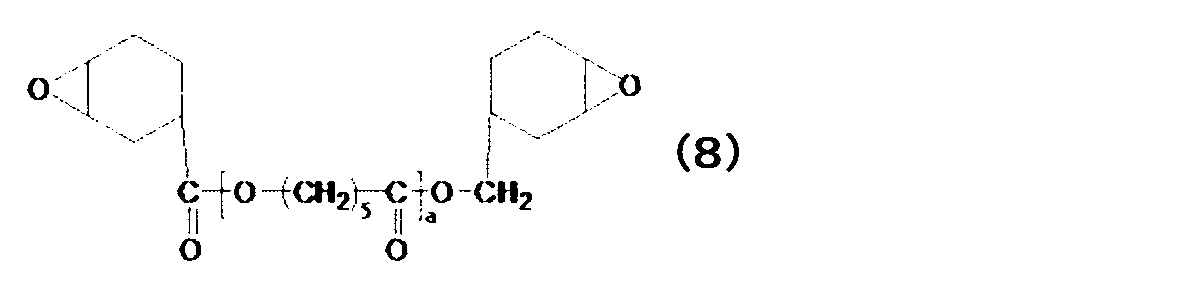
(一般式(8)中のaは0または1を表す。)
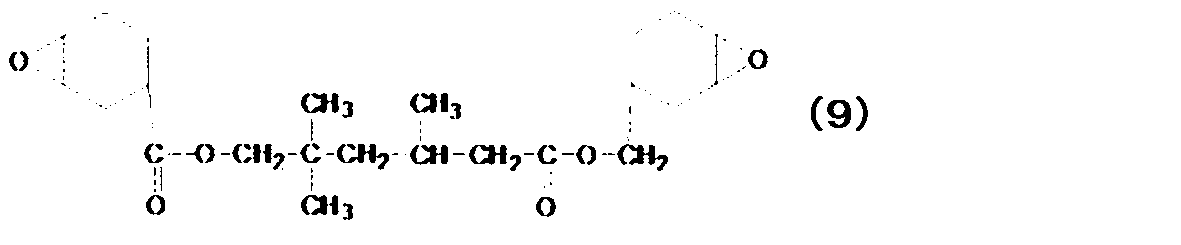





前記一般式(14)に示される化合物としては、具体的には、ジシクロヘキシル-3,3’-ジエポキシドを使用することができる。

(一般式(15)中、a及びbは、それぞれ独立して0又は1であり、それらは同一であっても異なっていてもよい。)
一般式(15)で示される脂環式エポキシ化合物としては、例えばエポリードGT301、エポリードGT302(以上、ダイセル化学工業(株)製)等が市販されている。
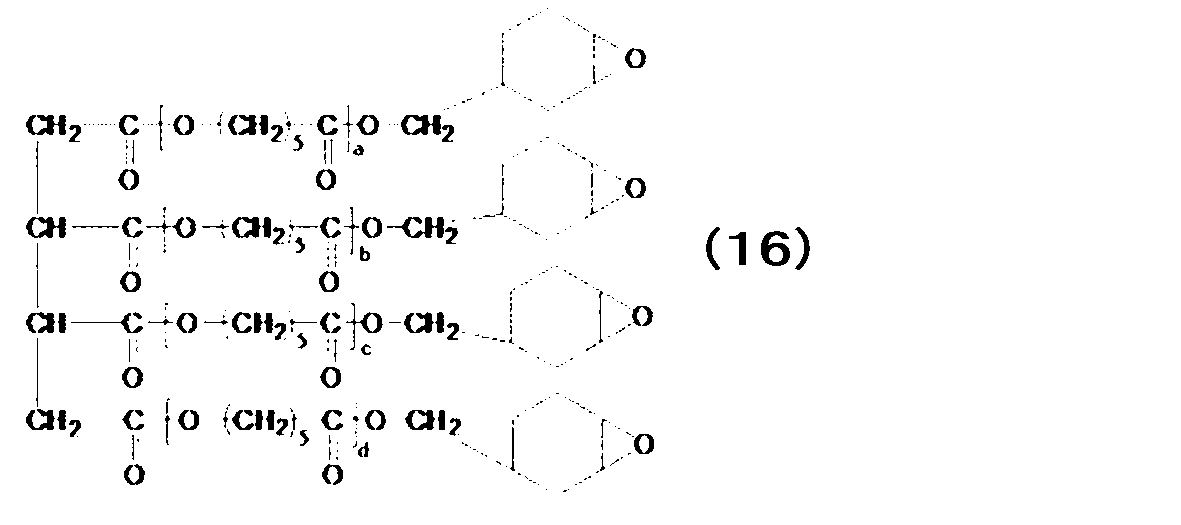
(前記一般式(16)中、a~dは、それぞれ独立して0又は1を示し、それらは同一であっても異なっていてもよい。)
前記一般式(16)で示される脂環式エポキシ化合物としては、例えば、エポリードGT401、エポリードGT403(以上、ダイセル化学工業(株)製)等が市販されている。
クラレポバールPVA-117H((株)クラレ製のポリビニルアルコール、重合度1700、完全ケン化物、粉末状)を水中に溶解して得られたポリビニルアルコール水溶液(不揮発分8質量%)を、バーコーターを用いて離型フィルム上に塗布し、次いで、80℃の環境下で5分間乾燥した後、前記離型フィルムを除去することによって、厚さ75μmのポリビニルアルコールフィルムを作製した。
次いで、得られたポリビニルアルコールフィルムを延伸機に固定し、40℃の温水中で前記フィルムを一軸方向に3倍の大きさになるまで延伸した。
上記で得られた延伸フィルムの表面に付着した水を除去した後、前記延伸フィルムを、ヨウ素を0.02質量部、ヨウ化カリウムを2質量部及び水を100質量部含有する30℃に調整した水溶液中に浸漬した。
次いで、前記延伸フィルムを、ヨウ化カリウム12質量部、ホウ酸5質量部及び水100質量部を含有する56.5℃に調整した水溶液中に浸漬した。
前記浸漬後の延伸フィルムを8℃に調整した純水中で洗浄した後、65℃の環境下で乾燥することによって、ポリビニルアルコールからなる延伸フィルムの表面にヨウ素が吸着、配向した偏光子(偏光フィルム)を得た。
攪拌機、還流冷却器、温度計、滴下漏斗及び窒素ガス導入口を備えた反応容器に芳香族グリシジルエーテル(A)として、EPICLON EXA-830CRPを100質量部、2個以上のオキセタニル基を有するオキセタン化合物(B)として、アロンオキセタンOXT-221を300質量部、脂環式エポキシ基含有シランカップリング剤(C)として、KBM-303を100質量部、カチオン重合開始剤(D)として、ジフェニル-4-(フェニルチオ)フェニルスルホニウムヘキサフルオロホスフェートのプロピレンカーボネート50質量%溶液を40質量部、光増感剤(E)として、9、10-ジブトキシアントラセンを2.5質量部、光増感助剤(F)として、1,4-ジエトキシナフタレンを2.5質量部、混合、攪拌することによって、粘度25mPa・s(25℃)のカチオン重合性接着剤を調製した。
ポリメタクリル酸メチルを主成分とするアクリル樹脂フィルムとTACフィルムのそれぞれ片表面に、得られたカチオン重合性接着剤を、ワイヤーバーを用いて約2μmの厚みになるようにそれぞれ塗布し、該塗布基材を、前記偏光子(偏光フィルム)の両面に、それぞれ貼り合わせた。次いで、ゴムローラーを用いて加圧した後、コンベアタイプの紫外線照射装置(Fusion LH-6 出力100%、コンベア速度17.8m/分)を用い、前記アクリル樹脂フィルム側から300~390nmの積算光量が、1300mJ/cm2の紫外線を照射することで、上から、保護フィルム/カチオン重合性接着剤層/偏光子/カチオン重合性接着剤層/保護フィルムとの構成を有する偏光板を得た。
攪拌機、還流冷却器、温度計、滴下漏斗及び窒素ガス導入口を備えた反応容器に芳香族グリシジルエーテル(A)として、EPICLON EXA-830CRPを100質量部、2個以上のオキセタニル基を有するオキセタン化合物(B)として、アロンオキセタンOXT-221を350質量部、脂環式エポキシ基含有シランカップリング剤(C)として、KBM-303を50質量部、カチオン重合開始剤(D)として、ジフェニル-4-(フェニルチオ)フェニルスルホニウムヘキサフルオロホスフェートのプロピレンカーボネート50質量%溶液を40質量部、光増感剤(E)として、9、10-ジブトキシアントラセンを2.5質量部、光増感助剤(F)として、1,4-ジエトキシナフタレンを2.5質量部、混合、攪拌することによって、粘度26mPa・s(25℃)カチオン重合性接着剤を調製した。
ポリメタクリル酸メチルを主成分とするアクリル樹脂フィルムとTACフィルムのそれぞれ片表面に、得られたカチオン重合性接着剤を、ワイヤーバーを用いて約2μmの厚みになるようにそれぞれ塗布し、該塗布基材を、前記偏光子(偏光フィルム)の両面に、それぞれ貼り合わせた。次いで、ゴムローラーを用いて加圧した後、コンベアタイプの紫外線照射装置(Fusion LH-6 出力100%、コンベア速度17.8m/分)を用い、前記アクリル樹脂フィルム側から300~390nmの積算光量が、1300mJ/cm2の紫外線を照射することで、上から、保護フィルム/カチオン重合性接着剤層/偏光子/カチオン重合性接着剤層/保護フィルムとの構成を有する偏光板を得た。
攪拌機、還流冷却器、温度計、滴下漏斗及び窒素ガス導入口を備えた反応容器に芳香族グリシジルエーテル(A)として、EPICLON EXA-830CRPを100質量部、2個以上のオキセタニル基を有するオキセタン化合物(B)として、アロンオキセタンOXT-221を375質量部、脂環式エポキシ基含有シランカップリング剤(C)として、KBM-303を25質量部、カチオン重合開始剤(D)として、ジフェニル-4-(フェニルチオ)フェニルスルホニウムヘキサフルオロホスフェートのプロピレンカーボネート50質量%溶液を40質量部、光増感剤(E)として、9、10-ジブトキシアントラセンを2.5質量部、光増感助剤(F)として、1,4-ジエトキシナフタレンを2.5質量部、混合、攪拌することによって、粘度26mPa・s(25℃)カチオン重合性接着剤を調製した。
ポリメタクリル酸メチルを主成分とするアクリル樹脂フィルムとTACフィルムのそれぞれ片表面に、得られたカチオン重合性接着剤を、ワイヤーバーを用いて約2μmの厚みになるようにそれぞれ塗布し、該塗布基材を、前記偏光子(偏光フィルム)の両面に、それぞれ貼り合わせた。次いで、ゴムローラーを用いて加圧した後、コンベアタイプの紫外線照射装置(Fusion LH-6 出力100%、コンベア速度17.8m/分)を用い、前記アクリル樹脂フィルム側から300~390nmの積算光量が、1300mJ/cm2の紫外線を照射することで、上から、保護フィルム/カチオン重合性接着剤層/偏光子/カチオン重合性接着剤層/保護フィルムとの構成を有する偏光板を得た。
攪拌機、還流冷却器、温度計、滴下漏斗及び窒素ガス導入口を備えた反応容器に芳香族グリシジルエーテル(A)として、EPICLON EXA-830CRPを100質量部、2個以上のオキセタニル基を有するオキセタン化合物(B)として、アロンオキセタンOXT-221を390質量部、脂環式エポキシ基含有シランカップリング剤(C)として、KBM-303を10質量部、カチオン重合開始剤(D)として、ジフェニル-4-(フェニルチオ)フェニルスルホニウムヘキサフルオロホスフェートのプロピレンカーボネート50質量%溶液を40質量部、光増感剤(E)として、9、10-ジブトキシアントラセンを2.5質量部、光増感助剤(F)として、1,4-ジエトキシナフタレンを2.5質量部、混合、攪拌することによって、粘度26mPa・s(25℃)カチオン重合性接着剤を調製した。
ポリメタクリル酸メチルを主成分とするアクリル樹脂フィルムとTACフィルムのそれぞれ片表面に、得られたカチオン重合性接着剤を、ワイヤーバーを用いて約2μmの厚みになるようにそれぞれ塗布し、該塗布基材を、前記偏光子(偏光フィルム)の両面に、それぞれ貼り合わせた。次いで、ゴムローラーを用いて加圧した後、コンベアタイプの紫外線照射装置(Fusion LH-6 出力100%、コンベア速度17.8m/分)を用い、前記アクリル樹脂フィルム側から300~390nmの積算光量が、1300mJ/cm2の紫外線を照射することで、上から、保護フィルム/カチオン重合性接着剤層/偏光子/カチオン重合性接着剤層/保護フィルムとの構成を有する偏光板を得た。
攪拌機、還流冷却器、温度計、滴下漏斗及び窒素ガス導入口を備えた反応容器に芳香族グリシジルエーテル(A)として、EPICLON EXA-830CRPを100質量部、2個以上のオキセタニル基を有するオキセタン化合物(B)として、アロンオキセタンOXT-221を395質量部、脂環式エポキシ基含有シランカップリング剤(C)として、KBM-303を5質量部、カチオン重合開始剤(D)として、ジフェニル-4-(フェニルチオ)フェニルスルホニウムヘキサフルオロホスフェートのプロピレンカーボネート50質量%溶液を40質量部、光増感剤(E)として、9、10-ジブトキシアントラセンを2.5質量部、光増感助剤(F)として、1,4-ジエトキシナフタレンを2.5質量部、混合、攪拌することによって、粘度26mPa・s(25℃)カチオン重合性接着剤を調製した。
ポリメタクリル酸メチルを主成分とするアクリル樹脂フィルムとTACフィルムのそれぞれ片表面に、得られたカチオン重合性接着剤を、ワイヤーバーを用いて約2μmの厚みになるようにそれぞれ塗布し、該塗布基材を、前記偏光子(偏光フィルム)の両面に、それぞれ貼り合わせた。次いで、ゴムローラーを用いて加圧した後、コンベアタイプの紫外線照射装置(Fusion LH-6 出力100%、コンベア速度17.8m/分)を用い、前記アクリル樹脂フィルム側から300~390nmの積算光量が、1300mJ/cm2の紫外線を照射することで、上から、保護フィルム/カチオン重合性接着剤層/偏光子/カチオン重合性接着剤層/保護フィルムとの構成を有する偏光板を得た。
攪拌機、還流冷却器、温度計、滴下漏斗及び窒素ガス導入口を備えた反応容器に芳香族グリシジルエーテル(A)として、EPICLON EXA-830CRPを100質量部、2個以上のオキセタニル基を有するオキセタン化合物(B)として、アロンオキセタンOXT-221を400質量部、カチオン重合開始剤(D)として、ジフェニル-4-(フェニルチオ)フェニルスルホニウムヘキサフルオロホスフェートのプロピレンカーボネート50質量%溶液を40質量部、光増感剤(E)として、9、10-ジブトキシアントラセンを2.5質量部、光増感助剤(F)として、1,4-ジエトキシナフタレンを2.5質量部、混合、攪拌することによって、粘度26mPa・s(25℃)カチオン重合性接着剤を調製した。
ポリメタクリル酸メチルを主成分とするアクリル樹脂フィルムとTACフィルムのそれぞれ片表面に、得られたカチオン重合性接着剤を、ワイヤーバーを用いて約2μmの厚みになるようにそれぞれ塗布し、該塗布基材を、前記偏光子(偏光フィルム)の両面に、それぞれ貼り合わせた。次いで、ゴムローラーを用いて加圧した後、コンベアタイプの紫外線照射装置(Fusion LH-6 出力100%、コンベア速度17.8m/分)を用い、前記アクリル樹脂フィルム側から300~390nmの積算光量が、1300mJ/cm2の紫外線を照射することで、上から、保護フィルム/カチオン重合性接着剤層/偏光子/カチオン重合性接着剤層/保護フィルムとの構成を有する偏光板を得た。
攪拌機、還流冷却器、温度計、滴下漏斗及び窒素ガス導入口を備えた反応容器に芳香族グリシジルエーテル(A)として、EPICLON EXA-830CRPを100質量部、2個以上のオキセタニル基を有するオキセタン化合物(B)として、アロンオキセタンOXT-221を397.5質量部、脂環式エポキシ基含有シランカップリング剤(C)として、KBM-303を2.5質量部、カチオン重合開始剤(D)として、ジフェニル-4-(フェニルチオ)フェニルスルホニウムヘキサフルオロホスフェートのプロピレンカーボネート50質量%溶液を40質量部、光増感剤(E)として、9、10-ジブトキシアントラセンを2.5質量部、光増感助剤(F)として、1,4-ジエトキシナフタレンを2.5質量部、混合、攪拌することによって、粘度26mPa・s(25℃)カチオン重合性接着剤を調製した。
ポリメタクリル酸メチルを主成分とするアクリル樹脂フィルムとTACフィルムのそれぞれ片表面に、得られたカチオン重合性接着剤を、ワイヤーバーを用いて約2μmの厚みになるようにそれぞれ塗布し、該塗布基材を、前記偏光子(偏光フィルム)の両面に、それぞれ貼り合わせた。次いで、ゴムローラーを用いて加圧した後、コンベアタイプの紫外線照射装置(Fusion LH-6 出力100%、コンベア速度17.8m/分)を用い、前記アクリル樹脂フィルム側から300~390nmの積算光量が、1300mJ/cm2の紫外線を照射することで、上から、保護フィルム/カチオン重合性接着剤層/偏光子/カチオン重合性接着剤層/保護フィルムとの構成を有する偏光板を得た。
攪拌機、還流冷却器、温度計、滴下漏斗及び窒素ガス導入口を備えた反応容器に芳香族グリシジルエーテル(A)として、EPICLON EXA-830CRPを100質量部、2個以上のオキセタニル基を有するオキセタン化合物(B)として、アロンオキセタンOXT-221を250質量部、脂環式エポキシ基含有シランカップリング剤(C)として、KBM-303を150質量部、カチオン重合開始剤(D)として、ジフェニル-4-(フェニルチオ)フェニルスルホニウムヘキサフルオロホスフェートのプロピレンカーボネート50質量%溶液を40質量部、光増感剤(E)として、9、10-ジブトキシアントラセンを2.5質量部、光増感助剤(F)として、1,4-ジエトキシナフタレンを2.5質量部、混合、攪拌することによって、粘度24mPa・s(25℃)カチオン重合性接着剤を調製した。
ポリメタクリル酸メチルを主成分とするアクリル樹脂フィルムとTACフィルムのそれぞれ片表面に、得られたカチオン重合性接着剤を、ワイヤーバーを用いて約2μmの厚みになるようにそれぞれ塗布し、該塗布基材を、前記偏光子(偏光フィルム)の両面に、それぞれ貼り合わせた。次いで、ゴムローラーを用いて加圧した後、コンベアタイプの紫外線照射装置(Fusion LH-6 出力100%、コンベア速度17.8m/分)を用い、前記アクリル樹脂フィルム側から300~390nmの積算光量が、1300mJ/cm2の紫外線を照射することで、上から、保護フィルム/カチオン重合性接着剤層/偏光子/カチオン重合性接着剤層/保護フィルムとの構成を有する偏光板を得た。
攪拌機、還流冷却器、温度計、滴下漏斗及び窒素ガス導入口を備えた反応容器に芳香族グリシジルエーテル(A)として、EPICLON EXA-830CRPを100質量部、脂環式エポキシ基含有シランカップリング剤(C)として、KBM-303を400質量部、カチオン重合開始剤(D)として、ジフェニル-4-(フェニルチオ)フェニルスルホニウムヘキサフルオロフホスフェートのプロピレンカーボネート50質量%溶液を40質量部、光増感剤(E)として、9、10-ジブトキシアントラセンを2.5質量部、光増感助剤(F)として、1,4-ジエトキシナフタレンを2.5質量部、混合、攪拌することによって、粘度24mPa・s(25℃)カチオン重合性接着剤を調製した。
ポリメタクリル酸メチルを主成分とするアクリル樹脂フィルムとTACフィルムのそれぞれ片表面に、得られたカチオン重合性接着剤を、ワイヤーバーを用いて約2μmの厚みになるようにそれぞれ塗布し、該塗布基材を、前記偏光子(偏光フィルム)の両面に、それぞれ貼り合わせた。次いで、ゴムローラーを用いて加圧した後、コンベアタイプの紫外線照射装置(Fusion LH-6 出力100%、コンベア速度17.8m/分)を用い、前記アクリル樹脂フィルム側から300~390nmの積算光量が、1300mJ/cm2の紫外線を照射することで、上から、保護フィルム/カチオン重合性接着剤層/偏光子/カチオン重合性接着剤層/保護フィルムとの構成を有する偏光板を得た。
攪拌機、還流冷却器、温度計、滴下漏斗及び窒素ガス導入口を備えた反応容器に2個以上のオキセタニル基を有するオキセタン化合物(B)として、アロンオキセタンOXT-221を450質量部、脂環式エポキシ基含有シランカップリング剤(C)として、KBM-303を50質量部、カチオン重合開始剤(D)として、ジフェニル-4-(フェニルチオ)フェニルスルホニウムヘキサフルオロホスフェートのプロピレンカーボネート50質量%溶液を40質量部、光増感剤(E)として、9、10-ジブトキシアントラセンを2.5質量部、光増感助剤(F)として、1,4-ジエトキシナフタレンを2.5質量部、混合、攪拌することによって、粘度15mPa・s(25℃)カチオン重合性接着剤を調製した。
ポリメタクリル酸メチルを主成分とするアクリル樹脂フィルムとTACフィルムのそれぞれ片表面に、得られたカチオン重合性接着剤を、ワイヤーバーを用いて約2μmの厚みになるようにそれぞれ塗布し、該塗布基材を、前記偏光子(偏光フィルム)の両面に、それぞれ貼り合わせた。次いで、ゴムローラーを用いて加圧した後、コンベアタイプの紫外線照射装置(Fusion LH-6 出力100%、コンベア速度17.8m/分)を用い、前記アクリル樹脂フィルム側から300~390nmの積算光量が、1300mJ/cm2の紫外線を照射することで、上から、保護フィルム/カチオン重合性接着剤層/偏光子/カチオン重合性接着剤層/保護フィルムとの構成を有する偏光板を得た。
実施例及び比較例で得られた偏光板を3mm×60mmの大きさに裁断したものを試験片とし、23℃、50%RHの条件下で、該試験片を直径3Φの棒に巻きつけた。巻きつけた瞬間の、外観を目視で確認し、以下のように評価した。
良好「○」;剥がれや接着剤層にひびがない。
不良「×」;剥がれや接着剤層にひびが一部でもある。
実施例及び比較例で得られた偏光板を50mm×50mmの大きさに裁断したものを試験片とし、該試験片を60℃の温水に24時間浸漬させ、その後の外観を目視で確認し、以下のように評価した。
良好「○」;試験片にヨウ素脱色や剥がれが存在しない。
不良「×」;試験片の全部または一部でヨウ素脱色が確認されたり、剥がれが確認できた。

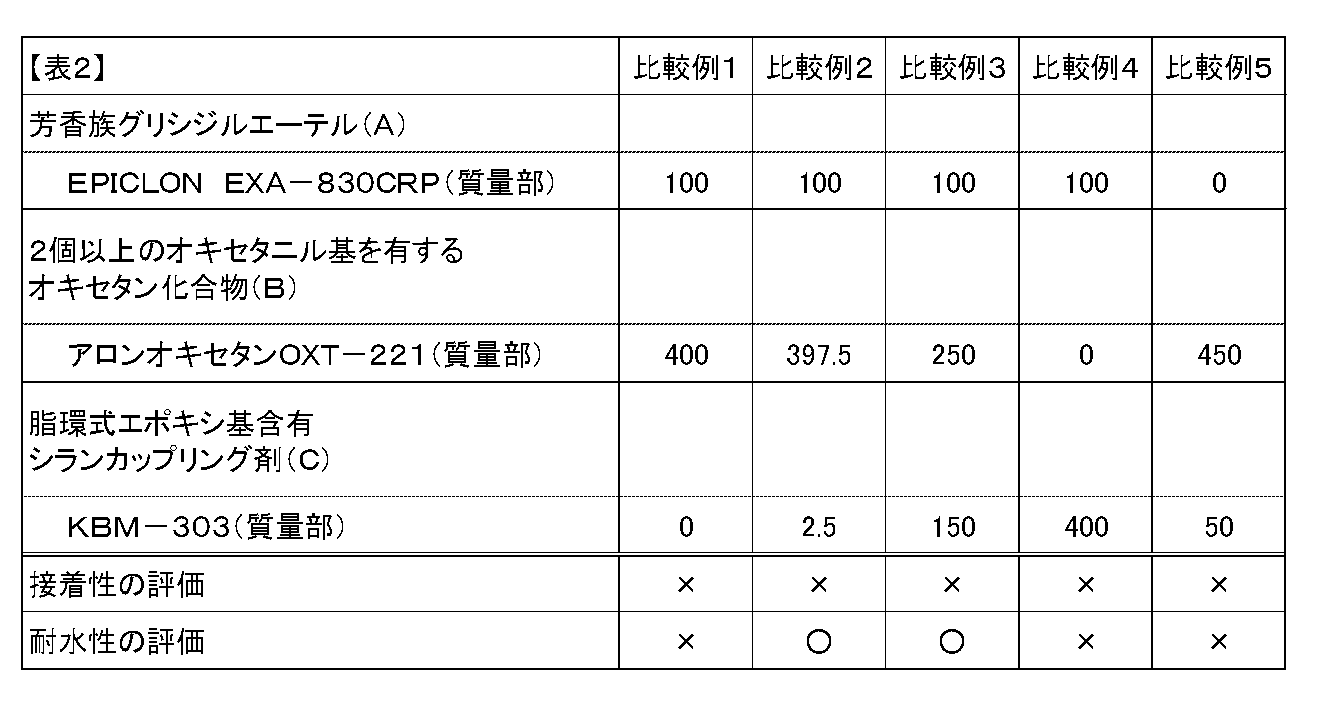
「EPICLON EXA-830CRP」;ビスフェノールFジグリシジルエーテル
「アロンオキセタンOXT-221」;ビス[1-エチル(3-オキセタニル)]メチルエーテル
「KBM-303」;2-(3,4-エポキシシクロヘキシル)エチルトリメトキシシラン
一方、比較例1は、シランカップリング剤(C)を含有しない態様であるが、接着性及び耐水性が不良であることが分かった。
また、比較例2及び3は、オキセタン化合物(B)及びシランカップリング剤(C)の使用量が本発明で規定する範囲を外れた態様であるが、いずれも接着性が不良であることが分かった。
また、比較例4は、オキセタン化合物(B)及びシランカップリング剤(C)を含有しない態様であり、比較例5は、芳香族グリシジルエーテル(A)を含有しない態様であるが、接着性及び耐水性が不良であることが分かった。
Claims (9)
- 芳香族グリシジルーエーテル(A)、2個以上のオキセタニル基を有するオキセタン化合物(B)、脂環式エポキシ基を有するシランカップリング剤(C)、及びカチオン重合開始剤(D)を含有するカチオン重合性接着剤であって、
前記芳香族グリシジルエーテル(A)100質量部に対し、前記オキセタン化合物(B)を300~395質量部の範囲で用い、前記シランカップリング剤(C)を5~100質量部の範囲で用いることを特徴とするカチオン重合性接着剤。 - 前記芳香族グリシジルエーテル(A)が、2個以上のグリシジルエーテル基を有するものである請求項1に記載のカチオン重合性接着剤。
- 前記芳香族グリシジルエーテル(A)が、ビスフェノールAジグリシジルエーテル及びビスフェノールFジグリシジルエーテルからなる群より選ばれる1種以上の芳香族グリシジルエーテルである請求項2に記載のカチオン重合性接着剤。
- 前記オキセタン化合物(B)の分子量が100~800の範囲である請求項1に記載のカチオン重合性接着剤。
- 前記オキセタン化合物(B)が、ビス[1-エチル(3-オキセタニル)]メチルエーテルである請求項4に記載のカチオン重合性接着剤。
- 前記シランカップリング剤(C)が、2-(3,4-エポキシシクロヘキシル)エチルトリメトキシシラン及び2-(3,4-エポキシシクロヘキシル)エチルトリエトキシシランからなる群より選ばれる1種以上である請求項1に記載のカチオン重合性接着剤。
- 更に光増感剤(E)を含有する請求項1に記載のカチオン重合性接着剤。
- 前記光増感剤(E)が、波長が380nm以上である光に極大吸収を示すものである請求項7に記載のカチオン重合性接着剤。
- 保護フィルムと偏光子とがカチオン重合性接着剤を介して接着された偏光板であって、前記カチオン重合性接着剤が請求項1~8のいずれか1項に記載のカチオン重合性接着剤であることを特徴とする偏光板。
Priority Applications (3)
| Application Number | Priority Date | Filing Date | Title |
|---|---|---|---|
| JP2012543065A JP5229434B2 (ja) | 2011-04-19 | 2012-02-20 | カチオン重合性接着剤及びそれを用いて得られた偏光板 |
| CN201280010204.2A CN103403120B (zh) | 2011-04-19 | 2012-02-20 | 阳离子聚合性胶粘剂及使用它得到的偏振板 |
| KR1020137011399A KR20130141508A (ko) | 2011-04-19 | 2012-02-20 | 양이온 중합성 접착제 및 그것을 사용하여 얻어진 편광판 |
Applications Claiming Priority (2)
| Application Number | Priority Date | Filing Date | Title |
|---|---|---|---|
| JP2011-092992 | 2011-04-19 | ||
| JP2011092992 | 2011-04-19 |
Publications (1)
| Publication Number | Publication Date |
|---|---|
| WO2012144261A1 true WO2012144261A1 (ja) | 2012-10-26 |
Family
ID=47041384
Family Applications (1)
| Application Number | Title | Priority Date | Filing Date |
|---|---|---|---|
| PCT/JP2012/053926 Ceased WO2012144261A1 (ja) | 2011-04-19 | 2012-02-20 | カチオン重合性接着剤及びそれを用いて得られた偏光板 |
Country Status (5)
| Country | Link |
|---|---|
| JP (1) | JP5229434B2 (ja) |
| KR (1) | KR20130141508A (ja) |
| CN (1) | CN103403120B (ja) |
| TW (1) | TW201249946A (ja) |
| WO (1) | WO2012144261A1 (ja) |
Cited By (6)
| Publication number | Priority date | Publication date | Assignee | Title |
|---|---|---|---|---|
| JP2015090388A (ja) * | 2013-11-05 | 2015-05-11 | 住友化学株式会社 | 積層光学フィルムの製造方法 |
| WO2015118975A1 (ja) * | 2014-02-04 | 2015-08-13 | 住友化学株式会社 | 偏光板及び表示装置 |
| JP2018109143A (ja) * | 2016-12-28 | 2018-07-12 | 日本合成化学工業株式会社 | 活性エネルギー線硬化性接着剤組成物、偏光板用接着剤組成物、偏光板用接着剤、およびそれを用いた偏光板 |
| KR20190111973A (ko) | 2017-02-13 | 2019-10-02 | 미쯔비시 케미컬 주식회사 | 활성 에너지선 경화성 접착제 조성물, 편광판용 접착제 조성물, 편광판용 접착제, 및 이를 사용한 편광판 |
| JP2020024368A (ja) * | 2018-07-26 | 2020-02-13 | 三菱ケミカル株式会社 | 活性エネルギー線硬化性樹脂組成物、偏光フィルム保護層、およびそれを用いた偏光板 |
| CN111886525A (zh) * | 2018-03-22 | 2020-11-03 | 三菱化学株式会社 | 活性能量射线固化性树脂组合物、偏光薄膜保护层及偏光板 |
Families Citing this family (1)
| Publication number | Priority date | Publication date | Assignee | Title |
|---|---|---|---|---|
| CN110938402A (zh) * | 2019-12-18 | 2020-03-31 | 湖南省和祥润新材料有限公司 | 一种阻燃型光固化胶及其制备方法 |
Citations (2)
| Publication number | Priority date | Publication date | Assignee | Title |
|---|---|---|---|---|
| JP2010229392A (ja) * | 2009-03-05 | 2010-10-14 | Dic Corp | カチオン重合性接着剤及びそれを用いて得られた偏光板 |
| JP2011028234A (ja) * | 2009-06-26 | 2011-02-10 | Sumitomo Chemical Co Ltd | 偏光板及びそれを用いた積層光学部材 |
-
2012
- 2012-02-20 KR KR1020137011399A patent/KR20130141508A/ko not_active Withdrawn
- 2012-02-20 JP JP2012543065A patent/JP5229434B2/ja not_active Expired - Fee Related
- 2012-02-20 CN CN201280010204.2A patent/CN103403120B/zh not_active Expired - Fee Related
- 2012-02-20 WO PCT/JP2012/053926 patent/WO2012144261A1/ja not_active Ceased
- 2012-04-18 TW TW101113692A patent/TW201249946A/zh unknown
Patent Citations (2)
| Publication number | Priority date | Publication date | Assignee | Title |
|---|---|---|---|---|
| JP2010229392A (ja) * | 2009-03-05 | 2010-10-14 | Dic Corp | カチオン重合性接着剤及びそれを用いて得られた偏光板 |
| JP2011028234A (ja) * | 2009-06-26 | 2011-02-10 | Sumitomo Chemical Co Ltd | 偏光板及びそれを用いた積層光学部材 |
Cited By (12)
| Publication number | Priority date | Publication date | Assignee | Title |
|---|---|---|---|---|
| JP2015090388A (ja) * | 2013-11-05 | 2015-05-11 | 住友化学株式会社 | 積層光学フィルムの製造方法 |
| WO2015068561A1 (ja) * | 2013-11-05 | 2015-05-14 | 住友化学株式会社 | 積層光学フィルムの製造方法 |
| CN105723256A (zh) * | 2013-11-05 | 2016-06-29 | 住友化学株式会社 | 层叠光学薄膜的制造方法 |
| CN105723256B (zh) * | 2013-11-05 | 2019-06-25 | 住友化学株式会社 | 层叠光学薄膜的制造方法 |
| WO2015118975A1 (ja) * | 2014-02-04 | 2015-08-13 | 住友化学株式会社 | 偏光板及び表示装置 |
| JP2015146002A (ja) * | 2014-02-04 | 2015-08-13 | 住友化学株式会社 | 偏光板及び表示装置 |
| JP2018109143A (ja) * | 2016-12-28 | 2018-07-12 | 日本合成化学工業株式会社 | 活性エネルギー線硬化性接着剤組成物、偏光板用接着剤組成物、偏光板用接着剤、およびそれを用いた偏光板 |
| KR20190111973A (ko) | 2017-02-13 | 2019-10-02 | 미쯔비시 케미컬 주식회사 | 활성 에너지선 경화성 접착제 조성물, 편광판용 접착제 조성물, 편광판용 접착제, 및 이를 사용한 편광판 |
| KR20230003629A (ko) | 2017-02-13 | 2023-01-06 | 미쯔비시 케미컬 주식회사 | 활성 에너지선 경화성 접착제 조성물, 편광판용 접착제 조성물, 편광판용 접착제, 및 이를 사용한 편광판 |
| CN111886525A (zh) * | 2018-03-22 | 2020-11-03 | 三菱化学株式会社 | 活性能量射线固化性树脂组合物、偏光薄膜保护层及偏光板 |
| CN111886525B (zh) * | 2018-03-22 | 2023-03-28 | 三菱化学株式会社 | 活性能量射线固化性树脂组合物、偏光薄膜保护层及偏光板 |
| JP2020024368A (ja) * | 2018-07-26 | 2020-02-13 | 三菱ケミカル株式会社 | 活性エネルギー線硬化性樹脂組成物、偏光フィルム保護層、およびそれを用いた偏光板 |
Also Published As
| Publication number | Publication date |
|---|---|
| KR20130141508A (ko) | 2013-12-26 |
| CN103403120A (zh) | 2013-11-20 |
| JPWO2012144261A1 (ja) | 2014-07-28 |
| JP5229434B2 (ja) | 2013-07-03 |
| CN103403120B (zh) | 2015-04-15 |
| TW201249946A (en) | 2012-12-16 |
Similar Documents
| Publication | Publication Date | Title |
|---|---|---|
| JP5668597B2 (ja) | カチオン重合性接着剤及びそれを用いて得られた偏光板 | |
| JP5446902B2 (ja) | カチオン重合性接着剤及びそれを用いて得られた偏光板 | |
| CN102471660B (zh) | 阳离子聚合性粘接剂和使用其得到的偏振板 | |
| JP5229433B2 (ja) | カチオン重合性接着剤及びそれを用いて得られた偏光板 | |
| JP4135119B2 (ja) | 多分岐ポリエーテルポリオール含有のカチオン重合性樹脂組成物、それを含む接着剤、ならびにそれを用いた積層体及び偏光板 | |
| JP5229434B2 (ja) | カチオン重合性接着剤及びそれを用いて得られた偏光板 | |
| JP2008111105A (ja) | プラスチック基材用カチオン重合性接着剤、それを用いた積層体及び偏光板 | |
| JP4947244B2 (ja) | カチオン重合性組成物、それを含む接着剤、ならびに、それらを用いて得られた硬化物及び偏光板 | |
| WO2010047386A1 (ja) | 接着剤組成物および光学部材 | |
| JP5447097B2 (ja) | カチオン重合性組成物、それを含むコーティング剤及び接着剤ならびにそれらを用いて得られる塗装物及び積層体 | |
| JP2010197692A (ja) | 光学部材用光硬化性樹脂組成物、接着剤、及び、タッチパネル | |
| JP5266935B2 (ja) | 偏光子と保護フィルムとの接着用カチオン重合性接着剤及びそれを用いて得られた偏光板 | |
| WO2014129261A1 (ja) | カチオン重合性接着剤 | |
| KR101678507B1 (ko) | 편광판 | |
| WO2014178239A1 (ja) | 接着剤組成物及び偏光板 | |
| TW201235400A (en) | Cation polymerized resin composition, optical material and lamination obtained by using the same |
Legal Events
| Date | Code | Title | Description |
|---|---|---|---|
| ENP | Entry into the national phase |
Ref document number: 2012543065 Country of ref document: JP Kind code of ref document: A |
|
| 121 | Ep: the epo has been informed by wipo that ep was designated in this application |
Ref document number: 12774268 Country of ref document: EP Kind code of ref document: A1 |
|
| ENP | Entry into the national phase |
Ref document number: 20137011399 Country of ref document: KR Kind code of ref document: A |
|
| NENP | Non-entry into the national phase |
Ref country code: DE |
|
| 122 | Ep: pct application non-entry in european phase |
Ref document number: 12774268 Country of ref document: EP Kind code of ref document: A1 |