WO2012141313A1 - ノルボルナンジカルボン酸エステルの製造方法 - Google Patents
ノルボルナンジカルボン酸エステルの製造方法 Download PDFInfo
- Publication number
- WO2012141313A1 WO2012141313A1 PCT/JP2012/060182 JP2012060182W WO2012141313A1 WO 2012141313 A1 WO2012141313 A1 WO 2012141313A1 JP 2012060182 W JP2012060182 W JP 2012060182W WO 2012141313 A1 WO2012141313 A1 WO 2012141313A1
- Authority
- WO
- WIPO (PCT)
- Prior art keywords
- compound
- acid ester
- dicarboxylic acid
- norbornane dicarboxylic
- norbornane
- Prior art date
- Legal status (The legal status is an assumption and is not a legal conclusion. Google has not performed a legal analysis and makes no representation as to the accuracy of the status listed.)
- Ceased
Links
- 0 *OC(C(CC(C1)C2)C1C2C(O)=O)=O Chemical compound *OC(C(CC(C1)C2)C1C2C(O)=O)=O 0.000 description 1
Images




Classifications
-
- C—CHEMISTRY; METALLURGY
- C07—ORGANIC CHEMISTRY
- C07C—ACYCLIC OR CARBOCYCLIC COMPOUNDS
- C07C67/00—Preparation of carboxylic acid esters
- C07C67/30—Preparation of carboxylic acid esters by modifying the acid moiety of the ester, such modification not being an introduction of an ester group
- C07C67/333—Preparation of carboxylic acid esters by modifying the acid moiety of the ester, such modification not being an introduction of an ester group by isomerisation; by change of size of the carbon skeleton
- C07C67/343—Preparation of carboxylic acid esters by modifying the acid moiety of the ester, such modification not being an introduction of an ester group by isomerisation; by change of size of the carbon skeleton by increase in the number of carbon atoms
- C07C67/347—Preparation of carboxylic acid esters by modifying the acid moiety of the ester, such modification not being an introduction of an ester group by isomerisation; by change of size of the carbon skeleton by increase in the number of carbon atoms by addition to unsaturated carbon-to-carbon bonds
-
- C—CHEMISTRY; METALLURGY
- C07—ORGANIC CHEMISTRY
- C07B—GENERAL METHODS OF ORGANIC CHEMISTRY; APPARATUS THEREFOR
- C07B61/00—Other general methods
-
- C—CHEMISTRY; METALLURGY
- C07—ORGANIC CHEMISTRY
- C07C—ACYCLIC OR CARBOCYCLIC COMPOUNDS
- C07C67/00—Preparation of carboxylic acid esters
- C07C67/48—Separation; Purification; Stabilisation; Use of additives
-
- C—CHEMISTRY; METALLURGY
- C07—ORGANIC CHEMISTRY
- C07C—ACYCLIC OR CARBOCYCLIC COMPOUNDS
- C07C69/00—Esters of carboxylic acids; Esters of carbonic or haloformic acids
- C07C69/74—Esters of carboxylic acids having an esterified carboxyl group bound to a carbon atom of a ring other than a six-membered aromatic ring
- C07C69/753—Esters of carboxylic acids having an esterified carboxyl group bound to a carbon atom of a ring other than a six-membered aromatic ring of polycyclic acids
-
- C—CHEMISTRY; METALLURGY
- C07—ORGANIC CHEMISTRY
- C07C—ACYCLIC OR CARBOCYCLIC COMPOUNDS
- C07C2602/00—Systems containing two condensed rings
- C07C2602/36—Systems containing two condensed rings the rings having more than two atoms in common
- C07C2602/42—Systems containing two condensed rings the rings having more than two atoms in common the bicyclo ring system containing seven carbon atoms
Definitions
- the present invention relates to a method for producing norbornane dicarboxylic acid ester.
- aromatic resin is widely used for resin for optical components used in optoelectronic devices because of its excellent heat resistance and mechanical properties under high temperature operation and mounting process on electronic substrates. It has been.
- high-intensity laser light, blue light, and near-ultraviolet light has expanded in the field of optoelectronic devices, and a resin that is superior in transparency, heat resistance, and light resistance than ever has been demanded.
- aromatic epoxy resins have high transparency under visible light, but sufficient transparency cannot be obtained in the ultraviolet to near ultraviolet region.
- a cured product composed of an alicyclic epoxy resin and an acid anhydride has a relatively high transparency in the near ultraviolet region, but has problems such as being easily colored by heat and light, and has heat resistance and UV resistance. Improvement is demanded. Under such circumstances, various epoxy resins have been studied.
- heat-resistant resins such as polyamide and polyester are widely used as surface protection films and interlayer insulation films for semiconductor elements in the electronics field because of their excellent insulation, light resistance and mechanical properties in addition to heat resistance.
- polymers having an alicyclic structure are beginning to be examined as materials for optoelectronic devices and various displays because of their excellent transparency in the ultraviolet region.
- dicarboxylic acids having a norbornane skeleton or derivatives thereof are actively used.
- dimethyl norbornane dicarboxylate which is a dicarboxylic acid derivative having a norbornane skeleton
- Diels-Alder reaction between cyclopentadiene and acrylate ester to form norbornene monocarboxylic acid ester, and then to the unsaturated bond portion. It can be obtained by adding a carboxylic acid ester.
- Diels-Alder reaction an exo / endo mixture having a high endo-form content is obtained.
- An object of the present invention is to provide a method for efficiently producing a norbornane dicarboxylic acid ester having a high exo-isomer content.
- the present inventors have reacted norbornadiene and formate in the presence of a catalyst system in which a ruthenium compound, a cobalt compound, a halide salt, and a basic compound are combined. It has been found that a norbornane dicarboxylic acid ester having a high exo content can be obtained efficiently, and has completed the present invention.
- the present invention relates to a method for producing norbornane dicarboxylic acid ester, comprising a step of reacting norbornadiene and formic acid ester in the presence of a ruthenium compound, a cobalt compound, a halide salt and a basic compound.
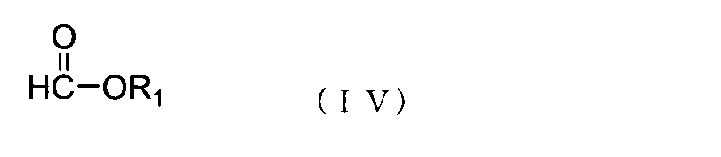
- An embodiment of the present invention is a method for producing a norbornane dicarboxylic acid ester represented by the following formula (I) or the following formula (II), (In the formula, each R 1 independently represents an alkyl group having 1 to 5 carbon atoms, a vinyl group, or a benzyl group.) (In the formula, each R 1 independently represents an alkyl group having 1 to 5 carbon atoms, a vinyl group, or a benzyl group.)
- a ruthenium complex compound having a carbonyl ligand and a halogen ligand can be used as the ruthenium compound.
- a quaternary ammonium salt can be used as a halide salt.
- a tertiary amine compound can be used as the basic compound.
- a phenol compound and / or an organic halogen compound can be further present when norbornadiene is reacted with formate.
- an embodiment of the present invention provides an exo-form norbornane having a step of separating the norbornane dicarboxylic acid ester obtained by the above-described method for producing norbornane dicarboxylic acid ester into an endo-form norbornane dicarboxylic acid ester and an exo-form norbornane dicarboxylic acid ester.
- the present invention relates to a method for producing a dicarboxylic acid ester.
- the disclosure of the present application is related to the subject matter described in Japanese Patent Application No. 2011-090168 filed on Apr. 14, 2011, the disclosure of which is incorporated herein by reference.
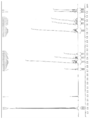
- FIG. 1 is a 13 C-NMR spectrum of methyl exo-norbornanedicarboxylate obtained in Example 4.
- FIG. 2 is a 13 C-NMR spectrum of methyl exo-norbornanedicarboxylate obtained in Example 4.
- FIG. 3 is a 1 H-NMR spectrum of methyl exo-norbornane dicarboxylate obtained in Example 4.
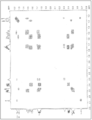
- 4 is a 1 H- 13 C HSQC spectrum of methyl exo-norbornane dicarboxylate obtained in Example 4.
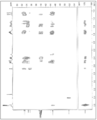
- FIG. FIG. 5 is a 1 H- 1 H COSY spectrum of methyl exo-norbornane dicarboxylate obtained in Example 4.
- FIG. 6 is a 1 H- 13 C HMBC spectrum of methyl exo-norbornane dicarboxylate obtained in Example 4.
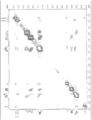
- FIG. 7 is a 1 H- 1 H NOESY spectrum of methyl exo-norbornane dicarboxylate obtained in Example 4.
- FIG. 8 is a 1 H-NMR spectrum of the exo-form norbornanedicarboxylic acid obtained in Reference Example 1.
- the present invention is a method for producing norbornane dicarboxylic acid ester, comprising a step of reacting norbornadiene and formic acid ester in the presence of a ruthenium compound, a cobalt compound, a halide salt and a basic compound.
- An embodiment of the present invention is a method for producing a norbornane dicarboxylic acid ester represented by the following formula (I) or the following formula (II), (In the formula, each R 1 independently represents an alkyl group having 1 to 5 carbon atoms, a vinyl group, or a benzyl group.) (In the formula, each R 1 independently represents an alkyl group having 1 to 5 carbon atoms, a vinyl group, or a benzyl group.)
- Examples of the alkyl group having 1 to 5 carbon atoms in the above formulas (I) and (II) include a methyl group, an ethyl group, a propyl group, a butyl group, and a pentyl group, which may be linear or branched.
- a norbornane dicarboxylic acid ester containing at least one of the above is obtained.
- the formic acid ester that can be used as the raw material is not particularly limited.
- methyl formate, ethyl formate, propyl formate, isopropyl formate, butyl formate, isobutyl formate, amyl formate, isoamyl formate, vinyl formate, benzyl formate and the like can be used.
- methyl formate is preferred.
- the formate may be used alone or in combination.
- a catalyst system using four components of a ruthenium compound, a cobalt compound, a halide salt, and a basic compound is used.
- the intended purpose can be achieved by a combination of a ruthenium compound, a cobalt compound, a halide salt, and a basic compound.
- the esterification reaction of norbornadiene according to the present invention proceeds by reacting the ruthenium compound with a cobalt compound that cleaves the CH bond of the formate ester and added to the unsaturated group of norbornadiene. Such a reaction is considered to be promoted by a halide salt and a basic compound.
- various compounds will be specifically described.
- the ruthenium compound usable in the present invention is not particularly limited as long as it is a compound containing ruthenium.
- An example is a ruthenium complex compound having a structure in which a ligand is bonded to a ruthenium atom.
- a ruthenium complex compound having both a carbonyl ligand and a halogen ligand in the molecule is preferable.
- the halogen include chlorine, bromine, and iodine. Among them, chlorine is preferable.
- ruthenium complex compounds include ruthenium carbonyl halogen complexes such as [Ru (CO) 3 Cl 2 ] 2 and [Ru (CO) 2 Cl 2 ] n (n is an integer of 1 or more), and [Ru Examples thereof include various compounds such as ruthenium carbonyl halogen complex salts having (CO) 3 Cl 3 ] ⁇ , [Ru 3 (CO) 11 Cl] ⁇ and [Ru 4 (CO) 13 Cl] ⁇ as counter anions.
- the salt having a counter anion may have, for example, a metal ion such as an alkali metal or an alkaline earth metal as a counter cation.
- alkali metal and alkaline earth metal include lithium, sodium, potassium, rubidium, cesium, calcium, and strontium.
- ruthenium carbonyl halogen complexes such as [Ru (CO) 3 Cl 2 ] 2 and [Ru (CO) 2 Cl 2 ] n are more preferable from the viewpoint of improving the reaction rate.
- the ruthenium compound can be produced according to a method well known in the art, but can also be obtained as a commercial product.
- [Ru (CO) 2 Cl 2 ] n is M. J. et al. Cleare, W.M. P. Griffith, J. et al. Chem. Soc. (A), 1969, 372. It can be produced according to the method described in 1.
- examples of the ruthenium compound include, in addition to the ruthenium compounds exemplified above, for example, RuCl 3 , Ru 3 (CO) 12 , RuCl 2 (C 8 H 12 ), Ru (CO) 3 (C 8 H 8 ), Ru (CO) 3 (C 8 H 12 ), and Ru (C 8 H 10 ) (C 8 H 12 ).
- These ruthenium compounds can also be used as precursor compounds of the ruthenium compounds exemplified above, and the ruthenium compounds exemplified above are prepared and reacted before or during the esterification reaction in the present invention. It may be introduced into the system.
- the amount of ruthenium compound used is not particularly limited, but is preferably as small as possible in view of production costs. However, from the viewpoint of obtaining a practical rate of the esterification reaction, the amount of ruthenium compound used is, for example, 1 / 10,000 equivalents or more, preferably 1/1000 equivalents or more, more preferably, norbornadiene used as a raw material. 1/100 equivalent or more. From the viewpoint of obtaining a reaction rate according to the amount used, the amount of ruthenium compound used is, for example, 1 equivalent or less, preferably 1/10 equivalent or less, more preferably 1/20 equivalent or less, relative to norbornadiene. . In the present invention, ruthenium compounds may be used alone or in combination.
- the cobalt compound that can be used in the present invention is not particularly limited as long as it is a compound containing cobalt.
- suitable compounds include cobalt complex compounds having a carbonyl ligand such as Co 2 (CO) 8 , HCo (CO) 4 , and Co 4 (CO) 12 , cobalt acetate, cobalt propionate, cobalt benzoate,
- cobalt complex compounds having a carboxylic acid ligand such as cobalt citrate, and cobalt phosphate.
- a cobalt compound is not specifically limited, For example with respect to a ruthenium compound, it is 1/100 equivalent or more, Preferably it is 1/10 equivalent or more, More preferably, it is 1/5 equivalent or more. Moreover, it is 10 equivalent or less with respect to a ruthenium compound, Preferably it is 5 equivalent or less, More preferably, it is 3 equivalent or less. The said range is a preferable range from a viewpoint of the production amount of an ester compound.
- cobalt compounds may be used alone or in combination.
- the halide salt that can be used in the present invention is not particularly limited as long as it is a compound composed of a halogen ion such as a chloride ion, a bromide ion, and an iodide ion and a cation.
- the halide salt in the present invention does not include a salt containing ruthenium and / or cobalt.
- the cation may be either an inorganic ion or an organic ion.
- the halide salt may contain one or more halogen ions in the molecule.
- the inorganic ions constituting the halide salt may be one type of metal ion selected from alkali metals and alkaline earth metals. Specific examples include lithium, sodium, potassium, rubidium, cesium, calcium, and strontium.
- the organic ion may be a monovalent or higher-valent organic group derived from an organic compound.
- examples include ammonium, phosphonium, pyrrolidinium, pyridium, imidazolium and iminium, and the hydrogen atom of these ions may be substituted by a hydrocarbon group such as alkyl and aryl.
- suitable organic ions include tetramethylammonium, tetraethylammonium, tetrapropylammonium, tetrabutylammonium, tetrapentylammonium, tetrahexylammonium, tetraheptylammonium, tetraoctylammonium, and trioctyl.
- Examples include methylammonium, benzyltrimethylammonium, benzyltriethylammonium, benzyltributylammonium, tetramethylphosphonium, tetraethylphosphonium, tetraphenylphosphonium, benzyltriphenylphosphonium, and bis (triphenylphosphine) iminium.
- the halide salt used in the present invention does not need to be a solid salt.
- an ionic liquid containing halide ions that becomes liquid in the vicinity of room temperature or in a temperature range of 100 ° C. or less may be used.
- Specific examples of cations used in such ionic liquids include 1-ethyl-3-methylimidazolium, 1-propyl-3-methylimidazolium, 1-butyl-3-methylimidazolium, 1-pentyl-3.
- halide salts described above preferred halide salts are chloride salts, bromide salts, and iodide salts, and compounds in which the cation is an organic ion.
- a quaternary ammonium salt is preferable from the viewpoint of improving the reaction rate.
- the quaternary ammonium salt includes compounds in which substituents of nitrogen atoms are bonded to each other to form a cyclic structure, and compounds in which substituents are bonded to nitrogen atoms through double bonds.
- halide salts suitable in the present invention include butylmethylpyrrolidinium chloride, bis (triphenylphosphine) iminium iodide, trioctylmethylammonium chloride, tetraethylammonium chloride and the like. Can be mentioned.
- the amount of the halide salt used is not particularly limited, but is, for example, 1 equivalent or more, preferably 1.5 equivalents or more, more preferably 2 equivalents or more, relative to the ruthenium compound. When the amount used is in the above range, the reaction rate can be effectively increased.
- the usage-amount of halide salt is 1000 equivalent or less with respect to a ruthenium compound, Preferably it is 50 equivalent or less, More preferably, it is 10 equivalent or less.
- the said range is a preferable range from a viewpoint of obtaining the improvement effect of reaction acceleration according to the usage-amount.
- halide salts may be used alone or in combination.
- the usable basic compound may be an inorganic compound or an organic compound.
- the basic inorganic compound include carbonates, hydrogen carbonates, hydroxide salts, and alkoxides of various metals such as alkali metals and alkaline earth metals.
- Specific examples of the basic organic compound include a primary amine compound, a secondary amine compound, and a tertiary amine compound. Among the above basic compounds, a tertiary amine compound is preferable from the viewpoint of the reaction promoting effect.
- the tertiary amine compound includes a compound in which substituents of nitrogen atoms are bonded to each other to form a cyclic structure, and a compound in which a substituent is bonded to the nitrogen atom through a double bond.
- tertiary amine compounds include pyridine compounds, imidazole compounds, quinoline compounds and the like.
- Specific examples of the tertiary amine compound suitable in the present invention include trialkylamine, N-alkylpyrrolidine, N-alkylpiperidine, quinuclidine, and triethylenediamine.
- the alkyl group in these compounds is preferably an alkyl group having 1 to 12 carbon atoms, specifically, methyl group, ethyl group, propyl group, butyl group, pentyl group, hexyl group, heptyl group, octyl group, Nonyl group, decyl group, undecyl group, dodecyl group may be mentioned, and these may be linear, branched or cyclic. In the trialkylamine, the three alkyl groups may be the same or different.
- the amount of the basic compound used is not particularly limited, but is, for example, 1 equivalent or more, preferably 2 equivalents or more, more preferably 5 equivalents or more, relative to the ruthenium compound. By setting the amount used in the above range, the reaction promoting effect tends to be more pronounced. Moreover, the usage-amount of a basic compound is 1000 equivalent or less, for example, Preferably it is 200 equivalent or less, More preferably, it is 30 equivalent or less. The said range is a preferable range from a viewpoint of obtaining the improvement effect of reaction acceleration according to the usage-amount. In the present invention, the basic compound may be used alone or in combination.
- phenol compound suitable in the present invention include phenol, cresol, alkylphenol, alkoxyphenol, phenoxyphenol, chlorophenol, trifluoromethylphenol, hydroquinone and catechol.
- the alkyl group in the alkylphenol and alkoxyphenol is preferably an alkyl group having 1 to 12 carbon atoms, specifically, a methyl group, an ethyl group, a propyl group, a butyl group, a pentyl group, a hexyl group, a heptyl group, an octyl group.
- Nonyl group, decyl group, undecyl group, dodecyl group which may be linear, branched, or cyclic.
- the addition amount of the phenol compound is not particularly limited, but is, for example, 1 equivalent or more, preferably 2 equivalents or more, and more preferably 3 equivalents or more with respect to the ruthenium compound. By making the addition amount in the above range, the expression of the promoting effect tends to become more prominent. Moreover, the addition amount of a phenol compound is 1000 equivalent or less, for example, Preferably it is 50 equivalent or less, More preferably, it is 10 equivalent or less. The said range is a preferable range from a viewpoint of obtaining the reaction promotion improvement effect according to the addition amount. In the present invention, the phenol compound may be used alone or in combination.
- Suitable organic halogen compounds in the present invention include alkyl halides such as methyl halide and ethyl halide, alkanes substituted with two or more halogens such as dihalogen methane, dihalogen ethane, trihalogen methane, and tetrahalogen carbon, halogen And halogen-substituted aliphatic hydrocarbons such as halogenated benzene and halogen-substituted aromatic hydrocarbons.
- halogen include chlorine, bromine and iodine.
- the amount of the organic halogen compound added is not particularly limited, but is, for example, 1 equivalent or more, preferably 2 equivalents or more, more preferably 3 equivalents or more, relative to the ruthenium compound. By making the addition amount in the above range, the reaction promoting effect tends to be prominent. Moreover, the addition amount of an organic halogen compound is 1000 equivalent or less, for example, Preferably it is 50 equivalent or less, More preferably, it is 10 equivalent or less. The said range is a preferable range from a viewpoint of obtaining the reaction promotion improvement effect according to the addition amount. In the present invention, the organic halogen compounds may be used alone or in combination.
- halogen-substituted phenol compounds such as chlorophenol and trifluoromethylphenol
- the preferable addition amount of the halogen-substituted phenol compound is the same as the addition amount of the above-described phenol compound or organic halogen compound.
- the reaction between norbornadiene and formic acid ester can proceed without using any solvent.
- a solvent may be used.
- the solvent that can be used in the present invention is not particularly limited as long as it can dissolve the compound used as a raw material.
- a solvent it may be used alone or in combination.
- the ratio of norbornadiene and formate used in the reaction is, based on the amount charged, 2 mol or more of formate and preferably 4 mol or more with respect to 1 mol of norbornadiene. Within the above range, there is a tendency that side reactions can be suppressed and a sufficient yield can be obtained. Further, the ratio of norbornadiene to formic acid ester is, as a charged amount, preferably 100 mol or less, more preferably 50 mol or less with respect to 1 mol of norbornadiene. The range is a preferable range from the viewpoint of productivity.
- reaction temperature In the production method of the present invention, the reaction between norbornadiene and formate is preferably carried out in the temperature range of 80 ° C to 200 ° C.
- the above reaction is more preferably carried out in the temperature range of 100 ° C to 160 ° C.
- the reaction rate is increased and the reaction can proceed efficiently.
- the reaction temperature By controlling the reaction temperature to 200 ° C. or lower, decomposition of the formate used as a raw material can be suppressed. When the formate is decomposed, addition of the ester group to norbornadiene cannot be achieved.
- reaction temperature when the reaction temperature is too high, ring-opening polymerization of norbornadiene as a raw material occurs, and the yield may be reduced.
- reaction temperature exceeds the boiling point of either norbornadiene or formate used as a raw material, it is desirable to carry out the reaction in a pressure resistant vessel. The completion of the reaction can be confirmed using a well-known analytical technique such as gas chromatography or NMR.
- the exo isomer content (exo isomer (mol) / (exo isomer + endo isomer (mol))) is, for example, 60% or more, preferably 65% or more, more preferably 70% or more. It is possible to obtain norbornane dicarboxylic acid esters.
- norbornane dicarboxylic acid ester has a high yield, for example, 50% or more, preferably 55% or more, based on norbornadiene (norbornane dicarboxylic acid ester (mol) / norbornadiene (mol)). Can be obtained in a yield of 60% or more.
- an exo norbornane dicarboxylic acid ester by separating the obtained norbornane dicarboxylic acid ester into an endo norbornane dicarboxylic acid ester and an exo norbornane dicarboxylic acid ester.
- each R 1 independently represents an alkyl group having 1 to 5 carbon atoms, a vinyl group, or a benzyl group.
- each R 1 independently represents an alkyl group having 1 to 5 carbon atoms, a vinyl group, or a benzyl group.
- norbornane dicarboxylic acid can also be obtained from norbornane dicarboxylic acid ester.
- a known hydrolysis method such as treatment with acid or alkali can be used.
- Example 1 In a stainless steel pressure reactor having an internal volume of 50 ml at room temperature, 0.05 mmol of [Ru (CO) 3 Cl 2 ] 2 as ruthenium compound (1/50 equivalent to norbornadiene) and Co 2 ( CO) 8 is 0.05 mmol (1 equivalent to the ruthenium compound), butylmethylpyrrolidinium chloride is 0.25 mmol (5 equivalents to the ruthenium compound) as the halide salt, and triethylamine is 0.5 mmol as the basic compound. (10 equivalents relative to the ruthenium compound) was added and mixed to obtain a catalyst system.
- methyl norbornane dicarboxylate produced by the reaction was 1.23 mmol (49.2% yield based on norbornadiene), and the exo / endo composition ratio (molar ratio) was 75/25.
- the gas chromatograph analysis was performed under the following conditions using GC-353B GC manufactured by GL Sciences.
- Detector Hydrogen flame ion detector Column: TC-1 (60m) manufactured by GL Sciences Inc. Carrier gas: helium (300 kPa) Temperature Inlet: 200 ° C Detector: 200 ° C Column: 40 ° C to 240 ° C (heating rate: 5 ° C / min)
- Example 1 Catalyst system of only ruthenium compound and halide salt The catalyst system of Example 1 was reacted under the same conditions as in Example 1 except that no cobalt compound and basic compound were used. The obtained reaction mixture was analyzed in the same manner as in Example 1. As a result, the amount of methyl norbornane dicarboxylate produced by the reaction was trace.
- Example 2 Catalyst system of only cobalt compound and halide salt
- the catalyst system of Example 1 was reacted under the same conditions as in Example 1 except that a ruthenium compound and a basic compound were not used.
- a ruthenium compound and a basic compound were not used.
- Example 3 Catalyst system of only ruthenium compound and cobalt compound The catalyst system of Example 1 was reacted under the same conditions as in Example 1 except that no halide salt and basic compound were used. When the obtained reaction mixture was analyzed by gas chromatography, methyl norbornane dicarboxylate produced by the reaction was a trace amount.
- Example 4 Catalyst system with only ruthenium compound, cobalt compound and halide salt The catalyst system of Example 1 was reacted under the same conditions as in Example 1 except that no basic compound was used. When the obtained reaction mixture was analyzed by gas chromatography, methyl norbornane dicarboxylate produced by the reaction was a trace amount.
- Example 2 The catalyst system of Example 1 was subjected to exactly the same operation as Example 1 except that the basic compound was changed to 0.5 mmol of tripropylamine.
- the methyl norbornane dicarboxylate produced by the reaction was 0.83 mmol (yield 33.2% based on norbornadiene), and the exo / endo composition ratio was 75/25.
- the exo and endo isomers since there were two gas chromatograph peaks for both the exo and endo isomers, it was presumed to be 2,5-isomer and 2,6-isomer.
- Example 3 The same operation as in Example 1 was carried out except that the basic compound was changed to 0.5 mmol of N-methylpyrrolidine in the catalyst system of Example 1.
- the methyl norbornane dicarboxylate produced by the reaction was 1.33 mmol (yield 53.2% based on norbornadiene), and the exo / endo composition ratio was 75/25.
- the exo and endo isomers since there were two gas chromatograph peaks for both the exo and endo isomers, it was presumed to be 2,5-isomer and 2,6-isomer.
- Example 4 In the catalyst system of Example 1, the same operation as in Example 1 was carried out except that triethylamine as a basic compound was changed to 1.0 mmol (20 equivalents relative to the ruthenium compound). The methyl norbornane dicarboxylate produced by the reaction was 1.63 mmol (yield 65.2% based on norbornadiene), and the exo / endo composition ratio was 75/25. At this time, since there were two gas chromatograph peaks for both the exo and endo isomers, it was presumed to be 2,5-isomer and 2,6-isomer.
- the 13 C-NMR spectrum of the obtained methyl exo-norbornane dicarboxylate is shown in FIG. 1 and FIG.
- the measurement conditions and identification data of the 13 C-NMR spectrum are as follows. Conditions: Solvent DMSO-d6, apparatus “AV400M” manufactured by BRUKER (carbon fundamental frequency: 100.62 MHz).
- FIG. 3 shows the 1 H-NMR spectrum of the resulting methyl exo-norbornane dicarboxylate.
- the measurement conditions and identification data of the 1 H-NMR spectrum are as follows. Conditions: Solvent DMSO-d6, apparatus “AV400M” manufactured by BRUKER (proton fundamental frequency: 400.13 MHz).
- FIG. 4 shows the 1 H- 13 C HSQC spectrum of the resulting methyl exo-form norbornane dicarboxylate. From the 1 H- 13 C HSQC spectrum, carbon and proton having the same peak number correlated with each other, and it was confirmed that the assignment results in FIGS. 1, 2 and 3 were correct.
- FIG. 5 shows the 1 H- 1 H COSY spectrum of the obtained methyl exo-norbornane dicarboxylate. From FIG. 5, proton (1) (4) and proton (7), proton (1) (4) and proton (3) (6), proton (2) (5) and proton (3) (6), proton (11) (14) and proton (17), proton (12) (16) and proton (13) (15), proton (13) (15) and proton (14) were correlated, respectively, It was confirmed that the norbornane ring was composed of 1) to (7) and (11) to (17).
- FIG. 6 shows the 1 H- 13 C HMBC spectrum of the obtained methyl exo-norbornane dicarboxylate.
- the structure of two kinds of compounds was identified by 1 H- 13 C HMBC spectrum.
- FIG. 7 shows the 1 H- 1 H NOESY spectrum of the obtained methyl exo-norbornane dicarboxylate. From the 1 H- 1 H NOESY spectrum, three-dimensional structure identification of methyl norbornane-2,5-dicarboxylate and methyl norbornane-2,6-dicarboxylate was performed.
- Example 5 In the catalyst system of Example 4, the same operation as in Example 4 was carried out except that 0.25 mmol of p-cresol (5 equivalents relative to the ruthenium compound) was added as a phenol compound.
- the methyl norbornanedicarboxylate produced by the reaction was 1.74 mmol (yield 69.6% based on norbornadiene), and the exo / endo composition ratio was 75/25.
- the exo and endo isomers it was presumed to be 2,5-isomer and 2,6-isomer.
- Table 1 shows the results of Examples 1 to 5 and Comparative Examples 1 to 4.
- a norbornane dicarboxylic acid ester having a high exo content can be efficiently obtained by conducting an esterification reaction in the presence of a ruthenium compound, a cobalt compound, a halide salt, and a basic compound.
- the amount of the basic compound used is large, and in addition to the ruthenium compound, cobalt compound, halide salt, and basic compound, the use of a phenol compound further increases the yield of norbornane dicarboxylic acid ester. It is valid.
- Example 6 In the catalyst system of Example 4, the same operation as in Example 4 was carried out except that the halide salt was 0.25 mmol of trioctylmethylammonium chloride and the basic compound was 1.0 mmol of dimethylethylamine.
- the methyl norbornane dicarboxylate produced by the reaction was 1.42 mmol (yield 56.8% based on norbornadiene), and the exo / endo composition ratio was 75/25. At this time, since there were two gas chromatograph peaks for both the exo and endo isomers, it was presumed to be 2,5-isomer and 2,6-isomer.
- Example 7 The same operation as in Example 6 was performed except that the basic compound was changed to 1.0 mmol of triethylamine in the catalyst system of Example 6.
- the methyl norbornane dicarboxylate produced by the reaction was 1.32 mmol (yield 52.8% based on norbornadiene), and the exo / endo composition ratio was 75/25.
- the exo and endo isomers since there were two gas chromatograph peaks for both the exo and endo isomers, it was presumed to be 2,5-isomer and 2,6-isomer.
- Example 8 In the catalyst system of Example 7, the same operation as in Example 7 was performed except that the cobalt compound was changed to 0.05 mmol of cobalt citrate.
- the methyl norbornanedicarboxylate produced by the reaction was 0.35 mmol (14.0% yield based on norbornadiene), and the exo / endo composition ratio was 75/25.
- the exo and endo isomers since there were two gas chromatograph peaks for both the exo and endo isomers, it was presumed to be 2,5-isomer and 2,6-isomer.
- Example 9 The same operation as in Example 7 was carried out except that the basic compound was changed to 1.0 mmol of N, N-dimethylcyclohexylamine in the catalyst system of Example 7.
- the methyl norbornane dicarboxylate produced by the reaction was 1.00 mmol (40.0% yield based on norbornadiene), and the exo / endo composition ratio was 75/25.
- the exo and endo isomers since there were two gas chromatograph peaks for both the exo and endo isomers, it was presumed to be 2,5-isomer and 2,6-isomer.
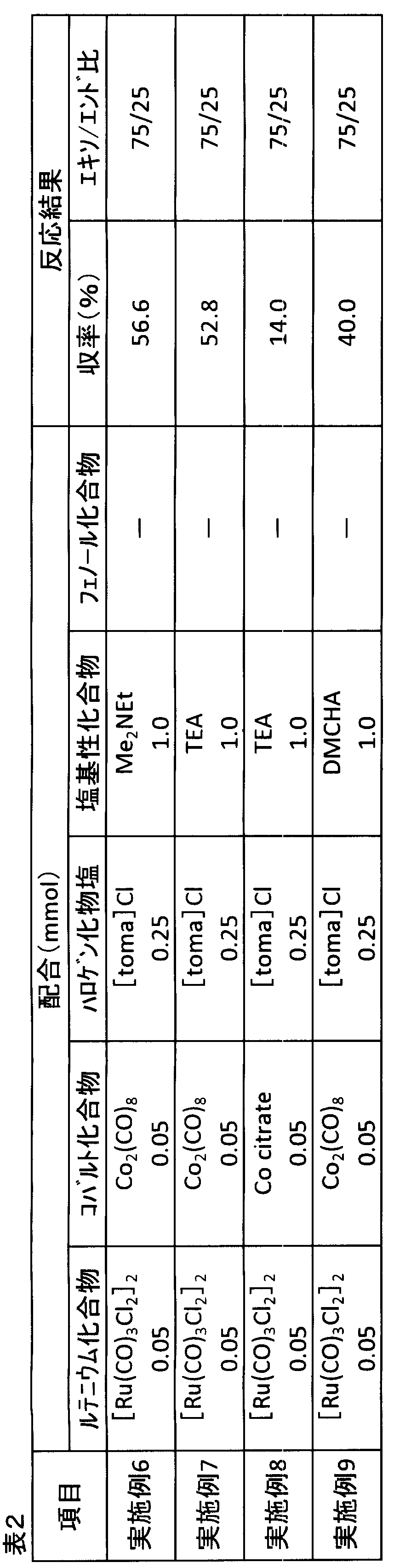
- Example 6 to 9 The results of Examples 6 to 9 are shown in Table 2. Using a compound having a carbonyl ligand as the cobalt compound is effective for obtaining norbornane dicarboxylic acid ester in a high yield. Furthermore, as can be seen from the comparison between Example 4 and Example 7, using an ionic liquid as the halide salt is also effective in achieving a high yield.
- Example 10 In the catalyst system of Example 8, the ruthenium compound was previously added to M.I. J. et al. Cleare, W.M. P. Griffith, J. et al. Chem. Soc. (A), 1969, 372. The procedure was the same as in Example 8, except that 0.05 mmol of [Ru (CO) 2 Cl 2 ] n prepared from ruthenium chloride and formic acid was used. The methyl norbornanedicarboxylate produced by the reaction was 1.13 mmol (45.2% yield based on norbornadiene), and the exo / endo composition ratio was 75/25. At this time, since there were two gas chromatograph peaks for both the exo and endo isomers, it was presumed to be 2,5-isomer and 2,6-isomer.
- Example 11 In the catalyst system of Example 10, the same operation as in Example 10 was performed except that the halide salt was changed to 0.25 mmol of tetraethylammonium chloride.
- the methyl norbornane dicarboxylate produced by the reaction was 1.41 mmol (yield 56.4% based on norbornadiene), and the exo / endo composition ratio was 75/25.
- the exo and endo isomers since there were two gas chromatograph peaks for both the exo and endo isomers, it was presumed to be 2,5-isomer and 2,6-isomer.
- Example 12 In the catalyst system of Example 11, the same operation as in Example 11 was performed except that 0.25 mmol of hydroquinone monomethyl ether was added as a phenol compound.
- the methyl norbornane dicarboxylate produced by the reaction was 1.65 mmol (yield 66.0% based on norbornadiene), and the exo / endo composition ratio was 75/25.
- the exo and endo isomers since there were two gas chromatograph peaks for both the exo and endo isomers, it was presumed to be 2,5-isomer and 2,6-isomer.
- Example 13 In the catalyst system of Example 11, the same operation as in Example 11 was carried out except that the cobalt compound was changed to 0.25 mmol of cobalt acetate.
- the methyl norbornanedicarboxylate produced by the reaction was 1.74 mmol (yield 69.6% based on norbornadiene), and the exo / endo composition ratio was 75/25.
- the exo and endo isomers since there were two gas chromatograph peaks for both the exo and endo isomers, it was presumed to be 2,5-isomer and 2,6-isomer.
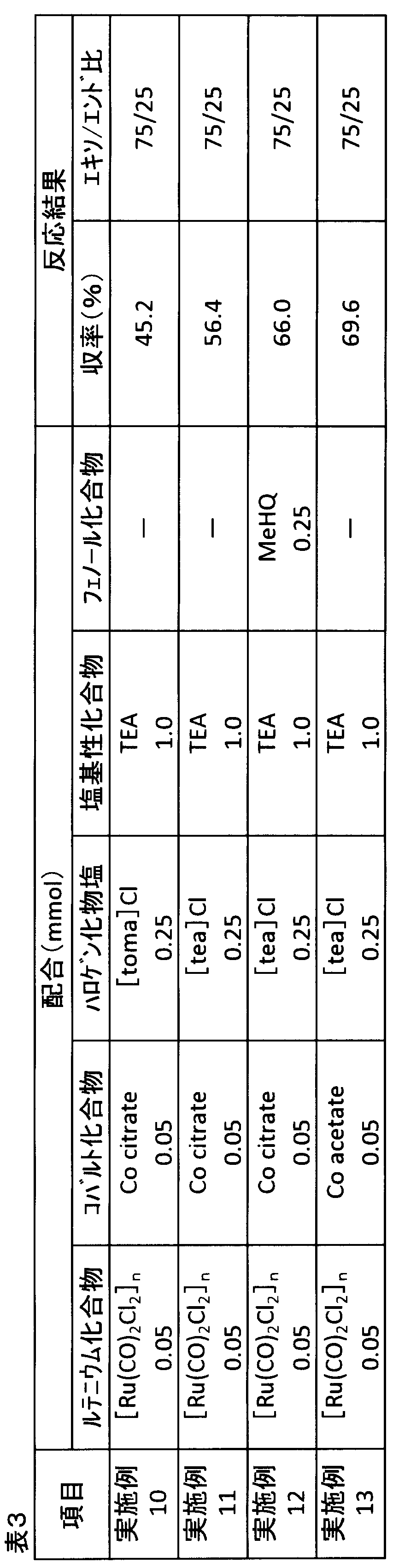
- Example 10 to 13 The results of Examples 10 to 13 are shown in Table 3.
- the use of triethylammonium chloride as the halide salt and the use of cobalt acetate as the cobalt compound are effective for obtaining norbornane dicarboxylic acid ester in a high yield.
- [tea] Cl Tetraethylammonium chloride, Lion Corporation TEA: Triethylamine, Wako Pure Chemical Industries, Ltd. TPA: Tripropylamine, Tokyo Chemical Industry Co., Ltd. N-methylpyrrolidine: Tokyo Chemical Industry Co., Ltd. Me 2 NEt: Dimethylethylamine, Tokyo Chemical Industry Co., Ltd. DMCHA: N, N-dimethylcyclohexylamine, Tokyo Chemical Industry Co., Ltd. P-Cresol: p-cresol, Wako Pure Chemical Industries, Ltd. MeHQ: Hydroquinone monomethyl ether, Kawaguchi Chemical Co., Ltd.
- a norbornane dicarboxylic acid ester having a high exo content can be efficiently produced.
- methyl formate used is shown as an example, the same effect can be obtained when other formate esters are used.
- the embodiment of the present invention it is possible to efficiently produce a desired norbornane dicarboxylic acid ester having a high exo-form content by a one-step reaction with a high yield by using an inexpensive raw material. it can.
- the method according to the embodiment of the present invention can be realized with a small capital investment and can minimize the environmental load, so that it can sufficiently meet the needs of the industry.
- polymers made from norbornane dicarboxylic acid esters having a high exo-form content obtained by embodiments of the present invention are excellent in heat resistance, insulation, light resistance and mechanical properties. It can be used as an optical material typified by components, optical fibers, optical lenses and the like, as well as display-related materials and medical materials.
Landscapes
- Chemical & Material Sciences (AREA)
- Organic Chemistry (AREA)
- Organic Low-Molecular-Weight Compounds And Preparation Thereof (AREA)
- Low-Molecular Organic Synthesis Reactions Using Catalysts (AREA)
Abstract
Description
本発明の実施態様として、下記式(I)又は下記式(II)で表されるノルボルナンジカルボン酸エステルの製造方法であって、
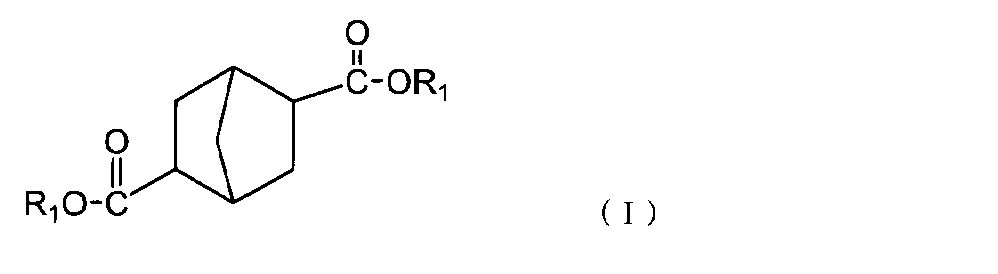

下記式(III)で表されるノルボルナジエンと、


ルテニウム化合物、コバルト化合物、ハロゲン化物塩及び塩基性化合物の存在下で反応させる工程を有する上記ノルボルナンジカルボン酸エステルの製造方法が挙げられる。
また、本発明の実施態様においては、ルテニウム化合物として、カルボニル配位子及びハロゲン配位子を有するルテニウム錯体化合物を用いることができる。また、ハロゲン化物塩として、第四級アンモニウム塩を用いることができる。さらに、塩基性化合物として、第三級アミン化合物を用いることができる。
本発明の実施態様においては、ノルボルナジエンとギ酸エステルとを反応させる際に、さらにフェノール化合物及び/又は有機ハロゲン化合物を存在させることも可能である。
さらに、本発明の実施態様は、上記ノルボルナンジカルボン酸エステルの製造方法により得られたノルボルナンジカルボン酸エステルを、エンド体ノルボルナンジカルボン酸エステルとエキソ体ノルボルナンジカルボン酸エステルとに分離する工程を有するエキソ体ノルボルナンジカルボン酸エステルの製造方法に関する。
本願の開示は、2011年4月14日に出願された特願2011-090168号に記載の主題と関連しており、それらの開示内容は引用によりここに援用される。

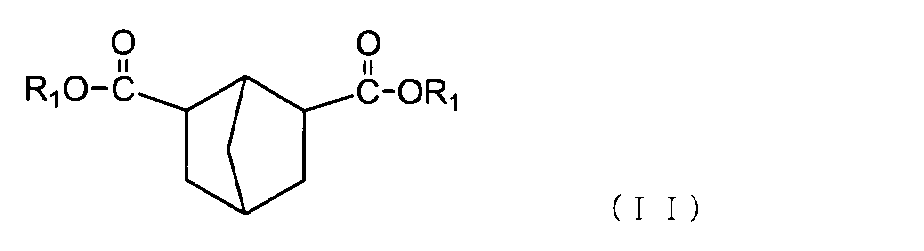
下記式(III)で表されるノルボルナジエンと、


ルテニウム化合物、コバルト化合物、ハロゲン化物塩及び塩基性化合物の存在下で反応させる工程を有するノルボルナンジカルボン酸エステルの製造方法が挙げられる。
原料として使用可能なギ酸エステルは、特に制限されない。例えば、ギ酸メチル、ギ酸エチル、ギ酸プロピル、ギ酸イソプロピル、ギ酸ブチル、ギ酸イソブチル、ギ酸アミル、ギ酸イソアミル、ギ酸ビニル、ギ酸ベンジル等から適宜選択して使用することができる。コスト及び反応性の観点から、ギ酸メチルが好適である。本発明では、ギ酸エステルを単独で用いても、複数組み合わせて用いてもよい。
本発明で使用可能なルテニウム化合物は、ルテニウムを含む化合物であればよく、特に制限はない。例えば、ルテニウム原子に配位子が結合した構造を有するルテニウム錯体化合物が挙げられる。本発明の実施態様では、分子内にカルボニル配位子とハロゲン配位子とを合わせ持つ、ルテニウム錯体化合物が好ましい。ハロゲンとしては、塩素、臭素、ヨウ素が挙げられるが、なかでも塩素が好ましい。そのようなルテニウム錯体化合物の具体例として、[Ru(CO)3Cl2]2及び[Ru(CO)2Cl2]n(nは1以上の整数)等のルテニウムカルボニルハロゲン錯体、並びに[Ru(CO)3Cl3]-、[Ru3(CO)11Cl]-及び[Ru4(CO)13Cl]-等をカウンタアニオンとして有するルテニウムカルボニルハロゲン錯塩などの各種化合物が挙げられる。上記カウンタアニオンを有する塩は、カウンタカチオンとして、例えば、アルカリ金属やアルカリ土類金属等の金属イオンを有するものであってよい。アルカリ金属やアルカリ土類金属の具体例として、リチウム、ナトリウム、カリウム、ルビジウム、セシウム、カルシウム、ストロンチウムが挙げられる。例示した化合物の中でも、反応率向上の観点から、[Ru(CO)3Cl2]2、及び[Ru(CO)2Cl2]n等のルテニウムカルボニルハロゲン錯体がより好ましい。
本発明で使用可能なコバルト化合物は、コバルトを含む化合物であればよく、特に制限はない。好適な化合物の具体例として、Co2(CO)8、HCo(CO)4、Co4(CO)12等のカルボニル配位子を持つコバルト錯体化合物、酢酸コバルト、プロピオン酸コバルト、安息香酸コバルト、クエン酸コバルト等のカルボン酸配位子を持つコバルト錯体化合物、及びリン酸コバルトが挙げられる。
本発明で使用可能なハロゲン化物塩は、塩化物イオン、臭化物イオン及びヨウ化物イオン等のハロゲンイオンと、カチオンとから構成される化合物であればよく、特に限定されない。但し、本発明におけるハロゲン化物塩には、ルテニウム及び/又はコバルトを含む塩は含まれないものとする。上記カチオンは、無機物イオン及び有機物イオンのいずれであってもよい。また、上記ハロゲン化物塩は、分子内に1以上のハロゲンイオンを含んでもよい。
本発明において、使用可能な塩基性化合物は、無機化合物であっても、有機化合物であってもよい。塩基性の無機化合物の具体例として、アルカリ金属及びアルカリ土類金属の各種金属の炭酸塩、炭酸水素塩、水酸化物塩、アルコキシドが挙げられる。塩基性の有機化合物の具体例として、第一級アミン化合物、第二級アミン化合物、第三級アミン化合物が挙げられる。上述の塩基性化合物のなかでも、反応促進効果の観点から、第三級アミン化合物が好適である。第三級アミン化合物には、窒素原子が有する置換基同士が結合し環状構造を形成している化合物や、窒素原子に二重結合を介して置換基が結合している化合物も含まれる。したがって、第三級アミン化合物には、ピリジン化合物、イミダゾール化合物、キノリン化合物等が含まれる。本発明において好適な第三級アミン化合物の具体例として、トリアルキルアミン、N-アルキルピロリジン、N-アルキルピペリジン、キヌクリジン、及びトリエチレンジアミンが挙げられる。これらの化合物におけるアルキル基は、好ましくは炭素数1~12のアルキル基であり、具体的には、メチル基、エチル基、プロピル基、ブチル基、ペンチル基、ヘキシル基、ヘプチル基、オクチル基、ノニル基、デシル基、ウンデシル基、ドデシル基が挙げられ、これらは直鎖状、分岐状、または環状であってよい。トリアルキルアミンにおいて、3つのアルキル基は同一でも異なっていてもよい。
本発明において好適なフェノール化合物の具体例として、フェノール、クレゾール、アルキルフェノール、アルコキシフェノール、フェノキシフェノール、クロルフェノール、トリフルオロメチルフェノール、ヒドロキノン及びカテコールが挙げられる。アルキルフェノール及びアルコキシフェノールにおけるアルキル基は、好ましくは炭素数1~12のアルキル基であり、具体的には、メチル基、エチル基、プロピル基、ブチル基、ペンチル基、ヘキシル基、ヘプチル基、オクチル基、ノニル基、デシル基、ウンデシル基、ドデシル基が挙げられ、これらは直鎖状、分岐状、または環状であってよい。
本発明において好適な有機ハロゲン化合物としては、ハロゲン化メチル、ハロゲン化エチル等のハロゲン化アルキル、ジハロゲンメタン、ジハロゲンエタン、トリハロゲンメタン、テトラハロゲン炭素等の2以上のハロゲンにより置換されたアルカン、ハロゲン化ベンゼン等のハロゲン置換脂肪族炭化水素やハロゲン置換芳香族炭化水素などが挙げられる。ハロゲンの例としては、塩素、臭素、ヨウ素が挙げられる。
本発明の製造方法において、ノルボルナジエンとギ酸エステルとの反応は、特に溶媒を用いることなく進行させることができる。しかし、必要に応じて、溶媒を使用してもよい。本発明において使用可能な溶媒は、原料として使用する化合物を溶解できればよく、特に限定はされない。本発明において好適に使用できる溶媒の具体例として、n-ペンタン、n-ヘキサン、n-ヘプタン、シクロヘキサン、ベンゼン、トルエン、o-キシレン、p-キシレン、m-キシレン、エチルベンゼン、クメン、テトラヒドロフラン、N-メチルピロリドン、ジメチルホルムアミド、ジメチルアセトアミド、ジメチルイミダゾリジノン、エチレングリコールジメチルエーテル、ジエチレングリコールジメチルエーテル、トリエチレングリコールジメチルエーテル、アセトニトリルが挙げられる。溶媒を用いる場合、単独で用いても、複数組み合わせて用いてもよい。
反応に用いるノルボルナジエンとギ酸エステルの割合は、仕込み量で、ノルボルナジエン1molに対し、ギ酸エステルを2mol以上が好ましく、4mol以上がより好ましい。前記範囲であると、副反応を抑え十分な収率を得ることができるという傾向がある。また、ノルボルナジエンとギ酸エステルの割合は、仕込み量で、ノルボルナジエン1molに対し、ギ酸エステルを100mol以下が好ましく、50mol以下がより好ましい。前記範囲は、生産性の観点から好ましい範囲である。
本発明の製造方法において、ノルボルナジエンとギ酸エステルとの反応は、80℃~200℃の温度範囲で実施することが好ましい。上記反応は、100℃~160℃の温度範囲で実施することがより好ましい。80℃以上の温度で反応を実施することによって、反応速度が速まり、効率良く反応を進めることができる。その一方で、反応温度を200℃以下に制御することによって、原料として使用するギ酸エステルの分解を抑制することができる。ギ酸エステルが分解すると、ノルボルナジエンに対するエステル基の付加が達成されなくなる。さらに、反応温度が高すぎると、原料であるノルボルナジエンの開環重合が起こり、収率が低下する可能性がある。反応温度が、原料として使用するノルボルナジエン又はギ酸エステルのいずれかの沸点を超える場合には、耐圧容器内で反応を行うことが望ましい。反応の終結は、ガスクロマトグラフ、NMR等の周知の分析技術を用いて確認することができる。


室温下、内容積50mlのステンレス製加圧反応装置内に、ルテニウム化合物として[Ru(CO)3Cl2]2を0.05mmol(ノルボルナジエンに対して1/50当量)、コバルト化合物としてCo2(CO)8を0.05mmol(ルテニウム化合物に対して1当量)、ハロゲン化物塩としてブチルメチルピロリジニウムクロリドを0.25mmol(ルテニウム化合物に対して5当量)、塩基性化合物としてトリエチルアミンを0.5mmol(ルテニウム化合物に対して10当量)加え、混合して触媒系を得た。この触媒系に、ノルボルナジエン(東京化成工業株式会社)を2.5mmol、ギ酸メチル(三菱ガス化学株式会社)を5.0mL(ノルボルナジエン1molに対して32.9mol)加え、次いで窒素ガス0.5MPaで反応装置内をパージし、120℃で15時間保持した。その後、反応装置を室温まで冷却し、放圧し、残存有機相の一部を抜き取り、ガスクロマトグラフを用いて下記条件で、反応混合物の成分を分析した。分析結果によれば、反応によって生成したノルボルナンジカルボン酸メチルは1.23mmol(ノルボルナジエン基準で収率49.2%)であり、エキソ/エンド組成比(モル比)は75/25であった。また、この際、エキソ体、エンド体ともガスクロマトグラフのピークが2本ずつ存在したので、2,5-体と2,6-体であると推察した。なお、ガスクロマトグラフ分析は、ジーエルサイエンス(株)製GC-353B型GCを使用して下記条件で行った。
カ ラ ム :ジーエルサイエンス(株)製 TC-1(60m)
キャリアガス:ヘリウム(300kPa)
温 度
注入口:200℃
検出器:200℃
カラム:40℃~240℃(昇温速度:5℃/min)
実施例1の触媒系についてコバルト化合物及び塩基性化合物を使用しないことを除き、全て実施例1と同じ条件下で反応を行った。得られた反応混合物を実施例1と同様にして分析したところ、反応によって生成したノルボルナンジカルボン酸メチルは痕跡量だった。
実施例1の触媒系についてルテニウム化合物及び塩基性化合物を使用しないことを除き、全て実施例1と同じ条件下で反応を行った。得られた反応混合物の成分をガスクロマトグラフで分析したところ、反応によって生成したノルボルナンジカルボン酸メチルは痕跡量であった。
実施例1の触媒系についてハロゲン化物塩及び塩基性化合物を使用しないことを除き、全て実施例1と同じ条件下で反応を行った。得られた反応混合物をガスクロマトグラフで分析したところ、反応によって生成したノルボルナンジカルボン酸メチルは痕跡量であった。
実施例1の触媒系について塩基性化合物を使用しないことを除き、全て実施例1と同じ条件下で反応を行った。得られた反応混合物をガスクロマトグラフで分析したところ、反応によって生成したノルボルナンジカルボン酸メチルは痕跡量であった。
実施例1の触媒系について、塩基性化合物をトリプロピルアミン 0.5mmolにした以外は、実施例1と全く同様の操作を実施した。反応によって生成したノルボルナンジカルボン酸メチルは0.83mmol(ノルボルナジエン基準で収率33.2%)であり、エキソ/エンド組成比は75/25であった。また、この際、エキソ体、エンド体ともガスクロマトグラフのピークが2本ずつ存在したので、2,5-体と2,6-体であると推察した。
実施例1の触媒系において、塩基性化合物をN-メチルピロリジン 0.5mmolにした以外は実施例1と全く同様の操作を実施した。反応によって生成したノルボルナンジカルボン酸メチルは1.33mmol(ノルボルナジエン基準で収率53.2%)であり、エキソ/エンド組成比は75/25であった。また、この際、エキソ体、エンド体ともガスクロマトグラフのピークが2本ずつ存在したので、2,5-体と2,6-体であると推察した。
実施例1の触媒系において、塩基性化合物であるトリエチルアミンを1.0mmol(ルテニウム化合物に対して20当量)にした以外は実施例1と全く同様の操作を実施した。反応によって生成したノルボルナンジカルボン酸メチルは1.63mmol(ノルボルナジエン基準で収率65.2%)であり、エキソ/エンド組成比は75/25であった。また、この際、エキソ体、エンド体ともガスクロマトグラフのピークが2本ずつ存在したので、2,5-体と2,6-体であると推察した。
条件:溶媒DMSO-d6、BRUKER社製の装置「AV400M」(カーボン基本周波数:100.62MHz)。

カーボン(2):44.59ppmのピーク(メチン)
カーボン(3):33.03ppmのピーク(メチレン)
カーボン(4):39.89ppmのピーク(メチン)
カーボン(5):44.59ppmのピーク(メチン)
カーボン(6):33.02ppmのピーク(メチレン)
カーボン(7):34.35ppmのピーク(メチレン)
カーボン(8):51.44ppmのピーク(メチルエステル)
カーボン(9):175.22ppmのピーク(カルボニル)
カーボン(11):35.15ppmのピーク(メチン)
カーボン(12):44.77ppmのピーク(メチン)
カーボン(13):32.68ppmのピーク(メチレン)
カーボン(14):43.86ppmのピーク(メチン)
カーボン(15):32.68ppmのピーク(メチレン)
カーボン(16):44.77ppmのピーク(メチン)
カーボン(17):34.47ppmのピーク(メチレン)
カーボン(18):51.51ppmのピーク(メチルエステル)
カーボン(19):174.85ppmのピーク(カルボニル)
条件:溶媒DMSO-d6、BRUKER社製の装置「AV400M」(プロトン基本周波数:400.13MHz)。
プロトン(2):2.4ppm付近のピーク(メチン)
プロトン(3):1.5ppm~1.8ppm付近のピーク(メチレン)
プロトン(4):2.47ppm付近のピーク(メチン)
プロトン(5):2.4ppm付近のピーク(メチン)
プロトン(6):1.5ppm~1.8ppm付近のピーク(メチレン)
プロトン(7):1.3ppm付近のピーク(メチレン)
プロトン(8):3.6ppm付近のピーク(メチル)
プロトン(11):2.3ppm付近のピーク(メチン)
プロトン(12):2.5ppm付近のピーク(メチン)
プロトン(13):1.5ppm~1.8ppm付近のピーク(メチレン)
プロトン(14):2.7ppm付近のピーク(メチン)
プロトン(15):1.5ppm~1.8ppm付近のピーク(メチレン)
プロトン(16):2.5ppm付近のピーク(メチン)
プロトン(17):1.2ppm付近のピーク(メチレン)
プロトン(18):3.6ppm付近のピーク(メチル)
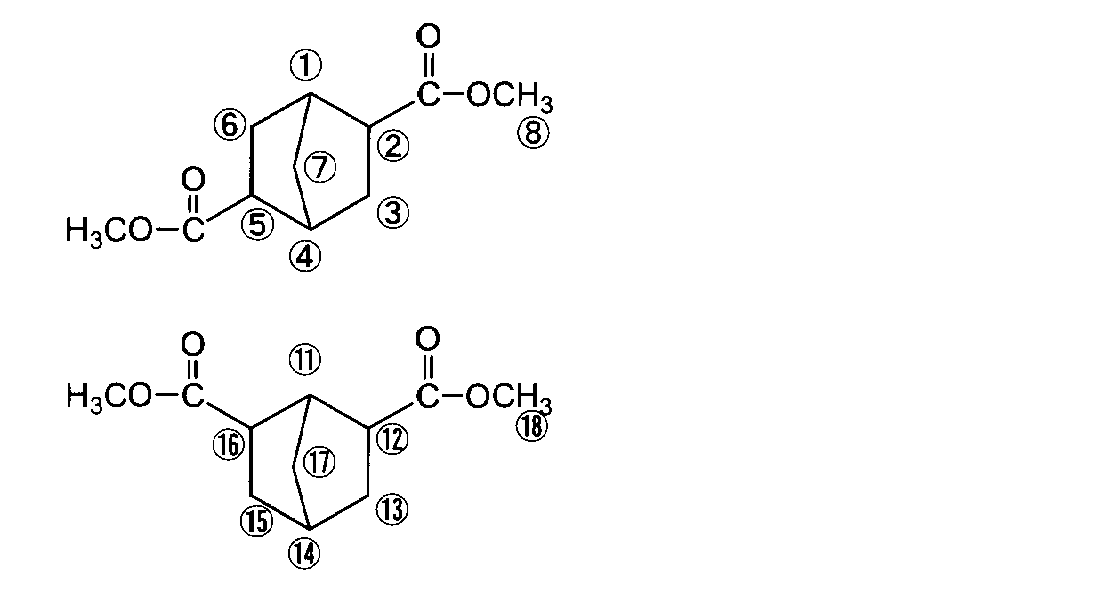
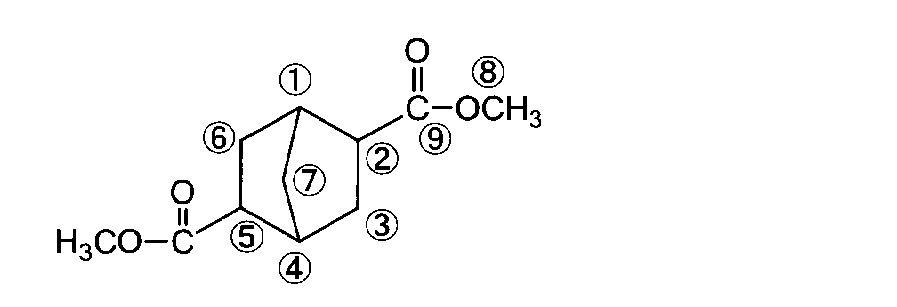
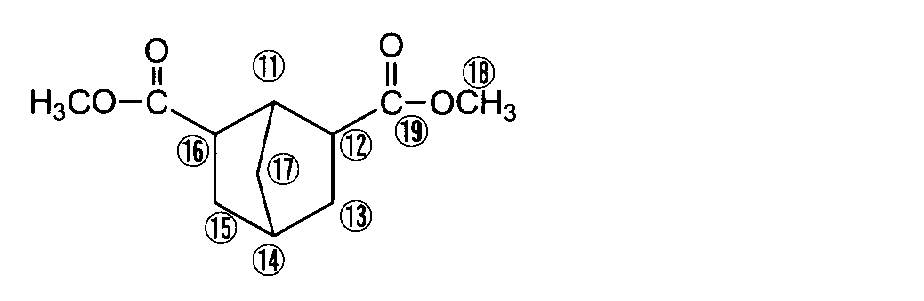
図7から、プロトン(1)(4)とプロトン(7)との相関はあるが、プロトン(2)(5)との相関が認められないことから、プロトン(2)(5)はエンド位に結合していることが分かる。よって、この化合物が、ノルボルナン-2(エキソ)-5(エキソ)-ジカルボン酸メチルであることを確認した。
図7から、プロトン(11)(14)はプロトン(17)との相関はあるが、プロトン(12)(16)との相関が認められないことから、プロトン(12)(16)はエンド位に結合していることが分かる。よって、この化合物が、ノルボルナン-2(エキソ)-6(エキソ)-ジカルボン酸メチルであることを確認した。
実施例4の触媒系において、フェノール化合物としてp-クレゾールを0.25mmol(ルテニウム化合物に対して5当量)追加した以外は実施例4と全く同様の操作を実施した。反応によって生成したノルボルナンジカルボン酸メチルは1.74mmol(ノルボルナジエン基準で収率69.6%)であり、エキソ/エンド組成比は75/25であった。また、この際、エキソ体、エンド体ともガスクロマトグラフのピークが2本ずつ存在したので、2,5-体と2,6-体であると推察した。

実施例4の触媒系において、ハロゲン化物塩をトリオクチルメチルアンモニウムクロリド 0.25mmol、塩基性化合物をジメチルエチルアミン 1.0mmolにした以外は実施例4と全く同様の操作を実施した。反応によって生成したノルボルナンジカルボン酸メチルは1.42mmol(ノルボルナジエン基準で収率56.8%)であり、エキソ/エンド組成比は75/25であった。また、この際、エキソ体、エンド体ともガスクロマトグラフのピークが2本ずつ存在したので、2,5-体と2,6-体であると推察した。
実施例6の触媒系において、塩基性化合物をトリエチルアミン 1.0mmolにした以外は実施例6と全く同様の操作を実施した。反応によって生成したノルボルナンジカルボン酸メチルは1.32mmol(ノルボルナジエン基準で収率52.8%)であり、エキソ/エンド組成比は75/25であった。また、この際、エキソ体、エンド体ともガスクロマトグラフのピークが2本ずつ存在したので、2,5-体と2,6-体であると推察した。
実施例7の触媒系において、コバルト化合物をクエン酸コバルト 0.05mmolにした以外は実施例7と全く同様の操作を実施した。反応によって生成したノルボルナンジカルボン酸メチルは0.35mmol(ノルボルナジエン基準で収率14.0%)であり、エキソ/エンド組成比は75/25であった。また、この際、エキソ体、エンド体ともガスクロマトグラフのピークが2本ずつ存在したので、2,5-体と2,6-体であると推察した。
実施例7の触媒系において、塩基性化合物をN,N-ジメチルシクロヘキシルアミン 1.0mmolにした以外は実施例7と全く同様の操作を実施した。反応によって生成したノルボルナンジカルボン酸メチルは1.00mmol(ノルボルナジエン基準で収率40.0%)であり、エキソ/エンド組成比は75/25であった。また、この際、エキソ体、エンド体ともガスクロマトグラフのピークが2本ずつ存在したので、2,5-体と2,6-体であると推察した。
実施例8の触媒系において、ルテニウム化合物をあらかじめM.J.Cleare,W.P.Griffith,J.Chem.Soc.(A),1969,372.に従って塩化ルテニウムとギ酸から調製した[Ru(CO)2Cl2]n 0.05mmolにした以外は実施例8と全く同様の操作を実施した。反応によって生成したノルボルナンジカルボン酸メチルは1.13mmol(ノルボルナジエン基準で収率45.2%)であり、エキソ/エンド組成比は75/25であった。また、この際、エキソ体、エンド体ともガスクロマトグラフのピークが2本ずつ存在したので、2,5-体と2,6-体であると推察した。
実施例10の触媒系において、ハロゲン化物塩をテトラエチルアンモニウムクロリド 0.25mmolにした以外は実施例10と全く同様の操作を実施した。反応によって生成したノルボルナンジカルボン酸メチルは1.41mmol(ノルボルナジエン基準で収率56.4%)であり、エキソ/エンド組成比は75/25であった。また、この際、エキソ体、エンド体ともガスクロマトグラフのピークが2本ずつ存在したので、2,5-体と2,6-体であると推察した。
実施例11の触媒系において、フェノール化合物としてヒドロキノンモノメチルエーテルを0.25mmol追加した以外は実施例11と全く同様の操作を実施した。反応によって生成したノルボルナンジカルボン酸メチルは1.65mmol(ノルボルナジエン基準で収率66.0%)であり、エキソ/エンド組成比は75/25であった。また、この際、エキソ体、エンド体ともガスクロマトグラフのピークが2本ずつ存在したので、2,5-体と2,6-体であると推察した。
実施例11の触媒系において、コバルト化合物を酢酸コバルト 0.25mmolにした以外は実施例11と全く同様の操作を実施した。反応によって生成したノルボルナンジカルボン酸メチルは1.74mmol(ノルボルナジエン基準で収率69.6%)であり、エキソ/エンド組成比は75/25であった。また、この際、エキソ体、エンド体ともガスクロマトグラフのピークが2本ずつ存在したので、2,5-体と2,6-体であると推察した。
[Ru(CO)3Cl2]2:STREM CHEMICALS社
Co2(CO)8:東京化成工業株式会社
Co citrate:クエン酸コバルト2水和物、Alfa Aesar社
Co acetate:酢酸コバルト4水和物、東京化成工業株式会社
[bmpy]Cl:ブチルメチルピロリジニウムクロリド、東京化成工業株式会社
[toma]Cl:トリオクチルメチルアンモニウムクロリド、東京化成工業株式会社
[tea]Cl:テトラエチルアンモニウムクロリド、ライオン株式会社
TEA:トリエチルアミン、和光純薬工業株式会社
TPA:トリプロピルアミン、東京化成工業株式会社
N-methylpyrrolidine:N-メチルピロリジン、東京化成工業株式会社
Me2NEt:ジメチルエチルアミン、東京化成工業株式会社
DMCHA:N,N-ジメチルシクロヘキシルアミン、東京化成工業株式会社
P-Cresol:p-クレゾール、和光純薬工業株式会社
MeHQ:ヒドロキノンモノメチルエーテル、川口化学工業株式会社
冷却管を取り付けた1リットルナス型フラスコに、実施例4と同様の方法で得られたエキソ体ノルボルナンジカルボン酸メチル 30g及びメタノール 200gを投入して均一溶液とした後、10%水酸化ナトリウム溶液 200gを加え、100℃のオイルバスに入れ、6時間加熱還流した。その後、反応液量が140gになるまでメタノールを留去し、これに36%塩酸 48mlを加え、pHを1としたところ、白色粉末が沈殿した。この白色粉末をろ過、水洗、乾燥し、エキソ体ノルボルナンジカルボン酸 25gを得た。得られたノルボルナンジカルボン酸を、1H-NMRで分析した結果(図8)、ノルボルナン環のメチレン及びメチン基のピークが1.1~3.0ppm付近に、カルボン酸に起因する水酸基のピークが12.4ppm付近に確認でき、その積分強度比が10.00/1.98(理論値:10/2)であった。
また、本発明の実施態様によって得られるエキソ体含有率の高いノルボルナンジカルボン酸エステルを原料としてなるポリマーは、耐熱性、絶縁性、耐光性や機械的特性に優れるため、半導体・液晶に用いられる電子部品、光ファイバー、光学レンズ等に代表される光学材料、さらには、ディスプレイ関連材料、医療用材料として使用することができる。
Claims (8)
- ノルボルナジエンとギ酸エステルとを、ルテニウム化合物、コバルト化合物、ハロゲン化物塩及び塩基性化合物の存在下で反応させる工程を有するノルボルナンジカルボン酸エステルの製造方法。
- 下記式(I)又は式(II)で表されるノルボルナンジカルボン酸エステルの製造方法であって、


下記式(III)で表されるノルボルナジエンと、

ルテニウム化合物、コバルト化合物、ハロゲン化物塩及び塩基性化合物の存在下で反応させる工程を有する請求項1記載のノルボルナンジカルボン酸エステルの製造方法。 - ルテニウム化合物が、カルボニル配位子及びハロゲン配位子を有するルテニウム錯体化合物である請求項1又は2に記載されたノルボルナンジカルボン酸エステルの製造方法。
- ハロゲン化物塩が、第四級アンモニウム塩である請求項1~3のいずれかに記載のノルボルナンジカルボン酸エステルの製造方法。
- 塩基性化合物が、第三級アミン化合物である請求項1~4のいずれかに記載のノルボルナンジカルボン酸エステルの製造方法。
- フェノール化合物の存在下で反応を行う請求項1~5のいずれかに記載のノルボルナンジカルボン酸エステルの製造方法。
- 有機ハロゲン化合物の存在下で反応を行う請求項1~6のいずれかに記載のノルボルナンジカルボン酸エステルの製造方法。
- 請求項1~7のいずれかに記載のノルボルナンジカルボン酸エステルの製造方法により得られたノルボルナンジカルボン酸エステルを、エンド体ノルボルナンジカルボン酸エステルとエキソ体ノルボルナンジカルボン酸エステルとに分離する工程を有するエキソ体ノルボルナンジカルボン酸エステルの製造方法。
Priority Applications (4)
| Application Number | Priority Date | Filing Date | Title |
|---|---|---|---|
| CN2012800181858A CN103459365A (zh) | 2011-04-14 | 2012-04-13 | 降冰片烷二羧酸酯的制造方法 |
| JP2013509993A JPWO2012141313A1 (ja) | 2011-04-14 | 2012-04-13 | ノルボルナンジカルボン酸エステルの製造方法 |
| US14/110,552 US20140031579A1 (en) | 2011-04-14 | 2012-04-13 | Method of producing norbornanedicarboxylic acid ester |
| KR1020137028090A KR20140023943A (ko) | 2011-04-14 | 2012-04-13 | 노르보르난 디카르복실산 에스테르의 제조 방법 |
Applications Claiming Priority (2)
| Application Number | Priority Date | Filing Date | Title |
|---|---|---|---|
| JP2011090168 | 2011-04-14 | ||
| JP2011-090168 | 2011-04-14 |
Publications (1)
| Publication Number | Publication Date |
|---|---|
| WO2012141313A1 true WO2012141313A1 (ja) | 2012-10-18 |
Family
ID=47009471
Family Applications (1)
| Application Number | Title | Priority Date | Filing Date |
|---|---|---|---|
| PCT/JP2012/060182 Ceased WO2012141313A1 (ja) | 2011-04-14 | 2012-04-13 | ノルボルナンジカルボン酸エステルの製造方法 |
Country Status (6)
| Country | Link |
|---|---|
| US (1) | US20140031579A1 (ja) |
| JP (1) | JPWO2012141313A1 (ja) |
| KR (1) | KR20140023943A (ja) |
| CN (1) | CN103459365A (ja) |
| TW (1) | TW201240964A (ja) |
| WO (1) | WO2012141313A1 (ja) |
Families Citing this family (1)
| Publication number | Priority date | Publication date | Assignee | Title |
|---|---|---|---|---|
| KR102418539B1 (ko) | 2016-12-07 | 2022-07-07 | 코오롱인더스트리 주식회사 | 노르보르난 디카르복실산의 제조방법 |
Citations (2)
| Publication number | Priority date | Publication date | Assignee | Title |
|---|---|---|---|---|
| JP2003128766A (ja) * | 2001-10-29 | 2003-05-08 | Nippon Zeon Co Ltd | 開環重合体および開環重合体水素化物の製造方法 |
| WO2011013430A1 (ja) * | 2009-07-31 | 2011-02-03 | 日立化成工業株式会社 | エステル化合物の製造方法 |
Family Cites Families (2)
| Publication number | Priority date | Publication date | Assignee | Title |
|---|---|---|---|---|
| JP2007261980A (ja) * | 2006-03-28 | 2007-10-11 | Arakawa Chem Ind Co Ltd | エキソ体ノルボルネンモノカルボン酸エステルの製造方法 |
| JP5536784B2 (ja) * | 2009-09-03 | 2014-07-02 | 日立化成株式会社 | トリシクロデカンモノメタノールモノカルボン酸及びその誘導体 |
-
2012
- 2012-04-13 WO PCT/JP2012/060182 patent/WO2012141313A1/ja not_active Ceased
- 2012-04-13 CN CN2012800181858A patent/CN103459365A/zh active Pending
- 2012-04-13 KR KR1020137028090A patent/KR20140023943A/ko not_active Withdrawn
- 2012-04-13 US US14/110,552 patent/US20140031579A1/en not_active Abandoned
- 2012-04-13 JP JP2013509993A patent/JPWO2012141313A1/ja active Pending
- 2012-04-16 TW TW101113503A patent/TW201240964A/zh unknown
Patent Citations (2)
| Publication number | Priority date | Publication date | Assignee | Title |
|---|---|---|---|---|
| JP2003128766A (ja) * | 2001-10-29 | 2003-05-08 | Nippon Zeon Co Ltd | 開環重合体および開環重合体水素化物の製造方法 |
| WO2011013430A1 (ja) * | 2009-07-31 | 2011-02-03 | 日立化成工業株式会社 | エステル化合物の製造方法 |
Non-Patent Citations (3)
| Title |
|---|
| "Dai 106 Kai Shokubai Toronkai Toronkai A Yokoshu", 15 September 2010 (2010-09-15), pages 269 * |
| BIRD, C. W. ET AL.: "The stereochemistry of hydrocarboxylation of olefins: reaction of bicycloheptene and other strained olefins with acidic nickel carbonyl", JOURNAL OF THE CHEMICAL SOCIETY, 1963, pages 410 - 21 * |
| WILSON, JOHN C. ET AL.: "Polyesters containing the norbornane structure", JOURNAL OF POLYMER SCIENCE, POLYMER CHEMISTRY EDITION, vol. 10, no. 11, 1972, pages 3191 - 204 * |
Also Published As
| Publication number | Publication date |
|---|---|
| US20140031579A1 (en) | 2014-01-30 |
| KR20140023943A (ko) | 2014-02-27 |
| CN103459365A (zh) | 2013-12-18 |
| TW201240964A (en) | 2012-10-16 |
| JPWO2012141313A1 (ja) | 2014-07-28 |
Similar Documents
| Publication | Publication Date | Title |
|---|---|---|
| JPWO2012035874A1 (ja) | ノルボルナン骨格を有するポリエステル及びその製造方法 | |
| JP5604431B2 (ja) | エステル化合物の製造方法 | |
| JP5586030B2 (ja) | トリシクロデカンモノメタノールモノカルボン酸誘導体の製造方法 | |
| JP5536784B2 (ja) | トリシクロデカンモノメタノールモノカルボン酸及びその誘導体 | |
| WO2012141313A1 (ja) | ノルボルナンジカルボン酸エステルの製造方法 | |
| JPWO2012035875A1 (ja) | 脂環式ポリエステル及びその製造方法 | |
| JP5790386B2 (ja) | ノルボルナン骨格含有ポリアミドの製造方法 | |
| JP5811753B2 (ja) | ノルボルナン骨格含有ポリアミドの製造方法 | |
| JPWO2011121848A1 (ja) | ノルボルナン骨格を有するポリアミドイミド及びその製造方法 | |
| JP5590117B2 (ja) | ノルボルナン骨格を有するポリアミドの製造方法及びそれにより得られるノルボルナン骨格を有するポリアミド | |
| JP6528191B2 (ja) | エステル化合物の製造方法 | |
| JP6460521B2 (ja) | 再活性化触媒系の製造方法、及び再活性化触媒系を用いたエステル化合物の製造方法 | |
| JP2013079350A (ja) | エキソ体比率の高いノルボルナン骨格含有ポリアミド | |
| JP2015101568A (ja) | エステル化合物の製造方法 |
Legal Events
| Date | Code | Title | Description |
|---|---|---|---|
| 121 | Ep: the epo has been informed by wipo that ep was designated in this application |
Ref document number: 12771503 Country of ref document: EP Kind code of ref document: A1 |
|
| ENP | Entry into the national phase |
Ref document number: 2013509993 Country of ref document: JP Kind code of ref document: A |
|
| WWE | Wipo information: entry into national phase |
Ref document number: 14110552 Country of ref document: US |
|
| NENP | Non-entry into the national phase |
Ref country code: DE |
|
| ENP | Entry into the national phase |
Ref document number: 20137028090 Country of ref document: KR Kind code of ref document: A |
|
| 122 | Ep: pct application non-entry in european phase |
Ref document number: 12771503 Country of ref document: EP Kind code of ref document: A1 |