WO2012133348A1 - 液体封入式防振ゴム装置 - Google Patents
液体封入式防振ゴム装置 Download PDFInfo
- Publication number
- WO2012133348A1 WO2012133348A1 PCT/JP2012/057807 JP2012057807W WO2012133348A1 WO 2012133348 A1 WO2012133348 A1 WO 2012133348A1 JP 2012057807 W JP2012057807 W JP 2012057807W WO 2012133348 A1 WO2012133348 A1 WO 2012133348A1
- Authority
- WO
- WIPO (PCT)
- Prior art keywords
- liquid
- rubber
- vibration
- benzotriazole
- filled
- Prior art date
- Legal status (The legal status is an assumption and is not a legal conclusion. Google has not performed a legal analysis and makes no representation as to the accuracy of the status listed.)
- Ceased
Links
Images

Classifications
-
- F—MECHANICAL ENGINEERING; LIGHTING; HEATING; WEAPONS; BLASTING
- F16—ENGINEERING ELEMENTS AND UNITS; GENERAL MEASURES FOR PRODUCING AND MAINTAINING EFFECTIVE FUNCTIONING OF MACHINES OR INSTALLATIONS; THERMAL INSULATION IN GENERAL
- F16F—SPRINGS; SHOCK-ABSORBERS; MEANS FOR DAMPING VIBRATION
- F16F13/00—Units comprising springs of the non-fluid type as well as vibration-dampers, shock-absorbers, or fluid springs
- F16F13/04—Units comprising springs of the non-fluid type as well as vibration-dampers, shock-absorbers, or fluid springs comprising both a plastics spring and a damper, e.g. a friction damper
- F16F13/06—Units comprising springs of the non-fluid type as well as vibration-dampers, shock-absorbers, or fluid springs comprising both a plastics spring and a damper, e.g. a friction damper the damper being a fluid damper, e.g. the plastics spring not forming a part of the wall of the fluid chamber of the damper
- F16F13/08—Units comprising springs of the non-fluid type as well as vibration-dampers, shock-absorbers, or fluid springs comprising both a plastics spring and a damper, e.g. a friction damper the damper being a fluid damper, e.g. the plastics spring not forming a part of the wall of the fluid chamber of the damper the plastics spring forming at least a part of the wall of the fluid chamber of the damper
- F16F13/10—Units comprising springs of the non-fluid type as well as vibration-dampers, shock-absorbers, or fluid springs comprising both a plastics spring and a damper, e.g. a friction damper the damper being a fluid damper, e.g. the plastics spring not forming a part of the wall of the fluid chamber of the damper the plastics spring forming at least a part of the wall of the fluid chamber of the damper the wall being at least in part formed by a flexible membrane or the like
-
- F—MECHANICAL ENGINEERING; LIGHTING; HEATING; WEAPONS; BLASTING
- F16—ENGINEERING ELEMENTS AND UNITS; GENERAL MEASURES FOR PRODUCING AND MAINTAINING EFFECTIVE FUNCTIONING OF MACHINES OR INSTALLATIONS; THERMAL INSULATION IN GENERAL
- F16F—SPRINGS; SHOCK-ABSORBERS; MEANS FOR DAMPING VIBRATION
- F16F13/00—Units comprising springs of the non-fluid type as well as vibration-dampers, shock-absorbers, or fluid springs
- F16F13/04—Units comprising springs of the non-fluid type as well as vibration-dampers, shock-absorbers, or fluid springs comprising both a plastics spring and a damper, e.g. a friction damper
- F16F13/06—Units comprising springs of the non-fluid type as well as vibration-dampers, shock-absorbers, or fluid springs comprising both a plastics spring and a damper, e.g. a friction damper the damper being a fluid damper, e.g. the plastics spring not forming a part of the wall of the fluid chamber of the damper
- F16F13/08—Units comprising springs of the non-fluid type as well as vibration-dampers, shock-absorbers, or fluid springs comprising both a plastics spring and a damper, e.g. a friction damper the damper being a fluid damper, e.g. the plastics spring not forming a part of the wall of the fluid chamber of the damper the plastics spring forming at least a part of the wall of the fluid chamber of the damper
-
- F—MECHANICAL ENGINEERING; LIGHTING; HEATING; WEAPONS; BLASTING
- F16—ENGINEERING ELEMENTS AND UNITS; GENERAL MEASURES FOR PRODUCING AND MAINTAINING EFFECTIVE FUNCTIONING OF MACHINES OR INSTALLATIONS; THERMAL INSULATION IN GENERAL
- F16F—SPRINGS; SHOCK-ABSORBERS; MEANS FOR DAMPING VIBRATION
- F16F2224/00—Materials; Material properties
- F16F2224/02—Materials; Material properties solids
- F16F2224/025—Elastomers
-
- F—MECHANICAL ENGINEERING; LIGHTING; HEATING; WEAPONS; BLASTING
- F16—ENGINEERING ELEMENTS AND UNITS; GENERAL MEASURES FOR PRODUCING AND MAINTAINING EFFECTIVE FUNCTIONING OF MACHINES OR INSTALLATIONS; THERMAL INSULATION IN GENERAL
- F16F—SPRINGS; SHOCK-ABSORBERS; MEANS FOR DAMPING VIBRATION
- F16F2224/00—Materials; Material properties
- F16F2224/04—Fluids
Definitions
- the present invention relates to a liquid-filled vibration-proof rubber device that can be widely used for engine mounts, suspension bushes for automobiles, vibration-proof members for industrial machines, and the like.
- Anti-vibration rubber members such as engine mounts and suspension bushings used as connecting members for various components such as automobile engines and frames, due to the spring characteristics and vibration damping characteristics of rubber bodies (vulcanized rubber molded bodies) It exhibits anti-vibration performance.
- various types of anti-vibration rubber devices have been proposed in which anti-vibration performance is further improved by enclosing a liquid in these anti-vibration rubber members (see, for example, Patent Documents 1 to 3). ).
- Anti-vibration rubber device of liquid enclosure type has a chamber wall that deforms in response to vibration, the chamber wall is made of a rubber body, and an enclosed liquid such as ethylene glycol is enclosed in a sealed space composed of the chamber wall. It has been made.
- the rubber body generally contains an antiaging agent, a vulcanization accelerator, and the like as a technique for improving rubber characteristics (particularly heat resistance and sag resistance).
- components such as anti-aging agents in the rubber body constituting the chamber wall for liquid filling are sealed due to environmental temperature, aging, durable use, etc. It may elute in the liquid. And when elution of such an antiaging agent etc. arises, there exists a possibility that a rubber body may deteriorate and durability may deteriorate.
- the present invention has been made in view of such circumstances, and is a liquid-filled vibration proof that can eliminate deterioration of the rubber body and deterioration of durability due to elution of components in the rubber body into the sealed liquid.
- the purpose is to provide a rubber device.
- a liquid-filled vibration isolating rubber device of the present invention includes a sealed space composed of a chamber wall that deforms in response to vibration input, and liquid is sealed in the sealed space.
- the chamber wall is made of a diene rubber
- the liquid is made of a glycol solution containing a benzotriazole compound having an amine group.
- the present inventors have conducted intensive research to solve the above problems.
- the present inventors have investigated the interface between the rubber body and the sealing liquid so that components such as anti-aging agents in the rubber body do not elute into the sealing liquid in the liquid-sealing type vibration-proof rubber device.
- I recalled the formation of a protective film.
- the present inventors since the operation of forming a protective film on the surface of the rubber body (the inner peripheral surface of the rubber chamber wall constituting the sealed space for enclosing the encapsulated liquid) is expensive, the present inventors have found that A special additive was added, and it was investigated whether or not the protective film could be formed without a work process by the action of the additive and the rubber body surface, and further research was conducted.
- the film-like material is made of a benzotriazole compound. That is, the benzotriazole compound dissolved in the encapsulating liquid collects on the surface of the rubber body made of diene rubber, and the amine group of the benzotriazole compound reacts with the diene double bond of the diene rubber. It is considered that the film made of the benzotriazole-based compound is formed with high adhesion to the rubber body surface. Then, due to the molecular structure of the benzotriazole compound and the like, a dense film is formed on the rubber body surface. Therefore, it is considered that this film exhibited the function as the protective film. Thus, it is considered that the effect of suppressing the elution of components such as the anti-aging agent in the rubber body into the encapsulated liquid was obtained.
- the liquid-filled vibration-proof rubber device of the present invention is a vibration-proof rubber device comprising a sealed space composed of a chamber wall made of a rubber body, wherein a liquid (filled liquid) is sealed in the sealed space,
- the chamber wall is made of a diene rubber, and the liquid is a glycol solution containing a benzotriazole compound having an amine group. Therefore, it is possible to eliminate the deterioration of the rubber body and the reduction of the vibration proofing performance due to the elution of the components in the rubber body, which are seen in the conventional liquid-filled type vibration proof rubber device.
- the benzotriazole-based rubber is naturally formed over time without special work steps such as a protective film forming work at the interface between the rubber body and the filled liquid. Since a film composed of a compound and a diene rubber component is formed, which can solve the above problem, the manufacturing cost is also excellent.
- the weight average molecular weight (Mw) of the benzotriazole-based compound having an amine group is 300 or less, a denser benzotriazole-based compound film is formed, so that the components in the rubber body are contained in the encapsulating liquid. Elution can be further suppressed, and a further excellent performance can be exhibited as a liquid-filled vibration-proof rubber device.
- FIG. 1 is a cross-sectional view showing a liquid-filled vibration-proof mount that is an embodiment of a liquid-filled vibration-proof rubber device of the present invention.
- the liquid-filled vibration isolating rubber device of the present invention includes a sealed space composed of a chamber wall that deforms in response to vibration input, and a liquid (filled liquid) is sealed in the sealed space.
- the chamber wall is made of a diene rubber, and the liquid is a glycol solution containing a benzotriazole compound having an amine group.
- FIG. 1 shows an embodiment of a liquid-filled vibration isolating rubber device according to the present invention.
- a liquid-filled vibration-proof mount is shown.
- reference numeral 1 denotes a thick cylindrical vibration-proof rubber body, in which a main liquid chamber A is formed.
- a thick metal connecting member (metal fitting) 2 is inserted into the upper opening of the anti-vibration rubber body 1 so as to close it, and the upper end of the anti-vibration rubber body 1 and the connection member 2
- the outer peripheral surface is joined with an adhesive or the like.
- a bolt 2a projects from the upper surface of the connecting member 2, and is connected to the engine which is a vibrating body.
- the outer periphery of the vibration-proof rubber body 1 is also bonded to a cylindrical metal side plate 5 that forms a part of a metal connecting member by an adhesive or the like.
- a thin rubber film 3 is disposed below the anti-vibration rubber body 1, and an upper portion thereof is a sub liquid chamber B.
- the sub liquid chamber B and the main liquid chamber A are partitioned by a partition plate 4. ing.
- the outer peripheries of the partition plate 4, the rubber film 3, and the metal support plate 6 therebelow are clamped in a lower end portion of the side plate 5 bent in a U-shape, and are caulked to be fixed.
- the side plate 5 and the support plate 6 connected to the side plate constitute a metal connecting member, and are connected to the vehicle body as a base by a bolt 6a protruding from the lower end of the support plate 6.
- a sealing liquid is sealed inside the main liquid chamber A and the sub liquid chamber B.
- a liquid flow path 7 is formed in the outer peripheral portion of the partition plate 4, and the liquid flow path 7 is connected to the main liquid chamber A and the sub liquid chamber by communication holes 4 a and 4 b provided in the partition plate 4.
- rubber members such as the vibration-proof rubber body 1 and the rubber film 3 correspond to the “chamber wall that deforms in response to vibration input”. Therefore, in the present invention, the rubber member needs to be made of a diene rubber.
- diene rubber examples include natural rubber (NR), isoprene rubber (IR), butadiene rubber (BR), styrene-butadiene rubber (SBR), acrylonitrile-butadiene rubber (NBR), and ethylene-propylene-diene rubber. (EPDM). These may be used alone or in combination of two or more. Among these, natural rubber is preferably used in terms of strength and low dynamic magnification.
- the rubber member material such as the anti-vibration rubber body 1 may include a reinforcing agent such as carbon black, a vulcanizing agent, a vulcanization accelerator, an anti-aging agent, a process, if necessary. Oil or the like may be blended appropriately.
- vulcanizing agent examples include sulfur (powder sulfur, precipitated sulfur, insoluble sulfur) and the like. These may be used alone or in combination of two or more.
- the amount of the vulcanizing agent is preferably in the range of 0.3 to 7 parts, particularly preferably in the range of 1 to 5 parts with respect to 100 parts by weight (hereinafter abbreviated as “parts”) of the diene rubber. is there. That is, when the blending amount of the vulcanizing agent is too small, a sufficient cross-linking structure cannot be obtained, and dynamic magnification and tendency to sag resistance are deteriorated. Conversely, when the blending amount of the vulcanizing agent is too large. This is because the heat resistance tends to decrease.
- vulcanization accelerator examples include vulcanization accelerators such as thiuram, thiazole, sulfenamide, aldehyde ammonia, aldehyde amine, guanidine, and thiourea. These may be used alone or in combination of two or more.
- the blending amount of the vulcanization accelerator is preferably in the range of 0.1 to 7 parts, particularly preferably 0. 0 to 100 parts of the diene rubber from the viewpoint of durability, heat resistance and sag resistance. It is in the range of 3-5 parts.
- thiuram vulcanization accelerator examples include tetramethylthiuram disulfide (TMTD), tetraethylthiuram disulfide (TETD), tetrabutylthiuram disulfide (TBTD), tetrakis (2-ethylhexyl) thiuram disulfide (TOT), tetra Examples thereof include benzyl thiuram disulfide (TBzTD).
- thiazole vulcanization accelerator examples include dibenzothiazyl disulfide (MBTS), 2-mercaptobenzothiazole (MBT), 2-mercaptobenzothiazole sodium salt (NaMBT), and 2-mercaptobenzothiazole zinc salt ( ZnMBT) and the like.
- MBTS dibenzothiazyl disulfide
- MBT 2-mercaptobenzothiazole
- NaMBT 2-mercaptobenzothiazole sodium salt
- ZnMBT 2-mercaptobenzothiazole zinc salt
- sulfenamide vulcanization accelerator examples include N-oxydiethylene-2-benzothiazolylsulfenamide (NOBS), N-cyclohexyl-2-benzothiazolylsulfenamide (CBS), N -T-butyl-2-benzothiazoylsulfenamide (BBS), N, N'-dicyclohexyl-2-benzothiazoylsulfenamide and the like.
- anti-aging agent examples include carbamate-based anti-aging agents, phenylenediamine-based anti-aging agents, phenol-based anti-aging agents, diphenylamine-based anti-aging agents, quinoline-based anti-aging agents, imidazole-based anti-aging agents, and waxes. can give. These may be used alone or in combination of two or more.
- the blending amount of the anti-aging agent is preferably in the range of 1 to 10 parts, particularly preferably in the range of 2 to 5 parts with respect to 100 parts of the diene rubber.
- process oil examples include naphthenic oil, paraffinic oil, and aroma oil. These may be used alone or in combination of two or more.
- the blending amount of the process oil is preferably in the range of 1 to 50 parts, particularly preferably in the range of 3 to 30 parts with respect to 100 parts of the diene rubber.
- the rubber composition prepared by kneading the various materials as described above is vulcanized at a high temperature (150 to 170 ° C.) for 5 to 30 minutes to produce a rubber member such as the vibration-proof rubber body 1. can do.
- a liquid-filled vibration-proof rubber device as shown in FIG. 1 is produced.
- a glycol-based solution containing a benzotriazole-based compound having an amine group as the sealed liquid. Is used.
- the weight average molecular weight (Mw) of the benzotriazole-based compound having an amine group is preferably 300 or less, and more preferably the weight average molecular weight (Mw) is in the range of 119 to 200. That is, when the weight average molecular weight of the benzotriazole-based compound is within the above range, a film made of the compound is more densely formed, and the elution of components in the rubber body into the encapsulated liquid is suppressed. This is because the operational effect is further improved.
- this compound As the benzotriazole-based compound having an amine group, a compound represented by the following general formula (1) is preferably used. That is, this compound has a high effect of suppressing the elution of the components in the rubber body into the encapsulating liquid by densely concentrating from the chemical structure shown below.
- 1H-benzotriazole, 4-methyl-1H-benzotriazole, and 5-methyl-1H-benzotriazole can form a denser film.
- the rubber body is more preferable because it is more excellent in suppressing the elution of the components in the rubber body into the encapsulating liquid.
- glycol solvents such as ethylene glycol and diethylene glycol are used, and water or the like is added as necessary.
- the amount of the benzotriazole compound having an amine group added to the solvent is preferably 5 to 500 mmol / L, and more preferably 10 to 100 mmol / L. That is, by blending the benzotriazole compound having the amine group within the above range, it is possible to effectively suppress the components in the rubber body from eluting into the encapsulating liquid.
- other members other than the rubber member and the sealing liquid constituting the liquid-filled vibration-proof mount shown in FIG. 1 are usually iron, copper, aluminum, magnesium, lead, tin, or alloys thereof, stainless steel, etc.
- a member formed of metal is used.
- an adhesive is used for joining the metal member and the rubber member as necessary.
- the liquid-filled vibration-proof mount shown in FIG. 1 is exemplified as an example of the liquid-filled vibration-proof rubber device of the present invention, and can be applied to an engine mount for automobiles.
- an engine mount for automobiles for example, application to a suspension bush, a body mount, a subframe mount, a differential mount, and the like is also possible.
- liquid-filled anti-vibration rubber devices for automobiles for example, liquid-filled anti-vibration rubbers used in transportation equipment for industrial transport vehicles such as airplanes, forklifts, excavators, and cranes, and railway vehicles. It is also applicable to the device.
- Examples 1 and 2 and Comparative Examples 1 to 8 A liquid-filled vibration-proof mount having the shape shown in FIG. 1 was produced.
- a vulcanized rubber molded body corresponding to the illustrated anti-vibration rubber body 1 is 100 parts of natural rubber (NR), 5 parts of zinc oxide, 1 part of stearic acid, 50 parts of FEF carbon, and naphthenic oil 20 1 part of an antioxidant, 1 part of an antioxidant, 2 parts of a vulcanization accelerator (N-cyclohexyl-2-benzothiazolesulfenamide), 1 part of a vulcanization accelerator (tetrathiuram disulfide) and 1 part of sulfur
- NR natural rubber
- a vulcanization accelerator N-cyclohexyl-2-benzothiazolesulfenamide
- tetrathiuram disulfide tetrathiuram disulfide
- additive added in the sealing liquid, the functional group of the additive, and the weight average molecular weight (Mw) are shown together in Tables 1 and 2 below.
- Comparative Examples 1 to 7 as in the example, an additive was added to the sealing liquid, but the effect as in the example could not be obtained. That is, in Comparative Examples 1 to 3, a benzotriazole-based compound was added as in the Examples, but this compound has no reactive group for natural rubber, resulting in large ⁇ TS and ⁇ EB in the evaluation of liquid resistance. It was. As a result, the liquid-filled vibration-proof mounts of Comparative Examples 1 to 3 did not give good results in durability characteristics. In Comparative Example 4, the compound having an amine group was added as in the example. However, the molecular structure and molecular weight, the poor solubility in the encapsulating liquid, and the like were affected, and the effect as in the example could not be obtained. Conceivable. The additives used in Comparative Examples 5 to 7 do not have a reactive group for natural rubber as in Comparative Examples 1 to 3, and therefore, it is considered that the effects as in Examples were not obtained.
- the polymer of the vulcanized rubber molding was natural rubber, but the same results as in the examples were obtained in the case of other diene rubbers.
- the liquid-filled anti-vibration rubber device of the present invention is preferably used as an engine mount, suspension bush, body mount, subframe mount, differential mount, etc. used in automobile vehicles, etc.
- Fluid-filled cylindrical vibration isolator used in applications, computer hard disk damping dampers, damping dampers for general household electrical appliances such as washing machines, building damping walls for buildings and housing, damping (damping) It can also be applied to applications such as dampers and other vibration control devices.
Landscapes
- Engineering & Computer Science (AREA)
- General Engineering & Computer Science (AREA)
- Mechanical Engineering (AREA)
- Combined Devices Of Dampers And Springs (AREA)
- Compositions Of Macromolecular Compounds (AREA)
Abstract
振動入力に応じて変形する室壁(防振ゴム体1およびゴム膜3)から構成される密閉空間(主液室Aおよび副液室B)を備え、上記密閉空間内に液体が封入されてなる液体封入式防振ゴム装置であって、上記室壁が、ジエン系ゴムからなり、上記液体が、アミン基を持つベンゾトリアゾール系化合物を含有するグリコール系溶液からなる。このため、上記室壁(ゴム体)中の成分が封入液中に溶出することによる、ゴム体の劣化および耐久性の悪化を解消することができる。
Description
本発明は、自動車用のエンジンマウント,サスペンションブッシュ、産業機械用の防振部材等に広く利用できる、液体封入タイプの防振ゴム装置に関するものである。
自動車のエンジン,フレーム等の各種構成品同士の連結部材として用いられる、エンジンマウント,サスペンションブッシュ等の防振ゴム部材は、ゴム体(加硫ゴム成形体)によるばね特性や振動減衰特性等により、防振性能を発現するものである。近年、これら防振ゴム部材において、液体を封入することにより、防振性能の一層の向上を図った、液体封入タイプの防振ゴム装置が各種提案されている(例えば、特許文献1~3参照)。
液体封入タイプの防振ゴム装置は、振動に応じて変形する室壁を備え、その室壁がゴム体からなり、上記室壁から構成される密閉空間内に、エチレングリコール等の封入液が封入されてなるものである。また、上記ゴム体には、一般的に、ゴム特性(特に耐熱性や耐へたり性)を向上させる手法として、老化防止剤,加硫促進剤等が含有される。
しかしながら、上記のような液体封入タイプの防振ゴム装置では、環境温度,経時,耐久使用等に起因し、液体封入用の室壁を構成するゴム体中の老化防止剤等の成分が、封入液中に溶出する場合がある。そして、このような老化防止剤等の溶出が生じると、ゴム体が劣化し、耐久性が悪化するおそれがある。
本発明は、このような事情に鑑みなされたもので、ゴム体中の成分が封入液中に溶出することによる、ゴム体の劣化および耐久性の悪化を解消することができる液体封入式防振ゴム装置の提供をその目的とする。
上記の目的を達成するために、本発明の液体封入式防振ゴム装置は、振動入力に応じて変形する室壁から構成される密閉空間を備え、上記密閉空間内に液体が封入されてなる液体封入式防振ゴム装置であって、上記室壁が、ジエン系ゴムからなり、上記液体が、アミン基を持つベンゾトリアゾール系化合物を含有するグリコール系溶液からなるという構成をとる。
すなわち、本発明者らは、前記課題を解決するため鋭意研究を重ねた。その研究の過程で、本発明者らは、液体封入タイプの防振ゴム装置において、そのゴム体中の老化防止剤等の成分が封入液中に溶出しないよう、ゴム体と封入液との界面に保護膜を形成することを想起した。しかしながら、ゴム体表面(封入液を封入する密閉空間を構成するゴム室壁の内周面)への保護膜の形成作業は、製造コストがかかるため、本発明者らは、封入液中に何らかの特殊な添加物を入れ、この添加物とゴム体表面との作用により、上記保護膜を、作業工程を経ずに形成することができないか検討し、更に研究を重ねた。その結果、上記特殊な添加物として、アミン基を持つベンゾトリアゾール系化合物を用い、これをグリコール系溶媒中に配合して封入液とし、かつ、上記ゴム体のポリマーとしてジエン系ゴムを用いると、上記封入液中の成分とジエン系ゴムの成分との作用によって、経時により、上記ゴム体表面に膜状物が形成されるようになり、ゴム体の劣化および耐久性の悪化を解消することができるようになることを突き止めた。
より詳しく述べると、上記膜状物は、ベンゾトリアゾール系化合物からなるものである。すなわち、封入液中に溶解したベンゾトリアゾール系化合物が、ジエン系ゴムからなるゴム体表面に集まり、上記ベンゾトリアゾール系化合物のアミン基と、ジエン系ゴムのジエンの二重結合とが反応することにより、上記ベンゾトリアゾール系化合物からなる膜が、ゴム体表面に対し高密着に形成されるようになると考えられる。そして、上記ベンゾトリアゾール系化合物の分子構造等に起因し、ゴム体表面に対して緻密な膜が形成されるようになることから、この膜が、前記保護膜としての機能を発揮したものと考えられ、これにより、ゴム体中の老化防止剤等の成分が封入液中に溶出するのを抑える作用効果が得られたと考えられる。
本発明の液体封入式防振ゴム装置は、ゴム体からなる室壁から構成される密閉空間を備え、上記密閉空間内に液体(封入液)が封入されてなる防振ゴム装置であって、上記室壁が、ジエン系ゴムからなり、上記液体が、アミン基を持つベンゾトリアゾール系化合物を含有するグリコール系溶液からなる。そのため、従来の液体封入タイプの防振ゴム装置にみられた、ゴム体中の成分が封入液中に溶出することによるゴム体の劣化および防振性能の低下を、解消することができる。また、本発明の液体封入式防振ゴム装置では、ゴム体と封入液との界面における保護膜の形成作業等といった特段の作業工程を伴わずに、経時により自然に、上記界面にベンゾトリアゾール系化合物とジエン系ゴムの成分とからなる膜が形成され、これにより上記問題を解消することができるため、製造コストの面でも優れている。
特に、上記アミン基を持つベンゾトリアゾール系化合物の重量平均分子量(Mw)が300以下であると、より緻密なベンゾトリアゾール系化合物膜が形成され、それにより、ゴム体中の成分が封入液中に溶出するのをより一層抑えることができ、液体封入式防振ゴム装置として、より一層優れた性能を発揮することができる。
つぎに、本発明の実施の形態について説明する。
本発明の液体封入式防振ゴム装置は、先に述べたように、振動入力に応じて変形する室壁から構成される密閉空間を備え、上記密閉空間内に液体(封入液)が封入されてなる防振ゴム装置であって、上記室壁が、ジエン系ゴムからなり、上記液体が、アミン基を持つベンゾトリアゾール系化合物を含有するグリコール系溶液からなる。
図1は、本発明の液体封入式防振ゴム装置の一実施の形態を示すものであり、この形態では、液封入防振マウントを示している。図において、1は厚肉筒状の防振ゴム体であり、その内部に主液室Aを形成している。上記防振ゴム体1の上部開口にはこれを閉鎖するように厚肉の金属製連結部材(金具)2が挿通配設され、上記防振ゴム体1の上端部と、上記連結部材2の外周面とが、接着剤等により接合されている。上記連結部材2の上面にはボルト2aが突設してあり、これにより振動体であるエンジンに連結される。また、上記防振ゴム体1の外周は、金属製連結部材の一部をなす筒状の金属側板5に対しても、接着剤等により接合されている。上記防振ゴム体1の下方には、薄肉のゴム膜3が配され、その上部を副液室Bとしており、上記副液室Bと上記主液室Aとは、仕切板4により区画されている。上記仕切板4,ゴム膜3およびその下方の金属製支持板6の外周は、上記側板5のコ字状に屈曲する下端部内に挟持され、これをかしめて、固定される。上記側板5と、これに連結する上記支持板6により、金属製連結部材が構成され、上記支持板6の下端に突設したボルト6aにより基体である車両本体に連結される。上記主液室Aおよび副液室Bの内部には、封入液が封入してある。さらに、上記仕切板4の外周部には液流路7が形成され、この液流路7は、上記仕切板4に設けられた連通孔4a,4bにより、上記主液室Aおよび副液室Bとそれぞれ連通している。そして、振動入力に伴い、上記防振ゴム体1が変形すると、封入液は上記液流路7を介して両液室A、Bを流通し、振動減衰を行う。
図1では、防振ゴム体1やゴム膜3といったゴム部材が、前記「振動入力に応じて変形する室壁」に相当する。そのため、本発明では、上記ゴム部材が、ジエン系ゴムからなるものであることが必要である。
上記ジエン系ゴムとしては、例えば、天然ゴム(NR)、イソプレンゴム(IR)、ブタジエンゴム(BR)、スチレン-ブタジエンゴム(SBR)、アクリロニトリル-ブタジエンゴム(NBR)、エチレン-プロピレン-ジエン系ゴム(EPDM)等があげられる。これらは単独でもしくは二種以上併せて用いられる。これらのなかでも、強度や低動倍率化の点で、天然ゴムが好適に用いられる。
また、上記防振ゴム体1等のゴム部材の材料には、上記ジエン系ゴム以外にも、必要に応じ、カーボンブラック等の補強剤、加硫剤、加硫促進剤、老化防止剤、プロセスオイル等を適宜に配合しても差し支えない。
上記加硫剤としては、例えば、硫黄(粉末硫黄,沈降硫黄,不溶性硫黄)等があげられる。これらは単独でもしくは二種以上併せて用いられる。
上記加硫剤の配合量は、上記ジエン系ゴム100重量部(以下、「部」と略す)に対して、0.3~7部の範囲が好ましく、特に好ましくは1~5部の範囲である。すなわち、上記加硫剤の配合量が少なすぎると、充分な架橋構造が得られず、動倍率、耐へたり性が悪化する傾向がみられ、逆に加硫剤の配合量が多すぎると、耐熱性が低下する傾向がみられるからである。
上記加硫促進剤としては、例えば、チウラム系,チアゾール系,スルフェンアミド系,アルデヒドアンモニア系,アルデヒドアミン系,グアニジン系,チオウレア系等の加硫促進剤があげられる。これらは単独でもしくは二種以上併せて用いられる。
上記加硫促進剤の配合量は、耐久性、耐熱性、耐へたり性の観点から、上記ジエン系ゴム100部に対して、0.1~7部の範囲が好ましく、特に好ましくは0.3~5部の範囲である。
なお、上記チウラム系加硫促進剤としては、例えば、テトラメチルチウラムジスルフィド(TMTD)、テトラエチルチウラムジスルフィド(TETD)、テトラブチルチウラムジスルフィド(TBTD)、テトラキス(2-エチルヘキシル)チウラムジスルフィド(TOT)、テトラベンジルチウラムジスルフィド(TBzTD)等があげられる。
また、上記チアゾール系加硫促進剤としては、例えば、ジベンゾチアジルジスルフィド(MBTS)、2-メルカプトベンゾチアゾール(MBT)、2-メルカプトベンゾチアゾールナトリウム塩(NaMBT)、2-メルカプトベンゾチアゾール亜鉛塩(ZnMBT)等があげられる。
また、上記スルフェンアミド系加硫促進剤としては、例えば、N-オキシジエチレン-2-ベンゾチアゾリルスルフェンアミド(NOBS)、N-シクロヘキシル-2-ベンゾチアゾリルスルフェンアミド(CBS)、N-t-ブチル-2-ベンゾチアゾイルスルフェンアミド(BBS)、N,N′-ジシクロヘキシル-2-ベンゾチアゾイルスルフェンアミド等があげられる。
上記老化防止剤としては、例えば、カルバメート系老化防止剤、フェニレンジアミン系老化防止剤、フェノール系老化防止剤、ジフェニルアミン系老化防止剤、キノリン系老化防止剤、イミダゾール系老化防止剤、ワックス類等があげられる。これらは単独でもしくは二種以上併せて用いられる。
また、上記老化防止剤の配合量は、上記ジエン系ゴム100部に対して、1~10部の範囲が好ましく、特に好ましくは2~5部の範囲である。
上記プロセスオイルとしては、例えば、ナフテン系オイル、パラフィン系オイル、アロマ系オイル等があげられる。これらは単独でもしくは二種以上併せて用いられる。
また、上記プロセスオイルの配合量は、上記ジエン系ゴム100部に対して、1~50部の範囲が好ましく、特に好ましくは3~30部の範囲である。
そして、上記のような各種材料を混練することにより調製したゴム組成物を、高温(150~170℃)で5~30分間、加硫することにより、防振ゴム体1等のゴム部材を作製することができる。この部材を用いて、図1に示すような液体封入式防振ゴム装置を作製する。また、図1における主液室Aおよび副液室B内部には、封入液を封入する必要があり、本発明では、上記封入液として、アミン基を持つベンゾトリアゾール系化合物を含有するグリコール系溶液が用いられる。
上記アミン基を持つベンゾトリアゾール系化合物の重量平均分子量(Mw)は、300以下であることが好ましく、より好ましくは、重量平均分子量(Mw)が119~200の範囲である。すなわち、上記ベンゾトリアゾール系化合物の重量平均分子量が上記範囲内であると、上記化合物からなる膜がより緻密に形成されるようになり、ゴム体中の成分が封入液中に溶出するのを抑える作用効果に、より一層優れるようになるからである。
上記アミン基を持つベンゾトリアゾール系化合物としては、好ましくは、下記の一般式(1)で示される化合物が用いられる。すなわち、この化合物は、下記に示す化学構造から、緻密に集結することにより、ゴム体中の成分が封入液中に溶出するのを抑える効果が高いからである。

そして、上記一般式(1)で示される化合物のなかでも、1H-ベンゾトリアゾール、4-メチル-1H-ベンゾトリアゾール、5-メチル-1H-ベンゾトリアゾールは、より緻密な膜を形成することができ、ゴム体中の成分が封入液中に溶出するのを抑える効果に、より一層優れることから、より好ましい。
上記封入液の溶媒としては、エチレングリコール,ジエチレングリコール等のグリコール系溶媒が使用され、必要に応じ、水等が加えられる。
そして、上記アミン基を持つベンゾトリアゾール系化合物の、上記溶媒に対する添加量は、5~500mmol/Lとすることが好ましく、より好ましくは、添加剤量10~100mmol/Lである。すなわち、上記範囲内で、上記アミン基を持つベンゾトリアゾール系化合物を配合することにより、ゴム体中の成分が封入液中に溶出するのを効果的に抑えることができるからである。
ところで、図1に示す液封入防振マウントを構成する、ゴム部材および封入液以外の他の部材には、通常、鉄、銅、アルミニウム、マグネシウム、鉛、錫、あるいはこれらの合金、ステンレス等の金属によって形成された部材が用いられる。なお、これら金属部材とゴム部材との接合には、必要に応じ、接着剤が用いられる。
図1に示す液封入防振マウントは、本発明の液体封入式防振ゴム装置の一例として例示したものであり、自動車用のエンジンマウント等に適用することができるが、本発明は、エンジンマウント以外に、例えば、サスペンションブッシュ、ボデーマウント、サブフレームマウント、デフマウント等への適用も可能である。また、これらの自動車用の液体封入式防振ゴム装置以外にも、例えば、飛行機,フォークリフト,ショベルカー,クレーン等の産業用輸送車両、鉄道車両等の輸送機器に用いられる液体封入式防振ゴム装置にも適用可能である。
つぎに、実施例について比較例と併せて説明する。ただし、本発明はこれら実施例に限定されるものではない。
まず、実施例および比較例に先立ち、下記に示す添加剤(i)~(ix)を準備した。
〔添加剤(i)〕
アミン基を持つベンゾトリアゾール系化合物{1H-ベンゾトリアゾール(SEETEC BT-R、シプロ化成社製)}
アミン基を持つベンゾトリアゾール系化合物{1H-ベンゾトリアゾール(SEETEC BT-R、シプロ化成社製)}
〔添加剤(ii)〕
アミン基を持つベンゾトリアゾール系化合物{4-メチル-1H-ベンゾトリアゾールと、5-メチル-1H-ベンゾトリアゾールとの混合物(SEETEC TT-R、シプロ化成社製)}
アミン基を持つベンゾトリアゾール系化合物{4-メチル-1H-ベンゾトリアゾールと、5-メチル-1H-ベンゾトリアゾールとの混合物(SEETEC TT-R、シプロ化成社製)}
〔添加剤(iii)〕
アミン基を持たないベンゾトリアゾール系化合物{3-(2H-ベンゾトリアゾール-2-イル)-5-(1,1-ジメチルエチル)-4-ヒドロキシ(TINUVIN 384-2、BASF社製)}
アミン基を持たないベンゾトリアゾール系化合物{3-(2H-ベンゾトリアゾール-2-イル)-5-(1,1-ジメチルエチル)-4-ヒドロキシ(TINUVIN 384-2、BASF社製)}
〔添加剤(iv)〕
アミン基を持たないベンゾトリアゾール系化合物{メチル3-(3-(2H-ベンゾトリアゾール-2-イル)-5-t-ブチル-ヒドロキシフェニル)プロピオネート(TINUVIN 1130、BASF社製)}
アミン基を持たないベンゾトリアゾール系化合物{メチル3-(3-(2H-ベンゾトリアゾール-2-イル)-5-t-ブチル-ヒドロキシフェニル)プロピオネート(TINUVIN 1130、BASF社製)}
〔添加剤(v)〕
アミン基を持たないベンゾトリアゾール系化合物{オクチル-3-[3-tert-ブチル-4-ヒドロキシ-5-(5-クロロ-2H-ベンゾトリアゾール-2-イル)フェニル]プロピオネート(TINUVIN 109、BASF社製)}
アミン基を持たないベンゾトリアゾール系化合物{オクチル-3-[3-tert-ブチル-4-ヒドロキシ-5-(5-クロロ-2H-ベンゾトリアゾール-2-イル)フェニル]プロピオネート(TINUVIN 109、BASF社製)}
〔添加剤(vi)〕
アミン系化合物{N-(1,3-ジメチルブチル)-N′-フェニル-p-フェニレンジアミン(オゾノン6C、精工化学社製)}
アミン系化合物{N-(1,3-ジメチルブチル)-N′-フェニル-p-フェニレンジアミン(オゾノン6C、精工化学社製)}
〔添加剤(vii)〕
フェノール系化合物{2,2′-メチレンビス(4-メチル-6-tert-ブチルフェノール)(ノクラックNS-6、大内新興化学工業社製)}
フェノール系化合物{2,2′-メチレンビス(4-メチル-6-tert-ブチルフェノール)(ノクラックNS-6、大内新興化学工業社製)}
〔添加剤(viii)〕
硫黄系化合物{2-メルカプトベンゾイミダゾール(ノクラックMB、大内新興化学工業社製)}
硫黄系化合物{2-メルカプトベンゾイミダゾール(ノクラックMB、大内新興化学工業社製)}
〔添加剤(ix)〕
硫黄系化合物{ジブチルジチオカルバミン酸ニッケル(ノクラックNBC、大内新興化学工業社製)}
硫黄系化合物{ジブチルジチオカルバミン酸ニッケル(ノクラックNBC、大内新興化学工業社製)}
〔実施例1,2、比較例1~8〕
図1に示す形状の液封入防振マウントを作製した。ここで、図示の防振ゴム体1に相当する加硫ゴム成形体は、天然ゴム(NR)100部と、酸化亜鉛5部と、ステアリン酸1部と、FEFカーボン50部と、ナフテンオイル20部と、老化防止剤1部と、加硫促進剤(N-シクロヘキシル-2-ベンゾチアゾールスルフェンアミド)2部と、加硫促進剤(テトラチウラムジスルフィド)1部と、硫黄1部とを混練して得られたゴム組成物からなるものとした。また、封入液としては、エチレングリコール:プロピレングリコール=7:3(重量比)の割合で混合したものを溶媒とし、その溶媒に対し、上記添加剤(i)~(ix)のいずれかを50mmol/L添加したものを用いた(比較例8は添加剤不含)。なお、封入液中に添加した添加剤の種類、およびその添加剤の官能基と重量平均分子量(Mw)は、後記の表1および表2に併せて示す。
図1に示す形状の液封入防振マウントを作製した。ここで、図示の防振ゴム体1に相当する加硫ゴム成形体は、天然ゴム(NR)100部と、酸化亜鉛5部と、ステアリン酸1部と、FEFカーボン50部と、ナフテンオイル20部と、老化防止剤1部と、加硫促進剤(N-シクロヘキシル-2-ベンゾチアゾールスルフェンアミド)2部と、加硫促進剤(テトラチウラムジスルフィド)1部と、硫黄1部とを混練して得られたゴム組成物からなるものとした。また、封入液としては、エチレングリコール:プロピレングリコール=7:3(重量比)の割合で混合したものを溶媒とし、その溶媒に対し、上記添加剤(i)~(ix)のいずれかを50mmol/L添加したものを用いた(比較例8は添加剤不含)。なお、封入液中に添加した添加剤の種類、およびその添加剤の官能基と重量平均分子量(Mw)は、後記の表1および表2に併せて示す。
そして、このようにして得られた実施例および比較例の液封入防振マウントについて、下記の基準に従い、その特性の評価を行った。その結果を後記の表1および表2に併せて示した。
〔耐液物性〕
液封入防振マウントを、80℃の温度条件下で240時間放置した後、上記液封入防振マウントの防振ゴム体の、封入液との接触面から、JIS7号ダンベル形状のゴム試験片を切り出した。そして、上記放置後の試験片の破断点強度(TS)および破断点伸び(EB)を、JIS K 6251に準拠して測定した。同様に、液封入前の防振マウントの防振ゴム体からも試験片を切り出し、そのTSおよびEBを測定(初期物性)した。これらの測定結果より、上記放置前後での、TSおよびEBの変化率(%)(ΔTSおよびΔEB)を算出した。
液封入防振マウントを、80℃の温度条件下で240時間放置した後、上記液封入防振マウントの防振ゴム体の、封入液との接触面から、JIS7号ダンベル形状のゴム試験片を切り出した。そして、上記放置後の試験片の破断点強度(TS)および破断点伸び(EB)を、JIS K 6251に準拠して測定した。同様に、液封入前の防振マウントの防振ゴム体からも試験片を切り出し、そのTSおよびEBを測定(初期物性)した。これらの測定結果より、上記放置前後での、TSおよびEBの変化率(%)(ΔTSおよびΔEB)を算出した。
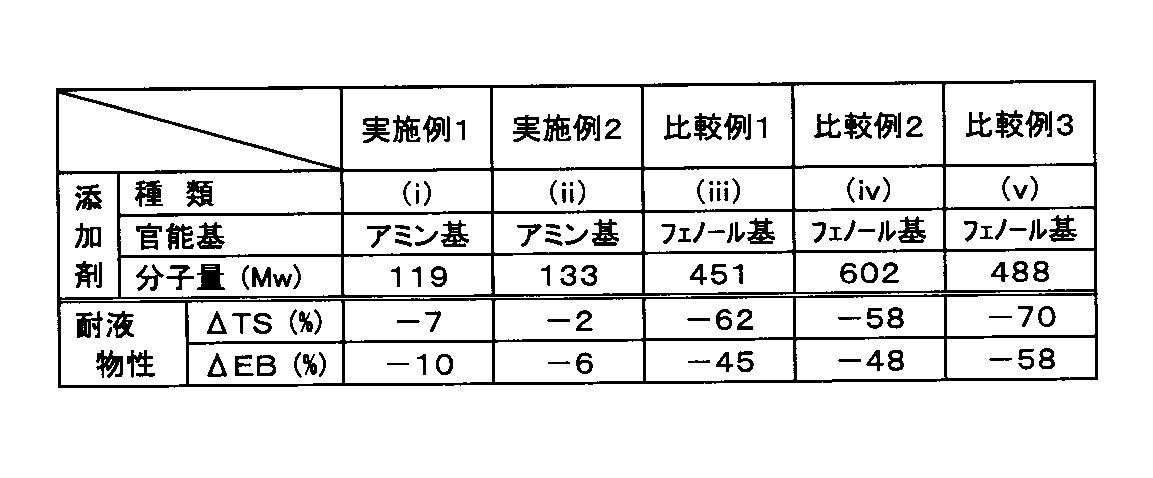

上記表の結果から、封入液中へ特定の添加剤を加えた実施例では、何も加えなかった比較例8に比べ、耐液物性評価においてΔTSおよびΔEBが小さいことがわかる。そのため、実施例では、液封入防振マウントの耐久特性において、良好な結果が得られるようになる。そして、上記結果より、実施例では、封入液中への防振ゴム体からの成分抽出が抑えられていると考えられる。
これに対し、比較例1~7でも、実施例と同じく、封入液中に添加剤を加えたが、実施例のような効果を得ることができなかった。すなわち、比較例1~3では、実施例と同じく、ベンゾトリアゾール系化合物を添加したが、この化合物は天然ゴムに対する反応基を持っておらず、耐液物性評価においてΔTSおよびΔEBが大きい結果となった。これにより、比較例1~3の液封入防振マウントは、耐久特性において良好な結果が得られなかった。比較例4では、実施例と同じく、アミン基を有する化合物を添加したが、その分子構造や分子量、さらに封入液への難溶解性等が影響し、実施例のような効果が得られなかったと考えられる。比較例5~7で使用の添加剤も、比較例1~3と同じく、天然ゴムに対する反応基を持っておらず、そのため、実施例のような効果が得られなかったと考えられる。
なお、実施例における耐液物性評価後の試験片(JIS7号ダンベル)の、封入液との接触面には、膜状物が確認されたのに対し、比較例のものには、このような膜はほとんど確認されなかった。
また、実施例では、加硫ゴム成形体のポリマーが天然ゴムであったが、他のジエン系ゴムの場合でも、実施例と同様の結果が得られた。
なお、上記実施例においては、本発明における具体的な形態について示したが、上記実施例は単なる例示にすぎず、限定的に解釈されるものではない。当業者に明らかな様々な変形は、本発明の範囲内であることが企図されている。
本発明の液体封入式防振ゴム装置は、自動車の車両等に用いられるエンジンマウント、サスペンションブッシュ、ボデーマウント、サブフレームマウント、デフマウント等として好ましく用いられるが、それ以外にも、列車や自動二輪車等に用いられる流体封入式筒形防振装置、コンピューターのハードディスクの制振ダンパー、洗濯機等の一般家電製品の制振ダンパー、建築・住宅分野における建築用制震壁,制震(制振)ダンパー等の制震(制振)装置および免震装置の用途にも適用可能である。
1 防振ゴム体
3 ゴム膜
A 主液室
B 副液室
3 ゴム膜
A 主液室
B 副液室
Claims (4)
- 振動入力に応じて変形する室壁から構成される密閉空間を備え、上記密閉空間内に液体が封入されてなる液体封入式防振ゴム装置であって、上記室壁が、ジエン系ゴムからなり、上記液体が、アミン基を持つベンゾトリアゾール系化合物を含有するグリコール系溶液からなることを特徴とする液体封入式防振ゴム装置。
- 上記アミン基を持つベンゾトリアゾール系化合物の重量平均分子量(Mw)が300以下である請求項1記載の液体封入式防振ゴム装置。
- 上記アミン基を持つベンゾトリアゾール系化合物が、下記の一般式(1)で示される化合物である請求項1または2記載の液体封入式防振ゴム装置。

- 上記アミン基を持つベンゾトリアゾール系化合物が、1H-ベンゾトリアゾール、4-メチル-1H-ベンゾトリアゾールおよび5-メチル-1H-ベンゾトリアゾールからなる群から選ばれた少なくとも一つである請求項1~3のいずれか一項に記載の液体封入式防振ゴム装置。
Priority Applications (2)
| Application Number | Priority Date | Filing Date | Title |
|---|---|---|---|
| CN201280004405.1A CN103299101B (zh) | 2011-03-30 | 2012-03-26 | 液体封入式隔振橡胶装置 |
| US13/796,246 US8955831B2 (en) | 2011-03-30 | 2013-03-12 | Fluid-filled vibration damping rubber device |
Applications Claiming Priority (2)
| Application Number | Priority Date | Filing Date | Title |
|---|---|---|---|
| JP2011074929A JP5654927B2 (ja) | 2011-03-30 | 2011-03-30 | 液体封入式防振ゴム装置 |
| JP2011-074929 | 2011-03-30 |
Related Child Applications (1)
| Application Number | Title | Priority Date | Filing Date |
|---|---|---|---|
| US13/796,246 Continuation US8955831B2 (en) | 2011-03-30 | 2013-03-12 | Fluid-filled vibration damping rubber device |
Publications (1)
| Publication Number | Publication Date |
|---|---|
| WO2012133348A1 true WO2012133348A1 (ja) | 2012-10-04 |
Family
ID=46931065
Family Applications (1)
| Application Number | Title | Priority Date | Filing Date |
|---|---|---|---|
| PCT/JP2012/057807 Ceased WO2012133348A1 (ja) | 2011-03-30 | 2012-03-26 | 液体封入式防振ゴム装置 |
Country Status (4)
| Country | Link |
|---|---|
| US (1) | US8955831B2 (ja) |
| JP (1) | JP5654927B2 (ja) |
| CN (1) | CN103299101B (ja) |
| WO (1) | WO2012133348A1 (ja) |
Cited By (1)
| Publication number | Priority date | Publication date | Assignee | Title |
|---|---|---|---|---|
| CN102900802A (zh) * | 2012-10-16 | 2013-01-30 | 东南大学 | 双液室液阻型宽频橡胶隔振器 |
Families Citing this family (7)
| Publication number | Priority date | Publication date | Assignee | Title |
|---|---|---|---|---|
| US10145443B2 (en) | 2015-01-26 | 2018-12-04 | Itt Manufacturing Enterprises Llc | Compliant elastomeric shock absorbing apparatus |
| JP6779033B2 (ja) * | 2016-05-12 | 2020-11-04 | 倉敷化工株式会社 | ゴム組成物 |
| CN106015442B (zh) * | 2016-06-28 | 2018-10-26 | 界首市华盛塑料机械有限公司 | 发动机液压减震支架 |
| CN106051039B (zh) * | 2016-06-28 | 2018-02-16 | 界首市华盛塑料机械有限公司 | 发动机液压减震支架底座焊接总成 |
| KR102750657B1 (ko) * | 2019-06-12 | 2025-01-06 | 현대자동차주식회사 | 유체 봉입형 엔진 마운트 |
| CN110735880A (zh) * | 2019-09-06 | 2020-01-31 | 株洲时代新材料科技股份有限公司 | 液体复合弹簧的密封方法 |
| CN110630679A (zh) * | 2019-09-06 | 2019-12-31 | 株洲时代新材料科技股份有限公司 | 用于液体复合弹簧的腔室 |
Citations (4)
| Publication number | Priority date | Publication date | Assignee | Title |
|---|---|---|---|---|
| JPH0285540A (ja) * | 1988-09-21 | 1990-03-27 | Toyoda Gosei Co Ltd | 液封入型防振マウント |
| JP2007205550A (ja) * | 2006-02-06 | 2007-08-16 | Tokai Rubber Ind Ltd | 液体封入型防振装置 |
| JP2008255247A (ja) * | 2007-04-05 | 2008-10-23 | Toyo Tire & Rubber Co Ltd | 防振ゴム組成物 |
| JP2011027770A (ja) * | 2009-07-21 | 2011-02-10 | Taiyo Holdings Co Ltd | 光硬化性樹脂組成物 |
Family Cites Families (16)
| Publication number | Priority date | Publication date | Assignee | Title |
|---|---|---|---|---|
| JPH0236818B2 (ja) | 1986-09-25 | 1990-08-21 | Shii Shii Ai Kk | Boshingomuyoryutai |
| JPS6451488A (en) | 1987-08-22 | 1989-02-27 | Kurashiki Kako | Fluid composition for automobile |
| JPH05140579A (ja) | 1991-11-25 | 1993-06-08 | Bridgestone Corp | 電気粘性流体及び電気粘性流体封入装置 |
| JP3166493B2 (ja) * | 1994-06-28 | 2001-05-14 | 豊田合成株式会社 | 液封入防振装置 |
| US6250615B1 (en) * | 1999-03-31 | 2001-06-26 | Freudenberg-Nok General Partnership | Vibration isolator with a tension restraint |
| JP2004003656A (ja) * | 2003-05-19 | 2004-01-08 | Toyo Tire & Rubber Co Ltd | 液封入防振装置 |
| US7759293B2 (en) * | 2004-11-22 | 2010-07-20 | Nippon Oil Corporation | Hydraulic oil composition for shock absorbers |
| KR101472610B1 (ko) * | 2007-04-23 | 2014-12-15 | 이데미쓰 고산 가부시키가이샤 | 유압 작동유 및 유압 장치 |
| US8058214B2 (en) * | 2007-06-28 | 2011-11-15 | Chevron U.S.A. Inc. | Process for making shock absorber fluid |
| JP2009103141A (ja) * | 2007-10-19 | 2009-05-14 | Toyota Motor Corp | 液体封入式防振装置 |
| CN101896733B (zh) | 2007-12-12 | 2013-12-18 | 株式会社普利司通 | 防振装置 |
| SG194403A1 (en) * | 2008-10-07 | 2013-11-29 | Jx Nippon Oil & Energy Corp | Lubricant base oil and a process for producing the same,and lubricating oil composition |
| JP5739121B2 (ja) * | 2010-07-30 | 2015-06-24 | 出光興産株式会社 | 潤滑油基油および潤滑油組成物 |
| JP5829146B2 (ja) * | 2012-02-27 | 2015-12-09 | 住友理工株式会社 | 防振ゴム組成物および液体封入式防振ゴム装置 |
| CN104284930A (zh) * | 2012-03-23 | 2015-01-14 | 巴斯夫欧洲公司 | 用于减振器的流体组合物 |
| KR20140103654A (ko) * | 2013-02-19 | 2014-08-27 | 현대자동차주식회사 | 액체봉입형 엔진 마운트액 조성물 |
-
2011
- 2011-03-30 JP JP2011074929A patent/JP5654927B2/ja active Active
-
2012
- 2012-03-26 CN CN201280004405.1A patent/CN103299101B/zh active Active
- 2012-03-26 WO PCT/JP2012/057807 patent/WO2012133348A1/ja not_active Ceased
-
2013
- 2013-03-12 US US13/796,246 patent/US8955831B2/en active Active
Patent Citations (4)
| Publication number | Priority date | Publication date | Assignee | Title |
|---|---|---|---|---|
| JPH0285540A (ja) * | 1988-09-21 | 1990-03-27 | Toyoda Gosei Co Ltd | 液封入型防振マウント |
| JP2007205550A (ja) * | 2006-02-06 | 2007-08-16 | Tokai Rubber Ind Ltd | 液体封入型防振装置 |
| JP2008255247A (ja) * | 2007-04-05 | 2008-10-23 | Toyo Tire & Rubber Co Ltd | 防振ゴム組成物 |
| JP2011027770A (ja) * | 2009-07-21 | 2011-02-10 | Taiyo Holdings Co Ltd | 光硬化性樹脂組成物 |
Cited By (2)
| Publication number | Priority date | Publication date | Assignee | Title |
|---|---|---|---|---|
| CN102900802A (zh) * | 2012-10-16 | 2013-01-30 | 东南大学 | 双液室液阻型宽频橡胶隔振器 |
| CN102900802B (zh) * | 2012-10-16 | 2015-02-04 | 东南大学 | 双液室液阻型宽频橡胶隔振器 |
Also Published As
| Publication number | Publication date |
|---|---|
| CN103299101A (zh) | 2013-09-11 |
| JP5654927B2 (ja) | 2015-01-14 |
| CN103299101B (zh) | 2015-02-11 |
| US8955831B2 (en) | 2015-02-17 |
| US20130187317A1 (en) | 2013-07-25 |
| JP2012207160A (ja) | 2012-10-25 |
Similar Documents
| Publication | Publication Date | Title |
|---|---|---|
| JP5654927B2 (ja) | 液体封入式防振ゴム装置 | |
| CN102341451B (zh) | 防振橡胶组合物 | |
| JP5420224B2 (ja) | 防振ゴム用ゴム組成物、防振ゴムおよびその製造方法 | |
| JP7553258B2 (ja) | 防振ゴム組成物および防振ゴム部材 | |
| TW201602231A (zh) | 高衰減組合物、制震阻尼器及免震支撐體 | |
| JP5992838B2 (ja) | 防振ゴム用ゴム組成物 | |
| JP2019178199A (ja) | 電気自動車用防振ゴム組成物および電気自動車用防振ゴム部材 | |
| JPWO2015005080A1 (ja) | ニトリルゴム組成物 | |
| CN114364732B (zh) | 防振橡胶组合物以及防振橡胶构件 | |
| JP2018188522A (ja) | 防振ゴム用ゴム組成物及び車両用防振ゴム | |
| CN100500753C (zh) | 防振橡胶组合物 | |
| WO2014203695A1 (ja) | 防振ゴム用ゴム組成物 | |
| JP6702313B2 (ja) | 防振部材 | |
| JP6644962B1 (ja) | 防振ゴム組成物および防振ゴム部材 | |
| JP5210801B2 (ja) | 防振ゴム用ゴム組成物及び防振ゴム | |
| JP2015193798A (ja) | 自動車用防振ゴム組成物およびそれからなる自動車用防振ゴム部材、並びに自動車用液体封入式防振ゴム装置 | |
| CN100480315C (zh) | 防振橡胶组合物 | |
| JP5568493B2 (ja) | 防振ゴム組成物 | |
| JPWO2012120638A1 (ja) | 防振ゴム組成物およびその製法、並びにその加硫体 | |
| US20130175744A1 (en) | Antivibration rubber device | |
| JP5829146B2 (ja) | 防振ゴム組成物および液体封入式防振ゴム装置 | |
| CN109642052B (zh) | 防振橡胶组合物以及防振橡胶 | |
| JP2006143859A (ja) | 防振ゴム | |
| JP2016069558A (ja) | 防振ゴム組成物 | |
| JP2008255247A (ja) | 防振ゴム組成物 |
Legal Events
| Date | Code | Title | Description |
|---|---|---|---|
| 121 | Ep: the epo has been informed by wipo that ep was designated in this application |
Ref document number: 12763274 Country of ref document: EP Kind code of ref document: A1 |
|
| NENP | Non-entry into the national phase |
Ref country code: DE |
|
| 122 | Ep: pct application non-entry in european phase |
Ref document number: 12763274 Country of ref document: EP Kind code of ref document: A1 |