WO2012132962A1 - タンタル回収方法 - Google Patents
タンタル回収方法 Download PDFInfo
- Publication number
- WO2012132962A1 WO2012132962A1 PCT/JP2012/056869 JP2012056869W WO2012132962A1 WO 2012132962 A1 WO2012132962 A1 WO 2012132962A1 JP 2012056869 W JP2012056869 W JP 2012056869W WO 2012132962 A1 WO2012132962 A1 WO 2012132962A1
- Authority
- WO
- WIPO (PCT)
- Prior art keywords
- tantalum
- treatment
- acid
- waste
- copper
- Prior art date
- Legal status (The legal status is an assumption and is not a legal conclusion. Google has not performed a legal analysis and makes no representation as to the accuracy of the status listed.)
- Ceased
Links
Images
Classifications
-
- C—CHEMISTRY; METALLURGY
- C22—METALLURGY; FERROUS OR NON-FERROUS ALLOYS; TREATMENT OF ALLOYS OR NON-FERROUS METALS
- C22B—PRODUCTION AND REFINING OF METALS; PRETREATMENT OF RAW MATERIALS
- C22B34/00—Obtaining refractory metals
- C22B34/20—Obtaining niobium, tantalum or vanadium
- C22B34/24—Obtaining niobium or tantalum
-
- C—CHEMISTRY; METALLURGY
- C22—METALLURGY; FERROUS OR NON-FERROUS ALLOYS; TREATMENT OF ALLOYS OR NON-FERROUS METALS
- C22B—PRODUCTION AND REFINING OF METALS; PRETREATMENT OF RAW MATERIALS
- C22B1/00—Preliminary treatment of ores or scrap
- C22B1/005—Preliminary treatment of scrap
-
- C—CHEMISTRY; METALLURGY
- C22—METALLURGY; FERROUS OR NON-FERROUS ALLOYS; TREATMENT OF ALLOYS OR NON-FERROUS METALS
- C22B—PRODUCTION AND REFINING OF METALS; PRETREATMENT OF RAW MATERIALS
- C22B7/00—Working up raw materials other than ores, e.g. scrap, to produce non-ferrous metals and compounds thereof; Methods of a general interest or applied to the winning of more than two metals
- C22B7/006—Wet processes
- C22B7/007—Wet processes by acid leaching
-
- Y—GENERAL TAGGING OF NEW TECHNOLOGICAL DEVELOPMENTS; GENERAL TAGGING OF CROSS-SECTIONAL TECHNOLOGIES SPANNING OVER SEVERAL SECTIONS OF THE IPC; TECHNICAL SUBJECTS COVERED BY FORMER USPC CROSS-REFERENCE ART COLLECTIONS [XRACs] AND DIGESTS
- Y02—TECHNOLOGIES OR APPLICATIONS FOR MITIGATION OR ADAPTATION AGAINST CLIMATE CHANGE
- Y02P—CLIMATE CHANGE MITIGATION TECHNOLOGIES IN THE PRODUCTION OR PROCESSING OF GOODS
- Y02P10/00—Technologies related to metal processing
- Y02P10/20—Recycling
Definitions
- the present invention relates to a method for recovering tantalum from tantalum-containing waste, and more particularly to a technique for efficiently recovering tantalum from a waste substrate such as a printed wiring board including a tantalum capacitor.
- Tantalum capacitors have a large capacity and high stability, and are often used in communication devices such as personal computers and mobile phones, servers, and acoustic devices. Such tantalum capacitors are mounted on various electronic and electrical substrates such as printed wiring boards and distributed to the market. However, tantalum capacitors that have been used afterwards are proactive for economic and technical reasons. The current situation is that they are not collected or recycled and are simply treated as industrial waste.
- tantalum which is one of the rare metals, is recovered with high efficiency from waste substrates such as printed wiring boards and used tantalum capacitors.
- Patent Document 1 As a technique for recovering tantalum from a waste substrate on which a tantalum capacitor is mounted, for example, there is a method in which the waste substrate is heat-treated in an oxidizing atmosphere at 550 ° C. or higher and then sorted by the major axis length to recover tantalum.
- Patent Document 1 the coating material and manganese dioxide solid electrolyte are removed by acid leaching, carbon reduction-acid leaching, chlorination-distillation or argon-hydrogen plasma method, and then chlorination method, alkoxide formation method, A method of purifying tantalum by an electron beam melting method or a combination thereof is also known (Patent Document 2).
- the tantalum recovery obtained from these prior arts is silicon (Si), antimony (Sb), phosphorus (P), manganese (Mn), tin (Sn), lead (Pb), zinc (Zn), Impurities such as iron (Fe), nickel (Ni), copper (Cu), and aluminum (Al) cannot be sufficiently separated, and when these impurities are contained, it is difficult to reuse them as tantalum raw materials.
- JP 2009-221514 A JP-A 64-75632
- the present invention provides a technique for efficiently recovering tantalum from waste containing tantalum, and in particular, from a waste substrate such as a printed wiring board including a tantalum capacitor, when reused. It is possible to reduce the impurities such as copper and tungsten, which are inconvenient, and to recover the tantalum at a high recovery rate.
- the present invention that solves the above problems is a tantalum recovery method for recovering tantalum from tantalum-containing waste, in which tantalum-containing waste is acid-treated in an oxidizing atmosphere, then roasted, and subjected to alkali treatment.
- the present invention relates to a method characterized in that magnetic separation is performed before acid treatment to separate tantalum-containing materials from tantalum-containing waste.
- impurities other than tantalum for example, copper-containing materials and tantalum-containing materials can be separated and recovered as tantalum oxide or metal tantalum with reduced impurities.
- tantalum can be efficiently recovered even from wastes having a relatively high copper or tungsten content, such as waste substrates such as printed wiring boards.
- copper can be efficiently removed by performing acid treatment in a solution in an oxidizing atmosphere, and tungsten can also be removed by performing a baking treatment before alkali treatment.
- the tantalum recovery method of the present invention will be described in detail.
- the tantalum-containing waste to be collected may be any waste containing tantalum.
- a waste substrate such as a printed wiring board mounted with a tantalum capacitor, a chip-like waste obtained by pulverizing these waste substrates, a capacitor Examples include defective manufacturing processes, tantalum sintered bodies taken out from tantalum capacitors, and the like.
- the tantalum-containing waste applied to the present invention is preferably a waste starting from a waste substrate such as a printed wiring board. Since the waste substrate tends to contain a large amount of copper, in the conventional tantalum recovery method, the recovered tantalum tends to be difficult to reuse as it is. Tungsten can also be reduced.
- the acid treatment in the present invention is characterized in that the acid treatment liquid is used as an oxidizing atmosphere.
- an oxidizing atmosphere When an oxidizing atmosphere is used, copper can be efficiently reduced.
- an oxidizing agent such as hydrogen peroxide may be added to the acid treatment solution, or air (mainly as an oxygen supply source) may be supplied to the solution.
- Acids such as hydrochloric acid, nitric acid, and sulfuric acid can be used for the acid treatment liquid.
- hydrochloric acid or nitric acid it is preferable to use hydrochloric acid or nitric acid, and it is particularly preferable to use an acid containing hydrochloric acid.
- impurities such as antimony, manganese, tin, lead, zinc, iron, nickel, aluminum, titanium, silicon, chromium, and tungsten can be removed, and the acid treatment is performed in an oxidizing atmosphere, thereby disposing
- a waste substrate such as a printed wiring board is used as a starting material
- copper such as a compound containing a relatively large amount of copper or a copper alloy can be efficiently removed.
- the above acid treatment is preferably performed after performing a pretreatment such as a magnetic force sorting treatment described in detail below.
- silver in the acid treatment of the present invention by using hydrochloric acid as the acid treatment solution, silver can be removed even when the waste contains silver (Ag). Silver in the waste can be recovered as silver chloride from the filtrate by performing filtration after acid treatment.
- hydrochloric acid used for the acid treatment, manganese dioxide (MnO 2 ) in the tantalum-containing waste is dissolved in hydrochloric acid to generate chlorine gas.
- silver chloride (AgCl) is generated by the reaction between the generated chlorine gas and silver, and can be recovered.
- a part of the produced silver chloride is dissolved in hydrochloric acid, but it can be precipitated as silver chloride by performing a filtration treatment after the acid treatment and diluting the filtrate. Thereafter, if filtration is performed again, silver chloride can be recovered from the precipitate.
- the recovery method of the present invention is to perform a roasting treatment after the acid treatment described above and before the alkali treatment.
- This roasting treatment is performed, impurities such as tungsten that are difficult to remove only by acid treatment are easily removed.
- the impurity metal remaining after the acid treatment is oxidized by the roasting treatment and can be dissolved and removed in the subsequent alkali treatment.
- the conditions for the roasting treatment can be arbitrarily selected according to the type of tantalum-containing waste.
- the roasting temperature is preferably 300 ° C. or higher, more preferably 300 to 1000 ° C., and most preferably 700 to 1000 ° C. In addition, it is preferably roasted in the atmosphere for 0.5 to 8 hours.
- alkali treatment is performed.
- impurities such as tin, lead, iron, copper, nickel, and phosphorus that are not removed by the acid treatment and remain in the recovered tantalum can be reduced.
- the present invention is characterized in that tungsten can be reduced even when a large amount of tungsten is contained as an impurity because the alkali treatment is performed after the roasting described above.
- impurities such as tin, lead, iron, copper, nickel, and phosphorus can be reduced, but tungsten is difficult to reduce.
- the alkali treatment described above can be performed with sodium hydroxide or potassium hydroxide.
- the present invention is performed in the order of the acid treatment, the roasting treatment, and the alkali treatment as described above.
- a higher-quality tantalum recovery is realized. It is.
- high-quality tantalum can be recovered by performing a magnetic separation process before acid treatment and separating a certain amount of copper. it can. Copper can be separated even in the acid treatment step, but if the copper content is reduced in the pretreatment step, the subsequent acid treatment, roasting treatment, and alkali treatment can be performed effectively. And if magnetic force selection processing is performed, the load of an acid treatment process can be reduced and processing cost can also be reduced.
- “perform magnetic separation before acid treatment to separate tantalum-containing materials and copper-containing materials in tantalum-containing waste” means that magnetic attachment or adhesion is achieved by performing magnetic separation. This means that nickel, iron or the like integrated by bonding or the like is magnetized to separate the copper-containing material integrated with the magnetic material from the tantalum-containing material.
- Tantalum-containing materials include tantalum oxide and metal tantalum
- copper-containing materials include copper-containing compounds and copper alloys.
- the first magnetic sorting process aims to remove ferromagnetic materials such as iron and nickel
- the second and subsequent magnetic sorting processes use copper, zinc, chromium, aluminum, silicon and silver other than ferromagnetic materials. It is possible to adjust to different magnetic separation conditions (magnetic flux density, processing time, device type, etc.) for each number of times of magnetic selection, such as for the purpose of removing tungsten and the like.
- magnetic separation conditions magnetic flux density, processing time, device type, etc.
- tantalum which is the object of collection of the present invention, adheres to, bonds with, or binds to terminals or lead wires containing ferromagnetic materials such as iron and nickel, and weak magnetic materials such as manganese dioxide (MnO 2 ). It may become integrated and become magnetically attached by alloying or the like. For this reason, in order to magnetize copper without magnetizing tantalum, it is preferable that the magnetic force and the like can be adjusted.
- tantalum purity can be increased when the magnetic force sorting process is performed in a plurality of times as compared with the case where the magnetic field selection process is performed once.
- a process other than the magnetic separation process such as a sieving process or a specific gravity selection process, may be performed after the first magnetic separation process.
- a general magnetic separator can be used for the magnetic separation process, and appropriate processing conditions can be adopted depending on the type of waste and the impurity to be removed.
- the maximum magnetic flux density is 2000 G to 7000 G. More preferably, it is 2500G-6500G. If it is less than 2000 G, the magnetic deposits cannot be sufficiently removed, and the magnetic separation process time tends to be long. If it exceeds 7000 G, the tendency of tantalum to be magnetized becomes strong, and the recovered amount of tantalum will decrease.
- the resin contained in a waste substrate such as a printed wiring board
- fine powder fine powder containing tantalum may be generated. For this reason, it is preferable to collect tantalum from fine powder.
- the roasting treatment after the acid treatment in the present invention it is possible to reduce tungsten or the like in the alkali treatment by oxidizing the impurities described above. And since the influence of the acid by an acid process can be reduced by a roasting process, an alkali process can be performed efficiently.
- the roasting treatment is performed before the acid treatment, it is difficult to reduce impurities such as manganese, tin, and lead in the acid treatment. It is considered that a high-order oxide containing impurities or a complex oxide such as MnTa 2 O 6 is generated by the baking treatment before the acid treatment, and the impurities are not easily leached by the subsequent acid treatment.
- the tantalum-containing waste to be recovered is subjected to crushing, pulverization, magnetic sorting, specific gravity sorting, sieve sorting, roasting as pretreatment before acid treatment.
- Known processing methods such as processing, eddy current selection processing, electrostatic selection processing, and color selection processing can be employed.
- These pretreatments can be applied by appropriately combining a plurality of treatment steps depending on the type of waste, such as waste substrates, chip-like waste, defective products in capacitor production, tantalum sintered bodies taken out from tantalum capacitors, etc. .
- the recovery efficiency in the tantalum recovery method of the present invention can be improved by reducing impurities such as iron, manganese, zinc, copper, aluminum and silicon to some extent.
- the tantalum recovered by the tantalum recovery method of the present invention can be purified by a solvent extraction method or the like, further concentrated to high-purity tantalum, and reused. According to the recovery method of the present invention, impurities such as copper and tungsten that are inconvenient for further purification treatment can be removed, and high-purity tantalum can be efficiently obtained.
- impurities that are inconvenient during reuse can be reduced, and high-purity tantalum can be efficiently recovered from tantalum-containing waste.
- a tantalum capacitor concentrate obtained from a waste board such as a used printed wiring board is used as the tantalum-containing waste to be collected.
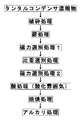
- the concentrate was pretreated in the order of crushing, sieving, magnetic sorting, specific gravity sorting, and magnetic sorting.
- These pretreatments are merely examples, and may not be essential depending on the collection target.
- the pretreatment procedure, conditions, and the like can be appropriately changed depending on the collection target.
- each process will be described in detail.
- Concentrate of tantalum capacitor From waste substrates such as used printed wiring boards mounted with a tantalum capacitor, elements are separated by crushing, sieving, specific gravity sorting, etc., as described in JP 2010-214352 A, This is a concentrated tantalum capacitor.
- Crushing treatment The above tantalum capacitor concentrate was crushed. In the crushing process, the tantalum and the resin in the capacitor are separated.
- a commercially available crusher can be used for the crushing treatment, and a shear crushing type cutter mill type crusher is preferably used. According to the cutter mill type crusher, it is easy to crush and separate the exterior part of the capacitor. In this embodiment, a commercially available uniaxial crusher was used. By this pulverizer, the tantalum capacitor concentrate was crushed to a size of 0.001 to 2 mm.
- Sieve treatment After crushing treatment, sieving treatment was performed with an electromagnetic sieve shaker. By the sieving treatment, fine powder generated by the crushing treatment and a relatively large lump were separated. In this embodiment, a sieve having a mesh opening diameter of 150 ⁇ m is used.
- Magnetic sorting process (first time): After the sieving process, the lump that remained on the sieve was subjected to a sorting process by magnetic force.
- the magnetic force selection process is performed twice.
- a terminal, an electrode, a connector, a screw, a pin, and the like mainly include a ferromagnetic material such as iron or nickel. Removal was performed.
- a commercially available magnetic separator can be used for the magnetic separation process.
- the first magnetic separation process was performed using a drum magnetic separator using a drum-type ferrite magnet. With this magnetic separator, a magnetic force selection process was performed under conditions of a maximum magnetic flux density (drum surface) of about 3000 G and a drum rotation speed of 38 rpm.
- Specific gravity sorting process The non-magnetized material subjected to the magnetic field sorting process was subjected to a specific gravity sorting process to separate and remove light products containing resins and the like, and to collect heavy products containing tantalum.
- a commercially available specific gravity sorter can be used for the specific gravity sorting process.
- an apparatus for selecting specific gravity using wind force and vibration is used. The selection conditions were a frequency of 11 Hz, a wind speed of 1.1 m / s, an inclination of 7 °, and a charging speed of 0.24 kg / min.
- Magnetic sorting process (second time): The magnetic sorting process was performed again on the heavy product of the specific gravity sorting process.
- the second magnetic sorting process was aimed at reducing the copper content.
- the maximum magnetic flux density is preferably 500 G or more.
- a commercially available magnetic separator can also be used.
- the sorting process was performed on the heavy product after the specific gravity sorting process using a magnet having a maximum magnetic flux density of 1860G. Then, the following acid treatment, roasting treatment, and alkali treatment were performed on the non-magnetized product in the second magnetic separation process.
- Acid treatment The recovered material after the pretreatment was subjected to an acid treatment.
- the acid treatment conditions were variously changed. In other embodiments, the treatment conditions were 6 mol / L hydrochloric acid at 80 ° C. for 5 hours. During the acid treatment, air was supplied to create an oxidizing atmosphere. After the acid treatment, the solid in the solution was collected by filtration.
- roasting treatment After the acid treatment, the collected filter was roasted to oxidize tungsten and the like. The roasting treatment was based on conditions of 900 ° C. and 4 hours in an air atmosphere. Although alkali treatment may be performed immediately after roasting, it is preferable to perform alkali treatment after sieving. Since the lump which tends to contain many impurities can be removed by sieving, the removal efficiency of impurities in the alkali treatment is high.
- Alkali treatment After roasting, an alkali treatment with a sodium hydroxide solution was performed. The alkali treatment was based on treatment conditions of 10 wt% sodium hydroxide solution at 80 ° C. for 2 hours. After completion of the treatment, the solid in the solution was collected by filtration. The target tantalum was recovered by the above acid treatment, roasting treatment, and alkali treatment.
- tantalum was recovered by changing the processing conditions of the acid treatment, the roasting treatment, the alkali treatment, and the magnetic force sorting treatment based on the above collection method.
- tantalum recovery was performed by performing a series of processing steps under suitable conditions.
- the raw materials in Tables 1 to 6 are those that have been processed up to the previous step of each treatment step of acid treatment, roasting treatment, and alkali treatment.
- the “raw material” in the roasting treatment in Table 4 is a product obtained by performing the pre-treatment and the treatment up to the acid treatment.
- the weight in the “weight / liquid ratio” described at the bottom of each table represents the weight of the raw material (sample) subjected to each treatment.
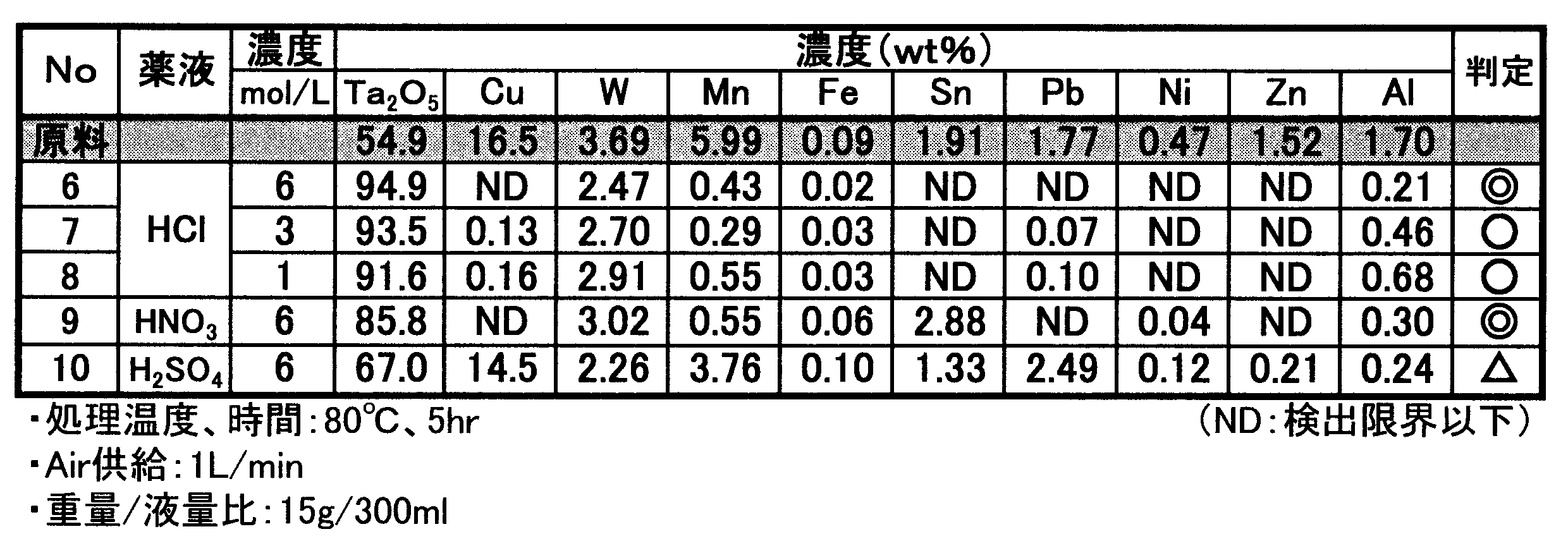
- the oxidizing atmosphere as shown in Tables 1 to 3 below, the oxidizing atmosphere (aeration strength), the chemical type / concentration, the treatment temperature / time, and the chemical amount relative to the waste treatment amount were changed.
- the judgment criteria were ⁇ when the copper removal effect was recognized, and especially ⁇ when the copper concentration was below the detection limit.
- the copper removal effect was recognized when an oxidizing atmosphere was established by adding hydrogen peroxide or supplying air during acid treatment. The more air supplied per unit time, the more copper could be removed.
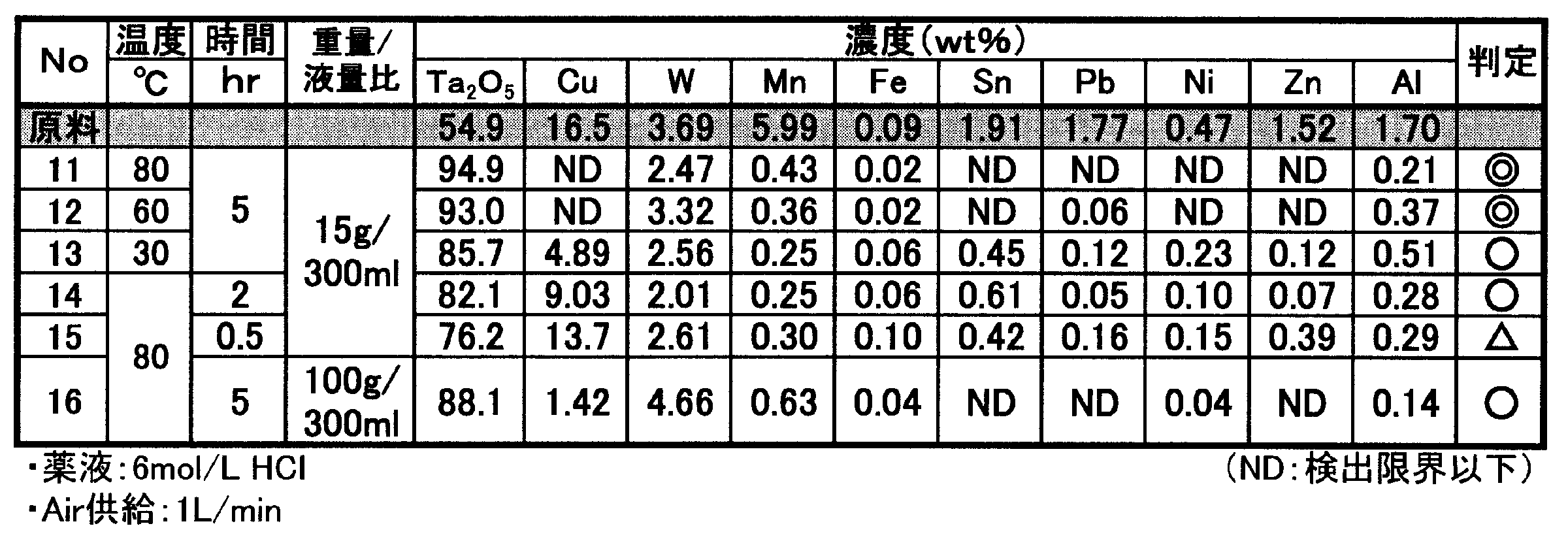
- the chemical solution from Table 2, impurities can be reduced when hydrochloric acid, nitric acid, and sulfuric acid are used, and copper can be efficiently removed when hydrochloric acid or nitric acid is used. Further, the higher the chemical concentration, the more impurities could be removed. From Table 3, impurities were able to be removed as the liquid temperature during the acid treatment was higher and the treatment time was longer. Moreover, the larger the amount of the treatment liquid relative to the waste treatment amount, the higher the impurity removal effect. From the above, the acid treatment conditions are preferably a chemical solution concentration of 3 mol / L or more, a treatment temperature of 40 ° C. or more, and a treatment time of 1 hour or more.
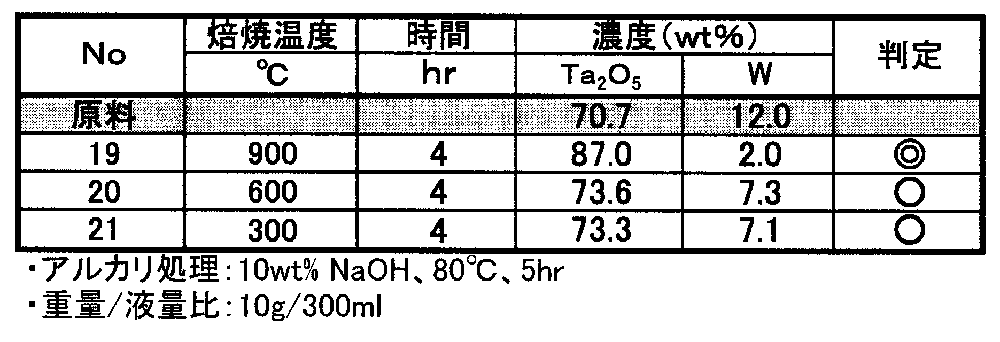
- the roasting treatment conditions were examined.
- the waste that had been pretreated and acid-treated was roasted under each treatment condition and then subjected to alkali treatment.
- the residue washed with water was baked at 900 ° C. for 4 hours in an air atmosphere, and the sample after baking was subjected to fluorescent X-ray analysis.
- the judgment criteria were ⁇ when the tungsten removal effect was recognized, and ⁇ when the tungsten removal effect was particularly high.
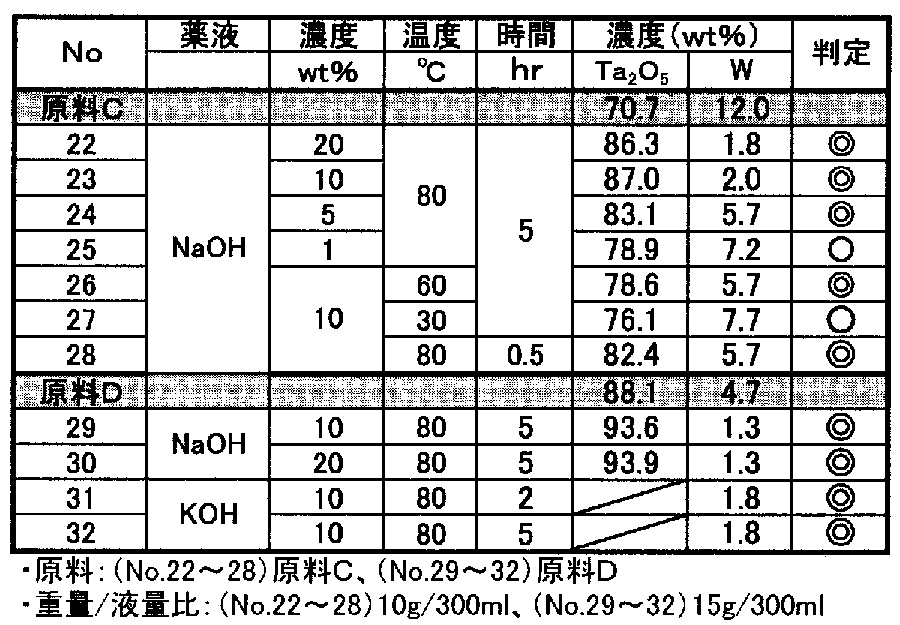
- the alkali treatment conditions were examined. According to the recovery method based on the above, the waste that had been pretreated, acid treated and roasted was subjected to alkali treatment under each treatment condition. After the alkali treatment, the residue washed with water was baked at 900 ° C. for 4 hours in an air atmosphere, and the Ta 2 O 5 concentration of the baked sample was subjected to fluorescent X-ray analysis. The tungsten concentration was measured by ICP emission spectroscopic analysis. The judgment criteria were ⁇ when the tungsten removal effect was recognized, and ⁇ when the tungsten removal effect was particularly high.
- the tungsten removal effect was recognized as the chemical concentration and the treatment temperature were higher and the treatment time was longer.
- the alkali treatment conditions are preferably a chemical solution concentration of 5 wt% or more, and a treatment temperature of 40 ° C. or more.
- tungsten was able to be removed when either sodium hydroxide or potassium hydroxide was used as the chemical solution.
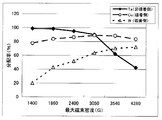
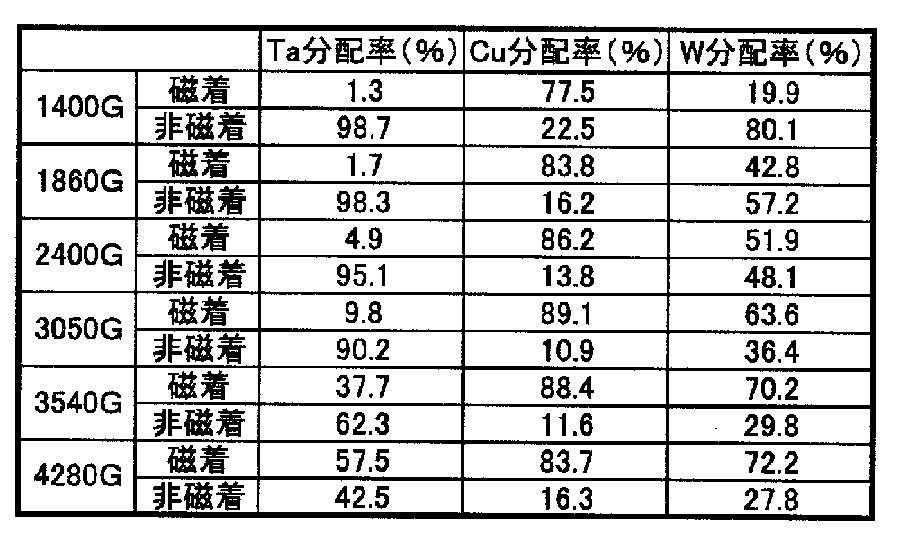
- the maximum magnetic flux density in the range of 1000 to 3200G is suitable in the present embodiment in which the magnetic selection is performed, and the range of around 1400 to 3050G is particularly suitable.
- a tantalum sintered body of a tantalum capacitor many contain weak magnetic substance manganese dioxide (MnO 2 ), and when the maximum magnetic flux density is 3540 G or more, the tantalum capacitor has a tantalum sintered body. Since the distribution increases, the tantalum recovery rate is considered to be greatly reduced.
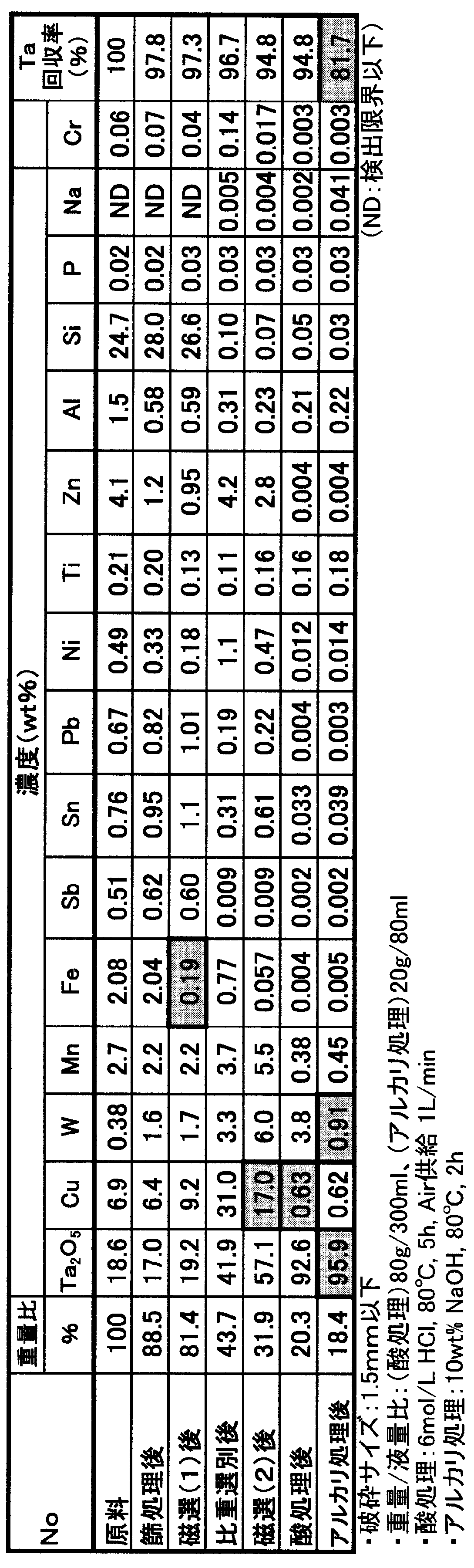
- the tantalum capacitor concentrate is pretreated in the order of crushing treatment, sieving treatment, magnetic force sorting treatment, specific gravity sorting treatment, magnetic force sorting treatment in accordance with the above-described collection method, and then acid treatment, roasting In a series of recovery steps for treatment and alkali treatment, tantalum concentration and impurity concentration were analyzed.
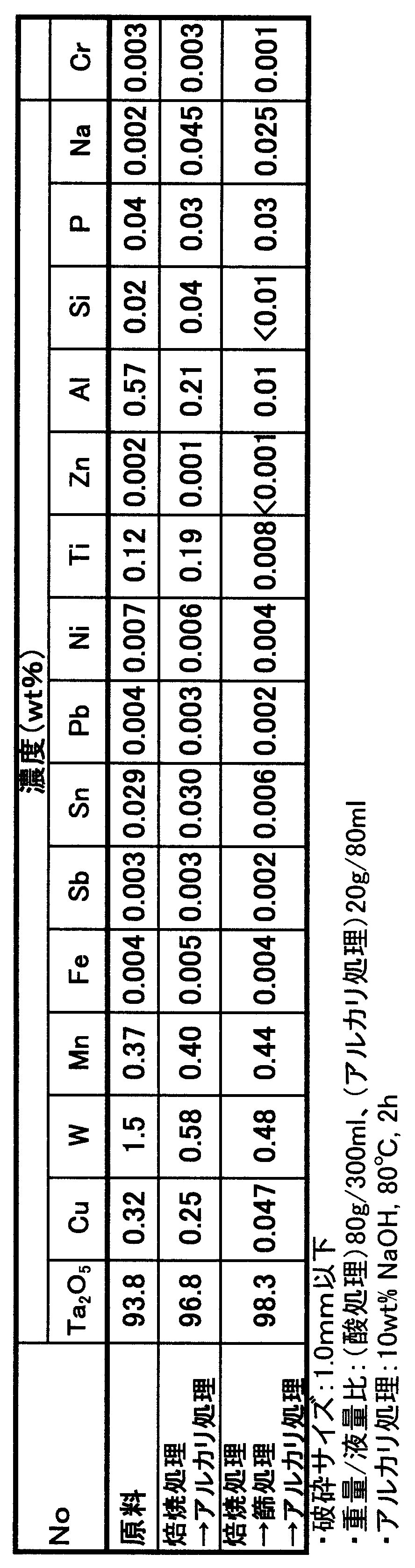
- the test was performed on two levels of a crushing size of 1.5 mm or more (Table 8) and 1.0 mm or more (Table 9) in the crushing step.
- a sample subjected to alkali treatment after roasting treatment and removing lump of 0.75 mm or more by sieving was also tested (Table 10).
- Table 10 a sample subjected to alkali treatment after roasting treatment and removing lump of 0.75 mm or more by sieving was also tested (Table 10).
- a sample obtained after roasting (900 ° C., 4 hours) of each treated sample was used.
- the sample after the magnetic force sorting process (first time) was subjected to component analysis by fluorescent X-ray analysis, and the sample after the specific gravity sorting process was analyzed by ICP emission spectroscopic analysis or atomic absorption analysis.
- the Ta 2 O 5 concentration was calculated by subtracting the total value of elements or oxide concentrations other than tantalum from 100 wt%.
- the tantalum recovery rate (%) was calculated by examining the tantalum weight of the collected material after each treatment and the tantalum weight of the sample before each treatment, and calculating from tantalum weight after each treatment / tantalum weight before each treatment ⁇ 100.
- the copper concentration decreased from 31.0 wt% to 17.0 wt% by the second magnetic selection process, and further decreased to 0.63 wt% by the hydrochloric acid treatment.
- the W concentration decreased from 3.8 wt% to 0.91 wt% by the alkali treatment.
- the Ta 2 O 5 concentration was 41.9 wt% after specific gravity sorting, and increased to 95.9 wt% by the subsequent magnetic sorting, acid treatment, and alkali treatment.
- the tantalum recovery after the alkali treatment was 81.7%.
- the copper concentration decreased from 29.0 wt% to 17.0 wt% by the second magnetic selection process, and further decreased to 0.32 wt% by the hydrochloric acid treatment.
- the tungsten concentration was lowered from 1.5 wt% to 0.58 wt% by the alkali treatment.
- the Ta 2 O 5 concentration was 41.1 wt% after specific gravity sorting, and increased to 96.8 wt% by the subsequent magnetic sorting, acid treatment, and alkali treatment.
- the recovery rate of tantalum after alkali treatment was 76.7%.
- Table 10 when alkali treatment is performed after sieving after sinter treatment, the effect of reducing each impurity is higher than when sieving is not performed after firing. became.
- the conditions of the magnetic separation process 2 were set such that the maximum magnetic flux density (drum surface) of the magnetic separator was 1500G, 3300G, 4400G, 5900G, and 8000G.
- the setting of the maximum magnetic flux density was adjusted by winding rubber on the drum surface of the drum magnetic separator used.
- the magnetic force sorting process performed at each maximum magnetic flux density, the weight distribution ratios of tantalum, copper, and tungsten on the magnetized side and the non-magnetized side were analyzed as in the fourth embodiment. Table 11 shows the result in the sixth embodiment.
- copper and tungsten contained in a large amount of waste boards such as printed wiring boards can also be removed, and high-purity tantalum can be recovered from tantalum-containing waste with a high recovery rate.
Landscapes
- Engineering & Computer Science (AREA)
- Chemical & Material Sciences (AREA)
- Mechanical Engineering (AREA)
- Manufacturing & Machinery (AREA)
- Materials Engineering (AREA)
- Metallurgy (AREA)
- Organic Chemistry (AREA)
- Geology (AREA)
- General Life Sciences & Earth Sciences (AREA)
- Environmental & Geological Engineering (AREA)
- Life Sciences & Earth Sciences (AREA)
- Geochemistry & Mineralogy (AREA)
- Manufacture And Refinement Of Metals (AREA)
- Processing Of Solid Wastes (AREA)
Abstract
Description
本実施形態では、酸処理条件について検討した。上記において基本とした回収方法に従い前処理した廃棄物を、各処理条件で酸処理した後、水洗し、ろ過した残渣を、900℃、4時間焙焼し、蛍光X線分析した。

本実施形態では焙焼処理条件について検討した。上記にて基準とした回収方法に従い、前処理及び酸処理をした廃棄物について、各処理条件で焙焼処理を行った後、アルカリ処理を行った。アルカリ処理後、水洗した残渣を、大気雰囲気で900℃、4時間焙焼し、焙焼後の試料を蛍光X線分析した。判定基準は、タングステンの除去効果が認められたものを○とし、特にタングステンの除去効果が高かったものを◎とした。

本実施形態ではアルカリ処理条件について検討した。上記にて基準とした回収方法に従い、前処理、酸処理及び焙焼処理をした廃棄物について、各処理条件でアルカリ処理を行った。アルカリ処理後、水洗した残渣を、大気雰囲気中で900℃、4時間焙焼し、焙焼後の試料のTa2O5濃度を蛍光X線分析した。タングステン濃度は、ICP発光分光分析により測定した。判定基準は、タングステンの除去効果が認められたものを○とし、特にタングステンの除去効果が高かったものを◎とした。
前処理である磁力選別処理(2度目)について、本実施形態における廃棄物を回収対象とする場合における、最大磁束密度の好適範囲を求めた。最大磁束密度1400~4280Gの磁石にて、選別処理を行い、磁着側及び非磁着側におけるタンタル、銅、タングステンの各重量分配率を分析した。非磁着側におけるタンタル分配率が高く、磁着側における銅及びタングステン分配率が高いほど、本発明のタンタル回収方法に好適となる。結果を表7及び図2に示す。
本実施形態では、上記にて基準とした回収方法に従い、タンタルコンデンサ濃縮物を、破砕処理、篩処理、磁力選別処理、比重選別処理、磁力選別処理の順に前処理した後、酸処理、焙焼処理、アルカリ処理する一連の回収工程において、タンタル濃度及び不純物濃度を分析した。

本実施形態では、磁力選別処理条件に関し、より実用的な条件について検討を行った結果について説明する。この第六実施形態では、図1で示したフローにおける磁力選別処理1を行わず、磁力選別処理2のみにより磁着物の除去を行った。従って、この第六実施形態のフローは、タンタルコンデンサ濃縮物を、破砕処理、篩処理、磁力選別処理2を行い、磁力選別処理条件の検討を行ったものである。また、この第六実施形態における磁力選別処理2は、ドラム式のフェライト磁石を利用したドラム磁選機(最大磁束密度8000G)のものを用いて磁選処理を行った。

Claims (5)
- タンタル含有廃棄物からタンタルを回収するタンタル回収方法において、
タンタル含有廃棄物を、酸化雰囲気下で酸処理した後、焙焼処理し、アルカリ処理するものであり、
酸処理前に磁力選別処理を行い、タンタル含有廃棄物中のタンタル含有物を分離することを特徴とするタンタル回収方法。 - 磁力選別処理は、最大磁束密度を2000G~7000Gで行う請求項1に記載のタンタル回収方法。
- タンタル含有廃棄物は、銅、タングステンの少なくともいずれかを含む請求項1または請求項2に記載のタンタル回収方法。
- 酸処理は、塩酸、硝酸、又は硫酸を含む酸により行う請求項1~3いずれかに記載のタンタル回収方法。
- アルカリ処理は、水酸化ナトリウム又は水酸化カリウムにより行う請求項1~4のいずれか記載のタンタル回収方法。
Priority Applications (3)
| Application Number | Priority Date | Filing Date | Title |
|---|---|---|---|
| DE112012001499.5T DE112012001499B4 (de) | 2011-03-31 | 2012-03-16 | Tantalrückgewinnungsverfahren |
| JP2013507388A JP5860034B2 (ja) | 2011-03-31 | 2012-03-16 | タンタル回収方法 |
| US14/002,351 US8961910B2 (en) | 2011-03-31 | 2012-03-16 | Tantalum recovery method |
Applications Claiming Priority (2)
| Application Number | Priority Date | Filing Date | Title |
|---|---|---|---|
| JP2011077826 | 2011-03-31 | ||
| JP2011-077826 | 2011-03-31 |
Publications (1)
| Publication Number | Publication Date |
|---|---|
| WO2012132962A1 true WO2012132962A1 (ja) | 2012-10-04 |
Family
ID=46930695
Family Applications (1)
| Application Number | Title | Priority Date | Filing Date |
|---|---|---|---|
| PCT/JP2012/056869 Ceased WO2012132962A1 (ja) | 2011-03-31 | 2012-03-16 | タンタル回収方法 |
Country Status (4)
| Country | Link |
|---|---|
| US (1) | US8961910B2 (ja) |
| JP (1) | JP5860034B2 (ja) |
| DE (1) | DE112012001499B4 (ja) |
| WO (1) | WO2012132962A1 (ja) |
Cited By (2)
| Publication number | Priority date | Publication date | Assignee | Title |
|---|---|---|---|---|
| CN104588393A (zh) * | 2014-12-31 | 2015-05-06 | 陈烽锋 | 利用废旧线路板及边角废料制造新型非木质环保板材的方法 |
| WO2015143574A1 (es) * | 2014-03-28 | 2015-10-01 | ALTAMIRANO MUNOZ, Francisca | Proceso para recuperar cobre, molibdeno y otros metales desde escorias de fundición |
Families Citing this family (7)
| Publication number | Priority date | Publication date | Assignee | Title |
|---|---|---|---|---|
| WO2013145872A1 (ja) * | 2012-03-28 | 2013-10-03 | 独立行政法人産業技術総合研究所 | 磁選機 |
| US10233514B2 (en) * | 2012-09-05 | 2019-03-19 | Xellia Pharmaceuticals Aps | Method of mineral leaching |
| ES2662956B1 (es) * | 2016-09-07 | 2019-01-15 | Consejo Superior Investigacion | Procedimiento para la recuperacion de tantalo metal de condensadores electroliticos |
| CN113151695B (zh) * | 2021-04-28 | 2022-08-09 | 郑州大学 | 一种酸法分解低品位钽铌资源并提取钽铌的方法 |
| CN113151669B (zh) * | 2021-04-28 | 2022-07-29 | 郑州大学 | 一种碱法分解低品位钽铌资源并提取钽铌的方法 |
| CN114015884B (zh) * | 2021-11-09 | 2022-09-02 | 中南大学 | 废旧钽电容器中回收钽、镍、银的方法 |
| CN117802330B (zh) * | 2023-12-08 | 2024-08-16 | 湖北联球科技有限公司 | 一种钽铌合金及其冶炼方法与应用 |
Citations (8)
| Publication number | Priority date | Publication date | Assignee | Title |
|---|---|---|---|---|
| JPS6475632A (en) * | 1987-09-18 | 1989-03-22 | Tosoh Corp | Recovering method for tantalum from scrap tantalum |
| JPH02302100A (ja) * | 1989-05-17 | 1990-12-14 | Ikegami Tsushinki Co Ltd | 部品選別装置 |
| JP2000007338A (ja) * | 1998-06-29 | 2000-01-11 | Mitsui Mining & Smelting Co Ltd | タンタル酸化物含有スラッジからの高純度タンタル酸化物の製造方法 |
| JP2004002927A (ja) * | 2002-05-31 | 2004-01-08 | Mitsui Mining & Smelting Co Ltd | 超硬質合金スクラップの処理方法 |
| JP2004224619A (ja) * | 2003-01-22 | 2004-08-12 | Sumitomo Metal Mining Co Ltd | タンタル及び/又はニオブの粗酸化物の精製方法 |
| JP2009221514A (ja) * | 2008-03-14 | 2009-10-01 | Dowa Eco-System Co Ltd | 電子基板からのタンタルの回収方法 |
| JP2010214352A (ja) * | 2009-03-19 | 2010-09-30 | National Institute Of Advanced Industrial Science & Technology | タンタルコンデンサのリサイクル方法 |
| WO2011125510A1 (ja) * | 2010-04-01 | 2011-10-13 | 三井金属鉱業株式会社 | タンタルの回収方法 |
Family Cites Families (6)
| Publication number | Priority date | Publication date | Assignee | Title |
|---|---|---|---|---|
| DE2133104C3 (de) | 1971-07-02 | 1978-10-19 | Fa. Hermann C. Starck Berlin, 1000 Berlin | Verfahren zur Rückgewinnung von Tantal aus Kondensatorschrott |
| US3887680A (en) | 1973-10-23 | 1975-06-03 | Gte Sylvania Inc | Process for recovering tungsten from tungsten carbides containing an iron group of metals |
| JP3418787B2 (ja) * | 1999-06-30 | 2003-06-23 | 株式会社日立製作所 | 廃棄物処理方法及び装置 |
| KR100421937B1 (ko) * | 2001-07-16 | 2004-03-12 | 오치정 | 폐 인쇄회로기판으로부터 유가금속을 회수하는 방법 |
| KR100889315B1 (ko) * | 2007-11-16 | 2009-03-18 | 한국지질자원연구원 | 유기용액을 이용한 폐인쇄회로기판으로부터 금속을회수하는 방법 |
| US8286800B2 (en) * | 2009-03-04 | 2012-10-16 | Panasonic Corporation | Separation method and separation apparatus |
-
2012
- 2012-03-16 DE DE112012001499.5T patent/DE112012001499B4/de active Active
- 2012-03-16 WO PCT/JP2012/056869 patent/WO2012132962A1/ja not_active Ceased
- 2012-03-16 JP JP2013507388A patent/JP5860034B2/ja active Active
- 2012-03-16 US US14/002,351 patent/US8961910B2/en active Active
Patent Citations (8)
| Publication number | Priority date | Publication date | Assignee | Title |
|---|---|---|---|---|
| JPS6475632A (en) * | 1987-09-18 | 1989-03-22 | Tosoh Corp | Recovering method for tantalum from scrap tantalum |
| JPH02302100A (ja) * | 1989-05-17 | 1990-12-14 | Ikegami Tsushinki Co Ltd | 部品選別装置 |
| JP2000007338A (ja) * | 1998-06-29 | 2000-01-11 | Mitsui Mining & Smelting Co Ltd | タンタル酸化物含有スラッジからの高純度タンタル酸化物の製造方法 |
| JP2004002927A (ja) * | 2002-05-31 | 2004-01-08 | Mitsui Mining & Smelting Co Ltd | 超硬質合金スクラップの処理方法 |
| JP2004224619A (ja) * | 2003-01-22 | 2004-08-12 | Sumitomo Metal Mining Co Ltd | タンタル及び/又はニオブの粗酸化物の精製方法 |
| JP2009221514A (ja) * | 2008-03-14 | 2009-10-01 | Dowa Eco-System Co Ltd | 電子基板からのタンタルの回収方法 |
| JP2010214352A (ja) * | 2009-03-19 | 2010-09-30 | National Institute Of Advanced Industrial Science & Technology | タンタルコンデンサのリサイクル方法 |
| WO2011125510A1 (ja) * | 2010-04-01 | 2011-10-13 | 三井金属鉱業株式会社 | タンタルの回収方法 |
Cited By (2)
| Publication number | Priority date | Publication date | Assignee | Title |
|---|---|---|---|---|
| WO2015143574A1 (es) * | 2014-03-28 | 2015-10-01 | ALTAMIRANO MUNOZ, Francisca | Proceso para recuperar cobre, molibdeno y otros metales desde escorias de fundición |
| CN104588393A (zh) * | 2014-12-31 | 2015-05-06 | 陈烽锋 | 利用废旧线路板及边角废料制造新型非木质环保板材的方法 |
Also Published As
| Publication number | Publication date |
|---|---|
| US8961910B2 (en) | 2015-02-24 |
| US20130336858A1 (en) | 2013-12-19 |
| JPWO2012132962A1 (ja) | 2014-07-28 |
| JP5860034B2 (ja) | 2016-02-16 |
| DE112012001499B4 (de) | 2019-12-05 |
| DE112012001499T5 (de) | 2014-03-20 |
Similar Documents
| Publication | Publication Date | Title |
|---|---|---|
| JP5860034B2 (ja) | タンタル回収方法 | |
| EP3320577B1 (en) | A method of recovering metals from spent li-ion batteries | |
| KR102473000B1 (ko) | 사용이 끝난 리튬 이온 전지로부터의 유가물 회수 방법 | |
| JP5010706B2 (ja) | タンタルの回収方法 | |
| JP2017115179A (ja) | 有価物の回収方法 | |
| KR101567499B1 (ko) | Led 폐기물로부터 유가금속의 선별 회수 방법 | |
| EP3802890B1 (en) | Hydrometallurgical method for the recovery of base metals and precious metals from a waste material | |
| WO2017145099A1 (en) | Process for recovery of pure cobalt oxide from spent lithium ion batteries with high manganese content | |
| JP6289411B2 (ja) | 鉄含有溶液からの鉄の除去方法及び、有価金属の回収方法 | |
| WO2017118955A1 (en) | Process for recovering metal values from spent lithium ion batteries with high manganese content | |
| CN107429313A (zh) | 从锂离子电池废料除去铜的方法和回收金属的方法 | |
| EP4140956A1 (en) | Method for producing mixed metal salt | |
| JP5262627B2 (ja) | 使用済みニッケル水素電池からのニッケル濃縮物の回収方法 | |
| JP2019169308A (ja) | コバルトとアルミニウムの分離方法 | |
| KR20170019246A (ko) | Led 또는 전자제품 폐기물로부터 유가금속의 회수 방법 | |
| JP6996723B1 (ja) | リチウムイオン電池からの金属回収方法 | |
| JP5367648B2 (ja) | 銅製錬スラグを原料とする貴金属吸着材およびその製法 | |
| JP2016191119A (ja) | 銅イオン含有溶液からの銅の除去方法および、有価金属の回収方法 | |
| JP3448392B2 (ja) | 使用済みリチウム二次電池からのコバルト、銅、リチウムの回収方法 | |
| JP2026500292A (ja) | 電子廃棄物の処理方法、並びにそれからの有価金属及び希土類元素の回収方法 | |
| JP6159630B2 (ja) | 金の回収方法 | |
| JP2019135318A (ja) | 金粉の製造方法 | |
| JP3690989B2 (ja) | タンタル、ニオブ等の採取精製用溶液のアンチモン除去方法 | |
| WO2024176097A1 (en) | Process for recovery of tantalum and derivatives thereof | |
| WO2022185974A1 (ja) | 廃乾電池からのマンガン回収方法および回収設備 |
Legal Events
| Date | Code | Title | Description |
|---|---|---|---|
| 121 | Ep: the epo has been informed by wipo that ep was designated in this application |
Ref document number: 12764316 Country of ref document: EP Kind code of ref document: A1 |
|
| ENP | Entry into the national phase |
Ref document number: 2013507388 Country of ref document: JP Kind code of ref document: A |
|
| WWE | Wipo information: entry into national phase |
Ref document number: 14002351 Country of ref document: US |
|
| WWE | Wipo information: entry into national phase |
Ref document number: 1120120014995 Country of ref document: DE Ref document number: 112012001499 Country of ref document: DE |
|
| 122 | Ep: pct application non-entry in european phase |
Ref document number: 12764316 Country of ref document: EP Kind code of ref document: A1 |