WO2012132322A1 - 炭化水素油分解用触媒および炭化水素油の分解方法 - Google Patents
炭化水素油分解用触媒および炭化水素油の分解方法 Download PDFInfo
- Publication number
- WO2012132322A1 WO2012132322A1 PCT/JP2012/001925 JP2012001925W WO2012132322A1 WO 2012132322 A1 WO2012132322 A1 WO 2012132322A1 JP 2012001925 W JP2012001925 W JP 2012001925W WO 2012132322 A1 WO2012132322 A1 WO 2012132322A1
- Authority
- WO
- WIPO (PCT)
- Prior art keywords
- hydrocarbon oil
- catalyst
- elements
- group
- cracking
- Prior art date
- Legal status (The legal status is an assumption and is not a legal conclusion. Google has not performed a legal analysis and makes no representation as to the accuracy of the status listed.)
- Ceased
Links
Classifications
-
- C—CHEMISTRY; METALLURGY
- C10—PETROLEUM, GAS OR COKE INDUSTRIES; TECHNICAL GASES CONTAINING CARBON MONOXIDE; FUELS; LUBRICANTS; PEAT
- C10G—CRACKING HYDROCARBON OILS; PRODUCTION OF LIQUID HYDROCARBON MIXTURES, e.g. BY DESTRUCTIVE HYDROGENATION, OLIGOMERISATION, POLYMERISATION; RECOVERY OF HYDROCARBON OILS FROM OIL-SHALE, OIL-SAND, OR GASES; REFINING MIXTURES MAINLY CONSISTING OF HYDROCARBONS; REFORMING OF NAPHTHA; MINERAL WAXES
- C10G11/00—Catalytic cracking, in the absence of hydrogen, of hydrocarbon oils
- C10G11/02—Catalytic cracking, in the absence of hydrogen, of hydrocarbon oils characterised by the catalyst used
-
- B—PERFORMING OPERATIONS; TRANSPORTING
- B01—PHYSICAL OR CHEMICAL PROCESSES OR APPARATUS IN GENERAL
- B01J—CHEMICAL OR PHYSICAL PROCESSES, e.g. CATALYSIS OR COLLOID CHEMISTRY; THEIR RELEVANT APPARATUS
- B01J23/00—Catalysts comprising metals or metal oxides or hydroxides, not provided for in group B01J21/00
- B01J23/16—Catalysts comprising metals or metal oxides or hydroxides, not provided for in group B01J21/00 of arsenic, antimony, bismuth, vanadium, niobium, tantalum, polonium, chromium, molybdenum, tungsten, manganese, technetium or rhenium
- B01J23/24—Chromium, molybdenum or tungsten
- B01J23/30—Tungsten
-
- B—PERFORMING OPERATIONS; TRANSPORTING
- B01—PHYSICAL OR CHEMICAL PROCESSES OR APPARATUS IN GENERAL
- B01J—CHEMICAL OR PHYSICAL PROCESSES, e.g. CATALYSIS OR COLLOID CHEMISTRY; THEIR RELEVANT APPARATUS
- B01J23/00—Catalysts comprising metals or metal oxides or hydroxides, not provided for in group B01J21/00
- B01J23/16—Catalysts comprising metals or metal oxides or hydroxides, not provided for in group B01J21/00 of arsenic, antimony, bismuth, vanadium, niobium, tantalum, polonium, chromium, molybdenum, tungsten, manganese, technetium or rhenium
- B01J23/32—Manganese, technetium or rhenium
- B01J23/34—Manganese
-
- B—PERFORMING OPERATIONS; TRANSPORTING
- B01—PHYSICAL OR CHEMICAL PROCESSES OR APPARATUS IN GENERAL
- B01J—CHEMICAL OR PHYSICAL PROCESSES, e.g. CATALYSIS OR COLLOID CHEMISTRY; THEIR RELEVANT APPARATUS
- B01J23/00—Catalysts comprising metals or metal oxides or hydroxides, not provided for in group B01J21/00
- B01J23/70—Catalysts comprising metals or metal oxides or hydroxides, not provided for in group B01J21/00 of the iron group metals or copper
- B01J23/76—Catalysts comprising metals or metal oxides or hydroxides, not provided for in group B01J21/00 of the iron group metals or copper combined with metals, oxides or hydroxides provided for in groups B01J23/02 - B01J23/36
- B01J23/83—Catalysts comprising metals or metal oxides or hydroxides, not provided for in group B01J21/00 of the iron group metals or copper combined with metals, oxides or hydroxides provided for in groups B01J23/02 - B01J23/36 with rare earths or actinides
-
- C—CHEMISTRY; METALLURGY
- C10—PETROLEUM, GAS OR COKE INDUSTRIES; TECHNICAL GASES CONTAINING CARBON MONOXIDE; FUELS; LUBRICANTS; PEAT
- C10G—CRACKING HYDROCARBON OILS; PRODUCTION OF LIQUID HYDROCARBON MIXTURES, e.g. BY DESTRUCTIVE HYDROGENATION, OLIGOMERISATION, POLYMERISATION; RECOVERY OF HYDROCARBON OILS FROM OIL-SHALE, OIL-SAND, OR GASES; REFINING MIXTURES MAINLY CONSISTING OF HYDROCARBONS; REFORMING OF NAPHTHA; MINERAL WAXES
- C10G11/00—Catalytic cracking, in the absence of hydrogen, of hydrocarbon oils
- C10G11/02—Catalytic cracking, in the absence of hydrogen, of hydrocarbon oils characterised by the catalyst used
- C10G11/04—Oxides
-
- B—PERFORMING OPERATIONS; TRANSPORTING
- B01—PHYSICAL OR CHEMICAL PROCESSES OR APPARATUS IN GENERAL
- B01J—CHEMICAL OR PHYSICAL PROCESSES, e.g. CATALYSIS OR COLLOID CHEMISTRY; THEIR RELEVANT APPARATUS
- B01J2523/00—Constitutive chemical elements of heterogeneous catalysts
Definitions
- the present invention relates to a hydrocarbon oil cracking catalyst and a hydrocarbon oil cracking method, and in particular, a catalyst used for cracking and lightening a hydrocarbon oil without supplying hydrogen from outside the system, and the catalyst.
- the present invention relates to a method for cracking hydrocarbon oil.
- the hydrocracking method is a method for lightening a heavy hydrocarbon oil by bringing a heavy hydrocarbon oil and a hydrogenation catalyst into contact with each other in a high-temperature, high-pressure hydrogen atmosphere (for example, patents).
- Reference 1 The thermal decomposition method is a method for lightening a heavy hydrocarbon oil without using a catalyst by thermally decomposing hydrocarbon molecules under high temperature conditions (see, for example, Patent Document 2).
- the fluid catalytic cracking method is a method of reducing the weight of heavy hydrocarbon oil by bringing a flowing catalyst and heavy hydrocarbon oil into contact with each other (see, for example, Patent Document 3).
- the hydrocracking method uses a large amount of high-pressure hydrogen gas for the cracking reaction, which requires a large-scale hydrogen gas production facility, resulting in an increase in cost.
- the pyrolysis method a large amount of coke is generated and the aromatic ring is hardly cleaved, so that the production efficiency of light hydrocarbon oil is poor and the heavy hydrocarbon oil cannot be decomposed sufficiently. was there.
- the fluid catalytic cracking method has a problem that the operating cost of the apparatus is high.
- the hydrocracking method it was necessary to desulfurize and denitrogenate the heavy hydrocarbon oil in advance in order to prevent deterioration (poisoning) of the hydrogenation catalyst. Furthermore, in the thermal cracking method and fluid catalytic cracking method, there is almost no desulfurization reaction or denitrogenation reaction of hydrocarbon oil, so it is necessary to desulfurize and denitrogenate the heavy hydrocarbon oil in advance as in the hydrocracking method. was there. That is, the hydrocracking method, the thermal cracking method, and the fluid catalytic cracking method have a problem that a pretreatment of heavy hydrocarbon oil is required.
- the present invention provides a hydrocarbon oil cracking that can efficiently lighten a hydrocarbon oil at low cost without desulfurizing and denitrifying the hydrocarbon oil in advance and without using high-pressure hydrogen gas. It is an object to provide a catalyst for hydrocarbons and a method for cracking hydrocarbon oil.
- the present inventors have intensively studied to solve the above problems, and by using a catalyst containing a specific element in a specific ratio, a hydrocarbon oil can be used in the presence of water without using hydrogen gas.
- the present invention has been completed.
- the present invention aims to advantageously solve the above-mentioned problems, and the hydrocarbon oil cracking catalyst of the present invention is used when cracking hydrocarbon oil in the presence of water.
- the “element abundance” refers to a solution obtained by dissolving the catalyst by ICP emission spectroscopic analysis, and from the obtained measurement value, the molar amount of each element in the catalyst in terms of simple metal. It can be obtained by calculating the concentration.
- the “element abundance ratio (molar ratio)” can be obtained by calculating the calculated molar concentration ratio of each element (hereinafter, the element abundance ratio calculation method is “melt / ICP-AES method ”).
- the hydrocarbon oil cracking catalyst of the present invention is preferably composed of a complex oxide containing the element X, the element Y 1, and the element Y 2 .
- the element X is preferably zirconium.
- the element Y 1 is cerium and the element Y 2 is one selected from the group consisting of tungsten, manganese and iron.
- the present invention aims to advantageously solve the above-described problems, and the hydrocarbon oil cracking method of the present invention comprises a hydrocarbon oil and the above-mentioned hydrocarbon oil cracking in the presence of water. Hydrocarbon oil is decomposed by contacting with any of the catalysts.
- the hydrocarbon oil can be efficiently produced at low cost without desulfurizing and denitrifying the hydrocarbon oil in advance and without using high-pressure hydrogen gas.
- the hydrocarbon oil can be lightened.
- the hydrocarbon oil cracking catalyst of the present invention is used when cracking and lightening hydrocarbon oil.
- the hydrocarbon oil is brought into contact with the hydrocarbon oil cracking catalyst in the presence of water without supplying hydrogen from outside the reaction system. Decomposes to produce light hydrocarbon oil.
- the hydrocarbon oil to be decomposed (lightened) using the hydrocarbon oil cracking catalyst of the present invention is not particularly limited, and is an atmospheric distillation residue or a vacuum distillation residue obtained during petroleum refining.
- hydrocarbon oil having a 50 vol% distillation temperature (T50) in atmospheric distillation of 150 ° C. or higher and 550 ° C. or lower, or T50 can be exemplified by hydrocarbon oils having a temperature of 200 ° C. or more and 550 ° C. or less, and hydrocarbon oils having a T50 of 250 ° C. or more and 550 ° C. or less.
- the hydrocarbon oil cracking catalyst of the present invention comprises: (1) one element X selected from group IVA elements of the periodic table; (2) one element Y 1 selected from the group consisting of Group IIIA elements, Group VIA elements, Group VIIA elements and Group VIII elements of the fourth period of the periodic table; (3) One element Y selected from the group consisting of Group IIIA elements, Group VIA elements and Group VIIA elements, Group IVA elements in the 4th to 6th periods, and Group VIII elements in the 4th period of the periodic table 2 (however, the element X and the element Y 1 are different elements); These three metal elements are contained in a predetermined ratio.
- the element selected from the element group described in the above (1) to (3) as the metal element to be contained in the catalyst is adopted because the compound including the element selected from the element group, particularly the oxide, This is because it is stable in a high-temperature and high-pressure steam atmosphere and has high resistance to poisoning by sulfur compounds and nitrogen compounds.
- the reason why the three metal elements are contained in a predetermined ratio is that the decomposition reaction of the hydrocarbon oil can be promoted by containing the three metal elements in the predetermined ratio.
- the ratio (molar ratio) of each element X, Y 1 , Y 2 in the catalyst determined by the melting / ICP-AES method satisfies the following relationship: It is characterized by that. (4) a ratio of abundance x of the element X to the total (y 1 + y 2) between the abundance y 2 abundance y 1 and the element Y 2 elements Y 1 is 0.5 to 2.0 (0 .5 ⁇ x / (y 1 + y 2 ) ⁇ 2.0) (5) a ratio of abundance y 2 abundance y 1 element Y 2 with respect to the element Y 1 is 0.02 to 0.25 (0.02 ⁇ y 2 / y 1 ⁇ 0.25)
- the abundance x of the element X in the catalyst when less than 0.5 times the sum of the abundance y 2 abundance y 1 and the element Y 2 elements Y 1 (y 1 + y 2), carbide
- the decomposition reaction of hydrogen oil cannot be accelerated sufficiently.
- the abundance x of the element X exceeds 2.0 times the total of the abundance of the element Y 1 and the abundance of the element Y 2 (y 1 + y 2 )
- the hydrocarbon oil decomposition reaction is similarly performed. Cannot be promoted sufficiently. Therefore, in the hydrocarbon oil cracking catalyst of the present invention, it is necessary to satisfy 0.5 ⁇ x / (y 1 + y 2 ) ⁇ 2.0.
- x / (y 1 + y 2 ) is preferably 0.7 ⁇ x / (y 1 + y 2 ) ⁇ 1.5, and 0.8 ⁇ x / (y 1 + y 2 ) ⁇ 1.0. More preferably.
- the abundance y 2 elements Y 2 when the 0.25-fold of the abundance y 1 of the elements Y 1, activity of the catalyst decreases. Furthermore, sufficient abundance y 2 elements Y 2, when less than 0.02 times the abundance y 1 of the elements Y 1, the effect of improving the catalytic activity obtained by moistened an element Y 2 in the catalyst Not. Therefore, in the catalyst for cracking hydrocarbon oil of the present invention, it is necessary to satisfy 0.02 ⁇ y 2 / y 1 ⁇ 0.25.
- y 2 / y 1 is preferably 0.04 ⁇ y 2 / y 1 ⁇ 0.25, and more preferably 0.06 ⁇ y 2 / y 1 ⁇ 0.24.
- the ratio of the sum of the y 2 (x + y 1 + y 2) is preferably a 0.70 (0.70 ⁇ (x + y 1 + y 2) / m), 0.80 or more (0.80 ⁇ (x + y More preferably, it is 1 + y 2 ) / m). This is because if the ratio of the element X, the element Y 1 and the element Y 2 in the metal element contained in the catalyst is small, the catalytic activity cannot be sufficiently improved and the decomposition efficiency of the hydrocarbon oil is lowered. .
- An example of the hydrocarbon oil cracking catalyst of the present invention includes the oxides containing the elements X, Y 1 and Y 2 of the above (1) to (3), more specifically, the elements X, Y 1 and Y 2 . It consists of a complex oxide.
- the hydrocarbon oil cracking catalyst of this example is a composite produced by combining three types of oxides, an oxide containing element X, an oxide containing element Y 1, and an oxide containing Y 2. Made of oxide.
- the ratio (molar ratio) of the abundances of the respective elements X, Y 1 and Y 2 satisfies the relationships (4) and (5).
- the element X is preferably zirconium (Zr) or titanium (Ti), and particularly preferably Zr.
- Zr zirconium
- Ti titanium
- the catalyst can maintain a crystal structure even when the catalyst is used under high temperature and high pressure conditions. That is, in the hydrocarbon oil cracking catalyst in which the element X is made of Zr or Ti, hydrothermally synthesized zeolite, silica, or hydrogenation catalyst made of ⁇ -alumina used for hydrocracking of hydrocarbon oil is used. In this way, the crystal structure of the catalyst is not significantly changed by high-temperature and high-pressure steam so that the catalyst cannot be used.
- the ratio (x / m) of the abundance x of element X to the abundance m of all metal elements in the catalyst is 0.30 or more. Is preferred.
- the element Y 1 and the element Y 2 made of different elements are yttrium (Y), lanthanum (La), cerium (Ce), titanium (Ti), molybdenum, respectively.
- Mo tungsten
- W manganese
- Fe iron
- Co cobalt
- Ni nickel
- the element Y 1 is particularly preferably cerium.
- the element Y 2 is particularly preferably one selected from the group consisting of tungsten, manganese and iron.
- the ratio (x / (y 1 + y 2 )) is preferably 0.5 or more.
- x / (y 1 + y 2 ) is 0.5 or more, the distance between the oxide of the element X and the oxide of the element Y 1 or the oxide of the element Y 2 becomes close, and oxygen transfer in the catalyst This is because (the movement of lattice oxygen) is not hindered, so that the decomposition reaction of the hydrocarbon oil can be promoted.
- X / (y 1 + y 2 ) is preferably 2.0 or less. This is because when x / (y 1 + y 2 ) is 2.0 or less, oxygen transfer in the catalyst can be promoted, and the hydrocarbon oil decomposition reaction can be promoted.
- the hydrocarbon oil cracking catalyst comprising the composite oxide
- the abundance ratio of y 2 elements Y 2 relative abundance y 1 element Y 1 (y 2 / y 1) is, is 0.25 or less It is preferable that y 2 / y 1 is 0.02 or more. This is because when y 2 / y 1 is less than 0.02, the effect of improving the catalytic activity due to the inclusion of the element Y 2 may not be sufficiently obtained. Further, when y 2 / y 1 exceeds 0.25, the effect of improving the catalytic activity due to the inclusion of the element Y 2 is reduced, but it is difficult to form a composite oxide.
- the composite oxide as the hydrocarbon oil cracking catalyst as described above can be prepared by a coprecipitation method, for example, as follows without any particular limitation.
- a compound containing the element X, a compound containing the element Y 1, and a compound containing the element Y 2 for example, X / (Y 1 + Y 2 ) is 0.5 to 2.0 (molar ratio)
- an aqueous solution containing elements X, Y 1 and Y 2 is prepared by dissolving in ion exchange water in such an amount that Y 2 / Y 1 is 0.02 to 0.25 (molar ratio).
- a coprecipitation agent such as aqueous ammonia or sodium carbonate solution is added to the prepared aqueous solution so that the pH of the aqueous solution does not deviate toward the alkali side (for example, the pH is in the range of 5 to 8).
- a coprecipitation agent such as aqueous ammonia or sodium carbonate solution is added to the prepared aqueous solution so that the pH of the aqueous solution does not deviate toward the alkali side (for example, the pH is in the range of 5 to 8).
- the obtained precipitate is filtered and dried, and then the dried precipitate is calcined to obtain a composite oxide.
- the temperature at which the precipitate is dried in the above (iii) is preferably 100 ° C. or higher from the viewpoint of efficiently evaporating moisture.
- the temperature which dries precipitation is 160 degrees C or less from a viewpoint of preventing rapid drying.
- the temperature at which the dried precipitate is calcined is determined from the viewpoint of the structural stability of the resulting composite oxide (catalyst) (that is, suppression of structural change of the composite oxide when hydrocarbon oil is decomposed by using it as a catalyst). Is preferably 500 ° C. or higher.
- the temperature which bakes a precipitate is 900 degrees C or less from a viewpoint of suppressing the reduction
- the composite oxide as a hydrocarbon oil cracking catalyst can be prepared by using a known method such as a sol-gel method in addition to the coprecipitation method.
- the hydrocarbon oil is cracked by bringing the hydrocarbon oil into contact with the above-described hydrocarbon oil cracking catalyst in the presence of water.
- a mixture of a hydrocarbon oil and water is circulated in a reactor filled with the catalyst, whereby a catalyst, a hydrocarbon oil, To contact hydrocarbons and decompose hydrocarbon oil.
- the water used for the decomposition of the hydrocarbon oil is to decompose the high molecular weight hydrocarbon compound contained in the hydrocarbon oil into a lower molecular weight hydrocarbon compound, that is, to lighten the hydrocarbon oil.
- the amount of water used may be an amount sufficient to lighten the hydrocarbon oil.
- the conditions for bringing the mixture of the hydrocarbon oil and water into contact with the catalyst in the reactor can be appropriately changed.
- the temperature at which the mixture and the catalyst are brought into contact with each other can be relatively low, for example, 300 to 600 ° C., preferably 350 to 550 ° C., more preferably 400 to 500 ° C. This is because when the temperature is lower than 300 ° C., the activation energy necessary for the reaction cannot be obtained, and the hydrocarbon oil may not be sufficiently decomposed. Further, when the temperature is higher than 600 ° C., a large amount of unnecessary gas (methane, ethane, etc.) is generated, and the decomposition efficiency of hydrocarbon oil may be lowered.
- the pressure at the time of bringing the mixture into contact with the catalyst can be, for example, 0.1 to 40 MPa, preferably 0.1 to 35 MPa, and more preferably 0.1 to 30 MPa. This is because when the pressure is less than 0.1 MPa, it may be difficult to smoothly flow the hydrocarbon oil and water into the reactor. Moreover, it is because the manufacturing cost of a reactor may become high when a pressure exceeds 40 Mpa. Further, the liquid hourly space velocity (LHSV) when the mixture is circulated through the reactor filled with the catalyst is, for example, 0.01 to 10 h ⁇ 1 , preferably 0.05 to 5 h ⁇ 1 , more preferably 0.1 to 2 h. It can be -1 .
- LHSV liquid hourly space velocity
- the hydrocarbon oil cracking method of the present invention hydrogen or the like necessary for the cracking reaction of the hydrocarbon oil can be supplied from the water present in the system. Accordingly, in the hydrocarbon oil cracking method of the present invention, it is not necessary to add hydrogen from outside the system, but the molar ratio between the amount of hydrogen added from outside the system and the amount of hydrocarbon oil to be cracked (hydrogen addition) Amount / hydrocarbon oil supply amount) can be 0.1 or less, preferably 0. Therefore, according to the hydrocarbon oil cracking method of the present invention using the hydrocarbon oil cracking catalyst of the present invention, without using high-pressure hydrogen gas, the hydrocarbon oil is efficiently cracked at low cost, Light hydrocarbons can be obtained.
- hydrocarbon oil cracking method of the present invention for example, condensed polycyclic aromatic compounds such as 1-methylnaphthalene, quinoline, anthracene, phenanthrene, and non-condensed polycyclic rings such as dibenzothiophene and biphenyl.
- a heavy hydrocarbon oil comprising a mixture of various hydrocarbon compounds such as aromatic compounds is decomposed to obtain a light hydrocarbon oil having a weight average molecular weight of not more than half that of the heavy hydrocarbon oil, preferably not more than 1/3. be able to.
- a light hydrocarbon oil can be produced by cleaving an aromatic ring of a hydrocarbon compound in a heavy hydrocarbon oil with a very high probability to obtain a monocyclic aromatic compound.
- a weight average molecular weight means the polystyrene conversion value measured using gel permeation chromatography (GPC).
- hydrocarbon oil cracking method of the present invention using the hydrocarbon oil cracking catalyst of the present invention, it is not necessary to desulfurize and denitrogenate the raw hydrocarbon oil to be cracked in advance.
- disassembly method of hydrocarbon oil are not limited to the said example,
- disassembly of this invention The cracking method for the catalyst for use and the hydrocarbon oil can be appropriately changed.
- the obtained precipitate was aged (still at room temperature for a whole day and night), filtered and dried (130 ° C., 16 hours), and then the dried precipitate was calcined at a temperature of 600 ° C. to obtain Zr, Ce, Fe
- a catalyst composed of the composite oxide contained was prepared.
- 5.3 g of the prepared catalyst was charged into a superalloy (Inconel 625) reactor (internal volume 10 mL). Next, the inside of the reactor was heated and pressurized to a temperature of 470 ° C.
- the decomposition rate Cv of the fraction having a boiling point of 380 ° C. or higher in the supplied heavy hydrocarbon oil was calculated using the following formula. Coke was measured by a combustion ultraviolet fluorescence method.
- Cv Decomposition ratio [mass%] of a fraction having a boiling point of 380 ° C. or higher in heavy hydrocarbon oil
- F Amount [g / h] of a fraction having a boiling point of 380 ° C. or higher in the supplied heavy hydrocarbon oil
- R The amount of the fraction having a boiling point of 380 ° C. or higher in the decomposition reaction product [g / h]
- Coke amount of carbonaceous matter deposited on the catalyst [g / h]
- disassembled like Example 1, and the decomposition rate of heavy hydrocarbon oil was computed. The results are shown in Table 2. In addition, when the abundance ratio of Zr, Ce, and Mn in the obtained catalyst was confirmed in the same manner as in Example 1, it was Zr: Ce: Mn 49: 48: 3.
- disassembled like Example 1, and the decomposition rate of heavy hydrocarbon oil was computed. The results are shown in Table 2. When the abundance ratio of Zr, Ce, and Fe in the obtained catalyst was confirmed in the same manner as in Example 1, it was Zr: Ce: Fe 46: 46: 8.
- Example 1 A catalyst containing no element Y 2 was prepared in the same manner as in Example 1 except that iron nitrate was not added. And the heavy hydrocarbon oil was decomposed
- the obtained precipitate was aged (still at room temperature for a whole day and night), filtered and dried (130 ° C., 16 hours), and then the dried precipitate was baked at a temperature of 600 ° C. to obtain Ti, Ce, Fe.
- a catalyst composed of the composite oxide contained was prepared. And the heavy hydrocarbon oil was decomposed
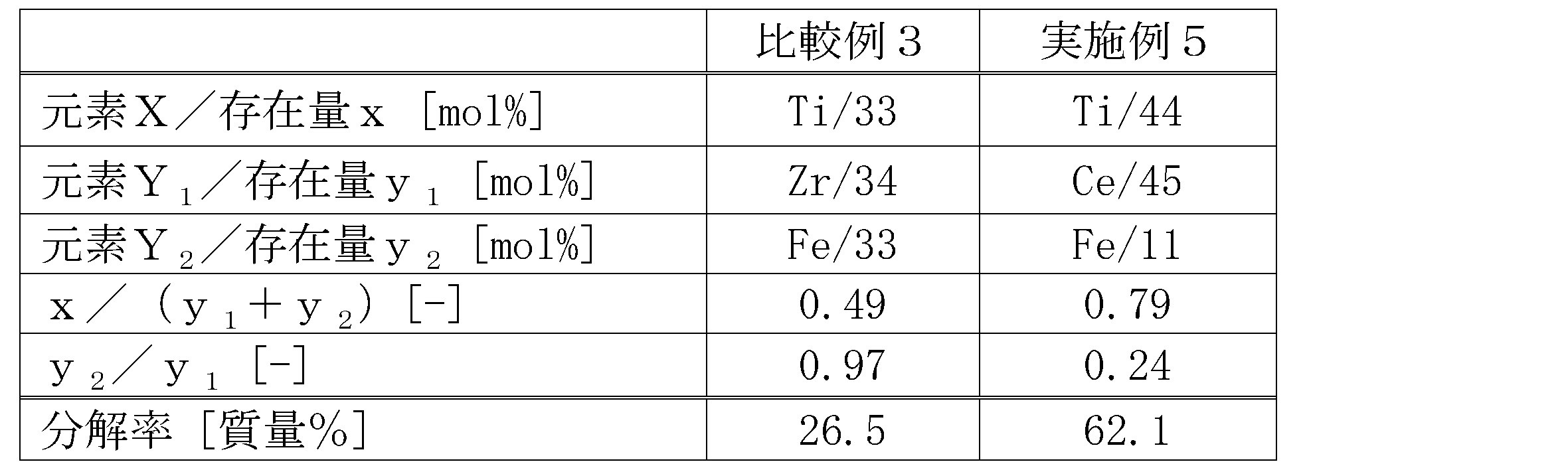
- disassembled like Example 1, and the decomposition rate of heavy hydrocarbon oil was computed. The results are shown in Table 3. The abundance ratio of Ti, Ce, and Fe in the obtained catalyst was confirmed by melting / ICP-AES, and found to be Ti: Ce: Fe 44: 45: 11.
- disassembled like Example 5 and the decomposition rate of heavy hydrocarbon oil was computed. The results are shown in Table 3. When the abundance ratio of Ti, Zr, and Fe in the obtained catalyst was confirmed in the same manner as in Example 5, it was Ti: Zr: Fe 33: 34: 33.
- the catalysts of Examples 1 to 5 have a higher decomposition rate than the catalysts of Comparative Examples 1 to 3. It can also be seen that in the catalysts of Examples 1 to 5, the hydrocarbon oil can be decomposed and lightened without previously desulfurizing and denitrogenating the hydrocarbon oil. Furthermore, the catalyst of Comparative Example 2 in which y 2 / y 1 was set to 0.30, and Comparative Example 3 in which x / (y 1 + y 2 ) was set to 0.49 and y 2 / y 1 was set to 0.97. It can be seen that the decomposition rate of the catalyst is lower than that of the catalyst of Comparative Example 1.
- Example 2 In order to evaluate the deterioration resistance of the catalyst, in Example 2 and Comparative Example 2, the decomposition of the heavy hydrocarbon oil was continued for 14 days or more. Then, after 14 days from the start of oil passing, the effluent from the reactor was collected for 2 hours, and the decomposition rate of the heavy hydrocarbon oil was calculated in the same manner as in Example 1. Table 4 shows the decomposition rate of heavy hydrocarbon oil after 6 hours from the start of oil passing and the decomposition rate of heavy hydrocarbon oil after 14 days from the start of oil passing.
- Example 2 From Table 4, the decomposition rate after 6 hours from the start of oil passage and the decomposition rate after 14 days from the start of oil passage did not change much in Example 2, whereas in Comparative Example 2, the start of oil passage 14 It can be seen that the degradation rate after the passage of days has greatly decreased. Therefore, in Example 2, it turns out that deterioration of a catalyst is suppressed.
- hydrocarbon oil cracking that can efficiently lighten hydrocarbon oil at low cost without desulfurization and denitrification of hydrocarbon oil in advance and without using high-pressure hydrogen gas.
- a catalyst can be provided.
- the hydrocarbon oil cracking method using the hydrocarbon oil cracking catalyst can be provided.
Landscapes
- Chemical & Material Sciences (AREA)
- Engineering & Computer Science (AREA)
- Chemical Kinetics & Catalysis (AREA)
- Organic Chemistry (AREA)
- Oil, Petroleum & Natural Gas (AREA)
- Materials Engineering (AREA)
- General Chemical & Material Sciences (AREA)
- Production Of Liquid Hydrocarbon Mixture For Refining Petroleum (AREA)
- Catalysts (AREA)
Abstract
Description
なお、本発明において、「元素の存在量」は、触媒を溶解して得た溶液をICP発光分光分析法で分析し、得られた測定値から触媒中の各元素の金属単体換算でのモル濃度を算出することにより求めることができる。そして、「元素の存在量の比(モル比)」は、算出した各元素のモル濃度の比を算出することにより求めることができる(以下、元素の存在量の比の算出方法を「融解/ICP-AES法」と称する場合がある。)。
そして、本発明の炭化水素油分解用触媒は、前記元素Y1がセリウムであり、前記元素Y2が、タングステン、マンガンおよび鉄からなる群より選択される1種であることが更に好ましい。
(1)周期表のIVA族元素から選択される1種の元素Xと、
(2)周期表の、IIIA族元素、VIA族元素、VIIA族元素および第4周期のVIII族元素からなる群より選択される1種の元素Y1と、
(3)周期表の、IIIA族元素、VIA族元素およびVIIA族元素、並びに、第4~6周期のIVA族元素および第4周期のVIII族元素からなる群より選択される1種の元素Y2(但し、元素Xおよび元素Y1とは異なる元素である。)と、
の3種の金属元素を所定の比率で含有していることを特徴とする。
ここで、触媒に含有させる金属元素として上記(1)~(3)に記載の元素群から選択される元素を採用したのは、上記元素群から選択される元素を含む化合物、特に酸化物は、高温高圧の水蒸気雰囲気下でも安定であり、且つ、硫黄化合物や窒素化合物による被毒に対する耐性が高いという特徴を有するからである。また、3種の金属元素を所定の比率で含有させたのは、3種の金属元素を所定の比率で含有させることにより、炭化水素油の分解反応を促進することができるからである。
(4)元素Y1の存在量y1と元素Y2の存在量y2との合計(y1+y2)に対する元素Xの存在量xの比が、0.5以上2.0以下(0.5≦x/(y1+y2)≦2.0)
(5)元素Y1の存在量y1に対する元素Y2の存在量y2の比が、0.02以上0.25以下(0.02≦y2/y1≦0.25)
CnHm+2nH2O→nCO2+(2n+(m/2))H2
(i)まず、元素Xを含む化合物と、元素Y1を含む化合物と、元素Y2を含む化合物とを、例えばX/(Y1+Y2)が0.5~2.0(モル比)となり、且つ、Y2/Y1が0.02~0.25(モル比)となるような量でイオン交換水に溶解させて、元素X,Y1,Y2を含む水溶液を調製する。
(ii)次に、調製した水溶液に対し、アンモニア水や、炭酸ナトリウム水溶液などの共沈剤を、水溶液のpHがアルカリ側に偏らないように(例えばpHが5~8の範囲となるように)調整しながら滴下し、元素X,Y1,Y2を含む共沈殿物を生成させる。
(iii)そして最後に、得られた沈殿をろ過および乾燥した後、乾燥した沈殿を焼成して複合酸化物とする。
ここで、上記(iii)において沈殿を乾燥する温度は、水分を効率的に蒸発させる観点からは、100℃以上であることが好ましい。更に、沈殿を乾燥する温度は、急激な乾燥を防止する観点からは、160℃以下であることが好ましい。また、乾燥した沈殿を焼成する温度は、生成する複合酸化物(触媒)の構造安定性(即ち、触媒として使用して炭化水素油を分解した際の複合酸化物の構造変化の抑制)の観点からは、500℃以上であることが好ましい。更に、沈殿を焼成する温度は、生成する複合酸化物の表面積の減少を抑制する観点からは、900℃以下であることが好ましい。
具体的には、混合物と触媒とを接触させる温度は、比較的低い温度、例えば300~600℃、好ましくは350~550℃、更に好ましくは400~500℃とすることができる。温度が300℃未満の場合、反応に必要な活性化エネルギーが得られずに炭化水素油の分解が十分に進行しない場合があるからである。また、温度が600℃超の場合、不要なガス(メタン、エタン等)が大量に発生し、炭化水素油の分解効率が低下するおそれがあるからである。
また、混合物と触媒とを接触させる際の圧力は、例えば0.1~40MPa、好ましくは0.1~35MPa、更に好ましくは0.1~30MPaとすることができる。圧力が0.1MPa未満の場合、炭化水素油と水とを反応器へスムーズに流入させることが困難になる場合があるからである。また、圧力が40MPa超の場合、反応器の製造コストが高くなる場合があるからである。
更に、触媒を充填した反応器に混合物を流通する際の液空間速度(LHSV)は、例えば0.01~10h-1、好ましくは0.05~5h-1、更に好ましくは0.1~2h-1とすることができる。液空間速度が0.01h-1未満の場合、不要なガスの発生が支配的となり、炭化水素油の分解効率が低下する場合があるからである。また、液空間速度が10h-1超の場合、反応時間が短すぎて炭化水素油の分解反応が十分に進行しない場合があるからである。
元素Xがジルコニウムであり、元素Y1がセリウムであり、元素Y2が鉄である触媒を調製した。具体的には、まず、硝酸ジルコニルと硝酸セリウムとを、Zr:Ce=1:1(モル比)となるようにイオン交換水中に溶解して水溶液を得た。次に、得られた水溶液に対し、硝酸鉄をCe:Fe=1:0.06(モル比)となるように加え撹拌した。そして、Zr,Ce,Feを含有する水溶液に対し、水溶液のpHが8超とならないように調整しながらアンモニア水を滴下し、沈殿を生成させた。そして最後に、得られた沈殿を熟成(室温にて一昼夜静置)、ろ過および乾燥(130℃、16時間)した後、乾燥した沈殿を温度600℃で焼成して、Zr,Ce,Feを含有する複合酸化物からなる触媒を調製した。
なお、得られた触媒中のZr,Ce,Feの存在比を融解/ICP-AES法で確認したところ、Zr:Ce:Fe=49:48:3であった。
そして、調製した触媒5.3gを超合金(インコネル625)製の反応器(内容積10mL)に充填した。次いで、触媒を充填した反応器にイオン交換水を流量0.1mL/minで通水しつつ、反応器内を温度470℃、圧力15MPaまで加熱および加圧した。その後、水素を供給することなく、表1に示すような性状の重質炭化水素油(熱分解装置から留出した油)と、イオン交換水とを反応器内に連続的に流通させた(イオン交換水、重質炭化水素油共に流量は0.1mL/minであり、LHSVは0.75h-1である。)。そして、通油開始から6時間経過後に、反応器からの流出物(分解反応生成物)を1時間採取し、以下のようにして重質炭化水素油の分解率を算出した。結果を表2に示す。

下記式を用いて、供給した重質炭化水素油中の沸点380℃以上の留分の分解率Cvを算出した。なお、Cokeは燃焼紫外蛍光法により測定した。

F:供給した重質炭化水素油中の沸点380℃以上の留分の量[g/h]
R:分解反応生成物中の沸点380℃以上の留分の量[g/h]
Coke:触媒上に堆積した炭素質の量[g/h]
元素Xがジルコニウムであり、元素Y1がセリウムであり、元素Y2がタングステンである触媒を調製した。具体的には、硝酸ジルコニルと硝酸セリウムとを、Zr:Ce=1:1(モル比)となるようにイオン交換水中に溶解してZr,Ceを含有する水溶液を得た。次に、メタタングステン酸アンモニウムをイオン交換水中に溶解して所定の濃度のメタタングステン酸アンモニウム水溶液を得た。そして、Zr,Ceを含有する水溶液に対し、水溶液のpHが8超とならないように調整しながらメタタングステン酸アンモニウム水溶液を滴下し、沈殿を生成させた。そして最後に、得られた沈殿を熟成(室温にて一昼夜静置)、ろ過および乾燥(130℃、16時間)した後、乾燥した沈殿を温度600℃で焼成して、Zr,Ce,Wを含有する複合酸化物からなる触媒を調製した。
そして、実施例1と同様にして重質炭化水素油を分解し、重質炭化水素油の分解率を算出した。結果を表2に示す。
なお、得られた触媒中のZr,Ce,Wの存在比を実施例1と同様にして確認したところ、Zr:Ce:W=49:48:3であった。
(実施例3)
元素Y2をマンガンとし、硝酸鉄の代わりに硝酸マンガンをCe:Mn=1:0.06(モル比)となるように加えた以外は、実施例1と同様にして触媒を調製した。そして、実施例1と同様にして重質炭化水素油を分解し、重質炭化水素油の分解率を算出した。結果を表2に示す。
なお、得られた触媒中のZr,Ce,Mnの存在比を実施例1と同様にして確認したところ、Zr:Ce:Mn=49:48:3であった。
(実施例4)
硝酸ジルコニル、硝酸セリウムおよび硝酸鉄をZr:Ce:Fe=46:46:8となるように加えた以外は、実施例1と同様にして触媒を調製した。そして、実施例1と同様にして重質炭化水素油を分解し、重質炭化水素油の分解率を算出した。結果を表2に示す。
なお、得られた触媒中のZr,Ce,Feの存在比を実施例1と同様にして確認したところ、Zr:Ce:Fe=46:46:8であった。
硝酸鉄を添加しなかった以外は実施例1と同様にして、元素Y2を含まない触媒を調製した。そして、実施例1と同様にして重質炭化水素油を分解し、重質炭化水素油の分解率を算出した。結果を表2に示す。
なお、得られた触媒中のZr,Ceの存在比を実施例1と同様にして確認したところ、Zr:Ce=54:46であった。
(比較例2)
硝酸ジルコニル、硝酸セリウムおよび硝酸鉄をZr:Ce:Fe=44:43:13となるように加えた以外は、実施例1と同様にして触媒を調製した。そして、実施例1と同様にして重質炭化水素油を分解し、重質炭化水素油の分解率を算出した。結果を表2に示す。
なお、得られた触媒中のZr,Ce,Feの存在比を実施例1と同様にして確認したところ、Zr:Ce:Fe=44:43:13であった。
元素Xがチタンであり、元素Y1がセリウムであり、元素Y2が鉄である触媒を調製した。具体的には、まず、四塩化チタンと硝酸セリウムとを、Ti:Ce=1:1(モル比)となるようにイオン交換水中に溶解して水溶液を得た。次に、得られた水溶液に対し、硝酸鉄をCe:Fe=1:0.25(モル比)となるように加え撹拌した。そして、Ti,Ce,Feを含有する水溶液に対し、水溶液のpHが8超とならないように調整しながらアンモニア水を滴下し、沈殿を生成させた。そして最後に、得られた沈殿を熟成(室温にて一昼夜静置)、ろ過および乾燥(130℃、16時間)した後、乾燥した沈殿を温度600℃で焼成して、Ti,Ce,Feを含有する複合酸化物からなる触媒を調製した。
そして、実施例1と同様にして重質炭化水素油を分解し、重質炭化水素油の分解率を算出した。結果を表3に示す。
なお、得られた触媒中のTi,Ce,Feの存在比を融解/ICP-AES法で確認したところ、Ti:Ce:Fe=44:45:11であった。
元素Y2をジルコニウムとし、硝酸セリウムの代わりに硝酸ジルコニルをTi:Zr:Fe=1:1:1(モル比)となるように加えた以外は、実施例5と同様にして触媒を調製した。そして、実施例5と同様にして重質炭化水素油を分解し、重質炭化水素油の分解率を算出した。結果を表3に示す。
なお、得られた触媒中のTi,Zr,Feの存在比を実施例5と同様にして確認したところ、Ti:Zr:Fe=33:34:33であった。


Claims (5)
- 水の存在下で炭化水素油を分解する際に用いられ、
IVA族元素から選択される1種の元素Xと、
IIIA族元素、VIA族元素、VIIA族元素および第4周期のVIII族元素からなる群より選択される1種の元素Y1と、
IIIA族元素、VIA族元素およびVIIA族元素、並びに、第4~6周期のIVA族元素および第4周期のVIII族元素からなる群より選択され、且つ、前記元素Xおよび前記元素Y1とは異なる1種の元素Y2と、
を含有し、
元素Y1の存在量(y1)と元素Y2の存在量(y2)との合計(y1+y2)に対する元素Xの存在量(x)の比(x/(y1+y2))が、0.5以上2.0以下であり、
元素Y1の存在量(y1)に対する元素Y2の存在量(y2)の比(y2/y1)が、0.02以上0.25以下であることを特徴とする、炭化水素油分解用触媒。 - 前記元素Xと、前記元素Y1と、前記元素Y2とを含む複合酸化物からなることを特徴とする、請求項1に記載の炭化水素油分解用触媒。
- 前記元素Xがジルコニウムであることを特徴とする、請求項1または2に記載の炭化水素油分解用触媒。
- 前記元素Y1がセリウムであり、前記元素Y2が、タングステン、マンガンおよび鉄からなる群より選択される1種であることを特徴とする、請求項1~3の何れかに記載の炭化水素油分解用触媒。
- 水の存在下で、炭化水素油と、請求項1~4の何れかに記載の炭化水素油分解用触媒とを接触させて、炭化水素油を分解することを特徴とする、炭化水素油の分解方法。
Priority Applications (2)
| Application Number | Priority Date | Filing Date | Title |
|---|---|---|---|
| JP2013507148A JP5881218B2 (ja) | 2011-03-31 | 2012-03-21 | 炭化水素油分解用触媒および炭化水素油の分解方法 |
| CA2831545A CA2831545A1 (en) | 2011-03-31 | 2012-03-21 | Hydrocarbon oil cracking catalyst and method for cracking hydrocarbon oil |
Applications Claiming Priority (2)
| Application Number | Priority Date | Filing Date | Title |
|---|---|---|---|
| JP2011080552 | 2011-03-31 | ||
| JP2011-080552 | 2011-03-31 |
Publications (1)
| Publication Number | Publication Date |
|---|---|
| WO2012132322A1 true WO2012132322A1 (ja) | 2012-10-04 |
Family
ID=46930110
Family Applications (1)
| Application Number | Title | Priority Date | Filing Date |
|---|---|---|---|
| PCT/JP2012/001925 Ceased WO2012132322A1 (ja) | 2011-03-31 | 2012-03-21 | 炭化水素油分解用触媒および炭化水素油の分解方法 |
Country Status (3)
| Country | Link |
|---|---|
| JP (1) | JP5881218B2 (ja) |
| CA (1) | CA2831545A1 (ja) |
| WO (1) | WO2012132322A1 (ja) |
Cited By (1)
| Publication number | Priority date | Publication date | Assignee | Title |
|---|---|---|---|---|
| CN108889306A (zh) * | 2018-07-11 | 2018-11-27 | 济南开发区星火科学技术研究院 | 一种脱硫催化剂 |
Citations (6)
| Publication number | Priority date | Publication date | Assignee | Title |
|---|---|---|---|---|
| JPS6345124A (ja) * | 1986-08-12 | 1988-02-26 | Res Assoc Util Of Light Oil | 固体酸物質およびその製造方法 |
| JPH08269464A (ja) * | 1995-04-03 | 1996-10-15 | Japan Energy Corp | 炭化水素油の接触分解方法 |
| JP2006007151A (ja) * | 2004-06-29 | 2006-01-12 | Ngk Insulators Ltd | 重質油を軽質化するための触媒とその製造方法 |
| JP2008297452A (ja) * | 2007-05-31 | 2008-12-11 | Japan Energy Corp | アルキルベンゼン類の製造方法 |
| JP2009102471A (ja) * | 2007-10-22 | 2009-05-14 | Japan Energy Corp | 重質油の熱分解方法 |
| JP2009242467A (ja) * | 2008-03-28 | 2009-10-22 | Japan Energy Corp | 炭化水素油の分解方法 |
-
2012
- 2012-03-21 WO PCT/JP2012/001925 patent/WO2012132322A1/ja not_active Ceased
- 2012-03-21 CA CA2831545A patent/CA2831545A1/en not_active Abandoned
- 2012-03-21 JP JP2013507148A patent/JP5881218B2/ja not_active Expired - Fee Related
Patent Citations (6)
| Publication number | Priority date | Publication date | Assignee | Title |
|---|---|---|---|---|
| JPS6345124A (ja) * | 1986-08-12 | 1988-02-26 | Res Assoc Util Of Light Oil | 固体酸物質およびその製造方法 |
| JPH08269464A (ja) * | 1995-04-03 | 1996-10-15 | Japan Energy Corp | 炭化水素油の接触分解方法 |
| JP2006007151A (ja) * | 2004-06-29 | 2006-01-12 | Ngk Insulators Ltd | 重質油を軽質化するための触媒とその製造方法 |
| JP2008297452A (ja) * | 2007-05-31 | 2008-12-11 | Japan Energy Corp | アルキルベンゼン類の製造方法 |
| JP2009102471A (ja) * | 2007-10-22 | 2009-05-14 | Japan Energy Corp | 重質油の熱分解方法 |
| JP2009242467A (ja) * | 2008-03-28 | 2009-10-22 | Japan Energy Corp | 炭化水素油の分解方法 |
Cited By (1)
| Publication number | Priority date | Publication date | Assignee | Title |
|---|---|---|---|---|
| CN108889306A (zh) * | 2018-07-11 | 2018-11-27 | 济南开发区星火科学技术研究院 | 一种脱硫催化剂 |
Also Published As
| Publication number | Publication date |
|---|---|
| JP5881218B2 (ja) | 2016-03-09 |
| JPWO2012132322A1 (ja) | 2014-07-24 |
| CA2831545A1 (en) | 2012-10-04 |
Similar Documents
| Publication | Publication Date | Title |
|---|---|---|
| TW201124202A (en) | Process for producing a hydroprocessing catalyst, and method for hydroprocessing a hydrocarbon oil using said catalyst | |
| CN105813737A (zh) | 用于制备合成气的催化剂及其获得方法 | |
| JP5881218B2 (ja) | 炭化水素油分解用触媒および炭化水素油の分解方法 | |
| JP5539755B2 (ja) | 重質炭化水素油の分解方法 | |
| JP5284361B2 (ja) | 脱硫剤及びその製造方法、並びに炭化水素油の脱硫方法 | |
| JP5687941B2 (ja) | 炭化水素油分解用触媒および炭化水素油の分解方法 | |
| JP5943906B2 (ja) | 軽質炭化水素油の製造方法および製造装置 | |
| JP5901061B2 (ja) | 炭化水素油分解用触媒の製造方法および炭化水素油の分解方法 | |
| JP5807005B2 (ja) | 脱硫剤及びその製造方法 | |
| WO2011114670A1 (ja) | 重質炭化水素油分解用触媒及び重質炭化水素油の分解方法 | |
| JP5449383B2 (ja) | 単環芳香族化合物の製造方法 | |
| JP5631612B2 (ja) | 重質炭化水素油分解用触媒 | |
| JP5530774B2 (ja) | 重質炭化水素油の分解方法 | |
| KR20190088252A (ko) | 질소 화합물의 함량이 높은 다환 방향족 탄화수소로부터 경방향족 탄화수소 제조를 위한 선택적 수첨처리 방법 | |
| Tazkia et al. | Microwave-Assisted Synthesized Ni/ZSM-5 Nanocatalysts for High-Efficiency Atmospheric Hydrotreatment of Palm Oil Based Bio-Jet Fuel | |
| JP5411762B2 (ja) | 炭化水素油の脱硫方法 | |
| JP5901062B2 (ja) | 炭化水素油分解用触媒の製造方法および炭化水素油の分解方法 | |
| JP5394272B2 (ja) | 脱硫剤及びその製造方法、並びにこれを用いた炭化水素油の脱硫方法 | |
| JP5467885B2 (ja) | 脱硫剤及びその製造方法、並びにこれを用いた炭化水素油の脱硫方法 | |
| JP2001279275A (ja) | 燃料電池用燃料油及び燃料電池用水素の製造方法 | |
| Hamid et al. | CATALYTIC CONVERSION OF CO2: A MINI-REVIEW | |
| JPS60255142A (ja) | 重質油改質触媒 | |
| CN101370912A (zh) | 非硫化的Ni基氢化裂解催化剂 |
Legal Events
| Date | Code | Title | Description |
|---|---|---|---|
| 121 | Ep: the epo has been informed by wipo that ep was designated in this application |
Ref document number: 12764255 Country of ref document: EP Kind code of ref document: A1 |
|
| ENP | Entry into the national phase |
Ref document number: 2013507148 Country of ref document: JP Kind code of ref document: A Ref document number: 2831545 Country of ref document: CA |
|
| NENP | Non-entry into the national phase |
Ref country code: DE |
|
| 122 | Ep: pct application non-entry in european phase |
Ref document number: 12764255 Country of ref document: EP Kind code of ref document: A1 |